Richmond Planet
Saturday, February 16, 1901
Richmond, Virginia
Page text (machine-generated)
THE RICHMOND PLANET
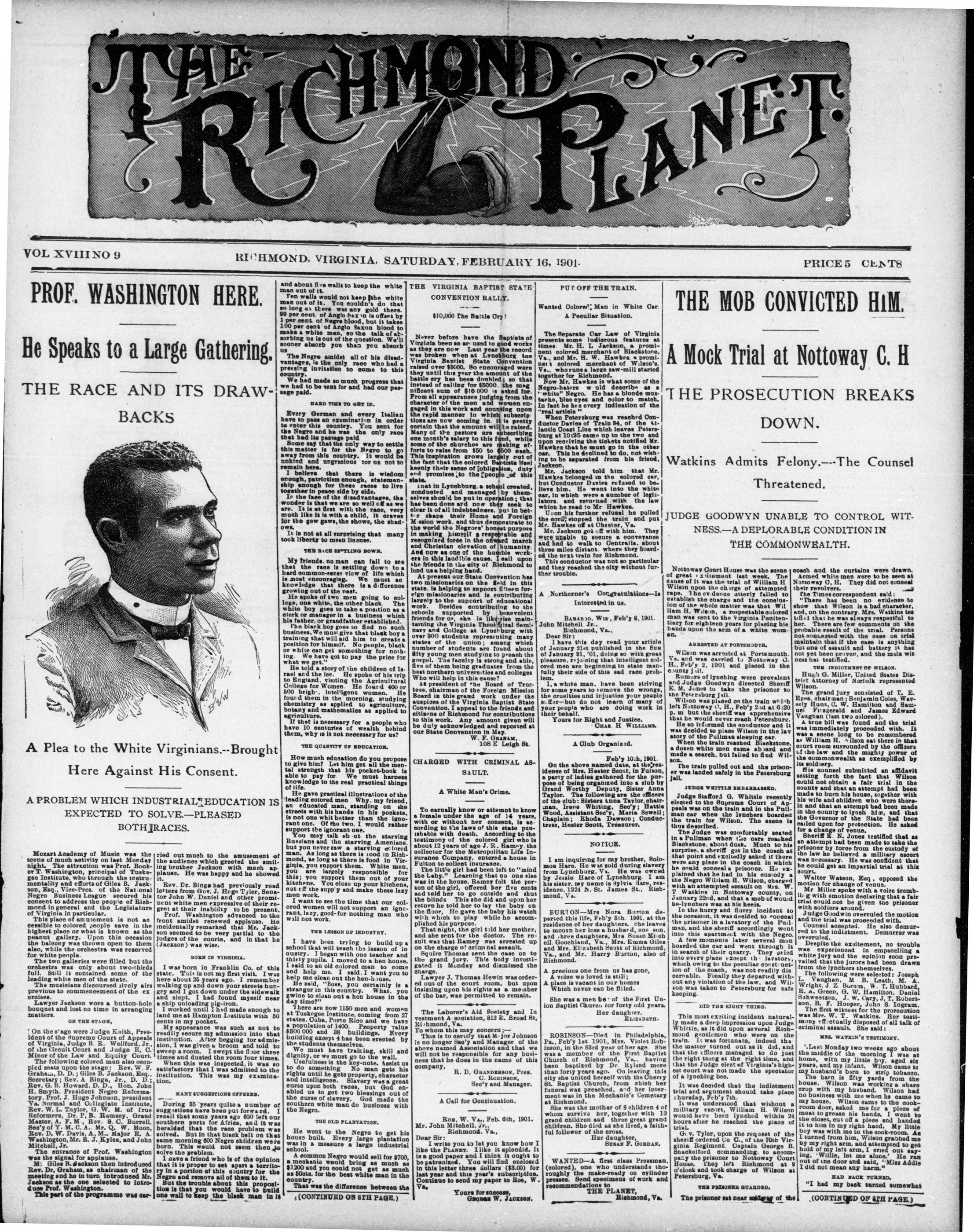
PROF. WASHINGTON HERE.
THE RACE AND ITS DRAWBACKS
B & W
A Plea to the White Virginians.--Brought Here Against His Consent.
A PROBLEM WHICH INDUSTRIAL EDUCATION IS EXPECTED TO SOLVE.—PLEASED BOTH RACES.
VOL XVIII NO 9
PROF. WASHING
He Speaks to a L
THE RACE AND
BAC
A Plea to the White
Here Against
A PROBLEM WHICH IND
EXPECTED TO S
BOTH
Mozart Academy of Music was the scene of much activity on last Monday night. The attraction was Prof. Booker T. Washington, principal of Tuskegee Institute, who through the instrumentality and efforts of Giles B. Jackson, Esq., Vice-Pres. of the National Negro Business League secured his consent to address the people of Richmond in general and the Legislature of Virginia in particular.
This place of amusement is not accessible to colored people save in the highest place or what is known as the peanut gallery. Upon this occasion the balcony was thrown open to them also, while the orchestra was reserved for white people.
The two galleries were filled but the orchestra was only about two-thirds full. Still it contained some of the leading white men of the state.
The musicians discoursed lively airs previous to commencement of the exercises.
Lawyer Jackson wore a button-hole bouquet and lost no time in arranging matters.
ON THE STAGE.
'On the age were Judge Keith, President of the Supreme Court of Appeals of Virginia, Judge B. R. Wellford, Jr., of the Circuit Court and Judge E. C. Minor of the Law and Equity Court. The following colored men also occupied seats upon the stage: Rev. W. F. Graha, D. D.; Giles B. Jackson, Eq. Secretary; Rev. A Binga, Jr., D. D.; Rev. G. B. Howard, D. D., Hon. John Smyth, President Negro Reformatory, Prof. J. Huge Johnson, president Va. Normal and Collegiate Institute, Rev. W. L. Taylor, G. W. M. of True Reformers, Dr. P. R. Ramsey, Grand Master, A. F. M., Rev. S. C. Burrell, sey of Y. M. C. A., Mr. Q. W. Moon, Rev. D. W. Davis, A. M., Major E. A. Washington, Mr. R. J. Kyles, and John Mitchell, Jr.
The entrance of Prof. Washington was the signal for annihilation.
was the signal for applause.
Mr. Giles B. Jackson then introduced RB Jackson and he in turn introduced Mr. Jackson as the one selected to introduce Prof. Washington.
This part of the programme was car-
RICHMOND, VIRGINIA, SATURDAY, FEBRUARY 16, 1901.
ried out much to the amusement of the audience which greeted the smiling brother Jackson with much applause. He was happy and he showed it.
Rev. Dr. Bings had previously read letters from Gov. J. Hoge Tyler, Senator John W. Daniel and other prominent white men expressive of their regret at their inability to be present.
Prof. Washington advanced to the front amidst renewed applause. He incidentally remarked that Mr. Jackson seemed to be very partial to the judges of the courts, and in that he (Jackson) was wise.
BORN IN VIRGINIA.
I was born in Franklin Co. of this state. This is not my first visit. I was here about 25 years ago. I remember walking up and down my streets hungry and I got down under the sidwalk and slept. I had found myself near a ship unloading pig-iron. I worked until I had made enough to land me at Hampton Institute with 50 cents in my pocket. My appearance was such as not to readily secure my admission into that institution. After begging for admission, I was given a broom and told to sweep a room. I swept the floor three times and dusted the room four times. When this was inspected, it was so satisfactory that I was admitted to the institution. This was my examination.
MANY & UGGESTIONS OFFERED.
During 35 years quite a number of suggestions have been put forward. I recall that some years ago 600 left our southern ports for Africa, and it was heralded that the race problem was solved. But in that black belt on that same morning 600 Negro children were born. This would not seem then to solve the problem.
I have a friend who is of the opinion that it is proper to set apart a territory in a portion of this country for the Negro and remove all of them to it.
But the trouble about this proposition is that you would have to build one wall to keep the black man in is
and about five walls to keep the white man out of it.
Ten walls would not keep the white man out of it. You couldn't do that so long as there was any gold there. 99 per cent of Anglo Saxon is offset by 1 per cent. of Negro blood, but it takes 100 per cent of Anglo Saxon blood to make a white man, so the talk of absorbing us is out of the question. We'll sooner absorb you than you absorb us.
The Negro amidst all of his disadvantages, is the only race who had a pressing invitation to come to this country.
We had made so much progress that we had to be sent for and had our passage paid.
HARD TIME TO GET IN.
Every German and every Italian have to pass an examination in order to enter this country. You sent for the Negro and he was the only race that had its passage tape. Some say that the only way to settle this matter is for the Negro to go away from this country. It would be unkind and ungrateful for us not to remain here.
I believe that there is wisdom enough, patriotism enough, statemanship enough for these races to live together in peace side by side.
In the face of the disadvantages, the wonder is that we are so well off as we are. It is at first with the race, very much like it is with a child, it craves for the gew gaws, the shows, the shadows.
It is not at all surprising that many took liberty to mean license.
THE RACE SETTLING BOWN.
My friends, no man can fail to see that the race is settling down to a hard common-sense view of life which is most encouraging. We must ask knowledge that there is a difference growing out of the east.
He spoke of two men going to college, one white, the other black. The white boy goes to take a position as a clerk or manager in a business which his father, or grandfather established. The black boy goes to find no such business. We must give that black boy a training that will aid him to create a position for himself. No people, black or white can get something for nothing. We have got to pay the price for what we want.
He told a story of the children of Israel and the ice. He spoke of his trip to England, visiting the Agricultural College for Women. He found 400 500 bright, intelligent women. He found them in the morning, studying chemistry as applied to agriculture, botany and mathematics as applied to agriculture.
If that is necessary for a people who have 10 centuries of wealth behind them, why is it not necessary for us?
THE QUANTITY OF EDUCATION
How much education do you propose to give him? Let him get all the mental strength that his pocket-book is able to pay for. We must harness knowledge to the real practical things of life.
He gave practical illustrations of the leading colored men. Why, my friend, an educated man, standing on the streets with his hands in his pockets, is not one whit better than the ignorant one. Of the two, I would rather support the ignorant one.
You may talk about the starving Russians and the starving Amenians, but you never saw a starving cloaked man. As long as there is food in Richmond, as long as there is food in Virginia, you support them. White men, you are largely responsible for this; you support them out of your kitchens. You close up your kitchens, cut off the supply and make these lazy men work.
I want to see the time that our colored women will not support an ignorant, lazy, good-for-nothing man who will not work.
THE LESSON OF INDUSTRY.
I have been trying to build up a school that will teach the lesson of inquiry. I began with one teacher and thirty pupils. I moved to a hen house. I said to an old colored man to come and help me. I said, I want you to help me clean out the hen-house. He said, "Boss, you certainly is a stranger in this country. What, you gwine to clean out a hen house in the day time?" There are now 1150 men and women at Tuskegee Institute, coming from 27 states. Cuba, Porto Rico and we have a population of 1400. Property value $800 000 and 88 buildings. Every building except 4 has been erected by the students themselves. We must have training, skill and dignity, or we must go to the wall.
Usefulness is the key-note. Assist him to do something. No man gets his rights until he gets property, character and intelligence. Slavery was a great curse upon both races, but God ennured him with two blessings out of the curse of slavery. God made the southern white man do business with the Negro.
THE OLD PLANTATION.
He went to the Negro to get his house built. Every large plantation was in a measure a large industrial school.
A common Negro would sell for $700, a mechania would bring as much as $1200 and you could not get as much as 500s, for the best white man in the country.
That was the difference between the
(CONTINUED ON 8TH PAGE.)
Never before have the Baptists of Virginia been so ardued to good works as they are now. Last year the record was broken when at Lynchburg the Virginia Baptist State Convention raised over $5000. So encouraged were they until this year the amount of the battle cry has been doubled; so that instead of calling for $5000, the magnificent sum of $10,000 is asked for. From all appearances judging from the character of the men and women engaged in this work and counting upon the rapid manner in which subscriptions are now coming in, it is pretty certain that the amount will be raised. Many of the pastors are subscribing one month's salary to this fund, while the churches are making efforts to raise fund $500 each. This inspiration grows largely the fact that the colored Baptists feel keenly their sense of obligation, duty and promises to the people of this state.
that in Lynchburg, a school created, conducted and managed by themselves should be put in operation; that has been done and now they seek to clear it of all indebtedness, put in better shape their Home and Foreign Mission work, and thus demonstrate to the world the Negroes' honest purpose in making himself a respectable and recognized force in the onward march of the United States of America. And now as one of the humble heroes in this laudible cause, I call upon the friends in the city of Richmond to lend us a helping hand.
At present our State Convention has two missionaries on the field in this state, is helping to support fifteen foreign missionaries and is contributing largely to the support of educational work. Besides contributing to the schools supported by benevolent friends for us, she is likewise maintaining the Virginia Theological Seminary and College at Lynchburg with over 300 students representing many states of the union; among which number of students are found about fifty men studying to preach the gospel. The faculty strong and able, five of them being graduates from the best northern universities and colleges Who will help in this cause?
As president of the Board of Trustees, chairman of the Foreign Mission Board in this grand work under the auspices of the Virginia Baptist State Convention. I appeal to the friends and citizens of Richmond for contributions to this work. Any amount given will be duly acknowledged and reported at our State Convention in May.
W. F. GRANH.
108 E Leigh St.
CHARGED WITH CRIMINAL ASSAULT.
A White Man's Crime
To carnally know or attempt to know a female under the age of 14 years, with or without her consent, is according to the laws of this state punishable with death. According to the testimony of the colored girl who is about 12 years of age J. R. Ramey, the collector for the Metropolitan Life Insurance Company, entered a house in Fulton to collect insurance.
The little girl had been left to "mind the baby." Learning that no one else was in the house, Ramey felt the person of the girl, offered her five cents and told her to go outside and shut the blinds. This she did and upon her return he told her to lay the baby on the floor. He gave the baby his watch with which to play while he accomplished his purpose.
That night, the girl told her mother, and she sent for the doctor. The result was that Ramey was arrested up on the charge of criminal assault.
Squire Thomas sent the case on to the grand jury. This body investigated it Monday and dismissed the charge.
Lawyer J. Thomas Hewin was ordered out of the court room, but upon insisting upon his rights as a member of the bar, was permitted to remain.
The Laborer's Aid Society and In vestment Association, 812 E. Broad St, Richmond, Va.
To whom this may concern ;—
This is to certify that M-jor Johnson is no longer Sca'y and Manager of the above named Association and that we will not be responsible for any business that he does in the name of this company,
R. D. GRANDERSON, Pres.
C. ROHINSON,
Sca'y and Manager.
Roe, W. VA., Feb. 6th, 1901.
Mr. John Mitchell, Jr.
Richmond. VA.
Dear Sir:
I write you to let you know how I like the PLANET. I like it splendid. It is a good paper and I think it ought to be patronized. You will find enclosed in this letter three dollars ($9.00) for last year and this year's subscription. Continue to send my paper to Roe, W. VA.
Yours for success,
Gregor W. Jackson.
PULL OFF THE TRAIN.
Wanted Colored! Man in White Car.
A Peculiar Situation.
The Separate Car Law of Virginia presents some ludicrous features at times. Mr. H. L Jackson, a prominent colored merchant of Blackstone, Va., and Mr. H. W. Hawkes, a prominent colored merchant of Wilson's, Va., who runs a large saw-mill started together for Richmond.
Now Mr. Hawkes is what some of the Negro-haters would describe as a "white" Negro. He has a blonde mustache, blue eyes and color to match. In fact he has every indication of the "real article."
When Petersburg was reached Conductor Davies of Train 84, of the Atlantic Coast Line which leaves Petersburg at 10:25 came up and upon welcoming sheets notified Mr. Hawkes that he must go in the other car. This he declined to do, not wishing to be separated from his friend, Jackson.
Mr. Jackson told him that Mr. Hawkes belonged in the colored car, but Conductor Davies refused to be believe him. He went into the white car, in which were a number of legislators, and returned with the law which he read to Mr. Hawkes.
Upon his further refusal he pulled the core, stopped the train and put Mr. Hawkes off at Chester, Va.
Mr. Jackson goes off with him. They were unable to secure a conveyance and had to walk to Centralia, about three miles distant, where they boarded the next train for Richmond.
This conductor was not so particular and they reached the city without further trouble.
A Northerner's Congratulations—Is Interested in us.
BARABOO, Wis., Feb'y 8, 1901.
John Mitchell Jr.
Richmond, Va.;
Dear Sir:
I have this day read your article of January 21st published in the Sun of January 81, '01, doing so with great pleasure, rejoicing that intelligent colored men are beginning to state manfully their side of this sad race problem.
I, a white man, have been striving for some years to remove the wrongs, the cruelties and injustice your people do not learn of many of your people who are doing work in their behalt.
Yours for Right and Justice.
CHAS. H. WILLIAMS.
A Club Organized.
On the above named date, at the presence of Mrs. Hester Scott, in Fulton, a party of ladies gathered for the purpose of being organized into a club by Grand Worthy Deputy, Sister Anna Taylor. The following are the officers of the club: Sisters Anna Taylor, charlatan Wood, Assistant See'y, Maria Sawell; Chaplain; Rhoda Dawson; Conductress, Hester Scott, Treasurer.
NOTICE.
I am inquiring for my brother, Solomon Hare. He was sold during slavery from Lynchburg, Va. He was owned by Jessie Hare of Lynchburg. I am his sister, my name is Sylvia Hare, residence, 1224 N. St. James St., Richmond, Va.
BURTON—Mrs Nora Burton departed this life, Feb' 5th, 1901, at the residence of her daughters. She leaves to mourn her loss a husband, one son, and three daughters, Mrs Susan Mitch ell, Goochland, Va., Mrs Emma Giles and Mrs. Elizabeth Scott of Richmond, Va., and Mr. Harry Burton, also of Richmond.
A precious one from us has gone,
A voice we loved is still;
A place is vacant in our homes
Which never can be filled.
She was a men be of the First Union Baptist Church for forty odd years.
ROBINSON—Died in Philadelphia, Pa. Feb. 19th 1910, Mrs. Violet Robinson, in the 83rd year of her age. She was a member of the First Baptist Church of Richmond, Va., having been baptized by Dr. Ryan more than forty years ago. On leaving this city she united herself with the Cherry St. Baptist Church, from which her funeral was preached, and her interment was in the Mechanic's Cemetery at St. Mary's. She was the mother of 8 children 4 of whom survive her, together with 12 grand children and three great grand children. She died as she lived, a faithful follower of the cross.
WANTED—A first class Pressman. (colored), one who understands thoroughly the make-ready on cylinder presses. Send specimens of work and recommendations to
THE MOB CONVICTED HIM.
A Mock Trial at Nottoway C. H
THE PROSECUTION BREAKS
Watkins Admits Felony.----The Counsel
JUDGE GOODWYN UNABLE TO CONTROL WITNESS.—A DEPLORABLE CONDITION IN THE COMMONWEALTH.
Notoway Court House was the scene of great excitement last week. The cause of it was the trial of William H Wilson upon the charge of attempted rape. The evidence utterly failed to establish the charge and the conclusion of the whole matter was that William H. Wilson, a respectable colored man was sent to the Virginia Penitentiary for eighteen years for placing his hands upon the arm of a white wom an.
ARRESTED AT PORTSMOUTH.
Wilson was arrested at Portsmouth. Va. and was carried to Nottoway O. H., Feb'y 2, 1901 and placed in the county jail. Rumors of lynching were prevalent and Judge Goodwyn directed Sheriff E. M. Jones to take the prisoner to the Petersburg jail. Wilson was placed on the train which left Nottoway O. H., Feb'y 2ad at 6:30 p. m. but the sheriff was apprehensive that he would never reach Petersburg.
He so informed the conductor and it was decided to place Wilson in the law office of the Pulman sleeping car. When the train reached Blackstone, a dozen white men came aboard and made a search, but failed to find Wilson. The train pulled out and the prisoner was landed safely in the Petersburg jail.
JUDGE WHITTLE EMBARRASSED.
Judge Stafford G. Whittle recently elected to the Supreme Court of Appeals was on the train and in the Pullman car when the lynchers boarded the train for Wilson. The scene is thus described.
The Judge was comfortably seated in a Pullman when the cars reached Blackstone, about dusk. Much to his surprise, a sheriff got in the coach at that point and excitedly asked if there were any place in the coach in which he could conceal a prisoner. He explained that he had in his custody a Negro William H. Wilson, charged with an attempted assault on Mrs. W. T Watkins in Nottown county, on January 22nd, and that a mob of wound be-lynchers was at his heels.
In the hurry and flurry incident to the occasion, it was decided to conceal the prisoner in a lavatory of the Pullman, and the sheriff accordingly went into this apartment with the Negro
A few moments later several men boarded the car and went through it in search of their quarry. They pried into every place except the lavatory, which owing to the peculiar construction of the coach, was not readily discernable. Finally they departed without any violation of the law, and Wilson was taken to Petersburg for safe keeping.
DID THE RIGHT THING.
This most exciting incident naturally made a deep impression upon Judge Whittle, as it did upon several Richmond gentlemen who were on the train. It was fortunate, indeed that the matter turned out as it did, and that the officers managed to do just the right thing at the right time, and that the Judge elect of Virginia's highest court was not made the spectator of a lynching bee.
It was deeded that the indictment trial and argument should take place Thursday, Feb'y 7th.
It was understood that without a military escort, William H. Wilson would have been lynched within 24 hours after he reached the place of trial.
Gov. Tyler, upon the request of the sheriff ordered Co C., of the 70th Virginia Regiment, Captain George B. Shackelford commanding, to accompany the prisoner to Nottoway Court House. They left Richmond at 9 o'clock and took charge of Wilson at Petersburg, Va.
THE PRISONER GUARDED.
The prisoner sat near midway of the
PRICE 5 CENT8
INVICTED HIM.
Nottoway C. H
TION BREAKS
OWN.
celony.---The Counsel
tened.
BLE TO CONTROL WIT-
BLE CONDITION IN
ONWEALTH.
coach and the curtains were drawn. Armed white men were to be seen at Nottoway C, H. They did not conceal their revolvers.
The Times correspondent said:
In these correspondent said:
"there has been no evidence to
show that William is bad character,
and, on the contrary, Mrs. Waskins tes
tial that he was always respectful
to her. There are few comments on the
probable result of the trial. Persons
not concerned with the case on trial
maintain that if the case is anything
but one of assault and battery it has
not yet been proven, and the main wit
ness has testified.
THE INDICMENT OF WILSON.
Hugh G. Miller, United States District Attorney of Norfolk represented Wilson.
The grand jury consisted of T. E.
Eppei shairman: Benjamin Ooles, Waverly Hugh, O. W. Hamilton and Samuel Fitzgerald and James Edward Vaughan (last two colored).
A true bill was found and the trial was immediately proceeded with. It was a scene long to be remembered as William H. Wilson sat there in that court room surrounded by the officers of the law and the mighty power of the commonwealth as exemplified by its soldiery.
His counsel submitted an affidavit setting forth the fact that Wilson could not obtain a fair trial in the county and that an attempt had been made to burn his house, together with his wife and children who were there in and that an attempt had been made in the county to lynch him, and that the Governor of the State had been called upon for protection. He asked for a change of venue.
Sheriff E. N. Jones testified that as an attempt had been made to take the prisoner by force from the custody of the law he believed a military escort was necessary. He was confident that he could get an impartial trial at this court.
Walter Watson, Esq, opposed the motion for change of venue.
Mr Miller spoke with a voice trembling with emotion declaring that a fair trial could not be given the prisoner with soldiers around.
Judge Goodwin overruled the motion and the trial was proceeded with.
Counsel accepted. He also demurred to the indictment. Demurrer was overruled.
Despite the excitement, no trouble was experienced in empencling a white jury and the opinion soon prevailed that the jurors had been drawn from the lynchers themselves.
The following were selected: Joseph L. Vaughan, M. B. Leath, M. A. Wright, J. Z. Borum, W. T. Hubbard, R. A. Glen, G. W. Hamilton, Daniel Shwesten, J. W. Cooper, J. T. Robertson, B. F. Hooper, I. S. Ingram.
The first witness for the prosecution was Mrs. W. T. Watkins. Her testimony effectively disposed of all talk of criminal assault. She said:
MRS. WATKIN'S TESTIMONY
'Lest Monday two weeks ago about the middle of the morning I was at home, with my little boy, aged six years, and my infant. Wilson came to my husband's barn to strip tobacco. The barn is fifty yards from the house. Wilson was working a share crop with my husband. Wilson had no business with me when he came to my house. Wilson came to the cook-room door, asked me for a piece of meat to grease his hands. I went to the closet, cut off a piece and handed it to him in my right hand. My little boy was with me in the cook-room. As I turned from him, Wilson grabbed me by my right arm, and attempted to get hold of my left arm, I cried out saying, 'Willie, let me alone.' He ran out of the door and said, 'Miss Addie I did not mean any harm.'
HAD BACK TURNED.
"I had my back turned somewhat."
(CONTINUED ON 8TH PAGE.)
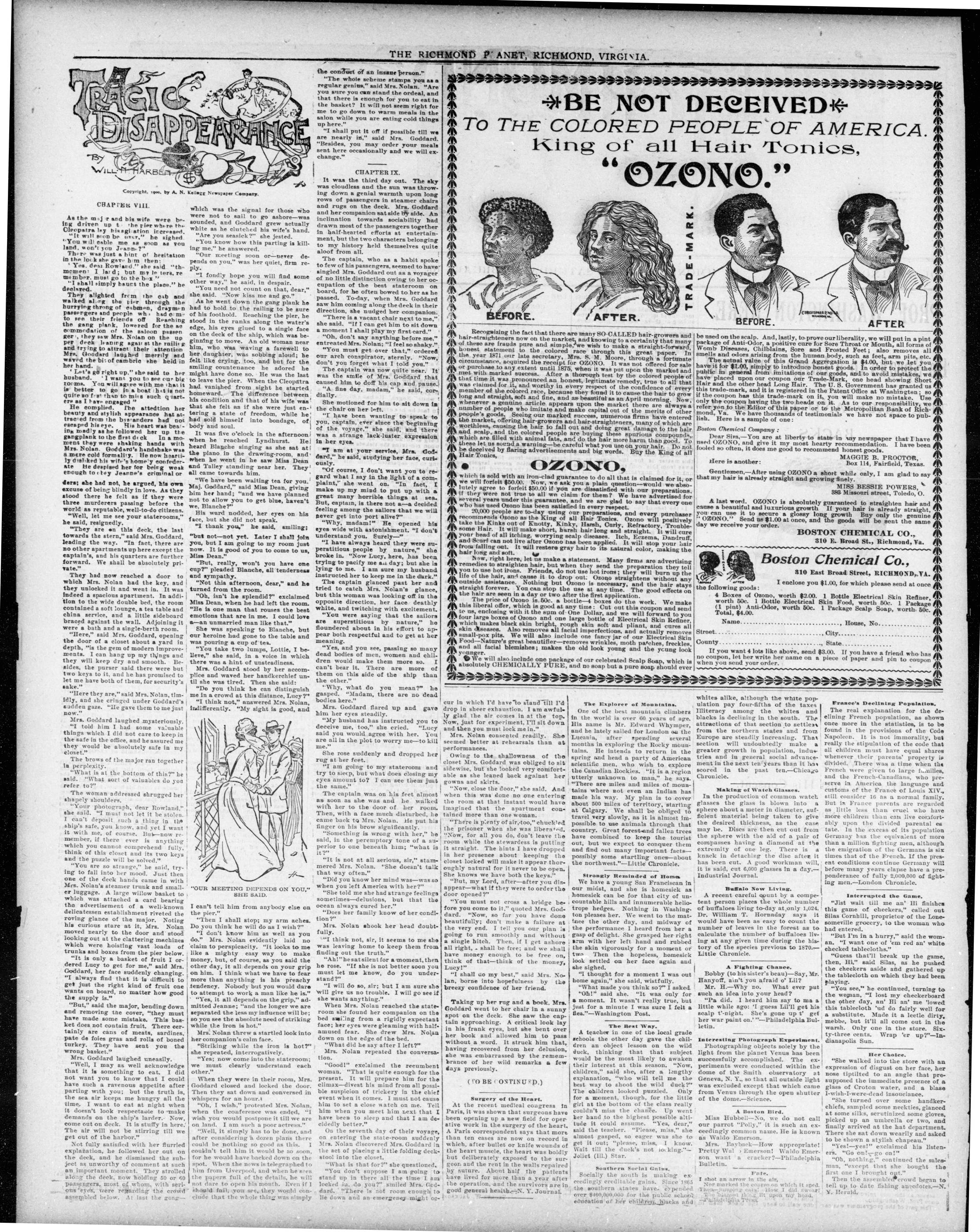
TRAGIC
DISAPPEARANCE
BY
WILLIAM HARBEN
Copyright, 1900, by A. N. Kellegg Newspaper Company.
CHAPTER VIII
As the mjr and his wife were be-
come the pier where the
Cleopatra lay his body.
"It is really baskation increased,
"It will soon be ever," he sighed.
"You will cable me as soon as you land, won't you? I know."
There was just a hint of hesitation in the lock she gave him then.
"Yes, dear Rowland," she said "thmomen! I land; but my teachers, remember, must go to the box."
"I shall simply haunt the place," he declared.
They alighted from the cab and walked along the pier through the hurrying throng of cabmen, draymen passengers and people who had come to see their friends off. Reaching the gang plank, lowered for the ae commotion of the salmon passenger, they saw Mrs. Nolan on the upper deck leaning against the railings and trying to attract their attention. Mrs. Biddick laughed merrily and waved the bit of cambric she held in her hand.
"Let's go right up," she said to her husband. "I want you to see our big rooms. You will agree with me that it is better to go in a boat that is not quite so fast than to miss such quarters as I have engaged."
He complied. The attention her beauty and stylish appearance had attracted from the bystanders had not escaped his eye. His heart was beating madly as he followed her up the gangplank to the first deck. In a moment they were shaking hands with Nolan Goddard's handshake was a more formality. He now heartily disliked his nounion and confederate. He despised her for being weak enough to they Jeanne's criminal orders; she had not, he argued, his own excuse of being blindly in love. As they stood there he felt as if they were three murderers passing before the world as reputable, well-to-do citizens. "Well, let me see your stateroom."
"Well, let me see your staterooms," he said, resigned.
"They are on this deck, the last towards the stern," said Mrs. Goddard, leading the way. "In fact, there are no other apartments up here except the captain's, and his quarters are further forward. We shall be absolutely private."
They had now reached a door to which Mrs. Nolan had the key, and they unlocked it and went in. It was indeed a spacious apartment. In addition to the wide double bed, the room contained a soft lounge, a tea table and china service, and a little sideboard braced against the wall. Adjoining it were a bath and a single-berth room.
"Here," said Mrs. Goddard, opening the door of a closet about a yard in depth, "is the gem of modern improvements. I can hang up my things and they will keep dry and smooth. Besides, the purser said there were but two keys to it, and he has promised to let me have both of them, for security's sake."
"Here they are," said Mrs. Nolan, timidly, and she cringed under Goddard's sudden gaze. "He gave them to me just now."
Mrs. Goddard laughed mysteriously. "I told him I had some valuable things which I did not care to keep in the safe in the office, and he assured me they would be absolutely safe in my closet."
The brows of the major ran together in perplexity.
"What is at the bottom of this?" he said. "What sort of valuables do you refer to?"
The woman addressed shrugged her shapely shoulders.
"Your photograph, dear Rowland," she said. "I must not let it be stolen. I can't deposit such a thing in the ship's safe, you know, and yet I want it with me, of course. But—now remember, if there ever is anything which you cannot comprehend fully, think of this closet and its two keys and the puzzle will be solved."
"You are so strange," he said, trying to fall into her mood. Just then one of the deck hands came in with Mrs. Nolan's steamer trunk and smaller luggage. A large willow basket to which was attached a card bearing the advertisement of a well-known delicatessen establishment riveted the roving glance of the major. Noting his curious stare at it, Mrs. Nolan moved nearly to the door and stood looking out at the clattering machines which were hoisting vast loads of trunks and boxes from the rick helo
"It is only a basket of fruit I ordered Lucy to get for me," said Mrs. Goddard, her face suddenly changing. "I always find that it is difficult to get just the right kind of fruit one wants on board, no matter how good the supply is."
"But," said the major, bending down and removing the cover, "they must have made some mistake. This basket does not contain fruit. There certainly are cans of meats, sardines, pate de foies gras and rolls of boned turkey. They have sent you the wrong basket."
MRS. Goddard laughed uneasily. "Well, I may as well acknowledge that it is something to eat. I did not want you to know that I could have such a ravenous appetite after parting with you; but the truth is, the sea air keeps me hungry all the time. I want to eat at night when it doesn't look respectable to make demands on the ship's larder. Now, come out on deck. It is stuffy in here. The air will not be stirring till we get out of the harbor."
Not fully satisfied with her flurried explanation, he followed her out on the deck, and he dismissed the subject as unworthy of comment at such an important moment. They strolled along the deck, now holding 50 or 60 passengers, most of whom, with serious eyes, were regarding the crowd assembled below. At last the gong-
which was the signal for those who were not to sail to go ashore—was sounded, and Goddard grew actually white as he clutched his wife's hand. "Are you seasick?" she jested. "You know how this parting is killing me," he answered. "Our meeting soon or—never depends on you," was her quiet, firm reply. "I fondly hope you will find some other way," he said, in despair. "You need not count on that, dear," she said. "Now kiss me and go."
she said. "Now kiss me and go."
As he went down the gang plank he had to hold to the railing to be sure of his foothold. Reaching the pier, he stood in the ranks along the water's edge, his eyes glued to a single face on the deck of the ship, which was beginning to move. An old woman near him, who was waving a farewell to her daughter, was sobbing aloud; he felt like crying, too, and but for the smiling countenance he adored he might have done so. He was the last to leave the pier. When the Cleopatra had vanished from sight he started homeward. The difference between his condition and that of his wife was that she felt as if she were just entering a state of freedom, while he had sold himself into bondage, of body and soul.
It was five o'clock in the afternoon when he reached Lyndhurst. He heard Blanche singing as she sat at the piano in the drawing-room, and when he went in he saw Miss Dean and Talley standing near her. They all came towards him.
"We have been waiting tea for you. Maj. Goddard," said Miss Dean, giving him her hand; "and we have planned not to allow you to get blue, haven't we, Blanche?"
His ward nodded, her eyes on his face, but she did not speak.
"I thank you," he said, smiling;
"but not—not yet. Later I shall join you, but I am going to my room just now. It is good of you to come to us, Miss Dean."
"But, really, won't you have one cup?" pleaded Blanche, all tenderness and sympathy.
"Not this afternoon, dear," and he turned from the room.
"Oh, isn't he splendid?" exclaimed Miss Dean, when he had left the room. "He is one man that rouses the best emotions that are in me. I could love a—unmarried man like that." She was speaking to Blanche, but our heroine had gone to the table and was pouring a cup of tea. "You take two lumps, Lottie, I believe," she said, in a voice in which there was a hint of unsteadiness. Mrs. Goddard stood by her accomplice and waved her handkerchief until she was tired. Then she said. "Do you think he can distinguish me in a crowd at this distance, Lucy?" "I think not," answered Mrs. Nolan, indifferently. "My sight is good, and
M.
"OUR MEETING DEPENDS ON YOU," SHE SAID.
I can't tell him from anybody else on the pier."
"Then I shall stop; my arm aches. Do you think he will do as I wish?"
"I don't know him evidently laid no claim to perspicacity. "It looks to me like a mighty easy way to make money, but, of course, as you said the other day, it all depends on your grip on him. I think what we have to fear more than anything is his preachy tendency. Nobody but you would dare to attempt to work a man like he is."
"Yes, it all depends on the grip," admitted Jeanne; "and the longer we are separated the less my influence will be; so you see the absolute need of striking while the iron is hot."
Mrs. Nolan threw a startled look into her companion's calm face.
"Striking while the iron is hot?" she repeated, interrogatively.
"Yes, now come into the stateroom; we must clearly understand each other."
When they were in their room, Mrs. Goddard closed and locked the door. Then they sat down and conversed in whispers for an hour.
"Oh, I wish," protested Mrs. Nolan, when the conference was ended, "I wish you would postpone it till we are on land. I am a poor actress."
"Well, it simply has to be done, and after considering a dozen plans there could be nothing so good as this. I couldn't tell him it would be so soon, for he would have backed down on the spot. When the news is telegraphed to him from Liverpool, and when he sees the papers full of the details, he will not dare to open his mouth. Even if I should fail, you see, they would conclude that the whole thing was simply
THE RICHMOND PANET, RICHMOND, VIRGINIA.
the conduct of an insane person."
"The whole scheme stamps you as a regular genius," said Mrs. Nolan. "Are you sure you can stand the ordeal, and that there is enough for you to eat in the basket? It will not seem right for me to go down to warm meals in the salon while you are eating cold things up here."
"I shall put it off if possible till we are nearly in," said Mrs. Goddard. "Besides, you may order your meals sent here occasionally and we will exchange."
CHAPTER IX.
It was the third day out. The sky was cloudless and the sun was throwing down a genial warmth upon long rows of passengers in steamer chairs and rugs on the deck. Mrs. Goddard and her companion sat side by side. An inclination towards sociability had drawn most of the passengers together in half-hearted efforts at entertainment, but the two characters belonging to my history held themselves quite aloof from all.
The captain, who as a habit spoke to few of his passengers, seemed to have singled Mrs. Goddard out as a voyager of no little distinction owing to her occupation of the best stateroom on board, for he often bowed to her as he passed. To-day, when Mrs. Goddard saw him coming along the deck in their direction, she nudged her companion.
“There is a vacant chair next to me.” she said. “If I can get him to sit down a moment I shall play my first card.”
“Oh, don't say anything before me,” entreated Mrs. Nolan; “I feel so shaky.”
"You must get over that," ordered our arch conspirator, sternly. "Now, don't you forget what I told you."
The captain was now quite near. It was the smile of Mrs. Goddard that caused him to doff his cap and pause. "A fine day, madam," he said, cordially.
She motioned for him to sit down in the chair on her left.
"I have been wanting to speak to you, captain, ever since the beginning of the voyage," she said, and there was a strange lack-luster expression in her eyes.
"I am at your service, Mrs. Goddard," he said, studying her face, curiously.
"Of course, I don't want you to regard what I say in the light of a complaint," she went on. "In fact, I make up my mind to put up with a great many horrible things at sea. But, captain, is there not a—a decided feeling among the sailors that we will never get into port alive?"
"Why, madam!" He opened his eyes wide with astonishment. "I don't understand you. Surely—"
"I have always heard they were superstitious people by nature," she broke in. "Now Lucy, here, has been trying to pacify me all day; but she is lying to me. I am sure my husband instructed her to keep me in the dark."
The captain glanced past her and tried to catch Mrs. Nolan's glance, but this woman was looking off in the opposite direction, her face deathly white, and twitching with excitement.
"You were saying that the sailors are superstitious by nature," he floundered about in his effort to appear both respectful and to get at her meaning.
"Yes, and you see, passing so many dead bodies of men, women and children would make them more so. I can't bear it. There are more of them on this side of the ship than the other."
"Why, what do you mean?" he gasped. "Madam, there are no dead bodies here."
Mrs. Goddard flared up and gave him her eyes steadily.
"My husband has instructed you to deceive me, too," she cried. "Lucy said you would agree with her. You are all in the plot to worry me—to kill me."
She rose suddenly and dropped her rug at her feet.
"I am going to my stateroom and try to sleep, but what does closing my eyes amount to? I can see them just the same."
The captain was on his feet almost as soon as she was and he walked with her to the door of her room. Then, with a face much disturbed, he came back to Mrs. Nolan. He put his finger on his brow significantly.
"Something is wrong with her," he said, in the peremptory tone of a superior to one beneath him; "what is it?"
"It is not at all serious, sir," stammered Nolan. "She doesn't talk that way often."
"Did you know her mind was—was so when you left America with her?"
"She told me she had strange feelings sometimes—delusions, but that the ocean always cured her."
"Does her family know of her condition?"
Mrs. Nolan shook her head doubtfully.
"I think not, sir, it seems to me she was leaving home to keep them from finding out the truth."
"Ahl" he satisfilent for a moment, then he rose. "If she is not better soon you must let me know, do you understand?"
"I will do so, sir; but I am sure she will give us no trouble. I will go see if she wants anything."
When Mrs. Nolan reached the state-room she found her companion on the bed smiling from a rigidly expectant face; her eyes were gleaming with half-amused fear. She drew Mrs. Nolan down on the edge of the bed.
"What did he say after I left?"
Mrs. Nolan repeated the conversation.
"Good!" exclaimed the recumbent woman. "That is quite enough for the present. It will prepare him for the climax—divest his mind from all possible suspicion of trickery in the chief event when it comes. I must not cause him to set a close watch on me. Tell him when you meet him next that I have been to sleep and that I am decidedly better."
On the seventh day of their voyage, on entering the state-room suddenly Mrs. Nolan discovered Mrs. Goddard in the act of placing a little folding deck-stool into the closet.
"What is that for?" she questioned.
"You don't suppose I am going to stand up in there all the time I am locked in, do you?" smiled Mrs. Goddard.
"There is not room enough to lie down and an emergency might oc-
BE NOT DECEIVED
TO THE COLORED PEOPLE OF AMERICA.
King of all Hair Tonics,
"OZONO."
BEFORE. AFTER. TRADE-MARK.
Recognizing the fact that there are many SO-CALLED hair-growers and hair-straighteners now on the market, and knowing to a certainty that many of these are frauds pure and simple, we wish to make a straight-forward, honest statement to the colored race through this great paper. In the year 1871 our late secretary, Mrs. S. M. Moore, through a fortune or purchase to acquire the receipt for OZONO. It was not offered for sale or purchase to the extent until 1875, when it was put upon the market and met with marked difficulty until a thorough test by the colored people of that time it was pronounced an honest, legitimate remedy, true to all that was claimed for it, and worthy in every respect, the confidence of every member of the colored race, because they found it to be the hair to grow long and straight, soft and fine, and as beautiful as an April flower, whenever a genuine article appears upon the market there are always number of people who limitate and make capital out of the merits of other people's goods. Seeing our marked success, numerous firms have entered the market, offering hair-growers and hair-straighteners, many of which are worthless, causing the hair to fall out and doing great damage to the hair and scalp, and the colored people are buying these spurious compounds, filled with animal fats, and do the hair more harm than good. To these let us offer a warning—be careful what you use on your hair. Do not be deceived by flaring advertisements and big words. Buy the King of all Hair Tonics.
OZONO.
which is sold with an iron-clad guard we will forfeit $50.00. Now, we shall lately agree to forfeit $50.00 if you if they were not true to all we clare several years under this guarantee, who has used Ozone has been satisfied 20,000 people are to-day using recommends Ozone as the King of take the Kinks out of Knotty, Kind some Hair. It will make short, hair your head of all itching, worrying and Scurf can not live after Ozone to from falling out. It will restrege hair right here, let us make a remedies to straighten hair, but you use to hot irons. Friends, do not life of the hair, and cause it to drool outside assistance. Nothing but O straight forever. You can stop the hair are seen in a day or two after The price of Ozone is.50c. a b this liberal offer, which is good at at us, enclosing with it the sum of four large boxes of Ozone and one which makes black skin bright, rose skin diseases. Also removes all faecal-pox pits. We will also include Food—Nature's great beautifier—and all facial blemishes; makes the younger. We will also include one packa absolutely CHEMICALLY PURE,
which is sold with an iron-clad guarantee to do all that is claimed for it, or we will forfeit $50.00. Now, we ask you a plain question—would we absolutely agree to forfeit $50.00 if you are dissatisfied with our preparations, if they were not true to all we claim for them? We have advertised for several years under this guarantee, and we are glad to say that every one who has used Ozono has been satisfied in every respect.
20,000 people are to-day using our preparations, and every purchaser recourages Ozono as the King of all hair Tonics. Ozono will positively take the Kinky, moisty, Kinky, Harsh, Curly, Refractory, Troublesome Hair. It will make short, harsh hair long and straight. It will cure your head of all itching, wearing scalp diseases. Itch, Eczema, Dandruff, and Scurf can not live after Ozono has been applied. It will stop your hair from falling out. It will restore gray hair to its natural color, making the hair long and soft.
Now, right here, let us make a statement. Many firms are advertising remedies to straighten hair, but when they send the preparation they tell you to use hot irons. Friends, do not use hot irons; they will burn up the life of the hair, and cause it to drop out. Ozono straightens without any outside assistance. Nothing but Ozono is necessary, and the hair stays straight forever. You can stop the use at any time. The good effects on the hair are seen in a day or two after the first application.
The price of Ozono is 50c. a bottle—4 boxes do the work. We make this liberal offer, which is good at any time: Cut out this coupon and send to us, enclosing with it the sum of One Dollar, and we will forward to you four large boxes of Ozono and one large bottle of Electrical Skin Refiner, which makes black skin bright, rough skin soft and pliant, and cures all skin diseases. Also removes all facial imperfections, and actually removes small-pox pits. We will also include one fancy jar of our Electrical Skin Food—Nature's great beautifier—removes wrinkles, moth patches, freckles, and all facial blemishes; makes the old look young and the yong look younger.
We will also include one package of our celebrated Scalp Soap, which is absolutely CHEMICALLY PURE, and no soap but a pure soap should ever
cur in which I'd have to stand till I'd drop in sheer exhaustion. I am awfully glad the air comes in at the top. Now, just for experiment, I'll sit down and then you must lock me in."
Mrs. Nolan consented readily. She seemed better at rehearsals than at performances.
Owing to the shallowness of the closet Mrs. Goddard was obliged to sit sidewise, but she looked very comfortable as she leaned back against her gowns and skirts.
"Now, close the door," she said. And when this was done no one entering the room at that instant would have imagined that the apartment contained more than one woman.
"There is plenty of air, too," chuckled the prisoner when she was liberated, "Now, for all you do, don't leave the room while the stewardess is putting it straight. The hints I have dropped in her presence about keeping the closet locked will make it appear thoroughly natural for it never to be open. She knows we have both the keys."
"Put, my Lord, after—after you disappear—what if they were to order the door opened?"
"You must not cross a bridge before you come to it," quoted Mrs. Godard. "Now, so far you have done beautifully; don't make a failure at the very end. I tell you our plan is going to run smoothly and without a single hitch. Then, if I get ashore all right, shall be free; and we shall have money enough to be free on, think of that—think of the money, Lucy!"
"I shall do my best," said Mrs. Noilan, borne into hopefulness by the breezy confidence of her friend.
Taking up her rug and a book, Mrs. Goddard went to her chair in a sunny spot on the deck. She saw the captain approaching. A critical look lay in his frank eyes, but she bent over her book and allowed him to pass without a word. It struck him that, having recovered from her delusion, she was embarrassed by the remembrance of her wild remarks a few days previously.
At the recent medical congress in Paris, it was shown that surgeons have been opening up a new field for operative work in the surgery of the heart. A Paris correspondent says that more than ten cases are now on record in which, after bullet or knife wounds of the heart muscle, the heart was bolidy but deliberately exposed to the surgeon and the rent in the walls repaired by suture. About half the patients have lived for more than a year after the operation, and the survivors are in good general health—N. Y. Journal.
(TO BE CONTINUED.)
Surgery of the Heart.
grantee to do all that is claimed for it, or you a plain question—would we also are dissatisfied with our preparations, aim for them? We have advertised for and we are glad to say that every one need in every respect.
our preparations, and every purchaser all Hair Tonic, Ozone will positivelyky, Harsh, Uniry, Refractory, Troubleshirt hair long and straight. It will cure scalp diseases. Itch, Eczema, Dandruff, has been applied. It will stop your hair any hair to its natural color, making the statement. Many firms are advertising then they send the preparation they tell not use hot irons; they will burn up the out: Ozono straightens without any Ozono is necessary, and the hair stays at use any time. The good effects on the first application.
bottle—4 boxes do the work. We make any time: Cut out this coupon and send One Dollar, and we will forward to you large bottle of Electrical Skin Refiner, agh skin soft and pliant, and cures all skin imperfections, and actually removes one fancy jar of our Electrical Skin removes wrinkles, moth patches, freckles, the old look young and the young look age of our celebrated Scalp Soap, which is and no soap but a pure soap should ever
The Explorer of Mountains.
One of the best mountain climbers in the world is over 60 years of age. His name is Mr. Edward Whymper, and he lately sailed for London on the Lucania, after spending several months in exploring the Rocky mountains. He intends to return in the spring and head a party of American scientific men, who wish to explore the Canadian Rockies. "It is a region utterly unknown to man," he says. "There are miles and miles of mountains where not even an Indian has made his way. My plan is to cover about 500 miles of territory, starting at Calgary. We shall be obliged to travel very slowly, as it is almost impossible to use animals through that country. Great forest and fallen trees have combined to keep the tourist out, but we expect to conquer them and find out many important facts—possibly some startling ones—about the northwest."—Little Chronicle.
Strongly Reminded of Home
We have a young San Francisco in our midst, and she is homesick as homesick can be for that city of uncountable hills and innumerable heliotrope hedges. Nothing in Washington pleases her. We went to the mattee the other day, and midway of the performance I heard from her a gasp of delight. She grasped her right arm with her left hand and rubbed the skin vigorously for a moment or two. Then the hopeless, homesick look settled on her face again and she sighed.
"I thought for a moment I was out home again," she said, wistfully.
"What made you think so?" I asked. "Oh!" said she. "It was only for a moment. It wasn't really true, but just for a minute I was sure I felt a flea."—Washington Post.
The Best Way.
A teacher in one of the local grade schools the other day gave the children an object lesson on the wild duck, thinking that that subject would be the most likely to awaken their interest at this season. "Now, children," said she, after a lengthy explanation, "who will tell me the best way to shoot the wild duck?" The children looked puzzled. Only for a moment, though, for the little girl at the bottom of the class really couldn't miss the chance. Up went her hand to the highest possible altitude it could assume. "Yes, dear," said the teacher. "Please, miss," she almost gasped, so eager was she to get it out; "please, miss, I know. Wait till the duck's not locking."—Joliet (III). Star.
Southern Social Gym
Socially the south is making exceedingly creditable gains. Since 1985 the southern states have, expended over $400,000,000 for the public school education of her children, blacks and
BEFORE. AFTER.
be used on the scalp. And, lastly, to prove our liberality, we will put in a pint package of Anti-Odor, a positive cure for Sore Throat or Mouth, all forms of Womb Diseases, Chilblains, Sore and Frosted Feet; also removes all smells and odors arising from it.
The actual value of this Grand Aggregation is $4.00, but we let you have it for $1.00, simply to introduce honest goods. In order to protect the public in general from imitations of our goods, and to avoid mistakes, we have placed upon our coupon our Trade-Mark, one head showing Short Hair and the other head Long Hair. The U.S. Government has granted us this trade-mark, and it is registered in the Patent Office at Washington; so if the coupon has this trade-mark on it, you will make no mistake. Use only the coupon having the two heads on it. As to our responsibility, we refer you to the Editor of this paper or to the Metropolitan Bank of Richmond, Va. We have thousands of testimonials we have not space to publish. Here is a sample of one:
Boston Chemical Company;
Dear Sirs,—You are at liberty to state in any used OZONO, and give it my most hearty recommendation so often, it does me good to recommend home.
MAG
Here is another:
Bo
Gentlemen,—After using OZONO a short while that my hair is already straight and growing finely.
MISS
383 Mis
A last word. OZONO is absolutely guaranteed cause a beautiful and luxurious growth. If your hair can use it to secure a glossy long growth "OZONO." Send us $1.00 at once, and the goods day we receive your order.
BOSTON CH
310 E. Bros.
messers. You are at liberty to state in any newspaper that I have used OZONY for a publication. I have been fooled so often, it does me good to recommend honesty.
Gentlemen. After using OZONO a short while only, I am glad to say that my hair is already straight and growing finely.
guaranteed to straighten hair and
If your hair is already straight,
growth Buy only the genuine
the goods will be sent the same
TON CHEMICAL CO.,
100 E. Broad St., Richmond, Va.
Chemical Co.,
St Broad Street, RICHMOND, VA.
$1.00, for which please send at once
1 Bottle Electrical Skin Refiner,
skin Food, worth 50c. 1 Package
1 Package Scalp Soap, worth 50c.
House, No.
City.
State.
$3.00. If you have a friend who has
piece of paper and pin to coupon
A last word. OZONO is absolutely guaranteed to straighten hair and cause a beautiful and luxurious growth. If your hair is already straight, you use it to secure a glossy long growth. Buy only the genuine OZONO. OZONO will cost $1.00 at once, and the goods will be sent the same day you receive your gift.
the following goods:
4 Boxes of Ozono, worth $2.00. 1 Bottle 1
worth 50c. 1 Bottle Electrical Skin Food,
(1 pint) Anti-Odor, worth 50c. 1 Package
Total, $4.00.
Name....., Hotel
Street....., City.....
County....., State.....
If you want 4 lots like above, send $3.00. If you
no coupon, let her write her name on a piece of p
when you send your order.
4 Boxes of Ozone, worth $2.00. 1 Bottle Electrical Skin Refiller, worth 50c. 1 Bottle Electrical Skin Food, worth 50c. 1 Package (1 pint) Anti-Odor, worth 50c. 1 Package Scalp Soap, worth 50c. Total, $4.00.
If you want 4 lots like above, send $3.00. If you have a friend who has no coupon, let her write her name on a piece of paper and pin to coupon when you send your order.
France's Declining Population.
The real explanation for the declining French population, as shown once more in the statistics, is to be found in the provisions of the Code Napoleon. It is not immorality, but really the stipulation of the code that all children must have equal shares whenever their parents' property is divided. There was a time when the French were given to large families, and the French-Canadians, who preserve in America the language and customs of the France of Louis XIV., still consider 16 as a normal family. But in France parents are regarded as little less than cruel who have more children than can live comfortably upon the divided parental estate. In the excess of its population Germany has the equivalent of more than a million fighting men, although the emigration of the Germans is six times that of the French. If the present conditions continue Germany will before many years elapse have a preponderance of fully 2,000,000 of fighting men.—London Chronicle.
"But I'm in a hurry," said the woman. "I want one of 'em red an' white checked tablecloths."
computer science, New York, NY
use new summaries added to this file
MORGAN & KENNEDY
whites alike, although the white population pay four-fifths of the taxes Illiteracy among the whites and blacks is declining in the south. The attractions of that section to settlers from the northern states and from Europe are steadily increasing. That section will undoubtedly make a greater growth in population, industries and in general social advancement in the next ten years than it has scored in the past ten—Chicago Chronicle.
Making of Watch Glasses
In the production of common watch glasses the glass is blown into a sphere about a meter in diameter, sufficient material being taken to give the desired thickness, as the case may be. Discs are then cut out from the sphere with the aid of a pair of compasses having a diamond at the extremity of one leg. There is a knack in detaching the disc after it has been cut. A good workman will it is said, cut 6,000 glasses in a day.—Industrial Journal.
Buffalo Now Living
A recent careful count by a competent person places the whole number of buffaloes living to-day at only 1,024. Dr. William T. Hornaday says it would have been as easy to count the number of leaves in the forest as to calculate the number of buffaloes living at any given time during the history of the species previous to 1870.—Little Chronicle.
A Fighting Chance.
Mr. H.—Why no. What ever put such an idea into your head?
"Pa did. I heard him say to ma a little while ago: I guess Lill'll get his scalp t'night. She's gone up t' gef her war paint on."—Philadelphia Bulletin.
Interesting Photograph Experiment.
Photographing objects solely by the light from the planet Venus has been successfully accomplished. The experiments were conducted within the dome of the Smith observatory at Geneva, N. Y., so that all outside light was excluded except that which came from Venus through the open shutter of the dome—Science.
A Boston Bird
Miss Hubbell—No, we do not call our parrot "Polly," it is such an exceedingly common name. He is known as Waldo Emerson.
Mrs. Payback—How appropriate! Pretty Wal! Emerson! Waldo Emerson want a cracker?—Philadelphia Bulletin.
Fate.
I shot an arrow in the air, Not marked the course on which it sped. Then-jumped a car. How I did sweep. The blamed thing, lit upon my head. —Philadelphia Press.
MAGGIE B. PROCTOR,
Box 114. Fairfield, Texas
MISS BESSIE POWERS,
883 Missouri street, Toledo, O.
Interrupted the Game.
"Jist wait till me an' Hi finishes this game of checkers," called out Silas Cornhill, proprietor of the Lonesomeville grocery, to the woman who had entered.
"Guess that'll break up the game, then, hi," said Silas, as he pushed the cheekers aside and gathered up the tablecloth on which they had been playing.
"You see," he continued, turning to the woman, "I lost my checkerboard the other day, an' Hi an' me'owed this tablecloth 'ud do fairly well for a substitute. Made it a leetle dirty, mebbe, but it'll all come out in the warsh. Only one in the store. Sixty-three cents. Wrap 'er up?"-Indianapolis Sun.
Her Choice.
"She walked into the store with an expression of disgust on her face, her nose tilted to an angle that presupposed the immediate presence of a glass of Croton water, and a blase I-wish-I were-dead insouciance.
"She turned over some handkerchiefs, sampled some neckties, glanced at some silks, scrutinized some gloves, picked up an umbrella or two, and finally arrived at the hat department. There she sat down wearily and asked to be shown a stylish chapeau."
"Yes!--yes!" exclaimed his listeners. "Go on!--go on!"
"Oh, nothing." continued the salesman, "except that she bought the first one I brought out."
Then the assembled crowd began to tell up to date fishing anecdotes.—N. Y. Herald
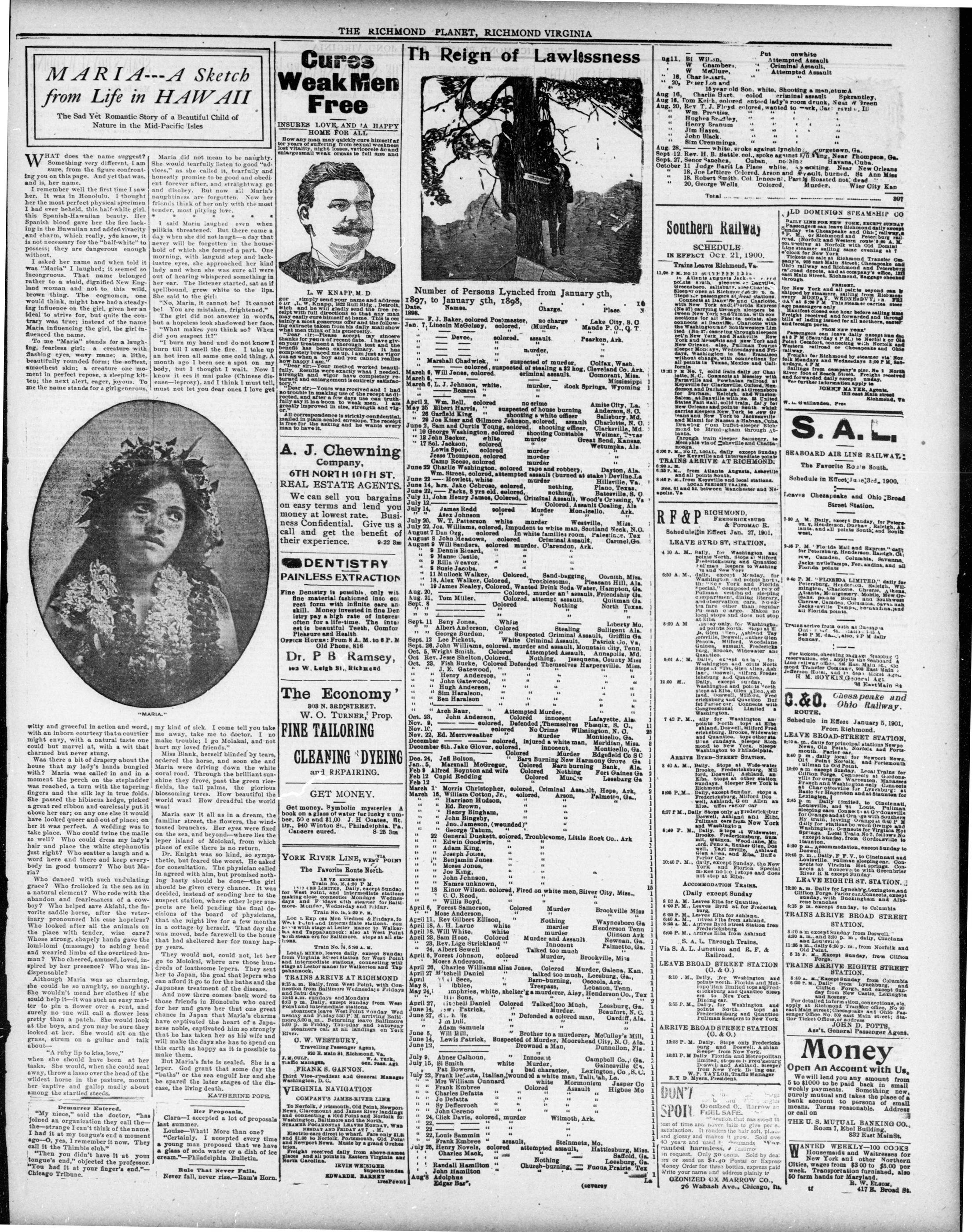
MARIA---A Sketch from Life in HAWAII
The Sad Yet Romantic Story of a Beautiful Child of Nature in the Mid-Pacific Isles
WHAT does the name suggest?
Something very different, I am sure, from the figure confronting you on this page. And yet that was, and is, her name.
I remember well the first time I saw her. It was in Honolulu. I thought her the most perfect physical specimen I had ever beheld, this half-white girl, this Spanish-Hawaiian beauty. Her Spanish blood gave her the fire lacking in the Hawaiian and added vivacity and charm, which really, you know, it is not necessary for the "half-white" to possess; they are dangerous enough without.
I asked her name and when told it was "Maria" I laughed; it seemed so incongruous. That name belonged rather to a staid, dignified New England woman and not to this wild, brown thing. The cognomen, one would think, might have had a steadying influence on the girl, given her an ideal to strive for, but quite the contrary was true; instead of the name Maria influencing the girl, the girl influenced the name.
To me "Maria" stands for a laughing, fearless girl; a creature with flashing wavy mane; a lithe, beautifully rounded form; the softest, smoothest skin; a creature one moment in perfect repose, a sleeping kitten; the next alert, eager, joyous. To me the name stands for a girl generous.
"MARIA."
"MARIA."
witty and graceful in action and word, with an inborn courtesy that a courtier might envy, with a natural taste one could but marvel at, with a wit that charmed but never stung.
Was there a bit of drapery about the house that my lady's hands bungled with? Maria was called in and in a moment the perch on the stepladder was reached, a turn with the tapering fingers and the silk lay in true folds. She passed the hibiscus hedge, picked a great red ribbon and carelessly put it above her ear; on any one else it would have looked queer and out of place; on her it was perfect. A wedding was to take place. Who could twine the maile so well? Who could dress my lady's hair and place the white stephanotis just right? Who scatter a laugh and a word here and there and keep everybody in good humorr? Who but Maria?
Who danced with such undulating grace? Who frolicked in the sea as in a natural element? Who rode with the abandon and fearlessness of a cowboy? Who helped save Akiahi, the favorite saddle horse, after the veterinary pronounced his case hopeless? Who looked after all the animals on the place with tender, wise care? Whose strong, shapely hands gave the lomi-lomi (massage) to aching head and wearied limbs of the overtired human? Who cheered, amused, loved, inspired by her presence? Who was indispensable?
Although Maria was so charming, she could be so naughty, so naughty. She wouldn't mend her clothes if she could help it—it was such an easy matter to pin a flower over a rent, and surely no one will call a flower less pretty than a patch. She would look at the boys, and you may be sure they looked at her. She would sit on the grass, strum on a guitar and talk about—
"A ruby lip to kiss, love," when she should have been at her tasks. She would, when she could seal away, throw a lasso over the head of the wildest horse in the pasture, mount her captive and gallop madly about among the starled steeds.
Demurrer Entered.
"My niece," said the doctor, "has joined an organization they call the—the strange I can't think of the name. I had it at my tongue's end a moment ago—O, yes, I remember it now. They call it the Thimble club."
"Then you didn't have it at your tongue's end," objected the professor. "You had it at your finger's end."—Chicago Tribune.
Maria did not mean to be naughty. She would tearfully listen to good "advices," as she called it, tearfully and honestly promise to be good and obedient forever after, and straightway go and disobey. But now all Maria's naughtiness are forgotten. Now her friends think of her only with the most tender, most pitying love.
* * * * * * * * *
I said Maria laughed even when pilikia threatened. But there came a day when she did not laugh—a day that never will be forgotten in the household of which she formed a part. One morning, with languig step and lacklustre eyes, she approached her kind lady and when she was sure all were out of hearing whispered something in her ear. The listener started, sat as if spellbound, grew white to the lips. She said to the girl:
"No, Marin, it cannot be! It cannot be! You are mistaken, frightened." The girl did not answer in words, but a hopeless look shadowed her face. "What makes you think so? When did you suspect it?" "I burn my hand and do not know I burn till I smell the fire. I take up an hot iron all same one cold thing. A month ago I see been a spot on my body, but I thought I wait. Now I know it ees it eei mai pake (Chinese disease—leprosy), and I think I must tell, must not let you dear ones I love get
ARIA."
my kind of sick. I come tell you take me away, take me to doctor. I no make trouble; I go Molakai, and not hurt my loved friends."
Miss Blank, herself blinded by tears, ordered the horse, and soon she and Maria were driving down the white coral road. Through the brilliant sunshine they drove, past the green ricefields, the tall palms, the glorious blossoming trees. How beautiful the world was! How dreadful the world was!
Marla saw it all as in a dream, the familiar street, the flowers, the wind-tossed branches. Her eyes were fixed on the sea, and beyond—where lies the leper island of Molokai, from which place of exile there is no return.
Dr. Knight was so kind, so sympathetic, but feared the worst. He asked for consultation. The physician called in agreed with him, but promised nothing hasty should be done—the girl should be given every chance. It was decided, instead of sending her to the suspect station, where other leper suspects are held pending the final decisions of the board of physicians, that she might live for a few months in a cottage by herself. That day she was moved, bade farewell to the house that had sheltered her for many happy years. They would not, could not, let her go to Molokal, where are those hundreds of loathsome lepers. They sent her to Japan, the goal that lepers who can afford it go to for the baths and the Japanese treatment of the disease.
And now there comes back word to those friends in Honolulu who cared for her and gave her that one great chance in Japan that Maria's charms have captivated the heart of a Japanese noble, captivated him so strongly that he has taken her as his wife and will make the days she has to spend on this earth as happy as it is possible to make them.
But Maria's fate is sealed. She is a leper. God grant that some day the "baths" or the sea engulf her and she be spared the later stages of the disease, the living death.
KATHERINE POPE.
Her Proposals.
Clara—I accepted a lot of proposals last summer.
Louise—What! More than one?
"Certainly. I accepted every time a young man proposed that we have a glass of soda water or a dish of ice cream."—Philadelphia Bulletin.
Rule That Never Fails.
Never fall, never rise.—Ram's Horn.
THE RICHMOND PLANET, RICHMOND VIRGINIA
Cures WeakMen Free
INSURES LOVE, AND 'A HAPPY HOME FOR ALL
How any man may quickly cure himself af
ter years of suffering from sexual weakness
lost vitality, night losses, varicocele &c and
enlarges small weak organs to full size and
L. W KNAPP, M. D. gor . simply send your name and address oor L. W. Knapp, 1833 Hull Bldg. Debt mich and he will gladly send the free receipt with full directions so that any man may easily eure himself at home. This is can extracts taken from his offer and the following extracts taken from his small show what man think of his generosity.
"Dear sir; Please accept my sincere thanks for years of recent date. I have grown in treatment a thorough test and the benefit of my treatment completely braced me up. I am just as vigorous as when a boy and you cannot realize how happily I am. Your method worked beautifully. Results were exactly what I needed, strength and vigor have completely returned and enlargement is entirely satisfied." "Dear sir: You're received and I had no trouble in making use of the recept as directed, and after a few days use can truthfully be in a boon to weak men. I am greatly improved in size, strength and vigor."
All correspondence is strictly confidential, mailed in plain sealed envelope. The receipt is free for the asking and he wants every man to have it.
A. J. Chewning Company,
6TH NORTH 10TH ST.
REAL ESTATE AGENTS.
We can sell you bargains on easy terms and lend you money at lowest rate. Business Confidential. Give us a call and get the benefit of their experience. 9-22 8m
DENTISTRY
PAINLESS EXTRACTION
Fine Dentistry is possible, only with fine material fashioned into cone rect form with infinite care and skill. Money invested in fine Dentistry pay a high rate of interest often for a life-time. The interest is beautiful Teeth, Comfor Pleasure and Health.
OFFICE HOURS: From 8 A. M. to 6 P. M. Old Phone, 816
Dr. P B Ramsey,
102 W. Leigh St., Richmond
The Economy
808 N. 3RD STREET.
W. O. TURNER,' Prop.
FINE TAILORING
ar1 REPAIRING.
GET MONEY.
Get money. Symbolic mysteries A book on a glass of water for lucky number. 50 c and $1.00. J. H Coates, St. Dr., 940 Winton St., Philadelphia. Pa. Cancers cured.
8-25 3m
YORK RIVER LINE, WEST POINT
The Favorite Route North.
LE VE RICHMOND
Train No. 16, 4:30 P.M.
(RE LIMITED. Daily, except Sunday for West Point, and the Favorite West stations making close connection Monday, Wednesday and Friday with steaver for Baltimore. Monday, Wednesday and Friday.
Train No. 14, 2:80 P. M.
LO. L Exp. ass Mon Wednes & Fridays, for West Point and intermedia stationes. con West Point and Tappanhankock; also at West Point with steers for Baltimore. stops at all stalls.
Train No. 74. 5:90 A. M.
LOCAL MIXED, leaves daily, except Sundays from Virginia Street Station for West Point stage, leads intermediate stations, connecting with stage at Lease manor for Walkerton and Tappanhack, TRAINS ARRIVE AT RICHMOND @ 9:15 a.m. M. daily, from West Point, with Connection from Baltimore Wednesday; Fridays at 10:00 a.m. Sundays and Mondays
6:03 p.m. Daily, except Sunday from West
Point and intermediate stations.
steamers leave West Point vonday Wednesday and Friday, Saturday 5:50 P. M. arriving Salti more,8:00 P. Returning leave Baltimore 6:00 P. Friday, Saturday and Saturday steamers call at all landings on York River.
C. W. WESTBURY
G. KAN NON.
Third Vice-President and General Manager
Washington, D. C.
VIRGINIA NAVIGATION
COMPANY'S JAMES-RIVER LINE
To Norfolk, Portsmouth, Old Point, Newport
News, Glencore and James River landings
and connecting to Old Point and Newport for
Washington, Baltimore and the North.
STREAMER POCAMONTAS LEAVES MONDAY, WED
Electric-cars direct to wharf. Fare only $1.8
and $1.00 to Norfolk, Portsmouth, Old Point
and Newport News. Music by a grand Orchestra
Freight received daily from above-names
places and all points in Eastern Virginia and
North Carolina.
IRVIN WESIGER
Superior tenden
EDWARDE, BARNEY
iresPent
Put onwhite
ug11. Bi Wilson, Attempted Assault
W Cnambers, Criminal Assault,
W McClure, Attempted Assault
16. Char Isart,
20. Peter Lom and
18 year old Soo, white. Shooting a man, etureA
Aug 16. Charlie Hart, colod criminal assault Epkrantley,
Aug 18. Tom Keith, colored anted lady's room drunk, Near W Green
Aug. 20. Rev T. J. Fleyd colored, wanted to -eck, Gar revile, Ill
Wm. Preties,
Hughes Bradley,
Henry Branum,
Jim Hayes,
John Black,
Sim Cremmings.
Aug. 28. white, stroke against lychnin, forgettown, Ga.
Sept. 12. Rev. H. B. Battle, spoke against King, Near Thompson, Ga.
Sept. 27. Senior Sanches, Cuban, nothing Havana, Cuba.
October 11. Judge Barit La Place, white, shooting. Near New Orleans
18. Joe Leftiere Colored, Arson and Assault, burned. St Ann Miss
18. Robert Smith. Col. Innocent, Parts Roasted not, dead
20. George Wells. Colored, Murder. Wier City Kan
Total
2
Southern Railway
SCHEDULE
IN EFFECT OCT. 21, 1900.
15. Atlanta Augusta Jackson and points south sleeper, Derrillle, Greenboro, salisbury, and Charlottesville. Steps for passengers at local stations. Connects at Danyville and Charlotte, with steps for passengers at local stations. (No 37) carrying through sleeper, a sween New York and Tampa, with cones for floors; 37 points, also connecting with the Washington and Southwestern Limited. (No 37, carrying through sleeper, a sween New York and Memphis and New York and New Orleans, also. Fullman Tourist and Wednesdaydays and Fridays, Washington, without change, with connections for points in Texas, Mexico and California. 12:30 P.M. No. 7, solid rail daily; charlotte, N. C., Connects at Messley with Keysville for Clarksville, Oxford, Henderson and Burkham and at Greenboro keysville for Clarksville, Oxford, Henderson and Burkham and at Winston Salem, at Danyville with connections States Fast Mail, solid rail, day for new Orleans and points South which beans and New York to Jacksville and Miami for Nassau and Habau, Cuba from buffet-sleeper Richmond to Birmingham through Atlanta.
through train sleeper Salisbury,
to Memphis via of *Shaville* and Chattawanna.
6:00 P. M., NO IT, LOCAL, daily except Sunday
for Kevasky and intermediate points
TRAINS ARRIVE AT RICHMOND.
6:00 A. M.
6:25 P. M. from Atlanta Augusta, Asheville
8:46 P. M. from KYville and local stations.
8:46 P. M. from KYville and local stations.
Nos. 61 and 62, between Manchester and Nes-
apolis. Va
RF & P RICHMOND,
FRED BRICK & BURO
Schedule in Effect Jan. 27, 1901.
LEAVE BYRD ST. STATION.
4 10 A. M. Daily, for Washington and
pointis North, Stops at Wilford
Frederickson and Quintasie
ful man leapers to Washing
ton and New York.
6:50 A. M., daily, except Monday, for Washington and points horta, that are in the city, special," composed entry of Pulman vestibed sleeping compartment, dining literary, and observational tra fare other than regular Pu man cargo. Makes no local stops and does not stop at Villa.
8:20 A M. only for Washington, at points North. Stop at A. J. H. Hay, St. Joseph, Osweil, other Gleen, Penola, Milford, Woodslane Guinea, summit, Frederick burg, brooke, Widewater and Quantico.
9:01 A. M. Daily, except uala, for Washington and points North stops, Fenn, Ash, Doswell, illford Fredericksburg and Quantico.
12:00 M. Daily, except Sunday, for Washington and points North stops at Elba Gleen, Alesa Ash, Doswell, Milford, Fredericksburg and Quantico. Buf for Percival Connects with Congressional Limited Washington.
7 42 P. M., ally for Washington and points at Ebbes at Elba, Dowell, Milford, and Ericksburg, Brooke, Widewater and Quantico, tops other sites and sundays, sleeper midmond to New York, sleeper Washington to Philadelphia.
ARRIVE BEND-STREET STATION.
8 40 A. M., Dally, stops at Wide-water Brooke, Fredericksburg, Milford, Dowell, Ashland, an Elba, Sleeper New York to Richmond.
8 106 P. M., Dally stops Sunday, stops at Fredericksburg, Milford Dos well, Ashland, G en Allen an Elsa, ufers ristor car.
6 337 P. M., Daily stops only at Fredericksburg and Elsa, Pullman cars from New York and Washington
8:40 P. M., Daily. Stops & Widewater,
Brooke. Fredericksburg, Sum-
mit, Guinea. Wood, Lane, Mi-
ord. Penna, Butler Glen, Dos-
well. The Reville, Ashlauw
Glen Allen, and Eba, Buffe
Parker Car.
10:40 P. M., daily, except Sunday, the New York and Florida Special makes no o.c. stops and does not stop at Elba.
8 003 M. L. Leaves Elba for Quantite.
900 P. P. Blyrd for Byrd s.t for Frederiek
burg.
Via S. A. L. Junction and R. F. & Railroad.
LEAVE BROAD STREET STATION
(O. & O.)
6:10 M. Dally, for Washington and points north, Florida and Metropolitan toops at Fredericksburg and Quantico Sleepers to New York
Riding car.
5:55 P. Dally, for Washington and points North, toops at Fredericksburg and Quantico Pulman Sleepers to New York
ARRIVE BROAD STREET STATION
(O. & O.)
12:08 P. M. Dally. Stops only Fredericksburg and Dowell, Ashler Sleepers from New York.
10:81 P. M. Dally Florida and Metropolitan limited, steps on freekburg Dowell and Ashler. Sleepers from New York. Diving car.
W. F. TAYLOR Traffic Manager
E. T. D. Myers, President.
DON'T
SPOD
SPORT
Ozonized O... Marrow an
FEEL SAFE.
oration that has succeed
test of time and never fails to give per
satisfaction. It renders the hair soft, pli
and glossy and makes it grow. Sold over
40 years and used by thousands. Wor
ranted harmless, realimor
on request. Only 50 cents. Sold by de-
urs or send us $1.40 Postal or Express
Money Order for three bottles, express paid
Write your name and address plainly to
OZONIZED GX MARROW CO.,
76 Wabash Ave. Chicago, Dr.
LD DOMINION SEAMSHIP 600
Daily line for NEW YORK, EXCEPT SUNDAY
Passenger line for daily daily daily daily
sunday via Cheesapeake and Ohio.
P. M., or Richmond and Peterburg railway
and Western route 9:36 A. M.
coastal line via Richmond and Ohio.
Domini
Line steamer sailing same evening at 7
o'clock for New York
Company's, 900 east Main Street; Chase
Ohio railway and Richmond and Petersburg
deposits, and at company's office, 101
east Main Street. Richmond, Baggage checks
through
FREIGHT.
for New York and all points beyond can be travelers. sailings from Richmond even on MONDAY. WEDNESDAY; y. z. FRI OAVAT 8:00 P M This steam carriage carries age passengers only. Manifest closed one hour before sailing time and forwarded and through bills of lading issued for all northern, eastern and foregone ports. FROM NEW YORK*
Passengers can leave daily except Sundays 18 P M (S PAM or K or G Ole Point Comfort, connecting with work and Western railroad or Cheapeake and Ohio railway.
Passengers for Richmond by steamer via 'Norfolk fokies for Richmond and wednesdays 3:00 P M, Saturday, 4 P M
rings from company's star. No 3 North
river is located in Oceanside, co-
vived and forwarded daily excepts 10am.
S. A. L.
SEABOARD AIR LINE RAILWAY.
The Favorite Route South.
Schedule in Effect June 3rd, 1900.
Leaves Chezapeake and Ohio Broad
Street Station.
7:30 A. M. Daily, except Sunday, for Petersburg, Henderson, Durhaw, Raleigh, Atlanta, and all points South, and Southwest.
2-35 P. M. "Florida Mall and Express," daily for Petersburg, Henderson, Raleigh, GA; raw, Camden, Columbia, Savannah, Jacks nville Tampa, Fer, and兰, and all Florida points.
0-40 P. M. "FLORDA LIMITED," daily for Petersburg, Henderson, Raleigh, Willington, Charlotte, Chester, Athena, Montgomery, Mobile, New Orleans, points, Montgomery, Southwest Cheraw, Camden, Columbia, Savannah Jacks nville Tampa, Bernandina, and all Florida points.
Trains arrive from outh at Chesapeake Outlet 41, mississippi 41, A. B. P. M., dall, also, 4 P. M. daily Sunday.
For tickets, checking bagage Shipping O
Reservation, etc., apply to the Seaboard A
mount Transfer Company, so Main St., to
mond Transfer Company, so Main St.,
Jefferson Hotel, and to last bagage
H. M. BOYKIN, General Ag.
98 East Main St.
Schedule in Effect January 5, 1901,
From Richmond.
LEAVE BROAD-STREET STATION,
9:30 a.m. m. d. mats for principal stations Newpo
News, Old Point, Norfolk and Portsmouth.
2:40 Parlor car. Newport News,
Old Point Norfolk and Portsmouth.
ullman to Old Point.
10600 a in except Sunday. Local Trains for
Gordonville Forge. Connecets at Gordonville
or orange Warrenton. Massessee
Branch for Gordonville only. Connects
at Charcotville for Lynchburg; at
Basic for Hagerston and at Staunton for
Lexington.
2:45 p.m. Daily limited, to Cincinnati, Palmman
sleeping cars Connects at G-7000 for Orange and at Orange with Southers
2:40 p.m. 6:40 P.M. Daily for stations be wee on Washington. Connects for Virginia Hot Springs No. 7, follows No. 6 except Sunday, to Gordonville to tainton.
5:20 p.m. accommodation, except Sunday to Doswell.
10:40 p. m., Dally, F. F. V., to Cineinast and
keepcar. Connects to Virginia. Connects
connects at Konecve te with Greenbrise
River R I E except sunday.
LEAVE EIGHT H ST. STATION. J
10:30 p. m., Dally for Lynch's, Lexington and
Clifton Forge, Parlor or Oak, except
Buckingham and Albene
branches
STATION.
8:10 a m except Sunday from Doswell.
4:30 a m, and 3:00 p. m, daily, Cianclias
11:35 a m, daily 6:50 p. m, from Norfolk and
Old Point.
8 15 P. Except Sunday, from Clifton
Forges.
TRAINS ARRIVE EIGHTH STREET
STATION.
8:40 a. m. Except Sunday from Columbia
8:20 p. Daily from Lynchburg, and
Clifton Forges, and except Sunday
from New Castle, Lexington
and Romney.
For detailed information, connections, etc.
apply at Richmond Transfer office, No 90
est Main Street, Chesapeake and Ohio Pass-
enger Office No. 900 east Main street; Sta-
tior Ticket Office, or address
JOHN D. POTTS,
Aa's t. General Passenger Agent.
Money
Open An Account with Us.
We will lend you any amount from
5 to $1000 to be paid back in small
weekly payments. Something new,
purely mutual and takes the place of a
bank account to persons of small
means. Terms reasonable. Address
or call on
THE U. S. MUTUAL BANKING CO.
Room 7, Ebel Building.
832 East MainSt.
WANTED WEEKLY-100 COOKS
Housemaids and Waitresses for
New York and other Northern
Cities, wages from $3.00 to $5.00 per
week. Transportation furnished, also
50 farm hands for Maryland.
R. W. ELSON.
tf
417 E. Broad St.
LE PLANET
Published every Saturday by John Mitch
ell, Jr., at 311 North 4th Street.
JOHN MITOHELL JR. EDITOR
All communications intended for publicis
by us as to reach us by
Wednesday.
TERMS IN ADVANCE
Jane Copy, one year. 51
Jane Copy, two months. 52
Jane Copy, six months. 53
Jane Copy, four months. 54
Jane Copy, three months. 55
Angie Copy. 46
ADVERTISING RATES
for one inch, one insertion . . . 3
or one inch, each subsequent insertion . . . 4
or two inches, six months . . . 4.5
or two inches, six months . . . 10.9
or two inches, nine months . . . 14
or two inches, ten months . . . 20.9
larrange ar 2 funeral in two months . . . 5
landing x d. transient perils in line . . .
POSTAGE STAMPS OF A I NOMINATION
HIGHER THAN TWO CENTS OT RECEIVE
IN SUBSCRIPTIONS . . . .
THE PAY is issued weekly. The subscrip-
tion price is $1.50 a year, in advance.
There are YOUR ways by which money can be obtained. Your risk-in— Post Office Money Order; by Banking— for an Express Money Order; and when none of these can be procured, in a Registered Letter.
MONEY ORDERS.— You can buy a Money Order at any office of the American Express Company, and we will be responsible for the arrival. Express Money Orders can be procured at any office of the American Express Company, and Co.'s Express Company. We will be liable for money sent by any of these companies for forwarding money.
REGISTERED LETTERS.— Money Order Post Office or an Express Office is required to each your postmaster will register the letter we wish to send us on payment of ten cents or money mounted above or stolen, it or be bound. You can send money in this manner or risk.
We cannot be responsible for money sent to another person than one of the four ways mentioned above.
In any other way, you must do it if you own risk.
We can take action. If you do not want the money taken for another person, you must do it on social card, that run out, you then notify the social card to discontinue it. The course of action is shortened to newspapers or order their payment of time for which it has been paid, or enable the payment of the subscription to be made when they order the paper to be issued.
COMMUNICATION — When writing
receive your subscription or to discuss
your interest, you should give your name
address, all, otherwise we cannot find
on our books.
CHANGE OF ADDRESS — in order to use
address of a subscriber we must be
well as the present address.
Presented in the Post-Office at Richmond.
second class matter.
SATURDAY, FEB. 16, 1901
Bur land, colored men, and build
houses.
Be respectful, honest, and do not
hesitate to do a white man a favor.
With all of the discriminating legi-
cation, we are progressing. The Negro
haters are active, but the liberal
minded white people in Virginia are
on the increase.
COLORD men, give the friendly white people all the praise you can and give the unfriendly ones all the devil you can handle. Draw the line sharply, colored folks, draw the line sharply.
---
We can make friends by correct action and upright living. We have some of the best white friends in the world, right here in, Virginia and they are generally of the ex-slaveholding class,
"Here's a bit of consistency," said a gentleman. "the citizens of Richmond Va., have secured Booker T. Washington to lecture at the opera-house in that city this week and makes the following announcement. 'After strentuous efforts for the last four months we have at last succeeded in gaining Professor Booker T. Washington's sonnet to appear in Richmond on Monday night, February 11, to lecture on the "Past Present and Future of the Negro in This Country," at the Mozart. On this occasion the manager has consented to to let the colored people oceeny the balcony."
"A colored man is the attraction to draw the crowd, the legislature, city council and the governor are to be present, but colored people will not be permitted to sit closer than the baleony. Heterofore they have been confined to the gallery."——Columbus, O. Dispatch.
It did seem inconsistent, but the colored people were permitted finally to occupy seats upon the stage with plush chairs as an extra inducement, and the incident is closed.
A TRAVESTY UPON JUSTICE.
The conviction of WILLIAM H. WILLIAM charged with attempted criminal assault upon Mrs. W. T. WATKINS January 22, 1901, was one of the most outrageous exhibitions of race prejudice ever seen in this state.
The trial commenced Feb. 7, 1901, and ended the day following. It is admitted by white Virginians that the prosecution utterly failed to make out a case. The testimony of Mrs. WATKINS exonerated WILSON from the charge of attempted criminal assault. Counsel for the accused had to be guarded by soldiers in order to protect him from the fury of the mob.
So bitter was the sentiment that although the exseptions taken would have guaranteed the setting aside of the verdict, yet eighteen years had to be accepted and the appeal withdrawn in order to save the life of WILSON.
Whither are we drifting? What respect have we for our own laws?
This is Judge Goodwyn's second ex-
perience in a case of this sort. Once before he witnessed the doubled jneying of prisoners of his court. He seemed to have been doubtful of the ability of the sheriff to protect the prisoner and armed soldiers were there from the beginning of the trial to its end.
While WILLIAM H. WILSON, an honest, industrious colored citizen was being railroaded to the penitentiary from Nottoway county, JAMES WHITE, said to be a dishonest, IZZY, colored man was railroaded to the penitentiary from Richmond City.
Both were charged with similar offenses and neither were guilty. Any man who would attempt to rape two white females at once and at the same time near First and Broad streets where hundreds of people are passing is a candidate for the unstable asylum and not for the penitentiary.
And yet a great talk was indulged in and a charge of attempted rape entered against him and he is placed in the penitentiary with a large proportion of the white community believing that he is really guilty of the crime.
WILLIAM H. WILSON, the respectable colored man gets the same sentence as did JAMES WHITE the tough. Now, at the same time, J. H. RAMEY, a white man criminally assaulted a colored girl named BULLOCK. The evidence was direct and the case was certified to the grand jury, which on last Monday promptly dismissed the case.
We hear no protests from any quarter, the white journals are silent, and studious efforts are being made to enlargen the penitentiary in order that more citizens of color may be conveyed therein to render service to the state and demonstrate to the world that when prejudices is rampant, there is no justice for the Negro.
A WEEK'S NEWS CONDENSED
Thursday, Fcb. J.
Women followers of Dowie, the faith cure healer, wrecked five Chicago drug stores.
A train wreck on the Erie road at Greenville, Pa., resulted in five deaths and injuries to a score.
The British government, in view of recent Boer activity, will send 30,000 more troops to South Africa.
Lorenzo Priorl, electrocuted at Sing Sing prison yesterday for the murder of Vincenzo Garaguso, died protesting his innocence.
Dr. Homer C. Stuntz, of Mount Vernon, Ia., has been appointed presiding elder of the Methodist Episcopal church in the Philippine islands.
Friday, Feb. 8.
The senatorial deadlock in Delaware continues, with no signs of an agreement.
Senator Hanna has been elected a member of a Grand Army post in Cleveland.
Charles Yost fought with Fred Hoffan in the latter's New York grocery store, and Yost was stabbed to the heart.
George and Helen Gould were appointed receivers of all income of the Countess de Castellane in excess of $200,000 annually.
Robert W. Steele, first territorial governor of Colorado, died yesterday at his home in Colorado Springs. Mrs. Steele died Tuesday. Both grip victims.
Saturday, Feb. 9.
The wage conference of miners and operators at Columbus, O., agreed to continue last year's scale.
David Hunter McAlpin, the millionaire tobacco manufacturer, died at his residence in New York yesterday, aged 85.
A heavy snowfall following in the wake of last week's blizzard delayed trains on all railroads entering Chicago last night.
Mrs. Nation, the Kansas saloon wrecker, lectured the members of the legislature, charging them with neglect of duty.
It is rumored that Crown Prince Frederick William, of Prussia, will marry Princess Ena, of Battenberg, daughter of Princess Beatrice.
Monday, Feb. 11.
Samuel Dodd, for 12 years chief of police of Camden, N. J., died yesterday of pneumonia, aged 60.
Thirteen-year-old Fanny Levant has been arrested at New York, charged with circulating counterfeit pennies.
N. K. Fairibanks, once known as the "Lard King," has retired from the Board of Trade at Chicago, selling his membership for $2,000.
The American Tin Plate company has secured control of the Empire State Can company, of Geneva, N. Y., and the price is aid to be $125,000.
At Manilla, Ia., robbers got away with an express safe containing $40.00.
Three men are under arrest, but the money has not been recovered.
The employees of Armour & Cb., of Chicago, Ill., are to present to the Armour institute a $10,000 memorial window for P. D. Armour, Jr., who died in 1899.
To Be a Philippine Judge
St. Johnsbury, Vt., Feb. 13—Former Lieutenant Governor Henry C. Bates, of this city, yesterday was offered the position of judge in the Philippine island, and he will accept the appointment. The salary will be $6,500 per year.
The Telephone in France
One of the most frequent uses to which the telephone is put by French country subscribers is that of an alarm to wake them in the morning. Those who wish to be aroused at a given hour have only to advise the telephone administration the night before of the hour at which they wish to be rung up. - Little Chronicle.
They All Do It.
Finicky—Now, when I drink at a public fountain I always put my lips at the edge of the cup, near the handle, to avoid contamination.
Cynick—Yes, I've noticed everybody does that—Ohio State Farmer.
She Needs Sympathy
The poor woman whose husband thinks he knows how to cook is entitled to a lot of sympathy.—Chicago Daily News.
A Common Observation.
What a failure most of us make of life.—Achilson Globe.
THE RICHMOND PLANET RICHMOND, VIRGINIA
GREAT EMANCIPATOR
Tribute of Postmaster General Smith to Abraham Lincoln.
WILLIAM J. BRYAN AT COLUMBUS.
The Democratic Orator Devotes His Address to a Review of the Life of Jefferson—Senator Hanna on "The Business Man in Politics."
East Orange, N. J., Feb. 13.—The third annual Lincoln's day dinner of the Republican club of East Orange was given last night. Postmaster General Charles Emory Smith spoke on "Abraham Lincoln" and Congressman Charles L. Landis, of Indiana, responded to the toast The Republic of Today." "Log in Days" was the toast to which Franklin Murray, sponded, and Congressman Richard Wayne Parker responded to "New Jersey Republicans."
Postmaster General Smith said that for one hundred years it had been customary to look back upon the days of the revolution as the heroic age of this country, but in the coming centuries, when the events of 40 years ago could be looked upon in their proper light, the days of the mighty struggle to preserve the Union and freedom would back to as the true type of American life and sacrifice. In those days Abraham Lincoln would be set up as the greatest American, a pure type standing beside Washington after an ideal.
Lincoln was a leader born for a great crisis. The overruling hand of God, and not the wisdom of man, had placed Abraham Lincoln at the head of the nation at the hour when he was needed. The speaker said that the place of Lincoln among the elect was fixed and he would be recognized as the best loved of Americans. He was an American of Americans. He was the man who came close to the great throbbing life of the people. He was an ideal man; God sent him to a nation and their people in their hour of power. The Titanic struggle of the civil war ushered in an era of great national prosperity at home, and the more recent Spanish war had rushed in an epoch of expansion of territory and trade. The most recent war had demonstrated that the great American republic was not destined to isolation, but must play its part in the history of the world.
Abraham Lincoln was the savior of the nation and the prophet of its great home developments, and President McCain was the champion of protection, was destined to our great nation to industrial supremacy among the nations of the earth.
WILLIAM J. BRYAN AT COLUMBUS.
Devotes His Address to a Review of the Life of Jefferson.
Columbus, O., Feb. 13.—The 92d anniversary of the birth of Abraham Lincoln was celebrated here last night by the Jefferson, Jackson and Linein League with a dollar dinner at the Columbus Auditorium. There were fully 1,500 people seated at tables which occupied the floor of the immense hall and 1,000 more seated in the galleries. The feature of the evening was the demonstration in honor of William J. Bryan, who spoke in part as follows:
"Never has this nation been more in need than it is today of an earnest and thorough revival of Jeffersonian principles. While other statesmen, appearing at different crises and meeting the responsibilities of their respective times, have made partial application of Democratic principles, Jefferson is the only one who formulated a Democratic code applicable to all times, all situations and all people.
"He was called a demagogue by his enemies, and yet he exhibited a moral courage which none of his destructors has ever possessed.
"He condemned slavery when the system was popular in his state and in the nation, and he did it three-quarters of a century ago before emancipation crowned Lincoln with martyrdom and insurrection.
"At this time, when corporate monopoly is fast extinguishing industrial independence, we need a revival of the Jeffersonian spirit which demands a government administered according to the doctrine of equal rights to all and special privileges to none."
SENATOR HANNA ON "BUSINESS."
"No Fear When the Issue Is Between Republicanism and Socialism."
New York, Feb. 13.—On the 92d anniversary of the birth of Abraham Lincoln and in honor of his memory the Republican club of the city of New York gave a banquet last night at the Waldorf-Astoria. Gen. Henry E. Tremain, the president of the club presided. Senators Depew, Thurston and Hanna were given an ovation on entering the banquet hall. Senator Hanna responded to the toast, "The Business Man in Politics." He said in part: "Politics is business, and very serious business at that. As for me, in the discharge of the duties to which late I have been called, I have noted with pride and pleasure the ready response of the business man to any appeal to him on behalf of the needs of his country.
"We had a great example of that at the close of the last campaign, when those thousands of business men of the metropolis stood for principle. I am here to thank you for what you did then. Upon you must largely depend whether the great principles for which Lincoln stood and for which we stand shall perpetuate the foundation of our government and its policy.
"The influence of the business man in politics is more far reaching than one would at first imagine. We don't wish to arrange class against class. The great mass of workingmen who are employees of capital and, therefore, the form of capital, wield a great influence either for good or evil as they are made to seize things. It is the duty of the business man of America to show that great class—the most powerful because of its numbers—that we do not discriminate between classes, but that we have their welfare at heart. Then we have no fear, when it comes to an issue between republicanism and socialism."
DEATH OF EX-KING MILAN.
The Former Monarch of Servia a Victim of Pneumonia.
Vienna, Feb. 12.—Ex-King Milan, of Servia, died of pneumonia yesterday. On Sunday evening he received Adjutant Popovias, who had been sent by King Alexander. The interview excited him somewhat, but he recognized and talked with the adjutant. From that time his strength failed rapidly and the difficulty of breathing rendered further conversation impossible.
At noon yesterday he again received the adjutant. He was then in full possession of his faculties and seemed to have no idea that his life was in danger. Consciousness was retained until within a quarter of an hour of his death, which came quietly in the pres-
THE LATE EX-KING MILAN.
ence of his uncle, Coh. Constantinovics,
and his friend Count Zichy.
A Belgrade, Servia, dispatch says:
"King Alexander, who was at Nish
when he received the news of the death
of his father, immediately summoned
the members of the cabinet to meet at
nak, where he communicated the infor-
mation, officially. The king and
remain left Nish, evening for
Belgrade, not going to Vienna.
the queen will be brought here."
THIRTY-FOUR PROBABLY LOST
Vessel Wrecked on New-Foundland's
Coast Doubles the Lucerne.
S. Johns, N. F., Feb. 13. It is now feared that the steamer reported wrecked near Bacalleu, on the southeast coast of New Fountain, is the British steamer Lucerne, Capt. Reid, sailed from Ardrossan Jan. 24 St. Johns, N. F., coal laden. Besides her crew of 25 men the Lucerne had on board seven members of the crew of the British brig Emulator, of St. Johns, recently landed in midocean, and two passengers. A competent man has been sent to view the wreckage near Perilican. He can decide whether it belongs to the Lucerne. If it does it must be that she was a total loss and that all on board were drowned. If the wreckage is not from the Lucerne the vessel was probably a tramp bound for some American port. There is no hope that any one was saved.
The Comparative Cost of Soldiers
The Comparative Cost of Soldiers.
Washington, Feb. 13.—The house yesterday passed the army appropriation bill and entered upon consideration of the sundry civil bill, the last but one of the big money bills. The debate on the army bill was confined to a discussion of the question of passing bills to remove the charge of desertion against soldiers and was made notable by the statement of Mr. McClellan (N. Y.) comparing the cost of the soldier in European armies with the cost in the United States. According to his figures, including the cost of pensions, etc., each United States soldier involved an expense of $2,828, while a German soldier costs $227 and a French soldier $232.
Queen Wilhelmina a Bride.
The Hague, Feb. 8.—Queen Wilhelmina's marriage to Duke Henry of Mecklenburg-Schwerin, who yesterday became Prince Heinrich of the Netherlands, by royal decree, was a huge family affair. All Holland that could, came to The Hague to participate. Those who stayed at their homes in other cities and villages of the king's kingdom, treated with parades, decorations and banquets. Never was seen a more beautiful and happy wedding. The popular belief is that it is a match, like that of Victoria and Albert, and this gives a romantic coloring to the event which is generally lacking in royal marriages.
All Topeka Joints Closed
Topeka, Kan., Feb. 12.—As a result of the meeting of the citizens of Topeka all the joints of the city are closed. The citizens made the peremptory order that the sales be discontinued by noon yesterday, and so far as known the order was regarded. Topeka is practically a dry town, so far as the joints are concerned. Some of the drug stores are said to be doing a thriving business, but the condition is much different from a week, or even three days ago, when there were about 80 joints running openly.
Pingree Not Out of Politic
New York, Feb. 13.—Hazen S. Pingree, former governor of Michigan, his son, Hazen S. Pingree, Jr., and Col. S. Sutton were passengers on the White Star liner Cymric, which sailed yesterday for Europe. Before sailing Mr. Pingree said that he would again be a candidate for governor of Michigan if the legislative reforms he advocated were not passed in that state.
Disconsolate Mother Kills Herself
Discocheat Mother Killa Herself.
Hoboken, N. J., Feb. 13—Mrs. Alvina Miller, of West Hoboken, who lived on the top floor of a three-story apartment house, jumped from her rooms early yesterday morning and killed herself. She was a widow and supported five children by washing. Recently her health commenced to fail and she suffered from melancholia.
Danes Favor Selling the Isles
London, Feb. 13.—"With only one dissenting voice," the Copenhagen correspondent of The Daily Mail, "the financial committee of the landstaking has approved the sale of the Danish West Indies to the United States."
GENERAL MARKETS.
Philadelphia, Feb. 12.—Flour pennsylvania; winter super fine $2.25@2.50. Qt.宁波; milla, extra $2.92@2.80. Rye flour quiet at $2.92@2.90. Rye flour quiet at $2.92@2.90. per barrel for middling uplands. Wheat slow (exchange closed on account $2.92@7.70. Corn dull; No. 2 mixe, spot $2.92@7.70. Corn dull; No. 2 mixe, spot $2.92@44c; No. 2 yellow, for local trade, $2.92; Oats dull; No. 2 white, clipped, $2.92; Oats dull; No. 2 white, clipped, $2.92; choice timothy, $17.50 for large bales. Beef steady; beef hams, $19.15 for large bales. Firm; family, $16.25@16.75; sugar curd, $16.25@16.75; prime city refined, in tiers, $8.42@c; butchers, loose, $7.74@c. Live poultry quotas, large; loose, $9.42@c; heens, $9.42@c; prime city refined, 70 for heens, $10.42@c; for young chickens, $12@3c; for spring ducks, 9c. for turkeys and 10@10c; for turkeys, 70 for turkeys, $10.42@c; choice western fowls, $6.72c; for old roosters, $12@3c; for choice and fancy nearby chickens, $13@14c; for large western gesees, $13@14c; for large goods; medium and low grades dull; $2.25c; fancy Pennsylvania prints jobbing at 24c; do wholesale, $2.25c; Cheese york flour cream, fancy, new, $11c%; part kern, new, $8.25c; Swiss cheese, $11@14c.
East Liberty, Pa. Feb. 12—Cattle market steady; extra, $5.45/60; price, $5.20
steady; extra, $5.45/60; price, $5.20
prime medium, $3.25/60; hogs active
prime medium, $3.25/60; hogs active
$6.5; good light Yorkers, $6.00/65; heavy
hogs, $5.50/65; pigs, $4.00/75; rougs
$4.00/75; sheep steed; choice wethera
$4.00/75; common, $20; choice lambs
$0.00/8.8; common to good, $45/50; veal calves, $7.50/
THE SALOON SMASHER
Mrs. Nation Arouses No Excite ment in Chicago.
SHE WILL DO NO SMASHING THERE
But Announces Her Intention to Scold the Mayor and Chief of Police and to Visit as Many of the Saloons as Possible.
Chicago, Feb. 13.—Mrs. Carrie Nation arrived in Chicago last night, and within 15 minutes after reaching the city she was facing a somewhat diminutive audience gathered under the auspices of local members of the W. C. T. U. in Wallard Hall. On her trip toward Chicago she delivered a number of short addresses from the rear end of the car, speaking at nearly every station where a stop was made. Her coming was marked by no special incident, contrary to the expectation of the ladies who had invited her to visit Chicago.
During the day a committee called upon Chief of Police Kipley and asked him to detail a strong force of detectives to await Mrs. Nation's arrival at the Rock island depot, assuring him that unless she was fully protected she would be in danger from the mob which would be at the depot. The chief laughed and said he guessed there would be no danger to the lady, and finally relented sufficiently to promise the lone officer, who would, he declared, have nothing to do. The event proved that chief was right. Only a very small crowd was at the depot, and it was for the most part composed of members of the new committee. The arrival of Mrs. Nation produced no excitement whatever, and provoked but little curiosity among the people in the depot.
She entered a carriage at once and was driven rapidly to Willard Hall, five squares distant. Here a small crowd had been awaiting her arrival since 14:01, it having been announced that 14:00 would speak at 8 o'clock. An express carriage many that the lecture was to be free, instead of which an admission fee of 50 cents was charged. This balked a good many, and at the time of Mrs. Nation's arrival there were as many in the hallway who had refused to pay admission price, and stood around waiting at the entrance where there were in the hall waiting to hear her.
speak.
After giving a history of how work for the temperance cause in Kansas Mrs. Nation denounced the sale of liquor in Chicago, and asked all those who were in sympathy with her to go out and destroy the saloons, as they were illegal, no matter under what sort of laws they were allowed to exist.
"While in Chicago I will not attempt to smash any saloons," said Mrs. Nation, "but tomorrow, in company with two policecemen, I intend to visit as many of these places as possible, and will invite the saloon keepers to come to Willard Hall tomorrow night and hear what I have to say about the wickedness of selling liquor. I will also visit Mayor Harrison and Chief of Police Kipley and tell them what I think they officials who will allow so many diverse low resorts to run as prevail in Chicago. If you cannot get rid of these crime breeding places by peaceable means, why, I say, Mrs. Nation will leave here late tonight for Topeka to stand trial for joint smashing.
To Dispense With Juvenile Labor
Young to Succeed Shafter
Washington, Feb. 13—Gen. S. M. B. Young, on who Monday was confirmed a major general, has been chosen to succeed Gen. Shafter in command of the department of California, with headquarters at San Francisco, Gen. Young, who has been in the Philippines for more than two years, will sail from Manila in a few days, arriving in San Francisco about the middle of March. He will then relieve Gen. Shafter and the latter will be appointed a major general in the army and immediately retired, in accordance with the terms of the army reorganization bill.
State Direncery Bill Form
Topake Dispensary Bill For Kansas
Topake, Kan., Feb. 13. A state dispensary bill was introduced in the house yesterday. It provides for the establishment of dispensaries in numerous places throughout the state. The bill includes the repeal of the laws whereby probate issue permits to drug stores to sell liquor, and provides that liquor shall be dealt out precisely the purchase price plus the maintenance of the stations and salary of agents. Daylight business hours only, and the usual provisions against selling to minors or habitual drunkards, with adequate bonds to hold the agent, are also included.
Sudden Death of Congressman Shaw.
Washington, Feb. 11.—Representative Albert D. Shaw, of Watertown, N. Y., formerly commander-in-chief of the Grand Army of the Republic, was found dead yesterday morning in his room at the Riggs House. A physician summoned immediately after the discovery of the body pronounced death due from apoplexy, probably about 2 o'clock in the morning. Col. Shaw was 58 years old.
King Edward to Visit Germany.
London, Feb. 13.—King Edward and Queen Alexandra, according to Truth, will leave England during March to visit Dowager Empress Frederick. They also visit the Grand Duke and Grand Empress of Hesse, and they will spend the Emperor of Hesse at Copenhagen. Truth assays at the member of the cabinet, probably Lord James of Hereford, will accompany the king.
SHOT A CHIEF JUSTICE
He Tried to Prevent a Man Hunt in His Own Home.
Montgomery, Ala., Feb. 11—Chief Justice McClellan, of the Alabama supreme court, was shot in the right shoulder at his house yesterday by either Mr. Jesse D. Beale or his son Phelan Beale, of this city. The ball was cut out. The wound is a serious one, and it will take a few days to determine the result. The Messrs. Beale went to the house
of Judge McCilean to seek John McQueen, of Birmingham, the solicitor of Jefferson county, to punish him for what they believed to be bad treatment of the elder Beale's daughter, Miss Caroline. She had not been at all night, and they had been informed about her rising about in a hack with Miss Beale the greater part of the night, after a supper at a leading restaurant. Judge McCilean attempted to prevent the Beales going upstairs and through his house in their hunt for McQueen. This the Beales resented and one of them, believed to be the other, tried to with a pistol. McCilean was driven down the stairs and out on the sidewalk, where he called for the police.
The Beales pursued their hunt through the house, and believing they had located McQueen in a closet, which was locked, fired about a dozen shots into the door. Several passed entirely through the closet. McQueen was in the closet, but was in a narrow place away from the door and was not struck. A police came on the scene quickly and the Beales were arrested. Eater the fact was developed that McQueen and Miss Beale had gone to the residence of Probate Judge Gaston after midnight to get a license to be married. The judge declined to issue a license under the circumstances and spent the rest of the night trying to find a country justice to perform the ceremony. Their marriage had been opposed by the lady's parents for a long time. As soon as all the facts became known the Beales were reconcilied to the marriage of the couple: Accordingly, they were married at the residence of Judge Gaston by Rev. Edward Cobbs yesterday afternoon.
GENERAL SOUTHERN NEWS
King George, Va., Feb. 8.—Cattie a still dying here from some unknown disease. After taking the disease they live only a few hours. Some think the fodder is poisonous from the severe drought last summer, which was followed by long warm rains. Congressman John F. Rixey will send an expert to investigate.
Richmond, Va., Feb. 9.—William Wilson, colored, charged with attempting criminal assault on Mrs. Watkins, near Blackstone, was found guilty in Nottoway court yesterday. A verdict years in the penitentiary was rendered prisoner, in charge of troops, was immediately rushed to Petersburg on a special train to avoid a threatened bynching.
Huntington, W. Va., Feb. 11.—Five of the escaped prisoners from Cabell county jail, including Pearl Neumann, imprisoned as the slayer of Actor McCaulley, and Benjamin Higanbotham, an alleged accomplice in the murder of Allan Deprist, mayor of Culloden, were captured at Indian Fields, Ky., this afternoon by a pledge from the city, headed by Chief of Police Tyree.
Savannah, Ga., Feb. 7.—The Confederate Veterans' Association of Savannah passed resolutions against the invitation to President McKinley to attend the reunion of Confederate veterans in Memphis. The resolutions recite that the association entertain profound respect for President McKinley and his exalted station, but believes "his presence on this occasion, as the guest of the city of Memphis, is sought by a few of the citizens of Memphis to further their political aspirations, and is therefore derogatory to our idea of the proper respect due to the president of this great nation."
Norfolk, Va., Feb. 8.—Orville I. Fleming, prominent farmer and former magistrate of Princess Anne county, was today sentenced to serve ten years in the penitentiary for killing Clarence Snyder, a youth of this city. This was the third trial of the case, which attracted widespread attention at the time of the murder owing to the fact that Fleming killed a member of the mob that went to his house at night to avenge the killing of the boy. At a former trial Fleming was convicted and sentenced to 14 years in the penitentiary. Fleming will be taken to Richmond in a few days.
Newport News, Va., Feb. 7. 7.-The grand jury yesterday indicted Allan A. Moss, mayor; J. H. Hughes and Mark McLaughlin, councilman; Samuel R. Register, of Richmond, attorney for the Newport News Railway and Electric company; Philip Marlow, agent for a paving concern, and B. F. Smith, contractor, for bribery and corruption in connection with the awards of city contracts for street paving, bridge building and the construction of the city jail. The grand jury investigation, it is stated, has revealed wholesale dishonesty in the disbursement of the city funds.
Richmond, Va., Feb. 11.—Mr. Walker, of Westmoreland, introduced in the senate today a bill which was passed unanimously, making some changes in the "Jim Crow" law as applicable to steamboats. The bill recites the fact that the law allows the captain of a ship to assign separate eating, sleeping and eating apartments "as far as the constitution of the vessel will permit, taking into consideration the safety of the passengers." He said the captains of vessels had not regarded the law and his bill was designed to compel them to do so.
Bristol, Va., Feb. 10.—Solomon Roller, 61 years old, a substantial citizen of Sullivan county, Tennessee, committed suicide at his home a few miles south of Bristol on Friday night. Mr. Roller went about his self destruction calmly and peacefully. He came to Bristol on Friday morning, and a daughter before leaving home that he intended suicide. The daughter did not as much as anticipate that her father really meant to commit such an act, and so was not alarmed. While in Bristol Mr. Roller purchased a quantity strychnine, with which he dosed him after reaching home. He had given an after reaching home. He had given a few days beforehand, which was to be made that in which his wife was buried only a few months ago.
Tuesday, Feb. 12
Maurice Thompson, the author, is dying at Crawfordsville, Ind. Cuba's new constitution makes Gen. Gomez, a native of Porto Rico, eligible for the presidency. Reports have been received from Delagona Bay asserting that the natives of the northern Transvaal have risen against the Boers. Henry J. Elliott, the sculptor, long identified with public works of importance, died suddenly in Washington yesterday from pneumonia, aged 53. Mrs. Nation, the Kansas saloon wrecker, announces her intention to organize women to smash all saloons, "first in the United States, then Europe." While a mob was besieging the jail at Crested Butte, Colo., and threatening to lynch George Burio he committed suicide by hanging. Burio was arrested on a charge of having criminally assaulted Kate Mufch, 12 years of age. He declared he was innocent.
SPAIN'S ROYAL WEDDING
May Be Marred by an Uprising of the Discontented:
THE PRECAUTIONARY MEASURES.
Authorities Fear an Outbreak, and the Torchlight Procession Scheduled For Last Night War Cancelled. All Gatherings of People Dispersed. Madrid, Feb. 13. "Whispered rumors say that Madrid is on the verge of a tumult. The government, however, is calmly proceeding to carry out the details for the wedding of the Princess of the Asturias to Prince Charles of Bourbon, but the street corners, the clubs and the hotel corridors teem with disturbing stories. The new shout, "Long live the army," is the most serious sign. Should it take a real hold on the people, and should the fever reach the army itself, the outcome would be threatening. The current talk represents the army as being dissatisfied and as announcing that does not intend to take up arms against the people so long as their opposition is detected against the Jesuits and the Counts of Asturias. Against ing against the former is largely political, but a real and deep scented antagonism exists against the former Carlist leader.
Yesterday afternoon about 300 students, led by e. woman and beating French and Spanish flags, assembled in the Puerto Del Sol and started cries for the army and against the Jesuits and the Count of Caserta. They were quickly dispersed, but continued reassembling in various parts of the city. The afternoon was one of continual maneuvers, though without serious incident, the vigilance of the police. In fact, throughout the day civil guards, mounted on foot, were everywhere visible, dispersing crowds wherever found. These assemblages were largely composed of youths and street idlers, but behind them were agitators and the sentiment of the people.
Last evening 200 mounted civil guards paraded Puerto Del Sol with drawn swords, preventing any collection of people. All the avenues centering on the square are closely guarded. The crowd doubt that the feeling of the population was rooted, needing only a successful leader to courage the people to menacing feuds.
Owing to their attitude the torchlight procession in connection with the royal marriage fetes, scheduled for last evening, was abandoned, the authorities fearing that the slightest opportunity for a clash might lead to serious results. An illumination might cause a hall of stones, which might excite the guards to some act of revenge. The populace are being given a looser rein than in ordinary circumstances, because of the desire of the queen regent to avoid any meeting between the people and the authorities which could lead to bloodshed on the day of the wedding. Hitherto there has been no serious attacks on the part of the crowds to resist the police. On the contrary, the people scattered in the moment the police start in their direct. Some curious sights ensue in such cases. For instance, the shopkeepers and proprietors of restaurants and cafes, the moment the demonstrators appear, pull their iron shutters. By the time the police have arrived the crowd vanishes. Then up go the shutters again, and business is resumed.
The suppression of El Pals, the Republican organ, was due to its virulent attacks upon the Count of Caserta, which had the effect of arousing anti-Caserta sentiment. The course taken by El Imperial in declining to print a description of the court ball on the ground that "it is no time for such festivities when all Spain is so and," has caused a great impression and has increased the feeling against the forthcoming marriage. The Marquis of Santa Marta yesterday entertained at dinner Senor Galdos, author of the anti-clerical play "Electra." A number of the leading Republicans and Liberals were present. Considerable political importance is attributed to the affair, as it is believed to point to an attempt to bring about a coalition of Republicans, Liberals and monarchists against reaction.
THE CARNEGIE-MORGAN DEAL
Reported Plan to Dominate the Lakes' Ore Carrying Trade.
Pittsburg, Feb. 13.—The negotiations for the purchase of Andrew Carnegie's stock in the Carnegie Steel company by J. Pierpoint Morgan continues to be the absorbing topic in iron and steel circles here. Yesterday it was stated by one of the minority stockholders that the deal has much greater significance than has even been reported, but he refused to specify what he meant, explaining that he is bound by a promise not to disclose certain facts that came to his knowledge through company channels.
From another source it was asserted that when the purchase had been made a number of the companies will be consolidated in a manner similar to the present organization of the Carnegie company. A new organization is proposed, to be the omnibus company that will own a majority of the stock of the constituent companies and will dictate its policy.
A report reached Pittsburgh that the deal contemplates the consolidation of the Pittsburgh Steamship company, the Carnegie concern, the great Rockefeller ore fleet and the fleet of the Americas company. The new organization in that case will dominate entirely the ore carrying trade of the great lakes.
Indiana's Remarkable Oil Field
Hartford City, Ind., Feb. 13.—Never in the history of the Indiana oil field has there been such excitement. Already the prices of everything in the little village of Oundee, nine miles northwest of this city, have advanced to a price that startles the prospectors. Monday it was only a speck on the map; today it is apparently the ter of the most wonderful oil field in the United States. It is the opinion of some oil men that it will prove the most valuable in the world's history of oil operations.
Wednesday, Feb. 13.
Rolla Wells was nominated for world's fair mayor of St. Louis by the Democratic convention. At Erie, Pa., last night the boxing contest between Billy Smith and Owen Zeigler was stopped by the sheriff. Both houses of Oregon's legislature adopted resolutions to abrogate the neuro clause in the state constitution. Northern and central New York are feet deep in the worst blizzard of the winter, and in some respects in recent years.
DE PLANET
SATURDAY, FEB. 16, 1901
THE COWBOY'S RIVAL
He Leads a Free Life on the Pampas of South America.
Cattle Growers in the Argentine Republic, Paraguay and Uruguay Threaten Our Supremacy as Beef Purveyors.
There are those who fear that South America is destined to supersede the United States as the great provider of beef for the world. Each year South America increases in importance as rival to the United States as a producer of beef. There are now in the Argentine, Paraguay and Uruguay fully 80,000,000 cattle; in the United States 44,000,000. While the cattle ranges of the United States are becoming more and more restricted each year, there are in the three South American countries named vast regions suitable for cattle raising which have not as yet been utilized. In Texas now the cattle no longer roam over vast ranges, but are practically kept in pasture, the grazing grounds being inclosed in miles upon miles of wire fences. The old-time cowboy, too, has become largely a "fence rider," patrolling the outside of the inclosures to see that the fences are not broken down and that the cattle are not lost, strayed or stolen. Many cowboys are said to have gone to South America, where they have taken up their old free life alongside of the native ganchos on the windswept pampas. In Paraguay a large region called the Chaco has just been opened up to stock raising. It Hes in the northwest corner of Paraguay, between the Paraguay river, a navigable stream, the Pilemoya river, and the Bolivian boundary. The climate is healthful and though it is warm there in summer, it is never as hot as it was in New York last summer.
The prairies are clothed with a variety of good grasses, and the Chaco lands are acknowledged to be the best fattening grounds in all Paraguay. Good land can be bought in Paraguay for $1,000 a league, and one league will support 1,000 cattle, and two herds of 1,000 each can be fattened on it in a year. All the expenses of raising cattle there are ridiculously small compared with the expense in the United States. A man can put steers on the
SOUTH AMERICAN GAUCHO
range in Paraguay, all expenses paid,
at a cost of $8.50 a head, and these he
can sell when fattened for $12.50 a
head. Experienced cattle men in the
Chaco have cleared as much as $8.000
the first year on an expenditure of $10.-
000. They put in $1,000 for land, $8.500
for cattle, and $1,000 for labor and
other expenses. Living and labor in
Paraguay cost about one-eighth as
as much as they do in the United States.
The gauchos are paid $3 a month in
the Chaco. In the United States the
cowboy's wages used to be $30 a month.
The gaucho's food, which is supplied
to him, costs about $3 a month. Cowboys are furnished with food costing $10 a month.
The cattle of northern Paraguay are similar to the Texas cattle, being of fully as good stock and much tamer and more easily managed. Though there are now in northern Paraguay only enough cattle for a small beef industry, their numbers are rapidly increasing, and in three or four years this region bids fair to be the center of a great beef industry.
As yet these South American regions have not the facilities for transportation which the cattle districts in the United States possess, but it is only a question of time when they will have them, and then, asks the Chicago Tribune, can the United States hold its own in the export of beef?
RATHER DIFFICULT FOR HIM.
Jones-I am never at a loss in conversation.
Jones—I am never at a loss in conversation.
His Fair Hostess—But surely, Mr. Jones, there must be some subjects you don't understand. What do you do then?
Jones—Oh, then—I say nothing, and look intelligent.—Punch.
The Gowns and Bargain Sales in New York City
January is the Month of Beautiful Linens and Charming Toilettes
Gowns and Coats That Are Fashionable Just Now
BLACK is still popular for evening gowns, and some beautiful specimens are being shown at the sound of social affairs with which the fashionables are now busy. Of the black materials that are being used in evening gowns lace and net are seemingly the most popular, though black mousseline de sole and liberty satin are often seen.
One of the most charming black evening gowns of the season is of fine
[Image of a woman in a long dress with a halo around her head, standing in front of a circular decorative background. The woman's dress is intricately designed with floral patterns.]
A PAINTED BLAOK NET EVENING GOWN.
net delicately painted with white water lilies and their spreading leaves, with the lilies resting on a background of very fine spangles. I know that this gown has been worn on at least three different occasions this winter, but a different effect has been produced each time by changing the color of the slip over which it is worn. One time it was worn over white, another time over mauve, and a third time over a pale green. To my mind the last was the prettiest.
To go from evening gowns to street coats there is nothing that is enjoying quite so much popularity at the present time as the recent importation from London in the shape of the new "cavallier" coat. They are made in different shapes, yet all have the same general effect. The one shown in the illustration is of the long basque variety. It is of a light tan cloth, trimmed with both sable and a lace applique. Another variety that is popular shows a bolero effect.
Many charming tea gowns are being turned out by the modistes in anticipation of the coming of the Lenten season. One that I saw a day or two ago and admired very much was of ivory cashmere lined with silk, and having a Marle Antoinette fichu of silk muslin. The gown is caught up on the right shoulder by an old double silver buckle, and falls away to show an underdress of pliated silk muslin. The fastening is connected under the drapery on the left side. A double frill of silk muslin, with a narrow satin ribbon, edges the fichu and the dress, as well as the sleeves, which are rather full, and form a narrow cuff at the wrist.
Many Pretty Things in
Linen are Beepd. Sh
JANUARY is the month of linens. All over the country the stores advertise bargain sales and display their choice selections in table linens, handkerchiefs, cushion covers afternoon tea cloths, toilet mats, tray
```markdown
```
ONE OF THE NEW "CALALIER" COATS.
cloths, sideboard covers, dollies and a wealth of other things in linen.
Of these the handkerchief display leads, as a rule, and this year the variety shown in these dainty accessories is greater than has ever been known before. They are, of course, of the finest linen and are shown with duchess lace, French embroidery and valenciennes lace. They are also shown in the finest of Irish lawns, and one of this material has two rows of open work and lace insertion and edged with the finest of real lace.
Very pretty handkerchiefs of fine
Certainly.
"There's a fellow cuts some ice in the world these days."
"Politician?"
"No—iceman."—Ohio State Journal.
Literally.
The man looked up and saw "Exit" on the door.
"Well," he mused, "that lets me out."—Syracuse Herald.
THE RICHMOND PLANET, RICHMOND, VIRGINIA.
linen have hand-embroidered initials in the corner. And, by the way, the fad for initials promises to be a popular one this season. Other varieties show a variety of fine drawn thread work and hemstitching.
Table linens are always a staple commodity, but the styles in them change quite as decidedly as in gowns or coats, and this season offers many new varieties in the way of decoration. Floral designs in orchide, ferns, wild flowers, tulips, roses, and the Grecian scroll designs. The more expensive varieties are edged with duchess, remissance or Battenberg lace. Drawn thread work with hemstitching is also in vogue. The tray cloths, sideboard covers and tea cloths conform closely in design and decoration to the table linens.
Cushion covers are shown in both linen and lawn and made to slip over colored cushions. Some of them are prettily embroidered in shamrock designs, and others in basket pattern, with trails of flowers wandering over the cover.
Empire Sequin-Embroidered
Gaboon and Boucle
SQUIN-EMBROIDERED dresses are a prominent feature of the season's fashion. As a rule, the embroideries are really executed on a foundation of net, but it may be so fine as to be hardly perceptible when worn, the satin appearing to be embroidered upon direct.
A favorite method of making up these beautiful works of the needle is to have a satin dress covered with just one layer of tulle, plain net, or chiffon of the same color as the satin, and on that place the net heavy with its embroideries; a little needful support is thus given to the fragile embroidered fabric, and yet the satin is sufficiently in evidence also.
A charming new notion is to have a lining of a network of gold, or some of the gold tissues that are to be had abundantly, laid over a satin foundation, and then covered with a drapery of tulle or Luxeuil lace. The gold
I
TEA GOWN OF IVORY CASHMERE SATIN, shimmers through the delicate white covering with a charming effect. This notion is particularly effective when a dress is made in the empire design. A slender young married woman can be recommended to have her new evening gown built in this very becoming fashion.
The empire gowns of to-day are, of course, belted under the bust by a broad band of some very handsome trimming, but the waistline is more fully indicated than it was, judging from pictures, in the first Napoleon's days. In fact, a firmly-fitting princess dress of satin up to the bust covered with a lace robe that is only slightly shaped into the figure, then a belt under the bust, and a short bodice above, with little puffed sleeves, gives the best effect; and it is a very graceful style for a suitable figure. The skirt portion of such gown can be trimmed with trailing embroideries, which should be repeated on the small bodice that is just seen to exist above the deep belt that is laid beneath the bust.
Paint-d satin is used as empire evening gown ornamentation, too; and trails of artificial flowers are in keeping.
SARAH DAVIDSON.
Quaking of the Aspen.
Quaking of the Aspen.
It is well known that the vibratory motion of the leaf of the aspen and other poplar trees is caused by a flattening of the petiole at its junction with the lamina. The lower part of the leaf stalk is elongated and rigid, thus forming a basis upon which the flattened portion of the stalk can, in virtue of its elasticity, move to and fro as the wind acts upon the leaves of the tree. There have been several theories offered by botanists, none of them very satisfactory, however, to explain the origin of this curious structure and the purpose served by the "trembling" of the leaf. H. J. Colbourn, in a recent letter to Nature, suggests a new explanation. He thinks the vibration may be an adaptation for rapidly throwing off the excess of condensed moisture, which is liable to form on the foliage of trees in marshy situations.—N. Y. Times.
Hard Work.
"Oh, we had the loveliest arrangement at our church society last week! Every woman contributed to the missionary cause five dollars, which she earned herself by hard work."
"How did you get yours?"
"From my husband."
"I shouldn't call that earning it yourself by hard work."
"You don't know my husband."—Baptist Commonwealth.
MARRIED ANOTHER MAN.
Expected Groom Failed to Come at the Appointed Time, So the Bride Chose a Stranger.
"The quickest wedding and honey-moon trip I ever saw," said an old minister who lives in West Virginia, and who is now visiting Chicago, to a Tribute reporter, "occurred at my house when I was living in North Carolina. The bride had come to my house alone on horseback, and said her best man would be along pretty soon, and that they were to be married. While waiting for the groom the woman gave her name, age and place of residence. She
JUST BEFORE THE WEDDING.
said she, reckoned I would not object to giving a newly-married couple a dinner for a send-off. It was not far from the dinner hour, and I extended the invitation. The groom, however, failed to come, and we sat down to the feast without him. The woman did not appear much concerned over the disappointment.
"Later in the day a man halted his wagon in front of my place and asked the road to a certain town. He was an immigrant, and said he was on his way to the far west. He asked if he could get something to eat, as was common with travelers in those days, and I told him we had the remnants of a feast which had been cooked for a wedding, but as the groom didn't come we had plenty left.
"He asked me if the disappointed woman took it much to heart, and, when I said she didn't act as if she were going into a decline, he replied that she must have a good deal of sand, as he expressed it, and said he would like to see her.
"She consented, and met him while he was eating the remnants of the feast. I had occasion to leave the room for a few minutes, and when I returned they were standing together, hand in hand.
"Rather than disappoint a lady," said the traveler, "I shall take her myself. Go ahead with the necessaries."
"I married them, and in less than an hour they were on their way to the new country. She had her nag hitched to the tail end of his wagon. Ten years after that they came back on a visit to the old Tarheel state, and he told me he reckoned there never was as good a wife as his, and she said she had thanked her stars many times that the other man didn't show up, as she reckoned the man who came along afterward was one of the best of the world."
MIXED THE BABIES.
A Little Comedy of Errors Which Amused a Crowd at the St. Louis Union Station.
Nurse-girl sociability mixed up two babies, threw two mothers into hysterics, made a family mime a train, troubled a policeman and amused a
"ISE GWINE TO CHICAGO."
crowd at the Union station in St. Louis the other night. Mr. and Mrs. G. B. George, of Fort Worth, Tex., and Mrs. J. C. Coleman, of Atlanta, Ga., their babies and colored nurses played the parts in the scene. The Colemans wanted to leave at 8:10 p. m.; the Georges at 9:10. Meantime each couple had decided to dine up town. The nurses were left with the babies in the waiting-room.
"Ise gwine to Chicago," said Georgiaia.
"Ise gwine there, toe," replied Susanna.
Time flew after this. The babies were bunched and forgotten. The c'ock boomed eight and Georgiaiana, in terror lest she should miss the train, grabbed the Texas baby and fled. Anxious Mrs. Coleman was about to bundle the strange baby in the moving train when she discovered it was not her own. Then she shrieked. Mrs. George in making a similar discovery did the same thing. Then the search was started. Two frantic women hunting lost babies were followed by two terrified nurse girls. Finally the mothers met, babies were swapped and both families waited for the midnight train.
Took Too Much
Mrs. Gadd—Did you ever? I heard Deacon De Goode come home last night howling drunk.
Mrs. Gabb—Oh, you're mistaken. The deacon was out with some temperance men, and took too many temperance drinks, that's all.
"But he howled like a dervisher."
"That wasn't drunk; that was colic."—N. Y. Weekly.
BITS ABOUT ROYALTY.
The crown prince of Denmark is something of a journalist and all the court news officially given out is dictated by him.
Emperor Francis Joseph is a believer in the possibilities of the airship. As an earnest of his confidence he has given Kress $1,000 to aid him in his work.
People who have heard Queen Wilhelmina speak say that here is a quite unforgettable voice. It is soft and silvery in tone and yet can, upon occasion, be firm and resolute.
Prince Joachim of Prussia, the youngest son of the German emperor, attained the age of ten recently and was formally received into the army as a lieutenant in the First guards regiment of grenadiers.
The Russian papers deny the Italian rumors that the czar will shortly visit Sicily, and the French report that he is to go to the Riviera. He will not leave Russia before July, when he will start on a four months' foreign tour of England, Scotland, Denmark and Germany. The queen of Spain when at St. Sebastian gave sittings for a bust to the well-known sculptor, Lucien Pallez. The bust, which is larger than life, represents the queen in court dress with the crown upon her head and the royal mantle draped over her shoulders. M Pallez is said to have succeeded in making an admirable likeness. The sulant of Turkey has sent a costly present to Emperor William, consisting of two cavalry sabers and four oriental riding whips. The scabbards of the sabers and the handles of the whips are of pure gold, richly chased, and adorned with brilliants and other precious stones. They are antiques from the Turkish crown treasury.
THE LABOR WORLD.
A strike of domestics in New York city is imminent, according to Mrs. Justin St. Beake, who is planning a domestics' union.
President Perkins, of the Cigar-Makers' International union, reports an increase of 6,000 in general membership during the year. In the New York strike $138,000 was paid to nonunionists who went out.
Extraordinary rules have been laid down by the Burlington Railroad company which will affect all its employees in South Dakota. No man is allowed to use tobacco or liquor in any form during the hours of service, and all must be vaccinated.
Nowhere in the history of organized labor has such a body made the advance in so short a time as the Switchmen's Union of North America. Starting from nearly nothing, a couple of years ago, it now has 133 local bodies and 13,000 members.
LIFE LINES.
Men willingly believe what they wish. —Julius Caesar.
What is honorable is also safest. —Livy.
It's a pity some men can't draw checks as easily as they can draw inferences. —Chicago Daily News.
It is always a good plan to never boast in the presence of a neighbor; his memory may be good. —Atchison Globe.
Many a man who is born to command fails because he tackles a regiment instead of a canal boat. —Puck.
If ignorance is really bliss it's a wonder more people don't die of sheer happiness. —N. Y. Herald.
When you know a thing, to hold that you know it, and when you do not know a thing to allow that you do not know it; this is knowledge. —Confucius.
OUR EXPORTS TO GERMANY.
We exported over $10,000,000 worth of copper to Germany last year.
American carriages, cars and the like taken to Germany last year were worth over $500,000.
Builders' hardware to the value of $1,000,000 was sent to Germany from the United States in 1900.
The sewing machines sent to Germany in 11 months last year represented a value of nearly $1,000,000.
Agricultural implements to the value of nearly $3,000,000 were shipped from the United States in 11 months of last year.
Naval stores and turpentine shipped from American ports to the German empire last year amounted to over $2,500,000 in value.
ALL SORTS.
Payta, in Peru, about five degrees south of the equator, has the reputation of being the dryest spot on the globe.
When the smoke bells are suspended over gas burners to shield the ceiling, it is better to have them come as low as possible, but not closer than 12 or 15 inches to the flame.
An attempt is being made to revive the project for a monument to Edwin M. Stanton, secretary of war in President Lincoln's cabinet, at his native town, Steubenville, O. A monument was suggested at the time of Stanton's death, but failed through lack of sufficient money to carry it out.
A HANDFUL OF CHANGE.
A ton of pure gold is worth $602,
799.21.
Russian gold mines average an annual yield of 86,668 pounds.
The British mint coined $25,370,000 more gold in 1900 than in 1899, and $1,985,000 more silver.
Pennies do not consist of copper alone, there being in them two per cent. of tin and three per cent. of zinc, to 95 of copper. They cost the government about 42 cents a pound exclusive of stamping, and there are 148 in a pound.
Our Coming Rulers
"These boys," said the school trustee, who was called on to speak to the scholars, "may live to be our presidents." And then realizing that it would never do to slight the girls, he turned to the other side of the room and said, with some embarrassment: "And these girls—let me see—these girls may live to be our cooks." —Yonkers Statesman.
A POLITE BURGLAR
Entertained by a Young Lady at the House of Her Friends.
The Visit Was Brief, But Not So Very Unpleasant While It Lasted—Gentleman of the Jimmy Makes Graceful Exit.
Entertaining a burglar unaware is the unusual experience of Miss Mahala Read, a young English student, living at 412 West One Hundred and Fifteenth street, on Cathedral Heights, New York. The brief visit was pleasant to both sides while it lasted, and terminated in a manner fairly satisfactory to both persons, for Miss Read didn't get hurt and the burglar got away. Miss Read recently became a member of the household of Owen Oliver, a newspaper man of Chicago, now representing the Times-Herald of that city as its eastern correspondent. The occupants of the flat, besides Miss Read, are Mr. and Mrs. Oliver, and their little boys, Owen, Jr., and Frederie, six and five years old, respectively. Mrs. Oliver had gone to the theater with a neighbor, and had arranged with the latter's colored maid to come in from time to time during the evening and see that no harm came to the little boys, who had been put to sleep in their different rooms. Miss Read was out, and Mr. Oliver was at his office. Miss Read came home at about nine o'clock and saw the burglar sitting in the parlor in the big easy chair.
She was surprised only because he wore his hat, for there are a number of Columbia students in the building, and they frequently visit the Oliver apartment. She has not yet made the acquaintance of all these callers, so as she passed into her own room she said: "Good evening," to which the burglar politely responded, and she remembers now that his voice was soft and his accent gentle.
"Are you looking out for the babies?" she inquired, and he replied: "Oh, yes, but they're all right. They haven't made a bit of trouble." She laid off her wraps in her room and stepped out again into the parlor.
"What time did Mrs. Oliver go away?" she asked.
"Really, I couldn't tell you," the burglar replied, having risen to his feet in
A man in a suit and hat runs away from a woman in a dress.
THE BURGLAR'S EXIT.
the meantime and turned the gas a shade lower.
"Well," said Miss Read, pleasantly, and with due regard for the proprieties, "I am here now, and so you needn't wait any longer. Thank you, very much for your kindness."
"Oh, don't mention it, please," said the burglar; "I guess I will go, then." In order to gain the door he had to pass close to the young woman, and as he stepped into the full glare of the light in the hall she caught her first full sight of his face. "He was the toughest-looking brute I ever saw in all my life," she told Mr. Oliver afterward. His countenance was such that she screamed at sight of it, and the burglar went down the stairs by leaps and bounds as the owner and tenants of the five-story building dashed out into the hallways after him. He gained the street, two flights below, before he was intercepted, and the last they saw of him he was sprinting up Amsterdam avenue.
Not a thing in the house was touched, and the doors and windows were all in good order, showing that the intruder had used a skeleton key. The Oliver babies slept all through the turmoil. There was a burglary in the house a few days ago, when considerable property was stolen. The story of Miss Read's caller was reported to the police, though she can give no detailed description of the visitor.
His Dinner Took Wings
A Delaware miner lost his dinner in a peculiar way. The articles which were to form the substantials of his noonday meal were steaming merrily in the oven and on the stove. He had a stick of dynamite which was frozen, and to thaw it he laid it carefully on the range. In a few minutes the dinner and the stove were flying in all directions of the compass.
Novel Opium Habit Care
A new cure for the opium habit has been devised by a victim, Frank Shankland, of Des Moines, Ia. He purposely became a receiver of stolen goods, and his conviction has been followed by a sentence to 18 months' imprisonment. His desire is to be put where he cannot get the vile drug, to the use of which he has long been addicted.
Her Face Turned Green.
A lady in Bristol, Conn., desired to change her complexion from that of a natural blonde to the tint of a brunette. A doctor, she alleges, gave her medicines for that purpose. In a few weeks her blond skin became a striking shade of green. Now she is suing the doctor for $10,000 damages.
Carelessly Phrased
"There's nothing half so sweet in life as love's young dream, is there, Henrietta?" said Mr. Meekton, who had been reading poetry.
"What are you talking about?"
"That night in June; that mellow, moonlit night, when I asked you to be mine—of course, that is to say, when I asked me to be yours—er—I mean—"
Then he relapsed into silent embarrassment—Washington Star.
LITERARY FOLKS AND THINGS
Mr. E. C. Stedman, his friends say
hates to be called the banker post.
The parents of Paul Lawrence Dumbar, the negro poe, were both slaves in the antebellum days.
Gilbert Parker has started for Egypt with Mrs. Parker and will probably go to Dongola and Khartum. Literary projects and the study of the Egyptian administration are the motives of the journey.
James Whitcomb Riley says he travels slowly now. "The bones of many a lecturer," he adds, "bestrew the northern prairies because of the thoughtless rush of some professional manager." Thomas Carlyle's old Dumfrieshire farmhouse of Craigpmuttoch, where he wrote "Sartor," is now in possession of his grandnephew, who strongly resembles the historian, and who greatly dislikes the visits of tourists to the place.
George M. Smith, the London publisher, in his literary recollections publishing in Cornhill says that George Eliot had $35,000 for "Romola" and might have had $5,000 if her artistic conscience had allowed her to divide the novel in 16 parts, as Mr. Smith wished.
The copy of Poe's "Tamerlana" published in Boston in 1827 was recently sold at auction in New York for $2,050. The copy once fetched $1,758, was resold after a handsome French binding had been put upon it for $1,400, and now has known an increase in value of $650.
Prof. Moses Coit Tyler, who died recently in Boston, was the author of "History of American Literature During the Colonial Period" and "The Literary History of the American Revolution" both works of great merit. Years ago he was one of the most popular plate form orators of the east.
The poet Swinburne recently said that if early in life he had made it a rule to answer only such letters as come from friends and relatives his contributions to literature would have been augmented by at least three volumes.
IN THE HALLS OF CONGRESS.
In J. R. Burton, the new senator from Kansas, the long lean figure of Senator Ingalls is repeated. There is also said to be a striking similarity in the face and in manner of speaking.
Speaking of the kindly wit which was one of the late Senator Davis's most striking characterisation, Senator Hean uttered this epigram: "No spark from him was ever a cinder in the eye of a friend."
Senator Platt, of New York, dropped his glasses in the senate the other day. He was looking helplessly on the floor for them, when up stepped a page, and like a youthful Hermann extracted them from the senator's beard, in which they had caught in falling.
Congressman Shattus, of Ohio, has a weakness for gaudy vests, although in other respects he dresses quietly. His seat in the house is in the front row of the republican side and he jocularly says that he wears showy vests in order to catch the speaker's are.
Congressman Taylor, who represents President McKinley's old Ohio district in congress, the other day received from the Philippines a magnificent set of chessmen. Each piece is most elaborately and artistically carved, the king and queen pieces being six inches high. The set is of Chinese manufacture and is a present from an officer now on duty in the Philippines.
SPARKS AND FLASHES.
An electric time alarm has been patented which cannot be stopped till the sleeper gets up to stay. The French telegraph department proposes to institute a series of experiments with wireless telegraphy for subterranean communications. Mrs. Ayron, who is well known for her researches in the field of electricity, had the honor recently of dining with the 360 members and guests of the Institution of Electrical Engineers at the Hotel Cecil, in London. Wireless telegraph stations are to be erected at Inishtrabull, in the north of Ireland, and at Kildonan, Arran, Scotland, respectively, for the purpose of reporting and signaling vessels at sea.
A company at Ansonia, Conn., has just received the largest order for copper trolley wire ever placed in this country. The weight is more than 1,000,000 pounds and the destination is British India, where the wire will be used to equip one of the first trolley lines in that colony.
PUBLIC BATHS.
Glasgow has five public baths, the cost of which varies from $82,000 to $165,000.
Chicago has four public bath houses and gives an average of 50,000 free baths a month.
Out of 304 towns in England and Wales, one-third maintain one or more public baths. They are crowded by factory and shop hands.
Baths were early used in Asia and Greece, and introduced by Agrippa into Rome, where many were constructed by Augustus and his successors.
The famous marble group of Lacooons was found in 1506 in the baths of Titus, erected about 80 A.D.
CELESTIAL ECHOES.
The Chinese language has 40,000 simp ple words and only 450 roots.
In China there are 20 times as much coal as in all Europe. Chinese historians trace the beginning of a postal service in their country back to the third century B.C. Foot-binding in China is in obedience to custom merely and not to law. The same may be said about wearing the queue.
She Was an Immune
"I should think your mother would punish you for that," said the neighbor's little girl to the one who had disobeyed.
"She can't," was the confident reply. "I've been sick and I'm not well enough to be spanked yet, and she can't keep me in the house because the doctor says I must have fresh air and exercise. Oh, I'm having a bully time."—Chicago Post.
THE PLANET
Old Hardenhart sat in his pillowed armchair. A gleam from the grate gilt his scanty gray hair. As he gazed at the name, faint, flickering and low. And he fancied his long, lonely life was just so. A burst-out fire Soon to expire. And wondered if he was ready to go.
Then spake a small voice in his dark, troubled breast: "You have still work to do ere you go to your rest.
Though the light of your knowledge you freely have spent. You too rarely the warmth of your bounty have lent;
"Tet all wealth—won with labor of muscle or brain. Should descend on your fellows, like blessings or rain. You ennobles man's being—that of all life is true;
Know, that fagot has done its full duty; have you?"
Then the dreamer awoke, in the dark and the cold. Half resolved to reverse selfish habits of old.
"What I gathered with toll cost me worry to keep. And the title of my fellows—who steal if I sleep. Better give while I live," thus the poor rich man said.
"Else no one will be sorry when I am dead." Chicago Daily Record.
When Beggar Lady Won
A young Baltimorean and his wife celebrated the second anniversary of their marriage by coming over to Washington on Monday morning last to see congress assemble and they remained over a day for the purpose of having a look at the Benning racing. Despite Tuesday's vicious weather, they went out to the track. It was the first time the young man had "seen 'em run" since his marriage, although before that solemn event he had been an often-bitten victim of the "horse bug." Like all men who have sworn off on fooling with the thoroughbreds, however, he had kept a pretty fair "line" on the runners by assiduously reading the results from all of the tracks, so that when he went to the track on Tuesday he thought that he had a fair chance of breaking about even with the layers of oods. His wife had never seen a horse race in her life before, and when the horses clamped around through the mud in the first race she exhibited considerable excitement, despite the cheerless surroundings caused by the weather conditions. Her husband, however, didn't look particularly inspired when the number of the winner was hung up. His face wore a sheepish grin, in fact.
"Why," said his wife, noticing his chagrined look, "didn't the horse that you bet on win?"
"No," he replied. "He was beaten a head on the wire."
"Well, it looked to me as if they both passed by just at the same time," she said, with rather an aggrieved air. "I don't think it ought to make any difference if one of them is just a teeny little bit ahead of the other, do you?"
"Well," he explained, "there's got to be a winner, you know, unless the race's a dead heat, which this wasn't."
"I don't care one bit," she replied. "I think that horse that the old things in the judges' stand say came in second is just as good as the one they say came in first."
"They wouldn't admit that, though, if you were to tell them," said the husband. "Funny I couldn't pick the winner in a field of only four horses, isn't it? Well, I'll run down to the ring and see what the betting is on the next."
She looked as if she had something to say, and she said it before he got away.
"Jack," she said, in a wheedling tone, "let me bet a teeny weeny little bit, too, won't you? It makes it so much more exciting."
"Jack" looked at her with a grin.
"You bet, eh?" he said. "What dye suppose your mother 'ud say to me if she found out that I let you bet? And, say, isn't it enough to have one hoodoo loser in the family? Can't you have just as much fun rooting" for the one I bet on?
"Oh, but it would be so much nicer if I could bet just a teenchy wenchy little bit on one of the pretty things that I picked out myself on the programme," she answered.
"Oh, that's all imagination, and you—"
"Please," she said, still more wheedlingly.
"Oh, well, then, beggar lady, go ahead," he said, stripping off a $5 note from his roll of bills, and then he rushed down the stairs to the betting ring.
Her eyes sparkled as she looked over the names of the horses for the second race on her programme.
"Beggar Lady1" she exclaimed, half aloud, as her eye caught the name of one of the horses to run. "Why, that's just what Jack just this minute called me! Beggar Lady1"
At that instant one of the grand stand messengers passed by, with his list of odds against the horses in his hand. She stopped him.
"Can Beggar Lady run real fast?" she asked him, demurely. "I don't know, ma'am," answered the messenger, smiling. "The filly's never run before in a race. This is her first time out." "Well, if she wins, how much do I
get for this?" she said, showing him the five-dollar bill.
The messenger grinned and glanced at his list of prices.
"Beggar Lady's one o' the outsiderma'am," he said. "She opened at 40 t. I'll give you that. If she wins y'get back $205."
The little woman paled a little.
"Goodness gracious—very well, then," handing him the five-dollar bill. "I will bet you on Beggar Lady, then."
The messenger dotted down the bet and the young woman's initials, immediately after which another grandstand messenger rushed up to him and said something to him in a low tones. The messenger who had registered the betting transaction with the young woman approached her again.
"Well, you just were in time, ma'am," he said to her. "That Beggar Lady filly has been hammered—"
"Hammered!" exclaimed the young woman. "Why, the brutes! Is the poor thing—"
"Oh," hastily explained the messenger, "I mean that they've been knocking her price down in the ring, and now she's only five to one, so that it looks like she may be what's called a 'good thing.'"
"Well, I declare!" ejaculated the young woman, and just as the messenger went away her husband came up wearing an easy smile of confidence.
"There's only one in this," he said to his wife in a cockeure tone, pointing to Zenaide's name on the programme, "and that's the favorite. Zenaide'l win romping all the way. I bet $2 on her—got $50 to $20 against her."
"Can Zenaide run so much faster than all the rest of the horses in the race, then?" she asked him, with big eyes.
"Sure," he replied. "It's a cinch. A list of yaps down in the ring think they've got a good thing in this Beggar Lady, and they are more than eating it up. Played the filly down from 50 to 1 to five to one, and they're still hammering at it. I've seen too many of these good things go wrong in my day, though. No more good things for me. Friend of mine out in the paddock told me that Beggar Lady—she's never faced the stagger before, by the way—stood a rattling show to land in the money, and advised me to string a few along on her, one, two, three, across the board—but not for me! Zenaidea the trick. By the way, what did you do with your money? Play any of 'em?"
"Yes, I bet," she replied. "I felt awfully wicked, but I bet, all the same."
"Which one?" he inquired.
be inquired.
"It'll be more
you after
the race is all over," she replied, stairs
the race is all over," she replied, ally,
the horses paraded in front of
the stand and went to the post. After
a short delay away went the large field,
the favorite, Zenadie, in front. It was
a fair start for all except Beggar Lady,
who was standing flat-footed when the
flag dropped. A laugh went up in the
stand.
"The 'good thing' can't find her feet,
was the cry. "She's all but left."
Beggar Lady was last away, it was
BEGGAR LADY WALKS
true, but she quickly shot after her field, and at the far turn, so great a flight of speed did she exhibit, she was right on even terms with the leaders, and still going like a seasoned campaigner. She led the field of 13 by a head in turning into the stretch.
"By jing!" muttered the young Baltimorean to his wife, "why didn't I have gumption enough to put a few dollars on that Beggar Lady? She's passed the whole bunch and she's just galloping in, that's all—just galloping!"
"Beggar Lady walks!" howled the crowd of long-shot players who had taken a bit of the good thing. "Beggar Lady swims in!"
The littlelady from Baltimore turned her pale face away from the sight of the horses tearing down the stretch and sat down.
"And I had the tip strong!" growled her husband, as Beggar Lady flashed by the wire two lengths to the good. Then he noticed his wife's pale face. "What's the matter?" he asked her, anxiously. "Are you faint?"
"Well," she replied, "a little bit, but it'll pass. I suppose sudden great wealth always affects people this way."
He looked at her searchingly and amazedly.
"You don't mean to tell me that you put those five dollars on Beggar Lady?" he gasped.
"Well, what did you call me a 'beggar lady' for when you gave me the bill?" she asked him, regaining her color. "I've won $200 just because of your habit of calling names!"
"Oh, you can't beat 'em," the Baitimore said to a friend that night. He wasn't referring to horses, but to women.—Washington Star.
Proving His Begget
"Our baby seems to have a natural taste for the plano."
"Indeed!"
"Yes; he's gnawed half the polish off of one leg." — Cleveland Plain Dealer.
Activity Explained.
First Citizen—The members of the board of health seem to be very active in trying to prevent the spread of bubonite plague.
Second Citizen—Y-e-s, I guess they're afraid they might catch it themselves.
—N. Y. Weekly.
THE RICHMOND PLANET RICHMOND VIRGINIA
CURES BALDNESS
Prevents Hair Falling Out, Removes Dandruf Stops Itching and Restores Luxuriant Growth to Shining Scalps, Evebrows and Evelashes A TRIAL PACKAGE FREE.
IF TRADE PACKAGE FREE.
WORLD
MISS DELLA JONES of Calvert, Texas
Those who are losing their hair or have parted with their locks can have it restored by a remedy that is sent free to all. A Cincinnati firm has concluded that the best way to convince people that hair can be grown on any head is to let them try it, and see for themselves. All sorts of theories have been advanced to account for falling hair, but after all, it is the remedy we are after and not the theory. People who need more hair, or are anxious to save what they have, or from sickness, dandruff or other causes have lost their names and at once send their names and address to the Altenheim Medical Dispensary 2818 Amsterdam Building Cincinnati, Ohio, enlisted 2 cents stamp to cover postage and they will forward prepaid by mail, a sufficient free trial package of their remedy to fully prove its remarkable action in quickly removing all trace of dandruff and scalp disease and forcing a new growth of hair.
The remedy is not a new experiment and no one need fear that it is harmful. I cured John Bruner, Postmaster of Milville, Henry Co. Ind., and he strongly urges every one to try it. A Methodist presacher, Victor A. Fairaux of Tracy City, Tenn, was perfectly bald on his forehead for many years, but has now a fine growth. Mrs. C. W. Wittheman 848 Main St., Riverside. Calcutta has the husband's abny head now covered with soft, fine hair and she, too has divine wonderful benefit. Among others who used the remedy is the wife of Gec. Diefenbach, General Agent of the Big Four R. R. of Dayton O., who was entirely cured of baldness. The President of Fairmount College, Sulphur, Ky., Prof. B. F. Turner, was bald for thirty years and now has a splendid growth of hair from having tried this remarkable remedy. Write to-day for a free trial package. It will be mailed 311
SECOND TO NONE Woman's Corner Stone Beneficial Ass'n.
Incorporated, March, 1897
Claims promptly paid as soon as satisfactory notice of sickness or death is placed in home office.
OFFICERS:
Louisa E. Williams, President
Kate Holmes, Vice-President
Bettie Brown, Treasurer
Mildred Cooke Jones, See. & Bus. Man.
BOARD OF DIRECTORS:
Louisa E. Williams, Kate Holmes,
Mattie F. Johnson, Ann M. Johnson.
Bettie Prown, Mildred C. Jones.
DR. HUMPHREY'S MANUAL
NEW EDITION.
The edition of Dr. Humphrey's Manual, 145 pages, on "The Care and Treatment of the Sick," mailed free Humphreys' Company, Cor. William New York.
Pure and Fresh Medicines only will cure you then purchase your Drugs and Medicine from:
Leonard's
Reliable
Prescription
Drug Store
724 North Second Street.
Wm. Tennant.
9 E. Duval St. Richmond, Va
—Dealer in—
FINE GROCERIES, MEATS
VEGETABLES, CIGARS
TOBACCO AND FEED.
WOOD AND COAL;
PRICES LOW.
Goods Strictly First-class and
vered free.
T.
in a plain wrapper so that it may be tried privately at home.
HOW SHE SAVED IT
Miss Della Jones of Calvert, Tex., Relates an Interesting Experience.
Used a Free Trial Package of a Remedy and the Result Was Wonderful.
Nothing can be more unfortunate to a lady than to lose her hair. To see it gradually getting thinner and thinner and the bald spot growing larger and larger day by day is apt to cause melan oboly and be a cause of taking cold and serious sickness.
Miss Delia Jones, prominent in Calvert. Text, colored society was having serious trouble with her hair but fortunately saw the notice of of the celebrated Foso treatment. She sent for a free trial package and says: "It affords me the greatest pleasure to say that everything regarding the treatment is just as represented. I had no faith in it, but since it costs nothing to try I used it and my hair now has been saved and restored to its original growth. Am very much pleased to recommend such a valuable and remarkable treatment.
The remedy also cures itching and dardruff sure signs of approaching baldness and keeps the scalp healthy and vigorous. It also restores gray hair to natural color and produces thick and lustrous eyebrows and eyelashes. By sending your name and address to the Althenheim Medical Dispensary, 2311 Bluthfield Building, Cincinnati, Ohio, enclosing a 2 cent stamp to cover postage, they will mail you prepaid a free trial of their remarkable remedy.
CURLY HAIR MADE STRAIGHT
BY THE
TAKEN FROM LIFE.
BEFORE AND AFTER TREATMENT.
WONDERFUL DISCOVERY
ORIGINAL
OZONIZED OX MARROW
LOOKING FORWARD.
Your purchase you would do well to call at the most reliable furniture house in the city and see the fine line of Refrigerators, Mattings, Oil-Cloths, And in fact everything that is need ed in house furnishings.
Of every description; also the latest designs in ROCKERS and special CHAIRS. Our goods are the best for the price and the price is very low.
C. G. Jurgen's Son
431 EAST BROAD ST.
between 4th and 5th Street
HU
MRS. MARTM, the world renowned and highly celebrated business and test Medium reveals everything. No imposition. Can be counsulted upon all affairs of life, business, love and marriage a speciality. Every mystery revealed, also of absent, deceased and living friends. Removes all troubles and estrangements, challenges any Medium who can exceed her in startling revelations of the past, present and future events of one's life. Remember she will not for any price flatter you; you may rest assured you will gain facts without nonsense. She can be updressed upon all affairs of Life, Love, Cove, Cup, Marraige Friends, ete with description of future companion She is very accurate in describing missing friends, estimates business, law suits journeys, contested wills, divorce and speculation is valuable and reliable She reads your destiny--good or bad; she without nothing.
MRS. MARTH tells your entire life-past, present and future in a DEAD TRANCE, has the power of any two Mediums you ever met. In tests she tells your mother's full name before marriage, the names of all your family their ages and description, the name and business of your present husband the name of your next if you are to have one, the name of the young man who new calls on you, the name of your future husband, and the day, month and year of your marriage, how many children you have or will have; whether your presents sweetheart will be true to you and if he will marry you; if you have a sweetheart she will tell you when you will come and his name, business and date of accession, your future will be told in an honest cleas and plain manner and in a dead chance. Mothers should the success of their husbands and children young ladies should know everything about the. sweethearts or intended husband. Do not keep company, marry or go into business until you know all, do not let silly religious scruples prevent your consulting.
Madame is the only one in the world who can tell you the FULL NADDE of your future husband, with age and date of marriage, and tells whether the one you love is true or false.
There are some persons who believe that there is no truth to be gained from consulting a Medium, but such beliefs are contrary to the truth. It is only from the lack of discrimination that such a conclusion can be reached. It is not every one who placards himself or herself as a medium that can stand a test of what he or she allows.
And a person of an acquiring mind may ask the reason why. It is simply it these advisers do not take the able to study hun an nature. They do not spend their thoughts for a moment with acquiring the art of phaseology and kindred branches that will have a tendency to make the pathway to the road of the business clear and devoid of all obstacles.
It is an undeniable fact that persons will come for advice in full knowledge of what they want to know, and yet as soon as they confront a Medium they try their utmost endeavor to dispel from their minds what they know so as to hear if it will be rehearsed by the Medium. To get the secret out of a petition is the art used by many unprinciped mediums, but to take hold of the head and gain control of the mind thereby is a matter of impossibility to most of them. And yet this can be done and by consulting Mrs. Marth the seeming mystery becomes a realization.
This subject has received no little attention by eminent men and even college professors. So it proves conclusively that although there are inculpable only tongues perhaps the gates of wisdom not been closed to the entire profession.
It takes a great deal of study to be
come an accomplished medium and by
a continuous and untiring effort, the
key to the well of apparently unfathom
able mysteries has been secured by
MRS. MARTH for the benefit of human
ity.
ADVICE BY LETTER, $1.00
HOURS FROM 10 A. M., TO 9 P. W
MRS. M. B. MARITH.
246 W. 31st St., (near 8th Ave.)
New York City.
Enclose stamp for reply.
Please mention the PLANET
N & W Norfolk AND Western
Schedule in Effect
Nov. 19, 1890.
LEAVE RICHMOND, BYRD STREET STATION.
9:00 A.M. Dally-Richmond and Norfolk Ves-
tage. Arrived. Arrived Norfolk
11:25 A.M. M Shore and Peng.
Waverly and Suffolk Second class
tickets not accepted on this train
9:08 A.M. M Shore and Lynchburg.
Lynchburg. Roanoke. Columbus,
Chicago. Pulman Sleeper Ease
out to Columbus also for Brist,
Knoxville, and Chicago. Pull-
man sleeper Roanoke to Knoxville
6:48 P.M. for Norfolk. Suffolk and
in terminated train arrives at Nor-
folk at 10:40 P.M.
Nov. 19, 1899.
9:00 P. M. Daily for Lynchburg and Roanoke
Lington and Chattanooga with Washington
and Chattanooga to Pullman Sleeper Lynchburg to
Memphis and New Orleans. Cafe
Pearl and Observation to Fort to Attala, A Pullman Sleeper
between Richmond and Lynchburg
tunnel to East. Ready for occupancy at 9:00 P. M. Also
Sleeper Peterburg to Roanoke.
Prain and Richmond from Lynchburg
and the West side from Lynchburg p.m.
from Norfolk and the East 11:06 p.m.
buled Limited 7:00 p. Office; 888 Main St.
JOHN GREEN
City Passenger and Truck Agent
CH BOSLEE
District Passenger Agent
REVILL
General Passenger Agent
Rosanoke Va.
W. S. Selden,
FUNERAL DIRECTOR
& EMBALMER
WARE-ROOMS:
1508 East Broad Street,
Old 'Phone, 920
RESIDENCE
1808 E. Leigh St., Richmond, Va.
one 1484.
Virginia Union Universit.
Wayland
College.
Richmond
Theological
Seminary.
MAGNIFICENT BUILDINGS OF GRANITE.
New Equipment, Fine Library, Electri2 Light, Steam Heat-
Commanding Location on Border of Richmond
Lectures by Distinguished Scholars, Educators and Preachers. COLLEGE DEPARTMENT, OCTOBER 1987
COLLEGE DEPARTMENT, Of High Grade, Modern, Broad, Thorough, with many Electives, Courses leading to Degree of Bachelor of Arts, Bachelor of Science, and Bachelor of Literature.
THEOLOGICAL DLPARTMENT, Baptist, Conservative, Scholarly, with many electives; with Hebrew and Greek Courses leading to Degree of Bachelor of Divinity and English courses leading to Degree of Bachelor of Theology; Ministers' Course for those who with little previous education, desire to fit themselves for the ministry.
ACADEMY DEPARTMENT, Thorough and attractive, including College Preparatory Course; General Courses adapted to fit young men for useful, wise and noble living; and Normal Course to fit students for teaching.
INDUSTRIAL DEPARTMENT, For manual training in wood and iron work and use of tools and machinery.
Unequalled advantages for pursuing literary along with theological studies.
Training in manners, habits and character receive special attention.
Entrance examination and classification of new students Tuesday, Oct. 2, 8:45 a.m. Tern. begins Wednesday, Oct. 3. at 8:45 a.m. Catalogue and further information on application to THE PRESIDENT.
Office & Warerooms 207 N. Foushee St., Cor. Broad. HCAKS FOR HIRE Orders by Telephone or Telegraph promptly filled wedding, Suppers and Entertainments promptly attended Old 'Phone, 686 Residence in Building New 'Phone 48
Knights of Columbus of the World
TO WHOH IT MAY CONGREN:
This organization has been chartered and legally situated under the laws and statute of the State New York, for the purposes of uniting together all capable men on the Broad Bases of Charity—Ben to promote the Social and Moral condition of humanitarian and uniform ranks will secure for this organist ranks of all sacred institutions of modern events active men. Deputies wanted in all section of the city Kindly address.
This organization has been chartered and legally instituted under the laws and statute of the State of New York, for the purposes of uniting together all anceptable men on the Broad Bases of Ubancy—Beneficial and Fraternal and to promote the Social and Meral condition of humanity. Its two distinct military and uniform ranks will secure for this organisation a place in the front ranks of all sacred institutions of modern events, a rand opportunity for active men. Deputies wanted in all section of the country to organise ledges.
G. W. ALLEN Supreme Voyager,
824 W. 58rd 8 street, New York
$25000.00 A B
Will be earned by our A
Do you realize that Cotton
that it has done for over
that in the North and
up, factories are running, wage
happiness, and prosperity is w
be plentiful and aburdant—No
In every pocket you will hear a
pocket-book will be fat with g
already coining money—some
$80.00 weekly. Our laborator
to fill orders. Our goods are
tion, every one is pleased. My
time is money; but sit right do
will oll you how to make money
you will only be our Agent. I
not you are at work. You ca
Agents are all prospering and
orfull particulars to
Boston Ch
310 East E
Crump & W
No. 1719 East Cary
—Dealers in
COKE, COAL
Kept dry un
Prompt Delivery and
Office: 1719
83, OLD
JOHN W
[Formerly with
GROCEREIS & CO
MEAT A S
No. 126 and 128 N. 18th St.
S W Robinson,
23 N. 18TH ST
Dealer Fine Wines,
LIQUORS, CIGARS, &c.
All Stock Sold as Guaranteed.
PROMPT ATTENTION
1000 A Barrel of Money,
made by our Agent before Christmas.
Since that Cotton is bringing the highest price
is done for over ten years. Do you really
the North and West industries are springing
running, wages are increasing, and peace
osperity is with us, and money is going
aburdant—North, South, East and West.
You will hear the chink of coin, and even
eve fat with greenbacks. Our Agents are
money—some of them making as high
Our laboratory is running night and day.
Our goods are giving such decided satisfaction
pleased. My friend, don't waist time, f
at sit right down and write to us, and we
to make money every minute in the day,
our Agent. It does not matter whether
work. You can work in spare time. Our
ospering and rising in the world. Writ
to
Chemical Co.
310 East Broad St., Richmond,
& West Coal Co.
East Cary Street,
—Dealers in all kinds of—
COAL AND WOOD
dry under shelter
Delivery and Satisfaction Guarantee
No: 1719 East Cary Street,
83, OLD AND NEW.
N W MURRAY,
formerly with John Podesta]
IS & COUNTRY PRODUCTION
MEAT A SPECIALTY
N. 18th St. Prompt Delivery of Go
$25000.00 A Barrel of Money
$25000.00 A Barrel of Money
Will be earned by our Agent before Christmas. Do you realize that Cotton is pringing the highest price that it has done for over ten years. Do you realize
Do you realize that cotton is priring the highest price that it has done for over ten years. Do you realize that in the North and West industries are springing up, factories are running, wages are increasing, and peace, happiness, aid prosperity is with us, and money is going to be plentiful and aburdant—North, South, East and West. In every pocket you will hear the chink of coin, and every pocket-book will be fat with greenbacks. Our Agents are already coining money—some of them making as high as $80.00 weekly. Our laboratory is running night and day to fill orders. Our goods are giving such decided satisfaction, every one is pleased. My friend, don't waist time, for time is money; but sit right down and write to us, and we will oll you how to make money every minute in the day, if you will only be our Agent. It does not matter whether or not you are at work. You can work in spare time. Our Agents are all prospering and rising in the world. Write orfull particulars to
Boston Chemical Co. 310 East Broad St., Richmond.
Prompt Delivery and Satisfaction Guarantee Office: 1719 East Cary Street. 83, OLD AND NEW.
GROCEREIS & COUNTRY PRODUCE MEAT A SPECIALTY No.126 and 128 N.18th St. Prompt Delivery of Good
Your Patronage is Respectfully Soli
ited.
A
Richmond, Va.
JASON,
BALMER.
Cor. Broad.
y filled we
attended
'Phone, 48
of the World
w.
and legally is
state of the State
g together all a
Charity—Bene
position of humanity
for this organi
modern events,
section of the court
Money
J. B.
V. P. & F. K. of W.
THE PLANET
SATURDAY, FEB. 16, 1901
An Amused Foe.
The proprietor of a small store in New York owns a black kitten that cultivates a habit of squatting on its haunches, like a bear or a kangaroo, and then sparring with its forepaws as if it had taken lessons from a pugilist. A gentleman took into the store an enormous black dog, half Newfoundland, half collie, fat, good-natured and intelligent. The tiny kitten, instead of bolting at once for shelter, retreated a few paces, sat erect on its hind legs and put its "fists" in an attitude of defiance. The contrast in size between the two was intensely amusing. It resembled one of Jack the Giant-Killer preparing to demolish a giant. Slowly and without a sign of excitability the huge dog walked as far as his chain would allow him and gazed intently at the kitten and its odd posture. Then, as the comicality of the situation struck him, he turned his head and shoulders around to the spectators, and if animal ever laughed in the world that dog assuredly did so then and there. He neither barked nor growled, but indulged in a low chuckle, while mouth and eyes beamed with merilment—N. Y. Telechuck.
He Was in Demand
A merchant who lives on the upper West side of the city was awakened at two o'clock the other morning by the continued ringing of his front door bell. He tried to go to sleep despite the noise, but had to abandon the attempt when a series of shouts coming from the street in front of his house assailed his ears. Mingled with the shouts he heard the voices of men engaged in a war of words. Jumping out of bed, he ran to a window, threw it open and leaned out. There were five men on the street, and seeing him, they began to yell with renewed vigor.
"What is wrong?" shouted the merchant. The five tried to reply at the same time, and the only word the merchant understood was "Fire."
"What is wrong?" he shouted again. One of the five got his voice before the others.
"Your store has burned out," he screamed, "and I'll give you five dollars more than anybody else for the privilege of pasting bills in front of your building."-N. Y. Sun.
Deep Sea Pressure.
It is difficult to realize what the pressure at the ocean bottom really means; how enormous it is at three miles in depth. It is greater by several times than the pressure exerted by the pistons of the very greatest steam engines. Scientific men ascertain the temperature of the deep sea by sending strong, thick glass tubes. Sometimes these tubes suddenly collapse to a fine powder under the enormous pressure of several miles of depth. Indeed, one may say every hollow, man-made thing that sinks in the deep sea is crushed beyond recognition before it reaches the bottom. The strongest steel ships are hardly more resisting here than pasteboard boxes.—McClure's Magazine.
For Other Reasons.
"You ain't acquainted around here much, be you?" asked the mountaineer of the man on horseback. "No."
"I reckoned not. I don't believe I'd go down the trail that runs past Abe Gore's shack, if I was you. Abe had his hoss stole last week."
"But this isn't his horse."
"You don't seem to understand. I ain't accusin' you of stealin' his hoss, I'm simply intimatin' to you that at the present time Abe happens to be in need of a hoss purty bad. I wouldn't go down that road if I was you."—Indianapolis Sun
Big Kitchen Utensils
There is in Paris a hotel which has 4,000 employees. The smallest kettle in the kitchen will hold 100 quarts and the largest 500. Each of 50 roasting pans is big enough for 300 cutlets. Every dish for baking potatoes will hold 225 pounds. When omelets are on the bill of fare 7,500 eggs are used at once. For cooking alone 60 cooks and 160 assistants are always at the ranges. —N.Y. Sun.
A Commercial Aspect
"Leetland made me feel foolish when he proposed to me last night." "Got on his knees and delivered a prepared oration?" "No, he went about in such a business way that I couldn't tell for awhile whether he wanted me to be his wife or his confidential clerk."—Denver News.
Scientific Research
Jester—Old Squeezit has agreed that after his death his body shall be turned over to the university in the interests of science.
Jimson—Interests of science?
"Yes, all Squeezit's relations have insisted that he has no heart; the doctors are going to find out."—Ohio State Journal.
For Example.
"I shall order a modest luncheon," said Tenspot as he scanned the bill of fare.
"What is your idea of a modest luncheon?" asked Bunting.
"Well, for example, I shall have dressed tomatoes." — Detroit Free Press.
Explanation.
woman read the last I first?"
that she shall have I suppose."—Town
American Students in England.
The number of American historical research students who have visited the archives of this country during the present year is stated to be exceptionally large, and the subjects upon which they have been engaged are, as usual, remarkable for their originality and interest. Indeed, American historical professors who cultivate the "seminar" system with such admirable results appear to have a positive genius for selecting subjects which lend themselves to further elucidation from unedited MSS. At the present moment the subject most in favor is the development of exceptional jurisdictions, such as the palatinate of Durham and the star chamber, together with the great economical problems connected with the closure of commons, the survival of bondage, the history of great trading companies and the emancipation of colonial trade. On all these and other important questions much good work has appeared or may be expected. Such exemplary labors furnish a still further indication of the activity and success of the new school of American history, which bids fair to rival the schools of France and Germany in its scientific methods, while retaining Anglo-Saxon individuality of its own—Athenaeum.
Industry of Ants.
In the matter of industry, ants can compare, and not unfavorably, with bees of the proverbial sort. Indeed, there seems no end to their ability, for in South America some of these curious little creatures were lately discovered to have burrowed a tunnel no less than three miles long. In India there is a red species so small that a dozen of them have to band together in order to carry a grain of wheat. In spite of this, however, they will take grains a thousand yards to their nests. Another interesting instance of an ant's industry was the result of a recent experiment. An ant was placed in a saucer with some larvae. So anxious was the little creature to carry them to the nest that it worked without pause from six o'clock in the morning until ten at night, and as the result no fewer than 180 of the larvae were so conveyed—London Express.
Meaning of Canard.
The word canard does not only mean the water fowl beloved by gourmets; it also signifies a little lump of sugar dipped in brandy and often taken by the fair sex with their after dinner coffee. Journalistically it implies a bit of pseudo news, which owes more to the imagination than to the sense of veracity of the author. The accounts of the distortion of the original sense of the word into its journalistic meanings are many. One thing is, however, certain. Three centuries and three-quarters ago the news criers of Flanders shouted in the streets: "The canard of the battle of Pavia," where Francois I. at the head of his Frenchmen were defeated by the Connetable de Bourbon—N. Y. Times.
Sunshine and Sugar.
The experiments of the French grape growers in Algeria have shown that too much sunshine is unfavorable for the making of good wine. In the more temperate climate of France grapes possess a proper proportion of sugar to acid for winemaking, but the hot Algerian sunshine induces so active an assimilation by the vines that the quantity of acid is reduced and that of sugar is increased. In consequence, the winemakers of Algeria are driven to many devices for improving the flavor and lasting quality of their wines.—London Mail.
Mastodons in Death Valley
The bones of three mastodons have been discovered in Death valley, California, and their discoverer, a miner, has taken out a claim for the purpose of excavating them. Another indication of the popular appreciation of the money value of the remains of prehistoric animals is the fact that a mining claim has been filed in southern California to recover the excavation of a foil whale of the Pliocene epoch. Youth's Companion.
He Knew Them.
Higgins—Was that your son I saw with you yesterday?
Higgins—Yes; did you think he looks like me?
Higgins—I thought those made-over pants looked like the pair you used to wear—Boston Transcript.
Somewhat Confusing
Mr. Parvenu—Waiter! Bring me a bottle of champagne. Waiter—Yes, sir. Dry, sir?
Mr. Parvenu—It's none of your business whether I'm dry or not.—Chicago Inter Ocean.
Why He Tramped.
Housekeeper—I'd just like to know why you go tramping through the country?
Mouldy Mike—Well, mum, I've heard that these 'ere palace cars is rather stuffy, mum.—N, Y. Weekly.
Infallible Signs
She—You haven't told me you loved me once to-day.
He—And you haven't asked me if I love you since day before yesterday.
The honeymoon, shuddering, saw its finish—Indianaapolis Press.
A Good Reason
much as it should be.
Plumber—Well, my man was in your house twice as long as he ought to have been—Brooklyn Life.
THE RICHMOND PLANET RICHMOND, VIRGINIA
SELECTED VERSE.
Did you ever go to luncheon with a quarter
in your jeans,
And then find that you were seated by a
friend of ample meals?
Did you ever go to luncheon with a quarter
in your jeans,
**ADDITIONS:**
Did you note he orders sparingly, as you were forced to do.
Then developed generosity and paid the
check for two?
Did you feel an obligation then this kindness to repay
By inviting him to luncheon on the next succeeding day?
Did he go with you most gladly on your turn to "pay the freight?"
Did your heart sink down within you when you noted what he ate?
Did he start with soup and oysters and conclude with demi-tasse?
Did he take in game in season? Did he let no entree pass?
Well, if ever this has happened, why, I beg of you to note
You've no reason to feel lonely; there are others in that boat.
—Chicago Evening Post.
Aftermath.
When splendid day to somber darkness dies;
When all the riotous birds have hushed the song,
And the blue water and the perfumed throng
Of flowers are hidden; when sad shadow lies
Where golden sunshine erstwhile filled the earth;
And all is dark and cold the hills among;
Oh, then the moon will rise, and pure and strong.
Flood the gray world with silver to the skies!
So, when youth's glow and glory fade
away;
____
When the sweet laugh and dearer love
words die;
The high endeavor and the happy play
Allike are past; perhaps in the dark sky
Another light will bring a lovelier day,
More tender, rarer, full of mystery.
—Hildegarde Hawthorne, in Century.
Pride of the Westerner.
He's his pappy's boy, you bet;
Never seed a youngun yet
Treat could beat that little cuss—
Land it on your chest—easily!
Playin' hoss on a prancin' round,
Rollin' kickin' on th' ground—
Say, young feller, seems to me
That you're gittin' rollicky;
Guess bin better if you had
Bln a little less like dad.
Seg he wants a bucklin' hoss
An' a cow outfit to boss;
She wants a six-gun, too.
Don't run him goin' to do
If that boy keeps his way—
Tho' I swear I'll have to say
That there youngun on th' ground
Jes' makes papy stand eround,
'Cause he's all I ever had
An' I want his dad.
—Chicago Daily Post.
Outclassed.
I loved a maiden and proposed,
And she at once said "Yes."
We married soon and settled down
To lifelong happiness—
At least that was the way I thought
That it was going to be,
But pretty soon I had my doubts,
For we did not agree.
She chose to rule, and so did I,
We could not both be first;
One of us was compelled to yield—
And that is not the worst.
I had outvived our rivaled mine,
A termagant wife.
I thought at first I'd married her,
Not much! She married me!
-Somerville Journal.
A soft wind blowing from the west—
And woods and fields are sweet again,
And warmth within the mountain's
breast.
So simple is the earth we tread,
So quick with love and life her frame;
Ten thousand years have dawned and fled,
And still her magic is the same.
A little love, a little trust.
A little love, a little trust,
A soft impulse, a sudden dream-
And life as dry as desert dust
Is fresher than a mountain stream.
-Stopford A. Brooke, in Philadelphia Record.
How selfish seems the town;
A place of heartless plotting and contrivance.
To crush our best thought down;
But, oh, believe it not, this cruel seeming,
For when the home-lights shine,
Unnumbered beacons through the darkness
Glimmering.
The town becomes divine.
This is its life not of day's fierce endeavor,
But of the sweet night's peace;
And of its coming dream the tollers ever,
When the day's war shall cease;
The gentle time of the soul's true refining,
When God starlightlights heaven's dome,
And lands town, each hearth a love-
star shining.
Is consecrate to home.
—Ripley D. Saunders, in St. Louis Republic.
**Winter Sunshine.**
What mock is this of summertide,
That blue like August's melting deeps
Broods softly where earth's still heart
hears.
Beneath cold meadows white and wild!
From out gray skies this wind should blow,
That chills the soul within my breast;
Yet rudrance clear is in the west,
And shadows lie across the snow.
It is no mock—this sky, this sun,
But promise of the hustening days
When down the waiting woodland ways
The waking thrill of spring shall run!
—William Lucius Graves, in Youth's Companion.
The Record
God gives to each of us a page in Hls Great
Book—
The fateful book men call the Book of Life—and there
Each writes down his own record—nor by hook or crook
Thrice blest is he whose page is written full of lines
That tell of hard-won victories—who never shrank
Nor turned from duty or from toll—how
Above the doubly cursed who scorned to strive—whose page is blank!
S. E. K. In Chicago Times-Herald
When she churn bracing and the sky is blue and clear;
For it dissipates the shadows that were drooping like a pall
To make the days of winter the most mournful of them all.
Although no rose is waiting to be cherished into bloom.
It comes a generous herald of the summer to our gloom.
Like a passing smile of kindness or a gentle word of cheer
'enuary sunshine is the brightest of the year'
-Washington Star
"So this is the end," he in bitterness cried, Displaying the note she had written. "Just now it's the end," she with caution replied.
"Don't deem the world barren and hollow.
Whatever woman writes, just remember,
I pray.
A postscript is likely to follow.
—Chicago Post.
M.
1,000 REWARD.
RICH, HAPPY AND SUCCESSFUL
with all their undertakings, while those who neglect his advice are still latter to the most poverty. Through his perfect knowledge of chemistry, he can impart to you a secret that will overcome your enemies and win your friends. His aid and advice has often been collected; the result has always been the seconded of the way and his own marriages and all your wishes in love, after having the fat fails. He has the secret of winning the actions of the possible sex is is the cures of spiritulism that in all large cities there are a class of men and women who elain powers they do not possess. They have neither gifts, credentials no References. Surely the coloured people are in the same way as those who aim at the way and the way. Or, in the Cleveland, D.C., a 1911-era boulder, which is a well-built, south-cookly. All hisلumber, south-cookly. All him for the past seven years freest of his power to all. He does not have a freezer of his carbs. How long is his life, Memphis and Ioula's life; the thoroughly the diseases, wells or influences the race is subject to. He is now and always had a large patroca from them.
Brooklyn. Aug. 15, 1891—This is to certify that came to New York from Albany. I was a stranger in a strange city, out of work and out of money. I had no luck in anythingுத் தீர்மானம். What to do I did not know. I did. He'd read me the same and I'm she. He told me the cause of my trouble he took me in and treated me as a brother. Through him I got a good position that very week. I had been to others; they took my money to the old man no longer. He blessed the first met Dr. Shea, I would advise all his bad luck, sick or in trouble to go to him at once. Sincerely.
ALBERT AYERS, 267 Atlantic Ave
South Plainfield, Aug. 15, 1891—This is to certify that my husband had gone away and been absent two years. I mourned for him in his life. He had a child at the dead.
Hearing of the wonderful thing. She was doing, I resolved to consult him. He told me my husband was alive and well and where he was; told me he would come home when he was in the home. He was home now. He had a good time with the dead. I also wish to say that this month I lost the sum of $260. I am a poor woman and I was most insane I went to Dr. Shea and he told me I would find my money and go my intense love to the man. I had it as he told me. I thank God there to find him a gift in our midst that can help people and tell me what to do.
Sincerely,
A SENSATION IN BROOKLYN - A MINIB
TERS' STATEMENT.
DR. SHEA
has been carefully educated in the Homeschool and Ecolectic Schools of Medicine. His success is wonderful in curing paraparesis, haematoma, asthma, Seizures, jaundice, pneumonia, Agypthesia, Fever, Fake Worms, Liver Complaints, Dearness, Inarture, Dropsy, Nervous Debility, Women and children, Fits, Kidney Diseases and all strange mysterious diseases which others don't understand. All diseases, are not treated by the medical treatment. He can and will honestly tell you if you can be cured. Has all new comedies and new success. Has had ample experience in public hospitals and private clinics. No rhinism with human life. Call once. Do not delay. Diplomas nang in pariors (is registered physician). All other cases for Rheumatism just discovered, not a inament. Hopeless and those that others cannot cure solicited to call. Fat folks that cannot be cured. Do not contain $1.0, two stamps, age, lock of hair. For consultation, advice and diagnosis. No postal cards. Charges for medical treatment only. Meet with us.
GRAPHOPHONE
-FOR--
$5.00
Simpk
rockworm
Motor,
electrical
throttle,
protect 60
circulation.
When accompanied by a Recorder, Graphophone can be used to make Records. Graphophone costs $87.50. Reproductions on the standard, Records. Send声像 and more to our office.
.G.W LEWIS.
Attorney at Law and Nursery Fun
that care of your Off
nursery sanctioned
nursery sanctioned
banking gives you a doctorate
NELSONS
STRAIGHTINE
THE LATEST DISCOVERY
FOR MAKING
KNOTTY, KINNY, CURLY HAIR STRAIGHT
Read Carefully
BEFORE
AFTER
Agents Wanted
STRAIGHTINE is a safe, certain and reliable preparation. It is absolutely free from all injurious chemicals, and cannot injure the most delicate head. It pod only straightens the hair, but removes Dandruff, stimulates the roots of the hair, keeps it from falling out, and produces a rich, long and luxurious head of hair. Cures all kinds of scalp diseases. Straightine is richly perfumed, and is in every way an elegant article for the toilet. It has been tested by thousands with the unanimous verdict that it is the best preparation made. Price, 25 cents at drug stores, or sent by mail to our address for 30 cents is stamped. Address, NELSON MANUFACTURING CO., Richmond, Va.
Agents wanted. Write for terms.
CASH OR CREDIT CASH OR CREDIT
OF GREAT OPPORTUNITIES
THE cleaning-up month of the year. The time for weeding out and reducing stock. Profits will not figure into the calculations at all. We will simply try to house of as many goods as possible so as to start the New Year with a clean sheet. Many an article will be marked away below cost, and the thrifty housekeeper can pick up some choice bargains. ALL LOADS STORED FOR XMAS DELIVERY.
SOUTHERN FURNITURE AND CARPET CO.
7 & 9 WEST BROADST
Old Phone, 577 New Phone, 1133 A. D. PRICE.
All orders promptly filled at short notice by telegraph or telephone. Hall rented for meeting and nice entertainments. Plenty of room with all needed facilities. Large picnic or band wagons for reasonable rates and nothing. Funeral carriages, butlers, etc. Keeps us stably on head of Funeral Supplies.
)PEN DAY AND NIGHT—MAN ON DUTY ALL NIGHT [RESIDENCE NEXT DOOR.]
J. A. & C. J.
Cooke
SUCCESSORS TO
Henry Cooke
528 N. Adams St. Near Leigh St Night Calls and Orders by Phone Promptly Executed. residenceWilson
WANTED. A case of had health that RTPAT'S will not benefit. They handle, and prolong life. One gives relief. Here the word R is on the package and troops on embarkation. R be held of any drug store.试卷 will be made in the United States. Embarked emical Co. No. to append Street, New York.
R CREDIT CASHOR
THE GREAT PROVIDERS.
Old 'Phone 1431
Bewar of Glintments or Oatrarr that
Contain Mercury.
as mercury will surely destroy the sense of smell and completely derange the whole system when entering it through the mucous surfaces. Such articles should never be used except on prescriptions from reputable physicians, as the damage they will do is tenfold to the good you can possibly derive from them. Hall's Oatarch Cure, manufactured by F. J. Chenay & Co., Toledo, O., contains no mercury, and is taken internally, acting directly upon the blood and mucous surfaces of the system. In buying Hall's Oatarch Cure be sure you get the genuine, it is taken internally and is made in Toledo, Ohio, by F. J. Chenay & Co. Testimonials free.
Sold by Druggists, price 75c
per bottle.
JOHN M. HIGGINS
DEALER IN
Cholce Groceries Wines
Liquors & Cigars.
PURE GOODS, FULL VALUE FOR
THE MONEY.
1610 E. Franklin, St.,
(Near Old Market.)
Richmond, Virginia.
The Custalo House,
702 E. BROAD ST.
Having remodeled my bar, and having an up-to-date place, I am prepared to serve my friends and the public at the same old stand.
Choice Wines, Liquors and Cigars.
FIRST CLASS RESTAURANT.
Meals At All Hours.
New 'Phone, 1261. Wm. Oustalo, Prop
H. F. Jonathan,
Fish Oysters & Produce
120 N. 17th St., Richmond, Va
Orders will receive prompt attention
Phone 157.
A. Hayes,
Residence: 725 N. 2nd St.
First-Class Hacks and Oaksets of all descriptions. I have a spare room for bodies when the family have not a suit-ware. I have a spare room given Special Attention. Your special attention is called to the newstyle Oak Oaksets. Call and see me and you shall be waited on kindly.
New'Phone 1198.
YUOR ATTENTION, PLEASE.
THE UNION BLOOM OF YOUTH
BENEFICIAL CLUB, NO 1 of Richmond, Virginia, was chartered October 18, 1899, is known to be one of the finest and most charitable clubs in this state. Pays weekly Rick Benefits, Birth Benefits and Death Benefits.
Weekly Prem.
Tick Benefit.
Birth Benefit.
Death Benefit.
65 ... $ 1 50 ... $
10 ... 3 35 ... 6 00 ... $ 15 00
15 ... 4 00 ... 6 00 ... 35 00
20 ... 4 00 ... 6 00 ... 45 00
25 ... 5 00 ... 7 00 ... 60 00
30 ... 6 00 ... 7 00 ... 70 00
40 ... 8 00 ... 7 00 ... 80 00
45 ... 9 00 ... 7 00 ... 90 00
50 ... 10 00 ... 7 00 ... 100 00
50 ... 10 00 ... 7 00 ... 110 00
Our Agents will call on you as any time and will be glad to write your application for membership at any time. Principal office, N. 1705 East Broad Street, Richmond, Va. Office hours: from 9 A. M. to 5 P. M.
A. C. Hines, Press,
JNO. H. H Johnson, Sec.
J. H. BINFORD, Gen. Mang.
5-15 8m.
PATENTS
Cavettes and Trade-Marks obtained and all Patent
consoles reserved for MODERATE FEED.
OUR OFFICE. U.S. PATENT OFFICE.
and we can secure patent for you now
remote from Washington.
enomia, drawing boxes, with which
tourism. We know patentable in a few
charge. Our tee not due till October secures.
& MANY LAYERS. How to Use.
C.A. SNOW & CO.
Dr. Humphreys'
Specifies cure by acting directly upon the disease, without exciting disorder in any other part of the system.
1—Fevers, Congestions, Inflammations.....95
2—Worms, Worm Fever, Worm Colic.....25
3—Teething, Colic, Crying, Wakefulness.....25
4—Diarrhea, of Children or Adults.....25
7—Coughs, Colds, Fronchitis.....25
8—Neuralgia, Toothache, Faceache.....25
9—Headache, Sick Headache, Vertigo.....25
10—Dyspepsia, Indigestion, Weak Stomach.....25
11—Suppressed or Painful Periods.....25
12—Whites, Too Profuse Periods.....25
13—Croup, Laryngitis, Hoarseness.....25
14—Salt Rheum, Erysipelas, Eruptions.....25
15—Rheumatism, Rheumatic Pains.....25
16—Malaria, Chills, Fever and Aque.....25
19—Catarrh, Influenza, C-14 in the Head.....25
20—Whooping-Cough.....25
27—Kidney Disenses.....25
28—Nervous Debility.....100
30—Urinary Weakness, Wotting Pad.....25
77—Grip, Hay Fever.....25
Dr. Humphrys's Manual of all Diseases
Droguesite, r. stabbed a victim of all diseases at your
Droguesite, r. stabbed a victim of all diseases at your
Droguesite, r. stabbed a victim of all diseases at your
Gumphmire, Go. Co. William
Gumphmire, Go. Co. William
THE PLANET
SATURDAY, FEB 16, 1900.
FEMININE NOTES.
The spring collar will have an outward rolling piece that flares a little on the shoulder. Underneath the broad rolled overpiece a narrow tie of silk or satin will be worn knotted in front.
More than one mother has indignantly remarked that the woman that says all babies look alike should be thrown into prison and made to drink bad tea out of a tin cup.
Nurse MacDonald, whose courage under fire while performing her duty drew Lord Roberts' praise, is a Now Scotian, and went to Africa with the first vessel of the second contingent she gained experience in war nursing at Montauk Point when the American troops came back from Cuba.
The looped bow at the base of a gown collar is out of date. The decorative gravat now glorifies itself in a four-hand knot. The narrow cravat is tied in a grip knot and seven ends finished with golden ornaments. Gilt tags are in fashion anywhere and everywhere on neck dressing.
Duchess Marie of Saxe-Coburg-Gotha has presented the national museum in the Veste, above the town of Coburg, with a valuable collection of glass and pottery, which is valued at £25,000 and contains many unique specimens. It is to bear the name of the "Duke Alfred collection," and anyone interested in the subject may have access to it.
After having taught continually for upward of 51 years, Miss Elizabeth C Cogan retires from the principalship of the Saunders school in Philadelphia. She began her career as a teacher on November 18, 1849, in the Mifin night school, and, with the exception of the four years the night schools were closed during the civil war, she continued in the night school service until two years ago.
Mme. Sarah Bernhardt owns double-
less the most interesting collection of
shoes in the world. Her wardrobe contains
over 120 pairs of fancy shoes in
leather, silks and satins, richly embroidered in gold.
POINTERS FOR CYCLISTS.
Never neglect looking to all the nuts and bolts, as many accidents are caused by carelessness in this respect.
One of the greatest mistakes a rider can make is to start out on a tour, or even a century ride, with a new saddle. You have to get used to a saddle, no matter how "anatomical" it is, and in order to do so you must take a number of short rides.
If you must ride when the roads are muddy, slacken the chain. If you do not, the mud will enter the links here and there, and it will become rigid and probably snap. Of course there is danger of a slack chain mounting the soga, but of two evils it is better to choose the least.
It is a mistake to pump the front tire until it is very hard. There is very little weight on the front wheel, and a hard front tire only adds to vibration, and it is vibration that exhausts the rider in a much greater degree than the amount of physical force he expends in his ride.
News comes from Russia that cycling is rapidly superseded skating. Society in the czar's country has always assiduously skated all through the winter months. Now cycling is the fashion, and it appears that the frozen snow roads make capital tracks and even the ice itself is not bad going.
LEMONS PUT TO GOOD USE.
Lemon juice removes the stains from the hands.
A dash of lemon in plain water is an excellent tooth-wash. It not only removes tartar, but sweetens the breath.
Two or three slices of lemon in a cup of strong tea will cure a nervous headache.
Lemon juice (outward application) will allay the irritation caused by the bites of gnats and flies.
Glycerin and lemon juice, half and half, on a bit of absorbent cotton, is the best thing in the world wherewith to moisten the lips and tongue of a fever-parched patient.
The finest of manicure acids is made by putting a teapoisonful of lemon juice in a cupful of warm water. This removes most stains from the fingers and nails, and loosens the cuticle more satisfactorily than can be done by the use of a sharp instrument.
Lemon juice and salt will remove rust stains from linen without injury to the fabric. Wet the stains with the mixture and put the article in the sun Two or three applications may be necessary if the stain is of long standing but the remedy never falls.
Her Idea of It.
"I don't see how anyone can lose money in speculation," she remarked, thoughtfully.
"Do you consider it so simple?" he asked.
"Why, certainly. As I understand it, all you have to do is to buy when things are going up and seil when they are coming down."
"But how are you going to know which way they are going?" he inquired.
"Why—why, I never thought of that," she answered. "It does make a difference, doesn't it?"—Chicago Post.
Wholesale Trophy Capture.
"Adelaide Skiggs has more lovely chins and silver than any woman I know."
"Of course; she belongs to seven enchere clubs and sometimes plays twice a week."—Indianapolis Journal.
Prof Washington Here The Mob Convicted Him
[Continued From First Page.]
white and the black man. For 20 years we be an to educate our people in the bulk. We overlooked what had been taking place on the plantation for 250 years.
It is to lead the Negroes out of the druerye to that atmosphere where man will love labor instead of dodging labor.
There is very little prejudice in the American dollar. He told of the colored barbers, the cooks and the boot-blacks—all of whom were losing their occupation to the white men. He advised the race to wake up and put skill in it.
We get the idea that every man must teach school, or preach the gospel. The minister and the professional man must have the productive, producing classes as a basis.
THE WORK WILL PROSPER.
In proportion as you get these classes, the work will prosper. It requires a statesman to construct, to build up. Any demagogue can tear down I believe that you in the state of Virginia believe with me that intelligence is worth more than ignorance, that honesty is worth more than dishonesty. Some one said that the South is not able to educate the Negro. My reply was that the South is not able not to educate the Negro. It the South had money in its banks, like the North, then it could discuss the question whether it would not educate the Negro. Nothing drives the Negroes from the country to the city so much as the talk of taking his schools away from him. The white man in the city finds that the labor market is crowded. The question is whether you will educate him with your money or whether you will let foreigners come in and educate him.
KNOW THE WHITE MEN.
I know the white men of the South. I know that they are not going to do an justice to him. The love has been planted by your fore-father and you have no right to dig it up. Don't disturb it. It is sacred. Don't disturb it, colored men. Don't disturb it, white men. The Negro is going up. He is not standing still. He told the story of Uricle Jake and the camp meeting. Prof. Washington stated that the Negroes of Georgia owned 1,600,000 acres of land in Georgia and paid taxes on $14,000,000 worth of property, and I learn that you are making even better progress than this in Virginia. He then dealt with the question of white men paying most of the taxes and facetiously remarked, "We are not paying the taxes, but we are making it very convenient for those who do pay the taxes. The man who pays the rent furnishes the money which pays the taxes."
Judge us by the best rather than by the worst. Judge us by those who are in the school-room and not by those who are in the penitentiaries. Judge us by the York by the worst elements and what hope could there be for that city?
MAKER A REQUEST.
I want to: make a request. I want you to get acquainted with what the colored people are doing in Richmond. It would surprise you to go into their banks, their laundries, their hotel and their places of business. I do not ask it in a social way. I ask you to get Mr. Jackson to take you through the places.
You really don't know how proud you ought to be of the progress your colored people are making.
Ask a white man what he is preparing to do and he will apply to invest in more business. Ask a colored man the same question and he'll tell you he is preparing to die. We must stop this dying business. On every hand are societies to bury colored people.
Start banks, hotels, etc. One bath tub is worth ten times more than a coffin.
In Alabama, we find it a hard thing to make a good Christian of a hungry man, and I wouldn't trust a hungry white man very far. Education increases the Negro's wants. In conclusion, I thank God that I have reached a point where I can sympathize with one man as well as I can another.
'A man's a man for a' that, a' that.'
MAKE FRIENDS WITH THE WHITE PEOPLE.
I teach my people to in every honorably manly way, make friends with the white man, who is his next door neighbor.
From the best elements we are going to secure our rights and privileges as citizens.
White men, you can crush us or you can raise us up. You can make us live or you can make us die. We rest our case with you. Nothiging will sit and that which is absolutely right, absolutely just to all men. The great human law is everlasting, is universal.
When a black man has $500 to loan, he never has any trouble to get a white man to borrow that money from him.
The speaker then made a powerful appeal to the white people present and closed amidst applause which began in the galleries and ended in the orchestra, with theiment, white man sat listening carefully, the distinguished orator had to say.
Dined at Mr. Jackson's.
Prof. Booker T. Washington dined with Giles B. Jackson, Eq., Tuesday at 4 p. m. Those present were the host and hostess. Rev. W. F. Graham, D. D, Rev. W. L. Taylor, Rev. A. S. Thomas and Editor John Mitchell, Jr. he repast was heartily enjoyed and Mr. Mitchell, daughter Miss Nannie entertained the guests. Prof. Washington left at 10 o'clock Tuesday night for Tuskegee, Ala.
Mr. Johnson Returns.
Mr. W. I. Johnson returned this week from Madison, N. J., where he has been as delegate from the Hod Carrier's Union. No. 2, City of Richmond, of the International Builders-Laborers Union of America. It is composed of white and colored. There were only four colored delegates out of 248.
Mr. Johnson reports that he had a grand time, the delegation being the recipients of two grand receptions.
—Mr. O. M. Steward, who has be indisposed, is out again. He says he knows all a bout the Grippie now.
—Rev. G. B. Howard, D. D., pastor of Giffle Baptist Church, Petersburg, Va., called on us last week. He looked the picture of health and reported his work as being in a most prosperous condition.
THE RICHMOND PLANET RICHMOND VIRGINIA
[Continued From First Page.]
away from him when he caught hold of me. I pulled loose from him. I hollered when he had hold of me. I saw Wilson after the assault, at a distance at work on the barn.
"After Wilson left, I sent my little boy to call a colored woman, named Kena Areber, who same in about five minutes I told her of Wilson's assault and that she must stay with me until he had returned, and promised Rena that I would not tell my husband what Wilson had done until he had left our farm.
"Wilson asked me early that morning if my husband was at home and I told him that he was at Blackstone. I told my husband all of this that night after supper."
NO VIOLENCE USED.
On being cross examined by Mr. Miller Mrs. Watkins denied that Wilson used any violence towards her or at tempted to throw her on the floor, and further stated that Wilson had been working on the farm off and on for two years, was always respectful and had never treated her amiss before. This ended her testimony and the feeling against the prisoner was much more favorable. W. T. Watkins, the husband, next testified. He was away from home at the time of the assault. His wife told him after supper, and he got some friends and went to the home of Wilson after midnight.
CONFESSED A FELONY.
He sold with all the coloring he could his pouring oil around the door and trying to burn the house with Wilson in it. He knew Wilson's wife and five children were in the house, but said he would have saved them at the risk of his own life.
He fired two shots through the door, when he heard some one whom he be lieutenant once house would not burn and the left, not caring" Watkins said, to be killed by a scoundrel." Watkins was a contumacious witness.
His language was discourteous in the court room, and he was severely admonished by the judge. The jurors questioned Watkins closely and merriment was often occasioned.
The case was adjourned until Friday morning at 9:30 o'clock. There was no interest in the proceedings. The testimony was appointing to the mob and it was reals" by all impartial observers that "a mountain had been made of a mole-bill."
ASSISTED THE DEFENCE.
The newspaper correspondents assisted the counsel for the defense by taking down the testimony, and a feeling of disgust with Watkins and his wife had followed the feeling of resentment and anger towards the prisoner. It was realized that the death-penalty was out of the question. The hearing of witnesses was resumed. Archer (colored), the woman for whom Mrs. Watkins sent when the alleged assault was made, was the first witness. The knew of the incident was told her by Mrs. Watkins a few moments after the occurrence and her evidence in the case was the same as that given by Mrs. Watkins. The Archer woman corroborated the testimony of Mrs. Watkins, and said that she carried a message from Mrs. Watkins to Wilson not to come to the house any more.
CARRIED THE MESSAGE
She testified that Mr. Watkins knew that Wilson was at work at the barn, because she carried a message from Wilson to Mrs. Watkins telling her that he, Wilson, did not mean to harm her.
A legal controversy was had upon the admissibility of Buck Watkins' testimony, the latter being a testimony. The court admitted his testimony, was excepted to by counsel for the prisoner, his testimony was merely to prove that Wilson early that morning knew his father was absent from home.
A SURPRISEING ADMISSION.
W. T. Watkins was recalled by the Commonwealth. On cross examination he admitted that Wilson had a perfect right on his premises. In his preceding evidence Watkins had evaded this admission. At this point Miller, counsel for the defense, asked Watkins where the pistol was with which he went to Wilson's home to shoot him. The question was objected to by the Commonwealth's Attorney and ruled out by the court. The question was prompted by the fact that Watkins had a pistol on his person yesterday. The military watched him closely. Sergeant Barlow saw Watkins in a suspicious attitude near the prisoner just after the motion for change of venue yesterday.
PISTOL TURNED OVER.
He called Watkins aside and Lieutenant Skipwith went with him into the jury-room add had a conversation with him in which he requested that Watkins turn his pistol over to him. This Watkins did with some hesitation and afterwards thanked Lieutenant Skipwith for making the request, saying he might have been impelled to do some damage. The incident was uncovered, save to the reporters and military men. A recess was taken and at the afternoon session the court submitted its instructions, which were as follows:
THE INSTRUCTIONS.
When court reconvened this afternoon, counsel agreed to the instructions offered by the court. No witnesses were put on for the Commonwealth. Wilson was not put on the stand. The court then read the following instructions to the jury:
The court instructs the jury that to convict the prisoner of attempt to commit criminal assault, as charged it is incumbent on the Commonwealth to prove that the defendant made the indictment with the intent to commit criminal assault, and having the intention he attempted to execute his purpose to this end used force, and that the sets of the defendant were against the will and consent of the plaintiff.
The Court further instructs the jury, that if they shall believe from the evidence that the intention of the defendant was to commit criminal assault, as charged in the indictment, then the attempt to commit the offense with the use of any force is sufficient to establish his guilt, provided this was against the will and consent of the prosecutrix. The slightest force on his part and the utmost resistance on her part being required to prove guilt. An attempt is the intent to do so.
wrongful act, coupled with overt acts towards its commission.
That the presumption of law is that the prisoner is entitled to every reasonable doubt, and in order to convict the prisoner under the indictment is in incumbent on the Commonwealth to prove every material fast charged in the indictment beyond all reasonable doubt.
MUCH EXCITED
Wilson was nervous and excited and earnestly protested his innocence. He corroborated the testimony of Mrs. Watkins except where she said he put his hands on her. Wilson said Mrs. Watkins had her back to him when he entered the room; that she was startled and asked, "What did you ask, 'Oh, you frightened me.'" He told her he meant no harm. T. Freeman Epes, Eq. and Commonwealth's Attorney Walter A. Watson appeared for the prosecution. They asked for the death penalty. Hugh Gordon Miller, Esq., seethingly denounced W. T. Watkins for his attempt to burn Wilson's house, wife and children and said, "If there was unhung scoundrel, it is Watkins!"
BECAME WRATHY.
Watkins became very wrathy and threatened Mr. Miller's life. The latter was placed under military protection. A squad of soldiers was detailed to watch Watkins.
The jurymen retired to their room at 5:45 P.M., and were out but sixty minutes before they brought in a verdict of guilty and ascertained Wilson's punishment at eighteen years in the Virginia penitentiary. Wilson's father's one of the most prosperous colored farmers in this section.
The motion for a new trial on the ground that the verdict was contrary to law and evidence was over-ruled and thirty days allowed in which to take an appeal.
THE APPEAL WITHDRAWN:
It was finally decided to withdraw the appeal and Wilson was sentenced Council feared that to risk another trial would result in his being lynched. Thus ended one of the most outrageous miscarriages of justice ever known in the history of the commonwealth.
Paster Johnson's 6th Anniversary.
The 6th Anniversary of B. O. Johnson, B. D., as pastor of the Moore Street Baptist Church will take place Sunday, February 17, 1901.
11:29 preaching by Rev. Dr. J. E. Jones.
8:30 preaching by Rev. N. B. Brown, 8 P. M. Pastor, by request will repeat a sermon on old age. "Cast me not away in the time of old age, for sake me not when my strength faileth."
The public is cordially invited to attend all these services. Please bring an offering.
A. G. Rosz Church Clerk.
The colored people of Richmond will soon open an Old Folk's Home in this city, 115 W. Jackson St. On Monday night, February 18th, a series of entertainments will commence at the building on W. Jackson St., and continue e until February 22nd. and continue to raise funds to open this institution or colored people at once. Mrs. Ross D. Bower is now its president. Persons who are charitably disposed are requested to assist in this work.
Odd pieces of furniture, carpets, mattings, and such other things as persons can spare will be cheerfully received at the Home at any time after February 18th.
This work was started a few years ago, but for want of funds, its plans lay dormant. The colored people are now determined to push this enterprise to a success. The aim is to establish a Home for for aged and infirm colored people.
All good citizens are requested to aid in this good work.
From The Philippines.
SAN MARCELINO, P. I., Dec. 11, '00.
The times continue quite interesting and tail of business.
Troop M, 4th Gairy is in the viety and the maneuvering of troops back causes all kinds of rumors to originate.
The Insurgent leader. Geronimo, whose forces Gen. Lawton engaged when he was killed was driven from his mountain stronghold by an exeption under Col. Thompson, 42nd Infantry composed of detachments from the 27th and 42nd Regiments and G troop, 4th cavalry.
The Insurgent leader thought his position impregnable, but Col. Thompson's humane dislodged him completely and byrove off those whom they didn't kill.
The 29th Infantry Col. Hardin sailed on the transport Garonne under sealed orders and their destination is unknown.—[Manila American ]
The marines who performed such hazardous service in China relieved L Company at Subic. They are a gentlemanly lot and delight to tell frankly their differences as well as to show their reliance in Hawaii and put to them. They royally entertain Captain G'Neil's men who went down to bring a field piece to Castilleja.
Mr. Palmer Jones, formerly of Co. B.
Baltimore, joined theanning the
gatekeepers at Stubbs and Castellan.
Chaplain Steward is now visiting the garrisons of the line. We appreciate the Chaplain's efforts very highly. RNEZEI B. LEMUS.
SAN MARCELINO, P. I., Dec, 19, '00, Editor The Planet.
Dear Sir:
I got a small sketch of one of your papers and I like the print of the paper and also like to patronize home industry, and would like to subscribe to your paper, but at this present time I am not near enough Marcella to get a money order to pay in advance; therefore I will have to go without it at this present date, but sir, I will state to you that you that your paper is all O. K.
I will close with my best regards to the editor.
Thinks It the Best!
GALTS MILLS, VA., Feb. 10, 1901.
Mr. John Mitchell, Jr.
Dear Sir:
I like your paper so well I think it is the best I ever read. Enclosed find $1.50. Please send me the PLANET again. May God bless you in your great effort to stop this great lynching.
Yours for success,
W. H. MURPHY.
THOS. W. MITCHELL
MONUMENT ASSOCIA-
The committee beg to state that for the past few weeks our report has been crowded out but with this issue we again present our subscription list which is opened to all friends of the late Col "Tom Mitchell." Subscription can be left at the office of the Treasurer Thos. M. Crump, 504 N. 2nd St. or with the committee. The same will be published the following week in these columns. It is also hoped that the subscriptions will be sent in as early as possible, thus avoiding all unnecessary delay:
Planet Lodge, K. of P. 25 00
Walter R. Johnson, 1 00
Violet Court, 2 50
Dr. A. W. G. Farrar, 1 00
Dr E. R. Jefferson, 1 00
Thomas C. Hayes, 5 0
Lieut Jesse Randall, 1 00
Dr. D. A. Ferguson, 1 00
R. Emmett Jones, M. D., 1 00
Rev. A. B. Smith, 1 00
C. O. Johnson, Atlantic City, N. J. 1 00
W. Henry Jones, 1 00
W. Van Jackson, 1 00
Wm. Living, 2 5
Cash, 25
N W Gordon, 1 00
Abram Booker, 5 0
R. D. Brown, 25
Napoleon Jones, 25
Anderson Harris, 15
Peters Anderson, 25
Dennia Williams, 10
Pleasant Jones, 10
John T. Eckleston, 15
Lee F. H. ds n. 1 00
Dr. F. . Ram y, 1 00
Cash, 1 00
Dr. Shea, 1 00
Maj. h. A. Washington, 1 00
John R. Holmes, 1 00
Col. John R. Chiles, 1 00
Clifftor Cabell, 1 00
J. M. Edwards, 5 0
David Jones, 25
Rev. M. B. Pueles, 5 0
A. J. Smith, 2 00
Mrs. Pinkis Mosuy, 5 0
Thomas Johnson, 25
S. L. Richardson, 5 0
Major John J. Bly, 1 00
Wm. Falkner, 2 5
A. R. Hawkins, 2 50
Philip T. Clark, 1 00
Joel Pucker, 1 00
J. J. Carter, 1 00
A. J. Jackson, 5 0
G. W. Lewis, Esq., 2 00
G. W. bragg, 1 00
Rev R. Wells, 2 5
Cash, 25
Henry Butler, 1 00
J. Henry Taylor, 1 00
Captain W. Henry Sokes, 2 00
D. W. Davis, A. M., 2 00
John T. Taylor, 1 00
B H. Peyton, 2 00
A. D. Price, 5 0
J R Griffin, Jr., 1 00
Thomas M. Crump, 2 00
W. A. Kyles, 1 00
James W. Thompson, 1 00
R D. Lewis, 5 0
Isham Mann, 1 00
Rev. W F. Graham, 2 00
Henry Walton, 2 00
J. A. Smith, 2 00
James A. Dixon, 1 00
John R. Oogbi l, 1 00
Roseberry Mosby, 2 00
Col. E. F. Robinson, 2 00
Rev J. H. Brice, 1 00
J. C. Farley, 2 00
Mrs. G. A. Foster, 1 00
Rev W. W. Wines, Jr., 1 00
Q. W. Moon, 1 00
Edw. Harris, 5 0
William L. Willis, Norfolk Va., 1 00
I. Straus, 2 5
Walter E. Merchant, Philippine Is., 5
B. H. PEYTON, President.
J. A. SMITH, Secretary.
THOS M. CRUMP, Treasurer
"Vot do you want for dot dog?"
"Twenty-five dollars."
"My goodness! Has der price of
musage gone up?"—Chicago Amer-
ican.
Mrs. Benham—You haven't been to church since the day we were married in church.
Benham—Wasn't that enough to make a man hate the place?—Brooklyn Life.
The Philosopher.
He had no luck, however small, And therefore he was glad. "I said he 'no luck at all Than always that he Catholic Standard and Times."
Motherly Advice
"Johnny," said the St. Louis mother,
"I want you to quit using that low,
vulgar language."
"Why, mother," replied Johnny,
"Shaakespeare said what I just said."
"Then you must quit associating
with him," said the good woman.
"He's not a fit companion for you."—
Chicago Daily News.
Charley Had Had Experience.
Amy—A man should always wait for
a lady to sit down before seating himself.
Charley—Unless there is only one
chair in the room—Stray Stories.
Expensive and Exclusive.
"What is this social struggle we hear
so much about?"
"It is partly getting in yourself and
partly keeping other people out."—
Chicago Record.
Esther, The Beautiful Queen
REVISED EDITION WILL BE PRESENTED FOR THE SECOND TIME AT-
TRUE REFORMERS HALL Monday Night, Feb. 25th, 1901.
For the benefit of Excelsior and Aeme Girls Courts of Galanthe. Our public car see from the east: what excellent talent will be heard, and with the beautiful costumes worn would not regret the small sum of admission.
Madame Walker has never appeared as Queen in this revised edition, and has not played Queen since she appeared at the old Richmond Theatre in '84
Man: Mme. Fannie Payne Walker; Pianist, C. Henry Jones.
Miss Marietta L. Chiles, Chairman of Committee from the Courts, assisted by Misses Maria Smith, Minnie White, Lelia Robinson, Mary H. Smith, Mary
E. Morris, Lucy Deane.
Fancy Groceries, Wood & Coal No.1310 Moore Street
Did You Ever Think?
Now That the "GIFT GIVING SEASON" Near at hand that a Piece FURNITURE There!
Is one of the most Sensible and Useful Presents you could Send a Friend. If Good, it Lasts For Years, and a con' stant reminder of the giver.
A PRETTY DARK, ODD PARLOR PIECES, MANTLE, MIRRORS, MORRIS CHAIR, ROCKERS, PICTURES, COUCH, CURIO CASE, PREDESTALS OR LAMPS.
Are a few suggestions, from our lovely line of goods.
THE FURN. URE LEADERC.
SYDNOR & HUNDLEY
ESTABLISHED 189
SLANG TERMS FOR MONEY.
In this country "greenbacks" have entirely superseded "United States notes." In the days of fractional currency everybody spoke of "shinplasters," although the designation was neither elegant nor expressive. In Scotland the man who flies "kites" is probably not worth a "boodle," which is a purely imaginary coin. In England the same person would not be worth a "mag." A "kite" is an accommodation bill, and a "mag" is a farthing.
On the English race course, where slang of all sorts abounds, one hears talk of betting a "pony," which is £25, or a "monkey," which is £500. A "quid" refers to tobacco, when used by sailors, among landsmen it means £1. Small gamblers play for "bulls" and "half bulls," which mean crowns and half-crowns. Little boys talk of "Joeys" when they mean four-penny pieces. The cab driver expects you to tip him with a "tanner"—that is, a six-pence—while the common appellation of a shilling is a "bob."
We All Wonder
Little Clarence (who has an inquiring mind)—Pa!
Mr. Callipers-Uh?
Little Clarence-Pa, how does it come
that Mr. Windbagger, who declares
that there is no freedom of speech
in this country, talks all the time?—
Puck.
BLACK SKIN REMOVER.
REGISTERED
PATENT OFFICE
U.S.
BEFORE AFTER
A Wonderful Face Bleach
AND HAIR STRAIGHTENER.
both in a box for $1, or three boxes for $2.
Guaranteed to do what we say and to be the
"best in the world." One box is all that is
required if used as direct
A PEACH-LIKE complexion obtained if used as directed. Will turn the skin of a black or brown person four or five shades lighter, and a mulatto person perfectly white. In forty-eight hours a shade or two lighter will be noticeable. Is does not turn the skin in spots but bleaches out white, the skin remaining beautiful without continual use. Will remove wrinkles, freckles, dark spots, pimples or bumps or black heads, making the skin very soft and smooth. Small pox pits, tan, liver spots removed without harm to the skin. When you get the color you wish, stop using the preparation.
THE HAIR STRAIGHTENER
that goes in every one dollar box is enough to make anyone's hair grow long and straight, and keeps it from falling out. Highly perfumed and makes the hair soft and easy to comb. Many of our customers say one of our dollar boxes is worth ten dollars, yet we sell it for one dollar a box.
Any person sending us one dollar in a letter is not obligated to send us money order or registered letter, we will send us the mail postage prepaid; or if you want it sent extra, we will send it by mail. In any case where it falls to do so, we claim, we will return the money or send a box of money. That is that no one will know contents except receive.
K. of P UNIFORMS
OR ANY KIND OF UNIFORMS
ON EASY TERMS.
Small Cash payments and remainder
in small installments.
WILLIAMS & MANN,
Box, 288, - - - Hampton, Va.
2-9-01-1yr.
RESERVED SEATS, 25c.
WRECK
TALER
Series, Wood & Coal
Moore Street
Ever Think ?
IT GIVING SEASON" There!
at a Piece FURNITURE
We and Useful Presents you could
it, it Lasts For Years, and a con-
fer.
ARLOR PIECES, MANTLE,
CHAIR, ROCKERS, PICTURES,
URIO CASE, PEDESTALS OR LAMPS,
from our lovely line of goods.
SYDNOR & HUNDLEY
Phones: New, 373
EY.
have
lates
KNOW YOUR
FATE and FORTUNE
A.
Madam Alviah.
Wonderfully Gifted Clairvoyant and Business Medium
If your lost or absent friends interest you; if you desire to be more successful; if you desire to have your domestic trouble removed; your lost love returned; your enemies converted into staunche friends—in a word, whatever may be your trouble, suspicions or desires, call on this wonderfully gifted Lady.
If secret enemies have hurt you the Madman can remove their evil influences and cure you.
Madman Alvish advises you with a more than human foresight and power. She can diagnose disease through her Clairvoyant sight.
Readings by mail, send soiled pocket handkerchief, $1.00, 2 cent stamp and receive complete life reading. All business strictly confidential.
MADAM ALVIAH.
321 Brook Ave.—Richmond.
OFFICE HOURS:
From 10 A. M. to 10 P. M.
DAILY.
WANTED 100 Colored Girls. to make Che-roots.
Will be paid $2.00 per week while learning.
They can soon make from $3.00 to $4.50 a week according to their capacity—and willingness to work.
STEADY AND REGULARLY.
The work is healthy, light, clean and easy.
Only girls of good character and behavior wanted.
Apply at once to
25th St., between Main and Franklin Sts. i-19:4t