Richmond Planet
Saturday, February 23, 1901
Richmond, Virginia
Page text (machine-generated)
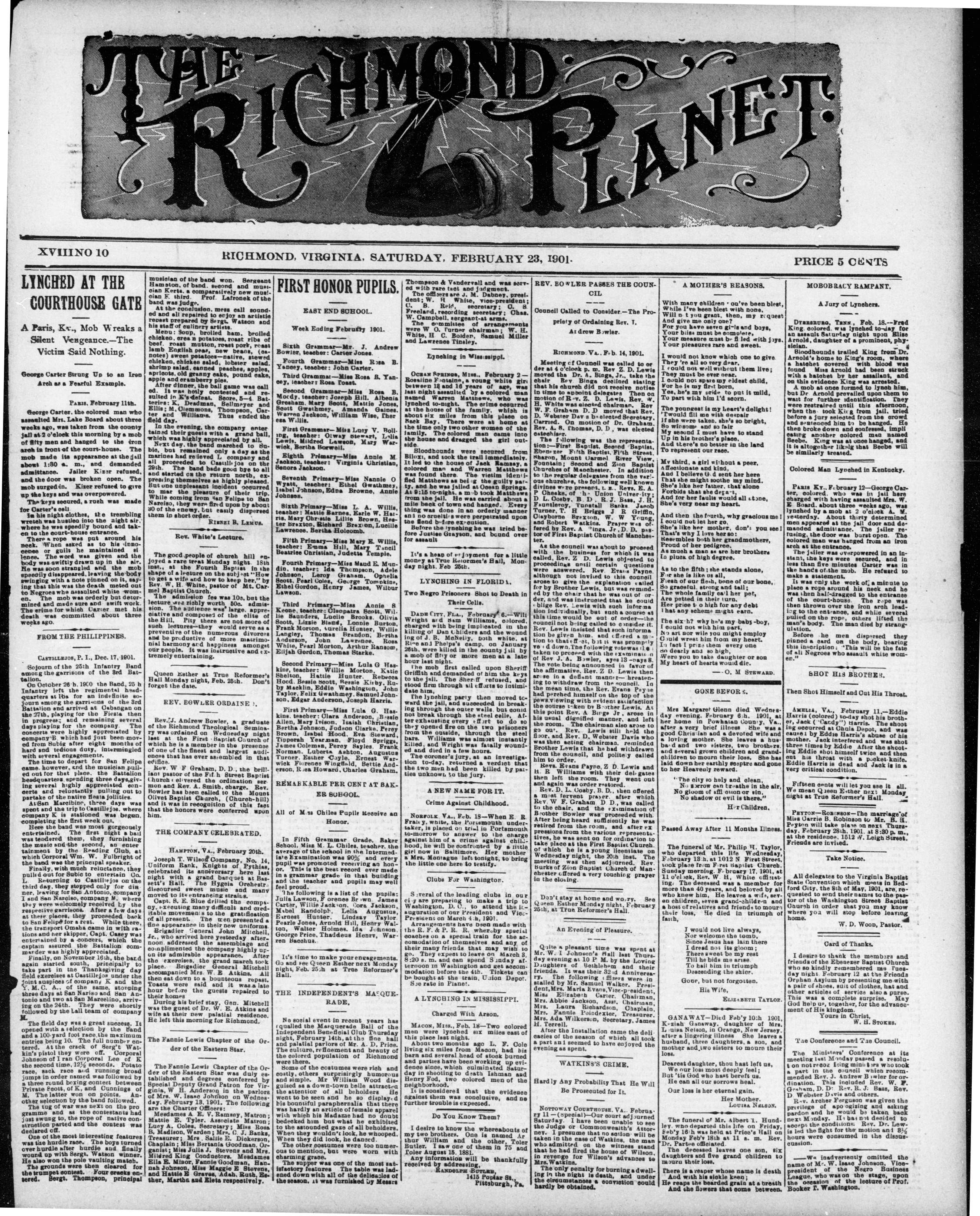
THE RICHMOND PLANET
XVIIINO 10
LYNCHED AT THE COURTHOUSE GATE
A Paris, Kv., Mob Wreaks a
Silent Vengeance.—The
Victim Said Nothing.
George Carter Strung Up to an Iron
Arch as a Fearful Example.
PARIS, February 11th.
George Carter, the colored man who assaulted Mrs. Lake Board about three weeks ago, was taken from the county jail at 2 o'clock this morning by a mob of fifty men and hanged to the iron arch in front of the court-house. The mob made its appearance at the jail about 1:30 a. m., and demanded admittance. Jailer Kizer refused, and the door was broken open. The mob surged in. Kizer refused to give up the keys and was overpowered. The keys secured, a rush was made for Carter's cell. In his night clothes, the trembling wretch was hustled into the night air, where he was speedily bound and taken to the court-house entrance.
There a rope was put around his neck. When asked as to his innocence or guilt he maintained silence. The word was given and the body was swiftly drawn up in the air. He was soon strangled and the mob specially disappeared, leaving the body swinging with a note pinned on it, saying that this was the death met out to Negroes as manifested white com- encemment. mob was orderly but deter- ined and made sure and swift work. The crime for which Career met his death was committed about three weeks ago.
FROM THE PHILIPPINES
Sojourn of the 25th Infantry Band among the garrisons of the 3rd Battalion.
On October 26 h. 1900 the Band, 25 h Infantry left the regimental headquarters at 18a for an indefinite sojourn among the garrisons of the 3rd Battalion and arrived at Cabbagan on the 27th, playing for the Fiesta then in progress; and remaining several days playing for the company. The concerts were highly appreciated by company B which had just been moved from Subig after eight months of hard and tedious duty, intermingled with several engagements.
The time to depart for San Felipe came, however, and the musician pulled out for the face. The Battalion headquarters spending three days playing several highly appreciated concerts and reluctantly pulling out to partake of the native flesta jolities.
At San Marcibino, three days was spent and the trip to Castillejo, where company K is stationed was begun, compiling the first week out.
Here the band was most gorgeously entertained. The first night a bail was tendered them, they furnishing the music and the second, an entrainment by the Reading Club, at which Corporal Wm. W. Fulbright of the band was the principal speaker. Finally, with much reluctance, they pulled out for Subic to entertain Co. L. Returning to Castillejos on the third day, they stopped only for dinner, leaving for San Antonio, company I and San Narciso, company M. where they were welcomely received by the respective garrisons. After a few days at these places, they proceeded back to San Felipe for a rest. While there, the transport Omaha came in with rations and her skipper, Capt. Casey was entertained by a concert, which the captain assured the Battalion commander was highly appreciated.
Finally, on November 16th, the band again started south, principally to take part in the Thanksgiving day field exercises at Castillejo under the joint auspices of company K and the Y. M. C. A., of the same, stopping three days at San Naroio and San Antonio and two at San Marcelino, arriving on the 24th. They were shortly followed by the ball team of company M. The field day was a great success. It opened with a selection by the band and a 100-yard foot race the maximum entries being full number-entered the crack of Sergei Vatkins' pistol they were off. Corporal Jenson of Iran Corporal Lee of K the second time, 12% seconds. Potato race, sack race and running broad jumps in order named was followed by a three round boxing contest between Private Scott, of K, and Cunnings of M. The latter won on points. Another selection by the band followed.
The tug of war was next on the pro programme and as the contestants had just swung to, the rope of native construction parted and the contest was declared off.
One of the most interesting features was the hurling race. The boys were hurling after hurdle and finally wound up with Sergt. Watson won. He also won the pole vaulting match.
The grounds were then cleared for the trumpet contest. Four crews entered. Sergt. Thompson, principal
RICHMOND, VIRGINIA, SATURDAY, FEBRUARY 23, 1901.
musician of the band won. Sergeant Hamston, of band, second and musician Kerta, a comparatively new musician K. third. Prof. Lafronek of the band was judge.
At the conclusion, mess call sounded and all repaired to enjoy an artistic repeat prepared by Serget Watson and his staff of culinary artists.
Menu: Soup, broiled ham, broiled chicken, cream potatoes, roast ribs of beef, roast mutton, roast pork, roast lamb English peas, new beaches, (enote) sweet potatoes—native, stewed chicken, chicken salad, lobster salad, shrimp salad, canned peaches, apples, apricots, old granny cake, pound cake, apple and cramberry pies.
After dinner, the ball game was called ed. It was hotly contested and resulted in K's defeat. Score, 5-4. Batteries: K, Deadman, Bollmeyer and Ellis; M, Olemmons, Thompson, Carter and Williams. Thus ended the field day.
In the evening, the company entered their guests with a grand ball, which was highly appreciated by all.
Next day, the band marched to Sutie, but remained only a day as the marines had relieved L company and all proceeded to Casulli jos on the 29th. The band bade good bye to all and started on the return north, expressing themselves as highly pleased. But one unpleasant incident occurred to mar the pleasure of their trip. While coming from San Felipa to San Naroiso, they were fired upon by about 30 of the enemy, but easily dispersed them in short order.
RIENZI B. LENUS.
Rev. White's Lecture.
The good people of church hill enjoyed a rare treat Monday night, 18th inst., at the Fourth Baptist in the shape of a lecture on the subject "How to get a wife and how to keep her." by Rev. W. H. White, pastor of Mt. Carmel Baptist Church.
The admission fee was 10s, but the lecture was richly worth 50c. admission. The audience was large, appreciative and composed of the elite of the Hill. Pity there are not more of such lectures—they would serve as a preventive of the numerous divorces and be productive of more matrimonial harmony and happiness amongst our people. It was instructive and extremely entertaining.
Queen Esther at True Reformer's Hall Monday night, Feb. 25th. Don't forget the date.
REV. BOWLER ORDAINE.
Rev.J. Andrew Bowler, a graduate of the Richmond Theological Seminary was ordained on Wednesday night last at the First Baptist Church of which he is a member in the presence of one of the finest and largest audiences that has ever assembled in that edifice. Rev.W F Graham, D.D., the brilliant pastor of the F.I.f. High Street Baptist church (elivered the ordination semen and Rev.A. Smith, charge. Rev.Bowler, served called to the Mount Olivet Baptist Church, (Church-hill) and it was in recognition of this fact that the honors were conferred upon him.
THE COMPANY CELEBRATED.
HAMPTON, VA., February 20th.
Joseph T. Wilson Company, No. 14,
Uniform Rank, Knights of Pythias,
celebrated its anniversary here last
night with a grand banquet at Bassett's
Hall. The Hygeia Osteoesthetic
discoursed sweet music and many
moved to its entrance strains.
Capt. S. E. Blue drilled the company,
executing many difficult and creditable movements to the gratification of all present. The men presented a fine appearance in their new uniforms.
Brigadier General John Mitchell,
Jr., who arrived here yesterday afternoon, addressed the assemblage and complimented the company highly upon its admirable appearance. After the exercises, the grand march took place. Brigadier General Mitchell accompanied Mrs. W. Atkins. All then sat down to a bountiful repast.
Toasts were said and it was a late hour before the guests repaired to their homes.
During his brief stay, Gen. Mitchell was the guest of Dr. W. E. Atkins and wife at their new palatial residence. He left this morning for Richmond.
The Fannie Lewis Chapter of the Order of the Eastern Star.
The Fannie Lewis Chapter of the Order of the Eastern Star was duly established and degrees conferred by Special Deputy Grand Patron for Virginia, W. H. Anderson in the parlor of Mrs. W. Isaac Johnson on Wednesday, February 13, 1901. The following are the Charter Officers:
Mesdames A. E. V. R. Vamsey, Matron;
Mattie E. Tyler, Associate Matron;
Lucy A. Coles, Secretary; Miss Rosa Madison, Warden; Mrs. C. J. Banks, Treasurer; Mary A. Dickerson, Chplain; Miss Bertianne Goodman, Organist; Miss Julia J. Stevens, Mildred King Conductors. Mesdames Ella E. Minor, Fannie Goodman, Hannah Johnson, Miss Maggie E. Stevens, and Hattie E Graves, Adah, Ruth, Ether, Marths and Eilea respectively.
FIRST HONOR PUPILS.
Week Ending February 1901.
Sixth Grammar—Mr. J. Andrew Bowier, teacher: Carter Jones.
Fourth Grammar—Miss Rosa B. Yancey, teacher: John Carter.
Third Grammar—Miss Rosa B. Yancey, teacher: Rosa Poast.
Second Grammar—Miss Rosa B. Moody, teacher: Joseph Hill. Albena Gresham, Mary Scott, Mattie Jones, Scott Gwathmeh, Amanda Gaines. Warren Jackson, William Wise, Theresa Willis.
First Grammar—Miss Lucy V. Bolling, teacher: Olway Stewart, Lilia Lewis. Mildred Lawson, Mary Warwick. Bertha Bornwell.
Eighth Primary—Miss Annie M. Jackson, teacher: Virginia Christian, Senora Jackson.
Seventh Primary—Miss Nannie O
Wyatt, teacher; Ethel Gwathmeh,
Isabel Johnson, Edna Browne, Annie
Johnes.
Sixth Primary—Miss L. A. Willis,
teacher; Mattie Barnes, Earle W. Hari,
Mary Christie Lillie Brown, Hester
braxton, Richard Brexion, Lucille
Lawrence, Bertha Holcomb.
Fifth Primary—Miss Mary E. Willis,
teacher; Emma Hill, Mary Tancil
Beatrise Christian, Judetta Temple.
Fourth Primary—Miss Mand E. Mundin,
teacher; Ida Thompson, Adèle
Johnson, Leroy Graham, Ophelia
Scott, Pearl Coles, George Tomkins,
Ethel Gordon, Henry James, Wilbur
Lawson.
Third Primary—Miss Annie S Keone, teacher: Cleopatra Scott, Willie Saunders, Ludie Brooks, Olivia Scott, Lizzie Bland, Lonnie Burton, Frank Morton, Aurelia Hunter, Willie Langley, Thomas Brandon, Bertha Anderson, John Lawrence, Rosa White, Pearl Morton, Arthur Ranson, Elijah Gordon, Thomas Starke.
Second Primary—Miss Lula G Haskine, teacher: Willie Morton, Katie Shelton, Hattie Hunter, Rebecca Hood, Bessie Scott, Jessica Kirby, Ruby Macklin, Eddie Washington, John Taylor, Felix Gwathmey, Samuel Johnson, Edgar Anderson, Joseph Harris.
First Primary—Miss Lula G. Haskine, teacher: Clara Anderson, Bassie Allen, Mary Ivory, Isaiah Christian, Bertha Johnson, Judeon Clarke, Perey Brown, Isabel Hoold, Eva Steward, Tipporah Yearman, Floyd Spriggs, James Coleman, Peroy Sayles, Frank Norman, Luberta Ashton, Augustus Turner, Ester Coyle, Ernest Warwick Florenes Wingfield, Bettie Anderson, Rosa Howard, Charles Graham.
REMARKABLE PER CENT AT BAK.
All of Miss Chiles Pupils Receive an
In Fifth Grammar Grade, Baker School, Miss M. L. Chiles, teacher, the average of the school in the Intermediate Examination was 90% and every pupil was promoted receiving an honor. This is the best record ever made in a grammar grade in that building and the teacher and pupils may well feel proud.
The following is a list of the pupils: Julia Lawson, Florenes Brown, James Carter, Willie Jackson, Cora Jackson, Mabel Randolph, Lelia Augustus, Earnest Hunter, Lindsay Taylor, Pearle Jones, Arnold Hill, Henry Walton, Walter Holmes, Ida Johnson, George Price, Thaddeus Henrv, Warren Bacchus.
It's time to make your engagements. Go and see Queen Esther next Monday night, Feb. 25th at True Reformer's Hall.
THE INDEPENDENT'S MASQUE-RADE.
No social event in recent years has equalled the Masquerade Ball of the Independent Beneficial Club Thursday night, February 14th, at the fine hall and palatial parlors of Mr. A. D. Price. The culture, refinement and beauty of the colored population of Richmond were there.
Some of the costumes were rich and costly, others surprisingly humorous and simple. Mr William Wood disguised as a down-town belle attracted the attention of all beholders. He went to be seen and he so displayed his bountiful paraphernalia that there was hardly an article of female apparel with which his William had no doubt bedecked him but what he exhibited to the astounded gaze of all beholders. When they wouldn't look, he whooped. When they did look, he danced.
The other costumes were too numerous to mention, but were worn with charming grase. The upper part of one of the most satisfactory costumes. The table was ladened down with all of the delicacies of the season, it was furnished by Messera
Thompson & Vandervall and was served with rare test and judgments.
The officers are J. M. Dabney, president; W. H. White, vice-president; C. B. Reid, secretary; Q. S. Freeland, recording secretary; Chas. W. Campbell, sergeant-at arms. The committee of arrangements were W. O. Boiden, obairman; W. H. White, H. C. Boiden, Samuel Miller and Lawrence Finley.
Lynehing in Mississippi.
Ocean Springs, Miss., February 2—Bosaline Fontaine, a young white girl between 18 and 16 years of age, was last night assaulted by a colored man named Warren Matthews, who was lynched to-night. The crime occurred at the house of the family, which is about six miles from this place on Rock Bay. There were at home at the time only two other women of the family. The colored man came into the house and dragged the girl outside. Bloodhounds were secured from Blitox, and took the trail immediately. It led to the house of Jack Ramsay, a colored man and Warren Matthews was found there. The victim identified Matthews as being the guilty party, and he was jailed at Ocean Springs. At 9:15 to-night, a mob took Matthews from the jail. He was carried about a mile back of town and hanged. Every thing was done in an orderly manner and no cruelties were perpetrated upon the flend-before execution.
Before the lynching he was tried before Justice Grayson, and bound over for assault
It's a heap of enjoyment for a little money at True Reformer's Hall, Monday night. Feb 25th.
LYNCHING IN FLORIDA.
Two Negro Prisoners Shot to Death in Their Cells.
DADE CITY, FLA., February 6.—Will Wright and Sam Williams, colored, charged with being implicated in the killing of Dan Childers and the wounding of J. B. McNeilly, both white, at Rise and Phelps's camp, on January 28th, were killed in the county jail by a mob of fifty or more men at a late hour last night.
The mob first called upon Sheriff Griffith and demanded of him the keys to the jail. The Sheriff refused, and stood firm through all efforts to intimidate him.
The lynching party then moved to wreck the jail and succeeded in breaking through the jail walls, but could not break through the effec cell. After exhausting every effort, do they opened fire on the two prisoners from the outside, through the steel bars. Williams was almost instantly killed, and Wright was fatally wounded and died in a few hours.
The coroner's jury, at an investigation to-day, returned a verdict that the two men had been killed by parties unknown, to the jury.
A NEW NAME FOR IT.
NORFOLK, VA., Feb. 18—When E. R. Fratley, white, the Portsmouth undertaker, is placed on trial in Portsmouth to-morrow to answer to the charge against him of a crime against childhood, he will be confronted by a little girl, who is the mother a Mrs. Montague left tonight, to bring the little one here to testify.
Several of the leading clubs in our city are preparing to make a trip to Washington, D. C., to attend the inauguration of our President and Vice-President on March 4. h., 1901.
Arrangements have been made with the R. F. & P. R. R. whereby special coaches on a special train for the accommodation of themselves and any of their many friends that may wish to go. They expect to leave on March 8, 8:20 a. m. and can spend Sunday afternoon in Washington and get accommodation before the 4th. Tickets can be bought at the train, Union Depot. See rate in Planet.
A LYNCHING IN MISSISSIPPI.
Charged With Arson.
MACON, Miss., Feb. 18—Two colored men were lynched six miles east of this place last night.
About two months ago L. F. Cole living six miles from Macon, had his barn and several head of stock burned and parties have been working up evidence since, which culminated Saturday in shooting to death Ishman and Hoover colored men of the neighborhood.
It is considered that the evidence against them was conclusive, and no further trouble is expected.
I desire to know the whereabouts of my two brothers. One is named Arthur William and the other, Toler Butler. I saw one of them in 75 and Toler August 15, 1881.
Any information will be thankfully
received by addressing,
KANDOLPH SULLER,
1415 Poplar St.
Pittsburgh, Pa.
REV. BO WLER PASSES THE COUNCIL
RICHMOND. V4., F. b. 14, 1901.
Meeting of Council was called to order at a o'clock p. m. Rev Z. D. Lewis moved the Dr. A. Binga, Jr., take the chair Rev. Binga declined stating that his church did not receive notice in time to appoint delegates. Then on motion of R.-v. Z. D. Lewis, Rev. W. F. G. was elected chairman. Rev W. F. G. was moved that Rev D. Webster Davs be appointed Secretary, Carried. On motion of Dr. Graham Rev A. S. Thomas, D. D., was elected catechiser.
The following was the representation:—First Baptist, Second Baptist, Ebuenzer Fifth Baptist, Fifth Street, Sharon, Mount Carmel River View, Fountain; Second and Zion Baptist Churches of Manchester. In addition to the regular delegates from the various churches, the following well known divines were present, I. m. Reva, E. A. P Cheeks, of the Union University; D. L. Cosby, B. D. R. J. Bass, J. H. Fauntleroy, Tunall Bank, Jaech Turner, T. H Briggs J R Griffin, Clayborne Brexson, W. W Young, and Robert Watkins. Prayer was offered by Rev. A. Pinga, Jr. D. D. pastor of First Baptist Church of Manchester.
As the council was about to proceed with the business for which it was called, Rev. Z. D. Lewis objected to proceedings until certain questions were answered. Rev. Evans Payne, although not invited to this council arose to give the explanation called for by Brother Lewis, but was reminded by the chair that he was out of order, and was instructed that he could oblige Rev. Lewis with such information individually, but such a course at this time would be out of order—the council not being called to consider it. Rev. Lewis insisted that such information be given him, and offered a motion to that effect, but it was promptly drowned. The following vote was taken with the examination of Rev. J. Bowler, age 13-8 years. The vote being announced in favor of the affirmative, Rev. Z. D. Lewis then arose in a defiant manner—he threatening to withdraw from the meeting in the mean time, the Rev. Evans Payne had perched himself on the top of the viewing with evident satisfaction the course taken by Brother Lewis. At this point Rev. A. Binges Jr. arose in his usual dignified manner, and left the room. The chairman also arose to go out. Rev. Lewis still held the floor, and Rev. D. Webster Davis who was then acting chairman, reminded Brother Lewis that he had withdrawn from the council, and politically called him to order.
Revs. Evans Payne, Z D. Lewis and H. R. Williams with their del-gates then left the room. They went out and again was order restored.
Rev. D. L. Osoby, B. D., then offered a most fervent prayer, after which Rev. W F. Graham D. D., was called to the chair, and the examination of Brother Bowler was proceeded with. After being heard sufficiently he was retired from the room, and after ex-pressions from the various representa-tions, he was sent on for ordination to take the First Baptist Church, of which he is the young licentiate on Wednesday night, the 20th inst. The meeting was then adjourned. Rev. Burke of Zion Baptist Church of Manchester offered a very touching prayer in the closing.
Don't stay at home and wo-rv. See Queen Esther Monday night, February 25th, at True Reformer's Hall.
Quite a pleasant time was spent at Mr. W. I Johnson's Hall last Thursday evening at 10 P. M. by the Loving Daughters of Bethlehem and their friends. It was their 32nd Anniversary. The following officers were in installed by Mr. Samuel Walker. President, Mrs. Maria Evans, Vice-president, Miss Elizabeth Carter, Chairman, Mrs. Abbie Jackson, Asst. Chairman, Mrs. Laura Richardson, Chaplain, Mrs. Fannie Poidexeter, Treasurer, Mrs. Ada Wilkerson, Secretary, James H. Terrell.
After the Installation came the delicacies of the season of which all took a part and I seemed to have enjoyed the evening as spent.
Hardly Any Probability That He Will Be Prosecuted for It.
NOTTOWAY COURTHOUSE. Va. February 11—(special) Our court adjourned Saturday. I have been unable to see the Judge or Commonwealth's Attorney. I presume that no action will be taken in the case of Watkins, the man who admitted on the witness stand that he had fired the house of Wilson. in revenge for Wilson's advances to Mrs. Watkins.
The only penalty for burning a dwelling in the night is death, and under the circumstances a conviction could hardly be obtained.
A MOTHER'S REASONS.
With many children you've been blest,
While I've been blest with none.
Will not you grant, then, my request
And give me only one?
For you have seven girls and boys,
Your bliss must be compore.
Your measure must be filled with joys.
Your pleasures rare and sweet.
I would not know which one to give
They're all so very dear.
I could not well without them live;
They must be ever near.
I could not spare my oldest child,
For he is my first born.
Yes, he's my pride to put it mild,
To part with him I'd scorn.
The youngest is my heart's delight!
I would fill me with despair
If she were taken, she's so bright,
So wisome and so fair.
My second I must have to stand
Up in his brother's place.
And there's no better in the land
To represent our race.
My third, a girl without a peer,
Affectionate and kind,
And I believe God sent her here
That she might soothe my mind.
She's like her father, that alone
Forbids that she depart,
And for her faults would all stone,
She's very near my heart.
And then the fourth, why gracious me
I could not let her go,
She's like her mother, don't you see
That's why I love her so:
Resembles both her grandmothers,
Proud of her pedigree,
As much a man as are her brothers
In pluck of high degree.
As to the fifth; she stands alone,
For she is like us all,
Flesh of our flesh, bone of our bone,
So graceful, strong and tall;
The whole family call her pet,
Are petted in their turn,
Her price to high for any debt
That any scheme might earn.
The six-h? why he's my baby-boy,
I could not with him part,
No art nor wile you might employ
Could wrest him from my heart.
In fact I prize them every one
so dearly and so high.
Were you to take daughter or son
My heart of hearts would die.
——O. M STEWARD
GONE BEFOR $.
Mrs Margaret Glenn died Wednesday evening, February 8th, 1901, at her home in Powhatan County, Va., after a very brief illness. She was a good Christian and a devoted wife and a loving mother. She leaves a husband and two sisters, two brothers, and several grown children and grandchildren to mourn their loss. She has laid down her earthly scapept and gone to her Heavenly reward.
"The city so holy and clean,
No sorrow can breathe in the air,
No gloom of allusion or sin,
No shadow or evil is there."
Passed Away After 11 Months Illness
The funeral of Mr. Philip H. Taylor,
who departed this life Wednesday,
February 18th, at 1012 N First Street,
took place from First Baptist Church.
Sunday morning, February 17, 1901, at
11 o'clock, Rev. W. H. White officiating.
The deceased was a member for
more than 40 years, and beloved by all
who knew him. He leaves a wife, seven
children, seven grand-children and a
host of relatives and friends to mourn
their loss. He D. H. in triumph of
faith,
I would not live always,
Nor welcome the tomb,
Since Jesus has lain there
I dread not its gloom;
There sweet be my rest
Till he bids me arise.
To hail him in triumph
Descending the skier.
ELIZABETH TAYLOR
GANAWAY—Died Feb'y 10:h 1901,
Keziah Ganaway, daughter of Mrs.
Louisa Nelson, in Orange, New Jersey,
after a lingering illness. She leaves a
husband, three daughters, a son, and
mother and two sisters to mourn their
loss.
Dearest daughter, thou hast left us,
We our loss most deeply feel;
But 'sia God who hast bereft us.
He can all our sorrows heal.
Our loss is her eternal gain.
The funeral of Mr. Albert I. Hundley, who departed this life on Friday, Feby 16th was held at Price's Hall on Monday Feby 18th at 11 a. m. Rev. Dr. Partée officiated.
The deceased leaves one son, six daughters and five grand children to mourn their loss.
There is a weaver whose name is death And with his sickle keen;
He reaps the bearded grain at a breath
And she flowers that come between.
MOBOBRACY RAMPANT.
DYNSRURG, TENN., Feb. 18.--Fred King, colored, was lynched to-day for an assault Saturday night upon Elise Arnold, daughter of a prominent, physician.
Bloodhounds trailed King from Dr. Arnold's home to King's room, where a hatset covered with blood was found. Miss Arnold had been struck with a hatset by her assailant, and on this evidence King was arrested.
A mob at once formed to lynch him, but Dr Arnold prevailed upon them to wait for further identification. They were restrained until this afternoon, when the took King from jail, tried before a jury selected from the crowd and sentenced him to be hanged. He then broke down and confessed, imploring another colored man named Beebe. King was at once hanged, and it is altogether likely that Beebe will be similarly treated.
Colored Man Lyved in Kentucky.
PARIS Kr. F. february 12—George Carter, colored, who was in jail here charged with having assaulted Mrs. W. E. Board, about three weeks ago, was lynched by a mob at 2 o'clock A. M. yesterday. About thirty determined men appeared at the jail door and demanded admittance. The jail refusing, the door was burst open. The colored man was hung from an iron arch at the entrance. The jailer was overpowered in an instant, the keys were secured, and in less than five minutes Carter was in the hands of the mob. He refused to make a statement. I only the work of a minute to place a rope around his neck and he was then half-trapped to the entrance of the court-house. The rope was then thrown over the iron ceiling to the entrance, and while several pulled on the rope, others lifted the man's body. The man died by strangulation.
Before he men dispersed they pinned a card on the body, bearing this inscription: "This will be the fate of all Negroes who assault white women."
SHOT HIS BROTHER.
Then Shot Himself and Cut His Throat.
AMELIA, VA., February 11.—Eddie Harris (colored) to-day shot his brother, Jack ("Candy") harris. The shoot occurred at Onnis Depot, and was caused by Eddie Harris' abuse of his mother. Jack interfered and was shot three times by Eddie. After the shooting Eddie shot himself twice and then cut his throat with a pocket-skife. Eddie Harris is dead and Jack is in a very critical condition.
Fifteen cents will let you see it all. We mean Queen Ether next Monday night at True Reformer's Hall.
PRETON - ROBINSON - The marriage' of Mies Oarrie B. Robinson to Mr. B. H. Pyton will take place on next Thursday, February 28th, 1901, at 8:30 p.m., at the residence, 1512 W. Leigh Street. Friends are invited.
All delegates to the Virginia Baptist State Convention which meets in Bedford City, the 8th of May, 1801, are, requested to send their names to the pastor of the Washington Street Baptist Church in order that you may know where you will stop before leaving home.
W. D. Wood, Pastor.
Card of Thanks.
I desire to thank the members and friends of the Ebenezer Baptist Church who so kindly remembered me Tuesday night. February 12 at the Friends Orphan Asylum by presenting me with a pair of shoes, suits of clothes, hat and other articles of service also a purse. This was a complete surprise. Mey God help us, together, for the advancement of His kingdom.
Yours in Christ,
W. H. STOKES.
Tae Conference and Tae Council.
The Minister's Conference at its meeting last Monday passed a resolution not怨稅 like ministers who took a part in the council which recommended Rev. J. Andrew Bowler for ordination. This included Rev. W. F. Graham, D. D: Rev. R. J: Bass, Rev. D Webster Davis and others.
Rev. Archer Ferguson was given the privilege of apologizing and asking pardon and he would be taken back next Monday. He has not decided to accept the conditions: Rev. Dr. Lewis led the fight for the motion and 8½ hours were consumed in the discussion.
We inadvertently omitted the name of Mr. W. Isaac Johnson, Vice-president of the Negro Business League, who was on the stage, upon the occasion of the lecture of Prof. Booker T. Washington.
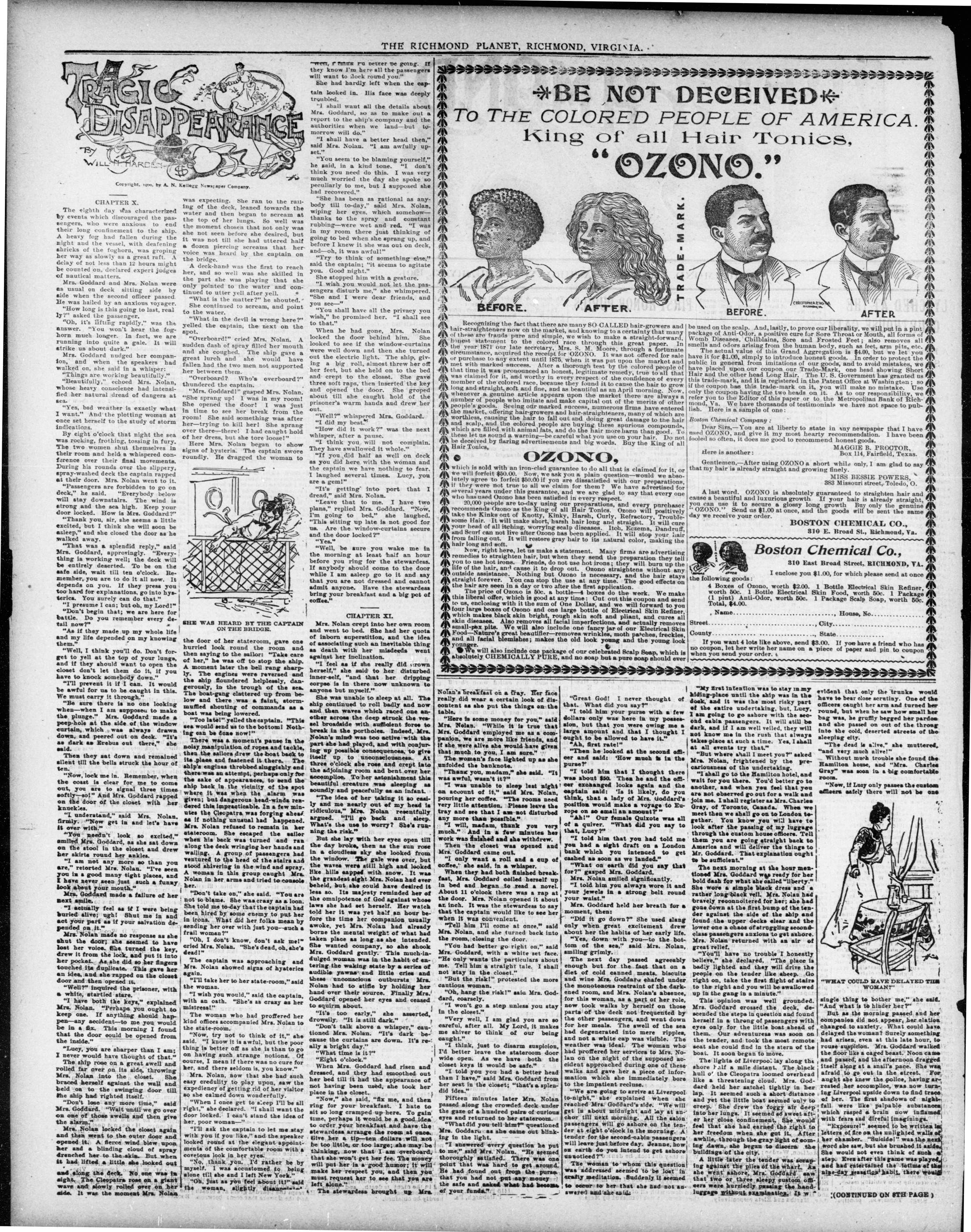
TRAGIC
DISAPPEARANCE
By
WILLIAM HARDEN
Copyright, 1900, by A. N. Kellogg Newspaper Company.
The eight day was characterized by events which discouraged the passengers, who were anxious to end their long confinement to the ship. A heavy fog had fallen during the night and the vessel, with deafening shrieks of the foghorn, was groping her way as slowly as a great raft. A delay of not less than 12 hours might be counted on, declared expert judges of nautical matters.
Mrs. Goddard and Mrs. Nolan were as usual on deck sitting side by side when the second officer passed. He was hailed by an anxious voyager. "How long is this going to last, really?" asked the passenger.
"Oh, it's lifting rapidly," was the answer. "You won't hear the foghorn much longer. In fact, we are running into quite a gale. It will strike us about dark."
Mrs. Goddard nudged her companion, and when the speakers had walked on, she said in a whisper:
Things are working beautifully."
"Beautifully," echoed Mrs. Nolan, whose heavy conscience had intensified her natural dread of dangers at sea.
"Yes, bad weather is exactly what I want." And the plotting woman at once set herself to the study of storm indications.
By eight o'clock that night the sea was rocking, frothing, tossing in fury. The two women shut themselves in their room and held a whispered conference over their final movements. During his rounds over the slippery, spray-washed deck the captain rapped at their door. Mrs. Nolan went to it.
"Passengers are forbidden to go on deck," he said. "Everybody below will stay downstairs. The wind is strong and the sea high. Keep your door locked. How is Mrs. Goddard?" "Thank you, sir, she seems a little excited, but I think she will soon be asleep," and she closed the door as he walked away.
"That was a splendid reply," said Mrs. Goddard, approvingly. "Everything is working well; the deck will be entirely deserted. To be on the safe side, wait till ten o'clock. Remember, you are to do it all now. It depends on you. If you press you too hard for explanations, go into hysterics. You surely can do that."
"I presume I can; but oh, my Lord!" "Don't begin that; we are here for battle. Do you remember every detail now?"
"As if they made up my whole life and my life depended on my knowing them."
"Well, I think you'll do. Don't forget to yell at the top of your lungs, and if they should want to open the closet don't let them do it, if you have to knock somebody down."
"I'll prevent it if I can. It would be awful for us to be caught in this. We must carry it through."
"Be sure there is no one looking when—when I am supposed to make the plunge." Mrs. Goddard made a peep-hole at the side of the window curtain, which was always drawn down, and peered out on deck. "It's as dark as Erebus out there," she said.
Then they sat down and remained silent till the bells struck the hour of ten.
"Now, lock me in. Remember, when the coast is clear for me to come out, you are to signal three times softly—so!" And Mrs. Goddard rapped on the door of the closet with her knuckles.
"I understand," said Mrs. Nolan, firmly. "Now get in and let's have it over with."
"You needn't look so excited," smiled Mrs. Goddard, as she sat down on the stool in the closet and drew her skirts round her ankles.
"I am not any more so than you are," retorted Mrs. Nolan. "I've seen you in a good many tight places, and I have never seen just such a funny look about your mouth."
Mrs. Goddard made a failure of her next smile.
"I actually feel as if I were being buried alive; ugh! Shut me in and act your part as if your salvation depended on it."
Mrs. Nolan made no response as she shut the door; she seemed to have lost her voice. She turned the key, drew it from the lock, and put it into her pocket. As she did so her fingers touched its duplicate. This gave her an idea, and she rapped on the closest door and then opened it.
"Well?" inquired the prisoner, with a white, startled stare.
"I have both the keys," explained Mrs. Nolan. "Perhaps you ought to keep one. If anything should happen—any accident—to me you would be in a fix. This morning I found that the door could be opened from the inside."
"Lucy, you are sharper than I am; I never would have thought of that." The ship rose on a great swell and rolled far over on its side, throwing Mrs. Nolan into the closet. She braced herself against the wall and held on to the swinging door till she ship had righted itself.
"Don't lose any more time," said Mrs. Goddard. "Wait until we go over on one of those swells and then give the alarm."
Mrs. Nolan locked the closet again and then went to the outer door and opened it. A fierce blow blew upon her and a blinding cloud of spray drenched her to the skin. But when it had lifted a little she looked out
and, along the deck. No one was in sight. The Cleopatra rose on a giant wave and slowly rolled over on her side. It was the moment Mrs. Nolan
CHAPTER X.
was expecting. She ran to the raining of the deck, leaned towards the water and then began to scream at the top of her lungs. So well was the moment chosen that not only was she not seen before she desired, but it was not till she had uttered half a dozen piercing screams that her voice was heard by the captain on the bridge.
A deck-hand was the first to reach her, and so well was she skilled in the part she was playing that she only pointed to the water and continued to utter yell after yell.
"What is the matter?" he shouted.
She continued to scream, and point to the water.
"What in the devil is wrong here?" yelled the captain, the next on the spot.
"Overboard!" cried Mrs. Nolan. A sudden dash of spray filled her mouth and she coughed. The ship gave a great lurch and she would have fallen had the two men not supported her between them.
"Overboard? Who's overboard?" thundered the captain.
"Mrs. Goddard!" gasped Mrs. Nolan. "She sprang up! I was in my room! She opened the door! I was just in time to see her break from the room! She said something was after her—trying to kill her! She sprang over there—there! I had caught hold of her dress, but she tore loose!" Here Mrs. Nolan began to show signs of hysteria. The captain sore roundly. He dragged the woman to
SHE WAS HEARD BY THE CAPTAIN ON THE BRIDGE.
the door of her stateroom, gave one hurried look round the room and then saying to the sailor: "Take care of her," he was off to stop the ship. A moment later the bell rang sharply. The engines were reversed and the ship floundered helplessly, dangerously, in the trough of the sea. The boat-gang clattered from below and there was a faint, storm-muffled shouting of commands as a boat was being lowered. "Too late!" yelled the captain. "This sea would send us to the bottom! Nothing can be done now!"
There was a moment's pause in the noisy manipulation of ropes and tackle, then the sailors drew the boat back to its place and fastened it there. The ship's engines throbbed sluggishly and there was an attempt, perhaps only for the sake of appearances, to send the ship back in the vicinity of the spot where it was when the alarm was given; but dangerous head-winds rendered this impassible. In a few minutes the Cleopatra was forging aheas if nothing unusual had happened. Mrs. Nolan refused to remain in her stateroom. She escaped the sailor when his back was turned and ran along the deck wringing her hands and wailing. A group of passengers had ventured to the head of the stairs and stood shivering in the wind and spray. A woman in this group caught Mrs. Nolan in her arms and tried to console her.
"Don't take on," she said. "You are not to blame. She was crazy as a loon. She told me to day that the captain had been hired by some enemy to put her in irons. What did her folks mean by sending her over with just you—such a frail woman?"
"Oh, I don't know, don't ask me!" cried Mrs. Nolan. "She's dead, oh, she's dead!"
The captain was approaching and Mrs. Nolan showed signs of hyterics again.
"I'll take her to her state-room," said the woman.
"I wish you would," said the captain, with an oath. "She's as crazy as her mistress!"
The woman who had proffered her kind offices accompanied Mrs. Nolan to the state-room.
"Now, try not to think of it," she said. "I know it is awful, but the poor thing is better off as she is than to go on having such strange notions. Of course, I mean if there was no cure for her, and there seldom is, you know." Mrs. Nolan, now that she had such easy credulity to play upon, saw the expediency of getting rid of her visitor so she calmed down wonderfully.
"When I once get to sleep I'll be all right," she declared. "I shall want the door locked. I can't stand the idea of her, poor woman—"
"I'll ask the captain to let me stay with you if you like," and the speaker looked round at the elegant appointments of the comfortable room with a covetous look in her eyes.
"No, thank you. I'd rather be by myself. I was accustomed to being alone till she and I left New York."
"Oh, just as you feel about it!" said the woman, slightly dismayed.
THE RICHMOND PLANET, RICHMOND, VIRGINIA.
When I think you better be going. If they know I'm here all the passengers will want to lock round you."
She had hardly left when the captain looked in. His face was deeply troubled.
"I shall want all the details about Mrs. Goddard, so as to make out a report to the ship's company and the authorities when we land—but tomorrow will do."
"I shall have a better head then," said Mrs. Nolan. "I am awfully upset."
"You seem to be blaming yourself," he said, in a kind tone. "I don't think you need do this. I was very much worried the day she spoke so peculiarly to me, but I supposed she had recovered."
"She has been as rational as any body till to-day," said Mrs. Nolan, wiping her eyes, which somehow—thanks to the spray and constant rubbing—were wet and red. "I was in my room there just thinking of going to bed when she sprang up, and before I knew it she was out on deck, and—oh, it was awful!" "Try to think of something else," said the captain; "it seems to agitate you. Good night." She stopped him with a gesture.
"I wish you would not let the passengers disturb me," she whimpered. "She and I were dear friends, and you see—"
"You shall have all the privacy you wish," he promised her. "I shall see to that."
When he had gone, Mrs. Nolan locked the door behind him. She looked to see if the window-curtains were well down and then she turned out the electric light. The ship, giving a big roll, almost threw her off her feet, but she held on to the bed and crept to the closet. She gave three soft raps, then inserted the key and opened the door. She groped about till she caught hold of the prisoner's warm hands and drew her out.
"Well?" whispered Mrs. Goddard. "I did my best."
"How did it work?" was the next whisper, after a pause.
"I think you will not complain. They have swallowed it whole."
"If you did half as well on deck as you did here with the woman and the captain we have nothing to fear. I laughed several times. Lucy, you are a gem!"
"It's getting' into port that I dread," said Mrs. Nolan.
"Leave that to me. I have two plans," replied Mrs. Goddard. "Now, I'm going to bed," she laughed.
"This sitting up late is not good for us. Are the window-curtains secure and the door locked?"
"Yes."
"Well, be sure you wake me in the morning at least half an hour before you ring for the stewardess. If anybody should come to the door while I am asleep go to it and say that you are not dressed and cannot admit anyone. Have the stewardess bring your breakfast and a big pot of coffee."
CHAPTER XI.
Mrs. Nolan crept into her own room and went to bed. She had her quota of inborn superstition, and the idea of associating such an inevitable thing as death with her misdeeds went against her inclination.
"I feel as if she really did crown herself," she said to her disturbed inner-self, "and that her dripping corpse is in there now unknown to anyone but myself."
She was unable to sleep at all. The ship continued to roll badly and now and then waves which raced one another across the deep struck the vessel broadside with sufficient forces to break in the portholes. Indeed, Mrs. Nolan's mind was too active with the part she had played, and with conjuring up possible consequences, to give itself up to unconsciousness. At three o'clock she rose and crept into the adjoining room and bent over her accomplice. To her astonishment this beautiful creature was sleeping as soundly and peacefully as an infant.
"The idea of her taking it so easily and me nearly out of my head is ridiculous." Mrs. Nolan resentfully argued. "I'll go back and sleep. What's the use to worry? She's running the risk."
But she lay with her eyes open till the day broke, then as the sun rose in a cloudless sky she looked from the window. The gale we over, but the waves were still high and looked like hills capped with snow. It was the grandest sight Mrs. Nolan had ever beheld, but she could have desired it less so. Its majesty reminded her of the omnipotence of God against whose laws she had set herself. Her watch told her it was yet half an hour before the time her companion usually awoke, yet Mrs. Nolan had already borne the mental weight of what had taken place as long as she intended. She wanted company, so she shook Mrs. Goddard gently. This much-in-dulged woman was in the habit of entering the waking state by a series of audible yawns and little cries and these unconscious outbursts Mrs. Nolan had to stifle by holding her hand over their source. Finally Mrs. Goddard opened her eyes and ceased to squirm about.
"It's too early," she asserted, drowning. "It is still dark." "Don't talk above a whisper," cautioned Mrs. Nolan. "It's dark because the curtains are down. It's really a bright day."
"What time is it?"
"Eight o'clock."
When Mrs. Goddard had risen and dressed, and they had smoothed out her bed till it had the appearance of not having been used, she took her place in the closet.
"Now," she said, "fix me, and then ring for your breakfast. I hate to sit so long cramped up here. To gain time, perhaps it would be a good idea to order your breakfast and have the stewardess arrange the room at once. Give her a tip—sen dollars, will not be too little, or too large; she may be thinking, now that I am overboard, that she won't get her fee. The money will put her in a good humor; it will make her respect you, and then you must request her to see that you are left alone."
The stewardess brought up Mrs.
BE NOT DECEIVED
TO THE COLORED PEOPLE OF AMERICA.
King of all Hair Tonics,
"OZONO."
Recognizing the fact that there are many SO-CALLED hair-growers and hair-straighteners now on the market, and knowing to a certainty that many of these are frauds pure and simple, we wish to make a straight-forward, honest statement to the colored race through this great paper. In the year 1871 our late secretary, Mrs. S. M. Moore, through a fortunate circumstance, acquired the receipt for OZONO. It was not offered for sale or purchase to any extent until 1875, when it was put upon the market and met with marked success. After a thorough test by the colored people of that time it was pronounced an honest, legitimate remedy, true to all that was claimed for it, and worthy in every respect of the confidence of every member of the colored race, because they found it to cause the hair to grow long and straight, soft and fine, and as beautiful as an April morning. Now, whenever a genuine article appears upon the market there are always a number of people who imitate and make capital out of the merits of other people's goods. Seeing our marked success, numerous firms have entered the market, offering hair-growers and hair-straighteners, many of which are worthless, causing the hair to fall out and doing great damage to the hair and scalp, and the colored people are buying these spurious compounds, which are filled with animal fats, and do the hair more harm than good. To these let us sound a warning—be careful what you use on your hair. Do not be deceived by flaring advertisements and big words. Buy the King of all Hair Tonics.
which is sold with an iron-clad guarantee to do all that is claimed for it, or we will forfeit $50.00. Now, we ask you a plain question—would we absolutely agree to forfeit $50.00 if you are dissatisfied with our preparations, if they were not true to all we claim for them? We have advertised for several years under this guarantee, and we are glad to say that every one who has used Ozono has been satisfied in every respect. 20,000 people are to-day using our preparations, and every purchaser recommends Ozono as the King of all Hair Tonics. Ozono will positively take Kinks out of Knotty, Kinky, Harsh, Curly, Refractory, Troublesome Hair, take short, harsh hair long and straight. It will cure your head of all itching, every scalp diseases. Itch, Eczema, Dandruff, and Scurf can not live after Ozono has been applied. It will stop your hair from falling out. It will restore gray hair to its natural color, making the hair long and soft.
Now, right here, let us make a statement. Many firms are advertising remedies to straighten hair, but when they send the preparation they tell you to use hot irons. Friends, do not use hot irons; they will burn up the life of the hair, and cause it to drop out. Ozono straightens without any outside assistance. Nothing but Ozono is necessary, and the hair stays straight forever. You can stop the use at any time. The good effects on the hair are seen in a day or two after the first application.
The price of Ozono is 50c, a bottle—4 boxes do the work. We make this liberal offer, which is good at any time: Cut out this coupon and send to us, enclosing with it the sum of One Dollar, and we will forward to you four large boxes of Ozono and one large bottle of Electrical Skin Refiner, which makes black skin bright, rough skin soft and pliant, and cures all skin diseases. Also removes all facial imperfections, and actually removes small-pix pits. We will also include one fancy jar of our Electrical Skin Food—Nature's great beautifier—removes wrinkles, moth patches, freckles, and all facial blemishes; makes the old look young and the young look younger.
We will also include one package of our celebrated Scalp Soap, which is absolutely CHEMICALLY PURE, and no soap but a pure soap should ever
Nolan's breakfast on a fray. Her face really did wear a certain look of discontent as she put the things on the table.
"Here is some money for you," said Mrs. Nolan. "While it is true that Mrs. Goddard employed me as a companion, we are more like friends, and if she were alive she would have given that much to you, I am sure."
The woman's face lighted up as she unfolded the banknote.
"Thank you, madam," she said. "It was awful, wasn't it?"
"I was unable to sleep last night on account of it," said Mrs. Nolan, pouring her coffee. "The rooms need very little attention. Please leave the tray and see that I am not disturbed any more than possible."
"I will, madam, thank you very much." And in a few minutes her work was finished and she withdrew.
Then the closet was opened and
Then the closet was opened and Mrs. Goddard came out.
"I only want a roll and a cup of coffee," she said, in a whisper.
When they had both finished breakfast, Mrs. Goddard coiled herself up in bed and began to read a novel. About 11 o'clock there was a rap at the door. Mrs. Nolan opened it about 12 inch. It was the stewardess to say that the captain would like to see her when it was convenient.
"Tell him I'll come at once," said Mrs. Nolan, and she turned back into the room, closing the door.
"You had better go right on," said Mrs. Goddard, with a white set face.
"He only wants the particulars about me. Tell him a straight tale. I shall not stay in the closet."
"But the risk!" protested the more cautious woman.
"Oh, hang the risk!" said Mrs. Goddard, coarsely.
"I won't go a step unless you stay in the closet."
"Very well, I am glad you are so careful, after all. My Lord, it makes me shiver to think of our being caught."
"I think, just to disarm suspicion, I'd better leave the stateroom door wide open. As we have both the closet keys it would be safe."
"I told you you had a better head than I have," said Mrs. Goddard from her seat in the closet; "that's a splendid idea."
Fifteen months later Mrs. Nolan passed along the crowded deck under the gaze of a hundred pairs of curious eyes and returned to her stateroom.
"What did you tell him?" questioned Mrs. Goddard as she came out blinking in the light.
"I answered every question he put to me," said Mrs. Nolan. "He seemed thoroughly satisfied. There was one point that was hard to get around. He had found out from the purse, that you had not put any money the safe and asked what had become of your funds."
"Great God! I never thought of that. What did you say?"
"I told him your purse with a few dollars only was here in my possession, but that you were owing me a large amount and that I thought I ought to be allowed to have it."
"Ah, first rate!"
"Then he looked at the second officer and said: 'How much is in the purse?'
"I told him that I thought there was about $50. Then he and the officer exchanged looks again and the captain said: 'Is it likely, do you think, that a lady of Mrs. Goddard's position would make a voyage to Europe on so small an amount?'
"Ah!!" Our female Quixote was all of a quiver. "What did you say to that, Luey?"
"I told him that you had told me you had a sight draft on a London bank which you intended to get cashed as soon as we landed."
"What on earth did you say that for?" gasped Mrs. Goddard. Mrs. Nolan smiled significantly. "I told him you always wore it and your jewels in a strong belt round your waist." Mrs. Goddard held her breath for a moment, then: "Did it go down?" She used slang only when great excitement drew about her the habits of her early life. "Yes, down with you—to the bottom of the sea," said Mrs. Nolan, smiling grimly.
The next day passed agreeably enough but for the fact that on a diet of cold canned meats, biscuits and wine Mrs. Goddard chafed under the monotonous restraint of the darkened room, and Mrs. Nolan's absence, for this woman, as a part of her role, now took walks by herself on those parts of the deck not frequented by the other passengers, and went down for her meals. The swell of the sea had degenerated into mere ripples, and not a white cap was visible. The weather was ideal. The woman who had proffered her services to Mrs. Nolan on the night of the supposed accident approached during one of these walks and gave her a piece of information which she immediately bore to the impatient recluse.
"We are going to arrive at Liverpool to-tnight," she explained when she reached Mrs. Goddard's side. "We will get in about midnight and lay at anchor till next morning. All the salon passengers will go ashore on the tender at eight o'clock in the morning. A tender for the second-oak passengers will leave just before day. Jeanne, how on earth do you intend to get ashore unnoticed?" The woman to whom this question was addressed seemed to be loot in crafty meditation. Suddenly it seemed to occur to her that she had not answered and she said.
be used on the scalp. And, lastly, to prove our liberality, we will put in a pint package of Anti-Odor, a positive cure for Sore Throat or Mouth, all forms of Womb Diseases, Chilblains, Sore and Frosted Feet; also removes all smells and odors arising from the human body, such as feet, arm pits, etc. The actual value of this Grand Aggregation is $4.00, but we let you have it for $1.00, simply to introduce honest goods. In order to protect the public in general from imitations of our goods, and to avoid mistakes, we have placed upon our coupon our Trade-Mark, one head showing Short Hair and the other head Long Hair. The U. S. Government has granted us this trade-mark, and it is registered in the Patent Office at Washin gten; so if the coupon has this trade-mark on it, you will make no mistake. Use only the coupon having the two heads on it. As to our responsibility, we refer you to the Editor of this paper or to the Metropolitan Bank of Richmond, Va. We have thousands of testimonials we have not space to publish. Here is a sample of one:
**Boston Chemical Company:**
Dear Sirs, You are at liberty to state in any newspaper that I have used OZONO, and give it my most hearty recommendation. I have been fooled so often, it does me good to recommend honest goods.
A last word. OZONO is absolutely guaranteed to straighten hair and cause a beautiful and luxurious growth. If your hair is already straight you can use it to secure a glossy long growth. Buy only the genuine Sonic. Sonic will be at once, and the goods will be sent the same day we receive your order.
Boston Chemical Company :
Dear Sir,—You are at liberty to sta-
used OZONO, and give it my most heart-
fooled so often, it does me good to recomm-
Here is another:
Gentlemen,—After using OZONO a s-
that my hair is already straight and grow-
A last word. OZONO is absolutely
cause a beautiful and luxurious growth
you can use it to secure a glossy long
"OZONO." Send us $1.00 at once, and
day we receive your order.
BOSTO
310
Boston C
310 East
I enclose you $
the following goods:
4 Boxes of Ozono, worth $2.00.
worth 50c. 1 Bottle Electrical S.
(1 pint) Anti-Odor, worth 50c. 1
Total, $4.00.
Name.
Street.
County.
If you want 4 lots like above, send $1
no coupon, let her write her name on a
when you send your order.
"My first intention was to stay in my
hiding-place until the ship was in the
dock, and it was the most risky part
of the entire undertaking, but, Lucy,
I am going to go ashore with the second
cabin passengers. It will still be
dark, and if I am well veiled, they will
not know me in the rush that always
takes place at such a time. Yes, I shall
at all events try that."
"But where shall I meet you?" asked Mrs. Nolan, frightened by the precariousness of the undertaking. "I shall go to the Hamilton hotel, and wait for you there. You'd better go to another, and when you feel that you are not observed go out for a walk and join me. I shall register as Mrs. Charles Gray, of Toronto, Canada. When we meet then we shall go on to London together. You know you will have to look after the passing of my luggage through the custom house officers. Tell them you are going straight back to America and will deliver the things to Mr. Goddard. That explanation ought to be sufficient."
The next morning at the hour mentioned Mrs. Goddard was ready for her bold dash for what she called "liberty." She wore a simple black dress and a rather long black veil. Mrs. Nolan had bravely reconnolitered for her; she had gone down at the first bump of the tender against the side of the ship and found the upper decks clear and the lower one a chaos of struggling second-class passengers anxions to get anhore. Mrs. Nolan returned with an air of great relief.
"You'll have no trouble I honestly believe," she declared. "The place is badly lighted and they will drive the people on the tender like sheep. Go right on, take the first flight of stairs to the right and you will be swallowed up in the gang in a minute."
This opinion was well grounded. Mrs. Goddard crossed the deck, descended the steps in question and found herself in a throng of passengers with eyes only for the little boat ahead of them. Our adventures was soon on the tender, and took the most remote seat she could find in the stern of the boat. It soon began to move.
The lights of Liverpool lay along the shore half a mile distant. The black hull of the Cleopatra loomed overhead like a threatening cloud. Mrs. Goddard held her satchel tightly in her lap. It seemed such a short distance and yet the little boat seemed only to creep. She drew the foggy air deep into her lungs. It seemed so sweet after her close confinement. She would feel that she had earned the right to her freedom when she got it. After awhile, through the gray light of coming dawn, she began to discern the buildings of the city.
A little later the tender was scoping against the piles of the wharf. As she went ashore, Mrs. Goddard saw that two or three sleepy custom officers were hurriedly passing the hand-luggage without examination. It was
evident that only the trunka would have to bear close scrutiny. One of the officers caught her arm and turned her round, but when he saw how small her bag was, he grumly begged her pardon and she passed on out of the throng into the cold, deserted streets of the sleeping city.
"The dead is alive," she muttered, "and very much alive!" Without much trouble she found the Hamilton house, and "Mrs. Charles Gray" was soon in a big comfortable room.
"Now, if Lucy only passes the custom officers safely there will not be one
A woman in a long dress stands near a window, holding a glass of water. She is sitting at a table with a chair. The background is a curtained window.
"WHAT COULD HAVE DELAYED THIS WOMAN?
single thing to bother me," she said. "And what is to hinder her?"
But as the morning passed and her companion did not appear, her elation changed to anxiety. What could have delayed the woman? Surely something had arisen, even at this late hour, to rouse suspicion. Mrs. Goddard walked the floor like a caged beast. Noon came and passed, and the afternoon dragged itself along at a snail's pace. She was afraid to go out in the street. For aught she knew the police, having arrested her accomplice, was now turning Liverpool upside down to find traces of her. The first shadows of nightfall were like palpable substances which rasped a brain now inflamed with fears and direful imaginations.
"Exposure!" seemed to be written in letters of fire on the unlighted walls of her chamber. "Suicide!" was the next word she saw, but she brushed it aside. She would not even think of such a step. Even after this game was played, and had entertained the fictime of the nine-day sensation habit, there would
(COUNTINUED ON 8TH PAGE)
Woe Is CHICAGO When the Days of WINTER Come
Jack Frost is a foe to every municipality that he visits, but to poor, suffer
but to poor, suffer ing, financiably embarrassed Chicago his coming is dreaded to an unusual extent. When the first frost and snow of winter come Chicago realizes the detriment of being big. It is a nice thing in summer to boast of hundreds of miles of streets, of a
munically embarrassed Chicago his coming is dreaded to an unusual extent. When the first frost and snow of winter come Chicago realizes the detriment of being big. It is a nice thing in summer to boast of hundreds of miles of streets, of a vast territory, of a fire system with 20,000 or more hydrants and of a water system that supplies a clear sparkling fluid from far out in the lake. But when, in the winter season, it comes to finding the dollars to care for all these it is an entirely proposition. It costs money to shovel snow from the streets, to prevent fire hydrants from freezing, to keep the great tunnels that supply water to the city free of ice.
The public official of the city of Chicago finds his pleasure in life in the summer time. If he did not find it then he would be unable to find it at all. In the winter time his days are made miserable by the appeals of suffering humanity throughout the length and breadth of the great, overgrown city for relief from conditions which he cannot prevent, and his nights are hideous with dreams of what the morrow will bring. As one official put it after he had labored with suffering constituents from dawn to dark: "I should like to be elected to office only for the summer season. Public office may be a public snap then, but it is no sinecure when there is four inches of snow on the ground, and every man's nextdoor neighbor fails to clean his sidewalk."
That expresses the situation exactly. The mayor, the aldermen, the city prosecuting attorney, the chief of police everyone connected with the city government is hooked to for relief from conditions for which they are in no wise responsible, and which it is impossible for them to change. But the springtime is coming, and with it a new election, and the public official must listen with patience to every tale of woe.
Trials of Public Officials.
An example of all this may be found in a telephone conversation in the
mayor's office a few days ago, when the mercury was touching the zero mark. The little bell tinkled out a summons to the wire, and a clerk answered the 'phone.
A MAN AND A WOMAN SITTING AT A TABLE
"Is this the mayor's office?" came over the wire, in a harsh, feminine voice.
a harsh, feminine When Public Office
voice.
"It is," replied the clerk.
"Is this the mayor?" asked the voice
at the other end of the wire.
"No, ma'am, but I'll answer for
him."
"I don't want you to! I want the
mayor!" shrieked the voice.
"Is it important that you should talk to him?" insisted the clerk. "Of course it is, or I wouldn't want him," howled the woman.
"Then hold the wire until he can come to the 'phone," said the clerk.
Just at that time the mayor was engaged in an important conference with his political leaders, but the summons to the wire could not be disregarded, and he answered it.
"Are you the mayor?" asked the voice, when he had answered the call.
"Yes, madam. What is it you want?" "I want to tell you that I can't get any water in my kitchen, and that we're payin' fer it, an' want it."
"I expect your pipes are frozen, madam. You had better call a plumber to repair them."
"And who's going to pay that plumber? I pay my taxes and am supposed to have water, and I'm goin' to have it."
But the mayor did not answer. He hung up the receiver. It was only a woman, anyway, and perhaps her husband, if she had one, would understand the situation better. If she did not have it did not matter, anyway.
But there is a serious side to this fight against the elements of the winter season by the city authorities. A side that represents not only a heavy financial expense to the city, when the city can ill afford it, but also represents danger of great physical inconvenience and suffering to the people.
the city authorities. A side that represents not only a heavy financial expense to the city, when the city can ill afford it, but also represents danger of great physical inconvenience and suffering to the people of the city, and a heavy loss of property.
Fighting the Elements at the Orib.
Fighting the Elements of the city, and a
at the Crib. heavy loss of private and public property.
Considering the former of these first imagine the results should the intake cribs of the city's water supply be shoked with ice, and the supply of water be cut off. Such is not an imagined danger, but a constantly real one. At the two-mile crib on the north side there is the greatest danger of this. There the great masses of ice driven shoreward by the winds crowd about the crib, and, but for constant vigilance and ceaseless effort, would soon
From the Country.
"Gosh!" said Uncle Haysseed, "Tve heerd of purty tough hens, but them bricklayers I heared of in the city must beat 'em all!" - Harlem Life.
"Yes, he inherits it. He comes from a long line of druggists."—Life
choke it. If such a thing should happen at this one crib practically one-half of Chicago would be cut off from its water supply. Factories would shut down, thousands upon thousands of men thrown out of employment, and unless the ground should be heavily covered with snow there would be no other means of providing water for the most necessary purposes.
All through the winter a small force of men, seldom more than 30, are kept at work at this crib. To assist them in their fight against the elements two powerful tugs are anchored at the crib and keep churning the water and ice into foam with their screws. Without the tugs the task would be almost hopeless, but there the two little boats stay throughout the winter, practically the one protection a great part of the city has against a water famine. During the more severe weather, when old Boreas is sending his most chilling blasts from the north, the men and boats are cut off from communication with shore, and, though often short of provisions and suffering with hunger, the fight must be kept up.
This one feature of Chicago's fight against the elements costs the city government more than $16,000 each winter.
Dreaded by the Firemen.
Chicago's fire department dreads the coming of winter quite as much as does
coming of winter o the city water department, though the water department must share the troubles of the firemen.
A
The winter sea is the time of fires. Overheated stoves and chimneys cause an unusual number of them, and with every force of nature working against them the firemen must protect the property and lives of the
tect the property The Fire Fighter's and lives of the Peril, citizens, even at the peril of their lives. Before the first frost has left its white coating over everything the fire department begins its preparations for defense. There are more than 2,000 hydrants in the city. The hydrants are not only too expensive to permit of their destruction by frost, but they represent the fire protection of the city. To keep them from freezing is an important item in the economy of the city, and to do this each hydrant is packed with stable manure. The work is usually done by contract at a cost ranging from $1,500 to $2,000 per year.
But aside from the possibility of meeting with a frozen hydrant at an inopportune moment the city fire department dread the coming of winter. Fighting fires with the mercury down below the zero point, when the water seems to freeze before it hardly leaves the hose nozzle, is by no means child's play. It is not alone the increased danger in them that appalls the men of the department. The danger is to the firemen themselves quite as much as to the property interests of the city. Climbing over ice-covered buildings, and in and out of windows that are a dozen stories from the ground, with every stepping place ice covered is hair-raising work. The average fireman is a brave man, familiar with danger, and willing to take the chances his calling makes necessary, but he values his life quite as much as other men, and while he does these things it is because it is his duty to do them and not because he appreciates the experience.
The Snow Sweepers.
The city fathers of Chicago provide for the cleaning of the snow only in the business section of the city—the First ward. Outside of that small section the unhappy citizens who do not live on the boulevards must either wade through the snow or shovel it themselves.
北
On residence streets the snow is appreciated, but on the suburban business streets it is. Neither is
Beware of the Street business streets it Sweeper. it is not. Neither is a heavy fall of "the beautiful" appreciated along the streets occupied by street car tracks, for the powerful sweepers of the street car company whirl the snow from the tracks and pile it in amateur mountains along the edges of the curbstones, and onto the sidewalks. Retail dealers along these streets suffer great inconvenience from this because of the trouble of getting their delivery wagons up to the sidewalk for the purpose of loading them, but the street railway corporations care little for the convenience of the retail dealers, and the dear public still continues to dodge the showers of snow from the sweepers.
To clean even the streets of the business center of the city is an expensive operation. Twenty thousand dollars may not be a great sum to some cities, but it is to Chicago, and that is what it costs the city to clean the winter's snow from the streets of the First ward. Altogether the winter season costs the Chicago city government between $60,000 and $70,000 each season.
Lucy—When I marry, it will be a brave hero who fears nothing.
May—Yes, dear; I am sure you will never wed any other kind of a man.
—N. Y. World.
The New Feminine Walk.
"Ian't Marie graceful?"
"Very. When she walks she looks as if she would fall over on her nose."
—Chicago Record.
THE RICHMOND PLANET, RICHMOND VIRGINIA
Cures WeakMen Free
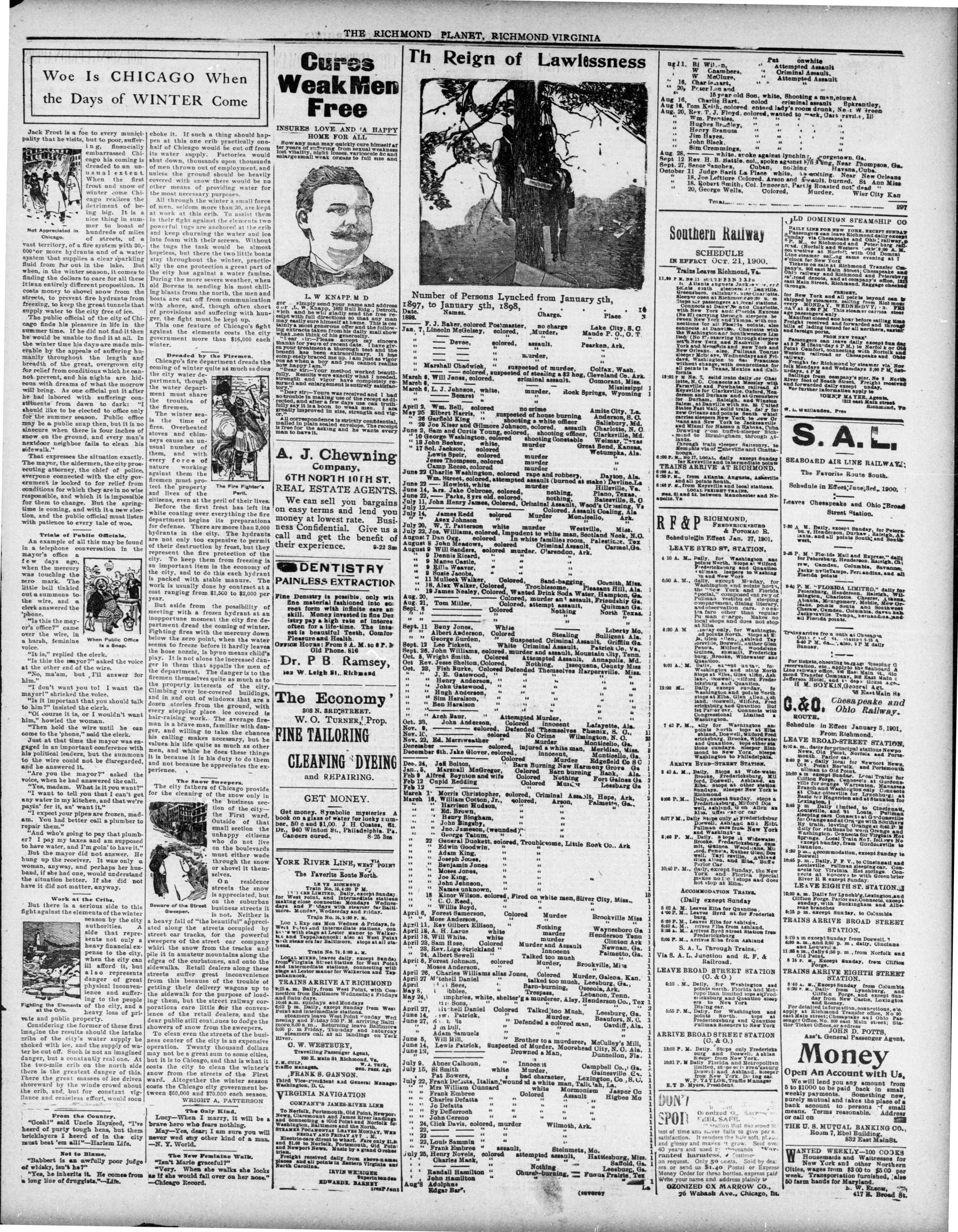
Th Reign of Lawlessness
THE TREE
INSURES LOVE AND 'A HAPPY HOME FOR ALL
How any man may quietly cure himself af ter years of suffering from sexual weakness lost vitality, night losses, varicocele &c and enlarges small weak organs to full size and
L. W KNAPP. M D
gor . simply send your name and address
our L. W. Knapp. 1822 Hull Bldg. Brew
wich and he will gladly send the free re-
ceipt with full directions so that any man
can himself at home. This is can-
tainly a most useful offer and the follow-
ing extracts taken from his mail show
what men think of his generosity.
"Tear it;-Please accept my sincere thanks for years of recent date. I have given my element a thorough test and the benefit has made my ordinary. It has completely braced me up. I am just as vigor as as when a boy and you cannot realize how happy I am."
sir--Your method worked beautifully. Exactly what I needed, strength and vigor. completely returned and enlargement is entirely satisfactory. "Dear sir--Weres was received and I had no trouble in making use of the room, rected, and after a few days use can truthfully it is a boon to weak men. I am greatly improved in size, strength and vigor."
All correspondence is strictly confidential
mailed in plain sealed envelope. The receipt
is free for the asking and he wants every
man to have it.
A. J. Chewning Company.
A. J. Chewning Company.
6TH NORTH 10TH ST.
REAL ESTATE AGENTS.
We can sell you bargains on easy terms and lend you money at lowest rate. Business Confidential. Give us a call and get the benefit of their experience. 9-22 8m
PAINLESS EXTRACTION
Fine Dentistry is possible, only with fine material fashioned into eco-rect form with infinite skill. Money invested in fine Dentistry pay a high rate of interest often for a life-time. The interest is beautiful Teeth, Comlor Pleasure and Health.
OFFICE HOURS: From 8 A. M. to 6 P. M.
Old Phone, 816
Dr. P B. Ramsey,
102 W. Leigh St., Richmond
The Economy'
808 N. BRD'STREET.
W. O. TURNER' Prop.
FINE TAILORING
GET MONEY.
Get money. Symbolic mysteries. A book on a glass of water for lucky num-
bers. St. J. H. Coates. St. Dx. 940 Winton St., Philadelphia. Cancers cured. 8:28 a.m.
YORK RIVER LINE, WEST POINT
The Favorite Route North.
LE VE RIGHMOND
Tuesday, 10:30 a.m.
121 ONE LIMITED, Daily, except Sunday
for West point, and intermediate stations
connection Monday, Wednesdays
and Friday, at Baltimore, St. Pauli
more. Monday, Wednesday and Friday.
Train No. 16, 2:20 P.M.
Loc L Exp. ex Mon Wednes & Fridays, for
intermediate stations. con
walls with stage. at Baltimore,
st and Tappahannock; at West Point
with steners for Baltimore. stops at all sta
Train No. 74. 5;90 A. M.
LOGICAL MIXED, leaves daily, except Sundays,
from Virginia Street Station for West Point
and intermediate stations, connecting with
the motor manor for Walkerian and Tappanhack.
TRAINS ARRIVE AT RICHMOND
9:15 a.m. Bally, from West Point, with
connection from Baltimore Wednesday Fridays
and Satuays.
6:45 a.m. sundays and Mondays
from West Point and intermediate stations.
steamers leave West Point vonday Wednesday and Friday: 5:50 P. M. arriving Salti more, 8:00 a.m. P. Returning leave Belfmore 6:00 p. m. Friday, Thursday and Saturday steamers call at all landings on York River.
C. W. WESTBURY,
Travelling Passenger Agent,
930 E. Main St Richmond, Vs.
J. M. GULF,
W. A. Turk,
TARIC MALLE
VIRGINIA NAVIGATION
To Norfolk, Portsmouth, Old Point, Newport
News, Claremont and James River landings
and connecting a 101 Point and Norfolk For-
danceimore and the North.
STRAMER POAGNAMORE on SUNDAY, WEB
NEDLEY and FRIDAY AT 11:00.
Electric-cars direct to wharf.fare only $35.
and $109 to Norfolk, Portsmouth, Old Point
and Newport News. Music by a grand Orchestra trium.
Freight receive daily from above-names
Ground and all points in Eastern Virginia
and North Carolina.
Southern Railway
SCHEDULE
IN EFFECT OCT. 21, 1900.
Trains Leaves Richmond, Va.
11.08 P.M. NOV. 10, 1828 JAP.
In Atlanta, Ames, Jackson, and
P.O. Box 500, sleeper or lay-
ville.
Greenaboro, saluburb. 3rd Charlotte.
Sleeper open at Richmond 6000 b. m.
7:30 p.m.
Connects at Danville and Charlotte, with New York and Florida Express, with travel through sleepers beetween New York and Florida, with connections for all Florida points, also connects at Danville, Charlotte with the southeastern and southwestern Limits (No New York connections). New York and Nashville, New York and Memphis and New York and Memphis, and human tourists sleeper Moke say, Wednesdays, days, Washington to San Francisco without change, with connections for all tourists in Texas, Mexico and California.
15:30 P M No. 7, solid train daily or, Orat
lotte, N. C. Connects at Mesley with
Parmville and Powhatan railroad at
Denderson and Durham, Henderson
and Durham and at Gatineau
for Durham, Raleigh, and Winston
Salem at Daville with No. 88 United
States, and solid train, dal y for
new Orleans and New York, carries sleeps new New York, to New
Orleans and New York to Jacksonville
and Miami for Miami & Habana, Cuba
from buffet-sleeper Schim-
mond to Birmingham through
Atlanta.
Through train sleeper Sainbury, to
Memphis via of $sheville and Chattau-
gne.
6:00 P.M. GO IT, LOCAL, daily except Sunday
for Kervestin and intermediate points
TRAINS ARRIVE AT RICHMOND.
6:36 A.M.
6:25 F. M. - from Atlanta, Auguste, Anselville
6:40 F. M. - from Keysville and local stations.
6:44 F. M. - from Keysville and local stations.
LOCAL PRELIGHT TRAIN.
Nos. 61, 62, between Manchester and Neapolis, Va
R F & P RICHMOND,
FRED BICKS&BURG
Schedulein Effect Jan. 27, 1801.
LEAVE BYRD ST., STATION.
4 10 A. M., Pally, for Washington and
points North. Stops at Wilford
Fredrickson'surg and Quatice
tall man on the way to Washin
in and New York.
6:50 A. M., daily, except Monday, for Washington and points hort, the "New York" special," composed enty of Pullman vestibed卧 sleeping compartment, dining literary, and observing trafa fare other than regular Pu man charge. Makes no local stops and does not stop at Eiba.
8:20 A. M., away only, for Washington, ad points north, stops at Eiba, Glen, Alem, ororville, Boswell, author Glen Penola, Milford, Woodlane Guinea, summit, Frederick burg, Brooke, Widewater and Quantico.
9:01 A. M., Daily, except untar, for Washington and points north stops at Eiba, Glen, Alem, Ashland, Boswell, wilford Frederick burg, Brooke, Widewater and Quantico.
12:00 A. M., Daily, except untar, for Washington and points north stops at Eiba, Glen, Alem, Ashland, Boswell, wilford Frederick burg, Brooke, Widewater and Quantico. Bifet Parlor orr. Connects with Congressional Limited at Washington.
7:42 P. M., Daily, Washington and points north stops at Eiba, Shland, Boswell, wilford Frederick burg, Brooke, Widewater and Quantico. Bifet Parlor orr. Connects with Congressional Limited at Washington.
8:40 A. M., Daily, Stops at Wide-water Brooke, Frederick burg, Milford Doswell, stops at other station Eiba. Stops at other station Sundays. Sleeper New York to New York. Sleeper Washington to Philadelphia.
8:06 P. M., Daily, stops Sunday, stops a Frederick burg, Milford Doswell, ashland, Glen Allen an klona, unless as or car.
6:57 P. M., Daily stops only at Frederick burg, Dowell, and Eibet Pullman cars from New York and Washington.
8:40 P. M., Daily, stops at Wide-water Brooke, Frederick burg, Sam mit, Quinnea, Glen Allen, Mord, Penola, Ruther Glen, Doswell, Tayl reville, Ashland Glen, and Eiba. Pullman Car.
10:40 P. M., daily, except Sunday, the New York and Florica Special makes no stops and does not stop at Eiba.
ACCOMMODATION TRAINS.
(Daily except Sunday
8 02 A. M. Leaves Elba for Quantico.
4 00 P. M. Leaves Byrd st for Frederick
6 30 P. M. Leaves Elba for Ashland.
6 40 A. M. rives Elba from ashland.
8 36 A. M. Arrives Street Station from
Fredericksburg.
6 00 P. M. arrives Elba from Ashland
S. A. L. Through Trains.
Via S. A. L. Junction and R. F. &
Railroad.
LEAVE BROAD STREET STATION
(O. & O.)
6 10 M. Daily, for Washington and
points north. Florida and Met-
roplorburg limited tops agro-
ploriosburg and Quantico sleep-
ers to New York.
Dining car.
5 55 P. M. Daily for Washington and
points North. tops at
Fredericksburg and Quantico
Pallman Sleepers to New York
ARRIVE BROAD STREET STATION
(O. & O.)
12:08 P. M. Daily. Steps only Fredericks
nurg and Doswell. Ashlan
Sleepe from New York.
10:51 P. M Daily Florida and Metropolitsen
Limley st. p.o. tree ksung
Doswell and Ashland. Sleepe
from New York. During our
W.P. P. TAYLOR, Traffic Manager
E.T. D. Myers. President.
DON'T
SPOD
Ogranted G.
FEEL SAFE.
DON'T
SPOT
test of time and never fails to give per-
satisfaction. It renders the hair soft, pli-
ess and glossy and makes it grow. Sold over
40 years and used by thousands Warr-
anted harmless. Costume on request. Only 50 cents. Sold by de-
ers or send us $1.40. Postal or Express
Money Order for three bottles, express paid
Write your name and address plainly to
OZONIZED GX MARROW CO.,
26 Wabash Ave., Chicago, hn
LD DOMINION STEAMSHIP CO
DAILY LINE FOR NEW YORK. EXCEPT SUNDAY Passengers can leave Richmond daily except Sunday via Chesapeake and Ohio; railway, S.P.M. or Richmond and Peterburg rail. (Norfolk and Western route: 9:00 A.M. collecting at Norfolk with Old Dominic Line steamer sailing same evening at 7 o'clock for New York
Tickets on sale at Richmond Transfer Omnibus Railway Main Street; Cheapeake and Ohio railway Main Street; Cheapeake and Ohio railway Main Street; and at company's railway road deposits, and at company's main Main Street. Richmond. Raggage checked through.
FEIGHT.
for New York and all points beyond can be shaved steamers, sailing from Richmond every MONDAY to DNDSVY; i. FRI 04AY at 5:00 P.M. This steamer carries sleeper age passengers only.
Manifest the car before bailing sea time. Freight received and forwarded and through bills of lading issued for all others, center and foreign ports.
NEW YORK NEW YORK
Passengers can leave daily except Sun day (Satunday) 4 P.M.) to Nortok or Old Point Carroad, connecting with Nortok and Western railway for Richmond by steamer vis. Nortok Mondays and Wednesdays 3:00 P.M. Saturday, 4 P.M. Sailing from company's pier. No 2 Nortok River Railway Street. Freight received and forwarded daily.
For further information apply to
IOKNF MAYER, Agents.
1813 east Main street
Richmond, Fw
w. b. h. Willard Park.
S.A.L.
The Favorite Route South.
Schedule in Effect June 3rd, 1900.
Leaves Chesapeake and Ohio Broad Street Station.
7-90 A. M. Daly, except Sunday, for Petersburg, Henderson, Durhau, Raleigh, Atlanta, and all points South, and Southwest.
2-35 P. M. "Florida Mall and Express," daily for Petersburg, Henderson, Raleigh, Grew, Camden, Columbia, Savannah, Jacks-by-Elmps, Ferrandina, and all Florida points.
9-40 P. M. "FLORIDA LIMITED," daily for Petersburg, Henderson, Raleigh, Wilmington, Greer, Athena, Atlanta, Montgomery, Monroe, Jeans, points South and Northwest Jackson, Chamble, Columbia, Savannah Jacksonville, Chamble, Bermuda, and all Florida points.
Transsarrive from n outh of Chasapeau
Only 1 h. 41:10 at 1:15 A
5:40 P M, da... also, 2 P M daily
Sunday.
For tickets, checking baggage. Sleeping G
room only, apply to the Seaboard A
Line railway office, 908 East Main St.
Rio mond Transfer Company, 908 East Main St.
Jefferson Hotel, and 1 dep tickets agon.
H M. BOYKIN, General Agent.
98 East Main St.
C. & O. Chesapeake and
Ohio Railway.
C. & O. Chesapeake and Ohio Railway
ROUTE.
Schedule in Effect January 5, 1901,
From, Richmond.
LEAVE BROAD-STREET STATION,
9:30 a.m. daily for principal stations Newpo
News, Old Point, Norfolk and Portsmouth,
Parker car.
570. daily local for Newport News,
Olta. Old Portmouth
ulman to Old Point.
10:00 a.m. except Sunday. Local Traits for
Citron Forge. Connecets at Gardons-
land or orange Warrenton. Mausses
Branch or Montgomery only. Connects
at Char ootttville for Lynchburg; at
Basic 1c for Hagerson and at Staunton
for Lexington. |
2:45 p.m. Limited, to Cincinnati,
10 a.m. to 5 p.m., Portsmouth,
sleeping cars Connects to South,
for Orange and at Orale with Souther-
Midday for stations in range at 6:40 p.M.
Midday for stations in range at 6:40 p.M.
Washington. Connects for Virginia Hot
Sports No. 7, foll ows No.
except sunday, from Gordonsville to
Ilamun.
5:20 p.m. Accommodation, except Sunday to
Ilamun.
10:45 p. m., Dally, F. F. V., to Clinematani and
Louisville, fullman sleeping car. Connects
for Virginia Hot springs. Connects
at kennedy to with Green bear
River R E except sunday.
LEAVE EIGHTH ST. STATION.
10:30 a. m. with *Lynobhy* (Lexington and
Buckingham), with *Daffy* (Sunday), with *Buckingham* and Albe-
sunday.
STATION.
8:00 a.m except Sunday from Doswell. 7
8:30 a.m., m., and 8:30 p.m., m., daily, Cincinnati
and Louisville.
11:30 a.m except 6:50 p.m., m., from Norfolk and
Old Point.
8 15 p. m., Except Sunday, from Clifton
Forge.
TRAINS ARRIVE EIGHTH STREET
STATION.
8:40 a. M., Except Sunday from Columbia
8:20 f. M., Mall., from Lynchburg, and
Clifton, Jorge, and except Sunday
from New Castile, Loxington
and Rosney.
For detailed information, connections, etc. apply to the General Transfer Office, No. 909 east Main street, Ohio Passenger Office, No. 809 east Main street, Statior Ticket Office, or address
JOHN D. POTTS,
Ass't. General Passenger Agent.
Money
Open An Account with Us.
We will lend you any amount from 5 to $1000 to be paid back in small weekly payments. Something new, purely mutual and takes the place of a bank account to persons of small means. Terms reasonable. Address or call on
THE U. S. MUTUAL BANKING CO.
Room 7, Ebel Building,
832 East Main St.
WANTED WEEKLY-100 COOKS
Housemaids and Waitresses for
New York and other Northern
Cities, wages from $30 to $50 per
week. Transportation furnished, also
50 farm hands for Maryland.
b. W. ELSON,
417 E. Broad St.
THE PLANET
JOHN MITOHEIL JR. EDITOR
All communications intended for publication should be sent so as to reach us by
TERMS IN ADVANCE
One Copy, one year.....$1
One Copy, eight months.....$1
One Copy, six months.....$1
One Copy, four months.....$1
One Copy, three months.....$1
Single Copy.....$0
ADVERTISING RATES
for one inch, each insertion . . . 2
for one inch, each subsequent insertion . . . 4
for two inches, six months . . . 6
for two inches, six months . . . 10
for two inches, nine months . . . 14
for two inches, twelve months . . . 20
arranging a funnel . . . 28
landing a d. transient notices per line
POSTAGE STAMPS OF A I NOMINATION
HIGHER THAN TWO CENTS √T RECEIVE
IN SUBSCRIPT . . . NS.
THE PAYMENT is issued weekly. The subscri-
tion price $1.50 a year in advance.
our price is $10 a year, in advance. Money can be billed by mail at our risk—in . . . Post Office Money Order, by Bank Check or Draft, or an Express Money Order, by Bank Check or Draft, or an Express Money Order, by a Registered Letter.
MONEY ORDERS.—You can buy a Money Order on your Post Office, payable at the Richmond United States Express Co., and the Wells Fargo and National Express Co., and payable for money sent by any of these companies. The Express Money Order is a safe and convenient way for forwarding money.
REGISTERED LETTER.—If a Money Order Postmaster has written to you, reach your Postmaster will register the letter you wish to send us on payment of ten cents then if the letter is post or stolen, it can be in any other way, you must do it at your risk.
We cannot be responsible for money sent to you, but you can pay a way than one of the four ways mentioned above to the Postmaster in any other way, you must do it at your risk.
We cannot be responsible for money sent to you, but you can pay a way than one of the four ways mentioned above to the Postmaster in any other way, you must do it at your risk.
If you do not want the Fax continued in an office, run set up, you then notify us of a card to discontinue it. The courts have ordered that newspapers who order their paper, at a time of for which it has been paid be a table for the payment of the subscription rate when they order the paper discontinued.
COMMUNICATION :- When writing to us
your name, you should give your name and
address to us, all, otherwise we cannot find you
on our books.
COMMUNICATION :- In order to change
address of a subscriber we must be sent the
address as well as the present address.
Served in the Post-Office at Richmond, Va.
second class matter.
SATURDAY, FEB. 23, 1901
The National Anti-mob and Lychelaw Association of Springfield, Ohio is now raising funds to prosecute the lynchers who burned Fred Alexander at the stake.
Any further information may be secured by addressing Mr. Samuel E. Huffman, Secretary.
The cause is a worthy'one and every effort should be made to hunt down the fiends guilty of such atrocity.
GENERAL MAC ARTHUR had a grand ball in the Philippines and the dark-skinned maidens duced with the officers of the army and navy. Southerners and Northerners joined in the diszy whirl. What excuses will be given to anxious home folks upon their return?
---
The Executive Committee of the
Ministers; Allies of Kansas City,
Kansas, representing the fifteen colored
churches of that city, has issued an
appeal for $10,000 with which to prosecute the leaders of the mob who burned Fred Alexander at Leavenworth,
Kansas, Tuesday, January 15th, 1901.
It calls upon Gov. Stanley, to offer a reward of $500.00 for the conviction of the murderers.
The document is signed by Messrs.
E. V. PLUMMER, president, Prof. H. R.
PINKNEY, Secretary, E. A. WILSON,
G. A. GRIPHITE, L. W. GRANT.
THE CONSTITUTIONAL CONVENTION.
The legislature of Virginia has adjourned. Before doing so, it passed a bill providing for the holding of a constitutional convention. The body will consist of one hundred members and they will be elected on the fourth Thursday in May. 1901. The Convention will meet June 12, 1901, and the new constitution is to be submitted to the people for ratification or rejection November 5. 1901. In case the convention does not complete its work in time, the next General Assembly is to provide for the submission of the new constitution to the people. It is now stated that the opposition to the wholesale disfranchisement of the colored people has become so pronounced that it seriously endangers the success of the convention itself.
The indications are that it will be an "all white" convention. However, we hope that colored men will offer themselves as candidates and work like beavers to get counted in.
PLAIN TALKING.
THE Richmond, Va. EVENING LEADER in its issue of the 15th inst says:
A fair and impartial trial can not be had in the face of bayonets," said a Vadu in Judy yester year in a conversation with a representative of the Evoking Leader. "If a person, white or black, shall ever be placed on trial in either one of the two County Courts over which I have the honor to pre-
side, and it becomes necessary to order out a military company to protect the life of that person while he is on trial. I shall grant a change of venue. Justice becomes a farce when a person has to be tried for his life and soldiers have to save that life until a verdict has been rendered."
That is good common sense and it should be the practice in every county in Virginia. A year or two ago a man was tried for a heinous offence in this state, and while the trial was going on a mob was hanging around the court house. One of the mob actually went into the house and tried to throw a rope around the prisoner neck, while he was sitting in the room. O'Ferrall heard of the trouble and ordered out the military, or else the man would never have been brought to trial. But the presses of the soldiers had no other effect than to keep the mob from taking the prisoner out and lynching him. The mob was there and its iti fiance was dominant. There was no chance in the world for the prisoner on trial. His doom was sealed. There was a trial, but it was a mocker, and he was vailed and if a jury failed to bring in a verdict of guilty, even the soldiers could hardly have kept the mob from taking vengeance on the prisoner.
Every man accused of a crime is entitled to a fair trial by a jury of his peers upon the evidence and without prejudice. It is almost impossible for him to get such a trial in a community where the feeling against him such that the presence of the military is necessary to protect him from mob violence.
We recall a case during the administration of Governor McKinney, to which reference has more than once been made in the public print. Two white men were accused of criminal assault, and the indignation against them was so great that the Governor ordered out the military to protect them from the mob.
Court was in session at the time the matter was brought before the grand jury, a true bill was found and the case was adjudicated while the spirit of popular indignation ran high. The men were convicted and condemned to a long term in the prisonerhouse.
About two years thereafter, one of the women concerned was again in the court as a witness and she prefaced her testimony by saying that she would tell the truth in spite of pressure that had been brought to bear upon her; that she had perjured herself once and sent two men to the penitentiary, and that she would not repeat the offence. This caused something of a sensation in the court-room and she was called upon to explain. She then confessed that in the case under review she hadorn falsely against the men of trial, which had not committed the crime with which they had charged and of which they had been convicted and that she had since been much troubled in mind because she had been instrumental in sending them to prison.
Of course the presiding judge and the Commonwealth's Attorney lost no time in communicating the facts to Governor McKinney and the m were forthwith pardoned, but they had been made to wear the stripes of a fellow on for two years, as we recall, and subjected to the disgrace and mortification of a penitentiary sentence, all because they were tried under circumstances which absolutely precluded anything like a fair and deliberate trial.
When journals of standing give voice to such utterances it tenus to show that we are returning to "the feast of reason, and flow of the soul."
Yes, this Virginia jurist was right. Law is being overturned, and the foundation principles of equity areeered at.
No government can long continue which permits its written mandates to be disregarded, and its solemn decrees east side. Lynne law must go!
All She Wanted
He—A maid must not expect such lovers as she finds in books. Few men are paragone.
She—Ohl I should not expect a paragon. I should be satisfied with a lover, young, handsome, brave, noble and unselfish—Puck.
Woe.
O, pitying reader, stop and think
What widespread misery must maks
When a man who weighs 500 pounds
Is suffering from the stomachache!
-Chicago Tribune.
"My dear, won't you give me a look of your hair?"
"With pleasure, my darling."
"And a nice gold locket to keep it in?"
—Sondage-Nisse.
"Amelia, when a letter came from you while you were away I did not read it for a day at least."
"What was that for, Edgar?"
"Don't you see? I saved one day's interest on the money you asked for." —Chicago Record.
Certainly Waa Short.
"Did he propose last night?" asked the blonde.
"He did," answered the brunette.
"As I recollect it," suggested the blonde. "you said that he had been so tiresome and dilatory that you proposed giving him a short answer."
"And that's just what I gave him," assented the brunette, defiantly.
"I said 'Yes.'" —Chicago Post.
Unprofitable.
Mrs. De Timide—Captain. If they were only able to invent ships that did not roll at all, don't you think that there would be a great increase in ocean travel?
Capt. Crosser — No doubt, but it wouldn't pay. Passengers on a ship that didn't roll would eat 18 times as much and wipe out the profits.—N. Y. World.
THE RICHMOND PLANET RICHMOND. VIRGINIA
CONGER TO PROTEST
Against Waldersee's Proposed Expedition Against the Chinese.
HIS INSTRUCTIONS FORWARDED.
Proposed Expeditions Are in Violation of the Rights of the Individual Parties to the Peace Negotiations, Because They Menace Success. Washington, Feb. 20.—Minister Conger has been instructed by cable to communicate to the foreign ministers at Pekin the feeling of the United States government that further hostile expeditions should not be indulged in at this time.
This action was taken by the state department after the cabinet discussion had developed the attitude of the administration. It is understood that this course was regarded as best, since it left room for another appeal to the powers directly through their foreign offices in case Mr. Conger's efforts are futile. The state department officials decline to make public the text of the note. However, it was said to be in perfect accord with the policy already developed and to make manifest the deep conviction of the United States government that these proposed hostile expeditions are in violation of the rights of the individual parties to the peace negotiations, because tending to bring about the failure of these negotiations.
If the threat of military expeditions is based upon a desire to force the Chinese envoys to speedier action upon the ministerial proposals, then it must be stated that our government disapproves, feeling that it has not yet been demonstrated sufficiently that the Chinese government is not acting to the best of its ability. Regarding the insistence of the foreign ministers on the imposition of the death penalty upon the whole list of prescribed Chinese officials, it is recalled that the Chinese agreed to administer the severest possible punishment, and it is conceived here that it may be entirely impossible for that government to go to the length demanded by the ministers.
These considerations are of course known to the foreign ministers in Pekin, but it will be Mr. Conger's duty to refresh their recollections as to the engagements their governments entered into with the United States, as well with China, and he will point out that our attitude is in exact accordance with the line laid down in the formal notes preceding the beginning of the negotiations. The United States government will continue to deal with the other powers through their diplomatic agencies, ignoring the suggestion that the ministers at Pekin have no control over the military forces stationed there, and carrying out the same theory Gen. Chaffee will act in thorough harmony with any suggestions made by Mr. Conger.
CHINESE EMPEROR YIELDS
Will Comply With All the Demands of the Powers.
Pekin, Feb. 20.—Prince Ching and Li Hung Chang have received a telegram which virtually means that the Chinese will comply with all the demands of the powers, although they still desire information on a few minor points. The foreign envoys look forward confidently to absolute compliance tomorrow at the latest.
Prince Ching and Li Hung Chang have been greatly worried by the preparations for the expedition into the interior, and they have strongly urged the court to yield, pointing out that the dismemberment of the empire was probable.
The Pekin correspondent of the London Morning Post telegraphs his paper that he understands that Gen. Voyron, the French commander, is willing serve under Count von Waldersee in the expedition. He emphasizes the difficulties of transport and commissariat likely to be experienced in the provinces of Shan-Si and Shen-Si, both of which are afflicted with famine, and says:
"A large Chinese army is preparing to meet the foreign advance. Even if the empress dowager yields on the punishment question it is desirable that the expedition should bring the emperor back and detain him until the demands of the powers are satisfied."
Labor's Interest in Steel Combine.
Pittsburg, Feb. 20. -The latest labor move in the great steel combination is the announcement that President T. J. Shaffer, of the Amalgamated Association, with a committee of officers, will leave for New York this week to persuade Mr. Carnegie to have inserted in the transfer of his holdings a clause permitting the organization of the employees of the combines by the Amalgamated Association or any labor organization. President Shaffer is of the opinion that Mr. Carnegie will act on the proposition, and that some clause will be inserted in behalf of the workingmen before the transfer is completed.
Digging For Dead Bodies.
Vancouver, B. C., Feb. 20—A special from Cumberland says: Six hundred feet below the ground, and over a thousand yards from the foot of Shaft No. 5 a little gang of men are at work in an heroic attempt to reach the bodies of their fellow miners who perished in Friday's explosion. Six bodies so far have been recovered. There were no marks of burning on the first four days of the conclusion therefore is that they were afflicted by the after damp. Two of the bodies recovered are mangled almost beyond recognition.
Error a British Toolbox
Urges a British Tariff For Revenue.
London, Feb. 20.—The Daily Mail, in
of the necessity of raising money
for the war, still "in
full blast," advocates a tariff for
revenue purposes, which, it says, differs
entirely from a protective tariff.
Wilhelmina's New Crown.
London, Feb. 20.—The Rotterdam correspondent of The Daily Express says: "I learn that the national present, or Queen Wilhelmina, which had taken the secret will take the form of a new crown, and that £20,000 has been subscribed."
THE NEW YORK GAMBLERS.
District Attorney Philbin's Fight Against the Poolrooms.
New York, Feb. 20.—Behind closed doors, and with every effort to maintain the secrecy of the proceedings, Justice Jerome, of the court of special sessions, yesterday held an examination of some of the men held as witnesses as a result of the poolroom raid which he and District Attorney Philbin carried out Monday at No. 20 Dev
street. It was expected that the examination would produce extremely interesting and important evidence involving the syndicate which, it is alleged, profits by the violation of the gambling laws in this city. It was hinted both by Mr. Schurman and other officers interested that prominent city officers would be implicated.
District Attorney Philbin is quoted as saying:
"The people of New York have no idea what I am bucking against. I am up against the strongest combination of brains and wealth that ever existed in this city for the purpose of evading the laws."
Mr. Philbin stated that he was determined vice should be rooted out and all offenders brought to trial. The following statement was issued:
"The district attorney desires to give warning to all persons who frequent poolrooms and all other places where the law is being violated that they may be called upon at any time to testify and give evidence before the grand jury or a magistrate as to such places."
One of the poolrooms open yesterday was that at No. 20 Dey street, which was broken into on Monday. "Club members" only were admitted.
BREAK IN DELAWARE DEADLOCK
Addicks Comes Within Six Votes of Being Elected.
Dover, Del., Feb. 20.—There was break in the ranks of the regular Republicans yesterday, when the ballot for United States senator was taken. Four "regulars" who have opposed the election of J. Edward Addicks to the national senate—Senators Groves and McFarlan and Representatives Baynard and Dayett—voted for him yesterday for the short term. Six more votes would have elected Addicks. This is probably the forerunner of what the Addicks followers have been claiming for several days past, namely, that there would be a serious break in the ranks of the regular Republicans, and that their candidate would ultimately be chosen to the senate.
Senator Groves and Representative Baynard were elected as Union Republicans, and have been credited to Addicks from the first, or whenever he needed them. Senator McFarlan voted for Addicks two years ago. This leaves the vote of Representative Dayett as the only gain for Mr. Addicks.
Predicts a Satisfactory Settlement
Washington, Feb. 20.—A communication received from Ambassador Tower, at St. Petersburg, is said to have been little more than a terse summary of the opinions of the Russian ministers and newspapers as to the prospects of further trouble between Russia and the United States. The ambassador made it plain that, in his estimation, there was little danger of any strain being put upon the friendly political relations existing between the United States and Russia, while there was a general conviction that the present economic issue between the two countries will be settled in such a manner as to leave not a scar.
Failed For a Million: Amets, 810.
Boston, Feb. 19.—A failure for a million or over, with assets to the amount of a $10 bill, was shown by the voluntary petition in bankruptcy filed yesterday afternoon by George R. Eager, a railroad builder of Newton, Mass. The actual figures of liabilities are $1,407,341. Mr. Eager's debts were contracted between 1888 and 1890, principally in Tennessee, all on notes. This is the heaviest failure recorded in this district since the bankruptcy act went into effect. The debts are all outlawed.
Urging Protection For the Flag
Washington, Feb. 20.—Gen. Thomas M. Anderson, senior vice commander of the Sons of the Aesmurian Revolution, and other officials of that organization were before the house committee on judicial yesterday advocating regulation against the desecration of the flag. William V. Cox, of the National Museum, exhibited a collection of advertisements, etc., in which the national emblem was used in an unbecoming manner. The committee took no action, owing to the lateness of the session.
Military Academy Bill Fails
Washington, Feb. 20.—By the emphatic vote of 18 to 42 the senate late yesterday afternoon rejected the conference report on the military academy appropriation bill. This action came at the conclusion of a spirited debate upon the provisions against hazing inserted in the report by the conference committee of the two branches of congress. The report of the confertees was rejected because it was regarded by a large majority of the senate as too drastic.
Causeless Rumors Caused Bank Run
Pittsburgh, Feb. 20.—False and unfounded rumors caused a run on the German National bank, of Allegheny, yesterday, during which $180,000 was paid out to certain frightened depositors. The excitement at one time during the afternoon was intense, causing almost a panic and giving the police all they could do to prevent an outbreak. One lady, Mrs. Mary Fogal, was seriously bruised and injured internally. The bank is one of the most reliable in the city.
Russian Retallation
St. Petersburg, Feb. 18.—In retaliation for the act of the United States treasury department in holding that the countervailing duty against bounty fed sugar applies to the Russian article, the Russian government on Saturday, in a decree issued by M. de Witte, minister of finance, ordered the imposition of a maximum tariff on imports into Russia of American manufactured goods.
Suffolk, Va. Feb. 18.—Pleading a lack of time in which to prepare themselves lawyers for Henry Copeland, convicted of first degree murder for killing J. D. Story almost in the presence of his wife and child, today sought further continuance of their motion to have the verdict set aside. Judge Killy continued the motion till March 12, when he said the matter must be settled.
Atlanta, Ga., Feb. 19.—The dead bodies of Mrs. H. M. Wilson, a young widow, and William Hamilton, a student in pharmacy, who disappeared from Atlanta a week ago, were found Sunday night, one mile from the end of the Chattahoooche street car line. The surroundings indicated that Hamilton had killed Mrs. Wilson, set fire to the woods near her body and then ended his own life. Both bodies were fearfully burned. It is known that Hamilton had been devoted to Mrs. Wilson for some time, but her parents assert that she gave him no encouragement.
CRUSADERS KILL WOMAN
Wife of a Kansas Bartender Murdered by Masked Men.
WENT IN TO DEMOLISH PROPERTY
The Murder Frightened the Raiders, However, and They Became Panic Stricken and Fled Without Doing Any Damage to the Saloon.
Millow, Kan., Feb. 20.—In a raid on a "joint" here by 20 masked men, heavily armed, late Monday night, Mrs. Rose Hudson, the bartender, was instantly killed. Willow, Wich, one of the raiders, was shot through one arm and two or three of his companions were slightly wounded. Young farmers compiled the party. Four arrests were made yesterday and much excitement prevails over the prospect of a still more serious collision between the factions. The men arrested are John Willburn, William Thornburg, Andy Wilson and a man named Turner. Willburn is but 28 years of age, and each of the others are 26.
Shortly after 10 o'clock two men entered the "joint," which is said to be owned by Mrs. Michael Lochner. Warning had been served on the proprietress to cease business, but compliance was refused. When the men entered they ordered drinks, which were at once served by Bartender Hudson. One of the men rapped loudly on the bar, and at this signal about 20 more men rushed into the place. All carried arms and wore masks.
Half a dozen shotguns were raised and discharged into the ceiling, apparently to demoralize the keepers of the place. Two men rushed upon Hudson with guns levelled at his head. He grasped the barrels and pushed them aside just as they exploded. Hudson slipped to the floor. Just then Mrs. Hudson burst open the rear door and entered. She dashed toward her husband, whom she supposed to have been shot. Hardly had she crossed half the intervening space when another gun was discharged point blank at her head. The whole top of her skull was blown away, and Hudson, regaining his feet, bore to the rear room she died. Ten men to have been waiting under arms to help defend the "joint" from the expected raid, but when the band entered the place and began shooting the defenders became panic stricken and decamped. When the raiders saw Mrs. Hudson fall dying they, too, became frightened and hastily quitted the place without attempting to destroy the liquors or fixtures.
MRS. NATION A PRISONER.
She Refuses to Give Bonds and Remains Behind the Bara.
Topeka, Kan., Feb. 19.—Mrs. Nation is now in the county jail as a result of her trial on a peace warrant before Judge Hazen yesterday. The warrant was sworn to by the Moeser Cold Storage company, whose plant Mrs. Nation entered Sunday morning.
Mrs. Nation acted as her own attorney in the trial. Judge Hazen placed her under $2,000 bond to keep the peace and ordered her to appear before him at the next term of court. Mrs. Nation refused to give the bond and said she would not be detained in the hospital room of the county jail, where she will probably main for some time. The crusader declares that she will resume her smashing crusade against the "joints" immediately upon her release. Three of her lieutenants are also placed under bonds.
Mrs. Nation put in a busy Sunday in Topeka, and as a result the capital city experienced more genuine excitement than can be remembered by the oldest inhabitant. The crusader literally crammed the day with thrilling episodes. She succeeded in having the contents of a notorious joint smashed, broke into a cold storage plant in a snow cave, ruined the mirrors on several bars for stored in a livery barn, addressed a large number of men and women and was arrested times. In the various raids, which were followed with military precision, Mrs. Nation was obeyed as implicitly as any commanding general.
A Michigan Saloon Smasher
Port Huron, Mich., Feb. 20.—Mrs. Charles Rhodes yesterday entered James Wilson's saloon and asked for her son, who it appears hangs around Wilson's establishment. He was not there, and after giving the bartender lecture Mrs. Rhodes suddenly drew a hammer from under her cape and began to break a showcase containing bottled goods. She broke all the glass front and about ten bottles of whisky. The bartender then put her out. Mrs. Rhodes stated that she sad served notice on the saloon keeper not to sell her son liquor. Wilson will ask for a warrant for Mrs. Rhodes' arrest.
Saloon Ralded at Newman.
Newman, Kan., Feb. 20.—A band of 30 men and women, armed with hatchets and axes, made an effective raid on a joint here yesterday. They completely demolished a costly cherry bar, a plate glass mirror and other fixtures. There was not much liquor in the place, but it was destroyed. A friend of the jointist tried to protect the property with a shotgun. One of the crusaders, named Gorrell, in trying to get possession of the gun was struck on the head with it and*seriously injured.
Joints Closed by City Marshal
Great Bend, Kan., Feb. 20—The seven joints in this city were closed yesterday by the city marshal. This action is the result of a demand of a committee of citizens, which was presented to the city officials. The officials were told that the joints would be smashed if they were not closed.
Roosevelt Homeward Round
Colorado Springs, Feb. 20.—Governor Theodore Roosevelt left for the east east evening after another day hunting coyotes on the plains east and south of Colorado Springs. The ride yesterday included eight runs after coyotes, in only two of which, however, the dogs were let loose. The distance powered was more than 50 miles.
A WEEK'S NEWS CONDENSED
Thursday, Feb. 14.
A bill passed both houses of Delaware's legislature providing the whipping post for wife beaters. The senatorial deadlocks in Delaware, Nebraska, Montana and Oregon continue, fruitless ballots being taken daily. At the bidding of Mrs. Nation a Chicago saloonist draped a statue in gauze. This was unsatisfactory to the cru-
sader, and he put a Mother Hubbard on it.
A movement for the purpose of bringing the Olympian games to Chicago in 1904 has been started by representative business men and members of the University of Chicago faculty.
Friday. Feb 15.
The Jeffries-Ruhlin prize fight at Cincinnati, enjoined by Judge Hollister, has been declared off.
A Louisville capitalist is forming a pool to buy $1,000,000 worth of whisky for speculative purposes.
A mad bulldog dashed into a Chicago schoolroom yesterday, and before it was driven out it had severely bitten three children.
Alexander W. Longfellow, a brother of the American poet, Henry W. Longfellow, died at Portland, Me., yesterdad, aged 86 years.
Senator H. S. Earle, of Michigan was elected president of the League of American Wheelmen by the Philadelphia convention yesterday.
Saturday, Feb. 16.
The ship subsidy bill will probably not reach a vote at this session of congress.
Five men were suffocated yesterday by white damp at the Beath colliery in Fifeshire, Scotland.
Fire and explosions in a mine at Cumberland, B. C., resulted in the death of 61 men.
To avert another Sampson-Schley controversy, it is likely that both will be created vice admirals.
Near Colquitt, Ga., a 100 horsepower boiler in a sawmill exploded, killing William Green and James Garsi.
Jacob Turner, one of the best known ushers at the executive mansion in Washington, died yesterday at Hot Springs, Ark.
In Berlin there was a steady increase in the number of unemployed during January. There are now 166 such persons to every 100 jobs.
Monday, Feb. 18.
King Victor Emmanuel, according to the London Daily Mall, will visit London next May.
Sir Francis Cook, who in 1885 married Miss Tennessee Claflin, of New York, died last evening in London.
W. K. Vanderbilt and a party of friends sailed from Savannah, Ga., on Saturday for a cruise of the Mediterranean aboard the yacht Vallant.
All Europe is experiencing a return of winter weather. Severe cold and snow storms are reported from all parts of England, Germany, Italy, Austria and Russia.
Seven miners, including the superintendent, were blown to atoms at the Commerce mine, in Graham county, Arizona, Saturday by the explosion of the company's magazine.
Tuesday, Feb. 19.
National senate passed the bill appropriating $5,000,000 for the St. Louis Louisiana Purchase exposition.
Capt. W. O. Clark, of the Twelfth United States infantry, was appointed governor of Tarlac, Philippines.
The London county council has decided to spend £5,000 in precautionary measures against the bubonic plague in London.
The membership of Daniel B. Hatch, of the New York Stock Exchange, has been sold for $51,000, which equals the highest record price.
Yesterday the dam at the village electric plant of Thompsonville, Mich., went out with a roar. Edward and Ernest Crandell were drowned.
At Abingdon, Va., a new reservoir boomed yesterday and liberated 1,000,000 gallons of water. John Cook and a lad named Hall sustained serious injury.
Wednesday, Feb. 20.
M. Paul Armand Silvestre, French poet and critic, died in Toulouse, France, aged 64.
A contribution of $250,000 by John D. Rockefeller to Brown university was announced last night in New York.
Hon. Tom L. Johnson, the well known capitalist, was nominated for mayor of Cleveland at the Democratic primaries.
The fire and police board of Denver, after a lengthy investigation of charges of receiving bribes from criminals, demanded the resignations of all the officers accused.
Two thousand Polish citizens of Toledo have signed a petition asking for a federal appropriation for the erection of a monument to the memory of Pulaski, the Polish patriot.
GENERAL MARKETS
Philadelphia, Feb. 19.—Flour steady; winter superfine, $2.25/g. $25/g; Pennsylvania roller, clear, $3.10/g. $25; city mills, extra, $2.90/g. $2.80/g. Rye flour in limited request at $2.90/g. $2.85/g per barrel for choice Pennsylvania, $2.75/g. $2.75/g, red spot, $7.75/g. Corn dull; No. 2 million; $44/44c. No. 2 yellow, for local trade, $44/44c. Oats dull; No. 2 white, clipped, $32/c. lower grades, $39/c. Hay quiet; choice timothy $1/c. $1/150 for large bales. Beef and broiler, $1/150 for large bales, $1/150 for large family, $16.25/16.75; mess, $13.75/14.50. Lardriquet, western steamed, $7.70. Live poultry quoted at 10/104c. for hens, 7c, for old roosters, 10/104c. for young chickens, 12/104c. for spring ducks, for turkeys and 10/116c for geese. Dressed beverages at 10c, for choice western fowls, $76/116c, for old roosters, $12/113c for choice and fancy nearby turkeys, 13/114c. for fancy selected nearby turners, $12/113c for choice and fowls, $12/113c for size of the same, $76/116c for geese. Butter steady; fresh creamery, 10/22c; factory, 11/150; June creamery, 15/20c; limitation creamery, 14/18c. New York dairy, 13/21c; fancy non-carnivale dints, 1/25/25c; do, wholesale, $4c. Cheese firm, 1/25/25c; large fall made, 11/114c; fancy small fall made, 12c. Eggs steady; New York and Pennsylvania, at mark, 1/c. western duets, $16/164c. southern do, 18c. Potatoes quiet; Jersey, $1.25/175; New York, $1.50/175; Long Island, $50/175; Jersey sweets, $1.75/250.
East Liberty, Pa., Feb. 19—Cattle mark
nursery, common, $4.55, 7.50. Hogs slow,
$5.25, common, $4.75, 7.50. Sheep slow,
$5.25, medium, $5.55, 7.50. best Yorkers, $5.50
$4.55; heavy hogs, $4.55; pigs, $4.55;
sheep, slow and lower on lambs, choice
wethers, $4.60, 7.55; common, $4.55; choice
lambs, $2.00, 7.50; common to good, $4.55;
veil calves, $7.50..
Woodstock, Va., Feb. 15—The council
of the town of Woodstock has contracted with Mr. G. L. Mckinna of Slew, W. Va. for the construction of the waterworks system at the sum of $18,200. Work is to be commenced within 30 days and completed by June 1, 1901.
Irvington, Va., Feb. 18—Petitions requesting the repeat of the local option law in Whitesboro and White Chapel districts, Lancaster county, were handed to Judge Ewell, at Lancaster court, today by the whisky men, and an election was at once ordered to be held in the districts named.
Fredericksburg, Feb. 18.—Work on the improvements and additions to the Montpelier mansion, the former home of President James Madison, in Orange county, ordered by the new owner, Mr. Dupont, of Delaware, are progressing rapidly, a large force of hands being employed. A telephone line is being erected to connect the mansion with Orange Court House.
ROUNDINGUPKIDNAPERS
One of the Men Who Stole Edward Cudahy Behind the Bars.
IDENTIFIED BY THREE PERSONS.
Young Cadahy Declares Positively That Callahan, the Man Under Arrest, Was the Man Who Guarded Him—Prisoner Denies Compplicity.
Omaha, Feb. 20.—The police have under arrest James Callahan, charged with complicity in the abduction of Edward Cudahy, Jr., on the night of Dec. 18. Callahan was arrested last Saturday, but the police kept it a secret until yesterday in the hope of securing other arrests. Young Cudahy has positively identified him as the man who accosted him near the Cudahy residence and represented himself to be a sheriff from an adjoining county and forced him into a buggy, and also as the man who kept guard over him at the Melrose Hill house during the 20 hours he was kept prisoner, pending the negotiations for the ransom of $25,000 which Mr. Cudahy paid for the return of the boy. Daniel H. Burris, two sons horse and buggy to two men are supposed to have used it to procure the whistle, also identified Callahan as one of the whom he made the deal. Marie Larsen, a servant in the employ of J. N. H. Farrick, of whom the kidnappers rented a house, was the third person to identify Callahan, and says he is the man who paid a month's rent in advance for a cottage in Happy Hollow, which the bandits abonded two weeks before the abduction, fearing discovery.
Callahan denies absolutely that he had anything to do with the kidnapping, but admits that he was a close friend of Crowe. He says he can prove an alibi, and states that during the time which it is claimed he spent guarding young Cudahy he was at the home of his sister, a Mrs. Kelly, living at Popleton avenue and Fifty-third street, which is a short distance from the Melrose Hill house. Mrs. Kelly was asked last night concerning the whereabouts of Callahan at the time of the abduction and said the day following the deed he was at her home, but acknowledged that she does not know his whereabouts the night before.
Last night the police secured information which they expect to lead to the arrest of another man connected with the crime. He is a coachman of a family friend of Mr. Cudahy, and it is claimed he has been acting very quietly in the matter ever since the kidnapping. The coachman is not suspected as being one of the principals. His son is the man really wanted, and the elder man is expected to tell of his son's actions at the time of the stealing of the boy. The coachman's son, Chief of Police Donahue says, fits minutely the description of man No. 3, and is now the object of the search.
Callahan is 38 years of age and has lived in Omaha for several years. He has been employed in the packing house of the Cudahy Packing company at South Omaha up to three months ago. He has not been employed for some time, but the police claim he has been spending money freely and taking life easy. In 1893 he was given a five year penitentiary sentence for highway robbery, but after serving 18 months was paroled. Six months later he was convicted of stealing and sent back to serve the remainder of the sentence.
A BROTHER'S PLOT FAILS
Tried to Have His Wealthy Sister
Declared a Lunatic.
Scranton, Pa., Feb. 20.—In the lunacy proceedings brought against Miss Jennie Howell, of this city, by her brother, Franklin Howell, the referee directed the jury to return a verdict that Miss Howell was of a perfect and absolutely sound mental condition. Franklin Howell and his sister, Jennie, were heirs equally to the estate of their father, Daniel Howell, who left $500,000. Through unlucky speculation Franklin lost his entire fortune and had to depend on his sister for many years. Miss Howell has not been strong physically and her brother managed her estate for her. During the past summer, while at Atlantic City, she met Edward B. Dean, of Hackensack, N. J. He was a widower of nearly 60 years. He proposed to Miss Howell and was accepted. Upon the announcement of the engagement her brother sought to prove that she was a lunatic and had been unduly influenced by Mr. Dean. Miss Howell testified that her brother had wrongfully used her money and was trying to prevent her marriage to further his own ends. The brother and sister are now bitterly estranged.
GENERAL SOUTHERN NEWS.
King George, Va., Feb. 18.—Without notice the two steamers plunging between Washington, D. C., and Mount Holly have discontinued their trips until the 25th. Shippers along the route are put to great inconvenience. Bristol, Va., Feb. 18.—A reservoir at Abingdon, Va., burst today and let loose 100,000 gallons of water. John Cook and a boy named Hall were caught in the tide and injured, being carried into a barbed wire fence.
Raleigh, N. C., Feb. 19. The lower house of the general assembly of North Carolina yesterday passed a resolution calling for the impeachment before the bar of the senate of Chief Justice David M. Furches and Associate Justice Robert M. Douglas, of the supreme court of North Carolina. The resolution charges them with high crimes and misdemeanors in office, in that they issued certain processes in a case of a political nature, which, it is charged, of the constitution of North Carolina, and that the state has of the state. The vote was 62 to 33 for impeachment. Of the 33 nays 18 were Republicans and two were Populists. All those voting for the resolution were Democrats.
Wheeling, W. Va., Feb. 15.—There was a terrific explosion of dynamite at the Suburban Brick company's Indian run works today and that no one was killed is miraculous. Early this morning five sticks of frozen dynamite were placed on the boilers in the engine room to thaw. They were evidently forgotten, as the men were preparing to go to dinner when the stuff exploded. The engine house was literally blown to pieces. Impossible as it seems the engine boilers were not damaged, though the steam pipes, which are on top of the boilers, were torn off. A teamster was unloading coal near by at the time. The force of the explosion knocked his horses down, shattered his wagon, but inflicted no injury on the driver. One of the horses was killed.
THE PLANET
S ATURD Y, FEB. 23, 1901
A ROYAL GUEST.
How suddenly he was dethroned,
Who his entire kindgdom owned,
They cried: "Long live the king!"
But not to him they bowed, oh no!
For in his place of honor, lo!
A tiny, squalling thing.
With wrinkled brow, and puckered face
And not a single kingly grace,
Usurps this brawling elf.
But how he loves that tyrant small,
And when he wives he hears him call,
And worships him with pelf.
And sings—aye there's the rub—to sing
A melody for the new king
A midnight, standard time;
And who she wives a note.
Now warbles from his unfeelful throat,
A lullaby in rhyme:
NOCTURNE.
"Sleep, dear, and rest!
Hush, hush, don't cry,
Birds in the nest
Have gone by-by.
"The baa-baa sheep,
The moo-moo cow,
Are fast sleep—
It's your turn now.
"Ah, little man,
You're the whole thing!
Deny it who can,
Baby is king!"
—M. L. Rayne, in Chicago Times-Herald.
A DIFFERENCE
By F. M. Embree.
(Copyright, 1890, by the Authors' Syndicate.)
THEY were mounting the steps of the Metropolitan elevated at Madison street, and watching the slow clump, clump of a cripple as he descended. After he had passed them Jack said, pitifully, half under his breath: "Poor fellow! His working arm and right leg. I wonder what he can find to do."
"His wife supports him, probably. That is if he was married before his accident. I suppose his matrimonial prospects dwindled to nothing afterwards if he wasn't, in which case other relatives stepped in, of course." Ethel's voice was calm, even cold. Jack suddenly wondered if she had a heart. He answered a little bitterly: "Then you think love goes for nothing. Only able-bodied laborers need apply!" Ethel laughed. "Well, a one-armed lover wouldn't be of much use in securing one a seat in the elevated at this hour." She was still breathless from her encounter with the crowd, through which Jack's height and football muscle had forced a way for her, while he was weighing her emotional nature. "But seriously, Miss Bray, don't you think it possible for a woman to fall in love with a cripple?"
"Seriously, Mr. Archer, I do not. She may feel sorry for him, and so marry him out of the sentiment akin
"I ONLY HEARD TO-DAY OF YOUR ENGAGEMENT."
to love, but women put strength where men do beauty. Now would you marry Sallie Denton?"
Sallie Denton was the red-haired, squint-eyed, lantern-jawed applewoman known to all South-siders.
"That is an extreme case. Her mental acquirements and social position match her looks."
"Fie, my dear sir, you beg the question! How many maids of low degree and small accomplishments have been lifted to place and fortune by a pretty face!"
"But not all popular women have been beauties."
"In the eyes of their admirers they have been."
"Oh, what a twisting of logic! Then a woman might imagine strength—even an arm or leg—"
"Here is our station! I believe you would have gone by, you love so to argue."
back to Miss Bray on that, a held back from tears by oking horror, she stared a. age before her bearing Jack A.ner's name among the wounded, after the battle of San Juan! Later she learned that with his right arm gone, and the sight of one of his eyes destroyed, he was coming home. How she longed to see him, to tell him in some way that she had repented her foolish words. "Oh why, why," she moaned, "do women express opinions about things of which they are wholly ignorant! What difference does it make to me that Jack is — a cripple. My fortune is quite sufficient for us both, and if it wasn't, I'd think it an honor to work for him. Oh, if he had only told me of his love before he went away."
Everybody, including Ethel herself, had long known that Jack Archer was deeply in love with the slim, athletic girl who was his constant companion on the links, and in all the walking
excursions of their set. She it was who wore his colors at the football games, and waved them loyally through defeat as well as victory. And yet not a word of love had passed between the two comrades. The perfect faith had been too sweet to exchange for proof.
It had not occurred to Ethel that Jack could be hurt in battle. After he had gone, she once or twice allowed herself to grow sentimental over an imaginative grave in faraway Cuba, but there was no reality in the picture. To come home maimed—that had never occurred to her!
The meeting was over. How had Jack managed it? He had been kind, deferential, everything good breeding and their long acquaintance demanded, but he had set up a barrier between them which even she, not at all given to distrust, greatly feared could never be broken down.
Months passed, and never once had they been alone. It had all been managed so unobtrusively, Ethel was quite sure no one, not even her mother, had noticed the fact. In her sore heart she began to doubt Jack's love. At last she determined upon a strategy. She was a most successful mimic, and could assume her brother Herbert's voice to perfection. At the last moment one evening she had excused herself from a family theater party on the plea of a headache. She was at the telephone as soon as the carriage had driven off. Then to the butler: "James, if Mr. Archer calls to see Herbert, I have a message for him. If anyone else calls, I am not at home."
"Yes, brother told me to say how sorry he was. He was called out just after he telephoned, and as he knew you would probably be on the way, he left me to make his apology. And, by the way, I only heard to-day of your engagement. I believe it isn't announced yet, but we are such old friends, you won't mind if I congratulate you now." "My engagement! Ethel, you know that will never be." "Why not?" The brown eyes were wide with innocence. Could anyone suspect that her heart was beating like a trip-hammer? Jack drew in his breath hard. Then he said, coldly: "I beg your pardon, Miss Bray, but I think you yourself warned me once about the matrimonial prospects of a cripple."
"Oh! I said women put strength where men do beauty, and you are strong and—and—cruel!" Ethel was fast losing her self-control. "If a man was in love with a girl," she went on, hurriedly, "and some one should throw vitriol at her—or—or something, would he—not speak to her any more, and avoid her—and—and everything?" Ethel had grown more and more incoherent, and finished by sobbing outright. Then she turned and would have run out of the room, if a strong left arm had not held her.
"Ethel, do you pity me?"
"I—I don't see why I should. I'm the one to be pitied."
The arm relaxed, but tightened again as the voice went on:
"It—it's disgraceful to make a girl proposal."
A good soldier knows when to capitulate, and Jack had won the brevets for bravery.
"And I thought you knew more of philosophy," Ethel said, later, "than to believe theory was ever intended to fit practice. It may be true enough to say that cripples are ineligible, but if you are a cripple—why, that's different!"
CUSTER'S PRACTICAL JOKE.
Gave an Initation Indian Attack on His Camp and Terrified a Tenderfoot Visitor.
The late Charles Osborn, the New York broker, and Gen. Custer were intimate friends, and Osborn annually visited the general on the plains. During one of his Indian campaigns, Custer invited Osborn and a party of friends out to Kansas, and gave them a buffalo hunt. The next night as Osborne was lying in his tent, rapid riffle was heard on the picket line, "Boots and Saddles" was sounded, and Osborn was wondering what it was all about, when the general burst in with a rifle, two revolvers and a saber. "Charlie," he said, in his quick, nervous way, "you must defend yourself. Sitting Bull, Wiggletail Jim and Scalplock Skonhegan are on in force. Things look serious, but the safety of my regiment is my first duty. If we don't meet again, good-by!" The unhappy New York man shook with terror. Shots and war whoops resounded on every side, and a great blaze sprang up in the distance. He clutched the rifle, revolvers and saber in turn, but finally dropped them all and tried to make himself as small as possible. Suddenly the noise died away, and Custer entered the tent to find his friend flat on the ground, with his face covered, "Spare me!" he moaned. "All right," said Custer, in a matter-of-fact tone. "Supepr is ready, and it's your treat!" Osborn opened his eyes and saw a table spread with an elaborate feast, and a crowd of smiling officers standing by. Then he realized that he had been the victim of a practical joke; but he was so relieved that he joined in the laughter with the rest.
"She's Dead Now."
It is not uncommon for the first wife to hear of "mypather's cooking," nor for the second wife to learn that her predecessor had all the excellent traits of Solomon's virtuous woman. The lecturer inquired dramatically: "Can anyone in this room tell me of a perfect man?" There was a dead silence. "Has anyone," he continued, "he heard of a perfect woman?" Then a patient-looking little woman in a black dress rose up at the back of the room and answered: "There was one. I've often heard of her, but she's dead now. She was my husband's first wife."—Youth's Companion.
Getting Information
"Have you read Omar Khayyam"
"asked the young woman with glasses."
"answered the young man
with short hair." "Who wrote it?"
"Washington Star."
THE RICHMOND PLANET, RICHMOND, VIRGINIA
The MOSQUITO as a Breeder of Malarial Fevers Interesting Experiments in Europe, Africa and America Show This
DEATH to mosquitoes! The verdict has been rendered in Cuba, in portions of America, in Italy and in Africa.
But how?
That little question is attracting the attention of learned scientists everywhere. Since it was proven that mosquitoes were carriers of disease germs in fever infected districts the wise men of science have been attempting to solve the problem of either how to exterminate the mosquitoes, or, if that is impossible, how to minimize the evil of their bite.
In Cuba the mosquitoes have been blamed for the spread of yellow fever; in some of our own southern states, in Italy and in Africa the annual scourge of malaria is charged to them.
In Cuba the experiments and investigations have resulted in the advice: "Live in screen protected houses." It is also proposed to isolate fever patients in protected houses so that the mosquitoes cannot get to them and so secure the germs to be transmitted to others. There it is not believed possible to get rid of the mosquitoes, but these precautions are expected to minimize the spread of the disease. The town of Winchester, Va., claims to have solved the problem in a much simpler way by working from the other end. Instead of attempting to protect themselves from the mosquitoes they declared death to the insects, and seemingly executed the sentence in a very simple manner. Last summer the town council passed an ordinance requiring the property
AIBANÉLLA
ALBAMELLA
AVENELLA
owners of the town to pour crude petroleum upon all stagnant water on their property, and every household to place a large vessel filled with water and oil under each tree or bush in the yard. The ordinance was strictly enforced, and its effect was felt immediately. Within a few weeks the mosquitoes had disappeared almost entirely, and before the end of the summer there was not a mosquito to be found in Winchester. With the passing of the mosquitoes passed also the malaria, with which the town had been afflicted each summer, and during the coming summer other towns in Virginia will try the same method. Throughout the state the mosquitoes seem slated for extermination.
infected district on each colony of Lagos and territory. It is so bad sible for a white man than nine months at try, and the British found it necessary to officials, the one to be every nine months. It lies almost in the coast of Africa, and become so thorough malaria as to be pract Sir William is work if a malaria in never bites a man that have malaria, and if it gets a chance to bite with malaria the way
Probably the most interesting and extensive experiments in this line were those made by Prof. Grassi and a corps of selected assistants in the malaria infected district near Rome, and by Sir William McGregor in the British colony of Lagos, West Africa. Prof. Grassi was instrumental in discovering that malaria is brought about by the sting of the infected mosquito rather than the respiration of unhealthy air, and is now attempting to prove the truth of this discovery.
He had two objects in view: (1) To prove beyond dispute all that the microscope had already discovered, i. e., that malaria is propagated by the sting of this particular mosquito, "anofeli;" (2) to overcome the difficulties which might be encountered in putting into practice the rules imposed by the new theory in order to free Italy from malari. To accomplish his experiment the professor chose a spot near Pesto which contains two railway stations, S. Nicola Vareo and Albanella. That region is infected to such an extent that from June to November it is nearly depopulated; all those possessing even the smallest means taking to the hills at the first approach of the dangerous season.
The experiment consisted in isolating a number of signalmen and their respective families, living in the ten houses between the two stations—33 children under ten years of age, 104 persons in all. Prof. Grassi began (1) by curing those still suffering from malaria in the season when the "anofell" are not infected—from January to June; (2) by preserving his little colony from stings during the malaria season by means of metallic nets. Each person had scrupulously to observe all precautions suggested for this preservation, viz., to retire at sunset, and to remain in the house until after sunrise; all communicators
No Money for Her
He—It certainly should be some satisfaction to you to know that I would die for you.
She—I don't see how it ever could be.
He—You don't?
She—No; you told me yourself that every life insurance company you ever applied to has refused you as a risk.—Philadelphia Press.
He—You don't?
with the outer air, even the chimney-tops, to be protected with metallic nets; and all persons to remain in the house or under the net pavilion, shown in our photograph, with which each house was provided.
The employees who were on night duty had a vell stretched round the hats, and also wore cotton gloves.
All persons were visited by the professor twice a day, and the slightest indisposition very carefully studied. Care was taken that quinine was not procurable from any source whatever, and Prof. Grassi personally superintended the carrying out of his instructions.
For several nights Dr. Grassi slept in the station of Albanella with wide-open windows, protected by metallic nets, and so also did Drs. Martiran, Blessich and Gilblias, and not one of them suffered from malaria fever, although they did not use quinine. The result obtained was beyond all expectation. To fully appreciate this it is enough to draw a comparison with the houses not included in the experiment. The 25 inhabitants of one of these, although under quinine treatment, were all infected by malaria. This house was only 500 yards from the place chosen by the professor for his experiment.
The task which Sir William Macgregor has set himself is even more difficult then that of Prof. Grassi, but his is not so much in the line of an experiment. He has accepted the theory that malaria is caused by the bite of a mosquito, and now he intends to get practical results by preventing the bite.
There is probably no more malaria
There is probably no worse material
infected districts on earth than the little colony of Lagos and the neighboring territory. It is so bad that it is impossible for a white man to remain longer than nine months at a time in the country, and the British government has found it necessary to keep two sets of officials, the one to relieve the other every nine months. The little colony lies almost in the center of the west coast of Africa, and the natives have become so thoroughly saturated with malaria as to be practically useless.
Sir William is working on the theory that if a malaria infected mosquito never bites a man that man can never have malaria, and if a mosquito never gets a chance to bite a man afflicted with malaria the mosquito can never carry the disease germs. He considers that to accomplish his purpose one of two things is necessary. Either he must stamp out the mosquitoes, or he must prevent their biting. The first he considers impossible in Lagos, which, he says, is mature's ideal breeding ground for mosquitoes. For that reason he will give attention to the second course, aril stop their biting.
He was recently in England and took back to Africa with him a master carpenter and a master tinsmith as well as a large supply of wire gauze. He intends to provide every white man in the colony with at least one mosquito-protected room, and it will be the duty of the carpenter and tinsmith to instruct the natives how to make and fit the wire doors ind windows, and install in them a desir for protection against the pest. The natives are also to be instructed in the method of manufacture of wire screening, and hopes in time to build up profitable industry in this line.
To carry the course of instruction further he will introduce it in the government schools of the colony, and insist on the teachers instilling a fear of the mosquito in the minds of the native pupils.
Another of Sir William's methods is to stupefy the mosquitoes with smoke from burning cones or chrysanthemum seed powder. Tobesp smoke, if dense enough, will kill a mosquito, but when dense enough to accomplish this purpose it is also decidedly harmful to a human sleeping in a room with it, while the smoke from the chrysanthemum powder is rather pleasant than otherwise, and though it hints the insect it prevents its biting, which is the one important object to be attained. Sir William believes that chrysanthemums can be grown and the powder manufactured in Lagos as well as in other portions of the world, and that it is possible to develop a new and important industry in the colony.
No Decelt About This.
"You told me," said the infuriated purchaser, "that that brook on the farm you sold me neer ran dry."
"Guess I did," said the real estate man.
"It has been dry al summer."
"When it was dry I didn't run, did it? Therefore, it could not run dry. We never deceive." — Philadelphia Press.
TOOK WIDOW WITH WELL.
When the Water Came His Way Mr. Easyge Cooley Proposed Marriage.
The Widow McSpoonigan's well was situated on the South side hill, under a spreading chestnut tree, and not ten feet from the public road. Better water than that which came from the well aforesaid could not be found for miles around. All the people in the neighborhood patronized that well, and morning and evening there was always a crowd of children with pitchers and buckets and pails, for the Widow McSpoonigan was generous-hearted and made no objection to their tramping over her place, says the Pittsburgh Dispatch.
Easygo Cooley, elderly bachelor, had his carpenter shop three minutes' walk farther down the hill, almost below the Widow McSpoonigan's place. He wore a comie paper farmer's chin whiskers; chewed fine cut; was never known to say an unnecessary word; was never known to get rattled. Three times a day, at seven a. m., at noon and at six p. m., he filled his pail at the well, and three times a day the Widow McSpoonigan was there to pass the time of day with him. For years they had looked with favor upon each other. But—
"Getting married is no light undertaking!" said Easygo.
"Nothing less than an earthquake will ever make him propose," sighed the Widow McSpoonigan.
One morning when Easygo arrived at the well the widow was not in sight. He sighed a little as he leaned over the well. As he sighed he fell in, for the plank on which he had kneeled had been inscrunched placed.
The widow was not far away. As she approached she saw him fall and heard him splash. Breathless she stood, with her heart in her mouth, but presently smiled relievedly. From the mouth of the well there issued one word. Its initial was "D." "Maybe that was a lucky tumble," said the widow to herself. "He'll be wet through, I'll take him into the house, give him some of McSpoonigan's clothes, mix him a drink of something hot, and, who knows? He may propose!" Then she went to the side of the well and in agonized accents called: "Oh, where are you, Mr. Cooley? What shall I do? What shall I do?" and she wrung her hands and wept bitterly. And then from the bottom of the well, in cool, composed accents came the answers to her two questions: "In the bucket. Hoist!" "Drat the man!" muttered Mrs McSpoonigan, but she hoisted.
When he reached dry land again he declined all offers of assistance and went home, leaving the widow almost in tears.
It was not exactly an earthquake that brought at last these two loving hearts together, but something very near it. The Widow MoSpoonigan awoke one morning to discover that her well had disappeared. The bottom had fallen out of it. Then some one remembered that there was a disused coal mine somewhere below. One man descended the well and saw the tunnel.
And now mark the working of fate: The water ran down a blind entry, filled a deep hole at the end and leaped through the side of the hill, finding egress on the land of Easyge Cooley. Easyge discovered the fact within 24 hours. Being a just man, he immediately called upon the widow and explained matters. "Having taken your well, I guess I'd better take you," he said. "What do you say?"
And what the widow said was enmily satisfactory to both parties.
How the Diplomatic Merchant Stilled the Discontent of a Carping Customer.
"A dollar a basket for pearls!" exclaimed the woman who had asked the grocer the price, and added that she expected to "do up" about three bushels, relates the Chicago Daily News. "That's the price, ma'am," was the reply.
"But it's outrageous! Think of a dollar a basket for pears, and not over half a bushel in a basket!"
"Yes! but pears are a little up this fall."
"But why should they be? It's been good weather right along for pears."
"My dear woman, we are at war in the Philippines. We are as good as at war with China. We have a presidential election on hand, stocks are unsettled, strikes are numerous and at least one royal head has fallen under the bullet of the assassin. Just recall this, and then ask yourself why pears are a dollar a basket. Can you expect pears to remain passive while codfish and clothespins are jumping like kangaroos?"
"Uml! But I never thought of those things," replied the woman in more mollified tones. "Yes; we've certainly had awful times, and awfuler ones are coming, and you may send me over a basket after dinner. If you happen to hear that the pope is assassinated or the state of Ohio has been devastated by a cyclone, you may send four quarts of green tomatoes and a citron at the same time."
Concerning a Color.
She—Did you tell Mr. Luggs my hair was red?
He—I did not.
"He says you did,"
"I did nothing of the kind. He
asked me and I told him it was the
color of a popular novel."—Detroit Free
Press.
His All.
Dibbs—Yes; Coker has left every thing he had to the city.
Dabbs—What was it he left, then?
"Five children."—N. Y. World.
Two. Smart Alcoka
"When is a smoky chimney like balky horse?" asked the smart one.
Do you horse? asked the smart one.
"Why, when it won't draw," replied the one just as smart.—Yonkers Statesman.
More to the Point.
Miss Philadelphia—Has he any ancestors worth mentioning?
Miss Manhattan—No; but he is the favorite nephew of a wealthy uncle who will soon be one.—Brooklyn Eagle.
KING OF CATTLEMEN.
Career of a Rhode Island Who Went to Texas Pennilies and Acquired a Fortune.
In the Pierce family cemetery at Deming's Bridge, Matagorda county, Tex., there is a magnificent monument erected to the memory of A. H. Pierce, known in that portion of Texas as "Shanghai." The monument tells of the virtues of Shanghai. The statements are no doubt true, for Shanghai had them chiseled out to order.
"I'm not going to wait until I'm dead to have a monument raised for me," said Shanghai, in explaining why he anticipated the future. "You may talk as you please about me now, but I don't know what you'll say."
THE LATE SHANGHAI PIERCE.
when I'm dead. I'm entitled to a monument and I'm going to make sure of having one, so I've put one in 'memory' of myself."
This monument is of marble and granite, about 35 feet high, and cost, set in place, about $15,000. The pedestal is of Texas granite, while there is a heroic figure of "Shang" in marble surmounting the whole. Smaller figures commemorative of stirring events in his life are in niches about the pedestal, and panels are chiseled with inscriptions telling of Mr. Pierce's career.
Texas has many queer characters, but none older than Shanghai Pierce. He is the richest of the cattlemen, the oldest in point of active service, and the most enterprising. A thousand good stories are told about him, some apocryphal, but the majority true. He is as well known in banking circles in New York as on the prairies of Texas, and the big money men of Chicago, St. Louis and Kansas City know him almost as well as do the people of the larger towns of Texas. Nothing is too big for Shanghai to take a hand in, it is a poker games or a blind pool in Wall street, but the only thing he prides himself on is his knowledge of cattle. He says he is the best cowman in the world, and it would be difficult to prove that he is wrong in his opinion. It was a chance meeting with Shanghai that led Charles H. Hoyt to write "A Texas Steer." They met on a railroad train, and Hoyt conceived the idea of writing a play around the cattle king.
Pierce died a few days ago, leaving a fortune estimated at $6,000,000.
CRAZED BY RELIGION.
Famatic in North Carolina Wanted to Offer His Children as a Sacrifice to the Lord.
From Greensboro, N. C., a correspondent writes to the Atlanta Journal that Rev. T. C. Hodgin, a Quaker evangelist who lays special stress on the doctrine of sanctification, has created a genuine sensation in the southern part of that county where
TELLING OF HIS "VISION."
he has been conducting a revival at a country church.
Some of the people who attended the services became so enthused that their religion took on the form of insanity.
In the course of one of the experience meetings a man arose from the congregation and told of a vision which he claimed to have had with the Lord the night before, in which he was commanded to take his youngest children and offer them as a sacrifice to atone for the sins of his past life.
While he was speaking his sister arose and shouted:
"Brother, obey the voice of the Lord."
The excitement was intense, and but for the presence of a few cool heads some of those present would have done themselves personal violence.
The rash father who claimed to have had the vision is being watched by his neighbors to save his children from harm.
The Plot That Failed.
"Arabella doesn't look at all happy."
"No; she married a man younger than herself under the impression that he would be more manageable than an older one."—Chicago Record.
Giving Away a Secret
"You'd better eat it slow," said Johnny to the clergyman, who was dining with the family. "Mamma never gives more'n one piece o' pie." — Chicago Tribune.
Remote Possibility.
"You have never had a wife, I purr same," said the generous matron who had taken pity on him to the extent of supplying him with some cast-of clothing and a plate of victuals.
"No, ma'am," answered Goodman Gonrong, "an 'I' don't reckon I ever will have, unless I run acrost some woman who wants to make the empeirment of marryin' a man to reform him. An' that isn't likely to happen" with his mouth full of baked beans, "cause she'd he to be young an' harmsome."—Chicago Tribune
A Cool Young Man.
"So you want to marry my daughter? Well, what are your prospects young man?"
"I expect to come into possession of $100,000 in a short time."
"Why, that is just the amount of my daughter's fortune."
"Yes; that's the hundred thousand I meant."-Brooklyn Life.
Scientific Research
Jester—Old Squeezit has agreed that after his death his body shall be returned over to the university, in the interests of science.
Jimson—Intereste of science?
Jester—Yes, all Squeezit's relatives have insisted that he had no hearts the doctors are going to find out Ohio State Journal.
His Sacrament Consolence
Mrs. Hoon—It seems to me that good old Deacon Sobersides never deviates in the slightest degree from the straig and narrow way.
Mr. Hoon—No; I sometimes fancy he has the approval of his own conscience to such an extent that the still, small voice within must be as audible to him as a brass band.—Judge.
Net Quite Free
New Arrival—Oi waz tewld this was a free country.
Friend—Well, isn't it?
New Arrival—Indade, it is not.
Oh had to stay at Sandy Hook fove days
an' then be gagged gated befar Ol'c get on th' police foores.—N. Y. Weekly.
The Savage Bachelor
"What deduction can you draw from the fact that single men are more dissipated than married men?" asked the sweet young thing. "It shows that the greater part of humanity is governed by terror only," answered the savage bachelor—Irvin dianapolis Press.
Willing to Help
Pastor's Wife—Has anyone offered to replaster the church yet?
Struggling Pastor—N-o, not exactly but Dr. Stickem has offered to cover the walls with porous plasters, if we don't mind seeing his name on them—N. Y. Weekly.
Individual Love
She—Harry, tell me, do you love me for myself alone?
He—Of course, darling, and I'm so glad to know that you are to come alone. I was a little afraid that your mother might be thrown in as a scorn of handicap, you know—Tit-Bite.
Woman of It.
Husband (at the opera)—Why didn't you bring your opera glasses?
Wife—I did, but I can't use them.
Husband—What's wrong with them?
Wife—Nothing; but I forgot to wear my rings—Chicago Daily News.
It keeps a fellow short.
—Philadelphia Press.
THEY COME HANDY.
Aw get out! Howkin she expect me to
wear dese ear muffs on." N. X.
Journal.
An Early Call.
Mrs. Von Blumer—Dear! dear! I dropped my diamond ring off my finger this morning and can't find it anywhere.
Von Blumer—It's all right. I came across it in one of my trousers pockets.—Harper's Bazar.
Foiled.
"I often wonder what's the best thing to do for the grip," remarked the stingy man, who was trying to get some advice gratis.
"Go out without your overcoat," replied the doctor.—Philadelphia Press.
His Field.
Dolly—That young minister seems rather guileless.
Madge—Yes. He appears to know more of the next world than he does of this.—Puck.
Ia Doubt.
"After hearin' them summer boarders talk," said Farmer Corntossel, "don't quite know what it is that's all in' me."
"I reckon it's the same old shakes ain't it?" answered his wife. "I don't see's the name makes much difference."
"Mandy, they's distinctions then you don't understand. If it's plain fever n-alger, all I want to do is to give some quinine. But if it's malaria fever I've got to send clear to town an' gil some kee-neen." - Washington Star.
Their peculiarity.
Mrs. Dorcas--You may as you like about the rational d you never saw a pair of bloom bagged at the knees.
Dorcas--Why, my dear, the over.--Judge.
THE PLANET
SATURDAY, FEB. 23, 1900.
Played Poker with Cards That Were Invisibly Marked.
What Is, Invisible to the Other Fellows Who Sat at the Table with Him—How One Player Discovered
A prominent turfman, attending the winter race meet at New Orleans, told a good story the other evening to a Times-Democrat reporter of an adventure on a Cunarder. "You never heard of invisible ink?" he said. "Well, neither had I up to a dozen years ago, and my introduction to it was rather peculiar. At that time I was considerably greener in the ways of the wicked world than I am at present, and coming across on the Etruria, after a season in London, I was fool enough to sit in a four-handed poker game with three fellows I met in the smoking-room of the ship. The vulnerable point about any greenhorn who plays poker is his proud conviction that he can protect himself against any kind of work. That was my own opinion, and consequently I didn't care a copper who my three acquaintances might be, as long as I found their society entertaining. Two of them, I may as well say right here, were plain, everyday business men from Boston. The other was a small, dark, smooth-shaven chap, who introduced himself by the name of Cummings and said he was a lace buyer for a firm of importers in New York. As is customary aboard ship we selected our seats at the beginning and kept them throughout the play. Cummings sat with his back to the partition wall, I sat opposite and one of the Boston fellows was on the other side. I mention this arrangement because it has a bearing on what followed.
"We started out at a very easy gask,"
"continued the turfman, "but soon
raised the ante high enough to make
it pretty warm. As far as I could see,
none of my three friends played more
than an ordinary clubroom game and
at the outset the bulk of the luck driff-
ed to the lace buyer and myself. At the
end of the first day we were each about
$150 ahead. Next day I made most of
the winnings myself and was aston-
ished at the succession of good hands I
DISCOVERING THE FRAUD
held. On the third day luck veered around to the lace buyer, and he not only gathered in my entire winnings, but nearly $200 besides. Meanwhile he tapped one of the Bostonians for $300 and the other for $150. Altogether he stood about $1,200 ahead at the close of the afternoon. Cummings left the table first and I tarried for a few moments to smoke a cigar and chat with the Boston men.
"I had to get up to procure a light, and on returning I dropped into the chair which had been occupied by the face buyer and began idly shuffling the deck of cards. While so doing I happened to notice a peculiar metallic speck at the upper righthand corner of the top panteboard, which proved to be the king of clubs. It looked like a minute dot of some kind of aniline ink. The end of the room where we sat was rather dark, and there was a fixed lamp in the molding behind Cummings' chair that was kept burning day and night. The spot caught the gleam from this light and could only be seen when the card was held at a certain slant. From any of the other chairs it was entirely invisible. I was surprised, of course, and in running over the deck I soon found that all the face cards and aces were similarly spotted, some with one and some with more dots, the arrangement being different in each case.
"The discovery upset me completely, and, to make a long story short, we went a steward after our lace-making friend, and after a very brief but spicy preface gave him two minutes by the watch to disgorge his spoils. I must admit he carried it off pretty well. This looks considerably like a welsh, he said, coolly, 'and if the deck is marked I know no more about it than you do. However, if you want your money back you can have it. A gentleman, said he, 'always wishes to avoid a scene.' With that he counted out his innings and bade us good night.
"A year or so afterward I saw him at Saratoga and learned positively that he was a professional short-caret player, who made a business of working the Atlantic boats. To get back to the original point, the stuff he used in marking the deck was what is known as "invisible ink," and while it is seldom employed nowadays it can still be bought from any dealer in gambling tools. It has the peculiar property of being visible only by artificial light and when viewed from a certain angle
How and when Cummings did his marking and why he left the deck on the table are matters of mere conjecture.
POINTER FOR WIVES.
How They Can Keep Their Husbands from Telling Stories in the Pearly Gray of Dawn.
Elliott Flower says, in the Chicago Evening Post, that when the average man hears a good story he is uneasy until he has told it to some one else, and, if he is not good at telling stories, he is doubly anxious to unburden his mind at the earliest possible moment.
The hero (or, perhaps, he might be called the victim) of this true tale had the usual masculine desire to share his merriment with another. He had attended a banquet and he had heard what he termed "a rattling good story." He chuckled over it as he left the hall, and tried to tell it
ANY STORY YOU WISH
HEARD WILL
KEEP YOU WALKING
READING WIFE'S PLACARD.
to the coattroom boy, but an interruption by other departing guests prevented. He was still chuckling when he boarded his suburban train, and, in his jovial frame of mind, it was only natural that he should succeed in engaging in conversation the man who sat next to him. He had just reached the point of saying: "I heard a good story to-night," when the casual acquaintance's station was reached. The conductor sat down beside him for a moment, but his duties compelled him to leave-before the story was fairly started and he never came back.
"Never mind," soliloquized the man with the story, "Mary will enjoy it." Mary being his wife, it seemed as if there would be no escape for her. She was sleeping soundly when he reached home, but a little thing like that did not trouble him. He was still chuckling when he entered the room, but the chuckle died away when he saw the placard that was hanging from the dimly burning gas jet. The placard read: "Any story you have heard will keep till morning."
Mary is a resourceful woman who profits by experience, and this was not the first banquet he had attended in the course of their matrimonial life.
EAGLE SHOT IN CHICAGO.
Sad Fate of a Rocky Mountain Bird
Which, with Its Mate, Had Strayed
Far from Home.
A wild eagle has been captured in
the city of Chicago. The great bird,
measuring eight feet from tip to tip
of wing, was crippled by gunshots
and then lascued, and is now in captivity in the basement of the house of Edward H. Dalton, 55 Seventy-seventh street. The eagle is of the Rocky mountain variety, and previous to its capture was seen soaring in the air together with its mate, a bird of equal size. Why the two eagles strayed so far from their mountain haunts is unexplained. The bird that is now in captivity was wounded
CAPTURE OF THE EAGLE.
while making a raid on Dalton's poultry yard.
Dalton had seen the eagles during the day, and toward evening, when one of them swooped down on the poultry, he fired both barrels of a shotgun at it. The bird fell to the ground with a broken wing, but managed to fly to a clump of trees near the lake. Dalton summoned aid in the meanwhile. The eagle again attempted to fly, but fell, flapping, to the ground. A crowd collered, and it was decided that the safest way to capture the eagle was to lasso it. A rope was secured and after nearly an hour the eagle was lariated and dragged to Dalton's house. During the capture of the bird the mate was frequently seen. A number of shots were fired at it without effect.
Mr. Dalton says he will make every effort to keep the eagle alive, and if it survives will present it to one of the parks.
Miss Paytrone—Under the head of "Remarkable Prices" you advertised sealskin coats at $20; now you ask me $300.
Clerk—Exactly; the prices were remarkable and we have marked them up—Ohio State Journal.
THE RICHMOND PLANET RICHMOND VIRGINIA
CURES BALDNESS
Prevents Hair Falling Out, Removes Dandruf Stops Itching and Restores Luxuriant Growth to Shining Scalps, Evebrows and Evelashes A TRIAL PACKAGE FREE.
A TRIPLE PACKAGE FREE.
A
MISS DELLA JONES of Calvert, Texas
Those who are losing their hair or have parted with their locks can have it restored by a remedy that is sent free to all. A Cincinnati firm has concluded that the best way to convince people that hair can be grown on any head is to let them try it, and see for themselves. All sorts of theories have been advanced to account for falling hair, but after all it is the remedy we are after and not the theory. People who need more hair, or are anxious to save what they have, or from sickness, dandruff or other causes have lost their hair should at once send their names and address to the Altenheim Medical Prescription 2011 Butterfield Building Olmsted Ohio enclosing 2 cents stamps to cover postage and the will forward prepaid by mail, a sufficient free trial package of their remedy to fully prove its remarkable action in quickly removing all trace of dandruff and scalp disease and forcing a new growth of hair.
The remedy is not a new experiment and no one need fear that it is harmful. I cured John Bruner, Postmaster of Millville, Henry Co., Ind., and he strongly urges every one to try it. A Methodist preacher, Victor A. Fainoux of Tracy City, Tenn, was perfect on his forehead for many years, but has been a great hostleman. Ostleman 848 Main St., Riverside, Cal., reports her husband's shiny head now covered with soft, fine hair and she, too has drived wonderful benefit
Among others who have used the remedy is the wife of Gec. Diefenbach, General Agent of the Big Four R. R. of Dayton, O., who was entirely cured of baldness. The President of Fairmount College, Sulphur, Ky. Prof. B. F. Turner, was bald for thirty years and now has a splendid growth of hair from having tried this remarkable remedy. Write to-day for a free trial package. It will be made
SR. COND TO NONE
Woman's Corner Stone
Beneficial Ass'n.
Incorporated, March, 1897
OFFICE: - 502 W. Leigh St.
Authorized Capital, $5,000.
Claims promptly paid as soon as satisfactory notice of sickness or death is placed in home office.
OFFICERS:
Louisa E. Williams, President
Kate Holmes, Vice-President
Bettie Brown, Treasurer
Mildred Cooke Jones, Sec. & Bus. Man.
BOARD OF DIRECTORS:
Louisa E. Williams, Kate Holmes,
Mattie F. Johnson, Ann M. Johnson.
Bettie Brown, Mildred C. Jones.
DR. HUMPHREY'S MANUAL
NEW EDITION.
The edition of Dr. Humphrey's Manual,
145 pages, on "The Care and
management of an illaled free
um pliice" (murphy, or. William
New York.
Purs and Fresh Mediomes only will
sure you then purchase your
Drugs and Medicine from;
Leonard's
Reliable
Prescription
Drug Store
724 North Second Street.
Wm. Tennant,
9 E. Duval St. Richmond, Va.
—Dealer in—
FINE GROCERIES, MEATS,
VEGETABLES, CIGARS
TOBACCO AND FEED.
WOOD AND COAL;
PRICES LOW.
Goods Scrietly First-class and
vored free.
A
in a plain wrapper so that it may be tried privately at home.
Miss Della Jones of Calvert, Tex., Relates an Interesting Experience.
Used a Free Trial Package of a Remedy and the Result Wonderful.
Nothing can be more unfortunate to a lady than to lose her hair. To see it gradually getting thinner and thinner and the bald spot growing larger and larger day by day is apt to cause melanio choly and be a cause of taking cold and serious sickness.
Miss Della Jones prominent in Calvert. Tex., colored society was having serious trouble with her hair but fortunately saw the notice of of the celebrated Foso treatment. She sent for a free trial package and says;—It affords me the greatest pleasure to say that everything regarding the treatment is just as represented. I had no talk in but it costs nothing to try I used it and me now been saved and restored to its original growth. Am very mub pleased to recommend such a valuable and ren arkable treatment.
The remedy also cures itching and dandruff sure signs of approaching baldness and keeps the scalp healthy and vigorous. It also restores gray hair to natural color and produces thick and lustrous eyebrows and eyelashes. By sending your name and address to Albenheim, Medical Dispensary, 2311 Buterfield Building, Ocinnati, Ohio, you can send stamp to cover postage, they will mail you prepaid a free trial of their remarkable remedy.
CURLY HAIR MADE STRAIGHT
BY THE
TAKEN FROM EYE.
BROOKLYN MEMORIAL
Mattings, Oil-Cloths,
And in fact everything that is need-
ed in house furnishings.
RUGS AND CARPETS.
Of every description; also the la-
test designs in ROCKERS and speci-
ial CHAIRS. Our goods are the
best for the price and the price is
very low.
C. G. Jurgen's Son
421 LAST BROAD ST.,
between 4th and 5th Street
201
MRS. MARTH. the world renowned and highly celebrated business and test Medium reveals everything. No imposition. Can be consulted upon all affairs of life, business, love and marriage a specialty. Every mystery revealed, also of absent, deceased and living friends. Removes all troubles and estrangements, challenges any Medium who can exceed her in starting revelations of the past, present and future events of one's life. Remember she will not for any price flatter you; you may rest assured you will gain facts without nonsense. She can be consulted upon all affairs of Life, Love, Courtship, Marriage Friends. Use with description of future companion. She is very easy to describe missing friends, enmies etc. business, law auctions, journeys, contac ed wills, divorce and speculation is valuable and reliable. She reads your destiny--good or bad; she withhold nothing.
MRS. MARTH tells your entire life past, present and future in a DEAD TRANCE, has the power of any two Mediums you ever met. In tests she tells the mother's full name before marriage, the names of all your family their ages and description, the name and business of your present husband the name of your next if you are to have one, the name of the young man who new calls on you, the name of your future husband, and the day, month and year of your marriage, how many children you have or will have; whether your present sweetheart will be true to you and if he will marry you; if you have no sweetheart she will tell you when you will have and his name, all your future will be old, all your future will be clear and plain manner and in a dead trance. Mother's should know the success of their husbands and children young ladies should know everything about the sweethearts or intended husband. Do not keep company, marry or go into business until you knew all, do not let silly religious scruples prevent your consulting.
Madame is the only one in the world who can tell you the FULL NAME of your future husband, with age and date of marriage, and tells whether the one you love is true or false.
There are some persons who believe that there is no truth to be gained from consulting a Medium, but such beliefs are contrary to the truth. It is only from the lack of discrimination that such a conclusion can be reached. It is not every one who placards himself or herself as a medium that can stand a test of what he or she claims.
And a person of an enquiring mind may ask the reason why. It is simply t these advisers do not take the able to study hun an nature. They do not spend their thoughts for a moment with acquiring the art of phaseology and kindred branches that will have a tendency to make the pathway to the road of the business clear and devoid of all obstacles.
It is an undeniable fact that persons will come for advice in full knowledge of what they want to know, and yet as soon as they confront a Medium they try their unmost endeavor to dispel from their minds what they know so as to hear if it will be rehearsed by the Medium. To get the secret out or a position the art used by many unprincipled mediums, but to take hold on the head and gain control of the mind thereby is a matter of impossibility to most of them, which can be done and by consulting Meditations with the seeming mystery becomes a realization. This subject has received no little attention by eminent men and even college professors. So it proves conclusively that although there are infringers in our midst with oily tongues perhaps the gases of wisdom have not been closed to the entire profession.
It takes a great deal of study to be
come an accomplished medium and by
a continuous and untiring effort, the
key to the well of apparently unfathom
able mysteries has been secured by
MRS. MARTH for the benefit of human-
ity.
ADVICE BY LETTER, $1.00
HOURS FROM 10 A.M., TO 8 P.M.
MRS. M. B. MARTH.
246 W. 31st St., (near 8th Ave.)
New York City.
N & RY. W Norfolk AND Western
LEAW RICHMOND, YEARD STREET STATION.
9:00 A.M. M., Maryland and Norfolk Vestibule limited.
11:25 A.M M stops only at Petersburg,
Waverley and Suffolk second class
trains this train.
9:00 A.M. M., Dally, "The Chicago Express"
Lynchburg, Roanoke, Columbus,
and Chicago. Pullman Sleeper Ecu
College, Columbia, Knoxville,
and Chattanooga. Pull
man sleeper Roanoke to Knoxville
6:48 P.M. M., Dally, Suffolk and in
intermediate stations; arrives at Nor-
folk at 10:40 P.M.
9:00 P.M. M., Dally, to Lynchburg and Roanoke
Gatesburg andington and Chattanooga Limited.
Pullman Sleeper Lynchburg to
Baltimore and Deans, Cafe,
Pearl and Observe locations.
ford to Attala, Ala. Pullman Sleeper
between Richmond and Lynchburg.
Coopancy at 9:00 P.M. M. Also pullman
Sleeper Petersburg to Roanoke.
Fairmile M. Richmond from Lynchburg
and the West Side, Dally.
from Norfolk and the East 11:38 a.m. and Vestibule
limited 7:00 p.m. @ Office; 888 Mains St.
W. S. Selden,
& EMBAL MER
WARE-ROOMS:
1508 East Broad Street,
Old 'Phone, 920
RESIDENCE
1308 E. Leigh St., Richmond, Va.
one 1494.
MAGNIFICENT BUILDINGS OF GRANITE. New Equipment, Fine Library, Electri Light, Steam Heat Commanding Location on Border of Richmond. Large Faculty of Enthusiastic and Able Professors.
COLLEGE DEPARTMENT, OF High Grade, Modern, Broad, Thorough, with many Electives. Courses leading to Degrees of Bachelor of Arts, Bachelor of Science, and Bachelor of Literature.
THEOLOGICAL DLPARTIENT, Baptist, Conservative, Scholarly, with many electives; with Hebrew and Greek Courses leading to Degree of Bachelor of Divinity and Eaglish courses leading to Degree of Bachelor of Theology; Ministers' Course for those with little previous education, desire to fit themselves for the ministry.
ACADEMY DEPARTMENT, Thorough and attractive, including College Preparatory Course; General Courses adapted to fit young men for useful, wise and noble living; and Normal Course to fit students for teaching. INDUSTRIAL DEPARTMENT, For manual training in wood and iron work and use of tools and machinery. Unequalled advantages for pursuing literary along with theological studies. Training in manners, habits and character receive special attention.
Entrance examination and classification of new students Tuesday, Oct. 2, 8:45 a. m. Ter.n begins Wednesday. Oct. 3, at 8:45 a. m. Catalogue and further information on application to THE PRESIDENT.
W I Johnson.
Orders by Telephone or Telegraph promptly filled wedding, Suppers and Entertainment promptly attended Old 'Phone, 686 Residence in Building New 'Phone, 48
cial and Fraternal and to promote the Social and Moral condition of humanity. Its two distinct military and uniform ranks will secure for this organisation and institutions of modern events, a grand opportunity for active men. Deputies are in all section of the county to organize lodges. Kindly address.
$25000.00 A Barrel of Money
Will be earned by our Agent before Christmas.
you realize that Cotton is pringing the highest price that it has done for over ten years. Do you realize that in the North and West industries are springing up, factories are running, wages are increasing, and peace, happiness, and prosperity is with us, and money is going to be plentiful and aburdant—North, South, East and West. In every pocket you will hear the chink of coin, and every pocket-book will be fat with greenbacks. Our Agents are already coining money—some of them making as high as $80.00 weekly. Our laboratory is running night and day to fill orders. Our goods are giving such decided satisfaction, every one is pleased. My friend, don't waist time, for time is money; but sit right down and write to us, and we will oll you how to make money every minute in the day, if you will only be our Agent. It does not matter whether or not you are at work. You can work in spare time. Our Agents are all prospering and rising in the world. Write orfull particulars to
Boston Chemical Co. 310 East Broad St., Richmond.
Kept dry under shelter
THE BATTLE OF THE BROKEN TREASURES
Knights of Columbus of the World
V. P. & F. K. of W.
TO WHOM IT MAY CONCERN:
This organization has been chartered and legally instituted under the laws and statute of the State of New York, for the purposes of uniting together all as septable men on the Broad Bases of Charity—Benedict to promote the Social and Moral condition of humanity-ritary and uniform ranks will secure for this organization'nt ranks of all sacred institutions of modern events, a active men. Deputy wanted in all section of the coun-Kindly address.
This organization has been chartered and legally instituted under the laws and statute of the State of New York, for the purposes of uniting together all as septable men on the Broad Basas of Charity—Raphael
G. W. ALLEN Supreme Voysger,
884 W. 58rd Street, New York
OO A Barrel of Money
pred by our Agent before Christmas.
That Cotton is priring the highest price
is done for over ten years. Do you realize
the North and West industries are springing
running, wages are increasing, and peace,
prosperity is with us, and money is going to
burdant—North, South, East and West.
You will hear the chink of coin, and every
soe fat with greenbacks. Our Agents are
money—some of them making as high as
Our laboratory is running night and day.
Our goods are giving such decided satisfac-
pleased. My friend, don't waist time, for
it sit right down and write to us, and we
to make money every minute in the day, if
our Agent. It does not matter whether or
ork. You can work in spare time. Our
ospering and rising in the world. Write
to
Chemical Co.
310 East Broad St., Richmond,
& West Coal Co
East Cary Street,
—Dealers in all kinds of—
COA AND DWOOD
dry under shelter
Delivery and Satisfaction Guarantee
e: 1719 East Cary Street.
83, OLD AND NEW.
N W MURRAY,
[formerly with John Podesta]
IS & COUNTRY PRODUCE
MEAT A SPECIALTY
N. 18th St. Prompt Delivery of Good
To Repair
Broken A. A.
cleat. C.
Major's
Cement
Remember
MAJOR'S
BUTTER
CEMENT.
MAJOR'S
LEATHER
CEMENT.
HEY PLANET
SATURDAY, FEB. 23, 1901
THE DESPOT.
They knew not whence the tyrant came,
They did not even know his name,
Yet he compelled them, one and all.
They were in bondage to his thrash.
And froze him and was wounded wrung.
Although a stranger to their tongue.
Whilst he was wrant in royal state,
His hours of toil were long and late;
No moment could they call their own
Within the precincts of his throne;
And when they dreamed their work was
o'er
He only made them slave the more.
Although the conquering king was he
Of people who had once been free,
No one of peace or peace fell
From him his subjects served so well;
Yet none of those who crowned him lord,
Received a shadow of reward.
Obedience to his behest
Destroyed their peace, disturbed their
rest;
Yet when his drowsy eyes grew dim,
Nor mortal dared to waken him.
They were asleep, they said—
"The baby is asleep," they said.
—John M. Stuart-Young, in Idler.
THE new "pleb" at the West Point military academy was undersized and unassuming looking. A shock of brown hair protruded beneath his cadet's cap. He had a habit of smiling when addressed, and showing his white teeth. This habit got him into trouble with a first class "man," a cadet officer, the day after his arrival at the academy. He was taking a walk around the parade ground. He saluted the first class "man" as the latter approached and smiled cheerfully. The cadet officer stopped and glowered at the "pleb." "Sir," he said, in a deep, chesty tone, "what are you grinning at?" "Who, me?" said the "pleb." "Oh, any old thing. What do you want to know for?" "Because, sir," thundered the first class "man," throwing out his chest like a pouter pigeon, "your grin is insulting, sir!"
"It is, hey?" replied the new "pleb," continuing to smile. "Well, what are you going to do about it? Is there any rule around here that forbids a fellow to smile?" The first class "man" was almost swept off his pins by the audacity of the "pleb's" reply and the unheard-of "impertinence" of the "pleb's" manner. "Sirrah," said the first class "man," in a tone that was meant to sing the grass on the parade ground, "are you aware whom you are addressing?" "Well," replied the "pleb," scratching his head with an easy gesture, "I don't know your name, but you seem to have enough gall to permit of your staying part of the distance, anyhow." The first class "man" was so amazed at the colossal "impudence" of this
BROKE THE STILLNESS OF THE NIGHT.
reply that words almost failed him. A large, somewhat awkward looking "pleb" who just then happened to be passing by, helped the first class "man" out of his predicament. "Come here, sirrah!" the cadet officer commanded the large, awkward looking "pleb," and the latter, cringing, approached. "Do you object, sir, to the manner this fellow has of wearing his cap?" said the first class "man," indicating the understated "pleb" to the other. The latter, looking as if he stood in mortal fear of his life, repined: "I do, sir." "Very well, sir," replied the first class "man," in an indignation-choked tone. "You are to thrash the fellow this evening after 'tape.' You," indicating the "pleb" with the shock of brown hair, "are to report at the corral after 'tape' to night for a licking."
"Good thing," replied the undersized "pleb." "I don't know about the licking, but I'll be there, all right."
The undersized "pleb" was at the corral directly after "taps." He arrived alone, and he was cewing contentedly on a blade of grass when he found the group awaitting him. It consisted of eight cadets and cadet officers, and the large "pleb" who had been selected to thrash the undersized "pleb." The two "plebs" quietly stripped to their trousers and undershirts. The large "pleb" looked as if he would tip the beam at about 170 and measure up to five feet eleven. The undersized "pleb" with the shock of brown hair looked to weigh about 125 pounds and to stand about five feet four in his goloshes. However, he looked rather unusually bunchy as to chest and bleepes under his undershirt.
They went at it at the insulted first class "man's" signal. The undersized "pleb" danced around his big antag-
onist like a cooper around a barrel. Then he lowered his head suddenly, ran in under the big "pleb's guard and planted a right-hand wallop on the big "pleb's" chin that broke the stillness of the night like the impact of a mule's hoof on one of the low notes of a xylophone. The big "pleb" went to grass and he took no part in the subsequent proceedings. The cadets standing around looked upon the blow as a chance one, for one of them, a third class "man," at the mumbled instigation of the others, stepped up to the victorious undersized "pleb." "Sir," said the third class "man" to the undersized "pleb," "you struck that man after time had been called. Didn't you?" "Not on your life insurance!" quietly replied the undersized "pleb," donning his blouse. "Hal then I lie, ch?" exclaimed the third class "man."
"That, or thereabouts," replied the shock-headed "pleb." "Fix it to suit yourself. But don't get gassy with me, or I'll have to hand you a poke." The bunch of cadets stared open-mouthed at the undersized "pleb" for his hardihood in thus addressing a third class "man."
"You'll have to fight me for that, sir," said the third class "man," endeavoring to make his voice sound ferocious.
"You're on," was the shock-headed "pleb's" reply. "The more the merrier. When do you want yours?"
"Now," said the third class "man," not quite so confidently, and in about two minutes they had squared off at each other. The third class "man" was of about the same proportions as the large "pleb," who still lay dreaming on the grass, but he was quicker on his feet. However, that fact didn't avail him two cents' worth. The undersized "pleb" pranced into him from the drop of the flag, and the rataplan of jolts that he planted all over the third class "man" for a couple of minutes, while the latter never got in a lick, was sure a caution to pythons. It wasn't half as much a caution, however, as the way the undersized "pleb" suddenly drew back, when he ceased to extract amusement from basting the third class "man" all over the latter's person above the waist line and planted his left on the third class "man's" right ear. The third class "man" toppled over like a sack of oats, while the party of amazed cadets rubbed their eyes and wondered if it could all be true—for the just-thrashed third class "man" was the top-notch bully and fighter of West Point.
The cadet officer who had been so outrageously "insulted" by the victorious undersized "pleb" on the parade ground was the first to recover.
"Seize him," he commanded his six mates still on their feet.
"Wait a minute," put in the shock-headed "pleb," backing away a bit, his blouse hanging over his arm.
"What for this seizing?"
"Sirrah, 'pleb,'" replied the cadet officer with an attempt at impressiveness, "it is the custom here to take the conceit out of 'plebs.' You are to be 'braced' and 'exercised' and 'spread-eagled' and 'bucked and gagged' and soaked under the pump, and then you are to drink a pint or so of tabasco sauce with your tallow candles and raw onions, and follow that up with a few kerosene cocktails, and you are to announce that you like these things."
"Oh, I am, hey?" said the shock-headed "pleb" brushing a little spot of dust from his blouse. "That'll be nice. By the way, who's going to have all this fun with me?" "We are," replied the cadet officer, advancing upon the undersized "pleb," closely followed by the others.
The code or "honor" in vogue at the West Point military academy among the cadets forbade any of the latter from mentioning what happened just at this juncture, but a plain soldier of engineers, who saw the whole performance from behind a little knoll a short distance away, has told about it. The cadet officer didn't get hold of the undersized "pleb" at all. Neither did any of the others. He knocked them down like nine-plus. As soon as they scrambled to their feet he knocked them down again. After being knocked down the second time, they all remained down, quite indifferent to what was going on around them. Then the undersized "pleb" strolled around the laid-out ones, gave each of them a good swift kick where kicks are customarily administered and strolled away. Nine cadets did a hospital stunt on the sick report of the West Point military academy for periods varying from ten days to three weeks after that night.
A large delegation of Terry McGovern's friends met him when he stepped off the gangplank of the West Point boat in New York on the following night.
"This hazing game," remarked Terry—who had been designated a cadet by a "sporty" congressman just for a lark, and to see what would happen to the featherweight—"this hazing game isn't such a much of a hard proposition. It's easier'n giving exhibition bouts any time. It's a bully way to keep in training, at that. I'm going to try now to get Mr. Amos J. Cummings to have me appointed to Annapolis. I like being hazed."
Note.—There are numerous "pipe dreams" that could, with both profit and poetic justice, be converted into realities.—Washington Star.
Anxious.
"Your wife's just met with a serious accident, Mr. Wilkens," said the excited messenger. "She ran over a dog while riding her wheel and they've taken her to the hospital." Wilkens (excitedly)—Was it a liver-and-white fox-terrier with dark spote on his shoulders?—Puck.
Just So.
Northerner (in kentucky saloon)—I presume you find the concocting of juleps a very lucrative vocation?
Bartender—Yes, suh; it's a reguluh mint.—Judge.
Cured of His Concett.
Writts—Briefly used to boast that he never saw a will he couldn't break. Fyfay—And doesn't he now?
Write—Not since he got married.
Town Topion
THE RICHMOND PLANET RICHMOND, VIRGINIA.
Needed in Every Home
When he reached home he opened the package he was carrying and displayed a number of placards, some of which read "For Show" and the others "For Use."
"There!!" he exclaimed, triumphantly, "I flatter myself I have solved the problem."
"Solved the problem!" she repeated.
"What problem? What in the world do you intend to do with those cards?"
"I am going to give them to you," he replied, "so that you can put them on the various sofa pillows scattered about the house."—Chicago Post.
An Interesting Story.
"Yes," said the statesman with the kindly eye, but the firmly set mouth, "I like to read about Noah and the ark."
"What brought them to your attention?"
"Nothing in particular. I couldn't avoid being struck by the manner in which Noah and his sons went to work and carried the enterprise through without asking a penny's assistance from the government. But, of course, those were primitive days." —Washington Star.
An Object Lesson.
Mr. Jones—I'm going to bring young Yabsleigh home to supper to-night.
Mrs. Jones—Why, we haven't a thing to eat in the house, the cook is intoxicated, baby has the colic and mother is coming!
Mr. Jones—Yes, that's why I'm going to bring him home! The young fool is thinking of getting married. Judge.
Light.
"You used to say," she bitterly complained, "that I was the light of your existence."
"I know it," he replied with almost brutal frankness, "but that was before I had to pay for the gas you consume by sitting up till midnight reading fool love stories."—Chicago Times-Herald.
Nothing More to Be Said.
"What is his reputation for truth and veracity?" asked the lawyer who was trying to impeach a preceding witness.
"Have I not already told you," answered the man on the stand, "that he is a professional ward politician?"—Chicago Post.
Still Worse.
Nodd—Well, sir, I'll never again speak to such a hide-bound idiot as Bulkins.
Todd—I should think you would know better than to talk religion or politics to a man.
"I did. This was underwear."—Brooklyn Life.
Dark Side of Life.
Mrs. _Crimsonbeak_—Why is it, John that the poets always burn the midnight oil?
Mr. Crimsonbeak—Oh, I suppose they are ashamed to be seen writing such stuff in the daytime.—Yonkers Statesman.
Triumphs of Civilization
Mrs. Crimsonbeak—In their native state the Indian men wear lots of feathers, while the women do not.
Mrs. Crimsonbeak—After they are civilized the women wear the feathers and the men do not.—Yonkers Statesmen.
The Revised Version.
Whatever proverbs may declare,
We haven't the cash to spare.
And he is our best friend indeed
Who never is a friend in need.
—Chicago Record.
Swell Boy—I'm going to have my choice between a bicycle and a gun. Common Boy—Hully gee, ain't dat great? Me mudder's goin' to let me choose 'tween bein' vaccinated and havin a tooth drored—Detroit Free Press.
This is quite paradoxical,
But it goes, if you please;
"It's a cold day for plumbers
When the pipes don't freeze."
—Chicago Daily News.
Showing Him Off.
George—I'm afraid Ethel doesn't
love me any more.
Jack—What makes you think so?
George—Last night she introduced
me to her chaperon.—N. Y. Weekly.
Man Killed by a Hatpin.
At Prescott, Walla Walla, county, Wash., Frank Sloan in fun kissed Miss Ella Boone, whom he had blindfolded, she resented his action and, pulling a hatpin from her hat, stabbed him in the leg. The pin was broken off in the limb and blood poisoning resulted. Next day the pain became so intense that Sloan went to the hospital at Walla Walla. An X-ray machine failed to locate the remaining portion of the pin. Sloan grew worse and died. Miss Boone had remarked in Sloan's presence that she had never been kissed. This led to Sloan's death. The girl was fond of him and is now grief-stricken.
Where They Grow Big Apples.
Huge apples are raised in British Columbia. At an agricultural fair in Kamloops Dr. Isaac L. Wood, of Plymouth, Mass., saw an apple which weighed 29 ounces. He brought home with him, as samples, one which measured 15% inches in circumference and weighs 23 ounces, and another almost as large.
Sad Neglect of Duty.
A conductor, was dismissed from a street car company in Chicago a short time ago for an unpardonable neglect of duty. A child was born in his car, and he became so nervous and excited that he forgot to collect its fare.
1
2
Gives the names of dead and living friends, tell who and when you will marry, also of friends who are dead or healthy or anything you know, no matter what it is. He can call up your spiritual friends and you. Can make them rap around the room with questions don't ask you to write names for them don't try to pump you in any way but tell them what you are powerful,靠ledge by lead your spiritualists everywhere,received from them a gold medal and speeches credentials can one else give thousands of references to both white and colored patrons. Twenty-five years practice how to be successful, can do all that he can tell of. Can tell what business is best for you and where, how to be successful, can do all that he can tell of. How to be successful in all your doings to short what is to be do. He succeeds when he consult this Christian gentleman. He has a gift that will cure drunkenness, cad be drunk when you know it. Thousands through him are now
RICH, HAPPY AND SUCCESSFUL
with all their undertakings, while those
niglect his advice are still laboring against
him, his chemistry, he can impart to your a secret that
will overcome your enemies and win your
business and advice has often been
solicited; the race to win marriage,
curing of speedy and happy marriages and
all your wishes. In love affairs he never
fails. He has the secret of winning the
race, and the advice is the curse of
spiritualism that in all large
a class of men and women who claim
powers they do not possess. They have
nothing to do with the curse of
Surely the colored people are not so whining
in sense as to throw their tim and money
to the Hon
William D. O. McCarthy to the Hon
Cleveland ve. al. Aaron ewil, alb.
builder, south cooky. Al. ave known
gives a tree test of his power to all.
reacted five years in New O. ans, St. Lois,
Momphis and Louisville; understands
influence the race is subject to. He is now and always
had a large outpost from the
Brooklyn, Aug. 15, 1891—This is to certify that came to New York from Albany. I was a student at the University of New York out of money. I had no luck in anything undertook. What to do I did not know. I and he met me to go and see Dr. Shea. I did. He told me that I had to take the heme he took in and created me as a brother. Through him I got a good position that very much money and did me no good. I bless the day I first met Dr. Shea. I would advise all it had lack, sick or in trouble, to go to him at once.
ALBERT AYERS, 2957 Atlantic Ave
South Plainfield, Aug. 15, 1891—This is to certify that my husband had gone away and I had money to sleep in my night and day. I gave him up as dead. I hearing of the wonderful things Dr. Shea doing was resolved to consult him. He told me he was told he would come home and when. To my joy all of it came true. He told me he was told he would come home and dead. I also wish to say that this month I lost the sum of $250. I am a poor woman and I am a man. I am meant to Dr. Shea and he told me I did find it to my intense joy I did find it as he told me. I thank God there is a man so gifted in our that can help me and tell their what to do.
Sincerely,
MRS. MARY MILLER,
South Plainfield, N.J.
A SENSATION IN BROOKLYN—A MINDE
TEN'S TEST
I wish to state that one of my partners was sick and in trouble for a long time, Mrs. Brown, 37 Gay Street. No one seemed to understand her case. She had several doctors but none of them seemed to know what was the matter. None could do her any good. It was my duty as her pastor to call and see her. Hearing of the wonderful work being done by Dr. Shea the last few years, I thought I would call and see him myself. I found him a kind sympathetic gentleman. He gave me a wonderful test of his poverty, told me to send him a look of patient which I did by her daughter.
He told at once what was never and in a short time cured her family had seeming to be a cloud. Now all is changed, and are well and prosperous. I am only a heartily recommend Dr. Shea to all those in slown or distress of any kind. Rev. William Johnson Pastor Lebanon Church, Brooklyn Dr. Shea can show thousands
DR. SHEA
has been carefully educated in the Homeopathic pathic and Eclectic Schools of Medicine. His success is wondrous in curing paralysis, Ribs Cancer, Constipation. Ague, Dysporia, Tape Worms, Liver Complaints, Dearness, Catarrh, Dropy, Plepsy, Nervous Debility, Nervous Infection, Diseases of women and children, Fits, Skin and all strange mysterious diseases which others don't understand. All diseases, no matter what they be. Nothing but honors, respect, and self-worth. Self you if you can be cued. Has all new remedies and new success. Has had ample experience in public hospitals and private hospitals. No trivial with human life. Call at once.
Do not delay. Diplomas hang in parloris is a registered physician. A new remedy for Rheumatism just discovered, not a limboss. Dopaeus cases and those that others cannot handle make parents the children made parents. All letters must contain $1.00, two stamps, age, look of hair. For consultation, advice and diagnosis. No postal cards.
Charges for medical treatment only. less
stion this paper.
A REAL GRAPHOPHONE
FOR
$5.00
Sound
Improver!
Better
Granularer
Higher
resolution
NO BOTHER, MUCH FUN!
All the Wonders and Prestige of
High-Priced Vehicles! Vehicles!
When accompanied by a Recorder 99
Graphophone can be used to play Record
Price with Recorder, $7.50. Repurchase of
this Record, and order are amused
to our secret offer.
COLUMBIA PHONOGRAPH CO., Burlington, N.
NEW YORK, 1904, 1905, 1906
CHICAGO, 18 Wabash Ave.
82 S. OTTAWA St.
WASHINGTON, 94015, 94016, 94017
PHILADELPHIA, 1904 Cannon St.
BALTIMORE, 94015, 94016, 94017
BROOKLYN, 94015, 94016, 94017
SAR FRANCISCO, 1904 9th
BAY, 94015, 94016, 94017
HELEN, 94015, 94016, 94017
.G.W LEWIS.
Attorney-at-Law and Notary Public
abstract of Title Office. Titles
property, carefully Acquired. Acquis
sait in given to a friend and other me
NELSONS
STRAIGHTINE
THE LATEST DISCOVERY
FOR MAKING
KNOTTY, KINNY, CURLY HAIR STRAIGHT
Read Carefully
BEFORE
AFTER
Agents Wanted
STRAIGHTINE is a safe, certain and reliable preparation. It is absolutely free from all injurious chemicals, and cannot injure the most delicate head. It not only straightens the hair, but removes Dandruff, stimulates the roots of the hair, keeps it from falling out, and produces a rich, long and luxurious head of hair. Cures all kinds of scalp diseases. Straightine is richly perfumed, and is in every way an elegant role for the toilet. It has been tested by thousands with the unanimous verdict that it is the best preparation made. Price, 25 cents at drug stores, or sent by mail to any address for 30 cents in stamps. Address: NELSON MANUFACTURING CO., Richmond, Va.
Agents wanted. Write for terms.
R.I.P.A.N.S TABULES
Doctors find
A Good
Prescription
Formankind
WANTED and one of bad health that R.T.P.A.T.B will be bound. They bench. and prolong life. One gives relief. Hate the word and prolong life. N.G. on the package and payment on telephone. R. is held on our door store. samples and are thousand pounds will be made any address for Browne animal Co. No. no illegal street, New York.
OR CREDIT CASH OR
THE GREAT PROVIDERS.
OF GREAT OPPORTUNITIES.
THE cleaning-up month of the year. The time for weeding out and reducing stock. Profits will not figure into the calculations at all. We will simply try to house of as many goods as possible so as to start the New Year with a clean sheet. Many an article we have marked away below cost, and the thrifty housekeeper can pick up some choice bargains.
ALL GOODS STORED FOR XMAS DELIVERY.
SOUTHERN FURNITURE AND CARPET CO.
All orders promptly filled at short notice by telegraph or telephone. Halls rented for meeting and nise entertainments. Plenty of room with all necessary conveniences. Large picnic or band wagons for large reasons ble rates and nothing but first class carriages, baggage, etc. Keeps constantly on head the funeral Supplies.
J. A. & C. J.
Cooke
SUCCESSORS TO
Henry Cooke
528 N. Adams St. Near Leigh St.
Night Calls and Orders by Phone Promptly Executed. Residence Upstairs.
Bewar- of Ointments or Oatarrh that
Contain Mercury.
as mercury will surely destroy the sense of smell and completely derate the whole system when entering it through the mucous sacs. Such articles should never be used except on prescriptions from repairable physicians, as the damage they will often to the good you can possibly derive from them. Halle Ouarth Cure, manufactured by P. J. Ouarth & Oo, Toledo, O., contains no mercury, and is taken internally, directly upon the blood and mucous surfaces of the system. In nursing Halle Ouarth Cure be sure you go to the medicine. It is taken internally and made in Toledo, Ohio, by P. J. Ouarth & Titominators free.
Sold by Druggists, price 75c per bottle.
JOHN M., HIGGINS
DEALER IN
Choice Groceries Wines
Liquors & Cigars.
PURE GOODS, FULL VALUE FOR
THE MONEY.
1610 E. Franklin, St.,
(Near Old Market.)
Richmond, . . . Virginia.
The Custalo House.
702 E. BROAD ST.
Having remodeled my bar, and having an up-to-date place, I am prepared to serve my friends and the public at the same old stand.
Choice Wines, Liquors and Cigars.
FIRST CLASS RESTAURANT.
Meals At All Hours,
New 'Phone, 1261. Wm. Custalo, Prop
H. F. Jonathan,
Fish Oysters & Produce
120 N. 17th St., Richmond, Va.
Orders will receive prompt attention.
Phone 157.
A. Hayes,
Office and Ware-Rooms
727 North Second St.
Residence: 725 N. 2nd St.
First-Class Hacks and Caskets of all descriptions.
I have a spare room for bodies when the family have not a suitable place. All Country orders are given Special Attention. Your special attention is called to the newstyle Oak Caskets. Call and see me and you shall be waited on kindly.
YUOR ATTENTION, PLEASE.
THE UNION BLOOM OF YOUTH
BENEFICIAL CLUB, NO.1, of Richmond, Virginia, was chartered October 18, 1899, is known to be one of the finest and most charitable clubs in this state. Paya weekly Sick Benefits, Birth Benefits and Death Benefits.
Weekly Prom.
Ick Benefit.
Birth Benefit.
Death Benefit.
05.... $ 1 50.... $ 15 00.
10.... 3 50.... 5 00.
15.... 4 50.... 6 00.
18.... 4 50.... 6 00.
19.... 5 00.... 7 00.
20.... 6 00.... 7 00.
21.... 7 00.... 7 00.
22.... 7 00.... 7 00.
23.... 9 00.... 7 00.
24.... 9 00.... 7 00.
25.... 10 00.... 7 00.
Our Agents will call on you at any time and will be glad to write your application for membership at any time. Principal office, No. 1706 East Broad Street, Richmond, Va. Office hours: from 9 A. M. to 5 P. M.
A. C. Hines, Pres., Jna. H. Johnson, Sec., J. H. Birford, Gen. Mang. 5-15-9m.
PATENTS
Cavents, and Trade Marks obtained and all Patent business conducted for us in U.S. PATENT OFFICE and we can secure patent in less time than those managed by our firm.
Send model, drawing or pencil, with description. We advise, if patentable or not, free of charge.
Our fee not due till patent is secured.
We have to Obtain Patents. We cost of same in the U.S. and foreign countries and free address.
C.A. SNOW & CO.
Dr. Humphreys
Specifies cure by acting directly upon the disease, without exciting disorder in any other part of the system.
so. CURSE. PRESENT.
1- Fevera, Congestions, Inflammations. .28
2- Worms, Worn Fever, Worn Colo. .28
3- Teething, Colic, Crying, Wakefulness. .28
4- Diarrhea, of Children or Adults. .28
5- Coughs, Colds, Bronchitis. .28
6- Neuralgia, Toothache, Faceache. .28
7- Headache, Sick Headache, Vertigo. .28
8- Epesthesia, Indigestion, Weak Stomach. .28
9- Sore throat. .28
THE PLANET
SATURDAY FEB. 23. 1:07
A Tragic Disappearance.
got be other fields for the exercise of her fruitful brain. The word had always seemed so large to her—so full of resources.
At ten o'clock she heard some one coming up the stairs. She weighed the bread, wondering if it was a policeman's. No, it was too light for that. It was a woman's. Opening the door, she saw Mrs. Nolan standing before her in the ill-lighted corridor. She drew her in, her fears completely dominating her speech.
"I know you are angry, but I could not help it?" began Mrs. Nolan in a harsh undertone.
"What was it?" demanded Mrs. Goddard; "don't keep me waiting."
"It was a lot of things. I did my best, but the custom officers would not let me have your trunka."
"No, they held me there for several hours asking all manner of questions about you and making me swear to statements. I swore enough lies to draw a pension from the kingdom of hell for the rest of my life. It was all about the ownership of the contents of the trunks and which were your things and which mine."
"Then they did not suspect us of—?" "No, it was only about the things. Then after I had managed to get possession of my trunks, by showing my name on them, I slipped away and got a cab that took me to the Portland house. I thought I would be free, but the police officers kept calling to make other inquiries and get me to make other affidavits about the color of your hair, your age, your residence, the name of your husband, and what not. Then they had no sooner given me a breathing spell than the reporters and foreign correspondents began to troop in."
"Reporters?" Mrs. Goddard pronounced the word as if she were learning to speak English. "X.s. you don't mean to say you haven't seen the afternoon papers!" Mrs. Nolan drew three damp ones from her cloak pocket. "I can't imagine what you have been doing all day. They have been yelling your name all over Liverpool." "I thought it would get into print, of course," said Mrs. Goddard. She had calmed down considerably and now set herself to the task before her. "Of course, I can't go without clothes," she murmured, reflectively, and let those stupid limbs of the law ship every rag I have back to the major. It would upset him awfully! Now, let me think."
The product of her meditation was worthy of her ingenuity. She laid aside the newspapers, of which she had only read a few big headlines, and sat down at a table where there was a pen, paper and ink, and began to write as follows:
"Whereas, I, Jessanne Goddard, wife of Major Rowland Goddard, of Lyndhurst-on-the-Hudson, New York, do hereby acknowledge that I owe my companion, Lucy Nolan, for past services, the sum of one thousand dollars, which debt I do secure by a mortgage on all my personal effects, such as my jewelry, trunks and all their various contents, such as wearing apparel, etc. In case of my death while we are abroad I hereby authorize her, the said Lucy Nolan, to retain the forementioned property tii my husband, the said Major Goddard, has satisfied her claim in full. To this I herewith set my hand and seal.
"What does all this mean?" questioned Mrs. Nolan, when she had read it twice, each time with contrasted brows and a doubtful shake of the head.
"You must go and inquire the address of the most reliable lawyer in Liverpool. Pay him his fee in advance, give him this paper and tell him that you want him to get my luggage turned over to you. You must explain that I have always been—that I always was a hard individual to get money out of, and that as I already owed you a thousand dollars you refused to go abroad with me without some sort of security. Tell him that you intend to take the things right back to America, believing that Major Goddard will settle your claims as soon as you do. Are you willing to do this?"
"Oh, I don't mind at all," said Mrs. Nolan, smiling. "I have just begun to get my hand in and rather like the excitement. The English are so polite. I think I can tell a tale straight enough."
The two plotters did not meet till the following afternoon. About four o'clock Mrs. Nolan entered, her face radiant with good news.
"I had very little trouble," she announced. "I secured the services of the host barrister in Liverpool. He charged $50; but he said he would stand as my security in case of any legal complication. I tell you I felt good when I saw the trunks unloaded at my hotel."
"Then we shall go on to London to-night," exclaimed Mrs. Goddard. "The train leaves at eight o'clock. Meet me at the station. When we get to London we shall rent a furnished villa in the suburbs somewhere and be dead to the world for awhile at least. We'll have a lot of fun, Lucy."
Silk Thread Mills to Combine.
Chicago, Feb. 20. "The Record says:
All of the big silk thread manufacturing concerns in the United States are to be consolidated. The object of the syndicate is to minimize expenses and place the business upon a more profitable. The money is to be furnished by the silks Thread company, an English corporation backed by a capital stock of $68,000,000. A deal will be closed within a few days the transfer of property is expected to be made by March 1. The capitalization of the syndicate will be $12,000,000.
Snow in the City of Mexico.
Mexico City, Feb. 18. Early yesterday morning snow fell in this city and in the valley of Mexico. The ground being covered with snow in the higher suburbs, where trees and tropic plants were beautiful with a white mantle, greatly aroused the curiosity of the people and created much excitement. Snow had not fallen in this city before for nearly half a century. In this city, however, it melted as fast as it fell.
Judge Gear, of Hawaii
Washington. Feb. 20.-George D. Dear was yesterday appointed judge in the circuit court of Hawaii. He is the man who preferred charges in the against Delegate Wilcox, of that territory, to a resident of Hawaii for the past four or five years, and is a practicing attorney in that territory.
New Orleans, Feb. 18.—A negro named Jackson was lynched at St. Peter, a station on the Texas and Pacific road, about 20 miles above the city. Jackson visited the home of Alexander Bourgeois, engineer of the drainage machinery on Belle Point plantation, and told Bourgeois the manager wanted him. The engineer mounted a tricycle with him, and at a little way further on Jackson stabbed the engineer in the back and then tucked the body into a ditch. He then tucked to the house and butchered Mrs. Bourgeois and her two babies and ransacked the house. Two boys were visiting the family, and when they caught the first glimpse of the attack on Mrs. Bourgeois they hid in the woods. After the negro's departure they gave the alarm. The negro was captured, fully identified, and lynched before the sheriff arrived.
Parkersburg, W. Va., Feb. 17. "The little son of Mr. and Mrs. Robert Ray, of Kentuck, Jackson county, 6 years of age, proved himself a hero Friday afternoon by giving up his own life in a vain attempt to save that of his baby sister after he had heroically rescued two other sisters, aged 2 and 4, respectively, from their burning home. The four children had been left alone in the house, the father being out of town and the mother having gone to a neighbor's. The house caught fire during their absence and before the children realized it the whole room was a mess of flames. The two little girls were to flames. The two little girls went to frightened to escape, and the little boy led them out of reach of danger and then went back to where his sister, 4 months old, was asleep. But the flames had gained such headway that he was overcome before he could get out of the house with his precious burden, and both he and the infant were burned to death.
NOTICE.
I am acquiring for my brother, Solomon Hare. He was sold during a svery from Lynchburg, Va. He was owned by Jessie Hare of Lynchburg. I am named by my name in Styla Hare ree idenience, 1224 N. St. James St., Richmond, Va.
THE BISHOP WEDS
ON Wednesday night February 6th, the wedding of Miss Isis Clay and Bishop George W. Clinton of the Z. nchurch was solemnized in Huntsville, al., at the M. E. Church.
The ceremony was performed by Bishop J W. Alstork of Montgomery, Ala., after which a reception was held at the house of the bride.
The bride was one of Huntsville's best teas rs. a sweet singer and a favorite of Normal.
Many members of the faculty attended. Bishop Alstork and Prof. Johnston of Livingston College, Salisbury, N O. who were special guests of the occasion favored Normal by apending part of the day with us and inspecting the work.
Brilliant speeches were made by both gentlemen before the students which were very acceptable and highly appreciated by all.
The faculty has decided to hold school on Saturday and have Monday as a general work day.
— Miss W. E. Burrell, who has been spending several months in New York returned home last week.
— Rev. T. J. Brandon, the esteemed pastor of Orcer Baptist Church at E khorn, W. Va., has taken charge of wt. Olivet Baptist Church at Stonega, Va.
— Mr. John Adams of Danville, Va., called on us.
— Messrs. Ulyssees S. Gaines and W. H. Jones will leave for atlantic City and from there will proceed to New York.
Mr. Geo. W. Bragg and Bro. Proprietors of the Richmond Steam Laundry has purchased one of the latest pattern cuff irons from the Troy Laundry and Machine Co. Troy N. Y., estimate of speed 1500 to 2000 cuffs per day.
—Dr. R. E Jones has purchased one of the latest style physician's carriages.
They Are Sick—A Remarkable Letter From Georgia.
VALDOSTIA, GA. Feb'y 17, 1901, Mr John Mitchell, Jr..
Dear Sire:
I promised a few days ago to send in the pay for the paper and I have failed to do so. Be not impatient with me for out of five girls, three are sick and I have no boys at all; but they, the girls have men's names.
Fred Douglas, my oldest is sick and John Mitchell, Jr., who is three years old is sick, but my wife named her, seeing you man, the Afro-American history and become interested in the bravery of you going among lynchers, and the baby is five, month old. Her name is Richmond Planet Pha fmts.
But Sisaker and Smalls are healthier than all the rest. I will send money as soon as I can.
I remain yours in earnest,
ANDREW JOHNSON.
We are content to wait for the money.
Take your time, Brother Johnson.
-Ed:
THE RICHMOND PLANET, RICHMOND VIRGINIA
Y. M. C. A. NOTES.
Prof. G. R. Hovey, Dean of Wayland College explained the Sunday School Lesson Saturday. The Professor is always glad to make you welcome. The meetings in the city jail and the alm-house were impressive. The results were good. 68 persons requested special prayer Help us to win souls for Christ. About 100 boys were out last Sunday to hear Chief T. W. Taylor who gave them a very instructive address, subject "Obedience" Brother Taylor knows how to talk to boys. The address will not be forgotten very soon. The men last Sunday were happy over the address which was delivered to the Prof. J. D. Coleman who was extremely practical Subject "A Prisoner's Praise" Every fellow felt that many of the thoughts which were produced by Prof. Coleman came to him personally. They were full of truth. The solos which were rendered by Measur. Thomas M Crump and Thomas H. Hopkins were soul stirring. They almost lithed the men from their seats. Many souls have been won for Christ by His songs.
Saturday 5 p.m. you are invited to
the explanation on the Sunday School
Lesson Free.
The committee will hold meetings
in the jail and alms house Sunday 11
a.m. and 8 p.m.
President Cliff on Cabell will address
the boys Sunday at 4 p.m.
Dr. D. A. Ferguson will address the men monday at 5:30 p. m. at our rooms Subject: Who is the successful man? Special music under the direction of Mr. Robert H. White, assisted by Measas. A. C. Johnson and Cliffon O'Bell. You are invited to be a committee for this meeting. Help so have a large number of men attend. Free for all men. Come.
HO1 FOR WASHINGTON.
2nd Inauguration of President McKinley—Low Railroad Rates—R. F. and P. Railroad
The Richmond. Fredericksburg and Potomac Railroad will sell tickets to Washington at the one fare rate of $3.50 from Richmond for the round trip.
Tickets to be sold March 1st, 2nd and 3rd, and for morning trains of 4th. good going only on date of sale, return limit March 9th inclusive.
The Orion, Independent, 20th Centurv. Lincoln, Grant and Starlight Clubs will leave Fyrd Street Station, Richmond, on R. F. & P 8:20 train Sunday morning, March 8th, in special coaches.
In addition to the many regular trains a special train will leave Elba Monday morning, March 4th, at 7 o'clock, due Washington 10.80 a.m. Returning leave Washington at 8:20 the same night.
Solid trains! No Transfers! Quick Time!
Tickets on sale at Byrd Street and Elba.
W. P. TAYLOR,
Traffic Manager.
From Chicago.
Mrs F. Mabry of New York is visiting Mrs. J. R. Hopkins of 2414 Dearborn St.
The A. Ro-American who shot the Italian about his wife, who was supposed to be white was discharged, and the case thrown out of court.
The International Industrial Blue Cross Society held their meeting February 15th at 2712 State St. The subject for discussion was, "The South bank has up in order in Southern states." The following epoke:
J. E. Lewis. B. B. Larderff, Mrs H. Henderson, Mrs A. Letaker.
The West Club will meet at Mrs. Anderson, 528 Fulton St.
Mrs. M. E. Burton of 295 Dearborn street gave a 5.00-cake dinner Sunday, February 10th in honor of Mrs. Jenne Gaston and her son Clifford from Cincinnati, Ohio. Those present were Mr. and Mrs. Thomas Brown and daughter, Sasie, Mr. and Mr. Gales, Mr. and Mrs. Henry F. Fields, Mrs. Susie James, Mrs. Lydia Englab, Mrs. Luzy Henderson, Mrs. M. E. Pierce, Mrs. Emma Basslett, Mr. Henry Snoots, Mr. Wm. Y. L. White.
The John Brown W. B. C. will have two classes on March 5th and 6th at 160 E. 18th S. Admission 10 cents. Every ticket holder entitled to an orange and the one holding the prizs orange with the coin in it receives a prige.
From Samaritans of Westmoreland
Whore, it has pleased Almighty God to take out of this world the souls of two of the leading members of the I. O. of G. S, and D of S. namely Rev. James H. Holmes D. D. Seri or Grand Chief of Grand L dge No. 6. State of Virginia, and pastor of the First African Baptist Church of Richmond, Va., and Solomon J. Wiggits. Vice-Grand Chief also of Grand Lodge No. 6 State of Virginia, and Whereas not only has the cause of Good Samaritanism suffered loss but the cause of Christ and the welfare of the race of which they were leaders, and most of all sufferers are those who were near and dear to them by the ties of nature; therefore, we bow in submission to the mandate of Almighty God, the great dispenser of all things, believing as we do that our loss is their eternal gain, and
Be it further resolved that we unite with our brothers and sisters in paying the last tribute of respect to their memory and as we meet this evening we feel deep sorrow, but when we awake from our lechargy we say Lord, thou knowest best what is good for thy children, and be it further resolved that we join in deep sympathy with the bereaved family, and to say those who shall take the banner out of the hand of the fallen, Comrades let not him that girdeth on the harvest blast of himself as they which putteth it off and. Be it further resolved that the above resolution be spread upon the record of Morning Star Lodge, 335 and a copy be sent to the Grand Lodge.
JOSEPH R. TAYLOR,
District Deputy.
Independent Club, No. 1 of the R. M. and I. Association gave a grand entertainment at Reformers' Hotel, Feb. 14th, Mr. O. M. Taylor, president, Mr. Walter Randolph. Vice-President; J. J. Atwell, Secretary; Onas. E. Leir, Secretary; E F. Lightfoot, Treasurer. The guest voted the affair a success.
Colored Troops and the Filipinos.
LA TRINIDAD BRUCEST, LUZON, P. I.
Dec. 12. 1900.
Editor PLANET,
Sir:
The 48th Infantry, U. S. V. is still making a reco d for ourselves. There are no great battles to be fought here now but we occasionally have a scrap of Laureles or bushwackers and we always some out victorious.
But there is a prevalent sentiment by e expressed by every American or European on this island that the Filipinos do not care to fight Negro soldiers. Whether they are afraid of us is an open question. But it is a feet that a detachment of nine or ten colored soldiers in charge of a noncommissioned officer may go anywhere they please and not be attacked, and six times as many white soldiers can go out and it is more than probable they will have a scrap before returning.
MAKING A RECORD.
The colored *fisers* are making for themselves a record that our race in the states may well be proud of and they are well supported by the enlisted men who are making a splendid reputation by their bravery and conduct.
Company D. commanded by Captain James W. Smith arrived here on Nov. 27th after a long and tiresome march over the mountains, but not a man grumbled, or our captain is one of the finest and his mere presence and kindness to the men seems to remove all hardships. The great question now being us is when will we start for home.
WALTER E MERCHANT,
14 restg. Co. D.
48 h Infantry, U. S. V.
The Daughter Objects.
SURFULK, VA., Feb 18—Ira Ann White, only daughter of the late Dempsey Hare, Nansenmond's richest colored man, gave notice to day that she would contest her father's will State's Attorney E E. Holland and Dr. Job G. Holland, the principal legal fidaries, qualifi-d as ex-outsures without security. The daughter aroused her father's displeasure by marrying a colored man after being reared for a white man's wife, and she was cut off with $10.
The Fidelity Relief Association Held
I is Annual Meeting.
The Fidelity Reifel Association did at its regular meeting held at its office 202 W B. Broad St, elect the following named officers: Mr W. A. Poindexte President; W. A. Christian Vice-Pres.; J. R. Holmes Treas.; Directorors: J. B. Holmes W. A. Poindexter, George Preston, W. H. Brooks, W. A. Christian.
M. F. Johnson.
Acting See'y.
THOS. W. MITCHELL
MONUMENT ASSOCIATION.
The committee beg to state that for the past few weeks our report has been crowded out but with this issue we again present our subscription list, which is opened to all friends of the late Col "10m Mitehell." Subscription can be left at the office of the Treasurer Phos. M. Crump. 504 N. 2nd St. or with the committee. The same will be published the following week in these columns.
It is also hoped that the subscriptions will be sent in as early as possible, thus avoiding all unnecessary delay:
Planet Lodge, K. of P. 2500
Walter E. Johnson, 100
Violet Court, 250
Dr. A. W. G. Farrar, 100
Dr E. R. Jefferson, 100
Thomas O. Hayes, 50
Lieut. Jesse Randall, 100
Dr. D. A. Ferguson, 100
R. Emmett Jones, M. D., 100
Rev. A. B. Smith, 100
C. G. Johnson, Atlantic City, N. J. 100
W. Henry Jones, 100
W. Van Jackson, 100
Wm. Living, 25
Cash, 25
N. W. Gordon, 100
Abram Booker, 50
R. D. Brown, 25
Nazelleon Jones, 25
Anderson Harris, 18
Peter Anderson, 25
Dennis Williams, 10
Pleasant Jones, 15
John T. Egleston, 100
Lee F. Hods, 100
Dr. P. S. Ramsey, 100
Cash, 100
Dr. Shea, 100
Maj. B. A. Washdon, 200
John R. Holmes, 100
Col. John R. Chiles, 100
Clifford Cabell, 100
J. M. Edwards, 50
David Jones, 25
Rev. M. B. Fuels, 50
A. J Smith, 200
Mrs. Pinkie Mosby, 50
Thomas Johnson, 25
S. L. Richardson, 25
Major John J. Bly, 100
Wm. Falkner, 25
A. B. Hawkins, 250
Philip T. Clark, 100
Joel Tucker, 100
J. J. Carter, 100
A. J. Jackson, 50
G. W. Lewis, Esq., 200
G. W. Aragg, 100
Rev. J. Wells, 25
Cesh, 25
Henr. utler, 100
J. Henry Taylor, 200
Captain W. Henry Stokes, 200
D. W. Davis, A. M., 129
John T. Taylor, 100
R. H. Peyton, 200
A. D. Price, 500
J. R. Griffin, Jr., 100
Thomas M. Crump, 200
W. A. Kies, 100
James W. Thompson, 100
R. D. Lewis, 50
Isam Mann, 100
Rev. W. F. Graham, 200
H. Henry Walton, 200
J. A. Smith, 200
James A. Dixon, 100
John R. Cogbill, 100
Roseberry Moeby, 200
Col. E. F. Robinson, 200
Rev. J. H. Bries, 100
J. C. Farley, 200
Mrs. G. A. Foster, 100
Rev. W. W. Wines, Jr., 100
Q. Wm. Moon, 100
Edw. Harris, 60
William L. Willis, Ncr folk, Va., 100
I. Straus, 25
Walter E. Merchant, Philippine Is., 50
A friend
B. H. Pryton, President.
J. A. Smith, Secretary.
Thos. M. Crump, Treasurer
Fulton Notes.
Rev. Jeffries, pastor of the Union Level Baptist Church administered the Lord's supper to a large congregation last Sunday.
At 4 p.m. last Sunday Mr. Nelson Williams m. s., delivered the installation address to the officers of the Rising Mt. Zion Baptist Sunday School, Mr. Wm. Sewell, the Supt. of the Mt. Calvary Baptist Sunday school in stalled them to their offices.
Mrs. Alice N. Holmes, an efficient and faithful teacher read an excellent paper on "The Duty of Sunday School Officers.
Rev. F. W Williams, pastor of the Rising Mount Zion Baptist Church preached two excellent sermons last Sunday
A sermon will be delivered to the missionary sisters next Sunday at 8:30 p.m.
The Sunday School concert given last Monday night under the auspices of Mrs. A. S. Holmes and Miss T. P. F Whiting was a grand success. Many thanks are tendered Miss Cassie B. Harris for officiating as organist.
In the demise of Mr. Charles P. Robinson, the Reidville School has lost a faithful teacher. He is succeeded in the school room by Mrs. A. S. Holmes.
Messrs Thomas Soradley, Wm. Hubbard, Richard Tinsley, Alex Johnson, Messams Martha Morris, Alice Dandridge, Miss Martha White are among our ack.
The Association No. 1 of Fulton K. of P. meets at Mr. W. H. Scott's residence, 839 N. nelson S. each Subbath at 5:80 p. m. Colonel E. R. Jaffery M. d. addressed the meeting last Sunday. All members are requested to be present. The sisters meet in their Association as the same hour:
Mr. Richard Carter an old resident of H. unice Co. died on the 19th inst. H. was a member of Fulton Fountain No. 19, U. O. of T. R.
SUBSCRIBE TO THE PLANET
Atlantic Coast Line.
Atlantic Coast Line.
Schedule in Effect January 14, 1901.
TRAINS LEAVE RICHMOND—BYRD
STREET STATION.
9:00 A M. NORFOLK LIMITED Daily
Arrives Petersburg 9:00 a.m. m. Norfok
11:27 a.m. m. Stops only at Petersburg, Waverly, and Suffolk, Va.
9:05 A M. Daily. Arrives Petersburg
9:50 a.m. m. Weldon 11:50 a.m. m.
Fayetteville 4:25 p.m. m. Charleston
10:55 p.m. Sawannah 2:55 a.m. m.
Jacksonville 8:30 a.m. Port Tampa
7:10 p.m. Connects at Wilson
with No 47 arriving Goldsboro 8:
25 p.m. m., Wilmington 6 p. m., Pullman Sleeper New York to Jacksonville.
11:55 A. M Daily. except Sunday. Arrives Petersburg 12:30 p. m. Stops
Manchester, Drewry's Bluff,
central, and Chester on signal.
8:15 P. M. OCEAN/SHORE LIMITED.
Daily. Arrive Petersburg; 8:48 p.
m., Norfok 5:55 p. m. Stops only
at Petersburg, Waverly and Suffolk.
4:30 P. M Daily, except Sunday. Arrives Petersburg, 5:20 p. m., Weldon 7:42 p. m. and Rocky Mount 8:56 p. m. Makes all intermediate stops.
6:00 P. M Daily Arrives Petersburg 6:50 p. m. Makes all stops.
6:57 P. M. FLORIDA $ ^{A} $ AND WEST INDIAN LIMITED Daily, Arrives at Petersburg 7:87 p. m. Connects with Norfolk and Western for Norfolk and intermediate points, Emporia 8:40 p. m. (connects with Atlantic and Danville for stations between Emporia and Lawrenceville, Weldon 9:10 p. m. Fayetteville 12:32 a. m. Charleston 5:23 a. m. Savannah 7:50 a. m. Jacksonville 12:15 p. m. Port Tampa 11:30 p. m. NEW LINE to Middle Georgia Folsom—arriving Augusta 7:55 a. m. Thomasville 11:55 a. m. Atlanta 12: 25 p. m. Thomasville 2:28 p. m. Pullman Sleepers New York to Wilmington, Charleston, Port Tampa, Jacksonville, Augusta and Macon, New York to Thomasville every Tuesday.
9:10 P M., Daily, Arriving Petersburg
9:55 p.m., connects at Petersburg
with Norfolk and Western railway,
arriving Lynchburg 2:80 a.m.
Roadoke 5 a.m., Bristol 10:40 a.m.
Pullman Sleeper Richmond to Lynchburg.
11:80 P M. Daily, Arrives_Petersburg
12:16 a.m.
11:50 P M. Daily, Except Sunday THE
NEW YORK AND FLORIDA
SPECIAL Arrives ( harleston 9:68
a.m. Savannah 10:50 a.m. a.m.
Jacksonville 2:50 p.m. St. Augustine
4:20 p.m. Port Tampa 11:30 p.m.
TRAINS ARRIVE IN RICHMOND.
4:00 A. M. Daily, From Jacksonville,
Savannah, Charleston, Atlanta,
Maeon, Augusta and all points
South.
6:40 A. M. Daily, except Monday From
St. Augustine, Jacksonville, Savar-
nah and Charleston.
7:85 a. m. Daily From Petersburg,
Lynchburg, and the West.
8:45 a. m Daily, except Sunday,
Petersburg local.
11:10 a.m daily, except Sunday From Goldeboro and intermediate stations, Norfolk and Suffolk.
2:10 p. m. Daily, except Sunday, From Petersburg.
7:22 p.m. Daily From Miami, Port
Tampa, Jacksonville, Savannah,
Charleston, Wilmington, Goldsboro
and all points South.
6:50 p. m. Daily From Nerfolk, Suffolk and Petersburg.
J. R. KENLY,
General Manager.
H. M. EMERSON,
General Passenger Agent,
C. S. CAMPBELL,
Division Passenger Agt.
824 East Main St.
K of P. UNIFORMS
Esther, The Beautiful Queen
REVISED EDITION WILL BE PRESENTED FOR THE SECOND TIME AT-
TRUE REFORMERS HALL
Monday Night, Feb. 25th, 1901
For the benefit of Excelsior and Ame Girls Courts of Olantha. Our public can see from the east what excellent talent will be heard, and with the beautiful costumes worn would not regret the small sum of admission.
Madame Walker has never appeared as Queen in this revised edition, and has not played Queen since she appeared at the old Richmond Theatre—in 1854.
Man: Mme. Fannie Payne Walker; Pianist, C. Henry Jones.
Miss Marietta L. Chiles, Chairman of Committee from the Courts, assisted by Misses Maria Smith, Minnie White, Lella Robinson, Mary H. Smith, Mary E Morris, Lucy Deane.
M C WALER Fancy Groceries, Wood & Coal No.1310 Moore Street
How That the "GIFT GIVING SEASON" Here Near at hand that a Piece FURNITURE Is one of the most Sensible and Useful Presents you could Send a Friend. If Good, it Lasts For Years, and a con stant reminder of the giver.
A PRETTY DESK, ODD PARLOR PIECES, MANTLE, MIRRORS, MORRIS CHAIR, ROCKERS, PICTURES, COUCH, CURIO CASE, PEDESTALS OR LAMPS, Are a few suggestions, from our lovely line of goods.
ADMISSION, 159
C & O W
M C W A
Fancy Groceries
No. 1310 Mo
Did You E
Now That the ",GIFT G
Near at haud that a
Is one of the most Sensible and
Seud a Friend. If Good, it
stant reminder of the giver.
A PRETTY DESK, ODD PARLO
MIRRORS, MORRIS CH
COUCH, CURIO
Are a few suggestions, from o
THE FURN. TURE LEADERC.
ESTABLISHED 189
EASILY CURED.
Miss Edith Williams Wants Every Lady Reader of this Paper to Know How She Saved Her Father.
Used an Olorless and Tasteless Remedy In His Food Quickly Curing Him Without His Knowledge.
Trial Package of the Remedy Mailed Free to Show How Easy it is to Cure Drunkards.
Nothing could be more dramatic or devoted than the mariner in which Miss Edith Williams, Box 31, Wayneville, Ohio, cued her drunken father after yars of misery, wretchedness and almost unbearable suffering.
"Yes father is a reformed man," she said, "and our friends think it a miracle that I cured him, without his knowledge or consent. I had read how Mrs. Kate Lynch of $29 Ell's St. San Francisco, Ga., had cured her husband by using a remedy secretly in his coffee and food and I wrote Dr Haines for a trial. When it came I put seminf father's coffee and food and watched him closely but he couldn't tell the difference so I kept it up.
A
"One morning father got up and said he was hungry. This was a good sign as he rarely ate much breakfast. He went away and when he came home at noon perfectly sober I was a almost fran tie with joy as I hadn't seen him sober for half a day before in over fourteen years. After dinner he sat down in the big easy chair and said, 'Edith, I don't know what has come over me and I hate the sight and smell of liquor and am going to stop drinking forever.' this was too much for me and I told him then what I had done. Well, I had a good cry, and now we have the hard booze and the kindest father you can imagine. so glad you will publish this experience for it will reach many others and he them know about that wonderful Golden Seififle."
Dr. Haines, the discoverer, will serve a sample of this grand remedy free to all who will write for it. Enough of this remedy is mailed free to show how it is used in tea, coffee or food, and that it will cure the dreaded habit quietly and permanently. Send your name and address to Dr. J. W. Haines, 632 Glenn Building, Cineinnati, Ohio, and he will mail a free sample of the remedy to you, securely sealed in a plain wrapper, also full directions how to use it, book and testimonials from hundreds, who have been cured, and everything needed to aid you in saving those near and dear to you from a life of degradation and ultimate poverty and disgrace.
Send for a free trial to-day. It 'will brighten the rest of your life.
RESERVED SEATS, 252.
WRECK
TALER
Series, Wood & Coal
Moore Street
Ever Think ?
IT GIVING SEASON" There!
at a Piece FURNITURE
Make and Useful Presents you could
lift, it Lasts For Years, and a con'
ever.
ARLOR PIECES, MANTLE,
S CHAIR, ROCKERS, PICTURES,
CURIO CASE, PEDESTALS OR LAMPS,
from our lovely line of goods.
SYDNOR & HUNDLEY
Phones: New, 373.
KNOW YOUR
ED. FATE and FORTUNE
A.
Madam Alviah.
Wonderfully Gifted Clairvoyant and Business Medium
If your last or abest friends interest you, if you desire to be more successful, if you desire to have your domestic trouble removed, your lost love returned; your enemies converted into strenuous friends in a word, whatever may be your trouble, suspicions or desires call on this wonderfully gifted Lady.
If secret enemies have hurt you the Madam can move their evil influences and cure you.
Madem A vith advises you with a more than human forsight and power. She can diagnose disease through her Clairvoyant sight.
Readings by mail, send soiled pocket handkerchief, $1.00, 2 cent stamp and receive complete life reading. All business strictly confidential.
MADAM ALVIAH.
321 Brook Ave,—Richmond.
OFFICE HOURS:
From 10 A. M. to 10 P. M.
DAILY.
BLACK SKIN REMOVER.
REGISTERED
PATENT OFFICE
U.S.
BEFORE AFTER
A Wonderful Face Bleach
AND HAIR STRAIGHTENER.
both in box for $1, or three boxes for $2.
Guaranteed to do what is easy and to be the
"best in the world." One box is all that is
required if used as directed.
both in a box for $1, or three boxes for $2.
Guaranteed to do what we say and to be the
box we are in, the box is all that is
required if used as direct
A WONDERFUL FACE BLEACH
A PEACH-Like completion obtained if used
as directed. Will turn the skin of a black or
brown person four or five shades lighter, and
person perfectly white. In for-ery-
eight hours, the skin will be completely
treatable. Is does not turn the skin in spots but
bleaches out white, the skin remaining beauti-
wrinkles, freckles, dark spots, pimples or
or black heads, making the skin very soft and
smoothed. Small pox pits, tan, liver spots re-
sult from the skin.
THE HAIR STRAIGHTENER
that goes in every one dollar box is enough to make anyone's hair grow long and straight, and makes the hair soft and. Highly perfumed and makes the hair soft and. Many of our customers say one of our dollar boxes is worth ten dollars, yet we sell it for one dollar. Any person sending us one dollar in a letter or Post Office money order, express money order or registered letter, we will send it through the mail. postage prepaid; or if you want it sent O.D. it will come by mail. In any case where it fails to do what we claim, we will return the money or send a box free of charge. Packed so that no one will know contents except receiver.
CRANE AND CO.,
122 West Broad Street,
RICHMOND, V.