Richmond Planet
Saturday, March 30, 1901
Richmond, Virginia
Page text (machine-generated)
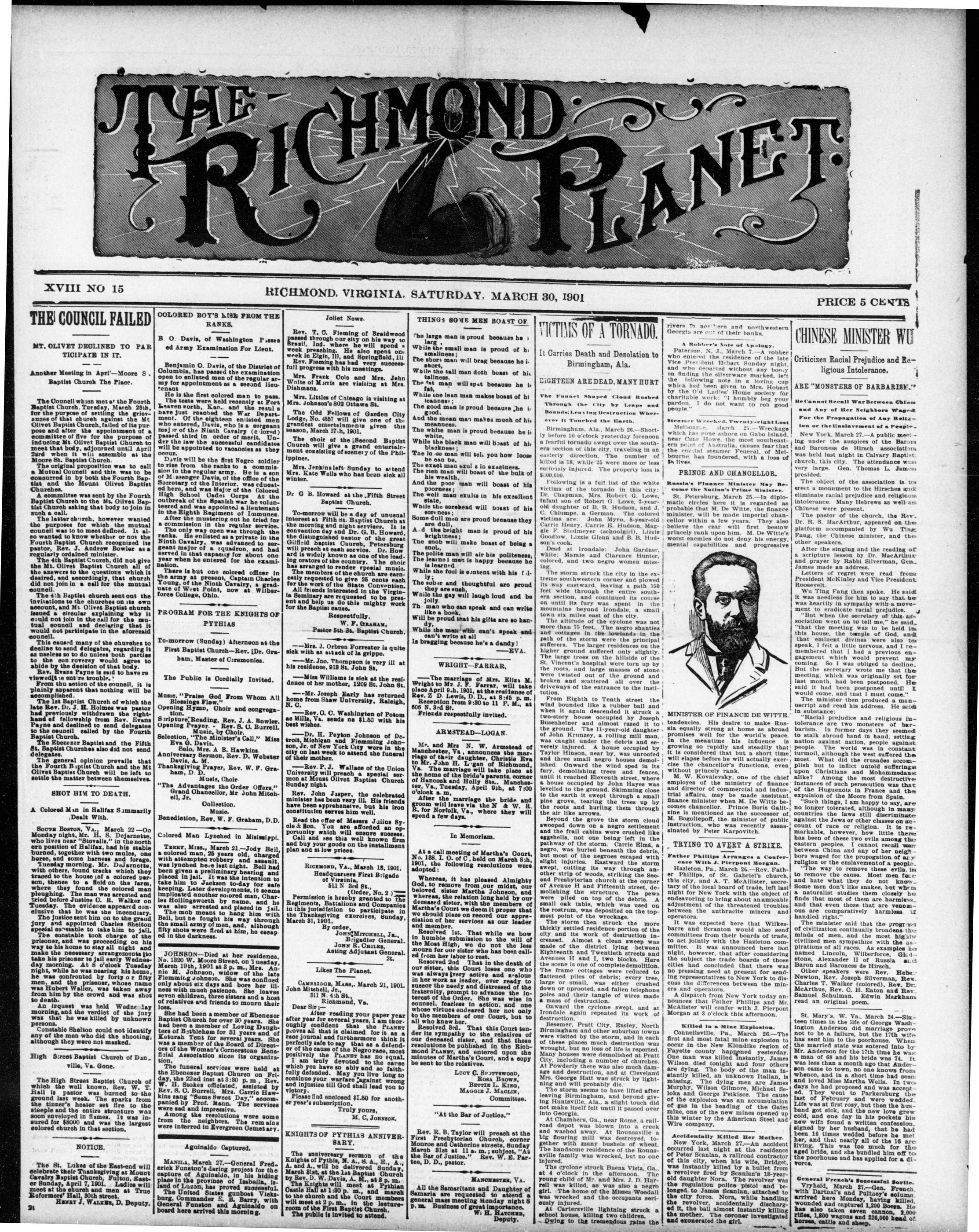
THE RICHMOND PLANET
XVIII NO 15
THE COUNCIL FAILED
THE COUNCIL FAILED
MT. OLIVET DECLINED TO PAR
TICIPATE IN IT.
Another Meeting in April—Moore S.
Baptist Church The Place.
The Council when met at the Fourth
Baptist Church, Tuesday, Mareh 26th,
for the purpose of settling the grievances of that church against the Mt.
Olivet Baptist Church, failed of its purpose and after the appointment of a committee of five for the purpose of inducing Mt. Olivet Baptist Church to meet that body, adjourned until April 2nd when it will assemble at the Moore St. Baptist Church.
The original proposition was to call a Mutual Council and this was to be concurred in by both the Fourth Baptist and the Mount Olivet Baptist Churches.
A committee was sent by the Fourth Baptist Church to the Mt. Olivet Baptist Church asking that body to join in such a call.
The latter church, however wanted the purposes for which the mutual council was to meet defined. It also wanted to know whether or not the Fourth Baptist Church recognized its pastor, Rev. J. Andrew Bowler as a regularly ordained minister. The 4th Baptist Church, did not give the Mt. Mt. Baptist Church all of the answers to the questions it desired, and accordingly, that church did not join in a call for the mutual council. The 4th Baptist church sent out the invitations to the churches on its own account, and Mt. Olivet Baptist church issued a circular explaining why it could not join in the call for the mutual council and declaring that it would not participate in the aforesaid council. This caused many of the churches to dislike to send delegates, regarding it as useless so to do delegates both parties to the conoveray would have to abide by the decision of that body. Rev. Evans Payne is said to have re viewed it entire trouble.
From the action of the council, it is plainly apparent that nothing will be accomplished.
The 1st Baptist Church of which the late Rev. Dr. J. H. Holmes was pastor had previously withdrawn the right-hand of fellowship from Rev. Evans Payne and declined to send delegates called by the Fourth Baptist Church.
The Ebeneszer Baptist and the Fifth St. Baptist Churches also did not send delegates.
The general opinion prevails that the Fourth Baptist Church and the Mt Olivet Baptist Church will be left to settle the matter between themselves.
SHOT HIM TO DEATH.
A. Colored Man in Halifax Summarily Dealt With.
SOUTH BOSTON, VA. March 22 — On Monday night, Mr. H. S. DeJarnette, who lives near "Stovals," in the north ern position of Halifax, had his stable burned, together with two mules, an horse, and some harness and forage. Tuesday morning, Mr. DeJarnette, with others, found tracks which they traced to the house of a colored person, thence to a field on the farm, where they found the colored man ploughing. The man was arrested and tried before Justice C. R. Walker on Tuesday. The evidence appeared conclusive that he was the incendiary. The justice sent him on to the grand jury and appointed Charles Shelton special counsel to take him to jail.
The constable took charge of the prisoner, and was proceeding on his way to his home to stay all night and make the necessary arrangements to take his prisoner to jail early Wednesday morning. At 8 o'clock Tuesday night, while he was nearing his home, he was confronted by forty or fifty men, and the prisoner, whose name was Hubert Waller, was taken away from him by the crowd and was shot to death.
An inquest was held Wednesday morning, and the verdict of the jury was that he was killed by unknown persons.
Constable Shelton could not identify any of the men who did the shooting, although they were not masked.
High Street Baptist Church of Dan.
ville, Va. Gone.
The High Street Baptist Church of which the well known, Rev. W. T. Hall is pastor was burned to the ground last week. The sparks from the tinner's heater set fire to the copier's entire structure was soon enveloped in flames. It was insured for $8000 and was the largest colored church in that section.
The St. Lukes of the East-end will celebrate their Thanksgiving at Mount Cavalry Baptist Church, Fulton, Easter Sunday, April 7, 1901. Ladies will meet at the church and men at True Reformers' Hall, 80th street.
HENRY J. WALKER, D. Deputy.
2t
OOLORED BOY'S RISE FROM THE RANKS.
B. O. Davis, of Washington Passes ed Army Examination For Lieut.
Benjamin O. Davis, of the District of Columbia, has passed the examination open to enlisted men of the regular army or appointment as a second lieutenant.
He is the first colored man to pass. The tests were held recently at Fort Leavenworth, Kauai, and the result have just reached the War Department. Of the eighteen enlisted men who entered, Davis, who is a sergeant major of the Ninth Cavalry (closed) passed third in order of merit. Under the law the successful candidates will be appointed to vacancies as they occur.
Davis will be the first Negro soldier to rise from the ranks to a commission in the regular army. He is a son of M. ssienger Davis, of the office of the Secretary of the Interior, was educated here, and was Major of the Colored School Cadet Corps. At the outset the Spanish war he volunteered and was appointed a lieutenant in the Eighth Regiment of Immunes. After the mustering out he served for a commission in the regular service. The only way open was through the ranks. He enlisted as a private in the Ninth Ovaly, was advanced to sergeant major of a squadron, and had served in that capacity for about one year when he entered for the examination. There is but one colored officer in the army at present, Captain Charles Young, of the Ninth Ovaly, a graduate of West Point, now at Wilberforce College, Ohio.
PROGRAM FOR THE KNIGHTS OF PYTHIAS
To-morrow (Sunday) Afternoon at the
First Baptist Church—Rev. [Dr. Graham,
Master of Ceremonies.
The Public is Cordially Invited.
Music, "Praise God From Whom All
Blessings Flow."
Opening Hymn, Choir and congregation.
Selection, "The Minister's Call," Miss
Evale Davis.
Evale B. A. Hawkins.
Anniversary Sermon, Rev D. Webster
Davis, A. M.
Thanksgiving Prayer, Rev. W. F. Graham, D. D.
Music, Choir.
"The Advantages the Order Offers."
Grand Chancellor, Mr John Mitchell, Jr.
Benediction, Rev. W. F. Graham, D.D.
Colored Man Lynched in Mississippi.
TERRY, Miss., March 21.—Jody Bell, a colored man, 25 years old, charged with attempted robbery and assault, was lynched here last night. Bell had been given a preliminary hearing and placed in jail. It was the intention to the death Jackson to-day for safe keeping. Later developments, it seems implicated another colored man, Charles Hollingworth by name, and he was also arrested and placed in jail. The mob meant to hang him with Bell, but he fought his way through the small army of men, and although fifty shots were fired at him, he escaped in the darkness.
JOHNSON—Died at her residence, No. 1830 W. Moore Street, on Tuesday, March 19th, 1901 at 8 p. m., Mrs. Annie M. Johnson, widow of the late Flemming Johnson. She was confined only about six days and bore her illness with much patience. She leaves seven children, three sisters and a host of relatives and friends to mourn their loss.
She had been a member of Ebenezer Baptist Church for 40 years. She had been a member of Loving Daughters of Bishlehem for 31 years and of Keturah Tent for several years. She is a member of the Board of Directors of the Woman's Cornerstone Beneficial Association since its organization.
The funeral services were held at the Ebenezer Baptist Church on Friday, the 22nd inst at 8:30 p. m., Rev. W. H. Stokes officiated, assisted by Rev. S. C. Burrell, Mrs. Carrie Hinsk sings "Some Sweet Day," accompanied by Prof. Mann. The services were sad and impressive.
Among the resolutions were some from the neighbors. The remains were interred in Evergreen Cemetery.
Aguinaldo Captured.
MANILA, March 27—General Frederick Funston's daring project for the capture of Aguinaldo, in his hiding place in the province of Isabela, island of Luzon, has proved successful. He sent a Sisters gunbust Vicksburg, Command Sergey Barry, with General Funston and Aguinaldo on board here arrived this morning.
RICHMOND, VIRGINIA, SATURDAY, MARCH 30, 1901
Joliet News.
Rev. T. C. Fieming of Braidwood passed through our city on his way to Brazil, Ind. where he will spend a week preaching. He also spent one week in Elgin, Ill., and SpringGuild, Ill. Rev. Fieming has had very successful progress with his meetings.
Mrs. Frank Cole and Mrs. John White of Morris are visiting at Mrs. Dishamns.
Mrs. Littles of Chicago is visiting at Mrs. Johnson's 802 Ottawa St.
The Odd Fellows of Garden City Lodge, No. 4587 will give one of the grandest entertainments given this season, March 27th, 1801.
The choir of the Second Baptist Church will give a grand entertainment consisting of scenery of the Philippines.
Mrs. Jenkins left Sunday to attend Mrs. Kate Wells who has been sick all winter.
Dr G B. Howard at the Fifth Street Baptist Church.
To-morrow will be a day of unusual interest at Fifth St. Baptist Church at the morning and night services. It is convention day and Dr. G. B. Howard, the distinguished pastor of the great Giffield baptist Church, Petersburg will preside at cash service. Dr. Howard is widely known as one of the leading orators of the country. The choir has arranged to render special music.
The members of the church are earnestly requested to give 25 cents each for the work of the State Convention. Friends interested in the Virginia Seminary are requested to be present and help us in this mighty work for the Baptist cause.
—Mrs. J. Orbren Forrester is quite sick with an attack of la grippie.
—Mr. Jno. Thompson is very ill at his residence, 913 St. John St.
—Miss Williams is sick at the residence of her mother, 1209 St. John St.
—Mr. Joseph Early has returned home from Shaw University, Raleigh, N. C.
—Rev. G. C. Washington of Potom ac Mills, Va. sends ns $1.50 with his best wishes.
—Dr. H. Peyton Johnson of Detroit, Michigan and Fiemming Johnson, Jr. of New York City were in the city on last week to attend the funeral of their mother.
—Rev. P. J. Wallace of the Union University will preach a special sermon at Mount Olivet Baptist Church Sunday night.
Rev. John Jasper, the celebrated minister has been very ill. His friends have been apprehensive, but his iron constitution serves him well.
Read the offer of Messrs Julius Sycle & Son. You are afforded an opportunity which will ensure success. Call and see this well known firm and buy your goods on the installment plan and at low prices.
RICHMOND, VA., March 18, 1901.
Headquarers First Brigade of Virginia,
511 N 3rd St.,
(Order, No. 2.)
Permission is heseby granted to the Regiments, Battalions and Companies in this juridiction to participate in the Thanksgiving exercises, Sunday, March 31, 1901.
By order,
JOHN MITCHELL, JR.,
Brigadier General.
JOHN R. CHILES.
Acting Adjutant General.
Likes The Planet.
CAMBRIDGE, MASS., March 21, 1901.
John Mitchell, Jr.
811 N. 4th St.
Richmond, Va.
Dear Sir—
After reading your paper year after year for several years, I am thoroughly confident that the PLANET proves all that is claimed for it as a race journal and furthermore think it personally safe to say that as a defender of the Negro race, most positively the PLANET has no equal.
I am truly devoted to the cause which you have so always so faithfully defended. May you live long to continue your warfare against wrong and injustice till God shall lead you to victory.
Please find enclosed $1.50 for another year's subscription.
KNIGHTS OF PYTHIAIS ANNIVER
SARY.
The anniversary sermon of the Knights of Pythis, N. A., S. A., E., A., A. and A., will be delivered Sunday, March 1st, at the 1st Baptist Church by Rev. D. W. Davis, A. M., at 8 p. m. the knights will meet at Pythian Castle Hall, p. m., and march to the church and the Court members will meet at 2 p. m., in the lecture-room of the First Baptist Church. The public is invited to attend.
THINGS SOME MEN BOAST OF
The large man is proud because he is large.
While the small man is proud of his smallness;
The short man will brag because he is short.
While the tall man doth boast of his tallness.
The fat man will spat because he is fat.
While the lean man makes boast of his leanness;
The good man is proud because he is good.
And the mean man makes much of his meanness.
The white man is proud because he is white.
While the black man will boast of his blackness;
The loose man will tell you how loose he can be.
The exact man exults in exactness.
The rich man will boast of the bulk of his wealth.
And the poor man will boast of his poorness;
The well man exults in his excellent state.
While the sorehead will boast of his soreness;
Some dull man are proud because they are dull.
And the bright man is proud of his brightness;
The such will make boast of being a snout.
The polite man will air his politeness;
The learned man is happy because he is learned.
While the fool is content with his fully;
The sober and thoughtful are proud they are sush.
While the gay will laugh loud and be jolly.
The man who can speak and can write like a book.
Will be proud that his gifts are so handy.
While the man who can't speak and can't write at all
Is bragging because he's a dandy!
The marriage of Mrs. Eliza M. Wright to Mr. J. F. Farrar, will take place April 9. h. 1801, at the residence of Rev. Z. D. Lewis, D. D., at 8: 45 p. m. Resception from 9: 30 to 11 P. M., at 608 N. 8 d St.
friends respectfully invited.
ARMSTEAD-LOGAN
Mr. and Mrs. N. W. Armstead of Manchester, Va. announces the marriage of their daughter, Christie Eva to Mr. John H. L-gan of Richmond, Va. The marriage will take place at the home of the bride's parents, corner of Hancock and Holly Sts., Manchester, Tuesday, April 9th, at 7:00 o'clock. After the marriage the bride and groom will leave via the N & W. R. r. for Norfolk, Va., where they will spend a few days.
In Memoriam
At a call meeting of Martha's Court,
No. 188. I. O. of C. held on March 8th,
1901, the following resolutions were
adopted:
Whereas, it has pleased Almighty
God, to remove from our midst, our
beloved sister Martha Johnson, and
whereas, the relation long held by our
deceased sister, with the members
Martha's Court we deem it proper that
we should place on record our appreciation
of her services as our leader and
member.
Resolved 1st. That while we bow in humble submission to the will of
the Most High, we do not the less
mourn for our sister who has been called
from her labor to rest.
Resolved 2nd. That in the death of
our sister, this Court loses one who
was always very active and g-alous
in her work as leader, ever ready to
suffer needy and disheartened of the
fraternity, prompt to advance the interest
of the Overseer. She was wise in
counsel, fearless in action, and one
whose virtues endured her not only
to the members of our Court, but to
all who knew her.
Resolved 8rd. That this Court tender its sympathy to the relatives of our deceased sister, and that these resolutions be published in the Richmond PLANET, and entered upon the minutes of Martha's Court, and a copy be sent to the relatives.
LUCIY C. SPOTTSWOOD,
ROSA BROWN,
BETTIE L. KING,
MAGGIE J. MACLIN,
Committtee.
Rev. R. B. Taylor will presach at the First Presbyterian Church, corner Monroe and Oatherine streets, Sunday March 51 at 11 a.m.; subject, "At the Bar of Justice." Rev. W. E. Partee, D. D., pastor.
All the Samaritans and Daughter of Samaria are requested to attend a general mass meeting Monday night 8 p. m. Business of great importance. W. H. HAYOHER,
VICTIMS OF A TORNADO.
VICTIMS OF A TORNADO.
It Carries Death and Desolation to Birmingham, Ala.
EIGHTEEN ARE DEAD, MANY HURT
The Funnel Shaped Cloud Rushed Through the City by Leaps and Bounds: Leaving Destruction Wherever It Touched the Earth.
Birmingham, Ala., March 26.—Shortly before 10 o'clock yesterday forenoon a fearful tornado swept over the southern section of this city, traveling in an easterly direction. The number of killed is 18, while 25 were more or less seriously injured. The property loss is $200,000.
Following is a full list of the white victims of the tornado in this city: Dr. Chapman, Mrs. Robert G. Lowe, infant son of Robert G. Lowe, 3-year-old daughter of B. B. Hudson, and J. Dahlumpe, a German. The colored carrier: John Myron, 8-year-old Carrie Henry, Carrie E. Hudson, Maggie F. Stedmery (schoolgirl), Lizzie Goodlow, Lizzie Glenn and B. B. Hudson's cook.
Dead at Irondale: John Gardner, white; Mamie and Clarence Hunter, colored, and two negro women missing.
The storm struck the city in the extreme southwestern corner and plowed its way eastward, leaving a path 150 feet wide through the entire southern section, and continued its course on until its fury was spent in the mountains beyond Irondale, a small town six miles east of the city.
The altitude of the cyclone was not more than 75 feet. The negro shanties and cottages in the lowlands in the south of the storm were the principal suffers. The larger residences on the higher ground suffered only slightly. The large trees on the hillside of the St. Vincent's hospital were torn up by the roots, and large masses of stone were twisted out of the ground and broken and scattered all over the driveways of the entrance to the institution.
From Eighth to Tenth street the wind bounded like a rubber ball and when it again descended it struck a two-story house occupied by Joseph Busenhelder and almost razed it to the ground. The 11-year-old daughter of John Krunzey, a rolling mill man, was caught under the debris and severely injured. A house occupied by Taylor Hinson, near by, was unroofed and three small negro houses demolished. Onward the wind sped in its fury, demolishing trees and fences, until it reached Eleventh street, where a house occupied by John Hayes was levelled to the ground. Skimming close to the earth it swept through a small pine grove, tearing the trees up by the roots and hurling them through the air like arrows.
Beyond the grove the storm cloud swooped down on a negro settlement and the frail cabins were crushed like eggshells, not one being left in the pathway of the storm. Carrie Elma, a negro, was buried beneath the debris, but most of the negroes escaped with slight injuries. Eastward the storm swept, cutting its way through an alley of woods, striking the Second Presidency, and at the corner of Avenue H and Fifth street, demolishing the structure. The debris were piled on top of the trees small oak table, which was used on the rostrum, was deposited on the topmost point of the wreckage.
The storm then struck the more thickly settled residence portion of the city and its work of destruction increased. Almost a clean sweep was made of the district lying between Eighteenth and Twentieth streets and Avenue H and I, two blocks. Here the scene is one of completed demolition. The frame cottages were reduced to flattened piles of debris; every tree, large or small, was either crushed down or uprooted, and fallen telephone poles and their tangle of wires made a mass of destruction. Onward the cyclone swept, and at Irondale again repeated its work of destruction. Besemer, Pratt City, Ensley, North Birmingham and other suburban towns were visited by the storm, and in each of these places much destruction was wrought, but no loss of life is reported. Many houses were demolished at Pratt City, including a number of churches. At Powderly there was also much damage and destruction, and at Cleveland Mrs. George Hatt was struck by lightning and will probably die.
The storm seems to have lifted after leaving Birmingham, and beyond giving Huntsville, Ala., a slight touch did not make itself felt until it passed over into Georgia.
At Chambers, Ga., near Rome, a railroad depot was blown into a creek and washed away. At Rounsaville a big flouring mill was destroyed, together with many bushels of wheat. The handsome residence of the Rounsaville family was wrecked, but no one injured.
The cyclone struck Buena Vista, Ga., at 4 o'clock in the afternoon. The young child of Mr. and Mrs. J. D. Harrell was killed, as was also a negro girl. The home of the Misses Woodall was wrecked and the occupants seriously injured.
At Cartersville lightning struck a school house, killing two children. Owing to the tremendous rains the
rivers In northern and northwestern Georgia are out of their banks.
A Robber's Note of Apology.
Paterson, N. J., March 7. — A robber who entered the residence of the late Vice President Hobart, Sunday night, and who departed without any booby on finding the silverware marked, left the following note in a loving cup which had been given to Mrs. Hobart by the Old Ladies' Home society for charitable work: "I humbly beg your pardon. I do not want to rob good people."
Steamer Wrecked, Twenty-eight-Lost Melbourne. March 27. — Wreckage which has gone ashore on Gabo Island, near Cane Howe, the most southernern point of Australia, causes fear that the coastal steamer Federal, of Melbourne has foundered, with a loss of lives.
PRINCE AND CHANGELLOR.
Russia's Finance Minister May Become the Nation's Prime Minister
come the Nation's Prime Minister.
St. Petersburg, March 25.—In diplomatic circles here it is regarded as probable that M. De Witte, the finance minister, will be made imperial chancellor within a few years. They also believe the czar will first bestow princely rank upon him. M. De Witte's worst enemies do not deny his energy, mental capabilities and progressive
MINISTER OF FINANCE DE WITTE
tendencies. His desire to make Russia equally strong at home as abroad promises well for the world's peace. In the meantime his influence is growing so rapidly and steadily that it is considered that but a short time will actually exercise the chancellor's functions, even without princely rank.
M. W. Kovalevsky, one of the chief employees of the ministry of finance and director of commercial and industrial affairs, may be made assistant finance minister when M. De Witte becomes chancellor. Prince Boris Galltzine is mentioned as the successor of M. Bogolliepoff, the minister of public instruction, who was recently assassinated by Peter Karpovitch.
TRYING TO AVERT A STRIKE.
Father Phillips Arranges a Confer-
ence With J. Pierpont Morgan.
Hazleton, Pa., March 26.—Rev. Father Phillips, of St. Gabriel's church, this city, and A. T. McAllister, secretary of the local board of trade, left last night for New York with the object of endeavoring to bring about an amicable adjustment of the threatened troubles between the anthracite miners and operators.
It was expected here that Wilkesbarre and Scranton would also send committees from their boards of trade, to act jointly with the Hazleton committee. It was announced here last night, however, that after considering the subject the trade boards of those cities had concluded that there was no pressing need at present for sending representatives to New York to discuss the differences between the miners and operators.
A dispatch from New York today announces that Father Phillips and Mr. McAllister will confer with J. Pierpont Morgan at 3 o'clock this afternoon.
Killed in a Mine Explosion
Connellsville, Pa., March 26.—The first and most fatal mine explosion to occur in the New Kliondike region of Fayette county happened yesterday. One man was killed instantly, James Wilson died tonight and for others are dying. The body of the man instantly killed, an unknown Italian missing. The dying men are James Murphy, Wilson Gilmore, Michael Seloka and George Peikiske. The cause of the explosion was an accumulation of gas in the heading of the Gates mine, one of the new mines opened up this winter by the American Steel and Wire company.
Kentucky Killed Her Mother.
New York, March 27.—An accident occurred last night at the residence of Peter Scanlan, a railroad contractor of this city, his wife, Bridget, was instantly killed by a fire from a revolver fired by Scanlan's 18-year-old daughter Nora. The revolver was the regulation police pistol and be longed to James Scanlan, attached to the city force. Nora, while handling the revolver, accidentally discharged it, the ball almost instantly killing the mother. The coroner investigated and exonerated the girl.
PRICE 5 CENTS
CHINESE MINISTER WU
Criticizes Racial Prejudice and Religious Intolerance.
ARE "MONSTERS OF BARBARISM."
He Cannot Recall War Between China and Any of Her Neighbors Waged For the Propagation of Any Religion or the Enslavement of a People.
New York, March 27.—A public meeting under the auspices of the Barons and Baroness de Hirsch association was held last night in Calvary Baptist church, this city. The attendance was very large. Gen. Thomas L. James presided.
The object of the association is to erect a monument to the Hirsches and eliminate racial prejudice and religious intolerance. Many Hebrews as well as Chinese were present.
The pastor of the church, the Rev. Dr. R. S. MacArthur, appeared on the platform accompanied by Wu Ting Fang, the Chinese minister, and the other speakers.
After the singing and the reading of a scripture lesson by Dr. MacArthur and prayer by Rabbi Silverman, Gen. James made an address.
Letters of regret were read from President McKinley and Vice President Roosevelt.
Wu Ting Fang then spoke. He said it was needless for him to say that he was heartily in sympathy with a movement to eradicate racial prejudice.
"But when the secretary of this association went on to tell me," he said, "that the meeting was to be held in this house, the temple of God, and that eminent divines were also to speak, I felt a little nervous, and I remembered that I had a previous engagement which would prevent my coming. So I was obliged to decline. But the secretary wrote me that the meeting which was originally set for last month had been postponed. He said it had been postponed until I would come, and that I would come," The minister then produced a manuscript and read his address. He said in substance:
"Racial prejudice and religious intolerance are two monsters of barbarism. In former days they seemed to stalk abroad hand in hand, setting nation against nation, people against people. The world was in constant turmoil, although the west suffered the most. What did the crusades accomplish but to inflict untold sufferings upon Christians and Mohammedans alike? Among the most destructive instances of such persecution was that of the Huguenots in France and the expulsion of the Moors from Spain. Such things, I am happy to say, are no longer tolerated, although in many countries laws still discriminate against the Jews or other classes on account of race or religion. It is remarkable, however, how little there has been of these two races among the eastern peoples. I cannot recall wars between China and any of the high bows waged for the propagation of a religion or the enslavement of a people.
"The way to remove these evils is to remove the cause. Most men fear and hate what they do not know. Some men don't like snakes, but when a naturalist studies them closely her finds that most of them are harmless, and that even those that are venomous are comparatively harmless (handled right."
The minister said that the progress of civilization continually broadens the minds of men, and the most highly armed men sympathize with the aspirations of all races. As examples he named, Lifetime Warrior, Gleddstone, Alexander II of Russia and Baron and Baroness of Hirsch.
Other speakers were Rev. Hoben Newton, Rev. Joseph Silverman, Rev. Charles T. Walker (colored), Rev. Dr. McArthus, Rev. C. H. Eaton and Rev. Samuel Schulman. Edwin Markham read an original poem.
St. Mary's, W. Va., March 24.—Sixteen times in the life of George Washington Anderson did marriage prove not to be a failure, but the 17th wife has sent him to the poorhouse. When the married state was entered into by Mr. Anderson for the 17th time he was a man of 68 and his bride was 74. It was less than a month ago that Anderson came to town, no one knows from whence, and in a short time had seen and loved Miss Martha Wells. In days he had proposed and was accepted. They went to Parkersburg the last of February and were wedded. Life was at first rosy, but then the husband got sick, and the new love grew cold, and one day in his pockets his new wife found a written confession, signed by her husband, that he had been 16 times wedded before he met her, and that nearly all of the 16 are living. This was too much for the aged bride, and she bundled him off to the poorhouse and has applied for a divorce.
General French's Successful Sorte-
Vryheld, March 27.-Gen. French
with Dartnall's and Pulney's column
arrived here Monday, having killed,
wounded and captured 1,200 Boeens. He
has also taken seven cannon, 2,000
rifles, 1,800 wagons and 226,000 head of
horse, cattle and sheep.
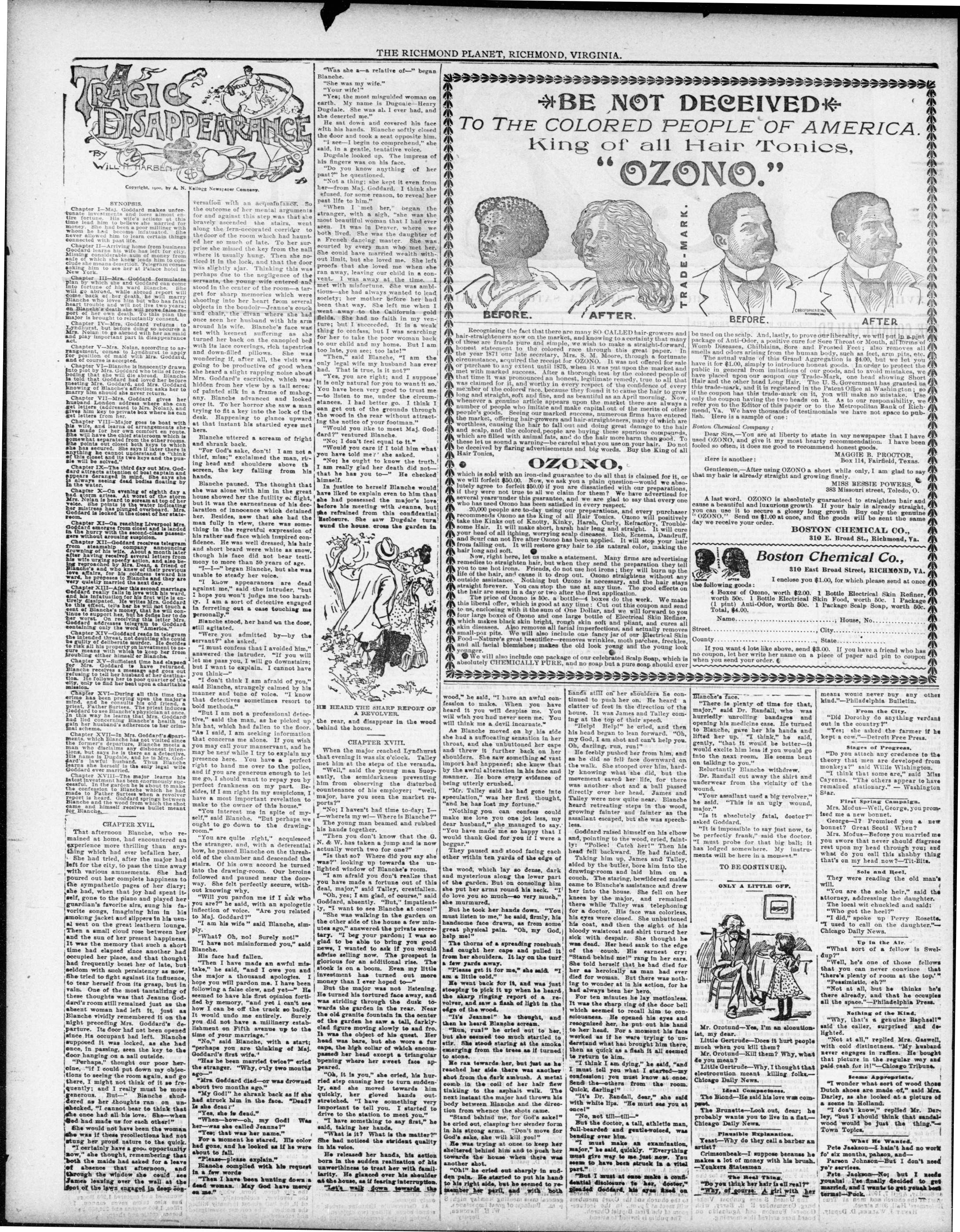
TRAGIC
DISAPPEARANCE
BY
WILL H. HARBER
Copyright, 1900, by A. N. Kellogg Newspaper Company.
Chapter I—Ma, Goddard makes unfunate investments and loses almost entire time lead him to believe she married for money. She had been a poor milliner with become infatuated. She never allowed him certain things connected with past life.
Chapter II—Arriving home from business Goddard goes to a Missing considerable sum of money from sale of which she knew leads him to conceive she means desertion. Pelgram comes asking she use air at Palace hotel in New York.
Chapter III—Mrs. Goddard formulates plans to come into fortune of his ward Blanche. She will go abroad, while abroad report will Blanche who loves him but who has fatal heart trouble and will not live two years; she will prove false report of her own deeds. Major is brought to reluctantly consent.
Chapter IV—Mrs. Goddard returns to Lyndhurst, but before doing so sequestres a Mrs. Molan to go abroad with her as mid and play important part in disappearance act.
Chapter V—Mrs. Nolan, according to arrangement comes to Lyndhurst to apply for a position with Mrs. Goddard, and of course is accepted.
Chapter VI—Blanche is innocently drawn into plot by Mrs. Goddard who tells of forebearance brought Blanche is told that Goddard had been meeting Mrs. Goddard, and Mrs. Goddard knowing of Blanche's affection asks her to marry him should she never return.
Mrs. Goddard gives her husband London address where he can get letters (addressed to Mrs. Nolan), and gives him key to private box where he can handle Chapter VIII—Major goes to boat with his wife, and learns of arrangements she has made for her own comfort en route. She has have the chief stateroom which is somewhat larger than the room she points out closet both keys to which she has secured. She says if later there is anything he cannot understand to "think of the two keys and the puzzle will be solved."
Chapter IX—The third day out Mrs. Goddard attracts attention of boat captain and appears deranged in mind. She says she is always being dead bodies floating by in the water.
Chapter X-On evening of eighth day a bad storm arises. At worst of the storm he must be called to the top of her voice. She points to the water in her mistress has plunged overboard. Mrs. Goddard is locked in the closet of her statewoman.
Chapter XI-On reaching Liverpool Mrs. Goddard emerges from closet and is landed in the hurry with the second-class passengers without arousing suspicion.
Chapter XII-Goddard receives telegram from the captain announcing drowning of his wife. About a month after having received several letters from her having speedy action, and also being reproached for blanche, Blanche's and who knew of their previous love affairs, for his coldness toward his wife, he proposes to Blanche and they are very happy the next day.
Chapter XIII-After her marriage Goddard really falls in love with his ward, and his infatuation for his first wife is enforced. He writes Mrs. Goddard to this effect, tells his cent of Blanche's money, that he will continue to support her, but that he defies her to do it. On receiving this letter Mrs. Goddard adds that Blanche contains only the word "America."
Chapter XIV—Goddard reads in telegram
that he would not do nothing she could
be guilty of deliberate insults, but she
to risk all his property on investment to se-
rve for her own benefit, from frow-
bringing either himself or Blanche.
Chapter XV- Sufficient time had elapsed for Mrs. Goddard to have returned. For Mrs. Goddard it has goes out refusing to tell her husband of her refusion. He follows her to poor quarter of the city only to find her bent upon a charitable mission.
Chapter XVI- During all this time the crime has been preying upon the major's mind, and he consults his old friend, a lawyer, to help the priest induces Goddard to see Blanche's. In this way he learns that Mrs. Goddard had lied concerning Blanche's health to her husband's adherence to her criminal scheme.
Chapter XVII- In Mrs. Goddard's apartments, which Blanche has not visited since her departure. Blanche meets a man who dies suddenly, but says he is there as a detective. His name is Dugale, and he is Mrs. Goddard's husband. Thus Blanche learns she herself is the only legal wife Goddard ever married.
Chapter XVIII- The major learns his latest investment has been enormously successful. He heard, Goddard springs between Blanche and Goddard from which the shot came and himself receives bullet meant for Blanche.
That afternoon Blanche, who remained at home, had encountered an experience more thrilling than anything which had ever befallen her.
She had tried, after the major had left for the city, to pass the time away with various amusements. She had poured out her complete happiness to the sympathetic pages of her diary; she had, when that joy had spent itself, gone to the piano and played her guardian's favorite air, sung his favorite songs, imagining him in his smoking jacket and slippers in his usual seat on the great leathern lounge. Then a small cloud rose between her and the sun of her present happiness. It was the memory that such a short time had elapsed since another had occupied her place, and that thought had frequently beset her of late, but seldom with such persistency as now. She tried to fight against its influence, to tear herself from its grasp, but in vain. One of the most tantalizing of these thoughts was that Jeanne Goddard's room still remained just as the absent woman had left it, just as Blanche vividly remembered it on the night preceding Mrs. Goddard's departure. Its door had not been opened since its occupant had left. Blanche supposed it was locked, as she had once, in passing, seen the key to the door hanging on a nail outside.
"Perhaps," thought our poor heri-
ne, "if I could put down my objec-
tions to seeing the room again, and
go there, I might not think of it so
frequently; and I really must be more
generous. But—" Blanche shud-
dlered as her thoughts ran on un-
checked, "I cannot bear to think that
she once had all his love. She—when
God had made us for each other!"
She would not have been the woman
she was if these recollections had not
stung her proud nature to the quick.
"I certainly have a good opportunity
now," she thought, remembering that
both the maids had asked for a leave
of absence that afternoon, and
through the window she could see
James leaning over the wall at the
foot of the lawn engaged in deep con-
SYNOPSIS
CHAPTER XVII.
versation with an acquaintance. So the outcome of her mental arguments for and against this step was that she bravely ascended the stairs, went along the fern-decorated corridor to the door of the room which had haunted her so much of late. To her surprise she missed the key from the nail where it usually hung. Then she noticed it in the lock, and that the door was slightly ajar. Thinking this was perhaps due to the negligence of the servants, the young wife entered and stood in the center of the room—a target for sharp memories which were shooting into her heart from several objects in the boudoir—feenne's couch and chair, the divan where she had once seen her husband with his arm around his wife. Blanche's face was set with keenest suffering as she turned her back on the canopied bed with its lace coverings, rich tapestries and down-filled pillows. She was wondering if, after all, the visit was going to be productive of good when she heard a slight rapping noise about Mrs. Goddard's escritoire, which was hidden from her view by a tall scree: of painted silk in a frame of mahogany. Blanche advanced and looked over it. To her horror she saw a man trying to fit a key into the lock of the desk. Happening to glance upward at that instant his startled eyes met hers.
Blanche uttered a scream of fright and shrank back.
"For God's sake, don't! I am not a thief, miss!" exclaimed the man, ringing head and shoulders above the screen, the key falling from his hands.
Blanche paused. The thought that she was alone with him in the great house showed her the futility of flight, but it was the earnestness of his declaration of innocence which detained her. Besides, new that she had the man fully in view, there was something in the regretful expression of his rather sad face which inspired confidence. He was well dressed, his hair and short beard were white as snow, though his face did not bear testimony to more than 50 years of age.
"I—I—" began Blanche, but she was unable to steady her voice.
"I know appearances are dead against me," said the intruder, "but I hope you won't judge me too harshly. I am a sort of detective engaged in ferreting out a case touching me personally."
Blanche stood, her hand on the door, still agitated.
"Were you admitted by—by the servant?" she asked.
"I must confess that I avoided him," answered the intruder. "If you will let me pass you, I will go downstairs; but I want to explain. I cannot have you think—"
"I don't think I am afraid of you," said Blanche, strangely calmed by his manner and tone of voice. "I know that detectives sometimes resort to bold methods."
"But I am not a professional detective," said the man, as he picked up his hat, which had fallen to the floor. "As I said, I am seeking information that concerns me alone. If you wish you may call your manservant, and he may be near while I try to explain my presence here. You have a perfect right to hand me over to the police, and if you are generous enough to let me go, I should want to repay you by perfect frankness on my part. Besides, if I am right in my suspicions, I have a most important revelation to make to the owner of this house."
"You interest me in spite of myself," said Blanche. "But perhaps we ought to go down to the drawing-room."
"You are quite right," acquiesced the stranger, and, with a deferential bow, he passed Blanche on the threshold of the chamber and descended the stairs. Of his own accord he turned into the drawing-room. Our heroine followed and paused near the doorway. She felt perfectly secure, without knowing why.
"Will you pardon me if I ask who you are?" he said, with an apologetic inflection of voice. "Are you related to Maj. Goddard?"
"I am his wife" said Blanche, simply.
"What? Oh, not Surely not!"
"I have not misinformed you," said Blanche.
His face had fallen.
"Then I have made an awful mistake," he said, "and I owe you and the major a thousand apologies. I hope you will pardon me. I have been following a false clew, and yet—" He seemed to have his first opinion fortified by memory, "and yet I can't see how I can be off the track so badly. It would undo me entirely. Surely you did not have a millinery establishment on Fifth avenue up to the time of your marriage."
"No," said Blanche, with a start; "perhaps you are thinking of Maj. Goddard's first wife."
"Has he been married twice?" eried the stranger. "Why, only two months ago."
"Mrs. Goddard died—or was drowned about two months ago."
"My Goddid" he shrank back as if she had struck him in the face. "Dead? Is she dead?"
"Yes, she is dead."
"When—how—oh, my God! Was her—was she called Jeanna?" "Yes; that was her name." For a moment he stared. His color had gone, and he looked as if he were about to fall. "Please—please explain." Hanobe compiled with his request in a few words. "Then I have been hunting down a dead woman. May God have mercy on me."
"Was she a—a relative of—" began Blanche.
"She was my wife."
"Your wife!"
"Yes; the most misguided woman on earth. My name is Dugdale—Henry Dugdale. She was al. I ever had, and she deserted me."
He sat down and covered his face with his hands. Blanche softly closed the door and took a seat opposite him.
"I see—I begin to comprehend," she said, in a gentle, tentative voice.
Dugdale looked up. The impress of his fingers was on his face.
"Do you know anything of her past?" he questioned.
"Not a thing; she kept it even from her—from Maj. Goddard. I think she efused, for some reason, to reveal her past life to him."
"When I met her," began the stranger, with a sigh, "she was the most beautiful woman that I had ever seen. It was in Denver, where we both lived. She was the daughter of a French dancing master. She was courted by every man who met her. She could have married wealth without limit, but she loved me. She left proofs that she loved me when she ran away, leaving our child in a convent. I was away at the time. I met with misfortune. She was ambitious—she had always wanted to lead society; her mother before her had been that way. She left me when I went away to the California gold fields. She had no faith in my venture; but I succeeded. It is a weak thing to confess, but I was searching for her to take the poor woman back to our child and my home. But I am too late, you see; too late!" "Then," said Blanche, "I am the only legal wife my husband has ever had. That is true, is it not?"
"Yes, you are right; and I suppose it is only natural for you to want it so. You have been very good to trust me—to listen to me, under the circumstances. I had better go. I think I can get out of the grounds through the wood in the rear without attracting the notice of your footman."
"Would you like to meet Maj. Goddard?" ventured Blanche. "No; I don't feel equal to it." "Would you care if I told him what you have told me?" she asked. "No; he ought to know the truth. I am really glad her death did not—that he has you to—" He checked himself. In justice to herself Blanche would have liked to explain even to him that she had possessed the major's love before his meeting with Jeanne, but she refrained from this confidential disclosure. She saw Dugdale turn wound the house, cross the garden in
101
HE HEARD THE SHARP REPORT OF
A REVOLVER.
the rear, and disappear in the wood
behind the house.
CHAPTER XVIII.
When the major reached Lyndhurst that evening it was six o'clock. Talley met him at the steps of the veranda. "Well," said the young man buoyantly, the semidarkness preventing him from observing the disturbed countenance of his employer; "well, major, have you seen the market reports?" "No; I haven't had time to day; I—I—whereels mywl—Where is Blanche?" The young man beamed and rubbed his hands together. "Then you don't know that the G. N. & W. has taken a jump and is now actually worth two for one?" "Is that so? Where did you say she was?" looking up towards the unlighted window of Blanche's room. "I am afraid you don't realize that you have made a fortune out of this deal, major," said Talley, crestfallen. "Oh yes. I am glad of course."
"She was walking in the garden on the other side of the house a few minutes ago," answered the private secretary. "I beg your pardon; I was so glad to be able to bring you good news, I wanted to ask if you would advise selling now. The prospect is glorious for an additional rise. The stock is on a boom. Even my little investment has turned out more money than I ever hoped to—" But the major was not listening. He turned his tortured face away, and was striding through the dusk towards the garden in the rear. Near the old granite fountain in the center of the garden he saw a tall, darkly-clad figure moving slowly to and fro. It was the object of his quest. Her head was bare, but she wore a fur cap, the high collar of which encompassed her head except a triangular opening where her sweet face appeared.
"Oh, it is you," she cried, his hurried step causing her to turn suddenly, and she moved towards him quickly, her gloved hands outstretched. "I have something very important to tell you. I started to drive to the station to meet you." "I have something to say first," he said, taking her hands.
"What is it? What is the matter?" She had noticed the strident quality in his voice.
He released her hands, his action born in the sudden realization of his unworthiness to treat her with familiarity. He glanced over his shoulder at the house, as if fearing interruption.
"Let's walk down towards the
BE NOT DECEIVED
TO THE COLORED PEOPLE OF AMERICA.
King of all Hair Tonics,
"OZONO."
Recognizing the fact that there are many SO CALLED hair-growers and hair-straighteners now on the market, and knowing to a certainty that many of these are frands pure and simple, we wish to make a straight-forward, honest statement to the colored race through this great paper. In the year 1871 our late secretary, Mrs. S. M. Moore, through a fortunate purchase or purchase to any extent the receipt for OZONO. It was not offered for sale or purchase until 1875, when it was put upon the market and met with marked success. After a thorough test by the colored people of that time it was pronounced an honest, legitimate trade to all that was claimed for it, and worthy in every respect of the confidence of the colored race, because they found it to cause the hair to grow long and straight, soft and fine, and as beautiful as an April morning. Now, whenever a genuine article appears upon the market there are always a number of people who imitate and make capital out of the merits of other people's goods. Seeing our marked success, numerous firms have entered the market, offering hair-growers and hair-straighteners, many of which are using the hair to fall out and doing great damage to the hair and scalp, and many are buying these spurious compounds, which are filled with animal fats, to do their hair more harm than good. To these let us sound a warning—be careful what you use on your hair. Do not be deceived by flaring advertisements and big words. Buy the King of all Hair Tonics,
OZONO.
iron-clad guarantee to do all that is claimed for it, or
Now, we ask you a plain question—would we also
$50.00 if you are dissatisfied with our preparations,
to all we claim for them? We have advertised for
is guarantee, and we are glad to say that every one
is been satisfied in every respect:
o-day using our preparations, and every purchaser
the King of all Hair Tonics. Ozono will positively
Knotty, Kinky, Harsh, Curly, Refractory, Trouble-
kicks short, harsh hair long and straight. It will cure
k, worrying scalp diseases. Itch, Eczema, Dandruff,
after Ozono has been applied. It will stop your hair
will restore gray hair to its natural color, making the
it us make a statement. Many firms are advertising
hair, but when they send the preparation they tell
Friends, do not use hot irons; they will burn up the
use it to drop out. Ozono straightens without any
nothing but Ozono is necessary, and the hair stays
can stop the use at any time. The good effects on
day or two after the first application.
is 60c. a bottle—4 boxes do the work. We make
in is good at any time: Cut out this coupon and send
the sum of One Dollar, and we will forward to you
one and one large bottle of Electrical Skin Refiner,
in bright, rough skin soft and pliant, and cures all
ones and all facial imperfections, and actually removes
will also include one fancy jar of our Electrical Skin
definer—removes wrinkles, moth patches, freckles,
makes the old look young and the young look
do one package of our celebrated Scalp Soap, which is
ALLY PURE, and no soap but a pure soap should ever
which is sold with an iron-clad guarantee to do all that is claimed for it, or we will forfeit $50.00. Now, we ask you a plain question—would we absolutely agree to forfeit $50.00 if you are dissatisfied with our preparations, if they were not true to all we claim for them? We have advertised for several years under this guarantee, and we are glad to say that every one who has used Ozono has been satisfied in every respect.
20,000 people are to-day using our preparations, and every purchaser recommends Ozono as the King of all Hair Tonics. Ozono will positively take the Kinks out of Knotty, Kinky, Harsh, Curly, Refractory, Troublesome Hair. It will make short, harsh hair long and straight. It will cure your head of all itching, worrying scalp diseases. Itch, Eczema, Dandruff, and Scurf can not live after Ozono has been applied. It will stop your hair from falling out. It will restore gray hair to its natural color, making the hair long and soft.
Now, right here, let us make a statement. Many firms are advertising remedies to straighten hair, but when they send the preparation they tell you to use hot irons. Friends, do not use hot irons; they will burn up the hair and drop out. Ozono straightens without any outside assistance. Nothing but is is is is. The hair stays straight forever. You can stop the use at any time. The good effects on the hair are seen in a day or two after the first application.
The price of Ozone is 50c. a bottle—4 boxes do the work. We make this liberal offer, which is good at any time: Cut out this coupon and send to us, enclosing with it the sum of One Dollar, and we will forward to you four large boxes of Ozone and one large bottle of Electrical Skin Refiner, which makes black skin bright, rough skin soft and plant, and cures all skin diseases. Also removes all facial imperfections, and actually removes small-pox pits. We will also include one fancy jar of our Electrical Skin Food—Nature's great beautifier—removes wrinkles, moth patches, freckles, and all facial blemishes; makes the old look young and the young look younger.
We will also include one package of our celebrated Scalp Soap, which is absolutely CHEMICALLY PURE, and no soap but a pure soap should ever
wood," he said, "I have an awful confession to make. When you have heard it you will despise me. You will wish you had never seen me. You will think me a devil incarnate."
As Blanche moved on by his side she had a suffocating sensation in her throat, and she unbuttoned her cape and threw it further back on her shoulders. She saw something of vast import had happened; she knew that by the awful alteration in his face and manner. He bore every evidence of being utterly crushed.
"Mr. Talley said he had gone into speculation," was her first thought, "and he has lost my fortune."
"Nothing you can confess could make me love you one jot less, my dear husband," she managed to say. "You have made me so happy that I would thank God for you if I were a beggar."
They paused and stood facing each other within ten yards of the edge of
the wood, which lay so dense, dark and mysterious along the lower part of the garden. But on consoling him she put her arms round his neck. "I do love you so much—so very much," she murmured. But he took her hands down. "You must listen to me," he said, firmly, his handsome face drawn, as from some great physical pain. "Oh, my God, help me!" The thorns of a spreading rosebush had caught her cap and pulled it from her shoulders. It lay on the turf a few yards away. "Please get it for me," she said. "I am a little cold." He went back for it, and was just stooping to pick it up when he heard the sharp ringing report of a revolver, and saw a flash of light in the edge of the wood. "It's Jeanne!" he thought, and then he heard Blanche scream.
"Run, rual!" he cried out to her, but she seemed too much startled to stir. She stood staring at the smoke emerging from the trees as if turned to stone.
He ran towards her, but just as he reached her side there was another shot from the dark ambush. A metal comb in the coil of her hair flew tinkling to the asphait walk. The next instant the major had thrown his body between Blanche and the direction from whence the shots came.
"Stand behind me, for God's sake!" he cried out, clasping her slender form in his strong arms. "Don't move for God's sake, she will kill you!"
He was trying at once to keep her sheltered behind him and to push her towards the house when there was another shot.
"Oh!" he cried out sharply in sudden pain. He started to put his hand to his right side, but he seemed to remember her parl, and with both
general mass measuring instrument
in the field of mass spectrometry
Bands still on her shoulders he continued to push her on. He heard a clatter of feet in the direction of the house. It was James and Talley coming at the top of their speed.
"Help! Help!" he cried, and then his head began to lean forward. "Oh, my God, I am shot and can't help you. Oh, darling, run, run!" He feebly pushed her from him, and as he did so fell face downward on the walk. She stooped over him, hardly knowing what she did, but the movement saved her life, for there was another shot and a ball passed directly over her head. James and Talley were now quite near. Blanche heard retreating steps in the wood, growing fainter and fainter as the assailant escaped, but she was speechless.
Goddard raised himself on his elbow and, pointing to the wood, cried, faintly: "Police! Catch her!" Then his head fell backward. He had fainted, Taking him up, James and Talley, alced by the butler, bore him into the drawing-room and laid him on a couch. The staring, bewildered maids came to Blanche's assistance and drew her into the house. She fell on her knees by the major, and remained there while Talley was telephoning for a doctor. His face was colorless, his eyes were closed. She unbuttoned his cont, and then the sight of his bloody waistcoat and shirt turned her sick with despair. She thought he was dead. Her head sank to the edge of the couch. His earnest cry: "Stand behind me!" rang in her ears. She told herself that he had died for her as heroically as man had ever died for woman. But there was nothing to wonder at in his action, for he had always been her hero.
For ten minutes he lay motionless. It was the sharp ring of the door bell which seemed to recall him to consciousness. He opened his eyes and recognized her, he put out his hand to her head. For a moment his face worked as if he were trying to understand what had brought him there, then as quick as a flash it all seemed to return to him.
"I think I am dying," he said, "and I must tell you what I started—my confession; you must know at once. Send the—others from the room. Quick, darling!"
"It's Dr. Randall, dear," she said with white lips. "He must see you at once!"
"No, not till—till—"
But the doctor, a tall, athletle man,
full-bearded and gentle-wolced, was
bonding over him.
"I must make an examination,
major," he said, quickly. "Everything
must give way to me just now. You
seem to have been struck in a vital
part."
"But I must at once make a condi-
tional disclosure to her, doctor,
glimmed Goddard, his eyes fixed on
be used on the scalp. And, lastly, to prove our liberality, we will put in a pint package of Anti-Odor, a positive cure for Sore Throat or Mouth, all forms of Womb Diseases, Chilblains, Sore and Frosted Feet; also removes all smells and odors arising from the human body, such as feet, arm pits, etc.
The actual value of this Grand Aggregation is $4.00, but we let you have it for $1.00, simply to introduce honest goods. In order to protect the public in general from imitations of our goods, and to avoid mistakes, we have placed upon our coupon our Trade-Mark, one head showing Short Hair and the other head Long Hair. The U. S. Government has granted us this trade-mark, and it is registered in the Patent Office at Washin gtan; so if the coupon has this trade-mark on it, you will make no mistake. Use only the coupon having the two heads on it. As to our responsibility, we refer you to the Editor of this paper or to the Metropolitan Bank of Richmend, Va. We have thousands of testimonials we have not space to publish. Here is a sample of one:
Boston Chemical Company:
Dear Sirs,—You are at liberty to state in any newspaper that I have used OZONO, and give it my most hearty recommendation. I have been fooled so often, it does me good to recommend honest goods.
Gentlemen.—After using OZONO a short while only, I am glad to say that my hair is already straight and growing finely.
A last word. OZONO is absolutely guaranteed to straighten hair and cause a beautiful and luxurious growth. If your hair is already straight you can use it to secure a glossy long growth Buy only the genuine OZONO you use $1,000 at once, and the goods will be sent the same day you receive your payment.
4 Boxes of Ozono, worth $2.00. 1 Bottle Electrical Skin Refiner
worth 50c. 1 Bottle Electrical Skin Food, worth 50c. 1 Package
(1 pint) Anti-Odor, worth 50c. 1 Package Scalp Soap, worth 50c
Total, $4.00.
If you want 4 lots like above, send $3.00. If you have a friend who has no coupon, let her write her name on a piece of paper and pin to coupon when you send your order.
Boston Chemical Company:
Dear Sirs,—You are at liberty to st
used OZONO, and give it my most hea
fooled so often, it does me good to recom
here is another:
Gentlemen,—After using OZONO a s
that my hair is already straight and grow
A last word. OZONO is absolutely
cause a beautiful and luxurious growth
you can use it to secure a glossy lon
"OZONO." Send us $1.00 at once, and
day we receive your order.
BOST
31
Boston C
310 East
Lenclose you
the following goods:
4 Boxes of Ozono, worth $2.00.
worth 50c. 1 Bottle Electrical S
(1 pint) Anti-Odor, worth 50c.
Total, $4.00.
Name.
Street.
County.
If you want 4 lots like above, send $ no coupon, let her write her name on a when you send your order.
Blanche's face.
"There is plenty of time for that, major," said Dr. Randall, who was hurriedly unrolling bandages and opening his medicine case. He turned to Blanche, gave her his hands and lifted her up. "I think," he said, gently, "that it would be better—it would excite him less if you would go into the next room. He seems bent on talking to you." Reluctantly Blanche withdrew. Dr. Randall cut away the shirt and underwear from the vicinity of the wound. "Your assailant used a big revolver," he said. "This is an ugly wound, major." "Is it absolutely fatal, doctor?" asked Goddard. "It is impossible to say just now, to be perfectly frank," said the doctor. "I must probe for that big ball; it has lodged somewhere. My instruments will be here in a moment."
TO BE CONTINUED.
ONLY A LITTLE OFF.
Mr. Orotund—Yes, I'm an eloquence-ist, my dear.
Little Gertrude—Does it hurt people much when you kill them?
Mr. Orotund—Kill them? Why, what do you mean?
Little Gertrude—Why, I thought that electrocution meant killing folks.—Chicago Daily News.
Ideal Compactness.
The Biond—He said his love was compact.
The Brunette—Look out, dear; he probably wants you to live in a flat.—Chicago Daily News.
Plausible Explanation.
Yeast—Why do they call a barber an artist?
Crimsonbeak—I suppose because he makes a lot of money with his brush.—Yonkers Statesman
a v s c o n d u g y s 2 b a s t u n g U a
v s c o n d u g y s 2 b a s t u n g U a
o c t e l l e c h a g y A h a s n o c c u l e B a s t u n g U a
o c t e l l e c h a g y A h a s n o c c u l e B a s t u n g U a
MAGGIE B. PROCTOR,
Box 114, Fairfield, Texas.
MISS BESSIE POWERS,
383 Missouri street, Teledo, O.
guaranteed to straighten hair and
If your hair is already straight,
g growth Buy only the genuine
the goods will be sent the same
TON CHEMICAL CO.,
100 E. Broad St., Richmond, Va.
Chemical Co.,
1 Broad Street, RICHMOND, VA.
$1.00, for which please send at once
1 Bottle Electrical Skin Refiner,
skin Food, worth 50c. 1 Package
1 Package Scalp Soap, worth 50c.
..., House, No.
City.
State.
8.00. If you have a friend who has
piece of paper and pin to coupon
means would never buy any other kind."—Philadelphia Bulletin.
From the City.
"Did Dorothy do anything verdant out in the country?"
"Yes; she asked the farmer if he kept a cow."—Detroit Free Press.
Stages of Progress.
"Do you attach any credence to the theory that men are developed from monkeys?" said Willie Washington. "I think that some are," said Miss Cayenne. "The others appear to have remained stationary." — Washington Star.
First Spring Campaign.
Mrs. Modus—Well, George, you promised me a new bonnet.
George-I? Promised you a new bonnet? Great Scotl When?
Mrs. Modus—Before you married me you swore that never should disgrace rest upon my head through you; and what do you call this shabby thing that's on my head now?—Tit-Bits.
Sole and Heel.
They were reading the old man's will.
"You are the sole heir," said the attorney, addressing the daughter.
The local wit chuckled and said:
"Who got the heel?"
"I did," spoke up Perry Rosette.
"I used to call on the daughter."—Chicago Daily News.
Up in the Air.
"What sort of a fellow is Sweldup?"
"Well, he's one of those fellows that you can never convince that there's plenty of room at the top."—Pessimistic, eh?
"Not at all, but he thinks he's there already, and that he occupies all the space."—Philadelphia Press.
Nothing of the Kind.
"Why, that's a genuine Raphael!" said the caller, surprised and delighted.
"Not at all," replied Mrs. Gaswell, with cold distinctness. "My husband never engages in raffles. He bought that picture in the regular way and paid cash for it!"—Chiosgo Tribute.
Seems Appropriate.
"I wonder what sort of wood those Dutch shoes are made of," said Mrs. Darley, as she looked at a picture of a scene in Holland.
"I don't know," replied Mr. Darley, "but I should think that sandalwood would be just the thing."—Town Topics.
What He Wanted
Pete Jackson—I hain't had no work
fo' six months, haphaon, and—
Parson Johnson—But I don't need
your services.
Pets. Jackson—No; but I needs
younhs. Pats finally decided to get
married, and I wants to get younh best
termal—Puck. 1061, I am from 8
Chatty Diplomatic Gossip at the Courts of the World
"Hadij Hassim Ghooil Khan,
A fine old fellow from Teheran."
It was a number of years ago, a dozen
or more, that these lines first appeared
in a New York funny paper, and
from that were scattered br o a dcast by the press
of the country.
They referred to the then Persian
minister accredited to this country,
and the first line
gives the honorable gentle man's
Isaac Khan
Mofakhamed Dovet
name. Hadji Hassim Gholoy Khan came of fine old Persian stock. He was gifted in all the learning of the east, also was he the possessor of fabulous riches and many fine clothes, all of which he came to Washington to display. But his name was too much for him. He had not been in the country a week; even worse than that, he had not yet reached our shores before the name of Hadji Hassim Gholoy Khan had been coupled with all sorts of things that would make a funny rhyme. These rhymes with caricatures of the owner of such a name greeted him as he stepped from the vessel in New York; they followed him to Washington; the boys on the streets cried them at him when he went for a constitutional or to pay a state visit.
He stood it manfully for awhile; he tried to bury the name before the dignity of his office and his fine raiments and then, just as the fun was beginning to lag a bit, he made his fatal mistake—he complained to the state department of the treatment accorded him by the American press—and the boys. He did not understand the workings of a free press in a free country, nor the inalienable rights of young America. That complaint started all the fun anew, and Hadji Hassim Ghooly Khan, in sheer desperation, packed up his fine clothes, took all his name with him, and left for home, never to return.
From that time until a few weeks ago Persia has been without a diplomatic representative at Washington. Then came a new one with the less rhythmic name of Isaac Khan Mofakhamed Dovet. It is said that he, too, had much wealth and fine clothes, and that he is establishing a legation in Washington that makes all previous efforts of his countrymen pale into insignificance by comparison.
New Ambassador to Rome.
Ability is not all that is required of American representatives at foreign
courts, though our diplomats have proven in times past that they possess their full share of that requisite. Wealth is also required. A poor man could not well accept a responsible foreign post for the reason that the
courts, though our diplomats have proven in times past that they possess their full share of that requisite. Wealth is also required. A poor man could not well accept a responsible foreign post for the reason that the salary that goes with the job would scarcely pay his house rent.
When Hon. G. Von L. Meyer was appointed to fill the vacant ambassadorship at Rome the president secured another combination of both wealth and brains, and the new ambassador can display, if he likes, as elaborate an establishment as any foreign diplomat in the Eternal city. This he does not expect to do, however. The magnificent Plombino palace, in which Minister Draper and family lived, will henceforth be the home of Dowager Queen Margharcieta, and the new American ambassador will take less pretentious quarters near the quirinal.
In the veins of both Ambassador and Mrs. Meyer flow the blood of the oldest and bluest families in Boston. They have a beautiful town house on Beacon Hill, but spend much of the year at their country place at Hamilton, near the Myopia ketunnels, and have a cottage at Newport, where they spend a part of each summer.
Ambassador Meyer served his city in the common council, and his state in the legislature, of which he was speaker for three terms. He is the Massachusetts member of the republican national committee, and did effective work for his party during the last campaign. Mrs. Meyer is a representative Boston society woman, and has all the grace necessary to fill her new position. She has the reputation of being one of the best-dressed women in Boston, and takes a motherly pride in seeing her three children—two girls and a boy—dressed with equal neatness. England's Minister to China. Sir Ernest Mason Satow, the British minister to China who but
changed places with Sir Claude MaeDonald, the latter replacing Sir Ernest at the court of the mikado at the beginning of the peace negotiations, is probably better acquainted with the eastern characteristics
changed places with Sir Claude MacDonald, the latter replacing Sir Ernest at the court of the mikado at the beginning of the peace negotiations, is probably better acquainted with the eastern characteristics than any other European at Peking. Since 1861, when he went to Yokohama as a student interpreter in the consular service, he has been making a specialty of finding out the eccentricities of the eastern mind. He has studied the Japanese and Chinese peo-
Easy to Avoid it.
"I don't see what there is so objectionable about the custom of giving tips," said the mean man. "So long as it is the practice to give the tip only after the service is performed a waiter never knows what to expect, and one can get along very comfortably and very cheaply by merely changing restaurants every day."-Chicago Post.
ple in and out of office; he has studied their languages, their habits and their history, and through his writings has given to the western world some of its most valuable information regarding them.
The interest of Sir Ernest in the Japanese people existed before he was first sent to Japan during the days when civil war was ravaging that country, and his arrival in the land but quickened this interest. So assiduously did he apply himself to the study of them that he often followed particular characters representing different classes through the streets, or traveled with the countrymen for some distance out of the city when opportunity offered.
One of these expeditions, some three years after his arrival in Japan, cost him his liberty for a time, and came near costing him his life. Rebel spies hovered about the city constantly, even though the headquarters of the rebels were at Shimonoseki, far away to the south and west, and during one of his short pilgrimages in search of information he was waylaid by some half a dozen of these spies of the foreign-hating rebels and threatened with death. In hope of reward from the rebel chiefs his execution was delayed for a time until they could be communicated with. In the meantime, on September 5 and 6, 1864, the allied fleets had taught the rebels the power of the foreigners they were defying, and instead of the contemplated praise for his captors, and order for his prompt execution, there came an order for his release. Sir Ernest was born June 30, 1843, and is a bachelor.
Greece.
Col. Charles S. Franck, paper
editor of great ability, is to represent
Col. Charles S. I. editor of great abi this country at the courts of Greece, Roumania, and Servia.
A. B. B.
Col. Francis is the editor and publisher of the Troy (N. Y.) Times, a property that he inherited from his father after he had thorough hily mastered every branch of the mechanical and editorial work connected with the paper.
Not only did he inherit his newspaper property from his father, but he seems to have inherited the new post which he is to fill from him as well, as the father, John M. Francis, represented this country at the Grecian court during the administration of President Grant. Later he was transferred to Portugal, and from there to the most responsible post in Austria. During this time the son served as his private secretary, and now comes his appointment to the same position when he has reached exactly the same age as his father when he received his first appointment. While Col. Francis has been active in political circles for a number of years, being chairman of the executive committee of the National Republican Editorial association, he has never before held public office. He is fond of aquatic sports, and during his college course at Cornell he won the single scull championship on several occasions.
England is beginning to find that she had not so much to complain of.
nking to and that
such to complain of
in the actions of
Sir Claude Mac
Donald, who
served her through
the trying times
at Peking, as she
imagined.
A. B. B.
Shortly after the rescue of the legationes Sir Claude was relieved of his onerous duties at Pe-
Baron Tadasu Hayashi, sleaved of his onerous duties at Peking, which the English home government seemed to believe had been too much for his capacity, and was ordered to exchange posts with Sir Ernest Mason Satow, then English minister to Japan. Such a change meant reduction both in rank and salary, for the English minister to whom every foreign envoy in Peking gave praise, and a corresponding rise to Sir Ernest, to whom England felt she would rather trust her interests during the peace negotiations.
But England has recovered her equilibrium and seemingly wishes to make amends to Sir Claude for the injury done him. To accomplish this, it is rumored that the post at Tokio will be increased to the rank of ambassador, and that Japan will return the compliment by increasing the rank of her minister to the court of St. James to the rank of an ambassador.
The English press says the change is to be made both on public and personal grounds, the idea being to honor a deserving public servant who has suffered a wrong at the hands of the government, and at the same time acknowledge the debt of the powers to Japan for her able assistance during the troublous times in China. There is no doubt but that such a recognition of her services will be pleasing to ambitious Japan, who is anxious to pose as a world power of the first class. The Japanese minister to England at the present time who will profit by this raise in rank is Baron Tadara Hayashi, who maintains an extensive establishment at Grosvenor Gardens, London. WRIGHT A PATTERSON.
"Oh, this is so sudden! But for goodness' sake, what made you so slow about asking me?"—Chicago Record.
Tense and Pretense.
Teacher—The sentence, "My father had money," is in the past tense. Now, Mary, what tense would you be speaking in if you said: "My father has money."
Little Mary—Oh, that would be pretense. Tit-Bita.
THE RICHMOND PLANET, RICHMOND VIRGINIA
Cures WeakMen Free
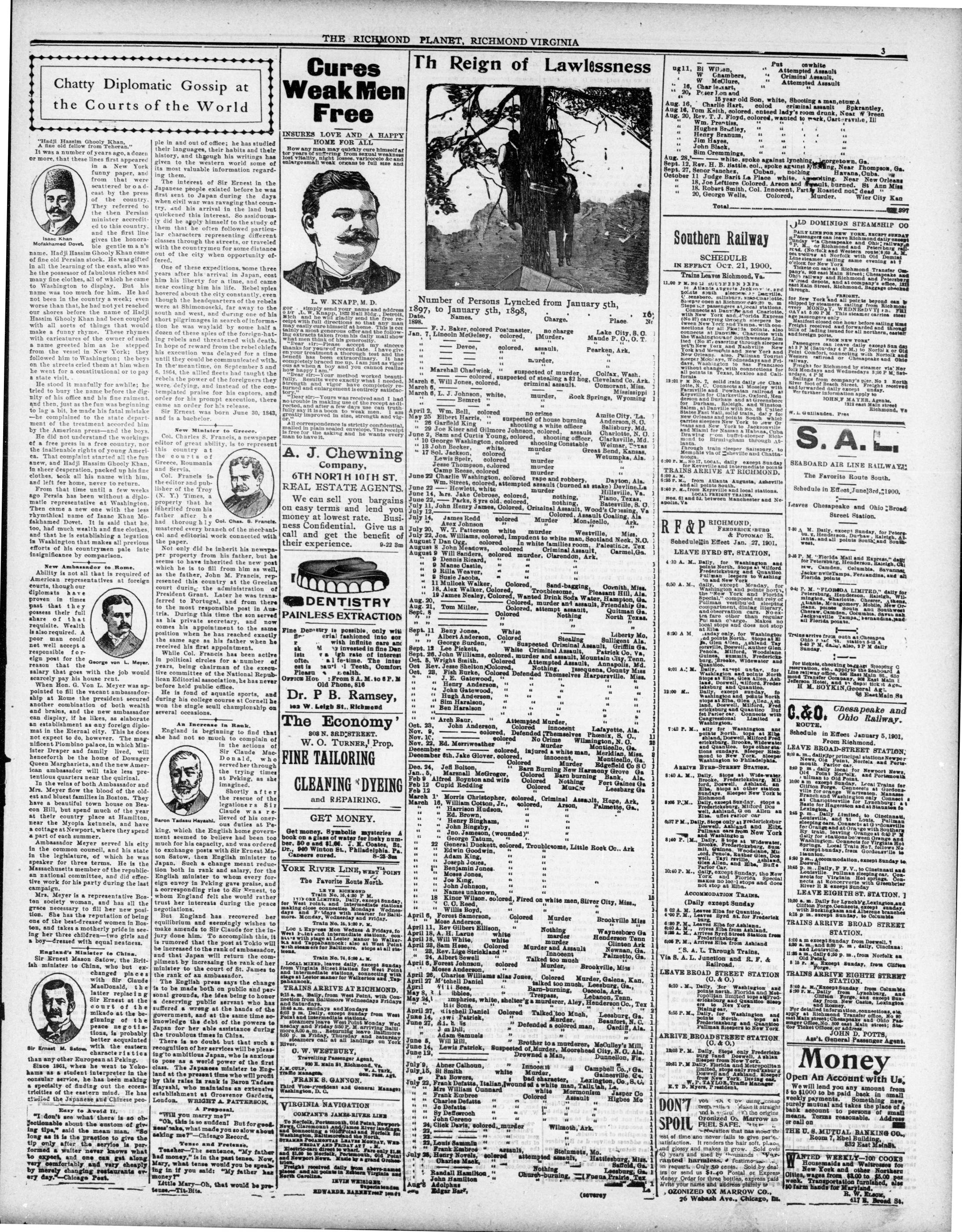
Th Reign of Lawlessness
THE TREE
INSURES LOVE AND A HAPPY
HOME FOR ALL
How any man may quietly cure himself af
tor years of suffering from sexual weakness
lost vitality, night losses, varicocele &c and
enlargesmall weak organs to full size and
L. W. KNAPP, M. D. gor . simply send your name and address odr . L. W. Knapp, 1822 Hall Bldg., Detroit, and he will gladly send the free receipt and he will send so that any man may easily cure himself as well. Finally a most generous offer and the following extracts taken from his daily mail show why he has his generosity. "Dear sir—Please send my sincere thanks for years of recent date. I have given your treatment a thorough test and the care you deserve. It has completely braced me in the art of as when a boy and you cannot realize how happy am I. Your method worked beautifully. Results were exactly what I needed strength and vigor have completely returned and enlargement is entirely satisfied. "Dear sir—Yours was received and I had no trouble in making use of the receipt as directed, and after a few days use can truthfully be weak men. I am greatly improved in size, strength and vigor. I all correspondence is strictly confidential, mailed in plain send envelope. The receipt is free for the asking and he wants every man to have it.
A. J. Chewning Company.
6TH NORTH 10TH ST.
REAL ESTATE AGENTS.
We can sell you bargains on easy terms and lend you money at lowest rate. Business Confidential. Give us a call and get the benefit of their experience. 9-22 8m
DENTISTRY
PAINLESS EXTRACTION
Fine Dentistry is possible, only with
initial fashioned into ear
with infinite care and
skin invested in fine Den
high rate of interest
al-fetime. The inter
est is sauril Teeth, Comfort
Pleasu health.
Offeron Hot: From 8 A. M. to 6 P. M.
Old Phone, 816
Dr. P. B. Ramsey,
102 W. Leigh St. Richmond
Sept. 11 Beny Jones, White
Albert Anderson, Colored
George Burden, Suspected Criminal Assaults,
Sept. 12 Lee Pickett, White Criminal Assaults, Pass
Sept. 26. John Williams, colored, murder and assault, Mountai
Oct. 5. Wright Smith, Colored Attempted Assault, An
Oct. Rev. Jesse Shelton, Colored, Nothing, Jasequena,
Oct. 28. Fish Burke, Colored Defended Themselves Harper,
J. E. Gatewood,
Henry Anderson,
John Gatewood,
Hugh Anderson,
Sim Haralson,
Ben Haralson
The Economy'
808 N. 3RD STREET.
W. O. TURNER, Prop.
FINE TAILORING
CLEANING 'DYEING
and REPAIRING.
GET MONEY.
"Arch Baur," Attempted Murder,
Oct. 28, John Anderson, Colored innocent Lafaye
Nov. 9, colored, Defended Themselves Phoenix
Nov. 10, colored No Crime Wilmington
Nov. 22, Ed. Merriweather Murder Monti
December colored, injured a white man, Mer
December 6th, Jake Glover, colored, innocent, Mo
Dec. 24, Jeff Bolton, Barn Burning New Harmony
Jan. 5, Marshall McGregor, Colored Barn burning
Feb 9 Alfred Boynton and wife Colored Nothing Fo
Feb 12 Cupid Redding Colored Murder
Feb 12
March 1 Morris Christopher, colored, Criminal Assault, H
March 16 William Cotton, Jr., colored, Arson, Palm
Harrison Hudson
Ed. Brown,
Henry Bingham,
John Bingham.
GET MONEY.
Get money. Symbolis mysteries A book on a glass of water for lucky number, $0 e and $1.6e. J. K. Coates, St. Dr., $80 Winton St., Philadelphia. Pa. cured. 8-25-3m
157) ORC LIMITED, 6:16, 3:20 F. M.
for West Point, and intermediate stations
making close connection Mondays, Wednesdays
and Fridays with steamer for Baltimore.
Monday, Wednesday and Friday.
Train No. 16, 3:20 F. M.
LO L EYENMAN Mon Wednesdays & Fridays, for West Point, and intermediate stations with stage at Lester Manor to Walker St and Tappahannock: also at West Point with steamers for Baltimore. stops at all sta-
Train No. 74, 5:00 A, W.
LOCAL MIXED, leaves daily, except Sunday from Virginia Street Station for West Point station, connecting with stage at Lester manor for Walker and Tappannock.
TRAINS ARRIVE AT RICHMOND.
9:15 a.m. Bally, from West Point, with connection from Baltimore Wednesday Fridays from Saturdays.
10:00 a.m. and Mondays
6:00 p.m. Daily, except Sunday from West Point and intermediate stations.
steamers leave West Point Monday Wednesday from Baltimore, returning Baltimore 8:00 a.m. Returning leave 5:00 p.m. m Friday, Thursday and Saturday
steamers call at all landings on York River
FRANK S. GANNON.
Third Vice-president and General Manager
Washington, D. C.
To Norcash, Portsmouth, Old Point Newport, New, Clarmont, and James River landings, and connecting a Old Point and Norcash for Washington, Baltimore and the North. Stammer Potcashwell Day as Monday, Wednesday and Friday at 11 a.m. Electric cars direct to wharf. Far only $1.50 and $1.00 to Norcash, Portsmouth, Old Point and Newport Newa. Music by a grand Orchestra. Freight received daily from above-named places and all points in Eastern Virginia and North Carolina.
INVIN WESIGER
Superintendent
EDWARDE. BARNEYFORD penns
Aug. 28, _____ white, spoke against lynching, morgetown, Ga.
Sept. 12, Rev. H. B. Battle, col., spoke against lynching, Near Thompson, Ga.
Sept. 12, Judean, anchen, Cuban, nothing
Havana, Cuba.
October 11 Judah, La face white, agreeing, Near New Orleans
18, Joe Lettore Color, Col., arrested,urned. St. Ann Miss
18, Robert Smith, Col., Innocent, Partly Roasted not dared
20, George Wells, Colored, Murder, Wise City, Kan
Southern Railway
SCHEDULE
IN EFFECT OCT. 21, 1900.
Trains Leaves Richmond, Va.
11.00 P.M. NO. 11 SUNFERN JEFF.
Atlanta Augusta Jackson, and
points south sleeper to Louisiana.
Censboro, salisbury, and Charlotte.
Sleeper on express to Steps or passengers at local stations.
Connect at Danton and Charlotte,
with New York and press.
(No 37) carrying sleeper to
tween New York and Tampa, with con-
nects at Danton, points also,
connects at Danton, Charlotte.
with the Washington and Southwestern Lim-
tle, with 37, carrying sleeper to
tween New York and Memphis and New York and
New Orleans, also, Pullman Tourist
and Memphis, and New York and
days, Washington to Saigon, Francisco
without change, with connections for
all points in Texas, Mexico and Cali-
12:01 P M No. 7, solid train daily or Chatham
connects at Moseley with
Farmville and Bristol.
Keysville for Clarksville, Oxford, Hen
deson and Durham and at Greenborough
for Huntington.
Salem, at Davantville with No. 56, and
States Fast Mail, solid train, day y for
South which carries sleepers New York for
leans and New York to Jacksonville
Miami for Nassau and Habana, Cuba
Driving sleeper sleeper Richmond to
Birmingham through Atlanta.
Through train sleeper Sainbury,
to Memphis via sheville and Chattauga.
6:00 P M. MIVIL LOCAL, daily except Sunday
for Keysville and interstate points
TRAINS ARRIVE AT RICHMOND.
6:00 A.M.
6:25 P M. from Atlanta Augusta, Ashville
and all points South.
8:40 P M. from Keysville and local stations.
LOCAL FREIGHT TRAINS.
Nos. 61 and 62, between Manchester and Neapolia.
RF&P RICHMOND,
FREDERICK*BURG
& POTOMAC R.
Scheduled in Effect Jan. 27, 1901,
LEAVE BYED ST. STATION,
410 A. M. Daily, for Washington and
points North. Stops at Wilford
Fredericksburg and Quantico
Pullman lepers to Washing
On and New York.
(Daily except Sunday
8 02 A. M. Leaves Elba for Quantico.
4 00 P. M., Leaves Byrd St for Frederick
Lake.
8 60 P. M., Leaves Elba for Ashland.
6 80 A. M., rives Elba from Ashland.
8 26 A. M., arrives Street Station from
Frederickburgh.
6 06 P. M., arrives Elba from Ashland
'S. A. L. Through Trains,
Via S. A. L. Junction and R. F. &
Railroad.
LEAVE BROAD STREET STATION
(O. & O.)
8 10 M., Daily, for Washington and
points north. Florida and Mac-
ropolis toops at Frederickburgh and Quantico Sleepers to New York
Baltimore
8 55 P. M., Daily, for Washington and
points North. toops at Frederickburgh and Quantico Pullman Sleepers to New York
ARRIVE BROAD STREET STATION
(O. & O.)
12:05 P. M. Daily, Steps only Frederickburg burg and Dowell. A shiian sleeper from New York. 10:51 P. M Daily, Florida, limited, stops only red kahrung Dowell and Ashland. Sleeper Karen York. Diring caz. W.P. LAYZON magazine Manager E.T. D. Myers, President.
DON7 von you by using oneapresentation. Make it straight and beautiful with the origineOzonized O. Marrow anPEEL SAFE. that has smoothetest of time and never fails to give parerel satisfaction. It renders the hair soft, plaus and glossy and makes it grow. Sold over 40 years and used by thousandsV warranted harmless. testimonian requests. Only 50 cents. Sold bydearss or send us $1.40 Postal or ExpressMoney Order for three bottles, express paidWrite your name and address plainly toOZONIZED OX MARROW CO.
(severey
26 Wabash Ave., Chicago, IL.
3
Put onwhite
" Attempted Assault
" Criminal Assault.
" Attempted Assault
n, white, Shooting a man, etum A
olod criminal assault Epkrantley,
unteed lady's room drunk, Near W green
ored, wanted to work, Cart-raville, Ill
" against lynching, porgetown, Ga.
, spoke against Missing, Near Thompson, Ga.
cuban, nothing Havana, Cuba.
ace white, Ascotting, Near New Orleans
ed, Arson and Assault, burned. St Ann Miss
Innocent, Partly Roasted not dead "
Colored, Murder. Wier City Kan
997
OLD DOMINION SPEAMSHIP CO
DAILY LINK FOR NEW YORK, EXCEPT SUNDAY
Passengers can leave Richmond daily except Sunday
to the Chesapeake and Ohio railways.
6 P.M., or Richmond and Peterburg rail
}}-
(No.Folk and Western route); 60 A.M.
on the 10th at Norfolk with Old Domin
Line steamer sailing same evening at 7
ol'clock for New York
Tickets on sale at Richmond Transfer O
pany's, 908 east Main Street; Chesapeake and
Ohio railway and Richmond and Peterburg
railroad deposits, and at company's office, 15th
east Main Street, Richmond, Baggage checked
through.
FREIGHT.
for New York and all points beyond can be
shipped by steamers, sailing from Richmond
every MONDAY, WEDNESDAY 12th, FRI
DAY at 6:00 P.M. This steamer carries steer
age passengers only.
8 PENGUINS can leave daily except Sun day
15 PENGUINS on sun-day 4 P.M.) to Norfolk or
Old Point Comfort, connecting with Norfolk and
Western railroad or Chesapeake and Olsen
railway.
from company's pier. No 2 North
Silver foot, except receives
and forwarded daily except unday.
S.A.L.
Schedule in Effect, June 3rd, 1900.
Leaves Chesapeake and Ohio Broad Street Station.
7-80 A. M. Daily, except Sunday, for Petersburg, u. Henderson, Durham, Kaleigh, Aklanta, and all polls South, and Southwest.
2-35 P. M. "Florida Mall and Express," daily for Petersburg, Henderson, Raileigh, Oak row, Camden, Columbia, Savannah, Jacksville, Tampa, Feroandina, and all Florida polls.
0-40 P. M. "FLORIDA LIMITED," daily for Petersburg, Henderson, Raileigh, Wilmington, Montgomery Chester, then, Atlanta, Montgomery Chester, now leans, points South and Southwest Colorado, Columbia, Savannah Jacksonville, Tampa, bernandina, jane all Florida polls.
Trans arrive from outh at Chesapeake Ohio r. 34, st. 5-15, 40 P. M. daily, also; 40 P. M daily
for Nickels, checking baggage. Stepping O
cervation, etc., apply to the Seaboard
railway office. 800 East Main St. Slec
Lakeview, Montana. 800 East Main St.
mond Transfer Company. 800 East Main St.
Jefferson Hotel, and 800 Depot Nick M.
H. M. BOYKIN, General Ag.
800 East Main St.
C. & O. Chesapeake and
Ohio Railway.
ROUTE.
Schedule in Effect January 1, 1901,
From Richmond.
LEAVE BROAD-STREET STATION;
a. 8 a.m., daily principal stations Newport
News, Old Point, Norfolk and Port-
mouth Parlor car.
b. 4 p.m., day ideas for Newport News,
Old Point Norfolk, and Portsmouth
ulman to Old Point.
Mil.
10:00 am except Sunday. Local Trains for
Clifton Forge. Connects at Gordonn
ville for orange Warrenton. Manasse
Brinkley for washington only Connects
at Charlton and for Lynchburg: at
Basic for Hagerstown and at Stamton
for Lexington.
2:45 p. m. Daily Limited, to Cincinnati,
Louisville, and St. Louis. Pullman
along oars. Connects at Gordonsville
for Orlando. Connects with Southern
Ry train, leaving Orlando at 5:00 P.
m daily for stations between Orange and
Washington. Connects for Virginia Hot
Springs. Local Train No.7, follows No.
excursion, from Gordonville to taunton.
1:20 p. m., accommodation, except Sunday to
Doswell
10:40 p. m., Dally, F. F. V., to Cincinnati and
Milwaukee's sleeping car. Connects
for Vibrissin with the springs. Connects
at Roncervite with Greenbrier
River R E except Sunday
LEAVE EIGHTH ST. STATION. ]
10:30 a. m. Daily for Lynchb's Lexington and
Clifton Ford. Connects, Sunday,
with Buckingham and Albersee branches
10:15 p. m. except Sunday, to Columbia
TRAINS ARRIVE BROAD STREET
STATION.
8:00 a m except Sunday from Dowell. ]
8:30 a. m. and 8:30 p. m., daily, Cincinnati
and Louisville.
11:25 a. m. daily. 5:00 p. m., from Norfolk an
Old Paint
STATION.
8 15 P. M., Except Sunday, from Clifton
Forge.
TRAINS ARRIVE EIGHTH STREET
STATION.
8:40 A. M., Except Sunday from Columbia
8:20 P. M., Daily from Lynchburg, and
5:20 F. M., Daily from Lynchburg, and except Sunday from New Castle, Lexington
and Rosney.
For detailed information, connections, abl
app at Richmond Transfer Office, No 90
east Main street; Cheapsake and Ohio Pass-
enger Office, No. 900 east Main street; Sta-
tior Ticket Office or Address:
JOHN D. POTTS,
App't. General Passenger Agent.
Money
Open An Account with Us.
We will lend you any amount from
5 to $1000 to be paid back in small
weekly payments. Something new,
purely mutual and takes the place of a
bank account to persons of small
means. Terms reasonable. Address
or call on
THE U. S. MUTUAL BANKING CO.
Room 7, Kebel Building,
832 East Main St.
WANTED WEEKLY-100 COOKS
Housemaids and Waitresses for
New York and other Northern
Cities, wages from $3.00 to $5.00
per week. Transportation furnished, also
50 farm hands for Maryland.
THE PLANET
all communications intended for publication
should be sent as to reach us by
email: info@microsoft.com
TERMS IN ADVANCE
$2ne Copy, one year. 81
$2ne Copy, three months. 80
$2ne Copy, six months. 80
$2ne Copy, four months. 80
$2ne Copy, three months. 48
$1ne Copy. 36
ADVERTISING RATES
For one inch, one insertion.....$
For one inch each subsequent insertion.....$
For two inches, three months.....$
or two inches, six months.....$
or two inches, nine months.....$
or two inches, twelve months.....$
arriage at funeral notice.....$
standing & d transient notices per line.....$
POSTAGE STAMPS OF A F NOMINATION
HIGHER THAN TWO CENTS OF RECEIVERS
ON SUBSCRIPTIONS.
THE PLANET is issued weekly. The subscription price $1.50 a year in advance.
There are you at a year, in advance. Money can be billed by mail or risk—in . . . Post Office Money Order, by bank Check or Draft, or an Express Money Order, if one of these can be grounded, in a Registered Letter.
MONEY ORDERS.—You can buy a Money Order by your Post-Office, payable at the Richmond office of the American Express Company, or at your arrival. Express Money Order is accepted at any office of the American Express Company, United States Express Co., and the Welfare Department. Express Money is responsible for money sent by any of these companies. The Express Money Order is a safe and convenient way for forwarding money.
REGISTERED LETTER.—If a Money Order Post is received, you reach your Postmaster will register the letter you wish to send us on payment of ten cents. If the letter is lost or stolen, it can be risk. You can send money in this manner.
We cannot be responsible for money sent in a way than one of the four ways mentioned above for money in any other way, you must do it at your own risk.
MESSAGE e-mail.—If you do not want the PLAN for your postmaster to run a mail description run out, you then notify us by a Post Card to discontinue it. The courts have ruled that their paper disclosure of time for which it has been paid is valid for the payment of the subscription date when they order the paper discount.
COMMUNICATION — When writing to us to renew your subscription or to discontinue your address in full, otherwise we cannot find your name on our books.
CHANGE OF ADDRESS — In order to change the address of a subscriber we must send the notice as well as the present address.
Entered in the Post-Office at Richmond, Va., as second class matter.
SATURDAY, MARCH 30, 1901
We return thanks to Senator John W. Daniel for several packages of seed.
GEN. BORMA, the Boer commander-in-chief has declined to surrender, and there are two reasons presumed to be the cause. One is the failure to guarantee independence and the guarantee of additional rights to the Negroes in Africa.
CAN PROTECT ABROAD.
THERE was a touch of irony in a cable-gram from Gibraltar, which announced the arrival of the armored cruiser, NEW YORK, enroute to TANGIER, MOROCCO, to demand from the SULTAN of Morocco an apology for an apparent discountary to the United States owing to his Grand Vizier and his Minister of Foreign Affairs refusing to permit Mr. GUMMERCE, the American consu'ar representative to see the SULTAN in person.
This is in Northern Africa. During last year this same United States Government collected $5,000 for the murder of a naturalized American citizen named MARCUS EZKQUI, who was burned at FEE last June.
At BARCELONA, VENEZUELA, a foreigner, not an American citizen, has been arrested by that government and it is reported that some steps similar to those pursued in Morocco are to be taken to secure his release. And this too simply because he represents our consular interests, although not a naturalized citizen of the United States.
An American citizen was burned and murdered at Leavenworth, Kansas within ear-shot of the barracks of the United States soldiers. No sound of condemnation has been heard from either the military authorities or the President.
An American citizen was burned and killed at TERRE HAUTE, INDIANA, and silence prevails at the capital of the mation.
An American citizen was burned and killed at CORNICANA, TRXAS, and no movement has been noted at the capital of the nation.
Yet, the Constitution of the United States solemnly declares that cruel and unusual punishments shall not be inflicted.
These guarantees are a mockery and the attitude of our government abroad ridiculous.
Truly are we living in an age where might makes right and the cries of the helpless and oppressed go unheeded in the land.
HALLIN CRUTCHFIELD, (colored) who lived near Rome, Smith county, Tennessee, was suspected of having found a pocket-book containing ($120) one hundred and twenty dollars and on this account was taken by a mob on the night of March 15, 1901, carried to a bridge in the neighborhood where she was bound, shot to death and thrown into the creek.
It is impossible to conceive of a crime more harboured or feinous. She was a woman. The midnight scene.
her protestations of innocence, her pleadings for her life, her prayers to God, the heartlessness of her murderers is not told in that short item which brought the news of her death.
This was a woman—a colored woman. Suppose she had been a white woman, no matter how degraded, and her murderers had been colored men, no matter how respectable.
Would a man of them be living today? Would their wives and their children be safe?
Could a colored man of respectability be found who would be willing to take their part?
God knows the conditions are becoming worse and worse. All kinds of flendish tortures are being resorted to. What else can be the tendency than to drive us to some act of despair which will end it and us as well? For our part, we believe that manhood is necessary and a determination to protect our women all important. Colored men have been cowed, browbreaten to such an extent that only in isolated cases can any be found with the nerve to do and to die. These outrages must cease, however, and when the lyncher comes, it is the duty of the free American citizen of color to sell his life as dearly as possible, and with a prayer upon his lips go marching home to heaven.
AROUSED AT LAST.
The action of the Democratic legislature of Mary and in passing a partisan election law, disfranchising about 32 000 colored voters and 16 000 white ones seems to have aroused the leaders of the Republican Party in a way that nothing else could do.
It has forced an issue which in volves the life of the Republican Party itself and the ringing utterances accerbed to Senator Burns, who will become chairman of the Senate Committee on Privileges and Elections may be taken as a fair index of what is about to take place in councils of that Party. He said:
"The ballot law which it is proposed to pass in Maryland is very likely so bring to the attention of Congress various so-called disfranchisement laws, and open up the whole question of representation in Congress on the basis of men who are not legal voters under State laws."
"Congress does not desire to discuss these subjects, but in my opini n, the question will be forced upon us for determination by the unwise action of some of the States. Sectional sympathies and prejudices must be laid aside to get a clear understanding of the importance of the subject. It is a fact that there has been some indulgence and toleration in the past of the efforts of certain States to avoid Negro domination. Perhaps sympathy had more to do with permitting the South to maintain a representation in Congress which in many cases was on the basis of a misinformed citizen, than justice or fairness. This may be said aside to consider the more serious phases of the situation."
Colored men, is it not perfectly evident that God's hand is again seen in the political affairs of the nation?
Is it not a practical demonstration that the toleration of wrong is to be followed by a visitation of evil?
Were it possible to isolate the citizen of color without either of the great parishes being affected, both would do.
less of color, without either of the great parishes being affected, both would do it. Slavery was acquiesced in, and the result was rivers of blood. Political slavery is being practiced and equally as serious results will follow. No class of citizens can be denied the rights guaranteed under the Federal Constitution without other classes of citizens being affected. The supreme Court of the United States seems to be a party to the conspiracy to disregard the laws and we no longer hear the ringing declarations in favor of great principles that once emanated from the Chief Executive of the nation.
Let them do their worst. Let the Red Shirts ride on, the lynchers indulge in holocausts of blood, the slave-drivers practice the atrocities of fifty years ago. It will all return to them bye and bye, and not only the meeses, out their children and their children's children will suffer as a result of their folly and bewail the leaving to them of a legacy which is a punishment and a curse.
The Constitution of the United States says that no citizen shall be distranchised on account of his race or color or previous condition of servitude.
This decree should be respected and its provisions rigidly enforced.
MR. NIXON'S OBJECTIONS.
Mr. J. O. Nixon of Wilmington, North Carolina, takes issue with our statement in the PLANET of March 28, 1901, which was as follows:
"During the last two campaigns in Maryland, many colored men joined the Democratic Party and did all in their power to defeat the candidates of the Republican Party. Now, the Democratic Party, which is in power has called together the legislature of that state for the purpose of disfranchising the colored people.
It looks very much as though the Democratic Party can never be trusted when the citizen of color is called into question."
Mr. Nixon does not believe that colored men did anything of the kind.
As to proof of this fact, he has but to communicate with the Republican leaders of MARYLAND and Gov. SMITH, the Democratic Governor of that state.
But then, if Mr. Nixon declines to accept facts even when supplied from such high authority, it is his own concern and not cure. He presumes that all colored men
THE RICHMOND PLANET, RICHMOND VIRGINIA
vote the Republican ticket although he, as one individual, votes the Democratic ticket. He makes the mistake of believing that the ostracism to which we are subjected is due solely to our politics and not to our racial condition.
That too is a matter of opinion, for in this state Negro Democrats are kicked around just as are Negro Republicans. They are not even permitted to take a part in Democratic Primaries.
A few of them hold the positions of janitors and there is a mighty strong suspicion in some quarters that those who hold office the longest are in some way connected by blood-kinship with some of the powers that be.
Mr. Nixon is severe in his condemnation of Mr. Wm. McKINLEY and silent with reference to Mr. B. R. TILLMAN.
We, too, have been forward in criticizing the former and in condemning the latter. Which is the fairer of the two?
He argues that under similar conditions, the Republican Party would do just as the Democratic Party is doing.
The colored woman who was lynched in Teenaukee was not a voter, and politics could not have had anything to do with her antitimely taking off. The Negro as a political factor is dead in Mississippi, Louisiana. South Carolina and North Carolins.
His fate has been sealed and his doom written. Is there any cessation of outrages to which he is being subjected? Would you argue that politics caused the enslaving of colored men in South Carolina or their butchery in your own state?
"Mayor" A. M. WADDELL, by a revolutionary process which carried with it the slaughter of innocent men, women and children, now occupies the Chief Executive's chair at Wilmington, N. O.
The blood of the murdered is on his garments. To atone for his sin and to ease his conscience, he may perform individual acts of kindness towards certain colored men.
But do you presume, Mr. Nixon that the great mass of colored people of Wilmington will support him?
Never! It would be unreasonable to expect it. The wounds have not as yet healed and the cry of white supremacy is as yet in the land.
Yes, many Republican leaders have failed to measure up to the standard set for them by that Party and they meris our contempt, but it is unfair to say that the colored man's appreciation and devotion to that Party was due to improper infatuation not born of reason.
The Republican Party championed the 13th Amendment which abolished slavery, the 14th Amendment which ensured legal equality and the 15th Amendment which guaranteed the right to vote.
Under Summer's leadership, it gave to us civil rights, which were annulled by traitorous decisions by the Supreme Court of the United States, then as now, Republican.
This party has never failed in its platform to declare in favor of a free ballot and a fair count.
In view of these facts, colored men would have been worse than ingrates to have deserted it at the polls.
It would have gone to prove the declaration of the poor whites slave-drivers of other days who declared, "The meaner you treat a Negro, the better he will like you.
For our part, Mr Nixon, you are free to do as you like, and if you can kiss the hand that smites and "crize the supple hinge of the knee, that favor follow fawning," it is for you to do it.
As for the masses of the colored people, they are against any man, white or black, Democrat or Republican who is against them.
As at present constituted, the Republican Party has not in its platform gone back on its principles, although it has been sadly betrayed by men to whom has been ntrusted the duty of carrying out its pledges.
When the clouds lower and the Republican Party engraft the creed of the Negro-haters in its platform, it will be time enough for us to seek another haven of refuge in some other than either the Democratie or Republican Parties and if this fail, let us hoist our own flag and rally under its folds, defiant to the last and showing to the world that we know—
"What sublime a thing it is,
To suffer and be strong."
HAVE JUST BEEN THE POINT.
Some one seems to have been very successful at the Norfolk, Va. Democratic State Convention in loading down the proposition to call the Constitutional Convention by pledging the party to a suffrage plank under the provisions of which no white man is to be distranchised.
We have contended all along that this would be a plain and flagrant violation of the Fifteenth Amendment of the Constitution of the United States which declares that the right to vote shall not be denied to any person on account of rase, color or previous condition of servitude.
Is an address delivered at Belvidere Hall last Saturday night Hox, Gonous D. Wren, one of the ablest and most outspoken lawyers in the state declared this to be a fact.
That any one should have been sur-
prised is a mystery to us.
Mr. WILLIAM L. ROYALL, ex-Judge GEORGE L CHRISTIAN, Mr. C. V. MEREDITH and every other candidate with enough information to practice in a magistrate's court knows this to be true.
The Richmond Dispatch of Tuesday last published the following:
"In view of the strong ground taken by Captain Wise that indiscriminate Negro disfranchisement is impossible without direct violation of the Fifteenth amendment to the Federal Constitution, a dispatched reporter called on him pestered to secure its views in greater detail. That gentleman claims any desire to figure in print, but frankly reiterated his expressions on the subjet. He turned to the Fifteenth Amendment and read the text of it carefully and with emphasis.
There could be no mistaking the meaning, he thought, of the clause prohibiting the abridgement of suffrage on account of race, color, or previous condition of servitude. The enforcing clause, which declares that Congress shall have power to enforce this provision by appropriate legislation," was equally clear and unmistakable. He takes issue with those who contend for excluding Negroes from suffrage without disfranchising any white man. To do this, he contends, would invite the "appropriate legislation" provided by the enforcing clause. The Mississippi suffrage law, which has been referred to as affording Negro disfranchisement without barring the enfranchisement without contravention of the Fifteenth Amendment, is no law disfranchising the Negro because he is a Negro. On the contrary, it consists of an educational qualification, and also a property qualification, and does not disfranchise all Negroes.
It will be impossible Captain Wise said, to disfranchise such Negroes as Booker Washington, who are educated influential and prosperous.
Captain Wise takes strong ground against any suffrage law that will have the probable effect of reducing the State's representation in Congress.
Total disfranchisement of the Negro is unnecessary, even if it were legal fact, the Negro now almost shorn of political power. There is not men of the race in the State Legislature, the United States Congress, nor the Council.
Captain Wise is firm in his conviction that Negro disfranchisement, literally speaking, is unconstitutional, and would, if attempted, invite reduced representation. Holding those views, he thinks it but frank to state them clearly, as he did Saturday.
The above is plain talking in the meeting and accounts for our indifference on the subseat.
There is another phase to the question.
To attempt to distrubise the Negro because he is a Negro, knowing that it is in violation of the Constitution of the United States is perjury, and no Virginia gentlemen will engage in each a proceeding, all of the MULENITES to the contrary not withstanding.
The proposition to divide the school-fund between the races in proportion to the taxes paid by them is another absurdity, impossible of enforcement and in violation of the state constitution as at present constituted as well as an unqualified infringement of the privileges guaranteed by the Bill of Rights of Virginia.
Such a constitutional enactment would be "put to sleep" both by the state and Federal Courts.
It would be fatal to the poor white man as well as to the poor colored one.
Plainly speaking, these two classes of people's interests are identical although the white elements do not seem to see it.
With this large laboring colored population in our midst, it will be impossible for laboring white men to enforce their demands without a combination with it, which will prevent its engaging in ruinous competition, where capital will be the vistor and the poor white man the victim.
But then we did not intend to engage in a discussion of this phase of the labor question.
For our part, the Negro-haters can do their worst. They will injure the white people of the state far more than the Negro at whom they are aiming.
We are about as far down in the scale of citizenship, so far as our rights are concerned as we can possibly be, and so far as the 13th, 14th and 15th Amendments to the Constitution of the United States are concerned and our enemies can gnash their teeth and waste their lung-power to their own infinite satisfaction.
Murder in the First Degree.
Harrisburg, March 23. — Harrison Keiper and Henry Rowe, of Lykens, who shot and killed Cashier Charles W. Ryan, of the Halifax National bank, of Halifax, on Thursday of last week, in an attempt to rob the bank, were yesterday convicted of first degree murder.
Victory For a Traction Company.
Columbus, O., March 27.—The supreme court yesterday, in the case of the state versus the Dayton Traction Company, decided in favor of the traction company, which railways the right to carry freight through the streets of the municipalities along their lines.
To Be Presidential Poster
Washington, March 27.—Among the fourth class postoffices to be advanced to the presidential class on April 1 are the following: Port Oram, N. J., Hastings-Upon-Hudson, N. Y., Clinton, Maxton and Williamston, N. C., Roaring Springs, Pa., Glennallan and Graham, Va., Cameron and Pennsboro, W. Va.
The Pennay's Increased Capital Philadelphia, March 27.—By the largest stock vote ever cast in the history of the Pennsylvania Railroad company the shareholders of that corporation yesterday re-elected the old board of directors and authorised an increase of $100,000,000 in the present capital stock.
WICKED CINCINNATI
Mrs. Nation, the Saloon Smasher, in Ohio's Metropolis.
SHECCOLDS MAYOR FLEISCHMANN
Tells the Millionaire Distiller That He Cannot Die Peacefully as Long as He Is a Manufacturer of Intoxicating Drinks.
Cincinnati, March 27.—Mrs. Carrie Nation began yesterday in Cincinnati by attending early mass at the Roman Catholic cathedral, though she is not a communicant of that church.
At the Grand Central station over 4,000 persons inspected the new Pan-American train of the Big Four road. Forty other cars of this pattern are to be delivered to the road by June. General Passenger Agent Lynch and Assistant Reeves escorted Mrs. Nation and parly through the train, and at that time the campaign happened to be flowing freely, and pressed her indignation at the use of liquor and wine on the train, as well as at her hotel and elsewhere.
Mrs. Nation called on Mayor Julius Fleischmann at the city hall in the afternoon and scolded him for operating a distillery here. On her arrival the mayor greeted her cordially and asked her if he could do anything for her. She said:
"Yes; I want you to give me some advice as to how to close the hole holes in this city. You will never die peacefully as long as you are a man who manufactures intoxicating drinks. You will have some serious questions to answer when you face your God. I can do no more than warn you, and that must do."
For 20 minutes the mayor listened to perhaps the strongest denunciation that a chief executive ever received in his own office. When she had finished Mayor Fleischmann remarked blandly:
"I am sorry that we cannot succeed. I am afraid you have struck at hard proposition—the mayor of a wicked city and a whisky manufacturer. I am glad to have met you and hope that you may do much good."
From the mayor's office Mrs. Nation called on Chief of Police Deitsch and asked him to send her an escort for her slumming tour last night. He assured her that she should have an officer, and as she left she said: "Goodbye, and if I don't meet you in this world I hope to see you in Heaven."
Escorcied by two detectives Mrs. Nation made her tour of the "ragtime" resorts and other places in this city until midnight. She made a half dozen or more addresses. There was a procession of a dozen or more hacks, and at some places they were followed by many people in the streets. Every effort was made to save time and visit as many places as possible. Mrs. Nation would enter the places, shake hands with both the women and men, and then mount the platform or a table to see the crowd. She commanded the door, and met with no insults or disturbance, but at times she spoke harshly of the drinking that was going on before her and of the obscene pictures on the walls. She will deliver an address at Lexington, Ky., tonight and visit the resorts of that city and lecture here tomorrow night.
EURE OF WAR WITH RUSSIA
Japanese General Believes He Is Summoned Home to Night.
Invaded Home to Fight.
Pittsburg March 27.—K. Yatsumi, a general of the Japanese imperial army, accompanied by Captains N. Kayomi and L. Matusi, passed through Pittsburg yesterday on route to California. They have been in this country for the past three weeks seeking data for the benefit of the imperial army, and intended remaining for three or more months, but were called home. Gen. Yatsumi said:
"According to the communications I have received from my government I think that a conflict between Japan and Russia inevitable. While I have not been notified officially I think that the object of my superiors in calling me home is for the purpose of making preparations for a war with Russia, Russia's ultimate intention is to seize Korea, but we shall never give up the land without a struggle."
Kidnapers Frustrated.
Wilkesbarre, Pa., March 27.—A daring attempt was made to kidnap 11-year-old Edward McAvoy yesterday. Two men picked him up in the yard of his father's house and carried him to a surrey in waiting. A handkerchief, saturated with chloroform, was placed over his nose and he became unconscious. When he revived he found himself on the back seat of the vehicle, which was then jarring over a country road. Young McAvoy sprang from the carriage. One of the men ran after him, but the youngster's cries attracted the attention of the occupants of another carriage which was passing at the time and the kidnapers whipped up their horses and disappeared.
Suffocated in a Tunnel
Seattle, Wash. March 27.—The first serious accident in the new Great Northern tunnel, which was opened for traffic about three months ago, took place Monday night and resulted in the death of Engineer W. W. Bradley from suffocation from the poisonous gases in the tunnel. His fireman, Joseph W. Smith, and five other trainmen were overcome, but recovered soon after getting to the open air. The train, which was bound east, became stalled in the middle of the tunnel, the fumes of the engine filled the place and the men were forced to lie on the floor of the tunnel for safety. A relief train rescued them.
McCandless Descries the Inurgents.
Harrisburg, March 27.—At the regular meeting of the anti-Quay Republican senators and members last night McCandless, the McCandless, of Allegheny, offered a resolution that "the political association knows that the 'inurgents' be and is on behalf disliked. No action was taken on the resolution, and Mr. McCandless left the meeting after explaining that he was no longer in sympathy with the purposes of the organization.
To Settle in North Dakota
Chicago, March 27.—Possessed of homestead rights, household effects and requirements of land development between 1,700 and 1,800 persons left Chicago yesterday for the agricultural regions of North Dakota. The prospective settlers are from Ohio, Indiana, Pennsylvania, Virginia, Maryland, Illinois and other states, and among them are between 300 and 400 members of the German Baptist church, commonly known as Dunkards.
A WEEK'S NEWS CONDENSED.
Thursday, March 21.
The Duke and Duchess of Cornwall and York, on a tour of the world, arrived at Gibraltar yesterday.
The bill disfranchising illiterates and the bill ordering a state census passed the Maryland legislature.
A movement is said to be on foot to consolidate the coal producing interests of Illinois into one mammoth combine.
The first discovery of oil in the southern portion of West Virginia was made yesterday in a 300 barrel oil well drilled at Milton.
T. R. Oatman, a railroad switchman at Holland, Mich., has fallen heir to $6,000,000 by the death of a distant relative in Virginia.
Friday, March 22.
Near Clinton, Me., J. D. Marr, a farmer, killed his three children while insane.
The bill prohibiting the manufacture, sale or giving away of cigarettes has passed the Minnesota legislature.
Commandant Philip Botha, brother of the Boer commander, was killed in the lightning attack.
At Coldbrook, Mass., Mrs. Lizzie Naramore, aged 50, while insane, killed her six children, the eldest 10 years.
The Delaware and Hudson Railroad company has increased wages of trainmen from five to twenty cents a day.
Valentine Hott, of Buffalo, after being totally blind for 28 years, had his sight restored by an operation performed by Prof. McConachie, at Baltimore.
Saturday, March 23.
The death rate in Havana was 19.32 per 1,000 in February, against 82.32 for the last February of Spanish rule.
The Australian federal elections, the first since the formation of the commonwealth, will be held March 30. The main issue is protection against free trade.
The New Hampshire house of representatives voted against a resolution declaring the election of United States senators by direct vote of the people.
Inspectors at San Francisco, Cal., have placed the responsibility for the wreck of the stamer Rio de Janeiro, on Feb. 22, on the late Capt. Ward and Pilot Jordan, and have revoked the license of Chief Engineer Herlihy.
Monday, March 25.
Attorney General Griggs retires from the cabinet next Monday.
Russia's czar, dismayed by the rioting, called a cabinet council to discuss the situation.
It is said that President Kruger, of the Transvaal, will visit this country next month, health permitting.
The Arkansas house of representatives has passed a bill imposing a fine of from $500 to $1,000 for gambling.
Earl Cadogan, lord lieutenant of Ireland of Ireland, authorizes the statement that he will retain office for another year.
J. Pierpont Morgan has donated a collection of minerals valued at $200-000 to the Museum of Natural History, at New York.
A settlement has been reached with the 400 strikers at the Macbeth glass works, at Marlon, Ind., and business was resumed today.
Leading New York Republicans, including Senator Platt, decided not to urge police legislation for New York city. A decided victory for Governor Odell.
Tuesday, March 26.
The New Jersey court of errors and appeals decided the anti-spring election law constitutional.
Storm Bull, a nephew of Ole Bull, the celebrated violinist, was nominated for mayor of Madison, Wis.
The president appointed George E. Baldwin, of Ohio, United States consul at Nuremburg, Bavaria.
The widow of Preston S. Brooks, who caned Charles Sumner in the United States senate, died at Columbia, S. C.
Mr. Johnson, the trolley promoter, proposes making the fare on his lines from New York to Philadelphia 40 cents.
Charles Friedman, who while insane killed his two little children in New York, died in jail. He had not slept for a week.
Tuesday, March 27.
The Buffalo Pan-American exposition stamps will be placed on sale at postofficees on May 1 next.
Gen. George W. Crook, of Denver, is seriously ill with catarrh of the stomach at the New York hospital.
The second oil gusher in the Beaumont (Tex.) field was struck yesterday. Its flow is estimated at 20,000 barrels.
The bondsmen of R.G. Rathbone, former director general of posts in Cuba, have surrendered him and he is again in jail.
Governor Candler, of Georgia, announces his retirement from politics at the close of his present term. He is 74 years old.
S. B. Patterson, postmaster at Halls, Mo., for misappropriating government funds, was sentenced to two years in the penitentiary.
GENERAL MARKETS
China Refuses to Yield to Russia.
London, March 27—The Shanghai correspondent of The Times, wiring yesterday, says: "I am informed on the best authority that the Chinese court has instructed Li Hung Chang to the ministers of the powers that China the ministers to sign the Manchurian convention, also notified all viceroys to the same, is further asserted that the court seriously contemplates a removal of the capital from China."
HOMEMADE DRESSES.
HOW TO MAKE COTTON AND WOOLEN SHIRT WAISTS.
Designs Which May Serve as a Basis For Different Materials—Forming the Tucks and Cordings—Suggestions as to Trimming.
[Copyright, 1901, by American Press Association.]
To make a shirt waist and have it right is one of the most difficult things in dressmaking, and yet it is a good thing to learn how to do it, since the material for one costs so little and the finished garment costs so much. The waist and pattern in this column are from the best shirt waist house in New York. The design shown here is the basis of them all, woolen and cotton. Any difference is developed by different ways of trimming or tucking. The back is generally made straight and in that case is cut all in one piece, but some of the plaid or striped goods are made more ornamental by having the material cut blas, which requires that a seam should be in the middle. Three or more tucks or cordings are sewed in the stuff on each side of the shoulder point, and a deep plait is laid at the bottom under the narrow one so that it is made to narrow toward the center until the two lines of plaitings touch at the bottom while starting at the shoulder point.
On the diagram, Fig. 2, will be found a yoke of the back, and this is cut on the cross of the goods to be strong, and the straight edge is bound. It goes under the outside. The outside of the back is then basted to this. It is to give firmness across the back. A waist made in this way never loses its shape across the back. It also stays the arm size at the back. Woolen and cotton shirt waists are never fully lined. The back, like the front, extends three inches below the waist line for holding the belt. Some of the best waists have a gathered belt sewed along three inches
1.
3.
2.
4.
SHIRT WAIST MODEL.
above the bottom, and on this is put a line of very strong tape, with snap buttons at short intervals. There is another tape furnished with it with the other part of the button on that, and this is to be fastened to the dress belt, and they fasten by a push, just like the glove buttons.
The front of a shirt waist is cut like the diagram. If it is to be plaited or to have featherbone piping cord run in, that should be done before the neck and arm sizes are cut out. The lines show how the plaits are laid. The doted line across the bottom is to mark the waist line, and the crosses show the proportion of the dip for the blouse front. The corsets are with straight fronts yet, though there are some made with high busts for those who prefer them. But the waists are all planned for the straight front. When the plaits are all in, the waist can be gathered in and fitted and finished off. Three flat gilt buttons are put on the front of the woolen waists and pearl ones on the cotton.
Shirt waist sleeves are of two kinds—the regular shirt sleeve and the coat sleeve with some little ornamentation, mostly in shape of a fancy cuff. Many of the silk ones have short sleeves to allow for undersleeves. Sleeves in shirt form have the cuff four ply and are first stitched along the seam and then turned and stitched like a man's cuffs. At the neck there is a band of the material, and this is an inch wide. This has a buttonhole in the back and two in front to attach any preferred collar. The kind of collar is entirely a matter of personal selection. But nearly all the cotton waists have one or two collars of the same material and sometimes a tie of the same.
For shirt waists there are many kinds of material, but the striped ginghams and plaids, the plain chambrays, lawns, dotted swisses and organies and dimities are seen oftenthe These are all 30 to 36 inches wide, and for a plain one without tucks it needs three yards, allowing cuffs and collars of the same. For one with many tucks it will require half a yard more. Two and a half yards of flannel is sufficient, while it takes five yards of silk, unless it is wider than the usual, which is 18 to 20 inches. Many pretty effects can be developed in shirt waists by cutting the goods so that stripes may run in different ways, bias or on the cross, and this set in between other parts where the pattern runs across or where stripes and bias parts alternate.
Scotch and French fannies are the two best of the all wool materials for shirt waists, and the variety of them is surprising, but unfortunately the figured and dotted ones are extremely dear, and few can afford them. But sometimes a lady who is clever with her needle embroiders the dots herself. Any other small designs, such as clover leaves or tiny geometrical figures, are pretty, and some of the narrow silver and gold braids are applied with good effect. OLIVE HARPER.
The Lost Parent
Superintendent—These goods won't sell at 11 cents a yard.
Dry Goods Man—Mark them up to 15 and put them on the bargain counter.
—Brooklyn Life.
Doing His Share
"Mr. Biggleson is quite a phil
theopist, isn't he?"
"Yes. He always draws up the subscription papers other people are asked to sign." -Tit-Bits.
THE PLANET
SATURDAY, MARCH 30, 1901
Lively Adventures of the Widow's Cows
By M. QUAD.
HERE were pirate craft quartering the Caribbean sea from the Island of Trinidad to Havana, and from Nassau to the Bay of Honduras. They sailed up and down the Gulf of Florida, and they hung about the Bataama bank and the Yucatan and Windward channels. Many a trader from the American coast fell into their hands, to be burned or sunk and the crew sadly misused, and the dread of the black flag lay heavy on the sailor's mind.
Of all the men who, trusting in luck, event from the port of Salem to the Florida cape, Noah Hutchins was perhaps the most notable. In his old butter-box of a brig, the Lucky Sally, he raised out of Salem for the West Indies is clamily and serenely as he started off for Sunday meeting as ashore. On one occasion he would have been captured by a rover but for the advent of a sudden squall; on another the Lucky Sally owed her escape to a fog and brought home three solid shot fired into the hull; again a "long, low, raikish craft," flying the Jolly Roger, and come within range of her and was about to open fire when an English man-of-war hove in sight and sent the red rover scurrying.
Capt. Noah had been a wildower for many years. For many years also he had had an eye on the "Widder" Skinner; when he got through taking out machinery and calicoes and bringing back rum and molasses he would ask her to "jine" with him. It was an understood thing between them. Each time that he sailed away the widow dimilsoned him to look out for black tags, and each time he returned home the thanked Heaven for his escape.
As time went on he came to his last voyage. The pirates were still doing brisk business at the old stand, but the lock of the Lucky Sally would take her through, and then he'd sette down and have a home for the remainder of his days. On the night before the brig was to sail Capt. Noah went up as usual to call on the window.
"Nancy, I shall be back in about a month," he said as he sat poking the fire and eating an apple, "and then I'll be around to milk the cow, feed the dogs and wind the clock."
"Well, I shall be kind o' glad on it."
she replied with a blush. "I do confess that it's sort o' handy to have a man around. By the way, Noah, did I tell you that the cow had lost her cud?"
"N-o-o-a! You don't say so!"
"Yes, she has. hasn't been herself or the last two weeks. When a cowoses her cud you can look for most anything to happen."
"What d'ye spose made her lose it?" asked the captain after a solmn silence.
"Dunno, unless she got to pining."
"Pining for what?"
"For a change of scenery, maybe. I've been thinking. Tais is to be your last voyage, and the cow has lost her cud. Being as this is your last voyage I want you to be comfortabler than usual. Being as the cow is pining, sposen you take her along and dive her a chanre of scenery? Both if you'll be the better for it."
"She'd be in the way," replied the captain, slowly, "but at the same time there's the milk. Then she'd sort' remind me of you. If change of neenery will brighten her up, I'll fetch her back with her tall in the air."
It happened, therefore, that when the Lucky Sally spread her wings next morning and sailed out of Salem at her usual lively speed of six miles an hour, the widow's cow was on board.
Nothing happened for anyone to call over until the brig was headed or home and was trying to bound over the bounding billows to the westward of Caicos Bank. The sun had just climbed out of his bed when a sail was reported coming up astern. The mate and the crew almost at once declared her to be a pirate, but Capt. Noah was in no hurry about it. He ate his breakfast and smoked his pipe, and then took a long squint at the stranger through his glass. Her black flag had been thrown to the breeze and was visible to the naked eye before the captain carefully put away his glass and calmly observed:
"Wall, now, but that's a pirate, sure 'nuff, and I shouldn't wonder if he was after us."
The Lucky Sally cut along at her best pace, but two hours after the strange sail had been raised the rover craft was alongside. Luck had finally deserted the brig. As no resistance was made when a score of cuthroats sarrambled over the rail, no one was shot or cut down. Capt. Noah didn't get flustrated. He looked the situation over and then explained to the pirate leader:
"Wall, captain, she's loaded with rum and sugar and won't make you rich, but we've got to take luck as it comes. I did hope to dodge jeest this once more, but being as I couldn't, I must make the best of it. What we going to do with we?
By the usual rules and regulations governing the pirate business, Capt. Noah and his crew ought to have been made to walk the plank and the brig sent to the bottom after them, but all rules and regulations have exceptions. There was no dearth of rum and sugar in the black flag market, but such a cargo always
came in handy. A trader's crew couldn't reasonably expect mercy from pirates, especially when they hadn't a dollar to give up, but the rovers reasoned it out that it would save their own muscle to let the crew of the Lucky Sally work her up to Acklin island, which was then a rendezvous, and break out the cargo. When they had served their turn they could be shot, hung or drowned, according to convenience.
A crew of six fantastically dressed and serious-looking rovers were left on board as a prize crew, and the pirate craft took herself off in search of a richer prize. The brig's crew numbered seven, counting the cook, but as jackknives were their only weapons the pirates had no cause to fear a revolt. They had arms in plenty, and they also realized the moral effect upon the peaceful traders of their profession and presence. They took possession of the cabin and the captain's big jug of Santa Cruz extra, and though they drank and gambled and cursed and sang, they offered no violence to the helpless prisoners.
I have treated the widow's cow as a sipher while relating the story of attack and capture. But for sight of the pirate sail she would have been milked at the usual hour in the morning. The chase and capture put her out of the thoughts of captain, mate and cook, and up to five o'clock in the afternoon she had neither been milked, watered nor fed. At that hour, when the pirates had ceased their roystering for a time to let their heads clear, and were assembled on deck, one of them suddenly espied the cow and cried out that he was both a farmer and a pirate bold. He would milk her, and there should be milk punch for night caps.
Pail and stool were fetched, and, amidst much hilarity on the cut-throat set out to play the part of a dairy maid. The widow's cow was hungry and thirsty and suffering from want of milking, and, though not an excitable cow, the presence of the pirates had affected her somewhat. She had become nervous and irritable, and finally had a longing to break loose and battle for her bovine rights. She was in this mood when one of the black flags untied her and led her out upon the deck, and the man with the pail sat down to his task. The first move was a kick which rolled the milker on his back and confused his piratical ideas for full five minutes. The second was a charge which lifted the man at the end of the rope off his feet and let him fall with a crash. Then, as the four other pirates cried out and started back the cow pursued them. Two of them were picked up on her horns before they could escape, while the other two sprang into the rigging.
Then it was that Capt. Noah Hutchins saw luck coming aboard and reached out to give her a helping hand.
CAPT. NOAH LED THE COW.
In two minutes they had four of the pirates fast bound, and the brlg was their own again. The cow kept charging about for the next ten minutes, not discriminating between pirate and honest sailor, while the two rovers in the rigging swore they would never be taken alive.
All things come to an end, however, and in due time the cow was secured and the pirates were tied hand and heel. The milking had hardly been finished when the wind hauled four points to the west, the yards of the Lucky Sally were braced to the change and she went squattering away up the channel with all the dignity of a man-of-war.
There were other rovers afloat, and there were squalls and fogs and head winds to be encountered, but one fair day the Lucky Sally sailed into the port of Salem with flags flying, everybody whistling and the cook beating on a tin pan. The story of the cow, the capture and the escape was known all over town almost before the brig had been made fast to the wharf, and everybody turned out to swing his hat and huzza and assist in a triumphal march to the Widow Skinner's. Capt. Noah led the cow with one hand and waved the American flag with the other. The cow was chewing her cud, and her tall stood up, just as he had promised.
"Wall, Noah, I was 'specting ye back," said the widow as she appeared at the door. "So the cow has got over plunging?"
"I'm a-believing she has, Nancy, and I've got the all-firedest pirate story to tell ye ever heard of. That critter saved the Lucky Sally and all the rest of us."
"Shoo! Didn't I say that losing her cud and your last voyage had a bearing on each other? Wall, turn her into the barnyard and then scrape the mud off yer boots and come in and tell me about it."
"And we are to be jined in marriage in two weeks," said the captain as he led the cow away.
"La me, but what a man! If you say so I 'spose it's got to be, even if I have to put off making soft-soap and dyeing carpet-rags."
For-Seeing:
"Why don't you get up and denounce the trusts?"
"I'm afraid to," answered the business man. "It might hurt my financial standing. Everybody will take it as a sure sign that I don't own stock in any of them."—Washington Star.
THE RICHMOND PLANET, RICHMOND, VIRGINIA
DECISIONS OF THE COURTS.
Admission of contributory negligence made by an injured person who subsequently dies from his injuries is held, in Georgia R. & R. Co. vs. Fitzgerald (Ga.) 49 L. R. A. 175, to be admissible in evidence for the defendant on the trial of an action brought by the widow of the decedent for damages on account of his death.
Numerous persons who establish a ferry, buy ferryboats and hire a person to run the ferry within limits for which an exclusive franchise has been granted to another party are held, in Warren vs. Tanner (Ky.) 49 L. R. A. 248, to be guilty of violating that exclusive privilege, although their ferry is established exclusively for themselves and their families.
Presumption against suicide is held, in Standard Life and Accident Insurance company vs. Thornton (C. C. App. 6th C.) 49 L. R. A. 116, to be decisive of the case until overcome by testimony, where a passenger on a sleeping-car disappeared from it in the night, and the next morning was found dead upon the track between the rails, with his overcoat on, under circumstances which excluded every hypothesis except suicide or accident.
A dangerous practice of mail agents of throwing the mail from a moving train so as to endanger persons on the railroad premises is held, in Shaw vs. Chicago & G. T. R. Co. (Mich.), 49 L. R. A. 308, to make the railroad company liable to an intending passenger who was on the railroad platform and who was injured by a mail bag thrown against him, if the carrier had knowledge of the dangerous practice and had allowed it to continue.
INDIVIDUALITIES
Howard Wilson, who astonished Wall street by the shrewdness with which he manipulated the recent cotton corner, began life as an office boy.
"Uncle" Solon Chase, of Maine, laughs at the medical authorities of West Point who rejected him 50 years ago as a consumptive with but a few years to live.
John G. Milburn, president of the Buffalo pan-American exposition, is a prominent lawyer of Buffalo. He is a native of England, but came to this country at the age of 18.
The wife of Russell Sage, writing in Success, gives this as her husband's favorite quotation: "To cultivate strength of will, to conquer self, is to develop character and achieve success."
The brother of Andree, the missing aeronaut, despairing of his brother's return from the arctic regions, has finally opened his will. The tenor of it shows that the explorer hardly expected to return.
Among those who recently received the congressional medal of honor was a Marcus A. Hanna, not the senator, however, but a sergeant of company B, Fiftieth Massachusetts infantry, in the war of the rebellion.
It is said that insurance policies to the amount of $20,000,000 have been taken out on the life of J. Pierpont Morgan by business men whose investments might be expected to lose in value, temporarily, at least, by Mr. Morgan's death.
A MIXED LOT.
There are 75 doctors to every 100,000 persons in London.
There were 295,752 marriages in France during the year 1899.
A lock of John Hampden's hair, cut off at the exhumation in 1828, was sold by auction in London recently for £4 6s.
In 1900 the output of the Wisconsin cheese factories sold for about $6,000,-000, the price being about ten cents a pound on the average.
Although there are many cold winter days in northern Italy, third-class railway cars are never heated, and second-class cars only on express trains.
Wisconsin has 143 state, 130 private, one savings and 84 national banks. All but the national banks are under the control of the state bank examiner.
Seattle purposes to build a canal eight miles long from Puget sound to Lake Washington, which is 20 miles long, 200 feet deep, and will make an ideal harbor.
All the trains that reach the new Orleans station in the center of Paris are brought there by electric power in tunnels. This is considered the ideal depot of the twentieth century. A Berlin journal reports that a petition signed by 34,000 bee-growers has been sent to the government asking that it be made illegal to use the word honey for anything but the natural product of the bees.
TOLD IN FIGURES.
Net earnings of the Tennessee prisoners in the last two years were $280,000.
It is estimated that there are in Mexico 25,000 former residents of the United States.
It is estimated that 2,085 wives and families in Chicago were deserted by husbands last year.
Twenty-eight of the counties of southern Michigan have lost 40,000 rural population in the past ten years.
There are 192,034 miles of single track operated by electricity in Massachusetts, of which 14,298 miles were constructed during the past year.
It took a force of auditors a week to locate a discrepancy of 12 cents between the accounts of the city controller and the city treasurer of Philadelphia in a sum total of $60,000,000.
The total number of publications issued by the United States department of agriculture during the fiscal year ended June 30, 1900, was 468, of which 95 were publications of the weather bureau.
Qualit Customs in Shetland
The only part of the United Kingdom in which the old style of reckoning time is adhered to is the archipelago of Shetland, and there Sunday, January 13, was New Year's day. But Sunday being with the natives a strict dies non for business or for pleasure, the next day witnessed the high jinks incident to the occasion. These included processions of "guisers" or mummers, and the drinking
of various strange toasts, such as! 'Heit to man and death to da grayfish,' and the health of the 12 apostles. In Shetland the remnants of the old Norse language linger to such a degree that the dialect in almost a sealed book—even to Scotsmen. The last specimen of the great auk, whose eggs are now valued at something like 100 guineas apiece, was done to death there, but the little auk still retains a precarious footing on the lonely islet of Foula.—London Mail.
Coldness in the Family
The young married man was visiting at the house of a neighbor the other evening and of course he must take his wife with him.
"By the way," he remarked, during a lull in the conversation, "I was over to your office this noon while you were at dinner. I was looking over your typewriter, and I like it first rate. What's the name of it? Suppose I could get one like it?"
"Well, I guess so," said the neighbor, "her name's Mary and she's a twin. If you'll come to the office tomorrow I'll introduce you to her sister, who comes in every day about two o'clock."
It took the young married man 15 minutes to convince his wife that he was speaking of the machine, not the operator, and he has not spoken to the neighbor since.—Omaha News.
Were Fond of Children
Although the czar of Russia—he is emperor as well as czar—is one of the busiest men in all Europe he makes a point to spend three hours a day with his children. Thomas Jefferson's happiest hours were spent in working and playing with his children and grandchildren. Charles Dickens found his best recreation in the same way. Abraham Lincoln soothed the anxieties of war days by romping with his boys in the white house. And New England's grand old man, Edward Everett Hale, has kept young in spite of a long life of hard public labor by cultivating the society of his children and their children.—Chicago Chronicle.
Snow Shoes for Horses.
When a man tells about putting snow shoes on his horse one immediately thinks that there is some joke on or that the man is talking about the arctic region, but it seems that such things occur nearer home. A farmer from Sidney was in Augusta, who said he came without much difficulty, as he had trained his horse to wear snow shoes. He said that without the aid of these it would have been almost impossible for him to have made the trip.—Lewiston (Me.) Journal.
An Awkward Question.
Sir Frank Lockwood was once engaged in a case in which Sir Charles Russell (the late lord chief justice of England) was the opposing counsel. Sir Charles was trying to browbeat a witness into giving a direct answer, "Yes" or "No." "You can answer any question yes or no," declared Sir Charles. "Oh can you?" retorted Lockwood; "may I ask if you have left off beating your wife?" Argonaut.
"Crazyanthema."
Bessie, our nurse girl, an Episcopalian of enthusiastic temperament, had not seen the big yellow chrysanthemums on the parlor table until she brought the baby in to be inspected by the lady donor of the flowers.
"Ah, ma'ma, ain't they just beautiful!" said Bessie, posing with raised hands. "My heart always do be lifted up by them crazyantheme."—Youth's Companion.
The Volcano.
"A volcano," said the teacher in a Long Island school, "is a mountain, and has a crater or deep hole in the center, from which it throws up or emits smoke, fine stones and lava. Now children, can you tell me what is a volcano?"
"Yes, teacher," said one of the boys "A volcano is a sick mountain."—N. Y Post.
It Would Stick
"This," declared the peddler, "is the best mucilage made. You may have a bottle for—"
"Why, that stuff looks like water—and I believe that's all it is."
"True, but it is water from the River Styx."—Philadelphia Press.
Tit for Tat.
Mrs. Kingsley - Wasn't your husband out very late last night?
Mrs. Von Blumer (sweetly) — Yes; but I felt sure he would be. He told me he was going to meet your husband.—Tit-Bits.
A Woman and Her Photo
When a woman goes for the proof of a picture she has had taken, it is with the hope that she will turn out better looking than she has always been thought to be.—Atchison Globe.
Rule Yourself First
No man should attempt to rule others who is unable to rule himself.—Chicago Daily News.
Only a Few Wise People.
Only a few people know enough not to eat too much.—Washington (Ia.) Democrat.
Old Proverb Revamped
A popular novelist is never a genius to his stenographer.—Chicago Daily News.
Force of Habit
Mr. Haist—I want a couple of eggs, boiled three and a half minutes, and hurry up about it, for I've got to catch—
Waiter—All right, air. They'll be ready in a minute.—Philadelphia Press.
Top Well Disabled
"After all," suggested the cheerful one, "it may be a blessing in disguise."
"If so," returned the disgruntled one, "I may say that I never saw a more perfect disguise."-Chicago Post
He Ought to Be.
Church—I see by the papers that Illinois has a minister who weighs 362 pounds. Gotham—Well, he ought to be able to fill any ordinance pulpit.—Yenkers Statesman.
ART IN EMBROIDERY.
Design for a Photograph Frame Which, If Well Executed, In Sure to Give Satisfaction.
The delicate quality which a well-known writer on the subject has aptly defined as finesse in embroidery is characteristic, when worked of this charming design. The inspiration was one of the exquisitely worked waist-coats which, during the latter half of the eighteenth century, were dear to the heart of the man of fashion, and equally satisfactory to the embroideress of the day as affording scope for her skill. Succeeding generation workers have good reason to be grateful for the storehouse of treasures which this pleasing mode of our anestors has bequeathed to
PHOTOGRAPH FRAME DESIGN.
us, and which is equally inexhaustible as a source of instruction or of suggestion. Every variety of refined and defilet stitchery was called into requisition to suit the fashionable fancy, and the dandy of the period, as M. Ernest Lefebure tells us, and as examples preserved in museums and private collections testify, used even, when he felt he had exhausted European resource, to send his coats and waistcoats, ready cut, to be embroidered in China; so that not only does his luxurious wardrobe remain as an object lesson to the worker of to-day in the needlecraft of her own country, but sometimes introduces her to some of the finest methods and styles of oriental embroidery. The specimen on which the design is based is a delightful example of English embroidery of some century and a half ago, preserved at the Victoria and Albert museum, London. The ground is a creamy white satin, and the allies used the very finest floss; the whole piece is, indeed, the most delicate, needle-painting of the most delicate type. Very fine threads of filo-floss might be used nowadays for working it, care being taken to select the shades together so as to the light trelliswork, for example, is in the soft plum-bloom color, best described by its old-fashioned name of "puce," the dull tone of which, even when fresh, makes it blend so restfully with other hues. The small flowers intersected by the trellis are in pale silvery blue, and the little sprays filling the spaces are crimson flowered, with green leaves and combination of colors. The curious flower, with its cluster of small blossoms surrounding tall, upstanding stamens, is worked in blue, shading from the palest to a deep, dull indigo; the stamens are in light green tipped with maize and coral tints. The poppy shades from red to flesh pink; the small shower spray of flowers at the lower part of the bouquet is blue, while the pansy-shaped blossom above it shows delicate shades of pale mauve. The foliage is in greens, finely shaded from light to dark, and there is a touch of crimson in the flower-head standing erect above the others.—St. Louis Globe-Democrat.
Evolution of the Wrapper.
Time was when the wrapper played such an important part in the comic papers and was such an untidy garment that it was banished from any correct outfit; but the dainty wrappers of to-day and the pretty matresses make a charming style of morning dress and one that is comfortable and appropriate. The kimono and such flowing garments should be relegated to the bedroom, but a pretty wrapper, with a fitted lining, may have loose fronts and a Watteau plait in the back, and yet not look in the least untidy or too neglige. The crepons, cashmere, challies and India silks are all good for these wrappers, especially in light colors. White is the smartest, of course, but soils too easily to make it practical for the majority of women. White lace should be used in trimming all wrappers, for as soon as it becomes in the least soiled it may be taken off and washed or cleaned, and in this way is a much better trimming than ribbon or chiffon, which rarely look the same after cleaning.—Harper's Bazar.
Laughter Promotes Health
There is not the remotest corner or little inlet of the minute blood vessels of the human body that does not feel some wavelet from the convulsions occasioned by hearty laughter. The life principle of the central man is shaken to its innermost depths, sending new tides of life and strength to the surface thus materially tending to insure good health to the persons who indulge therein. The blood moves more rapidly, and conveys a different impression to all the organs of the body, as it visits them on that particular mystic journey when the man is laughing, than it does at other times. For this reason every hearty laugh in which a person indulges tends to lengthen his life, conveying as it does, distinct stimulus to the vital forces.—N. Y. Weekly.
There are really four necessaries of life—air, water, food and clothes, in the order named. To the first, and by long odds the most important, we pay no attention. It is the most plentiful substance in nature, yet the most absolutely indispensable, and we never think of it until man or beast renders it disagreeable. Without it we can live a few minutes, without water a few days, without food a few months.
and without clothes forever and a day. Death by suffocation is horrible, but quick; by thirst it is appalling and long drawn out. To find a substitute for water is to offset, and, indeed, to control nature. My old friend, Lieut. Edward S. Farrow, when scouting for the Nez Perces in Idaho in 1878, suffered intensely because of a lack of water, until the friendly Indians taught him to peel the bark from a pine and suck the moisture out of the velvety white inner skin. In a short time he and his soldiers were quite independent of aqua pura. With a pocketful of pine bark they could go for days without drinking. Perhaps this is a small contribution to science, or, at least, to the economy of nations.—N. Y. Press.
Speculation and Theft
Speculation and Theft.
Some statistician, in emulation of Lombrosco, perhaps, has been figuring out the habitual employment of convicts. He concludes that more men and women whose employers are the national, state or municipal government fall into evil ways and come to untoward ends than those who work for private individuals or corporations. A very large proportion of the men and women who have been handlers of public money seem to yield to the constant temptation and begin to speculate, and some cynic observes that speculation is the corollary of speculation. As a matter of fact, most of the big and little thieves who confess how they were led to take money that did not belong to them declare that speculations of one sort or another brought them eventually behind the barn.—Chicago Chronicle.
The Library.
"Yes, this is Daniel's library. You know a man like him must have a place where he can get alone and think and cultivate himself. How much do you spose it cost to fix up this room? Nine thousand dollars! I could show the bills if had time. But, after all, it's worth it. We mustn't forget that we owe something to art and literachoor. Just look at all the books Daniel has gathered. I sometimes wonder how he ever done it, him being such a busy man—and every one of them just exactly as good as it was the day it come out of the store, too!"—Chicago Times-Herald.
No Change.
In a Sheffield workshop, when the men absented themselves, they were expected to produce a doctor's certificate.
An Irishman, absent, however, on a second occasion, and told to bring his certificate, gave in the one used before. The manager, looking at it, said: "Why, Maguire, this is an old certificate!"
"Sure, I know that, your honor," said Maguire, calmly. "And isn't it the same could complaint?"—London Spare Moments.
Posters in Egypt
The bill-poster fiend has made his appearance in Egypt, and has been "decorating" the magnificent ruins of temples and other remains of antiquity which are to be found scattered up and down in the vicinity of the Nile. It is a shame, protests the Cairo Sphinx, that spots so hallowed by age and tradition, and some of them world-renowned in history, should be desecrated by the billposter advertising a hotel or an infallible pill by means of the posters he plasters hapazhard on the ruins.—Troy Times.
Blissful Ignorance.
A lioness is said to have escaped from a menagerie in France recently, and, flattered by the attentions of an old lady, who, thinking the animal was a big dog, patted it on the head, followed her for quite a distance. The cries of people who discovered a lion in the paths frightened the beast, which took refuge in a lumber yard and was led back to her cage. N. Y. Herald.
Women in Norway
In consequence of emigration there is a greater preponderance of women in Norway than in almost any other country in Europe. The census of 1891 showed that there was an excess of women over men of almost 70,000, while in 1876 this excess only amounted to 43,000. Y. Sun.
A Foolish Young Man
Mother—Why, dear, what's the matter?
Daughter—Geo—George asked me if he could—ki—kiss me.
"Well, my dear, George is a very nice young man, and we all know that he is very much in love with you."
"Ye—y-e-s, but when he went and—and asked me, of course I had to be indignant and say "n-o." Boo, hoo, hool—N. Y. Weekly.
An Enthusiast.
Bunker—Of course I am for expansion. We need all the territory we can get.
Lunker—You've changed your views. You thought differently a year ago.
Bunker—I know, but I wasn't playing golf then, and didn't realize how the demand for additional links was bound to grow. Philadelphia Press.
Leading a Life of Luxury.
"Aunt Ann, what ever became of that pretty niece of yours?"
"She married a man in some kind of business in one of the big cities out west. He must be prospering, I guess, for she writes me she has nothing on earth to do but just sit in a window all day and comb her long, beautiful hair."—Chicago Tribune.
Repartition
"They have twins at that house across the street."
"I am glad of it."
"Why, what difference does it make to you?"
"The man who lives there is the same man who used to wake me at five o'clock every Sunday morning last summer with his infernal lawn mower."—Chicago Tribune.
The Bargain Habit
Cobwigger—These divorce papers were served on me to-day at my office. Say, woman, what does this mean?
were served on me to-day at my office. Say, woman, what does this mean? Mrs. Cobwigger—Forgive me, my dear. I happened to read in a lawyer's advertisement that he would obtain divorces at reduced rates for one day only, and I really couldn't resist it—Town Tonics.
---
POSING FOR PICTURES
What to Wear and What Not to Wear When a Really Good Photograph is Dealtred.
Photography as an art has attained such a standard of excellence that no paints are too infinite to enhance its effectiveness. While the primary object in any likeness, is to portray the features, the pose, the individual, yet it cannot be gainsaid that much of our pleasure in viewing the countenance, however perfectly depicted, may be seriously marred by the unhappy selection of an unbecoming gown.
It is a mistake to wear one's richest and most sumptuous costume instead of one whose design, being less pronounced, is, consequently, less apt to look grotesque a few seasons hence. Certain materials are risky, to say the least, in a photograph. Satins or silks with high luster throw lights and shadows which are harsh and unexpected in reproduction. Translucent fabrics are by far to be preferred. Softly folding, easily draped, and not pronounced are crepes, either silk or wool, and chiffon. Tulle, nets and such lace-like transparent effects depend so much upon the materials which are used as foundations that, in a general way, they are to be considered as secondary in importance, although as draperies they may be styled par excellence. Stiff, starchy effects are to be strictly tabooed unless it be the translucence of swiss or organdie.
Stripes and large patterns in lace or silk are failures, big broacades or plaids something to make one weep, especially the photographer who foresees a demand for second sittings when the proofs are shown. Velvet and fine furs are especially happy selections, and such accessories as a handsome opera cloak or long ostrich fan are deemed happy adjuncts with full dress.
Gloves should always be worn with street toilets which include a hat, but since a glace glove would be shiny, one of undressed kis is far better. With very light colors the hand should always be lifted or placed against a background darker than itself since the pink dress will naturally take darker than the light fabrie.
Jewelry adds much to an evening dress, especially in the way of ornaments about the top of a low-cut corsage. Pearls photograph exquisitely made-up jewelry, in necklaces or long chains, which may be brought up and knotted once or festooned from a single ornament in front of the corsage.—St. Louis Globe-Democrat.
MISS VIVIAN SARTORIS:
Gen. Grant's Charming Granddaughter to Be Married to a Rich Young New Yorker.
An engagement which, though not formally announced, is acknowledged by both families, is that of Miss Vivian Sartoris and Timothy Nichols, of New York city. Miss Sartoris is the elder daughter of Mrs. Nellie Grant Sartoris, and is one of the belles of Washington. Mr. Nichols is the son of Mr. and Mrs. William Gillman Nichols, of New York city, and is a popular young clubman of the metropolis. The attachment between the young people dates from two years ago.
MISS VIVIAN SARTORIS.
MISS VIVIAN SARTORIS.
(Granddaughter of Gen. Grant, Who Is
Soon to Be a Bride.)
when they met at the international
yacht races. Mr. Nichols has been an
ardent lover, and it is stated by his
close friends that the wedding will
take place some time this year, and
that the engagement will be formally
announced as soon as the date of the
marriage is settled.
Miss Sartoris is a tall, graceful brunette, and bears little resemblance to the Grant family. She has been a belle of two capitals, London and Washington, and has counted her admirers by the score. It is a subject of much congratulation to her family that she has chosen an American. Her venerable grandmother, Mrs. U. S. Grant, is especially well pleased, as it was a great grief when her daughter married an Englishman. She was not filled with enthusiasm when her namesake and granddaughter, Julia Dent Grant, wedded a Russian, even if he was a prince.
Care of the Eyeglasses
Spectacles and eyeglasses are much benefited by a bath now and then—mice a mere wiping or rubbing with chamois or tissue paper, but a real good bath. The process is simple. Have a basin of warm water, a cake of soap, and a soft tooth or nail brush; put the glasses into the basin and leave them to soak for a little while, then apply soap freely and rub off with a brush. After this give them a polish with any ordinary tooth powder, and finally clean them with tissue paper. Occasionally a few drops of ammonia in the water in which they are given the bath will be found excellent.
A Severe Aggression
"I reckon our boy Josh must be reg'lar genius," said Farmer Corr tossel.
"What makes you think so?" asked his wife.
"Well, from all I kin read a genius is a man that has to wait for porterity to realize that he amounts to anythin. An' it kind o' seems to me that's the way with Josh."—Washington Star.
THE YEAR
LIFE AND DEATH.
My neighbor's windows smile across the lot.
And, though much daily leisure we have not.
Dot friendly calls, yet off, across the way
between our homes, we friendly greetings
say,
And ask of mutual cares that fill each day.
When by some kindly chance,
Each meets an answering glance.
A cheerful life speaks through each window pane
From morning light till slumber falls again
Upon the home, and, passing in and out,
The children dance with merry bound and shout.
And slower feet, that ever go about
Each the appointed way
Of duty day by day.
Gentle of heart and full of kindly cheer
my good neighbor; blest to know her
near,
And feel assured her welcome waits for me
It, then touch the busy day, an moment free
From care I find, so I can go and be
Close to her pleasant smile
And sweet low voice a while.
The tones of late have held a harmony,
A deeper music than the melody.
Of daily life—while one goes went
Out from that home, one whom the Fa-
ther sent
As strength and stay for her; in one were
blent
Their lives through joy and pain;
He went—nor came again!
But for the loved ones left she walks her
way
Of kindly life, with cheer from day to day;
Yet in her smile there seems a distant gaze
As she saw the "parting of the ways"
Of lifelong feath, and in her voice, the lays
That heavenly lays repeat
Give earthly echo sweet.
They close her blinds! They drape beside
her door
The green fronds so short a time be-
fore
They placed for him she loved; she doth
not stand
Now weeping by his bier, but, hand in
hand
They walk together in that heavenly land
Where "entered into rest"
They live, forever blest!
I look across, and brush away the tear
That speaks my loss. Let not the shadow,
heard
The homes she left, bereaved, hide from
our sight
glimpse of her dear smile, now full of light
For votes in packings clear:
→Isidor D. French, in Boston Transcript.
The ELECTRICAL
ROBBERY
By PHILIP MIGHELS.
SAY, you fellers can talk about your highwaymen and your road agents and your train robberies and your "hold ups" generally, but they ain't any of them in it with the one I was fortunate enough to see. Did I say fortunately?—well, it's all the same—it was fortunate some ways, but boys, say, the novelty and engenuity of that thing was worth 500 and a gold watch any day. That's what. Right out there in California. Oh, I tell you California is a great country—biggest oranges, biggest apples, biggest watermelons—say, I've seen a watermelon as big as a yearling self—and girls—um—the prettiest girls you ever saw; the most flowers, biggest roses, and the most enterprising, bold, inventive and all-round champion road agents on earth.
I was out there a little less than a year ago, travelin' for the same house—been with 'em now for five years and they're stuck on me yet. Why I can sell their goods in a graveyard; say, I can just sell those lines in Philadelphia; oh! it's a great house! I sold things all over the state of California. Nothin' like knowin' how. But, as I was sayin', I was covering California; had just been in Arizona, Nevada, Utah and New Mexico. Say, that Arizona is a great country. Bova
HE HAD A GREAT SYSTEM. are great lads, free and easy, no formality, no stiffness.
Well, I got up to Redside, Redlands or Red something, and stayed over a day. Friend gave me tip on some business at Yellow Dog Gulch and I decided to go over there. Guess you never went to Yellow Dog Gulch. Well, you're just as well off. Nice climate, lots of air, scenery just lay around loose everywhere, but the toughest basken you ever saw. Mining amp—just a plains little mining camp, that's all. Few stores and $3 saloons. Congenial, though—everybody's congenial.
We went to Yellow Dog Gulch in a stage. Hard to; no railroads there. Drive through about 50 miles of canyon, ravine, little meadows, chunks of forest, all along hillsides, all that sort of thing. Fine, when it ain't too dusty.
Stage packs bullion out from Yellow Dog Gulch mines every week. Not so very much, 'bout $10,000 to
$20,000 worth. I guess, or a little more or less, mostly gold. The bloomin' route went to such an out-of-the-way camp that nobody ever thought it was of much importance, so nobody ever held up the stage and they got careless—no messenger, no shotguns, no anything. I climbed up on the box with the driver when we left the Gulch, an' I wasn't sorry to leave, for that benzine was awful, though I did make some good sales; as I said, I can make sales in a sheep pasture or anywhere. That's what.
When I got that driver to talkin' he just limbered up and gave me more pointers about hold ups than anybody could. He's been on a dozen stage lines an' had half of his left ear shot off an' a bullet in his shoulder; game, though, game as they make 'em. He could tell the best stories about road agents you ever heard; why, he told me stories for about two hours. One was a corker, yes, sir, a corker; lone man held up two stages at once where they met an'—but I'll tell you that some other time. We, well went up a stretch of hill an' everybody got out of the coach exceptin' two women to walk an' ease up their legs an' get the air. Four men besides me an' the driver. The men were mostly strangers in California; been to Yellow Dog Gulch on business an' glad to get away again, same's me.
When we got on top of the hill the
"GOSH, HOW HE DID GO!"
men climbed in again and we bowled along lively for quite a patch. Driver slowed the horses up around a bend where a bunch of willows or alders or chapparal or something grew close to the road, an' just as we turned the corner we came bang up against a man with a double-barreled cannon up against his shoulder. The man looked at us over the sight and says: "Stop her. Throw up your hands and climb down."
Well, I never climbed down with my hands up in the air before, but it comes easy when you get used to it. We came down without waiting to discuss any tariff questions. The folks in the coach came spilling out like peas running out of a gourd—couldn't get out fast enough.
When I got on the ground I noticed out of the corners of my eyes a queer machine by the side of the road, like a tricycle or something. I say the corners of my eyes, because I was using the middle of them to see that Mr. Highwayman didn't think I was hostile. Don't pay to be hostile when you’re "held up"—just be calm and generous an' undeceiving—don't try to keep anything back, but your feelings.
When we were all out and down, with our hands up, Mr. Man lined us up an' says:
"Ladies and gentlemen, you will confer a great favor upon me by moving over out of the road, to that machine which you will observe near by."
We all went because the request was so reasonable and polite. I always do like a highwayman to be a gentleman, a polite gentleman.
When we were near the machine the gentleman desired us, in lovely language, to take hold of the long iron bar on top of the tricycle. No sooner did we all have hold of that thing than Mr. Road Agent just turned a jolt of electricity into it that nearly lifted us off our feet. By jinks! he hit us hard! Storage battery affair, see? The women screened and the men yelled-all but me and the driver, but we didn't let go—no, we didn't let go—we couldn't.
We just hung on for dear life, and that nice, gentlemanly fellow dispassionately laid down his cannon an' went through our pockets for himself—systematically, too. Oh, he had a great system. He found one or two pistols, which he unloaded an' flung out in the brush, but he was careful to keep all the watches and money. I noticed that. He gave me back three St. Louis beer checks, though, which was square; no use to him, anyhow. After our pockets were cleaned out, the gentleman climbed onto the stage and got down the treasure box himself, not troublin' anybody to help him.
Course, we were hangin' on all this time and feelin' numb and paralyzed with the bloomin' electricity.
Bymby he got everything in the crowd which was worth havin', resumed his cannon an' turned off the current of electricity. Some of the passengers just slumped right down - done up-felt a little queer myself, not very much, but still a little. Driver couldn't climb on the box for half an hour.
Mr. Robber just moved us away from that machine, jumped onto her, turned on his everlasting powerful electricity an' away he sailed on the thing, like a train of cars. Goal! How he did go! Taken a streak of chain lightning to have caught him. No use talking, boys, this here electricity is getting into everything - going to supplant everything, can't stop her, can't stop these modern impr- ements- that's what.
A. Diffraction.
Mrs. Lowerton—But the rich enjoy so many luxuries!
CURES BALDNESS
Prevents Hair Falling Out, Removes Dandruf Stops Itching and Restores Luxuriant Growth to Shining Scalps, Evebrows and Evelashes
A TRIAL PACKAGE FREE.
MISS DELLA JONES of Calvert, Texas
Those who are losing their hair or have parted with their locks can have it rested by a remedy that is sent free to all. A Cincinnati firm has concluded that the best way to convince people that hair can be grown on any need to let them grow, and see for themselves. All sorts of hair there been advanced to account for falling hair, but after all it is the remedy we are after and not the theory. People who need more hair, or are anxious to save what they have, or from sickness, dandruff or other causes have lost their hair should at once send their names and address to the Altenheim Medical Dispensary, 2811 Butterfield Building, Cincinnati, Ohio, enclosing 2 cents stamp to cover postage, and they will forward prepsid by mail, a sufficient free trial package of their remedy to fully prove its remarkable action in quickly removing all trace of dandruff and scalp disease and forcing a new growth of hair.
in a plain wrapper set privately at a hotel
HOW SHE
Miss Della Jones of it relates an interest
Used a Free Trial Prejudice and the Result
Nothing can be more a lady than to lose gradually getting the and the bad, spot get larger day by day is choly and be a cast an amber sickness. Miss Della Jones is a vert. Tweed-colored serious trouble with notunately to the not
The remedy is not a new experiment and one no need fear that it is harmful. I cured John Bruner, Postmaster of Millville, Henry Co., Ind., and he strongly urges every one to try it. A Methodist preacher, Victor A. Fairaux of Tracy City, Tenn, was perfectly bald on his forehead for many years, but has now a fine growth. Mrs C. W. Oastmanle, 848 Main St., Riverside, Al., reports his husband's shiny head with soft, fine hair and she, too has derived wonderful benefit. Among others who have used the remedy is the wife of Geo. Dietenbach, General Agent of the Big Four R. R. of Dayton, O., who was entirely cured of baldness. The President of Fairmount College, Sulphur, Ky, Prof. B. F. Turner, was bald for thirty years and now has a splendid growth of hair from having tried this remarkable remedy.
Write to-day for a free trial package. It will be maie securea
Atlantic Coast Line.
Schedule in Effect January 14, 1901
TRAINS LEAVE RICH MOND—BYRD
9:00 A. M. NORFOLK LIMITED Daily
Arrives Petersburg 6:00 a.m. her
folk 11:37 a.m. m. Stop at Petersburg. Waverly, and Sindhole. Vs.
9:05 A. M. Daily, Arrives Petersburg
9:50 a. m. Weldon 11:50 a. m., Fayetteville 4:25 p. m., Charleston
10:55 p. m., Savannah 2:55 a. m., Jacksonville 8:80 a. m., Port Tampa
7:10 p. m., Connects at Wilson with No. 47, arriving Goldaboro 8:25 p. m., Wilmington 6 p. m., Pullman Sleeper New York to Jacksonville.
11:55 A. M. Daily, except Sunday. Arrives Petersburg 12:30 p. m. Stops Manchester, Drewry's Blug, Centralia, and Chester on signal.
1:15 P. M. OCEAN, SHORBE LIMITED. Daily. Arrives Petersburg 8:45 p. m., Norfolk 5:85 p. m. Stops only at Petersburg, Waverly and Suffolk.
4:80 P. M. Daily, except Sunday. Arrives Petersburg 5:20 p. m., Weldon 7:42 p. m., and Rocky Mount 8:56 p. m. Makes all intermediate stops.
6:00 P. M. Daily Arrives Petersburg 6:50 p. m. Makes all stops.
6:57 P. M. FLORIDA AND WEST INDIAN LIMITED. Daily, Arrives at Peterburg 7:27 p. m. Connects with Norfolk and Western for Norfolk and intermediate points, Emporia 8:40 p. m. (connects with Atlantic and Danville for stations between Emporia and Lawrenceville, Welden 8:10 p. m. Fayetteville 12:32 a. m. Charleston 5:23 a. m.
Wilmington, Charleston, Port
Tampa, Jacksonville, Auguste
Mason, New York to Thomasville
every Tuesday.
9:10 P. M., Daily, Arriving Petersburg
9:55 p. m., Connects at Petersburg
with Norfolk and Western railway,
arriving Lynchburg 2:80 a. m.
Roanoke 5 a. m., Bristol 10:40 a.
m. Fullman Sleeper Richmond to
Lynchburg.
11:30 P. M. Daily, Arrives Petersburg
12:16 a. m.
11:50 P. M. Daily, Except Sunday THE
THE RICHMOND PLANET RICHMOND VIRGINIA.
in a plain wrapper so that it may be tried privately at home.
HOW SHE SAVED IT
Miss Della Jones of Calvert, Tex., Relates an Interesting Experience.
Used a Free Trial Package of a Remedy and the Result Was Wonderful.
Nothing can be more unfortunate to a lady than to lose her hair. To see it gradually getting thinner and thinner and the bald spot growing larger and larger day by day is apt to cause melan choly and be a cause of taking cold and serious sickness.
Miss Delia Jones, prominent in Calvert. Tex., colored society was having serious trouble with her hair but fortunately saw the notice of of the celebrated Foso treatment. She sent for a free trial package and says: "It affords me the greatest pleasure to say that everything regarding the treatment is just as represented. I had no need of it, since it costs nothing to try I used it and then I saved and restored to its original growth. Am very much pleased to recommend such a valuable and remarkable treatment.
The remedy also cures itching and dandruff, sure signs of approaching baldness and keeps the scalp healthy and vigorous. It also restores gray hair to natural color and produces thick and lustrous eyebrows and eyelashes. By sending your name and address to the Althenheim Medical Dispensary, 2811 Butterfield Building, Cincinnati, Ohio, enclosing a 2-cent stamp to cover postage, they will mail you prepaid a free trial of their remarkable remedy.
NEW YORK AND FLORIDA
SPECIAL Arrives Charleston 9:88 a.m. Savannah 10:50 a.m. a.m., Jacksonville 2:50 p. m., St. Augustine 4:20 p. m., Port Tampa 11:80 p. m.
6:40 A. M. Daily, except Monday From
St. Augustine, Jacksonville, Savannah
and Charleston.
7:38 A. M. Daily, except Petersburg,
Lynchburg, and the West.
8:45 a. m Daily, except Sunday,
Petersburg local.
11:10 a. m daily, except Sunday From Goldboro and intermediate stations, Norfolk and Suffolk.
11:42 a. m Daily, From Norfolk, Suffolk and Petersburg.
11:08 a. m. Sunda only from Norfolk, Suffolk and Petersburg.
2:10 p. m Daily, except Sunday, From Petersburg.
7:22 m. Daily From Miami, Port Tampa, Jacksonville, Savannah, Charleston, Wilmington, Goldboro and all points South.
6:50 p. m Daily From Nerfolk, Suffolk and Petersburg.
8:56 p. m. Daily, From Petersburg, Lynchburg and West.
T. M. EMERSON,
Traffic Manager.
J. R. KENLY,
General Manager.
H. M. EMERSON,
General Passenger Agent
O. S. CAMPBELL,
Division Passenger Ag
834 East Main St.
W. P. TAYLOR,
SECOND TO NONE
Woman's Corner Stone
Beneficial Ass'n.
Incorporated, March, 1897
OFFICE: 502 W. Leigh St.
Authorized Capital, $5,000.
Claims promptly paid as soon as satisfactory notice of sickness or death is placed in home office.
OFFICERS:]
Louisa E. Williams, - President
Kate Holmes, - Vice-President
Bettie Brown, - Treasurer
Mildred Cooke Jones, Sec. & Bus. Man,
BOARD OF DIRECTORS:
Louisa E. Williams, Kate Holmes,
Mattie F. Johnson, Ann M. Johnson,
Bettie Brown, Mildred O. Jones.
Subscribe to THE PLANET
N & RY. W Norfolk AND Western
SCHEDULE IN KUROU
Nov. 12, 1890.
LEAVE RICHMOND, BEND STREET STATION.
9:00 A.M. Daily, Richmond and Norfolk Vestibule limited. Arrives Norfolk
Washington, Baltimore, Waverley and Suffolk Second class
mules not accepted on this train
9:06 A.M. Daily, "The Chicago Express" for
Lyman, Baltimore, Chicago and Chicago, Pullman Sleeper Roan
oke to Columbus; also for Bristol...
Pullman Sleeper Roanoke to Knoxville
6:48 P.M. Daily for Norfolk, Suffolk and
untermed station; arrives at Norfolk
at Knoxville.
9:00 P.M. Daily, for Lynchburg and Roanoke
Connects at Roanoke with Wash-
ington, Pullman Sleeper Lynchburg,
Memphis and New Orleans. Cafe
Plaror and Observation Cars Redo-
fer between Richmond and Lynch-
burg, and berths ready for oocu-
peration. Pullman Sleeper Petersburg to Roanoke.
Brain arrive at Richmond from Lynchburg
and Wash. daily; 8:15 p.m. and at 8:56 p.m.
from Norfolk and Alabama at Lynchburg,
limited 7:00 p.m. Office: 888 Main St.
JOHN E WAGNER
City Passenger Agent
CH BOSLEY
District Passenger Agent
W B BEVILL
General Passenger Agent
Cone Creeks: Roanoke Va.
W S. Selden,
FUNERAL DIRECTOR
& EMBALMER
WARE ROOMS:
1508 East Broad Street,
Old 'Phone, 920
RESIDENCE
1308 E. Leigh St., Richmond, Va.
one$1484.
A.
MRS. MARTH, the world renowned and highly celebrated business and test Medium reveals everything. No imposition. Can be counsulted upon all affairs of life, business, love and marriage a specialty. Every mystery revealed, also of absent, deceased and living friends. Removes all troubles and estrangements, challenges any Medium who can exceed her in startling revelations of the past, present and future events of one's life. Remember she will not for any priceATER you; you may read more gain facts without nonense. You can be consulted upon all affairs of Life, Love,ship. Marragele Friends. ete. with description of future companion She is very accustomed to describing missing friends, enmits business, law suits journeys, contest ed wills, divorce and speciation is valuable and reliable She reads your destiny—good or bad; she withhold nothing.
MRS. MARTH tells your entire life past, and present in a DEAD TRANSE, has the power of any two Mediums you ever met. In tests she tells your mother's full name before marriage, the names of all your family their ages and description, the name and business of your present husband the name of your next if you are to have one, the name of the young man who new calls on you, the name of your future husband, and the day, month and year of your marriage, how many children you have or will have; whether your present sweetheart will be true to you and if he will marry you; if you have no sweetheart she will tell you when you will have and his name, the date of acquaintance. All your future clean and plain manners and de trance. Mother's should know the name of their husbands and children young ladies should know everything about their sweethearts or intended husband. Do not keep company, marry or go into business until you knew all, do not let silly religion encycloped prevent your consulting.
Madame is the only one in the world who can tell you the FULL, MADB of your future husband, with age and date of marriage, and tells whether the one you love is true or false.
There are some persons who believe that there is no truth to be gained from consulting a Medium, but such beliefs are contrary to the truth. It is only from the lack of discrimination that such a conclusion can be reached. It is not every one who placards himself or herself as a medium that can stand a test of what he or she claims.
And a person of an enquiring mind may ask the reason why. It is simply it these advisers do not take the able to study human nature. They do not spend their thoughts for a moment with acquiring the art of phaseology and kindred branches that will have a tendency to make the pathway to the road of the business clear and devoid of all obstacles.
It is an undeniable fact that persons will come for advice in full knowledge of what they want to know, and yet as soon as they confront a Medium they try their utmost endeavor to dispel from their minds what they know so as to hear if it will be rehearsed by the Medium. To get the secret out of a person's Medium, it is the art used by many unprincipled mediums, but to take hold or the head and gain control of the mind thereby is a matter of impossibility to most of them. And yet this can be done and writing it, Marth the seeming mystery be a realization. This subject has made little attention by eminent men and even college professors. So it proves conclusively that although thore are infringers in our midst with ely tongues perhaps the gates of wisdom have not been closed to the entire profession.
It takes a great deal of study to become an accomplished medium and by a continuous and untiring effort, the key to the well of apparently unfathomable mysteries has been secured by MRS. MARTH for the benefit of humanity.
ADVICE BY LETTER, $1.00
HOURS FROM 10 A. M., TO 8 P. M.
MRS. M. B. MARTH.
246 W. 81st St., (near 8th Ave.)
New York City.
Enclose stap for reply.
Please mention the PLANET
Historische Schule
MAGNIFICENT BUILD
New Equipment, Fine Library
Commanding Location 1
Large Faculty of Enthusiastic and
Lectures by Distinguished Schol
COLLEGE DEPARTMENT, Of High
many Electives. Courses lead
Bachelor of Science, and Bache
THEOLOGICAL DEPARTMENT, Bapti
electives; with Hebrew and Gri
elor of Divinity and English co
Theology; Ministers' Course for
tion, desire to fit themselves f
ACADEMY DEPARTMENT, Thorough
paratory Course; General Course
wise and noble living; and Norm
INDUSTRIAL DEPARTMENT, For m
and use of tools and machinery.
Unequalled advantages for pursuing
Training in manners, habits and char
Entrance examination and classifica
8:45 a.m. Tern begins Wednesday
further information on application to
WIJ
FUNERAL DIRECTOR
Office & Warerooms 207 N
HCAKS FO
Orders by Telephone or Te
ding, Suppers and Entertainment
Old 'Phone, 686 Residence
FICENT BUILDINGS OF GRANITE.
Institute, Fine Library, Electri Light, Steam Heat-
landing Location on Border of Richmond.
of Enthusiastic and Able Professors.
Distinguished Scholars, Educators and Preachers.
PARTMENT, Of High Grade, Modern, Broad, Thorough, with
activities. Courses leading to Degrees of Bachelor of Arts,
Science, and Bachelor of Literature.
PARTIENTI, Baptist, Conservative, Scholarly, with many
with Hebrew and Greek Courses leading to Degree of Bach-
nity and English courses leading to Degree of Bachelor or
Ministers' Course for those who with little previous educa-
tion to fit themselves for the ministry.
PARTIENTI, Thorough and attractive, including College Pre-
course; General Courses adapted to fit young men for useful
mobile living; and Normal Course to fit students for teaching.
PARTIENTI, For manual training in wood and iron work
tools and machinery.
Antiques for pursuing literary along with theological studies.
Persons, habits and character receive special attention.
Nation and classification of new students Tuesday, Oct. 2,
on begins Wednesday, Oct. 3, at 8:45 a. m. Catalogue and
on application to
THE PRESIDENT
Richmond, Va.
W Johnson,
DIRECTOR AND EMBALMER.
Varerooms 207 N. Foushee St., Cor. Broad.
HCAKS FOR HIRE
Telephone or Telegraph promptly filled wed-
dings and Entertainments promptly attended
586 Residence in Building New 'Phone, 48
Knights of Columbus of the World
MAGNIFICENT BUILDINGS OF GRANITE.
New Equipment, Fine Library, Electric Light, Steam Heat Commanding Location on Border of Richmond.
Large Faculty of Enthusiastic and Able Professors.
Lectures by Distinguished Scholars, Educators and Preachers.
COLLEGE DEPARTMENT, OfHigh Grade, Modern, Broad, Thorough, with many Electives. Courses leading to Degrees of Bachelor of Arts, Bachelor of Science, and Bachelor of Literature.
THEOLOGICAL DEPARTMENT, Baptist, Conservative, Scholarly, with many electives; with Hebrew and Greek Courses leading to Degree of Bachelor of Divinity and English courses leading to Degree of Bachelor of Theology; Ministers' Course for those who with little previous education, desire to fit themselves for the ministry.
ACADEMY DEPARTMENT, Thorough and attractive, including College Preparatory Course; General Courses adapted to fit young men for useful, wise and noble living; and Normal Course to fit students for teaching.
INDUSTRIAL DEPARTMENT, For manual training in wood and iron work and use of tools and machinery.
Unequalled advantages for pursuing literary along with theological studies. Training in manners, habits and character receive special attention.
Entrance examination and classification of new students Tuesday, Oct. 2, 8:45 a.m. Tern begins Wednesday, Oct. 3, at 8:45 a.m. Catalogue and further information on application to THE PRESIDENT.
W I Johnson. FUNERAL DIRECTOR AND EMBALMER.
Office & Warerooms 207 N. Foushee St., Cor. Broad. HCAKS FOR HIRE Orders by Telephone or Telegraph promptly filled wedding, Suppers and Entertainments promptly attended Old 'Phone, 686 Residence in Building New 'Phone. 48
Knights of Columbus of the World
TO WHOM IT MAY CONCERN:
This organization has been chartered and legally instituted under the laws and statute of the State of New York, for the purposes of uniting together all as ceptable men on the Broad Bases of Charity—Benedict and to promote the Social and Moral condition of humanity. Set military and uniform ranks will secure for this organization the first ranks of all sacred institutions of modern events, for active men. Requires wanted in all section of the county. Kindly address.
G. W. ALLEN Supreme Voyager,
884 W. 58rd B street, New York
0:00 A Barrel of Money
learned by our Agent before Christmas.
Realize that Cotton is bringing the highest price it has done for over ten years. Do you realize in the North and West industries are springing are running, wages are increasing, and peace, and prosperity is with us, and money is going to and aburdant—North, South, East and West. Set you will hear the chink of coin, and every will be fat with greenbacks. Our Agents are ringing money—some of them making as high as any. Our laboratory is running night and day. Our goods are giving such decided satisfaction is pleased. My friend, don't waist time, for easy; but sit right down and write to us, and we show to make money every minute in the day, if be our Agent. It does not matter whether or not work. You can work in spare time. Our will prospering and rising in the world. Write letters to
Boston Chemical Co.
310 East Broad St., Richmond,
This organization has been chartered and legally instituted under the laws and statute of the State of New York, for the purposes of uniting together all asceptable men on the Broad Basas of Charity—Barnes
and fraternity and to promote the Social and Moral condition of humanity. Its two distinct military and uniform ranks will secure for this organization a place in the first ranks of all sacred institutions of modern events, a rare opportunity for active men. Females wanted in all section of the county to organise ledges.
Kindly address,
G. W. ALLEN Supreme Voyager,
884 W. 58rd St. New York
$25000.00 A Barrel of Money
Will be earned by our Agent before Christmas.
Do you realize that Cotton is bringing the highest price that it has done for over ten years. Do you realize that in the North and West industries are springing up, factories are running, wages are increasing, and peace, happiness, and prosperity is with us, and money is going to be plentiful and aburdant—North, South, East and West. In every pocket you will hear the chink of coin, and every pocket-book will be fat with greenbacks. Our Agents are already coining money—some of them making as high as $80.00 weekly. Our laboratory is running night and day to fill orders. Our goods are giving such decided satisfaction, every one is pleased. My friend, don't waist time, for time is money; but sit right down and write to us, and we will oll you how to make money every minute in the day, if you will only be our Agent. It does not matter whether or not you are at work. You can work in spare time. Our Agents are all prospering and rising in the world. Write orfull particulars to
Boston Chemical Co.
To Repair Broken A's cles uc
Major's Cement
Remember
MAJOR'S RUBBER CEMENT.
MAJOR'S LATHEER CEMENT.
To all who owe the Pittsburg agent,
Mr. Joseph Evans: Please settle up
with him at once. The Planet can be
obtained at Mr. Nelson Coleman's restaurant, 1214 Wylie Ave., Pittsburg, Pa.
A
Richmond, Va.
V. P. & F. K. of W.
BEFORE MAKING
Your purchase you would do well to call at the most reliable furniture house in the city and see the fine line of
Refrigerators,
Mattings, Oil-Cloths,
And in fact everything that is needed in house furnishings.
RUGS AND CARPETS.
Of every description; also the latest designs in ROOKERS and special OHAIRS. Our goods are the best for the price and the price is very low.
C. G. Jurgen's Son
421 EAST BROAD ST.,
between 4th and 5th Street
When You Are Sick
Pure and Fresh Mediemes only will cure you then purchase your Drugs and Medicine from Leonard's
Reliable
Prescription
Drug Store
724 North Second Street.
Wm. Tennant,
9 E. Duval St. Richmond, Va.
—Dealer in—
FINE GROCERIES, MEATS,
VEGETABLES, CIGARS
TOBACCO AND FEED.
WOOD AND COAL;
PRICES LOW.
Goods Striately First-class and ivored free.
THE PLANET
FIRST HONOR PUPILS
NAVY HILL SCHOOL.
6th Grammar—A V Norrell, teacher—Amanda Nelson, Lottie Smith Mamie Tnomas.
5th Grammar—Miss Rosa B Brookteacher—Clara Archer, Bessie Burrell, Emma Bailey, Rosa James, Florence Elmonson.
4th Grammar—Miss Lana V. Isham, teacher—Estelle Baker, Fannie Cowen Bertha Harris, Florence Fenner.
v t a f s
v a t h a h v t
m f b h
3rd grammar—Miss B. L. Whittle, teacher—Sadie-Fox, Mary Johnson, Kate Moran, Coralease Norrell, Addie Phillips.
1st Grammar—Miss M. E. Turner, teacher—Alma Duke, Olivia Perkins.
8th Primary—Miss Mary L. Jasper, teacher—Edward Coleman Peter Taylor, Susie Baker, Chestam, Julia Grey, Willie Sovall, Annie Burrows.
7th Primary, Miss E.B. Lucas, teacher—Jessie Burrows Joseph Burruss, Gracie Shorts, Arthur Broadus.
6th Primary, No. 52, Miss Eurie A. Lee, teacher—Wm. Isaac Johnson, Jr., Louis Booker, Alfred Kemp, Junius Parcham, Joseph Richardson, Sallie Baytor, Lily Burrell, Daisy Chambaryn, Laura Jackson, Louise Simmons.
5th Primary, Miss E. Madeline White, teacher—Munford Gatewood, Samuel Lewis, John Young, Rebecca Carr, Carrie Coles, Eva Payne, Sallie Twyman.
6th Primary, No. 1.—Miss Virginia B. Harper, teacher—James Walls. Clarence Robinson, Clarence Reynolds.
5th Primary, No. 1. Miss M. L. Tingley, teacher—Jessie Allen. Robert Carter, Willie Frayer, Milo Grinnon, Willie Kiersey, Harvey Scott, Robert Woodson, Carrie Anderson, Hallie Anderson, Alize Holman, Lillie Hamilton Mary Pierce, Martha Spencer.
4th Primary, No. 1.—Miss M. E. Morris, teacher—Susie Drumgole.
4th Primary, No. 56. Miss Sarab E. Brown, teacher—John Freeland, Albert Norrell, Edloe Ward, Pearle Banks, virgie Booker, Irene Carr, Lillian Frayer. Rosa Johnson, Rosa Page Mattie Norrell, Ade Ross, Kate Stephens, Mornea Stuart, Bertha Wallace, Dora Watson.
3rd Primary grade, No. 57. Miss Sarah E. Brown, teacher—Booker Ovens. Aron Robinson, maggie Fitzgerald, Mary Jennings, Bessie Lewis.
3rd Primary, Miss M E. Price, teacher er-Joseph Brooks, Mary Brown, Marshall Daniel, Alberta Deane, Joseph Grammar, Georgianna Hutchinson, Willie Jackson, Helen Hope, Robert Ford, Helen Anderson, Alphene Lewis, Irma Robinson, Charles Williams
2nd Primary, Miss M E. Price, teacher er-Lewy Ragland, Albert Cassay, Eugene Grey, Elenora Jackson, Wallace Holmes, ella Maxwell, Willie Hall, Emma Randelpin, Syvillian Jenkins, Ribbea Stith, Thomas Robinson Emma Trent, James Taylor, Susie Thompson, Sterling Vaughn, Rosa Reese, Sarah Tompkins.
1 2 3 4 5 6 7 8 9 10 11 12 13 14 15 16 17 18 19 20 21 22 23 24 25 26 27 28 29 30 31 32 33 34 35 36 37 38 39 40 41 42 43 44 45 46 47 48 49 50 51 52 53 54 55 56 57 58 59 60 61 62 63 64 65 66 67 68 69 70 71 72 73 74 75 76 77 78 79 80 81 82 83 84 85 86 87 88 89 90 91 92 93 94 95 96 97 98 99 100
2nd primary, Miss Julia I. Stephens, teacher—Willie Armie, Joseph Bland, Sherman Brown, Willie Grandison, Robert Grandis'n, Robert Hamilton, Harrison Johnson, Willie Milton, Arthur Weaver, Jam's Taylar, Emma Banks, Eiza Gaitor, Irene Gregory, Susie Harris, Isabell Harris, Edmona Hayes, Maria Hope, Bessie Hopins, Sophia Johnson, Nile Owens Rosalindrimus, Saraan Roberts, Zoobie Tinsley, Currie Turner, Bertha Watkins
BAKER SCHOOL.
Roll of Honor.
5th Grammar—Miss M. L. Chiles,
teacher—Gertrude Augustus, Alberta
Kardolph, Eleanor Smith, Florence
Taylor, Mary Thompson, Mamie Fields
Beverly Galloway. Frank Biley Rutherford Sampson.
3rd Grammar—D. Webster Davi-
teacher—Chas. B. White, Viola Grey,
Clara Turner, Grace Clarke.
4th Grammar—Miss Lizzie B. Wills,
teacher—Belie Morris, Willie Crump,
Frank Johnson, Hattie Fisher, Eva
Graham, Kate Holmes, Addie Lemus,
Sarah Minor. Mary Belle Payne, Lottie Smith.
-2nd Grammar—Miss 'Vera A. Holmes,
teacher—Lily Harris, Sarah George.
1st Grammar—Miss M. H. Smith,
teacher—Mary Daggett, Georgia Grey,
Mary Jackson, Mabel Smith, Marie Walker.
8th Prim.—Miss L. J. Corbin, teacher—Mamie Johnson, Minnie Carter, Rebecca Mitschell, Samuel Peters, Minnie Blunt.
7 1 2 Prim—Miss C. F. Brown, teacher—Persella Brown, John Brown, Thomas Knight, Ada Green.
6th Primary—Miss M. C. Tinsley, teacher, Wyndham Carter, Louis Foun tain, Cornelius Gaston, Perley Stowe. Mattie Dawson, Gussie Forrester. Francis Giles, Laura Smith, Lilia White.
5th Primary—Miss M. E. Allen, teacher—Carroll Broady, Joseph Jasper, Alberta Anthony, Sertha Campbell, Ethel Jackson, Nellie Jones, Lizzie Parker, Alice Price, Florence Stora.
4th Primary—Miss Martha E. Crump teacher, Bruce Fountain, Charles Gray John Pearson, Edward Yaney, William Young, Ada Carter, Mannie Green, Hermion Jackson, Bertha Lee, Cassie Nelson, Mary Pearson, Midred Taylor, Mabel West, Bernesta Young.
3rd Primary, Miss E. V. Trent, teacher—Sadie Lewis, Armeta Stokes, Erma Benjamin, Katie Glipin, Esther James, Malmoon Jackson, Marie Pettie, Mary Miller, Sarah Thompson, Sarah
Taylor, Bennie Bass, Winston Ewell, Wert Ellis, Willie Gray, Gratton Graves, Allison Miles, James Robinson, Veeley Washington.
MOORE SCHOOL
Roll of Honor.
6th grammar—Miss F. E. Isham,
teacher—Pearl Bland, Cynthia Edmon
son, Mary Morris, Estelle Smith, Daniel
Winston.
4th grammar—Miss M. B. Holmes,
teacher—Nelson Washington, Osgood
Wingfield, Eather Willis, Gracie Wray
Henrietta Watkins, Eliza Ross, Douglas
Barcroft.
3dGrammar—A. L. Morton, teacher
Marie Allee, Eva Conway, Louise Dawson,
Martha Ellott, Alice Johnson,
Janie Williams.
2nd Grammar—Miss A. G. Foster,
teacher—Elise Career, Florence Jasper
Oliffe Fraysier, Bessie Anderson, Lelia
Richardson, Peter Hudson.
1st Grammar—Miss F. B. Dixon,
teacher; Milton Sampson, Emma Craig
Annie Hudson, Ruby Robinson, Minnie
Woody.
8th Primary—Miss O. S. Patterson,
teacher—Rosa Patterson, Virginia
Jackson, Sarah Hilton, Arnell Frayser
Maria Booker, India Branch.
7th Primary A—Miss Lula A. Peters,
teacher—Will Johnson, Henry Johnson,
Elise Mitchell, Willie Goodman,
Florence Lockley, Lula Gray,
7th Primary B—Miss S. J. Turpin,
teacher—Adele Cousins, Eva Siedd,
Della Boooker, Katie Cox, Rosa Lewi,
Arabele Minor, Gracie Myers, Sallie
Reader.
6th Primary—Miss A. Deborah Patterson,
teacher—Maud Johnson, Daisy
Meade, Geneva Trent, Henry Littie-
page, Amanda Sayls, Bertie Bowles,
Willie Ellis.
5th Primary—Miss B. L. Murray,
teacher—Sallie Ellis, Daisy Hurt, Bettie
Harris, Clara Johnson, Rosa John
son, John Jackson, Fred Skipwith, Ar-
thur Fox, Mary Walker.
4th Primary A—Miss E. A. Christian
teacher—Robert Smith, Sarah Fleet,
Olivia Harris, Willie Harris, Louise
Minor, Mary Morton, Daisy O'Neill,
Marie Vaughan, Samuel Lee, Daisy
Hill.
4th Primary B—Miss H. E. Wallace, teacher—Andrew Kendall, Cora Byrd, Pinkie Funn, Nettie Trent.
3rd Primary—Miss H. E. Wallace, teacher—Lillian Coleman, Mary Cokes, Mary Hurt, Irene Lee, Beatrie Pryor, Fannie Preston, Lucile Randolph, Hel en Scott, Mary Smith, Lee Fraysier, Sheridan Jackson, Emmett Peyton, Irwin Willis.
2nd Primary A—Miss K. G. Robinson, teacher-Henry Johnson, Edmund Ford, Simon O'Neill, Thomas Glover. Arthur Glover. Thomas Jasper, Ida Booker, Virgile Smith, Sarah Saddler, Gertrude Johnson, Lizzie Hughes, Rebecca Moon.
2nd Primary B—Miss E. [S. Powell, teasher—S. Billing, Ferris Carter, Will Ellis, Leroy Johnson, Will Kenny, Will Logan, Harvey Page, James Randolph, Bessie Carter, Elisa Cuivalry, Mary Gray, Ida Kenny, Ross Kenny, Bettie Mayo, Eva Randolph, Margaret Richardson, Ruby Ushaw.
1st Primary A--Miss K. G. Robinson. teacher--Joseph Sheaton, James Booker, Arthur Bolling, Misselle Lawson, Sarah Robinson, Eulalia White, Minnie Williams, Salille Williams.
1st Primary B--Miss E. S. Powell. teacher--Wil Johnson Westley Pierce, Will Smith, Charles Green, Marshal Payne, Benetta Stovall, Laura Scott, Grade Henley, Mary Oles, Sarah Wyatt, Maggie Johnson, Eva Lively, Lugy Tucker.
PERTAINING TO WISCONSIN.
Wisconsin leads all states in the pea
canning industry.
It costs about $450,000 a year to
maintain the poor in Wisconsin.
About 15,000 marriages occur annually
in Wisconsin, 30,000 births and 22,
000 deaths.
There are 19 colleges, academies and
seminaries in Wisconsin, having a total
attendance of 3,005.
Wisconsin ranks second in the list
of cheese producing states, coming
second to New York.
In the 358 banks of all kinds in Wis-
sconsin the resources on December 13,
1000, were $227,583,316.72.
There are 7,242 school buildings in
Wisconsin, with a seating capacity of
524,192. There were in these buildings
2,403 male and 10,660 female teachers
employed.
Orasmus Cole, who was elected to congress from the Second district in 1848, and Daniel Wells, Jr., who was elected in the First district in 1850, are both alive and residents of Milwaukee. When Wisconsin was admitted as a state in 1848 the new state was allowed two members of congress. In 1849 the number was increased to three, in 1861 to six, in 1871 to eight, in 1881 to nine, in 1891 to ten and in 1901 to 11. The total number of persons employed annually in the woods of Wisconsin is about 13,000, and the monthly wages vary from $105 to $24. Of this number 2,200 men are employed at log driving and are paid wages which vary from $1.40 to $3 a day.
FOREIGN FACTS OF INTEREST.
In the year 1899 the number of boys born in France was 432,330, of girls, 415,291.
Berlin is to have a school for coachmen, in which drivers are to be taught how to get along in the crowded city streets.
Norwegian legislators propose that girls who do not know how to knit, sew, wash and cook shall be refused permission to marry. Daughters of wealthy men are not to be excepted.
According to the recent census there are in the whole of the German empire 27,374 physicians. The city of Berlin has 2,360, followed next by Hamburg, Bremen, Munich, Cologne and Frankfurt.
England's Australasian colonies (N. S. Wales, Victoria, Queenland, South Australia, Western Australia, Tasmania and New Zealand) increased in population 206 per cent, between 1861 and 1898.
D. 6801 d. 8 62 10
THE RICHMOND PLANET. RICHMOND VIRGINIA.
UNIQUE TITLES OF RAILROADS
A Texas road, the Kansas City, Beaumont & Gulf, is merely called Kaysee, cutting off the last part of it. Sap is short and sweet. It has been contracted from S. A. P., meaning San Antonio & Arkansas Pass, one of the principal lines in Texas. Because a little road up in Nova Scotia with the ponderous title of the Dominion & Atlantic reached the land made famous in Longfellow's poem tourists have given it the title of the Evangeline road, and perhaps this is more appropriate than the other. It is certainly more picturesque.
Down in Texas and the neighboring states they have a habit of handling the railroads without gloves when it comes to giving names. A favorite plan is to take the principal initials of a road and spell them out. Only a native of the southwestern ranches would know that Pee Gee stands for the Kansas City, Pittsburg & Gulf road.
A little road in Mississippi, the Chester, Perryville, Sainte Genevieve & Farmington, has the longest title of any in America. This contains no fewer than 43 letters, but two other lines are close to it, the Richmond, Nicholasville, Irvine & Beattyville and the Southwestern, Arkansas & Indian Territory. The Chester line only 27 miles long.
Only one man has had the honor of having his name used in connection with one of the largest systems. The late Henry, M. Plant has a monument in the Plant Railway and Steamship company. He started the system which has expanded from a few miles until it extends through Georgia, Florida and Alabama, representing in all 2,000 miles, not including several steamship lines.
OF CHURCH INTEREST.
There are 618 Catholic priests in active service in Wisconsin.
Australia has 6,100 churches, 210 for every 10,000 of her population.
Last year there were 61,570 pupils in the Catholic parochial schools in Massachusetts.
It is estimated that there are now 23,000,000 communicants of Presbyterian churches.
A feature of some 50 Congregational churches are men's clubs which aim to keep up good fellowship and secure concerted action on matters of municipal reform.
The remarkable longevity of the Society of Friends has been fully sustained during the last year, the average age at death from 1 to 100 years in the United Kingdom being 61 years and 7 days. Two members (both females) were over 100.
Gen. Booth, being asked with others: "What in your opinion is the chief danger, social or political, that confronts the coming century?" replied: "I am of opinion that the chief dangers which confront the coming century will be religion without Holy Ghost; Christianity without Christ; forgiveness without repentance; salvation without regeneration; politics without God; and Heaven without hell."
COLLEGE ATHLETICS
The University of Pennsylvania is trying to raise $4,000 to send its crew to Henley to compete against Oxford and Cambridge.
Thirty-five of the 2,650 students of Yale university responded to a call for a mass meeting to pass on rules for the eligibility of athletes. The thirty-five made the rules for 900 baseball, football and track men.
For eight years a Fulton has played second base for the University of Illinois baseball team. This year Bruce Fulton, who was expected to hold the position, is ill and the long line of succession in the Fulton family will be broken.
T. give his baseball men the "good eye" Coach Stagg, of the University of Chicago, has his candidates turn their backs to the batsmen and turn quickly around when they hear the bat hit the ball. It requires much action on the part of the candidate, and brilliant one-hand stops were a feature of the practice.
SCIENTIFIC DATA.
The male mosquitoes do not bite, but live on the juices of flowers and plants. In the pupa state the Hessian fly can scarcely be distinguished from a flax-seed. The greater part of the earth's crust, the water and the air, consists of but few elements. Oxygen forms one-half by weight, silicon a quarter; aluminium, iron, calcium, magnesium, sodium and potassium form 23 per cent., leaving about two per cent. for all the other elements.
One of the chief governing instincts among wild birds is the sense of fear. This feeling of fear is not apparent in birds until ten or twelve days after birth. All perching birds acquire the instinct of fear at from eight to ten days after birth, and this instinct becomes the controlling factor in the subsequent experiences of the bird, being either lessened or increased by circumstances.
PEOPLE ON THE STAGE.
Mme. Bernhardt has played 112 different roles. Bertha Galland, now in the support of James K. Hackett, will be placed at the head of her own company by Daniel Frohman next season.
"It's queer how the uninitiated think the malady called stage fright is peculiar to novices," says an actor of long standing. "As a matter of fact, the older players sometimes have it worse than do the new ones in the profession."
FACTS ABOUT STATE DEBTS.
Texas, Kentucky and West Virginia
have small debts.
In 1890 the debt of Illinois was
$1,184,000; Iowa, $245,000; Montana,
$167,000; Nebraska, $253,000; Nevada,
$509,000; California, $2,522,000; Michigan,
$5,500,000; New Jersey, $1,022,
000; Vermont, $145,000.
New York has a debt of $10,000,000.
of which the obligations incurred by the canals represent about $9,000,000. Outside of that item of disbursement New York has practically no debt. Pennsylvania owes $835,000; Ohio, $700,000; Maryland, $2,100,000, of which only $7,400 is a loan outstanding before 1900.
The following states have no debt—no funded obligations which have matured and are unprovided for or remain unprovided for before maturity: Illinois, Iowa, Montana, Nebraska and Nevada. The following states have only a nominal debt: California, $4,000; Michigan, $250,000; New Jersey, $70,000; Oregon, $165,000, and Vermont, $204,000.
Massachusetts has a large debt,
$16,000,000; Indiana a large debt, $4,-
700,000; Colorado a considerable debt,
$2,700,000, and Connecticut a fairly
large debt of $2,100,000. With these
exceptions all the heavy state debts
are in southern states which went
through the expensive process of re-
construction. Tennessee has a debt
of $16,000,000; Virginia, $26,000,000;
Louisiana, $10,800,000; North Carolina,
$8,500,000; Alabama, $9,300,000;
Georgia, $7,800,000; South Carolina,
$6,800,000, and Mississippi, $2,900,000.
CHANGES OF A CENTURY.
In 1800 there were four large cities; to-day there are 159.
In 1800 only 4 per cent. of the people of the United States lived in cities. Today 30 per cent. live in cities.
Within the century the population of the world has doubled. The population of the United States has been multiplied by 14.
President Jefferson presided over a country of 900,000 square miles; President McKinley presides over a country of 3,602,900 square miles.
There were in the whole United States a century ago 1,002,037 negroes, whereas the number of them to-day is about 8,600,000. Though they have multiplied so largely, the proportion they bear to the white population is only about two-thirds what it was in 1800.
The territory northwest of the Ohio in 1800 gave returns of a population numbering 45,365; Mississippi territory reported 8,850, and Indiana territory 4,875. In New York state were enumerated 20,613 slaves; in New Jersey 12,422 slaves, and in Pennsylvania 1,706 slaves.
HERE, THERE AND ELSEWHERE
The area of Venezuela is larger than all Europe, leaving out Russia. Some time ago German post offices were established in the cities of Smyrna, Beyroot and Jerusalem, in Asiatic Turkey. Among the queer episodes in this year's unusually severe winter in southern countries was a foot deep fall of snow at Jerusalem in January. The savings banks of Australasia, as between 1871 and 1898, showed increases in the number of depositors of $11 per cent., and in the amount of deposits of 766 per cent.
The British colonies comprising Australasia possess between them the immense area of 3,000,000 square miles, nearly as large as that of British North America, and more than three times as large as that of British India.
ODDS AND ENDS.
Before the discovery of sugar, drinks were sweetened with honey.
Within two years, says the Saturday Evening Post, the cost of our navy has more than doubled. Uncle Sam still paddles his own canoe, but in these days paddles are expensive.
Greencastle (Ind.) women who invaded a saloon and began to sing hymns were routed by the production of the section of the law which forbids music in saloons.
A man in western Kansas keeps ten others at work digging snake root and rosinweed from the prairies for the drug trade. In the past 18 months he has shipped 35,000 pounds, some of it to Europe.
Municipal and county debts have been increasing in the United States so rapidly of recent years as to furnish a theme for the moralizing of reformers. State debts, on the other hand, through the skillful management of those in charge of the financial arrangements of the various states, have been either decreased or entirely extinguished.
EDUCATION ABROAD.
In the year ending March, 1900, the number of boys and girls educated free in Berlin was 207,510. Among the 2,754 students at the University of Edinburgh last year there were 252 women and 168 students were from India. The schools of Vienna are to have medical attention. There the board of education is considering the appointment of a staff of medical school inspectors. It is proposed that the duties of these officials shall include periological inspections of the schools, which shall be more frequent during contagious epidemics. Prof. Lyle, of the University of Melbourne, urges that a professor of military science in that university should be appointed and that instruction should be made compulsory on all male students who are British subjects and not physically unfit. In this way, he says, all the advantages of a military college in Melbourne would be gained at a small expense.
SOME GEORGIA NUGGETS.
Trouble gives lessons, but we forget all about them in a holiday with Joy.
It's a long lane that has no turning; but sometimes it turns mighty suddens!
We look so far away for happiness it is often hard to get back home and find it.
It always takes a little of the worst to teach a man how to hope for the best.
Folks who say that this world is not bright enough are in no great hurry to see the next one blaze.
You must take the world as you find it; but some folks are so blind they never find it at all—Atlanta Constitution.
```markdown
```
Give the names of dead and living friend tell who and when you will marry, also or business journeys, lawsuits, absent friends health or anything you know, no matter what it is. He can call up your spirit friends and show them to you. Can make them rap a' around the room. He asks no questions don't ask you to write names for him. Don't try to pump you in any way but tells you right off. He is thoroughly episcopized in the spirit of his everywhere received from the gold-red ecal and special license to practice his wonderful knowledge. He presents no one else can show, can give thousands of references to both white and colored patrons. Twenty-five years practice—seven in Brooklyn—will show you that he can do all that he can tell of. Can tell what business is best for you and where, how to win speedy marriage with the one you love how to be successful in all your dolgs is all about the best. He will be so active satisfaction or no need of time to be so much as you will find lucky to consult this Christian gentleman. He is a medicine that will care drunkenness, can be given patient not knowing it. Thousand through him are now
RICH, HAPPY AND SUCCESSFUL
with all their undertakings, while those who neglect his advice are still laboring against our courage and knowledge of chemistry, his impact on your life will overcome your enemies and win your friends. His aid and advice have often beer and wine, and his marriage has secured the seuring of special and happy marriage all your wishes. In love affairs he never fails. He has the secret of winning the affections of the opposite sex. It is the curse of spiritualism that in all large cities there are powers they do not possess. They have neither gifts, creatural nor references, nor powers they do not possess. They want in seaside as to throw their nets away on such. Dr. Shea refers to the Hon. William Denmore, Architect and builder, 423 Memphis, built by Senth Brook yn, all have known him for the past seven years. He gives a free test of his power to all. The door has Memphis and Louville; understands thoroughly the diseases, spell or influences the race is subject to. He is nowand always had a
PLEASE READ THE FOLLOWING:
Brooklyn, Aug. 15, 1801 — This is to certify that came to New York from Albany. I was a stranger in a strange city, out of work are out of money. I had no luck in anything ever. What to do? I did not know. I froge advised me to, and I said she had to do it. I did. He told me the cause of my trouble he took me in and treated me as a brother. Through him I got a good position the very week. He had been to others; they took my money and had no money to pay. I first met Dr. Spea. I would advise all in bad luck or in bad times to return him at once, — Sincerely.
ALEXANDER ANNE, 207 ABRAITE AVE
South Plainsfield, Aug. 15, 1801. This is to certify that my husband had gone away and been absent two years in mourn for him last day. I gave him up as dead. I was going to the local school to help. She was doing, I resolved to consult him. He told me my husband was alive and well, and when he was told me he would come home and when. To my joy all of it came true. He came home to the back of the house from the dead. I also wish to say that this is the last lost the sum of $250. I am a poor woman and I was most insane I went to Dr. Shea and he told me I would find my money and to my intense joy I did find it as he told me. I thank him for those efforts of girls in our midst that can help people and tell them what to do. Sincerely.
A SENSATION IN BROOKLYN - A MINUTE
TERT' STATEMENT.
I wish to state that one of my parisoners was sick and in trouble for a long time, Mrs. Brown, St. Gay Street. No ones seemed to understand her case. She had several doctors but none of them seemed to know what was the matter. None could do her any good. I was very duly as her pastor to call and see her. Hearing of the wonderful work being done by Dr. Sheth the last few years, I thought I would call and see him myself. I found him a kind sympathetic gentleman. He gave me a wonderful test of his power. "I did my work in a little place," said her daughter.
He told at once what was in a short time cured in her family. Her family had seeming,
Now all is changed, are well and prosperous. I can truly and heartily recommend Dr. Sheth to all thosea sickness or d'tress any kind, Rev. William Johnson Pastor Lebanon Church, Brooklyn.
Dr. Sheth can show thousands such as the above.
DR. SHEA
has been carefully educated in the Homoeopathic and Ecolelic Schools of Medicine Rheumatism, Asthma, Sore throat paraparesis Cancer, Constipation, Agne, Dyspsychia Agorias, Nervus, Liver, Complaints, Deafness and all strange mysterious diseases which matter what they be. Nothing but honorsble treatment. He can and will honestly rem-dies and new success. Has had simple experience in public hospitals and private clinics. No truiling with human life. Call us. Do not delay. Diplomas hang in pariors is a registered physician. A new remedy cannot cure made parents. All lesters must contain Raloxaban. For consultation, advice and diagnosis. No postal cards.
Charges for medical treatment only. More
than this paper.
661 FULLION STREET.
BROOKLYN, N. Y.
DR. HUMPHREY'S MANUAL
NEW EDITION.
The edition of Dr. Humphrey's Man-
nel, 145 pages, on "The Care and
treatment of the Sick" mailed free.
Humphreys' Company, Cor. William
New York.
S W Robinson,
23 N. 18TH ST
Dealer Fine Wines
LIQUORS, CIGARS, &c.
All Stock Sold as Guaranteed,
PROMPT ATTENTION,
Patronage is Respectfully Soli
S. J. GILPIN.
506 E. BROAD STREET,
RICHMOND, VA.
DEALER IN
FINE BOATS, SHOES,
LADIES GAITERS.
AND ALL KINDS
OR FOOTWEAR.
NELSONS
STRAIGHTINE
THE LATEST DISCOVERY
FOR MAKING
KNOTTY, KINNY, CURLEY HAIR STRAIGHT.
Read Carefully
DISCORE AFTER
Agents Wanted
STRAIGHTINE is a safe, certain and reliable preparation. It is absolutely free from all irritants chemicals and cannolinjure the most delicate head. It not only straightens the hair, but removes Daudruff, stimulates the root of the hair, keeps it from failing and produces a rich, long and luxurious head of hair. Cures all kinds of scalp dislence. Straightine is richly perfumed and is in every way elegant to use for the toilet. It has been tested by thousands with the unanimous verdict that it is the best preparation made. Price, 25 cents at drap stores, or sent by mail to our address for 30 cents in stamps. Address, NELSON MANUFACTURING CO., Richmond, Va.
Agents wanted. Write for terms.
All orders promptly filled at short notice by telegraph, telephone
Halls rented for meeting and nice entertainments. Plenty of room with
all necessary conveniences. Large picnic or band wagons. Reasonable rates and nothing but first class carriages. Keeps constantly on hand one Funeral Supplies.
[RHSIDENCH NEXT DOOR.]
PEN DAY AND NIGHT—MAN ON DUTY ALL NIGHT
Funeral Directors, Embalmers and Liverymen
528 N. Adams St. Near Leigh St. Night Calls and Orders by Phone Promptly Executed. Residence Un-stair
Jacob A. Cooke.
Funeral Directors, Em
OFFICE, WARERO
528 N. Adams S.
Night Calls and Orders by 'Phone Pre
The Best
Ad. Paper.
JOHN M. HIGGINS
DEALER IN
Choice Groceries Wines
Liquors & Cigars.
PURE GOODS, FULL VALUE FOR THE MONEY.
1610 E. Franklin, St.,
(Near Old Market.)
Richmond, Virginia.
The Custalo House.
Having remodeled my bar, and having an up-to-date place, I am prepared to serve my friends and the public at the same old stand.
Choice Wines, Liquors and Cigars.
FIRST CLASS RESTAURANT.
Meals At All Hours,
New 'Phone, 1261. Wm. Oustale, Prow
H. F. Jonathan,
Fish Oysters & Produce
120 N. 17th St., Richmond, Va
Orders will receive prompt attenties
Phone 187.
A. Hayes,
Office and Ware-Room
727 North Second St.
Residence: 726 N. 2nd St.
First-Class Hacks and Gaskets of all
descriptions. I have spare room for
bodies when the family have not a suitable
place. All Country orders are
given Special Attention. Your special
attention is called to the new style Oak
Gaskets. Call and me and you
shall be waited on kindly.
New 'Phone 1198.
11
ornellus J. Cooke
almers and Liverymen
OMS STUDIES
t. Near Leigh St.
imply Executed. Residence Up-stairs.
A REAL GRAPHOPHONE
FOR
$5.00
Simple
Jackwow
Motor,
Jackmanster
Tailpipe,
warrable Gear
structure.
NO BOTHER, MUCH FURNITURE
All the Wooders and Pinsare of:
High-Priced Leilley Inc.
When accompanied by a Rongren
Gospodphone can be used to make
Price with Recorder $7.80. Reே
the standard Recorder.
and order and
to our netur
COLUBRSA PHONOGRAPH CO. Dept. 20
KRW WOLS, Yong Rongren
CHICAGO, IL 61804
TE. MOTEL. PRO. (New York)
WASHINGTON, KY 20202
PHILADELPHIA, YOR. C. (New York)
BALLTRO, IL 61804
PATENTS
Caveats, and Trade. Marks obtained and all Patent business conducted for MODERATE FEE.
ON OFFICE IS PROPRIETU.S. PATENT OFFICE
and WOMAN SECURITY. IN LESS TIME THAN THOUSAND OWN WASHINGTON
Send model, drawing or photo, with detailed
information to the appropriate charge.
Our fee not even till patient is secured.
**PRAMPHLEY,** *How to Obtain Patents,* with
address, U.S. and foreign copyright
suffix free. Address.
Dr. Humphreys*
Specifies care by acting directly upon the disease, without existing disorder in any other part of the system.
NO. OCR.
1—Fevers, Congestions, Inflammations... 24
2—Worms, Warm Fever, Warm Colitis... 25
3—Teeching, Colitis, Crying, Waking/noon... 44
4—Diarrhea, of Children or Adults... 35
7—Coughs, Colds, Bronchitis... 33
8—Neuralgia, Teothachs, Fascadeks... 25
9—Headache, Stick Headaches, Vertigo... 32
10—Dyspnea, Indigestion, Weak Soreness... 22
11—Suppressed or Painful Postures... 22
12—Whites, Tons Protuse Forbies... 23
13—Croup, Laryngitis, Pneumonia... 24
14—Soft Rheum, Dryness... 40
15—Rheumatism, Rheumatism... 40
16—Malaria, Chills, Pneumonia... 40
17—Catarra, Indளைemia, Censures... 22
18—Wheezing, Cough... 23
19—Kidney Disease... 22
20—Nervous Disorder... 104
21—Urinary Weakness, Voting Bottles... 10
22—Grimp, May Fever... 35
23—Dyslipidemia, Urinary Inflammation of all Diseases in the Brain... 24
THE PLANET
ENERAL SOUTHERN NEWS
Penzacola, Fla., March 27.—Mrs. A. B. Mallory, the venerable widow of Stephen R. Mallory, secretary of the navy of the Confederate states, and mother of United States Senator Stephen R. Mallory, died here yesterday.
Suffolk, Va., March 22.—Henry Copeland was today sentenced to be hanged Tuesday, May 7. Copeland was convicted of killing J. D. Story last December after calling him out for a talk. His counsel will appeal to the circuit court.
Portsmouth, Va., March 22.—The home of Tobe White, a well known colored farmer in Western Branch district, Norfolk county, was destroyed and two of his children burned to death this afternoon. The fire was caused by the children, who lighted paper in the fireplace and applied the blaze to the paper on the walls.
Murfreeboro, Tenn., March 25.—Miss Eliza Burrus, a well known young woman of this community, committed suicide Saturday. She saturated her clothing with coal oil and set fire to it. She had been deeply distressed over the loss of a position as teacher in a school here, and recently had made two attempts to end her life.
Richmond, Va., March 22.—At Pisgah, on the Clinch Valley division of the Norfolk and Western railroad, a freight train ran into an open switch yesterday. Two locomotives were completely demolished and Engineer W. H. Kone, of Baltimore, and Fireman W. B. Davidson, of Tazewell county, were killed.
Richmond, Va., March 23.—A rumor of a lynching in Halifax county has been confirmed. A negro sent to court by a magistrate on the charge of burning the stables of a Mr. DeJarnette was taken by some 50 unknown men from a constable who was taking him to the county seat and shot to death. None of the mob could be identified.
Birmingham, Ala., March 22.—Bert Kelley, Dan Preston, Richard Battle and Cornelius Davis, negro miners, were killed at the Sloss-Sheffield No. 2 ore mine yesterday by a fall of ore. The men had loosened 20 tons of ore, and thinking all of it had fallen, entered the mine. As soon as they were in the great mass fell, crushing them to death.
Richmond, Va., March 27.—At Charlottesville yesterday Stuart Bailey was put on trial for shooting and killing John L. Walters, city treasurer, in the case of Susan Bailey is a brother of the wife of Walters and the evidence went to show that Bailey was protecting his sister from abuse by her husband, who had become unjustly suspicious of her. The jury returned a verdict of not guilty.
Augusta, Ga., March 22—Deputy Marshal Alex S. Whitley was killed at 2 o'clock yesterday morning in attempting to arrest Lum Scott for illicit distilling in Lincoln county. Scott was also killed. The officer with his posse came across the illicit distillers in a barricaded house and a battle ensued. Others of the party were hurt, but not seriously. The others of the Scott party were arrested.
Nashville, March 25—"Kidnapers and Dynamiters," is the signature to a letter received by Joseph Schneider, of this city, on Friday last. The contents informed Mr. Schneider that unless he placed $300 at a certain spot in Cumberland Park by Saturday afternoon one of his children would be kidnapped or his house blown up by dynamite. No harm as yet come to the Schneider home, although the demands were not compiled with.
Glenville, W. Va., March 22.—The overflow of the great Copley oil well and other gushers in the Sand Fork field has tainted the water of the creek and through it the waters of the Little Manawha river, so that thousands of fish have died the last four months, and those that remain are not fit to eat. Sportsmen along the stream, and on other streams in the state similarly affected, have applied to the state fishery commissioner to prosecute those responsible for polluting the waters. While in the case of the Copley well the oil was uncontrollable, there is great carelessness in other quarters.
Norfolk, March 24.—Pocohontas coal is going in large quantities to Bermuda for the use of the British warships, as well as for the local trade. The demand for the coal is greater than can be supplied just at this time. Coal in Bermuda has advanced from $3 and $4 ton to $12. The unprecedented increase in coal ton was due to the large number of vessels bound for New York and New England ports which through stress of weather were obliged to put into Bermuda to replenish the depleted coal bunkers. So great was the number that coal dealers were obliged to advanced the price until now $2 per ton is the figure.
Petersburg, Va., March 24.—The trial of Thomas M. Gilliam for the alleged betrayal of Miss Nannie Sterne, which has occupied the attention of the county court of Prince George county for the past nine days, was concluded last night. The accused was found not guilty of seduction as charged, but guilty of adultery, and a fine of $250 was assessed against him, which was paid in open court. The case has exited much interest in this section. Gilliam is about 45 years, and before the alleged offense was committed was a prominent merchant. Miss Sterne is about 13 years of age, and a daughter of a well known baker.
Milner Contemplates Resigning.
London, March 27—The Dally Express prints a rumor that Sir Alfred Milner is dissatisfied with his qualified authority and has asked the government to give him "either a free hand or no hand." Mr. Chamberlain is said to have replied that it would not be advised to dissociate the authority of Sir Alfred Milner from that of Lord Kitchener, and the rumor goes that Sir Alfred contemplates resigning an open secret," says The Dally Express, "that Sir Alfred Milner has long chafed at having Lord Kitchener at his elbow to check or modify his proposals."
The Brute.
"Which proves," said the laudability, concluding her discourse, "that there are other ways to kill a dog besides choking it with butter." "Yes," the rash boarder agreed, "in some cases it might be just as effective to make the poor brute smell the butter."—Leslie's Weekly.
Reasonable.
Mrs. Hoon—I have read an item which declares that insanity can often be cured by music. Mr. Hoon—The theory is a probable one, I should say. The average amateur cornetist would throw the ordinary lunatic into fits, and almost any physician can cure fits.—Puck.
Looking Forward
"And he was always so courteous to the customers!" sighed the bank manager, referring to the missing teller.
Firm Believer.
"Tommy, does your father believe in flannels?"
"Yessum! Externally and internally?"
"How can that be?"
"Why, flannel shirts and flannel cakes."—Chicago Daily News.
What She Wants
Mrs. Strongmind—The New Woman,
sir, does not demand that men shall
rise and give her his seat in a street
car.
The Professor—No; but she demands
that he shall rise and give her his seat
in congress.—Brooklyn Life.
An ley Day.
A-tripping down the street she sped,
and the wintry sleet;
I found it hard to keep my head
As 'twas to keep my feet.
—Washington Star.
Least Men Forget
Why sit mourning over troubles?
Grieving cannot clear away;
Things, alas, are far from perfect,
But they might be worse to-day;
Deadly germs keep multiplying,
War and want are with us yet-
But being grieved Be joyful,
Lest men forget—lest men forget!
—Chicago Times-Herald.
Guest—Can you give me a room and a bath?
Clerk—I can give you a room, but I'm too busy to bathe you just now.—Fun.
To Rench Man's Heart.
O woman, if seeker
Your way to gain
Oer man, the weaker.
The man to gain;
Would you be able
Vain man to rule.
The dinner table
Let be your school.
You need no ballot
To win your prize.
Just tickle his palate
You touch his heart.
—Good Housekeeping.
A Trifling Delay.
Philanthropist—Poor fellow! After you get out of here wouldn't you like to come and join our church and teach a class in Sunday school and—Convict—Yes, lady, I will—jess as soon as I kin kill Spike Hennessan an' Kid McGurk, 'wot peached on me an' put me in here—Judge.
Honors Even.
"Good heavens!" scornfully exclaimed the young woman. "Are you asking me to marry you? You!"
"Yes," returned young Spoonamore, with spirit. "Why not? I've asked everybody else I can think of."—Chicago Tribune.
Crushed Again.
Softleigh-Youah wemark was-aw
—vewy appwoiate. I. shall-aw
—make-a note of it in me mind, doncher
know.
Miss Cutting—Well, you'll have plen-
ty of blank space in which to make the
note, I'm sure.—Chicago Daily News.
For Her Sake
She—They say Rockefeller's income is $40 a minute, day and night.
He—I'm glad I'm not in his place.
She—Why?
He—Think, dear, how busy it would keep you spending every cent I got.
Chicago Times-Herald.
Needed No Help
Wragson Tatters—Dat's a funny sign yer got up dere, boss.
Mr. Housekeep—What? "Look out for the dog?"
Wragson 'atters—Yes. Dat dog's big enough an' ugly enough ter look out fur himself—Philadelphia Press.
An Observation
"Yes; he seems to be a confirmed bachelor—says he has always been opposed to an income tax."
"What do you mean?"
"Well, he considers marriage an income tax of 100 per cent."—Puck.
The Only Way Out
Patient—Doctor, I don't know what is the matter with me. I can't sleep, have no appetite, no interest in business— Doctor—Well, why don't you propose to the girl? — Tit-Bits.
Theatrical Light
Mercutio--Hammond considers himself a great theatrical light.
Damon--That's right. About as light as I ever saw on the stage.—Boston Transcript.
A Gentle Hint.
Mr. Nlee fellow—What do you think is the proper age for girls to marry?
Miss Lena—Oh, about 19.
"Indeed! And how old are you?"
"Oh, about 19."—Town Topics.
Fair Enough.
Disgruntled and Umbrellaless Citizen—You played thunder, didn't you, in predicting fair weather for to-day? Weather Prophet—Well, it is as fair for one as it is for the other, isn't it?—Puck.
Unmistakable.
Bobbie—I think that fellow must be engaged to sister at last.
Willie—Why?
"He has suddenly stopped giving me money."—Tit-Bits.
"I don't see how she succeeded in getting a real lord for a son-in-law. They're not very rich." "True; but she always was a most wonderful bargain hunter."—Chicago Post.
His Business.
Hingso—My business is on the mend.
"Jingso—What's your business?
Hingso—Shoe repairer. — Syracuse Herald.
An Accomplished Liar.
He—A successful lawyer has got to lie.
She—I understand you've made quite a success in the legal profession, senator!—Yonkers Statesman.
She'd Been There.
"Gloves are so uncomfortable," said the sweet young thing.
"I thought so, too," returned the other, coldly, "when I first put on an engagement ring."—Chicago Post.
Still Serene.
Her Mother—Does she still live happily with her count?
Edith—Oh, yes; her father isn't half
ruined yet. —Judge.
DOROTHY
An Exciting Incident
in Thomas P. Montfort's interesting serial story
An Humble
which will be printed in this paper, beginning soon. It is a story of the honorable love of an humble man for a woman—his wife—who discovered too late that she had married beneath her and, above and beyond that, that she loved another.
WATCH FOR
Russia Would Snub Our Protest.
Berlin, March 27.—The reports that the United States government will protest against the dismissal of Mr. McLeavy Brown, director general of Korean customs, are not regarded here as of special importance. "Such a protest," says the Lokal Anzeiger, "Russia is scarcely mind, especially as America is drawing her few troops just at the time when Russia is preparing a strong demonstration for the benefit of Korea."
---
General Assembly of the Presbyterian
Church in the city of Cook, Ark.,
May 17, 1901.
---
For the above occasion the Southern Railway will sell tickets from all Ticket Stations on its lines to Little Rock, Ark. at one fare for the round trip, tickets on sale May 14-15-16, with return limit June 1st, 1901. The Southern Railway offers the choice of routes from Virginia and Carolinas territory through Ashville (Land of the Sky), Chattanooga and Memphis, or through Atlanta, Birmingham and Memphis. For full information apply to any Agent of the Southern Railway or address C. W. Westbury, District Passenger Agent, Richmond, Va.
2t
NOTICE.
NOTICE.
RICHMOND, VA., Marah 20, 1901
Headquarters Uniform Rank
Knights of Pythias, of N. A., S. A., E.
A., A. & A.—
Pursuant to the orders of the Brigadier General, John Mitchell, Jr., all Sir Knights of this city and its vicinity are hereby notified to assemble at Pythian Castle Hall, 311 N. 9rd St; on Sunday afternoon, Marah 31st, 1901, at 1 o'clock sharp; in full dress uniform, to participate in the celebration of Pythian Day which will be duly observed with appropriate ceremonies, and an annual sermon at the First Baptist Church, Broad and College St.
The position which the Piarport Morgan organization holds with reference to the business and political world is discussed by Mr. JOHN BIRNEN WALKER in the April COSMOPOLTAN under the title, "The World's Greatest Revolution." Familiar with the business world and a student of affairs, Mr. WALKER has, while approving of the general idea of concentration which makes for good organization and public economy, drawn a picture of the power now exercised which will be a surprise to the great majority who have not given this subject thoughtful attention.
THE RICHMOND PLANET RICHMOND VIRGINIA.
$50.00 Gold Reward TO COLORED PEOPLE.
HA RKI G.
Everyone who can supply the TWO MISSING letters receive a CASH REWARD. This contest is FREE. elements of chance, and all correct patrons can get not have a right to ONE ANSWER. So send it in TO DAY COSTS NOTHING, so the CASH you receive is CLEAR an HONEST OFFER by the
MANUFACTURER OF "HAIR K
the BEST Hair TONIC in the WORLD and we POSIT ANTEE to pay you a CASH REWARD if correct, so SWER AT ONCE.
WE WANT AT ONCE GOOD MEN AND WOMEN ON S
$35. to $90. PER MONTH GUARA.
Enclose self-addressed stamped envelope.
New York Toilet Co., Dept. P. Rick
Everyone who can supply the TWO MISSING letters in above may receive a CASH REWARD. This contest is FREE. It contains no elements of chance, and all correct patrons can get some CASH. You have a right to ONE ANSWER. So send it in TO DAY. Your answer COSTS NOTHING. so the CASH you receive is CLEAR GAIN. This is an HONEST OFFER by the MANUFACTURER OF "HAIR KING"
the BEST Hair TONIC in the WORLD and we POSITIVELY GUARANTEE to pay you a CASH REWARD if correct, so send in your ANSWER AT ONCE.
New York Toilet Co., Dept. P. Richmond, Va.
Y M. C. A. NOTES.
Prof J R L. Dirge of the Va. Union University explained the Sunday SchoolLesson last Saturday. The committee in the jail and alms house found much work to be done for the Lord. We praise the Lord for giving us one convert in the person of a young man. Supt. S. P. Robinson of Sixth Mt. Zion Baptist Church Sunday School gave the boys' last Sunday a very instructive address. The men were pleased with the ad dress which was delivered to them by Press. Clifton Cabell. Subject; God's Call for man. Every thought was very timely. The music by Trent's Quartette accompanied by Miss Nannie B. Jones was a treat to all who were present.
Prof. G. R. Hovey will explain the Sunday School Lesson Saturday 5 p. m.
The alms house and jail work Sunday 11 a. m. and 3 p. m.
Mr. Albert A. Tennant will be attending Shaw University will address the boys Sunday 4 p. m.
Mr. Geo W: Rone will address the men Sunday 5; 30 p. m. Free to all men.
Fulton ' Notes.
Rev. F. W. Williams being absent last Sunday a. m. to preach at the Second Baptist Church, Rev H. M. Henderson of the Va. U. U. most ably filled the pulpit. His sermon was elicquent and profound. At 8 p. m. Rev. F. W. Williams portrayed so plainly the way to salvation that a wayfaring man nor a fool could err. The series of prayer meetings, going on in this section are doing great good.
Grand Chancellor John Mitchell Jr. was present and delivered a most enthusiastic and inspiring address to the Fulton club of Fythians last Sunday.
Meeting next Sunday at the usual hour.
Mr. Ann Thornton departed this life on the 28th inst. She sleeps in Jesus.
Miss Ophelia Johnson is able to be out again.
Miss Mary Jones and Deason Wm. Fleming are still on the sick list.
Mrs. Emily Gray and Mr. Charles Johnson, the son of Rev. Gabriel Johnson, and Miss Luey Smith appear on our sick list this week.
The club of ladies on Church Hill that will be organized at an early date are invited to be present at the First Baptist Church Sunday, March 81, at 2 p. m., and also the club in Fulton.
There will be an Easter Hunt given by the Bands of Calanthe on Easter Monday at Pythian Castle Hall, 511 N. St. Brunswick. A programme has been arranged for the occasion. The hunt will begin at 4 p. m. Children will leave at an early hour and adults can leave at will. Refreshments will be served at reasonable prices.
Admission, lady and gent, 15c., children, 50.
Worthy Mother, Mrs. Anna Taylor, Secretary, Mrs. L. E. Miles.
Southern Baptist Convention, New Orleans, La., May 9-16, 1901.
For the above occasion the Southern Railway will sell tickets from all Ticket Stations on its line to New Orleans and return at one fare for the round trip, to be on sale May 7-8-9, with return limit May 20th, 1901. By depositing ticket with the Agent on or before May 16th at New Orleans, and upon payment of 50 cents, extension will be permitted until June 5th. The Southern operates double daily limited service to New Orleans, requiring one night on the road, and is the only operating through coaches and through Pullmans between Virginia and Carolinas to New Orleans. (Dinning Car Service) For full information apply to any of the Southern Railway Agents or address G, W. Westbury, District Passenger Agent, Richmond, Va.
---
General Missionary Conference, M. E. Church South, New Orleans, La. April 24-20, 1901, One Fare For The Round Trip.
For the above occasion the Son
For the above occasion the Sou-
Railway will sell tickets from a shore
et stations on its lines to New
tick and return at one fare for the
Oreans trip, tickets to be on sale A
round 24, with return limit Ma
23. '28. The Southern operates dvor
1801, lumber service in both direc-
tions blytween the town and Me
Orleans. Through Pulmays; three
and complete dining es-
tance; service. U.
ed.
day selling the
our colored pen
making this
making your
United St
contesting
names that you may desire,
$80.00 ar
Write
first in
Ser
order
d 50 cents in stamps or money
a book
and receive a full size book for
ample. A book worth $1.00.
Write J. E. MCGIRT.
1094 Ache St.,
Greensboro, N. C.
Can make $8.00 per
great practical work of
amount per day, you are
way to any college in the
for two scholarships worth
$60.00.
at once that you may be the
field.
d 50 cents in stamps or money
and receive a full size book for
ample. A book worth $1.00.
Write J. E. MCGIRT.
1094 Ache St.,
Greensboro, N. C.
NOTICE.
NO MISSING letters in above may contest is FREE. It contains no attrons can get some CASH. You send it in TO DAY. Your answer receive is CLEAR GAIN. This is OF "HAIR KING." AND we POSITIVELY GUAR-ORD if correct, so send in your AN-ONCE GOOD EN ON SALARY. WITH GUARANTEED.amped envelope. Sept. P. Richmond, Va.
HELP WANTED
Colored girls wishing to secure positions such as Cooks, Chambermaids, and General Housework in Philadelphia and suburban towns, can secure such and also accommodations at the Ladies Southern Directory. No fees until positions secured.
Call or address.
MRS. UPCHURCH,
1231 Pine Street,
Philadelphia, Pa.
Beware of Ointments for Catarrh That Contain Mercury.
As mercury will surely destroy the sense of smell and completely derange the whole system when entering it through the mucous surfaces. Such articles should never be used except on prescriptions from reputable physicians, as the damage they will do is often fold to the good you can possibly damage. Ocatarry Cure manufactured by F. J. Cheney & Co., Toledo, O, contains no mercury and is taken internally, acting directly upon the blood and mucous surfaces of the system. In buying Hall's Catarry Cure be sure you get the genuine. It is taken internally and is made in Toledo, Ohio, by F. J. Cheney & Co. Testimonials free. Sold by Druggists, price 75 cents per bottle. Hall's Family Pills are the best.
J. T. Temple,
The Bicycle Man. - 219 W. Broad St.
Gives away a Bicycle every month.
A change with two purchase or repair job, no matter how much price. Come to see me. Only shop run by power in West-end. 3-30-m
THOS. W. MITCHEL
MONUMENT ASSOCIATION.
The committee beg to state that for the past few weeks our report has been crowded out but with this issue we again present our subscription list, which is opened to all friends of the late Col "10m Mitehell". Subscription can be left at the office of the Treasurer Thos. M. Crump, 504 N. 2nd St. or with the committee. The same will be published the following week
in these columns.
It is also hoped that the subscriptions will be sent in as early as possible, thus avoiding all unnecessary delay:
Planet Lodge, K. of P. 25 00
Walter E. Johnson 1 00
Violet ourt 2 50
Dr. A. W. G Farrar 1 00
Dr. E. K. Jefferson 1 00
Thomas C. Hayes 5 00
Lieut. Jesse Randall, 1 00
Dr. D. A. Ferguson 1 00
R. Emmett Jones, M. D. 1 00
Rev. B. Buse 1 00
G. C. Johnson, Atlantic City, N. J. 1 00
W. John Jones 1 00
W. Van Jackson 1 00
W. Loving 2 55
Cash 25
N W Gordon 1 00
Abram Booker 5 00
R. D. Brown 2 55
Napelson Jones 2 55
Anderson Harris 1 55
Peter Anderson 2 55
Dennis Williams 1 00
Pleasant Jones 1 55
John T. Eggleston 1 00
Lee F. Hodson 1 00
Dr. P. t. Ram. ey 1 00
Cash 1 00
Dr Shea 1 00
Maj E. A. Washington 2 00
John R. Holmes 1 00
Col. John R. Chiles 1 00
Clifton Cabell 1 00
J. M. Edwards 5 00
David Jones 2 55
Rev. M. B. H. aces 5 00
A J Smith 2 00
Mrs. Pinki Moseby 5 00
Thomas J. Johnson 5 00
S. L. R. Johnson 2 55
Major Richardson 2 55
Wm. J. Bly 1 00
A. P. Falkner 2 55
B. P. Hawkins 2 50
Ph. T. Clark 1 00
cel Tucker 1 00
A. J. Carter 1 00
A. J. Jackson 5 00
G. W. Lewis, Esq. 2 00
G. W. Bragg 1 00
Rev. k. Wells 2 55
Cash 25
Henry Outler 1 00
J. Henry Taylor 2 00
Captain W. Henry Stokes 2 00
D. W. Davis, A. M. 1 00
John T. Taylor 1 00
B. H. Peyton 2 00
A. D. Frees 5 00
J. E. Griffin, Jr. 1 00
Thomas M. Crump 2 00
W. A. Kyles 1 00
James W. Thompson 1 00
R. D. Lewis 5 00
Isham Mann 1 00
Rev. W. F. Graham 2 00
H. Henry Walton 2 00
J. A. Smith 2 00
James A. Dixon 1 00
John R. Cogbill 1 00
Roseberry Mosby 2 00
Col. E. F. Robinson 2 00
Rev. J. H. Brice 1 00
J. C. Farley 2 00
Mrs. G. A. Foster 1 00
Rev. W. W. Wines, Jr. 1 00
Q. Wm. Moon 1 00
Edw. Harris 5 00
William L. Willis, Norfolk, Va. 1 00
L. Straus 2 00
Walter E. Merchant, Philippine Is. 2 55
A friend 2
B. H. Peyron, President.
J. A. Smyr, Secretary.
Theo M. Curran Treasurer.
Do You Know Her?
I desire to find my mother. The last time I saw her was five years ago. She was then in Greensboro, N. C. Hir fl at husband's name was Ned Gooseby, last husband's name, green Gravelly. Sie goes by the name of Mo lie Gravelly. She had four children, viz Mattie, Johnnie, Mary and Rosa Gooseby, two of which are in Danville, Va. one at Winston, N. C. and the other at Martinsville, Va. Any information will be thankfully received by Miss Mattie Gooseby, 122 Craghead St., Danville Vs. 8-3t
WANTED—A first-class pressman. Send samples of work and recommendations to
THE PLANET,
tt
Richmond, Va.
THIRD OF JULY
NOTICE K or Ps.
We have prepared an Official Service or Program, to be used on Anniversary or Thanksgiving days. The same can be had for $2 for 100, or $1.25 for 50. All lodges should have them. Money must be sent with your order to
S. W. Starks,
Supreme Oancellor,
Charleston, W. Va.
8-2-01-4t
Grand Bazaar and Festival
AT
Price's Hall,
Monday, Tuesday and Wednesday Nights, April 1st, 2d and 3rd. A beautiful chair to be voted to the most popular Odd Fellow. Admission, 10c Good Music. Refreshments, 2c
Old hunters say
The MARLIN
has so many things to com-
mend it. The top of the
action is always closed, the
machinery does most little
ple, the finish elegant, the
form attractive. It seems
to throw in bullets a little
more severe than a plant
them with little more force
than any other rifle. For
deertake a 38-55 or 30-30.
120 yards or 200 illever-
er for 3 amps.
MARLIN FIRE ARMS CO.
NEW MAYEN, CONN.
JULIUS SYCLE & SON
THE TOWER
The New Rational
Credit System.
You can buy
CARPETS
RUGS
DRUGGETS OIL
CLOTH SHADES
LACE CURTAINS
PORTIERRES
TABLE COVERS
TRUNKS
QUILTS
BLANKETS
BABY CARRIAGES
TAILOR SUITS
CLOAKS
TABLE LINEN
SHEETS.
HERE ON
Easy Payment.
Make your arrangements at the office.
JULIUS SYCLE & SON Cor. 2d & Broad.
KNIGHTS OF PYTHIA'S
1664
PYTHIAS!
March 31, 1901.
At First Baptist Church.
Office of the Grand Lodge of Virginia, Knights of Pythias, N. A. S. A., E. A., A. & A. Pythian Period. XXXVII, 811 N. 3rd St. Richmond, Va., March 14th, 1901.
In accordance with our law, and by the direction of the Supreme Chancellor, the Knights of Pythias through- will certify that we have sent a mail or enclosed Sunday March 11, 1901, and observe the anniversary of the order by returning thanks to Almighty God for his goodness and kindness to us by the bestowal of manifold blessings upon our Order, and the visitation of prosperity throughout this grand domain.
Given under my hand and Seal this
14th day of M. robb. 1901
JOHN MITCHELL, JR.,
Grand Chancellor,
[SEAL]
TFO3 M. CRUMP,
Grand Keeper of Records & Seal.
Pollite Attention. Repairing a
specialty and all work S rictly First
class. Give us a call and be convinced.
8-16-3m
A.
Madam Alviah.
Madam Alviah.
Wonderfully Gifted Clairvoyant and Business Medium
If your lost or absent friends; interest you; if you desire to be more successful; if you desire to have your domestic trouble removed; your lost love returned; your enemies converted into staunch friends—in a word, whatever may be your trouble, suspicions or desires, call on this wonderfully gifted Lady.
If secret enemies have hurt you the Madam can remove their evil influences and cure you.
Madam Alvish advises you with a more than human foresight and power. She can diagnose disease through her Clairvoyant sight.
Readings by mail, send soiled pocket handkerchief, $1.00, 2 cent stamp and receive complete life reading. All business strictly confidential.
MADAM ALVIAH.
321 Brook Ave,—Richmond.
OFFICE HOURS:
From 10 A. M. to 10 P. M.
DAILY.
K of P. UNIFORMS
OR ANY KIND OF UNIFORMS
'ON EASY TERMS.
Small Cash payments and remainder
in small installments.
BLACK SKIN REMOVER
REGISTERED
PATENT OFFICE
U.S.
BEFORE AFTER
A Wonderful Face Bleach
AND HAIR STRAIGHTENER
AND HAIR STRAIGHTEN.
FOR 82, do what we say and to be the best in the world." One box is all that is required if used as directed.
A WONDERFUL FACE BLEACH
A PRACTICE COMFORTABLE itself and as directed. Will it take the skin of a black or brown person four or five shades lighter, and a mulatto person perfectly white, in torturing, and as it does with the skin of a tree-like skin. Is does not turn the skin in spots but bleaches out white, the skin remaining beautiful, wrinkles, freckles, dark spots, pimples or bumps or black heads, making the skin very soft and smooth, moved without harm to the skin. When you get the color you wish, stop using the preparation.
THE HAIR STRAIGHTENER
that goes in every one dollar box is enough to make anyone's hairgrow long and straight, and keeps it from falling out. Highly perfumed and makes the customers say one of our dollar boxes is worth ten dollars, yet we sell it for one dollar a box.
We send us one dollar in a letter or Post-Office money order, express money order or registered letter, we will send it through our mail postage prepaid; or if you want to send C.O. D., it will come by express, 25c. extra.
We will send the money or send a box free of charge. Packed so that no one will know contents except receiver.
GRANE AND CO.,
122 West Broad Street, g
BROOKMONT, VA.