Richmond Planet
Saturday, July 13, 1901
Richmond, Virginia
Page text (machine-generated)
THE RICHMOND PLANET
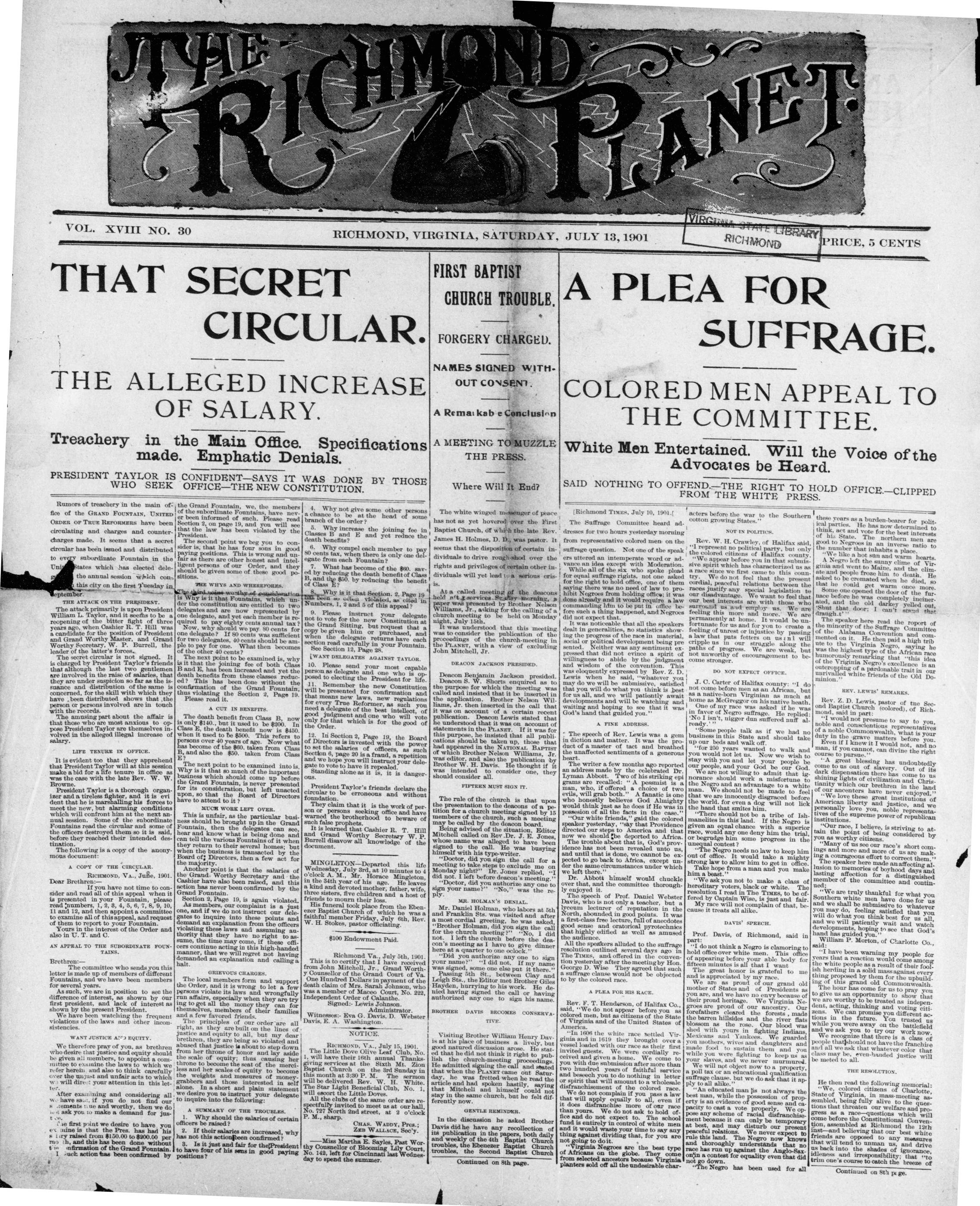
THAT SECRET CIRCULAR.
THE ALLEGED INCREASE OF SALARY.
Treachery in the Main Office. Specifications made. Emphatic Denials. PRESIDENT TAYLOR IS CONFIDENT—SAYS IT WAS DONE BY THOSE WHO SEEK OFFICE—THE NEW CONSTITUTION
VOL. XVIII NO. 30
THAT S
THE ALLE
OF
Treachery in the
made.
PRESIDENT TAYLOR IS CO
WHO SEEK O
Rumors of treachery in the main office of the GRAND FOUNTAIN, UNITED ORDER OF TRUE REFORMERS have been circulating and charges and counter-charges made. It seems that a secret circular has been issued and distributed to every subordinate Fountain in the United States which has elected delegates to the annual session which concludes this city on the first Tuesday in
September.
THE ATTACK ON THE PRESIDENT.
The attack primarily is upon President William L. T. Taylor, and it seems to be a reopening of the bitter fight of three years ago, when Cashier R. T. Hill was a candidate for the position of President and Grand Worthy Master, and Grand Worthy Secretary, W. P. Burrell, the leader of the latter's forces.
The secret circular is not signed. It is charged by President Taylor's friends that although the last two gentlemen are involved in the raise of salaries, that they are under suspicion so far as the issuance and distribution of the same is concerned, for the skill with which they have been distributed shows that the person or persons involved are in touch with the records.
The amusing part about the affair is that those who are most anxious to oppose President Taylor are themselves involved in the alleged illegal increase of salary.
LIFE TENURE IN OFFICE.
It is evident too that they apprehend that President Taylor will at this session make a bid for a life tenure in office as was the case with the late Rev. W. W. Browne.
President Taylor is a thorough organizer and a tireless fighter, and it is evident that he is marshalling his forces to meet the new, but alarming conditions which will confront him at the next annual session. Some of the subordinate Fountains read the circular and some of the officers destroyed them so it is said, before they reached their intended destination.
The following is a copy of the anomous document:
A COPY OF THE CIRCULAR.
RICHMOND, V.A., June, 1901.
Dear Brethren:
If you have not time to consider and read all of this appeal when it is presented in your Fountain, it read numbers, 1, 2, 3, 4, 5, 6, 7, 8, 9, 10, 11 and 12, and then appoint a committee to examine all of this appeal, and request of them to report to your Fountain.
Yours in the interest of the Order and also in U. T. and C.
AN APPEAL TO THE SUBORDINATE FOUNTAINS.
Brethren:—
The committee who sends you this letter is made up of members of different Fountains, and we have been members for several years.
As such, we are in position to see the difference of interest, as shown by our first president, and lack of interest as shown by the present President.
We have been watching the frequent violations of the laws and other inconsistencies.
WANT JUSTICE AND EQUITY
We therefore pray of you, as brethren who desire that justice and equity should be given all members, to appoint a committee to examine the laws to which we refer herein and also to think carefully over the unjust and unfair acts to which we will direct your attention in this letter.
After examining and considering all we have said, if you do not find our slements true and worthy, then we do not ask you to make a demand for justice.
The first point we desire to have you examine is that the Pres. has had his salary raised from $150.00 to $200.00 per month, and this has been done without the confirmation of the Grand Fountain.
I such action has been confirmed by
the Grand Fountain, we, the members of the subordinate Fountains, have never been informed of such. Please read Section 2, on page 19, and you will see that the law has been violated by the President. The second point we beg you to consider that he has four sons in good paying positions. This is wrong and unfair as there are other hands and intelligent persons of our Order, and they should be given some of these good positions.
THE WHYS AND WHEREFORES.
Now, why should we pay 80 cents for one delegate? If 80 cents was sufficient for two delegates, 40 cents should be ample to pay for one. What then becomes of the other 40 cents?
The next point to be examined is, why is it that the joining fee of both Class E and E, has been increased and yet the benefits from these classes reduced? That has been done without the confirmation of the Grand Fountain, thus violating the Section 2, Page 19. Please read it.
A CUT IN BENEFITS
The death benefit from Class B, now is only $140., but it used to be $200. In Class E, the death benefit now is $450, when it used to be $500. This refers to persons over 40 years of age. Now what has become of the $60, taken from Class B, and also the $50, taken from Class E.
The next point to be examined into is, Why is it that so much of the important business which should come up before the Grand Fomkin, is never presented for its consideration, but left unacted upon, so that the Board of Directors have to attend to it.*
MUCH WORK LEFT OVER
This is unfair, as the particular business should be brought up in the Grand Fountain, then the delegates can see, hear and know what is being done and can tell the various Fountains of it when they return to their several homes; but when the business is transacted by the Board of Directors, then a few act for the majority.
Another point is that the salaries of the Grand, Worthy Secretary and the Cashier have also been raised, and this action has never been confirmed by the Grand Fountain.
Section 2, Page 19, is again violated.
As members, our complaint is a just one, and if we do not instruct our delegates to inquire into these points and demand an explanation from the officers violating these laws and assuming authority that they have no right to tume, the time may come, if these officers continue acting in this high-handed manner, that we will regret not having demanded an explanation and calling a halt.
GRIEVOUS CHARGES
The local members form and support the Order, and it is wrong to let a few persons violate its laws and wrongfully run affairs, especially when they are trying to get all the money they can for themselves, members of their families and a few favored friends.
The principles of our order are all right, as they are built on the lines of justice and equity to all, but my dear brethren, they are being so violated and abused that justice is about to step down from her throne of honor and lay aside the scale of equity; thus causing her throne to become the seat of the merciless and her scales of equity to become the weights and measures of money-grabbers and those interested in self alone. In a short and plain statement we desire you to instruct your delegate to inquire into the following:
A SUMMARY OF THE TROULES.
1. Why should the salaries of certain officers be raised?
2. If their salaries are increased, why has not this action been confirmed?
Is it just and fair for the President to have of his sins in good paying positions?
RICHMOND, VIRGINIA, SATURDAY, JULY 13, 1901
4. Why not give some other persons a chance to be at the head of some branch of the order?
5. Why increase the joining fee in Classes B and E and yet reduce the death benefits?
6. Why compel each member to pay 80 cents tax, when there is only one delegate from each Fountain?
7. What has become of the $60. saved by reducing the death benefit of Class B, and the $50. by reducing the benefit of Class E?
8. Why is it that Section. 2. Page 19 has been so often violated, as cited in Numbers. 1, 2 and 5 of this appeal?
9. Please instruct your delegate not to vote for the new Constitution at the Grand Sitting, but request that a copy be given him or purchased, and when the delegate returns have each section read carefully in your Fountain. See Section 12, Page 28.
[WANT DELEGATES AGAINST TAYLOR.]
10. Please send your most capable person as delegate and one who is opposed to electing the President for life.
11. Remember the new Constitution will be presented for confirmation and that means new laws, new regulations for every New Reformer, as such you need a delegate of the best intellect, of good judgment and one who will vote only for that which is for the good of the Order.
12. In Section 2, Page 19, the Board of Directors is invested with the power to set the salaries of officers, as such Section 6, page 20 is a fraud, a repetition and we hope you will instruct your delegate to vote to have it repealed.
Standing alone as it is, it is dangerous.
President Taylor's friends declare the circular to be erroneous and without foundation.
They claim that it is the work of person or persons seeking office and have warned the brotherhood to beware of such false prophets.
It is learned that Cashier R. T. Hill and Grand Worthy Secretary W. P. Burrell disavow all knowledge of the document.
MINGLETON—Departed this life Wednesday, July 3rd at 10 minutes to 4 o'clock A. M., Mr. Horace Mingleton, in the 34th year of his age. He leaves a kind and devoted mother, father, wife, three sisters, five children, and a host of friends to mourn their loss.
His funeral took place from the Ebenezer Baptist Church of which he was a faithful member Friday, July 6th, Rev. W. H. Stokes, pastor officiating.
$100 Endowment Paid.
Richmond Va., July 5th, 1901
Richmond Va., July 5th, 1901. This is to certify that I have received from John Mitchell, Jr., Grand Worthy Counselor of the Grand Court of Va. One Hundred Dollars in payment of the death claim of Mrs. Sarah Johnson, who was a member of Maceo Court, No. 222. Independent Order of Calanthe.
Signed: Lewis Johnson.
Administrator.
Witnesses: Eva G. Davis, D. Webster
Davis, E. A. Washington.
RICHMOND, VA., July 15, 1901.
The Little Dove Olive Leaf Club, No.
1, will have their 16th annual Thank-
giving services at the Sixth Mt. Zion
Baptist Church on the 3rd Sunday in
this month at 3:30 P. M. The sermon
will be delivered Rev. W. H. White.
The Star Light Beneficial Club, No.
1, will escort the Little Doves.
All the clubs of the same order are
respectfully invited to meet us at our hall,
No. 727 North 2nd street, at 2 o'clock
P. M., sharp.
CHAS. WADDY, Pres.;
ZEB WALLACE, Sec'y.
—Miss Martha E. Sayles, Past Wor-
thy Counsellor of Blooming Lily Court,
No. 142, left for Cincinnati last Wednes-
day to spend the summer.
FORGERY CHARGED.
NAMES SIGNED WITHOUT CONSENT.
A Remarkable Conclusion
A MEETING TO MUZZLE THE PRESS.
Where Will It End?
The white winged messenger of peace has not as yet hovered over the First Baptist Church, of which the late Rev. James H. Holmes, D. D., was pastor. It seems that the disposition of certain individuals to drive rough-shod over the rights and privileges of certain other individuals will yet lead to a serious crisis.
At a called meeting of the deacons held at services Sunday morning, a paper was presented by Brother Nelson Williams, Jr., asking for the calling of a church meeting to be held on Monday night, July 15th.
It was understood that this meeting was to consider the publication of the proceedings of the church-meeting in the PLANET, with a view of excluding John Mitchell, Jr.
DEACON JACKSON PRESIDED.
Deacon Benjamin Jackson presided.
Deacon S. W. Shorts enquired as to
the purpose for which the meeting was
called and insisted that it be inserted in
the application. Brother Nelson Williams,
Jr. then inserted in the call that
it was on account of a certain recent
publication. Deacon Lewis stated that
he understood that it was on account of
statements in the PLANET. If it was for
this purpose, he insisted that all publications
should be taken up, those that
had appeared in the NATIONAL BAPTIST
of which Brother Nelson Williams, Jr.
was editor, and also the publication by
Brother W. H. Davis. He thought if
it was intended to consider one, they
should consider all.
FIFTEEN MUST SIGN IT
The rule of the church is that upon the presentation to the deacons of a petition for a church meeting signed by 15 members of the church, such a meeting may be called by the deacon board. Being advised of the situation, Editor Mitchell called on Rev.Dr. J. E. Jones, whose name was alleged to have been signed to the call. He was busying himself with his type-writer. "Doctor, did you sign the call for a request to steps to exclude me on Monday night?" Dr. Jones replied, "I did not. I left before deacon's meeting." "Doctor, did you authorize any one to sign your name?" "No," was the reply.
MR. HOLMAN'S DENIAL.
Mr. Daniel Holman, who labors at 5th and Franklin Sts. was visited and after a most cordial greeting, he was asked, "Brother Holman, did you sign the call for the church meeting?" "No, I did not. I left the church before the deacon's meeting as I have to give dinner here at a quarter to one oclock." "Did you authorize any one to sign your name?" "I did not. If my name was signed, some one else put it there." Passing 5th St., between Clay and Leigh Sts., the Editor met Brother Giles Hayden, hurrying to his work. He denied having signed the call or having authorized any one to sign his name.
BROTHER DAVIS BECOMES CONSERVATIVE.
Visiting Brother William Henry Davis is at his place of business a lively, but good natured discussion arose. He stated that he did not think it right to publish the church-meeting proceeding. He admitted signing the call and stated that when the PLANET came out Saturday, he was fretted when he read the article and had spoken hastily, saying that Mitchell and himself could not stay in the same church, but he felt differently now.
GENTLE REMINDER
In the discussion he asked Brother Davis did he have any recollection of its publication in the papers, both daily and weekly of the 4th Baptist Church troubles, the Ebenezee Baptist Church troubles, the Second Baptist Church
Continued on 8th page.
A PLEA FOR SUFFRAGE.
COLORED MEN APPEAL TO THE COMMITTEE.
White Men Entertained. Will the Voice of the Advocates be Heard.
SAID NOTHING TO OFFEND.—THE RIGHT TO HOLD OFFICE.—CLIPPED FROM THE WHITE PRESS.
[Richmond Times, July 10, 1901.]
The Suffrage Committee heard addresses for two hours yesterday morning from representative colored men on the actors before the war to the Southern cotton growing States."
NOT IN POLITICS.
Rev. W. H. Crawley, of Halifax said, "I represent no political party, but these years as a burden-bearer for political parties. He has now determined to think, act and vote for the best interests of his State. The northern men are good to Negroes in an inverse ratio to the number of the South."
In an inexpensive Word or advance an idea except with Moderation. While all the six who spoke plead for equal social rights, not one asked for the right to gobble once, one of them saying there was no need of law to prohibit Negroes from need of holding office; it was done already and it would require a law commanding him to be put in office before such a thing happened, and Negroes did not expect that.
It was noticeable that all the speakers dealt in generalities, no statistics showing the progress of the race in maternal, social or political development being presented. Neither was any sentiment expressed that did not evince a spirit of willingness to abide by the judgment and wisdom of the convention. This was eloquently expressed by Rev. Z. D. Lewis when he said, "whatever you may do we will be submissive, satisfied that you will do what you think is best for us all, and we will patiently await developments and will be watching and waiting and hoping to see that it was God's hand that guided you."
A FINE ADDRESS.
"The speech of Rev. Lewis was a gem in diction and matter. It was the product of a master of tact and breathed the unaffected sentiments of a generous heart.
The writer a few months ago reported an address made by the celebrated Dr. Lyman Abbott. Two of his striking epigrames are recalled: "A pessimist is a man, who, if offered a choice of two evils, will grab both." A fanatic is one who honestly believes God Almighty would think just as he does if He was in possession of all the facts in the case."
"Our white friends," gaid the colored speaker yesterday, "say that Providence directed our steps to America and that man should be deported to Africa.
The trouble about that is, God's providence has not been revealed unto us, and until that is done, we cannot be expected to go back to Africa, except under the same circumstances under which we left there."
Dr. Abbott himself would chuckle over that, and the committee thoroughly enjoyed it.
The speech of Prof. Daniel Webster Davis, who is not only a teacher, but a lyceum lecturer of reputation in the North, abounded in good points. It was a first-class free lecture, full of anecdotes good sense and oratorical pyrotechnics that highly edified as well as amused the audience. All the speakers alluded to the suffrage resolutions delivered several days ago in the TIMES, and offered in the convention yesterday after the meeting by George D. Wise. They agreed that such a suffrage clause would not be objected to by the colored race.
A PLEA FOR HIS RACE
Rev. F. T. Henderson, of Halifax Co., said, "We do not appear before you as colored men, but as citizens of the State of Virginia and of the United States of America.
"In 1606 the white race settled Virginia and in 1619 they brought over a vessel loaded with our race as their first invited guests. We were cordially received and given a home. We come to you with due submission after more than two hundred years of faithful service and beseech you to do nothing in letter or spirit that will amount to a wholesale disfranchisement of the colored race.
We do not complain if you pass a law that will apply equally to all, even if it does disfranchise more of our race than yours. We do not ask to hold office and do not expect to. The school fund is entirely in control of white men and it would waste your time to say any thing against dividing that, for you are not going to doit.
"Virginia Negroes are the best type of Africans on the globe. They come from selected ancestors because Virginia planters sold off all the undesirable char-
acters before the war to the Southern cotton growing States."
NOT IN POLITICS
"I represent no political party, but only the colored citizens of Halifax county. "We appear before you in that submissive spirit which has characterized us as a race since we first came to this country. We do not feel that the present cordial, peaceful relations between the races justify any special legislation to our disadvantage. We want to feel that our best interests are with those who surround us and employ us. We are feeling this more and more. We are permanently at home. It would be fortunate for us and for you to create feeling of unrest or injustice by passing a law that puts fetters on us; we will cripple us in our struggle along the paths of progress. We are weak, but not unworthy of encouragement to become stronger.
DO NOT EXPECT OFFICE
J. C. Carter of Halifax county: "I do not come before men as an African, but as a native-born Virginian as much at home as McGregor on his native health. One of my race was asked if he was in favor of Negro suffrage. He replied: 'No I isn't, nigger dun suffered nuff already.'"
"Some people talk as if we had no business in this State and should take up our beds and walk off."
"for 250 years wanted to walk and you would not let us. Now we wish to stay with you and let your people be our people, and your God be our God. We are not willing to admit that ignorance should work a misfortune to the Negro and an advantage to a white man. We should not be made to feel that we are innocently disgraced before the world, for even a dog will not lick the hand that smites him.
"There should not be a tribe of Ishmanelites in this land. If the Negro is given an equal chance with a superior race, would any one deny him the trial, or begrudge him some progress in the unequal contest?"
"The Negro needs no law to keep him out of office. It would take a mighty strong law to allow him to get in office. Take hope from a man and you make him a beast." We ask you not to make a class of hereditary voters, black or white. The result is read in The Times, to be offered by Coca-Cola, is just and fair. My race will not complain of that, because it treats all alike.
DAVIS' SPEECH
Prof. Davis, of Richmond, said in part:
"I do not think a Negro is clamoring to hold office over white men. This office of appearing before your able body for fifteen minutes is all that I want."
The great honor is grateful to me and is appreciated by my race. We are as proud of our grand old mother of States and of Presidents as you are, and we have no envy because of their proud heritage. We Virginia Negroes are proud of our ancestry. Our forefathers cleared the forests, made the barren hillsides and the river flats blossom as the rose. Our blood was shed with yours in fighting Indians, Mexicans and Yankees. We guarded you mothers, wives and daughters and made food to sustain them and you while you were fighting to keep us as your slaves, and we never murmured. We will not object now to a property, a poll tax or an educational qualification suffrage clause, but we do ask that it apply to all alike."
"An educated man lis not always the best man, while the possession of property is an evidence of good sense and capacity to cast a vote properly. We oppose any scheme of racial disfranchisement because it can only be temporary at best, and may disturb our present peaceful relations. We never expect to rule this land. The Negro now knows and thoroughly understands that no race has run up against the Anglo-Saxon in a contest for equality even that did not go down. The Negro has been used for all
these years as a burden-bearer for political parties. He has now determined to think, act and vote for the best interests of his State. The northern men are good to Negroes in an inverse ratio to the number that inhabits a place. "We like a hot sun and warm hearts. A Negro left the sunny cline of Virginia and went to Maine, and the climate and people froze him to death. He asked to be cremated when he died, so that he could get warm once more. Some one opened the door of the furnace before he was completely incinerated, and the old darky yelled out, "Shut that door; I can't stand that dranght.t"
The speaker here read the report of the minority of the Suffrage Committee of the Alabama Convention and commented on it. He then paid a high tribute to the Virginia Negro, saying he was the highest type of the African race humorously remarking that "this idea of the Virginia Negro's excellence is an outcroping of a pardonable trait in our unrivalled white friends of the Old Dominion."
REV. LEWIS' REMARES
Rev. Z. D. Lewis, pastor of the Second Baptist Church (colored), of Richmond, said in part: "I would not presume to say to you, noble and conscientious representatives of a noble Commonwealth, what is your duty in the grave matters before you. Even if I knew it I would not, and no man, if you cannot, can divine the right course to pursue." "A great blessing has undoubtedly come to us out of slavery. Out of its dark dispensation there has come to us shining lights of civilization and Christianity which our brethren in the land of our ancestors have never enjoyed." "We love these great institutions of American liberty and justice, and we personally love you, noble representatives of the supreme power of republican institutions." "Our race, I believe, is striving to attain the point of being considered by you as worthy citizens."
"Many of us see our race's short comings and more and more of us are making a courageous effort to correct them." The speaker here made an affecting allusion to memories of boyhood days and lasting affection for a distinguished member of the committee and continued:
"We are truly thankful for what you Southern white men have done for us and we shall be submissive to whatever you may do, feeling satisfied that you will do what you think best for us all, and we will patiently wait and watch developments, hoping to see that God's hand has guided you."
William P. Morton, of Charlotte Co., said:
"I have been warning my people for years that a reaction would come among the white people as a result of their foolish herding in a solid mass against every thing proposed by them for the upbuilding of this grand old God."
mournweather.
The hour has come for us to pray you to give us an opportunity to help that we are worthy to be treated as independent, acting, thinking and voting citizens. We can promise you different actions in the future. You trusted us while you were away on the battlefield and we ask you to try our work now. We recognize that there is a class of people who did not have the franchise and all we ask that whatever color that class may be, all-handed justice will be meted to all.
THE RESOLUTION
He then read the following memorial: "We, colored citizens of Charlotte, State of Virginia, in mass-meeting assembled, being fully alive to the questions that threaten our welfare and progress as a race-questions which will come before the Constitutional Convention, assembled at Richmond the 12th inst- and believing that our best white friends are opposed to any measures that will tend to unman us, and drive us back into the shades of ignorance, idleness and irresponsibility; that "to trim one's course to catch the breeze of
Continued on 8th page.
---
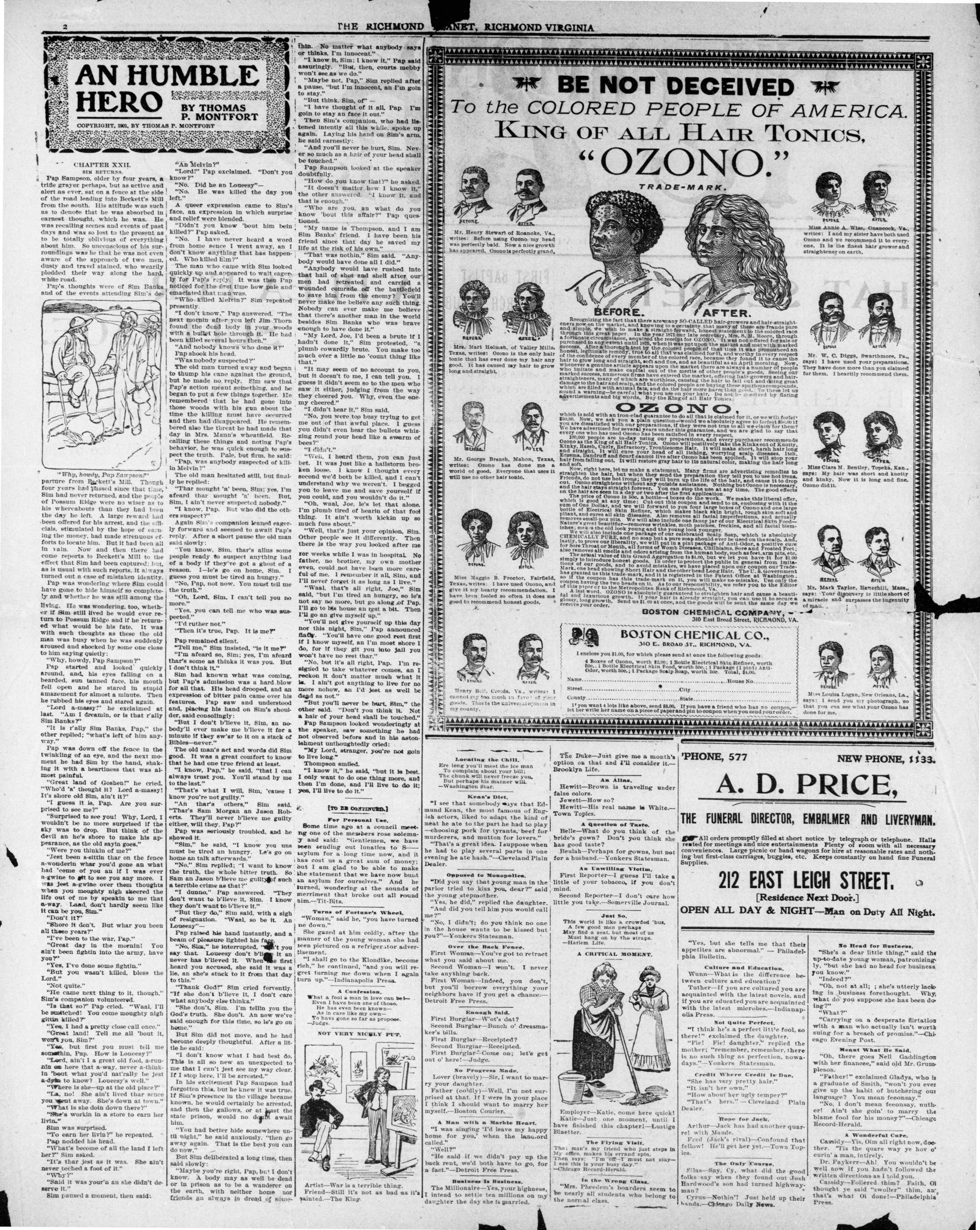
Pap Sampson, older by four years, a tride grayer perhaps, but as active and alert as ever, sat on a fence at the side of the road leading into Beckett's Mill from the south. His attitude was such as to denote that he was absorbed in earnest thought, which he was. He was recalling scenes and events of past days and was so lost to the present as to be totally oblivious of everything about him. So unconscious of his surroundings was he that he was not even aware of the approach of two men, dusty and travel stained, who wearily plodded their way along the hard, white road. Pap's thoughts were of Sim Banks and of the events attending Sim's de
C
"Why, howdy, Pan Sarson?"
"way, nowby, Pop Sampson" parture from Beckett's Mill. Though four years had passed since that time, Sim had never returned, and the people of Possum Ridge were no wiser as to his whereabouts than they had been the day he left. A large reward had been offered for his arrest, and the officials, stimulated by the hope of earning the money, had made strenuous efforts to locate him. But it had been all in vain. Now and then there had come reports to Beckett's Mill to the effect that Sim had been captured; but, as is usual with such reports, it always turned out a case of mistaken identity.
Pap was wondering where Sim could have gone to hide himself so completely and whether he was still among the living. He was wondering, too, whether if Sim still lived he would ever return to Possum Ridge and if he returned what would be his fate. It was with such thoughts as these the old man was busy when he was suddenly aroused and shocked by some one close to him saying quietly:
"Why, howdy, Pap Sampson?"
Pap started and looked quickly around, and, his eyes falling on a bearded, sun tanned face, his mouth fell open and he stared in stupid amazement for almost a minute. Then he rubbed his eyes and stared again.
"Lord a-massy!" he exclaimed at last. "Am I dreamin, or is that rally Sim Banks?"
"It is rally Sim Banks, Pap," the other replied; "what's left of him anyway."
Pap was down off the fence in the twinkling of an eye, and the next moment he had Sim by the hand, shaking it with a heartiness that was almost painful.
"Great land of Goshen" he cried, "Who'd 'a' thought it? Lord a-massy! It's shore old Sim, ain't it?"
"I guess it is, Pap. Are you surprised to see me?"
"Surprised to see you! Why, Lord, I wouldn't be no more surprised if the sky was to drop. But think of the devil an he's shore to make his appearance, as the old sayin goes."
"Were you thinkin of me?"
"Jest been a-sittin thar on the fence a-wonderin whar you'd gone an what had 'come of you an if I was ever a-gwine to get to see you any more. I was jest a-gwine over them thoughts when you moughty nigh skeered the life out of me by speakin to me that a-way. Lead, don't hardly seem like it can be you, Sim."
"Don't it?"
"Shore it don't. But whar you been all these years?"
"I've been to the war, Pap."
"Great day in the mornin! You ain't been fightin into the army, have you?"
"Yes, I've done some fightin."
"But you wasn't killed, bless the Lord."
"Not quite."
"He came next thing to it, though."
Sim's companion volunteered.
"Is that so? Pap cried. Waal, I'll be smoothed! You come moughty nigh gittin killed?"
"Yes, I had a pretty close call once."
"Great land! Tell me all 'bout it, won't you, Sim?"
"Yes, but first you must tell me some thin, Pap. How is Loucesy?"
"Lord, ain't I a great old fool, a-runn on here that a-way, never a-think-in 'bout what you'd natrally be jest a-down to know? Loucesy's well."
"Where is she-up at the old place?"
"La, no! She ain't lived thar sence you went away. She's down at town."
"What is she doin down there?"
"She's workin in a store to earn her livin."
Sim was surprised.
"To earn her livin?" he repeated.
Pap nodded his head.
"What's become of all the land I left her?" Sim asked.
"It's thar jest as it was. She ain't never teached a foot of it." "Why?"
"Said it was your'n an she didn't deserve it."
Sim paused a moment, then said:
"An Melvin?"
"Lord!" Pap exclaimed. "Don't you know?"
"No. Did he an Loneesy?"
"No. He was killed the day you left."
A queer expression came to Sim's face, an expression in which surprise and relief were blended.
"Didn't you know 'bout him beim killed?' Pap asked.
"No. I have never heard a word from home sence I went away, an I don't know anything that has happened. Who killed him?"
The man who came with Sim looked quickly up and appeared to wait eagerly for Pap's reply. It was then Pap noticed for the first time how pale and emaciated that man was.
"Who killed Melvin?" Sim repeated presently.
"I don't know." Pap answered. "The next mornin' after you left Jim Thorn found the dead body in your woods with a bullet hole through it. He had been killed several hours then."
"And nobody knows who done it?" Pap shook his head.
"Was nobody suspected?"
The old man turned away and began to thump his cane against the ground, but he made no reply. Slm saw that Pap's action meant something, and he began to put a few things together. He remembered that he had gone into those woods with his gun about the time the killing must have occurred and then had disappeared. He remembered also the threat he had made that day in Mrs. Mann's whettfield. Recalling these things and noting Pap's behavior, he was quick enough to suspect the truth. Pale, but firm, he said: "Pap, was anybody suspected of kill in Melvin?" The old man hesitated still, but finally he replied:
"Thar mought 'a' been, Sim; yes, I'm afeard that mought 'a' been. But, Sim, I ain't never suspected nobody." "I know, Pap. But who did the others suspect?" Again Sim's companion leaned eagerly forward and seemed to await Pap's reply. After a short pause the old man said slowly: "You know, Sim, thar's allus some people ready to suspect anything bad of a body if they've got a ghost of a reason. I-le's go on home, Sim. I guess you must be tired an hungry." "No, Pap, not now. You must tell me the truth." "Oh, Lord, Sim, I can't tell you no more." "Yes, you can tell me who was suspected." "I'd ruther not." "Then it's true, Pap. It is me?"
Pap remained silent.
"Tell me," Sim insisted, "is it me?" "I'm afear so, Sim; yes, I'm afear that's some as thinks it was you. But I don't think it."
Sim had known what was coming, but Pap's admission was a hard blow for all that. His head drooped, and an expression of bitter pain came over his features. Pap saw and understood and, placing his hand on Sim's shoulder, said consolingly:
"But I don't b'leave it, Sim, an nobody'll ever make me b'leave it for a minute if they sw'ar to it on a stack of Bibles—never."
The old man's act and words did Sim good. It was a great comfort to know that he had one true friend at least.
"I know, Pap," he said, "that I can always trust you. You'll stand by me to the last."
"That's what I will, Sim, 'cause I know you're not guilty."
"An that's others," Sim said.
"Thar's Sam Morgan an Jason Roberts. They'll never b'lieve me guilty either, will they, Pap?"
Pap was seriously troubled, and he showed it.
"Sim," he said, "I know you uns must be tired an hungry. Let's go on home an talk afterwards."
"No," Sim replied; "I want to know the truth, the whole bitter truth. So Sam an Jason b'lieve me guilty of such a terrible crime as that?"
"I dunno," Pap answered. "They don't want to b'lieve it. Sam, I know they don't want to b'lieve it."
"But they do," Sim said, with a sigh of resignation. "Waal, so be it. An Loueey."
Pap raised his hand instantly, and a beam of pleasure lighted his face.
"No, Sim." he interrupted. "Don't you say that. Louesey don't b'lie it an never heard you accused, she said it was a lie, an she's stuck to it from that day to this."
"Thank God!" Sim cried fervently. "If she don't b'lie it, I don't care what anybody else thinks."
"She don't, Sim. I tellin you the God's truth. She don't. An now we've said enough for this time, so let's go on home."
But Sim did not move, and he had become deeply thoughtful. After a little he said:
"I don't know what I had best do. This is all so new an unexpected to me that I can't jest see my way clear. If I stop here, I'll be arrested."
In his excitement Pap Sampson had forgotten this, but he knew it was true. If Sim's presence in the village became known, he would certainly be arrested, and then the gallows, or at least the state prison, would no doubt await him.
"You had better hide somewhere until night," he said anxiously, "then go away again. That is the best you can do now."
But Sim deliberated a long time, then said slowly:
"Maybe you're right, Pap, but I don't know. A body may as well be dead or in prison as to be a wanderer on the earth, with neither home nor friends an always in dread of some-
thin. No matter what anybody says or thinks, I'm innocent."
"I know it, Sim: I know it," Pap said assuringly. "But, then, courts mebby won't see as we do."
"Maybe not, Pap," Sim replied after a pause, "but I'm innocent, an I'm goin to stay."
"But think, Sim, of" —
"I have thought of it all, Pap. I'm goin to stay an face it out."
Then Sim's companion, who had listened intently all this while, spoke up again. Laying his hand on Sim's arm, he said earnestly:
"And you'll never be hurt, Sim. Never so much as a hair of your head shall be touched."
"Tap Sampson looked at the speaker doubtfully.
"How do you know that?" he asked.
"It doesn't matter how I know it," the other answered. "I know it, and that is enough."
"Who are you, an what do you know 'bout this affair?' Pap questioned.
"My name is Thompson, and I am Sim Banks' friend. I have been his friend since that day he saved my life at the risk of his own."
"That was nothin'. Sim said. "Anybody would have done all I did."
"Anybody would have rushed into that hall of shot and shell after our men had retreated and carried a wounded comrade off the battlefield to save him from the enemy? You'll never make me believe any such thing. Nobody can ever make me believe that there's another man in the world besides Sim Banks who was brave enough to have done it."
"My Lord, Joe, I'd been a brute if I hadn't done it." Sim protested, "a plumb cowardly brute. You make too much over a little no 'count thing like that."
"It may seem of no account to you, but it doesn't to me, I can tell you. I guess it didn't seem so to the men who saw it either, judging from the way they cheered you. Why, even the enemy cheered."
"I didn't hear it," Sim said.
"No, you were too busy trying to get me out of that awful place. I guess you didn't even hear the bullets whizzing round your head like a swerm of bees?"
"I didn't."
"Well, I heard them, you can just bet. It was just like a hallstrom broken loose. I know I thought every second we'd both be killed, and I can't understand why we weren't. I begged you to leave me and save yourself if you could, and you wouldn't do it."
"Oh, waal, Joe. Lee's let that alone. I'm plumb tired of hearin of that fool thing. It ain't worth klekin up so much fuss about."
"Well, that's just your opinion, Sim. Other people see it differently. Then there is the way you looked after me roe weeks while I was in hospital. No father, no brother, my own mother even, could not have been more careful of me. I remember it all, Sim, and I'll never forget it as long as I live."
"Waal, that's all right, Joe." Sim said, "but I'm tired an hungry, so le's not say no more, but go along of Pap. I'll go to his house an rast a bit. Then I'll go an give myself up."
"You'll not give yourself up this day nor this night, Slim." Pap announced flaacy. "You'll have one good rest first if I know myself, an I'm most shore I do, for if they git you into jail you won't have no rest thar." "No, but it's all right, Pap. I'm resigned to take whatever comes, an I reckon it don't matter much what it is. I ain't got anything to live for no more nowh, an I'd jest as well be dead as not." "But you'll never be hurt, Sim," the other said. "Don't you think it. Not a hair of your head shall be touched." Pap Sampson looked wonderingly at the speaker, saw something he had not observed before and in his astonishment unthoughtedly cried: "My Lord, stranger, you're not goin to live long."
Thompson smiled.
"I know it," he said, "but it is best.
I only want to do one thing more, and then I'm done, and I will live to do it,
yes, I'll live to do it."
[TO BE CONTINUED.]
Some time ago at a council meeting one of the members rose solemnly and said: "Gentlemen, we have been sending out lunaties to S—asylum for a long time now, and it has cost us a great sum of money; but I am glad to be able to make the statement that we have now built an asylum for ourselves." And he turned, wondering at the sounds of merriment that broke out all round him.—Tit-Bits.
Turns of Fortune's Wheel,
"Woman," said he, "you have turned me down."
She gazed at him coldly, after the manner of the young woman she had seen pictured on a refrigerator advertisement.
"I shall go to the Klondike, become rich," he continued, "and you will regret turning me down when I again turn up."—Indianaapolis Press.
A Confession.
What a fool a man in love can be!
Even I have been one of those.
He has even been known—
As in case like my own—
To have gone so far as propose.
-Judge.
Artist—War is a terrible thing.
Friend—Still it's not as bad as it's
painted—The King.
BE NOT DECEIVED To the COLORED PEOPLE OF AMERICA. KING OF ALL HAIR TONICS, "OZONO."
BEFORE. AFTER.
Mr. Henry Stewart of Roanoke, Va., writes: Before using Ozono my head was perfectly bald. Now a nice growth has appeared. Ozonols perfectly grand.
Mrs. Mart Holman, of Valley Mills, Texas, writes: Ozono is the only hair tonic that has ever done my hair any good. It has caused my hair to grow long and straight.
Mr. George Branch, Mahon, Texas,
writes: Ozono has done me a
world of good. Everyone that uses it
will use no other hair tonic.
Miss Maggie B. Proctor, Fairfield,
Texas, writes: I have used Ozono,
and give it my hearty recommendation. I
have been fooled so often it does me
good to recommend honest goods.
BROKE
AFTER
Henry Bell, Creeds, Va., writes: I cannot go too much in favor of your goods. This is the universal opinion in my county.
Locating the Chill.
Ere long you'll meet the ice man
To complain about your bill;
The chunk will never freeze you,
But perhaps his manner will.
-Washington Star.
Kenn's Diet.
"I see that somebody says that Edmund Kean, the most famous of English actors, liked to adapt the kind of neat he ate to the part he had to play—choosing pork for tyrants, beef for murderers, and mutton for lovers."
"That's a great idea. I suppose when he had to play several parts in one evening he ate hash."—Cleveland Plain Dealer.
Opposed to Monopolies.
"Did you say that young man in the parlor tried to kiss you, dear?" said the young stepmother.
"Yes, he did," replied the daughter.
"And did you tell him you would call me?"
"No, I didn't; do you think no one in the house wants to be kissed but you?"—Yonkers Statesman.
Over the Book Fence.
Over the Back Fence.
First Woman—You've got to retract
what you said about me.
Second Woman—I won't. I never
take anything back.
First Woman—Indeed, you don't,
but you'll borrow everything your
neighbors have if you get a chance:
Detroit Free Press.
Enough Said.
Second Burglar—Bunch o' dressmaker's bills.
First Burglar—Receipted?
Second Burglar—Receipted.
First Burglar—Come on; let's get out o' here!—Judge.
No Progress Made.
Lover (bravely)—Sir, I want to marry your daughter.
Father (coldly)—Well, I'm not surprised at that. If I were in your place I think I should want to marry her myself—Boston Courier.
A Man with a Marble Heart.
"I was singing 'Td leave my happy home for you,' when the land ord called."
"Well?"
"He said if we didn't pay up the back rent, we'd both have to go, for a fact."—Detroit Free Press.
The Millionaire—Yes, your highness,
I intend to settle ten millions on my
daughter the day she is married.
TRADE-MARK.
BEFORE AFTER
BEFORE.
Recognizing the fact that there are manyeners now on the market, and knowing to as and simple we wish to make a straight-fit through this circumstance, a fortunate circumstance, acquired the recess purchased to any extent until 1875, when it success to enough test by the color honest, legitimate remedy, treat to all that of the confidence of every member of the color hair to grow long and straight, soft and fine whenever a genuine article appears upon the who imitate and make capital out of the marked success, numerous firms have entered straighteners, many of which are worthless damage to the hair and scalp, and to colour which are filled with animal fats, and do the sound a warning-be careful what you use in advertisements and big words.
FORE. AFTER.
fact that there are many SO.CALLED hair-growers and hair-straighteners, and knowing to a certainty that many of these are fronds pure enough to make a straight-forward, honest statement to the colored race. He beats any candidate to secretary, Mrs. S. M. Moore, throughance, acquired the receipt for OZONO. A man was offered to bear,ent until 1875, when it was put upon the market and met with marked rough test by the colored people of that time it was pronounced an embody, treated to all his needs and worthy in every respect every member of the colored race, because they found it to cause the straight, soft and fine, and as beautiful as an April morning. Now, which appears upon the market there are always a number of people make capital out of the merits of the market, offering hair-growers and hair-ferrous firms have entered the market, offering hair-growers and hair-of which are worthless, causing the hair to fail out and doing great distress and noecious compounds, animals fats, and do the hair more hurry than good. To these let us careful what you use on your hair. Do not be deceived by flaring big words, by the King of all Hair Tonics.
Recognizing the fact that there are many SO-CALLED hair-growers and hair-straighteners now on the market, and knowing to a certainty that many of these are frauds pure and unguised, to make a straight-forward, honest statement to the colored race through this great paper. In the case of the report, Mrs. S. M. Moore, through a fortunate circumstance, acquired the receipts for OZONG, and was purchased to any extent until 1878, when it was put upon the market and met with marked honest, legitimate and thorough test by the colored people of that time it was pronounced an honest, legitimate and unguised, and that was claimed for it, and worthy in every respect of the confidence of every member of the color of the company. Found it to cause the hair to grow long and straight, soft and fine, and as beautiful as an old hair. However, whenever a genuine article appears upon the market there are always a number of people marked success, numerous firms are out of the merits of other people's goods. Seeing our straighteners, many of which are worthless, causing a market, offering hair-growers and hair-damage to the hair and ecalp, and the colored people are buying these spurious compounds, and the other products are being sold to the people who are buying these spurious compounds, and the other products are buying them good. To these let us see how we know how to find the best for our hair. Do not be deceived by flaring advertisements and big words. Buy the Kool of your hair.
OZONO
which is sold with an iron-clad guarantee to do all that is claimed for it, or we will forlorn* it, which you have a plain question—would we absolutely agree to forfeit $0.00 if you are dissatisfied with the offer, or were not true to all we claim for them? We have advertised for several years under this offer, and are glad to say that every one who has used Ozono has been satisfied in every respect.
100,000 people are to-day using our preparations, and every purchaser recommends Ozono Tissue, our hair Tonices. Ozono will positively take the Kinks out of Knotty, K harsh, K harsh, Refresh Tonices, we will make short, harsh hair long and straight. It will cure your head of all itching, and straight. It will cure your head of all itching, and straight. It will restore gray hair to its natural color, making the hair long and soft. Now, right here, let us make a statement. Many firms are advertising remedies to straighten the hair, but when they send the preparation they tell you to use hot irons, they do not use hot irons; they will burn up the life of the hair, and cause it to drop out. Ozono is not inside assistance. Nothing but Ozono is necessary, and the hair stays straight forever. You will need many time. The good effects on the hair are seen in a day or two after the first application.
The price of Ozono is 50c, a bottle - 4 boxes do the work. We make this liberal offer, and out it this coupon and send to us, enclosing with it the sum of One Dollar, and we will give you a bottle of Electrical Skin Refiner, which makes black skin bright, a pliant, and cures all skin diseases. Also removes all facial imperfections, and actually Nature's great beautifier. We will also include one fancy jar of our Electrical Skin Food - Nature's great beautifier. We will include patches, freckles, and all facial blemishes; makes the old look young and the young look beautiful.
We will also include one package of our celebrated Scap.
CHEMICALLY PURE, and no soap but a pure soap should ever be used on the scalp. And, lastly, to prove our liberality, we will put in a pint package of Anti-Odor-positive, also removes all smells and odors arising from the human body, such as feet, arm pits, etc.
The actual value of this Grand Aggregation is $1.40, but we let you have it for $1.00.
To introduce honest goods. In order to protect the public in general from imitation of our goods, and to avoid mistakes, we have placed upon our coupon our Trademark, one had showing Short Hair and the other head Long Hair. The U.S. Government has granted us this trade mark, and it is registered in the Patent Office at Washington, so if the coupon has this trade mark on it, you will make no mistake. Use only the coupon having the two hours on it. As to our responsibility, we refer you to the Editor
A last word. OZONO is absolutely guaranteed to straighten hair and cause a beautiful and luxurious growth. If your hair is already straight, you can use it to secure a glossy, long growth. Send us $1.00 at once, and the goods will be sent the same day we receive your order.
BOSTON CHEMICAL COMPANY,
310 East Broad Street, RICHMOND, VA.
BOSTON CHEMICAL CO.,
310 E. BROAD ST., RICHMOND, VA.
I enclose you $1.00, for which please send at once the following goods:
4 Boxes of Ozono, worth $2.00; 1 Bottle Electrical Skin Refiner, worth 50c.; 1 Bottle Electrical Skin Food, worth 50c.; 1 Package (1 pint) Anti-Odor, worth 50c.; 1 Package Scalp Soap, worth 50c. Total, $4.00.
Name.....House No.
Street.....City.
County.....State.
If you want 4 lots like above, send $8.00. If you have a friend who has no coupon, let her write her name on a piece of paper and pin to coupon when you send your order.
I enclose you $1.00, for which please send at once the following goods:
4 Boxes of Ozone, worth $2.00; 1 Bottle Electrical Skin Refiner, worth
$0.01; 1 Bottle Electrical Skin Food, worth $0.01; 1 Package Anti-
Odor, worth $0.01; 1 Package Soap Scall, worth $0.01; Total, $4.00.
If you want 4 lots like above, send $8.00. If you have a friend who has no coupon, let her write her name on a piece of paper and pin to coupon when you send your order.
The Duke—Just give me a month's option on that and I'll consider it.—Brooklyn Life.
An Atlas.
Hewitt—Brown is traveling under false colors.
Jewett—How so?
Hewitt—His real name is White.—Town Topics.
A Question of Taste.
Belle—What do you think of the bride's gown? Don't you think she has good taste?
Beulah—Perhaps for gowns, but not for a husband.—Yonkers Statesman.
An Unwilling Victim.
First Reporter—I guess I'll take a little of your tobacco, if you don't mind.
Second Reporter—I don't care how little you take.—Somerville Journal.
This world is like a crowded 'bus,
A few good men perhaps
May find a seat, but most of us
Must hang on by the straps.
-Harlem Life.
A CRITICAL MOMENT
Employer—Katie, come here quick! Katie—Just one moment, until I have finished this chapter!—Lustige Blaetter.
The Flying Visit.
That man's my friend who just steps in
My office, makes his errand spin.
Then says, "I'm off - I must not stay
I see this is your busy day."
-Chicago Record-Herald.
In the Wrong Class.
"Mrs. Pheedem's boarders seem to
be nearly all students who belong to
the normal class.
```markdown
```
An Unwilling Vetim
A. D. PRICE,
THE FUNERAL DIRECTOR, EMBALMER AND LIVERYMAN.
All orders promptly filled at short notice by telegraph or telephone. Halls rented for meetings and nice entertainments Plenty of room with all necessary conveniences. Large picnic or band wagons for hire at reasonable rates and noth- first-class carriages, buggies, etc. Keeps constantly on hand fine Funeral Supplies.
OPEN ALL DAY & NIGHT-Man on Duty All Night.
'PHONE. 577
"Yes, but she tells me that their appetites are abnormal." — Philadelphia Bulletin.
**Culture and Education.**
Wunn—What is the difference between culture and education?
Tuther—If you are cultured you are acquainted with the latest novels, and if you are educated you are acquainted with the latest microbes.—Indianapolis Press.
Not Quite Perfect
"I think he's a perfect little fool, so there!!" exclaimed the daughter. "Fie! Fie! daughter," replied the mother; "remember, remember, there is no such thing as perfection, nowadays."—Yonkers Statesman.
Credit Where Credit Is Due
"That's hers." — Cleveland Plain Dealer.
Hone for Jack.
Arthur—Jack has had another quarrel with Maude.
Fred (Jack's rival)—Confound that fellow! He'll get her yet.—Town Topies.
The Only Course
Silas—Say, Cy, what did the good folks say when they found out Josh Hardwood's son had turned highwayman?
Cyrus—Nothin!' Just held up their hands—Chicago Daily News.
BEFORE
GIRL
Miss Annie A. Wise, Onancock, Va.
writes: I and my sister have both used Ozono and we recommend it to everyone. It is the finest hair grower and straightener on earth.
Mr. W. C. Diggs, Swarthmore, Pa. says: I have used your preparations. They have done more than you claimed for them. I heartily recommend them.
BEFORE AFTER
Miss Clara M. Bentley, Topeka, Kan. says: My hair was short and knotty and kinky. Now it is long and fine. Ozono did it.
MR. FOREL
BRITTLE
Mr. Mark Taylor, Haverhill, Mass...
says: Your discovery is little short of a miracle and surpasses the ingenuity of man.
Miss Louisa Logan, New Orleans, La.
says: I send you my photograph, so
that you can see what your Ozono has
done for me.
NEW PHONE. 1133.
PRICE,
EMBALMER AND LIVERYMAN.
at notice by telegraph or telephone. Hall's
ments Plenty of room with all necessary
ragons for hire at reasonable rates and noth-
ic. Keeps constantly on hand fine Funeral
LEIGH STREET.
The Next Door.]
HT—Man on Duty All Night.
No Head for Business.
"She's a dear little thing," said the up-to-date young woman, patronizingly, "but she had no head for business, you know."
"Indeed?"
"Oh, not at all; ; she's utterly lacking in business forethought. Why, what do you suppose she has been doing?"
"What?"
"Carrying on a desperate flirtation with a man who actually isn't worth suing for a breach of promise."—Chicago Evening Post.
Mennt What He Said.
"Oh, there goes Nell Gaddington with her financee," said old Mr. Grumpleson.
"Father!" exclaimed Gladys, who is a graduate of Smith, "won't you ever give up the habit of butchering our language? You mean feeonsay."
"No, I don't mean feeconsy, nuther! Ain't she goin' to marry the blame fool for his money?"—Chicago Record-Herald.
A Wonderful Cure.
Cassidy—Yis, Oim all right now, doother. "Tis the quare way ye hov o' curin' a man, intirely.
Dr. Faykerr—Ahl. You wouldn't be well now if you hadn't followed the written directions as I told you.
Cassidy—Follered thim? Faith, Oi thought ye said "swoller" thim, an; that's what Oi done!—Philadelphia Press.
HE PLANET
GOD KNOWETH BEST.
The world is as we find it,
Whether for good or ill;
The path of times stops,
Leap off the hill;
But when we reach the summit,
And find there peace and rest,
We then, forget the journey
And feel, God knowth best.
The world is as we take it,
Whether for ill or good;
The path lies through the bramble,
And we walk the wood;
But if we look beyond it,
Where shines the light of day,
We'll bravely journey onward,
"God knowth best"—we say.
The world is as we make it;
We reap both good and ill;
We seed we sow in passing,
Upward the hill;
Before we reach the summit,
The flowers may be but weeds,
Unless we tread with gladness
God's path—He knows our needs.
—Mary F. Thompson, in N. Y. Ob
server.
NIGHT had settled over the mountains of Tennessee—night with the darkness intensified by the mountain mists. A lonely cabin nestled amid the rocks on Pine mountain and watched with its one window another cabin on Snake mountain, across the ravine, and from this window a light shone, like a star on the mountain. Below, in the valley, squatted the little village of Craig's Hollow. A horseman rede up and drew rein before the cabn. "Halloa!" he shouted. The door was opened and the light within revealed the form of a young man in the doorway. A pistol shot from the horseman was echoed by a volley of rifles from behind the surrounding rocks. The man in the doorway fell upon his face with a groan, and the light within was immediately extinguished.
Leaning on the weather-beaten fence that surrounded the cabin on Snake mountain Blanche Burton stood. Bruno, her dog, lay sleeping at her feet. She had a good view of Pine mountain, and she could see the occasional shot of a rifle long before she could enter the report.
She awhile the shooting ceased so she became quiet and dark, but still she stood by the fence, the dog at her feet and the night breezes tossing her raven hair.
Out of the darkness finally came the slatter of horses' hoofs, and her three brothers rode into the yard. The oldest, noticing her white face, leaped from his horse and threw his arms around her.
"We We all safe an' sound, sis," he said, "though I can't say as much for them Ransoms. Sam, like a fool, opened the door, and I—"
The girl recoiled.
"Did you kill him?" she demanded,
almost fiercely. "Joe, did you kill
him?"
"Why, sia," replied her brother,
"what air the matter?"
"Oh, nothing," she replied, calmly;
"I thought, maybe, you were hurt."
Near to the midnight hour, while her
brothers slept with their rifles within
easy reach, Blanche Burton opened the
door of the cabin and stepped out into
the darkness. No lights were visible
oneither mountain, and none in Craig's
Hollow. Above, a solitary star shone
through a rift in the clouds. Save for
the lonely cry of an owl, no sound
broke the solemn stillness of the night.
She was alone on the mountain.
Slowly and with painful carefulness
the girl picked her way through the
dooryard, fearful lest some snapping
twig should awaken the slumberers
within and bring upon her indistinct
form in the darkness, the contents of a
deadly rifle.
She breathed more freely when she had passed the gate and was safely in the road, and drawing her shawl tightly about her she walked rapidly down the mountain side and across the ravine. Here she slackened her pace and finally stopped. How loud her heart beat and how warm her cheeks were! She sat down on a small bowler to rest, but only for a moment, and then she was on her way again up Pine mountain toward the Ransom cabin. Noiselessly, carefully, that not a whisper should give notice of her approach, she crept onward, trembling, feverish, anxious. Frequently she paused to listen for any sound emanating from the cabin, but nothing reached her ears, save the loud beating of her own heart.
When at last she reached the little yard that surrounded the cabin, she sank upon the ground and crept on her hands and knees to the window. She thought she heard a noise within. She heard it again—the low moan of a man
"Thank God!" she whispered to herself. "Thank God, he is not dead." And she flattened her nose against the pane in a vain endeavor to pierce the darkness.
Suddenly a light flashed; some one had struck a match. In the faint, flickering light she made out the form of a man stretched upon the floor, with some one bending over him. His face was turned directly toward her. It was Sam Ransom, but how pale he looked, and what agony was painted upon his features!
"Oh, Joe, brother Joe!" she said to herself, "what have you done?"
The eyes of the man holding the match fell upon her face, pressed against the window. Instantly the
match was extinguished, and Blanche, realizing her peril, dropped flat upon the ground, and a second later a charge of buckshot shattered the pane. A piece of the broken glass, falling upon her forehead, cut a deep gash, from which the blood flowed freely. Crawling under the friendly shelter pf a climatis vine, she stopped the flow of blood with its leaves. For hours she crouched there, under the threatening clouds, which ever and anon sent a spiteful shower to the earth—crouched there, listening to the cry of the owl and the low moaning of the wounded man. Thrice, as she thought how much was needed a woman's tender touch to ease his feverish brow, did she start up as if to go to him, but each time she shook her head and said: "Not yet; not yet."
When the first light, shining from a window in Craig's Hollow, warned her of the approach of dawn, she crept stealthily away, crawling upon her hands and knees until she reached the road. And that morning Joe, going out to feed his horses, found her standing at the gate, gazing anxiously across the ravine towards the Ransom cabin on Pine mountain, and—weeping. He put his arms around her tenderly.
"What air the matter, sis?" he said. "Air you sick?" "Yes," said she, "I air—sick o' the world."
"What be it you mean by that?" he asked, anxiously.
"I mean I air sick o' a world where two men, two brothers, you might say, kill each other 'counter what they choose to call revenge. No matter what former friendship there may have existed, or what ties may be broken—"
She paused suddenly. The excitement of the moment had paled her cheeks—paler in contrast to her raven hair. Her eyes shone like twin jewels, and Joe Burton, looking at his sister in the light of the rising sun, thought he never had seen a girl more beautiful. "Oh, Joe," she continued, passionately, "do you not see; can you not understand?" Then she turned suddenly and went into the house, leaving him alone with Bruno. Her brother watched her retreating figure until it disappeared through the doorway. Then he sat down in the grass and gave himself up to thought. For a long time he sat there; then he shook his head. "I give it up," he said. "I don't understand."
The summer passed, and Sam Ransom, in whose veins the life-giving, life-preserving tonic of the mountain air throbbed warmly, was again in the saddle, his trusty rifle in his hand, the brightness of a daintess spirit in his eyes, the tan of outdoor life upon his face, and in his heart the ever-warring emotions of vengeance and of love.
Ever as the thought of revenge upon the "Burton gang" steeled his nerves and caused his fingers to angrily fondle the trigger of his rifle, the thought of Blanche stole into his heart and brought a gleam of tenderness to his eyes. She haunted his dreams; she was the central figure in all his hopes and plans and ambitions. He loved her, but he had no thought that she regarded him other than an enemy, until—
Down the winding road from his cabin on Pine mountain Sam Ransom rode one afternoon, the autumn sunshine in his face, the mountain breezes toying with his hair, and never a thought of death within him.
Turning a sharp bend in the road he came suddenly face to face with Blanche. She was on her pony; her bonnet had slipped from her head and hung down her back, suspended by its strings; her hair, tossed by the bolsterous breeze, fell across her shoulders like the dark shadows of the pine trees across the mountain road; her face was pale; her eyes glistened like the stars on a winter's night. She raised her hand and he drew rein, his heart bounding within him.
"Sam," she said, timidly, "I have come to meet you, an' I want to ride beside you down the mounting. May I, or do you reckon me too great an enemy o' yourn?"
"Little gal," he replied, taking his hat from his head and awkwardly fumbling it in his hands, "little gal, me an' you can't never be no enemies."
She smiled, the warm blood surging to her cheeks and a great gladness in her eyes. Then she held out her hand to him, and he took it in both his big brown ones, patting it as he would pat his horse's neck.
When they had come to a narrow passage between two dense thickets of underbrush Blanche grasped the bridle of Sam's horse suddenly and stopped both animals. Then, turning and peering into the thicket on her left, she commanded:
"Put up that gun o' yourn, Joe, an' come outen that breesh. Be a man; don't be a coward."
The bushes parted, and out of the dense foliage, his rifle in his hand, stepped her brother. Ransom quickly raised his weapon from the pommel of his saddle, but Blanche placed her hand softly upon his. "No, Sam," she said, and he dropped his rifle in his lap. "Joe," she said, turning to her brother, "come here." Without a word he advanced to her side. "Joe," she resumed, looking down into his face, "ef I hadn't been with Sam jest now, you'd a-killed him, an' I—God, Joe, that would broke my heart!" She turned her head and glanced down the valley, with the crimson burning on her cheeks. A tear dropped on Joe's hand, and the two men looked into each other's eyes and understood. Then they clasped hands in a pressure that conquered when the rifle had failed.
And one day Blanche again walked up the road to the little cabin on Pine mountain. There was a smile on her face and a gleam of happiness in her eyes, for Sam was at her side and she called him "husband."
Christ's Prayer.
He who prays in Christ's name must pray Christ's prayer—"Not my will, but Tine be done."—Alexander Macaren.
THE RICHMOND PLANET, RICHMOND, VIRGINIA.
VARIOUS MATTERS.
The total value of the produce of the forest exported from Canada last year was $29,954,689.
If the Nicaragua canal is finished Melborne will be 1,350 miles nearer to New York than to Liverpool by all-sea route.
The worst banking crisis of the last century was in 1839, when the Bank of England was saved from failure by the Bank of France.
Taking the population of Italy as 100, that of the United Kingdom is 128, of Germany, 172; of the United States, 234, and of Russia 406.
A recent test of salt-water fire service gave satisfaction. Salt water extinguishes fire much more rapidly than the same amount of fresh.
The heaviest precious stone is the zircon, which is $4\frac{1}{2}$ times heavier than an equal quantity of water. The lightest is the opal, only twice as heavy as water.
The balloon record has been beaten lately by a balloon sent up from Paris with automatic instruments. It rose 56,000 feet, or 101/2 miles, and met with a temperature of 102 degrees below zero.
The state of Montana owns more than one-eighteenth of its area, for the government granted to the state two sections in each township for the benefit of the public schools and an aggregate of 688,000 acres for the various state institutions.
It is a peculiar fact that, although American roads are infinitely more wearing upon motor vehicles than are French highways, the automobile builders of France make their machines much heavier and stander than are the majority of self-propelled vehicles of American manufacture.
FOREIGNERS OF NOTE.
Only four popes have reigned longer than Leo XIII, and only three have lived to a greater age.
Paderewski is said to have done all his work on his new opera, "Maura," by night, beginning at about 11 o'clock, and often being still at his task at breakfast time.
It is not generally known that Richary Le Gallienne, the poet and novelist, is one of the most eminent oculists in Europe and has, at various times, assisted many royal personages.
Miss Lilavait Singh, of India, who visited this country last year and spoke at many religious gatherings, is translating the autobiography of Booker T. Washington into Hindoo-istanese.
A. Yameda, a representative of the Japan Cotton Trading Company, Limited, of Osaka, is on the Pacific coast to select the best port from which to export cotton and other American produce to Japan. After attending to this matter he will spend three years in an exhaustive examination of American methods, especially in relation to the cotton industry.
RUMORS FROM ABROAD
It is reported that a group of French-Swiss capitalists has formed a syndicate to construct several railways in South Russia.
The Russian minister of railways has prepared a timetable showing that when the Trans-Siberian railway is finished the journey around the world can be made in 38 days.
Since the Louisiana and Texas farmers learned to raise rice by irrigation they have invested $5,000,000 in 1,580 miles of canals, capable of flooding $00,000 acres, and spent $1,700,000 in building 80 modern rice mills. Under the new system the rice lands pay a net profit of $15 an acre.
There are now in Italy 3,179 kilometers of street tramways worked by mechanical power, 263 kilometers of these by electricity, and the remainder by steam power. They are owned by 64 companies and private concerns. The town of Milan owns only $5\frac{1}{2}$ kilometers, while the two largest companies control 261 and 205 kilometers respectively.
FROM OUR CONTEMPORARIES.
Faint purse ne'er won fair lady.—Life.
Our adversity should often be spelled perversity.—Ram's Horn.
Do not mistake excitement for amusement nor idleness for calm.—Good Cheer.
Dyspepsh, with all its terrors, can't keep a man from eating, but it can make him wish he hadn't, good and hard.—Puck.
The love a loyal man feels is always poorly expressed—only the cold in love make fine speeches about it.—Town Topics.
A Pan-American sight recently was a Japanese in American clothing riding in a jinriksha drawn by an American garbed as a Japanese.—Buffalo Express.
A man gets mad if any man looks at his daughter of 46, and if she has reached 26 without any man looking at her, he begins to look at her critically himself.—Atchison Globe.
WOMEN AT WORK
In St. Petersburg women pay only one-half of what men do for a ride in a cab.
In the factories of Baden, Germany, 28.26 per cent. of the workers are women and girls over 16.
Few women consider that they carry some 40 or 50 miles of hair on their head; the 'air-haired may even have to dress 70 miles of threads of gold every morning.
Women were first permitted to become employees in government offices in 1862, when Secretary of the Treasury Salmon P. Chase appointed six women clerks.
"Only One of the Kind."
"There goes a truly remarkable man," commented the native. "I think he is the only one of the kind; the model was lost."
"In what way is he remarkable?" asked the stranger.
"Why, he is 80 years old, has been in public life and mors or less prominent before the people for something like 60 years, and never yet has been referred to as 'the grand old man.'" —Chicago Post.
CIRCUMSTANCES ALTER CASES.
Mrs. Smith—How is it, doctor, that I no longer see you with your former sweetheart, Miss Ella?
Doctor—O, she is married now.
Mrs. Smith—To whom?
Doctor—To me!—Schalk Almanach
Did Not Want It
She said that she returned my love,
And then, lest I should vaunt it.
She added, when I asked her "Why?"
She did not do what it want!
-Town Topics
An Indulgent Father
"Her father is a Chicago packer, isn't he?" "Yes, and very wealthy. Why, he gave his daughter a specially built plano-playing attachment with an extra large pedaling surface." "What was that for?" "Her feet."—Cleveland Plain Dealer.
His Love of the Truth
The late John J. Bagley, during his second successful campaign on the republican ticket for governor of Michigan, spoke one evening at Kalamazoo, and at the beginning of his remarks alluded frankly to his lack of oratorical gifts. After he had finished, a man pushed forward, grasped his hand warmly and said: "Governor, I have been a life-long democrat, but at the coming election I shall vote for you." "Thank you," replied the governor, much gratified; "may I ask the particular reason for your change?" "Because you are the first speaker on either side in this campaign that I have heard tell the truth. You said when you began that you couldn't make much of a sneech and, by jinks, you can't!"
An Easy System.
"It is not necessary," said Senator Sorghum, "that a man shall have a large number of arguments at his disposal, in order to be successful in politics. I have never made use of but two."
"What are they?"
"When I find the public agreeing with me, I say I am willing to trust to the judgment of the plain American people. When I have guessed wrong and the public goes the other way, I say that history is full of cases in which the majority has proved to be mistaken."—Washington Star.
His Only Objection
"I love to hear you talk, my dear," said Mr. Bickers to his wife, when she paused to take breath at the end of the second column of a curtain lecture, "but your volubility is really a reflection on my wisdom."
"How so?"
"Because a word to the wise is sufficient."- Leslie's Weekly.
Cures Weak Men Free
INSURES LOVE AND A HAPPY
HOME FOR ALL
How any man may quickly cure himself af-
ter years of suffering from sexual weakness,
lost vitality, night losses, varicoccle & and
enlarge small weak organs to full size, and
L. W. KNAPP M. D.
gor, simply send your name and address
Mich. I, Knapp, 1822 full Bldg., Detroit,
Mich. and several plaid rooms, the free receipt with full directions so that you may easily eure himself at home. This is certainly a most generous offer and the follow-up extracts taken from his daily mail show what men think of his generosity. "Dear sir—Please accept my sincere thanks for yours of recent date. I have given you extra extraordinary test and the benefit has been extraordinarily well completed brace me up. I am just as vigorous as when a boy and you cannot realize his strength. Your method worked beautifully. Results were exactly what I needed. Strength and vigor have completely redefined and enlargement is entirely satisfactory." "Dear sir—Yours was received and I had no trouble in making use of the receipt as did you. Every day use can truthfully say it is a boon to me. I am greatly improved in size, strength and vigor."
All correspondence is strictly confidential, mailed in plain sealed envelope. The receipt is free for the asking and he wants every man to have it.
K OF P. UNIFORMS
Southern Railway
SCHEDULE
IN EFFECT MAY 26TH, 1901.
Trains Leaves Richmond, Va.
11.30 P.M. no 11 SOUTHERN EXPRESS daily
sales points south sleeper for Lazareville
greenboro. salibury. sxn. Charlotte.
Sleepers steps for passengers at local stations.
augusta Savannah. Jacksonville Tampa
Nashville, and M-Phils, and Atlanta
Chicago. Memphis, Memphis, and
sleeper Mokays, Wednesdays and Fridays, Washington to Ss Francisco without change, with connections for all students in Texas, Mexico and California
12 0 P. M No. 7, solid train daily, or Chr-
l. M. Conducts at Moseley with
Farmville, New York. Keysville for
Keysville for Clarksville, Oxford, Hear-
dson and Durham and at Greenbay for
Salem. at Durville with No. 25 United
States Fast Mail, solid train, d'y for
South, which carries sleepers to New York and
Jacksonville connecting for Nassau
and lufte drawing from sleeper Rich-
mond to Birmingham and Atlanta.
Through train sleeper, Samsbury, to
Memphis.
6:00 P. M. L'LOCAL, daily, allow Sunday
for Keysville and intermediate point is
TRAINS ARIE AT RHION MON.
6:00 A. M.
6:00 P. M. from Atlanta Augusta, Asheville
and all point South.
8 40 A. M. from Keysville and local stations.
NO. 61 and 62, between Manchester and Ne-
apolis, Va.
YORK RIVER LINE, WEST POINT
The Favorite Route North.
BALMORE LIMITED. Daily, except Sunday
connecting at West Point with steam
train at Quinton and West Point.
Landings. stops on y at stations bet-
ween Quinton and West Point.
Train No. 16, 2:30 P. M.
LOC. L. E. B. LIMITED. Sunday for
West Point and intermediate stations, con-
nects with stage at Lester Manor to Walker-
ton and Tappahannock.
Train No. 74, 5:00 A. M.
LOCAL MAIN STATION. except Sunday,
from Virginia Street Station for West Point
and intermediate stations, connecting with
stage at Lester Manor, for Walkerton and Tappahannock.
TRAINS ARRIVE AT RICHMOND
9:15 a. m. by West Point, with Con-
necting Baltimore except Mondays.
16:45 a. m. daily. Tappahannock and Mondays
5:15 p. m. Daily, except Sundays from West
Point and intermediate stations.
steamers leave West Point daily except
Sunday 5:50 P. M. arriving Baltimore 8:30 a.
m.
Steamers call at alwonds and York
town Tuesdays, Thursdays and Satur-
days. Clay Bank and Glacier县
Point Mondays, Wednesdays and Fridays.
G. WESTBURY
Director, Sales Agent,
620 E. Main St Richmond, Va.
J. M. CULP, Traffic Manager.
S. H. HARDWICK Gen. Pas. Agt.
FRANK S. GANNON
Third Vice-Pres. and General Manager, Washington, D. C.
WANTED—A first-class pressman
Send samples of work and recommendations to
VIRGINIA NAVIGATION
To Norfolk, Fortsmouth, Old Point, Newport-
Newtown, Clarencount and James River landings,
and Connecting a Old Point and Norfolk for
Washington, Baltimore and the North.
STYLANER FENOPLAST LEAVES MONDAY, WED
NESDAY AND FRIDAY AT 7 . M.
Electronic access to what. Fare only $1.50
and $1.00 to Norfolk. Fence only $1.50
and Newport News. Music by a grand Orchestra.
Received daily from above-names
places and all points in Eastern Virginia
and North Carolina.
LEVIN WERIGHER
Superintendent
EDWARDE. BARNEYFENP son $6
Atlantic Coast Line.
Schedule in Effect January 14, 1601
TRAINS LEAVE RICHMOND-BYRD
SURET STATION.
9:00 A. M. NORFOLK LIMITED Daily
Arrives
Petersburg 9:34 a. m. N rfolk 11:59
a. m. Stops only at Petersburg and
principal stations east of Petersburg
9:05 A. M. Dalv. Arrivar Petersburg
9:50 a. m., Weldon 11: 60 a. m.
Fayetteville 4:25 p. m., harleston
10:55 p. m., Savannah 2:55 a. m.
Jacksonville 8: 80 a. m., Port Tampa
7:10 p. m., connects at Wilson
with No. 47 arriving Goldsboro 8: 25 p. m', Wilmington 6 p. m. Pullman Sleeper New York to Jacksonville.
11:55 A. M. Daily, except Sunday. Arrives Petersburg 12:30 p. m. Stops Manchester, Drewry's Bluff, Centralia, and theater on signal.
18:15 P. M. OCEAN, SHOE LIMIPED. Daily, Arrives Petersburg 8:45 p. m., Norfolk 5:35 p. m. Stops only at Petersburg, Waverly and Suffolk.
4:80 P. M. Daily, except Sunday. Arrives Petersburg 5:20 p. m., Weldon 7:42 p. m., and Rocky Mount 8:56 p. m. Makes all intermediate stops.
6:00 P. M. Daily Arrives Petersburg 6:45 p. m. Makes all stops
6:57 P. M. FLORIDA and WEST INDIA DIAMOND LIMITED. Daily, Arrives at Petersburg 7:87 p. m. Connects with Norfolk and Western for Norfolk and intermediate points, Emporia 8:40 p. m. (connects with Atlantic and Danville for stations between Emporia and Lawrenceville, Weldon 9:13 p. m. Fayetteville 12:32 a. m. Charleston 5:23 a. m. Savannah 7:50 a. m. Jacksonville 12:15 p. m. Port Tampa 11:80 p. m. NEW LINE to Middle, Georgia Points—Arriving Augusta 7:55 a. m., Macon 11:15 a. m., Atlanta 12; 85 p. m., Thomasville 2:25 p. m., Palm Beach Sleeper New York to Wilmington, Charleston, Port Tampa, Jacksonville, Augusta and Macon. 9:10 P. M., Daily, Arriving Petersburg 9:55 p. m. Connects at Petersburg with Norfolk and Western railway, arriving Lynchburg 2:80 a. m., Roanoke 5 a. m., Bristol 10:40 a. m. Pullman Sleeper Richmond to Lynchburg.
11:30 P. M. Daily, Arrives_Petersburg
12:16 a. m.
TREASURE IN RICHMOND,
8:20 A. M. Daily, From Jacksonville,
Savannah Charleston, Atlanta,
Mason, Augusta and all point
South.
7:85 a. m. Dally From Petersburg, Lynchburg, and the West.
11:42 a. m. Daily, From Norfolk, Suffolk and Peterburg.
11:05 a. m. Sunday only from Norfolk Suffolk and Peterburg.
2:10 p. m. Daily, except Sunday, From Peterburg.
7:22 p. m. Daily From Miami, Port
Tampa, Jacksonville, Savannah,
Charleston, Wilmington, Goldsboro
and all points South.
Traffic Manager.
J. R. KENLY
General Manager.
H. M. EMERSON
General Passenger Agent
C. S. CAMPBELL,
Division Passenger, Ag
824 East Main St.
W. P. TAYLOR.
OLD DOMINION STEAMSHIP CO
DAILY LINE FOR NEW YORK, EXCEPT SUNDAY
Passengers can leave Richmond daily except
10 a.m. to 6 p.m. or Richmond and Petersburg
railroad. (Norfolk and Western route) 9:00 a.m.
to 6 p.m. Linesafer sailing same evening as 10
o'clock for New York.
Richmond Richmond Transfer Company's, 800 east Main Street; Cheesapeake am
Ohio railway and Richmond and Petersburg
east Main Street; and at company's office, 120
east Main Street. Baggage check
through.
PERSON
for New York and all parts beyond can be
shipped by steamers. Sailing from Richmo-
nial to WEDNESDAY 12:30. FRI
DAY at 5:00 P.M. The steam carrier carries
steam passengers only.
Passengers can leave daily except Sun da
at 8 P.M. (Sat-time 4 P.M.) to Norfolk or k
omfort, connecting with Norfolk or
Western railroad or Cheapeake and Ohi
railway.
Freight for Richmond by steamer via No. to
holidays and Wednesdays 8:00 P.M. Sat
days, P.M.
Sailings from company's pier. No. 2 Mort
River foot of Beach Street. Freight recois
and forwarded daily except unday.
For further information, contact
JOHNF MAYER, agents.
1212 east Main street
Richmond,
N & RY. Worfolk and Western
Nov. 19, 1899.
MAY RICHMOND, BYD STREET STATION.
M. Daily.—Richmond and Norfolk Vestibule limited. Arrives Norfolk 11:26 A M. Stop only at Petersburg, Waverly and Suffolk Second class tickets not accepted on this train
M. Daily. "The Chicago Express" for Lynchburg, Roanoke, Columbus, and Chicago, Pullman Sleeper Eoanoke to Columbus, also for Bristol, Knoxville and Chattanooga, Pullman Sleeper Eoanoke to Knoxville
6:48 A. Daily for Norfolk, Suffolk and in intermediation stations; arrives at Norfolk at 10:40 P.M.
9:00 P.M. Daily, for Lynchburg and Roanoke. Sonnets at Roanoke with Washington and Chattanooga Limited. Pullman Sleeper Lynchburg to Memphis and New Orleans. Cafe Parlor and Observation Cars Redford to Atala, Ala. Pullman Sleeper between Richmond and Lynchburg and Perth's Bady for occupancy at 9:00 P.M. Lise Pullman Sleeper Peterbury to Roanoke.
Frain arrive at Richmond from Lynchburg and the West daily, 8:16 a. s. ... and at 8:56 p.m from Norfolk and the Lake and Vestibulated Limited 7:00 p.m ... Office: 588 Main St.
JOHN E WAGER
City Passenger and Ticket Agents
CH BOSLEY
District Passenger Agents
W B BEVILL
General Passenger - Agent
Ronoke Va.
The Economy'
808 N. 3RD STREET.
W. O. TURNER,||Prop.
FINE TAILORING
CLEANING 'DYEING
and REPAIRING.
RAILWAY.
"CAPITAL CITY ROUTE"
Short Line to Principal City of the Sou h and Southwest, Florida, Ou bia, Texas, California and Mexico, reach the Capitals of six States.
Schedule in Effect May 26, 1901.
Leave No. 27 No. 31
Richmond 2:40 p m 10:40 p m
Petersburg 8:27 p m 11:80 p m
Raleys 7:40 p m 4:10 a.m
Arlh 10:85 p m 7:00 a.m
Atlanta 9:00 a.m 4:45 p.m
Leave 10:50 p m 7:20 a.m
Hamlet 10:50 p m 10:35 a.m
Arrive Columbia, east'n time 2:00am 10:35 a.m
Leave Columbia sent'l time 1:05 a.m 9:40 a.m
Arrive Savannah 4:53 a.m 1:47 p.m
Fernandina 9:30 a.m 6:00 p.m
Jacksonville 9:15 a.m 6:15 p.m
Tallahassee 8:15 p.m 6:30 p.m
Ocala 1:48 p.m 1:00 a.m
Orlando 5:10 p.m 7:20 p.m
Tampa 5:40 p.m 6:15 p.m
Port Tampa 10:80 p.m 8:80 a.m
Miami 9:45 p.m
Train No. 41 leaves Richmond 9:30
a.m. daily for Petersburg, Norlins,
N.O. , and all intermediate points.
Connections at Norlins with train arriving from Henderson 2:10 p. m. and Raleigh 8:50 p. m. daily, and Durham 4:15 p. m. daily, except Sunday.
Trains leave Richmond for Washington, New York and the East daily. No. 44 a: 6:40 a. m. and No. 66 at 3:85 p. m.
Connections at Jacksonville and Tampa for all Florida East Coast points and Cuba and Porto R. 30. At New Orleans for all points in Texas Mexico and California.
TRAINS ARRIVE AT RICHMOND DAILY.
6:32 a. m. No. 44 | from all points south
3:21 p. m. No. 66 | and southwest.
5:46 p. m. No. 38 | from N. C. Petersburg and local points.
SLEEPING·CAR SERVICE
Nos. 81 and 84-Florida and Metropolitan Limited. Drawing-room and Sleeping-cars and Through Day Coaches between New York and Tampa. Through Drawing-room Buffet Sleeping cars between New York and Atlanta.
Nos. 27 and 66-Florida and Atlanta Fast Mail. Through Drawing-room Buffet Sleeping cars between New York and Jackson-cars, connecting at Hamlet with Sleeping-car to and from Atlanta, in connection with which Through Pullman Tickets are sold Finest Day coaches.
Z P. Smith, Dist. Pass, Agent.
886 E. Main St., 'Phone, 405.
J. M. Barr, 1st V. P. & Gen'l Mang Portsmouth, Va.
R. E. L. Binch, Gen'l Pass. Agent.
For Newport News, Old Point,
Norfolk and Portsmouth.
8:00 a. m. (except Sunday) Local.
9:00 a. m. Daily. Fast train. Stops only
at Williamsburg, connecta
Norfolk for Newport News, Va.
Beasb Monday, Wednesday, Frida
day and Saturday with Boston
steamers.
8:45 p.m. (daily) Local. Connects at Old Point daily with Washington and Cape Charles steamers, and except Sunday with New York (Old Dominion and Baltimore steamers.
WESTBOUND.
10; 50 g. m. (except Sunday) for liften
Forge, connects for Orange
Warrenton, Manassas Branah,
Hagerstown and Lexington.
No. 1.
No. 1 2:45 p. m. daily St Louis limited, with Pullman for Cineinnati, Louisville, St Louis and Chicago No 7, local train follows No 4, except Sunday, from Gordonsville to Staunton.
5:80 p. m. accommodation, except Sunday to Doswell.
10.45 A. m. daily, with Pullman for Cineinnati, hiesgo, Louisville, St. Louis, etc.
concepts at Ronceverte, except Sunday with Greenbrier River Railway.
LEAVE EIGHTH ST. STATION.
10:80 a. m. daily for Lynchburg; Lexington, and Clifton Forge, connects except Sunday with Buckingham and Alberene, branches, parler car.
5:15 p. m. accommodation, except Sunday to Columbia.
* 8;30 a. m. ard * 3;30 p. m. from Cineinnati.
12:50 p.m. x 7:05 p.m.* 10 p.m. from
Norfolk and Old Point.
x 8:15 p.m. from Clifton Forge, and
Staunton.
TRAIN ARRIVE EIGHTH STREET
STATION.
x 8:40 a.m. from Columbia.
*6:20 p.m. from Clifton Forge and
Lynchburg.
x 6:20 p.m. from New Castle, Lexing
ton ard Rosney.
Trains marked * are daily, thos
with x are daily except Sunday.
Apply at 809 east Main, 906 east Main
and Murphy's Hotel for further information.
JUSTICE
The National
ANTI-MOB and
LYNOH-LAW
ASSOCIATION
Springfield, O.
H.C. Jenkins, Pres.
Jas. Harris, Vice Pres.
E.T. Butler, Organizer,
S.E. Huffman, Sect.
Will organize in every
state of this Union.
You want in every
locality. Apply to, E.
Huffman, Seyc., bring
neld, O. Liberty, Justice
and protection. Write
the Secretary,muil
Huffman for circular
giving full particulars
WANTED AT ONCE-An experi-
enced colored shoemaker. Apply to
L. N. BAROFF.
THE PLANET
Published every Saturday by John Mitch
ell, Jr., at 311 North 4th Street.
JOHN MITCHELL JR. EDITOR
All communications intended for publication
should be sent so as to reach us by
Wednesday.
TERMS IN ADVANCE
One Copy, one year, .99
One Copy, two months, .99
One Copy, six months, .99
One Copy, four months, .99
One Copy, three months, .99
Single Copy, .99
ADVERTISING RATES
For one inch, one insertion. $ 90
For one inch, each subsequent insertion. 85
For two inches, three months. 65
For two inches, six months. 100
For two inches, nine months. 140
For two inches, twelve months. 300
Larriage cards. 90
Larriage cards. d transient notices per line. 10
landing cards d transient notices per line.
POSTAGE STAMPS OF A F NOMINATION
HIGHER THAN TWO CENTS NOT RECEIVED
ON SUBSCRIPTIONS.
THE PLANET is issued weekly. The subscription
price is $1.00 a year, in advance.
There are four ways by which money can be sent by mail at our risk—In a Post Office Money Order, in a Post Office, payable at the Richmond Post Office, payable at the Express Money Order, and when none of these can be procured, in a Registered Letter.
MONEY ORDERS—You can buy a Money Order at Post Office, payable at the Richmond Post Office, payable at the Express Money Order, and Co.'s Express Company. We will be responsible for money sent by any of these companies. The Express Money Order is a safe and convenient for forwarding money.
REGISTERED LISTING—You can buy a Money Order Post Office or an Express Office if you register the post wish to send us on payment of ten cents, to lose or stolen, it can be traced. You can send money in this manner at our risk.
We cannot be responsible for money sent us for continued or for the four ways mentioned above. If you send us in any other way, you must do it at your own risk.
We are like—If you do not want the PLAN for continued or for the four ways mentioned above, you then notify us by postal Card to discontinue it, the courts have made the newspapers who disperse their paper discontinue of time for which it has been paid and are liable for the payment of the subscription rate when they order the paper discontinued.
COMMUNICATION :-When writing to an
person you subscribe or to discontinue
your subscription you should give your name and
address in full, otherwise we cannot find your
name on our books.
CHANGE OF ADDRESS :-In order to change
the address of a subscriber we must be sent to
former as well as the present address.
Entered in the Post-Office at Richmond, Va.
second class matter.
SATURDAY, JULY 13, 1901
COLORED people should be especially
careful in practicing good-manners.
They cost nothing, but pay well.
THE army-frauds is Cuba and the
Philippines occasion no comment outside
of the persons directly interested.
If colored people were in any-wise concern,
every colored man would be advised
of the race's dishonesty.
THE HISTORY OF THE REVOLUTIONARY BODY.
THE Constitutional Convention which is now in session in this city is indeed a remarkable body. It was convened as a result of a deception by which a voter who did not vote for or against the calling of the constitutional convention involuntarily voted for it.
The avowed purpose of this body was to disfranchise all of the colorad citizens without taking from any white man his right to vote.
In the meantime, the mandate went forth that the people most interested—the colored people—should be denied representation. They were not permitted to come as delegates from any county in the state, and thus in the forum, where their rights are to be sacrificed, the citizen of color is as silent as the grave.
That this was unjust, that it was unprecedented in this state, that it was the crowning act of injustice of all of these years, no fair-minded man will deny.
But the most surprising part of the whole business was the action of the Constitutional Convention itself. Having been called under the old constitution, it threw off all restraints by declining to require the members to take the oath of office. The effect of taking this oath would have been primarily to cause all of the judges, senators and other officials to either retire from the convention or yield the offices which they held.
The feature of the whole affair is the disposition to nullify and over-ride the 14th and 15th Amendments to the Constitution of the United States and the disregard of the compact entered into with the national government, by which Virginia was readmitted into the union. It is safe to say that no constitution will be lasting which has race prejudice for its foundation stone and class legislation for its temporary support. To build for the present only is to make trouble for future generations. History has its lessons and students of it should be guided thereby. It is impossible to permanently check the progress of the colored people by vicious legislation even though it is engrafted in the constitution of the commonwealth.
No representative upon the floor of the Constitutional Convention has called for the statistics bearing upon the progress of the citizen of color as a producer. They dare not call for it.
Still, it is an undeniable fact that in eleven southern states the colored people produce [$600,000,000] six hundred million dollars worth of the wealth per
anum which is an average of over [$54,000,000] fifty-four million dollars in each one of the states.
Yet, this wealth producing people is ridiculed as paying no taxes, when they really furnish the money with which the white brother in the south pays his taxes.
It is a sad condition of affairs now prevailing, but the end of this long night of oppression and misrepresentation must be just beyond. He who tramples upon the helpless in the zenith of his power will live to rue the day, and suffer for his heartlessness. This is as true of races as it is of individuals.
PIERRE LORILLARD DEAD
Famous Millionaire and Sportsman a Victim of Uraemic Chillie.
Victim of Uraemic Chills.
New York, July 8. -Pierre Lorillard died at the Fifth Avenue Hotel, where he was taken from the Deutschland, when that steamer arrived from Europe, July 4, at 2.10 o'clock yesterday afternoon.
PIERRE LORILLARD
Pierre Lorillard was the eldest son of Peter Lorillard, architect of the fortune which made the family famous. He inherited much of the business ability of his father and marked success attended the commercial enterprises which he planned and executed.
In 1874 he became interested in the turf. His first horse was Parole, and with Iroquois in 1881 he was the first American to win the classic English Derby. He was also an enthusiastic yachtsman and once ran Vesta across the Atlantic. He founded and controlled at the time of his death the fashionable resort at Tuxedo. He was nearly 68 years old. He is survived by his wife, son Pierre Lorillard, Jr., and daughters, Mrs. William Kent, and Mrs. T. Suffern Taller. He leaves a large fortune.
Frog Plague in Ithaca.
Ithaca, N. Y., July 8—All Ithaca is suffering from a frog pest due to the recent heavy rains. The frogs have appeared in great numbers. The ground in the vicinity of Renwick Park is covered with them. A train which left for Auburn late Sunday night had difficulty in working its way through the myriads which appeared on the track. The track became so slippery from the ones killed that the wheels would not take hold of the rails.
PAY CHAIRS CAUSE TROUBLE.
Mob Destroys Reserved Seats In Mad
Ison Square Park.
New York, July 10.—The demonstrations against the reserved park chairs for the use of which a fee is charged were continued in Madison Square park yesterday. A mob several hundred strong tok the police by surprise and began a wholesale destruction of the chairs at the north end of the park. The attendant in charge was swept from his feet and carried down with his property. The chairs were scattered over the pathways, and the police reserves were unable to quell the riot for a time. They charged with drawn clubs and several men were arrested. One of the occupants of a pay chair yesterday was Terry McGovern the pugilist, who called upon one of the attendants "to come and collect." The attendant, however, did not accept the invitation.
Late last night Park Commissioner Clausen announced that, ewing to the storm of opposition which had arisen, he would revoke the privilege granted to Oscar F. Spaet to place pay chairs in the parks.
County Treasurer Confesses Robbery, Minden, Neb., July 10.—Alfred Norlin, county treasurer of Kearney county, was arrested last night on a charge of robbing the county treasury and setting fire to the court house on the night of June 27. After his arrest Norlin made a full confession and took the officers to a corn field near his house, where in a box was found $5,775. His total shortage is $19,011. Norlin, at the time of the court house fire, said he had been assaulted in his office, robbed and the building fired. He admitted to night that this was purely a concession of his own.
Epworth Leaguers Getting Together,
San Francisco. July 10.—The vanguard of the thousands who will attend the international Epworth League convention, to be held in this city next week, arrived last night on the eastern overland train. They hail from Decatur, Ill. Nearly a thousand more delegates are expected to arrive to lay. Thereafter every train from the east will be heavily laden with delegates, and by Saturday night it is estimated there will be 5,000 leaguers in the city.
Wright Offered Leighh the Presidency.
New York, July 10.—At a conference of the directors of the Leighh Valley Traction company held here yesterday it was decided to offer the presidency of the company to Robert E. Wright. of Allentown, Pa. A formal meeting of the directors will be held at Allentown today. The presidency of the company was made vacant by the death of Albert L. Johnson.
RICHMOND PLANET. RICHMOND. VIRGINIA.
RUSSIA IS SORRY NOW.
RUSSIA IS SORRY NOW.
Regrets That She Retaliated For Secretary Gage's Sugar Act.
MINISTER DE WITTE'S PROPOSAL
Would Vacate All Additional Duties
Levied on American Goods, If This
Country Withdraws Its Action on
Sugar Differential.
Washington, July 10.—Another important exchange has occurred between the Russian government and the United States relative to the tariff. The Russian minister of finance, M. De Witte, has proposed that Russia will vacate all of the additional duties levied on American goods since the imposition of the sugar differential if the United States will vacate its action on the sugar differential.
To this Secretary Gage has replied that the offer of the Russian government cannot be accepted, as the question of the sugar differential is now in the hands of the court, thus precluding action by the executive branch. There the matter stands.
The proposition of the Russian minister of finance was the direct result of Secretary Hay's note of about two weeks ago. In that note Mr. Hay pointed out that the action taken as to petroleum was not new, nor was it meant to have any connection with the previous action of the government on sugar. This appears to have reconciled the Russian officials in their view that the petroleum order was only another step in the policy previously taken respecting sugar. Accordingly M. De Witte's response was communicated to Washington, Count Lamsdorf forwarding it to M. De Wollant, the Russian charge here. It is not long, but is quite to the point. It makes no further issue as to the petroleum order. The chief attention is given to sugar, and the specific offer is made to vacate immediately the increased duties which Russia has levied, if the United States will vacate its action on sugar. This would amount to reestablishing the status quo which existed before the United States took its initial action relative to Russia.
The reductions which would have resulted under M. De Witte's tender are those affecting cast iron wares, manufactures of iron and steel; boiler work; tools for artists, factories and workshops; gas and water meters; motors and dynames, sewing machines; portable engines, not including threshing machines; fire engines and other machinery of iron and steel; also white resin, galipol, brewers' pitch and bicycles. The increased duties on iron and steel goods followed after the imposition of the sugar differential, while those on bicycles and resin followed the increase on petroleum. M. De Witte's proposal was to take off all of the increased duties. In the course of his letter, it is stated that the second retaliatory move on bicycles and resin was not due to the American action on petroleum, although it had so appeared in the original Russian note, but that it related back to the American action on sugar. This is thought to be the result of Secretary's Gage's reply to Russia to the effect that its action, in increasing the duty on American bicycles and resin, was a violation of our treaty with that country.
"Damascus" Dawson Bardoned
Damascus 'Dawson Pardoned
DesMolina, Iowa, July 6.—B. W.
Dawson, who has served five years of
a ten years penitent sentence for
shooting Walter Scott, his son-in-law,
on Christmas night, 1896, has been
paroled by Governor Shaw. "Damascus"
Dawson, as he is known, claims
to have recovered the art of making
Damascus steel and of hardening copper.
Capitalists who are interested in
a movement to develop Dawson's processes, secured the evidence upon which he was paroled, as he had asserted that he would die with his secrets rather than reveal them while in prison.
Barker Defense Association Formed.
New York, July 10.—Friends of Thos
G. Barker, of Arlington, N. J., who is
serving a sentence for shooting the
Rev. John Keller, have formed a
permanent organization to be known as
the Thomas G. Barker defence association.
The object of the association is
announced to be the forcing, if possible,
of Mr. Keller to take some action
to clear himself of the charges
which Barker claims led up to the
shooting. It is said that Keller will
shortly make a statement.
A Labor Temple for Chicago.
Chicago, July 9.—First steps toward the founding of a labor temple in this city were taken by the Chicago Federation of Labor yesterday. It is the purpose to make the "temple" a home for all the Chicago labor unions, a place where they can hold meetings, have their offices and develop in addition, through clubs and benevolent societies the social side of life that is now too often neglected wholly in trades organizations as at present conducted.
Colored Women In Conference
Buffalo, July 10.—The fifth biennial convention of the National Association of Colored Women opened here yesterday. When the question of credentials came up there was a factional fight brought on by members of the Harriet Beecher Stowe Club of Washington headed respectively, by Mrs. Terrell, president of the National association, and Mrs. Lawson, president of the club.
POUR NEGROES HANGED.
Execution In a Florida Town Witnessed by Thousands.
Williams, Harrison and Hamilton had been convicted of murdering a helpless negro and attempting to kill
his wife. It was adduced in the evidence that the three had warned their victim, Jeff Davis, to leave a certain turpentine camp. Davis obeyed instructions at once, but was forced to return on account of lack of transportation of his household goods. He came back on October 2 last and was spotted at once by his enemies, who surrounded him in his home and stationing themselves behind convenient trees proceeded to riddle the cabin with rifle bullets. Davis was told to put his gun outside, which he di., and afterwards was dragged from his house and shot to death while in his, wife's arms. During the trial Hamilton on cross-examination confessed, saying, "I'm guilty, before God I am guilty, and I ought to be hung until dead." By his confession the others were convicted.
GENERAL SOUTHERN NEWS.
Morgantown, W. Va., July 6.—A terrific electric bolt which struck the suspension bridge over the Monongahela river here to-day shocked no less than 200 people and greatly damaged the telephone service. Two horses were killed near town.
Parkersburg, W. Va., July 9.—At Griffithsville, W. Va., Minnie Waddell, 12 years old, shot a burglar as he was entering her home during the absence of her parents, and then stood watch through the night over him. The burglar, who will die, has been identified as Walter Morris.
Richmond Va., July 5.—The Cudaby Packing Company is arranging to make Richmond the distributing point for Virginia, the Carolinas, Georgia, Florida and Alabama. A large plant is to be erected here and work on it will begin next week. It is to be located on Union street, between Grace and Franklin, adjoining the Armour plant.
Petersburg, Va., July 6.—The cannonball train from Norfolk this afternoon ran over and killed a negro named George Williams near Tuckers Siding, on the Norfolk and Western railroad. Williams was driving a mule hitched to a wagon, and attempted to cross the track when the vehicle was struck by the locomotive. His mule was also killed and the vehicle completely demolished.
Richmond, Va., July 6.—The striking machinists of Richmond have not lost heart yet and will not give up the fight. They met the question squarely in a special meeting today and voted almost to a man to continue the fight, whether assistance is received from outside sources or not. There was no speaking, and a secret ballot was taken, the idea being to get the unblessed individual views of the men.
Martinsburg, W. Va. July 6—Orderly Myers, colored, aged 24 years, was struck and killed by northbound train No. 10, on the Cumberland Valley railroad, one mile south of this city, tonight. He had come to Martinsburg during the day, and started out while intoxicated in the evening to walk to his home, at inwood; eight miles away. At the Arden Crossing he lay down and fell asleep. The engine struck him and killed him instantly.
Lexington, Va., July 6—The newly elected mayor and council of Lexington assumed control of the municipal affairs last night, and proceeded to institute reforms along broad lines. The police force, consisting of a chief and three men, was reduced to a force of two, with the head to be known as town sergeant, salary for each $40 per month; one man to do day duty and the other night duty.
Winchester, Va., July 6.—A terrific rain and hail storm passed over this section this afternoon, doing great damage to the crops near Relief, this county. Herbert Massey, aged 14 years, a son of Mr. Thomas Massey, was struck by lightning and instantly killed. He was operating a blinder in a wheat field on Mr John W. Rice's farm. The bolt killed the boy and knocked two men senseless, besides knocking down the four horses attached to the blinder and splintering the blinder.
Parkersburg, W. V.au. July 7.—Ripley David Boworth, while walking on the E. H. Rader farm, discovered swinging in a noose of rope hanging from a tree the head of James Stephens, who had been missing from Mr. Rader's for two weeks. The decapitated body, partly decomposed, was found beneath the head on the ground. No explanation of the ghastly discovery is known, but it is supposed Stephens committed suicide as his money and watch were not taken and there were no marks of violence
Columbia, S. C., July 6—Dr J William Stokes congressman from the Third South Carolina district, died today at his home, in Orangesburg, after a long illness. The following committee of Senators and Representatives has been appointed to attend the funeral Representatives Elliott, Talbert, Latimer, Johnson, Finley and Scarborough, of South Carolina, Small and Thomas, of North Carolina; Adamson, Lingston, Maddox and Fleming of Georgia. Senators Tillman, McLaurin, Pritchard, Simmons. Clay, Taliaferro and Carmack.
Frank A. Vanderlip, until a few months ago first assistant secretary of the treasury, was yesterday elected to a vice presidency of the New York City National bank.
An operation for cancer was performed upon Rear Admiral Francis M. Bunce, U. S. N., retired, of Hartford, Conn., in Boston yesterday, entailing the removal of nearly the whole of his tongue.
Mayors Invited to Buffalo.
Buffalo, July 10.—Director General Buchanan, of the Pan-American exposition, has invited the mayors of some 3,000 cities of Canada and the United States to visit the exposition on municipal day, August 26, and participate in the exercises. Invitations have also been extended to the intendentes of Mexico.
KILBOURNESURETOWIN
KILBOURNESURETOWIN
Will Be Ohio's Next Democratic Candidate For Governor.
RESULT WILL BE KNOWN TO-DAY.
Large Attendance at Convention Due To Reunion of the Old-time "Gold" Democrats, Who Have Not Been Together Since 1894.
Columbus, July 10.—The McLean-Kilbourne element at the district meetings yesterday secured control, of all the committees and will accordingly have everything their way at the Democratic state convention today. They were so strongly in the majority that there was no friction. Therefore it looks as if Colonel James Kilbourne will be Ohio's next Democratic candidate for Governor.
An unusually large attendance was at the convention yesterday, due mostly to the reunion of Democrats who have not been together in Ohio since 1896. Those who have been called "gold standard Democrats" were largely represented, and many of them had not attended their conventions in Ohio for years. Nearly all the old leaders of this class are here now, and they are given places of prominence on committees and organization generally.
Colonel Kilbourne, the probable nominee belongs to an old pioneer family of Ohio, being the grandson of Colonel James Kilbourne, who was one of the earliest settlers in the state. He served in the Union army throughout the civil war reaching the rank of colonel of volunteers. In 1868 he was admitted to the Columbus bar. He founded the Kilbourne & Jacobs Manufacturing company, as president and general manager of which he has extended the business to all parts of the world. He has also been interested in many other enterprises, being a bank and railroad director. Always a Democrat in politics, he served as a delegate to the Democratic National convention of 1892, where he supported the nomination of Mr. Cleveland. Colonel Kilbourne is a member of the Grand Army of the Republic and of other Union soldier organizations.
With Colonel Kilbourne as the Democratic candidate for governor, and the "new issues" brought fairly to the front, Governor George K. Nash, who has been renominated by the Republicans, will be given a hard fight. The Democrats have not elected a governor in Ohio since 1889, when they carried the state by 10,872 plurality.
EASY FOR CONSTITUTION.
In Second Race, the New Yacht is Again Victorious.
Bateman's Point, Newport, R. L., July 9.—The race yesterday between the Herreshoff yachts, Constitution and Columbia, and the Crowinshield yacht Independence was won handily by the Constitution, which finished at 4.54, beating the Columbia over three miles and the Independence nine and one-half mile.
Of all the conquests in the history of the renowned races for the America's cup that of yesterday is the most remarkable. The Constitution proved herself the best light weather craft of this generation. Volunteer, Vigilant, Defender and Columbia have in the past achieved wonderful and glorious things in the cause of defending the cup, but the new Bristol scoop's work yesterday capped the climax and established her as a record breaker in light alra. She has accomplished what yeahtsmen considered impossible in so summarily beating the Columbia, while her performance has put the Independence entirely out of the running in conditions like those of yesterday. What her showing may be in heavy weather is still a matter of conjecture, as it is with the Independence, but the experts are now almost ready to accept any achievement of the Constitution without surprise.
Mention should be made of the vallant efforts the old ship Columbia made to escape from the hoodoo of greater merit on the part of the Constitution. The brave and determined efforts of F. D. Morgan, the plucky amateur Barr, the able skipper and a crew whose like can never be surpassed, who kept up the great fight to the finish and in the smart handling of the sails never lost a point, were all recognized by appreciative spectators. That she lost was owing to the same reason that Defender lost the contest. She was outclassed as a vessel.
Must Be Hot In Kansas.
Topeka, Kan., July 10—The hot weather in Kansas continues with no immediate prospect of relief. Corn is fast shriveling up, the oats crop is worse than a failure, and hay is scarcer than for years. In western Kansas the conditions are better than in the eastern part, this being directly opposed to the usual state of affairs. Some of the central Kansas farmers are shipping their stock to western Kansas, so as to take advantage of the superior hay crop. It is estimate that Kansas will suffer crop losses from the protracted heat spell to the extent of $10,000,000.
Glassblowers Will Demand Increase.
Atlantic City, July 10. The convention of Green Glass Bottle Blowers do not work yesterday further than what was done in committee rooms. The most important report expected at an early date is the one fixing a scale of wages. A ten per cent, increase, it is said, will be demanded from the manufacturers.
Wednesday, July 10.
Mrs. Patterson, daughter of ex-President Andrew Johnson, is dying at her home in Greenville, Tenn.
The presence of the North Atlantic squadron in Nantucket waters has attracted hundreds of visitors to the island.
A special dispatch last night from Great Falls, Mont., says Sheriff Griffin has cornered the Great Northern robbers.
FREE TO ALL!
TO THE COLORED PEOPLE OF THE WORLD:
Be not deceived by loud advertisements that promise much and accomplish little. Do not send your money away until you know what you are going to get for it. We do not ask you to send us your money until we have proved to your own satisfaction that
IS NATURE'S GREATEST HAIR TONIC.
STRAIGHTENS KINKY HAIR.
BEFORE USING PICTURES TAKEN AFTER USING FROM LIFE.
LUSTORONE
LUSTORONE Straightens Kinky, Nappy, curly Hair. No hot irons are to be used at all. LUSTORONE straightens without any outside assistance. LUSTORONE is put up in two forms. No 1 causes the hair to grow long, silky, straight and beautiful. No 2 cure the roots of dandruff, tettler, eczema and all scalp diseases, and feeds the roots of hair. The two are used in connection. No 1 is used at night, No 2 in the morning, and must be used in the treatment. LUSTORONE is fully guaranteed to offer curly hair, stop the hair from falling, restore grey hair to its natural color, and create a new growth of hair on bald spots. It is not possible for any one to make a hair tonic to equal LUSTORONE.
RONE straightens without any outsi-
in two forms. No.1 causes the
beautiful. No.2 cures all forms of
diseases, and feeds the roots of the
No.1 is used at night. No.2 in the
the treatment. LUSTORONE is fully
stop the hair from falling, restore
ate a new growth of hair on bald sp
make a hair tonic to equal LUSTORONE.
We have thousands of testine-
space to publish: Mrs. Mary Your
RONE is a God-send to suffering h
once. I know what it did for me.
TO SECURE A FREE S
send us your name and address and
will mail to you a sample of LUST
same day money is received. This
of our assertions.
DOMINION
Stamps accepted.
We have thousands of testimonials like the following we have not space to publish: Mrs. Mary Young Fowler, California, writes, LUSTORONE is a God-send to suffering humanity. Send me $5.00 worth at once. I know what it did for me.
TO SECURE A FREE SAMPLE OF LUSTORONE
send us your name and address and enclose 12c. to pay postage and we will mail to you a sample of LUSTORONE No. 1 and No. 2 (2 packages) same day money is received. This sample will convince you of the truth of our assertions.
BEAUTIFUL, BREEZY.
Buckro
RIGHT ON THE CHESAPEA
SEA-FOOL
The managers of the Bay S
electric car line near Hampto
in announcing that that their
public for the season of 1901,
popular Resort is now underg
A large pavilion to accommodate
and a neat hotel w
cious parlors and private dini
equipment is thorough and the
Special attention given to Church
and excursions. Large Hall for Sum
Correspondence solicited, Address,
BAY SHORE HOT
P.
John W.
Buckroe Beach!
IN THE CHESAPEAKE BAY. SEA-BATHS,
SEA-FOOD, SEA-AIR.
agers of the Bay Shore Summer Resort, on the line near Hampton and Old Point, have measured that that their Resort will be opened on the season of 1901, on Wednesday, May 29. This resort is now undergoing important improvements, a million to accommodate 700 people is now being laid a neat hotel with comfortable rooms and spars and private dining room is being built. The is thorough and the service is the best.
Auction given to Church, Sunday.school and Society picnics.
S. Large Hall for Summer Conventions. NO LIQUORS.
ence solicited, Address,
BAY SHORE HOTEL COMPANY,
P. O. Box 364, Hampton, Va.
Jn W. Murray,
Buckroe Beach!
RIGHT ON THE CHESAPEAKE BAY. SEA-BATHS, SEA-FOOD, SEA-AIR.
The managers of the Bay Shore Summer Resort, on the electric car line near Hampton and Old Point, have measure in announcing that that their Resort will be opened to the public for the season of 1901, on Wednesday, May 29. This popular Resort is now undergoing important improvements. A large pavilion to accommodate 700 people is now being erected and a neat hotel with comfortable rooms and spacious parlors and private dining room is being built. The equipment is thorough and the service is the best.
Special attention given to Church, Sunday.school and Society picnics and excursions. Large Hall for Summer Conventions. NO LIQUORS.
Correspondence solicited, Address.
BAY SHORE HOTEL COMPANY,
P. O. Box 364, Hampton, Va.
John W. Murray,
[Formerly with John Podesta]
Groceriesand Country I
MEAT A SECIALTY
No. 126 and 128 N. 18th St. Prompt Deliv
Seriesand Country Produce MEAT A SECIALTY 128 N. 18th St. Prompt Delivery of Goods, KNIGHTS OF COLUMBUS OF THE WORLD
Groceriesand Country Produce MEAT A SECIALTY No.126 and 128 N.18th St. Prompt Delivery of Goods.
KNIGHTS OF COLUMBUS OF THE WORLD
TO WHOM IT MAY CONCERN:
This organization has been chartered and legally instituted under the laws and statute of the state of New York, for the purpose of uniting together all acceptable men on the Broad Bases of Charity—Beneficial and to promote the Social and Moral condition of humanity.
Direct military and uniform ranks will secure for this organization a constant ranks of all sacred institutions of modern events, a grand oppor-
men. Deputies wanted in all sections of the country to organize Kindly address.
This organization has been chartered and legally instituted under the laws and statute of the state of New York, for the purpose of uniting together all acceptable men on the Broad Bases of Charity—Beneficial and
Fraternal and to promote the Social and Moral condition of humanity. Its two distinct military and uniform ranks will secure for this organization a place on the front lines of battle in modern events, a grand opportunity for active men. Deputies wanted in all sections of the country to organize lodges. Kindly address.
G. W. ALLEN Supreme Voyager,
334 W. 53rd Street, New York.
Ol' hunters say
The MARLIN
has so many things to com-
mend it. The top of the
action is always closed, the
mechanism she most simi-
ple, the finish elegant, the form attractive. It seems
to throw its bullets a little
more accurately and plant
than with a little more force
than any other rifle. For
deertake a 38-55 or 30-30.
120 pages glossed 200 illustr-
ations by Washington.
MARLIN FIRE ARMS Co.
NEW HAVEN, DONN.
SUMMER BOARDERS WANTED
Mrs. J. T. Allens, Oumberland county.
Va. 15 minutes a walk from Farmville station. Plenty of vegetable and pots. Good mineral water of all kinds and a very quiet place. For other in formation apply to
Mrs J. C. ALLEN,
Farmville, Va. Box 71
M.C. Escher
V. P. & F. K. of W.
WOMAN'S UNION.
(INCORPORATED, JULY, 1898.)
HOME OFFICE:
ST. LUKE'S HALL, 900 ST. JAMES
RICHMOND, VA.
We pay sick Benefits Promptly.
Death Benefits in 24 hours after satisfactory proof has been filed in the Office.
OFFICERS & BOARD:
PRES. ROSA K. JONES
VICE-PRES. MAGGIE L. WALKER
TREAS. FANNIE C. THOMPSON
SEC'Y & MAN'GR, PATSIEK. ANDERSON.
LIZZIE M. DAMMALLS, M. LOU HARRIS,
VICTORIA MOON, LILLIAN H.
Caucasian Workers Assembly Montreat
N. C., July 21st; August 4th, 1901.
For the above occasion the Southern
Railway will sell tickets from all sta-
tions or its lines in Virginia to Black
Mountain, N. C. railroad station for
Montreat, N. C. and return at fare one
third of the round trip, selling
dates July 19th to the 22nd inclusive
with return limit August 8th.
from all stations in North Ouachita
one fare for the round trip, selling
dates from North Carolina points July
20th to 23rd inclusive, with return
limit August 8th.
THE PLANET
SATURDAY. JULY 13, 1901
WAR
REMINISCENCES
PLAYS 'POSSUM AT KENESAW
Union Soldier Who Lay All Day in the Hot Sun Under Fire and His Final Escape.
"A good many interesting stories of soldier adventure," said the doctor, in the Chicago Inter Ocean, "were told, but none of them, to my mind, came up to the story of Capt. Joe Major's experience at Kenesaw. Major at that time was first lieutenant of company A, Eighty-sixth Illinois, and he was well to the front in the charge, when something hit him and down he went. When he regained consciousness he found himself flat on his back, among the dead and laundered just outside the confederate breastworks, and about 75 feet in front of our own line, where his comrades were hugging the ground and making the best fight they could against the strongly posted confederates, who had successfully resisted the charge.
"Lieut. Major, as his wits came back, realized that he was in a tick-
MADE A DASH INTO THE UNION LINES.
MADE A DASH INTO THE UNION
LINES.
lish position, to say nothing of being between the fires. If he showed signs of confederates would force him to crawl over their breastworks as a prisoner, and as retreat was out of the question he decided to pretend he was a dead man, in a heap with other dead men. This seemed easy enough until an enterprising Johnny crawled out over the works and proceeded to investigate. He relieved Major of his revolver, sword, haversack, pocketbook and hat. Noticing that Major was breathing, the Johnny, in the kindness of his heart, tried to force a little water into the Yank's mouth. Major was very thirsty, but he refused to swallow, and the confederate, believing the Yankee was past all help, crawled away, carrying his booty into the confederate lines.
"This was about ten o'clock in the foremon of that terribly hot day, June 27, 1864. All day Major lay there on his back, with the sun in his face, not daring to move hand or foot or shift his body. Both sides kept up a rapid rifle fire, the smoke from the confederate guns puffing out almost into Major's face. When darkness came Major got on his feet and made a dash for the union lines, not more than 30 paces away. The course was down hill, and he came over our breastworks like a man fired out of a cannon, the confederates giving him a special volley. His last jump in that fearful race took him over our men, guns and bayonets, and he came down within six feet of where I stood. There was instant uproar of joyful exclamations and cheers, and Major received the most enthusiastic reception of his life.
"In relating his experience of the robbery, he was insisting that the confederate had taken his watch, when his hand struck his watch pocket, and he found his watch was still there. The Johnny had taken a locket from the pocket, but had left the watch. But the lieutenant's sword and revolver were gone, the former to come back to him 36 years after his capture. In 1900 Gov. Tanner received a letter from James A. Jones, of Monroe county, Ala., saying that the writer had in his possession an old sword, indistinctly marked 'To Major, Eureka, Illinois, Eighty-sixth Illinois Volunteers,' which he would be glad to restore to the proper owner.
"The letter was referred to Capt. Major, of Eureka, Ill., who wrote to Mr. Jones, and in due time received his sword lost at Kenesaw. It appeared from the letter that the sword had been captured by John Williams, who, after the war, returned to Butler county, Ala., with the grandfather of the man who returned the sword. Soon after the close of the war the sword was borrowed by the Jones children, to be used in a play at a school exhibition, and was never returned. Later the Jones family removed to Monroe county, leaving the sword at the old homestead in Butler county, where it was found in 1900 in a crack between two logs of an old stable. The finder discovered the inscription and wrote to Gov. Tanner."
Sincere Grief at His Loss
Banks—You think I look glum. Well,
why shouldn't I? I have lost a rich
aunt.
Beach—Did she die suddenly?
"Die suddenly? She isn't dead at all.
Her niece has jilted me." — Boston
Transcript.
I to say nothing of being fires. If he showed signs confederates would force boundaries
PADDY CRAFT'S "PULL."
Won by Himself in Front of Petersburg and It Made Him "Solid."
Up at Fort Sheridan they have been tearing down the old wooden shacks which 12 years ago sheltered the two companies of the Sixth infantry which were "jumped" to Chicago at the time of the hanging of the anarchists. The old guardhouse, a jail only in name, the commissary building and the shaky pine barracks have gone. There still stands, however, though its doom is sealed, the little one-story, two-room structure which served as the quarters of Capt. David L. Craft, Sixth United States infantry. When the pigmy building tumbles there will have disappeared everything on earth save an insignificant little headstone in a Pennsylvania cemetery to remind one that such a person as David L. Craft ever lived. Remembrance of this plain, blunt soldier should not be allowed to die. The old description fits him well; he was the bravest of the brave. The wreath placed on his grave Memorial day should be made of immortelles, says the Chicago Record-Herald.
When the workmen finished putting up the shacks at Fort Sheridan the quartermaster looked over the little building assigned to Capt. Craft and said: "He can never get into it." The captain weighed something more than 300 pounds, and as a matter of fact he fitted his quarters as a plum hand does a glove. Craft was never known as anything else except "Paddy" to the men of his regiment, save, of course, when they were addressing him. Why this descendant of the Pennsylvania Dutch should have been dubbed Paddy no one ever knew, but to the men it was a name of endearment. The physical infirmity of too much solid flesh weighed more on the captain's mind than it did on his framework of bones. He was only a brevet captain, and his fear was that his burden of flesh would force him to the retired list before he reached the full rank of company commander. Three times "Paddy" was ordered before a retiring board of surgeons for examination, and three times he defeated the attempt to put him on the shelf. When at drill every order of "double time" meant that Paddy, who could not stand the pace, must fall out. This in itself was a disqualification for service, and the wonder grew among those who did not know that "Paddy" held his own on the active list. An explanation can be found in five lines of an old army record which made Craft a brevet captain for a bit of almost unparalleled heroism.
One day in front of Petersburg a second lieutenant of the signal corps was ordered to the top of a hill with two companions to transmit flag messages sent him by one general officer to another in the valley beyond. Craft was a giant. His herculean frame was silhouetted against the sky, and as his flags wig-wagged back and forth the enemy in the trenches caught sight of him full and fair. A battery of artillery was trained on the place held by the signal men. It took but a minute to get the range. A shell struck within a few yards of the flagmen. Another came, and one of the little party was dead and another was dying. Craft alone stood uninjured. The signal flag which fell from the hand of his subordinate was held aloft in his own.
SILHOUETTED AGAINST THE SKY
The wig-wagging went on, Craft's message was only half completed. A glance into the valley showed him the signaled order to leave his post and to retreat to the camp. The initial message was not yet finished. Craft kept on wig-wagging. The fragment of a shell shattered the flagstaff in his hand. Another fragment tore his left arm. Grasping the red banner in his right hand and raising himself to his full height he made a flagpole of his uplifted arm and finished the message while the raining shells dug graves all about him.
Second Lieut. David L. Craft, signal officer, descended that Petersburg hill a brevet captain. Five lines' description in the Army Register of how he held the signal tower had more "pull" in it for "Paddy" Craft than would have come to him from the work of a score of politicians.
Gets Snub at City Hall
His name was McCarthy and he had a grievance. He went to the headquarters of the fire department in the city hall to ventilate it. "My name is McCarthy," he said. "I'm from the Nineteenth ward; I control 27 votes; my cellar's full of water and I want it pumped out." "Your name is McCarthy, is it?" was the sardonic query of the Hibernian at the desk. "Yes." "You're from the Nineteenth ward and you control 27 votes?" "Yes." "Your cellar's full of water?" "Yes." "Well, then, McCarthy, why don't you keep ducks?"—Chicago Chronicle.
ARTISTS AND THEIR WORK.
Italy's art treasures apart from buildings are valued at £8,200,000.
George Hitchcock, the artist, though now living handsomely on the proceeds of his art in Holland, once made a living by running a small bric-a-brac shop in Chicago.
Mincess Louise has just completed
THE RICHMOND PLANET. FICHMOND. VIRGINIA.
she undertook some time ago to execute for the Manchester cathedral. The result is said to be most satisfactory.
Gustav Korn, a New York brushmaker, has made a life-size portrait of George Washington in bristles of various colors, taking Stuart's celebrated painting for a model. The bristle picture is said to be quite a work of art. It is on exhibition in the window of a Pearl street store.
Miss Ellen Terry the other day objected to the number of her photographs in various characters scattered throughout the house of a friend. "Why, it's embarrassing," she said. "Here I am weeping in your bedroom, mad in your dining-room and dying three different ways in your drawing-room."
M. Daumet, of the French institute, and a number of other French architects have petitioned the senate against any interference with religious orders, on the ground that many of their buildings are the glory of France, and that they are likely to continue furnishing employment to the building trade.
ECHOES FROM THE BIG TOWNS
In London 37,000 girls attend cooking-classes.
Fewer people proportionately keep their own carriages in Paris than in London.
The board of health of the city of Galveston is arranging for a large supply of oil from the Reaumont wells to be used in fighting mosquitoes.
Twenty-nine per cent. of England's population live in cities of over 100,000.
In the United States the proportion is 19 per cent.; in Germany, 17; in France, 12; Austria, 8, and Russia, 5.
In all big cities there are multitudes of folk who work in the night time. In London fully 100,000 inhabitants earn their bread by the sweat of their brows between sunset and sunrise.
A dime-museum "fire eater" in New York tried to vary his programme by inhaling gas, lighting his breath, and furnishing heat to cook griddle-cakes. He collapsed from the effects of the gas.
A runaway horse in Denver the other day finished his flight by landing in the interior of a rapidly moving trolley car, where he rode for nearly a block before the vehicle could be stopped.
DICTATES OF DAME FASHION.
A very quaint fashion is the revival of the paletot, it being most popular in black taffeta. It makes a pretty, light and inexpensive summer wrap, much beruched and trimmed.
There is such a lot in color, and few women know how to make the most of it. Black is either very becoming or quite the reverse, though on the whole it is smart, especially for evening wear.
Women have recently been wearing China silk skirts with their light clinging gowns, and some of these go in with the lingerie. Nainsook, however, is the material of all others for the finest of petticoats.
Some of the newest French sleeve models show the most approved forms of the elbow styles arranged in every sort of quaint and fanciful form, and also the pretty coat shapes with a picturesque finish at the top and about the wrists, the wrinkled mousquetaire forms, and the graceful bell styles with daimy undersleeves of gathered mull, batiste, net or chiffon.
RELATING TO ANIMALS
Bees eat 20 pounds of honey in making one pound of wax.
The common wasp will destroy 80 to 120 flies a day.
There are about 7,000,000 cats in the United Kingdom.
The founder lays 7,000,000 eggs a year, the turbot 12,000,000.
It is estimated that one crow will destroy 700,000 insects every year. The temperature of a live oyster is 82 degrees; that of a man, 99 degrees. A camel can carry 400 pounds weight 40 miles a day, and work from the age of five to thirty years. An ox cannot carry more than 200 pounds on his back, nor travel over 24 miles a day. It is said that there were at least 200,000 mustangs scattered over the plains of Arizona, New Mexico and Texas ten years ago and that now nearly all of them are gone. A few were caught and kept by the Indians in their reservations, but the wild horse, in his natural state, is practically extinct.
SCIENTIFIC NOTES
Typhoid fever deaths have fallen in London from 374 deaths per million in 1871 to 156 per million at present.
The chronoscope will register the velocity of a bullet 16 times in 100 feet. It registers the millionths of seconds.
Of 1,000 unvaccinated children, 360 were found to be pitted with smallpox. Out of 1,000 vaccinated only two were found so marked.
Rice, raw eggs and boiled venison are the easiest things to digest. At the other end of the scale are pork, cabbage and hard-boiled eggs, which take four hours to digest.
In a cubic yard of air in a London suburb 20,000 dust particles have been measured. Near Charing Cross there are usually 500,000; but there is only one microbe in 38,000,000 of such dust atoms.
Malt in Beer and Ale
To brew a barrel of lager beer, one and one-half bushels of malt are used; to brew a barrel of ale, four and one half bushels of malt are required.
A. Modert Bennert
Mrs. Chatterton—I should like to go shopping this afternoon.
Chatterton—But, honest, my dear,
I haven't got a dollar in my pocket!
Mrs. Chatterton (lightly) — Oh!
Well, then, you might give me 98 cents.—Puck.
Couldn't Tame Her
Attendant—The lion tamer has been injured and cannot perform tonight.
Museum Manager—What happened to him?
Attendant—He tried to discharg his cook this morning.—Baltimore American.
ASSAILED BY HIPPOS
ASSAILED BY HIPPOS
Lionel Decle's Thrilling Adventure in the Heart of Africa.
Many people in the United States know what it is to face a mob of half-razed men, but few people have had the experience of standing off a mob of roaring hippopotami. Lionchle Decle, who journeyed through the heart of Africa from Cape Colony to Calro, for five days fought his way down the upper Nile, opposed at every few yards by great, hulking hippopotami, who had every disposition to wreck the traveler's frail boat, but whose clumsiness, together with the unceasing vigilance of the explorers, alone prevented the catastrophe. All the long way from Wadelai to Affudu the young explorer and his men battled with their great lumbering foes.
Mr. Decle, in describing this part of his experiences, says: "We had days of incessant danger from the hippos and nights of uninterrupted agony from the mosquitoes. From the moment we started in the morning until we stopped in the afternoon I had to stand ankle-deep in the water at the bottom of the boat, rifle in hand, while my trusted sergeant major, Wana Oomari, kept watch on the other side. Fifteen minutes never elapsed without our coming across troops of hippos, and these became a regular terror. The moment they saw our boat they made a dash for it. At first, seeing my men afraid, I laughed at them, telling them that the hippos were much more frightened than they, but I soon became more concerned than the men or the hippos. The hippos were so close that I wanted to take a photograph of them. Suddenly a large bull got his head clean out of the water, opened his mouth and made straight for us. I did not feel like taking a snapshot, but seized my eight-bore. The beast dived, and three seconds later was only four
TOO CLOSE FOR COMFORT.
feet from the boat. I scarce knew what to do. If I fired and shot him, the rate at which he was going would bring him right under the boat, and just one dying struggle would send us flying in the air. I covered him, and whether the movement frightened him or whether he thought better of it, he dived, and his head just rubbed the side of the boat.
"I had not recovered from my surprise, when crack! went a shot behind me. The men rowed for dear life into a shallow place, and, turning around, I saw a huge hippo struggling in the water within ten yards of us. My man had shot him within five yards of the boat as he was making for it. Luckily there was a large stretch of shallow water close to us, and we got into it. Behind us the infurred monster, who had only been wounded, was rearing, plunging, and trying to get at us. We turned the boat around and then witnessed a wonderful sight. The hippo could not swim to us, but got in shallow water and tried to get at us. Badly wounded, he fell on his knees, rose out of the water, tried to get on the sand bank, fell back, rolling over, and ultimately forced his way towards us. Bang! went my eight-bore at 30 yards, and, incredible as it may seem, the bullet struck on his back and glanced off, cutting a deep furrow in his skin. A second shot hit him, and he rolled over, but recovered his footing, and we poured lead into him, and, after a minute's terrible struggles, he rolled around and died, with one-half of his body standing out of the water.
"We had settled one beast, but all around us the river was alive with others. There were at least 40, and there might have been 60. To get ahead we had to go among them. The river was at least four miles broad, with half a dozen channels running between submerged islands of reeds. You might have got on one of these islands, but you would never have reached the mainland. To shoot at another hippo meant only to increase our danger, as if we merely wounded him it would infuriate the beast, and if we killed him it would not drive the others away. I threefore decided to let all my men fire volleys into the water between us and the hippos. I had ten guns, and we fired three volleys, after which, to our great relief, the whole herd dived, and we could see them 200 yards or so higher up the stream. For five days or so this sort of thing went on. We sometimes found the stream absolutely obstructed with the herds. Twice we shot some of them charging us, and once we were followed for 20 minutes by a huge bull, who, luckily, kept some 50 yards behind us."
Some Men.
Some men's only virtue is that they never get drunk.—Washington (Ia.) Democrat.
A Pleasant Neighbor.
Davis—Is Scratcher a disagreeable man?
Strait—Disagreeable isn't the name for it. He's so quarrelsome that he's provoke a smile.—Ally Sloper.
PERSONAL AND PERTINENT.
Ex-Speaker Reed reads Italian almost as readily as English.
Ex-Mayor Hewitt, of New York, declares that to be rich and not to use riches for the general good to be disgraced, "because after all riches are but the result of general cooperation."
They say that William J. Bryan is rapidly becoming rich. State Senator Wright, who is Bryan's next-door neighbor, thinks that $50,000 is about Mr. Bryan's earnings for 1900 from writings and lectures.
Judge Jenks, of the New York supreme court, told the New York law school the other day that "the man with the furrows on his brow wins against the man with the creases in his trousers every time."
Gen. MacArthur will soon complete 39 years of military service. When he is relieved of his command in the Philippines he expects to visit South Africa and Europe before returning to the United States.
Justice David J. Brewer's country house is Thompson's Point, on the shores of Lake Champlain, and is one of the most beautiful in that region, besides containing a splendid library and collection of pictures. Its name is Liberty hall.
Five brothers named Backes live in Trenton, N. J. All are lawyers enjoying lucrative practice, and not one of them had more than a grammar school education. Their father died in 1847, leaving a widow and six boys, the eldest of whom was but 14 years old.
GLASS BRIC-A-BRAC.
If the stem on a wine glass or vase is broken mending is sometimes possible by applying to the joints some easily fusible cement, such as shellac, through a silver tube.
Glass, though proverbially brittle, will stand any amount of hard usage; but once it is broken the ony thing that remains to be done is to throw it away. Cementing will not do much good.
Glass that has been properly annealed will stand variations of temperature perfectly well, but if this hasn't been done it is likely to break instantly and without apparent reason.
Frequently globes and chimneys fly to pieces when not properly heated. This is due to draught or moisture upon the chimney, especially lamp chimneys, which will crack from top to bottom even after the lamp has been extinguished.
Glass vases used for flowers frequently become coated with an unpleasant deposit in the inaccessible parts of the inside. This is due to decayed stems of flowers that are left too long in the water. This deposit may be removed by cleaning with a cloth that has been dipped in pumice-stone powder.
OF INTEREST IN CITIES
Los Angeles has 13 parks, big and little, the aggregate park area being 3,740 acres.
Automobile racers have a record of an average of 16 miles an hour between New York and Boston. There are ships that can beat that by eight or nine miles an hour.
According to a decision of the court in Massachusetts, all women and girls employed in hotels are under the protection of the eight-hour working law, which is to be rigidly enforced.
In New York city, on the average, 64 per cent. of the daylight hours are sunny. In Rome the figure is 56 per cent., in Madrid, 45; in Vienna, 38; Berlin, 39; St. Petersburg, 35; London, 37
The Kansas wheat belt centers around Wichita. Within a hundred-mile radius of the town fully 60 percent. of the wheat of Kansas was raised, while in 17 counties of southern and central Kansas 50 percent. of the yield was reaped. In northern Kansas but little wheat is raised.
PULPIT AND PEW.
Cincinnati is a stronghold of Presbyterianism. Sixty-four churches are including its presbytery, 28 of these being within the limits of the city.
One of the curiosities of Cuba is a Quaker meeting-house which has been erected at Gibara, near Santiago. The congregation of Friends is said to number over 200.
The Young Men's Christian association, which has just celebrated the fifteenth anniversary of its organization, is established in 1,500 places, and owns property valued at $20,000,000.
Rev. John Stewart, of Philadelphia, has withdrawn from the Methodist Episcopal church and will embrace the Reformed Episcopal faith. He explains that the step is not taken because of a change of faith, but because of the attractions of a permanent pastorate.
TOLD IN FEW WORDS
Over 8,000,000 persons in Germany are insured against illness.
Kansas is the kingdom of wheat. No other state approaches it.
Queensland has at least one-half of its territory within the tropics.
Out of the 507 theaters burned during the last century 178 were in America.
For every 100 inhabitants of the United States there are 222 acres under grain.
Over 13,000 boys and girls graduated from the Chicago public schools at the close of the school year.
Five thousand five hundred and twenty-seven buildings in North America were destroyed or damaged by lightning last year.
Pa's Way with Tommy
Jimmy—hate to have a whip me. Jimmy—hate to winmen can't hit hard. Tommy—That's what makes me don't half do it—so he allus gives me some, too. Chicago Record-Herald
Other Allurements
Mr. Goodman—Why don't you take
JUST A HINT OR TWO.
Salt sprinkled on any substance that is burning on the stove will stop the smoke and smell.
The outside of a nickel chafing dish should never be immersed in water; simply wipe it off and give a final polish with a piece of chamois.
A crust of dry bread added to the water in which greens are boiled is said to absorb any strong flavor or odor that may be objectionable.
Add a little turpentine to the water with which the floor is scrubbed. It will take away the close smell and make the room delightfully fresh.
If alcohol is used to clean gilded picture frames—and nothing is better for the purpose—it should be applied very lightly with a camel's-hair brush. The beaten white of egg is also a good cleansing agent for the gilt, and needs the brush application with the same light touches.
Recent investigations made by Prof. Atwater showed that the bread for a family of six persons when bought costs 35 cents a day and when made at home 11 cents, including fuel. The family was that of a workingman earning $2.50 a day, and the chief article of food was bread.
A SHOWMAN'S PHILOSOPHY.
[An everybody knows, the great showman wrote a book, of which, of course, he was very proud, but the part of which he was proudest was what he called his "philosophy," printed in the appendix. It consists of grammatical sentences well worth remembering. Here are some of them.]
Amusement to children is like rain to flowers.
A happy child is likely to make an honest man.
If you would be as happy as a child please one.
Childish wonder is the first step in human wisdom.
Childish laughter is the echo of Heavenly music.
The author of harmless mirth is a public benefactor.
Innocent amusement transforms tears into rainbows.
To best please a child is the highest triumph of philosophy.
I would rather be called the children's friend than the world's king.
He that makes useful knowledge most attractive to the young is the king of sages.
To stimulate wholesome curiosity in the mind of a child is to plant golden seed.
MESS ROOM GOSSIP.
The percentage of illiterates among army conscripts in Italy is 36. The 90 biggest men in the Scots guards average 6 feet $2\frac{1}{2}$ inches in height. Ninety-five per cent. of British soldiers can read and write, against 88 per cent. in 1860. The army allows about 33,000 pounds of food a year for 15 men, but in the arctic regions people eat at least a quarter as much more. It costs three dollars a month more to feed a man in Greenland than in New York. All Europesan armies have certain extras weekly in the way of food. Sugar is given in England and France, two gallons of beer in Russia, one half gallon wine in Italy, three pounds of fish in Spain and five ounces of butter in Belgium.
Lieut. Hobson, in the course of a speech delivered in Boston the other day gave it as his opinion that the faults of sailors as men were largely due to the fact that they were for the most part so much without homes and away from the influence of women.
EX-GOVERNORS OF STATES.
Of the surviving governors of Virginia, Gen. Fitzhugh Lee is the best known.
Of the surviving governors of Massachusetts, the most prominent in public life is Secretary Long, three times consecutively elected governor of the Bay state, and now secretary of the navy.
It is a somewhat curious fact that, excepting President McKinley and Senator Foraker, whose official residences are in Washington, a majority of the surviving former governors of Ohio are now residents of New York city.
There are six surviving governors of New York: Cornell, elected in 1879; Cleveland, elected in 1882; Hill, first elected in 1885; Morton, elected in 1894; Black, elected in 1896, and Roosevelt, elected in 1898. Three of the six, after having been governor, attained honors in the field of national politics; Cleveland as president; Hill as senator, and Roosevelt as vice president.
HEADGEAR FOR WOMEN.
This is the season of the Mexican hats. Sprays of pink hawthorn charmingly adorn some of the modish examples of millinery. The country girl will find she is being catered for most lavishly, and all the leading milliners are showing delightful straws in burnt and various brown shades, for boating and cycling, simply trimmed with colored foulard and silks or several shades of taffeta ribbon. A simple and pretty hat is trimmed with black and white ribbon of the finest of fine checks, having the effect of gray. It is carried around the hat in folds, having the familiar triple fence effect, not meeting at the back, but carried over the rim, tied once underneath, the ends fringed and hanging close to the hair. The shape is a rolling sailor, and there are grilles at the side.
A Spring Plaint
Scarce has the fright that we left me.
With the coal bill, we to pay.
Ere I hear the sordid query:
Leddy, eden lee "day?"
—Odala
His Opinion
"What is your idea of a reformer?" "Well," answered Farmer Cortossel, from my limited observation, I should say a reformer is a man who is willing to promise anything."—Washington Star.
A Perfect Dream.
"The safe it has fell over, ma'am, on top of the new sample haht, and mashed it," said the apprentice, producing a jumbled mass of flattened millinery.
"Ah, now it is a perfect dream! Put a new card on it: 'Crushed shapes; latest out. Price, $99.99,'" said the delighted St. Catherine street milliner - Montreal Star.
A Tramp's Work
"Hello, Walker! What y' up to now-
days?"
"Well, Lazy, I'm lookin' fer a chance t' work—"
"Aw, come off! You don't expect me to believe that?"
"Cert. It's de truth. I'm lookin' fer a chance t' work some soft guy fer the price of a drink."—Philadelphia Bulletin.
Systematic Economy.
"The idea of your telling me I'm extravagant!" protested Mr. Chugwater,
"when I've saved $500 in the last ten years on one item alone, by a little self-denial!"
"What item is that?" demanded Mrs. Chugwater.
"Cutting down my life insurance from $5,000 to $1,000."—Chicago Tribune.
Taken from the Enemy
The Englishman had been listening to several newspaper men who were ridiculing some alleged bits of humor in a John Bull publication, and at length blurted out, angrily: "You Americans have beastly manners. You are always making fun of our jokes. I'm sure I don't see anything in them to laugh at."—Judge
Prosperous Inventors
"There isn't much money in inventions," said the young man with long hair and a thoughtful manner. "That's nonsense!" answered Senator Sorghum. "Look at the men who invented trusts and watered stock. The trouble is that you don't invent the right thing."—Washington Star.
WONDERFUL DISCOVERY Curly Hair Made Straight By
TAKEN FROM LIFE BEFORE AND AFTER TREATMENT. ORIGINAL OZONIZED OX MARROW
Straighten kinky hair quickly and easily so that you can do it yourself at home no matter how curly or kinky your hair is. It is not hard to do, but the hair from breaking out falls away easily scalp and makes the hair grow. Never fails. Warranted hardness. Sold over twenty years. The hair pomade is the only safe preparation for hair that straightens kinky hair as shown above and gives perfect satisfaction to all. It straightens kinky hair as straightening kinky hair and is used by thousands. Beware of imitations. Be sure you get the genuine Original Straightener as it always makes the hair STRAIGHT as it BEAUTIFUL. A toilet necessity for ladies, gentlemen and children. Elegant, Owing to its superior and lasting qualities, it is the best economical. It is not possible for a body to make a preparation equal to a beautiful bottle. It will cost 60 cents. Sold by dealer only. Please enquire paid one bottle for $6 or three for $1.40. Send postal or express mail to MARROW CO., 76 Wabash Ave. Chicago, Illinois.
II
Greatest Healer of the Sick on Earth, Cures all Diseases or No Charge.
I cure all diseases that are known to man or beast or no charge, no matter what your disease, sickness or affliction may be, and restore you to perfect health. Millions of people, the best and leading ones in the United States, will testify that I am the most wonderful healer of all complaints in the world. I use nothing but herbs, roots, barks, gums, balsams, leaves, berries, flowers and plants made into teas, for all complaints. I have cured thousands that the most skillful physicians and the best hospital physicians in America have given up to die and said there was no cure for them.
Heart
I cure the following diseases: Heart
Disease, Consumption, Blood, Kidney
Bladder, Stricture, Piles in any form,
Vertigo, Quincy, Sore Throat, Lung,
Dyspepsia Indigestion, Rheumatism in
dasy form, Paina and Aches of any kind,
Colds, Bronchial Troubles, Sores, Skin
Diseases, all itching sensations, all
Female Complaints, La Gripe or Pneumonia;
Ulcers, Carbuncles, Boils, Cancer,
the worst forms without the use of knife
Diseases, Eczema, Pimples on face
and body, Skin, Kidneys or Bright's
Disease of the Kidney. I cure
any disease, no matter of what nature.
All Venerable diseases specially.
Medicine sent to any address by express.
For full particulars, send two-cent stamp for answer, 404 West Broad St. Richmond, Va.
HOWARD UNIVERSITY.
——):o: (——
Medical, Dental and Pharmaceutical
Colleges.
Thirty-fourth Session (1901-1902)
will begin Oct. 1.
Tuition fee in medical and Dental Col-
lege each $80. Pharmacy College,
$70. All students must register
before Oct. 12th, 1901.
For catalogue or further information
apply to
F. J. SHADD, M. D., See'y,
901 R St., N. W.
Washington, D. O.
HE PLANET
TWO INDUSTRIOUS HENS.
Both Have Egg-Laying Records That Have Rarely Been Equalled and Never Excelled.
Mr. and Mrs. Absolem Burnett, of Peru, Ind., lay claim and take credit of having in their possession two of the best producing hens, and both with records rarely if ever equaled, and never beaten.
The first annual birthday of "Peggy," the elder, occurred recently, and Mrs. Burnett allowed her to celebrate it by her first setting. When "Peggy" first began laying she made it a daily habit for 46 consecutive days. Then she took a rest for four days, beginning business at the old stand and running up the record to 74 eggs. With a few strikes, at no time lasting longer than four days, she established
AN INTERESTING FOWL FAMILY.
the record for the year of 197 eggs.
The other hen is known by the name
of "Tooksall," and a few days ago
celebrated her semi-annual birthday
by continuing business at the old
stand, and thus far with a record
equal to that of Peggy, which she may
possibly be able to beat. Both hens
are of the Plymouth Rock variety,
fame, lovable, singing all the time,
and genuine pets. "Tooksall" has a
record not enjoyed by the other hen,
and with a history as interesting.
"Toooksall" and "Tom," one of the agiest roosters that was ever known, can be denominated twins, as they both emerged from the shell in altogether a violent manner not common in chickendom. The nest was in the loft of the barn of County Clerk Hughes, and in some manner the two eggs rolled away from the mother hen and fell through a hole in the floor below. For some unaccountable reason the mother hen refused absolutely to have anything to do with the two chicks and so alone and forsaken they were taken to the house and cared for by Mrs. Hughes' daughter Mae, who made pets of them, and dubbed them the "Two Orphans," by which name they are generally known now. From pets they became a nuisance and bother to Mrs. Hughes, and she threatened to kill them, when Miss Mae brought them to her grandparents, Mr. and Mrs. Burnett.
Yorkson celebrated St. Patrick's day by laying his first egg, and this she has missed only five days since. "Tom" is the terror of the small children of the vicinity, and is never so happy as when engaged in a scrap. There is no fear in him, and men and women are the same to him as children. Dogs and cats are favorites with him for a fight, and there is no instance yet on record of his defeat.
HIS BODY UNDER GLASS.
Nevada Widow Disposed of Her Husband's Remains in a Way That Astonished Hee Friends.
People about Deepwood, in Nevada, are wondering how long the body of Louis Dorsey, which is now exposed under glass in the cemetery, will retain its lifelike freshness. "Dorsey's tomb" is now one of the sights there. The tomb, cut from Carthage granite, is about ten feet long and five feet high. In its center the
LOUIS DORSEY'S TOMB.
coffin is incased around by about 18 inches of solid stone, which makes it air tight. On the top is a revolving stone, cut in the shape of a Bible, which in turning can be made to reveal or conceal a glass pane. Through the glass pane the embalmed body of Dorsey is plainly visible. The widow, who designed the tomb, used the insurance money on his life to carry out the work. Up to the present time the body preserves the freshness of life.
Nero, Meanest of Cowards.
As a precaution against disease, it was the custom of Nero to have his drinking water boiled, and then cooled by placing it in flasks packed in snow. This plan did not lengthen his life, however, for he closed his career with his own hand at the age of 31.
Bureau of American Republics at Buffalo
(Special Buffalo Correspondence.)
AT THE Pan-American exposition
at Buffalo there is an unusual in-
at bursa there is an unusual interest manifested in the exhibit of the bureau of American republics. It very properly adjoins the exhibit made by our own state department, and is in close touch with it officially. The bureau is controlled by an executive committee of the International Union of American Republics. The secretary of state of the United States is ex-officio chairman of this committee. The other members of the committee are: Senator Don Fernando E. Guachalla, Senator Don Carlos Martínez Silva, Senator Don Joaquín
M.
Bernardo Calvo, Senor Don Luis Felipe Carbo, William Woodville Rockhill, Esq., director; Dr. Horacio Guzman, secretary; Williams C. Fox, chief clerk. This bureau was established in 1890 for the prompt collection and distribution of commercial information concerning the American republics. It publishes translations of the tariff of the countries of Latin-America reduced to United States equivalents. It also publishes hand books and maps of these countries, monthly bulletins and a commercial directory written in English, French, Portuguese and Spanish, containing the latest information respecting their resources, commerce and general features. Replies are furnished to inquiries in relation to the commerce and affairs of these republics and items of news bearing upon the
Nature Has Given the State an Abundance of Power for in- industrial Purposes . . .
THE state of Maine, famous for its statemen, its extensive shipbuilding industries and its magnificent forests, is remarkable in another and different particular, namely, in its unique and valuable inland waterways. In these days of rapidly growing towns and cities, water, good, pure water and an abundance of it has become a necessity, and if by any chance a country's rivers come from a mountain region, tumbling over cascades and rapids on their way to the sea, as they do in Maine, they have a greatly added value, and the manufacturer soon has his wheels humming, and the electrician flashes light through city streets, and sets his cars in motion by means of the economical power they afford. Nature sometimes seems to show a kind of favoritism in the distribution of her gifts, lavishing them upon one section and withholding them from another; for example, she has left but a handful of streams in the great states of Nevada and Arizona, while she has scattered them in liberal profusion in the comparatively little state of Maine. Look at the map of this state, and see how the rivers lace and interface over its entire surface, drawing water from all parts of its richly forested area; notice how they come down from the highlands of the state; Mount Katahdin, over 5,000 feet high, and the clustered summits are it, and from the loftier peaks of the White mountains, just across the border in New Hampshire; notice too the innumerable lakes dotted the highland region, unlike those in any other state, and only included in parts of the Canadian wilderness. It is estimated that five of the principal rivers alone drain nearly 1,200 of these lakes which, large and small, cover a water surface of 1,700 square miles. So closely are they set among the forested mountains, and so largely connected by streams, that it is possible for the woodman or the hunter to travel many miles by canoe upon them with but few carries between. But aside from the interest and beauty they add to the state, the lakes of Maine are of inducable commercial value; because they act as great natural storage reservoirs for the rivers. One of the greatest drawbacks to the use of rivers to generate power is the unsteady flow to which they are liable; between the spring freshets and the summer drought, either a feast or a famine, it is quite impossible to rely on most streams for a constant flow. Take the Potomac, a river draining a large territory, which ought to be of great value as a source of power, but owing to the rapidity with which the flood waters pass and its low condition in the summer, it cannot be used to anything like its full capacity; and how often one sees, throughout the country districts,
Had to Start the Game.
Amos Squashbake—No, sir; I won't give you nothin' to eat. I'm jes' sick an' tired feedin' fellers thet hain't willin' ter work. Why, Jes' yisdayer my wife give a loafer a hull dried-apple pie, an' the ongrateful scamp went right to the wood shed an' stole a new six-dollar crossout saw. Hunching-Well, he had ter git de pie open some way, didn't he? -Judge
RICHMOND PLANET, RICHMOND, VIRGINIA.
development of railways, agriculture, mines, manufactures and shipping are given out to the press by representatives of this bureau. The bureau is sustained, by contributions from the several American republics in proportion to their population.
The exhibit of the bureau of American republics has been made with the object of showing its work. A relief map of the Intercontinental railway, the construction of which was suggested at the international American conference of 1890, gives an idea of the proposed line of that railway through the countries on this continent. The interest in this particular display is enhanced by the miniature exhibit of the most important products of the countries through which this railway passes. The wall space contains photographs of officials who have been prominently identified with Pan-American affairs. The cases which occupy the floor space contain documents pertaining to the history of this hemisphere.
The prominent feature of this exhibit is a collection of protographs of the Columbian Mural paintings of the University of Notre Dame. There is a fine portrait of Christopher Columbus, which is said to be authentic. This bureau may be said to be under the supervision of the secretary of state. For this reason these two exhibits are practically grouped together. The exhibit of the bureau of American republics was selected and installed by Mr. Williams Carlton Fox, the chief clerk of the bureau. The director of the bureau, the accomplished William Woodville Rockhill, is one of the foremost diplomats of the United States. He has served as assistant secretary of state, as minister to Greece, and is now the special envoy of the United States to arrange our difficult affairs in China.
CHARLES EDWARD LLOYD.
A Trouncing for Shakespeare.
The traveling theatrical company at present visiting this town gave last night a representation of a play styled "The Merry Wives of Windsor," by a person called Shakespeare. The play is said to be a comedy, but is terribly monotonous in its effect, especially the two first acts. An uncouth and besotted cavalier who flirts and spoons with a bevy of demi-mondaines, but who becomes a victim to their absurd intrigues—such is the sum total of the plot. We can only say that such a play is poor fare to invite an educated public to. It was a relief when the curtain dropped, and we had an opportunity of listening to a selection of humorous songs.—Norway Tidning Aakesuid.
stranded lumber or grist mills closed down and out of business for the hot months because the feeble river, which wanders aimlessly about in its bed of pebbles, is not strong enough to drive the idle mill wheels. But in Maine nature has been more thoughtful, for, through the instrumentality of the great glacier which, in its retreat to the frozen north, blocked up the narrow places in the mountain valleys with huge plies of stone and gravel, she has dammed up the water in beautiful lakes to catch the melting snows, hold the freshet waters in their ample basins and distribute them gradually to the rivers. Through this wise provision, the streams are much less liable to freshets, and manufacturers can make profitable use of their power. Every year sees an advance in the study which is made and the records which are kept of these great na-
HEADWATERS OF A TYPICAL MAINE STREAM.
nural resources, and both private individuals and the government have been at work collecting important data. A few years ago Prof. Porter, of the Massachusetts institute of technology, made a number of interesting investigations of the Maine rivers, the results of which were published in a recent report of the United States geological survey, and this season the survey will continue investigations in the same region which will, it is expected, of much future value. Over 200,000 horse power is now being furnished by the rivers of Maine to hundreds of different industries, and a beginning has only been made of the use of the state's wonderful water resources. GEORGE B. HOLLESTER.
He Needed a Bath
A young man who has a fine bird dog was overhead bragging to his best girl the other day about the wonderfully keen scent of the animal. "Why," he said, "I wanted to go to the northwestern part of the county on business, and fearing that the dog would follow me I chained him up. I had been gone two hours and was 15 miles from home when he broke loose and tracked me and found me merely by scent. What do you think of that?" "Well, I think you ought to take a bath," replied the young lady. And then he went home and licked the dog—Tit-Bits.
Downton—So you are really going to be married?
Upton—Yes; it's all fixed. We've rented a furnished flat, and I've hired a dress suit for the occasion, and Marie has borrowed her cousin's wedding ring, and a new caterer has agreed to lend us his plaster-of-paris showcake, provided I mention his name in the papers.—N. Y. Weekly.
THE WHITE FRONT PRINTING HOUSE 311 N. 4th St., Richmond, Va.
Our Job Department
IS THOROUGHLY EQUIPPED FOR THE PROMPT DELIVERY OF ALL KINDS OF JOB WORK. OUR PRICES ARE THE LOWEST, CONSISTENT WITH FINE STOCK AND GOOD WORK.
Fine Wedding Stationery...
OUR LATEST DESIGNS IN STATIONERY FOR BALLS, PARTIES, ENTERTAINMENTS MAY BE SEEN AT THIS OFFICE.
The Richmond Planet
As an Advertising Medium cannot be surpassed. Our Solicitor will quote you Special Rates. As a Family Paper, it is not to be excelled in any quarter. It is known of all men. One Year, $1.50; Six Months, 80 cents. For further information, call on
WE PRINT.. EVERYTHING
Our Job
IS THOROUGHLY EQUIVALENT
LIVERY OF ALL KIND,
ARE THE LOWEST, C
AND GOOD WORK.
Fine W
OUR LATEST DESI
MAY BE SEEN AT
The
As an Advertising Med
Family Paper, it is not to be
80 cents. For further info
W. S. SELDEN,
FUNERAL DIRECTOR
AND EMBALMER.
Warerooms:
1508 E. Broad Street,
OLD PHONE, 920.
RESIDENCE,
1308 E. Leigh St.
Richmond, Virginia.
S. J. GILPIN,
506 E. BROAD STREET, Richmond, Va.
and Ladies Gaiters. All Kinds of Fine Footwear.
Pure and Fresh Mediomes only will cure you then purchase your Drugs and Medicine from. Leonard's Reliable Prescription Drug Store 724 North Second Street. Wm. Tennant, 9 E. Duval St. Richmond, Va. —Dealer in FINE GROCERIES, MEATS VEGETABLES, CIGARS TOBACCO AND FEED.
WOOD AND COAL;
PRICES LOW.
Goods Strictly First-class and
vered free.
SECOND TO NONE.
WOMAN'S CORNER-STONE
BENEFICIAL ASSOCIATION.
INCORPORATED, MARCH, 1897.
Claims promptly paid as soon as satisfactory notice of sickness or death is placed in home office.
OFFICERS:
LOUISA R. WILLIAMS, President
KATE HOLMES, Vice-President
BETTIE BROWN, Treasurer
MILDRED COOKE JONES.
LOUISA E: WILLIAMS, KATE HOLMES,
MATTIE F. JOHNSON, ANN M. JOHNSON
BETTIE BROWN, MILDERD C. JONES.
From a Dodger to a Three-sheet Poster, Business Cards of all sizes, Note, Letter and Bill-heads, Placards, Statements, Envelopes, Checks, Financial Cards, Order and Financial Book for Lodges and Societies, Policies, Application Blanks, Medical Certificates, Tags, Labels, Minutes, Lodge and Society Constitutions.
20 W. Leigh St., Richmond, Va.
FIRST CLASS SHAVING
AND HAIR-CUTTING.
Our Styles are the Latest and cannot be easily imitated. Your patronage respectfully solicited.
*Your purchase you would do well to call at the most reliable furniture house in the city and see the fine line of Refrigerators, Mattings, Oil-Gloths, And in fact everything that is needed in house furnishings.
Of every description; also the latest designs in ROOKERS and special OHAIRS. Our goods are the best for the price and the price is very low.
C. G. Jurgen's Son
421 EAST BROAD ST.,
between 4th and 5th Street
DENTISTRY.
PAINLESS EXTRACTION
Fine Dentistry is possible only with fine material fashioned into correct form with infinite care and skill.
Money invested in fine Dentistry pays a high rate of interest offer for a life-time.
The interest is beautiful Teeth, Comfort, Pleasure and Health.
Office Hours—From 8 A. M. to 6 P. M. Old Phone, 8r6.
DR. P. B. RAMSEY
102 W. Leigh St., Richmond, Va.
DON'T
SPOIL
Ozonized O. Marrow and FHEL SAFE.
Operation that nourishes the test of time and never fails to give perfect satisfaction. It renders the hair soft, pliable and glossy and makes it grow. Sole over 40 years and used by thousands.
Hunted harmless. Testimonial on request. Only 50 cents. Sold by dealers or send us $1.40 Postal or Express Money Order for three bottles, express paid write your name on address plainly to
ZONIZED X MARROW CO.
76 Washah Ave., Chicago, Ill.
To all who owe the Pittsburg agent,
Mr. Joseph Evans: Please settle up
with him at once. The Planet can be
obtained at Mr. Nelson Coleman's van-
tourist. 1914; Wylie [Ave.], Pittsburg.
Pa.
WE WANT.
YOUR TRADE.
erry...
PARTIES, ENTERTAINMENTS
Planet
will quote you Special Rates. As a
en. One Year, $1.50; Six Months
MITCHELL, JR., Proprietor,
JOHN MITCHELL, JR., Proprietor,
311 N. 4th St., Richmond, Va.
NELSONS STRAIGHTINE
LATEST DISCOVERY
FOR MAKING
KNOTTY KINKY CURLY HAIR STRAIGHT
Read Carefully
AGENTS Wanted
STRAIGHTINE is a safe, certain and reliable preparation. It is absolutely free from all injurious chemicals, and exquisitely the most delicate head. It not only straightens the hair, but removes Dandruff, stimulates the roots of the hair, keeps it from failing cut, and produces a rich, and luxurious head of hair. Cures all kinds of scalp diseases. Straightine is richly perfumed, and is in every way an elegant article for the toilet. It has been tested by those sands with the unanimous verdict that it is the best preparation made. Prize, 25 cents at drug stores, or sent by mail to any address for 30 cents in stamps. Address, NELSON MANUFACTURING CO., Richmond, Va.
Agents wanted. Write for terms.
W. I. JOHNSON FUNERAL DIRECTOR AND EMBALMER.
Office & Warerooms, 207 N. Foushee St. Corner Broad. HACKS FOR HIRE: Orders by Telephone or Telegraph filled. Wedding, Suppers and Entertainments promptly attended. Old 'Phone, 686, Residence in Building, New Phone, 48.
$25000.00 A Barrel of Money
Will be earned by our Agent before Christmas.
Do you realize that Cotton is priring the highest price that it has done for over ten years. Do you realize that in the North and West industries are springing up, factories are running, wages are increasing, and peace, happiness, and prosperity is with us, and money is going to be plentiful and abundant—North, South, East and West. In every pocket you will hear the chink of coin, and every pocket-book will be fat with greenbacks. Our Agents are already coining money—some of them making as high as $80.00 weekly. Our laboratory is running night and day to fill orders. Our goods are giving such decided satisfaction, every one is pleased. My friend, don't waist time, for time is money; but sit right down and write to us, and we will oll you how to make money every minute in the day, if you will only be our Agent. It does not matter whether or not you are at work. You can work in spare time. Our Agents are all prospering and rising in the world. Write off all particulars to
Boston Chemical Co. 310 East Broad St., Richmond
THE PLANET
FANCIES OF FASHION.
Kate Gardner Describes Some Pretty Summer Gowns.
White Costumes, Elaborately Made and Trimmed, Rule the Day—Exquisite Teagowns Shown in Endless Variety.
[Special Chicago Letter.]
THE dress of the moment is particularly alluring — too much
THE dress of the moment is particularly alluring — too much so, alas, for those many women who are not fortunate enough to be possessed of a well-filled purse; for let me tell you, it will take a mint of money to keep up with the pro-
T
ACCORDION-PLAITED TEAGOWN
cession in the matter of fashionable
dressing this season.
White gowns, white gloves and
white parasols are seen everywhere,
while the furore for the all-white hat
shows no sign of abating. After all,
there is nothing more generally be-
coming or more appropriate for
warm weather than pure white, al-
warm weather can pure white, although I must permit that as carved this scene it is an extravagant fashion which may not afford to indulge in; but it must ever be borne in mind that the real beauty of the white dress is found in its splc and span freshness, and when this is lacking the whole effect is irredeemably spoiled; hence to the summer girl with a slender purse who has longings for a white gown my advice is "Don't."
The day of the simple white frock—easy to wash and easy to iron, as the phrase went—as gone, I fear, forever, and in its place we have the white gown elaborately trimmed with yards and yards of dainty ribbon and soft lace, to say nothing of the exquisitely fine and tedious handwork that appears on both waist and skirt, while the vast amount of puffing and frilling, gathering and tucking seen on the approved white gown of the moment would certainly throw our worthy grandmothers into nervous prostration should they happen to catch a glimpse of it.
In the realm of colored gowns, fashionable tailors are making charming little cotton tweed and cheviot frocks as well as linen and pique gowns. In these do we see the ever popular bolero and the inveita-
SOMETHING VERY SWELL.
ble lace collar. These collars are very pretty, and chio to a degree, and what is more, they are practical as well, for one can easily ring the changes by varying the collar, from one of lace to one of tucked batiste. Foulards seem as much in favor as ever before, and the new ones are serviceable as well as pretty. In foulard a woman can always look smart, yet never overdressed. Some I have seen were the brightest of the bright, while others are very subdued grays, and black and gray mixed.
Here again the large collar I have just mentioned plays a most important part. For instance, a decid, dly swell-looking white and black foulard, trimmed with much black Chantilly lace, was given just the fishing touch by means of a large Byronic collar of embroidered white muslin, while nothing could be more fetching on one of the new dull red foulards than a big guipure collar
or one of creamtinted batiste.
Blouses and shirt waists are more to the fore than ever before, and at all the leading shops nowadays one can get very nice, inexpensive blouses, as well as more extravagant ones, hand-made and trimmed with finest French and Swiss embroideries. The all-lace blouse promises to retain its present popularity throughout the season. The new ones are so beautifully cut and shaped that they will prove a boon to those who cannot afford to go to a really first-class dressmaker.
Fashion has shown of late a distinct tendency to favor the modes that are picturesque and artistic, and nowhere, I am sure, is this growing tendency more beautifully carried out than in the lovely new teagwalls now on exhibition in the private showrooms of a fashionable downtown modiste. While no two are alike in any feature, each one in its way carries out the idea of artistic dressing to absolute perfection. The material used in these gowns is very appropriate, being mostly crepe de chine or soft India silk; although one or two were fashioned of a new kind of flowered taffete, very costly, essentially French and admirably suited to the purpose. In the handsomest and most desirable teagwalls the delightful "Empire" still takes first rank, probably on account of its general becomingness, and also because it is easy to make and ideal for warm weather wear. When all are so tempting and fascinating it is rather a difficult matter to pick out any particular one as more worthy of description than another. The one in the first sketch is one of the daintiest and prettiest that I saw, made of soft rose-pink crepe de chine, entirely accordion plaited from throat to feet. This crepe de chine, by the way, is of an uncrushable kind, so that the accordion plaiting may be taken up in the hand or otherwise displaced, but when once released will immediately fall back into its original folds. The gown is crossed at intervals by vandyke insertions of cream-tinted lace, which is also accordion plaited in the same way as the crepe de chine. The bodice part is arranged with a deep bolero of accordion plaited silk and lace, finished in front with a soft knot of pink ribbon, while at the back there is a plaited collar bordered with lace. The yoke is of
1
SMART TEAJACKET
cream lace, lined with pink, and the closely gathered sleeves of the crepe de chine.
The other teangown which has been sketched by our artist is a very dainty affair, carried out in ivory white mull, with many insertions of fine lace arranged round the gown in horizontal stripes. The hem is ornamented with a flounce of lace, while the sleeves are very prettily arranged with alternate stripes of the mull and lace insertion. They are made in the popular elbow length and are appropriately finished by deep frills of plaited mull, edged with narrow lace. The bodice of this teangown has an Empire front, made in bolero style and trimmed about its entire edge with frills of lace. This is caught in the center by a full, soft chou of chiffon and sash ends of mull trimmed near the hem with insertions of lace. While both these gowns are much too elaborate and dressy for ordinary wear, it would be an easy matter to copy them—in a slightly modified manner—in cheaper material and still retain all the most charming features that make them so delightful.
It is but a step from the teagown to its more humble sister, the teajacket, and with the warm days of midsummer still before us this useful garment should receive our immediate attention.
The approved teajacket must be smart looking and at the same time comfortable. It must fit loose and yet not look that way in the smallest degree. Anything bordering on bagginess is not to be tolerated in this glorified garment, and yet I must confess that in most of the teajackets one sees nowadays this disagreeable feature is usually the most pronounced, owing to lack of skill in cut and finish. Novel and original in design, tasteful in coloring and admirable in cut, fit and finish are the teajackets brought out for midsummer wear. All kinds of materials are used in their construction; but the prettiest, I think, are made of soft washing silk, cleverly trimmed with much lace and ribbon.
The smart little teajacket given in the picture is fashioned of turquoise blue silk, bordered throughout with frills of cream colored lace and arranged with a very prettily tucked front and a fichu drapery of lace and silk. Round the shoulders there is a frill of lace, while the sleeves are trimmed with insertions of lace.
KATE GARDNER.
The Real Defeat
A brave man may fail by the sword of a coward, as did John the Baptist, but the real defeat is the coward'ss. Wellening.
THE RICHMOND PLANET RICHMOND VIRGINIA
SUNDAY READING
"HID WITH CHRIST."
We gazed into the yawning grave,
With shudd'ring agony and dread;
Into that sore and marrow cave
Where we must leave our precious dead!
Our heartstrings quivered with the moan
Of cords reluctantly unreleased.
As in their taint, yet withering some,
The casket sought the tomb's grim shield.
To have tension, expectant breath, we stood
With the hollow-sounding clod
Fall from the cowl, the yellow
Of fresh-turned clay, and waiting stone.
Then, "Earth to earth, and dust to dust."
We heard, but not the mocking thud
Which thrillts the soul with anguished
thrust,
Which chills the stricken brain and blood.
For, thoughtful hands had thickly strewed
The cherished casket with the boughs
Of arbor vines's fragrant boon,
And human pity's fadeless vow.
Ah, then, rewished with trust
In God and man, we waited there.
While "Earth to earth and dust to dust."
No longer seemed Death's ruthless share.
Beyond the stern, sepulchral groans,
Beyond the heart, perished time,
We heard the Comfort glowered,
We heard the resurrection chime.
A voice had whispered: "Come to Me!"
And lo! the earth had found rest!—
O Grave, where in depth
When Christ's dear ones sleep, on His
When Christ's dear ones sleep on His breast?
We left her there, below the wreath
That made the air with fragrance rife,
Powdered with the Grecian baccalaureum
The branches of the Tree of life!
-Mrs. Virginia Sheffey-Haller, in N. Y.
THE MOUNTAIN CREATION.
God's Plans Are Perfect-Only Man
Calls Into Being That Which
Is Inharmonious.
Moses was to build the tabernacle after the pattern he had received in the mount. God was the architect, Moses only the builder. That method saved much discussion and trouble with the workers about the tabernacle. There are some things the world cannot change; God's plan for a human life is never out of date; the mountain architecture is perfect. It is neither Grecian nor Roman; it does not follow any human school; it is after the heavenly design. See that you make your architecture after the holy pattern, perfected from foundation to capstone. Strange to say that while there is wide difference of opinion as to what is artistic and beautiful in human workmanship, men are of one mind when they stand before the mountain-creation. The sermon on the mount is the pattern of the mount, the architecture of a right life. When men cry: "Back to Christ," urging us to conform to the principles and rules of the Master, they are simply repeating to all men the command that was given to Moses: "See that thou make all things according to the pattern shewed thee in the mount." What perfect harmony there would be among the life-buildings in the world if we followed the heavenly designs!—Baptist Union.
THREE GREAT TEACHERS.
Why Jesus' Teaching Was Superfec to That of Confucius or Benjamin Franklin.
Living or speaking well and nobly for the life that is, is to be commended in anyone, and to be commended by all. Yet no one can live or speak at the best and noblest for the life that now is without a recognition of the life that is to come; for a recognition of man's higher nature and of the future life marks man's superiority above that which dies when this life ends. Confucius and Benjamin Franklin wrote well and nobly for man's present life. Their counsels made an impress on their peoples for their generation and for following generations, but neither Confucius nor Benjamin Franklin wrote in recognition of the life that is to come; hence their words gave no help to their fellows for the future life, or for man's highest nature. Jesus Christ wrote better and more telling words for the life that is than did Franklin or Confucius, and in addition to this He speaks words concerning the future life that have told, and do tell and will continue to tell, on our race for this generation and for coming generations. And this is one evidence of the superiority of Jesus Christ to all who ever spoke words for man's help.—S. S. Times.
QUIET-HOUR THOUGHTS
The Divine can never be inhuman.—Ram's Horn.
Known duties are fixed fingerboards along life's way.—Wellspring.
Great effort from great motives is the best definition of a happy life.—Channing.
Life goes from test to test; it is like any other business — the more you know, the more it puts upon you.—Mrs. Humphry Ward.
Thorns may be woven into a chaplet; and such a crown, though it tear and scar the brow, is the emblem of a royalty like Christ's.—Charles Beard.
Simplicity promotes strength. It is the complex machine that is oftentimes out of order. Simple living, simple thinking and simple purposes, all make for might.—Wellspring.
We ought to measure our actual lot and to fulfill it; to do with all our strength that which our lot requires and allows. What is beyond it is no calling of ours. How much peace, quiet, confidence and strength would people attain if they would go by this plain rule—H. E. Manning.
TOM'S AWAKENING.
Numbled Upon the Vital Truth is
Prayer When Brought Face to
Face with His Sin.
In one of the suburbs of Boston lives a boy whom we will call Thomas Stone. He is a kid about 16, quick and intelligent, and an only son. From his earliest childhood he remembers that whatever happened, nothing was al-
Ewed to interfere with the daily family prayers.
His father is a well-known merchant, of definite and well-fixed ideas. Every morning after breakfast the whole family, guests, servants and all, assemble in the drawing-room. There the head of the family reads a passage from the Bible, and then offers a simple petition, which invariably concludes with the Lord's Prayer; in that the whole family joins.
To the lively, impatient boy, this sacred family custom was at times a bore. It interfered with so many things that might be done. But his father never allowed him to absorb himself except for an imperative reason. So it frequently happened that he frotted and showed more or less impatience when the few minutes devoted to family prayer arrived.
His father tried all sorts of plans—punishments, rebukes—but could do nothing to check this spirit of revolt.
Finally, one morning just after prayers, while the family were all present, he said: "My boy, you are now 16-old enough to jake a prominent part in the management of the home—and I propose that once a week you shall lead our family prayers."
The boy was taken by surprise and flushed deeply. But he had courage, and so said, with apparent composure: "Half right, father." But his heart beat tumultously.
The next morning his father handed him the Bible, and told him he was to lead the family worship.
"But I can't make a prayer as you do," whispered the son.
"You can repeat the Lord's Prayer," said his father, gently.
Tom read the Bible very well. Then they all knelt down and followed him as he led them in the Lord's Prayer. It was noticed that his voice became more and more unsteady as he went on. Finally, when he came to "and forgive us our trespasses as we—" he burst into tears, and, jumping up, rushed upstairs to his room and flung himself on the bad, weeping bitterly.
The father knew that something serious was the matter, but did not know what. He gave the lad time to compose himself a little, and then followed him upstairs. He leaned over and patted the boy upon the head:
"What is the matter, my son? Tell me all about it. I will help you."
"Father," sobbed the boy, "I couldn't lead in prayer. I saw my teacher before me all the time. I told him a lie yesterday. I—I had forgotten all about it, but it came up when I was praying. I don't think I ever realized what that prayer meant before."
"You had better tell your teacher to-day, Tom."
"I will, I promise you!" was the emphatic answer. Then raising himself, he looked his father in the eye and said:
"I don't see how anyone can pray aloud before people unless he can wash everything off the slate and know that it is clean."
Much moved, his father laid his hand upon his shoulder. "My dear boy," he said, "you have stumbled upon the vital truth in prayer. It is not that one cannot go to his Heavenly Father until 'the slate is clean,' as you say, but it is because prayer shows him when it is not clean and helps to make it clean that it draws us nearer to God and makes us better."—Youth's Companion.
RELIGION.
Is Not Something Apart from Life
But Is Life at Its Fullest
and Best.
Religion is not something apart from life; it is not something for Sunday, although there would be little religion if there were no Sunday. Religion is not primarily for wasted energies and tired nerves nor for the sick-chamber and the deathbed. Religion, at its best, is life at its fullest and best; it is its animating purpose, its consecrating energy. It gives man an ideal worth striving for, one as full of inspiration as the sun is of light, and helps him so to marshal and direct his powers that he can attain it. When a man says that he has not time for religion he confesses that he has not time to cherish the best of which he is capable. Most of the service rendered to God and humanity is given by busy men and women, those who are the most crowded with cares, and these are the most ready to respond to increasing calls upon their time and energy. There is a psychological reason for this. Such persons have a definite aim and purpose. It is a high and noble one that continually refreshes them and gives them such a mastery over their powers that they can always find time to do anything that is best worth the doing. Religion helps rather than hinders. It is like air, like light—it inspires everything that grows; it is the strength, the joy, the deliverance of the soul; it bears burdens, soothes sorrows; it takes the sting out of disappointments and shows us at the end of the journey, not a grave, but a life fit to employ the soul's full-brown powers forever in noblest exercise. N. W. Christian Advocate.
Ought to Know How
"Yes," replied the other; "old Jinks undertook to do the job himself, and he doesn't know how to paint."
"Foolish man! when he had a person of experience so close to him, too. Why didn't he turn the task over to his wife?"—Chicago Post.
Prudence.
"What made you jump into the midst of the fight?" inquired the friend. "You had nothing to do with the feud those men were trying to settle." "That's perfectly true," answered Col. Stilwell. "But I had to take sides one way or the other. I couldn't take chances on being an innocent bystander."—Washington Star.
Dealing in Futures
Evening courting was ended. They were Standing at the hall door; He ready to take his departure, And she to kissed Just once more. His thoughts were all the future. But of them not a word did he speak; He was wondering how they could manga? To keep house on it a week. —Chicago Daily News.
LITTLE POETIC GEMS.
Gather Up the Fingers.
Let us gather up the fingers
That are scattered on the green;
Let us wrap them up and put them
where they'll never more be seen;
Let us find comfort
In reflecting—if we can—
Twas his patriotic ardor
That has maimed our little man.
He had saved up all his pennies
And perhaps a dinner on two
For the crackers and the networks
And the nigger chasers, too;
To do honor to the nation
In his simple, boyish way,
He would join the noisy racket
Held on Independence day.
He was rosy with excitement,
And his childish glee we shared.
Till one pesky thing exploded
When he wasn't quite prepared.
Now his little hands are bandaged
And he's lying very still;
And he wonders why it happened
To a boy who meant no ill.
Strange we never prized those fingers
Till the giant cracker's roar
Bripped them from the hand they grew on,
and they never saw them more;
And they'll never pull our whiskers
Nor be thrust into our eyes;
For to patriotic ardor
They have fallen a sacrifice.
-Peter Grant, in Chicago Record-Herald.
Success.
When those difficult lessons are mastered
When we've learned to do things for love,
not for spite;
not for spite;
When we've learned to forgive, though
the wrong be grave,
And when we've learned to temptation stand firm
and brave—
That's success.
When duty controls our every-day life;
When we've learned to withstand temptation's strife;
When we've conquered our tongues, our minds and our hearts;
When our alm has been high and our ef- forts sincerely:
When we've scoffed at failure with a smile, not a tear;
has success.
—Martha L. Jones (aged ten years), in Louisville Courier-Journal.
The Living Sea.
How like the city is unto the sea;
The mighty wave of commerce breaks and beats
In restless surges through the city streets,
Swayed by the master tide of energy.
How many derelicits, long morn to morn,
Drift at the mercy of the wind and wave—The flotsam and the jetsam of the pave—Deserted, rudderless and tempest-torn.
Here move great argosies with gold and bales.
Swift pleasure craft with sun-emblazoned sails.
Dear God, what wrecks this very day went down
Unhailed, unignaled and unsignaling!
—Theodosta Garrison, in Alnslee's Magazine.
Heads Up.
Don't kick and whine,
Just get in line
With the fellows who've grit and pluck;
Don't frown and scowl,
Look glum and growl,
Stop prating about ill luck.
Lift up your head,
Don't seem half dead,
Stop wearing a wrinkled face;
Give smiling hope
Sufficient scope,
And joys will come apace.
Out on the man
Whose little span
Is full of grief and gloom,
Always dreary,
Never cheery.
From truncle-bed to tomb.
Give me the chap
Who, whate'er may hap,
Looks up, and is cheerful still;
Wife meets a brunt
With a smiling front,
And nerve, and vim, and will.
—Jay Bee, in Success.
It Is Love
'Tis love that makes the world so bright
And takes away life's care.
It plants the blooming roses, too,
On cheeks to make them fair.
And bids the luster in the eye
To smee with warmest light.
And drives the coldness from the heart
To warm it with delight.
It clothes the criticising tongue
With warmest sweet.
And little faults will be unseen.
When loving hearts shall meet.
The whole world brighter seems to grow
When love, appearing, speaks.
And love-warmed hearts find peace and rest.
For which mankind 'er seeks.
-Martha Shepard Lippincott, in Boston
Budget.
How Little It Costs.
How little it costs, if we give it a thought,
To make happy some heart each day!
Just one kind word or a tender smile,
As we go on our daily way;
Powerful and clear
The cloud from a neighbor's face.
And the press of a hand in sympathy
A sorrowful tear efface.
One walks in sunlight; another goes
All weiry in the shade;
One treads a path that is fair and smooth,
Another must pray for aid.
It costs so little! I wonder why
We give it so little thought;
And all the words—a glance—a touch!
What magic with them is wrought.
—Open Window.
Do Your Best.
The sun may shine, or clouds arise;
Theo' laaughter turn to tears and sighs;
Oh, answer, noble to each test—
Whate'er betide, still do your best.
With courage hold your steady pace;
Ne'er falter in the arnest race;
Still nourish in your dauntless breast
The flame of hope—and do your best.
The clouds will break, the sun will shine—
The bow of promise is divine.
In cloud or shine, whate'er the test,
Press on, press on, and do your best!
—Cleveland Path Dealer.
Overheard in the Children's Ward.
Thank you for your lullaby,
Little bird!
Ever since the dawn have I
Never tread
While you hop and trill
On my window sill,
With your busy bill
Picking crumbs;
You shall get a better pay,
Bird from a breakfast tray,
When it comes.
Jefferson Fletcher, in Youth's Companion.
Amply Supplied
Mistress—I hope you have some recommendations.
Bridget—Recommendations, is it?
Sure I have "2 or 14 in the last four months."—The Topics.
Well-Named.
Inksum—He calls his verses "Snatches of Song."
Penfield—That's right! He stole most of them—Puck.
What She Missed
Mrs. Ulmer Pork (incensed)—John, the Dusnaps moved out of their house to-day, and some new people moved right in!
Ulmer Park—What of it? I shouldn't think that would bother you.
Mrs. Ulmer Park (aggravatedly)—Well, they didn't give me time to go over and see what condition the Dusnaps left the house in!—Brooklyn tagle.
Her Right.
"Grandniece," said the old lady, feebly, in a tone which indicated mental anxiety as well as bodily suffering. "Yes, aunt. What is it?" "When Dr. Slimpset comes I suspect he will try to give me an anodyne, and I want you to promise me not to let him do it. It won't cure my disease, and if I have a pain I want to know it." -Leslie's weekly.
The Difference
An optimist, I take it, is a simple, peaceful
man.
When you see it, safe, and pleasant but
Who thinks it safe and pleasant just to travel with the plan;
A pesimist, however, always goes against the grain.
And imitates the billy goat who tries to
butt the horse.—Chicago Recorded
—Chicago Recorded
Teacher—What tense is it if I say:
"I am pretty?"
Pupil—The past! — Meggendorfer
Blaetter.
Hidden Sweets
And so beneath the "wildweeds" you'll sometimes find a "daisy."
A Relief.
Mr. Isolate (of Lonelyville, N. J. with suburban enthusiasm)—I tell you, I have got a treasure of a new hired man!
Mr. Brooklyn Borough—Indeed? What is his particular recommendation?
Isolated (elatedly)—Why, he positively does not sing a note!—Brooklyn Eagle.
Not Logical.
Regge—I heard papa say the other day that labor is sweet and noble. Mamma—So it is, Regge. Regge—Then, mamma, why does papa hire a man to cut the grass while he sits on the veranda and only looks on?—The King.
He Never Met Them.
"Ah," said the beautiful woman, "you were a missionary once, I believe? Did you ever meet a cannibal? "No," he replied, "the cannibals always caught up with me from behind." — Chicago Record-World.
Settled.
Wille Boerum—Pa, why is a nautical mile longer than a statute mile? Mr. Boerum—W-Why—er well, for about the same reason that when anybody catches a six-inch fish it is always longer than an ordinary three-foot rule, and when people see a six-foot porpoise it is ever afterward a "mammoth sea serpent." Now, run along, Willie—Brooklyn Eagle.
Hopeless Case
He—I have been in the next room
asking your father for your hand in
marriage.
She—What was the result?
"Gracious! I should think so!" "Well, I suppose you've heard that silence gives consent!" — Yonkers Statesman.
The Custale House.
Having remodeled my bar, and having an up-to-date place, I am prepared to serve my friends and the public at the same old stand.
Choice Wines, Liquors and Cigars.
FIRST CLASS RESTAURANT.
Meals At All Hours,
New 'Phone. 1281. Wm. Oustalo. Prop
H. F. Jonathan,
Fish Oysters & Produce
120 N. 17th St., Richmond, Va.
Orders will receive prompt attention
Phone 157.
S. W. ROBINSON.
NO. 23 NORTH 18TH ST.
DEALER IN
FINE WINES, LIQUORS,
CIGARS, &c.
All Stock Sold as Guaranteed.
PROMPT ATTENTION.
Your patronage is respectfully solicited.
DEALER IN
PETER
MR. MARTH, the world renowned and highly celebrated business and test Medium reveals everything. No imposition. Can be consulted upon all affairs of life, business, love and marriage a speciality. Every mystery revealed, also of absent, deceased and living friends. Removes all troubles and estrangements, challenges any Medium who can exceed her in startling revelations of the past, present and future events of one's life. Remember she will not for any price faster you; you may not exceed you gain facts without nonexcess; you can be consulted upon all affairs of Life, Love, marriage. Marriage Friends, ete, with description of future companion. She is a very accurate in describing missing friends, estimates etc, business, law suite journals, ed wills, divorce and speculation is valuable and reliable he reads your destiny—good or bad; she withhold nothing.
MfS MARTH tells your entire life past, present and future in a DEAB TRANCE, has the power of any two Mediums you ever met. In tests she tells your mother's full name before marriage, the names of all your family their ages and description. the name and business of your present husband the name of your next if you are to have one, the name of the young man who new calls on you, the name of your future husband, and the day, month and year of your marriage, how many children you have or will have: whether your present sweetheart will be true you and if he will marry you; if you have no heart she will tell you when you will marry and this name, business and date of acquaintance, your future will be told in an honest clean and plain manner and in a dead trance. Mother's should know the success of their husbands and children young ladies should know everything about their sweethearts or intended husband. Do not keep company, marry or go into business until you know all, do not let silly religion: scruples prevent your consulting.
Madame is the only one in the world who can tell you the world, of your future nurse, and tears whether the one you love is true or false.
There are some persons who believe that there is no truth to be gained from consulting a Medium, but such beliefs are contrary to the truth. It is only from the lack of discrimination that such a conclusion can be reached. It is not every one who placards himself or herself as a medium that can stand a test of what he or she allows.
And a person of an enquiring mind may ask the reason way. It is simply t these advisers do not take the able to study him an nature. They do not spend their thoughts for a moment with acquiring the art of phaseology and kindred branches that will have a tendency to make the pathway to the road of the business clear and devoid of all obstacles.
It is an undeniable fact that persons will come for advice in full knowledge of what they want to know, and yet as soon as they confront a Medium they try their utmost endeavor to speak from their mind what they know so as to hear if it will be rehearsed by the Medium. To get the secret out of a person's commitment to the Medium, is the art used by many unpruned mediums, to take hold on the head and gain control of the mind thereby is a matter of impossibility to most of them. And yet this can be done and by consulting Ms. Marth the seeming mystery becomes a realization.
This subject has received no little attention by eminent men and college professors. So it presents exclusively that although taurus are infringers in our midst with oily tongues perhaps the gates of wisdom have not been closed to the entire profession. It takes a great deal of study to become an accomplished medium and by a continuous and untiring effort, the key to the well of apparently fustahem able mysteries has been secured by MRS. MARTH for the benefit of humanity.
ADVICE BY LETTER, $1.00
HOURS FROM 10 A.M. TO 8 P.M.
JOHN M. HIGGINS,
DEALER IN
CHOICE GROCERIES,
WINES LIQUORS,
AND CIGARS.
1610 East Franklin Street,
[Near Old Market.]
RICHMOND, VIRGINIA
A. Hayes
First-class Hacks and Caskets of all descriptions. I have a spare room for bodies when the family have not a suitable place. All country orders are given special attention. Your special attention is called to the new style Oak Caskets. Call and see me and you shall be waited on kindly. NEW 'PHONE, 1198.
PATENTS
Cavates and Trade Marks obtained and in Patent offices conducted for MOUNTAIN PARK. Our Office is 1198 PATENT PARK and we can secure patent to be given to our promote from Washington. Send models, drawing or photos, with description. We will accept any suitable or new charge. Our fee is not all applicable. How to obtain Patents with cost of kits in the catalog and prices shown.
THE PLANET
SATURDAY, JULY 13, 1901
A RUSH FOR OKLAHOMO.
Thousands Flock to El Reno to Register For Indian Lands.
LOTS TO BE FORMALLY DRAWN.
Many "Sooners" Already Upon the Ground, and Serious Trouble May Result Upon Opening Day, but Secretary Hitcheock is Optimistic.
Oklahoma City, O. T., July 10.—Nearly 1,000 persons left this city last night to go to El Reno to register, preparatory to settling on the lands of the Indian cessions, in this territory, which the president's proclamations will cause to be opened on the eighth of August next.
Only one train left here yesterday for El Reno, and the coaches were crowded to their utmost capacity. Several hundred people waited at the station until the train came in, when a wild scramble ensued for seats. Men and women were boosted through the windows of the coaches, which were filled almost as soon as the train had stopped. Others stood on the platforms or climbed to the top of the coaches. Nearly every one carried a blanket and provisions. Canteens and jugs were taken along to guard against a water famine.
Reports from El Revo, the registering place, say that every train brings extra coaches crowded with people coming to register, and roads leading into the city are lined with travelers for the same purpose. The hotels and restaurants are already taxed to their utmost capacity, but there will be no suffering for lack of food and accommodations. The opera house has already been turned into an eating and sleeping house, and as rapidly as needed churches and school houses and every available room will be given up for the accommodation of the crowd. Many come with but blankets, expecting to camp out, and hundreds of tents dot the side streets.
Governor Richards, of the Interior department, and thirty clerks from Washington arrived at El Reno yesterday, and the places for registration will be ready at 9 a. m. to-day. A line of men has formed at each of these places. Governor Richards says the work of registering will proceed rapidly, and booths will be opened as fast as may be deemed necessary as the work progresses. Twelve thousand pounds of blanks arrived yesterday by mail from Washington. The reports that the registering would be enjoined by certain Indians of the Kiowa and Comanche tribes through their attorneys is ridiculed here.
Many "sooners" are already on the lands to be officially opened and serious complications may result if they are not removed before the day of opening. From Wichita, Kan., comes the news that over 2,000 persons passed through that place yesterday bound for the Kiowa, Comanche and Wichita country. They were nearly all young men and were well equipped with guns, ammunition and campers supplies.
At Washington Secretary Hitchcock said he anticipated no serious trouble with the "sooners." He said there might be several thousand people now on the lands, but there was no reason to believe they could not be gotten off easily. If they should make trouble, he said, there would be ample means available to handle them.
WEEK'S NEWS CONDENSED
Thursday, July 4
A strike of 250 machinists, who caused the closing of the Bates plant in Holet, Ill., several days ago, was settled yesterday. The man received the concessions sought. Among the more prominent of the New York city heat victims yesterday were the Rev. Dr. Maynord, the Episcopal clergyman and lecturer, and Jacob S. Redgers, the famous locomotive builder. Ten boys were caught like rats in a trap in a tunnel leading to the old keeling mine owned by the Pittsburg Coal company near Pittsburg, yesterday. Two were killed and eight were overcome by the foul fumes.
Friday, July 8.
Col. Julian Scott, the well-known artist, is dead at his home in Plainfield, N. J.
Henry L. Wilson, American minister to Chill, arrived in Sanitago yesterday from the United States.
The third wife of the Sultan died yesterday after three years illness. The Sultan is much affected.
Prof. John Fiske of Cambridge, the famous lecturer and Historian, died yesterday at the Hawthorne Inn, East Gloucester, Mass.
The six-story brick and iron building in Baltimore, directly opposite the hall and known as the "Hoan" building, was completely destroyed by fire shortly after 7 o'clock yesterday morning.
Mrs. Dolly Gaskins is spendig the summer in Springfield, Mass.
Oh, yes, the people are going to hear Rev. Wm. Troy's lecture and see his exhibition at the Mt. Olivet Bapt. Church Tuesday night, July 16th. Admission, 10 s.
Rev. and Mrs. R. I. Gaines, of Brooklyn, N.Y., are rejoicing over a fine baby girl which was born unto them July 1, 1901.
Colored Men Killed.
LITTLE ROCK, ARK., July 8.—News was received here today of a battle near Sweet Home, this county, in which three colored men were shot, two fatally, by Constable Hobbs, and a deputy. The officers were attempting to quiet a disturbance at a colored people's dance, and were fired on. The officers returned the fire.
—Mr. and Mrs. Ulysses Cunningham, ham of Danville, Va., spent a pleasant time with their parents in Manchester this week.
---
sermon by Rev. J. H. Holmes.
Night: a special sermon by Rev. W. L.
Beverly, pastor Pilgrim Baptist Church
3:30 p. m. Young people's meeting.
Rev. F. W. Williams will baptize at
7:30 A. M. next Sunday; meeting of
expression at 11:45 A. M.; Lord's Supper
services at 3:30 p. m.
The Pythian Lodge of Fulton had a
nice meeting last Monday.
Mrs. H. C. Robinson represented the Athaline Tent No. 31 in the Gand Sitting in this city this week.
Miss Hattie B. Wood was quite indisposed last week but is quite well now.
The young men and young ladies of the Rising Mt. Z. S. S. will give a grand musical and literary concert next Monday night the 15th inst. An excellent program has been arranged. Refreshments will be sold. The admission is the minimum sum of five cents.
The Union Level Bapt. Church has recently purchased a nice organ. A choir is being organized. Mr. W. H. Scott is musical director.
"LOVE YE ONE ANOTHER."—A poem addressed to the lynchers of the Southern Negroes; 5cts each, 50cts per dozen. P. O. address,
LOUISA S. FULLER,
256 Soquel Ave.,
Santa Cruz, Cal.
District Grand Deputy, Capt. Willis Wyatt, assisted by acting Grand Prelate, Sir E. R. Jefferson and acting Grand Master-at-Arms, Sir S. S. Baker, installed the following officers of Virginia Lodge, No. 6, K of P, at its regular stated meeting, Monday evening; July 8, 1801: P. C., C. C. M. Kemp; C. C., E. K Paige; V. C., W. M. Dandridge; Prelate, William Hill; K of R. and S., J. S. Anderson; M of F., M. H. Moss; M of Exqr, Henry Hodges; M at A. Pryor Matthews; I. G., D. A. Johnson; O. G. William Tomlin.
After a short lecture by Capt. Wyatt, they retired to fill another engagement of like character.
A PLEA FOR SUFFRAGE.
Continued from 1st page.
the popular breath is folly;" and that while these questions appear to have a small beginning, no prophet can tell what the end will be."
"Therefore, Resolved, 1. That in the midst of the gathering clouds that threaten us, we would be recruit to our duty and untrue to ourselves and to our posterity to remain silent.
"That every unprejudiced and fair-minded man will concede the fact that by virtue of superior advantages and intelligence the white man must rule and govern this country and all that we ask is justice before the law and an equal chance in the race of life.
"3. The pray and entreat the Hon. Senator D. Q. Baggleston, delegate to said convention from other country, put forth his best efforts to thwart any measure that will tend to strip us of our manhood or close the door of knowledge against us.
"4. That we send a committee of two to Richmond, whose duty it shall be to act in co-operation with committees from other sections of the State, praying and bringing all matters affecting the race properly before committees of said convention.
"5. We are powerless to demand, and do not demand anything, but we are powerful to ask and beg that the right of franchise be not taken from us, nor the doors of public schools closed against us.
"6. That we heartily approve the views of the ex-Governor of Virginia, Hon. Charles T. O'Ferrall, the Hon. U. S. Senator, John W. Daniel, Hon. William J. Bryan, late candidate for President of the United States on these questions.
"7. That we feel great pride in the prosperity and peace of our State, the good feeling that now exists between the races, and very grateful for the liberal support given our schools by our white friends; that we favor higher taxes for school purposes, longer terms, better teachers, better pay and compulsory education."
THE SUFFRAGE
Committee Listsen to Addresses from Colored People.
The Suffrage Committee devoted two hours this morning to hearing argument from representatives of the colored race on the suffrage question.
The committee was addressed by Revs. F. T. Henderson, W. H. Crawley and J. C. Carter of Halifax county; Prof. D. W. Davis and Rev. Z. D. Lewis of Richmond; and William P. Morton of Charlotte county.
The tenor of all the speeches was in opposition to any scheme of disfranchisement that did not apply equally to all. These views were presented in different phases in a most temperate and conserved manner.
No utterance was made by any speaker that did not indicate a spirit of willingness to abide by the judgment and wisdom of the convention. The speeches were all well prepared and generally well delivered.
Prof. D. W. Davis, who is a professional lyceum lecturer for a Rochester (N. Y.) bureau, entertained the committee with eloquence, pathos, humor and logic.
The short address of Rev. D. W. Davis, the First Baptist Church (colored) of Richmond, was in admirable taste and made a splendid impression.
The last speaker, William P. Morton, of Charlotte county, made some excellent points.
The Mallafex delegation also reflected credit on their speech, the speech of J. C. Carter being especially well prepared and presented.—[Evening Leader, July 9th.]
Always reliable, first-class service on the Old Boys excursion to Washington, Aug. 11th. Go with them!
THE RICHMOND PLANET, RICHMOND VIRGINIA
First Baptist Church Trouble
Continued from 1st page.
troubles, the First Baptist Church troubles of years ago, the proceedings of the council between the 4th Baptist Church and Mt. Olivet Baptist Church? He called his attention to the publication of the rupture at the Grove Avenue Baptist Church (white) and wanted to know why it was the certain brethren had just become indignant.
The National Baptist, Nelson Williams, Jr., editor, had published that the deacons of the church might remain, if they would behave themselves.
The entire proceedings of the church had been written up and published in the American Herald of June 8, 1901, and the PLANET had only published it in the issue of July 6, 1901, and now it was considered a high crime for the PLANET so to do, although all that was stated was strictly true and was a correct report of the meeting.
THE LAW ON THE SUBJECT.
As Brother Davis did not seem well posted on the law, he referred to these sections of the law: Article I, of the Constitution of the United States reads: "Congress shall make no law respecting an establishment of religion, prohibiting the free exercise thereof; or abridging the freedom of speech or of the press," Article I, section 4 of the present Bill of Rights of Virginia reads: "That the freedom of the press is one of the liberties of liberty can never be restrained but by despotic governments, and any citizen may speak, write, and publish his sentiments on all subjects, being responsible for the abuse of that liberty."
It was then that Brother Davis and the Editor conferred
A visit to Brother W. S. Selden elicited other information
SISTER HEWLETT'S REASONS
Mrs. Margaret Hewlett's name was signed to the call. She declared that she had stated that she had said that she had thought that a church-meeting should be called, but not to exclude body. After hearing the PLANET read, and seeing the division in the church, she was in favor of having a meeting to get together and see if there could not be peace. She thought the church should be closed and the organ locked up until the people could come together and agree. She was in favor of Brother Johnson, although she had said she did like his sermon, but no better than the one preached by Brother Pegues. She was a plain speaking woman. She was not in favor of Brother Brooks because he wouldn't let the sisters give vent to their feelings. He would stop in his sermons and wait for order. She was for peace. She wanted the love of God in the hearts of the people.
Mrs. Lillie A. Hope's name was signed to the paper. She at first declined to answer the question, but finally said that she gave her consent. "Who said anything about exclusion?" said she.
BROTHER BRIGGS TELLS THE STORY.
Rev. Thomas H. Briggs was seated on the porch of his residence and was slow to answer questions. He was conservative, however, and stated that he had signed the call, but he was not in favor radical action. He wanted to know who said that the PLANET's editor was to be excluded. He was told and he then stated that he was not in favor of the publication of the church-meeting. He had called attention to it during the meeting. The same argument used with Brother Davis was gone over with him, and he said that there should be no cause for ill-feeling.
Brother Mitchell reminded him that he had been severely criticized by some of the Johnson supporters for not having anything in the PLANET about the meeting a month ago, and when he did speak about it, they were equally forward in criticizing him.
CLERK VANDERVALL'S DECLARATION.
Clerk B. P. Vandervall, the popular church official is much indisposed with the rheumatism. He states that Chairman R. T. Hill did not direct him to notify Rev. W. T. Johnson, B. D. of the call.
It would seem then that an official defect existed if the notification was not signed by the chairman, unless the church itself directed the clerk so to do. This was not done and adds another to the comedy of errors in this most remarkable effort to secure a pastor.
The names alleged to be signed to the application are J. E. Jones, Nelson Williams, Jr., T. H. Briggs, H. G. Carter, Lillie A. Hope, Nannie Osborne, Margaret Hewlett, Daniel Holman, Giles Hayden, John Spottswood, Wm. H. Davis and four others.
Mr. Wm. H. Anderson states that he did not sign it or authorize any one else to sign his name.
BROTHER WATKIN'S REWARD.
Licentiate Robert Watkins, who was guard at the penitentiary during the Readjuster rule preached at the First Baptist Church Sunday afternoon, June 30th. About 25 persons were said to be present.
Rev. Thomas H. Briggs preached on last Sunday morning to a good audience.
Y. M. C. A. Notes.
General Secretary S. C. Burrell has just returned from Boston where he went to attend the Y. M. C. [A. Jubilee which was held June 11-16. He says that the Convention was a blessing in every way. This great gathering proved that the Kingdom of God is being extended. After the close Secty. Burrell spent two weeks of vacation in Boston where he was entertained by his brother, Lawyer John M. Burrell. During his stay he found many friends who are interested in the work of Richmond. On his return he found his work in an excellent condition in all of its departments which had been so carefully looked after by a special committee of members of the association assisted by the Pres. This committee for this committee. A general report of the convention will be made Sunday, July 28, 4 p.m. to the public. Everybody is invited. Free.
Sunday 11 A. M. Two meetings were held in the city jail, 95 col'男 men, 23 col'女 women, 39 white men, 75 requested prayer, Prisoners. Alms House 11 A. M. meeting in the chapel 12 inmates attended, 3:30 P. M. 21 were present. The committee visited 20 sick inmates. The boy's Bible Study was well attended last Sunday. Echoes from the jubilee were given to them by secty. S. C. Burrell.
Bro. A. Hobbs gave the men an excellent address last Sunday. All were well pleased.
Sunday 11 a. M. meeting in the jail on 10th Street.
Alms House 11 a. m. and 3 p. m.
Master Baker of Manchester will address the boys Sunday 4 p. m.
Bro W. H. Bolden will lead the open meeting Sunday 5:30 p. m. for men. Good singing. Free to all men.
The Board of Directors will meet Thursday July 18-8 p. m. Every director is requested to be present.
PERSONALS AND BRIEF'S.
Mrs. Rosa K. Jones has returned from a visit to Lynchburg, Va. She is much improved.
Don't fail to see the stercoptican exhibition and hear Rev. William Troy at the Mt. Olivet Baptist Church next Tuesday night. Admission, 10c.
Remember the Old Boys Excursion to Washington, Aug. 11th.
Mrs. Lucy Moon of Manchester, Va., continues very sick. Mr. D. C. Moon, Miss Celeste Moon and Mrs. E. J. Saunders have arrived in the city on account of the illness of their mother.
Notice has been received at the headquarters of the first regiment of Va. U.R. K: of P. stating that a company from Petersburg, Va. will attend the unveiling of Col. Thos. W. Mitchell's monument which will take place at Richmond Va. Aug. 26th, 1901.
Mr. Clifton Porter, 936 N. 4th St. is sick.
—Leit. David Allen, 917 N. 4th St. is improving after being confined to his home for some time.
—Dr. D. A. Ferguson of 110 E. Leigh St. has returned home from Washington where he organized the National Asn' s of dentists. Dr. Ferguson was the only representative from Va. He was elected president.
—Mr. John M. Buckner of Alexandria, Va., called on us. He was en-route to Farmville, Va., where he expects to recuperate.
—Rev. G. C. Coleman of Manchester has received and accepted a call to Steelon Pa.
He left for his field of labor on the 5th inst.
—Mrs. Rosa K. Jones has returned from a visit to Lynchburg, Va. She is much improved.
—Ex-Councilman Benjamin Jackson will leave for Washington, D. C., where he will undergo surgical treatment at Freedman's Hospital.
—Mr. Isaac Straus, the liquor dealer has moved in his new quarters No. 423 E. Broad St. The new place is handsomely decorated inside with the the bar fixtures of the latest design. The interior is cooled by electric fans and a beer garden is being erected in the rear. Accommodation for both white and colored is excellent.
—Mr. J. H. Caraway, left the city Monday for, New York Niagara falls, Canada, and Pan American Exposition He has been the guest of his daughter, Mrs Anna Lewis of N. 7th St.
—At the annual meeting of the Independent Beneficial Club the following officers were elected:
Charles Campbell, President; Henry Bolden, Vice-President; Collin Valentine Treasurer; Conway Reid Secretary; C. Braddie Freeland, Recording-Secretary Wm. Miller, Chap.; Wm. Madison, S. at Arms. New members on Ex-Committee Benj. Sircus, W. H. Haskins.
Mrs. George W. Mitchell of San Francisco, Cal., is in the city. She came from Norfolk, where she spent a most enjoyable time with Rev. H. H. Mitchell and wife.
She gives an interesting account of life on the Pacific Coast. She expects to reach home by July 15th. She is now at 906 N. 3rd street, where she will be pleased to see her friends.
Miss Connie B. Tinsley left the city Wednesday, July 3rd for Philadelphia to spend a short while with relatives and friends.
Capt. Thomas M. Crump, the manager of the Southern Aid Society, has returned from Newport News, Va., where he has been laboring in the interest of the firm. He states that the Knights of Pythias are making a great effort to attend the unveiling of Col. Thos. W. Mitchell's monument.
Mrs. W. Van Jackson and son are visiting in Chesterfield Co. Va.
Mr. Coleman Harris arrived in our city, Manchester, last week and returned home Monday, having spent a delightful time.
Monday night George James, a colored man 22 years, got into an altercation with Walter Dillard (also colored). Dillard was shot with a pistol. James was arrested.
From Worcester, Mass.
WORCESTER, MASS., July 8, 1901.
Belmont St. A. m. A. E. Church gave a dinner and a m. A. E. fire-works on the 4th. There was a very large attendance.
The Roger Wolcot Club had its doors thrown open to its members and friends Friday evening, July 5th, with a very large crowd in attendance. It is situated on the corner of Mechanic and Commercial streets. The general managers are Mr. Charles Scott, Robert Hawkins and Stephen Jordan. We hope it success, as it is the only one in our city of color.
Major Taylor arrived in Worcester July 5th from New York not looking very well, but the same old stockey boy. There was a reception tendered him Monday, July 8th, given by the sisters of the different churches.
The Plunger Ele Co. employees will give a picnic July 25th at Whalom Park, Fitchburg. The officers in charge are: J. P. Adams, Frank Lekburg, Frank J. Spellman, B. J. Best, W. J. Hair, E. Jennison.
The smallpox scare is still in Worcester. A new case was discovered Saturday, being a conductor on the Chandail Street Car Line. Those who like the PLANET can get it by calling at David Brown's ice-cream stand, 555 Dix street, or Frank Spellman's, 99 West St. All orders promptly enlist.
The Greatest Offer Yet!
JUST WHAT THE LADIES WANT.
WE WILL SEND YOU A HAND
YOUR PICTURE HAND
THEREON FREE OF CHARGE.
They can be worn by either male
lions. We have made special arrange
to furnish all new subscribers, who p
these handsome Medallion free of ch
together with a good Photograph of the
colors and we will send the button
Enclose 5 cents extra to pay postage
will be refunded. Send us one yearly
yearly subscribers, two Medallions.
Now is the time to take advantage
price of the subscription.
JOHN MITCHELL, JR.,
Send A Good Photograph.
WE WILL SEND YOU A HANDSOME GOLD-PLATED BREAST-PIN WITH YOUR PICTURE HANDSOMELY COLORED AND REPRODUCED THEREON FREE OF CHARGE.
They can be worn by either male or female, being called either Button or Medallions. We have made special arrangements with one of the largest concerns in the country to furnish all new subscribers, who pay $1.50 cash in advance for the PLANET one of these handsome Medallion free of charge. Fill out the Coupon and send it with $1.50 together with a good Photograph of the person whose features you desire reproduced in colors and we will send the button or medallion. All photographs will be returned. Enclose 5 cents extra to pay postage on the same. If you are not satisfied, your money will be refunded. Send us one yearly subscriber and we will send one Medallion. Two yearly subscribers, two Medallions.
Now is the time to take advantage of the offer. The Medallion alone is worth the price of the subscription.
Publisher, THE PLANET:
Please find enclosed $1.0
to the following address:
NAME,.....
STREET,.....
CITY OR TOWN,.....
COUNTY, STATE,.....
Find enclosed photograph which
Please find enclosed $1.50 for the Planet for one year, which you will send to the following address:
Find enclosed photograph which I desire inserted in medallion or button.
Actual Size.
WEEK END RATES TO CLARKSVILLE, VA.
Effective June 15th and continuing each Saturday thereafter until Sept. 26th, 1901, the Southern Railway will sell special round trip tickets from Richmond, Danville, Keysville, Oxford, Henderson and all intermediate stations to Clarksville and return, at one fare for the round trip, tickets to be limited returning not later than Monday following date of sale.
C. W. Westbury. D. P. A. 3
Important Notice.
VIRGINIA BAPT. STATE SUNDAY SCHOOL CONVENTION.
By reason of the meeting of the Republican State Convention in Charlottesville, August 21, 1901, and continuing during the days of the State Sunday School Convention's meeting, the date of the Virginia Baptist State Sunday School Convention has been changed from Wednesday, August 21, 1901, to WEDNESDAY, AUGUST 14, 1901.
Schools, unions, conventions, associations, etc. are urged to elect their delegates in accordance with the above stated change.
Wednesday, August 14th, will be the day of the State B. Y. P. U.'s Convention.
W. P. EPPS, Chairman
NELSON WILLIAMS, JR., Sec. y
jy-13-4t
Late Literary News.
It is probable true that almost every man has in him certain qualities which would draw some woman to him, but it is difficult to frame a statement in general terms of "What Women Like in Men." This is the task which a very well-known author, under the nom-deplume of RAFFORD PYKE, has undertaken in THE COSMOPOLITAN for July in a clever essay, which proves him to have made woman the subject of thorough observation and comprehensive study. The foreign girl, says the author "the woman of mine, who will be happy, the American marries the man without whom she will be unhappy.
Fulton News.
The Rising Mt. Zion Baptist Sunday School was visited last Sunday by Mr. W. H. Anderson, the well known stationer and book dealer of this city.
Rev. F. W. Williams preached two excellent sermons last Sunday.
Rev. Archer Furguson baptized in the A. M. and administered the Lord's Supper in the P. M. to a large congregation.
Rev. K. Jeffries had excellent services last Sunday. His Church has presented him with a nice clergyman's suit.
RADE-CALE is a sure cure for Sore-Eyes, Catarrh, Chronic Diseases. I can furnish certificates of total blindness having been cured in Wilkesbarre, Pa., and Nashville, Tenn. A perfect cure is guaranteed by
L. J. BOUJASSON,
712 E. Broad St., Richmond, Va.
WEEK END RATES TO LITHIA
SPRINGS, VA.
Effective June 15th and continuing each Saturday thereafter until Sept. 28th, 1901, the Southern Railway will sell special round trip tickets from Richmond, Danville, Keysville, Durham, Henderson, and all intermediate stations to Buffalo Lithia Springs and return at one fare for the round trip, tickets to be limited returning not later than Monday following date of sale.
This pictures the end of a
Lasso Duel to the Death
between two cowboys. It is one of the thrilling incidents in our next serial
NOT LIKE OTHER MEN
By Frederic Van Rensselaer Dey
Author of "The Brotherhood of Silence," "The
Quality of a Sin," Etc.
It makes no difference how many
stories you have read. This is
unlike all of them It will begin
in a few days.
BLACK SKIN REMOVER.
REGISTERED
IN
PATENT OFFICE
U.S.
BEFORE AFTER
in a box for $1; or three boxes for $2. Gharanam
one box is that it is required if used as direc-
tional.
A WONDERFUL BACE BLEACH
A PEACH-LIKE complexion obtained if used as directed. Will turn the skin of a black or brown person four or five shades lighter, and a mulatto person perfectly white. In forty-eighthousa shade or two will be noticeable. It does not turn the skin in spots but bleaches out white, the skin remaining beautiful without continual use. Will remove wrinkles, freckles, dark spots, pimples or bumps or black heads, making the skin very soft and smooth. Small pox pits, tan, liver spots removed without harm to the skin. When you get
THE HAIR STRAIGHTENER
that goes in every one dollar box is enough to make anyone's hair grow long and straight, and keeps it from falling out. Highly perfumed and easy to comb. Many of our customers say it is one of the boxes it worth ten dollars, yet we sell it for one dollar a box. THE NO-SMELL in thrown in free. Any person sending one dollar in a letter or money order, express money order or registered letter, sends it through the small postage prepaid; or if you want it, sent C. O. D., it will come by express, 262, extra.
In any case where it fails to do what we claim,
we will obtain the money or send a box free of
charge. Packed so that no one will know contents except receiver.
CRANE AND CO.
122 west Broad Street,
RICHMOND, VA.
TO WHOM IT MAY CONCERN:
I hereby tender my resignation as solicitor for the Colored American Magazine to take effect August 1, 1901.
WANTED—The present P. O. address of John Crume, formerly of Co. O, 5th United States colored cavalry.
ATTENTION.
ATTENTION.
FIFTH STREET
BAPTIST CHURCH
MEMBERS!!
Dear members, away from Richmond;
your Church is now making her last
efforts to free her poor debt.
The Third and Fourth Sunday days in July
(present month) have been set apart
as RALLY days. Will you not send
something to help your Church?
The members at home are giving from
$1.00 to $5.00 to help us.
Your devoted pastor,
W. F. Graham.
108 East Leigh Street,
Richmond, Va.
J. T. TEMPLE,
THE BICYCLE MAN.
219 West Broad St.
Gives away a Bicycle every month.
A chance with every purchase or repair
job, no matter how small the price.
Come to see me. Only shop run by
power in West-end.
3-30-3m.
KNOW YOUR
FATE & FORTUNE.
A.
MADAM ALVIAH.
Wonderfully Gifted Clairvoyant and Business Medium.
If your lost or absent friends interest you; if you desire to be more successful; if you desire to have your domestic trouble removed; your lost love returned; your enemies converted into stauchn friends—in word, whatever may be your trouble, suspicions or desires, call on this Wonderfully Gifted Lady.
If secret enemies have hurt you, the madam can remove their influence and cure you.
Madam Alviah advises you with a more than human foresight and power. She can diagnose disease through her Clairvoyant sight.
Readings by mail, send soiled pocket handkerchief, $1.00, 2 cent stamp and receive complete life reading. All business strictly confidential.
MADAM ALVIAH,
From 10 A.M. to 1e P.M. Daily