Richmond Planet
Saturday, July 20, 1901
Richmond, Virginia
Page text (machine-generated)
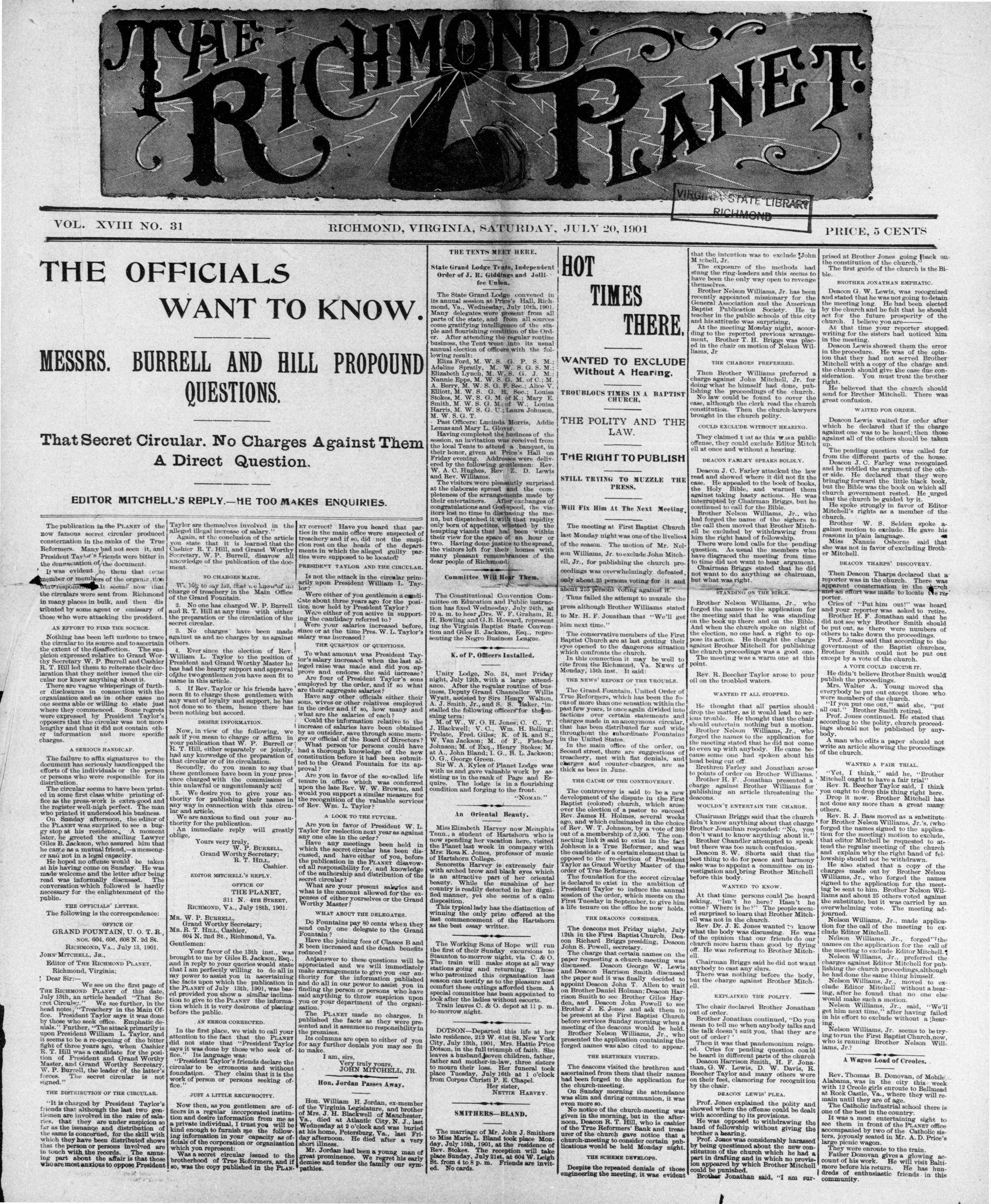
THE RICHMOND PLANET
THE OFFICIALS WANT TO KNOW. MESSRS. BURRELL AND HILL PROPOUND QUESTIONS.
That Secret Circular. No Charges Against Them A Direct Question.
EDITOR MITCHELL'S REPLY.—HE TOO MAKES ENQUIRIES
VOL. XVIII NO. 31
THE OFFICE
MESSRS. BURR
That Secret Circul
A D
EDITOR MITCHELL'S
The publication in the PLANET of the now famous secret circular produced consternation in the ranks of the True Reformers. Many had not seen it, and President Taylor's friends were bitter in the denunciation of the document. It was evident to them that some member or members of the organization were responsible. It seems now that the circulars were sent from Richmond in many places in bulk, and then distributed by some agent or emissary of those who were attacking the president.
AN EFFORT TO FIND THE SOURCE.
Nothing has been left undone to trace the circular to its source and to ascertain the extent of the disaffection. The suspicion expressed relative to Grand Worry Secretary W. P. Burrell and Cashier R. T. Hill led them to reiterate their declaration that neither issued the circular nor knew anything about it. There are vague whisperings of further disclosures in connection with the organization and as in other cases no one seems able or willing to state just where they commenced. Some regrets were expressed by President Taylor's opposers that the circular was not more lengthy and that it did not contain other information and more specific charges.
A SERIOUS HANDICAP
The failure to affix signatures to the document has seriously handicapped the efforts of the individuals or the person or persons who were responsible for its distribution.
The circular seems to have been printed in some first class white printing office as the press-work is extra-good and the register well-night perfect. The man who printed it understood his business.
On Sunday afternoon, the editor of the PLANET was surprised to see a buggy stop at his residence. A moment later, he greeted the smiling Lawyer Giles B. Jackson, who assured him that he came as a mutual friend,—a messenger and not in a legal capacity.
He hoped no offense would be taken at his having come on Sunday. He was made welcome and the letter after being read was informally discussed. The conversation which followed is hardly necessary for the enlightenment of the public.
THE OFFICIALS' LETTER.
The following is the correspondence:
OFFICE OF
GRAND FOUNTAIN, U. O. T. R.
NOS. 604, 606, 608 N. 2d St.
RICHMOND, VA., July 13, 1901.
JOHN MITCHELL, JR.
Editor of THE RICHMOND PLANET,
Richmond, Virginia;
! Dear Sir:
We see on the first page of THE RICHMOND PLANET of this date, July 13th, an article headed "That Secret Circuly." We see further, in the head notes, "Treachery in the Main Office. President Taylor says it was done by those who seek office. Emphatic denials." Further, "The attack primarily is upon President William L. Taylor, and it seems to be a re-opening of the bitter fight of three years ago, when Cashier R. T. Hill was a candidate for the position of President and Grand Worthy Master, and Grand Worthy Secretary, W. P. Burrell, the leader of the latter's forces. The secret circular is not signed."
THE DISTRIBUTION OF THE CIRCULAR.
"It is charged by President Taylor's friends that although the last two gentlemen are involved in the raise of salaries, that they are under suspicion so far as the issuance and distribution of the same is concerned, for the skill with which they have been distributed shows that the person or persons involved are in touch with the records. The amusing part about the affair is that those who are most anxious to oppose President
Taylor are themselves involved in the alleged illegal increase of salary."
Again, at the conclusion of the article you state that it is learned that the Cashier R. T. Hill, and Grand Worthy Secretary, W. P. Burrell, disavow all knowledge of the publication of the document.
NO CHARGES MADE.
We beg to say lst, that we know of no charge of treachery in the Main Office of the Grand Fountain.
2. No one has charged W. P. Burrell and R. T. Hill at any time with either the preparation or the circulation of the secret circular.
3. No charges have been made against us and no charges by us against others.
4. Ever since the election of Rev. William L. Taylor to the position of President and Grand Worthy Master he has had the hearty support and approval of the two gentlemen you have seen fit to name in this article.
5. If Rev. Taylor or his friends have seen fit to charge these gentlemen with any want of loyalty and support, he has been given the chance since there has been nothing but accord.
DESIRE INFORMATION
Now, in view of the following, we ask if you mean to charge or affirm in your publication that W. P. Burrell or R. T. Hill, either separately or jointly, had any knowledge of the preparation of that circular or of its circulation.
Secondly, do you mean to say that these gentlemen have been in your presence charged with the commission of this unlawful or ungentlemanly act?
3. We desire you to give your authority for publishing their names in any way in connection with this circular and article.
We are anxious to find out your authority for the publication.
An immediate reply will greatly oblige.
Yours very truly,
W. P. BURRELL,
Grand Worthy Secretary;
R. T. HILL,
Cobber
RICHMOND, VA., July 18th, 1901.
MR. W. P. BURRELL.
604 N. 2nd St., Richmond, Va.
Gentlemen:
Your favor of the 13th inst., was brought to me by Giles B. Jackson, Esq., and in reply to your queries would state that I am perfectly willing to do all in my power to assist you in ascertaining the facts upon which the publication in the PLANET of July 13th, 1901, was based provided you show a similar inclination to give to the PLANET the information which it is very desirous of placing before the public.
AN ERROR CORRECTED.
In the first place, we wish to call your attention to the fact that the PLANET did not state that "President Taylor says it was done by those who seek office." Its language was: "President Taylor's friends declare the circular to be erroneous and without foundation. They claim that it is the work of person or persons seeking office."
JUST A LITTLE RECIPROCITY
Now then, as you gentlemen are officers in a regular incorporated institution and desire information from me as a private individual, I trust you will be kind enough to furnish me the following information in your capacity as officials of the corporation or organization which you represent:
Was a secret circular issued to the brotherhood of True Reformers, and if so, was the copy published in the PLAN.
RICHMOND, VIRGINIA, SATURDAY, JULY 20, 1901
ET correct? Have you heard that parties in the main office were suspected of treachery and if so, did not the suspicion rest on the heads of the departments in which the alleged guilty parties were supposed to be located?
PRESIDENT TAYLOR AND THE CIRCULAR.
Is not the attack in the circular primarily upon President William L. Taylor?
Were either of you gentlemen a candidate about three years ago for the position now held by President Taylor?
Were either of you active in supporting the candidacy referred to?
perico
Were your salaries increased before,
since or at the time Press. W. L. Taylor's
salary was increased ?
THE QUESTION OF QUESTIONS.
Are four of President Taylor's sons employed by the order, and if so what are their aggregate salaries? They offer official, either their sons, wives or other relatives employed in the order and if so, how many and what are the salaries of each?
Could the information relative to the increase of salaries have been obtained by an outsider, save through some member or official, of the Board of Directors?
What person for persons could have had a thorough knowledge of the new constitution before it had been submitted to the Grand Fountain for its approval?
Are you in favor of the so-called life tenure in office which was conferred upon the late Rev. W. W. Browne, and would you support a similar measure for the recognition of the valuable services of Rev. Wm. L. Taylor?
A LOOK TO THE FUTURE.
Are you in favor of President W. L. Taylor for reelection next year as against any one else in the order?
Have any meetings been held in which the secret circular has been discussed, and have either of you, before the publication in the PLANET disawowed all responsibility for, and knowledge of the authorship and distribution of the secret circular?
What are your present salaries and what is the amount allowed for the expenses of either yourselves or the Grand Worthy Master?
WHAT ABOUT THE DELEGATES.
Do Fountains pay 80 cents when they send only one delegate to the Grand Fountain?
Have the joining fees of Classes B and E been increased and the death benefits reduced?
Answers to these questions will be appreciated and we will immediately make arrangements to give you our authority for the information published and do all in our power to assist you in finding the person or persons who have said anything to throw suspicion upon you or your department of the organization.
The PLANET made no charges. It published the facts as they were presented and it assumes no responsibility in the premises.
Its columns are open to either of you for any further denials you may see fit to make.
I am, sirs,
Very truly yours,
JOHN MITCHELL, JR.
Hon. Jordan Passes Away.
Hon. William H. Jordan, ex-member of the Virginia Legislature, and brother of Mrs. J. H. Blackwell of Manchester, Va., died at Atlantic City, N. J., last Wednesday at 2 o'clock and was buried at his home, Petersburg, Va., last Friday afternoon. He died after a very short illness.
Mr. Jordan had been a young man of great prominence. We regret his early demise and tender the family our sympathies.
THE TENTS MEET HERE.
State Grand Lodge Tents, Independent Order of J. R. Giddings and Jollife Union.
The State Grand Lodge convened in its annual session at Price's Hall, Richmond, Va., Wednesday, July 10th, 1901. Many delegates were present from all parts of the state, and from all sources come gratifying intelligence of the staple and flourishing condition of the Order. After attending the regular routine business, the Tent went into its usual annual election of officers with the following result:
Eliza Ford, M. W. S. G. P. S. M.; Adeline Spratly, M. W. S. G. S. M.; Elizabeth Lynch, M. W. S. G. J. M.; Nannie Epps, M. W. S. G. M. of C.; M. A. Berry, M. W. S. G. F. Sec.; Alice V. Elliott, M. W. S. G. R. Sec.; Louisa Stokes, M. W. S. G. M. of K.; Mary E. Smith, M. W. S. G. M. of W.; Louisa Harris, M. W. S. G. U.; Laura Johnson, M. W. S. G. T.
Past Officers: Lucinda Morris, Addie Lemas and Mary L. Glover.
Having completed the business of the session, an invitation was received from the local Tents to attend a banquet, in their honor, given at Price's Hall on Friday evening. Addresses were delivered by the following gentlemen: Rev. W. A. Hughes, Rev Z. D. Lewis and Rev. Williams.
The visitors were pleasantly surprised at the elaborate spread and the completeness of the arrangements made by their entertainers. After exchanges of congratulations and God-speed, the visitors lost no time in discussing the menu, but dispatched it with that rapidity only born of appetites, whetted by the tempting viands that had been within their view for the space of an hour or two. Having done justice to the spread, the visitors left for their homes with many pleasant remembrances of the dear people of Richmond.
The Constitutional Convention Committee on Education and Public instruction has fixed Wednesday, July 24th, at 10 a.m. to hear Drs. W. F. Graham, R. H. Bowling and G.B. Howard, representing the Virginia Baptist State Convention and Giles B. Jackson, Esq., representing the Negro Business League.
K. of P. Officers Installed.
Unity Lodge, No. 34, met Friday night, July 12th, with a large attendance. After the regular routine of business, Deputy Grand Chancellor Willis Wyatt, assisted by Sirs Henry Walton, A. J. Smith, Jr., and S. B. Baker, installed the following officers for the ensuing term:
M. of W. W. O. H. Jones; C. C. T. J. Blackwell; V. C. W. H. Wm. H. Bollens; Prelate, Fred. Giles; K. of R. and S. W. Van Jackson; M. of F., Fletcher Johnson; M. of Exq., Henry Stokes; M. at A. John Bland; I. G. B. L. Jackson; O. G. George Green.
Sir W. A. Kyles of Planet Lodge was with us and gave valuable work by assisting us in the rank of Page and Esquire. The lodge is in a flourishing condition and forging to the front.
An Oriental Beauty.
Miss Elizabeth Harvey now Memphis Tenn., a student of Hartshorn who is now spending her vacation here, visited the Planet last week in company with Mrs. Rosa K. Jones, professor of music of Hartshorn College.
Senoretta Harvey is extremely fair with arched brow and black eyes which is an attractive part of her oriental beauty. While the sunshine of her country is readily detected in her dignified manner, yet she seems of a calm disposition.
This typical lady has the distinction of winning the only prize offered at the last commencement of the Hartshorn as the best essay writer.
The Working Sons of Hope will run the first of their Sunday excursions to Staunton to-morrow night, via C. & O. The train will make stops at all way stations going and returning. Those who patronized this organization last season can testify as to the pleasure and comfort these outings afforded them. A special committee has been appointed to look after the ladies without escorts. Train leaves C. & O. depot at 11 p. m. to-morrow night.
DOTSON—Departed this life at her late residence, 212 W. 61st St. New York City, July 13th, 1901, Mrs. Hattie Price Dotson, in the full triumph of faith. She leaves a husband, seven children, father, father and mother-in-law, three sisters to mourn their loss. Her funeral took place Tuesday, July 16th at 1 o'clock from Corpus Christi P. E. Chapel.
SMITHERS—BLAND.
The marriage of Mr. John J. Smithers to Miss Marie L. Bland took place Monday, July 15th, 1901, at the residence of Rev. Stokes. The reception will take place Sunday, July 21st, at 604 W. Leigh St. from 4 to 8 p. m. Friends are invited. No cards.
HOT TIMES THERE.
WANTED TO EXCLUDE
Without A Hearing.
TROUBLOUS TIMES IN A BAPTIST
CHURCH.
THE POLITY AND THE
LAW.
THE RIGHT TO PUBLISH
STILL TRYING TO MUZZLE THE PRESS.
Will Fix Him At The Next Meeting
The meeting at First Baptist Church last Monday night was one of the liveliest of the season. The motion of Mr. Nelson Williams, Jr. to exclude John Mitchell, Jr., for publishing the church proceedings was overwhelmingly defeated, only about 25 persons voting for it and about 215 persons voting against it.
Thus failed the attempt to muzzle the press although Brother Williams stated to Mr. H. F. Jonathan that "We'll get him next time."
The conservative members of the First Baptist Church are at last getting their eyes opened to the dangerous situation which confronts the church.
In this connection it may be well to cite from the Richmond, Va. News of Monday, 15th inst. It said:
THE NEWS' REPORT OF THE TROUBLE.
The Grand Fountain, United Order of True Reformers, which has been the focus of more than one sensation within the past few years, is once again divided into factions over certain statements and charges made in an anonymous circular, that has been distributed far and wide throughout the subordinate Fountains in the United States. In the main office of the order, on Second street, there are suggestions of treachery, met with flat denials, and charges and counter-charges, are as thick as bees in June.
THE CAUSE OF THE CONTROVERSY
The controversy is said to be a new development of the dispute in the First Baptist (colored) church, which arose over the election of a pastor to succeed Rev. James H. Holmes, several weeks ago, and which culminated in the choice of Rev. W. T. Johnson, by a vote of 369 out of a membership of 2,500. The connecting link is said to exist in the fact Johnhson is a True Reformer, and was the candidate of a certain element that is opposed to the re-election of President Taylor as Grand Worthy Master of the order of True Reformers. The foundation for the secret circular is declared to exist in the ambition of President Taylor to induce the annual session of the order, which meets on the First Tuesday in September, to give him a life tenure on the office he now holds.
THE DEACONS CONSIDER.
The deacons met Friday night, July 12th in the First Baptist Church, Deacon Richard Briggs presiding, Deacon John S. Powell, secretary.
The charge that certain names on the paper requesting a church-meeting was discussed. Deacon George W. Lewis and Deacon Harrison Smith discussed the paper and it was finally decided to appoint Deacon John T. Allen to wait on Brother Daniel Holman; Deacon Harrison Smith to see Brother Giles Hayden, and Deacon John Powell to see Brother J. E. Jones and ask them to be present at the First Baptist Church before services Sunday morning when a meeting of the deacons would be held.
Brother Nelson Williams, Jr., who presented the application containing the forged names was also cited to appear.
THE BRETHREN VISITED
The deacons visited the brethren and ascertained from them that their names had been forged to the application for the church-meeting.
On Sunday morning the attendance was slim and during communion, it was even more so.
No notice of the church-meeting was given in the morning, but in the afternoon, Deacon R. T. Hill, who is cashier of the True Reformers' Bank and treasurer of the church gave notice that a church-meeting to consider certain publications would be held Monday night.
THE SCHEME DEVELOPS.
Despite the repeated denials of those engineering the meeting, it was evident
that the intention was to exclude John M techell, Jr. The exposure of the methods had stung the ring-leaders and this seems to have been the only way open to revenge themselves. Brother Nelson Williams, Jr. has been recently appointed missionary for the General Association and the American Baptist Publication Society. He is teacher in the public schools of this city and his attitude was surprising. At the meeting Monday night, according to the reported previous arrangement, Brother T. H. Briggs was placed in the chair on motion of Nelson Williams, Jr.
THE CHARGES PREFERRED.
Then Brother Williams preferred a charge against John Mitchell, Jr. for doing what he himself had done, publishing the proceedings of the church. No law could be found to cover the case, although the clerk read the church constitution. Then the church-lawyers brought in the church polity.
COULD EXCLUDE WITHOUT HEARING.
They claimed t at as this w as a public offense, they could exclude Editor Mitchell at once and without a hearing.
DEACON FARLEY SPEAKS BOLDLY.
Deacon J. C. Farley attackud the law read and showed where it did not fit the case. He appealed to the book of books, the Holy Bible, and warned them against taking hasty actions. He was interrupted by Chairman Briggs, but he continued to call for the Bible.
Brother Nelson Williams, Jr., who had forged the name of the sighers to the call then moved that Brother Mitchell be excluded by withdrawing from him the right hand of fellowship.
There were loud calls for the pending question. As usual the members who have disgraced the meeting from time to time did not want to hear argument.
Chairman Briggs stated that he did not want to do anything as chairman, but what was right.
STANDING ON THE BIBLE.
Brother Nelson Williams, Jr., who forged the names to the application for the meeting said that he was standing on the book up there and on the Bible. And when the church spoke on night of the election, no one had a right to oppose its action. He thought the charge against Brother Mitchell for publishing the church proceedings was a good one. The meeting was a warm one at this point.
Rev. R. Beecher Taylor arose to pour oil on the troubled waters.
WANTED IT ALL STOPPED.
He thought that all parties should drop the matter, as it would lead to serious trouble. He thought that the chair should entertain nothing but a motion. Brother Nelson Williams, Jr., who forged the names to the application for the meeting stated that he did not come to even up with anybody. He came because some one had spoken about his head being cut off. Brethren Farley and Jonathan arose to points of order on Brother Williams. Brother H. F. Jonathan presented a charge against Brother Williams for publishing an article threatening the deacons.
WOULDN'T ENTERTAIN THE CHARGE.
Chairman Briggs said that the church didn't know anything about that charge Brother Jonathan responded: "No, you don't want to know anything about it." Brother Chandler attempted to speak but there was too much confusion.
Deacon S. W. Shorts said that the best thing to do for peace and harmony sake was to appoint a committee on im- plementing a Brother Mitchell before this body.
WANTED TO KNOW
At that time persons could be heard asking, "Isn't he here? Hasn't he come? Where is he?" The people seemed surprised to learn that Brother Mitchell was not in the church.
Rev Dr. J. E. Jones wanted to know what the body was discussing. He was of the opinion that our friends do our church more harm than good by flying off. He was referring to Brother Mitchell.
There was nothing before the body,
but the charge against Brother Mitchell.
EXPLAINED THE POLITY
The chair declared Brother Jonathan out of order.
Brother Jonathan continued, "Do you mean to tell me when anybody talks and the talk doesn't suit you, that they are out of order?"
Then it was that pandemonium reigned. Cries for pending question could be heard in different parts of the church Deacon Harrison Smith, H. F. Jonathan, G. W. Lewis, D. W. Davis, R. Beecher Taylor and many others were on their feet, clamoring for recognition by the chair.
DEACON LEWIS' PLEA.
Prof. Jones explained the polity and showed where the offense could be dealt with according to its provisions.
He was opposed to withdrawing the hand of fellowship without giving the brother a hearing.
Prof. Jones was considerably harassed by being questioned about the new constitution of the church which he had a part in drafting and in which no provision appeared by which Brother Mitchell could be punished.
Brother Jonathan said, "I am sur-
PRICE. 5 CENTS
prised at Brother Jones going back on the constitution of the church." The first guide of the church is the Bibl
BROTHER JONATHAN EMPHATIC.
Deacon G. W. Lewis, was recognized and stated that he was not going to detain the meeting long. He had been elected by the church and he felt that he should act for the future prosperity of the church. I believe you are—— At that time your reporter stopped writing for the sisters had noticed him in the meeting. Deacon Lewis showed them the error in the procedure. He was of the opinion that they had not served Brother Mitchell with a copy of the charge and the church should give the case due consideration. You must treat the brother right. He believed that the church should send for Brether Mitchell. There was great confusion.
WAITED FOR ORDER.
Deacon Lewis waited for order after which he declared that if the charge against one was to be heard; then those against all of the others should be taken up. The pending question was called for from the different parts of the house.
The pending question was called for from the different parts of the house. Deacon J. C. Farley was recognized and he riddled the argument of the other side. He declared that they were bringing forward the little black book, but the Bible was the book on which all church government rested. He urged that the church be guided by it. He spoke strongly in favor of Editor Mitchell's rights as a member of the church. Brother W. S. Selden spoke against motion to exclude. He gave his reasons in plain language. Miss Nannie Osborne said that she was not in favor of excluding Brother Mitchell.
DEACON THARPS' DISCOVERY.
Then Deacon Tharps declared that a reporter was in the church. There was apparent consternation in the church and an effort was made to locate the reporter.
Cries of "Put him out!" was heard and your reporter was asked to retire.
Brother H. F. Jonathan said that he did not see why Brother Smith should be put out, as there were numbers of others to take down the proceedings.
Prof. Jones said that according to the government of the Baptist churches, Brother Smith could not be put out except by a vote of the church.
A VOTE COULD DECIDE IT.
He didn't believe Brother Smith would publish the proceedings.
Mrs. Walter A. Young moved that everybody be put out except those who were members of the church. "If you put one out," said she, "put all out." Brother Smith retired. Prof. Jones continued. He stated that according to the polity, church proceedings should not be published by anybody. A man who edits a paper should not write an article showing the proceedings of the church.
WANTED A FAIR TRIAL
"Yet, I think," said he, "Brother Mitchell ought to have a fair trial."
Rev. R. Beecher Taylor said, I think you ought to drop this thing right here. Drop it now. Brother Mitchell has not done any more than a great many others.
Rev. R. J. Bass moved as a substitute for Brother Nelson Williams, Jr.'s, (who forged the names signed to the application for the meeting) motion to exclude, that editor Mitchell be requested to attend the regular meeting of the church and explain why the right hand of fellowship should not be withdrawn.
He also stated that a copy of the charges made out by Brother Nelson Williams, Jr., who forged the names signed to the application for the meeting be sent to him. Brother Nelson Williams and about 25 others voted against the substitute, but it was carried by an overwhelming vote. The meeting adjourned.
Nelson Williams, Jr., made application for the call of the meeting to exclude Editor Mitchell.
A Wagon Load of Creoles.
Rev. Thomas B. Donovan, of Mobile, Alabama, was in the city this week with 13 Creole girls enroute to Bellmead at Rock Castle, Va., where they will remain until they are of age. The Catholic industrial school there is one of the best in the country. It was a most entertaining sight to see them in front of the PLANET office accompanied by two of the Catholic sisters, joyously seated in Mr. A. D. Price's large picnic wagon. They were enroute to the train. Father Donovan gives a glowing account of his work. He will visit Baltimore before his return. He has hundreds of enthusiastic friends in this community.
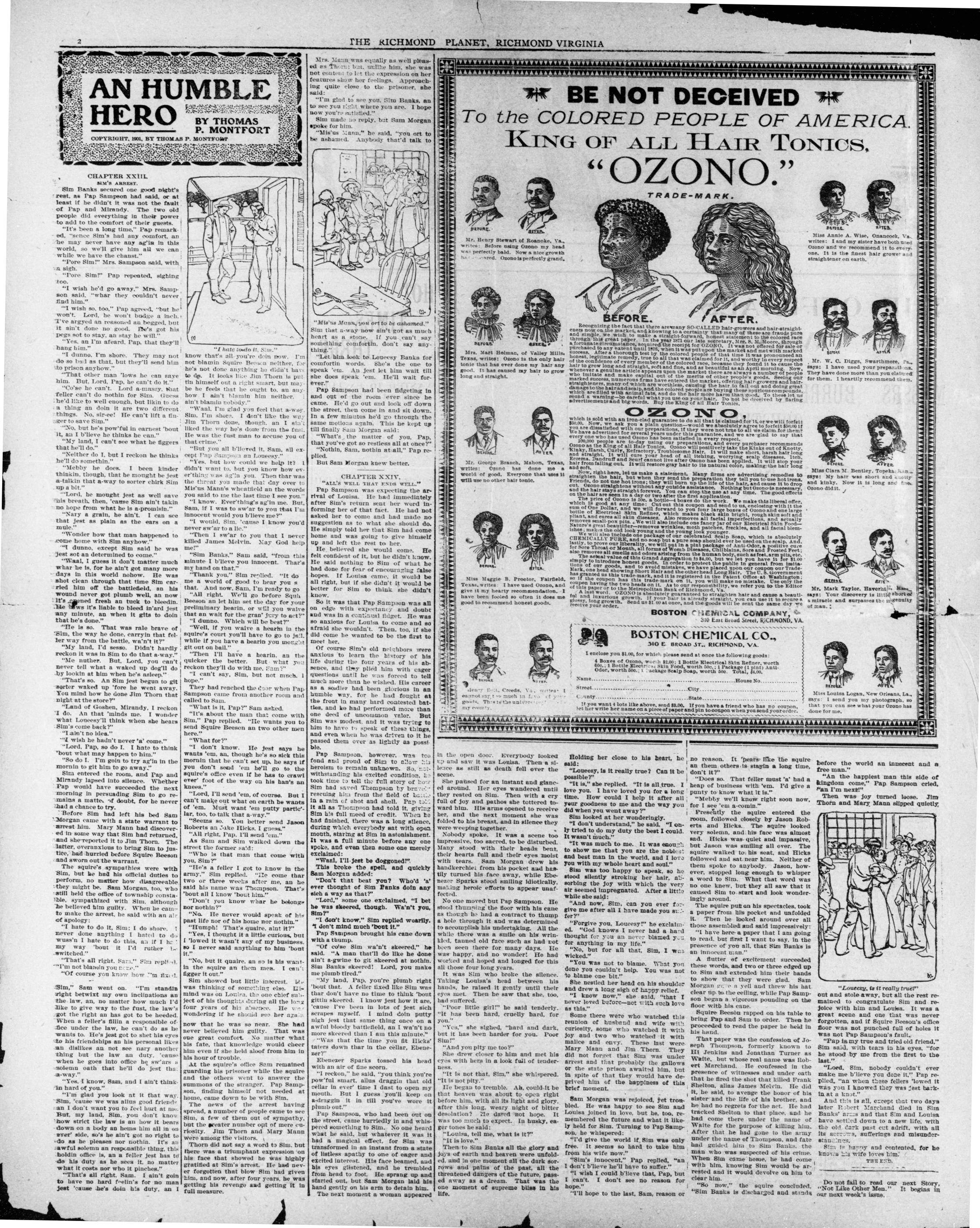
AN HUMBLE HERO BY THOMAS P. MONTEFORT
COPYRIGHT, 1901, BY THOMAS P. MONTFORT
Sim Banks secured one good night's rest, as Pap Sampson had said, or at least if he didn't it was not the fault of Pap and Mirandy. The two old people did everything in their power to add to the comfort of their guests.
"It's been a long time," Pap remarked, "sence Sim's had any comfort, an he may never have any ag'in in this world, so we'll give him all we can while we have the chanst."
"Pore Sim!" Mrs. Sampson said, with a sigh.
"Pore Sim!" Pap repeated, sighing too.
"I wish he'd go away," Mrs. Sampson said, "whar they couldn't never find him."
"I wish so, too," Pap agreed, "but he won't. Lord, he won't budge a inch. I've argyed an reasoned an begged, but it ain't done no good. He's got his pegs sot to stay, an stay he will."
"Yes, an I'm afeard, Pap, that they'll hang him."
"I dumno. I'm shore. They may not do so bad as that, but they'll send him to prison anyhow."
"That other man 'lows he can save him. But, Lord, Pap, he can't do it."
"Co'se he can't. Lord a-massy, that feller can't do nothin for him. Guess he'd like to well enough, but likin to do a thing an doin it are two different things. No, sl-ree! He can't lift a finger to save Sim."
"No, but he's pow'ful in earnest 'bout it, an I'bieve he thinks he can."
"My land, I can't see what he figgers that he'll do."
"Neither do I, but I reckon he thinks he'll do somethin."
"Mebby he does. I been kinder thinkin, though, that he might be jest a-talkin that a-way to sorter chirk Sim up a bit."
"Lord, he might jest as well save his breath, then, 'cause Sim ain't takin no hope from what he is a-promislin."
"Nary a grain, he ain't. I can see that jest as plain as the ears on a mule."
"Wonder how that man happened to come home with Sim anyhow."
"I dunno, except Sim said he was jest sot an determined to come."
"Waal, I guess it don't matter much whar he is, for he ain't got many more days in this world nohow. He was shot clean through that time Sim carried him off the battlefield, an his wound never got plumb well, an now it's opened fresh an tuck to bleedin. He blows it's liable to bleed in 'ard jest any minute, an when it gits to doin that he's done."
"He is so. That was rale brave of Sim, the way he done, carryin that feller way from the battle, won't it?" "My land, I'd sseo. Didn't hardly reckon it was in Sim to do that a-way."
"Me nuther. But, Lord, you can't tell what a waked up dog'll do by lookin at him when he's asleep."
"That's so. An Sim jest begun to git sorter waked up 'fore he went away. You mind how he done Jim Thorn that night at the store?"
"Land of Goshen, Mirandy, I reckon I do. An that 'minds me. I wonder what Loneesy'll think when she hears Sim's come back?"
"Iain't no idea."
"I wish he hadn't never 'a' come."
"Lord, Pap, so do I. I hate to think 'bout what may happen to him."
"I so do I. I'm goin to try agin in the mornin to git him to go away."
Sim entered the room, and Pap and Mirandy lapsed into silence. Whether Pap would have succeeded the next morning in persuading Sim to go remains a matte, of doubt, for he never had a chance to try.
Before Sim had left his bed Sam Morgan came with a state warrant to arrest him. Mary Mann had discovered in some way that Sim warrant had returned, and she reported it to Jim Thorn. The latter, overaxious to bring Sim to Justice, had hurried before Squire Beeson and sworn out the warrant. The squire's sympathies were with Sim, but he had his official duties to perform, no matter how disagreeable they might be. Sam Morgan, too, who still held the office of township constable, sympathized with Sim, although he believed him guilty. When he came to make the arrest, he said with an alr of apology:
"I hate to do it, Sim; I do shore. I never done anything I hated to do wuss'n I hate to do this, an if I be my way 'bout it I'd rather be switched."
"That's all right, Sam." Sim replied. "I'm not blamming you none."
"Of course you know how I'm fixed.
Sim," Sam went on. "I'm standing right betwixt my own inclinations and the law, an, no matter how much I'd like to give way to the fust, the law's got the right an has got to be beheaded. When a feller's fillin a responsible of face under the law, he can't do as he wants to. He's jest got to shed his eyes to his friendships an his personal likes an dislikes an not see nary another thing but the law an duty, 'cause when he goes into office he swars a solemn oath that he'll do jest than a-way."
"Yes, I know, Sam, and I ain't think in hard of you."
"I'm glad you look at it that way. Sim, 'cause we was alius good friends, an I don't want you to feel hurt at me. But, my land, Sim, you don't know how strict the law is an how it bears down on a body an hems him all in on ever' side, so's he ain't got no right to do as he pleases nor nothin. It's an awful solemn an responsible thing, this holdin office is, an a feller jest has to do his duty as he sees it, no matter what it costs nor who it pinches." "That's all right. Sam. I ain't goin to have no hard 'eelin's for no man jest 'cause he'doin his duty, an I
"I ain't no idea."
09
know that's all you're doin row. I'm not blamin Squire Beesen neither, for he's not done anything he didn't have to do. It looks like Jim Thorn is put himself out a right smart, but may be he feels that he ought to, an anyhow I ain't blamin him neither. I ain't blamin nobody."
"Wanl. I am glad you feel that a-way. Sim. I am shore. I don't like the way Jim Thorn done, though. an I ain't liked the way he's done from the first. He was the fust man to accuse you of that crime."
"But you all b'loved it, Sam, all except Pap Sampson an Loneessy."
"Yes, but how could we help it? I didn't want to, but you know how ever'thing was ag'in you. Then that was the threat you made that day over to Misus Mann's wheatfield an the words you said to me the last time I see you."
"I know. Everthing's ag'in me. But, Sam, if I was to swar to you that I'm innocent would you believe me?"
"I would. Sim. 'cause I know you'd never swar to a lie."
"Then I swar to you that I never killed James Melvin. May God help me!"
"Sim Banks." Sam said, "from this minute I b'live you innocent. Thar's my hand on that."
"Thank you." Sim replied, "It do me a world of good to hear you s that. And now, Sam, I'm ready to go
"All right. We'll go before Squh Beesson an let him set the day for your preliminary hearin, or will you waive that an wait for the gran' jury to act?"
"I dunno. Which will be best?"
"Well, if you waive a hearin in the squire's court you'll have to go to jail, while if you have a hearin you might git out on bail."
"Then I'll have a hearin, an the quicker the better. But what you reckon they'll do with me, Sam?"
"I can't say, Sim, but not much, I hope."
They had reached the door when Pap Sampson came from another room and called to Sam.
"What is it, Pap?" Sam asked.
"It's about the man that come with Sim." Pap replied. "He wants you to send Squire Beeson an two other men here."
"What for?"
"I don't know. He jest says he wants 'em, an, though he's so sick this mormin that he can't set up, he says if you don't send 'em he'll go to the squire's office even if he has to crawl ever' foot of the way on his han's an knees."
"Lord, I'll send 'em, of course. But I can't make out what on earth he wants of 'em. Must want 'em putty particlar, too, to talk that a-way."
"Seems so. You better send Jason Roberts an 'ake Hicks, I guess."
"All right, Pap, I'll send 'em."
As Sam and Sim walked down the street the former said:
"Who is that man that come with you, Sim?"
"He's a feller I got to know in the army." Sim replied. "He come that two or three weeks after me, an he said his name was Thompson. That's 'bout all I know 'bout him."
"Don't you know what he belongs nor nothin'"
"No. He never would speak of his past life nor of his home nor nothin."
"Humph! That's quire, aint it?"
"Yes, I thought it a little curious, but I lowed it wasn't any of my business, so I never said anything to him 'bout it."
"No, but it quire, an so is his wantin in the squire an them mea. I can't finger it out."
Sim showed but little interest. He was thinking of something else. His mind was on Louisa, the one chief subject of his thoughts during all the long four years of his absence. He was wondering if he should see her again now that he was so near. She had never believed him guilty. That was one great comfort. No matter what his fate, that knowledge would cheer him even if she held aloof from him in his hour of trouble.
At the squire's office Sam remained guarding his prisoner while the squire and the others went to answer the summons of the stranger. Pap Sampson, finding himself not needed at home, came down to be with Sim.
The news of the arrest having spread, a number of people came to see Sim, a few of them out of sympathy, but the greater number opt of mere curiosity. Jim Thorn and Mary Mann were among the visitors.
Thorn did not say a word to Sim, but there was a triumphant expression on his face that showed he was highly gratified at Sim's arrest. He had never forgotten that blow Sim had given him, and now, after four years, he was getting his revenge and getting it in full measure.
Mrs. Mann was equally as well pleased as Thorn; but, unlike him, she was not content to let the expression on her features show her feelings. Approaching quite close to the prisoner, she said:
"I'm glad to see you, Sim Banks, an to see you right where you are. I hope now you're satisfied."
Sim made no reply, but Sam Morgan spoke for him.
"Mis'us Mann," he said, "you ort to be ashamed. Anybody that'd talk to
32.
"Mis's Mann, you ort to be ashamed." Sim that away now isn't got as much heart as a stone. If you can't say something comfortin', don't say anything." "Let him look to Louecesy Banks for comfortin' words. She's the one to speak 'em. An jest let him wait till she does speak 'em. He'll wait forever." Pap Sampson had been fidgeting in and out of the room ever since he came. He'd go out and look down the street, then come in and sit down. In a few minutes he'd go through the same motions again. This he kept up till finally Sam Morgan said: "What's the matter of you, Pap, that you've got so restless all at once?" "Nothin, Sam, nothin at all." Pap replied. But Sam Morgan knew better.
ALL WELL THAT ENDS WELL.
Pap Sampson was expecting the arrival of Louisa. He had immediately after Sim's return sent her word informing her of that fact. He had not asked her to come and had made no suggestion as to what she should do. He simply told her that Sim had come home and was going to give himself up and left the rest to her.
He believed she would come. He felt confident of it, but he didn't know. He said nothing to Sim of what he had done for fear of encouraging false hopes. If Louisa came, it would be all right, but if she didn't it would be better for Sim to think she didn't know.
So it was that Pap Sampson was all on edge with expectancy and doubt and was in a continualidget. He was so anxious for Louisa to come and so afraid she wouldn't. Then, too, if she did come he wanted to be the first to meet her.
Of course Sim's old neighbors were anxious to learn the history of his life during the four years of his absence, and they piled him with eager questions until he was forced to tell much more than he wished. His career as a soldier had been glorious in an humble way, for he had fought at the front in many hard contested battles, and he had performed more than one deed of uncommon valor. But Sim was modest, and it was trying to him to have to speak of these things, and even when he was driven to it he passed them over as lightly as possible.
Pap Sampson, however, was too fond and proud of Sim to allow his heroship to remain unknown. So, notwithstanding his excited condition, he took time to tell the full story of how Sim had saved Thompson by braving rescuing him from the field of battle in a rain of shot and shell. Pap told it all as Thompson had told it, giving Sim his full meed of credit. When he had finished, there was a long silence, during which everybody sat with open mouth, staring at Sim in astonishment. It was a full minute before any one spoke, and even then some one merely exclaimed:
"Waal, I'll jest be doggoned!"
This broke the spell, and quickly Sam Morgan added:
"Don't that beat you? Who'd a' ever thought of Sim Fanks doin any sich a way as that?"
"Lord," some one exclaimed, "I bet he was skeered, though. Wa'n't you, Sim?"
"I don't know," Sim replied wearily, "I don't mind much 'bout it."
Pap Sampson brought his cane down with a thump.
"Of cose Sim wa'n't skeered," he said.
"A man that'll do like he done ain't a-gwine to git skeered at nothin. Sim Banks skeered! Lord, you make me plumb tired."
"My land, Pap, you're plumb right 'bout that. A feller fixed like Sim was that don't have no time to think 'bout gittin skeered. I know jest how it are, 'cause I've been in lots of jest sich scrapes myself. I mind coin putty nigh jest that same thing once on a awful bloody battlefield, an I wa'n't no more skeered than I am this minute."
"Was that the time you fit Hicks' taters down thar in the cellar, Ebenezer?"
Ebenezer Sparks tossed his head with an air of the scorn.
"I reckon," he said, "you think you're pow'ful smart, allus draggin that old cellar in ever' time I dast to open my mouth. But I guess you'll keep on a draggin it in till you've wore it plumb out."
Pup Sampson, who had been out on the street, came hurriedly in and whispered something to Sim. No one heard what he said, but whatever it was it had a magical effect, for Sim was transformed in an instant from a state of listless apathy to one of eager and excited interest. His face beamed, and his eyes glistened, and he trembled from head to foot. He sprang up and started out, but Sam Morgan laid his hand gently on his arm to detain him.
The next moment a woman appeared
```markdown
```
BE NOT DECEIVED To the COLORED PEOPLE OF AMERICA. KING OF ALL HAIR TONICS. "OZONO."
Mr. Henry Stewart of Roanoke, Va., writes: Before using Ozono my head was perfectly bald. Now a nice growth has appeared. Ozono is perfectly grand.
Mrs. Mart Holman, of Valley Mills,
Texas, writes: Ozone is the only hair
tonic that has ever done my hair any
way. I have done my hair to grow
long and straight.
Mr. George Branch, Mahon, Texas, writes: Ozono has done me a world of good. Everyone that uses it will use no other hair tonic.
Miss Maggie B. Proctor, Fairfield,
Texas, writes: I have used Ozone, and
give it my hearty recommendation. I
have been fooled so often it does me
good to recommend honest goods.
BEFORE
AFTER
denty Bolt, Croeds, Va., writes: I
cannot say too much in favor of your
goods. This is the university of
my county.
in the open door. Everybody looked up and saw it was Louisa. Then a silence as still as death fell over the scene.
She paused for an instant and glanced around. Her eyes wandered until they rested on Sim. Then with a cry full of joy and pathos she tottered toward him. His arms opened to receive her, and the next moment she was folded to his breast, and in silence they were weeping together.
Nobody spoke. It was a scene too impressive, too sacred, to be disturbed. Many stood with their heads bent, their hearts full and their eyes moist with tears. Sam Morgan drew his handkerchief from his pocket and hastily turned his face away, while Ebenzeer Sparks stood smiling idiotically, making heroic efforts to appear unaffected.
No one moved but Pap Sampson. He stood thumming the floor with his cane as though he had a contract to thump a hole through it and was determined to accomplish his undertaking. All the while there was a smile on his wrinkled, tanned old face such as had not been seen there for many days. He was happy, and no wonder! He had worked and hoped and longed for this all those four long years.
It was Sim who broke the silence. Taking Louisa's head between his hands, he raised it gently until their eyes met. Then he saw that she, too, had suffered.
"Poor little girl!" he said tenderly. "It has been hard, cruelly hard, for you."
"Yes," she sighed, "hard and dark, but it has been harder for you. Poor Sim!"
"And you pity me too?" She drew closer to him and met his eyes with hers in a look full of tenderness.
"It is not that, Sim," she whispered. "It is not pity."
He began to tremble. Ah, could it be that heaven was about to open right before him, with all its light and glory, after this long, weary night of bitter desolation? He dared not hope. It was too much to expect. In husky, eager tones he said:
"Louisa, tell me, what is it?"
"It is love."
Then to Sim Banks all the glory and joys of earth and heaven were unfolded, and in one moment all the dark sorrows and pains of the past, all the threatened dangers of the future, passed away as a dream. That was the one moment of supreme bliss in his life.
BEFORE. AFTER.
Recognizing the fact that there are many SO-CALLED hair-growers and hair-straightening and simple, we wish to make a strong impression through this great paper. In the year 1871 our late secretary, Mire, S. M. Moore, through purchase to any extent until 1875, when we received for OZONO. It was not offered for sale or purchased to any extent until 1875, when we succeeded. After a thorough test by the colored people of that time it was pronounced an excellent hair-straightening and soft, soft and fine, and as beautiful as an April morning. Now, hair to grow long and straight, soft and fine, and as beautiful as an April morning, upon the market there are a number of people who imitate and make capital, and upon the market there are a number of people marked success, numerous firms have entered the market, offering hair-growers and hair-straightening and simple, causing the hair to fall out and doing great damage to the hair and scalp, and the hair is not cared for which are filled with animal fats, and do the hair more harm than soo. Let us list advertisements and the words. Buy the hair. Do not be deceived by faring advertisements and the words. Buy the hair.
OZONO
which is sold with an iron-clad guarantee to $50.00. Now, we ask you a plain question: you are dissatisfied with our preparations. If we have advertised for several years under this, we have not yet.
Every one who has used Ozone has been satisfied with our preparations. If we have advertised for several years under this, we have not yet.
100,000 people are to-day using our pre-Ozone 100-kcal King of all-Hair Tonics. Ozone 100-kcal King of all-Hair Tonics, from the Ozone 100-kcal King of all-Hair Tonics, has been supplied by Ozone 100-kcal King of all-Hair Tonics.
Kinky, Harsh, Curly, Refractory. Foolish and straight. It will cure your head of a Eczema. Dandruff and Scur cannot live after a long time.
It will restore gray hair and soft.
Now, right here, let us make a statement straighter the hair, but when they send the Foolish to the Foolish, they will burn out. Ozone straightens the hair and the hair stays straight forever. You can on the hair are seen in a day or two after the which is good at some time.
If you have a bottle-box, you will have a bottle of some of One Dollar, and we will forward a bottle of Electrical Skin Refiner, which will remove small pox skin diseases. Also remove small pox skin diseases.
Nature's great beautifier—removes wrinkles, ishes, makes the old look young and the young are the new.
CHEMICALLY PURE,
lastly, to prove our liberality, we will put in for Sore Throat or Mouth, all forms of Wom also small smells and odors arising from simply to introduce honest goods. In order to find the best of our goods, and to avoid mistakes, Nature has showed Short Hair and the has granted us time to give us a good time to get so if the coupon has this trade-mark coupon having the two heads on it. As to our of a last-worn or to the Metropolitan Bank of
which is sold with an iron-clad guarantee to do all that is claimed for it, or we will forfeit it. You have a plain question—would we absolutely agree to forfeit $0.00 if you are dissatisfied with the services, or they were not true to all we claim for them? We have advertised for several years that we are glad to say that every one who has used Ozono has been satisfied in every respect.
100,000 people are to-day using our preparations, and every purchase recommends Ozono will positively take the Kinks out of Knotty, Kinky, Harsh, Curly, Refresh, and make short, harsh hair long and straight. It will cure your head of all itching, worming, and Eczema. Dandruff and Scurf cannot live after Ozono has been applied. It will stop your hair from falling out. It will restore gray hair to its natural color, making the hair long and now. Right here, let us make a statement. Many firms are advertising remedies to straighten the hair, but when they send the preparation they tell you to use hot irons, do not use hot irons; they will burn up the life of the hair, and cause it to drop out. Ozono is not any outside assistance. Nothing but Ozono is necessary, and the hair stays straight forever, and any time. The good effects on the hair are in a day or two after the first application.
The price of Ozono is $6e, a bottle, 4 boxes do the work. We make this liberal offer, which is any one $6e. Out it this coupon and send to us, enclosing with it the sum of One Dollar, and enclosing with it the one large bottle of Electrical Skin Refiner, which makes black skin bright, and enclosing with it the cures all skin diseases. Also removes all facial imperfections, and actually removes all wrinkles. Also removes one fanny jar of our Electrical Skin Food—Nature's great beautifier—removes wrinkles, reckles, and all facial blemishes; makes the old look young and the young look younger.
We will also include one package of our celebrated Scalp Soap, which is absolutely CHEMICALLY PURE, and no soap but a pure soap should ever be used on the scalp. And, lastly, to prove our Liberality, we will put in a pint package of Ant-Odor, a positive cure for Scalp Sores or Moll, all forms of Womb Diseases, Chlidains, Sore and Frozen Feet; also remediates any skin irritation.
The actual value of this Grant arises from the human body, such as feet, arm pits, etc. simply to introduce honest goods. In order to protect the public in general from imitation-Mark, one heeds the advice to avoid mistakes, we have placed upon our coupon our Trade-Mark, one head of the business, and we have granted us this trade-mark, and it is registered in the Patent Office at Washington, where our coupon has this trade-mark on it. you will make no mistake. Use only the coupon having this responsibility, we refer you to the Editor of this paper or to the Metropolitan Bank. Either
A last word. OZONO is absolutely guaranteed to straighten hair and cause a beautiful and luxurious growth. If your hair is already straight, you can use it to secure a glossy, long growth. Send us $1.00 at once, and the goods will be sent the same day we receive your order.
BOSTON CHEMICAL COMPANY,
310 East Broad Street, RICHMOND, VA
310 E. BROAD ST., RICHMOND, VA.
1 enclose you $1.00, for which please send
4 Boxes of Ozone, worth $2.00; 1 B
60c.; 1 Bottle Electrical, Skin Food,
Odor, worth 80c.; 1 Package Scalp S
Name...
Street...
County...
If you want 4 lots like above, send $8.00,
let her write her name on a piece of paper.
I enclose you $1.00, for which please send at once the following goods:
extra items you need, for which please send at once the following goods:
4 Boxes of Ozono, worth $2.00; 1 Bottle Electrical Skin Refiner, worth
500.1; 1 Bottle Electrical Skin Food, worth $50.0; 1 Package (1 pint) Anti-
Odor, worth $50.0; 1 Package Scalp Soap, worth $50.0; Total, $4.00.
If you want 4 lots like above, send $3.00. If you have a friend who has no coupon, let her write her name on a piece of paper and pin to coupon when you send your order.
Holding her close to his heart, he said:
"Loueesy, is it really true? Can it be possible?"
"It is," she replied. "It is all true. I love you. I have loved you for a long time. How could I help it after all your goodness to me and the way you did when you went away?"
Sim looked at her wonderingly.
"I don't understand," he said. "I only tried to do my duty the best I could. It wasn't much."
"It was much to me. It was enough to show me that you are the noblest and best man in the world, and I love you with my whole heart and soul."
Sim was too happy to speak, so he stood silently stroking her hair, absorbing the joy with which the very air seemed impregnated. After a little while she said:
"And now, Sim, can you ever forgive me after all I have made you suffer?"
"Forgive you, Loucesy!" he exclaimed. "God knows I never had a hard thought for you an never blamed you for anything in my life."
"No, but for all that, Sim, I was wicked."
"You was not to blame. What you done you couldn't help. You was not to blame one bit."
She nushed her head on his shoulder and drew a long sigh of happy relief.
"I know now," she said, "that I never loved before—not with such love as this."
Some there were who watched this reunion of husband and wife with curiosity, some who watched it with joy and two who watched it with malice and envy. These last were Mary Mann and Jim Thorn. They did not forget that Sim was under arrest and that probably the gallows or the state prison awaited him, but in spite of that they would have deprived him of the happiness of this brief moment.
Sam Morgan was rejoiced, yet troubled. He was happy to see Sim and Louisa joined in love, but he, too, remembered the future and what it likely held for Sim. Turning to Pap Sampson, he whispered: "I'd give the world if Sim was only free. It seems so hard to take him from his wife now."
"Sim's innocent," Pap replied, "an I don't bieve he'll have to suffer."
"I wish I could bieve that, Pap, but I can't. I don't see no reason for hope."
"I'll hope to the last, Sam, reason or
```markdown
```
no reason. It "pears like the squire an them others is stagging a long time, don't it?" "Does so. That feller must 'a had a heap of business with 'em. I'd give a punty to know what it is." "Mebby we'll know right soon now, for I see 'em a-comin." Presently the squire entered the room, followed closely by Jason Roberts and Hicks. The squire looked very solemn, and his face was almost sad. Hicks was quiet and impassive, but Jason was smiling all over. The squire walked to his seat, and Hicks followed and sat near him. Neither of them spoke to anybody. Jason, however, stopped long enough to whisper a word to Sim. What that word was no one knew, but they all saw that it caused Sim to start and look wonderingly around.
The squire put on his spectacles, took a paper from his pocket and unfolded it. Then he looked around over all those assembled and said impressively: "I have here a paper that I am going to read, but first I want to say, in the presence of you all, that Sim Banks is an innocent man." A flutter of excitement succeeded these words, and two or three edged up to Sim and extended him their hands to show that they were glad. Sam Morgan gave a yell and threw his hat clear up to the ceiling, while Pap Sampson began a vigorous pounding on the floor with his cane.
Squire Beeson rapped on his table to bring Pap and Sam to order. Then he proceeded to read the paper he held in his hand.
That paper was the confession of Joseph Thompson, formerly known to Hi Jenkins and Jonathan Turner as Waite, but whose real name was Robert Marchand. He confessed in the presence of witnesses and under oath that he fired the shot that killed Frank Shelton, alias James Melvin. He did it, he said, to avenge the honor of his sister and the life of his brother, and he had no regrets for the act. He had tracked Shelton to that place, and he had come there under the name of Waite for the purpose of killing him. After that he had gone to the army under the name of Thompson, and fate had guided him to Sim Banks, the man who was suspected of his crime. When Sim came home, he had come with him, knowing Sim would be arrested and it would devolve on him to clear him.
"So now," the squire concluded, "Sim Banks is discharged and stands
BEFORE. RITER.
Miss Annie A. Wise, Onancock, Va.
writes: I and my sister have both used
Ozono and we recommend it to everyone. It is the finest hair grower and straightener on earth.
Mr. W. C. Diggs, Swarthmore, Pa. says: I have used your preparations. They have done more than you claimed for them. I heartily recommend them.
BEFORE AFTER
Miss Ciara M. Bentley, Topek, Khan,
says: My hair was short and knotty
and kinky. Now it is long and fine.
Ozono did it.
Mr. Mark Taylor, Haverhill. Man,
says: Your discovery is little short of
a miracle and surpasses the genuity
of man.
Miss Louisa Logan, New Orleans, La., says: I send you my photograph, so that you can see what your Ozono has done for me.
before the world an innocent and a free man."
"An the happiest man this side of kingdom come," Pap Sampson cried, "an I'm next!"
Then was joy turned loose. Jim Thorn and Mary Mann slipped quietly
105
"Loveyey, so it really true"
out and stole away, but all the rest remained to congratulate Sim and rejoice with him and Louisa. It was a great scene and one that was never forgotten, and if Squire Beeson's office floor was not punched full of holes it was not Pap Sampson's fault.
"Pap is my true and tried old friend," Sim said, with tears in his eyes, "for he stood by me from the first to the last."
"Lord, Sim, nobody couldn't ever make me b'leave you done it," Pap replied, "an when these fellers' lowed it was you I knew they was jest barkin at a knot."
And this is all, except that two days later Robert Marchand died in Sim Banks' arms and that Sim and Louisa have settled down to a new life, with the old dark past cut adrift, with all its sorrows, sufferings and misunderstandings.
Sim is happy and contented, for he knows his wife loves him.
Do not fail to read our next Story. "Not Like Other Men." It begins in our next week's issue.
THE PLANET
SATURDAY, JULY 20, 1901
FOR
SUNDAY
READING
Some better thing. It is God's way
Of giving to His children. Every day
We crave for things against His will.
He giveth not the things we ask
But in their stead things better still.
The types and shadows of the past
Were by the substance far surpassed;
The glories of the ages gone
Were but the twilight of the rising sun.
So all of life a progress is
To higher life and purer bliss.
The flower fades, the fruit appears.
The freshness and the bloom of youth
Are followed by the riper years.
Each stage of life but brings the soul,
Some nearer to the final goal;
And death itself is but the door
To glorious things that lie before.
Through all the years with all they bring
God ever gives some better thing.
—Rev. George S. Carson, in N. Y. Observer.
CRUMBLING CHARACTERS
By Littles the Weakening Process Goes On Until Life's Story Is Read in the Ruin That Follows.
Our growth is by littles, and so is our decay. We do not overcome in one great effort, but in a constant endeavor, lasting through the years of life. We are not often overthrown by a sudden wind of trial, unless we have weakened our souls by yielding to the power of evil in a thousand small temptations. When a storm-wind sweeps over the forest, it is the weakest trees that fall. Character grows or crumbles; and God helps the growth as He permits of the decline.
Every age, every unfaithful church, every careless discipline needs a Nathan to point out sin and say: "Thou art the man." Community of life and social service, which the Christian thought of the time exalts, can never
I have received to obso
lence the following
recommendations:
neglects, that the crumbling of character usually begins. "Omissions opened the way for commissions." The ordinary duties of study, prayer and worship are not mere arbitrary requirements; they are practice ground for the attainment of strength. Mere neglect of thought hinders many a man's growth and helpfulness. His is a kind heart, but seldom thinks to bring his kindness to the front and watch for opportunities of putting it in exercise. He believes in the power of prayer, but his petitions are selfish and perfunctory, mere creatures of an old routine of habit. He neglects to give charity, reverence, faith a foremost place in his mental activities, and the unnoticed deterioration of his character shows at last that they have no real place at all. The sap of vital strength has run down out of the branches, and the first strong wind shows the weakness of the tree.
It is a sad but hopeful awakening when the crumbling character through sins of neglect and sins of evil choice is recognized. For truth is best, even though it breaks our pride and drives us from our heights of self-satisfaction to take the lowest place. The dry clay must be picked from the wall, the crumbled blocks thrown down, and we must build again from the one foundation. Then the words of the Psalm are sweet: "He restoreth my soul; He leadeth me in the paths of righteousness for His name's sake." Let the thought of God be brought to the front and kept there in all the duties and enjoyments of life. Let the motive for service be the constraining love of Christ. Let self, so far as possible, be forgotten in the thought of God's fatherhood and the brotherhood of man, and character will build itself again in Christlike stFength. The vision of a passive holiness belongs to far-off ages and unchristian faiths. Christ's disciples attain to power and symmetry of character in action—Congregationalist and Christian World.
SEASONING FOR DAILY LIFE.
Not to seek another's good is to lose all good.—Morgan Lloyd.
He who would be a great soul in future must be a great soul now.—Emerson.
Ye ask and receive not, because ye ask amiss, that ye may spend it in your pleasures.—James.
Every emergency is an opportunity to be improved, not a crisis to be passed.—Watchman.
There are people everywhere waiting for some great opportunity and failing the while in the fulfillment of daily duties.—Joseph Parker.
Look not mournfully into the past. It comes not back again. Wisely improve the present. It is thine. Go forth to meet the shadowy future without fear and with a manly heart.—Longfellow.
Life is made up, not of great sacrifices or duties, but of little things, in which smiles and kindnesses, and small collisions, given habitually, are what win and preserve the heart and secure comfort—Sir Humphrey Davy.
in holiness. The an-
clay for mortar,
knearing it until it
consistency. But the
ties those who build
(attempered mortar),
from between the
them ready to fall at
l strain.
Preaching and prayer are good for those who can attend upon them, but they will never by the myselfs convince the world. It is action and example, a life fully lived out, that has power over mankind.—William H. Fremantle.
FAITH IN TRIAL
Some Helpful Thoughts from the Testing of Abraham for the Daily Christian Life.
Abraham did not live for himself, but for all the ages to come. He was tried, and in his faith, his victory and his reward is an example and an assurance to all who come after him. He was on trial. What particular reason there was for this we do not know. It may be his son; his only son was becoming an idol in his heart. It may be some great experience was waiting for him, and his faith required to undergo the ordeal. We know not. It does not concern us so much to know why God places us on trial, as to accept God's word and stand firm in the day of distress. As in the case of Job, Satan may have questioned the faith of Abraham. How much could he sacrifice for God? He has sacrificed much, but has the limit been reached? Whatever the occasion the voice came to him. How he was startled when he heard the command: "Take now thy son, thine only son, Isaac, and oner him for a burnt offering!" Words more terrible could not be spoken to him. Were they really from God? We do not know how he satisfied himself on this point; we may be assured that he took pains to satisfy himself that the voice was the voice of God. Strong arguments were against it, each one made stronger for his love for his only son. There was the promise; how can this voice be from Him who gave the promise concerning Isaac? To obey is to prevent the fulfilment of the promise. The promise is, "In Isaac;" his death is the death of hope. Satan's logic is always strong; no one knows better than he how to use the promises of God as against present duty. He so assailed Christ on the pinnacle of the temple.
Now what is faith's answer? What did Abraham, he of the breaking heart, say? "I had conclusive evidence that the promise was from God; I have conclusive evidence that this command is from God. It is not for me to reconcile them. It is the Promiser who commands; He will see to it, and provide for it; He is able to raise up Isaac." Another thought in the temptation, doubtless, was: "How can you sustain yourself against the terrible charge that will be laid against you on your return, and the mother asks: Where is Isaac?" A man recoils at the thought of his character being defenseless, but what is faith's answer? "My duty is made plain, and I must obey; God will see to it and provide me a vindication." If you vindicate yourself by proof of Divine command, you only impugn the character of God. From this we recoil, but the answer is still the same: "The Lord will see to it and provide his own vindication." "The Lord will provide," said Abraham; now see the sacrifice, and Jehovah-Jireh became the memorial name. So the lesson is handed down: "In the mount of God it shall be seen, in the time of trial the Lord will provide for those who obey." — United Presbyterian.
THOUGHTS FOR CHRISTIANS.
Firmness of Christian Character Needed That Is Acquired by Habits of Discipline and Service.
When Washington was engaged in his magnificent struggle, not only against the power of Great Britain, but with the congress and with selfish politicians, he used the following words in his protest against the prergy of short enlistments: "I solemnly declare I never was witness to a single instance that could countenance the opinion of militia or raw troops being fit for the real business of fighting. I have found them useful as light parties to skirmish in the woods, but incapable of making or sustaining a serious attack. This firmness is only acquired by habit of discipline and service. We may expect everything from ours that militia is capable of, but we must not expect from them any services for which regulars alone are fit."
Confessedly something is wrong in our churches. It is not to be set right by the enthusiasm of great conventions, or by frequent felicitations upon our rapid growth in numbers. May not the secret of weakness lie in the fact that, though we have always meant well, we have overlooked the absolute necessity of providing for our Christian warfare a sufficient number of seasoned regulars? Washington declares that the battle of Camden furnishes a melancholy comment upon the doctrine he enforces. "The militia fied at the first fire and left the continental troops to combat for safety instead of victory." How exactly these words describe the situation of some of our churches to-day. Let us never forget that "this firmness is only acquired by habits of discipline and service."
A wonderful example of this firmness is brought to our notice in an essay by Sidney Lanier. It was at the battle of Maldon where England was conquered by the Dane. The great English leader was dead. Few were left to prolong the unequal combat, but up rose Byrthwold, "an old warrior, sturdily burying up his shield and waving his ash and exhorting the few that remained, beautifully crying: 'Soul be the scornful, heart be the bolder, front be the firmer, as our might lessens!'"
What a spirit for Christian soldiers to cultivate! How often have Christian soldiers not shown the same magnificent courage—Rev. Edwin T. Hiscog, in Baptist Standard.
A Hint for Inventors
Church—A Frenchman has invented a tobacco pipe which has a whistle in the stem in order to enable the smoker to summon a cab without taking the pipe from his mouth.
Gotham-What we want now is a cigarette with an attachment to signal an undertaker without disturbing the peace.—Yonkers Statesman.
THE RICHMOND PLANET ICHMOND, VIRGINIA
FIND KISSING COSTLY.
Chicago Xan and Woman Working Out Fines for Show of Affection on a Busy Street.
In relating a street comedy the Chicago Chronicle starts in with the assertion that Thomas Sweeney says he did not kiss Amelia Amind. If he did, he says, he was not looking and he cannot remember having first embraced the woman and then hugging her on a public street.
Policeman Kelleher, however, says he was a witness to the kissing episode. It shocked the bluecoat to such an extent that he arrested both, on charges of disorderly conduct. Sweeney is now
IT SHOCKED THE BLUECOAT
figuring on the errors of kissing in public by working out a fine of $3 and costs at the bridewell. The woman is at the same institution. The fact that she consented to be kissed in public and by a stranger was considered greatly against her and the fine in the case was fixed at $10 and costs. Now she is wondering why it is more serious for a woman to kiss a man than for a man to kiss a woman. The police are divided on the question.
Officer Kelleher travels a night bent along Halsted street. He sees and hears many things and he has grown accustomed to peculiar sights and scenes at night on that thoroughfare. But the public kissing was too much even for him.
Sweeney is a laborer and 63 years old. He says he is not adverse to kissing members of the fair sex when they do not object. Miss Amind is 38 years old and she does not deny that she appreciates a good kiss and she is not ashamed to kiss in public. However, she will not admit that she was kissed by Sweeney. Neither will she deny it. Lieut. O'Connor asked Officer Kelleher if he was opposed to kissing. "Oi am," declared the officer. "Oi niver wor kissed except by me mother and sister."
HE MEANT BUSINESS.
Negro Recruit on Sentry Duty Was Just a Little Mixed But Not to Be Trifled With.
A negro recruit and the officer of the day figure in the following little story from the Philippines, written home by a Kentucky volunteer to the Louisville Courier-Journal:
"A negro recruit on outpost duty, who had been filled with stories of the Filipinos' torture of captured American soldiers, had let his mind run on them until his terror caused him to get his orders for the day into a pretty bad mess. At midnight the officer of the day went the rounds. When he struck the 'rooky' he was challenged by a scared negro.
"Halt, dah; who's dat"
"The answer was: 'Officer of the day.'
A man with a rifle is attacking a child in a forest.
SPRINTED FOR A TREE.
"Again the sentry sung out: 'Halt, dah; who's dat?'
"The officer then asked him: 'What in Sand Hill was the matter? Why didn't he know his orders?' The negro said: 'I does know mah orders.'
"Well, what are they asked the officer, and to his surprise the answer came back:
"De sargint don tole me to halt you three times and den shoot you! And with that he cocked his rifle.
"You should have seen that officer sprint for a tree. From there he used the only argument of any avail with a coon. He cussed him so hard that the negro forgot all about shooting him. Half an hour later the officer was able to come out from his hiding place and give his proper orders."
The telephonograph is an improvement upon the telephone, and is coming into use in Berlin. When a person speaks through a telephone, and the person whom he desires to communicate with is absent, the message is printed by a tape machine, and he may read it on his return.
Bees That Have No Sting.
Stingless bees have been found in the island of Montserrat, and British naturalists are trying to encourage the propagation of the breed, with the hope of supplanting the bees which have stings.
Apopos of Nothing.
Worst Case on Record.
Crawford-Was there ever a man worse henpecked than he?
Crabshaw-Sure. I once knew a fellow who let his wife name the baby after her first husband.-Town Topics.
Painful Ignorance
"That's a beautiful child," said the elderly bachelor, looking with great apparent interest at the baby, "It seems to be biting its finger nails. Aren't you afraid to let it do that? I was reading only the other day about the injuriousness of that habit in children. It destroys the nails and is bad for their little stomachs." "I hardly think she'll bite her nails to hurt," stifly replied the mother. "She's only three months old."—Chicago Tribune.
Domestic Agriculture
Husband (after a quarrel with his wife)—Well, let us drop it. I don't care to have any words about it; and, besides, I like to talk to a sensible person when I am talking.
Wife (with a sarcastic laugh)—
You don't always do it, then.
Husband—I don't.
Wife—No. I sometimes hear you
talking to yourself (and then the
music struck up again)—Tit-Bits.
For All Causes
Man loves to kick with might and main;
Sad sounds best fit his mouth.
He'll first complain about the rain
And then about the drought.
—Washington Star.
"Did anyone ever read his play?"
"O yes, indeed. He made his wife read it."-Harlem Life.
Station Agent - O, yes; your train leaves in five minutes.
Tourist—Ah! That's a great wait off my mind.—Ohio State Journal.
Standing in His Own Light.
"I'll never give you up, Miss Perkins—never."
"That's it, Mr. Hopkins; I'd be afraid to marry such a determined, obstinate man as you are."—Detroit Press
Not So Very Strange.
Milkman—Strange thing just happened up my way. A woman had been alling for a long time, and yesterday they found that she'd had a live bullfrog in her stomach.
Housekeeper—Did she take milk of you?—N. Y. Weekly.
In the Right Place.
Daisy—Jack Huggin's heart is in the right place.
Winnie—What makes you think so, dear?
Daisy—Why, he gave it to me last night.—Tit-Bits.
Strategy.
"Peckham's wife doesn't chatter as much as she used to."
"No; Peckham cured her. He told her that when her lips were close together they formed a perfect cupid's bow."—Philadelphia Press.
Not His Wife.
Closefist—Does your wife eternally pester you for money?
Graspit—No! The people she buys things from do that.—Ohio State Journal.
Cures WeakMen Free
INSURES LOVE AND A HAPPY HOME FOR ALL
How any man may quickly cure himself after years of suffering from sexual weakness, lost vitality, night losses, varicocele &c and enlarges small weak organs to full size land
L. W. KNAPP, M. D.
gor, simply send your name and address
L. W. Knaw, 1822 Hild Bldg, Detroit,
Mich. Leipzig, with directions so that any man
may easily cure himself at home. This is cer-
tainly the most generous offer and the follow-
ing g extension show all show w what men think of his generosity.
"Dear sir.-Please accept my sincere thanks for yours of recent date. I have given you a gift of my best benefit has been extraordinary. It has completely braced me up. I am just as vigor brow happy boy and you cannot realize hw happy lady. "Dear sir.-Your method worked beautifully. Results were exactly what I needed. Sincerely, I have completely returned and enlargement is entirely satisfactory. "Dear sir.-You's was received and I had no trouble in making it rected, and after a few days use can truthfully say it is a boon to weak men. I am greatly improved in size, strength and vigor. All correspondence is strictly confidential. My plain sealed envelope. The receipt is free for me asking and he wants every man to have it.
K: OF P. UNIFORMS
OR ANY KIND OF UNIFORMS
ON EASY TERMS.
Small Cash Payments and remainder is
small installments.
WILLIAMS & MANN,
Box 288. Hampton, Va.
2-9-01-19
Southern Railway
SCHEDULE
IN EFFECT MAY 26" tt. 1901.
Trains Leaves Richmond, Va.
11:30 P.M. NO.11 SOUTHERN EXPRESS daily
for Atlanta Augusta Jacks n'ville, and
joins south side of Richmond
greens boro, salisbury, and Charlotte.
Sleepy open at Richmond 9:30 p. m.
at Richmond 10:30 p. m.
Connectes at Daniille and Grace Stations.
with New York and Florida Express
(No 37) carrying through sleepers be
recommended.
sections for all Florida points, also
connects at Daniille. Charlotte with the
Washington and Southwestern Limite
to Daniille. Jacksonville. Augusta
Savannah. Jacksville Tampa
Nashville, and M-Phils, and Atlanta
sleeper Mocars, Wednesday and four
days. Washington to Sax Francisco
without change, with connections for
almost all Texas, Mexico and California.
12 0 P M No. 7, solid train daily or Charlotte, N.C. Connects at Moseley with Palmetto, N.C. Connects at Wilmington, Keysville for Clarksville, Oxnard, Horseshoe and Durham and at Greenbush for Durham, Raleigh, and Winston Salem at Dawley with no. 85 United States Military Academy at New Orleans and points South which carries sleepers to New Orleans and Jacksonville connecting for Nassau, Auburn, buffet drawing from sleeper Richmond to Birmingham and Atlanta. Through train sleeper, Sainbury, Joplin. 6 0 P. Local, daily except Sunday for Keysville and intermediate points TRAINS ARRIVE AT RICHM OND. 6 0 A.M.
40 P. M., from Atlanta, Augusta, Asheville
8 40 A., from Keysville and local stations.
LOCAL FREIGHT TRAINS.
os. 61 and G2 between Manchester and New
Socola. V2.
The Favorite Route North
BALTIMORE LIMITED. Dally.exc. appoints Sunday
connecting at the West Point with steam
ships. Dally.exc. appoints Saturday Landings. stops on y at stations between Quinton and West Point.
TRAIN NO. 14, 20 F. m.
LOOK. L. Expuse daily except:
Sunday for West
Watson College,
stations, connects with stage at Lester Manor to Walker-
ton and Tannaghannock.
Train No. 74. 5:00 A. M.
LOCAL MIXED, leaves daily except Sunday,
from Virginia Street Station for West Point
and intermediate stations, connecting with
the Manner for Walkerton and Tay
cahannock.
TAINS ARRIVE AT RICHMOND
5:15 a.m. M. daily, from West Point, with Con-
nection from Baltimore except Mondays.
10:45 a.m. daily, except Sundays and Mondays
5:15 p.m. M. daily, except Sunday from West
Point and intermediate stations.
steamers leave West Point daily except
Sunday 5:50 P. m. arriving Baltimore 8:30 a.m.
m.
Steamers call at almonds and York-
town Tuesdays, Thursdays and Satur-
days, Clayton and Glencoe.
Point Manner calls Wednesday and Fridays.
J W STREURY
FRANK S. GANNON.
Third Vice-Pres. and General Manager, Washington, D. C.
WANTED—A first-class pressman
Some samples of work and recommendations to
THE PLANET,
Richmond, Va.
RF&P
RICHMOND
FREDERICKSburg
& Potomac R. R.
Schedule in Effect May. 26, 1801.
LEAVE BYRD ST. STATION.
3:30 A. M. Bally, for Washington and points North. Stope at Milford, Fredericksburg and Quantico, Pallman Street, Washington and New York.
8:20 A.M. Sunday only, for Washington and points North, Stops at I. Bue, Glen, Ashland to Quantico incusive. Buffet Pa or Car.
8:50 A.M. Daily, except Santa, for Washington and points North, Stops at I. Bue, Glen, Ashland and local stations, Ashland to Quantico incusive. Suffet Parker-car.
12:00 M Daily, except Sunday, for Washington and points North, Stops at I. Bue, Glen, Ashland, Doswell, Milford, Fredericksburg and Quantico, Buffet Parker-car. Connects with congressional Limited at Washington.
7:42 A.M. Daily for Washington and points North Stops at I. Bue, Ashland, Doswell, Milford, Fredericksburg, Brooke, Widewater and Quantico. stops other stations Sundays, sleeps Richmond to New Washington to Philadelphia.
ARRIVE BYRD-STREET STATION.
8 40 A.M., Daily, Stops at Wide-water Brooke, Fredericksburg, Milford, Doswell, Ashland, and Ella. Stops at other stations Sundays, Sleeper New York to Richmond
12:54 P. M., Daily, except Sunday, stops at
St. Louis, Glen Allen and Elba.
Ashland inclusive, Glen Allen
and Elba. Buffet Parlor-car.
2:42 P. M., Path, stops at Fredericksburg
Dowdwell, Ashland and
Elba.
6:37 P. M., daily stops at Fredericksburg
Powell, Ashland and
Elba. Pullman cars from New York
and Washington.
8.40 P. M., Daily, stops at local站
stations. Quantico to Ashland
inclusive. Glen Allen and
Elba. Buffet Parlor-car.
ACOMMODATION TRAINS
(Daily except Sunday)
7 15 A. M. Leaves Eiba for Ashland.
4 00 P. M., Leaves Byrd St. for Fredericksburg.
6 30 P. M., Leaves Eiba for Ashland.
6 40 A. M., arrives Eiba from Ashland.
8 23 A. M., arrives Byrd Street Station from Fredericksburg.
5 52 P. M., arrives Eiba from Ashland
S. A. L. Through Trains.
Via S. A. L. Junction and R. F. & P. Railroad.
LEAVE S A. L. BROAD STREET STA TIO
6 40 a. M., Daily, for Washington and points north. stops at Fredericksburg and Quantico Sleepers to New York.
8 35 P. M., Daily, for Washington and points North. stops at doswell Fredericksburg and Quantico Pullman Sleeper to New York
ARRIVE S.A.L. BROAD STREET STA TION
2 35 P. M., Daily. stops at Fredericksburg, Doswell and Ashland Sleepers from New York.
10 30 P. M., Daily. stops at freksburg Doswell and Ashland. Sleepers from New York.
W. P. TAYLORE, Traffic Manager.
E. T. D. MYERS, President.
VIRGINIA NAVIGATION
COMPANY'S JAMES-RIVER LINES
To Norwalk, Portsmouth, Old Point, Newport,
Newport, Clarmont and James River landing;
To Washington, Portsmouth and the North
Washington, Baltimore and the North
STREAMS POGONANTAS LAWRENTH WEDN,
HESBRAY AND FRIDAY AT 7 ... L.
Elizabeth, Little Salem,
and $1.00 to Norwalk, Portsmouth, Old Point,
and Newport News. Music by a grand Oroheus
Fruits received daily from above-names,
places and ali poles in Eastern Virginia and
North Carolina.
LEVIN WEIRIGER
Reporter des
SDWARDE, BARNES PEI9825
Atlantic Coast Line.
Schedule in Effect January 14, 1961
TRAINS LEAVE RICHMOND-BYRD
STREET STATION.
9:00 A.M. NORFOLK LIMITED Daily
Airline
**Arrives**
Petersburg 9:34 a. m. Norfolk 11:59 a. m. Stops only at Petersburg and principal stations east of Petersburg.
9:05 A. M. Daily. Arrives Petersburg
9:50 a. m. Weldon 11:50 a. m. Fayetteville 4:25 p. m. harleston
10:55 p. m. Savannah 2:55 a. m. Jacksonville 8:30 a. m. Port Tam
pa 7:10 p. m. connects at Wilson with No. 47. arriving Goldsboro 3:25 p. m'. Wilmington 6 p. m. Pullman Sleeper New York to Jacksonville.
11:55 A. M. Daily, except Sunday. Arrives Petersburg 12:30 p. m. Stops Manchester, Drewry's Bluff, Centralia, and Shester on signal.
1:15 P. M. OCEAN SHORE LIMITED. Daily. Arrives Petersburg; 8:45 p. m. Norfolk 5:25 p. m. Stops only at Petersburg, Waverley and Suffolk.
4:30 P. M. Daily, except Sunday. Arrives Petersburg. 5:20 p. m. Welden 7:42 p. m. and Rocky Mount 8:56 p. m. Makes all intermediate stops.
6:00 P. M. Daily Arrives Petersburg
6:45 p. M. Makes all stops
6:57 P. M. FLORIDA AND WEST INDIAN LIMITED Daily, Arrives at Petersburg 7:87 p. m. Connects with Norfolk and Western for Norfolk and intermediate points, Emporia 8:40 p. m. (connects with Atlantic and Daville for stations between Emporia and Lawrenceville, Weldo 8:13 p. m. Fayetteville 12:32 a. m. Charleston 5:23 a. m. Savanna h. 7:50 m. Jacksonville 12:15 p. m. Port Tampa 11:26 p. m. NEW LINE to Middle Georgia Points—Arriving Augusta 7:55 a. m., Maon 11:15 a. m., Atlanta 12: 85 p. m., Thomasville 2:25 p. m., Pullman Seepers New York to Wilmington, harleston, Port Tampa, Jacksonville, Augusta and Macon.
9:10 P. M., Daily, Arriving Petersburg
9:55 P. m., Connects at Petersburg
with Norfolk and Western railway,
arriving Lynchburg 2:80 a. m.
Roanoke 5 a. m., Bristol 10:40 a.
m. Pullman Sleeper Richmond to
Lynchburg.
11:40 P. M., Daily, Arrives Petersburg
12:16 a. m.
TRAINS ARRIVE IN RICHMOND,
8:20 A. M., Daily, From Jacksonville,
Savannah, Charleston, Atlanta,
Macon, Augusta and all points
south.
7:35 a. m. Daily From Petersburg,
Lyneburg, and the West.
8:45 a. m. Daily, except Sunday.
Petersburg local.
11:42 a. m. Daily, From Norfolk, Suffolk and Petersburg.
11:05 a. m. Sundav only from Norfolk
Suffolk and Petersburg.
1:20 p. Daily except Sunday, From
Petersburg.
7:22 p. Daily From Miami, Port
Tampa, Jacksonville, Savannah,
Charleston, Wilmington, Gadabo
ro and all points South.
Traffic Manager.
J. R. KENLY.
General Manager.
H. M. EMERSON.
General Passenger Agent
O. S OAMPERLIN.
Division Passenger. Ag
824 East Main St.
W. TAYLOR.
OLD DOMINION SEAM-HIP CO.
DAILY FLOW FOR NEW YORK, EXCEPT SUNDAY.
Exempt daily use
Sunday via Cheesapeake and Ohio.
6 P. M., or Richmond and Peterburg
8 P. M., or Richmond and Peterburg
8 P. M., or Norfolk and Western route: 9:00 A.M.
can be taken with Old Dominion
Ltns steamer sailing same evening at
o'clock for New York
Ticket can sale at Richmond Transfer
pan. 1000 N. Ohio railway and Richmond and Peter-
sburg road deposits, and at company's office, 121
Main Street. Richmond. Baggage check
through.
FRIGRITY.
for New York and all points beyond can
ship by boat or train. Richmond
every MONDAY. WEDNESDAY.
DAY at 5:00 P.M. This steamer carries
stage passengers only.
Flight received and forwarded and thru-
bills of lading for all northern, castle
and foreign ports.
FROM NEW YORK'
Passengers can leave daily except Sunda-
t 3 P.M. (Saturday 4 P.M.) to Norfolk or
Coomfort, connecting with Norfolk or
Western railroad or Cheesapeake and Ohio
Sallings from company's pier. No 2 No. 1
River foot of Beach Street. Freight receive-
for forwarded mail and day.
For further information apply to
JOHNF MAYER, Agent s.
1123 east Main street
Richmond,
N & RY. W Norfolk AND Western
LEAVES RICHMOND, BYD STREET STATION.
8:00 A. M., Daily - Richmond and Norfolk Veh-
tible limited. Arrives Norfolk
11:26 A. M. Stops only at Petersburg
Waverly and Suffolk Second class
kets not accepted on this train
8:06 A. M., Daily. "The Chicago Express" for
Lynchburg. Roanoke, Columbus,
and Chicago. Pullman Sleeper Roan-
oke to Columbus; also for Bristol,
Knoxville, and Chattanooga. Pull
man sleeper Roanoke to Knoxville
6:48: m. Daily for Norfolk, Suffolk and in-
termediate stations; arrives at Nor-
folk at 10:40 P.M.
9:00 P. M., Daily, for Lynchburg and Roanoke
Connects at Roanoke with Washington
and Chattanooga Limited.
Pullman Sleepers Lynchburg to
Memphis and New Orleans. Cafe
Parlor and Observation Cars Rad-
ford to Attala. Ala Pullman Sleeper
between Richmond and Lynch-
burg, and bertha ready for occup-
ancy at 9:00 P. M. Also Pullman
Sleeper Petersburg to Roanoke.
train arrive at Richmond from Lynchburg
and the West daily, 8:15 a. m., and at 8:56 p.
from Norfolk and the East 11:06 a. m. and Vest-
billed Limited 7:00 p. M. Office, 888 Main St.
City Passenger and Ticket Agent
CH BOSLEY
District Passenger Agent
W B EVILL
general Passenger Agent
Roanoke Va.
The Economy'
808 N. 3RD STREET.
W. O. TURNER, Prop.
FINE TAILORING
CLEANING 'DYEING
and REPAIRING.
Short Lines to Principal Cities of the South and Southwest, Florida, Ou-
ba, Texas, California and Mexico, re-
aditionally to Capitals of six States.
Schedule in Effect May 28, 1901
Leave No. 27 No. 21
Richmond 2:40 p m 10:40 p m
Petersburg 3:27 p m 11:80 p m
Raleigh 7:40 p m 4:10 a m
Arrive
Hamlet 10:35 p m 7:00 a m
Atlanta 9:00 a m 4:45 p m
Leave
Hamlet 10:50 p m 7:20 a m
Arrive
Columbia, eas'n time 2:00am 10:25 a m
Leave
Columbia sent'l time 1:05 a m 9:40 a m
Arrive
Savannah 4:52 a m 1:47 p m
Fernandina 9:30 a m 6:00 p m
Jacksonville 9:15 a m 6:15 p m
Tallahassee 8:15 p m 6:30 p m
Ocala 1:48 p m 1:00 p m
Orlando 5:10 p m 7:20 p m
Pampa 6:40 p m 6:15 p m
Port Tampa 10:30 p m 8:80 a m
Miami 9:45 p m
Train No. 41 leaves Richmond 9:30
s. m., daily for Petersburg, Norlina,
N O., and all intermediate points.
Connections at Norlina with train arriving from Henderson 2:10 p. m. and Raleigh 3:50 p. m. daily, and Durham 4:15 p. m. daily, except Sunday.
Travis leave Ricemond for Washington, New York and the East daily, No. 44 a: 6:40 a. m. and No. 66 at 8:85 p.m.
Connections at Jacksonville and Dampa for all Florida's East Coast points and Cuba and Porto R 30. At New Orleans for all Texas Mexico and California.
TRAINS ARRIVE AT RICHMOND DAILY
6:32 a. m. No 34 {From all points south,
3:21 p. m. No 66} and south west.
5:46 p. m. No 38—From Nacina, N. G.
Petersburg and local points
SLEEPING CAR SERVICE
Nos. 81 and 84-Florida and Metropolitan Limited. Drawing-room and sleeping-cars and Through Day Coachella York and Tampa. Through Drawing-room Buffet Sleeping cars between New York and Atlanta.
Nos. 27 and 66-Florida and Atlanta Fast Mail. Through Drawing-room Buffet Sleeping-cars between New York and Jacksonville, connecting Hamlet with Sleeping-car to and from Atlanta, in connection with which Through Pullman Tickets are sold Finest Day coaches.
R E. L Birch, Gen'l Pass. Agent.
For Newport News, Old Point,
Norfolk and Portsmouth.
9:00 a. M. Daily, Fast train. Stops only at Williamsburg connects at Norfolk for Newport News Va. Beaub Monday, Wednesday, Friday and Saturday with Boston steamers.
8:45 p.m. (daily) Local. Connects as Old Point daily with Washington and Case Charles steamers, and except Sunday with New York (Old Dominion and Baltimore steamers.
WESTBOUND.
10;00 a.m. (except Sunday) for liftoon Forge connects for Orange Warenton, Mammassas Branch, Hagerstown and Lexington.
No.1 2:45 p. m daily St Louis limited
with Pullman for Cincinnati,
Louisville, St Louis and Chicago
No 7, local rain flows No 1,
except Sunday, from Gordonsville
to Staunton.
5:80 p. m accommodation, except Sunday
to Doewell.
10.45 A m daily, with Pullman for
Cincinnati, hicago, Louisville,
St Louis, etc
corrects at Ronceverte, except
Sunday with Greenbrier River
Railway.
LEAVE EIGHTH ST. STATION.
10.80 a. m daily for Lynchburg; Lex-
ington, and Clifton Forge, con-
nects except Sunday with Buck-
ingham and Alberene branches,
parlier ear.
5:15 p. m accommodation, except Sun
day to Columbia.
* 8:30 a. m. and * 8:30 p. m. from Cincinnati.
12:50 p. m. x7:05 p. m. * 10 p. m. from Norfolk and Old Point.
x 8:15 p. m., from Clifton Forge, and
Staunton,
TRAIN ARRIVE EIGHTH STREET
STATION.
x 6:20 p. m. from New Castle, Lexington and Rosney.
Trains marked * are daily, those with x are daily except Sunday.
Apply at 808 east Main, 908 east Main and Murphy's Hotel for further information.
The Nation!
ANTI-MOB and
LYNOH-LAW!
ASSOCIATION
[Incorporated.]
Headquarters,
Springfield, O.
H.C. Jenkins, Mrs.
Jas, Harris, Vice Pres.,
E.T. Butler, Organizer,
S.E. Huffman, Sect.
Will organize in every state of this Union
A statewide meeting every locality. Apply to E. Huffman, Secy., bring field, O Liberty, Justice and Protestant, Write the Secretary's Manual.
Huffman for circular giving full particulars
The Nation!
ANTI-MOB and
LYNCH-LAW!
ASSOCIATION
[Incorporated.]
Headquarters,
Springfield, O.
H. C. Jenkins, Pres.,
Jas. Henkins, Wes. Niles,
B. T. Butler, Organiser,
S. E. Huffman, Scot.
Will organize in every
state of this Union.
Agents wanted in every
locality. Apply E.
Huffman, Seey, spring
neld, O Liberty, Justice
and Protection. Write
the Secretary, William
Huffman for circular
giving full particulars.
WANTED AT ONCE—An experi-
enced colored shoemaker. Apply to
L. N. BAROFF,
Cor. 28th and Paste.
THE SPIRIT
Published every Saturday by JOHN MITCHELL,
JR., at 811 North 4th Street, Richmond, Va.
JOHN MITCHELL, JR., - EDITOR.
All communications intended for publication
should be sent so as to reach us by Wednesday.
One Copy, one year, $1.50
One Copy, eight months, 1.00
One Copy, six months, 3.00
One Copy, four months, 5.00
One Copy, three months, 4.00
Single Copy, 0.05
ADVERTISING RATES.
For one inch, one insertion, $50
For one inch, each subsequent insertion, 25
For two inches, three months, 6.00
For two inches, six months, 10.00
For two inches, nine months, 14.00
For two inches, twelve months, 20.00
Marriage and Funeral Notices, 50
Standing and Transient Notices per line, 10
POSTAGE STAMPS OF A HIGHER DENOMINATION THAN TWO CENTS NOT RECEIVED ON SUBSCRIPTIONS.
THE PLANET is issued weekly. The subscription price is $1.50 a year, in advance.
There are four Ways by which money can be sent by mail at our risk—in a Post Office Money Order, by Bank Check or Draft, or an Express Money Order, and when none of these can be procured, in a Registered Letter.
MONEY ORDERS.—You can buy a Money Order at your Post Office, payable at the Richmond Post Office, and we will be responsible for its safe arrival.
EXPRESS MONEY ORDERS can be obtained at any office of the American Express Co., the United States Express Co. and the Well's Farmer's Company. We will be responsible for money sent to you and for companies. The Express Money Order is a safe and convenient way for forwarding money.
REGISTERED LETTER.—If a Money Order is received or an Express Office is not within your reach, you can send money to the letter you wish to send us on payment of ten cents. Then, if the letter is lost or stolen, you can send money in this manner at our risk.
We cannot be responsible for money sent in letters in any other way than one of the four ways mentioned above. If you send your money in any other way, you must do it at your own expense.
RENewALS. ETC.—If you do not want THE PLANET continued for another year after your subscription has run out, you then notify us by mail. If you do not discontinue it, the courts have decided to discontinue it. You must not order their paper discontinued at the expiration of time for which it has been paid and held liable for the payment of the subscription rate when they order the paper discontinued.
COMMUNICATIONS—When writing to or to renew your subscription or to discontinue our paper, you should give your name and address in full, otherwise we cannot find you name on our books.
CHANGE OF ADDRESS—In order to change the address of a subscriber, we must be the former as well as the present address.
Entered in the Post Office at Richmond, as second class matter.
SOMETIMES we think, the colored brother is his own worst enemy.
DON'T let us practice ourselves the evils which we condemn in some white folks.
COLORED people are having a hard-time of it here, but they are progressing despite all of the draw-backs.
THE returning volunteers from the Philippines declare that the war is not ended and that there is but but little probability that it will be for years to come.
THE Constitutional Convention seems quick to secure statistics on the Negro as a tax-payer, but slow to secure information concerning the Negro as a producer.
---
COLORED men, our own people disgust us at times by their unseemingly conduct and bad behaviour, but let us not lose hope. All races are afflicted with this class of people.
THE colored people should realize fully that we have thousands of white friends, who are pleading our cause with the Negro-haters in private although they do not make flaming announcements of the fact in public.
THERE are communities which have postal facilities and mail delivery to such a limited extent that the cost of maintenance is landed on the government. These should be abandoned, according to the Negro-haters who oppose the colored schools in Virginia.
-
MANY railroad companies have in operation branch roads which of them, selves do not pay the cost of mainte. nance. According to the argument of the Negro-haters who advocate the division of the school-fund on the basis of the taxes paid by the races, these lines should be abandoned.
As soon as you argue that the colored people's schools should not be supported by the state because colored people do not pay enough taxes to support them, you put forward an argument which applies to non-tax-paying white men as against tax-paying white ones.
In other words, you array the rich against the poor.
JUDGING from the way robbery has been going on in Cuba and the Philip, pines among the officers of the government stationed there, all talk about the Negro lifting an occasional chicken or confiscating a lonely hog is put in the back-ground.
When the white brother steals, he knows how to do it expeditiously and in large quantities.
Gov. Aycock of North Carolina has declared that lynching must cease in that state. His outspoken utterances are remarkable, supported as they are by the announcement that he will offer a reward of $500 for the arrest and conviction of the guilty parties in each and every case of lynching.
What has the Governor of Virginia to say on this subject?
AN OUTRAGEOUS PROPOSITION.
THE proposition to submit the new constitution of Virginia only to those entitled to vote under its suffrage provisions is as surprising as it is audacious. If there is any requirement that the constitution be submitted to the people before it becomes operative, it is unlawful.
Until the new constitution is ratified, the old one is in effect. To submit the new one to the approval of only those citizens entitled to vote under its provisions would be putting the suffrage part of it into operation at once and without submitting it to the vote of the people as interpreted in the old constitution.
It would be a trick as disreputable as it is dishonorable. It seems to be the prevailing custom for men to hesitate at nothing to carry a point.
Great principles are ignored and wrong stalks boldly throughout the land.
A change must come, however, and we hope to see the day, when the schemers against our people will rue the day that they departed from the teachings of the fathers.
VIRGINIA'S PLEDGE.
THE Constitutional Convention has proclaimed itself a revolutionary body, by its failure to take the oath of office. But aside from this the Committee on Suffrage has had a problem to solve which would not only tend to embarrass but would practically paralyze any right-thinking man, who reads the provisions of the act of Congress, admitting Virginia into the union. It is as follows:
"That the State of Virginia is admitted to representation in Congress as one of the States of the Union, upon the following fundamental conditions: First, that the Constitution of Virginia shall never be so amended or changed as to deprive any citizen or class of citizens of the United States of the right to vote who are entitled to vote by the Constitution herein recognized, except as a punishment for such crimes as are now felonies at common law, whereby they shall have been duly convicted under laws equally applicable to all the inhabitants of said State: provided that any alteration of said Constitution, prospective in its effects, may be made in regard to the time and place of residence of voters. Second; that it shall never be lawful for the said State to deprive any citizen of the United States, on account of his race, color or previous condition of servitude, of the right to hold office under the Constitution and laws of said State, or upon any such ground to require of him any other qualifications for office than such as are required of all other citizens. Third; that the Constitution of Virginia shall never be so amended or changed as to deprive any citizen or class of citizens of the United States of the school rights and privileges secured by the Constitution of said State."
If you have read that act once, read it again and ask yourself how any convention of honorable men can ignore these iron-clad conditions.
This brings us back to the constitution itself and explains why the present instrument provided only for its amendment and revision.
And yet there are white men who speak of disfranchising the Negro, just as though he was an alien, and not a citizen.
It also makes a talk about the separation of the school funds, mere nonsense in the face of the proper interpretation of the act of Congress.
Colored men, it seems that the Negro-haters are having a hard road to travel and that our rights under the law will yet be successfully maintained. Let us take courage.
A WAIL FROM LOUISA.
LOUISA COUNTY, VA., has heretofore been noted for its thrifty colored and fair-minded white people.
Where E. P. WALKER of Fredericks Hall, Va., came from and whither he is going is a problem which is agitating the mind of the average citizen.
He wrote a letter to the Richmond, Va., DISPATCH of July 14th in which he said:
"There is always danger in delay. At the same time the best and most conservative element in the country is opposed to the submission of the new or amended Constitution to the people for ratification.
"They are certainly of the opinion that it should not be submitted to the entire electorate; if submitted at all, it should be submitted only to those qualified to vote under the new instrument."
He gives his reasons as follows:
"Gentlemen of the convention, be it remembered that all efforts to call a Constitution Convention under any pretext whatsoever, proved futile, until the wise men of the State made the fight on the one issue—the suffrage question. Then, and not till then, the people arose as one man and in no uncertain tones called this convention. Now, gentlemen, while we know that there is much to engage your attention otherwise, forget not the prime cause of your presence in Richmond to-day."
"Gentlemen, the Negro must be eliminated from politics, or the white people in black districts are lost.
"We have made our fight and won—
RICHMOND PLANET, RICHMOND, VIRGINIA
"burned our bridges behind us"—let not the fruit of our victory be lost. Do not ignore the fact that if you fail to do your duty in the suffrage matter, we of the Black Belt are doomed to the darkest of Africa."
Now, here is a white man living in a county where a colored man can't even get elected to the poor-house, yelling about the white people being lost.
The white people of Louisa county hold all the offices. They tax the colored citizen and deny to him representation and yet this demagogue gives voice to such utterances.
But, Brother WALKER evidently has an eye on an office in the county, for while velling Negro, he remarks:
"There is one important question that has seemed thus far to have escaped the attention of the members. That is, the Constitution should forbid any man to succeed himself in office, except clerksof courts, etc., until which time we can never expect good administration of government. Of course there are exceptions."
He continues:
"There is also an unanimous opinion among the tax-payers as to a division of the school fund between the two races.
"The experience of the past thirty years has taught us that the education of the average Negro is a failure. Education of the Negro has unfitted him for everything that he was fitted for—that is, work—and fitted him for nothing that he was not fitted for except jails and insane asylums. Exceptions to this rule are rare."
The Negro he misrepresents and abuses own fifteen million dollars worth of property in this state. He is increasing this amount at the rate of three million dollars per year.
It is evident that Mr. WALKER is blind and desires to remain so, or his desire for some body's office has led him to leave behind his judgment.
Bathe your head in spring-water, Brother WALKER and come to Richmond for enlightenment.
TESTING THE CONSTITUTION.
THE Washington branch of the National Afro-American Council has decided to test the constitutionality of the "grandfather" clause in the Louisiana constitution.
JOHN RYNES, a colored man appeared at the office of the registrar at New Orleans, La., on the 12th inst., and demanded that he be registered.
The registrar declined to do so and the case will be carried up to the United States Supreme Court.
Mr. JESSE LAWSON of Washington is the leading spirit in the movement. Bishop A. WALTERS is president of the national organization and has made a most acceptable official.
We endorse the movement and hope that it may be crowned with success, but a Supreme Court which could decide that slavery and polygamy could exist under the American flag and that the President of the United States, who is sworn to obey the constitution can govern territory of the nation without regard to the constitution is a very poor tribunal before which to secure justice. But then, some of the journals are figuring that it will take a life-time to get the case squarely before court and in that time, death may have removed one or more of the Judges, and a court that respects the law and honors justice, may have been installed at the capital of the nation. Let us have hope. Go ahead, Mr. LAWSON! Take courage, Bishop WALTERS!
UNFAIR METHODS.
UNFAIR methods are being resorted to in order to induce the Suffrage Committee to be radical in its action. What else could the following from the Richmond, Va. DISPATCH of the 17th inst. mean?
The Charlottesville Progress thinks it would be well for the Suffrage Committee of the Constitutional Convention to bear in mind the point that "if it does not advocate a stricter suffrage clause than those adopted by other Southern States, Virginia is going to become the Negro dumping-ground of the South."
Our Charlottesville contemporary is also of the opinion that if our "free school system" is made more liberal than that of other Southern States Negroes will flock from these States into Virginia.
It is known that colored people are actuated by wages in their immigration ideas more than they are by the elective franchise.
It is a fact that Virginia's election laws are not liberal, but practically disfranchise the colored voter already.
If the making of them more onerous by the imposition of a poll-tax, will induce immigration from the Southern States, it will be a phase of the subject which will be as unprecedented as it is novel.
When that day comes, water will run up-hill instead of seeking its level.
Picketing Untawful, Says Judge Clark Cincinnati, July 17.—Judge C. D. Clark, of the United States district court, during the hearing yesterday of the motion to dissolve the temporary injunction issued against the striking machinists, said that for picketing an injunction would be granted, but that acts of violence and even boycotting were not to be met by injunction.
Keller to Sark Vindication
New York, July 17.—The Rev. John Keller, it was announced yesterday, will shortly take steps to prove himself innocent of the charges made by Mrs. Thomas G. Barker. It has not yet been determined what form the action will take, but it is said the matter will be sifted in court. Mrs. Barker has stated she will only tell her story in court, never before an ecclesiastical body, so Keller will probably bring a suit for slander and have the case set-
tled that way.
Toilstol Dangerously III
London, July 17.—M. Tchettkoff, who is Count Tolstol's representative in Great Britain, has received a telegram asserting that the famous Russian is dangerously ill with fever, accompanied by great weakness, and that his state is very serious.
A WEEK'S NEWS CONDENSED.
Marla A. Curtis, wife of Samuel E. Curtis, an actor, better known as "Samuel of Poen," filed a petition in bankruptcy yesterday at St. Paul.
The wages of the puddlers at the Harrisburg rolling mills will be increased from $3.50 to $3.75 a ton beginning July 16.
At a meeting of the Lehigh Valley Traction Company, held in Allentown yesterday, Robert E. Wright of Allentown was chosen president, to succeed the late Albert L. Johnson. Loffin E. Johnson, son of Tom L. Johnson, was elected vice president.
Governor Stone of Pennsylvania yesterday announced the following appointments: John H. Brown of Grapeville, controller of Westmoreland county; William C. Minnich, of Allegheny, member of the state pharmaceutical board, vice Louis Emanuel of Pittsburg.
Friday. July 12.
Harry Maun, the theatrical manager of New York city, died at Saratoga yesterday of brisbane disease.
Robert L. Hayes, formerly sheriff of Chester county, Pa., died yesterday at his home in West Chester, from heart disease. He was 65 years old.
A resolution was offered at the convention of the Retail Clerks in Buffalo yesterday calling on all members belonging to state militia organizations to withdraw from them.
John H. Bacon, a Milwaukee newspaper man, and a veteran of the Spanish war, has accepted an appointment as vice consul general and clerk to Consul General Rubles at Hong Kong.
Saturday, July 13.
Cardinal Gibbons has received a letter from the Pope praising the work of the National Catholic University at Washington.
Charles T. Boolek, a wealthy retired diamond broker of Brooklyn, shot and killed himself yesterday. Ill health is given as the cause.
The freight engineers on the Pittsburg division of the Pennsylvania railroad were yesterday granted an advance in wages by General Superintendent J. M. Wallis.
Hon. Richard B. Hubbard, formerly governor of Texas, and during President Cleveland's administration United States minister to Japan, died at his home in Tyler, Tex., yesterday.
Monday, July 15.
Andrew Carnegie has offered £3,000 for the erection of a free public library in Annan, Scotland.
Mrs. Julia Ward Whee, who has been in poor health has fully recovered and is about the house as usual.
The Dawson Railroad company has been incorporated to build a line from Liberty, on the new Rock Island extension, to the Dawson coal fields, 130 miles. The company is capitalized at $3,000,600.
General Baden-Powell is suffering from overwork and fever; and his medical advisers in South Africa have ordered him to take complete rest and proceed to England.
Emperor Nicholas, according to a dispatch from St. Petersburg, has issued an order that 308,500 men shall be recruited for the Russian army and navy during the present year.
Tuesday, July 16.
Senor Moret was yesterday elected president of the Spanish chamber of Deputies.
Edward P. Kershaw, formerly vice president of the Knickerbocker ice company, died yesterday in Philadelphia.
The United States delegates to the congress of American republics have about decided to have their first meeting at Buffalo two weeks hence. A great Belgian, Russian and French syndicate is forming in Brussels to construct railways in China. It will have a capital of 1,000,000,000 francs.
Wednesday, July 17.
Charles F. Alba, former United States appraisal, died in New Orleans yesterday from heat.
Colonel John S. Mosby, the Confederate leader during the Civil War, has been appointed a special agent of the general land office.
Colonel John Wallower, who founded the first individual freight line from Harrisburg to Philadelphia and New York, died yesterday in Harrisburg from paralysis.
Charges of irregular practice made against "Corn King" George H. Phillips have been dismissed by the directors of the Chicago board of trade. President McCarthy of the Iowa State Bar Association spoke yesterday on the prevalence of bribery in American courts.
EPWORTHIANS TO MEET
Conclave Formally Opens In San Francisco To-morrow.
San Francisco, July 17—Nearly 10,000 delegates to the international Epworth League convention, which convenes tomorrow were received and registered by the local committees yesterday. They came from the east, north and the south. The first delegation arrived at the break of dawn and from that hour throughout the day train loads were set down at the city's gates at regular intervals.
Dr. Joseph F. Berry, general secretary of the League, said yesterday: "I have attended all the conventions held by the Epworth League and I am able to say that never before has such preparations been made for the entertainment and comfort of the delegates, and never matters been more nicely adjusted to insure the complete success of the program. There seems to be nothing lacking. It is my prediction that the coming convention will be the greatest, both in its achievements and in every regard pertaining to the general enjoyability of the sessions, ever held."
Still Another Carnegie Gift.
Stillwater, Minn. July 17.—Andrew Carnegie has offered Stillwater $25,000 for a public library. A site is already been secured, and the council will provide the required income.
BIG STEEL STRIKE ON.
Acting on President Shaffer's Orders, Thousands Quit Work.
TRUST OFFICIALS ARE RETICENT.
Movement Has Already Developed Immense Strength As President Shaffer Predicted—It May Be a Fight to the Finish.
The cause of the big strike has not yet been clearly explained. According to the trust conferences they did not refuse the Amalgamated Association the right to unionize their mills. President Shaffer's contention is that they did. There the matter stands.
Pittsburg, July 17.—Reports received from all sources connected with the great strike of the steel workers indicate that the members of the Amalgamated Association have matters well in hand and that the strike order was generally obeyed. Telegrams from various points where the mills of the American Tin Plate company, the American Steel Hoop company, and the American Sheet Steel company are located, tell of the shutting down of these plants in large numbers. In many cases the plants had been shut down by the first strike order which affected the sheet steel and the steel hoop companies only. The last order brought out all of the union plants of the American Tin Plate company, including much to the general surprise, the Monessen plant at Monessen, Pa. Another encouraging feature was the closing of the William Clarke's Sons company mill at Thirty-fifth street, in this city, which operated all day non-union, but when it came to shift turns last night none of the skilled workmen reported for duty.
Another victory was scored by the Amalgamated people this morning when the men of the Mingo Junction mills of the American Steel Hoop company refused to go to work. An attempt was made to get men to run the plant, but it was unavailing. District Vice President Larkins went to that place yesterday and induced the men to join the organization.
The closing down of the Clark mill and of the Monessen sheet mill are looked upon as telling victories, and the almost complete tie up of three companies in the district is encouraging. But one tin mill, that at Monessen, and one sheet mill at Duncanville remain at work. The fact that the National Tube mill men (nonunion) received a substantial advance in wages Monday has caused discontent among the union men employed by the National Tube company at their Second Avenue plant and the Republic mill on the South Side. The men here think they are entitled to a similar increase.
When asked about President Mitchell's statement last night, President Shaffer said: "I shall not ask the miners to go on strike. God help the poor coal miner. He is the best union man in the world, and the poorest paid of them all. He has troubles enough of his own, and we have no desire to involve him. But while I shall not invite nor solicit a sympathetic strike, the Amalgamated Association stands ready at any time to effect an alliance with the United Mine Workers or any other kindred organization, many of whose members are employed by the United States Steel Corporation."
No Meeting in New York.
New York, July 17.-Yesterday a representative of the United States Steel corporation authorized the statement that no conference concerning the steel strike had taken place during the day and that none is likely to take place until the Amalgamated Association recedes from its present attitude.
Bishop Tries to Settle Strike
Columbua, O., July 17.-Joseph Bishop, secretary of the Ohio State Board of Arbitration, is endeavoring to have the steel strike settled by arbitration. He made several appeals to President Shaffer of the Amalgamated Association, but thus far without success or encouragement.
COAL FIREMEN NOW OUT.
Tie Up In Anthracite Region Affects Half Million Men.
Wilkesabarre, Pa., July 16.—A strike of the stationary firemen of Pennsylvania, which, when complete, will throw half a million men out of work, began this morning at all places where the demands of the state firemen for an eight-hour day had not been granted. This was the outcome of an all-day convention here Sunday of 225 delegates, representing the employees of all the mines, mills and street railroads in the eastern and northern part of the state.
It is generally conceded that the duration of the strike will depend upon the miners. If they stand by the striking firemen, the lockout may be a long one, but if the miners return to work as soon as the companies fill the places of the strikers, the strike will be lost to the firemen. Despite tips sent out from headquarters of the United Mine Workers it is known that there is considerable friction between the United Mine Workers and the firemen. The miners think that the strike is inopportune and that the firemen should have waited until the present agreement between the operators and miners expire before making their dmands. It is also alleged that when the miners went out on strike last fall the firemen remained at work and this has caused a little feeling too. Still the United Mine Workers must be governed by their leaders, and it is known that the heads of the organization in this section are in favor of the strikers.
Philanthropist Spring Is Dead.
Chicago, July 17.—Charles A. Spring,
Jr., who for years was manager of the
McCormick Harvester company, died
at his home here yesterday, aged 75.
Mr. Spring attracted considerable
attention years ago by putting $250,000
as the limit of his fortune, announcing
that when he found it exceeded that
amount he would expend it in philanthropy. It is said he kept his promise
FREE TO ALL!
TO THE COLORED PEOPLE OF THE WORLD:
Be not deceived by loud advertisements that promise much and accomplish little. Do not send your money away until you know what you are going to get for it. We do not ask you to send us your money until we have proved to your own satisfaction that
IS NATURE'S GREATEST HAIR TONIC.
STRAIGHTENS KINKY HAIR.
BEFORE USING PICTURES TAKEN FROM LIFE.
AFTER USING
LUSTORONE Straightens Kinky, Nappy, curly Hair. No hot irons are to be used at all. LUSTORONE straightens without any hair assistance. LUSTORONE is put in two forms. No. 1 causes the hair to grow long, silky, straight and beautiful. No. 2 cures all forms of dandruff, eczema and all scalp diseases, and feeds the roots of the hair. The two are used in connection. No. 1 is used at night, No. 2 in the morning. The two are used in the treatment. LUSTORONE is fully guaranteed to straighten kinky hair, stop the hair from falling, restore grey hair to its natural color, and create a new growth of hair on bald spots. It is not possible for any one to make a hair tonic to equal LUSTORONE.
We have thousands of testimonials like the following we have not space to publish: Mrs. Mary Young Fowler, California, writes, Lustro-ron is a God-send to suffering humanity. Send me $5.00 worth at once. I know what it did for me.
TO SECURE A FREE SAMPLE OF LUSTORONE
send us your name and address and enclose 12c. to pay postage and we will mail to you a sample of LUSTORONE No. 1 and No. 2 (2 packages) same day money is received. This sample will convince you of the truth of our assertions.
DOMINION MANUFACTURING CO.,
Stamps accepted.
222D E. Marshall St. RICHMOND, Va.
BEAUTIFUL, BREEZY.
Buckr
RIGHT ON THE CHESAPEA
SEA-FOOD
The managers of the Bay S
electric car line near Hampto
in announcing that that their
public for the season of 1901,
popular Resort is now underg
A large pavilion to accommodate
erected and a neat hotel w
cious parlors and private dini
equipment is thorough and the
Special attention given to Church
and excursions. Large Hall for Sumn
Correspondence solicited, Address,
BAY SHORE H
P.
John W.
Buckroe Beach!
IN THE CHESAPEAKE BAY. SEA-FOOD, SEA-AIR.
agers of the Bay Shore Summer Resort line near Hampton and Old Point, having that that their Resort will be open the season of 1901, on Wednesday, May. Resort is now undergoing important importation to accommodate 700 people is now being held a neat hotel with comfortable rooms and spaces and private dining room is being built. The is thorough and the service is the best.
ention given to Church, Sunday.school and Society picnic area. Large Hall for Summer Conventions. NO LIQUORS.
ence solicited, Address,
BAY SHORE HOTEL COMPANY,
P. O. Box 364, Hampton, Va.
n W. Murray,
Buckroe Beach!
RIGHT ON THE CHESAPEAKE BAY. SEA-FOOD, SEA-AIR.
The managers of the Bay Shore Summer Resort electric car line near Hampton and Old Point, have in announcing that that their Resort will be open public for the season of 1901, on Wednesday, May 11. Popular Resort is now undergoing important improvements. A large pavilion to accommodate 700 people is now being erected and a neat hotel with comfortable rooms and spacious parlors and private dining room is being built. The equipment is thorough and the service is the best.
Special attention given to Church, Sunday.school and Society picnic and excursions. Large Hall for Summer Conventions. NO LIQUORS.
Correspondence solicited, Address,
BAY SHORE HOTEL COMPANY,
P. O. Box 364, Hampton, Va.
John W. Murray,
[Formerly with John Podesta]
Groceriesand C MEAT A No.126 and 128 N.18th St.
Seriesand Country Produce MEAT A SECIALTY 128 N. 18th St. Prompt Delivery of Goods. KNIGHTS OF COLUMBUS OF THE WORLD
Groceriesand Country Produce MEAT A SECIALTY No.126 and 128 N.18th St. Prompt Delivery of Goods
KNIGHTS OF COLUMBUS OF THE WORLD
TO WHOM IT MAY CONCERN:
This organization has been chartered and legally instituted under the laws and statute of the state of New York, for the purpose of uniting together all acceptable men on the Broad Bases of Charity—Beneficial and to promote the Social and Moral condition of humanity.
Direct military and uniform ranks will secure for this organization a constant ranks of all sacred institutions of modern events, a grand oppor-
me men. Deputies wanted in all sections of the country to organize Kindly address.
This organization has been chartered and legally instituted under the laws and statute of the state of New York, for the purpose of uniting together all acceptable forms of charity. Beneficial and the Social and Medical a provider of charity.
Fraternal and to promote the Social and Moral condition of humanity. Its two distinct military and uniform ranks will secure for this organization a place in the front ranks of all sacred institutions of modern events, a grand opportunity for active men. Deputies wanted in all sections of the country to organize lodges. Kindly address.
G. W. ALLEN Supreme Voyager,
334 W. 53rd Street, New York.
Old hunters say
The MARLIN
has so many things to com-
mend it. The top of the
action is always closed, the
mechanism the most wit-
ple, the finish elegant, the
form attractive. It seems
to throw its bullets a little
more accurately and plant
than with a little more force
than any other rifle. For
deertake a 38-55 or 30-30,
120 round, 300 Illustr-
ation by Hamilton,
for a comp.
MARLIN FIRE ARMS CO.
NEW NAVEM, OONN.
SUMMER BOARDERS WANTED
Mrs. J. T. Allens, Cumberland county
via. Va 15 minutes walk from Farmville station. Plenty of vegetable and fruit. Good mineral water of all kinds and a very quiet place. For other information apply to
Mrs. J. I. ALLEN,
Farmville, Va. Box 71
Pablo Picasso
V. P. & F. K. of W.
HOME OFFICE:
ST. LUKE'S HALL, 900 ST. JAMES
RICHMOND, VA.
We pay sick Benefits Promptly.
Death Benefits in 24 hours after sat-
satisfactory proof has been filed in the
Office.
OFFICERS & BOARD:
PRES., - - - ROSA K. JONES.
VICE-PRES., - - MAGGIE L. WALKER.
TREAS., - - FANNIE C. THOMSON.
SCRY & MAN'GR, PATSIE K. ANDERSON.
LIZZIE M. DAMMALLS, M. LOU HARRIS.
Christian Workers Assembly, Mountreat
N. G. July 10, 1903
N. C., July 21st-August 4th, 1901.
For the above occasion the Southern Railway will sell tickets from all stations on its lines in Virginia to Black Mountain, N. C. railroad station for Montreat, N. C. and return at fare one and one-third for the round trip, selling dates July 19th to 22nd inclusive with return limit August 8th, and from all stations in North Ca olina at one fare for the round trip, selling dates from North Carolina points July 20th to 23rd inclusive, with return limit Aug. 8th.
E YERNET
(From People's Home Journal. Reprinted by Permission.)
AT JUGGER'S, under a crazy-quilt in a darkened room, lies the tattered remnant of a once strong man. That wreck is the indirect result of Jugger's great thought that, in order to have fortune within his grasp, to have the world by the tail, so to speak, he must buy a cow.
The gentle beeze has not yet blown the dust off from the trees by the roadside where the turnip goes over the hill, behiad which the cow that was to have made Jugger's fortune disappeared.
On the shelf in the sitting-room is the primitive cause of Jugger's woe, the Farmer and Stockman's Friend, edited by an enthusiastic agriculturist. Jugger read of the happy owners of those wonderful cows so often met in literature, but rarely elsewhere, that seem to have consecrated their whole souls to the giving of great bucketfuls of milk so rich that two shivers will make butter of it—read and believed, and was filled with a burning desire to go and do likewise. Like the owners, I mean, not like the cows.
"My dear," he said to his wife, "we must buy a cow. Think of the luxury of fresh, sweet milk and golden butter! Why. we can have all the milk we can use and butter till you can't rest, and we can have plenty to give to our friends. Then, think of the profits! Why. we can sell the milk and butter and eggs and the cheese—"
"And the crackers," suggested Mrs. Jugger.
Jugger paid no attention to the fling, but continued:
"There will be a calf to sell, now and then, we can sell the cow to the butchers at the end of six months for a good price. We ought to get 48 quarts of milk and five or six pounds of butter—say five per week. Milk brings seven cents per quart, and butter 26 cents per pound. Ought's ought and figure's a figure; that would be $4.50 a week—call it $4.50 per week. Add to this the cow from the cow from and we have bank of it! Decidedly, we must have a cow!"
"It seems quite a profitable investment," agreed Mrs. Jugger, "especially when he reflects that you only had to feed your imaginary cow for six months, having sold her to the butchers at the end of that time, while you got the price of the butter and eggs and calves and so on for a whole year."
"Madam," said Juggers, severely, "will you oblige me by keeping your mouth shut? There never was any use in trying to argue with a woman! They are fools! But we will have the cow, all the same!"
That very afternoon the cow appeared on the scene. She was tied to the tail-gate of a covered wagon, which was drawn by a pair of rusty-looking mules, and chaperoned, so to speak, by a gangle-shanked, plank-shaped man, with a mouth on him cut remarkably decollete and a beard like the whiskers on a cocanut. Maybe Jugger looked like he wanted a cow. At any rate they were soon bickering and chaffering, and presently Jugger parted with forty-one large dollars and became the possessor of the cow.
The plank-shaped man tied her to the hitching-post, just outside the front gate and drove away. Then Jugger called his wife out to view the prize.
"Gentle??" said Jugger, in response to a question from his spouse. "Course she is! Gentle as a lamb! He said so. And a good milkker? Why, gee-fuzz, he says she will give just all I can milk! That's what he said. Eat? Eats next to nothing! He said so. Rich milk? Why, lazzy me, it's almost clear cream! He said 'twas. Skittish? Thunder, no! That's what he said. Believe I'll milk her a little now, just to show you how easy it is!" and he added suggestively: "A good drink of pure, rich cream wouldn't taste so bad, eh?" Mrs. Jugger allowed that it wouldn't, and her husband went to the house for a pail. The cow was not a beauty, but looked robust and untroubled by enniui. She was quaint of body and long of limb. One horn turned up and the other down, and her tail was almost innocent or hair.
"The signs of a good milker!" said Jugger, in answer to an inquiry from his better-half. "The man said so." Instead of one pail, Jugger had brought two, the very largest in the house.
"Thought I might as well milk her dry while I was at it," he explained. "She'll pretty nearly fill both these pails! Give all I can milk, he said."
A second after Jugger had crouched down beside the cow, and given a gentle pull at one teat, his wife was surprised to see him turn a pretty fair back somerset and land with his head in the pail that he had set aside for use after he had milked the first pail full. The other pail was kicked one half-second later than Jugger, and came very near breaking one of Mrs. Jugger's limbs.
"That must have been the wrong side," groaned Jugger, after he had picked himself up and pulled his head out of the pail.
He sought the opposite side of the cow, and the space of a quick-drawn breath later found that the animal had attempted to kick the pail clear through him.
"How gentle she is!" sneered Mrs. Jugger. "The good man said she was. And she'll give all the milk—all you can get from her. He said so." "Woman," retorted Jugger, with all the dignity that a badly-kicked man is capable of assuming, "you don't know what you are talking about? It is the strangeness of the place that makes the cow irritable. I'll lead her to the barn, and when she finds herself in comfortable quarters, like those, doubtless, to which she has been accustomed, she'll be as gentle as a dove. See how anxious she is to be released."
The animal had been surging and jerking at the rope, and as soon as he got her untied a little Wild West performance began. The cow would make a start, and Jugger, exerting all his strength, would check her. She'd plunge and he'd hold; she'd plunge again and he would hold her at the expense of having his arms nearly dragged out by the roots. Balked in an attempt to rush down the road, the cow dashed in at the open gate. Jugger checked her head-long rush toward the cabbage patch by twisting the rope around the gate-post.
A happy thought struck him. He would make a noose in the free end of the rope, and when she started toward the barn, he would let her go and stop her at the proper time by flinging the noose over a convenient post. The cow was only excited and would soon become calm.
Just as the loop was made the cow started barnward in an unreserved fashion, and Jugger did not attempt to check her, but charged along with her, holding on to the rope, and taking six-foot jumps to keep up, and grinning at the thought of how the rope would bring her to time when he flung the loop over the post. Just then he thrust his foot into a hole, tumbled down, got his foot into the noose somehow, and the next instant our poor friend was scrubbing across the lot dragged by one leg.
The weight, instead of proving any drag to the cow, seemed rather to add to her enthusiasm, and when she reached the barn she whirled and flashed back again across the garden. In vain Jugger attempted to grasp anything within his reach. He only succeeded in uprooting anything he was able to catch.
"Stop her! Stop her!" he shrieked, as well as he was able with his face in the dirt.
Not feeling able to seize the cow by the horns and fling her to the earth, Mrs. Jugger grabbed a huge and handy club and made a dart at the animal, with the intention of cracking her over the head. But the lady miscalculated the speed of the cow, and, instead of hitting him, gave Jugger a tremendous thump on the back of the head that knocked him senseless, and would have driven his intellectual cocoon into the ground had he not been going so fast. Round the house went the cow like a horned whirlwind, with the now unconscious Jugger dragging along behind like a can on a cur's tail.
Two trellises were broken down, a rose-bush was uprooted, and Mrs. Jugger's prize Mexican cactus had half of its spines raked off by Jugger's body. Just as the cow began to exhibit signs of quieting down a little, and Jugger's senses began to some crawling back, a tramp dog charged at the gate, and the performance was repeated with many exciting variations. The cabbages in the garden were scrubbed loose, the ash-hopper knocked galley-west, and the combination of man and dog and cow flashed through the flat side of the rrape-arbor three times.
The intention of the dog seemed to be to bite something, and when he could not get hold of the cow, he hastened on to Jugger somewhere and hung till his teeth jerked loose. They went through the cactus bed again, broke down the only remaining trellis, and knocked the big burn in the front yard completely whapper-jawed. Then, just as it seemed as if Jugger's pelt was about to be pulled off over his head, the cow spied the front gate, and dashed out of it, cracking Jugger against the post on one side, and nearly knocking the dog's brains out on the other. Down the road they went, and Jugger was scarcely visible for the dust. Then, just before our friend became the late Mr. Jugger, the rope same off from his leg somehow, and the cow went up the road and disappeared in a cloud of dust, with the tramp dog clinging to her hairless tail.
Mrs. Jugger gathered up the remant of her husband and put it to bed. While she was applying liniment and court-plaster where they would do the most good, another covered wagon, drawn by another pair of rusty mules, stopped before the house.
"Cow to sell?" inquired the gangle-thanked, plank-shaped driver, as if he knew exactly what he was talking about, as Mrs. Jugger appeared at the door.
The lady replied hastily that they possessed such an animal, but that she was somewhere over the hill.
"Wal, I reckon I knit find her. Give you ten dollars."
The rapidity with which Mrs. Jugger accepted the offer was almost startling, and three minutes later the plank-shaped man had paid the money and was driving up the road in the wake of the cow.
Mrs. Jugger learned later that the two plank-shaped men were brothers, and that they made a comfortable living by selling and buying that cow, who was seldom long in regaining her place at the tail-gate of the first covered wagon.
Beyond His Province
Mr. Kelly -There's a man and his woife fighting up on his sixth fure! Officer Rooney -Well, phwat of it! Oh can't stop people from getting married, ye fule! -Puck.
THE RICHMOND PLANET, RICHMOND, VIRGINIA.
FUNSTON ON AGUINALDO
Former Rebel Chieftain's Captor Tells How It Was Done.
MACARTHUR APPROVED PLANS.
Forged Letter Introduced Lieutenant Placino, a One-time Insurgent To Filipino Leader Who Was Taken Completely By Surprise.
Washington, July 13.—The war department yesterday made public Brigadier General Funston's report of the capture of Aguinaldo, made under date of May 6. This report presents in detail all the facts relating to the capture of Aguinaldo which were made public at that time. General Funston shows that his entire plan of the expedition was submitted to the commanding general of the department of northern Luzon, and then was sent to General MacArthur, by whom it was approved.
General Funston goes into details concerning the capture of the insurgent chief Lacuna with official writing paper bearing the headquarters scal; and of the forged letters to Aguinaldo, one introducing Lieutenant Placido as captain of a company which Lacuna desired to send the rebel chieftain. Placido had been captured some time before by the Americans, and consented to help capture the doughy Aguinaldo. Of the actual capture Funston says:
"The Maccabees started up into the town and we heard a few shots, followed by scattered firing. We hastily crossed the river, and running up into the town, found that the Maccabees were somewhat demoralized and firing wildly in every direction. They were gotten under control with some difficulty. Aguinaldo's guard of about 50 armed and neatly uniformed men had been drawn up to receive the reenforcements, and on being fired into broke and ran, a few of them returning the fire as they retreated. Aguinaldo, with his officers, had awaited in his quarters. Placido and Segovia entered the house to report their arrival, and after a short conversation Segovia stepped outside the house and ordered the Maccabees, who had just come up from the river bank, to open fire on the insurgents who were standing in line at a distance of about 50 yards. The Maccabees were so excited and nervous that their fire was very ineffective. But two of the insurgents were killed, the remainder in their flight throwing away 18 rifles and 1,000 rounds of ammunition.
"As soon as Sagovia had given the order he ran into the house and opened fire on the officers surrounding Aguinaldo. He wounded Villa and Alhambra. The latter jumped out of the house into the river and was not seen again. Villa on being wounded surrendered, as did also Santiago Barcelona, Aguinaldo's treasurer.
"The five remaining officers escaped from the house and swam the river. Placido seized Aguinaldo and told him that he was a prisoner of the Americans. At this juncture the Americans arrived on the scene and gave their attention to getting the Maccabeees under control and protecting the prisoners from them. One Maccabee was slightly wounded by a gunshot wound in the forehead."
In conclusion General Funston deals out praise generously to all who had a share in the expedition, mentioning Captain Hazard, Captain Newton, Lieutenant Hazard and Lieutenant Mitchell, while especially praising Lieutenant Taylor for the discretion he showed after obtaining the Aguinaldo letters. He also speaks in high praise of Commander Barry of the Vicksburg and the assistance the navy rendered him.
for Wanting Dead Man's Money.
New York, July 17.—A woman giving her name as Matilda Martha Patterson and her home as Harrisburg, Pa., appeared in Paterson, N. J., yesterday and claimed she was entitled to all of the property left by Jacob S. Rogers. She first called at the office of William Pennington, but finding that he was at Trenton, she told her story to Attorney Kircher. She told such a rambling and incoherent story that the attorney got rid of her, and then she went to the surrogate's office and demanded Mr. Rogers' money. She did not claim to be related to Mr. Rogers in any way, but laid great stress on the fact that her first initials were M. M., which are also the first letters in Metropolitan Museum. After she had left the surrogate's office her movements were not traced.
Denver Ministers to Reform City.
Denver, Colo., July 17.—The ministers of this city are considering the advisability of organizing a vigilance committee. Although it is against the thugs that the ministers will primarily direct their attention, the work which they propose to do at once is only preliminary to the really gigantic scheme they have under consideration looking to the uplifting of the entire community. They propose to establish an organization as far reaching as Tammany, but with a view to establishing law and order Instead of political supremacy.
Carnegie Library at Charlottesville.
Richmond, Va., July 17.—A letter has just been received at Charlottesville, Va., from Mr. Carnegie, offering to give to that city $20,000 for a Library building, providing that the city will furnish a site and appropriate for the maintenance of the library $20,000 per annum.
KANSAS STILL SUFFER$
Local Rains Have Been of Little Benefit to Cross
Topeka, Kan., July 17. While rain has fallen during the past 24 hours, in various parts of Kansas, the drought is not yet broken and little benefit has been experienced by the crops. The rains have been small local affairs; and their only effect has been to cool the atmosphere and freshen vegetation to a certain extent.
In the eastern division of the state crops are suffering more than in any other. The damage done in the central part is less severe, while in the western part the conditions are the most
favorable. To obtain water for stock and for fire protection is a much studied problem and one that will not be solved until the coming of the rain. How Major Schenk Got Information.
Washington, July 17.—Some time ago the Spanish-American claims commission found itself in need of certain information of a confidential nature from Cuba bearing upon the many claims submitted. Major Alexander W. Schwenk, second artillery, of General Wood's command, was charged with the duty of collecting this information. He sent out circulars under a specially prepared letter head, bearing the name of the commission, which in the opinion of the commission were calculated to invite a wholesale submission of claims, something far different from the task the commission had in mind for him. Some of the circulars have reached Washington and the major has been instructed to change his mode of operation.
June Bugs Darken Zancville
June Bugs Darken Zaneville.
Zaneville, O., July 15.—Zaneville was almost entirely in darkness last night as a result of the visitation of June bugs in countless numbers. Electric light globez are filled and the lights were completely smothered by the ashes of the burned bugs. The hotel offices were infested with such swarms that it was necessary to close the doors notwithstanding the intense heat. In several instances church services were interfered with. The river bridges were almost impassable to pedestrians. The atmosphere about the lights was filled with clouds of live insects and floors were covered to a depth of several inches by dead ones.
Cleveland G. A. R. Draws Color Line
Cleveland G. A. R. Draws Color Line
Cleveland, O., July 17.—Cleveland
negroes are angry over what they consider an attempt of the citizens' general committee in charge of the G. A. R. encampment to draw the color line. The trouble arises because a separate committee of twelve representative negroes of the city has been appointed to entertain the visiting negro veterans during the annual encampment next September. The attempts to make the negro veterans a separate part of the encampment is resented. Those who have been named as such committee will refuse to serve.
Germany's Industrial Crisis Serious.
Washington, July 17.—If the debilitated condition of German industry continues much longer it will seriously affect United States trade with the Empire, says Consul Diederich, at Bremen, in a report to the state department, on the alarming industrial crisis that now threatens Germany. The laboring men of the country, he says, barely succeed in keeping body and soul together, while the monthly reports as to the number of men who are idle and seeking employment are startling. Then, too, Germany is preparing to harvest the poorest crop she has produced for many years.
Pope Is Pleased With America.
London, July 17. Cardinal Gibbons, who was entertained at dinner last night at the Brazilian legation, says:
"The Interest displayed by the Pope in the United States is as intense as ever, and he is thankful to know that the progress of the church in the United States keeps pace with America's commercial development. So far as the Philippines are concerned, there are many problems, including the disposition of church property, which the Holy See is anxious to have solved on the basis of fairness which characterizes American policy generally."
GENERAL SOUTHERN NEWS
Parkersburg, W. Va., July 13—Ellis Glenn positively refused to show her teeth yesterday in her trial for forgery. Several state witnesses had testified that Elbert Glenn had false teeth, and the prosecuting attorney in vain asked the defendant to open her mouth.
Charlestown, W. Va., July 14—It is stated here that a party of capitalists have purchased a large island owned by the Shenandoah Pulp company in the Shenandoah river, between Millville mill and their mill, for the purpose of getting a large canning factory, which will give employment to several hundred hands. The reported price is $10,000.
Alexander, Va., July 12—Many of the leading citizens of Alexandria for 50 years were "Friends," and a flourishing church was maintained here at Wolfe and St. Asaph streets. Now there is, so far as known, no "Friend" in Alexandria. The church has been demolished and the ground sold and all the Alexandria descendants of the excellent old Quakers follow their denominations. Radford, Va., July 15—Mr. Thomas McCallan, a soldier, 32 years of age, just returned from the Philippines, died suddenly at the Virginia house yesterday of heart failure. He was on the street at 3 P. M., and three hours later he was found dead in bed. An examination showed $128 on his person. Deceased was a fine looking soldier and had an honorable discharge from the army.
Radford, Va. July 16.—Radford has secured the district fair, and the grounds will be put in readiness immediately. A half-mile race course will be graded, a grand stand and all necessary buildings will be constructed, and the first fair of the Southwest Virginia Live Stock Association will be held this fall. This association is composed of the leading stock raisers and business men of the southwest.
Petersburg, Va. July 12.—Governor John Walter Smith, of Maryland, who is vice president of the Surry Lumber Company, arrived here this morning and spent most of the day at the law office of Hon. William B. Mellwaine, J. L. Shepard, of this city, sold today to T. R. Freeman, of Dnidwille county, all of his timber holdings in that county, also his sawmill and four or five miles of steel railway track.
Richmond, Va., July 18—The constitutional convention of Virginia was in session but 21 minutes yesterday. The most important resolution introduced was that offered by Mr. Pedigo (Republican) of Henry county, which aims to prevent lynching. It provides that the governor shall offer a reward of $500 for the arrest and conviction of every person who shall engage in the offense. That the crime shall be murder in the first degree, where the hanging 'or
lynching is accomplished.
Suffolk, Va., July 14.—Being a little bored by the stereotyped excuse of stay-away members who say there have no clothes fit to wear, Dr. W. W. Staley, pastor of the Suffolk Christian church, whose congregation is the richest in town, has offered to buy Sunday dresses for a part of his congregation. The only conditions are that the recipient shall wear the clothes only on church days and must attend services as long as the clothes last.
Richmond, Va., July 16.—In a letter just received by Miss Mary Custis Lee, Lord Roberts, now commander-in-chief of the British army, says that it is his hope some day to visit Lexington, Va., and there look upon the tomb of Lee, the great southern chieftain.
The following is an extract taken from the letter to Miss Lee: "It may be that I shall never be able to carry out my wish of visiting your great country, but I hope that some day I shall do so, and that I may see the monument in the college chapel at Lexington. I shall consider it a privilege to be able to show my respect and admiration for one of the greatest soldiers of any age, Lee of Virginia, Robests."
Charlotte, S. C., July 15.—A large excursion from Spartansburg, S. C., reached this city Saturday. On the return trip that night Dexter Kirby, a conductor on the Spartansburg electric railway, was shot and instantly killed, and W. W. Steadman, a motorman, was shot and palmfully wounded by a negro named Wallace Haines. The negro was making himself very obnoxious to the people on the excursion train, and Kirby and Steadman were trying to persuade him to keep quiet, when he suddenly drew a pistol and opened fire on them. Kirby was shot in the heart and died instantly. Steadman was shot in the arm. With pistol in hand, the negro backed to the rear of the coach and jumped off. Last night his mangled body was found on the railroad track at the point where he jumped from the train. Evidently he fell under the wheels and his body was cut to pieces.
ADD SOUTHERN
Berkeley Springs, W. Va., July 15.—As the Sunday evening service was being dismissed at Bethel Church, near Sleepy creek, Morgan county, West Virginia, six miles from here, Jacob Shroder, it is alleged, made a savage assault on Aaron Shimp with a knife as he was leaving the door with a lady friend. It is stated that Shimp heard his name called out, and when he turned around Shroder struck him with a sharp instrument, which Shimp kicked out of Shroder's hand and then knocked him down. Shroder got up again and, recovering his knife, attacked Shimp savagely, cutting a frightful gash on the right jaw, one on his forehead and several on the top and back part of his head, almost scaling him. The young lady Shimp was escorting fainted. It is stated that Shroder had been discarded by the young lady for Shimp and that jealousy prompted his attack. He has been arrested.
Survived Anyhow
"Ninety years old to-day; well, Mr. Skimms, tell me what habit you think has most contributed to your long life."
"Oh, I ain't got no habits—nary a one; on'y I've chawed backerback ev' since I wuz ten years old."—Philadelphia Press.
Up a Stump!
Aunt Geehaw (at restaurant, whispering)—Oh, Joshuway! you mustn't pick your teeth at the table with a fork. It ain't swell!
Uncle Geehaw (desperately)—What am I goin' to pick 'em with, then? I read you mustn't never put your knife in your mouth in polite sassiey!—Brooklyn Eagle.
Ones Who Don't Need It.
"There's one peculiar feature about the trust business."
"What?"
"Those interested in it don't need it."
"Don't need what?"
"Trust. They can pay cash."—Chicago Post.
Sterling Qualities.
Gotrox—I discharged my last butler because he got drunk.
New Butler—Well, you’ll never ‘ave
to discharge me h’on that h’account,
sir! ‘I’ could drink h’all day h’and
then walk a crack!—Puck.
A Question of Proof
Foses live:
Midst faults, let friendships thrive anew,
If there were nothing to forgive
How could we know that love is true?
-Washington Star.
SPOILED THE TRICK.
Conjurer—Now, ladies and gentlemen, you will see I have passed the quarter into the youth's pocket. He will now produce it.
Yokel—Please, sir, I've only got 20 cents left. I spent the other nickel on popcorn.—Fun.
Father and Son-In-Law
"I do not feel the confidence I would like to in that young man you are engaged to," said Ethelinda's father. "He talked about nothing but the stock market while he and I were together."
"Yes," answered Ethelinda. "He's a little worried about that conversation himself. He says that if you don't know any more about stocks than you appear to, he'll宝oable soave to support the entire family."—Washington Star.
Nothing Slow About Him.
She was such a sweet young thing,
and they had exchanged th the ballroom
for the conservatory. As his arm
stole about her mousseline de soie
waist she murmured:
"Am I the first girl you ever
hugged?"
He was a newspaper man,
and therefore he could not tell a lie, so
he replied:
"No, sweetness; you are the third
edition I have put to press to night."
—Yonkers Statesman.
The Reason
"He wouldn't harm a fly," said the man who was trying to pay a tribute to an acquaintance's gentle disposition.
"That remark," said Mr. Sirius Barker, as he took a dyspepsia tablet, "sounds the keynote of most of the forbearance that humanity displays. We don't harm flies, because we can't catch 'em."—Washington Star.
A Hero.
The Jollier—I suppose you heard how Mr. Jamaica sailed his yacht to a derelict yesterday and saved nine lives? He ought to have a medal!
The Thoughtful One—Saved nine lives? Nonsense! Why, the derelict was deserted, the only living thing on board was a cat!
The Jollier—Well, hasn't a cat got nine lives?—Brooklyn Eagle.
Desbtful Compliment
"Did you read my new book?" asked the very new and very young author. "Yes," rejoined the party of the other part. "Did you like it?" queried the v. y. a. "My dear boy," replied the home-grown diplomat, "I assure you that laid it aside with a great deal of pleasure."—Chicago Daily News.
Where the Difference Lies. "You speculate occasionally, I believe." "No; I regret to say that I gamble in stocks." "What's the difference?" "Why, it's speculation when I win, and it's gambling when some other fellow gets the best of it. I thought everybody knew that."—Chicago Post.
An Up-to-Date Bishop
A Methodist critic, wishing to put his bishop "in a hole," or as Dr. William Everett would say, "To deposit him in a cavity," asked in an open meeting whether or not the bishop came to the conference in a Pullman car. "Yes," the bishop cheerfully replied; "do you know any easier way?"—Boston Christian Register.
Bobby Explains
Bobby (to his sister's bean)—I don't see no paint on you.
Mr. Carter—No, of course not, Bobby. What made you think of such a thing?
Bobby—Cause I heard pa say you might be soft, but he didn't think you was's bad's you're painted.—Philadelphia Bulletin.
Too Economienl.
"I understand that he has long been a student of political economy," said the visitor.
"He has," said Senator Glucose, "and his economy in politics has kept him out of office. He thinks he can be elected without spending a cent."—Brooklyn Life.
Not Guilty of That
Hungry Higgins—Wot do you think? A woman called me a animated seare-crow this mornin'.
Weary Watkins—I've knowed you sence the early 80s, but I never seen no animation about you yet.—Indianapilis Press.
Delusion.
Man's self-esteem will-now and then Make honest the fall; For sometimes he's a Jonah when He thinks he is a whale.
—Washington Star.
A boy and a girl hold hands in a park.
The Swain—I wish that frog would go away. I don't like to propose in public.—Chicago American.
Joys of the Suburban Householder.
Now come the moist and sticky days. 'Tis sultry everywhere.
The music from the frog pond steals upon
the evening air,
'Tis the evening air.
'Tis time to put the screen doors up, but all the screws are gone.
The cottonwood is shedding, and the plantain on the lawn.
—Chicago Tribune.
The Woman of It.
Mr. Meddergrass—Here's a letter from Sister Sary.
Mrs. Meddergrass — Read the postscript first. I am anxious to hear the news.—Baltimore American.
A Foreign Language.
First Boston Baby—What's your name?
Second Boston Baby—I don't know yet; they still talk baby-talk to me.
—Puck.
Clear Out of Key
"Tucy, where's that other tall beau you used to have?" "Laws', Miss Nancy, I don' went back on dat man; he didn't have no taste at all—dat man wo' silver shirt studs when he had a gol' front toof." Chicago Record-Herald.
A Priceless Relic
"I presume you carry a memento of some kind in that locket of yours?"
"Precisely! It is a lock of my husband's hair."
"But your husband is still alive!"
"Yes; but his hair is all gone."—Tit-Pits.
The Cloud.
He-There, dear, after toiling and planning for years, we have at last been able to buy this beautiful home, and you ought to be perfectly happy.
She—I know we shall never be able to sell it.—Harper's Bazar.
A Talktative Mute
"She is so garrulous," said the first deaf mute, speaking of a friend who was similarly affected.
"Is that so?"
"Yes. Why, do you know, when no one is around for her to talk to she makes her right hand talk to her left."—Baltimore American.
Who Could Have Told It?
"What an effeminate looking man Horace Highmore is!" said the girl in the pale green shirt waist.
"He's just as effeminate as he looks," replied the girl in the Gainsborough hat. "I have been told he sits on the floor when he puts his shoes on."—Chicago Tribune.
In No Danger.
Amateur Sportsman (in the Maine woods)—Aw, I say, mah ; an, are bears vewy dangerous?
Guide You needn't have, ao fear, sir. Bears don't never turn on a man until they've been hit, an' you'd most likely miss 'em. N. Y. Weekly.
So Ignorant.
"Did you get your cook from an intelligence office?" "Yes, and I've made up my mind that I have sufficient grounds to sue the proprietor for giving her to me under false pretenses."—Philadelphia Bulletin.
Getting Rich.
Citizen—Fifteen dollars charges for
mending that little hole in this lead
pipe?
Plumber—That's what I said!
Peddleman—That's what I said.
Citizen—Goodness! You must be getting pretty near well-enough fixed to give away libraries.—Puck.
WONDERFUL
DISCOVERY
Curly Hair Made Straight By
TAKEN FROM LIFE BEFORE AND AFTER TREATMENT. ORIGINAL OZONIZED OX MARROW
Straighten kinky hair quickly and easily so that you can do it yourself at home no matter how curly or kinky your hair is. It also cures dandruff, stops the hair from itching and helps maintain the scalp and makes the hair grow. Never falls. Warranted harmless. Sold over forty years. This wonderful hair pomade is made from a blend of straighten kinky hair as shown above and gives perfect satisfaction to all. It was the first preparation ever sold for straightening kinky hair thousands. Beware of imitations. Be sure you get the genuine Original Ozonized Ox Marrow as it always works. Beautiful BEAUTIFUL. A toilet necessity for ladies, gentlemen and children. Elegantly perfumed. Owing to its superior and hardened texture, it is economical. It is not possible for anybody to make a preparation equal to it. Full directions with every bottle. Only for those who are serious about paying for one bottle for 65 cent or three for $1.40. Send postal or express money order. Write your name and address on the back of the MARROW Co., 76 Wabash Ave., Chicago, Illinois.
```markdown
```
I cure all diseases that are known to man or beast or no charge, no matter what your disease, sickness or affliction may be, and restore you to perfect health. Millions of people, the best and leading ones in the United States, will testify that I am the most wonderful healer of all complaints in the world. I use nothing but herbs, roots, barks, gums, balsams, leaves, seeds, berries, flowers and plants made into teas, for all complaints. I have cured thousands that the most skillful physicians and the best hospital physicians in America have given up to die and said there was no cure for them.
I cure the following diseases: Heart Disease, Consumption, Blood, Kidney, Bladder, Stricture, Piles in any form, Verigo, Quincy, Sore Throat, Lung, Dyspepsia Indigestion, Rheumatism in any form, Pains and Aches of any kind, Colds, Bronchial Troubles, Sores, Skin Diseases, all itching sensations, all Female Complaints, La Gripe or Pneumonia; Ulcers, Carbuncles, Boils, Cancer, the worst forms without the use of knife or instruments; Eczema, Pimples on face and body, Diabetes of Kidneys or Bright's Disease of the Kidneys. I cure any disease, no matter of what nature. All Venereal diseases a specialty. Medicine sent to any address by express. For full particulars, send two-cent stamp for answer, 404 West Broad St. Richmond, Va.
HOWARD UNIVERSITY
MEDICAL DEPARTMENT
Including
Medical, Dental and Pharmaceutical
Colleges.
Thirty-fourth Session (1901—1902)
will begin Oct. I.
Tuition fee in medical and Dental Col-
lege each $80. Pharmacy College,
$70 All students must register
before Oct. 12th, 1901.
For catalogue or further information
apply to
F. J. SHADD, M. D., See'y,
901 R St. N. W.
Washington, D.
HE YLNET
TO MOTHER:
Twas a little house, so very small
That the highest part was scourely as tall
As the cherry-trees, on either side
As the bennet bennet, on lilac bennet
For vernal bennet, would harbor find
On the long low slant of the loof, behind
And mingle their snow, like surf by the sea,
With a coral drift from the old peach-tree.
Twas a little house, and lilac made
At small-paned windows a fragrant shade
Ores and trumpet one chambered oer
At bench at the front room door.
And gravelled paths through your flowers,
sweet.
Made way for our eager childish feet
To press, where, safe hid by a dusky veer.
Was the "robin's nest" in the evergreen.
Those dear old flowers, I see them yet—
The pinks and pinks and mignonette.
The tiger lilies and tall white lilies.
The love-forever and four-o'clocks.
The poppies and "rock ry" out one side.
The violet bed, so long and wide.
Where I often stooped for the sweet bow.
You carried to church on the Subbath day.
And the house inside. So neat! So clean!
The carpet of gray and red and green;
The muslin curtains, and parlor chairs,
The cook, and the rooms upstairs;
The cookie jar, and the pantry shelves;
(Where you let us go and help ourselves)
And the kitchen stoop with a grape-vine
woof
Through the wood-brown warp of its trellised root.
I remember once, the sun had set
Though a passing splendor tarried set,
You paused in the door, as one will wait;
Of the kitchen, in the pantry shelves,
As high as you, and above my head.
Stood lush and still in the balsam bed.
And I placed, as we lingered, a flower there
In the soft dark coll of your wavy hair.
(How pretty you were in the atertong
And, mother, I always think of you so!)
But all withheld from my youthful eyes
Wet the toil and daily sacrifice
Of a dark interior, in my parlor furnished,
Through paths your motherly duties led;
So, take as you did my posts then,
This later tribute from heart and pen,
And find, in the breathing of love's insease.
Something of triumph and recompense.
-Clara Bushnell Castle, in Minneapolis
Housekeeper.
GORDON HAYNE had hardly taken his old seat at the club when George Hammond came up smiling. "Congratulate you, old man!" he said. "Thanks! On what?" responded Hayne from behind his paper. But next moment two other men repeated the felicitation. Upon this Hayne looked up. "What's it all about?" he said. "Perhaps you'll explain?" "Perhaps this will explain," mocked Hammond. And he read aloud a paragraph from a society journal: "It is intimated, on the best authority, that the engagement of Miss Doris Atherton and Mr. Gordon Hayne will shortly be announced." Hayne's teeth set hard, but his face did not change. "That's a stupid business," he said. "Somebody's blunder, which I shall have to contradict."
"Contradict!" exclaimed Hammond.
"Why, everyone expected a month ago. Then it's not true?"
"Not a word of truth in it," answered Hayne. And he walked away, leaving three puzzled faces behind.
Hayne went straight to the editor of the Social Calendar, with whom he had some acquaintance. The latter looked up from his writing with a smile.
"Ah, Mr. Hayne! Allow me to congratulate you!"
"That is precisely what I have come about," replied Hayne. "I want that notice of my engagement contradicted. It's a mistake."
"A mistake!" Deering stared at him. "How can that be? I had it from—"
"From whom?" Hayne leaned over the desk where Deering was pulling out some papers.
"From the lady herself. Yes, here it is. Written in the third person, but that's her monogram, you see?"
Hayne glanced at the dainty note, with its familiar breath of heliotrope. "Her monogram, but not her writing," he said. "This could not possibly have come from Miss Atherton. There is some strange mistake, and I can speak for both in requesting an immediate contradiction." "Oh, certainly," answered Deering. "I am very sorry for the contretemps, but the utmost care is not an absolute safeguard, you know." "Well," said Hayne, "there is nothing to be done now except to contradict it next week."
When his visitor had gone, Deering wasted a whole busy minute in trying to put together this curious puzzle. One month before, just such an announcement had seemed imminent. Then came Hayne's sudden departure, followed by much speculation as to whether the match had been broken off, or simply deferred. Next, his return, with the logical sequence of this notice in the Calendar. And last, the denial, which scattered the pieces again into hopeless confusion.
Meanwhile Hayne was thinking only that he was going to see Doris Atherton again. With every step his heart beat quickly against that bit of perfumed paper in his breast pocket. How it brought back their last meeting and their parting quarrel, his mad jealousy and his vow never to seek her again until she herself sent for him! And now— Well, she certainly had not sent for him; of course, she had known nothing of that mysterious
announcement, but he owed it to himself to tell her that he was equally ignorant. And he felt an unacknowledged thrill of pleasure in the necessity of the meeting, painful and embarrassing as it must be.
As he sat waiting while his card was taken up, he looked eagerly around the room, so filled with reminders of bygone happiness. There was the piano, where they had sung together, the window box over whose blossoms their hands had met, the cozy corner where the first words of love had been spoken. But with her entrance, as they stood together again, face to face, yet far apart, all the bitterness of the present swept back upon aim.
There was no touch of hands, no fingering of eyes. Haynes bowed like a stranger. Miss Atherton glanced at him and then at the card she held. "You wished to see me on an urgent errand?" she said, repeating the pen-ciled words.
"Yes," he answered, distantly. "This must be my excuse for troubling you," holding out the open paper and the monogramed note.
Her first blank wonder was followed by a flash of comprehension, and—was it amusement? Hayne bit his lip in anger, but as she raised her head he hastily banished all expression from his face.
"I am quite at a loss to account for this mystery," he said, formally. "Of course, I knew that you—I meen I wished to assure you that I—" He stopped, feeling that he was bungling horribly.
"Oh, yes; that goes without saying," she answered, demurely. "But I am afraid it is not a mystery to me."
"Not a mystery?" he repeated. "I can't imagine who—"
She smiled. "Perhaps you never realized what a thorough scapegrace that brother of mine is? You were always a favorite of Harry's," she went on, composedly, though her color same with this first allusion to the old time, "and he has wasted a great deal of argument since you went away. Now that you have come back—Well, I suppose he took the opportunity to play a bold game, "smiling again." His diplomacy is rather crude."
Hayne was plued by her self-passion, and that phrase about wasted argument rankled. Was she entirely indifferent to him? She should not guess how much he cared for her.
He forced a laugh. "Then the little comedy may as well end now—since you don't share your brother's preference—"
The defiant words were never finished. For as he rose she looked up at him, and he saw that her face was pale and her lip quivering. The self-possession he resented had been only on the surface, and had given way under the strain.
He caught her hands. "Doris, you are not so heartless, after all! You do care something for me—Doris?" She looked down at their clasped hands, and smiled. It was answer enough, and he was quick to seize his advantage.
"How could you let me suffer so long, Doris?" he said, with not very reasonable reproach. "You knew I would come if you sent for me. You might have written."
"I did write—a dozen letters."
"I never got one."
"No, for I to them all up."
"You tore them up? And you could sacrifice me to your pride? Oh, Doris!"
"It was not pride," she declared. "I forgave you long ago. But I was afraid of another such scene. I thought if you were left to yourself for awhile, you would see the folly of it all, and come back in your right mind. For I felt sure you would come finally, whether I sent for you or not," smiling.
"Yes; I should have found some pretext," he confessed. "I don't think I could have stayed away much longer." He gave her hands a tender, triumphant little squeeze. "And now that we have forgiven each other," he said, magnanimously, "we won't say anything more about Jack Wetherell, will we, Doris?"
"I don't see why we should," she laughed. "He is Mabel's exclusive property. I told you that a month ago."
"Yes; but a month ago I was a jealous fool. Now—"
"Now even you can find no excuse for jealousy! Next week you may read their engagement in the Calendar."
"Bless the Calendar—and your brother! Doris," he broke off with a sudden laugh, "I told Deering to contradict that notice! Now what shall I do? Tell him it was a premature disclosure, but that he can announce the engagement next week?"
And Hayne laughed again, as he pictured Deering's face at this illogical conclusion.
State Superintendent of Public Instruction Charles R. Skinner, at Albany, N. Y., reports that a communication has been received by Myron T. Scudder, principal of the New Platz normal school, from Lieut. Matthew B. Hanna, acting commissioner of public schools for the island of Cuba, announcing that arrangements are being perfected for sending between 50 and 100 teachers from the island of Cuba to the New Platz normal school for a course of instruction for one or two years in English, manual training, domestic science, school economy methods and civil government. The Cuban government defrays the expense of transportation, board and instruction for these teachers, and allows each a salary of $20 a month during the entire course of instruction.
That's Why
Maggie—Wy do dey allus have firecrackers on le Fourt'?
Jimmie—How'd anybody know it wuz de Fourt' if dey didn't have firecrackers—N. Y. Journal.
The Usual Way.
A Foregoe Conclusion.
"You think she loves you, then?"
"Think! My dear boy, how can she help it?"—Cleveland Plain Dealer.
RICHMOND PLANET, RICHMOND, VIRGINIA
SHE LANDED HER MAN
How a Bright Washington Girl Forced a Proposal.
Used No Other Weapon But a Sentimental English Novel and a Lead Pencil-Victory Won in Twelve Hours.
The young woman sharpened a lead pencil with great deliberation, grabbed up the book, plumped herself into a rocking chair, plucked her gum from beneath the arm of the chair, and set to work with a do-or-die expression, says the Washington Star.
"If this scheme doesn't work," she murmured, "then he's a hopeless case and won't do, that's all."
Then she began skimming through the book and marking passages.
"*Reginald de Whoopville*," she read softly to herself, "but but one fault—indecision of character. Brave enough in the sizing of opportunities, he ever faltered at the critical moment. The lack of strong determination in his nature doubtless proceeded from a species of carelessness, but the hesitancy he exhibited at times, when he owed it to himself, as well as to her, to display quick-thinking resolution was exceedingly trying to Gertrude, who found herself thinking of him a great deal at this time." "Well," muttered the young woman, sticking the lead of the pencll in her mouth and marking the passages very blackly, "that ought to hit him, sure enough."
"Gertrude," she went on reading, after turning over the pages rapidly, "had imbibed none of the foolish doctrines of the so-called new-woman sect. She was sufficiently candid to proclaim her belief in marriage as the natural, as well as the highest, aim of woman." "Um," she commented as she marked the passage, "it doesn't make any difference whether I take any stock in such stuff or not, it won't hurt him any to believe that I do." "Reginald, as he rode his prancing steed over the downs," she continued, "permitted the bridle to fall loosely
"THAT OUGHT TO HIT HIM."
over his horse's neck while he reflected. Would he say to her the few words that would make such a mighty change in their joint existence? Did she really love him? Had he read the secret in her eyes aright?"
"I don't guess there are any secrets in my eyes worth mentioning," murmured the young woman, as she bracketed the quotation with her penell, "but if he thinks so, all right."
"Gertrude, while she loved her quiet home life, yet found some of the unnecessary restraints placed upon her by her narrow-minded old aunt very irksome,'" the young woman went on reading. "She fell unconsciously into the habit of peering wistfully into the future and wondering if she should ever have a home of her own."
"And, that's no fanciful creation of a disordered imagination," whispered the young woman to herself, coming down on her gum good and hard. "I wouldn't say it out loud, but home's just as dull as ditch water, and that's all there is about it."
"‘During all of these months,’ she resumed reading, ‘‘Reginald de Whoopville remained, so to speak, upon the brink of hesitancy. He would and he would not. Long ago his heart had told him that he loved Gertrude devotedly, absorbingly—yet he lacked the courage to sever, with a word, the ties that bound him to his bachelor existence. He reflected upon how comfortable he was in London. His lodgings suited him. His man was a model of industry and discretion. And, while Reginald was by no means a dissipated man, he was fond of roaming about, dining here and there at out-of-the-way places, and when the notion seized him he enjoyed hasty jaunts over the continent. There was no small amount of latent selfishness in his nature. He fully appreciated the responsibilities of matrimony, and it was for this very reason that he feared he might not prove equal to them. And yet—the thought came upon him like the rushing of many waters—how he loved her!”
"I hope he reads this through about four times," said the young woman to herself. "I don't suppose there's a city in the world where the young men are so fond of spending all their pay on themselves as they are in Washington."
Thus she spent her afternoon.
She was radiant when he arrived that evening, and just before his departure she handed him the book, with a few little appropriate remarks as to how she had enjoyed it.
He arrived at the noon luncheon hour the next day, and he had the ring along with him.
"Well, just maybe that wasn't a hot scheme, that's all," murmured the beautiful young creature to herself when he had gone and it was all arranged for next October.
Sudden After All.
"His death was something of a surprise, wasn't it?"
"Well, rather. He has been saying he was going to die for five years." —Brooklyn Life.
Meadowbrook—The plot was doubtless irrelevant and they cut it out.—Brooklyn Eagle.
THE WHITE FRONT PRINTING HOUSE,
311 N. 4th St., Richmond, Va.
Our Job Department
IS THOROUGHLY EQUIPPED FOR THE PROMPT DELIVERY OF ALL KINDS OF JOB WORK. OUR PRICES ARE THE LOWEST, CONSISTENT WITH FINE STOCK AND GOOD WORK.
Fine Wedding Stationery...
OUR LATEST DESIGNS IN STATIONERY FOR BALLS, PARTIES, ENTERTAINMENTS MAY BE SEEN AT THIS OFFICE.
The Richmond Planet
The Richmond Planet
As an Advertising Medium cannot be surpassed. Our Solicitor will quote you Special Rates. As a Family Paper, it is not to be excelled in any quarter. It is known of all men. One Year, $1.50; Six Months, 80 cents. For further information, call on
New Telephone, 328.
W. S. SELDEN,
FUNERAL DIRECTOR
AND EMBALMER.
Warerooms:
1508 E. Broad Street,
OLD PHONE, 920.
RESIDENCE,
1308 E. Leigh St.
Richmond, Virginia.
S. J. GILPIN,
506 E. BROAD STREET,
Richmond, Va.
DEALER IN
Fine Boots, Shoes,
and Ladies Gaiters. All Kinds of Fine Footwear.
Pure and Fresh Medicines only will cure you then purchase your Drugs and Medicine from: Leonard's Reliable Prescription Drug Store 724 North Second Street. Wm. Tennant, 9 E. Duval St. Richmond, Va. —Dealer in— FINE GROCERIES, MEATS, VEGETABLES, CIGARS TOBACCO AND FEED. WOOD AND COAL; PRICES LOW. Goods Strictly First-class and varied free.
SECOND TO NONE.
WOMAN'S CORNER-STONE
BENEFICIAL ASSOCIATION.
INCORPORATED, MARCH, 1897.
Office: - 502 W. Leigh St.
Authorized Capital, $5,000:
Claims promptly paid as soon as satisfactory notice of sickness or death is placed in home office.
OFFICERS:
LOUISA E. WILLIAMS, President
KATE HOLMES, Vice-President
BETTIE BROWN, Treasurer
MILDERD COOKE IONES.
LOUISA H: WILLIAMS KATE HOLMES,
MATTIR T F. JOHNSON, LANN M. JOHNSON,
BETTIE BROWN, MILDRED C. JONES.
From a Dodger to a Three-sheet Poster, Business Cards of all sizes, Note, Letter and Bill-heads, Placards, Statements, Envelopes, Checks, Financial Cards, Order and Financial Book for Lodges and Societies, Policies, Application Blanks, Medical Certificates, Tags, Labels, Minutes, Lodge and Society Constitutions.
20 W. Leigh St., Richmond, Va.
FIRST CLASS SHAVING
AND HAIR-CUTTING.
Our Styles are the Latest and cannot be easily imitated. Your patronage respectfully solicited.
Your purchase you would do well to call at the most reliable furniture house in the city and see the fine line of
Refrigerators,
Mattings, Oil-Cloths.
And in fast everything that is needed in house furnishings.
RUGS AND CARPETS.
Of every description; also the latest designs in ROOKERS and special CHAIRS. Our goods are the best for the price and the price is very low.
C. G. Jurgen's Son
421 EAST BROAD ST. between 4th and 5th Street
DENTISTRY.
PAINLESS EXTRACTION
Fine Dentistry is possible only with fine material fashioned into correct form with infinite care and skill.
Money invested in fine Dentistry pays a high rate of interest offer for a life-time.
The interest is beautiful Teeth, Comfort, Pleasure and Health.
Office Hours: From 8 A. M. to 6 P.
M. Old 'Phone, 816.
DR. P. B. RAMSEY,
102 W. Leigh St., Richmond, Va.
station the times stood the test of time and never fails to give perfect satisfaction. It reminds the four soft, pliable and glossy and makes it so. Soils over 40 years and used in construction, warranted thru use, writing on request. Ornamental. Soils deers or send us. Shipping or express Money Order for the express express pain Write your name and address plainly to OZONIZED MARROW CO., 79 Washah Ave., Chicago, IL
To all who owe the Pittsburgh agent, Mr. Joseph Evans: Please settle up with him at once. The Planet can be obtained at Mr. Nelson Coleman's restaurant 1234; Wylie Ave.; Pittsburg,
WE WANT YOUR TRADE.
erry...
PARTIES, ENTERTAINMENT
Planet
will quote you Special Rates. As
then. One Year, $1.50; Six Month
MITCHELL, JR., Proprietor,
JOHN MITCHELL, JR., Proprietor,
311 N. 4th St., Richmond, Va.
NELSONS STRAIGHTINE
THE LATEST DISCOVERY
KNOTTY KINNY CURLY HAIR STRAIGHT
Read Carefully
BEFORE AFTER
Agents Wanted
STRAIGHTINE is a safe, certain and reliable preparation. It is absolutely free from all injurious chemicals, and cannot jure the most delicate head. It not only straightens the hair, but removes Daudruff, stimulates the roots of the hair, keeps it from falling out, and produces a rich, long, and luxurious head of hair. Cures all kinds of scalp diseases. Straightine is richly perfumed, and is in every way an elegant article for the toilet. It has been tested by those sands with the unanimous verdict that it is the best preparation made. Price, 25 cents at drug stores, or sent by mail to an address for 30 cents in stamps. Address, NELSON MANUFACTURING CO., Richmond, Va.
Agents wanted. Write for terms.
W. I. JOHNSON, FUNERAL DIRECTOR AND EMBALMER.
Office & Warerooms, 207 N. Foushee St. Corner Broad. HACKS FOR HIRE: Orders by Telephone or Telegraph filled. Wedding, Suppers and Entertainments promptly attended. Old 'Phone, 686, Residence in Building, New Phone, 48.
$25000.00 A Barrel of Money
Will be earned by our Agent before Christmas.
Do you realize that Cotton is priring the highest price that it has done for over ten years. Do you realize that in the North and West industries are springing up, factories are running, wages are increasing, and peace, happiness, and prosperity is with us, and money is going to be plentiful and abundant—North, South, East and West. In every pocket you will hear the chink of coin, and every pocket-book will be fat with greenbacks. Our Agents are already coining money—some of them making as high as $80.00 weekly. Our laboratory is running night and day to fill orders. Our goods are giving such decided satisfaction, every one is pleased. My friend, don't waist time, for time is money; but sit right down and write to us, and we will ill you how to make money every minute in the day, if you will only be our Agent. It does not matter whether or not you are at work. You can work in spare time. Our Agents are all prospering and rising in the world. Write off all particulars to
Boston Chemical Co. 310 East Broad St. Richmond
THE PLANET
EDUCATION FOR ALL
National Capital a City of Colleges and Universities.
Titans of Every Age Were Men of Humble Parentage Who Secured Their Education by Appli-
THE close of the college year is called "commencement," be-
cause the young people who are given degrees are supposed to have completed educations, and be ready in every sense for the "commencement" of their careers in contact with the world.
The national capital is becoming more and more an educational center. Colleges have been here from the early days of the past century, and now we have prosperous universities. There are many busy people who do not understand the difference between a college and a university, but well-informed people know that each university is composed of a number of colleges. The college bears the same relation to a university that a king bears to an emperor. An empire comprises kingdoms, and a university comprises colleges.
It is well known that George Washington advocated the establishment of a national university in the national capital; and his desire is gradually being developed. But the national university is yet only in embryo. It will not be perfected until the congress definitely acts upon the proposition which a number of good men have been projecting for more than a quarter of a century, out of their own individual means.
The secretary of agriculture says that the ideal national university would be a term of service in the executive departments for young men who have been graduated from secular or religious colleges and universities; a term of service in which they would learn all about the federal government, as government clerks, with opportunities for attending the congress, or bates, the use of the college library and contact with the nation from all
secretary, as interations, is that poor young men may thus have opportunity to earn their bread and butter by working in the government departments, while they also earn their educations by devoting their extra time in taking advantage of their environments. To the writer this seems impracticable, because a national university of that character could furnish no diploma, no insignia to demonstrate the course of study. It would be a good thing for the poor young men who constitute the majority of students, and would greatly enhance their worth to themselves, to the republic and to the world; but it would be difficult to systematize such a comprehensive course of studies.
In this city, as in all educational centers, it is safe to say that the number of students who support themselves in part, or in fact wholly, is constantly increasing. Although not possessed of exact statistics as to the number of men who support themselves wholly or in part when going through college, it is known to be much larger than the outsider who gets only a superficial view of matters would believe.
Not only this, but the percentage of poor young men increases as well as does the number. Perhaps our colleges have a certain extent more of the poor young men than other colleges. Of course, there is a large number of very wealthy ones, more of them in every entering class, but that is accounted for merely by the
A
TEACHING TO PAY FOR HIS OWN EDUCATION.
greatly increasing wealth of the country.
"Tutoring," that is, private teaching of high school students by college or university students, furnishes at least partial support of a college young man. It is far more extensively carried on than ever before, and on the account of the employment it provides, if for no other reason, does considerable good. Then there are all sorts of things many young men can do which will bring them in money. Some have worked regularly a few hours every day. Possibly this is a satisfactory way. A number turn to writing as an aid, and contribute to magazines and papers. There is no doubt of success
Year after year classes are turned out in which, ever-present, we find the poor young man who has had a struggle through college, and the struggle is not always an unpleasant one, nor unprofitable.
There is no doubt in the minds of experienced educators "of the effect of this double struggle for existence and education upon the character of a poor young man. It can be but for the best, in every instance. This is one rule to which there seems to be no exception. For, no matter how hard the struggle, he is independent. He feels his independence and soon becomes self-reliant. Sometimes he is offensively self-conceited, but that's all right. His self-reliance and his self-conceit are parts of the development of ambition, and at the end of four years he is better able to face the world than some of those who have not been through a poor young man's experiences. Moreover, the poor young man has a higher and
THE LIGHT OF OTHER DAYS.
better appreciation of the education which he has earned by hard knocks. The men of renown who "Pluck bright glory from the pale-faced moon."
Or dive into the bottom of the deep
Where fathom-line could never touch the
And drag up drowned honor by the locks."
are not the scions of noble blood; not the sons of the rich who were dandled in the lap of luxury. No, all experience, all history shows that the Titans of every age and of all conditions were progeny of the yeomanry whose fathers and mothers held in their loins the bone and tissue of contention for existence; physical strength which they transmitted to the poor boys who were to become Napoleon, Grant, Disraeli, Lincoln.
Archbishop Keane, of Dubuque, when he was rector of the Catholic university here, in the founding of which he was a potential factor, delivered a lecture on "The Light of the Dark Ages," in which he gave noble tribute to education by saying: "Throughout the darkness and hopelessness of those dreadful years there comes down to us a shimmer of light which shines through all of the awful gloom. It is the light of the tallow dip in the cell of the cloistered monk. Whatever else he did of good or bad, by keeping alight the student's lamp, the monk gave a light to shine through the dark ages, so that we to-day have transmitted to us the learning of the ancients, all of it of inestimable value to students."
That is a tribute to the value and power of all education, and not a bit of praise of the priesthood; for John J. keane is no bigot. Biblical scholar are alone are indebted to those monks for the Masoretic pointings of the Hebrew, Chaldaiic and Syriac versions of the Scriptures; and also for the Hellenistic Greek of the gospels and epistles. Catholic and Protestant alike draw from those fountains of learning, and also from the Sinaitic manuscripts for their acute and comprehensive knowledge of the Word, in which all denominations "think they have eternal life." The students of the world of science are indebted to those monks for the wonderful Ptolemaic theory of the universe, the details of which are marvelous and of great value. To those monks also historians are indebted for all of the knowledge which has been given concerning the great past; and also for the information which has guided modern explorers to the excavations of ancient cities wherein human knowledge has been almost miraculously developed.
When he was a professor of exegetical theology, President Dwight, of Yale, said to the writer: "The college is truly democratic, no matter whether it be located in a reubble, in a kingdom or an empire. The sons of rich men and of noblemen stand on a level with the sons of poor men. In college a young man is esteemed for what he is and for what he does; and the worthy poor man may stand far in advance of the unworthy rich."
Every man who has had experience in educational matters realizes the forcefulness of that statement. In seeking the Utopia of true democracy one must look to the college or university. This fact is particularly notable in the national capital, where hundreds of young men of all conditions in life are struggling together for that educational development which will fit them for all of the vicissitudes of the battle of life; the battle of which it has been said: "No time for loitering here. In this battle it is only for God and the angels to be lookers-on." Our national university is slowly developing. The religious denominations are building universities all around the city upon healthful eminences. Men of wealth of the various denominations are endowing professorships, and others are endowing scholarships for the successful poor young men who need aid and encouragement. Thus the national capital is becoming permanently our national center of education.
All Right Then.
Cora—Do you believe in palmistry?
Merritt—No, my dear. The only time I was glad to find a life line in my hand was when I was shipwrecked.
Lown Topics.
BRAVE MISS ROMICK
BRAVE MISS ROMICK
She Won Where Shrewd Detectives Had 'Failed.
Made an Outlaw Talk, Cleared Friend's Reputation and Found a Missing Horse—Romance Not Yet Complete.
In a comfortable stall in a comfortable stable at Hilliards, O., is a mettlesome little bay horse that is not likely soon to change owners. A stone's throw away is the home of his mettlesome little mistress, with whom he is hardly acquainted as yet, but whom he greets with a whinny when she approaches.
And between the two is a story, says the Chicago Tribune.
Some time ago the police and constabulary of Ohio were startled at the news of the escape of Marvin Kuhs from the penitentiary at Columbus. Telegrams were sent out from the capital in every direction and the police of Columbus made every effort to find if he were hidden in the city.
At this time Miss Elsie Romick, of Hilliards, was visiting at the home of the Sells family in that village. Walter Sells, the son, at that time owned the plucky little horse that is now in Miss Romick's barn. On the night of the escape of the desperado Kuhn's this horse disappeared from the Sells farm.
The next morning Sells complained that his horse had been stolen. The town marshal even made some efforts to find trace of the animal. Then the Columbus police found that Kuhn's in all probability had passed through Hilliards in his flight.
Sells had not seemed to take the loss of his horse much to heart, and when it was learned that Kuhn's might have ridden it out of town gossip took hold of the incident. Before it was done with the subject it had accused Sells of parting with the horse to Kuhn for a consideration. When young Sells went to California a week later the story that had been gossip in whispers appeared as a fact, spoken boldly. Miss Romick was at the station when
SHE TALKED WITH THE MAN.
Sells started west. He had not heard the rumors that were circulating.
"You may have that horse of mine if you can find him, Elsie," he said at parting, and both laughed at the idea.
But a few days later when the tongue of scandal grew bolder the girl heard the story. She sprang to his defense. From defending him she became ambitious to acquit him. Then, as a further reward, there was the horse that would be hers. Saying nothing to anyone outside of her own family, she started out on the trail of the desperado who already had been captured and returned to the penitentiary.
But the trail was blind. She could not find it. Tongues still wagged at Hilliards as only village tongues can clatter spite, and as a last resort she determined to go to Columbus and try to prevail on the Kuhns to talk. Peace officers had tried and failed. He had remained sullen and silent, however, saying nothing that would give light on his escape.
Miss Romick went to Warden Darby and got permission to see Kuhns. But he told her that the visit would not avail. She talked with the man a few moments, telling him why she had come. Finally he relied and told all.
He had walked to Hilliards, and there, being footsore, had determined to steal a horse and buggy. He had hung about the Sells house till nightfall and had seen Miss Romick there. He got into the barn soon after dark, but decided at last to ride the horse. Seven miles away he tired of the saddle, found some vehicles at a schoolhouse entertainment, took a buggy, and drove the Sells horse to it as long as the animal could make time. He unhitched it finally, got astride of it again, and rode till it was completely fagged. Then, leaving it on the road, he went on afloat into Indiana.
Miss Romick went at once to Union City, Ind., near which the horse had been left. She found a farmer who had taken it in, and after paying a pretty steep bill for the animal's feed she arrived at Hilliards with it last week.
It is true that as a romance this story is incomplete as yet. But it is a true story. Also, even the expected may happen if time enough be allowed.
Kungroo ranch in Arkansas.
A kangroo ranch is to be started in Arkansas. The hides are useful for shoes, and the tendons make the best thread for sewing up wounds and for holding broken bones together.
Pity the Miserable Poor.
English convicts get ten pounds of bread a week, while paupers receive only seven pounds.
FACTS OF FOREIGN INTEREST.
The total of crimes in England and Wales fell from 185,923 in 1873 to 158,924 in 1898.
Only one among the seven presidents of the French republic has served out a full term.
Miss Beckwith was only 14 years old when, in 1875, she swam from London to Greenwich.
NICK.
Effectives
Clearedounda Not
comfortt- a met- is not. A m- is not. A of his whom met, but when
It was in 1853 that Japan was forced by an American squadron to first open ports to foreign trade.
In 1831 Great Britain grew 16 bush-els of grain per inhabitant. Last year she grew seven bush-els.
Electric cab service in Paris has proved very unprofitable, and it is said that the loss represents $500,000.
In the blastings at Bishopton, on the Greenock railway, 314 tons of gunpow-der were used on a length of 2,300 yards.
A record catch of sturgeon on the Volga has just been made by an Astrakhan fishing firm, one fish weighing more than 46 pood, or about 1,700 pounds. The head weighed about 400 pounds, and the roe, from which the famous caviare is prepared, came to about 220 pounds. The sturgeon was valued at $400.
WESTERN GIRL'S PLUS
Lola Dix Teaches Young Hail- and Is a Broncho Buster of Approved Methods.
From a timid little tenderfoot mistress in one of the oddest districts of Oregon into a buster of the most approved it is only a year's record in the Miss Lola Dix, of Heppner. record that has surprised a great northwest, used as it is prises and surprising things.
Ten miles from Heppner, in the die of the broad prairie, is the try school to which she came a year ago. Not four of the pu- in walking distance of it. The
Eleonora Duse was born in a wagon near Venice and was being taken to a church for baptism, according to local custom, in a glass cradle ornamented with gold when a detachment of Austrian soldiers came along. Regarding this sumptuous cradle as a shrine full of holy reliies, they respectfully presented arms. This mistake delighted the father.
THE BOOK LOVERS' CORNER
S. R. Crockett, the novelist, has a great collection of indexed scrap-books from which to draw his material.
"Eben Holden" is reported not to have been a success in England. The reading public did not take to it at all. The reason why borrowed books are seldom returned is that it is easier to retain the books themselves than what is inside them.-Gilles Menage.
The United States government has just ordered of the publishers a large number of copies of Prof. L. O. Howard's "Mosquitoes" for the use of the army.
George Croal, of Edinburgh, is probably the only survivor of the large assembly which in 1827, at the Edinburgh Theater Royal dinner, heard Sir Walter Scott acknowledge the authorship of the Waverley novels. Mr. Croal is now 91 years old.
The famous detective, Sherlock Holmes, is not dead, after all. He has only been resting, and did not end his career over that terrible precipice in Switzerland, for, it is said, his creator, Dr. Conan Doyle, will shortly resume the story of the marvelous feats of the detective's ingenuity.
Cole Younger, the famous Missouri bandit who is serving a life term in the penitentiary at Stillwater, Minn., is librarian of the prison and occupies his spare time in reading. He was a man of no education when sentenced, but by persistent reading is now fairly well posted.
A LITTLE VARIETY.
The average age of English people is 26, of Irish 2714, and of French 2914.
It takes the hammer of practice to drive in the nails of precept.—Ram's Horn.
The Japanese have become manufacturers of buttons on a very considerable scale.
Ice melts at 32 degrees, water bolls at 212, lead melts at 594, and the heat of a common coal fire is 1,140.
The inquest record of the coroner's office in Chicago shows that 26 deaths resulted from street railway accidents from January 1 to May 1.
One reason for there being such a lot of dubs on the stage is that it is still easier, in spite of all our boasted culture, to raise a laugh than to raise onions.—Detroit Journal.
"Oh, you cruel boy, to take those eggs out of the nest! Think of the poor mother bird when she comes—" "The mother bird's dead, miss." "How do you know that?" "I see it in your hat!"—Punch.
The new four-dollar Bill issued by the Dominion of Canada promises to become popular, for artistically it is a masterpiece of the engraver's skill. On its face it bears a flattering picture of the lock on the canal at Sault Ste. Marie, an engineering work purely American.
HITHER AND YON
London fever hospitals can accommodate 6,000 patients.
There were 5,151 constables in Scotland in 1900, or one to every 847 persons.
Of the 15,000 foxhounds in the United Kingdom, 13,000 are used in England, 1,500 in Ireland and 500 in Scotland.
From northern Russian ports £70,000 worth of paper came into England last year. Formerly Norway supplied all the paper pulp used.
Norway is the only country in the world whose banks hold more specie in their safes than they issue. British banks have only £70 in hand for every £100 of issue.
The famous engles which used to haunt the Lakes of Killarney, making their home in the "Eagle's Nest" mountain, and living on grouse and kids from the farms along the countryside, have been exterminated.
The Mexican government is preparing to take decided steps to improve the breed of horses in that country. By a law which has just been passed President Diaz is empowered to enter into contracts with persons who will establish horse-breeding farms.
Only Road to Wisdom.
Pearson—The only way for a man to learn all about women is to get married.
Gregson—And study the ways of his wife, eh?
Pearson—No, listen to what she tells him about other women—Tit-Bits.
It Would Do.
"I am a self-made man," said the compassion individual with his chest expanded.
The other looked at him critically.
"Your excuse is satisfactory," he said.
Mrs. Neurich—Well, hereafter when you don't hear it come and tell me at once.—Chicago Daily News.
WESTERN GIRL'S PLUCK.
Lola Dix Teaches Young Halfbreeds and Is a Broncho Buster of Most Approved Methods.
From a timid little tenderfoot schoolmistress in one of the oddest school districts of Oregon into a broucho buster of the most approved methods is only a year's record in the life of Miss Lola Dix, of Heppner. It is a record that has surprised even the great northwest, used as it is to surprises and surprising things.
Ten miles from Heppner, in the middle of the broad prairie, is the country school to which she came to teach a year ago. Not four of the pupils are in walking distance of it. The teacher
A
ON HER WAY TO SCHOOL
had to ride ten miles to it every morning and some of her small pupils had to ride half as far. Manifested she had to learn to ride and as manifested she had to help her pupils care for their mounts at the school. This was the beginning.
To-day, in divided skirt, military jacket, laced boots and spurs, and wide sombrero, she sends Bobby, Frank or Dutch in a long, swinging gallop towards the little schoolhouse on the plain, riding out each morning and back at night. Nearly every pupil is the child of a white father and a squaw mother, but they are bright and tractable. They are devoted to the pretty, dark-eyed teacher, who has grown plump and prettier than ever in the exercise. Like most western horses, even her favorite Dutch bucks when the rider mounts, but, like all western riders, she does not care and she never has been unseated. Not only has she added horsemanship to her teaching, but her love for horses has caused her to read and study until she is an expert veterinarian.
Not only is "The Reservation" school odd because of its pupils, but in one corner of it every night half a dozen cowboys cook, eat and sleep, going out from it next morning, leaving the room spotlessly clean and in order. Every cowboy is as loyal to the teacher as if he were a pupil, and their admiration of her riding, when she "takes" a gate, a gully, or some of the devil out of a broncho, is unbounded.
SEAFARING ROOSTER.
After a Victory Over a Plymouth Rock Cock He became Too Gay and Was Drowned.
A former mate of the old schooner Golden Gate tells, in the Baltimore Sun, an interesting story of the life and peculiar death of a prize game rooster, a mascot on the ship many years ago when Capt. L. J. Colston, now commander of the Charles Linthicum, navigated the Golden Gate in the bay and along the Atlantic coast.
The fowl was presented to Capt. Colston by a pretty girl on the eastern shore and he named him Dick. He soon became a pet with the sailors and grew
DICK'S FIRST FIGHT.
rapidly under their coddling, giving promise of making a record in the pit. Dick's first fight occurred while the ship was at Petersburg. A large cock of the Plymouth Rock strain, in company with two buxom pullets, strolled down upon the pier. Dick gave battle and the crew ate the Plymouth Rock for dinner. This victory seemed to spoil Dick and his whole disposition changed. Having learned to use his spurs he turned upon his former friends, striking them with remarkable force upon the legs. When no person was available he would attack spars, buckets or other articles, play a tattoo and crow as for a victory. He cleared ship of rats in his quest for gore. One day while exercising Dick hopped upon the after cabin roof and sprang high into the air. He had not calculated that the ship was sailing rapidly. It passed from beneath him, leaving him fluttering in the air. About 100 feet astern Dick fell into the water and disappeared.
Brazilians are great coffee drinkers. From infancy they are accustomed to it, and drink it when they arise and just before they go to bed, at meals, and between meals. They are a nation of coffee drunkards, and the effects are seen in small complexions, trembling hands, quivering eyelids and chronic nervousness.
Good Place to Learn.
Judge—My boy, do you know the nature of an path?
Youthful Witness—I guess I ought to. I've been page for two years in the state legislature.—Harlem Life.
Preparing for Trouble.
Hewitt—Gruet has written to the war department for instructions.
Jewett—Instructions about what?
Hewitt—He is to be married next week.—Town Topics.
That Ended It
They met in a department store, shopping.
"Why, how do you do?"
"I'm well; and you?"
"First rate! Why, I haven't seen you for a long time!"
"No; it must be five or six years!"
"All of that! Do you know I never would have known you if it hadn't been for that hat."—Yonkers Stakesman.
Rank Heresy
Mrs. Cobwigger—Why did you expel her from the Woman's club?
Mrs. Dorcas—She made a motion that instead of engaging a proteor of Hindu philosophy we should hire some one to teach us how to step off a car, how to sharpen a pencil and how to carry an umbrella in a crowd. -Town Topics.
It Was Very High
They were speaking of the weddings. "It was a high church affair, I understand," suggested one. Here the head of the house and father of the bride became suddenly interested. "High!" he exclaimed. "High! Well, if you had to pay the bills I guess you would think so."—Chicago Post.
Some Consolation
Mrs. Dix—I should think you would hate to work nights.
Spacerey—I dunno; we have a new baby at our house. Harlem Life.
Beyond a Whisper.
"It is a great drawback to be getting deaf."
"Yes, it is; people quit telling you secrets."—Chicago, Record-Herald
Pretty Safe Guerr
Bill—While in New York I wanted a policeman, and I looked in every direction, but could not see one. As I was leaving, one suddenly appeared behind me. Where do you suppose he came from?
Crimsonbeak—Why, I guess it's a safe bet that he came from Ireland.—Yonkers Statesman.
Cheered by It
"You are sure you can support my daughter in the style to which she has been accustomed?" asked the Heavy Father.
"Sure, Mike," answered Our Hero, with the assurance of youth.
"Well, I'm glad to hear it. It's more than I can afford any longer."—Indianapolis Press.
Poor Fellow.
Hewitt—I don't understand what Gruet can see in the girl he is to marry.
Jewett—Love is blind, you know.
Hewitt—Well, love will have to be deaf and dumb, too, if he gets along with her.—Brooklyn Life.
He Controller Himself
"You know," said his friend, "that genius has been defined as an infinite capacity for taking pains."
"H'm!" said the lazy man. "That rather reconciles me to the fact that I'm not a genius!"—Puck.
A Lack of Harmony.
Men's interests show a difference wide, By some eccentric trick.
If half the world is satisfied
The other half must kick.
—Washington Star.
CHANGED THE PRESCRIPTION.
Patient—Doctor, would you mind stopping at the drug store and paying for this prescription. I'm short of change.
Doctor (hurriedly writing another
prescription)—Excuse me. I made a
mistake. You need my nerve
medicine.
The Custale House
Having remodeled my bed, and having an up-to-date place, I am prepared to serve my friends and the public the same on stand.
FIRST CLASS RESTAURANT
Meals At All Hours,
New 'Phone. 1261. Wm. Oustalo. Pro
H. F. Jonathan
Fish Oysters & Product
120 N. 17th St., Richmond, Va
Orders will receive prompt attention
Phone 157.
NO. 23 NORTH 18TH ST.
DEALER IN
FINE WINES, LIQUORS,
CIGARS, &c.
All Stock Sold at Guaranteed.
PROMPT ATTENTION.
Your patronage is respectfully solicited.
7
MR. MARTH, the world renowed and highly celebrated business and test Medium reveals everything. No imposition. Can be consulted upon all affairs of life, business, love and marriage a speciality. Every mystery revealed, also of absent, deceased and living friends. Removes all troubles and estrangements, challenges any Medium who can exceed her in startling revelations of the past, present and future events of one's life. Remember she will not for any price forget you; you may not丧失 you will gain facts without nonsense; you can enjoy upon all affairs of Life, Love, Courtable Marriage Friends, ete with description or future companion. She is very accurate in escribing missing friends, examines the business, law suite journeys, constructs wills, divorce and speculation is valuable and useful; he reads your destiny—good or bad; she withhold nothing.
MRS MARTH tells your entire life past, present and future in a DEAD TRANSE, has the power of any two Mediums you ever met. In tests she tells your mother's full name before marriage, the names of all your family their ages and description, the name and business of your present husband the name of your next, if you are to have one, the name of the young man who new calls on you, the name of your future husband, and the day, month and year of your marriage, how many children you have or will have; what your present sweetheart will be true to you and if he will marry you; if you will heart she will tell you when you will have and his name, business and date of marriage. All your future will be told in honest cleat and plain manner and in readance. Mothers should know the success of their husbands and children young ladies should know everything about the sweethearts or intended husband. Do not keep company, marry or go into business until you know all, do not let silly religion: sorules prevent your consulting.
Madame is the only one in the world who can tell you the world your future success, and tells whether the one you love is true or false. There are some persons who believe that there is no truth to be gained from consulting a Medium, but such beliefs are contrary to the truth. It is only from the lack of discrimination that such a conclusion can be reached. It is not every one who places himself or herself as a medium that can stand a test of what he or she claims. And a person of an acquiring mind may ask the reason why it is simply these advisers do not take the ability to study human nature. They do not spend their thoughts for a moment with acquiring the art of phaseology and kindred branches that will have a tender ey to make the pathway to the road of the business clear and devoid of all obstacles.
It is an undeniable fact that persons will come for advice in full knowledge of what they want to know, and yet as soon as they confront a Medium they try their utmost endeavor to appeal from their minds what they want to hear if it will be rehearsed by the Medium. To get the secret out of a person's art used by many unintended mediums, but to take hold of and gain control of the mind clearly is a matter of impossibility to treat of and yet this can be done by consulting Mee. Marth the coming mystery becomes realization. This subtitle has the attention by business and college professors. So it is almost useless that although more art fringers in our midst with oil congrue perhaps the gates of wisdom have not been closed to the entire profession.
It takes a great deal of study to become an accomplished medium and by a continuous and uniting effort, the key to the well of apparently unattainable mysteries has been secured by RENE MARTH for the benefit of humanity.
ADVICE BY LETTER. $1.00
ADVICE FROM 10 A.M. TO 8 P.M.
JOHN M. HIGGINS,
DEALER IN
CHOICE GROCERIES,
WINES LIQUORS,
AND CIGARS.
PURE GOODS, FULL VALUE FOR
THE MONEY.
1610 East Franklin Street,
[Near Old Market.]
RICHMOND, VIRGINIA
A. Hayes
First-class Hacks and Caskets of all descriptions. I have a spare room for bodies when the family have not a suitable place. All country orders are given special attention. Your special attention is called to the new style Oak Caskets. Call and see me and you shall be waited on kindly. NEW 'PHONE, 1198.
PATENTS
Caskets and Caskets are obtained and all Patent means consummate. OWNATE FEE. OUR OFFICE IS OPERATED IN LESS TIME THAN THREE and we can secure parms in less time than those we demand. Washington.
Send modern photographs, with description. We advise, if patentable is secured, charge. Our fee not due till patent is secured. SUPPLY. How to Obtain Patents. Food of sand in the U.S. and foreign countries are free. Address.
THE PLANET
BRYAN NOT THE ISSUE
So Says Eminent Nebraskan In Speaking of Ohio Convention.
SHOULD HAVE BEEN PLATFORM
Ohio Democrats criticise for Failing to Reaffirm Kansas City Plank. Money Question Not Yet Dead. Nominees of Convention Endorsed.
Lincoln, Neb., July 16—In extended comment on the platform adopted by the Ohio Democratic convention, W. J. Bryan criticises the convention for its failure to reaffirm the Kansas City platform and for what he regards as the weakness of some of the planks it did adopt. Mr. Bryan insists that the convention made a mistake in making himself an issue, and says:
"Mr. Bryan is not a candidate for any office, and a mention of him might have been construed by some as an endorsement of him for office. The vote should have been upon the naked proposition to endorse the platform of last year, and then no one could have excused his abandonment of Democratic principles by pleading his dislike for Mr. Bryan."
Referring to the platform he continues: "The convention not only failed, but refused to endorse or reaffirm the Kansas City platform, and, from the manner in which the gold element has rejoiced over this feature of the convention, one would suppose that the main object of the convention was not to write a new platform, but to repudiate the one upon which the last national campaign was fought. The gold papers assume that the convention refused to adopt the Kansas City platform because it contained a silver plank. If so, it would have been more courageous to have declared openly for the gold standard. If the gold standard is good, it ought to have been endorsed — if bad, it ought to have been denounced. To ignore the subject entirely was inexcusable.
"The money question is not yet out of politics. Every session of congress will have to deal with it. Republicans declare that it is dead, but they keep working at it."
Mr. Bryan comments on parts of the platform, especially those referring to state and municipal affairs. He enhorse the nominees of the convention and urges their support.
Referring to the senatorial fight and the reported candidacy of John R. McLean he says: "Did the leaders ignore the money question in order to please those who bolted? Or does Mr. McLean want to be left free to affiliate with the Republican financial questions in case of his election?
He concludes as follows: "If any of the Ohio Democrats feel aggrieved because the re-organizing element of the party triumphed at the convention let not them visit their disappointment upon the state ticket, but rather see to the nominations of senators and representatives who will select a trustworthy senator. Let them ask it also that the state platform is made at the primaries next time rather than at the convention."
Bryan Democrats In Ohio Speak Out
Cleveland, O., July 17.—The official
call of the "Bryan Democrats" of Ohio,
was issued yesterday. It is addressed to
the Bryan Democrats of Ohio, "and
charges that the Ohio convention re-
pudiated the two last Democratic
national platforms, and that the action
of the convention was the result of a
conspiracy mapped out at the head-
quarters in New York." It adds: "If
the Democratic party ahdons the
principals laid down in the platforms
of 1896 and 1900 then it may as well
close its political career, for there is
little else of importance to fight for."
Chinese Situation Grows Darker
Chinese Situation Grows Darker.
Pekin, July 17.—The ministers of the powers now freely admit that the prospect of a conclusion of the negotiations is growing darker. The situation is most serious, as the deadlock has continued for more than a month. The meeting arranged for yesterday was postponed because it was apparent that the proceedings would be fruitless. It is asserted that either Great Britain or Russia must make material concessions before an agreement is possible.
Nebraska Evangelist Prays for Rain.
Omaha, Neb., July 17.—Rev. F. Morton Smith, the noted English evangelist, who is conducting revival services in the cities of the west, last night led a congregation of several thousand people in prayer for a bountiful rain, which will prevent business annihilation in the corn belt.
ONE HUNDRED DOLLARS PAID.
RICHMOND, VA., July 10th, '61.
This is to certify that I have received from John Mitchell, Jr., Grand Worthy Counsellor, of the Grand Court of Va.,
One Hundred Dollars, ($100.00) in payment of death claim, of Mrs. Mary Jefferson, who was a member of Royal Court, No. 148, Independent Order of Calanthe.
Signed; her
RACHEL x JEFFERSON.
Mark.
Witnesses; Charles Eaton, Jno. R. Cogbill, N. Beransenia Norrell.
Miss Mattie Raines, of Charlottesville and Miss Narcissia Wells, who has been teaching in that city during winter, called on us.
Mrs. Wm. H. Jones, of New York passed through here on the 9th instan route to Amelia Co. to the burial of her mother, Mrs. Gregg Bainster.
Mr. Joyce
ONE MORE WORTHY SON OF VIRGINIA IS MERITORIOUSLY HONORED.
Rev. Browne A Doctor of Divinity—Texas Honors Him.
Rev. W. W. Brown, the efficient and lovable pastor of the High Street Baptist Church of Roanoke City, Virginia, a young man of forty-two Summers, being born of slave parents, and raised by a widowed mother, whose earnings had to be divided among three fatherless daughters. This little W. W. Brown, during the sixties, was hired out to work being a strong boy, faithful and willing, worked earnestly, often with aching heart, beating with ambition, caused by the inspiration preying upon his mind, telling him that God had ordained that he should be, in the future a leader of men.
His determination and zeal, with honesty of purpose, soon showed by his appearance that he craved for knowledge, thus it very soon developed that Brown had learned to read and write. Through the providence of God his effort for knowledge attracted the attention of educator, who soon sympathised so as to inform Brown's teacher, taking great interest in this young pupil gling fellow, which opportunity was gratefully accepted of by this young to be leader with great success.
A LITTLE EX-SLAVE
At the age of nineteen, this little ex-slave professed faith in Christ and through the guidance of the Holy Spirit, and faithful labor, he was elected deacon of the Franklin Grove Baptist Church, and two years thereafter he was called as pastor of True Vine Baptist Church of the same County.
Rev. C. S. Shaffer be attracted by the missionary labor and spirit of this young divine, interceded for and secured from the American Baptist Publication Society, a small library of religious books, thirteen in number which assisted him to learn the rudiments of Christian knowledge, after which time the Rev. Brown, by continual labor, came in town with leading religious lights of this community, reading and studying the best literature attainable. Hence, under the instruction of the theologians of note, he acquired the knowledge which assisted him to become well versed in natural and Biblical history. Church Polity and Church Government
CALLED AS PASTOR
Thus in 1887 the High Street Baptist Church of Roanoke City, Va., called the Rev. W. W. Brown as pastor. Then the church was $1,000.00 in debt and had only forty-one (41) members. Since then Rev. W. W. Brown has continued until now and has caused the said church, by his force of power and Christian in bearing, assisted by the Spirit, and his loving members laboring for God, and the church now has a membership of 650, with a large and commodious building, calculated to accommodate the thousands who rush in multitudes to hear the Rev. W. W. Browne, the 'Lion of the West' thunder to the people, the words of Christ. While now no mortgage hangs over the High Street Baptist Church.
Rev. W. W. Brown is a life member of the National Baptist Convention, the Virginia State Baptist Convention, also of the Valley Baptist Association, A Trustee of the Virginia Seminary and College. He is the preacher, the natural leader of men.
SUPPORTED A STUDENT
The church has supported one student at the Virginian Seminary, and given $100.00 to Foreign Missions this year, hence the Christian Organizer said that no ecomiums are too great and lofty to be bestowed upon Rev. W. W. Brown, because for real, positive character, there is as much to be found in every square inch of his physiognomy as we know of in any man in this country, and for these great and noble deeds, coupled with moral, intellectual and religious valor, the great Gaudalupe College of Texas has conferred upon our* pastor, Rev. W. W. Brown, the honored title, "Doctor of Divinity."
We feel that God has blessed us to lead us to the able leader, minister of Christ as our Lord.
A PRAYER FOR SUCCESS.
And we pray that his life and labor be emulated by all peoples, both of the Church and State, as we believe this sketch should be published as an incentive for the people of to-day, and the unborn generations. Hence, we the deacons, Trustees, Officers, members of the church, and Teachers, of the Sabbath School, with scholars of B. Y. P. U. official members of the choir, Missionary Society, and all other Anxilaries of this, the High Street Baptist Church, unite in love, affection, and prayer to God, and, for humanity, viding our appreciation for our pastor's life and labor as a sign-post and an example for the race.
Signed, this Thirteenth day of July
A. D., 1901.
REUBEN WADE, Senior Deacon.
WM. DEENER, Trustee.
W. A. TATE, S. S. Sup't',
A. L. B. ROBINSON, Pres. of Choir.
L. P. WILLIAMS, " Missionary.
W. E. DAVIS, Pres. B. Y. P. U.
Voted and, endorsed by the church
July 14th, 1901, 11: a. m.
D. G. GASKINS, Church Clerk.
W. W. BROWN, Pastor.
Items of Interest Gathered.
WORCESTER, MASS, July 11, 1901.
At No. 1, John avenue, Thursday evening, July 11th, there was a party given in honor of C. H. Stormes' graduation from the High School, by his parents, Mr. and Mrs. W. Hite. Stormes. He was presented with a watch from his sister, Miss M. S. Stormes, also a bouquet of flowers from his saint, Mrs. Scott.
Those present were: Miss T. B. Stocks, M. Scott, H. Lindsey, A. M. Robinson, R. Booker, S. Hazard, E. B. Hazard, S. Small, M. Steward, B. Stormes, G. Smith, F. Chestnut, S. Mason, M. Johnson. Mrs. C. McIntyre, Messrs M. Scott, J. Quaw, A. McIntyre, D. B. Dean, A. Stormes, G. Storms, W. Stormes, M. Storms, D. Brown.
Major Taylor was out Saturday evening with his lady. He was looking the picture of health.
Mrs. Bryant had a meeting Monday, July 8th for the purpose of making arrangements for the refreshments that were to be used Tuesday, July 9th at the entertainment to be given at the Belmont St. Church. This is the first outing of the Governor and Staff of the Old Dominion State. There was quite a large attendance. The artists for the evening were some of the best talents that are in Worcestershire and assisted by the Goins Sisters Orchestra of Marboro, Mass., which was very interesting.
Mr. James Bell has arrived home safe
ly from the Philippine Islands, looking the picture of health. Worcester people seem to be proud of him and he is proud of himself, as he wears the stripes of a Corporal up and down Main street as though he owns the town.
He tells very many interesting stories of the Islanders and their habits. He has one, old time monkey story that holds everybody spell-bound while he is telling it and when he is through everybody cries out, "Good, old boy."
The places where you can find the PLANET are David Brown's, 55% Dix street; Dan Gaines' barber-shop, Central street and R. T. Coleman's, 398 Main St.
VIRGINIA BAPTIST STATE SUNDAY-SCHOOL CONVENTION.
Danville, Va., July 5th, 1901:
To the Sunday-Schools, Associations, Unions, and all connected with the VIRGINIA BAPTIST STATE SABRATH-SCHOOL CONVENTION.-Greeting:
We take this means of calling your attention to the fact that the annual meeting of your Convention will convene with the First Baptist Church Sunday-School of Charlottesville, Va., on Thursday before the third Lord's Day in August, 1901.
The state B. Y. P. U. will hold its an-
A Colored Man's Defense—Tracked By Blood-hounds.
CLEVELAND, MISS., July 16th—Lucius Reed, Manager of the W. L. Pearman plantation, was shot and instantly killed to-day by Charles Phillips, a colored man employed on the farm. Reed met Phillips eating at a lunch-stand during the morning, and told him he should be at work. Words passed between two men, and Phillips shot Reed twice, one ball passing through the heart. Phillips escaped, and it is believed he is in hibernation in the cane-breaks near here. The citizen is well wrought up over the killing, and if he is captured, it is believed he will be trapped. Possess with blood-hounds are chasing for the fugitive. Reed came here from North Carolina, and stood well in the community.
A New Club.
Sir S. S. Baker has a club for a lodge of Knights of Pythias. The following are the officers: Chairman, James Frayer; Secretary, Newton Gordon; Assistant Secretary, James Johnson; Tresner, S. S. Baker; Master at arms, Richard Peterson; Chaplain, Henry Chamberlayne, Jr.
A Boy Drowned.
CONTRA, VA., July 13—On July 3rd near this place at Boyd Mill Pond, Samuel Gant, age 15 years was drowned. He went to the mill about 10 o'clock with corn to be ground and asked that it be ready for him at 2 p. m. With two fishing hooks and lines he left the mill and a small pond and entered a small boat and wading. At 2 o'clock Samuel failed to come for his meal, but no one thought of him.
At 5 p. m. a thunder storm was visible here. Next morning his adopted mother in search of him called at the mill and with there others made a diligent search around the mill pond. The boat was found bottom-upwards with the paddle laying across the bottom of the boat and the hooks a few yards off, all near the middle of the pond. Por three days he could not be found, when Saturday at 2 o'clock during another storm he was found affloat near the place where the boat was found. The justice of the peace was called but held no inquest. On Sunday, 7th inst his remains were interred in the Union Hope Church Cemetary near Ino, Va. Yours for the cause. MAJOR J. ELLIS.
A SOLDIER OF JESUS.
Respectfully dedicated to the beloved wife and members of the Sixth Mt Jion Baptist Church of which the late Rev, John Jasper was pastor, Richmond, Va. By IDA GARMAN CARTER.
A veteran in God's army stood, Upon the brink of time; And with the microscope of faith, Reviewed the fields sublime.
Where he had trod so fearlessly, Moved by Divine command; To preach the word in purity, That all might understand.
How God through mercy will forgive, Those deepest dyed in sin; The fountain from Emanuel's side; Will make all pure within.
So like an oak John Jasper stood, His order to receive; It came, the captain quickly said, From duty you're relieved.
Come and receive thy just reward, There is a home for thee; Where care no more can mar thy peace, In blessed eternity.
Now full of days he stacked his arms,
And slowly left the field;
The guarding angel took his hand,
He to the touch doth yield.
Thus led within the pearly gates,
His Master's face doth see;
And with a look of joy exclaimed,
"My soul at last with thee !"
O may his teachings ever stand,
As lights upon the way;
That those who would the city reach
May not be led astray.
Y. M. C. A. NOTES.
The intense heat has not caused the men to lose interest in the work. The committees are faithful. The building during the week is well attended. Much attraction is found in our Reading Room Library, Parlor, and other advantages which the association affords.
The Young Men's Christian Association is trying to produce that young man which the world can trust. Man in the full sense of the word is in demand. The committee held two meetings in the city jail last Sunday.
General Secretary, S. C. Burrell visited the penitentiary a few days ago and found a large number of young men in prison. How shall we prevent this increase? What one has said. "That the boys and men should be reached before getting into prison. It is easier to form than to reform." My friends, help us to think and act at once. A few hours and all will be against us. Christ is our only hope.
Master Baker made a very timely address to the boys last Sunday. Mr. Paul Pollard of the V. N. & C. I. also gave the boys a very encouraging address.
Committees are planning for good meetings next Sunday.
Master Joseph Bass will address the boys Sunday 4 p. m.
Bro. R. E. Edwards will address the men Sunday 5:30 p. m. Let each man invite another man. Come and you will be helped. Be on time.
President Clifton Cabell has been sick.
We are expecting him to be with us soon.
A citizen's meeting will be held at the Ebenezer Baptist Church, Sunday July 28th, 4 p. m. under the arspices of the Y. M. C. A. The time has come that all citizens ought to be interested in all that is right. Invite your neighbor.
Every father and mother should attend this meeting.
Remember the Old Boys Excursion to Washington, Aug. 11th.
VIRGINIA BAPTIST STATE SUNDAY-SCHOOL CONVENTION
Danville, Va., July 5th, 1901
To the Sunday.-Schools, Associations,
Unions, and all connected with the
VIRGINIA BAPTIST STATE SABBATH-
SCHOOL CONTINUED
GOOD CONVENTION.--Greeting:
We take this means of calling your attention to the fact that the annual meeting of the Convention will convene with the First Baptist Church Sunday-School of Charlottesville, Va., on Thursday before the third Lord's Day in August, 1901.
The state B. Y. P. U. will hold its annual meeting also on Wednesday preceding, so that all delegates who desire to do so may have an opportunity to attend the sessions of both bodies. It may be useless to remind you that it is duty to be represented at this gathering, as you have been so very dutiful in the past. But we are living in an active, earnest, and progressive present. Conditions have changed. New issues are to be met, and if you are convinced that the position taken by the Convention up on the questions that are now being agitated in our State is the best calculated to advance our interests as a denomination and as a people, then show your faith by your works by being represented at Charlottesville.
It is the earnest desire of the Board that our representation shall be larger and our contributions greater than at any previous session.
See to it, brethren, that you send up more money for Home's Missions. The Board cannot successfully do the work we have undertaken unless you contribute more liberally. Do not forget our Educational work. We have obligations that are pressing. They must be met. Union University, Hartshorn College and Spiller Academy all expect help at your hands. Let all be remembered.
At our last session we decided to do our Foreign Mission work through the I.M. Carey Foreign Mission Convention.
Send up, therefore, something with which to carry out this obigation.
Come to charlottesville. Come with a renewed Cazal. Come with a determined and fixed purpose to support and advance all the objects for which our Convention stands. Remember the change of date. The reasons therefor will be satisfactorily explained when we assemble.
Reduced rates will be secured over al-railroad lines leading into Charlottesville!
Let every School, Association and Union join in the cry: On to Charlottesville.
Yours for God and humanity.
R. T. HILL, W. F. GRASTY.
President, Corresponding Secretary.
FULTON NOTES.
Religious Items.—Personal Notes.
Rev. F. W. Williams again last Sunday morning at an early hour led a goodly number to the baptismal stream and immersed them in the name of the Trinity.
Excellent services at the R. Mt. Z. Baptist Church all day last Sunday.
Rev. A. Ferguson and Rev. K. Jefries were at their posts of duty and fed their respective flocks with food Divine.
The musicale and literary entertainment last Monday night was a grand success.
A grand entertainment will be given next Monday night at the R. Mt. Z. Baptist Church. The entertainment consists in fine and new stereopica views.
Mesdames Ford and Evans both of Petreburg, Va. were the guests of Mrs. Vesey Randolph last week. They were here in the headquarters of the grand setting of J. R. Giddings and the Lifefice Union. Mrs. Ford is the S. G. W. S. M.
Mrs. Minerva Nelson is the S. G. W. S. M.
Mr. Leo Roy Morris the leader of the R. Mt. Z. Bapt. Church choir was quite indisposed last Sunday.
Mrs. Louisa Tabb departed this life last week. She leaves a host of relatives and friends to mourn their loss.
Master F. W. Williams, Jr. attended the concert last Monday night and was a very interested listener.
of Mrs Alice S. Holmes this week. Don't forget the Young People's Union meeting at the R. Mt. Z. Bapt. Church every Friday evening.
THIRD ST. A. M. E. CHURCH.
The Third St. A. M. E. Church is moving up the line in the right direction as rapidly as can be expected. All the members are invited to fall in line. All are invited to hear a special discourse by our pastor, Rev. J. Strange, pastor, Sunday, 21st at 11 o'clock sharp. Subject, "The Gospel Railway."
MONDAY NIGHT.
The Japanese Wedding under the management of Mrs. Fannie Payne Walker will be repeated. The affair is superb. The fifty-three children are come and see the representatives of all nationalities. It is well worth the ten cents you pay at the door. Refreshments will be served at the basement.
Rev. Davis Will Preach.
Rev. D. W. Davis, A. M., the popular young divine will preach at the First Baptist Church, Sunday, July 21st, subject; "Our Love Towards God."
—President J. Hugo Johnston, of Va. N. and C. Institute called on us this week. He reports a most excellent outlook. There were 342 students in attendance last year, and $12,140 was collected during the session.
—Mr. Joseph Evans of Pittsburg, Pa., earnestly requests all subscribers to settle up at once as he wishes to balance his accounts.
—In the Law and Equity Court a divorce was granted in the suit of Sophia Thomas against James Thomas, on the ground of desertion.
—The installation exercises of the Ebenezer Sunday School took place last Monday evening and Rev. R. B. Taylor delivered the address. The exercises were posoned on account of revival.
—Mrs. Geo. W. Gaskins, is spending the summer in Springfield, Mass.
WEEK END RATES TO LITHIA
SPRINGS, VA.
Effective June 15th and continuing
each Saturday thereafter until Sept.
28th, 1801, the Southern Railway will
sell special round trip tickets from Rich-
mond, Danville, Keysville, Durham,
Henderson, and all intermediate stations
to Buffalo Lithia Springs and return at
one fare for the round trip, tickets to be
limited returning not later than Monday
following date of sale.
C. W. Westbury. D. P. A.
3
The Greatest Offer Yet! JUST WHAT THE LADIES WANT. Send A Good Photograph.
WE WILL SEND YOU A HANDSOME GOLD-PLATED BREAST-PIN WITH YOUR PICTURE HANDSOMELY COLORED AND REPRODUCED THEREON FREE OF CHARGE.
They can be worn by either male or female, being called either Button or Medallions. We have made special arrangements with one of the largest concerns in the country to furnish all new subscribers, who pay $1.50 cash in advance for the PLANET one of these handsome Medallion free of charge. Fill out the Coupon and send it with $1.50 together with a good Photograph of the person whose features you desire reproduced in colors and we will send the button or medallion. All photographs will be returned. Enclose 5 cents extra to pay postage on the same. If you are not satisfied, your money will be refunded. Send us one yearly subscriber and we will send one Medallion. Two yearly subscribers, two Medallions.
Now is the time to take advantage of the offer. The Medallion alone is worth the price of the subscription.
Please find enclosed $1.50 for the Planet for one year, which you will send to the following address:
Find enclosed photograph which I desire inserted in medallion or button.
Actual Size.
Send E
WE WILL SEND YOUR
YOUR PICTURE
THEREON FREE OF CH
They can be worn by e
lions. We have made spec
to furnish all new subscrib
these handsome Medallion in
together with a good Photo
colors and we will send the
Enclose 5 cents extra to pay
will be refunded. Send us a
yearly subscribers, two Med
Now is the time to take
price of the subscription.
JOHN MITCHELL, JR.,
Publisher, THE P
Please find enclosed
to the following address:
NAME,.....
STREET,.....
CITY OR TOWN,.....
COUNTY, ST.
Find enclosed photogra
ATTENTION.
ATTENTION.
FIFTH STREET
BAPTIST CHURCH
MEMBERS!!
Dear members, away from Richmond,
your Church is now making her last
efforts to free herself from debt.
The Third and Fourth Sundays in July
(present month) have been set apart
as RALLY days. Will you not send
something to help your Church?
The members at home are giving from
$1.00 to $5.00 to help us.
Your devoted pastor,
W. F. Graham.
108 East Leigh Street,
Richmond, Va.
Effective June 15th and continuing each Saturday thereafter until Sept. 26th, 1901, the Southern Railway will sell special round trip tickets from Richmond, Danville, Keysville, Oxford, Henderson and all intermediate stations to Clarksville and return, at one fare for the round trip, tickets to be limited returning not later than Monday following date of sale.
C. W. Westbury. D. P. A.
3
TO WHOM IT MAY CONCERN:
I hereby tender my resignation as solicitor for the Colored American Magazine to take effect August 1, 1901.
CHAPTER I.
A MAN and a woman faced each other in the center of a brilliantly lighted room. The woman's eyes were filled with horror that was only half manifest through the contempt and proud disdain with which her entire being seemed animate. * * * His features were distorted with passion. His eyes gleamed
THE WOMAN STARTED TOWARDS HIM.
and glinted with jealous rage. * * *
Between them, prone upon the floor, senseless, inanimate, was the body of a man, apparently lifeless. It was a mute but effectual barrier across which neither dared to tread. * * *
"You have killed him," she said.
These sentences are from the opening chapter of our next new serial, "Not Like Other Men."
Don't read the first chapter unless you want to finish it.
A. D. PRICE,
THE FUNERAL DIRECTOR, EMBALMER
All orders promptly filled at short notice by telegram rented for meetings and nice entertainments Plenty of announcements. Large picnic or band wagons for hire at rung between first-class carriages, buggies, etc. Keep constant Supplies.
212 EAST LEIGH STREET.
OPEN ALL DAY & NIGHT—Man on Duty All Night.
'PHONE, 577
A. D. B
THE FUNERAL DIRECTOR,
All orders promptly filled at short rented for meetings and nice entertainment conveniences. Large picnic or band waking but first-class carriages, buggies, etc. Supplies.
212 EAST L
[Residence]
OPEN ALL DAY & NIGH
Buckroe Beach! Buckroe Beach!!
The Second Baptist Church Sunday
School will run its annual excursion
from Richmond to Buckroe Beach,
Tuesday, August 6th, 1901.
Train leaves C. & O. Depot, Broad
St. Station, 8:30 A. M. sharp.
Returning, bucks Buckroe Beach at 7
P. M.
Short stops at Hampton going and
returning.
Fare for the round-trip: Adults, $1.00;
children, 50 cents.
You are cordially invited to go with us.
SYDNEY STANTON, Sup't
THOMAS H. HOPKINS, Chairman
REV. Z. D. LEWIS, D. D., Pastor.
jy-20-3t
Always reliable, first-class service on the Old Boys excursion to Washington, Aug. 11th. Go with them!
Wanted Weekly-100 Cooks,
Housemaids and Waitresses for New York and other Northern cities, Wages from $3.00 to $5.00 per week. Transportation furnished. Also 50 Farm hands for Maryland.
REGISTERED
IN
PATENT OFFICE.
U.S.
BEFORE
AFTER
both in a box for $1, or three boxes for $2. Guaranteed to do what was say and to be the "best in the world." One box is all that is required if used as directed.
A WONDERFUL FACE BLEACH.
A PEACH-LIKE complexion obtained if used as directed. Will turn the skin of a black or brown person four or five shades lighter, and a mutilated person perfectly white. In forty-eight hours a shade or two will be noticeable. It does not turn the skin in spots but bleaches out white, the skin remaining beautiful without continual use. Will remove wrinkles, freckles, dark spots, plumes or bumps or black heads, making the skin very soft and smooth. Small pox pits, tan, liver spots removed without harm to the skin. When you get the color you wish, stop using the preparation.
THE HAIR STRAIGHTENER
that goes in every one dollar box is enough to make anyone's hair grow long and straight, and keep it from falling out. Highly perfumed and soft and easy to comb. Many of our customers love our dollar boxes is worth ten dollars, yet we sell one dollar a box. THE NO-SHIELD thrown in five
Any person sending us one dollar in a letter of
money, money order, express money order or
registered letter written through the mail
postage prepaid; or if you want sent C. G. D.,
it will come by express. So extra.
Usually the three fails to do what we claim,
we will return the money in the box free of
charge. Packed so that no one will know contents except receives.
CRANE AND CO.
122 west Broad Street.
Richmond, VA.
NEW PHONE, 1133.
PRICE,
EMBALMER AND LIVERYMAN.
notice by telegraph
ents Plenty of
gons for hire at r
Keeps constantly on hand fine Funeral
EIGH STREET.
Next Door.]
T—Man on Duty All Night.
J. T. TEMPLE,
THE BICYCLE MAN.
219 West Broad St.
Gives away a Bicycle every month. A chance with every purchase or repair job, no matter how small the price. Come to see me. Only shop run by power in West-end. 3-30-3m.
KNOW YOUR FATE & FORTUNE.
A.
MADAM ALVIAH.
Wonderfully Gifted Clairvoyant and Business Medium.
If your lost or absent friends interest you; if you desire to be more successful; if you desire to have your domestic trouble removed; if your lost love returned; your enemies converted into stamina friends—in word, whatever may be your trouble, suspicions or desires, call on this Wonderfully Gifted Lady.
If secret enemies have hurt you, the madam can remove their evil influences and cure you.
Madam Alviah advises you with a more than human foresight and power. She can diagnose disease through her Clairvoyant sight.
Readings by mail, send soiled pocket handkerchief, 1.00, 2 cent stamp and receive complete life reading. All business strictly confidential.
MADAM ALVIAH,
321 Brook Avenue,
Richmond.
OFFICE HOURS:
From 10 A. M. to 10 P. M. Daily.