Richmond Planet
Saturday, January 11, 1902
Richmond, Virginia
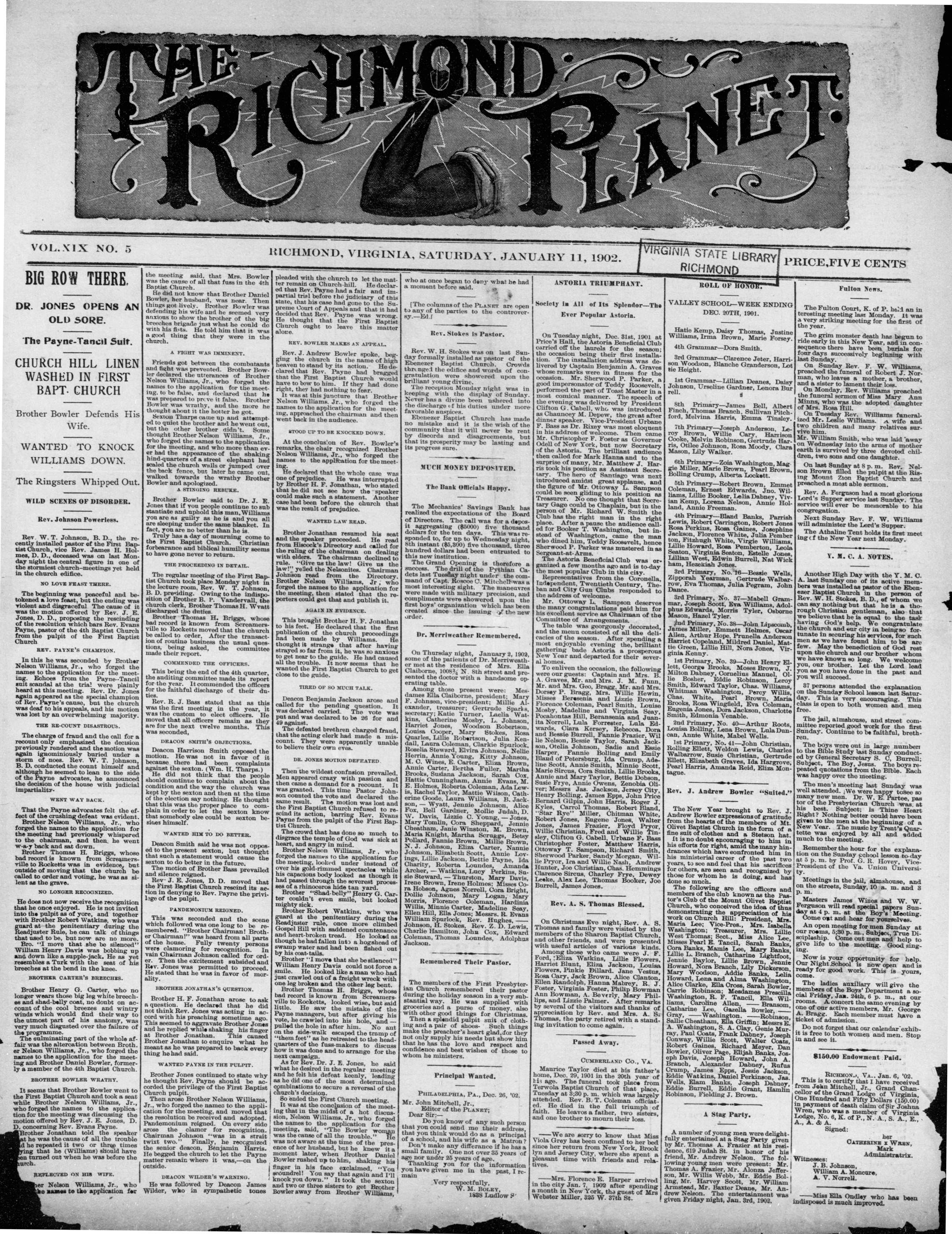
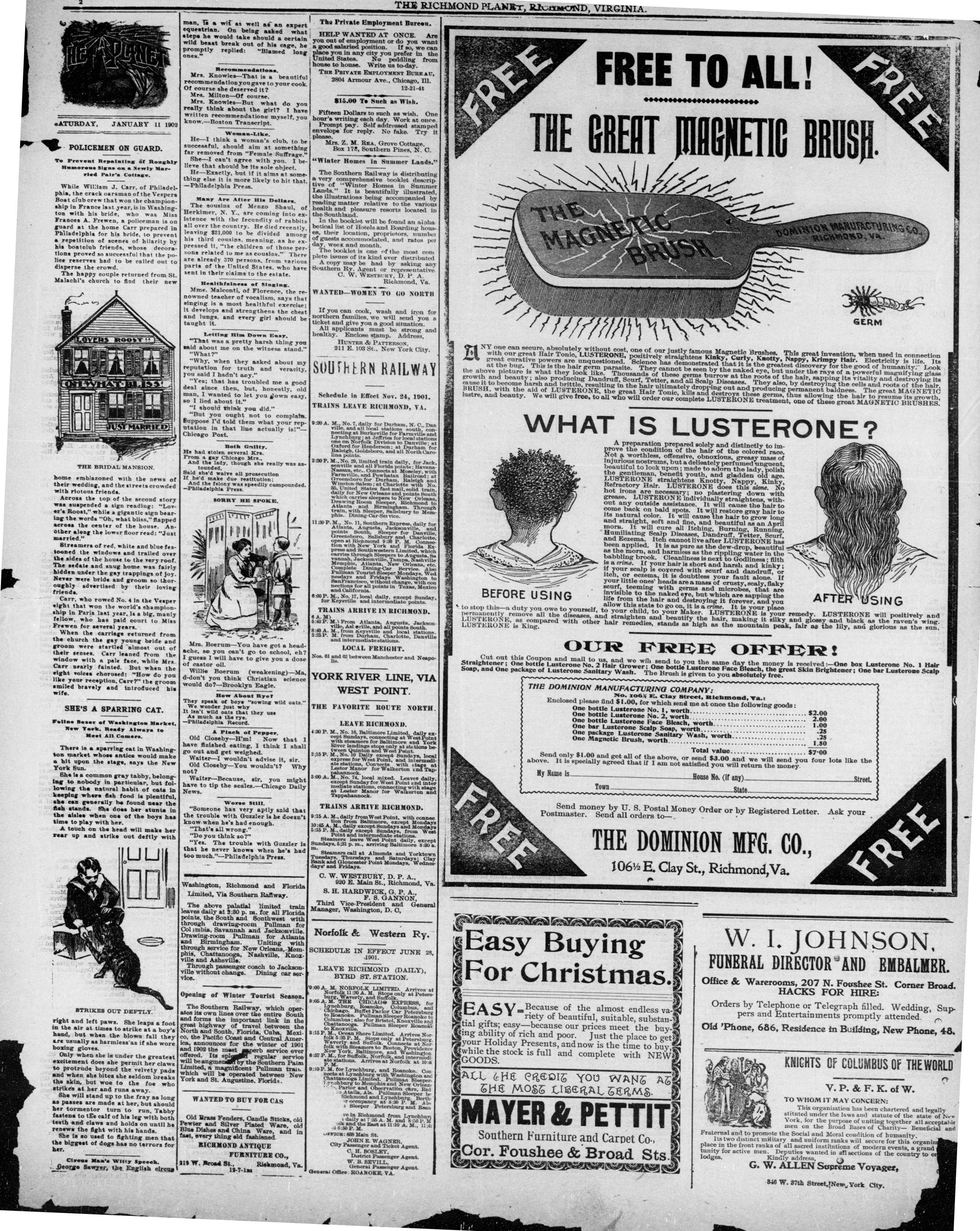
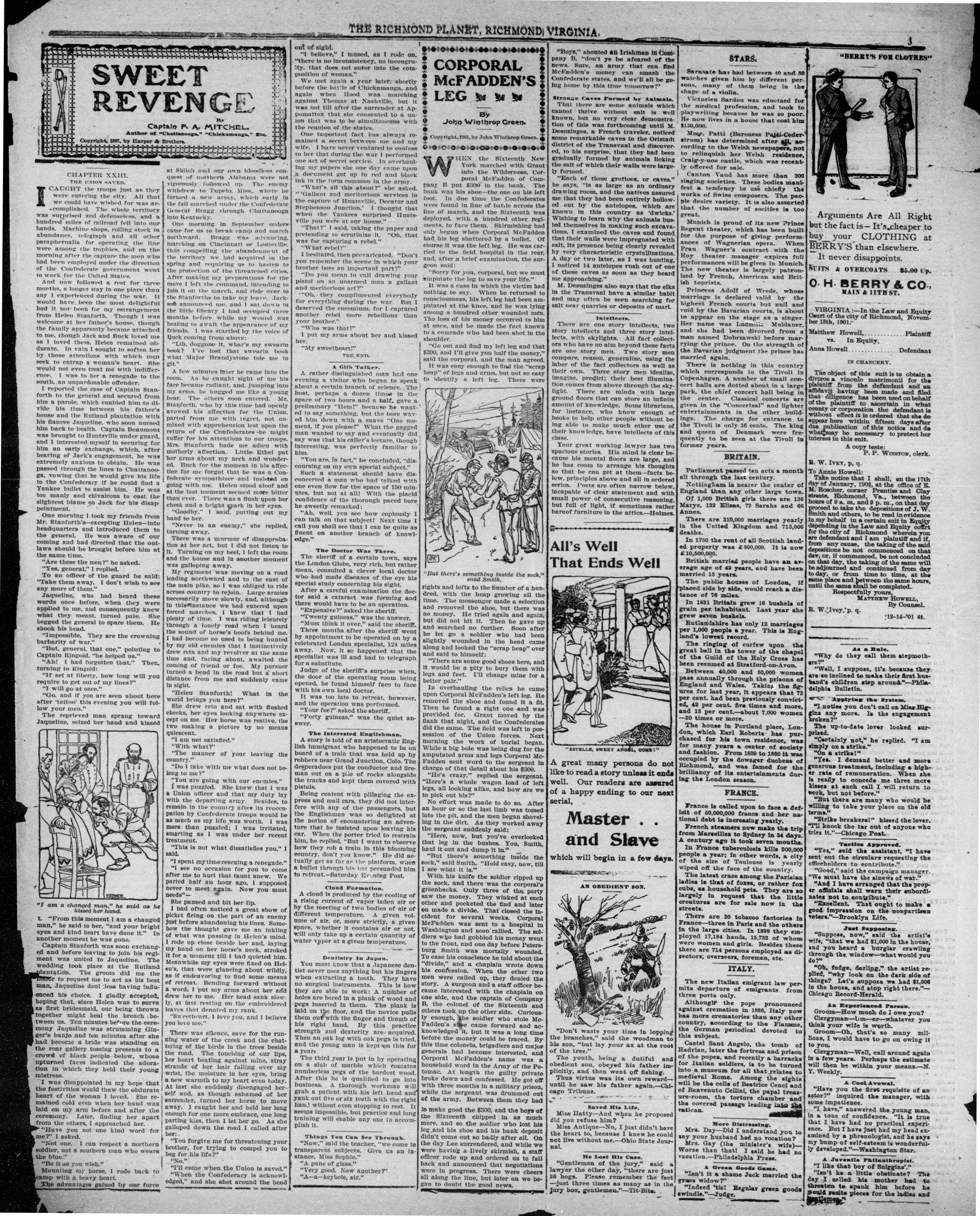
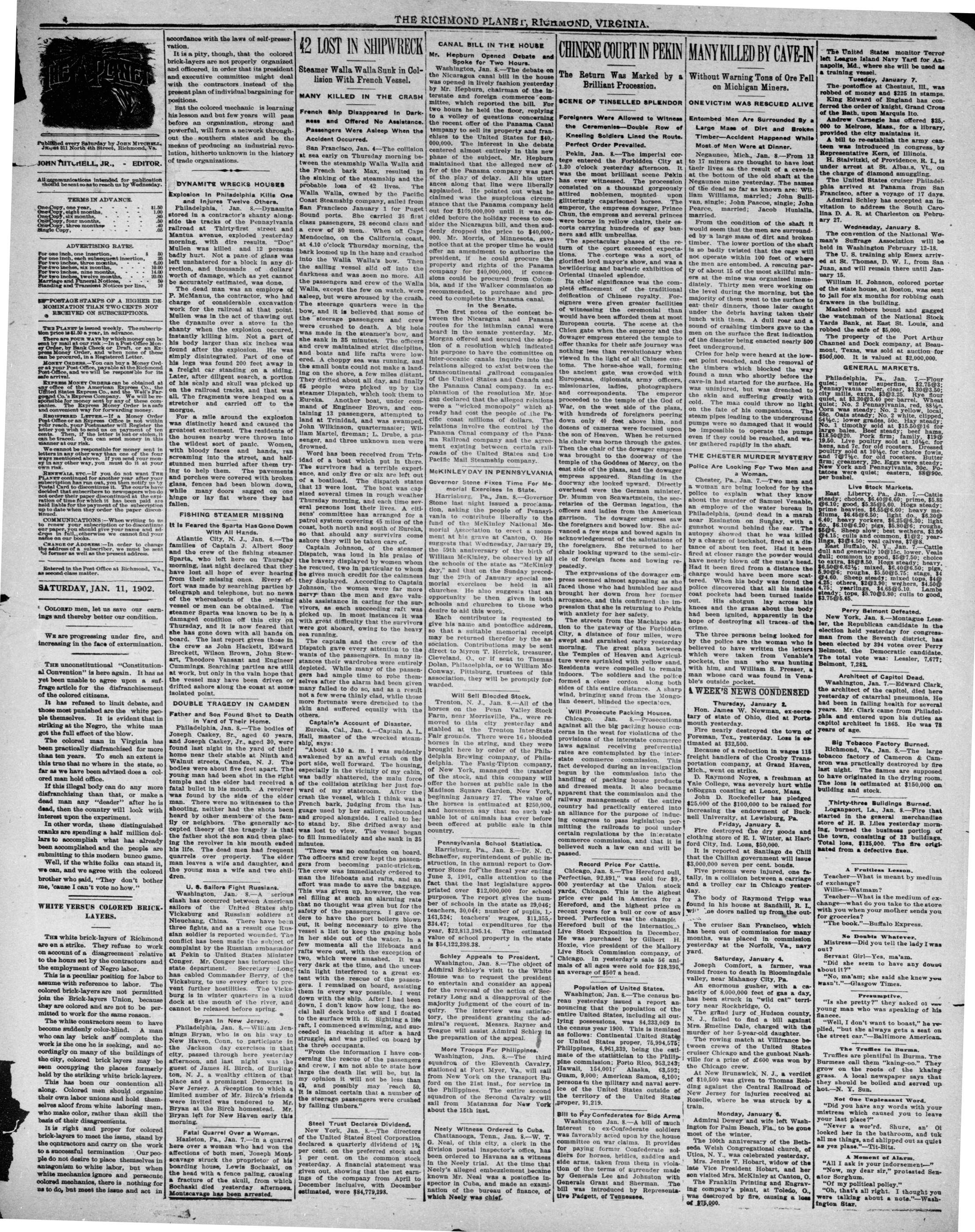
Page text (machine-generated)
THE RICHMOND PLANET
VOL.XIX NO.5
BIG ROW THERE.
DR. JONES OPENS AN
OLD SORE.
The Payne-Tancil Suit.
CHURCH HILL LINEN
WASHED IN FIRST
BAPT. CHURCH
Brother Bowler Defends His
Wife.
WANTED TO KNOCK
WILLIAMS DOWN.
The Ringsters Whipped Out
Rev. Johnson Powerless.
Rev. W. T. Johnson, B. D., the recently installed pastor of the First Baptist Church, vice Rev. James H. Holmes, D. D., deceased was on last Monday night the central figure in one of the stormiest church-meetings yet held in the church edifice.
NO LOVE FEAST THERE.
The beginning was peaceful and betokened a love feast, but the ending was violent and disgraceful. The cause of it was the motion offered by Rev. J. E. Jones, D. D., proposing the resounding of the resolution which bars Rev. Evans Erne, pastor of the 4th Baptist Church from the pulpit of the First Baptist Church
REV. PAYNE'S CHAMPION.
In this he was seconded by Brother Nelson Williams, Jr., who forged the names to the application for the meeting. Echoes from the Payne-Tancil suit scandal at the trial were plainly heard at this meeting. Dr. Rev. Dr. Jones again appeared as the special champion of Rev. Payne's cause, but the church was deaf to his appeals, and his motion was lost by an overwhelming majority.
THE RE-COUNT DISASTROUS
The charge of fraud and the call for a recount only emphasized the decision previously rendered and the motion was again ignominiously buried under a storm of noes. Rev. W. T. Johnson, B. D. conducted the count himself and although he seemed to lean to the side of the Payne advocates, he announced the decision of the house with judicial impartiality.
WENT WAY BACK.
That the Payne advocates felt the effect of the crushing defeat was evident. Brother Nelson Williams, Jr., who forged the names to the application for the meeting had previously whispered to the chairman, and then he went w-a-y back and sat down. Brother Thomas H. Briggs, whose back was in Screamersville to Rockettts was in viridia but outside of moving that the church be called to the grave.
NO LONGER RECOGNIZED.
He does not now receive the recognition that he once enjoyed. He is not invited into the pulpit as of yore, and together with Brother Robert Watkins, who was guard at the penitentiary during the Rejusitier Rule, he can talk of things that used to be, but now are no more. Bro. "I move that she be silenced" William Henry Davis was bobbing up and down like a supple-jack. He as yet resembles a Turk with the seat of his breeches at the bend in the knee.
BROTHER CARTER'S BREECHES.
Brother Henry G. Carter, who no longer wears those big leg white breeches and shad-belly coat, no doubt on account of the cool breezes and wintry winds which would find their way to the utmost part of his anatomy, was very much disgusted over the failure of the programme.
The culminating part of the whole affair was the altercation between Brother Nelson Williams, Jr., who forged the names to the application for the meeting and Brother Daniel Bowler, formerly a member of the 4th Baptist Church.
BROTHER BOWLER WRATHY
It seems that Brother Bowler went to the First Baptist Church and took a seat while Brother Nelson Williams, Jr., who forged the names to the application for the meeting was discussing the motion offered by Rev. J. E. Jones, D. D. concerning Rev. Evans Payne. Brother Jonathan told the speaker that he was the cause of all the trouble and he repeated it two or three times saying that he (Williams) should have been turned out when he was before the church.
REFLECTED ON HIS WIFE.
Brother Nelson Williams, Jr., who names to the application fer
the meeting said, that Mrs. Bowler was the cause of all that fuss in the 4th Baptist Church.
He did not know that Brother Daniel Bowler, her husband, was near. Then things got lively. Brother Bowler was defending his wife and he seemed very anxious to show the brother of the big business brigade just what he could do with it. He told him that it was a good thing that they were in the church.
A FIGHT WAS INMINENT
Friends got between the combatants and fight was prevented. Brother Bowler declared the utterances of Brother Nelson Williams, Jr., who forged the names to the application for the meeting, false, and declared that he was prepared to fight. Brother Bowler was wrathful, and the more he thought about it the hotter he got.
Sexton Tharps came up and attempted to quiet the brother and he went out, but the other brother didn't. Some thought Brother Nelson Williams, Jr., who forged the names to the application for the meeting, and who more than ever had the appearance of the shaking hind-quarters of a street elephant had scaled the church walls or jumped over the back fence, but later he came out, walked towards the wrathy Brother Bowler and apologized.
A STINGING REBUKE.
Brother Bowler said to Dr. J. E. Jones that if you people continue to sub stantiate and uphold this man, Williams you are as guilty as he is and you all are sleeping under the same blanket. In fact, you are no better than he is. Truly has a day of mourning come to the First Baptist Church. Christian forbearance and biblical humility seems to have gone never to return.
THE PROCEEDING IN DETAIL.
The regular meeting of the First Baptist Church took place Monday night in the lecture room, Rev. W. T. Johnson, B. D. preiding. Owing to the indisposition of Brother B. P. Vandervall, the church clerk, Brother Thomas H. Wvatt discharged the duties.
Brother Thomas H. Briggs, whose bad record is known from Screamersville to Rockets moved that the church be called to order. After the transaction of routine business the usual questions, being asked, the committee made their report.
COMMENDED THE OFFICERS:
This being the end of the 4th quarter, the auditing committee made its report for the year. It commended the officers for the faithful discharge of their duties.
Rev. R. J. Bass stated that as this was the first meeting in the year, it was the custodian of officer officers. He moved that all officers remain as they are for the next twelve months. This was seconded.
DEACON SMITH'S OBJECTIONS
Deacon Harrison Smith opposed the motion. He was not in favor of it because there had been complaints against the sexton. (Wm. H. Tharps.) He did not think that the people should continue to complain about the condition and the way the church was kept by the sexton and then at the time of death say nothing. He thought that this was the proper place to complain in order to let the sexton know that somebody else could be sexton besides himself.
WANTED HIM TO DO BETTER
Deacon Smith said he was not opposed to the present sexton, but thought that such a statement would cause the sexton to do better in the future. The motion of Brother Bass prevailed and silence reigned. Rev J. E. Jones, D. D. moved that the First Baptist Church rescinded its action in denying to Rev. Payne the privilege of the pulpit.
PANDEMONIUM REIGNED
This was seconded and the scene which followed was one long to be remembered. "Brother Chairman! Brother Chairman!" was heard from all parts of the house. Fully twenty persons were clamoring for recognition. In the courtroom, the prisoner called for order. Then the excused man subsided and Rcv. Jones was permitted to proceed. He stated that he was in favor of morality.
BROTHER JONATHAN'S QUESTION.
Brother H.F. Jonathan arose to ask a question. He declared that he did not think Rev. Jones was acting in accord with his preaching sometime ago. This seemed to aggravate Brother Jones and he replied while shaking his finger at Brother Jonathan. This caused Brother Jonathan to enquire what he meant as he was prepared to back every thing he had said.
WANTED PAYNE IN THE PULPIT
Brother Jones continued to state why he thought Rev. Payne should be accorded the privilege of the First Baptist Church pulpit. Then arose Brother Nelson Williams, Jr., who forged the names to the application for the meeting, and moved that the resolution be received and adopted. Pandemonium reigned. On every side arose the clamor for recognition. Chairman Johnson "was in a strait twixt two." Finally, he recognized the senior deacon, Benjamin Harris. He begged the church to let the Payne matter remain where it was,—on the outside.
DEACON WILDER'S WARNING.
He was followed by Deacon James Wilder, who in sympathetic tones
pleaded with the church to let the matter remain on Church hill. He declared that Rev. Payne had a fair and impartial trial before the judiciary of this state, that his case had gone to the Supreme Court of Appeals and that it had decided that Rev. Payne was wrong. He thought that the First Baptist Church ought to leave this matter alone.
REV. BOWLER MAKES AN APPEAL.
Rev. J. Andrew Bowler spoke, begging the church in the name of high heaven to stand by its action. He declared that Rev. Payne had bragged that the First Baptist Church would have to bow to him. If they had done right, they had nothing to fear. It was at this juncture that Brother Nelson Williams, Jr., who forged the names to the application for the meeting, approached the chairman and then went back in the audience.
STOOD UP TO BE KNOCKED DOWN.
At the conclusion of Rev. Bowler's remarks, the chair recognized Brother Nelson Williams, Jr., who forged the names to the application for the meeting.
He declared that the whole case was one of prejudice. He was interrupted by Brother H. F. Jonathan, who stated that he did not see how the speaker could make such a statement. Another case had been before the church that was the result of prejudice.
WANTED LAW READ:
Brother Jonathan resumed his seat and the speaker proceeded. He read from Hiscock's Directory and called for the ruling of the chairman on dealing with elders. The chairman declined to rule. "Give us the law! Give us the law!" yelled the Nelsonites. Chairman Johnson read from the Directory. Brother Nelson Williams, Jr, who forged the names to the application for the meeting, then stated that the reporters could get that and publish it.
AGAIN IN EVIDENCE
This brought Brother H. F. Jonathan to his feet. He declared that the first publication of the church proceedings had been made by Williams. He thought it strange that after having strayed so far from it, he was so anxious to get near to the guide. He had caused all the trouble. It now seems that he wanted the First Baptist Church to get close to the guide.
TIRED OF SO MUCH TALK.
Deacon Benjamin Jackson arose and called for the pending question. It was declared carried. The vote was put and was declared to be 26 for and 44 against. The defeated brethren charged fraud, that the acting clerk had made a miscount. They were apparently unable to believe their own eyes.
DR. JONES MOTION DEFEATED
Then the wildest confusion prevailed. Men appeared crazy with passion and then came a demand for a recount. It was granted. This time Pastor Johnson counted the vote and declared the same result. The motion was lost and the First Baptist Church refused to rescind its action, barring Rev. Evans Payne from the pulpit of the First Baptist Church.
The crowd that has done so much to disgrace the temple of God was sick at heart, and angry in mind.
Near Nelson Williams, Jr., who forged an agreement with the application for the meeting, looked under instead of over his gold-rimmed spectacles while his capacious body looked though it had passed through the seavers' processes of a rhinoceros hide tan yard.
Brother "Shad-belly" Henry G. Carter couldn't even smile, but looked mighty sick.
Brother Robert Watkins, who was guard at the penitentiary during the Readjuster rule, once more climbed Gospel Hill with saddened countenance and heart-broken tread. He looked as though he had fallen into) a hoghead of swamp water and had been fished out by his coat-tails.
Brother "I move that she be silenced" William Henry Davis could not force a smile. He looked like a man who had just crawled out of a freewreck with one leg broken and the other leg bent. Another Thomas H. Briggs, whose bad record known from Screamersville to Rockersville, looked wise, but said little. He saw the mistake of the Payne managers, but after giving his vote, he crawled into his hole, and pulled the hole in after him. No out on the side-walk escaped the trump of "them feet" as he retreated to the headquarters of the fuss-makers to discuss how it was done and to arrange for the next campaign.
As for Rev. Dr. J. E. Jones, he said what he desired in the regular meeting and he felt his defeat keenly, leading as he did one of the most determined combinations to secure a reversal of the church's decision.
So ended the First Church meeting.
It was at the conclusion of the meeting that in the midst of a hot discussion, Nelson Williams, Jr., who forged the names to the application for the meeting, said, "The Bowler woman was the cause of all the trouble." He was not aware at the time of the presence of her husband, but he knew it a moment later, when Brother Daniel Bowler rushed up to him, shaking his finger in his face exclaimed, "You scoundrel! You say that again and I'll knock you down." It took the sixon and two or three sisters to get Brother Bowler away from Brother Williams.
who at once began to deny what he had
The columns of the PLANET are open to
the parties to the controversy—EQ
Rev. W. H. Stokes was on last Sunday formally installed as pastor of the Ebenezer Baptist Church. Crowds threnged the edifice and words of congratulation were showered upon the brilliant young divine.
The reception Monday night was in keeping with the display of Sunday. Never has a divine been ushered into the discharge of his duties under more favorable auspices.
Ebenezer Baptist Church has made no mistake and it is the wish of the community that it will never be rent by discords and disagreements, but that its prosperity may be lasting and its progress sure.
MUCH MONEY DEPOSITED.
The Bank Officials Happy.
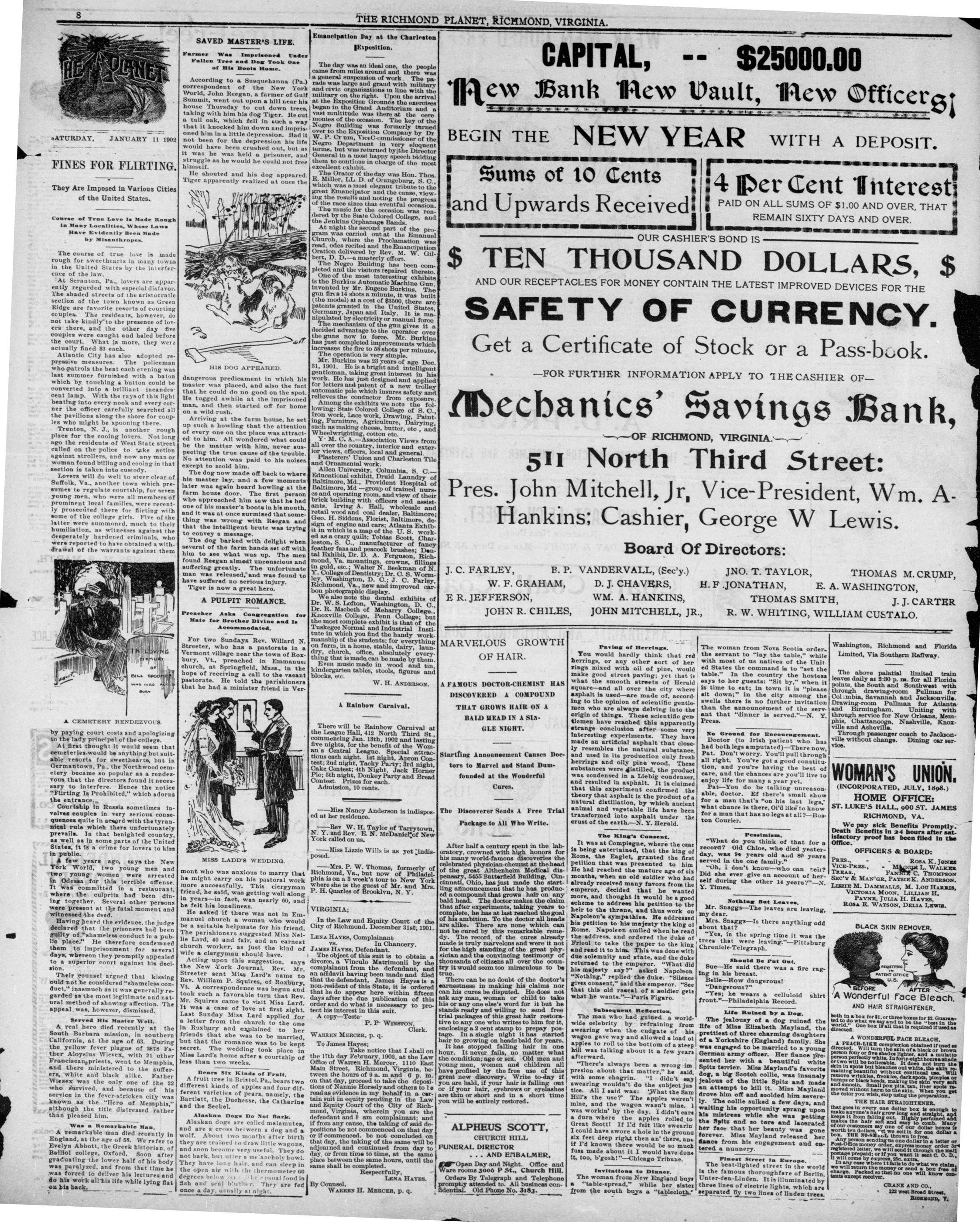
The Mechanics' Savings Bank has realized the expectations of the Board of Directors. The call was for a deposit aggregating ($5000) five thousand dollars for the ten days. This was responded to, for up to Wednesday night, 8th instant ($5,800) five thousand, three hundred dollars had been entrusted to this new institution. The Grand Opening is therefore a success. The drill of the Pythian Cadets last Tuesday night under the command of Capt. Roscoe C. Mitchell was a most interesting sight. The maneuvers with military precision, and compliments with powered upon the first boys' organization which has been created since the issuing of the new order.
Dr. Merriweather Remembered.
On Thursday night, January 2, 1908, some of the patients of Dr. Merriweather met at the residence of Mrs. Ella Claiborne, $1083^{1}$ N. 8th street and presented the doctor with a handsome operating table.
Among those present were: Messdames Ella Claiborne, president; Mary F. Johnson, vice-president; Millie Alcock, treasurer; Gertrude Sparks, secretary; Katie Turner, Laelia Watkins, Catherine Mosby, L. Johnson, Harriet Jones, Woodson Robertson, Louisa Cooper, Mary Stokes, Rosa Quarles, Lillie Robertson, Julia Kendall, Laura Coleman, Clarkie Spurlock, Roselia Steward, Elira Johnson, Nellie Herrin, Annie Young, Kitty Johnson, M. C. Wines, E. Carter, Eliza Brown, Annie Carter, Bertha Fuller, Martha Brooks, Susiana Jackson, Sarah Cox, Hattie Cunningham, Annie Evans, M. E. Holmes, Robotta Coleman, Ada Lewis, Rachel Taylor, Mattie Wilson, Catherine Goode, Laura Williams, B. Jackson, — Wyatt, Jennie Johnson, Alice Fox, Bell Gardner, Mollie Judah, D. Davis, Lizzie C. Young, — Jones, Mary Tomlin, Cora Sheppard, Jennie Cheahman, Janie Winston, M. Brown, Marin Knight, Martha Scrungs, Betsy Pollard, Jamie Brown, Millie Brown, N. J. Johnson, Elizabeth Scott, Annie Lovings, Lillie Jackson, Bettie Payne, Ida Charity, Roberta Loomis, Amanda Archer, — Watkins, Lince Perky, Susie Steward, — Thurston, Mary Irene Brown, Irene Holmes: Misses Cora Hobson, Agnes Norrell, Cora Bright Dollie Johnson, Mary Logan, Mary Morris, Florence Coleman, Hardina Willis, Minnie Carter, Madeline Seay, Ellen Hill, Ella Jones; Messrs. R. Evans William Spurlock, Rev. Hughes, — Johnson, H. Stokes, Rev. Z. D. Lewis, Charlie Hamilton, John Cox, Edward Coleman, Thomas Loundes, Adolphus Jackson.
Remembered Their Pastor
The members of the First Presbyterian Church remembered their pastor during the holiday season in a very substantial way. He was supplied with groceries and a purse of money, also with other good things for Christmas. Then a splendid pulpit suit of clothing and a pair of shoes. Such things made the presbyter's heart glad, for they not only presbyterly needs but show him that he has the love and respect and confidence and best wishes of those to whom he ministers.
Principal Wanted.
PHILADELPHIA, PA., Dec. 26, '02.
Mr. John Mitchell, Jr.,
Editor of the PLANET;
Dear Sir:—
Do you know of any such person
that you could send me their address,
that you think would do as a principal
of a school, and his wife as a Matron?
Don't make any difference if he has a small family. One not over 35 years of age nor under 25 years of age.
Thanking you for the information you have given me in the past, I remain
Very respectfully,
W. M. BOLEY,
1838 Ludlow S'
ASTORIA TRIUMPHANT.
Society in All of Its Splendor—The Ever Popular Astoria.
On Tuesday night, Dec. 31st, 1901 at Price's Hall, the Astoria Beneficial Club carried off the laurels for the season; the occasion being their first installation. The installation address was delivered by Captain Benjamin A. Gruvos whose remarks were in fitness for the occasion. Mr. Sherwood P. Parker, a good impersonator of Teddy Roosevelt, performed the part of Toast Master in a most comical manner. The speech of the evening was delivered by President Clifton G. Cabell, who was introduced as Chancey M. Depew, the great after dinner speaker. Vice-President Urbane F. Bass as Dr. Rixey was most eloquent in his address of welcome. Then came Mr. Christopher F. Foster as Governor Odell of New York, but now Secretary of the Astoria. The brilliant audience then called for Mark Hanna and to the surprise many, Mr. Matthew J. Harris took his position as Assistant Secretary. The heir, Santiago was next introduced amidst great applause, and the figure of Mr. Ottey L. Sampson could be seen gliding to his station as Treasurer. No one thought that secretary Gage could be Chaplain, but in person of Mr. Richard W. Smith the Club has the right man in the right place. After a pause the audience called for Booker T. Washington, but instead of Washington, came the man who dined him, Teddy Roosevelt, hence Sherwood P. Parker was mustered in as Sergeant-at-Arms.
The Astoria Beneficial Club was organized a few months ago and is to-day the most popular Club in this city.
Representatives from the Coronella, Independent, Twentieth Century, Theban and City Gun Clubs responded to the address of welcome.
Mr. Ottoway L. Sampson deserves the many congratulations paid him for his excellent service as Chairman of the Committee of Arrangements.
The house was georgously decorated, and the menu consisted of all the delicacies of the season, thus spending a most enjoyable evening the brilliant gathering bade Astoria a prosperous New Year and departed for their several homes.
To enliven the occasion, the following were our guests: Captain and Mrs. B. A. Graves, Mr. and Mrs. J. M. Funn, Mr. and Mrs. Geo, Bragg, Mr. and Mrs. Dorsey P. Bragg, Mrs. Willie Hewin, Misses Beresenia and Lizzie Brown, Florence Coleman, Pearl Smith, Louise Mosby, Madeline and Virginia Seay, Pocahontas Hill, Beransenia and Juanita Norrell, Lula Forrester, Lula Edwards, Clara Kersey, Rebecca, Dora and Bessie Burrell, Fannie Frazier, Wilie Nelson, Bessie Taylor, Sarah Jackson, Otelia Johnson, Sadie and Essie Harper, Fannie Bolling and Emily Bland of Petersburg, Ida Crump, Adeline Scott, Annie Smith, Minnie Scott, Marie Circus, Cora Smith, Lillie Brook, Annie and Mary Taylor, Bettie Dobson, Susie Frye, Annie Owens, Zenobia Ollie Messrs. Jas. Jackson, Jersey City, James Gates, James Epps, John Price Bernard Gilpin, John Harris, Roger J. Kyles, Carrol Thomas, Robert Bland, "Star Rye" Miller, Chiana White, Robert Jones, Eugene Jones, Walter Jones, James Frazier, Floyd Proud Willie Christian, Fred and Willie Tinsley, Clifton G. Cabel, Urbane F. Bass Christopher Foster, Matthew Harris, Ottoway T. Sampson, Richard Smith, Sherwood Parker, Sandy Morgan, Willie Pryor, Ira and Willie Nash, Hunter, Joe Christian, Chas, Hemmings clarence Circus, Charley Frye, Dewey Leake, Alex Lee, Thomas Booker, Joe Burrell, James Jones.
Rev. A. S. Thomas Blessed.
On Christmas Eve night, Rev. A. S. Thomas and family were visited by the members of the Sharon Baptist Church, and other friends, and were presented with useful articles of various kinds. Among those who came were J. F. Ford, Eliza Watkins, Lilley Flowers, Harriet Blunt, Eliza Jackson, Louisa Flowers, Pinkie Dillard, Jane Vestus, Rosa Cary, Jack Brown, Alice Clanton, Ellen Randolph, Hanna Mabrey, R. J. Foster, Virginia Foster, Philip Bowman Ann Bowman, A. Beverly, Mary Phillips, and Lizzie Palmer. After remarks by several of the visitors and thanks of appreciation by Rev. and Mrs. A. S. Thomas, the party retired with a standing invitation to come again.
CUMBERLAND CO., VA.
Maurice Taylor died at his father's home, Dec. 29, 1901 in the 30th year of his age. The funeral took place from Terwola Baptist Church of that place. Tuesday at 3:30 p.m. which was largely attended. B. V. B. Coleman officiated. He died in the full triumph of faith. He leaves a father, two sisters, and one brother to mourn their loss.
We are sorry to know that Miss Viola Grey has been confined to her bed since her return from New York, Brooklyn and Jersey City, where she spent a pleasant time with friends and relatives.
Mrs. Florence E. Harper arrived in the city Jan. 7, 1902 after spending a month in New York, the guest of Mrs Webster Miller, Rev. 325 W. 37th St.
ROLL OF HONOR
VALLEY SCHOOL—WEEK ENDING
DEC. 20TH, 1901.
Hatie Kemp, Daisy Thomas, Justine
Williams, Irma Brown, Marie Forsey.
4th Grammar—Dora Smith.
3rd Grammar—Clarence Jeter, Harrison
Woodson, Blanche Granderson, Lot
tie Height.
1st Grammar—Lillian Deanes, Daisy
Johnson, Urseline Gardner, Lenora Bur
rell.
8th Primary—James Bell, Albert
Finch, Thomas Branch, Sullivan Pitchford,
Melvina Harris, Emma Tinsley.
7th Primary—Joseph Anderson, Leroy
Brown, Willie Cary, Harrison
Cooke, Melvin Robinson, Gertrude
Harris, Otille Johnson, Rosa Moody, Clara
Mason, Lily Walker.
6th Primary—Zoia Washington, Maggie Miller, Marie Brown, Pearl Brown, Bolling Crump, Alberta Lockett.
5th Primary—Robert Brown, Emmet Coleman, Ernest Edwards, Jno. Williams, Lillie Booker, Lelia Dabney, Vivian Kemp, Lorena Nelson, Annie Holland, Annie Freeman.
4th Primary—Bland Banks, Parrish Lewis, Robert Carrington, Robert Jones Rosa Perkins, Rosa Gaines, Josephine Jackson, Florence White, Julia Pembermion, Fitzhugh White, Virgine Williams, Lillie Howard, Rosa Pemberton, Leola Seaton, Virginia Seaton, Estelle Jones, Lillian West, Edwin Burrell, Nat Wickham, Hezekiah Jones.
3rd Primary, No. 16—Bessie Wells, Zipporah Yearman, Eva Gertrude Walbarrow, Eva Thomas, Julia Pegram, John Dance.
3rd Primary, No. 37—Mabell Grammar, Joseph Scott, Eva Williams, Adolphus Edwards, Morris Tyler, Osborne Mason, Hazel Tyler.
2nd Primary, No. 38—John Lipscomb, James Miller, Emmett Holmes, Oscar Allen, Arthur Hope, Prunella Anderson Harriet Copeland, Mildred Daniel, Mattie Green, Lillie Hill, Nora Jones, Virginia Kenny.
1st Primary, No. 39—John Henry Ellett, George Brooks, Moses Brown, J. Milton Dabney, Cornelius Manuel, Ollie Bosher, Eddie Robinson, Leroy Smith, Edward Taylor, Chas. Williams, Whitman Washington, Percy Willis, Chas, White, Pearl Brown, Maria Brooks, Rosa Wingfield, Eva Coleman, Eugenia Jones, Dora Jackson, Charlotte Smith, Edmonia Venable.
2nd Primary, No. 40—Arthur Roots, Louisa Bolling, Lena Brown, Lula Duncan, Annie White, Mabel Wells.
1st Primary, No. 41—John Christian, Rolling Ellett, Weldon Lewis, Charles Walbarwong, Susie Christian, Gertrude Ellett, Elizabeth Graves, Ida Hargrove, Pearl Harris, Amanda Reid, Eliza Montague.
Rev. J. Andrew Bowler "Sulted."
The New Year brought to Rev. J. Andrew Bowler expressions of gratitude from the hearts of the members of Mt. Olivet Baptist Church in the form of a fine suit of clothes and a Stetson hat. It is no doubt encouraging to him in his efforts for right, amid the many hindomens which have confronted him in his career of the past two years, to see and understand his sacrifices for others, are seen and recognized by those for whom he is doing, and has done so much.
The following are the officers and members of the club known as the Pastor's Club of the Mount Olivet Baptist Church, who conceived the idea of thus demonstrating the appreciation of his work on Church Hill: President, Mrs. Maria Lee; Vice-Pres., Mrs. Isabella Washington; Treasurer, Mrs. Lillie West Thomas; Sect., Miss Alice Lee, Misses Pearl E. Tancil, Sarah Banks, Cora Banks, Mamie Lee, Mary Banks, Lillie L. Branch, Catharine Lightfoot, Jennie Baylor, Lillie Brown, Jennie Howard, Nora Branch, Lily Dickerson, Mary Woodson, Addie Banks, Lelia Howard, Lena and Alma Washington, Alice Clarke, Ella Cross, Sarah Bowler, Carrie Robinson; Mesdames Presilla Washington, R. F. Tancil, Ella Williams, Caroline Allan, — Bransom, Catharine Lee, Gazella Bowler, — Gray, Washington, — Robinson, Sallie Chelmin, Elfridriff; Messrs E. A. Washington, S. A. Clay, Genie Murray, Paul Coats, Frank Daney, Joseph Conway, Willie Scott, Witter Coats, Robert Gaines, Richard Meyer, Dan Bowler, Oliver Page, Elijah Meyer, Joseph Davis, Joseph Howard, A. A. Branch, Alexander Dabney, Rutus Crump, James Epps, Jessie Jackson, Eddie Watkins, Daniel Perkinson, Jas Wells, Elam Banks, Joseph Dabney, Eddie Burrell, Eddie Grant, Hamlin Robinson, Fielding J. Brown.
A number of young men were delightfully entertained at a Stag Party given by Mr. Thomas A. Frazier at his residence, 619 Judah St. in honor of his friend, Mr. Andrew Nelson. The following young men were present: Mr. Thomas A. Frazier, Mr. Alonza Jefferson, Mr. Willis Webb, Mr. Eddie Bolling, Mr. Harvey Scott, Mr. William Armstead, Mr. Baxter Deane, Mr. Andrew Nelson. The entertainment was given Friday night, Jan. 3rd, 1902.
The Fulton Court, K. of P. held an interesting meeting last Monday. It was a very striking meeting for the first of the year.
The grim monster death has begun to ride early in this New Year, and in consequence there have been burials for four days successively beginning with last Sunday.
On Sunday Rev. F. W. Williams, preached the funeral of Robert J. Norman, who leaves a mother, a brother, and a sister to lament their loss.
On Monday, Rev. Williams preached the funeral sermon of Miss Mary Ann Minns, who was the adopted daughter of Mrs. Rosa Hill.
On Tuesday Rev. Williams funeralized Mr. Leslie Williams. A wife and two children and many relatives survive him.
Mr. William Smith, who was laid away on Wednesday into the arms of mother earth is survived by three devoted children, two sons and one daughter.
On last Sunday at 8 p.m. Rev. Nelson Brown filled the pulpit at the Rising Mount Zion Baptist Church and preached a most able sermon.
Rev. A. Ferguson had a most glorious Lord's Supper service last Sunday. The service will ever be memorable to his congregation.
The Athaline Tent holds its first meeting of the New Year next Monday.
Y. M. C. A. NOTES
Another High Day with the Y. M. C. A. last Sunday one of its active members was installed as pastor of the Ebenezer Baptist Church in the person of Rev. W. H. Stokas, B. D., of whom we can say nothing but that he is a rough Christian gentleman, also that we believe that he is equal to the task having God's help. We congratulate the church and our eur city in being so fortunate in securing his services, for such men as we have found him to be are few. May the benediction of God rest upon the church and our brother whom we have known so long. We welcome you, our brother. Let the Lord lead you as you have done in the past and you will succeed.
37 persons attended the explanation on the Sunday School lesson last Saturday. This is very encouraging. This class is open to both women and men free.
The jail, almshouse, and street committee reported good work for the first Sunday. Continue to be faithful, brethren.
The boys were out in large number to the Bible Study last Sunday conducted by General Secretary S. C. Burrell; Subject, The Boy, Jesus. The boys repeated quotations from the Bible. Each was happy over the meeting.
The men's meeting last Sunday was well attended. We were happy to see so many new men. Dr. W. E. Parte, pastor of the Presbyterian Church was at his best. Subject; Is Thine Heart Right? Nothing better could have been given to the men at the beginning of a New Year. The music by Trent's Quartette was enjoyed by all and added much to the meeting.
Remember the hour for the explanation on the Sunday school lesson to day at 5 p. m. by Prof. G. R. Hovey, Vice-President of the Va. Union University.
Meetings in the jail, almshouse, and on the streets, Sunday, 10 a. m. and 8 p. m.
Masters James Wines and W. W. Ferguson will read special papers Sunday at 4 p. m. at the Boy's Meeting. Come out and hear for yourselves.
An open meeting for men Sunday at our rooms, 5:30 p. m., Subject, True Disciplishment. Come out men and help to give life to the meeting. Good singing.
Now is your opportunity for help. Our Night School is new open and is ready for good work. This is yours, come.
The ladies auxiliary will give the members of the Boys' Department a social Friday, Jan. 24th, 6 p. m., at our rooms. A concert the same evening by one of our active members, Mr. George A. Bragg. Each member must have a ticket of admission.
Do not forget that our calendar exhibit is free to both women and men. Stop in and see it.
RICHMOND, VA.. Jan. 6, '02.
This is to certify that I have received from Joan Mitchell, Jr., Grand Chancellor of the Grand Lodge of Virginia, One Hundred and Fifty Dollars (150.00) in payment of death claim of Sir Joshua Wren, who was a member of Virginia Lodge, No. 6, K. of P., N. A., S. A., E., A., A. & A.
Signed:
her
CATHERINE x WREN,
Mark
Administratrix.
Witnesses:
J. B. Johnson,
William A. Mon cure,
A. V. Norrell.
Miss Ella Ondley who has been indisposed is much improved.
= THE RICHMOND PLANET, RicnMOND, VIRGINIA.
we ail
AN nee
PP ZR Ppt ta
]Repe a ANina,
££ ras Wi :
Wy
on SA
eATURDAY, JANUARY 11 1902
g POLICEMEN ON GUARD.
Beetitas acti Sia nes
anova Seven ae
While Wiliam J. Carr, of Philadel-
Phia, the crack oarsman of the Vespers
Boat club crew that won the champion-
ship in France last year, is in Wasbing-
ton with his bride, who was Miss
Frances A. Frewen, a policeman is on
guard at the home Carr prepared in
Philadelphia for his bride, to prevent
& repetition of scenes of hilarity by
hia boatelub friends, whose decora-
tions proved so successful that the po-
lice reserves had to be called out to
disperse the crowd.
The happy couple returned from St.
Malachi’s church to find their new
Eo
es (aN
2: ————
as
=~
; A let eet ee
i= Sie mA elec
War early
i eS
WHAT BLISS.
en Hey eRe
= Bal eksl et
Eg ages
’ ee
ak Rb ea
home emblazoned with the news of
their wedding, and the streets crowded
with riotous friends.
Across the top of the second story
‘Was auapended a sign reading: “Lov-
er’e Roost,” while a gigantic sign bear-
ing the words “Oh, what bliss,” flapped
across the center of the house. An-
Other along the lower floor read: “Just
married.”
Streamers of red, white and blue fes-
fooned the windows and trailed over
the aides of the house to the very roof,
‘The sedate and snug home was fairly
hidden under the gay trappings of joy.
Never were bride and groom so thor-
oughly advertised by their loving
friends, x
Carr, who rowed No. 4 in the Vesper
‘tight that won the world’s champion-
ship in Paris last year, Ie a big, manly
fellow, who has paid court to Miss
Frewen for several years.
When the carriage retumed from
the church the gay young bride and
groom were startled “almost out of
their senses. Carr leaned from the
window with a pale face, while Mrs.
Carr nearly fainted. But when the
eight voices chorused: “How do you
Uke your reception, Carr?" the groom
emiled bravely and introduced his
wite.
SHE’S A SPARRING CAT.
Feline Boxer of Washington Market,
New York, Ready Always to
Meet All Comers.
‘There is a aparring cat in Washing-
ton market whose antice would make
bit upon the atage, says the New
York Sun.
She fs a common gray tabby, belong-
ing to nobody in particular, but fol-
Jowing the natural habit of cate in
‘keeping where fish food is plentiful
she can generally be found near the
fish stands. She does her stunts in
the aisles when one of the boys has
time to play with her.
A touch on the head will make her
Fear up and strike out deftly with
alle al
ba =
S00
a
Fight and left paws. She leaps a foot
in the air at times to strike at a boy's
hand, but when the blows fall they
are usually as harmless‘as if she wore
boxing gloves.
Only when she is under the greatest
excitement does she permit her claws
to protrude beyond the velvety pads
and when she bites she seldom breake
the akin, but woe to the foe who
atrikes at her and runs away.
She will stand up to the fray as long
Ss passes are made at her, but should
her tormentor turn to run, Tabby
fastens to the calf of his leg with both
teeth and claws and holds on until he
Fenews the fight with his hands.
‘She is #0 used to fighting men that
the biggest of dogs has no terrors for
her.
Chrous Man's Witty Speceh.
_ George Sawyer, the English circup
man, Ts a wif as well ag an expert
equestrian. On being asked what
steps he would take should a certain
wild beast break out of his cage, he
Promptly replied: “Blamed long
ones.”
Recommendations,
Mrs. Knowles—That is a beautiful
recommendation yougave to your cook.
Of course she deserved it?
‘Mrs. Milton—Of course.
Mrs, Knowles—But what do you
really think about the girl? I have
written recommendations myself, you
know.—Boston Transcript.
‘Woman-Like,
He—I think a woman's club, to be
successful, should aim at something
far removed from “Female Suffrage.”
She—I can’t agree with you. I be-
Heve that should be its sole object.
He—Exactly, but if it aims at some-
thing else it is more likely to hit that.
Philadelphia Press,
Many Are After Hin Dollars,
The sousins of Menzo Shaul, of
Herkimer, N. ¥., are coming into ex-
istence with the fecundity of rabbits
all over the country. He died recently,
leaving $21,000 to be divided among
his third cousins, meaning. as he ex.
pressed it, “the children of those per-
sons related to me as cousins.” ‘There
are already 370 persons, from various
parts of the United States, who hare
sent in their claims to the eatate.
Healthfainess of Singing.
Mme. Malconti, of Florence, the re-
nowned teacher of vocalism, says that
singing is a most healthful exercise;
it develops and strengthens the chest
and lungs, and every girl should be
taught it.
Letting Him Down Euny.
“That was a pretty harsh thing you
‘said about me on the witoess stand.”
“What?”
“Why, when they asked about my
feputation for truth and veracity,
you said I hadn't aay.”
“Yes; thet has troubled me a good
deal since then, but, honestly, old
man, I wanted to let you gown easy,
80 T lied about it.”
“I should think you did.”
“But you ought not to complain.
Suppose I'd told them what your rep-
utation in that line actuaily is!"—
Chicago Post,
‘it iatbee
‘He had stolen several Kra.
From s gay Chicane Met.
“And the tady, though ohe really was as
tounded,
Seig she'd walve all prosecution
IC he'd make Gus testicutions
‘Aad the felony war speedy compounded,
—Philadeiphia’ Frese
SORRY mx SPOKE,
Paras
ss \ 4
sper reed PL
eh (yy 7
. et :
2 J it)
2 i ‘
ze Nae) |!
Hil) wae
it Le 4
ail ‘eH
5 PI id
=< Fn
= ae
PS an
Mrs, Boerum—You have got a head-
‘ache, s© you can't go to school, eh?
I guess I will have to give you a dose
of castor oil.
Willie Boerum (weakening)—Ma,
@-don't you think Christian science
would do?—Brooklyn Eagle.
————___—
‘The oe wing wild oats.”
Fe, Seales oe as eee WIN ate,
It isn’t wild oats that they use
As much as the rye.
—Philadelphia Record.
A Pinch of Pepper.
Old Closeby—H'm! Now that }
have finished eating, I think I shall
go out and get weighed.
Waiter—I wouldn't advise it, sir.
Old Closeby—You wouldn't?’ Why
not?
Waiter—Because, sir, you might
have to tip the seales.—Chicago Daily
News.
‘Was Ghene
“Someone has very aptly said that
the trouble with Guzzler is he doesn’t
know.when he’s had enough.
“That's all wrong.”
“Do you think so?”
“Yes. The trouble with Guzzler is
that be never knows when he’s had
too much.”—Philadelphia Press.
Washington, Richmond and Florids
‘Limited, Via Southern Raftway.
The above, palatial limited trai
leaves daily at 2:80 p.m, for ail Florida
Points, the South and Southwest with
throug! wing-room Pullman
Colimbia, Savannah and Jacksonville.
Drewing-room Pullman, ‘for Atlants
eavigh Seevita Ne Ocenia
co for New fem.
phis, Chattanooga, Nashville, ‘Knox.
Ville and Ashe
Through passenger conch to Jackson-
ville without change. Dining car ser-
vice.
————- = —__
Opening of Winter Tourist Season.
|The Southern Railway, which oper-
tea its own lines over the entive, Seat
‘nd forms the important link in the
North and Sosth, Morida, Outer Mere
0, the Pacific Coast and Osatial Atsor.
ica, announces for the winter of 1901
offered. Tis. opia ar eaevioe
Sees igi rpc wc
Limited, a magnificent Pullman train
Which will be operated between New
York and St. Augustine, Floridy.
——————=___
WANTED TO BUY FOR CAs
Old Brass Fenders, Oandle Sticks, old
Pewter and Silver Plated Ware,’ old
Blue Dishes and China Ware, and in
fast, every thing eld fashioned.
RICHMOND ANTIQUE
FURNITURE C0.,
219 W. Broad St., Richmond, Va.
‘12-7-lm
Tho Private Employment Bureeu.
HELP WANTED AT ONCE. Are
Zou out of employment or do you want
8 good alaried position. If so, roc
prefer
Bnited Staton Ne peidiing tre
house to house. Write us to-day.
‘Tue Parvate Earorment Bure av,
2804 Armour Ave., Chicago, Tl.
12-21-4¢
se ro TS Ts ERT
O_O 2
2 Sab Meee
.
3 d °, = Ry
oa a aos ke Gee
aa -~ AM CAC, Chee
BSS fa < . al . hs ea Pw}
~—+\\ e253 GN NOMS ee ce
———}) WARES Fe. oo : ee
2 bi SS > a Bib
Ei Se SS a x i. Se
Ye ea
HD). eg ies . ~
TD. Se eae ta
ay i i ee
if) 1) om MT PMT j; x
LM HT ae
“Se h NY) TA H FRED aS
TT THM MMM
Thy Vi i) Yo a
NY one can secure, absolutely without cost, one of our justly famous Magnetic Brashes. This great invention, when used in connection
iA with our great Hair Tonic, LUSTERONE, Positively straightens Kinky, Curly, Knotty, Nappy, Krimpy Hair. Electricity is life. Its
great curative powers are unquestioned. Science has demonstrated that it me the greatest discovery for the good of humanity” Look
at the bug. This is the hair = parasite. They cannot be seen by the naked eye, but under the rays of a powerful magnifying glass
the above Poe is what they look like. ‘Thousands of these germs burrow at the roots of the hair, sapping its vitality and destroying its
growth and beauty; also producing Dandruff, Scurf, Tetter, and all Scalp Diseases. They also, by destroying the cells and roots of the hair,
cause it to become harsh and brittle, resulting in the hair cea Sropping out and producing permanent baldness. The great MAGNETIC
BRUSH, with the aid of LUSTERONE, the great Hair Tonic, kills an Sesroys these germs, thus allowing the hair to resume its growth,
lustre, and beauty. We will give free, to all who will order our complete LUSTERONE treatment, one of these great MAGNETIC BRUSHES.
$15.00 Te Such as Wish.
hour's. rape ted we Work'ts Sey
writ . Work at once.
Prompt pay. Self addressed. stamped
icv for reply. No fake. Try it
Mrs. Z. M. Rea, Grove Cottage,
Box 178, Southern Pines, N.C.
“Winter Homes in Summer Lands.”
The Southern Railway eee
a comprehensive booklet descrip-
Byes Sine eae Some
Lands.” It is beautifully illustrated,
the illustrations aise: accompanied by
Teading matter relative tothe various
health and pleasure resorts located in
the Southland.
In the booklet will be found an aloha.
betical list of Hotels and Boarding hous-
es, their location, proprietors, number
of guests accommodated, and rates per
day, week and month.
The booklet is one ef the most com
plete issues of its kind ever distributed
A copy may be had by asking any
Southern Ry. Agent or representative.
©. W. Wasreuey, DPA
Richmond, Va.
WANTED—WOMEN TO GO NORTH
If you can cook, wash and iron for
northern families, we will send. you a
ticket and give you a good situation.
All applicants must be strong and
healthy. Enclose stamp. Address,
Hunter & Patrerson,
211 E. 108 St.. New York City.
SOUFRKERN RAILWAY
note of the hate anmeione tea 214... ....2. 2 S oS
beauty; also producing Dandruff, Scurf, Tetter, and all Sealm Dinesee” Tooke OF the hair, sapping its vitality and destroying its
Trine fb to eoantty j also producing Dandruff, Seurf, Teter, and all Scalp Discases. ‘They ales by destroying the celle and roots of tee trate
cause it to become harsh and brittle, resulting in the hats Tonle eieeey pg out 8nd producing permanent baldness. ‘The great MAGNETIC
BRUSH, with the aid of LUSTERONE, the great Hair Tonte wiloae, Gestrovs these germs, thus allowing the hair to resume its growth,
‘ustre, and beauty. We will give free, to'all who will order our complete LUSTERONE trestesat wee es, great MAGNETIC BRUSHES,
eS
WHAT IS LUSTERONE?
A preparation prepared solely and distinctly to im- eis
Rrpve the Condition Of the hair of the colorado, EFA \\
Bn SA fe ot ot a worthless, offensive, obnoxious, greasy mass of LU \
a, lameness Jplorious nostrumne, Duta delieately perfumed unguent, GF \
ReaD os hae: beautiful to look upon; made to adorn the lady, polish QUE, \ }
Mango re the gentleman, benefit youth, and gladden oid age. LG NY
hn eae Sipeamar aaah LUSTERONE 'straightens Knotty, “Nappy, Kinky, MAY
erect cg Refractory Hair. LUSTERONE does this-Glone. No WN\')\\WW p>
atta a hot irons are necessary; no plastering down with EPP DYN) hI
Cee ieee grease. LUSTERONE individually straightens, with: ee AD hs ae
/ ee pee 3% out any outside assistance. It will cause the hair to AM Yio ig
Mis = 2 EE AY come back on bald spots. It will restore gray hair to NA) UAE
cane eet om its natural color. It will cause the hair to grow lon; KLAN)
Uipeomers| and straight, soft and fine, and beautiful as an April JONAH h
RE morn. It will cure all Itching, Burning, Running, Wy) NYS )) y})
y i “Huniliating Scalp Diseases, Dandruff, Teter, Beurf, cil Keep Ny Wy
Pf and Eczema. Itch cannot live after LUSTERONE has EWC
/ been applied. | It is as pure as the dew-drop, beautiful \\ OY Wa)
a > as the morn, and harmless as the rippling water in the SNACK
Se. ZA babbling brook. Cleanliness is next to Godliness; Alt NSS RY N\ 4h)
Se NZ igaerime. “Xf your hair is short and haralt and kinky; : Wy WAZ 7
SS ES & Your scalp is covered with scurt and dandruff, oF WH WW F
SS SZ itch, or coxema, it in doubtiee your faut nee a WY
ss your little ones’ heads area mass of crusty, scaly, flaky N Up
TSING © Rebcgahcmarammemen mene | AMT
BEFORE invisible to the naked eve, but which are sapping the ER USING
USING life from the hair and destroying It forever? mud soe
allow this state to go on, it is a crime. Te In your place
* Hon, Guthy scuty you owe to yourself, to your child, to your Maker. ‘LUSTERONE is esce remedy. LUSTERONE will positively and
PUSTERON ET mows, all the diseases, and straighten'and’ beautify the hair, making it Rky Bede lossy and black as the raven’s ‘wing.
LUSTERONE’ in Kigmpared with other hair remedies, stands as high as the mountain peck: Toit’ op The Wty eae eas MDE:
LUSTERONE is King.
um
Sreseoet Gus Coupon and mail to ua, and we wil send to you the same day the money is recslved One box Lasterone No. 1 Har
Straightener ; One bottle Lusterome No. 2 Hair Grower. One Gottig oes Face Bleach, the great Skin Brightencrs Onc bar Lastevoae Soaks
Soap, and One package of Lusterone Sanitary Wash. ‘The Brush is given to you absoletely trot
THE DOMINION MANUFACTURING COMPANY:
No. 106K E. Clay Street, Richmond, va.:
Enclosed please find $1.00, for which send me at once the following goods:
Que bottle Lusterone No. 1, worth. 2... oe. .ececccccsceccesesecese $2000
Gan Settle Levtncate New deworthy.c <5 0c--<.0-< sso oi ee
Que bottle Lusterone Face Bleach, worth...-.00200060200000000000 Te
Que bar Lusterone Scalp Soap, worth......000 0020002
One Pranic meterone Sanitary Washi, worthi.2000002000000000 13
Total value..............eseeeesess $700
Send only $1.00 and got all of the above, or send $3.00 and we will send you four lots like the
above. It is specially agreed that if I am not satisfied you will return the money
: Ry Re ee ee eyo eS St
eS ag ee Sy
O:. > Send money by U. 8. Postal Money Order or by Registered Letter. Ask your
aC : Postmaster. Send all orders to— : : :
| es eo Oey THE DOMINION MFG C0
2 LS cae . y
‘ 106% E. Clay St., Richmond,Va.
o
Schedule in Effect Noy. 24, 1901,
TRAINS LEAVE RICHMOND, VA.
9:20. M.,No. 1, daily for Durham, N. ©,, Dan
Fostgpac een it ase
Epethcevacreziue fe Pprmralioanad
‘on on Notfolk Divisio to Danviin cnt
Batcigh, Goldsboro: aud uit wan tate
lina points.
2007, MMe. 2 limite tenin dally, for Jack,
Stace cons Daeneean pessoa
Hermie cact Beinn, aeeieg. te
Genii Barta ough
Wicca sales rere Se
ESued ace orate te te
rash curries aseune toons poate
pee a
Spates wit loser a to Meme
phis..” Dining-Car-Set vice.
Hse P-3, fo 1 Socthern Repos, ly fs
oP “Acguntay dackocnvlie aed
Bointe ‘Sout Sicoper for Danville,
Sere es Stan
Rareneee Pet ae Moonee
Seether oer
~ =
Siem “Ata Seow ge te
stant eo
ane ace ee
Pullman Tourist Sceper Manders, Wel
paar at Rant wean
eaet anne seit te
atte eh ete eae
ESegte apo ea
4.20P. Me, No- IT, oett dail, except Sunday,
Yor Kayeville’ und inter sodiate potsta,
TRAINS ARRIVE IN RICHMOND.
1h
SAP a room sttanta, Anguste,dortoce
Bayar Anema ort
pad Heise fac adie eto,
"ani intermediate stations.”
LOCAL FREIGHT.
‘Nos. 61 and 02 between Manchester and ‘Neapo-
YORK RIVER LINE, VIA
WEST POINT.
THE FAVORITE ROUTE NORTH.
LEAVE RICHMOND.
(a0. a; No i aimee tit ayo
haan ees
River landings ry ony at stations be-
Ee ae ones
2:15 P. M., No. 10 Daily ex: Sundays, local
ee eee eae
ieee at wines
500A. Ee No 74, local mixed. Leaves daily,
Space ene
ete ween
TRAINS ARRIVE RICHMOND.
oA Meda peat Fit i enn
Pi Can ioe et ee We
_ige en es sae
Steamers call at Almonds and Yorktown
‘Tuesdays, Thursdays and Saturdays; Clay
Bank and Gloucester Point Mondays, Wednes-
days’ and Fridays.
C. W. WESTBURY, D. P. A.,
920 E. Main St., Richmond, Va.
8. H. HARDWICK, G. P. A.,
Vice: F. 8. eres
Third President and General
Manager, Washington, D. 0, .
(G2 AEN ENYA RIAA)
e
iEasy Buying
e
For Christmas.
oars ————
EASY oc a
tial gifts; easy—because our prices meet the buy-
ing ability of rich and poor. Just the place to get
your Holiday Presents, and now is the time to buy,
while the stock is full and complete with NEW:
Goops.
a
ALL GHE CREDIG YOU WANG AG.
GHE MOSS LIBERAL GERMS.
(MAYER & PETTIT
‘ Southern Furniture and Carpet Co.,
Cor. Foushee & Broad Sts.
Consmemernnnenonai ee >,
W. I. JOHNSON,
- PUNBRAL DIRECTOR°AND BMBALMER.
Office & ese ra Lee St. Corner Broad.
Orders by Telephone or Telegraph filled. Wedding, Sup-
pers and Entertainments promptly attended.
Old "Phone, 686, Residence in Building, New Phone, 48,
>
Norfolk & Western Ry.
SCHEDULE IN te JUNE 28
41901.
LEAVE RICHMOND (@ATLY),
BYRD ST. STATION.
4, 36 RORTOTIE RITE, Arrives
Soot Bane
Geka EERE, tu
ffesties itene ac eed
Chattanooie. "Pullman Sleeper Hoan
“bs are ste
ean dT EE en go Wings
glegtstions. “Arrives at Nortoll at lok
HOF. 3, for Lamchbare, and Roanoke, Gon
Shaan eee
Peete anita, baleen iger
Rares ang Obettnt Gn at
Sebi ta pee, Bech
* Sleeper Peversburg ant Rave
a eee ee
wih ek, and Ga
ost
eum
JOHN E. WAGNER,
C. H. BOSLEY,
W. B. BEVILL, .
‘Genorat Passenger Agent.
Generai Office: ROANOKE, VA.
See els ROO ODO res rn al ee A ae a co ee eg By KNICHTS OF COLUMBUS OF THE WORLD
re. Con, ALL LHe Op@O ID UH fete a" ——— o
iitieen| PEALL GHE CREDIG YOU WANG AG NR roby A V. P. & F. K. of W.
dara GHE MOSS LIBERAL GERMS. hail 3 TO WHOM IT MAY CONCERN:
leer te 7 ial | WS Be ri : on has been chartered and y
ac] & ‘et ee aiuto der te lee aod manatee ea ee
om Fgacn PRN ct on te Basket ae al meee
iP hike ge 5 Fraternal and to promote the Social and Moral condition of humanity.
Southern Furniture and Carpet Co., | <| pisos te Wee fret Tanks of ar sorted hoes at sneer event «gland
ot Agent. < tunity for active men, _, Depiitics wanted in: dfleactions of the country to
chee Cor. Foushee & Broad Sts.& | tics G. W. ALLEN Sop2me Voyages,
aoa Chromcnenenreoconen nominee
846 W. 37th Street,!New, York City,
eee ae f a
SWEET REVENGE
Captain P. A. MITCHEL
Author of "Chattanooga" "Chickamaaca"
CAUGHT the troops just as they were entering the city. All that we could have wished for was accomplished. The whole territory was surprised and defenseless, and a hundred miles of railroad fell into our hands. Machine shops, rolling stock in abundance, telegraph and all other paraphernalia for operating the line were among the trophies, and on the morning after the capture the men who had been employed under the direction of the Confederate government went to work for the United States.
And now followed a rest for three months, a longer stay in one place than any I experienced during the war. It would have been the most delightful had it not been for my estrangement from Helen Stanforth. Though I was welcome at her father's house, though the family apparently became attached to me, though Jack and Buck loved me as I loved them. Helen remained obdurate. In vain I sought to soften her by those attentions with which men seek to entrap a woman's heart. She would not even treat me with indifference. I was to her a renegade to the south, an unpardonable offender.
I reported the case of Captain Stanford to the general and secured from him a parole, which enabled him to divide his time between his father's house and the Rutland plantation with his fiancée Jaqueline, who soon nursed him back to health. Captain Beaumont was brought to Huntsville under guard, and I interested myself in securing for him an early exchange, which, after hearing of Jack's engagement, he was extremely anxious to obtain. He was passed through the lines to Chattanooga, vowing that he would give his life to the Confederacy if he could find a Yankee bullet to assist him. He was too manly and chivalrous to cast the slightest blame on Jack for his disappointment.
One morning I took my friends from Mr. Stanford's-excepting Helen—into headquarters and introduced them to the general. He was aware of our coming and had directed that the outlaws should be brought before him at the same time.
To an officer of the guard he said: "Take them away. I don't wish to see any more of them."
Jaqueline, who had heard these words once before, when they were applied to me, and consequently knew what they meant, turned pale. She begged the general to spare them. He shook his head.
"Impossible. They are the crowning barbary of war."
"But, general, that one," pointing to Captain Ringold, "he helped us."
"Ah! I had forgotten that." Then, turning to Ringold:
"If set at liberty, how long will you require to get out of my lines?"
"I will go at once."
"Go, and if you are seen about here after 'tattoo' this evening you will follow your men."
The reprieved man sprang toward Jaqueline, seized her hand and kissed
DANIELS
"I am a changed man," he said as he kissed her hand.
t. "From this moment I am a changed man," he said to her, "and your bright eyes and kind heart have done it." In another moment he was done.
Captain Stanforth was soon exchanged and before leaving to join his regiment was united to Jaqueline. The wedding took place at the Rutland plantation. The groom did me the honor to request me to act as his best man, Jaqueline doul- less having influenced his choice. I gladly accepted, hoping that, since Helen was to serve as first bridesmaid, our being thrown together might heal the breach between us. Ten minutes before the ceremony Jaqueline was strumming Ginger's banjo and ten minutes after she had become a bride was standing on the rear gallery tossing presents to a crowd of black people-below, whose upturned faces indicated the adoration in which they held their young mistress.
I was disappointed in my hope that the festivities would thaw the obdurate heart of the woman I loved. She remained cold even when her hand was laid on my arm before and after the ceremony. Later, finding her apart from the others, I approached her.
"Have you not one kind word for me?" I asked.
"Not one. I can respect a northern soldier, not a southern man who wears the blue."
"Be it as you wish."
Mounting my horse, I rode back to camp with a heavy heart.
The advantages gained by our force
"Are these the men?" he asked.
"Yes, general." I replied.
at Shiloh and our own bloodless conquest of northern Alabama were not vigorously followed up. The enemy withdrew to Tupelo, Miss., where he formed a new army, which early in the fall marched under the Confederate General Bragg through Chattanooga into Kentucky.
One morning in September orders came for us to break camp and march northward. Bragg was advancing, marching on Cincinnati or Louisville, thus compelling the abandonment of the territory we had acquired in the spring and requiring us to hasten to the protection of the threatened cities. After making my preparations for the move I left the command, intending to join it on the march, and rode over to the Stanforth to take my leave. Jackson announced me, and I sat down in the little library I had occupied three months before while my wound was healing to await the appearance of my friends. I was startled by the voice of Buck coming from above:
"Lib, doggone it, what's my swearin book? I've lost that swearin book what Major Brandystone tole me to git."
A few minutes later he came into the room. As he caught sight of me his face became radiant, and, Jumping into my arms, he hugged me like a young bear. The others soon entered. Mr. Stanforth, who by this time had openly avowed his affection for the Union, parted from me with regret, not unmixed with apprehension lest upon the return of the Confederates he might suffer for his attentions to our troops. Mrs. Stanforth bade me adieu with motherly affection. Little Ethel put her arms about my neck and wondered. Buck for the moment in his affection for me forgot that he was a Confederate sympathizer and insisted on going with me. Helen stood aloof and at the last moment seemed more bitter than ever. There was a flush upon her cheek and a bright spark in her eyes. "Goodby," I said, putting out my hand to her. "Never to an enemy," she replied, turning away.
There was a murmur of disprobation at her act, but I did not listen to it. Turning on my beel, I left the room and the house and in another moment was galloping away.
My regiment was moving on a road leading northward and to the east of the main plike, so I was obliged to ride across country to rejoin. Large armies necessarily move slowly, and, although in this instance we had entered upon forced marches, I knew that I had plenty of time. I was riding leisurely through a lonely road when I heard the sound of horse's hoofs behind me. I had become so used to being hunted by my old enemies that I instinctively drew rein and my revolter at the same time and, facing about, awaited the coming of friend or foe. My pursuer turned a bend in the road but a short distance from me and suddenly came in sight.
"Helen Stanforth! What in the world brings you here?"
She drew rein and sat with flushed checks, her eyes looking anywhere except on me. Her horse was restive, the two making a picture by no means quiescent.
"I am not satisfied."
"With what?"
"The manner of your leaving the country."
"Do I take with me what does not belong to me?"
"You are going with our enemies."
I was puzzled. She knew that I was a Union officer and that my duty lay with the departing army. Besides, to remain in the country after its reoccupation by Confederate troops would be as much as my life was worth. I was more than puzzled; I was irritated, smarting as I was under her recent treatment.
"This is not what dissatisfies you," I said.
"I spent my time rescuing a renegade."
"I see no occasion for you to come after me to burl that taunt anew. We parted half an hour ago, I supposed never to meet again. Now you must needs"—
She paused and bit her lip.
I had often noticed a great show of pletter firing on the part of an enemy just before abandoning his lines. Somehow the thought gave me an inkling of what was passing in Helen's mind.
I rode up close beside her and, laying my hand on her horse's neck, stroked it for a moment till I had quieted him.
Meanwhile my eyes were fixed on Helen's, that were glancing about wildly, as if endeavoring to find some means of retreat. Bending forward without a word, I put my arms about her and drew her to me. Her head sank slowly, at last resting on the embroidered leaves that denoted my rank.
"Sweetheart, I love you, and I believe you love me."
There was silence, save for the running water of the creek and the chattering of the birds in the trees beside the road. The touching of our lips, her heart beating against mine, stray strands of her hair falling over my wrist, the moisture in her eyes, bring a new warmth to my heart even today. At last she suddenly disengaged herself and, as though ashamed of her surrender, turned her horse to move away. I caught her and her long enough for one more embrace, one long parting kiss, then I let her go. As she galloped down the road I called after her:
"You forgive me for threatening your brother, for trying to compel you to beg for his life?"
"No."
"I'll come when the Union is saved."
"When the Confederacy is acknowledged," and she shot around the bend
THE RICHMOND PLANET, RICHMOND VIRGINIA
out of sight.
"I believe," I mused, as I rode on, "there is no inconsistency, no incongruity, that does not enter into the composition of woman."
We met again a year later, shortly before the battle of Chickamauga, and again when Hood was marching against Thomas at Nashville, but it was not till after the surrender at Apomattox that she consented to a union that was to be simultaneous with the reunion of the states.
One important fact has always remained a secret between me and my wife. I have never ventured to confess to her that during the war I performed one act of secret service. In overhauling my papers she one day came upon a document got up in red and black ink in the form common in the army.
"What's all this about?" she asked. "Gallant and meritorious services in the capture of Huntsville, Docatur and Stephenson Junction.' I thought that when the Yankees surprised Huntsville you were at our house."
"That?" I said, taking the paper and pretending to scrutinize it. "Oh, that was for capturing a rebel."
"What rebel?" I hesitated, then prevaricated. "Don't you remember the scene in which your brother bore an important part?"
"Do you mean to call drawing your pistol on an unarmed man a gallant and meritorious act?"
"Oh, they complimented everybody for everything during the war. But I deserved the encomium, for I captured another rebel more rebellious than your brother."
"Who was that?"
I put my arms about her and kissed her.
A Gilb Talker.
A rather distinguished man had one evening a visitor who began to speak about a certain branch of science. The host, perhaps a dozen times in the space of two hours and a half, gave a preliminary "Hem" because he wanted to say something, but the bore waved him down with a suave "One moment, if you please!" What the gagged man wanted to say and eventually did say was that his caller's lecture, though interesting, was perfectly familiar to him.
"You are, in fact," he concluded, "discoursing on my own special subject."
Such a statement should have disconcerted a man who had talked with one even flow for the space of 150 minutes, but not at all! With the placid confidence of the thorough paced bore he sweetly remarked:
"Ah, well, you see how copiously I can talk on that subject! Next time I call you shall see that I can be quite as fluent on another branch of knowledge."
The sheriff of a certain town, says the London Globe, very rich, but rather mean, consulted a clever local doctor who had made diseases of the eye his special study concerning his sight. After a careful examination the doctor said a cataract was forming and there would have to be an operation. "Expensive?" asked the sheriff. "Twenty guineas," was the answer.
"Must think it over," said the sheriff. Three months after the sheriff went by appointment to be operated on by a celebrated London specialist, 124 miles away. Now, it so happened that the specialist was ill and had to telegraph for a substitute.
Judge of the sheriff's surprise when, the door of the operating room being opened, he found himself face to face with his own local doctor.
It was too late to retreat, however, and the operation was performed.
"Your feet?" asked the sheriff.
"Forty guineas," was the quiet answer.
The Interested Englishman.
A story is told of an aristocratic English immigrant who happened to be on board of a train that was held up by robbers near Grand Junction, Colo. The desperadoes put the conductor and fireman out on a pile of rocks alongside the tracks and kept them covered with pistols.
Being content with pillaging the express and mail cars, they did not interfere with any of the passengers, but the Englishman was so delighted at the notion of encountering an adventure that he insisted upon leaving his car. When the porter tried to restrain him, he replied, "But I want to observe how they rob a train in this blooming country, don't you know." He did actually get as far as the platform, when a bullet through his hat persuaded him to retreat—Saturday Evening Post.
Cloud Formation:
A cloud is produced by the cooling of a rising current of vapor laden air or by the meeting of two bodies of air of different temperature. A given volume of air, or more stricly, a given space, whether it contains air or not, will only take up a certain quantity of water vapor at a given temperature.
Dentistry In Japan.
You must know that a Japanese dentist never uses anything but his fingers when extracting a tooth. They have no surgical instruments. This is how they are able to work: A number of holes are bored in a plank of wood and pegs inserted in them. The plank is laid on the floor, and the novice pulls them out with the finger and thumb of his right hand. By this practice strength and dexterity are acquired. Then an pak log with oak pegs is tried, and the young man is kept on this for a year.
The third year is put in by operating on a slab of marble which contains numberless pegs of the hardest wood. After this he is qualified to go into business. A thorough workman will grab a patient with his left hand and yank out five or six teeth with the right hand without even stopping to rest. It seems impossible, but practice and long training will enable any one to accomplish it.
Things You Can See Through.
"Now," said the teacher, "we come to
transparent subjects. Give us an in-
stance, Miss Sophie."
"A pane of glass."
"Very good. Now another?"
"A—a—keyhole, sir."
CORPORAL
McFADDEN'S
LEG
By
John Winthrop Green.
Copyright, 1901, by John Winthrop Green.
WHEN the Sixteenth New York marched with Grant into the Wilderness, Cor-
pany B put $300 in the bank. The bank was his shoe—the one on his left foot. In due time the Confederates were found in line of battle across the line of march, and the Sixteenth was deployed, with a hundred other regiments, to face them. Skirmishing had only begun when Corporal McFadden had his leg shattered by a bullet. Of course it was the left leg. He was carried to the field hospital in the rear, and, after a brief examination, the surgeon said: "Sorry for you, corporal, but we must amputate the leg to save your life." It was a case in which the victim had nothing to say. When he returned to consciousness, his left leg had been amputated at the knee, and he was lying among a hundred other wounded men. The loss of his money occurred to him at once, and he made the fact known to a comrade who had been shot in the shoulder.
"Go out and find my left leg and that $300, and I'll give you half the money," said the corporal, and the man agreed. It was easy enough to find the "scrap heap" of legs and arms, but not so easy to identify a left leg. There were
GK
"But there's something inside the sock," said Smith.
rights and lefts to the number of a hundred, with the heap growing all the time. The messenger made a selection and removed the shoe, but there was no money. He tried again and again, but did not hit it. Then he gave up and searched no further. Soon after he let go a soldier who had been slightly wounded in the head came along and looked the "scrap heap" over and said to himself:
"There are some good shoes here, and it would be a pity to bury them with legs and feet. I'll change mine for a better pair."
In overhauling the relics he came upon Corporal McFadden's left leg. He removed the shoe and found it a fit. Then he found a right one and was provided for. Grant moved by the flank that night, and the Confederates did the same. The field was left in possession of the Union forces. Next morning the work of burial began. While a big hole was being dug for the amputated arms and legs Corporal McFadden sent word to the sergeant in charge of that detail about his $300. "He's crazy," replied the sergeant. "Here's a whole wagon load of left legs, all looking alike, and how are we to pleck out his?" No effort was made to do so. After an hour or so the last limb was tossed into the pit, and the men began shoveling in the dirt. As they worked away the sergeant suddenly said: "Here, now, but you've overlooked that leg in the bushes. You, Smith, haul it out and dump it in."
"But there's something inside the sock," said Smith. "Hold easy, now, till I see what it is."
With his knife the soldier ripped up the sock, and there was the corporal's greenbacks. Only three of the party saw the money. They winked at each other and pocketed the find and later on made a divide. That closed the incident for several weeks. Corporal McFadden was sent to a hospital in Washington and soon rallied. The soldiers who had gobbled his money went to the front, and one day before Petersburg Smith was mortally wounded. To ease his conscience he told about the "divide," and a chaplain wrote down his confession. When the other two men were called up, they denied the story. A surgeon and a staff officer became interested with the chaplain on one side, and the captain of Company B, the colonel of the Sixteenth and others took up the other side. Curiously enough, the soldier who stole McFadden's shoe came forward and acknowledged it, but it was a long time before the money could be traced. By this time colonels, brigadiers and major generals had become interested, and Corporal McFadden's name was a household word in the Army of the Potomac. At length the guilty private broke down and confessed. He got off with three months in a military prison, while the sergeant was drummed out of the army. Between them they had
to make good the $300, and the boys of the Sixteenth chipped in as much more, and so the soldier who lost his leg, and his shoe and his bank deposit didn't come out so badly after all. On the day Lee surrendered, and while we were having a lively skirmish, a staff officer rode up and ordered us to fall back and announced that negotiations were in progress. There were cheers all along the line, but later on we began to doubt the good news.
"Boys," shouted all Irishman in Company B, "don't ye be afeared of the news. Sure, an army that can find McFadden's money can smash the Confederate states, and we'll all be going home by this time tomorrow!"
Strange Caves Formed by Animals.
That there are some animals which cannot thrive without salt is well known, but no very clear demonstration of this was forthcoming until M. Desuzinges, a French traveler, noticed some remarkable caves in the Oristand district of the Transvaal and discovered, to his surprise, that they had been gradually formed by animals licking the salt of which their walls were largely formed.
"Each of these grottoes, or caves," he says, "as is large as an ordinary drawing room, and the natives assured me that they had been entirely hollowed out by the antelopes, which are known in this country as 'dwells.' Wishing to learn why the animals bushelled themselves in making such excavations, I examined the caves and found that their walls were impregnated with salt, its presence being clearly revealed by very characteristic crystallizations. A day or two later, as I was hunting, I noticed 14 antelopes rush out of one of these caves as soon as they heard me approaching." M. Desuzinges also says that the elks in the Transvaal have a similar habit and may often be seen searching for salt near quarries or deposits of marl.
Intellects.
There are one story intellects, two story intellects and three story intellects, with skylights. All fact collectors who have no aim beyond these facts are one story men. Two story men compare, reason, generalize, using the labor of the fact collectors as well as their own. Three story men idealize, imagine, predict; their best illumination comes from above through the skylight. There are minds with large ground floors that can store an infinite amount of knowledge. Some librarians, for instance, who know enough of books to help other people without being able to make much other use of their knowledge, have intellects of this class.
Your great working lawyer has two spacious stories. His mind is clear because his mental floors are large, and he has room to arrange his thoughts so that he can get at them—facts below, principles above and all in ordered series. Poets are often narrow below, incapable of clear statement and with small power of consecutive reasoning, but full of light, if sometimes rather bareof furniture in the attics.—Holmes.
All's Well That Ends Well
A
"ESTELLE, SWEET ANGEL, COME!"
A great many persons do not like to read a story unless it ends well. Our readers are assured of a happy ending to our next serial.
Master .. and Slave
AN OBEDIENT SON.
"Don't waste your time in lepping the branches," said the woodman to his son, "but lay your ax at the root of the tree."
The youth, being a dutiful and obedient son, obeyed his father implicitly, and then went off fishing.
Thus virtue was its own reward—until he saw his father again.—Chicago Tribune.
---
Saved His Life.
Miss Iatty—And when he proposed did you refuse him?
Miss Antique—No, I just didn't have the heart to, because I knew he could not live without me.—Ohio State Journal.
He Lost His Case
"Gentlemen of the jury," said a lawyer the other day, "there are just 36 hogs. Please remember the fact—just three times as many as in the jury box, gentlemen." -Tit-Bits.
STARS.
Sarasate has had between 40 and 50 watches given him by different persons, many of them being in the shape of a violin.
Victorien Sardou was eductaed for the medical profession, and took to playwriting because he was so poor. He now lives in a house that cost him $150,000.
Mme. Patti (Baroness Patti-Cederstrom) has determined after all according to the Welsh newspapers, not to relinquish her Welsh residence, Craig-y-nos castle, which was recently offered for sale.
Canton Vaud has more than 200 singing societies. These bodies manifest a tendency to use chiefly the works of Swiss composers. The people desire variety. It is also asserted that the number of socities is too great.
Munich is proud of its new Prince Regent theater, which has been built for the purpose of giving performances of Wagnerian opera. When Frau Wagner's contract with the Hoy theater manager expires full performances will be given in Munich. The new theater is largely patronized by French, American and British tourists.
Princess Adolf of Wrede, whose marriage is declared valid by the highest French courts but null and void by the Bavarian courts, is about to appear on the stage as a singer. Her name was Ludmila. Muldauer, and she had been divorced from a man named Dobrzawski before marrying the prince. On the strength of the Bavarian judgment the prince has married again.
There is nothing in this country which corresponds to the Tivoli in Copenhagen. A number of small concert halls are dotted about in a large park, the chief concert hall being in the center. Classical concerts are given in the "Concertal" and lighter entertainments in the other buildings. The charge for entrance to the Tivoli is only 36 cents. The king and queen of Denmark were frequently to be seen at the Tivoli in former years.
BRITAIN
Parliament passed ten acts a month all through the last century.
Nottingham is nearer the center of England than any other large town.
Of 1,000 British girls there are 136 Marys, 122 Elizas, 72 Sarahs and 66 Annes.
There are 310,000 marriages yearly in the United Kingdom and 713,000 deaths.
In 1750 the rent of all Scottish landed property was £800,000. It is now £10,500,000.
British married people have an average age of 42 years, and have been married 15 years.
The public houses of London, if placed side by side, would reach a distance of 76 miles.
In 1831 Britain grew 16 bushels of grain per inhabitant. Last year she grew seven bushels.
Rutlandshire has only 12 marriages per 1,000 people a year. This is England's lowest record.
The ringing of curfew upon the great bell in the tower of the chapel of the Guild of the Holy Cross has been resumed at Stratford-on-Avon.
Between 40,000 and 50,000 women pass annually through the prisons of England and Wales. Taking the figures for last year, it appears that 72 per cent. had been previously convicted, 42 per cent. five times and more, and 15 per cent.—about 7,000 women—20 times or more.
The house in Portland place, London, which Earl Roberts has purchased for his town residence, was for many years a center of society and fashion. From 1820 to 1860 it was occupied by the dowager duchess of Richmond, and was famed for the brilliancy of its entertainments during the London season.
FRANCE
France is called upon to face a deficit of 50,000,000 francs and her national debt is increasing yearly.
French steamers now make the trip from Marseilles to Sydney in 34 days. A century ago it took seven months.
In France tuberculosis kills 200,000 people a year; in other words, a city of the size of Toulouse is yearly wiped off the face of the country.
The latest craze among the Parisian ladies is that of foxes, or rather fox cubs, as household pets. They are so largely in request that the little creatures are for sale now in the streets.
There are 20 tobacco factories in France—three in Paris and the others in the large cities. In 1899 they employed 17,184 hands, 15,732 of whom were women and girls. Besides these there are 714 persons employed as directors, overseers, foremen, etc.
ITALY.
The new Italian emigrant law permits departure of emigrants from three ports only.
Although the pope pronounced against cremation in 1886, Italy now has more crematories than any other country, according to the Flamme, the German periodical devoted to this subject.
Castel Sant Angelo, the tomb of Hadrian, later the fortress and prison of the popes, and recently a barracks for Italian soldiers, is to be turned into a museum for all that relates to medieval Rome. Among the sights will be the cells of Beatrice Cenci and of Benvenuto Cellini, the papal treasure-room, the torture chamber and the covered passage leading into the vatican.
More Distressing
Mrs. Day—Did I understand you to say your husband had no vocation?
Mrs. Gay (the minister's wife)—Worse than that! I said he had no vacation.—Philadelphia Press.
A Green Goods Game.
"Ian't it a shame Jack married the grass widow?"
"Iindeed 'tis! Regular green goods swindle."—Judge.
T
Arguments Are All Right
but the fact is - It's cheaper to
buy your CLOTHING at
BERRY'S than elsewhere.
It never disappoints.
SUITS & OVERCOATS ... $5.00 Up.
VIRGINIA:...In the Law and Equity
Court of the city of Richmond, November
18th, 1901.
Matthew Howell.....Plaintiff
vs. In Equity,
Anna Howell.....Defendant
The object of this suit is to obtain a divorce a vinculo matrimonii for the plaintiff from the defendant and an affidavit having been made and filed that diligence has been used on behalf of the plaintiff to ascertain in what county or corporation the defendant is without effect it is ordered that she do appear here within fifteen days after due publication of this notice and de what may be necessary to protect her interest in this suit.
R. W. IVET, p. q.
To Annie Howell:
Take notice that I shall, on the 17th day of January, 1902, at the office of E. M. Roscher, corner Prentiss and Clay streets, Richmond, Va., between the hours of 9 a. m. and 9 p. m., on that day proceed to take the depositions of J. W. Smith and others, to be read in evidence in my behalf in a certain suit in Equity depending in the Law and Equity court for the city of Richmond wherein you are defendant and I am plaintiff and if, from any cause, the taking of the said depositions be not commenced on that day, or if commenced, be not concluded on that day, the taking of the same will be adjourned and continued from day to day, or from time to time, at the same place and between the same hours, until the same shall be completed.
Respectfully yours,
MATTHEW HOWELL,
By Counsel.
R. W. Ivey, p. q.
:12-14-'01 4t.
As a Rule.
As a Rule
"Why do they call them stepmothers?"
"Well, I suppose, it's because they are so inclined to make their first husband's children step around."—Philadelphia Bulletin.
Applying the System.
"I notice you don't call on Miss Higgins any more. Is the engagement broken?"
The up-to-date lover looked surprised.
"Certainly not," he replied. "I am simply on a strike."
"On a strike!"
"Yes. I demand better and more generous treatment, including a higher rate of remuneration. When she is ready to concede me three more kisses at each call I will return to work, but not before."
"But there are many who would be willing to take your place on the old term."
"Strike breakers!" hissed the lover.
"I'll knock the tar out of anyone who tries it." -Chicago Post.
Tactics Approved.
"Yes," said the assistant, "I have sent out the circulars requesting the officeholders to contribute." "Good," said the campaign manager. "We must have the sinews of war." "And I have arranged that the proper officials shall warn their subordinates not to contribute." "Excellent. That ought to make a good impression on the nonpartisan voters."—Brooklyn Life.
Just Supposing.
"Suppose, now," said the artist's wife, "that we had $1,000 in the house, and you heard a burglar crawling through the window—what would you do?"
"Oh, fudge, darling," the artist replied, "why look on the dark side of things? Let's suppose we had $1,000 in the house, and stop right there."—Chicago Record-Herald.
Groom—How much do I owe you?
Clergyman—Um—er—whatever you think your wife is worth.
Groom—Oh, that's so many millions, I would have to go on owing it to you.
Clergyman—Well, call around again in a few years. Perhaps the estimate will then be within your means.—N. Y. Weekly.
A Cool Avowal.
"Have you the first requisite of an actor?" inquired the manager, with some impatience.
"I have," answered the young man, in a tone of confidence. "It is true that I have had no practical experience. But I have just had my head examined by a phrenologist, and he says my bump of self-esteem is wonderfully developed."—Washington Star.
A Juvenile Philanthropist.
"I like that boy of Snoopers."
"Ian't he a little obstinate? The day I called his mother had to threaten to spank him before he would resite pieces for the ladies and children."
THE PLANET
Published every Saturday by JOHN MITCHELL
JEFFS 811 North 4th Street, Richmond, Va.
THE PLANET is issued weekly. The subscription price is $1.50 a year, in advance.
There are FOUR WAYS by which money can be sent by mail at our risk.--In a Post Office Money Order, by Bank Check or Draft, or an Exempt Money Order, by a Bank Check or Draft, of these can be procured, in a Registered Letter.
MONEY ORDERS.—You can buy a Money Order at your Post Office, payable at the Richmond Post Office, and we will be responsible for its delivery.
EXPRESS MONEY ORDERS can be obtained at any office of the American Express Co. the United States Express Co., and the Well's Farmer's Company, which is also responsible for money sent by any of these companies. The Express Money Order is a safe and convenient way for forwarding money.
REGISTERED LETTER.—If a Money Order is registered, your reach, your Postmaster will Register the letter you wish to send us on payment of ten cents. Then, if the letter is lost or stolen, it will be on can send money in this manner at our risk.
We cannot be responsible for money sent in letters in any other way than one of the four ways mentioned above. If you send your monogram or other way, you must do it at your own risk.
RENEWALS, ETC.—If you do not want THE PLANET continued for another year after your subscription has run out, you then notify us by email to a deal, please. The course has decided that subscribers to newspapers who do not order their paper discontinued at the expiration of time for which it has been paid are available for the payment of the subscription up to date when they order the paper discontinued.
COMMUNICATIONS:—When writing to us to renew your subscription or to discontinue our paper, you should give your name and address to us, and likewise we cannot find your name on our books.
CHANGE OF ADDRESS:—In order to change the address of a subscriber, we must be sent to former as well as the present address.
Entered in the Post Office at Richmond, Va., as second class matter.
COLored men, let us save our earnings and thereby better our condition.
We are progressing under fire, and increasing in the face of extermination.
The unconstitutional "Constitutional Convention" is here again. It has as yet been unable to agree upon a suffrage article for the disfranchisement of the colored citizens.
It has refused to limit debate, and those most punished are the white people themselves. It is evident that in striking at the Negro, the white man got the full effect of the blow.
The colored man in Virginia has been practically disfranchised for more than ten years. To such an extent is this true that no where in the state, so far as we have been advised does a colored man hold office.
If this illegal body can do any more disfranchising than that, or make a dead man any "deader" after he is dead, then the country will look with interest upon the experiment.
In other words, these distinguished cranks are spending a half million dollars to accomplish what has already been accomplished and the people are submitting to this modern bunco game.
Well, if the white folks can stand it, we can, and we agree with the colored brother who said, "They don't bother me, 'cause I can't no how."
WHITE VERSUS COLORED BRICK LAYERS.
The white brick-layers of Richmond are on a strike. They refuse to work on account of a disagreement relative to the hours set by the contractors and the employment of Negro labor. This is a peculiar position for labor to assume with reference to labor. The colored brick-layers are not permitted join the Brick-layers Union, because they are colored and are not to be permitted to work for the same reason. The white contractors seem to have become suddenly color-blind. A man who can lay brick and complete the work is the one he is seeking, and accordingly on many of the buildings of the city, colored brick layers may be seen occupying the places formerly held by the striking white brick-layers.
This has been our contention all along. Colored men should organize their own labor unions and hold themselves aloof from white laboring men, who make color, rather than skill the basis of their disagreements. It is right and proper for colored brick-layers to meet the issue, stand by the contractors and carry on the work to a successful termination. Our people do not desire to place themselves in antagonism to white labor, but when white mechanics ignore and persecute colored mechanics, there is nothing for us to do, but meet the issue and act in
accordance with the laws of self-preservation.
It is a pity, though, that the colored brick-layers are not properly organized and officered, in order that its president and executive committee might deal with the contractors instead of the present plan of individual bargaining for positions.
But the colored mechanic is learning his lesson and but few years will pass before an organization, strong and powerful, will form a network throughout the southern states and be the means of producing an industrial revolution, hitherto unknown in the history of trade organizations.
DYNAMITE WRECKS HOUSES
Explosion In Philadelphia Kills One and Injures Twelve Others
and Injures Twelve Others.
Philadelphia, ' Jan. 8.—Dynamite stored in a contractor's shanty alongside the tracks of the Pennsylvania railroad at Thirty-first street and Mantua avenue, exploded yesterday morning, with dire results. "Doc" Mullen was killed and 12 persons badly hurt. Not a pane of glass was left unshattered for a block in any direction, and thousands of dollars' worth of damage, which as yet cannot be accurately estimated, was done.
The dead man was an employee of P. McManus, the contractor, who had charge of considerable excavation work for the railroad at that point. Mullon was in the act of thawing out the dynamite over a stove in the shanty when the explosion occured, instantly killing him. Not a part of his body larger than six inches was found after the explosion. He was simply disintegrated. Part of one of his legs was found 200 feet away in a freight car standing on a sliding. Later, after dilgent search, a portion of his scalp and skull was picked up on the railroad tracks, and that was all. The fragments were heaped on a stretcher and carried off to the morgue.
For a mile around the explosion was distinctly heard and caused the greatest excitement. The residents of the houses nearby were thrown into the wildest sort of panic. Women, with bloody faces and hands, ran screaming into the street, and half-stunned men hurried after them trying to help them. The pavements and porches were covered with broken glass, fences had been blown down, while many doors sagged on one hinge or lay flat where they had fallen.
FISHING STEAMER MISSING
It Is Feared the Sparta Has Gone Down
With All Hands.
Atlantic City, N. J., Jan. 6.—The families of Captain J. Albert Sooy and the crew of the fishing steamer Sparta, who left here on Thursday morning, last night declared that they have lost all hope of ever hearing from their missing ones. Every effort was made by searching parties by telegraph and telephone, but no news of the whereabouts of the missing vessel or men can be obtained. The steamer Sparta was known to be in a damaged condition off this city on Thursday, and it is now feared that she has gone down with all hands on board. The last report gives those in the crew as John Hackett, Edward Breckett, Wilson Brown, John Stewart, Theodore Vansant and Engineer Cummings. Searching parties are still at work, but only in the vain hope that the vessel may have been driven or drifted ashore along the coast at some isolated point.
DOUBLE TRAGEDY IN CAMDEN
Father and Son Found Shot to Death in Yard of Their Home.
Philadelphia, Jan. 8.—The bodies of Joseph Caskey, Sr., aged 60 years, and Joseph Caskey, Jr., aged 30, were found last night in the yard of their home near their stable at Ninth and Walnut streets, Camden, N. J. The bodies were about five feet apart. The young man had been shot in the right temple and the elder had received a fatal bullet in his mouth. A revolver was found by the side of the elder man. There were no witnesses to the shooting, neither had the shots been heard by other members of the family or neighbors. The generally accepted theory of the tragedy is that the father shot the son and then placing the revolver in his mouth ended his life. The dead man had frequent quarrels over property. The elder man leaves a wife and daughter, and the young man a wife and two children.
U. 8. Sailora Eight Russians.
O. S. Sailors Fight Russians.
Washington, Jan. 8.—A serious clash has occurred between American sailors of the United States ship Vicksburg and Russian soldiers at Niechaug, China. There have been three fights, and as a result one Russian soldier is reported wounded. The conflict has been made the subject of complaint by the Russian ambassador at Pekin to United States Minister Conger. Mr. Conger has informed the state department. Secretary Long has canned Commander Berry, of the Vicksburg, to use every effort to prevent further hostilities. The Vicksburg is in winter quarters in a mud dock at the mouth of the river, and cannot be released before spring.
Bryan In New Jersey.
Philadelphia, Jan. 8.—William Jennings Bryan, who is on his way to New Haven, Conn, to participate in the Jackson day exercises in that city, passed through here yesterday afternoon, and last night was the guest of James H. Birch, of Burlington, N. J., a wealthy citizen of that place and a prominent Democrat in New Jersey. A reception to which a limited number of Mr. Birch's friends were invited was tendered to Mr. Bryan at the Birch homestead. Mr. Bryan left for New Haven early this morning.
Fatal Quarrel Over a Woman
Hazleton, Pa., Jan. 7—In a quarrel here over a woman who had won the affections of both men, Joseph Montscavage struck the proprietor of his boarding house, Lewis Sochaski, on the head with a fence paling, causing a fracture of the skull, from which Sochaski died yesterday afternoon. Montscavage has been arrested.
THE RICHMOND PLANER, RICHMOND, VIRGINIA.
42 LOST IN SHIPWRECK
Steamer Walla Walla Sunk in Collision With French Vessel.
MANY KILLED IN THE CRASH
French Ship Disappeared In Darkness and Offered No Assistance. Passengers Were Asleep When the Accident Occurred.
San Francisco, Jan. 4—The collision at sea early on Thursday morning between the steamship Walla Walla and the French bark Max, resulted in the sinking of the steamship and the probable loss of 42 lives. The Walla Walla, owned by the Pacific Coast Steamship company, sailed from San Francisco January 1 for Puget Sound ports. She carried 36 first class passengers, 28 second class and a crew of 80 men. When off Cape Mendocino, on the California coast, at 4.10 o'clock Thursday morning, the bark loomed up in the haze and crashed into the Walla Walla's bow. Then the sailing vessel slid off into the darkness and was seen no more. All the passengers and crew of the Walla Walla, except the few on watch, were asleep, but were aroused by the crash. The steerage quarters were in the bow, and it is believed that some of the steerage passengers and crew were crushed to death. A big hole was made in the steamer's bow, and she sank in 35 minutes. The officers and crew maintained strict discipline, and boats and life rafts were lowered. A choppy sea was running, and the small boats could not make a landing on the shore, a few miles distant. They drifted about all day, and finally 65 people were picked up by the steamer Dispatch, which took them to Eureka. Another boat, under command of Engineer Brown, and containing 13 passengers, attempted to land at Trinidad, and was swamped. John Wilkinson, quartermaster; William Martel, fireman; L. Drube, a passenger, and three unknown men were drowned.
Word has been received from Trinidad of a boat which put in there. The survivors had a terrible experience, and only five or six are left out of a boatload. The dispatch states that 13 were lost. The boat was capsized several times in rough weather Thursday morning, and each time several persons lost their lives. A citizens' committee has arranged for a patrol system covering 45 miles of the coast, both north and south of Eureka, so that should any survivals come ashore they will be taken care of.
Captain Johnson, of the steamer Dispatch, was loud in his praise of the bravery displayed by women whom he rescued, two in particular to whom he gives much credit for the calmness they displayed. According to Captain Johnson, the women were far more nervy than the men and gave valuable assistance in caring for the survivors, as each succeeding raft was picked up. In most instances it was with great difficulty that the survivors were got aboard, owing to the heavy sea running.
The captain and the crew of the Dispatch gave every attention to the wants of the passengers. In many instances their wardrobes were entirely depleted. While many of the passengers had ample time to robe themselves after the alarm had been given many failed to do so, and as a result not a few were thinly clad, while those more fortunate were drenched to the skin and suffered equally with the others.
Captain's Account of Disaster.
Eureka, Cal., Jan. 4.—Captain A. L.
Hall, master of the wrecked steam-
ship, says:
"About 4.10 a. m. I was suddenly
awakened by an awful crash on the
port side, well forward. The housing,
especially in the vicinity of my cabin,
was badly shattered, the main force
of the collision striking her just
forward of my stateroom. After the
crash the vessel, which I think was a
French bark, judging from the language
used by her sailors, rebounded
and groped alongside. I called to her
to stand by. She drifted away and
was lost to view. The vessel began
to fill immediately and she sank in 35
minutes.
"There was no confusion on board. The officers and crew kept the passengers from becoming panic-stricken. The crew was immediately ordered to man the lifeboats and rafts, and an effort was made to save the baggage. This was given up, however, the vessel filling at such an alarming rate that no thought was given but for the safety of the passengers. I gave orders to have the port boilers blown out, it being necessary to give the vessel a list to keep the gaping hole in her side out of the water. In a few moments all the lifeboats and rafts were out, with the exception of two, which were smashed. It was very dark at the time, and the uncertain light interfered to a great extent with the rescue of the passengers. I remained on board, assisting them in every way possible. I went down with the ship. After I had been down, I don't know how long, the social hall deck broke off and I floated to the surface with it. Sighting a life raft, I commenced swimming, and succeeded in reaching it after a hard struggle, and was pulled on board by the three occupants.
"From the information I have concerning the rescue of the passengers and crew, I am not able to state how large the death list will be, but in my opinion it will not be less than 42, and possibly may reach 50. It is almost certain that a number of the steerage passengers were crushed by falling timbers."
Steel Trust Declares Dividend
Steel Trust Declares Dividend.
New York, Jan. 8.—The directors of the United States Steel Corporation declared a quarterly dividend of 1% per cent. on the preferred stock and 1 per cent. on the common stock yesterday. A financial statement was given out, showing that the net earnings of the company from April to December inclusive, with December estimated, were $84,779,298.
CANAL BILL IN THE HOUSE
Spoke for Two Hours.
Washington, Jan. 8. —The debate on the Nicaragua canal bill in the house was opened in lively fashion yesterday by Mr. Hepburn, chairman of the interstate and foreign commerce committee, which reported the bill. For two hours he held the floor, replying to a volley of questions concerning the recent offer of the Panama Canal company to sell its property and franchises to the United States for $40,000,000. The interest in the debate centered almost entirely in this new phase of the subject. Mr. Hepburn maintained that the alleged new offer of the Panama company was part of the play of delay. All his utterances along that line were liberally applauded. He pointed out what he claimed was the suspicious circumstance that the Panama company held out for $109,000,000 until it was decided before the holiday recess to consider the Nicaragua bill, and then suddenly dropped the price to $40,000,000. Mr. Morris, of Minnesota, gave notice that at the proper time he would offer an amendment to authorize the president, if he could procure the property and rights of the Panama company for $40,000,000, if concessions could be procured from Colombia, and if the Walker commission so recommended, to purchase and proceed to complete the Panama canal.
In the Senate.
The first notes of the contest between the Nicaragua and Panama routes for the isthmian canal were heard in the senate yesterday. Mr. Morgan offered and secured the adoption of a resolution which indicated his purpose to have the committee on inter-oceanic canals inquire into the relations alleged to exist between the transcontinental railroad companies of the United States and Canada and the Panama Canal company. In explanation of the resolution Mr. Morgan declared that the alleged relations were a "wicked monopoly" which already had cost the people of the Pacific coast millions of dollars. The relations involve the control by the Panama Canal company of the Panama Railroad company and the agreement existing between certain railroads of the United States and the Pacific Mail Steamship company.
McKINLEYDAY IN PENNSYLVANIA
Governor Stone Fixes Time For Memorial Exercises In State
Moral Exercises in State.
Harrisburg, Pa., Jan. 8.—Governor Stone last night issued a proclamation, asking the people of Pennsylvania to contribute liberally to the fund of the McKinley National Memorial Association to erect a monument at his grave at Canton, O. He suggests that Wednesday, January 29, the 59th anniversary of the birth of William McKinley, be observed by all the schools of the state as "McKinley day," and that on the Sunday preceding the 29th of January special memorial exercises be held in all churches. He also suggests that an opportunity be then given in both schools and churches to those who desire to aid this work.
Each contributor is requested to give his name and postoffice address, so that a suitable memorial receipt may be returned therefor by the association. Contributions may be sent direct to Myron T. Herrick, treasurer, Cleveland, O., or if sent to Thomas Dolan, Philadelphia, or to William McConway, Pittsburg, trustees of this association, they will be promptly forwarded.
Will Sell Blooded Stock
Trenton, N. J., Jan. 8.—All of the horses on the Penn Valley Stock Farm, near Morrisville, Pa., were removed to this city yesterday and stabled at the Trenton Inter-State Fair grounds. There were 16 blooded horses in the string, and they were brought here by order of the Philadelphia Brewing company, of Philadelphia. The Fasig-Tipton company, of New York, managed the transfer of the stock, and this company will offer the horses at public sale in the Madison Square Garden, New York, beginning January 27. The value of the horses is estimated at $250,000, and horsemen say that no such valuable lot of animals has ever before been offered at public sale in this country.
Pennsylvania School Statistics
Pennsylvania School Statistics.
Harrisburg, Pa., Jan. 8.—Dr. N. C. Schaeffer, superintendent of public instruction, in the annual report to Governor Stone for the fiscal year ending June 3, 1901, calls attention to the fact that the last legislature appropriated over $12,000,000 for school purposes. The report gives the number of schools in the state as 29,046; teachers, 30,044; number of pupils, 1,161,524; teachers' wages, $11,355,34.47; total expenditures for the year, $22,813,395.14. The estimated value of school property in the state is $54,122,398.38.
Schley Appeals to President. Washington, Jan. 8. The object of Admiral Schley's visit to the White House was to request the president to entertain and consider an appeal for the reversal of the action of Secretary Long and a disapproval of the majority judgment of the court of inquiry. The interview was satisfactory, the president granting the admiral's request. Messrs. Rayner and Teague will assist Admiral Schley in the preparation of the appeal.
More Troops For Philippines
Washington, Jan. 8.—The third squadron of the Eleventh Cavalry, stationed at Fort Myer, Va., will sail from New York on the transport Buford on the 21st inst., for service in the Phillipines. The entire second squadron of the Second Cavalry will sail from Matanzas for New York about the 15th inst.
Neely Witness Ordered to Cuba
Neely Witness Ordered to Cuba. Chattanooga, Tenn., Jan. 8.—W. T. G. Neal, of this city, a clerk in the division postal inspector's office, has been ordered to Havana as a witness in the Neely trial. At the time that Neely's alleged embezzlement became known Mr. Neal was a postoffice inspector in Cuba, and made an examination of the bureau of finance, of which Neely was chief.
CHINESE COURT IN PEKIN
The Return Was Marked by a Brilliant Procession.
SCENE OF TINSELLED SPLENDOR
Foreigners Were Allowed to Witness the Ceremonies—Double Row of Kneeling Soldiers Lined the Route. Perfect Order Prevailed.
Pekin, Jan. 8.—The imperial cortege entered the Forbidden City at 1.30 o'clock yesterday afternoon. It was the most brilliant scene Pekin has ever witnessed. The procession consisted on a thousand gorgeously attired noblemen, mounted upon glitteringly caparisoned horses. The emperor, the empress dowager, Prince Chun, the empress and several princes were borne in yellow chairs, their escorts carrying hundreds of gay banners and silk umbrellas.
The spectacular phases of the return of the court exceeded expectations. The cortege was a sort of glorified lord mayor's show, and was a bewildering and barbaric exhibition of Oriental tinseled splendor.
Its chief significance was the complete effacement of the traditional deification of Chinese royalty. Foreigners were given greater facilities of witnessing the ceremonial than would have been afforded them at most European courts. The scene at the Chlen gate when the emperor and the dowager empress entered the temple to offer thanks for their safe journey was nothing less than revolutionary when viewed in the light of all Chinese customs. The horse-shoe wall, forming the ancient gate, was crowded with Europeans, diplomats, army officers, missionaries, ladies, photographers and correspondents. The emperor proceeded to the temple of the God of War, on the west side of the plaza, with hundreds of foreigners peering down only 40 feet above him, and dozens of cameras were focused upon the son of Heaven. When he returned his chair was borne through the gates. Then the chair of the dowager empress was brought to the doorway of the temple of the Goddess of Mercy, on the east side of the plaza, and the dowager empress appeared. Standing in the doorway she looked upward. Directly overhead were the German minister, Dr. Mumm von Senwartzstein, the secretaries of the German legation, the officers and ladies from the American garrison. The dowager empress saw the foreigners and bowed low. She advanced a few steps and bowed again in acknowledgement of the salutations of the foreigners. She returned to her chair looking upward to the semi-circle of foreign faces and bowing repeatedly.
The expressions of the dowager empress seemed almost appealing as she faced those who had humbled her and brought her down from her former arrogance, and this confirmed the impression that she is returning to Pekin with anxiety for her safety.
The streets from the Machiapo station to the gateway of the Forbidden City, a distance of four miles, were swept and garnished early yesterday morning. The great plaza between the Temples of Heaven and Agriculture were sprinkled with yellow sand. Residents were compelled to remain indoors. The soldiers and the police formed a close cordon along both sides of this entire distance. A sharp wind, bringing sand from the Mongolian desert, blinded the spectators.
Will Prosecute Packing Houses
Will Prosecute Packing Houses.
Chicago. Jan. 8.—Prosecutions against all the big packing house concerns in the west for violations of the provisions of the interstate commerce laws against receiving preferential rates are contemplated by the interstate commerce commission. This fact developed during an investigation begun by the commission into the handling of packing house products and dressed meats. It also became apparent that the commission and the railway management of the entire country had practically entered into an alliance for the purpose of inducing congress to pass legislation permitting the railroads to pool under certain regulations by the interstate commerce commission, and that it is believed such a law can and will be passed.
Record Price For Cattle
Chicago, Jan. 8.—The Hereford bull, Perfection, 92,891," was sold for $9,000 yesterday at the Union stock yards, Chicago. This is the highest price ever paid in America for a Hereford, and the highest price in recent years for a bull or cow of any breed. Perfection was the chaple Hereford bull of the International Live Stock Exposition in December. He was purchased by Gilbert H. Hoxie, vice president of the Mallory Live Stock Commission company, of Chicago. In yesterday's sale 56 animals of all ages were sold for $28,395, an average of $507 a head.
Population of United States
Washington; Jan. 8.—The census bureau yesterday issued a report announcing that the population of the entire United States, including all outlying possessions, was 84,233,069 in the census year 1900. This is itemized as follows: Continental United States or United States proper, 75,994,575; Philippines, 6,961,339, being the estimate of the statistician to the Philippine commission; Porto Rico, 953,243; Hawaii, 154,001; Alaska, 63,592; Guam, 9,000; American Samoa, 6,100; persons in the military and naval service of the United States outside of the territory of the United States proper, 91,219.
Bill to Pay Confederates for Side Arms Washington Jan. 8.—A bill of much interest to ex-Confederate soldiers was favorably acted upon by the house committee on war claims. It provides for paying former Confederate soldiers for horses, bridles, saddles and side arms, taken from them in violation of the terms of surrender made by Generals Lee and Johnston with Generals Grant and Sherman. The bill was introduced by Representative Padgett, of Tennessee.
MANY KILLED BY CAVE-IN
Without Warning Tons of Ore Fell on Michigan Miners.
ONEVICTIM WAS RESCUED ALIVE
Entombed Men Are Surrounded By a
Large Mass of Dirt and Broken
Timber—Accident Happened While
Most of Men Were at Dinner.
Negaunee, Mich., Jan. 8—From 13
to 17 miners are thought to have lost
their lives as the result of a cave-in
at the bottom of the old shaft at the
Negaunee mine yesterday. The names
of the dead so far as known are: William Williams, married; John Sullivan, single; John Pascoe, single; John Pearce, married; Jacob Hunlalla, married.
From the condition of the shaft it would seem that the men are surrounded by a large mass of dirt and broken timber. The lower portion of the shaft is so badly twisted that the cage will not operate within 100 feet of where the men are entombed. A rescue party of about 15 of the most skillful miners at the mine was organized immediately. Thirty men were working on the level during the morning, but the majority of them went to the surface to eat their dinners, those later caught under the debris having taken their lunch with them. A dull roar and a sound of crashing timbers gave to the men on the surface the first indication of the disaster being enacted nearly 500 feet underground.
Cries for help were heard at the lowest point reached, and the removal of the timbers which blocked the way found a man who shortly before the cave-in had started for the surface. He was uninjured, but was drenched to the skin and suffering greatly with cold. The man could throw no light on the fate of his companions. The steam pipes leading to the underground pumps were so damaged that it would be impossible to operate the pumps even if they could be reached, and water gathered rapidly in the shaft.
THE CHESTER MURDER MYSTERY
Police Are Looking For Two Men and a Woman.
Chester, Pa., Jan. 7.—Two men and a woman are being looked for by the police to explain what they know about the murder of Samuel Venable, an employee of the water bureau in Philadelphia, found dead in a marsh near Essington on Sunday, with a gunshot wound behind the ear. The autopsy showed that he was killed by a charge of buckshot, fired at a distance of about ten feet. Had it been fired at closer range the powder would have nearly blown off the man's head. Had it been fired from a distance the charge would have been more scattered. When his body was found the police discovered that all his inside coat pockets had been turned inside out. His shotgun lay across his knees and the grass about the body had been ignited, apparently in the hope of destroying all traces of the crime.
The three persons being looked for by the police are the woman who is believed to have written the letters which were taken from Venable's pockets, the man who was hunting with him, and William S. Presser, a man whose card was found in Venable's outside pocket.
1 WEEK'S NEWS CONDENSED
Thursday, January 2.
THURSDAY, January 2.
Hon. James W. Newman, ex-secretary of state of Ohio, died at Portsmouth yesterday.
Fire nearly destroyed the town of Foreman, Tex., yesterday. Loss is estimated at $22,500.
Because of a reduction in wages 115 freight handlers of the Crosby Transportation company, at Grand Haven, Mich., went on strike.
D. Raymond Noyes, a freshman at Yale College, was severely hurt while tobogain coasting at Lenox, Mass.
John D. Rockefeller has pledged $25,000 of the $100,000 to be raised for increasing the endowment of Bucknell University, at Lewisburg, Pa.
Friday, January 3.
Fire destroyed the dry goods and clothing store of E. I. Winter, at Hartford City, Ind. Loss, $50,000.
It is reported at Santiago de Chill that the Chilian government will issue $3,000,000 seven per cent. bonds.
Five persons were injured, one fatal, in a collision between a carriage and a trolley car in Chicago yesterday. The body of Raymond Tripp was found in his house at Sandhill, R. I., with the doors nalled up from the out. The cruiser San Francisco, which has been out of commission for many months, was placed in commission yesterday at the Norfolk, Va., navy yard.
Saturday. January 4.
Joseph Comfort, a farmer, was found frozen to death in Bloomingdale valley, near Mahanoy City, Pa.
An enormous gusher, with a capacity of 8,000,000 feet of gas a day, has been struck in "wild cat" territory near Rockbridge, O.
The grand jury of Hudson county, N. J., failed to find a bill against Mrs. Emeline Dale, charged with the murder of her 5-year-old daughter.
The rowing match at Villfrance between crews of the United States cruiser Chicago and the gunboat Nashville for a prize of £600 was won by the Chicago crew.
At New Brunswick, N. J., a verdict of $10,500 was given to Thomas Reiding against the Central Railroad of New Jersey for injuries received at Roselle, where he was struck by a train.
Monday. January 6.
Admiral Dewey and wife left Washington for Palm Beach, Fla., to be gone most of the winter. The 100th anniversary of the Bethseda Welsh Congregational church, of Utica, N. Y., was celebrated yesterday.
The Franklin Printing and Engraving company's plant, at Toledo, O., was destroyed by fire, causing a loss of $75,000.
The United States monitor Terror left League Island Navy Yard for Annapolis, Md., where she will be used as a training vessel.
Tuesday, January 7.
The postoffice at Chestnut, Ill., was robbed of money and $225 in stamps. King Edward of England has conferred the order of knight, Grand Cross of the Bath, upon Marquis Ito.
Andrew Carnegie has offered $25,000 to Melrose, Mass., for a library, provided the city maintains it.
A bill to re-establish the army canteen was introduced in congress, by Representative Kern, of Illinois.
H. Stalvitzki, of Providence, R. I., is under arrest at St. Alba's, Vt., on the charge of diamond smuggling.
The United States cruiser Philadelphia arrived at Panama from San Francisco, after a voyage of 17 days. Admiral Schley has accepted an invitation to address the South Carolina D. A. R. at Charleston on February 27.
Wednesday, January 8.
The U. S. training ship Essex arrived at St. Thomas, D. W. I., from San Juan, and will remain there until January 15.
William H. Johnson, colored porter of the state house, at Boston, was sent to jail for six months for robbing cash drawers in the building.
Masked robbers bound and gagged the watchman of the National Stock Yards Bank, at East St. Louis, and robbed the safe of $5,000.
The property of the Port Arthur Channel and Dock company, at Beaumont, Texas, was sold at auction for $500,000. It is valued at $2,000,000.
GENERAL MARKETS.
Philadelphia, Pa., Jan. 7—Flour
quiet; winter super fine, $2.75%@
Pennsylvania roller, clear, $3.30%@3.50%
city mills, extra, $3.25%@. Rye flour
quiet, at $3.30%@3.40 per barrel. Wheat
quiet; No. 2 Pennsylvania, red, 88%@
as steady; No. 2 yellow, local,
88%c. Onion soup, red, clipped, 88%
c. lower grades, 50%. Potatoes
No. 1 timothy sold at $15.50%@16 for
large bales. Beef steady; beef hams,
18.50%@20. Pork firm; family, $19
@19.50. Live poultry sold at 10%c for
hens, and 7c for old roosters. Dressed
poultry sold at 10%c for choice fowls,
10%c for old roosters. Butter
firm; creamy. Eggs were steady;
New York and Pennsylvania, 50%. Potatoes were quiet; eastern, 88%@90%
per bushel.
Live Stock Marketa.
East Liberty, Pa., Jan. 7—Cattle steady; choice, $6.40@6.10; prime, $5.85@6.10; good, $5.35@5.60. Hogs steady; choice, $6.40@6.10; heavy medium, $4.55@5.60. Hogs steady; choice, $6.40@6.10; light, $6.40; heavy yorkers, $6.25@6.30; light do, $6.10@6.20; pigs, $5.80@6.10; roughs, $6.60; Sheep slow; best wethers, $3.90@4.15; culls and common, $1@2; yearlings, $4.50; veal calves, $7@8; Cattle dull and generally 10@54 lower. Vale dull; common to good, $5@7.50; choice to extra, $8@8.50. Hogs steady; heavy, $6.50@6.62; mixed, $6.40@6.50; pigs, $6.50@6.62; roughs, $5.50@5.75; stags, $4@6.00. Sheep steady; mixed tops, $4@6.00; sheep steady; weyers, $4.50@4.75; yearlings, $4.50; culls, $7.50; lambs steady; tops, $5.70@5.80; to good, $3.75@5.85.
Perry Belmont Defeated
New York, Jan. 8.—Montague Lesser, the Republican candidate in the election held yesterday for congressman from the Seventh district, has been elected by 394 votes over Perry Belmont, the Democratic candidate. The total vote was: Lessler, 7,677; Belmont, 7,283.
Architect of Capitol Des
Washington, Jan. 7. -Edward Clark, the architect of the capitol, died here yesterday of catarrhal pneumonia. He had been in failing health for several years. Mr. Clark came from Philadelphia and entered upon his duties as capitol architect in 1865. He was 78 years of age.
Big Tobacco Factory Burned
Richmond, Va., Jan. 8. -The large tobacco factory of Cameron & Cameron was practically destroyed by fire last night. The flames are supposed to have originated in the drying room. The loss is estimated at $150,000 on building and stock.
Thirty-three Buildings Burned
Logansport, La., Jan. 8. —Fire that started in the general merchandise store of H. B. Liles yesterday morning, burned the business portion of the town, consisting of 33 buildings. Total loss, $125,000. The fire originated from a defective fire.
A Fruitless Lesson
Teacher—What is meant by medium of exchange?
Willie—Watmam?
Teacher—What is the medium of exchange—what do you take to the store with you when your mother sends you for groceries?
"The book."—Buffalo Express.
Mistress—Did you tell the lady I was out?
Servant Girl—Yes, ma'am.
"Did she seem to have any doubts about it?"
"No, ma'am; she said she knew you wasn't."—Glassgow Times.
Presumptive
"Is she pretty?" they asked oi young man who was speaking of his fiancee. "Well, I don't want to boast," he replied, "but she always gets a seat on the street car."-Baltimore American
The Truffles in Burma
Truffles are plentiful in Burma. The Burmese call them "kaing-oo." They grow on the roots of the khaing grass. A local newspaper says that they should be boiled and served up hot. N. Y. Sun.
Not One Unpleasant Word
"Did you have any words with your mistress which caused you to leave your last place?"
"Never a wor'd. Shure, an' Of locked her in the bathroom, and tuk all me things, and shipped out as quiet as yez plaque."-Tit-Bits.
A Moment of Alarm
"All I ask is your endorsement—"
"Now, my dear sir," protested Senator Sorghum.
"Of my political policy."
"Oh, that's all right. I thought you were talking about a note."—Washington Star.
WHAT SAVED CASEY
A boy runs along the railway track.
HE CAUGHT THE LAST HANDRAIL OF THE CAROUSE
AN INTERFAMILY quarrel between two houses up on Lynn street, with the consequent estrangement between Conductors Grimes and O'Connor, fathers and husbands of the warring groups, respectively, were powerful factors in the last chapter, but Casey's sweetheart with the sunlit hair was the cause of the trouble. She was innocent of all evil intent, but between her comelliness and Casey's feelings the most serious consequences nearly resulted to both parties, not to mention two train loads of Italian laborers and a bunch of the company's money. And if it had not been for that Lynn street feud and the fact that both train crews took sides therein—well, Casey and the girl would not have gone picnicking the next day.
How the feud originated no one seemed to know, not even Casey, and afterward he was too glad to accept the bare fact to inquire. But after the "kids" the mothers took it up, and the fathers had to follow suit to keep peace in their own families. It was serious by this time. Each of those two men had said things which had been passed along by mutual friends till neither could speak to the other. Oh, they were sore hearted. They met face to face that morning in the little booth next to the office where Casey, the train dispatcher, held the chair. One glared into space and the other soowled, and they passed. Casey saw them and laughed, and later in the day was thankful that it was so. Casey's division ran from Janesville up to Baraboo, or thereabouts, and Grimes and O'Connor were in charge of the two gravel trains working the cut north of Janesville. Their trains load-
HE CAUGHT THE LAST HA
ed and shoveled off alternately at the cut and the fill, as the case might be, and small were the civilities that passed between crews. Casey was rather a young man for so responsible a calling, but there was one line besides train dispatching at which he was even less experienced, and he was finding constantly that his pathway was beset with new perplexities and wonderments. This morning he was absent-minded, subject to unwonted starts and other symptoms. Casey hardly knew what was wrong, but he suspected strongly, and so did Annie. It was hard to confine his brain to the work in hand. Instead of train numbers and switches and sidings and stations his mind was filled with such irrelevant matters as the shape of a certain young woman's nose and the way the sun shone in her hair. But he pulled himself together and got the hang of the day's work before things began to snarl up.
The alternating gravel trains were attended to early. Conductor Grimes and his 50 Italian laborers were sent back to the cut to finish loading their train with gravel. O'Connor and his gang were put to work for awhile at the fill, unloading the flat cars that had been filled the night before by the steam shovel. All this was easy. The passenger trains and the through and way freights were reported O.K., and Casey allowed his min dto dwarve just a little, prospecting on the quality of picnic weather he and Annie would get to-morrow for their trip up the river. Then he was called back to earth by a message from the operator at the cut five miles above. Grimes wanted to run up to the water tank, three miles further on, to fill the tender. Casey gave the right of way.
About this time O'Connor had finished his unloading at the fill, and his long train of empty flats pulled up at the station for orders. The 50 "dagoes" sat complacently in the sun, smoking their black pipes and saying nothing, like so many graven images. Casey sent them along the line to the cut for another load. Casey laughed again at the stolidity of the Italians, and wondered if they ever felt as he did. They did not seem to care whether school kept or not, but then, they didn't know the condition of the train dispatcher's mind, although this ought to have been of vital interest to them. Still, the passengers and the through and the way freights were doing nicely, and it was already ten o'clock.
Just then Annie came by. She ought not to have done so in business hours, but she wanted to ask Casey what lunch to put up for to-morrow's pin-
She (gushingly)—Will you love me when I'm old?
He—Love you? I shall idolize—um
—er— You are not going to look like
your mother, are you?—N. Y. Weekly.
The Real Thing
gifts at wedding)-
Ah! these are the convenir spoons.
Maid (indignantly) No. indeed,
mum! They're solid silver. Leslie's
Weekly.
nic. The dispatcher couldn't resist. He stepped out for just a little "spiel," a very short one. Annie was such a good hand to "josh" with.
Casey returned to his desk at last. Nothing had happened, and everything was all right. The operator at the tank wanted instructions. Grimes' engineer was ready to go back, but requested additional orders to take on his train at the cut, and then go rolling down the line to Janesville, without waiting for further telegraphic instructions.
If Casey had been thoroughly himself he would not have granted it, because such a thing is irregular in railroad practice, and two trains nearly always get into trouble when they try to pass on the same track. But for ten seconds it slipped his mind that he had given O'Connor the right of way. And in that ten seconds, having Annie's smile before his eyes and being bevelently inclined to all, he told Grimes' engineer to go ahead.
Then he looked out and saw Annie waving at him from across the track. She, too, had forgotten something. Did he prefer beef tongue or ham in his sandwiches? That was all, or nearly all, and it was quickly settled. He preferred ham.
But when Casey got back and looked at his order book he turned white. According to the stories in the magazines he should have drawn a gun on himself or died of heart disease. This is a true story, however, and Casey did nothing of the sort. He shut his lips tight and all the sunshine of the day turned black, and all the pretty things he had been thinking about the girl turned black with it. He jumped to the tick-
NDRAIL OF THE CABOOSE.
er and tried to rouse the operator at the cut.
The brute was slow, and when he did answer he said that Grimes' train had gone. Gone! Casey was almost reaching for the gun in the top drawer. But he didn't. He worked the instrument again.
"Chase it!" rattled Casey, and the operator chased.
In the next ten minutes Casey got his first gray hair.
Now, from the cut to Janesville it is down grade all the way. The gravel train had stood on a siding, and the brakeman had to jump to catch the caboose after he had locked the switch.
The track was bad and good sprinting out of the question. The operator was a long-legged chap, however, and he had a chance.
Meanwhile Casey sat still and waited. He saw the wreck—vividly—the steaming ruin of the engines, the heaped-up train and the bodies lying side by side under blankets. Then the inquest and all the rest of the nightmare. There was murder on his hands unless that train was stopped. And if it was stopped—well, there would be words of comment by trainmen, messages over the wire to the division superintendent and others not by Casey, and it would be all over with Casey's railroad career, to say nothing of Annie and the plenice.
O'Connor had left Janesville long ago and was now plugging along up the grade, with numerous curves ahead and 50 dagoes behind. Grimes train was rapidly gaining headway, stringing out of the siding and rattling onto the main track, going faster with every yard.
The long-legged operator ran rapidly. Just as the train straightened out for the down grade of the main line he caught the last hand rail of the caboose and was flung off his feet, but hung on and climbed aboard. And there they stood, the engine puffing and blowing off and Grimes talking very earnestly with his engineer when the O'Connor train pulled in. It was the long-legged operator who saved the trains—but it was the backyard quarrel that saved Casey. Grimes scowled, O'Connor glowered, conversation was out of the question and official joint reports not to be thought of. In the feud that had disrupted the neighborhood up on Lynn street the poor train dispatcher who had nearly sent two trains over the Great Divide was forgotten.
So Casey and the little lady with the sunlit hair went on their picnic up the river according to schedule.—Paul R. Wright, in Chicago Record-Herald.
Soap in Old-Time Wales
Every farmer's wife in South Wales in the good old days used to make her own soap. During the autumn season after the harvest the men cut fern from the hillsides. This was burned and the ashes mixed with water and rolled into balls. With this crude product the household linen was washed and the pewters and brasses made to shine.—Chicago Chronicle.
THE RICHMOND PLANET, RICHMOND, VIRGINIA
PERSONALS.
Seth Low has now been made a doctor of laws seven times, the degree conferred by Yale being the latest.
There is a revival of the rumor that Mr. William Waldorf Astor will receive a title at the time of the coronation of King Edward. Mr. Astor has recently given $500,000 to ten charitable institutions in London.
Toulouse-Lautrec, the poster artist, who died recently in Paris at the age of 35 years, according to some French newspapers died of consumption. According to others, however, he died insane, of paresis brought on by drinking and dissipation.
Lee Choup, one of the wealthiest Chinese merchants in New York, has wound up his business and is about to return to Canton with a fortune of $150,000. Three children born in New York and one wife will accompany him. He is said to have two other wives in China.
On October 12 Lord Fitzwilliam, of England, celebrated his eighty-sixth birthday. He is a member of the Order of the Garter and it is stated that when at home he always wears that ribbon at dinner. Formerly he never permitted his sons to enter his presence without being formally announced. Capt. Dreyfus, who has been living at Cologne, near Geneva, for some time past, has determined to leave Switzerland and make his home in Alsace, where he was born. He will spend the winter in the Riviera, after which he will definitely settle down in Alsace, devoting his time to literature and scientific pursuits.
All precedent was upset the other day at Wilmington, Del., when G. S. Capelle, Alfred Gawthorp, William Lawton, A. L. Johnson and Charles W. Pusey, commissioners appointed by the court to condemn the beds of certain streets for city purposes, decided to return $39 which each had received for his services. They said that was too much for the work and asked that they be allowed six dollars apiece.
HEALTH AND BEAUTY
If girls realized how they spoiled the shape of their mouths by biting their lips they would never indulge in this ugly trick.
Never massage toward the center of the face and never downward, for the skin is like a piece of silk and if it is folded the wrong way a rumble will be the result.
For an egg shampoo, put into a pint of hot rainwater one ounce of spirits of rosemary and the well-beaten yolk of one egg. Mix these ingredients thoroughly and rub into the scalp. If there is dandruff in the hair this shampoo will be very good to use.
Beauty is a great deal more than skin deep. Muscles, nerves, blood and health all play an important part, and a good deal of prevalence of bad complexion and lack of beauty is owing to the fact that people are thoroughly tired out with the life they lead. That gray look on the skin, a lack of smiles in the expression, are due to overworked energy. A leading beauty doctor lays down as three essentials to a good appearance, massage, plain food and a quiet conscience; but nothing is so productive of a good complexion as an excellent digestion and circulation, and these are best produced by exercise, fresh air and careful bathing.
SPARKS.
It costs four dollars for ten words by the new telegraph line to Yukon
London and Brussels, 250 miles apart, are to be telephonically connected.
Over 100 heretofore unprofitable mines in the west have been made profitable by electrical equipment.
Three systems of wireless telegraphy were used in reporting the recent yacht races off Sandy Hook, and they interfered with each other so much that the operators finally agreed to divide the time.
During the past summer an electric railroad was completed to the foot of Mont Blanc at Chamounix, which makes it possible to reach that place from Geneva in 3% hours. But recently the journey was by diligence and took the greater part of a day.
A new era in electric railroading has been inaugurated by the invention of the multiple unit system, by which any number of motor cars and any number of cars without motors can be combined into trains at will and operated from one point through a master switch and by which the operator or engineer can control speed at will. It inaugurates a revolution in electric car methods.
NUMBERS.
A ton of coal gives 9,000 cubic feet of gas. Nearly 1,000 vessels are lost annually. The population of the earth's polar regions is supposed to be just over 80,000.
The total orange and lemon shipments from California this season are 27,000 cars.
An ocean steamer of 10,000 tons burden carries in a year's steady work an average of 210,000 tons.
The digging of the Nicaragua canal will cut off 10,000 miles from the voyage from New York to San Francisco
There are 33 museums, 139 libraries, 40 scientific and literary societies and 702 newspapers in the Mexican republic.
A Twisted Sunday School Lesson.
Teacher, who has been telling the youngsters of the hiding and finding of the little Moses in the bullrushes, asks the class to repeat why the mother of Moses packed the little one in a basket and hid it, as described.
Little Fellow in the Rear—Because she didn't want the board of health to vaccinate him—Louisville Courier-Journal.
Pleased with the Hour.
Lieut. Heffernan was saying the other day that he had hardly ever seen an Irishman who wasn't ready with a quick retort, no matter what the circumstances might be.
"It was about three years ago that I arrested a certain fellow. He was about the drunken man I ever saw to be still standing on his feet. As soon as I got hold of him he wanted to make trouble. He was just like many others from the ould sod when they get full of bad 'booze' and they think there is a chance for a scrap. He made a pass at me, but I reached over and tapped him once on the head with my stick. He became quiet right away, and he looked up at me and said:
"And what tome is it?"
"Of course I couldn't help but answer: 'Just struck one.'"
"Well, if that's so," he answered, "Ol'm dum glad yez didn't hit me an hour sooner."—Louisville Times.
Misplaced Energy
A quaint story of a master builder and a British workman is told by a trade journal. Having heard that the men did not start work at the proper time, the employer thought he would drop down about 6:30 one morning and see. Going up the yard, he caught sight of a joiner standing smoking, with his kit not even opened. Simply asking his name, which he found to be Malcolm Campbell, he called him into the office, and handing him four days' pay, ordered him to leave at once. After seeing the man clear of the yard, he went up to the foreman and explained that he had made an example of Malcolm Campbell by paying him off for not starting at the proper hour. "Great Scott, sir!" ejaculated the foreman, "that chap was only lookin' for a job."—Philadelphia Telegraph.
The Mahogany Tree.
Mahogany hunters in Central and South America are men requiring much skill and experience, and in some districts the revenues depend largely upon the success of their endeavors. Mahogany trees do not grow in groups, but are scattered and concealed in thickets. It takes two men an entire day to fall a tree. On account of the thick, thorny growth about the base of the tree, it is the custom to build a scaffold around it, and to cut the trunk at a height of ten or fifteen feet from the ground. By this wasteful method it is said the best part of the tree is lost. Freed from branches, the trunk is hauled by oxen to the nerast river, where rafts are made.—Youth's Companion.
Smoking in Cubs
Cubanproduces no tobacco for chewing or for pipe-smoking. The Cubans who smoke pipes might be counted on one's fingers without making a second round on the fingers. The cigar and the cigarette prevail. To what extent the Cuban cigarette might ever become popular with American smokers is a matter beyond determination. It is certain that most Americans of prolonged residence become, if they be smokers, addicted to the Cuban brands and find difficulty in weaning themselves back to American brands on their return.-Chicago Chronicle.
Truth and Grammar
A young lady was sitting with a gallant captain in a charmingly decorated recess. On her knee was a diminutive niece placed there to play propriety. In the adjoining room, with the door open, were the rest of the company. Says the little niece, in a jealous and very audible voice: "Auntie, kiss me, too." We leave you to imagine what had just happened. "You should say twice, Ethel, dear; two is not grammar," was the immediate rejoinder.—International Journal of Ethics.
Mountain Motoring
Mountain motoring does not seem to be a promising form of locomotion, but the restless mountaineer has impressed into his service the new vehicle. Two French tourists have climbed the great St. Bernard in an automobile, being the first to do so, and Grand Duke Nicholas has just completed a tour in the Caucasus in a motor car. His route lay over the Goder pass, which is 7,000 feet high.—Country Life.
He Gave Them All Up
"Some of those foreign dishes on the dinner menu were a puzzle to me," confided the first seasick passenger to the second seasick passenger, as they stood conveniently near the rail.
"Puzzles?" asked the second seasick passenger. "I guess they were, but I gave them all up long ago."—Baltimore American.
Kept Tab.
Priscilla (demurely)—He was like lightning, and he was kissing me directly on the lips before I could stop him!
Her Brother (grimly)—That is a poor simile. Lightning does not strike more than once in the same place!—Brooklyn Eagle.
Drastic Measures
Sunday School Teacher—Now, Reuben, if your father had a hundred sheep, and ninety and nine were safe in the fold, what would he do?
Reuben—He'd say "Towser, go find that dod-blasted, geramighty sheep an' chaw t' tail on 'n it!"—Judge.
Always in Sight
Nodd—You say your baby is nine months old and hasn't cut a tooth. Are you sure?
Todd—Well, I guess so. There is plenty of opportunity to see them if they were there.—Town and Country.
An Exception to the Rule
Distance doesn't lend enchantment to one's view of the almighty dollar.—
Chicago Daily News.
What Jane Said
"Jane, did you say that George had no strength of character?" "Do you mean George Strickland?" "Yes, I mean George Strickland, the man I am going to marry." "Well, you see, dear, I had just heard that George proposed to you, and what I said was that he was very easily suited."—Cleveland Plain Dealer.
POET'S CORNER
You're going to start for the top of the hill,
And blazon your name to the world;
All obstacles passed by the strength of your will.
Your banner triumphant unfurled.
You'll flinch to the breezes that flow from the sky.
All never earth-tailed you say:
'Tis noble and grand and delightful; but why—
But why don't you do it to-day?
The good that you think and the good
that you do
Are millions of long miles apart:
Are millions of long miles apart?
What good to the earth, if you're good and
you're true—
But never outside of your heart?
The generous deeds you intend to perform
Are all very lovely; but say:
While your soul is so high and your heart
is so warm,
What don't you perform them to-day?
-Lowell O. Reese, in San Francisco Bullet
The Great Future
The sweetest song has not been sung,
Nor has the loudest bell been rung;
The brightest jewel still lies deep,
The fairest rose is yet aleep;
The greatest ship has never sailed,
The mountains are unscaled;
The largest house and beam
Is but the vision of a dream,
The swiftest locomotive, too.
Has yet to show what it can do,
The richest mine is still unknown,
The ship's but a monstrous crone;
The turtle is still unchained;
To span the wide world without aid.
Point out the man who'll say to you
All the electric mind will do.
The greatest city still rise—
A who will solve the mystic skies?
Nascent, remain unchained;
The arctic's sphere been gained
The steamer, submarinely plowed
Is anchored fast in fancy's tide.
The world's great plans have not been
heard—
And there to-day, is but a word.
Think, then, ye man of little worth.
Who say there's naught to do on earth.
—M. A. Kay, in Success.
The Heart of the World's Desire,
Somehow there's always a statesman
To guide our ship of state.
The kings of the world are many—
And so are the sons of fate.
The wonderful untamed masters
Who harness the sky's wild fire;
But let me whisper a secret—
The heart of the world's desire
Is not in the child of genius.
Nor yet in a royal masque;
The heart of the world is yearning
For the man who sings at his task!
Enough of birth and genius,
Which dazzle our tired eyes!
Let us turn, like simple children,
Wherever the sunlight lies.
And praise, as king and master,
Where no deserthadows lurk,
The man who teaches from me!
The man who sings at his work!
—Clinton Dangerfield, in Success
A Woman's Love
A man prefers the one who makes him laugh;
The cares that he must carry through the day
Are forgotten or diminished more than half
If there's just a chance to laugh along
the way!
Faith
Is he the sailor you would trust
Who, far at sea,
Rebels because no land ahead
Looms splendidly?
Or will you trust the sailor who,
Far out at sea,
Despite the storms and stress and dread,
Sails faithfully?
Shall I rebel because the shore
I strain to see
Is not, through gloom and storms and
stress,
An Autumn Fallacy.
Of melancholy days they tell.
I don't see where they find 'em.
To me they all seem donn' well
An 'leavin' care behind 'em.
The house is bare by night.
The sun is mild by day.
The air is balmy 'jes' 'bout right—
It seems a general playtime.
I like the rustin' of the leaves
A-singin' while they scour;
The wind a song of slumber weaves
To soothe us when we worry.
The twilight clouds in rich array—
I would call 'em tearful.
An autumn well, I must say,
To me it's down cheerful.
—Washington Star.
The Story.
A little joy;
A little strife;
Hope, fear, hate, love—
And this is life.
A little pain;
A shortened breath;
Ease, rest, peace, sleep—
And this is death.
The song, the sigh,
The evening call—
Thus live, thus die,
Thus pass we all.
—Arthur J. Burdick, in N. Y. Sun.
Unrest.
Much discontent, where'er you go
You're very sure to meet.
The Eskimo
Is tired of snow
And longs for tropic heat.
And down beside the tropic sea—
The panting dweller there
Details that he
Desires to be
An ice-bound polar bear!
—Washington Star.
Snatching Victory from Defeat.
Book Agent—Madam, may I show you a new work—
Lady—I believe we have every work that was ever created.
Book Agent (dramatically)—Even God's latest and best work—lovely woman!
Lady—I think I will look at your book—Brooklyn Life.
FACES FATE BOLDLY.
Mrs. Mary Belle Witwer, Ohio's Alleged Wholesale Poisoner.
Held to the Grand Jury After an Examination in Police Court—Evidence Against Her Purely Circumstantial.
[Special Dayton (O.) Letter.]
HITHERTO the city of Dayton has been famous for its soldiers' home, but now it figures in the newspapers as the home of Mrs. Mary Belle Witwer, who, if half the allegations made against her by professional and amateur sleuths are true, is the life destroyer par excellence of the beginning of the twentieth century, although some of the crimes she is said to have committed must be charged up to the nineteenth.
Mrs. Witwer has just had a hearing, preliminary in character, before the police court on the charge of having poisoned her sister, Mrs. Anna C. Pugh. A number of expert chemists testified in the case, and were emphatic in their statements that arsenic had been found in the stomach of the dead woman. On the strength of this testimony Mrs. Witwer was bound over to the court of common pleas, without bond, to answer to the charge of murder in the first degree. The accused maintained her composure when informed of the police magistrate's decision and displayed a stoicism which amazed the authorities and confounded her attorneys. Many attempts have been made to entrap the prisoner, but they failed miserably, and it is quite apparent that she will make a good defense when her case is brought to trial before the court of record.
One fact must not be forgotten by those who are inclined to discuss this cause celebrate. The evidence against Mrs. Witwer is purely circumstantial. She is now, of course, charged directly with the murder of Mrs. Pugh, who was a professional nurse and lived with Mrs. Witwer, at No. 35 Liberty street, Dayton. Mrs. Witwer lost four husbands, and all died rather suddenly and under peculiar circumstances. In the wholesale charges informally made by police officials she has been accused of having caused the death of
D
MRS. WITWER'S HOM E AT DAYTON O.
all, in addition to those of several children, making a total of 14 deaths. There is, however, no expectation that more than one crime can be fastened upon the prisoner; and even that is extremely doubtful, unless the authorities can produce much stronger testimony at the coming trial in the criminal court than they furnished before the police tribunal. Should the prosecuting attorney succeed in proving the woman's guilt in the Pugh case, other charges may be taken up, but to the unbiased observer it seems as though the story of 14 mysterious murders will very likely evaporate in thin air. Moreover, even the most relentless pursuers of the defendant are unable to associate any evidence with the charges informally made. A short outline of the Pugh case is necessary to understand the present
MRS MARY BELLE WITWER
position of Mrs. Witwer. Mrs. Pugh was ill not more than 48 hours and suffered great anguish. Prior to her death she summoned a lawyer and dictated the terms of her will. Mrs. Witwer was called in the room several times to refresh the patient's memory for names and addresses of legatees. She herself was a beneficiary only upon the death of her mother, Mrs. Mary Richmond, of Addison, Mich. Just as the lawyer handed Mrs. Pugh a pen with which to sign the document she sank back dead. Her estate, supposed to have been worth $4,000, has been reduced to $2,500, of which $50 is in personal property and $2,000 in real estate—a small farm near Franklin, O. Two applications for the administration of the estate have been made, one by an attorney, at the suggestion of the Witwer family, and the other by Mr. Nevis, on recommendation of the prisoner. The latter is an inconsequential beneficiary. Mrs. Richmond is more than 80 years old. At her de th
Sentimental Teddy.
Little Teddy (to mamma, who is cutting papa's hair)—Mamma, may I take one of papa's curls?
Mamma—Yes, darling. (To papa.)
See what an affectionate, sentimental angel that little fellow is. Even at his tender age he knows enough to prize the mere curl on his dear papa's head.
Little Teddy (as he sees mamma trying to pick him a good specimen)—Hurry, mamma, I want it for a new tail for my horse.—N. Y. Times.
the estate is to be distributed among Mrs, Lizzie Brown and Mrs. Witwer, of Dayton, O.; Nannie Parashot, of New York; Frank Richmond, of Addison, Mich., and John Richmond, of Nashville, Tennessee.
Mrs. Witwer makes the assertion that her mother bought poison to kill rats which were eating potatoes, but Mrs. Richmond denies the charge. While the police were unable to find potatoes in the cellar when they made their first investigation, they made another search and discovered some sweet potatoes near a rat hole. These potatoes appeared to have been bitten by human teeth rather than by rats, and by the police Mrs. Witwer was at once given credit for the act in the hope that she might thereby deceive the detectives.
If looks count for anything, the average observer, would certainly not connect the accused with any crime whatsoever. She is what women call a "good dresser," and does not look herage—47. Her hair is slightly tinged with gray and she has the bearing of a woman of intelligence and refinement. In Dayton church circles she has long been well and favorably known, having since her residence in the city been a member of the Hartford street and Riverdale United Brethren congregations. She has been an active member, taking a lively interest in home and foreign missions and other church affairs. While all of her friends are loathe to believe the charges against her, yet none of them came to her aid after she had been formally accused, and it devolved upon her neighbors to take an interest in her case, or she would probably have been unrepresented at her preliminary trial.
Mrs. Witwer's marital history certainly is unique. Frank D. Witwer was the last of her husbands who died suddenly. She was married to him last March, and on July 4 he died. Like all her husbands, he had stomach trouble a short time before his death. He was taken violently ill some time after eating a luncheon which, according to the sleuths, his wife sent to him. Mrs. Witwer's first husband was Frederick Sweinger, who died near Nashville, in 1877, supposedly from smallpox. The second husband was Frank Brown, of Middletown, O., with whom she lived for several years. Soon after his death
100
she married William Stowe, in Middletown, and his death was stronge and startling. Mrs. Witwer admits that he died from morphine poisoning, but says a clergyman administered the fatal dose.
John Williams, her next matrimonial venture, deserted her two days after the wedding. She then came to Dayton and served as housekeeper for John E. Wenz, who died from poisoning and a complication of diseases. While in the woods he was poisoned by ivy, but there is a suspicion that poison was given to him while in bed, as several physicians were unable to diagnose the case. Mrs. Witwer also acted as housekeeper for Mr. and Mrs. John Gabler, and both died apparently from heart trouble within the few months she was in their employ. George D. Keller, who resided in the east end of Dayton, died apparently from cerebral meningitis, though his case puzzled two doctors, and it is asserted that he was one of Mrs. Witwer's victims. In Middletown, the police allege to have the prisoner and who says that, while discussing their husbands one day, Mrs. Witwer remarked that to get rid of hers "she would poison him."
There is no doubt that the police officials who have had charge of the case against Mrs. Witwer have been honest and governed by the best of motives, yet the impression prevails here that they have gone out of their way to create a sensation. The woman may be guilty of the crime for which she is soon to be tried, but the rumors upon which her notoriety as an American Lucretia Borgia has been established are rather filmsy and hardly susceptible of being introduced as testimony in a criminal court. Every town that has a little local excitement nowadays has the ambition of making it a national episode, and the peace officers of Dayton, swayed by this craze, would, some think, like to surprise the world by weaving a web in which the most cruel murderess of the age is to be caught.
And while all this has been going on Mrs. Witwer has kept up an indifferent attitude and assorted her innocence in terms forcible and logical.
FRANKLIN B. BETTS.
Heavy Hats Cause Headache.
A London medical journal assures that much of the headache from which women suffer is due to the heavy hats they wear.
Shortest People of Europe
The Laplanders are the shortest people in Europe, the men averaging four feet eleven inches in height, and the women two inches less.
He—Come, now, Carrie, did I ever deny you anything?
She—Not even the horrid stories they tell about you. That's the worst of it. You couldn't—Boston Transcript.
Hustle a Little.
Everything comes to him who waits, but it will make better time, if you hustle.—Washington (la.) Democrat.
3
No Denials
6 a
enn
a eee
. repay. PRN cc
Higa ee NS Rs
fot
° Voss
pao Nn
LL VBS
SATURDAY, JANUARY 11, 1902
y- THEY ACT AS GUARDS.
Felines Employed by National and
Clty Goveraments an Day and
Seki reiemenaaens
The principal governments of the
world acknowledge the business abil-
ity of cats by placing under their
surveillance the unused mail sacks
and grain bags belonging to the dif-
ferent departments.
The maintenance of an army of
“cats, who catch the rats that gnaw
the sacks that hold the material that
the governments prize,” is duly re-
corded by the United States post of-
fice, the imperial printing office of
France, the government office in Eng-
land and the municipality of Vienna.
‘The last named department is more
mindful df 6 duty toward ‘animals
than the others; for, after years of
active service, the cats are placed on
the “retired list” with a comfortable
pension.
However, when a litter of fluffy
Kittens “duly arrives at Uncle Sam's
Post office the local postmaster in-
forms the district superintendent of
the fact and an increase is allowed in
cat rations.
In France the local staff is fed
twice a day, and a man is employed
to look after these business cats so
that milk and cats’ meat may be pro-
¥ided to fill any deficiency that may
arrive when rate and mice fail to fill
the larder.
Many large establishments like the
Midland. Railwa~ company, of Eng-
land, dockyards, shipping and storing
houses and public offices employ cats
for similar service. At one time the
Midland company placed between
300,000 and 400,000 empty corn sacks
under the care of eight cats during
the storage season, and they did
their work successfully; while an ad-
joining storehouse suffered the en-
tire loss of its corn bags through the
ravages of rats.
However, it can hardly be main-
tained that all the business cats are
‘Toms, nor that the present cat fad
originated through an angle of util-
ity; or that any of the eastern or
western cities have incorporated cat-
teries in order to find employment
for the erstwhile unemployed cat.
For such is not the case: ™erely the
fashionable world set its seal of ap-
Seo a,
Mare pe
RS
Som :
Sos *
= “ab |
Sia es eee
Proval upon the feline family, and
now a well-conducted cattery, where-
in are reared idle tabbies, is a source
of considerable income, with but
little outlay or trouble. Two rows
of kennels, in a sunny rear garden,
Joined overhead by wire netting, and
thus inclosing s runway or play-
ground, which may be furnished with
old trunks of trees, ladders and
boxes, over which the cats may
climb, constitute @ convenient cat-
tery. The male cats are kept in
close confinement, for the peace of
the neighborhood, and are only al
lowed to exchange courtesies with
each other through wire netting,
while the mothers and kittens enjoy
the runway and are only put in their
kennels at night.
‘Their natural food is raw meat, but
now and then they require a change,
such as boiled asparagus stems, cab-
bage, lettuce or seme other veg-
etables, either cooked or fresh. Some
eats can be taught to eat almost
anything, whilst others, all their
lives, will refuse to eat anything but
meat or milk,
Very peculiar prices were paid for
ordinary cats 1,000years ago, as shown
in Berwick’s “Quadrupeds.”' ‘The price
of a kitten was one penny, until proof
could be had of its having caught a
mouse; then two pence; after that it
was rated"at four pence, which was a
great sum tn those days. It was like-
wise required to have good hearing
and seeing, have whole claws, and, if
= female, be @ good nurse. If, after
being sold, it failed in any of these
qualities, the seller forfeited one-
third of the price. If anyone should
steal or killa cat that guarded the
king's granary (Hoel, the good king
of Wales), he was either to forfeit a
milch ewe, her fleece and lamb, or es
much wheat as when poured on the
joat suspended: by its feet—its head
touching the floor—would form a
heap high ehough to cover the tips
its feet. rote
Pommimints,
je ever search the sky for clouds,
Soe
Lane'at. Neve thats thes om
Wellspring.
During the Negotiations,
Customer—But when a picture has
Mbeen criticised severely a man heei-
tates to buy it,
Artist—Huz there's no. more conelu-
sive answer to the crities than to pay
@ good price for the picture!—Puek.
USEFUL ARTICLES FOR
e -
Gifts.
Cooking and Heating Stoves
and Ranges. _Decorated
Table and Swinging
Lamps, Table Knives and
Forks, Plated ‘Tea and Table
Spoons, etc.,
WG Way up Goods at way
down prices. :
See the $2.50 centre draft,
nickle plated brass lamps that
we are selling for a short time
only.@t sw ce eee
N.JKLEIN & SON,
620 East Broad Street
MARVELOUS GROWTH
OF HAIR.
A Fameus Dector-Chemist Has Discey-
ered a Compound That Grews Hair
on Bala Head in a Single
Night.
Startling Announcement Causes Boc-
tors te Marvel and Stand Dumb-
founded at the Wonderful
Cures.
‘The Discoverer Sends Free Trial Package
toall who Write. 5
About half a cent mnt im the lab-
oratory, crowned with high honors for
his many world-famous discoveries the
celebrated physician chémist at the head
Sie: mie
ints eee +
ae Se oe
na ae :_
aa ae i
ae = ot ih
Ces eS nF a
cays obs Ge
to at EE TS OP STA
Howe Paria Puinons Promisor allway
LLERIVA, _ GEO. N. THAUCHER,
Weare deities NBoneton Rr
FrenhGonattc Fomupent :
fa oe eta
of the great Altheim Medical Dispensa-
Ty, 4828 Butterfield Building, Oincinna-
td, Ohio, has just made the startling an-
nouncement that he has produced a com
pound that grows bair on any baldhead.
‘The doctor makes the claim that after
iments, taking years to. complete,
Sottas er las secaeaPere le, comtets
bition. To the doctor all headsare alike,
There is none which can not be cured
ie this remarkable remedy. The record
of the cures already made ts truly mar-
velous and were it not for the Pe
standing of the great hyaian and the
Convincing testimony thousands of
citizens all over the country it would
seem too miraculous to be trae.
There can be no doubt of the doctor's
earnestness in making his claims nor
can his cures be disputed. He does not
ask any man, woman or child to take
his or any one else's word for it but he
stands ready and willing to send free
trial packages of this great hair restora-
tive to any = who ae him for it,
enclosing. cents stamp Ly pos-
tage. Inn single nightie bot oases
ur to growing on heads bald for years.
has stopped falling hair in one hour
It nover fale ne master whet thee
dition, age or sex. Old men and
men, wvomen and children all have prof
ited by the free use of this great new
discovery. Write to day if yon ate bald
if your hair is falling ont, or if your hair
‘eyebrows or eyelashes are thinor short
and in a short time you will be entirely
restored.
THE ELKWOOD—
—= RESTAURANT
SERVED ON BU-
ROPEAN AND
MEALS AMERIOAN
PLAN.
OPEN AT ALL HOURS.
AUGUSTUS PHILLIPS,
Proprietor.
W. R. Minor, Manager.
312 North 7th Street,
Richmond, Virginia,
2-in-B-mos
‘New Phone, 473.
ROBT. S. FORRESTER,
—==FLORIST=—
215 E. Leigh Street,
RICHMOND, - - VIRGINIA.
Plant Decorations, Choice Rosebuds,
Cut Flowers, Funeral Designs, House
Decorations for Wedding, Parties, &.,
Sepecialty: Give mencail
NEW STORE!! FRESH DRUGS!;
LOWEST PRICESI!1
GOLDEN & CO., PH. G.
780 N. Second St., - Richmond, Va.
Drags, Medicines and Barbers’ Si
Bia Rectan si tel le
ies, ache and Liver Pills,
‘Liniment, cree ery. and Pile Care.
All give q: fief. Price, 25 cts.
@ Prescriptions a specialty, and 20
cent less than others. Madd orders
Forwarded at ‘once.
| Have You paid;your subscription
If not do so.at once.
cccp THE RICHMOND PLANE, RICHMOND, VIRGINIA.
e ——XMAS——— ga DIRS ISIS,
:
Furniture (THE W
Cais ~
ios | >
ac: ¥ R]
er Soe
ie Ree ote > 4 4 AI a as
XMAS GIFTS!
W@>SEE OUR MIRRORS,
CHAIRS, AND PARLOR
LAMPS.
Sydnor & Hundley,
73% & 713 E. Broad Street.
N. Y.And BOSTON
LIMITED. _
KNICKERBOCKER
SPECIAL, |
SOUTH-WESTERN }
LIMITED, |
—Famous Trains Between—
BOSTON, CINCINNATI, ]
NEW YORK, CHICAGO —
WASHINGTON, | sT. LOUB, |
Big Four Route,
AND?
NEW YORK CENTRAL,
BOSTON & ALBANY,
CHESAPEAKE & OHIO
Cafe, Library, Dining and Sleeping
Cars.
M. E. Incaurs, President.
W J. Lyxcu, G.P. & Ticket Agent
W. P. Depre, Asst. G. P.& T. A.
Cincinnati.
“Winter Homes in Summer Lands,”
The above is the title of an attractive
‘booklet just issued by the Passenger
Departuient of the Southern Railway.
tis beautifally illustrated and fully
describes the winter resorts of the
South. A copy may be secured by sond-
ing a two-cent stamp to 8. H. Hardwick
G.P. A., Washington, D. O.
THE
SUTHERN
RAILWAY
— Announces The Opening of The -
Winter.
TOURIST SEASON
——And The Plasing) On Sale Of—
EXCURSION TICKETS.’
—To All Prominent Points In The—
Sosth, Southwest, West In-
dies, Mexico & California
—INCLUDING—
St. Augustine, Palm Beach. Miami,
Jacksonville, Tampa, Port Tamps
Brunswick, Thomasville, Charles
ton, Aiken, Augusta, Pincherst,
Asheville, Atlanta, New Orleans
Memphis and
THE LAND OF THE Sky.
PERFECT DINING AND SLEEPING
CAR SERVICE ON ALL TRAINS.
See That Your Ticket Reads.
VIA SOUTHERN R’Y.
Ask any ticket Agent for fall infor:
mation, or address
R.L. VERNON, C. W. WESTBURY,
Trav. Pass. Agt District Pass. Agout,
Charlotte, N.C. Richmond, Va.
S. H. HARDWICK,
Genera} Passenger Agent,
JM. CULP, W. A. TURK,
‘Traf, Manager, Ass’t Pass. Trat-
fic Manager,
Washington, D. Cc.
SO YEARS’
EXPERIENCE
Traot Marks
Desions.
anyon ee ey sxc CORTRIANTS Bc.
guictigumonertaite Gur evinion: trea whether a
Srrentlon ie probably ptegntabie “Communic:
SSRP SS Use seen reece ces
"Scientific Fimeri oaaiae
Sulton of any toteridg (oaroah, era's
UN fa et Sea lark
361Broadway,
UNM &.C0 ss ect Yar
ee a nN URS
g covecescsossccoocosoeses
; NOTICE! F
@ _Thave told others what a wonderful @
@ cfloct The Original Oxmized Ox Marrow
© kus in making tho hair crow. My halt ¢
S un very shore anv care out by the §
@ combfoil tursince taave used your Or |
© onized Ox Marrow Iean x itaaywayt ¢
@ want to. Please send mo three bottles §
© tore, Tenclowe money onder ito. Resp.
© yours, Mis Juseim annin Bristol L §
TWE ORIGINAL @ZONIZED OX MARROW §
S Sar CEnighh enna banetifal” Sark |
S gribteaking oo Never fails Warranted |
$ tenis eG diced wlitae |
siets 34 dacigis or Sond ua BO enua (5c |
S Scheuer 8iad iret We |
© ESLssUrees a weeta Adsrere Seoniein ok
' ° z. =.
{ PRINTING HOUSE,
3l1N. 4th S ich d, V
. t., Richmond, Va.
het tae cee corer careomnrenete From a Dodger toa Three-sheet Poster, B-siness Cards of all sizes,
A WE PRINT Note, Letter and Bill-heads, Placards, State-nents, Envelopes, Checks,
oc Financial Cards, Order aud Financial Boot. for Lodges and Societies,
EVERYTHING Policies, Application Blanks, Medical Certificates, Tags, Labels,
oeposocosouscesneseooses: Minutes, Lodge and Society Constitutions.
~Our Job Depart tt a
p men e
§ IS THOROUGHLY EQUIPPED FOR THE PROMPT DE. WE WONT '
3] LIVERY OF ALL KINDS OF JOB WORK. OUR PRICES p
{ ARE THE LOWEST, CONSISTENT WITH FINE STOCK 1.
§& AND GOOD WORK: i ssestacssiiesccise sive oc act
° ; Wi ‘
Fing Wedding Stationery...
Ee
OUR LATEST DESIGNS IN STATIONERY FOR BALLS, PARTIES, ENTERTAINMENTS
MAY BE SEEN AT THIS OFFICE.
r ®
& be ichmond lanet+
t As an Advertising Medium cannot be surpassed. Our Solicitor will quote you Special Rates. Asa
Family Paper, it is not to be excelled in any quarter. _ It is known of all men. One Year, $1.50; Six Months,
WB 80 cents. For further information, call on
A ; JOHN MITCHELL, JR., Proprietor,
New Telephone, 328. 341 N. 4th St., Richmond, Va.
= =
SOARS ZT) BIER) SIOII) CITI ICP) IER ITEC I) CITE
JOHN M. HIGGINS,
DEALER IN
CHOICE GROCERIES,
‘WINES LIQUORS,
AND CIGARS.
PURE GOODS, FULL VALUE FOR.
THE MONEY,
1610 East Franklin Street,
- (Near Old Market.] ¢
Ricumonp, - - ~ Vinci
8. W. ROBINSON, -
NO. 23 NORTH 18TH ST.
DEALER IN
FINE WINES, LIQUORS,
CIGARS, &c.
B@F-All Stock Sold as Guaranteed.~wea
PROMPT ATTENTION.
Your patronage is respectfully solicited.
The Custalo House
702 E. BROAD ST.
Having remodeled my bar, and hay
Reser eeais SS Fate
Choice Wines, Liquors and
Ctaars.
FIRST CLASS RESTAURANT
Meals At All Hours,
Now "Phone, 1281, Wm. Oustalo, Pre
‘H. ¥F. Jonathan.
Fish Oysters & Produce
120 N. 17th St., Richmond, fs
A. Ha yes
OFFICE AND WARE-RooMS,
727 North Second Street.
) RESIDENCE, 725N. and St,
First-class Hacks and Caskets of all de-
scriptions, I have a spare room for bod-
ies when the family have not a suitable
place, All country orders are given
special attention. Your special attention
is called to the mew style Oak Caskets.
Call and see me and shall be waited
joa kindly. NEW "PHONE. Trae
nh at)
BEFORE
MAKING >
, J ‘eYour parehase you wold do wel}
ito Call at the mosé relisblefurnitare
ones ta thecity ana see the fine
U Refrigerators,
Blattings, Oil-Gloths,
R And in fact everything that is need.
: ed in house furnishings.
jj RUGS_AND CARPETS,
Otevery eee j.aleo the las-
BE lent designs in ROOKERS and spee-
ial OHATRS. espa gare are the
Nirerz ions" Price and the price is
4,
R oJ: G. durgen’s Son
421 FaST BRO‘D 8T., ~
arm 4th and bth Street
POCONOS OOK COMI OOTECSE OOOO CHE
SECOND TO NONE. °
WOMAN'S CORNER-STONE
BENEFICIAL pssoctarion.
INCORPORATED, MARCH, 197.
Office: - 502 W. Leigh St.
} Authorized Capital, $5,000:
| Claims promptly paid as soon as satis-
Rete bee or death is
ovncuns:
LOUISA E. WILLIAMS, President
KATE HOLMES, - Vice-President
BETTIE BROWN, - Treasure:
MILDRED COOKE JONES,
Secretary and Business Manage:
Lonian's. Waites, Sara Bem
IMArrr Tot . »
2 DENTISTRY.
PAINLESS EXTRACTION
‘Fine Dentistry is possible only with fue
material fashioned into correct form *
with infinite care and skill.
Money invested in fine Den-
istry pays a high rate of
interest ofter for a
life-time.
The interest is beautiful Teeth, Com-
fort, Pleasure and Health.
Office Hours:—From 8 A. M. to 6 P.
Mo "O1 Phone, Bie,
> DR. P. B. RAMSEY, ©
102 W. Leigh St., Richmond, Va.
. 2
The Economy
208 N. SRO“STREET.
| —-W. O. Turner, Prop.
F NE TAILORING
CLEANING DYEING
‘and REPAIRING.
4 aa
ARE ay seme ANY
YOU = =teese\s ee , HEAD
DEAF? <tS7 RQ GFX NOISES?
ALL CASES OF
- ARE NOW CURABLE
by our new invention. Only those born deaf are incurable.
NOISES ¢ oF SE IMM SAYS: “!
wong cerca aera eee
eee ga eae ras ri aad tae acegiee
guiy am cperation could help. tae, and even that ony sctaporarily, that the ead noises would.
NS then com son ehcrtiomerat eccacae dat weer Sore coat, 08 onlevoS cer falas
Our treatment does not interfere with your usual occupation,
weve fee" YOU GAN CURE YOURSELF AT HOME “** conn
INTERNATIONAL AURAL CLINIC, 596 LA SALLE AVE., CHICAGO, ILL.
Fresh Meats «ev
| JAMES H. GIBBS.
Dealer in all kinds of Meats
aa 5 ee
W. S, SELDEN,
FUNERAL DIRECTOR
AND EMBALMER.
Warerooms:
$508 E. Broad Street,
OLD PHONE, 920.
RESIDENCE,
1308 E. Leigh St.
Richmond, Virginia.
S. J, GILPIN,
: E. BROAD STREET,
@ Richmond, Va.
DEALER IN —~aag>
Fine Boots, Shoes,
and Ladies Gaiters,
All Kinds of Fine Footwear.
| .
When You Are Sick
‘Fore and Fresh Medismes only will
“Bin and Medias ea
Leonard’s
Reliable
Prescription
Drug Store
724 North Second Street.
Wm. Tennant,
9 E. Duval St. Kichmond, Va
—Dealer in—
FINE GROCERIES, MEATS
| VEGETABLES, CIGARS
TOBACCO AND FEED.
WOOD AND COAL:
| @ pRIsEstow. @
| “WT Goods Birtetly firev-elaee was _
HE PLANET
SATURDAY, JANUARY 11, 1901
THE BOGEY.
I'd like to know what's 'round to make
the floors go "creak" at night.
So, suddenly, I’m wide awake
And stare with all my might.
I sort of 'spect It's locking out
To get red eyes.
A tad the size of me, about—
Because that he's been bad!
And first I hear it in the hall.
With "creaky, creaky, creak"—
Ma'd you, but If I should call.
But I'm afraid to speak.
And then It's in the room—and then
It's coming at the bed!
I pray: "Please help me, God!—amen."
And cover up my head.
I think of all the things I did
I hadn't ought to do.
And wonder if perhaps I’m hid,
Or if It see right through.
And, Oh! I promise, hope to die.
And, Odd times, or more.
I’ll be a better boy than I
Have ever been before.
I dassn't even, strike a match
To see if It is there—
For if I move It's close to catch
My legs or arms or hair!
And how I wish for morning light!
I don't care what you say,
But Something snoops about by night
That isn't 'round by day!
-Edwin L. Sabin, in Puck.
The Lady or the Gospel
By GEORGE BEARDSLEY.
(Copyrighted by Daily Story Pub. Co.)
"THERE is a girl I could love—I'll
bet I could. And I'll bet I
never saw another girl in all my life
that I really could love, though I've
thought I've have many a time."
It was Silver T. Sly, the young gambler-bachelor editor of the Platteville News, who silently formulated the foregoing propositions. He sat in church, in the back row. The girl, with a blue ribbon tied exquisitely round her throat, was at the little organ playing "Onward, Christian Soldiers."
"These meetings," said the fat preacher, "will continue for two weeks, God willing, and we have great hopes that many of you who have come to-night as strangers and our guests will be moved to come again and again, and that before the end of the series you will come as one with us. We hope this crystalline February weather will continue, that we may make hay for the Lord and His Gospel, that the spirit of the community may experience a new birth, and that righteousness may run down our streets. We will sing 'Onward, Christian Soldiers,' and those who do not care to remain for the after service may pass out during the singing." The little editor lingered, his eyes upon the organist, until the final verse. Then he heard his name whispered from behind: "Slv, come along to Ep.'s."
It was Doc Gray's voice, and the editor slipped out of the pew and joined his pals.
"What'd you think of the preacher, Silver?" asked one. The new editor was so short and slight that the boys had transposed two letters in his name and dubbed him Silver.
"The preacher?" echoed the editor, absently. Truth to tell, he had not followed two consecutive sentences of the exhortation. He made an equivocal answer:
"Must have been good," said he; "seemed awfully short."
"Short! Why, we thought he'd decided to preach the week out at a sittin'. It's one o'clock."
Silver Sly was desperate to find out the name of the little organist and all about her. But he thought not for an instant of asking that crowd. He felt an impulse to slip away from them, and started off, declaring he had some writing to do. They knew that was improbable; he had never before hesitated to join their Sunday game in the three weeks since he came to Platteville.
"What's the matter with you, Silver?" cried one, impatiently.
"Don't pike on the procession, old man," said Doe, the editor's best friend.
Sly reluctantly yielded. All that glorious afternoon and nearly all that moonlight night the five young fellows sat round the table at Epanetries, with hats drawn down over tense, insurutable faces, playing poker.
Monday evening they all went to the revival meeting again. Don't imagine they went to sooff; they went quietly and respectfully, to be entertained. The hymn singing, the light and warmth, the faces, interested them as much as they did the deacon and the Sunday school superintendent.
Just as a line of young men had filed into a pew near the door a bevy of young women passed up the aisle, and one of them wore a blue ribbon at her throat.
"Bess looks sweet as ever," said one of the fellows.
Sly, the editor, heard, and drew a quick breath. He had heard "Bess Swing" spoken of from time to time, just as he had heard of half a dozen other girls. But he only knew one or two of them by sight. He regarded himself rather blase on the girl subject, and had not been able to take any interest in the Platteville rosebuds, who all seemed quite too young for him. This evening, when he heard that remark: "Bess looks sweet as ever," something told him it was the organist who was referred "For she is the only sweet girl bunch," he reflected. "But
Bess?" He grit his teeth. "I could smother whoever fastened that name on her. Elizabeth would be far enough off—she must have a middle name that fits better."
The meeting was a rouser. The three preachers—the rosy fat one, the handsome slim one and the consumptive ascetic—threw their whole souls into the work, and it was truly thrilling. The corpulent minister did the exhorting, and stopped every few minutes to catch his breath and cast his eye shrewdly about for repentant faces. When his glance ran along the row of "young men about town" it rested upon Silver Sly. The editor's animated eyes, he thought were a sure sign that the little man was aroused. The preacher took a glass of water, saying to himself: "I have touched the editor's heart—now to preach right at him." The revivalist plunged into an arraignment of the particular vices prevailing in Platteville. "Gambling," said he, "is worse than stealing, for it robs the gambler of honor and character. There is intelligence and ability in this town, there are fine gifts, there is genius itself," he cried, "being stolen away by this mania for winning money with dice and cards!"
The line of young fellows winced, almost to a man. The hymn book on the organ rack slipped and fell violently upon the floor. Sly, the editor, put his hand to his forehead and blushed sympathetically with the sweet-faced girl who picked the book up, not without confusion, but, heavens! with what simplicity and gracefulness!
In a few minutes, as it seemed to Sly, the preachers were passing pencils and little cards around which bore printed lines and a blank for signature.
"Everybody take a card, whether he wishes to sign it or not," said the hearty preacher. Silver Sly heard the man for the first time that evening. He took one of the cards automatically and passed some along the line to his companions. The red-faced preacher looked significantly to the slim preacher, who was coming up the aisle.
"I notice that some of our friends are without hymn books," said the ascetic. "I will ask Miss Swing to kindly distribute a few of the hymnals in this part of the house."
Some one in the gamblers' row started as if he had been hit. The organist took a little pile of books from a chair and stepped beautifully down the alley. Silver Sly was afraid that everybody in the church could hear the thumping of his heart.
"Now, when we're all ready," said Rev. Flesh and Blood, "let us sing No. 10, 'The Ninety and Nine.'"
"GAMBLING," SAID HE. "IS WORSE THAN STEALING."
"GAMELING," SAID HE, "IS WORSE THAN STEALING."
The hymn books had reached the rear now, and she was handing them along the row of young men. The man at the end offered to take a number and pass them along, but some way she missed his thought, reached past him and handed one herself to Silver Sly. As he took it her hand touched his, he looked up and their eyes met—her soft blue eyes, and his piercing dark ones.
Next instant she was back at the organ, and the little church was reverberating with these trident measures of "The Ninety and Nine." Sly's glance falling upon the fly leaf of the hymn book in his hand, he read, in a gentle handwriting: "Elizabeth Eleanor Swing." "Eleanor," he repeated, under his breath—"Eleanor Swing—that fits." He looked from the signature to the girl at the organ and back again, and then forth and back again. His head swam. His whole being seemed uplifted and afloat upon a far-off sea of possibilities. At the conclusion of the singing he sat down as one who moves in a dream. He held the hymn book open at the fly leaf, and, resting the printed card under the name written there, feverishly signed his own in full—Silver Thornton Sly.
The fat preacher collected the cards. As he came opposite the row of young men and took theirs, all but one of them still blank, there was a perceptible stir, turning of heads and whispering in the seats nearabout. The minister returned forward with a distinct look of content; arriving quite close to his coworkers, he answered the mute inquiry of their faces with a nod and a smile.
When the strain of the evening was lifted and the members of the flock exchanged greetings, the new editor, new man now, was introduced to the sweet-faced organist. It was he who walked home with her under the prairie stars that night.
Antimony Mines in Japan.
A report by the Austrian consul at Yokohama states that at present there are only two antimony mines in Japan, one in the province of Higo, the other near Tokuyama. The production of antimony increased from 91,086 pounds in 1892 to 1,813,320 pounds in 1897. Japan occupies third place in the world's production of antimony; only Austria-Hungary and Great Britain produce larger quantities.
Hopeful.
"Do you think that literature is on the decline in this country?"
"I don't know," answered Miss Cayenne.
"If half the books are as clever and convincing as the advertisements of them I should say that we have entered upon a remarkable era of genius."—Washington Star.
THE RICHMOND PLAN, RICHMOND, VIRGINIA.
WEAK MEN CURED FREE!
1
The world's greatest living Specialist who discovered the grandest remedy ever known which has been the means of caring thousands of men of nervous debility, lost vigor, varicocelle, night losses failing memory, and all other consequences of youthful ignorance or other causes, and restoring the organs to full strength and vigor sends free to every sufferer the entire receipt so that each despairing man may cure himself at home and thus obtain the great result of
A. D. P
THE FUNERAL DIRECTOR, E
All orders promptly filled at short re
tented for meetings and nice entertainme
conveniences. Large picnic or band wag
ing but first-class carriages, buggies, etc.
Supplies.
212 EAST LE
D. PRICE,
DIRECTOR, EMBALMER AND LIVERYMAN.
Only filled at short notice by telegraph or telephone. Hall and nice entertainments Plenty of room with all necessary picnic or band wagons for hire at reasonable rates and noth-ages, buggies, etc. Keeps constantly on hand fine Funeral
EAST LEIGH STREET.
All orders promptly filled at short notice by telegraph or telephone. Halls rented for meetings and nice entertainments Plenty of room with all necessary conveniences. Large picnic or band wagons for hire at reasonable rates and nothing but first-class carriages, buggies, etc. Keeps constantly on hand fine Funeral Supplies.
[Residence Next Door.]
OPEN ALL DAY & NIGHT-Man on
Coal! Coal!
ALL KINDS OF FUEL AND THE
ANTHRACITE AND BITUMIN
DAY & NIGHT—Man on Duty All Night
Coal! Coal!
OF FUEL AND THE VERY BEST
TE AND BITUMINOUS COAL
OPEN ALL DAY & NIGHT-Man on Duty All Night.
Coal! Coal! Coal!
ALL KINDS OF FUEL AND THE VERY BEST ANTHRACITE AND BITUMINOUS COAL
At the Prevailing Prices.
Our reliability guarantees to our patro
service.
The very best WOOD, either long or
will avoid worry when they place their Orde
Prompt service. New Phone, 83.
CRUMP & WEST COAL CO, 177 Ri
city guarantees to our patrons the very best WOOD, either long or sawed. Patrons when they place their Orders with us. Price. New Phone, 83. WEST COAL CO., 1719 E. Cary St., Richmond, Virginia. great im territory It lea m., Ric Jackson ing, and made to service i trains o line, thu daily wit the Nor
Our reliability guarantees to our patrons the very best service. The very best WOOD, either long or sawed. Patrons will avoid worry when they place their Orders with us. Prompt service. New Phone, 83. CRUMP & WEST COAL CO, 1719 E. Cary St., Richmond, Virginia.
The Dangerous Kind.
Harold—I think she would accept me if I should propose.
Rupert—Oh! then you're safe enough. It's the kind of girls that accept a chap whether he proposes or not that gives one the rattles!—Puck.
Send A Good
WE WILL SEND YOU A HAND
YOUR PICTURE HAND
THEREON FREE OF CHARGE.
They can be worn by either male
lions. We have made special arrange-
to furnish all new subscribers, who p
these handsome Medallion free of ch
together with a good Photograph of the
colors and we will send the button.
Enclose 5 cents extra to pay postage
will be refunded. Send us one yearly
yearly subscribers, two Medallions.
Now is the time to take advantage
price of the subscription.
Billson—Isn't it rather risky to lend so much money to a man with no real estate?
Willson—Not in this case.
"Is your friend a man of push?"
"Better than that. He's a man with a pull."—N. Y. Weekly.
Friendly Criticism.
"I never change my mind," said Jones.
Said Jones, "I change. Because I've oft heard folk remark You have no mind to change."
-Chicago Daily News.
Miss Bragg—Yes, I'm proud to say my brother has just taken orders. Miss Cynic—Your brother just taken orders! Well, well, I'd no idea he was a waiter. Ally Sloper.
Please find enclosed $1.00 to the following address:
NAME,.....
STREET,.....
CITY OR TOWN,.....
COUNTY, STATE,.....
closed photograph which
He—Was there ever a woman who could truthfully say she never rubbered to see what other women were wearing?
Patrice—Well, I always said he was a kind-hearted man.—Yonkers Statesman.
'PHONE. 577
Willson—Not in this case.
DEAR FRIENDS
Send A Good Photograph.
WE WILL SEND YOU A HANDSOME GOLD-PLATED BREAST-PIN WITH YOUR PICTURE HANDSOMELY COLORED AND REPRODUCED THEREON FREE OF CHARGE.
They can be worn by either male or female, being called either Button or Medallions. We have made special arrangements with one of the largest concerns in the country to furnish all new subscribers, who pay $1.50 cash in advance for the PLANET one of these handsome Medallion free of charge. Fill out the Coupon and send it with $1.50 together with a good Photograph of the person whose features you desire reproduced in colors and we will send the button or medallion. All photographs will be returned. Enclose 5 cents extra to pay postage on the same. If you are not satisfied, your money will be refunded. Send us one yearly subscriber and we will send one Medallion. Two yearly subscribers, two Medallions.
Now is the time to take advantage of the offer. The Medallion alone is worth the price of the subscription.
Publisher, THE PLANET:
Please find enclosed $1.50 for the Planet for one year, which you will send to the following address:
perfect manly strength and vigor for life.
The doctor wants all suffering men to share with him the knowledge he has personally obtained. He sends the receipt free, and all the reader need do is to send his name and address to L. W. Knapp, M. D., 1822 Hull Building, Detroit, Mich., requesting the free receipt as reported in this paper. It is a generous offer and all men ought to be glad to have such an opportunity.
NEW PHONE, 1133
Actual Size.
JOHN MITCHELL, JR..
SENT ABSOLUTELY FREE ON RECEIPT OF POSTAL WRITE YOUR NAME AND ADDRESS PLAINLY.
is testimonial from a sense of duty, having tested the Asthmalene, for the cure of Asthma. My wife has been asthma for the past 12 years. Having exhusted my own, I chanced to see your sign upon your windows en once obtained a bottle of Asthmalene. My wife comfort of November. I very soon noticed a radical ima bottle her asthma has disappeared and she is entire I feel that I can consistently recommend the medi with this distressing disease.
Gentlemen. I write this testimonial wonderful effect of your *Asthmalene*, afflicted with spasmodic asthma for the skill as well as many others, I chanced a 130th St., New York. I at once obtained mened taking it about the first of Novel provement. After using one bottle her ly free from all symptoms. I feel that a inec to all who are afflicted with this dis Yours respect
DR. TAFT BROS'. MEDICINE Co.
Gentlemen: I was troubled with As ous remedies, but they have all failed. ed with a trial bottle. I found relief at sized bottle, and I am ever grateful. I six years was unable to work. I am now ness every day. This testimony you can Home address, 235 Rivington St.
TRIAL BOTTLE SENT ABSOLUTED FOR SALE BY
Do not Delay. Write at once; add CO., 79 East 130th St, N Y City
Gentlemen. I write this testimonial from a sense of duty, having tested the wonderful effect of your Asthmalene, for the cure of Asthma. My wife has been afflicted with spasmodic asthma for the past 12 years. Having exhausted my own skill in treating it, I decided to see your sign upon your windows on 130th St, New York. I at once obtained the Asthmalene. My wife commenced taking it about the first of November. I very quickly had radical improvement. After using one bottle her asthma has disappeared and she is entirely free from all symptoms. I feel that I can consistently recommend the medicine to all who are afflicted with this distressing disease.
Yours respectfully, O. D. PHELPS, M. D.
C. Co. Feb'y 5, 1901.
tabled with Asthma for 22 years. I have tried numer-
all failed. I ran across your advertisement and start
and relief at once. I have since purchased your full
grateful. I have a family of four children, and for
k. I am now in the best of health and am doing busi-
mony you can make such use of as you see fit.
livington Street. S. RAPHAEL.
DR. TAFT BROS'. MEDICINE Co. Feby 5, 1901.
Gentlemen: I was troubled with Asthma for 23 years. I have tried numerous remedies, but they have all failed. I ran across your advertisement and started ed with a trial bottle. I found relief at once. I have since purchased your full sized bottle, and I am ever grateful. I have a family of four children, and for six years was unable to work. I am now in the best of health and am doing business every day. This testimony you can make such use of as you see it.
Home address, 235 Rivington Street. S. RAPHAEL, 67 East 129th St., New York City.
TRIAL BOTTLE SENT ABSOLUTELY FREE ON RECEIPT OF POSTAL FOR SALE BY ALL DRUGCISTS
Do not Delay. Write at once; addressing DR. TAFT BROS'. MEDICINE CO., 79 East 130th St., N.Y City
TRIAL BOTTLE SENT ABSOLUTELY FREE ON RECEIPT OF POSTAL FOR SALE BY ALL DRUGCISTS
Do not Delay. Write at once; addressing DR. TAFT BROS'. MEDICINE CO., 79 East 130th St, N Y City
The Southern Railway's Palatial Rich mond and Florida Limited.
The Washington, Richmond and Florida Limited is the name of the Southern's new train, inaugurated Nov. 24, 1901, and is being operated daily between Washington, Richmond and Jacksonville, Fla. It is in every detail a complete train, composed of day coaches of the very latest improved patterns, Pullman drawing-room cars and dining cars. The day coaches go through from Washington and Richmond to Jacksonville, Columbia and Savannah and Jacksonville, Richmond and a drawing-room sleeper is added to service to Atlanta and Birmingham. At Charlotte this sleeper is attached to the United States Fast Mail, forming through service for New Orleans, Memphis and all the South and Southwest. The important connections and quick time made by this train makes it one of great importance to Richmond and the territory through which it runs.
It leaves Washington daily 10:50 a.m. m., Richmond 2:30 p. m., arriving Jacksonville 9:15 a. m. following morning, and correspondingly quick time is made to all other Southern points. This service is in addition to the numerous trains operated daily over the main line, thus making five limited trains daily with dining car service between the North and South over the Southern.
Greatest
WHAT THE LA
est Offer Yet! E LADIES WANT.
CHAINED
FOR TEN
YEARS
HAY
FRIER
ASTHMA
EVERY
BRINGS
RELIEF.
DR. TAFT BROS'. MEDICINE CO
There is, nothing like Asthmasaleen
It brings instant relief, even in the
worst cases. It cures when all else fails.
The Rev. C. F. WELLS, of Villa
Ridge Ill., says, "Your trial bottle of
Asthmasaleen received in good condition.
I cannot tell you how thankful I feel
for the good derived from it. I was a
slave, chained with putrid sore throat
and Asthma for ten years. I despaired
ever being eured. I saw your adver-
ed for the cure of the dreadful and
menting disease, Asthma, and
ought you had overspoken yourselves,
but resolved to give it a trial. To my
astonishment, the trial acted like a
charm. Send me a full size bottle."
REV DR. MORRIS WECHSLER.
Rabbit of the Cong, Bhai Israel.
New York, Jan. 3, 1901.
DRS. TAFT BROS. MEDICINE Co.,
Gentlemen: Your Asthalene is an excellent remedy for Asthma and Hay Fever, and its composition alleviates all troubles which combine with Asthma.
Its success is astonishing and wonderful.
we can state that Asthalene contain r.
Very truly yours,
REV. DR. MORRIS WECHSLER.
AVON SPRINGS, N. Y., Feb. 1, 1901.
67 East 129th St., New York City
The Greatest of All—The "Southern Railway."
The winter Schedules and through car arrangements of the Southern Railway for the approaching season will be superior in many respects to the splendid service heretofore offered by this system.
It has through cars to almost every important point in the South and Southwest, and by means of its connection one can reach any and all points with perfect comfort. Its schedules are ar ranged to form all through connections, and with its complete dining car service on all through trains, proves a great time saver and convenience to the traveler.
On Nov. 24th a through limited train between Washington, D.C. and Jacksonville, Fla., via Richmond will be added to this territory which will afford the very best service between Washington, Richmond and all points South. The train will be composed of Pullman Sleepers, Day coaches, and dining cars of the latest improved designs.
With this new service one can leave Washington at 10:50 a.m. m. Richmond at about 2:40 p.m., reaching Jacksonville the following morning at 9 o'clock. At 10:40 p.m., Memphis at 8:40 p.m., Memphis 7:10 p.m., Memphis 7:40 p.m., and all other points in the South and Southwest similar quick service is offered.
A
MRS. MARTH, the world renovated
highly, coerbed business and Test Medium
consulted upon all affairs of life, business, love
and marriage a speciality. Every mystery a
friends. Removes all trouble and estrangement,
challenges any Mediums who can or
present, future events of one's life. Remember
she will not for any price flatter you; you may
not be satisfied with her sense. She can be consulted upon all affairs of a Life, Love, Courtship, Marriage Friends, Life.
She is very secure in describing missing
friends, enemies etc., business, law suit
tions is valuable and reliable. She reads your
destiny—good or bad; she withholds nothing.
present and future in a DEAD TRANSFER, has the power of an amulet to make you ever more fortune. fore marriage, the names of all your family their ages and description, the name and busiiness of your present husband, the name of your next if you present him, the name of your young man who now calls on you, the name of your future husband, and the day, month and year of your marriage, how many children you have or are, your sweetheart will be true to you and if he will marry you, if you have no sweetheart she will be told you have one and his name business and date of your future will be told in an honest, clear and plain manner and in a dead trance. Mother and father will have one and his name children, young ladies should know about their sweethearts or intended husband. Do not keep company, marry or go into the realms of real life relations scruples prevent your consulting. Madame is the only one in the world who can tell you the full name of your future husband and tells what the truth. It is only from the lack of truth. There are some persons who believe that there is no truth to be gained from consulting with a person who can stand the truth. It is only from the lack of truth. That such a conclusion can be reached. It is not every one who placards himself or has ever heard of him that can stand the test of who he or she claims.
And a person of an inquiring mind may ask a question, and imply that these advisers do not take the time to nature. They do not spend their thoughts for a moment with acquiring the art of philosophy, but they do not make the pathway to the road of the best clear and deserved of all obstacles. In fact that persons will come for advice in full fact that they want to know, and yet as soon as they contend a medium they try their utmost endeavor to hear if it will be rehearsed by the reader.
To get the secret out of a person by muggle and dishonest means is the art used by magma to get the secret out of the mind hold of the hand and gain control of the mind is matter of impossibility to most of them.
And yet this can be done and by consulting the seemingly mystery becomes a realization.
This subject has received no little attention by eminent men and even college professors who have worked in the field, and we winfringers in our midst with city to town perhaps the gates of wisdom have not been closed to the entire profession. It takes a considerable effort to become as accomplished medium and by a continuous and uniting effort, the key to the well of apparent success, to be secured by MRS. MARTH for the benefit of the students.
Please mention the PLANET.
Tonsorial Artist.
20 W. Leigh St., Richmond, Va.
FIRST CLASS SHAVING AND HAIR-CUTTING.
Our Styles are the Latest and can not be easily imitated. Your patronage respectfully solicited.
8
—____—_
x ted : b oa crt
EA UlaNES
Me AS ANGT
\" ee ae
. wy
PT \ BA
sATURDAY, JANUARY 11 1902
FINES FOR FLIRTING.
They Are Imposed in Various Cities
of the United States.
Course of ies = Made Rough
‘The course of true love is made
rough for sweethearts in inany tows
in the United States by the interfer-
ence of the law.
“At Scranton, Pa., lovers are appar-
ently regarded with especial disfavor.
‘The shaded streets of the aristocratic
section of the town known as Green
Ridge are favorite resorts of courting
couples The residents, however, do
not take kindly”to the presence of lov-
ers there, and the other day five
couples were caught and haled before
the court. What is more, they werz
actually fined $3 each.
Atlantic City has also adopted re-
Pressive measures. The policeman
who patrols the beat cach evening was
last summer furnished with a baton
which by. touching a button could be
converted into a brilliant incandes-
cent lamp. With the rays of this light
beating into every nook and every cor-
ner the officer carefully searched all
the pavilions along the shore for coup-
les who might be spooning there.
Trenton, N. J., is another rough
Place for the cooing lovers, Not long
ago the residents of West State street
called on the police to take action
against strollers, and now any man or
woman found billing and cooing in that
section is taken into custody.
Lovers will do well to steer clear of
Suffolk, Va., another town which pre-
sumes to regulate courtship, for seven
young men, who were all members of
Prominent local families, were recent-
ly prosectited there for flirting with
some of the college girls. Five of the
latter were summoned, much to their
humiliation, ax witnesses against the
desperately hardened criminals, who
were reported to haye obtained a with-
@rawal of the warrants against them
Net UR
: & a
re a3 a ||| ae |
eas |
ae } i Ihe
Sa fT.
Pe nr eh ‘orl
ae al a hy
eee
by paying court costs and apologizing
40 the lady principal of the college.
At first thought it would seem that
‘eemeteries.would be anything but suit.
able resorts for sweethearts, but in
Germantown, Ps., the Northwood cem:
etery became so popular as a rendez
Yous that the directors found it neces:
sary to interfere. Hence the notice
“Flirting Is Prohibited,” which adorns
the entrance...
Courtship in Russia sometimes in.
volves couples in very serious conse
quences quite in aceord with the tyran.
sical rule which there unfortunately
Prevails. In that benighted country.
as well ax in some parts of the United
States, {t 15 a crime for lovers to kis
yin public.
ph Ay Beare tee saya the New
“York” World, two young men and
Stroy young women were arrested
in Odessa for this terrible offense
Tt Was committed in a restaurant,
where) the culprits had been din.
ing together. Several other persons
were present at the fatal moment and
witnessed the deed.
Having heard the evidence, the judge
@eclared that the prisoners had been
guilty of “shameless conduct ina pub-
He place” He therefore condemned
them to imprisonment for several
days, whereon they promptly appealed
to a superior court against his deci-
sion.
‘Their counsel argued that kissing
ould not be considered “shameless con.
duct,” inasmuch as it was generally re-
garded as the most legitimate and nat-
ural method of showing affection. The
appeal was, however, dismissed.
Served Hix Master Welt,
A real hero died recently at the
South Barbara mission, in southert
California, at the age of 63. During
the yellow fever plague of 3878 Fa.
ther Aloysius Wievex, with 21 other
Franciseangpriests, went to Memphis,
and there ministered to the suffer.
ers, white and black alike. Father
‘Wiesex was the only one of the 22
who survived, and because of his
service in the fever-stricken city was
known as the “Hero of Memphis,”
although the title distressed rather
‘than pleased him,
Was a Remarkable Man,
A remarkable man died recently in
England, at the age of 58. We refer to
Evelyn Abbott, the Greek historian, of
Ballfol college, Oxford, Soon after
graduating the lower half of his body
was paralyzed, and from that time he
was forced to deliver bis lectures and
do his work all-’his life while lying fat
on bis back.
SAVED MASTER'S LIFE.
Farmer Was Imprisoned Under
Fallen Tree and Dog Took One
of Hix Boots Home.
According to @ Susquehanna (Pa.)
correspondent of the New York
World, John Reegan, a farmer of Gulf
Summit, went out upon a hill near his
house Thursday to cut down trees,
taking with him his dog Tiger. He cut
tall oak, which fell in such a way
that it knocked him down and impris-
oned him in a little depression. Had it
not been for the depression his life
would have been crushed out, but as
it was he was held a prisoner, and
struggle as he would he could not free
himself.
He shouted and his dog appeared.
‘Tiger apparently realized ut once the
SN if Utes
ne Noes me .
“ey » Mi
Ray af. Ya
= : Roe
“ att
dangerous predicament in which his
master was placed, and also the fact
that he could do no good on the spot.
He tugged awhile at the imprisoned
man, and then started off for home
on a wild rush.
Arriving at the farm house, he set
up such a howling that the attention
of every one on the place was attract.
ed to him. All wondered what could
be the matter with him, never sus-
Pecting the true cause of the trouble.
No attention was paid to his noises
except to scold him.
The dog now made off back to where
his master lay, and a few moments
later was again heard howling at the
farm house door. The first person
who approached him saw that he had
one of his master’s boots in his mouth,
and it was at once surmised that some-
thing was wrong with Reegan and
that the intelligent brute was trying
to convey a message.
‘The dog barked with delight when
several of the farm hands set off with
him to see what was up. The men
found Reegan almost unconscious and
suffering greatly. The unfortunate
man Was released,"and was found to
have suffered no serious injury.
‘Tiger is now a great hero.
A PULPIT ROMANCE.
Preacher Aske Congregation tor
Mate for Brother Divine and Ie
‘Denied
For two Sundays Rev. Willard N.
Streeter, who has a pastorate in a
Vermont village near the town of Rox-
bury, Vt. preached in Emmanue:
church, at Springfield, Mass., in the
hope of receiving a call to the vacant
pastorate. He told the parishioners
that he had a minister friend in Ver-
eel Re
eS ZZ
a tae.
‘ak nae —
Fas
I PS cee RU |
a Us. ass 1
<A SS
ofl 35 j " :
ny i
a
iN \\ I Mh
Ms . i
h\e od
LW Oy sag!)
PS a i=
3 1
pene ec es tee Rh
mont who was anxious to marry that
he might carry on his pastoral work
More successfully. This clergyman
friend, he said, was getting well along
in years—in fact, was nearly 60, and
he felt his loneliness.
He asked if there was not in Em-
manuel church a woman who would
be a suitable helpmate for his friend.
‘The parishioners suggested Miss Nel-
Mie Lard, 40 and fair, and an earnest
ebureh worker, as just the kind of
wife @ clergyman should have.
Acting upon this suggestion, says
the New York Journal, Rev. Mr.
Streeter sent Miss Lard’s Dame to
Rev. William P. Squires, of Roxbury,
Vt. A correspondence was begun and
took such a favorable turn that Rev.
Mr. Squires came to visit Miss Lard.
Tt was a case of love at first sight.
Last Sunday Miss Lard applied for
a letter from the church to the one
in Roxbury and explained to. her
friends that she was to be married,
‘but that the romance was to be kept
secret. The wedding took Place in
Miss Lard’s home after a courtship of
less than two weeks,
Tears Six Kinds of Fratt,
A fruit tree in Bristol, Pa,, bears two
different kinds of apples and four dif-
ferent varieties of pears, namely, the
Bartlett, the Duchesse, the Catharine
and the Seckel.
alta had ee ee
| Alaskan dogs are called malamutes,
and are a cross between a dog and a
wolf, About two months after birth
they are trained to draw little wagons,
and soon become very useful. They do
not bark, but utter a me'ancholy howl,
They have lone hair, and can sleep in
the open air with (he thermometer 60
degrees below “er "her usual food is
Ash and sea! biubher. They are fed
once a day, usually at nicht.
THE RICHMOND PLANET, RICHMOND, VIRGINIA.
ee
Emancipation Day at the Charleston
ee: | AARIv
‘The day was an ideal one, the people
| min opensien of work he te
a ‘Suspension a pa
rade was: and with
eee ear
on i.
‘at the ition ‘Grounde the exercises
began in the Grand Auditorium and a
| vast multitude was there at the cere.
‘monies of the occasion. The key of the
| Negro Building was formerly turned
over to the ae Company by Dr
as P. os lec eto ~
jegro Department inv nent
terns, but was returned byithe Director
; General in a most happy speech bidding
them to continue in charge of the most
excellent exhibit.
‘The Orator of theday was Hon. Thos.
E. Miller, LL. D. of Orangeburg, S. O.,
which was a most elegant tribute to the
it Emancipator and the canse, view-
Oe the results and noting the progress
of the race since that eventful occasion.
‘ The soaste = 2 comsion was =
ered the State Colored College, an
the “Seukine Crohanegs Bands.
At night the secon | part of the pro:
gram was carried out at Emanuel
Church, where the Proclamation was
read. odes recited and the. Bmancipation
Oration delivered by Rev. M. . Gil-
bert, D. D.—a masterly effort.
The N Building has been com-
pleted and the visitors Tepaired thereto.
One of the most interesti: exhibits
is the Burkins Automatic: Machine Gun,
invented by Mr. Eugene Burkins, The
gun fires 14 shots a minute, it was built
(the model) at a cost of $3500, there are
tents granted in the United States,
Germany, Japan and Italy. It te ma-
ni ee lect or manual force
¢ mechanism of the gun since ita
decided advantage to the over
the guns now in. force. “Mr Burkion
has just completed improvements which
increases the fire to 58 shots minute,
‘The operation is very stale.
Mr. Burkins was 28 years of age Dec.
31, 1901, He is abright and intelligent
gentleman, taking great interest in his
work. He has just designed and applied
for letters and patent of a new trolley
automatic pole which insures safety and
relieves the conductor from of ayn
emcee the exhibits we note the fol-
lowing: State Colored College of 8. ©.,
Tron work, Lace work, Drawin; , Paint-
‘ing, Furniture, Agriculture, Dairying,
‘such as making cheese, butter, ete + and
Wheelwrighting, cotton ete.
‘Y~ M. ©. A.—Association Views from
all over the qcanty: interior and exter-
ior views, officers, local and general.
Plasterers’ Union and Charleston Tile
and Ornamental work.
Allen University, Columbia, 8. 0.—
Educational exhibit, Druid Laundry of
Baltimore, Md., Provident —— of
nae Md —group — cee
8 and operating room, and view
brick building with officers end assist-
ants. Irving A. Hall, wholesale and
retail wood and coal dealer, Baltimore;
Geo. H. Siddons, Florist, Baltimore, de-
sign of engine and cars; Atlanta Exhib-
ries ees, the U.S. work-
asa crazy quilt; Tobias Scott, Char-
leston, sO. manufacturer of fanoy
feather fans. eer es brushes; Den-
tal es, Dr. ; A. eae
mond, Va. mountings, crowns,
in gold, et.; Walter N. Beckman of N.
¥. of Dentistry; Dr. 0. 8. Worm-
ley, W: » D. 'O.; J. O. Farley,
er be aie and improved car-
‘bon _photogray isplay.
pe ia year cai,
. W.S. ton, . O.,
Dr. R. Macbeth of Meharry College.
Knoxville College, Penn lege; but
the most complete exhibit is that of the
‘Tuskegee Normal and Industrial Insti-
tute in which you find the handy work-
maunship of thé students; for everything
on farm, in a home, stable, dairy, laun-
‘dry, chirch, office, abeolntely every.
thing that ismadacan be made y them.
Even music made in wood and tin,
Kindergarten tables, stools, figures and
Dl }, ete.
W. H. Anpersoy.
A Rainbow Carnival.
There will be Rainbow Carnival at
the League Hall, 412 North Third Se.
commencing Jan. 13th, 1902 and lasting
five nights, for the benefit of the Won
ane Gontial League. Special’ ation
Mons cach night Ie night, “Apron Con
test; 2ud night, Tacky Pasty; dr night,
Pio; ih night, Docks Paste end ae
ei, 8 ani
Contest.» Prizes for each.
‘Admission, 10 cents.
——
——Miss Nancy Anderson is indi
* ‘at her residence. a
Rey W. H. Taylor of Tarrytown,
N. ¥. and Rev. E. N, McDanichot New
‘York called on us,
/_ ——Miss Lizzie Wills is an yot tindis
posed.
Tre. P. W. Thomas, formerly: of
Richmond, Va., but now’ of. Philadel
phia ison 4 8 week's tour to New. York
where she is tho guest of Mr. and Mrs.
P. HL. Quarles of Brooklyn, N.Y"
ean
VIRGINIA:
Rees Ae Ge me ee en ee ee ee
City of Richmond. December ist; 1901
Lexa Haves, Complainant
vs. In Chancery.
ee eS we an
am it suit is to obtain «
divorce, a Vinculo Matrimonii by. the
complainant from the defendant, ang
an affidavit having been made and’ filec
that the defendant, James Hayes is ¢
non-resident of this State, it is ordered
that he do appear here within fifteer
Gaysafter the due, publication of thi
ler and do wi necessary to pro
tect his interest in this suit.
A copy—Teste-
P. P- WiNstow,
Glerk.
Wanarx Mxnczn, p. a.
Seirus tes
ue 17h day Fane notice, hat I shall o
the 171 ey, 1902, at the Law
Office of Warren Hi, lercer, 1110 East
Main Street, Richmond, Virginia, be.
on that Gay, proceed to take che’ deport
on t day, to ce the dey -
tions of Nannie Horsely and others to t¢
readas evidence in my behalf in a. cer.
tain suit in equity pending in the Taw
and Equity Court of the City of Rich
mond, Virginia, wherein you are the
defendant and F am complainant, and
if from any cause, the taking of said de-
positions be not commenced on that day
or if commenced. be not concluded on
that day, the taking of the same will be
adjourned and continued from day to
day, or from time to time, at the same
place between the same hours, until the
same shall be completed.
pectTiEn a Haves.
De eas @
CAPITAL, -- $25000.00
Rew, Bank Rew Vault, Mew Officers:
BEGIN THE NEW YEAR with a peposit.
Leman sixry Devs ap over
ee ee en RS Ra ReLEe ONL IS. —__ Sor
$ TEN THOUSAND DOLLARS, $
AND OUR RECEPTACLES FOR MONEY CONTAIN THE LATEST IMPROVED DEVICES FOR THE
SAFETY OF CURRENCY.
Get a Certificate of Stock or a Pass-bsok.
. —FOR FURTHER INFORMATION APPLY TO THECASHIER OF—
r > -
Mechanics’ Savings Bank,
“~~ OF RICHMOND, VIRGINIA.—,— iS
511 North Third Street:
Pres. John Mitchell, Jr, Vice-President, Wm. A-
Hankins; Cashier, George W Lewis.
Board Of Directors:
J.C. FARLEY, B. P. VANDERVALL, (Sec’y.) JNO. T. TAYLOR, THOMAS M. CRUMP,
W. F. GRAHAM, D. J. CHAVERS, HLF JONATHAN, E. A. WASHINGTON,
E R. JEFFERSON, WM. A. HANKINS, THOMAS SMITH, J.J CARTER
JOHN R. CHILES, JOHN MITCHELL, JR., R. W. WHITING, WILLIAM CUSTALO.
MARVELOUS GROWTH
OF HAIR.
APAMOUS DOCTOR-CHEMIST HAS
DISCOVERED A COMPOUND
THAT GROWS HAIR ON A
BALD MEAD IN A SIx-
GLE NIGHT.
Startfing Announeement Causes Doc-
tors to Marvel and Stand Dum-
founded at the Wonderful
Cures.
The Discoverer Sends A Free Trial
Package to All Who Write.
aris aut oes eee [a ie ay
Peal eertebech Avroyfsnes re
bis many aris tenes Meeteeen the
‘celebrated physician-chemast at the head
of the great Althenheim Medical dis-
ee Gee eee Cin-
, Ohio, has just made the start-
a ans etic toe
epee ye pape
feud heed ithe dour makes the oat
that afer exprimeqt, taking Tears
a at last reached the goal
of ambition. To the doctor all heads
are alike. There are none which can
‘not be cured by this remarkable reme-
dy. The record of the cures already
ae truly sas relans bad wore hes
standing great ‘
ivatos cisee eled
thousands of citizens all over the coun-
try it would seem too miraculous to be
‘There can be no doubt of the dogtor’s
earnestness in making his claims nor
can his cures be disputed. He does not
ask any man, woman or child to take
his or any one else’s word for it but he
‘stands ready and willing to send free
trial packages of this great hair restora-
‘tive to any one who writes to him for it,
‘#2 cent stamp to ‘-
eens waist ee eee
hair to growing on heads bald for years.
It has stopped falling hair in one
hour. It never fails, no matter what
the condition; age or sex. Old men and
yess men, women and children all
Ua bawcdecieti Wine mart
ery roe ote a
you are bald, if your Se
or Ned hair, eyebrows or ey: 168
are or short and in a short time
you will be entirely restored.
ALPHEUS SCOTT,
CHURCH HILL
FUNERAL DIRECTOR
+++ AND EMBALMER,
Oven A Night. Office and
are Thorne 3000 P St Church Hil,
Ord Tek and Teley
prompty stent tal Dasiness oon
‘Old Phone No. 3183.
Paving of Merrings.
You would hardly think that red
herrings, or any other sort of her
Fings mixed with oil of pine, would
make good street paving; yet that is
what the smooth streets of Herald
Square—and all over the city where
asphalt is used—are made of, accord:
ing to the opinion of scientific gentle-
men who are always delving into the
origin of things. These scientific gem
flemen have reached this apparently
strange conclusion after some very
interesting experiments. They have
made an artificial asphalt that close-
ly resembles the natural substance,
and used in its production only fresh
herrings and oily pine wood. These
substances were gistilled, the product
Was condensed in a Liebig condenser,
and resulted in asphalt, It is claimed
that this experiment confirmed the
theory that asphalt is the product of a
natural distillation, by which ancient
animal and vegetable life have been
transformed into asphalt under the
crust of the earth.—N. Y, Herald.
‘Gee Metis Series
It was at Compiegne, where the ozar
in being entertained, that the king of
Rome, the Eaglet, granted the first
petition that was presented to him
He had reached the mature age of six
months, when an old soldier who had
already received many favors from the
emperor, decided that he wanted
more, and thought {t would be a good
scheme to addrees his petition to the
heir to the throne, and thus work on
Napoleon's aympathies. He addressed
bis petition to his majesty the king of
Rome. Napoleon smiled when he read
the-address, and ordered the duke of
Frioul to take the paper to the king
end read it to him. This was done with
due solemnity and state, and the duke
returned to the emperor. “What did
his majesty say?” asked Napoteon
“Nothing,” replied the duke. “Silence
gives consent,” said the emperor. “See
that this old rascal of a soldier gets
what he wants."—Paris Figaro.
‘Sabéonliies: mitneess.)
che man who had gained 4 world-
wide celebrity by refraining from
swearing when the endgate of his
wagon gave way and allowed a load of
apples to roll to the bottom of a steep
hill was talking about it a few years
afterward,
“There's always been a wrong im
Presion about that matter,” he said,
with some chagrin. “I didn't say
awearing wouldn't do the subject jus
tice. All I said was: ‘What the Sam
Hill's the use? The apples weren't
mine, and the wagon wasn't mine. J
‘was workin’ by the day. I didn’t care
a durn where the apples rolled to
Grest Scott! If I'd felt like swearin
could have swore a hole in the grouna
aix feet deep right then an’ there, ane
it I'd known there would be so muck
fuss made about it I would have done
it, too, b'gosh!"—Chicago Tribune.
Invitations to Dinner.
‘The woman from New England buys
© “table-spread,” while her sister
from the south buys a “tablecloth.”
‘The woman from Nova Scotia order.
the servant to “lay the table,” while
with most of us natives of the Unit
ed States the command is to “set the
table.” In the country the hostess
says to her guests: “Sit by,” when it
is time to eat; in town it is “please
sit down;” in the city among the
swells there is no further invitation
than the announcement of the serv.
ant that “dinner is served."—N. ¥.
Presa.
Ke Ground for Encouragement.
Doctor (to Irish patient who has
had both legs amputated)—There now,
Pat. Don't worry. You'll pull through
all right. You've got a good constitu
tion, and you're having the best of
care, and the chances are you'll live te
enjoy life for many a year yet.
Pat—You do be talking unreason.
able, doctor. Ef there’s small show
for @ man that's “on his last legs,
what chance is there, Oi'd liké to know
for a man that has no legs at al! ?—Bos-
ton Courier.
Pessimism,
“What do you think of that for a
record? Old Chloe, whe died yester-
day, was 90 years old acd 80 years
served in the one family.”
“Uh, i don’t know—who can -ei1?
Did she ever give an account of her-
self during the other 14 years?"—N.
¥. Times.
Siete hari tats hea
_ Mr. Snaggs—The leaves are leaving,
my dear.
Mrs. Snaggs—tIs there anything odd
about that?
“Yes, in the spring time it was the
trees that were leaving.”—Pittsburg
Chronicle-Telegraph.
Should Be Pat Out.
Sue—He said there was a fire rag-
ing in his breast.
Belle—How dangerous!
“Dangerous?” "
“Yes; he wears a celluloid shirt
front.”—Philadelphia Record.
Life Ruined by « Dog.
The jealousy of a dog ruined the
Hite of Miss Elizabeth Mayland, the
prettiest of three charming daughters
of a Yorkshire (England) family. She
was engaged to be married to a young
German army officer. Her fiance pre:
sented her with a beautiful white
Spits terrier. Miss Mayland’s favorite
og, ® big Scotoh collie, was insanely
jealous of the little Spitz and made
an attempt to kill it. Miss Mayland
drove him off and soolded him severe-
ly. The collie sulked a few days, and
waiting his opportunity sprang upon
As mistress while she was petting
the Spitz and so tore and lacerated
her face that her beauty was gone
forever. Miss Mayland released her
famce from his engagement and en-
tered a nunnery. ae
ici.
‘She best-lighted street in the world
is the famous thoroughfare of Berlin,
Unter-den-Linden. Itis illuminated by
three lines of electric lights, which are
separated By two lines of licden te...
Washington, Richmond and Florida
Limited, Via Southern Raflway.
The above palatial limited train
leaves dally 00 3390 pow. for at Fe
ree Se sae and ——
Ghrough “drawingeroom
Col.mbia, Savannah and Jacksonville.
and Birmingham. Uniting with
through service for New Orleans, Mem
bis, “Chattanoogs, Nashville, "Knox
YVille'and Asher
‘Through Passenger couch to Jackson-
ville without change. Dining car ser.
‘vie.
WES na
WOMAN’S UNION
a
(INCORPORATED, JULY, 1898.)
HOME OFFICE:
ST. LUKE’S HALL, 900 ST. JAMES.
RICHMOND, VA.
We pay sick Benefits Promptly.
Death Benefits in 34 hours after st.
istactory proof has been filed in the
OFFICERS & BOARD:
Paes, - - Rosa K. Jonns
Vick-Prxs., - Mggcrs 1, Watscen
Trxas., FanS8® C. Tompson
Sxc'y & Man'cR, PaTSIRK. ANDERSON.
Luar M. Dasncarts, M. Lov Harms,
‘Victoria Moon, LILLIAN Hy
Payne, Jota H. HavEs,
Rosa E. Watson, Deuta Luwis.
—
BLACK SKIN REMOVER.
seqaremo|
PATENT OFFICE
vs.
, “AFTER —
‘A Wonderful Face Bleach.
AND HAIR STRAIGHTENER,
both tn a box for $1, or three boxes for $2. Gnarane
tedio 43 wea swenay ante Se rie the
Yorid.") One box iW air mat fs required tf used,
directed. am as
A WONDERFUL FACE BLEACH.
A PEACR-LIKE com if ased an
arected.” Willturn the akin ofe Diack se eee
Forson perfects White tniotncightamee aes
Of two will be naticesble. It does not tara the
skin i Spote but bleaches out whtte, tha akin
‘maining beaatifal without coutineal wer: Wil
Fomove wrinkles, freck len, dark epots, pimples ot
Bumps or black heads, making tne aut weby* Bate
and reootn. "Small pox pita tany Hyer Bpoke nes
moved without harui to the skin.” Wivea vou get
the color you wish, stop Using the preparations
THE HAIR STRAIGHTENER.
that goes i ts enough
fake anyone antiC tow lone Bony ae sy
cops ft Hom falltog out. ifgty purtetoed
makes the halr sof and easy 1 some any
Of our customers say ono of oar doliat bores
Boe aay owe sollte for one dollar &
rainy person ending os SoCaG ETT a latter or
Post bBice money oder expreattoner eset Se
rogistored letter. we will pond it through the math
Pranfebrepald: or if you want it sent C. 0. D.,
yelltecme by éxpresn, a5 xtra
Tiaiicarectnerastaais do Wat wo sai,
we will'retura the money or nend’a bow teee
charge. Packed so that Bo one will know son=
tents except recetrer
CRANE AND C0., :
‘* 122 west Brosd Strest,
- Bwaxomp, ¥,