Richmond Planet
Saturday, January 18, 1902
Richmond, Virginia
Page text (machine-generated)
THE RICHMOND PLANET
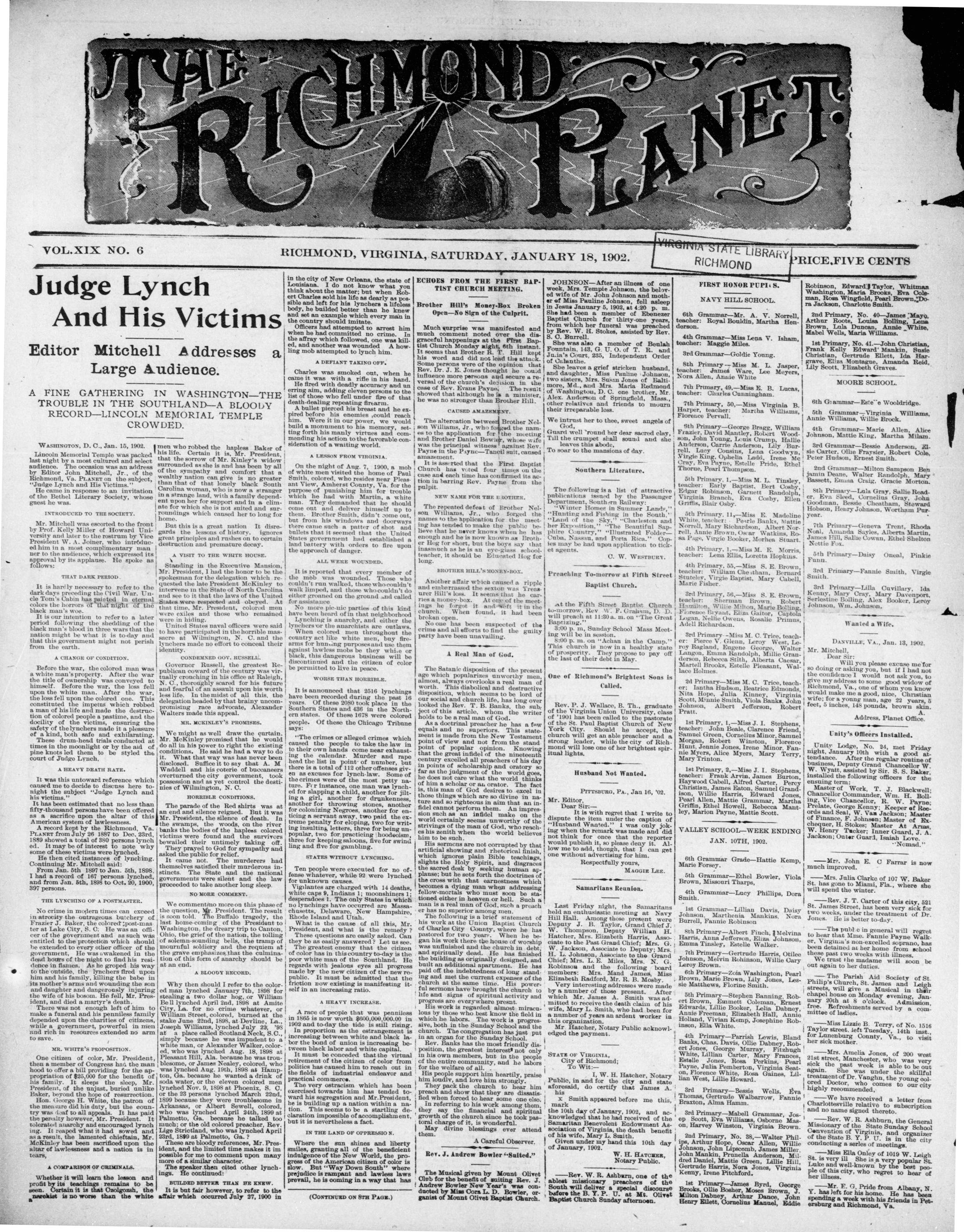
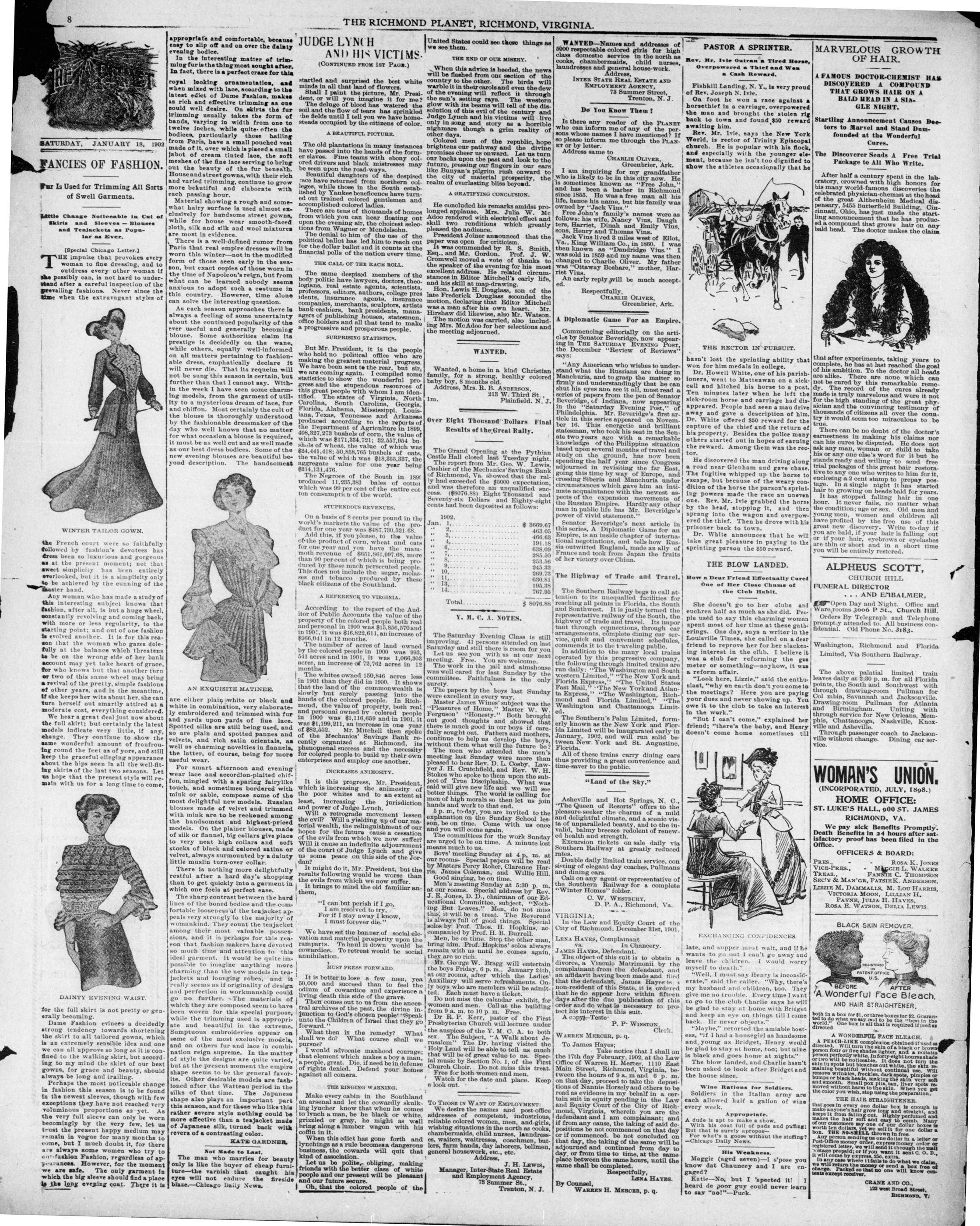
Judge Lynch And His Victims
A FINE GATHERING IN WASHINGTON—THE TROUBLE IN THE SOUTHLAND—A BLOODY RECORD—LINCOLN MEMORIAL TEMPLE CROWDED
VOL.XIX NO. 6
Judge Lyne
And His
Editor Mitchell
Large A
A FINE GATHERING
TROUBLE IN THE SO
RECORD—LINCOLN
CROW
WASHINGTON, D. C., Jan. 15, 1902.
Lincoln Memorial Temple was packed last night by a most cultured and select audience. The occasion was an address by Editor John Mitchell, Jr. of the Richmond, Va. PLANET on the subject, "Judge Lynch and His Victims."
He came in response to an invitation of the Bethel Literary Society, whose guest he was.
INTRODUCED TO THE SOCIETY.
Mr. Mitchell was escorted to the front by Prof. Kelly Miller of Howard University and later to the rostrum by Vice President W. A. Joiner, who introduced him in a most complimentary manner to the audience, which expressed its approval by its applause. He spoke as follows:
THAT DARK PERIOD
It is hardly necessary to refer to the dark days preceding the Civil War. Uncle Tom's Cabin has painted in eternal colors the horrors of that night of the black man's woe. It is our intention to refer to a later period following the shedding of the black blood in three wars that the nation might be what it is to-day and that this government must not perish from the earth.
A CHANGE OF CONDITION
Before the war, the colored man was a white man's property. After the war the title of ownership was conveyed to himself. Before the war, the loss fell upon the white man. After the war, the loss fell upon the colored one. This constituted the impetus which robbed a man of his life and made the destruction of colored people a pastime, and the doctility of the victims, ensuring the safety of the lynchers made it a pleasure of a kind, both safe and exhilarating. These drum-head trials conducted at times in the moonlight or by the aid of pine knots led them to be styled the court of Judge Lynch.
A HEAVY DEATH RATE.
It was this untoward reference which caused me to decide to discuss here tonight the subject "Judge Lynch and his victims." It has been estimated that no less than fifty-thousand persons have been offered as a sacrifice upon the altar of this American system of laffness. A record kept by the Richmond, Va. Police on July 10, to Dec. 23rd, 1889 showed a total of 830 persons lynched. It may be of interest to note why some of these victims were lynched. He then cited instances of lynching, Continuing Mr. Mitchell said:
From Jan. 5th 1897 to Jan. 5th, 1898
I had a record of 167 persons lynched,
and from Jan. 5th, 1898 to Oct. 20, 1900
397 persons.
THE LYNCHING OF A POSTMASTER
No crime in modern times can exceed in atrocity the outrageous butchery of Frazier J. Baker, the colored post-master at Lake City, S. C. He was an officer of the government and as such was entitled to the protection which should be extended to every other officer of the government. He was awakened in the dead hours of the night to find his residence in flames. As he groped his way to the outside, the lynchers fired upon him and his family, killing the babe in its mother's arms and wounding the son and daughter and dangerously injuring the wife of his bosom. He fell, Mr. President, and died a martyr's death.
There was not enough left of him to make a funeral and his penniless family depended upon the charities of citizens, while a government, powerful in men and rich in resources extended no arm to save.
MR. WHITE'S PROPOSITION
One citizen of color, Mr. President, then a member of Congress had the man hood to offer a bill providing for the appropriation of $25,000 for the benefit of his family. It sleeps the sleep, Mr. President, of the unjust, buried unlike Baker, beyond the hope of resurrection. Hon. George H. White, the patron of the measure did his duty, but the country was deaf to all appeals. It has paid the penalty however, Mr. President. It made amachy and noodle-knapping. It reaped what it had saved and as a result, the lamented chiefaint, Mr. McKinley has been sacrificed upon the alter of lawlessness and a nation is in tears.
A COMPARISON OF CRIMINALS.
Whether it will learn the lesson and profit by its teachings remains to be seen. Certain it is that Ozolgozsh, the *marchel* is no worse than the white
men who robbed the hapless Baker of his life. Certain it is, Mr. President, that the sorrow of Mr. Kinley's widow surrounded as she is and has been by all of the sympathy and comfort that a wealthy nation can give is no greater than that of that lonely black South Carolina woman, who is now a stranger to a strange land, with a family dependent upon her support and in a climate for which she is not suited and surroundings which caused her to long for home. But this is a great nation. It disregards the lessons of history, ignores great principles and rushes on to certain destruction and premature decay.
A VISIT TO THE WHITE HOUSE.
Standing in the Executive Mansion, Mr. President, I had the honor to be the spokesman for the delegation which requested the late President McKinley to intervene in the State of North Carolina and see to it that the laws of the United States were respected and obeyed. At that time, Mr. President, colored men were exiles and those who remained were in hiding. The naval officers were said to have participated in the horrible massacre at Wilmington, N. C. and the lynchers made no effort to conceal their identity.
CONDEMNED GOV. RUSSELL.
Governor Russell, the greatest Republican coward of the century was virtually crouching in his office at Raleigh, N.C., thoroughly scared for his future and fearful of an assault upon his worth less life. In the midst of all this, the governor publicly uncompromising race advocate, Alexander Walters made this appeal.
MR. MCKINLEY'S PROMISES.
We might as well draw the curtain,
Mr. McKinley promised that he would
do all in his power to right the existing
conditions. He said he had a way to do
it. What that way was has never been
disclosed. Suffice it to say that A. M
Waddell and his coterie of buccaneers
overturned the city government, took
possession and as yet control the destinies
of Wilmington, N. C.
HORRIBLE CONDITIONS.
The parade of the Red shirts was at an end and silence reigned. But it was Mr. President, the silence of death. In the swamps, the woods, on the river banks the bodies of the hapless colored victims were found and the survivors bewailed their untimely taking off. They prayed to God for sympathy and asked the public for relief. It came not. The murderers had themselves satisfied their murderous instincts. The State and the national governments were silent and the law proceeded to take another long sleep.
NO MORE COMMENT.
We commentno more on this phase of the question, Mr. President. The result is soon told. The Buffalo tragedy, the last home-coming of the President to Washington, the dreary trip to Canton, Ohio, the grief of the nation, the tolling of solemn-sounding bells, the tramp of soldiers, the requiem at the grave emphasizes that the culmination of this form of anarchy should be at an end.
A BLOODY RECORD.
Why then should I refer to the colored man lynched January 7th, 1898 for stealing a two dollar hog, or William Bell lynched April 2nd, 1898 at Amite City, La. for no crime whatever, or William Street, colored, burned at the stake June 22nd, 1898, at Devline, La., Joseph Williams, lynched July 22, '98 at a place called Scotland Neck, S.C., simply because he was impudent to a white man, or Alexander Walker, colored, who was lynched Aug. 18, 1898 at Pleasant Hill, Ala., because he was troublesome, or James Nealey, colored, who was lynched Aug. 19th, 1898 at Hampton, Ga. because he wanted a drink of soda water, or the eleven colored men lynched Nov. 9, 1898 at Phoenix, S. C. or the 23 persons lynched March 22nd, 1899 because they were troublesome in Arkansas, or Albert Sewell, colored, who was lynched April 24th, 1899 at Palmetto, Ga. because he talked too much; or the old colored preacher, Rev. Lige Strictland, who was lynched April 23rd, 1899 at Palmetto, Ga. ?
These are bloody references, Mr. President, and the limited time makes it impossible for me to comment upon many more of a similar character.
The speaker then cited other lynchings. He continued:
BUILDED BETTER THAN HE KNEW.
It is but fair however, to refer to the affair which occurred July 27, 1900 in
in the city of New Orleans, the state of Louisiana. I do not know what you think about the matter; but when Robert Charles sold his life as dearly as possible and left for his lynchers a lifeless body, he built better than he knew and set an example which every man in the country should imitate.
Officers had attempted to arrest him when he had committed no crime. In the affray which followed, one was killed, and another was wounded. A howling mob attempted to lynch him.
ECHOES FROM THE FIRST BAP-TIST CHURCH MEETING.
Brother Hill's Money-Box Broken Open—No Sign of the Culprit.
Much surprise was manifested and much comment noted over the disgraceful happenings at the First Baptist Church Monday night, 6th instant. It seems that Brother R. T. Hill kept
JOHNSON—After an ill week, Mrs. Tempie Johnson ed wife of Mr. John Johnson of Miss Pauline Johnson in Jesus January 5, 1902, a She had been a member of Baptist Church for thirty from which her funeral was by Rev. W. H. Stokes, ass. S. O. Burrell. She was also a member Fountain, 143, G. U. O. of
A DEFIANT TAKING OFF.
Charles was smoked out, when he came it was with a rifle in his hand. He fired with deadly accuracy and an erring aim, adding eleven persons to the list of those who fell under fire of that death-dealing repeating firearm. A bullet pierced his breast and he expelled his enemies could reach him. Were in their war power, we would build a monument to their memory, setting forth his many virtues and commending his action to the favorable consideration of a waiting world.
A LESSON FROM VIRGINIA
On the night of Aug. 7, 1900, a mob of white men visited the home of Paul Smith, colored, who resides near Pleasant View, Amherst County, Va. for the purpose of punishing him for trouble which he had with Martin, a white man. They demanded that he should come out and deliver himself up to them. Brother Smith, didn't come out, and his windows and doorways there came such a hot and bullets that it seemed that the United States government had established a land battery with orders to fire upon the approach of danger.
ALL WERE WOUNDED
It is reported that every member of the mob was wounded. Those who couldn't run walked, those who couldn't walk limped, and those who couldn't do either groomed on the ground and called for assistance. No more picnic parties of this kind have been heard of in that neighborhood. Lynching is anarchy, and either the lynchers or the anarchists are outlaws. The colored men throughout the country are the men, but buy firearms for hunting purpose and use them against lawless mobs be they white or black, this dangerous business will be discontinued and the citizen of color be permitted to live in peace.
WORSE THAN HORRIBLE
It is announced that 3516 lynchings have been recorded during the past 16 years. Of these 2080 took place in the Southern States and 436 in the Northern states. Of these 1678 were colored people. Of these the Chicago Tribune says:
"The crimes or alleged crimes which caused the people to take the law in to their own hands come near exhausting the calendar. Murder and rape head the list in point of number, but it is a total of 112 other offenses given as success for lynch-law. Some of the crimes were of the most petty nature. For instance, one was lynched for slapping a child, another for jailing a girl, another for drunkenness, another for throwing stones, another for colonizing Negroes, another for enticing a servant away, two paid the extreme penalty for eloping, two for writing insulting letters, three for being unpopular, two for practicing hoodoism, three for keeping salons, five for swindling and five for gambling.
STATES WITHOUT LYNCHING
Ten people were executed for no offense whatever, while 92 were lynched for unknown causes.
Vigilantes are charged with 14 deaths, white caps 9, Indians 1; moonshiners 1, desperados 1. The only States in which no lynchings have occurred are Massachusetts, Delaware, New Hampshire, Rhode Island and Utah.
What is the cause of all this, Mr. President, and what is the remedy? These questions are easily asked. Can they be as easily answered? Let us see.
The greatest enemy that the citizen of columbia may face to-day is the poor white man of the Southland. He regards with jealous eyes all progress made by the new citizen of the new republic. It must be admitted that the friction now existing is manifesting itself in an increasing ratio.
A HEAVY INCREASE.
A race of people that was penniless in 1865 is now worth $900,000,000.00 in 1902 and to-day the tide is still rising. In proportion as the estrogender is increasing between white and black labor the bond of union is increasing between black labor and white capital. It must be conceded that the virtual retirement of the citizen of color from politics has caused him to reach out in the fields of industrial endeavor and practical commerce. The man which has been exercised towards him has tended toward his segregation and Mr. President, he is building up a nation within a nation. This seems to be a startling declaration impossible of accomplishment, but it is nevertheless a fact.
IN THE LAND OF OPPRESSION.
Where the sun shines and liberty smiles, granting all of the beneficent indulgence of the New World, the progress of the American citizen of color is slow. But "Way Down South" where prejudice is rampant and lawless laws prevail, he is coming in a way that has
(CONTINUED ON 8TH PAGE.)
ECHOES FROM THE FIRST BAPTIST CHURCH MEETING.
Brother Hill's Money-Box Broken Open—No Sign of the Culprit.
Much surprise was manifested and much comment noted over the disgraceful happenings at the First Baptist Church Monday night, 6th instant. It seems that Brother R. T. Hill kept his word and did not lead the attack. Some persons of the opinion that Rev. E. J. Jones thought he could influence the church's decision in versal of the church's decision in the case of Rev. Evans Payne. The result showed that although he is a minister, he was no stronger than Brother Hill.
CAUSED AMAZEMENT.
The altercation between Brother Nelson Williams, Jr., who faced the names to the application for the meeting and Brother Daniel Bowler, whose wife was the principal witness against Rev. Payne in the Payne—Tancil suit, caused amazement.
It is asserted that the First Baptist Church has voted four times on the case and each time has confirmed its action in barring Rev. Payne from the pulpit.
NEW NAME FOR THE BROTHER
The repeated defeat of Brother Nelson Williams, Jr., who forged the names to the application for the meeting has tended to make the public believe that he never knows when he has enough and he is now known as Brother Hog for short, but the boys say that inasmuch as he is an eye-glass schoolteacher, it should be Educated Hog for long.
BROTHER HILL'S MONEY-BOX
Another affair which caused a ripple and embarrassed the sexton was Treasurer Hill's loss. It seems that he carries a money-box. At one of the meetings he forgot it and left it in the church. When found, it had been broken open.
No one has been suspected of the crime and all efforts to find the guilty party have been unavailing.
A Real Man of God.
The Satanic disposition of the present age which popularizes unworthy man, almost, always overlooks a real man of worth. This diabolical and destructive disposition, which seems to be lord of our social and church life, has long over looked the Rev. T. B. Banks, the subject of this article, whom the writer holds to be a real man of God. As a doctrinal preacher he has a few equals and no superiors. This statement is made from the New Testament point of view and not from the standpoint of popular opinion. Knowing that the great infidel of the nineteenth century excelled all preachers of his day in points of scholarship and oratory so far as the judgment of the world goes, does not care what the world thinks of him or an orator. The fact is, this man God desires to excel in those things which are so divine in nature and so righteous in aim that an infidel cannot perform them in an impression such as an infidel make world certainly seems unworthy of the strivings of the man of God, who reaches his zenith when the world believes him to be such.
His sermons are not corrupted by that artificial showing and rhetorical finish, which ignores plain Bible teachings, slights the Holy Spirit, and disgraces the sacred desk by seeking human applause; but he sets forth the doctrines of the cross with that earnestness which becomes a dying man when addressing fellow-mortals who must soon be stationed either in heaven or hell. Such a man is a real man of God, such a preacher has no superior among men.
The following is a brief statement of his work at the Union Baptist Church of Charles City County, where he has pastored for two years. When he began his work there the house of worship was unfinished and the church in debt, and spiritually dead. He has finished the building as originally designed, and built an additional apartment. He has paid off the indebtedness of long standing and met the current expenses of the church at the same time. His powerful sermons have brought the church to life and signs of spiritual activity and presence where present. His work is regular, almost miraculous by those who best serve the field in which he labors. The work is progressive, both in the Sunday School and the church. The congregation has just put in an organ for the Sunday School.
Rev. Banks has the most friendly disposition, the greatest interest not only in his own members, but in the people of the entire community, and he labors for the welfare of all.
His people support him heartily, praise him loudly, and love him strongly.
They pack the church to hear him preach and show that they are dissatisfied when forced to hear some one else.
In referring to his work among them, they say the financial and spiritual growth of the church since he took pastoral charge of it, is wonderful.
May divine blessings ever attend them.
Rev. J. Andrew Bowler "Suited."
The Musical given by Mount Olivet Club for the suiting Rev. J. Andrew Bowler New Year's was conducted by Miss Cora L. D. Bowler, organist of Mount Olivet Baptist Church
JOHNSON—After an illness of one week, Mrs. Temple Johnson, the beloved wife of Mr. John Johnson and mother of Miss Pauline Johnson, fell asleep in Jesus January 5, 1902, at 4:20 p. m. She had been a member of Ebenezer Baptist Church for thirty-one years, from which her funeral was preached by Rev. W. H. Stokes, assisted by Rev. S. C. Burrell.
She was also a member of Beulah Fountain, 143, G. U. O. of T. R. and Julia's Court, 235, Independent Order of Calanthe.
She leaves a grief stricken husband, and daughter, Miss Pauline Johnson, two sisters, Mrs. Susan Jones of Baltimore, Md., and Mrs. Maria Redmond of Washington, D.C. one brother, Mr. Alex Anderson of Springfield, Mass, other relatives and friends to mourn their irreparable loss.
We intrust her to thee, angels of God,
Guard well 'round her dear sacred clay,
Till the crumpet shall sound and she leaves this abode.
leaves this good,
To soar to the mansions of day.
The following is a list of attractive publications issued by the Passenger Department, Southern Railway: "Winter Homes in Summer Lands," "Hunting and Fishing in the South," "Land of the Sky," "Charleston and Exposition," The Beautiful Sapphire," "Illustrated Folder—Cuba, Nassau, and Porta Rica." Copies may be had upon application to ticket agents.
Preaching To-morrow at Fifth Street Baptist Church.
At the Fifth Street Baptist Church to-morrow, Rev W. F. Graham, D. D. will preach at 11:30 a. m. on "The Great Baptizing."
3:00 p. m., Sunday School Mass Meeting will be in session.
8:00 p. m. on "Achan in the Camp."
This church is now in a healthy state of prosperity. They propose to pay off the last of their debt in May.
One of Richmond's Brightest Sons is Called.
Rev. P. J. Wallace, B. Th., graduate of the Virginia Union University, class of '1901 has been called to the pastorate of the St. Paul Baptist Church of New York City. Should he accept, the church will get an able preacher and a strong leader, while the city of Richmond will lose one of her brightest spiritual lights.
Husband Not Wanted.
PTTTSBURG, PA., Jan 16, '02.
Mr. Editor,
Dear Sir:—
It is with regret that I write to dispute the item under the caption of "Husband Wanted." I was only joking when the remark was made and did not think for once that the reporter would publish it, so please deny it. Allow me to add, though, that I can get one without advertising for him.
Samaritans Reunion.
Last Friday night, the Samaritans held an enthusiastic meeting at Navy Hill Hall. Among those present were Deputy J. B. Taylor, Grand Chief J. W. Thompson, Deputy William H. Hatcher, Mrs. Elizabeth Harris, Associate to the Past Grand Chief; Mrs. G. W. Jackson, Associate to Deputy; Mrs. H. L. Johnson, Associate to the Grand Chief; Mrs. L. E. Miles, Mrs. N. G. Robinson and the following board members: Mrs. Mand James, Miss Elizabeth Radford, Mr. R. B. Mosby. Very interesting addresses were made by a number of those present. After which Mr. James A. Smith was admitted to receive the death claim of his wife, Mary L. Smith, who had been for a number of years an ardent worker in this organization. Mr Hatcher, Notary Public acknowledged the payment.
STATE OF VIRGINIA.
I. W. H. Hatcher, Notary Public, in and for the city and state aforesaid, do certify that James A. his
x Smith appeared before me this, mark
the 10th day of January, 1903, and acknowledged that he had received of the Samaritan Benevolent Endowment Association of Virginia, the death benefit of his wife, Mary L. Smith.
Given under my hand this 10th day of January, 1902.
W. H. HATCHER,
Notary Public.
Rev. W. R. Ashburn, one of the ablest missionary preachers of the South will deliver a special discourse before the B. Y. P. U. at Mt. Olivet Baptist Church Sunday afternoon.
6th Grammar—Mr. A. V. Norrell,
teacher: Royal Bouldin, Martha Henderson.
4th Grammar—Miss Lena V. Isham,
teacher: Margie Miles.
3rd Grammar—Goldie Young.
8th Primary—Miss M. L. Jasper, teacher: James Ware, Lee Meyers, Nora Allen, Annie White
7th Primary, 49,—Miss E. B. Lucas, teacher: Charles Cunningham.
7th Primary, 50,—Miss Virginia B. Harper, teacher: Martha Williams, Florence Pervall.
9th Primary—George Bragg, William Frazier, David Mantley, Robert Woodson, John Young, Louis Crump, Hallie Anderson, Carrie Anderson, Lily Burrell, Lacy Cousins, Lena Goodwyn, Virgie King, Ophelia Ladd, Irene Mc Cray, Eva Payne, Estelle Pride, Ethel Thorne, Pearl Thompson.
5th Primary, 1,—Miss M. L. Tinsley, teacher: Early Baptist, Bert Cosby, Edgar Robinson, Garnett Randolph, Virginia Branch, Eva Cosby, Ellen Griffis, Blair Osby.
5th Primary, 11,—Miss E. Madeline White, teacher: Pearle Banks, Wattie Norrell, Mary Richardson, Albert Norrell, Annie Brown, Osar Watkins, Rosa Page, Vrgie Booker, Morhea Stuart.
4th Primary, 1,—Miss M. E. Morris, teacher: Lena Ellis, Loretta Hopkins.
4th Primary, 55,—Miss S. E. Brown, teacher: William Chestam, Bernard Stuteley, Virgie Baptist, Mary Cabell, Marie Fisher.
3rd Primary, 56,—Miss S. E. Brown, teacher: Sherman Brown, Robert Hamilton, Willie Milton, Marie Bolling, Florence Bryant, Eliza Gaitor, Capta Logan, Nellie Owens, Rosalie Primus, Adell Richardson.
3rd Primary,—Miss M. C. Trice, teacher: Pierce V Glenn, Leroy West, Leroy Ragland, Engene George, Walter Langon, Emma Randolph, Millie Grandson, Rebecca Seith, Alberta Caesar, Martell Brooks, Estelle Pleasant, Wallace Holmes.
2d Primary—Miss M. C. Trice, teacher; Antha Hudson, Beatrice Edmonds, Nita Hope, Julia Kinney, Virginia Scott, Minnie Smith, Viola Johns, John Johnson, Albert Jefferson, Robert Pratt
1st Primary, 1,—Miss J. I. Stephens, teacher: John Beale, Clarence Friend, Samuel Green, Cornelius Minor, Samuel Morgan, Robert Winston, Florence Hunt, Jennie Jones, Irene Minor, Fannie Myers, Alice Myers, Mary Terry, Mary Trinton.
1st Primary, 2,—Mise J. I. Stephens, teacher: Frank Arvin, James Burton, Haywood Cabell, Alfred Carter, Percy Christian, James Eaton, Samuel Grandison, Willie Harris, Edward Jones, Pearl Allen, Mattie Grammar, Martha Griffin, Ethel Howell, Rebecca Mantley, Marion Payne, Mattie Scott.
VALLEY SCHOOL—WEEK ENDING
6th Grammar Grade—Hattie Kemp, Marie Forsey.
5th Grammar—Ethel Bowler, Viola Brown, Missouri Tharps.
4th Grammar—Lucy Phillips, Dora Smith.
1st Grammar—Lillian Davis, Daisy Johnson, Martheenia Mankins, Nora Burrell, Fannie Robinson
8th Primary—Albert Finch, Melvina Harris, Anna Jefferson, Eliza Johnson, Emma Tinsley, Estelle Walker.
7th Primary—Gertrude Harris, Otilie Johnson, Melvin Robinson, Willie Cary Lery Brown.
6th Primary—Zoia Washington, Pearl Brown, Marie Brown, Lily Jones, Leslie Matthews, Florine Rose.
5th Primary—Stephen Banning, Robert Brown, Emmett Coleman, Ernest Edwards, Lillie Booker, Lelia Dabney, Annie Freeman, Elizabeth Hall, Annie Holland, Vivian Kemp, Josephine Robinson, Ella White.
4th Primary—Parrish Lewis, Bland Banks, Chas. Davis, Ollie Dabney, Robert Jones, George Murray, Fitzhugh White, Lillian Carter, Mary Frances, Estelle Jones, Rosa Perkins, Pearl Payne, Julia Pemberton, Virginia Seaton, Florence White, Rosa Gaines, Lillian West, Lillie Howard.
3rd Primary—Bessie Wells, Eva Thomas, Gertrude Walbarrow, Fannie Braxton, Alma Hamm.
3rd Primary—Mabell Grammar, Joseph Scott, Eva Williams, Osborne Mason, Harvey Winston, Virginia Brown.
2nd Primary, No. 38, Walter Philips, Arthur Hope, Oscar Allen, Willie Johnson, John Lipscomb, James Miller, John Mankin, Mattei Green, Lillie Hill, Gertrude Harris, Nora Jones, Virginia Kenny, Irene Pitchford.
1st Primary—James Byrd, George Brooks, Ollie Biosher, Moses Brown, J. Milton Dabney, Arthur Dance, John Henry Ellett, Cornelius Mansel, Eddie
PRICE,FIVE CENTS
Robinson, Edward| Taylor, Whitman
Washington, Maria Brooks, Eva Coleman, Rosa Wingfield, Pearl Brown,Dora Jackson, Charlotte Smith.
2nd Primary, No. 40—James Mayo,
Arthur Roots, Louisa Bolling, Leila Brown, Lula Duncan, Annie White, Mabel Wells, Maria Williams.
1st Primary, No. 41—John Christian,
Frank Kelly Edward' Mankin, Susie Christian, Gertrude Ellett, Ida Hargave, Eliza Montague, Amanda Reid, Lily Scott, Elizabeth Graves.
6th Grammar—Este" Wooldridge.
5th Grammar—Virginia Williams, Annie Williams, Willie Brock.
4th Grammar—Marie Allen, Alice Johnson, Mattie King, Martha Milam.
3rd Grammar—Bessie Anderson, Elsie Carter, Olie Fraysier, Robert Cole, Peter Hudson, Ernest Smith.
2nd Grammar—Milton Sampson Ben jamin Deane, Walter Randolph, Mary Bassett, Emma Craig, Gracie Morton.
8th Primary—Lala Gray, Sallie Reader, Eva Sieed, Cornelius Gray, John Goodman, Bessie Cheatham, Staward Hobson, Henry Johnson, Wortham Purear.
7th Primary—Geneva Trent, Rhoda Neal, Amanda Sayles, Alberta Martin, James Hill, Sallie Cowan, Ethel Shelton Nettie Fox.
5th Primary—Daisy Oneal, Pinkie Funn.
3rd Primary—Fannie Smith, Virgie Smith.
3rd Primary—Lilla Cuvillary, Ida Kenny, Mary Cray, Mary Davenport, Serlestine Bolling, Alex Booker, Leroy Johnson, Wm, Johnson.
Wanted a Wife.
DANVILLE, VA., Jan. 13, 1902.
Mr. Mitchell,
Dear Sir:
Will you please excuse me for so doing or asking you, but if I had not the confidence I would not ask you, to give my address to some good widow of Richmond, Va., one of whom you know would make me a good, nice, Christian wife; for a young man, age 22 years, 5 feet, 5 inches, 148 pounds, brown skin.
A.
Address, Planet Office.
Unity's Officers Installed.
Unity Lodge, No. 24, met Friday night, January 10th with a good attendance. After the regular routine of business, Deputy Grand Chancellor W. W. Wyatt, assisted by Sir. S. S. Baker, installed the following officers for the ensuing term:
Master of Work, T. J. Blackwell; Chancellor Commander, Wm. H. Bolling, Vice Chancellor, R. W. Payne; Prelate, George Kenny; Keeper of Records and Seal, W. Van Jackson; Master of Finance, F. Johnson; Master of Exchequer, H. Stokes; Master At Arms, W. Henry Tucker; Inner Guard, J. A. Jackson; Outer Guard, Isaiah Love.
"Nomad."
Mrs. John E. C Farrar is now much improved.
Mrs. Julia Clarke of 107 W. Baker St. has gone to Miami, Fla., where she will spend the winter.
Rev. J. T. Carter of this city, 521 St. James Street, has been very sick for two weeks, under the treatment of Dr. Jones. He is better to-day.
The public in general will regret to hear that Mime, Fannie Payne Walker, Virginia's non-excelled soprano, has been detained at her home from school these past two weeks with illness.
We trust the madame will soon be out again to her duties.
The Parish Aid Society of St. Philip's Church, St. James and Leigh streets, will give a musical in their chapel house on Monday evening, January 20th at 8 o'clock. Admission, free. Refreshments served by a committee of ladies.
Miss Lizzie B. Terry, of No. 1516 Taylor street, left Terry, 14th inst., for Lunaenburg County, Va., to visit her sick mother.
—Mrs. Amelia Jones, of 200 west 21st street, Manchester, who was very sick the past week is able to be out again. She was under the skillful treatment of Dr. Vaughn, the young colored Doctor, who comes to our city highly recommended.
—We have received a letter from Charlottesville relative to subscription and no name signed thereto.
—Rev. W. R. Ashburn, the General Missionary of the State Sunday School Convention of Virginia, and organizer of the State B. Y. P. U. is in the city conducting a series of meetings.
—Miss Ella Onley of 1019 W. Leigh St. is very ill. She is a very popular St. Luke and well-known by the best person of this city, who regret to hear of her illness.
—Mr. E. G. Pride from Albany, N. Y. has left for his home. He has been spending a week with his friends in Petersburg and Richmond, Va.
Our Boys and Girls
Bright Stories and Anecdotes of Life at Home and Abroad.
HOW HE GOT CANDY.
Smart Newfoundland Dog Uses Reasoning Powers for an Extraordinary Purpose.
A group of children were playing the end of a pier that projects into a lake. They ought not to have been there, of course, but when will children learn how to avoid danger?
Well, there they were, and, of course, it was only a question of time when one of them would make a misstep and tumble into the water. This happened presently, and as the water was very deep, and the children were all small, the unfortunate tumbler stood a fair chance of being drowned.
And he certainly would have been drowned had a big Newfoundland dog not happened to come along just in the nick of time. He saw the boy in the water, and plunged in and brought him out.
Some of the children went home with the rescued boy; the others took the dog to a confectionery shop and gave him all the candy and cakes he could eat.
The next afternoon the children, strange to say, were again playing on the pier. Presently they were jolied by the dog. They received him with many pats and strokes of welcome; but he was on the lookout for candy and cakes.
He must have reasoned the thing out very clearly at last, that a boy in the water and a bountiful supply of sweets went together, for, watching his chance, he rushed up to the boy nearest the end of the pier and pushed him overboard. Then he plunged in himself and gravelly brought the boy ashore, expecting, of course, to be rewarded as he had been the day before.—Cincinnati Commercial Tribune.
A COCOANUT CRADLE.
The Doll Baby Will Enjoy it Much More Than a Creaky, Shop-Made Nest.
How much nicer to tuck dolly away in a cradle the little mother has herself made than to stow her into one of those creaky affairs that come from the shops.
Any clever girl may convert a coconut into a charming cradle. Look carefully at the sketch and then see exactly how much of the coconut shell has to be sawed away. That part should be done by father or one of the big brothers.
The kernel, or what is called the "cocoanut," must, of course, be taken
COCOANUT CRADLE.
from the inside of the shell before anything is done. Cut some rockers from cardboard or thin wood and fix them to the lower edge of the cradle. They will not need fixing if they fit tightly, but if they do not, use some fish gine to attach them to the shell.
To make the cradle very fine gild the inside with gold paint to completely hide the brown of the shell. Do not cover the whole of the outside with the paint, but touch the hairy part lightly. This effect is much the prettier.
Any odd piece of lace will do for curtains if it be caught up in the center and fixed to the top (or blood) part of the cradle. Put some cotton wool into the bottom of the cradle and make a pretty quilt, and dolly will sleep so cozily that she will not wish to get up in the morning.—Cincinnati Commercial Tribune.
Woman Rides a Wild Bull.
Mrs. Dora McElroy is an experienced horsewoman, and can manage the fiery, untamed steed without much difficulty, but when she undertook to exhibit her skill on the back of a wild bull she caused a lot of trouble. Mrs. McElroy was visiting relatives at Sherman, a town in Pennsylvania, and started out to show her kinsfolk how easy it was to manage a bovine. She got on the animal's back, and the bull becoming frightened dashed over a gate and ran along the road. The woman clung to him until he had run over a mile and her strength was gone. Then she was thrown violently, but fortunately landed in a clump of bushes at the roadside. These not only broke her fall, but hid her from the bull. She was found unconscious, severely bruised and suffering greatly from shock. Mrs. McElroy will hereafter confine her riding feats to horses exclusively.
Baby Minded All Right
Kathryn, aged two and a half, marched up to her three-months-old sister and, pointing her finger toward the window, said: "Baby, look at that." Naturally the baby's eyes followed Kathryn's hand and Kathryn looked satisfied as she said: "Baby min' me all wight."
Their Reliance
Early—I love your daughter!
Paterfamilias—But you can't live on that!
"Aw—no! But then there's your love, too, you know!"—Puck.
Some People's Words.
If some people were to weigh every word they utter it would be decidedly tough on the scales.—Chicago Daily News.
CAPTURED BY CONVICTS.
An Adventure or Two Which Locomotive Engineers Had with Escapeprison Birds.
In St. Nicholas Cleveland Moffett tells many good stories about the locomotive engineer and his experiences.
I asked if an engineer plans ahead what he will do in a collision. It seemed reasonable that a man always under such menace would have settled his mind on some prospective action. But they laughed at the idea.
CONVICTS CAPTURE LOCOMOTIVE
and declared that an engineer can no more tell how he will act in an emergency than the ordinary citizen can say what he would do in a fire, or how he would meet a burglar. One engineer would jump, another would stick to his throttle, and the chances of being killed were as good one way as the other. The only thing a man wouldn't do is to reverse the engine, for that would make the driver slip, and set the whole business to skating ahead.
The mention of a burglar led one of the newcomers to tell of William Powell's adventure with some Sing Sing convicts. Powell was the oldest engineer on the New York Central.
On one occasion four or five convicts outwitted the guards by dropping from a trestle upon the tender of a moving locomotive, and the first thing the engineer knew he was set upon by a band of desperate men, who covered him and his fireman with revolvers.
"Out you go now, quick," said the convicts; "we'll run this engine ourselves."
The engine was No. 105, Powell's pride and pet, and he could not bear to have unregenerate hands laid upon her, so he spoke up very politely: "Let me run her for you, gentlemen; I'll go wherever you say."
They agreed to this, and some distance down the line left the engine and departed into the woods. "And the joke of it was," concluded the narrator, "that the revolvers those convicts had were made of wood painted black, and couldn't shoot any more than the end of a broom! It was a big bluff they had played, but it worked."
"Wasn't any bluff when Denny Cassin got held up at Sing Sing," said another engineer. "Convicts had revolvers all right that trip, and Denny threw up his hands same as any man would. It was right at the Sing Sing station, and three of 'em jumped into the cab all of a sudden, and told Denny to open her up, and he did indeed! Then they told him to jump, and he jumped; but first he managed to fix the tank valves so she'd pump herself full of water and stop before she'd gone far. That was Denny's great scheme, and he walked along, laughing to think how mad those convicts would be.
"It turned out, though, that Denny spoiled a nice trap they'd laid up at Tarrytown to catch those fellows when they got there. You see, the telegraph operator wired up the line that a runaway locomotive was coming with three escaped convicts on her, and the train dispatcher at Tarrytown just set the switch so the locomotive would sail plump over a 12-foot stone embankment down into the Hudson river. That's what would have happened to those convicts if Denny had left his tank valve alone, but, of course, 89 got water-logged long before she reached Tarrytown; she just kicked out her cylinder-ends a few miles up the track and stopped. Then the convicts climbed down and skipped away. Two of 'em got caught afterward, but one they never caught."
Bit of Japanese Folklore
Almost all fruits and flowers have their legend. One about the peach comes from Japan and tells how a poor, pious old couple were searching for food by the roadside. The woman found a peach, which she would not eat of, though starving, till she could share it with her husband. He cut it exactly in half, when an infant leaped forth. It was one of the gods who had, he said, accidentally fallen out of the peach orchard of heaven while playing. He told them to plant the stone of the peach, and it brought them happiness, friends and wealth.
He Had Been Married.
Mrs. Jones—I have to ask my husband for every dollar I want.
Old Mr. Brown—Dear me! Are you so sound a sleeper as that?—Judge.
Clara—I thought you said Sadie was up on ancient literature.
Maud—Well, and year's move?
THE RICHMOND PLANET, RICHMOND, VIRGINIA.
VIRGINIA:—In the Law and Equity
Court of the city of Richmond, November
13th, 1901.
Matthew Howell, Plaintiff
vs. In Equity,
Anna Howell Defendants
The object of this suit is to obtain a divorce a vinculo matrimonii for the plaintiff from the defendant and an affidavit having been made and filed that diligence has been used on behalf of the plaintiff to ascertain in what county or corporation the defendant is without effect it is ordered that she do appear here within fifteen days after due publication of this notice and do what may be necessary to protect her interest in this suit.
R. W. Ivey, p. q.
To Annie Howell:
Take notice that I shall, on the 17th day of January, 1902, at the office of K. M. Roscher, corner Prentiss and Clay streets, Richmond, Va., between the hours of 9 a. m. and 9 p. m., on that day proceed to take the depositions of J. W. Smith and others, to be read in evidence in my behalf in a certain suit in Equity depending in the Law and Equity court for the city of Richmond wherein you are defeat and I am plaintiff and if from any cause, the taking of the said depositions be not commenced on that day, or if commenced, be not concluded on that day, the taking of the same will be adjourned and continued from day to day, or from time to time, at the same place and between the same hours until the same shall be completed.
12-14-'01 4t.
SOUTHERN RAILWAY
Schedule in Effect Nov. 24, 1901.
TRAINS LEAVE RICHMOND, VA.
2:20 A. M., Nov. 7, daily for Durham, N. C., Danville, and all local stations south, notecting at Burkville for Farmville and Lynchburg; at Jeffries for local stations on Norfolk Division to Danville; at Gatesborough to Raleigh, Goldsboro, and all North Carolina points.
2:30 P. M., Limited train daily, for Jacksonville and all Florida points, Havens Nassan, etc., Connects at Moseley, with Farmville, and Powhatan Railroad; at Gatesborough, Durham, Raleigh and Winston-Salem; at New York, to S.C., United States fast mail, solid train, which carries sleepers to New Orleans, Drawing Room Sleeper, Richmond to Atlanta, and Birmingham. Through train with sleepers to Memphis, Dining-Car Service.
11:30 P. M. No. 11, Southern Express, daily for Atlanta, Anguita, Jacksonville, and points Santa Monica, Salisbury, Danville, Greenboro, Salisbury, P. M. Connection, open at Richmond 9:30 P. M. Connection with New York and Florida Express and Southwestern Limited, which can connect to Nashville, vannah, Jacksonville, Tampa, Nashville Memphis, Atlanta, New Orleans, etc. Complete Dining-Car Service. Also Palm潭 Tourist Sleep and neededs days and Fridays Washington to San Francisco, without change, with connections for all points in Texas, Mexico and California. 4:00 P. M. No. 17, local daily, except Sunday, for Keysville and intermediate points.
TRAINS ARRIVE IN RICHMOND.
A. M. 4:30 P. M.) From Atlanta, Augusta, Jacksonville, Aslville and points South. 8:40 A. M., from Keysville and stations. 3:25 P. M. from Durham, Charlotte, Danville and intermediate stations.
LOCAL FREIGHT.
Nos. 61 and 62 between Manchester and Neapolls.
YORK RIVER LINE, VIA WEST POINT.
THE FAVORITE ROUTE NORTH.
LEAVE RICHMOND.
4:30 P. M., No. 16, Baltimore Limited, daily except Sundays, connecting at West Point with steamers for Baltimore and York River landings stop only at stations between Quincy and West Point.
2:15 P. M. No. 10 Daily except Sundays, local express for West Point, and intermediate stations, Connects with *stage at Le Mans Manor for Walkerton and Tappahannock*.
5:00 A. M. No. 74, local mixed. Leaves daily, except Sunday for West Point and inter mediate stations, connecting with stage at the River for Walkerton and Tappahannock.
TRAINS ARRIVE RICHMOND.
9:15 A. M., daily from West Point, with connection from Baltimore, except Mondays
10:45 A. M., except Sundays and Mondays
5:15 P. M., daily except West Point and intermediate stations.
Steamers leave West Point daily, except Sundays, 5.31 p.m., arriving Baltimore 8:30 a.m.
Steamers call at Almonds and Yorktown Tuesdays, Thursdays and Saturday; Clay Bank and Gloucester Point Mondays, Wednesdays' and Fridays.
Third Vice-President and General Manager, Washington, D. C
Norfolk & Western Ry.
SCHEDULE IN EFFECT JUNE 28,
1901.
LEAVE RICHMOND (DAILY),
BYRD ST. STATION.
9:00 A. M. NORFOLK LIMITED. Arrives at
Norfolk M. NORFOLK Only at Peters-
burg, Waverley, and Suffolk.
9:05 A.M. THE CHICAGO EXPRESS, for Lynchburg, Roanoke, Columbus, and Chattanooga. Buses to Petersburg to Roanoke, Pullman Sleeping Car to Columbus; also for Bristol, Knoxville and Chattanooga. Pullman Sleeping Car to Knoxville. Pullman Shore Limited. Arrives Norfolk 5:35 P.M. Steps only at Petersburg. Waverly and Suffolk. Connects at Norfolk and Providence New York, Baltimore, and Warwick. 6:57 P.M. for Suffolk, Norfolk, and intermediate stations. Arrives at Norfolk at 10:54 P.M. 9:09 P.M. for Lynchburg, and Roanoke. Connects at Lynchburg with Washington at Chattanooga Limited. Pullman Sleeping Car to Oriental and Observation cars, Bristol, Ala., Pullman Sleeping Car to Richmond and Lynchburg. Berths on Richmond and Lynchburg. Also Sleeper Petersburg and Roanoke in Richmond from Lynchburg; daily at 7:38 P.M. and 8:56 P.M. and the East at 11:40 P.M. 10:59 P.M.
SERVICE: 888 Main St.
JOHN E. WAGNER,
City Passenger and Ticket Agent.
C. E. BOGLEY,
District Passenger Agent.
W. B. BEYILL,
General Passenger Agent.
General Office: ROANOKE, VA.
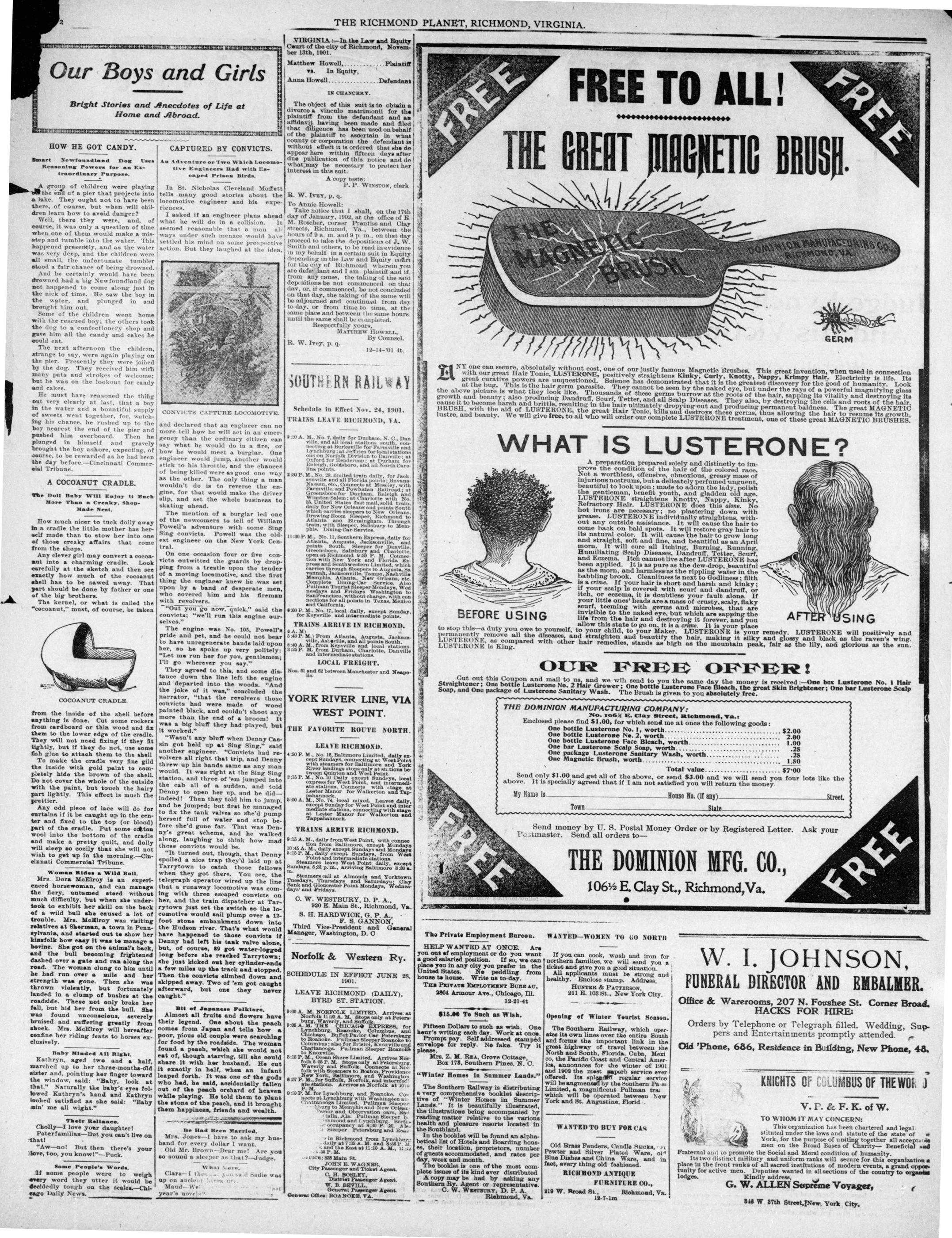
FREE TO ALL!
THE GREAT MAGNETIC BRUSH.
THE MAGNETIC BRUSH
DOMINION MANUFACTURING CO.
RICHMOND, VA.
GERM
ANY one can secure, absolutely without cost, one of our justly famous Magnetic Brushes. This great invention, when used in connection with our great Hair Tonic, LUSTERONE, positively straightens Kinky, Curly, Knotty, Nappy, Krimpy Hair. Electricity is life. Its great curative powers are unquestioned. Science has demonstrated that it is the greatest discovery for the good of humanity. Look at the bug. This is the hair germ parasite. They cannot be seen by the naked eye, but under the rays of a powerful magnifying glass the above picture is what they look like. Thousands of these germs burrow at the roots of the hair, sapping its vitality and destroying its growth and beauty; also producing Dandruff, Scurf, Tetter, and all Scalp Diseases. They also, by destroying the cells and roots of the hair, cause it to become harsh and brittle, resulting in the hair ultimately dropping out and producing permanent baldness. The great MAGNETIC BRUSH, with the aid of LUSTERONE, the great Hair Tonic, kills and destroys these germs, thus allowing the hair to resume its growth, lustre, and beauty. We will give free, to all who will order our complete LUSTERONE treatment, one of these great MAGNETIC BRUSHES.
WHAT IS LUSTERONE?
```markdown
```
BEFORE USING
to stop this—a duty you owe to yourself, permanently remove all the diseases, and LUSTERONE, as compared with other LUSTERONE is King.
Cut out this Coupon and mail to Straightener; One bottle Lusterone No. 2 Soap, and One package of Lusterone Sanitary
THE DOMINION M
Enclosed please:
One bottle
One bottle
One bottle
One bar
One pac
One Ma
Send only $1.00 above. It is specially
My Name is
Send money
Postmaster.
to stop this—a duty you owe to yourself, to your child, to your Maker. LUSTERONE is your remedy. LUSTERONE will positively and permanently remove all the diseases, and straighten and beautify the hair, making it silky and glossy and black as the raven's wing. LUSTERONE, as compared with other hair remedies, stands as high as the mountain peak, fair as the lily, and glorious as the sun. LUSTERONE is King.
OUR FREE OFFER!
Cut out this Coupon and mail to us, and we wil send to you the same day the money is received:—One box Lusterone No. 1 Hair Straightener; One bottle Lusterone No. 2 Hair Grower; One bottle Lusterone Face Bleach, the great Skin Brightener; One bar Lusterone Scalp Soap, and One package of Lusterone Sanitary Wash. The Brush is given to you absolutely free.
Send only $1.00 and get all of the above, or send $3.00 and we will send you four lots like the above. It is specially agreed that if I am not satisfied you will return the money.
Send money by U. S. Postal Money Order or by Registered Letter. Ask your Postmaster. Send all orders to—
Riehmond, Va.
The Private Employment Bureau.
HELP WANTED AT ONCE. Are you out of employment or do you want a good salaried position. If so, we can place you in any city you prefer in the United States. We peddling from house to house. Write us to-day.
THE PRIVATE EMPLOYMENT BUREAU,
2804 Armour Ave., Chicago, Ill.
12-21-4t
$15.00 To Such as Wish.
Fifteen Dollars to such as wish. One hour's writing each day. Work at once. Prompt pay. Self addressed stamped envelope for reply. No fake. Try it please.
Mrs. Z. M. REA, Grove Cottage, Box 173, Southern Pines, N. C.
"Winter Homes in Summer Lands."
The Southern Railway is distributing a very comprehensive booklet descriptive of "Winter Homes in Summer Lands." It is beautifully illustrated, the illustrations being accompanied by reading matter relative to the various health and pleasure resorts located in the Southland.
In the booklet will be found an alphabetical list of Hotels and Boarding houses, their location, proprietors, number of guests accommodated, and rates per day, week and month.
The booklet is one of the most complete issues of its kind ever distributed. A copy may be had by asking any Southern Ry. Agent or representative.
C. W. WESTERBY, D. P. A.
A preparation prepared solely and distinctly to improve the condition of the hair of the colored race. Not a worthless, offensive, obnoxious, greasy mass of injurious noirstrups, but a delicately perfumed ungent, beautiful to look upon; made to adorn the lady, polish the gentleman, benefit youth, and gladden old age. LUSTERONE straightens Knotty, Nappy, Kinky, Refractory Hair. LUSTERONE does this alone. No hot irons are necessary; no plastering down with grease. LUSTERONE individually straightens, without any outside assistance. It will cause the hair to come back on bald spots. It will restore gray hair to its natural color. It will cause the hair to grow long and straight, soft and fine, and beautiful as an April morn. It will cure all Itching, Burning, Running, Humilizing Scalp Diseases, Dandruff, Tettar, Scurf, and Eczema. Itch cannot live after LUSTERONE has been applied. It is as pure as the dew-drop, beautiful as the morn, and harmless as the rippling water in the babbling brook. Cleanliness is next to Godliness; filth is a crime. If your hair is short and harsh, and kinky; if your scalp is covered with scurf and dandruff, or itch, or eczema, it is doubtless your fault alone. If your little ones' heads are a mass of crusty, scaly, flaky scurf, teeming with germs and microbes, that are invisible to the naked eye, but which are sapping the life from the hair and destroying it forever, and you allow this state to go on it.
THE DOMINION MFG. CO.,
1061/2 E. Clay St., Richmond, Va.
WANTED—WOMEN TO GO NORTH
If you can cook, wash and iron for northern families, we will send you a ticket and give you a good situation.
All applicants must be strong and healthy. Enclose stamp. Address.
HUNTER & PATTERSON,
211 E. 103 St., New York City.
Opening of Winter Tourist Season.
The Southern Railway, which operates its own lines over the entire South and forms the important link in the great highway of travel between the North and South, Florida, Cuba, Mexico, the Pacific Coast and Central America, announces for the winter of 1901-02 the most superb service ever offered. In spite of regular service will be enforced by the Pan Am Limited, a magnificent Pullman train which will be operated between New York and St. Augustine, Florida.
WANTED TO BUY FOR CAS
Old Brass Fenders, Candle Stucks, of
Pewter and Silver Plated Ware, of
Blue Dishes and China Ware, and in
fact, every thing old fashioned.
W. I. JOHNSON, FUNERAL DIRECTOR AND EMBALMER.
Office & Warerooms, 207 N. Foushee St. Corner Broad. HACKS FOR HIRE: Orders by Telephone or Telegraph filled. Wedding, Suppers and Entertainments promptly attended. Old 'Phone, 686, Residence in Building, New Phone, 48.
It two distinct military and uniform ranks will secure for this organization a place in the front ranks of all sacred institutions of modern events, a grand opportunity for active men. Deputies wanted in all sections of the country to organise lodges. Kindly address,
8
AFTER USING
FER!
money is received:—One box Lusterone No. 1 Hair
the great Skin Brightener; One bar Lusterone Scalp
free.
g goods:
$2.00
2.00
1.00
.25
.25
1.50
$7.00
will send you four lots like the
the money.
Street.
istered Letter. Ask your
I. CO.,
Va.
I. JOHNSON,
DIRECTOR AND EMBALMEN
erooms, 207 N. Foushee St. Corner Br
HACKS FOR HIRE:
telephone or Telegraph filled. Wedding,
and Entertainment promptly attended.
186, Residence in Building, New Phone,
KNIGHTS OF COLUMBUS OF THE WO
KNIGHTS OF COLUMBUS OF THE WOR J
V. P. & F. K. of W.
TO WHOM IT MAY CONCERN:
This organization has been chartered and legal stituted under the laws and statute of the state of York, for the purpose of uniting together all acceptance men on the Broad Bases of Charity—Beneficial and
This organization has been chartered and legalized under the laws and statute of the state of York, for the purpose of uniting together all accession men on the Broad Bases of Charity—Beneficial note the Social and Moral condition of humanity. Military and uniform ranks will secure for this organization ks of all sacred institutions of modern events, a grand d. 1. Deputies wanted in all sections of the country to or kindly address. W. ALLEN Supreme Voyager, 848 W. 37th Street, INew. York City.
MASTER and
S LAV E Pe isden
CHAPTER L
aaner.
‘uae ee a, UE Em
height, broad of shoulder, deep chested
and brown haired and brown eyed,
with a countenance brave and frank,
he was regarded as the adonis of the
house. His dress of milk white cassl-
mere, ruffled shirt and deep Byronic
collar gave warrant to the poctie ap-
Praisal of the women. But his col-
leagues set a different estimate upon
him. ‘To them he wes known as a well
trained lawyer, a close student, a
young man much given to philosophic
research and meditation, one of learn-
ing and gravity unusual at his age,
true, courageous, but of a seriousness
bordering upon melancholy. He was a
forceful debater, though bis years were
but 24, and his utterances were always
beard with sincere respect.
‘Though himself a slaveowner, he bad
from motives of humanity eloquently
but unsuccessfully epposed the bill
which enacted:
“That from and after the passage of
this act no slave shall be emancipated
in this state.”
Hils speech had been published in full
by the leading journals, and its perora-
tion was long remembered.
“Can it be,” he exclaimed, “that in
this part of Christendom, in a time of
Profound peace and tranquillity, an
American legislative body will from
the black cloud of slavery tear the
narrow fringe of hope and in its stead
inscribe by statute the frightful legend
seen by Dante over the portals of hell?
Can It be that enlightened citizens will
forbid the reward of liberty to the slave
‘Who serves the state? Will the law-
making power deny to the master the
exercise of the noblest virtue of his
nature by probibiting him from confer-
ring the boen of freedom upon the
Slave who has stood between his life
and the knife of the assassin or safely
borne his fainting wife through the
flames of the burning mansion or
plunged into the down sucking Missis-
Sipp! te bring back the fair haired child
to the frantic mother? Can It be that
the ower of civilization will make
unlawful that kindness to a faithful
heman slave which it approves to a
dog or a horse? 1 cannot believe It.
But if I mistake the sense of the house
then let me say that the logical conse-
quence of this measure will be the sti-
fling of moral growth in the master,
the removal of incentives to loyalty
in the slave; the one must become
more narrow and cruel, the other des-
erate and ferocious; the sense of jus-
tice of other communities will’ be
shocked and thelr righteous anger will
be provoked; a decade cannot fail to
bring some frightful catastrophe on
our state as the fruit of this unholy
measure, I protest against it. I ap-
Deal to my colleagues to be true to
thelr better nature and prove by their
Hegative votes that the white race in
Loulsiana can defend itself and yet be
Rot ungenerous.”
‘His appeal was ineffective. The bill
‘Was passed by a pronounced majority,
was approved by the governor and be-
came law.
After the adjournment of the legisla-
ture Oakfell returned to the parish of
Avoyelles, taking passage on the steam-
boat Red Queen. ‘The vessel was one
‘of those popularly called “floating pal-
aces,” of which @ score plied the lower
Mississipp! and its tributaries during
the decade preceding the civil war,
when no railroads bad been laid in that
part of Louisiana lying west of the
great river. She was a side wheeler,
with high pressure engines, capable of
great speed and with accommodation
for over 150 passengers. There were
& profusion of white paint upon her
exterior and a plenitude of gilding
and low hanging chandeliers within
the cabin.
‘The boat carried some 60 passengers,
many of whom were planters returning
from thelr annual spring visits to New
Orleans factories to settle accounts of
the past planting year and arrange
credits for the new. Some were ac-
companied by thelr wives and daugh
ters, and a sociability prevailed among
the company which Is wholly wanting
In the commercial travel of the present
day.
‘Three were planters in Avoyelles, one
of whom, Dr. De Roux, added the busi
ness of a physician to that of cotton
raising. His plantation was near the
Marais des Cygnes, in the Avoyelles
prairie. The second was Constant
Quillebert, a low browed, long nosed
Gascon Frenchman who bad Hyed on
Bayou des Giaises for 20 years, but
had never narried or become an Amer-
jean citizen. The third was Leonidas
Latiolais of Bayon Rouge, a man of 60,
‘whose bair was white and whose blue
eyes and short chin bespoke a kindly
but weak character. Of the three La.
Violais alone threw any warmth toto
the salutation of Oakfell. The others
referred to the legislative incident In a
purely polite manner, as if tenderness
for him required that It be quickly
passed over. Latiolats, however, spoke
regretfully of the result, but rather out
of sympathy for the young legislator
than for the cause he had championed.
Oakfet! received thelr different ex-
pressions witb apparent unconcern and
evinced » preference to avold any dis-
cussion of the supposed merits or de-
merits of the bill.
Speedily occupied by the older men
and some of the younger. gambling be-
ing an unfailing feature of the steam-
boat travel in the fifties. These card
tables were in close neighborhood to
the bar, and this was the beginning of
the barkeeper’s business day.
Oakfell passed the greater part of the
evening reading Ip the captain's state-
room on the hurricane deck. Returning
to the cabin at 11 o'clock, be found his
constituents from Avoyelles at the ta.
‘ble nearest the bar. They were not
playing, but cards, ivory chips and
half drained glasses of liquor were on
the table. None of the chips was on
‘the side where Latiolais sat. Some
few were in front of Dr. De Roux, and
the remainder, In many stacks. were
before Quillebert.
‘The young man sat at a distance
from the three, but not so far that thelr
conversation was pot audible to him.
Quillebert in @ balf jocular and balt
bantering tone had sald:
“Leonidas, if I were not a man of ex-
traordinary good nature you and I
would now be at outs Instead of sit-
ting here over a friendly game of pok-
er and clinking our social glasses,
because it wasn’t neighborly In you to
sue me for $2,000 for that old negro of
yours when you know that you couldn't
bave sold bim for $700 even on credit.”
“No, I don’t know that,” replied
Latiolais. “I could bave sold bim for
$750. But that Jan't it. I never tried to
sell him, I didn't want to sell bim, and,
although he was 50 years old when you
shot bim, I wouldn't have sold him for
$2,000 casb. I was attached to Bap-
tiste. He was the best judge of horses
among my negroes. He was faithful
and nursed me and my son threugh the
yellow fever, and, although my son
died, I have always believed that had
it not been for Baptiste’s care and
watchfulness I should never have re-
covered. Therefore I never thought
‘that $2,000 could have at all repaid me
for bis loss. Moreover, it would bave
Deem the act of a good neighbor in
| You to have complained to me of any
offense Baptiste had given you and
allowed me to correct him. Instead of
that you shot him dead.”
“I admit that,” said Quillebert, “but
when be struck my polnter dog with
that ox whip and I saw the blood red-
| den the white skin of the poor brute I
Was so enraged that I couldn't help
| shooting the infernal negro down In his
tracks, and you would have done the
same.”
“But bad not the dog bitten the
/Hegro before he struck it with the
whip?” Latiolais inquired.
| “I have heard something of that
sort,” said Quillebert curtly.
“It was a fact,” insisted Latiolais,
“and the wounds Inflicted by the dog's
teeth were found upon the dead man’s
body. But, as we never quarreled about
thet,” Latlolais continued, “let's not
quarrel now. Of course, when yon de-
/stroyed my property you owed. me
something, and, since we couldn't
agree upon the amount, there was
nothing to do but leave it to a jury,
so I brought the sult. I was willing to
is Tl
ohne
xe Pa ir
SS
a
abide by the award of the jury, al-
though It was only $1,200: but you
have seen fit to carry the matter on
appeal to the supreme court and pro-
long this only cause of difference be-
tween us.”
“1 think.” Dr. De Roux, remarked,
“that you both made a mistake by tet-
ting the matter go into the courts. Lit-
igation always begets bitterness. The
longer it ts drawn out the more invet-
erate becomes the Ill feeling. I think
yet you ought to take ft out of court
and settle it as friends and gentlemen.”
“I am afraid It fs too late,” said La-
tiolais, “as Constant perfected his ap-
peal yesterday and employed a city
lawyer to argue bis cause for him in
the supreme court.”
“No, it 1s not too late,” Quillebert ex-
claimed; “it is never too late to do
good. Let us have another toddy, and
when we drink that to friendship I
will make a proposition to you.”
‘Their glasses were filled and drain-
ed with expressions of good feeling.
“Now,” said Quillebert, with a know-
ing leer In his eyes, “you say, Latiolais
—at least I have heard you say many
times—that you are the best old sledge
player in the parish of Avoyelles. 1
know you play that game better than
you do poker.” And he significantly
glanced at the bare space on the table
in front of Latiolals, then at the piles
of red and bine chips on his own side,
and continued: “I will offer to play
you 11 games of old sledge. If you win
six ont of the 11, I will pay you $2,000
48 soon as we reach home. If I win
six out of the 11, you will give me a re-
cetpt In full for the judgment and
costs in your suit against me for kill
ing Baptiste. If you agree, I will now
THE RICHMOND PLANET, RICHMOND: VIRGINIA.
‘Write to my attorney tn the elty in-
structing bim to withdraw the appeal
and deliver the letter to the captain to
be uimiled when the boat stops at Ba-
you Sara.”
“That certainly ts a lberal propos!-
ton.” said Dr. De Roux. “You would
do well to accept it, Leonidas.”
Latiolais looked down, and bis face
assumed an expression of doubt and
trouble. Oakfell watched the work-
ings of bis countenance intently.
“Let's bave one more toddy before 1
decide.”
“Agreeable.”
With this aid Latiolais accepted the
Proposal. Calling for writing material
and a vew deck of cards, Quillebert
wrote the message to the lawyer in
New Orleans, passing It to Latiolals to
be read. addressed, sealed. and handed
it to the captain of the boat, with the
Tequest that he mail It at Bayou Sara.
The'cards were sbuflled and the game
was begun, Dr. De Roux keeping ecore.
The play was silent. Victory went
alternately from the one player to the
other through ten games. The eleventh
was close, but by turning a knave as
trump and scoring @ six spot as low
Quillebert won by a point. Latlolals
took pen and paper, wrote and signed
& receipt in full of the judgment, prin-
cipal, Interest and costs which be bad
obtained for the killing of his negro
man Baptiste and gave It to Quille-
bert: also an I © U for the sum of
$300, representing his loss In the game
of poker they had previously played.
Forcing a smile, he ordered three more
glasses of whisky, and when there had
Deen tossed off bade his companions
good night and retired. Quillebert and.
Dr. De Ronx strolled to the hurricane
deck to soothe their nerves with cigars
before seeking sleep. Onkfell repaired
to his stateroom soul sickened by what
be had witnessed.
CHAPTER Ir
‘TWE FERRY AT BAYOU DU Lac
ROM Fort De Roussy, on the
Red river, te Pointe Midi, on
: the Bayou Claire, near which
“L’Esperance,” the Onkfell
piantation, lay, was a dis
tance of some 20 miles. The dignifying
|hame of fort was given to a small
earthwork which bad been threwn up
“by direction of the United States gov-
ernment under the supervision ef Colo-
mel De Roussy at the first rise of
-Avoyelles prairie abutting on the low
alluvial river bottom. Four miles in-
land from the fort the bighroad ran
through the little town of Marksville,
the parish site or seat of justice. The
courthouse and two magazines for
cotton were the only brick structures
of which It could boast. All the otber
edifiges, including the church, were of
‘wood, painted white or yellow, ranged
on either side of a long main street
and two lateral and four cress streets
intersecting at right angles. The alt-
uation of the village was a gentle dip
in the prairie, the two aides ef which,
when the thick foliage of umbrella
china, pecan, fig and oak trees was at
its full and softened by the sprinkling
of rosy flowered myrtles, gave the re-
semblance to the trough between
Waves of a great green sea. The pop-
ulation of 600 oF 700 souls was almost
‘entirely Gascon French and French
creole, of whom but few spoke Eng-
Usb. The exceptions were the families
of four American lawyers, who bad
acquired the French language and maed
At more frequently than thelr mother
tongue.
Nine miles southward from the vil-
lage the smooth surface of the prairie
broke suddenly and the land declined
sbarply to a broad belt of stiff soll,
incaleulably fertile, bearing a thick
‘growth of cypress, gum and oak and
terminating at Bayou du Lac, wide and
deep, on the farther side of which lay
‘the Magnolia bills, These latter were
© sefies of gentle undulations, rising
‘somewhat above the general level of
‘the alluvion and extending quite elght
miles to the fine, sandy soll of that per-
fect agricultural country formed by
the network of bayous Rouge, Huff-
‘Power, Bouff and Claire. Here the
stately magnolia tree dominated, Its
evergreen leaves of olive hue and var-
nished freshness preserving to the
landscape throughout the year the
warm sylvan tints of summer and its
big blossoms of creamy white loading
the alr with the fragrance of com-
Dined jasmine and lemon and imbuing
‘with sensuousness the lururiant spring.
Robed in gown of woven vines, which
trailed to the ground and flowered in
yellow, red, blue and white, the mag-
nolia was truly queen of the forest.
‘The day bad been sultry, overcast by
low hanging clouds, from which fell a
steady, soaking rain from noon unt}
nightfall. An intense darkness suc-
ceeded the day, and the rain became
fitful, while the lightning was frequent
and blinding tn its lurid brilliancy. The
public road leading from the rope ferry
of Bayou du Lac to the Magnolia bills
and which constant use bad worn to a
deep gully tn the soft ground was re-
duced by the rain almost to a state of
ooze, ve'.dering travel arduous and
slow. The dwelling of Valsin Mouil-
lot, the ferryman, stood in an inclosure
near the road abd 50 yards from the
bayou. Valsin was short and muscu-
lar, of middle age and scant education,
but blessed with a cheerful mind. He.
was a widower, with three little girls
dependent upon him, and his resources
were the public ferry and the yield of
30 acres of cleared land, which he op-
erated with the aid of three slaves—
an old man and woman and a boy.
‘This last drew the ferryboat along the
wide stretch of rope more frequently
than did the ferryman and on such
nights as this occupied the lookout
shed on the bank to respond to the
calls of travelers,
Notwithstanding the warmth of the
night and the open doors of the house,
4 bright fire of cypress bark burned
on the hearth of the largest room to
resist the moisture with which this
low region reeked. In front of the
fire sat a stout, broad faced, dark skin-
ned man of advanced years, whose garb
of black and turned down band of
white about his neck discovered the
Catholic priest. His hair was thick
and as yet untouched by the gray of
age, eyes large and strong, and bis
countenance, though confessing to good
ving, advertised a spirit of benevo-
lence and charity. This was Father
Francols Grhe, cure of Mangura, whose
ecclesinaticn] dominion extended south-
Rect NY. AN
ie Da
owe?
‘1 pose Seay
b if Ad = 3 Ay
Tk sg es
Pek Vere
ipo
ae
—
<—
conven. ws
in front. of Cha Ate mt @ stout, broad
Tica eae ee
heard a call to the ferry, and ater,
when the sound of rushing hoofs and
wheels In the road fell upon bis ear,
he had peered out Into the darkness,
but. notwithstanding the illumination
of a lightning flash, had discovered
‘nothing. Valsin entered the room
swishing the rain from bis broad felt
hat and, stamping bis wet and muddy
boots upon the floor, sald:
“I don't like a night like this, father—
hot and dripping and heavy. It always
makes me feel that something bad ts
going to bappen.”
“Keep your soul clean, Valsin.” said
the priest, “and whatever happens on
a night like this cannot be bad for
you.”
“Oh, It 1s not for myself—no—that 1
am uneasy, but I think that persons
traveling abroad are sure to meet with
accident, and if a man Is burt in the
Magnolia bills on such a night be may
He there until morning and no one
know of bis suffering.”
"_“T bave Jost heard some one drive up
‘from the ferry." observed the priest.
“and pass on toward the hills. Who
wae f. Valstor”
“I do not know,” replied Valsio. “tT
did not go to the ferry. The boy
Pierre is there tonight. But come. fa-
‘ther; your supper of chicken. eggs and
coffee is ready. You must be very
hungry after driving so far and walt-
ing so long.”
“Thank you, Valsin. 1 have an ap-
‘Petite, you wnay be sure, although T am
‘not impatient, for, you know. 1 am
practiced in fasting.”
‘Aa the priest rose to follow his host
to the supper table a voice came from
without, calling:
“Hello, Vaisin! Hello! Hello
‘The dogs of the yard set up a furious
barking.
“Both ‘men stopped, and Valstn, step
‘ping out on the veranda of his house,
‘Fesponded:
| “Hello yourself! Who ts it? Come
int”
“IE can’t until you eall your dogs off.”
“Wait; I will be there in a minute.
‘Here, you rascal, Jacques; get away!
And you, Rosa; go off! Do you want
‘me to kick you? Now, sir. they won't
bite. ‘They know ! am here. Who Is tt
I see?”
“Oakfell, Valsin. I bave to claim
shelter of you.” .
“Why, bless my heart, Mr. Horace!
How do you do? I am giad to ace you,
sir. Come right in.” And be grasped
Oak¢ell’s hand and shook it warmly
“What's happened? Where’s your bug.
ey?’
“Never mind the buggy, Valsin. Let
us get out of this rain and mud.” said
Oakfell, “and then I will tell you what
has happened.”
“To be sure, to be sure,” said Valsin.
“How foolish of me to keep you bere
at the gate to tell me about tt when
you can Just as well come {nside and
Get dry and comfortable and then tell
me and take your own time.” And he
Jed his unexpected guest Inte the house.
Father Grbe gave Onkfell an affec-
tonate greeting, but, observing that bis
face was scratched and bis clothing
tora and smeared with mud, manifest:
ed mnxfety and asked with an air of
concern:
“Why, my son, you have met with an
accident, Are you burt?”
“No, I believe I have sustained noth-
Ing beyond a rude shaking up. 1 ar.
rived on the Red Queen at Fert De
Roussy this afternoon and, stopping for
‘@ short time at my office In Marksville,
concluded to drive to my plantation this
evening. The big black which was re-
cently sent me from Cincinnat! had
been stabled in town since I left for
Baton Rouge in the early part.of the
session. I had him put to the buggy to-
day. Just as I was getting out of the
gully beyond Valsin's field the horse
took fright at the upright shafts of an
ox cart tilted on end in front of old
Grineau’s house, which I in the dark
did not see. Before I was aware he
bounded to the left, leaped up the bank
and started on a dead run into the Mag-
nolla hills. I braced myself to hold
him in, but he was beyond control, and,
positively, 1 expected to be killed. | Had
he got a8 far as the woods he surely
would have dashed my brains out
against a tree; but, fortunately, at the
edge of the field the lett wheel of the
buggy struck a thorn stump, and every-
thing went to pleces. The buggy, |
suppose, has been broken into @ thou-
sand fragments, Iwas thrown violent-
ly to the ground, the reins left my
grasp, and the horse has gone dashing
through the hills lke some mad crea:
ture. So here I am, all that fs left of
the cortege that started out #0 bravely
from Marksville, and I may thank my
stars that there is this much left sound
and unbroken.”
“The kind God be thanked, it 1s the
best part which has been saved,” said
the priest fervently.
“Yes, yes,” Valsin added, “we could
not afford to lose such a one as Mr.
Horace, and we must take the best of
care of what God has been good enough
to preserve to us.”
He hurried Oakfell into another room,
calling to his ald the old negro Alonzo,
and the two, after delving into various
cypress chests and armoirs and bus-
Sree OSes SSS armors snd bus-
that was awaiting them. and after
grace by the priest the three, played at
knife and fork in the manner of men
blessed with good health and quiet con
scleuces,
“Who else of Avoyelles came on the
boat. Mr. Horace?” inquired Vatsin.
“Dr De Roux, Constant Quillcbert
and Leonidas Lavtolals.”
“Constant. | bear has carried to the
supreme court that usbappy lawsuit
between bimself avd Luiolais,” sald
Father Grbe “It is a great ity that
Such disputes should uri Letseen
neighbors and a greater pity that thes
should be. prolonged.” |
“It ts depivrable,” sald Oakfoll. “thst
faa Christian country the very pox
bility of such @ dispute as,that should
exist. but there is no longer any law
suit between those two avighbors. It
Was settled last nigbt in a manner both
unique and Impressive.” He described
how the price of a buman life bad been
Nquidated by the hazard of cards un
der the inspiration of whisky
“Most lamentably un-Christian,” sald
Father Grhe. “I am especially sorry
that Leonidas Latiolais was a party to
‘such an act. He ts @ good man at
“heart. His intentions are right, but he
is In some things weak. very weak
At times 1 am grievously distreased by
apprehensions of misfortune to his
granddaughter. Estelle. As ber guard
fan be coutrols ber Inberitance. and
“while { know his tove for ber Is little
less than a worship. yet bis yielding
nature Is a continuing menace to her
interests.”
“Your fears are Ip all probability cor.
“rect,” Onkfell observed. “Latiolais’ Im
providence may be hurtful to his grand
child In the dissipation of the estate
which abe sbould Inherit from him, but
he could not without gross dishonesty
fmperit that which she derives trom
| her mother, and Latiolais, am sure, Ix
honest.”
| “Certainly be means to be.” sald
Fatber Grbe. “I trust my fears will
never be Justified by the event. But
‘speaking of Estelle. my son, 1 must
sive you a bit of news which probatsly
has oot reached you since you bave
been at the capital. The new bell pre
sented to the church by our good
friends at Bordeaux arrived from
France last week and will be christen
ed the drat Saturday after Easter. On
the Thursday before a fair is to be held
at the Mausura schoolhouse to raise
money to pay the expenses of bringing
the bell from New Orleans and to
build and paint a new belfry. At the
talr the godmother of the bell will be
elected. and quite a spirited contest is
being waged by a number of our giris
who are ambitious of that honor. Es.
telle has been persuaded to enter the
competition. and I am afraid ber grand:
father’s absence in New Orleans bas
not tmproved ber cbances of winning
She ts too modest and timid to canvass
for herself. and. while 1 ought not to
be a partisan of any in the race, yet |
grieve to think that Estelle should suf
fer for the want of a champion.”
“Ie tt too Inte for a champion to be
of service to her?” asked Oakfell.
“By no means.”
“What Is the mode of election?”
“Bach vote must be accompanied by
$1. The candidate in whose name the
greatest number of dollars are con
tributed is elected godmother to the
bell,” the priest explained.
“The candidates are, of course, all
young girls?" queried Oakfell.
“Oh, certainly.” replied the priest.
“No matrons are admitted.”
| “How many candidates are there?”
“Six. The liste were closed last Sua
day.”
“Then,” said Oakfell, “though | have
not had the pleasure of meeting Mlle
Latiolais since her return from the con
“Vent, I suppose she is now regarded
Gre cata pion’ hay tale Sn as Eioe
‘of the polls, but, of course, incoguito to
her.”
—“Goed!" exclaimed Valsin. “I will
give you five votes for Estelle to begin
with”
“Steady, my good friend,” sald the
priest. “No voter can cast more than
one ballot.”
“Well, I will give my own vote,” per-
sisted Valsin, “and get four others. I
‘will be good for five anyhow. I polled
five votes for Mr. Horace to go to the
legislature, and I can poll that number
for bls candidate for the bell christen-
ing.”
“Thank you, Valsin,” said Oakfell.
“Our present candidate is more deserv-
ing than the other and less likely to
disappoint you.”
“How so?” asked Valsin. “When
have you disappointed me?”
“Wien I voted against the antleman-
cipation bill, 1 am afraid,” replied Oak-
fell.
“Not by a Jugfal!” declared Valsin.
“But you would bave done so if you
had voted for that bill. What! I paid
my own money for old Alonzo and old
Jeanne and I cannot set them free if L
want? I could have thrown my money
Into the bayou, Then why cannot I
free my negroes, for whom I paid my
money? No, sir. You voted right, like
areal man, and I honor you for it”
“And so do I, my young friend,” sald
the priest, “and 1 advise every man
YESS T’ FISH.
‘Like t' sit aroun’ an’ fish
Where the picasant waters swish; -
ice & lle
With my’ eye
On th fly
An’ jess watch th’ trout begin
Tomblin’, roliin’, fallin’ in;
Wocre th’ plearant waters swish
Like € loat aroun’: an’ tah.
‘Like t' leave my cares behind
An’ excape th’ cally grind;
OS Tike dream
By UF stream
Where fish seem
Jen" t) gleam
Underneath th summer sun
‘When ve got “em on th’ Tun;
Like t’ leave th’ daily grind
Ap" my cares an’ work behind.
‘Like t' take myse'f an’ go
‘Where th’ waters, sweet an’ low,
‘Tumble "round
On th” ground
An’ Surround
2 Seven pound
Prout that’s playin’ tn th’ stream,
Where tn spotted beautles ‘gleam?
Where th: waters, sweet an’ lew,
Like t (ake myself an’ go.
Like t go out jess tt fish
Where tht waters swirl an’ swish;
Like t net
By. th wet
An’ forget,
Every frat:
Like tact ‘round an’ éream
While {whipped th’ tumbling stream;
Where th’ waters swirl and swish,
Like t go out jess t Ash,
SDeavin mia
Lieutenant
Lafferty’s Lie
“ay Mua. NOGES P, NANDY.
CLAIM to be a truthful man, said
the ex-lieutenant. If any man
‘were to call me a liar, I should do my
best to knock him down, regardless
of consequences; nevertheless, I be-
lieve that there are times in the lives
of most women and men when a lie
is not only justifiable but praisewor-
thy; times when it is best for the
Peace and happiness of all concerned
to let Truth lie at the bettom of her
well and not monkey with the pump
handle.
When we were in Cuba I got to be
great friends with one of the other
Keutenants in my battalion. He, Em.
Jen, was a winsome fellow, the sor!
ef man whom most men and all
women, take to.
‘True, there were not many women
of the right sort within reach, still
there were a few. Chief among them
were the daughters of Don Miguel
Cardoza, a Cuban patriot, whose
ranch was within easy reach of our
camp, and who was hospitality itself
to the American officers,
His son was a captain in the Cuban
army; I knew him well. Don Miguel
owned acres upon acres of land, and be.
fore the war must have been immensely
“Wealthy; even now, in spite of Span-
ish fines and robberies, he was rich,
and the land, of course, was stil
there.
He had two daughters. The eld-
‘est, the widow of a patriot, who was
<= » Al
a Poe
ay a Neer
eR
le SS acs
(a, . A a ec a
eee Wt 7c
el HT ' Ve
a VAN i,
QUITE WILLING TO BE WORSHIPED
LING TO BB ¥
in mourning, inwardly as well as
outwardly, for her husband, and she
was hospitable to the men whom she
hoped would avenge his death, but
no more.
The younger daughter was differ
ent, as pretty as a peach, fond of ad.
miration, and quite willing to be
worshiped of all men. Most of the
boys were more or less in love with
her, myself included, until I found
Emlen was way ahead of us all
When I find I can’t get a thing I gen-
erally conclude that I don't want it
As you know, I was disabled early
in the war. I was reconnoftering in
command of a small party, when the
‘bone in my left arm was splintered
by a bullet, and my usefulness as a
‘soldier was over. So it was settled
‘that I should go home on the first
‘transport.
When Emlen heard the news he
came to me and asked if I would dc
him a favor. Of courseT said “yes"
at once, without asking what.
He gave me a small package, and
‘asked me to forward it as soon as
possible after I reached New York
‘Then he went on to tell me all about
it.
| “You know,” he said, “that I am
head over heels in love with Senorita
Inez Cardoza.”
| I smiled. “Yes, that isn’t any se
cret. I hope she reciprocates.”
| “Well,” he replied, somewhat hesi.
tatingly, “I really think she does.
She wen't meke any promises until
the independence of Cuba is assured,
but she lets me hope, and I would be
happy, if it wasn’t for a girl at
home.”
He stopped short, so T said “Yes?”
encouragingly.
“You see, it's this way. We were
co-eds at college, and geod friends
from the start, Indeed, everybody
considered us sweethearts. I never
asked her to marry me; we were
both too poor. But we have held on to
each other, and if it hadn't been for
this war I suppose we would have been
married in the end.
“But now that I have met Inez,
‘and know what love is, I feel that I
‘ought to tell Nelly the truth, espe-
cially as lately she has been writing
‘as if we wers engaged.”
There was silence for a moment.
anit casing ‘ba:-ainpaenall aia
something, I answered: “Yes, 1
say it is the best thing to do.
“ “It's well to be off with the old
atore yeu are'co wiih tee bane
Emlen looked reproachful. He
big, brown eyes which could
ly talk, and answered sorrowfully:
“You don’t understand. I have
never been in love with this girl, bub
I really am fond of her, and I hope
we will always be friends. It is only
that she has taken too much fer
granted, and it wouldn’t be fair te
her to marry her, loving another
woman with all my soul.”
His eyes had their effect. I was
sorry for him, in apite of myself; all
the more that I hadn't a bit of faith
in Senorita Inez.
“Oh, yes, I understand perfectly,
and I'll ship your package all
I hope all may turn out happily, ay
way. ‘Honesty is the best policy!”
‘That was the last time I ever saw
him alive. There was a skirmish
that night, and he was killed, shot
through the heart, and, dying, the’
surgeon said, almost before he knew
he was hit.
When the doctor told me, I made
up my mind to a deliberate lie and
breach of trust. I didn’t believe Inex
would regret his death much, and I
knew that the Girl at Home would.
l asked the doctor to get me one of
Emlen's curls (he had beautifal
hair), for his sweetheart at home.
“Had he a sweetheart at home?”
asked the doctor, “How about the
fair Inez?”
“Yes, he told me all about her,” I
answered. “As to the fair Inez, EF
think we are all more or less attem-
tive to her, even the married men.”
The doctor laughed. He had =
wife at home, and he saw the point,
He got me the curl.
When I reached New York, E
opened the package Emlen had given
me and took out his letter to the
girl.
‘There was a ring in it, so I knew
that he had deceived me, and that
there had been an engagement after
an
I cut a little hole in the corner of
the envelope, and took out the ‘ring
before I burned the letter.
There was nothing else except »
dozen letters, all in the same wom-
an’s handwriting, and a photograph
of one of the sweetest faces I ever
=.
Then I wrote the girl a letter, im
which I told her how sorry I was to
wend her such tidings; that I had
heard about her from Emlen; that
he had given me those things to take
care of before he went into action,
and that I had thought she would
like to have a lock of his hair; every
word of which was Gospel truth, se
far as it went.
I told her, too, what a fine fellow
Emlen was; how popular in the bat-
talion, and reminded her, for her
comfort, that since his death was in-
stantanecous, he was spered all suf-
fering, telling her, also, the pain
from gunshot wounds in a climate
like that of Cuba is something terri-
ble.
Then I did up the package again,
addressed it in my own handwriting,
and shipped it to her by express,
knowing that I had betrayed a dead
comrade’s confidence and broken my
word. Yet, I felt well satisfied with
myself, and I was still more so when
I received the girl's letter of thanks.
You could see that she was heart-
broken, crushed by her grief, but
pride in her dead hero was writ-
ten between every line, and I
felt that his memory was her most
precious consolation. It was casy
to see that the knowledge of his um
faith would have been werse to her
than his death, and so I shall always
‘be gied that I Med to her about her
Reversing the Alphabet.
‘Mrs. Wordsworth, the wife of the
English poet laureate, was a woman
universally beloved, and distinguished
for that personal beauty which
caused her husband to describe her
as “a phantom of delight.”
She was « capital story-teller, and
related her anecdotes with a strong
Westmoreland accent which added
much to the telling. One of her
stories, and one in which she took
great delight, went to illustrate the
pride of county families.
A Mr. H— anda Miss F— haa
been recently married. Both were
from old north country families,
‘They were going to their first dinner.
party after their marriage, and at
the announcement of dinner, the lady
was about to enter the drawing-room
in advance of her husband, when that
pompous individual restrained her
with a grand flourish, and said:
“Stop, madam, if you please. ‘The
H—'s were always before the
ae
And thereupon the lady fell back im
confusion, and the proprieties of
country family distinction were vim-
dicated.—Youth's Companion.
cies: Mienl Ge Wate Wanas.
the Green Bag tells of a lawyer
who was about to furnish a bill of
costs. “I hope,” said his client, who
was a baker, “that you will make it
as light as possible.” “Ah,” said the
lawyer, “you might perhaps say that
to the foreman of your establishment,
but that is not the way I make my
bread!”
The Nearest to It Yet.
Biair—There goes Smith's widow.
See how bad she looks? Poor Smith
has been dead two months now and
his widow does nothing else but weep
from morning till night! That's what
T call devotion! |
Syre—Devotion? Why, man, that's
what I would call perpetual emotion.
Judge.
Acting Under Ditheuttios,
“I suppose,” remarked tho sweet
young thing, “that an actor has te
Sometimes go on with his regular role
Just the same as ever, though there isa
death in his immdciate family. The
strain must be fearful!”
“It is,” responded Orestes Night-
stand, feelingly. “Only last month I
had to act one of the saddest of scenes
exactly the same as usual, although
dust before the curtain went up I re-
ceived « telégram informing me of the
feath of my mother-in-law.”—Broole
lyn Berle
LE PLANET
ADVERTISING RATES
For one inch, one insertion . . . $ 50
For one inch, each subsequent insertion . . . 25
For two inches, six months . . . 6.00
For two inches, six months . . . 10.00
For two inches, nine months . . . 14.00
For two inches, twelve months . . . 20.00
Marriage and Funeral Notices . . . 50
Standing and Transient Notices per line . . 18
POSTAGE STAMPS OF A HIGHER DENOMINATION THAN TWO CENTS NOT RECEIVED ON SUBSCRIPTIONS.
THE PLANET is issued weekly. The subscription price is $1.00 a year, in advance.
There are FOUR ways by which money can be sent by mail at our risk: - In a Post Office Monetary Order, by facsimile or draft, or an Express Money Order, but if these can be procured, in a Registered Letter. MONEY ORDERS—You can buy a Money Order your Post Office, payable at the Richmond office, and we will be responsible for its safe and secure delivery. EXPRESS MONEY ORDERS can be obtained at any office of the American Express Co., the United States Express Co., and the Web's Farmer's Market. We are responsible for money sent by any of these companies. The Express Money Order is a safe and convenient way for forwarding money. REGISTERED LETTER—If a Money Order is registered, you will be responsible for your reach, your Postmaster will Register the letter you wish to send us on payment of ten cents. Then, if the letter is lost or stolen, you can send money in this manner at our risk. We cannot be responsible for money sent in letters in any other way than one of the four ways mentioned above. If you send your money in any other way, you must do it at your own risk.
RENWALS, ETC.—If you do not want THE PLANET continued for another year after your paper has run out, you then notify us by Postal Card or by discontinuation. The present decision that subscribers to newspapers who do not order their paper discontinued at the capitol, will be discontinued. The present subscription up to date when they order the paper discontinued.
COMMUNICATIONS—When writing to us to renew your subscription at the capitol, you should give your name and address in full, otherwise we cannot find your on our books.
CHANGE OF ADDRESS—In order to change the address of a willower, we must be sent a former mail as well as the present address.
Entered in the Post Office at Richmond, Va., as second class matter.
SATURDAY, JAN 18 1902.
GOV. MONTAGUE'S PROMPTNESS.
THE action of Gov. A. J. MONTAGUE in ordering out the militia of Danville, Roanoke and Lynchburg to protect JOSEPH HIGGINBOTHAM from lynching is worthy of all commendation. It will meet the approval of right-thinking, law-abiding citizens everywhere. It is noticed that he proposes to exercise the functions of his office and carry out the sworn obligations which he has so recently taken. Oh, it is a grand thing to have a man in office who knows his duty, and has the nerve to do it. The yielding up of WALTER COTTON (colored), and GRANT O'GRADY (white), at Emporia, Va., March 24, 1900, is as yet fresh in the minds of the people of the commonwealth. It was the darkest reproach to the administration of his predecessor and cast a pall over 'all his later achievements.
JOSHEP HIGGINBOTHAM is charged with having criminally assaulted, and attempted to murder Mrs. RALPH WEBER of Lynchburg, Va., Saturday morning, January 11, 1902. He is presumed innocent until he is proven guilty. Upon this presumption, he must be guarded and protected up to the moment of his execution.
If guilty, no citizen, white or black, would put a straw in the way of his march to the gallows. A man who would assault a woman as described in the telegraphic reports has placed himself outside of the pale of human sympathy.
It is not for him that troops have been ordered to Lynchburg or Roanoke. It is not for him that the great Chief Executive has been in telephonic communication with Lynchburg. It is not for him that men are hurrying to the scene of the outrage. It is for the maintenance of the law, the protection of the state's fair name, the promotion of commerce and the increase of capital that has caused this commotion within the confines of our mother state.
Of course HIGGINBOTHAM becomes the beneficiary of such actions, but if guilty, his career on this earth is virtually at an end, and no voice will be raised to stay the hand of the legal executioner.
But, the law must be supreme. It must mete the punishment. It must do this as a warning to others. It seems almost incredible that a young man of his intelligence, stationed at the temple of learning, with the toll of the church-bells, and the refrain of music playing in his ears, could be guilty of a crime which has been outlawed by God and man.
The facts will be brought to the public in due time, and until they are, we should suspend judgment. For our part, be the culprits white or black, the punishment set forth by the law should be meted.
We should not forget that it is not the severity of the punishment, but the certainty of it that checks crime.
It is possibly surprising that an official should be commended for doing his
duty, but we nevertheless feel that with the hesitation on the part of some to assume responsibility and the backwardness of others in carrying out sworn obligations, the brilliant Governor of Virginia should be complimented and his administration commended for this prompt, bold, fearless execution of his duty in the face of one of the most agravating and distressing happenings in the history of the commonwealth. Lynch-law must go!
A WEEK'S NEWS CONDENBED.
Thursday, January 9. George E. Washburn was appointed postmaster at Wyncote, Pa. President Roosevelt sent to the senate the extradition treaty between the United States and Denmark. William J. Bryan was the chief speaker at the Jackson day banquet of the New Haven (Conn.) Democratic Club. President Roosevelt last evening gave a dinner party to members of the cabinet and Senators Lodge and Hanna. A load of lumber capsized near Bay City, Mich., and instantly killed Mrs. August Deman. Her husband, father, sister and two others were injured.
Friday. January 10.
Louisiana cane sugar growers adopted a protest to congress against the removal of the Cuban tariff.
Signor Marconi has completed arrangements to build a wireless telegraph station at Cape Breton.
An explosion at the Arcadian mine, near Calumpit, Mich., killed Isaac Savala and fatally injured two other workmen.
Four trainmen were injured in a collision of trains on the Cleveland and Pittsburg railroad in Allegheny last night.
As a result of fire losses for 1901 exceeding $1,000,000 in Chicago, the Underwriters' Association raised insurance rates.
Saturday, January 11.
Colonel Clayton McMichael assumed charge of the Philadelphia postoffice this morning.
Lewis Sands' saw, shingle and stave mill at Manistee, Mich., was burned, causing a loss of $100,000.
Robert W. Hofschild, aged 19 years, was instantly killed on the Lehigh Valley railroad near Greenabridge, N. J.
William H. Chapman, president of the Savings Bank of New London, Conn., presented $100,000 to the city for a manual training school.
Daniel P. Whitman, of Harrisburg, Pa., committed suicide by taking morphine. Domestic infidelity is said to have been the cause for the act.
Monday, January 13.
Fire destroyed half the opera house block at St. Louis, Mo. Loss, $80,000.
The Tuskamp district of Indian territory is being ravaged by forest fires. The Standard Light and Power company, of Dallas, Tex., has gone into the hands of a reciever. The navy department will send Chief Engineer David P. Jones to take charge of its exhibit at St. Louis in 1903. Mrs. D. P. Stamp, of Middleown, N. Y., celebrated her 108th birthday anniversary at the spinning wheel Saturday. The United States cruisers Chicago and Albany and the gunboat Nashville have left Villefranche for Genoa to await the arrival of Rear Admiral J. B. Cromwell.
Tuesday, January 14.
Fire destroyed several buildings at BrinkleyAck,causing a loss of $750,000.
several buildings at Brinkley Ark, causing a loss of $75,000.
Benjamin C. Kelg, of Madison, Wis., killed his wife and then cut his own throat.
Don and Alex Nelson were shot and killed by Policeman Cruse at Knoxville, Tenn., the officer claiming they attempted to assassinate him.
President Roosevelt re-appointed David G. Baldwin postmaster at New Orleans.
The town of Pequamin, Mich., with 500 population, has been quarantined and business suspended because of scarlet fever and diphtheria.
Governor Crane, of Massachusetts, who visited President Roosevelt yesterday, denied that his call was to discuss a cabinet position.
Wednesday, January 15.
Sampson's lace factory, at Nottingham, England, has been destroyed by fire. The loss is over $500,000.
The annual poultry, pigeon and pet stock show opened in Madison Square Garden, New York, yesterday.
Admiral Schley yesterday visited the Georgia State Agricultural and Mechanical College (colored), at Savannah, Ga
GENERAL MARKETS
Philadelphia, Pa., Jan. 14 — Flour
firm; winter superfine, $2.75;@3;
Pennsylvania roller, clear, $3.30;@5.50;
city mills, extra, $3;@3.25; Rye flour
weak; No. 2 Pennail red, $7.85;@86;
Corn steady; No. 2 yellow, local, 66;%c
Oats steady; No. 2 white, clipped,
54;%c; lower grades, 50c. Hay steady;
No. timothy sold at $15.50;@16 for
large baskets, $15.50;@16 for
18.50;@20. Pork firm; family, $19
19.50. Live poultry, at 9;@10c for
hens, and 7c for old roosters. Dressed
poultry sold at 10;%c for choice fowl,
Butter steady; cornery, 27c. Butter
New York and Pennsylvania, 30c. Pot
poultry quiet; eastern, 88;@90c, per bush.
Live Stock Markets.
East Buffalo, Pa, Jan. 14.—Cattle
full and generally 10@15c. lower. Veals
steady, at $5.50@8.50. Hogs steady for
medium. Sheep steady, at $5.50@10c.
lower. heavy, $6.45@6.55, mixed,
$6.30@6.40, pigs, $5.75@5.85, roughs,
$6.40@5.65, stags, $4.50@4.25. Sheep firm,
mixed, $4.35@4.60, handy wethers,
$6.40@5.65, stags, $4.50@5.25; culls to
good, $2.50@4.10, large steamed meat to
natives, $6.20@6.25; culls to good, $4
@6.15.
East Buffalo, Pa, an. 14.—Cattle
steady; culls on $6.40, prime, $5.85
@6.40, good, $5.35; steamed meat
prime heavies, $8.50@6.55; heavy
mediums, $4.45@6.50; light do, $6.15;
pigs, $5.80@9.50; heavy yorkers, $6.20
@6.20, sheep steady; best wethers,
$4.40@4.10; cattle and common, $1.50@
2.25; yearlings, $3@4.25; veal calves,
$7@8.
An Easy One.
Mrs. Graves—He is so cold! It is dreadful! I sit all the evening playing upon the piano, and he sits in his chair and never utters a word the entire evening.
Mrs. Wyse—Sits and hears you play all the evening? Why, you silly woman, it is evident he loves you to distraction—Boston Transcript.
THE RICHMOND PLANET, RICHMOND, VIRGINIA
PHILIPPINES IN SENATE
Question Was Touched on For First Time in This Session.
He Said Statements Regarding Situation In Islands Are Unreliable. House Discussed Proposition to Open Soldiers' Homes to Ex-Confederates.
House Discussed Proposition to Open Soldiers' Homes to Ex-Confederates.
Washington, Jan. 15.—For the first time this session the Philippine question was touched on in the senate. The interest taken indicates that it will occupy the attention of the upper branch of congress for some time when the tariff bill is reported. The Philippines were the subject of an address by Mr. Hoar, of Massachusetts, who spoke on his resolution introduced on Monday providing for the appointment of a senate committee to investigate the administration of those islands. Mr. Hoar spoke at some length regarding the unreliability of statements which have been made from time to time regarding the situation in the Philippines and the causes which led to the outbreak. He urged that there should be a place where any senator in his official capacity could go and ask for two witnesses to prove the correctness or incorrectness of any question upon which light is desired.
Senator Hoar also referred to a letter written in Manila, October 6, 1899, by the late General Lawton to Hon. John Barrett, ex-minister to Siam. In the letter referred to General Lawton said: "If the real facts in connection with the history, inspiration and conditions of this insurrection, and the hostile influences that now encourage the enemy, as well as the actual possibilities of these Philippine Islands and people, and their relations to this great earth could be understood at home in America, we would hear no more political talk of unjust shooting of government into the Fli-piros, or unwise threats of hauling own our flag in the Philippines. You are right; some of us have modified our views since we first came, and if these so-called anti-imperialists of Boston would honestly find out the truth on the ground here and not in distant America, those who I dislike to believe to be other than honest men would be convinced of the error of their exaggerated statements and conclusions and of the cruel and unfortunate effects on their publications here. It is kind of you to caution me about exposure under fire, but if I am shot by a Fli-pino bullet, it might as well come from one of my own men. These are strong words, and yet I say they because I know that the fighting is largely due to the reports from America and circulated among these ignorant natives by the leaders who know better."
Mr. Lodge, Mr. Hoar's colleague, said he regarded the resolution as a reflection on the Philippine committee, of which he was the chairman, and the necessity for the latter would cease were this resolution to be adopted. His committee, he said, was perfectly able to handle any investigation which might be conducted. Mr. Carmack (Dem.) agreed with him. The discussion was leading rapidly to an opening up of the whole Philippine question, when it was agreed that the resolution should go over.
Debate In House.
The house continued the debate on the pension bill yesterday, and discussed fully the proposition to open the doors of the soldiers' homes to ex-Confederate soldiers. Two notable speeches were made in support of the proposition, one by Mr. Gardiner, a Michigan Republican, and the other by Mr. DeArmond, a Democrat. Mr. DeArmond's eloquence aroused both sides. The Republicans, with the exception of Mr. Gardiner, took no part in the discussion of the Rixey suggestion, which met with much opposition on the Democratic side, on the ground that it was impracticable. Mr. Lamb, of Vingina, read a number of telegrams from prominent ex-Confederates of Richmond, protesting against it.
President's Reception to Judiciary.
Washington, Jan. 15.—The second of the evening levees of the season at the White House, the reception in honor of the judiciary, was given by President and Mrs. Roosevelt last night. The attendance though of good proportions was smaller than usual at an evening reception, enabling the guests to move freely about the public portions of the house. The president and Mrs. Roosevelt were assisted in receiving by Mrs. Root, Mrs. Knox, Mrs. Charles Emory Smith, Mrs. Hitchcock and Miss Wilson.
Prince Henry Will Arrive Feb. 18.
Washington, Jan. 15—Cable advises
received at the German embassy here
indicate that Prince Henry of
Germany will arrive off New York about
February 18. While Dr. Von Holleben,
the German ambassador, has not
yet been advised fully as to the details
of Prince Henry's visit to this
country, it is the opinion of the offi-
cials that the stay of the royal visitor
in the United States will not extend
over a fortnight.
Williams to Coach Penn's Footballers.
Philadelphia, Jan. 15.—Announcement was made last night that Carl Williams, one of the University of Pennsylvania's former well-known football players, will be chosen head coach of the football squad for the coming season by the athletic directors at its meeting next week. John Minds, Albert Bull and either Samuel Boyle or J. B. Carnett will also assist in coaching the squad, but they will receive no salary.
FIFTEEN DEAD IN N. Y. WRECK
Sollusion of Passenger Trains In New York Central Tunnel
New York, Jan. 9-In the New York Central railroad tunnel, that burrows under Park avenue, this city, two local trains collided yesterday. Fifteen passengers were killed and twice that number were injured. A dozen of the latter were seriously hurt, and the roster of the dead may be extended.
It was a rear-end collision between a South Norwalk local, that ran in over the New York, New Haven and Hartford railroad and was halted by block signals at the southern entrance of the tunnel, and a White Plains local, that came by the Harlem branch of the New York Central railroad. Most of the death, injury and damage was wrought by the engine of the White Plains train, which plunged into the rear car of the motionless train and was driven through to the middle of the car, smashing the seats, furnishings and splitting the sides as it moved forward. The victims either were mangled in the mass of wreckage carried at the pilot, crushed in the space between the boiler and car sides or scalded by the steam which came hissing from broken pipes and cylinders. The engine, in its final plunge of 40 feet, carried the rear car forward and sent twisted iron, broken timbers and splinters crashing into the coach ahead. Lights were extinguished, and from the wreckage and darkness came the cries of the injured and calls for assistance by those who escaped. Within a few minutes the work of rescue, marked by herolism and sacrifice, began. Alarms that brought every available ambulance in the city, the police reserves of five precincts and the firemen of the central-eastern district of Manhattan, were sounded at once. With police, firemen and surgeons came a score of volunteer physicians and half a dozen clergymen.
Responsibility for the disaster is unfixed, but Superintendent Franklin said that so far as he had been able to discover. J. M. Wiskar, engineer of the White Plains train, is to blame. It is declared that when the South Norwalk train stopped a flagman ran back into the tunnel, and, besides placing a torpedo on the track, endeavored to flag the oncoming train. The tunnel was beclouded with steam and smoke, while the snow, which fell through the air shafts, tended to obscure the view. Engineer Wiskar and Fireman Christopher Flynn were arrested. They were later released on ball.
TEN DEAD IN MINE DISASTER
No One Was Left Alive to Tell the Story of the Explication
South McAlester, I. T., Jan. 15. Ten miners lost their lives in the explosion Monday evening in mine No. 9 of the Milby and Dow Mining company, at Dow, I. T. The victims are: Jack McCoy, W. F. Keith, B. F. Farhurst, E. M. Prichard, Bert Galin, Joe Bemmis, Thomas Blua, John Blua, M. Brow, John Beatal.
The ten men who lost their lives were the only persons in the pit and none was left to tell the story. All the bodies were recovered, and as none was burned the conclusion is that death was due to after damp. The explosion did not injure the shaft, which was a new one, and the fire that followed was put out before it did much damage. The sound of the explosion was heard plainly at the surface and rescuers immediately went to work. The explosion occurred at a depth of 240 feet. The machinery was not injured and miners working at the mouth of the pit descended as soon as safety would permit.
The bodies were found close together. The fire was extinguished before it had reached any of them and the last body was brought to the surface before midnight. The victims had been in the employ of the company for some time and most of them were men with families.
The mine had not yet been thoroughly opened. Experienced mining men say it is remarkable that gas should have accumulated in sufficient quantites in a new mine to cause an explosion.
Chinese Fire On British Steamer. Hong Kong, Jan. 15.—The British steamer Nanning, belonging to the Hong Kong, Canton and Macao Steam Canal Company, Limited, of Hong Kong, has been fired on by Chinese soldiers in the Tam Chau Channel, West river. The chaplain of the British flagship Glory, the Rev. Charles E. L. Cowan, M. A., who was on board, was severely wounded.
$100,000 Gift For West Virginia Baby, Cumberland, Md., Jan. 15—Former Senator Henry G. Davis, chairman of the United States delegation to the Pan-American congress in the City of Mexico, before leaving for home telegraphed a gift of $100,000 to his only grandson, born a few days ago. The baby is the son of John T. Davis, of Elkins, W. Va., the former senator's only son.
Sent Obscene Literature to President
Sent Obscene Literature to President.
Richmond, Va., Jan. 15—Lleutenant John W. Starke, charged with sending obscene matter through the mails to the president of the United States, was before Commissioner Henry Flegenheimer yesterday afternoon, and, waiving examination, was sent on to the grand jury, which will be empaired on the first Monday in April.
Will Aid Mexican Colonists
Mexico City, Jan. 15.—A French company has bought a large tract of land on the Papalopam river, in the state of Vera Cruz, and will sell ranches to native and foreign settlers. The company will aid colonists in furnishing them implements and machinery. Coffee, vanila and tobacco will be cultivated.
Income of Massachusetts Farmers.
Washington, Jan. 15.—The gross farm income of Massachusetts in 1899 was $34,033,564, according to the census statistics of agriculture in Massachusetts, announced yesterday. The report says the 27,715 farms in the state on June 1, 1900, had a total value of $158,019,290.
Pennsylvania Man Sulcides at Buffalo,
Buffalo, N. Y., Jan. 15.—A man
about 35 years old, supposed from papers
found on his body to be Samuel
J. McDonald, of Warren, Pa., shot and
instantly killed himself yesterday.
A letter in his pocket indicated
that he worked for the United States
Pipe Line of Philadelphia.
Hobson Wants Leave of Absence.
Greensboro, Ala., Jan. 14.—It is said
here that Captain Richmond P. Hobson has not resigned from the navy,
but has merely applied for a year
leave of absence, wishing to devote
his time to lecturing.
GERMANY TO RETALIATE
GERMANY TO RETALIATE
Proposed Amendment to Tariff Bill Aimed at United States.
It Authorizes Government to Apply Tariff to Imports From Foreign Country As May Be Enforced Against German Exports.
Berlin, Jan. 15.—Baron Heyl Zu Herrnschein, national Liberal, proposed an amendment to the tariff bill in committee yesterday. It was aimed at the United States. The amendment authorizes the government to apply to imports from any foreign state such regulations respecting the consular authentication of invoices of such imports, the declaration of their market value and the costs of their production, as may be enforced against German exports.
The language of the amendment is fashioned after the American law and is regarded by the committee as undoubtedly designed to offset the customs requirements of the United States and to satisfy the long standing complaints of German manufacturers. This amendment has not yet been discussed, but inquiry of some members of the committee has elicited statements which indicated that it is more than likely to be adopted.
The committee had a tempestuous session yesterday. The supporters of the bill put in practice a new set of rules which enable the majority to close the debate and so defeat the tactics of and delay their opponents. The latter, however, when they found violent vocal protests unavailing began to introduce slightly varied wordings and amendments, which were rejected. Among other resolutions proposed was one appointing a government commission to study the effects of the tariff in promoting syndicates and trusts. Another resolution empowered the government to suspend duties when any protected article which was produced in Germany was sold lower abroad than at home.
$500,000 FIRE AT MANCHESTER
Granite Business Block Burned and Other Property Damaged.
Manchester, N. H., Jan. 15.—The destruction last night of the Kennard, a granite structure considered to be the finest business office block in New England north of Boston, proved to be the worst fire here in many years, the total loss being $500,000. Besides the Kennard, the Smyth block on the opposite side of the street, was practically ruined, and considerable damage was done to the home of the Derryfield Club, in the rear of the Kennard. In the Smyth block were two banks and the Park Theatre, occupied by J. Z. Little's dramatic company presenting "The World." The Kennard was totally burned. At the time the board of trade was in session and immediately a rush for the exits was made. Every one got out safely. The cause of the fire is believed to have been due to electrical connections.
GORMAN ELECTED U.S. SENATOR
1903—Vandiver State Treasurer.
Annapolis, Md., Jan. 15.—Former United States Senator Arthur Pue Gorman was yesterday re-elected to occupy the place in the senate which he lost in the general elections four years ago and regained in November last. He received every Democratic vote in both branches of the general assembly. Congressman William H. Jackson was the Republican senatorial nominee. The vote stood: In the senate, Gorman, 17; Jackson, 9. In the house, Gorman, 51; Jackson, 43. A joint session was held at noon today, but it was merely for the purpose of announcing the results as required by law. Mr. Gorman will take his seat in March, 1903, when Senator George L. Wellington will retire.
The house and senate proceeded to vote for state treasurer. The nominee of the Democrats was Murray Vandiver, the present incumbent. The Republican nominee was General Thomas J. Shryock, who preceded General Vandiver as state treasurer. The vote was as follows: Vandiver (Dem.) 69; Shryock (Rep.) 50; D. H. Thomas (Dem.) 1.
Crusade against "Uncle Tom's Cabin"
Louisville, Jan. 15—Continuing the opposition of the playing of "Uncle Tom's Cabin," which was begun by the Lexington chapter of the United Daughters of the Confederacy, requesting the manager of the Lexington opera house to not allow the play from Mrs. Stowe's book to be presented there, the Albert Sidney Johnston chapter of Louisville began a movement to petition the Kentucky legislature to prohibit the presentation of the play in this state. A committee was appointed to draw up the petition and to draft resolutions endorsing the Lexington chapter's action.
Troops Sailed For South Africa.
Halifax, N. S., Jan. 15. The first detachment of the Canadian Mounted Rifles for service in South Africa sailed yesterday on the steamer Manhattan. It consisted of three squadrons and one troop, the rest of the corps remaining to go by the steamer Victorian. Major Merritt is in command of the Manhattan detachment.
Forty-three Miners Drawned
Bruex, Austria, Jan. 15.—The Jupiter mine here was suddenly flooded yesterday, and 43 men, including the manager and two superintendents, were cut off from escape. It is thought probable that they were all drowned.
FATAL IRE IN BUFFALO
Family of Steven Lose Their Lives in
Matterious Fire.
Buffalo, N. Y., Jan. 13.—Henry Bearlstein, his wife and five children, ranged in age from 1½ to 12 years, were burned to death at an early hour yesterday morning in a fire that destroyed a two-story frame building. Joseph Supowki, who owed the building, and Karl Brackel, his brother-in-law, have been
arrested pending an investigation. Supowski carried an insurance of $2,000 on the building and its contents.
The Pearlsteinis and another family lived in rooms above the shoe store and were asleep when the fire started. Supowsky told the police yesterday that he accidentally dropped a lamp. A few minutes after the fire began there was a loud explosion that blew out the front of the store and hurled some of the contents of the windows into the middle of the street. Platglass windows on the opposite side of Broadway were shatterend and the sound of the explosion was heard two blocks away. The flames enveloped the building in a short time. The family living in the rear flat barely escaped with their lives.
The Pearlstein's were awakened, but before they could reach the only stairway leading from their rooms the fire had undermined the floor in the hallway, and it collapsed, carrying them down into a mass of flames. Their charred bodies were found at $ s' eclock, four hours after the firemen had extinguished the flames. The body of the mother and baby were found together, the little one tightly clasped in its mother's arms. Pearlstein's body was found close to that of his wife. He also held one of the children in his arms. The bodies of the other three children were found huddled together close to the father's body.
SWINDLERS COME TO GRIEF
They Attempted to Defraud the Scranton Correspondence School
ton Correspondence School.
Scranton, Pa., Jan. 14—Attorney Charles P. R. McCauley, of Chicago, and Fred C. Elmes, of Harrisburg, were on $2,500 bail by Alderman Kasson on a charge of conspiracy, preferred by the International Text Book company. McCauley, who was in the correspondence schools business, conceived the idea, so it is alleged, of securing charters for the International Text Book company, and the Colliery Engineer company, the two big Scranton correspondence concerns, which had neglected to become incorporated, and then use the charters as a means of squeezing the wealthy Scranton companies. The latter employed S. E. Marsh, of the Barring detective agency, to frustrate the scheme, and according to the testimony adduced at the hearing he performed his work well. Going to Chicago and gaining the confidence of McCauley, by representing himself as a wealthy but unscrupulous speculator, had the latter commit himself and his alleged squeezing scheme to writing. Elmes furnished ball, but McCauley, the alleged arch conspirator, went to jail.
TO REPRESENT UNITED STATES
Bassador at Edward's Coronation.
Washington, Jan. 15. The secretary of state announced yesterday the names of the following persons who are to be special representatives of of the United States government at the coronation of King Edward:
Special ambassador, Whitelaw Reid, of New York; representative of the United States army, General James H. Wilson, of Delaware; representative of the United States navy, Captain Charles E. Clark, commander of the battleship Oregon during the Spanish-American war, and now governor of the Naval Home at Philadelphia.
There are to be three secretaries, as follows: J. P. Morgan, Jr., son of J. Pierpont Morgan, of New York; Edmund Lincoln Bayles, a barrister, of New York, and William Wetmore, son of Senator Wetmore, of Rhode Island.
Mugwump Christians Wanted.
Philadelphia, Jan. 14.—"We need mugwumps in the church as well as in politics," said the Rev. F. W. Farr, pastor of the Bethlehem Baptist Church, at the meeting of the Baptist ministers yesterday. Mr. Farr read a paper on "The Conflict Between Mysticism and Rationalism." "The mugwump in politics is one who loves his country better than his party," said Mr. Farr. "The mugwump will leave his party when it does wrong. There should be mugwumps in the church to protest and resist the church's becoming fanatical or extravagantly emotional." The paper was highly commended by the ministers, and many expressed themselves as in favor of the Christian mugwump.
General Sewell's Will Probated.
$15.50p For Husband's Life
Philadelphia, Jan. 15.—After deliberating for less than three hours, the jury in common pleas court No. 5 awarded Mrs. Kate R. Boulden $15,500 damages in her suit against the Pennsylvania railroad for the death of her husband in the "Nellie Bly" wreck, near Bordentown, N. J., last February. The amount asked was $35,000, and in his charge Judge Davis left the amount to the discretion of the jury. The jury retired at noon yesterday and reached a verdict just before 3 o'clock. The suit was the first growing out of the disaster to be placed on trial in any court, and for that reason attracted great interest. Judge Davis, the new member of court of common pleas No. 5, presided at the trial, which was begun last Friday.
Iowa's Senators Renominated
Des Moines, Ia., Jan. 15.—Senator W. B. Allison was nominated last night for the position of United States senator for the sixth consecutive term, and Senator Doliliver was nominated to succeed himself at the expiration of his present term. The vote of the caucus was unanimous in both cases.
FILIPINOS SURRENDER
23 Insurgent Officers and 245 Men Give in at Taal.
SURRENDER IS UNCONDITIONAL
Fillipine Colonel Says He Can Prevall Upon Many More Insurgents to Surrender Within the Next Few Days. Chaffee Adopts Stern Measures.
Manila, Jan. 15.—The full surrender of the forces of Colonel Marisigan, who, with Major Cabrera and a rogue priest named Castillo, gave themselves up unconditionally January 10 to General Bell, who is conducting the campaign against the insurgents in Batangas province, occurred yesterday at Taal. The insurgents created a surprise by bringing in 60 more rifles than the authorities thought Marisigan could command in the district of Taal, which he controlled. The Filipinos who surrendered included three colonels, one major, five captains and 12 lieutenants and 245 men. They gave up 219 rifles and one cannon. All the insurgents who surrendered did so unconditionally. General Bell ordered the men to be released.
Colonel Marisigan says he can prevail on many more men to surrender during the next few days and also obtain possessoin of a number of additional rifles. General Bell says the surrender pacifies for the time being all the eastern part of Batangas. Chaffee's Stern Measures. Washington, Jan. 15.—The following copy of a special order, issued by General Chaffee in the Philippines, on account of recent disturbances in Southern Luzon, was received at the war department yesterday:
"Whereas a large and influential number of the inhabitants of the provinces of Batangas, Laguna and Tayabas prefer to give assistance in money and supplies to disturbers of public order rather than aid the military authorities with information which may cause attacks to be made on insurrectionists, or the arrests of such as live in the barrios as spies, it is ordered that all ports in the provinces of Batangas and Laguna be closed to trade and remain closed until further notice; that payments of all rents by army administration in the provinces of Batangas and Laguna be suspended until further orders in the provinces of Batangas and Laguna the oath of allegiance will be taken at once by all municipal officials and all municipal police, who have not bitherto subscribed to the oath, on pain of instant removal."
3 NEGROES BLOWN TO PIECES
They Were Thawing Dynamite at a Stove When Explosion Occurred. Williamsport, Pa., Jan. 15.—A dispatch from Karthaus, Clearfield county, says: Three negroes were blown to places and seven others hurt in a dynamite explosion yesterday morning. The explosion occurred in one of the shanties occupied by negro laborers employed on the New West Branch railroad.
Shortly before 3 o'clock yesterday morning several of the negroes, who were to work in the new tunnel at Karthaus on an early shift, arose and began thawing dynamite at a wood stove. About a dozen other negroes were still asleep in the shanty. Soon afterward the dynamite at the stove exploded, and three negroes who were about the stove were literally blown to pieces. The sleeping negroes were thrown from their beds, and seven of the number are reported to have sustained injuries that in several instances will prove fatal. The shanty was blown to pieces, and the torn bodies of the men who stood about the stove were gathered up about the scene of the explosion in a radius of 30 feet.
Christian Weiner was killed, and his son, George fatally injured by a train at a railroad crossing near Waukesha, Wis.
Conrad Ward, a brakeman on the Central Railroad of New Jersey, was knocked from a freight car at Hazleton, Pa., and killed. Charles M. Schwab, president of the United States Steel Corporation, denies the statements of sensational gambling at Monte Carlo.
Identical.
Mr. Pitt—It is odd that the lecturer's motto and the highwayman's motto are the same.
Mr. Penn—What is their motto?
Mr. Pitt—Stand and deliver—Pittsburg Chronicle-Telegraph.
It Didn't Look Right.
"Elsie says there was only one drawback to her wedding."
"What was that?""
"She says her father looked too cheerful when he gave her away."—Philadelphia Bulletin.
Not Yet.
Neighbor—I saw the doctor call at your house this morning. Is your father very ill?
Boy—Not yet. The doctor only came to-day for the first time.—Tit-Bits.
A Campaign of Education.
Her Friend—But you have encouraged half a dozen men to propose and then refused them.
The Coquette—Well, you know, I've taught them to beaware of overconfidence.—Puck.
**Worth Trying.**
Brown—A man should, speak to his wife as he does to his horse.
Green—How's that?
Brown—Gently, but masterfully.—Chicago Daily News.
**Crab Shell as a Thermometer.**
A curious barometer is said to be used by the remnant of the Araucarian race which inhabits the southernmost province of Chili. It consists of the castoff shell of a crab. The dead shell is white in fair, dry weather, but the approach of a moist atmosphere is indicated by the appearance of small red spots. As the moisture in the air increases the shell becomes entirely red and remains so throughout the rainy season.—Chicago Chronicle.
NEPTUNE PLANET
SATURDAY, JANUARY 18 1903
The Metamorphosis of Hon.
The Metamorphosis of Hon.
"You can talk all you want to about your queer names, but I've got one that capa them all," said a well-known railroad man who just returned from a trip in the southern part of the state. "This man's name is Thing, and he's a preacher, too. He is called Every Thing, Any Thing and sometimes any old thing, but he bears it all with a patient shrug. The way he got his name is rather amusing. He lives near Zumbrota, in Goodhue county. When he was a youth and his name was handed to him it was 'Hog'—yes, spelled the same way, and also pronounced that way. After he engaged upon his ministerial duties he did not care to be called a hog, so he asked that his name be changed. He appealed to the district court, and the judge asked him what name he preferred. He replied, saying anything would do. Therefore they gave him the name of Thing, and it is his for keeps. He is the pastor of a pretty little white church, with green blinds, and everyone that knows him says he is a good Thing."—Duluth News-Tribune.
The Returns from Pembina
President Cleveland once asked Bishop Whipple what would be the effect of making the Indians voters. Then Bishop Whipple told him that it had been tried, and after listening to the story President Cleveland gave up the idea.
In Dakota territorial days a law was passed allowing Indians wearing civilized dress to vote. In the following election, when both sides were claiming the victory, some one said: "Wait until you hear from Pembina." In Pembina lived a large number of the Pembina tribe of Indians, and there also dwelt the local political boss, "Jud" La Moure, famed for his scalp skin overcoat and his qualities as a political fighter. When the returns came in from Pembina it was found that the members of the tribe had all been put into hickory shirts and trousers on election day, between sunrise and sunset, and after exercising the inallenable rights of citizenship, at the dictation of the local boss, they returned again to their blankets, having decided the territorial election.—Boston Transcript.
An Extraordinary Comet
An Extraordinary Comet.
The great comet seen in the southern hemisphere last May presented some unusual features. At the cape of Good Hope it was observed to have a fan-shaped tail, consisting of two straight and narrow principal streaks and a large, broad, but bainter, appendage toward the south. One report says that on May 6 the bright, straight tail was 14 degrees in length, "while the enormous lateral emission of shimmering light flooded the southwest with a ghostly gleam 40 degrees long, six to ten degrees broad, and the whole space between this mighty extension and the more brilliant tail was filled with a gauzeelike sheen."—Science.
Sweet Revenge
While the British matron moans as each successive British youth is led captive to the altar by American girls, her Canadian niece is avenging the English cousin. She has swept across the boundary line and descended upon the professional young woman of the United States. While the Canadian girls are now prominent in all professions in the states, her greatest distinction has been in trained nursing. In the most noted training schools and the finest hospitals the Canadian trained nurse is in places of responsibility-Newcastle (Eng.) Chronicle.
Anything She Called For
Mr. Downtown (irritably)—Bridget,
I must insist that you cease singing
that song. My wife has a nervous
headache and it annoys her.
Bridget (the cook)—Of will stop,
sorr. Ol didn't know that the mishst
dislolked that song. Pfwat
song do she want me to sing?—Leslie's Weekly.
Bad to Give It Up
"A prophet," he explained, "is a man who foretells what's going to happen."
"Then why do you call the weather man a prophet?" asked the boy.
The man looked at him blankly for a minute.
"Bless if I know," he said at last.—Chicago Post.
His Value
"She sued him for breach of promise."
"Did she win?"
"In a way. After carefully looking over the defendant, the jury awarded her a two-cent postage stamp."—Detroit Free Press.
A Diet of Stones.
Crocodiles, like ostrichs, swallow pebbles and small stones, which serve the purpose of grinding their food. The natives assert that it is possible to tell the age of a crocodile by the number of stones in its stomach, for they swallow one each year. In point of fact, 15 stones have been found in the stomach of a crocodile 12 feet long, whereas the average number for younger ones varies between four and eight. So says Mr. Voltkow, who has been studying the matter for several years—Nature.
Baleful Ignorance
Little Willie—Paw, whare is th' Isthmus of Panama?
Father—Th' Isthmus of Panama?
Willie, do you mean to tell me that you've been studying grammar two years and don't know where the Isthmus of Panama is! If you ain't able to conjugate the Isthmus of Panama for me by to-morrow night I'll make you go to bed at six o'clock! Ohio State Journal.
THE OLD MAD'S BALLOON ASCENSION
```markdown
```
STROLLED AWAY AMONG THE TREES
IT WAS some time in June that Miss Denby began to "make a show" of herself. From the modest responsibility of neutral tints, cotton gowns and a sailor hat she suddenly burgeoned forth into such a splendid radiance of millinery and mode that all her neighbors wondered. For Miss Denby was an old maid. She had accumulated a modest fortune making dresses, and, being 52 years old, as she admitted with a weazen smile, she had retired permanently from business and settled down to a routine of tea drinking and novel reading, relieved, if not illuminated, by daily strolls in the park and a Sunday visit to church.
Homely? Not exactly, for she had bright, busy little eyes, a straight nose that had not always been as red as now, and a cute mouth that puckered up at the corner when she smiled. Her form was of the "ironing board" style—that is, neither plump nor angular—but her hands and feet were the chief pride of her romantic little heart, for they were as small as a child's. Indeed, what most astounded the neighbors when they first began to "notice" the old maid's transformation was the marvelous, shoes, slippers and gloves she wore. For instance, the day Mrs. Gallagher followed her over to the park Miss Denby's little tootsies were incased in gray, undressed kids, with—
STROLLED AWAY A
oh, shocking! French heels. But that was not what finally set the venomous tongues of gossip to wagging.
Mrs. Gallegher had actually caught the old maid keeping tryst with a man!
From that day the poor old dressmaker's suddenly glorified wardrobe was explained. Mrs. Gallegher had watched her foregather with a handsome, dark-halired stranger, and, leaning on his stalwart arm, stroll away among the trees. It was evident that Miss Denby was in love and that her sutor was a young and dashing fellow. "After her money, I guess," said Mrs. Jenkins to Mrs. Jones over the back fence.
Some said it was "disgraceful," others suspected that Miss Denby was a "little cracked," but they all became very friendly with her, drank her tea, admired her gowns and put themselves in the way of becoming her confidants.
The good women even began to take morning tramps in the park, and the queer little dressmaker, walking with her young sutor, was mortified and puzzled at the frequency of these accidental meetings.
Finally Miss Denby decided to open her heart to Mrs. Gallegher, and she did it like this:
"Have another cup of coffee before you go, Mrs. Gallegher."
"Sure I’ve had seven."
"Just one more," then whispering: "I’ve got a secret for you."
Miss Denby blushed and simpered demurely as she poured out the tea, and her fat guest could hardly wait to come at the long-deferred mystery.
"What’s your secret, Sophronia? Sure you ain’t going to move?"
"Guess again!" giggled the old maid.
"Not another new dress?"
"Not that."
"I’ll give up," admitted the other, who enjoyed the deception.
"A wedding!" gurgled Miss Denby.
"But, mind, it’s a secret yet. I’m going to invite him up, hee-hee, hee-hee, and I want you to come and chaperon me—"
Mrs. Gallegher was staring open-mouthed.
"Sophronia Denby!" she gasped, "Married! You going to be married?" "To the finest, handsomest, noblest, richest—he's a prince—" "Ah, bother!" "A Greek nobleman, Count Sardanpalus." "And what business is he in?"
"Business! Oh, dear, none! He's a nobleman, owns an island and all that sort of thing."
The old maid seemed almost transfigured with enthusiasm. She said she had met her noble lover quite by acci- tory PAGE NO. 1, 1822
The Language
"You Sundayed in the mountains?"
"No, the agent routed us the other way."—Detroit Free Press.
Briggs—How do you account for the fact that Gigston has been your best friend so long? Griggs—I never asked a favor of him.—Brooklyn Life.
THE RICHMOND PLANET, RICHMOND; VIRGINIA.
dent while strolling near the beach. He had found and restored to her a novel which she had left on a bench. The casual acquaintance thus begun had flourished by reason of his wondrous ardor and the fact that she walked daily in the park. The count had wooed and won her "with the fierce and swift gallantry of the old world," Miss Denby said, and she had resisted him as long as her sympathetic heart could withstand his eloquence.
"He's in Chicago to float a loan for the Greek government," she explained. "As soon as Crete is annexed, the count, my count" (a smile and a blush) "is to be absolute ruler of the island. But he is very anxious to depart, and the wedding day must be fixed to-morrow night. Turkish spies are constantly at his heels. There is hardly a day that he does not point one out to me. I have seen them hurking behind the bushes, and every time we part I am in agony for fear something should be-fall him."
Mrs. Gallegher was staring nowlike a big bullfrog watching a red flannel bait.
"Will you come up to-morrow night and meet him?" she hears Miss Denby say.
"I will." murmured the dumfounded Mrs. Gallegher, backing toward the door. It was midnight when she had
MONG THE TREES.
finished her rounds of the flats, and at the hour appointed for the count's arrival the population of the building was on the front steps.
Sure enough, at eight o'clock, the handsome foreigner came striding along. He paused a moment in front of Miss Denby's entrance, looked up and down the street and then sprang nimbly up the stairway.
The fluttering old maid, "assisted" by Mrs. Phelim Gallegher, received him.
"With your permission, madame," he said, taking a parcel from his pocket, "I have brought mademoiselle a little gift. It is an heirloom in our family; my ancestors captured it from King Priam in the Trojan war."
He handed the package to the blushing Miss Denby and kissed her tiny hand as she bowed over it.
"It is one of the gold shoes from the Trojan horse," he resumed, with rare dignity. "Each nail is set with a prince-less diamond, and—"
He was interrupted by a little scream from Sophronia, who had unwrapped the parcel, and found an old rusty horsehose, very dirty, twisted and worn. But the next moment she had tapped his wrist with her fan and laughed:
"What a wag you are, count! Forever cracking jokes."
Mrs. Gallegher didn't know what to say or do. She stood there staring at Count Sardanapalus as if in doubt whether to hit him with the horsehose or run away. Indeed, she was siding toward the door when the bell rang. She opened it in time to hear the strange guest shout:
"Bar the door or we are lost!" But Mrs. Gallegher opened it. A sandy-haired, heavy-set man brushed rudely in, laid a hand on the count's shoulder and said:
"Come, your grace, the balloon is ready."
"Aha," said the dramatic Greek, "my country first! Forward, gentlemen! To the balloon!" With a grand bow he stalked out of the room like a monarch going to the block. Miss Denby collapsed into a chair. The sandy courier followed his master. Mrs. Gallegher followed the courier. "Who is he?" whispered the fat woman to the count's attendant. "He's a bug," growled the man; "went nutty on balloons. Acts all right till you mention his balloon. Then he goes home and gets into a swing. He thinks it's a war balloon, and he sails all over the world in it. Good night." Miss Denby did move on the 1st of September.—John H. Raftery, in Chicago Record-Herald
Her One Request
"Charley, dear," said young Mrs. Torkins, "there is one favor I want to ask you. I hope you will realize it is for your own good and not get angry."
"What is it?"
"I want you to solemnly promise me that you will never bet on a horse that isn't going to win."—Chicago Record-Herald.
Bad Thing to Meet.
The last faintest filtering of light from above disappears totally at a depth of less than 2,000 feet. Beyond that there is eternal night. Yet even there, amid the wallowing and windling of countless blind things, there are eyes. Some are tiny, like the baleful holes out of which the Eurypharynx glares. Others are beautiful and prominent and glowing. They belong to the lamp fish, the phosphorescent creatures that light their way as they proceed by shimmering phosphorescence produced by their own nerves.
One of the light bearers is Ling-
phryne lucifer, a truly demoniae form.
On the top of his head he carries an
apparatus that is identical in shape
with the common light bulb of our
ordinary small electric lamps. From it
he diffuses a blurred white glow that
is like a star in the blackness where
he lives. That glow illuminates a
horned head and a face that is a gargoyle. None of the uncanny, frightening faces on Notre Dame's famous
gargoyles can equal it in terror of expression and wild exaggeration.—Washington Post.
Soldiers Should Swim
There is a certain inexplicable backwardness in all armies in making the ability to swim as compulsory as other requirements of far less practical importance. If a soldier would not learn how to execute "fours right," he would be at once attended to, but the fact that he doesn't know how to save his own life if he falls overboard is considered of less importance. This indifference prevails not only among land lubbers, but also among seamen. The accident at Bilancourt, where four French cavalrymen were drowned while engaged in crossing the Seine during a military reconnaissance, has caused a good deal of discussion in France, and the minister of war has issued an order that in every case where rivers are to be crossed in peace operations by swimming certain regulations shall be observed. The chief of these is that when men unable to swim are engaged in the operations they shall be accompanied or be closely followed by certified swimmers in equal number.—Army and Navy Journal.
People Who Wear the Kilt
People Who Wear the Kilt.
The wearing of the kilt is a custom religiously observed in the smartest society in Scotland. Many peers and some wealthy commoners who are chiefs of clans take special pride in the national costume. The duke of Sutherland and his sons, the duke of Argyle, and his brother, Lord Archbail Campbell, Lord Kinnoull, and entitled chieftains, such as Cameron of Lochiel or the Maekintosh—all these and many more—wear the highland dress when in Scotland. A gentleman of high degree dons a kilt of a plainer tartan for morning wear and for shooting, and in the evening, when he dresses for dinner, he puts on his full dress tartan, with sporran and richly jeweled dirk—London M. A. P.
Reversing the Rule
"I came very near catching the biggest man I ever saw this morning," said the shark. "He was fully ten feet tall and must have weighed at least 500 pounds. I was just about to nab him when a dinkey electric launch dashed between us and he got away. Tough luck, wasn't it?" "Tough luck nothing," rejoined the sea serpent. "Say, if you don't change the brand of salt water that's now trickling through your system pretty soon you'll have the Jimmies. The men stories you have been getting off lately are something fierce." —Chicago Daily News.
Hens' Eggs as Coin.
In some parts of Peru—for example, in the province of Jauja—hens' eggs are circulated as small coins, 48 or 50 being counted for a dollar. In the market places and in the shops the Indians make most of their purchases with this brittle sort of money. One will give two or three eggs for brandy, another for indigo, and a third for cigars. These eggs are packed in boxes by the shopkeepers and sent to Lima. From Jauja alone several thousand loads of eggs are annually forwarded to the capital—N. Y. Sun.
Severely Practical
"Have you ever done anything which you think ought to command the gratitude of posterity?" asked the friend.
"Now, what's the use of taking up my time with such questions as that?" said Senator Sorghum, visibly annoyed. "You know as well as Ldo that posterity hasn't any vote in the coming election."-Washington Star.
Occupations in Norway
Sixty per cent of the population of Norway live by agriculture, 15 per cent, by manufacturing and lumbering, ten per cent, by commerce and trade, five per cent, by mining, and the remainder are in the professions and the army and navy and engaged in different employments.—N. Y. Sun.
Not a Hopeless Case
She-Your proposal of marriage was quite unexpected.
He--So much the better.
"Why, pray?"
"Because it's the unexpected that usually happens." — Chicago Daily News.
A Big Concession
Crawford—I hear your wife insisted on your getting her an automobile. Crabshaw—Yes; but after refusing to speak to me for three days she was willing to compromise if I bought her an automobile coat—Pittsburg Dispatch.
Sne—Why does a ship have to weigh its anchor every time it leaves port? He—Well—er you see, the weight is constantly changing on account of the binnacles that grow on it in the water.—Philadelphia Press.
Wheels Fall 0G
"There don't seem to be so many bicycles as formerly."
"No; it's riding, instead of riders, that is falling off now."—Indianapolis News
A Financial Problem
Broker—Why is the poorest man in Washington comparatively rich?
Financier—I give it up.
Broker—Because he is a capital-ist
-N. Y. Times.
A WASTE-HEAT AUXILIARY ENGINE
PROF. E. JOSSE, of the Royal Technical High School in Charlottenburg, Germany, has been for several years experimenting with an auxiliary motor designed to increase the efficiency of stationary steam engines by utilizing the heat which goes to waste in the exhaust steam of a high-pressure, or in the circulating water of a low-pressure, or condensing, steam engine.
whole apparatus shall be air water tight, and this, to resist an ternal pressure of 150 pounds square inch, requires good material first-class workmanship, and intelligent supervision when in operation. The surface condenser, which is quired to transmit great quantities heat energy with a minimum loss temperature, also required some special adaptation to the treatment sulphur dioxide vapor. All these
It was in the autumn of 1899 that the first public trials were made of the new motor, and, as the result of these trials was to demonstrate an economy of from 35 to 40 per cent. in the generation of power, a company was organized for the purpose of working out the new system, and preparations were made to continue the experiments by Prof. Josse on a much larger scale, under conditions which would permit of absolutely complete and exact measurements at every stage of the process, and give a conclusive verdict as to the cost, practicability, and economic value of the invention.
It is well known that a large proportion of the thermal energy delivered to a steam engine from its boiler is lost in the unused steam which exhausts into the air of a noncondensing engine or is absorbed by the cold water of the condenser in a low-pressure machine. Compound engines of modern improved types economize this waste power to an important degree by using the steam successively in a second, third, and even fourth cylinder, but even then there remains a dead loss of about 80 degrees of heat, namely, the difference between the temperature of the condenser (140 degrees F.) and that of the circulating water, which will average about 60 degrees F. The idea of the present invention is to utilize this wasted heat for evaporating a liquid
10
THE STEAM ENGINE
A WASTE·HEAT AUXILIARY ENGINE
which boils, and therefore volatizes, at a much lower temperature than water. Two of such liquids—ammonia and sulphur dioxide—have been successfully used in the refrigerating industry. For the reasons that sulphur dioxide has a viscous consistency and does not attack, but, on the contrary, lubricates, iron, and because the pressure of its vapors at the temperature of waste steam is readily controlled, it has been used from the first as the best material for this purpose. At 140 degrees F., which is the temperature of steam in a maximum or 80 per cent, vacuum, sulphur dioxide vapor has a pressure of $156\frac{1}{2}$ pounds per square inch, while at 60 degrees F., the mean temperature of the cooling water in the condenser, the pressure is about 41 pounds per square inch. There is therefore a range of 80 degrees F., throughout which the exhaust steam from a steam engine will evaporate sulphur dioxide with such energy that its vapor will exert a ready and potent expansive force. The conservation of this expansive force as a mechanical motive power is the function of the "waste-heat," or, as it is otherwise called, the "cold-steam," engine. For this purpose, an additional or auxiliary single-cylinder engine is placed adjacent to the steam engine and geared either to the same driving shaft or run independently with its own driving shaft and fly wheel. The sulphur dioxide is evaporated by the exhaust steam heat in a special type of boiler called the "atomizer." The vapor thus generated passes through the cylinder, and, its effective work being done, it escapes into the sulphur dioxide condenser, where it is condensed to liquid form and pumped back into the vaporizer, thus forming a cycle and being used over and over again indefinitely, as has been fully described in a previous report, which described the experiments down to the close of 1899.
We come now to the subsequent operations. Although the process is technically direct and simple, it was found to involve in practice several new mechanical difficulties. As sulphur dioxide gas is deleterious to the lungs, it was necessary to make all joints and packing—particularly that of the valve and piston rods—so perfect that, however great the pressure, none of the dioxide gas or liquid should escape. In the presence of air or water, the neutral dioxide rapidly oxidizes into sulphuric acid, which attacks iron and other metals. It is therefore necessary that the Barber Shop Lies.
Yeast—Did your barber ever tell you any hair-raising stories?
Crimsonbeak—Yes; he told me that tonic he sold me would make my hair grow.—Yonkers Statesman.
"What, using hair dye, and you only 19!" exclaimed Mabel to Amy. "Yes; the good dye young, you know."—Town Topics.
P
Barber Shop Lies
Justification
whole apparatus shall be air and water tight, and this, to resist an internal pressure of 150 pounds per square inch, requires good materials, first-class workmanship, and intelligent supervision when in operation The surface condenser, which is required to transmit great quantities of heat energy with a minimum loss of temperature, also required some special adaptation to the treatment of sulphur dioxide vapor. All these difficulties, as revealed by the experiments in 1899, were carefully provided for in the new plant.
This was a cold-vapor cylinder of $10\%$ inch bore and $19\%$ inch stroke, which was attached to a 150 horsepower triple-expansion Gorlitz engine of high efficiency, which is regularly employed at the technical high school for electric-lighting and experimental purposes. The engine is of an improved modern type, the high and intermediate pressure cylinders being placed tandem and horizontal, while the low-pressure cylinder is vertical, and all three act upon the same crank and driving shaft.
The cold-vapor cylinder is made of cast iron covered, not with a heating jacket, but with a simple sheet-iron casing packed with felt. It is proportioned for a maximum working pressure of 215 pounds per square inch.
The vaporizer and condenser are of iron, cylindrical in form, and about ten feet in length. They are set in a steel frame, one above the other, and the pump which injects the liquid dioxide coming from the condenser up into the vaporizer is underneath the condenser. Both contain a system of tubes very carefully made and fitted, so as to prevent the leakage of water or dioxide. The vaporizer, which fulfills the function of a cold-stream boiler, is of $34\%$ inches internal diameter, and has about 733
and has about 100
square feet of heating surface, by which the exhaust steam of the engine acts upon the liquid dioxide and converts it into vapor. It then passes through the cold-vapor cylinder and returns to the condenser, which has an internal diameter of 41 inches and about 720 square feet of cooling surface. Valves are set in both pipe systems, so that sections can be cut out for examination and repair without withdrawal of the dioxide. The feed pump is worked by an eccentric on the main shaft, and requires only three-fourths of one per cent. of the developed power of the engine. The above arrangement of the different parts is of course merely arbitrary, and was adopted to secure the utmost economy of space, but the condenser and vaporizer may be placed in any desired position convenient to the engine and best adapted to local conditions. Thus constituted and arranged, the waste-heat engine at the technical high school has been run almost continually since the end of September, 1900, without accident or any serious difficulty. During the hours when the storage batteries are being charged, it has been run up to a speed of 148 revolutions.
The load has been a direct-connected continuous-current dynamo, with a rated output, at 150 revolutions, of 400 amperes and 240 volts, which, as the official report states, was sometimes overloaded as high as 40 per cent. as a means of testing the increased capacity obtained by the addition of the waste-heat cylinder. The result, in respect to both steam consumption and electrical output, has been measured by the highly perfected standardized instruments and methods with which the technical high school is fully equipped.
The report of Prof. Josse, from which the foregoing results are derived, goes extensively into the question of comparative costs of installation. Condensed to their most concise compass, his conclusions are that a combined steam-waste-heat plant of 1,600 horse-power, including compound steam engines of 1,200 indicated horse-power and a cold-vapor plant of 400 indicated horse-power, complete in every detail, would cost in Germany 212,000 marks ($50,456), while a triple-expansion steam engine of 1,600 horse-power, without vapor engine, would cost 206,000 marks ($49,028), a difference of only $1,424, which, with steam coal at $4.15 per ton, as at Berlin would be saved in a short time by the cold-vapor auxiliary.
Old Petroleum Spring.
In Zante, one of the lonely islands, there is a petroleum spring which has been known for nearly 3,000 years. It is mentioned by Herodotus.—N. Y. World.
The Kicker.
We have noticed that the weather is never so disagreeable that it keeps the man who wants to kick, at home.—Atchison Globe.
CURES DRUNKARD SECRETLY.
Free Package of the Only Successful Cure Known for Drunkenness Sent to All Who Send Name and Address.
It Can Be Put Secretly into Food or Coffee and Quickly Cures the Drink Habit.
Few men become drankards from choice or inclination—all welcome release from the awful habit. Golden Specific will cure the worst habitual drunkard. This wonderful remedy can be administered by wife or daughter, in food, tea, coffee or milk, without causing the slightest suspicion. Its cure is
Mr. and Mrs. Harry Burnside.
Mr. and Mrs. Harry Burnside. sure, without harmful results to the system. Many a home is now happy from the use of Golden Specific. "My husband got into the habit of taking a drink with the boys on his way home," says Mrs. Harry Burnside. "After a while he came home drunk frequently. He soon lost his position and I had to make a living for both of us and the little children. At times he tried to sober but the habit was too strong for him then he would drink harder than ever. I heard of Golden Specific and sent for a free package. The treatment cured him, put it in his coffee and he never knew Hatall. Heregained his old position and now he are happy in our little home again. I hope you will send Golden Specific to every man that has suffered as I have, and save her loved ones from the drunkard's grave.
Send your name and address to Dr. J. W. Haines, 2746, Glenn Building, Cincinnati, Ohio, and he will mail you a free package of Golden Specific in a plain wrapper, accompanied by full directions how to use it. Enough of the remedy is sent in each free package to give you an opportunity to witness its marvelous effect on those who are slaves to drink.
Do not delay. You cannot tell what may happen to the man who drinks, and you would never forgive yourself for waiting.
Heredity.
To account for the transmissibility of ancestral types Darwin, in his work on "Pangensis," promulgated a theory that each cell threw off what he designated "gemmules," which formed the nucel of another series of cells, whose sole destiny in the economy of nature was the propagation of its species. These "gemmules" formed the blastema, in which was contained an exceedingly microscopical impression of the animal which might ultimately be called into being. If this were the case, we should be able to submit the miniature image to our investigation by means of the microscope. But strong microscopes are wanted. The red corpuscles of human blood have to be about one four-thousandth part of an inch. The number of these red corpuscles which would adhere to the point of a needle would not be less than 1,000,000. Theory teaches that the final division of matter is the storm, and the atom has been measured. It is calculated that in a cube of water one thirty-thousandth part of an inch wide there are 30,000,000,000 atoms.—London Science Gossip.
Fires on Shipboard
Why water is not always used in extinguishing fire in a ship's hold is clear. While it can be used to great advantage in the case of fires in the open air, if it should be employed to put out a big fire in the hold of a vessel the sudden burst of steam so formed would be the parent of disastrous results. M. Diobs, a French maritime engineer, has recently suggested a new method of discovering and extinguishing fire on shipboard, especially that arising from spontaneous combustion in the cargo. To give warning of fire or rise of temperature that may lead to it he would distribute through the cargo vertical metallic tubes. Into these tubes from time to time thermometers could be lowered to ascertain the temperature. His next step would be to place in the midst of the cargo a large cask containing lime and communicating by a small tube with the bridge. In case of fire in the hold sulphuric acid is poured into the tube and violent production of carbonic acid gas takes place, which smothers all combustion. —Fire and Water.
Sigars for President Mol
Cigars for President McKinley.
The regard in which the Cubans of this city held the late President McKinley was shown on the day before his relapse, when he asked that he be permitted to smoke a cigar. Senior F. E. Fonseca, who represented the Cubans afterward in sending the floral tribute to the capital, at once instructed the expert of his factory to select the choicest leaves of Havana tobacco and have made 100 cigars, to be sent to the president. This was done at once, and they were ready to be forwarded on the following day, each wrapped in silken tissue paper, with the president's name thereon. His death prevented the sending of the gift—N. Y. Tribune.
Reflections of a Bachelor
People get engaged from force of habit; then they get married from force of circumstances.
If married people can hang on for the first five years, generally they can stand it for the rest of their lives.
About the time a man gets back from his wedding trip he shuts up talking about what a good judge of character he is.
All a man has to do to make his wife ask him suspiciously what he is thinking about is for him to sit still for ten minutes and keep his mouth shush.
-N. Y. Press.
6
as SR Cc
pe dite ee
% Mag Wah ea
Tg My oss ke 3
AS Bots M4 ates ET
Sb ee
eae NY :
Se eae
BATURDAY, JANUARY 18, 1902
ree
SKELETON IN TOMB.
migeveals Secret of a Haunted South
Caroiina Churchyard.
ities at Gooce veoh Charen Wasa net
: os adboesegmtnantamy erty
fetnescons Sa oc Pees
eee
According to a correspondent of the
Ghicago Tribune, there has been
wleared away by the opening of a tomb
fm the burying ground of Goose Creek
eburch, near Charleston, S. C., a mys-
tery that has haunted the place for a
fozen years. loside the door, several
feet from the open coffin, was found
the skeleton of a young woman, show-
fag that she bad died in agovy after
Durial alive.
St. James’ church at Goose Creek is
the’ best preserved of all the colonial
churches in the Carolinas, and is still
fared as a place of Episcopal worship.
‘The burying ground beside it is in view
through the haif-stained windows, and
Whose who sit at service frequently
glance at it and shiver. The tradi-
ion they recall is a vague one, but it
fe nevertheless awful. Out of the mass
‘wef it these facts are gleaned.
‘Many years ago a funeral proces-
gion, an unusual thing in that wilder-
mess, wound up to the Goose Creek
shorchyard, bringing the body of a
Meautiful young woman, daughter of
one of the wealthiest old families of
Thorleston. It was placed in the tomb
with simple ceremonies, and the
‘mourners passed out between the tall
wates and away between the moss-cov-
ered trees. In the burying ground the
mocking birds sang recklessly. The
fresh air of the woods blew through
‘Whe grating of the tomb. :
Toward evening two negroes were
Passing the cemetery when a faint cry
‘came from the drooping cedars at the
@oor of the vault. It rose weak and
Jow at first, then higher and higher,
fnti! it broke into a abrill, agonizing
wary that gave way to the sound of the
‘scampering footsteps of the fleeing ne-
grees. At dawn when other negroes
‘went slowly by the church, the same
cary was heard, and stray dogs took up
—<S—) ee
iS ‘a
\\ V7 eS
/ Na 5
| 6 eV
Ih :
He Wy
P= Sy \
os Be ie
he echo and yelled weirdly. By noon
‘Whe story bad spread through the negro
aettlements that a new ghost had ap-
Peared at the church. Other negro men
‘and women heard the cry and ran.
‘Two nights later, when a small party
moved cautiously toward the church
‘and waited silently by the wood, there
ame the faint, dying cry from some
soul in distress, It was clearly the
woice of a woman, but the negroes
waited not to seek the cause or offer
help. They believed in their hearts
has it was a spirit from the beyond
which beckoned them, and many of
‘them ed, years later, believing that
Goose Orack had its ghosts,
‘Twelve years later the vault was
pened and the men who pulled back
‘the doors staggered at the sight with-
4n. The body which had been put there
4m the quiet of the autumn afternoon
had moved. With its face against the
doar a gaunt skeleton stood. and top-
pled to the earth when the opening of
the vault swung pack. The mystery at
first was not explained, but when
friends made an investigation they
found that the cries had been heard by
the negroes, and the story of the ghost
‘was made clear. There was undoubt.
ed evidence that the woman had been
Put in the vawM before life was ex-
tinct, and there is bo one living who
wan picture her horror or suffering
when she regained consciousness and
found herself locked in the vault of
eva nud Moke
Genius and Gout,
Mr. Havelock Ellis has been pursu-
Pre & series of researches into the
@auses of death of great men, and into
The ailments to which they are sub-
dect. He finds that gout is a pre-
Ponderating ailment of genius. The
list given of the victima of gout is a
Jong and interesting one. It includes
John Milton, William Harvey, Isaac
Newton, Samuel Johnson, Savage
‘Lander, W. R. Hamiltom and last,
though by no means least, Darwin
himself. Epilepsy hae long been
known also as an ailment associated
with a high order of brain. Napoleon,
Mahomet, Lord Herbert of Cherbury,
and Hamilton are cited as examples
of the epileptic tendency. Julius
Cacsar might probably have been also
‘ac'ed to the list, while Swedenborg
4s claimed by alienists a2 alao belong-
ang to the epileptic division —Lendon
Chronicle,
Late, Indeed.
im chairman of the lectuse eom-
mittee of a literary society sat rest-
lessly on the stage before a large and
waiting audience, wondering why the
expected lecturer did not arrive. Final-
ly, he felt that some sort of an excuse
Was necessary, and stepped to the foot
lights.
“Ladies and gentlemen,” he said, “I
regret this delay and am unable toac-
count for the absence of Prof. Smythe,
who was to lecture here to-night. He
told me that he would be on time if
he was alive, and, as he is not here, we
must conclude that he is dead.”
Just then the professor rushed on
the stage all out of breath. “Ladies
and gentlemen,” continued the chair
man, “allow me to introduce to you
the late Prof. Smythe, who will now
address us on “The Inferno.”—N, ¥,
Herald.
Red Wine King Edward's Tipple,
For many years King Edward has
not touched champagne, which was at
one time his favorite beverage, and
which he made so fashionable. He
now drinks nothing but red wine, of
which he has great quantities at Marl-
borough house and Sandringham, and
of which he is considered the finest
judge in England.—Chicago Record-
Herald.
USEFUL ARTICLES FOR
if
GiftS.
Cooking and Heating Stoves
and Ranges. Decorated
Table and Swinging
Lamps, Table Knives and
Forks, Plated Tea and Table
Spoons, etc.,
W@> Way up Goods at way
down prices.
See the $2.50 cemtre draft,
nickle plated brass lamps that
we are selling for a short time
odly at) ie ah ae
NIKLEIN & SON,
620 East Bread Street
MARVELOUS GROWTH
. SOF HAIR.
A Famous Bector-Chemist Has Piscev-
ered a Compound That Grews Hair
ona Bala Head in a Single
Night.
Startling Announcement Causes Bec-
tors te Marvel and Stand Dumb-
founded at the Wenderful
Cures.
The Discoverer Sends Free Trial Package
toall who Write.
About half a century spent in the lab-
oratory, crowned wit ie honors for
his many world-famous the
celebrated physician chemist at the head
« 2 ey
ox cS
ree ye y
‘ae hea
Rd i
ins ae ae bang tS THAUCHER,
AS ay a a
Rymes, Faris, Fa mineat
jof the Altheim Medical Dispensa-
y ase Butisrfield Building, Cleauan:
, Ohio, hasjust made the startl..g an-
Rouncetnent that he has produced «com
pound that grows hair on any baldhead.
‘The doctor makes the claim that after
experiments, taking years to com! »
he haa at last renolted the geal of ie ate
bition. ‘To the doctor all headsare alike,
‘There is none which can not be cured
by this remarkable remedy. ‘The record
of the cures already made is truly mar-
velous and were it not for the high
standing of the great physician and the
convincing testimony of thousands of
citizens all over the country it would
seem too miraculous to be true.
There can be no doubt of the doctor's
earnestness in making his claims nor
can his cures be disputed. He does not
askanyman, woman or child to take
his or any éne else's word for itbut he
stands ready and willing to send free
trial packages of this great hair restora-
tive to any one who writes tohim for it,
enclosing a 2 cents stamp to prepay
tage. In single night it had started
hair to growing on hondsibald for yours
t has stopped falling hair in one hous
ts oavee tals mn matic wit eon
dition, age or sex. Old men and
men, women and children all have prof
ited by the free use of this great new
discovery. Write to day if you are balc
if your hair is falling ont, or if your hai
‘eyebrows or eyelashes aré thin or shor
snd in» short time you will be «ntirel
THE ELKWOOD —
—= RESTAURANT
SERVED ON EU.
ROPEAN AND
MEALS AMERICAN
PLAN.
OPEN AT ALL HOURS.
AUGUSTUS PHILLIPS,
Proprietor.
W. R. Minor, Manager.
81% North 7th Btrest,
Richmond, ss gimoe | Veiaia
THE RICHMOND PLANE x, RICMMUND, VIRGINIA.
_ ——XMAS——
Furniture
| IN
GREAT
PROFUSION
MANY
BEAUTIFUL
THINGS
SUITABLE FOR
XMAS GIFTS!
WaSEE OUR MIRRORS,
CHAIRS, AND PARLOR
LAMPS.
| fydner & Hundley,
‘73% & 743 E. Broad Street.
N. Y. And BOSTON _
LIMITED.
KNICKERBOCKER
| SPECIAL,
SOUTH-WESTERN
| LIMITED,
| —Famous Trains Between—
BOSTON, CINCINNATI,
NEW YORK, OHIOAGO
WASHINGTON, ST. LOU,
VIA
Big Four Route,
ANDS
NEW YORK CENTRAL,
BOSTON & ALBANY,
CHESAPEAKE & OHI@
Roongis Library, Dining and Sleeping
‘M. E. Ineau1s, President.
W J. Lyxcn, G.P. & Ticket Agent
W. P. Darra, Asst. G. P. & T. A.
Cincinnati.
“Winter Hemes in Summer Lands.”
eiagharn 4aasieot ss pana
Pais benatifally Uhostreted_ and Fak
en es oe
GFP. Ty Washingt, 3:0.
THE
S9UTHERN
RAILWAY
— Announces The Opening ot The
TOURIST SEASON
——And The Placing} On Sale Of—
EXCURSION TICKETS®
—Te All Preminent Peists In The—
South, Southwest, West Ia-
dies, Mexico & California,
—INCLUDING—
St. Augustine, Palm Beach. Miami,
Jacksenville, Tampa, Pert Tampe
Brunswick, Thomasvilie, Charles.
ten, Aiken, Augusta, Pineherst,
Asheville, Atlanta, New Orleans,
Tlemphis and
THE LAND OF THE SKY.
PERFKCT DINING AND SLEEPING
CAR SERVICE ON ALL TRAINS,
See That Your Ticket Reads.
VIA SOUTHERN R’Y.
Ask any ticket Agent for full infer.
mation. or address
R.L. VERNON, C. W. WESTBURY,
Tray. Pass. Agt District Pass. Agent,
‘Charlotte, N.C. Richmend, Va.
S. H. HARDWICK,
General Passenger Agent,
J Mm. CULP, W. A. TURK,
‘Traf. Manager, Ass’t Pass. Trat-
fic Manager
| Washington, D C
50 YEARS’
EXPERIENCE
‘Trape Marks
area
Copvrients &c.
cuisticaly SonbGentlal Wandbook cn Patents
Patents fake, Srougy has 2G. recetve
Scientific American,
eaemenan eee pee
mie ety
36 1Broaéway,
MUNN §.C0.sirecr cee York
goccescesosooocososooosose
$ NOTICE! :
inet eet eeetoeeen |
effect The Origins! Ozonized Ox Marrow ¢
3 Stace |
Seance tee
3 Se eee |
= See
Sot creer meee
ae ee
‘THE ORIGINAL GZONIZTD OX MARROW
3 poops |
32 piace guest §
ee
—, os =. oS ee ee Se
niente OE SS RE
o™ R
{ PRINTING HOUSE,
{1 N. 4th St., Rich
3 : t., Richmond, Va.
seomaiegnes From a Dodger to a Three-sheet Poster, Basiness Cards of all sizes, §
WE PRINT Note, Letter and Bill-heads, Placards, Statements, Envelopes, Checks, §
ma Financial Cards, Order and Financial Book. for Lodges and Societies,
EVERYTHING Policies, Application Blanks, Medical Certificates, Tags, Labels,
sacastemsteaketeatie Minutes, Lodge and Society Constitutions. 5
Our Job Department
ur JO epartmen °
IS THOROUGHLY EQUIPPED FOR THE PROMPT DE- WE WANT . :
LIVERY OF ALL KINDS OF JOB WORK. OUR PRICES Y TRADE :
ARE THE LOWEST, CONSISTENT WITH FINE STOCK ; E
AND GOOD WORK:
x 2 . W/ . . :
it Fine Wedding Stationery... . |
é :
@ OUR LATEST DESIGNS IN STATIONERY FOR BALLS, PARTIES, ENTERTAINMENTS
f MAY BE SEEN AT THIS OFFICE.
& Che Richmond Blanet+
i: As an Advertising Medtsm cannot be surpassed. Our Solicitor will quote you Special Rates. Asa
g Family Paper, it is not to be excelled in any quarter. It is known of all men, One Year, $$.50;Six Months,
@ 80 cents. For further information, call on
: JOHN MITCHELL, JR., Proprietor,
'
’@ New Telephone, 328. 355 N. 4th St., Richmond, Va.
Fe oe TITS) CIID) ICI IED PIEPER
JOHN M. HIGGINS,
DEALER IN
CHOICE GROCERIES, —
WINES LIQUORS,
AND CIGARS. |
PURE GOODS, FULL VALUE FeR,
‘THE MONEY,
4610 East Franklin Street,
w (Near Old Market] 9 |
RicuMenD, - - - + VIROIREA.
S. W. ROBINSON, -
NO. 23 NORTH 18TH ST.
FINE WINES, LIQUORS,
CIGARS, &c.
B@- All Steck Sold as Guaranteed.-~wa
*PROMPT ATTENTION.
‘Your patronage is respectfully selicited.
The Custale House,
702 E. BROAD ST.
Having remodeled my bar, and her
tetorre my woods and ‘che’ postte
the same old stand.
Chotce Wines, Liquors and
Ctaars.
FIRST CLASS RESTAURAN?
Meals At All Hours,
New "Phone, 1261, Wm. Qustalo, Pre
H. F. Jonathan
Fish Oysters & Produc
120 N. 17th St., Richmond, We
el) See, aye ee Oe ee, Me RE he Nike hy ay
A. Hay
A. Hayes
, @FFICE AND WARR-ROOMS,
727 North Second Street.
» RESIDENCE, 725 M. 2nd St.
irat-class Hacks and Caskets of all de
es then the tanliy kite net a seinta
ace. All conmry ‘ondery are. giver
Irealled te the new style Ock Caskets
(Call and see me and yop shall be waited
a kindly. NEW "PHONE, 1198
oo Ot EES Bree
BEFORE
MAKING >
J he cell ehthemosd velble foraitere
ae ‘the city ana see the fine
U Refrigerators,
Blattings, Oil-Cloths,
Bienes pe rca tens set
G| RUGS AND CARPETS,
Of every description ; also the las-
Bose tos
bess for the price ‘the price fv
=
g\ .0. G. Jargen’s Son
| “a1 East J BEOLD 8T., +
i. SECOND TO NONE. .
9
WOMAN'S CORNER-STONE
BENEFICIAL pjssociarion.
INCORPORATED, MARCH, 1897.
Office: - 502 W. Leigh St.
Authorized Capital, $5,000:
Claims promptly paid as soon as satis-
factory notice of sickness or death is
Spiaved in home “fice.
OFFICERS: ¥
LOUISA E. WILLIAMS, President
KATE HOLMES, = Vice-President
BETTIE BROWN, - Treasurer
MILDRED COOKE JONES,
Martiz F. Jonwson, AvN M. Jomnson,
Berrig Rrowe Mo rine
i :
YYYoayyt
® DENTISTRY. »
PAINLESS EXTRACTIC )
Fine Dentistry is possible only with +
material fashioned into correct form
with infinite care and_ skill.
TMouey invested in Ane Den-
istry pays a high rate of
interest ofter for a
life-time.
The interest is beautiful Teeth, Com-
fort, Pleasure and Health.
Office Hours:—From 8 A. M. to 6 P
1 a Phen, 8 st
) DR. P. B. RAMSEY.
Voz W. Leigh St., Richmend. Vs
,
The Economy
208 N. SRECOTREFT.
W. O. Turner, Prop
F NE TAILORING
EANING DYEING
CLE ABING DYE G
4 ( 5 ened 7
ARE (a) Sao ANY
4 =
ae ee, HEAD
DEAE? “tSPR S~ NOISES?
ALL CASES OF
DEAFNESS OR HARD HEARING
ARE NOW CURABLE
. by our new invention. Only those born deat are incurable.
_ HEAD NOISES CEASE IMMEDIATELY.
| F. A. WERMAN, OF BALTIMORE, SAYS:
Gratiemen ;— Being entirely cured of Zeataces, thanks lo gour ireatinest, | Will Sw give you
| a full history of my cate: to be uond at your diacretion,
|“ TSAvout Eve years ago my right car began to sing, and this kept on getting worse, until T lost
MY Penactient a treatment for catarrh, for Circe months, withoet aiy success, consulted a mum
ber of physicians, among ethers, the most cuiocat ear specialist of {his city; who told me that
Aba ce alee ee ede een eee aor ene
then saw your advertisement acckientally ina New Vert paper, and ordered your treat,
ment, After had used it only afew days acconling to your directions, the noises ceased. snd
Sida, alter ve weekm my hearing tothe diecaned ar has been eatively restored.” Yawk you
Neartily and beg to reniain ory truly yourk
¥. A'WERMAN, 7308. Broadway, Baltimore, aid.
Our treatment does not interfere with your usual occupation,
ergece cee YOU GAN CURE YOURSELF AT HOME “‘* ccc"
INTERNATIONAL AURAL CLINIC, 596 LA SALLE AVE., CHICAGO, ILL.
W. S$. SELDEN,
FUNERAL DIRECTOR
AND EMBALMER.
Warerooms:
4508 E. Broad Street,
OLD PHONE, 920.
RESIDENCE,
1308 E. Leigh St.
Richmond, Virginia,
S. J. GILPIN,
506 E. BROAD STREET,
@ Richmond, Va.
DEALER IN —at>
Fime Bosi:, Shoes,
aod Ladies Gatters,
All Kin~ “ine Footwear.
NEW STORE!! FRESH DRUGS!!
LOWEST PRICES!!!
GOLDEN & 00., PH. G.
780 N. Second St., - Richmond, Va.
Drugs, Medicines and Barbers’ Sup-
piles, , breprietors, of Dr. | Tupsuan’s
Econ Reacpesaaific Sos
‘All eive quick Halt Price, 25 cts.
per cont less than ‘others. Mail orders
forwarded at once.
pein esoteric
| — Ha paid:yeur subscription?
uieuaas
eects SE
When You Are Sick
‘Ture and Fresh Modiemes only will
“Sip
Leonard’s
Reliable
Prescription
Drug Store.
724 North Second Street. (
Ree ae
Wa. Tennant,
9 E. Duval St. Richmond, Va.
—Dealer in—
VINE GROCERIES, MEATS,
VEGETABLES, CIGARS
TOBACCO AND FEED.
WOOD AND COAL;
@ PRIcESLow. @
— Berictly First-cless und
‘New Phono, 473.
ROBT. S. FORRESTER,
| FLORIST
| 215 E. Leigh Street,
| RICHMOND, . - ‘VIRGINIA,
Plant Decorations, Choice Rosebuds,
Ce eeiet Ten ueetaey eee
Samer: Give me oo =
THE PLANET
SATURDAY, JANUARY 18, 1902
ROAD & FARM
IMPROVEMENT.
A CURIOUS WINDMILL.
In Its Construction Nature and Mechanics Are Strangely and Effectively Blended.
A windmill is apt to be a very proscale and ugly construction, but many attempts have been made with varying success to beautify these very useful and economical power producers. Our engraving illustrates how nature and mechanics are sometimes blended. The trees serve only as a support for the platform at the top and as side rails of a ladder, it being necessary only to provide rounds. The trees serve also to stay the iron supports. The windmill, which was
A TREE WINDMILL.
built by J. G. Benster, of Moline, Ill., is of peculiar construction, there being no gear wheels nor crank, the power being transmitted by an involute wheel which is a part of the steel wheel to which the fans are attached. The surface of the involute is perfectly smooth, as is also that of the wheel attached to the pitman carrier, the one rolling upon the other. The mast is of tubing, the pitman being carried down inside. The wires for throwing the mill out of gear are attached to a thimble on the outside of the mast. From this it will be seen that the trees are not needed for actual support.
A number of these mills have been attached to trees and have been giving excellent results. It is also possible to carry the mills around on a wagon and set them to work at any part of a field.—Scientific American.
RURAL DELIVERY.
How the System Has Materially Added to the Cash Value of Farm Lands.
The most recent provisions of the rural delivery system make every wagon a post office and a money order office as well. Stamps are sold, money orders are both issued and paid, and letters are registered. The carriers are allowed to deliver packages, other than mail parcels, when such tasks do not interfere with prompt service. The farmers were at first inclined to look at the plan as short lived. The receptacles which they prepared for the mail were, in thousands of instances, of the crudest material that could be found about the farms. Tomato cans, stove pipes turned on end, cigar boxes and tin pails all served for mail boxes, and one farmer in Washington county, Pa., constructed a box by making over an old hobby horse and mounting it upon a stake in front of his gate. The carrier often discovered the box nalled to the nearest fence, or attached to a tree half-way between the road and the family residence, instead of being within easy reach of the mail wagon.
It is estimated that the value of land along rural delivery routes has increased from two to five dollars an acre. Then, too, there is an educational value in the rural free delivery, in that thousands more magazines and periodicals are finding their way to people's homes. The oldest route in the United States runs out from Hope, Ind. More carriers are now making daily rounds within the boundaries of this state. If they went in a straight line in relays they would cross the continent every day. The total length of the routes is 5,395 miles, and the area covered is 8,914 square miles. They serve 196,712 people who two years ago were compelled to travel from one to ten miles for their mail.
Disposing of Coal Ashes.
What to do with the coal ashes is a problem with some. They are of little or no value as a fertilizer, but can be used with advantage on roads or paths. The ashes may be spread and a little soil thrown over them, when they will soon harden. Another plan is to level the walkway, excavating a few inches below the general surface, pour on a coating of coal tar and then cover thickly with ashes. When dry repeat with more coal tar and ashes until three or four coatings are given. In a short time the walkway will be as hard as stone.
Neglect Causes Big Loss.
It many years ago farmers thought that it made cattle "tough" to stand out through the cold days of winter, shivering from head to foot. They did not seem to know that cold takes off a large share of animal heat which they can get only from food, and the more they are exposed the
more food they will need. Most folks know better now, or, if they don't, there's a society with a long name that stands ready to teach them.—Farm Journal.
THE BUFFALO CONGRESS.
Public Interest on Good Roads Steady and Strong in All Parts of the United States.
One of the most important and encouraging of the many conferences and meetings which have been held in Buffalo this year in connection with the Pan-American exposition was the good roads congress. It was noteworthy for its size and for the promise it afforded of progress in one of the most backward phases of American civilization.
Delegates were present from 42 of the states, and from Belgium, Mexico and Canada. They were representative men, as a rule, and very much in earnest. The proceedings of the congress showed that its members realized the vast importance of good public highways in the development of any country's business and resources, and in promoting the welfare and happiness of its people. There was a general determination to improve existing conditions in the United States. What is more to the point, it was abundantly shown that great progress was being made. Particularly gratifying reports came from the south, where the highways have been worse than anywhere else in the country, although that is saying a great deal. One of the principal reasons why the use of the saddle horse has been much more common in the south than in any other section has been the extremely bad condition of the roads for wheeled vehicles.
Yet this is a part of the United States where it is much easier to maintain good roads than it can be in colder regions. The greater part of the south has little freezing weather in winter, and hardly any in the autumn or the spring. Therefore, the maintenance of good roads is freed from one of the most serious difficulties encountered in the north, which is the breaking up of highways by frost, deep and long continued winter and winter thaws.
There was a general agreement among representatives of all parts of the country that the rise of public interest in good roads was steady and strong, and it was believed by the delegates from every section that much progress would be made in the next few years. This hopeful view is probably well founded. In nearly every important district there are enough good roads, or samples of good roads, to serve as object lessons, and it is certain that wherever people have an opportunity to use and enjoy fine highways they will demand the improvement of other roads near by.
Comfort and convenience in the use of public roads seem necessities to those who have any opportunity to ride on highways such as all prosperous countries ought to consider indispensable. Then ways and means of building and maintaining them are found, even though it may have seemed impossible to do so when all the roads were bad.
The United States has a very unfavorable winter climate in the greater part of the country, from the point of view of the road engineer; but American energy and prosperity ought to be equal to the task, none the less, of giving this country a system of common highways as good as the average of European roads. We should be unwilling to admit any longer inferiority in that important feature of social and economic development.
SELF-OPENING GATE.
The Man Who Invented It Has Had One in Constant Use for a Number of Years.
This gate is a light one, hung by ropes which pass over pulleys near the top of long posts, and counterpoised by weights upon the other ends of the ropes. Small wheels are placed in the ends of the gate to
SELF-OPENING GATE.
move along the inside of the posts and thus reduce friction. The gate is raised by means of ropes attached to the center of the upper side of the gate, from which they pass up to pulleys in the center of the archway, and then out along horizontal arms, at right angles to the bars which connect the tops of the posts. By pulling on the rope, the gate, which is but a trifle heavier than the balancing weights, is raised, and after the vehicle has passed, the gate falls of itself. In passing in the opposite direction another rope is pulled, when the gate is raised as before. A subscriber has had one of these gates in constant use for a number of years and finds it so satisfactory he describes it for the benefit of others.—E. Way, in Farm and Home.
Despite all of the laws to the contrary, skimmed cheese is yet sold for "full cream," and oleomargarine for real butter. Where is the remedy?
The road to knowledge is a succession of switches.
Another Cynie.
"Solomon says: 'In all labor there is profit.'"
"I wonder if Solomon ever tore up the sidewalk to get a nickel he had dropped through a crack?'—Chicago Record-Herald.
THE RICHMOND PLANET, RICHMOND, VIRGINIA.
WEAK MEN CURED FREE!
THE NEW YORK TIMES
The world's greatest living Specialist who discovered the grandest remedy ever known which has been the means of curing thousands of men of nervous debility, lost vigor, varicocelle, night losses failing memory, and all other consequent ces of youthful ignorance or other causes, and restoring the organs to full strength and vigor sends free to every sufferer the entire receipt so that each despairing man may cure himself at home and thus obtain the great result of
NEW
D. PRICE
DIRECTOR, EMBALMER
ply filled at short notice by telegraph
and nice entertainments Plenty of re-
sicnic or band wagons for hire at re-
gages, buggies, etc. Keeps constantl
EAST LEIGH STRE
A. D. P
THE FUNERAL DIRECTOR, E
All orders promptly filled at short n
rented for meetings and nice entertainme
conveniences. Large picnic or band wag
ing but first-class carriages, buggies, etc.
Supplies.
212 EAST LE
A. D. PRICE,
All orders promptly filled at short notice by telegraph or telephone. Halls rented for meetings and nice entertainments Plenty of room with all necessary conveniences. Large picnic or band wagons for hire at reasonable rates and noth- first-class carriages, buggies, etc. Keeps constantly on hand fine Funerals Supplies.
[Residence Next Door.]
OPEN ALL DAY & NIGHT-Man on
Coal! Coal!
ALL KINDS OF FUEL AND THE
ANTHRACITE AND BITUMIN
Y & NIGHT—Man on
Coal!
OF FUEL AND THE
TE AND BITUMING
OPEN ALL DAY & NIGHT—Man on Duty All Night.
Coal! Coal! Coal!
ALL KINDS OF FUEL AND THE VERY BEST
At the Prevailing Prices.
Our reliability guarantees to our patro
service.
The very best WOOD, either long or
will avoid worry when they place their Orde
Prompt service. New phone, 83.
CRUMP & WEST COAL CO,
city guarantees to our patrons
at WOOD, either long or
when they place their Order
price. New phone, 83.
WEST COAL CO., 171
Rice
Our reliability guarantees to our patrons the very best service. The very best WOOD, either long or sawed. Patrons will avoid worry when they place their Orders with us. Prompt service. New phone, 83. CRUMP & WEST COAL CO, 1719 E. Cary St., Richmond, Virginia.
It Got There Just the Same.
Mabel—Such a joke on Mr. Gayboy. We were out on the balcony between the dances and he got the sleeve of his dress coat all over red paint from one of the posts that were just painted.
Maud—And did you go near the post?
Mabel—No. Why?
Maud—Because you have red paint all over the back of your waist.—Harlem Life.
played.
That they haven't time for pleasure or for
smiling here below.
And they'll wake up disappointed. I'm
afraid.
—Chicago Record-Herald.
QUITE PROVOKING.
Mr. Owings—Isn't it provoking that the wind carried my hat right in the garden of my tailor to whom I still owe 100 marks?—Fliegende Blaetter.
The Indolent Man.
They say that time is money. So To luxury I turn And count my riches here below. For I have time to burn. —Washington Star.
The Indolent Man.
They say that time is money. So
To luxury I turn
And count my riches here below,
For I have time to burn.
—Washington Star.
Why He Was Punished.
"I saw you punishing your boy to-
day. What was it all about?"
"I caught him in a lie."
"Oh! well, you can't expect a boy
to tell the truth all the time."
"Certainly not, but when he doesn't
tell the truth I want him to be bright
enough not to be caught at it."—Catho-
lic Standard and Times.
---
'PHONE. 577
perfect manly strength and vigor for life.
The doctor wants all suffering men to share with him the knowledge he has personally obtained. He sends the receipt free, and all the reader need do is to send his name and address to L. W. Knapp, M. D., 1822 Hull Building, Detroit, Mich., requesting the free receipt as reported in this paper. It is a generous offer and all men ought to be glad to have such an opportunity.
NEW PHONE, 1133
PRICE,
EMBALMER AND LIVERYMAN
notice by telegraph or telephone. Hall
ents Plenty of room with all necessary
gons for hire at reasonable rates and noth
. Keeps constantly on hand fine Funers
EIGH STREET.
al! Coal!
AND THE VERY BEST
BITUMINOUS COAL
to our patrons the very best
either long or sawed. Patrons
ace their Orders with us.
one, 83.
L CO, 1719 E. Cary St.,
Richmond, Virginia.
The
JUST
Actual Size.
WE WILL SEND YOUR
YOUR PICTURE
THEREON FREE OF CH
They can be worn by eilions. We have made special to furnish all new subscriber these handsome Medallion fr together with a good Photog colors and we will send the Enclose 5 cents extra to pay will be refunded. Send us or yearly subscribers, two Meda
Now is the time to take price of the subscription.
WE WILL SEND YOU A HANDSOME GOLD-PLATED BREAST-PIN WITH YOUR PICTURE. HANDSOMELY COLORED AND REPRODUCED THEREON FREE OF CHARGE.
They can be worn by either male or female, being called either Button or Medallions. We have made special arrangements with one of the largest concerns in the country to furnish all new subscribers, who pay $1.50 cash in advance for the PLANET one of these handsome Medallion free of charge. Fill out the Coupon and send it with $1.50 together with a good Photograph of the person whose features you desire reproduced in colors and we will send the button or medallion. All photographs will be returned. Enclose 5 cents extra to pay postage on the same. If you are not satisfied, your money will be refunded. Send us one yearly subscriber and we will send one Medallion. Two yearly subscribers, two Medallions.
Now is the time to take advantage of the offer. The Medallion alone is worth the price of the subscription.
JOHN MITCHELL, JR..
Please find encl
to the following address:
NAME,.....
STREET,.....
CITY OR TOWN,.....
COUNTY, ST
closed photograp
Please find enclosed $1.50 for the Planet for one year, which you will send to the following address:
NEW PHONE, 1133
CE,
AND LIVERYMAN
graph or telephone. Halls of room with all necessary reasonable rates and nothantly on hand fine Funeral.
STREET.
Dr.]
On Duty All Night.
Coal!
THE VERY BEST
MINOUS COAL
res.
Patrons the very best or sawed. Patrons Orders with us.
1719 E. Cary St., Richmond, Virginia.
The South mond a
The Was Limited, new train and is Washingville, Flat plate train the very Pullman cars. T from W. Charlotte Jackson ing-to Atlantic lotte thisited State service for all the So portant made by great impor territory. It leam., Richard Jackson ing, and made to service is trains op line, thus daily with the North.
The Gr
JUST WHAT
al Size.
WILL SEND YOU A HAND YOUR PICTURE HAND ON FREE OF CHARGE.
You can be worn by either male. We have made special arrangement with all new subscribers, who possess some Medallion free of charge with a good Photograph of the and we will send the button 5 cents extra to pay postage refunded. Send us one yearly subscribers, two Medallions.
is the time to take advantage of the subscription.
The Greatest Offer Yet!
Send A Good Photograph.
Publisher, THE PLANET:
Please find enclosed $1.00
allowing address:
E,.....
STREET,.....
CITY OR TOWN,.....
COUNTY, STATE,.....
closed photograph which
closed photograph which I desire inserted in medallion or button.
Asthma Cure Free!
CHAINED
FOR TEN
YEARS
MAY
FEVER
ASTHMA
EVERY DAY DRINGS
RELIEF.
After having it carefully analyzed, we can state that Asthmalene contain no opium, morphine, chloroform or ether.
REV. DR. MORRIS WECHSLER.
AVON SPRINGS, N. Y., Feb. 1, 1901.
DR. TAFT BROS'. MEDICINE CO.
Gentlemen. I write this testimonial wonderful effect of your Asthmalene, for afflicted with spasmodic asthma for the first skill as well as many others, I chanced the 130th St., New York, I at once obtained a menting taken to the first of November provement. After using one bottle her rarely free from all symptoms. I feel that I ince to all who are afflicted with this disease.
DR. TAFT BROS'. MEDICINE Co.
Gentlemen: I was troubled with Asthmatic remedies, but they have all failed. I ed with a trial bottle. I found relief at sized bottle, and I am ever grateful. I six years was unable to work. I am now mess every day. This testimony you can Home address, 235 Rivington Street
TRIAL BOTTLE SENT ABSOLUTELY FOR SALE BY A Do not Delay. Write at once; add CO., 79 East 130th St, N Y City
Gentlemen. I write this testimonial from a sense of duty, having tested the wonderful effect of your Asthmalene, for the care of Asthma. My wife has been afflicted with spasmodic asthma for the past 12 years. Having exhausted my own skill as well as many others, I chanced to see your sign upon your windows on 130th St. New York, I at once obtained a bottle of Asthmalene. My wife commenced taking it about the first of November. I very soon noticed a radical improvement. After using one bottle her asthma has disappeared and she is entirely free from all symptoms. I feel that I can consistently recommend the medicine to all who are afflicted with this distressing disease.
Yours respectfully,
O. D. PHELPS, M. D.
DR. TAFT BROS'. MEDICINE Co. Feb'y 5, 1901.
Gentlemen: I was troubled with Asthma for 23 years. I have tried numerous remedies, but they have all failed. I ran across your advertisement and started ed with a trial bottle. I found relief at once. I have since purchased your fall sized bottle, and I am ever grateful. I have a family of four children, and for six years was unable to work. I am now in the best of health and am doing business every day. This testimony you can make such use of as you see fit.
Home address, 235 Rivington Street. S. RAPHAEL. 67 East 129th St., New York City.
TRIAL BOTTLE SENT ABSOLUTELY FREE ON RECEIPT OF POSTAL FOR SALE BY ALL DRUGCISTS
Do not Delay. Write at once; addressing DR. TAFT BROS'. MEDICINE CO., 79 East 130th St. N.Y City
The Southern Railway's Palatital Richmond and Florida Limited.
The Washington, Richmond and Florida Limited is the name of the Southern's new train, inaugurated Nov. 24, 1901, and is being operated daily between Washington, Richmond and Jacksonville, Fla. It is in every detail a complete train, composed of day coaches of the very latest improved patterns, Pullman drawing-room cars and dining cars. The day coaches go through from Washington and Richmond to Charlotte, Columbia, Savannah and Jacksonville, and at Richmond a drawing-room sleeper is added going through to Atlanta and Birmingham. At Charlotte this sleeper is attached to the United States Fast Mail, forming through service for New Orleans, Memphis and all the South and Southwest. The important connections and quick time made by this train makes it one of great importance to Richmond and the territory which it runs.
It leaves Washington daily 10:50 a.m. m., Richmond 2:30 p. m., arriving Jacksonville 9:15 a. m. following morning, and correspondingly quick time is made to all other Southern points. This service is in addition to the numerous trains operated daily over the main line, thus making five limited trains daily with dining car service between the North and South over the Southern.
Greatest
WHAT THE LA
SENT ABSOLUTELY FREE ON RECEIPT OF POSTAL WRITE YOUR NAME AND ADDRESS PLAINLY.
CHAINED FOR TEN YEARS
There is nothing like Asthamalene. It brings instant relief, even in the worst cases. It cures when all else fails.
The Rev. C. F. WELLS, of Villa Ridge Ill., says, "Your trial bottle of Asthmalene received in good condition. I cannot tell you how thankful I feel for the good derived from it. I was a slave, chained with putrid sore throat and Asthma for ten years. I despaired ever being eured. I saw your advered for the cure of this dreadful and menting disease, Asthma, and eight you had overspoken yourselves, but resolved to give it a trial. To my astonishment, the trial acted like a charm. Send me a full size bottle."
Rabbi of the Cong, Binaal Israel.
Oyster, Jan. 3, 1901
DRS, TART BROOK, MEMORIAM
DRES, TAPT BROS., MEDICINE Co.,
Gentlemen: Your *Asthalene* is an excellent remedy for Asthma and Hay Fever
its composition alleviates all troubles which combine with Asthma.
Its success is astonishing and wonderful.
AVON SPRINGS, N. Y., Feb. 1, 1901.
I from a sense of duty, having tested the
or the cure of Asthma. My wife has been
past 12 years. Having exhausted my own
to see your sign upon your windows on
a bottle of Asthmalenc. My wife con-
mumber. I very soon noticed a radical im-
asthma has disappeared and she is entire
I can consistently recommend the medi-
stressing disease.
Oftfully,
O. D. PHELPS, M. D.
Feb'y 5, 1901.
asthma for 22 years. I have tried numer-
al I ran across your advertisement and start
once. I have since purchased your full
I have a family of four children, and for
w in the best of health and I am doing busi-
make such use of as you see fit.
S. RAPHAEL,
67 East 129th St. New York City.
LY FREE ON RECEIPT OF POSTAL ALL DRUGCISTS dressing DR. TAFT BROS'. MEDICINE
The Greatest of All—The "Southern Railway."
The winter Schedules and through car arrangements of the Southern Railway for the approaching season will be superior in many respects to the splendid service heretofore offered by this system.
It has through cars to almost every important point in the South and Southwest, and by means of its connection one can reach any and all points with perfect comfort. Its schedules are aranged to form all through connections, and with its complete dining car service on all through trains, proves a great time saver and convenience to the traveler.
On Nov. 24th a through limited train between Washington, D.C. and Jacksonville. Fla. via Richmond will be added to this territory which will afford the very best service between Washington, Richmond and all points South. The train will be composed of Pullman Sleepers, Day coaches, and dining cars of the latest improved designs.
With this new service one can leave Washington at 10:50 a.m. Richmond at about 2:40 p.m., reaching Jacksonville the following morning at 9 o'clock, Atlanta at 6:10 a.m., New Orleans at 8:80 p.m., Memphis 7:10 p.m., Chattanooga 7:40 p.m., and all other points in the South and Southwest similar quick service is offered.
Offer Yet! ADIES WANT.
1
MRS. MARTH, the world renowned and highly celebrated Business and Teet Medium, reveals everything. No imposition. Can be on all airlines of life, business, love and marriage, and can be vaulted, also of absent, deceased and livy friends. Removes all trouble and estrangements, challenges any Mediums whozan present, future events of one's life. Remember she will not for any price flatter you; you must rest assured you will gain facts without need of life, Love, Courtship, Married Friend, Friend with full description of your future companion. She is very accurate in describing manners, amenities etc, business, law such journeys, courses, experiences, training is valuable and reliable. She reads your destiny—good or bad; she withholds nothing.
This subject has received no little attention by eminent men and, even college professors, who are infringers in our midst with only touches perhaps the gates of wisdom have not been closed. o the entire profession. o the entire profession. o become an accomplished medium and by a continuous and untiring effort, the key to the well of apparently unfathomable mysteries has been secured by
246 W. 31st St. (Near 8th Avenue
NEW YORK CITY.
Enclose Stamp for reply.
Please mention the PLANET.
Tonsorial Artist.
20 W. Leigh St., Richmond, Va.
FIRST CLASS SHAVING
AND HAIR-CUTTING.
Our Styles are the Latest and can
not be easily imitated. Your patronage
respectfully solicited.
PATENTS
promptly procured, OR NO FEE. Send model, sketch,
or drawing to the Patent Office, calling above,
to obtain U.S. and Foreign Patents and Trade Marks.
FREE. Fair terms ever offered to inventors.
BAYSIDE PATENTS, 20,000 PATENTS PROGROULED THROUGH TIEM.
All business confidential. Sound advice. Faithful
service. Moderate charges.
W. to
C. A. SNOW & CO.
PATENT LAWYERS,
Opp. U. S. Patent Office,
WASHINGTON, D. C.
WONDERFUL
DISCOVERY
Curly Hair Made Straight By
OZONIZED OX MARROW
(Copyrighted)
Thi: wonderful hair pomade is the only safe preparation in the world that n. akees kinky or oily hair or light as shown above. It nourishes the hair, helps it to be light and silky, falls out or breaking off, cures dandruff and it softens the hair and silky. Slow over forty years and used by thousands. Wear safely and straightening kinky hair. Searve of imitations. Get the Original Organized Or Ozonized hair straight, soft and beautiful. A tolstet the hair straight, soft and beautiful. Elsewhere for ladies, gentlemen and children this wonderful pomade is that by itself you own your own hair at home. Owing to its superior, softness, best and most economical. It is not possible to it. Full directions with every boxed contents. Sold by draggles and dealers or send bottles. We pay all express charges. Send postal or express money order. Write your name on the back.
Wanted Weekly-100 Cooks,
Housemands and Waitresses for New
York and other Northern cities. Wages
from $3.00 to $5.00 per week. Transport
portation furnished. Also 50 Farm
hands for Maryland.
R. W. ELSON,
417 E. Broad St., Richmond, Va.
8
SATURDAY, JANUARY 18, 1903
Pur Is Used for Trimming All Sorts of Swell Garments.
Little Change Noticeable in Cut of Skirts and Sleeves - Blouses and Tenjackets as Popular as Ever.
THE impulse that provokes every woman to fine dressing, and to outdress every other woman if the possibly can, is not hard to understand after a careful inspection of the prevailing fashions. Never since the time when the extravagant styles of
1
WINTER TAILOR GOWN.
the French court were so faithfully followed by fashion's devotees has dress been so luxurious and gorgeous as at the present moment; not that sweet simplicity has been entirely overlooked, but it is a simplicity only to be achieved by the cunning of the master hand.
Any woman who has made a study of this interesting subject knows that fashion, after all, is but a huge wheel, constantly revolving and coming back, with more or less regularity, to the starting point; and out of one fashion is evolved another. It is for this reason that the woman who gazes dolefully at the balance which threatens to be on the wrong side of her bank account may yet take heart of grace, for who knows but that another turn or two of this same wheel may bring a revival of the pretty, simple fashions of other years, and in the meantime, if she keeps her wits about her, she can turn herself out smartly attired at a moderate cost, everything considered.
We hear a great deal just now about the full skirt; but certainly the latest models indicate very little, if any, change. They continue to show the same wonderful amount of froufrou round the feet as of yore, and still keep the graceful ciling appearance about the hips seen in all the well-fitting skirts of the last two seasons. Let us hope that the present style will remain with us for a long time to come.
1
DAINTY EVENING WAIST.
for the full skirt is not pretty or generally becoming.
Dame Fashion evinces a decidedly strong tendency towards shortening the skirt to all tailored gowns, which is an extremely sensible idea and one we can all approve so long as it is confined to the walking skirt, but according to my mind the skirt of our best gowns, for grace and beauty, should always be long and trailing.
Perhaps the most noticeable change in fashion this season is to be found in the newest sleeves, though with few exceptions they have not reached very voluminous proportions as yet. As the very full sleeve can only be worn becoming by the very few, let us trust the present happy medium may remain in vogue for many months to come, but I much doubt it, for there are always some women who try to our-fashion Fashion, regardless of appearances. However, for the moment we are safe. The only garment in which the big sleeve should find a place is the long evening coat. There it is
appropriate and comfortable, because easy to alip off and on over the dalaty evening bodice.
In the interesting matter of trimming fur is the thing most sought after. In fact, there is a perfect craze for this royal looking ornamentation, and when mixed with lace, according to the latest edict of Dame Fashion, makes as rich and effective trimming as one could well desire. On skirts the fur trimming usually takes the form of bands, varying in width from one to twelve inches, while quite often the bodices, particularly those hailing from Paris, have a small pouched vest made of it, over which is placed a small jabot of cream tinted lace, the soft meshes of the fine lace serving to bring out the beauty of the fur beneath. House and street gowns, with their rich and varied trimming, continue to grow more beautiful and elaborate with each passing hour.
Material showing a rough and some what hairy surface is used almost exclusively for handsome street gowns, while for house wear smooth-faced cloth, silk and silk and wool mixtures are most in evidence.
There is a well-defined rumor from Paris that real empire dresses will be worn this winter—not in the modified form of those seen early in the season, but exact copies of those worn in the time of Napoleon's reign, but from what can be learned nobody seems anxious to adopt such a costume in this country. However, time alone can solve the interesting question.
As each season approaches there is always a feeling of some uncertainty about the continued popularity of the ever useful and generally becoming blouse. Some authorities claim its prestige is decidedly on the wane, while others, equally well-informed on all matters pertaining to fashionable dress, emphatically declare it will never die. That its requiem will not be sung this season is certain, but further than that I cannot say. Within the week I have seen some charming models, from the garment of utility to a mysterious dream of lace, fur and chiffon. Most certainly the cult of the blouse is thoroughly understood by the fashionable dressmaker of the day who well knows that no matter for what occasion a blouse is required, it must be as well cut and as well made as our best dress bodices. Some of the new evening blouses are beautiful beyond description. The handsomest
1
AN EXQUISITE MATINEE.
are either plain white or black and
white in combination, very elaborately
embroidered and trimmed with fur
and yards upon yards of fine lace.
Spotted silks are still being used, and
so are plain and spotted pannes and
velvets, and rich satin orientals, as
well as charming novelties in flannels,
the latter, of course, being for more
useful wear.
For smart afternoon and evening wear lace and accordion-plaited chiffon, mingled with a sparing fairylike touch, and sometimes bordered with mink or sable, compose some of the most delightful new models. Russian blouses made of velvet and trimmed with mink are to be reckoned among the handsomest and highest-priced models. On the plainer blouses, made of silk or flannel, big collars give place to very neat high collars and soft stocks of black and colored satins or velvet, always surmounted by a dainty little muslin turn-over collar.
There is nothing more delightfully restful after a hard day's shopping than to get quickly into a garment in which one feels at perfect ease.
The sharp contrast between the hard lines of the boned bodice and the comfortable looseness of the teajacket appeals very strongly to the majority of womankind. They count the teajacket among their most valuable possessions, and it is perhaps for this reason that fashion makers have devoted so much time and attention to this ideal garment. It would be quite impossible to imagine anything more charming than the new models in teajackets and lounging robes, and it really seems as if originality of design and perfection in workmanship could go no further. The materials of which they are composed seem to have been woven for this special purpose, while the trimming used is appropriate and beautiful in the extreme. Sumptuous embroideries appear on some of the most exclusive models, and on others fur and lace in combination reign supreme. In the matter of style the designs are quite varied, but at the present moment the empire shape seems to be the general favorite. Other desirable models are fashioned after the Watteau period in the silks of that time. The Japanese shape also plays an important part this season, and for those who like this rather severe style nothing could be more effective than a teajacket made of Japanese silk, turned back with revers of a contrasting color.
Not Made to Last
The man who marries for beauty only is like the buyer of cheap furniture—the varnish that caught his eyes will not endure the fireside blaze.-Chicago Daily News.
THE RICHMOND PLANET, RICHMOND, VIRGINIA
startled and surprised the best white minds in all that land of flowers. Shall I paint the picture, Mr. President, or will you imagine it for me? The deluge of blood has watered the soil and the flow of tears has sprinkled the fields until I tell you we have homesteads occupied by the citizens of color.
A BEAUTIFUL PICTURE
The old plantations in many instances have passed into the hands of the former slaves. Fine teams with ebony colored drivers and black mistresses may be seen upon the road-ways.
Beautiful daughters of the despised race have returned from northern colleges, while those in the South established by Yankee benefice have turned colored gentlemen and accomplished colored ladies.
There are of thousands of homes from which you can float out upon the evening air, the closest selections from Wagner or Mendelsohn.
The denial to him of the use of the political ballot has led him to reach out for the dollar ballot and it counts at the financial polls of the nation every time.
THE CALL OF THE RACK ROLL.
The same despised members of the body politic have lawyers, doctors, theologians, real estate agents, scientists, professors, editors, authors, college presidents, insurance agents, insurance companies, merchants, sculptors, artists bank cashiers, bank presidents, managers of publishing houses, statesmen, office holders and all that tend to make a progressive and prosperous people
SURPRISING STATISTICS
But Mr. President, it is the people who hold no political office who are making the greatest material progress. We have been sent to the rear, but sir, we are coming again. I compiled some statistics to show the wonderful progress and the stupendous resources of this great people with whom I am identified. The states of Virginia, North Carolina, South Carolina, Georgia, Florida, Alabama, Mississippi, Louisiana, Texas, Tennessee and Arkansas produced according to the reports of the Department of Agriculture in 1899, 297,273 bushels of corn, the value of which was $171,374,721; 32,557,954 bushels of wheat, the value of which was $24,441,418; 50,889,765 bushels of oats, the value of which was $18,355,337, the aggregate value for one year being $214,131,476. The Negroes of the South in 1899 produced 11,235,383 bales of cotton which was 99 per cent of the entire cotton consumption of the world.
STUPENDOUS REVENUES
On a basis of 8 cents per pound in the world's markets the value of the pro-
ducer is $0.08.
Add this, if you please, to the value of the product of corn, wheat and oats for one year and you have the mammoth revenue of $651,861,997,68, more than 90 percent of which is being produced by these much persecuted people. This does not include the sugar, molasses and tobacco produced by these black citizens of the Southland.
A REFERENCE TO VIRGINIA:
According to the report of the Auditor of Public Accounts the value of the property of the colored people both real and personal in 1900 was $15,565,570 and in 1901, it was $16,822,611, an increase of $96,041 in 12 months.
The number of acres of land owned by the colored people in 1900 was 993,541 acres and in 1901, it was 1,066,303 acres, an increase of 72,763 acres in 12 months.
The whites owned 150,846 acres less in 1901 than they did in 1900. It shows that the land of the commonwealth is slowly but surely passing into the hands of the colored people. In Richmond, the value of property, both real and personal owned by colored people in 1900 was $1,116,659 and in 1901, it was $1,199,211, an increase in one year of $82,552.
Mr. Mitchell then spoke of the Mechanics' Savings Bank recently organized at Richmond, its phenomenal success and the necessity for colored people to build up their own enterprises and employ one another.
INCREASES ANIMOSITY
It is this progress, Mr. President,
which is increasing the animosity of
the poor whites and to an extent at
least, increasing the jurisdiction
and power of Judge Lynch.
Will a retrograde movement lessen
the evil? Will a yielding up of our
material wealth, the relinquishment of our
hopes for the future, cause a cessation
of the evils from which we now suffer?
Will it cause an indefinite adjournment
of the court of Judge Lynch and give
us some peace on this side of the Jordan?
It might do it, Mr. President, but the
results following would be worse than
the evils from which we now suffer.
It brings to mind the old familiar anthem,
"I can but perish if I go,
I am resolved to try,
For if I stay away I know,
I must forever die."
We have set the banner of social elevation and material prosperity upon the ramparts. To haul it down would be to retreat would be social annihilation.
MUST PRESS FORWARD.
It is better to lose a few men, yea 50,000 and succeed than to feel the oidium of cowardice and experience a living death this side of the grave. Then comes out to us from the ancestral archives of the past, the divine injunction to God's chosen people "Speak unto the Childrwn of Israel that they go forward." What then is the remedy? What shall we do? What course shall we pursue? I would advocate manhood courage; that element which makes a boy a man, a people, great. Die, if need be in defense of rights denied. Defend your homes against all comers.
THE RINGING WARNING.
Make every cabin in the Southland an arsenal and let the cowardly skulking lyncher know that when he comes to lynch a man, be he black or white, grizzled or gray, he might as well bring along a number wagon with his coffin in it.
When this edict has gone forth and lynchings as a rule becomes a dangerous business, the cowards will quit that kind of association.
Let us be polite, obliging, making friends with the better class of white people and our present will be pleaant and our future secure.
Oh, that the colored people of the
United States could see these things as we see them.
THE END OF OUR MISERY.
When this advice is heeded, the news will be flashed from one section of the country to the other. The birds will warble it in their carols and even the dawn of the evening will reflect it through the sun's setting rays. The western glow with its beams will tell of the dissolution of this evil of the century and Judge Lynch and his victims will live only in song and story as a horrible nightmare though a grim reality of other days.
Colored men of the republic, hope brightens our pathway and the divine promises cheer us onward. Let us turn our backs upon the past and look to the future, pressing our fingers in our ears like Bunyani's pilgrim rush onward to the city of material prosperity, the realm of everlasting bliss beyond.
A GRATIFYING CONCLUSION.
He concluded his remarks amidst prolonged applause. Mrs. Julia W. McAdoo rendered with electrical effect and skull two renditions which greatly pleased the audience.
President Joiner announced that the paper was open for criticism.
It was commended by R. S. Smith, Esq., and Mr. Gordon. Prof. J. W. Cromwell moved a vote of thanks to the speaker of the evening for his most excellent address. He related circumstances in Editor Mitchell's early life, and his skill at map-drawing.
Hon. Lewis H. Douglass, son of the late Frederick Douglass seconded the motion, declaring that Editor Mitchell was a man after his own heart. Mr. Hirshaw did likewise, also Mr. Watson. The motion was carried, also including Mrs. McAdoo for her selections and the meeting adjourned.
Wanted, a home in a kind Christian family, for a strong, healthy colored baby boy, 8 months old.
Over Eight Thousand Dollars Final Results of the Great Rally.
The Grand Opening at the Pythian Castle Hall closed last Tuesday night. The report from Mr. Geo. W. Lewis, Cashier of the Mechanics' Savings Bank of Richmond, who showed that the rally had exceeded the $5000 expectation, and was therefore an unqualified success. ($3076.88) Eight Thousand and Seventy-six Dollars and Eighty-eight cents had been deposited as follows:
1902.
Jan. 1. $ 3669.67
" 2. 463.05
" 3. 466.63
" 4. 191.18
" 6. 638.09
" 7. 285.50
" 8. 253.56
" 9. 245.33
" 10. 269.73
" 11. 630.81
" 13. 195.38
" 14. 767.95
Total. $ 8076.88
Y. M. C. A. NOTES.
The Saturday Evening Class is still improving. 41 persons attended on last Saturday and still there is room for you. Let us see you with us at our next meeting. Free. You are welcome. The work in the jail and almshouse was well cared for last Sunday by the committee. Faithfulness is the only surety. The papers by the boys last Sunday were excellent in every way.
Master James Wines' subject was the "Pleasures of Home," Master W. W. Ferguson "Honesty." Both brought out good thoughts and showed that there is much good in our boys if carefully sought out. Fathers and mothers, continue to help us develop the boys, without them what will the future be?
The men who attended the men's meeting last Sunday were more than pleased to hear Rev. D. L. Cosby, Lawyer J. H. Crutchfield, and Rev. W. H. who spoke to them upon the subject of The Discipleship. What was said will give life and we will see better things. The world is calling for men of high morals, then let us join hands and work to that end.
5 p. m., to-day, you are invited to the explanation on the Sunday School lesson, be on time. Come with us once and you will come again.
The committees for the work Sunday are urged to be on time. A minute lost means much to us.
Boys' meeting Sunday at 4 p. m. at our rooms. Special papers will be read by Masters Percy Roher, Clarence Harris, James Coleman, and Willie Hill. Good singing, be on time.
Men's meeting Sunday at 5:30 p. m. at our rooms. Special address by Rev. J. E. Jones, D. D., chairman of our Educational Committee, subject, "Nothing But Leaves." Men, do not miss this, it will be a treat. The Reverend is always full of good things. Special address by Thos. H. Hopkins, accompanied by Prof. H. B. Burrell.
Men, be on time. Stop the other man, bring him. Prof. Hopkins' solos always remain with us until he comes again, they are so rich.
Mr. George W. Bragg will entertain the boys Friday, 6 p. m., January 31th, at our rooms, after which the Ladies' Auxiliary will serve refreshments. Only boys who are members will be admitted. Each must have a ticket.
Do not miss the calendar exhibit, for women and men. Call at the building from 9 a. m. to 10 p. m. Free.
Dr R. P. Kerr, pastor of the First Presbyterian Church will lecture under the auspices of the Y. M. C. A. to both sex. The Subject, "A Walk about Jerusalem" The Dr. having visited the Holy Land will be able to tell us much that will be of great value to us. Special music by Section No. 1, of the First Church Choir. Do not miss this treat. Free for both women and men. Watch for the date and place. Keep a look out.
TO THOSE IN WANT OF EMPLOYMENT
WANT OF EMPLOYMENT:
We desire the names and post-office addresses of competent, industrious, reliable colored women, men, and girls, wishing situations in the north as cooks, chambermaids, child nurses, laundresses, waiters, waitresses, coachmen, butlers, farm hands, day laborers, bellmen, general housework, etc., etc.
Address,
J. H. LEWIS,
Manager, Inter-State Real Estate and Employment Agency,
78 Summer St.,
Trenton, N. J.
WANTED—Names and addresses of 5000 respectable colored girls for high class domestic service in the north of cooks, chambermaids, child nurses, laundresses and general house-work.
Address,
INTER STATE REAL ESTATE AND
EMPLOYMENT AGENCY,
73 Summer Street,
Trenton, N. J.
Do You Know Them?
Is there any reader of the PLANET who can inform me of any of the persons whose names I have mentioned? If so please inform me through the PLANET or by letter.
I am inquiring for my grandfather who is likely to be in this city now. He is sometimes known as "Free John," and has been a barber in Richmond since 1855. He was a free man all his life, hence his name, but his family was owned by "Jack Vius."
Free John's family's names were as follows: his wife, Nancy Vius, Daughers, Harriet, Dinah and Emily Vius, sons, Henry and Thomas Vius.
Jack Vius lived 3 miles west of Ellot, Va., King William Co., in 1860. I was then known as "Dandridge Vius." I was sold in 1859 and my name was then changed to Charlie Oliver. My father was "Ottaway Boshare," mother, Harriet Vius.
An early reply will be much accepted.
A Diplomatic Game For an Empire
Commencing editorially on the articles by Senator Beveridge, now appearing in THE SATURDAY EVENING POST, the December "Review of Reviews" says:
"Any American who wishes to understand what the Russians are doing in Manchuria, and to grasp the matter so firmly and understandingly that he can shut his eyes and see it all, must read a series of papers from the pen of Senator Beverage, of Indiana, now appearing in the "Saturday Evening Post," of Philadelphia. Mr. Beveridge's first article in this series appeared on November 16. This energetic and brilliant statesman, who took his seat in the Senate two years ago with a remarkable knowledge of the Philippine situation based upon several months of travel and study on the ground, has now been spending the half year since Congress adjourned in revising the far East, going this time by way of Europe, and crossing Siberia and Manchuria under circumstances which gave him an intimate acquaintance with the newest aspects of the expansion movements of the Russian Empire. Hardly any other man in public life has Mr. Beveridge's power of vivid statement."
Senator Beveridge's next article in this series, A Diplomatic Game for an Empire, is an inside chapter of international negotiations, and tells how Russia outwitted England, made an ally of France and took from Japan the fruits of her victory over China.
The Highway of Trade and Travel.
The Southern Railway begs to call attention to its unequalled facilities for reaching all points in Florida, the South and Southwest. It is justly termed the representative railway of the South, the highway of trade and travel. Its important through connections, through car arrangements, complete dining car service, quick and convenient schedules, commends it to the traveling public.
In addition to the many local trains operated by this progressive company, the following through limited trains are run daily: "The Washington and South western Limited," "The New York and Florida Express," "The United States Fast Mail" "The New York and Atlanta Express," "The Washington, Richmond and Florida Limited," "The Washington and Chattanooga Limited.
The Southern's Palm Limited, formerly known as the New York and Florida Limited will be inaugurated early in January, 1902, and will run solid between New York and St. Augustine, Florida.
All of these trains carry dining cars thus providing a great convenience and time-saver to the public.
"Land of the Sky."
Asheville and Hot Springs, N. C., "The Queen of Resorts" offers to the pleasure-seeker the charms of a mild and delightful climate, and a scenic vista of unparalleled beauty, and to the invalid, balm breezes redolent of renewed health and strength.
Excursion tickets on sale daily via Southern Railway at greatly reduced rates.
Double daily limited train service, con sisting of elegant day coaches, Pullmans and dining cars.
Call on any agent or representative of the Southern Railway for a complete "Winter Homes" folder.
VIRGINIA;
In the Law and Equity Court of the
City of Richmond, December 31st, 1901.
LENA HAYES, Complaintant
vs. In Chancery.
JAMES HAYES, Defendant.
The object of this suit is to obtain a
divorce, a Vincula Matrimonii by the
complaintant from the defendant, and
an affidavit having been made and fled
that the defendant, James Hayes is a
non-resident of this State, it is ordered
that he do appear here within fifteen
days after the due publication of this
order and do what is necessary to protect
his interest in this suit.
A court Trial.
WARREN MERCER, p. q.
To James Hayes;
Take notice that I shall on the 17th day February, 1902, at the Law Office of Warren H. Mercer, 1110 East Main Street, Richmond, Virginia, between the hours of 9 a. m and 6 p. m. on that day, proceed to take the depositions of Nannie Horsely and others to be read as evidence in my behalf in a certain suit in equity pending in the Law and Equity Court of the City of Richmond, Virginia, wherein you are the defendant and I am complainant; and if from any cause, the taking of said depositions be not commenced on that day or if commenced, be concluded on that day, the taking of the same will be adjourned and continued from day to day, or from time to time, at the same place between the same hours, until the same shall be completed.
Respectfully,
LENA HAYES.
By Counsel,
WARREN H. MERCER, p. q.
PASTOR A SPRINTER.
Rev. Mr. Ivie Outran a Tired Horse,
Overpowered a Thief and Won
a Cash Reward.
Fishkill Landing, N. Y., is very proud of
Rev. Joseph N. Ivie.
On foot he won a race against a
horsethief in a carriage, overpowered
the man and brought the stolen rig
back to town and found $50 reward
awaiting him.
Rev. Mr. Ivie, says the New York
World, is rector of Trinity Episcopal
church. He is popular with his flock,
and especially with the younger element,
because he isn't too dignified to
show the athletes occasionally that he
A man drives a horse in a cart. A boy walks behind him.
THE RECTOR IN PURSUIT.
hasn't lost the sprinting ability that won for him medals in college.
Dr. Howell White, one of his parishioners, went to Matteawan on a sick-call and hitched his horse to a post. Ten minutes later when he left the sick-room horse and carriage had disappeared. People had seen a man drive away and gave a description of him. Dr. White offered $50 reward for the capture of the thief and the return of his property. Besides the police many others started out in hopes of earning the reward. Among them was the rector.
He discovered the man driving along a road near Glenham and gave chase. The fugitive whipped up the horse to escape, but because of the weary condition of the horse the parson's sprinting powers made the race an uneven one. Rev. Mr. Ivie grabbed the horse by the head, stopping it, and then sprang into the wagon and overpowered the thief. Then he drove with his prisoner back to town. Dr. White announces that he will take great pleasure in paying to the sprinting parson the $50 reward.
THE BLOW LANDED
How a Dear Friend Effectually Cured
One of Her Close Chums of
the Club Habit.
She doesn't go to her clubs and
euchres half as much as she did. People
used to say this charming woman
spent most of her time at these
gatherings. One day, says a writer in the
Louisville Times, she called on a dear
friend to reprove her for her slackening
interest in the club. I believe it
was a club for reforming the gas
meter or something—anyhow, it was
a reform affair.
"Look here, Lizzie," said the enthusiast,
"why on earth don't you come to
the meetings? Here you are paying
your dues and never showing up. You
owe it to the club to take an interest
in the work."
"But I can't come," explained her
friend; "there's the baby, and Henry
doesn't come home sometimes till
C. G. B.
EXCHANGING CONFIDENCES
late, and supper must wait, and if he wants to go out I can't go away and leave the children. I would worry myself to death."
"Well, I must say Henry is inconsiderate," said the caller. "Why, there's my husband and children, too. They give me no trouble. Every time I want to go to the club Charlie says he will be glad to stay at home with Bridget and keep an eye on things till I come back. He never objects."
"Maybe," retorted the amiable hostess, "if I had a housegirl as handsome and young as Bridget, Henry would be glad to stay at home, too; but mine is black and goes home at nights."
The blow landed, and Charlie hasn't been asked to look after Bridget and the house since.
Soldiers in the Italian army are each allowed half a gallon of wine every week.
Appropriate.
A dude is apt to make a show. With his coat full of pads and puffing; But he is surely apropos—For what is goose without the stuffing?—Chicago Daily News.
His Weakness.
Maggie (aged seven)—I s'pose you know dat Chauncey and I are engaged?
Katie—No, but I 'spected it! I heard de poor guy could never learn to say "no!"—Puck.
MARVELOUS GROWTH OF HAIR.
A FAMOUS DOCTOR-CHEMIST HAS DISCOVERED A COMPOUND THAT GROWS HAIR ON A BALD MEAD IN A SINGLE NIGHT.
Startling Announcement Causes Doctors to Marvel and Stand Dum-founded at the Wonderful Cures.
The Discoverer Sends A Free Trial Package to All Who Write.
After half a century spent in the laboratory, crowned with high honors for his many world-famous discoveries the celebrated physician-chemist at the head of the great Altenheim Medical dispensary, 5455 Butterfield Building, Cincinnati, Ohio, has just made the starling announcement that he has produced a compound that grows hair on any bald head. The doctor makes the claim
1
that after experiments, taking years to complete, he has at last reached the goal of his ambition. To the doctor all heads are alike. There are none which can not be cured by this remarkable remedy. The record of the cures already made is truly marvelous and were it not for the high standing of the great physician and the convincing testimony of thousands of citizens all over the country it would seem too miraculous to be true.
There can be no doubt of the doctor's earnestness in making his claims nor can his cures be disputed. He does not any man, woman or child to take his any one else's word for it but he stands ready and willing to send free trial packages of this great hair restorative to any one who writes to him for it, enclosing a 2 cent stamp prepay postage. In a single night it has started hair to growing on heads held far
It has stopped falling hair in one hour. It never fails, no matter what the condition; age or sex. Old men and young men, women and children all have profited by the free use of this great new discovery. Write to day if you are bald, if your hair is falling out or if your hair, eyebrows or eyelashes are thin or short and in a short time you will be entirely restored.
ALPHEUS SCOTT,
CHURCH HILL
FUNERAL DIRECTOR
... AND ENBALMER,
Open Day and Night. Office and Ware rooms 3006 P St., Church Hill.
Orders By Telegraph and Telephone promptly attended to. All business confidential. Old Phone No. 3183.
Washington, Richmond and Florida
Limited, Via Southern Railway.
The above palatal limited train leaves daily at 2:30 p. m. for all Florida points, the South and Southwest with through drawing-room Pullman for Col mbia, Savannah and Jacksonville. Drawroom-room Pullman for Atlanta and Birmingham. Uniting with through service for New Orleans, Memphis, Chattanooga, Nashville, Knoxville. Through passenger coach to Jacksonville without change. Dining car service.
WOMAN'S UNION.
(INCORPORATED, JULY, 1898.)
HOME OFFICE:
ST. LUKE'S HALL, 900 ST. JAMES
RICHMOND, VA.
We pay sick Benefits Promptly.
Death Benefits in 24 hours after satisfactory proof has been filed in the Office.
OFFICERS & BOARD:
PRES., - - - - - ROSA K. JONES
VICE-PRES., - - - MAGGIE L. WALKER
TREAS., - - - FANNIE C. THOMPSON
SECIV & MAN'GR, PATSIEK K. ANDERSON,
LIZZIE M. DAMMALLS, M. LOU HARRIS,
VICTORIA MOON, LILLIAN H.
VICTORIA MOON, LILLIAN H.
PAYNE, JULIA H. HAVES,
ROSA E. WATSON, DELIA LEWIS.
BLACK SKIN REMOVER.
REGISTERED
IN
PATENT OFFICE
U.S.
BEFORE
AFTER
both in a box for $1, or three boxes for $2. Guaranteed to do what we say we need to be "best in the world." One box is all that is required if used as directed.
A WONDERFUL FACE BLEACH.
A PEACH-Like complexion obtained if used as directed. Will turn a black or brown person four or five shades lighter. Person perfectly white. In forty-eight shades shade or two will be noticeable. It does not turn the skin to peach. Measures out white, the skin remains beautiful white. Removes wrinkles, freckles, dark spots, plumps or bumps or black heads, making the skin very soft in small pox pits, tan, liver spots removed without harm. When you get the color you wish, stop waking up.
THE HAIR STRAIGHTENER
that goes in every one dollar box is enough to make anyone's hair grow long and straight, and makes it look out. Highly perfumed and makes the hair soft and shiny. Many of our customers say one of our dollar boxes worth ten dollars, yet we sell it for one dollar a box. No SHALL thrown in free. Any person ordering a dollar in a letter or Post-Office money order, express money order, we register letter, we will send it through the mail postage prepaid; or if you want it sent C. O. D. it will come by post. In any case where it fails to do what we claim, we will return the money or send a box free of charge. Packed so that no one will know contents except receiver.
CRANE AND CO., 122 west Broad Street, RICHMOND, V.