Richmond Planet
Saturday, March 22, 1902
Richmond, Virginia
Page text (machine-generated)
THE RICHMOND PLANET
ONLY WANTS TEN THOUSAND.
Brother Williams Carries The Church Into Court. A Review Of Its Action.
THE ISSUES INVOLVED—ABLE ARRAY OF COUNSEL—A BITTER FIGHT IN PROSPECT-THE FREEDOM OF THE PRESS—TO BE DEFENDED AT ALL HAZARDS.
VOL.XIX NO.15
ONLY W
TEN THO
Brother William
Church Into O
view Of I
THE ISSUES INVOLVED—
SEL—A BITTER FIGHT
FREEDOM OF THE
DEFENDED AT
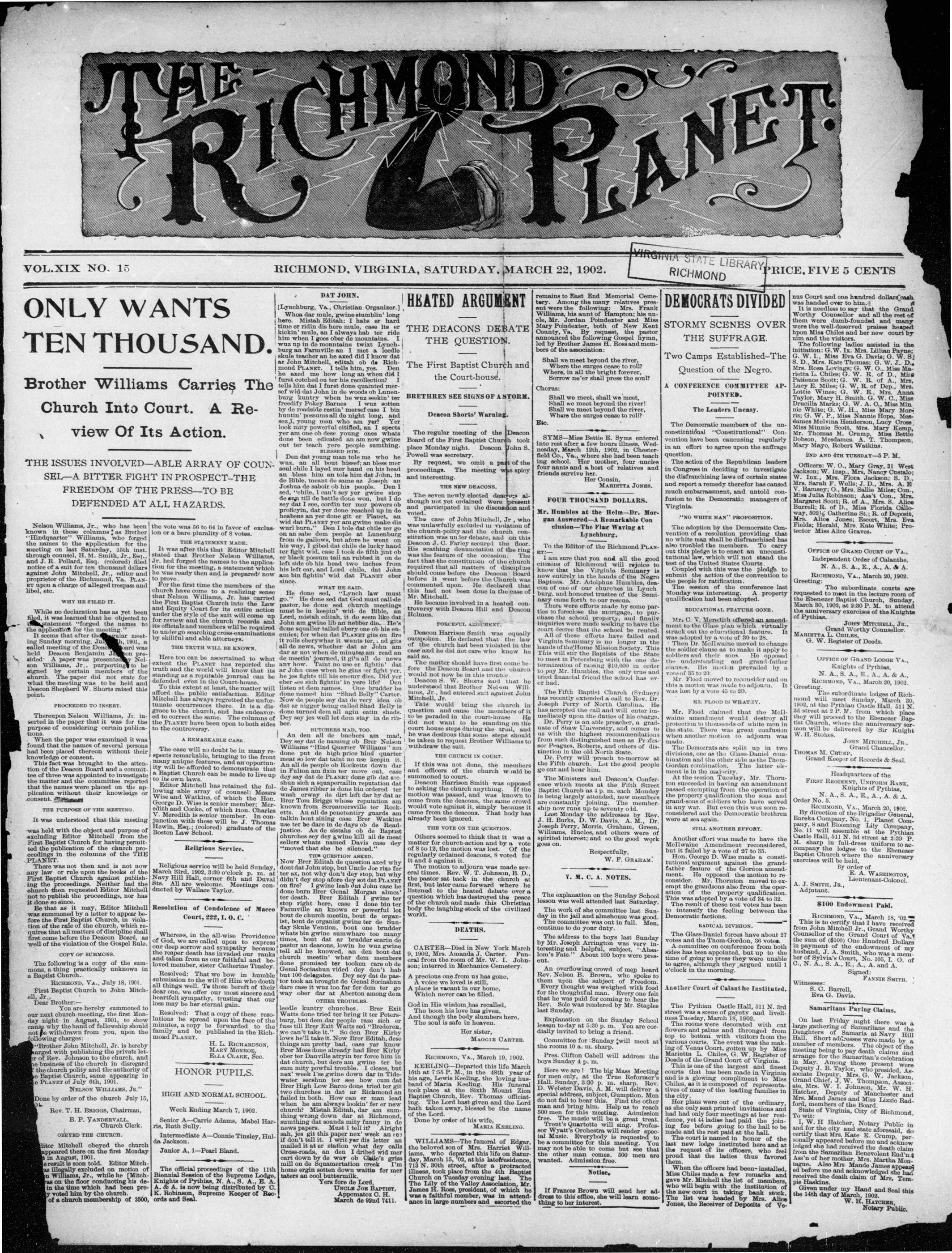
Nelson Williams, Jr., who has been known in these columns as Brother "Hindquarter" Williams, who forged the names to the application for the meeting on last Saturday, 15th institute, through counsel, H. M. Smith, Jr., Esq., and J. R. Pollard, Esq. (colored) filed notice of a suit for ten thousand dollars against John Mitchell, Jr., editor and proprietor of the Richmond, Va. PLANET upon a charge of alleged trespass and libel, etc.
WHY HE FILED IT.
While no declaration has as yet been filed, it was learned that he objected to the statement "forged the names to the application for the meeting." It seems that after the regular meeting Sunday morning, July 19, 1901, a called meeting of the Deacon Board was held Deacon Benjamin Jackson presided. A paper was presented by Nelly Williams Jr. purporting to be signed by certain members of the church. The paper did not state for what the meeting was to be held and Deacon Shepherd W. Shorts raised this point.
PROCEEDED TO INSERT.
Thereupon Nelson Williams, Jr. inserted in the paper that it was for the purpose of considering certain publications.
When the paper was examined it was found that the names of several persons had been placed thereon without their knowledge or consent.
This fact was brought to the attention of the Deacon Board and a committee of three was appointed to investigate the matter and the committee reported that the names were placed on the application without their knowledge or consent.
THE PURPOSE OF THE MEETING
It was understood that this meeting was held with the object and purpose of excluding Editor Mitchell from the First Baptist Church for activism, told the publication of the church proceedings in the columns of the THE PLANET.
There was not then and is not now any law or rule upon the books of the First Baptist Church against publishing the proceedings. Neither had the church then requested Editor Mitchell not to publish the proceedings, nor has it done so since.
Be that as it may, Editor Mitchell was directed by a letter to appear before the First Baptist Church, in violation of the rule of the church, which requires that all matters of discipline shall first come before the Deacon Board, as well of the violation of the Gospel Rule.
COPY OF SUMMONS.
The following is a copy of the summons, a thing practically unknown in a Baptist Church.
RICHMOND, VA., July 18, 1901.
First Baptist Church to John Mitchell, Jr.
Dear Brother:
You are hereby summoned to our next church-meeting, the first Monday night in August, 1901, to show cause why the hand of fellowship should not be withdrawn from you, upon the following charges:
"Brother John Mitchell, Jr. is hereby charged with publishing the private letter of Rev. Johnson to the church, and the business of the church in disregard of the church polity and the authority of the Baptist Church, same appearing in the PLANET of July 6th, 1901.
NELSON WILLIAMS, JR."
Done by order of the church July 15, 1901.
Rev. T. H. BRIGGS, Chairman.
OBEYRED THE CHURCH.
Editor Mitchell obeyed the church appeared there on the first Monday in August, 1901. The result is soon told. Editor Mitch was illegally excluded on motion of John Williams, Jr., while he [Mitchans on the floor conducting his de in the time which had been pre-ly voted him by the church.
of a church membership of 2500.
the vote was 56 to 64 in favor of exclusion or a bare plurality of 8 votes.
THE STATEMENT MADE.
It was after this that. Editor Mitchell stated that Brother Nelson Williams, Jr. had forged the names to the application for the meeting, a statement which he was ready then and is prepared now to prove.
For the first time the members of the church have come to a realizing sense that Nelson Williams, Jr. has carried the First Baptist Church into the Law and Equity Court for its entire action in the style of the suit will come up for review and the client records and its officials and members will be required to undergo searching cross-examinations by skillful and able attorneys.
THE TRUTH WILL BE KNOWN.
Here too can be ascertained to what extent the PLANET has reported the truth and the world will know that its standing as a reputable journal can be defended even in the Court-house. To this extent at least, the matter will afford the public satisfaction. Editor Mitch has always regretted the unfortunate occasion there. It is a disgrace to the church, and endeavored to correct the same. The columns of the PLANET have been open to both sides to the controversy.
A REMARKABLE CASE
The case will no doubt be in many respects remarkable, bringing to the front many unique features, and an opportunity will be afforded to demonstrate that a Baptist Church can be made to live up to its own laws.
Editor Mitchell has retained the following able array of counsel: Messrs Wise and Cocke, of which the Hon. George D. Wise, the honorary member; Meredith and Cocke, of which Hon. Charles V. Meredith is senior member; conjunction with these will be J. Thomas Hewin, Esq.; (colored) graduate of the Boston Law School.
Religious service will be held Sunday, March 23rd, 1902, 3:30 o'clock p. m. at Navy Hill Hall, corner 6th and Duval Sts. All are welcome. Meetings conducted by Wallace Taylor.
Resolution of Condolence of Maceo Court, 222, I. O. C.
Whereas, in the all-wise Providence of God, we are called upon to express our deep sorrow and sympathy because the reaper death has invaded our ranks and taken from us our faithful and beloved member, sister Catherine Tinsley.
Resolved: that we bow in humble submission to the will of Him who doeth all things well. To those bereft of their dear one, we offer our most sincere and heartfelt sympathy, trusting that our loss may be her eternal gain.
Resolved: that a copy of these resolutions be spread upon the face of the minutes, a copy be forwarded to the family and be published in the Richmond PLANET.
H. L. RICHARDSON,
MARY MONROE,
ELLA CLARK, Sec.
HONOR PUPILS.
HIGH AND NORMAL SCHOOL.
Week Ending March 7, 1902.
Senior A—Carrie Adams, Mabel Harris, Ruth Sully.
Intermediate A—Connie Tinsley, Hulda Jackson.
Junior A, 1—Pearl Bland.
The official proceedings of the 11th Biennial Session of the Supreme Lodge, Knights of Pythias, N. A., S. A., E. A. A. & A. is now being distributed by C. K. Robinson, Supreme Keeper of Records and Seal.
RICHMOND, VIRGINIA, SATURDAY, MARCH 22, 1902.
DAT JOHN.
[Lynchburg, Va., Christian Organizer.]
Who dar mar, gwine stumblin' long here.
Mistah Editah: I habs er hard time er idrin di here mule, case its er kickin' mule, an I always haw ter ride him when I goes ober de mountains.
I wuz up in de mountains twixt Lynchburg an Farmville an I met a beedle skule teacher an he axed did I know dat ar John Mitchell, edibah o de Richmond PLANET. I tells him, yes.
Den he axed me how long an when did I first catched on ter his recollection?
I tells him dat I fursed done quainted mersef wid dat John in de woods o bLunenburg kuntry when he wuz sekin' ter freefied Pokey Barnes. I wuz sotten by de roadside restin' mersef case I bin hunint' possums all de night long, and
sezJ. young man who am am yer' Yer
ter am am a diffrent yer am one ob dese yer ones whats done been edicated an now am now gwine out ter teach yere people sumthing.
BLESSED HIM.
Den dat young man tole me who he wuz, an all bout ihest; an bless mer soul chile I layed mer hand on his head an bless him an tole him dat John, in de Bible, meant de same az Joseph an Joshna de saboir ob his people. Den I sed, "chile, I can't say yer gwire stop de gill till de battle done won, but I do I sew, cordit in his power paw of proficyn, dat yer done reached up in de heabens an yer done git er Planet, an wid dat PLANET yer am gwine make dis wurl burn." Den I tole dat chile ter go on an sabe dem people at Lunenburg from de gallows, but afore he went on his way, I gibed dat chile de lucky hand ter fight wid, case I took de fifth jint ob er black possum tail an rubbed it on de his left ear, and Lord chile, dat John am bin fightin' wid dat PLANET eber since
WHAT HE SAID:
He done sed, "Lynch law must go." He done sed dat God must call de pastor, he done sed church meetings must be in keepin' wid de Bible, an Lord, mistah editah, it do seem like dat John am gwine lib an nebber死 he. He done squaller ebery one ob his enemies; for when dat PLANET gits on fire it rolls eberywhat it wants ter, ad gits all de news, whether dat ar John am dar ar not when de minutes am read an de meetin' journed, it gits all de news any how. Taint no use er fightin' dat ar John case when he gins er fight yer. he jes fights till his enemy dies. Did yer eber see sich fightin' in yere life? Den listen at dem names. One brudder he done named him. Shad Belly 'Carter. An eber being called Shad Belly is dat ar nigger being called Shad Belly is done den dem all again enshad. Dey sey jes well let dem stay in de riber.
BUTCHERS MAD. TOO.
An den all de buchers am mad, Dey sey dat de naming ob Brer Nelson Williams “Hind Quarter Williams” am done put de high price hind quarter meat so low daint no use keepin it. An all de people ob Rocketts down dar in Fulton am fixin ter move out, case say dey sat de PLANET done gib dat soshun sich a squpertailin reputation dat de James ribber is done bin ordered ter wash erway de dirt left dar by dat ar Brer Tom Briggs whose reputation am known from Screamersville ter Rocketts. An all de penetentiry guards am talkin bint zining case Brer Watkins use ter be dare in de days ob de Readjustice. An de sistahs ob de Baptist churches sey dey g wine kill all de meat sellers whats named Davis case dey “moved that he be silenced.”
THE QUESTION ASKED
QUESTION ASKED.
New Brer Editiné de question axed why dont dat John stop John, si lasi fas ter axer, not why don't dey stop, but wha didn't dny stop afore dey sot dat PLANET on fire? I gwine laeb dat John case he done burn Brer Egal Morgan almost' ter death. Brer Editin I gwine ter stop right here, case I done bin ter Farmville an knows er powerful lot bout de church meetin, bout de organist, bout de organist gwine ter de Sunday Skule Vention, bout one bruder whats bin gwine sumwhare too many times, but dat ar brudder scarin de tell he known, an he wuz gwine tell all he known, but both church meetin' whar dem menghave done promised ter tooken care ob de Genial Sociashun hued dey don't hab but 10 delegates. Dey sey de dastor took an brought de Genial Sociashun dare case it wuz too far fer dem ter go way ober at Arberton among dem
OTHER TROUBLES
leedle kuntry churches. Brer Exit Watts done tried ter bring it ter Petersburg, but dem dar people raze sich er fuss till Brer Exit Watts sed "Brederen, we can't take it." So den Brer Birky lows he'll take it. Now Brer Editah, des things am pretty bad, case yer know Brer Moss done already had Brer Kirby ober ter Danville atryin ter force him in dat church, but dere am gwine ter be sum mity powelf trouble. I closes, but nex' week I sew gwine down dar in Tidewater sechsm ter see how cum dat Brer High Low Barco done tried ter git two churches in dat ar Richmond an failed in both. How can er man lead when he am always lookin' fer er new church? Mistah Editah, dar am sumthing wrong down dar at Richmond, and sumthing wrong it, sumthing in de news papers. Must I tell it? sah, jsit this paper nex' week an je if don't tell it. I write yer dis letter an mailed it at er station what dey calls Cross-roads, an den Dj dibed wid mcr cart down by de way ob Chile's griss mill on de Squamertation creek I'm home ergin soften down waitis fer mer taters an cool buttermilk.
THE LORD
UNLEC JOB BAPIST,
Appomatox C 741.
March of 92nd H. 411.
HEATED ARGUMENT
THE DEACONS DEBATE
THE QUESTION.
The First Baptist Church and
the Court-house.
BRETHREN SEE SIGNS OF A STORM.
Deacon Shorts' Warning.
The regular meeting of the Deacon
Board of the First Baptist Church took
place Monday night. Deacon John S.
Powell was secretary.
By request, we omit a part of the
proceedings. The meeting was spicy
and interesting.
THE NEW DEACONS.
The seven newly elected denizens although not yet ordained were present and participated in the discussion and voted.
The case of John Mitchell, Jr., who was unlawfully excluded in violation of the church-polity and the church constitution was under debate, and on this Deacon J. C. Farley secured the floor. His scathing denunciation of the ring was the feature of the occasion. The fact that the constitution of the church required that all matters of discipline should come before the Deacon Board began it went before the Church was commented upon. He declared that this had not been done in the case of Mr. Mitchell.
He became involved in a heated controversy with Deacon Hill and Deacon Halmes.
FORCEFUL ARGUMENT.
Deacon Harrison Smith was equally outspoken. He declared that the law of the church had been violated in the case and he did not care who knew he said so.
The matter should have first come before the Deacon Board and the church would not now be in this trouble.
Deacon S. W. Shorts said that he understood that Brother Nelson Williams, Jr., had entered suit against John Mitchell, Jr.
This would bring the church in question and cause the members of it to be paraded in the court-house. He did not want to be standing on the court house steps during the trial, and he was desirous that some steps should be taken to request Brother Williams to withdraw the suit.
THE CHURCH IN COURT
If this was not done, the members and officers of the church would be summoned to court.
Deacon Harrison Smith was opposed to asking the church anything. If the motion was passed, and was known to come from the deacons, the same crowd would vote against it, simply because it came from the deacons. That body has already been ignored.
THE VOTE ON THE QUESTION
Others seemed to think that it was a matter for church-action and by a vote of 8 to 12, the motion was lost. Of the regularly ordained deacons, 8 voted for it and 5 against it.
The motion to adjourn was made several times. Rev. W. T. Johnson, B.D., the pastor sat back in the church at first, but later came forward where he listened to the heated debate over a question which has destroyed the peace of the church and made this Christian body the laughing-stock of the civilized world.
CARTER-Died in New York March 9, 1902, Mrs. Amanda J. Carter. Funeral from the room of Mr. W. I. Johnson; interred in Mechanics Cemetery.
A precious one from us has gone, A voice we loved is still, A place is vacant in our home, Which never can be filled.
God in His wisdom has recalled, The boon his love has given, And though the body numbers here, The soul is safe in heaven.
RICHMOND, VA., March 19, 1902.
KEELING—Departed this life March 16th at 7:55 P.M. in the 48th year of his age, Lewis Keeling, the loving husband of Maria Keeling. His funeral took place at the Sixth Mount Zion Baptist Church, Rev. Thomas officiating. The Lord hast given and the Lord hath taken away, blessed be the name of the Lord.
WILLIAMS—The funeral of Edgar, the beloved son of Mrs. Harriet Williams, who departed this life on Saturday, March 15, '02, at his late residence, 713 N. 30th street, after a protracted illness, took place from the 4th Baptist Church on Tuesday evening last. The Lily of the Valley Association, Mr. James H. Ross, president, of which he was a faithful member, was in attendance in large numbers and escorted the
remains to East End Memorial Cemetery. Among the many relatives present were the following; Mrs.; Frank Williams, his aunt of Hampton; his uncle, Mr. Jordan Poindexter and Miss Mary Poindexter, both of New Kent County, Va. By request, the pastor announced the following Gospel hymn, led by Brother James H. Ross and members of the association:
Sorrow ne'er shall press the soul!
Chorus:
Shall we meet, shall we meet,
Shall we meet beyond the river!
Shall we meet beyond the river,
Where the surges cease to roll?
Etc.
SYMS—Miss Bettio E. Syms entered into rest after a few hours illness. Wednesday, March 12th, 1902, in Chester-field Co., Va., where she had been teaching school. Her mother, four uncles four aunts and a host of relatives and friends survive her.
FOUR THOUSAND DOLLARS.
Mr. Humbles at the Helm—Dr. Morgan Answered—A Remarkable Conclusion—The Flag Waving at Lynchburg.
To the Editor of the Richmond PLANET—I am sure that you and all the good citizens of Richmond will rejoice to know that the Virginia Seminary is now entirely in the hands of the Negro Baptists. Mr. Adolphus Humbles, deacon of one of our churches in Lynchburg, and honored trustee of the Seminary came forth to our rescue.
There were efforts made by some parties to foreclose the mortgage, to purchase the school property, and finally inquiries were made seeking to have the property
All of these efforts have failed and Virginia Seminary is no longer in the hands of the Home Mission Society. This will stir the Baptists of the State to meet in Petersburg with the one determination of raising $10,000 in order to pay Mr. Humbles, the only true and tried financial friend the school has ever had.
The Fifth Baptist Church (Sydney) has recently extended a call to Rev. Dr. Joseph Perry of North Carolina. He accepted the call and will enter immediately upon the duties of his charge. Dr. Perry is an able preacher, a graduate of Shaw University, and comes to me with the highest load on him. Prissor Peagans, Roberts, and others of distinction in the old North State.
Dr. Perry will preach to-morrow at the Fifth church. Let the good people go out and hear him.
The Ministers and Descone's Conference which meets at the Fifth Street Baptist Church as 4 p., m. each Monday is being largely attended, new members are constantly joining. The membership now runs up to seventy old. Last Monday the addresses by Rev. J. H. Burks, D. W. Davis, A. M., Dr. Joseph Perry, Morris, Graham, Green, Williams, Hucles, and others were of spirited interest; and so the good work goes on.
Respectfully
W. F. GRAHAM.
Y. M. C. A. NOTES.
The explanation on the Sunday School lesson was well attended last Saturday.
The work of she committee last Sunday in the jail and almshouse was good.
The committee was out in full. Men, continue to do your duty.
The address to the boys last Sunday by Mr. Joseph Arrington was very interesting and helpful, subject, "Absalom's Fate." About 100 boys were present.
An overflowing crowd of men heard Rev. Nelson B. Brown, who spoke to them upon the subject of Freedom. Every thought was weighed with food for the thoughtful man. Everyone felt that he was paid for coming to hear the Rev. Solo was rendered by Mr. Staples last Sunday.
Explanation on the Sunday School lesson to-day at 5:30 p. m. You are cordially invited to bring a friend.
Committee for: Sunday will meet at the rooms 10 a. m. sharp.
Pres. Clifton Cabell will address the boys Sunday 4 p. m.
Here we are! The big Mass Meeting for men only, at the True Reformer's Hall. Sunday, 3:30 p. m. sharp. Rev. D. Webster Davis, A. M. will deliver a special address, subject, Gumption. Men do not fail to hear this. Find the other man and bring him. Help us to reach 500 men for this meeting. Admission free. The music will be a great treat. Trent's Quartette will sing. Professor Wyatt's Orchestra will render special Music. Everybody is requested to be a committee for this meeting. You may not be able to come but see that the other man comes. 500 men are wanted. Admission free.
If Frances Brown will send her address to this office, she will learn something to her interest.
DEMOCRATS DIVIDED
STORMY SCENES OVER
THE SUFFRAGE.
Two Camps Established-The
Question of the Negro.
A CONFERENCE COMMITTEE AP-
POINTED.
The Democratic members of the unconstitutional "Constitutional" Convention have been causing regularly in an effort to agree upon the suffrage question.
The action of the Republican leaders in Congress in deciding to investigate the disfranchising laws of certain states and report a remedy therefor has caused much embarrassment, and untold confusion to the Democratic managers of Virginia.
"NO WHITE MAN" PROPOSITION.
The adoption by the Democratic Convention of a resolution providing that no white man shall be disfranchised has also troubled the members. To carry out this pledge is to enact an unconstitutional law, which will not stand the test of the United States Courts. Conciliation with this was the pledge to submit the convention to the people for ratification. The session of the conference last Monday was interesting. A property qualification had been adopted.
EDUCATIONAL FEATURE GONE
Mr. C. V. Meredith offered an amendment to the Glass plan which virtually struck out the educational feature. It was adopted by a vote of 30 to 28. Then Dr. McIlwaine moved to change the soldier clause as to make it apply to soldiers and their sons. He opposed the understanding and grand-father clauses. His motion prevailed by a vote of 35 to 29. Mr. Flood moved to reconsider and on this a motion was made to adjourn. It was lost by a vote 45 to 20.
MR. FLOOD IS WRATHY.
Mr. Flood claimed that the McIlwaine amendment would destroy all protection to thousands of white men in the state. There was great confusion when another motion to adjourn was made.
The Democrats are split up in two divisions, one as the Glass-Damiel combination and the other side as the Thom-Gordon combination. The latter element is in the majority.
At the session Tuesday, Mr. Thornton succeeded in having an amendment exceeding from the operation of the property during the season in grand-sons of soldiers who have served in any war. But even this was soon reconsidered and the Democratic brethren were at sea again.
STILL ANOTHER EFFORT
Another effort was made to have the McIlwaine Amendment reconsidered, but it failed by a vote of 27 to 35.
Hon. George D. Wise made a constitutional argument against the grandfather feature of the Gordon amendment. He opposed the motion to reconsider. Mr. Thornton moved to exempt the grandons also from the operation of the property qualification. This was adopted by a vote of 34 to 32.
The result of these test votes has been to intensify the feeling between the Democratic factions.
RADICAL DIVISION.
The Glass-Daniel forces have about 27 votes and the Thom-Gordon, 36 votes. A committee on conference from both sides has been appointed, but up to the time of the vote, the committee was unable to agree, although they, argued until 1 o'clock in the morning.
The Pythian Castle Hall, 511 N. 3rd street was a scene of gayety and liveliness Tuesday, March 18, 1902. The rooms were decorated with cut flowers and palms and thronged from top to bottom with visitors from the various courts. The event was the making of Venus Court, gotten up by Miss Marietta L. Chiles, G. W. Register of Deeds of the Grand Court of Virginia. This is one of the largest and finest courts that has been made in Virginia and is a glowing compliment to Miss Chiles, as it is composed of representatives of many of the leading families in the city. Her plans were out of the ordinary, as she only sent printed invitations and had had only four meetings at her residence, and ladies had paid the joining fee before going to the hall to be made and the rest paid at the hall. The court is named in honor of the last new lodge instituted here and at the request of its officers, who feel proud that the ladies thus favored them.
When the officers had been installed, Miss Chiles made a few remarks and gave Mr. Mitchell the list of members, who will begin with the institution of the stock. The list was headed by Mrs. Jones, the Receiver of Deposits of Ve
nus Court and one hundred dollars cash
was handed over to him.4
It is needless to say that the Grand Worthy Counsellor and all the rest of them were dumb-founded and many were the well-deserved praises hooped upon Miss Chiles and her new court by um and the visitors.
The following ladies assisted in the induction of the Mrs. Lillis Brayn; G.W. I. Miss Eva G. Daynish; G.W. S. D. Mrs. Kate Thomas; G.W. J. D. Mrs. Rosa Lovings; G.W. O. Miss Marietta L. Chiles; G.W. R. of D., Miss Patience Scott; G.W. R. of A., Mrs. Lucy E. Miles; G.W. R. of Dep., Mrs. Lottie Wines; G.W. E., Mrs. Anna Taylor, Mary H. Smith; G.W. C., Miss Druncilla Marks; G.W. A. O., Miss Minnie White; G.W. H., Miss Mary Morrison; Miss Nannie Hope, Mesdames Melva Hine; Miss Minnie Scott, Mrs. Mary Kamp; Mr. Thomas M. Crump, Miss Bettie Dobson, Mesdames. A. T. Thompson, Mary Mayo, Robert Watkins.
2ND AND 4TH TUESDAY----5 P.M.
Officers: W. O., Mary Gray, 31 West Jackson; W. Insp., Nancy Custalo; W. Inx., Mrs. Flora Jackson; S. D. Mrs. Sarah F. Wells; J. D., Mrs. A. E V. Ramsey; O. Mrs. Sallie Miles; Con. Miss Julia Robinson; Ass't Con., Mrs. Margaret Scott; R. of A., Mrs. S. Alice Burrell; R. of D., Miss Florida Callaway 500; Catherine R.; R. of Deposit, Mrs. Alice Joeske Essert; Mrs. Eva Fields; Herald, Mrs. Kate White; Protector Miss Alice Graves.
OFFICE OF GRAND COURT OF VA.,
Independent Order of Calanthe,
N. A., S. A., E., A., A. & A.
RICHMOND, VA., March 20, 1902.
Greeting:
The subordinate courts are requested to meet in the lecture room of the Ebenezer Baptist Church, Sunday, March 30, 1902, at 2:30 P. M. to attend the anniversary exercises of the Knights
JOHN MITCHELL, JR.
Grand Worthy Counsellor.
MARIETTA L, CHILES.
G. W. Register of Deeds
OFFICE OF GRAND LODGE VA.,
Knights of Pythias,
N. A., S. A., E., A., A. & A.,
RICHMOND, VA., March 20, 1902.
Greeting.
The subordinate lodges of Richmond will meet Sunday, March 30,
1902, at the Pythian Castle Hall, 511 N.
3d street at 2 P. M. from which place
they will proceed to the Ebenezer Baptist Church, where the anniversary sermon will be delivered by Sir Knight
W. H. Stokes.
JOHN MITCHELL, JR.,
Grand Chancellor.
THOMAS M. CRUMP,
Grand Keeper of Records & Seal
N. A., S. A., E. A., A. & A.
Order No. 5.
RICHMOND, VA., March 20, 1903.
By direction of the Brigadier General,
Eureka Company, No. 1, Planet Company,
8 and Blooming Lily Company.
No. 11 will assemble at the Pythian
Castle Hall, 511 N. 3d street at 2:30 P.
M. sharp in full-dress uniform to
accompany the lodges to the Ebenezer
Baptist Church where the anniversary
exercises will be held.
By order of
E. A. WASHINGTON,
Lieutenant-Colonel.
A. J. SMITH, JR.,
Adiantant.
$100 Endowment Paid.
RICHMOND, VA., March 18, '02.
This is to certify that you have received from John Mitchell Jr., Grand Worthy Counsellor of the Grand Court of Va. the sum of ($100) One Hundred Dollars in payment of the endowment of my husband, J. A. Smith, who was a member of Sylvia's Court, No. 105, I. O. of C., N. A., S. A., E., A., A. and A.
Signed:
FANNIE SMITH.
Witnesses:
S. C. Burrell,
Eva G. Davis.
Samaritans Paying Claims.
On last Friday night there was a large gathering of Samaritans and the Daughters of Samaria at Navy Hill Hall. Short addresses were made by a number of members. The object of the meeting being to pay death claims and arrange for the Samaritan's celebration J. R. Taylor, who presided, Associate Deputy, G. W. Jackson, Grand Chief, J. W. Thompson, Associate, Mrs. W. I. Johnson, Mr. W. H. Hatcher, Deputy of Manchester and Mrs. Maud James and Miss Lizzie Radford, members of the Board. State of Virginia, City of Richmond. To wit:
I, W. H Hatcher, Notary Public in and for the city and state aforesaid, do certify that Mrs. Kate E. Crump, personally appeared before me and acknowledged she had received the death claim from the Samaritan Benevolent End'n't Ass'n of her mother, Mrs. Martha Montague. Also Mrs Maude James appeared before me and acknowledged she had received the death claim of Mrs. Tempie Haskins.
Given under my Hand and Seal this the 14th day of March, 1902.
W. H. HATCHER,
Notary Public.
Incidents of Former Coronations in England
Some of the Queen Ceremonies That Will Attend Edward's Crowning in June.
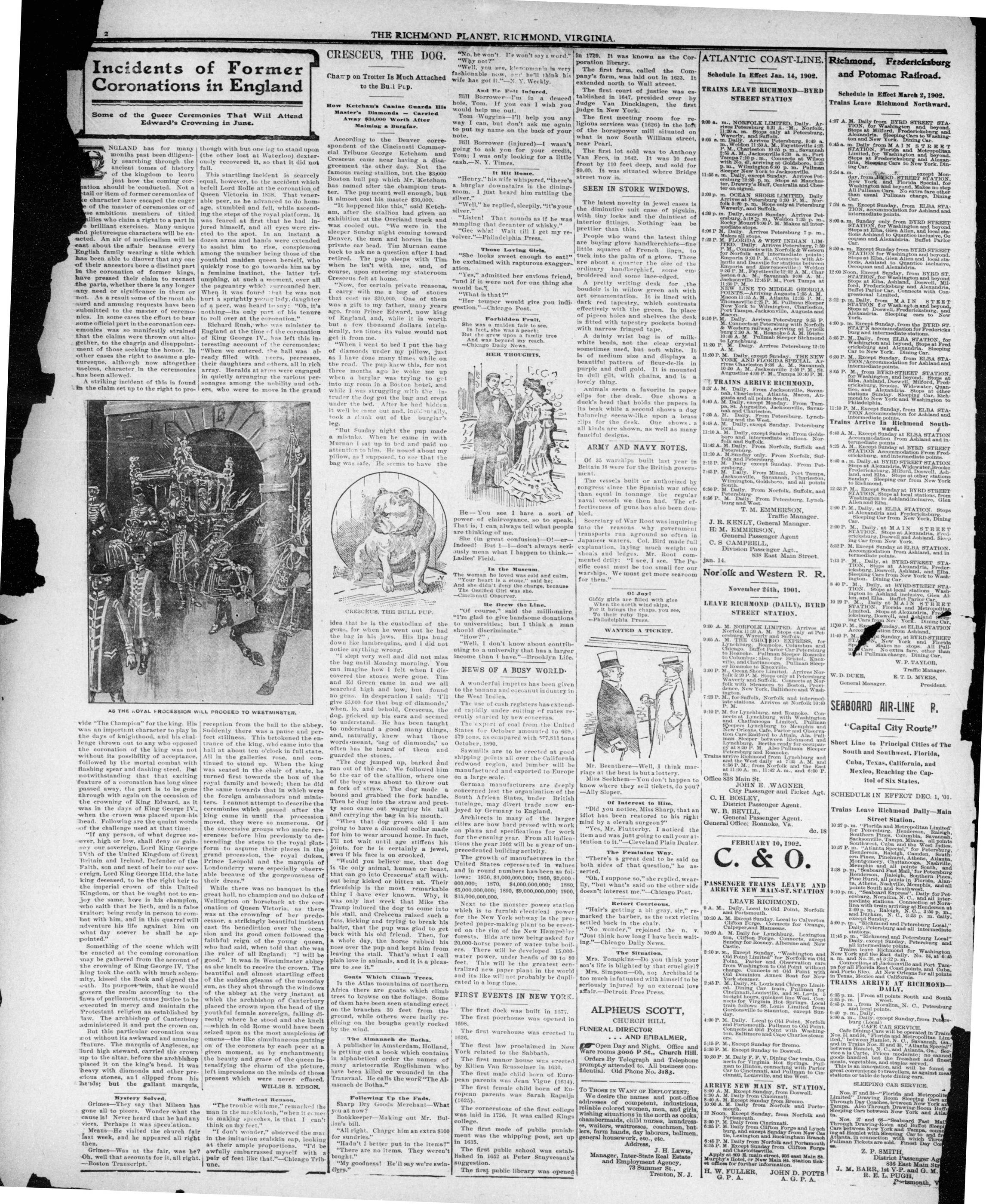
AS THE ROYAL PROCESSION WILL PROCEED TO WESTMINSTER.
[ ]
NGLAND has for many months past been diligently searching through the ancient tomes of history of the kingdom to learn just how the coming cor-
nation should be conducted. Not a detail or item of former ceremonies of like character have escaped the eager one of the master of ceremonies or of those ambitious members of titled chilies who claim a right to a part in the brilliant exercises. Many unique and picturesque characters will be enacted. An air of medievalism will be cast about the affair because every English family wearing a title which has been able to discover that any one of their ancestors bore a distinct part in the coronation of former kings, have pressed their claim to reenact the parts, whether there is any longer any need or significance in them or not. As a result some of the most absurd and amusing requests have been submitted to the master of ceremonies. In some cases the effort to bear some official part in the coronation ceremonies was so manifestly strained that the claims were thrown out altogether, to the chagrin and disappointment of those seeking the honor. In other cases the right to assume a picturesque, although now altogether useless, character in the ceremonies has been allowed.
A striking incident of this is found
in the claim set up to the right to pre-
AS THE ROYAL PROCESSION W
vide "The Champion" for the king. His was an important character to play in the days of knighthood, and his challenge thrown out to any who opposed the coronation of the king was not without its possibility of acceptance, followed by the mortal combat with flashing spear and dashing steed. But notwithstanding that that exciting feature of a coronation has long since passed away, the part is to be gone through with again on the occasion of the crowning of King Edward, as it was in the days of King George IV., when the crown was placed upon his head. Following are the quaint words of the challenge used at that time:
"If any person, of what degree soever, high or low, shall deny or gainey our sovereign, Lord King George Wth of the United Kingdom of Great Britain and Ireland, Defender of the Faith, son and next of heir to our sovereign, Lord King George IIId, the late king deceased, to be the right heir to the imperial crown of this United Kingdom, or that he ought not to enjoy the same, here is his champion, who saith that he lieth, and is a false traitor; being ready in person to combat with him, and in this quarrel will adventure his life against him on what day soever he shall be appointed."
Something of the scene which will be enacted at the coming coronation may be gathered from the account of the crowning of King George IV. The king took the oath with much solemnity, kissed the Book and signed the oath. Its purport was, that he would govern the realm according to the laws of parliament, cause justice to be executed in mercy and maintain the Protestant religion as established by law. The archbishop of Canterbury administered it and put the crown on. But this particular coronation was not without its awkward and amusing feature. The marquis of Anglesea, as lord high steward, carried the crown up to the altar, before the archbishop placed it on the king's head. It was heavy with diamonds and other precious stones, and slipped from his hands; but the gallant marquis
Mystery Solved
Grimes—They say that Milson has gone all to pieces. Wonder what the cause is! Never heard that he had any vices. Perhaps it was speculation.
Means—He visited the church fair last week, and he appeared all right then.
Grimes—Was at the fair, was he? Oh, well that accounts for it, all right.—Boston Transcript.
though with but one leg to stand upon (the other lost at Waterloo) dexterously recovered it, so that it did not fall.
This startling incident is scarcely equal, however, to the accident which befall Lord Rolle at the coronation of Queen Victoria in 1838. That venerable peer, as he advanced to do homage, stumbled and fell, while ascending the steps of the royal platform. It was feared at first that he had injured himself, and all eyes were riveted to the spot. In an instant a dozen arms and hands were extended to assist him to rise, conspicuous among the number being those of the youthful maiden queen herself, who quickly rose to go towards him as by a feminine instinct, the latter triumphing, at such a moment, over all the pageantry which surrounded her. When it was found that he was not hurt a sprightly young lady, daughter of a peer, was heard to say: "Oh, it's nothing—its only part of his tenure to roll over at the coronation."
Richard Rush, who was minister to England at the time of the coronation of King George IV, has left this interesting account of the ceremonies: "When we entered, the hall was already filled with peers, percesses, their daughters and others, all in rich array. Heralds at arms were engaged in quietly arranging the various personages among the nobility and others, who were to move in the grand
WILL PROCEED TO WESTMINSTER.
reception from the hall to the abbey. Suddenly there was a pause and perfect stillness. This betokened the entrance of the king, who came into the hall at about ten o'clock in full state. All in the galleries rose, and continued to stand up. When the king was seated in the chair of state, he turned first towards the box of the royal family and bowed; then he did the same towards that in which were the foreign ambassadors and ministers. I cannot attempt to describe the ceremonies which passed after the king came in until the procession moved, they were so numerous. Of the successive groups who made reverences before him previously to descending the steps to the royal platform to assume their places in the grand procession, the royal dukes, Prince Leopold and the marquis of Londonderry were especially observable because of the gorgeousness of their dress."
While there was no banquet in the great hall, no champion and no duke of Wellington on horseback at the coronation of Queen Victoria, as there was at the crowning of her predecessor, a strikingly beautiful incident cast its benediction over the occasion and its good omen followed the faithful reign of the young queen, who had said, when told that she was the ruler of all England: "I will be good." It was in Westminster abey as she knelt to receive the crown. The beautiful and almost startling effect of the sudden gleams of the noonday sun, as they shot through the windows of the abbey at the very instant at which the archbishop of Canterbury placed the crown upon the head of the youthful female sovereign, falling directly where he stood and she knelt—which in old Rome would have been seized upon as the most auspicious of omens—the like simultaneous putting on of the coronets by each peer at a given moment, as by enchantment; the beauty and grace of the queen intensifying the charm of the picture, left impressions on the minds of those present which were never effaced.
WILLIS S. EDSON
Sufficient Reason
"The trouble with me," remarked the man in the muckintosh, "when it comes to making speeches, is that I can't think on my feet."
"I don't wonder," observed the man in the imitation sealskin cap, looking at their ample proportions. "I'd be awfully embarrassed myself with a pair of feet like that."—Chicago Tribune.
THE RICHMOND PLANET, RICHMOND, VIRGINIA
CRESCEUS, THE DOG.
Champ on Trotter Is Much Attached to the Bull Pup.
How Ketcham's Canine Guards His Master's Diamonds — Carried Away $30,000 Worth After Maiming a Burglar.
According to the Denver correspondent of the Cincinnati Commercial Tribune George Ketcham and Crescue came near having a disagreement the other day. Not the famous racing stallion, but the $3,000 Boston bull pup which Mr. Ketcham has named after the champion trotter. The pup meant well enough, but it almost cost his master $30,000.
"It happened like this," said Ketcham, after the stallion had given an exhibition at the Overland track and was cooled out. "We were in the sleeper Sunday night coming toward Denver, the men and horses in the private car head. Tim Murnan came back to ask me a question after I had retired. The pup sleeps with Tim when he isn't with me, and, of course, upon entering my stateroom Cresceus felt at home.
"Now, for certain private reasons, I carry with me a bag of stones that cost me $30,000. One of them was a gift to my father, many years ago, from Prince Edward, now king of England, and, while it is worth but a few thousand dollars intrinsically, ten times its value would not get it from me.
"When I went to bed I put the bag of diamonds under my pillow, just as I have done many times while on the road. The pup knew this, for not three months ago he woke me up when a burglar was trying to get into my room in a Boston hotel, and while I was struggling with the intruder the dog got the bag and crept under the bed. After he had hidden it well he came out and, incidentally, took a chink out of the burglar's leg.
"But Sunday night the pup made a mistake. When he came in with Murnan I sat up in bed and paid no attention to him. He nosed about my pillow, as I supposed, to see that the bag was safe. He seems to have the
CRESCEUS. THE BULL PUP
idea that he is the custodian of the gems, for when he went out he had the bag in his jaws. His lips hung down like lambrequins, and I did not notice anything wrong.
"I slept very well and did not miss the bag until Monday morning. You can imagine how I felt when I discovered the stones were gone. Tim and Ed Green came in and we all searched high and low, but found no gems. In desperation I said: 'I'll give $5,000 for that bag of diamonds', when lo, and behold, Cresseus, the dog, pricked up his ears and seemed to understand. He has been taught to understand a good many things, and, naturally, knew what those words-meant, 'bag of diamonds,' so often has he heard of them and guarded the stones.
"The dog jumped up, barked and ran out of the car. We followed him to the car of the stallion, where one of the boys was about to throw out a fork of straw. The dog made a bound and grabbed the fork handle. Then he dug into the straw and pretty soon came out wagging his tail and carrying the bag in his mouth.
"When that dog grows old I am going to have a diamond collar made for him to wear around home. In fact, I'll not wait until age stiffens his joints, for he is certainly a jewel, even if his face is on crooked."
"Would you believe me, that dog is the only animal, human or beast, that can go into Cresceus' stall without being kicked or bitten at. Their friendship is the most remarkable thing I have ever known. Why, it was only last week that Mike the Tramp induced the dog to come into his stall, and Cresceus raised such a fuss, kicking and trying to break his halter, that the pup was glad to get back with his old friend. Then, for a whole day, the horse rubbed his nose over the pup and kept him from leaving the stall. That's what I call plain love in animals, and it is a pleasure to see it."
Goat Which Climb Treas
In the Atlas mountains of northern Africa there are goats which climb trees to browse on the foliage. Some of them have been seen standing erect on the branches 30 feet from the ground, while others were lazily reclining on the boughs gently rocked by the wind.
The Almanach de Rotha
A publisher in Amsterdam, Holland, is getting out a book which contains in alphabetical order the names of many aristocratic Englishmen who have been killed or wounded in the Transvaal. He calls the work "The Almanach of Botha."
"My goodness! He'll say we're swindlers."
"No, he won't. He won't say a word."
"Why not?"
"Well, you see, kleptomania is very fashionable now, and he'll think his wife has got it."—N. Y. Weekly.
And He Felt Injured.
Bill Borrower—I'm in a deuced hole, Tom. If you can I wish you would help me out.
Tom Wuggins—I'll help you any way I can, but don't ask me again to put my name on the back of your note.
Bill Borrower (injured)—I wasn't going to ask you for your credit, Tom; I was only looking for a little cash.—N. Y. Times.
It Hit Home
"Henry," his wife whispered, "there's a burglar downstairs in the dining-room. I just heard him rattling the silver." "Well," he replied, sleepily, "it's your silver." "Listen! That sounds as if he was sampling that decanter of whisky." "Gee whiz! Wait till I get my revolver."—Philadelphia Press
Those Loving Girls
"She looks sweet enough to eat!" he exclaimed with rapturous exaggeration.
"Yes," admitted her envious friend, "and if it were not for one thing she would be." "What is that?"
"Her temper would give you indigestion."—Chicago Post.
Forbidden Fruit.
She was a maiden fair to see.
In fact, she was a peach;
But she grew upon a family tree
And was beyond my reach.
—Chicago Daily News.
HER THOUGHTS.
A
He—You see I have a sort of power of clairvoyance, so to speak. That is, I can always tell what people are thinking of me.
She (in great confusion)—O!—er—Indeed! But 1—1—don't always seriously mean what I happen to think.—Ladies' Field.
In the Museum
"I loved was ced and calm.
"Your heart is gone," said he;
and she did not bump the charge, because
The Ossified Girl was she.
-Cincinnati Observer
He drew the Line
"Of course," said the millionaire "I'm glad to give handsome donations to universities; but I think a man should discriminate."
"How?".
"Well, I don't know about contributing to a university that has a larger income than I have."—Brooklyn Life.
NEWS OF A BUSY WORLD
A wonderful impetus has been given to the banana and coconut industry in the West Indies. The use of cash registers has extended rapidly under cutting of rates recently started by new concerns. The export of coal from the United States for October amounted to 669,579 tons, as compared with 577,811 tons October, 1890. Sawmills are to be erected at good shipping points all over the California redwood region, and lumber will be manufactured and exported to Europe on a large scale. German manufacturers are deeply concerned lest the organization of the South African States, under British tutelage, may divert trade now enjoyed by Germany to England.
Architects in many of the larger cities are now hard pressed with work on plans and specifications for work for the ensuing year. From all indications the year 1902 will be a year of unprecedented building activity.
The growth of manufactures in the United States represented in values and in round numbers has been as follows: 1850, $1,000,000,000; 1860, $2,000,000,000; 1870, $4,000,000,000; 1880, $5,000,000,000; 1890, $9,000,000,000; 1900, $15,000,000,000.
Next to the monster power station which is to furnish electrical power for the New York subway is the projected paper-making plant to be erected on the rim of the New Hampshire forests. Bids are now being asked for 20,000 horse power of water tube boilers. There will be developed 15,000 water power, under heads of 30 to 80 feet. This will be the greatest centralized new paper plant in the world and its like will not probably be duplicated in a long time.
FIRST EVENTS IN NEW YORK.
The first dock was built in 1677.
The first poorhouse was opened in
1698.
The first warehouse was erected in
1626.
The first law proclaimed in New
York related to the Sabbath.
The first manor house was erected by Kilien Van Reusselner in 1630. The first male child born of European parents was Jean Vigue (1614). The first female child born of European parents was Sarah Rapalja (1625). The cornerstone of the first college was laid in 1756. It was called Kings college. The first mode of public punishment was the whipping post, set up in 1635. The first public school was established in 1652 at Peter Stuyvesant's suggestion. The first public library was opened
in 1729. It was known as the Corporation library.
The first farm, called the Company's farm, was laid out in 1633. It extended north to Wall street.
The first court of justice was established in 1647, presided over by Judge Van Dineklagen, the first judge in New York.
The first meeting room for religious services was (1626) in the loft of the horsepower mill situated on what is now South William street, near Pearl.
The first lot sold was to Anthony Van Fees, in 1642. It was 30 feet front by 110 feet deep, and sold for $9.60. It was situated where Bridge street now is.
SEEN IN STORE WINDOWS.
The latest novelty in jewel cases is the diminutive suit case of pigskin, with tiny locks and the daintiest of interior fittings. Nothing can be prettier than this.
People who want the latest thing are buying glove handkerchiefs—fine little squares of French linen, to tuck into the palm of a glove. These are about a quarter the size of the ordinary handkerchief, some embroidered and some lace-edged.
A pretty writing desk for the boudoir is in willow green ash with art ornamentation. It is lined with dark red tapestry, which contrasts effectively with the green. In place of pigeon holes and shelves the desk is fitted with tapestry pockets bound with narrow fringed tape.
A dainty wrist bag is of milk-white beads, not the clear crystal sometimes used, but soft white. It is of medium size and displays a beautiful pattern of fleur-de-lis in purple and dull gold. It is mounted in dull gilt, with chains, and is a lovely thing.
Animals seem a favorite in paper clips for the desk. One shows a duck's head that holds the papers in its beak while a second shows a dog balancing seesaw-like upon a brass clips for the desk. One shows a all kinds are shown, as well as many fanciful designs.
ARMY AND NAVY NOTES
Of 35 warships built last year in Britain 18 were for the British government.
The vessels built or authorized by congress since the Spanish war more than equal in tonnage the regular naval vessels we then had. The effectiveness of guns has also been doubled.
Secretary of War Root was inquiring into the reasons why government transports run around so often in Japanese waters. Col. Bird made full explanation, laying much weight on shoals and ledges. Mr. Root commented drily: "I see, I see. The Pacific coast must be too small for our warships. We must get more searoom for them."
O! Joy!
Giddy girls are filled with glee
When the new wind skips,
For it brings the ships, you see,
To their ruby lips.
-Philadelphia Press.
Mr. Beenthere—Well, I think marriage at the best is but a lottery. Miss Seekhem—You don't happen to know where they sell tickets, do you?—Ally Sloper.
Of Interest to Him
"Did you notice, Miss Sharp, that an idiot has been restored to his right mind by a cleavah surgeon?" "Yes, Mr. Flutterby, I noticed the item and was just going to call your attention to it." —Cleveland Plain Dealer.
The Feminine Way
"There's a great deal to be said on both sides of that question," he asserted.
"Oh, I suppose so," she replied, wearily, "but what's said on the other side doesn't interest me."—Chicago Post.
Retort Courtsour
"Hair's getting a bit gray, sir," remarked the barber, as the next victim settled back in the chair.
"No wonder," rejoined the n. v.
"Just think how long I have been waiting."
-Chicago Daily News.
The Situation
Mrs. Tompkins—Do you think your son's life is blighted by that cruel girl? Mrs. Simpson—Oh, no; Archibald is too much infatuated with himself to be seriously injured by an external love affair—Detroit Free Press.
Open Day and Night. Office and Ware rooms 3006 P St., Church Hill. Orders By Telegraph and Telephone promptly attended to. All business confidential. Old Phone No. 3183.
TO THOSE IN WANT OF EMPLOYMENT:
We desire the names and post-office addresses of competent, industrious, reliable colored women, men, and girls, wishing situations in the north as cooks, chambermaids, child nurses, laundresses, waiters, waitresses, coachmen, butlers, farm hands, day laborers, bellmen, general housework, etc., etc.
Address,
J. H. LEWIS,
Manager, Inter-State Real Estate and Employment Agency,
73 Summer St.,
Trenton, N. J.
ATLANTIC COAST-LINE.
Schedule In Effect Jan. 14, 1902.
TRAINS LEAVE RICHMOND—BYRD
STREET STATION
9:00 a. m., NORFOLK LIMITED, Daily. Ar-
rives Petersburg 9:31 A. M., Norfolk,
11:20 a. m., N. Bogus at Petersburg,
Waverly, and Suffolk.
0:05 a. m. Daily. Arrives Petersburg. 0:49 a. m. w. Meldon 11:00 a. M. Fayetteville 4:25 a. m. Jacksonville 5:00 a. m. Savannah 2:55 a. M. Jacksonville 6:30 Tampa 7:10 p. m. connects at Wilson with No. 4, arriving at Goldsboro, 3:25 w. Meldon, arriving at Sleeper New York to Jacksonville.
11:55 a. m. Daily, except Sunday. Arrives Petersburg 12:35 p. m. Stops at Manchester, Drewery's Bluff, Centralia and Chester on signal.
3:00 p. m. OCEAN SHORE LIMITED. Daily Arrives Petersburg 3:30 p. M. Norfolk 5:20 p. m. Stops only at Petersburg Waverley, and Suffolk.
4:30 p. m. Daily, except Sunday. Arrives Petersburg, 5:18 p. m. Weldon 7:35 p. m. Rocky Mount 9:00 p. M. Makes all intercourse calls.
6:00 P. M. Daily. Arrives Petersburg 5 p. m. Makes all stops.
7:38 P. M. FLORIDA & WEST INDIAN LIM-
MER 7:38 P. M. Connects to Bakersfield, 7:56
P. M. Connects with Norfolk, 7:56
P. M. Connects with Norfolk, 7:56
P. M. Connects with Norfolk, 7:56
Emporia 9:30 P. M. (Connects with At-
lanta, Emporia and Saundersville). Weddow
9:30 P. M. Fayetteville 12:32 A. M. Char.
9:30 P. M. Savannah 9:6 A. M. Char.
Jacksonville 9:6 P. M. Port Tampa at
11:30 P. M.
NEW LINE TO MIDDLE GEORGIA
PITCHER, Augusta 7.255 A. M. M.
Macon 11.15 A. M. M. Thomasville 2.25 P. M. Pullman Sleeper
New York to Wilmington, Charleston,
Port Tampa, jacksonville, Augusta and
Macon.
9:10 P. M. Daily, Petersburg 9:55 P. M.
Davis, Petersburg 9:55 P. M.
& Western railway, arriving at Lynch
burg 2:30 A. M. Rounek 5 A. M. Bristow
10:30 A. M. Ramab Sleeper Richmond
to Lynchburg
11:30 P. M. Daily, Petersburg 12:10 P.
11:50 P. M. Daily, except Sunday. THE NEW
YORK AND FLORIDA SPECIAL. Arrives
Charleston 9:30 A. M. Savannah
10:30 A. M. Savannah Augustine 4:00 P. M. Tampa 10:40 P. M.
TRAINS ARRIVE RICHMOND
3:57 A.M. M. Daily. From Jacksonville, Svang-
town, FL. To Mason, Macon, Augusta and all points south. M.
6:40 A. M. Daily, except Monday. From Tam-
saw and Chippewa, Jacksonville, Savan-
nah and Chippewa.
7:35 A. M. Daily. From Petersburg, Lynch-
burg and the West.
8:48 A. M. Daily, except Sunday. Petersburg
local.
11:10 A. M. Daily, except Sunday. From Golds-
boro and intermediate stations. Norfolk
and Suffolk.
11:42 A. M. Daily. From Norfolk, Suffolk and
Petersburg.
11:10 A. M. Sunday only. From Norfolk, Suff-
folk and Petersburg.
2:15 P. M. Daily, except Sunday. From Petersburg.
7:45 P. M. Daily from Miami, Port Tampa,
Jacksonville, Pennamh, Charleston,
Wilmington, Goldsboro, and all points
South.
6:50 P. M. Daily from Norfolk, Suffolk, and
Petersburg.
8:56 P. M. Daily. From Petersburg, Lynch-
burg and West.
T. M. EMMERSON,
Traffic Manager.
J. R. KENLY, General Manager.
H: M. EMMERSON,
General Passenger Agent
C. S. CAMPBELL,
Division Passenger Agt.,
S88 East Main Street.
jan. 14.
Nor.olk and Western R. R.
November 24th, 1901.
LEAVE RICHMOND (DAILY), BYRD
STREET STATION.
9:00 A. M. NORFOLK LIMITED. Arrives at
Petersburg, Wavley and Suffolk.
9:05 A. M. THE CHICAGO EXPRESS, for Lynchburg, Roanoke, Columbus and Chicago. Buffet Parlor Car Petersburg to Roanoke. Fullman Sleeper Roanoke to Jamestown, for Bristol, Knoxville, and Chattanooga. Fullman Sleeper Roanoke to Knoxville.
3:00 P. M., Ocean Shore Limited. Arrives Norfolk
3:30 P. M. St. stops only at Petersburg
Wayne, Md. Arrives Norfolk with Steamers to Boston,
Providence, New York, Baltimore and Washington
7:23 P. M. For Suffolk, Norfolk and interm-
mediate stations. Arrives at Norfolk 10:40 P. M.
9:10 P. M. for Lynchburg, and Roanoke. Con-
tains Lynchburg and Lynchburg with Washington
and Chattanooga. Arrives at Lynchburg.
Sleeps Lynchburg to Memphis and
Cafe, Parlor and Observation
Cars Radar and Television. Sleeps Lynchburg between Lynchburg, Berths ready for occupancy
with the Allman Sleeper Petersburg and Roanoke.
Trains arrive Richmond from Lynchburg and
and the West daily at 7:35 A. M. and
8:30 A. M.; from Norfolk and the East at
11:10 A. m., 11:42 A. m., and 6:50 P. m.
Office S88 Main St.
JOHN E. WAGNER,
City Passenger and Ticket Agt.
C. H. BOSLEY,
District Passenger Agent.
W. B. BEVILL,
General Passenger Agent.
General Office: Roanoke Vg.
dc.18
FEBRUARY 10, 1902.
C. & O.
PASSEGGER TRAINS LEAVE AND
ARRIVE NEW MAIN-ST. STATION
LEAVE RICHMOND.
9 A. M., Daily, Local to Old Point, Norfolk
and Portsmouth.
10:10 A. M. Except Sunday, Local to Calverton
and Clifton. Connects to Orange,
Culpeper and Manasquan.
10:20 A. M. Daily for Lynchburg, Lexington
and Clifton Forge. Connects, except
for Rosney, Alberene and New
Castle.
2:10 P. M., Except Sunday, "Washington and
Norfolk" limited for Norfolk via Old
Point. Patrol from Washington to Old Point, without
change. Connects at Old Point with
Old Dominion Annex Boat for New
York steam.
2:45 P. M., Daily. St. Louis and Chicago Limit.
In Caring Car train, Pullman for
Cincinnati. Limit. New York. Limit.
to eight hours, quickest line West.
Connects for Virginia Hot Springs. Local
train follows St. Louis Limited from
Gardenville to Staunton, except Sun-
day.
4:00 P. M., Daily. Local to Old Point, Norfolk
and Portsmouth. Pullman to Old Point.
Connects at Old Point with Washing-
ton to Baltimore and Cape Charles steam-
ers.
5:15 P. M., Except Sunday for Bremo.
5:30 P. M., Except Sunday to Doswell.
10:30 P. M., Daily F. F., V. Dining Car train, Car
connects for Virginia Hot Springs. Pull-
man to Hinton, connecting with Parlor
Car to Cincinnati, and Pullman to Cincinnati, Louisville, and the West.
ARRIVE NEW MAIN ST. STATION.
8:30 A. M. Except Sunday, from Doswell.
8:40 A. M. Daily from Cincinnati.
8:40 A. M. Except Sunday from Bremo.
10:00 A. M. Daily from Norfolk and Port-
smouth.
12 Noon. Except Sunday, from Norfolk and
Portsmouth.
3:30 P. M., Daily. Cincinnati.
6:35 P. M. Daily from Clifton Forge and Lynch
burg, and except Sunday from New Gas
the Lexington and Buckingham Branch
6:45 P. M. Daily from Norfolk and Portsmouth
8:15 P. M. Except Friday from Clifton Forge
and Charlottesville.
Apply at 893 E. main street, 003 east Main St.
Murphy's Hotel, or New Main St. Station ticket
offices for further information.
H. W. FULLER, JOHN D. POTTS
G. P. A. A. G. P. A.
6:40 A. M., Except Sunday at ELBA STATION
Accommodation from Ashland and intermediate
points.
8:25 A. M., Except Sunday at BYRD STREET
STATION Accommodation from Frederickburg,
and intermediate points.
8:40 a. m., Daily at BYRD STREET STATION
Accommodation at Widwater, Brooke
Frederickburg, Milford, Allam,
and Elba. Stops at other stations
Sunday. Sleeping car from New York
to Richmond.
12:58 P. M., Except Sunday at BYRD STREET
STATION, Stops at local stations, from
Washington to Ashland inclusive, Glen
Allen and Elba.
2:00 P. M., Daily, at ELBA STATION. Stops
at Alexandra and Frederickburg,
sleeping car from New York, Dining
Car.
2:00 P. M., Daily, at MAIN STREET
STATION. Stops at Alexandra, Frederickburg,
Doswell and Ashland. Sleep in
New York.
5:52 P. M., Except Sunday, ELBA STATION.
Accommodation from Ashland, and in
intermediate points.
7:13 P. M., Daily, at BYRD-STREET STATION,
Berkshire, Lexington, Frederick,
Buckingham, Dorset, New York,
Sleeping Cars from New York to Washington
Dining Car
8:40 P. M., Daily, at BYRD-STREET STATION.
Stops at local stations Washington,
Oakland inclusive, Glen Alken and
Easton.
10 29 P. M., Daily at MAIN STREET
CENTER. Florida and Metropolitan
Station. New York, Grand
lakesburg, Doswell, and
sleeping Cars from New York. Dining Car,
11 500 P. M., Excursion Sunday, at ELBAS STATION
Accordeon from Ashland,
11 40 P. M., Excursion Sunday, at BYRD STREET
STATION, New York, Grand
Speak, Makes no stops. All Fulllum
Care. No extra fare, other than
uphall Pullman charge, Dining Car,
W. P. TAYLOR,
Traffic Manager.
W. D. DUKE, E. D. T. MYERS,
General Manager. President.
W. D. DUKE, E. T. D. MYERS,
General Manager. President.
SEABOARD AIR-LINE R.
"Capital City Route"
Short Line to Principal Cities of The
South and Southwest, Florida,
Cuba, Texas, California, and
Mexico, Reaching the Cap-
itol of Six States.
SCHEDULE IN EFFECT DEC. 1, '01.
10:37 p. m. "Florida and Metropolitan Limited"
"Florida," Burge, Henderson, Raleigh,
Southern Pine, Tampa, Sacksonville, Tampa, Miami, all points,
Cuba, Cuba and the West Indies.
10:37 p.
10.5. 1. in "Atlanta special," for Petersburg
Henderson, Raleigh, Camden, Southern
Pines, Pinehurst, Athens, Atlanta,
Montgomery, Chattanooga, Nashville,
Missouri
Memphis and all points South, and
p. Seaboard and all points Petersburg
Raleigh, South Raleigh, South
Pine Hurst, all points in Florida, Ala-
nano, all points in Florida, and all
points South and Southwest.
9:10 p. m., "Seaboard Express" Daily for Pet
town, C. and all intermediate stations. Convenient
northernline with train arriving at Henderson
2:00 p. m., Raleigh, N. G. 3:50 p. m., daily
m. C. 3:58 p. m., daily
except Sunday.
5:00 p. m., "Richmond and Petersburg Local"
Daily, Petersburg and all intermediate
11:45 p. m., "Richmond and Petersburg Local"
Daily, except Sunday, Petersburg and
all intermediate points.
Trains leave Richmond for Washington, New York and the East daily. No. 34, at 6:45 a. m. and No. 35, at 3:12 p. m. and at Jacksonville and Port Tampa for all day points, and Cuba, and Porto Rico. At New Orleans for all points in Texas, Mexico and California.
TRAINS ARRIVE AT RICHMOND — DAILY.
6:35 p. m. | From all points South and South 6:35 p. m. | west.
5:45 p. m. | from Norwalk, N. C., Petersburg and local points.
9:40 p. m. | Daily.
8:00 a. m. | Daily, except Sunday, from Petersburg.
CAFE CAR SERVICE.
Cafe Dining-Cars will be operated in Trains Nos. 31 and 34 "Florida and Metropolitan Limits" between Hamlet, N. C., Savannah, Ga., and Porto Rico. Cafe Car Service "Special" between Hamlet, N. C., and Atlantic City vice a la Carte, Prices moderate; no canned good handled, but the freshest and finest meat, vegetables.
This is an innovation, and will be found a great convenience to travellers, as against meat
SLEEPING CAR SERVICE
Nos. 37 and 34" Florida and Metropolitan
Limousine Room Sleeping Cars are
Through Day Coachs and Through
Tampa. Also Through Drawing-Room Buffet
Sleeping Cars between New York and Atlas
Nos. 27 and 66 "Seaboard Fast Mail Through Drawing-Droom and Buffet Sleepy Care between New York and Tampa, connexing at Hamlet with Shiloh and Fr. Atlanta, in connection with which Pullman Tickets are sold. Finest Day Cost 65.
Z. P. SMITH,
District Passenger Agent
836 East Main St
J. M. BARR, 1st V.P. and G. M.
R. E. L. PUGH,
Portsmouth, V.
MASTER and SLAVE By... T. H. THORPE
Copyright, 1901, by T. H. Thorpe.
CHAPTER XVIII.
DURESS.
DESPITE the protest and entreaty of Estelle the feeble invalid responded to the summons of Quillebert to a meeting at the old cabaret. He dared not disobey, though the journey was made with pain of body and mental misgiving. He had vaguely connected Evariste's last visit to his house with impanding catastrophe, for Estelle had since been more depressed, more resilient and even more tenderly solicitous in her watchfulness over him, but he feared to question and was left in ignorance of what had occurred. At the cabaret he was ushered by Dede into the familiar rear room, where Quillebert and Evariste awaited him at the baize covered table. Evariste was smoking a fragrant Cuban cigar. One glass and a bottle were before Quillebert, who was doggedly drunk. Lattolids was received with ominous coldness. No glass was offered him. He lacked courage to ask for one.
"Leonidas, settling day has come," said Quillebert, with brutal abruptness, terminating an embarrassing silence.
"What? How. Constant?" Lautiolais asked, shaking as if with an ague.
"What? Your indebtedness to me. How? In money. Pay me the money."
"Now?"
"Yes. now. It is past due. You have had more time than I ever asked of a creditor."
"But the notice is so short. Constant."
"So is my time. Leonidas."
"My debt is large."
"I know that to my sorrow."
"Then the property must answer." "Oh, Constant, my friend, spare me!" groomed the unhappy man. "Leonidas, my very dear friend, I have not time. My other dear friends, Americans and Christians, are pressing upon me inducements to return to France which really I cannot resist. We are getting old, you and I. Just think of it, I am older than you! I may not live to come back to this paradise, and therefore my affairs here must be closed up just as if I meant not to come back. I really have not the time to spare you, Leonidas." Quillebert appeared to enjoy the pains of his victim as much as he did the rum, which he quaffed at shortening intervals, his insolence increasing with each potation. "Are you serious, Constant, and will not pity for my grandchild move you?" "I never was more serious in my life, and nothing but death can move me. At present, Leonidas, I enjoy perfect health."
"My God! My God! My poor Estelle must suffer want and hide her head in shame for my disgrace. And there is no escape, no hope!" The old man's head was lowered, and his shaking frame rocked to and fro.
"There is hope, there is escape," in emphatic tone said Evariste, whose silent presence had been forgotten by Latolais in his distress.
"Where? By what means?" cried the latter, looking up with wonder and wistfulness in his haggard face.
"Estelle can save you," Evariste replied.
"Estelle? My Estelle? Explain, my dear young friend."
"Be calm, monstere, and I will make my meaning plain to you." Evariste exemplified his advice, being as unperturbed in manner and free from excitement in speech as if he were discussing persons and affairs remote from his own interest. "In the course of business with Quillebert I have become possessed of a portion of your obligations—namely, some of your notes, your granddaughter's procuration to you to contract debts for the maintenance of her property and authorization to cancel her mortgage against you so as to give first rank to the security I hold. M. Quillebert has determined to leave this country very soon, and I appreciate the necessity for haste. There must be mutual accountings between him and me to adjust finally our joint ventures during the past four years, some of which have been quite heavy. As your notes and their securities held by us two are in the main concurrent, if he forecloses I shall be compelled to do likewise. I understand, of course, you have not the means of payment. The sale or surrender of your property and your granddaughter's must follow pressure. Now, I will purchase all your obligations which M. Quillebert has and deliver them, together with those which are in my hands, to you, making you a debtless, solvent man and reinstating your granddaughter's estate on one condition."
"And that is, monsieur?"
"And that is, no doubt! That Estelle becomes my wife within a month. You now understand that Estelle, and she alone, can save you." Evariste concluded, as he had begun, speaking coldly deliberately, precisely.
"Collect yourself, monsleur. There is no occasion for demonstration," said he dryly. "Do you promise Estelle's consent?"
"Certainly I do," he replied, half sleeping, half laughing. "She, dearuld, will be honored and overjoyed.
"Now?"
"My debt is large."
"I know that, to my s"
"I have not the mone"
"Get it."
"Within what time?"
"Thirty days."
"Impossible."
and she will be as grateful as I am.
To save her grandfather and become the happy wife of the noble and great hearted M. Oakfell. Ha, ha, ha, ha! Oh, I promise, I promise her consent."
"Attend, monsieur. This is Wednesday. On Saturday next at 4 o'clock I will call on Mile. Latiolais and ask her hand in marriage. Her answer will decide the matter we have discussed today."
"Will you not come in time to dine with us?" said Latiolais almost affectionately.
"No; that can await her answer," Evariste curtly replied.
"Never fear the answer, M. Evariste. It will be as you wish. Is all this agreeable to Constant?"
"It is. He wants his money; that is all. Eh, Quillebert?"
"Honc!" grunted the latter, waking from the torpor into which he had suffered the rum to sink him since he had been left out of the conversation.
"Then," said Latolais, "let us drink to amity, peace and happiness for us three."
"No," Evariste objected: "you must not drink until this matter is concluded."
"I will do the needful drinking. Leonidas," said Quillebert, reilling his glass. "You make sure of Evariste's bride."
"Well, my kind friends, I must go to my grandchild. I am grateful and happy."
Neither accompanied him out of the room. Dede assisted him into his
A man pushing a carriage.
Leonidas Lattolias was unconscious, buggy, gave him the reins, started the horse homeward and stood in the door, way gazing after him and wondering by what miracle it was that he left the cabaret sober. How long the buggy and patient horse had stood in the shade of a spreading umbrella china tree beside the home gate was not known. A passerby receiving from the proverbially
polite old man noacknowlegment of his salute, looked attentively into his face and discovered that Leonidas Lafolals was unconscious, though slitting erect on the buggy seat, holding the reins loosely in his hands. The household was alarmed, and he was tenderly lifted and conveyed to his chamber. The breathing was deep and regular, the limbs were warm and mobile, but a heavy sleep seemed to have settled upon him, from which he could not be awakened. Dr. Tougarre, the family physician, after vain experiments with black coffee, limited his treatment to such medication as would sustain the patient's strength and trusted to nature and perfect rest for the restoration of the mental faculties, strictly enjoining absolute quiet. Thus for days the stricken man lay mute and almost motionless, rousing only sufficiently to receive nutriment, and no word had escaped his lips when the day and hour arrived, so fateful to him and his ward, set by Evariste for the visit of weal or woe.
CHAPTER XIX
THE midday meal had been eaten, coffee had been served on the veranda to Estelle and Father Grhe, whom she had persuaded to prolong his duty call at the afflicted home. Suffering was depleted in her face, but also the meek resignation of the martyr. The priest, whose breadth of girth had grown in the pinching times of war, but whose halr had thinned and was whitening, inhaled the smoke of perique from a long pipe with evident satisfaction, though a look of protest seemed to have settled upon his benign apparent countenance. Odette, matured and grave, sat on a cypress block outside the gate, listlessly looking up and down the deserted road. The warm languor of spring was in the air, the hush of tropical noon was on all the scene.
"My child," said Father Grhe, "the life of a Discalced Carmelite nun is one of unutterable severity. It is but a breathing death. Her cell is, in fact, a grave, her convent a cemetery. More than figuratively she is dead to the world. She can scarce be called a shade of her former self, immured behind walls and grates, barefoot, shorn her sight rvelted to the ground, subsisting on crusts dogs would scarcse eat. Were I pope the order should be abolished. Think of some other—a Sister of Charity, a Little Sister of the Poor, a Sister of the Sacred Heart. Any of these serves God by serving his children in the world be made for them." "It is your tender heart, father, which counsels," she replied, "and it cannot fully know the needs and cravings of my spirit. To mingle with the world even on pious errands must always remind me in some degree of what I have lost, of what I have suffered
Forgiveness of wrongs, forgetfulness of sorrows, absorption in God the Counselor, will soonest come in the cell of the discalced nun. And it may be there my soul will soonest be chastened and released."
"I fear it is the latter hope which most recruits the order," sighed the priest.
"Let not the subject disturb you further for the present, father," she said, "for I will stay by my poor grandfather to the end, as I promised, and possibly then I may be able to see as you do. Will M. Quillebert, you think, be cruel enough to disturb grandpere while he is so ill?"
"Cruel enough, yes, but scarcely bold enough to risk the indignation of the people."
"And can you believe M. Evariste will fulfill his threat of coming here again and repeating his demand upon me? Can you believe he will after what I told to him, as I have told you?" "I fear he will have the hardihood and meanness to do so. Whatever of manliness and generosity he may have had in former years seems to have been educated out of him by his tutelage to Quillebert," answered Father Grbe, with a bitterness for which he atoned that night with 30 Ave Marias and three readings of the daily office. "Then, I pray you to stay here, father, as late as you can. I will not ask you to be present at the dread interview, but I shall have courage from knowing you are near." "Fear not, daughter. I will remain." "Oh, I wish it was over," she whispered, shuddering. A shrill scream at the gate startled both to their feet to see Odette dart down the road like a bird of flight.
"What can have happened to the girl?" exclaimed Estelle, alarmed.
"Stay here. I will go and see," said the priest, and he hurried hatless along the gravel walk to the gate and out into the road.
A strange sight met his gaze. The primitive mall coach from Red River Landing, on the Mississippi, with its leather curtains down and drawn by two lean and weary ponies, was approaching. It was surrounded by a score of men on horseback and afoot, crowding past each other and eagerly peering through the front and the sides of the ancient vehicle, all speaking at once, so that their excited voices produced an unintelligible hum. Odette, with her arms round his neck, appeared to be dragging a handsome dark man, whose arm was about her waist, toward the coach, entreatying wildly:
"Make him get out! He must get out! Do not let him go by! Help him down! Lead him in! He must not go by!"
Father Grhe rushed through the group, threw aside the curtain, looked within and fell back a step, his face radiant with ecstatic astonishment. Raising his eyes heavenward and spreading his open palms, he said solemnly:
Instantly every head was bared and reverently bowed, and from Imel, the old schoolmaster, came the response: "From the rising to the setting sun blessed be the name of the Lord!" "Selzing the bridle bits, the priest pulled the unwilling beasts to the gate, tore off the curtain and extending his arms within, said: "Come, your duty stops you here. The merciful and mysterious God has sent you. Come!"
In affectionate embrace he tenderly lifted from the coach a frail figure clad in faded, threadbare gray. The left arm clung to the priest for support; the right hung limp from a drooping, shrunken shoulder. The dark man stepped quickly to the malmed side and passed one arm about his body. As the emaciated face turned in mute and kindly recognition a mighty shout of joy and welcome went up from the men on horses and echoed far into the still forest. At a sign from the priest the company halted at the gate while he passed in with his tottering burden and proceeded slowly up the path. Odette ran to Estelle, who stood on the veranda bewildered, and, seizing her hand, said: "Come, my mistress, but be calm. Come, mistress." "What does it mean, Odette?" asked Estelle, trembling from head to foot. "Come, mistress, but be calm. Come, come!" Odette repeated and led her down the walk.
As he drew near the man in gray raised his head and disengaging the unwounded hand held it out to her and said:
"Estelle, sweet angel, come!"
She threw a quick, intensely searching look into the pallid face smiling through pain and in an instant was on her knees kissing the thin hand that closed upon hers.
"My love, my hope, my life! Oh, how wonderful and good is God!" she sobbed.
"The Lord lifteth up them that are cast down; the Lord loveth the just." exclaimed the priest, down whose cheeks great tears of joy were coursing, and led his charge to the veranda.
The return of Horace Oakfell seemed a veritable resurrection of the dead. But there was no miracle. It was all explained by the story of Leon, who told it at Oakfell's request and told it with modesty and self negation rare in heroes even of less merit:
"Mr. Horace fell by the spring at Perryville, just as at the same moment a shell burst above him and a volley was fired from the stone fence. I was behind, and saw him fall. I was not hit, but fell, too, for I was in the service only for him and determined to leave him above ground and if they buried him to know where to find his grave. I felt his chest moving and found he was breathing. The southern soldiers were early driven from the neighborhood of the spring. I bathed Mr. Horace's face and neck with water and wound my shirt about his shoulder, which had been torn away; by a minie ball and a piece of the shell. He has no right shoulder now. The battle was over before sunset, and when the Union soldiers came to bury the dead and carry off the wounded he had opened his eyes, but could not speak or move. A sergeant said he would die before morning, and it was of no use to take him from the field, but I begged and implored him not to leave him, and a captain ordered him to be moved to the rear. With others
A man in a suit points out a woman in a dress dancing on a balcony.
"Estelle, sweet angel, come!"
He was hauled in an open wagon to Bardstown and put in a big Catholic college, which was turned into a hospital. They said I had nothing to do with secession and was not a prisoner, but I walked behind the wagon and saw him laid on the floor, with hundreds of the wounded of both sides. They let me wait on the poor men, and I attended to Mr. Horace through the six months they kept him there. Then they sent him to a hospital at New Albany, in Indiana. I managed to follow and got employment in the hospital kitchen. They never did take the little pieces of broken bone from his shoulder, and his wound did not heal. But he got so that he could sit up, and they sent him to the Rock Island prison. It took me a long time, but I worked my way there, and, though I could not get inside the wall, I heard he was still alive. I got a place as waiter in a little hotel and kept pretty well posted about the dispositions made of the prisoners.
"Next they changed him to the Camp Douglas prison at Chicago. He was not able to walk, as the others did, and they carried him in an ambulance to the boat. I went, too, and at Chicago got work in a livery stable. They were strict on the prisoners at Camp Douglas. I could not get inside, but I kept asking questions of people near the prison and learned something of what was going on. About a year ago I was led to believe he had been sent to Fortress Monroe in Virginia for exchange. I just swore not to lose him, and after weeks of walking and some stolen rides on railroads I succeeded
In reaching that place, to be told that a wounded lieutenant answering his description had been exchanged and forwarded to Richmond. It was not much trouble for me to get through the lines, but at Richmond I could find no trace of him. I did not know what to do and like a crazy man wandered from camp to camp and place to place searching for him. At times I was almost starved. It was only last March I saw a boatload of exchanged men come up the James, most of them too weak to hold a gun. Mr. Horace was the second one to stagger down the gangplank, and if I had not caught him he would have fallen. He had been in Camp Douglas all that time. He went twice to the front and was twice ordered back to the hospital. Then came the surrender, and we started for home without rations or money. We crossed the country by slow stages, getting food and shelter from kind country people in West Virginia and Kentucky, but at times Mr. Horace gave out and said he could go no farther. Then I would tell him that I had vowed to bring him home alive or dead, for Mile, Estelle was waiting for him. He would smile and say, 'Then, God give me strength; come on,' and we would march again. At Louisville he borrowed a small sum of money, and we took passage on the steamboat City of Memphis for Red River Landing. We arrived there this morning in time for the mail hack, and here we are."
"God bless you, Leon, and repay you for your noble devotion," exclaimed Estelle, weeping in sympathy and thankfulness.
"God will bless him," Father Grhe said authoritatively.
"A truer heart than Leon's beats not in the breast of any man, whatever be his color or station, and his comfort and advancement are especial charges on my life and fortune," Oakfell added.
"Mr. Horace," Leon protested, "you owe me nothing. Remember, you stood by the poor negro jockey when all the world and all the law were against him. Only be my friend and adviser, and I will be content."
It was touching to see Odette's honest, comely face flush with pride as Leon's narration proceeded and her bosom swell when his praise was spoken by the grateful hearers.
"Estelle," said Horace, stroking her head lovingly, "in the long, dreary nights of imprisonment I have dreamed of this and awakened to wish I had died while dreaming." "And I, too, have dreamed of this," she softly answered, "but thought we had died and met in heaven."
The click of a latch drew the eyes of the group on the veranda to the gate. Evariste, to avoid the sun and the meeting of acquaintances, had ridden through the swamp instead of along the bayon road, entered, slamming the gate behind him, and started briskly up the walk with a swaggering air. Estelle blanched. The priest frowned. Horace smiled and sat up in his chair. Evariste had almost reached the veranda before he recognized his brother's countenance. He stopped suddenly, an expression of consternation came over his features, and, uttering an inarticulate cry of terror, he turned and ran to the gate, leaped upon his horse and sped like one pursued by demons. His flight was not slackened until Quillebert's house was reached, where Laure stood in the doorway as if expecting him. He drew rein, fung himself from the saddle and, his eyes starting from his head, whispered hoarsely:
"Gone to Marksville to sell this place to Dr. De Roux," Laure replied, with a calmness wholly unruffled by the excitement under which he labored.
"How soon will he return?"
"Not before 9 o'clock tonight. Come in and tell me what has happened."
He followed her into the House and
exclaimed:
"Laure, I have seen a ghost!"
"You have not. You are not of the
kind that see ghosts."
"I tell you I have seen my brother's
ghost."
"You have not. It was your brother
himself."
"Then he lives? He has come back?"
Evariste cried in agony.
"Yes. I sensed he would."
"And I." groned Evariste, "folled,
detected, exposed and begged, I—
detected, exposed and begged, I — "Have come to me at last, as I knew you would." Laure finished his sentence with the assurance of one who viewed a result of her own designing. She threw her arms around him in a sudden burst of passion and pressed him unresisting to her breast, hungrily kissing his clammy brow and whispering: "It is fate, Evariste. Submit."
The listlessness of early Sunday morning was unbroken until the dust of the road began to be stirred by the faithful going to the 10 o'clock mass at the Mansura church. They were in greater numbers than on ordinary Sundays, for the desire to hear Father Grhe tell of the marvelous reappearance of Oakfell, was universal. Of course, Quillebert's absence was not noticed, nor was any importance attached by those who observed it to the fact that the door of his house, opening inward, was partly ajar, though no movement or sign of life was about the place. It was only at no time when the cavalcade of worshipers returning from the service, that Dr. De Roux stopped to speak with him concerning the sale of the previous day. Having knocked and waited in vain for response, he pushed the door against a heavy but yielding obstruction and stopped inside. An instant later he sprang back upon the veranda with an exclamation of horror and, gesticulating wildly, summoned the passersby. A spectacle which froze the marrow met their eyes. Behind the door stretched the corpse of Constant Quillebert, the head, crushed and battered, lying in a pool of thick, drying blood. A hatchet, into the helve of which were cut the initials "C. Q." was under the left arm. To its reddened blade short, coarse hairs were glued. The iron safe in his bedchamber stood opened. His books and loose sheets of accounts were on a table and scattered about the floor. The lid of his strong box was thrown back. The paper money paid to him by Dr De Roux the day before was gone. His gold money was gone. His French money was gone.
Laure was gone!
The Sun Shrinks Nine Inches a Day.
In one of his lectures on the sun Sir Robert Bail pointed out that the sun was the source of all the heat received by this earth. Now, it was a well known fact that most things in cooling became smaller. A poker, for example, was shorter when it was cold than when it was red hot. The sun, too, must obey this fundamental law and must therefore be getting smaller. If we could measure its diameter on two successive days, we should find it had decreased by nine inches—that was to say, it was shrinking at the rate of, roughly, five feet a week, or a mile in every 20 years.
In view of this shrinkage some of the younger members of his audience might feel anxious lest the sun should not last their time. Such anxiety, however, was groundless. He was $80,000 miles in diameter, so it would take 40,000 years for him to be reduced by 2,000 miles to $88,000, and the lecturer was sure that if there were two suns in the sky, one $89,000 miles in diameter and the other $88,000, no one would be able to tell by looking at them which of the two was the smaller.
But as the sun was shrinking nine inches every day and had been doing so for ages it followed that in the past he was very much greater than he was now. But he always had the same amount of material in him and weighed no heavier than at present. Hence the inference was that he was once a huge mass of rarefied gas—a great, glowing nebula.
Obstructions In the Nose
Very many young children have the bad habit of pushing small, hard substances, as shoe buttons, beans or pans, into the ears or nostrils. A simple way to remove an object from the nose is to compress the opposite side and make the child blow his nose violently. If he will not do this, induce a sneezes by tickling the nostrils with a feather, blade of grass or some fluffy substance. If this, too, is not successful, a little pepper or snuff should be used. A hard sneezes will probably remove the obstruction, but always keep the opposite side of the nose compressed.
If the trouble is in the ear, it is a little more serious and the object more difficult to remove. Insects, bugs, beads or small pebbles may be forced out by gently syringing the ear with warm water or by pouring in a few drops of oil or glycerin, but if the object be large and so tightly wedged in that it cannot be easily removed with the fingers do not tamper with it, but take the child to a good anist. If the object be a pea or bean, it is better not to use a syringe, as the water will cause it to swell. An old and excellent way to remove these obstructions is to dip a camel's hair brush or small stick which has been tapered to almost a point in some stout glue. Attach this to the offending body and allow the glue to harden, then gently draw it out. -Harper's Bazar.
Mark Twain once declared that when a man makes an appeal for charity it is a great mistake to get everybody ready to give money and then not pass the hat.
"Some years ago in Hartford," he said, "we all went to the church on a hot, sweltering night to hear the annual report of Mr. Hawley, a city missionary who went around finding the people who needed help and didn't want to ask for it. He told of the life in the cellars where poverty resided. He gave instances of the heroism and devotion of the poor. The poor are always good to each other. When a man with millions gives, we make a great deal of noise. It's noise in the wrong place, for it's the widow's mite that counts.
"Well, Hawley worked me up to a great state. I couldn't wait for him to get through. I had $400 in my pocket. I wanted to give that and borrow more to give. You could see greenbacks in my eye. But he didn't pass the plate, and it grew hotter, and we grew sleeper. My enthusiasm went down, down, down, $100 at a time, till finally when the plate came round I stole 10 cents out of it. So you see a neglect like this may lead to crime."
Some Historical Fridays.
Friday, which is regarded as a day of ill luck by the rest of the world, ought to be considered the luckiest of all days for Americans.
Among the historic events that occurred on Friday are the discovery of America, Oct. 12, 1492, by Christopher Columbus, who had sailed Friday, Aug. 8, 1492. He returned on Friday and made the discovery of South America on Friday, June 12, 1494. John Cabot received his commission from Henry VIII on Friday, March 6, 1496, which resulted in the finding of North America. Mendez founded St. Augustine on Friday, Sept. 7, 1565. The Mayflower landed on Friday, Dec. 22, 1620. George Washington was born on Friday, Feb. 22, 1732. On Friday, June 16, 1775. Bunker Hill was seized and fortified. On Friday, Oct. 17, 1777. Burgoyne surrendered at Saratoga, and on Friday, Sept. 22, 1780. Arnold's treason was discovered. Then came the surrender of Cornwallis, also on Friday, and last, on Friday, July 7, 1776. John Adams moved in the Continental congress that the United States "are and ought to be independent."—London Express.
All Men Are Liar.
Mabel—I must say that for absolute untrustworthiness there's nothing like a man.
Kate—Why, what makes you say that?
Mabel—Well, you remember when I rejected Mr. Bulfinch about three weeks ago?
Kate—Yes.
Mabel—Well, he said he should certainly pine away and die, and I should be his murderess. Now, I just met him in the street walking with another girl, and actually, I believe the fellow has gained 20 pounds in weight.—Tit-Bits.
Made a Great Hit.
Old Samson was an actor great,
Though timid as a mouse;
An entrance he did not receive.
Yet he brought down the house.
—Chicago Daily News.
A POSER FOR AUNTIE.
"Is it true we're made of dust, auntie?
"Then why don't we turn muddy when we drink?"—The Sketch.
Language.
Language is the vehicle
Of thought, and in the name
Of all the gods, how few of us
In the world to tool the same!
-Town Tapes
Hearts Not Trumps
"Oh, darling!" exclaimed the young man, as a look of pain chased itself across his open-faced countenance, "you have broken my—"
"Your heart?" interrupted the maiden fair; "I'm so sorry."
"No, not my heart." he rejoined, "but every cigar in my vest pocket—and they cost ten cents apiece, too."—Chicago Daily News.
Suggestive.
Beecroft—Such music as that neighbor of ours makes on that cornet would hardly soothe the savage breast! It makes one want to murder him!
Chatterton—Well, nothing is more soothing to a sage than the anticipation of murder.—Brooklyn Eagle.
Suspicion Well Formed.
Wife—Dear, aren't you drinking too hard?
Husband—What put that idea into your head?
Wife—Well, you know you have been detained at the office five times this week.—Town Topics.
A Terrible Threat.
Hired Girl—Now, you go away right this minute.
Tramp—Please mum—
Hired Girl—Go away, I tell you. Clear out, now, or I'll—I'll give you a piece of mince pie that the young miss made herself.—N. Y. Weekly.
A Surplus on Hand.
Chollie—I told her I would die for her, don't you know.
Willie—What did she say, old chap? Chollie—She said she had too many dead ones on her string already.—Philadelphia Record.
Why He Did So.
Bobbins—You say you gave up your position for one that requires night work? I can't understand it.
Bobbins—You'd understand it if you had twins at your house. — Harlem Life.
As Usual.
Visitor—Who is that youngster?
Editor—That's our new office boy.
Visitor—O! his face seemed familiar.
Editor—Perhaps it is, but his manner is more so.—Philadelphia Press
His Preference
Head of Foreign Missionary Bureau
—Where would you prefer to locate
as a missionary?
Young Missionary—Well, if possible,
where the natives are vegetarians.
Brooklyn Eagle.
WHAT OUR POETS SAY
In the Beautiful Morning.
The storm and the darkness—the desolate night.
But the ship saileth sure, and the harbor in sight;
O, long was the sea-way, with billows fe-
breast;
But we dreamed on those billows of havens of Rest;
'O'er the ocean's sad knells
Still the chime o' the bells;
"Home in the beautiful morning!"
'Mid the wrecks that were tossed of the storm and the strife
We had drifted so far from the Love is Life!
But the bells o'er the foam!
Ever singing of Home—
"Home in the beautiful morning!"
O, storm! and black billows!—not hopeless we roam.
For Love guides the ship to the white shores of Home!
And the melody swells
From the jubilant bells:
"Home is the beautiful morning!"
—F. L. Stanton, in Atlanta Constitution
# The Shiniest Dime.
One little girl had five little dimes;
She had counted them over a good many
And again and again she had left her play
To plan how to spend them for Christmas day.
For papa and mamma and baby boy
And grandpa and grandma would all enjoy
Her little gifts as much as a score
Of other presents that cost far more.
Four of the dimes were dull and old,
But one was shining and new, I told;
And once the little girl said to a friend:
"This new one is almost too pretty to spend."
At last the Christmas shopping was done;
The dimes were spent, yes, every one;
And Annette seemed the girl alive
As she hurried home with her parcels five.
She had a secret for mother's ear.
"I bought a nice present for papa dear,
And for grandpa and grandma and baby.
But I spent the shiniest dawn for you!"
—Jessie L. Britton, in St. Nicholas.
Winter in the Sierras.
The pines are black on Sierra's slope.
And white are the drifted snows;
The flowers are gone, the buckthorn bare.
And the road's blows,
The pine-boughs creak.
And the pine-trees speak
A language the north wind knows.
There's never a track leads in or out.
Of the cave of the big brown bear;
The squirrels have hid in their deepest holes.
The eagle hangs on the wing all day
On the chance of a single kill;
The little gray hawk hunts far and wide
Before he can get his fill.
The snow-wreaths sift.
And the blown snows drift
To the canyons deep and still.
-Mary Austin, in St. Nicholas.
The Builder
he bunder.
A thought is that she shee;
The builder finds it lying loose
Where, by design or not, 'twas thrown.
And takes it for his use.
He shapes it here and chisels there;
He pares it thin or cuts it square
To fit.
The place his eye selects for it.
And, as the mason laws the wall.
The larger builder's thoughts are laid;
He finds them rough and shapes them
all
Until, at last, is made
The spiked structure men
Behold in awa, and then
Imagining that God or Fate
Has favored him with special might
Or special talents to create
What he has found
Stewn all around
And waited, to be baked aright,
They call him great.
-S. E. Kiser, in Chicago Record-Herald
Distrust.
Full seemed to him the world of sorrow,
And full of weary cark and care,
Without a hope to gild to-morrow,
With worry of marring and despair,
With glintness like a lily of the night,
Flashing across the space of night,
And why, he murmured, should this be...
If He who dwells in mystery
Has any love for you and me?
Then, as he heard a hum of weaving,
He saw a child below the loom
Watching the long thread's tireless reeve-
Guessing the figure through the gloom.
And seeing in the shuttle's fing
His father's will accomplishing.
Oh, of such temper let me be!
He cried then; Shall I more than he
Paint the wrong side the pattern see?
-Harriet Spottio Cofford, in N. Y. Independent.
Other Days.
Oh, would they might come back again,
Those days before my house was bare.
When little voices thrilled my ears,
And little feet were on the stair.
Sweet was the stir of dear young life.
And sweet the cares it brought me then.
Oh, would that stir, those blessed cares,
Were in my silent home again!
Oh, would those days were back again,
When little hands clung round my knees.
And little lips to mine were pressed—
I feel them strange, these hours of ease.
Now I am poor, I dwell alone,
And toot on through strangest ways.
Still that matter never comes—
The life and love that day—
Rev. William Cowen, in Golden Days.
The Pessimist.
But they'd refute me
If I, with good intent, should try
To tell the wherefore and the why.
At once I drew the world and sigh:
"It doesn't suit me.
"Though blossoms gaily smile in spring,
And autumn days their blessings bring;
I scow and scow the day's thing
When they salute me.
It's hard to understand, you see,
But being sad is fun for me.
I vow, in melancholy glee,
That naught can suit me."
—Washington Star
The Old Cry.
Again we hear the dismal cry that Santa
Claus must go;
You've heard it often, so have I—he isn't going, though!—
The good old Saint continues in the dear old-fashioned way!
And will as long as children learn to years for Christmas day.
Ah, no one knows, and few men care, and
Santa still will call
the worms now are where
the worms lay claim to all.
-S. E. Kiser, in Chicago Record-Herald.
Lots of Choice.
Bronco Bill—Now, the first ting Hurricane Dan does to a stranger in towns to is touch him for a noun.
Stranger (in Fear Cat)—And how shall I get out of it?
Bronco Bill—Well, does's three ways—elither and all yer money ter first, or the bldd yer hands and let Dan go ther or else draw quicker than Dan doe!—Puck.
HE PLANET
dhed every Saturday by JOHN MITCHELL
at 31 North 4th Street, Richmond, Vt
ADVERTISING RATES
REGISTERED LETTER—If a Money Order or Office or an Express Office is not within your city, you must send the letter you wish to send us on payment of the cents. Then, if the letter is lost or stolen, you must send us on can send money in this manner at our risk.
We cannot be responsible for money sent in letters in any other way than one of the four ways mentioned above. If you send your monogram or other way, you must do it at your own risk.
REWARDS, ETC. If you do not want the PLANET continued for another year after your subscription has run out, you then notify us by email. A Card is required. It is decided that subscribers to newspapers who do not order their paper discontinued at the expiration date, been paid and holdable for the payment of the paper up to date when they order the paper discontinued.
COMMUNICATIONS—When writing to us to renew your subscription at the address on our paper, you should give your name and address in full, otherwise we cannot find your name on our books.
COMMUNICATION—In order to change the address of a subscriber, we must be sent by former as well as the present address.
Entered in the Post Office at Richmond, Va., as second class matter.
SATURDAY, MARCH 22 1902
It isn't every newspaper editor as hard as these times have been who can wear a ten thousand dollar suit.
It is now suggested that he be known as Brother "Ten Thousand Dollar" WILLIAMS.
BROTHER WILLIAMS has sued us for ten thousand dollars. He might as well had made it a million. The result would be about the same.
WHILE the Negro-haters in the unconstitutional "Constitutional" Convention are declaring the Negro to be inferior and unfit for higher education, SAMUEL HOWARD ARCHER (colored) of Petersburg, Virginia, wins the Rowland prize of $40 in an oration contest at Colgate University, Hamilton, N. Y., where six white seniors were his competitors.
Well, this kind of news is very gratifying. We are coming, even if we do not forge ahead by leaps and bounds. Let the colored brother continue to be polite and obliging, working his way upward in the face of difficulties, never faltering or stopping on the way to watch the antics of those who are striving to bring about his destruction
FOLLOWING the attempt to muzzle the press by the exclusion of the editor of this journal from the First Baptist Church comes the attempt to suppress the PLANET by the inauguration of a ten thousand dollar suit.
Both efforts will fail. Our mission is plainly set forth. We are here to defend the rights of our people and expose evil in high or low places.
These inherent rights are superior to all others and men or women either, insane with prejudice, will learn to their sorrow the bitter lesson.
Our columns shall continue to be the forum for the people.
We have confidence in the distinguished jurists who occupy the benches in Virginia, feeling satisfied that their rulings will be in accordance with the law.
Our duty is plain and our efforts shall be in accordance with the dictates of right and the decrees of justice.
THE EXCLUSION OF THE PRESS.
It seems that the Democratic Conference of the members of the unconstitutional "Constitutional" Convention has been annoyed by the newspaper reports of its proceedings.
It was proposed first on last Monday to censor the reports of the newspaper men. Then another wanted them put out of the committee and the sessions made secret.
During these remarks the following statements were made:
Mr. Flood of Appomattox, opposed the
censoring of reports. The conferences had been open and had best be continued. The members knew that it was a matter of absolute impossibility to keep the members of the press from getting all they wanted, and if they were excluded they would print more than at present. A request to refrain publishing the vote would be regarded by the press.
Mr. Kendall said the papers would secure the proceedings. The papers had published full reports of the suffrage committee, were printed in full, though sometimes they were not wholly accurate.
Mr. Flood moved to lay the motion on the table, and it was done—Ayes, 35; noes, 19.
Chairman Keezell requested the reporters not to print the recorded vote in conference, declaring that he believed the representatives of the press would regard the wishes of the conference.
It will be seen that men of wisdom and experience have realized the futility of undertaking to muzzle the press.
When a Constitutional Convention can't do it, then church-meetings had might as well give up the job.
THE TRUTH AS IT IS SPOKEN.
THE Petersburg, Va., INDEX APPEAL in its issue of the 16th inst says:
After nearly one year's consideration of the subject, the Constitutional Convention is in a greater muddle over the suffrage problem now than it was at the beginning. [It] has apparently put aside the prerunoff's clause folly as something too preopersus to affront the common sense of the public with, but it has gone to wrangling over the kindred follies of an understanding clause and a property qualification clause. The reauthorization Richmond tells us that as a result of the adoption of the propery qualification on condition there was great confusion in the Democratic Conference. And well there might be, for the measure is a step backwards of a hundred yeas and is an assault upon every essential principle of true Democracy. It is an anor alism in the politics of Virginia in the Twentieth Century. With such a feature incorporated in the new Constitution, the Convention will not dare to submit that instrument to the ratification of even a restricted electorate, such as Mr. Glass proposes.
It concludes as follows:
All this trouble comes from the attempt to do by indirection and in violation of law, and right, and justice, what could be done directly in a plain, easy, lawful, rightful and just way. It is amazing that the ablest and most learned men of the State will deliberately shat their eyes to the plain and safe course which lies directly before them, and persist in following a dark and tortuous way which is beset on every hand with doubt and difficulty and danger. All that the exigencies of the times demand, all that the conditions of the State require that the people of Virginia expect is that the Constitutional Convention will frame a marriage based upon true manhood and compliance with the requirements of an honest and intelligent citizenship. That ought not to be a difficult task.
But what is the use of further comment? We doff our hat to the INDEX-APEAL.
A WEEK'S NEWS CONDENSED.
Thursday, March 13.
Southern lime manufacturers will petition congress to remove the tariff on lime to Cuba.
Joshua Wilbour, United States consul at Dublin, Ireland, died at Rutherford, N. J., yesterday.
The senate of the New Jersey legislature yesterday passed a bill permitting the use of voting machines in the state.
Frost leaving the ground caused a four-story brick building in Chicago to collapse. The structure was valued at $50,000.
Fire caused by an exploding lamp destroyed the home of Marle Rankson, Ishpheming, Mich., burned to death her daughter and badly burned her three sons.
Friday, March 14.
William J. Bryan visited the national house of representatives yesterday.
Mrs. Collis P. Huntington has given Harvard College $250,000 to complete the endowment of the medical school.
According to the United States census report the cotton crop of this country in 1899 was valued at $369,758,171.
Railroad lines east and west of Chicago are likely to become involved in a rate war over the summer tourist business.
The transport Sheridan arrived at San Francisco from Manila with 97 sick, six insane, 1,189 short term men and part of the Twentieth Infantry.
Saturday, March 15.
J. P. Morgan & Co. deny that they are negotiating a loan of $12,500,000 for the Chilean government.
Dispatches state that 40 lives were lost in the recent tornado and storms that swept over Louisiana.
Champion Bicyclist John Lawson, the "Terrible Swede," died in Milwaukee, last night of pneumonia.
Fire destroyed the barn of the St. Louis Transit company, together with 70 cars, causing a loss of $125,000.
By her clothing catching fire from a stove, 13 year-old Stella Jarvis, of Camden, N. J., was frightfully burned.
Monday, March 17.
Dr. William Warren, professor of music at Columbia University, New York, died yesterday.
Senor Concha, the new minister from Colombia to the United States, presented his credentials to the president today.
Dr. Von Holleben, German ambassador, gave a theatre party Saturday night, having for his guests President and Mrs. Roosevelt.
Beginning April 1, rural free delivery will be instituted in Ewing township, N. J. The route is 24 miles long and will serve 200 farmers.
After living three weeks with a broken back, William Ramsey, of Williamsport, died Saturday. He was injured by falling through a railroad bridge.
Tuesday, March 18.
The United States supreme court will take a recess of two weeks from next Monday. Three Italians were drowned in the river at Spring Valley, Ill., by their boat capsizing.
THE RICHMOND PLANET, RICHMOND, VIRGINIA.
TWELVE MEN DROWNED
TWELVE MEN DROWNED
Seven Life Savers and Five Sea men Perish in Angry Sea.
MET DEATH AT POST OF DUTY
Lifeboat Capsized While Rescuing
Seamen From Stranded Barge, and
Only One Man Was Saved—Captain
Went Down With His Men.
Chatham, Mass., March 18.—Seven life savers, practically the entire crew of the Monomoy station, on the south end of Cape Cod, met death yesterday at their post of duty, and with them into the sea, which capsized the lifeboat, went five men from the stranded barge Wadena, whom they tried to bring in safety to the shore. One man, Lemuel Ellis, through the heroic work of Captain Elmer Mayo, of another stranded barge, the John C. Flitzpatrick, was rescued from the bottom of the upturned lifeboat. Among those lost was William H. Mack, of Cleveland, O., who was on the barge representing his company, the Boutell Towing and Transportation company of that city, while Captain Marsal N. Eldredge, one of the oldest life savers on the coast, went down with his men. All the life savers ca. e from Chatham and Harwich.
Last Thursday the barges Wadena and John C. Fitzpatrick, on the way to Boston with cargoes of coal, stranded on the Shoal Shoal, about three quarters of a mile off Monomoy Point. Since then every effort has been made to float the barges, and all day Saturday and Sunday men from Vineyard Haven were at work throwing coal overboard from both of them. Sunday night the tug Peter C. Smith ran alongside the Wadena and told those on board that a storm was coming on. All the wreckers were taken on board the tug with the exception of the five men who met their fate yesterday. Mr. Mack, who had come on from Cleveland, refused to leave.
Yesterday forenoon Captain Eldredge, who had been watching the barges very closely, sighted signals of distress on the Wadena. The crew had no difficulty in getting off, but it took nearly an hour to reach the barge. By that time the tide had turned to the eastward and a fierce cross sea had been kicked up. Captain Eldredge steered the lifeboat under the lee of the Wadena, and one after another the five men dropped into the boat. With the wind astern it seemed comparatively easy to gain the smooth waters behind the point. The seas were tossing and turning in the rips and Captain Eldredge was constantly looking for smooth spots. When about half way in he thought he discovered one over what is called a hole, and the boat was steered off for it. As she did so a tremendous sea caught her under the stern, and she went over, throwing all the men into the water. Being used to the sea, all the life savers clung to the boat and managed to pull the Wadena men along with them.
An attempt was made to right the boat, but although lifeboats are supplied with cork gunwales, they are very heavy, and being full of water, the life-savers only managed to get her partially cleared. They had some hope, however, of reaching land, until another wave again capsizeed the boat. Mr. Mack was the first to succumb, and one by one the others dropped away, until there were only four left, and these climbed on the bottom of the overturned boat. All were fearfully exhausted. The four men drifted down in the direction of the Fitzpatrick, where Captain Mayo, of that craft, caught sight of them. With much daring, he dropped a dory overboard, and, jumping into it, started after the exhausted men. Before he reached the lifeboat three of them had fallen into the sea. Ellis managed to hold on and caught the rope which Captain Mayo threw to him. He was dragged aboard, and then Captain Mayo, being an expert surfman, pulled around the point into the smooth water and landed the only survivor of the 13 who started from the barge.
Dunkards Emigrating to Northwest.
Chicago, March 19. During the next few days over 2,000 Dunkards and others will pass through Chicago en route to new homes in the northwest. The movement will include entire families from Indiana, Ohio, Pennsylvania and the Virginias, and they will for the most part go to the Mouse river district of North Dakota. Good crops last year and the glowing reports sent back by settlers are the causes that have induced the present heavy emigration.
King Will Entertain 500,000 Poor.
London, March 19. Half a million of London's poor will be the guests of King Edward during the coronation week. His majesty notified the mayors of the metropolis yesterday that the sum of $250,000 was placed at their disposal, and he invited them to make the necessary arrangements to entertain the very poor, to the number of 500,000, at a dinner in celebration of his coronation
Almshouse Barn Burned
Lancaster, Pa., March 19.—The barn on the county almshouse farm, just east of the city limits, was destroyed by an incendiary fire. Thirteen steers, eleven cows, four horses, three mules, a bull and a heifer were burned, together with all the crops and farming implements. The loss is about $10,000 and the insurance $8,500.
Bishop Coleman's Wife Dead.
Wilmington, Del., March 18—Mrs. Frances Coleman, wife of Episcopal Bishop Coleman, of Delaware, died last night. She was a daughter of the late Alexis T. Dupont.
CUBAN RECIPROCITY WINS
House Republicans Agreed to 20 Per Cent Republcnt
Republicans Agreed to 20 Per Cent. Reduction, With Time Limit. Washington, March 19.—The advocates of Cuban reciprocity scored a decisive victory last night at the conference of the Republican members of the house of representatives, the proposition of Chairman Payne, of the ways and means committee, for a 20 per cent. reduction of duty, with the Sibley amendment limiting the dura-
tion of the reduced rates to December 1, 1903, being adopted by a vote of 85 years to 31 nays. This result was reached after a protracted debate, followed by a series of exciting roll calls. The first test was when Mr. Payne concluded the speech-makings with a motion for the previous question on all pending propositions. This motion prevailed, 78 to 55.
A vote was then taken on a substitute offered by Representative Dick, of Ohio, in behalf of those opposing the reciprocity plan, offering in its stead a plan of direct payment to Cuba covering several years. This was defeated, 57 to 79.
An amendment by Mr. Morris, of Minnesota, to take off the differential on refined sugar was defeated, 50 to 72. The ways and means proposition for reciprocity, with the Sibley amendment limiting its duration, was then agreed to. While the voting was an progress quite a number of those who opposed the ways and means plan left the chamber.
PASTOR ATTACKED ON DOORSTER
Rev. Houst Seriously Injured By New Jersey Anarchists.
Elizabeth, N. J., March 18.—An attempt was made to kill the Rev. Mr. Houst, pastor of the German Lutheran Church, of this place, Sunday night. The police believe that the wounded assassins were Italian anarchists. After the shooting of President McKinley Mr. Houst preached a sermon, in which he denounced the anarchists and declared that they should be driven from the country. On November 28 last his son Ivan mysteriously disappeared, and the minister subsequently received threatening letters, in which it was said that the boy was in hell, and that the father also would be sent there.
Sunday night Mr. Houset heard steps on the porch of his home, and he went out to investigate. As he did so he was knocked down by a blow on the head with some kind of a blunt instrument. While he was prostrate, one of his assailants kneeled on his chest, threw a cloth over his face, and showed it into his mouth as a gag with one hand, while with the other he drove a knife into the minister's chest, inflicting a deep flesh wound. The wounded man was found by his wife and a physician was called. He found that the knife wound was slight, but that the blow on the head had caused serious injury.
HITCHCOCK'S TURN NEXT
It Is Said He Will Resign As Secretary of the Interior.
Washington, March 19.—Ethan Allen Hitchcock, secretary of the interior, it is said on good authority, has at last yielded to the pressure brought against him, and has decided to send in his resignation to the president. The formal letter of resignation and the letter in acceptance of it will be made public before long. Present indications are that Willis V. Vandevanter, of Wyoming, formerly of Indiana, and now connected with the interior department, will be Mr. Hitchcock's successor. Rumors of Mr. Hitchcock's desire to drop his portfolio have been circulated for a year past, but he had steadfastly refused to state publicly his feeling on the subject. He was appointed secretary of the interior by the late President McKinley in February, 1899. He was minister and then first ambassador to Russia in 1897-99, and has always been an ardent Republican.
Young Hanged at Mount Holly.
Mt. Holly, N. J., March 19—Upon the same scaffold that three months ago Charles Brown was executed, John Young yesterday morning suffered the death penalty for complicity in the murder of Washington Hunter, the Riverside farmer. Young was marched to the scaffold accompanied by his spiritual adviser. Upon mounting the scaffold the noose was adjusted without delay. The trap fell, the body was dropped a distance of six feet, and death was almost instantaneous.
Henry Hitchcock Dead.
Washington, March 19.—Secretary Hitchcock telegraphed here yesterday that his brother, Henry Hitchcock, died at his home in St. Louis. Mr. Hitchcock had been ill for some weeks with heart trouble. He was 71 years old. He was offered a seat on the bench of the supreme court by President Harrison, but declined on account of his large practice. He was one of the trustees of the new Carnegie institution, and was interested in many public institutions.
Farmers Need Assistance
Jefferson City, Mo., March 18.—Governor Dockery yesterday issued an appeal to the people of the state for aid for the farmers in the Ozark country, in the southeastern part of the state, who lost their crops in last summer's drought. Seed for the spring crop is urgently needed, and the agricultural department has been requested to furnish this.
Captured a Boer Laager
Pretoria, March 19.—General Bruce Hamilton has captured a small Boer Langer, eastward of Vryheid, Southeastern Transvaal. Four Boers were killed, six were wounded and 17 were made prisoners. General Botha's brother-in-law, General Emmett, was among the Boers captured.
Are Not Christian Scientists
Paterson, N. J., March 19.—The reports so persistently circulated to the effect that the wife and daughter of former Attorney General Griggs have become Christian Scientists are pure fiction.
Walcott and O'Brien Matched.
Boston, March 19.—Joe Walcott signed articles here yesterday to meet Jack O'Brien at Philadelphia, March 25. The men will spar six rounds.
Mrs. McKinley's Condition:
Canton, O., March 17.—Secretary to the President Cortelyou and wife and Dr. Rixey, close friends of the late President McKinley, noted improvement in Mrs. McKinley's condition during their visit with her yesterday. All of them left for Washington on a late train last evening. The visit of these old friends seemed to give Mrs. McKinley great pleasure.
WE TRUST YOU AND SEND OUR GOODS TO YOU ON CREDIT.
YOU can earn from $10.00 to $50.00 a week selling our great remedy. If you already have a position, you can make good money by working in your spare time. Now is the accepted time. Write before some one else gets the Agency, as we only want one Agent to
you can make good money by working in your spare time. Now is the accepted time. Write before some one else gets the Agency, as we only want one Agent in a place. How many opportunities to make money have there? Here is a chance for every man or woman, boy or girl, to make money every day in the year. IRONAL, the great natural medicine, is a certain cure for all diseases of the Stomach, Liver, Kidneys, Bladder, Sweals, and Blood. It cures Headache, Backache, Cramps, Colic, Pains in the Shoulders, Arms, Breast, Back, Legs, and Lungs. Cures Rheumatism, Sore Throat, Dropsy, Kidney Diseases, Fevers of all kinds, Malaria, Gout, Lumbago, and all diseases of the human system which are not of an organic nature—such as Cancer and Consumption. It is especially curative in Asthma, Scrofula, Syphilis, Eczema, and all breaking-out diseases of the skin. Also cures all forms of diseases peculiar to women. It is Nature's own remedy. Non-poisonous, and no dose, no matter how large, can hurt any one. It is taken both internally and applied externally on Sores, exultations, &c. The price is 25c., mailed to any address on receipt of price. We want one Agent in every locality to sell this great remedy. It never fails to satisfy. If you want the Agency, send in your application quick, and we will send the goods promptly by express. Send no money, just out the coupon, and we will not only send you the goods, but we will also pay the express on this end. Not this fair! You can see that we are not frauds or fakirs, for we trust you with our goods. We will send you two dozen packages of IRONAL; these you sell for 25c. each, or $0.00 in all. You keep $0.00 and send us $0.00. After you have sold out, and remitted the money to us, you can get all the goods on credit from us that you wrote. Write your name and address plainly, so that we can read it. The name is not plainly written it makes trouble and delays shipping the goods. Address all communications to:
THANK YOU. I hereby apply for the Agency for IRONAL, the great natural remedy. Please send me at once by Express two dozen packages of IRONAL (24). These I agree to sell for 25c, each, or $6.00 in all. I will send you $3.00 and keep $3.00 for my trouble. The Ironal Co. is to pay the express charges. If I cannot sell the goods, I will return them.
PRINCE ON GERMAN SOIL
He Was Greeted by the Emperor and an Enthusiastic Crowd.
ESCORTED BY BIG BATTLESHIP
Great Crowds Wildly Cheered Prince Henry On His Return From American Trip—No Political Topics Were Alluded To In United States.
Cuxhaven, March 19.—The return of Admiral Prince Henry of Prussia to German soil was safely accomplished yesterday afternoon amid all the pomp and circumstance with which the prince's imperial brother has seen fit to mark the successful ending of Prince Henry's American mission. The Hamburg-American line steamer Deutschland, from Cherbourg, having on board the prince and his suite, was first sighted at 5.30 o'clock yesterday afternoon. The German battleship Kalser Wilhelm II, steamed down the roadstead to meet the Deutschland, and returned escorting the bliss.
he recried, escorting the big liner. Emperor William stood upon the quay, surrounded by high naval and municipal officials. As representative of the American embassy at Berlin, Commander William H. Beehler, the naval attache to the embassy, stood at the emperor's side. The quay was decorated with the flags of all the states of the empire, and the thousands of spectators who covered the roofs of the great warehouses and the wide slopes overlooking the scene cheered wildly as Prince Henry walked down the gangway from the steamer. Emperor William kissed his brother upon both cheeks and shook hands with the members of his suite, saying a few cheerful sentences to each. In the meantime the guns of the squadron saluted.
Side by side his majesty and Prince Henry then passed down in front of the marine guard, which stood at salute. After this the marine guard passed in review, while the band of the imperial yacht Hohenzollern played the national anthem. The passengers on the Deutschland crowded to the steamer's rail and cheered heartily during the ceremony. Some of the American passengers waved little American flags; otherwise the Stars and Stripes were not flying.
After the inspection of the guard of honor and the veterans by Empress William, his majesty and his party, Prince Henry and his staff, and Commander Beehler boarder a tender, and, amid fresh salutes, music and cheering, proceeded to the battleship Kaiser Wilhelm II. The warship weighed anchor and started, toward Kiel through the canal. A banquet was served on board the warship.
As the steamer drew near to Cux haven Prince Henry received a newspaper correspondent in his cabin. The prince said:
"I desire to send a last word through you to America, to say how deeply grateful I am for the measureless kindness I received while there. I tried to say this before I left, but I want to say again that I am grateful for the cordial and generous manner in which the people and the president of the United States received me. I was often tired, and I had to be careful of what I said, both publicly and privately. But since my long sleeps on board the Deutschland I would be ready to return to America at once for just such another trip. It might have been thought that during my talks with President Roosevelt and my ride with him alone I might have said a word or two of a political character, but.such was not the case. No political topic was alluded to on either side."
Arbor Day In Pennsylvania
Harrisburg, Pa., March 15.—Governor Stone yesterday issued a proclamation, designating April 4 and 18 as arbor days. The proclamation states that the recent floods show the need of forest preservation in Pennsylvania.
Gives Instant Vigor.
WEAK MEN CAN HAVE IT FREE BY SENDING NAME AND ADDRESS IMPARTS STRENGTH AND VIGOR FOR LIFE. YOU WILL BE DELIGHTED THE FIRST DAY.
A
"Feels so Good to Be My Old Self Again!"
How any man may quickly cure himself after years of suffering from sectual weakness, lost vitality, night losses, varicocele, etc., and enlarge small weak organs to full size and vigor. Simply send your name and address to Dr. Knapp, Medical Co., 1822 Hull Bldg, Detroit, Mich., and they will gladly send the free receipt with full directions so any man may easily cure himself at home. If you are not troubled with sexual weakness don't write. But if you are weak, have shrunken organs, or night losses write at once as the remedy will give instant relief. You will feel stronger and vigorous from the very start.
W. I. JO
FUNERAL DIRECTOR
Office & Warerooms, 207 N
HACKS F
Orders by Telephone or Tel
pers and Entertainme
Old 'Phone, 686. Residence
I. I. JOHNSON,
SPECIAL DIRECTOR AND EMBALMER
Warerooms, 207 N. Foushee St. Corner Br
HACKS FOR HIRE:
By Telephone or Telegraph filled. Wedding,
rses and Entertainments promptly attended.
No. 686. Residence in Building, New Phone,
KNIGHTS OF COLUMBUS OF THE WO
V. P. & F. K. of W.
W. I. JOHNSON. FUNERAL DIRECTOR AND EMBALMER.
Office & Warerooms, 207 N. Foushee St. Corner Bran HACKS FOR HIRE: Orders by Telephone or Telegraph filled. Wedding, Suppers and Entertainments promptly attended.
TO WHOM IT MAY CONCERN:
This organization has been chartered and legalized under the laws and statute of the state of York, for the purpose of uniting together all accession to promote the Social and Moral condition of humanity. Induct military and uniform ranks will secure for this organization ranks of all sacred institutions of modern events, a grand deed. Deputies wanted in all sections of the country to co-ordinate. Kindly address.
This organization has been chartered and legally stituted under the laws and statute of the state of New York, for the purpose of uniting together all acceptable and beneficial and the Social and Moral condition of humanity.
Fraternal and to promote the Social and Moral condition of humanity. Its two distinct military and uniform ranks will secure for this organization a place in the front ranks of all sacred institutions of modern events, a grand opportunity for active men. Deputies wanted in all sections of the country to organize lodges. Kindly address, G. W. ALLEN Supreme Voyager, 346 W 37th Street, New York City.
TRUST
OUR GOODS TO YOU
call the Express
to $50.00 a week selling our great remembrance money by working in your spare time. Also gets the Agency as we only want our money have you lost! Here is a chance on the year. IRONAL, the great nature of Liver, Kidneys, Bladder, Bowels, and Knee Shoulders, Arms, Breast, Back, Legs, Diseases, Fevers of all kinds, Malaria, Goat of an organic nature—such as Canebula, Syphilis, Eczema, and all breaking diar to women. It is Nature's own remedy, any one. It is taken both internally or remedy. It never fails to satisfy. If you send the goods promptly by express. Send you the goods, but we will also pay if we are not frauds or fakirs, for we trust of IRONAL; these you sell for $2c, each sold out, and remitted the money to. Write your name and address plainly makes trouble and delays shipping the g...
JUST YOU
GOODS TO YOU ON CREDIT.
The Express Charges.
Look selling our great remedy. If you already have a posi-
working in your spare time. Now is the accepted time.
Tenency, as we only want one Agent in a place. How many
lost? Here is a chance for every man or woman, boy or
GIRONAL, the great natural medicine, is a certain cure,
Bladder Bowels, and Blood. It cures Headache, Back-
arms, Breast, Back, Legs, and Lungs. Cures Rheumatism,
of all kinds, Malaria, Gout, Lumbago, and all diseases of
the nature—such as Cancer and Consumption. It is espe-
Ezema, and all breaking-out diseases of the skin. Also
it is Nature's own remedy. Non-poisonous, and no dose,
is taken both internally and applied externally on Sores,
any address on receipt of price. We want one Agent in
her fail to satisfy. If you want the Agency, send in your
promptly by express. Send no money; just fill out the
bills, but we will also pay the express on this end. Now is
buds or fakirs, for we trust you with our goods. We will
hesse you sell for $c. each, or $6.00 in all. You keep $8.00
and remitted the money to us, you can get all the goods on
name and address plainly, so that we can read it. If the
and delays shipping the goods.
THE IRONAL CO.,
106½ E. Clay St., RICHMOND, VA.
A. Clay St., Richmond, Va.:
hereby apply for the Agency for IRONAL
press two dozen packages of IRONAL (C
I send you $3.00 and keep $3.00 for my
cannot sell the goods, I will return them
live on is _____ The m
_____ My County is _____
My nearest Express Office
Richmond, Va.:
for the Agency for IRONAL, the great natural remedy.
packages of IRONAL (24). These I agree to sell for
0 and keep $3.00 for my trouble. The Ironal Co. is to
goods, I will return them.
The number of my house is
My County is
```markdown
```
This is certainly a most generous offer and the following, taken from their daily mail, shows what men think of their generosity:
"Dear Sirs—The results could not have been better. I noticed a warm feeling, as of returning life, an exquisite experience of renewed power, the first day I used your treatment, and I cannot withhold and expression of gratitude to you for having thus led me to the way of restoration, strength and vigor. Everything looks brighter; life offers more than I ever supposed it would, and nothing can be of more service to a weakened man than your priceless receipt."
HNSON,
AND EMBALMER.
M. Foushee St. Corner Bran
OR HIRE:
Legraph filled. Wedding, Sup-
tits promptly attended.
In Building, New Phone, 48.
OF COLUMBUS OF THE WORLD
V. P. & F. K. of W.
ization has been chartered and legally the laws and statute of the state of New purpose of uniting together all acceptable Broad Bases of Charity - Beneficial andoral condition of humanity. ranks will secure for this organization institutions of modern events, a grand oppo in all sections of the country to organise
YOU ON CREDIT.
Charges.
Body. If you already have a posi-
tion. Now is the accepted time.
The Agent in a place. How many
for every man or woman, boy or
natural medicine, is a certain cure
blood. It cures Headache, Back-
and Lungs. Cures Rheumatism,
but, Lumbago, and all diseases of
r and Consumption. It is espe-
g-out diseases of the skin. Also
dry. Non-poisonous, and no dose,
and applied externally on Sores.
Price. We want one Agent in
you want the Agency, send in your
end no money; just fill out the
the express on this end. Now is
just you with our goods. We will
or, $6.00 in all. We keep $8.00
us, you can get all the goods on
so that we can read it. If the
goods.
AL, the great natural remedy.
24). These I agree to sell for
trouble. The Ironal Co. is to
n.
number of my house is____
正
FIRE AMONG SHIPPING
Phoenix Line Pier and Several
Vessels Burned at Hoboken.
THE LOSS WILL REACH $1,000,000
Flames Spread Rapidly and Drove
Stevedores and Sailors to the Street;
Some of Whom Probably Perished.
Captain's Strange Life Raft.
New York, March 19.—A swift, and in many of its details, picturesque fire, last night destroyed the pier of the Phoenix Steamship Line on the Hoboken, N. J., river front, with many bales of cotton and hay, burned that company's vessel the British Queen, to a hulk; consumed seven lighters and their cargoes; damaged a dock belonging to the Barber Steamship Line, and for a time threatened the property of the Holland-American Line and the huge Campbell stores. The loss, according to estimates, will approximate $1,000,000.
The Phoenix line pier was a wooden structure, 300 feet long, covered with a frame shed. On this were many bales of hay and cotton, which burned with the utmost rapidity. How the fire started is not known. Some statements are that it started in the British Queen; others that it had its origin at the end of the pier. At all events, with but the barest warning, the flames burst out, quickly licking up the pier and the cotton upon it, and driving the stevedores and sailors to the street, for the vessel was being unloaded, having arrived here Friday from Antwerp, cotton laden. The fire flared up from the steamer with as great suddenness as upon the pier, and since the vessel was made fast to the pier and could not be backed out, lighters and other water craft which lay along side of her, some of them holding such inflammable stuff as oil cakes, quickly caught fire too.
The captain of the lighter Tona-wanda saved himself, his wife and his child by pushing a cotton bale into the water, placing his family and himself upon it and paddling his strange life raft into the river. The stiff wind, which had blown all day, gave impetus to the fire, whose glare reddened the North river for a long distance. Cattle pens upon the upper decks of the British Queen were the first part of her consumed, but presently her hull was afame.
From the Phoenix line pier the flames spread to the pier of the Barber line and then to the steamer Heathburn of the company, newly arrived from Hong Kong, China, with a cargo of tea.
While the confagration was at its height rumors were rife that several men had perished. It was tolerably certain that Chief Engineer Scott, of the British Queen, was burned to death on her, and that a sailor named Jansen met the same fate. One of the men who escaped says that he saw several men leap into the water when the steamer became enveloped in fire, and he saw few, if any, of these rescued. The quartermaster of the ruined ship said that the crew were in her forecaste, and he surmised that if all escaped they did so with difficulty. Nevertheless, some of the British Queen's officers said last night they were quite assured that all were safe save Engineer Scott. It is not unlikely that some of the longshoremen and stevedores who swarmed about the vessel may still have to be accounted for.
CECIL RHODES SLOWLY SINKING
Oxygen Is Now Being Administered
In Increased Quantities.
Cape Town, March 19.—Cecil
Rhodes had a quiet sleep yesterday,
but his symptoms when he awoke
showed a slight change for the worse.
Oxygen is again being administered
to the patient in increased quantities.
Last night he was weaker.
Mr. Rhodes has received the following
cable message from Queen Alexandra:
"I am sorry to hear of your
trying illness and pray God to restore
you to health."
Lord Kitchener has personally telegraphed a request for daily bulletins concerning Mr. Rhodes' health.
Office For Garfield's Son
Washington, March 19—It is understood that the president has about decided to tender the civil service commissionership made vacant by the resignation of W. A. Rodenberg to Harry A. Garfield, of Cleveland, O., a son of President Garfield. There is some doubt, however, as to whether he will accept the office, though it is believed to be an appointment with some attractions for him.
SHIPPING BILL PASSED
Final Vote On Subsidy Measure In the Senate Was 42 to 31.
Washington, March 18. After prolonged debate the senate yesterday passed the ship subsidy bill, the final vote on the measure being 42 to 31 Senators Allison and Dolliver, of Iowa; Spooner and Quarles, of Wisconsin; and Proctor and Dillingham, of Vermont, Republicans, voted against final passage of the bill, and Senator McLaurin, of South Carolina, voted for it. Some amendments to the bill were adopted, but they were all agreeable to those in charge of the measure, friends of the bill voting down all other amendments. With the exception of an amendment offered by Mr. Allison and accepted by Mr. Frye, limiting the time of the operation of contracts made under the provisions of the bill to July 1, 1920, and providing
that the amount of the expenditure under the mall subsidy paragraph shall not at any time exceed $8,000,000 annually, none of the amendments agreed to materially affected the bill as it was reported from the commerce committee.
Governor Murphy's Appointments.
Trenton, N. J., March 18—Governor Murphy sent to the senate last night a batch of nominations, among which were Samuel D. Dickinson, of Hudson county, for secretary of state, to succeed George Wurts, and Senator Thomas N. McCarter, of Essex, for attorney general, to succeed Samuel H. Gray. The governor also reappointed William Riker, Jr., of Essex, as supreme court clerk.
MINE WORKERS' CONVENTION
Most Important Gathering Since the Great Strike of 1900.
Shamokin, Pa., March 19.—The most important convention of hard coal miners since that which resulted in the memorable strike of 1900 began here yesterday, and is likely to remain in session until Saturday. The three anthracite coal districts, known technically as Districts 1, 7 and 9, United Mine Workers of America, are represented by over 600 delegates, the majority of whom presented their credentials. The convention was called to order at 2.15 o'clock.
Ralph M. Easley, of New York, secretary of the Civic Federation, who came here yesterday, held a brief consultation with President Mitchell and left shortly afterward for New York. Mr. Easley and Mr. Mitchell both said the interview had no bearing upon the situation in the anthracite coal region. The two are members of the conciliation committee of the Civic Federation, and Mr. Mitchell asserted that the consultation related to the Boston freight carriers' strike. The convention merely organized yesterday, and the proceedings were simply preliminary to the more important work to follow.
Opposed to Present Scale.
Pottsville, Pa., March 19.—Public announcement was made yesterday that Local No. 1,559, United Mine Workers of America, decided at its meeting at New Philadelphia to instruct its delegates to the Shamokin convention to oppose the acceptance of the present wage scale as contained in the notice posted by the coal companies. The local has a membership of about 1,000 mine employees, and this is the first public announcement as to how any of the locals stand on the question before the convention.
FAIR STUENTS FOUGHT FLAMES
Denbigh Hall of Bryn Mawr College Destroved By Fire.
Philadelphia, March 17.—One of the dormitory buildings of Brunn Mawr College, an institution for the higher education of young ladies, was burned last night. The college is located at Brunn Mawr, about ten miles from this city. The fire was caused by the upsetting of a lamp in the room of one of the students. It got beyond the control of the local firemen, and fire companies were sent from Philadelphia late last night. No one was hurt.
The burned building was known as Denhigh Hall, and hdq accommodations for 72 students. The fire started on the second floor in the western end of the structure. When the fire was discovered by the young woman in whose apartment the lamp was overturned, she immediately rang the fire alarm and started to fight the flames. The alarm aroused all the young women in the building, most of whom were asleep, and when it was seen that the flames were getting beyond their control they safely made their exit. Those who occupied the first and second floors managed to save some of their effects, but those occupying the third floor saved nothing. Denhigh Hall was erected in 1890 at a cost of $190,000. It was L-shaped, three stories high, and was 150 feet long and 40 feet wide.
CLEVELAND'S BIRTHDAY
Former President Has Passed His 65th Milestone.
Princeton, N. J., March 19.—Former President Grover Cleveland, who is now the only living ex-president of the United States, was 65 years old yesterday. Mr. Cleveland appeared to be in a happy frame of mind, and talked freely on several questions. When asked how he had spent the day, he said: "Very quietly and pleasantly with my family and in entertaining a few of my neighbors who called." Mr. Cleveland said he had not carefully looked over Henry Watterson's recent letter in which he assails the present administration at Washington and makes the accusation that things are politically in bad shape there with the Republican party. Commenting on it, Mr. Cleveland said: "Well, the party may get badly mixed up with itself at times, but it seems to have the faculty of pulling together at convenient times."
Forged King Edward's Check.
London, March 19.—King Edward's bank balance narrowly escaped a reduction to the extent of $1,110 yesterday afternoon by a forged endorsement of a check. The latter was drawn "payable to bearer" by General Sir Dighton Probyn, keeper of the king's privy purse. The check was presented at Coutt's bank, where the cashier discovered the forgery. The forger was arrested and gave the name of Alfred Reynolds.
Fifty Slave Dealers Killed.
Mozambique, Portuguese East Africa, March 19.—The Portuguese troops captured 162 slave dealers and killed 50 others at Pemba Bay recently, when the government forces attacked 12 strongholds of the slave dealers and liberated 700 slaves.
Pennsylvania Prohibition Convention. Philadelphia, March 19.—State Chairman Jones, of the Prohibition party, yesterday issued the call for the state convention of the party. The convention will be held at New Castle on May 21. There will be 762 delegates in the convention.
Remember, your subscription is due pay our collector when he calls.
THE RICHMOND PLANET, RICHMOND, VIRGINIA
THREE SMALL BRIGANDS.
They Imprison Two Prominent Men for the Purpose of Getting a Ten-Dollar Ransom.
The Seattle (Wash.) correspondent of the Chicago Inter Ocean is authority for the statement that, following closely the example of the Bulgarian brigands who abducted Miss Ellen Stone, three North Seattle small boys the other day held two citizens in durance vile for several hours because they refused to pay ransom to obtain their liberty. The victims of the unpleasant experience were E. H. Wells, editor of the Evening Star, and Lyman E. Knapp, former governor of Alaska. The desire of these citizens to explore the gloomy interior of a new standpipe now being erected on Queen
A
WERE FREE ONCE MORE.
Anne hled to their capture and subsequent imprisonment. Wells and Knapp visited the standpipe to inspect its interior before it had been completed. They entered the structure through a steel door in its side. While they were engrossed in their explorations they were suddenly plunged into darkness. A hurried investigation revealed the fact that they were prisoners.
A youthful voice from the outer world commanded in imperious tones that ten dollars be paid at once as the price of their freedom. In vain did the prisoners parley. Each overture was met with derision and repetition of the original demand for ransom.
After fully an hour's parley Wells and Knapp grew nervous and desperate. They searched their prison for some means of escape. A circular bit of blue sky, seen at the top of a cylinder of steel 100 feet in height, held out slight hope of freedom, and soon scattering drops of rain from the opening above foretold the probability of an added discomfort. At last, after considerable exploration of the bottom of the tank, Wells found an old pickax. Taking turns, he and his fellow prisoner made heroic onslaughts on the steel door which shut them in. Finally the door began to show signs of yielding. Stripped of all surplus clothing and bathed in perspiration, the prisoners inserted the pick into a small aperture. Their united efforts burst the hinges of their cell door and they once more breathed the air of freedom.
HE WAS NEVER BORN.
So Said a Prisoner to a Chicago Magistrate, But a Doctor Will Have the Last Say.
Thomas Cosgrave informed Justice Sabath, of Chicago, that he is prophet, the Lord and the only real pope in existence. The "prophet" predicted that Germany would exist to see nine more kaisers and nine more popes would rule the Catholic church. These popes, however, he said, would not be genuine, as he alone had that office. England, he said, would see nine more kings after King Edward. The speak-
A
"I M FROM THE BEGINNING."
er denounced many of Europe's royal families and declared that the Catholic church had not been in existence since 1892. At that time he had issued an eglict excommunicating the entire church from itself, he said.
"Where were you born?" asked his honor.
"I never was born," answered the defendant. "I'm from the beginning. I'm not to die. I'm on earth to down all my enemies and to claim my rights."
"And what is your name?" asked the court.
"I have no name."
Justice Sabath, says the Chicago Post, ordered that the defendant be examined by a city physician as to his sanity.
One on the Legal Lights.
Should old Satan ever go to law,
He'll win his case, I'm satisfied.
Because the lawyers, one and all,
Will no doubt be upon his side.
—Chicago Daily News.
Hostess—Oh, a great success. She's traveling in Europe on the alimony—N. Y. Weekly.
Straightens Kinky, Curly Hair
OZONO
TRADE MARK
KING OF ALL HAIR TONICS.
50£
BEFORE.
AFTER.
BE WARNED
IN order to protect the public from the numerous quack nostrums now on the market, which claim to straighten and cause the hair to grow long, and which are simply put up by a lot of quacks, charlatans, and fakirs, who have no chemical skill, with the sole idea to get your hard-earned cash and give you nothing in return for your money but a dirty, sticky mass of worthless greases, which injure the hair and cause it to fall out, we have placed our trade-mark, granted to us by the Government of the United States of America, on every box of OZONO, King of all Hair-Growers and Hair-Straighteners. This trade-mark consists of two heads, as shown in this advertisement—one head showing short, curly hair, the other showing long, flowing hair. Any ment, is not OZONO. Seeing our marked success with the true hair-straightener, OZONO, King of all Hair-Growers, numerous firms are now widely advertising spurious compounds, and trading on the reputation that we have made for OZONO by these flaring advertisements, which are all promises. Buy the genuine and only original King of all Hair-Tonics, OZONO. Two hundred and fifty thousand colored people bought OZONO in the last twelve months. OZONO is sold in every State in the Union, all over Europe, Asia, Africa, and South America, also in Cuba and the West Indies. Its fame has travelled around the world, because it is a true Hair Tonic, that straightens without any outside assistance. No hotions are used; nothing but OZONO. It not only straightens the hair, but produces a long, silky, beautiful, luxurious growth of soft, fine hair. To neglect your hair is more than foolish, when you can increase its beauty by a few applications of OZONO. We can send OZONO to any place that you may live, no matter where you may live. The price of OZONO is 50c. a box, sent to any point on receipt of price. Four boxes is a complete treatment. In order to introduce this great Hair Tonic, we will send to you, on receipt of only $1.00, the following grand aggregation: Four boxes of OZONO; one bottle of ELECTRICAL SKIN REFINER, which softens rough skin and brightens black skin, making it several shades lighter, worth 50c.; also one bottle of ELECTRICAL SKIN FOOD, Nature's cure for all skin diseases, such as Pimples, Tan, Acne, Itch, Eczema, and Boils. It also removes Wrinkles, and makes the skin soft and pliant. We will also include a one-pint package of ANTI-ODOR, which removes all smells and odors arising from the human body, such as feet, arm-pits, &c.; also one bar of our PURITY SCALP SOAP, made expressly for the human scalp. This grand aggregation offer is made to introduce honest goods. Cut out this coupon and mail to us, with $1.00, and we will send the goods the same day we receive the money. If you send $8.00, we will send you four lots; if you send $2.00, we will send you three lots. If you have a friend who wishes to take advantage of this lot, let them pin their name to this coupon, and the goods will be sent promptly. If this offer is read by some one who does not own this newspaper, they can get the goods by simply sending $1.00 and mentioning the name of the paper in which they saw our advertisement. Parties who desire one of our MAGNETIC COMBS, which aids materially in the straightening process, can obtain same by sending 50c. extra. Remember, OZONO is guaranteed to straighten the hair—to
BOSTON CHEMICAL CO., 310 E. Broad St., Richmond, Va.
Enclosed and $1.00, for which please send me the following goods, as by your offer:
Four large boxes of Ozone, worth ..... $2 00
One large bottle of Electrical Skin Refiner ..... 50
One large bottle of Electrical Skin Food ..... 50
One large pint package Anti-Odor, worth ..... 25
One large package Parity Soap, worth ..... 25
Total ..... $3.50
Name ..... House No. Street.
Post-Office ..... Nearest Express Office.
County ..... State
It traverses a territory rich in undeveloped resources; a territory containing unlimited possibilities for agriculture, horticulture, stock raising, mining and manufacturing. And last, but not least, it is
The Scenic Route for Tourists.
The Frisco System now offers the traveling public excellent service and fast time—
Between St. Louis and Kansas City and points in Missouri, Kansas, Arkansas, Oklahoma, Indian Territory, Texas and the Southwest.
Between Kansas City and points in Tennessee, Alabama, Mississippi, Georgia, Florida and the Southeast.
Between Birmingham and Memphis and points in Kansas, Arkansas, Oklahoma, Indian Territory, Texas and the West and Southwest.
Full information as to route and rates cheerfully furnished upon application to any representative of the Company, or to
Passenger Traffic Department
Commercial Building,
Saint Louis.
A Game for Two.
Once upon a time a young gentleman and a younger lady were alone in a bright parlor in front of a cheerful open fire, with a table between them, playing cards. As they continued to play and chat the table was not so much between them, for they both got nearer the fire and played the game on one corner of the table.
They had started in to play eucher, but after an hour and a half they found that they were playing hearts.
Moral—We are not always sure what the game is.—St. Louis Republic.
Ready to Do His Part.
"Do you know, Harold," the happy malden mid, toying with a button of his coat, "that a lot of the envious fellows are saying you want to marry me for my money? How absurd that is! Why, my little property is all invested, and the income from it is only about $1,500 a year." "If you think we can live on that, darling," replied Harold, swallowing something with an effort and smoothing her brown hair, "I am willing to risk it." -Chicago Tribune.
Fifth Street Baptist Church Debt Must Go.
The members of the Fifth St. Baptist Church will please keep in mind that by act of the church three months ago the week beginning May 18th, continuing through the 25th, 1902 was set apart as Rally week. This is the final effort for the liquidation of the last of the long standing debt. We desire in that week to raise One Thousand Dollars.
On the first Sunday in June, it is the aim of the church along with the Tenth Anniversary of the pastor to have the mortgage burning. Let the members far and near keep this in mind.
Members out of the city may send money to help in this final rally to the pastor.
Notice!!!
The East End Memorial Burial Association of Richmond informs the public that having purchased six (6) acres of land, situated in Herrico County, near the city of Richmond, adjoining Oakwood Cemetery and that they are disposing of the same, in sections, half sections and at the following terms.
Sections, $25.00 and Half Sections, $15.00.
The situation of this Cemetery is high, dry and rolling and accessible to the Richmond Traction Street Railway and Seven Pines Railway lines, adjoining Oakwood Cemetery.
This Association has at a considerable expense divided this tract of land interactions, erected a fence around its boundaries, which with the additional improvements contemplated, will be an inducement to those desiring or contemplating purchasing resting places for their deceased relatives and friends.
The attention of the general public is solicited and advantageous inducements offered.
J. R. Griffin, President, No. 2412 E. Broad street; E. A. Washington, Secretary. Old 'Phone, 1983.
For information, apply to John Coleman, Keeper, No 2930 P street; Wm. Custalo, 702 East Broad street; W. H. Jones, 1087 St. Peter street; W. H. Hensley, 1023 North street; Samuel Meredith, 1223 North street; Joseph Robinson, No 49 11st market or 281 9-mile Road; D. J. Chavers, Suit, 1827 Carrington street.
Do You Know Them?
I desire to know the whereabouts of John Taliaferro, Major Wooldridge, Dennis Minor, who was in Co. B, 119 Regiment, which was made up at Camp Nelson, Kentucky, and was discharged at Louisville, Ky. Also John Clark, Walker Clark and Lewis Clark, who were in the same company and regiment. They belonged to William Jordan in Powhatan County, Va., and we separated in Richmond. They went to Powhatan County, Va., their home and I came to Buckingham county, Va. We worked at the Salt Works together.
Any information will be thankfully
received by
ANTHONY COX,
Bell Branch, Buckingham Co., Va.
3-15-02-38.
Remember, OZONO is guava-anteed to straighten the hair—to make it grow long, soft, and glossy; also to cure all itching, burning, humiliating scalp diseases. To make the hair grow long again on bald spots, especially around the temples, there is no Hair Tonic on earth one-half so good. The Beston Chemical Company holds charter granted by the State of Virginia. We also refer to the Metropolitan Bank of Richmond, Va., and to the Southern Express Company. Register your letters; it protects you. Address your letters plainly to—BOSTON CHEMICAL COMPANY,
310 East Bread Street, RICHMOND, VA.
Annual Convention Virginia Christian Endeavor Union, Richmond, Va., March 28—30, 1902.
RIPAN
The Southern Railway begs to announce special rate fare and one-third on certificate plan in the sale of tickets from all stations on its lines to Richmond, Va., and return, on account of the above occasion.
IMPORTANT NOTICE.
Change C. & O. Schedule—In Effect Monday, February 10th, 1902.
Fast train now leaving Richmond at 4:45 p. m. for Norfolk, Old Point, etc., will, on and after February 10th, leave Richmond at 2:10 p. m., except Sunday, connecting at Old Point for Norfolk and with Old Dominion Annex Boat for New York Steamer.
Afternoon train for Norfolk, Old Point, etc., now leaving Richmond at 3:45 p. m., will, on and after February 10th, leave Richmond at 4:00 p. m. daily, connecting at Newport News for Norfolk and at Old Point with boats for Baltimore, Washington and Cape Charles.
Trains arrive at Richmond on and after February 10th from Norfolk, Old Point, etc., at 10:00 a. m. daily, 12:00 noon, except Sunday and 6:45 p. m. daily.
No change of schedule west of Richmond.
Texas and return short lime mileage.
Tickets to be on sale April 18, 19, 20,
with return limit May 2nd, except that
by depositing ticket with Joint Agent at
Dallas on or before April 30th and
payment of 50 cents an extension of re-
turn until May 15th will be granted.
Stops over will be allowed within
transit ticket within S. E. P. A.
territory west of and including Chattanooga
and Atlanta. The rate from Richmond
to Dallas and return will be $88,
65, and correspondingly k w rate
all other points. The Southern Railway
has a short route and quick time to
Dallas, and offers the choice of routes
through Asheville, (Land of the Sky)
Chattanooga, Lookout Mountain, and
Memphis, through Atlanta, Birmingham
and Memphis; or Atlanta, Birmingham
and Shreveport. The farfamed "Land of the Sky" route is without equal, and is the most interested offered.
Don't miss the opportunity of passing
through "Land of the Sky" the Switzerland
of America.
WANTED—Agents wanted to sell Electric Cough Syrup. Cures a cough in one day. Price to agents $1.50 per dozen bottles. Address,
L. A. BRUMSKIN,
Box 42. Woodstown, N. J.
THE MIDWAY LUNCH ROOM,
726 N. 3rd St. Richmond, Va.
MEALS FROM 7 A. M. TO 8 P. M.
Term Reasonable, Quick Service.
Give Me A Call.
RIPANS
There is scarcely any conditions of ill-health that is not benefited by the occasional use of a R-I-P-A-N-S Tabule. For sale by Drugsists. The Five-Cont packet is enough for an ordinary occasion. The family bottle, 60 cents, contains a supply for a year.
Washington, Richmond and Florida Limited.
Leaves Richmond, daily at 2:30 p. m. via Southern Railway for Jacksonville and all Florida points. St. Augustine, Palm Beach, Miami and all Florida East Coast points, Havana, Cuba and Nassau; Tampa, St. Petersburg and all Florida West Coast points. Solid train to Jacksonville without change, Drawing-Room Pullmans, Dining car and the finest of Day coaches.
Round-trip excursion tickets on sale daily at greatly reduced rates.
HAVE YOU SEEN
SYDNOR &
HUNDLEY'S
ENLARGED AND
BEAUTIFIED
FURNITURE
STORE,
AND ELEGANT
FRESH STOCK.
AT
711 EAST BROAD ST.
ar
ba OTA
eG T.
ea
WN x
2
Sah
PAY, MARCH 22, 1908
Oe
ND A DOGGEREL.
Re wrote, “The cat-kins long
igling from the trees;
lp sprouts, and in the swamp,
tails greet the breeze.
log-wood blooms, the dog-bane
rte;
og-rose Is well met;
dn the woods, one now may see
dog-toothed violet.
eat-bird calls, the cat-tle range
h the Cat-skilis high;
eat-amount doth watch for prey
yon cat-aipa nigh,
Gog-star shines once more In heav'n—
ie, let us all be merry!
Lime to cease dox-matic themes
Beek the ripe dog-berry,
gat-erpiliar feeds upon
t-awba vines beside
Foaring cat-aract that falle
to the river wide.”
atter dcg-days, that this bard
His dog-eared manuscript
by forever. Dog-xedly,
He crept into his crypt
Is cat-acomb catastrophe
Was caused by grim cat-arrh,
cat-alepsy stopped the thoughts
WNot catalogued thus far.
30, the strangest form of verse
‘That ever I've heard tell
this the poet mad compored—
‘he cat—and dog-gerel!
Blanche Elizabeth Wade, in Frank Les-
‘Me's Popular Monthly
The
Only Way
EE ee eee Oe
yo there could be no mistake.
was not exactly pretty, although
her face was winning and sweet, but
she had a way with her that was pure-
Yy original. Even her walk and the
‘turn of her head seemed different from
‘that of other giris.
“I don’t understand her,” said her
‘masculine friends. “I don't like her,”
declared the members of her own sex,
while the matrons of her clique put
‘Yheir heads together and said that it
‘was a pity the girl had such odd little
‘ways, she was spoiling all her chances,
and that a woman with her ideas was
quite a failure as far as matrimony
was concerned.
As for Hugh Dornay, he didn’t know
exactly what to make of her. She fas-
einated him. When she was in. the
room he was always by her side. He
walked with her, he talked to her, and
mever glanced at another girl when
she was near, yet he never seemed able
to form a decided opinion of her,
‘One day he told heras much himself.
‘He had called on her and found her
alone. He confessed as they sat over
‘the ten table together that she was
altogether a puzzle to him.
“I can’t make up my mind whether
I like. you or not, Miss Withers,” he
aid. “You are such a changeable
girl”
“T am not sure whether that ix alto-
gether complimentary,” returned the
girl, in a low voice. “Tam a good deal
more positive in my regard for you.”
“Indeed!”
“Yes.” She looked away fora minute
and then brought her eyes quickly to
his face, a pink spot burning on each
heek. “Yes, I love you.”
‘The young man gasped and nearly
@ropped the teacup he held, in his
amazement. Was there ever such a
startling confession? Of the two he
was far the more embarrassed.
“You are surprised,” went on the
girl, hurriedly. “So was I. Love is al-
‘ways a surprise. To me it seems a
Kind of madness while it lasts, some-
hing ax uncontrollable as it is myste-
rious. I have never felt like this for
‘any one before; Teannot understand it
myself. You are a very ordinary man,
not very wealthy, not very clever, not
at all good looking, and yet I love you.
It’s all very wonderful, isn’t it?”
‘The man stared at her dumbly, un-
able to say a word.
The girl laughed musically.
“It’s rather an unusual confession,
‘isn’t it?” he said. “Rather unasked,
too; but you needn't alarm yourself—
don't want to marry you.”
“You don’t want to marry me?
‘echoed the man in some confusion.
“No.” The girl looked away, and her
eyes wanderd to the window with a
thoughtfol, intent expression. “I al-
ways liken love,” she said, “to a stream
runging between two very different
pieces of land connected by a bridge.
‘On the one side everything is bright
and green and sunny, on the other the
Yand is gray and barren. Love, the river,
uns on either side alike, but once the
bridge is crossed the current seems te
change. From the other bank the sur
shines across and makes it all seem so
attractive. We long to go and explore,
‘and when we do we find ourselves im-
prisoned. The bridge we crossed has
gone; it was only a bridge of illusion,
and there is no getting back to the
flowers and sunshine, however muet
we strive. It’s all very disappointing,
isn’t it?”
‘The young man recovered himsell
and glanced admiringly across at th
serious little speaker. She was look
ing quite pretty; the flush had deep
ened on her check and her eyes were
soft and moist with feeling. He for
got her strange confession, and for
‘the time was carried away by the pow
er of her fascination. A’ man, hi
thought, with such a companion woul
take the sun across with him to tha
other side,
“You let your imagination run away
“pith you, Joan,” he said, softly, slip
ping unconsciously into her Christia
mame. “Life is simple enough if yo
‘only look it squarely in the face.”
__ There was a pause; the girl poure
“herself out another cup of tea dnd sat
stirring it thoughtfully; the man put
his down untasted on the table, as
) if tea drinking was an occupation too
unromantie for the oceasion. With a
| sudden impulse he got up, and, cross.
ing to her side, leaned kindly over
her.
“And so you don’t want to marry
me, Joan?” he said, almost reproach-
fully.
‘The girl started, colored deeply, and
drew back from him.
“No! No!” she said. “Even if you
toved me ever se much, I would not
marry you. It would be terrible—ter-
rible to think that you would grow
gradually indifferent to me, and to
know that having taken the step there
was no drawing back; and yet—" she
paused painfully—* T am miserable, I
love you so. I want you near me al-
‘ways—I want you always.”
She broke down with something like
a sob and buried her face in her hands.
‘The man looked at her helplessly for
@ moment, and then, kneeling at her
side, drew her hands gently down.
“Joan,” he said, “you dear, romantic
ttle soul, look at me.”
Joan obeyed with swimming eyes.
“Now put these sentimental ideas on
one side. You and I, Joan, are going to
be @ practical couple. We are not go-
ing to expect such a great deal of the
other side of the river you spoke of,
and then we shall not be disappointed.
Joan, you must marry me.”
‘The girl drew herself away from his
arms and shook her head vehemently.
“Don't ask me, pray—pray don’t ask
me!" she cried. “You don’t love me,
you know you don’t; and even if you
cared for me as earnestly as I care for
you, it would only be worse still. I
should only have the more to lose.
No,” she turned and faced him eager-
ly, “you must cure me—disillusion me.
Let me see that it is only an infatua-
tion—that you are only an ordinary
man, after all.”
“I could easily do that,” said the
young man, soberly; “but I doubt
whether you would listen. Love, little
girl, always idealizes. You lookat me
through rosy-colored spectacles and
magnify my virtues and overlook my
faults, Whatever I do now, and what-
ever I have done in the past, would
be excused in your eyes.”
“No! no!” said the girl. “Indeed, I
will listen. Dear Hugh, I want to be
disillusioned.”
But the young man only shook his
head.
“Even if you listened you would not
believe,” he said, gently. “Now, listen,
Joan. ‘Tam going to suggest a rem-
edy, a seldom-failing remedy, and that
is time. Iam going away from you for
six months. At the end of that time,
dear, you will laugh at yourself, at
| your folly, or my name is not Hugh
Dornay. “Shall we do as I say?”
“For six long months!” echoed the
girl, with a paling face. “It's a terrible
remedy; but, yes, I will try it.”
“Joan!”
“Hugh!”
They had met again, not in her little
drawing-room as before, but in the
country lanes, where the light sum-
mer breeze frolicked with the hay and
ee
Ss =
5 7 YN Cf 7
Ad a, ‘ 2 ak
<= RS
(RA eNS Na 7
INN Vil
oP Pa RNS
oS
SS
SS
carried it away, mingling it with the
seent of the honeysuckle, The six
months had barely gone, and there
they were again, face to face.
The girl hung her head, and the color
rushed into her face as the young man
sprang forward and caught her hand
in his with every expression of de-
light.
“Well, Joan,” he said, in a voice which
trembled with a strange emotion, “and
are you disillusioned?”
He waited anxiously for the reply
which never came, and, bending down,
read the answer in her eyes.
“No, dear Joan? Well, Tam glad,
for I have just thought of another
remedy which we must try together.
Joan, I have caught your complaint—
I want to be disillusioned, too.”
The girl looked up with the pent-ug
love of six months in her eyes.
| “How?” she whispered, softly.
| “I thought we would’ cross that
bridge of illusion together, hand ir
hand,” he said. “Whatever disappoint
ments there may be in store for us we
‘will share. Joan, my dear little Joan
, love you. Will you? It is the only
way.”
‘The girl raised her face trustfully
‘Yet a little wistfully, to his.
| “Yes,” she echoed, quickly; “itis the
only way."—N. Y. Weekly.
( Iiaatieieltt Sea ‘aie ioe ti
An old man and a young one, while
traveling from London to Brighton in
a train, got into conversation. ‘The
old man asked:
“Which would you sooner travel in
—the up-to-date railway train or the
old-fashioned stage coach?”
| “Why, the up-to-date railway train,
of course, the young man answered,
“Ah, I would sooner travel in the old-
fashioned stage coach.”
“Why?”
“Well, if you are in the old-fashioned
stage coach and tle wheel comes off,
and you are thrown into a ditch, it’s
‘Hullo, old party, there you are!’ But
if you are in the up-to-date railway
train, and the boiler bursts, its not
‘Hullo, ol party, there you are!’ but
‘Hullo, old party, where the dickens
are you? "—London Auswers.
Cibaieetiiam das We ee
Smith—My wife wants a new dress
every day in the year.
Jones—She must be awfully extrava-
gant. Does she get it?
StI cis Wire’ Yu dies cena de Se
‘HE RICHMOND PLANETS, RICHMOND, VIRGINIA.
compelled to want it—Tit-Rits, ~~
Very Likely, re
“Why does Mrs. Gazely persist in
wearing that old-rose waist?”
“She says it's the prevailing tint.”
“Wonder if her husband wears his
old-rose complexion for the same rea-
son?”—Piain Dealer.
‘The Mean Thing.
Perdita—Trust Della to get around
the men!
Penelope—Yes. She has given it out
that she does not see why a woman
cannot dress well on $300 a year.—
Brooklyn Eagle.
Of Course Rot,
“You are foolish to marry a phy-
sician.”
“Why?”
“He'll never send you traveling for
your health.”—Heitete Welt.
ace
McCorkle—A railway is about to be
opened from Jaffa to Jerusalem.
McCrackle—Jaffa hear of such
thing!—Harlem Life,
seit Mano
She—What do youcall airy persifiage
tn Chicago?
He--Hot air.—Yonkers Statesman.
A Possible Barrier.
Katherine—I asked that homely Mrs.
‘Hobson how it was that she had been
married four times and I hadn't been
married at all.
Dorothy—Dear me! What did she
say?
Katherine—She said that perhaps I
was too particular—Detroit Free
Press.
Ghee 956804 Min Panetene.
“Do you mean to say such a physical
wreck as he is gave you that blick
eye?” asked the magistrate.
“Sure, your honor, he wasn't a phy-
sical wreck till after he gave me the
black eye,” replied the complaining
wife. Tit Bits,
“Winter Homes in Summer Lands.”
‘The above is the title of an attractive
booklet just issued by the Passenger
Department of the Southern re
itis beautifully illustrated and
describes the Winter resorts of the
South. A copy may be secured by send-
ing a two-cent stamp to 8. H. Hardwick
G.P. A., Washington, D. CO.
USEFUL ARTICLES FOR
if
GiftS.
Cooking and Heating Stoves
and Ranges. Decorated
Table and Swinging
Lamps, Table Knives and
Forks,’ Plated Tea and Table
Spoons, ete.,
WES Way up Goods at way
down prices,
See the $2.50 centre draft,
nickle plated brass lamps that
we are selling for a short time
oulyats) . 0. 4 sre @ha5
N. KLEIN & SON,
620 East Broad Street
THE ELKWOOD—
— RESTAURANT
SERVED ON EU-
M EALS ROPEAN AND
AMERICAN
PLAN.
OPEN AT ALL HOURS.
AUGUSTUS PHILLIPS,
Proprietor.
W. R. Minor, Manager.
812 North 7th Street,
Richmond, Virginia,
2-in-3-mos
N. Y. And BOSTON
LIMITED.
KNICKERBOCKER
SPECIAL,
SOUTH-WESTERN
. LIMITED,
—Famous Trains Between—
BOSTON, OINCINNATI,
NEW YORK, CHICAGO
WASHINGTON, # ST. LOUIS
VIA
AND
NEW YORK CENTRAL,
BOSTON & ALBANY,
CHESAPEAKE & OHIO
Cafe, Library, Dining and Sleeping
Cars.
M. E. Incas, President.
W J. Lyxcu, GP, & Ticket Agent
W. P.Derre, Asst. GP. & T. A.
Cincinnati.
50 YEARS’
EXPERIENCE
‘Trape Marks
Desians:
Coprricuts &c.
srumaceniag soveteh nt cereal
Riventlom ts probably patentable Commtmnien:
Hemt'fraa. Uideat agency tor securing patente
‘Paconts taken througu Sunn. & Cor recalve
eect esaia vickent theope Be the
Scientific American,
sancerpaz meres Temes. eet
faa ie (ESAT IT a nevedaalore
36 1Broadway, y
MUNN & Co,s2toruewer. New York
IIE ISIN III TIER
— -
PRINTING HOUSE
‘ 9
& ‘PD:
¢ 311 N. 4th St., Richmond, Va.
ere From.a Dodger to a Three-sheet Poster, Besiness Cards of all sizes,
WE PRINT Note, Letter and Bill-heads, Placards, Statements, Envelopes, Checks,
; un Financial Cards, Order and Financial Book, for Lodges and Societies,
EVERYTHING Policies, Application Blanks, Medical Certificates, Tags, Labels,
pennupunseocs cnsbosbessseseseceneones! Minutes, Lodge and Society Constitutions.
Our Job Department |
ur JO epartmen e
IS THOROUGHLY EQUIPPED FOR THE PROMPT DE- WE WANT Bere
LIVERY OF ALL KINDS OF JOB WORK. OUR PRICES YOUR TRADE
ARE THE LOWEST, CONSISTENT WITH FINE STOCK :
AND GOOD WORK:
s . Wi . .
{Fine edding Stationery...
OUR LATEST DESIGNS IN STATIONERY FOR BALLS, PARTIES, ENTERTAINMENTS
MAY BE SEEN AT THIS OFFICE.
& Che Richmond Planet+
a As an Advertising Medism cannot be surpassed. Our Solicitor will quote you Special Rates. Asa
@ Family Paper, it is not to be excelled in any quarter It is known of all men. One Year, $1.50} Six Months,
@ SO cents. For further information, callon -
A JOHN MITCHELL, JR., Proprietor,
€
@ New Telephone, 328. 311 N. 4th St., Richmond, Va.
One NF NI EP ND ED gD EI J HI OPE IOP OP RTL GR
JOHN M. HIGGINS,
DEALER IN
CHOICE GROCERIES,
WINES LIQUORS,
AND CIGARS.
PURE GOODS, FULL VALUE FOR
THE MONEY.
4610 East Franklin Street,
° [Near Old Market.]
Ricumonp, - = - \Vinomem
° §, W. ROBINSON, ~
NO. 23 NORTH 18TH ST.
FINE WINES, LIQUORS,
CIGARS, &c. !
B@-Alll Stock Sold as Guaranteed.“
PROMPT ATTENTION.
‘Your patronage is respecthully solicited.
;
The Custalo House
702 E. BROAD ST.
Having remedoicd my pat, end hay
teers uy ade and ‘she publiew
‘Choice Wines, Ltquors and
Ctaars.
FIRST CLASS RESTAURANT
Meals At All Hours,
New ’Phone. 1261. Wm. Custalo, Pre
H. ¥F. Jonathan.
Fish Oysters & Produce
120 N. 17th St., Richmond,
orders wil rocave prompt atta:
A. Ha yes
OFFICE AND WARE-ROOMS,
727 North Second Street.
» RESIDENCE, 725N, 2nd St.
First-class Hacks and Caskets of all de
scriptions. I have a spare room for bod.
ies when the family have not @ suitable
place, All country orders we giver
Special attention. Your special artentior
is called tothe new style Oak Caskets
Call and see me ancl you shall be ‘waite
‘on kindly. ‘NEW "PHONE. 1198,
(Oe PO RHE FORE
BEFORE
MAKING >
J Your purchase you would do wel)
ito call atthe most reDable furniture
— the city ano see the fine
U Refrigerators,
Blattings, Oil-Gloths,
R |And in fact everything that is need
. ‘ed in house furnishings.
Gj) BUGS AND CARPETS,
}| Ot every description ; also the lat-
Bilersaestene in ROOKEES and spec.
ial OMAIRS. Our re are the
best for the price and the price is
Niresziow:
,
g) 0. G. Jargen’s Son
421 EaST BRO‘D 8T.,
MW between 4th and 5th Street
e@ SECOND TO NONE. *
WOMAN'S CORNER-STONE
BENEFICIAL Association.
INCORPORATED, MARcH, 1897.
Office: - 502 W. Leigh St.
Authorized Capital, $5,000:
Claims pronrptly paid as soon as satis-
factory notice ‘of sickness or death is
Placed in home -dice,
orricens:
LOUISA E. WILLIAMS, President
KATE HOLMES, - Vice-President
BETTIE BROWN, - Treasurer
MILDRED COOKE JONES,
Secretary und Businces Mahager
Louisa E. Wou1iass, Karr Hoists,
Martin F. Jou“sus, ASN 8. Jonsson
Bertie Brow> Mien: C. Tonks.
® DENTISTRY. »
PAINLESS EXTRACTION
Fine Dentistry is possible only with 3.
material fashioned into correct form
; with infinite care and_ skill.
Money invested in fine Den-
istry pays a high rate of
interest ofter for a
life-time.
The interest is beautiful Teeth, Com-
tort, Pleasure and Health.
Office Hours:—From $ A, M, to 6 P.
M = Old "Phone, 816. °
o DR. P. B. RAMSEY,
luz W. Leigh St., Richmond, Va.
>
The Economy
808 N. BRD“STREFT.
W. O. Turner, Prop.
ENE TAL NG
CL VEING
oT: and bs.
ARE SS ANY
YOU 24S Se. HEAD
aes ae
apa 5] MR
DEAF? SIVA GX noises?
ALL CASES OF
ARE NOW CURABLE
by our newinvention. Only those born deaf are incurable,
_ HEAD NOISES CEASE IMMEDIATELY.
| F. A. WERMAN, OF BALTIMORE, SAYS:
rafigntiemen :— Being entirely cured of deafness, thanks to your treatment, | will Bow give you
full history of my case, to be used at your discretion.
(About ve yearn ago my right ear Began o ing, and this kept om getting worse, until I lot
ter bpaderirenta trentment {or catnrrh, for three months, without any success consulted a name
Sie Gate curetyes marceary irom
I then ‘saw your advertisement accidentally in a New York paper, and ordered your treat
ment. "After T had used it only afew days according to your directions the nolsesccased, sod
fo-day, after five weeks, my hearing ta the Aiscased car hes been eutirely restored. Tthank Jou
‘heartily and beg to reniaia Very truly yours,
¥. A WERMAN, 7506. Broadway, Baltimore, Mt,
| _ Oux treatment does not interfere with your usual occupation.
sce eee YOU GAN CURE YOURSELF AT HOME ***sze's"*
INTERNATIONAL AURAL CLINIC, 596 LA SALLE AVE., CHICAGO, ILL.
W. S$. SELDEN,
FUNERAL DIRECTOR
AND EMBALMER.
Warerooms:
15086 E. Broad Street,
OLD "PHONE, 1484
RESIDENCE,
1308 E. Leigh St.
Richmond, Virginia,
S. J, GILPIN,
506 E. BROAD STREET,
© Richmond, Va.
DEALER IN —~eat
Fine Boois, Shoes,
and Ladies Gaiters,
All Kinds of Fine Footweas.
NEW STORE!! FRESH DRUGS!
LOWEST PRICES!!!
GOLDEN & CO., PH. G.
780 N. Second St., - Richmond, Va.
Drugs, Medicines and Barbers’ Sup-
ies, | Proprietors, of Dr. | Tupman's
Remedies, Headache and’ Liver Pilla,
Liniment, Oongh Srp and Pile, Caro.
‘All give quick . Price, 25 cts.
8 OW-Prescriptions » ty, and 20
porant Tees than others: ‘Mall, erdere
forwarded-at once.
——Have you paid your subscription?
‘If not do #0 at once.
gies eats. tnt... oe oe
When You Are Sick
‘Pare and Fresh Modiomes only will
“Drugs and Medicine roses, |
Leonard’s
Reliable
Prescription
Drug Store
724 North Second Street.
ee
Wm. Tennant,
9 &. Duval St. Richmond, Va.
—Desler in—
FINE GROCERIES, MEATS,
VEGETABLES, CIGARS
TOBACCO AND FEED,
WOOD AND COAL;
e PRICES Low. ©
“W- Goods Btrictly First-class unt
vered free.
‘New Phone, 473.
ROBT. S. FORRESTER,
FLORIS T=
215 E, Leigh Street,
RICHMOND, - - VIRGINIA,
Plant Decorations, Choice Rosebuds,
Ont Flowers, Funeral Designs, House
Decorations for Wedding, Parties, &o.,
a specialty. Give me a call.
2inch, $m.
ipa elt Te:
ep r
oe
. bes yr
ah away S/ <
SATURDAY, MAROH 22, 1902
On Cheniere
_ Caminada
See ee eee
By LINDA M. BENSEL.
inetanbenksonsitans2!
SSS
Gayest among them, had warned
them not to venture from shore.
“There will be a storm, I am afraid,”
was his laconic warning, given every
now and then between the mirth and
gibes of his fellow-fishermen. So, as
they were to celebrate the betrothal
of Andre and of Marie Bizan that
night, they remained at shore, in an-
ticipation of the feast that was to
come.
The girls of Cheniere were in a flut-
ter of expectation. Tongues were
not still a momént that day, while
the belles tried apd fitted’ their
finery, and arranged ribbons, in an-
ticipation of the event. Marie Bizan
was a great favorite as well as a
great beauty.
Day wore on, and evening came,
and sunset; sunset, with all its won-
drous beauty, gloriously golden and
strangely awesome. Strange that
few noted those clouds portending a
storm, for the fisherfolk were usual-
ly on the alert for such signs. Then
dusk came over the island.
When some of the guests were still
on their way to Bizan's, a light rain
began to fall. “Strange,” muttered
Glode, as he hurried his family to
the friendly lights that gleamed from
the windows of the Bizans. But he
hid his fear, and made merry with
the rest. ‘The fiddlers merrily tuned
away, the light feet of the dancers
never faltered and spirits ran high.
At ten came supper. Old Bizan
arose to give the toast. “Friends,”
said he, “this is truly a happy occa-
sion. And I announce to you the
betrothal of Marie and of Andre.
You have known her from childhood,
all of you. You have seen her grow
into the dear, good daughter she is.
You have known Andre, and you
know him to have proved himself
worthy of my Marie. Friends, offer
congratulations.”
There were shouts of “We do, we
do.” ‘Fhen came a call for Andre.
“A speech, a speech,” some one
cried.
Suddenly a tottering figure ap-
Peared at the door. It was old Man-
uel, the fisherman, who had refused
to come to the feast. He pointed a
wavering finger at Andre. “Yes, An-
dre. lad, speak, for this is thy last
night.”
For a moment indignation ran high.
But for the age of the fisherman he
would have been unceremoniously
ejected from the hall. But the aged
have ever been respected among the
simple folk of Cheniere, and he was,
tolerated as he had. been earlier in
the day when he dampened their
ardor by discouraging the holding of
the feast. *
“Oh, stop croaking, Manuel,” eried
Alcee. “Come, give him some wine,
Gaspard, give him some wine, It will
warm up his old blood. ‘Then he will
sing, instead of croaking.” Higher
and higher the music rose, and loud-
er and gayer became the guests. Out-
side the wind blew a gale and the
rain came in sheets. And still the
mirth went on.
“Let Manuel give us a toast,” cried
Gaspard, who had proffered the old
fisherman the wine at Aleee's sugges-
tion.
“Aye, ay®,” said the hoary Manuel,
“a toast it shall be. And not to your
fair girl. For never will she be a
bride. Never will the wedding feast
be known, ‘The bells shall not ring
save it be for a corpse that has been
taken from the water. For it is
written, my brothers, these two shall
not wed." ‘The cracked voice became
high and clear, the tones were even
Fesonant, so earnest wus the speaker.
“Unhappy Manuel,” sighed the wife
of Bizan. “He has suddenly lost his
wits. But why should he come here?
For shame, to frighten my little
Marie.” For Marie had grown white
and trembled. Andre, though, sat
with clenched fists and grinding
teeth. He would settle with old Man-
nel in the morning.
A lull upon the crowd. The fiddlers
sat agape, the guests were chattering
volubly. Some laughed derisively,
while others quaked with fear.
“For I say these two shall not
wed,” old Manuel's voice went on. “I
say it is writ, my brothers, that they
aust die.”
‘Then men jumped to their feet.
Old Mme. Bizan screamed.
“Shame, shame,” cried some, while
others tried to still the wild-eyed
fisherman.
“It is useless, my brothers,” he
eried. “Not only they, but we all
shall die, must die, and to-night.
Even now it is too late to return to
your homes. You, Baptiste, think
you will go back to Grand Isle to-
night in your luggage? Alas, never
again shall your eyes behold Grand
Isle. I tell you the storm is upon
us. It is too late, too late.” The
voice rose and then fell, and died
away in a moan.
Tt was too late. And, too late, they
realized it.
‘The guests had risen from the
table. The women clung together
fn frightened groups. The wind
roared higher and louder than the
‘angry surf. The rain fell in torrents.
‘The men laughed, uneasily, but with
Sa a
eens a aenenanes aH won
must frightened, anyway.
| Marie sat rigid, her hand in An-
fdre's. “Courage, courage, Marie,
love!” he whispered. “I knew, too,
the storm would come. T said St all
day. But it will pass way. Don't
mind the gibbering old fool, Manuel.
‘To-morrow it will be over, the sun
will shine, the birds will sing and I
shall come for you in the evening and
we will take the Iugger and cross
to Grand Iste. We will take Glode
and the wife, for only this evening
she said she was longing to visit the
Petries.” And so he cheered her, and
she smiled and comforted Glode's
wife, and smiled and cooed to the
frightened babe lying in its mother’s
arms.
| Then a fearful thing happened, for
& beam shot by the window, on which
rode a human figure—a stark, ghast-
1y gure. Gaspard, who -diad been
watehing at the windowY caw it and
Marie saw it too, and so did Andre.
| “Heavenly Mother,” wailed the girl,
‘as she sank to her knee. “Ob, pity
us, pity us, and protect us this dread-
ful night.”
| Old Manuel had seen it too, re-
vealed in a blinding flash of lightning.
“See,” he cried, with skeleton finger
pointing. “The sea is all about us.
We are being swept away. I tell you
the houses are gone. This will go,
too.” And he pointed to the floor.
‘There, in a trickling little stream,
was the water, and it came in faster
‘and faster, through the cracks of the
doors and the fireplace.
“To the attic, the women first,” cried
Bizan, pushing his wife to the stair.
“To the attic,” he thundered. “It is
the only chance.” He drove Glode’s
wife, with her babe, up the stair, the
others following. Marie had flown to
Andre's side, and slipped her beads
over his wrists.
“It we die, we die together,” she
whispered.
But for answer he took her firmly
by the arm and led her to the stair,
and she fell, half-fainting, into the
room in which the Iuckless women
were huddled, on their knees, white
low muttered prayers were ascending
to an angry heaven.
When the worst came, it was soon
over. “The boat, Andre, the boat,”
gasped Glode. “Save yourself with
Marie. You are both young and
strong. Yon must fight for life,
Quick!” He grasped Andre by the
a
ee oe)
= ay WN iin)
— Lg pes is
ae i
=hy
aa
A ee Se
“BEE! HE CRIED.
hand and shook him off. Marie was
clutched in Andre’s arms as the little
boat put forth. Glode saw them go,
and he was glad that he and the wife
and the babe were to die together,
since die they must. Out on the wa-
ter, Marie and Andre saw sights that
must have turned them gray. Bodies
flew past them in the seething black
water, while shrieks and moans rent
the air, Wild echoes flew over the
waters to the lonely figures in the
boat. Every flash of lightning re-
vealed horrors afresh.
_ Morning dawned, clear and beanti-
ful. ‘The sun, a fiery disk, sent long,
glinting lines across the water, and the
iridescence was a mockery of some
of the hideous objects floating on the
waves. A strange stillness hovered
over all. Life seemed strangely, snd-
denly, interrupted. Only the oceasion-
al cry of a cat bird was heard. No
sound of lowing cattle, no early matin
by the noisy swallows.
See, there lie two bodies, side by
side, with faces upturned to the sun-
light. Serene in their last sleep, the
unhappy and luckless lovers lie, east
on the beach by the receding waves.
Old Manuel was right. “For it is
writ, these two shall not wed. ‘To-
night they shall die.”
And there, in the graveyard of Che-
niere, are among the many new graves
two side by side, with a single cross
above them.
‘Never again in the days to come will
the istand be its former beantiful
self. Such sears drive too deep. ‘Time
may never change the awful, dreadful
memories about the land which once
smiled in plenty. Little children play
again about the vineyards, and other
youthful lovers whisper as they walk
hand in hand along. the beach at tw
Light, but if spirits walk at the mystic
hour among the lonely graces in the
‘marshes and in the humble little
cemetery, then you will hear of that
dreadful night, when the angry waves
rode over the island, and robbed it
and murdered it. Restful spirits will
keep watch, and if the waves lash
again into fury, they will be softened
and hushed, and so instead will only
wash away bitter memories. The
peace of God is again upon the island,
and in song and story, Cheniere is
again the vine-clad land of mirth and
plenty.
Once more the red-sailed Iuggers
ride around Cheniere Caminada,
NP ae eee aa
The facts of this story are essentially
true, The storm raged all night on Sun-
day, in October, 188. On that. night,
2.00) or more lost their lives on. the. ‘a:
Jand of Chinere Caminada. ‘The island
Nes adjacent to Grand Isle, noted as a
‘summer resort on the extreme southern
coast of Louisiana. One of the fisher:
men actually predicted the storm, and
his own death that night, though tow
gave faith to what they’ termed hie
hallucination.
Value of Obscurity.
| “He was foolish to propose to her on
such short acquaintance; of course she
refused him.”
“Well, you see, he thought his
chances were better the less she knew
of him.”"—Tit-Bits.
wie RICHMOND PLANED, RIGHMOND; VIRGINIA
|
idee WEAK MEN CUREI
oe cae
Sidhag! sal uathets, ota aa ae foal
portend iy Baal tine SP ae
York faite Mr. Libby made two at- YY ea
tempts to ride the animal before he ——,
could remain on his back fong enough i EY ¥
Aniaré A plaicarapeiben oe a .
‘Thin exciting adventure occurred Sg oN
recently in Maine. Mr. Libby, with \,, q
Charles Wake, also of New York city, eW DD di AN
in company with two guides, were on > 7" QV, [
@ 00-mile canoe trip through the pie- cl 4 AK
Tree state. Z TN
They lath Glesavita Goalie hens 4 ay XY NW
oibty lett Greenvitle Junction at the | 2. \ BBN 1g ww)
be _
re
Tt ae
Ny ef
LAE Pp
NN)
Sw, ;
Wy yi)
os Y e .
[Sf —
== 2
SSS
a = git
ee
<a
=
rine LAwban wemEh EGR ABD.
the waters leading to the Allegash
river, and came the entire length of
the St. John river to Fredericton.
Here they saw lots of game, includ-
ing dozens of moose. It was the
closed season, so the tourists were
restricted to shooting with kodaks.
They enjoyed some great fishing,
however. When the party arrived in
their canoes at Churehill lake, they
came upon a gigantic bull moose en-
joying a swim in the icy water.
Sam Cole, a guide of a jocular turn
ot mind, offered to bet Mr. Libby
that he could not mount the moose’s
back. Without a moment's hesitation
Mr. Libby accepted the wager. He
leaped from the canoe and landed
squarely on the back of the animal,
which, frightened by the advent of
this unexpected passenger, promptly
sank to the bottom of the lake. Mr,
Libby held on to the ears of the
moose and was carried down with
him. Beneath the water Mr. Libby
deemed it wise to slide off the back
of the animal.
The moose soon came to the sur
face again, and to the great relief
of Mr. Wake and Guide Cole Mr. Lib-
by arose a second later. The moose
swam aimlessly around and seemed
to have lost his bearing. Nothing
daunted by his failure, Mr. Libby pre-
Eee to try again, and Mr, Wake
got the camera ready. This time
Mr. Libby landed well forward on
‘the back of the moose and rode him,
holding on by the ears, Tod Sloan
fashion, for about a minute, He then
slid off the slippery back of the ant-
mal, which swam to the other shore
and disappeared like a flash into the
aden.
HE WANTED A BEAR.
Mat When He Met One Face to Face
the Bold Hunter Fled in the
Other Direction,
“The sickest man I ever took into
the woods,” said an Adirondack guide,
uear North ercek, “was a lawyer who
came in from Buffalo last fall to killa
bear. He said he was going to kill one
if it took all season. He wanted a rug
of his own killing for his office. He
stayed in the woods three weeks, and
wouldn't look at deer or small game.
Finally he had to go home. He sent
his stuff out to the railroad by team,
and walked out himself, saying that
would be his last ehance at a bear.
“Sure enough, he went around a big
rock and met a bear face to face in the
a gtk
+e HM cS
| Eh iy
‘ “ :
g a -
‘trail, He forgot what he was after,
forgot he had been hunting three
weeks for this very animal, forgot
‘that he wanted a rug for his office, and
even forgot that he hada gun. | He
turned and sprinted in the direction
from which he came till it all came
over him that that bear was just what
he wanted. Then he stopped, went
back,” said the guide, according to the
New York Times, “and saw from the
tracks that the bear had gone a good
deal faster than he did, and in the op-
Posite direction.”
Married Lovers,
Bilkins~. There go Jack and his wife,
Mighty few people love each other as
they do.
Wilkins—Then why do they fight like
cats and dogs all the time?
Bilkins—They are jealous of each
other.—N. Y. Weekly.
Shieliian waa tmhche
Mrs, Jackson—Mr. Hawkins, I wish
you'd decide a bet, Mr. Jackson says
it in only 500 feet from here to the end
WEAK MEN CURED FREE!
Vea a
Ne eS
nie S54 event
WSS
JOHN, LET’S SEND FOR IT TODaAv,
Sean ee eee
*PHONE, 577 NEW PHONE, 1133
A. D. PRICE,
CONAGRA es LRT
THE FUNERAL DIRECTOR, EMBALMER AND LIVERYMAN
OE All orders promptly filled at short notice by telegraph or telephone, Hai:
Geavesienee aye pecee mentees Smee eae an eee
ing but first-class carriages, buggies, etc, Keeps constantly on hand fine Funers
Supplies. J
co 212 EAST LEIGH STREET.
[Residence Next Door.]
OPEN ALL DAY & NIGHT—Man on Doty All Night
ca ain a ER Be Ah aS EST oh at i =
Coal! Coal! Coal!
ALL KIN)S OF FUSL AND THE VERY BESr
ANTHRAGITB AN) BILUMINOUS GOA:
At the Prevailing {Prices
Our reliability guarantees to our patrons the very best
The very best WOOD, either long or sawed. Patrons
will avoid worry when they place their Orders with us.
Prompt service. New hone, 83.
CRUMP & vss? COAL CO, rz9,B.cay se.
» Ue world's greatest living Specialist
who discovered the grandest remedy ev-
er known which has been the means of
curing thousands of men of nervous do-
bility, lost vigor, varicocole, night losses
failing memory, ‘and allothior consequen
ces of youthfal ignorance or other caus-
oe, tid, omoring, the oryans, to fall
strength and vigor sen °
sufferer the entire receipt s0 that ‘each
despairing man may cure himself at
home and thus obtain the grsat result of
SEER rer —
of the fret, and I say it's 1,000 feet.
Mr. Hawkins—Well, I should say you
were both right. It’s about 00 of Jack-
Son's feet and 1,000 of yours.—Tit-Bits.
Malt and Halt,
“The milkman’s cart tipped over
and spilt 40 gallons of milk.”
“Oh, no; only 20."
“He told me 40."
“But he wasn't allowing for the wa-
ter, you ‘know.” — Philadelphia Bul-
letin.
SPARKS AND FLASHES,
Electric light plants are to be ine
stalled in several West Indian cities.
The electrical engineers are unable
to determine what sort of motive
power to use in the New York Central
tunnel at New York owing to the multi-
plication of requirements to be met.
California is evidently destined to
become the center, or rather theater,
of some of the grandest electricai en.
terprises of the age. Two more com-
panies are preparing to erect plants in
the mountain range east. of Stockton,
to generate power to be used in min=
i
ee mew
She Waa Netieca.
Mikman—I s’pose you notice I am
leavin’ warm milk every morning,
mum?
Housekeeper—Yes; and, considering
the number of diseases flying around,
I think it's real thoughtfat of you to
boil the water.—N. Y. Weekly.
A Thoughtless Inquiry,
“It would surprise you to know how
much counterfeit money we receive in
the contribution boxes in the course of
the year.
‘Thoughtless Friend—I suppose so,
How do you manage to get rid of it o11?
—London Tit-Bits,
Appropriate Tiite.
“That's one of Mr. Flayke White's
plctures—the man paying a bill.”
“But why does be call it ‘The Confla-
gration?”
“He says he feels that paying bills
4s just like burning money."—Moon-
shine,
Quite Likely, |
Mrs. Crabbe—I don’t believe there
ever was a really perfect man.
Mr. Crabbe—No? Too bad the Lord
didn’t make Eve first. If He had she
would have bossed the other job—Phil-
adelphia Press.
ee
‘fay! he Greatest Offer Yet!
Sigel Ne Greates er ye
of C* *) SD ge ye e
‘ie ee
Sige JUST WHAT THE LADIES WANT.
‘Actual Size,
Send H Good Photograph.
wa WILL SEND YOU A HANDSOME GOLD-PLATED BREAST-PIN WITH
YOUR _ PICTURE HANDSOMELY COLORED AND REPRODUCED
THEREON FREE OF CHARGE. c
° ‘
© They can be worn by either male or female, being called either Botton or Medal
lions. We have made special arrangements with one of the largest concerns in the country
to furnish all new subscribers, who pay $3.50 cash in advance for the PLANET one of
these handsome Medallion free ofcharge. Fill qut the Coupon and send it with $1.50.
together with a good Photograph of the Person whose features you desire reproduced im
colors and we will send the button or medallion. All photographs will be returned.
Enclose 5 cents extra to pay postage on the same. If youare not Satisfied, your money
will be refunded. Send.us one yearly subscriber and we will send one Medallion. Twe
yearly subscribers, two Medalltons,
Now is the time to take advantage of the offer. The Medallion alone is worth the
price of the subscription,
aE pie
¢ —— COUPON. 2 c
seereenvorensaepremnsonsor ensensesesanensnevsvovene tneneasesses shosnounqeesaessvecassssosastecuvevessessiveces civece BD
JOHN MITCHELL, JR.,
Poblisher, THE PLANET:
Please find enclosed $1.50 for the Planet for one year, which you will sené
to the following address: ° .
NATE sveeereronirnosvrnseneie ernrrnenentenensntenenesnnnsteenertcrnecene
STREET revere soreevenrrsnenoer ever erenentenensnnerennennrenstsscsonnerererern
CHEV OR TOW ninsenesonieeerenenenentonnsnseientnesenrnesn erste
COONEY STAT ae nr tien pip bas
° : we
closed photograph which I desire inser’gd in medallion or betton: ©
Fizet manly strength and vigor for
(9.
‘The doctor wants all ae men
to share with him the knowledge he has
Personally obtained. He sends the re-
ceipt free, and all the reader need do. is
to sond his nam and aidress to L. W.
Knapp, M. D., 1822 Hull Building, De-
trolt, Mich, Fequosting tho froo Teoeipt
as re} paper. ‘& goner-
onsotfer and all menought to. be weal
to have each an opportunity.
The Southern Railway's Palatial Rich.
mond and Florida Limited.
‘The Washington, Richmond and Florida
Limited is the name of the Southern’s
een inaugurated Nov. = 1901,
being oj tween
Washingwons Richmond ‘and Jochen
ville, Fla. Tt is in erery detail a, com.
plete train, composed of day coaches of
the very’ latest improved patterns,
Pullman drawing-room cars and dining
cars. The day coaches go throug!
from, Washington and Richmond to
Charlotte, Columbia, Savannah and
Jacksonville, and at Richmond a draw-
room ‘per is added going through
tocAente see Birmingham. At Cha~-
lotte this sleeper is attached to the Uns
ited States Fast Mail, forming through
service for New Orleans, Memphis and
all the South and Southwest. ‘The im-
portant connections and quick time
mado, by this train, maken i one of
great importance to Kichmot and the
territory through which it runs.
Tt leaves Washington daily 10:50 a.
m., Richmond 2:30°p. m, arriving
Jacksonville 9:15 a. m. following morne
ing, and correspondingly quick time is
made to all other ‘Southern points. This
service isin addition to the numerous
operated: ily over © main
line, thus making five limited trains
daily with dining car service between
the North and South over the Southern.
Vanied Wceiiy-10P Cos
Housennts sic, Wostrcse
€8 from $3.00 10 $5.00 per week
portation” furmshed. "Alves Yu
cds for Maryland.
R. W-ELson,
417 E. Broad St., Richmond, Vo
WONDERFUL:
DISCOVERY :
3
Curly Hair Made Straight By?
a : $
se, ta
g ay ) ge 3
¢ ata lias
‘TAKEN PROM LIFE %
j mwomcarmteinen §
g ORIGINAL ’
OZONIZED OX MARROW!
thse eat tet
Gan tev tunes acre tare eg
G sales icc ceear tee sersheer acto
G tacicer teases tciereem feast
G was the first preparation ver syd to %
Gist tate ben Poems, 2
G Masiavs.niese tates bereasat” is
G Wecenil peefatenn, SHRarron nue oularee, 7
G mrcmaten parton Lina peoen ti @
S Seated mae ‘ceonomient. tie moe povubis ¥
9 finder ciraeaanerergurs One? ¢
g catheeyey aeememeaghe a
% Sime aut address platy soo" cre
Z ” G2ONIZED OX MARROW co. §
476 Wabash Avenue, Chicago, Iilinow '
Frpate ir pesiegorese eaeetb ek Eee
ss iain nod Femi Patentsand Zee Marke” i
Pvswe LaWraas"or'se hike ak chce A
2 PATENTS aco rng Te
serio. Moderate: shares. ae i
“oC, A. SNOW & CO.
PATENT LAWYERS,
} Opp. U. S. Patent Office, WASHINGTON, OL C.;
a I an ag ng pn
aes
2
MRS. MARTH, the’ world
ibis’ said ots anal
Foveula "everything, Noha
Sohealed apn alin Ue
Ponca ais’ Sateen” dete
Trends. “Removes ail trocbiens
ments. challenges any. Sedeeeae
Sour atl revelategt
Reet far cnt one te
rest ogre som wit ‘euin facts weit
sepea; Bho ean be conde Spm
Kite: Lave, Conrtaniny Martieee Woteatise
il Gl ascent oar fat
Ing friends, enemies chess Vasiteae tee
journeys: contested elle areata
ifcrisvaluntie and "renege See
dering ~gond oF baa sho Withee
MIS. aEATEH tells oar oat
preaneand faturein 2 ERD
‘Tntenta she tells Four mothers fal nem
fore marriage: the mumeset ait Sone
tiie ages andl desorption, the takeante
hess of your present husband emma
deat i Jo are to bavg ane, the Mae
ung Rn who now calls sn yo, tae eae
Four future hustand, wid Geotiay, meee
i sone ah arente ory many chide,
ave ot ‘will haves whcthes yon
mwetheart will bo trae toon dd te
marry you: if you have no sweetheart she.
ciigaa whin Jou wilharg naan Be
pasincen and date wf acavastenee
future will be foldin gw omit: le
Riou now the succes 6 thle Ronin
children young indice should kame
sig the raha or intended Ba
Snot keep Sompang’ Saastre
presto icnow ai, do moe ie ills
toga verupics prevent your conealtings
Mudiarae in the only Sue in the, work who,
sel te fail pe af zour ttre tora
with age and date of saervions, fa pa
Spice tre bem oft 2 a
wire int pero al
a Sicaags tn eh tell ares contry i
rath adie ther fc cet
tion that such. 1 copelosn can sees
tot every one Whe pines heath oe
frit g'ndlum tha'cnm sland ihe tose Owe
wAnd-n pemon fen inquiring mind ma
gicregin wis. ite rinniy tht tee ta
irae at he ts buts tata Maa
Biguent wifincguirite the art of pirenapiogs
fh kindred brandies that wi Ree
{emake die pathway tots, tal the Sa
‘pitts and undentable gece thet Serwone ‘wil
che fade fu tw Fat da
clam hes tary thet wt ena
Supe fit tele une ree ess
toRenr iit willbe rehearsed to""the Medias
nd dlshomegt steams in Se abt Soca eae
Enpuinelpled Mediums, x ¢o take hold of Ae
inna and gain control of Use ine teers Be
ittar og fins to oct tse
ane Surth thonceming\y mystery Socom
intact has recive no tle attention
oe nrven cc hssvely stint altho Then
Terhune fhe” gntcs of wisaom have mot eas
Tixeam great deal of aicly 0, become as
acompietietl mediuan and tye contiasoeeae
Sntirina eftirt the hey terek eclh er eeoee ea
Truntathamnbls ipctcres hes Wee geen
SLES. MAWTH for lve boned of Bese
eked cae eee ee
HOURS 10A4.M.to 9PM.
MRS. M. B, MARTH,
246 W. 3:st St. (Near 8th Avenue
NEW YORK CITY.
Enclose Stamp for reply.
O4F-Ploaso mention the PLaxer.7Wyy
ee
Tonsorial Artist.
LITTLE” BILLY'S PLACE,
20 W. Leigh St., Richmond, Va.
FIRST CLASS SHAVING
AND HAIR-CUTTING.
BaP Our Styles are the Latest and can
not Desi huttated. Wear patronage
PLANET
Y, MARCH 22, 1902
IRIBLE CRIME.
Soldiers Deserted—The March
South—Terrible Conditions in
Philippines—The Situation
Not Improved—An Appeal
To The Government.
They Are Still Fighting the Natives.
Some one sent us a copy of the Manila
Papine Islands, TIMES of January
2002, containing a report of the de-
position of the sick colored members of
Spanies H, A, F, and K, of the 24th
entry.
A LETTER TO THE EDITOR.
Wrapped in the paper was the follow-
letter:
Mr. Mitchell, Jr.,
Sir.
Read this paper for yourself and see how the colored soldiers are acted in this campaign. Was in the battle of Captain Bacchor of the 24th fainty.
At this present time, things just as
Here is the terrible account:
Can Americans be made to believe that soldiers of Uncle Sam's army who were transported eight thousand miles across the broad Pacific to fight for their country's flag, were deliberately deserted by their commanding officer, and not alone, in charge of an insurgent presidente, without a single gun, rations or money with which to buy food, foot-sore, sick and forlorn? And when the truth is related that these same deserted men were put to death with bolos within an hour or two after the officer who had deserted them was killed out of his command, the blood of all patriotic men, regardless of color or nationality, will boil with righteous indignation. But such a thing was done in the Philippine Islands.
COLORED SOLDIERS DESERTED.
The men who were deserted were members of the Twenty-fourth Infantry. In the declining days of the year 1899 a battalion of the Twenty-fourth Infantry, consisting of Companies H, A, F, and K, went on a march through the northern part of the Island of Luzon.
There was not a friend on any side. The natives openly expressed their contempt for him.
A FRIGHTFUL EXPERIENCE
The march was a frightful experience for those who took part in it. It was one unbroken series of hardships from start to finish. The finish for some of the poor fellows was death at the hands of their enemies. They were not slain in battle with their faces to the foe, but were butchered like rats in a trap, without a single chance to defend themselves from the savage thrusts of their assaults.
'ON LIGHT RATIONS.
After the men had been marching on very light rations for several days they began to grow **weak**. They had no medical supplies except a small quantity of quinine, and that drug is not good for empty stomachs, nor sore feet. Soon men began to fall by the wayside, and after a fair percentage of the marches are played they move on. The commanding officer of one company hit upon the diabolical idea of leaving his poor, sick, half starved men in the different towns as they were passed.
THEIR ARMS TAKEN.
He also conceived the happy idea of taking their arms from them, and it did not strike him that these men ought to be left with a little money with which to purchase food.
Eleven men were left at the town of Nagulan, and others were left at other towns. Those who were left at Nagulan were the teacher charge of the president of the town, who said he would take care of them, and send them to Iligan. He took care of them, all right enough.
ORDERED TO KILL THEM.
The rest of the troops had gone but a few miles from where they had been compelled to see their comrades willfully deserted by their commanding officer, when the president, a man named Flcrena Mondecena, had them placed in a small room, and ordered Filipinos to kill them. His orders were carried out to the letter, and the wretch who ordered the assassination was an eye witness to the crime and had medicine were hammock shack in which were eleven sick American soldiers being hacked to death with bolos in the hands of savages who hated them because they fought for a flag that represents honesty and justice.
A MIND'S-EYE PICTURE
Can not one in his mind's eye, see those poor men making a gallant struggle for their lives against overwhelming odds? Closing in on their assailants, and with what little strength was left in their frail bodies, see them stay the fall of the terrible war knives for a few seconds only? Does blood not boil when one thinks of them there without the destige of themselves, with which to defame themselves, fall one by one, still in death? Even the stars as they peeped through the tropical foliage, must have been dimmed at the sight of such a death to brave men.
MURDER WILL OUT.
It is not related how the commanding officer of this company accounted for these men. But murder will out, and Lieutenant McKain. Sixteenth Infantry began an investigation. The bleached bones of the honored heroes were discovered. The murderers were run down, and tried recently at Echague before a military commission, of which Captain
George French, Sixteenth Infantry, was president.
The inhuman wretch who ordered the assassination of the sick soldiers, has been sentenced to death, as have five of the men who killed them. Others have been given sentences of life imprisonment.
HONOR ROLL.
BAKER SCHOOL.
Week Ending March 14th, 1902.
5th Grammar—Miss M. L. Chiles, teacher—Mattie Boyd, Viola Gray, Jennie Jackson, Susie Monroe, Arsna Lemas, Bernice Nelson, Mattie Underwood, Claiborn Storrs.
4th Grammar—Miss L. B. Wills, teacher—William Partee.
3rd Grammar—Mr. D. Webster Davis teacher—Gwendola Brown, Mary Dagget, George Gray, Mamie Knox, Celestine Scott, Mabel Smith, Mary Turner, Addie West.
2nd Grammar—Miss V. A. Holmes, teacher—Arnita Wells, Rebecca Mitchell, Bessie Edwards, Kate Brown.
1st Grammar—Miss M. H. Smith, teacher—Cora Smith, Azelia Storrs, Susie Smith, Ada Greene, Rosa Goodwin, Eva Fisher, Thomas Knight.
8th Primary, Miss L. J. Corbin, teacher—Cornelius Gaston, Theresa Chiles, Emily Green, Id Pearson.
7th Primary, Miss C. F. Brown, teacher: Naomi Hill, Nellie Jones, Ethel Jackson, Florence Storrs.
6th Primary—Miss Mattie C. Tinsley,
teacher—John Pierson, William Young,
Lena Carter, Maggie Farrar, Bette
Fitzhugh, Hermione Jackson, Bertha
Lee. Mamie Lewis, Willie Lipscomb.
Mary Pierson, Mabel West, Bernetta
Young.
5th Grammar—Miss M. E. Allen,
teacher—Bennie Bass, Willie Dabney,
Henry Denson, Willie Grey, Ellis Mayo
Walter Willie Veola Washington, Erna
Benjamin, Katie Gilpin, Mary Harris,
Bessie Hodge, Carlota Kersey,
Mary Mary, Armeta Stokes.
4th Primary—Miss M. R. Crump,
teacher—Everette Ewell, Benjamin Wilkerson, Moses Weathers, Marie Brown,
Sallie Gayles, Sarah Sydney, Bessie
Ware.
3rd Primary—Miss E. V. Trent, teacher—Henry Anderson, Thurlow Jones, John Sheppard, James Taylor, Stanley Wilkerson, Edward Eldridge, Ruby Green, Hortense Gray, Rosa Scott, Leenetic Stewart, Alberta Smith, Mabel Welch, Nina Gox, Gussie Daggett, Ethel Wells, Lizzie Johnson, Goldie Lee, Viola Wells.
VALLEY SCHOOL
Week Ending March 14th, 1902.
6th Grammar—Elizabeth Gregory, Nellie Smith.
4th Grammar—Carrie Rogers.
3rd Grammar—Edward Stanton, Elizabeth Anderson, Kate Johnson.
2nd Grammar—Richard Jackson, Nettie Banks, Ursuline Gardner, Marthania Mankins.
1st Grammar—Elise Tyler, Fanny Robinson, Melvina Harris, Annie Jefferson, Lenora Burrell, Louisa Young, Allie Patterson.
8th Primary—Joseph Anderson, Leroy Brown, Willie Cary, James Gregory, Ernest Hamm, Harvey Kenny, Melvin Robinson, Gertrude胡斯, Otlie Johnson, Clara Mason, Rosa Moody, Bhanche Walton, Lily Walker.
7th Primary—Marie Browne, Lessie Matthews.
6th. Primary—Ida Phels, Emmett Coleman, Lelia Dabney, Stephen Banning, Robert Brown, Marcellus Nash, Elizabeth Hall, Beulah Thomas.
5th Primary—George Murray, Rosa Gaines, Julia Pemberton, Rosa Perkins, Hattie Read, Ruby Maclin.
4th Primary, No. 35, Mrs. F. P. Walker, teacher—Mabel Grammar, Pearl Payne, Thos. J. Scott, Fred Tharp, Virginia Brown, Hazel Tyler, Mary L Moody, Katie Smith, Edwin Burrell, Morris Tyler.
4th Primary, No. 36—Bessie Wells, Fannie Braxton, Joseph Pernell, Eva Thomas, Gertrude Walbarrow, George Dance, Spencer Dance, James Scott.
3rd Primary—Arthur Hope, John Lipcomb, Walter Phillips, Irene Pitchford, Mattie Thomas, Elizabeth Thomas, Arthur Roots.
2nd Primary, No. 38—John Elllett, Jas. Byrd, J. Milton Dabney, Charles Hunter, Asa Lipscomb, Cornelius Man- John Nash, Elke Robinson, John Thomas, Richard Wingfield, Chas Young, Charles White, Raymond Rosa, Wingfield, Pearl Brown, Mar Blake, Mattie Jackson; Dora Jackson, Nollie Johnson, Charlotte Smith.
1st Primary, No. 39—Irvin Guy, Eli Anderson, Willie Anderson, Cabel Hill, Rufus Williams, Katie Banks, Effie Caskie, Sadie Dabney, Nellie Kidd, Sarah Fox, Isetta Keiley, Julia Moore, Julia Fox, Katie Thomas, Cora Whitaker, Annie White, Marie Williams.
2nd Primary, No. 40—Roland Ellett, George Moody, Charles Walarrow, Weldon Lewis, Mary Brooks, Gertrude Ellett, Elizabeth Graves, Ida Hargrave, Pearl Harring, Eliza Montague, Emma Moody, Amanda Reind, Mamie Thomas.
1st Primary, No. 41—Frank Drake, John Hargrave, Chas, Shields, Dean Taylor, Isetta Botts, Evelyn Bowler, Mabel Jones, Maria Nash, Rebecca Tucker, Elizabeth Patterson, Elizabeth Bolling, Nancy King.
WANTED—Names and addresses of 5000 respectable colored girls for high class domestic service in the north as cooks, chambermids, child nurses, laundresses and general house-work.
INTER STATE REAL ESTATE AND
EMPLOYMENT AGENCY,
73 Summer Street,
Trenton, N. J.
After March 16th, 1902, my address will be 836 Bank St., Norfolk, Va.
W. M. Moss.
3-15-03-3t
Do You Know Her ?
I desire to know the whereabouts of my sister, Hester Gilmer. She left here in the employ of white people.
Address,
MILLIE*JOHNSON,
9 W. Leigh St.,
Richmond, Va.
Miss N. Beransenia Norrell has been indisposed during the past week.
Mr. R. A. Hill of New York called on us.
Mr. Braxton Harris left the city Monday March 17, 1902, via C. & O. for Everett, Washington Territory, to join his brother, Mr. Scott Harris, the barber.
Mr. Malachi Brown and Rev. J. H. Taylor of King William Co., Va., called on us.
Rev. J. D. Meade, D. D. is in the city in the interest of the Zion High School of Norfolk.
BEAR TAKES A RIDE.
Travels to Camp in the Sled of His Would-Be Slayers.
A Hunting Comedy Which Has No Equal in Maine History—Brain Previes Himself a General, Yet Loses His Life.
As soon as the first snow fell and the hunters began to bring in the deer with the mast half first and then later.
He had frightened Gerrish brood. "Don't give you'll sure hull camp w. While the bear had got about for the horse reprisals f.
How It Fitted
Mrs. Doubleduff (grimly) — Yeast Like the paper on the dining-room wall, that you put on yourself!— Brooklyn Eagle.
Human Nature
Tommy—If I had a million dollars
Billy, I'd give you half.
Billy—You don't mean it!
Presently Tommy picked up a ten-
cent piece, and he never said a word
about sharing it with Billy. "There's
a good deal of grown-up human
nature in boys."—Boston Transcript.
Before and After
Mrs. Crimsonbeak—Before she was married I understand she used to dance for money.
Mr. Crimsonbeak—And now, I understand, if she doesn't get money she makes her husband dance.—Yonkers Statesman.
Incongruity.
This world delights strange pranks to play
And bid the war please!
The man who has the least to say
Oft has the biggest voice.
—Washington Star.
A woman sweeps the snow with a broom. A child looks on.
Lady—It's not good for you to cry like that.
Kid—Oh, I don't know. I got er nickel fer cryin' dis way yesterday.—Chicago American.
Washington,
Via R. F. & P. R. R.,
EASTER MONDAY.
MARCH 31ST.
Train Leaves Elba at 9 A. M. Returning, Leaves Washington at 6 P. M. next day. Conducted by Mr. and Mrs. George A. Barksdale.
Tickets. $2.50—Good on Excursion Train Only.
4t
WOMAN'S UNION.
(INCORPORATED, JULY, 1898.)
HOME OFFICE:
ST. LUKE'S HALL, 900 ST. JAMES
RICHMOND, VA.
We pay sick Benefits Promptly.
Death Benefits in 24 hours after sat-
isfactory proof has been filed in the
Office.
OFFICERS & BOARD:
PRES., - - - ROSA K. JONES
7ICE-PRES., - MAGGIE L. WALKER
TREAS., - FANNIE C. THOMPSON
SECY' & MAN'GR, PATSIEK, ANDERSON,
LLIZIE M. DAMMALLS, M. LOU HARRIS,
VICTORIA MOON, LULLIAN H.
BLACK SKIN REMOVER
REGISTERED
PATENT OFFICE
U.S.
BEFORE AFTER
CRANE AND CO.
122 west Broad Street,
RICHMOND, VA.
BEAR TAKES A RIDE.
Travels to Camp in the Sled of His Would-Be Slaves.
A Hunting Comedy Which Has No Equal in Maino History—Brain Proves Mimself a General,
Not Loses His Life.
As soon as the first snow fell and the hunters began to bring in the deer, Harry Grant, a student at Boston university, came to Katahdin, Me, for big game. On his third day near nightfall he came upon a big buck, about four miles from camp. He shot the buck and prepared to drag it in.
The snow was deep and soft, and before he had gone a mile he was tired, and wished he had shot a smaller deer. The more he thought it over the more he was convinced that his venison would keep until morning. Then he came upon an opening in the side of a hill, large enough to hold the body of his deer. Into this he thrust the carcass, and, hastily covering it with brush and snow, went to camp for a late supper.
During the meal Bill Gerrish, an old hunter, came in and sat beside the student, who told all about his hunt.
"Yes," said Gerrish. "I reckon I've got some game down Moose mountain way, too, though I guess 'tain't dead yet. He's got a trap onto him, though, that'll tell me where he is so long as the snow holds."
He then told Grant about a bear he had been trying to trap all fall. The animal was cunning, however, and would not look at any kind of bait so long as the snow stayed away, preferring spiced ants and fat grubs in safety to beef and honey where there was a chance of danger.
After the storm the bear became more reasonable. On two nights he had sprung the trap and eaten the bait by digging below the spread jaws and jarring the trencher from below. The third night he attempted the same maneuver, but was caught by the paw, because Gerrish had taken the precaution to set the trap bottom side up. Gerrish had followed the wide mark left by the trap all day, and was going out to take up the trail the first thing in the morning. As Grant's deer was cached near by, they agreed to go together, with the horse and sled which Grant had hired. As the horse and sled went down the hill the men saw something big and
"SHOOT HIM!"
black and shaggy emerge from the mountain, something that grunted and growled and bit at the brush as if it were alive.
"By gosh!" erled Gerrish, "I thought you told me you had a dead deer, and, darn me, if you haven't a five bear." He glanced at the hind leg of the animal, and seeing there was a trap attached; continued: "It's my bear, too, for that's my trap. What's caught in my trap is mine."
"Shoot him!" velled Grant, fumbling
TO CONFEDERA
And Their
We offer you the Shortest
phis Gateway traversing the
side trips can be made to Hot
homa and Indian Territory.
SIDE TRIP to OKLAHOM
SIDE TRIP to HOT SPR
SPECIAL TRAINS and F
STOP-OVERS AT ALL
TURNING.
TICKETS ON SALE APR
FINAL RETURN LIMIT M
TO CONFEDERATE VETERANS And Their Friends
We offer you the Shortest Route through the Memphis Gateway traversing the point from which the cheapest side trips can be made to Hot Springs and points in Oklahoma and Indian Territory. SIDE TRIP to OKLAHOMA CITY and return, $3.60 SIDE TRIP to HOT SPRINGS and return 1.25
SPECIAL TRAINS and FREE CHAIR CARS. STOP-OVERS AT ALL POINTS GOING and RETURNING. TICKETS ON SALE APRIL 18th to 20th, INCLUSIVE FINAL RETURN LIMIT MAY 15th. For further information address, W. T. SAUNDERS, GEN. AGT. PASS. DEPT. Frisco System. ATLANTA, GA. MECHANICS' SAVINGS BANK
W. T. SAUNDERS, GEN. AGT. PASS. DEPT.
Frisco System. ATLANTA, GA.
MECHANICS' SAVINGS BANK
511 North 3rd Street, Richmond, Va.
CAPITAL $25000.
4 PER CENT Interest ing 60 I
LOANS NEGOTIATED.—
is solicited.
For all information co
Loans, Etc., apply to the Cas
gas and electricity. Polite officials wi
OFF
JOHN MITCHELL, JR., President.
THOS. H. W.
BOARD OF DIRECTORS:—J. C. M.
JNO. R. CHILES, B. P. VANDERYALL, S.
4 PER CENT Interest Paid on All Deposits Remaining 60 Days or over.
LOANS NEGOTIATED.—The patronage of the Public is solicited.
For all information concerning Stock, Deposits, and Loans, Etc., apply to the Cashier.
Apartments are fitted up with modern improvements. Building lighted with gas and electricity. Polite officials will be pleased to serve you.
JOHN MITCHELL, JR., President. WM. A. HANKINS, Vice-President.
THOS. H. WYATT, Cashier.
BOARD OF DIRECTORS: J. C. FARLEY, W. F. GRAHAM, E. R. JEFFERSON,
JNO. R. CHILES, B. P. VANDERYALL, SBC'Y, D. J. CHAYERS, WM. A. HANKINS,
JOHN MITCHELL, JR., JNO. T. TAYLOR, H. F. JONATHAN, THOMAS SMITH,
R. W. WRITING, THOS. M. CRUMP, E. A. WASHINGTON, J. J. CARTER,
WILLIAM CUSTALO.
with the magazine of his rifle, which was half filled with snow. "Kill him first and find out who he belongs to later."
He had freed his rifle from snow and was bringing it to his shoulder when Gerrish broke in with:
"Don't shoot, you blamed fool! You'll sure kill the horse, and then the hull camp will laugh at us."
While the men were debating the bear had gained his feet, and, looking about for the cause of the trouble, saw the horse and made haste to seek reprisals for injuries. The animal leaped to the floor of the sled and was about to assault the horse from behind when the wooden toggle in a ring of the chain attached to the trap brought up on the hind runner.
The bear could just reach the horse by stretching out his foreclaws. Before he had made the second grab the horse had concluded that anywhere else was safer than there, and was off for camp at a three-minute gait.
Fifteen minutes or so fater a frantic and badly blown horse dashed up in front of the camp, bringing in a live and very ugly bear on the sled. As no hunter was along to explain the mystery, it was inferred that the bear had killed both men and then ridden to camp to make a report. As soon as Bruin had been killed and the horse had received treatment for his wounds and been put into, the stable the full force in camp was sent out to search for the bodies of the men.
Two miles out from camp they were found, says the Chicago Inter Ocean, sound in body, but much distressed in mind. Slung from a pole carried between them were the head and forequarters of Grant's deer, the bear having eaten the hind quarters for supper after crawling into the hole late at night.
Sure to Make.
Chief Clerk—Here's an order for a bill of goods from a western man whose name I can't find in the books, but I guess he's all right. He says he'll pay for them next "round up." Head of Firm—Huh! These cattlemen are just as likely to lose money as to make it." Chief Clerk—This isn't a cattleman. He's an undertaker.—N. Y. Weekly.
Disciplinary Detail.
He (desperately)—You have ruined my life.
She (knowingly)—Oh, no; my refusal will only equip you to make some other girl a devoted and deferential husband.—Detroit Free Press.
A Difficulty Obviated.
Mr. T. Totaler—My dear, I do not think it is very appropriate for you to wear that wine-colored silk to the W. C. T. u. convention.
Mrs. T. Totaler—Oh, but it is watered silk, you know.—Baltimore American.
The Saddest Part of It.
"Too bad she was drowned just on the eve of her wedding."
"Yes, and lost out there in her ordinary clothes, too, when she had such a lovely going-away gown just finished."—Chicago Record-Herald.
CLEANING FLUID.
For cleaning clothes, carpets, etc. etc. guaranteed equal to any of the high priced preparations advertised for that purpose. You can get ingredients at any drug-store for a trifle and make money selling it to your neighbors. This receipt has sold as high as $10 and one man gave a horse for it. Send 50 cents for formula and full directions. Address. C. H. LITCHFIELD, Merchant Tailor, 85 Main St., North Adams, Mass. 3-15-02-2t
WANTED—An experienced Dressmaker. For terms and particulars address.
STATE VETERANS
For Friends
At Route through the Mem-
point from which the cheapest
Springs and points in Okla.
MA CITY and return, $3.60
INGS and return 1.25
FREE CHAIR CARS.
POINTS GOING and RE
RIL 18th to 20th, INCLUSIVE
MAY 15th.
GEN. AGT. PASS. DEPT.
ATLANTA, GA.
SAVINGS BANK
Paid on All Deposits Remainn-
Days or over.
The patronage of the Public
concerning Stock, Deposits, and
chief.
Bern improvements. Building lighted with
will be pleased to serve you.
ICERS:
WM. A. HANKINS, Vice-President
WYATT, Cashier.
ARLEY, W. F. GRAHAM, E. R. JEFFERSON
BECY, D. J. CHAVERS, WM. A. HANKINS
OFFICERS
MRS. "S" H. D., Lock-box 153, Covington, Va.
Asthma Cure Free.
SENT ABSOLUTELY FREE ON RECEIPT OF POSTAL
WRITE YOUR NAME AND ADDRESS PLAINLY
After having it carefully analyzed, we can state that Asthmaleuse contain no opium, morphine, chloroform or ether. 'very truly yours,' REV. BRYDEN MCHLELER
Go
is testimonial from a sense of duty, having tested the
asthmalene, for the cure of Asthma. My wife has been
hma for the past 12 years. Having exhausted my own
s, I chanced to see your sign upon your windows on
once obtained a bottle of Astmalene. My wife com-
fist of November. I very soon noticed a radical ima-
bole bottle her asthma has disappeared and she is entire
I feel that I can consistently recommend the medi-
with this distressing disease.
Gentlemen. I write this testimonial
wonderful effect of your *Asthmacle*,
afflicted with spasmodic asthma for the
skill as well as many others. I chanced
180th St., New York. I at once obtained
menced taking it about the first of Novem-
provement. After using one bottle he
free from all symptoms. I feel that he
inec to all who are afflicted with this d
Home address, 235 Rivington St.
DR. TAFT BROS. MEDICINE Co.
Gentlemen: I was troubled with A
ous remedies, but they have all failed.
Ed with a trial bottle. I found relief f
sized bottle, and I am ever grateful.
six years as unmanly work. I am no
ness every day. This testimony is with this d
Home address, 235 Rivington St.
TRIAL BOTTLE; SENT ABSOLUTE
FOR SALE BY
Do not Delay. Write at once; ac
CO., 70 East 10th Street, N.Y. City
This offer is, without the least
money ever offered by any newspaper
* FULL SIZE *
SHIMMER
* LARGE TYPE *
WE have made arrangements with one of
readers with ten pieces, full size, compi-
tion the quality of this sheet music is the very best
six years as unmanly work. I am no
ness every day. This testimony is with this d
Home address, 235 Rivington St.
PLANT OF THE PIECES
PLANT OF THE PIECES
No.
13 Aida Transcription
Fall
14 Waldorf
15 American Liberty March
16 Am Vogelherd, op. 384
17 Spindler
Angel's Dream, op. 36
18 Artist's Life Waltzes
19 Strata
Australian Song, op. 69
20 Pacha
Ballade, Four Hands
21 Battle of Waterloo, Descriptive
22 Anderson
Beautiful Blue Danube Waltzes
23 Walt
Black Hawk Waltzes
24 Walt
Blue Bells of Scotland, Trans.
25 Richie
Boston Commander March
26 Morris
Bridal March from Lohengrin
27 Wagner
Bryan and Sewall March
28 Cavary Parade Polka
29 Cavaleria Rusticana, Four hands
30 Cavaleria and Rusticana in All Keys
31 Cearn
Colleen and Rusticana in All Keys
32 De
Chatelaine on La Menuet
33 Walt
Chinese Serene
34 Fitz
Cinderella Gavotte, Four hands
35 Cinderella March—Two Step
36 Cleveland's March
37 Cleveland's March—Two Step
38 Coppella, Valse Lento
39 Doble
Crystal Dew Waltzes
40 Dewey's Grand Triumphal March
41 Diamond Valley Waltzes
42 Edwards Waltzes
43 Electric Light Galop
44 Darwin
Evergreen Waltzes
45 Stedda
Fadinita Galop
46 Fadinita Galop
47 Faust's Selections
48 Flaring in the Starlight, Waltzes
49 Lassner
Flower Song, op. 38
50 Freischutz, Selections
51 Dark
Frieschutz, Selections
52 Dark
Golden Rahn, Nocturne
53 Grand Commander March—Two Step
54 Her Bright Smile Hamita Me
55 Richie
Hobson of the Merrimac Waltzes
56 Jenny Lind polka, Four hands
57 Last Hope, Sedation
58 Geltcha
Geltcha, Sedation
59 Leo Palma, Polka Mazurka
60 Lohengrin, Galop
61 Lohengrin, Selection
62 London, Selection
63 Lohengrin, Selection
64 Maiden's Prayer, The
Martha Selection
65 May Day Schottische
66 Keele
Memorial Day March
67 Monastery Bells, Nocturne
68 Music Box, the Caprice
69 My Old Kentucky Home, Variations
70 National Anthem of Eight Great Nations
71 Nighthigh Songs, America
72 Nighthigh Songs, America
73 Ocean Waves Waltzes
74 Transcription
75 Old Gaken Bucket, The, Variations
76 One Heart, One Soul, Mazurka
77 Oregon, Queen of the Sea, Two step
78 Over the Waves Waltzes
79 Please Do Waltzes
80 Dear
81 Gypsy, Overture (Suppe)
82 Psycho, Gavotte
83 Red, White and Blue Forever, March
84 Rushia Waltzes
85 Schmidt
86 Salem Witches March—Two Step
87 Schumbert's Serenade, Transcription
88 Shepherd's Waves, Variations
89 Smith's (General) March
90 Smith's (General) March
91 Spring Flowers Polka
92 Stephanie on the Limitation of Nature
93 Storm Mazurka
94 Marsh, March
95 Sweet Long Ago, Transcription
96 Twilight Lemon, Song without words
97 Village Parade Quickstep
98 Warblings at Oceans March
99 Wedding March
100 A perfect gem
101 Woodland Whisper Waltzes
102 Yacht Waltzes
DON'T FORGET that the price you you
address, and that all the little details
well as body; this sheet music is eve-
lection once. Satisfaction guaranteed. Order by Numbers
Gentlemen. I write this testimonial from a sense of duty, having tested the wonderful effect of your Asthmalene, for the cure of Asthma. My wife has been afflicted with spasmodic asthma for the past 12 years. Having exhausted my own skill as well as many others, I chanced to see your sign upon your windows on 130th St., New York, I at once obtained a bottle of Asthmalene. My wife commenced taking it about the first of November. I very soon noticed a radical improvement. After using one bottle her asthma has disappeared and she is entirely free from all symptoms. I feel that I can consistently recommend the medicine to all who are afflicted with this distressing disease.
Yours respectfully,
O. D. PHELPS, M. D.
DR. TAFT BROS' MEDICINE Co.
Febty 5, 1901.
Gentlemen: I was troubled with Asthma for 22 years. I have tried numerous remedies, but they have all failed. I ran across your advertisement and started with a trial bottle. I found relief at once. I have since grateful. I have a family of four children, and for six years was unable to work. I am now in the best of health and am doing business every day. This testimony you can make such use of as you see fit.
Home address, 235 Rivington Street.
S. RAPHAEL
DR. TATT BROS'. MEDICINE Co. Feby 5, 1901.
Gentlemen: I was troubled with Asthma for 22 years. I have tried numerous remedies, but they have all failed. I ran across your advertisement and started with a trial bottle. I found relief at once. I have since purchased your full sized bottle, and I am ever grateful. I have a family of four children, and for six years was unable to work. I am now in the best of health and am doing business every day. This testimony you can make such use of as you see fit.
TRIAL BOTTLE; SENT ABSOLUTELY FREE ON RECEIPT OF POSTAL
FOR SALE BY ALL DRUGCISTS
Do not Delay. Write at once; addressing DR. TAFT BROS'. MEDICINE
CO., 79 East 130th St, NY City
This offer is, without the least doubt, the greatest value for the least
money ever offered by any newspaper in the whole history of journalism.
★ FULL SIZE ★
3½ cts.
★ GOOD PAPER ★
SHEET MUSIC
a Copy
★ LARGE TYPE ★
UNABRIDGED
WE have made arrangements with one of the largest music houses of Boston to furnish our
readers with ten pieces, full size, complete and unabridged. Sheet Music for thirty-five cts.
The quantity of this sheet music is the very best. The composer names are household words s
over the continent. None but high-prized copyright pieces or the most popular records. It is
printed on regular sheet-music paper, from new plates made from large, clear type—including
colored titles—and is in every way first-class, and worthy of your home. 3,000,000 copies sold!
DON'T FORGET that the price you have to pay for this sheet music is only thirty-five cents; that for this you get ten pieces, not one; that it is sent to any address, postpaid; that tell the little details are up to the standard, including a video link; that the vocal pieces have full piano accompaniments; that the instrumental pieces give the bass as well as melody; that this sheet music is equal to any published. Also don't forget to make your selection at once, to send us the order, and to tell your friends about this Sheet Music Offer. Satisfaction guaranteed. Order by Numbers, not Names.
PRICE OF ABOVE PIECES.
Any 10 for 35 cents.
Any 21 for 65 cents.
Any 43 for $1.25.
Any 100 for $3.00.
Write your name, full address, and list of pieces wanted by the numbers; enclose this, with stamps or silver, and mail or bring to address given below, and the music will be sent direct from Boston, postage paid.
This offer holds good to any of our subscribers or to any person sending as much as 50 cents for a subscription to the PLANET.
Address, JOHN MITCHELL, JR., 311 N. 4th St., Richmond, Va.
good to any of our subscribers or to any person sending subscription to the PLANET. Address, JOHN MITCHELL, JR., 311 N. 4th St., Richmond, Va.
CHAINED
FOR TEN
YEARS
PAY
RELIEF
ASTHMA
EVERY
BRINGS
RELIEF.
DR. TAFT BROS'. MEDICINE CO
There is nothing like Asthamalene
It brings instant relief, even in the
worst cases. It cures when all else fails.
The Rev. C. F. WELLS, of Villa
Ridge Ill., says. "Your trial bottle of
Asthmalene received in good condition.
I cannot tell you how thankful I feel
for the good derived from it. I was a
slave, chained with putrid sore throat
and Asthma for ten years. I despaired
ever being cured. I saw your adver-
for the cure of this dreadful and
menting disease, Asthma, and
ought you had overspoken yourselves,
but resolved to give it a trial. To my
astonishment, the trial acted like a
charm. Send me a fall size bottle."
REV DR. MORRIS WECHSLER.
Rabbis of the Cong. Binal Israel
ORK, Jan. 3, 1901.
DRES. TATT ART MUSEUM
Gentlemen: Your Asthaleam is an excellent remedy for Asthma and Hay Fever, and its composition alleviates all troubles which combine with Asthma. Its success is astonishing and wonderful.
AVON SPRINGS, N. Y., Feb. 1, 1901.
67 East 29th St. New York City
Write your name, full address, and list of pieces wanted by the numbers, enclose this, with stamps or silver and mail or bring to address given below, and the music will be sent direct from Boston, postage prepaid.