Richmond Planet
Saturday, April 12, 1902
Richmond, Virginia
Page text (machine-generated)
THE RICHMOND PLANET
VOL.XIX NO.18
A COLORED DEAD
Killed Seven, Armed Men
TROOPS COULD NOT CALL TO BE TAKEN ALIVE—ED HE WELCOMED I TOOK EFFECT—SA
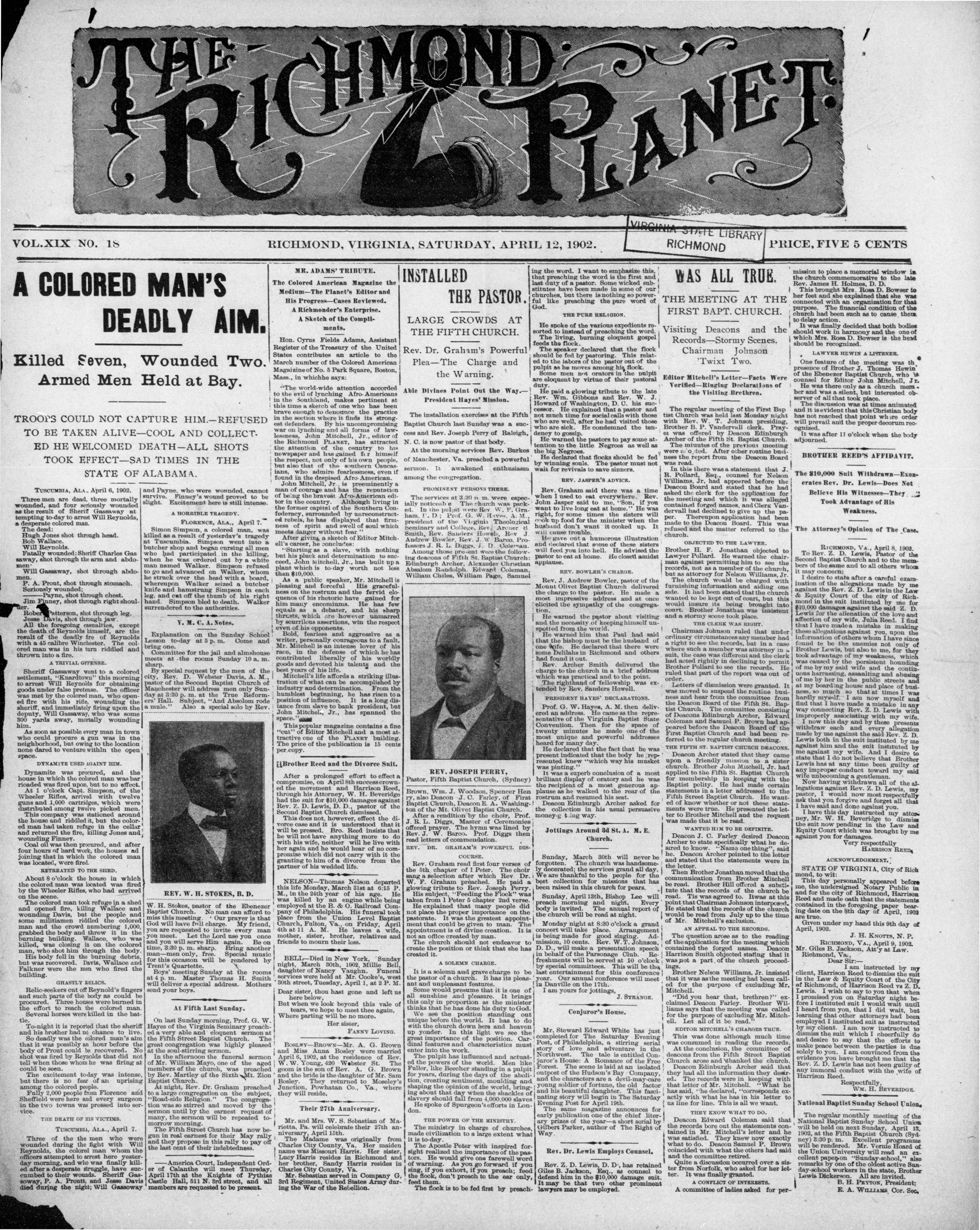
A COLORED MAN'S DEADLY AIM.
Killed Seven, Wounded Two. Armed Men Held at Bay.
TROOPS COULD NOT CAPTURE HIM.—REFUSED TO BE TAKEN ALIVE—COOL AND COLLECTED HE WELCOMED DEATH-ALL SHOTS TOOK EFFECT—SAD TIMES IN THE STATE OF ALABAMA.
Three men are dead, three mortally wounded, and four seriously wounded as the result of Sheriff Gassaway at tempting to-day to arrest Will Reynolds, a desperate colored man.
Fatally wounded: Sheriff Charles Gas saway, shot through the arm and abdomen:
Will Gassaway, shot through abdomen.
P. A. Prout, shot through stomach.
Seriously wounded:
——Payne, shot through chest.
Jim Finney, shot through right shoulder.
Rober Patterson, shot through leg.
Jesse Davis, shot through jaw.
All the foregoing casualties, except the death of Reynolds himself, are the result of the deadly fire of Reynolds with a 45 calibre Winchester. The colored man was in his turn riddled and thrown into a fire.
A TRIVIAL OFFENSE
Sheriff Gassaway want to a colored settlement, "Knardtown" this morning to arrest Will Reynolds for obtaining goods under false pretense. The officer was met by the colored man, who opened fire with his rifle, wounding the sheriff, and immediately firing upon the deputy, Will Gassaway, who was some 300 yards away, mortally wounding him.
As soon as possible every man in town who could procure a gun was in the neighborhood, but owing to the location none dared to venture within the open space.
DYNAMITE USED AGAINT HIM.
Dynamite was procured, and the house in which the colored man was barricaded was fired upon, but to no effect. At 1 a'clock Capt. Simpson, of the Wheeler Rifles, arrived with twelve guns and 1,000 cartridges, which were distributed among twelve picked men. This company was stationed around the house and riddled it, but the colored man had taken refuge in the cellar and returned the fire, killing Jones and wounding Finney. Coal oil was then procured, and after four hours of hard work, the houses ad joining that in which the colored man was located, were fired.
RETREATED TO THE SHED
About 8 o'clock the house in which the colored man was located was fired by the Wheeler Rifles, who had arrived on the scene. The colored man took refuge in a shed and opened fire, killing Wallace and wounding Davis, but the people and some militiamen riddled the colored man and the crowd numbering 1,000, grabbed the body and threw it in the burning building. Wallace, who was killed, closed the colored man who shot him through the body. His body fell in the burning debris, but was recovered. Davis, Wallace and Falkner were the men who fired the building.
GHASTLY BELICS.
Relic-seekers cut off Reynold's fingers and such parts of the body as could be procured. Three houses were burned in the effort to reach the colored man. Several horses were killed in the battle.
To-night it is reported that the sheriff and his brother had no chance to live. So deadly was the colored man's aim that it was possibly an hour before the body of Prout could be recovered. No shot was fired by Reynolds that did not tell when those whom he was firing at could be seen.
The excitement to-day was intense, but there is no fear of an uprising among the colored people.
Fully 2,000 people from Florence and Sheffield were here and every surgeon in the two towns was pressed into service.
THE DEATH OF HIS VICTIMS.
TUSCUMBIL, ALA., April 7.
Three of the the men who were wounded during the fight with Will Reynolds, the colored man whom the officers attempted to arrest here yesterday morning, and who was finally killed after a desperate struggle, have succumbed to their wounds. Sheriff Gassoway, P. A. Proutt, and Jesse Davis died during the night; Will Gassoway
Bob Wanace.
Will Reynolds.
and Payne, who were wounded, cannot survive. Finney's wound proved to be slight. Excitement here is still intense.
Simon Simpson, a colored man, was killed as a result of yesterday's tragedy at Tuscumbia. Simpson went into a butcher shop and began cursing all men who had participated in the killing, when he was ordered out by a white man named Walker. Simpson refused to go and advanced on Walker, whom he struck over the head with a board, whereupon Walker seized a butcher knife and hamstrung Simpson in each leg, and cut off the thumb of his right hand. Simpson bled to death. Walker surrendered to the authorities.
Explanation on the Sunday School Lesson to-day at 5 p.m. Come and bring one. Committee for the jail and almshouse meets at the rooms Sunday 10 a.m. sharp. By special request by the men of the city, Rey, D. Wabstar Davis, A.M. pastor of the Second Baptist Church of Manchester will address men only Sunday at 3:30 p.m. at the True Reformers' Hall. Subject, "And Absolom rode a mule." Also a special solo by Rev.
REV. W. H. STOKES, B. D.
W. H. Stokes, pastor of the Ebenezer Baptist Church. No man can afford to miss this meeting. Our prayer is that God will have full charge. My friend, you are requested to invite every man you meet. Let the Lord use you once and you will serve Him again. Be on time, 3:30 p. m. sharp. Bring another man—men only, free. Special music for this occasion will be rendered by Trent's Quartette. Boys' meeting Sunday at the rooms at 4 p. m. Master Thomas H. Smith will deliver a special address. Mothers send your boys.
At Fifth Last Sunday.
On last Sunday morning, Prof. G. W. Hayes of the Virginia Seminary preached a very able and eloquent sermon at the Fifth Street Baptist Church. The great congregation was highly pleased at the soul-stirring sermon.
In the afternoon the funeral sermon of Mr. William Mayo, one of the aged members of the church, was preached by Rev. Martley of the Sixth Mt. Zion Baptist Church.
At night, Rev. Dr. Graham preached to a large congregation on the subject, "Road-side Religion." The congregation was so stirred and moved by the sermon until by the earnest request of many, the sermon will be repeated to morrow morning.
The Fifth Street Church has now begun in real earnest for their May rally and they propose in this rally to pay off the last cent of their indebtedness.
America Court, Independent Order of Calanthe will meet Thursday, April 17th at the Knights of Pythias Castle Hall, 511 N. 3rd street, and all members are requested to be present.
Y. M. C. A. Notes.
RICHMOND, VIRGINIA, SATURDAY, APRIL 12, 1902.
MR. ADAMS' TRIBUTE.
The Colored American Magazine the Medium—The Planet's Editor and His Progress—Cases Reviewed. A Richmonder's Enterprise. A Sketch of the Compliments.
Hon. Cyrus Fields Adams, Assistant Register of the Treasury of the United States contributes an article to the March number of the Colored American Magazine of No. 5 Park Square, Boston, Mass., in which he says:
"The world-wide attention accorded to the evil of lynching Afro-Americans in the Southland, makes pertinent at this time a sketch of one who has been brave enough to denounce the practice in the section where it finds its strongest defenders. By his uncompromising war on lynching and all forms of lawlessness, John Mitchell, Jr., editor of the Richmond PLANET, has attracted the attention of the country to his newspaper and has gained for himself the respect, not only of his own people, but also that of the southern Caucasians, who admire fearlessness, even if found in the despised Afro-American. John Mitchell, Jr. is preeminently a man of courage and has the reputation of being the bravest Afro-American editor in the country. Although living in the former capital of the Southern Confederacy, he has endured unconstructed rebels who has displayed that firmness of spirit and swell of soul which meets danger without fear." After giving a sketch of Editor Mitchell's career, he concludes:
"Starting as a slave, with nothing but his pluck and determination to succeed, John Mitchell, Jr., has built up a plant which is to-day worth not less than $10,000.
As a public speaker, Mr. Mitchell is pleasing and forceful. His gracefulness on the rostrum and the fervid eloquence of his rhetoric have gained for him many encomiums. He has few equals as a debater, and his sharp thrusts, which are however unmarred by scurrilous assertions, win the respect even of his opponents.
Bold, fearless and aggressive as a warrior personally courageous to a fault, Mr. Mitchell is an intense lover of his race, in the defense of which he has contributed liberally of his worldly goods and devoted his talents and the best years of his life.
Mitchell's life affords a striking illustration of what can be accomplished by industry and determination. From the humblest beginning, he has risen to a position of influence. It is a long distance from bank to slave president, but John Mitchell, Jr., has spanned the space."
This popular magazine contains a fine "cut" of Editor Mitchell and a most attractive one of the PLANET building. The price of the publication is 15 cents per copy.
Brother Reed and the Divorce Suit.
After a prolonged effort to effect a compromise, on April 8th success crowned the movement and Harrison Reed, through his Attorney, W. H. Beveridge had the suit for $10,000 damages against Rev. Z. D. Lewis, D. D., pastor of the Second Baptist Church dismissed.
This does not, however, effect the divorce case and it is understood that it will be pressed. Bro. Reed insists that he will not have anything more to do with his wife, neither will he live with her again and he would hear of no compromise which did not carry with it the granting to him of a divorce from the partner of his wedded life.
NELSON—Thomas Nelson departed this life Monday, March 31st at 6:15 P.M., in the 24th year of his age. He was killed by an engine while being employed at the B. & O. Railroad Company of Philadelphia. His funeral took place from the Union Level Baptist Church, Fulton, Va., on Friday, April 4th at 11 A. M. He leaves a wife, mother, sister, brother, relatives and friends to mourn their loss.
---
BELL—Died in New York, 'Sunday night, March 30th, 100th, Millie Bell, daughter of Nancy Vanghn. Funeral services were held at Mr. Cooke's, west 30th street, Tuesday, April 1, at 2 P. M. Dear sister, thou hast gone and left us here below. But when we look beyond this vale of tears, we hope to meet thee again. Where parting will be no more.
BOSLEY-BROWN—Mr. A. G. Brown and Miss Anna Bosley were married April 6, 1902, at the residence of Rev. W. W. Young, 420 Wobster St. The gown is the son of Rev. A. G. Brown and the daughter of the Wright of Moseley Bosley. They returned to Moseley's Junction, Powhatan Co., Va., where they will reside.
Their 27th Anniversary.
Mr. and Mrs. W. S. Sebastian of Marietta, Pa. will celebrate their 27th anniversary, April 15th. The Madame was originally from Charles City County, Va. Her maiden name was Missouri Harris. Her sister, Lucy Harris resides in Richmond and her brother, Sandy Harris resides in Charles City County, Va. Mr. Sebastian served in Company G, 3rd Regiment, United States Army during the War of the Rebellion.
LARGE CROWDS AT THE FIFTH CHURCH.
Rev. Dr. Graham's Powerful Plea—The Charge and the Warning.
Able Divines Point Out the Way.—President Hayes' Mission.
The installation exercises at the Fifth Baptist Church last Sunday was a success and Rev. Joseph Perry of Raleigh, N. C. is now pastor of that body.
At the morning services Rev. Burkes of Manchester, Va. preached a powerful sermon. It awakened enthusiasm among the congregation.
PROMINENT PERSONS THERE
The services at 3:30 p.m. m. were especially noticeable e. The church was packed. In the pulpit were W. W. F. Gram, F. D.; Prof. G. W. Haves, A. M. president of the Virginia Theological seminary and College, Rev. Archer B Smith, Rev. Sanders Howell, Rev J. Andrew Bowler, Rev J. W. Barco, Professors J. R. L. Diggs, J. D. Coleman. Among those present were the following deacons of Fifth St. Baptist Church: Edinburgb Archer, Alexander Christian Absalom Randolph, Edward Coleman, William Chiles, William Page, Samuel
[Name]
Brown, Wm. J. Woodson, Spencer Henry, also Deacon, J. C. Farley of First Baptist Church, Deacon E. A. Washington of the Mt. Olivet Baptist Church. After a rendition by the choir, Prof. J.R. L. Diggs, Master of Ceremonies offered prayer. The hymn was lined by Rev. J. W. Barco, Prof. Diggs then read letters of commendation.
REV. DR. GRAHAM'S POWERPUL DISCOURSE.
Rev. Graham read first four verses of the 5th chapter of I Peter. The choir sang a selection after which Rev Dr. W. F. Graham preached. He paid a glowing tribute to Rev. Joseph Perry. His subject, "Feeding the Flock" was taken from I Peter 5 chapter 2nd verse. He explained that many people did not place the proper importance on the pastorate. It was the greatest appointment that could be given to man. The appointment is of divine creation. It is not an office created by man. The church should not endeavor to create the position or think that she has created it.
A SOLEMN CHARGE:
It is a solemn and grave charge to be the pastor of a church. It has its pleasant and unpleasant features. Some would presume that it is one of all sunshine and pleasure. It brings this only in proportion as the minister thinks that he has done his duty to God. We see the position standing out unique before the world. It has to do with the church down here and heaven up yonder. In this light we see the great importance of the position. Cardinal features and characteristics must enter into the work. The pulpit has influenced and actuated the powers of the world. Men like Fuller, like Beecher standing in a pulpit for years, during the days of the abolition, creating sentiment, moulding and shaping the opinion of the world, bringing about that day when the shackles of slavery should fall from 4,000,000 slaves. He spoke of Spurgeon's efforts in London.
THE POWER OF THE MINISTRY
The ministry in charge of churches, made civilization to a large extent what it is to-day.
The Apostle Peter with inspired forsight realized the importance of the pastors. He would give one farewell word he would give go forward if you sing, if you exhort, if you preach; feed the flock, don't preach to the ear only, feed them.
The flock is to be fed first by preach-
ing the word. I want to emphasize this, that preaching the word is the first and last duty of a pastor. Some wicked substitutes have been made in some of our churches, but there is nothing so powerful like preaching the pure word of God.
THE PURE RELIGION
He spoke of the various expedients resorted to instead of preaching the word. The living, burning eloquent gospel feeds the flock. The speaker declared that the flock should be fed by pastoring. This related to the labors of the pastor out of the pulpit as he moves among his flock.
Some men not orators in the pulpit are eloquent by virtue of their pastoral duty.
He paid a glowing tribute to the late Rev. Wm. Gibbons and Rev. W. J. Howard of Washington, D. C. his successor. He explained that a pastor and not much time for social calls with those who are well, after he had visited those who are sick. He condemned the tendency to gossip.
He wished the pastors to pay some attention to the little Negroes as well as the big Negroes.
He declared that flocks should be fed by winning souls. The pastor must not wait for revivals to save sinners.
REV. JASPER'S ADVICE
Rev. Graham said there was a time when I used to eat everywhere. Rev. John Jasper said to me, "Son, if you want to live long eat at home." He was right, for some times the sisters will cook up food for the minister when the husband don't want it cooked up. It will cause trouble. He was humorous illustration and declared that some of these sisters will feed you into hell. He advised the pastor to eat at home. He closed amidst applause.
REV. BOWLER'S CHARGE.
Rev, J. Andrew Bowler, pastor of the Mount Olivet Baptist Church delivered the charge to the pastor. He made a most impressive address and at once elicited the sympathy of the congregation. He warned the pastor about visiting and the necessity of keeping himself unmotted from the world.
He warned him that Paul had said that the bishop must be the husband of one wife. He declared that there were some Delilahs in Richmond and others had found it out.
Rev. Archer Smith delivered the charge to the church in a brief address which was practical and to the point.
The righthand of fellowship was extended by Rev. Sanders Howell.
PRESIDENT HAYES' DECLARATIONS.
Prof. G. W. Hayes, A. M. then delivered an address. He came as the representative of the Virginia Baptist State Convention. Then for the space of twenty minutes he made one of the most unique and powerful addresses heard for many days.
He explained that the fact that he was present indicated that the body he represented knew "which way his musket was pinting."
It was a superb conclusion of a most brilliant display of oratory and he was the recipient of a most generous applause as he walked to the rear of the rostrum and resumed his seat.
Deacon Edinburgh Archer asked for the collection in his usual persuasive money-g ting way.
Sunday, March 30th will never be forgotten. The church was handsome decorated; the services grand all day. We are thankful to the people for the best collection for missions that has been raised in this church for pears.
Sunday, April 13th, Bishop Lee will preach morning and night. Every body is invited. The annual report of the church will be read at night.
Monday night at 8:30 o'clock a grand concert will take place. Arrangement is being made for good singing. Admission, 10 cents. Rev. W.T. Johnson, D. D., will make a presentation speech in behalf of the Parsonage Club. Refreshments will be served at 10 o'clock by special committees. This will be the last entertainment for this conference year. Our annual conference will meet in Danville on the 17th.
Conjuror's House.
Mr. Steward Edward White has just completed for The Saturday Evening Post, of Philadelphia, a stirring serial story of love and adventure in the Northwest. The tale is entitled Conjuror's House: A Romance of the Free Forest. The scene is laid at an isolated outpost of the Hudson's Bay Company, and the characters are a devil-may-care young soldier of fortune, the old factor and his beautiful daughter. This fascinating story will begin in The Saturday Evening Post for April 19th. The same magazine announces for early publication one of the chief literary prizes of the year—a short serial by Gilbert Parker, author of The Right of Way.
Rev. Dr. Lewis Employs Counsel.
Rev. Z. D. Lewis, D. D., has retained Giles B. Jackson, Esq., as counsel to defend him in the $10,000 damage suit. It may be that two other prominent lawyers may be employed.
WAS ALL TRUE.
THE MEETING AT THE FIRST BAPT. CHURCH.
Editor Mitchell's Letter—Facts Were Verified—Ringing Declarations of the Visiting Brethren.
The regular meeting of the First Baptist Church was held last Monday night with Rev. W. T. Johnson presiding, Brother B. P. Vandervall clerk. Prayer was offered by Deacon Edinburgh Archer of the Fifth St. Baptist Church. The minutes of the previous meeting were reported. After other routine business the report from the Deacon Board was read.
In this there was a statement that J. R. Pollard, Esq., counsel for Nelson Williams, Jr., had appeared before the Deacon Board and stated that he had asked the clerk for the application for the meeting and which it was alleged contained forged names, and Clerk Vanderwall the declined to give up the paper. Thereupon application had been made to the Deacon Board. This was refused and the matter referred to the church.
OBJECTED TO THE LAWYER.
Brother H. F. Jonathan objected to Lawyer Pollard. He warned the chairman against permitting him to see the records, not as a member of the church, but as attorney for Nelson Williams, Jr. The church would be charged with furnishing information and aiding one side. It had been stated that the church wanted to be kept out of court, but this would insure its being brought into court. Brother Jonathan was insistent and a stormy scene took place.
THE CLERK WAS RIGHT.
Chairman Johnson ruled that under ordinary circumstances any member had a right to see the records, but in a case where such a member was attorney in suit, the case was different and the clerk had acted rightly in declining to permit Brother Pollard to see the records. He ruled that part of the report was out of order. Letters of dismission were granted. It was moved to suspend the routine business and hear from the committee from the Deacon Board of the Fifth St. Baptist Church. The committee consisting of Deacons Edinburgh Archer, Edward Coleman and Samuel P. Brown had appeared before the Deacon Board of the First Baptist Church and had been referred to the regular church meeting.
Deacon Archer stated that they came upon a friendly mission to a sister church. Brother John Mutchall, I had applied to the Fifth St. Baptist Church for membership in keeping with the Baptist polity. He had made certain statements in a letter addressed to the Fifth Street Baptist Church. He wanted of know whether or not these statements were true. He presented the letter to Brother Mitchell and the request was made that it be read.
WANTED HIM TO BE DEFINITE.
Deacon J. C. Farley desired Deacon Archer to state specifically what he desired to know. "Name one thing", said he. Deacon Archer pointed to the letter and stated that the statements were in the letter.
Then Brother Jonathan moved that the communication from Brother Mitchell be read. Brother Hill offered a substitute that the records of the church be to read to him, at this point that Chairman Johnson interpreted. He stated that the records of the church would be read from July up to the time of Mr. Mitchell's exclusion.
AN APPEAL TO THE RECORDS.
The question arose as to the reading of the application for the meeting which contained the forged names. Deacon Harrison Smith objected stating that it was not a part, of the church proceedings.
Brother Nelson Williams, Jr. insisted that it was as the meeting had been called for the purpose of excluding Mr. Mitchell.
"Did you hear that, brethren?" exclaimed Deacon Farley. Brother Williams says that the meeting was called for the purpose of excluding Mr. Mitchell. Let all of it be read."
EDITOR MITCHELL'S CHARGES TRUE.
This was done although much time was consumed in reading the records.
At the conclusion, the committee of deacons from the Fifth Street Baptist Church arose and thanked the church. Deacon Edinburgh Archer said that they had all the information they desired. The records were in keeping with that letter of Mr. Mitchell. "What he has said, 'he declared,' 'corresponds exactly with what he has in his letter to us line for line. This is all we want."
THEY KNOW WHAT TO DO.
Deacon Edward Coleman said that the records bore out the statements contained in Mr. Mitchell's letter and he was satisfied. They knew now exactly what to do. Deacon Samuel P. Brown coincided with what the others had said and the committee retired.
Quite a discussion occurred over a sister from Norfolk, who asked for her letter. It was finally granted.
A CONFLICT OF INTERESTS.
A committee of ladies asked for per-
mission to place a memorial window in the church commemorative to the late Rev. James H. Holmes, D. D.
This brought Mrs. Rosa D. Bowser to her feet and she explained that she was connected with an organization for that purpose. The financial condition of the church had been such as to cause them to be ill. It was finally decided that both bodies should work in harmony and the one of which Mrs. Rosa D. Bowser is the head should be recognized.
LAWYER HEWIN A LISTENER.
One feature of the meeting was the presence of Brother J. Thomas Howin of the Ebenezer Baptist Church, who is counsel for Editor John Mitchell, Jr. He was there only as a church member and was a silent, but interested observer of all that took place. The discussion was at times animated and it is evident that this Christian body has not reached that point where order will prevail and the proper decorum recognized. It was after 11 o'clock when the body adjourned.
BROTHER REED'S AFFIDAVIT.
The $10,000 Sult Withdrawn—Exonerates Rev. Dr. Lewis—Does Not Believe His Witnesses—They Took Advantage of His
The Attorney's Opinion of The Case.
RICHMOND, VA., April 8, 1903.
To Rev. Z. D. Lewis, Pastor of the Second Baptist Church and to the members of the same and to all others whom it may concern:
I desire to state after a careful examination of the allegations made by me against the Rev. Z. D. Lewis in the law & Equity Court of the city of Richmond in the suit instituted by me for $10,000 damages against the said Z. D. Lewis for the alienation of the love and affection of my wife, Julia Reed. I find that I have made a mistake in making these allegations against you, upon the information of others whom I have since found to be the enemies not only of Brother Lewis, but also to me, for they took advantage of my weakness, which was caused by the persistent hounding of me by my said wife and the continuous harrassing, assaulting and abusing of me by her in the public streets and at my boarding house and place of business, so much so that at times I was hardly myself. I am now myself and find that I have made a mistake in any way connecting Rev. Z. D. Lewis with improperly associating with my wife.
I now this day and by these presents withdraw each and every allegation made by me against the said Rev. Z. D. Lewis both in the suit instituted by me against him and the suit instituted by me against my wife. And I desire to state that I do not believe that Brother Lewis has at any time been guilty of any improper conduct toward my said wife becoming a gentleman. Now having withdrawn all of the allegations against Rev. Z. D. Lewis, my pastor, I would now most respectfully ask that you forgive and forget all that I have said and done against you. I have this day instructed my attorney, Mr. W. H. Beveridge to dismiss the suit now pending in the Law and Equity Court which was brought by me against you for damages.
ACKNOWLEDGEMENT.
STATE OF VIRGINIA, City of Rich
mond, to wit:
This day personally appeared before
me, the undersigned Notary Public in
and for the city of Richmond, Harrison
Reed and made oath that the statements
contained in the foregoing paper bearing
date on the 8th day of April, 1902
are true.
Given under my hand this 9th day of
April, 1902.
J. H. KNOTTS. N. P.
RICHMOND, VA., April 9, 1902.
Mr. Giles B. Jackson, Atty at Law.
Richmond, Va.
Dear Sir:
I am instructed by my client, Harrison Reed to dismiss the suit in the Law & Equity Court of the City of Richmond, of Harrison Reed vs Z. D. Lewis. I wish to say to you that when I promised you on Saturday night before I instituted suit I would wait until I heard from you, that I did wait, but learning that other attorneys had been employed I instituted suit as instructed by my client. I am now instructed to dismiss the suit which I cheerfully do and desire to say that the efforts to make peace between the parties is duly to you. I am convinced from the evidence you have brought me that the Rev. Z. D. Lewis has not been guilty of any immoral conduct with the wife of Harrison Reed.
Respectfully,
WM. H. BEVERIDGE.
National Baptist Sunday School Union.
The regular monthly meeting of the National Baptist Sunday School Union will be held on next Sunday, April 13, 1902, at the Fifth Baptist Church (Sydney) 8:30 p. m. Excellent programme will be rendered. Mr. Vernie Hoard of the Union University will read an excellent paper on "Sunday-school," also remarks by one of the oldest active Sunday-school workers in the state, Brother Lewis Dickerson. All are invited.
B. H. PEYTON, President;
E. A. WILLIAMS Cor. Sec.
THE PLANET
THE WISE MAN WHO FELL
There was a man that people said
Was wonderfully wise;
He knew the names of all the stars
That twinkle in the skies.
The telescope and spectroscope
He wisely used to give
Mn knowledge of the smallness of
The sphere on which we live.
He know the number of the tons
That distant Neptune weighs.
He knew exactly to the dot
The length of Saturn's days.
But when the wise man crossed the street
Two fools shot guns one day;
The wise man stayed to see, instead
Of hurrying away.
The fools shot all their weapons off.
And when they shot no more
Men gathered up his corpse that they
Had deemed so wise before
-S. E. Kiser, in Chicago Record-Herald.
TONGUE
OF FLAME
By ELIZABETH CHERRY WALTZ.
(Copyrighted by Daily Story Pub. Co.)
AFTER supper was over, young
Gideon Sennett changed his rough
clothing for a little better suit, then
set to walk up the road towards the
Alstetter homestead.
He had worked hard in the hayfield all day. His back ached, his arms were sore, but this was Wednesday night. On the white wooden steps of the church a mile away, Flavilla Lingrel would wait for him. They could sit there quietly until he was rested. Flavilla was there. He saw her from afar, her pink calico gown making a bright spot against the whiteness of the steps. It was just after sunset when he started, there were rosy clouds still in the west. Flavilla was not a pretty girl, but she had a smile that meant volumes. It was worth a very long walk to see.
These two devoted young people were shy and awkward in the expression of deep feeling between them. Their very loneliness while boy and girl at school had drawn them to each other. He was an orphan, and her father had long since married a woman who resented her existence. Neither Gideon or Flavilla had any but a grudged life up to the time each was able to work. Then came days of toil with little to enliven them or breed aspiration.
Stranger things have happened than that both should be absurdly ambitious. In Gideon's family, two generations back, there had been a preacher. He was a devout man, well educated for his time and not without power in oratory. His son, Gideon's father, had been not only stupid, but a neer-do-well. In his grandson, Gideon, revived the devotion, the ambition, the gift of speech, the sturdy industry.
Flavilla wanted a home different from what her home had been. She dreamed of peaceful days, of thrifty management, of love, of being kind to those about her. She entered enthusiastically into Gideon's ideas, she stimulated him from his boyhood to daring dreams of success.
For seven years they worked, toiled, dreamed. To-night, as they sat on the steps of the church where the grandfather had lifted up his voice, they seemed little nearer to the fulfillment of their hopes than before. Physically weary, Gideon's spirits wavered.
Flavilla was a year the older. That counts a good deal at 19 and 20. Besides, in her burned a more enthusiastic and steady fire.
"I don't see how it can be done this fall, Flavie. I've got the money for the college course, but how am I going to live?"
"I wouldn't take much to keep us." "Us! Oh, Flavie!"
"You're never going without me, Gideon. I've got some money, you know."
"It it might be. When haying's over, I'll go up and see."
This is the reason why a meeting of the faculty of a certain college and theological seminary was interrupted one day by a stalwart country lad. He asked asking impetuously for entrance into college, with little money and no church influence to back him.
Then Gideon talked. The spirit of his grandfather seemed in him. He told of his dreams for years, his toll and Flavilla's interest and encouragement. How well he expressed himself at that time he never knew, but as the old president walked from recitation hall to the library afterwards with the professor of Greek, he said, gently:
"It is a long time since I felt that a lad had such a clear call. I had been wondering if there was to be no more inspiration."
They promised Gideon shelter in a part of a house on the campus. He went back to Flavilla triumphant. Now was Gideon the very sword of the Lord. In the quiet country neighborhood his return, the projected wedding, such prospects for a lad of no property caused the wildest excitement. Flavilla, from scarce more than a drudge, at once became the most enviied girl in the township. Her "setting-out" was discussed far and near. She had many presents from women who thought that by helping her they gave directly to the Lord. Meetings were held to help her sew, and it was from these grew that idea that afterwards caused such a sensation at the college. The neighborhood religion had been for years a dead letter. The small country church with its pulpit reached
by a winding stair, its benches black with age, had not been opened for many years. Now a sentiment grew to open it one Sunday during the summer, and Gideon was asked to conduct a service by a committee of grave men. "I am but entering college," he cried, this lad who had plowed from sunrise. "I know nothing yet of what I expect to learn. Men, it will be seven years before I am fit to teach the Word of the Lord." "The Lord will tell you what to say," said a very old man, who remembered his grandfather, "and we have no other to speak to us, Gideon."
He promised to give them an answer on the morrow and went to see Flavilla. There was no happier woman than she those days. She was sitting at her sewing when Gideon came in, humming a quaint country ditty. He thought her a changed woman. Surely, she had never seemed so handsome in the olden days of toil and anxiety. He told her what the people asked. Its full meaning dawned upon her.
"You must do this thing, Gideon," she said, after a silence. "It will help both you and the people."
"But a sermon?"
Flavilla struggled with the thought. To her mind a sermon meant deep knowledge, research, feeling, conviction. Had not she talked these things over with Gideon since they were boy and girl together? The very fact of long, continued thought upon these subjects served well now.
"There will be nothing expected of you that you are not ready for," she told him, after a time, "and since you cannot talk of great things, would it not be as well to speak of those at hand?" Don't preach. You ain't fit. "You're just a common man now. Talk man to man." "And, Gideon, dear," she went on, "don't forget to talk a little to us women. We need lots of o' God. It's a God for every day we want." He only said, after a silence: "Flavilla, I guess I'll go on home." She understood him. They walked down to the gate together. There was a dark evergreen tree there and he kissed her solemnly. "Flavilla, you must wear your bride dress. And sit all alone on the front bench."
He still had his misgivings as to the propriety of his proceeding. The next morning he wrote a misspeelled letter to the college president, asking him for advice. Sunday came and no reply had reached him.
The interest in the meeting was widespread. It was Sunday in a late August and the little church was filled, the overflow standing about the doors and windows. Flavilla had chosen some of her old schoolmates to practice hymns with her. Their musical knowledge was limited, but it would help. They sat on the second bench in their clean summer array. On the first bench, alone, sat Flavilla. She wore the white dress she was to be married in, and a simple hat. When the house was full, Gideon walked in. He wore his new black suit, but looked like a_true son of toil, a lad from the very midst of the people. Flavilla started a hymn, all sang who could, then Gideon read, not any too well, a portion of the Scriptures. Afterwards he stepped down from the pulpit and stood almost among them. Gideon will never preach such a sermon again. He has gone from
23.
"THE LORD WAS WITH YOU." field and wood and pasture to more conventional paths. Never again will he walk between an actual living, human Christ and an actual, breathing community as on that day of his boyhood. He talked. God-life in common life in common ways, was made real. In the morning, at noon, in the tired hours of the evening, at toil, in dealing, in birth, life and death Christ-life was depicted. Then Gideon spoke a few sentences of his own future hopes and asked all to keep him in prayerful remembrance. The silent and stolid people were more moved than they cared to show. Old men wrung his hand, women looked at him with misty eyes. Flavilla's tears ran down her cheeks as she bravely started the last hymn.
But, while the people reluctantly filed out, there strode into the church a man of presence, of speech. He put his arms about Gideon's shoulders, and looked at him with proud eyes.
"The Lord was with you," said the college president. The strange letter had brought him hither.
Gideon is now a great preacher. His own and Flavilla's dreams were nothing in comparison to the reality. They still tell at the college of his hard study, Flavilla's aid and comradeship and of the wagon load of provisions that came to them every few months from their old neighborhood. They still tell of Gideon's gift of speech, his honors, what a credit he is to the college. If you ask the secret of his mission, he looks at Flavilla and says:
"I try to tell of an ever-day God and as man to man."
He Taches the Coche,
To cause girls' nears to ache
He tugs in his mustache,
And goo-goo eyes doth mache-
The man who's on the mache,
-Philadelphia Press.
THE RICHMOND PLANET, RICHMOND, VIRGINIA
DOMESTIC SCIENCE
Baked potatoes are said to be more easily digested than boiled potatoes. They should, therefore, be preferred by dyspeptics.
When making boiled starch, stir it round several times with a wax candle. This will prevent the starch sticking to the iron and save much trouble.
Don't scrub or wash your fish plank. Rub it with sandpaper each time it is used, polish it with a piece of brown paper and put it at once into an unbleached muslin bag made for the purpose.
To keep the dining-room table in a good, well-polished condition rub it once a week with a mixture of one ounce of spirits of turpentine and one ounce of olive oil. Apply it with a piece of flannel cloth.
For cleaning soiled gloves a compound made of the following ingredients has been recommended: One quart deodorized benzine, one dram sulphuric ether, one dram chloroform, two drams alcohol and sufficient cologne water to perfume. Toasting, if properly done, converts a portion of the bread into predigested food. Dry starch is converted by heat into dextrin, a form that all starchy substances assume after the first process of digestion. Consequently, in eating toast the stomach is relieved of a part of its work.
To make gum water take one ounce of the best picked gum arabic and one quart of water. Put the gum to the water in a stoppered bottle, and put in a warm place, occasionally shaking till all is dissolved. A teaspoonful taken occasionally for troublesome coughs is useful in allaying irritation.
Wet boots are often hardened and shrunk by being dried near the fire. Try this method: Lace or button the boots, fill them with dried oats and leave them in a warm but not hot place. The oats inside will absorb a portion of the moisture and the dry air of the room the rest. The oats may be used again and again after drying.
Just now the raw food diet threatens to become a fad. Certainly many people are experimenting with this new dietetic idea. It would be far better for the average man or woman to adopt an absolutely raw diet, and eat everything which he could possibly eat or relish in a perfectly raw state than to swallow into his stomach the horrible messes which are concocted by the average cook.
NOTES FROM ENGLAND.
The metropolitan police of London look after 8,200 miles of roads and streets.
Of the 6,700 Britons killed at their work during the year 1900, no less than 3,899 were seamen.
There are in the United Kingdom for each 100 people five horses, 28 cattle, 76 sheep and ten pigs.
London's 20 leading hotels accommodate about 8,400 visitors every night and constantly employ 4,500 servants.
Of the 1,315 changes in wages of British workmen during 1900, 1,276 were increases. These changes affected 2,750,000 of workmen.
Swarraton had the coldest day of any British station during last year. On January 9 the thermometer marked two degrees below zero.
Among the freaks at a ladies' kennel club show recently was a set with four false teeth of gold, in the middle of which was set a large diamond.
The average age of the British millionaires who died last year was 78; of those who died in 1900, $74\frac{1}{2}$ years. Baron Armstrong, aged 90, was the eldest. The corporation of Dover recently discussed the circumstances of the arbitration proceedings between the municipality and the Kent county council. The sum in dispute between the town and the county authorities is only about £30, while the law costs amount to nearly £2,500. Sir Wallaston Knocker, the town clerk, reported the cost of the arbitration worked out at over one pound per minute.
MEN AND AFFAIRS
The state department is advised that owing to a change in plans, the king of Siam will not visit the United States this year.
Louis Lindsay Dyche, a naturalist and professor of natural history in the Kansas university, after making two trips to the polar regions has arrived at the conclusion that the first human beings were born and lived in the arctic zone.
Lyman J. Gage served longer at the head of the treasury department than any of the secretaries except Alexander Hamilton and Albert Gallatin. He served for nearly five years, while Gallatin's record was nearly 12 and Hamilton's about five years and four months.
Lieut. Edwin R. Stuart, of the corps of engineers, on duty at West Point, carries off the honors this year of the military service institution. To him has been awarded the prize gold medal, a life membership in the institution and the sum of $180 for his essay, the subject being "Disappearing Guns."
KITCHEN MEASURES
The juice of an ordinary lemon is about a tablespoonful. Very finely chopped suet slightly heaped up weighs about a tablespoonful. A breakfast cupful of bread crumbs well pressed in equals about four ounces. Aheaped breakfast cupful of brown sugar represents half a pound, and stoned raisins well pressed in weighs about the same.
His Life Not a Failure.
"It very seldom happens," said Hamlet Horatio Jones, "that we are permitted to adopt the career for which we are abitions in youth. I always wanted to be a comedian instead of a tragedian, and make people laugh." "Dear me," said the sympathetic young girl, "you ought not to be so disappointed. I am sure you make people laugh very often as it is."—Tit-Bits.
GEMS OF SERENEST RAY.
Father Time.
Father Time has a scythe, as the picture books show.
And all things in turn he lays level and low.
We give him with dirge or with rollocking rhyme.
He's a man for all measures, is old Fa ther Time.
He sings as he marches with you and with me.
He merrily stride, if you give him the key.
And much that he does with his scythe as it swings.
Depends on the mood of the song that he sings.
So, mow me my troubles away from the earth
And leave me the blooms of affection and mirth.
Be gentle in blazing the path I must climb
And we'll journey along and be friends Father Time.
—Washington Star.
Bravery.
They called him brave because he dared to go
Where danger skulked in every tanglele brake;
They called him fearless, since he faced foe
Who then destruction for his country's sake;
They called him brave because he did not run
When bullets flew above his head—because
He did not turn and throw away his gun instead of standing frozen where he was.
They called him brave—he saw a cripple
And discovered his hump a thing for laughing at.
He joked about a poor, scarred face, mime;
God gave me from such bravery as that.
—S. E. Kiser, in Chicago Record-Herald.
I Miss You So.
The world's as bright as a dream light.
And I trample the wrong, and I lift the right.
And my soul stands white in God's own sight;
But I miss you so—
I miss you so!
My task complete where the toll seemed sweet.
For all the thorns that pierced the feet, and a laurel crown where the mornings meet;
But I miss you so—
I miss you so!
Wealth, and honor, and highest place—
the wished-for goal in the easy race—
But all for a beautiful, vanished face,
Where I miss you so—
Where I miss you so!
-F. L. Stanton, in Atlanta Constitution.
Metamorphosis.
White with snow the wayside hedges
Where the vines were wont to hang
All their clustered, perfumed pledges
And the birds their rapture sang;
Hushed the music of the streams that
Laughed along the woodland ways;
Village flowers that
Haunted us through summer days;
Leafy pathways lest or hidden-
What a strange, new world is this!
Flower and bird and brook forbidden
Winter metamorphosls!
Summer joy and winter sorrow.
Life and death and then, and then
On some unexpected morrow
Life and spring come back again!
Dr. Percy Sherman, in Youth's
Companion
The Elitiation
She looked at me across the aisle
And she was beautiful to see;
Within her blue eyes lurked a smile,
She looked at me across the aisle,
I liked her face and form and style
And knew that she admired me;
She looked at me across the aisle,
And she was beautiful to see.
Alas, how brief our triumphs are,
And how our pride is off upset!
I had, at last, to leave the car,
Alas, how brief our triumphs are!
I tripped, and gave the floor a jar-
I left it in the cup.
Alas, how brief our triumphs are
And how our pride is set up.
—S. E. Kiser, in Chicago Record-Herzld
A. Bashlars Y
A Pathless Way.
You will not love me for a day.
Yet I have loved you all the year;
Your heart is deaf to all I say,
And never knows when I am near.
We will have met before me,
And, touching me apart;
Though love can bring me to your door,
I know no way to reach your heart.
But, tossed on trackless seas, the barque
Can find a way across the foam;
The boat can cleave the untridden dark,
Not miss the way.
And if I love you blindly yet,
And dearer as the days go past,
My heart may all its pain forget,
And find the way to yours at last.
-A. St. John Adcock, in Chambers' Journal.
Distance.
When leagues on leagues of sea and land
Between us lay, last year.
Lost friend, you seemed to clasp my hand.
In thought you were so near.
You came again. What barrier grew Between us in a day?
You seemed, even while I talked with you.
A thousand leagues away.
Yet now that you have passed beyond Earth's griefs and earthy ken,
O friend, have never seen, how fond, Mine own true friend again!
-Francis Barine, in Youth's Companion.
The Secret
Softly the little wind goes by,
A whisper—nothing more;
Some message from the azure sky
Brought down to earth's green door.
Fragrant and fresh the wonder-word,
But what it means, who knows?
Only the butterfly, the bird,
The leaf, the grass and rose.
Thaise the divine felicity—
The gift of wisdom ware—
The melody, the mystery,
The secret of the air.
—Frank Dempster Sherman, in Frank Leslie's Popular Monthly.
Scandal
Far blacker than a raven's winge.
It croaks and feeds on unclean things,
Nor let the shadow of a doubt
Soften the lie it burrows out.
With tongue-blades keener than a knife,
It probes the bleeding wounds of life—
Lays bare the motive and the deed,
And carrion makes from flower-seed.
It mangles love, and smears with lust
Lilies of purity and trust—
RANK AND TITLE.
Emperor William of Germany owns $60 farms.
Germany's crown prince plays the piano and sings well.
The shak of Persia has the finest collection of cats in the world.
Prince Henry soon after returning from the United States will celebrate the quarter centenary of his service in the navy.
Grand Duke Paul of Russia is so tall that the average hotel bed is not long enough for his comfort, and he has one built in sections, which he carries with his luggage everywhere.
Three English dukes—those of Norfolk, Richmond and Grafton—are widowers, as are numerous other famous peers, including Lords Salisbury, Rosebery, Abergavenny and Mexborough.
Among the peers who have inherited barren titles is the young earl of Seafield, who at the age of 12 succeeded to an earldom, two viscounties and two baronies, without so much as a single acre of land to maintain his dignities.
The young king of Italy is winning a reputation for frugality that is commending him to the nation's good will. King Victor Emmanuel has made reductions in the running expenses of the royal establishment amounting to 8,000,000 lire, or $1,600,000 a year. His civil list has been reduced. The ex-Garibaldians have been cut off. The Italian court is now the most frugal in Europe.
Must Look Out for Horror
"Nail Look Out for Herself."
"Mr. Mr. Goldrock said, gently,
'I have not the slightest objection
to your asking my daughter in marriage."
"Thank you, sir," said the young man with a title but no cash.
"You go right ahead and ask her," Goldrock said, meditatively. "I have given the girl a fine education and have taught her to read the newspapers. If she does not know enough to say 'No' she doesn't deserve any better luck."—N. Y. Times.
Forgot Her Prayers.
A four-year-old girl was spending a night away from home. At bedtime she kneeled at her hostess' knee to say her prayers, expecting the usual prompting. Finding Mrs. B—unable to help her out, she continued thus: "Please God, 'scuse me; I can't remember my prayers, and I am staying with a lady that don't know any.'"—Chicago Record-Herald.
Both Girls Happy
"How is your daughter Edith, Mrs. Lakeside?"
"She is well and happy. You know she is to be married on the 20th."
"Indeed. And how is your other daughter, Florence?"
"She is also well and happy. You know she got a divorce on the 10th."
—Washington Times.
His Trouble
"I'd propose to that girl if it weren't for one thing."
"What's that?"
"She isn't built on the right plan. My last flancee was a good deal smaller, and the ring that she returned never would fit this one. To propose to her would be inexusable extravagance."—Chicago Post.
Notice.
I can supply places to any number of
of Cooks, Chambermaids, Waitresses,
and House-work girls in Philadelphia
and Surburban homes, Good wages.
Address,
D. S. KREEMER,
27 N. Juniper St.,
Philadelphia, Pa.
3 21-6t
A Short Quick Trip.
Beach Park, West Point Excursion
and Picnic Grounds will be the place to
go this season. 39 miles East of Richmond,
and only 60 minutes ride to salt water.
Fine Bathing, Fishing, Crabbing,
boating, sailing and various other
attractions and amusements for ladies,
children and men, such as shooting galleries,
swings, base ball, music day and
night, a large dancing pavilion, long
board walks, the fluent and largest merry-go-round in this country, several
wells of fine aresian water on the
ground, making this an ideal place for
Sunday Schools and church pic-nics.
Call at once and book desirable dates.
For information, apply at Southern
Ry, office, No. 930 E. Main Street, Rich
mond, Va.
TO THOSE IN WANT OF EMPLOYMENT:
NATION OF EMPLOYMENT
We desires the names and post-office addresses of competent, industrious, reliable colored women, men, and girls, wishing situations in the north as cooks, chambermaids, child nurses, laudresses, waiters, waitresses, coachmen, butlers, farm hands, day laborers, bellmen, general housework, esc., etc.
Address,
J. H. Lewis,
Manager, Inter-State Real Estate and Employment Agency,
73 Summer St.,
Trenton, N. J.
Colonists Rates to the West—Very Low
Rates to California.
The Southern Railway announces special colonist rates of $47.50 from Richmond to San Francisco, Cal. and all California points. Tickets on sale from this date to April 30th, 1903. Through tourist sleeping car leaves Washington Monday, Wednesday and Friday of each week, via Southern Railway, through Danville, Atlanta and New Orleans on which colonist tickets are accepted, this requiring no change of cars from this section to California, offering the quickest and most comfortable trip. For further information, apply to agents of Southern Railway, or address C. W. Westbury, D. P. A., Richmond, Va. 3-29-3t.
WANTED—An experienced Dressmaker. For terms and particulars address,
Mrs. "S" H. D.,
Lock-box 152,
Covington, Va.
WANTED-Names and addresses of 5000 respectable colored girls for high class domestic service in the north of cooks, chambermaids, child nurses, laudresses and general house-work.
Address,
INTER STATE REAL ESTATE AND
EMPLOYMENT AGENCY,
73 Summer Street,
Trenton, N. J.
ALPHEUS SCOTT.
Open Day and Night. Office and Ware rooms 3006 P St., Church Hill. Orders By Telegraph and Telephone promptly attended to. All business confidential. Old Phone No. 3182.
9:10 P. M. daily. Arrives Petersburg 9:35 P.
or netschat Petersburg with Norfolk
g. 2:30 A. M. Roanok 5 A. M. Bristo
A. M. Pullmab Sleeper Richmond
pnburg.
11:30 M. Daily. Arrives Petersburg 12:10
A. M.
11:5C M. Dully, except Sunday. THE NEW
'ORK AND FLOREDA FISCIAL ART.
Arvine
institution 9:30 A. M. Sawamah
10:30 A. M. M. Sawamah
Angustine 9:30 A. M. Tamanu 10:30 A. M.
THAINS ARRIVE RICHMOND
8 M. Daily. From Jacksonville, Savannah, Charleston, Atlanta, Macon, August, and Atlanta. M. Daily. except Monday. From Tampa, St. Augustine, Jacksonville, Savannah and Charleston. 15 M. Daily. Petersburg, Lynchburg and the West. 15A. M. Daily. except Sunday. Petersburg local. 15A. M. Daily. except Sunday. From Goldsboro, and coordinate stations. Norfolk and Suffolk. 15A. M. Daily. From Norfolk, Suffolk and Suffolk. 15A. M. Sunday only. From Norfolk, Suffolk and Petersburg. 2.15 P. M. Daily. except Sunday. From Peterson, Milwaukee. 2.45 P. M. Daily. From Miami, Port Tampa, Jacksonville, Savannah, Charleston, Wilmington, Goldsboro, and all points. 6.50 P. M. Daily. From Norfolk, Suffolk, and Petersburg. 8.50 P. M. Daily. From Petersburg, Lynchburg and West. T. M. EMMERSON.
Traffic Manager.
J. R. KENLY, General Manager.
H. M. EMMERSON,
General Passenger Agent
C. S CAMPBELL,
Division Passenger Agt.,
838 East Main Street.
jan. 14.
Norfolk and Western R. R.
LEAVE RICHMOND (DAILY), BYRD
STREET STATION.
9:00 A. M. NORFOLK LIMITED. Arrives at
Petersburg only at Petersburg, Wavley and Suffolk.
19:05 A. M. THE CHICAGO EXPRESS, for Lynchburg, Roanoke, Columbus and Chicago. Buffet Parlor Car Petersburg to Roanoke. Fullman Sleeper Roanoke to Roanoke, soo, for Bristol, Knoxville, and Chattanooga. Fullman Sleeper Roanoke to Knoxville.
3:00 P. M. Ocean Shore Limited. Arrives Norfolk
5:30 P. 3:00 M. Stops only at Petersburg
W. Norfolk with Steamers to Bozeman
P. 3:00 M. with Steamers to Bozeman
New York, Baltimore and Wash-
ington.
7:33 P. M. Suffolk, Norfolk and interm-
mediate stations. Arrives at Norfolk
10:40 P. M.
9:10 P. M. for Lynchburg, and Roanoke. Con-
nects at Lynchburg, with Washington
and the Baltimore and Memphis
Steepers Lynchburg to Memphis
New Orleans, Cafe, Parlor and Observation
Curs Raddford to Attalla, Ala. Pullman
Steepers Lynchburg to Memphis
Lynchburg. Berries ready for occupancy
at 8:30 P. M. Also Pullman Sleeper
Trains arrive Richmond from Lynchburg and
and the West daily at 7:35. A. M. and
8:56 P. M.; from Norfolk and the East at
11:10 P. m., 11:42 A. m., and 6:50 P. m.
Office 838 Main St.
JOHN E. WAGNER,
City Passenger and Ticket Agt.
C. H. BOSLEY,
District Passenger Agent.
W. B. BEVILL,
General Passenger Agent.
General Office; Roanoke, Va.
dc. 18
FEBRUARY 10, 1902.
C. & O.
PASSENGER TRAINS LEAVE AND
ARRIVE NEW MAIN-ST. STATION
LEAVE RICHMOND.
@ A. M., Daily, Local to Old Point, Norfolk
and Portsmouth.
10:10 A. M. Except Sunday. Local to Calverton
Clifton Ferry. Connects for Orange,
Chicago, and Massasauga.
10:20 A. M. Daily for Tampa. Losington,
Clifton Ferry. Connects, except
Sunday for Rosney, Alberene and
New Caledonia.
2:10 P. M. Except Sunday. "Washington and
Old Point Limited" for Norfolk vin Old
Point. Parlor and Observation cars
from St. Louis without
change. Connects at Old Point.
Old Dominion Annex Boat for New
York Steamer.
2:45 P. M. Daily Louis and Chicago Limited.
Dining Car train. Pullman for
Cinnahill, Louisville, and St. Louis.
5 hours, quickest. Connects for
Tampa. Spring train follows St. Louis Limited from
Gordonsville to Staunton, except Sun-
day.
4:00 P. M. Daily. Local to Old Point, Norfolk
and Portsmouth. Pullman to Old Point.
Connects at Old Point with Wash-
ington, Baltimore and Cape Charles steam
ers.
10:30 P. M. Daily F. F. V. Dining Car train, connec-
tion D. Virginia Hot Springs, Pull-
man to Hinton, connecting with Parlor
Car to Cincinnati, and Pullman to Cinc-
innati, Louisville, and the West.
ARRIVE NEW MAIN ST. STATION.
8:30 A. M. Except Sunday, from Doswell.
8:30 A. M. Daily from Cincinnati.
8:30 A. M. Except Sunday from Bremo.
10:30 A. Daily from Norfolk and Ports-
mouth.
12 Noon. Except Sunday, from Norfolk and
Dismant.
8:30 P. M. Daily from Cincinnati.
8:30 P. M. Daily from Clifton Forg-
burg and en-
trance.
4:55 P. M. D.
8:15 P. M. Ex-
and J.
Applied
Murphy Hex
at offices ford.
H. W. FULLER,
G. P. A.
JOHN D. PORTS
A. G. P. A.
12:00 Noon, Except Sunday, from BYRD STATION for Washington and beyond. Stop at Elk Grove, Fredericksburg, and Alexandria, Buffet Pair Car, Connects with Congregation Limited. 3:12 p. Daily for MAIN STATION STATION for Washington and beyond. Stops at Doswell, Fredericksburg, and Alexandria. Sleeping cars to New York.
5:05 P. M. Daily, from ELBA STATION, for Washington and beyond, Stops at Fred ericksburg and Alexandria. Sleeping Car to New York. Dining Car.
6:30 P. M., Except Sunday, from ELBA STATION, Accommodation for Ashland and intermediate points.
8:05 P. M., From PYRD-STREET STATION, for Washing Day, beyond Ashland, Elba, Ashland, Dowell, Milford, Freckersburg, Brooke, Widower, Quantico, and Alexandria. Stops at other stations Sunday, Sleeping Car, Richmond to New York and Washington to Philadelphia.
11:10 P. M., Except Sunday, from ELBA STATION Accommodation for Ashland and intermediate points.
Trains Arrive In Richmond South
6:40 A. M., Except Sunday at ELBA STATION Accommodation from Ashland and intermediate points.
1825 A. M., Except Sunday at BYRD STREET
and Accomodation. Accomodation
eurebursis, intermediate points.
8:40 a. m. Daily at BYRD STREET STATION
Stops at Alexandra, Widewater, Brooks
Fredericksburg, Dowell, Ashland,
Alexandria, Stops at Ashland,
Sunday. Sleeping car from New York
to Richmond.
12:50 P. M. Sunday at BYRD STREET
STATION, Stops at local stations, from
Washington to Ashland inclusive, from
Glen Allen and Elba.
2:00 P. M. MAIN STREET STATION, Stops
at Alexandra and Fredericksburg,
Sleeping Car from New York, Dining
at New York.
2:00 P. M. Daily at MAIN STREET
STATION, Stops at Alexandra, Fredericksburg, Dowell and Ashland, Sleeping Car from New York.
5:52 P. Except Sunday at ELBA STATION,
Alexandria, Dowell and Ashland, and in
intermediate points.
7131 P. M., Daily, at BYRD-STREET STATION.
Episcopal College, Camden, Frederick,
Ipswich, Dorswell, New York, Sleeping
Cars from New York to Washington,
Danning Cars.
8 40 P. M., BYRD-STREET STATION.
Stops at local stations. Washington,
Glen Alon, and Elba. Buffet Park.
10 29 P. M. Daily at MAIN STREET
P. M. Florida and Metropolitan
Limited. Stops at Abbey, Fredr.
kickurs, Doswell, and Abilisb.
deepening Cars from New York. Dining Car.
11 20 P. M. Except Sunday, at ELRA STAT.
Accreditation from New York. Dining Car.
11 40 P. M. Except Sunday, at BYRD-STUDENT
STATION, New York and Florida
Special Car. Stops. M. P.
Pulman Car. No extra charge, other than
usual Pulman charge. Dining Car.
W. D. DUKE. T. E. D. MYERS.
General Manager. President.
SOUTHERN RAIL W Y
Schedule in Effect Feb. 16. 1:42
Trains Leave and Arrive 14th S
Station
10:20 A. M., No. 9 daily for Durhia
ville, and all local stations
connecting at Burkville with
for W.Ryder, Lynchhur
stations West; at Lynchhur
stations Norfolk Division
at Oxford for Henderson
P. M., No. 10 daily for Jack,
sentville and all Florida
nassau, etc. Connects
Nassau, etc. and Powla
at Greenboreboro
Winston-Salem; at Chu
at 35, United States solid train,
solid train, South
which carries sleeper to New
Girlsia.
Drawing Room She
Atlanta, and Sir Bisman,
harm to Memphis.
Dining-Gar.
11:30 P.M. No.11, South Atlanta, August Jacksonville, and points South Greenwich, Sa open at Richmo P.M. M. Contection with New and Florida Express and South Atlanta, limited, which comes to Augusta, Sa vannham, Jacks Memphis, At New, Orleans, etc. Complete D Cars Service. Also Patterson Mondays, Wed needles an days Weds without change, with con needles for points in Texas, Mexico andville
6:00 P.M. No.17, ooc daily, except Sunday, for Keysville intermediate points.
TRAINS AR RIVE IN RICHMOND.
6 A.M)
5:43 P.M.) Fro Atlanta, August, Jacksonville, Aville and all points South
8:40 A.M.) Fro keysville and local stations.
8:25 P.M.) Fro turham, Charlotte, Danville and in intermediate stations.
I CAL FREIGHT.
Nos.61 and between Manchester and Neapol
YOR. RIVER LINE, VIA WEST POINT.
THE AVORITE ROUTE NORTH.
TRAINS ARRIVE RICHMOND
> 1). A.M. daily from West Point, with concoction
> 2). A.M. in Montrose, Mondays, Wednesdays
> 3). A.M. on Friday and Friday
10:36A M., No. 9, Wednesdays and Fridays.
c 3:38P M., except Sundays, from West
land and Fridays.
Steamers leave West Point Mondays, Wed-
days and Fridays 5:30 p. 1, arriving Balti-
tore 2 a.m.
Steamers call at Almonds Clay Bank and
concecr点 Point.
C W. WESTBURY, D. P. A.,
920 E. Main St., Richmond, Va.
S H HARDWICK, G. P. A.,
F. S. GANNON,
Third Vice-President and General
Manager, Washington, D. C
THE KNIFE THROWERS
By FREDERIC VAN RENSSELAER DEY,
Author of "Not Like Other Men," Etc.
Copyright, 1901, by Frederic Van Rensselaer Dey.
INCIDENTS that are exceptionally portentous are, frequently the least prolific of results. It was so in the case of Pendleton. Nothing happened. The day passed without once affording him the sight of a human being. He regretted his coffee, but there was native wine in abundance, with cold meats and luxuries sufficient to have provided a company of men with sustenance for several days. He passed the time in reading, in walking up and down the room and in various means of disposing of the seemingly interminable period between the return from the dueling ground and the darkness of the succeeding night. Never had a day seemed so long, but it came to an end at last, and never had the sun disappeared for Burr Pendleton so pleasantly. Still, there were more endless hours to wait, for it was not until 10 o'clock in the evening when he heard a voice at the grating and knew that the time for liberation was at hand.
It was Pancho who came, but he did not speak. He only unlocked the grating and stood respectfully aside while the American passed out. He made no remark when he dexterously threw a scrape over Pendleton's head. Beyond that there was no attempt at coercion. The lasso was not used again, and it was only through an expressive pressure upon his arm as it was grasped by the Mexican that Pendleton knew that he was to be treated with every courtesy and consideration. Upon the friendship of this unknown Mexican he knew from the experiences of the past night he could rely, and he permitted himself to be led again along the graveled paths, among the shrubbery and finally found himself the occupant of a carriage which was driven rapidly away as soon as he had entered it. The serape was removed from Pendleton's head as soon as they were safely within the carriage and the curtains had been drawn.
When at last it came to a halt and the American was informed that he would alight, Pendleton said:
"Pancho, I shall not forget your kindnesses to me. I am sorry that you will not permit me to offer you some substantial reward, but I feel that I would offend you if I should insist upon it. You already know much about me, more than I am aware of, doubtless. I save written on this card an address in the city of New York, where a communication will reach me or from where one will be forwarded to me at any time. If the time should ever come when I can render you a service, consider it done. Say to the senator that I forgive her for preventing me from engaging in the duel with Captain Romero; say that I am informed that a friend acted for me in my absence. Where are we? At the bronze statue?" "Sl, senor," replied Pancho.
"Good night, then. I will walk the remainder of the distance. Adios, my friend."
Pendleton had walked nearly to the upper end of the Alameda before he remembered that he had left his case of pistols in the carriage, but with the thought that Pancho might derive pleasure from the possession of the weapons as souvenir of the occasion, he shrugged his shoulders and hurried onward. He was surprised to discover James placidly engaged in packing.
"Even after Captain Agramonte called and told me about the meeting, sir" he explained in reply to his master's look of surprised inquiry, "I was troubled until I received your message an hour ago."
"My message an hour ago? What was it, James?"
"The man said that you had directed him to tell me that you would leave on the early train on the National road in the morning and to have everything packed and in readiness. That was correct, was it not?"
"Do you realize, old fellow," returned his friend, "that you are more than two weeks overdue and that not a word has been heard from you in that time?"
"Certainly. Circumstances over which I had no control—unavoidable delays, unintentional negligence and all that, you know. The fact is, Wyndham, I had a duel on my hands, and I did not care to let you know about it. You see, I made all arrangements in case I should not be able to return at all, which, I confess, seemed at one time more than likely, and I thought if I did not come back it would be time enough to tell you when I arrived, as it is."
Craig Wyndham calmly lighted a fresh cigar before he ventured a comment on the statement of his friend; then, rather to Pendleton's surprise, he did not refer directly to the subject. Instead he asked quietly:
CHAPTER III
"Adios, senor."
"Had it to do with the business that took you there?"
"Not at all, not at all, I assure you."
"Then won't you tell me about the business. The duel can wait."
"I can tell you about the business in two words—I succeeded."
"Then you are glad you went?"
"Most certainly. The fact is, Craig, I should have gone there long ago or sent you, as I talked of doing. I think the trip has been good for me in more ways than one. It surely has performed one miracle, for I have discovered that I still have left sufficient energy to do things if I only work myself up to the proper pitch. I left this Mexican business altogether too long. I should have attended to it immediately after the death of the gov.nor. It would have been easier and better, and I think the people down there would have understood things better. However, I fancy it is all right now."
"You fancy? I thought you said you had succeeded."
"So I have-perfectly, entirely, utterly, in every way but one, and that one is apparently unimportant. I have brought back a mystery, and I hate mysteries, as you know."
"Is the mystery connected with the business?"
"Yes and no.
"That reply is ambiguous, Burr. Of course I possess ordinary curiosity, Naturally I would like to hear all about all that you will tell me, but you must remember that I was left in ignorance of many points in this affair of yours, and I do not like to ask questions."
Pendleton waited a moment before replying. Then he tossed away his clingar and took a turn up and down the room. Reseating himself, he said slowly:
"Briefly, then, I will say this, for the present—the duel, as you say, can wait; in fact, it came mighty near waiting anyhow: You know, ever since the governor died I have felt that I ought to take this trip, and you also know that the only reason why I did not do so was my own consummate laziness. I wanted you to go there for me, and you consented to do so. But, Craig, I could not bring myself to tell you all that was necessary for you to know. If you had undertaken the trip simply because I asked it, I would have felt that I was not keeping faith with my dead father. You knew or ought to have known, and I believe, did know, that my hesitation did not arise from any reluctance to take you into my confidence."
"Assuredly. Burr."
"The written injunctions that the governor left for me—you remember that I did not get home until three days after his death—imposed the obligation of silence upon me with considerable emphasis; that is, silence up to a certain point, after which I could, of course, exercise my own discretion. That point could not be reached until I had made a personal investigation, a thing that he practically ordered me to do. Well, I have made it. The obligation of silence is upon me no longer. I can see no reason for keeping still now. In fact, the time has come when I must tell somebody, and naturally you are the one whom I have selected for a confidant. More than that, I feel the need of advice and help, and you are the only one I know to whom I am willing to apply. There is not time and this is no place for me to go into details, but if you will give up this evening to me in my rooms—well, we'll have it out to the end. It is a mighty strange thing, Craig, that a man can leave behind him when he dies a tangle which involves two families and which may yet involve two nations in trouble, but that is precisely what my father did. Not only that, but I have permitted these years since his death to roll past, never dreaming that the matter could take the serious shape it has. I regard myself as rather a guilty party as things are situated now, for I cannot help believing if I had attended to matters at once much that is now unavoidable might have been prevented. I believed the old man was deceived—that he imagined a great deal, but I found—well, wait until tonight, and I will tell you what I discovered."
"I think, old man," said Wyndham deliberately, while he drummed the burning end of his cigar upon the ash receiver—"I think that perhaps, having returned from a long trip and being naturally delighted upon meeting an old friend, you may be inclined to place too much confidence in him. Let us revert to the part of the business that I understood before you went away, which, as I remember, related only to property. Did you find the property that your father directed you to recover? Have you brought back the title to it, so that it is undeniably yours? Have you fulfilled that part of the obligation that rested upon you?" "Entirely, yes." "Then it seems to me that ends it." "How so, Craig?" "Why, that is all that I supposed I had anything to do with."
"You are right. It is." Pendleton made this last remark between the intermittent flaming of a cigar which at that moment he was engaged in lighting. When he cast the match aside, he left the table with some haste and intercepted a gentleman who was at that moment passing. They talked together several moments and then disappeared in the direction of the club cafe, and Wyndham, supposing he would soon return, waited, but when an hour had passed and he was still alone his patience was exhausted.
He summoned the waiter and, having signed the necessary check, asked the name of the man whom Pendleton had intercepted, for he remembered that the waiter had been standing near them at the moment.
"He is a club guest, sir," replied the waiter. "I do not remember his name. I think, sir, that he presented his card only yesterday."
Wyndham strolled through several parts of the club after that, believing that he might encounter Pendleton, and at last, convinced that he was no longer in the house, he applied at the desk, only to be told that Mr. Pendleton had gone out more than an hour before and had left no word.
"Tell him when he returns," said Wyndham, "that I found it impossible to wait longer, but that I will keep the appointment for tonight."
He stood near until the clerk made the memorandum, and then, with knitted brows and thoughtful mien, he took his departure.
you or not."
"By no means," replied Wyndham. "I will wait. What time did he return?"
"Half past 5, sir."
"Half past 5? Then he must have come directly here from the club?"
"I think so, sir."
Wyndham glanced at his watch. It was nearly 9 o'clock. He waited until the hands pointed at exactly that hour. Then he said to James:
"I think, James, I will ask you to announce me now. Mr. Pendleton ex-
The relations between him and Pendleton were twofold in character. They had been intimate friends since the day of their first meeting at college, and when years afterward Wyndham's fortunes had not proved to be all that he expected he became by adaptation more than through engagement a sort of alter ego for his rich friend. Pendleton was tall and dark and, as he frequently admitted, lazy. Wyndham was big and fair, somewhat uncouth when in juxtaposition with his more elegant friend, possessed of prodigious strength and tireless energy. Thus it naturally came about that he "did things" for Pendleton, and this relation grew stronger between them as time went on until the management of Pendleton's affairs had fallen unconsciously, it seemed, almost entirely into Wyndham's hands.
For these services there was no recompense given or received—that is, there was nothing in the shape of a stated salary. At times it was Pendleton's habit to deposit a check for a considerable sum to Wyndham's credit at the bank where he kept an account. When that had occurred several times, always under protest from Wyndham, Pendleton had discovered a way out of the dilemma.
"Look here, Craig," he said to him one day more than a year before his departure for Mexico, "I wish that you would do me a great favor."
"I'll try. Burr. What is it?" was the reply.
"You possess such an inexhaustible surplus of energy that I wish I could induce you to devote it all to me."
"How do you mean?"
"Why, just come regularly into my employ as—what is it that kings and queens have about them?"
"Fools principally. I think I'm not up to that. Burr."
"Keeper of the privy purse; that's what I mean. Suppose you look out for my accounts, pay my bills and, in short, attend to everything for me, so that I will not have to think of anything unless I want to. Don't you see—sign my checks for me and attend to the small matters of life, so that I will not have them to think of? That is what I want. You can do as you please concerning salary. You can fix the amount, subject, of course, to my approval"—he looked away while he said that—"or when you feel that you need some money you can draw a check for what you want and charge it to your account."
Wyndham raised his head in preparation of a protest, but for once Pendleton's energy got the best of him.
"I won't hear of an objection," he said somewhat harshly. "Do either you agree to my proposition or I engage somebody else to do the work that I have asked you to do. If you are my friend, as you pretend to be, you will accept, but if you have any more of your foolish ideas of pride standing in the way it is time that we found it out and—quit. Either you accept or we part here, Craig. You put me in the position of the pleader, and I have never pleaded for anything in my life. If I did not want you, I certainly should not ask you. If you will assume the responsibility of my affairs and relieve me of them entirely, in addition to the labor you will perform, you will confer a very great favor. You ought to understand that I could not place this responsibility upon any man whom I do not know."
The discussion was ended. The matter was arranged to the mutual satisfaction of the contracting parties, and Wyndham became to all intents and purposes the mentor of his friend. It is true that Pendleton carried a private checkbook of his own for personal use in case of emergency and that a very comfortable sum was kept to that account; but nevertheless, it had to be drawn from the other one and over the signature of Wyndham.
This was the state of things when the friends encountered each other on the steps of the club on the afternoon of the arrival of Pendleton from Mexico; and there were other things that had grown out of the arrangement which Wyndham longed for an opportunity to explain, but which the other man never gave him the opportunity to do.
There are men who carry burdens which are never seen or suspected. Wyndham was one of them. Burdens which rightly belonged to him he did not mind, but burdens that he bore for another oppressed him really more than he knew. He was the most undemonstrative fellow in the world. Persons for whom he felt the most profound affection were the least likely of all others to observe signs of it, and when he left the club that afternoon after the unexplained departure, and in some ways the inexcusable negligence, of Pendleton it seemed to him that he bore a burden that it was next to impossible for him to carry. That was why his brow was creased with thought, and that was also why he did not see that a pair of dark skinned strangers followed in his footsteps and never once lost sight of him until he disappeared three hours later through the doorway that led to the apartments of his friend Pendleton.
James, Pendleton's valet, replied to the touch of the electric bell. He was fond of Wyndham, for he knew with that instinct which is more animal than human, but which unerringly points out or individualizes those who love the people we love, that Wyndham was devoted to his master. In reply to Wyndham's question he replied: "Yes, Mr. Wyndham, Mr. Pendleton is in. He is in his room, but left word that he did not care to be disturbed. I am not sure whether I should announce
you or not."
"By no means," replied Wyndham. "I will wait. What time did he return?"
"Half past 5, sr.""
"Half past 5? Then he must have come directly here from the club?"
"I think so, sr.""
Wyndham glanced at his watch. It was nearly 9 o'clock. He waited until the hands pointed at exactly that hour. Then he said to James:
"I think, James, I will ask you to announce me now. Mr. Pendleton ex-
A man in a suit stands over a reclining man in a chair, who is lying on his back and looking up at him. There are scattered papers on the floor.
In the very center of his shirt front an object was sticking out.
In the very center of his shirt front an object was sticking out. pects me. He is tired and is doubtless sleeping. I think he would prefer to be told that I am here."
They went to the door together, James in the lead. He rapped gently upon the panel, turned the knob, pushed the door open gently and stepped aside to allow Wyndham to pass him.
Pendleton was sitting in the depths of a large easy chair that he affected in a far corner of the room, and Wyndham, believing that he had fallen asleep unintentionally, started forward to awaken him, while James remained in the doorway. But he had taken only two or three steps when he paused abruptly.
Pendleton's head had fallen forward on his breast. In the very center of his
shirt front just below the point where a single diamond gleamed was an object sticking out. Underneath that was a splash of red, leading downward until it was lost from sight behind the buttoned waistcoat, and Pendleton—Burr Pendleton—before he had been permitted an opportunity to take his friend Wyndham into his confidence, was dead.
CHAPTER IV
CRAIG WYNDHAM discovered while he was still several feet from the body of his friend that he was dead. He saw in that fractional part of an instant the cause of death. With a swiftness of which he was himself unconscious he turned and seized James, drew him from the room and closed the door almost before the valet was aware of the awful thing that had confronted them. Then, while the strong and relentless arm of his master's friend drew him into the parlor, his old knees began to tremble and threaten to give way beneath him, so that when at last they were in the center of the room, underneath the chandelier, he was weeping and was devoid of what little strength he had possessed.
"Your master is dead, James. Who killed him?" were the first words that Wyndham uttered. He spoke calmly, but his face was deathly white, and he did not realize with what resistless strength he gripped the arm of the old man.
"God help us, sir, I do not know," was the reply. "Let us go to him!"
"No. Remain here. There is no use to go to him now. He is dead-quite dead. Before others are informed of this you must answer some questions for me. After that I will tell you what is best to do. Can you control yourself, James? Here—take some of this brandy. If ever you loved Mr. Pendleton, show it by keeping your wits about you now. Are you sure that it was half past 5 when Mr. Pendleton returned?"
"Positive, sir."
"Why so positive?"
"Because the clock on the mantel had stopped, sir. I asked Mr. Burr for the correct time so that I could set it."
"Was he alone?"
"No, sir. There was a gentleman with him."
"Who was it? Did you know him?"
"I knew his face, sir, but not his name. I have seen him on the street in the City of Mexico."
"Describe him—or, rather, let me try. I believe that I have seen him also, not as tall as Mr. Pendleton, eh? Quite handsome. Black mustache, black eyes, complexion rather pale for one with such dark eyes and hair. Does that answer?"
"Perfectly, sir."
"Now tell me what they did when they came here together."
"That I do not know, Mr. Wyndham. I did not hear the stranger utter a word. He seated himself in that chair while Mr. Burr went into the room where—where you found him, sir. He came out again a moment later with a bundle of papers that looked like letters in his hand. Then he sent me from the room. Presently he rang for me and ordered some brandy, which I served and again left the room. Nearly an hour later I heard the bell again. Mr. Burr was alone then, although I am sure that I did not hear the stranger when he left the apartment. My master told me what clothes he desired to wear tonight and said that he wished to rest a little while. He then went into his sleeping room and closed the door, and I went out to attend to a commission he had given me. I was not away from the house more than twenty minutes, sir, and when I returned I was surprised to discover that I had left the door which communicates with the hallway on the latch. It was not open, sir, but it was not latched, and I was quite sure that I had closed it when I went out. My idea was that Mr. Pendleton had remembered something else that he wanted and had gone to the door to call me back, but that I did not hear him. That is all, sir—until
you came. That is all I know."
The old servant could restrain himself no longer, but sank into a chair, buried his face in his hands and wept, Wyndham strode to the window and let the old man sob on unheeded, while he drummed with the ends of his fingers upon the pane and stared into the darkness.
When James' sobs ceased, Craig Wyndham turned back into the room and, placing one hand gently upon the old man's shoulder, spoke kindly, but with an intensity that had an instant effect. The power of the man shone in his eyes at that moment, and, although his face was pale and drawn, he was outwardly as calm as if nothing untoward had occurred.
"James," he said, "I believe you loved your master very dearly."
"As if he were my own son, sir, or more perhaps. I never had a son, so I do not know."
"You would sacrifice much for him, would you not, James?"
"Everything, sir—life itself, if that could do any good."
"You loved his father also, James?"
"With all my heart, sir."
"Would you be willing, James, in order that justice may be done not only to your dead master, but to his father's memory, and for the sake of the family name, to permit a great shadow to fall upon you for a time?"
"I don't know what you mean, sir," replied James humbly. "I only know that I am willing to do anything that I can do if in doing it I can serve him." "I believe you, James. Now, listen closely to what I have to say. Your master is dead and by the act of an assassin. A great crime has been committed, and that crime is the result of events that happened long ago. I know something of the history that led to this deed, but my information is very meager. I have no doubt that you are aware of many things connected with this strange history which will assist me to unravel this tangled skein. We will talk of that later. The death of Mr. Pendleton must be reported to the police and to the coroner at once. If we say anything concerning the visit of this stranger and the subsequent open door, as you believed you had closed and latched it, suspicion will point its finger at him, but we cannot say one thing or prove one circumstance to convict him of the crime, and he would therefore escape. By connecting him with the affair at all we would strengthen the position he is in, for you may be sure that he has planned thoroughly to save himself. On the other hand, James, there are those who will suspect you of the crime."
James started back with a cry of horror.
"Suspect me!" he almost shouted.
"Yes, James. If you look at it calmly, you will see that I am right, and, James, that is precisely what I want the world to believe. I want you suspected of this crime, but only for a time."
"But why, sir, why?"
"So that the person who really did it may be thrown off his guard; so that I will have time to work out to the end all of the facts connected with the crime that I now know so little about; so that I may have time to guard against the revelation of things that I am sure Burr Pendleton desired never to be known; so that I may be enabled to fulfill what I know would be his wish were he still alive to direct us what to do, and finally so that I may in the end palay the hand that struck your master to death. Mr. Pendleton lived in a shadow, James—a shadow of the past. He guarded it jealously, even from me, his closest friend. Now it becomes my duty to work it out until I know all that I am sure he meant to tell me tonight. Lastly, James, there is one reason more vital than all. It is more than probable that suspicion will fall upon me also. I think the man who committed the deed will endeavor to bring that about. If you disappear, thus convincing others that you are guilty, it will leave me free to work; if I am hampered in any way, that fact will play into the hands of the enemies of Mr. Pendleton. Will you do what I wish you to do, James?" "I will do whatever you think best, Mr. Wyndham," replied the old man simply. "I know that Burr loved you and trusted you more than any other person in the world. Tell me what I am to do, sir, and I will do it."
"Then you must leave the house at once, taking nothing with you. I will write an address upon this card where you are to go. Assume the name of Thomas Judson. Wait; I will write a line for you to take with you."
"Wyndham tore a leaf from his notebook, wrote rapidly upon it and passed it to the old servant.
"Give it to the lady who will admit you at that address. Wait there for me until I come, no matter how long that time may be. Will you do it, James?"
"Yes, sir."
"James, very much in the manner of one who is stuped, found his hat and then returned to the room where Wyndham was awaiting him. The friend of his master was still standing in the middle of the floor and evidently had not moved after the instant when James left him."
"I am ready, slr," he said. "Can I—would it be possible—I mean are you willing that I should see—him—before I go?" "No, James," was the calm reply. "Go as you are. Forget that you have seen him at all except as you saw him last in life. What comes after that—ah, well! Go as you are, James. Do not forget your overcoat. The night is cold." James hesitated at the door. He stopped and looked back, but Wyndham was still in the same position in the middle of the floor. He did not raise his head or make a sign, and the old servant stepped sadly into the hall and closed the door.
Wyndham still remained in the attitude of one who is listening. He could, in fact, hear the old man's footfalls as he descended the stairs; he could hear the bang of the outer door when it closed, and not until then did he make a move. Even then he only raised his head, so that he could listen more intently, and waited.
Many minutes passed in this manner, but at last, as if satisfied that there was no chance that James would return, he closed the inside shutters at
the windows, after which he helped himself to a portion of the brandy on the center table. After that, with distinct deliberation, he opened again the door which communicated with the room where Pendleton's body had been discovered. He approached it and for a moment stood silently regarding the grewsome aspect. Twice he sighed deeply. Once he bent forward and intently examined the hilt of the weapon that had taken the life of his friend, but he did not touch the body or the chair in which it rested. Once he looked toward the door—he had left ajar—but not with the startled glance of one who expects to discover somebody peering in upon the scene; it was more as if he were measuring the distance and relieving by calculation some mathematical doubt that still possessed him.
There was a safe in one corner of the room, one of those little iron safes that lock with a key. The key was in the lock, and from it dangled others attached by a ring—a ring that he had often seen in the possession of his friend.
He threw the door of the safe open without hesitation, and with an air of familiarity that is indescribable selected certain bundles of documents which he deposited on the floor beside him. Then he removed the key from the lock, selected another from the ring that was suspended to it and with that one opened an inner drawer of the safe. From that, also, he removed the papers, but those he placed in his pocket. Then he relocked the drawer, replaced the larger key in the safe lock, closed the door again, arranging it as nearly as possible as he had found it and deposited the papers he had abstracted from the safe in various pockets about his clothing.
Then he sighed while he looked again
intently upon the body in the corner.
There he selected a handkerchief, which bore the name of the old valet, and returned with it to the room of the tragedy.
Ten minutes later he quietly left the house, and as quickly as he could traverse the distance he re-entered the club where he had parted with Pendleton less than five hours before. He went at once to the desk.
"Has Mr. Pendleton returned?" he asked, and on being informed that he
A
From that, also, he removed the papers. had not he added: "You may destroy the message I left for him. I expected that he would be in a half hour ago. When he comes in, say that I am in the cafe." And as he turned to go to the cafe the outer door opened, and the very man with whom Pendleton had left the club entered. But Wyndham did not turn his head. He went calmly on his way to the cafe.
[TO BE CONTINUED.]
Just What He Needed
Irate Country Gentleman (white with anger at being disturbed)—You book canvassers make me so angry with your confounded nerve and impudence that I cannot find words to express my indignation!
Canvasser (jumping with enthusiasm)—Then, sir, I am a great help to you. I have here the very thing you need—a dictionary of the English language, containing all the words and slang phrases known, and only two dollars. Take it, and you will never be at a loss to express yourself again.—Tit-Bits.
Now It's Different
and saying in the early year:
"An' I said: 'Since you're wanting and
other
Dick Slowboy (who has just been accepted)—Did I surprise you, darling?
Waunda Long—I should say so. I gave up the idea ten months ago of your ever having nerve enough to propose.—Detroit Free Press.
Just a Little One.
Of all the things I'd rather be
Than what I am—now I declare
I really think—just let me see;
Ah! yes, I'd rather be
A little multi-millionaire!
—Baltimore News.
something he will be sorry for"
something he will be sorry for."
"No," was the melancholy answer.
"I don't think so. Anybody who didn't know better than to say what he did in the first place isn't likely to know when it's time to be sorry."
—Washington Star.
An Infallible Remedy.
Simkins—I'm troubled with insomnia to such an extent that I can't sleep a wink at night.
Tinkins—That's easily remedied. Go to bed early and make up your mind that you have to catch a midnight train, then resolve to stay awake.—Chicago Daily News.
"Twenld Be Popular
"Ammelor intends to form trust."
"Much money in it?"
"None at all. Nothing except philanthropy."
"Yes. He proposes to buy up all the spring poems and burn them."—Brooklyn Life.
Nightly Ascents.
"Some people are never satisfied," remarked the stare carmenter.
"What now?" asked the scene shifter.
"Why, I just heard Little Eva say she was tired of going to paradise."—Chicago Daily News.
The Retort Courteous.
"Your nose is red," declared the captious husband, "because you dress too tight."
"And your nose is red," responded the fond wife, "because you get too tight."—Baltimore American.
The Original Philosopher
"The surest method of protecting one's self from disillusionment," said the Original Philosopher, "is so to live that we are not disappointments to our better selves."—Los Angeles Herald.
Preferred Angle
Brown—How did Prof. Square come to marry such an angular woman?
Miss Knowit All-Why, he is professor of geometry and he works out all his problems on her.—Chicago News.
Community of Interests.
"Bifflay and his son and the Widow Binglewood and her daughter are going to form a community of interests."
"How so?"
"Bifflay marries the widow and his son marries the daughter."—Cleveland Plain Dealer.
An Opinion on Art
"Don't you think that modern actors are more repressed in their methods than the old timers were?" asked the friend.
"Yes," answered Mr. Stormington Barnes, "scenery has become so elaborate and expensive that we have to carry ourselves with more caution in order not to damage it."—Washington Star.
To One About to Step Off.
The Daddy—Let me give you a bit of advice, my dear. To a man the heart of the woman he loves is like an oil country.
The Daughter—How can that be, pa?
The Daddy—The interest is intense only so long as there is prospect of new discoveries.—Life.
Keeping Up Appearances.
"Why do you insist so earnestly that your salary ought to be raised. You don't need the money."
"That's true," answered Senator Sorghum. "But you don't imagine I'm going to be so careless as to let my earnest and fegal constituents think I don't need it, do you?"—Washington Star.
His Little Game
Fred—I think Charley must be losing his mind. I saw him deliberately, break several good cigars and then replace them in his vest pocket. Tom—Oh, he is merely trying to make his girl jealous. She will see those broken cigars and think he has been hugging some other girl.—Chicago Daily News.
A. Business Head
Old Bullion (on his deathbed)—All my property is willed to you, but I'm afraid my childrgn by my first wife will make a contest, and then the lawyers will get it.
Young Wife—Don't worry, my love; I can easily fix that. I'll marry one of the lawyers.—N. Y. Weekly.
She Was Not Economical
Benham—Do you remember that before we were married you said you could never be a poor man's wife? Mrs. Benham—Well, I wasn't, was I?
Benham—No, but you will be soon if you keep on at the rate you are going now.—Judge.
**Objection Was Unanimous.**
"So you did not marry Miss Money-bags, after all?" "No, her family all objected."
"But if the girl liked you—" "Do not misunderstand me; she was as much opposed to it as any of them."—Tit-Bits.
**A Wish.**
"Alack," the aeronaut exclaimed, "Success my hopes would crown. If the same ship would go up As fast as it comes down."—Washington Star.
Curate—It must be a comfort to you, Mrs. Smith, to reflect that your life has been well spent.
Mrs. Smith—Yes, pretty well, thank you, air. I've buried three husbands in my time—Sketch.
THE PLANET
published every Saturday by JOHN MICCHELL
in at 311 North 4th Street, Richmond, Va.
All communications intended for publication should be sent so as to reach us by Wednesday
One Copy, one year, - - - - - $1.50
One Copy, eight months, - - - - - 1.00
One Copy, four months, - - - - - 5.00
One Copy, three months, - - - - - 40.00
Single Copy, - - - - - .05
ADVERTISING RATES.
REGISTERED LETTER—If a Money Order Post Office or an Express Office is not within the city, you may send it to the letter you wish to send us on payment of ten cents. Then, if the letter is lost or stolen, it cannot be on can send money in this manner at our risk.
We cannot be responsible for money sent in letters in any other way than one of the four ways mentioned above. If you send your money in any other way, you must do it at your own risk.
RENEWAL ETC. If you do not want the PLANET continued for another year after your money has run out, you then must pay by Post Card or other way.
We decided that subscribers to newspapers who do not order their paper-discontinued at the appropriation held liable for the payment of the subscription up to date when they order the paper discontinued.
COMMUNICATIONS—When writing to us to renew your subscription or to discontinue your paper, you should give your name and address to us, otherwise we cannot find your name on our book.
CHANGE OF ADDRESS—In order to change the address of a subscriber, we must be sent by former as well as the present address.
Entered in the Post Office at Richmond, Va. second class matter.
SATURDAY, APRIL 12 1902
THE St. Luke HERALD is the latest candidate in the city for public favor. It is an attractive journal and is entitled to support. Mrs. Maggie L. Walker is Managing Editor. It has our best wishes.
KNEW HOW TO SHOOT.
Colored men have been butchered like sheep to such an extent that when one has the nerve to defend himself to the death, it not only invites surprise, but causes amazement.
If ROBERT CHARLES of Louisiana was a wonder, then WILL REYNOLDS, of Alabama, is a miracle. Like CHARLES, he had committed no crime worthy of the attempted punishment. Smarting no doubt under the indignities to which he and his people had been subjected, he turned at last with an effect which was as disastrous to his assailants as it was to"himself.
REYNOLDS was charged with having obtained goods under false pretenses. Whether or not this was a pretext for his undoing will never be known. Suffice it to say that a mob was organized under the leadership of the sheriff for the purpose of punishing him. They attempted to make the alloged arrest Sunday, April 6, 1902.
No information is given as to whether or not the sheriff read to REYNOLDS the warrant. The presumption is that he did not, that he went to arrest him without a warrant. Be that as it may, when Sheriff CHARLES GASSAWAY opened fire on WILL REYNOLDS, that individual met him more than half-way.
Armed with a .45-calibre Winchester rifle with the skill and nerve to use it, the colored man took careful aim, and no one recollects ever hearing the report from the muzzle of that death-dealing firearm, but what some one of that mob dropped to the ground, writing in agony. A Winchester rifle of that calibre is deadly enough to kill an ox or to disable an elephant.
Don't forget that all of this execution was done by one lone Negro, armed with a repeating rifle. No wonder the government has been using these kind of people in Cuba and the Philippines If one of these kind of men can put nine white men out of action, hold a company of militia,—the Wheeler Rifles armed with one thousand rounds of ammunition at bay until his own body was riddled with bullets and three buildings had been destroyed by fire in an effort to burn him out what could he have done with the Spaniards, four of whom
were required to whip one American white man?
While we regret the loss of life, still we admire the intrepid bravery of this man, who will take his place among the heroes of the century. After he killed one man, he knew what to expect. It was either ignominious death by hanging or the stake.
That he had nerve admits of no question. He had none of that squeamish fear that permeates the average colored citizen of the Southland to-day. He had no thought of the hereafter. He was in the living present. He believed no doubt that God would welcome a brave man rather than commend a coward. Nine men went down under his unerring aim. Seven white men joined him in the march to the other world.
Mobs will be more careful in ALA-
BAMA hereafter. A few more of such
colored men and lynchings will go, never
to return.
. WEEK'S NEWS CONDENSED.
Thursday, April 2.
Major General William D. Whipple,
retired, died in a New York hospital
of pneumonia after an illness of two
days.
Theodore Roosevelt, Jr., the presi-
dent's eldest son, has completely
recovered from the effects of his attack
of pneumonia.
Fifteen of the largest bakerles in
Boston, Mass., have granted their em-
ployees a 10-hour day without a re-
duction in wages.
The transport Sheridan sailed from
San Francisco yesterday for the Phili-
pines with 1,250 soldiers of the
Twenty-ninth Infantry.
Friday, April 4.
The Marconi Wireless Telegraph
company sold its American rights and
patents to an American company with
$6,000,000 capital.
While men were excavating in the
Hennepin canal feeder, near Tampico,
ill., they found a box containing $3.,
000 in Spanish gold coin.
Pugilist Thomas Hornerkirch, better known as "Tommy White," who was injured in his fight with Tommy Markey at Philadelphia last Saturday, died yesterday.
Charles H. Worther, of New York, cut his wife's throat and shot her in the left ear, and after being sure of her death, cut his own throat, dying soon afterward.
Saturday, April 5.
Citizens of Memphis, Tenn., will present Admiral Schley with a magnificent service of silver plate.
Miss Ellen M. Stone, the American missionary, sailed for New York on the steamer Deutschland yesterday.
Charles Rudley fell from the top of a 40-foot telegraph pole in Camden, N.J., yesterday and sustained fatal injuries.
District Attorney Jerome has brought charges against Police Captain Foody, of New York city, for failing to prevent violations of the law.
The United States cruiser Cincinnati will participate in the exercises in honor of President Roosevelt's visit to the Charleslton exposition.
Monday, April 7.
The Pennsylvania state convention of the Ancient Order of Hibernians will be held in Wilkesbarre August 19. John Barrett, commissioner general to Asia from the Louisiana Purchase Exposition at St. Louis, left for the Orient.
General Stewart L. Woodford, former minister to Spain, and his family left New York Saturday for a tour of the world.
Henry W. Oliver, of Pittsburg, Pa., denies the report that he is a candidate for United States senator to succeed Senator Penrose.
Funeral services over the body of the late Lieutenant Commander William H. Schueltz, U. S. N., were held in Washington yesterday.
Tuesday, April 8.
The Manchurian treaty between Russia and China was signed at Pekin today.
Elizabeth Kaighn, of Camden, N. J., died yesterday of blood poisoning, caused by picking a pimple on her upper lip.
James Whitfield, president of the Western Base Ball League, committed suicide at his home in Kansas City yesterday.
Senator Hanna denies that he sent a check to Havana for $100,000 to be used as bail for E. G. Rathbone, convicted of embezzling postal funds.
Ignace Paderewski, the pianist, asked Governor Odell, of New York, to pardon Anton Weiner, who is serving a life sentence in Sing Sing for murder.
Wednesday, April 9.
King Christian, of Denmark, yesterday celebrated his 84th birthday.
Lord Kimberley, the Liberal statesman, died at his residence in London yesterday.
Yesterday was the 37th anniversary of the surrender of General Lee to General Grant at Appomattox.
Secretary of State Dickinson, of New Jersey yesterday appointed J. B. R. Smith, of Warren county, as his assistant.
A six-story building at Bayonne, N. J., occupied by the Pacific Coast Borax company, was gutted by fire. Loss, $150,000.
Admiral Bradford returned to Washington from a trip of inspection of coaling sites in Cuba, one of which is to be at Havana.
Farm Products Exported Last Year.
Washington, April 7.—The department of agriculture has issued a statement of the foreign trade of the United States in agricultural products. It shows that during the fiscal year 1901 foreign countries purchased American farm products to the value of $952,000,000, representing the largest agricultural exports in our history. Compared with the record for 1900 they show an increase of over $100,000,000.
Powderly Sends In Resignation:
Washington, April 8.—The resignation of Hon. Terrence V. Powderly, as commissioner general of immigration, has been placed in the hands of the president. Mr. Powderly is to be succeeded in office by Frank P. Sargent, but as the latter does not expect to take hold for more than a month, the present commissioner's resignation probably will not be accepted by the president until that time.
THE RICHMOND PLANET. RICHMOND, VIRGINIA.
TWELVE HOTELS BURNED
TWELVE HOTELS BURNED
Atlantic City's Ocean Front Swept by Fierce Fire.
THE LOSS WILL EXCEED $750,000
Flames Swept Along Boardwalk, Eating Up Hotels, Business Places and Several Blocks of the Esplanade. No Lives Were Lost.
Atlantic City, N. J. April 4—Twelve hotels and more than a score of small buildings adjoining the boardwalk, which is built along the ocean edge, were destroyed yesterday by a fire which swept the beach front for two long blocks, from Illinois avenue to New York avenue. The loss, it is believed, will exceed $750,000. In this respect the confaguration is the most disastrous that has ever visited this city. The loss will be only partly covered by insurance, as the rate of 5 per cent charged by insurance companies on property is regarded as almost prohibitive. Fortunately no lives were sacrificed, though probably a dozen persons were slightly injured and burned during the progress of the fire. The origin of the fire is unknown, but is said to have started in either Brady's baths or the Tariton hotel, which adjoins the baths at Illinois avenue and the boardwalk. The city last night was guarded by a company of militia, who were requested by the municipal authorities to aid the police in the prevention of looting.
The hotels destroyed are: The Muray and annex, the New Holland, Stratford, Berkley, Bryn Mawr, Stickney, Eavard, Rio Grande, Mervine, Academy Hotel and Academy of Music, Windsor (partly destroyed) and Tariton. Charles Keeler, who conducted a drug store on the boardwalk at Kentucky avenue, estimates his loss at $60,000,and Victor Frelsinger, proprietor of an art store, $60,000. In addition to the foregoing there were numerous other smaller booths and several cottages on minor thoroughfares in the rear of the boardwalk which were either partially or entirely destroyed.
City Threatened With Destruction.
The fire was discovered shortly after 9 o'clock yesterday morning, and for nearly five hours the flames raged with such violence as to threaten the city with destruction. All of the burned buildings were frame structures and the flames, fanned by a strong southwest wind, swept along the beach front with amazing rapidity. The Tarlton hotel was soon a pile of smouldering debris, and the flames fed on the small stores and booths between Illinois and Kentucky avenues until they reached the Stratford hotel, which was soon enveloped. The fiery tongues leaped to the Berkley, adjoining, and in a few minutes the New Holland, the Bryn Mawr, the Eward and the Stickney, all located on Kentucky avenue, near the beach, were doomed. The local fire department worked well and willingly, but was unable to cope with the flames, and it was found necessary to send to Philadelphia and Camden for aid. The former city sent three engines and two came down from Camden. It was not until an hour after their arrival that the fire could be said to be thoroughly under control.
Just as the special train bearing the Philadelphia firemen arrived a burning brand set fire to the centre of Young's Pier, near Tennessee avenue. Meantime the flames had communicated with the Rio Grande, the Mervine and the Academy hotels and the Academy of Music, at the corner of New York avenue and the beach. For a few minutes Young's Pier burned fiercely, but the firemen succeeded in confining the flames to Marine Hall, which is situated in the centre of the pier. This structure was entirely destroyed, bisecting the pier.
Guests Wildly Excited.
During the progress of the fire the wildest excitement prevailed among the guests of the hotels which later became a prey to the flames. With the exception of the Tarlton and the Bryn Mawr, all of the hostelries were open for the season, and most of them were fairly well filled. In most cases the guests had sufficient time to pack their trunks and grips, and those who did not do this carried their personal effects to places of safety in the best manner possible under the circumstances. The beach appeared to be the most suitable depository, and many nondescript heaps of clothing, bedding and furniture appeared on the sand. This rendered extra vigilance necessary on the part of the police. The members of the volunteer fire department acted as special policemen, and Company L, National Guard of New Jersey, was called into requisition to preserve order.
Strenuous efforts were made by the firemen to prevent the destruction of the Windsor Hotel, which was the last to take fire. The wind had been favorable to the firemen, but the wing of the Windsor nearest the blazing structures began to burn, and in the course of a half hour had been consumed. The flames, however, were confined to this section of the building, though the main portion of the hotel is badly damaged by smoke and water.
Nothing is left of the boardwalk from Illinois avenue to a point within a few feet of Young's Pier but the iron supports. This is the portion of the walk that is mostly used by promenaders. The Dunlop hotel and the Bleak House, massive brick structures at Tennessee avenue and the beach, were in grave danger when the conflagration was at its height. The employees of both houses played streams of water upon the buildings from all sides, and in this way doubtless prevented the further spread of the flames.
SUPPORTERS OF CUBA WON
Test Vote In House Indicates Victory
For Reciprocity Bill.
Washington, April 9.—The first day
of the debate on the Cuban reciprocity
bill, which opened in the Cuban yester-
day, was disappointing from a specta-
tural standpoint. There were no
sensational clashes after the debate
was actually begun, and none of the
bitterness which was expected to
crop out on the floor came to the sur-
fase. The vote on the motion to go into committee of the whole to consider the bill, however, developed the lines of cleavage and showed that the Democrats are quite as much divided on the question as is the majority. In the division, which is regarded as practically a test vote on the bill, 113 Republicans and 64 Democrats voted for the motion and 41 Democrats and 39 Republicans against it.
The vote forced the hands of the Democrats as individuals before the caucus. Mr. Payne, the Republican leader, opened the debate for the bill in a strong speech, which commanded close attention from both sides of the house. There were only two other speeches. Mr. Newlands, a Democrat from Nevada, took the position that the concession should not be made to Cuba unless she were invited at the same time to become a part of the United States. Mr. McLellan, a New York Democrat, favored a 50 per cent reduction for the benefit of Cuba. He contended that reciprocity was in line with the time honored doctrine, and that while Republicans might fear it, Democrats should not.
EXCLUSION BILL PASSED
House Agreed to Measure to Keep Out Chinese.
Washington, April 8.-The house yesterday passed the Chinese exclusion bill after incorporating in it several amendments which increased the drastic character of the measure. The principal one not only excludes Chinese by birth and descent, but all Chinese of mixed blood. The chief struggle was over an amendment to prohibit the employment of Chinese sailors on American ships. An amendment covering this proposition at first was ruled out on a point of order, but subsequently was modified to evade the ruling, and was adopted 100 to 74.
As passed, the bill practically reenacts all the existing exclusion laws and incorporates with them the existing treasury regulations. It extends these exclusion laws to the Philippines and the other possessions of the United States and forbids Chinese laborers in our colonial possessions coming into this country. The Philippine commission, by the terms of the bill, is directed to adopt proper measures for the enforcement of the provisions of the bill in the Philippines.
BANQUET TO PRESIDENT
Chief Executive Received Warm Welcome at Charleston.
Charleston, S. C., April 9.—The banquet tendered to President Roosevelt last night at the Charleston Hotel was a fitting close to a day full of incidents and served to gather together men prominent in the affairs of the state, having solely in mind a greeting to the president, which would prove the sincerity and the warmth of feeling existing for him as the chief executive of the nation. Over 300 guests were present. In a few well-chosen remarks Mayor Smyth welcomed President Roosevelt to Charleston. The president's response was listened to with the closest attention and was interrupted at times by loud and continuous applause. It was midnight when the party broke up, and as the president left the room he was cheered to the echo, not only by those who had been fortunate enough to attend the banquet, but by the large number who had patiently waited in the hotel parlorers and outside to catch a glimpse of him.
Wife Murderer Hanged.
Camden, N. J. April 9.—Samuel Van-stavern, who on November 29 last shot and killed his wife Catherine on the streets of Camden, was hanged yesterday morning in the Camden county jail yard, thus paying with his life the penalty of his crime. The drop fell at 10.02, and death followed a few minutes later. The condemned murderer met death unfinchingly. He walked to the gallows with a firm step and resolute heart. His remarkable nerve was with him to the last, and as he appeared on top of the scaffold, in full view of the witnesses, his calm demeanor and indifferent appearance surprised the spectators.
Glassblowers Strike
Bridgeton, N. J., April 9.—Most of the glassblowers employed by the More-Jonas Glass company here and at Minatola went on strike yesterday afternoon in order to force the company to unionize their plants. Union men are watching the company's plants, both here and at Minatola, and will attempt to persuade newcomers from going to work for the company. The union promises to pay the wages of all classes of laborers employed at the works who will join the strikers.
Fire Caused By Lightning.
Wilmington, Del., April 9.—During a severe storm yesterday lightning struck the barn of George Robinson, near Lewes, completely destroying it. Two cows, two calves and a horse were burned to death, and all the contents of the barn were consumed. The loss is $2,500, and the insurance small.
Appointed Bishop of Manila.
Cincinnati, April 9—Anthony Matre, national secretary of the American Federation of Catholic Societies, yesterday confirmed the report of Bishop G. Messmer's appointment as archbishop of Manila. The bishop is one of the spiritual advisers of the Federation.
Grain Statistics.
Washington, April 9.—A report issued by the census bureau yesterday on statistics of the, most important cereals, shows that 2,053,912 farms in the United States during the census year 1900 produced 658,534,252 bushels of wheat of a farm value of $369,945,320. This wheat was raised on 52,588,574 acres. Of the 5,739,657 farms in the nation, 272,913 raised barley, cultivating 4,471,228 acres, on which were produced 119,632,827 bushels, of a farm value of $41,630,846; 4,697,992 farms cultivated 94,916,866 acres of corn, producing 2,666,439,294 bushels of corn, of a farm value of $830,257,726.
Must Use Steel to Repair Pier
Atlantic City, N. J., April 9—John Young was served last night with a court order restraining him from reconstructing a wooden pier to replace the one recently destroyed by fire. He must use steel.
WE TRUST YOU AND SEND OUR GOODS TO YOU ON CREDIT.
YOU can earn from $10.00 to $50.00 a week selling our great remedy. If you already have a position, you can make good money by working in your spare time. Now is the accepted time. Write before some one else gets the Agency, as we only want to Agree in a place. How many opportunities to make money have you lost? Here is a chance for every man, boy or girl, to make money every day in the year. IRONAL, the great natural medicine, is a center for all diseases of the Stomach, Liver, Kidneys, Bladder, Bowels, and Blood. It cures Headache, Backache, Cereus, Dolphin, Pains in the Shoulders, Arms, Breast, Back, Legs, and Lungs. Cures Rheumatism Sore Throat, Dippey, Kidney Disease, Fevers of all kinds, Malaria, Gout, Lumbago, and all diseases of the human system which are not of an organic nature—such as Cancer and Consumption. It is especially curative in Asthma, Syphilis, Eczema, and all breaking-out diseases of the skin. Also cures all forms of diseases peculiar to women. It is Nature's own remedy. Non-poisonous, and no dose, no matter how large, can hurt any one. It is taken both internally and applied externally on Sores, Eruptions, &c. The price is 25c., mailed to an anxious on receipt of price. We want one Agent in every locality to sell this great remedy. It never fails to satisfy you. We want the Agency, send in your application quick, and we will send the goods promptly by express. Send on money; just fill out the coupon, and we will not only send you the goods, but we will also pay the expenses on this end. Now is not this fair? You can see that we are not franks or fakirs, for we trust you with good goods. We will send you two dozen packages of IRONAL; these you sell for 25c. each, or $6.00 in all. You keep $3.00 and send us $3.00. After you have sold out, and remitted the money to us, you can get all the goods on credit from us that you want. Write your name and address plainly, so that we can read it. If the name is not plainly written it makes trouble and delays shipping the goods.
GENTLEMEN.—I hereby apply for the Agency for IRONAL, the great natural remedy. Please send me at once by Express two dozen packages of IRONAL (24). These I agree to sell for 25c. each, or $6.00 in all. I will send you $3.00 and keep $5.00 for my trouble. The Ironal Co. is to pay the express charges. If I cannot sell the goods, I will return them.
BOER LOSSES ARE HEAVY
BOER LOSSES ARE HEAVY
Forced to Retreat After Fierce Fight With British.
137 WERE KILLED OR WOUNDED Britons Entrenched Themselves, and, Getting Guns Into Action, Repelled the Boers' Determined Attacks. Bravery of Canadians.
Klerkadorp, Transvaal, Colony, April 7.—Details received of the battle at Doornbalt farm, March 31, in which the British had three officers and 24 men killed and 16 officers and 131 men wounded, while the Boers had 137 men killed or wounded, show that quite 2,000 Boers opened a strong attack from different points, with three guns and a pompom. This attack was made at a moment when the British had left their luggage in a laager in charge of the Canadian contingent and were galloping across the open plain, with the intention of capturing a Boer convoy which had been discovered five miles ahead. The British retired steadily, and, having dismounted, opened a return fusillade on the Boers.
While the luggage in charge of the Canadians was sent for, the British formed a camp and started digging trenches. The shelling of the Boers stamped the mules and caused confusion, but otherwise it was not very effective, as many shells failed to explode.
The Canadians' front was attacked in strong numbers, but they gallantly repelled every attempt made by the Boers to break through. One party of the Canadians fought, until all were killed or wounded, and the last man of this party, although mortally wounded, emptied two bandoliers of cartridges at the enemy and then broke his rifle.
The fighting was severe and general for fully three hours, but after the British had entrenched and the guns got into action the forces repelled numerous and determined attacks made under the personal exhortations of the Boer leaders.
Towards night the fire gradually ceased and the Boers retired. The British then telegraphed for aid, and further entrenched their camp for the night, to await the arrival of General Kitchener, but the Boers made no attempt to renew the attack.
SCREEN OF BOER WOMEN
General Delarey Reports Stories of British Atrocities.
Amsterdam, April 8.—Former President Kruger has received from General Delarey, the Boer leader, who recently captured Lord Methuen, harrowing stories of cruelty perpetrated by the British. The stories are supported by affidavits.
General Delarey says that Boor women were placed as a human screen around the British as a protection against his attacks, as a result of which many women are said to have been killed. General Delarey gives specific instances, with names and dates, of the killing of wounded prisoners and women.
Delarey's own wife, according to his reports, has been persecuted by General Lord Methuen's orders for the past six months, and is now wandering about the veldt with her six children. Delarey's mother, 83 years of age, he asserts, has been driven from Kierksdorp, after being robbed of all her cattle and her house burned. He also enumerates specific cases of defenseless women who were shot, and speaks of the cold-blooded murder of prisoners.
General Delarey appends to his report the story of grusome atrocities perpetrated on decrepit and aged Boers and pregnant women and small children.
Van der Merwe, late mining commissioner of the Rand, now fighting under Delarey, appends a further list of atrocities, committed on women and children, to the report of Delarey.
WE TH
AND SEND OUR
We Pay all
YOU can earn from $10.00 to $5
tion, you can make good mo
Write before some one else g
opportunities to make money
girl, to make money every day in the
for all diseases of the Stomach, Lives
ache, Cramps, Colic, Pains in the Sha
Sore Throat, Dropsy, Kidney Disease
the human system which are not of
daily curative in Asthma, Scrofula,
curies all forms of diseases peculiar to
no matter how large, can hurt any
Eruptions, &c. The price is 25c., m
every locality to sell this great remed
application quick, and we will send you
coupon, and we will not only send you
not this fair? You can see that we
send you two dozen packages of IRE
and send us $3.00. After you have se
credit from us that you want. Wr
name is not plainly written it makes
THE IRONAL CO., 106½ E. Clay
GENTLEMEN,—I here
Please send me at once by Express
25c. each, or $6.00 in all. I will send
pay the express charges. If I cann
My Name is___
The Name of the Street I live
My Post-Office is___
) My State is___
If there is no Express Office in your
Asthma CureFree
Asthamalene Brings Instant Relief and Permanent
SENT ABSOLUTELY FREE ON RECEL FOSTAL
WRITE YOUR NAME AND ADDRESS LAINLY
CHAINED
FOR TEN
YEARS
EVERY DAY BRINGER
RELIEF.
After having it carefully analyzed, we can state that Asthmaleucae contain no opium, morphine, chloroform or ether. Very truly yours.
REV. DR. MORRIS WECHSLER.
AVON SPRINGS, N. Y., Feb. 1, 1901.
DR. TAFT BROS.' MEDICINE Co
Gentlemen. I write this testimonial from a sense of duty, having tested the wonderful effect of your Asthmaleucae, for the cure of Asthma. My wife has been afflicted with spasmodic asthma for the past 12 years. Having exhausted my own skill as well as many others, I chanced to see your sign upon your windows on 130th St., New York, I at once obtained a bottle of Asthmaleucae. My wife commenced taking it about the first of November. I very soon noticed a radical improvement. After using one bottle her asthma has disappeared and she is entirely free from all symptoms. I feel that I can consistently recommend the medicine to all who are afflicted with this distressing disease.
Gentlemen. I write this testimon
wonderful effect of your Asthmalene
afflicted with spasmodic asthma for t
skill as well as many others, I chanc
130th St., New York, I at once obtai
menced taking it about the first of N
provement. After using one bottle
ly free from all symptoms. I feel the
inece to all who are afflicted with this
Yours re
Gentlemen. I write this testimonial from a sense of duty, having tested the wonderful effect of your Asthmalene, for the cure of Asthma. My wife has been afflicted with spasmodic asthma for the past 12 years. Having exhausted my own skill as well as many others, I chanced to see your sign upon your windows on 180th St., New York, I at once obtained a bottle of Asthmalene. My wife commenced taking it about the first of November. I very soon noticed a radical improvement. After using one bottle her asthma has disappeared and she is entirely free from all symptoms. I feel that I can consistently recommend the medicine to all who are afflicted with this distressing disease.
Yours respectfully,
O. D. PHELPS, M. D.
DR. TAFT BROS' MEDICINE Co.
Feb'y 5, 1901.
Gentlemen: I was troubled with Asthma for 22 years. I have tried numerous remedies, but they have all failed. I ran across your advertisement and started with a trial bottle. I found relief at once. I have since purchased your full sized bottle, and I am ever grateful. I have a family of four children, and for six years was unable to work. I am now in the best of health and can doing business every day. This testimony you can make such use of as you see fit.
Home address, 225 Rivington Street.
S. RAPHAEL.
Gentlemen: I was troubled with Asthma for 22 years. I have tried numerous remedies, but they have all failed. I ran across your advertisement and started ed with a trial bottle. I found relief at once. I have since purchased your full sized bottle, and I am ever grateful. I have a family of four children, and for six years was unable to work. I am now in the best of health and am doing business every day. This testimony you can make such use of as you see fit.
Gentlemen: I was troubled with ons remedies, but they have all failed ed with a trial bottle. I found relief sized bottle, and I am ever grateful six years was unable to work. I am ness every day. This testimony you Home address, 235 Rivington
TRIAL BOTTLE SENT ABSOLUT FOR SALE B Do not Delay. Write at once: CO., 79 East 130th St, N Y City
W. I. JO FUNERAL DIRECTOR Office & Warerooms, 207 HACKS Orders by Telephone or T pers and Entertainment Old 'Phone, 686, Residence
MENT ABSOLUTELY FREE ON RECEIPT OF POSTAL
FOR SALE BY ALL DRUGCISTS
Write at once; addressing DR. TAFT BROS'. MEDICINE
St. N Y City
M. JOHNSON,
DIRECTOR AND EMBALMER.
Rooms, 207 N. Foushee St. Corner Broad.
HACKS FOR HIRE:
Telephone or Telegraph filled. Wedding, Sup-
l Entertainments promptly attended.
6, Residence in Building, New Phone, 48.
KNIGHTS OF COLUMBUS OF THE WORLD
V. P. & F. K. of W.
TRIAL BOTTLE SENT ABSOLUTELY FREE ON RECEIPT OF POSTAL
FOR SALE BY ALL DRUGCISTS
Do not Delay. Write at once; addressing DR. TAFT BROS'. MEDICINE
CO., 79 East 130th St, N Y City
W. I. JOHNSON. FUNERAL DIRECTOR AND EMBALMER.
Office & Warerooms, 207 N. Foushee St. Corner Broad. HACKS FOR HIRE: Orders by Telephone or Telegraph filled. Wedding, Suppers and Entertainments promptly attended. Old 'Phone, 686. Residence in Building. New Phone, 48.
KNICHTS OF COLUMBUS OF THE WORLD
TO WHOM IT MAY CONCERN:
This organization has been chartered and legally situated under the laws and statute of the state of New York, for the purpose of uniting together all acceptable men on the Broad Bases of Charity—Beneficial and note the Social and Moral condition of humanity. military and uniform ranks will secure for this organization a list of all sacred institutions of modern events, a grand oppor- deputies wanted in all sections of the country to organize Kindly address,
V. ALLEN Supreme Voyager,
This organization has been chartered and legally situated under the laws and statute of the state of New York, for the purpose of uniting together all acceptable men on the Broad Bases of Charity—Beneficial and
Fraternal and to promote the Social an
its two distinct military and unite
place in the front ranks of all sacred i
unity for active men. Deputies w
lodges. Kindly address,
G. W. ALLEN
Its two distinct military and uniform ranks will secure for this organization a place in the front ranks of all sacred institutions of modern events, a grand opportunity for active men. Deputies wanted in all sections of the country to organize lodges. Kindly address,
G. W. ALLEN Supreme Voyager,
846 W 37th Street, New York City.
JST YOU
106½ E. Clay St., RICHMOND, VA.
DR. TAFT BROS'. MEDICINE CO
DR. TAFT BROS'. MEDICINE Co.
山
There is stinging like Asthama. It brings instant relief, even in the worst cases. It cures when all else taun.
The Rev. C. F. WELLS, of Vilur Ridge III., says, "Your trial bottle of Asthmaline received in good condition I cannot tell you how thankful I feel for the good derived from it. I was slave, chained with putrid sore thorn and Asthma for ten years. I despaired ever being cured. I saw your advent for the cure of this dreadful and menting diseases. Asthma, and ought you had over spoken yourself but resolved to give it a trial. To me astonishment, the trial acted like a charm. Send me a full size bottle."
REV DR. MORRIS WECHSLER
NEW YORK, Jan. 3, 1901.
DRS. TAFT BROS.' MEDICINE CO.
Gentlemen: Your Asthalene is an excellent remedy for Asthma and Hay Fever, and its composition alleviates all troubles which combine with Asthma.
Its success is astonishing and wonderful.
AVON SPRINGS, N. Y., Feb. 1, 1901.
67 East 129th St., New York City
11
— pee = om.
PANG ive
[ler veal
ee NAR,
PEACE OF THE WORLD
Cecil Rhodes’ Views on America
and Great Britain,
ADMIRED Dune eCoNeriruvion
Federal Parliament Five Years In
Washington and Five Years In Lon-
don to Govern the World.
London, April 9.—An article on Ce-
fl Rhodes, by William T. Stead, will
appear in the forthcoming number of
‘the American Review of Reviews. The
article consists of a frank, powerful
explanation of Cecil Rhodes’ views on
America and Great Britain, and for the
first time sets forth his own inmost
aims. It was written by bimself to
W. T. Stead in 1890. For originality
and breadth of thoight it eclipses
even his now famous will, yet it is
merely a collection of disjointed ideas,
hurriedly put together by the Colossus
as a summary of a long conversation
held between himself and Mr. Stead.
Mr. Rhodes began by declaring that
the “key” to his idea for the develop-
ment of the English-speaking race was
the foundation of a “society copied, as
to organization, from the Jesuits,”
combined with “a differential rate and
@ copy of the United States constitu:
tion for home rule or federation.”
Mr. Rhodes continued: “What an
awful thought is that if, even now,
We could arrange with ‘the present
members of the United States assem-
diy and our house of commons, the
peace of the world would be secured
for all eternity. We could hol a fed-
eral parliament, five years in Wash-
fngton and five years in London.”
Mr. Rhodes added: “The only thing
thing feasible to carry out this idea
4s a secret society gradually absorb-
ing the wealth of the world, to be de-
Yoted to such an object.”
This-'was Mr. Rhodes’ dream of
trans-Atlantic greatness. “Fancy,” he
says, “the charm to young America
Just coming on, and dissatisfied, for
thoy have filled up their own coun-
try and do not know what to tackle
next, to share in a scheme to take
the government of the whole world.
Their present president (Mr. Harri-
fon) is dimly seeing it; but his horl-
zon fs limited to the new world, north
and south, and so he would intrigue in
Canada, Argentina and Brazil, to the
exclusion of England. Such a brain
‘wants but little to seo the true solu-
tion. He is still groping in the dark,
but very near the discovery, for the
American has been taught the lesson
of home rule and of the success of
leaving the management of the local
pump to the parish beadie,
“It would have been vetter for fa
rope if Napoleon had carricd sut bis
idea of a universal monarchy. He
might have succeeded if he had hit
Upon the idea of granting self-gov-
ernment to the component parts.”
OXFORD SCHOLARSHIPS
Cecil Rhodes’ Will Provides For Edu-
cation of Americans,
London, April 5.—The will of Cecil
Rhodes provides for the establishment
of colonial scholarships, as previously
Announced, and two American scholar-
ships to each of the present states and
territories of the United States,
‘The will of Mr, Rhodes also provides
for five scholarships for students of
German birth, at Oxford, to be nomi-
nated by Emperor William, and com-
menting on the bequest, Mr. Rhodes,
in a codicil telegraphed from South
Africa, said: “For a good underatand-
ing between England, Germany and the
‘United States will secure the peace of
the world and educational relations
form the strongest tie.”
All the Rhodes scholarships, Ameri-
can, colonial and German, are at Ox-
ford University.
‘The will provides that the executors
may, at their discretion, delay estab-
Ushing any territorial scholarships un-
til such time as they may think fit, but
it provides also that the territorial
‘Wholarships once established shall not
Sapse upon the admission of the terri-
tory to statehood. Another provision
is that no student shall be qualified or
Lisqualified for election to a scholar-
ship on account of race or religious
opinion.
‘Mr. Rhodes’ estate {s valued at $25,-
000,000.
Consumption Caused Suicide.
Baltimore, Md., April 9.—Despon-
dent because he was a consumptive,
Frank Fay crept under the trestle of
the street railway on North street yes.
terday and ended his life with a
draught of carbolie acid. Fay was
formerly an electrician, but {ll heaith
forced him ‘to giye up regular em-
ployment some time ngo, and recently
he began to grow derpondent, because
various doctors told him nothing could
be done to check the ravages of the
Wiieiabes oo ooee os
TOLD TO KILL AND BURN
Sensational Evidence at Trial of Ma-
jor L. W. T. Waller.
Manila, April 9.—Major Littleton W.
T. Waller, of the Marine Corps, at
yesterday's session of the court mar.
t% by which he is being tried on the
Yt etaol shrdl etaoi etaol etaoi etacta
charge of executing natives of Samar
Without trial, testified in rebuttal of
the evidence given by General Jacob
‘H. Smith, who commanded the Amor'-
ean troops in the Island of Samar. The
major said that General Smith 1n-
structed him to kill and burn, said
‘hat the more he killed and burned
‘he more pleased he would be, that it
was not time to take prisoners, and
that he was to make Samar a howling
wilderness. Major Waller asked Gen-
eral Smith to define the age limit for
killing, and he replied: “Everything
over ten.” The major repeated this
order to Captain Porter, saying: “We
do not make war in that way on old
men, women and children.”
Captain David D. Porter, Captain
Hiram L. Bears and Lieutenant Frank
Halford, all of the Marine Corps, test!-
fied corrobatively.
‘The defense requested that a sub-
Poena be served on the adjutant gen-
eral, demanding the production of the
records of the massacre at Balangiga
of the detachment of the Ninth In-
fantry, in order to refute the state-
ment of General Smith to tho effect
that the attack on the troops was
made according to the laws of war.
‘The request was granted.
MURDERER LANE FOUND GUILTY
ee ee eee, ee ae nL ee a ae
Sentenced to Hang.
Philadelphia, April 5.—Exactly nine
hours after his third victim bad died,
William H. Lane, the self-confessed
murderer of Mrs. Jarden and her two
daughters, was convicted of murder in
the first degree and sentenced to death
by hanging. After hearing all the evi-
dence in the case and a full confession
made by Lane before the court, Judge
Biddle, at 2.30 o'clock yesterday after-
noon fixed the grade of crime at mur-
der in the first degree. Sentence was
immediately pronounced. The convic-
tion of Lane, whose death sentence was
Pronounced but little more than three
days after his crime was committed, ie
one of the quickest instances of the
kind on record.
Eloise, the 7-year-old daughter of
Ella Jarden, who was also known as
Mrs. Furbush and Mrs. Fisher, passed
quietly away yesterday morning at the
Habnemann Hospital, where for nearly
three days she had been making a
brave struggle for life. The physicians
at the hospital say that the fatal bullet
entered the child's body below the last
rib and penetrated the abdomen, lodg-
ing in the back wall.
Public opinion, already bitter against
the colored man, is aroused anew by
the death of his third victim, and his
trial was as brief as the law would al-
low. Although custom usually allows
@ murderer four months to live after
his sentence is pronounced, he is le-
gally entitled to but 21 days.
JOINED LIKE SIAMESE TWINS.
Philadelphia Woman Gave Birth to In.
fants Joined By Broad Ligament.
Philadelphia, April 9.—The Wister
Institute of Anatomy, of the Universi-
ty of Pennsylvania, received the bodies
of twin babies, which at birth were
Joined exactly as were the famous
Siamese twins, Chang and Eng Bun-
ker. The bables which, had they
lived, would undoubtedly have be-
come famous, were born on Sunday
morning about 8 o'clock, Dr. Hugh P.
McAniff, the father, an aunt and a
trained nurse being in attendance.
Dr. McAnfff, in a brief report of the
case, stated that the twins were finely
developed male infants, with a uutted
welght of about 16 pounds, and were
joined by @ broad ligament connect-
ing at the navel, He further added
that there was one umbilical cord and
one placenta for the two,
‘With the mother, Dr. McAniff stat.
ed, he was well acquainted, having
been the family physician for some
time past. For obvious reasons tho
doctor withholds the family name,
which, however, will form a part of
the records which the Wister Insti.
tute will make to cover all phases of
the most remarkable case.
Patrick Gentanced ta Caste.
New York, April 8—Aalbert T.
Patrick, who was convicted on March
26 of the murder of William Marsh
Rice, was sentenced yesterday by Re-
corder Goff to be put to death in the
electric chair at Sing Sing prison on
May 5. Rice died in this city on Sep-
tember 23, 1900. An appeal to be
made to the court of appeals by Pat-
Fick's counsel will act as a stay of
execution pending a decision by the
higher court. The recorder, {n p;o-
nouncing sentence, made no comment
on the jury's verdict.
Virginia's Election Law Repugnant.
‘Washington, April 9.—A/criti ism of
the election law of Virginia is made in
the report filed yesterday by house
election committee No. 3 in the case
of James A. Walker vs. W. F. Rhea,
from the Ninth district of Virginia.
The election Iaw is criticised as “re-
pugnant to all lovers of fair play and
honest elections.” An appeal is made
to the constitutional convention of
Virginia and to the general assembly
to make changes which will insure a
fair and free vote and an ho: est count,
Garter Dtneasnl ¢ 401. wee
Brazil, Ind, April 9.—The longest
fight of carrier pigeons owned in this
country has just ended. The birds
belong to Edward Somers, of Staun-
ton, and were taken to Manatee, Fla.,
where Mr.wSomers is spending the
winter. The birds were roleased and
arrived home in good order, making
&@ flight of 900 miles in 26 hours,
Robbers Held Up a Priest.
‘Wilkesbarre, Pa., April 9—The post-
office at Hudson, Pa., was broken inte
yesterday morning by four masked
men and $197 in stamps and $65 in
money was taken. While the thieves
Were at work, Father Spotanski, of St.
Joseph's Catholic Church, passed and
was held up until the burglary was
completed. The burglars compelled
Father Spotanski to witness the rob-
bery. They threatened to shoot if he
gave the alarm until they were out
of sight, and when he succeeded in
arousing the people the burglars had
too good a start to be captured. They
were all masked, but the priest thinks
he knows one of them, and has been
able to give a clue to United States
Postal Inspector German, on which
the latter is now working,
i 1
Bhe~We are getting up some tab-
Jeaux for the benefit of the church,
and ‘our pastor is to be the Chris-
tian marytr, and we want you to be
the heathen executioner—will you?
Please, do!
He—Why not get one of the trus-
tees?
She—Oh, it would never do to have
it too realisticl—Brooklyn Life.
THE RICHMOND PLANE?, RICMMUND, VIRGINIA.
“I? TLE CIT DIRCARTEN. | TS FO CRY oN RN RT 2
Looking at the kinfercarten ple
tures one day. Dove noticed Lincoln's,
and, after closely examining it, said:
“Say, Miss D—. is dis the guy dat let
the coons loose?”
During a sudden thunderstorm a
letle four-year-old came running into
the kindergarten crying as if her heart
would break, When the kindergarten-
er asked the cause of her trouble, she
said: “0, Miss E,, the sky barked at
me.”
Kindergartener—“Ralph, why didn't
you come to school yesterday? Were
you sick?” Ralph—No, ma'am, I
wasn’t sick, but my mamma was.”
Kindergartener—“O, I'm sorry. And
you say she is sick abed?” Ralph—
“O, no, Miss H., she is sick acouch.”
Lena (formerly a kindergarten pu-
pil, now in the primary)—"Teacher, do
you know how to play the bird game?”
‘Teacher—“No.” Lena (with great
scorn)—"Well, if you had gone to Miss
B's kindergarten when you were a
little girl you'd know how to play ft.”
‘The subject had been the farmer and
his barnyard animals. Frequent men-
tion had been made of the rooster and
his crowing ‘so early in ths morning
‘and waking the other animals and the
farmer. Oscar was absent one day
and the following morning Miss B. in-
quired about his absence. Oscar re-
plied: “I was home.” Miss B.— “Why
didn’t you come to kindergarten?” Os-
car—“Because I didn't get up in time,
‘That rooster didn't crow loud enough.”
‘=Chieaso Teibene.
TOLD IN FIGURES.
New York has 250. hotels—about
half as many as London.
About 32,000,000 tons of water roll
over the cliff at Niagara every hour.
British North America beats © the
United States in size by 300,000 square
miles.
It takes the constant labor of 60,-
000 people to make matches for the
world.
‘The Rothschilds employ 27,000 men
in the various copper mines which
they own.
From a 20-year-old mulberry tree
218 pounds of leaves can be plucked
yearly for feeding silkworms,
Hop-growing has so greatly in-
creased in the United States that last
year 240,000 pickers were employed to
trip 72,000,000 hop vines.
Chicago has three buildings 17 or
more stories in height, seven of 16
stories, three of 15, six of 14 ada
seven of 13. This according to the
fount of an alderman.
The Lee mine of Leadville, Col.
Produced over $125,000 in one day's
work for the pocket. Another fa-
mous pocket was that of the Moose
mine, Park county, Colorado, which
gave up more than $1,500,000. ‘Cavity,
pocket or cave, when opened on =
mineral-bearing seam, may be al-
ways relied upon to yield a wealth
of treasure according to the min-
eral.
SAYINGS OF THE LITTLE TOTS
| Small Bobby was dining at » neigh-
bor's, and, holding up a large napkin
‘that had been given him, he asked:
“Say, what's this young tablecloth
for?”
“What does ‘Exit? mean, mamma?”
asked little Elsie, having noticed the
‘word painted over a door at the the-
ater. “I know!” exclaimed her small
brother. “It means the entrance out,”
- ‘Teacher—“What is that you have
@rawn on your slate, Tommy?” Tom-
my (aged six)—"A woman and o
house,” Teacher—“But I only ace the
house. Where is the woman?” Tom.
my—"Oh, she has gone into the house.”
Harry, aged four, was playing on the
lawn one day when the sky suddenly
became very darkand cloudy. Calling
to his mamma, hesaid: “Please open
the door, mamma; I want te come in,
‘oause the wind has blowed the sun
out.”
Here is a little gem clipped from a
small boy's essay on parents: “Par.
ents are things which have boys to
look after them. Most girls also have
parents. Parents consist of pas and
mas. Pas talk a good deal about what
they are going to do, but mostly it's
‘the mas that make you mind."—Chica-
go Daily News,
2 iii
“Oh, for some more ancestors!”
sighed the new wife.
“That's all right,” assured her hus-
band, “we have enough to enter the
exclusive set.”
“Bother the exclusive set! Twanta
few more portraits to hide those
grease spots on the parlor paper.”—
Chicago Daily News.
A Sensitive Soul.
“I suppose even you have said things
‘you regretted,” said the man with a
hasty temper.
“That isn't the point at all,” an-
swered Mr. Meekton. “I have been
trying to figure out whether I ever
said anything that I didn't regret.”—
Washington Star.
A Soclety Lady,
“And so you're married, Jack,” said
dear old Aunt Polly. “I hope she is a
good housewife.”
“Well,” replied Jack Ritchie, “she’s
been a good fashionable hotel wife
most of the time since our wedding.”
—Philadelphia Press.
Information Cheerfally Given,
Inquiring Philosopher—To what do
you attribute the increasing number
of old maids in this section?
Astute Native—I couldn't quite say,
but seems to me as if it might be due
to the increasin’ number of old bach-
elors about here."—N. Y. Weekly.
cana
“What would life be without its fl-
Tusions?” said the gentle lady. “For
my part I am not going to quit being
young.”
“Yes,” said Miss Cayenne, “I have
observed that that fs one of life’s com-
™monest illusions.”—Washington Star.
‘Too Previous.
The Subject (after the’ sitting)—I
hadn't sat for a picture before in ten
years, don’t you know, and I'm denced
glad the worst is over.
‘The Photographer _ (innocently
¢nough)—But you haven't seen the
negative yet!—Puck, 1
Straightens Kinky, Curly Hair
0. TRADE MARK \ Q
; ~—~<AING OF ALL HAIRTON\>>—
BérORE. S 2 2 AFTER.
zw F3E WARNE D_-=
NV order to protect the aS from the numerous quack nostrums now on the market, which claim to straighten and cause the
hair to grow long, and which are simply put up by alot of quacks, charlatans, and fakirs, who have no chemical skill, with the
sole idea to get your hhard-earned cash and give you nothing in return for your money but a dirty, sticky macs of ‘worthless
which ‘injure the hair and cause it to fall out, we havo placed our trade-mark, granted to us by the Government
of the United States of America, on every box of OZONO, King of all Hi 8 and Hair-Straighteners. ‘This trade-mark con-
sists of two heads, as shown in this advertisement—one head showing short, curly hair, the other showing long, flowing hair. Any
preparation showing the heads with the hair done up in a.coil, or showing features different from the faces shown in this advertise
ment, isnot OZONO. Seeing our marked success with the true hair-straightener, OZONO, ‘King of all Hair-Growers, numerous firms
are now widely advertising spurious compounds, and trading on the reputation that we have made for OZONO. ‘Do not be fooled
by these flaring advertisements, which are all promises. Buy the genuine and only original King of all Hair Toutes, OZ0N0._ Two
hundred and fifty thousand colored a people bought OZONO in the last twelve months. “OZONO ie sold in every State in the Union,
‘all over Europe, Asia, Africa, and South America, also in Cuba and the West Indies. Its fame has travelled around the world,
because it is. a true Hair Tonic, that straightens without any outside assistance. No hotironsare used; pothing bust OZONO. | It not
only straightens the hair, but’ produces a long, silky, Teauliful, luxurious growth of soft, fine hair. To neglect your hair is more
than foolish, when you can increase its beauty by a few Bpplications of OZONO. | We can send OZONO to any place that you may
live in, no matter where you may live. | The price of OZONO is 600. © box, sent to any point on receipt of price. Four boxes is a
complete treatment. In order to introduce this great Hair Tonic, we will send to » Fou, on receipt of only $1 5p, the following Gand
aggregation: Four boxes of OZONO ; one bottle of ELECTRICAL SKIN REFINER, which softens rough skin and brightens black
skin, making it several shades lighter, worth 50c. ; also one bottle of ELECTRICAL SKIN FOOD, Nature's cure for all skin diseases,
such as Pimples, Tan, Acne, Itch, Eczema, and Boils, It also removes Wrinkles, and makes the skin soft and pliant. We will also
include a one-pint package of, ANTI-ODOR, which Temoves all smelis and odors arising from the human body, such as fect, arm-
pits, &e.; also one our PURITY SCALP SOAP, made expressly for the human scalp. This grand aggregation offer is made
introduce honest goods. Cut out this coupon and mail to us, with $1.00, and we will send the goods the same day we receive the
money. if 02. $8.00, we will send you four lots; if you send $2.00, we will send you three lots. If you havea friend who
wishes to e advantage of this lot, let them pin their name to this conpon, and the goods will be sentpromptly. If this offer
- Is read by some one who does not own this newspaper, they can get the goods by simply sendin $1.09 and mention the name of
the paper in which they saw our advertisement. ‘Parlies who desire one of our MAGNETIO CO! (BS, which aids mat rally in the
stralgitoning Process, ‘can obtain same by sending 50c. extra, Remember, OZONO is guaranteed to straighten the hair—to
Poles. .carssmmemese. F_aobamatete Wh animale sincere Eames Mwinrmero Siantntendteenstactec dee cnrecitmenintote cater ng! irs y-pemergpeants Sh tee pen, cnevtagagen. pce Siegen,
BOSTON CHEMICAL CO., 310 E. Bread St., Richmond, Va.
Enclosed find 81.00, for which please send me the following foods, as by your offer:
Four large boxes of Ozone, worth. ....................82 00 *
BBS intge Bettis oe Bicctriesl @kim Food... 58 |
Que large pint package reas, ss gree: =
: : ie ogre -~ | |
‘Name. ‘Mouse Me Street.
Post-Offce. Nearest Express Office Aaa |
County. State. ————
A Good Route
DN
Vaart) (
Beers
eSSsS
It traverses a territory rich in
undeveloped resources; a territory
containing unlimited possibilities for
agriculture, horticulture, stock rais-
ing, mining and manufacturing. And
last, but not least, it is
The Scenic Route
for Tourists.
The Frisco System now offers the
traveling public excellent service and
fast time—
Between St. Louis and Kansas
City and points in Missouri, Kansas,
Arkansas, Oklahoma, Indian Terri-
tory, Texas and the Southwest.
Between Kansas City and points
in Tennessee, Alabama, Mississippi,
Georgia, Florida and the Southeast.
Between Birmingham and Mem-
phis and points in Kansas, Arkansas,
Oklahoma, Indian Territory, Texas
and the West and Southwest.
Full information as to route and
rates cheerfully furnished upon appii-
cation to any representative of the
Company, or to
Passenger Traffic Department,
Commercial Bullding,
‘Salat Louis,
Skin-Tight,
“He doesn’t seem able to get rid of
his loose habits, does he?”
“No; how paradoxical that is.”
“What?”
“That loose habits stick tighter to
aman than any other kirid.”—Philadel-
phia Press.
The Tatlor’s Motto,
Mashington— What's the matter
with your clock? It's stopped.
Tailor—I never wind it up. I use
it as a motto.
“What do you mean?”
“No tick here.”—Tit-Bits.
‘ Geel Weandation.
Foreign Visitor—Your American so-
clety has no old castles with haunted
rooms,
American Girl—N-o, we haven't, T
admit; but (brightening) we have
plenty of scandals.—N. Y. Weekly,
Not Exactly the Same,
“And she isn't married yet? Gra-
cfous! She's well preserved! She is
the same Birdie Hoppindyke she was
15 years ago.”
“No, she’s not the same, She spells
it Byrdye now.”—Chicxgo Tribune.
Fifth Street Baptist Church Debt
| Must Go.
‘The members of the Fifth St. Baptist
Church will please keep in mind that by
act of the church three months ago the
week beginning May 18th, continuing
through the 25th, 1902 was sot apart a
Rally week. ‘This is the final effort, for
the liquidation of the last of the Jong
standing debt, We desire in that wi
to raise One Thousand Dollars.
On the first Sunday in June, it is the
aim of the church along with the Tenth
Anni of the pastor to have the
mortgage Durning. Tet the mocters
far and near keep this in mind.
Members ont of the city may send
money to help in this final rally to the
Pastor.
W. F. Seana.
108 igh St.,
Richmond, Va.
2-8.3m
Notice 111
“og. phe East End Memorial Burial Asso-
ciation of Richmond informs the _pub-
lic that having purchased six (6) acres
of land, sitoated in Henrico County,
near city Richm« |, adjoining
Oakwood Cemetery and that they are
Aisposing of the same, in sections, half
sections and at the following terms.
g1gggonss $20.00 “and Half Sections
The situation of this Cem: is
high, dry and rolling and nocessible tc
the Hichmond Traction ‘Street Railway
and Seven Pines Railway lines, adjoin.
Jing Onkwood Cemetery.
is Association haa at a considera.
ble expense divided this trict of land
intosections, erected a fence around its
boundaries, which with the additional
improvements contemplated, will be an
inducement to those desiring or con:
templating purchasing resting places
for their deceased relatives and friends
The attention of the general public. is
Solicited and advantageous inducements
offered.
|_J.R. Griffin, President, No, 2412 E,
Broad street; if. A. Washington, Secro-
tary. Old "Phone, 1983.
For information, apply to John Oole-
man, Keeper, No 2920 P street; Wm,
Custalo, 702 East Broad street; W. H.
Jones, 1037, St. Peter street; W. H.
Lewis, 806° Buchanan street; Saiuci
Meredith, 1228 North 26th. street; | Jos:
eph Robinson, No. 49 Ist Market or 2811
9-mile Road; D. J. Chavers, Supt., 1827
[Carrington street,
: Bo You Know Them?
I desire to know the whereabouts of
John Taliaferro, Major Wooldridge, Den-
nis Minor, who’ was in Co. B, 119 Reg.
iment, which was’ made up at Camp
Nelson, Kentucky, and was’ discharged
at Louisville, Ky.” Also John Clark,
Walker Clark and Lewis ‘Clark, who
wore i the, same company and regi
ment. ‘They belonged to William Jor.
danin Powhatan County, Va., ond we
separated in Richmond. They went to
Powhatan County, Va., their home and
woiotar eta Wactregats,
worked at or .
Any information will be ‘thankfully
reoeit
Axtnowy Cox,
Bell Branch. Buckingham Co., Va.
3-15-02-3t.
make it grow long, soft, and glossy ; also to cure all
Hohing, Grurning, humiliating pealp diseases. To
make the hair grow ont again on bald spots, espe-
cially around the temples, there is no Hair Tonic on
earti one-half so good. "The Boston Chemical Com-
ay Se a charter granted by the State of Vir-
Ginla. We also refer to the Metropolitan Bank of
hmond, Va.. and to the Southern Express Com-
y._ Register your letters; it protects you.
Erect your letters plainly tor
BOSTON CHEMICAL COMPANY,
310 East Broad Street, RICHMOND, VA,
Annual Convention Virginia Christian
Endeavor Union, Richmond, Va.,
March 28—30, 1903.
The Southern Railway begs to an-
nounce special rate fare and one-third
on certificate plan in the sale of tickets
from all stations on its lines to Rich-
mond, Va., and return, on account of
the above occasion.
eet
IMPORTANT NOTICE.
nS .. Schefule—In Effect
londay, Ri Sete’ ete
Fost rain now Joaving, Richmond at
4:45 p. m. for Norfoll, Old Point, ete.,
Pill on and after February 10th,’ leave
Richmond At 2:10 ; ny etogpt Sunday,
‘connecting at Old Point for Norfolk ned
with Old Dominion Annex Boat for
New York Steamer,
Afternoon train’ for Norfolk, Old
Point, ete., now leaving Richmond at
8:45 p. m.,'will, on and after February
10th, leave Richmond at 4:00 & m, dai-
ly connecting at Newport News for
Norfolk find st Old Point with, boats
for itimore, fashington anc pe
Charles.
‘Trains arrive at Richmond on and
after Febraary 10th from Norfolk, Old
Point, ete., at 10:00 a, m. daily, "12:00
noone except Sunday and 6:45 p. m.
ly.
No change of schedule west of Rich-
mond:
Texas ana return short ane oe
‘Tickets to be on sale April 18, 19, 20,
By depositing ticket” Wish Soar asent
ay t wit foint it
artehin eater meta April 30th and
payment of 50 cents an extension of re-
farm limit until May 15th will be grant.
ea. Stop overs will be allowed within
transit limit of ticket within S. E. P. A,
territory west of and including Chatta-
nooga and Atlanta. The rate from Rich-
mond to Dallas and return will be $28.
and correspondingly ow rates from
all other points. ‘The Southern Rail-
way has short route and quick time
to Dallas, and offora the cholbeof rortes
through Asheville, (Land of the Sky)
Chattanooga, Lookout Mosntain, and
Momphis, through Atlanta, Birming.
ham and Memphis; or Atlanta, Bir-
mingham and Bhrevendre: ‘The far-
famed “Land of the Sky” route is with-
ont equal, and is the most interested of-
fered,
Don’t miss the opportunity of passing
through «Land of the Sky”” the Switzer:
land of America.
WANTED—Agents wanted to sell
Electric Cough Syrup. Cures a cough
in one day. Price to agents $1.50 per
dozen bottles.
Address,
L. A. BRUMSKIN,
Box 43. Woodstown, Nx.
To Ter
THE MIDWAY LUNCH
ROOM,
726 N. 3rd St. Richmond, Va.
MEALS FROM 7A. M. TO 8 P.M.
Term Reasonable, Quick Service.
Give Me 'A‘Call.
MRS. S. L. MITCHELL, Proprictress,
8
| There is scarcely any conditions of ill-
health that is not beneiited. bythe oo.
casional uso ofa R-I-P-A.N-S Tabule,
For sale by Drageiate. ‘The Five-Cent
packet is nough foran ordinary occas-
zon. The family bottle, 60 cents, com.
tains a supply for a year.
—_—_———_—
Washington; Richmond and Florida
Littitea.
Leaves Richmond, daily at 2:30 p. m.
via Southern Railway for Jacksonville
and all Florida points, St.” Augustine,
Palm Beach, Miami and all Wlorids
East Coast points, Havana, Cuba and
Nassau; Tampa, St. Petersburg and all
Florida West Coast points. Solid train
to Jacksonville without change, Draw:
ing-Room Pallmans, Dining car and the
finest of Day coaches,
Round-trip excursion tickets on sale
daily at greatly reduced rates.
? CR ert
ee
HUNDLEY’S
BEAUTIFIED
FURNITURE
_ STORE,
FRESH STOCK.
? ;
ATURDAY, APRIL 12, 1902
TEMPERANCE
Bad Story of a Scotchman Who Wrecked His Life Through His Appetites.
I want to tell the boys and girls the true story of Mac, as he is familiarly called, whom I know so well. In my fancy he stands before me as I write, and I can read his history in every line of his face and in the unnatural color that tinges his nose and cheeks. Fortunately I know of his early career and the steps which led him to his present condition.
Mac lives in W—, a little town in Illinois, not far from the great city of Chicago. He has not always lived here, but only a few years. He was born in the city of Edinburgh, Scotland, where his father preached for many years and was one of the most noted ministers of Great Britain. Mr. Moody was one of his very dear friends and helpers.
You are probably wondering now how Mac should happen to be living in such a little out of the way place today, when his father was such a noted man. But, if you will listen, I will tell you all about how it happened, and perhaps you will not be so surprised. When yet a small lad, not so old as some of our little readers, he, very much against his parents' wishes, left home and went out in a big steamer upon the ocean. He had thought he
FREE LUNCH
HOT WHISKY
HE WAS A HOPELESS DRUNKARD.
would be so happy if he could only live on the water, and in order to gratify his own wishes he disobeyed father and mother. But ocean life was not what he had dreamed it to be, and he soon became discontented and unhappy. Well, Mac lived on the ocean one whole year and while there he acquired the habit of smoking. Like many foolish boys he thought it smart to smoke, and when he went back to his father's house he kept it a secret, so that for several years his parents knew nothing of it.
There is an old saying that "Satan always finds work for idle hands to do." So it proved with Mac, for his father being very wealthy, and belonging to the aristocracy of Scotland, kept many servants. In consequence Mac was never required to lift his finger to do a thing for himself or for any member of the family. In fact, he was not allowed to do so, and naturally enough he became very lazy and stupid. His muscles never developed and, worst of all, he spent most of his time with wicked companions. He learned to drink liquor, and before it became known to his parents he was a hopeless drunkard.
When still a young man, he managed through his father's influence, to get a position in the Edinburgh bank, but after getting drunk repeatedly and being absent from duty, he was obliged to forfeit it.
Time after time his friends tried to rescue him from this awful drink habit, but just as often did their efforts fail.
When all hope of his ever doing any better in Edinburgh had been despaired of, a kind friend of his family persuaded him to come to Chicago, thinking perhaps that a new life might prove a help to him. But the habits formed in youth held him fast and again he fell.
When all but lost he was influenced by the same kind friend, who had persuaded him to come to Chicago to go out to the little town of W——knowing it to be a temperance town, and that there would be no temptation for him to drink. It was here I learned to know him.
Even in these quiet surroundings Mac is such a hopeless physical wreck through his early habits and vices that he cannot sleep at night, but passes sleepless vigils, many of them full of remorse. Not until the sun appears he is able to lie down and secure any rest.
Located in a Christian family he was at last rescued from the drink curse. But even now he is an object of pity. His past life has been a failure and he has no hopes for the future. He is always unhappy and discontented, and his hours awake are spent in bemoaning his wretched past. Even in slumber frightful nightmares come to haunt him as he lives over in dreamland some of his evil deeds. When awake he is too stupid to do work which other men do readily, but he goes about deploring his weak condition, now and again giving vent to his
feelings in the words: "O, what a life." Poor Mac! He well exemplifies: "Whatsoever a man soweth that shall he also reap"—Harriet R. Guild, in Ram's Horn.
WHAT FIGURES SHOW.
Those Countries Where Most Spirits Are Used Are the Greatest Beer Consumers.
A very interesting and highly suggestive study of the drink problem is presented in a late number of the Fortnightly Review, London, by J. Holt Schooling, a professional statistician of 20 years' experience in tabulating the reports made by governments. So large a proportion of the revenue of states is now raised by a tax upon wines and liquors that it is not easy to misrepresent the facts. We have not "estimates" or "impressions," but official data prepared by appointees of the governments whose duty it is to see that each product is duly taxed. And from these reports, Mr. Schooling clearly shows that the more the use of malt or fermented liquors is encouraged the more rapid becomes the consumption of rum, whisky, gin and brandy. This destroys the theory upon which the German beer-bours have been recently introduced into the schools of Boston and Cambridge. In the year 1000 the beer consumption of Germany was 27.5 gallons per capita; in America, 13.3. Of course we ought to find that the beer "drove out" distilled liquors. On the contrary, we discover that the German demanded 1.9 gallons of spirits per capita to the 1.1 consumed in America. In France, "one of those wine-producing countries where," travelers assure us, "there is no drunkenness," there were consumed 25.4 gallons of wine per capita, and more spirits than in Germany, nearly twice as much as in the United States. These facts are just as patent as those of population, or import and export; but nevertheless the professors and tutors who have a weakness for mugs and bottles will go on as ensuring the innocent public that the only way to keep a boy from whisky is to fill him up with beer. Mr. Schooling in the article referred to attributes the present commercial supremacy of America to "the relative sobriety of her workmen." Yet if our brewery syndicates and their learned apoloists can have their way for a few years, both that soblety and its resultant industrial triumph will disappear.—Chicago Interior.
ANCIENT TEMPERANCE LAWS.
They Are Known to Date Back More Than Four Thousand Years in Land of China.
Legal action against intemperate drinking is by no means a new idea, and the Chinese, though generally regarded as the most temperate race on earth, were first in this, it seems, as in so many other movements that have been considered as modern. Long before the birth of Solomon warnings against intemperance were common in the literature and laws of China. In the year 2285 B. C., a man was banished by the emperor because he had invented an alcoholic drink from rice. In 2205 B. C. Emperor Yu refused to drink wine, for, he said: "In after ages there will be those who through wine will lose their kingdoms." Un Wang, the next emperor, punished drunkenness by death. In 206 B. C. the penalty for that offense was a fine instead of death. After many changes in the laws regulating the sale of drink and the punishment of drunkards, in 1279 B. C. all liquor makers were banished from China.
After the Chinese in point of time came the Jews. After them the Hindos. The ancient laws of Ceylon, Burmah, and other Buddhist countries forbade the manufacture, sale, or use of liquor. In A. D. 626, the fourth year after the Hegira, Mohammed, to promote the discipline and efficiency of the army, forbade the use of wine to the soldiers. This rule prevails in full force and effect in the Turkish army to the present day, with the result that the Ottoman soldier's capacity for endurance and quick recovery from wounds is famous throughout Europe.-Chicago Israelite.
ITEMS.
The National Temperance society has received a check for $2,000 from Andrew Carnegie.
About 40 bartenders attended services in a Cleveland church on a recent Sunday by invitation.
In the Canadian parliament a resolution is to be introduced asking for the passage of a prohibitory liquor law.
In 1900 the cost of elementary education in England was £8,973,817.
The amount spent in strong drink was £160,891,718.
In the London county council asylums there has been a high percentage of insanity from alcohol, more than double the number of women than men being admitted from that cause.
The Salvation Army has opened a home for male inebriates at Haddleigh, England, the house being capable of accommodating 60 inmates, and with grounds sufficiently large to keep them constantly employed at outdoor work—Journal of Inebriety.
The Chinese have an interesting law concerning immoral literature. Any one in China who writes an immoral book is punished with 100 blows of the heavy bamboo, or with transportation for life. Any one who sells such a publication is to be transported for three years, with a preliminary 100 blows. Readers and purchasers, whether they read the book or not, are punished with 100 blows. Magistrates are held responsible to see the law is enforced, and if a writer, seller, reader or purchaser of immoral prints is found breaking the law without punishment, the magistrate of the district receives 50 blows.
thirty dimity.
Heirens—Because I cannot marry you, do not be disheartened. You must face the world bravely.
He—It isn't a question of the world I've got to face my creditors.—Detroit Free Press.
THE RICHMOND PLANET, RICHMOND; VIRGINIA
REAL UNKISSED MAN.
City Marshal of Salem, Mass., Is a Unique Individual.
Boston Girl Reporter Tried to Secure a Smack from Him, But Failed —Chngrined by Notoriety He Has Obtained.
After Prof. Crook, of Evanston, had declared that he had never been kissed he modified his statement so far as to admit that he had been kissed by relatives. An unkissed man really exists, however, and Edward H. Knight, the city marshal of Salem, Mass., is the individual.
When the Boston Post heard of Mr. Knight's distinction it assigned a young woman to kiss him. The girl failed, even though her nom de plume is Zaza Belasco.
"Though I spent two whole days in the effort, I do not feel that my efforts were in vain," writes Miss Zaza, "for I succeeded in making him talk to me, which is in itself a feat, as I have been told by his friends that he is a confirmed woman later and would never be interviewed by a woman.
"In the first place, he must have had warning that I was on the warpath, for he was not in his store when I called, and the clerk informed me that he did not know when he would return or where he had gone. I went out upon the street fully determined to spend the whole day camping on his trail if it need be. As luck would have it, however, in turning the corner he was the first man I ran into. A kind friend pointed him out to me and at the same time he saw me. In a minute he was scurrying for cover like a scared rabbit. Picture to yourself a man dodging a creditor up the street and you have my first impression of the 'unkissed man of Salem.' My guide and I hurried after him.
A
"WOULD YOU LIKE TO KISS ME?"
The gentleman with me stopped him and said: 'Mr. Knight, this is Miss Belasco, of the Sunday Post, and she has come down to Salem to interview you.'
"I took hold of his coat arm and held it, for I wasn't going to be balked of my man after having such hard work to land him. He turned around and, looking beyond me, said: 'That's all well enough, but I'm not going to be interviewed. There's been too much talk about me in the papers already.'
"As he stood there facing me, without looking at me, I had a good view of him. There he stood—a short-statured, stocky man of middle age, with mad written over every feature of his countenance. I tried to make him look me in the face, and drew closer, putting on my best and what I considered my sweetest smile.
"Picture to yourself a child at school speaking his first piece, with shifty feet and eyes watching those same feet. He was mad all through, and all the plans I had to kiss him rapidly wore away. He is not a man that any woman would fall in love with at first sight, and neither is he particularly homely. His face is keen and his eyes bright and shrewd, and his heavy mustache hides a determined, surly mouth. He seems to be sincere in what he says, if his gestures and tone of voice count for anything.
"Coming closer, I said: 'Is it true, Mr. Knight, that you have never been kissed by any woman?'
"He, angrily: 'It's all rot and it makes me sick,' and both arms went wildly up in the air again.
"Ah, then it isn't true. You have been kissed." He cracked a faint semblance of a smile; and, correcting himself hastily, said: "I didn't mean that. I mean this newspaper notoriety."
"Putting my face as close as I dared, I said: 'Now, honestly and truly, Mr. Knight, would you like to kiss me?' If one ever saw a look of fright on a man's face it was on his. He looked scared and then mad, and I was glad that I was on a corner.
"If all this is true, I hastily added, 'Mr. Knight, people ought to know about it, for you are certainly a curiosity.' He never smiled, but, getting away from he, said: 'There's lots of things that people don't know and shouldn't hear, either. It wouldn't do them any good to hear them.' All this in so loud a voice that people passing by could hear.
"And then he ran away."
HEALTH AND COMFORT.
The secret of a perfect figure is a general muscular development. Onions are a tonic for the nerves, but people will be forever prejudiced because of their odor. Cramp in the leg may be quickly relieved by stretching the heel as far out as possible and drawing up the toes. Sprains and bruises should be
WEAK MEN CURED FREE!
THE NEW YORK TIMES
JOHN, LET'S SEN
The world's greatest living Specialist who discovered the grandest remedy ever known which has been the means of curing thousands of men of nervous debility, lost vigor, vampire, night losses failing memory, and all other consequent ces of youthful ignorance or other causes, and restoring the immune to full strength and vigor sands so that every sufferer the entire receipt so that each despairing man may cure himself at home and thus obtain the great result of
NEW
D. PRICE
DIRECTOR, EMBALMER
only filled at short notice by telegraph
and nice entertainments Plenty of r
nicic or band wagons for hire at re
ages, buggies, etc. Keeps constant
EAST LEIGH STRE
A. D. P
THE FUNERAL DIRECTOR, E
All orders promptly filled at short n
reated for meetings and nice entertainme
conveniences. Large picnic or band wag
ing but first-class carriages, buggies, etc.
Supplies.
212 EAST LE
All orders promptly filled at short notice by telegraph or telephone. Hail! reated for meetings and nice entertainments Plenty of room with all necessary conveniences. Large picnic or band wagons for hire at reasonable rates and noth- first-class carriages, buggies, etc. Keeps constantly on hand fine Funera Supplies.
[Residence Next Door.]
OPEN ALL DAY & NIGHT Coal! Co ALL KINDS OF FUEL ANTHRACITE AND
AY & NIGHT-Man on
Coal!
OF FUEL AND THE
TE AND BITUMIN
OPEN ALL DAY & NIGHT—Man on Duty All Night
Coal! Coal! Coal!
ALL KINDS OF FUEL AND THE VERY BEST ANTHRACITE AND BITUMINOUS COAL
At the Prevailing Prices.
Our reliability guarantees to our patro
service.
The very best WOOD, either long or
will avoid worry when they place their Orde
Prompt service. New Phone, 83.
CRUMP & WEST COAL CO,
enty guarantees to our patro
st WOOD, either long or
when they place their Orde
ice. New Phone, 83.
WEST COAL CO, 171
Ri
Our reliability guarantees to our patrons the very best service. The very best WOOD, either long or sawed. Patrons will avoid worry when they place their Orders with us. Prompt service. New Phone, 83. CRUMP & WEST COAL CO, 1719 E. Cary St., Richmond, Virginia.
rubbed with liniment. The following is an excellent recipe: Take two parts each of camphorated oil and alcohol and one part of chloroform. Shake well before using and apply with the palm of the hand.
Stye in the Eye.—Make a little poulice of the soft part of a baked apple tied up in muslin and apply it to the eyelid; keep it in its place by a bandage round the head. If this be done at night the stye will be much better, if not cured, by the morning.
For burns and scalds nothing is better than a mixture of equal parts of linseed oil and lime water. Apply on lint or soft linen and bind up the wounded part to exclude the air. This mixture, which is known as carrion oil, should be kept in readiness in every household, for one can never tell when an accident will happen, and when it has happened the remedy cannot be applied too soon.
ASIATIC AFFAIRS:
Poppy cultivation is driving out wheat growing around Foochow, China. Opium producing pays very much better.
During the last century the Chinese Yellow river changed its course 22 times. Its present mouth is 600 miles away from its mouth of 1800.
Shanghai bids fair to become the great halfway house between east and west, the terminus eastward of the European lines and the westward of the transpacific.
They have sometimes a curious way of deciding lawsuits in North Siam. Both parties are put under cold water, and the one staying under the longest wins the suit.
Woman.
Man wants but little here below;
But woman—wants it all, you know.
—Puck.
Like Master Like Dog.
Mrs. Bill—I understand that's a smart dog your husband's got; that he'll do just what his master does.
Mrs. Jill—Yes; he's growling about the house from morning until night.—Yonkers Statesman.
Employer—Well, that's new, isn't it?—N. Y. Times.
---
'PHONE. 577
The doctor wants all suffering men to share with him the knowledge he has personally obtained. He sends the receipt free, and all the reader need do is to send his name and address to L. W. Knapp, M. D., 1822 Hull Building, Detroit, Mich., requesting the free receipt as reported in this paper. It is a generous offer and all men ought to be glad to have such an opportunity.
NEW PHONE, 1133
PRICE,
EMBALMER AND LIVERYMAN
notice by telegraph or telephone. Hall
ents Plenty of room with all necessary
rons for hire at reasonable rates and noth
Keeps constantly on hand fine Funera
EIGH STREET.
T—Man on Duty All Night
al! Coal!
AND THE VERY BEST
BITUMINOUS COAL
to our patrons the very best
either long or sawed. Patrons
place their Orders with us.
one, 83.
L CO, 1719 E. Cary St.,
Richmond, Virginia.
The Gr
JUST WH
Actual Size.
WE WILL SEND YOU A HANDY YOUR PICTURE HAND THEREON FREE OF CHARGE.
They can be worn by either male lions. We have made special arrangement to furnish all new subscribers, who pay these handsome Medallion free of charge together with a good Photograph of the colors and we will send the button. Enclose 5 cents extra to pay postage will be refunded. Send us one yearly yearly subscribers, two Medallions.
Now is the time to take advantage price of the subscription.
JOHN MITCHELL, JR.,
WE WILL SEND YOU A HANDSOME GOLD-PLATED BREAST-PIN WITH YOUR PICTURE HANDSOMELY COLORED AND REPRODUCED THEREON FREE OF CHARGE.
They can be worn by either male or female, being called either Button or Medallions. We have made special arrangements with one of the largest concerns in the country to furnish all new subscribers, who pay $1.50 cash in advance for the PLANET one of these handsome Medallion free of charge. Fill out the Coupon and send it with $1.50 together with a good Photograph of the person whose features you desire reproduced in colors and we will send the button or medallion. All photographs will be returned. Enclose 5 cents extra to pay postage on the same. If you are not satisfied, your money will be refunded. Send us one yearly subscriber and we will send one Medallion. Two yearly subscribers, two Medallions.
Now is the time to take advantage of the offer. The Medallion alone is worth the price of the subscription.
Please find enclosed $1.0
to the following address:
NAME,.....
STREET,.....
CITY OR TOWN,.....
COUNTY, STATE,.....
closed photograph which
Please find enclosed $1.50 for the Planet for one year, which you will send to the following address:
The Washington, Richmond and Florida Limited is the name of the Southern's new train, inaugurated Nov. 24, 1901, and is being operated daily between Washington, Richmond and Jacksonville, Fla. It is in every detail a complete train, composed of day coaches of the very latest improved patterns, Pullman drawing-room cars and dining cars. The day coaches go through from Washington and Richmond to Atlanta, Columbia, Savannah and Jacksonville, and at Richmond a drawing-room sleeper added going through to Atlanta and Birmingham. At Charlotte this sleeper is attached to the United States Fast Mail, forming through service for New Orleans, Memphis and all the South and Southwest. The important connections and quick time made by this train makes it one of great importance to Richmond and the territory through which it runs.
WONDERFUL DISCOVERY Curly Hair Made Straight By
Greatest WHAT THE L
The Greatest Offer Yet!
Publisher, THE PLANET:
closed photograph which I desire inserted in medallion or button.
The Southern Railway's Palatial Richmond and Florida Limited.
It leaves Washington daily 10:50 a.m., Richmond 2:00 p.m., arriving Jacksonville 9:15 a.m. m. following morning, and correspondingly quick time is made to all other Southern points. This service is in addition to the numerous trainees operated daily over the main line, thus making five limited trains daily with dining car service between the North and South over the Southern.
Wanted Weekly-100 Cooks
Housematts and Waitresses for New
York and other Northern cities. Wages
from $3.00 to $5.00 per week. Trans-
portation furnished. Also 50 Fare
hands for Maryland.
R. W-ELS071,
417 E. Broad St., Richmond, Va
```markdown
```
OZONIZED OX MARROW CO.,
76 Wabash Avenue, Chicago, Illinois
PATENTS
promptly procured, OR NO PEE. Send model, aketch,
or photo for free report on potentiality. Book "How
to Obtain U.S. and Foreign Patent Lawn Trade Marks,
FREE. Fairest terms ever offered to investors.
GIVE ME 20,000 PATENTS PROCURED THROUGH ME.
All business confidential. Sound advice. Faithful
service. Moderate charges.
Written to:
C. A. SNOW & CO.
PATENT LAWYERS,
Opp. U. S. Patent Office,
WASHINGTON, D. C.
A.
MRS. MARTH tells your entire life past and present and future in a DEAD TRANSFER, has a new job, and is in the kitchen. In tests she tells your mother's full name before marriage, the names of all your family their ages and description, the name and busi-ness of your parents, the name and busi-ness next if you are to have one, the name of the young man who now calls on you, the name of the young woman who calls on you, the year of your marriage, how many children you have or will have whether your present marriage or your previous marriage, if you have no sweetheart she will tell you when you will have one and his name, business and date of acquaintance. All your friends and young ladies should be about the same plain manner and in a dead trance. Mother should know the success of their husbands and the success of their children. Do not keep company, marry or go into business. You know all, do not let silly religious servants or intended husbands do. Mastache is the only one in the world who can tell you the full name of your future husband and present marriage, and tells whe-ler the one you love.
There are some persons who believe that there is no truth to be gained from consulting a psychologist. It is only from the lack of discrimination that such a conclusion can be reached. It is not every one who picks himself or herself up that can stand the test of what he or she claims.
And a person of an inquiring mind may ask the reason why he is simply that these advertisements are nature. They do not spend their thoughts for a man to acquire the art of phrasiology by kindergarten or to make the pathway to the road of the business clear and devoid of all obstacles. They will come for advice in full knowledge of what they want to know, and yet as soon as they contend medium the reason why they need to know their minds what they know to hear if it will be rehearsed by the Medium.
To get the secret out of a person by unfaithful or unprincipled Mediums, but to take hold of the hand and gain control of the mind thereby is a matter of impossibility to most of them. Writing Mrs. Marth the seemingly mystery becomes a realization. When it has received no little attention by eminent men and even college professors, it so proves conclusively that although there are unfragrants in our midst with oily tongues, the men whom we have not been closed to the entire profession.
It takes a great deal of study to become an accomplished medium and by a continuous and unifying effort, the book of apparently unfathomable mysteries has been secured by MRS. MARTH for the benefit of humanity.
ADVICE BY LETTER, $1.00.
HOURS 10 A.M. to 9 P.M.
MRS. M. B. MARTH,
246 W. 31st St. (Near 8th Avenue.)
NEW YORK CITY.
Enclose Stamp for reply.
Please mention the PLANET.
Tonsorial Artist.
20 W. Leigh St., Richmond, Va.
FIRST CLASS SHAVING AND HAIR-CUTTING.
Our Styles are the Latest and can not be easily imitated. Your patronage respectfully solicited.
Offer Yet!
ADIES WANT.
tograph.
REVENET
REAL AND IDEAL LIFE.
Could I but stop and face about,
And make my journey o'er—
Life's journey, o'er that beaten route,
O'er which I've gone footech,
With some who pondered as they went,
Problems of life and death,
While others still were well content
To spend life free as breath.
I'd move with cautions wary tread,
I'd weigh each word I spoke,
Profit by all the truths I'd read,
By all the vows I'd broke;
The purest thoughts I'd entertain;
Each motive search and sift,
No word of mine should e'er give pain
The drooping heart I'd lift.
My fellow-man should ever be
My brother and my friend,
For me should share my crust with me
When we leave the world
The world should see a perfect man,
For I should keep the law!
My record one unbroken span
Of life without a flaw!
And then if wealth in untold gold
Were mine to hold or give,
I'd spend it gathering in the fold,
Stray souls that they might live;
And had I oratorial power
Like old Demosthenese,
I'd preach from pulpit, dome and tower;
Put voice in all the trees.
But. ah, alas I can't turn back!
And forward I must go,
If I be lacking, I must lack,
Howe'er much I deplore;
How can I then atone for all
My failures and my sin?
I must trust Christ and on Him call,
He'll hear and take me in.
—O. M. STEWARD.
SECOND BAPTIST CHURCH
The Members Hear About It-The Deacons Make a Report-Brother Reed Not Yet Excluded-His Conflicting Statements-The Madame's Admission.
The regular meeting of the Second Baptist Church took place last Monday night, Rev. Z. D. Lewis, D. D., presiding; Morton Deane, clerk. The minutes of the previous meeting were read and approved. Routine business was transacted. Then came the report from Deacon Board. This had been awaited with much interest as embraced in this report was the case of Harrison Reed who had charged the pastor of the church with criminal intimacy with his wife. At this point, Rev. Lewis left the chair and Deacon W. H. White presided. Brother Harrison Reed was not present, although he had been cited to appear by Deacon John T. Taylor.
THE DEACON'S REPORT.
The report contained spicy references, and it was finally explained by Deacon Miles B. Jones and others. It seems that at the first meeting of the Deacon Board, Brother Reed had stated that he knew nothing of Rev. Lewis, but a Christian and a gentleman. He had signed the paper stating that he (Reed) bought the Raglan for his wife. But at the next meeting at which he was cited to appear he stated that Rev. Lewis had been giving him trouble in his home for about four years. He had made no denial that this was really the cause for his destroying the Raglan on Christmas day.
THE MADAME'S ADMISSIONS.
It was further ascertained that Mrs. Julia Reed had admitted that her husband had complained of Rev. Lewis' visits and had told her to tell him to stay away from his house.
Mrs. Reed had said to her husband that he was a man and he could tell Rev. Lewis himself. It was also shown that Brother Reed had signed the statement at the solicitation of some of the deacons, which statement was published in the newspapers.
THE HUSBAND'S STATEMENTS.
Reed had not exonerated the pastor in this statement. He had simply said that he bought the Raglan, but he had exonerated him in the first meeting of the Deacon Board in dealing with this question.
After hearing the statement, the Deacon Board had given Brother Reed thirty days in which to make up and go back to and live with his wife. With this understanding, no charges were made against Reed.
HE WOULDN'T GO BACK.
But the days passed by and Brother Reed, not only would not return to his wife, but openly charged that she had been criminally intimate with the pastor of the Second Baptist Church, and for this reason he would not obey the Deacon Board. Mrs. Reed became greatly incensed and reported to the deacons that her husband had not obeyed the order. At the next meeting of that body, at which he had appeared, he then stated that Rev. Lewishen was the cause of the troubles and the view of his previous statements and his failure to comply with the requirements, Brother Reed was sent on to the church to be tried upon the charge of fighting, drunkenness and not living with his lawful wife.
SUED THE PASTOR.
Brother Reed secured counsel and instituted a suit for divorce, and later supplemented this suit by another for ten thousand dollars against Rev. Z. D. Lewis, D. D., charging him with alienating the affections of his wife. It seems to that Sister Reed caught her husband on the street and beat him. It is said he carries a scar on his head now as a result of the encounter. As a result of this, he secured an order from the court restraining her from attacking him or in any way interfering with his peaceful avocation.
DIDN'T EXCLUDE BROTHER REED
After hearing the statements at the church-meeting, it was decided that it
was inexpedient to take further action on the case at this time. So the matter was postponed until the next church-meeting. Brother Reed was again cited to appear. The case has created a church-clerk attended one of the deacons' meetings and not the other. ROLL OF HONOR.
BAKER SCHOOL
Week Ending April 4th, 1902.
6th Grammar, Mrs. R. D. Bowser, teacher—Belle Morris, William Crump, Roscoe Mitchell.
5th Grammar, Miss M. L. Chiles, teacher—Alma Farrar, Viola Grey, Inez Jones, Mennie Jackson, Arsena Lemas, Alice Price.
4th Grammar, Miss Wills, teacher—Lillie Lipscomb, Wm. Partee, August Layne.
3rd Grammar, D. Webster Davis, teacher—Maggie Baker, Georgie Grey, Mabel Smith.
2nd Grammar, Miss Vera A. Holmes, teacher—Regenia Holmes, Bessie Edwards, Mamie Johnson, Maylon Bolling Arnita Wells, Rebecca Mitchell, Minnie Johnson, Marie Walker, Abner Yancey.
1st Grammar, Miss M. H. Smith, teacher—Thos.Knight, Perzelia Brown.
8th Primary, Miss L. J. Corbin, teacher—Lorenza Johnson, Percy Stowe.
7th Primary, Miss C. F. Brown, teacher—Lucy Combs, Ethel Jackson, Florence Storces.
6th Primary, Miss M. C. Tinsley, teacher—Bruce Fountain, Charles Gray, John Pierson, Eddie Yancey, Spotswood Robinson, William Young, Junius Smith, Ada Carter, Lena Carter, Selena Epps, Maggie Farrar, Bettie Fitzhugh, Hermione Jackson, Mamie Lewis, Pauline Morris, Mary Pierson, Mabel West, Bernetta Young.
5th Primary, Miss M. E. Allen, teacher—Bennie Bass, Henry Dawson, Ellis Mayo, Emariel stuart, Veola Washington, Katherine James, Louise Johnson, Mary Miller, Armeta Stokes, Fannie Taylor, Sarah Taylor, Lucy Williams.
4th Primary, Miss M. C. Crump, teacher—Robert Harris, Mildred Anderson, Marie Brown, Annie Carter, Ruby Cotts, Sallie Gayles, Theresa Hayes, Hazel Johnson, Sarah Sydney.
3rdPrimary, Miss E, V. Trent, teacher - Henry Anderson, Thurlow Joues, Charles Storrs, Ira Deane, Julian Knox, Frank Stewart, Edward Eldridge, Herbert Kemp, Jack Wyche, Stanley Miles, Michael Miles, Hazel Anderson, Ethel Minnes Rosa Scott, Elnora Cox, Ida Skipworth, Alberta Smith, Viola Wells.
FROM THE PHILIPPINES.
No Color-Line There.
MANILA, P. I., March 4, 1902.
Through the usual channels of evil rumor a dangerous report got into circulation to the effect that Mrs. Hawkins, proprietress of the Royal Cafe on Calle, real walled city had barred colored people from the patronage of her establishment, thereby drawing the attention of the Americans knowing that the Americans in Manila whole were striving to leave the colorline in the homeland and for one of our own people to start it at this date, your correspondent decided to interview Mrs. Hawkins. Consequently, I called on her at her establishment and fortunately found her unoccupied. Just after serving breakfast to her patrons, informing her of my mission, she readily consented to our interview, and made the following statement: "I have a special line. My establishment is not open to any nationality or race in Manila for their patronage would not suffice it. My restaurant is open to all."
She became justly indignant at the reports circulated and stated that she had never, nor never intended to bar anyone from her establishment, not even some soldiers who had behaved ungentlemanly.
At the 24th Infantry barracks I learned that some soldiers had indirectly made slighting and ungentlemanly remarks about the proprietress' personal appearance while in her establishment and in her presence, which would have been perfectly justifiable in her barring him the place.
The Royal Cafe is situated in the walled city on Calle Real, the leading commercial thoroughfare of that section and enjoys a large cosmopolitan patronage.
In view of the fact that many soldiers are returning to the United States who would jump at any haphazard conclusion and spread such rumors broadcast throughout the country, I decided to get at the bottom of the matter with the above results.
RIENZI B. LEMUS.
Editor Young's Opinion—Understands The Situation.
[Littleton, N. C. True Reformer:]
Editor John Mitchell, Jr. of the Richmond PLANET is preparing to defend the PLANET against a $10,000 damage suit. According to the PLANET, "Brother Nelson Williams, Jr., who forged the names to the application for the meeting," wants a handsome little fortune at PLANET's expense.
Mr. Williams has a big name which the PLANET has been using frequently, telling an interesting story every time it was used. Mr. Williams wants compensate for his name, a very natural desire in these panic times, you may bet that Editor Mitchell knows his business, therefore we think it will be a cold day when the fortune hunter fills his pockets out of the treasury of the Richmond PLANET.
Go There and Buy.
Go to the American Grocery, 1231 St. James St. They have on hand a fresh stock of goods, and you will receive polite service and prompt delivery of all goods purchased. They have also on hand a large supply of canned goods that have been slightly damaged by fire which they are selling for half price. Pour and sugar at cost. Call in and inspect their goods; no charge for inspection
WANTED.
Colored girls for domestic work for such positions as Cooks, House-work girl', Chambermaids and Waitresses; for Philadelphia suburbs and Seashore. Best wages paid for competent help. Accommodations furnished at this agency and no fees solicited until placed. LADIES SOUTHERN DIRECTORY, 1231 Pine Street, Philadelphia, Pa. Mrs. J. T. UPCHURCH. 3-12-1t
THE RICHMOND PLANET, RICHMOND, VIRGINIA
VIRGINIA'S SHAME.
Too Much of a Coward to Protect Him.
LYNCHBURG, VA., April 6, '02.
James Carter, a young colored youth who shot and seriously wounded Don Thomas, near New Glasgow, in Amherst County. Thursday night, was taken from jail at Amherst Court House last night just before midnight and lynched, a short distance from the village.
The dead was very quietly and expeditionally done. Between 11 and 12 clock a party of men estimate 1 at about 300, and supposed to have come from the neighborhood of Cliffords, seven miles away, where Thomas lives, rode into the town of Amherst. All were masked and had their faces blackened.
The mob waited until the Jailer, John Jones left the jail for his home, and then three or four of the leaders of the lynching party stopped him a short distance from the building and demanded that he return to the jail and unlock it.
At first he refused, but was finally compelled by their threats to give up the keys. They want to the jail, where Carter and three other prisoners were contained, secured the prisoner, relocked the doors and returned the keys to the jail.
FIRED BULLETS INTO BODY
So quietly were all these proceedings carried out that but few people in the town were aware of what was going on until this morning. After securing their prisoner, the masked men took him to a point half a mile north of the village and hanged him to a tree by the roadside. After Carter was pulled up thirty-five bullets were fired into his body. The body remained hanging on a tree until 10 o'clock this morning. Coroner Edgar Whitehead held an inquest at that hour and the jury, composed of F. J. Harris, R. M. Cox, A. D. Beard, Don Kent, J. G. Kearfoot, and Clarence Allen, returned a verdict that Jas. Carter came to see him by hanging and gunshot wounds inflicted by parties unknown to the jury. Everything is quiet in the village of Amherst, and no trouble is feared, though the colored people are reported to be very sullen.
The shooting of Thomas occurred on Thursday night at his home at Cliffords, seven miles from Amherst Court House, and near New Glasgow. An outhouse on the farm of T. C. Payne, near by, was burned on Thursday, and it is stated that Thomas accused Carter of setting it on fire. The Carter went to Mr. Thomas' house, called him out, and fired on him. The first shot took effect in the left breast just above the heart. Thomas got back into his house and fastened the door, but Carter burst it open and fired two more shots, one inflicting a slight flesh wound in the mouth. Indignation was intense in the neighborhood as soon as the news spread and a party of men at once started in pursuit of Carter. He was arrested at Amherst Court House Friday morning, however, before the presuwers caught him and sat in the courthouse he had a preliminary hearing before Justice Whitehead and was sent to jail to await the action of the grand jury.
Thomas, the man who was wounded by Carter, is reported to be doing well and is expected to recover. He is a young farmer.
Mr. W. T. Nelson of Washington, D. C. called on us.
Misses N. Blanche Ellis and Florence Ellis of Perkinsville, Va. called on us.
Mr. J. S. Hill of Winston, N. C. was in the city and called on us. He was enroute to Hampton, Va.
Mr. T. J. Watkins who has been wintering in Switzerland, S. C. passed through the city this week enroute to New York.
Mrs. Mary Tyler announces the marriage of her daughter, Miss Cornelia E. Jones to Mr. William B. Stewart of 138 South 19th Street, Philadelphia, Pa.
The marriage will take place June 5, 1902 at the home of the bride's mother, Gordonsville, Va.
Mr. Robert S. Forrester, the florist was taken very suddenly sick Sunday night, March 30th and is slowly improving under the skillful treatment of Dr. Merriweather. His business is still going on under the management of his wife and daughter. He returns many thanks to his friends, who have been so kind to him since his sickness.
At an adjourned meeting of East End Memorial Association held Monday, April 7th, the following officers were elected:
President, J. R. Griffin; vice-president, A. W. Fowkes; secretary and treasurer; E. A. Washington.
Board and Directors: J. R. Griffin, Samuel Meredith; A. W. Fowkes, J. H. Roane, W. H. Lewis, William Custalo, E. A. Washington, John Coleman, Supt. D. J. Chavers.
Mrs. Harriet Stokes is out after being confined to her residence, 1927 Short P street, for some months.
Mr. William Broaddas of 628 N. 9th street, has been confined to his home on account of sickness. He is slowly improving.
The Planet Lodge, Knights of Pythias, held memorial services at their castle hall last Monday night in honor of the late Lieut. Junius A. Smith. An excellent programme was rendered. Some of the participants were Rev. D. W. Davis, A. M., Capt. B. A. Graves, Capt. Thomas M. Crump, C. O. Williams, S. S. Baker and Benjamin Peyton.
Little Billy Smith, the barber is out again after being treated at the Woman's Central League Hospital.
—Rev. C. H. Phillips of Beaver Dam, Va., called on us. He has just returned from Washington, D. C., where he conducted meetings at the following churches: Metropolitan Baptist Church, Dr. Robert Johnson, pastor; Shiloh Baptist Church, Dr. J. Anderson, Taylor, pastor; 10th Street Baptist Church, Dr. S. J. Lampkins, pastor; Mt. Salem Baptist Church, Rev. J. B. Herbert, pastor; 2nd Baptist Church, Dr. W. B. Johnson, pastor. The result of the three months was 400 conversions.
Notice.
I can supply places to any number of
Oooks, Ohanbermairds, Waitresses,
and House-work girls in Philadelphia
and Surburban homes. Good wages.
Pure Gold Initiates.
The regular meeting of Pure Gold Court, No. 59 was held at the Castle Hall. All of the officers and members answered roll call. After the transaction of business, sister Anna Taylor, the mother of courts introduced our Grand Chancellor John Mitchell, Jr., in a nice, happy speech, encouraging them to continue their way of elevating and carrying on the good work of the order. Sister Anna Taylor then took up the work of initiating the following sister into the mysteries of the order: Sisters Cora Anderson, Ida Parker and Martha Langhorne. Light refreshments were served. Sir R. B. Mosby and Sir S. S. Baker gave some very interesting talks. There were quite a number of other Sir Knights present, among whom were Sirs James L. Stewart, Andrew Smith, Winston Payne, secretary, Sister James L. Stewart.
WANTED—Man and wife. Man to take care of a horse and cow; woman to cook; best wages paid.
Apply, 260 Grove Ave., city.
RAILROAD NOTICES.
Meeting Virginia African Methodist Episcopal Conference, Danville, Va., April 17th, 1903.
On account of the above occasion the Southern Railway will sell on April 15, 16 and 17th, round trip tickets from stations on its lines in the state of Virginia, to Danville, Va., and return, at greatly reduced rates, tickets to be limited to return April 27th.
Annual Meeting General Assembly of Presbyterian Church, Jackson, Miss., May 14-17, 1902.
One fare for the round trip from all points to Jackson and return. Tickets on sale May 12, 13, and 14, return limit May 30th, 1902.
Centennial Celebration Salem Female Academy, Winston-Salem, N. O., May 22-29, 1902.
From all points within a radius of 200 miles of Winston-Salem, tariff one.
From all points in the territory beyond the 200 mile radius, one fare for the round trip.
Confederate Veterans' Re-union, Dallas Texas, April 23-25, 1902. One cent per mile each way for the round trip applying from all points.
Tickets on sale April 18, 19 and 20th, with return limit May 2nd, except by depositing tickets at Dallas and upon payment of 50 cents, extension of return limit may be had until May 15th, 1902.
General Convention M. E. Church; Dallas, Texas, May 7th to June 7th, 1902.
One fare plus $2.00 for the round trip. Tickets on sale May 8rd and 4th, with return limit June 9th, except by deposit of tickets at Dallas and on payment of 50 cents, extension of limit may be had until June 30, 1902.
Meeting Grand Council Royal Arcanum At Richmond, Va., April 15, 1902.
One and one-third fares for the round trip from all points within the State of Virginia. Tickets on sale April 13, 14, and 15, with return limit April 20th, 1902.
Quadrennial Conference, of C. M. E. Church, Nashville, Tennessee, May 7 31, 1902.
One fare for the round trip. Tickets on sale May 5, 6, and 7th, return limit June 2, 1902.
Grand Lodge of Virginia, I. O. O. F.
Portsmouth, Va., May 13th to 16th, 1902.
Four cents per mile one way for the round trip from points within the state.
Tickets on sale May 11, 12, and 13th, with return limit May 17, 1902.
General Association of colored Baptists of Virginia, Farmville, Va., May 14th, 1902.
Two cents per mile for the round trip. Tickets on sale May 12, 13, and 14, with return limit May 20, 1902.
Baptist State Convention Virginia, Petersburg, Va., May 14, to 18, 1902.
Four cents per mile one way for the round trip from points within the State.
Tickets on sale May 12, 13, and 14th, with return limit May 21st.
Seaboard Air Line R. R. "CAPITAL CITY ROUTE"
Short line to Principal Cities of the South and Southwest. Florida, Florida, Texas, California, and Mexico, reaching the Capitals of Six States.
SCHEDULE IN EFFECT MARCH 2, 1902
TRAINS LEAVE RICHMOND-MAIN ST.
STATION-DAILY.
No. 27 No. 31.
2:20 P. M. 10:37 P. M.-Lv. Richmond.
7:27 P. M. 3:34 P. M.-Lv. Pittsburgh.
10:25 P. M. 6:24 P. M.-Ar. Raleigh.
10:35 P. M. 6:40 P. M.-Lv. Hamlet.
10:35 P. M. 6:40 P. M.-Lv. Hamlet.
8:50 A. M. 1:55 A. M.-Ar. Athuta.
2 A. M. 9:35 A. M.-Ar. Columbia.
(Eastern Time.)
1:05 A. M. 8:40 A. M.-Lv. Columbia.
8:40 A. M. 8:50 A. M.-Columbia.
4:40 A. M. 12:05 P. M.-Ar. Savannah.
7:52 A. M. 2:50 P. M.-Ar. Brunswick.
9:25 A. M. 3:40 P. M.-Ar. Fernandina.
9:25 A. M. 3:40 P. M.-Ar. Akron, Ohio.
8:50 A. M. 5:10 P. M.-Ar. St. Augustine.
3:15 P. M. 10:00 P. M.-Ar. Tallahassee.
1:48 P. M. 12:40 A. M.-Ar. Ocala.
Train No. 35 leaves Richmond 9:10 A.M. M daily to Medina point. Medina points. Connection at Noralina with train arriving Henderson 2:10 P.M. M and Raleigh 3:10 P.M. daily, and Durham 4 P.M. M daily to Suntay. Trains leave Richmond for Washington, and New York and the East daily-No. 34 at 6:45 A.M.
Connections at Jacksonville and Tampa for all Florida East coast points and Cuba, and Port Rica; at New Orleans for all points in Texas, Mexico and California.
TRAINS ARRIVE AT RICHMOND-DAILY.
6:35 A.M. M. No. 34 | From all points South.
4:35 A.M. M. No. 66 | and Southwest.
5:35 A.M. M. No. 63, Norinaia, N. C., Petersburg and local point
SLEEPING-CAR SERVICE.
Nos. 31 and 34-Florida & Metropolitan Limited, Pullman Drawing-Room, Observation and Compartment Sleeping Cars between New York and Pullman Dining Cars between New York and Richmond and between Hamlet and St. Augustine, suite coaches between New York and Washing-On, and between Richmond and St. Augustine.
Pullman Sleeping-Cars (tr-tri-weekly) between Richmond and Washing-On, and Sleeping-Cars (daily) between Jacksonville and Tampa, and between Jacksonville and Orlando. Also through Drawing-Room Sleeping Cars between Richmond and Atlanta, and Cafe-Cars between Hamlet and Atlanta.
Nos. 27 and 66-Seaboard Fast Mail, Pullman and Washing-On, and Cafe-Cars between New York and Jacksonville, connecting at Hamlet with Sleeping-Car to and from Atlanta, in connection with which through Pullman Cars are sold, and Cafe-Cars between Jacksonville and Tampa, Finest Car Coaches.
Z. P. SMITH, District Park Agent, 1006 East Main Street
CURES WEAK MEN FREE.
Insure Love and a Happy Home For All.
How any man may quickly cure himself after years of suffering from seculal weakness, loss vitality, night losses, varicosece, etc., and enlarge small weak organs to full size and vigor. Simply send your name and address to Dr. Knapp Medical Co., 1822 Hull Building, Detroit, Mich., and they will gladly send the free receipt with full directions so that any man may easily cure himself at home. This is certainly a most generous offer, and the following extracts taken from their daily mail, show what men think of their generosity.
"Dear Sirs—Please accept my sincere thank for yours of recent date. I have given your treatment a thorough test and the benefit has been extraordinary. It has completely beckoned me, I am just as vigorous as when a boy and you cannot realize how happy I am."
"Dear Sirs—Your method worked beautifully. Results were exactly what I needed. Strength and vigor have completely returned and enlargement is entirely satisfactory."
Remember, your subscription is due pay our collector when he calls.
Do You Know Him?
I would like to know the whereabouts of Benjamin Curry to whom I was married long before John Brown's Insurrection. We had two children. He being a slave was sold away from me to Riichmond, Va., and I have not heard from him since. His master's name was Isaac Foulk of Harpers' Ferry. Any information will be glad received. Address.
Clean Your Clothes, Gloves, etc.
Parret's Lightning Eradicator removes stains, oils, pitch-grease, dirt-paint spots from silk, plush, velvet woolen goods, draperies, coat collars, vests, neckties, hats, shawls, carpets, rugs, tan shoes and kid gloves. Leaves no ring after cleaning. Agents wanted, big profits. Send 25cts. for sample to cover postage.
NOVELTY & SPECIALTY SUPPLY Co., 414 W. 9th St., Cincinnati, O. Dep't C.
NOT ONE CENT TO PAY!
GLOSSINE THE WONDER QUEEN OF ALL HAIR TONICS
FOR MEDIUMS
SEE INSIDE
STRAIGHTENS CURLY KINKY KNAPPY HAIR
CONTINENTAL CHEMICAL CO.
GLOSSINE Is Queen of all Hair Tonics to straighten the hair and cause it to grow long and beautiful.
We will send you a large sample but FREE of CHARGE, which will prove its value, if you will plainly write your name and address on our personal mail pumply to CONTINENTAL CHEMICAL CO.
ST. LOUIS, MO.
WOMAN'S UNION.
(INCORPORATED, JULY, 1898.)
HOME OFFICE:
ST. LUKE'S HALL, 900 ST. JAMES
RICHMOND, VA.
We pay sick Benefits Promptly.
Death Benefits in 24 hours after sat-
tifactory proof has been filed in the
Office.
OFFICERS & BOARD:
PRES., - - - ROSA K. JONES
VICE-PRES., - - MAGGIE L. WALKER
TRAS., - - FANNIE C. THOMPSON
SEC'Y & MAN'GR, PATSIEK. ANDERSON.
LIZZIE M. DAMMALLS, M. LOU HARRIS,
VICTORIA MOON, LILLIAN H.
PAYNE, JULIA H. HAYES,
ROSA E. WATSON, DELIA LEWIS.
BLACK SKIN REMOVER
REGISTERED
IN
PATENT OFFICE
U.S.
BEFORE
AFTER
both in a box for $1, or three boxes for $2. Guarantee to do what we say and to be the "best in the class." One box is all that is required if used as directed.
A WONDERFUL FACE BEACH.
A PEACH-LINK face mask obtained if used as directed. Will turn the skin to a pale shade, person four or five shades lighter, and a matte person perfectly white. In forty-eight hours a shade or two will be noticeable. It does not turn the skin to a pale white, the skin remaining beautiful without cut creases, remove wrinkles, freckles, dark spots, pimples or bumps or black heads, making the skin very soft and smooth. Small pox pits, tan, liver spots reappear. When you get the color you wish, stop stepping the record.
THE HAIR STRAIGHTENER
that goes in every one dollar box is enough to make anyone's hair grow long and straight, and keeps it from falling out. Highly perfumed and hair soft and easy to comb. Many of our customers, one of our dollar boxes is worth ten dollars, yet one of our dollar box is the NO-SHIELD thrown in.
Any person sending us one dollar in a letter or Post Office money order, express money order or registered letter, we will want it sent through the mail postage prepaid; or if you, it will come by express, 250. extra.
In any case where it fails to do what we claim, we will return the money or send a box free of charge. Packed so that no one will know contents except receiver.
ORANE AND CO.
122 west Broad Street,
RICHMOND, VA.
Is noticeable in many ways, Greater Quantity Better Quality, More Variety and Lower Prices than you can find elsewhere
Southern Furniture and Carpet Co. Cor. Foushee & Broad Sts. MECHANICS' SAVINGS
HANICS' SAVINGS
MECHANICS' SAVINGS BANK
511 North 3rd Street, Richmond, Va.
Capital $25000.
4 PER CENT Interest Paid on All Deposits Remaining 60 Days or over.
LOANS NEGOTIATED.—The patronage of the Public is solicited.
For all information concerning Stock, Deposits, and Loans, Etc., apply to the Cashier.
Apartments are fitted up with modern improvements. Building lighted with gas and electricity. Polite officials will be pleased to serve you.
OFFICERS:
JOHN MITCHELL, JR., President. WM. A. HANKINS, Vice-President.
THOS. H. WYATT, Cashier.
BOARD OF DIRECTORS: J. C. FARLEY, W. F. GRAHAM, E. R. JEFFERSON,
JNO. R. CHILES, B. P. VANDERVALL, SECY. D. J. CHAVERS, WM. A. HANKINS,
JOHN MITCHELL, JR., JNO. T. TAYLOR, H. F. JONATHAN, THOMAS SMITH,
R. W. WHITING, THOS. M. CRUMP, E. A. WASHINGTON, J. J. CARTER,
WILLIAM CUSTALO.
This offer is, without the least doubt, the greatest value for the least money ever offered by any newspaper in the whole history of journalism.
★ FULL SIZE ★
★ 3½ cts. ★
★ LARGE TYPE ★
SHEET MUSIC
a Copy
WE have made arrangements with one of the largest music houses of Boston to furnish our readers with ten pieces, full size, complete and unabridged sheet music for thirty-five pieces. The quality of this sheet music is the very best. The composers' names are household words all over the continent. None but high-priced copyright pieces or the most popular reprints. It is printed on the finest music paper, from new plates, made from lace, cloaking-lining colored titles - and is in every way first-class, and worthy of your name. 2,000,000 copies sold.
PRICE OF ABOVE PIECES.
Any 10 for 35 cents.
Any 21 for 65 cents.
Any 43 for $1.25.
Any 100 for $3.00.
This offer holds good to an
much as 50 cents for a subscription
Address,
this offer holds good to any of our subscribers or to any 50 cents for a subscription to the PLANET.
Address, JOHN MITCHELL
311 N. 4th St., Richi
This offer holds good to any of our subscribers or to any person sending as much as 50 cents for a subscription to the PLANET. Address, JOHN MITCHELL, JR., 311 N. 4th St., Richmond, Va.
AVINGS BANK
Write your name, full address, and list of pieces wanted by the numbers, enclose this, with stamps or silver, and mail or bring to address given below, and the music will be sent direct from Boston, postage prepaid.
mrs.subscribers or to any person's sendi
the PLANET.
IN MITCHELL, JR.,
N. 4th St., Richmond, Va.