Richmond Planet
Saturday, April 26, 1902
Richmond, Virginia
Page text (machine-generated)
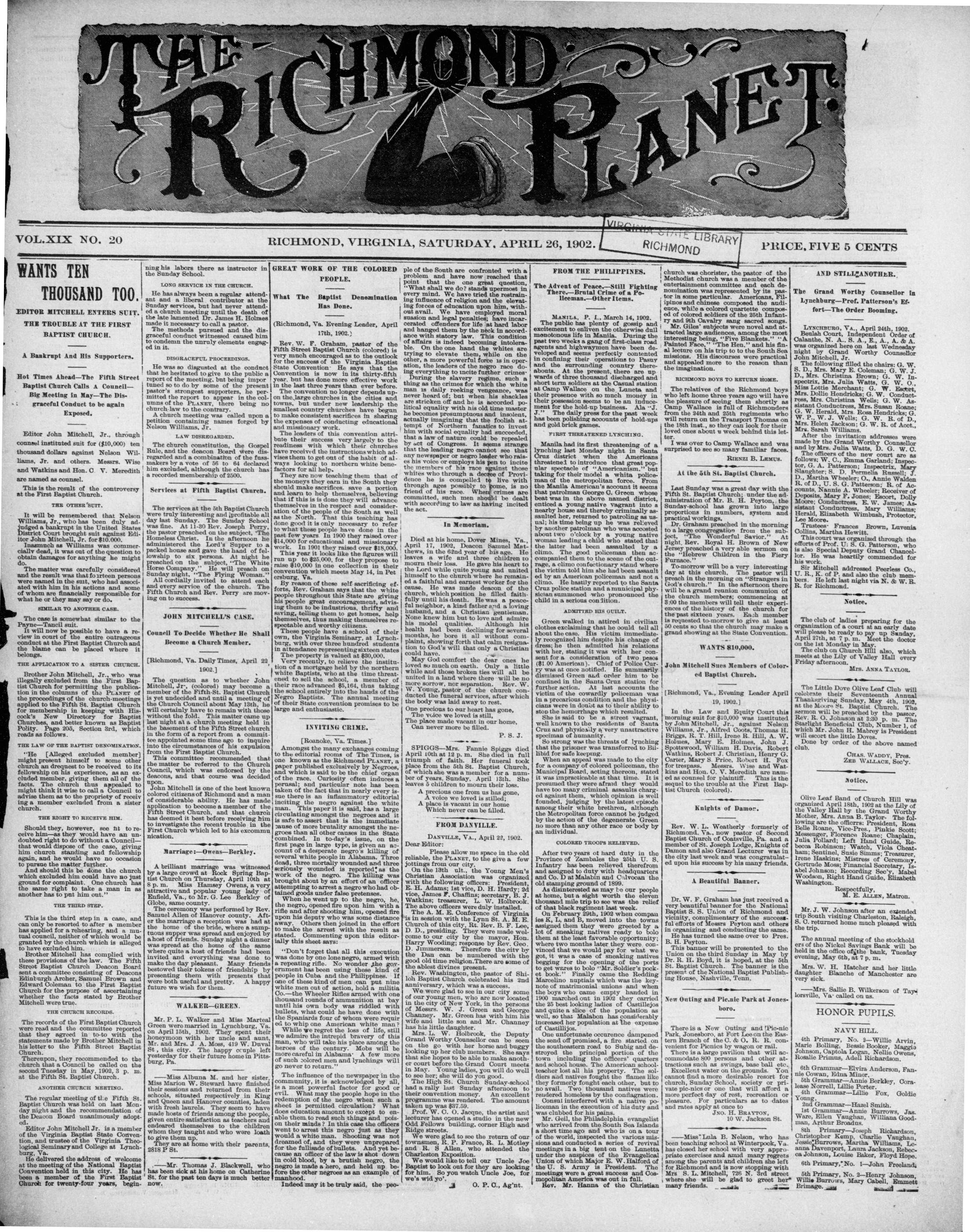
THE RICHMOND PLANET
VOL.XIX NO. 20
WANTS TEN
THOUSAND TOO
EDITOR MITCHELL ENTERS SUIT
THE TROUBLE AT THE FIRST
BAPTIST CHURCH.
A Bankrupt And His Supporters.
Hot Times Ahead—The Fifth Street
Baptist Church Calls A Council—
Big Meeting In May—The Dis-
graceful Conduct to be again
Exposed.
Editor John Mitchell, Jr., through counsel instituted suit for ($10,000) ten thousand dollars against Nelson Williams, Jr. and others. Messrs. Wise and Watkins and Hom. C. V. Meredith are named as counsel. This is the result of the controversy at the First Baptist Church.
THE OTHER'SUIT
It will be remembered that Nelson Williams, Jr., who has been duly adjudged a bankrupt in the United States District Court brought suit against Editor John Mitchell, Jr. for $10,000. Inasmuch as Williams was commercially dead, it was out of the question to obtain damages for anything he might do. The matter was carefully considered and the result was that for oregon persons were named in the suit, who had worked with him in his actions and some of whom are financially responsible for what he or they may say or do.
SIMILAR TO ANOTHER CASE.
The case is somewhat similar to the Payne-Tancil suit.
It will now be possible to have a review in court of the entire outrageous conduct at the First Baptist Church and the blame can be placed where it belongs.
THE APPLICATION TO A SISTER CHURCH.
Brother John Mitchell, Jr., who was illegally excluded from the First Baptist Church for permitting the publication in the columns of the PLANET of the proceedings of the church-meetings applied to the Fifth St. Baptist Church for membership in keeping with Hiscock's New Directory for Baptist Churches, and better known as Baptist Polity. Page 205, Section 3rd, which reads as follows.
THE LAW OF THE BAPTIST DENOMINATION.
"He [Alleged excluded member] might present himself to some other church an dreqest to be received to its fellowship on his experience, as an excluded member, giving them all of the facts. The church thus appealed to might think it wise to call a Council to advise them as to the propriety of receiving a member excluded from a sister church.
THE RIGHT TO RECEIVE HIM
Should they, however, see it to receive him—as they would have an undoubted right to do without a Council—that would dispose of the case, giving him church standing and fellowship again, and he would have no occasion to pursue the matter further.
And should this be done the church which excluded him could have no just ground for complaint. One church has the same right to take a man in as another has to put him out."
THE THIRD STEP.
This is the third step in a case, and can only be resorted to after a member has applied for a rehearing, and a mutual council, neither of which would be granted by the church which is alleged to have excluded him. Brother Mitchell has complied with these provisions of the law. The Fifth Street Baptist Church Deacon Board sent a committee consisting of Deacons and Edward Colemine, St. John's Church and Edward Colemine, to the First Baptist Church for the purpose of ascertaining whether the facts stated by Brother Mitchell were true.
THE CHURCH RECORDS
The records of the First Baptist Church were read and the committee reported that they agreed in to-to with the statements made by Brother Mitchell in his letter to the Fifth Street Baptist Church. Thereupon, they recommended to the church that a Council be called on the second Tuesday in May, 1902, 3 p. m. at the Fifth St. Baptist Church.
ANOTHER CHURCH MEETING.
The regular meeting of the Fifth St. Baptist Church was held on last Monday night and the recommendation of the Deacon Board unanimously adopted. Editor John Mitchell Jr. is a member of the Virginia Baptist State Convention, and trustee of the Virginia Theological Seminary and College at Lynchburg, delivered the address of welcome at the meeting of the National Baptist Convention held in this city. He has been a member of the First Baptist Church for twenty-four years, begin-
ning his labors there as instructor in the Sunday School.
LONG SERVICE IN THE CHURCH.
He has always been a regular attendant and a liberal contributor at the Sunday services, but had never attended a church meeting until the death of the late lamented Dr. James H. Holmes made it necessary to call a pastor. The methods pursued and the disgraceful conduct witnessed caused him to condemn the unruly elements engaged in it.
DISGRACEFUI. PROCEDINGS.
He was so disgusted at the conduct that he hesitated to give to the public a report of the meeting, but being important to so do by some of the present pastor's strongest supporters, he permitted the report to appear in the columns of the PLANET, there being no other choice. A church meeting was called upon a petition containing names forged by Nelson Williams, Jr.
LAW DISREGARDED.
The church constitution, the Gospel Rule, and the denacon Board were disregarded and a combination of the fuss-makers by a vote of 56 to 64 declared him excluded, although the church has a recorded membership of 2500.
The services at the 5th Baptist Church were truly interesting and profitable all day last Sunday. The Sunday School was fine. At 11-80 Rev. Joseph Perry, the pastor preached on the subject, "The Homeless Christ. In the afternoon he administered the Lord's Supper to a packed house and gave the hand of fellowship to six persons. At night he preached on the subject, "The White Horse Company." He will preach on Sunday night, "The Flying Woman." All cordially invited to attend each and every service of the church. The Fifth Church and Rev. Perry are moving on to success.
Council To Decide Whether He Shall Become a Church Member.
[Richmond, Va. Daily Times, April 22, 1902.]
The question as to whether John Mitchell, Jr., (colored) may become a member of the Fifth-St. Baptist Church is yet undecided and until a meeting of the Church Council about May 13th, he will certainly have to remain with those without the fold. This matter came up last night at a church meeting held in the basement of the Fifth Street church in the form of a report from a committee appointed some time ago to inquire into the circumstances of his expulsion from the First Baptist Church.
This committee recommended that the matter be referred to the Church Council, which was endorsed by the deacons, and that course was decided upon.
John Mitchell is one of the best known colored citizens of Richmond and a man of considerable ability. He has made application to become a member of the Fifth Street Church, and that church has deemed it best before receiving him a commission that must trouble in the First Church which led to his excommunication.
Marriage:—Owens—Berkley.
A brilliant marriage was witnessed by a large crowd at Rock Spring Baptist Church on Thursday, April 10th at 8 p.m. Miss Hamsey Owens, a very attractive and popular young lady of Enfield, Va., to Mr. G. Lee Berkley of Globe, same county.
The ceremony was performed by Rev. Samuel Allen of Hanover county. After the marriage a reception was had at the home of the bride, where a sumptuous supper was spread and enjoyed by a host of friends. Sunday night a dinner was spread at the home of the same where quite a host of friends had been invited and everything was done to make the day pleasant. Many friends bestowed their tokens of friendship by presenting them with presents that were both useful and pretty. A happy future we wish for them.
WALKER—GREEN
Mr. P. L. Walker and Miss Martel Green were married in Lynchburg, Va. on April 15th, 1903. They spent their honeymoon with her uncle and aunt, Mr. and Mrs. J. A. Moss, 419 W. Duval St., this city. The happy couple left yesterday for their future home in Pittsburg, Pa.
Miss Albuna M. and her sister, Miss Marion W. Steward have finished their sessions and returned from their schools, situated respectively in King and Queen and Hanover counties, laden with fresh laurels. They seem to have made hosts of friends among the people, given entire satisfaction as teachers and endeared themselves to the children whom they taught and who were loath to give them up.
They are at home with their parents, 2818 P St.
Mr. Thomas J. Blackwell, who has been sick at his home on Catherine St. for the past ten days is much better now.
RICHMOND, VIRGINIA, SATURDAY, APRIL 26, 1902.
What The Baptist Denomination Has Done.
(Richmond, Va. Evening Leader, April 17th, 1902.)
Rev. W. F. Graham, pastor of the Fifth Street Baptist Church (colored) is very much encouraged as to the outlook for the success of the Virginia Baptist State Convention. He says that the Convention is now in its thirty-fifth year, but has done more effective work in the last three years than ever before. The convention no longer depends upon the large churches in the cities and towns, but under new leadership the smallest country churches have begun to make consistent sacrifices in sharing the expenses of conducting educational and missionary work. The leaders of this convention attribute their success very largely to the readiness with which their churches have received the instructions which advises them to get out of the habit of always looking to northern white benefactors for all help.
They are now teaching them that of the moneys they earn in the South they should make sacrifices, save a portion and learn to help themselves, believing that if this is is done they will advance themselves in the respect and consideration of the people of the South as well as the North. That this teaching has done good it is only necessary to refer to what these people have done in the past few years. In 1900 they raised over $14,000 for educational and missionary work. In 1901 they raised over $18,000. This year it looks like the figures will run up to $25,000, for they propose to raise $10,000 in one collection in their convention which meets May 14, in Petersburg, Va. By reason of these self-sacrificing efforts, Rev. Graham says that the white people throughout this State are giving his people great encouragement, advising them to be industrious, thrifty and saving, telling them to get homes, help themselves, thus making themselves respectable and worthy citizens.
These people have a school of their own, the Virginia Seminary, at Lynchburg, with over three hundred students in the school in green states. The property is valued $1.2 million.
Very recently, to relieve the institution of a mortgage held by the northern white Baptists, who at the time threatened to sell the school, a member of their race advanced $5,164, thus taking the school entirely into the hands of the students. The annual meeting of their State convention promises to be large and enthusiastic.
INVITING CRIME.
[Roanoke, Va. Times.]
Amongst the many exchanges coming to the editorial rooms of The Times, is one known as the Richmond PLANET, a paper published exclusively by Negroes, and which is said to be the chief organ of the race. Curiosity often induces a perusal; and particular note has been taken of the fact that in nearly every issue there is an inflammatory editorial inciting the negro against the white man. This paper it is said, has a large circulating amongst the negroes and it is safe to assert that is the immediate cause of more brutality amongst the negroes than all other causes in the State combined. In to-day's issue, on the first page in large type, is given an account of a desperate negro's killing of several white people in Alabama. Three dead, three mortally wounded and three seriously wounded is reported as the work of the negro. The killing was brought about by an effort of an officer attempting to arrest a negro who had obtained goods under false pretenses.
When he went up to the negro, he, the negro, opened fire upon him with a rifle and after shooting him, opened fire upon his deputy who was some distance away. Others then joined in the effort to make the arrest with the result as stated. Commenting upon this editorially this sheet says:
"Don't forget that all this execution was done by one lone negro, armed with a repeating rifle. No we, the government has been using these, and people in Cuba and the Philippines. If one of these kind of men can put nine white men out of action, hold a militia Co.—the Wheeler Rifles armed with one thousand rounds of ammunition at bay until his own body was riddled with bullets, what could he have done with the Spaniards four of whom were required to wipe one American white man? While we regret the loss of life, still we admire the intrepid bravery of this man, who will take his place among the heroes of the century. Mobs will be more careful in Alabama. A few more of such colored men and lynchings will go never to return."
The influence of the newspaper in the community, it is acknowledged by all, is a most powerful factor for good or evil. What may the people hope in the redemption of the negro when such a sheet is permitted circulation? What does education amount to except to enable them to read such things and poison their minds? In this case the officers went to arrest this negro just as they would a white man. Shooting was not intended, and they were unprepared for the fullside of bulls, and because an officer of the law is shot down in cold blood, by a bristly negro, the negro is made a hero, and held up before the other negroes as an example of manhood. May it be truly said, the peo-
ple of the South are confronted with a problem and have now reached that point that the one great question, "What shall we do? stands upmost in every mind. We have tried the restraining influence of religion and the elevating forces of education upon him, without avail. We have employed moral suasion and legal penalties; have incarcerated offenders for life at hard labor and hanged them by the neck in accordance with statory law. This condition of affairs is indeed becoming intolerable. On the one hand the whites are trying to elevate them, while on the other, a more powerful force is in operation, the leaders of the negro race doing everything to incite further crime.
During the slavery regime, such a thing as the crimes for which the white man is daily reeking vengeance, was never heard of; but when his shackles are stricken off and he is accorded political equality with his old time master he becomes presumptuous and insolent, actually imagining that the foolish attempt of Northern fanatics to invest him with social equality had succeeded, that a law of nature could be repealed by act of Congress. It seems strange that the leading negro cannot see that any newspaper or negro leader who raises his voice or employs his pen to incite the members of his race against those cities who through a degree of Providence is able to compel to live with through ages the criminal crime, no friend of his race. When crimes are committed, such men should be dealt with according to law as having incited the act.
Died at his home, Dover Mines, Ya., April 17, 1903, Deacon Samuel Matthews, in the 62nd year of his age. He leaves a wife and three children to mourn their loss. He gave his heart to the Lord while quite young and united himself to the church where he remained a faithful and earnest worker for the cause. He was made deacon of the church, which position he filled faithfully until his death. He was a peaceful neighbor, a kind father and a loving husband, and a Christian gentleman. None knew him but to love and admire his model qualities. Although his health had been declining for several months, he bore it all without complaint, showing forth that calm resignation to God's will that only a Christian could have.
May God comfort the dear ones he loved so much on earth. Only a little while and those broken ties will all be united in a land where there will be no more sorrow, nor separation. Rev. W. W. Young, pastor of the church conducted the funeral services, after which the body was laid away to rest.
One precious to our heart has gone,
The voice we loved is still
The voice we loved is still. The place made vacant in our home.
The place made vacant in our home,
Can never more be filled.
P. S. J.
SPIGGS—Mrs. Fannie Spiggs died
April 10th at 12 p. m. She died in full
trinymph of faith. Her funeral took
place from the 5th St. Baptist Church,
of which she was a member for a
number of years, Sunday, April 13th. She
leaves 5 children to mourn their loss.
A precious one from us has gone,
A voice we loved is still;
A place is vacant in our home
Which never can be filled.
FROM DANVILLE
DANVILLE, VA., April 22, 1902.
Dear Editor:
Please allow me space in the old reliable, the PLANET, to the give a few jottings from our city.
On the 13th ult., the Young Men's Christian Association was organized with the following officers: President, E. H. Adams; 1st vice, D. H. Hardy; 2d vice, James F. Chaffin; secretary, B. J. Watkins; treasurer, L. W. Holbrook.
The above officers were duly installed.
The A. M. E. Conference of Virginia is in session with the Lynn St. A. M. E. Church of this city, Rt. Rev. B. F. Lee, D. D., presiding. They were made welcome to our city by the mayor, Hon. Harry Wooding; response by Rev. Geo. D. Jimmerson. Therefore the city by the Dan can be numbered with the good old time religion. There are some of the ablest divines present.
Rev. Washington, the pastor of Shiloh Baptist Church celebrated his 2nd anniversary, which was a success.
We were glad to see in our city some of our young men, who are now located in the city of New York, in the persons of Messrs. W. J. Green and George Channey. Mr. Green has with him his wife and little son and Mr. Channey has his little dangler.
Mrs. L. W. Holbrook, the Deputy Grand Worthy Counsellor can be seen on the go with her horse and buggy looking up her club members. She says that she hopes to be able to make another court before the Grand Court meets in May. Young ladies, you will do well to see her; she will do you good.
The High St. Church Sunday-school had a rally last Sunday afternoon to their convention money. An excellent programme was rendered. The amount taken up was $87.59.
Prof. W. C. O. Jacque, the artist and lecturer has opened a studio in the new Odd Fellows building, corner High and Ridge streets.
We were glad to see the return of our townsmen, R. P. France, R. L. Motley and R. S Allen, who attended the Charleston Exposition.
We would like to tell our Uncle Joe Baptist to look out for they are looking for him. So you uncle Joe, for we're wid yo'. O. P. C. Agn't.
FROM THE PHILIPPINES.
The Advent of Peace.—Still Fighting There.—Brutal Crime of a Policeman.—Other Items.
MANILA, P. I., March 14, 1902.
The public has plenty of gossip and excitement to enliven the otherwise dull monotonous life in Manila. During the past two weeks a gang of first-class road agents and highwaymen have been developed and seems perfectly contented in confining their operations to Pasny and the surrounding country thereabouts. At the present, there are upwards of three thousand discharged and short-waiters at the Casual station at Camp Wallace, the Limo and their presence with so much in their possession seems to be an induction for the hold-up business. Ala "J. J." The daily press for the past week has been polishing accounts of hold-ups and gold brick games.
FIRST THREATENED LYNCHING.
Manila had its first threatening of a lynching last Monday night in Santa Cruz district when the Americans threatened to introduce that great popular spectacle of "Americanism," but taking for their model a white policeman of the metropolitan force. From the Manila American's account it seems that patrolman George O. Green whose beat was in the above named district, enticed a young native vagrant into a nearby house and thereby criminally assaulted her, returned to patrolting as usual; his time being up he was usured by another patrolman who was accosted about two o'clock by a young native woman leading a child who stated that the latter had been assaulted by a climo. The good policeman then accrued attention to the scene of the outrage, a climo fortifying the stand and the victim told him she had been assaulted by an American policeman and not a climo. He hastily reported to the Santa Cruz police station and a municipal physician summoned who pronounced the child in a serious condition.
ADMITTED HIS GUILT.
Green walked in attired in civilian clothes exclaiming that he could tell all about the case. His victim immediately recognized him despite his change of dress; he then admitted his relations with her, stating it was with her consent for a consideration of two pesos ($1.00 American). Chief of Police Curry was at once notified. He summarily dismissed Green and order him to be confined in the Santa Cruz station for further action. At last accounts the victim of the cowardly policeman was in a precarious condition and the physicians were in doubt as to their ability to stop the hemorrhage which resulted. She is said to be a street vagrant, who also be a resident of Santa Cruz and physically a very unattractive specimen of humanity. So strong was the threats of lynching that the prisoner was transferred to Bilibid for safe keeeping.
When an appeal was made to the city for a company of colored policeman, the Municipal Board, acting thereon, stated it was impracticable at that time. It is presumed they were afraid they would have too many criminal assaults charged against them, which opinion is well founded, judging by the latest episode of the Metropolitan force combat, although the Metropolitan force can be by the action of the degenerate Green no more than any other race or body by an individual.
COLORED TROOPS RELIEVED.
After two years of hard duty in the Province of Zambales the 25th U. S. Infantry has been relieved therefrom and assigned to duty with headquarters and Co. D at Malabin and Calvocan the old stamping ground of 1899.
As disinterested as may be our people at home, but a sight worth the eleven thousand mile trip to see was the relief of that black regiment last week.
On February 29th, 1902 when companies K, L, and B, moved into the towns assigned them they were greeted by a lot of sneaking natives ready to bolo them at the least favorable opportunity; where two months later they were convinced that we would pay for what we got, it was a case of sneaking natives begging for the opening of the ports to get wares to bolo "Mr. Soldier's pocket book." Finally came the Redding Marcelino nuptials which was the keynote of matrimonial unions and when the boys who came empty handed in 1900 marched in 1902 they carried the 25 best looking ladies of Castillejos and quite a slice of the population as well, so that Malabon has considerably increased her population at the expense of Castillios.
One unfortunate occurrence dampened the send off promised, a fire started on the southeastern road to Subig and destroyed the principal portion of the town including the officers' quarters and school house. The American schoolteacher lost all his property. The soldiers and natives fought the flames like they formerly fought each other, but to no avail. Two thousand natives were rendered homeless by the conflagration. Consul interfered with a native policeman in the execution of his duty and was clubbed for his pains.
Mr. Geil, the Philadelphia evangelist who arrived from the South Sea Islands a short time ago and is on a tour of the world, inspected the various missions and conducted a series of revival meetings in a big tent on the Lunetta under the anspies of the Evangelical Union of which Major E. W. Halford of the U. S. Army is President. The meetings were a great success and Cosopolitan America was out in full.
Rev. Mr. Hanna of the Christian
church was chorister, the pastor of the Methodist church was a member of the entertainment committee and each denomination was represented by its pastor in some particular. Americans, Filipinos and Chinese composed the audience, while a colored quartette composed of colored soldiers of the 25th Infantry and 9th Cavalry sang sacred songs. Mr. Giles' subjects were novel and attracted large audiences, among the most famous being "Five Blankets." A Painted Roof Theatrical final lecture on his trip to to the South Sea missions. His discourses were practical and appealed more to the reason than the imagination.
RICHMOND BOYS TO RETURN HOME
The relatives of the Richmond boys who left home three years ago will have the pleasure of seeing them shortly as Camp Wallace is full of Richmonders from the 24th and 25th regiments who will return on the Transport Thomas on the 18th inst., so they can look for their ones about us week behind this letter. I was over to Camp Wallace and was surprised to see so many familiar faces.
At the 5th St. Baptist Church.
Last Sunday was a great day with the Fifth St. Baptist Church; under the administration of Mr. B. H. Peyton, the Sunday-school has grown into large proportions in numbers, system and practical workings.
Dr. Graham preached in the morning to a large congregation from the subject, "The Wonderful Savior." At night, Rev. Royal H. Brown of New Jersey preached a very able sermon on the "Hebrew Children in the Fiery Furnace."
To-morrow will be a very interesting day at this church. The pastor will preach in the morning on "Strangers in the church." In the afternoon there will be a round and rehearsal of communion of the church members; commencing 3:00 the members will tell their experiences of the history of the church for the past sixteen years. Each member is requested to-morrow to give at least 50 cents so that the church may make a grand show at the State Convention.
WANTS 810,000.
John Mitchell Sues Members of Colored Baptist Church.
[Richmond, Va., Evening Leader April 19, 1903.]
In the Law and Equity Court this morning suit for $10,000 was instituted by John Mitchell, Jr., against Nelson Williams, Jr., Alfred Coots, Thomas H. Briggs, R. T. Hill, Irene R. Hill, A. W. Holmes, Mary E. Holmes, John J. Spotswood, William H. Davis, Robert Watkins, Robert J. Christian, Henry G. Carter, Mary S. Price, Robert H. Fox for trespass, Jessica, Wise and Watkin, Jon O. Medina, was counsel for plaintiff. This is the sequel to the trouble at the First Baptist Church (colored).
Knights of Damor.
Rev. W. L. Weatherly formerly of Richmond, Va., now pastor of Second Baptist Church of Coatsville, Pa. and a member of St. Joseph Lodge, Knights of Damon and also Grand Lecturer was in the city last week and was congratulated upon his success by his many friends.
A Beautiful Banner.
Dr. W. F. Graham has just received a very beautiful banner for the National Baptist S. S. Union of Richmond and vicinity, complimentary of the successful efforts of Messrs Peyton and others in organizing and conducting the same. He has turned the same over to Pres. B. H. Peyton. This banner will be presented to the Union on the third Sunday in May by Dr. R. H. Boyd, it is hoped, at the 5th St. Baptist Church. The banner is the present of the National Baptist Publishing House, Nashville, Tenn.
New Outing and Pic.nic Park at Jonesboro.
There is a New Outing and !Pic.nic Park, Jonesboro, at Fort Loe on the Eastern Branch of the C. & O. R. R. convenient for Picnics by wagon or rail.
There is a large pavilion that accommodates 800 persons and other attractions such as swings, base ball etc.
Excellent water on the grounds. You cannot find a more desirable resort for church, Sunday School, society or private pic-nics or one that will afford a more perfect day of rest, recreation or exercise. Many years as to dates and rates apply at once.
Miss' Luna B. Nelson, who has been teaching school at Winterpook, Va. has closed her school with very appropriate exercises and amd many regrets among the parents and children she left for Richmond and is now stopping with Mrs S. L. Mitchell, 726 N. 3rd street where she will be glad to greet her many friends.
The Grand Worthy Counsellor in Lynchburg—Prof. Patterson's Effort—The Order Booming.
LYNCHBURG, VA., April 24th, 1902. Beulah Court, Independent Order of Calanthe, N. A., S. A., E., A., A. & A. was organized here on last Wednesday night by Grand Worthy Counsellor John Mitchell, Jr. The following filled the chairs: G. W. S. D., M. Mrs. Mary E. Coleman; G. W. J. D., Mrs. Christina Brown; G. W. In spectrix, Mrs. Julia Watts, G. W. O., Miss Lottie Merchant; G. W. Essex, Mrs. Dollie Hendriks; G. W. Conductress, Mrs. Christina Wells; G. W. Assistant Conductress, Mrs. Susan Roanes G. W. Herald, Mrs. Rosa Hendriks; G. W. P., W. J. Wells; G. W. R. of D. M. Helen Jackson; G. W. R. of Acct., Mrs. Sarah Williams
After the invitation addresses were made by the Grand Worthy Counsellor and by Mrs. Julia Watts, D. G. W. G. The officers of the new court are as follows: W. A. Emma Garland; Inspector, G. A. Patterson; Inspectrix, Mary Slaughter; S. D. Permella Russell; J. D., Martha Wheeler; O., Annie Walden R. of D. U. S. G. Patterson; R. of Accounts, Nannie A. Wheeler; Receiver of Deposits, Mary F. Jones; Esort, Dolly Moore; Conductress, E. W. James; Assistant Conductress, Mary Williams; Herald, Elizabeth Wimbush, Protector, Lee Moore.
Trustees: Frances Brown, Luvenia Collins, Martha Hewitt.
This court was organized through the efforts of Prof. U. S. G. Patterson, who is also Special Deputy Grand Chancellor. He was heartily commended for his work.
Sir Mitchell addressed Peerless Co., U. R. K. of P. and also the club members. He left last night via N. & W. R. for Richmond.
the club of ladies preparing for the organization of a court at an early date will please be ready to pay up Sunday, April 37th, at 7 p.m. Meet the doctor on the 1st Monday in May. The club on Church Hill also, which meets at the Lily of Valley Hall every Friday afternoon. MRS. ANNA TAYLOR.
The Little Dove Olive Leaf Club will celebrate their Seventeenth Annual Thanksgiving Sunday, May 4th, 1902, at the Moore St. Baptist Church. The sermon will be preached by the pastor, Rev. R. O. Johnson at 3:30 p. m. The Starlight Beneficial Club, Number 1, of which Mr. John H. Mabrey is President will escort the little Doves. Done by order of the above named club.
CHAS. WADY, Pres.
ZEB WALLACE, Sec'y.
Olive Leaf Band of Church Hill was organized April 18th, 1902 at the Lily of the Valley Hall by the Grand Worthy Mother, Mrs. Anna B. Taylor. The following are the officers: President, Rosa Belle Roane, Vice-Pres., Pinkie Scott; Messenger, Florence Roane; Chaplain, Julia Pollard; Left Hand Guide, Rebecca Robinson; Watch, Viola Cheatte; Stacie Siele Simms; Treasurer, Irene Haskins; Minister, Ceremony, Gertrude Moss; Financial Secretary,abel Johnson; Recording Secy. Mahel Woodson, Right Hand Guide, Elizabeth Washington.
Mr. J. W. Johnson after an extended trip South visiting Charleston, Raleigh, S. O. returned home much pleased with the trip.
The annual meeting of the stockhold ers of the Nickel Savings Bank will be held in the office of the bank, Tuesday evening, May 6th, at 7 p. m.
Mrs. W. H. Hatcher and her little daughter Blanche of Manchester are very sick.
Mrs. Sallie B. Wilkerson of Taylorsville, Va.' called on us.
HONOR PUPILS
NAVY HILL
4th Primary, No. 2—Willie Arvin, Marie Bolling, Bessie Booker, Maggie Johnson, Captola Logan, Nellie Owens, Rosalie Primus, Adell Richardson.
6th Grammar—Elvira Anderson, Fannie Cowan, Edna Minor.
5th Grammar—Annie Berkley, Coralease Norrell, Lillie Lorter.
4th Grammar—Lillie Fox, Goldie Young.
2nd Grammar—Hazel Smith
1st Grammar—Annie Burrows, Jas. Ware, Ellen Vaughan, Williana Goodman, Arthur Broadus.
8th Primary—Joseph Richardson, Christopher Kemp, Charlie Vaughan, Jessie Burrows, Martha Williams, Leanna Davenport, Laura Jackson, Rebecca Johnson, Louise Baker, Floyd Hope.
6th Primary, No. 1—John Freeland.
5th Primary, No. 2—Henry Johnson, Willie Burrows, Mary Cabell, Emmett Brimage.
THE PLANET
SATURDAY, APRIL 26, 1902.
RELIGIOUS MATTERS
A HUNGERED
I wonder if Heaven doth hold in trust,
For the heart that goes hungry here.
Some treasure of love it hath vainly sought
Through the lapse of each weary year?
I wonder if God, who is love itself,
Known how small a crust would suffice.
To be with new warmth and the heart
That is dumb in its fetters of ice?
And hungered His whole life through?
A LESSON FOR THE YOUNG
The Cost of Opportunity Not Great to the Youth But Increases with the Years.
We all know the ancient story of the Cumaean Sybil, who offered her nine precious books of prophecy to the Roman king of old, and who being rejected, burnt three, and came back a year later to offer those which remained for the same high price; then, refused a second time, burnt all but three, and returned next year to ask the full price for them, and received it. Each leaf, before she finished, was worth its weight in gold; but the price had to be paid. Legend or history, the story is true to the nature of things. It is an alegory of opportunity, as countless human beings can testify. Happy the man who, unlike the Roman king, takes the first offer of the sybil, and does not instead have to pay full price for a fragment afterward.
It is a commonplace, and a commonplace of which young people are particularly impatient, that youth is the time of opportunity. The boy or girl gets tired of hearing about it. In the very certainty that opportunities are theirs, some young persons are foolish enough to put them aside and postpone them indefinitely. Nevertheless, it is true, no matter how hackneyed truth appears, that the bargains in opportunity are all offered in youth. Things come easy to the young mind and soul that would cost tremendously later. A friend secured in youth, an education gained before the work of life begins, a noble character early established, are priceless in proportion to their cost. And above all, the religious opportunities of the soul are immeasurably greater and better in early years than afterward. Except in a heathen country, the Gospel opportunity comes without price to boys and girls, young men and maidens. With no entrenched sins, with none of the stifling cares of middle life, with no lifelong evil or worldly associations, they are free to accept Christ as the least cost. The younger the Christian, the easier the Christian life, is a well-nigh universal rule.
Every year adds to the cost of opportunity, for every year opportunity must grow less. Those who neglect the riches of early opportunity, and buy the poor remnant of the same opportunity later, can all testify to this. "It might have been" is a proverbial phrase, because it comes home to universal experience. The price rises inexorably in proportion as we get less in return. The same amount of will power and work that would gain friends, honor and a fine start in life for a lad, will hardly help a man of 30 to conquer a single bad habit. Forming a character rightly costs not a tenth of the effort and pain that must go to reform a character, even imperfectly, ten years later. The young disciple always has salvation at its freest and best. Christ said: "Suffer the little children to come unto Me." He chose young men as His apostles. His divine wisdom knew the day of opportunity, and the law of its cost. Unless we realize it too, we shall make a bad bargain of life.—Young People.
The Great Question
The great question, after all, is this: Shall we judge man by God, or God by man? Does light and understanding flow upward or downward? If we judge man by God, at once we have true and discriminating thoughts of human life. We have absolute standards. We have a test of the worth of all we see or do. But if we judge God by man we only have over again what the world has been so full of—the persuasions of self-interest, the disbelief in absolute righteousness, the changing standards of the changing times. Men have gone into the sanctuary of their own selfsness, the sanctuary of themselves, and straightway they have seemed to see an end of God. All sense of a supreme and awful Fatherhood on which all men depended, to which all action must go back for judgment, has lost. No higher power than the human has seemed to be moving under and giving meaning to the events of ordinary life.—Phillips Brooks.
Christian Charity
Put a seal upon your lips and forget what you have done. After you have been kind, after love has stolen forth into the world and done its beautiful work, go back into the shade again and anything about it. Love hides even from itself—Prof. Dr. Drummond.
SEEING ISN'T EELIEVING.
The Fultest and Most Complete Sight
Comes Only When We Also
Have Faith.
It is an old proverb that says, "Seeing is believing," but it is like some other proverbs—it sounds well, yet may be wholly wrong teaching; it is not so. Seeing is not believing. On the contrary, believing is seeing. It is real, when a man truly believes that he has sight worth speaking of.
That was strikingly emphasized in the incident of the raising of Lazarus. Martha will not believe, and because she will not believe she has little sight. Jesus says to her: "Said I not to thee that if thou wouldest believe thou shouldest see the glory of God?" Sight does not help faith, but faith creates a genuine sight.
It was said of Jesus that "He shall not judge after the sight of his eyes," the reason was most natural. There is nothing so misleading as sight; things are not what they seem, nor what they look like. There must be another basis of measurement. The trouble with most of us is that we do form judgments after the sight of our eyes, and our judgments are often wrong. What a different world it would be if men believed more; if they had more confidence in each other; there are many good qualities they could see if they only believed. It is not sight that reveals the glory; it is faith that makes the glory visible. Here is a man who says he will only believe what he sees—and he thinks he is wise, but he is as blind as a bat. It is often charged against anatomists that they are unbelievers. They see no life, aid because they do not see, they say there is no life; so the finest creation of God provokes no reverence in them, because they are blind to its glory; if they believed they would see. What a small circumference to life is a sight, after all; how little we see, and how confusing that which we do see. What a small world we live in, what a big world we shut out—when we put sight first. There stands that old man who has never seen a trolley car until now; he will not be so foolish as to step in and sit down, under the supposition that the stick over the top will pull him along; you cannot fool him like that! He will not step on the car until he sees what makes the thing go. Well, he will never find out. But if he believes he will see the glory! Or this man at the telephone; he will not be so foolish as to sit down at the desk to talk with a man who has asked to "see" him at the end of a long wire. But he will never see any more than what is before him—and of course he sees very little. But if he believes he will see—the glory of the most astounding miracle we are acquainted with, in spite of our familiarity with the telephone.
And the converse is also true: The unbelieving man sees very little. He sees no good in folks because he does not believe in folks. The pessimist is a man who wants to see before he has faith—and that makes him the smallest man in the universe. But the love that believeth all things is the heavenly faculty that sees all things. The more confidence you have in people the more good will you see in them, because your faith will draw out the very best that is in them, and change the bad into good. The doubter may have a place in the world, but he has never brought out the best that is in man, or received the best that is in God. According to your faith, not according to your sight, be it unto you. Seeing isn't believing—but believing is seeing—Baptist Union.
SPARKS FROM MANY ANVILS.
We don't want the faith that comes by seeing, but the seeing that comes by faith.—John McNeil.
The feet follow the eyes; we look and then go. First we sin in desire, and then in deed.—Wellspring.
We think of the truth as a thing that is spoken or taught; Jesus Christ thought of the Truth as a thing that is lived.—Mark Guy Pearse.
He who knows only how to enjoy, and not to endure, is ill-fitted to go down the stream of life through such a world as this.—Harry Van Dyke.
Everywhere the flower of obedience is intelligence. Obey a man with cordial loyalty and you will understand him. Obey Jesus with cordial loyalty and you will understand Jesus. Not by studying Him, but by doing His will shall you learn how Divine He is. Obedience completes itself in understanding.—Phillips Brooks.
Spiritual life is an essential condition for the spiritual kingdom. What would you do in Heaven with an unregenerated nature? A stranger in a strange land; a beggar amid bounty; blind amid beauty; deaf amid waves of song; hungry, yet with no taste for Heavenly joys—you would be out of place there.—Evangelical Herald.
"A heart at leisure from itself" is indeed something worth striving for. We let slip many opportunities for helping others, not because we are indifferent or unwilling, but because just at the time we are so busy with our own burden, so full of care or sore-hearted that we think we have no strength to lend to another. Thereby we miss the blessedness of learning how God cares for those who care for others.—Leaves of Light.
Obedience.
Obedience—how slow we are to appreciate its value, and we are still more slow to work it into our conduct. It is easier to choose our own path. It is far more comfortable to do our own will. But God requires this of His friend. There is no other path that leads to these splendid heights of privilege. Many of us are missing the portion that God holds for us because we are unwilling to obey—Rev. E. F. Hallenbeck.
Courteay.
What a mighty means of usefulness is courtesy. The lack of it brings to many a dead failure, while to those who possess it the doors of opportunity are open. -Rev. Dr. Talmage.
PERTINENT REMARKS
Memory is a convenient storehouse for things to be forgotten.—Town Topics.
The way to get rid of some men is to loan them a little money.—Washington (Ia.) Democrat.
He is a wise father who knows his own child was as much at fault as the other man's.—Chicago Record-Herald.
When a man's kin take him one side for a quiet talk, his wife is convinced that they want to borrow his money.—Atchison Globe.
MYSTERY OF CRIME.
Paris Revels in a Series of Sensational Homicides.
Artist Kills His Model for the Sake of Hooligan
"Yez don't be marrild'a 'Yis; it's be surprisee 'Faith, 'ti proised."—P
Illustra
FEMININE FRILLS
Collars have grown to be quite as much a part of the toilet as the belt or the gloves; especially is this true for street wear.
Crepe diamante cloth as fine as flower-petals and marvelous muslin velvet will all be fashioned into the most superb raiments.
White and gray is a favorite combination in Paris, and also that characteristically Frenchy combination, pale blue and pale pink.
Buttons of rhinestone, with setting of gun metal, are used as fasteners for suede gloves in gun metal tint, to be worn with black gowns.
One of the new ribbons suggests fine canvas cloth. It comes in various colors and is sprinkled along the edge and through the center with small black velvet dots.
Some of the spring hats will show soft silk scarfs of a contrasting color to the straw threaded through interstices cut in the shape, the flat designs especially admitting of this sort of trimmings.
Chrysanthemum straw is the season's novelty in the millinery line and is aptly named. The colors are those of the natural blossomed toned pastel colorings and the toques require but little trimming.
Collars are of all sorts and conditions. They are trimmed with braid and embroidery and are made of silk in black, white and colors—moire being a favorite for this purpose—or of cloth in the delicate colors.
White mohair will be just right for boating costumes. Of white silks, louisines and moire reloues are two especially pretty weaves. Other new white fabrics are crepe armures and armure brillante, the latter having a crinkle that is not at all like crepon.
IN THE ANIMAL WORLD
Thoroughbred dogs are less intelligent than mongreis.
Flying fish have been known to rise 20 feet above the surface of the sea.
A cow's hide produces 35 pounds of leather, and that of a horse about 18 pounds.
Salmon rarely live more than ten years; but pike and carp sometimes live to be 150 years old.
It takes 2,800 silkworms to make a pound of silk, and these worms eat 150 pounds of leaves before they spin their cocoons.
Last year in Venezuela alone 2,000,000 birds were killed for fashion's sake. One London dealer admitted 12 years ago, long before fashion was so pitiless as now, that he sold 2,000,000 small birds every 12 months. Three recent consignments to London included 10,000 birds of paradise, nearly 800 packages of osprey feathers, 6,000 crested pigeons, 5,500 Impeyan pheasants, 500 bird skins, 270 cases of peacocks' feathers, 1,500 Argus pheasants and 500 various other small birds.
INDUSTRIAL ITEMS
It is estimated that nearly 400,000,000 telegrams are forwarded every year the world over.
The average depth of the Texas spouting oil wells is a few feet more than a thousand, and the height to which the oil is ejected is 60 to 200 feet. The vibration in the London "tuppenny tube," which has shaken buildings along the route, is to be obviated as much as possible by using an increased number of springs for supporting the cars and engines.
A new device for use with telephones has been patented in Sydney. It is a clockwork mechanism, with a dial that registers the time occupied in speaking. The hand of the dial works only when the receiver is taken from the book.
"Luella Lala is more charitable than I thought."
"So she consented to sing at your charity concert?"
"No; she refused."—Philadelphia Bulletin.
Dark Days Coming.
"I see they have finally signaled across the ocean without wires."
"Yes, and I bet $40 the first thing we know some blamed inventor'll be fixing up a contrivance so that a fellow's wife can tell whether he's actually in his office or not when he leaves word with his boy to keep telling her that he's busy with a million-sire client."—Chicago Record-Herald
A boy balancing on a large metal stand with an umbrella. A woman stands behind him, pointing outward.
"Why, under the tin"—Brooklyn Eagle.
MYSTERY OF CRIME.
Paris Revels in a Series of Sensational Homicides.
Artist Kills His Model for the Sake of Realism - Suicides. Wear Orange Blossoms - Wants to Be Gullotined.
For the picturesque and the sensational in crime there is no country that can begin to match France. Scarcely a week passes that the newspapers do not print the details of a murder that reads like a bit of Gaboriau fiction, or the fantastic dreams of Edgar Allen Poe. Such theatrical attributes seem to belong naturally to the French character, which loves odd, weird or fanciful effects in everything. The word "bizarre" was created in the language to fit this national characteristic.
Only the other day a man employed in one of the government offices in Paris killed his wife in their suburban home under circumstances of the most extreme cruelty. Then he went to his bedroom, and, preparatory to taking his own life, sat down and wrote a calm, psychological treatise on how it feels to be a murderer.
In the Villette quarter of the capital a young man two or three nights ago climbed to the second story window of his own house (though he had the keys of the front door in his pocket), entered his own bedroom where his wife and child were sleeping, murdered them then and there, climbed out of the window and down to the ground again, and was skulking away like a duty-done burglar when arrested.
A French artist of the Latin quarter was ten days ago putting the finishing touches on his painting, "The Death of Venus," which he meant to be his masterpiece. So that his model would be lifelike, or rather, deathlike, he had been in the habit of hypnotizing her during the three hours she posed each day. That last day he grew dissatisfied with the flesh, tints he had
CLIMBED INTO HIS OWN WINDOW.
imparted to Venus, so he administered a fatal dose of chloroform to the sleeping woman. After she had passed from partial unconsciousness to death, he copied with marvelous accuracy the precise hues of the dead model's flesh. He worked all through the night and by daylight had finished the painting to his own satisfaction. Then he wrote a few words on three separate sheets of paper. One he fastened in the dead woman's hand; a second he attached to the still moist canvas, and the third he placed, like a headstone, against the pillow of his couch, where he threw himself after swallowing the rest of the chloroform that was left in the little
When a friend of the artist visited the studio that afternoon he read the story of the tragedy in the three slips of paper. The lead-penciled epitaph of the girl read: "She died for Art." The inscription above the painter's head was: "He strove for immortality." The paper hanging from the painting bore the words: "Their monument."
The police fished out from the Martin canal the bodies of a man and woman who had obviously committed suicide because they had been crossed in love. They were clasped in each other's arms, and around their waists, binding them to each other, was a stout rope, in the strands of which were entwined artificial orange blossoms.
Only the other day two young men, armed with daggers, fought a desperate duel near Billiancourt, in the outskirts of Paris. They selected a moonlight night as the time, a deserted road as the place, and added a further picturesque effect to the episode by each of them mounting a bicycle for the encounter.
A characteristically French criminal, who had been sentenced to death for a murder committed a year ago in Havre, has written to the president of the republic protesting against a commutation of the sentence, and explaining that he had committed the murder for the sole purpose of being guillotined, "as he had had an intense desire, ever since childhood, to learn the brain conditions of a man immediately after he is beheaded."
Big Trade in Butterflies
The trade in rare butterflies is increasing in London, and ingenious deception is practiced regarding them. Ordinary butterflies are caught and killed; then girls are employed to smear the gauzy wings with thin mucilage, and sprinkle fine metallic powder of various colors on the wings. In this way the collector can be plied with the most beautiful specimens almost while he waits.
A Friend in Disguise
A friend is Diagnoe.
Giles—Do you think her father influenced her to marry you?
Bjones — Unquestionably. She would never listen to me until he forbade my calling on her—Judge.
Neverpay's Notion
Neverpay—Say, old boy, lend me $13.
Eyetooth—Well—um—I don't know
about that.
Neverpay—Superstitious, eh? Well,
make it twelve—N. Y. Weekly.
Illustrating the Difference.
"Is he a statesman or a politician?" "Oh, a statesman, beyond question." "Are you sure?" "Positive. Why, you couldn't bribe him with money; you'd have to show that you could deliver political influence."—Brooklyn Eagle.
The Song.
"I'm going back, I'm going back," The singer sweetly sang; Her face was beautiful, her voice In rich, full volumes rang.
"I'm going back," she sang, and then Some base, unlettered clown Up in the gallery hollered: "When You get there, please set down."—Chicago Record-Herald.
EACH MAN TO HIS CALLING.
First Commercial—I am a business representative, you know. I represent artistic wall papers.
Second Commercial—How funny! I represent artistic furniture—Chippendale, and that sort of thing, you know—Ally Sloper.
Superior in Every Respect.
May—Daisy is an unusually gifted girl.
Maud—Yes, indeed. Why, she has more ways of making you feel inferior than any other girl I know.—Town Topics.
Explains Some Failures.
"To what do you attribute his failure in life?"
"Why, he has devoted so much time to looking for 'good things' that he hasn't been able to develop any of them."—Chicago Post.
He Won Out.
She—Poor fellow! So you loved and lost, did you?
He—No. I can't say that I lost anything. She returned all my presents.—Chicago Daily News.
Seaboard Air Line R. R.
"CAPITAL CITY ROUTE"
Short line to Principal Cities of the South and Southwest. Florida, Cuba, Texas, California, and Mexico, reaching the Capitals of Six States
SCHEDULE IN EFFECT MARCH 2, 1902
TREASURE LEAVE RICHMOND-MAIN ST.
STATION-DAILY
No. 27
No. 31,
2.50 P.M. 10.37 P.M. M.-Lv. Richmond.
3.00 P.M. 11.20 P.M. M.-Lv. Petersburg.
3.50 P.M. 3.34 A.M. M.-Lv. Raleigh.
10.25 P.M. 3.34 A.M. M.-Lv. Hamlet.
10.35 P.M. 6.40 A.M. M.-Lv. Hamlet.
8.50 A.M. 4.55 A.M. M.-Ar. Atlanta.
2 A.M. 9.35 A.M. M.-Ar. Columbus.
1.05 P.M. 8.40 A.M. M.-Lv. Columbia.
(Eastern Time.)
4.40 A.M. 12.05 P.M. M.-Ar. Samoa.
7.82 A.M. 2.50 P.M. M.-Ar. Brunswick.
7.82 A.M. 3.40 P.M. M.-Ar. Fernandina.
7.82 A.M. 3.40 P.M. M.-Ar. Rockefeller.
10.50 A.M. 5.10 P.M. M.-Ar. Austin.
3.15 P.M. 10.00 P.M. M.-Ar. Tallahassee.
14.50 P.M. 12.00 A.M. M.-Ar. Ocala.
5.10 P.M. 6.00 A.M. M.-Ar. Columbia.
5.10 P.M. 6.00 A.M. M.-Ar. Tampa.
7.15 P.M. 6.00 A.M. M.-Ar. Port Tampa.
10.30 P.M. 8.10 A.M. M.-Ar. North Carolina.
No. 27, November 9, 10, 11, and 12 m.m. daily for Petersburg, Norfolk, and Durham 4 P.M. daily except Sunday.
Trains leave Richmond for Washington, and
M. and N. are at No. 34 at 6:45 A.M.
M. and N. 66 at 5:05 P.M.
Connections at Jacksonville and Tampa for
al Florida East coast points and Cuba, and
Port Richest clearances for all points in
Texas, Mexico and California.
TRAINS ARRIVE AT RICHMOND-DAILY
6:35 A.M. M. No 34
4:35 A.M. M. No 66
5:45 P.M. M. No 94, Noralina, N.C., Petersburg
and local points
SLEEI ING-CAR SERVICE.
Nos. 31 and 34 - Florida & Metropolitan Lim-
tion. Pullman Drawing-Room, Observation and
Coach Training. Cars between New York
and St. Augustine.
Pullman Dining Cars between New York and
Rimmond Lake. Observation and Augu-
tine. Vestibule coaches between New York
and Washington, and between Richmond and
Pulman Sleeping-Cars (tri-weekly) between
Washington and Pinehurst. Pullman Sleeping-
Cars (daily) between Jacksonville and
Rimmond Lake. Vestibule coaches between
New York and Atlanta, and Cafe-Cars
between New York and Atlanta, and Cafe-Cars
between 31 and 66 - Southeastern. Mail. Pullman
Drawing-Room Buffet Sleeping Cars between
New York and Jacksonville, connecting
Rimmond Lake, in connection with which through Pullman tickets are sold. Pullman Parlor-Cars
between Jacksonville and Tampa. Finest Day Coaches.
Z. P. SMITH,
District Passenger Agent,
1006 East Main Street.
Phone 405.
ALPHEUS SCOTT,
CHURCH HILL
FUNERAL DIRECTOR
... AND EMBALMER,
'Phone 405.
Open Day and Night. Office and
Ware rooms 3006 P St., Church Hill.
Orders By Telegraph and Telephone
promptly attended to. All business confidential. Old Phone No. 3183.
Wanted Weekly-100 Cooks
Housemaids and Wattresses for New York and other Northern cities. Wages from $3.00 to $5.00 per week. Transport furnished. Also 50 Farm hands for Maryland.
PATENTS
promptly procured, OR NO FEE. Send model, sketch, or photo for free report on patentability. Book **How to Advance U. S. and Foreign Patents and Trade-Marks** FREE. Patent terms even offered to inventor. PATENT LAWYERS OF 36 YEARS' PRACTICE.
20,000 PATENTS PROCURED THROUGH THEM. All business confidential. Sound advice. Failful service. Moderate charges.
Write to
C. A. SNOW & CO.
PATENT LAWYERS,
Opp. U. S. Patent Office,
WASHINGTON, D. C.
Norfolk and Western R. R.
November 24th, 1901.
LEAVE RICHMOND (DAILY), BYRD
STREET STATION.
9:00 A. M. NORFOLK LIMITED. Arrives at Petersburg, Waverley and Suffolk
9:05 A. M. THE CHICAGO EXPRESS, for Lynchburg, Roanoke, Columbus and Chicago. Buffet Parlor Car Petersburg to Roanoke. Pullman Sleeper Roanoke to Roanoke, soho, for Bristol, Knoxville, and Chattanooga. Pullman Sleeper Roanoke to Knoxville.
3:00 P.M., Ocean Shore Limited. Arrives Norfolk 8:30 P.M. Stops only at Petersburg Waverly and Suffolk. Connects at Norfolk with Steamers to Boston, Providence, New York, Baltimore and Washington.
7:28 P.M., for Suffolk, Norfolk and intermediate stations. Arrives at Norfolk 10:40 P.M.
9:10 P.M. for Lynchburg, and Roanoke. Connects at Lynchburg with Washington and Chattanooga Limited, Pullman Steepers Lynchburg to Memphis and New Orleans, Cafe, and the Obligation Cars Radford to Attala. Ala. Pullman Steepers between Richmond and Lynchburg, Berths ready for occupancy at 8:30 P.M. Also Pullman Steeper Petersburg and Roanoke.
Trains arrive Richmond from Lynchburg and and the West daily at 7:35 A.M. and 8:56 P.M.; from Norfolk and the East at 11:10 A.m., 11:42 A.m., and 6:50 P.m.
FEBRUARY 10, 1902.
C. & O.
PASSENGER TRAINS LEAVE AND
ARRIVE NEW MAIN-ST. STATION
LEAVE RICHMOND.
9 A. M., Daily, Local to Old Point, Norfolk
and Portsmouth.
10:10 A.M. Except Sunday. Local to Calverton
ton. Connects for Orange,
Culpeper and Maplewood.
10:20 A.M. M.Daily for Lynchburg. Lexington
ton. Clifton Forge. Connects, except
sunday for Rosney, Alberene and New
Culpepper.
10:20 P.M. Except Sunday, "Washington and
Old Point Limited" for Norfolk via Old
Park. Carlor and Observation cars
from Washougal to New York for
change. Connects at Old Point with
Old Domination Annex Boat for New
York City.
10:25 P.M. Daily. St. Louis and Chicago Limited.
Dining Car train. Pullman for
St. Louis. Louisville. 5
to eight hours, quickest time. Nine
nectes for Virginia Hot Springs. Local
train follows St. Louis Limited from
Gardonville to Staunton, except Sunday.
4:00 P. M. Daily. Local to Old Point, Norfolk
and Portsmouth. Pullman to Old Point.
Connects at Old Point with Wash-
ington, Baltimore and Cape Charles steam
ers.
5:15 P. M. Except Sunday for Bremo.
5:30 P. M. Except Sunday to Doswell.
10:30 P. M. Daily F. F. V. Dining Car train. Con-
nects for Virginia Hot Springs, Pullman
to Hinton, connecting with Parlor
Car in Cincinnati, and Pullman to Cinc-
innati, Louisville, and the West.
ARRIVE NEW MAIN ST. STATION.
8:00 A. M. Except Sunday, from Doswell.
8:00 A. M. Daily from Cincinnati.
8:40 A. M. Except Sunday, from Cincinnati.
Schedule in Effect March 2, 1962.
Trains Leave Richmond Northward.
4:37 A. M. Daily from EYRD STREET STATION,
for Washington and by bus.
William H. Hilford, Fredericksburg and
Alexandria.
Andrewton and New York. Dining Car.
6:45 a.m. m. Daily from MAIN STREET STATION Limited, for Wanda and Metropolitan Limited, for Wanda and Metropolitan Stops at Fredericksburg and Alcoa-Gria. Sleeping Cars to New York. Dining Car.
6:54 a.m. m. except Monday, from BYRD STREET STATION, for Washington and Florida Special, for Washington and Florida no stop All Pullman Cars. No extra cost than usual Pullman charge, Dining Car.
7:24 a.m. except Sunday, from ELRA STATION, accommodation for Ashland and intermediate points.
8:00 a.m. m. Sunday only from BYRD STREET STATION, accommodation for Ashland and beyond Stops at Elba, Glen Allen and Stops at Elba, Quincantio inclusive, Coquan and Alexandria. Buffet Parker Car.
8:50 a.m. m. Except Sunday from BYRD STREET STATION for Washington and beyond. Stops at Elba, Glen Allen and local stations, Ashland and Quincantio inclusive, Coquan and Alexandria.
12:00 Noon, Except Sunday, from BYRD ST
Station for Washington and beyond
Stops at Elba, Washington and beyond
Stops at Elba, Fredericksburg and Alexandria,
Burdorf, Car, Connects with Congre
congressional Library
5:12 p. m. Daily, from MAIN STEET
STATION for Washington and beyond,
Stops at Dowell, Fredericksburg, and
Alexandria, Sleeping cars to New
4:00 p. m. Except Sunday, from the BYRD ST
Station for Washington and beyond
Stops at Dowell, Sleeping cars to New
New York.
6:30 P. M., Except Sunday, from ELBA STATION Accommodation for Ashland and intermediate points.
8:05 P. M., from BYRD-STREET STATION, for Washington, and beyond. Stops at Elyria, Ashland, Dowell, Milford, Frederickburg, Wakewater, at Quantico, and Alexandra. Stops at stations Sunday. Sleeping car, Richmond to New York and Washington to Philadelphia.
11:10 P. M., Except Sunday, from ELBA STATION Accommodation for Ashland and intermediate points.
Trains Arrive in Richmond Southward.
6:40 A. M., Except Sunday at ELBA STATION Accommodation from Ashland and intermediate points.
8:25 A. M., Except Sunday at BYRD STREET STATION, at Frederickburg, and intermediate points.
8:40 a. m., daily, at BYRD STREET STATION Stops at Alexandra, Widewater, Brooke Stops at Alexandra, Dowell, Ashland, and Elyria. Stops at stations Sunday. Sleeping car from New York to Richmond.
12:35 P. M., Except Sunday at BYRD STREET STATION Stops at Alexandra, stations from Washington to Ashland inclusive, Glen Allen and Elyria.
2:00 P. M., Daily, at ELBA STATION. Stops at Alexandra and Frederickburg. Sleeping car from New York, Dizing Car.
5:52 P. M. Except Sunday at ELBA STATION.
Accommodation from Ashland, and in
intermediate points.
7:13 P. M. Daily, at BYRD-STREET STATION.
M. M. Daily, at BYRD-STREET STATION,
Elsboldsburg, Doswell, Ashland, and Foa.
Sleeping Cars from New York to Washington.
Dining Car.
8 40 P. M. Daily, at BYRD-STREET STATION.
Stops at local stations Washington
to Abbey, Glen Allen, and Elba. Buffalo.
11-40 P. M., Except Sunday, at BYRD-STREET
Broadway, New York and Florida
Special, Mallard, and
man Cars. No extra fare, other than
usual Pullman charge, Dining Car,
SOUTHERN RAIL NAY
Schedule in Effect Feb. 16
Trains Leave and Arrive 14th S
10:20 A. M., No. 9 daily for Durham
ville, and all local stations
connecting at Burkerville with
for Downtown, all local
stations West; at Junction
stations on Norfolk Division
at Oxford for Henderson
P. M., No. 10 daily for
seville and all Florida
Nassau, etc., Connects
Bath, Pa., and Powha
Greenbrier, at Winston-Salem; at Ch
35, United States fast
sail, and point South
which carries sleepers
Drawing Room She har
Ricmond to train,
with Sleep-
bram. Through
Lubry to Memphis.
Dining-Car
11:30 P.M., No.11, South
Atlanta, August
points South,
Greensboro, SA
open at Richmond
tion with New
press and Scout
carries through
vannah, Jacks
Memphis, At
Complete D
Puliman To
newdays an
San Francisco
notions for
and Califor
6:30 P.M., No.17,
for Keysville
TRAINS ARRIVE IN RICHMOND.
6:40 P.M.)
5:49 P.M.)
From: Santa
Ave., LA
8:40 A.M.
from: Keysville and local stations.
3:25 P.M.
from: Durham, Charlotte, Danville
and in disindestations.
1 CAL FREIGHT
Nos. 61 and 62. between Manchester and Neapollis.
YORK RIVER LINE, VIA WEST POINT.
THE AVORITE ROUTE NORTH.
LEAVE RICHMOND.
At West Point, Limited, daily ex-
cursion. Sunday for West Point,
at West Point with steamer for
at West Point with river landings
dondays, Wednesdays, Thursdays.
2:14 No.10 Mondays, Wednesdays, Fridays express for West Point, and intermediaries connects with stage at Lester Manor for Walkerton and Tappahannock. M. No. 74, local mixed. Leaves daily, except Sunday for West Point and intermediate stage, connecting with stage at Lester Manor for Walkerton and Tappahannock.
TRAINS ARRIVE RICHMOND.
J. A. M., daily from West Point, with connec
tions to the University of Montana, Mondays, Wednes
day and Fridays.
Steamers call at Almonds Clay Bank and cucester Point.
Third Vice-President and General Manager, Washington, D. C
THE KNIFE THROWERS
By FREDERIC VAN RENSSELAER DEY,
Author of "Not Like Other Men." Etc.
Copyright, 1901, by Frederic Van Rensselaer Dey.
AFTER that there was a blatus which lasted several weeks, during which nothing worthy of record here happened. Wyndham and Escudera continued to meet as they had done before, and there were other interviews between James and Wyndham, which, however, developed nothing new. The letters sent to Mexico by Wyndham were answered, but from them he derived no information that was of benefit to him in his search for the defiant mystery that had shrouded the life of Burr Pendleton. With the exception that now and then some incident would recall the event to the memory of a reporter, the tragedy of which Pendleton was the victim was almost forgotten.
Even Wyndham himself began to despair of ultimate success, or, rather, he had about made up his mind to go to Mexico himself, where he believed the solution of the affair was located, when an event occurred which altered all his plans and which brought things ultimately to a climax. He was sitting idly in the clubhouse one afternoon, wearily thinking over all that had occurred and endeavoring to decide what was best for him to do next, when one of the servants informed him that a lady in a carriage at the door wished to speak to him.
He rose wonderingly, for Craig Wyndham was in no sense a ladies' man. He never sought their society and, in fact, avoided them when he could. That one should drive to the clubhouse door and ask for him was so utterly unprecedented that he was for the moment nonplussed. However, he obeyed the summons at once and in another moment was standing at the curb beside the vehicle.
The lady who had summoned him from the club occupied the rear seat of the carriage. Opposite her was another woman. Both were velled. He rightly guessed that they were mistress and servant and therefore bestowed only one quick glance upon the woman who occupied the front seat. The other he regarded earnestly, for an instant only, while he tried in vain to peer through the meshes of her veil.
It was an artfully constructed affair, evidently arranged with an attempt to conceal the fact that it was intended for a disguise, and yet so cleverly worn that it effectually concealed the features of the wearer. Closely woven and dotted here and there by black spots and doubtless doubled, it was only sufficiently transparent to permit Wyndham to discern two glowing eyes behind it and to guess rather than to see that the face to which they belonged was young and beautiful.
Perhaps there was something in her voice which impressed that idea upon him, for he did not remember ever having heard one just like it before or one that suited him quite so well.
“Are you Mr. Craig Wyndham?” she asked the moment he approached her. He thought—it seemed to him, and yet he was by no means sure—that there was a slight touch of accent in the words, such an accent as a young girl for a long time at school abroad might acquire.
"Yes," he replied, "I am Craig Wyndham. I do not think, however, that I have the honor of your acquaintance," he added bluntly.
"No," she assented. "I am unknown to you, Mr. Wyndham. Will it serve as sufficient introduction for the present if I tell you that I was Mr. Pendleton's friend"
"His friends—that is, his real friends—may count upon me as a friend, madam," was the diplomatic reply.
"Did he never mention to you one whose given name is Carmen?" she inquired next.
She was silent for a moment then, but suddenly she extended one hand toward him, and he saw that it contained a card.
"I will not mystify you any longer, Mr. Wyndham," she said. "There is my card. I have written upon it the name of the hotel where I am stopping. Would you like to hear the particulars of the duel to which I have already referred?"
"I should, very much indeed."
"If you will call upon me this evening, there is much that I would like to tell you. The woman who is with me now is my servant. She will be present when you call, but she does not understand a word of English. Will you come?"
"Most certainly I will come. Will you name the hour when you will expect me?"
"At 8. I have a private parlor, where we can converse undisturbed. Now, one more question, Mr. Wyndham."
He bowed, and she continued.
"Do you know of a gentleman who is here from Mexico, by name Escudera?"
"I do."
"I hope, for the present at least, that he may not learn of my presence in the city."
"Nobody will learn that fact from me. I can assure you of that."
"How abrupt and direct you are, Mr. Wyndham! Too much of both in coping with such a man as Escudera, if you will pardon me for saying it. But I did not mean my remark as you understood it."
"Will you tell me what you did mean?"
"I will risk offending you and reply. I mean that I doubt very much if you go anywhere without the knowledge of that man, and therefore I hope that you will see to it tonight that you are
"Never."
not followed and therefore unconsciously betray me." For the first time since the interview began Wyndham smiled. "Thank you," he said. "I confess I had not thought of that possibility, but I think I may assure you that Senor Escudera will not know where I call this evening." "Do you speak Spanish, Mr. Wyndham?" she asked quite irrelevantly. "Yes," he replied, still in English; "I speak several languages." "Then if you will tell my coachman to return to the hotel I will be ofliged. I gave him other orders when we started. He does not understand English."
"Does he understand the city sufficiently well to drive you about?"
"Quite so, thank you."
Wyndham raised his hat and closed the carriage door; then, having given the necessary directions to the driver and standing motionless while the vehicle rolled away, he turned and entered the club. As he mounted the steps he happened to raise his eyes and, peering at him from one of the windows, was the smiling and handsome face of Carlos Escudera, who nodded at him genially.
Wyndham could barely repress a start of apprehension lest the Mexican had seen and recognized the lady or one of her servants. It was impossible to determine whether he had or not, but he rallied with sudden emphasis the word of warning that Carmen del Puente had given him.
He walked through to the back parlor of the club and, having seated himself beside the grate, dropped the card that he still held in his hand upon the coals and watched it until it had burned to ashes. Then with the poker he destroyed the ashes, punching them down among the glowing embers. As he straightened up in his chair he heard the soft voice of Carlos Escudera behind him.
"Have pity on a poor fellow, Wyndham," he said, "and give me the benefit of your society a little while. In my language there is no word which expresses my feelings, but in yours there is one which fits it exactly. It is homesickness. Did you ever experience it?"
"Often. Take a seat, Don Carlos. Have you an engagement for this evening?"
"No: nothing."
"Then I have an idea—one that will cheer you up, I hope. I will ask two or three others to join us at my rooms, and we will have a game of cards."
"That is kind of you, Wyndham."
"I'm not so sure of that. You may find the evening an expensive luxury."
"I'll take my chances of that," replied Escudera, with a grim smile. He was notoriously expert with cards and seldom lost.
"Suppose we make the affair an innovation?" continued Wyndham reflectively. "It is 3 o'clock now. We
He heard the soft voices of Carlos Escu-
dera behind him.
will begin the game at 6 precisely and play till 6 in the morning. I can make up a party to do that, I'm sure. I'll have my man serve us something good to cat at midnight. How does that strike you?"
"As a good idea."
"Very well. Meet me at my rooms at 5. In the meantime I will have made up the party and have everybody on hand at that time."
This was agreed to, and the two men parted. Escudera left the club at once, but Wyndham loitered until he had gone and then looked up Biggs, who was in the library.
"Carleto," he said, "I want you to do me a very great favor. May I depend upon you?"
"Certainly, Craig. What is it?"
"I have got a party on hand at my rooms for tonight, and I want you to be one of us."
"It strikes me that the obligation is on the other side, old man."
"Wait. You have not heard me through. The party is to convene at 5. At 6 we are to begin a game of poker, which is to last until 6 in the morning. I."
"I didn't know that you went in for that sort of thing, Craig. And you know"—
"Wait; wait! I know, of course, that you cannot afford such things, and you do right in keeping out of them, but this is an extreme case. I have another engagement for tonight, one that is very important, one that I must keep and which I desire to remain a mystery. Do you understand—an engagement that I do not want anybody to know about, an important business engagement; understand?"
"Well, this is what I want you to do. You will understand how thoroughly I trust you. At half past 7 precisely I want you to drive to my door in a four wheeler that you will have engaged at Madison square or anywhere, so
that it is not here at the club. Pay the driver in advance. Tell him to hurry to my door, and tell him when a gentleman comes out and gets into his vehicle he is to start off at once without a word and drive as fast as his horses can go to the corner of Thirty-third street and turn the corner toward Sixth avenue. There, after he has turned the corner, he will pull up until he hears the door of his carriage slam shut, when, without looking around, he will drive on and return to his stand, wherever that may be. You will give him $5 for his trouble. He will be glad to do it, but be particular to have him do it just as I have said. My own carriage will be awaiting me, and if anybody tries to follow me that person will have a good time of it. What do you think?
country we are accustomed to tobacco smoke. You will be more comfortable if you can waste your temper on the end of a cigar when I say things to annoy or astonish you."
He took her at her word without comment. They sat opposite each other at one end of the room, while the duennai remained at the other, industriously sewing or knitting or doing drawnwork. Wyndham could not tell which.
"I believe our talk was to be about the duel," he began by way of opening. "I think," she replied slowly, "that the duel is only an incident among many others we are likely to discuss. I told you this afternoon that I was a former friend of Mr. Pendleton. That statement was quite true, though somewhat misleading. I was his friend,
"Now for the remainder of your instructions. Rush into my room in the greatest haste, all out of breath, and all that. We will be at the game. Say something apologetic for interrupting us and then whisper something—anything—in my ear. I will look amazed and a trifle annoyed. I will say aloud, 'At the Waldorf?' You will reply: 'Yes, and they are going away in an hour. I knew that you wanted particularly to see them, and I have looked everywhere for you. At last it struck me that you might be here. My cab is at the door. Take that, and you will get there in time.' That ends your part of the scheme. I will ask the others to excuse me—important business, won't keep me an hour, and all that, you know, and ask you to take my hand and play for me till I return. You consent, and I'll do the rest. Will you do it all, Carleton? I'll never forget it." "You can count on me to the letter, Craig."
"I knew I could. Here is some money. I don't know how much, but never mind; don't let anybody see you take it. Remember, half past 7." "I'll be there. Will you be long away?" "I cannot tell—an hour or two or three at the most. Play my hand freely. I won't mind if you lose considerably to keep them interested. You understand?" "Yes." "Biggs, you're a trump. I cannot tell you how you have relieved me."
After that Wyndham wrote several notes, which he sent out by messenger boys, with instructions to bring replies. They were all in by half past 4 and were evidently satisfactory, for Craig Wyndham did not look in the least worried when he left the club and repaired to his own apartments, which, by the way, were the same that had formerly been occupied by Burr Pendleton. The servant who waited upon him there also looked strangely like James. However, he answered to the name of Thomas, only that the smooth face was covered by a heavy growth of beard dyed black and a perfectly made wig of the same hue. Add to that the fact that he rarely appeared when his master had company, and you have grasped the situation. He was not, however, the person to whom Wyndham had referred in his talk with Escudern as "my man," so there was no danger that James would be seen by those who might recognize him.
At 5 precisely Don Carlos arrived, and by half past 5 the expected guests were all there. There was a luncheon prepared for them, but all claimed that in anticipation of the midnight dinner they had already "stayed their stomachs," so that it went unstated.
At 6 the game began, and it proceeded merrily without interruption for an hour and a half, when the doorbell rang, and an instant later Carleton Biggs rushed in.
He played his part beautifully. There was not a hitch anywhere. Within ten minutes after he entered the room Craig Wyndham left it, rushed down the one flight of stairs to the street, leaped into the carriage and was driven away. And back in the parlor of his apartment the game went en almost without interruption.
If Escudera felt annoyance at this sudden departure of the host, he gave no sign of it. If there were, as Wyndham now suspected, others in his employ on the watch to dog the footsteps of the American, they succeeded only in following an empty carriage to its stand along the western side of Madison square. As for Craig, he changed to the second vehicle without trouble and at 8 o'clock was in the presence of Senorita del Puente and her, duenna, but it was in a hotel much farther up town than the Waldorf, and if there had been watchers on his track they would wait a long time before they could hope to discover him at that famous hostelry.
CHAPTER VIII
"A
"A RE you quite sure that you were not followed?" she inquired after their greetings were over.
"Quite so, senorita," replied Wyndham, with a smile.
Then in a few words he related all that he had done to obviate such a possibility, and she laughed heartily at his description.
Craig Wyndham had prepared to encounter beauty when he entered the presence of Carmen del Puente, and yet when the reality was before him he was conscious of a shock of surprise. Beauty in women had never affected him beyond the point of mere admiration, but the earnest, steadfast eyes, perfect features and high character that shone in the face of Carmen del Puente awoke some hitherto dormant sense of appreciation within him. Before he had been ten minutes in her presence he felt as if they were old friends, as if somehow or somewhere they had known each other always. There were sincerity, truth, earnestness, high purpose and indomitable resolution in every expression of her features, in every gesture she made, and Wyndham, who rarely trusted anybody until that person had been thoroughly tried, felt that he might with complacency put implicit trust in this woman.
"We have a long interview before us, Mr. Wyndham," she said presently. "I want you to be comfortable and thoroughly at your ease, so I have taken the liberty of providing some very excellent cigar for you to smoke. You need not hesitate. You know, in my
country we are accustomed to tobacco smoke. You will be more comfortable if you can waste your temper on the end of a cligar when I say things to annoy or astonish you."
He took her at her word without comment. They sat opposite each other at one end of the room, while the duenna remained at the other, industriously sewing or knitting or doing drawnwork, Wyndham could not tell which.
"I believe our talk was to be about the duel," he began by way of opening.
"I think," she replied slowly, "that the duel is only an incident among many others we are likely to discuss.
I told you this afternoon that I was a former friend of Mr. Pendleton. That statement was quite true, though somewhat misleading. I was his friend, but he did not know it. It is possible that he regarded me in a contrary light. It is strange, if he mentioned the duel to you, he did not speak of me."
"He might have done so, senorita, had his life been spared a few hours more. We were to have discussed his affairs the evening of his death, but he was murdered before I arrived." "Murdered!" She leaped to her feet with flashing eyes and for support grasped the back of the chair on which she had been seated. For a moment she stood gazing, wide eyed, at Wyndham, and then slowly she rosethed herself. "Did you not know that he was murdered?" asked Wyndham calmly. "No. I knew that he was dead, of course. Word came to me of that in a letter from this city, but there was nothing said about violence."
"The papers were full of the affair."
"Ah, yes. But such news seldom teaches us in Mexico. Murdered! My God! It is awful! I should have warned him of his danger. I might have done so, but I did not regard it as necessary. Tell me about it, Mr. Wyndham."
"There is not much that I can tell. The affair is a great mystery. I believe the detectives are still at work upon the case, but only in the effort to find a man whom I know to be innocent."
"Tell me about it," she repeated.
"Tell me all you know about it."
She uttered the words in the tone of one who has the right to know, and Wyndham, with sudden confidence that was inexplicable to himself, complied. He related in detail everything that occurred from the moment when he first met Pendleton after his return from Mexico until the discovery of the body and the sending away of old James in order that he might be suspected. Two things only he omitted—he did not mention the fact that he suspected Escudera of the crime, and he said nothing about his belief that an explanation of the motive could be found in the secret matter connected with Pendleton's visit to Mexico. Nor did he refer to that brief instant when he stood before the dead body of his friend and glanced back toward the open door as if to measure the distance. He had thought then that the weapon was thrown at its victim from the doorway, but he had never mentioned that idea to anybody. Even now he remained silent concerning it. She heard him through to the end without uttering a word in reply, but when he had finished she said very quietly:
"Describe to me again the room where you found him; or, better—have you a pencll?—draw me a diagram of it."
He did so, and she studied it long and earnestly. Presently she asked:
"Is there nothing between this point"—she placed the point of the pencll on the spot which he had indicated as the position of the chair—"and this?" She touched the place marked doorway. "I mean by that, that is there no chandelier or table with a tall object upon it directly on a line drawn from here to here?" And she indicated the two points again.
"Nothing whatever—not even a chair," he replied.
Carmen rose from her chair and crossed the floor twice. Then she returned and resumed her seat.
"Mr. Wyndham," she said slowly and impressively, "did you ever hear that a favorite pastime among Mexicans is knife throwing?"
"How far is it from the door to the chair where you found him?"
"About twenty feet."
"My friend—you will permit me to so regard you—the knife or dagger or whatever it was that took the life of Burr Pendleton was thrown from the doorway, and he did not even see the arm that hurled it. But, Mr. Wyndham, and she leaped to her feet in considerable excitement, "I have seen that arm and that hand many times, and so have you!"
"Possibly," replied Wyndham, unmoved.
"You know, then? You know?" she demanded.
"No, senorita. I do not know; I only suspect. But I mean to know some time."
"Ah, but I know now. I do not suspect—I know."
"Well?"
Carmen buried her face in her hands, but she did not weep. She was thinking.
"I can see it all," she said finally.
"He pretended to leave the rooms, but
he did not do so. He remained. He
watched his opportunity. When it
came, he stepped to the door, pushed
it softly open, wide enough for his
purpose, and then he threw the knife and
walked quietly out of the house. Yes,
I can see it. I know it is so."
"Of whom are you speaking, senorita?"
"I am speaking of Carlos Escudera,
my own cousin."
"Good God!" exclaimed Wyndham.
"What? Did you not suspect him?"
"Yes, but?"
"But it shocks you to hear that he is
related to me?"
"Yes. I think that is what starglied
me."
"I thank you for that thought, Mr. Wyndham. It means more than you intended it should or more than you thought it should or more than you uttered it. My mother was a Romero. Escudera's mother was her sister. His name is, in Spanish, Escudera y Romero. My name is Del Puente y Romere. Do you understand?" "Yes. Who, then, is the Romero with
whom Burr fought the duel?"
"Ah! We have not arrived at that point yet. I will explain it all to you when we do, but first let us finish with this one. Does Escudera know that you suspect him?" "I don't know; I don't think so. Pardon me if I insist upon returning to the name of the duelist. Tell me, is Escudera related to him?"
She leaped to her feet with flashing eyes. They are cousins also." "And is Captain Romero also a cousin of yours?"
"I do not like to admit that, Mr. Wyndham. Please remember that I have not done so. You will think all my relatives are murderers."
"Pardon me. I am a brute. I am"—"You are the living friend of the man who was foully murdered. I am the cousin of the brute who murdered him. But I am even more than that, Mr. Wyndham; more than that even to Carlos Escudera, for I am his affliated wife."
It was Wyndham's turn to leap to his feet, more agitated than he remembered ever to have been before. His heavy brows drew down in an ugly scowl over his eyes, half shading them, and his square jaws set themselves together with indomitable resolve. But the expression lasted only an instant. Then his face cleared into a settled look of utter contempt.
"So," he said, "you brought me here to trap me with your beauty. You brought me here to induce me to spare from the electric chair the murderer whom you would marry, whose wife you would become. You brought me here at the bidding of Escudera, to worm out of me for his sake all I know. You would make me an accomplice with you in"— She held up one hand, and he paused. There was no anger in her face. He saw with amazement that there were tears in her eyes, and he ground his teeth in renewed rage when he discovered that she was smiling through them.
"You forget that it was I who denounced him, not you. You did not permit me to finish what I was saying," she said. "I am the allianceed wife of Carlos Escudera, but I hate him—oh, how I hate him! As only a woman of my blood can hate! He killed Burr Pendleton. For that, woman though I am, there is no torture to which I would not willingly consign him. He killed Burr Pendleton! He killed my"—She broke down and wept then with sobs that shook her as a raging storm troubles the sea, sinking upon the chair again and burying her face in her hands.
Craig watched her silently. He was wise enough to know that it was best to permit the storm to pass without interruption. He felt that a great revelation had fallen upon him like a flood of light. A great pity for her filled his heart. He knew how engagements are entered into in Spanish countries and that the woman is never consulted regarding the choice that is made for her, and he knew—he thought he knew—that this woman had loved Burr.
That of itself was sufficient in his heart to render her and her wishes dear to him. He asked himself in that moment of waiting, "If I a man, loved Burr Pendleton so dearly, how utterly must she, a woman, have loved him?" When her sobs ceased, he was standing beside her, and he touched her gently upon her shoulder. He forgot his own harsh words, forgot that he had uttered them, for he knew, in the other and greater sorrow, she had not heeded them.
"Was he so dear to you, senorita?" he asked. "Did you love Burr like that?" She raised her face and looked into his eyes. Then she rose and stood beside him. "Yes," she said, "I loved him, I think I would have worshiped him had he lived. He was all that I had left to love, but he died without knowing it—without knowing me." "Without knowing you?" repeated Craig. "I do not understand." She placed one delicate hand on either of his shoulders and looked steadily into his eyes with an expression that Craig Wyndham never forgot.
"You were his friend, and you will be my friend," she said. "Mr. Wyndham, Burr Pendleton's father was my father. He was my brother. I was his sister, and he is dead and never knew it. Oh, if I had only told him all that night. But I did not dare—I did not dare. You will believe me? You will not doubt me? He was my brother—my brother! And I was so proud of him! I loved him—I loved him!" In her great sorrow she forgot all else. She remembered only that she was in the presence of the man who had been her brother's friend and who would be her friend, and she laid her head against his stalwart shoulder and wept anew.
[TO BE CONTINUED.]
Not Carelessly Chosen.
"Why did you select that man as a candidate?" asked the henchman.
"He doesn't know anything about politics."
"That's why I selected him," answered the boss. "He'll be a great deal easier to put out of office if he doesn't be good."—Washington Star
Old Even Then
"I tell you, fellow-citizens," shouted Demosthenes, "the rich are continually getting richer and the poor are getting poorer."
"Oh, chestnut!" cired Plato. "I have read that in books on political economy published centuries ago."—Town Topics.
DEATH TO REPTILES.
Arizona Priest Desirous of Emulating St. Patrick.
Has a Unique Plan of Ridding the Great Southwest of Snakes. Tars.
The Phoenix (Ariz.) correspondent of the Chicago Inter Ocean says that to emulate St. Patrick and to do for this country what the Irish saint did for Ireland—rid it of snakes—is the desire of Rev. Father Pedro Rodriguez. Indeed, Father Rodriguez would go even further and not only rid the southwest of its rattlesnakes, but also destroy the insect life which makes life unpleasant on arid lands.
Fifty years ago he went to Arizona, and began his labors for the church in New Mexico, Arizona and old Mexico. A short time later he brought his sister and younger brother out west, and established them on a small ranche in the upper valley of the Yaqui river.
He himself was stationed at Guaymas. One day a message came to him, telling him of the death of his brother and sister. The latter had gone to a spring for water, and as she stooped a warning rattle had sounded under her hand. Before she could draw back the rattlesnake bifter her in the cheek. She tore the reptile loose and hurrying to the house, fell in a faint. Her brother reached home to find her dying. The following day, at the spring, he, too, was bitten by a rattler and died.
Father Rodriguez buried the bodies side by side, and for nearly 20 years remained in the solitude of a monastery. Some ten years ago falling health obliged him to live in the open air. Since then he has devoted much of his time to a scientific and persistent slaughter of snakes, and the walls of his country home are covered with skins and rattles.
"No, it is not a feeling of revenge that urges me on in my war on the
J. B. B.
TORE THE REPTILE LOOSE.
reptiles," says Father Pedro, "but I must in some manner improve my time out of doors, and I know of no better way than to kill snakes. Then, too, it is not an unprofitable business; and from my snake skins and oil I am enabled each year to give a snug sum to the church."
Father Pedro has killed nearly 1,800 rattlesnakes in the last ten years. In all that time he has never been bitten. Nearly all the snakes have been secured by his tamed and trained road runners.
The road runner, or chaparral bird, is the hereditary enemy of the rattier and its most dangerous foe, and it is by the use of these birds, rather than his own powers, that Father Pedro hopes to force the rattlesnakes to extinction. All through northern Mexico and the territories Father Pedro has hunted with his birds, and it is by securing the general taming and using the chaparral birds for the purpose that he hopes to rid the southwest of snakes, tarantulas, scorpions and centipedes.
The name road runner the bird earned by its habits of frequenting roadways, perhaps the better to discern in the dust the trails of its victims, and its propensity for displaying its remarkable speed to passersby. It is able to keep pace with most horses for a short distance.
So careful, though, is the assault of the bird that only rarely does the snake escape or injure its assailant. Coming upon a victim, the birds attack it from opposite sides, and so fierce is their assault that it is usually a matter of only a few moments until one of the birds has its beak around the neck of the snake, which is then easily killed. At times an especially alert snake is found, and then the plan of attack is changed. The most interesting method which the road runner is said to employ is used when it finds a snake asleep. On nearly all the desert lands grows the choya cactus, with burrs of small sharp spines. Whenever these needles touch flesh their barbed ends hold them in and they are as difficult to extricate as fashbooks.
The road runner quietly gathers some of these burrs and lays them in a circle about the snake. Then rousing the snake the bird worries it into a furious lashing, which eventually fills its body with the cactus spines. Every movement puts the barbs in deeper and adds new ones, until finally the bird, its desire for torture being gratified, finishes its victim with a blow on the head.
His Philosophy.
"There is one consolation, gentlemen," said the able editor of the Pogwash (Ark). Weekly Stingaree, as he was ridden out of town on the top side of a saw-edged rail, upborne and escorted by a delegation of his unappreciative subscribers: "You may maltreat us, you may destroy our Lares and Penates, you may make our good name a hissing and a byword, but, thank heaven! you are not able to rob
us of the greatest of all the inalien-
able rights of journalism—you can't
make us pay for transportation!"—
Puck.
A Serious Matter.
"What makes you so blue, old
man?"
"Oh, Mabel has sent me back my
ring."
"The deuce! What is the matter?"
"We've—we've had a quarrel."
"But what about?"
"Why, I hesitated when she asked
if I was sure I'd have loved her just
the same if we'd never met."—Town
Topics.
Careless George
Georgiana—George, pa says that I can't marry you because you don't wear overshoes.
George—Overshoes! What have they got to do with it?
Georgiana—Why, George, pa says if a man hasn't got sense enough to take good care of himself he won't have sense enough to take good care of me!—Puck.
The Limit.
"I can stand the health food craze," said the wife, wearily; "I have eaten prepared cereals and health biscuits and taken imitation coffee without a murmur, but James has a phase of it just now which is dreadfully trying." "And that is—" "His doctor told him he ought not to smoke and he has taken to sweet fern cigarettes."—Washington Times.
Sure to Fall.
Hicks—There's a friend of mine, a hustling young Italian, who is thinking of opening a high-class restaurant in Chicago, making a specialty of Italian dishes.
Wicks—I'm afraid it wouldn't be a "go." It's almost impossible to eat spaghetti with a knife.—Catholic Standard and Times.
The Bright Side.
When the man discovered it was his wife he had kissed, and not the cook, he was extremely cast down.
It was like the brave little woman to try to comfort him.
"Cheer up, dear," said she. "Only think how much better it is than if you had mistaken the cook for me and spoken harshly to her!"—N. Y. Sun.
So Apropos!
Dr. Smiley (who has been presented with a fountain-pen by his Sunday school class)—Thank you, my dears young ladies; I am sure I shall be able to write a great deal better sermons now.
Feminine Chorus—Oh, I am sure you will—Judge.
ELECTRIC SPARKS.
It is said that Russian engineers have submitted plans to Charles T. Yerkes for an electric railroad from St. Petersburg to Moscow. In 1890 713 persons were killed and 973 injured by lightning. Between 1890 and 1900 the number of deaths was 3,772. During 1900 more deaths occurred through lightning in Pennsylvania than in any other state, the number being 59. According to Electricity, an experiment designed to have an influence on the horticultural industry was recently made in California, where electricity was used as a pumping agent for irrigation. The experiment was a success in every respect, and it was announced at its conclusion that there would be an immediate extension of the electric wires throughout the whole Berryessa district.
Advices from St. Petersburg state that the work is progressing rapidly on the extensive American plant under construction there to manufacture electrical machinery for the Russian government. The plant will cover 28 acres and employ 1,500 men. American labor-saving devices will be installed. Everything excepting the castings, which are to be imported from the United States, will be manufactured at the new works.
USELESS INFORMATION.
The weekly mail to the British army in South Africa is 204,000 letters.
January is the best month for army recruiting in England, November a good second.
British warships are to be painted green this season, in order to complete the tests of the best color for war purposes.
A dromedary race between Biskra and Tagurta, Algeria, is being organized. The distance to be covered is 140 miles.
Julia Johnson, a 17-year-old deaf mute, has been awarded the honor of delivering the salutatory address at the Minneapolis east side high school graduation exercises next June. She does not seem to be handicapped by her affliction, but leads her more fortunate classmates in scholarship.
President Roosevelt takes as much exercise as he can, but he is getting stout rapidly, having gained about 15 or 20 pounds in the past six months. Formerly he lived a great deal in the open air, but since his elevation to the presidency he has been unable to do so, and to this deprivation he attributes the condition which strains the buttons of his frock coat.
INTERESTING FACTS.
The tide wave in the open sea is never more than three feet in height. Whitewash made of quicklime and wood-ashes will destroy moss on tiles. Before using the wick of a lamp should always be soaked in vinegar and thoroughly dried. This precaution will prevent the lamp smoking. Iowa laws require jugs of gasoline to be labeled. By a recent decision the seller of an untagged jug of the fluid must pay the damages caused by an explosion following a girl's attempt to quicken the kitchen fire.
Vermont has had less than its proportionate share of representation in the cabinet. In 1849 John Collamer, of Vermont, was for one year postmaster general, and in the Harrison administration, from 1889 to 1891, Redfield Proctor, now one of the Vermont senators, was secretary of war. There are the two cases in which Vermont has received recognition in the cabinet.
THE YOUNG
published every Saturday by JOHN MITCHELL
JR., at 311 North 4th Street, Richmond, Va.
JOHN MITCHELL, JR., - EDITOR.
All communications intended for publication
should be sent so as to reach us by Wednesday.
One Copy, one year, $1.50
One Copy, eight months, 1.00
One Copy, six months, .80
One Copy, four months, .50
One Copy, three months, .40
Single Copy, .05
ADVERTISING RATES.
For one inch, one insertion, . . . $ 50
For one inch, each subsequent insertion, . . . 25
For two inches, sixteen months, . . . 60
For two inches, sixteen months, . . . 10.00
For two inches, nine months, . . . 14.00
For two inches, twelve months, . . . 20.00
Marriage and Funeral Notices, . . . 30
Standing and Transit Notices per line, . . . 30
# POSTAGE STAMPS OF A EIGHER DE-NOMINATION THAN TWO CENTS NOT RECEIVED ON SUBSCRIPTIONS.
The PLANET is issued weekly. The subscription price is $1.50 a year, in advance. There are four ways by which money can be obtained in the mail in the Office Order, by bank Check or Draft, or an Expense Money Order, and when none of these can be procured, in a Registered Money. The Office Order, can be placed at the Richmond Post Office, and we will be responsible for its arrival.
Expense Money ORDERS can be obtained at the United States Express Co., and the West's Four Gnd. Co.'s Express Company. We will be responsible for money sent by any of these companies and convenient way for forwarding money.
REGISTERED LETTER—If a Money Order Post Office or an Express Office is not within your reach your Postmaster will Register the money you send to the Post Office. Then, if the letter is lost or stolen, it can be tried. You can send money in this manner at risk.
We cannot be responsible for money sent in letters in any other way than one of the four ways mentioned above. If you send your money in any other way, you must do it at your Postal Card to discontinue it. The courts have decided that subscribers to newspapers who do not order their paper discontinued at the expiration date have had the right to pay the payment of the subscription up to date when they order the paper discontinued.
UNCOMMICATIONS—When writing to us to renew your subscription or to discontinue our paper, you should give your name and address in full, otherwise we cannot find your manuscript.
TRANSFOR ADDRESS—In order to change the address of a subscriber, we must be sent the former as well as the present address.
Entered in the Post Office at Richmond, Va., as second class matter.
SATURDAY, APRIL 26 1902
LAWLESS colored people must be sent to the rear with the lawless white people.
We should be careful to retain the respect and good-will of the better class of white people.
COLORED men who assault white women should be legally hanged and the colored people should have no sympathy for them in their undoing.
This rule should also apply to white men who assault colored women.
THE white tramps at Suffolk, Va., who attempted to criminally assault colored women were only given a few months in jail, although the punishment under our law is death.
If colored men had been guilty of similar offenses, their bodies would have been decorating the trees in the neighborhood where the crime was committed.
GIVING WHITE VOTERS A CHANCE.
The Democratic Party of Virginia has excluded colored men from all participation in their primaries.
It was the means of foisting upon the people of Virginia an unconstitutional "Constitutional" Convention which had for its slogan the disfranchisement of all the Negroes and the enfranchisement of every white man.
Conservative white men were against this policy, but they were hopelessly in the minority.
As an example of the beneficent effect of this white man's government, we reproduce the following telegraphic report:
"NORPOLE, VA., April 22.—Special.—Disgraceful scenes were enacted in the First and Fourth Wards to-day when the Democratic primary election began for the nomination of city officers. Ruffian and ward heeled were on hand to pick a fight at the slightest provocation and the mob held full sway.
The Australian ballot system was totally disregarded and toughs entered the lines without molestation. Fist fights by the score took place, and these wards are in the hands of the rabble. In the Fourth Ward, J. E. Crown, a newspaper man, who has been exposing vice in a local paper, was assalted. Politicians can be seen with revolvers protruding from their hip pockets. Law and order seems to have become lost, and it is feared there will be bloodshed before night.
Such a state of affairs has not been equalled here and the lawless element seemingly has the town in a vise-like grasp.
The Good Government people claim a majority, but can hardly hope to win if this morning's tactics are kept up."
These are the class of people who have been declared to be better qualified to vote than the best Negro.
Truly have these people sowed the wind and truly are they reaping the whirlwind.
THE Roanoke, Va., Daily TIMESseems to have overlooked the fact that JAMES CARTER, colored, who surrendered to the sheriff of Amherst County, Va., and who was only charged with wounding a white man is now in "Glory-land," having been sent there by a cowardly mob, to whom the jailer, JOHN JONES surrendered the keys.
It would have been all wrong, according to its reasoning for CARTER to have defended himself like a brave man, but all right for him to go to his death like a cringing coward.
This lynching took place within fifty miles of the office of the Roanoke, Va., Daily TIMES.
A lynching occurred in Roanoke, Va., a few years ago and the reeking remains of the colored man were reduced to ashes.
The white men who attacked the jail and who were fired upon by the militias with a fearful loss of life were appeased by the surrender of the person of the hapless prisoner, who was given over to their vengeance.
We are in favor of the white man's bravery. We are against the black man's cowardice.
A sheriff who is unwilling to protect a prisoner if need be with his life is not the person to whom a citizen should surrender when he sees and knows a mob is waiting to execute him whenever and wherever they find that he has been disarmed by the man who has come to arrest him.
These observations are the result of a bitter experience. Lynch-law must go
A WAIL FROM R ANOKE.
THE Roanoke, Va., DAILY TIMES (white) after stating that curiosity leads it to peruse the columns of the PLANET, criticizes our editorial entitled, "Knew How to Shoot."
It is of the opinion that it should be suppressed. We publish the editorial in another column.
This has been the opinion in all countries having an autocratic form of government, but it is presumed to have no place in a republic.
The editor of the TIMES indulges in a dissertation upon the influence of religion and education, unmindful of the fact that he is practicing the very evil which he condemns in others.
If we incite colored men to lawlessness as he alleges, does this justify him to incite white men to murder?
The editor is evidently at sea relative to the position of the PLANET's editor on these questions.
If he will think of JESSUP, Georgia or CARROLTON, Miss., or WILMINGTON, North Carolina, or POINT COUPE PARISH, Louisiana and AMHERST C. H. VA., where colored men were shot down, mutilate1 and hanged; where officers of the law became mob-leaders and the mob-leaders became the officers of the law, as suited their purposes, he would no doubt understand the trouble to which we refer.
Men, women and children of a darker hue have been butchered, subjected to indignities too horrible to mention, and tortured while on their beaded knees pleading for mercy.
Was it better, dear sir, to die fighting or to submit and be shot down and killed like rats in a trap while a cowardly jailer was blubbering that he was forced to give up the keys?
We believe in law and order. We believe that the low degraded elements amongst us should be sent to the rear. We believe that true politeness is the direct road to popular esteem of the white people and that this popular esteem is the most direct route to material, industrial and commercial prosperity.
But, sir, manhood must come first. The inherent love of life and the right to defend it has been recognized in all ages.
The white man has won his place in history and held it in modern times by his bravery, his disposition to meet heavy odds, regardless of the consequences to his personal safety.
WILL REYNOLDS, the colored man, if reports are to be accredited, was no criminal and it is conceded that he was no coward.
He gave bullet for bullet, shout of defiance for shout of defiance, life for life.
He killed seven men who met him as he met them. It was a fight with the odds all against him.
Dynamite was used in a struggle where fifty men were pitted against one man.
Fire was used in a contest where the one lone defender was up against men armed with the most deadly weapons.
He died, asking no quarter and giving none. This we say, Mr. Editor was an exhibition of courage which all men, white or black, must admire and commend.
Had WILL REYNOLDS been a white man and his assailants colored ones, we should be equally as forward in doffing our hat to this modern hero.
You say that we should be punished for saying so? Bring on your punishment.
You say that we should be dealt with according to law for inciting the act? Bring on the law by which you will convict us.
We admire brave white men; we commend heroic colored ones. We repeat that when the tablet of fame is unveiled in the niche where may be found the names of brave men, WILL REYNOLDS, the lone black Negro will be found to have won a place.
We regret sir, to disagree with you in your conclusions, but we said to you then and we repeat it now that manhood is to be cultivated and bravery recognized.
We have no fear of your threats. We
THE RICHMOND PLANET, RICHMOND, VIRGINIA.
were born here, on these bills we've played and longed for days which to us,—will never come again.
We have imbibed from the soil of old Virginia the essence of freedom, and should we ever be similarly attacked by white or black, gray or grizzled men, we pray to God that our end may be like his.
Lynch-law must go!
VIEWED BISHOP'S REMAINS
Body of Rt. Rev. Neumann Exhumed
By: Special Exhumed Court
By Special Ecclesiastical Court.
Philadelphia, April 23.—With solemn and impressive rites, especially prepared for the occasion, and in the presence of the ecclesiastical court, appointed by the Pope, the tomb of Bishop Neumann in St. Peter's Catholic Church, Fifth street and Girard avenue, was yesterday morning opened and the remains of the dead prelate were exposed to view and carefully examined. This unique procedure was taken for the purpose of inspecting and identifying the corpse prior to the prospective beatification of the dead bishop. It was due to the statements of persons who claimed to have been healed by praying at his tomb that the first steps were taken to make an investigation with a view to canonize Bishop Neumann. A committee was appointed, the members of which were sworn to secrecy, and many persons were questioned and their answers were recorded and taken to Rome, where they were read with much interest. As a result it was decided to look further, and it was deemed advisable to exhume the body.
The Very Rev. Joseph Wissel, of St. Peter's Church, last night gave out a statement describing the state of preservation of the body. The body, which was attired in the bishop's vestments, was mummified. The face was a little sunken and out of natural shape, but the rest of the body was in a remarkably good state of preservation. The hands, which were folded across the breast, were perfect, and the feet equally so, the flesh being hard and solid, though of a dark gray color. There was no odor whatever from the remains. Four physicians examined the body thoroughly. It was viewed by all the members of the court and then was placed in a new coffin, sealed up and replaced in the vault.
There is a legend in the church that the bodies of saints exhumed many years after burial show signs of extraordinary preservation. The body, it is understood, was not embalmed when first interred. Yesterday's ceremony is said to have been the first ever held in the United States.
AGREED ON CHINESE BILL
Conference Accept Main Features of Senate Exclusion Measure. Washington, April 23.—The conferences on the Chinese exclusion bill have practically reached an agreement. The main features of the senate bill have been adopted, but there are some alterations. Under the agreement the senate substitute becomes the exclusion measure, but the house conferences have secured a concession specifically reenacting sections 5 to 14 of the exclusion act of September 13, 1888. The point still open is as to extending the exclusion indefinitely after May 5 next. The house bill extends the prohibition indefinitely, but the senate bill limits it until a new treaty is made. The house conferences are insisting on taking out the reference to a new treaty, so that there will be no limit of time to exclusion.
The senate bill also is made more specific in its application to insular territory. The provision relating to Chinese laborers in islands belonging to the United States is made to read as follows: "Said laws shall apply to all immigration of Chinese laborers not citizens of the United States from the island to the mainland territory of the United States, whether such were in the island territory at the time of cession or not, or from one portion of the island territory of the United States to another portion of said territory.
Forest Fires In New Jersey
Belvidere, N. J., April 23.—A forest fire in Scott's Mountain, near Belvidere, has destroyed hundreds of acres of young timber and valuable buildings and woodland. The fire began on Sunday and was started by a party of tramps who were camping in the woods. They fled as soon as they found the flames spreading. The fire burned over the iron plant of Joseph M. Roseberry, where valuable machinery was destroyed. McMurrtle & Co., of this place, are among the heavy losers by the fire, as a timber tract of theirs was burned over. The Nanse Brothers lost valuable timber and sawed lumber. The farmers nearly lost fences and outbuildings. The neighborhood turned out to fight the flames and thus saved many houses and barns.
Cornered the Poultry Market.
Chicago, April 23.—Three firms practically have complete control of the poultry market. Through the ownership of two-thirds of all the poultry in the country, they are said to be able to fix prices at will. The firms having control are Armour & Co., Swift & Co. and Frebie & Semter, of Bushnell, Ill. The South Water street estimate is that they have 500-000 cases of poultry of about 100 pounds each in cold storage. Their profit already has been immense. Fancy dressed chickens have sold as high as 11½ cents, against 8½ cents a year ago at this time.
Fighting In the Transvaal
Fighting in the Transvaal.
London, April 23.—A casualty list,
made public last night, shows that the
fighting in South Africa has not
released. Last Sunday two British
officers were killed near Ficksburg,
in the southeastern part of the Orange
River Colony. One of the officers
killed was Captain Sir Thomas Fowler,
the only son of the late lord
mayor of London. Four men were
killed, and three officers and 14 men
were wounded in an engagement which
took place in the eastern part of the
Transvaal. These losses were also
sustained last Sunday.
RIVER STEAMER BURNED
Frightful Panic on City of Pittsburg When Fire Started.
22 PERSONS DEAD; 40 MISSING
Terror-Stricken Passengers Interfered With Work of Rescue, and Steamer Was Headed to the Shore, But People Were Forced to Jump Into River, Calro, Ill., April 21.—The side-wheel steamer City of Pittsburg, from Chincinnati to Memphis, was burned to the water's edge at 4.05 o'clock yesterday morning at Ogden's Landing, near Olmstead, Ill., 11 miles, from Mound City, IL, and 24 miles from this city. It is stated that 22 lives were lost and that 40 persons are missing, but the list of casualties is not yet definitely determined. As the register of the steamer was burned, no list can be given, either of the victims or of the survivors.
Most of the passengers were still in bed when Second Clerk Oliver Phillips gave the alarm. The engineers at once started all the pumping engines, while the crew brought all the hose into play. Amid the streams of water on all sides the flames from the lower deck and dense clouds of smoke, the passengers rushed from their staterooms and a frightful panic ensued. The appeals of the officers and crew could not appease panic-streken crowds that interfere with those throwing water on flames, as well as with those work with the life boats. Few could adjust life preservers or do anything for themselves.
The smoke was stifling. Great clouds floated through the blazing steamer, choking the passengers and adding to the terror. Children cried pitifully, begging that they be saved. Like boats were manned and every effort was made to save the passengers from the floating furnace of flames. From the river banks the sparks from the burning craft and the dense clouds of smoke, tinged with flames, made a most impressive and weird spectacle. Boats were sent from shore to help in the work of rescue. Boats laden to their limit with passengers in the scant attire they were able to gather, were landed at the river banks. As fast as the boats could be emptied they returned to the ill-fated steamer, the rescuers losing no time from their work.
The burning steamer was quickly headed to the bank, but passengers were forced to jump from the stern, and in trying to swim ashore through the swift current, many were drowned. Many also perished in the flames. Only one yawl was saved, without oars, and the women were taken off. About 20 or 30 were taken off in the yawl. The rest were picked up out of the water. Help, except from people living nearby, did not arrive until 2.30 o'clock yesterday afternoon, and passengers, with only night clothes, and without food, suffered terribly.
Mrs. Sherman McCullom, with her three children, was going to Caruthersville. Mo., to join her husband. She jumped overboard and landed in the yawl, but her three children landed in the water and she saw them sink from sight. She is nearly frantic with grief. The body of the youngest of the little ones was recovered at Mount City, and its remains were identified by the mother.
Another terribly sad circumstance was the loss of one of the children of Pilot Al Pritchard. The little one was tossed from the burning steamer to arms waiting to catch it in the yawl, but its head struck against the side of the boat and it fell into the river and was lost.
A Passenger's Experience.
Mrs. Mulkey, wife of Judge Mulkey, of Metropolis, Ill., boarded the City of Pittsburgh shortly before the disaster. She said: "I got on the boat at Metropolis to take passage to Cairo. All of the passengers were asleep when I went aboard, and I went at once to my stateroom and lay down with my clothes on. It must have been an hour or more before I noticed a bright light shining into my stateroom and saw that the front cabin was on fire. But few passengers were aroused at this time, and I, with others, climbed out over the guards and down the railing, hand over hand over the life boat, which was below me. By this time others crowded into the boat and filled it to overflowing, but, as if providentially, the flames reached the ropes that held the life boat, and we dropped into the river before others could push their way into the boat. We would all have been drowned if others had pushed into the boat. The life boat commenced to drift back toward the burning steamer, and we thought that we were to die after all. We had no oars, and the men used their hands for oars. There were people in the river all about us on every side
"After we had managed to get to the shore, fires were lighted and the poor men and women and children, many of them in their night clothes, shivering with the cold and from their wet clothing, huddled about the fires. Many of them had lost those nearest and dearest to them, and their cries and moans were heartrending.
"Some were burned, but more were badly bruised and cut by coming in contact with the wreckage. Oh! it was a horrible experience, and one I shall never forget. People clung to shutters and anything they could find to float on to shore, and only a few succeeded. A physician who, with his wife, was among the passengers, managed to quiet the sufferings of some by administering morphine, of which he had a small quantity."
Meeting of Federation Committee.
Meeting or Federation Committee.
New York, April 22.—Senator Hannah has issued a call for a meeting of the conciliation committee of the Civic Federation, to be held in this city next Saturday, when the questions between the anthracite coal miners and the operators will be taken up.
Saturday will end the period of 30 days agreed upon, in which nothing was to be done looking to a strike, pending a settlement by the Civic Federation.
WE TRUST YOU AND SEND OUR GOODS TO YOU ON CREDIT.
OU can earn from $10.00 to $50.00 a week selling our great remedy. If you already have a position, you can make good money by working in your spare time. Now is the accepted time. Write before some one else gets the Agency, as we only want one Agent in a place. How many opportunities to make money have you lost? Here is a chance for every man or woman, boy or girl, to make money every day in the year. IRONAL, the great natural medicine, is a certain cure for all diseases of the Stomach, Liver, Kidneys, Bladder, Bowels, and Blood. It curces Headache, Backache, Grampy, Jelly, Pains in the Shoulders, Arms, Breast, Back, Legs, and Lungs. Cures Rheumatism, Sore Throat, Dropsy, Mumps Diseases, Fevers of all kinds, Malaria, Gout, Lumbago, and all diseases of the human system, which is an organic nature—such as Cancer and Consumption. It is especially curative in Asthma, Scrofa, Syphilis, Eczema, and all breaking-out diseases of the skin. Also cures all forms of diseases peculiar to women. It is no remedy. Non-poisonous, and no dose, no matter how large, can hurt any one. It is taken both internally and externally on Sores, Eruptions, &c. The price is 25c., mailed to any address on receipt of proof. We want one Agent in every locality to sell this great remedy. It never fails to satisfy. If you want the Agency send it application quick, and we will send the goods promptly by express. Send no money; just fill out the coupon, and we will not only send you the goods, but we will also pay the express on this end. Now is not this fair? You can see that we are not frauds or fakirs, for we trust you with our goods. We will send you two dozen packages of IRONAL; these you sell for 25c. each, or $0.00 in all. You keep $0.00 and send us $0.00. After you have sold out, and remitted the money to us, you can get all the goods on credit from us that you want. Write your name and address plainly, so that we can read it. If the name is not plainly written it makes trouble and delays shipping the goods.
GENTLEMEN.—I hereby apply for the Agency for IRONAL, the great natural remedy. Please send me at once by Express two dozen packages of IRONAL (24). These I agree to sell for 25c. each, or $0.00 in all. I will send you $3.00 and keep $3.00 for my trouble. The Ironal Co. is to pay the express charges. If I cannot sell the goods, I will return them.
BEET SUGAR MEN WON
Buban Reciprocity Bill Passed House by Large Majority.
Washington, April 19.—The Democrats and the Republican insurgents rode rough-shod over the house leaders yesterday when the voting began on the Cuban reciprocity bill. They overthrew the ruling of the chair in committee of the whole on the question of the germaneness of an amendment to remove the differential from refined sugar during the existence of the reciprocity agreement provided for in the bill. The vote to overrule the decision of the chair, made by Mr. Sherman, of New York, was 171 to 130. Republicans to the number of 37 joining with a solid Democratic vote to accomplish this result. Having won this preliminary victory the amendment was adopted in committee, 164 to 111, and later in the house by a still larger majority, 199 to 105. On this occasion 64 Republicans voted with the Democrats for the amendment. The bill then was passed by an overwhelming majority, 247 to 52.
The bill as passed authorizes the president, as soon as may be after the establishment of an independent government in Cuba and the enactment by said government of immigration, exclusion and contract labor laws as restrictive as those of the United States, to negotiate a reciprocal trade agreement with Cuba, by which, in return for equivalent concessions, the United States will grant a reduction of 20 per cent. from the Dingley rates on goods coming into the United States from Cuba, such agreement to continue until December 1, 1903. During the existence of such agreement the duty on refined sugars and all sugars above No. 16, Dutch standard, is to be 1.825 per pound.
HOLLAND'S QUEEN IMPROVING
Physicians Say Wilhelmina's Condition is Satisfactory.
The Hague, April 23.—After a consultation lasting three-quarters of an hour, between Professor Rosenstein and the other physicians, the following bulletin was issued last night:
"There is a slight improvement in the queen's condition, manifested by the fall in her temperature since morning. Her majesty's consciousness is maintained without interruption. The queen's general condition is satisfactory."
The abbot bulletin caused the greatest satisfaction here and elsewhere in Holland.
Queen Wilhelmina yesterday signed a decree reading to the election of a member of the first chamber of parliament. The cabinet was reluctant to trouble her majesty in the matter, but as the election day was close at hand and the case was urgent, the queen's physicians allowed her to sign the document.
STARTED TWENTY-TWO FIRES
After months of Hard Work Huntingdon Authorities Capture Firebugs. Huntingdon, Pa., April 23—Atter 11 months of hard work by the local authorities, augmented by foreign detective talent, informations were made last night against three alleged firebugs who have been operating here. Twenty-two fires, mostly barns, including much live stock, were destroyed, as well as the opera house and many other business places. A reward of $1,000 was ineffectually offered by the city council.
Monday night another barn, with two horses, was burned, and on information of Max Swartz, the owner, Landis Steel, son of Prothonotary Steel, and manager of the reformatory, and Harry Miller, of this place, were arrested last night and placed in jail. A warrant is also out for Thomas Waite, son of ex-District Attorney Waite. A number of others suspected will be arrested.
The Chamber of Commerce of Manila will pass resolutions endorsing the action of the United States army in the Philippines. A Vienna newspaper states that a plot has been discovered at St. Petersburg, Russia, to assassinate the Czar's reactionist advisers.
A STEAMSHIP MERGER
J. P. Morgan Secures Control of Five More Lines.
WILL WIPE OUT COMPETITION
Clement Griscom Gives Out Details of the Latest Trust, and Says It Will Reap No Benefits From Ship Suspidy Bill Should It Become a Law.
Philadelphia, April 21.—Details regarding the combination of trans-Atlantic steamship lines were given out yesterday. It was stated that one company, to be controlled by Americans, will absorb the American, Red Star, White Star, Dominion, Atlantic Transport and Leyland lines, the stockholders in those companies exchanging their holdings for securities of the new company. It is probable that later the Cunard, Wilson and Holland-American lines will be absorbed. There will be a close working agreement with the North German Lloyd, Hamburg-American, Company General Trans-Atlantique, Allan State and Anchor lines. With this arrangement there can be no possibility of rate wars, or even real competition. Clement A. Griscom, president of the International Navigation company, one of the five trans-Atlantic steamship companies which have been merged under the direction of J. Pierpont Morgan said:
"There is no political significance in this deal," continued Mr. Griscom. "The negotiations have covered a period of many years, and I was interested in the subject as far back as 1884. The passage of the ship subsidy bill would have but one effect so far as the new enterprise is concerned. It would enable us to sail ships now building and hereafter built under the American flag on an equal footing with the ships of other countries. The published statements that the ship subsidy bill would enable us to sail our foreign vessels under the Stars and Stripes are incorrect, as the bill specifically states that only American-built ships can benefit by its provisions, and, furthermore, such a course, if possible, is contrary to the whole scheme.
"We have existing only four small vessels that might benefit by the passage of the bill, and they are on the Pacific. While in the coastwise trade, in which they are now engaged, the provisions of the bill would not apply to them. After our present mail con-
W. I. JO
FUNERAL DIRECTOR
Office & Warerooms, 207 N
HACKS F
Orders by Telephone or Te
pers and Entertainment
Old 'Phone, 686, Residence
W. I. JOHNSON. FUNERAL DIRECTOR AND EMBALMER.
Office & Warerooms, 207 N. Foushee St. Corner Broad. HACKS FOR HIRE: Orders by Telephone or Telegraph filled. Wedding, Suppers and Entertainments promptly attended.
Old 'Phone, 686, Residence in Building, New Phone, 48.
KNIGHTS OF COLUMBUS OF THE WORLD
TO WHOM IT MAY CONCERN:
This organization has been chartered and legally
stituted under the laws and statute of the state of New
York, for the purpose of uniting together all acceptable
men on the Broad Bases of Charity—Beneficial and
fraternal and to promote the Social and Moral condition of humanity.
It two distinct military and uniform ranks will secure for this organization a
place in the front ranks of all sacred institutions of modern events, a grand oppo-
unity for active men. Deputies wanted in all sections of the country to organiz-
lodge. Kindly address.
G. W. ALLEN Supreme voyager,
846 W 87th Street, New York City.
TRUST YOU
UR GOODS TO YOU ON CR
106½ E. Clay St., RICHMOND, VA.
A
tract expires the four American trans- Atlantic liners of the International Navigation company are eligible for a new contract, either under the present postal law or under any new act that might be passed by congress."
CAPITAL OF STEAMSHIP TRUST
Combination Formed By J. P. Morgan
Capitalized at $170,000,000.
Capitalized at $170,000,000.
New York, April 23. The trans-Atlantic steamship combination formed by J. P. Morgan will have a capital of $170,000,000, of which $60,000,000 will be cumulative preferred stock, $60,000,000 common stock and $50,000,000 4½ per cent. debentures. The underwriting syndicate has subscribed $50,000,000, 40 per cent, of which has been placed abroad and the remainder here. As yet the company has barely gone beyond the organization stage. The corporate title is still undetermined.
As announced last week the combination will have an American charter, but those in authority decline to make known at this time the state in which the company will be incorporated.
It is authoritatively stated that a "working arrangement" has been made with the German lines—North German Lloyd and Hamburg-American—as a result of which the relations between the new combination and the German companies promise to be altogether harmonious.
Found Dead In the River.
Wilkesbarre, Pa., April 22.—The body of a woman which had been in the water but 12 hours was found in the river at the foot of South street yesterday morning at 11 o'clock. The clothes she wore are of good quality, and evidently she was handsome and refined. There are no marks of violence on the body, and the case appears full of mystery. She was identified last night as Annie Mooney, of Warrior Run, a small own near here.
Pennsy Tunnel Company Chartered.
Albany, N. Y., April 22.—The Pennsylvania, New York and Long Island Railroad Company was incorporated here yesterday with a capital of $20,000,000, to construct and operate an underground railroad in New York and Queens counties, to be operated by electricity or other suitable power. The directors are: A. J. Cassatt, Thomas D. Cuyler and Clement A. Griscom, of Haverford, Pa.; John P. Green, of Rosemont; Charles E. Pugh, of Overbrook; S. M. Prevost and W. H. Barnes, of Philadelphia; Samuel Rea, of Bryn Mawr, and William H. Baldwin, Jr., of New York city. A. J. Cassatt subscribes for 78,000 shares and the other directors for 2,000 each.
JOHNSON,
R AND EMBALMER.
N. Foushee St. Corner Broad.
FOR HIRE:
Legraph filled. Wedding, Supp-
pts promptly attended.
In Building, New Phone, 48.
OF COLUMBUS OF THE WORLD
V. P. & F. K. of W.
organization has been chartered and legally the laws and statute of the state of New York purpose of uniting together all acceptable Broad Bases of Charity—Beneficial and Moral condition of humanity. in ranks will secure for this organization institutions of modern events, a grand oppo- in all sections of the country to organi
YOU U ON CREDIT.
DE LUG
MOROS FIRED ON TROOPS
Two Engagements Have Been Fought in Mindanao.
FILIPINOS REPULSED WITH LOSS
Moro Villages Were Flying Red Flags, Meaning That They Would Fight to the Uttermost—American Troops to Be Withdrawn From Mindanao.
Manilla, April 23—Two engagements have been fought between American troops and the Moros of the Island of Mindanao during the last 48 hours. Moore, of the Twenty-seventh Infantry, while out with a small party, hunting for water, was fired upon at long range. Lieutenant Colonel Frank D. Baldwin, with a battalion of troops and a mountain gun, went to the assistance of Moore's party and drove off the Moros, who lost seven men. The firing was at 1,100 yards range.
The Moro villages were flying red flags, meaning that they intended to fight to the uttermost. Later, Sultan Pualo and a force of natives attempted to re-occupy the ground gained by the Americans, but the Moros were forcibly dispersed.
Datto (chief) Ganasi has sent a delegation to the American commander, tendering the absolute submission of the men under his control.
Brigadier General Davis, in command at Zamboanga, Island of Mindanao, has acknowledged the receipt from Washington of instructions to withdraw his troops from Mindanao, but he urges that, owing to the present state of affairs, the withdrawal of the troops will result in the absolute loss of American prestige among the Moros in Mindanao. His orders, however, are explicit. Lieutenant Golonel Baldwin and his forces are beyond the reach of the telegraphic instructions from Washington.
Washington, April 23.—The war department has instructed General Chaffee to delay the departure of the proposed expedition into Mindanao until after the receipt of further directions from Washington. The president desires to exhaust all other means of effecting the capture of the Moros who murdered American soldiers before dispatching an armed expedition for that purpose. Meanwhile, however, that portion of General Davis' command which was selected for the journey will still be held in readiness, and all preparations up to the point of actual departure will be made.
SMITH COURT DISSOLVED
President Appoints Members and Will Review Proceedings
Manila, April 23.—By orders from Washington, the court martial ordered to try General Jacob H. Smith, who was in command of the United States troops on the island of Samar, on the charge of conduct prejudicial to good order and discipline, has been dissolved. The members of the court which will try General Smith will be named at Washington.
Washington, April 23.—Although no statement is yet obtainable as to the reasons for dissolving the Smith court martial, it is understood that the president is desirious that he himself should review the proceedings of the court martial instead of having this reviewed at Manila, as would have been the case had General Chaffee convened the court.
General Corbin stated that there was no significance in the order, except that it permits the president to review the proceedings of the court and will avoid any legal entanglements that might have arisen if the order of General Chaffee naming the court had been allowed to stand. An order was issued yesterday convening the court, the members being named as selected by General Chaffee. The court will meet tomorrow.
TALMAGE WORTH OVER $300,000
Washington, April 22.—The will of the late Rev. Dr. De Witt Talmage was filed here yesterday. It leaves an estate valued at more than $300,000, of which about $250,000 is in personal property. The real estate is worth about $50,000, comprising his house, 1400 Massachusetts avenue, in this city, and property in East Hampton, Long Island, and in his former home, Brooklyn.
The will gives "the widow's third to Mrs. Talmage, and the remainder, share and share alike equally, to all of his children and their lineal descendants. The will is dated February 3, 1898. The heirs-at-law are as follows: The widow, Mrs. Eleanor M. Talmage, of this city, and his children, Mrs. Jessie T. Smith and Mrs. May Mangam, both of Brooklyn; Mrs. Edith T. Donnion, Richmond, Va.; Frank De Witt Talmage, Chicago; Miss Jennie G. Talmage, of this city, and Mrs. Maude T. Wyckoff, Cape Vincent, N. Y.
DID NOT VIOLATE NEUTRALITY
Colonel Crowder Reports Investigation of British Supply Camp.
Washington, April 23—The report of Colonel Crowder, who investigated the shipment of horses and mules to South Africa from the port of Chamette, La., was laid before the cabinet yesterday by the president. While the report is incomplete, it developed that the conclusion was reached by the president from what he had seen of it that there is not sufficient evidence to show past or present viola-
tion of neutrality, and consequently there is no warrant for intervention. Colonel Crowder will make some additions to his report and will go over the matter very thoroughly with the president and the attorney general.
Boys Found Girl's Body.
Philadelphia, April 23.—The body of 16-year-old Jennie Rosenberger, of Lansdale, near here, who disappeared from her home last November, was found floating in the water of a quarry hole near that place yesterday by two boys who were fishing in the pool. The girl was well known in and about Lansdale, and the finding of her body caused quite a stir. The coroner of Montgomery county immediately started an investigation, and is inclined to believe that the girl committed suicide. There were no marks of violence on the body, which was in a bad state of decomposition.
Firebug Confessed.
York, Pa. April 23—The large bank barn of C. C. April, eight miles southeast of York, was destroyed by an incendiary fire Monday night. Fort head of fat beef cattle and ten horses and mules perished in the flames. Henry Eberly, a man who had been employed at the place the past three years, came to York yesterday and gave himself up to the authorities. He confessed to firing the barn, saying that he did it for revenge on account of bad treatment received from his employer. The loss is $8,000, fully covered by insurance.
1 WEEK'S NEWS CONDENSED.
Thursday, April 17.
Dartmouth College, at Hanover, N. H., received $32,500 from the estate of Frank W. Daniels, of Winchester, Mass.
W. C. Bird, a Shamokin, Pa., telephone lineman, was instantly killed at Westminster, Md., by a pole falling on him.
All the mines of the Pittsburg Coal and Iron Company at Dubols, Pa., whose employees were on strike, resumed operations today.
The United States torpedo boat destroyer Hopkins will be launched at the ship yards of Harlan & Hollingworth, Wilmington, Del., April 24.
Friday, April 18.
R. G. Gregg, of Pomeroy, Pa., a Pennsylvania Railroad brakeman, fell from his train near Lancaster and was killed.
President Roosevelt attended the installation of Nicholas M. Butler as president of Columbia University, New York, this afternoon.
President Roosevelt yesterday named Colonel Charles Bird, Simon Snyder and William Auman to be brigidary generals in the army to fill vacancies.
Archbishop Ireland and Bishop O'Gorman will be at the Vatican, in Rome, when Governor Taft reaches there, to discuss the frars' lands in the Philippines.
Saturday, April 19.
Business men of Mobile, Ala., will invite Admiral Schley to visit their city on his southern trip.
Five-year-old Jacob Rocks, of Camden, yesterday ran in front of a trolley car and was killed. The child's body was horribly crushed.
The annual open handicap track games of Princeton University were held at Princeton this afternoon, 13 colleges being represented.
The machinists' strike at the Norfolk and Western railway shops, at Bluefields, W. Va., has been settled, both sides making concessions.
An invitation was sent to Admiral Dewey to attend a banquet at Denver, given by t.e First Regiment of Colorado National Guard to General Funston on May 1.
Monday, April 21.
Frank R. Stockton, the well known novelist, died suddenly yesterday in Washington from hemorrhage of the brain.
Former Governor Voorhees, of New Jersey, and his brother, Ralph Voorhees, gave Rutgers College, at New Brunswick, $20,000.
John Schlober, Thomas and Spencer Tilton, of Merchantsville, N. J., were each fined $100 and costs for selling unstamped oleomargarine.
Major O. L. Pruden, one of the assistant secretaries to President Roosevelt, died Saturday morning in Garfield hospital, Washington, from an affection of the heart.
Tuesday, April 22.
A large delegation from Maryland celebrated their state day at the Charleston Exposition yesterday. Governor Taft, of the Philippines, arrived in Washington yesterday from St. Louis, much improved in health.
Robert B. Jones, a merchant of Guayaquil, has been appointed United States consul general at Guayaquil, Ecuador.
Captain Joseph B. Coghlan, of "Hoch der Kaiser" notoriously, and Captain James H. Sands were yesterday nominated to be rear admirals.
The transport Crook sailed from San Francisco for the Philippines yesterday with 500 men of the Eleventh Infantry and a number of passengers.
Wednesday, April 23.
The house naval appropriation bill provides for six new warships, to cost $28,000,000.
The heat yesterday throughout the Middle States broke all previous records for April.
William Goulp, of New York, was prostrated by the heat yesterday, being the first victim of the season.
W. H. Reeves Pardoned.
Havana, April 23.—Governor General Wood issued an order yesterday pardoning W. H. Reeves, who was recently sentenced to ten years' imprisonment and to pay a fine of $35,515 for complicity in the Cuban postal frauds. Reeves was Nebrated at once. General Wood says that he pardoned Reeves because he was a witness for the state and had been promised immunity by the military government.
Jersey Labor Laws Not Enforced.
Trenton, N. J., April 23.—A delegation from Millville and other South Jersey towns protested to Governor Murphy that the child labor law was not being enforced in their localities. The governor instructed Chief Factory Inspector Ward to give the complaint attention. The law prohibits the employment of children under 12 years of age.
CAMPFIRE STORIES
A CONFEDERATE'S PROMISE.
Returned Captured Sword to Its Owner Thirty-Six Years After Its Capture.
No war in history has furnished more striking after incidents than the civil war of the United States. One of these recently occurred at a meeting of a G. A. R. post in Meriden, Conn. Capt. Reuben Waterman went out from the town as a volunteer in the beginning of the struggle. He was captain of company F. Fifteenth Con-
CAPT. NEATHERRY ON THE LEFT;
CAPT. WATERMAN ON THE RIGHT.
necticut regiment. March 8, 1865, his battalion was the advance guard for his regiment, which was a part of Sherman's army. The enemy was in the vicinity of Kingston, N. C. The Connecticut force was flanked by the confederates. Maj. Osborn, the ranking officer, was wounded. He turned over his command to Capt. Waterman, who led his men into the brush and told them it was "every man for himself." They scattered. Capt. Waterman, in scouting alone through the woods, met the enemy and was captured. He was marched to the headquarters of Capt. J. K. P. Neathery, to whom he surrendered his sword. In the course of time Capt. Waterman was exchanged and served until July 4, 1865, when he and his comrades organized the G. A. R. post of Meriden. Capt. Neathery told Capt. Waterman when he took the latter's sword that if they both survived the contest he would return the sword in person to the brave Yankee. Both survived and the gallant confederate kept his word. He traveled from his home in North Carolina, carrying the sword to Meriden, Conn. The programme had been arranged by the G. A. R. post of Meriden. They met Capt. Neathery at the train, escorted him to the hall of the post and a camp fire reunion followed, in which old stories were told, camp songs sung and Capt. Neathery handed the captured trophy back to its owner, 36 years after its capture. The little city of Meriden turned out to honor the ex-conferate, and the incident closed with the singing of "America" by all present. The governor of Connecticut invited the North Carolinian to visit him at the state capital and the invitation was accepted.
One week after the return of the sword, December 4, Capt. Waterman fell dead in his home. Only a few moments before he had shown the treasure to a visitor.
HISTORICAL CORRECTIONS
Some Interesting Statements Made by a Survivor of the Confederate Congress.
John Goode, the only Virginian living who was a member of the confederate congress, was one of the speakers at the annual meeting of Lee camp, held at Richmond, Va., on January 10 last.
Mr. Goode took occasion to correct what he conceives to be two errors in recent contributions to the history of the civil war. He stated that he had it from the lips of the confederate commissioners who went to Hampton roads to confer with President Lincoln that the only thing Lincoln would agree to was that the confederates "should go home and take off their uniforms." He denied in emphatic terms that Lincoln had offered to pay for the liberation of the slaves, states the Philadelphia Record.
Mr. Goode also said he wanted to correct an error in a recent contribution to war history by Charles Francis Adams, in which he makes it appear that Gen. Lee favored surrendering his army before it reached Appomattox, and that President Davis was responsible for Lee's plans not being carried out. Mr. Goode said he was sent for by President Davis and Gen. Lee for a conference. Gen. Lee told of the condition of his army and asked if the Virginia people would stand another draft upon them for forage and provisions. Mr. Goode conferred with his associates, and the result was, he informed Gen. Lee, that the last crust of bread would be divided with the army. Gen. Lee said not a word about surrendering.
Evolution.
"Say!" cried the first flea in poor tabby's fur, "we're simply making the cat wild."
"Ha!" said the second; "then she's a wildcat, and that makes us golfers."
"How so?"
"Playing on the lynx."—Philadelphia Press.
Wrote Himself Down
"The prisoner knocked me down, calling me a scarecrow, a wall-eyed old fool, a reforming rooster, a dolt and an idiot." This was the conclusion of the deposition. He affixed his signature, which was preceded by the formal entry: "All of which I swear to be true," and left the court.-N. Y. Herald.
Straightens Kinky, Curly Hair
OZONO
TRADE MARK
KING OF ALL HAIR TONICS.
50£
BEFORE.
AFTER.
BE WARNED
IN order to protect the public from the numerous quack nostrums now on the market, which claim to straighten and cause the hair to grow long, and which are simply put up by a lot of quacks, charlatans, and fakirs, who have no chemical skill, with the sole idea to get your hard-earned cash and give you nothing in return for your money but a dirty, sticky mass of worthless greases, which injure the hair and cause it to fall out, we have placed our trade-mark, granted to us by the Government of the United States of America, on every box of OZONO, King of all Hair-Growers and Hair-Straighteners. This trade-mark consists of two heads, as shown in this advertisement—one head showing short, curly hair, the other showing long, flowing hair. Any preparation showing the heads with the hair done up in a coil, or showing features different from the faces shown in this advertisement, is not OZONO. Seeing our marked success with the true hair-straightener, OZONO, King of all Hair-Growers, numerous firms are now widely advertising spurious compounds, and trading on the reputation that we have made for OZONO. Do not be fooled by these flaring advertisements, which are all promises. Buy the genuine and only original King of all Hair Tonics, OZONO. Two hundred and fifty thousand colored people bought OZONO in the last twelve months. OZONO is sold in every State in the Union, all over Europe, Asia, Africa, and South America, also in Cuba and the West Indies. Its fame has travelled around the world, because it is a true Hair Tonic, that straightens without any outside assistance. No hot irons are used; nothing but OZONO. It not only straightens the hair, but produces a long, silky, beautiful, luxurious growth of soft, fine hair. To neglect your hair is more than foolish, when you can increase its beauty by a few applications of OZONO. We can send OZONO to any place that you may live in, no matter where you may live. The price of OZONO is 50c. a box, sent to any point on receipt of price. Four boxes is a complete treatment. In order to introduce this great Hair Tonic, we will send to you, on receipt of only $1.00, the following grand aggregation: Four boxes of OZONO; one bottle of ELECTRICAL SKIN REFINER, which softens rough skin and brightens black skin, making it several shades lighter, worth 50c.; also one bottle of ELECTRICAL SKIN FOOD, Nature's cure for all skin diseases, such as Pimples, Tan, Ance, Ith, Eczema, and Boils. It also removes Wrinkles, and makes the skin soft and pliant. We will also include a one-pint package of ANTI-ODOR, which removes all smells and odors arising from the human body, such as feet, armpits, &c.; also one bar of our PURITY SCALP SOAP, made expressly for the human scalp. This grand aggregation offer is made to introduce honest goods. Cut out this coupon and mail to us, with $1.00, and we will send the goods the same day we receive the money. If you send $8.00, we will send you four lots; if you send $2.00, we will send you three lots. If you have a friend who wishes to take advantage of this lot, let them pin their name to this coupon, and the goods will be sent promptly. If this offer is read by some one who does not own this newspaper, they can get the goods by simply sending $1.00 and mentioning the name of the paper in which they saw our advertisement. Parties who desire one of our MAGNETIC COMBS, which aids materially in the straightening process, can obtain same by sending 50c. extra. Remember, OZONO is guaranteed to straighten the hair—to
BOSTON CHEMICAL CO., 310 E. Broad St., Richmond, Va.
Enclosed find $1.00, for which please send me the following goods, as by your offer:
Four large boxes of Ozone, worth $4 00
One large bottle of Electrical Skin Refiner 50
One large bottle of Electrical Skin Food 20
One large pint package Anti-Odor, worth 25
One large package Purity Scalp Soap, worth 25
Total..... $3.50
Name..... House No...... Street.
Post-Office..... Nearest Express Office.
County..... State.....
"I never saw such a miserly man as Tinkins."
"In what way?"
"Why, he always gets intoxicated before counting his money."
"What does he do that for?"
"So he can see double."—Chicago Daily News.
Sad Havoc.
Western Man—We had a terrible conflagration in Dugout City last week. Only 17 houses left standing. Eastern Man—My goodness! How many were there before the fire?
m. were there before the fire?
Western Man—Nineteen—N. Y.
Weekly.
A Test of Patience
Algy—She's deuced clever! She learned how to skate quite well under my instructions in just ten minutes.
Ethel—Oh! That wasn't cleverness; that was patience. Most girls would have learned in two.—Puck.
Lucky Chicago Man
Wabush—And yet you say you never had any luck.
"Where is the luck?"
"You said you were living, didn't you?"—Yonkers Statesman.
Extent of His Knowledge.
Kitty said she'd teach to me
The dance step last invented,
To be the course, heardily,
With rising hopes assented.
So first I learned with eager hasta,
And found the lesson pleasant,
To put my arm about her waist—
That's all I know at present.
-Smart Set.
DISAGREEABLE ALTERNATIVE.
Banker—If I engage you as cashier you must either give a bond for $20,000 or marry my daughter Laura.—Fliegende Blaetter.
Spoiled by Overdoing.
"Your beauty intoxicates me," said the would-be suitor.
"That settles it," replied the maid in the case. "I can never become your wife." "Because why?" queried the youth. "Because you would be full all the time," she answered.—Chicago Dally News.
Considerable of a Descent.
"He believes in the Darwinian theory
—thinks he is descended from a monkey,
you know."
"Well, so far as he is individually concerned, I guess he is right."
"How is that?"
"I am always ready to concede that anyone who will make that claim not only has descended from a monkey, but has descended a good long ways. He certainly hasn't risen."—Chicago Post.
A Good Route to Try
FRISCO SYSTEM It traverses a territory rich in undeveloped resources; a territory containing unlimited possibilities for agriculture, horticulture, stock raising, mining and manufacturing. And last, but not least it is
The Scenic Route for Tourists.
The Frisco System now offers the traveling public excellent service and fast time—
Between St. Louis and Kansas City and points in Missouri, Kansas, Arkansas, Oklahoma, Indian Territory, Texas and the Southwest.
Between Kansas City and points in Tennessee, Alabama, Mississippi, Georgia, Florida and the Southeast.
Between Birmingham and Memphis and points in Kansas, Arkansas, Oklahoma, Indian Territory, Texas and the West and Southwest.
Full information as to route and rates cheerfully furnished upon application to any representative of the Company, or to
Passenger Traffic Department,
Commercial Building,
Saint Louis.
WANTED—Agents wanted to sell
Electric Cough Syrup. Cures a cough
in one day. Price to agents $1.50 per
dozen bottles.
Address,
L. A. BRUMSKIN,
Box 42. Woodstown, N. J.
THE MIDWAY LUNCH
ROOM,
726 N. 3rd St. Richmond, Va.
MEALS FROM 7 A. M. TO 8 P. M.
Term Reasonable, Quick Service.
Give Me A Call.
MRS. S. L. MITCHELL, Proprietress.
Remember, OZONO is guaranteed to straighten the hair—to make it grow long, soft, and glossy; also to cure all itching, burning, humiliating scalp diseases. To make the hair grow out again on bald spots, especially around the temples, there is no Hair Tonic on earth one-half so good. The Boston Chemical Company holds a charter granted by the State of Virginia. We also refer to the Metropolitan Bank of Richmond, Va., and to the Southern Express Company. Register your letters; it protects you. Address your letters plainly to—
BOSTON CHEMICAL COMPANY,
310 East Broad Street, RICHMOND, VA.
WONDERFUL DISCOVERY Curly Hair Made Straight By
```markdown
```
OZONIZED OX MARROW
(Copyrighted)
This wonderful hair cream is in the only safe preparation in the world that makes kinky or curly hair straight as shown above. It nourishes and protects hair, falling out or breaking off, cures dandruff and makes the hair grow long and silky. Sold over the counter or by mail. Testimonials free on request. It was the first preparation ever sold for hair care. Get the Original Ozonized Ox Marrow as the genuine never falls to keep hair soft and healthy. It is necessary for ladies, gentlemen and children. Biologically perfumed. The great advantage of Marrow is that it can straighten your own hair at home. Owing to its superior and lasting qualities it is the perfect hair cream for anybody to produce a preparation equally suitable for all hair types. Sold by dragonails for $60 cents for one bottle or $1.40 for three bottles. Sold by dragonails for $45 cents. Send postal or express money order. Write your name and address plainly to
DZONZED OX MARROW CO.
76 WATERLOO, FLORIDA
officials
The East End Memorial Burial Association of Richmond informs the public that having purchased six (6) acres of land, situated in Henrico County, near the city of Richmond, adjoining Oakwood Cemetery and that they are disposing of the same, in sections, half sections and at the following terms.
Sections, $25.00 and Half Sections, $15.00.
The situation of this Cemetery is high, dry and rolling and accessible to the Richmond Traction Street Railway and Seven Pines Railway lines, adjoining Oakwood Cemetery.
This Association has at a considerable expense divided this tract of land interactions, erected a fence around its boundaries, which with the additional improvements contemplated, will be an inducement those desiring or compiling those resting places for their deceased relatives and friends.
The attention of the general public is solicited and advantageous inducements offered.
J. R. Griffin, President, No. 2412 E. Broad street; E. A. Washington, Secretary. Old 'Phone, 1234.
For information, apply to John Coleman, Keeper, No. 2920 P street; Wm. Custalo, 702 East Broad street; W. H. Jones, 1037, St. Peter street; W. H. Lewis, 800 Buchanan street; Samuel Meredith, 1223 North 26th street; Joseph Robinson, No. 49 1st Market er 2811 9-mile Road; D. J. Chavers, Supt., 1837 Carrington street.
RIPANS
There is scarcely any conditions of ill-health that is not benefited by the occasional use of a R-I-P-A-N-S Table. For sale by Druggists. The Five-Cent packet is enough for an ordinary occasion. The family bottle, 60 cents, contains a supply for a year.
Washington, Richmond and Florida Limited.
Leaves Richmond, daily at 2:30 p.m. via Southern Railway for Jacksonville and all Florida points, St. Angustine, Palm Beach, Miami and all Florida East Coast points, Havana, Cuba and Nassan; Tampa, St. Petersburg and all Florida West Coast points. Solid train to Jacksonville without change, Drawing-Room Pullmans, Dining car and the finest of Day coaches.
Round-trip excursion tickets on sale daily at greatly reduced rates.
HAVE YOU SEEN
SYDNOR &
HUNDLEY'S
ENLARGED AND
BEAUTIFIED
FURNITURE
STORE,
AND ELEGANT
FRESH STOCK.
AT
711 EAST BROAD ST.
ATURDAY, APRIL 26, 1902
LIFE IS LOVE.
Life is love, and time is giving
Voice to Eden's whispered song,
And the choral lips of living
Laugh in music loud and long.
Wrong are they who bind life's story
To some sad, funereal strain;
Life came singing out of glory,
Shall go singing back again.
What although the voice of sighing
Undertones the sweetest bars
Of that anthem life is trying
To lift up beyond the stars—
Tis that undertone of sadness,
Throbbing through the lips of care,
Which uplifts life's song of gladness
Till it holds an angel's prayer.
Nature writes her notes in flowers,
Making hymns without words,
Which in joy's hymeneal hours
Are translated by the birds;
And life lifts these ever higher,
Reaching for the heart of love,
Thrilling, trilling like a lyre
Chorded to a song above;
Then, full-throated, lift from under
Bass and tenor till they roll
On creeped softness under the under
Uphward from the human soul.
Life is love and love immortal
Riseth singing from the sod.
Flyeth singing through the portal
Of the harmonies of God.
—Boston Transcript.
ONE
SUMMER
By JULIA TRUITT BISHOP.
(Copyrighted by Daily Story Pub. Co.)
THE brook was there, and the nook. He had smilingly looked around and reminded himself of it a few moments ago; and had reminded himself, too, with distinct irritation, that the entire summer had passed, and there were no kisses of his on the red lips in question. Yet by all the laws of precedent there should have been; for he was a young man of the world, versed in much strange lore, and she was a simple country girl in a pink gingham dress. More than that, he was spending the summer in the country, and she was his land-lady's niece. He was probably the first gentleman she had ever seen. He had read the story of it in a hundred novels—the country girl falling in love with the trifler from over the hills, and watching him ride away at the summer's end. He could almost have told, a little earlier, what every new development of this especial story would be; but now—he was not so sure.
And there were the volumes of poetry he had read to her—were they all to be of no effect? And those stories of which he was the hero?
"You are a very tantalizing young lady," he said, with an injured air, supporting himself on his elbow as he lay at full length on the bank. She sat on the log near him and folded the ruffle on her pink dress into methodical little creases.
"I don't know why," she said, shyly.
"Neither do I," he retorted, with a smile on his lips and a shadow on his brow. "You women are all alike—there's a touch of devil on every one of you."
A look of steady inquiry was in her eyes. He was almost sure she had spoken.
"You get a fellow's heartstrings wrapped around your fingers," he went on, with increasing bitterness, "and then you twist and tear them, just to see him writhe."
"And you think I've done that?" asked the simple country girl, with a slow flush—or was it the reflection of the dress?—creeping into her cheeks.
"How can you ask such a question?" he demanded, moodily. "What have you been doing all this summer but making me love you—and leading me on to make a fool of myself?" She was beginning to rise, but he put out his hand and stayed her. He had caught the look in her shy, wildwood eyes.
"Ah, but you don't know what a fool I have been!" he cried, desperately. "What right has a man like me to love a little country wild flower? His life and surroundings and his friends and associates and habits all call him another way—you know they do, little girl!—just as your life calls you to marry some farmer and tend house and make butter for him. How I shall hate him when he comes! If fate were only kinder to us—"
"I don't know what you mean by fate," said the country girl, with her eyes on his. "Do you mean that if I were a rich girl you might—you might think of marrying me?" It was her blunt, uncultivated way of stating the proposition that brought the blood to his cheeks. And yet, how pretty she was—how very pretty I have thought of marrying you a thousand times," he cried, eagerly. "This whole summer long I have been dragged hither and thither—for what sane man could be with you and not love you? But I am not a rich man, little girl—you must see how it is. Don't you see how I am placed?" It appeared that the little country girl was somewhat slow in perceiving just how he was placed. This is a way country girls have, and it throws an awkward element into love making. If they would only see for themselves—but not! Everything must be explained to them.
"It's an awful thing to be poor and ambitions," he went on, nervously. "I cannot afford luxuries, little one. I've got to marry money. That wealthy aunt I have told you of—she will not
leave me a cent unless I marry to suit her. She has selected a young lady she would like me to marry—Miss Montluizin—and all I can do is to go and meet this young lady and—try to love her. If you knew what a desert my life will be! If it were only you, little Rose! Don't you care for me the least little bit?"
He had risen, and tried to take her hand; and there was the look on his face so few women know how to resist. She did not see the look, nor the hand reaching toward hers; and so it chanced that both were ineffective. She had turned aside a little, and was very pale and very sad—his heart beat more quickly at sight of it.
"Don't I love you the least little bit?" she repeated, thoughtfully.
"Why do you ask that, I wonder? Why should that matter to you?"
"Because—oh, little girl, because I must go away to-morrow," he cried, leaning forward in his eagerness to see if she were touched. But she still turned away; and there was a great sadness in the face whose drooping eyes told their own story.
"Then you will go your way, and I mine," she said, in the low, quiet tones that were so near to her. "After awhile my farmer will come along. Doesn't it make you a little sad to think how hard my hands will grow with all the butter making?—how I will be old and bent and shabby-looking in a little while, as the others are?"
"Great heavens, Rose!" he cried out, hoarsely, starting toward her with his arms held out, his face ashes; but before he reached her she was gone. A little distance away she paused and looked back over her shoulder.
"Good-by," she said. "It has been a pleasant summer—and I have learned—oh, how much I have learned!"
After a long while he lifted his face from his arm.
"It was good she went—then," he muttered, with dry lips. "If she had stayed another moment I-I would have been a fool."
"I can't see that your summer in the woods has benefited you so much," said his aunt, sharply, as they were driven together to the first social event of the season. "You have less color than ever, and no appetite; and I have asked you three questions without getting the shadow of an answer."
He started, and pulled himself together, and tried to listen.
"She'll be there to-night, Jack," he heard her saying, exulting:y. "She came back from Europe a day or two ago; and if you play your cards right you'll have a rich wife—and a good one.
"GOOD-BYE," SHE SAID. too, I do believe," added the soulless old woman, who believed in so few things.
As he sat in the corner of the carriage he pulled at his mustache and looked out of the window.
She had him in the throng after a little, leading him here and there, and publicly making much of the handsome young nephew who was going to marry to please her. Presently he saw her heading for a group of evening suits gathered around a glimmer of white.
"Miss Monthuzin, let me present—" He did not hear the rest of it. The group had melted away—even his aunt was gone—and still he stood looking at her. There was no pink in her face now.
"People will notice us—don't look so," she murmured. "You think it wasn't fair? But how is a girl—a rich girl—to know when a man really loves her?"
He tried to speak, but only made an inarticulate sound in his throat.
"I have come back to town—to wait for my farmer," she went on, steadily. "If he came—and were a genuine man, I think I should know him. Shall we go to the supper-room?" "May I take you to my aunt?" he asked, with the voice of one on the rack; "—and excuse myself to her? I—I am not well. I think I will go home." And then, being a woman—She paused as she was about to take his offered arm, and looked down at her jeweled fan. "Perhaps—perhaps you might call—to-morrow," she said, timidly.
And they went to the supper-room.
From an Author's Journal.
Following is an extract from the journal of an author who has not been fortunate enough to write a successful novel:
"Rose at five and thought out plot for a short story.
"At eight I rang the breakfast bell, moved the chairs around the table and rattled the knives to fool the neighbors.
"Wrote two poems on the world as a great place to fast in; also a short article to prove that appetite is a mere delusion.
"I then went to the post office to hear the clerk say there had been a wreck on the road and my check for a late manuscript wouldn't arrive until after Christmas.
"The clerk observing that it was 'a beautiful day,' I went out and dined sumptuously on the climate."—N. Y. Telegram.
Women argue in the same way they get off a street car.
Somewhat Different.
"Your wealthy uncle who is dead Has let you hear," he said.
"Well, not exactly all!" he said.
"Entirely is the word."
—Philadelphia Press.
THE RICHMOND PLANET, RICHMOND, VIRGINIA.
BOTH WERE SATISFIED.
New York Lawyer Relieved Two Brothers of Great Mental Burden and a Legacy.
Two men were ushered into the private office of Abraham Levy, the lawyer, the other day, says the New York Times, and stood in silence before him.
"Well," said Mr. Levy.
"You ask him," said one of the men in a hoarse whisper.
"Wait a minute," said the other, "maybe he'll guess it."
"Come, come, gentlemen, my time is valuable," interrupted Mr. Levy.
"We are twin brothers," chorused the two, "and we thought you'd have guessed it."
Mr. Levy looked anxiously at the door, at the same time glancing fur-
A
"DIVIDE IT."
tively at the two men, and continued in a faint voice: "Is that all?"
"No," continued one of the strange pair, "we wish to ask you a question. Our father died a short time ago. We were his only children. He left a paper in which he said that his oldest son was to have all his property, but neither of us is the oldest, so what are we going to do?"
"How much did your father leave?" asked Mr. Levy.
"Seven dollars," chorused the two men.
"Divide it," answered the lawyer.
"But what is your fee for this advice?" asked one of the men.
"Seven dollars," replied Mr. Levy.
The two men produced the fee and paid it over, saying at the same time that Mr. Levy had relieved them of a great mental burden. Then they left the office beaming.
Old Gotrox—So you want to marry my daughter, eh? Do you know what I expect to do for her on her wedding day?
Young Poorman (embarrassed)—N-no, sir. Y-you don't intend to d-file for her, do you?—Chicago Daily News.
The Bachelor Talks.
The average woman will sit down calmly and tell you that she doesn't believe in worrying about little things, and then she will almost have a fit if she can't discover whether or not her hat is on straight—Yonkers Statesman.
Economically Inclined.
Wife—Huh! Been to see the ballet, eh? I'd just like to know why you went there?
Husband—Meredly to encourage the idea of simple and inexpensive dressing, my dear."—N. Y. Weekly.
THE ELKWOOD —
RESTAURANT
MEALS
SERVED ON EUROPEAN AND AMERICAN PLAN.
OPEN AT ALL HOURS.
AUGUSTUS PHILLIPS,
Proprietor.
W. R. Minor, Manager.
812 North 7th Street,
Richmond, Virginia.
2-in-3-mos
N. Y. And BOSTON
LIMITED.
KNICKERBOCKER
SPECIAL,
SOUTH-WESTERN
LIMITED,
—Famous Trains Between—
BOSTON, CINCINNATI,
NEW YORK, CHICAGO
WASHINGTON, ST. LOUIS,
Big Four Route.
AND
NEW YORK CENTRAL,
BOSTON & ALBANY,
CHESAPEAKE & OHIO
Cafe, Library, Dining and Sleeping
Cars.
M. E. INGALLS, President.
W J. LYNCH, G. P. & Ticket Agent
W. P. DEPPE, Asst. G. P. & T. A.
Cincinnati.
50 YEARS'
EXPERIENCE
PATENTS
TRADE MARKS
DESIGNS
COPYRIGHTS & C.
Anyone sending makes and description may quickly ascertain our opinion and an invention is probably patentable. Communications strictly confidential. Handbook & Patentals free. Oldest agency for securing patents. Patents taken through Yunn & Co. receive special notice, without charge, in the
Scientific American.
A handsomely illustrated weekly. Largest circulation of any author. New year: four months. £1. Sold by all new publishers.
MUNN & CO 361 Broadway, New York
Braden Office, Ct F St, Washington D. C.
THE WHITE FRONT PRINTING HOUSE,
311 N. 4th St., Richmond, Va.
Our Job Department
IS THOROUGHLY EQUIPPED FOR THE PROMPT DELIVERY OF ALL KINDS OF JOB WORK. OUR PRICES ARE THE LOWEST, CONSISTENT WITH FINE STOCK AND GOOD WORK.
Fine Wedding Stationery...
OUR LATEST DESIGNS IN STATIONERY FOR BALLS, PARTIES, ENTERTAINMENTS MAY BE SEEN AT THIS OFFICE.
The Richmond Planet
As an Advertising Medium cannot be surpassed. Our Solicitor will quote you Special Rates. As a Family Paper, it is not to be excelled in any quarter. It is known of all men. One Year, $1.50; Six Months, 80 cents. For further information, call on
New Telephone, 328.
JOHN M. HIGGINS,
CHOICE GROCERIES,
WINES LIQUORS,
AND CIGARS.
1610 East Franklin Street,
[Near Old Market.]
RICHMOND, VIRGINIA
S. W. ROBINSON.
NO. 23 NORTH 18TH ST.
DEALER IN
FINE WINES, LIQUORS, CIGARS, &c. All Stock Sold as Guaranteed. 'PROMPT ATTENTION.
The Custalo House
702 E. BROAD ST.
Having remodeled my bar, and having an up-to-date place, I am prepared to serve the public and the public at the same old stand.
Choice Wines, Liquors and Cigars.
FIRST CLASS RESTAURANT
Meals At All Hours,
New 'Phone, 1261. Wm. Custalo, Pro
H. F. Jonathan
Fish Oysters & Produce
120 N. 17th St., Richmond, Va.
Orders will receive prompt attention
Phone 157.
A. Hayes
OFFICE AND WARE-ROOMS,
727 North Second Street.
RESIDENCE, 725 N. 2nd St.
First-class Hacks and Caskets of all descriptions. I have a spare room for bodies when the family have not a suitable place. All country orders are given special attention. Your special attention is called to the new style Oak Caskets. Call and see me and you shall be waited on kindly. NEW PHONE, 1198
From a Dodger to a Three-sheet Poster, Business Cards of all sizes, Note, Letter and Bill-heads, Placards, Statements, Envelopes, Checks, Financial Cards, Order and Financial Book for Lodges and Societies, Policies, Application Blanks, Medical Certificates, Tags, Labels, Minutes, Lodge and Society Constitutions.
Your purchase you would do well to call at the most reliable furniture house in the city and see the fine line of
Refrigerators,
Mattings, Oil-Cloths,
And in fact everything that is need ed in house furnishings.
RUGS AND CARPETS.
Of every description; also the la stest designs in ROCKERS and speci al CHAIRS. Our goods are the best for the price and the price is very low.
S. C. G. Jurgen's Son
421 EAST BROAD ST.,
between 4th and 56th Street
SECOND TO NONE.
WOMAN'S CORNER-STONE
BENEFICIAL ASSOCIATION.
INCORPORATED, MARCH, 1897.
Office: - 502 W. Leigh St.
Authorized Capital, $5,000:
Claims promptly paid as soon as satisfactory notice of sickness or death is placed in home-office.
LOUISA E. WILLIAMS,
KATE HOLMES,
BETTIE BROWN,
MILDRED COOKE JONES,
Secretary and Business Manager
BOARD OF DIRECTORS;
LOUISA E. WILLIAMS, KATE HOLMES,
MATTIE F. JOHNSON, ANN M. JOHNSON,
BETTIE BROWN MILDRED C. JONES.
DENTISTRY.
PAINLESS EXTRACTION
Fine Dentistry is possible only with 6te
material fashioned into correct form
The interest is beautiful Teeth, Com-
fort, Pleasure and Health.
Office Hours: -From 8 A. M. to 6 P.
M. Old 'Phone, 816.
DR. P. B. RAMSEY,
102 W. Leigh St., Richmond, Va.
The Economy'
808 N. 8RD STREET.
W. O. TURNER, Prop.
F NE TAILORING
CLEANING DYEING
and REPAIRING.
WE WANT.
YOUR TRADE.
stationery ... FOR BALLS, PARTIES, OND PLAN Our Solicitor will quote you is known of all men. One Ye JOHN MITCHELL
ery...
PARTIES, ENTERTAINMENTS
Planet
will quote you Special Rates. As a
l men. One Year, $1.50; Six Months
N MITCHELL, JR., Proprietor,
JOHN MITCHELL, JR., Proprietor,
311 N. 4th St., Richmond, Va.
W. S. SELDEN,
FUNERAL DIRECTOR
AND EMBALMER.
Warerooms:
1508 E. Broad Street,
OLD 'PHONE, 1484
RESIDENCE,
1308 E. Leigh St.
Richmond, Virginia.
When You Are
Pure and Fresh Medicines
cure you then purchase
Drugs and Medicine f
Leonard's
Reliable
Prescripti
Drug
724 North Second St
S. J. GILPIN.
506 E. BROAD STREET,
Richmond, Va.
DEALER IN
Fine Boots, Shoes,
and Ladies Gaiters,
All Kinds of Fine Footwear.
A man and a woman talking.
ALL CASES
DEAFNESS OR I ARE NOW
by our new invention. Only the HEAD NOISES CEASE.
F. A. WERMAN, OF
Gentlemen: Being entirely cured of deafness a full history of my case, to be used at your discretion an operation could help me, and even if my hearing in this ear entirely.
I underwent a treatment for catarrh, for three bar of physicians, among others, the most eminent only an operation could help me, and even then cease, the hearing in the affected ear was.
I then saw your advertisement accidentally meant they had used it only a few days to-day, after five weeks, my hearing in the diseased heartily and beg to remain. Very truly you.
F. A.
Our treatment does not interfere with examination and YOU CAN CURE YOU advice free.
INTERNATIONAL AURAL CLINIC, 5
NEW STORE!! FRESH DRUGS!!
LOWEST PRICES!!
GOLDEN & CO., P.H. G.
730 N. Second St., Richmond, Va.
ALL CASES OF
BISS OR HARD HEAR
ARE NOW CURABLE
new invention. Only those born deaf are incurable.
NOISES CEASE IMMEDIATELY
A. WERMAN, OF BALTIMORE, SAYS:
entirely cured of deafness, thanks to your treatment, I will no
e, to be used at your discretion.
go my right ear began to sing, and this kept on getting worse,
iment for catarrh, for three months, without any success, consult
others, the most eminent ear specialist of this city, who to
go help me, and ever that only temporary, that the head no
ing in the affected ear would be lost forever.
vertisement accidentally in a New York paper, and ordered
it only a few days according to your directions, the noises
hearing in the diseased ear has been entirely restored.
Very truly yours.
F. A. WERMAN, 730 S. Broadway, Baltimore
that does not interfere with your usual occupa
YOU CAN CURE YOURSELF AT HOME
NAL AURAL CLINIC, 596 LA SALLE AVE., CHICAGO,
FRESH DRUGS!! New Phone, 478.
PRICES!!!
OO., PH. G.
Richmond, Va.
ROBT. S. FORRE
FLORIST
Gentlemen... Being entirely cured of deafness, thanks to your treatment, I will now give you a full history of my case, to be used at your discretion.
About five years ago my right ear began to sing, and this kept on getting worse, until I lost my right ear. This ear was treated for catarrh, for three months, without any success, consulted a number of physicians, among others, the most eminent ear specialist of this city, who told me that only an operation could help me, and even that only temporarily, that the head noises would then cease, but the hearing in the affected ear would be lost forever.
Saw my auditory accident accidentally in a New York paper, and ordered your treatment. After five weeks, my hearing in the diseased ear has been entirely restored. I thank you heartily and beg to remain
Very truly yours.
Drugs, Medicines and Barbers' Supplies. Proprietors of Dr. Tupman's Remedies, Head-ache and Liver Pills, Limiment, Oough Syrnp and Pile Oure. All give quick Relief. Price, 25 cts.
Prescriptions a specialty, and 20 per cent less than others. Mail orders forwarded at once.
Have you paid your subscription?
If not do so at once.
---
ENTERTAINMENTS
net
Special Rates. As a
ar, $1.50; Six Months.
, JR., Proprietor,
---
When You Are Sick
Pure and Fresh Medicines only will
eure you then purchase your
Drugs and Medicine from:
Leonard's
Reliable
Prescription
Drug Store.
724 North Second Street.
Wm. Tennant,
9 E. Duval St. Richmond, Va.
—Dealer in—
FINE GROCERIES, MEATS,
VEGETABLES, CIGARS
TOBACCO AND FEED.
WOOD AND COAL;
PRICES LOW.
Goods Strictly First-class and
vered free.
SES OF
HARD HEARING
CURABLE
those born deaf are incurable.
USE IMMEDIATELY.
BALTIMORE, SAYS:
BALTIMORE, Md., March 30, 1901.
thanks to your treatment, I will now give you
ing, and this kept on getting worse, until I lost
months, without any success, consulted a num-
ent ear specialist of this city, who told me that
it only temporarily, that the head noises would
uld be lost forever.
In a New York paper, and ordered your treat-
tanding to your directions, the noises ceased, and ear car has been entirely restored. I thank you
WERMAN, 730 S. Broadway, Baltimore, Md.
me with your usual occupation.
URSELF AT HOME
at a nominal
cost.
96 LA SALLE AVE., CHICAGO, ILL.
New Phone, 473.
ROBT. S. FORRESTER,
FLORIST
215 E. Leigh Street,
RICHMOND, . . . VIRGINIA.
Plant Decorations, Choice Rosebuds,
Out Flowers, Funeral Designs, House
Decorations for Wedding, Parties, &c.
a specialty. Give me a call.
2 inch, 8m.
THE PLANET
SATURDAY, APRIL 26, 1902
CAMPFIRE STORIES
AN AWFUL NIGHT MARCH.
An Old Soldier's Reminiscence of Tongh Experiences in the Vickersburg Campaign.
I sat down in a barber's chair a few days ago, in an old comrade's shop, and as he ran the comb through my hair the comb struck a knot on my head, relates William C. Phipps, company A, Eleventh Indiana, in the National Tribune. "Och! Oh,!" said Joe. "What made that?"
"Well, I'll tell you the story while you do this job—just how it happened. You know I belonged to company A, Eleventh Indiana, and we were in the Vicksburg campaign. We had laid on the banks of the river and watched the boats run the blockade at Vicksburg, and watched the gunboats try to shell the confederates out of their fortifications at Grand Gulf, and had been ferried over the Mississippi river at Hardtimes Landing, and marched all the afternoon through the lowlands and at night struck the foothills. You know how this night-marching goes when the enemy is close in front, march a little way and stop; then, just
LIKE A COLLEGE FOOTBALL GAME
as a fellow is getting pretty well fixed for a little sleep, fall in and go a few rods farther; and so we go all night. We marched that way all night until the darkest hour, just before day, when we crossed an old wooden bridge at the foot of the hills. These hills are of yellow clay soil, and the ditches on the sides of the road wash out very deep. Just where our regiment stopped the ditches were about six feet deep. We were sitting down, and most of us asleep or nearly so, when some staff officers rode up on the old bridge, where some of the boys were lying fast asleep. As the horses' feet struck one fellow he jumped up, and such a yell as he gave would almost raise the dead: Then another yelled: 'Look out for the cavalry,' and about that time 'hang:' went some fellow's gun. The first thing we thought of was to clear the road, and we jumped to the sides, not knowing the ditches were there, and as I raised up my file leader swung his gun around in such a manner as to strike me on the head, and I landed clear over one ditch; and there is where I got that bump on my head. It was as dark as dark. The officers call to fall in, that all was right, I got back into the road, and went to the south side of the ditch where most of the company had gone. Down in that ditch was a terrible comotion. The language used was not very choice—only on such occasions, I could hear Sergt Rinkle, who seemed to be in the bottom layer, say in a smothered voice (which he told me afterwards was made with a mouth full of clay): 'Take your——knee off my ear.' It was something like a modern college football game going on down in that ditch.
"After a time we got back into the ranks, and daylight soon appeared, and such a sight and appearance as that regiment made! The mud and water in the bottom of the ditches was about six inches daap, worked into a fine batter, and we had a large amount of it distributed over the regiment. We moved on until we came to a creek, just as the sun was coming up, and we built a fire of rails and put on the coffee-pot to boll, and as Sergt. Carpenter and I were washing off some of the clay in the brook near by the Johnnies gave us a morning call with a battery on the hills about a mile off, and about the third shot struck our rail-pile fire and away went our coffee, which put us out of humor all day with them, and the battle of Port Gibson was on. That is how it happened."
Rudolph Aronson has never had so much faith in opera and very little luck in it since Gen. Grant refused to go to hear "Erminie." "I don't know anything about music," he said to Aronson, "and I wouldn't sit through an opera for $1,000." Gen. Grant's ear for music was so bad that all his life in the army he never could tell the bugle calls apart. If some of our young national guard officers had got hold of him they would have declared that he never would make a soldier because he didn't understand music.—N. Y. Press.
Lounded.
Mrs. Bargen—I hope you liked the cigars I gave you. dear. You're glad to know anyway that I paid cash for them; they weren't charged.
Mr. Bargen—Really? I thought they were, but I didn't know what
wilh.—Philadelphia Press.
Farmer Soldiers.
Of the soldiers in the civil war 48
per cent. were farmers.
A TILT WITH NELSON.
An Officer's Amusing Account of His Encounter with the Crusty Old General.
"I had a scrap with Nelson, myself," said the captain, in the Chicago Inter Ocean. "In all my service in West Virginia up to January, 1862, I had acted on the theory that a commissioned officer had privileges in the way of standing in line of battle early in the morning. I, in common with the other captains in the regiment, issued strict orders for my company to turn out in the morning and stand the required time in line, but I remained in bed. I continued this practice after we went to Kentucky and were assigned to Nelson's division, early in 1862, and all the other company commanders did the same.
"The scheme worked well for two mornings, and then Nelson issued an order that every commissioned officer from colonel down should appear fully accoutered with his men in line of battle. We laughed at this and agreed to stand together in ignoring the order. But the next morning just after the bugle at division headquarters sounded revellie, there was a commotion along the line of officers' tents. Nelson was storming through camp, slapping at tents with his sword and routing out colonels, majors, captains and lieutenants.
"Half awake, I was wondering what it was all about, when Nelson roared in at my own tent: 'Get out of there, you son of a gun; get out or I will have you shot; get out, you son of a gun,' and then a silt was cut in my tent and Nelson glared in at me swearing. I sat up on my cot, and pretending to be only half awake, took up my heavy boots and hurled them one after the other at the opening through which the general was peering, shouting in the meantime: 'I don't know who you are and I don't care. I am no son of a gun—take that back or I won't budge.' Instantly the general replied: 'You gotohellsir—I take it back. You are a great big, fine-looking, lazy officer, disobeying my orders and setting a bad example to your men. You ought to be ashamed of yourself.'
"I told him I was, and if he would excuse haste I would be out with the men in five minutes. He sat by, superintended my dressing, made me button every button and buckle every buckle, and smiled good-natured as I took my place in the line formed by my shivering men. After that he seemed to watch me pretty closely, and I often wondered what the old stormer had in mind. At the crossing of Green river, I think it was, I came upon a score of wagons stuck in the mud, the mules refusing to pull under the badgering of incompetent drivers.
"Nelson was storming at train masters, drivers and mules, and as I came up at the head of my company he asked in a general way: 'Aren't there in your whole command, captain, half a dozen men who know how to manage mules and pry wagons out of the mud?' I knew that there were in my company at least a dozen farmer boys who were expert drivers and who knew all that there was to be learned about lifting wagons out of the mud. I called for volunteers, put some of my men in the places of the wrathful drivers, put the others at the wheels of the wagons, and in ten minutes we were out of the scrape and the mules were pulling steadily under the management of drivers who knew how to drive.
"Nelson thanked us all and referred to us as gentlemen. The boys smiled grimly at that and joked about it a good deal that night in camp. The next morning I received an order from division headquarters to report with my company at the river. There I learned that I was to superintend the crossing of the wagon trains and ar-
SLAPPING AT TENTS WITH HIS SWORD.
tillery. It was a hard day's work for all of us, but we kept things going. Nelson rode down several times, and it was on that occasion he was reported to have said that a mule was worth more than a man. What he did say, a team of mules was floundering in the water was: 'Jump in, boys; jump in and save those mules. Don't you know that, as we are situated now, a mule is worth as much to us as a man?' Several of the men, laughing at the general's excitement, waded in and brought the mules out.
"After that Gen. Nelson and myself became great friends. I was one of the commissioned officers who crossed the Tennessee river with him to the field of Shiloh. I was with him in Louisville when he was shot, and I heard almost the last words that the bluff old soldier ever spoke. In my acquaintance with him he never once referred to the time he routed me out of my tent, and I inferred that he rather liked a man who stood by his guns and who gave him as good as he sent in the way of strong language.
Proved.
Strawbery—Monkton says he followed your advice about speculating, and lost $4,000 by it.
Singerly—Did he? Well, I always knew he was a chump—Detroit Free Press.
THE RICHMOND PLANET, RICHMOND; VIRGINIA.
UGLY CAT IN COURT.
Two Dakota F. Guilles Battle for Tom Who Doesn't Care What Decision Will Be.
Evidently Sioux Falls, S. D., has missed some of the excitement and diversions that have passed with the decadence of its divorce courts. An indication is in the fact of a lawsuit, now in the circuit court, which involves the ownership of a plain, back fence tom cat whose hide would not bring $12\frac{1}{2}$ cents in the local fur market. According to the evidence, which has worked its way up through a justice court to the circuit court, and which promises finally to reach the ears of the state supreme court, this particular mouser did or did not belong to
HE AND MRS. LEWIS MIXED
Ole C. Finstad and wife two months ago. The Finstad assert that it did, and that, as Mrs. William Lewis' house was overrun with rats, they were induced to loan the cat to her that it might clear the premises of the pests. When the rats were gone the Finstads say that they went to Mrs. Lewis, asking that she return the cat. Not only did Mrs. Lewis refuse to give the animal up, but the Finstads say that she hid the creature in the house, defying them to take it. Now, a man of the name of Finstad isn't likely to take a dare. Mr. Finstad didn't, and when he went to the Lewis residence again it was with the determination to do or die with his boots on. He and Mrs. Lewis mixed, without the formality of gloves and a roped ring, and by the time Mr. Finstad got home with the cat the town marshal served a warrant, charging him with assault and battery.
In a justice court next morning Mr. Finstad got the worst of a fight with a woman. She not only got in the last word but he was fined $10 and costs. This Mr. Finstad refused to pay, and to this end he has appealed the case to the circuit court. There are both feeling enough and money enough in the case to take it at least to the supreme court.
In the meantime the cat, on back fences, is serenading both families impartially every night.
WOLF WAS DIPLOMATIC
He Scattered His Food Around the Yard, Feigned Sleep and Then Ate Up the Chickens.
The Susquehanna (Pa.) correspondent of the New York World says that Jim Morgan, of Great Bear township, walked into the county commissioner's office recently with a wolf's skull, claiming the usual bounty, and told this remarkable tale: The wolf, captured when a cub, had been raised in his home and was as tame as a dog. But he had one
THE WOLF FEIGNED SLEEP.
evil habit of which it was found impossible to break him. He was fond of chickens and would devour the farmer's poultry.
When the wolf's food was brought to him he would scatter it about him and then lie down with his head on his forepaws, feigning sleep. Soon the hens would surround him to eat his food, and woe to the one that came within reach of his paw.
For this habit the wolf was condemned to die. Morgan fired a charge of shot at the wolf, but only wounded him, and the animal ran to the woods. The farmer and his two men followed two miles and shot him in a hind leg. He crawled into the thicket, and the hunters, thinking that he was dead, returned home.
The next morning the wolf came to the kitchen door of the farmhouse when the family were at breakfast and scratched for admission. The farmer's son was delighted, for he and the wolf were great friends. Morgan intended to spare the wolf for the boy's sake, but the very next morning he set his trap for the chickens and devoured two. Then he was filled with lead. He had grown nearly to the size of a Newfoundland.
Correct to the Last.
"Anyhow," chuckled the somewhat fastidious horseshelf, as the regulators adjusted the noose about his neck, "it isn't a readymade tie."—Chicago Tribune.
Wife-I attended a meeting of our whist club this afternoon-Judge.
PERT AND PERSONAL
The strength of the staff of the governor of Georgia is 30 colonels.
It is related of Samuel Alvin Sperry, who has just died in Reno county, Kansas, that he was one of a family of 14 children, all of whom lived to be more than 75 years old.
Bishop Doane, of Albany, was one day talking to a druggist and a surgeon, while nearby stood an undertaker's wagon. A friend hurried along, and as he shot by he murmured: "Priest, druggist, surgeon and undertaker's wagon; I'll pass."
Dr. Robert J. Irvine, physician in charge of the Sing Sing hospital, advocates an indeterminate sentence for criminals, so that those who show no evidence of reform need not be released. He says the present system sends prisoners out worse morally than when they go in.
Dr. Max Uhle, of the University of California, recently returned from Peru, where he explored many ancient ruins of cities and palaces never before seen by the eyes of a white man. He hopes shortly to go still further into the dim past with the hope of uncovering the sources of the first American civilization. The cremation of the body of the late Dr. Robert Grimes, of Cheyenne, has revealed the bullet received by him at the Meeker massacre, where he distinguished himself, as in many other Indian engagements as "Fighting Beb, the doctor." Then it was thought the wound would be fatal, but Dr. Grimes recovered and for 20 years carried the missile which the surgeons were unable to locate. The lead button weighed more than the ashes of the deceased.
EUROPEAN ECHOES.
There are 5,189,000 Hebrews in Russia, according to the latest census returns.
No less than 725 castles, more or less ancient, stand upon the hills overlooking the Rhine.
A Glasgaw steamship which had to be twed 480 miles had to pay £4,800, or ten pounds a mile, for assistance.
From the northern terminus of Norway's most northern railway the sun is constantly in sight from June 5 to July 11.
The best coal in France is found near Pouchamps. It is so valuable that it pays to mine it at the great depth of 8,313 feet.
Switzerland has at Bex salt mines which have been worked for 348 years.
The galleries are 25 miles in length and the profit £15,000 a year.
The highest temperature of 1901 in England was on July 19. On that day the thermometer touched 90 degrees in London and at other points.
Madrid has the unenviable distinction of being in every way the most unhealthy capital in Europe. According to statistics just published there have been 9,374 deaths during the past five years among a population only slightly exceeding 500,000. In Paris male domestic servants are encouraged to marry, as they are observed to be more settled and attentive to their duty than when bachelors. In London such marriages are discouraged, as rendering servants more attentive to their families than to those of their masters.
INDIVIDUALITIES
Gen. Joseph Wheeler told a boys' brigade in Philadelphia the other night that his earnest hope is that we shall never have another war.
The wife of Secretary of the Treasury Shaw says that log cabins are getting so scarce now that great men do not know where to be born any more.
Thetus W. Sims, a representative in congress from Tennessee, was working 30 years ago in a brick yards at one dollar a day and later wandered over the big bend state with the pack of a peddler on his back.
William M. Ramsey, of California, has just purchased Westover, the famous country seat along the James river, whose history is well traced for 200 years. He will restore the estate to its colonial magnificence, but will not mar its colonial architecture.
It now appears, according to the Chicago Chronicle, that Carnegie plagiarized in choosing for his epitaph the words: "Here lies a man who knew enough to surround himself with men wiser than he." The late Emperor Frederick of Germany made a speech shortly after his father's death in which he said: "He was a great man—great especially because he knew how to surround himself with men greater than he was."
MEN WHO WIELD THE PEN.
Francis Jeffrey commonly spent two or three weeks on each of his articles in the Edinburgh Review.
Archduke Malner of Austria has been made a doctor of philosophy honeris causa by the University of Vienna for his services to science in collecting and publishing Egyptian papyri.
Catulie Mendes has written a play on the Spanish mystic, Saint Theresa. It was accepted by the Comedie Française, but as there was no chance of its production before two years, it has been turned over to Sarah Bernhardt, who will bring it out at her theater.
A wealthy man once wrote to Mark Twain, who failed to answer his letter. The writer, who waited a considerable time for a reply, at length became so exasperated that he sent a sheet of paper and a stamp to the author as a reminder. Mark Twain instantly replied on a post-card: "Paper and stamp received. Please forward envelope."
Death with a Sting.
Friend—it is too bad that you have
so die before you can get even with
your cousin who cheated you out of
your patrimony.
Consumptive—Never mind. I'll be
revenged. I shall die before the winter
is over.
"What difference can that make?"
"Custom will require him to attend
my funeral and stand by the grave
with his hat off. That'll kill him."—
N. Y. Weekly.
This offer is, without the least doubt, the greatest value for the least money ever offered by any newspaper in the whole history of journalism.
★ FULL SIZE ★
3½ cts. ★
SHEET MUSIC ★
a Copy ★
LARGE TYPE ★
★ GOOD PAPER ★
★ UNABRIDGED ★
WE have made arrangements with one of the largest music houses of Boston to furnish our readers with ten pieces, full size, complete and unabridged. Sheet Music, for thirty-five cts. The quality of this sheet music is the very best. The composers' names are household words all over the restaurant and music business. Piece or piece, or the most popular reprint is printed on regular sheet music paper from new plates made from large, clear type—including colored titles—and is in every way first-class, and worthy of your home. 3,000,000 copies sold!
DON'T FORGET that the prices you have to pay for this sheet music is only thirty-five cents, address paid; that all the little details are up to the standard, including colored tiles; that the vocal pieces have the piano accompaniments; that the instrumental pieces give the bass as your saxophone; that the order is the order; and that you tell your friends about this Sheet Music Offer, which is guaranteed. Order
This offer holds good to any of our subscribers or to any person sending as much as 50 cents for a subscription to the PLANET.
The Greatest Offer Yet! JUST WHAT THE LADIES WANT. Send A Good Photograph.
WE WILL SEND YOU A HANDSOME GOLD-PLATED BREAST-PIN WITH YOUR PICTURE HANDSOMELY COLORED AND REPRODUCED THEREON FREE OF CHARGE.
They can be worn by either male or female, being called either Button or Medallions. We have made special arrangements with one of the largest concerns in the country to furnish all new subscribers, who pay $1.50 cash in advance for the PLANET one of these handsome Medallion free of charge. Fill out the Coupon and send it with $1.50 together with a good Photograph of the person whose features you desire reproduced in colors and we will send the button or medallion. All photographs will be returned. Enclose 5 cents extra to pay postage on the same. If you are not satisfied, your money will be refunded. Send us one yearly subscriber and we will send one Medallion. Two yearly subscribers, two Medallions.
Now is the time to take advantage of the offer. The Medallion alone is worth the price of the subscription.
closed photograph which I desire inser'd in medallion or button.
PRICE OF ABOVE PIECES.
Any 10 for 35 cents.
Any 21 for 65 cents.
Any 43 for $1.25.
Any 100 for $3.00.
COUPON.
PETER
MRS. MARTH, the world renowned and highly celebrated Business and Test Medium, reveals everything. No imposition. Can be consulted upon all affairs of life, business, love and marriage a specialty. Every mystery revealed, also of absent, deceased and livin-friends. Removes all trouble and estrangements, challenges any Mediums who can exceed her in startling revelations of the past, present, future events of one's life. Remember she will not for any price flatter you: you may rest assured you will gain facts without no sense: She can be consulted upon all affairs of Life, Love, Courtship, Marriage Friends, Etc. with full description of your future companion. She is very accurate in describing missing friends, enemies etc., business, law, soil journeys, contested wills, divorce and speculation is valuable and reliable. She reads your destiny—good or bad; she withholds nothing.
Mother will tell your entire life past and present, and present, and present, and present, and present, and power of the any two Mediums you ever meet. In tests she tells your mother's full name before their ages and description, the name and business of your present husband, the name of your young man who now calls on you, the name of your future husband, and the day, month and year of your marriage, and the children you have or will have, whether your sweetheart will be true to you and if he will tell you when you will have one and his name, business and date of acquaintance. All your sweetheart will tell you when you will have one and his name, business and date of acquaintance. All your sweetheart will tell you when you will have one and his name, business and date of acquaintance. Mother should know the success of their husbands and everything about their sweethearts or interests. Do not keep company, marry or go into business. Mother should do not let silly religious serviles come to you.
There are some persons who believe that there is no truth to be gained from consulting a third of the risks are contrary to the truth. It is only from the point of truth that such a conclusion can be reached. In some of the cases, it is not every one who placards himself or herself in a medium that can stand the test of what he or she is.
And a person of an inquiring mind may ask the reason why. It is simply that these advertisers do not take the trouble to study human nature and the nature of the world. It is a moment with acquiring the theory of the knowledge and kindred branches that will have a tendency to make the pathway to the road of the business. It is not a quaint and devoid of all obstacles.
It is for undivided faith, failure, or perseverance. It will come for advice in full knowledge of what they want to know, and yet as soon as they confront a medium they try their utmost endeavors to dis胆力. It is not a question of what they know, so to hear it will be rehearsed by the Medicine.
To get the secret out of a person by unfair and dishonest means is the art used by many unprincipled Mediums, but to take hold of the hardness of the main, and to make the way to a matter of impossibility to most of them.
And yet this can be done and by consulting Mrs. Marth the seemingly mystery becomes a reason.
This subject has received no little attention by eminent men and even college professors. So it proves conclusively that although there are infringers in our midst with only tongues, perhaps the only part of them have not been closed in the entire profession.
It takes a great deal of study $\circ$ become an accomplished medium and by a continuous and the key to the well of apparently unmobilizable people and by MRS. MARTHR for the benefit of humanity.
246 W. 31st St. (Near 8th Avenue)
NEW YORK CITY.
Enclose Stamp for reply.
Please mention the PLANET.
Tonsorial Artist.
20 W. Leigh St., Richmond, Va.
FIRST CLASS SHAVING
AND HAIR-CUTTING.
Our Styles are the Latest and can
not be easily imitated. Your patronage
respectfully solicited.
Offer Yet!
ADIES WANT.
tograph.
HE PLANET
SATURDAY, APRIL 26, 1902.
TEMPERANCE
LOVE WON THE BATTLE.
How a Young Woman's Faith Saved
Her Father from the Power
of the Drink Demon.
It happens now and again in this
world of ours that into some homes
dark clouds of sorrow, or disappoint-
ment, or shame, enter. A loved one
is taken home by death; disaster has
crushed bright hopes, or worse still,
sin has chained one of the household,
and the family life is marred, if not
ruined.
A beautiful young woman lived in such a home—one in which the father had been dragged down by the demon Drink. Her life became unendurable, and she left home in order that she might find more congenial surroundings. After a time she became a Christian, and believing that she should try and save her own, she resolved to return to her home, and if possible, help her father.
"But," said one of her friends, "what will you do when he finds fault with your efforts to please him?"
"Try a little harder," she answered, gently.
"But sometimes he will be unreasonable and unkind, and you will want to answer him harshly. What will you do then?"
"Pray a little harder," was the assuring response.
"But, you must remember, he may
LOVE HIM A LITTLE HARDER
strike you, as he has done in former years. Would you not then have to leave him, or, what would you do? "Love a little harder," said the noble Christian girl. Such faith and such love did not go unrewarded, and the daughter had the joy of seeing her father reclaimed; and, instead of a hindrance to her in her work, he became a glad and willing witness for his Lord, who was "able to save to the uttermost."—Ram's Horn.
CIGARETTE INEBRIETY.
The Truth in Regard to This Little Destroyer, and Wherein Lies Its Great Harm.
It is impossible to study the cigarette habit intelligently without at the same time considering the whole subject of the effects of tobacco upon the human system. For the cigarette habit is only one form of the tobacco habit. Its chief peculiarities, as distinguished from the other forms of the use of tobacco, are three in number: (1) It is indulged in to a very great extent by young and growing boys; (2) the cigarette, being only "a little cigar," and mild and pleasant in its immediate effects, is in some instances smoked almost constantly; (3) also, because of its mildness, it is the common practice to inhale the smoke, thus largely increasing the poisonous effects of the nicotine, which is the chief deleterious agent in tobacco.
A careful examination of the charges often made against the cigarette, as containing arsenic, opium and other poisonous ingredients, aside from those properly belonging to tobacco, and also as being a fertile source of insanity and crime, has shown that they are almost wholly without foundation in fact, being largely created by the fertile imaginations of yellow newspaper reporters and anti-tobacco extremists. These charges, it is true, have been widely circulated and illustrated by a most astounding collection of sensational stories. For example, one of the most enterprising and widely-circulated journals in America declared recently in its editorial columns that the newspapers of New York have within a little over a year published accounts of 60 cases of insanity, robbery, murder, suicide, convulsions, blindness and death caused by the use of the cigarette. It further claims that it is prepared to furnish names, dates and circumstances connected with every one of these cases. Charges similar to these have been circulated broadcast throughout the land, and are religiously believed by many persons who are opposed to the use of the cigarette. As a matter of fact, the truth about the cigarette is bad enough, and does not need to be bolstered up by any extravagant statements or questionable arguments.
We may regard it as settled that whatever harm is done by the cigarette is done by the tobacco of which it is composed, and not by the rice paper in which it is wrapped, or any
foreign poison which it contains.
foreign poison which it contains.
Having thus disposed of this preliminary question, we are now ready to consider the real subject, namely, the effects of the use of tobacco upon immature and growing boys. And here we are not at a loss for evidence, and that of a most unimpeachable character.
At the Polytechnic school in France it was found that the non-smokers took the highest rank in every grade, and that the smokers continually lost grade. Hence the use of tobacco was prohibited in the public schools. It is also prohibited in our government schools at Annapolis and West Point. It is stated that one-fifth of all the boys who apply for admission to the Naval academy are rejected on account of irregularity of the heart's action, and this, the surgeons claim, is caused almost universally by smoking cigarettes.
Dr. Francis L. Dowling, in a paper read before the Mississippi Valley Medical association, shows, as the result of careful investigations by himself and others, that impaired vision is one of the common results of the habitual use of tobacco. He conducted a personal examination of 150 male employees in a large tobacco factory, all of whom used tobacco. Of these he found that in 45 cases the normal acuteness of vision was diminished in a greater or less degree. In 30 cases the impairment was very serious, and was accompanied with some form of color-blindness. A New York occultist describes a peculiar disease of the eye among smokers, the symptoms of which are dimness and film-like gatherings over the eye, which appear and disappear at intervals. This has been shown to be due to the use of tobacco, and can only be cured by long treatment. It is known as the cigarette eye.
It is often claimed that there are many strong and vigorous persons who can use tobacco without injury. As a proof of this instances are pointed out of many habitual users of tobacco who have attained a haile and hearty old age, some of whom even believe that their lives have been lengthened by its use. From these cases it is argued that the use of tobacco is not necessarily harmful.
The answer to this argument is twofold. In the first place, the proper mode of testing the effects of a drug is by watching the results of its use, not by the strong and vigorous, who can endure much, and are not easily influenced, but by the young, the weak and the delicate, upon whom any influence, whether beneficial or injurious, is easily manifested. If tobacco is essentially beneficial in its nature it will benefit this class as well as the strong and robust. And if it is injurious to the weak and frail, the inference is a safe one that it is essentially of a harmful nature, and that to all alike.
In the second place, in order to determine with any claim to scientific accuracy, the nature and effect of tobacco upon the human system, it is necessary to observe its action, not only upon the individual user, but also upon his descendants. Tested in this manner, the statement may safely be made that among those strong and vigorous men who have used tobacco habitually and constantly for many years without apparent injury, in not a single instance will their children, especially those born after the habit has been long indulged in, possess an equal degree of vigor and endurance; and particularly in not a single instance can they indulge in the habitual use of tobacco without experiencing those injurious effects which their fathers escaped. But whatever may be the verdict with reference to the use of tobacco by healthy adults there exists no difference of opinion among physicians or scientific men to its effects upon young and growing boys. All agree that none of these ought, for the sake of their own development, physical, mental and moral, to use tobacco in any form. It is its effects upon this class which constitutes the essential reason why the cigarette habit is properly regarded as a menace to civilization. J. M. French, M. D., in Journal of Inebriety.
School Savings Banks
School savings banks were established in the public schools of Limerick, Me.; Leipsic, O., and Clark, Mo., with the opening of the year 1902. Many other points are preparing to take them up as a part of their school curriculum. Frances Willard said; "There are certain kinds of work that everybody welcomes and that, hence, endear a local union even to its opponents. Among these are influencing educational boards and teachers to establish school savings banks, by which frugality and thrift may be taught to children, who would often otherwise spend their pennies for cider, beer, sweetmeats and cigarettes."
Cholly—Your father bowed to me very pleasantly on the street to-day. Edith—Indeed? Mamma said he'd make some awful blunder if he went without his glasses.—Tit-Bits.
THE RICHMOND PLANET, RICHMOND, VIRGINIA
MOORE SCHOOL.
Week Ending April 11, 1902.
6th Grammar—Florence Dawson, Lila Mines, Henrietta Page, Alberta Smith, Mary Smith.
4th Grammar—Robert Cole, George Tazewell, Bessie Anderson, Eva Conway, Louisa Dawson, Williana Green, Elsie Carter, Adline Dawson, Ollie Frayser, Virginia Martin, Lelia Richardson.
2nd Grammer—Minnie Booker, Leon Holmes, Celia Minor, Alice Mosby, Arthea Randolph, Arnell Frayser.
1st Grammar—Alice Carrington, Amanda Porry, Katie Cox, Sallie Johnson, Alberta Jones, John Goodman, Henry Johnson.
8th Primary—Geneva Trent, Lindsey Glasgow, Martha Booker, Rhoda Neal, Amanda Sayles, Ethel Shelton, Estelle Thomas.
7th Primary—Odious Robinson, Esther Young, Robert Williams, Alma Lewis, Ethel Brown, George Washington, Hester Glasgow, Clara Johnson, William Collins, Frank James, William Thornton, Elijah Washington.
6th Primary (a)—George Dyer, John Jackson, Julian Robinson, John Smith, Pearl Anderson, Mary Eddleton, Sallie Ellis, Bessie Harvey, Daisy Oneal.
6th Primary (b)—Rebecca Branch, Mary Craig, Lillian Jackson, Rosa Jackson, John Dyer.
5th Primary—Leroy Fraysier, Beatrice Pryor, Ethel Jones, Inez Baber, Julia Cary, Daisy Hill, Kathleen Jones, Nannie Jones, Maggie Kirkpatrick, Mary Martin, Florine Randolph, Russell Toombs, Rebecca Winston.
4th Primary (a)—Ida Booker, Olivia Burke.
3rd Primary (b)—Mary Carter, Mary Coles, Louise Johnson, Helen Mosby, Rosa Thomas, Maggie West, Sarah Watt, Hezekiah Mann, Sam Mayo, Isaac Randolph, Willie Smith, Willie Walker, Lucy Tucker.
2nd Primary (a)—Addie Glover, Queen Brown, Ada Booker. Lillie Walker, Lucy Hilton, Harvey Pierce, Waverly Jackson, Jackson Randolph, Bruce Ray. 2nd Primary (b)—Willie Jackson, Howard Randolph, Willie Randolph, Charlie Roach, Alexander Washington, Grace Branch, Eugenia Berkham, Sallie Williams. 1st Primary—Junius Jeffries, Peter McGuinn, Clinton Page, Robert Smith, Charlie Taylor, James Vanghan, Bertie Seay, Florence Shelton, Kate Smith, Josephine Johnson.
BAKER SCHOOL
Week Ending April 18, 1902.
6th Grammar—Mrs. R. D. Bower, teacher—Belle Morris, Roscoe Mitchell, Thomas Gilpin, Pearl Dobson, Charles Tinsley.
5th Grammar—Miss Marietta L Chiles, teacher—Alma Farrar, Viola Grey, Inez Jones, Jennie Jackson, Arsena Lemas, Susie Monroe, Mamie Smith, Mattie Underwood.
4th Grammar—Miss Wills, teacher—Nash Shackelford, Annie Calloway, Lillie Harris, Lillie Lipscomb, Irene Williams.
3rd Grammar—Mr. D. Webster Davis, teacher—Gwendolain Brown, Tamar Carter, Mary Dagget, Georgia Grey, Celestine Scott, Mary Turner.
2nd Grammar—Miss Vera A. Holmes, teacher—Bessie Edwards, Minnie Carter, Annie Thomas, Marie Ellis, Manue Johnson, Regenia Holmes.
1st Grammar—M. H. Smith, teacher—Perzelia Brown, Cora Smith, Bettie Duncans, Eva Fisher, Susie Smith.
8th Primary—Miss L. J. Corbin,
teacher—Cornelius Gaston, Geo. Johnson,
Percy Stowe, Matte Dawson, Leora Smith, Sarah Taylor.
7th Primary—Miss C. F. Brown,
teacher—Naomi Hill, Ethel Jackson, Florence Storrs.
6th Primary—Miss M. C. Tinsley,
teacher—Eddie Yancey, Ada Carter,
Lena Carter, Maggie Farrar, Hermione Jackson, Mamie Lewis, Pauline Morris, Mary Pierson, Lillie Weaver, Mabel West, Bernetta Young.
5th Primary—Miss M. E. Allen, teacher—Augustine Bolling, Willie Dabney, Henry Dawson, Robert Harris, Ellis Mayo, Emanuel Stuart, Clarence Thomas, Walter Wilson, Veola Washington, Gale Kilpin, Esther James, Maimeon Jackson, Armeta Stokes, Sarah Thompson, Ruth Wilson.
4th Primary—Miss M. R. Crump,
teacher—Mercer Burrell, Richard Jackson, Marie Brown, Ruby Coots.
3rd Primary—Miss E. V. Trent, teacher—Henry Anderson, Charles Storrs Thrullow Jones, Charles Brannon, Frank Stewart, Frank Cephas, Edward Elridge, Herbert Kemp, Alberta Smith, Gussie Daggett, Gussie Rathie, Ethel Ellis, Rosa Scott, Goldie Lee, Hortense Gray, Ethel Minor.
Appreciation.
Clerk—Mr. Snipper was in while you were out; he said he'd call again toorrow.
Proprietor—Very kind of him.
Clerk—But he wanted to collect a bill.
Proprietor—Very kind to say when he would call—Boston Transcript.
Deep Respect.
"You must always have the greatest respect for your parents," said the benevolent stranger.
"I have," answered the boy with freckles. "Why, either one of them can whip me with one hand."—Washington Star.
Too Bad.
First Author—Stackson's is a case of where a little knowledge is a dangerous thing.
Second Author—In what way?
"Why, he knows just enough of history to unfit him for being a historical novelist."—Brooklyn Life.
She Had Evidence
"If you only had your place for three days, Bridget, what makes you think the lady was pleased with you?"
"Because she said she was pleased when I left, ma'am." — Yonkers Statesman.
A Polite Punch.
"Your maple sirup," said the lady, "seems to be a good deal like the quality of mercy."
"How's that?" the smiling grocer asked, expecting a compliment.
"It is not strained." -Chicago Record-Herald.
WHAT SCIENTISTS SAY.
The heart daily does work equivalent to 124 foot-tons.
The sun's surface radiates 87 times as much heat as the same area of molten steel.
In order that a rainbow may be produced the sun must not be more than 42 degrees above the horizon.
A mixture of white of eggs, cheese, and quicklime will make a cement which, when thoroughly dry, will stand both fire and water.
Among nature lovers in England a very pretty practice known as "Mary's meadowing" is to bud wild roses in the fields and let them grow where they are and to introduce stray bulbs of the rarer kinds in the fields and woods so that they may grow wild.
A fishing smack had lately a strange catch off the Eddystone lighthouse. It was an enormous specimen of that rare and curious sea monster the angler fish. It measured four feet three inches long and three feet two inches broad. The capacity of these fish for devouring large quantities of food is something marvelous, but the peculiar thing is that they change the usual order of things, for instead of the bird catching the fish, in this instance the fish catches the bird and makes a meal of him. Guillemots, seagulls and ducks have been discovered in the stomachs of these gluttons of the deep.
OF A SCIENTIFIC SORT.
Larch wood has over 48 per cent. of water in it, willow only 26 per cent. Emerald and beryl are precisely the same substance, except for coloring matter; amethyst and rockcrystal are likewise identical. There are 103 different sorts of birds found in Iceland, but only 37 of these are resident all the year round. Only seven of them are resident land birds.
The seed of the globe turnip is about the twentieth part of an inch in diameter, and yet in the course of a few months this seed will be enlarged by the soil and the air into 27,000,000 times its original bulk, and this in addition to a bunch of leaves. It has been found by experiment that a turnip seed will, under fair conditions, increase its own weight 15 times a minute. Turnips growing in peat ground have been found to increase more than 15,000 times the weight of their seed in a day.
JUST AMONG THE GIRLS.
The hobby of the princess of Wales is to collect parasols.
An American girl has the credit of a new idea for the wedding breakfast. It is that of having menu cards of the same silk as the bride's dress. At the top of the card is printed a bar or two of the wedding march.
A Swedish bride, if she be prudent and superstitious, will fill her pockets with bread before she sets out for the church and to every poor person she gives a piece, thus averting as many misfortunes from herself or her husband.
Gold and silver tissue vailed with meteor crepe or chiffon is expected to be the favorite material next season for bridal robes and debutantes' gowns. At a recent fashionable wedding in London the train of the bride's gown was of silver tissue vailed with chiffon. It was bordered with a band of silver embroidery and suspended from the shoulders by means of silver cords and tassels.
Healthy Indeed.
"So this is a healthy town?" interrogated the new arrival.
"Healthy ain't no name for it, stranger." boasted the native. "Why, we have only three patients in the hospital."
"Who are they?"
"Why, the doctor, the undertaker and the tombstone man. They are there for lack of nourishment."—Chicago Daily News.
CURES WEAK MEN FREE.
Insure Love and a Happy Home All.
How any man may quickly cure himself after years of suffering from sectal weakness, loss vitality, night losses, varicocele, etc., and enlarge small weak organs to full size and vigor. Simply send your name and address to Dr. Knapp Medical Co., 1823 Hull Building, Detroit, Mich., and they will gladly send the free receipt with full directions so that any man may easily cure himself at home. This is certainly a most generous offer, and the following extracts taken from their daily mail, show what man think of their generosity.
"Dear Sirs:—Please accept my sincere thanks for yours of recent date. I have given your treatment a thorough test and the benefit has been extraordinary.
It has completely braced me up. I am just as vigorous as when a boy and you cannot realize how happy I am." "Dear Sirs—Your method worked beautifully. Results were exactly what I needed. Strength and vigor have completely returned and enlargement is entirely satisfactory." Dear Sirs—Yours was received and I had no trouble in making use of the receipt as directed, and can truthfully say it is a boon to weak men. I am greatly improved in size, strength and vigor." All correspondence is strictly confidential, mailed in plain, sealed envelope. The receipt is free for the asking and they want every man to have it.
4-5-02-tf
WANTED—Man- and wife. Man to take care of a horse and cow; woman to cook; best wages paid.
Apply, 2601 Grove Ave.- city.
Do You Know Them.
I desire to know the whereabouts of my mother, Frances Woodson, who sometimes went by Frances Bowles, which was her owner's name. She was born in and sold from Goochland County, Va. into Florida, at which place she was when last heard of. She then had two daughters with her. Any information will be gladly received.
I can supply places to any number of of Cooks, Chambermaids, Waitresses, and House-work girls in Philadelphia and Surburban homes. Good wages. Address. D. S. KREMER, 27 N. Juniper St., Philadelphia, Pa. 3 21-6t Southern Baptist Convention, Asheville, N. C., May 8-15, 1902. For the above occasion the Southern Ry. announces special rate of one fare for the round trip from all points to Ashville and return. Tickets to be on sale May 6th to 10th inclusive, with return limit May 21st, except that by deposit of tickets with joint agent at, Ashville, on or before May 15th, and payment of 50 cents, an extension of limit may be obtained until June 2nd.
This promises to be one of the largest Conventions in the history of this great organization. Asheville in the midst of the far famed "Land of the Sky" offers every attraction to the visitor, especially at this season of the year.
In addition to the elegant through service operated from all points to Asheville, a special Convention train will leave Salisbury at 7:15 a.m. arriving Ashville at 11:15 a.m. the through trains from Washington, Richmond and Norfolk connect with this special offering the most comfortable and expedient trip.
A Charming Trip
To the Pacific Coast is now possible at so small a cost, comparative, that thousands annually take advantage of the opportunity. Three occasions have been arranged during the Spring, and Summer, when tickets may be purchased to Los Angeles and San Francisco at the nominal rate of $65.25 for the round trip from Richmond and principal Virginia points, with generous stop-overs and the privilege of returning different route if desired. Passengers may avail themselves of either Standard sleeper in which bed rate is $18.00, through, or Excursion Sleeper in which berth rate is $7.00.
The route is through the most interesting section of the South, via the Southern Railway, New Orleans, ank Southern Railway. It is most interesting to see New Orleans, San Antonio and El Paso, which last named is just the river from the old Mexican town of Juarez, where all the old customs prevail. For the first of these occasions tickets will be on sale April 19 to 27th, limited to June 25th.
Mr. C. W. Westbury, D. P. A., South
ern Ry., 920 E. Main St., Richmond,
Va. will be pleased to furnish further
information.
4-19-3t
Remember, your subscription is due,
pay your collector when he calls.
Fifth Street Baptist Church Debt Must Go.
The members of the Fifth St. Baptist Church will please keep in mind that by act of the church three months ago the week beginning May 18th, continuing through the 25th, 1902 was set apart as Rally week. This is the final effort for the liquidation of the last of the long standing debt. We desire in that week to raise One Thousand Dollars.
On the first Sunday in June, it is the aim of the church along with the Tenth Anniversary of the pastor to have the mortgagesurning. Let the members far and near this church in Members out of the city may send money to help in this final rally to the pastor.
WANTED- 5 INDUSTRIUS COLORED MEN
and women in each locality. $10 to $30 per
week can be made working for us, and much
good done for the ice. This announcement is
of special interest to men and women of the
race who desire to work themselves up. Full
particulars furnished free. Apply by letter
only.
Address:
UNITRN M.P.G PUB. COMPANY,
1107 & 1109 E. Main St.,
Richmond, Va.
4-5-02-6m
CANVASSER
— WANTED —
to sell PRINTERS' INK—
a journal for advertisers
published weekly at five
dollars a year. It teaches
the science and practice of
Advertising, and is highly
esteemed by the most
successful advertisers in
this country and Great
Britain. Liberal commi-
sion allowed. Address
PRINTERS' INK, No. 10
Spruce St., New York.
BLACK SKIN REMOVER
REGISTERED
AT
PATENT OFFICE
U.S.
BEFORE
AFTER
both in a box for $1, or three boxes for $2. Guarantee
to what we say and to the best in the
world. One box is all that is required if used as
directed.
A WONDERFUL FACE BLEACH
In any case where it fails to do what we claim,
we will return the money and a box free of
charge. Pack it with no one will know conten-
tents except receiver.
GRANE AND CO.,
122 west Broad Street,
BURKMONT, VA.
NOT ONE CENT TO PAY!
GLOSSINE THE WONDER
QUEEN OF ALL HAIR TONICS
FOR DIRECTIONS
SEE INSIDE
STRAIGHTENS
KNAPPY HAIR
CONTINENTAL CHEMICAL CO.
ST. LOUIS, MO.
GLOSSINE is Queen of all Hair Tonics to straighten the hair and cause it to grow long and beautiful.
We will send you a large sample box FREE of CHARGE, which will prove its value, if you will plainly write your name and address on a postal card and mail promptly to CONTINENTAL CHEMICAL CO.
ST. LOUIS, MO.
The Commanding Superior of our stock of FURNITURE, CARPETS, Is noticeable in many Better Quality, More than you can find else OUR PRICES ARE PRONOUNE And yet we are alw Terms of Pay To Suit
Commanding Superiority
our stock of
FURNITURE, CARPETS, STOVES, AND ETO
noticeable in many ways, Greater Quantity,
better Quality, More Variety and Lower Price
when you can find elsewhere
CICES ARE PRONOUNCEDLY LOW,
And yet we are always willing to arrange
Terms of Paymens
To Suit Our Customers.
Is noticeable in many ways, Greater Quantity, Better Quality, More Variety and Lower Prices than you can find elsewhere
And yet we are always willing to arrange Terms of Paymens
Without any additional cost
A trial is all we ask.
Mayer
Mayer & Pettit,
Southern Furniture and Carpet Co.,
Cor. Foushee & Broad Sts.
HANICS' SAVINGS B
MECHANICS' SAVINGS BANK
MECHANICS' SAVINGS BANK
511 North 3rd Street, Richmond, Va.
Capital $25000.
PER CENT Interest ing 60 I LOANS NEGOTIATED. is solicited. For all information on Loans, Etc., apply to the Cas
CENT Interest Paid on All Deposits ing 60 Days or over.
NEGOTIATED.—The patronage of the Licited.
For all information concerning Stock, Deposits, apply to the Cashier.
ents are fitted up with modern improvements. Building lericity. Polite officials will be pleased to serve you.
4 PER CENT Interest Paid on All Deposits Remaining 60 Days or over.
LOANS NEGOTIATED.—The patronage of the Public is solicited.
For all information concerning Stock, Deposits, and Loans, Etc., apply to the Cashier.
Apartments are fitted up with modern improvements. Building lighted with gas and electricity. Polite officials will be pleased to serve you.
OFFICERS
CHELL, JR., President. WM. A. HANKINS, Vice-
THOS. H. WYATT, Cashier.
F DIRECTORS: J. C. FARLEY, W. F. GRAHAM, E. R.,
LES, B. P. VANDERVALL, SECY, D. J. CHAVERS, WM. A.
OTCHELL, JR., JNO. T. TAYLOR, H. F. JONATHAN, THOMAS
WHITING, THOS. M. CRUNP, E. A. WASHINGTON, J. J. CAR
WILLIAM CUSTALO.
ALLEN'S SCIENTIFIC
MARVELOU HAIR CR
JOHN MITCHELL, JR., President. WM. A HANKINS, Vice-President. THOS. H. WYATT, Cashier. BOARD OF DIRECTORS: J.-C. FARLEY, W.F. GRAHAM, E.R. JEFFERSON, JNO. R. CHILES, B. P. VAYNE, SECY*, J. O'HAJERS, WM. A HANKINS, JOHN MITCHELL, JR., JNO. T. TAYLOR, H.F. JONATHAN, THOMAS SMITH, R. W. WHITING, THOS. M. CRUMP, E.A. WASHINGTON, J. C. CARTER, WILLIAM CUSTALO.
TRADE MARK
THE ONLY
MADAME ALLEN'S REMEDIES
FOR THE HAIR, SKIN, EYES
COLORED WOMAN
MANUFACTURER IN THIS COMMUNITY
Stop hair from falling out in a very short time, makes hair long, wavy and glossy and cures all kinds of scalp troubles. Price 25 cents per box.
Madam Allen's Scientific Wonderful Face Bleach. Guaranteed to remove all skin blisters. Very pleasant to use, makes the skin five shades brighter, absolute harmless.
Madam Allen's Skin Food. The only successful scientific discovery that have used in all my practice with white and colored alike and they all sound their praise. Don't grow old with wrinkles and hollow cheeks; but use this skin remedy. Price 25 Cents Per Box.
AGENTS WANTED. Write for terms at once and be convinced. I manufacture my own remedies. They are pure and wholesome.; Agents write at once to Madam Allen, P. O. Box 151, Elizabeth, N. J.
Remember I am the only and first-class colored woman manufacturer in the country. I know what my people need for the head and skin and I have found the right thing for them.
All orders promptly filled at short notice by telegraph or telephone. Halls rented for meetings and nice entertainments Plenty of room with all necessary conveniences. Large picnic or band wagons for hire at reasonable rates and nothing but first-class carriages, buggies, etc. Keeps constantly on hand fine Funeral Supplies.
OPEN ALL DAY & NIGHT-Man on Dsty All Night.
We pay sick Benefits Promptly.
Death Benefits in 24 hours after sat-
satisfactory proof has been filed in the
Office.
OFFICERS & BOARD:
PRES., - - - - - ROSA K. JONES
7ICE-PRES., - - - MAGGIE L. WALKER
TRAS., - - - FANNIE C. THOMPSON
SEC'V & MAN'G. PATSIEK K. ANDERSON.
LLIZIE M. DAMMALLS. M. LOU HARRIS,
VICTORIA MOON, LILLIAN H.
PAYNE, JULIA H. HAYES,
ROSA E. WATSON, DELIA LEWIS.
STOVES, AND ETC.
always, Greater Quantity,
variety and Lower Prices
here
CEDDLY LOW,
always willing to arrange
mens
our Customers.
Pettit,
SAVINGS BANK
Paid on All Deposits Remainaays or over. The patronage of the Public