Richmond Planet
Saturday, July 19, 1902
Richmond, Virginia
Page text (machine-generated)
THE RICHMOND PLANET
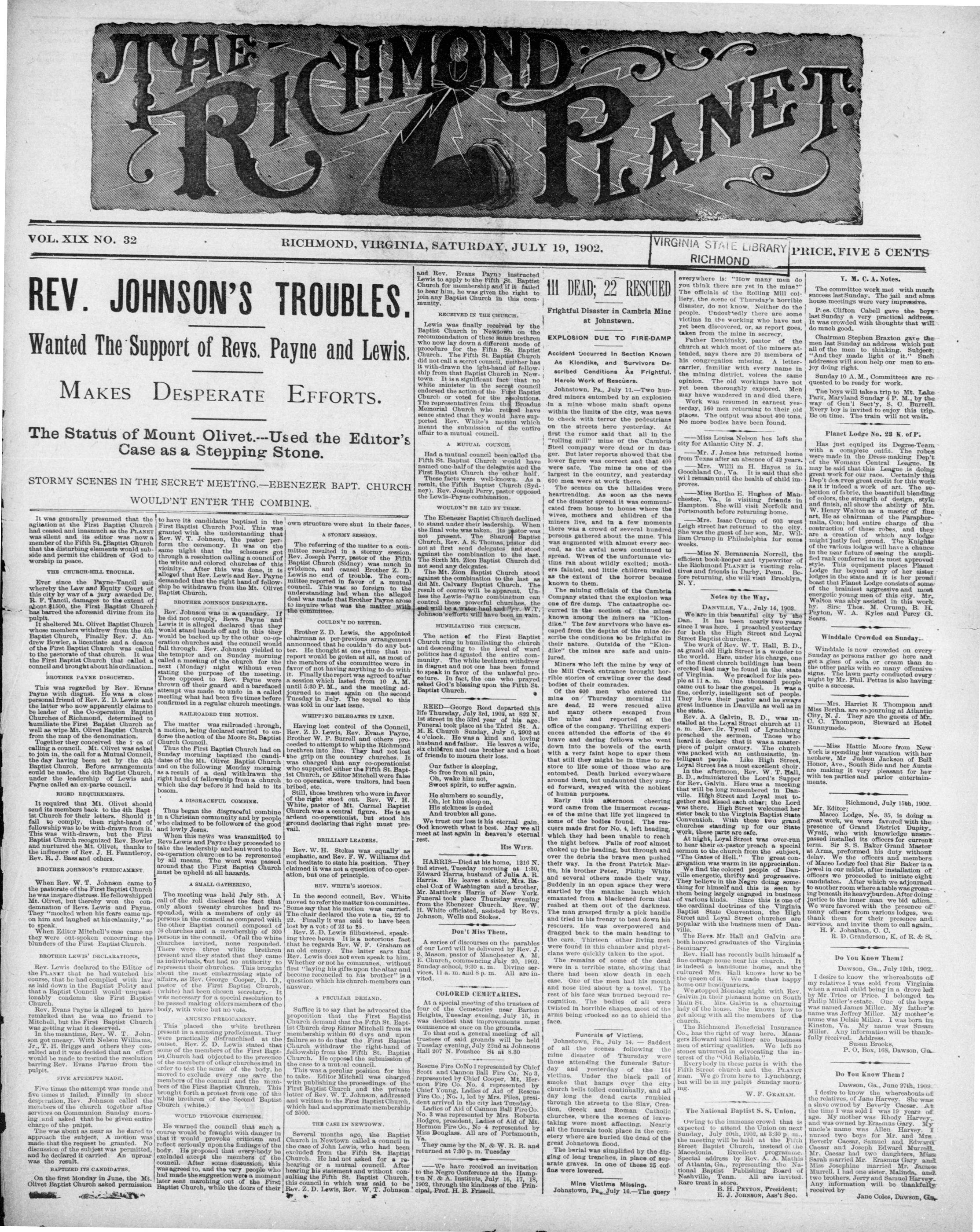
REV. JOHNSON'S TROUBLES. Wanted The Support of Revs. Payne and Lewis.
MAKES DESPERATE EFFORTS.
The Status of Mount Olivet.----Used the Editor's Case as a Stepping Stone.
STORMY SCENES IN THE SECRET MEETING.—EBENEZER BAPT. CHURCH
VOL. XIX NO. 32
REV. JOHN
Wanted The Sup
MAKES
The Status of M
Case
STORMY SCENES IN THE
WOU
It was generally presumed that the agitation at the First Baptist Church had ceased and inasmuch as the PLANET was silent and its editor was now a member of the Fifth St. Baptist Church that the disturbing elements would subside and permit the children of God to worship in peace.
THE CHURCH-HILL TROUBLE.
Ever since the Payne-Tancil suit whereby the Law and Equity Court of this city by way of a jury awarded Dr. R. F. Tancil, damages to the extent of about $1500, the First Baptist Church has barred the aforesaid divine from its pulpit. It sheltered Mt. Olivet Baptist Church whose members withdrew from the 4th Baptist Church, mainly Rev. J. An-toni, the local lice school of the First Baptist Church was called to the pastorate of that church. It was the First Baptist Church that called a council and brought about his ordination.
BROTHER PAYNE DISGUSTED.
This was regarded by Rev. Evans Payne with disgust. He was a close personal friend of Rev. Z. D. Lewis and the latter who now apparently claims to be leader of the Co-operation Baptist Churches of Richmond, determined to humiliate the First Baptist Church as well as wipe Mil. Olivet Baptist Church from the map of the denomination.
Together they conceived the 1'ea of calling a council. Mt. Olivet was asked to lead the council, the day having been set by the 4th Baptist Church. Before arrangements could be made, the 4th Baptist Church, under the leadership of Lewis and Payne called an ex-parte council.
RIGBD REQUIREMENTS.
It required that Mt. Olivet should send its members back to the 4th Baptist iSt Church for their letters. Should it fail to comply, then right-hand of fellowship was to be with-drawn from it. This was with-drawn, but the First Baptist Church recognized Rev. Bowler and nurtured the Mt. Olivet, thanks to the influence of Rev. J. H. Fauntleroy. Rev. R. J. Bass and others.
BROTHER JOHNSON'S PREDICAMENT
When Rev. W. T. Johnson came to the pastorate of the First Baptist Church he was inspire distress. He fellowshipped Mt. Olivet, but thereby won the condemnation of Revs. Lewis and Payne. They "mocked when his fears came upon him and laughed at his calamity," so to speak. When Editor Mitchell's case came up they were out-spoken concerning the blunders of the First Baptist Church.
BROTHER LEWIS' DECLARATIONS
Rev. Lewis declared to the Editor of the PLANET that he had watched his course, that he had complied with law as laid down in the Baptist Polity and that a Baptist Council would unquestionably condemn the First Baptist Church.
Rev. Evans Payne is alleged to have remarked that he was no friend to Mitchell, but the First Baptist Church was getting what it deserved.
In the meantime, Rey, W. T. Johnson got uneasy. With Nelson Williams, Jr., T. H. Briggs and others they consulted and it was decided that an effort would be made to resind the resolution barring Rev. Evans Payne from the pulpit.
FIVE ATTEMPTS MADE.
Five times the attempt was made and five times it failed. Finally in sheer desperation, Rev. Johnson called the members of the church together after services on Communion Sunday morning and asked that he be given entire charge of the pulpit.
The was about as near as he dared to probe the subject. A motion was made that the subject be granted. No discussion of the subject was permitted, and he declared it carried. An uproar was the result.
BAPTIZED ITS CANDIDATES.
On the first Monday in June, the Mt. Olivet Baptist Church asked permission
WOULD'NT ENTER THE COMBINE.
that the Church PLANET is now a Churchuld sub-God to
E.
coil suit Court of added Dr.
to have its candidates baptized in the First Baptist Church Pool. This was granted with the understanding that Rev. W. T. Johnson, the pastor perform the ceremony. It was on the same night that the scioners got through a resolution calling a compulsion of the white and colored churches of this vicinity. After this was done, it is alloged that Rev. Lewis and Rev. Payne demanded that the right hand of fellowship be withdrawn from the Mt. Olivet Baptist Church.
own str
The miteeer Rev. Jo Baptist evidence Lewis miteeer council, underst
BROTHER JOHNSON DESPERATE.
Rev. Johnson was in a quandary. If he did not comply, Reva. Payne and Lewis it is alleged declared that they would stand hands off and in this they would be backed up by the other co-operation churches and the council would fall through. Rev. Johnson yielded to the temper and on Sunday morning called a meeting of the church for the next (Monday) night without even stating the purpose of the meeting. Those opposed to Rev. Payne were thrown off their guard and a barefaced attempt was made to undo in a called meeting what had been five times before confirmed in a regular church meetings.
RAILROADED THE MOTION.
The matter was railroaded through, a motion, being declared carried to endorse the action of the Moore St. Baptist Church Council. Thus the First Baptist Church had on Sunday morning baptized the candidates of the Mt. Olivet Baptist Church and on the following Monday morning as a result of a deal with drawn the right hand of fellowship from a church which the day before it had held to its bosom.
A DISGRACEFUL COMBINE.
Thus began the disgraceful combine in a Christian community and by people who claimed to be followers of the good and lowly Jesus. When this news was transmitted to Revs Lewis and Payne they proceeded to take the leadership and sent word to the co-operation churches to be represented by all means. The word was passed around that the First Baptist Church must be upheld at all hazards.
A SMALL GATHERING.
The meeting was held July 8th. A call of the roll disclosed the fact that only about twenty churches had responded, with a members of only 45 persons in the council as compared with the other Baptist council composed of 76 churches and a membership of 300 persons in the council. Of all the white churches invited, none responded. There were three white brethren present and they stated that they came as individuals, but had no authority to represent their churches. This brought about the most embarrassing state of affairs, as Rev. George Cooper, D. D., pastor of the First Baptist Church, (white) had been chosen secretary. It was necessary for a special resolution to be passed making elders members of the body, with voice but no vote.
AMUSING PREDICAMENT.
This placed the white brethren present in a amusing predicament. They were practically distranchised at the outset. Rev. Z. D. Lewis stated that some of the members of the First Baptist Church had objected to the presence of the members of other churches and in order to test the sense of the body, he moved to exclude every one save the members of the council and the members of the First Baptist Church. This brought forth a protest from one of the white brethren of the Second Baptist Church (white.)
WOULD PROVOKE CRITICISM
He warned the council that such a course would be fraught with danger in that it would provoke criticism and reflect seriously upon the findings of the body. He proposed that every-body be excluded except the members of the council. After some discussion, this was agreed to, and the very people who had made the suggestion were a moment later marching out of the First Baptist Church, while the doors of their
RICHMOND, VIRGINIA, SATURDAY, JULY 19, 1902.
own structure were shut in their faces.
A STORMY SESSION.
The referring of the matter to a committee resulted in a stormy session. Rev. Joseph Perry, pastor of the Fifth Baptist Church (Sidney) was much in evidence, and caused Brother Z. D. Lewis no end of trouble. The committee reported in favor of a mutual council. This was so foreign to the understanding had when the alleged deal was made that Brother Payne arose to inquire what was the matter with the committee.
COULDN'T DO BETTER.
Brother Z. D. Lewis, the appointed chairman as per-previous arrangement announced that he couldn't 'do any better. He thought at one time that no report would be gotten at all, as most of the members of the committee were in favor of not having anything to do with the report was agreed to after a session with the last from 10 A. M. until 5:30 P. M., and the committee journed to meet again on the second Tuesday in July. The sequel to this was told in our last issue.
WHIPPING DELEGATES IN LINE
Having lost control of the Council, Rev. Z. D. Lewis, Rev. Eras Payne, Brother W. P. Burrell and others proceeded to attempt to whip the Richmond brethren into line. They had not lost the grip on the country churches. It was charged that any co-operationist who supported either the Fifth St. Baptist Church, or Editor Mitchell were false to co-operation, were traitors, had been bribed, etc. Still, those brethren who were in favor of the right stood out. Rev. W. H. White, pastor of Mt. Carmel Baptist Church was a central figure. He is an ardent co-operationist, but stood his ground declaring that right must prevail.
BRILLIANT LEADERS.
Rev. W. H. Stokes was equally as emphatic, and Rev. F. W. Williams did not hesitate to state his position. They believed the operation of co-operation, but one of principle.
REV. WHITE'S MOTION.
In the second council, Rev. White moved to refer the matter to a committee. Some say that his motion was carried. The chair declared the vote a tie, 22 to 22. Finally it was said to have been lost by a vot of 23 to 25.
Rev. Z. D. Lewis filibustered, speaking three hours. It is a notorious fact that he regards Rev. W. F. Graham as an old enemy. The latter says that Rev. Lewis does not even speak to him. Whether or not he communes, without first "laying his gifts upon the altar and become reconciled to his brother" is a question which his church-members can answer.
A PECULIAR DEMAND
Suffice it to say that he advocated the proposition that the First Baptist Church demand that the Fifth St. Baptist Church drop Editor Mitchell from its membership within 60 days and upon failure so to do that the First Baptist Church withdraw the right-hand of fellowship from the Fifth St. Baptist Church. He opposed the submission of the case to a mutual council. This was a peculiar position for him to take. Editor Mitchell was charged with publishing the proceedings of the First Baptist Church and the private letter of Rev. W. T. Johnson, addressed and written to the First Baptist Church, which had and approximate membership of 2500.
THE CASE IN NEWTOWN.
Several months ago, the Baptist Church in Newtown called a council in the case of John Lewis, who had been excluded from the Fifth St. Baptist Church. He had not asked for a rehearing or a mutual council. After hearing his statement and without concluding, the Baptist Church, this council in which was said to be Rev. Z. D. Lewis, Rev. W. W. Johnson
and Rev. Evans Payna instructed Lewis to apply to the Fifth St. Baptist Church for membership and if it failed to hear him, he was given the right to join any Baptist Church in this community.
RECEIVED IN THE CHURCH.
Lewis was finally received by the Baptist Church in Newtown on the recommendation of these same brethren who now lay down a different mode of procedure for the Fifth St. Baptist Church. The Fifth St. Baptist Church did not call a secret council, neither has it with-drawn the right-hand of fellowship from that Baptist Church in Newtown. It is a significant fact that no white minister in the secret council endorsed the action of the First Baptist Church or voted for the resolutions. The representatives from the Broadus Memorial Church who retired have sence stated that they would have supported Rev. White's motion which meant the submission of the entire affair to a mutual council.
A MUTUAL COUNCIL
Had a mutual council been called the Fifth St. Baptist Church would have named one-half of the delegates and the First Baptist Church the other half. These facts were well-known. As a result, the Fifth Baptist Church (Sydney). Rev. Joseph Perry, pastor opposed the Lewis-Payne combination.
WOULDN'T BE LED BY THEM.
The Ebenezer Baptist Church declined to stand under their leadership. When the final vote was taken, its pastor was not present. The Sharon Baptist Church, Rev. A. S. Thomas, pastor did not at first send delegates and stood against the combination to the last. The Sixth Mt. Zion Baptist Church did not send any delegates. The Mt. Zion Baptist Church stood and公诉 to the last as did Mt. Calvary Baptist Church. The result of course will be apparent. Unless the Lewis-Payne combination can control these powerful churches, the end will be a water haul and W. W. Johnson's efforts will have been in vain.
HUMILIATING THE CHURCH.
The action of the First Baptist Church ring in humiliating the church and descending to the level of ward politics has d sigusted the entire community. The white brethren withdrew in disgust and not one has been found to speak in favor of the unlawful procedure. In fact, the one who prayed asked God's blessing upon the Fifth St. Baptist Church.
REED—George Reed departed this life Thursday, July 3rd, 1902, at 823 N. 1st street in the 53rd year of his age. Funeral took place at the Third St. A. M. E. Church Sunday, July 6, 2002 at 4 o'clock. He was a kind and loving husband and father. He leaves a wife, six children and one brother and a host of friends to mourn their loss.
Our father is sleeping,
So free from all pain,
Oh, wake him not,
Sweet spirit, to suffer again.
He slumbers so soundly,
Oh, let him sleep on,
His sickness is ended
And troubles all gone.
We trust our loss is his eternal gain.
God knoweth what is best. May we all meet at last again in heaven's eternal rest.
HARRIS—Died at his home, 1216 N. 2nd street, Tuesday morning at 1:30; Edward Harris, husband of Julia A. R. Harris. He leaves a sister, Mrs. Rachel Cox of Washington and a brother, Mr. Matthews Harris of New York. Funeral took place Thursday evening from the Ebenene Church. Rev. W. H. White officiated, assisted by Revs. Johnson, Wells and Stokes.
Don't Miss Them.
A series of discourses on the parables of our Lord will be delivered by Rev. J. S. Mason, pastor of Manchester A. M. E. Church, commencing July 20, 1902, day-school, 9:30 a. m. Divine service 1 a. m. and 8 p. m. All are invited.
COLORED CEMETARIES.
At a special meeting of the trustees of four of the Cemetaries near Barton Heights, Tuesday evening, July 15, it was decided that improvements must commence at once on the grounds.
To that end a general meeting of all trustees of said grounds will be held Tuesday evening, July 22nd at Johnsons Hall 207 N. Fonshee St at 8:30
Rescue Fire CoNo1 represented by Chief Scott and Cannon Ball Fire Co. No. 3, represented by Chief Cooper, Mt. Hermon Fire Co. No. 4 represented by Chief Young, Ladies of Aid of Rescue Fire Co.; No. 1, led by Mrs. Files, president arrived in the city last Tuesday.
Ladies of Aid of Cannon Ball Fire Co. No. 3 was represented by Mrs. Roberta Hodges, president, Ladies of Aid of Mt. Hermon Fire Co., No. 4 represented by Miss Douglass. All are of Portsmouth, Va.
They came by the N. & W. R. R. and returned at 7:30 p. m. Tuesday
We have received an invitation to the Negro Conference at the Hamp-
gate Institute, July 16, 17, 18,
1902, through the offices of the Principal,
Prof. H. B. Frissell.
111 DEAD; 22 RESCUED
Frightful Disaster in Cambria Mine at Johnstewn.
EXPLOSION DUE TO FIRE-DAMP
Accident Occurred In Section Known As Klondike, and Survivors Described Conditions As Frightful. Heroic Work of Rescuers.
Johnstown, Pa., July 11.—Two hundred miners entombed by an explosion in a mine whose main shaft opens within the limits of the city, was news to check with terror the pedestrians on the streets here yesterday. At first the rumor said that all in the "rolling mill" mine of the Cambria Steel company were dead or in danger. But later reports showed that the lower figure was correct and that 400 were safe. The mine is one of the largest in the country, and yesterday 600 men were at work there.
The scenes on the hillsides were heartrending. As soon as the news of the disaster spread it was communicated from house to house where the wives, mothers and children of the miners live, and in a few moments there was a crowd of several hundred persons gathered about the mine. This was augmented with almost every second, as the awful news continued to spread. Wives of the unfortunate victims ran about wildly excited; mothers fainted, and little children wailed as the extent of the horror became known to them.
The mining officials of the Cambria Company stated that the explosion was one of fire damp. The catastrophe occurred in the section of the mines known among the miners as "Klon-dike." The few survivors who have escaped from the depths of the mine describe the conditions to be frightful in their nature. Outside of the "Klon-dike" the mines are safe and uninfured.
Miners who left the mine by way of the Mill Creek entrance brought horrible stories of crawling over the dead bodies of their comrades.
Of the 600 men who entered the mine on Thursday morning 111 are dead, 22 were rescued alive and many others escaped from the mine and reported at the office of the company. Thrilling experiences attended the efforts of the 40 brave and daring fellows who went down into the bowels of the earth with a very faint hope to spar them that still they might be in time to restore to life some of those who are entombed. Death lurked everywhere around them, but undaunted they surged forward, swayed with the noblest of human purposes.
Early this afternoon cheering word came from the innermost recesses of the mine that life yet lingered in some of the bodies found. The rescuers made first for No. 4, left heading, which they had been unable to reach the night before. Falls of roof almost choked up the heading, but through and over the debris the brave men pushed their way. In the front Patrick Martin, his brother Peter, Phillip White and several others made their way. Suddenly in an open space they were startled by the maniac laugh which emanated from a blackened form that rushed at them out of the darkness. The man grasped firmly a pick handle and tried in his frenzy to beat down his rescuers. He was overpowered and dragged back to the main heading to the cars. Thirteen other living men were found in this chamber and physicians were quickly taken to the spot.
The remains of some of the dead were in a terrible state, showing that there had been slow death in each case. One of the men had his mouth and nose tied about by a towel. The rest of his face was burned beyond recognition. The bodies of all were twisted in horrible shapes, most of the arms being crooked so as to shield the face.
Funerals of Victims
Johnstown, Pa., July 14. — Saddest of all the scenes following the mine disaster of Thursday were those attending the funerals Saturday and yesterday of the 164 victims. Under the black pall of smoke that hangs over the city church bells tolled continually, and all day long the dead carts rumbled through the streets to the Slav, Creation, Greek and Roman Catholic churches, where the scenes of leavetaking were most affecting. Nearly all the funerals took place in the cemetery where are buried the dead of the great Johnstown flood.
The burial was simplified by the digging of long trenches, in place of separate graves. In one of these 25 coffins were lowered.
Mine Victims Missing.
Johnstown, Pa., July 16. — The query
everywhere is: "How many men do you think there are yet in the mine?" The officials of the Rolling Mill colliery, the scene of Thursday's horrible disaster, do not know. Neither do the people. Undoubtedly there are some victims in the working who have not yet been discovered, or, as report goes, taken from the mine in secrecy. Father Dembinsky, pastor of the church at which most of the miners attended, says there are 20 members of his congregation missing. A letter carrier, familiar with every name in the mining district, volces the same opinion. The old workings have not yet been thoroughly explored. Men may have wandered in and died there. Work was resumed in earnest yesterday, 160 men returning to their old places. The output was about 400 tons. No more bodies have been found.
—Miss Louisa Nelson hes left the city for Atlantic City N. J.
Mr. J. Jones has returned home from Texas after an absence of 42 years.
Mrs. Willi m H. Hayes is in Goochland Co., Va. It is said that she will remain until the health of child improves.
Miss Bertha E. Hughes of Manchester. Va., is visiting friends in Hampton. She will visit Norfolk and Portsmouth before returning home.
Mrs. Isaac Crump of 603 west Leigh street has returned to the city. She was the guest of her son, Mr. William Crump in Philadelphia for some weeks.
Miss N. Beransenia Norroll, the efficient book-keeper and typewriter of the Richmond PLANET is visiting relatives and friends in Darby, Penn. Before returning, she will visit Brooklyn, N. Y.
Notes by the Way.
DANVILLE, VA., July 14, 1902.
We are in this beautiful city by the Dan. It has been nearly two years since I was here. I preached yesterday for both the High Street and Loyal Street Baptist churches.
The work of Rev. W. T. Hall, B. D., at grand old High Street is a wonder to the world. Here, under his charge, one of the finest church buildings has been erected that may be found in the state of Virginia. We preached for his people at 11 a. m. One thousand people came out to hear the gospel. It was a fine, orderly, intelligent set of people. They love their pastor and he sways great influence in Danville as well as in the state.
Rev. A. Galvin, B. D., was installed at the Loyal Street church at 11 a. m. Rev. Dr. Tyrell of Lynchburg prescheduled the sermon. Those who heard it declare that it was a masterpiece of pulpit oratory. The church was packed with an enthusiastic, intelligent people. Like High Street, Loyal Street has a most excellent choir.
In the afternoon, Rev. W. T. Hall, B.D., administered the Lord's Supper for Rev. Galvin. Here was a meeting that will be long remembered in Danville. High Street and Loyal met together and kissed each other; the Lord was there. High Street welcomed her sister back to the Virginia Baptist State Convention. With these two grand churches standing up for our State work, these parts are safe.
At night, Loyal Street was over-run to hear their ex-pastor preach a special sermon to the church from the subject, "The Gates of Hell." The great congregation was warm in its appreciation.
We find the colored people of Danville energetic, thrifty and progressive. They have the Negro doing something for themselves and this is seen by them being largely engaged in business of various kinds. Since this is the cardinal doctrines of the Virginia Baptist State Convention, the High Street and Loyal Street churches are popular with the business men of Danville.
The Revs. Mr Hall and Galvin are both honored graduates of the Virginia Seminary. Rev. Hall has recently built himself a fine cottage home near his church. It is indeed a handsome home, and the cultured Mrs. Hall knows how to be the queen of it. We made that happy home our headquarters. We stopped Monday night with Rev. Galvin in their pleasant home on South Main St. Mrs. Galvin is a charming lady of the house. She knows how to get along with all the members of the church. The Richmond Beneficial Insurance Co., has the right of way here. Managers Howard and Millner are business of stirring quality. We left no stones unturned in advocating the interest of the "Old Reliable." Everybody in these parts is with the Fifth Street church and the PLANET man. We go from here to Lynchburg, but will be in my pulpit Sunday morning. W. F. GRAHAM.
The National Baptist S. S. Union.
Owing to the immense crowd that is expected to attend the Union on next Sunday, July 30th, 1903, at 3:30 p.m. the meeting will be held at the Fifth Street Baptist Church, instead of the Macedonia. Excellent programme. Special address by Rev. A. A. Mathis of Atlanta, Ga., representing the Na- tional Dept., Publishing Board of Nashville, Tenn. All are invited. Rare treat in store. B. H. PRYTON, President; E. J. JOHNSON, ass'Tec.
Y. M. C. A. Notes.
The committee work met with much success last Sunday. The jail and alms house meetings were very impressive.
Pos, Clifton Cabell gave the boys last Sunday a very practical address. It was crowded with thoughts that will do much good.
Chairman Stephen Braxton gave the men last Sunday an address which put all of the men to thinking. Subject: "And they made light of it." Such addresses will soon help our men to enjoy doing right.
Sunday 10 A.M., Committees are requested to be ready for work.
The boys will take a trip to Mt. Lake Park, Maryland Sunday 4 P. M., by the way of Gen'l Sect'y, S. C. Burrell. Every boy is invited to enjoy this trip. Be on time. The train will not wait.
Planet Lodge No. 23 K. of P.
Has just equipped its Degree-Team with a complete outfit. The robes were made in the Dress-making Dep't of the Womans Central League. It may be said that this League is doing great work for our race. Certainly this Dep't deserves great credit for this work as it indeed a work of art. The selection of fabric, the beautiful blending of colors, the strength of design, style and finish, all show the ability of Mr. W. Henry Walton as a master of fine art. He as chairman of the Paraphernalia, Com; had entire charge of the construction of these robes, and they are a creation of which any lodge might justly feel proud. The Knights of the various lodges will have a chance in the near future of seeing the amplified rank conferred in its most approved style. This equipment places Planet Lodge far beyond any of her sister lodges in the state and it is her proud boast that Planet Lodge consists of some of the brainiest aggressive and most energetic young men of this city. Mr. Walton was ably assisted in this work by. Sirs: Thos. M. Crump, B. H. Peyton, W. A. Kyles and Percy G. Sears.
Winddale Crowded on Sunday.
Windale is now crowded on every Sunday as persons rather go here and get a glass of soda or cream than to the other parks with so many offensive parties. Mr. party conducted every night by Mt. Pettus is also having quite a success.
---
—Mrs. Harriet E Thompson and Miss Bertha. are so-journing at Atlantic City, N. J. They are the guests of Mr. C. C. Thompson, Steward at Hotel Runnymede.
—Miss Hattie Moore from New York is spending her vacation with her nephew, Mr. Judson Jackson of Ball Honor, Ave., South Side and her Aunts are making it very pleasant for her with tea parties and parlor entertainments.
Richmond, July 15th, 1902.
Mr. Editor:
Maceo Lodge, No. 35, is doing a great work, we were favored with the presence of Grand District Dupity, Wyatt, who with knowledge unsuppressed installed its officers for current term. Sir S. S. Baker Grand Master at Arms, preformed his duty without delay. We the officers and members of Maceo Lodge feel that Sir Baker is a jawel in our midst, after installation of officers we proceeded to initiate eight to another room. After which we adjourned beneath its heavy bed. After doing justice to the inner man we bled. We were favored with the presence of many officers from various lodges, we thank them for their presence and services, and invite them to call again. H. F. Johathan, C. C. R. D. Granderson, K. of R. & S.
Do You Know Them?
I desire to know the whereabouts of my relatives I was sold from Virginia when a small child being in a drove led by Mr. Trice or Price. I belonged to Philip Miller's estate. One of the boys was named James Miller. My father's name was Jeffrey Miller. My mother's name was Delsie Miller. I was born in Kinston, Va. My name was Susan Miller. Any information will be thankfully received. Address. Susan Brooks. P. O, Box 168, Dawson, Ga.
Do You Know Them?
Dawson, Ga., June 27th, 1902
I desire to know the whereabouts of the relatives, of Jane Harvey. She was a slave owned by Beverly Caesar. At the time I was sold I was 19 years of age. My mother was Rhody Harvey, and was owned by Erasmus Gary. My uncle's name was Allen Harvey. I nursed two boys for Mr. and Mrs. Beverly Caesar, Samuel and Edward Moss, Joseph Edward Murrell. Mrs. Caesar had two daughters, Miss Sarah married Mr. James Garvey and Miss Josephine married Mr. Murrell. I had one sister, Malinda, and two brothers, Jerry and Samuel Harvey. Any information will be thankfully received by Jane Coles, Dawson, Ga.
THE PEACE
MORNING.
Across the sky, at break of day,
A well of mist was rolled away;
The little stars grew almost white,
Then gently faded out of sight.
And, like the breathing of a child,
A flower of heart soft and mild,
Upon the air; as it stirred.
The call of chanticleer was heard.
Then came a cooking, twitting sound:
The little birds their voices found,
And lifted the mimes of praise
To see the daylight's violet rays.
The darkness of the night was pass'd,
And in the rosy East at last,
Slowly, from out his radiant bed,
The sun was seen to lift his head.
All Nature joyfully awoke,
And into wildest rapture broke:
The flow's unfolded to the light
Their petals shining clear and bright
With drops of dew which, all in haste,
And butterflies spread their wings
To hover round such lovely things.
"Awake!" the dancing sunbeams cried,
And, peeping through the casements, tried
To flash their rays upon each place
Where lay a little sleeping face;
And called again, as shining eyes
At last were opened in surprise;
"Come, waken, little playmates dear,
Arise, for, see—the Morning's here!"
—Constant M. Lowe, in Cassell's Little
Polks.
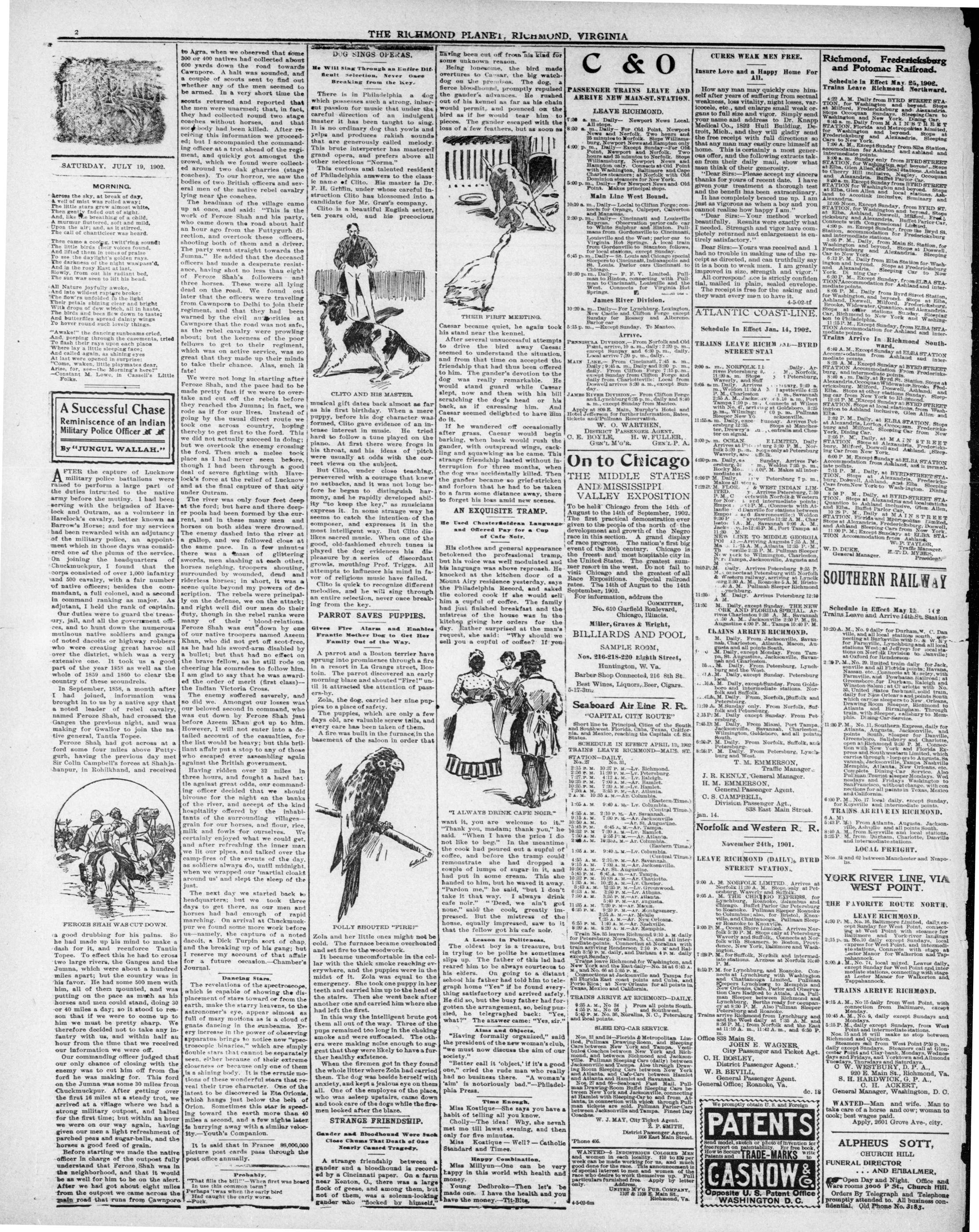
A Successful Chase
Reminiscence of an Indian
Military Police Officer
By "JUNGUL WALLAH."
AFTER the capture of Lucknow military police battalions were raised to perform a large part of the duties intrusted to the native army before the mutiny. I had been serving with the brigades of Havelock and Outram, as a volunteer in Havelock's cavalry, better known as Barrow's Horse; and for my services had been rewarded with an adjutancy of the military police, an appointment which in those days was considered one of the plums of the service. On joining the headquarters of Chuckmuckpur, I found that the corps consisted of over 1,000 infantry and 500 cavalry, with a fair number of native officers; besides the commandant, a full colonel, and a second in command ranking as major. As adjutant, I held the rank of captain
Our duties were to guard the treasury, jail, and all the government offices, and to hunt down the numerous mutinous native soldiers and gangs of noted dacoitis or highway robbers who were creating great havoc all over the district, which was a very extensive one. It took us a good part of the year 1858 as well as the whole of 1859 and 1860 to clear the country of these scoundrels.
In September, 1858, a month after I had joined, information was brought in to us by a native apy that a noted leader of rebel cavalry, named Feroze Shah, had crossed the Ganges the previous night, and was making for Gwallor to join the native general, Tantia Tope.
Feroze Shah had got across at a ford some four miles above Futgyurh, having the previous day met Sir Colin Campbell's forces at Shahjainpur, in Rohbikhand, and received
FEROZE SHAH WAS CUT DOWN.
a good drubbing for his pains. So he had made up his mind to make a dash for it, and reenforce Tantia Topee. To effect this he had to cross two large rivers, the Ganges and the Jumma, which were about a hundred miles apart; but the country was in his favor. He had some 500 men with him, all of them mounted, and was putting on the pace as much as his horses and men could stand, doing 30 or 40 miles a day; so it stood to reason that if we were to come up to him we must be pretty sharp. We therefore decided not to take any infantry with us, and within half an hour from the time that we received our information we were off.
Our commanding officer judged that our only chance of closing with the enemy was to cut him off from the ford he was making for. This ford on the Jumna was some 30 miles from Chuckmuckpur. After getting over the first 16 miles at a steady trot, we arrived at a village where we had a strong military outpost, and halted for the first time; but within an hour we were on our way again, having given our men a light refreshment of parched peas and sugar-balls, and the horses a good feed of grain.
Before starting we made the native officer in charge of the outpost fully understand that Feroze Shah was in the neighborhood, and that it would be as well for him to be on the alert. After we had got about eight miles from the outpost we came across the main road that runs from Cawnpore
to Agra, when we observed that some 300 or 400 natives had collected about 600 yards down the road towards Cawnpore. A halt was sounded, and a couple of scouts sent to find out whether any of the men seemed to be armed. In a very short time the scouts returned and reported that the men were unarmed; that, in fact, they had collected round two stage coaches without horses, and that sort body had been killed. After receiving this information we proceeded; but I accompanied the commanding officer at a trot ahead of the regiment, and quickly got amongst the crowd, which we found were collected around two dak gharries (stage coaches). To our horror, we saw the bodies of two British officers and several men of the native rebel cavalry lying near the coaches.
The headman of the village came up at once, and said: "This is the work of Feroze Shah and his party, who came down the road about half an hour ago from the Fattygurh direction, and overtook these officers, shooting both of them and a driver. The party went straight towards the Jumna." He added that the deceased officers had made a desperate resistance, having shot no less than eight of Feroze Shah's followers and three horses. These were all lying dead on the road. We found out later that the officers were traveling from Cawnpore to Delhi to join their regiment, and that they had been warned by the civil authorities at Cawnpore that the road was not safe, as the rebel cavalry were prowling about; but the keenness of the poor fellows to get to their regiment, which was on active service, was so great that they made up their minds to take their chance. Alas, such is fate!
We were not long in starting after Feroze Shah, and the pace had to be made pretty fast if we were to overtake and cut off the rebels before they reached the Jumna; in fact, we rode as if for our lives. Instead of going by the usual direct route we took one across country, hoping thereby to get first to the Ford. This we did not actually succeed in doing; but we overtook the enemy crossing the Ford. Then such a mulee took place as I had never seen before, though I had been through a good deal of severe fighting with Havelock's force at the relief of Lucknow and at the final capture of that city under Outram.
The river was only four feet deep at the ford; but here and there deeper pools had been formed by the current, and in these many men and horses on both sides were drowned. The enemy dashed into the river at a gallop, and we followed close at the same pace. In a few minutes there was a mass of glittering swords, men slashing at each other, horses neighing, troopers shouting, surrounded by wounded, dead and riderless horses; in short, it was a scene quite beyond my powers of description. The rebels were principally on the defense, we on the attack; and right well did our men do their duty, though in the rebel ranks were many of their blood-relations. Feroze Shah was cut down by one of our native troopers named Azeem Khan, who did not get off scot-free, as he had his sword-arm disabled by a bullet; but that had no effect on the brave fellow, as he still rode on cheering his comrades to follow him. I am glad to say that he was awarded the order of merit (first class)—the Indian Victoria Cross.
The enemy suffered severely, and so did we. Amongst our losses was our beloved second in command, who was cut down by Feroze Shah just before Azeem Khan got up to him. However, I will not enter into a detailed account of the casualties, for the list would be heavy; but this brilliant affair put a stop to any of those who escaped ever assembling again against the British government.
Having ridden over 32 miles in three hours, and fought a hard battle against great odds, our commanding officer decided that we should bivouac for the night on the banks of the river, and accept of the kind hospitality offered by the inhabitants of the surrounding villages—grain for our horses, and flour, rice, milk and fowls for ourselves. We certainly enjoyed what we could get, and after refreshing the inner man we lit our pipes, and talked over the camp-fires of the events of the day, as soldiers always do, until midnight, when we wrapped our 'martial cloaks around us' and slept the sleep of the just.
The next day we started back to headquarters; but we took three days to get there, as our men and horses had had enough of rapid marching. On arrival at Chuckmuck-pur we found some more work before us—namely, the capture of a noted decoit, a Dick Turpin sort of chap, and the breaking up of his gang; but I reserve my account of that affair for a future occasion—Chamber's Journal.
Dancing Stars
The revelations of the spectroscope, which is capable of showing the displacement of stars toward or from the earth, make the starry heavens, to the astronomer's eye, appear almost as full of mazy motions as is a cloud of gnats dancing in the sunbeams. Every increase in the power of observing apparatus brings to notice new "spectroscopic binaries," which are simply double stars that cannot be separately seen, either because of their extreme closeness or because only one of them is a shining body. It is the erratic motions of these wonderful stars that reveal their true character. One of the latest to be discovered is Ete Orionis, which hangs just below the belt of Orion. Sometimes this star is speeding toward the earth more than 40 miles a second, and a few nights later is hurrying away with a similar velocity—Youth's Companion.
It is said that in France 88,000,000 picture post cards pass through the post office annually.
"That fills the bill!" - When first was heard
In use this common term?
Perhaps 'twas when the early bird
Hired caught the early worm.
-Puck
THE RICHMOND PLANET, RICHMOND, VIRGINIA
He Will Sing Through an Enufree Difficult Selection, Never Grace Breaking from the Key.
There is in Philadelphia a dog which possesses such a strong, inherent passion for music that under the careful direction of an indulgent master it has been taught to sing. It is no ordinary dog that yowls and yelps and produces rakih sounds that are generously called melody. This brute interpreter has mastered grand opera, and prefers above all other selections "Norma."
This curious and talented resident of Philadelphia answers to the classic name of Clito. His master is Dr. F. H. Griffin, under whose careful instruction Clito has blossomed into a candidate for Mr. Gran's company. Clito is a beautiful English settler, ten years old, and his precocious
CLITO AND HIS MASTER
musical gift dates back almost as far as his first birthday. When a mere puppy, before his dog character was formed, Clito gave evidence of an intense interest in music. He tried hard to follow a tune played on the piano. At first there were frogs in his throat, and his ideas of pitch were usually at odds with the correct views on the subject.
But Clito, under close teaching, persevered with a courage that knew no setbacks, and it was not long before he began to distinguish harmony, and he rapidly developed ability "to keep the key," as musicians express it. In some strange way he seems to catch the intention of the composer, and expresses it in the most intelligent way. But Clito dislikes sacred music. When one of the good, old-fashioned church tunes is played the dog evidences his displeasure by a series of discordant growls, mouthing Prof. Triggs. All attempts to influence his mind in favor of religious music have failed. Clito is quick to recognize different melodies, and he will sing through an entire selection, never once breaking from the key.
PARROT SAVES PUPPIES
Gives Fire Alarm and Enables Frantic Mother Dog to Get Her Family Out of the Way.
A parrot and a Boston terrier have sprung into prominence through a fire in a resort in La Grange street, Boston. The parrot discovered an early morning blaze and shouted "Fire!" until it attracted the attention of passers-by.
Zola, the dog, carried her nine puppies to a place of safety.
The puppies, which are only a few days old, are valuable screw tails, and every care has been taken of them.
A fire was built in the furnace in the basement of the saloon in order that
B. B. B.
POLLY SHOUTED "FIRE"
Zola and her little ones might not be cold. The furnace became overheated and set fire to the woodwork.
It became uncomfortable in the cellar with the thick smoke reaching everywhere, and the puppies were in the midst of it. Zola was equal to the emergency. She took one puppy in her teeth and carried him up to the head of the stairs. Then she went back after another one and carried him where she had left the first.
In this way the intelligent brute got them all out of the way. Three of the pups remained too long in the choking smoke and were suffocated. The others were making noise enough to suggest that they were likely to have a further healthy existence.
When the firemen got in they found the whole litter where Zola had carried them. The dog was beside herself with anxiety, and kept a jealous eye on them all. One of the employees of the place, who was asleep upstairs, came down and took care of the dogs while the firemen looked after the blaze.
STRANGE FRIENDSHIP
Gander and Bloodhound Were Such Close Chums That Death of One Nearly Caused Tragedy.
A strange friendship between a gander and a bloodhound is recorded by a Cincinnati paper. On a farm near Kenton, O., there was a large flock of geese, and among them, but not of them, was a solemn-looking gander who "flocked by himself."
Having been cut off from his kind for some unknown reason.
Being lonesome, the bird made overtures to Caesar, the big watchdog on the premises. The dog, a fierce bloodhound, promptly repulsed the gander's advances. He rushed out of his kennel as far as his chain would permit, and pounced on the bird as if he would tear him to pieces. The gander escaped with the loss of a few feathers, but as soon as
D
THEIR FIRST MEETING.
Caesar became quiet, he again took his stand near the kennel.
After several unsuccessful attempts to drive the bird away Caesar seemed to understand the situation, and from that time on accepted the friendship that had thus been offered to him. The gander's devotion to the dog was really remarkable. He would stand guard while Caesar slept, now and then with his bill scratching the dog's head or his back, as if caressing him. And Caesar seemed delighted to have him do it.
If he wandered off occasionally after grass, Caesar would begin barking, when back would rush the gander, with outspread wings, cackling and squawking as he came. This strange friendship lasted without interruption for three months, when the dog was accidentally killed. Then the gander became so grief-stricken and forlorn that he had to be taken to a farm some distance away, there to forget his loss amid new scenes.
AN EXQUISITE TRAMP.
He Used ChesterBoldheim Language and Offered Pay for a Cup of Cafe Noir.
His clothes and general appearance betokened the professional tramp, but his voice was well modulated and his language was above reproach. He knocked at the kitchen door of a Mount Airy residence yesterday, says the Philadelphia Record, and asked the colored cook if she would sell him a cupful of coffee. The family had just finished breakfast and the mistress of the house was in the kitchen giving her orders for the day. Rather surprised at the man's request, she said: "Why should we sell you a cupful of coffee? If you
"I ALWAYS DRINK CAFE NOIR."
want it, you are welcome to it." "Thank you, madam; thank you," he said. "When I have the price I do not like to beg." In the meantime the cook had poured out a aupful of coffee, and before the tramp could remonstrate she had dropped a couple of lumps of sugar in it, and had put in some cream. This she handed to him, but he waved it away. "Pardon me," he said, "but I don't take it that way. I always drink cafe noir." "Deed, we ain't got none," said the cook, greatly impressed. But the mistress of the house, equally impressed, saw to it that the fellow got his cafe noir.
A Lesson in Politeness
The oldest boy is a treasure, but in trying to be polite he sometimes slips up. The father of this lad had reared him to be always courteous to his elders. On going to a distant school his father had told him to telegraph home "Yes" if he found everything satisfactory and arrived safely. He did so, but the busy father had forgotten the arrangement, so, being puzzled, he telegraphed back: "Yes, what?" The answer came: "Yes, sir."
Alma and Objects,
"Having formally organized," said the president of the new woman's club,
"We must now discuss the aim of our society."
"Batter call it 'object,' if it's a good one," cried the rude man who really had no business there. "A woman's aim is notoriously bad."—Philadelphia Press.
Time Enough.
Miss Kostique — Well? — Catholic Standard and Times.
Happy Combination.
Miss Millyun—One can be very happy in this world with health and money.
Young Dedbroke—Then let's be made one. I have the health and you have the money—Tit-Bits.
C & O
LEAVE RICHMOND
7:30 a. m., Daily— Newport News Local All stops.
8:50 a. m., Daily— For Old Point, Newport News and Norfolk. Two hours and 25 minutes to Norfolk. Stops Williamsburg, Newport News and Hampton only.
4:00 p. m., Daily— Except Sunday— For Old Point, Newport and Norfolk. Two hours and 25 minutes to Norfolk. Stops Williamsburg, Newport News and Hampton only. Connects at Old Point with Washington, Baltimore and Cape Charles steamers; at Norfolk with Old Dominion steamers for New York.
Main Line West Bound.
10:20 a. m., Daily - Local to Clifton Forge; connects for Orange, Culpeper, Calverton and Nassau.
2:30 p. Daily - Cincinnati and Louisville Express. Observation parlor cafe car to White Sulphur and Hinton. Pullmans from Gordonville to Cincinnati, Louisville and the West; parlor car to Wichita. Observation parlor car from Gordonville to Stanton follows, for local stations, except Sunday.
6:45 p. Daily - F. F. V. Limited. Sacred Sleepers to Cincinnati, Indianapolis and St. Louis. Parlor cars Cincinnati to Chicago.
10:30 p. Daily - F. F. V. Limited. Pullman to Hinton, connecting with Pullman to Cincinnati, Louisville and the West. Connects for Virginia Hot Springs.
James River Division.
10:20 a. m. Daily: For Lynchburg, Lexington
Boston, and St. Louis
Sunday for Rosacey and Albioncey
PENNESBURG DIVISION.—From Norfolk and Old Paint, arrive 10 a.m., daily; 2:20 p.m., except Sunny and 6:30 p.m., daily. Local arrive 20 p.m., daily.
MAIN LINE.—From Cincinnati, 7:45 a.m., daily; 9:45 a.m., Daily and 3:20 p.m., daily. From Clifton Forge 7:15 p.m., except from Clifton Forge and daily. From Local from Deswell arrive 8:30 a.m., except Sunday.
JAMES RIVER DIVISION.—From Cincinnati Forge and Lynchburg 6:30 p.m., daily and 8:40 a.m. Apply at 800 E. Main, Murphy's Hotel and Hotel Jefferson for further information, Rates, tickets and Pullman Reservation.
W. O. WARTHEN,
DISTRICT PASSENGER AGENT.
C. E. BOYLE, H. W. FULLER,
GEN.'L' M'G'R', GEN.'L' P. A.
On to Chicago
VALLEY EXPOSITION
To be held Chicago from the 14th of August to the 14th of September, 1902. The first practical demonstration ever given to the people of the north of the development and growth of the Negro race in this section. A grand display of race progress. The nation's first big event of the 20th century. Chicago is the freest and most hospitable city in the United States. The greatest summer resort in the west. Do not fail to visit Chicago and the greatest of all Race Expositions. Special railroad rates. The 14th of August to the 14th September, 1902.
For information, address the COMMITTEER,
No. 610 Garfield Boulevard,
Chicago, Illinois.
Miller, Graves & Wright,
BILLIARDS AND POOL
Barber Shop Connected, 216 8th St
Best Wines, Liquors, Beer, Cigars.
5-17-3m
Seaboard Air Line R. R.
"CAPITAL CITY ROUTE"
Short line to Principal Cities of the South and Southwest. Florida, Cuba, Texas, California, and Mexico, reaching the Capitals of Six States.
SCHEDULE IN EFFECT 4/13, 1920
TRAINS LEAVE RICHMOND—MAIN ST.
STATION, DAILY
No. 27 No. 31
2.15 P.M. 10.35 P.M. M.-Lv. Richmond.
2.56 P.M. 11.20 P.M. M.-Lv. Petersburg.
7.27 P.M. 4.12 P.M. M.-Lv. Lehigh.
10.25 P.M. 8.30 P.M. M.-Lv. Hamlet.
10.25 P.M. 7.20 A.M. M.-Lv. Hamlet.
7.50 A.M. 3.55 P.M. M.-Ar. Atlanta.
2 A.M. 10.35 A.M.-Ar. Columbia.
1.05 A.M. 9.40 A.M.-Lv. Columbia.
(Eastern Time.)
4.55 A.M. 2.10 P.M. M.-Ar. Savannah.
9.15 A.M. 7.00 P.M. M.-Ar. Jacksonville.
10.50 A.M. —Ar. St. Augustine.
13.40 P.M. 6.45 A.M.-Ar. Tampa.
10.32 P.M. 7.00 A.M. —Ar. Hamlet.
7.50 A.M. 9.55 P.M. M.-Ar. Atlanta.
2.80 A.M. 10.35 A.M.-Ar. Columbia.
(Eastern Time.)
1.05 A.M. 9.40 A.M.-Lv. Columbia.
4.55 A.M. 2.10 P.M. M.-Ar. Savannah.
9.15 A.M. 7.00 P.M. M.-Ar. Jacksonville.
10.50 A.M. —Ar. Augustine.
5.45 P.M. 6.45 A.M. M.-Ar. Tampa.
10.32 P.M. 10.38 A.M.-Ar. Chiaviot.
1.05 A.M. 10.28 A.M.-Lv. Chester.
5.45 A.M. 7.25 P.M. M.-Ar. Woodward.
6.13 A.M. 2.50 P.M. M.-Albany.
7.50 A.M. 3.55 P.M. M.-Ar. Atlanta.
11.25 A.M. 7.20 P.M. M.-Ar. Augusta.
6.25 P.M. 9.20 P.M. M.-Ar. Montgomery.
2.55 A.M. M.-Ar. Mobile
6.25 P.M. 8.20 A.M. M.-Ar. Oceanside
6.25 P.M. 1.40 A.M. M.-Ar. Nashville
8.20 A.M. 8.20 A.M. M.-Ar. Memphis.
Train No. 35 leaves Richmond 9:10 A.M. m daily for Petersburg, Noralina, N.C., and all interstate routes. Richmond 9:10 A.M. with train arriving Henderson 2:10 P.M. eighth 8:50 P.M. daily, and Durham 4 P.M. daily except Sunday. Richmond for Washington, and New York and the East daily—No. 34 at 6:45 A.M., and No. 66 at 5:05 P.M. Connections at Jacksonville and Tampa for all Georgia East coast points and Cuba, and Puerto Rico for all points in Texas, Mexico and California.
TRAINS ARRIVE AT RICHMOND-DAILY
4:35 A. M. No 34 From all points South.
4:35 A. M. No 66 And southwest.
4:54 M. No 36, Noralina, N. C., Petersburg and Docal points.
SLEEI ING-CAR SERVICE
Nos. 31 and 34—Florida & Metropolitan Limited, Pullman Drawing-Droom, and Sleeping Cars between New York and Tampa. Vestit- and Richmond, and between Richmond and Jacksonville. Pullman Sleeping Cars (daily) between Jacksonville and Tampa. Also through Drawing Room Sleeping Cars between New York and Jacksonville, connecting Hamlet and Atlanta and Hamlet and Savannah. Nos. 27 and 66—Seaboard Fast Mail. Pullman Drawing-Droom Buffet Sleeping Cars between New York and Jacksonville, connecting Hamlet and Atlanta, in connection with which through Pullman tickets are sold. Pullman Parlor-Cars between Jacksonville and Tampa. Finest Day
WANTED - 15 INDUSTRIUS COLORED MEN
and women in each locality. $10 to $30 per
week to work in the community. A good done for the race. This announcement is of special interest to men and women of the
who desire to work themselves up. Full
purchasers form an application by letter
only.
Address:
UNITED '95 P.O. BOX COMPANY,
1107 & 1109 E. Main St.
Richmond, Va.
CURES WEAK MEN FREE.
Insure Love and a Happy Home For All.
How any man may quickly cure him self after years of suffering from sectual weakness, loss vitality, night losses, varicoceae, etc., and enlarge small weak organs to full size and vigor. Simply send your name and address to Dr. Knapp Medical Co., 1823 Hull Building, Detroit, Mich., and they will gladly send the free receipt with full directions so that any man may easily cure himself at home. This is certainly a most generous offer, and the following extracts taken from their daily mail, show what man think of their generosity.
"Dear Sirs:—Please accept my sincere thanks for yours of recent date. I have given your treatment a thorough test and the benefit has been extraordinary. It has completely beacued me up. I am just as vigorous as when a boy and you cannot realize how happy I am."
"Dear Sirs:—Your method worked beautifully. Results were exactly what I needed. Strength and vigor have completely returned and enlargement is entirely satisfactory."
Dear Sirs,—Yours was received and I had no trouble in making use of the receipt as directed, and can truthfully say it is a boon to weak men. I am greatly improved in size, strength and vigor." All correspondence is strictly confidential, mailed in plain, sealed envelope. The receipt is free for the asking and they want every men to have it.
4-5-02-tf
ATLANTIC COAST-LINE.
Schedule In Effect Jan. 14, 1902.
TRALNS LEAVE RICHM OAL—BYRD STREET STAI
9:00 a. m., NORFOLK Ll. Daily. Arives Petersburg 9. M., Norfolk. Hlss a. m. Stop. y Petersburg, Waveney, and Sniff.
9:05 a.m. Daily. Arrives m. Walden 11:50 a.M. Arrives yetteville 4:25 a.M. Savannah 2:55 a.M. Jacks. e.8.40 p.m. Connects at Wilson Tampa 7:10 p.m. Connects at Goldsboro 3:25 p.m. Wilmington 6:40 p.m. Queenman Sleeper New Yo. jacksonville.
11:55 a.m. Sunny. Arrives Petersburg 12:58 a.M. Stop. Manchester, Drewry's an. extirnal and Chester on signal.
3:00 p.m. OCEAN. LIMITED. Daily arrives 12:58 p.m. Stop. Manchester, Drewry's an. extirnal and Chester on signal.
4:30 p.m. Daily. ea. Sunday. Arrives Peterson 12:58 p.m. Walden 7:25 p.m. Rocky Mountain 6:40 p.M. Makes all intermediate站.
6:09 p.m. Daily. Petersburg 7 p.m. Makalal station.
7:29 p.M. FLORIDA & WEST INDIAN LIMITED. Daily arrives Petersburg 7:50 p.M. Walden 7:25 p.M. Makes all intermediate站. Empor. 6:40 p.M. Connects with Atlantic dDanville for stations between Boston and Walden 9:30 p.M. yetteville 12:32 a.M. Maker lester. 6:40 p.M. Savannah 9:06 a.M. Jelle 12:45 p.M. Port Tampa at 11:30 a.M.
NEW LINE TO MIDDLE GEORGIA
POL 12.—Arriving Augusta 7:55 A.M.
Ma 1.15 A.M. Atlanta 12:35 P.M.
Th 15.12 A.M. Pullman Sleeper
New York to Wilmington, Charleston,
P.R. Tampa, Jacksonville, Augusta and
M 00
9:10 P.M. Daily. Arrives Petersburg 8:55 P.M.
M. onnectsat Petersburg with Norfolk
& Western railway, arriving at Lynch
burg 2:30 A.M. Roanoke 6 A.M. Bristol
40 A.M. Pullmab Sleeper Richmond
ynchburg.
11:30 A.M. Daily. Arrives Petersburg 12:16 A.M.
11:50 M. Daily, except Sunday. THE NEW ORK AND FLORIDA SPECIAL Arrives Charleston 0:30 A.M., Savannah,
4:50 A.M. Jacksonville 2:50 P.M., St.
Augustine 4:00 P.M., Tampa 10:40 P.M.
Chauns ARRIVE RICHMOND.
3. M. Daily. From Jacksonville, Savannah, Charleston, Atlanta, Macon, Augusta and all points South.
M. Daily, except Monday. From Tampa, St. Augustine, Jacksonville, Savannah and Charleston.
M. Daily, except Petersburg, Lynchburg and the West.
A. M. Daily, except Sunday. Petersburg local.
J.C.A. M. Daily, except Sunday. From Golds
and Montreal, immediate stations. Nor-
folk and Suffolk.
4.4A.M. Daily. Fram, Norfolk, [Suffolk and
Petersburg]
1190
7:45 D. M. Dally, From Miami, Port Tampa,
Jacksonville, Savannah, Charleston,
Wilmington, Goldsboro, and all points
South.
6:56 P. M. Dally, From Norfolk, Suffolk, and
Pittsburgh.
8:56 P. M. Dally, From Petersburg, Lynch-
burg and West.
T. M. EMMERSON,
Traffic Manager.
J. R. KENLY, General Manager.
H. M. EMMERSON,
General Passenger Agent.
C. S. CAMPBELL,
Division Passenger Agt.,
838 East Main Street.
jan. 14.
Norfolk and Western R. R.
LEAVE RICHMOND (DAILY), BYRD
STREET STATION.
9:00 A. M. NORFOLK LIMITED. Arrives at
Nortokl 11:20 A. M. Stops only at Pete-
sburg, Waverly and Suitland.
9:05 A. M. NORFOLK EXPRESS, for
Lynchburg, Roanoke and Chicago. Buffet Parlor Sar Petersburg
to Roanoke. Pullman Sleeper Roanoke
to Columbus; also, for Bristol, Knox-
ville and Cincinnati. Pullman Sleeper
Roanoke to Knoxville.
8:30 P. M., Ocean Shore Limited. Arrives Norfolk
8:30 P. M. Stops only at Petersburg
West. M. Stops only at Petersburg
Wolf with Steamers so Boston, Providence, New York, Baltimore and Wash-
ington.
7:29 P. M. for Suffolk, Norfolk and interm-
mediate stations. Arrives at Norfolk 10:40 P. M.
8:30 P. M. for Lynchburg and Roanoke. Connects
at Lynchburg with Washington
and Chattanooga Limited. Pulls
Steppers Lynchburg to Memphis and
New Orleans. Cafe, Parlor and Observation
at Lynchburg. At the Ala, Pullman
Sleeper between Richmond and
Lynchburg. Berths ready for occupancy
at 8:30 P. M. Also Pullman Sleeper
Train arrives Richmond from Lynchburg and
and the West daily at 7:35 A. M. and
8:50 P. M. from Norfolk and the East
at 11:10 A. M., m, 11:42 A. m., and 6:50 P. m.
Office 838 Main St.
JOHN E. WAGNER,
City Passenger and Ticket Agt.
C. H. EOSLEY,
District Passenger Agent.'
W. B. BEVILL,
General Passenger Agent.
General Office; Roanoke, Va.
de. 18
We promptly obtain U. S. and Foreign
PATENTS
Send model, sketch or photo of invention for
free report on patentability. For free book,
How to Secure Patents and TRADE-MARKS to
C.A.SNOW &
Opposite U. S. Patent Office
WASHINGTON D. C.
Richmond, Fredericksburg and Potomac Railroad.
Schedule in Effect May 25, 1902.
Trains Leave Richmond Northward.
4.22 A. M. Daily from BYRD STREET STATION. A. M. Washington and beyond. Stops at Milford, Fredericksbury. Sleeping Cars to Washington and New York. Dining Car. T. Stations. Fredericksbury. Sleeping Cars to Washington and beyond. Stops at Fredericksbury and Alexandrin, Sleeping Cars to New York.
7.00 A. M. Except Sunday from Sila Station, Alexandrin, and ashland and internside points.
8.00 a.m. Sunday only from BYRD STREET STATION. G. Glenn Washington and beyond. Stops at Ela, Glenn Washington, Alexandrin, Ashland to Cherry Hill inclusive. New Coquan and Alexandrin. Buffet Parlor Car.
Sunday from BYRD STREET
STATION for Washington and beyond. Steps at Ela, Glen Allen and local stations, Ashland to Accotink inclusive, Seminary and Alexandria.
Except Sunday, from BXRD STATION to BXRD Station and beyond. Steps at Elba, Ashland, Burlington, Froese, Rickshaw and Alexandra, Buffalo Car Connects with Congressional Lines.
Sunday, from the Bryd St
Station, accommodation for Fredericks
and intermediate stations.
Main St. Station, for Washington and beyond
Alexandria and Alexandria, Sleeping Car to New York
Daily from Elba Station for Washington and boston. Stops at Fredericksburg and Alexandria. Sleeping Car to New York. Sleeping Car to 6:30 P.M. Must accept Sunday, from Elba STATION Accommodation for Ashland and intermediate points. From Byrd Street Station, for washing at Ashland. Stops at Elba, Ashland, Dowell, Milkhouse, Sticksburg, Alexandria, Iwater, Quantico, and Stops at Alexandria. Stops at Alexandria Sunday. Sleeping Car, Richmond to New York and Washington to Philadelphia.
accept the Sunday, from EIBA TRA
TION Accommodation for Ashland and
mediate points.
Trains Arrive In Richmond South-
ward.
6:40 A.M. Except Sunday at ELBRASTATION
Accommodation from Ashland and inter-
mediate points.
Sunday at BYRD STREET
STATION Accent on from Frederickssburg, and intermediate points.
Daily at Byrd St. Station, Stops at Alexandria and Alexandria Brook. Frederickssburg, Milford, Dordt, Randall, and Sta. Stations at other stations Sunday. Sleep at Rock to Richmond, 12:01 P. M., Except
STATION, Stops at local sites, or by AYRD STREET
STATION, Stops at local sites, or by AYRD STREET
STATION, Stops at local sites, or by AYRD STREET
2.02 P. M., D. Mally, at ELBA STATION. Stops at Alexandria, Lorton, Occupyn. Frederickburg and Milford. Sleeping Car from New York, Dining Car.
Daily, at MAIN STREET STATION STATION, at MEXAMATRIX, Fredrikstadburg, Milford, Dowelwey and Ashland, (Sleeping Car from New York. 6:00 P. M. Except Sunday at ELBA STATION Accommodation from Ashland, and in garmediate points. M. Dellwey
BAY, al., at BYRD STREET STATION. Stops. Lexandria. Frederickburg. Dowell, Ashland, and Elba. Sleeping Cars from New York to Washington. Dining Car.
M. P. M. Daily, by BYRD-STREET STAT-
tion. Steps at Alexandria and localizations
Quantities. Ashland inclusive, Glen Allen,
and Elba. Buffet Parker Car,
10.29 P. M.
MAIN STREET
STATION. Florida and Mississippi Limited,
Stops at Alexandria, Frederickburg, Doswell,
and Ashland Sleeping Cars from York.
11:30 P. M.; Except Sunday at ELBA STATION
Accommodation from Ashland.
W. P. TAYLOR,
Traffic Manager.
W. D. DUKE,
General Manager.
President.
SOUTHERN RAILWAY
Schedule in Effect May 11. 1:42
Trains Leave and Arrive 14th St. Station
10:20 A.M. M. No. 9 daily for Durham, M. C. Danville, and all local stations south, connecting at Burkeville wish to, & W. K. Forrest, Burlington and all local stations West at Jefferson, local stations on Norfork Division to, Janville, at Oxford for Henderson.
2:30 P.M. No. 10 daily for train daily for Jack, sonville and all train stations to, the Farmville, and the Powhatan Railroad; at the Farmville, and Powhatan Railroad; at the Kaleigh and Nassan, etc., Connects at M. Seley, the Farmville, and Powhatan Railroad; at the Kaleigh and Winston-Salem, at Ct. ariston, the 35, United States fastmail, solid train, at Ct. ariston, and points South which carries sleeper to, the Drawing Room Sleeper, Richmond to Atlanta and Birmingham. Through train, to Birmingham to Memphis. Diaing-Car Service.
11:30 P. M. No. 11, Southern Express, daily for Atlanta, Augusta, Jacksonville, and points to Los Angeles for Danville, Greenville, Salem, Jacksonville, open at Richmond 8:30 P. M. Compromise with New York and Florida Express and Southwestern Limited, which牵引Tampa Bay, Santa Vannah, Jacksonville, Tampa Bay, Memphis, Atlanta, New Orleans, etc. Complete Dining-Car Service. Also Tampa Bay Tourist Center. Comes on days and Fridays Washington to San Francisco, with outcharge, with connections for all points in Texas, Mexico and California. ARRIVE IN RICHMOND.
6:00 P. M. No. 17 local daily, except Sunday, for Keysville and intermediate points.
6 A. M.
5:43 P. M.) From Atlanta, Augusta, Jacksonville, Ashleyville and all points South.
8:40 A. M. from Keysville and local stations.
8:25 P. M. from Keysville, Charlotte, Danville and interstate points.
LOCAL FREIGHT.
Nos. 54 and 62 between Manchester and Neapohs.
YORK RIVER LINE, VIA WEST POINT.
YORK RIVER LINE, VIA WEST POINT.
THE FAVORITE ROUTE NORTH.
LEAVE RICHMOND.
4:30 P. M., No. 16, Baltimore limited, daily except Sunday for West Point, connecting at West Point with steamers for Baltimore and York River landings
2:15 P. M., No. 16, Baltimore limited, daily except West Point, express for West Point, and intermediate stations, Connects with stage as Lester Manor for Walkerton and Tappanock.
5:00 A. M., No. 74, local mixed. Leaves daily, except Sunday for West Point and intermediate stations, connecting with stage at West Point, steamer for Walkerton and Tappanhock.
TRAINS ARRIVE RICHMOND.
9:15 A. M. No 15 daily from West Point, with
a train from Baltimore, except
Monday.
10:45 A.M., No. 9, daily except Sundays and
5:15 P.M., daily except Sundays, from West
Point and intermediate stations.
No. 10, make no stop between Richmond and Quinton.
Steamers sail from West Point $29 p.m. daily, and from W. Gloucester Point and Clay-bank, Mondays, wednesday and Fridays, and Yorktown and Allmonds Tuesdays, Thursdays and Saturdays.
C WANTED—Man and wife, D. C.
920 E. Main St., Richmond, Va.
S. H. HARDWICK, G. P. A.
C. H. ACKERT.
General Manager, Washington, D. C.
WANTED—Man and wife. Man to take care of a horse and cow; woman to cook; best wages paid.
Apply, 2601 Grove Ave., city.
Open Day and Night. Office and Ware rooms 3006 P St., Church Hill. Orders By Telegraph and Telephone promptly attended to. All business confidential. Old Phone No. 3183.
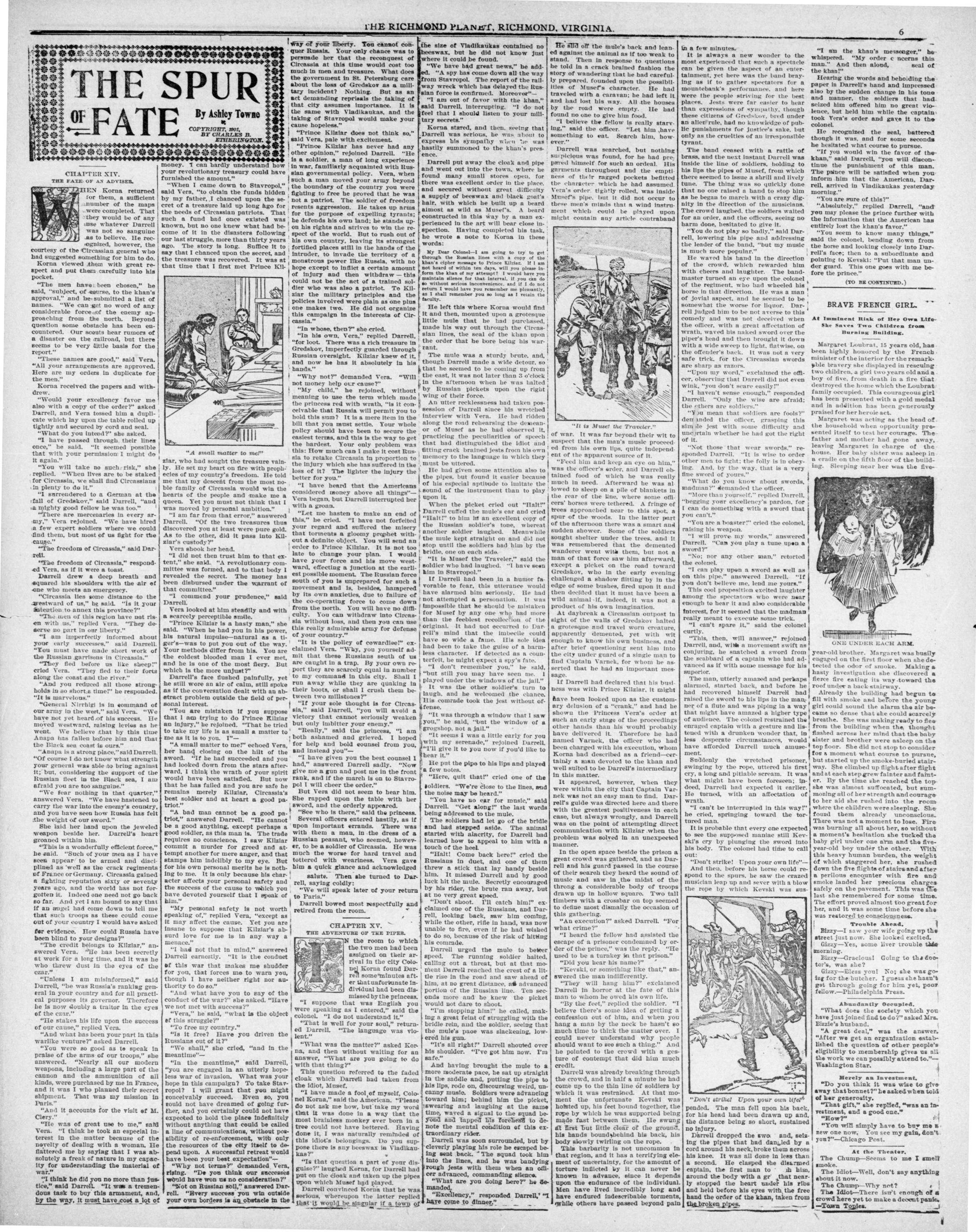
THE SPUR OF FATE By Ashley Towne COPYRIGHT, 1801, BY CHARLES B.
CHAPTER XIV.
THE FATE OF AN ADVISEER.
HEN Korna returned for a sufficient number of the maps were completed. That they would be of any use whatever Darrell was not so sanguine as to believe. He recognized, however the money. I can hardly understand how your revolutionary treasury could have furnished the amount."
"When I came down to Stavropol," said Vera, "to obtain the funds hidden by my father, I chanced upon the secret of a treasure laid up long ago for the needs of Circassian patriots. That such a fund had once existed was known, but no one knew what had become of it in the disasters following our last struggle, more than thirty years ago. The stair is long. Suffice the
HEN Korna returned for them, a sufficient number of the maps were completed. That they would be of any use whatever Darrell was not so sanguine as to believe. He recognized, however, the courtesy of the Circassian general who had suggested something for him to do
had suggested something for him to do. Korna viewed them with great respect and put them carefully into his pocket.
"The men have been chosen," he said, "subject, of course, to the khan's approval," and he submitted a list of names. "We can get no word of any considerable force of the enemy approaching from the north. Beyond question some obstacle has been encountered. Our scouts hear rumors of a disaster on the railroad, but there seems to be very little basis for the report."
"These names are good," said Vera. "All your arrangements are approved. Here are my orders in duplicate for the men."
Korna received the papers and withdrew.
"Would your excellency favor me also with a copy of the order?" asked Darrell, and Vera tossed him a duplicate which lay upon the table rolled up tightly and secured by cord and seal.
"What do you intend?" she asked.
"I have passed through, their lines once," he said. "It seemed possible that with your permission I might do it again."
"You will take no such risk," she replied. "When lives are to be staked for Circassia, we shall find Circassians in plenty to do it."
"I surrendered to a German at the fall of Gredeskov," said Darrell, "and a mighty good fellow he was too."
"There are mercenaries in every army," Vera rejoined. "We have hired a few expert soldiers where we could find them, but most of us fight for the cause."
"The freedom of Circassia," said Darrell.
"The freedom of Circassia," responded Vera, as if it were a toast.
Darrell drew a deep breath and squared his shoulders with the air of one who meets an emergency. "Circassia lies some distance to the westward of us," he said. "Is it yourention to annex this province?" "The men of this region have not risen with us," replied Vera. "They deserve no part in our liberty." "I am imperfectly informed about your early successes," said Darrell. "You must have made short work of the Russian garrisons in Circassia." "They fied before us like sheep!" cried Vera. "They fied to their forts along the coast and the river." "And you reduced all those strongholds in so short a time!" he responded. "It is marvelous." "General Nirrhigi is in command of our army in the west," said Vera. "We have not yet heard of his success. He moved westward, raising levies as he went. We believe that by this time Anapa has fallen before him and that the Black sea coast is ours."
"Anapa is a strong place," said Darrell. "Of course I do not know what strength your general was able to bring against it; but, considering the support of the Russian fleet in the Black sea, I am afraid you are too tanguine."
"We fear nothing in that quarter," answered Vera. "We have hastened to carry the war into the enemy's country, and you have seen how Russia has felt the weight of our sword."
She laid her hand upon the jeweled weapon beside her. Darrell's heart groaned within him.
"This is a wonderfully efficient force," he said. "Such of your men as I have seen appear to be armed and disciplined as well as the crack regiments of France or Germany. Circassia gained a fighting reputation sixty or seventy years ago, and the world has not for forgotten it. Indeed one need not go back so far. And yet I am bound to say that if an angel had come down to tell me that such troops as these could come out of your country I would have asked for evidence. How could Russia have been blind to your designs?"
"The credit belongs to Killziar," answered Vera. "He has been secretly at work for a long time, and it was he who threw dust in the eyes of the czar."
"Unless I am misinformed," said Darrell, "he was Russia's ranking general in your country and for all practical purposes its governor. Therefore he is now doubly a traitor in the eyes of the czar."
"He stakes his life upon the success of our cause," replied Vera.
"And what has been your part in this warlike venture?" asked Darrell.
"You were so good as to speak in praise of the arms of our troops," she answered. "Nearly all our modern weapons, including a large part of the cannon and the ammunition of all kinds, were purchased by me in France, and it was I who planned their secret shipment. That was my mission in Paris."
"And it accounts for the visit of M. Clery."
"He was of great use to me," said Vera. "I think he took an especial interest in the matter because of the novelty of dealing with a woman. He flattered me by saying that I was absolutely a treak of nature in my capacity for understanding the material of war."
"I think he did you no more than justice," said Darrell. "It was a tremendous task to buy this armament, and, by the way, it must have cost a lot of
COPYRIGHT, 1901.
BY CHARLES B.
ETHERINGTON
money. I can hardly understand how your revolutionary treasury could have furnished the amount."
"When I came down to Stavropol, sald Vera, "to obtain the funds hidden by my father, I chanced upon the secret of a treasure laid up long ago for the needs of Circassian patriots. That such a fund had once existed was known, but no one knew what had become of it in the disasters following our last struggle, more than thirty years ago. The story is long. Suffice it to say that I chanced upon the secret, and the treasure was recovered. It was at that time that I first met Prince Kill-
A
"A small matter to me!" ziar, who had sought the treasure valyly. He set my heart on fire with prophecies of my country's freedom. He told me that my descent from the most noble family of Circassia would win the hearts of the people and make me a queen. Yet you must not think that I was moved by personal ambition.
"I am far from that error," answered Darrell. "Of the two treasures thus discovered you at least were pure gold. As to the other, did it pass into Killiar's custody?" Vera shook her head.
"I did not then trust him to that extent," she said. "A revolutionary committee was formed, and to that body I revealed the secret. The money has been disbursed under the warrant of that committee."
"I commend your prudence," said Darrell. Vera looked at him steadily and with a scarcely percentible smile.
"Prince Kilziar is a hasty man," she said. "When he had you in his power, his natural impulse—natural as a tiger's—was to put you out of the way. Your methods differ from his. You are the coldest blooded man I ever met, and he is one of the most fiery. But which is the more unjust?" Darrell's face flushed painfully, yet he still wore an air of calm, still spoke as if the conversation dealt with an abstract problem outside the field of personal interest.
"You are mistaken if you suppose that I am trying to do Prince Kilziar an injury," he rejoined. "That he tried to take my life is as small a matter to me as it is to you. I"—
"A small matter to me!" echoed Vera, her hand closing on the hilt of the sword. "If he had succeeded and you had looked down from the stars afterward, I think the wrath of your spirit would have been satisfied. But now that he has failed and you are safe he remains merely Kilziar, Circassia's best soldier and at heart a good patrol."
"A bad man cannot be a good patrol," answered Darrell. "He cannot be a good anything, except perhaps a good soldier, as this man is. The trade requires no conscience. I saw Kilziar commit a murder for greed and attempt another for mere anger, and that stamps him indelibly to my eye. But for his own personal merits he is nothing to me. It is only because his character affects your personal safety and the success of the cause to which you have devoted yourself that I speak of him."
"My personal safety is not worth speaking of," replied Vera. "except as it may affect the cause. Yet you are insane to suppose that Killzlar's absurd love for me is in any way a menace."
"I had not that in mind," answered Darrell earnestly. "It is the conduct of this war that makes me shudder for you, that forces me to warn you, though I have neither right nor authority to do so."
"And what have you to say of the conduct of the war?" she asked. "Have we not met with success?"
"Vera," he said, "what is the object of this struggle?"
"To free my country."
"Is it free? Have you driven the Russians out of it?"
"We shall," she cried, "and in the meantime"—
"In the meantime," said Darrell,
"you are engaged in an utterly hopeless war of invasion. What was your hope in this campaign? To take Stavropol? I will grant that you might conceivably succeed. Even so, you could not have dreamed of going further, and you certainly could not have expected to hold the place indefinitely without anything that could be called a line of communications, without possibility of re-enforcement, with only the resources of the city itself to depend upon. A successful retreat would have been your best expectation"—
"Why not terms?" demanded Vera, rising. "Do you think our successes would have won us no consideration?"
"Not on Russian soil," answered Darrell. "Every success you win outside your own borders is an obstacle in the
THE RICHMOND PLANET, RICHMOND, VIRGINIA
way of your liberty. You cannot conquer Russia. Your only chance was to persuade her that the reconquest of Circassia at this time would cost too much in men and treasure. What does the government in St. Petersburg care about the loss of Gredskov as a military incident? Nothing. But as an act demanding reprisals the taking of that city assumes importance. It is the same with Vladikaukas, and the taking of Stavropol would make your cause hopeless." "Prince Killzlar does not think so," said Vera, pale with excitement.
"Prince Kilziar has never had any other opinion," rejoined Darrell. "He is a soldier, a man of long experience in war, familiarly acquainted with Russian governmental policy. Vera, when such a man moved your army beyond the boundary of the country you were fighting to free he proved that he was not a patriot. The soldier of freedom resents aggression. He takes up arms for the purpose of expelling tyrants; he defends his own land; he stands upon his rights and strives to win the respect of the world. But to rush out of his own country, leaving its strongest fortified places still in the hands of the intruder, to invade the territory of a monstrous power like Russia, with no hope except to inflict a certain amount of injury and then withdraw — this could not be the act of a trained soldier who was also a patriot. To Kilziar the military principles and the policies involved were plain as one plus one makes two. He did not organize this campaign in the interests of Circassia."
"In whose, then?" she cried
"In his own, Vera," replied Darrell,
"for loot. There was a rich treasure in Gredskov, imperfectly guarded through Russian oversight. Kilziar knew of it, and now he has it absolutely in his hands."
"Why not?" demanded Vera. "Will not money help our cause?"
"My child," he rejoined, without meaning to use the term which made the princess red with wrath, "is it conceivable that Russia will permit you to hold this sum? It is a mere item in the bill that you must settle. Your whole policy should have been to secure the easiest terms, and this is the way to get the hardest. Your only problem was this: How much can I make it cost Russia to retake Circassia in proportion to the injury which she has suffered in the loss of it? The lighter the injury the better for you."
"I have heard that the Americans considered money above all things"—Vera began, but Darrell interrupted her with a groan.
"Let me hasten to make an end of this," he cried. "I have not forfeited your regard and suffered the misery that torments a gloomy prophet without a definite object. You will send an order to Prince Kilzlar. It is not too late to change your plan. I would have your force and his move westward, effecting a junction at the earliest possible moment. The Russian force south of you is unprepared for such a movement and is, besides, hampered by its own anxieties, due to failure of the co-operating force to come down from the north. You will have no difficulty. You can withdraw into Circassia without loss, and then you can use this really admirable army for defense of your country."
"It is the policy of cowardice!" exclaimed Vera. "Why, you yourself admit that these Russians south of us are caught in a trap. By your own report they are scarcely equal in number to my command in this city. Shall I run away while they are quaking in their boots, or shall I crush them between two millstones?" "If your sole thought is for Circassia," said Darrell, "you will avoid a victory that cannot seriously weaken but only imbitter your enemy." "Really," said the princess, "I am both ashamed and grieved. I hoped for help and bold counsel from you, and instead you—" "I have given you the best counsel I had," answered Darrell sadly. "Now give me a gun and post me in the front rank, and if the march is on to Stavropol I will cheer the order." But Vera did not seem to hear him. She rapped upon the table with her sword, and the orderly appeared.
"See who is there," said the princess. Several officers entered hastily, as if upon important errands. There was with them a man, in the dress of a Russian peasant, who seemed, however, to be a soldier of Circassia. He was much the worse for hard travel and toterted with weariness. Vera gave him a quick glance and acknowledged salute. Then she turned to Darrell, saying coldly:
"We will speak later of your return to Paris." Darrell bowed most respectfully and retired from the room.
N the room to which the two men had been assigned on their arrival in the city Colonel Korna found Darrell some minutes after that unfamiliar individual had been dismissed by the princess
N the room to which the two men had been assigned on their arrival in the city Colonel Korna found Darrell some minutes after that unfortunate individual had been dismissed by the princess.
"I suppose that was English you were speaking as I entered," said the colonel. "I do not understand it."
"That is well for your soul," returned Darrell. "The language was violent."
"What was the matter?" asked Korna, and then without waiting for an answer, "What are you going to do with that thing?"
This question referred to the faded cloak which Darrell had taken from the idiot, Musef.
"I have made a fool of myself, Colonel Korna," said the American. "Please do not ask me how, but take my word that it was done in a way that the most brainless monkey ever born in a tree could not have bettered. Having done it, I was naturally reminded of this idiot's belongings. Do you suppose there is any beeswax in Vladikaukas?"
"Is that question a part of your disguise?" laughed Korna, for Darrell had put on the cloak and taken up the pipes upon which Musef had played.
Darrell convinced Korna that he was serious, whereupon the latter replied that it would be singular if a town of
the size of Vladikaukas contained no beeswax, but he did not know just what it could be found.
"We have had great news," he added. "A spy has come down all the way from Stavropol. The report of the railway wreck which has delayed the Russian force is confirmed. Moreover"—"I am out of favor with the khan," said Darrell, interrupting. "I do not feel that I should listen to your military secrets."
Korna stared, and then, seeing that Darrell was serious, he was about to express his sympathy when he was hastily summoned to the khan's presence.
Darrell put away the cloak and pipe and went out into the town, where he found many small stores open, for there was excellent order in the place, and secured without great difficulty a supply of beeswax and black goat's hair, with which he built up a beard almost as wild as Musef's. A beard constructed in this way by a man experienced in the art will bear close inspection. Having completed his task, he wrote a note to Korna in these words:
My Dear Colonel—I am going to try to get through the Russian lines with a copy of the khan's cipher message to Prince Kilzlar. If I am not heard of within ten days, will you please inform the khan of my attempt? I would have you maintain silence for that interval. If you can do so, I will be very serious in consequence, and if I do not return I would have you remember me pleasantly, as I shall remember you so long as I retain the faculty.
He left this where Korna would find it and then, mounted upon a grotesque little mule that he had purchased, made his way out through the Circassian lines, the seal of the khan upon the order that he bore being his warrant.
The mule was a sturdy brute, and, though Darrell made a wide detour, so that he seemed to be coming up from the east, it was not later than 3 o'clock in the afternoon when he was halted by Russian pickets upon the right wing of their force.
An utter recklessness had taken possession of Darrell since his wretched interview with Vera. He had ridden along the road rehearsing the demeanor of Musef as he had observed it, practicing the peculiarities of speech that had distinguished the idiot and fitting crack brained jests from his own memory to the language in which they must be uttered.
He had given some attention also to the pipes, but found it easier because of his especial aptitude to imitate the sound of the instrument than to play upon it.
When the picket cried out "Halt!" Darrell cufted the mule's ear and cried "Halt!" to him in an excellent copy of the Russian soldier's tone, whereat another soldier laughed. Meanwhile the mule kept straight on and did not stop until the soldiers had him by the bridle, one on each side.
"It is Musef the Traveler," said the soldier who had laughed. "I have seen him in Stavropol."
If Darrell had been in a humor favorable to fear, this utterance would have alarmed him seriously. He had not attempted a personation. It was impossible that he should be mistaken for Musse by any one who had more than the feeblest recollection of the original. It had not occurred to Darrell's mind that the imbecile could have so wide a fame. His sole idea had been to take the guise of a harmless character. If detected as a counterfeit, he might expect a spy's fate.
"I don't remember you," he said, "but still you may have seen me. I played under the windows of the jail." It was the other soldier's turn to laugh, and he welcomed the chance. His comrade took the jest without offense.
"It was through a window that I saw you," he said, "but the window of a grogshop, not a jail."
"It itse I was a little early for you with my serenade," rejoined Darrell. "I'll give it to you now if you'd like to hear it."
He put the pipe to his lips and played a few notes.
"Here, quit that!" cried one of the soldiers. "We're close to the lines, and the noise may be heard."
"You have no ear for music," said Darrell. "Get along!" the last words being addressed to the mule.
The soldiers had let go of the bridle and had stepped aside. The animal started with alacrity, for Darrell had learned how to appeal to him with a touch of the heel.
"Halt! Come back here!" cried the Russians in duet, and one of them threw a stick that lay handy beside him. It missed Darrell and by good luck hit the mule. Secretly encouraged by his rider, the brute ran away, but at no very great speed.
"Don't shoot. I'll catch him!" exclaimed one of the Russians, and Darrell, looking back, saw him coming, while the other, ride in hand, was now unable to fire, even if he had wished to do so, because of the risk of hitting his comrade.
Darrell urged the mule to better speed. The running soldier halted, calling out a threat, but at that moment Darrell reached the crest of a little rise in the road and saw ahead of him, at no great distance, at advanced portion of the Russian line. Ten seconds more and he knew the picket would not dare to shoot.
"I'm stopping him!" he called, making a great feint of struggling with the bridle rein, and the soldier, seeing that the mule's pace was slackening, lowered his gun.
"It's all right!" Darrell shouted over his shoulder. "I've got him now. I'm safe."
And having brought the mule to a more moderate pace, he sat up straight in the saddle and, putting the pipe to his lips, rode on, discoursing weird, uncanny music. Soldiers were advancing toward him; behind him the pletet, swearing and laughing at the same time, waved a signal to the squad beyond and tapped his forehead to denote the mental condition of this extraordinary rider. Darrell was soon surrounded, but by cleverly playing his role he escaped being sent back. The squad took him into the lines, and he was bandying rough jests with them when an officer advanced, commanding silence. "What are you doing here?" he demanded. "Excellency," responded Darrell, "I have come to dinner."
He sled off the mule's back and leaned against the animal as if too weak to stand. Then in response to questions he told in a crack brained fashion the story of wandering that he had carefully prepared, founded upon the possibilities of Muse's character. He had traveled with a caravan; he had left it and had lost his way. All the houses by the road were empty. He had found no one to give him food.
"I believe the fellow is really starving," said the officer. "Let him have something to eat. Search him, however."
Darrell was searched, but nothing suspicious was found, for he had prepared himself for such an ordeal. His garments throughout and the emptiness of their ragged pockets befitted the character which he had assumed. Vera's order, tightly rolled, was inside Museof's pipe, but it did not occur to these men's minds that a wind instrument which could be played upon might contain any article contraband
A
"It is Muse! the Traveller." of war. It was far beyond their wit to suspect that the man's music proceeded from his own lips, quite independent of the apparent source of it.
"Feed him and keep an eye on him," was the officer's order, and Darrell obtained food of which he was really much in need. Afterward he was allowed to sleep on a pile of blankets in the rear of the line, where some officers' horses were tethered. A fringe of trees approached near to this spot, a spur of the woods. In the latter part of the afternoon there was a smart and sudden shower. Some of the soldiers sought shelter under the trees, and it was remembered that the demented wanderer went with them, but not a man of that force saw him afterward, except a picket on the road toward Gredskov, who in the early evening challenged a shadow flitting by in the edge of some bushes, fired upon it and then decided that it must have been a wild animal-if, indeed, it was not a product of his own imagination.
At daybreak a Circassian outpost in sight of the walls of Greedskov halted a grotesque and travel greed creature, apparently demented, yet with wit enough to know his own business, and after brief questioning sent him into the city under guard of a single man to find Captain Varnek, for whom he asserted that he had an important message.
If Darrell had declared that his business was with Prince Kilziar, it might have been looked upon as the customary delusion of a "crank," and had he shown the Princess Vera's order at such an early stage of the proceedings other hands than his would probably have delivered it. Therefore he had named Varnek, the officer who had been charged with his execution, whom Kornna had described as a friend-certainly a man devoted to the khan and well suited to be Darrell's intermediary in this matter.
It appeared, however, when they were within the city that Captain Varnek was not an easy man to find. Darrell's guide was directed here and there with the greatest positiveness in each case, but always wrongly, and Darrell was on the point of attempting direct communication with Kilziar when the problem was solved in an unexpected manner.
In the open space beside the prison a great crowd was gathered, and as Darrell and his guard passed in the course of their search they heard the sound of music and saw in the midst of the throng a considerable body of troops drawn up in hollow square. Two tall timbers with a crossbar on top seemed to define most dismally the occasion of this gathering.
"An execution?" asked Darrell. "For what crime?"
"I heard the fellow had assisted the escape of a prisoner condemned by order of the prince," was the reply. "He used to be a turnkey in that prison." "Did you hear his name?" "Kevski, or something like that," answered the man indifferently. "They will hang him?" exclaimed Darrell in horror at the fate of this man to whom he owed his own life. "By the feet," replied the soldier. "I believe there's some idea of getting a confession out of him, and when you hang a man by the neck he hasn't so much time to thick the matter over. I could never understand why people should want to see such a thing." And he pointed to the crowd with a gesture of contempt that did him much credit.
Darrell was already breaking through the crowd, and in half a minute he had come up to the thin line of soldiers by which it was restrained. At that moment the unfortunate Kevski was hoisted up, his feet bound together, the rope by which he was supported being made fast between them. He swung at first but little clear of the ground, his hands bound behind his back, his body slowly twirling on the rope. This barbarity is not uncommon in that region, and it has a terrifying element of uncertainty, for the amount of torture inflicted by it can never be known in advance, since it depends upon the endurance of the individual. Men have lived incredibly long and have endured indescribable torments, while others have passed beyond pain
in a few minutes.
It is always a new wonder to the most experienced that such a spectacle can be given the aspect of an entertainment, yet here was the band braying as if to gather spectators for a mountebank's performance, and here were the people striving for the best places. Jests were far easier to hear than expressions of sympathy, though these citizens of Gredskov, bred under an aller rule, had no knowledge of public punishments for justice's sake, but only as the cruelties of an irresponsible tyrant.
The band ceased with a rattle of brass, and the next instant Darrell was inside the line of soldiers, holding to his lips the pipes of Musef, from which there seemed to issue a shrill and lively tune. The thing was so quickly done that no one raised a hand to stop him as he began to march with a crazy dignity in the direction of the musicians. The crowd laughed, the soldiers waited for an order, and the officers, seeing no harm done, hesitated to give it. "You do not play so badly," said Darrell, lowering his pipe and addressing the leader of the band, "but my music is much more popular."
He waved his hand in the direction of the crowd, which rewarded him with cheers and laughter. The bandmaster turned an eye upon the colonel of the regiment, who had wheeled his horse in that direction. He was a man of jovial aspect, and he seemed to be somewhat the worse for liquor. Darrell judged him to be not averse to this comedy and was not deceived when the officer, with a great affection of wrath, waved his naked sword over the piper's head and then brought it down with a wide sweep to light, flatwise, on the offender's back. It was not a very safe trick, for the Circassian swords are sharp as razors.
"Upon my word," exclaimed the officer, observing that Darrell did not even wink, "you don't scare easily."
"I haven't sense enough," responded Darrell. "Only the wise are afraid; the others are soldiers."
"You mean that soldiers are fools?" demanded the officer, grasping this simple jest with some difficulty and ungratain whether he had got the right of it.
"Not those that wear swords," responded Darrell. "It is wise to order other men to fight; the folly is in obeying. And, by the way, that is a very fine sword of yours."
"What do you know about swords, madman?" demanded the officer.
"More than yourself," replied Darrell, "begging your excellency's pardon, for I can do something with a sword that you can't."
"You are a boaster!" cried the colonel, raising his weapon.
"I will prove my words," answered Darrell. "Can you play a tune upon a sword?"
"No; nor any other man," retorted the colonel.
"I can play upon a sword as well as on this pipe," answered Darrell. "If you don't believe me, lend your yours."
This cool proposition excited laughter among the spectators who were near enough to hear it and also considerable interest, for it seemed that the madman really meant to execute some trick.
"I can't spare it," said the colonel curtly.
"This, then, will answer," rejoined Darrell, and, while a movement swift as conjuring, he snatched a sword from the scabbard of a captain who had advanced as if with some message for his superior.
The man, utterly amazed and perhaps alarmed, started back, and before he had recovered himself Darrell had raised the sword to his lips in the manner of a flute and was piping in a way that might have amazed a higher type of audience. The colonel restrained the enraged captain with a gesture and listened with a drunken wonder that, in less desperate circumstances, would have afforded Darrell much amusement.
Suddenly the wretched prisoner, swinging by the rope, uttered his first cry, a long and pittable scream. It was what might have been foreseen; indeed, Darrell had expected it earlier. He turned, with an affectation of wrath.
"I can't be interrupted in this way!" he cried, springing toward the tortured man.
It is probable that every one expected to see the supposed maniac still Kevski's cry by plunging the sword into his body. The colonel had time to call out:
"Don't strike! Upon your own life"—And then, before his horse could respond to the spurs, he saw the crazed musician leap up and sever with a blow the rope by which Kevski was gus
T.
Don't arrive. Upon your own later pended. The man fell upon his back, for his head had been drawn up and, the distance being so short, sustained no injury. Darrell dropped the two and, seizing the pipes that had dangled by a cord around his neck, broke them across his knee. It was all done in less than a second. He clasped the disarmed captain, the first man to him, around the body with a gr that nearly stopped the heart under his ribs and held before his eyes with the free hand the order of the khan, taken from the broken pipes.
"I am the khan's messenger," he whispered. "My order concerns this man." And then aloud, seal of the khan."
Hearing the words and beholding the paper in Darrell's hand and impressed also by the sudden change in his tone and manner, the soldiers that had seized him offered him no great violence, but held him while the captain took Vera's order and gave it to the colonel.
He recognized the seal, battered though it was, and for some seconds he hesitated what course to pursue.
"If you would win the favor of the khan," said Darrell, "you will discontinue the punishment of this man. The pahce will be satisfied when you inform him that the American, Darrell, arrived in Vladikaukas yesterday morning."
"You are sure of this?"
"Absolutely," replied Darrell, "and you may please the prince further with the information that the American has entirely lost the khan's favor."
"You seem to know many things," said the colonel, bending down from the horse and looking closely into Darrell's face; then to a subordinate and pointing to Kevski: "Put that man under guard. This one goes with me before the prince."
(TO BE CONTINUED.)
BRAVE FRENCH GIRL.
At Immincent Risk of Her Own Life
She Saves Two Children from
Burning Building.
Margaret Loubrat, 15 years old, has
been highly honored by the French
minister of the interior for the remarkable bravery she displayed in rescuing two children, a girl two years old and a boy of five, from death in a fire that destroyed the home which the Loubrat family occupied. This courageous girl has been presented with a gold medal and in addition has been generously praised for her heroie act.
Margaret was acting as the head of the household when opportunity presented itself to test her courage. The father and mother had gone away, leaving Margaret in charge of the house. Her baby sister was asleep in a cradle on the fifth floor of the building. Sleeping near her was the five-
A
ONE UNDER EACH ARM.
year-old brother. Margaret was busily engaged on the first floor when she detected the odor of smoke. Making a hasty investigation she discovered a fierce fire eating its way toward the roof under a back stairway.
Already the building had begun to fill with smoke and before the young girl could sound the alarm the air became so dense that she could scarcely breathe. She was making ready to flee from the building when the thought flashed across her mind that the baby sister and brother were asleep on the top floor. She did not stop to consider for a moment what course to pursue, but started up the smoke-buried stairway. She climbed up flight after flight and at each step grew fainter and fainter. By the time she reached the top she was almost suffocated, but summoning all of her strength and courage to her aid she rushed into the room where the children were sleeping. She found them already unconscious. There was not a moment to lose. Fire was burning all about her, so without a moment's hesitation she tucked the baby girl under one arm and the five-year-old boy under the other. With this heavy human burden, the weight of which staggered her, she rushed down the five flights of stairs and after a perilous encounter with fire and smoke landed her precious charges safely on the pavement. This was the last she remembered for some time. The effort proved almost too great for her, and it was some time before she was restored to consciousness.
Trouble Ahead.
Gizzy—Yes, some liver trouble this morning.
Gizzy—Gracious! Going to the doctor's, was she?
Gizzy—Bless you! No; she was going for the butcher. I guess she hasn't get through going for him yet, poor fellow.—Philadelphia Press.
Abundantly Occupied
"What does the society which you have just joined find to do?" asked Mrs. Elizie's husband.
"A great deal," was the answer. "After we get an organization established the question of other people's eligibility to membership gives us all the work we can possibly attend to."—Washington Star.
Merely an Investment.
"Do you think it was wise to give away that bonnet?" he asked when told of her generosity.
"That gift," she replied, "was an investment, and a good one."
"How?"
"You will simply have to buy me a new one now. You see my gain, don't you?"—Chicago Post.
At the Theater.
The Chump—Seems to me I smell smoke.
The Idiot—Well, don't say anything about it now.
The Idiot-There isn't enough of a crowd here yet to make a decent panic. Town Topes.
THE PLANET
published every Saturday by JOHN MITCHELL
JR., st 31 North 4th Street, Richmond, Va.
All communications intended for publication should be sent so as to reach us by Wednesday.
TERMS IN ADVANCE.
One Copy, one year,
One Copy, eight months,
One Copy, six months,
One Copy, four months,
One Copy, three months,
Single Copy,
ADVERTISING RATES
For one inch, one insertion.
For one inch, each subsequent insertion,
For two inches, three months,
For two inches, six months,
For two inches, nine months,
For two inches, twelve months,
Marriage and Funeral Notices,
Standing and Transient Notices per line,
POSTAGE STAMPS OF A HIGHER DE-
NOMINATION THAN TWO CENTS NOT
RECEIVED ON SUBSCRIPTIONS.
THE PLANET is issued weekly. The subscri-
mon price is $1.50 a year, in advance.
There are FOUR WAYS by which money can be sent by mail at your risk: - In a Post Office Money Order, and when none of these can be procured, in a Registered Letter. MONEY ORDERS. You can buy a Money Order at your Post Office, payable at the Richmond office, and we will be responsible for its sale afterward. EXPRESS MONEY ORDERS can be obtained at any office of the American Express Co., the United States Express Co., and the Wek's Farmland companies, applicable for money sent by any of these companies. The Express Money Order is a safe and convenient way for forwarding money. REGISTERED LETTER. If a Money Order you reach, your Postmaster will Register the letter you wish to send us on payment of ten cents. Then, if the letter is lost or stolen, you can send money in this manner at our risk. We cannot be responsible for money sent in letters in any other way than one of the four ways mentioned above. If you send your money in any other way, you must do it at your own risk.
BENHALLE, ETC.—If you do not want THE PLANET continued for another year after your planet has run out, you then notify us by Postal Care or by the postmaster. We decided that subscribers to newspapers who do not order their paper discontinued at the expiration of time for which it has been paid are required for the payment of the subscription up to date when they order the paper discontinued.
COMMUNICATIONS—When writing to us to renew your email address or to discontinue our paper you must place your name and address in full, otherwise we cannot find your name on our books.
CHANGE OF ADDRESS—In order to change the address of a subscriber, we must be sent no former as well as the present address.
Entered in the Post Office at Richmond, Va., as second class matter.
SATURDAY, JULY 19, 1902.
WHILE Major L. W. T. WALLER, U. S. M. C., lately returned from the Philippines, was receiving a $300 sword at Norfolk, Va., the report of Gen. CHAPPEE virtually charging him with the murder of unarmed, helpless Filipinos was being published in the newspapers of the country.
GEN. MORGAN GONE.
We were shocked to learn of the death of Gen. THOMAS J. MORGAN, who departed this life at Yonkers, N. Y., Sunday, July 18, 1902. He was born in Franklin, Ind., sixty-two years ago. He was secretary of the American Baptist Home Mission Society at the time of his death.
In conjunction with Dr. M. MACVICAR, he was the moving spirit in the founding of the Virginia Union University in this city of which the former is president.
He spent the best years of his life in behalf of the colored people, by the side of whom he fought during the years of the late rebellion.
His death has cast a gloom over the educational institutions of the Southland and sympathy will be expressed by those who knew him best and profited by his tireless efforts in behalf of humanity.
While not agreeing with all of his policies and plans, it is but proper that the recognition of his past services should be the distinguishing feature of the obsequies over his grave. Peace to his ashes; rest for his soul.
THE TROUBLES OF THE REVOLU
TIONISTS.
The legislature of Virginia is with us, and if there is any satisfaction in seeing one's old enemy squirm, the colored folks of this state are enjoying it. The unconstitutional "Constitutional" Convention after declining to take the oath of office proceeded to prescribe the kind of oath the legislature of Virginia must take. It also "applied the thumbscrew" by declaring that in case any member of the legislature of the state should fail to take this oath, he would thereby vacate his office. The most remarkable part of the whole affair was the action of Col. JAS. R. CATON, the author of the Alexandria Jim Crow Car law in leading the fight against the new instrument.
He declared that the action of that body in proclaiming the result of their labors instead of submitting it to the people of the commonwealth was not only an act of bad faith, but nullified the efforts of the body itself.
The Republican members filed a protest and with one exception, Dr. Mc LEAN of Mecklenburg county took the oath under protest. The latter refused to take the oath
That the action of the unconstitutional Convention was revolutionary ad-
But what will the Supreme Court of the United States decide? Will it review the action of the revolutionary body which arrogated to itself the pow. ers of a state?
Its past action has been one of evasion. It got around the Kentucky case by simply declining to pass upon it. According to its dictum, a state or the accredited or rather the discredited representatives of a state may do a revolutionary act and so long as it does not destroy the Constitution of the United States, the Supreme Court will "go blind in one eye, and can't see with the other," so to speak.
This is the hope of the revolutionists and if the past record of the Supreme Court is to be taken as a criterion, they need not be without hope.
Admitting that the Constitutional Convention is illegal, conceding that the Constitution is unlawful, declaring that the act of proclaiming the instrument is revolutionary, the next question is, what are we going to do about it?
We have repeatedly asserted that we have more faith in the Supreme Court of Appeals of Virginia than we have in the Supreme Court of the United States. The former has at time won our respect. The latter has at times merited our contempt.
The man who will believe that any practical results can be achieved by an appeal to the latter is of a hopeful dis position and stuffed full of faith.
The men who have usurped the powers of the people can only be overthrown by the people whom they have betrayed. That such an overthrow would be accompanied by disaster and followed by blood-shed admits of no question. This is why we "bear the ills we have rather than rush to those we know not of." The situation is grave and the remedy serious. What shall the end be?
PECULIAR ACTIONS IN NORTH CAROLINA.
Gov. Aycock of North Carolina astounded the country by offering rewards aggregating thirty thousand dollars for the arrest and conviction of the lynchers of the two colored boys at Salisbury, N. C., a few months ago. Judge Shaw issued the first bench warrant of the kind ever known in the state, July 13th for the arrest of a party alleged to have been guilty of the crime. The charge is murder. This has been our contention. The taking of human life without the authority of law constitutes murder and the lynchers should be hanged dead by their necks.
It is a peculiar fate that evolved such a man as Gov. Aycock. Elevated to the governorship during troubles times and as the alleged representative of lawless elements, he has shown a greater respect for fundamental principles than did Gov. Russell, the Republican hypocrite whom he succeeded.
A WEEK'S NEWS CONDENSED.
Thursday, July 10.
Simon Freeman, of Wilkesbarre, Pa. committed suicide by jumping from a bridge into the Susquehanna river.
A mast 170 feet high, for the wireless telegraph station at the Annapolis Naval Academy, was placed in position yesterday.
Corporal Samuel Boyd, formerly orderly to Admiral Dewey on the Olympia at the battle of Manila Bay, was killed by a train at Magruder, Md.
J. C. Bentoyer, a ranchman of Carbon county, Montana, was given a patent for a flying machine yesterday. He has challenged Santos-Dumont for a race
Friday, July 11.
The June receipts of the 50 largest postoffices in the United States show an increase of $572,822, or 14 per cent. The Glass Bottle Blowers' Association of the United States and Canada donated $5,000 to the striking anthracite miners. Edwin Gallagher, of Scranton, Pa., was killed yesterday afternoon by falling down an elevator shaft in the Tribune building. Professor Charles W. Ellot, of Harvard College, was elected president of the National Educational Association at their convention at Minneapolis, Minn.
Saturday. July 12.
The first rain storm since last October occurred at Albuquerque, N. M., yesterday.
A Vienna dispatch says the Sultan is considering the suppression of all American missions in Turkey.
Postmaster General Payne left Washington yesterday for his home in Wisconsin to spend the summer.
Ex-President Juan Jiminez, of San Domingo, who was recently deported from that country, arrived in New York yesterday.
The Mine Workers Union and Alabama coal operators yesterday agreed on a scale of 55 cents for mining and uniform pay for laborers.
Monday, July 14.
One hundred and fifteen Boer officers left Bermuda Saturday for New York.
General Thomas J. Morgan died yesterday at his home at Yonkers, N. Y., aged 62 years.
While cleaning a target rifle Saturday, Brent Yates, a business man of Hiawatha, Kan., killed himself.
A mass meeting of Catholics was held at Grand Rapids, Mich., last night to protest against forcing the frilars out of the Philippines.
Paris green used too freely on a pa tato patch nearly caused the death of Mrs. Thomas Scott, her two daughters and a son, at Mt. Carmel, Pa., they having eaten some of the tubers.
Tuesday, July 15.
The national meeting of state bank examiners will be held at Detroit, Mich., July 29. Many families are rendered homeless at Argentine, Kan., by the flood in the Missouri river. A Paris dispatch says that 12 ruined gamblers committed suicide at Monte Carlo during the past few days.
THE RICHMOND PLANET. RICHMOND. VIRGINIA
A CONFIDENTIAL QUERY.
Did you never buy a gold brick? Honest?
Cross you heart?
Did you never buy a gold brick? Honest!
— You cross your heart?
A FIRE-ROOM WOOING By JOHN FLEMING WILSON.
JOHN FORBES, chief fireman of the steamship Emperor, had a reputation on the Pacific for making a ton of coal go almost as far as owners demand that a ton should. With this reputation back of him, he took frequent occasion to talk confidentially to his fire room crews on stoking as an art. In one of these lectures he most unexpectedly descended from principles to example. "I tell ye," he was saying, "so long as we are in an American line, and they don't save in wages to China-men who they lose in extra coal from unskillful handling, it pays to have a head on your shoulders. When the Emperor's watches wear pigtails and answer to numbers instead of names, then leave the headwork to the engineers. But in my private opinion and I've handled a shovel 20 years—a man like Lyle is money to owners at four times a heathen's wage."
Edward Lyle looked gratefully at his chief, and a slow flush mounted under the soot on his cheeks. It was very sweet to be held up as an example by her father; he even (somewhat self-consciously) felt that Ann Forbes was a little closer, that she had approved of him. To tell the truth, the young man had never seen Ann Forbes in the flesh.
Months ago, when he had joined the Emperor in San Francisco, the chief engineer had tried his strength, his endurance and his temper; approved them, and afterward taken the clean-mouthed youth into his confidence. That confidence consisted in unpublished opinions on every engineer in the "line;" in forcible deductions about life as exposed in the writings of Bulwer—"The Caxton" was his favorite—and lastly, in talking about his daughter, Ann.
Many a night the burly Forbes and his heavy-limbed subordinate leaned over the bars around the forehatch, and spoke to each other of her. If the elder were satisfied with the youngster's attitude, he took him quietly to his little oak and let him look at the picture of her on the bulkhead. These were moments unforgettable and utterly delightful to Lyle. He dimly felt, as he gazed on that picture standing out so purely and cleanly amid the murk of the room, that in some way she was drawing him nearer to herself. The sordid means of his livelihood grew more honorable in his own eyes in that it was also a way, indirectly, to her. In these moments he was even jealous of her father's speech. That hoarse words should play with her name or describe her life seemed inharmonious, and the very fact that they were proud and loving words offended him.
In a most timid and reverent fashion he attempted to show himself worthy of her. He worked steadily; he saved every cent of his wages; and, when in port, he took a delight in letting the chief fireman know where he spent his time.
To his disappointment, Forbes took everything in a matter-of-fact way. He praised his work sparingly, nodded his head kindly when he displayed his savings, and simply took it for granted that he behaved himself ashore. Then, very gradually, it dawned on Lyle that the father never gave him any share in this sentiment about his daughter apart from that of a mere listener. He saw, indistinctly, in his somewhat clumsy mind, that Forbes had never incorporated into his conversation about her any of his youthful suggestions, and he also felt that his own conception was a little finer and more truthful than the father's Why, otherwise, did John Forbes say that Ann was mighty chilly to young men—that she was too steady to ever fancy a man that wasn't grown up and sensible? Lyle knew that this was perverse, and its painful inadequacy as a generalization of her wounded him. How sure he was that those veiled eyes could burn into utter expression! And he felt that the fire to kindle them must lie in the heart of a young man.
These feelings developed into strong emotion at times, and the more rapidly when he tried to bring his fancy down to concrete details. "What sort of a hat does she wear?" he asked Forbes, one evening. "Hat! I reckon a cap more likely her headgear. Maybe she does wear a hat." "How does she do her hair?" Lyle went on, with some diffidence. Forbes looked at him blankly. To the young man's senses there was an implied rebuke, a hint that he was prying into the secrets of a modest girl. But this notion fled when the answer came with futile poverty of suggestion: "Why, I suppose like all women do. They all do it the same way."
And so their conversation ran, the elder harping on his proud memories of fatherhood, the impatient lover trying to build up for himself a shrine in which to worship his first love. Naturally, it was only here
and there that their thoughts met; and just when the lover caught a fair glimpse of her, the clumsy words of an un-understanding, generalized paternity blotted out the image. Little prone as Lyle was to mental or emotional activity, he steadily progressed to a state where certainty was the one cry of his heart. To look at the picture on the bulkhead was good. To have that picture above his own bunk was infinitely preferable. To hear about her was a delight. But to speak with knowledge and the full sense of possession was heavenly.
So, one night, after a long, uneasily meditative communion with the moon and the dark sea, Edward Lyle sought the chief fireman. "Mr. Forbes," he commenced, awkwardly, "ye know what—what—an interest I take in Her."
The father nodded kindly, and he went on: "Well, sir, I'm getting pretty well fixed—you've said yourself I was a good fireman—and I want to marry." Forbes looked at him with a glint of understanding in his eyes, but made no response. The young man took off his greasy cap and crushed it in his hands. "What I want, sir," he said, quietly, "is to marry her."
There was no answer, and he added, as though it might be taken for granted: "I love her."
He waited a long time, but Forbes made no reply, even by a gesture. Around them were all the rough sounds of the main deck, the stamping of cattle forward, the rattle of the cook's pots and pans, the pervasive tones of careless men. From the next cabin came a harsh laugh and an oath. Lyle dared not look at the photograph for fear he should make Her conscious of the unworthy surroundings. So he went out, unanswered.
The next few days the two men did not talk beyond what was ordinary and necessary. Yet Lyle frequently felt the elder man's gaze measuring him, and he squared himself to his work—for her sake. Whether he was wretched or not, it did not occur to him to ask. All he was distinctly conscious of was a vast, unsatisfied love, a love so sure of itself and so limitless that it included in itself a return. They neared San Francisco, and Forbes' insistence upon economy in coal became almost unbearable. It was always so when they drew near to
HIS FIRST KISS.
their home port, but this time he seemed to be unjust—a sin never before imputed to this chief fireman. However, amid all his eros words and angry scoldings, he said nothing to Lyle, who, indeed, labored as he had never done before.
One evening (they expected to reach San Francisco the next day) Edward Lyle went wearily to his bunk in the starboard alleyway. Usually he dropped around to see Forbes, but he did not feel equal to it now, though he was hungry to talk of Her.
His bunk was dark, and he fumbled under the mattress for matches. When he found the box he struck a light and lit the little bracket on the bulkhead. As it burned up his eye caught a new thing. He looked again, long and earnestly. Then he blew out the lamp and pressed his face blindly against the bulkhead. On his scaping lips he felt two flaming, loving, quivering woman's lips, and the young fireman gave and took his first kiss.
But it was simply a photograph awkwardly pinned there by John Forbes.—San Francisco Argonaut.
Leominster's Old Ducking Steel
Leominster's Old Ducking Stool.
In the old Priory church, of Leominster, is a very interesting specimen of the old cuckling or ducking stool, a universal mode of punishment formerly in vogue for the punishment of soilds, scandalmongers and women with too long a tongue. It was also inflicted on brewers and bakers, etc, transgressing the law, who in such a stool were immersed over head and ears in (stercore) stinking water. This mode of punishment dates back to Saxon times, and the Leominster specimen was the last used in England of which we have any record. in 1809. Several other specimens still exist about the country, as at Montgomery, Warwick, Fordwich and Leek. Travel.
It is settled that Miss Hilda Spong will not return to Daniel Frohman's stock company next season. The elaborate production of "Notre Dame" is to be used for road tour with Miss Bertha Galland in the role of Esmeralda.
The Honest Little Boy.
An elderly philanthropic lady living in the suburbs had occasion the other day to send a small street boy on an errand. She had never seen the urchin before, but her need was urgent and she was glad to get hold of any sort of messenger.
"Now, my boy," she said, "I want a nice, honest little boy to take this note to Mrs. Blank. Do you know where Mrs. Black lives? At the other end of the town, by the—"
"I knows it," piped up the urchin; "I goes there reglar in the summer to steal her grapes." -Tit-Bits.
His Disposition
"Mike," said the superintendent, "there is a dead dog reported in the alley between Illinois and Meridian streets. I want you to look after its disposition."
An hour later the intelligent officer telephoned: "I have inquired about the dog, and find that he had a very savage disposition."—Boys' World.
WAR
REMINISCENCES
COFFEE ON THE MARCH.
Nothing Was So Enlivening and Cheering in a Tight Place as a Steaming Cup.
"Our fellows," said the sergeant, according to the Chicago Inter Ocean, "brought everything into practical jokes except coffee. Coffee was always coffee, and could not be treated lightly. I have seen half a dozen little coffee kettles about one little fire, all under the eye of one man, looking after the interests of comrades who were off after wood or water. But I never knew one of our boys to fail in this sort of guard duty. At the critical juncture every coffee drinker wanted to manage his own kettle, and a joke at such a time would have meant a foot race or a fight.
"I have at home the quart tin kettle and two large tin cups which my partner and myself carried in the last year of the war. One of the cups is a regulation government affair, and the other a deeper one with a moveable handle, through which the belt or haversack strap could be passed. Both have rough dents or scars on the bottom, made in crushing the coffee with the socket end of a bayonet. To the beginner the coffee grinding was a difficult and unsatisfactory operation, but to the old soldiers it was a comforting process which brought most satisfactory results.
"As soon as we bivouacked, one man of each couple built a little fire of chips, twigs or rail splinters and
COFFEE TIME
proceeded to grind coffee for two. He measured out carefully so much for each man, put it in a tin cup and proceeded to crush it to the required fineness. At first the noise was like that of pounding and then it was a sort of unctuous crunching. With 300 or 400 bayonets in action the sound was like music to the ears of tired and hungry men, and civilians like B. F. Taylor found poetry in it. In the meantime the other partner came in with kettle and canteens filled with water, and proceeded to cook the meat, while the coffee grinder cooked the coffee.
"In one desperate march, in which we fought at every turn of the road, the men were pushed almost beyond endurance. At last the enemy gave way, but we could see them in the distance forming for resistance. The general, looking over his irregular lines, sat down under a tree almost discouraged. A staff officer who stood at his side said: 'By George', and the general asked: 'What are the boys doing now?' The officer replied: 'They are building fires to make coffee; shall I stop them?' The general sprang to his feet and said: 'Thank God for that. There is fight in them yet. Tell them to grind as noisily as they can. It won't put any heart into the rebs in front of us."
A Voting Telegraph.
There is only one reference to mechanical voting in the thirteen reports on foreign parliaments which have just been issued. This occurs in a memorandum on the subject of divisions in the reelstag and Prussian landtag. As long ago as 1869 a motion was introduced in the Prussian lower house in favor of establishing a system called the voting telegraph, an electric invention designed by the firm of Siemens & Halske. Each member was to have at his place a handle to turn to right or left as he wished to vote "yes" or "no," and this handle could be turned only by the member to whom the seat belonged, each key to whom the seat belonged, each member being provided with a special key. The time for taking the votes of the lower house would according to this scheme have occupied less than two minutes. There were no practical objections made to the machine, but it was rejected, partly because no pressing need existed for shortening the divisions, and partly on account of the advantages of the oral process of voting.—London Chronicle.
How He Walked.
A sergeant drill instructor was endevouring to make clear to the recruits he was drilling the meaning of the word "smartly."
He walked across the square in the manner the word indicates. "Now, men, tell me how I walk?"
One raw recruit almost paralyzed the sergeant by blurting out:
"Bow-legged, sergeant."—The Regiment.
THE BIG BAND LEADER.
President Lincoln's Jocose Remark to a 300-Pound Wielder of the Baton.
Brevet Brig. Gen. I. C. Abbott writes to the Washington Post, saying: "On the 19th day of May, 1861, the First Michigan three months' volunteer infantry arrived in the city of Washington, and on the 22d it was re-
viewed By President Lincoln near the white house, and at eight o'clock in the evening the field and staff, the line officers and the regimental band, led by the colonel, O. R. Wilcox, now major general United States army, retired, called upon Lieut. Gen. Winfield Scott at the war department. The band played "Hail to the Chief," and after grasping the hand of the old veteran the party marched over to the white house, with the band playing 'America.' There the party were escorted to the east room.
"The president soon came in and all were introduced. The president shook their hands very heartily. After greeting the members of the band, the president walked up to the leader, whose avirdupois was about 300 pounds and whose height was about five feet six inches. 'Sir,' said the president to him, 'you are the biggest blower I ever say.'
"This evoked a cheer, and the drum major ordered the band into position. The band struck up 'Yankee Doodle' and the company passed out and to quarters. Thus ended one of the most pleasant incidents of my service during the civil war."
JACKSON'S FATALISM.
He Often Prayed to the God of Battles While the Bullets Flew About Him.
Jackson was as absolute a fatalist as Napoleon, with this difference, that Jackson was a man with a religious creed, while Napoleon was not. Jackson was a Presbyterian and an absolute believer in the tenets of the church, says a writer in Lippincott's Magazine. As an evidence of his fatalism I once saw him standing in a mountain road when the wheel of a caisson came off and was rolling directly on him. An officer of his staff called to him to move, but he stood still. The wheel struck a stone, bounded over the side of the mountain, and Stonewall Jackson turned to the officer and said: "You see, there was no danger. I knew it."
It was Stonewall Jackson's habit to pray on the battlefield. His method was to remove his cap, raise his right hand and then pray to the God of battles. I saw him do this on several occasions, notably on the field of Port Republic, his battle with Shields, while sitting on his horse in a road down which a splendidly served northern battery was poking shot and shell.
Gen. Lawton informed me that sometimes he would give him an important order so quickly that it would almost take his breath away. Notably at Cedar mountain Jackson rode up to him and said: "Gen. Lawton, advance and drive the enemy from your front." Lawton replied: "General, there is a very deep ravine in the enemy's front." Jackson replied: "I know it. Advance!" He did not
IT WAS STONEWALL JACKSON'S HABIT TO PRAY.
waste words. Jackson's practice was to speak of the northern troops as Mexicans. He very rarely called them anything else. Dr. Hunter McGuire, his medical director, is my authority for this statement.
Stonewall Jackson died in a house that is still standing at Guinea station, in Virginia, on the line of the Richmond, Fredericksburg & Potomac railroad. His left arm was amputated at the shoulder, being taken out of the socket. When he closed his eyes in death his little daughter, then two or three years old, lay on his breast, with his right arm over her. His dying words were: "Pass the infantry rapidly to the front." "Tell A. P. Hill to prepare for action." "We will pass over the river and rest under the shade of the trees on the opposite side." He was delirious and, like Napoleon's, his mind, as it feebly fulfilled its last offices, was with his military past.
Surgeon—There doesn't seem much wrong with you, my man. What's the matter?
Jack—Well, sir, it's like this, sir. I eats well an' I drinks well an' a sleeps well, but when I sees a job of work—there, I'm all of a tremble—Tit-Bits.
W. I. JOHNSON. FUNERAL DIRECTOR AND EMBALMER.
Office & Warerooms, 207 N. Foushee St. Corner Broad. HACKS FOR HIRE: Orders by Telephone or Telegraph filled. Wedding, Suppers and Entertainments promptly attended. Old 'Phone, 686, Residence in Building, New Phone, 48.
KNIGHTS OF COLUMBUS OF THE WORLD
TO WHOM IT MAY CONCERN:
This organization has been chartered and legally stituted under the laws and statute of the state of New York, for the purpose of uniting together all acceptable men on the Broad Bases of Charity—Beneficial and Fraternal and to promote the Social and Moral condition of humanity.
Its two distinct military and uniform ranks will secure for this organization a place in the front ranks of all sacred institutions of modern events, a grand opportunity for active men. Deputies wanted in all sections of the country to organize lodges. Kindly address.
In a Tremplons State
T
New Outing and Picnic Park at Jonesboro.
There is a New Outing and Pioneo Park, Jonesboro, at Fort Lee on the Eastern Branch of the C. & O. R. R. convenient for Pienics by wagon or rail.
There is a large pavilion that will accommodate 800 persons and other attractions such as swings, base ball etc. Excellent water on the grounds. You cannot find a more desirable resort for church, Sunday School, society or private picnics or one that will afford a more perfect day of rest, recreation or pleasure. For particulars as to dates and rates apply at once to.
The East End Memorial Burial Association of Richmond informs the public that having purchased six (6) acres of land, situated in Henrico County, near the city of Richmond, adjoining Oakwood cemetery and that they are disposing of the same, in sections, half sections and at the following terms. Sections, $25.00 and Half Sections, $15.00.
The situation of this Cemetery is high, dry and rolling and accessible to the Richmond Traction Street Railway and Seven Pines Railway lines, adjoining Oakwood cemetery.
This Association has at a considerable expense divided this tract of land into sections, erected a fence around its boundaries, which with the additional improvements contemplated, will be an inducement to those desiring or contemplating purchasing resting places for their deceased relatives and friends.
The attention of the general public is solicited and advantageous inducements offered.
J. R. Griffin, President, No. 2413 E. Broad street; E. A. Washington, Secortary. Old 'Phone, 1983. For information, apply to John coleman, Keeper, No. 2920 P street; Wm. Custalo, 702 East Broad street; W. H. Jones, 1037, St. Peter street; W. H. Lewis, 806 Buchanan street; Samuel Meredith, 1233 North 26th street; Joseph Robinson, No. 49 1st market or 2811 9-mile Road; D. J. Chavers, Supt., 1827 Carrington street.
RIPANS
There is scarcely any conditions of ill-health that is not benefited by the occasional use of a R-I-P-A-N-S Tabule. For sale by Druggists. The Five-Cent packet is enough for an ordinary occasion. The family bottle, 60 cents, contains a supply for a year.
THE MIDWAY LUNCH ROOM.
726 N. 3rd St. Richmond, Va.
MEALS FROM 7 A. M. TO 8 P. M.
Term Reasonable, Quick Service.
Give Me A Call.
MRS. S. L. MITCHELL., Proprietress.
Go to Beach Park. Westpoint Excursion and Picnic Grounds—Only 30 Miles, One Hour's Ride From Richmond, via Southern Ry.
A great many excursions have already been booked for "Beach Park" for June and July. The various attractions and improvements at this popular resort gives it more prominence each season;
To close proximity to Richmond, and the unlimited supply of the most wholesome artesian water, together with many other natural advantages, places it second to none as a pleasure and health resort for Richmond people.
King William Pier, a substantial structure, extending 689 feet in length and 25 feet wide over the York River, with waterproof roofing as a protection from sun and rain, adds considerably to the beauty and convenience for picnic and other outing parties.
In addition to the new Beach Park Hotel, new being erected, you will find other hotels and many nice boarding houses, furnishing cheap rates and good first-class accommodations.
The principal attractions are such as fine fishing, boating, sailing, merry-ground, shooting galleries, steam and naptha launches, a large dancing pavilion with a band of music day and night, several wells of fine artesian water on the grounds, and various other attractions to suit the older people as well as the little ones.
For any other information apply at or write to the Southern Ry, office, 920 E. Main St., Richmond, Va.
Old Phone, 1233. New Phone, 1553.
THE PRIVATE LIVERY
700 CATHERINE ST.,
QUICK TRANFERING
Saddle or Driving Horses, Buggies and Surries To Let at Lowest Prices. N. B. Tandem Lessons Given. Strict attention given to all orders. George Jenkins, Proprietor.
JOHNSON,
R. AND EMBALMER.
N. Foushee St. Corner Broad.
OR HIRE:
Legraph filled. Wedding, Sup-
pents promptly attended.
in Building, New Phone, 48.
OF COLUMBUS OF THE WORLD
V. P. & F. K. of W.
ization has been chartered and legally
the laws and statute of the state of New
purpose of nitting together all acceptable
Broad Bases of Charity—Beneficial and
Moral condition of humanity.
ranks will secure for this organization a
institutions of modern events, a grand opper
in all sections of the country to organize
supreme voyager,
at New York City.
JNO. H. BRAYTON,
10 W. Jackson St.
Notice !!!
AND MOVING.
THE PLANET
SATURDAY, JULY 19, 1903
Valuablees of Passengers.
Salida, Colo., July 15.—A report was received here shortly before noon yesterday to the effect that the Denver and Rio Grande Narrow Gauge passenger train which left here early Sunday night was held up and robbed yesterday by four men near Sargents, west of Marshall Pass. The engineer was compelled at the point of a revolver to stop the train by masked men, who had climbed over the tender. One of the robbers addressed remarks to Engineer Ruland, who did not understand what was said, and before Ruland could ask him to repeat his remarks the robber struck him a blow with a Winchester rifle, breaking the stock of the gun. His head is badly swollen. No passengers or trainmen were hurt.
Two safes in the express car were blown open, but it is asserted by officers of the Rio Grande Express Company that the robbers failed to secure any plunder from the safes. The passengers were compelled to alight from the cars and line up alongside the tracks in the canyon, and they were relieved of all their money and valuables. Many of the passengers threw away their money, watches and jewelry among the rocks before the robbers scarched them. There were many tourists among the passengers, and while it is not known how much the robbers secured, it is presumed that the losses were heavy.
The bandits mounted horses and disappeared in the ravines that lead into Marshall Pass. The sheriff at Salina and sheriffs of adjoining counties and a dozen posses are in pursuit.
THE OXFORD SCHOLARSHIPS
nation to Various States.
Washington, July 16.—Secretary Hay has forwarded to the commissioners of the District of Columbia a copy of a letter sent to other states and territories bearing on the American scholarships in Oxford University created by the will of the late Cecil Rhodes. The District of Columbia was not mentioned in the will, and there has, therefore, been doubt as to whether it will be included in the benefactions. The letter of the secretary settles the question in favor of the District. The secretary in his communication encloses a copy of a letter from Boucher F. Hawkley, representing the trustees of the will, in which he says:
"It would be of further great assistance to the trustees if they could be furnished, through your kindness, with the opinion of the leading educational authorities of the United States, especially the heads of Harvard, Yale, Columbia and other universities, with regard generally to the election of qualifying students and the best mode of giving practical effect to the scholarship trust.
"It is hoped that the students can be elected in time to go into residence at Oxford in 1903."
NEW CHINESE MINISTER
Sir Lian Chen Tung Appointed to Succeed Wu Ting Fang.
Pekin, July 14—Sir Lian Chen Tung, secretary of the Chinese embassy to the coronation of King Edward, was yesterday appointed Chinese minister to the United States. New ministers to Russia, France and Italy have also been nominated. The selections for these posts shows that the dowager empress continues to regard the diplomatic service as unimportant. All of them, except Lien Chen Tung, are unknown to the foreign community.
Wu Not Surprised.
Washington, July 14—Mr. Wu, the Chinese minister at Washington, was not surprised to hear of the appointment of a successor to himself, as he had been expecting an announcement of this character for some time. He had received notice that his services would be required in another capacity, and for this reason has been prepared to hear of the naming of his successor at any time.
Father and Son Drowned.
Lancaster, Pa., July 16.—A party composed of Ralph Sweeney, aged 40; his son Harold, aged 10; Joseph Seebert and Walter Descher, all of Columbia, were fishing in the Susquehanna river yesterday afternoon, when their boat drifted into the rapids near Chickies Rock. Striking a rock, the boat upset, and the entire party was thrown into the water. Seebert and Descher managed to cling to a rock, from which they were rescued a couple of hours later. Sweeney, it is thought could have saved himself in the same way, but he attempted to rescue the boy, and both father and son were drowned.
Atlantic City Horse Show Opened. Atlantic City, N. J., July 16.—Never was the opening of a horse show more suspicious than yesterday, when a throng of society people flocked to the Inlet Park to be present at the inauguration of the fourth annual event of the Atlantic City Horse Show Association. There were ten classes judged during the afternoon. In these New York exhibitors secured five first, six second and five third prizes, while Philadelphia carried off two first, two second and one third prize.
General Chaffee Believed
Washington, July 15.—General Chaffee has been relieved of command in the Philippines and ordeed to the command of the department of the east, by an order issued yesterday by Secretary Root.
THE RAILWAYS
HAD BEEN THE TRYSTIING PLACE WITH SUSAN
A ship with cargo laden to the guards
Has come to port! Lo, how her masts and
Above the kindling clouds begin to lift,
And how peak has dashed the skies
with light.
Her hold is stuffed with incense and with myrrh,
And round her clings a fragrance and a scent
Of Thulah or some distant Orient.
With whiffs of a diviner alt, the swift, Silideal blast that bore her from the stars.
The woods and hills rejoice to welcome her,
As though she bore to earth some envoy or Some God-accredited ambassador,
Sent hither from beyond the Pleides.
Near and more near she draws! The heavens grow bright
With her approach! Lo, in what vessel- yards
Were her stout timbers hewn? What work
man laid
Her starry frame? What fearless pilot weighed
The Shadow of Mt. Marcy
By E. B. CLARK.
TO-DAY in the Adirondacks sounds
the shriek of the locomotive. The
trails are highways; the canoe has
been supplanted by the steam launch;
the open shack of the hardy hunter
has been replaced by the summer hotel;
the pack once carried on sturdy
shoulders over windfalls and through
tangled forest mazes has become the
"luggage" of the express car. Twenty-five years since a primitive people,
few in number, dwelt in the then wild northern woods. They were as pie-
HAD BEEN THE TRYST
turesque in their way as the mountaineers of eastern Tennessee. Perhaps some day a novelist may find in the place and people as they then were the material for a story that shall live.
Giles Blossom was a guide, as had been his father before him. He was born within sight of the towering peak of forest-clad Marcy. Blossom was a rugged fellow. The saying is homely and old, but of this man eminently true, his heart was in the right place. He was 25 years old, and had been a guide through the whole northern woods since he was a boy of 15.
Susan Hale was the daughter of a guide who lived on the other slope of the mountain. Sometimes Giles met her. There was not too much society in the wilderness. From the breaking up of the ice in the spring until the deer season closed in the fall there was occupation and some companionship for the woodsmen. It came from the outside world and was made up wholly of men who, though city breed, loved the wood- for the woods' sake and for the wild sport which they afforded.
From the time that some few revolutionary soldiers and their wives had entered the wilderness and made their homes there had been marrying and giving in marriage in the scattered families of these people who lived so close to nature's heart. Giles Blossom loved Susan Hale and her father smiled on the suitor. As for the girl herself she was trained to obedience. "I like you, Giles," she said. "You are different from some of the others. Jim Crawford wants to marry me, too. He cuts the throats of the deer when they break through the crust in winter. I heard you say once that was murder, and that every creature should be given a chance for his life. Giles, I think a man who would kill the deer that way would beat his wife. It's in him."
It isn't a long story this, the story of the shadow of Mount Marcy. It was fixed that Giles and Susan were to go over to the Saranac to the little Episcopal mission, and there to be married when the snow was melting from the crest of Marcy.
This was at the time of the beginning of the end of the wilderness of the north woods. The spur of a railroad had been pushed through into the heart of the region. The woodsmen at first hailed the advent of the road with joy. "It will bring us more parties to guide and more money for our purses," they said. There were some few thinking ones among them, however, who said: "The railroad means that soon we will have no woods into which a blind man could not find his way."
What's in a Name?
Hewitt—There’s nothing in a name.
Jewett—I agree with you. I know
a yellow who named his goat "Oleomarine," and yet the goat has turned
out to be a good butter.—N. Y. Times.
Worse Than That.
Tommy—Willie hit me (crying).
Grandma—Did he hit you on purpose?
Tommy—No'm; on the head.—N. Y.
Journal.
The railroad came. Traffic had not yet opened, but one day a locomotive drew the private palace car of one of the road's directors on to a siding at the end of the spur track. The director with some friends had come on a tour of inspection of the road and was to spend some time in hunting and fishing. The director's son was with the party. He went on a hunting trip alone, taking Susan Hale's father for a guide. He stayed for several days at the Hales' woodland home. The city-bred man found that there was other game in the woods besides deer.
In Susan Hale's eyes this newcomer was not as other men were. It was done ill and done quickly. Susan Hale disappeared. All that could be found out was that the director's son had secured permission to have the locomotive take the car back to the nearest main line connection, then to return without him.
One year later Giles Blossom threaded a trail down the side of Marcy and came to an opening from which he could see the roof of old George Hale's log house. This opening had been his trysting place with Susan. How many times he had been there during the year that was gone Blossom himself alone knew. The sun was touching Marcy's tops with its last rays. A hermit thrush was singing its vesper hymn. There were lines in the guide's face. He looked down toward the spot where through a break in the fence about the Hale clearing Susan had been accustomed to appear. He saw something that made his heart beat. He looked again. Susan Hale was coming across the opening through the woods. She saw him and came toward him. She had steeled herself for the task. "Giles," she said, "I am here again." The guide looked at her. "Where is he, your husband?" he said.
The girl's face went scarlet. "I went away with him, Giles," she said, "but I wasn't taken in marriage. I
NIING PLACE WITH SUSAN.
want you to kill me. I want to die."
"Where is he?"
The girl looked into the guide's eyes.
"Do you wish to see him, Giles?"
"See him and kill him, yes."
him, yes.
Something strange came into the girl's eyes. "At dusk I narrowed he will walk alone along the trail that the railroad men have blazed below Beaver Creek. You wouldn't kill him, would you, Giles?"
"Kill him, yes, but not murder him. I'll meet him and we'll fight it out."
"He carries a pistol," said the girl.
At dusk the next evening Giles Blossom stood by a tree at the side of the blazed railroad trail. The second growth of timber had already sprung to the height of a man's waist. The guide heard a sound. Not 40 yards away with his body partly concealed by the undergrowth a man was coming toward him. The oncomer wore a white flannel outing shirt and his cap was pulled well over his eyes. Blossom stood in the center of the trail. "It's the man," he said to himself. Then he spoke aloud. "If you're armed defend yourself, for I am going to shoot." The stranger stopped short, raised a hand holding a pistol and fired.
There was another shot, this time from the guide's weapon. The stranger tottered and fell.
Holding his pistol in his hand Blossom went forward slowly. There was no movement. He reached the side of his fallen adversary. The cap had fallen back. Oh, the horror of it. Giles Blossom saw, looking up at him through the dusk, the face of Susan Hale. The clothing near the heart was stained. Blossom realized. The girl had purposely sacrificed herself. Another shot broke the silence of the twilight woods. Giles Blossom died by his own hand. They found them there together. The woodsmen guessed the story.
The native charm of the Adirondack woodsmen has largely gone. The deer are vanishing. The trout are dying in the sawdust-filled streams. The holy song of the hermit thrush is less and less often heard as the sun passes away from Marcy's crest. The private cars of the dwellers in towns are on every side track of the wilderness piercing railroad. Man's civilization advances. God's civilization retreats.-Chicago Record-Herald.
At a recent recital Josef Hofman responded to four encounters, but still the audience wanted more. Then he quietly closed the lid of the piano, bowed and left the stage. As usual, it was the women who raised the whirlwind of indiscriminate applause.
May—Why did you accept him?
Belle—Well, it was so hot I couldn't refuse him with the tragic dignity that would make him regret and come back and propose again.—Town Topics
Always in Trouble.
Nan—What is she worrying about now?
Fan—Because she can't think of anything to worry about—Somerville Journal.
GLOSSINE
The True Hair Grower and Hair Straightener IS FOUND AT LAST.
Acts Quicker. Smells Sweeter, and Easier Applied than Any Other Preparation. IT WILL TAKE THE PLACE OF ALL OTHER HAIR TONICS.
Cures Dandruff, Tetter, Itch, and all Scalp Diseases at once and forever. Straightens curly troublesome Hair in from 7 to 30 days, without the use of hot irons or any other mediums. When the Hair has become straight, which it surely will if you use GLOSSINE, it will stay straight forever. It will stop the Hair from falling out in 2 to 4 days. It will restore Gray Hair to its natural color in 30 to 60 days. It will grow Hair on the baldest head in from 10 to 40 days. It will improve the hair at once. You do not have to wait. Just as soon as it is applied the Hair will become soft, lustrous, pliant, and wavy, so that you can dress it in any style you wish. It has never failed to straighten and beautify the most obstinate, curly, refractory, troublesome Hair, and will be sure to give you supreme satisfaction. It is good for all kinds of Hair for white or colored, for ladies and gentlemen, children or grown-up people, babies, and boys and girls. Good for the Hair, the Mustache, and the Eye-Brows. It is made from roots and herbs and leaves, and is
HERE IS A TRUE AND GENERAL
JUST READ THIS.
Now you must send to us a which will sell at retail for agree to use it on your own have commenced to use it done for you, they will e receive for same, to comp with us, and do us all the you actually $6.00 worth have seen your Hair, they GLOSSINE. PLEASE of GLOSSINE and seen and acme of Hair Tonic.
To Continental
Enclosed please find the HAIR TONIC, worth sell all that I do not use aation of you allowing me is not true, you are to the future. I will endeave privileges as specified abo
JUST READ THIS. Now, here is the glorious opportunity we offer you. Remember, GLOSSINE sells at 50c. for an extra large box. Now you must send to us only $2.00 and the very moment we receive the money we will at once send to you 12 extra large boxes of GLOSSINE which will sell at retail for 50c. each or $6.00. We exact of you only the following easy conditions, which are easily complied with: 1st. You agree to use it on your own Hair: 2d. Just as soon as you see the improvement in your own Hair (which will be in a few days only after you have commenced to use it) you must talk it up to your friends, showing your own Hair to prove its merits, and, as they will see what it has done for you, they will eagerly buy it. 3d. You are to sell it for no less than 50c. per box, and you are to keep all of the money that you receive for same, to compensate you for your kind efforts in introducing the great remedy in your locality. All we ask is that you act fair with us, and do us all the good you can, by showing the people, white and colored, what GLOSSINE has done for you. REMEMBER, we send you actually $6.00 worth of goods for only $2.00. Why? Because we know it will give you a beautiful head of Hair, and, when the people have seen your Hair, they will buy thousands of boxes. Every one whom you sell a box, white or colored will be a walking advertisement for GLOSSINE. PLEASE DO NOT WAIT A MINUTE, but fill out the Coupon and mail to us at once, and after you have received the $6.00 worth of GLOSSINE and seen its good effects you will certainly become our Agent. Remember that GLOSSINE is now recognized as the standard and acme of all Hair Tonics by the best people of the country, who are sending us hundreds of testimonials daily.
To Continental Chemical Co.,1700 Lucas Ave., St. Louis, Mo.:
Enclosed please find the sum of $2.00, for which please send me at once twelve (12) of your regular extra large boxes of GLOSSINE HAIR TONIC, worth 50c. each, or $6.00 in all. In return for this favor, I hereby bind myself to use GLOSSINE on my own Hair, and to sell all that I do not use at no less than 50c. per package. I also agree not to cut the price under any consideration. And for and in consideration of you allowing me to keep the money that I receive for same, I agree to act as your Agent in the future. But if all that you have told me is not true, you are to return the $2.00 that I hereby send to you. If from sickness or any other good reason, I cannot act as your Agent in the future, I will endeavor to find one who will take the Agency in my place. To all these agreements I hereby bind myself for the privileges as specified above.
If you send only $1.00, 6 boxes, worth $3.00, will be sent to you.
Name..... P. Q.
Street..... House No. (if any)
State.....
Nearest Express Office.....
MACEDONIAN REBELS DEFEATED
Turks Used Women and Children For
Screen to Storm Trenches.
London, July 18—The Vienna correspondent of the Daily Mail says official reports received describe a formidable Macedonian rising in the village of Monestar, European Turkey. According to these reports, the rebels entrenched on the banks of the Ostrovo, withstood the attacks of a 1,000 Turkish regulars and several hundred Bashi-Bazouks for a week. Finally the Turks placed the Macedonian women and children in the front, as a screen, and stormed the position of the rebels. The latter maintained a murderous fire, and many women and children were killed by their own husbands and fathers. After dispersing the rebels the Turks massacred the population and looted and burned the houses of the inhabitants.
Wood May Be Canal Commissioner.
Oyster Bay, N. Y., July 15—President Roosevelt has invited General Leonard Wood to visit him at Sagamore Hill early in August. General Wood is one of Mr. Roosevelt's closest friends, and the president entertains a high regard for his executive ability. On account of that fact General Wood is mentioned as a probable member of the isthmian canal commission to have general charge of the canal construction. It is understood to be not unlikely that he may be appointed as the head of the commission.
General Wheaton Retired.
Washington, July 15.—Major General Lloyd Wheaton closed his active military career yesterday, having reached the statutory retiring age of 64 years. He is at his home in this country, where he recently arrived from the Philippines. The vacancy caused by his retirement already has been anticipated by the appointment of Brigadier General Bate, now commanding the department of the Missouri at Omaha.
Fatal Fight With Knives
Philadelphia, July 15.—In a fight with knives yesterday afternoon, Martin Schreiber, aged 22 years, was killed almost instantly by his antagonist, Edward Duffy, 19 years of age. The men, with several woman, had been drinking at a house at 1236 Wallace street. A dispute arose between the men over the ability of Schreiber to cook a piece of meat, which resulted in both men seizing knives and fighting until Schreiber dropped to the floor with a wound in his heart. The proprietress of the house and two other female inmates were also locked up along with Duffy.
Marconi's Latest Feat.
London, July 16—Marconi, who is on board the Italian flagship Carlo Alberto, at Cronstadt, Russia, has cabled to his London office that he has received wireless signals from the Cornwall station, about 1,400 miles distant, partly overland. Complete messages were received as far as Skagen, Denmark, about 850 miles from Cornwall
WHAT GLOSSINE WILL DO
DUSS OFFER-Not a Bluff to get your money, but a chance.
Now, here is the glorious opportunity to buy only $2.00 and the very moment we receive it, or 50c, each or $6.00. We exact of you on one own Hair. 2d. Just as soon as you see the other (if you must talk it up to your friends, show eagerly buy it. 2d. You are to sell it for no expense you for your kind efforts in introducing good you can, by showing the people, white, of goods for only $2.00. Why? Because they will buy thousands of boxes. Every one its good effects you will certainly become a critics by the best people of the country, who do not WAIT A MINUTE, but fill out the sum of $2.00, for which please send it, the 50c, each, or $6.00 in all. In return for that no less than 50c. per package. I also agree to keep the money that I receive for same, to return the $2.00 that I hereby send to you, or to find some one who will take the Agent love.
If you send only $1.00, 6 boxes.
Name
Street
(if any)
State
Nearest Express Office
Grand Picnic.
Grand Picnic.
Ho, for a grand Picnic at Windalea Park by the Banks of Calanthe, Monday, June 30, 1902. Good music. Plenty of refreshments. Come one, come all. All the Courts and Lodges are earnestly requested to join in with the children. Admission, 10cts.
WONDERFUL DISCOVERY
Curly Hair Made Straight By
```markdown
```
This wonderful hair pomade is the only easy preparation in the world that makes kinky or oily hair shine and prevents the scalp and prevents the hair from falling out or breaking off, cures dandruff and it lasts for forty years and used by thousands. Warranted harmless. Testimonials free on request. It straightens kinky hair. Beware of imitations. Get the Original Organized Orchid hair straight, soft and beautiful. A tolster necessity for ladies, gentlemen and children. This wonderful pomade is that by its use you can straighten your own hair phone. Owing to its best and most economical. It is not possible for anybody to produce a preparation equivalent to 50 cents. Sold by drummers and designers or send us 50 cents for one bottle or $1.40 for three bottles. Postal or express money order. Write your name and address plainly to
OZONIZED OX * * * rgu * CD
76 WORKS ONLY WITH DIGITAL
INSTRUCTIONS
ast
a man who wishes
any kind of game
regent to the smallest
Marlin
the complete. We make all sizes of repeating
rider frames as to go, gallop, and on boarding
shooters are the best-value for the money over
affect. All have the solid joy action and
object at the side. Our new automatic
recoil-operating device now launched in
all of our shogun shakes make a breech-boiling gun over built.
Illustrated Catalog for 6 cts.
The Marks Pro Arms Co.
Brow Harbor, Omaha.
GLOSSINE THE WONDER
QUEEN OF ALL HAIR TONICS
FOR DIRECTIONS
BOWLING
AFTER
SEE INSIDE
STRAIGHTENS
CURLY KINKY
KNAPPY HAIR
CONTINENTAL CHEMICAL CO
ST. LOUIS, MO.
your money, but a chance we offer you to secure a beautiful head of
various opportunity we offer you. Remember, GLOSSINE
moment we receive the money we will at once send to you.
We exact of you only the following easy conditions, which
as you see the improvement in your own Hair (which w
your friends, showing your own Hair to prove its merits,
are to sell it for no less than 50c. per box, and you are to
efforts in introducing the great remedy in your locality,
the people, white and colored, what GLOSSINE has done.
Why? Because we know it will give you a beautiful head
boxes. Every one whom you sell a box, white or colored
E, but fill out the Coupon and mail to us at once, and daff
certainly become our Agent. Remember that GLOSSINE
the country, who are sending us hundreds of testimonial
Coupon is worth $4.00 to You—$4.00
Real-Order Agents' Co
, 1700 Lucas Ave., St. Louis, Mo.:
Which please send me at once twelve (12) of your regular
all. In return for this favor, I hereby bind myself to use a
package. I also agree not to cut the price under any cons
I receive for same, I agree to act as your Agent in the futu
hereby send to you. If from sickness or any other good
will take the Agency in my place. To all these agreements
only $1.00, 6 boxes, worth $3.00, will be sent to you.
P.O.
House No.
(if any)
(if any)
Picnic.
A Good Route
so harmless that it can do no injury—not even to a three-day-old baby. Three boxes are sure to complete the treatment, and in most instances one box alone is sufficient. It is very cheap—50c. for an extra large size box, or $1.00 for three extra large size boxes, guaranteed a full and complete treatment. You will never have to use more than three boxes. After you have used that quantity your Hair will be in a perfect condition, and you will never have to use any Hair Tonic of any kind again. It is the greatest wonder of century, and will take the place of all other Hair Tonic in the market. No one, after once using GLOSSINIK, uses any other Hair Tonic, because there is nothing equal it in the whole wide world. Everybody be they white or colored, old or young, who will only use it, cannot fail to have a beautiful head of long, fine Hair. It is a wonder and as sure as sunrise. Who is it that will let a $1.00 bill prevent them from having a beautiful head of Hair?
beautiful head of hair, besides putting money in your pocket.
GLOSSINE sells at 50c. for an extra large box
face send to you 12 extra large boxes of GLOSSINE
ditions, which are easily complied with: 1st. You
Hair (which will be in a few days only after you
love its merits, and, as they will see what it has
and you are to keep all of the money that you
your locality. All we ask is that you act fair
GLOSSINE has done for you. REMEMBER, we send
a beautiful head of Hair, and, when the people
white or colored will be a walking advertisement for
once, and after you have received the $0.00 worth
that GLOSSINE is now recognized as the standard
of testimonials daily.
To You—$4.00.
's Contract.
Is, Mo.:
your regular extra large boxes of GLOSSINE
yourself to use GLOSSINE on my own Hair, and to
order any consideration. And for and in consider-
ment in the future. But if all that you have told
of other good reason, I cannot act as your Agent in
these agreements I hereby bind myself for the
int to you.
BETWEEN
AFTER
It traverses a territory rich in undeveloped resources; a territory containing unlimited possibilities for agriculture, horticulture, stock raising, mining and manufacturing. And last, but not least it is
The Frisco System now offers the traveling public excellent service and fast time
Between St. Louis and Kansas City and points in Missouri, Kansas, Arkansas, Oklahoma, Indian Territory, Texas and the Southwest.
Between Kansas City and points in Tennessee, Alabama, Mississippi, Georgia, Florida and the Southeast.
Having briefly outlined our intention in the foregoing, we ask that we oanl benefit you by cut this eleuctrut out, send it and $1.00 to the president, Dr. E. Parker Reed, 937 Loehman St., Austin, Texas history, Texas west.
E. E. P. Reed, Pren.
Miss M. J. Lee, Lee
Rev. A. H. Newton, Twe
lawyer T. Wheeler, Sol
upon route and
Between Birmingham and Memphis and points in Kansas, Arkansas, Oklahoma, Indian Territory, Texas and the West and Southwest.
Full information as to route and rates cheerfully furnished upon application to any representative of the Company, or to
Passenger Traffic Department,
Commercial Building,
Saint Louis.
1800
The Inventions of
the Nineteenth Century will save Many
Centuries of labor in ages to come.
True, above all things, of the
Remington
TYPEWRITER
No labor saving invention of the
century appeals so strongly to the brain
worker. It enables him to do twice the
writing with
half the labor
and in half
the time.
1900
and Prix,
Paris, 1900
Outranking
all medals
Wyckoff, Seamans & Benedict
327 Broadway, New York
Remington Standard Typewriter Co.,
Richmond, Va.
FRISCO
SYSTEM
The Scenic Route for Tourists.
DO YOU WANT GOOD LUCK IN HOMEWORK?
Parker's Indian Lucky Charm will positively bring luck to the owner in life, makes no difference. How had your education changed? The charm will make it better. It will also cause you to gain and control the affections of anyone you meet. It will traverse nines in nine days. No one can hurt or harm you have this charm, because it's a sure preventive. You want it to unnatural sickness. If you want to be protected from this "arm at once. Price $1 to $5. Sens and when. Also tells what you want to know, and do not want to remove spells and Madam Parker. 1244 N. 12th St.
The National
Corporation
Association; 100
departments in-
corporated one. Capital, $000,000, divided in
shares in $10 to $100 each. Payable $1 cash, $1
monthly. The OBJECTS for which this Corporation is
formed are to MANUFACTURE, PURCHASE,
sell, hold, own, sell, assign and
transfer, invest, trade, manage and
GOODS, WARES and MERCHANDISE
of every KIND; also to provide a
PROTECTIVE
DIRECTION for the BENEFIT
MEMBERS THE DURATION OF THIS CORP
PERPETI A100ice, 511 S120P100
Come & Buy and borrow of ourselves $1.
OBJECT-Buy and borrow of ourselves. All kinds of societies and clubs can join.
ORDS, GRIPS OR SIGNS.
THIS ASSOCIATE MUST SIGN
members and gives long time to pay for it. Saves
and dry goods bill on house rent, fuel, provisions
and dry goods bill on interest. Gives them $10 to $10 when stock.
complies with compulsions $20 to $30 for
tor and medicine from $50 to $100 if living ten years.
Secure EMPLOYMENTS.
Miss J. P. Shields, See Rev. A. H. Newton, The lawyer W. Tweeler, Sol
PARKER'S PREVENTATIVE COMPAUND. Positively prevents ladies having unless desired. QUICK RELIEF PHILIPS, removes sores on in days. Prevents and feels harmless. BEPRODUCTIVE AND INVIGORATING restorations of men and causes reconstructions in barren skin in one month. SYPHILORRHOA cures GI, itch, catarrh, to 30 days; syphil, itching, catarrh, to 30 days; 2 sizes, $1 and $2 each, by mail. The East India Remedy Co., 511, 12th, Ph.
IF YOU ARE OUT OF AND IF YOU AND to do or it working RU will with it, it, itch, catarrh, to 30 days; syphil, itching, catarrh, to 30 days; 2 sizes, $1 and $2 each, by mail. The East India Remedy Co., 511, 12th, Ph.
PROCURE POSITIONS IN ALL WE WAGES YOU WOULD LIK send and see what we can do. PROCURE POSITIONS IN ALL WE WAGES YOU WOULD LIK send and see what we can do. PROCURE POSITIONS IN ALL WE WAGES YOU WOULD LIK send and see what we can do.
MONTH, for either sex or color. ONE one send us $2 membership fee and so to send you, and if we fail to get tacr, or other kind, dress the National Co-Operative Employment Association, 511 S. 12th, st. Phila. Mention this
CLAIRVOYANT.
Fortunes told. Send 12 cents, birthday
3 questions answered, your lucky bish-
stone and horoscope promptly mailed
free. Gonzales heals Body and Mind,
removes evil influences, remites the se-
arated, causes speedy marriage, teaches
how to make the one you love, loves
you, gives luck and success.
Address,
GONZALES, $36 Bergen St.
5-81-3mos.
Brooklyn, N. Y.
Wanted Weekly-100 Cooks
Housemaids and Waitresses for Net
York and other Northern cities. Wag
es from $3.00 to $5.00 per week. Tran-
portation furnished. Also 50 Farms
hands for Maryland.
THE PLANET
FOR
SUNDAY
READING
FAITH'S PRAYER
Lead me, dear Lord, by Thine own hand,
Where're the path may go;
It may be fair or desert land,
I do not need to know.
I owe the great care,
To know Thy love is sure.
To let Thy all my burdens bear,
And in Thy strength endure.
Teach me, dear Lord, in Thine own way,
What're I ought to be;
The lessons may be hard to say,
The path too dark to see.
But holding fast Thy pierced hand
I cannot go amiss;
Until I reach the Unseen Land
By faith I'll walk in this.
Guide me, dear Lord, by Thine own eye,
In deep sleep take;
So shall I feel Thy always night,
And live for Thy dear sake.
And looking up to Thee, my Guide,
Thro' darkness or thro' light,
May I in trustful faith abide
Thill faith is lost in sight.
Emma Grace Christian
GOD'S PART IN IT.
The Thought Which Comforted One Who Had Suffered Much-The Mystery of Pain.
The mystery of pain and evil meets us on every side. We are not wise enough to give reasons that explain it. Comfort lies rather in casting ourselves upon the goodness of God, and believing in the benevolence which we all feel, although we cannot explain or understand it.
A gentleman went home from church one Sunday angry and resentful. The sermon had not been a help to him, and he remained moody and silent during the dinner. After the meal was over he sat by the bedside of his little girl, who for a year had been lying there helpless from an injury to her hip. She noticed his mood, and endeavored to draw him out of it.
"Did you hear a good sermon to-day, papa?" she asked.
"No, I did not," he answered, bitterly. "I heard a sermon that made me angry. The minister told us that there is a providence in the things we suffer; that our troubles are blessings in disguise; that a good God sends them upon us. Do you think I believe that? Do you think I could love a God who would send such trouble upon my little girl?" So he poured out his bitter words against the sermon, which, indeed, may rushly have undertaken the explanation of mysteries which are inexplicable. The little girl did not understand all he said, and before he had finished her eyes were closed and a tear had trickled out from under each lid. "My dear child," the father said, "I ought not to have brought my anger to you. You have been so patient, so brave! I ought not to have added to your burden!"
"It isn't that, papa," the little girl said. "But I couldn't help thinking while you were talking—I've suffered so much—I've tried hard—I haven't always been good, but I've tried. You know better than I do, but I was thinking—if I hadn't believed all the time that God had something to do with it, I don't think I could have borne it!" From that day on, although anxious months followed, the father shared his little daughter's comfort in the belief that "God had something to do with it." It was a simple creed, and it was adequate. By it both father and daughter were cheered and supported during the weary time that elapsed before her health was restored.
There is much in life that is beyond our wisdom. We need never be ashamed to admit it. But a simple faith in the goodness of God is something which does not ask or need an explanation. Yet it is the one thing which makes grief supportable, and brings light and peace.—Youth's Companion.
TERSE AND TRUE
It is the worst folly to lose sight of the work on earth while dreaming of the wages in Heaven.—Ram's Hosn.
Ne man can be either a great man or a Christian who cannot do what he ought to do, when he ought, and whether he wants to do it or not.—James Martineau.
Let it rain, let it blow, let it thunder, let it lighten, a Christian must still believe. "At what time," said the good man, "I am afraid, I will trust in thee."—John Bunyan.
Let every man study his prayers and read his duty in his petitions. For the body of our prayer is the sum of our duty; and as we must ask of God whatsoever we need, so we must labor for all that we ask—Jeremy Taylor.
One Way or Treating a Rogue.
It does not change a man's nature or spirit to have another think better of him than he is. At the same time it is an appeal to the better side of a man's or a boy's nature when you show confidence in him. No person wants to be found worse than he is counted; and, even if one is surprised at your being ready to trust him without any knowledge of the facts, he does not ant to disappoint your good opinion of him. Many a rough bey has been inspired to a higher standard of conduct by being trusted with a special mission, or assigned to the care of others, by one who was willing to be
believe that there was a good side to his nature. On the other hand, a good way of making a rogue is to show a person that you think he is such. Our shown estimates of others have a good deal to do with helping them up or down in life.—S. S. Times.
A TRANQUIL LIFE.
The Peace That Christ Promised to Those Who Would Follow Him
—How to Secure It,
The future we may regard as assured and leave it to take care of itself.
The dear Lord, who watches the sparrow's flight and fall, and who has given us some faint glimpses of what is to be, will keep the wonderful promise: "I go to prepare a place for you," and we need have no disturbing thoughts, but, on the contrary, perfect confidence.
Our chief concern should be how to make the best and the most of this life, for if we are in the right now we surely cannot go wrong hereafter. God has hidden certain benefits in the experiences through which we are called to pass, and it is important that as we go through the experiences we find a way to gather the benefits. I am convinced that no event in our lives is without its purpose, and if our minds and hearts are properly developed we shall not only discover what that purpose is, but have cause for gratitude and increased faith even amid sorrows and tears and bereavements.
It should be our aim, therefore, to live peacefully as possible—that is to say, we should reduce the friction of life to its minimum, and nothing will serve this end except a brainfelt and heartfelt religion. Peacefulness depends on interior qualities more than on environment and external circumstance. It is possible to have everything and at the same time to practically have nothing. It is also possible to travel a rugged and weary path with a light heart. It does not follow that you are well off because you are rich, but you may, if you will, be well off in spite of carking cares and strange uncertainties.
Everything depends on your outlook toward God and your inlook at yourself. If you can see a dim something beyond the stars when you look forth, and something worth your attention when you examine your own soul, you have the firm foundations on which to build a grand and glorious life. The riches disclosed by those two visions are beyond computation. In the consciousness that your destiny outreaches the limits of time, that you are capable of appreciating the spirit of the Christ and of appropriating it in the economy of life, as He desired you to do, you become to a large extent independent of what is called good or ill fortune. You have a priceless comfort in your heart which nothing can purchase and of which no cunning theft can despoil you, for the most secure of all your possessions is the ideal which you hope to attain.
While it might be rash to assert that you can become wholly indifferent to circumstances, it is safe to declare that if you have a comforting faith you can be infinitely happier as a poor man than you could be with all the wealth of the world at command if you had no faith at all. It is not the soft bed which gives refreshing sleep, but a quiet conscience and a serene trust. We know this to our sorrow. It is what you have in your heart, not what you have in your pocket, that makes you enviable. A large bark account has a certain magic in it, but if you hope to find therein the means of happiness you will be disappointed. The necromancy of life has its source in heartbeats.
You wrong yourself and waste both time and energy in accumulation as the sole aim of life. It is impossible that God can have so arranged the world that dollars will buy what the poor need as well as the rich. The most desirable things must be within reach of the multitude, and I am sure that though you toil from day to day and bend your shoulders to the burden of hardship you ought to have, and you can have, great comforts and great joys. True religion is thoroughly democratic. It favors no class, but gives as plentifully to the unlettered as to the learned.
The picture of an ideal life which Christ offers us is wholly enticing and alluring—a Father who listens to every cry of your heart; an Elder Brother who trod the path of anguish and sorrow, and who tells us how we may possess our souls in peace; a heaven in which there will be no more partings, for in its wide territory there is no graveyard; a host of angels with whom we may communicate, and whose influence is round about us from day to day. Can any soul ask for more? What is there else that you can desire? With these faiths you are armed and equipped for whatever exigency may occur.
I do not say that life will not still be a very serious business, taxing your resources at times to their utmost; but I venture to assure you that you will have many comforts which can be earned, but not bought, and a certain quietness of soul which he alone can enjoy who knows what the present means and who sees the beckoning hand of the future. To rest calmly on the watchful care of Providence even when the way is dark and stormy; to feel in the inner depths that the Hand which guides knows how to guide; to yield to submissive resignation to whatever befalls, looking ever to the mist-covered fields of Paradise as the refuge from grief and toll—this is to lead a very profitable and a very comfortable life, one that will be a daily blessing unto yourself and an encouragement to every struggling soul in the world—George H. Hepworth, in N. Y. Herald.
Teachers in Germany.
Germany is undoubtedly the best educated nation of Europe, yet its teachers in many parts of the country are very poorly paid. Recently several men teachers in Frankfort applied for situations as policemen, owing to their remuneration being smaller than that of the average police officer—New York Sun.
Morely a Joke.
Mrs. Gabble—Miss Olde says her family-tree is very ancient.
Mrs. Spark—Yes; it's a chestnut—Judge.
Makes a Difference.
Mrs. Gabb—Mr. De Vout has lost two children within a month. One of them was treated by a Christian scientist, and died.
Dr. Dosem (excitedly)—Horrible! Outrageous! The parents of the poor little victim should be arrested.
Mrs. Gabb—The other child was treated by a regular physician, but it died, too.
Dr. Dosem (solemnly)—The Lord gave, and the Lord hath taken away.—N. Y. Weekly.
GEMS OF THOUGHT.
We have not always an opportunity of doing great things; but we can hourly perform insignificant actions with an ardent love.—Francis of Sales.
Till we are poor in Spirit Christ is never precious. Before we see our own wants we never see Christ's worth.—Thomas Watson.
Trials teach us what we are; they dig up the soil, and let us see what we are made of; they just turn up some of the ill weeds on to the surface.—Spurgeon.
How unworthily of my immortality do I bear myself and how like a serf of time when my impatience cannot wait a year for a result, a month for a reward, or a week for a promised blessing!—Amos R. Wells.
We shall all be tempted, but the effects of the temptation depend upon ourselves. Fling into the same flame a lump of clay and a piece of gold; the clay will be hardened, the gold will melt. The heart of Pharaoh hardened into perfidious insolence; the soul of David mektedir into pathetic song. Bear temptation faithfully, and it will leave you not only unscathed, but nobler.—Dean Farrar. Sometimes I compare the troubles we have to undergo in the course of a year to a great bundle of fagots, far too large for us to lift. But God does not require us to carry the whole at once; He mercifully unties the bundle, and gives us, first one stick, which we are to carry to-day; and then another, which we are to carry to-morrow, and so on. This we might easily manage if we would only take the burden appointed for each day; but we choose to increase our trouble by carrying yesterday's stick over again to-day, and adding to-morrow's burden to our load before we are required to bear it—John Newton.
Not Compatible.
When the heart is uplifted in pride
it is seldom broadened in charity.—
Ram's Horn.
He Had.
Lecture Bureau Man—Did you keep your audience going all right?
Lecturer—Y—yes, for quite awhile.
L. B. M.—And then?
Lecturer—Why they were all gone.
—Los Angeles Herald.
The Brute.
Wife (looking over old-fashioned magazine)—What frights we must have been in '95!
Husband—Yes, love is blind, all right—that's the year you married me.—Brooklyn Life.
His Appetite.
"I believe the neighbors are saying he indulges his wife too much."
"No, you misunderstand. It isn't as bad as that. They're merely saying he indulges too much."—Philadelphia Press.
Force of Habit.
Gerald—Your father kicks about my calling so often.
Geraldine—Don't mind him; it's only a fake kick. He used to be a football player.—N. Y. Times.
THE ELKWOOD
RESTAURANT
MEALS
SERVED ON EUROPEAN AND AMERICAN PLAN.
OPEN AT AEL HOURS.
AUGUSTUS PHILLIPS,
Proprietor.
W. R. Minor, Manager.
312 North 7th Street,
Richmond, Virginia.
2-in-3-mos
N. Y. And BOSTON LIMITED.
KNICKERBOCKER SPECIAL,
SOUTH-WESTERN LIMITED,
—Famous Trains Between—
BOSTON, CINCINNATI,
NEW YORK, CHICAGO
WASHINGTON, ST. LOUIS
VIA,1
Big Four Route.
NEW YORK CENTRAL,
BOSTON & ALBANY,
CHESAPEAKE & OHIO
Cafe, Library, Dining and Sleeping
Cars.
M. E. INGALLS, President.
W J. LYNCH, G. P. & Ticket Agent
W. P. DEPPE, Asst. G. P. & T. A.
Cincinnati.
50 YEARS' EXPERIENCE
PATENTS
TRADE MARKS
DESIGNS
Copyrights, Inc.
Anyone sending a sketch and description may
quickly ascertain our opinion free whether an
invoice is probably necessary. Communities
custitiously招徵 detail. Handbooks on Patenting
sent free. Uidet agency for securing patent.
Venues take advantage. Ann & Co. receive
special notice, without charge.
Scientific American.
A handsomely illustrated weekly. Harvest citi-
cation of any esteemed journal. Perme-
nient year. four months, $1. Sold by all newdealers.
MUNN & Co. 361 Broadway, New York
Branch Office, 65 F. St., Washington, D. C.
THE WHITE FRONT PRINTING HOUSE 311 N. 4th St., Richmond. Va.
Our Job Department
IS THOROUGHLY EQUIPPED FOR THE PROMPT DELIVERY OF ALL KINDS OF JOB WORK. OUR PRICES ARE THE LOWEST, CONSISTENT WITH FINE STOCK AND GOOD WORK.
Fine Wedding Stationery...
OUR LATEST DESIGNS IN STATIONERY FOR BALLS, PARTIES, ENTERTAINMENTS MAY BE SEEN AT THIS OFFICE.
The Richmond Planet
The Richmond Planet
As an Advertising Medium cannot be surpassed. Our Solicitor will quote you Special Rates. As a Family Paper, it is not to be excelled in any quarter. It is known of all men. One Year, $1.50; Six Months, 80 cents. For further information, call on
New Telephone, 328.
JOHN M. HIGGINS,
DEALER IN
CHOICE GROCERIES,
WINES LIQUORS,
AND CIGARS.
PURE GOODS, FULL VALUE FOR
THE MONEY.
1610 East Franklin Street,
[Near Old Market.]
RICHMOND, VIRGINIA
S. W. ROBINSON.
NO. 23 NORTH 18TH ST.
DEALER IN
FINE WINES, LIQUORS, CIGARS, &c. AM Stock Sold as Guaranteed. PROMPT ATTENTION. Your patronage is respectfully solicited
The Custalo House
702 E. BROAD ST.
Having remodeled my bar, and having an up-to-date place, I am prepared to serve my friends and the public at the same old stand.
Choice Wines, Liquors and Cigars.
FIRST CLASS RESTAURANT
Meals At All Hours.
New'Phone, 1261. Wm. Custalo, Fre
H. F. Jonathan
Fish Oysters & Produce
120 N. 17th St., Richmond, Va
Orders will receive prompt attention
Phone 257.
A. Hayes
First-class Hacks and Caskets of all descriptions.
I have a spare room for bodies when the family have not a suitable place. All special attention. Your special attention is called to the new style Oak Caskets. Call and see me and you shall be waited on kindly.
NEW 'PHONE'; 1198
From a Dodger to a Three-sheet Poster, Business Cards of all sizes, Note, Letter and Bill-heads, Placards, Statements, Envelopes, Checks, Financial Cards, Order and Financial Book for Lodges and Societies, Policies, Application Blanks, Medical Certificates, Tags, Labels, Minutes, Lodge and Society Constitutions.
MAKE BIG MONEY by making and selling the best application for the hair known. Will straighten the most indifferent hair. Take advantage of this grand offer. Send one dime for receipt to EDWARD B. SELBY,
Glyndon, Baltimore Co., Md.
6-14-4t
BEFORE MAKING
Your purchase you would do well to call at the most reliable furniture house in the city and see the fine line of Refrigerators, Mattings, Oil-Cloths. And in fact everything that is need ed in house furnishings.
Of every description; also the latest designs in ROCKERS and special CHAIRS. Our goods are the best for the price and the price is very low.
C. G. Jurgen's Son
421 EAST BROAD ST.,
between 4th and 5th Street
, SECOND TO NONE. WOMAN'S CORNER-STONE BENEFICIAL ASSOCIATION.
INCORPORATED, MARCH, 1897.
Office: 502 W. Leigh St.
Authorized Capital, $5,000:
Claims promptly paid as soon as satisfactory notice of sickness or death is placed in home office.
OFFICERS:
LOUISA E. WILLIAMS, President
KATE HOLMES, Vice-President
BETTIE BROWN, Treasurer
MILDRED COOKE JONES,
Secretary and Business Manager
BOARD OF DIRECTORS
LOUISA E. WILLIAMS, KATE HOLMES,
MATTIE F. JOHNSON, ANN M. JOHNSON,
BETTIE BROWN: MILDRED C. JONES.
DENTISTRY.
PAINLESS EXTRACTION
Fine Dentistry is possible only with fine material fashioned into correct form with infinite care and skill.
Money invested in fine Dentistry pays a high rate of interest after for a life-time.
The interest is beautiful Teeth, Comfort, Pleasure and Health.
Office Hours: From 8 A. M. to 6 P. M. Old Phone, 816.
DR. P. B. RAMSEY,
102 W. Leigh St., Richmond, Va.
WE WANT.
YOUR TRADE.
stationery ...
FOR BALLS, PARTIES, E
ond Pla
Our Solicitor will quote you
is known of all men. One Year
JOHN MITCHELL
ery...
PARTIES, ENTERTAINMENTS
Planet
will quote you Special Rates. As a
men. One Year, $1.50; Six Months,
N MITCHELL. JR., Proprietor.
JOHN MITCHELL. JR., Proprietor
311 N. 4th St., Richmond, Va.
---
W. S. SELDEN,
FUNERAL DIRECTOR
AND EMBALMER.
Warerooms:
1508 E. Broad Street,
OLD 'PHONE, 1484
RESIDENCE,
1308 E. Leigh St.
Richmond, Virginia.
S. J. GILPIN.
506 E. BROAD STREET,
Richmond, Va.
DEALER IN
Fine Boots, Shoes,
and Ladies Gaiters,
All Kinds of Fine Footwear.
A man whispers to a woman.
ALL GAS
DEAFNESS OR I
ARE NOW
by our new invention. Only the
HEAD NOISES CEASE
F. A. WERMAN, OF F.
Gentlemen: Being entirely cured of deafness
a full history of my case, to be used at your dishe
About. Your right ear began to heal my
my hearing in this car entirely.
I underwent a treatment for catarrh, for three
bler of physicians, among others, the most emin-
only an operation could help me, and even then
then cease, but the hearing in the affected area
I then saw your advertisement accidentally a
moment after I had used it only a few days acce-
to-day, after five weeks after hearing in the diseas
heartily and beg to remain.
Very truly you F. A. V
Our treatment does not interfere
Examination and
advice free.
YOU CAN CURE YOU
INTERNATIONAL AURAL CLINIC, 59
NEW STORE!! FRESH DRUGS!!
LOWEST PRICES!!!
GOLDEN & CO., PH. G.
730 N. Second St., Richmond, Va.
ALL GASES OF
BISS OR HARD HEAR
ARE NOW CURABLE
new invention. Only those born deaf are incurable.
NOISES CEASE IMMEDIATELY
A. WERMAN, OF BALTIMORE, SAYS:
entirely cured of deafness, thanks to your treatment, I will no
to be used your discretion.
right ear began to sing, and this kept on getting worse,
entirely.
entirement for catarrh, for three months, without any success, consulting
others, the most eminent ear specialist of this city, who to
help me, and seen that only temporarily, that the head no
ing in the affected ear was not lost forever.
entirement accidentally in a New York paper, and ordered
it only a few days according to your directions, the noises
in my hearing in the diseased ear has been entirely restored.
I am very truly yours.
F. A. WERMAN, 730 S. Broadway, Baltimore
does not interfere with your usual occupa
YOU CAN CURE YOURSELF AT HOME
AL AURAL CLINIC, 596 LA SALLE AVE., CHICAGO, I
FRESH DRUGS!! New Phone, 473.
PRICES!!!
CO., PH. G.
Richmond, Va.
**Gentlemen—Being entirely cured of deafness, thanks to your treatment, I will now give you a history of my case, to be used at your discretion.** The right ear began to sing, and this kept on getting worse, until I lost my hearing in this ear entirely. I received a treatment for catarrh, for three months, without any success, consulted a number of physician's offices, and received a second of this city, who told me that only an operation could help me, and even that only ten minutes, that the head noises would then be the hearing in the affected ear would be lost forever. I then saw
Finally in a New York paper, and ordered your treatment. After I had used it only a few days, we decided your directions, the noises ceased, and to-day, after five weeks, my hearing in the diseased ear has been entirely restored. I thank you heartily and beg to remain. Very truly yours.
F. A. WERMAN, 730 S. Broadway, Baltimore, Md.
Our treatment does not interfere with your usual occupation.
Examination and advice free.
YOU CAN CURE YOURSELF AT HOME at a nominal cost.
INTERNATIONAL AURAL CLINIC, 596 LA SALLE AVE., CHICAGO, ILL.
Drugs, Medicines and Barbers' Supplies. Proprietors of Dr. Tupman's Remedies, Head-ache and Liver Pills, Liniment, Oough Syrp and Pile Oure. All give quick Relief. Price, 25 cts.
Prescriptions a specialty, and 20 per cent less than others. Mail orders forwarded at once.
Have you paid your subscription?
If not do so sat once.
ARE YOU DEAF?
ENTERTAINMENTS
anet
u Special Rates. As a
ear, $1.50; Six Months,
JR., Proprietor.
---
MRS. P. C. EASLEY.
615 N. Second St.
ICE CREAM, CONFECTIONARIES,
| CAKES, ETC. |
Lawn and Pic-nio Parties, Festivals, Weddings etc., furnished with the best high-grade Ice Cream on the Shortest Notice.
Satislication Guaranteed.
6-7-3mos.
When You Are Sick
Fure and Fresh Medicines only will
sure you then purchase your
Drugs and Medicine from:
Leonard's
Reliable
Prescription
Drug Store
724 North Second Street.
HARD HEARING
CURABLE
these born deaf are incurable.
SE IMMEDIATELY.
BALTIMORE, SAYS:
BALTIMORE, Md., March 30, 1901,
se thanks to your treatment, I will now give you
tion,
singing, and this kept on getting worse, until I lost
are months, without any success, consulted a num-
nent ear specialist of this city, who told me that
at only temporarily, that the head noises would
could be lost forever.
in a New York paper, and ordered your treat-
ing to your directions, the noises ceased, and
se ear has been entirely restored. I thank you
urs.
WERMAN, 750 S. Broadway, Baltimore, Md.
live with your usual occupation.
URSELF AT HOME
at a nominal
cost.
996 LA SALLE AVE., CHICAGO, ILL.
New Phone, 473.
ROBT. S. FORRESTER,
FLORIST
215 E. Leigh Street,
RICHMOND, VIRGINIA.
Plant Decorations, Choice Rosebuds,
One Flowers, Funeral Designs, House
Decorations for Wedding, Parties, &
a speciality. Give me a call.
---
ANY HEAD NOISES?
#
ome _~
Ba
le le
4 RECS
CS " Ree
SATURDAY , JULY 19, 1908
ere eae
Pa 9 7: Ace
4 0 eae gst
i
—-toF# a
A MODERN INSTANCE.
Story of Obucene Fictares, an Unas
I felt him before I saw him. 1
heard @ stealthy movement behind
me, as of some creature in trouble
creeping into the car. I had bee
Watching the parting groups on the
Platform of the little country sta-
tion, but this passenger was not one
of them.
‘Turning, I faced the boy, as he
shuffled past me and huddled into the
corner seat in the front end of the
gar. Oh, such a face for a boy!
Enough to break a mother’s heart!
And in the eyes a look that appealed
to all the protecting tenderness a
woman can know.
‘The voy was about 14, but pale and
thin, and, crouching low in the seat,
he looked scarcely 12 years old. His
face and hands were dirty, as if with
Jong and rough travel, his clothing
soiled, his coat torn and dusty. He
fat with his back half turned toward
me, intently watching the door. His
pallor showed through the grime,
Yet, as the conductor entered, I noted
‘an added wave of sickly Wwanness
spreading over his tanned neck, and 1
Breat pulse began to flutter in and
‘out beneath his ear.
I leaned forward, apprehensive of—
T knew not what.
What the boy said was too low for
my ears, but the eonductor's voice
‘Was clear and stern. “Eh? No ticket!
Then you must pay your fare. What?
No money, either! Net a cent? Then
what are you doing here. How dare
You board the train? I'll have to put
You off at the next station.”
A wave of painful red passed over
the tanned neck. ‘The boy's rejoinder
Was long, but still inaudible to my
ears.
‘The conductor's voice softened a
little as he said: “I'll see to you
when I come back,” and passed on his
rounds.
‘The boy rose unsteadily, and passed
the back of his hand across his eyes.
‘He passed out and forward into the
smoking car. He walked with a limp.
Was he going to throw himself from
the train? Should I run after him?
Should I call the brakeman? Or was
he only going to beg his fare from
some Kind-faced traveling salesman
in the smoker?
When the conductor, at liberty, re-
turned through our car, I stopped
him with my questions. “No,” he
ei
ax 5
Ne iy
i Fi WEN |
said, “no need of money for him, but
the little rascal looks hungry. ‘Yes
Ill take them to him; thanks. Looks
to me like a case of Tunaway boy,
but he says he iy trying to get home
and, if he tells the truth, I'll put him
through.”
Soon, the conductor returned, with
my napkin and sandwich case.
“I guess the little chap is all
Square,” he said. “He claims to live
at W—-, where my home is, and 1
know the name he gives. There is
such a family there, and he told me
where his brother works, and his ais-
ter is a teacher in one of the schools.
“It is the end of my run, and when
we get to W—— I'll take him to the
house myself, before I go home, and
try to see his mother alone.
“Yes, he has a mother living, but
he is afraid his father won't let him
stay. Oh, no! not any trouble at all!
We have lots of such cases. Only
(what I'd want a man to do for one of
my little chaps. Maybe yon could
find out more of his trouble, and help
put him right. I'll send him back in
here.”
When the child returned I went
and sat by his side, and, without
word, took his thin and feverish hand
in mine. Presently the whole story
burst, like a torrent long repressed,
from the starved, defrauded young.
heart, yes, from the breaking child:
heart, bearing its tortures of grief
alone, in a Christian land, with a»
home, a father, a mother, young’
lady sister, a big brother and a baby
sister,
And what bad caused all his mis-
ery? What had the child done? Let
Ris own incoherent words tell:
“Yes, ma’am, I will. I'l tell yon,
the whole thing; straight, hope to dia|
4f T don't. It was all in school the|
‘rouble happened. Wish I hadn't »
}berun. A bie bor—he wae viaitine
it begun. A big boy—he was visiting.
eur room—he give mea book and
nodded for me to hand it across the
Aisle to Alice. Alice, she’s the preach-
er’s girl, and when she took it, a lot
of things fell out of the book onto
‘the floor, and teacher aoe
‘and came and picked "em all up,
they was bad pictures, and had folks
naked on ‘em.
“And they found some more, in the
corner of my desk, but I never saw
one of ‘em before, hope to die! And
Alice she cried, and nobody wouldn't
believe me, and teacher she took and
locked me up till the superintendent
ome back from the other school-
house, and he wouldn't believe me
neither, and they had the whole
school board into ft, and they turned
me out of school! And I never laid
eyes on their old pictures, till I saw
the teacher pick them up, after Alice
dropped em.
“But pa, he wouldn't believe me,
‘and he beat me with a cane, till ma
she made him stop, and he never
; done it before; and ma, she cried all
‘night, and when sister came home
she wouldn't let me be in the same
‘room, and she said if I wasn’t made
‘an example of her room would cut Up
worse than ever.
“And Afice was sick and had to
stay out, and when she went the gir's
wouldn't speak to her, and after
awhile her pa—the preacher, you
know—he had to moye away to a new
church, where they didn't blame
Alice, cause some of the scholars
‘said that she broughy the pictures to
Whool.
| “But I know she didn’t, ‘cause Tom,
my chum, he risked a lickin’ to come
‘up in our barn ‘ see me, and he told
how that big boy had ‘visited our
room, he bought cigarettes, and the
candy-kitchen woman she tore ‘em
open and dropped a roll of pictures
on the floor, ‘cause she dast'ent to
sell ‘em, and the boy he sneaked
around and picked ‘em up, and put
‘some in the book he got me to hand
to Alice, and when he see the teacher
Was a-coming he just tucked the rest
into the corner of my desk, and Tom
saw it all.
“And ma she come in the night, and
‘she put some cool stuff on the’ big
‘welts where pa licked me, and she
cried some more, and she said: ‘Now,
George,’—and she wouldn't call me
Georgie! no she wouldn't!"—(here
the tears came)—“but she said:
‘Now, George, it you will only tell
‘me the truth, and confess where you
| got thoso shameful pictures, I will be.
Heve you, and try to forgive you, and
you can kiss little sister again,’ (for
‘she'd kept me away from the baby,
as if I was so bad I'd black off onto
her), and I couldn't say nothing but!
just what I had said, to the teacher
and all the board, and so I said:
“Why, ma, I have told you all I know
about it. That boy that went away
the next day, he gave me the book
to hand to Alice, and I never knew
anything was in the book. And Tom
saw him stick the reat in my desk,
but his ma won't let him mix up in it.’
But ma, she just cried some more,
and said: ‘Oh, George, if I could only
get you to confess, maybe your
father wouldn't send you away!’
‘Away!’ says I. ‘Yes," ma says, ‘he
is going to send you away, to get you
out of bad company, to his brother's
on the farm, for you can't go to
school here, you know, and your poor
sister is afraid she can't keep her
place if you stay.’
“So pa he wrote a letter to Uncle
Alf, and I don't know what was in it,
but he wrote back, and then I had to
0. And ma, she felt so bad she
wouldn’t let the baby kiss me good-
by, and the baby stretched out hor
little hands and eried after me, and I
guess I'd a died, only ma run after us
and give me one good hug. But pa,
he just blowed Ris nose, and said the
train was there, and I must be a good
boy and work hard, and then the
train started,
“Uncle Alf begun hard on me first
off, and he made me work early and
late, and I never stayed any on a
farm before, and he expected me to
know it all, and I got so lame and
stiff, and I let the norse step on my.
foot, and he wouldn't let me stop
work, and I guess I'l always limp,
and the hired man that slept with
me, he was mean to me, and I didn’t
have a thing to read, and all the time
Aunt Jane had kept the children
away from me as if I was pison, and
I got so homesick I thought I should
die, and one night I Just got up and
started home, but Uncle Alf he heard
me, and he took after me with «
rawhide and said he'd teach me to
run away. See that—that's where
the end of it cut me! That was a
week ago, but it seems a year, and
early yesterday morning i hid in
a place I found, and when they was
all out a-lookin’ for me, I crawled
out, and run for life, and here I be,
and I've just got to get home, even
ft I can't go to school, and I'll just
hang onto my ma. and mebke h.,°)..
THE RICHMOND ELA On, VIRGINIA.
: v Ss. I, T fust got one. You won't ming if So oe
WEIRD INDIAN RITES. 1 See wo one. 0 cept
er [oe ane spurs
Observed at a Funeral at the i Brown (in the middle of tall shoot 1
s ing story)—Hardly had I taken aim
Fort Hail Agency. \at the lion on my Tight Wass T heard
; SGI ‘® rustle in the jungle grass, and per- 5
Amclont Dannock Vaages and Cus" seived an enormous tiger approach~
toms Carried Out with Starting ‘ing on my left. I now found myselt
|“ Eiffect by Hundreds of Braves !on the horns of a dilemmal ‘* LARGE 7
7 and Squaws. De are ts ies othe vag “cnet ey eed
A typical Indian funeral took place
‘at Fort Hall Indian agency, Idaho,
‘recently, and all of the ancient
“usages and customs of the race were
carried out with dramatic effect.
After laying out the dead Indian
in handsome native costume, paint-
‘ing one side of his face an_ olive
green and the other a bright orange,
the friends proceeded to collect the
effects of the deceased and divide
‘them among thp mourners. The
trading post was next visited. Here
about $180 was spent in purchasing
‘such articles as beads, blankets,
‘fancy bags, red cloth, shawls, pipes,
calico and other things, all dear to
the Indian heart. 4,
| ‘Then active preparations began foz
the funeral proper, which was set
Hor the following day. Throughout
the night those who had been fa-
| vored with the personal effects of the
dead Indian howled and shricked in
hideous fashion. Early in the morn-
ing the body was carried to a con-
Yenient hill. There it was met by a
delegation of mourners composed for
‘the most part of squaws, stripped to
the waist and with their legs bared
to the knees. As soon as the proces-
‘sion of body-bearers hove in sight
the squaws set up a low wailing cfs,
and without interruption, save for
occasional ear-splitting shrieks from
the braves, they kept this up for
‘some time in rude unison. As they
‘wailed they cut their arms and legs
‘with knives, bits of stone or glass,
‘causing the blood to flow freely.
‘When the flow from these wounds
partly or completely ceased they
‘would tear the gashes with their fin-
ger nails to bring on renewed bleed-
ing. This torture Js one of the prime
a? % ea V7.
aS Bs an as :
GV IENRG
"Sper PSE WY ey,
S/d SW
aha ee if
if +} 4 BN vy) Z%
oN), basen
eae Ue
Se \
(Wes Vy
WS y
=) 5 ds p)
WZ
THEY HOWLED AND SHRIEKED.
evidences of their sorrow. Above the
din created by the mourners a voice
could occasionally be heard recount-
ing the virtues of the deceased.
For three hours thf ceremony went
on. Then some friend of the dead In-
@ian conceived the idea of a double
funeral as more fitting evidence of
grief, The mourriers at once proceed
ed to exhume the body of a little child
of the deceased that had been buried
the week previous, After the body had
been taken from the grave it was
given to a big squaw, who clapeed the
little one to her bosom, mounted a
pony, and rode back and forth through
the crowd shouting the virtuesof both
father and child in fantastic fashion.
In the meantime a grave had been
dug. It was twice as large as was
hecessary to contain the body, but an-
other was prepared for the ehild at
right angles with that of the father,
making the whole resemble the letter
T. The bodies were then tumbled into
these rough holes in the ground, the
head of the child resting against the
side of the father. Both were appro-
priately painted and decorated and
then the squaws set up an awful wail-
ing, which ineffect eclipsedany of their
previous efforts. Next came the dona-
tions to the dead. Articles of every de-
scription which might prove beneficial
or entertaining to the Indian in the
“happy hunting ground” were lavished
upon his body until the grave was filled
to within a short distance of the sure
face. Then enough dirt was heaped on
to fill the grave, and a pole was stuck
in the ground, to which were attached
& medicine flag and the dancing and
war headdress of the deceased. Two
of his favorite horses were then killed
on the grave and this ended the burial
eat”
Here Ix a Curtoux Cheek,
A curious check was presented to the
cashier of one of the Tonawanda banks
recently. This check, which was for
ten dollars, was made payable to “the
sweetest of the sweet,” and was pre-
sented to the cashier in the ordinary
way. The cashier, naturally startled
by the urmsual expression in the body
of the check, asked, in innocence:
“Who is the ‘sweetest of the sweet?”
*I am,” replied the Ixy. ‘Kindly tn-
dorse it that way,” said the cashfer.
She did. And, asher husband’s account
warranted it, for, like prudent man, he
had not overdrawn it, “the sweetest of
the sweet” received her m-@ey.
Saidis Meistad Sin: tae eae
A curious industry in China is the
manufacture of mock money for offer-
ings fo the dead. The pieces are only
half the size of the real coins, but the
dead are supposed not to know the
difference. The dummy coins are made
of tin, hammered to the thinness of
Paper and stamped out to the size re-
quired.
‘Vilest Wretek om Record,
Besband (kindly)—My , dear, you
have nothing to wear, have you?
Wite (with alacrity)—No, indeed, I
Draven't; not a thing. I'l be ashamed
te be seen anywhere. My very newest
Party dress has been worn three times
‘already.
|, Husband—Yes, that's just what I
told Blifkins when he offered me two
tickets for the opera to-night. I knew |
WI took them tMey’d only be wasted,
#0 T just got one. You won't mind if
Uhurry off?—Tit-Bite.
A Spollt Story.
Brown (in the middle of tall shoot
ing story)—Hardly had I taken afm
at the lion on my right when I heard
® rustle in the jungle grass, and per-
seived an enormous tiger approach-
tng on my left. I now found myselt
on the horns of « dilemmal
Interesting Little Boy—Oh, ‘and
which did you shoot first—the lion,
or the tiger, or the dilemma?—Lon-
don Punch.
‘Ambition,
For some the cheering of the throng
| For some the pleasures riches bringt
For some proud titles or nod
| Of recognition from the king?
For some tweet fame or grace to stir
| _ The hearts of wears men with song—
For me to just hold hands with her,
| And let the old world drift along.
Chicago Recora Herald.
: cum wauene Puan,
Bortunc] 4
ay Porshe
[age |x bee
a] we
<<GO te Se
es Nanas
Js RN S
os Vay Vi
twas
LENS S>
: Mg Re
a J mo
pie —
First Trombone—Ach, do not blay
here. Let us avay.
The Double Bass—But der man in-
side said dot we blays here he would
take us in undt give us a drink.
First Trombone—But dot ist der
arubbles. Dond you see it ist er min-
eral vatter beddling vorks. Herrouse
mit um.—Chicago Tribune.
oS a
‘The fisherman, with line and hook,
Hoare, grneiaiy bake,
The qurele of the thptd brooke
‘And eke the ltgpid Raabe
—Phideiphta Press:
Se Meet eee
| “Dr. Bingham’s badly used up by his
last case, oh?”
| “Lshould say so. He pronounced the
patient dead and sent for the under
taker, when he came to life.”
“He ought to be giad of it.”
“Not atall, Having pronounced the
girl dead, he considered her recovery
4 reflection on his kill.""—Denver Times.
She Was His Opal,
| She—You know, George, they say
the only gem which cannot be imitated
Is the opal.
| He—My dear, I have always consid-
ered you as a jewel, and now I know
what sort of a jewel you are, for there
is none like you.—Yonkers Statesman.
| Honeymoon Trust,
Mrs. Oldun—And do you really be
lieve everything your husband tella
you?”
Mrs. Newed—To be sure I do. Tom
says he tells me nothing but the
truth about things [ should know.—
Chicago Daily News.
‘An Economint,
“They say he’s an economical man.”
“Economical! Well, rather. Why,
he told the young man who was en.
gaged to hie daughter that if he would
elope with her he'd give him halt what
the wedding would cost."—Chicago
Post.
Fo Se eee
GLOVES?) eae
Se Pe |
eel |
Sel | ED
[ete
Gs
Mrs. Avoirdvpois (to small mar
who who is hurrying)—Stop pushing
ne, sir! You needn't think you can
>ush me because I haven't an escort,
—Chicago Daily News,
qnsis DRASTE ca
ABE ISS
Gas
uP MA
Side
We a
Us A
fi Chey
fii) eee
H Bt
Pha.
i
‘ af
SY ‘ i
TSO FEV
By ALAN
J\ NESS
<< ea
Maud—I never read serial stories {1
newspapers and magazines.
Ethel—Why not?
Maud—Because one can never reac
the last chapter first.
Sr eamiclaeatens ame apse:
| “A mule,” said Mr. Erastus Pinkley,
“Is sho’ one er de meanes’ animals dat
walks on feet.”
“Das 80,” answered Mr, Cassius Coll-
flower; “but when you considers some
o’ de human folks he has to work foh
You can't so much blame de mule."—
Washington Star.
aS
_vohnnie,” called the mother, “I
want you to go to the store for me!”
“Wait a minute, maw,” replied the
youth, who was absorbed in a five-cent
volume. “Pepperhole Pete has 37 In-
dians to Will, an’ it'll only take him
abcut two minutes.”"—Columbue (0.)
State Journal.
‘This offer is, without the least doubt, the greatest value fer the least
money ever offered by any newspaper in the whole history of journalisra,
dicts musiC. aon
‘® LARGE TYPE « SF. * UNABRIDGED *
E have taade arrangement coe of the largest mrasie bonses of Boston to farnish our
‘W"rostess wish con glee Tal sims Soepiene na ceeetion?, eseice boven ce ferniah oar
‘Tho quality of this sheet music Is the very best. ‘The composers’ ‘nates are household words ail
Brinted on regular sheor-ninnio pipsh tise eee Pinks sade teeta lee ate
Printed on regwiar sheot-music paper, {rom now plates made from large, clear type — including
nla at 50 so fon seborpi tae Bacaen 7” 1 AA Poon vending
Address, JOHN MITCHELL, JR.,
gu N. 4th St, Richmond, Va.
tt SS
fl he Greatest Offer Yet!
¢ «& y 9 ) gE ge — e
QQ JUST WHAT THE LADIES WANT. ;
f Actual Size,
Sends MH Good Photograph.
Ta WILL SEND YOU A HANDSOME GOLD-PLATED BREAST-PIN WITH
YOUR PICTURE HANDSOMELY COLORED AND REPRODUCED
THEREON FREE OF CHARGE. 3 e
eo
© They can be worn by either male or female, being called either Betton or Medal-
lions. We have made special arrangements with one of the largest concerns in the country
to furnish all new subscribers, who pay $1.50 cash in advance for the PLANET one of
these handsome Medallion free ofcharge. Fill out the Coupon andsend it with $1.50
together with a good prone of the person whose features you desire reproduced in
colors and wewill send the or medallion. All photographs will te returned.
Enclose § cents extra to Pay postage on the same. If youare not satisfied, your money
will be refunded. Send us one yearly subscriber and we will send one Medailion. Two
yearly subscribers, two Medallions.
Now is the time to take advantage of the offer. The Medallion alone is worth the
Price of the subscription,
——" COUPON. w= f
once enntentreetnneeesnetnenettennnemnnceneeeeeosane
JOHN MITCHELL, JR., i
Poblisher, THE PLANET:
Please find enclosed $4.50 for the Planet for one year, which you will send
to the following address: . 2
TAI. cavesmneaeesnetnerenesseneegecemvsseeteressrsnnereneesee es
SORE erento
~
GITY OR TOWN renner oe a
| COUNTY, STATE, coscoee Settee aha is site ane
~ ©
closed photograph which I desire inser‘ed in medallion or button
colored titles — and is in or way first-class, ans
He" R RARE IECES 01
yo. pa ki8"oR'o B
dite s i os * waia
Aretteativerty Maron”...
AmVogeinand sp wien. "2... spinor
Ancients Abroad Rarchi~twe bop Pees
Angels Drown Opa" s =” Lange
Fe Le a's ee
fect: ie
Belin roariiag 2 <2 22 duels
Besuiion of Paradina Walgethands Stresiioy
ESR alts pene wae’ ieee
‘Bloomning'Rose Pott, “=. >. * Re
H Bicotettlst eran. nasa © “ables
Bowen Commandery taren,. 2: “Zurer
188 Bridal starch from Zotengria >> Wayne
| Se a
Gavairy Parade Polka. ”.".".". gaxipoon
Guraieta Wusticana’ Foss nsnda® sears
Safatoria Hustlcana, Tntcrmesso Aansognt
733 Sateures and'senies nities “"pseen
a ees — 4
‘Gharolcg Ronen Walts. “chainda.: 2° “Bike
faderelis Gavotte’ Foir'Hands! * * ete
Siareoe (Adjutant) Marah" we Stay Sea
Goopeiia:s falusiante’ 5 ‘pases
Korn Flower Wales "°° Orte, Sr
Syn: eke
Bower's Grand Tetiniphal ainfoh Sever
Binmzna Valley Wale NM orahonete
Baila Waits) vss « le ty stampa
Breit Pichi a o's, aris
4 Eatin: Af Bale Very fun, ¢ Robinoon
Everatsan Waites” S78" Regeaea
f Funtastic'sctotsiace “'". * *duaers
f Bainter Gata Setotg
4 Faust 9 Selections - eacine
Fitton in We iarhs, Wands» “Zia
Forestvitte Waa? . °° "ne
Freiechuts. "Qelections’ "parks
Gslden ats. “Kectarne’ SoS... Mien
147 Genet Corgminnanry March—Two'Siep Morag
$88 Hersch e Sule Hanne Me sia aichords
128 Hobsonpt the Merrimue waees, : “Jecelt
188 Jonnt' Lind’ polka "Yourhasds = "Muller
1By taut tropes Sheatiatton 1 Obidechatk
teapot schottincke, "oA Rhn
UePotit hal Polka Mazurka. . 2 >" Bear
$88 bees dom Sno tutn tals "parte
ESE fondat Siarch uo Beg “*.*
ret Dresatand Waltece
Maite 's Prayer te abe
May Bresson, Rourhands °° rcs
Baz Daz Senotileehe ADM - 5° | gest
Sekiiiey sha doar aaron fever
ioral Day Marek whe ‘igs
1gt Moniterg Bee Soctirie’
f Morning’ Bear wate ss .t. ge
Basic Box The Caprica.” naenek
Mroid Reatecky Hime, vaititcns Mt
Selon tne oti rend sauce’
476 Satins Songest Amerion Us = Bane
Richtingales'Quition ss .'.' "ged
4 Su¥uest gmc: nrangenption Bilis
‘Gatent hacke The Wartatone * Derket
Qathe Wave Wate nn.” pnomere
Stora Quen tbe ea. wi.tin ‘ABinson
Sri Wate ee anger
Sreriiig Waraitmits | °° ae
Fost wod Plast overture (Suppey Beant
Buren Gavotte, ots se Pe afatiee
ak Wate aed ng Yorara. ‘March Slag
Richmond’ starch-twostop ATS hice
Eeiing’ Lanes, tiyte "3. 4M Etmes
Salone Witches Meafel orotgy
Stepiory oy "Wagte ee we
#8t Sitir hick, etitugsa'<." * out
Sonth’, Vasnerals March's *
SoaventrotGw bat Watts’ 2. Aah
Spring Flowers Polka Beertent I
Step ne Polka -. Wbcbace
gg crac Phe. fitaton ot Nataie ee
SSGhe Rand Sarah ein eee
Teiten Weiees, Som without words decal
43 Under je Rowtia agie March"s"=' Wagar
303 tiie Parade quickstep «ss < en
Wenlings figura oc * = Rehan
Wirge af ghe Geant siarosi * 2° Mice |
at fing. Maren 2 dlendeltohe |
$ Wosdina Whispers Waltsee =. ° “gamiey |
4L® Woodinnd Whispers Waltzes. 5 - Sraniey |
Senten wen tot eae
DONT FORGET conte rst for th yo
Oe TORRE ratte:
‘the voeal pieces have full piano accompaniments
Sree bie Gl ning arate
zi mein, tet aes pee we
Batistaction guaranteed, Order by Nembers, no
PRICE OF ABOVE PIECES.
rena
Rate
eee
Bers.
T oe
Vero RAAB PANG Ge oncan.
If Aereen ints Ss my acting cho.“
Apskesuert eon na Saesent Che: ota
Ae Sutra roc ca‘alhnicana santo
greiner bronpacegee ite
| SES escent ,
Beste aing vse pest
ee ae
Boy hi ye, Chorus. . «Pris
ERR EE aT cite ee
Be eere ene ice
Seevordtenete ithe, Otttabee stcarans
4 Childhood's s liappy Hours « Dinamore
Suites caeay? Be ae
Sorte Wiles tht pofewtiehe Pail aeiesete
Seas Bat ocertusraem ntl osiecee
Grown ef Giery” sue Cakewalk flake
Danube River.” . ao
SiieE Acmeameres --* seks
Penstissmaslttimme,, muti
Rear neramiat ind | cists
Dear Little Heart leapt the Datstes Rutledge
Bow Sink tngy Boprtonight rein. 1100
Pea ond cas
Bertie SH iano “onirase Re
nee Sweet te Thy Memory 2252 Soult
ig Falikestar’ 2 eo. "2. Fata
erie Driniciig Again. Temperatice
Fas ceerr cee eee Agee
Bu: ing in the Starlight saeige Deiane
Fee Ears teaeen tone, dunia
Socios ooo hanes
fee sae
: Sod Breas Sy Rina ona omer > > + Jencks
a ee eee
ir Monet, et a
i a
Jose nas ci meee
g Bccep teenies Prt: .Sreeaeeat
Bac thaaerfzndss mh? Poets» Aaa
AL 1+ fea
oe
: Tpitse Sa aire
Jennie with the Sweet lirown Eyes’ Rudledo!
iB Jontia bala ey
Settee Reto ool
Bilisraey uvesrnes Oe
Blow mevtout don't tay goth ulate
Bins Havteneercnenae eg lees
Gizsaonguoe.. . datas
List He, fecking tira. * : “Hawthorne
fy Viaer eisariuee ° Biciecls
Se iaotasie
Ease Divine, allove exceting . # s Seat
Meee ene 9 P28
pacers de'chutchyana [ak
rien st eaunce opiebriss © ae
Batra etiam paste Door Eyetcete
Seer ee eet vind * . gates
BW aiicecees: | oer
Oh, chatGentle Strain, . Dinsmore
2 2h Prcaminmncaai ce 5 pgm
g Std Sie Coak Os oe eee
Seis REAP Slabeheawuteninde Aucee
ahs Heck, ee Noandtalised ayes
Butcher dn Character Song. 5 @ Be
ried hawt por beatae" ise
Reacher Ruenwpeees |. . Af
Frater (ile at onceia’ °° ay
Frade Senet se
Ferran dah eee: "Comte,
fees eae ae
Sy Py
Sat evernsciatectitenetint adieere
Bes Saeeeeest hs foie, Seco
Soba giles ie ke efirenie’ Daemere
fesenee adres
Breet tang age, Fhe. Exabroote
Antes Ment anMones |" fase
Fee rae cesar eamng “oe
a vigote are cating “Fem
Str 4
a enna
Sioes tea hemd whtet saiaigt nset Soy
Whistung Wie, the, Comes “PS pomdal
Why aut ever Watehing SeLasaide
Bere eee
Yellow Rosse” 2 2 222° 22° Watson
Ber ties 2 22, eth
for thle sheet miasie fa ocly thirtycave
Saale no on hat sen any
be athndarh tnciedling colored titles? ib
at the netransenial pisses efve the Sdatnas
ayy babs Ated dant forge to tans
ng RE Ie
‘Write your name, fall address, and list of
pieces wanted by the mumibersy enclose
‘this, with stamps or allver,and mailer bring
toaddress given below, and the musie will
‘dosent direet from Boston, postage prepaid.
“7s
——— ey
ras
re
rsa
bi
oe
\ veel
Ssorated’ Bere.
Bias rerin tea aes Soa
Constted upon all'aftairs of tes boctieos toes
and marriage a epecialty: “Rvery sayetete
Fomety alse of niment,” deceased and
Eciends. “Remover ail trouble end’ extranpe
ments. challenges any Médiums whoa
Coed hier i wtartling revelations ‘of the
Brownt, future eveata of one’ life Rersembes
Tablpod fans price Gutter you yon mag
Fouwill enin facts Without moe
tense; Sho chm be consulted upon ail affairs
Liter Lave, Courtship, Marriage Friends, Bee
with full description of Zour fuinre eompam
fon. Sho je verF. necurate in deecribiog tap
fir friend, enemies en bsinens Jaw Pah
irpen comtented wills; divorce ah
Kominaluable nnd "reise ue sande seme
deginy good or bed she wiiholas mente
RS. MARTH tells yout entire iife-pent aha
Pommntand futurein' a° DEAD SHeANCR, Baw
svomer ge ang two Slams, you ever met
‘in ttn she tella Your mother's fall same
fore mmcringe, the names of “all Sour’
Eilean anc doworplcp, they ave and
hens of our present husbands thenaze
ext if Zou are tohave. gn the Tame ot ag
ming man who maw calls tn you, the'name
F¥ar fature husband, nnd the’ay, mente
tar of your marsinge, how many children
Kave co wil havet whother "Sour
Sweetheart will bn true to yon and if
Ionres you: if you have no mvectheart alis
fell you whin Fou will have one and his, nasa
Dusinew and date of acquaintance: “All 7om8
future wil be told in an honest; clear
Bina rraer, gon m donate. Sten
Ehowtd know the surcess of their husbands
hldren! Sune lien should knew eyaryting
Sigel therewectirarta or intended fa
‘Bot Keep company, marty of € (nto Baw
news until you know ai do not lef willy reli
legeseranlis Rrevent your commuting.
‘turtame is fhe only dme in the, worl, who oem
tellyou the full nnine of your twvure
Tut age and dato of snarviagn, tnd Colle W
Bi the Sno you love is true oF falves
Shitereare soak persons we beliewe, tha
hero no treth to Be fale from
fs Maium, bot euch beflets are contrary to
don thatinach « conclarion cam be reece
euch a conclunion evn
farnot every one who placards Imei ot hee
iting nla that ean ‘et twas
Re or pis claimes ;
skid Chore ofa teetring sited sua aie
gieremon why. ieee hat eae
ficars do net ube tho trout tty
Singiegt pihncquirina the att of trechaes
‘Kindred brands shit will
inn Kinde havea
fesako te va L a Tota of the beak
Bem clear and Egg ol
WBitis and undeniable fact Aunt. pfreoe Sell
ome for advice in full knowledine BF whet
Sant to knows and yet an soon thes som
Sep from tind hinds whet they eee"
Spel from ied wha} they anon
fekearjsft willbe renecteal beak Matias
‘To fet the hotvet out ‘ot'a. perso by Saate
ag tsoncet cans tn ie art poet
Photincipled Mediums: Ont to cake held of 43
aig and gain control of the mind therely de
matter of fmpositity to ment of thems
Andiyet this can be one and. ty
dry Marth the rcemingly mystery becomes
Fealization. "°°" .
‘This sulifect has received no little attentlan
Uc inent mem afd even, celles promo
Kelp proven conclusively that afthgh Gane
srojnthngers in our mnidet with
Perhaps ‘tho gates of wicd om hate? mek
Brown So the entire profession:
Ieaxews gent deal of teudy 20, become
accomplinhed miu and ly a comtineees
Riiiring effort the key to the well af
Prratafrersapiess ne co.'pe ell =
SENS: MANTH for tne homage ne ee entes
| ——ADVICE BY LETTER, $$1.00.——
| + HOURS 10A.M. to 9PM.
MRS. M. B. MARTH, )
246 W. 3ist St. (Near 8th Avenue
NEW YORK cITY.
Encloso Stamp for reply.
© Please mention the Puaxer.Wy
‘eS KSEE Der
| Tonsorial Artist.
LITTLE BILLY'S PLACE,
| 20 W. Leigh St., Richmond, Va.
| FIRST CLASS SHAVING
“ HAIR-CUTTING, ‘i
GF-Our Styles are the Latest and cam
not be easily imitated. Your patronage
respectfully solicited.
THE SUNSHINE
BRITISH PREMIER QUITS
Marquis of Sailisbury Presented Resignation to King Edward.
A. J. BALFOUR HIS SUCCESSOR
King Appointed Government Leader
In House of Commons Immediately
After Accepting Lord Salisbury's Resignation.
London, July 14.—The Marquls of Salisbury has resigned the premiership of Great Britain, and Right Hon
ARTHUR J. BALFOUR.
A. J. Balfour, the first lord of the treasury and government leader in the house of commons has been appointed to succeed him.
The Marquis of Salisbury tendered his resignation at an audience which he had with King Edward last Friday.
Saturday Mr. Balfour visited the king and accepted the premiership.
While it was expected in official and political circles that Lord Salisbury's retirement would be coincident with
I
LORD SALISBURY,
the coronation of King Edward, it was
scarcely looked for prior to that event.
Consequently about the only surprise
expressed as the news spread through
London concerned the date rather than
the fact of the resignation. The real
interest was not so much in reference
to Lord Salisbury's withdrawal as it
was in the appointment of his successor.
As to Lord Salisbury's withdrawal, the main reason is considered by practically all the best informed persons to have been simply a desire for a quiet life on the part of a man advanced in years, whose activities have been unusual, and whose scientific tastes predispose him to study and seclusion. That the retiring premier's health has failed to some extent is undeniable; but this is not more than perhaps it is to be expected in a man of his years, and the close of the war in South Africa and the return of the commanding general there, is considered to be an appropriate time for his withdrawal.
Hicks-Beach Resigne.
London, July 15.—Sir Michael Hicks-
Beach, chancellor of the exchequer,
has resigned from the British cabinet
as a result of the retirement of Lord
SIR MICHAEL HICKS-BEACH.
Sallisbury as premier and the appointment of A. J. Balfour, government leader in the house of commons, as his successor. This announcement was made yesterday, and caused great surprise to those who had predicted that no ministerial disturbance would follow the change of premiers. Rumors are now spreading to the effect that other changes will follow. The position of Joseph Chamberlain, colonial secretary, is the chief subject of discussion. Those who seem to know say that he will retain his portfolio in much the same conditions as under Sallisbury. The basis for this belief is that Balfour consulted Chamberlain before accepting his new office. It is surmised that some compromise was effected by which the disappointed minister has been conciliated.
The Court Circular announces that King Edward conferred upon Lord Salisbury at last Friday's audience the Grand Cross of the Victorian Order, set with brilliants.
STEEL TRUSTS ASSETS
President Schwab Claims They Amount to $1,400,000,000.
EARNINGS OVER 10 PER CENT.
Statement of Assets Were Made By Mr. Schwab In Defending the Company Against Suits of Stockholders Who Oppose Bond Issue.
Newark, N. J., July 16.—The answer of the United States Steel Corporation to the suit brought by J. Aspinwall Hodge, William H. Curtis and Bernard Smith, who asked for an injunction to prevent the company from carrying out the $200,000,000 bond conversion plan, was filed yesterday before Vice Chancellor Emery. When the case came up before the vice chancellor it was put over until July 23. The answer is sworn to by Charles M. Schwab, as president.
For the first time since the organization of the steel corporation a detailed statement of the assets of the properties of the subsidiary companies is furnished. These assets, it is stated, include 400 producing mills of the value of $300,000,000; 75 blast furnaces of the value of $48,000,000; iron and bessemer ore properties of the value of $700,000,-000; coal and coke properties of the value of $100,000,000; natural gas fields of the value of $20,000,000; cash in bank to the amount of $66,000,000, and over $80,000,000 of materials in process of manufacture. The total value of the company's property, including cash and cash assets is placed at $1,-400,000,000 by Mr. Schwab in an affidavit which is part of the corporation's reply.
The company's earnings are stated to be at the rate of more than $140,000,000 a year. A saving of $30,000,000 a year is credited to the ore properties, and it is estimated that the ownership of transportation facilities saves the company $10,000,000 annually. The earnings of the coal and coke properties are stated to be more than $1,000,000 a month. These statements as to values and earnings were presented to disprove the charge by the plaintiffs that Mr. Schwab, the president, and Mr. Trimble, the secretary, made a false certificate when they certified that in their judgment the properties were worth at least the par value of the preferred stock after deducting all indebtedness.
The conversion plan was agreed upon at a stockholders' meeting on May 19. The answer admits that the conversion plan includes a payment of $10,000,000 to J. P. Morgan & Co. It denies that any of the acts contemplated will work fraud or injury to the complainants, but says that on the contrary such acts when consummated will be greatly to the benefit of the corporation and of every stockholder. The answer says that some of the directors are members of the syndicate formed by J. P. Morgan & Co. to float bonds, and that that fact was communicated to stockholders in a circular dated April 17, 1902.
Cowes, Isle of Wight, July 15.—The royal yacht Victoria and Albert, having on board King Edward, Queen Alexandra and the princesses, anchored in Cowes roadstead yesterday at 4.20 p. m., after a short cruise eastward She sailed from Portsmouth, while the king had been taken from London. It was officially given out that the king was not fatigued by the journey and not in the least distressed by the transfers, and that his majesty expressed great pleasure at the change. His majesty is placed sufficiently high to get a view through the window of the pavilion on deck, and he watches with evident pleasure the animated scene in Cowes Roads. A telegraphic cable has been laid from the yaht to the shore. It is expected that the king will make a long stay at Cowes, only indulging in short day cruises in fine weather, returning to Cowes the same evening.
Chinese Cruiser Blown Up
Victoria, B. C., July 16.—News was received by the steamer Empress of India yesterday of the destruction of the Chinese cruiser Hay-Chiee at Nanking by an explosion. The Japanese cruiser Atage arrived at Hsia Kuan on June 21, and the magazine of the Hay-Chiee was opened to salute her. Then came the explosion. Of the crew of 200 to 250 but two escaped. The cruiser went up like a flash, the shock being heard for five miles, and showers of debris were scattered far and near. Three small boats lying alongside were destroyed with their occupants. The United States cruiser Helena picked up the two survivors from the wreckage.
HISTORIC TOWER FALLS
Chimes of St. Mark's Cathedral, Venice, Crashes Down
Venice, July 15.—The bell tower of historic St. Mark's Cathedral, 322 feet high, suddenly collapsed yesterday and fell into the plaza. The ruins are piled up to the height of 100 feet, and the Plaza di San Marco and the adjoining squares are covered with debris and dust. Some damage was done to the Sansovino Loggetta, or vestibule, on the east side of the Campanile.
The tower is now a heap of ruins. It is not believed that there was any loss of life. The cathedral proper and the Doges' Palace escaped injury, but the falling tower struck the Royal Palace, damaging a corner. A cordon of troops was immediately ordered to the plaza, and kept back the huge erowds which struggled to get a sight of the ruins. The accident, which in the eyes of kelly amounts to a veritable catastrophe, is almost the greatest art loss the kingdom has ever suffered.
THE RICHMOND PLANET, RICHMOND, VIRGINIA
CORNER IN CORN ENDS
John Gates' Profits Will Amount to
$1,500,000.
Chicago, July 16.—The famous John W. Gates' corner in July came to an abrupt termination yesterday, when it became known that shorts to the extent of a good many million bushels had effected private settlements with Harris, Gates & Co., and that the deal was at an end so far as the steel magnate was concerned. The July price responded to the settlement by a quick drop of $15\frac{1}{4} cents to $65\frac{1}{4} cents. Later it recovered a fraction and closed at $65\frac{1}{4} cents, substantially the price of the cash article. It is said that Mr. Gates' profits will exceed $1,500,000.
The corner at one time promised many millions of profit, and the farmer, whose well-filled cribs line the tracks of nearly every railroad entering Chicago, is held responsible for the disappointing ending of the corner. There were substantial reserves from the bumper crop of 1900 and the large yield of 1901. This corn has been held for a satisfactory market. The farmer did not begin to take advantage of the situation until the price of July got up in the 70s, and when it finally reached 90 cents the Chicago market was deluged with cash corn. For awhile the Harris-Gates people kept the market cleaned up, but steadily increasing quantities began coming, and the prospect of loading up with a lot of 80-cent corn, which they might not be able to dispose of at over 60 cents, became somewhat appalling. Without warning, they withdrew all support, settled with the shorts and closed the deal.
INSPECTING NATIONAL GUARD
Pennsylvania Mililia at Camp Meade Put Through Ordeal.
Gettysburg, Pa., July 16.—The National Guard now in camp here is passing through the ordeal of inspection. Regimental records, soldierly bearing, cleanliness of quarters, condition of arms and equipment and all other details which enter into the perfect management of a military organization are being looked after by the commanders. General Gobin's brigade, the Third, was inspected yesterday. Governor Stone accompanied the inspection party. The first regiment to be put through the paces was the Ninth. Those that followed were the Thirteenth, Twelfth, Eighth and the Fourth. While the Ninth was being inspected the Fourth United States Field Battery was at drill in the woods to the west of where Pickett made his famous charge.
Two members of the First Regiment of Philadelphia, were court maritaled for insulting Governor Stone by making disparaging remarks as he drove through Gettysburg. It is said the men will be drummed out of camp.
Wednesday, July 16
Nineteen men deserted from the United States warship San Francisco at London yesterday. Isaac Smith, colored, was killed in a riot between whites and blacks at Orangeburg, S. C., yesterday. The 49th annual convention of the Grand Lodge of Pennsylvania Good Templars was held at Pittsburg. William S. Hartley, editor of the New York Clipper, died at Atlantic City yesterday of Bright's disease.
Walter Wilson, of Chicago, presents ed to the University of Chicago a rare and complete athletic library, comprising 1,400 volumes.
SURPRISED THE DEACON
Mr. Weddle Told Him He Didn't Want the Hat in Which the Collection Was Taken Up.
Mr. Weddle, visiting his wife's relatives up in Maine, fairly had to go to church that Sunday. He did not want to go, but his wife thought it would do him good, and would be apt to preserve the harmony of the family.
The sermon was long and powder dry, says the New York Tribune, and
A man in a suit sits in a chair, holding a book. In the background, there are other men seated in chairs, all looking at the man.
"NO, THAT ISN'T MINE."
Weddle stole off into the arms of Morpheus, gently and serenely. As he did not snore his wife did not suspect that he had gone to sleep alongside of her, and gave herself up fully to inspecting the bonnet of the woman in the pew in front.
Like all things, good and bad, the sermon came to an end at last, but Weddle slumbered on like a baby even after a deacon began taking up the collection in a hat. When the derby was passed to Weddle, Mrs. Weddle was surprised to see that he did not respond. She nudged him violently to bring him back to his senses. Weddle, awakened with a start, sat upright, and, bewildered, gazed at the hat in the hand of the deacon. Then he shook his head sleepily and said:
"No, that isn't mine. Mine is a gray fedora."
She Had an Appetite.
"Oh, come with me and be my love!"
The young man sald.
"And so I would," the mald replied—
"But love ain't bread!"
- Alty Sloper.
Change in Costume
Mr. Styles—My wife never seems to wear the same things two days in succession. Yesterday she went out in one of those light summer silks."
Mr. Wyles—And to-day what is she wearing?
"A porous plaster." — Yonkers Statesman.
"Brown hasn't written a poem since he had his hair cut." "Do you know where his barber lives?"
"No; why?"
"Oh; I just wanted to give him ten dollars."—Atlanta Constitution.
In and Out.
Hewitt—Every time Gruet comes to see me I'm out.
Jewett—But he said he found you at home the other evening.
Hewitt—Well, I was out just the same; I played poker with him.—N. Y. Times.
What Killed Them.
Farmer Greene—How does Josh Whiflletree keep his tobacco plants so free of tobacco worms?
Farmer Brown—Easy 'nuff. He jes' has his dude son from Yale go out in th'tobacco lot an' smoke cigarettes.—Judge.
His Faith in Finance.
"You have not kept your promise!" exclaimed the reproving friend.
exclaimed the reproving friend. "That's true," answered Senator Sorghum, placidly, "but it might be worse. Some of my promises may be broke, but I'm not." — Washington Star.
RAILROAD NOTICES
SPECIAL RATES VIA SOUTHERN RY.
The following special rates will apply via Southern, Ry., for special occasion, mentioned. Apply to Agents for detailed information.
Negro Young people's Christion and Educational Congress, Atlanta, Ga., August 6 to 11th, 1902.
One fare for the round trip plus $1.00, plus 50cts membership fee. Tickets on sale August 2nd, and 4th, with return limit 15 days from date of sale.
Blenennial Meeting Knights of Pythias, Saw Francisco, Cal., August 11 to 12th, 1902
The special rate of $65.25 for the round trip will apply from all points within state of Virginia, tickets to be on sale August, 1st-7th, inclusive, with return limit Sept., 25th, 1902.
Monteagle Sunday School Institute,
A. O. Tenn., August 11-25th,
$ 2
Extre wate will apply from
a nuts Ticke be on sale August
8 to 11th inclusive w return limit
August 31th.
Society of American Orders and
Ornamental Horticultural urskists, Ashe-
ville, N. C., August, 19; 190
One fare for the round trip from all
points. Tickets to be on sale August,
17, 18 and 19, with return limit August,
25th, 1902.
Annual Meeting Grand Lodge B & P.
O., of Elks, Salt Lake City, Utah,
August 12 to 14th, 1902.
The extremely low rate of $52.00 for
the round trip from Richmond, and
correspondingly low rates from other
points on the Southern Ry. Tickets on
sale August, 6 to 9th, inclusive, with
return limit Sept. 30th.
National Fraternal Congress, Denver, Col., August 26 to 30, 1902.
One firstclass fare for the round trip to Denver, Col., Colorada Springs or Pueblo, Col., from all points in Virginia and North Carolina. Tickets on sale August, 22 to 23, with return limit Sept 30th. 1902.
National Baptist Convention, Colored, Birmingham, Ala., Sept., 17 to 24, 1902.
One fare for the round trip from all points on Southern Ry. Tickets on sale Sept., 14, 15, and 16, with return limit, Sept., 27th, 1902.
How would you like to be a fire eat er?
To eat balls of fire without any trouble, you can make an easy living by eating fire.
How to eat fire and the receipts to do it with. Printed instructions accompany each package. Send post paid on receipt of $1.00.
Address all orders to
"The Contest Depot."
1453 Lycoming St..
Nicetown, Phila.
"THE ECONOMY."
303 N. 3rd St.,
Fine Tailoring,
CLEANING,
DYEING,
AND REPAIRING,
W. O. TURNER, PROPRIETOR.
By Astrological information you can be guided and often a fortune made, a ruined life prevented and happiness secured. Send me your information with two stamps for postage and I will send you your astrological and love of Love, Health and Speculation all made by my investigations which have become world-renowned. Mysteries revealed, advice and description of the person you should, and right and enjoy Health, Wealth and Happiness. All questions answered. Address
I. N. CABANISS, St. James Hotel, Washington, D.C.
Additional Passenger Service between Lawrenceville and Danville, Va.
Effective June 25th, 1902, passager coaches will be operated on train 46 and 47 between Danville, Va., and Lawrenceville, Va. This service will prove to be a great cost to the traveling public, and will afford double the protection to Jeffress with the Richmond Division to and from Richmond and Durham
Wanting Negro Servants North.
Professor Council has been receiving a great many letters from Nebraska, Illinois and other states asking for Negro servants. This week, he has a very urgent letter from a lady in Potsdam, New York, asking him to try to get up a colony of various kinds of servants for that section. The writer ask that a "black mammy" be selected for her. These letters are very significant, and indicate clearly that, where prejudice does not interfere, there is a wide field for competent Negro servants, and they will not only continue to be the preference of the South, but the North, East and West will gladly welcome the honest, faithful, loyal and competent Negro everywhere.
Winddale Park Free to Sunday Schools.
In appreciation of the excellent patronage given Winddale Park on July 4th, by the Richmond and Manchester public, hereafter the grounds will be rented to parties for only, two dollars per day and will be given absolutely free to any Sunday School desiring to have their picnic at this park. Simply name a date not taken, and it will be yours for the asking. The grounds are also open free to the public every night after 7 o'clock, P. M., and on every Sunday. For further information address, S. B. Steward, 2818 P. St.
A Baptist minister of 15 years experience as a first grade teacher, is desirous of position in school connected or unconnected with pastoral duties. Can teach any branch of University curriculum, and stenography and typewriting.
Address,
JAMES A. BURNS, A. B., Ph. C.,
Principal District Schools, Box 311,
Biloxi, Miss.
NOW OPEN
WALKER'S HOTEL
For First-class Colored Guests.
116 South Ave.,
Near New Market, Petersburg, Va.
7-14-3m
CANVASSER
—WANTED—
to sell PRINTERS' INK—
a journal for advertisers—
published weekly at five
dollars a year. It teaches
the science and practice of
Advertising, and is highly
treated by the most
successful advertisers in
this country and Great
Britain. Lateral commu-
tion. How a Address
PRINTERS No. No 10
Spruce St. New York
HOWARD UNIVERSIT11.
Including Medical; Dental and Pharmaceutic Colleges.
Thirty-fifth Session (1902-1903) will begin October 1, 1902, and continue seven (7) months.
Tuition fee in Medical and Dental Colleges, each $80. Pharmaceutical College $70.
All students must register before October 12, 1902.
For catalogue or further information apply to
F. J. SHADD, A. M., M. D., Secretary.
901 R Street, Northwest, Washington, D. C.
WOMAN'S UNION.
(INCORPORATED, JULY, 1898.)
HOME OFFICE:
ST. LUKE'S HALL, 900 ST. JAMES RICHMOND, VA.
We pay sick Benefits Promptly. Death Benefits in 24 hours after satisfactory proof has been filed in the Office.
OFFICERS & BOARD:
PRES, - - - - - ROSA K. JONES
7ICE-PRES., - - - - MAGGIE I. WALKER
TREAS, - - - - FANNIE C. THOMPSON
SEC'V & MAN'G, PATSIE K. ANDERSON
LIZZI M. DAMMALLS, M. LOU HARRIS,
VICTORIA MOON, LILLIAN H.
REGISTERED
IN
PATENT OFFICE
U.S.
BEFORE AFTER
both in a box for $1, three boxes for $2. Guarnerate to what wo say and to be the "beskin the world"'. One box is all that is required if used as directed.
A WONDERFUL FACE BLEACH.
A PEACH-LIKE complexion obtained if used as directed. Will the two shades of black be�or brown person four or five shades lightly bequeathed in the person perfectly white. In forty-eight hours of time, the two will be noticeable. It does not turn the maling beautiful to the other on white, the skin remains wrinkles, freekles, dark spots, plimes or lumps or black hoads, making the skin very soft and small, too pits, tan, liver spots removed without to turn to the skin. When you get the color you wish, stop using the preparation.
THE HAIR STRAIGHTENER.
The goes in every one dollar box is enough to make anyone's skin grow long and straight, and keeps it from falling out long and dimmed and makes the hair soft and easy to comb.
In the case where you are so short, for one dollar a box. The NO-SHELL is one dollar a box.
Any person sending us one dollar a lotter or Post-Office money order, express money order or post-order letter, we will send it through the mail it will come by express you. You want it sent O. C. D. In any case where it fails to do what we claim, we will return the money or send a box free of items except asked so that no one will know content.
GRANE AND CO,
122 West Broad Street,
RICHMOND, VA.
MADAM ALLEN'S SCIENTIFIC REMEDIES.
TRADE MARK
THE ONLY
MADAME ALLEN'S REMEDIES
FOR THE HAIR, SKIN, ET.
COLORED WOMAN
IN THIS COUNTRY
MILF COLORER
COAT COLOR
FASHION
FASHION
FOOD
Stops hair from falling out in a short time, cures all kinds of scalp troubles and makes it long, wavey and glossy. Large Box, 30 cents.
Madam Allen's Scientific Skin Food removes hollow cheeks and wrinkles from face and hands and makes them like baby's skin. Price, 25 cents per box.
Madam Allen's Wonderful Face Bleach removes all blemish of any kind from the skin and bleaches it out five shades brighter. Price, 25 cents per bottle.
Madam Allen's New Discovery Corn Oure removes any kind corn or hard substance from the foot. Painless and harmless - guaranteed. Price, 15c.
Send money by Post Office Order. Also when sending for small orders, allow 5 cents for postage on each article. Agents wanted, write for terms. Madam Allen's Post Office Box 151 Elizabeth N. J. Madam Allen's Tooth Powder absolutely harmless, beautifying and preserves the teeth—makes them white as pearl and sweetens the breath. Price 25 cents. I am a woman and know the wants of my people—Agent wanted.
AN IDEAL HOME.
THE PLACE WHERE
You Spend
All Your Life
May be as pretty as any in the land if
you will only make it so,
WE WILL HELP YOU.
OUR TERMS ARE YOURS.
PETTIT & CO.,
Successor to Mayer & Pettit.
Southern Furniture and Carpet Co.,
Cor. Foushee & Broad Sts.
MECHANICS' SAVINGS BANK
511 North 3rd Street, Richmond, Va.
Capital $25000.
4 PER CENT Interest ing 60 I
LOANS NEGOTIATED.—
is solicited.
For all information on
Loans, Etc., apply to the Cas
Apartments are fitted up with mod
gas and electricity. Polite officials will
OFF
JOHN, MITCHELL, JR., President.
THOS. H. W.
BOARD OF DIRECTORS: J. O. F.
JNO. R. CHILES, B.P. VANDERVALL, S.
JOHN MITCHELL, JR., JNO. T. TAYL
R. W. WHITING, THOS. M. CRUM
WILLIAM
CENT Interest Paid on All Deposit ing 60 Days or over. NEGOTIATED.—The patronage of Excited. For all information concerning Stock, D. D., apply to the Cashier. Are fitted up with modern improvements. Buildi city. Polite officials will be pleased to serve you.
4 PER CENT Interest Paid on All Deposits Remaining 60 Days or over.
LOANS NEGOTIATED.—The patronage of the Public is solicited.
For all information concerning Stock, Deposits, and Loans, Etc., apply to the Cashier.
Apartments are fitted up with modern improvements. Building lighted with gas and electricity. Polite officials will be pleased to serve you.
BELL, JR., President. WM. A. HANKINS,
THOS. H. WYATT, (fashion.
DIRECTORS: J. C. FARLEY, W. F. GRAHAM, E.
B. P. VANDERVALL, SEC'Y, D. J. CHAYERS, W.
HELL, JR., JNO. T. TAYLOR, H. F. JONATHAN, THOS.
HITTING, THOS. M. CRUMP, E. A. WASHINGTON, J. J.
WILLIAM CUSTALO.
577 NEW PHOTO
A. D. PRICE
CIRAL DIRECTOR, EMBALMER AND 1
promptly filled at short notice by telegraph or tele-
sings and nice entertainments. Plenty of room with
Large picnic or band wagons for hire at reasonable
carriages, buggies, etc. Keeps constantly on harn
12 EAST LEIGH STREET
JOHN MITCHELL, JR., President. WM. A. HANKINS, Vice-President. THOS. H.W. WYATT, (cashier. BOARD OF DIRECTORS: J. C. FARLEY, W. F. GRAHAM, E. R. JEFFERSON. JNO. R. CHILES, B. P. VANDERVAL, SECY, D. J. CHAVERS, WM. A. HANKINS, JOHN MITCHELL, JR., JNO. T. TAYLOR, F. JONATHAN, THOMAS SMITH, R. W. WHITING, THOS. M. CRUMP, E. A. WASHINGTON, J. C. CARTER,
A. D. I
THE FUNERAL DIRECTOR,
All orders promptly filled at short
rented for meetings and nice entertainm
conveniences. Large picnic or band w
ing but first-class carriages, buggies, etc
Supplies.
212 EAST L
All orders promptly filled at short notice by telegraph or telephone. Hallis rented for meetings and nice entertainments. Plenty of room with all necessary conveniences. Large picnic or band wagons for hire at reasonable rates and nothining first-class carriages, buggies, etc. Keeps constantly on hand fine Funeral Supplies.
212 EAST LEIGH STREET.
[Residence Next Door.]
OPEN ALL DAY & NIGHT--Man on Duty All Night.
WANTED—Two cooks—Men or women. One for private family, other for small hotel. Apply at once with references to,
HENRY CLAY INN,
Ashland, Va.
WANTED—Active men and women as mail order managers at home. Wages $10 per week to start. Instructions, 50c. in silver.
NOT ONE CENT TO PAY!
GLOSSINE THE WONDER
QUEEN OF ALL HAIR TONICS
FOR BENEFIT
SEE INSIDE
WANTED—To find the relatives of Dolla Mack. She died about a year ago at Springfield, Mass. Her native home was in Chesterfield County, Va.
Address.
Mrs. LIZZIE PARKER,
23 Tremont St.,
Providence, R. I.
'PHONE. 577
Paid on All Deposits Remain days or over.
The patronage of the Public
Occering Stock, Deposits, and other.
Improvements. Building lighted with be pleased to serve you.
ERS:
WM. A. HANKINS, Vice-President,
ATT, cashier.
LEY, W. F. GRAHAM, E. R. JEFFERSON,
LY, D. J. CHAVERS, WM. A. HANKIN,
H. F. JONATHAN, THOMAS SMITH,
E. A. WASHINGTON, J. J. CARTER,
USTALO.
NEW PHONE, 113
PRICE,
MBALMER AND LIVERYMAN
Notice by telegraph or telephone. Heats Plenty of room with all necessities for hire at reasonable rates and no Keeps constantly on hand fine Fune.
HIGH STREET.
OFFICERS
NOT ONE CENT TO PAY!
GLOSSINE THE WONDER
QUEEN OF ALL HAIR TONICS
FOR
SINCE 1900
SEE INSIDE
STRAIGHTENS
CURLY KINKY
KNAPPY HAIR
CONTINENTAL CHEMICAL CO.
ST. LOUIS, MO.
GLOSSINE is Queen of all Hair Tonics
to straighten the hair and
causes it to grow long and beautiful.
We will send you a large sample box FINEE OF CHARGE,
which will prove its value, if you will plainly write
your name and address on a postal card and mail
promptly to CONTINENTAL CHEMICAL CO.
ST. LOUIS, MO.