Richmond Planet
Saturday, August 9, 1902
Richmond, Virginia
Page text (machine-generated)
THE RICHMOND PLANET
VOL. XIX NO. 35
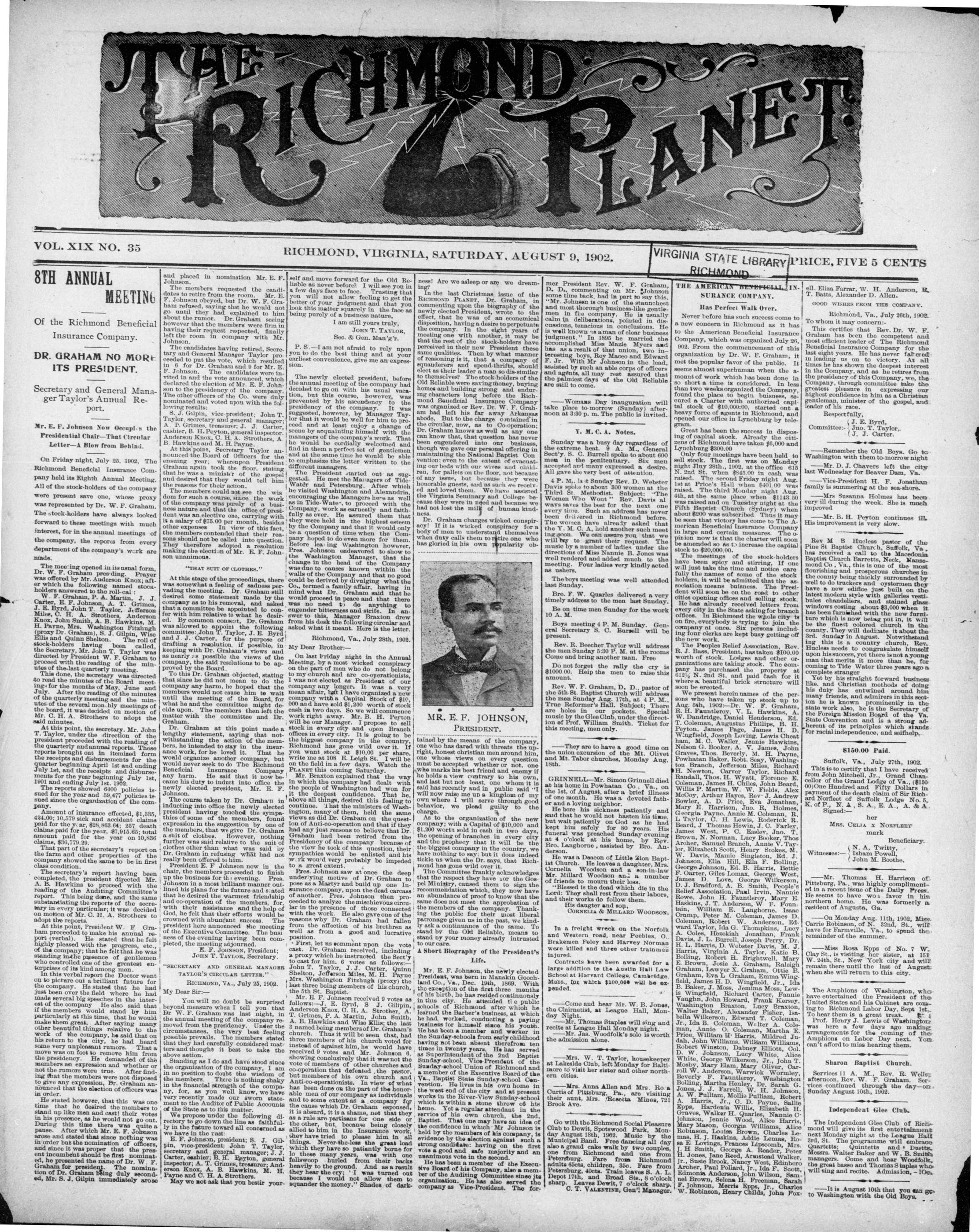
8TH ANNUAL MEETING
Of the Richmond Beneficial Insurance Company.
DR. GRAHAM NO MORE ITS PRESIDENT.
Secretary and General Manager Taylor's Annual Report.
Mr. E. F. Johnson Now Occupies the Presidential Chair-That Circular Letter-A Blow from Behind.
On Friday night, July 25, 1902, The Richmond Beneficial Insurance Company held its Eighth Annual Meeting. All of the stock-holders of the company were present save one, whose proxy was represented by Dr. W. F. Graham. The stock-holders have always looked forward to these meetings with much interest, for in the annual meetings of the company, the reports from every department of the company's work are made. The meeting opened in its usual form, Dr. W. F. Graham presiding. Prayer was offered by Mr. Anderson Knox; after which the following named stock-holders answered to the roll-call:
W. F. Graham, P. A. Martin, J. J. Carter, E. F. Johnson, A. T. Grimes, J. E. Byrd, John T. Taylor, J. Jefferson J. M. C. H. A. Strothers, Anderson Knox, John Smith, A. B. Hawkins, H. M. Payne, Mrs. Washington Fitzhugh proxy Dr. Graham), S. J. Gilpin, Wise stock-holder, John Shelton. The roll of stock-holder, John being called, the Secretary, Mr. John T. Taylor was directed by President W. F. Graham to proceed with the reading of the minutes of the last quarterly meeting
This done, the secretary was directed to read the minutes of the Board meeting for the months of May, June and July. After the reading of the minutes of the quarterly meeting and the minutes of the several monthly meetings of the board, it was decided on motion of Mr. C. H. A. Strothers to adopt the said minutes.
At this point, the secretary. Mr. John T. Taylor, under the direction of the president proceeded with the reading of the quarterly and annual reports. These reports brought out in itemized form the receipts and disbursements for the quarter beginning April 1st and ending July 1st, and the receipts and disbursements for the year beginning July 1st, 1901 and ending July 1st. 1902.
The reports showed 6400 policies issued for the year and 59,477 policies issued since the organization of the company.
Amount of insurance effected, $1,335, 424.00; 10,579 sick and accident claims paid for the year, $28,863.64; 257 death claims paid for the year, $7,915.65; total amount paid for the year on 10,836 claims, $6,779.29.
That part of the secretary's report on the farm and other properties of the company showed the same to be in first class condition.
The secretary's report having been completed, the president directed Mr. A. B. Hawkins to proceed with the reading of the Auditing Committee's report. This being done, and the same substantiating the reports of the secretary, every particular; it was decided on motion Mr. C. H. A. Strothers to adopt the report.
At this point, President W. F. Graham proceeded to make his annual report (verbal). He stated that he felt highly pleased with the progress, one of the company; that he felt that he was standing in the presence of gentlemen who controlled one of the greatest enterprises of its kind among men.
In this verbal report the Doctor went on to picture out a brilliant future for the company. He stated that he had just been over the field where he had made several big speeches in the interest of the company. He also said that if the members would stand by him particularly at this time, that he would make them great. After saying many other beautiful things relative to the work of the company, he said that on return to the city, he had heard some unpleasant rumors. That a move was on foot to remove him from the presidency. He demanded of the members an expression and whether or not the rumors were true. After finding that the members were not disposed to give any expression, Br. Graham announced that the election of officers was in order.
He stated however, that this was one time that he desired the members to stand up like men and cast their votes in his presence, as he would not go out. During this time there was quite a pause. After which Mr. E. F. Johnson arose and stated that since nothing was in order but the nomination of officers, and since it was proper that the present incumbent should be first nominated, he presented the name of Dr. W. F. Graham for president. The nomination of Dr. Graham being duly seconded, Mr. S. J. Gilpin immediately arose
and placed in nomination Mr. E. F. Johnson. The members requested the candidates to retire from the room. Mr. E. F. Johnson obeyed, but Dr. W. F. Graham refused, saying that he would go until they had explained to him about the rumor. Dr. Graham seeing however that the members were firm in having their request respected, finally left the room in company with Mr. Johnson.
The candidates having retired, Secretary and General Manager Taylor proceeded to put the vote, which resulted in 6 for Dr. Graham and 9 for Mr. E. F. Johnson. The candidates were invited in and the vote announced, which declared the election of Mr. E. F. Johnson to the presidency of the company. The other officers of the Co. were duly nominated and voted upon with the following results: S. J. Gilpin, vice president; John T. Taylor, secretary and general manager A. P. Grimes, treasurer; J. J. Carter, cashier, B. H. Peyton, general inspector; Anderson Knox, C. H. A. Strothers, A. B. Hawkins and M. H. Payne. At this point, Secretary Taylor announced the Board of Officers for the ensuing year; whereupon President Graham again took the floor, stating that he was a minister of the gospel and desired that they would tell him the reasons for their action.
The members could not see the wis-
dom for such a course, since the work
of the company was purely of a busi-
ness nature and that the office of presi-
dent was an elective one, carrying with it a salary of $75.00 per month, besides other expenses. In view of this fact,
the members contended that their rea-
sions should not be called into question.
They therefore adopted a resolution
making the election of Mr. E. F. Johnson unanimous.
"THAT SUIT OF CLOTHES."
At this stage of the proceedings, there was somewhat a feeling of sadness prevailing the meeting. Dr. Graham still desired some statement made by the company as to his removal, and asked that a committee be appointed to confer with him relative to what he desired. By common consent, Dr. Graham was allowed to appoint the following committee: John T. Taylor, J. E. Byrd and J. J. Carter, for the purpose of drafting a resolution, if possible, in keeping with Dr. Graham's views and as nearly as possible the views of the company, the said resolutions to be approved by the Board.
To this Dr. Graham objected, stating that since he did not mean to do the company any harm, he hoped that the members would not cause him to wait until the meeting of the Board, for what he and the committee might decide upon. The members then left the matter with the committee and Dr. Graham.
Dr. Graham at this point made a lengthy statement, saying that notwithstanding the action of the members, he intended to stay in the insurance, for he loved it. That he would organize another company, but would never seek to do the Richmond Beneficial Insurance company any harm. He said that it may have came his duty to induct into office the newly elected president, Mr. E. F. Johnson.
The course taken by Dr. Graham in inducting into office the newly elected president having touched the sympathies of some of the members, found expression in the suggestion by one of the members, that we give Dr. Graham a suit of clothes. However, nothing further was said relative to the suit of clothes other than what was said by Dr. Graham in refusing what had not really been offered to him.
President E. F Johnson now in the chair, the members proceeded to finish up the business for the evening. Pres. Johnson in a most brilliant manner outlined his plans for the future and sated co-ordained the warmest friendship and co-ordained of the members, for, with their assistance and the help of God, he felt that their efforts would be crowned with abundant success. The president here announced the meeting of the Executive Committee. The business of the evening having been completed, the meeting adjourned.
E. F. Johnson, President;
JOHN T. TAYLOR, Secretary
"SECRETARY AND GENERAL MANAGER TAYLOR'S CIRCULAR LETTER."
RICHMOND, VA., July 25, 1902.
My Dear Sir:
You will no doubt be surprised beyond measure when I tell you that Dr W. F. Graham was last night, in the annual meeting of the company removed from the presidency. Under the circumstances, the very best feeling possible prevails. The members stated that they had carefully considered matters and thought it best to take the above action.
Sounding as I do and have stood since the organization of the company, I am in no position to doubt the wisdom of the members. There is nothing shaky in the financial strength of the company, for, as you well know, we have very recently made our own statement to the Auditor of Public Accounts of the State as to this matter.
We propose under the following directory to go down the line as faithfully in the future toward all concerned as we have in the past:
E. F. Johnson, president; S. J. Gikpin, vice-president; John T. Taylor, secretary and general manager; J. J. Carter, oesher; B. H. Eyton, general inspector; A. T. Grimes, treasurer; Anderson Knox, A. B. Hawkins, M. H. Payne and C. H. A. Strothers. May we not ask that you bestir yours.
self and move forward for the Old Reliable as never before? I will see you in a few days face to face. Trusting that you will not allow feeling to get the better of your judgment and that you look this matter squarely in the face as being purely of a business nature.
ness! Are we sleep or are we dreaming?
In the last Christmas issue of the Richmond Planet, Dr. Graham, in commenting upon the biography of the newly elected President, wrote to the effect that he company President Rev. D. D., commenting on some time back, had it "Mr. Johnson is one of and most thorough bus men in the company
I am still yours truly,
JOHN T. TAYLOR,
Sec. & Gen. Man'm-g'.
P. S. —I am not afraid to rely upon you to do the best thing and at your earliest convenience, give me an expression.
The newly elected president, before the annual meeting of the company had decided to go on with his usual vacation, but this course, however, was prevented by his ascendency to the presidency of the company. It was suggested, however, by Manager Taylor that it would be well for him to proclaim at least enjoy a change of scene by acquiring himself with the managers of the company's work. That he would be cordially welcomed and find in them a perfect set of gentlemen and at the same time he would be able to emphasize the letter written to the different managers.
The President started out as suggested. He met the Managers of Tide-Water and Petersburg. After which he visited Washington and Alexandra, encouraging the Managers here as well as in Tide-Water, to proceed with the Company, work as earnestly and faithfully as ever. He assured them that they were held in the highest esteem by the Company and that it would only be a question of time when the Company hoped to do even more for them. Before leaving Washington however, Pres. Johnson endeavored to show to the Washington Manager, that the change in the head of the Company would cause known within the walls of the Company and that no good could be derived from enlarging what the Co., termed a family affair, living in mind what Dr. Graham said, that he would proceed in peace and that there was no need to do anything engender bitterness and strife. In answer to this, Manager Braxton drew from his desk the following circular and asked what it meant. Here is the letter.
Richmond, Va., July 28th, 1902.
My Dear Brother:—
On last Friday night in the Annual Meeting, by a most wicked conspiracy on the part of men who do not belong to my church and are co-operationists, I was not elected as President of our company any longer. It was a very mean affair, but I have organized a new company with a Capital Stock of $10,000 and have sold $1,200 of stock cash in two days. So we will commence work right away. Mr. B. H. Peyton will be our Manager. I propose to sell stock in every city and open Branch offices in every city. It is going to be the biggest company in the country. Richmond has gone wild over it. If you want stock at $10,00 per share, write me at 108 E. Leigh St. I will be on the field in a few days. Watch the PLANET this coming Saturday.
Mr. Braxton explained that the way in which the company had dealt with the people of Washington had won for it the deepest confidence. That he, above all things, desired this feeling to continue. 1 that the ministers of Washington, many of them, held the views as did Dr. Graham on the question of Anti-co-operation and that if they had any just reasons to believe that Dr. Graham had been retired from the Presidency of the company because of the view he took of this question, their sympathies would be enlisted and his work would very probably be impeded to a great extent. Pres. Johnson saw at once the deep underlying motive of Dr. Graham to pose as a Martyr and build up one insurance company, upon the dead carcass of another. Pres. Johnson then proceeded to analyze the mischievous circular in the presence of those connected with the work. He also gave one of the reasons why Dr. Graham had fallen from the affection of his brethren as well as from a good and lucrative position.
First, let us comment upon the vote cast. Dr. Graham received, including a proxy which he instructed the Secty to cast for him. 6 votes as follows: Taylor, J. J. Carter, Quinn Shelton, J.M. J. M. H. Payne Mrs. Washington Fitzhugh (proxy) the last three being members of his church, the 5th St. Baptist.
Mr. E. F. Johnson received 9 votes as follows:—J. E. Byrd, S. J. Gilpin, Anderson Knox, O. H. A. Strother, A. T. Grimes, P. A. Martin, John Smith, A. B. Hawkins and Wise Ellis; the last 3 named being members of Dr. Graham's church. Thus it will be seen that, had three members of his church voted for instead of against him, he would have received 9 votes and Mr. Johnson 6, showing conclusively that it was not the vote of members of other churches and co-operation that defeated the pastor, but members of his own church and Anti-co-operationists. In view of what has been done on the part of the honorable men of our company as individuals and to some extent as a company for the cause which Dr. Graham espoused, it is absurd, it is a shame, not that they as a rule are partisans for one side or the other, but, because being closely allied to him in the Insurance work, they have tried to please him in all things. Never-the-less the great load which they have so patiently borne for these many years, was with one fellsooop hurled from their backs heavily to the ground. And as a result they hear the cry; 'I was turned out because I would not allow them to squander the money.' Shades of dark
ness! Are we asleep or are we dreaming?
In the last Christmas issue of the RICHMOND PLANET, Dr. Graham, in commenting upon the biography of the newly elected President, wrote to the effect, that he was of an economical disposition, having a desire to perpetuate the company. In the eight years of meeting one with another, it may be that the rest of the stock-holders have perceived in their new President these same qualities. Then by what manner of reasoning is it, that a company of reasoning is it, and spend-thrifts, should elect as their a man so dissimilar to themselves? The stock-holders of the Old Reliable were savvy investors, buying homes and building strong and beautiful characters long before the Richmond Beneficial Insurance Company was organized or Rev. Dr. W. F. Graham had left his far away Arkansas abode. But to the charge contained in the circular, now, as to Co-operation; Dr. Graham knows as well as any one can know that, that question has never been engendered into our business, though we gave our personal offering in maintaining the National Baptist Convention; even to the extent of evacuating our beds with our wives and children, for gallets on the floor, not because our issue, but because they were honorable guests and such we received and loved them. We assisted the Virginia Seminary and College cause they were in need and because we had not lost the milk of human kindness.
Dr. Graham charges wicked conspiracy! If it is wicked conspiracy for a body of men to understand themselves when duty calls them to retire one who has gloried in his own popularity ob-
A. B.
tained by the means of the company, one who has dared with threats the upright, honest christian men around him, one whose views on every question must be accepted whether or not, one who marks his best friend and enemy if he holds a view contrary to his own, and last but not least, one whom it is said has recently and in public said "I will now raise me in a kingdom of my own where I will serve through good behavior, we plead guilty to the charge.
As to the organization of the new company: with a Capital of $10,000 and $1,200 worth sold in cash in two days, the opening of branches in every day, and the prophecy that it will be the biggest company in the country, we have nothing to say: but it does indeed tickle us when the Dr. says, that Richmond has gone wild over it.
The Committee frankly acknowledges that the respect they have for the Gospel Ministry, caused them to sign the recommendation which, they now have an abundance of proof to know that the same does not meet the approbation of the members of the company. Thank you, the public for their most liberal patronage, given that we kindly ask a continuance of the same. To stand by the Old Reliable, means to stand by your money already intrusted to our care.
A Short Biography of the President's Life.
Mr. E. F. Johnson, the newly elected President, was born in Manakin Grochland Co., Va., Dec. 19th, 1869. With the exception of the first three months of his birth, he has resided continuously in this city. He attested the public schools of Richmond after which he learned the Barber's business, at which he had worked, conducting a paying business for himself since his wun. He has been a member and worker of the Sunday-schools from early childhood having not been absent therefrom ten times in twenty years. He has served as superintendent of the 2nd Baptist Sunday-school, Vice-President of the Sunday-school Union of Richmond and a member of the Executive Board of the Va., Baptist State Sunday-school Convention. He lives in his own home in the west end of the city and at present works in the River-View Sunday-school which is within a stone throw of his home. Yet a regular attendant in the service of his own church, the 2nd, Baptist. That one may have an idea of the confidence in which Mr Johnson is held by the members of his company, is evidence by the election against such a strong candidate: having on the first vote a good and safe majority and an unanimous vote in the second.
He has been a member of the Executive Board of his Company, also a mem-
员 of Auditing Committee since its organization as Vice-President. The for-
mation as Vice-President. The for-
mer President Rev. W. F. Graham,
D. D., commenting on Mr. Johnson
some time back, had in part to say this,
"Mr. Johnson is one of the stauchest
and most thorough business-like gentlemen in the company. He is usually calm in deliberations, pointed in discussions, tenacious in conclusions. He is well known as a man of clear business judgment." In 1895 he married the accomplished Miss Mazie Myers and has as a result of that union, two interesting boys, Roy Maceo and Edward F. Jr. With Mr Johnson in the lead, assisted by such an able corps of officers and agents, all may rest assured that the palmest days of the Old Reliable are still to come.
Womans Day inauguration will take place to morrow (Sunday) afternoon at 3:30 p.m. the m. Public is invited.
Y. M. C. A. Notes.
Sunday was a busy day regardless of the extreme heat. 9 A. M., General Secty. S. C. Burrell spoke to about 600 men in the penitentiary. Six men accepted and many expressed a desire. All gave the very best of attention. 4 P. M., lait Sunday Rev. D. Webster Davis spoke to about 300 women at the Third St. Methodist. Subject: "The Women Who Won't" Rev. Davis always saves the best for the next one every time. Such an address has never been delivered in Richmond before. The women have already asked that the Y. M. C. A, hold another such meeting soon. We can assure you that we will try to grant their request. The music by a number of ladies under the directions of Miss Nannie B. Jones was well rendered and added much to the meeting. Four ladies very kindly acted as ushers. The boys meeting was well attended last Sunday.
Bro. F. W. Quarles delivered a very timely address to the men last Sunday.
Be on time men Sunday for the work 10 A. M.
Boys meeting 4 P. M. Sunday. General Secretary S. C. Burrell will be present.
Rev. R. Beecher Taylor will address the men Sunday 5:30 P. M. at the rooms Come and bring another man. Free
Do not forget the rally the cry is $1000.00. Heip the men to raise this amount.
Rev. W. F. Graham, D. D., pastor of the 5th St. Baptist Church will address the men Sunday Ang. 17th, at 4 P. M., True Reformer in full Subject. There are holes in our pockets. Special music by the Glee Club, under the direction of Prof. William Smith. Ticket for this meeting, men only.
They are to have a good time on the union excursion of the Mt. Olivet and Mt. Tabor churches, Monday Aug. 18th.
GRINNELL—Mr. Simon Grinnell died at his home in Powhatan Co., Va., on the 1st, of August, after a brief illness of one month. He was a devoted father and a loving neighbor.
He bore his sickness patiently and said that he would not hasten his time, but wait patiently on God as he had kept him safely for 80 years. His funeral was preached Sunday evening at 4 o'clock at his home, by Rev. Bro. Langhorne, assisted by Bro. Anderson.
He was a Deacon of Little Zion Baptist Church. He leaves a daughter, Mrs. Cornelia Woodson and a son-in-law Mr. Millard Woodson and a number of friends to mourn their loss.
"Blessed is the dead which die in the Lord: They shall rest from their labors, and their works do follow them.
His dangler and son,
CORNELIA & MILLARD WOODSON.
In a freight wreck on the Norfolk and Western road, near Peebles, O. Brakemen Foley and Harvey Norman were killed and three other trainmen injured.
Contracts have been awarded for a large addition to the Austin Hall Law School at Harvard College. Cambridge, Mass., for which $200,000 will be expended.
Come and hear Mr. W. B. Jones, the Claimnetist, at League Hall, Monday Night.
Mr. Thomas Staples will sing and recite at League Hall night night.
Mr. Jas. Woodford's solo is worth the admission alone.
Mrs. W. T. Taylor, housekeeper at Lakeside Club, left Monday for Baltimore to visit her sister and other northern cities.
Mrs. Anna Allen and Mrs. Roa Curtis of Pittsburg, Pa., are visiting their aunt, Mrs. Rosetta Mines, 721 Brook Ave.
Go with the Richmond Social Pleasure Club to Dewit, Spotswood Park, Monday August 18th, 1902. Music by the Municipal Band. Free dancing all day also a grand cake walk by two couples, one from Richmond and one from Petersburg. Fare from Richmond adults 65cts, children. 350. Fare from Petersburg, 40cts. Train leaves S. A. L. Depot 17th, and Broad Sts., 8 o'clock sharp. Leaves Dewit, 7 o'clock sharp.
C. T. VALENTINE, Gen! Manager.
Never before has such success come to a new concern in Richmond as it has to the American Beneficial Insurance Company, which was organized July 26, 1902. From the commencement of this organization by Dr. W. F. Graham, it met the popular favor of the public. It seems almost superhuman when the amount of work which has been done in so short a time is considered. In less than two weeks organized the Company, found the place to begin business, secured a Charter with, authorized capital stock of $10,000;00, and a heavy force of agents in Richmond, and opened our office in Lynchburg by telegram.
Great has been the success in disposing of capital stock. Already the citizens of Richmond have taken $6,000 and Lynchburg $200.00
Only four meetings have been held to sell stock. The first was on Monday night Jluy 28th., 1902, at the office 615 N. 2nd St. when $45.00 in cash was raised. The second Friday night Aug. 1st at Price's Hall when $401.00 was raised. The third Monday night Aug. 4th, at the same place when $1143.50 and on Tuesday night at the Fifth Baptist Church (Sydney) when about $200 was subscribed. Thus it may be seen that victory has come to The American Beneficial Insurance Company in large and certain measures. The opinion now is that the charter will soon be amended so as to increase the capital stock to $20,000.00.
The meetings of the stock-holders have been spicy and stirring. If one will just take the time and notice carefully the names of some of the stock holders, it will be admitted that the association means business. The President will soon be on the road to other cities opening offices and selling stock. He has already received letters from every city in the State asking for branch offices. In Richmond the whole city is on fire, everybody is trying to join the company at once. Six persons including the employees are kept busy getting off the new work. The Peoples Relief Association, Rev. R. J. Bass, President, has taken $100.00 worth of stock. Lodges and other organizations are taking stock. The company has purchased the property at $612' N. 2nd St. and paid cash for it where a beautiful brick structure will soon be erected.
ell. Eliza Farrar, W. H. Anderson, R. T. Batts, Alexander D. Allen.
GOOD WISHES FROM THE COMPANY.
Richmond, Va., July 26th, 1902.
To whom it may concern:
This certifies that, Rev. Dr. W. F. Graham has been the competent and most efficient leader of the Richmond Beneficial Insurance Company for the last eight years. He has never faltered in leading us on to victory. At all times he has shown the deepest interest in the Company, and as he retires from the presidency of this Company, we, the Company, through committee take the greatest pleasure in expressing our highest confidence in him as a Christian gentleman, minister of the gospel, and leader of his race.
Respectfully,
[J. E. Byrd]
Committee: [Jno. T. Taylor]
[J. J. Carter]
Remember the Old Boys. Go to Washington with them to-morrow night
Mr. D. J. Chavers left the city last Wednesday for Beaver Dam, Va.
Vice-President H. F. Jonathan family is summering at the sea-shore.
Mrs Susanna Holmes has been very ill during the week. She is much improved
Mr. B. H. Peyton continues ill. His improvement is very slow.
Rev M B Huculless pastor of the Pine St Baptist Church, Sufolk, Va, has received a call to the Macedonia Baptist Church Barrettes, Neck, Nassmond Co, Va., this is one of the most flourishing and prosperous churches in the county being thickly surrounded by well to do truckers and oystermen they have a new edifice just built on the latest modern style with galleries vestibules chandeliers, and stained glass windows costing about $3,000 when it has been furnished with the new furniture which is now being put in, it will be the finest colored church in the 3rd. Sunday in August. Notwithstanding this is a country Rev. Huculless needs to congratulate upon his success, yet there is not a young man that merits it more than he, for coming to Tide Water three years ago a complete stranger
Yet by his straight forward business like, and Christian methods of doing his duty has entwined around him many friends, and admirers in this section he is known prominently in the state work also, he is the Secretary of the Foreign Mission Board of the Va. State Convention and is a strong adherent of its principles which stands for racial independence, and selfhelp.
This is to certify that I have received from John Mitchell, Jr., Grand, Chancellor of the Grand Lodge of Va., ($150 00) One Hundred and Fifty Dollars in payment of the death claim of Sir Richard Norfleet of Suffolk Lodge No. 5, K. of P., N. A, S. A., E. A., A. & A. Signed:— her MRS. CELIA X NORFLEET mark Beneficiary. Witnesses:— N. A, Twitty, Isham Powell, John M. Boothe. Mr. Thomas H. Harrison of Pittsburg, Pa., was highly complimented in a recent issue of the Daily Press. He seems to have won favor in his northern home. He was formerly a resident of Augusta, Ga. On Monday Aug. 11th, 1902, Miss Carrie Robinson, of N. 32nd, St., will leave for Farmville, Va., to spend the remainder of the summer.
Miss Rosa Epps of No. 7 W. Clay St., is visiting her sister, at 151 W. 24th, St., New York city and will remain there until the last of August when she will return to this city.
The Amphions of Washington, who have entertained the President of the United States and his Cabinet are coming to Richmond Labor Day, Sept. 1st. To them them is a great treat. $^{4}$ Prof. Henry J. Miles of Washington was here a few days ago making arrangements for the coming of the Amphions on Labor Day next. You can't afford to miss hearing them.
Services 11 A. M., Rev. R. Wells
afternoon, Rev. W. F. Graham. Services
continued through the day—on
Sunday August 10th, 1902.
Independent Glee Club.
The Independent Glee Club of Richmond will give its first entertainment next Monday night at the League Hall 3rd, St. The programme will embrace Quartets; Quintetts and Duets. Messrs. Walter Baker and W. B. Smith managers. Come and hear Woodfolk, the great bass and Thomas Staples who will sing and recite. Admission, -IOc.
"It is August 10th that you can go to Washington with the Old Boys.
RECYLARNET
TEMPERANCE ARE AMERICANS TEMPERATE?
Steady Improvement In Sentimen Against the Drink Custom- Curse of Treating Habit.
M. Jules Cambon, ambassador of France to the United States, has been interviewed at Paris, where he was enjoying his vacation. Among pleasing things he said to an interviewer is the assertion that "there may be some hypocrites among the Americans, but the vast majority abstain from strong drink, to the great advantage of the race, which for a time threatened to lapse into drunkenness." That there was during the last quarter of a century a marked improvement in social habits in this country is undeniable. It was most conspicuous in public life. Contemporary annals conclusively show that earlier epochs were characterized byorgies corresponding to the bestiality of British social and public life during the close of the revolution period, when gambling, drinking and shameless excesses of every nature were familiar among all grades of society. In this country slavery undoubtedly aggravated license. In the north there was more necessity for the whites to work; there was less time for carousel. The wave of Father Mathewmish sent an eddy over; it was not potent, but was exemplary.
It is within the memory of the living that New Year's day used to be a protracted debauch. The most re
The Printing Press
SAMRE ROOM
CROSSHART GRAVE
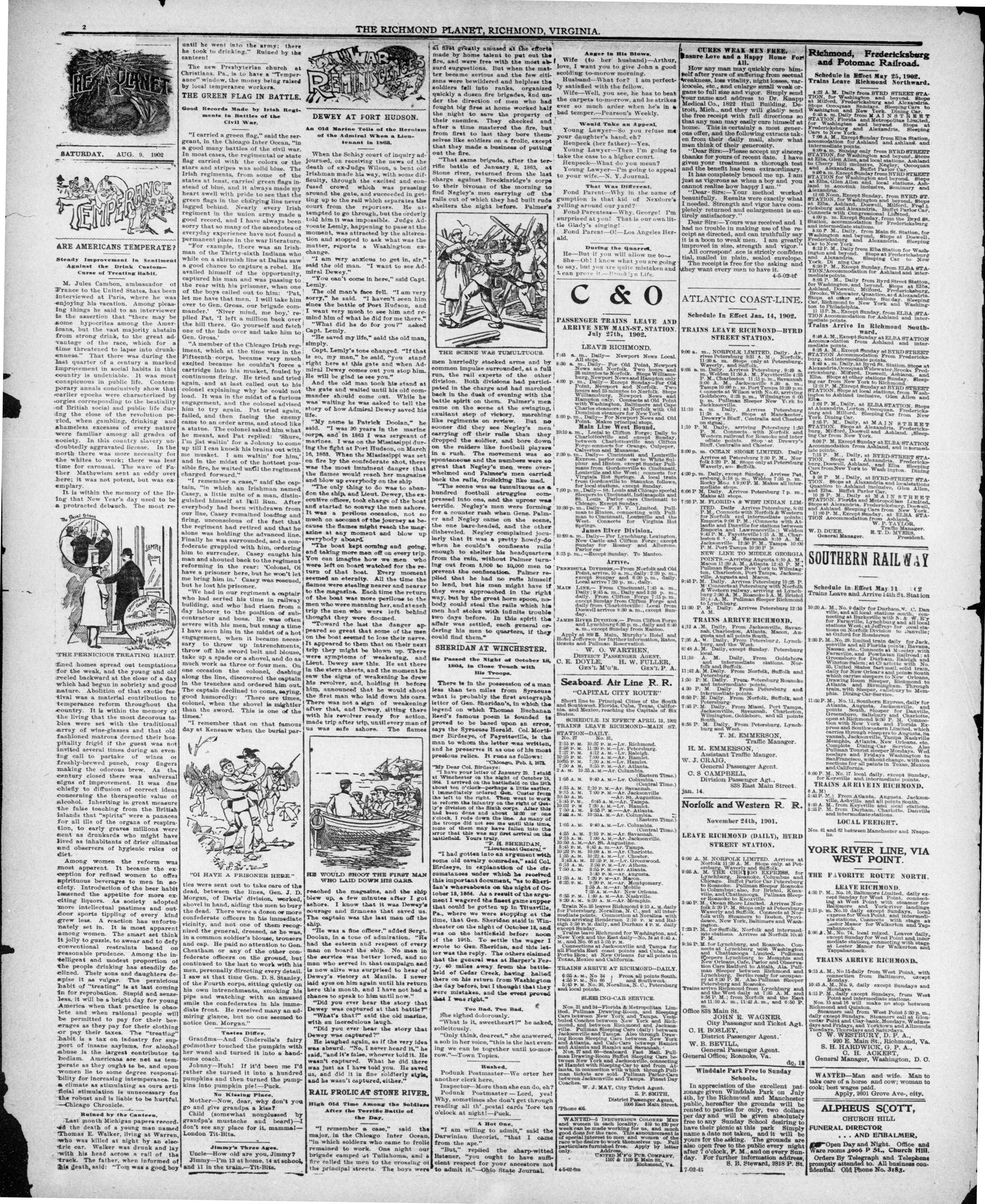
THE PERNICIOUS TREATING HABIT
lined homes spread out temptations for the weak, and the young and old reeled backward at the close of a day which had begun in sobriety and good nature. Abolition of that exotic festival was a material contribution to temperance reform throughout the country. It is within the memory of the living that the most decorous tables were set with the traditional array of wine-glasses and that old fashioned matrons deemed their hospitality frigid if the guest was not invited several times during an evening call to partake of wines or freshly-brewed punch, rosy fingers making the odorous brew. As the century closed there was universal signs of improvement. It was due chiefly to diffusion of correct ideas concerning the therapeutic value of alcohol. Inheriting in great measure the false teaching from the British islands that "spirits" were a panacea for all ills of the organs of respiration, to early graves millions were sent as drunkards who might have lived as inhabitants of drier climates and observers of hygienic rules of diet.
Among women the reform was most apparent. It became the exception for refined women to offer spirituous beverages to men in society. Introduction of the beer habit lessened the appetite for more exciting liquors. As society adopted more intellectual pastimes and outdoor sports tippling of every kind grew less. A reaction has unfortunately set in. It is most apparent among women. The smart set think it jolly to guzzle, to swear and to defy conventional restraints based on reasonable prudence. Among the intelligent and modest proportion of the people drinking has steadily declined. Their sons and daughters despise it as vulgar. The pernicious habit of "treating" is at last coming in for reprobation. Stupid and senseless, it will be a bright day for young America when that practice is obsolete and when rational people will be permitted to pay for their beverages as they pay for their clothing or pay their taxes. The "treating" habit is a tax on industry for support of insane asylums, for alcohol abuse is the largest contributor to bedlam. Americans are not as temperate as they ought to be, and upon women lie to some degree responsibility for increasing intemperance. In a climate as stimulating as ours artificial stimulation is unnecessary for the robust and is liable to be hurtful. —Chicago Chronicle.
Last month Michigan papers recorded the death of a young man named Thomas E. Walker, living at Warren, who was killed at night by an electric car. Walker was drunk and lay with his head across a rail of the track. The father, when informed of his death, said: "Tom was a good boy
until he went into the army; there he took to drinking." Ruined by the canteen!
The new Presbyterian church at Christiana. Pa. is to have a "Temperance" window, the money being raised by local temperance workers.
THE GREEN FLAG IN BATTLE.
Good Records Made by Irish Regiments in Battles of the Civil War.
"I carried a green flag," said the sergeant, in the Chicago Inter Ocean, "in a good many battles of the civil war. In most cases, the regimental or state flag carried with the colors or the stars and stripes was solid blue. The Irish regiments, from some of the states at least, carried green flags instead of blue, and it always made my heart swell with pride to see that the green flags in the charging line never lagged behind. Nearly every Irish regiment in the union army made a good record, and I have always been sorry that so many of the anecdotes of everyday experience have not found a permanent place in the war literature.
"For example, there was an Irishman of the Thirty-sixth Indiana who while on a skirmish line at Dallas saw a good chance to capture a rebel. He availed himself of the opportunity, captured his man and was passing to the rear with his prisoner, when one of the boys called out to him: 'Pat, let me have that man. I will take him over to Gen. Gross, our brigade commander.' 'Niver mind, me boy,' replied Pat. 'I left a million back over the hill there. Go yourself and fetch one of the lads over and take him to Gen. Gross.'
"A member of the Chicago Irish regiment, which at the time was in the Fifteenth corps, became very much excited because he couldn't force a cartridge into his musket, fouled by continuous firing. He tried and tried again, and at last called out to his colonel explaining why he could not load. It was in the midst of a furious engagement, and the colonel advised him to try again. Pat tried again, failed, and then facing the enemy came to an order arms, and stood like a statue. The colonel asked him what he meant, and Pat replied: 'Shure, I'm jist waitin' for a Johnny to come up till I can knock his brains out with me musket. I am waitin' for him,' and in the midst of the hotest possible fire, he waited until the regiment charged forward."
"I remember a case," said the captain, "in which an Irishman named Casey, a little mite of a man, distinguished himself at Fall Run. After everybody had been withdrawn from our line, Casey remained loading and firing, unconscious of the fact that the regiment had retired and that he alone was holding the advanced line. Finally he was surrounded, and a confederate grappled with him, ordering him to surrender. Casey caught his man and shouted back to the regiment reforming in the rear: 'Colonel, Ol have a prisoner here, but he won't let me bring him in.' Casey was rescued, but he lost his prisoner.
"We had in our regiment a captain who had served his time in railway building, and who had risen from a day laborer to the position of subcontractor and boss. He was often severe with his men, but many a time I have seen him in the midst of a hot engagement, when it became necessary to throw up intrenchments, throw off his sword belt and blouse, take up a spade or a shovel, and do as much work as three or four men. On one occasion the colonel, dashing along the line, discovered the captain in the trenches and ordered him out. The captain declined to come, saying, good humoredly: 'There are times, colonel, when the shovel is mightier than the sword. This is one of the times.' "I remember that on that famous day at Kenesaw when the burial par-
"OI HAVE A PRISONER HERE."
ties were sent out to take care of the dead, between the lines, Gen. J. D. Morgan, of Davis' division, worked, shovel in hand, aiding the men to bury the dead. There were a dozen or more confederate officers in his immediate vicinity, and not one of them recognized the general, dressed, as he was, in a common soldier's blouse, trousers and cap. He paid no attention to Gen. Cheatham or any of the other confederate officers on the ground, but continued to the last to work with his men, personally directing every detail. I saw at that time Gen. D. S. Stanley, of the Fourth corps, sitting quietly on his own intrenchments, smoking his pipe and watching with an amused smile the confederates in his immediate front. He received many an admiring glance, but no one seemed to notice Gen. Morgan."
Tastes Differ.
Grandma—and Cinderella's fairy godmother touched the pumpkin with her wand and turned it into a handsome coach.
Johnny—Huh! If it'd been me I'd rather she turned it into a hundred pumpkins and then turned the pumpkins into pumpkin pie!—Puck.
No Kissing Place
Mother—Now, dear, why don't you go and give grandma, a kisje.
go and give grandpa a kiss?
Child (somewhat nonplussed by
grandpa's mustache and beard)—I
don't see any place for it, mamma!
London Tit-Bits.
Jimmy's Three Ages.
Uncle—How old are you, Jimmy?
Jimmy—I'm 13 at home, 14 at school,
and 11 in the train—Tit-Bits.
at first greatly amused at the efforts made by home talent to put out the fire, and were free with the most absurd suggestions. But when the matter became serious and the few citizens were bewildered and helpless the soldiers fall into ranks, organized quickly a dozen fire brigades, and under the direction of men who had fought big fires at home worked half the night to save the property of their bad temper.—
DEWEY AT PORT HUDSON.
An Old Marine Tells of the Heroism of the Admiral When a Lieutenant in 1863.
When the Schley court of inquiry adjourned, on receiving the news of the death of ex-Judge Wilson, a bent old Irishman made his way, with some difficulty, through the excited and confused crowd which was pressing around the gate, and succeeded in getting up to the rail which separates the court from the reporters. He attempted to go through, but the orderly told him it was impossible. Judge Advocate Lemly, happening to pass at the moment, was attracted by the altercation and stopped to ask what was the matter, reports a Washington exchange.
"I am very anxious to get in, sir," said the old man. "I want to see Admiral Dewey."
"You can't come in here," said Capt. Lemly.
The old man's face fell. "I am very sorry," he said. "I haven't seen him since the battle of Port Hudson, and I want very much to see him and remind him of what he did for me there." "What did he do for you?" asked Capt. Lemly. "He saved my life," said the old man, simply. Capt. Lemly's tone changed. "If that is so, my man," he said, "you stand right here at this gate and when Admiral Dewey comes out you stop him. He will be glad to see you." And the old man took his stand at the gate and waited until his old commander should come out. While he was waiting he was asked to tell the story of how Admiral Dewey saved his life.
"My name is Patrick Doolan," he said. "I was 30 years in the marine corps, and in 1863 I was sergeant of marines. I was on the Mississippi during the fight at Port Hudson, on March 16, 1863. When the Mississippi was set on fire by the confederate shot, there was the most imminent danger that the flames would reach her magazine and blow up everybody on the ship.
"The only thing to do was to abandon the ship, and Lieut. Dewey, the executive officer, took charge of the boat and started to convey the men ashore. It was a perilous occasion, not so much on account of the journey as because the flames might reach the magazine at any moment and blow up everybody aboard."
"The boat kept coming and going, and taking more men off on every trip. You can imagine how we men who were left on board watched for the return of that boat. Every moment seemed an eternity. All the time the flames were stealing nearer and nearer to the magazine. Each time the return of the boat was more perilous to the men who were manning her, and each trip the men who were left behind thought they were fooled.
"Toward the last the danger appeared so great that some of the men on the boat seemed to lose their nerve. It appeared to them that on their next trip they might be blown up. There were symptoms of weakening, and Lieut. Dewey saw this. He sat there in the stern sheets, and the moment he saw the signs of weakening he drew his revolver, and, holding it before him, announced that he would shoot the first man who laid down his oars. There was not a sign of weakening after that, and Dewey, sitting there with his revolver ready for action, made trip after trip, until every man of us was safe ashore. The flames
HE WOULD SHOOT THE FIRST MAN WHO LAID DOWN HIS OARS.
recoiled the magazine, and the ship blew up, a few minutes after I got ashore. I know that it was Dewey's courage and firmness that saved us. The captain was the last man off the ship.
"He was a fine officer," added Script. Doolan, in a tone of admiration. "He had the esteem and respect of every man on board the ship. No man in the service was better loved, and no man who served in that campaign and is now alive was surprised to hear of Dewey's victory at Manila. I never laid eyes on him again until his return here this month, and I have not had a chance to speak to him until now."
"Did you ever hear the story that Dewey was captured at that battle?" "What's that?" ssid the old marine, with an incredulous laugh.
"Did you ever hear the story that Dewey was captured?"
He laughed again, as if the very idea was absurd. "No, I never heard it," he said, "and it's false, whoever told it. He wasn't captured. What he did there was just as I have told you. He saved us, and did it in fine soldierly style, and he wasn't captured, either."
RAIL FROLIC AT STONE RIVER
High Old Time Among the Soldiers
After the Terrific Battle of
the Day.
"I remember a case," said the
major, in the Chicago Inter Ocean,
"in which soldiers who came to frolie
remained to work. One night, our
brigade camped at Tullahoma, and a
fire called the men to the crossing of
the principal streets. The boys were
at first greatly amused at the efforts made by home talent to put out the fire, and were free with the most absurd suggestions. But when the matter became serious and the few citizens were bewildered and helpless the soldiers fell into ranks, organized quickly a dozen fire brigades, and under the direction of men who had fought big fires at home worked half the night to save the property of their enemies. They checked and after a time mastered the fire, but from first to last they bore themselves like soldiers on a frolic, except that they made a business of putting out the fire.
"That same brigade, after the terrific battle of January 2, 1863, at Stone river, returned from the last charge against Brecknridge's corps to their bivouac of the morning to find Negley's men carrying off the rails out of which they had built rude shelters the night before. Palmer's
A man is being beaten by a soldier.
THE SCENE WAS TUMULTUOUS. men hurriedly stacked arms and by common impulse surrounded, at a full run, the run, the expert of the other division. Both divisions had participated in the charge and had marched back in the dusk of evening with the battle spirit on them. Palmer's men came on the scene at the swinging, exultant step of victory, marshing like regiments on review. But no sooner did they see Negley's men carrying off their rallie than they dropped the soldier, and bore down on the raiders like football players in a rush. The movement was so spontaneous and the numbers were so great that Negley's men were overwhelmed and Palmer's men carried back the rallies, rollicking like mad.
"The scene was as tumultuous as a hundred football struggles compressed into one, and the uproar was terrific. Negley's men were forming for a counter rush when Gene, Palmer and Negley came on the scene, the one bare-headed, and the other disheveled. Negley complained jocularly that it was a pretty howdy-do when he couldn't confiscate rails enough to shelter his headquarters from the rain, without Palmer turning out from 5,000 to 10,000 men to prevent the confiscation. Palmer replied that he had no rails himself to lend, but his men might have if they were approached in the right way, but by the great horn spoon, nobody could steal the rails which his men had stolen with infinite trouble two days before. In this spirit the affair was settled, each general ordering his men to quarters, if they could find them."
SHERIDAN AT WINCHESTER.
He Passed the Night of October 18, 1864, in Close Touch with His Troops.
There is in the possession of a man less than ten miles from Syracuse what is probably the first autograph letter of Gen. Shoridan's, in which the legend on which Thomas Buchanan Reed's famous poem is founded is proved to be based upon an error, says the Syracuse Herald. Col. Mortimer Birdseye, of Fayetteville, is the man to whom the letter was written, and he preserves it as one of his most precious relics. It runs as follows: "My dear Col. Birdseye," "My dear Col. Birdseye."
"I have your letter of January 29. I staid at Winchester on the night of October 18, 1864. I arrived on the battlefield on the 18th about ten o'clock—perhaps a little earlier. I immediately ordered Gen. Custer from the left to the right. Then went to work to reform the infantry on the right of Getty's division of the Sixth corps. After this had been done and about 18:30 or one o'clock, I rode down the line. As many of the troops did not see me until this time, some of them may have fallen into the error that this was my first arrival on the battlefield. Yours truly."
"P. H. SHERIDAN.
"I had gotten into an argument with some old cavalry comrades," said Col. Birdseye, in explanation of the circumstances under which he received this important document, "as to Sheridan's whereabouts on the night of October 18, 1864. As a result of the argument I wagered the finest game supper that could be gotten up in Titusville, Pa., where we were stopping at the time, that Gen. Sheridan staid in Winschester on the night of October 18, and was on the battlefield before noon of the 19th. To settle the wager I wrote to Gen. Sheridan, and this letter was the reply. The others claimed that the general was at Harper's Ferry, 40 miles away from the battlefield of Cedar Creek, having halted there on his return from Washington the day before, but I thought that they were mistaken, and the event proved that I was right."
"What is it, sweetheart?" he asked, solicitously.
"Only think, dearest," she answered, a sob in her voice, "this is the last evening we can be together until to-morrow."—Town Tonies.
Rushed
Podunk Postmaster—We orter hev
another clerk here.
Inspector—More than she can do, eh?
Podunk Postmaster—Lord, yes!
Why, sometimes she don't get through
reading all th' postal cards 'fore ten
o'clock at night!—Puck.
A Hot One
"I am willing to admit," said the Darwinian theorist, "that I came from the ape." "But," replied the sharp-witted listener, "you ought to have sufficient respect for your ancestors not to admit it." "Ohio State Journal."
Wife (to her husband)—Arthur, love, I want you to give John a good scolding to-morow morning.
Husband—What for? I am perfectly satisfied with the fellow.
Wife—Well, you see, he has to beat the carpets to-morrow, and he strikes ever so much arder when he's in bad temper.—Pearson's Weekly.
Would Take an Appeal.
Young Lawyer—So you refuse me your daughter's hand, eh?
Henpeck (her father)—Yes.
Young Lawyer—Then I'm going to take the case to a higher court.
Henpeck—What do you mean?
Young Lawyer—I'm going to appeal to your wife.—N. Y. Journal.
That Was Different
Fond Parent—Why in the name of
gumption is that kid of Nexdore's
yelling around our yard?
Fond Parentess—Why, George! I'm
surprised at you! That is our own little
Glady's singing!
Fond Parent—O!—Los Angeles Herald.
During the Quarre
He—But if you will allow me to—
She—Oh! I know what you are going
to say, but you are quite mistaken and
I can prove it—Brooklyn Life.
C & O
PASSENGER TRAINS LEAVE AND ARRIVE NEW MAIN-ST. STATION. July 27th, 1902.
LEAVRICHMOND
7:48 a. m., Daily - Newport News Local.
8:50 a. m., Daily - For Old Point, Newport
News and Norfolk, Two hours and
Sunday, Newport News Williamsburg,
Newport News and Huntington.
4:00 p. m., Daily - Except Sunday - For Old
Point, Newport News and Norfolk, Two
hours and Sunday, Cape Charles
Williamsburg, Newport News and
Hampton only, Connects at Old Point
with Newport News and Norfolk,
Cape Charles steamers; as Norfolk with Old
Dominion steamers for New York.
5:00 p. m., Daily - For Newport News and Old
Point, Make a Ride.
Main Lime West Bound.
10:10 a. m., Local to Clifton Forge; Dally to
Charlotteville and except Sunday,
Huntington, except Sunday, Cape
Charles steamers for Orange, Culpeper,
Calverton and Manassas.
2:30 p. m., Express, parlor car to White Sulphur
and Hinton, except Sunday Pullmans
from Gordonville to Cincinnati,
Louisville, except Sunday, Virginia Hot Springs. A local train
from Gordonville to Stanton follows,
for local stations except Sunday.
7:00 p. m., Express, parlor car to special
Sleepers to Cincinnati, Indianapolis and
St Louis, Porsche cars Cincinnati to
Chicago.
10:30 p. m., Daily; F. F. V. Limited. Pullman to Hinton, connecting with Pullman to Cincinnati, Louisville and the West. Connects for Virginia Hot Springs.
James Eiver Division.
10:20 a. m., Daily; For Lynchburg, Lexington, New Castle and Clifton Forge; except Seven for Rosney and Albercene. Parker car.
Arrive.
PENNISULA DIVISION.—From Norfolk and Old
Point, arrive, 10 a.m., daily; 2:30 p. m.
except Sunny and 6:30 p. m., daily.
Local arrival, 7:30 p. m., daily.
JAMES RIVER DIVISION. — From Clifton Forge and Lynchburg 6:35 p.m. m., daily and 8:45 a.m., except Sunday from Manteo.
Apply at 800 E. Main, Murphy's Hotel and Hotel Jefferson for further information, Rates, tickets and Pullman Reservation.
Seaboard Air Line R. R.
"CAPITAL CITY ROUTE"
Short line to Principal Cities of the South and Southwest. Florida, Cuba, Texas, California, and Mexico, reaching the Capitals of Six States.
SCHEDULE. IN EFFECT APRIL 13, 1902
TRAINS LEAVE RICHMOND-MAIN ST.
STATION-DAILY.
No. 27 No. 31.
2:15 P.M. 10:35 M.P.-Lv. Richmond.
2:36 P.M. 11:00 M.P.-Lv. Burg.
7:27 P.M. 4:12 A.M.-Lv. Raleigh.
10:35 P.M. 7:00 A.M.-Lv. Hamlet.
10:55 P.M. 7:20 A.M.-Lv. Hamlet.
7:55 P.M. 7:50 A.M.-Lv. Atlanta.
2 A.M. 10:35 A.M.-Ar. Columbia.
(Eastern Time).
1:05 A.M. 9:40 A.M.-Lv. Columbia.
North Carolina Time.)
4:15 A.M. 2:10 P.M. A.-Ar. Savannah.
4:15 A.M. 7:00 P.M. A.-Jacksonville.
4:15 P.M. 6:45 A.M.-Ar. St. Augustine.
10:32 P.M. 7:20 A.M.-Lv. Hamble.
7:50 A.M. 2:55 P.M. A.-Ar. Atlanta.
2:10 A.M. 10:35 A.M. A.-Columbus.
1:05 A.M. 9:40 A.M.-Lv. Columbia.
(Central Time.)
4:15 A.M. 2:10 P.M. A.-Savannah.
9:15 A.M. 7:30 A.M.-Jacksonville.
10:30 A.M.-Ar. St. Augustine.
5:45 A.M. 6:45 A.m. A.-Ar. Tampa.
10:35 A.M. 10:25 A.M.-Lv. Chester.
1:05 A.M. 10:25 A.M.-Lv. Chester.
3:43 A.M. 12:35 P.M.-Lv. Greenwood.
6:18 A.M. 2:50 P.M.-Lv. Athens.
7:50 A.M. 5:40 P.M.-Lv. Augusta.
11:35 A.M. 7:20 P.M. A.-Mason.
6:25 P.M. 2:50 P.M. A.-Montgomery.
6:25 P.M. 5:40 P.M. A.-Augusta.
7:25 A.M. A.-Ar. New Orleans.
6:55 P.M. 1:30 A.M. A.-Ar. Nashville.
8:30 A.M. 1:30 A.M. A.-Memphis.
Boston, Massachusetts, 2:10 P.M. daily
for Petersburg, Normallia, N.C. and all inter-
mediate points. Connection at Norwalk with
train arriving Henderson 2:10 P.M. and Rale-
ghian Beach, daily and Durham 4:0 P.M. daily
except Sunday. Trains leave Richmond for Washington, and
New York and the East daily-No 3 at 6:45 A.M.
No 4 at 6:45 A.M.
Connections at Jacksonville and Tampa for all Florida East coast points and Cuba, and Porto Rica; at New Orleans for all points in Texas, Mexico and California.
TRAINS ARRIVE AT RICHMOND-DAILY.
2:55 A. M. No 34 Prossa all points South.
4:25 P. M. No 66 And southwest.
2:55 P. M. No 30, Noralina, N. C., Petersburg
and local points.
SLEEI ING-CAR SERVICE
Nos. 31 and 34—Florida & Metropolitan Limited, Pullman Drawing-Room, and Sleeping Cars between New York and Tampa, Vestibule, and between Richmond and Jacksonville. Pullman Sleeping Cars (daily) between Jacksonville and Tampa. Also through Drawing Room Sleeping Cars between New York and Tampa. Pullman Sleeping Cars between Richmond and Atlanta and Hamlet and Savannah. Nos. 27 and 66—Seaboard Fast Mail. Pullman Drawing-Room Buffet Sleeping Cars because at Hamlet with Sleeping Car to and from Atlanta, in connection with which through Pullman tickets are sold. Pullman Parlor-Cars between Jacksonville and Tampa. Finest Day
WANTED-5 INDUSTRIOUS COLORED MEN
and women in each locality. $10 to $30 per
person. Please send a letter of good done for the race. This announcement is
of special interest to men and women of the
race who desire to work themselves up. Full
unless further furnished. Letter only.
Address:
UNITED FOOD G. PUB. COMP.
107 F. 109 E. Main St.,
Richmond, Va.
CURES WEAK MEN FREE. Ensure Love and a Happy Home For All.
How any man may quickly cure himself after years of suffering from sectal weakness, loss vitality, night losses, varicosece, etc., and enlarge small weak organs to full size and vigor. Simply send your name and address to Dr. Knapp Medical Co., 1822 Hull Building, Detroit, Mieh., and they will gladly send the free receipt with full directions so that any man may easily cure himself at home. This is certainly a most generous offer, and the following extracts taken from their daily mail, show what men think of their generosity.
"Dear Sirs:—Please accept my sincere thanks for yours of recent date. I have given your treatment a thorough test and the benefit has been extraordinary.
It has completely braced me up. I am just as vigorous as when a boy and you cannot realize how happy I am."
"Dear Sirs; -Your method worked beautifully. Results were exactly what I needed. Strength and vigor have completely returned and enlargement is entirely satisfactory."
Dear Sirs: -Yours was received and I had no trouble in making use of the receipt as directed, and can truthfully say it is a boon to weak men. I am greatly improved in size, strength and vigor."
All correspondence is strictly confidential, mailed in plain, sealed envelope. The receipt is free for the asking and they want every man to have it.
4-5-02-tt
ATLANTIC COAST-LINE
TRAINS LEAVE RICHMOND—BYRD
STREET STATION.
9:00 a. m. NORFOLK LIMITED. Daily. Arrives Petersburg 9:31 A. M., Norfolk, Hirsch, 11:30 A. M. at Petersburg, Waverley, and Suffolk.
9:05 a. m. Daily. Arrives Petersburg 9:49 a. m. Waldon 11:50 A. M. Fayetteville 4:25 P. Charlesville 4:25 M. Jacksonville 3:30 A. M. Jacksonville 3:30 P. Tampa 10:30 p. m. Port Tampa 10:30 p. m. connects at Wilson with No.49, arriving Goldsboro 2:25 p. m. Wilmington 6:00 P. Pullman Sleeper New York to Jacksonville.
11:10 a. m. Daily. Arrives Petersburg 11:10 P. Hirsch, Manchester, Drewry's Bluff, Centralia and Chester on signal.
1:10 P. M. Daily, arriving Petersburg 1:50 P. M. Connect, Western railroad for Roanoke and interdiate points. Stop at Drewry's Bluff, Centralia and Chester.
3:00 p. m. OCEAN SHORE LIMITED. Daily Arrives at Petersburg 3:00 P. M., Norfolk 4:30 P. M. Daily arrives at Petersburg Waverley, and Suffolk.
4:20 p. m. Daily, except Sunday. Arrives Petersburg, 5:18 p. m., Waldon 7:35 p. m. Rocky Mount 9:00 P. M. Makes all interdial stops.
6:00 P. M. Daily. Arrives Petersburg 7 p. m., Makes all stops.
7:35 P. M. FLORIDA & WEST INDIAN LIMIED. Taily. Arrives Petersburg 8:03 P. M. Connects with Norfolk & Western intermediate points. Emporia 9:48 P. M. Emporia 9:48 P. M. Laflint and Danville for stations between Emporia and Lawrenceville.) Weldon 8:10 A. M. Merrill 1:10 A. M. Charleston 6 A. M. Merrill 5:10 A. M. Jacksonville 10:35 P. M. Tampa 10:30 P. M. P. Port Tampa 10:30 P. M.
NEW LINE TO MIDDLE GEORGIA POINTS.—Arriving Augusta 8:10 A. M. Merrill 10:30 A. M. Pullman Sleeper New York to Winstonville, Charleston, Port Tampa, Jacksonville, Augusta and Macon.
9:45 P. M. Connects at Petersburg with Norfolk & Western railway, arriving at Lynchburg 2:30 A. M. Roanoke 5 A. M. Bristol 10:30 A. M. Pullman Sleeper Richmond to Lynchburg.
11:30 P. M. Daily. Arrives Petersburg 12:10
A M.
TRAINS ARRIVE RICHMOND.
4:12 A. M. Daily. From Jacksonville, Savannah, Charleston, Atlanta, Macon, Augusta and all points South.
11:10 A. M. Daily. From Goldsboro
and intermediate stations. Nor-
thern Shore.
11:42 A. M. Daily. From Norfolk, Suffolk and
Petersburg.
1:50 P. M. Daily. From Petersburg Roanoke
and intermediate points.
4:30 P. M. Daily. From Petersburg and
intermediate points.
6:50 P. M. Daily. From Norfolk, Suffolk, and
Petersburg.
7:45 P. M. Daily. From Miami, Port Tampa,
Mississippi, Savannah, Charleston,
Wilmington, Goldsboro, and all points
South.
8:56 P. M. Daily. From Petersburg, Lynch-
burg and West.
T. M. EMMERSON,
Traffic Manager.
H. M. EMMERSON,
Assistant Traffic Manger.
W. J. CRAIG,
General Passenger Agent.
C. S. CAMPBELL,
Division Passenger Agt.,
888 East Main Street.
jan 14
Norfolk and Western R. R
November 24th, 1901.
LEAVE RICHMOND (DAILY), BYRD
STREET STATION.
9:00 A. M. NORFOLK LIMITED. Arrives at Peterson, Wavley and Sifuko.
9:05 A. M. THE CHICIO EXPRESS, for Lynchburg, Roanoke, Columbus and Chicago. Buffet Parlor Car Petersburg to Roanoke. Pullman Sleeper Roanoke to Columbus; also, for Bristol, Knoxville, and the Roanoke, Pullman Sleeper Roanoke to Roanoke. Arrives Norfolk 5:20 P. M. Steps only at Petersburg Waverly and Suffolk. Connects at Norfolk with Stemmers to Boston, Providence, New York, Baltimore and Washington.
7:29 P. M. for Suffolk, Norfolk and Intermediate stations. Arrives Norfolk 10:40 P. M.
9:10 P. M. for Lynchburg, and Roanoke. Connects at Lynchburg with Washington and Chattanooga Limited. Pullman Sleepers, Lynneburg to Memphis and New Orleans City, Pastor and Observation Cars Radford to Attala. Ala. Pullman Sleeper between Richmond and Lynchburg, Berths ready for occupancy at 8:30 P. M. Also Pullman Sleepersburg and Roanoke.
Trains arrive at Richmond from Pynchburg and and at the West daily at 7:35 A.M. and 8:50 P.M.; from Norfolk and the East at 11:10 A.M., 11:42 A.M., and 6:50 P.
Office 838 Main St.
JOHN E. WAGNER
City Passenger and Ticket Agt.
C. H. BOSLEY,
District Passenger Agent.
W. B. BEVILL,
General Passenger Agent.
General Office; Roanoke, Va.
Winddale Park Free to Sunday Schools.
In appreciation of the excellent patronage given Winddale Park on July 4th, by the Richmond and Manchester public, hereafter the grounds will be rented to parties for only, two dollars per day and will be given absolutely free to any Sunday School desiring to have their picnic at this park. Simply name a date not taken, and it will be yours for the asking. The grounds are also open free to the public every night after 7 o'clock, P. M., and on every Sunday. For further information address, S. B. Steward, 2818 P. St.
Richmond, Fredericksburg and Potomac Railroad.
Richmond, Fredericksburg and Potomac Railroad.
Today, from the Bryd St.
Station, accommodation for Fredricks
and intermediate stations.
8:55 P. M., Daily, from Main St. St. Station, for Washington and beyond, and beyond, at Dowell, Frederickburg, Milton, and Alexandrin. Sleeping car to New York. Car to New York. 8:12 P. M., Daily from Elaa Station for Washington and beyond. Stops at Frederickburg and Alexandrin. Sleeping car to New York. Ding car. 8:30 P. M., Except Sunday, from ELBA STATION Accommodation for Ashland and intermediate points. 8:55 P. M., Daily from Byrd Street Station, for Washington, and beyond. Stops at Elaa, Brooks, Widewater, Quanah, Frederickburg, Brooke, Widewater, Quanah, Stops at other stations Sunday, Sleeping car to Richmond to New York and Washington to Pittsburgh. 11:15 P. M., Except Sunday, from ELBA STATION Accommodation for Ashland and intermediate points. 8:40 A. M., Except Sunday at ELBA STATION Accommodation from Ashland and intermediate points. 8:40 A. M., Except Sunday at BYRD STREET STATION Accommodation for Frederickburg, and intermediate points. 8:40 a. m., Daily at Byrd St. Stations, Stops at Washington Widewater, Brooks Frederickburg, Milton, and Alexandrin. Stops at other stations Sunday. Sleeping car from New York to Richmond.
STATION. Stops at Sunday at BYRD STREET
STATION. Stops at Alexandria, from Washington
to Ashland inclusive, Glen Allen and
Elda.
P. M. Daily, at ELBA STATION. Stops at
ALEXANDRIA, Loretta Coquan. Frederick's
barkburg and Milford. Sleeping Car from New
York. Dining Car.
P. M. Daily, at MAIN STREET
STATION. Stops at Alexandria, Frederick's
barkburg, Milford, Dowell and Ashland, Sleeping
Car from New York.
P. M. Except Sunday at ELBA STATION
Accommodation from Ashland, and in formed
points.
P. M. Daily, at BYRD STREET
STATION. Stops at Alexandria, Frederick's
barkburg, Dowell, Ashland, and Elda. Sleeping
car from New York to Washington. Dining
Car.
P. M. Daily, at BYRD STREET STATION.
Stops at Alexandria and local stations
barkburg, Dowell, Ashland, and Elda. Sleeping
car from New York to Washington. Dining
Car.
P. M. Daily, at MAIN STREET STATION.
Florida and Metropolitan Amited,
Alexandria, Frederick's barkburg, Dowell,
and Ashland Sleeping Car from New York.
P. M. Except Sunday, at ELBA STATION
Accommodation from Ashland.
W. P. TAYLOR,
Travel Manager.
W. D. DUKE,
General Manager.
President.
SOUTHERN RAIL WAY
Schedule in Effect May 11. 1:02
Trains Leave and Arrive 14th St. Station
10:20 A. M., No. 9 daily for Durham N. C., Dan
ville, and all local stations south, connect-
ing at Burkville with N. & W. R. for
southbound Lyndhurst and all local
stations West; at Providence and all
stations on Norfolk Division to Danville;
at Oxford for Henderson
2:30 P. M., No. 10 daily for Durham daily for Jack,
sonville and all Florida daily for Jack,
Nassau etc., Connects at Moseley, with
Darmville, and Powhatan Railroad; at
Granville, Raleigh and Winston-Salem;
at Clarendon, Winston-Salem; at Clarendon,
US. States fast mail, solid train,
which carries nurses and points South
which carries nurses and points North,
Drawing Room Sheeper, Richmond to
Atlanta, and Birmingham. Through
trail with Birmingham to Memphis,
Diring-Car-Service.
11:30 P. M., No. 11, Southern Express, daily for Atlanta, Anguita, Jacksonville, and Palm Beach, through Desert for Danville, Grenada, Salinas, and Charlotte, open at Richmond 9:30 P. M., connection with New York and Florida Express and Southwestern Limited, which can travel through Anguita, San Vannah, Jacksonville, Tampa, Nashville, Memphis, Atlanta, New Orleans, etc. Complete Dining-Car Service. Also Prismate Day and Fridays. Wednesdays and Fridays. Wanders to San Francisco, without change, with connections for all points in Texas, Mexico and California.
6:00 P. M., of local daily, except Sunday, for Kearny, for Keysville intermediate points.
TRAINS ARRIVE IN RICHMOND.
6 A. M.)
5:43 P. M. ) From Atlanta, Anguita, Jacksonville, Ashville, and all points South.
8:40 A. M. ) from Keysville and local stations.
8:40 A. M. ) from Dixham, Charlotte, Danville and intermediate stations.
LOCAL FREIGHT.
Nos. 61 and 62 between Manchester and Neapolis.
YORK RIVER LINE, VIA WEST POINT.
YORK RIVER LINE, VIA WEST POINT.
THE FAVORITE ROUTE NORTH
4:30 P. M. No.16 Baltimore Limited, daily except Sunday for West Point, connecting with station with station with Baltimore and York-river landings
2:15 P. M. No.10 daily except Sundays, local intermediate stations, connecting with station stations, Connects with stage at Master Manor for Walkerton and Tappahannock.
5:00 A. M. local mixed. Leaves daily except Sunday for West Point and intermediate stations, connecting with stage at Master Manor for Walkerton and Tappahannock.
TRAINS ARRIVE RICHMOND.
9:15 A. M. No 15 day from West Point, with
a visitation from Baltimore, except
Monday.
10:45 A.M., No. 9, daily except Sundays and
11:55 P.M., daily except Sundays, from West
Point and intermediate stations.
No. 12, make no stop between Richmond and Quinton.
Steamers sail from West Point 5:30 p.m., daily except Sundays. Steamers call at Gloucester Railroad Station, Richmond, Va., Wednesdays and Fridays, and Yorktown and Almonds Tuesdays, Thursdays and Saturdays.
C W. WESTBURY, D P. A., 920 E. Main St., Richmond, Va.
S H. HARDWICK, G P. A., C H. ACKERT, General Manager, Washington, D. C.
WANTED—Man and wife. Man to take care of a horse and cow; woman to cook; best wages paid. Award 1991 Grove Ave. city
Apply, 2601 Grove Ave.-, city.
Open Day and Night. Office and Ware rooms 3006 P St., Church Hill. Orders By Telegraph and Telephone promptly attended to. All business confidential. Old Phone No. 382.
```markdown
```
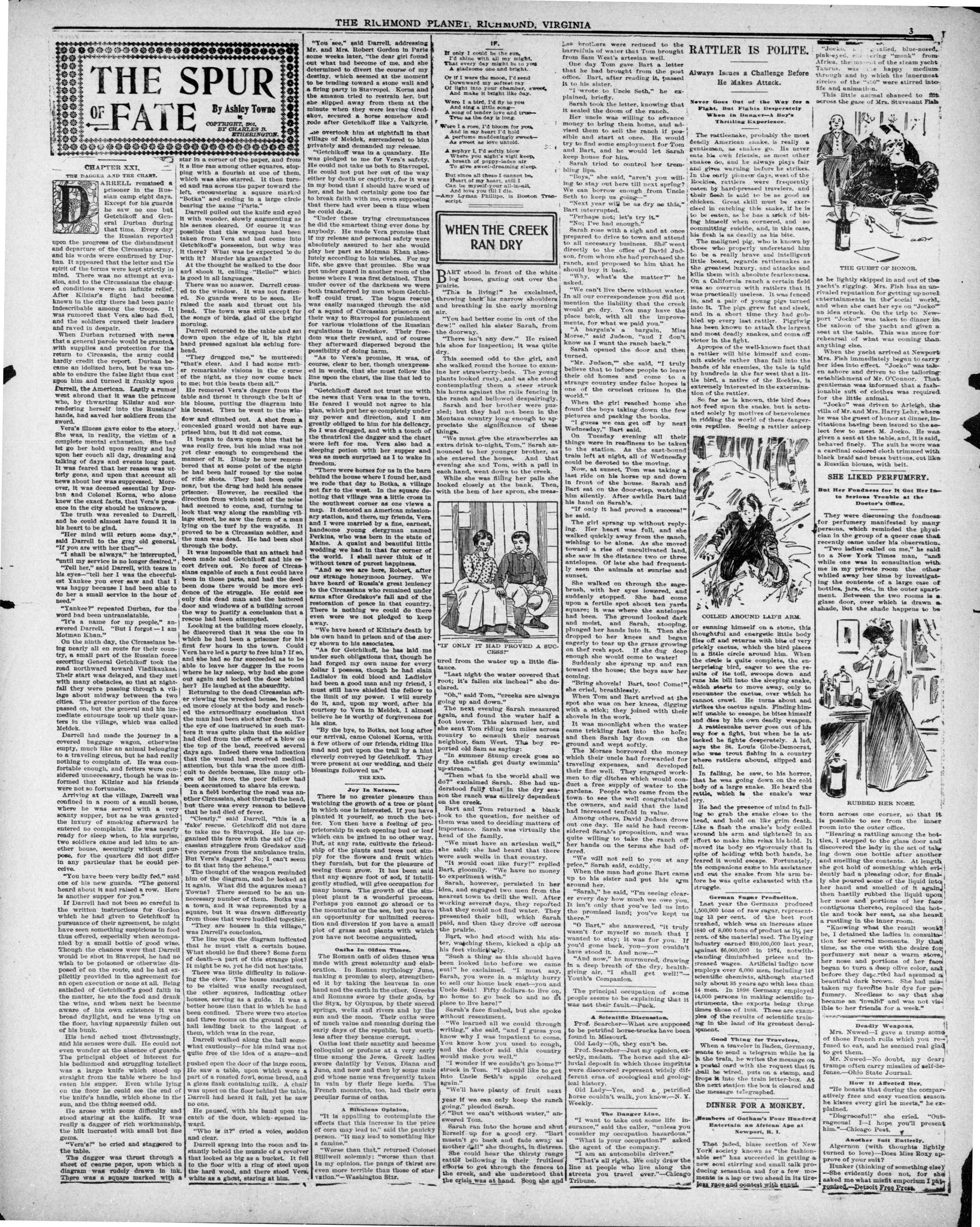
THE SPUR OF FATE By Ashley Towne COPYRIGHT, 1901 BY CHARLES P.
---
ARRELL remained a prisoner in the Russian camp eight days. Except for his guards he saw no one but Getchikoff and General Durban during that time. Every day the Russian reported
ARRELL remained a prisoner in the Russian camp eight days. Except for his guards he saw no one but Getchikoff and General Durban during that time. Every day the Russian reported upon the progress of the disbandment and departure of the Circassian army, and his words were confirmed by Durban. It appeared that the letter and the spirit of the terms were kept strictly in mind. There was no attempt at evasion, and to the Circassians the changed conditions were an infinite relief. After Killiar's flight had become known in the city there had been panic indescribable among the troops. It was rumored that Vera also had fled, and the soldiers cursed their leaders and raved in despair.
When Durban returned with news that a general parole would be granted, with supplies and protection for the return to Circassia, the army could hardly credit the report. Durban became an idolized hero, but he was unable to endure the false light thus cast upon him and turned it frankly upon Darrell, the American. Lastly a rumor went abroad that it was the princess who, by thwarting Kilziar and sur rendering herself into the Russians hands, had saved her soldiers from the sword.
Vera's illness gave color to the story. She was, in reality, the victim of a complete mental exhaustion. She had let go her hold upon reality and lay upon her couch all day, dreaming and talking of days and events long past. It was feared that her reason was utterly gone, and upon that account all news about her was suppressed. Moreover, it was deemed essential by Durban and Colonel Korna, who alone knew the exact facts, that Vera's presence in the city should be unknown. The truth was revealed to Darrell, and he could almost have found it in his heart to be glad.
"Her mind will return some day," said Darrell to the gray old general. "If you are with her then"—
"I shall be always," he interrupted, "until my service is no longer desired."
"until my service is no longer desired."
"Tell her," said Darrell, with tears in his eyes—"tell her I was the cheerfulest Yankee you ever saw and that I was happy because I had been able to do her a small service in the hour of need."
"Yankee?" repeated Durban, for the word had been untranslatable.
"It's a name for my people," answered Darrell. "But I forgot—I am Motman Khan."
On the ninth day, the Circassians being nearly all en route for their country, a small part of the Russian force escorting General Getchikoff took the road northward toward Vladikauks. Their start was delayed, and they met with many obstacles, so that at nightfall they were passing through a village about midway between the two cities. The greater portion of the force passed on, but the general and his immediate entourage took up their quarters in the village, which was called Meldek.
Darrell had made the journey in a covered baggage wagon, otherwise empty, much like an animal belonging to a traveling circus, but he had really nothing to complain of. He was comfortable enough, and fetters were considered unnecessary, though he was informed that Killziar and his friends were not so fortunate.
Arriving at the village, Darrell was confined in a room of a small house, where he was served with a very scanty supper, but as he was granted the luxury of smoking afterward he entered no complaint. He was nearly ready for sleep when, to his surprise, two soldiers came and led him to another house, seemingly without purpose, for the quarters did not differ in any particular that he could perceive.
"You have been very badly fed," said one of his new guards. "The general heard about it and raised a row. Here is another supper for you."
If Darrell had not been so careful in the written instructions for Gordon which he had given to Getchikoff in pursuance of their agreement, he might have seen something suspicious in food thus offered, especially when accompanied by a small bottle of good wine. Though the chances were that Darrell would be shot in Stavropol, he had no wish to be poisoned or otherwise disposed of on the route, and he had explicitly provided in the agreement for an open execution or none at all. Being satisfied of Getchikoff's good faith in the matter, he ate the food and drank the wine, and when next he became aware of his own existence it was broad daylight, and he was lying on the floor, having apparently fallen out of his bunk.
His head ached most distressingly, and his senses were dull. He could not even wonder at the absence of guards. The principal object of interest for his bedimmed and struggling intellect was a large knife which stood up straight from the table where he had eaten his supper. Even while lying on the floor he could see the end of the knife's handle, which shone in the sun, and the thing seemed odd. He arose with some difficulty and stood staring at the knife. It was really a dagger of rich workmanship, the bltilt incrusted with small but fine gems.
"Vera's!" he cried and staggered to the table.
The dagger was thrust through a sheet of coarse paper, upon which a diagram was rudely drawn in ink. There was a square marked with a
star in a corner of the paper, and from it a line ran among other squares, stopping with a flourish at one of them, which was also starred. It then turned and ran across the paper toward the left, encountering a square marked "Botka" and ending in a large circle bearing the name "Paris."
Darrell pulled out the knife and eyed it with wonder, slowly augmenting as his senses cleared. Of course it was possible that this weapon had been taken from Vera and had come into Getchkoff's possession, but why was it there? What was he expected to do with it? Murder his guards?
At the thought he walked to the door and shook it, calling "Hello!" which is good in all languages.
There was no answer. Darrell crossed to the window. It was not fastened. No guards were to be seen. He raised the sash and thrust out his head. The town was still except for the songs of birds, glad of the bright morning.
Darrell returned to the table and sat down upon the edge of it, his right hand pressed against his aching forehead.
"They drugged me," he muttered: "that's clear. And I had some rather remarkable visions in the course of the night, as they now come back to me; but this beats them all."
He removed Vera's dagger from the table and thrust it through the belt of his blouse, putting the diagram into his breast. Then he went to the window and climbed out. A shot from a concealed guard would not have surprised him, but it did not come.
It began to dawn upon him that he was really free, but his mind was not yet clear enough to comprehend the manner of it. Dimly he now remembered that at some point of the night he had been half roused by the noise of rifle shots. They had been quite near, but the drug had held his senses prisoner. However, he recalled the direction from which most of the noise had seemed to come, and, turning to look that way along the rambling village street, he saw the form of a man lying on the turf by the wayside. It proved to be a Circassian soldier, and the man was dead. He had been shot through the body.
It was impossible that an attack had been made and Getchikoff and his escort driven out. No force of Circassians capable of such a feat could have been in those parts, and had the deed been done there would be more evidence of the struggle. He could see only this dead man and the battered door and windows of a building across the way to justify a conclusion that a rescue had been attempted.
Looking at the building more closely, he discovered that it was the one in which he had been a prisoner for his first few hours in the town. Could Vera have led a party to free him? If so, and she had so far succeeded as to be able to leave her dagger in the room where he lay asleep, why had she gone out again and locked the door behind her? He laughed at the absurdity.
Returning to the dead Circassian after viewing the wrecked house, he looked more closely at the body and reached the extraordinary conclusion that the man had been shot after death. To the eye of one instructed in such matters it was quite plain that the soldier had died from the effects of a blow on the top of the head, received several days ago. Indeed there was indication that the wound had received medical attention, but this was the more difficult to decide because, like many others of his race, the poor fellow had been accustomed to shave his crown. In a field bordering the road was another Circassian, shot through the head, but there was every reason to believe that he had died of fever.
"Clearly," said Darrell, "this is a 'fake' rescue. Getchikoff did not dare to take me to Stavropol. He has organized this farce with the aid of Circassian stragglers from Gredskov and two corpses from the ambulance train. But Vera's dagger? No; I can't seem to fit that into the scheme."
The thought of the weapon reminded him of the diagram, and he looked at it again. What did the squares mean? Towns? There seemed to be an unnecessary number of them. Botka was a town, and it was represented by a square, but it was drawn differently from those that were huddled together. "They are houses in this village," was Darrell's conclusion.
The line upon the diagram indicated that he must visit a certain house. What should he find there? Some form of death—a part of this strange plot? It might be so, yet he did not heatate.
There was little difficulty in following the clew. The house marked out to be visited was easily recognized, the other squares, indicating other houses, serving as a guide. It was a better house than that in which he had been confined. There were two stories and three rooms on the ground floor, a hall leading back to the largest of them, which was in the rear.
Darrell walked along the hall somewhat cautiously—for his mind was not quite free of the idea of a snare—and pushed open the door of the large room. He saw a table, upon which were a part of a roasted fowl, some bread, and a glass flask containing milk. A chair was upset on the floor behind the table. Darrell had heard it fall, yet he saw no one.
He paused, with his hand upon the catch of the door, which epened inward.
"Who is it?" cried a voice, sodden and clear.
Darrell sprang into the room and instantly beheld the muzzle of a revolver that looked as big as a bucket. It fell to the floor with a ring of steel upon the hard wood, and there stood Vera, white as a ghost, staring at him.
"You see," said Darrell, addressing Mr. and Mrs. Robert Gordon in Paris some weeks later, "the dear girl found out what had become of me, and she determined to divert the course of my destiny, which seemed at the moment to be tending toward a stone wall and a firing party in Stavropol. Korna and the Amazon tried to restrain her, but she slipped away from them at the minute when they were leaving Gredskov, secured a horse somehow and rode after Getchiklof like a Valkyrie.
He overtook him at nightfall in that village of Meldek, surrendered to him privately and demanded my release.
IF.
If only I could be the sun, I'd shine with all my might.
That every day might be to you
A gladsome one and bright.
Or if I were the moon, I'd send Downward my softest ray
Downlight into your chamber, sweet,
And make it bright like day.
Were I a bird, I'd fly to you
And sing a little song
A song of tender love and true—
True as the day is long.
Were I a rose, I'd bloom for you
And in my heart I'd hold
A perfume maddeeningly sweet—
As sweet as love untold.
lift broth barrelful from San
One day that he
office. It to his
"I were plained, Sarah
It sealed
Her money t
vised the sible and
try to fir
"Getchikoff was in a quandary. He was pledged to me for Vera's safety. He could not take us both to Stavropol. He could not put her out of the way either by death or capitivity, for it was in my bond that I should have word of her, and he had certainly gone too far to break faith with me, even supposing that there had ever been a time when he could do it.
"Under these trying circumstances he did the smartest thing ever done by anybody. He made Vera promise that if my release and personal safety were absolutely assured to her she would play her part as Motman Khan absolutely according to his wishes. For my life, she gave that promise. She was put under guard in another room of the house where I was first detained. Then under cover of the darkness we were both transferred by men whom Getkhloff could trust. The bogus rescue was easily managed through the aid of a squad of Circassian prisoners on their way to Stavropol for punishment for various violations of the Russian regulations in Gredskov. Their freedom was their reward, and of course they afterward dispersed beyond the possibility of doing harm.
"As to Vera's promise, it was, of course, clear to her, though unexpressed in words, that she must follow the line upon the chart, the line that led to Paris.
"Getchikoff dared not trust me with the news that Vera was in the town. He feared I would not agree to his plan, which put her so completely under my power and direction, and I am greatly obliged to him for his delicacy. So I was drugged, and with a touch of the theatrical the dagger and the chart were left for me. Vera also had a sleeping potion with her supper and was as much surprised as I to wake in freedom.
"There were horses for us in the barn behind the house where I found her, and we rode that day to Botka, a village not far to the west. In the square denoting that village was a little cross in the southwest corner as one views a map. It denoted an American missionary station, and there, my friends, Vera and I were married by a fine, earnest, handsome young clergyman named Perkins, who was born in the state of Maine. A quaint and beautiful little wedding we had in that far corner of the world. I shall never think of it without tears of purest happiness.
"And so we are here, Robert, after our strange honeymoon journey. We have heard of Russia's great lenency to the Circassians who remained under arms after Gredskov's fall and of the restoration of peace in that country. There is nothing we could do there even were we not pledged to keep away.
"We have heard of Kiltlar's death by his own hand in prison and of the mercy shown to his associates.
"As for Getchikoff, he has laid me under such obligations that, though he had forged my own name for every dollar I possess, though he had slain Ladislov in cold blood and Ladislov had been a good man and my friend, I must still have shielded the fellow to the limit of my power. I will surely do it, and upon my word, after his courtesy to Vera in Meldek, I almost believe he is worthy of forgiveness for his sins.
"By the bye, to Botka, not long after our arrival, came Colonel Korna, with a few others of our friends, riding like mad and put upon the trail by a hint cleverly conveyed by Getchikoff. They were present at our wedding, and their blessings followed us."
Joy In Nature.
There is no greater pleasure than watching the growth of a tree or plant in which one is interested. If you have planted it yourself, so much the better. You then have a feeling of proprietorship in each opening bud or leaf which can be gained in no other way. But, at any rate, cultivate the friendship of the plants and trees not simply for the flowers and fruit which they furnish, but for the pleasure of seeing them grow. It has been said that any square foot of sod, if intelligently studied, will give occupation for many hours. The growth of the simplest plant is a wonderful process. Perhaps you cannot go abroad or to the mountains or the sea, but you have an opportunity for unlimited recreation and diversion if you have a small plot of grass and plants with which you have not become acquainted.
Oaths In Olden Times.
The Roman oath of olden times was made with great solemnity and elaboration. In Roman mythology June, making a promise to sleep, strengthened it by taking the heavens in one hand and the earth in the other. Greeks and Romans swore by their gods, by the Styx, by Olympus, by their sacred springs, wells and rivers and by the sun and the moon. Their oaths were of much value and meaning during the early days of the republic, but worthless after they became corrupt.
Oaths lost their sanctity and became colloquial or profane at a very early time among the Jews. Greek ladies swore daintly by Venus, Diana and Juno, and now and then by some male god whose name was frequently taken in vain by their liege lords. The French monarchs, too, had their own peculiar forms of oaths.
A Bibulous Opinion.
"It is appalling to contemplate the effects that this increase in the price of corn may lead to," said the panicky person. "It may lead to something like a famine."
"Worse than that," returned Colonel Stillwell solemnly; "worse than that. In my opinion, the pangs of thirst are even more terrible than those of starvation."—Washington Star.
If only I could be the sun,
I'd shine with all my might.
That every day might be to you
A gladstone one and bright.
Or if I were the moon, I'd send
Downward my softest ray
Of light into your chamber, sweet,
And make it bright like day.
Were I a bird, I'd fly to you
And adore you,
A song of tender love and true—
True as the day is long.
Were I a rose, I'd bloom for you,
And in my heart I'd hold
A perfume maddeningly sweet—
As sweet as love untold.
A sephyr I, I'd softly blow
Where you night's vigil keep,
A breath of poppy-laden air
To give sweet-dreaming sleep.
But since all these I cannot be,
Heart of my heart, still I
Can be myself your all-in-all,
And love you till I die.
—Am Kuan Phillips, in Boston True script.
WHEN THE CREEK RAN DRY
BART stood in front of the white log house, gazing out over the prairie.
"This is living!" he exclaimed, throwing back his narrow shoulders and breathing in the early morning air.
"You had better come in out of the dew!" called his sister Sarah, from the doorway.
"There isn't any dew." He raised his shoe for inspection; it was quite dry.
This seemed odd to the girl, and she walked round the house to examine her strawberry-beds. The young plants looked rusty, and as she stood contemplating them a steer struck his horns against the rails fencing in the ranch and bellowed despairingly.
Sarah and her brother were puzzled; but they had not been in the Montana country long enough to appreciate the significance of these things.
"We must give the strawberries an extra drink to-night, Tom," Sarah announced to her younger brother, as she entered the house. And that evening she and Tom, with a pall in each hand, went down to the creek. While she was filling her pails she looked closely at the bank. Then, with the hem of her apron, she meas-
"IF ONLY IT HAD PROVED A SUCCESS."
ured from the water up a little distance.
"Last night the water covered that root; it's fallen six inches!" she declared.
"Oh," said Tom, "creeks are always going up and down."
The next evening Sarah measured again, and found the water half a foot lower. This alarmed her, and she sent Tom riding ten miles across country to consult their nearest neighbor, Sam West. The boy reported old Sam as saying:
"In summer Stump creek goes so dry the catfish get dusty swimmin' up-stream."
"Then what in the world shall we do?" exclaimed Sarah. She had understood fully that in the dry season the ranch was entirely dependent on the creek.
Bart and Tom returned a blank look to the question, for neither of them was used to deciding matters of importance. Sarah was virtually the head of the family.
"We must have an artesian well," she said; she had heard that there were such wells in that country.
"It would cost like fury!" replied Bart, gloomily. "We have no money to experiment with."
Sarah, however, persisted in her idea, and engaged two men from the nearest town to drill the well. After working several days, they reported that they could not find water. They presented their bill, which Sarah paid, and then they drove off across the prairie.
Bart, who had stood with his sister, watching them, kicked a chip at his feet vindictively.
"Such a thing as this should have been looked into before we came out!" he exclaimed. "I must say, Sarah, you were in a mighty hurry to sell our home back east—you and Uncle Seth! Fifty dollars to live on, no home to go back to and no fit place to live here!"
Sarah's face flushed, but she spoke without resentment.
"We learned all we could through writing," she said, "and I guess you know why I was impatient to come. You know how you used to cough, and the doctor said this country would make you well."
"I wonder if we couldn't go home?" struck in Tom. "I should like to get into Uncle Seth's apple orchard again."
"We'll have plenty of fruit next year if we can only keep the ranch going," pleaded Sarah.
"But we can't without water," answered Tom.
Sarah ran into the house and shut horself up for a good cry. "Bart mustn't go back and fade away as mother did!" she thought, in distress.
She could hear the thirsty range cattail bellowing in their fruitless efforts to get through the fences to the creek, and she understood that the crisis was at hand. Soon she and
Jar brothers were reduced to the harbelfuls of water that Tom brought from Sam West's artesian well.
One day Tom gave Bart a letter that he had brought from the post office. Bart, after reading it, passed it to his sister.
"I wrote to Uncle Seth," he explained, briefly.
Sarah took the letter, knowing that it sealed the doom of the ranch.
Her uncle was willing to advance money to bring them home, and advised them to sell the ranch if possible and start at once. He would try to find some employment for Tom and Bart, and he would let Sarah keep house for him.
Sarah tried to control her trembling lips.
"Boys," she said, "aren't you willing to stay out here till next spring? We can borrow enough from Uncle Seth to keep us going."
"Next year will be as dry as this," Bart interrupted.
"Perhaps not; let's try it."
"No; I've had enough."
Sarah rose with a sigh and at once prepared to drive to town and attend to all necessary business. She went directly to the office of David Judson, from whom she had purchased the ranch, and proposed to him that he should buy it back.
"Why, what's the matter?" he asked.
"We can't live there without water. In all our correspondence you did not mention the liability that the creek would go dry. You may have the place back, with all the improvements, for what we paid you."
"A bargain's a bargain, Miss Morse," said Judeon, "and I don't know as I want the ranch back."
Sarah opened the door and then turned.
"Mr. Judson," she said, "I truly believe that to induce people to leave their old homes and come to a strange country under false hopes is one of the cruelest crimes in the world."
When the girl reached home she found the boys taking down the few pictures and packing the books.
"I guess we can get off by next Wednesday," Bart said.
On Tuesday evening all their things were in readiness to be taken to the station. As the east-bound train left at night, all of Wednesday could be devoted to the moving.
Now, at sunset, Tom was taking a last ride on his horse up and down in front of the house. Sarah and Bart sat on the door-step, watching him silently. After awhile Bart laid his hand on Sarah's.
"If only it had proved a success!" he said.
The girl sprang up without replying. Her heart was full, and she walked quickly away from the zanch, wishing to be alone. As she moved toward a rise of uncultivated land, she saw in the distance two or three antelopes. Of late she had frequently seen the animals at sunrise and sunset.
She walked on through the sagebrush, with her eyes lowered, and suddenly stopped. She had come upon a fertile spot about ten yards square; it was where the antelopes had been. The ground looked dark and moist, and Sarah, stooping, plunged her hands into it. Then she dropped to her knees and began eagerly to tear up the grass growing on the resh spot. If she dug deep enough she would come to water!
Suddenly she sprang up and ran toward the house; the boys saw her coming.
“Bring shovels! Bart, too! Come!” she cried, breathlessly.
When Tom and Bart arrived at the spot she was on her knees, digging with a stick; they joined with their shovels in the work.
It was moonlight when the water came trickling fast into the hole; and then Sarah lay down on the ground and wept softly.
The Morses borrowed the money which their uncle had forwarded for traveling expenses, and developed their fine well. They engaged workmen to dig ditches which would conduct a free supply of water to the gardens. People who came from the town to see the well congratulated the owners, and said that the land had increased tenfold in value. Among others, David Judson drove out one day. He said he had reconsidered Sarah's proposition, and was quite willing to take the ranch off her hands on the terms she had offered.
"We will not sell to you at any price," Sarah said, coldly. When the man had gone Bart came up to his sister and put his arm around her.
"Sarah," he said, "I'm seeing clearer every day how much we owe you. It isn't only that you've led us into the promised land; you've kept us there."
"O Bart," she answered, "it truly wasn't for myself so much that I wanted to stay; it was for you. If you'd gone back, you—you couldn't have stood it. And now—" "And now," he murmured, drawing in a deep breath of the dry, health-giving air, "I shall get well!"—Youth's Companion.
The principal occupation of some people seems to be explaining that it was not their fault—Puck.
Scientific Discussion
Prof. Searcher—What are supposed to be petrified horse-tracks have been found in Missouri.
Old Lady—Oh, they can't be.
Prof. Searcher—Just my opinion, exactly, madam. The horse and the al-uvial deposit in which those imprints were discovered represent widely different eras of zoological and geological history. Old Lady—Yes, and a petrified horse couldn't walk, you know—N. Y. Weekly.
The Danger Line.
"I want to take out some life insurance," said the caller, "unless you consider my occupation hazardous."
"What is your occupation?" asked the agent of the company.
"I am an automobile driver."
"I am an automobile driver."
"That's all right. We only draw the line at people who live along the streets you travel over."—Chicago Tribune.
RATTLER IS POLITE.
Always Issues a Challenge Before He Makes Attack.
Never Goes Out of the Way for a Fight. But Fights Desperately When in Danger-A Boy's Thrilling Experience.
The rattleenake, probably the most deadly American snake, is really a gentleman, as snakes go. He never eats his own friends, as most other snakee do, and he always plays fair and gives warning before he strikes. In the early pioneer days, west of the Rockies, rattlers were frequently eaten by hard-pressed travelers, and their flesh is said to be as good as chicken. Great skill must be exercised in catching this snake, if he is to be eaten, as he has a trick of biting himself when cornered, and so committing suicide, and, in this case, his flesh is as deadly as his bite.
The maligned pig, who is known by those who properly understand him to be a really brave and intelligent little beast, regards rattlesnakes as the greatest luxury, and attacks and kills them with absolute fearlessness. On a California ranch a certain field was so overrun with rattlers that it was practically useless. It was fenced in, and a pair of young pigs turned into it. The pigs grew fat and sleek, and in a short time they had gobbled up every last rattler. Piggwig has been known to attack the largest and most deadly snakes, and come off victor in the fight.
Apropos of the well-known fact that a rattler will bite himself and commit suicide rather than fall into the hands of his enemies, the tale is told by hundreds in the far west that a little bird, a native of the Rockies, is extremely interested in the extermination of the rattler.
So far as is known, this bird does not feed upon the snake, but is actuated solely by motives of benevolence in ridding the world of these dangerous reptiles. Seeing a rattler asleep
C. M.
COILLED AROUND LAD'S ARM.
orunning himself on a stone, this thoughtful and energetic little body flies off and returns with bite of very prickly cactus, which the bird places in a little circle around him. When the circle is quite complete, the enterprising bird, eager to see the results of its toil, swoops down and runs his bill into the sleeping snake, which starts to move away, only to encounter the cactus, over which he cannot crawl. He turns about and strikes the cactus again. Finding himself unable to escape, he bites himself and dies by his own deadly weapon.
A rattlesnake never goes out of his way for a fight, but when he is attacked he fights desperately. A lad, says the St. Louis Globe-Democrat, who was trout fishing in a country where rattlers abound, slipped and fell.
In falling, he saw, to his horror, that he was going down on the cold body of a large snake. He heard the rattle, which is the snake's war cry.
He had the presence of mind in falling to grab the snake close to the head, and hold on like grim death. Like a flash the snake's body coiled around his arm and tightened in an effort to make him relax his hold. It moved its body so vigorously that in spite of holding with both hands, he feared it would escape. Fortunately, his companions came to his assistance and cut the snake from his arm before he was quite exhausted with the struggle.
German Sugar Production.
Last year the Germans produced 1,500,000 tons of raw sugar, representing 13 per cent. of the beet root crushed, which was an increase since 1840 of 8,000 tons of product as $5\frac{1}{2}$ per cent. of the material used. The Dyeing industry earned $80,000,000 last year, against $6,000,000 in 1874, notwithstanding diminished prices and increased wages. Artificial indigo now employs over 6,000 men, including 148 scientific chemists, although started only about 35 years ago with less than 14 men. In 1898 Germany employed 14,000 persons in making scientific instruments, the exports being three times those of 1888. These are examples of the results of scientific training in the land of its greatest development.
Good Thing for Travelers.
When a traveler in Baden, Germany, wants to send a telegram while he is in the train, he writes the message on a postal card with the request that it shall be wired, puts on a stamp, androps it into the train letter-box. At the next station the box is cleared and the message telegraphed.
DINNER FOR A MONKEY.
Members of Gotham's Four Hundred Entertain an African Ape at Newport, R. L.
That jaded, biase section of New York society known as "the fashionable set" has succeeded in getting a new soul stirring and small talk producing sensation and for a few moments is a lap or two ahead in its tireless race and contest with ennui.
"Jocko, he..." explained, blue-nosed, pink-eyed, carrying "monk" from Africa, the innocent of the steam yacht Taurus, was the happy medium through and by which the innermost circles of the "450" were stirred into life and animation. This little animal chanced to fit across the gaze of Mrs. Stuvesant Fish
C. M.
THE GUEST OF HONOR.
as he lightly skipped in and out of the yacht's rigging. Mrs. Fish has an unrivaled reputation for getting upnovel entertainments in the social world, and when she cast her eye on "Jocko" an idea struck. On the trip to Newport "Jocko" was taken to dinner in the saloon of the yacht and given a seat at the table. This was more for rehearsal of what was coming than anything else.
When the yacht arrived at Newport Mrs. Fish immediately began to carry her idea into effect. "Jocko" was taken ashore and driven to the tailoring establishment of Mr. O'Connor. That gentleman was informed that a fashionable suit of clothes was required for the little animal.
"Jocko" was driven to Arleigh, the villa of Mr. and Mrs. Harry Lehr, where he was the guest of honor at dinner, invitations having been issued to the select few to meet M. Jocko. He was given a seat at the table, and it is said, behaved finely. The suit he wore was a cardinal colored cloth trimmed with black braid and brass buttons, cut like a Russian blouse, with belt.
SHE LIKED PERFUMERY.
But Her Fondness for It Got Her In-to Serious Trouble at the Doctor's Office.
They were discussing the fondness for perfumery manifested by many persons, which reminded the physician in the group of a queer case that recently came under his observation.
"Two ladies called on me," he said to a New York Times man, "and while one was in consultation with me in my private room the other whiled away her time by investigating the contents of a large case of bottles, jars, etc. in the outer apartment. Between the two rooms is a glass door, over which is drawn a shade, but the shade happens to be
A woman in a dress stands in a room with a table and bottles.
RUBBED HER NOSE.
torn across one corner, so that it is possible to see from the inner room into the outer office.
"Hearing a rattling among the bottles, I stepped to the glass door and discovered the lady in the act of taking down one bottle after another and smelling the contents. At length she got hold of something which evidently had a pleasing odor, for finally she poured some of the liquid into her hand and smelled of it again, then hastily rubbed the liquid upon her nose and portions of her face contiguous thereto, replaced the bottle and took her seat, as she heard a rustling in the inner room.
"Knowing what the result would be, I detained the ladies in consultation for several moments. By that time, as the one with the desire for perfumery sat near a warm stove, her nose and portions of her face began to turn a deep olive color, and before they departed had assumed a beautiful dark brown. She had mistaken my favorite hair dye for perfumery. Needless to say that she became an 'invalid' and was not visible to her friends for a week."
Deadly Weapons.
Mrs. Nuwed—I gave a trump some of those French rolls which you refused to eat, and he seemed real glad to get them.
Mr. Nuwed—No doubt, my dear; tramps often carry missiles of self-defense—Ohio State Journal.
**How It Affected Her.**
"He boasts that during the comparatively free and easy vacation season he kisses every girl he meets," he explained.
"Disgraceful!" she cried. "Outrageous! I—I hope you'll present him."—Chicago Post.
**Another Suit Entirely.**
Algernon (with thoughts lightly turned to love)—Does Miss Roxy approve of your suit?
Hunker (thinking of something else)—She evidently does not, for she asked me what misfit emporium I patronized—Detroit Free Press.
THE PLANET
Published every Saturday by JOHN MITCHELL,
JR., at 811 North 4th Street, Richmond, Va.
JOHN MITCHELL, JR., - EDITOR.
All communications intended for publication
should be sent so as to reach us by Wednesday,
ADVERTISING RATES
For one inch, one insertion, $ 50
For one inch, each subsequent insertion, $ 25
For two inches, six months, $ 10.00
For two inches, six months, $ 14.00
For two inches, nine months, $ 20.00
For two inches, twelve months, $ 20.00
Marriage and Funeral Notices, $ 50
Standing and Transient Notices per line, $ 10
POSTAGE STAMPS OF A HIGHER DE
NOMINATION THAN TWO CENTS NOT
RECEIVED ON SUBSCRIPTIONS.
THE PLANT is issued weekly. The subscrip-
tion price is $1.50 a year, in advance.
There are FOUR ways by which money can be sent by mail at our risk: — In a Post Office Money Order, by Check or Draft, or an Exempt Money Order by Draft, or if these can be procured, in a Registered Letter. MONEY ORDERS—You can buy a Money Order at your Post Office, payable at the Richmond Post Office, and we will be responsible for its delivery. EXPRESS MONEY ORDERS can be obtained at any office of the American Express Co., the United States Express Co., and the Well Fare Company, responsible for money sent by any of these companies. The Express Money Order is a safe and convenient way for forwarding money. REGISTERED LETTER—If a Money Order you wish to send to your resh, your Postmaster will Register the letter you wish to send on payment of ten cents. Then, if the letter is lost or stolen, you can send money in this manner at our risk. We cannot be responsible for money sent in letters in any other way than one of the four ways mentioned above. If you send your monetario other way, you must do it at your risk.
RENEWALS, ETC.—If you do not want THE PLANET continued for another year after your subscription has run out, you then notify us by Postal Card to discontinue it. The course has decided that subscribers to newspapers who do not order their paper discontinued at the expiration of time for which it has been paid are bad liable for the payment of the subscription up to date when they order the paper discontinued.
COMMUNICATIONS—When writing to us to renew your subscription or to discontinue address for a subscriber, we must give your name and address in full, otherwise we cannot find your cname on our books.
CHANGE OF ADDRESS—In order to change the address of a subscriber, we must be sent the former as well as the present address.
Entered in the Post Office at Richmond, Va., as second class matter.
SATURDAY 9 AUGUST 1902
Gov. A. J. MONTAGUE is all right on the lynching question.
THERE are plenty of good white people in Virginia and we should respect and encourage them.
WE'd rather die with a gun in our hands than to be swung up by a cowardly mob that has no reverence for God or respect for the law.
We have been unable to discuss the stirring scenes and the bloody happenings of the past week, but we shall do so in our next issue.
The great principles for which Rev. Dr. W. F. GRAHAM is contending entitle him to the cordial and hearty support of every true lover of the race.
THE lynching of CHARLES CRAVEN by a mob near Leesburg, Va., Thursday, 31st ult., was murder pure and simple, and the murderers should pay the penalty with their lives.
WELL, the Virginia officials are awakening to the enormity of lynch-law. When the lynchers are identified and one who escaped brought back from another state to answer for his crime, there is hope for the commonwealth.
THE rough, insulting colored man is a draw-back to our progress. We must treat white people with respect and this can be fostered and encouraged in no better way than by treating each other with the same kind of respect.
EVERY law-abiding colored man should own a double-barrelled shot-gun and a repeating rifle, with ammunition for both. He should know how to use them. Game is plentiful. The lawless, insulting, disrespectful colored man has no business with fire-arms. When the colored brother becomes less sheep and more lion; we shall have fewer lynchings in this section of the devil's vineyard.
To Raise Wrecks In Manila Bay.
Washington, Aug. 4.—The ten Spanish vessels sunk by Dewey in Manila Bay are to be raised and sold as junk. The contract has been awarded by the Philippine commission to a construction company to remove the wrecks, and an expert diver has been put to work. No one here has any idea of the value of these vessels, and the contractor has undertaken the work on a speculative basis.
Killed by Lightning While Fishing.
Atlantic City, N. J., Aug. 5.—William M. Wolls, of Burlington, N. J.
Coroner of Burlington county, was struck by lightning and instantly killed while fishing at Absecon Bay yesterday afternoon. His wife and daughter were with him in the launch Bluebird, and both of them were severely shocked.
CUBA'S £35,000,000LOAN
Under Platt Amendment Cuba Cannot Make a Debt That Revenues of the Island Cannot Discharge After Defraying Expenses of the Government. Washington, Aug. 5.—The state department has received the following cablegram from Minister Squiers, dated Havanna, August 4: "The house has passed bill authorizing loan $35,000,000; minimum rate of issue, 90 per cent.; maximum interest, 5 per cent., redeemable in 40 years." Under the Platt amendment the United States is bound to take cognizance of every action of the Cuban government relating to loans. Article 2 of that amendment provides:
"That said government shall not assume or contract any public debt to pay the interest upon which, and to make reasonable sinking fund provision for the ultimate discharge of which the ordinary revenues of the island of Cuba, after defraying the current expenses of the government, shall be inadequate."
No computation has been made to ascertain whether or not the loan provided for in the bill which Minister Squiers refers to trespasses upon the provision of the Platt amendment, but it is presumed that the Cuban revenues can pay the interest and provide a sinking fund beside defraying the ordinary expenses of the government, as provided in the amendment. At the same time it will no doubt be found very difficult to interpret this particular provision, as the question of revenues may fluctuate according to the conditions in the island. It is known that the intention of article 2 was to prevent any extraordinary issue of bonds for the purpose of redeeming the bonds of the so-called republic previous to the Spanish-American war and the payment of large bounties to those who had taken part in the insurrection against Spain. It was intended as a check upon the Cuban government in the matter of incurring indebtedness, although it carries no provision indicating what would be the action of the United States should the Cuban government exceed the indebtedness prohibited by the amendment. Neither is there anything in the amendment indicating what steps the United States would take to determine whether the indebtedness was beyond the proscription, or how it would prevent the incurring of such indebtedness.
Cleveland. Aug. 6. As a result of a collision on Lake Erie, between the steamer City of Venice, ore laden, and the steamer Seguin, a steel lumber vessel, off Rondeau, Canada, Monday midnight, the former vessel was sunk and Peter Simmondson, Thomas Flanigan, George Weir were drowned, while several other persons were more or less seriously injured.
The cause of the collision is not known. The first that was known that anything had happened was a terrible crash which brought both boats almost to a standstill. The Seguin had struck the Venice fairly amidships and plowed its way half through the boat. The crew and passengers aboard both bonts heard a tearing of timbers mingled with calls for help from those already on desk.
All those who were sleeping rushed out on deck and there was a frightful panic for a time. The Venice which had been split almost in two was sinking rapidly. Captain Broderick, of the boat ran on deck in his sleeping robes and immediately called to the men to man the lifeboats. The members of the crew who had not been hurt rushed to his assistance and in five minutes they had the boat in the water. Several of the men rearing that the ship would sink before they had an opportunity to escape throw themselves overboard. They were later picked up by the lifeboats from the Seguin. The City of Venice went down in very deep water in less than fifteen minutes after the collision occurred. After standing by for an hour the Seguin headed for Cleveland with the survivors, arriving here yesterday.
Recovered Eyesight While Praying.
Denver, Aug 6—Mrs. Sarah Nessler
of this city who has been blind for
seven years and whose one was pro-
nounced incurable by oculists, claims
to have recovered her eyesight in a
miraculous manner. She says that
while praying at a revival meeting of
the Holiness sect, at the Pentecostal
Union, a white light broke upon her
eyes and soon she was able to disting-
ish objects. Her vision, she declares
is now nearly as good as it was before
she became blind.
West Point Hazer Dismissed
Washington, Aug. 5. —President Roosevelt yesterday returned the papers in the case of Alexander G. Pendleton, Jr., to the War Department with an endorsement confirming the sentence of dismissal. Pendleton was a first-class cadet at West Point, and was found guilty of hazing. He was appointed from Arizona.
Cyclone Kills Twenty-two.
Moscow, Aug. 6. —The town of Pomyrri, in the province of Kursk, was visited by a cyclone yesterday, and 42 houses were leveled to the ground and 300 others partially destroyed. Twenty-two persons were killed.
10.000 New Pensioners
Washington, Aug. 6—Commissioner of Pensions Ware said that legislation enacted by the last session of Congress will result in at least 10,000 new pensioners. The number of pensioners on July 1 of this year was 999. 446. This shows a steady growth of the roll for a number of years. Commissioner Ware said that this growth was accounted for by the constant new pension legislation by Congress.
THE RICHMOND PLANET, RICHMOND, VIRGINIA.
THE AMERICAN QUEEN.
She seeks her garden in the morn,
And plans and delves with care;
A gingham bonnet crowns her head
And hides her golden hair.
She not afraid to sell her hands;
She's busy.
The spade she hardens with much skill;
The Queen of Spades is she.
And late on the links she's found,
With skirt to match her hose;
Just note the lines of her heels;
And watch her graceless pose.
The caddy hands her out her club,
And then he makes the tee;
She drives, and you conclude at once
The Queen of Clubs is she.
The afternoon will find her out
To see a game of ball;
She knows the fine plays when they're
made
And does applaud them all.
She's pleased, of course, when her boys
winter
And claps her hands with glee;
You cannot lose heron the field—
A Diamond Queen is she.
The Doctor's Prescription
BY ALICE LOUISE LEE
DR. CHAFFEE rapped briskly on the side door and drew the collar of his fur coat higher to shut out the sharp north wind. Inside the house there was a moment's confusion, and then Mrs. Green, assisted by six little Greens, opened the door.
"Why, doctor!" she cried, in surprise. The little Greens lined up and held their mouths open.
"The teacher is here, sick." Dr. Chaffee announced the fact deliberately. He stepped into the hall, holding his medicine case in one hand, while, with the other he made an opening in the line of little Greens.
Mrs. Green closed the door and protested. "Teacher's here, but she ain't sick. That is, no more'n usual. She's always allin'" in a disparaging voice. "Did she send fer you?" The doctor ignored her question. He threw off his fur cap and coat, picked up his medicine case again, and asked, calmly: "Where is she?" "In the sittin' room," replied Mrs. Green, her arms akimbo. Instantly six small voices cried: "In here," and the noisy troop made a dash for the weary-looking figure lying on the couch near the stove. Dr. Chaffee paid no attention to the figure on the couch. He blocked the entrance against Mrs. Green, and said, firmly: "Come, children, I'm here to visit the sick, only." The Greens, unused to obeying, looked sulky.
"Hurry up," came the doctor's strong, cheerful voice; and as they filed slowly past him, casting longing glances behind, he added: "Now, don't let me see one of you back here again until my call ends." His glance included both mother and children. Then he closed the door and drew a chair in front of the couch and sat down. "I have come to prescribe for you, Miss Eggy." he said, looking for the first time at the girl on the couch. At his abrupt entrance Becky Eggy
A man and a woman sit in a rocking chair, engaged in a conversation. The man is wearing a suit and tie, while the woman is dressed in a dress and hat. They appear to be discussing something important.
had sat up. She leaned an elbow against the back of the couch, and rested her throbbing head in her hands. She was perplexed at this unasked call from Dr. Chaffee.
Life was always offering perplexities to Becky Eggy. The first had been her queer little name, and the last and greatest was what to do with her queer little self.
Atlest Becky Eggy thought she must be a queer little self, because everything she loved had been taken away, and so many things she did not love had been substituted, while she stood by, powerless to shape her life. In the midst of such great perplexities, Dr. Chaffee's visit was the least.
"I am not ill, doctor," she replied, in a wondering tone. Dr. Chaffee smiled inscrutably at the fire, and held his palms up to the warmth. Then he turned suddenly, and looked keenly at Becky Eggy. She plucked nervously at her black dress with one transparent hand. What was going to happen? Had he come to tell her she must give up her school? Poor little Becky Eggy! What would become of her then? All her faults swept in order before her; she could not make the big boys mind. How was that possible, when she had not strength enough even to shake the little ones. Her head ached so badly she often had to rest it on the desk; perhaps he had heard how, only a few days before, she was so tired she had insisted that six times eight are 54. Sitting there before Dr. Chaffee, she felt painfully ignorant and weak.
She looked at the doctor's hand lying on his knee. Once, when she had been so ill that even she was obliged to admit the fact, he had taken her head in his hands and pressed the ache out and she had slept. As if in response to the memory, the doctor leaned forward and laid his hand, a moment, in his most professional manner, on her hot forehead. Then he leaned back in his chair and said, in a most unprofessional tone:
"Tired Little Becky Eggy!"
She rested her head against the high back of the couch, and hastily closed her eyes, but not until the doctor saw the gathering tears. He scanned the thin face and the shabby black dress with a curious expression on his face. Then he said, abruptly: "So you are not sick?"
Becky shook her head. She could not trust herself to speak after the sympathy in the doctor's voice as he said: "Tired little Becky Eggy."
But his voice was not sympathetic now. It was brusque. "People that are well, usually have a little color in their faces and plumpness in their cheeks."
"It's walking so far in the snow and cold," said Becky, faintly.
"You are not strong enough to walk. You ought to ride."
Becky attempted to smile. "But the 'ought' doesn't provide the horses."
"It does in this case," still more abruptly.
Becky's eyes opened widely now in spite of the tears. Dr. Chaffee was in comprehensible. She made no reply, and he seemed to expect none. "Your school worries you, does it not? The big boys are a bad lot."
Becky gasped. It was the school after all. She dropped her eyes, and a pitiful expression came into her face. Her voice faltered.
"I'll try to do better, doctor. You see, I am not strong enough to punish them. Maybe if I tried harder, I could shake them—I'll try—" There was a choke in her voice.
Dr. Chaffee looked at the thin hands moving nervously on the black skirt, and at Becky's strained, anxious face. She did not look equal to the emergency of shaking even the smallest Green!
The doctor's lips smiled, but not his eyes. They filled as they looked into Becky's, and her perplexity increased. His abrupt tone vanished, and his next words were very gentle: "Will you take my prescription?"
She glanced down at the medicine chest on the floor, and said, submissively: "Are you going to give me a tonic?"
Dr. Chaffee laughed a little, and pushed the case away with his foot. "I brought that along as a bulwark against the Greens."
Becky responded with a smile, and went on more cheerfully: "I am willing to take anything you advise, doctor."
Dr. Chaffee suddenly sat up very straight. "I prescribe a home—" He was looking at the fire now, but he saw Becky's lips quiver, and her hands touch her black dress, "—and care and—love."
"No, no," she whispered, "you know, perhaps you do not know—they are all gone. There is no one left except me." Dr. Chaffee looked at her with a smile which made his rugged face beautiful. "But it's my home I'm prescribing, dear Little Becky Eggy, and my care, and my love. If they could bring you happiness—" The doctor did not finish the sentence, but looked wistfully at Becky.
She gazed at the fire now. Its warmth seemed to have settled, suddenly, around her heart. She had felt so useless a few moments before, so shorn of all womanly power and dignity. Now, her soul suddenly expended in the knowledge of a satisfying love.
She looked up shyly, and said, hesitatingly: "If your home and your love—would bring me happiness, would I be the only one benefited by your prescription?"
"Dear little girl," said Dr. Chaffee. He bent and kissed her face soft in a new plink glow. "It is useless to confess that I have been prescribing for myself first of all."—Boston Globe.
Water-Cure for Baldness.
Water-Cure for baldness.
Bald-headed people who have not yet decided where to go for their summer holiday should be advised by a correspondent of the Queen, and go to Casciana, in north Italy, to test the virtue of its waters, which are reputed to be natural hair restorers, equally capable of restoring hair to the bald and plumage to naked birds. There is a tradition that in the eleventh century the pet blackbird of Countess Matilda had lost all its feathers, but recovered its plumage after barking in the marshes of Casciana. The bird's example was followed by the ladies of the court, whose hair was greatly increased in quantity and beauty, and whose bodies became stronger and more youthful. Perhaps, however, within a reasonable time we will be able to enjoy the benefits of the Casciana waters without the long journey to northern Italy, for the Queen correspondent thinks it possible a time will come when Casciana water will be exported to England as Italy's natural hair restorer.—London Chronicle.
Many tons of sand blown from the Sahara desert had been plowed into their furrows by English farmers this spring, said H. R. Mill in a lecture recently before the royal meteorological society.
Births and Deaths in England.
A child is born every three minutes and a death is recorded every five minutes in London, England.
Statue to Woman in Japan.
Japan's first statue in memory of a woman was unveiled recently in Shijo-Nawate, near Kioto.
Not Necessarily.
College Idiot (indefinitely)—It doesn't necessary follow.
Kind Friend—What doesn't?
College Idiot—Why, a dog—when you whistle for it.—Columbia Jester.
The foxy young man to the rich mamma "I am looking for a suitable mother-in-law; will you be mine?"- Yonkers Statesman.
"I hadn't been talking with him five minutes before he said I was an idiot."
"Why the delay?"—Judge.
Nothing to Laugh At.
"Writing jokes must be a funny way of making a living."
"It isn't. I have tried it and I know it is no laughing matter."—N. Y. Times.
STOMACH HALF GONE
Wisconsin Man Recovers from a Severe Operation.
It Was Performed to Rid Him of a Cancer in His Digestive Organs—But Few Cases Like It on Record.
Though nearly one-half of his stomach was cut away two months ago, Charles Stryzewski, of Oshkosh, Wis., is getting more healthy and stronger every day, and the process of digestion appears to be performed much more completely and beneficially than by a very large proportion of persons who are blessed—or, as some dyspeptics might put it, cursed—with a whole stomach.
Ten years ago Stryzewski was a robust man, apparently in perfect health. He was employed in one of the local factories, and so steadily did he labor that he was enabled to accumulate enough money to purchase a home for his wife and two sons, and also to lay up a sum for a rainy day.
About five years ago he began to have trouble with his stomach, and his health began to fail. It was supposed that he had catarrh of the stomach, and he was dosed and treated for that ailment. But all proved unavailing. He became emaciated, and was unable to perform his daily labor.
His alliment was finally diagnosed as cancer of the stomach, and he was informed that his case was hopeless. But Stryzewski is far from a coward. He determined that rather than perish of starvation, he would die of the wound of a surgeon's knife. Although informed that there was almost no chance of recovery, he went to the hospital and prepared himself for the ordeal.
On the morning before the operation was performed he was given absolutely no nourishment. Borne to the operating room, the stomach was further cleansed by the application of
Karl Krause
HE BECAME EMACIATED.
a stomach pump. This, Stryzewski says, hurt him a good deal.
Then the anaesthetic was administered and he was oblivious of his surroundings until the middle of the afternoon, though he entered the operating-room at half past ten a. m. The operation itself, however, took only a little more than two hours.
The diseased portion of the stomach was severed from the unaffected part, and the membraneous walls were then sewed together. It required about 100 stitches to sew the walls of the stomach. The other organs were rearranged and the hole closed in the wall of the abdomen.
Then followed the weary and almost hopeless struggle for life. The patient rallied from the shock of the double wound, but on account of the enforced idleness of the ordinary digestive organs, his life hung by a thread.
For three weeks not a morsel of food, liquid or solid, entered the mouth or stomach. The patient was kept alive by injections of liquid nourishment and stimulants. The wound caused thirst, but he was absolutely refused water, as a drink of water, the physicians said, would be almost instantly fatal. His thirst almost erazed him, but he kept before him all the time that if he struggled on and bore the suffering, he might live, and life was so dear to him, and the thought of leaving his wife and boys without a protector so bitter, that he gritted his teeth and grimly fought on.
At the end of three weeks he was allowed the first nourishment—a little milk. Gradually he was placed on a milk diet, and the crucial period having been passed with the assimilation of the lactate fluid, he ate soups
Now he is permitted to eat practically everything that goes to make up the bill of fare in households. Pastry, of course, he avoids.
He is getting stronger all the time, walks about and sits in the sun and reads. At present he weighs more than he did before the operation, and has the appearance simply of a man who is recovering from an illness, with no suggestion of death or decline. He expects that he will be able to resume his daily employment in a month. The operating surgeons say that the portion of the stomach affected by the cancer and removed was at least one-third of the whole organ. The operation is believed to be the first of the kind in Wisconsin.
Poor Pay for Teachers.
Teachers of private schools in China are very poorly remunerated. They get about one cent a day for each pupil.
NEGRO NETTLES JUDGE.
Old Darky Gave Good Advice to His Honor, But Had to Pay $10 for Giving It.
An amusing scene which was enacted in a downtown courtroom the other day furnished the spectators much fun while it lasted, says the Chicago Record-Herald. The magistrate, a big pompous official with a voice like a trombone, took it upon
himself to examine a witness, a small, withered old colored man, whose ebony-hued countenance was full of confidence as he faced his inquisitor.
"What is your name?" asked the justice.
"Why jedge," said the astonished
JUSTICE
witness, "you knows my name as well as I knows your'n."
"Never you mind what I know or what I don't know," was the caution given with magisterial severity. "I asked the question in my official capacity and you're bound to answer it under oath."
With a half-contemptuous snort the witness gave his name.
"Where do you live?"
"Now, jedge!" protested the old man. "Why?" he continued, appealing to the laughing attorneys, "I been known' judge all muh life and he's been known' me, an' bless Gawd, tuh heah he cahh on you'd think-" "Silence!" thundered the irate magistrate. "Answer my questions or I'll fine you for contempt of court."
Alarmed by the threat the witness named his place of residence and the examination went on.
"What do you do for a living?"
"Oh, git out, judge! Jus' hail you ain't nevah hied me tuh ten' youah gabden in de summah an saw youah wood in de winter!"
"As a private citizen I am perfectly aware of the fact, but as the court I know nothing about you," exclaimed the perspiring justice.
"Well, jedge," remarked the perturbed witness, "if you knows somethin' cuten de cohtroom an doan know nothin' in it, you'd better git out an' let some un try dis case whut's got hoss sense."
The advice may have been well meant, but it cost the witness ten dollars.
He—Darling, I haven't a penny that I can call my own, but my father is worth a million and—
"Oh, you dear boy. Introduce me to your father." Chicago American.
Old Phone, 1233. New Phone, 1553,
THE PRIVATE LIVERY
700 CATHERINE ST.,
QUICK TRANFERING
AND MOVING.
Contrast.
Mary bought a bathing suit;
"Twice disappointing very.
While in the shop it looked quite cute.
It was a sight on Mary.
—Washington Star.
Twin Beds a Naisance.
Yeast—You say your wife does not like these twin beds?
Crimsonbeak—No; she says they give a woman twice as much trouble."
"How, pray?"
"She'd have to look under two when she only had to look for burglar under one bed before.—Yonkers Statesman.
W. I. JO
FUNERAL DIRECTOR
Office & Warerooms, 207 N
HACKS F
Orders by Telephone or Te
pers and Entertainme
Old 'Phone, 686, Residence
JOHNSON,
DIRECTOR AND EMBALMER.
Ims, 207 N. Foushee St. Corner Broad.
MACKS FOR HIRE:
Phone or Telegraph filled. Wedding, Sup-
tertainments promptly attended.
Residence in Building, New Phone, 48.
KNIGHTS OF COLUMBUS OF THE WORLD
W. I. JOHNSON FUNERAL DIRECTOR AND EMBALMER.
Office & Warerooms, 207 N. Foushee St. Corner Broad. HACKS FOR HIRE: Orders by Telephone or Telegraph filled. Wedding, Suppers and Entertainments promptly attended. Old 'Phone, 686, Residence in Building, New Phone. 48.
KNIGHTS OF COLUMBUS OF THE WORLD
TO WHOM IT MAY CONCERN:
This organization has been chartered and legally instituted under the laws and statute of the state of New York, for the purpose of uniting together all acceptable men on the Broad Bases of Charity—Beneficial and the Social and Moral condition of humanity.
Y and uniform ranks will secure for this organization all sacred institutions of modern events, a grand oppose deputies wanted in all sections of the country to organically address,
ALLEN Supreme voyager,
W 37th Street, New York City.
This organization has been chartered and legally situated under the laws and statute of the state of New York, for the purpose of uniting together all acceptable men on the Broad Bases of Charity—Beneficial and
Fraternal and to promote the Social and
Its two distinct military, and uniform
place in the front ranks of all sacred ins
unity for active men. Deputies wante
lodges.
Kindly address,
G. W. ALLENS
846 W 37th St
Material and to promote the Social and Moral condition of humanity. Its two distinct military and uniform ranks will secure for this organization a place in the front ranks of all sacred institutions of modern events, a grand opportunity for active men. Deputies wanted in all sections of the country to organi lodges. Kindly address,
G. W. ALLEN Supreme voyager,
346 W 37th Street, New York City
"YOU'D BETTER GIT OUTS"
"What is your occupation?"
"Suh?"
She answered in a minute: "I'd rather see a gold one with A little diamond in it." -Philadelphia Record.
She-Is your mother living? "No."
A
New Outing and Picnic Park at Jonesboro.
There is a New Outing and Pic-nic Park, Jonesboro, at Fort Lee on the Eastern Branch of the C. & O. R. R. convenient for Picnics by wagon or rail. There is a large pavilion that will accommodate 800 persons and other attractions such as swings, base ball etc. Excellent water on the grounds. You cannot find a more desirable resort for church, Sunday School, society or private picnics or one that will afford a more perfect day of rest, recreation or pleasure. For particulars as to dates and rates apply at once.
JNO. H. BRAYTON,
10 W. Jackson St.
Notice !!!
The East End Memorial Burial Association of Richmond informs the public that having purchased six (6) acres of land, situated in Henrico County, near the city of Richmond, adjoining Oakwood cemetery and that they are disposing of the same, in sections, half sections and at the following terms. Sections, $25.00 and Half Sections
Sections, $25.00 and Half Sections,
$15.00.
The situation of this Cemetery is high, dry and rolling and accessible to the Richmond Traction Street Railway and Seven Pines Railway lines, adjoining Oakwood cemetery. This Association has at a considerable expense divided this tract of land into sections, erected a fence around its boundaries, which with the additional improvements contemplated, will be an inducement to those desiring or contemplating purchasing resting places for their deceased relatives and friends. The attention of the general public is solicited and advantageous inducements offered. J. R. Griffin, President, No. 2442 E. Broad street; E. A. Washington, Secretary. Old 'Phone, 1883. For information, apply to John coleman, Keeper, No. 2920 P street; Wm. Custale, 702 East Broad street; W. H. Jones, 1037, St. Peter street; W. H. Lewis, 806 Buchanan street; Samuel Meredith, 1223 North 26th street; Joseph Robinson, No. 49 1st Market or 3811 9-mile Road; D. J. Chavers, Supt., 1827 Carrington street.
RIPANS
There is scarcely any conditions of illhealth that is not benefited by the occasional use of a R-L-P-A-N-S Table. For sale by Druggists. The Five-Cent packet is enough for an ordinary occasion. The family bottle, 60 cents, contains a supply for a year.
THE MIDWAY LUNCH ROOM,
726 N. 3rd St. Richmond, Va.
MEALS FROM 7 A.M. TO 8 P.M.
Term Reasonable, Quick Service.
Give Me A Call.
MRS. S. L. MITCHELL, Proprietress.
Go to Beach Park. Westpoint Excursion and Picnic Grounds.—Only 30 Miles, One Hour's Ride From Richmond, via Southern Rv.
A great many excursions have already been booked for "Beach Park" for June and July. The various attractions and improvements at this popular resort gives it more prominence each season; To close proximity to Richmond, and the unlimited supply of the most wholesome artesian water, together with many other natural advantages, places it second to none as a pleasure and health resort for Richmond people.
King William Pier, a substantial structure, extending 689 feet in length and 25 feet wide over the York River, with waterproof roofing as a protection from sun and rain, adds considerably to the beauty and convenience for pio-nic and other outing parties.
In addition to the new Beach Park Hotel, now being erected, you will find other hotels and many nice boarding houses, furnishing cheap rates and good first-class accommodations.
The principal attractions are such as fine fishing, boating, sailing, merry-go-round, shooting galleries, steam and naphaa launches, a large dancing pavilion with a band of music day and night, several wells of fine artesian water on the grounds, and various other attractions to suit the older people as well as the little ones.
For any other information apply at or write to the Southern Ry. office, 920 E. Main St. Richmond, Va.
Saddle or Driving Horses, Buggies and Surries To Let at Lowest Prices. N. B. Tandem Lessons Given. Strict attention given to all orders. George Jenkins, Proprietor.
V. P. & F. K. of W.
HEARTPLANET
Pennsylvania Man Left His Pretty Young Wife to Run Away with Her Mother—Cupid Scored a Triumph.
Troubles, asserts a writer in the Cincinnati Tribune, seems to be the lot of a great many lovers. Surely no one would be so daring as to declare that all persons, whose hearts are not their own, are constantly beset by vexation incidents, yet one needs only to look about to learn that love and bliss are not necessarily analogous. Some of the troubles of lovers—many of them, in fact—are only slight, but they knit the brow and produce worry, nevertheless, and that is why the world should, as a matter of common justice, love a lover.
An incident occurring recently in Charlotte, Tenn., goes to prove the assertion that love is not all roses. Robert Sutherland and Miss Lorena Foster wanted to get married, and, as is sometimes the case, the girl's parents objected. Naturally, this made no difference, for the modern couple is not disposed to waste time in securing the parental blessing. Sutherland and Miss Foster eloped in the middle of the night, and, as might be expected, they were in a great hurry when they left the Foster homestead. In her excitement the bride forgot her shoes—a foolish thing for her to do, but she did it—and when she and Sutherland presented themselves at the squire's office they decided it would be bad luck for the girl to be married in her stocking feet.
Here John Sutherland, a brother of the groom to be, stepped in and offered to return to the Foster home and recover the shoes. It was then five o'clock in the morning, but the young man summoned courage to his aid and set out for the Foster's. When he arrived there Monroe Foster, father of the bride, was
LEAPED OVER THE FENCE.
wending his way out into his garden to kill a rabbit that had been destroying his cabbages. The venerable Mr. Foster carried a large double barreled shotgun slung across his shoulder, and as he walked along he was softly whistling: "Tse lookin' for dat bully, an' he must be foun'." John Sutherland, the hero, heard him. He also saw the big gun with its cavernous barrels. He was then within a few yards of the house, bent upon securing Miss Foster's shoes. It occurred to him that he might be mistaken for the bully, and without stopping to reason it out he faced about and established a new world's record for a 200 yards dash, with a leap over a six-foot tight board fence at the end of the course. But the wedding took place, even without the shoes, which goes to show that lovers absolutely don't care what happens to them.
Talk about the world loving a lover! Think of this case reported from Scottville, Ky. Thomas Jones the other evening was married to his wife. It was their second attempt, and Mrs. Jones, although but 20 years of age, has even a better record than that. She has been twice legally divorced and four times legally married to two different men, which also goes to show that you never can tell.
But this isn't in the same category with what happened to George Sangfoss, of Larksville, Pa., and it apparently was love that got him into trouble, although in the light of tradition it is rather difficult to comprehend his case. In reality he played tag with tradition, for he eloped with his mother-in-law. The mother-in-law's name was Mrs. Helen Hestus, and the funny part of it is that when George and his wife began housekeeping five years ago, Mrs. Hestus made herself so disagreeable that the young people were forced to divide their time between their own home and the homes of neighbors. This condition of affairs continued until a year ago, when Sangfoss began to tolerate the old woman and finally cast longing glances at her across the dinner table.
At this juncture Mrs. Sangfoss made a big mistake. She supposed that George and her mother were just becoming acclimated and didn't even venture a guess at the real state of affairs until she woke up one morning and found this note;
"Dearest Wife: I am gone. Your ma is my wife; she is all wright. When she dies, see if me and you can fix things up again. Please don't get marrit, because when your ma dies come back to you, maybe. Your husband."
WELL SALTED IN VAIN.
Story of the Failure of an Illinois Man's Scheme to Sell His Farms as Oil Land.
"Some years ago," says a New Orleans Times-Democrat contributor, "an oil boom hit Litchfield, Ill., and everybody for miles around was seen sniffing for oil and every stranger suspected of being an expert looking for a good thing. An old farmer named Loomis had a big place three miles out of town which would have been a fortune for him had he not been possessed of a mania for swapping, manifest in a perennial attempt to trade off his land for twice its value.
"When the boom was at the top notch Loomis received a visitor who
A
DIDN'T LIKE THE WATER.
took so much interest in the farm, so liked its appearance, location, etc., that the old farmer scented a petroleum man and saw visions of incalculable_wenalth. Being a shrewd man, Loomis did not care to take any unnecessary chances with Providence, and on the quiet he sent the hired man out the back way with orders to dump the kerosene can into the well. The visitor liked the entire place, inspected the barn, the chicken yard and then, as if by chance, asked for a drink of water.
"Loomis was waiting for that and hauled up a brimming bucket before the man's own eyes and poured him out a gourdful of liquid with a fine, opalescent scum upon it. The visitor smelled it, tasted it, made a wry face and asked if the water was always like that. 'Oh, yes,' said Loomis, 'but you soon get accustomed to the taste, and our doctors say this is the finest water on earth for the stomach.' 'Well, I am ding-danged if I'll ever get used to it,' was the unexpected response. 'I am looking for a farm, not an oil well, and if I have got to haul my drinking water three miles from Litchfield I guess I'd rather buy nearer town.' "It took Loomis six months to get the taste of oil out of his well, and by that time the boom was over, and nothing was left of the oil craze but rotting derricks and abandoned shafts."
HAD NARROW ESCAPE.
Deadly Moccaalin Lodged in Southern Woman's Bosom and Realized Its Removal.
The Yazoo City Herald is authority for the statement that Mrs. Clay Arnold had a narrow escape from being bitten by a deadly moccaion the other
CRAWLED INTO HER DRESS
day. She and her husband were in the pasture on their farm in the Redmondville neighborhood. A short distance from them was a wire fence, and they proposed to each other to run a race and see which could cross the fence first.
When they reached the fence Mrs. Arnold attempted to crawl under it. Just as she was in the act of getting down on the ground a moccasin crawled into her dress at her throat. She saw the snake when it entered her dress, and instantly she grabbed it in the folds of her garments and screamed. Her husband ran to her and attempted to pull the snake out by its tail. Mrs. Arnold held it so firmly that Mr. Arnold pulled it in two.
"In getting the upper portion of the reptile's body from his wife's dress, one of the snake's fangs stuck into one of Mr. Arnold's thumbs, but fortunately there was no poison on it, and Mr. Arnold felt no bad effects from it. They were both terribly frightened, and well they might be, for it was a narrow escape from a deadly bite.
Trains Must Be on Time.
In France when a railroad train is more than ten minutes late the company is fined.
He (after the proposal)—But suppose your father objects?
She—Just inform him that I have decided to marry you; that will settle it—Chicago Daily News.
THE RICHMOND PLANET, RICHMOND, VIRGINIA
A WISE MOTHER.
Questions of Her Little Son Cause Her to Banish Liquor from Her Larder.
We wish all the mothers in the land had the good sense of the one alluded to in the following clipping, for if they would do their duty it would do more to overthrow the saloons than all the laws that could be made.
Once upon a time there was a mother who had not learned the danger of using wine and brandy in her cooking. A minister was taking dinner in her home, so the pudding sauce had what she felt the necessary quantity of wine in it. A dear little boy, who still lisped, sat at the table and at last he asked: "Mamma, what ifth thutha made of? It tastes very, very good." The mother replied: "Butter and sugar," thinking that enough information for the child. He tasted it again and asked: "What elth ith it made of? I can taste something
NOT THE KIND OF FOLKS THAT EAT
WHISKY.
else." The minister gave a laughing look across the table, as much as to say to the mother: "You are cornered now. I wonder how you will get out." She then mentioned the different spices, still leaving out the wine. The child said again: "It ith very good," and after a few moment's silence, he added: "Mamma, are you not glad we are not the kind of folks that eat whisky?" All at the table except the mother laughed, but the question of the little man went home to her heart. She resolved that her boy should never learn to like the taste of wine at the home table. From that time no taste of anything intoxicating was used in her cooking. The boy grew up to be a strong, intelligent man—Dial of Progress.
HYPNOTISM FOR ALCOHOLISM.
Experiment Being Tried on the Inc
ebriates in Russia with Some
Degree of Success.
Recently, in Russia, Knery and Sinani made a number of interesting attempts to treat alcoholism by hypnosis, with favorable results, and they believe such treatment superior to medication. Sinani treated 62 patients at a dispensary, giving them suggestion every day, resulting in the complete recovery of 16, who did not relapse to drink in from one-half to ten years. Bechterew has employed hypnosis in the treatment of chronic alcoholism for ten years, but in spite of the good results he does not consider suggestion alone sufficient for a permanent cure, as alcoholism is not a disease of the will power alone, but often depends upon organic changes. For this reason he combines hypnosis with hydrotherapy, bromides, codeine, heart tonics, strychnine, etc. Abramowitz is enthusiastic over this treatment, having nine complete cures out of the 16 patients treated. He believes the combination with drugs gives no better results than hypnosis alone. Wiasemsky thinks this treatment the best for alcoholism. He has found that these patients are easily hypnotized, and also that there is a difference between those who wish to be cured and those who were urged by relatives and friends to undergo the treatment. There never was a bad effect from the withdrawal of stimulants, the tremor and general weakness disappearing quickly under suggestion. The observation of the cured cases extends over a period of ten years—Journal of Inebriety.
Alcoholism Among Children.
Prof. Brunnon, M. D., chief surgeon at the general hospital of Rouen, Normandie, France, has lately published a paper entitled "Alcoholism Among Children in France." Among all classes, from the highest noblemen to the humblest laborer, it is usual to give the children, yes, even the infants, coffee and alcohol in some form, at least once a day. The poorer use whisky and absinthe; the richer, strong wines or more expensive liquors.
This giving to the children alcohol has caused a certain kind of stomach disease and a kind of skin disease, just as common among the rich as among the poor, besides the general alliments mutual for all alcoholists.
In many places whole families go under through this alcoholism.
Liked Their Medicine
"Dipsomaniac" tells a neat story in reference to the rapid growth of the habit of tipping which may develop in unsuspecting subjects, says London Lancet. Two elderly ladies were surprised by a visitor in the act of drinking neat brandy. Upon his expressing some surprise, they said that brandy had been recommended to them as a capital preventive against cholera, and that first they took it with water, and then they took it without water, and now they took it like water.
Embarrassing.
"Has either of you ever been married before?" asked the license clerk as the leadingman and the ingenuine appeared at the window. "I've been married three times," said the gentleman. "Birdie, how many times have you—" "Dear me! How awkward," she exclaimed. "I counted them this morning and had a list, but—but I must have left it at the hotel. I'm so forgetful." -Chicago-Record-Herald
The True Hair Grower and Hair Straightener IS FOUND AT LAST.
Cures Dandruff, Tetter, Itch, and all Scalp Diseases at once and forever. Straightens curly troublesome Hair in from 7 to 30 days, without the use of hot irons or any other mediums. When the Hair has become straight, which it surely will if you use GLOSSINE, it will stay straight forever. It will stop the Hair from falling out in 2 to 4 days. It will restore Gray Hair to its natural color in 30 to 60 days. It will grow Hair on the baldest head in from 10 to 40 days. It will improve the Hair at once. You do not have to wait. Just as soon as it is applied the Hair will become soft, lustrous, pliant, and wavy, so that you can dress it in any style you wish. It has never failed to straighten and beautify the most ostinate, curly, refractory, troublesome Hair, and will be sure to give you supreme satisfaction. It is good for all kinds of Hair for white or colored, for ladies and gentlemen, children or grown-up people, babies, and boys and girls. Good for the Hair, the Mustache, and the Eye-Brows. It is made from roots and herbs and leaves, and is
JUST READ THIS. Now you must send to us a which will sell at retail for agree to use it on your own have commenced to use it done for you, they will e receive for same, to comp with us, and do us all the you actually $6.00 worth have seen your Hair, the GLOSSINE. PLEASE of GLOSSINE and seen and acme of all Hair Ton
To Continental
Enclosed please find HAIR TONIC, worth sell all that I do not use aation of you allowing me me is not true, you are to the future, I will endeave privileges as specified ab
JUST READ THIS. Now, here is the glorious opportunity we offer you. Remember, GLOSSINE sells at 50c. for an extra large box. Now you must send to us only $2.00 and the very moment we receive the money we will at once send to you 12 extra large boxes of GLOSSINE which will sell at retail for 50c. each or $6.00. We exact of you only the following easy conditions, which are easily complied with: 1st. You agree to use it on your own Hair. 2d. Just as soon as you see the improvement in your own Hair (which will be in a few days after you have commenced to use it) you must talk it up to your friends, showing your own Hair to prove its merits, and, as they will see what it has done for you, they will eagerly buy it. 3d. You are to sell it for no less than 50c. per box, and you are to keep all of the money that you receive for same, to compensate you for your kind efforts in introducing the great remedy in your locality. All we ask is that you act fair with us, and do us all the good you can, by showing the people, white and colored, what GLOSSINE has done for you. REMEMBER, we send you actually $6.00 worth of the goods for only $2.00. Why? Because we know it will give you a beautiful head of Hair, and, when the people have seen your Hair, they will be thousands of boxes. Every one whom you sell a box, white or colored will be a walking advertisement for GLOSSINE. PLEASE DONOT WAIT A MINUTE, but fill out the Coupon and mail to us at once, and after you have received the $6.00 worth of GLOSSINE and seen its good effects you will certainly become our Agent. Remember that GLOSSINE is now recognized as the standard and acme of all Hair Tonics by the best people of the country, who are sending us hundreds of testimonials daily.
To Continental Chemical Co., 1700 Lucas Ave., St. Louis, Mo.:
Enclosed please find the sum of $2.00, for which please send me at once twelve (12) of your regular extra large boxes of GLOSSINE HAIR TONIC, worth 50c, each, or $6.00 in all. In return for this favor, I hereby bind myself to use GLOSSINE on my own Hair, and to sell all that I do not use at no less than 50c, per package. I also agree not to cut the under any consideration. And for and in consideration of you allowing me to keep the money that I receive for same, I agree to act as your Agent. But if all that you have told me is not true, you are to return the $2.00 that I hereby send to you. If from sickness or any other good reason I cannot act as your Agent in the future, I will endeavor to find some one who will take the Agency in my place. To all these agreements I hereby bind myself for the privileges as specified above.
[3] If you send only $1.00, 6 boxes, worth $8.00, will be sent to you.
HE KEPT HIS WORD.
Said He Wouldn't Give Up His Seat to an Angel and, Sure Enough, He Didn't.
A somewhat fussy old gentleman one afternoon stood up in an electric tram car to give his seat to a young lady. Presently there was a vacancy
B. H.
SHE WAS NOT AN ANGEL
and he occupied it, only to find at the next stopping station that another lady got in, and again he arose and offered her the seat, hiding certain feelings behind a smile.
Then the seat between the two young ladies became vacant, and, with a sigh of satisfaction, the old gentleman occupied it, saying, sotto voce, "I won't give up my seat again, even for an angel."
The first young lady started quickly and turned to him: "I beg your pardon, sin."
The old gentleman paused a moment before replying. "I mean, of course, I wouldn't give up my seat even for another angel." The young lady smiled her triumph.
Then there entered a somewhat masculinelyattired lady, whofixedher penetrating eyes on the old gentleman. He turned to the young lady and said: "This has no reference to the previous conversation." Then he offered his seat to the incomer. He was not even thanked. "Anyhow," he added. "Ive kept my word."
"How long," asked the youth, "ought a young man to be acquainted with a girl, Miss Flyppe, before he may venture to call her by her first name?"
"How long have you known me?" she asked in turn.
"About six months."
"Weil, if he's the right young man that's a long enough time."
"Then, Susie—"
"But you're not the right young man, Mr. Spoonamore."—Chicago Tribune.
WHAT GLOSSINE WILL DO
UPS OFFER-Not a Bluff to get your money, but a ch
Now, here is the glorious opportunity
only $2.00 and the very moment you recei
50c, each or $6.00. We exact of you or
Hair Hair: 2d. Just as soon as you see the
you must训 up to your friends, she
singer buy it. 3d. You are to sell it for m
ensitate you for your kind efforts in intro
good you can, by showing the people, white
of goods for only $2.00. Why? Because
will buy thousands of boxes. Every one
DO NOT WAIT A MINUTE, but fill out the
its good effects you will certainly become
acces by the best people of the country, who
$4.00—This Coupon is
Special Trial-Order
Chemical Co., 1700 Luc
the sum of $2.00, for which please send
50c, each, or $6.00 in all. In return for
not less than 50c. per package. I also a
to keep the money that I receive for same
return the $2.00 that I hereby send to you
or to find some one who will take the Age
love. If you send only $1.00, 6 box
Name
Street
(if any)
State
Nearest Express Office
"He is the most contrary man I ever knew."
"What has he done now?"
"Why, he actually contested his wife's suit for divorce." N.Y. Times.
Perfectly Willing
Jerrold—Going to the shore, eh? Well, if you see Dolly Litited there just say a good word for me, will you?
Harold—Certainly, old chap—I'll act as your press agent!—Puck.
WONDERFUL DISCOVERY
Curly Hair Made Straight By
OZONIZED OX MARROW
(Copyrighted)
This wonderful pomade is the only safe preparation in the world for curly hair straight as shown above. It is no longer falling out or breaking off, curly hair from falling out or breaking off, curly hair makes the hair grow long and silky. Sold over the internet and on the internet, it is guaranteed harmless. Testimonial fees on request was the first preparation ever sold for this pomade. Get the Original Ozonized Ox pomade at the ginene never fails to keep the hair curly and the necessity for ladies, gentlemen and children. It is the great advantage of this wonderful pomade that it gives the best and most economical qualities it is the best and most economical for anybody to produce a preparation equal to the best and most economical for curly hair. Sold by druggists and designers or send us 50 cents for one bottle or 1.40 for three bottles. Postal or express money order. Write your name and address plainly to
OZONIZED OX CO.
75 Cm², Cm², Cm², Illinois.
a man who whiten
any kind of game
argent to the smallest.
We complete. We make all sizes of repeating
rites from as to get calves, and our repeating
diagrams are the most valuable at the stump ever
observed. All have this bold action and
eject at the side. Our new patentite
machine can be used to make a
all of our diagrams makes it the most
breech-feeding gun ever built.
Illustrated Cooking At No.
The Mastiff Fire Arms On
New Haven, Conn.
or Bire
GLOSSINE THE WONDER
QUEEN OF ALL HAIR TONICS
FOR DIRECTIONS
BEFORE
AFTER
SEE INSIDE
STRAIGHTENS
CURLY, KINKY
KNAPPY HAIR
CONTINENTAL CHEMICAL CO
ST. LOUIS, MO
ance we offer you to secure a beautiful head of hair.
we offer you. Remember, GLOSSINE is the money we will at once send to you, only the following easy conditions, which are improvement in your own Hair (which will bring your own Hair to prove its merits, for less than 50c. per box, and you are to facing the great remedy in your locality, and colored, what GLOSSINE has done we know it will give you a beautiful head whom you sell a box, white or colored to the Coupon and mail to us at once, and after your Agent. Remember that GLOSSINE are sending us hundreds of testimonials.
worth $4.00 to You—$4.00 for Agents' Correspondence Ave., St. Louis, Mo.:
name at once twelve (12) of your regular ear this favor, I hereby bind myself to use GLOSSINE not to cut the price under any consideration, I agree to act as your Agent in the future. If from sickness or any other good recovery in my place. To all these agreements, worth $3.00, will be sent to you.
P. O.
House No.
(if any)
A Good Route to Try
FRISCO SYSTEM
It traverses a territory rich in undeveloped resources; a territory containing unlimited possibilities for agriculture, horticulture, stock raising, mining and manufacturing. And last, but not least it is
The Scenic Route for Tourists.
The Frisco System now offers the traveling public excellent service and fast time—
Between St. Louis and Kansas City and points in Missouri, Kansas, Arkansas, Oklahoma, Indian Territory, Texas and the Southwest.
Between Kansas City and points in Tennessee, Alabama, Mississippi, Georgia, Florida and the Southeast.
Between Birmingham and Memphis and points in Kansas, Arkansas, Oklahoma, Indian Territory, Texas and the West and Southwest.
Full Information as to route and rates cheerfully furnished upon application to any representative of the Company, or to
Passenger Traffic Department,
Commercial Building,
Saint Louis.
1800
The Inventions of
the Nineteenth Century will save Many
Centuries of labor in ages to come.
True, above all things, of the
Remington
TYPEWRITER.
No labor saving Invention of the
century appeals so strongly to the brain
worker. It enables him to do twice the
writing with
half the labor
and in half
the time.
Grand Prix,
Paris, 1900
Outranking
all medals
Wyckoff, Seamane & Benedict
527 Broadway, New York
Remington Standard Typewriter Co.,
Richmond, Va.
so harmless that it can do no injury—not even to a three-day-old baby. Three boxes are sure to complete the treatment, and in most instances one box alone is sufficient. It is very cheap—50c. for an extra large size box, or $1.00 for three extra large size boxes, guaranteed a full and complete treatment. You will never have to use more than three boxes. After you have used that quantity your Hair will be in a perfect condition, and you will never have to use any Hair Tonic of any kind again. It is the greatest wonder of century, and will take the place of all other Hair Tonic markets. No one, after once using GLOSSINE, will use any other Hair Tonic, because there is nothing to equal it in the whole wide world. Everybody be they white or colored, old or young, who will only use it, cannot fail to have a beautiful head of long, fine Hair. It is a wonder and as sure as sunrise. Who is it that will let a $1.00 bill prevent them from having a beautiful head of Hair?
beautiful head of hair, besides putting money in your pocket.
Mr. GLOSSINE sells at 50c. for an extra large box
once send to you 12 extra large boxes of GLOSSINE
conditions, which are easily complied with: Ist. You
Hair (which will be in a few days only after you
love its merits, and, as they will see what it has
and you are to keep all of the money that you
your locality. All we ask is that you act fair
GLOSSINE has done for you. REMEMBER, we send
a beautiful head of Hair, and, when the people
write or colored will be a walking advertisement for
once, and after you have received the $6.00 worth
that GLOSSINE is now recognized as the standard
of testimonials daily.
To You—$4.00.
Is' Contract.
Mills, Mo.:
your regular extra large boxes of GLOSSINE
myself to use GLOSSINE on my own Hair, and to
under any consideration. And for and in consider-
ment in the future. But if all that you have told
any other good reason, I cannot act as your Agent in
these agreements I hereby bind myself for the
intention to you.
(if any)
DAY, FRIEND, DO YOU WANT
Parker's Indian Lucky Charm will
positively bring luck to the owner in
days. It makes no difference
how hard you work. The
charm will make it better. It will also cause
you to gain and control the affections of anyone
in nine days. No one can hurt or harm you
have this charm, because it's a sure preventive
against both natural and unnatural sickness. If
you want to get it, this charm at once. Price $1 to $5. Send
anywhere. Also tells what you want to know, and
modifies and removes spells and
Modern Parker 1234.
PARKER'S PREVENTATIVE COMPOUND. Positively prevents ladies hardening PILLS, guaranteed to remove PILLS, days. Prevents and feels faintness, $1 and $2 REPRODUCTIVE AND INVIGORATING men and causes reproduction in barden women in SYPHILORHOEA cures Gon. Glt. and Treatment to 10 days; tymph. Itching, cataracts, to 35 days; 2 sizes; $1 and $2 each; by mail. The East India Remedy Co. 511 - 12th, India.
IF YOU ARE OUT OF OR ARE IN any way to do; or are not working, BUY THE WAGES YOU WOULD LIK. send and see what we can do. WE COURCED POSITIONS IN ALL CITIES, MONTH, for either sex or color. If you want one send us $2 membership fee and so we the National Co-Operative Employment Association, 511 S. 12th, St. Philadelphia.
CLAIRVOYANT.
Fortunes told. Send 12 cents, birthday
3 questions answered, your lucky birth-
stone and horoscope promptly mailed
free. Gonzales heals Body and Mind,
removes evil influences, reunites the sep
arated, causes speedy marriage, teaches
how to make the one you love, loves
you, gives luck and success.
Address,
GONZALES, 236 Bergen St.,
5-31-3-mos.
Brooklyn, N. Y.
Wanted Weekly-100 Cooks
Housemaids and Waitresses for New
York and other Northern cities. Wages
from $3.00 to $5.00 per week. Trans-
portation furnished. Also 50 Part
hands for Maryland.
R. W. ELSON,
417 E. Broad St. Richmond, Va.
HE PLANET
SATURDAY, AUGUST 9, 1902
CONCERNING WOMANKIND
Miss Margaret Donnelly, of New York, has the unique distinction of being the only elevator girl in the world.
Although the size of a woman's skull is only 88 per cent. that of man, yet her brain averages 91 per cent. of the weight of man's brain.
Miss Josie Wanous owns and operates personally one of the most successful drug stores of Minneapolis.
She overcame the prejudice which exists against a woman druggist by her strict business methods and careful attention to all the details of her work.
Miss Virginia Pope has a hospital for birds in New York city, where she receives and treats invalid feathered pets, sets broken legs, and doctors her patients with skill and marked success. She also travels extensively, giving lectures in the larger cities upon the care and feeding of birds which are kept in confinement.
Miss Mabel Hay Barrows writes Greek plays as acts as coach in the various colleges where the plays are presented by students. She has all the engagements that she can fill. Her work is commended in the highest terms by college professors and men of letters as well, and her study of Greek life and action has been deep and thorough.
Baron Oppenheim, a German who has been traveling and observing in this country for several months, was asked what he thought of American women. "That is a delicate subject, especially as I am not leaving the country and might get into trouble by discussing it. I can only regret that your American girls refuse to emigrate to my country. The American woman is truly a product of your climate, all vigor and freshness and a gentle aggressiveness that makes her a delightful contrast to the monotonous sameness and less vivacious sister across the sea."
THE MILLINER'S ART.
The water lily in black represents one of the novices in floral millinery garniture.
A hat of tan straw is trimmed with strawberry blooms and clusters of the rich red fruit itself.
Blue and mauve are beautifully blended in the garniture of some dainty creations of the millinery.
Black currants and their foliage are used for hat decoration, while a wreath of heliotrope and white popies makes an effective garniture for a black lace hat.
One of the most delicate of hats is of white morning glories, the flowers of silk and very natural, leaves of green with the flowers, and a scarf of white chiffon, with short tucked ends at the back.
There is a pretty summer hat in one of the smart shops trimmed with white mull and white wings. That is a combination which is always pretty to wear with summer gowns, and seems to be universally in fashion, and always in good taste for occasions where simple hats to wear with simple light frocks are in demand.
One of the odd hats of the season is something of a broad-brimmed sailor shape. The upper part of the rim is covered with batiste, a broad band of it having two fancy ends and a simple pattern of lace set into it. In addition to this, across the front of the hat is a big green quill, the lower part of the quill being made of innumerable small feathers.
DECORATIVE HINTS.
For curtains and couch covers is a heavy cotton tapestry, a reversible goods in mostly red and green effects and Persian designs.
Fantastically shaped trees and bushes are not always artistic, but if a set form is desired trim quite early. Persist in trimming to the shape fancied, and the subject under experiment will gradually obey.
The extreme of the arts and crafts movement seems to have been reached in a shingled wall recently put in by a decorator in a dining-room. The upper part of the wall was shingled, the ceiling heavily ruffered, and the wainscoting in wood panels and bright cretonne.
There are window boxes to be found in the burnt wood, and some of these are charming. One in particular has fleur de lis upon it. The body of the box is of brown, but the design covers most of it. The fleur de lis in this are purple on a background of pule green, and the whole is artistically done. The only exception to be taken is that for flowers the plainer the outside of the box the better, lest the brilliance of the receptacle take the charm from its contents.
FOREIGN BREVITIES.
One of the boroughs of London, England, has a motor street-cleaning machine. There are no habitual inebriates in Montrose, Scotland, reports the chief constable of that town. It is said that it costs 20 times as much to make a rifle in China as it would cost to buy one in Europe. The German government has decided to start a system of motor cars in German East Africa, supplementing the main railway. In a coal mine in Derbyshire, England, has been found the trunk of a tree in a vertical position. This is an
extremely rare discovery. The tree is 1,500 feet below the surface of the earth. On one side of the trunk, which is two feet seven inches in diameter, is clearly shown the impression of a climbing vine.
GOSSIP OF THE WARRIORS.
In Japan every male citizen between the ages of 17 and 40 owes military service.
An "armored waistcoat, price 32s (about eight dollars), carriage paid." has been invented by a French tradesman at Charleville, who recommends it specially for the use of ambassadors and members of parliament, journalists and others exposed to danger.
Another fort is to be built near the entrance to Halifax harbor. Spion Kop on the western side, which will be the most formidable and best-armed fortification there, is now building, and next year a fortification on Devil's island on the eastern side, nearly opposite Spion Kop, will be begun.
The officers in garrisons at Uskub and three adjoining towns recently sent a joint petition to the sultan pointing out that they had received no pay for a long time, and that promotion was at a standstill. The sultan's only reply was to promote 65 officers of the garrison at Prizina who had not petitioned. Nearly the entire town of Leavenworth lined up at the depot to receive the Sixth infantry. It is one of the most famous regiments in American history, and has been commanded by Zachary Taylor, W. B. Hazen, W. S. Hancock and A. M.Cook. It was organized in 1798, and was first stationed in Fort Leavenworth in 1829.
Gen. Fred Grant's son, U. S. the third, is at West Point, now a first-class man and cadet adjutant. Earlier in his course his father was somewhat anxious about him and wrote to an official of the academy, a contemporary of his own, asking how the lad was getting along. He received this reassuring if somewhat dishessing reply: "You needn't worry. The boy stands higher in everything than you did in anything." The general tells this story himself.
THE NEWER ARITHMETIC.
Henry had seven pet rabbits worth 30 cents each until John's yellow dog was turned into the shed with them over night. How much more did Henry lose than John?
If molasses costs 44 cents per gallon, and James drinks three pints of it while returning from the grocery, how much is there left, and what is the value of what he drank.
Homer is sent to the grocery with 25 cents to buy three pounds of sugar at seven cents a pound. How much change should he bring back and what did his mother wallop him for?
If it takes Joseph 20 minutes to walk two blocks to Sunday-school, how many minutes would it take him to walk eight blocks to Buffalo Bill's show? Don't get this 80 minutes instead of 10.
There are 250 bumblebees in a nest, and five boys set out to break it up. How many bees are there to a boy? If the five boys tumble over four fences six feet high to get away, what is the total height?
A boy with four teeth to be pulled yells seven times for every tooth taken out. How many yells in all?
He meets 40 boys during the day and brags to each one that it never hurt a bit. How many more boys than teeth?
-Boston Globe.
FRILLS OF FASHION.
The favorite material for mourning veils is net.
Moire is expected to be one of the fashionable silks of the fall.
Silver tissue is employed as a background for many of the fine laces and embroideries.
The tendency of the dress designers is just now to study old pictures and prints and quaint old fashion books for fresh inspiration and not only to burrow in the past, but to explore the unknown paths of the present. Originality is so precious an attribute to the designer of to-day that he will even wander into the far east to get new ideas in form and color.
A handsome French dress for evening wear is made of soft old rose volle, with a finish like a silk poplin. The gown is made up with tafta silk of the same shade, and trimmed with black velvet ribbon, in five graduated widths, on the lower portion of the skirt, and on the bodice there is a pretty arrangement of the ribbon, and draperies and frills of black lace, showing applique designs of silk-embroidered pale and deep old rose flowers and foliage, set here and there upon the lace.
FEMININE FANCIES.
Bands of cloth trim some stylish gowns of mohair. A regular silver chateauel bag has the little change purse on the front.
Smart girdles are made of three strands of soft, wide, vari-colored ribbon, plaited together like a braid of hair.
Belts for men and for women come in pigskin, seal and other leathers, with the plain harness buckle, or the swivel bit, for a chap.
Some of the face veils with fringes of contrasting color look old fashioned enough to have belonged to women of two generations agone.
The garniture on some beautiful new evening dresses consists of large roses of silk and applique or chiffon linked by gold garlands.
Almost every handsome costume now shows a large collar, revers, or Corday fichu, either of the material, lace inrusted, or of batiste, or gulpure and embroidery. The sailor shape, with long shawl points, is a favorite style. Embroideries and fillet gulpure, in pale scruc or the deeper ochre tints, look well over nearly all of the fashionable summer colors, and impart a dressy and attractive appearance to both jackets and gowns.
What He Loved.
She—He declares he loves the very ground I tread on.
He—Ah! I thought he had his eyes on the estate—Harvard Lampoon.
THE RICHMOND PLANET, RICHMOND; VIRGINIA
POETRY FOR THE PEOPLE.
This about the summertime; Jest let the thunder roll!
It's good to jest be livin', with the glory in your soul!
The light is shinin' bright
An' the stars are out at night,
An' the rivers are a ripple through the valleys of delight!
This about the summertime: The green in all the trees,
The shadows of the branches, the drowny hum of bees;
The cool an dreary dells,
Where the catches shake their bells,
An' the quiet of the twilight when the day sighs sweet farewell!
Fur sweeter is the summertime than winter, with his looms.
In the morning and the night,
the marmoset mockin' birds in
valleys of delight
—F. L. Stanton, in Atlanta Constitution.
Youth's Immunity.
Wille escaped from the Fourth of July. And we are as grateful as grateful can be. And now he goes swimming; and trembling we sigh. And wonder if Wille again we shall see.
If the dynamite tender should make a mistake,
Willie's career it would certainly spoil.
Willie makes friends with strange dogs by the score,
Roams in the pasture where bellows the bell.
Tries to ride coils that he ne'er saw before—
Willie with Fate has a wonderful pull.
Willie's adventures cause constant dismay,
But hunting for trouble's his permanent joy;
So Willie goes on doing things every day
You daren't attempt, 'cause you aren't a boy.
—Washington Star.
Promises.
Once when I was very sick,
And doctor thought I'd die,
And mother couldn't smile at me
But it just turned to cry,
That was the time for promisee;
You should have heard them tell
The lots of good things I could have
If I'd get well.
But when the fever went away,
And I began to mend,
And begged to eat the goodies
That Grandma Brown would send,
They said beet tea was better,
And gave my grapes to Neil,
And laughed and said: 'You're mighty
And laughed and said: "You're mighty cross
cross
Since you got well"
Anne Kostwalt, in the Century
—Augusta Kortrecht, in the Century.
The Lady and Her Love.
She has no wild desire to reign.
Where fashion's splendors are dis-
fashioned.
She has no foolish wish to gain
The homage that the great are paid;
She is content to be unknown,
To walk in uneventful ways.
With one she claims as hers alone,
Who gives her gladness with his praise.
She has no wish for wealth or famel
Where she no footsteps guide;
She only waits to take his hands
And travel gladly at his side—
But when the romance fades away
And she must bake the bread he breaks
Will she be still content to stray
And she will be glad to return,
S. E. Kler, in Chicago Record-Herald.
But still you smiled! Ah, you were fair
Sweet little maid, and though I na'er
May look upon your features more,
Lam your dobby, happy child!
Truth and Love and Life, God's wondrous blessings,
Gifts of Heaven, we may not understand.
Choose not, then, but trust, and know life's shadows
By a wiser hand than ours are planned.
Then, in trust, work on, and wait and fear not.
Tell the love and power of the Unseen.
—Boston Budget.
**It'll Do.**
It's a dismal old world sometimes
With its sorrows and slurs and crimes—
We must worry through
Long ways that are dark with despair
To reach the hills that are fair—
But still it'll do.
It's a hard old world, alas!
With many rough places to pass
As we journey through—
But still it'll go up there
To the hills that are high and fair—
I guess it'll do.
Songs Unsung.
There are the songs that mother songs,
When the heart and life are young.
But the dearest songs the world may know,
Are those that are never sung.
They triumph over joy or tears,
They triumph over pain,
And live through swiftly passing years,
With sweet, yet deathless strain.
They hold of God's eternal love
A measure deep and strong,
And join the soul to realms above,
In grand, unspoken song.
J.-B. M. Wright, in Boston Budget.
Easy to Please.
"This world," he said, "jest suits me—
Treat it to me,
Jest hot enough in summer—
Jest cool enough in fall.
"Jest good enough for livin'—
For livin' every day;
With jest enough of roses
To hide the thorns away.
"They say they's worlds above us,
Where all the bright stars be,
He like the good people,
Has light enough for me!"
Atlanta Constitution.
Not Exactly a Compliment.
Hewitt—Ignorance is bliss.
Jewett—You'd better get your life
insured.
Hewitt—What for?
Jewett—You're liable to die of
joy.—N. Y. Times.
A Good Thermometer.
The very best thermometer,
And one quite sure to please.
Must just immerse in temperature
Of seventy degrees.
—Philadelphia Record.
THE WHITE FRONT PRINTING HOUSE 311 N. 4th St., Richmond, Va.
Our Job Department
IS THOROUGHLY EQUIPPED FOR THE PROMPT DELIVERY OF ALL KINDS OF JOB WORK. OUR PRICES ARE THE LOWEST, CONSISTENT WITH FINE STOCK AND GOOD WORK.
Fine Wedding Stationery...
OUR LATEST DESIGNS IN STATIONERY FOR BALLS, PARTIES, ENTERTAINMENTS MAY BE SEEN AT THIS OFFICE.
The Richmond Planet
As an Advertising Medium cannot be surpassed. Our Solicitor will quote you Special Rates. As a Family Paper, it is not to be excelled in any quarter. It is known of all men. One Year, $1.50; Six Months, 80 cents. For further information, call on
---
New Telephone, 328.
Colossal Pain.
Ethel, who is between six and seven years old, went to the circus with her father not long ago, and for the first time in her life saw an elephant. As the little girl gazed with open eyes on the animal's huge bulk, she sighed, and, turning to her father with a pathetic look on her face, said "I'd hate to have a elfyunt's stomach ache!"—Ohio State Journal.
Mamma's Views
The Coquette—He thinks I am to blame for gifting him so much encouragend.
Her Mother—Oh, vell, a man vot gifs such lofely presends must expedg to get encouragend.—Brooklyn Life.
Hard Luck.
Hewitt—It's sad about Gruet losing his leg in that railroad accident.
Jewett—Yes; it must be a great disappointment to him; he was always talking about "getting there with both feet."—Brooklyn Life.
Counting Them
"Mr. Woodby Witte says that there are only eight jokes in the world." "I should never have suspected from his efforts to anuse," answered Miss Cayenne, languidly, "that he had found so many."—Washington Star.
HAD HIM THERE.
First Low Com.-Ah! drunk again-
I can see it in your face.
Second Low Com.-Dear me! First
time I ever knew my face was a look-
ing glass.-Ally Sloper.
Magnanimous.
Waiter (after a tip)—Er—ahem!
I'm the man who waited on you, sir.
Disgusted Customer—All right, my
man; don't mention it. I don't bear
malice.—N. Y. Journal.
A Silent World.
"If we were always to think twice before speaking," said the tobacconist to the wooden Indian, "usually we wouldn't speak at all."—Syracuse Herald.
In Training.
"Willy," she said, reprovingly, "you mustn't tell lies." "Why not?" he demended. "I'm going to be a politician when I grow up." —Chicago Post.
Father—An easy mark, my son—
Ohio State Journal
From a Dodger to a Three-sheet Poster, Business Cards of all sizes, Note, Letter and Bill-heads, Placards, Statements, Envelopes, Checks, Financial Cards, Order and Financial Books for Lodges and Societies, Policies, Application Blanks, Medical Certificates, Tags, Labels, Minutes, Lodge and Society Constitutions.
"THE ECONOMY."
308 N. 8rd St.,
Fine Tailoring,
CLEANING,
DYEING,
AND REPAIRING,
W. O. TURNER, PROPRIETOR.
W. S. SELDEN,
FUNERAL DIRECTOR
AND EMBALMER.
Warerooms:
1508 E. Broad Street,
OLD PHONE, 1484
RESIDENCE,
1308 E. Leigh St.
Richmond, Virginia.
S. J. GILPIN.
506 E. BROAD STREET,
Richmond, Va.
DEALER IN
Fine Boots, Shoes,
and Ladies Gaiters,
All Kinds of Fine Footwear.
New Phone, 473.
ROBT. S. FORRESTER.
FLORIST
215 E. Leigh Street,
RICHMOND, VIRGINIA
Plant Decorations, Choice Rosebuds,
Cut Flowers, Funeral Designs, House
Decorations for Wedding, Parties, &e.
a speciality. 'Give me a-call.'
50 YEARS
EXPERIENCE
PATENTS
TRADE MARKS
DESIGNS
COPYRIGHTS & C.
Anyone sending a sketch and description by
quickly ascertain our opinion free whether an
relation of a patent is communicated
strictly confidential. Handbook on Patent
sent free. Oldest agency for securing patents.
Feminists take through & Co. receive
special notices, without charge, in the
Scientific American.
A handsomely illustrated weekly. Largest集
lation of a patent article. Annual
year; for monthly $1. Sold by all newsealers.
MUNN & Co. 38 Broadway, New York
Branch Office, 625 St. Washington D. C.
WE WANT YOUR TRADE.
stationery ...
FOR BALLS, PARTIES,
ond Pla
Our Solicitor will quote you
is known of all men. One Ye
JOHN MITCHELL
JOHN MITCHELL, JR., Proprietor
311 N. 4th St., Richmond, Va.
JOHN M. HIGGINS,
CHOICE GROCERIES,
WINES LIQUORS,
AND CIGARS.
PURE GOODS, FULL VALUE FOR
THE MONEY.
1610 East Franklin Street,
[Near Old Market.]
RICHMOND. VIRGINIA
- S. W. ROBINSON. -
NO. 23 NORTH 18TH ST.
FINE WINES, LIQUORS,
CIGARS, &c.
All Stock Sold as Guaranteed.
PROMPT ATTENTION.
Your patronage is respectfully solicited.
The Custalo House
Having remodeled my bar, and having an up-to-date place, I am prepared to serve my friends and the public at the same old stand.
Choice Wines, Liquors and
Cigars.
FIRST CLASS RESTAURANT
Meals At All Hours.
H. F. Jonathan
Fish Oysters & Produce
17th St., Richmond, Va.
ill receive prompt attention
A. Hayes
First-class Hacks and Caskets of all descriptions. I have a spare room for bodies when the family have not a suitable place. All country orders are given special attention. Your special attention is called to the new style Oak Caskets. Call and see me and you shall be waited on kindly. NEW 'PHONE', 1198.
DEALER IN
ENTERTAINMENTS
net
Special Rates. As a
ar, $1.50; Six Months,
JR., Proprietorz,
---
MRS. P. C. EASLRY
615 N. Second St.
ICE CREAM, CONFECTIONARIES,
| CAKES, ETC. |
Lawn and Pic-nic Parties, Festivals, Weddings etc., furnished with the best high-grade Ice Cream on the Shortest Notice.
Satisfaction Guaranteed.
6-7-3mos.
When You Are Sick
Pure and Fresh Mediomes only will
sure you then purchase your
Drugs and Medicine from:
Leonard's
Reliable
Prescription
Drug Store
724 North Second Street.
SECOND TO NONE.
WOMAN'S CORNER-STONE
BENEFICIAL ASSOCIATION.
INCORPORATED, MARCH, 1897.
Office: - 502 W. Leigh St.
Authorized Capital, $5,000:
Claims promptly as soon as satisfactory notice of sickness or death is placed in home office.
OFFICERS:
LOUISA E. WILLIAMS, President
KATE HOLMES, Vice-President
BETTIE BROWN, Treasurer
MILDRED COOKE JONES,
Secretary and Business Manager
BOARD OF DIRECTORS:
LOUISA E. WILLIAMS, KATE HOLMES,
MATTIE F. JOHNSON, ANN M. JOHNSON,
BETTIE BROWN, MILDRED C. JONES.
BEFORE
Your purchase you would do well to call at the most reliable furniture house in the city and see the fine line of
Refrigerators,
Mattings, Oil-Cloths,
And in fact everything that is needed in house furnishings.
RUGS AND CARPETS.
Of every description; also the latest designs in ROOKERS and special OHAIRS. Our goods are the best for the price and the price is very low.
C. G. Jurgen's Son
421 EAST BROAD ST.
between 4th and 5th Street
THE PLANET
SHIPS THAT COME IN.
The tide goes out and the tide comes in,
And many a precious argyos
To lift the air we are waiting long—
And eyes that gazing wightly,
And many a heart is beating proud,
To greet the gift of the friendly main—
And I shall I stand as yesterday,
To book and long for my ship in vain?
To watch and wait through the weary day,
To wonder and dream, through starless
night—
To scan each sail with an eager eye,
To hope—till it passes out of sight,
To hope in fear, to the wind's loud wall,
To shrink, in dread, as the wild waves
toss,
To weep—that in gulging grave, at last,
My treasure may lie, a wrack and loss!
Yet, blow the wind east, or blow it west,
And let the mad breakers rage and foam
Far over the seas, somewhere, I know,
Some ship is gallantly sailing home;
Some heart runs o'er with exceeding joy—
Some hearth is glowing with new-found
and I am as glad as glad can be,
That some other soul is glad to night!
And still am I tain to watch the deep,
And still I wander the wave-swept sand,
With yearning no speech hath power to
tell—
With prayer that my ship may come to land:
Aye, ships are coming, a hundred saills
I trace on the dim horizon's line.
And "Welcome!" I try to each and all,
Though never a single one is mine!
Julla Zitella Cocke, in Youth's Companion.
Under False Colors
By VERA VALENTINE
"ABSENCE," Alec reminded her consolingly, "makes the heart grow fonder!"
"Yes—of some one else. I know. Don't trouble to finish the article."
Don't trouble to miss the axiom.
She looked so prookingly pretty under the big ivory white sunshade, all fluffed over with coquettish ruffles of chiffon and lined with the soft pink that lies at the heart of a Marechal Niel rose, it was all Alec Malecoul could do to keep from kissing her there and then. Instead he heaved a sigh that seemed to come from the tips of his canvas shoes.
"I," he announced with much decision, "shall not go to see a girl until you come back or I get away from the treadmill and run over."
But the girl, sitting in a low steam-or chair by the rail of the boat bound with Haven, only laughed and lifted a pair of mocking eyes, velvety dark but with the golden sparkle of topazes.
He had been her lover so long—ever since they had done the grand tour with their parents when both were absurdly young. Now he resented her indifference—resented her sweet, lazy laugh—but the consciousness that half a dozen men were casting furtive looks of admiration at his companion and of envy at himself kept his voice low and level when he leaned to speak to her.
"I'd like to shake you, Chrystal," he assured her in a tone of such velled ferocity that she fell to laughing again. "You don't care a snap
"I KNEW YOU AT ONCE FROM YOUR PICTURES.
for me! You'll go over to your aunt's and have half the men in the place trailing after you."
It was Miss Calvert's turn to sign. A pensive droop came around the delicate lips. "I'm sure I'm nicer to you than to—to any one else!" The little quiver in her voice made Malcolm feel like a brute. "I'm sure I think that you're—that you're—"
"Well enough for a business man. But I've heard you say you'd only marry a fellow with the true artistic temperament. If I were a sculptor now, or a long-haired verse maker, or even a novelist—"
"O," put in Miss Calvert, softly, "who is that?"
She had never met the man who had given a start of recognition at sight of Malcolm, and who now was making his way toward them. And yet—how familiar his countenance was!
"Hallo, Malcolm!" he called, threading his way as rapidly as was possible between the chairs, people, baskets, all incumbrances, human and otherwise, that crowded the deck. "Off for a breath of the lake breeze?" And then in a lower tone as Alec swung his bulky person around and gave him astonished greeting: "Don't be a selfish beast—introduce a fellow, can't you?" "No, I'm not going-worse luck! Just seeing Miss Calvert off. She's to spend the summer with her aunt—Mrs. De Puyster, you know. Chrystal—Miss Calvert, I mean—allow me to introduce an old acquaintance of mine, Mr. Darcie." Darcie! No wonder she had found his appearance familiar! Why! his picture had been in all the newspapers. Not in the striking romantic
novel which had made him famous!
It was with a strong sense of approval
she recalled its omission as a frontis-
piece.
Alec wondered if it might not be the
lining of the parasol which caused him
to fancy Chrystal flushed rosily as she
acknowledged the bow of the tall
young man in white fannels. How
cool he looked—confound him!
A shrill screech rent the air. "Time
to get off, Alec!" Miss Calvert sprang
to her feet, the huge mass of sweet
peas he had brought her falling to the
dock in a rosy rain. "Good-by! Hurry—you might be left on board. How
hot you look—poor boy! O, I'll be all
right. Hurry, Alec! Yes, yes—good-
by!"
Then Alec's sturdy shoulders had buffeted their way through the mass of pleasure-seekers. The gangplank was drawn in. A final maddening shriek shrilled up from the pipe overhead. There was a grating—a crunching—a sliding. The great boat was slipping away from the lofty warehouses.
"You won't be conceited if I make a confession?"
"You," he protested, humbly, "have no idea of the true Christian humility of my character!"
He was lounging beside her in contented indolence. She liked the way he held her parasol—in a languid hand that withal was as a rock.
"Well, then, ever since I read that wonderful novel of yours I've been wishing to meet you. It's—O, I've no words for it! It's splendid! It deserves success!"
The winsome face in the cloud of fair hair was full of eager interest. Just for a brief space he hesitated. Then he spoke, gravely:
"You care a good deal for books, then?" he ventured.
"More than for anything else! Next to the joy of being able to express yourself to your own satisfaction is the delight of having another do it for you. I—I knew you at once from your pictures. Although," she hastened to add, "all I saw were—atrocious!"
A quizzical smile came around his mouth.
"Ah," he hazarded, grimly, "perhaps that is why you knew me!" Then he abruptly changed the conversation.
"Don't you care for sports—golf, football, and all that?"
"Golf—yes. But that dreadful football."
Young Darecie laughed—a boy's hilarious laugh.
"Let us talk about books—about something really interesting!" she broke in, imploringly. The pretty fluctuant color was coming and going in her soft cheeks. "Tell me how you got the plot for your novel. Did it all come in a flash? Or did it-approximate itself—as the artists say."
He shifted the sunshade so abruptly her hair was blown across her eyes. A tendril of it touched his tanned cheek.
"If," solemnly, "I tell you, you'll never give me away?"
"Never!" leaning forward with pink lips parted. "Never!"
"Then—I don't know."
"You—don't know?"
"I really don't. It's something like love at first sight. A thing no fellow can account for—or—or describe, you know."
"Then," with conviction, "it's an inspiration! I'm proud to know a real live novelist. Alec was a dear old thing to introduce you."
"Wasn't he, though?" Darcie toyed with the rescued flowers the "dear old thing" had sent. And, incidentally, he made the afternoon vanish for Chrystal Calvert as never time had flown before. Then the vague, dun line of the Michigan coast loomed an indefinite, irregular outline before them. And, as the purple dusk closed down they found themselves gliding from the open lake into the river slp between the long, low lying wooden docks.
The landing was black with a waving, shouting, gesticulating crowd, beyond which were lined up the conveyances of the resorts. Mrs. De Puyster, pushing forward with her footman in her wake, welcomed her nice warmly, and at the same instant cried out in pleased amazement at sight of her companion.
"Why, David Darcie! You here? And with Chrystal?"
David Darcie? The girl flung up her head. The brother, then! The great center rush—the explorer—the famous athlete—not—not Edgar, the novelist!
"Forgive me," he pleaded. "I meant to explain. I hadn't the courage—this afternoon."
Alec, coming down to South Haven two weeks later, voiced his indignation at sight of the circlet blazing on Chrystal's little left hand.
"Dave Darcie's a blooming sport! He ain't any more artistic—or—literary—than—than me! Talk about feminine logic, will you? Here's a cracking instance!"
"He suits me, Alec, dear." Chrystal's nod and smile were sweet and mysterious. "He suits me even better than you—though you were a darling to introduce us. Or even than that—that priggish brother of his who has written a book would have done. What was the name of it, anyway?"—Chicago Tribune.
Like all men prominent in Wall street, James R. Keene is continually being asked for tips on the market. The other day an impecunious friend said to him, insinuatingly: "Are you a bull or a bear, Mr. Keene?" Rather curtly came the reply: "I'm nothing!" "But maybe you'll recover; maybe you're not incurable," was his caller's droll remark. It tickled Mr. Keene, who said, with a grim smile: "Come in and see me to-morrow," and they do say that the impecunious man's quick retort was worth money to him.
Mrs. Zimmerman, of Minneapolis, repairs the wax figures used in display windows. She learned the process of making the various parts and finds profitable employment in repairing accidents of all kinds.
A Literary Boomer.
Stubbs—My new novel will be read, tell you!
Scrubbs—How do you know?
Stubbs—Why, my publishers are offering a $5,000 prize to the reader who guesses the name of Hi—Puck.
THE RICHMOND PLANET, RICHMOND, VIRGINIA.
STAGE LIGHTS.
Maude Adams is to revive "The Little Minister" next season, and will make her bow as Shakespeare's Rosaind.
The Italian actor, Novelli, has made a version of his own of Shakespeare's "Merchant of Venice," entitled "Shylock."
The king and queen of Roumania are about to establish little theaters in all the rural communes of their kingdom. In these theaters the villagers will give once or twice a week, moral plays, having as their object the inculcation of religious and social precepts. The first of the theaters will be built on one of the royal estates.
Charles Wyndham, the actor, who has recently been knighted by King Edward, made his first appearance on any stage as an actor at Mrs. John Wood's Olympic theater in New York. A story has been preserved showing that stage fright and inexperience combined to make his premier a most discouraging occasion. In a certain love scene he was expected to say: "Dearest, I am drunk with that enthusiasm of love which but once in a lifetime fills the soul of man." But the young actor, overwhelmed with nervousness, could only exclaim: "Dearest, I am drunk," and there stuck fast, to the great amusement of the audience.
No drama in the theatrical history of London has made such a profound impression upon the great mass of English theater going people as "Ben Hur," and the stamp of royal approval set upon it by the visits of the king and queen and the royal family have given it great vogue all over Great Britain. The Drury Lane theater is conducted by a stock company, of which the duke of Bedford, the greatest real estate owner and wealthiest man in England, is the head. Shortly after the production of "Ben Hur" Drury Lane shares advanced sharply in the market, to the gratification of the 113 stockholders, who last year received a dividend of 35 per cent. The London Telegraph attributes this advance solely to the success of "Ben Hur."
SCRAPS OF INFORMATION.
Preparations are being made by the monks of the Grand Chartreuse to emigrate from France to Switzerland, whither they have already sent their magnificent library.
September 12 will be the 219 anniversary of the introduction of coffee to civilization by John Sobleski who found large quantities of the berry in the camp of the Turks when he and his 20,000 Poles drove them from Vienna in 1683.
George W. Cable, in talking to a Sunday-school class of little girls one day, said that he had three children at home, and half of them were girls. To one puzzled small person he explained blandly that the other half were girls also.
Five acres of land around Charing Cross, London, are held by the marquis of Salisbury. These acres were obtained by his ancestors 250 years ago for grazing land at the modest rate of $2.50 an acre for 500 years. What that little bargain has been worth to the Cecils it would be rather difficult to accurately compute. Edward Everett Hale, bases his plea for pensions for old people on the following conditions: First, to persons who have never permanently abandoned their native state; second, to those who have paid taxes since reaching manhood; third, to persons 80 or 85 years old. Dr. Hale thinks $100 a year would keep the old folks from the poorhouse.
Michael J. Hennessy, of Worcester, Mass., has allowed 21 pieces of skin to be cut from his legs to be grafted upon those of Francis Earl, an eight-year-old boy, who was recently badly burned and is now undergoing treatment in the West Pennsylvania hospital, Pittsburg. Hennessy was taken to the hospital for wounds received in a railway accident, and became interested in the case of Earl.
DECISIONS OF THE COURTS.
The owner of land on which surface water has collected in a pond in held, in Brandenberg vs. Zeigler (S. C.), 55 L. R. A., 414, to have no right, by cutting the natural rim of the basin, to drain the water upon a neighbor's property to his injury.
A single taxpayer, though a non-resident, is held in Com. use of Wiggins vs. Scott (Ky.), 55 L. R. A. 597, to have the right to bring a suit on behalf of himself and all others similarly interested to recover back money illegally exacted for taxes.
An action for libel against a corporation, which abates by the expiration of the corporate charter, is held in Shayne vs. Evening Post Publishing company (N. Y.), 55 L. R. A. 777, to be properly revived against the trustees of the dissolved corporation in office at the time of dissolution.
No liability in favor of a bona-fide purchaser of a negotiable paper is held, in Salley vs. Terrill (Me.), 55 L. R. A. 730, to attach to the maker, where it was drawn and signed but not delivered or intended to be delivered, but was obtained by the payee by theft, without gross carelessness or recklessness on the part of the maker.
A stipulation in a contract for the sale of a proprietary medicine that the purchaser shall not sell it for less than a specified price, is held in Garst vs. Hall & L. Co. (Mass.), 55 L. R. A. 631, not to follow the medicine into the hands of a subsequent veneer. The right of a purchaser of personal property to sell or use it free from restrictions affecting it in the hands of the vendor is considered in a note of this case.
Naturally and Officially.
"Does the weather agree with you?"
"Sometimes, but more often not. You see, I'm the official weather-prophet." - Judge.
Morning's Work All Done.
Mistress - Is that sewer gas I smell? Bridget (lately arrived) - No, ma'm. I've cleaned the rooms, made the beds and turned on the gas ready for the night - American Hebrew.
PURELY PERSONAL
Mrs. Thomas Simpson, of Hoboken, N. J., daughter of Maj. Morton, an English army officer, has saved so many people from drowning, it is said, that she has "got tired of keeping count."
A. G. Bell, who has just been decorated by the London society of Fine Arts with what is known as the Prince Albert medal, was 25 years ago professor of vocal pholology in the Boston university. He has made his home in England for the past 18 years.
Prof. N. W. Hodge, of Hartland, Wis., who has just celebrated his eighty-eighth birthday, was the instructor of the late Miss Frances E. Willard at Oberlin, Ohio, in her youth. He is a native of the West Indies, and is still interested in educational work.
During his last illness "Chris" Magee, the Pittsburgh millionaire, was attended by a Philadelphia physician, who sent in a bill for $350,000. Mr. Magee's executors refused to pay and the doctor sued. The court cut his bill to $30,000, but the medical man is not satisfied and will appeal.
Time was when the name of J. Stanley Brown, then secretary of President Garfield, was daily before the American people. It will be remembered that Mr. Brown married Miss Garfield. He has just been appointed assistant to President Baldwin, of the Long Island railroad. For some time he was secretary to E. H. Harriman.
Thomas Ford, one of the most familiar figures connected with the New York. New Haven & Hartford railroad offices in New York-city, undoubtedly holds the world's record as a railroad man who has never ridden a mile on his or any other road, and who has never asked for nor received a pass from his company or taken a vacation in 44 years.
When Mr. Shaw became secretary of the treasury there was a minor employee of the department named Mike whose duties were so multifarious and complicated that he had come to be regarded as indispensable. About once in two months Mike got on a spree and was discharged, but was always taken back when things in his particular sphere went wrong. Mr. Shaw learned of this and asked the delinquent's immediate superior: "What would you do if Mike were dead?" "Oh, I suppose we would have to straighten out things ourselves." "Well, so far as this department is concerned Mike is dead. So begin and straighten."
IN THE REALM OF ART.
Dr. Peter A. Schemm, of Philadelphia, has leased the Pennsylvania academy of fine arts a selection of 74 paintings from his private gallery. His collection is strong in German work. The delightful coolness of the weather during a great part of the vacation season was a boon to the landscape painter, affording him unusual opportunities for satisfactory and comfortable out-of-door work. A British colonial art exhibition is open in London now at the Royal Institute in Pleadilly. There are portraits by Tennyson Cole, a likeness of Lord Strathecona by Horne Rusell, of Montreal, and various colonial views. A monument has been raised on the grounds of the institute for the Rachitico at Milan in honor of Dr. Pietro Panzeri. It is by the sculptor Luigi Panzeri, and shows a bronze half length of the celebrated specialist holding a child in his arms.
Abnormally high prices for art works continue to rule in Paris and London. Mr. Milliken's Rembrandt, the portrait of an old woman, was sold at Christie's recently for $17,500. It is said to have cost Mr. Milliken $12,000, and was not offered at the New York sale of his collection, because London was considered a better market. Baltimore seems determined to make good in the present its old title of the Monument city, for it is raising monuments at a quick rate. Closely on the announcement that the Daughters of the Confederacy of Maryland will erect the symbolical group by Ruckstuhl, "The Spirit of the Confederacy" on Mount Royale avenue, near Drudg park, comes the news that the same approach to the park will have a monument to the soldiers of Maryland who fell in the Mexican war.
MULTUM IN PARVO.
The price paid to the Indians by the Dutch for Manhattan island was 60 guilders (about $24).
A giant crab which spreads 11½ feet, has been presented by Eugene G. Blackford to the Brooklyn Institute Museum.
During the erupation of Mt. Soufriere the people of Kingston, island of St. Vincent, carried umbrellas to keep off the dust showers.
A horsefly will live for hours after its head has been pulled off. The head of the mosquito hawk will continue eating its victim when separated from the thorax.
Pure barium, as lately obtained by M. Guntz in the electric furnace, is silver white when freshly cut, almost as soft as lead, fuses at a low, red heat and volatilizes rapidly at bright red. It oxidizes rapidly in the air, often taking fire.
Pure blue light is the new consumption cure with which G. Kaiser is experimenting, in Germany. The rays from an arc lamp concentrated through a lens containing methylene blue destroyed tubercle bacilli in about 30 minutes, and, as the printing of a photographis positive proved the passage of the rays through the human body, it was shown to be possible to reach the bacilli in the lungs, and to kill them all with blue light. In two advanced cases of the disease, great improvement resulted in six days.
How Common.
"Yes, sir, two of my ancestors fought at Yorktown." "O, did they! How disgusting. Did the police stop the fight and were they locked up?" -Chicago Tribune.
After the Whist Game
Jack—Didn't you remember the maxim: "When in doubt play trump?" Mabel—Yes, but you see, I was in doubt as to what was trump.—N. Y. S.
This offer is, without the least doubt, the greatest value for the least money ever offered by any newspaper in the whole history of journalism.
FULL SIZE
3½ cts.
LARGE TYPE
SHEET MUSIC
a Copy
UNABRIDGED
WE have made arrangements with one of the largest music houses of Boston to furnish our readers with ten pieces, full size, complete and unabridged. Sheet Music for thirty-five cts. The quality of this sheet music is the very best. The composers' names are household words all over the continent. None but high-priced copyright pieces or the most popular writings it is printed on regular sheet-music paper, from new plates made from large, clear type—including colored titles—and is in every way first-class, and worthy of your home. 3,600,000 copies sold!
DON'T FORGET that the price you have to pay for this sheet music is only thirp-$ve cents; that for this you get ten pieces, not one; that it is thirc to any address, postpaid; that all the little details are up to the standard, including colored titles; that the vocal pieces have full piano accompaniments; that the instrumental pieces give the bass as well as the piano; that you can to any published. Also don't forget to make your selection at once, to send us the order, and to give your friends about this Sheet Music Offer. Satisfaction guaranteed. Order by Numbers, not Names.
This offer holds good to any of our subs as much as 50 cents for a subscription to the PLAN
Address, JOHN M.
311 N. 4th
This offer holds good to any of our subscribers or to any person sending as much as 50 cents for a subscription to the PLANET.
Address, JOHN MITC HELL, JR., 311 N. 4th St., Richmond, Va.
THE GREATEST
AT WHAT THE L
A Good Phone
YOU A HANDSOME GOLD-PLATE
MORE HANDSOMELY COLOUR
CHARGE.
either male or female, being co-
cial arrangements with one of the
buyers, who pay $1.50 cash in adv-
ance free of charge. Fill out the Co-
graph of the person whose feat-
the button or medallion. All
may postage on the same. If you
one yearly subscriber and we will
medallions.
take advantage of the offer. The
COUPON.
The Greatest Offer Yet! JUST WHAT THE LADIES WANT. Send A Good Photograph.
WE WILL SEND YOU A HAND YOUR PICTURE HAND THEREON FREE OF CHARGE.
They can be worn by either male lions. We have made special arrangement to furnish all new subscribers, who pay these handsome Medallion free of charge together with a good Photograph of the colors and we will send the button. Enclose 5 cents extra to pay postage will be refunded. Send us one yearly yearly subscribers, two Medallions.
Now is the time to take advantage price of the subscription.
JOHN MITCHELL, JR.,
WE WILL SEND YOU A HANDSOME GOLD-PLATED BREAST-PIN WITH YOUR PICTURE HANDSOMELY COLORED AND REPRODUCED THEREON FREE OF CHARGE.
They can be worn by either male or female, being called either Button or Medallions. We have made special arrangements with one of the largest concerns in the country to furnish all new subscribers, who pay $1.50 cash in advance for the PLANET one of these handsome Medallion free of charge. Fill out the Coupon and send it with $1.50 together with a good Photograph of the person whose features you desire reproduced in colors and we will send the button or medallion. All photographs will be returned. Enclose 5 cents extra to pay postage on the same. If you are not satisfied, your money will be refunded. Send us one yearly subscriber and we will send one Medallion. Two yearly subscribers, two Medallions.
Now is the time to take advantage of the offer. The Medallion alone is worth the price of the subscription.
Publisher, THE PLANET:
Please find enclosed $1.
to the following address:
NAME,.....
STREET,....
unclosed $1.50 for the Planet for
Please find enclosed $1.50 for the Planet for one year, which you will send to the following address:
closed photograph which I desire inserted in medallion or button.
PRICE OF ABOVE PIECES.
Any 10 for 35 cents.
Any 21 for 65 cents.
Any 43 for $1.25.
Any 100 for $3.00.
Actual Size.
Write your name, full address, and list of pieces wanted by the numbers enclose this, with stamps or silver, and mail or bring to address given below, and the music will be sent out from Boston, postage prepaid.
[Image of a man with a bald head and a decorated shirt. The background is plain white. The man's face is centered in the image.]
MRS. MARTH, the world renowned a. highly celebrated Business and Test Medium reveals everything. No imposition. Can be consulted upon all affairs of life, business, low and marriage a specialty. Every mystery, vealed, also of absent, deceased and living friends. Removes all trouble and estrangements, challenges any Mediums who can exceed her in startling revelations of the past present, future events of one's life. Remember she will not for any price flatter you; you may rest assured you will gain facts without no sense; She can be consulted upon all affairs of life, Love, Courtship, Marriage, Friends, E. with full description of your future companion. She is very accurate in describing missing friends, enemies etc., business, law suits journeys, contested wills, divorce and speculation is valuable and reliable. She reads your desiny—good or bad; she withholds nothing. MRS. MARTH tells your entire life past and present and future in a DEAD TRANCE, has
And a person of an inquiring mind may set the reason why. It is simply that these advertisers do not take the right to study human nature. They do not spend too much time on the amount with acquiring the art of phraseology and kindred branches that will have a tendency to the way to the road of the business clean, and do not have the opportunity of the business to do something. It is and undeniably fact that persons will come for advice in full knowledge of what they want to know, and yet as soon as they confront the problem of the problem, the interest endeavor is dispel from their mind when they get to hear it. It will be rehearsed by the Medifins. To get the secret out of a person by unfolds dishonest means is the art used by many improprizers. It is not the same kind of the hand and gain control of the mind only if a matter of impossibility to most of them. And yet this can be done and by consulting Mr. Smith in the seemingly mystery becomes realized.
This subject has received no little attention by eminent men and even college professors. So it proves conclusively that although there are no more than one point which has not been perhaps the first of the above, it has been closed so the entire profession.
It takes a great deal of study so becomes as accomplished medium and by a continuous and unfeasible way key to the well of apparently unfathomable myers. It is not the same way they need to be used to be
246 W. 31st St. (Near 8th Avenue)
NEW YORK CITY.
Enclose Stamp for reply.
Please mention the PLANET.
We promptly obtain U. S. and Foreign
PATENTS
Send model, sketch or photo of invention for
free report on patentability. For free book,
How to Secure TRADE-MARKS to
Patents and C.A.SNOW &
Opposite U. S. Patent Office
WASHINGTON D.C.
Offer Yet! ADIES WANT.
Pen
FIERCE FIGHT WITH MOB
Infuriated Strikers Caused Reign of Terror at Shenandoah.
TROOPS SENT TO THE SCENE
Sheriff Could Not Preserve Order and Appealed to Governor.
OFFICERS RAN FOR THEIR LIVES
Deputy's Attempt to Escort Non-Union Men Through Strikers' Lines Started Battle, In Which Many Were Injured, Some Fatally—Twelve Hundred Soldiers, Under General Goblin, to Maintain Peace.
Shenandoah, Pa., July 31.—A reign of terror, compared with which the scenes enacted during the riots of 1900 seem insignificant, held Shenandoah in its grasp last night. Centre street, which is one of the principal streets of the town, was in the hands of an infuriated mob. Four of the borough policemen were shot, two perhaps fatally, Joseph Beddal, a leading merchant and cousin of Sheriff Beddal was brutally clubbed, and upwards of a score of strikers whose names could not be ascertained, were shot by policemen and it is expected that many deaths will result. Sheriff Beddal arrived from Pottsville at 7.45 o'clock with a posse of deputies. He admitted that he has asked Governor Stone to send the militia.
The trouble started about six o'clock last evening when Deputy Sheriff Thomas Bedal attempted to escort two non-union workers through the strikers line of pickets. The workmen were dressed in their street clothes, but one of them carried a bundle under his arm and this aroused the suspicion of the strikers. The bundle was torn from him and when it was found to contain a blouse and overalls the man was taken from the deputy and beat almost to death.
In the meantime Beddal opened fire on the mob, which had gathered by this time and emptied his revolver. Two of the shots took effect, one man being shot in the leg and the other in the foot. The deputy and the other strike breaker were now compelled to fly for their lives, and took refuge in the Philadelphia and Reading Railroad depot. The depot was soon surrounded by an angry mob of 5,000, which was becoming more threatening and demonstrative every moment. Joseph Beddal, a hardware merchant and brother of the deputy sheriff, was seen making his way through the crowd in an effort to reach his brother, and the mob, divining that he was carrying ammunition to those inside the depot, seized him and beat him with clubs and billies into insensibility.
Shortly after this the entire borough police force arrived on the scene and escorted the deputy sheriff and his man to an engine which had been backed into the depot for that purpose. When the mob realized that their prey was about to escape they surrounded the engine and the engineer was afraid to move. In a few moments, however, the police fired a volley, dispersing the crowd for a brief period, and the engineer turned on full steam and got away with his men. Stones were thrown thick and fast about the heads of the police, whereupon Chief John Fry gave the order to fire. At the first volley the mob fell back, and several were seen to fall. Their retreat, however, was but momentary. They turned, and, with revolvers, stones and even a few shotguns, they charged on the little band of police men and made them fly for their lives. The policemen turned in their flight at short intervals and fired volley after volley at their merciless pursuers, but the mo seemed thoroughly infuriated, and smoking revolvers seemed to have no terrors for them. When the Lehigh Valley Railroad crossing was reached a passing freight train blocked the progress of the police, two of whom were caught and brutally beaten.
TROOPS AWE RIOTERS
Twelve Hundred Soldiers In Camp at Shenandoah.
Shenandoah, Ba., Aug. 2. — Twelve hundred state troops are encamped on a hill overlooking Shenandoah, and absolute quiet prevails. Brigadier General J. P. E. Gobin, of the Third Brigade, in command of the troops here, and his staff were on the scene early. The camp is located on a very high hill just outside the town proper, and commands a full view of the lawns. Within the camp lines are quartered two full regiments—the Eighth and Twelfth—two companies of the Fourth Regiment and the troop of cavalry.
The mine workers are greatly incensed over the calling out of the troops. They assert that this action was entirely unwarranted and is an unjustifiable expense on the state. The strikers, through their officials, are making an effort to have the soldiers withdrawn. The first step in this direction was taken Thursday, when the following telegram was sent to Governor Stone:
"We, the undersigned officials of the Ninth district of the Miners' Union, believe that the request made to you to send troops to Shenandoah was based
upon exaggeration; and as we are confirmed in this belief, we respectfully request you to send a personal representative into this town to investigate the conditions, and after such investigation believe that you will learn that the presence of the troops in this town is unnecessary and that the order should be revoked.
"MILES DOUGHERTY,
"TERRANCE GINLEY,
"MARTIN POWASIS,
"J. T. WILLIAMS,
"T. J. RICHARDS."
Of the 20 or more persons who were beaten with clubs or struck by bullets during Wednesday night's rioting, one man, Joseph Beddall, died last night. The four policemen who were shot and the strikers who were also hit by bullets will recover. Most of the wounded strikers claim they were merely onlookers.
Camp at Shenandoah Attacked Three Times in One Night.
Shenandoah, Pa., Aug. 4.—The entire Eighth Regiment was called to arms during Saturday night as a result of three attacks made by a band of men in ambush who threw stones at the troops now in camp en the platoon outside the town. These attacks are becoming so frequent that Brigadier General Goblin has decided to adopt stern measures to end them. Last night a double guard, supplied with ball cartridges surrounded the camp, and the sentries were instructed that if Saturday night's stone throwing was repeated they must shoot to kill and investigate afterwards. One of the attacking parties, a Lithuanian, named William Stonopitz, is under arrest. It is not known how many were in the crowd, but the officers of the Eighth Regiment believe the number to have been more than a dozen.
Brigadier General Gobin said he had issued orders that stern measures be taken with all such offenders. "I have ordered several rounds of ball cartridges to be issued to each sentry," he said, "and that the officers of the guard be instructed to have them used. The guard at the camp will also be increased."
The following message from Governor Stone was received on Saturday by President Fahy, of this district of the United Mine Workers of America: "Harrisburg, Pa., August 2.—Miles Dougherty and others, Shenandoah, Pa.: Yours of the 31st ultimo, requesting the recall of the troops, was duly received. Upon full consideration of the letter I am of the opinion that it would not be wise nor safe to withdraw the troops at present.
"W. A. STONE."
This message from the governor finally disposes of the question of removing the troops.
Rumors of a resumption of work in this territory are still in circulation, but there is nothing to indicate that these reports have any foundation whatever. There are in the Shenandah district nineteen collieries operated by the Philadelphia and Reading Coal and Iron Company, which formerly employed 12,000 men and six collieries owned by the Lehigh Valley Coal and Iron Company which employed 3,000 mine workers. Besides these there are several individual collieries. The mine inspector for this district said that where a coal company desires to place a mine in operation it is compelled by law to notify the mine inspector of the district in which the mine is located so that he can make an inspection to see whether it is safe to permit men to enter it. Up to this time, he said, he had not received the slightest intimation that the companies are about to resume work.
ANOTHER COLLIERY RESUMES
Three Coal Mines Now In Operation
at Scranton
Scranton, Pa., Aug. 6.—The Dickson colliery of the Delaware and Hudson Company in Green Ridge resumed operations yesterday with returned strikers. Supt. Rose says this company has been cutting and loading coal at this mine for two weeks. Yesterday the coal was hoisted and sent through the breaker. The company will not give out the number of men who are working. This makes three collieries now in operation in this city. The other two are the Oxford, of the Peoples Coal Company and the Cayuga, of the Delaware, Lackawanna and Western. The strikers are making no very serious effort to prevent men from working at these collieries.
Cardinal Gotti May Be Pone
Rome, Ang. 4. Cardinal Gotti's ultimate elevation to the Papacy is considered almost assured by the manifestation of confidence in him by selecting him from among apparently more powerful rivals for the influential office of prefect of the propaganda in succession to Cardinal Ledochowski. Cardinal Gotti will be persona grata to the American heirarchy. Cardinal Ledochowski's sympathies were naturally with the Teutonic and Slav elements in the Catholie Church, and he never quite appreciated to the full the potency of the American factor.
Daring Bicyclist Badly Injured.
London, Aug. 6. - Diavolo, the American bicyclist, sustained a terrible fall while performing his act of "looping the loop" at the Aquarium last night.
He was taken to Westminster Hospital unconscious, and is believed to have concussion of the brain. This is the third time he has fallen while performing this feat in the last ten days.
Diavolo's machine skidded, and he went over the handle bars. He missed the net which had been placed in case of accident, and fell heavily on the floor.
Appointed Chief Rabbi
Philadelphia, Aug. 5.—Bernard L. Levinthal, for 11 years rabbi of the Orthodox Jews of Philadelphia, has been appointed to succeed Chief Rabbi Jacob Joseph, of New York, as the head of the Orthodox Jews in the United States. The position was made vacant by Rabbi Joseph's recent death.
A WEEK'S NEWS CONDENSED.
Thursday, July 31.
Boer Generals Botha, DeWet and Dareley sailed from Cape Town, South Africa, for England yesterday.
Three Berks county, Pa., postmasters have been removed for conducting their offices in bar rooms of hotels. In the Sayreton mines near Birmingham, Ala., a break in the roof caused a great mass of rocks to fall and two miners were instantly killed. mailed his resignation to the United States several days ago. It is to take of discussion City Hall, y death in the ings. While at w the dome of
Postmaster L. D. Zimmerman, of Lilnville, Warwick county, Ind., was fatally shot by two robbers, who secured $500 in money and made their escape.
Friday, August 1.
Rev. Benjamin Szold, rabbi emeritus of Oheb Shalom Temple, Baltimore, died yesterday at Berkeley Springs, W. Va.
It is said in Washington that a flotilla of torpedo boats will assist the army in the coming army and navy war manoeuvres.
The Patrol, the only morning news, paper of Harrisburg, Pa., was sold to Mayor Vance C. McCormick yesterday by D. A. Orr.
Reports from St. Petersburg say that cholera is spreading rapidly in Manchuria and hundreds are dying daily, the victims being mostly Chinese.
Saturday, August 2.
The official trial of the new battleship Maine has been postponed from August 18 until September 1.
Major J. M. Young, U. S. M. C., retired, died suddenly of heart failure at his home at Baltimore yesterday.
The safe in the postoffice at Niles, O., was blown open by cracksmen, who secured $160 in money and 2,000 etamps.
Captain William Phillips, of the Tenth Infantry, U. S. A., has been appointed governor of the island of Paraguay, P. I.
The entire National Guard of Kansas will take part in the manoeuvres of the regular army at Fort Riley, Kan., the latter part of September.
Monday, August 4.
Canada is to have a steamship service between one of its ports and South Africa.
Pierpont Morgan, who is now in London, denies that he will retire from active business on his return to America.
The German Army and Navy Association of North America held their annual convention at Hamilton, O., yesterday and today.
While picking berries on the mountains near Shamokin, Pa., Saturday, Mary McCollium was bitten by a copperhead snake and may die.
Tuesday, August 5.
Secretary of War Root arrived at Carlsbad, Austria, yesterday, where he will stay for some time.
Charles Vaughan, of Middlesboro, Ky., was shot and killed yesterday by Sheriff Wilson while resisting arrest.
The Edgerton colliery of the Temple Coal Company, near Scranton, Pa., shipped 30 cars of anthracite coal yesterday.
Commander-in-chief Torrance, of the G. A. R., has appointed a committee to erect a statue in Washington of General B. F. Stevenson, founder of the G. A. R.
During an electric storm Lightning struck the house of Thomas Jansen, near Monticello, N. J., killing Jansen and shocking four other members of his family into insensibility.
Wednesday, August 6.
President Palma, of Cuba, will give his first dinner to foreign ministers at Havana tonight.
General A. W. Greely, chief of the United States signal service, arrived in Seattle, Wash., yesterday from Alaska.
The 250th anniversary of the settlement of York, Malne, was observed yesterday by a floral and historical parade.
KING EDWARD IN LONDON
Hle Majesty's Return Was Marked By Great Demonstration.
London, Aug. 6—King Edward arrived in London this afternoon. His majesty's return to the capital was marked by a great street demonstration en route to Buckingham Palace. The trip to London was made on a royal special train, but there was no invalid chair or other special arrangement, and his majesty was fully equal to the fatigue of the journey. The king landed at Portsmouth and entrained for London at 3.30 o'clock this afternoon. His drive to Buckingham Palace was by an extended route instead of the direct way, in order that the public might have an opportunity to see and congratulate the sovereign.
The king has commanded that coronation day and the anniversary of his coronation be observed as "collar day," a day of ceremony at the English court, when the courtiers wear the collars of their orders.
A story about for several days that a second operation for appendicitis will be performed on the king after the coronation is denied here. According to all authoritative reports the king is making an excellent recovery, and it is considered unlikely that his physicians would allow him to endure the fatigue of the coronation ceremony if another operation was impending. The emphatic denials of the sinister rumors of King Edward's condition are confirmed by all persons who have recently visited his majesty.
BRUTAL WHITECAPPERS
They Beat Farmer Until He Was Almost Unconscious.
Owensboro, Ky., Aug. 5.—WiNlam Dodwell, a farmer living near Yelvington, in this county, was taken from his home at midnight Sunday, bound to a tree and beaten with a blacksnake whip until he was almost unconscious from loss of blood. Over 75 lashes were administered and there are more than 50 wounds from two inches to a foot long on his face and body. The bark was worn from the tree where the ropes which bound the unfortunate man touched it and the whip left marks on the tree as if it had been cut with a knife. Dodwell's wife and daughter attempted to go to his rescue but were prevented by the members of the mob. The cause for the whipping is not known.
AMBASSADOR WHITE RESIGNS
Berlin, Aug. 6.—Ambaseador White
mailed his resignation to the United States several days ago. It is to take
A.
effect early in November. Mr. White's resignation may now be in the hands of President Roosevelt. The date set by the ambassador for his resignation to go into effect was November 7. He is now at Homburg, where he is taking the waters and where he probably will remain till the end of the month. There is much gossip at Berlin concerning Mr. White's probable successor and one circumstantial story is that the president intends to transfer Ambassador Tower from St. Petersburg to Berlin. Minister Storer from Spain to be ambassador to Russia and to appoint Henry White, now secretary of embassy at London, as minister to Spain. Mr. Tower, who has been dissatisfied with St. Petersburg, expressed months ago a wish to be transferred to some other equally desirable post, preferably Berlin.
DEFENDS THE FRIARS
DEFENDS THE FRIARS
Bishop McFaul Addressed Catholic Societies on Philippine Question.
ATTACKS PUBLIC SCHOOLSYSTEM
Said Its Introduction Was Just Cause For Alarm, As It Contributed Largely to Dechristianizing America—Friars Educated the Natives.
Chicago, Aug. 6.—The American Federation of Catholic Societies met yesterday afternoon and evening at the Young Men's Christian Association Hall. In the afternoon, after the address of welcome by Dr. H. S. Taylor, on behalf of Mayor Harrison, and M. F. Hirten, on behalf of the Catholic societies of the city, the convention went into executive session. It was evident from the tenor of the remarks made in the afternoon that the convention would not regard the manifesto of Archbishop Ireland, warning them against a discussion of the administration's methods in the Philippines. At last evening's meeting Bishop McFaul, of Trenton, N. J., was the principal speaker, and directed his attention to the treatment of the friars and the school question in the Philippines. The bishop said in part:
"The calm, intelligent observer must admit that some of the statements made in the public press regarding the situation in the Philippines were either incorrect or exaggerated. There was nevertheless a very substantial foundation of truth in most of the reports, which amply justified the strictures made upon those accountable for the abuse of power. When the news arrived that the Catholic churches in the Philippines were desecrated and looted officers of high rank in the army attempted to refute the charges, yet the desecration and looting of these sacred edifices are now so certain that claims for damages will be accepted by the government.
"Reports, too, of the frightful spread of drunkenness and immorality after the occupation of Manila by the American army were vigorously assailed. Is there now any one who has the audacity to question their truth? Since then we have all heard of the 'water cure' and the murderous orders issued by an American general. The perpetration of these outrages was unknown for a time; they were, however, so flagrant that it was impossible to keep them from the knowledge of the public.
"The introduction alone of the public school system was just cause for alarm, as the system has been one of the chief factors in leaving millions of Americans outside the boundaries of any religious organization, and that, in fact, has contributed largely to the dechristianizing of America.
"The impression has gone abroad that America is furnishing educational facilities to the Filipinos for the first time, and that the people were in a state of dense ignorance. This is another calumny. During centuries the friars dwelt with the tribes of the Philippines, and it is to them that they are indebted for whatever they possess of education and religion. They are a chaste and a pure people, unaware of many of the vices of civilization until American soldiers occupied their soil. The friars civilized and Christianized the Filipinos, and they had not done their work with the rifle, as too often had been the case in our treatment of the Indians."
The speaker then declared that the Federation is deeply interested in obtaining just treatment for the friars in the Philippines, who had suffered "so many cruel calumnies."
Bishop McFaul also charged that in selecting the school teachers for the Philippines discrimination had been practiced against the Catholics, because of a total of 967 teachers who, he said, had been sent to the islands, but 18 or 19 were Catholics.
"STEEPLE JACK" KILLED
Fell From High Scaffold and Was Horribly Mangled.
Philadelphia, Aug. 6.—Daniel Barry,
45 years old, of 218 Moore street, a
bess rigger, who for years was known
as the city's "Steeple Jack," and whose
courage and daring were off the topic
of discussion among employees in the City Hall, yesterday met a horrible death in the tower of the Public Buildings.
While at work on a scaffold within the dome of the tower he tumbled off and fell a distance of 98 feet, landing on the seventh floor, a crushed and bleeding mass. In his fall Barry struck 1,000 iron cross girders which span the opening of the tower, and nearly every bone in his body was broken. How the accident occurred is not exactly known. The men he worked with think that he unconsciously stepped off the platform, but it is more reasonable to believe that the platform slightly tilted, causing Barry to lose his balance.
No Tactic for Apples.
The teacher was trying to help the boy. "Now come, Johnnie," she said, "which is greater, two-thirds or three-quarters?"
The boy did not know.
"Oh, yes, you do," said the teacher, hopefully. "Which would you rather have, three-quarters of an apple or two-thirds of an apple?"
"Two-thirds," said the boy on a guess.
"Oh, no," said the teacher, hopelessly, "why, two-thirds would be less than three-quarters."
"I know it," said the boy, promptly, "but I don't like apples."—St. Louis Star.
Must Touch It.
Most boys have superstitious minds, and yet, we're off percely. "Do you like apples?"
"Don't Touch." "Fresh Paint," "Hands
Off." one finges
Are signs they don't believe in.
-Philadelphia Press.
The Southern Employment Agency is the leading agency for good work of all kinds for both white and colored, to obtain a position of any kind namely as Cook, Chambermaid, Waitresses, House workers, Waiters, Butlers, Janitors, and useful men Laundras, Gardeners, Porters, Maids, Book-keepers, Elevators, any place you wish in private family or boarding house.
N. F. DREW & BRO., Props.
$10.00 per month for a good cook, washer and ironer. If in need of a good home with a small family, or if desirous of a chale, send name, giving references, to
W. G. Long,
1004 E. Cary St.,
Richmond, Va.
NOW OPEN
WALKER'S HOTEL
For First-class Colored Guests.
116 South Ave.,
Near New Market, Petersburg, Va.
7-14-8n
CANVASSER
—WANTED—
to sell PRINTERS' INK—a journal for advertisers—published weekly at five dollars a year. It teaches the science and practice of Advertising, and is highly esteemed by the most successful advertisers in this country and Great Britain. Lateral commission. Lowed. Address PRINTERS No. 10 Spruce St. New York
HOWARD UNIVERSITY Medical Department Including Medical, Dental and Pharmaceutical Colleges.
Thirty-fifth Session (1902-1903) will begin October 1, 1902, and continue seven (7) months. Tuition fee in Medical and Dental Colleges, each $80. Pharmaceutic College $70. All students must register before October 12, 1902. For catalogue or further information apply to
001 R Street, Northwest,
Washington, D. C.
BLACK SKIN REMOVER.
BEGUOTED
IN
PATENT OFFICE
U.S.
BEFORE
AFTER
GRANE AND CO.
222 west Broad Street
RICHMOND, VA.
MADAM ALLEN'S SCIENTIFIC REMEDIES.
TRADE MARK
THE ONLY
MADAME ALLEN'S REMEDIES
FOR THE HAIR, SKIN, ETC.
X COLORED WOMAN
IN THIS COUNTRY
MAY 8
ORGANIZE
COIN SIZE
STAMP
4000
FEET LEATHER
MARVELOUS HAR GROWER
Stops hair from falling out in a short time, cures all kinds of scalp troubles and makes it long, wavy and glossy. Large Box, 30 cents.
office order. Also when sending for small orders, allow 5 cents for postage on each which wanted, write for terms. Madam Allen's Post Office Box 151 Elizabeth N. J.
Madam Allen's Tooth Powder absolutely harmless, beautifying and preserves the teeth—makes them white as pearl and sweetens the breath. Price 25 cents. I am a woman and know the wants of my people. Agent wanted.
AN IDEAL HOME.
THE PLACE WHERE
You Spend
All Your Life
May be as pretty as any in the land if
you will only make it so,
WE WILL HELP YOU.
OUR TERMS ARE YOURS.
PETTIT & CO.,
Successor to Mayer & Pettit.
Southern Furniture and Carpet Co.,
Cor. Foushee & Broad Sts.
MECHANICS' SAVINGS BANK
511 North 3rd Street, Richmond, Va.
Capital $25000.
4 PER CENT Interest in ing 60 D
LOANS NEGOTIATED.—is solicited.
For all information coLoans, Etc., apply to the Cash
Apartments are fitted up with modern gas and electricity. Polite officials will
OFFICE
JOHN MITCHELL, JR., President,
THOS. H. W.
BOARD OF DIRECTORS: J. C. TA
JNO. R. CHILES, B. P. VANDERVALL,
JOHN MITCHELL, JR., JNO. T. TAYLOR
R. W. WHITING, THOS. M. CRUMP
WILLIAM
'PHONE, 577
A. D. P
THE FUNERAL DIRECTOR,
All orders promptly filled at short rented for meetings and nice entertainment conveniences. Large picnic or band wailing but first-class carriages, buggies, etc.
212 EAST LN
[Residence]
OPEN ALL DAY & NIGH
CENT Interest Paid on All Deposit ing 60 Days or over.
NEGOTIATED.—The patronage of the Cecited.
For all information concerning Stock, D. D., apply to the Cashier.
Laws are fitted up with modern improvements. Buildi city. Polite officials will be pleased to serve you.
OFFICERS:
HELL, JR., President. H. F. JONATHAN,
THOS. H. WYATT, Cashier.
DIRECTORS:—J. C. FARLEY, W. F. GRAHAM, E.
ESS, B. P. VANDERVALL, D. J. CHAVERS, W.
CHELL, JR., JNO. T. TAYLOR, H. F. JONATHAN, THOS.
WHITING, THOS. M. CRUMP, SECY, E. A. WASHINGTON
WILLIAM CUSTALO.
4 PER CENT Interest Paid on All Deposits Remaining 60 Days or over.
LOANS NEGOTIATED.—The patronage of the Public is solicited.
For all information concerning Stock, Deposits, and Loans, Etc., apply to the Cashier.
Apartments are fitted up with modern improvements. Building lighted with gas and electricity. Polite officials will be pleased to serve you.
OFFICERS:
JOHN MITCHELL, JR., President. H. F. JONATHAN, Vice-President.
THOS. H. WYATT, Cashier.
A. D. PRICE
GENERAL DIRECTOR, EMBALMER AND
ers promptly filled at short notice by telegraph, or te-
tings and nice entertainments Plenty of room with
Large picnic or band wagons for hire at reasonable
class carriages, buggies, etc. Keeps constantly on ha-
122 EAST LEIGH STREET
[Residence Next Door.]
ALL DAY & NIGHT--Man on Duty
A. D. PRICE,
All orders promptly filled at short notice by telegraph or telephone. Halls rented for meetings and nice entertainments. Plenty of room with all necessary conveniences. Large picnic or band wagons for hire at reasonable rates and noth- first-class carriages, buggies, etc. Keeps constantly on hand fine Funeral Supplies.
OPEN ALL DAY & NIGHT-Man on Duty All Night.
WOMAN'S UNION.
(INGORPORATED, JULY, 1898.)
HOME OFFICE:
ST. LUKE'S HALL, 900 ST. JAMES
RICHMOND, VA.
We pay sick Benefits Promptly.
Death Benefits in 24 hours after sat-
satisfactory proof has been filed in the
Office.
OFFICERS & BOARD:
PRES., ROSA K. JONES
TICK-PRES., MAGGIE L. WALKER
TRAS., FANNER C. THOMPSON
SICY & M'AN'G, PATISEK, ANDERSON,
LIZZIE M. DAMMALS, M. LOU HARRIS,
VICTORIA MOON, LILLIAN H.
PAYNER JULIA H.
aid on All Deposits Remain-
ers or over.
the patronage of the Public
Lernen Stock, Deposits, and
improvements. Building lighted with
pleased to serve you.
HERS:
H. F. JONATHAN, Vice-President
ATT, Cashier,
BY, W. F. GRAHAM, E. R. JEFFERSON
D. J. CHAVERS, WM. A. HANKINS
H. F. JONATHAN, THOMAS SMITH,
COY, E. A. WASHINGTON, J. J. CARTER
STALO.
NEW PHONE, 1133
PRICE,
BALMER AND LIVERYMAN
Price by telegraph, or telephones Hall
s Plenty of room with all necessary
s for hire at reasonable rates and noth
seeps constantly on hand fine Funers
HIGH STREET.
Next Door.]
—Man on Duty All Night
NOT ONE CENT TO PAY!
GLOSSINE THE WONDER
QUEEN OF HAIR TONICS
FOR ELECTRICITY
SEE USER
STRAIGHTENS
BURLY KINKY
KNAPPY HAIR
CONTINENTAL CHEMICAL CO.
ST. LOUIS, MO.
GLOSSINE is Queen of all Hair Tonics
to straighten the hair and
cause it to grow long and beautiful.
We will and yet a long and beautiful. PLEASE OF GLOSSINE,
which will prove its value, if you will plainly write
your name and address on a postal card and mail
promptly to CONTINENTAL CHEMICAL CO.,
ST. LOUIS, MO.