Richmond Planet
Saturday, August 30, 1902
Richmond, Virginia
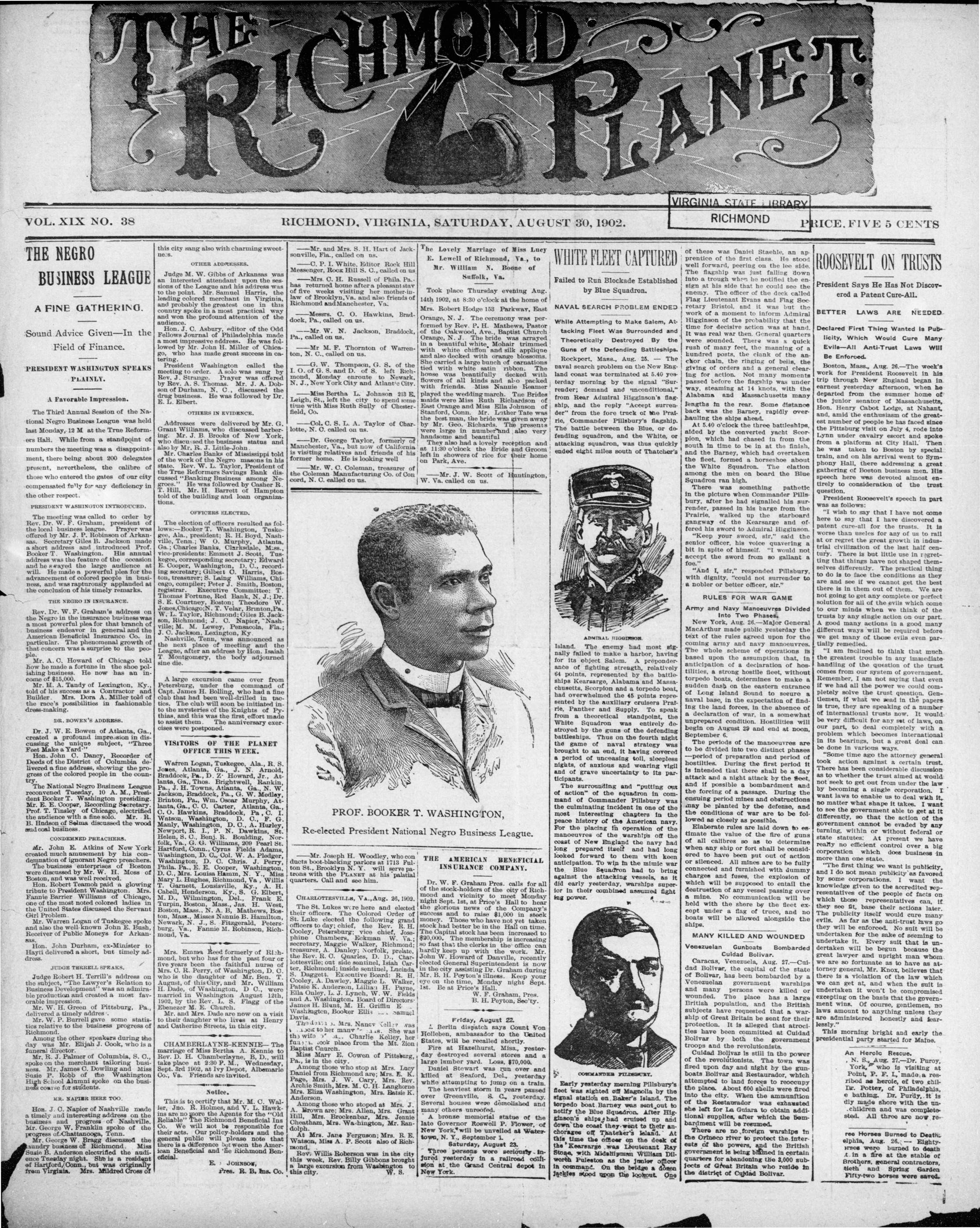
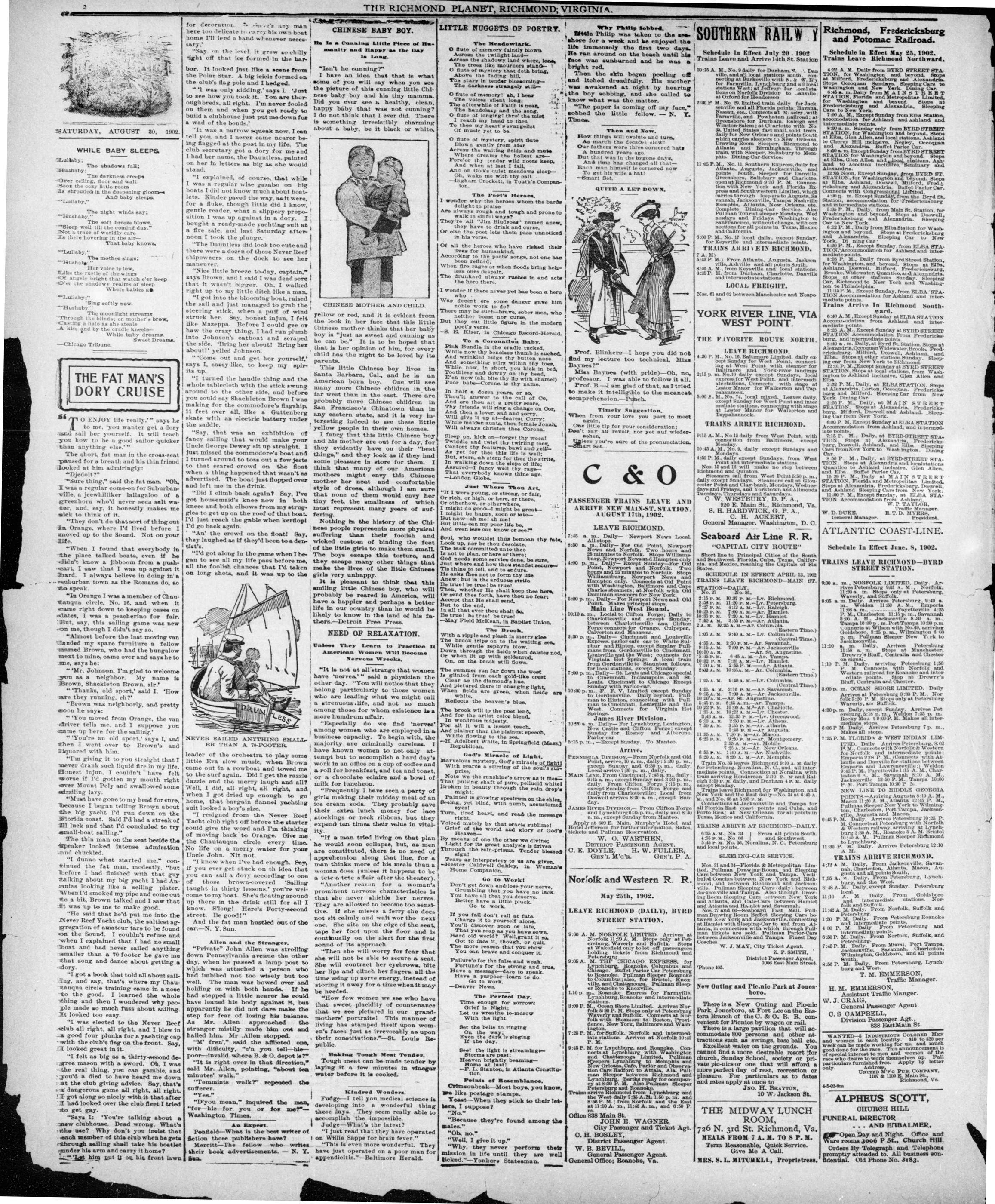
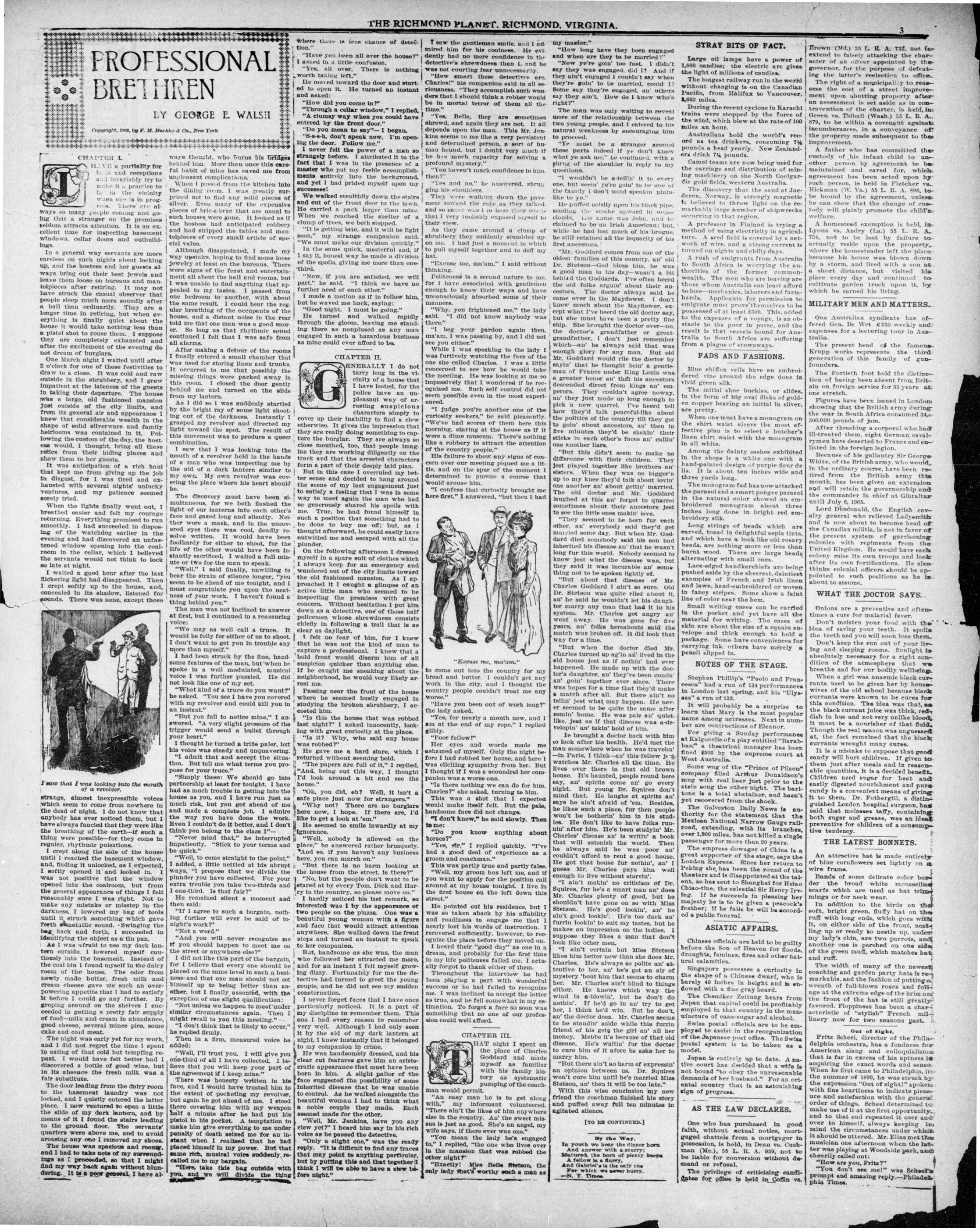
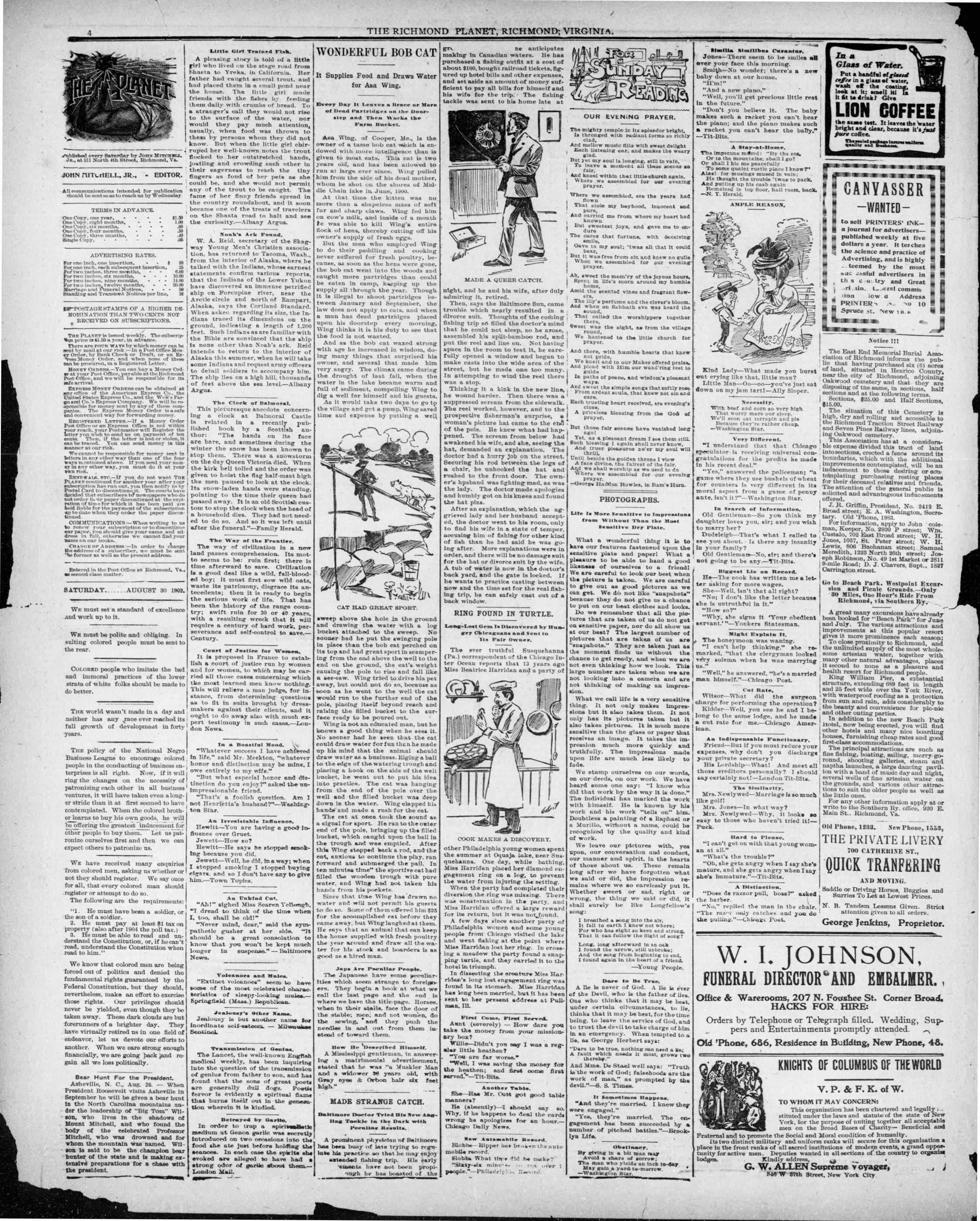
Page text (machine-generated)
THE RICHMOND PLANET
VOL. XIX NO. 38
THE NEGRO BUSINESS LEAGUE
A FINE GATHERING.
Sound Advice Given—In the Field of Finance.
PRESIDENT WASHINGTON SPEAKS
PLAINLY.
A Favorable Impression.
The Third Annual Session of the National Negro Business League was held last Monday, 12 M at the True Reformers Hall. While from a standpoint of numbers the meeting was a disappointment, there being about 200 delegates present, nevertheless, the calibre of those who entered the gates of our city compensated fully for any deficiency in the other respect.
PRESIDENT WASHINGTON INTRODUCED.
The meeting was called to order by Rev. Dr. W. F. Graham, president of the local business league. Prayer was offered by Mr. J. P. Robinson of Arkansas. Secretary Giles B. Jackson made a short address and introduced Prof. Booker T. Washington. His annual address was the feature of the occasion and he swayed the large audience at will. He made a powerful plan for the advancement of colored people in business, and was rapturously applauded at the conclusion of his timely remarks.
THE NEGRO IN INSURANCE.
Rev. Dr. W. F. Graham's address on the Negro in the insurance business was a most powerful plea for that branch of business endeavor in general and the American Beneficial Insurance Co. in particular. The phenomenal growth of that concern was a surprise to the people.
Mr. A. C. Howard of Chicago told how he made a fortune in the shoe polishing business. He now has an incotemp of 5,000.
Mr. H. A. Tandy of Lexington, Ky., told of his success as a Contractor and Builder. Mrs. Dora A. Miller told of the race's possibilities in fashionable dress-making.
DR. BOWEN'S ADDRESS.
Dr. J. W. E. Bowen of Atlanta, Ga., created a profound impression in discussing the unique subject, "Three Feet Make a Yard."
Hon. John C. Dancy, Recorder of Deeds of the District of Columbia delivered a fine address, showing the progress of the colored people in the country.
The National Negro Business League recommended Tuesday, 10 A.M. President Booker T. Washington presiding.
Mr. E. Co. Cooper, Recording Secretary Prof. T. Tinaley of Chicago, electrified the audience with a fine solo. Mr. R. B. Hudson of Selma discussed the wood and coal business.
CONDEMNED PREACHERS.
Mr. John E. Atkins of New York created much amusement by his condemnation of ignorant Negro preachers. The business enterprises of Boston were discussed by Mr. W. H. Moss of Boston, and was well received.
Hon. Robert Teamoh paid a glowing tribute to President Washington. Mrs. Fannie Barrier Williams of Chicago, one of the most noted colored ladies in the United States discussed the Servant Girl Problem.
Mr. Warren Logan of Tuskegee spoke and also the well-known John E. Bush, Receiver of Public Moneys for Arkansas.
Hon. John Durham, ex-Minister to Hayti delivered a short, but timely address.
JUDGE TERRELL SPEAKS.
Judge Robert H. Tarrill's address on the subject, "The Lawyer's Relation to Business Development" was an admirable production and created a most favorable impression.
Mr. W. H. Green of Pittsburg, Pa., delivered a timely address.
Mr. W. P. Burrell gave some statistics relative to the business progress of Richmond.
Among the other speakers during the day was Mr. Elijah J. Cook, who is a funeral director.
Mr. R. J. Palmer of Columbia, S. C., spoke on the merchant tailoring business.
Mr. James C. Dowling and Miss Susie P. Robb of the Washington High School Alumni spoke on the business course for students.
MR. NAPIER HERE TOO
Hon. J. O. Napier of Nashville made a timely and interesting address on the business and progress of Nashville. Mr. George W. Franklin spoke of the progress of Chattanooga, Tenn. Mr. George W. Bragg discussed the laundry business of Richmond. Miss Susie B. Anderson electrified the audience Tuesday night. She is a resident of Hartford, Conn., but was originally from Virginia. Mrs. Mildred Cross of
this city sang also with charming sweetness.
OTHER ADDRESSES.
Judge M. W. Gibbs of Arkansas was an interested attendant upon the sessions of the League and his address was to the point. Mr. Samuel Harris, the leading colored merchant in Virginia, and probably the greatest one in this country spoke in a most practical way and won the profound attention of the audience.
Hon. J. C. Asbury, editor of the Odd Fellows Journal of Philadelphia made a most impressive address. He was followed by Mr. John H. Miller of Chicago, who has made great success in catering.
President Washington called the meeting to order. A solo was sung by Rev. J. Strange. Prairie was offered by Rev. A. S. Thomas. Mr. J. A. Dobson of Durham, N. C., discussed the drug business. He was followed by Dr. E. L. Elbert.
OTHERS IN EVIDENCE
Addresses were delivered by Mr. G. Grant Williams, who discussed barbering. Mr. J. B Brooks of New York, who discus-sed the business status and also by Mr. R. J. Little-John. Mr. Charles Banks of Mississippi told of the work of the Negro masons in his state. Rev. W. L. Taylor, President of the True Reformers Savings Bank discussed "Banking Business among Negroes." He was followed by Casher R. T. Hill, Mr. H. Barrett of Hampton told of the building and loan organizations.
OFFICERS ELECTED.
The election of officers resulted as follows:—Booker T. Washington, Tuskegee, Ala., president; R. H. Boyd, Nashville, Tenn.; W. O. Murphy, Atlanta, Ga.; Charles Banks, Clarkslade, Mss., vice-presidents: Emmett J. Scott, Tuskegee, corresponding secretary; Edward E. Cooper, Washington, D. C., recording secretary; Gilbert C. Harris, Boston, treasurer; S. Laing Williams, Chicago, compiler; Peter J. Smith, Boston, registrar. Executive Committee: T. Thomas Fortune, Red Bank, N, J.; Dr. S. E. Courtney, Boston; Theodore W. Jones, Chicago; N. T. Velar, Brinton, Pa. W, L. Taylor, Richmond; Giles B. Jackson, Richmond; J. C. Napier, Nashville; M. M. Lewey, Pensacola, Fla.; J. C. Jackson, Lexington, Ky. Nashville, Tenn. was announced as the next place of meeting and the League, after an address by Hon. Isaiah T. Montgomery, the body adjourned sine die.
---
A large excursion came over from Petersburg, under the command of Capt. James H. Bolling, who had a fine club that had been well-drilled in tactics. The club will soon be initiated into the mysteries of the Knights of Pythias, and this was the first effort made to assist them. The anniversary exercises were postponed.
VISITORS OF THE PLANET
OFFICE THIS WEEK.
Warren Logan, Tuakege, Ala., R. S. Jones, Atlanta, Ga., J. N. Arnold, Braddock, D. D. Z. Howard, Jr. Atlanta, Ga., Thos. Brightwell, Rankin, Pa. J. H. Towns, Atlanta, Ga., N. W. Jackson, Braddock, Pa., G. W. Medley, Brinton, Pa., Wm. Oscar Murphy, Atlanta, Ga., C. C. Carter, Atlanta, Ga. O. O. Hawkins, Braddock, Pa, C. I. Watson, Washington, D. C., F. G. Manly, Washington, D. C., A. Hurley, Newport, R. I., P. N. Dawkins, St. Helen, S. C. Benj. R. Boulding, Norfolk, Va. G. G. Williams, 200 Pearl St. Hartford, Conn., Cyrus Fields Adams, Washington, D. C., Col. W. A. Pledger, Washington, D. C. Chris. J. Perry, Phila, Pa., E. E. Cooper, Washington, D. C. Mrs. Louisa Hamm, N. Y., Miss Mary L. Hughes, Richmond, Va., Willis T. Garnett, Lousville, Ky., A. H. Cabel, Henderson, Ky., S. G. Elbert, M. D., Wilmington, Del., Frank E. Turpin, Boston, Mass., Jas. H. West, Boston, Mass., N. A. B. Mathews, Boston, Mass., Misses Nannie B. Hamilton, Newark, N. J., S. Fitzgerald, Petersburg, Va., Fannie M. Robinson, Richmond, Va.
Mrs. Emma Reed formerly of Riethmond, but who has for the past four or five years been the faithful nurse of Mrs. C. R. Perry, of Washington, D. C. who is the daughter of Mr. Ben. T. August, of this City, and Mr. William H. Dade, of Washington, D. C., were married in Washington August 12th, 1802, by the Rev. L. S. Flagg of the Ebenezer M. E. Church. Mr. and Mrs. Dade are now on a visit to their daughter who lives at Henry and Catherine Streets, in this city.
---
CHAMBERLAYNE-KENNIE--The marriage of Miss Bertha A. Kennie to Rev. D. H. Chamberlayne, B, D., will take place at 2:30 P. M., Wednesday, Sept. 3rd 1903, at Ivy Depot, Albemarle Co., Va. Friends are invited.
This is to certify that Mr. M. C. Wailer, Jno. R. Holmes, and V. L. Hawkins are no more the Agents for the "Old Reliable" The Richmond Beneficial Ins Co. We will not be responsible for their acts. Our policy-holders and the general public will please note that there is a difference but ween the American Beneficial and 'he Richmond Beneficial.
E. JOHNSON,
Pres. R. B. Ins. Co.
RICHMOND, VIRGINIA, SATURDAY, AUGUST 30, 1902.
B & W
Re-elected President National Negro Business League.
Mr. and Mrs. S. H. Hart of Jacksonville, Fla., called on us.
C. P. I. White, Editor Rock Hill Messenger, Rock Hill S. C., called on us
Mrs. C. H. Russell of Phila. Pa. has returned home after a pleasant stay of five weeks visiting her mother-in-law of Brooklyn, Va, and also friends of Richmond and Manchester, Va.
Messrs. C. O. Hawkins, Bradock, Pa., called on us.
Mr. W. N. Jackson, Braddock, Pa., called on us.
Mr. M. F. Thornton of Warrenton, N. C., called on us.
G. W. Thompson, G. S. of the I. O. of G. S. and D. of S. left Richmond, Monday enroute to Newark, N. J., New York City and Atlantic City.
Miss Bertha L. Johnson 213 E. Leigh, St., left the city to spend some time with Miss Ruth Sully of Chesterfield, Co.
—Col, C. S. L. A. Taylor of Charlotte, N. C. called on us.
—Dr. George Taylor, formerly of Manchester, Va., but now of California is visiting relatives and friends of his former home. He is looking well
—Mr. W. C. Coleman, treasurer of the Coleman Manufacturing Co. of Concord, N. C. called on us.
PROF. BOOKER
Re-elected President Nation
Mr. Joseph H. Woodley, who con ducts boot-blacking parliars at 1713 Fulton St., Brooklyn N. Y. will serve patrons with the PLANET at his palatial quarters. Call and see him.
CHARLOTTESVILLE, VA., Aug. 26, 1902.
The St. Lukes were here and elected their officers. The Colored Order of St. Luke elected the following grand officers to day; chief, the Rev. R. H. Cooley, Petersburg; vice chief, Josephine Chambers, Eckman W. V.; secretary, Maggie Walker, Richmond; treasurer, A. Danley; Norfolk, prelate, the Rev. R. C. Quarles, D. D., Charlottesville; out side sentinel, Isla Carter, Richmond; inside sentinel, Lucinda S. Daggett. Executive Board: R. H. Cooley, A. Dawley, Maggie L. Walker, Patsie K. Anderson, Lillian H. Payne, Ella Ollen, L. J. Lynch, W. W. Fields and A. Washington. Board of Directors James H. Blunt, M. H. Griffin E. Washington, Booker Ellis . . . Samuel Davis.
The daughter, Mrs. Nancy Kelly was
looked to her many friends. She was
the wife of, a. Charlie Kelley, her
famul, took place from the Mt. Zion
Baptist Church.
Miss Mary E. Cowen of Pittsburg,
Pa., is in the city.
Among those who stop at Mrs. Lacy
Daniel from Richmond are; Mrs. E. K.
Page, Mrs. J. W. Cary, Mrs. Rev.
Archie Smith, Mrs. M. C. H. Langhorne
Mrs. Anderson Washington, Mrs. Batsie K.
Anderson.
Among those who stopped at Mrs. J.
A. Brown are; Mrs. Allen, Mrs. Grant
Hill, Mrs. Brockenbar, Mrs. Jennie
Cheatham, Mrs. w-hington, Mr. Randolph.
At Mrs. Jane Ferguson; Mrs. R. E.
Watson, Miss A. P. Scott also of Richmond.
Rev. Willis Roberson was in the city
this week, Rev. Billy Gibbons brought
a large exursion from Washington to
this city. W. S.
---
The Lovely Marriage of Miss Lucy
E. Lowell of Richmond, Va., to
Took place Thursday evening Aug. 14th 1902, at 8:30 o'clock at the home of Mrs. Robert Hodge 153 Parkway, East Orange, N. J. The ceremony was performed by Rev. P. H. Mathews, Pastor of the Oakwood, Ave., Baptist Church Orange, N. J. The bride was arrayed in a beautiful white, Mohair trimmed and white chiffon and silk appliqué and also locked with orange blossoms. She carried a large brooch of carnation tied with white satin ribbon. The house was beautifully decked with flowers of all kinds and al-o packed with friends. Miss Nannie Reamer played the wedding march. The Brides maids were Miss Ruth Richardson of East Orange and Miss Ella Johnson of Stanford, Conn. Mr. Luther Tate was the best man, the bride was given away by Mr. Geo. Richards. The presents were large in number and also very handsome and beautiful
They also had a lovely reception and at 11:30 o'clock the Bride and Groom left in showers of rice for their home on Park, Ave.
Mr. J. W. Scott of Huntington, W. Va. called on us.
T. WASHINGTON,
al Negro Business League.
THE AMERICAN BENEFICIAL INSURANCE COMPANY.
Dr. W. F. Graham Pres. calls for all of the stock-holders of the city of Richmond and vicinity to meet Monday night Sept. 1st, at Price's Hall to hear the glorious news of the Company's success and to raise $1,000 in stock money. Those who have not yet taken stock had better be in the Hall on time. The Capital stock has been increased to $30,000. The membership is increasing so fast that the clerks in the office can hardly keep up with the work. Mr. John W. Howard of Danville, recently elected General Superintendent is now in the city assisting Dr. Graham during Mr. B. H. Peyton's illness. Keep your eye on the time, Monday night Sept. 1st. Be at Price's Hall. W. F. Graham, Pres. B. H. Peyton, See 'tay.
Friday. August 22.
A. Berlin dispatch says Count Von Holleben, ambassador to the United States, will be recalled shortly.
Fire at Hazelhurst. Miss., yesterday destroyed several stores and a large lumber yard. Loss, $70,000.
Daniel Stewart was run over and killed at Seaford, Del., yesterday while attempting to jump on a train. The heaviest storm in years passed over Greenville, S. C., yesterday. Several houses were demolished and many others unroofed.
A bronze memorial statue of the late Governor Roswell P. Flower, of New York, will be unveiled at Wetertown, N. Y., September 1.
Saturday, August 23.
Three persons were seriously injured yesterday in a railroad collision at the Grand Central depot in New York.
---
WHITE FLEET CAPTURED
Failed to Run Blockade Established by Blue Squadron.
NAVAL SEARCH PROBLEM ENDED
While Attempting to Make Salem, Attacking Fleet Was Surrounded and Theoretically Destroyed By the Guns of the Defending Battleships.
Rockport, Mass., Aug. 25. — The naval search problem on the New England coast was terminated at 5.40 yesterday morning by the signal "Surrender; demand and unconditional," from Rear Admiral Higginson's flagship, and the reply "Accept surrender" from the fore truck of the Prairie, Commander Pillsbury's flagship.
The battle between the Blue, or defending squadron, and the White, or attacking squadron, was thus quickly ended eight miles south of Thatcher's
P.
ADMIRAL HIGGINSON.
Island. The enemy had most signally failed to make a harbor, having for its object Salem. A preponderance of fighting strength, relatively 64 points, represented by the battleships Kearsarge, Alabama and Massachusetts, Scorpion and a torpedo boat, had overwhelmed the 45 points represented by the auxiliary cruisers Prattie, Panther and Supply. To speak from a theoretical standpoint, the White Squadron was entirely destroyed by the guns of the defending battleships. Thus on the fourth night the game of naval strategy was brought to an end, it having covered a period of unceasing toil, sleepless nights, of anxious and wearing vigil and of grave uncertainty to its participants.
The surrounding and "putting out of action" of the squadron in command of Commander Pillsbury was the culminating incident in one of the most interesting chapters in the peace history of the American navy. For the placing in operation of the manoeuvres of the warships off the coast of New England the navy had long prepared itself and had long looked forward to them with keen anticipation. To win in the mimic war the Blue Squadron had to bring against the attacking vessels, as it did early yesterday, warships superior in their combined assumed fighting power.
P.
COMMANDER PILLSBURY.
Early yesterday morning Pillisbury's fleet was sighted off Magnolia by the signal station on Baker's Island. The torpedo boat Barney was sent out to notify the Blue Squadron. After Higginson's ships had cruised up and down the coast they went to their anchorage off Thatcher's island. At this time the officer on the deck of the 'Keararge was Lieutenant Ray Stone, with Midshipman William Dilworth Puleston as the junior officer in command. On the bridge a dozen jackets stood upon the lookout. One
of these was Daniel Staehle, an apprentice of the first class. He stood well forward, peering on the lee side. The flagship was just falling down into a trough when he notified the ensign at his side that he could see the enemy. The officer of the deck called Flag Lieutenant Evans and Flag Secretary Bristol, and it was but the work of a moment to inform Admiral Higginson of the probability that the time for decisive action was at hand. It was real war then. General quarters were sounded. There was a quick rush of many feet, the manning of a hundred posts, the clank of the anchor chain, the ringing of belis, the giving of orders and a general clearing for action. Not many moments passed before the flagship was under way, steaming at 14 knots, with the Alabama and Massachusetts many lengths In the rear. Some distance back was the Barney, rapidly overhauling the ships ahead.
At 5.40 o'clock the three battleships, alded by the converted yacht Scorpion, which had chased in from the south in time to be in at the finish, and the Barney, which had overtaken the fleet, formed a horseshoe about the White Squadron. The elation among the men on board the Blue Squadron ran high.
There was something pathetic in the picture when Commander Pillsbury, after he had signalled his surrender, passed in his barge from the Prairie, walked up the starboard gangway of the Kearsarge and offered his sword to Admiral Higginson.
"Keep your sword, sir," said the senior officer, his voice quavering a bit in spite of himself. "I would not accept the sword from so gallant a foe."
"And I, sir," responded Pillsbury, with dignity, "could not surrender to a nobler or better officer, sir."
RULES FOR WAR GAME
Army and Navy Manoeuvres Divided Into Two Phases
New York, Aug. 26.-Major General MacArthur made public yesterday the text of the rules agreed upon for the coming army and navy manoeuvres. The whole scheme of operations is based upon the assumption that, in anticipation of a declaration of hostilities, a strong hostile fleet, without torpedo boats, determines to make a sudden dash on the eastern entrance of Long Island Sound to secure a naval base, in the expectation of finding the land forces, in the absence of a declaration of war, in a somewhat unprepared condition. Hostilities will begin on August 29 and end at noon, September 6.
The periods of the manoeuvres are to be divided into two distinct phases—period of preparation and period of hostilities. During the first period it is intended that there shall be a day attack and a night attack by the fleet, and if possible a bombardment and the forcing of a passage. During the ensuing period mines and obstructions may be planted by the defense, and the conditions of war are to be followed as closely as possible.
Elaborate rules are laid down to estimate the value of the fire of guns of all calibres so as to determine when any ship or fort shall be considered to have been put out of action or silenced. All mines are to be fully connected and furnished with dummy charges and fuses, the explosion of which will be supposed to entail the destruction of any vessel passing over a mine. No communication will be held with the shore by the fleet except under a flag of truce, and no boats will be allowed alongside the ships.
MANY KILLED AND WOUNDED
Venezuelan Gunboats Bombarded
Culidad Bolivar.
Caracas, Venezuela, Aug. 27.—Culidad Bolivar, the capital of the state of Bolivar, has been bombarded by a Venezuelan government warships and many persons were killed or wounded. The place has a large British population, and the British subjects have requested that a warship of Great Britain be sent for their protection. It is alleged that atrocities have been committed at Culidad Bolivar by both the government troops and the revolutionists.
Culad Bolivar is still in the power of the revolutionists. The town was fired upon day and night by the gunboats Bolivar and Restaurador, which attempted to land forces to reoccupy the place. About 600 shells were fired into the city. When the ammunition of the Restaurador was exhausted she left for La Gulara to obtain additional supplies, after which the bombardment will be resumed. There are no foreign warships in the Orneco river to protect the interests of the powers, and the British government is being blamed in certain quarters for abandoning the 3,000 subjects of Great Britain who reside in the district of Culad Bolivar.
ROOSEVELT ON TRUSTS
President Says He Has Not Discovered a Patent Cure-All.
BETTER LAWS ARE NEEDED
Declared First Thing Wanted Is Publicity, Which Would Cure Many Evils—All Anti-Trust Laws Will Be Enforced.
Boston, Mass., Aug. 26.—The week's work for President Roosevelt in his trip through New England began in earnest yesterday afternoon, when he departed from the summer home of the junior senator of Massachusetts, Hon. Henry Cabot Lodge, at Nahant, and, amid the enthusiasm of the greatest number of people he has faced since the Pittsburg visit on July 4, rode into Lynn under cavalry escort and spoke from a platform at City Hall. Then he was taken to Boston by special train, and on his arrival went to Symphony Hall, there addressing a great gathering of Boston business men. His speech here was devoted almost entirely to consideration of the trust question.
President Roosevelt's speech in part was as follows:
"I wish to say that I have not come here to say that I have discovered a patent cure-all for the trusts. It is worse than useless for any of us to rail at or regret the great growth in industrial civilization of the last half century. There is but little use in regretting that things have not shaped themselves differently. The practical thing to do is to face the conditions as they are and see if we cannot get the best there is in them out of them. We are not going to get any complete or perfect solution for all of the evils which come to our minds when we think of the trusts by any single action on our part. A good many actions in a good many different ways will be required before we get many of those evils even partially remedied.
"I am inclined to think that much the greatest trouble in any immediate handling of the question of the trust comes from our system of government. Remember, I am not saying that even if we had all the power we could completely solve the trust question. Gentlemen, if what we read in the papers is true, they are speaking of a number of international trusts now. It would be very difficult for any set of laws, on our part, to deal completely with a problem which becomes international in its bearings, but a great deal can be done in various ways.
"Some time ago the attorney general took action against a certain trust. There has been considerable discussion as to whether the trust aimed at would not seek to get out from under the law by becoming a single corporation. I want laws to enable us to deal with it, no matter what shape it takes. I want to see the government able to get at it differently, so that the action of the government cannot be evaded by any turning, within or without federal or state statutes: At present we have really no efficient control over a big corporation which does business in more than one state.
"The first thing we want is publicity, and I do not mean publicity as favored by some corporations. I want the knowledge given to the accredited representatives of the people of facts on which those representatives can, if they see fit, base their actions later. The publicity itself would cure many evils. As far as the anti-trust laws go they will be enforced. No suit will be undertaken for the sake of seeming to undertake it. Every suit that is undertaken will be begun because the great lawyer and upright man whom we are so fortunate as to have as attorney general, Mr. Knox, believes that there is a violation of the law which we can get at, and when the suit is undertaken it won't be compromised excepting on the basis that the government wins. Of course, gentlemen, no laws amount to anything unless they are administered honestly and fearlessly."
This morning bright and early the presidential party started for Maine.
An Herolo Rescue.
, N. S., Aug. 27.—Dr. Puroy, York, who is visiting at Point, P. F. L, made, a rescribed as heroic, of two child. Dr. Potter, of Philadelphia, e bathing. Dr. Purdy, it is dly made shore with the un-children and was completed. All three are now re-ree Horses Burned to Death. elphia, Aug. 26. — Eighty- horses were burned to death t. in a fire at the stable of Brothers, general contractors, steth and Spring Garden Fifty-two horses were saved.
=
pee ea
ine te
Bo ce
Fe eS Gia = ASN ge
ag ROSS
RET oi Fh yal we
Wore
Ppa rage
SATURDAY, AUGUST 30, 1902.
WHILE BABY SLEEPS, |
‘SLultaby;
The shadows fall:
‘SHlushaby;
‘The darkness creeps
“Over ceiling, floor and wall.
Soon the cozy lttle room
As shrouded in the decpentng gloom
And baby sleeps,
“‘Luitaby,"
The night winds says
~“Hushaby.""
The soft breeze blows,
“Sleep well till the coming day."
ANot a trace of worldly care
Zs there hovering In the atr—
‘That baby knows,
Lullaby,” Soatig
‘The mother sings:
~“Bushaty,””
Hex volce ts low,
Riike the rustle of the wings
“Of angele bright that watch e'er keep
“O'er the studowy realms of steep
Where bables 6
“Lutaby:”
“Bing softly now.
~Hushaby.”
‘The moonlight atreams
“Phrough the blinds. on mother's Brow,
‘Casting a hnio ae she steals
-A Kiss gne by the cradle kneets—
‘While baby dreams.
Sweet Dreama,
—Chicago Tribune.
THE FAT MAN’S
DORY CRUISE
B8 vn O) ENJOY life really’ " says he
A some, you wanter get a dory
sand sail ber yourself. It will teach
you how to be a good sailor quicker
than anything else."
‘The short, fat man in the cross-seat
spaused for a breath and his thin friend
Wooked at him admiringly:
“Djedoit?”
“Sure thing,” said the fat man. “Oh,
Ewes a regular come-on for Suburban.
Wille, a jeewhilliker lallagaloo of @
gteenhorn who'd never seca salt wa-
fer, and, say, it honestly makes me
wick to think of it,
“They don’t do that sort of thing ont
@n Orange, where I'd lived before I
mnoved up to the Sound. Not on your
dite.
“When I found that everybody in
‘the plece talked boats, even if he
«didn’t know a jibboom from a push-
weart, I saw that I was up against it
Bard, I always believe in doing in'a
-sauburban town as the Romans do, so
‘Wo speak.
“In Orange I was a member of Chau-
‘Fanqua circle, No. 16, and when it
came right down to keeping cases on
rclates, I was a peacherino for fair.
NBut, say, this sailing game was new
won me, though I didn’t say so.
“Almost before the last moving van
\danded my spare furniture a fellow
‘mamed Brown, who had the bungalow
mext to mine, came over and says he to
sme, says he:
“Mr, Johnson, I'm glad to weloome
syou ssa neighbor. My name is
Brown, Shackleton Brown, sir!
“*Thanks, old sport,’ said I. ‘How
sure they running, ch?”
“Brown was neighborly, and pretty
soon he says:
“‘You moved from Orange, the van
driver tells me. and I suppose you
came up here for the sailing.”
“‘You're an old sport,’ says T, and
When I went over to Brown's and
Biguored with him.
“I'm giving it to yon straight that I
smever drank such liquid fire in my life,
Gonest injun, I couldn't have felt
worse if I'd gotten my mouth right
over Mount Pely and swallowed some
astzziling lavy.
“Must have gone to my head for sure,
Wecause I began telling Brown about
‘the big yacht I'd run down on the
Florida coast. Said I'd had a streak of
‘Hil luck and that Pa concluded to try
ssmall-boat sailing.”
‘The thin man on the seat beside the
speaker looked intense admiration
sand chuckled.
“[ dunno what started me,” con-
finued the fat man, modestly, “but
Wefore I had finished with that guy
walking about my big yacht Thad An-
sanias looking like a ‘selling plater.
‘WhenI'd smoked my pipe and come out
to a bit, Brown talked and I saw that
St was up to me to make good.
“He said that he'd put me into the
‘Never Reef Yacht club, the sultiest ag-
sgregation of amateur tars to be found
son the Sound. I couldn't refuse and
cwhen I explained that I had no small
“oat and had never sailed anything
‘smaller than a 70-footer he gave me
that song and dance about getting »
edory.
“I got s book that told all about sall-
ang, and say, that's where my Chau-
stauqua circle training came in # nose
to the good. I learned the whole
sthing and then I wondered why peo-
pple made so much fuss about sailing.
At looked too easy.
“I was elected to the Never Reef
selub all right, all right, and I blew in
= good four plunks for a yachting cap
~with the club’s flag on thé front. Say,
SE looked great in it.
“I felt as big as a thirty-eecond de-
vagree mason with a sword. Oh, I was
wthe real thing, you can gamble, and
cyou'd a died to have heard me down
sat the club giving advice. Say, that’s
so dangerous game all right, all right.
1 got along so nicely with it that after
AE had looked over the club fleet I tried
to get gay.
“Says I: ‘You're talking about «
vmew clubhouse, Dead wrong. What's
sithe use? Why don’t you insist that
-each member of hinsioy when be get
cRhrough sailing shall take his boatle
qquader his arm and carry ithome?
ani ‘Lgt bing put & on bis front laws
=a 2 dntebies . tp Siemeeth aa ee eee
THE RICHMOND PLANET, RICHMOND: VIRGIN
for decoration, % -ieye's any man
here too delicate to earry his own boat
home I'll lend a hand whenever neces
sary
“Say on the level. it grew ao chilly
sight off that ice formed tn the ban
bor. It looked Just Ike a seene from
the Polar Star. “A big icicle formed on,
the club's flag pole and I hedged.
“‘L was only kidding,’ says L ‘Just
to see how you took it.” You are thor.
oughbreds, all right. I'm never fooled,
on them and when you get ready to
build a clubhouse just put me down for
a wad of the bonds.”
“It was a narrow squeak now, Icon
tell you, and I never came nearer be-
ing flagged at the post in my life. The
club secretary got a dory for me and
Thad her name, the Dauntless, painted
on her in letters as big as she would
stand.
“I explained, of course, that while
I was a regular wise gazabo on big
boats did not know much about boat
lets. Kinder paved the way, seit were,
for a fluke, though little did I know,
gentle reader, what a slippery propo-
sition I was up against in a dory. I
bought a ready-made yachting sult at
8 fire sale, and Inst Saturday after.
noon T took the plunge.
“The Dauntless did look too cute and
there were a dozen of those Never Reef
shipowners on the dock to see her
manenver.
“Nice little breeze totay, captain,”
says Brown, and ! said I was dead sore
that it wasn't birger. Oh, I walked
right up to my little diteh like a man.
“I got into the blooming boat, raised
the sail and just managed to grab the
steering stick, when a puff of wind
struck her. Say, honest injun, I felt
Uke Mazeppa. Before I could gee oF
haw the crazy thing, Thad run plumb
into Johnson's catboat and seraped
the side. ‘Bring her about! Bring her
about!" yelled Johnson.
“Come out and get her yourself,’
says I, sassy-like, to keep my api
its up.
“I turned the handle thing and the
whole tablecloth with the stick swung
around to the other side, and before
you could say Shackleton Brown Iwae
making for the commodore's fingship,
11 feet over all, like a Guttenberg
skate with an electric battery under
the saddle.
“Say, that was an exhtbition of
fancy sailing that would make your
Uncle George Dewey sit up straight. I
just missed the commodore's boat and
I turned around to toss out a few jeate
to that scared crowd on the float
when a thing happened that wasn't as
advertised. The boat just flopped over
and left me in the drink.
“Did I climb back again? Say, I've
got housemaid’s knee now in both
knees and both elbows from my etrug-
gles to get up on the roof of that boat.
I'd just reach the gable when kerflop!
T'd go back again.
“ “An' the crowd on the float! Say,
they laughed as if they'd been toaden-
tist’s.
“I'd got along in the game when I be
gan to see all my life pars before ma,
all the foolish chances that I'd taken
on long shota, and it was. up to the
eis
EB Lg ‘
<a Ny
“AAS if
OF )
Rui y eh
ws Ki Sees
wares een ee
R SMILED ANYTHING &
leader of the orchestra to play come
little Eva slow mausie, when Brown
came out in a rowboat and towed me
to the surf again. Did I get the razzle
@azzle and the merry laugh and all?
Well, I did, all right, aH right, and
when I got dried up enough to go
home, that bargain flannel yachting
suit looked a boy's size.
“L resigned from the Never Reef
Yacht club right off before the starter
could give the word and I'm thinking
of moving back to Orange. Give me
the Chautauqua circle every time,
No life on a merry water for your
Unele John. Nit not.
“know when I've had enough. Sey,
if you ever get stuck on th idea that
you can sail a dory according to one
of those brown-covered ‘Sailing
taught in thirty lessons,’ you're wel-
come tomy boat. She's floating around
up there in the drink still for all I
know. Stlong! Here's Forty-second
street. Be good!”
And the fat man hustled out of the
car.—N. ¥. Sun,
Dilligas enna epics Seti”
“Private” John Allen was strolling
down Pennsylvania avenue the other
day, when he passed a lamp post to
which was attached a person who
had imbibed not too wisely but too
well. The man was bowed over and
holding on with both bands. If he
had stepped a little nearer he could
have leaned his body against , but
apparently he did not dere make the
step for fear of losing his balance.
As Mr. Allen approsehed — the
stranger mistily made bim oot and
hailed him. Mr .Allen stopped.
“M' fren’," said the afflicted ona,
with difficulty, “c'n you tell—hle—
poor—invalid where B. & 0. depot le?*
“It is right over in that direotion,”
sald Mr. Allen, pointing, “about ten
minutes’ walk.”
“Temmints walk?” repeeted the
sufferer.
“Yea
“D'you mean,” inquired the man,
“tor—hic—for you or fos me?"—
Washington Times,
An Expert.
Penflelé—What is the beet writer of
fiction those publishers have?
Merritt—The fellow who. writes
their book advertisements. — N. ¥.
fon. a ae
CHINESE BABY BOY.
Me Iss Canning Little Piece of He-
manity and Happy an the Day
In Long.
“Isn't he canning?”
I have an idea that thot is whaa
some of you will say when you see
the picture of this cunning Uttle Chi-
nese baby boy and his tiny mamma,
Did you ever see a healthy, clean,
happy baby that waa not cunning?
Ido not think that I ever did. There
is something irresistibly charming
about a baby, be it black or white,
We
ee bs
es
me
Ps ke oe
rF
CHINESE MOTHER AND CHILD.
yellow or red, and It is evident from
the look in her face that this little
Chinese mother thinks that her baby
boy is “just as sweet and cunning as
he can be." It is to be hoped that
that is her opinion of him, for every
child has the right to be loved by its
parenta,
‘This lttle Chinese boy lives in
Santa Barbara, Cal, and he is an
American born boy. One will see
many more Chinese children in the
far west than In the east. There are
probably more Chinese children in
San Francisco’s Chinatown than in
any eastern state, and it is very in-
teresting indeed to see these little
yellow people in their own homes.
I fancy that this little Chinese boy
‘and his mother are out for a day, for
they evidently have on their “best
things," and they look as if they had
some pleasure in store for them. I
think thet many of our American
mothers might envy this Chinese
mother her neat and comfortable
style of dress, although 1 am sure
that none of them would envy her
tiny feet, the smallnesa of which
must represent many years of suf-
fering.
Nothing tn the history of the Chi-
nese people represents more physical
suffering than their foolish and
wicked custom of binding the feet
of the little girls to make them small.
‘The boys escape this torture, and
they escape many other things that
make the lives of the ttle Chinese
girls very unhappy.
It iu pleasant to think thet this
smiling little Chinese boy, who will
probably be reared in America, will
have a happier and perhaps » better
life in our country than he would be
likely to know in the land of his fa-
there.—Detroit Free Press.
NEED OF RELAXATION.
Uniess They Learn to Practice It
American Women Will Become
ides we
“It te not at all’ strange that women
have ‘nerves,’™ said a physician the
other day. “You will notice that they
belong particularly to those women
who are leading what we might call
@ strenuous life, amd not so much
among those for whom existence isa
more humdrum affair.
“Especially do we find ‘nerves’
among women who are employed in
business capacity. To begin with, the
majority are criminally careless. 1
have known women to not only at-
tempt but to accomplish a hard day's
work in an offlos on a cup of coffee and
a roll for breakfast, and tea and toset,
or a chocolate eclaire and a bowl of
milk for luncheon.
“Frequently I have seen a party of
girls making their midday meal of an
ice cream soda. They probably save
their extra lunch money for lace
stockings or neck ribbons, but they
expend ten times their value in vital-
ity.
“If a man tried Mving on that plan
he would soon collapse, but, as men
are constituted, there fe no need of
apprehension along that line, for a
man thinks more of his meals than a
woman does (unless it happens to be
& tete-a-tete affair after the theater).
“Another reason for ® woman's
prominent nervous characteristics {a
that she never shielde her nerves,
‘They are allowed to become too senst-
tive. If she misses a ferry she does
not sit calmly and walt wor the next
one. She sits on the edge of the seat,
taps her foot upon the floor and fs
contmuaily on the alert for the first
sound of its approach.
“Then she will worry for fear that
she will not be able to secure # seat.
She will contract her eyebrows, bite
her lips and clinch her fingers, all the
time using up nerve energy, instead of
storing {t sway for a time when it may
be needed.
“How few women we see who have
that sweet placidity of countenance
that we see pletnred in our grand.
mothers’ portraite! This manner of
living has stamped Hself upon wom-
en's faces just as irrevocably as upon
their constitutions."—St. Louis Re-
wabile
Tough meat can be made tender by
laying it » few minutes in vinegar
water before it a cooked.
Kindred Wonders,
Fudge—I tell you medical science is
developing into» wonderful thing
these days. ‘They seem really able to
accomplish the impossible.
/ Judge—What’s the latest?
“I just read that they have operated
‘on Willie Sappe for brain fever.”
This fs even more wonderful. They
have just operated on a poor man for
eppendicitis."—Baltimore Herald.
LITTLE NUGGETS OF POETRY.
The Meadowlark.
© fute of memory faintly blown
crow, the right labo
Across the shadowy land where, loam,
‘The trees like mourners stand
© Gute of mystery that coth Dring,
“Above the fading bill
‘The stars tn tender Dlossoming—
The darksew strangely stl
Ofute of memory! an Ibear <4 *
‘The voices silent Tova, aah
‘The atterwhile of Faith isnean “ft
‘The Bandclasy and the song,
© Bute of longing! thro the tit
1 reach my hand to thee, a
To theo my heatt'savangelist
Of music yet to be. r
© tute of mystery, eptrte Bute
Blown gently from afer
Acrosy the walting folds and mate
Where dreams the holiest are
Fore'er thy tender wild notes beeps
And when at inst Y fall
‘Ana on Gols quist meadows sleep—
Oh, wake me with thy call
Tingnam Crockatt, in Youth's Compan-
ion
ihe Wee whack
* wonder why the heroes whom the bards
delight to praise
Are always rough and tough and prone to
walk in sinful ways?
They're all "Jim Bludsoes* named anew,
they have to drink and curse,
Or olse the poet lotr them pase unnoticed
tm his verse.
Of all the heroes who have risked thelr
lvew for humankind,
According to the poots’ songs, not one hae
beon refined;
When fire rages or when foods bring help-
fess ones despair,
Tho drunkard always rushes in and acts
the hero there,
T wonder If there never yet bas been @ hero
who
Was Gecent ory some danger gave him
noble work to do?
There may be such—brave, sober men, who
nether boast nor curse,
But they cut little figure in the modern
poet's verse.
-S. BL Kiser, in Chicago Record-Herald,
‘To a Coronation Baby,
*ink Bundle in the cradle tucked,
While now thy boneless thumb is sucked
And wrinkled bulge thy button nose
And something stirs within thy toe,
While now, in stort, you kiok in bed
‘Toothiess and downy on thy bead,
Bron now (eh, bite thy itp with shame!)
Poor babe—Corone is thy name.
In half « dozen years, or 90,
Thou'lt answer to the call of Co,
Apd ere thou art a pretty score,
‘Thy frienda will ring @ change on Cor,
AnG then a lover, sud and sorry,
WIU give it up it—dearest Corry;
While maiden aunta, thou female Jonah,
‘Will always christen thee Corona,
Sleep on, kick on—forget thy woes!
‘Twiddle ‘and twist thy twirling toex,
Contort thy features baw! andi yell
Af yet for thee this life ts well:
But, stern, ah stern for thee the trite,
In Walking down the slope of lite;
Aprured1 fancy wail thy tage—
hat everybody knows thine age.
=Laeacn tilene.
Just Where Thou Art,
“It I were young, or strong, or fair,
Or rich, or high, or here, or there,
Or otherhow, or otherwhera, a
I might do good—I might be great—
I might be happy, soon or late— ;
But now—ah me! ah met
But litte can my poor lite be,
And even lese can know or ove!™
Boul, who wouldst thus bemoan thy fate,
Look up, nor be thou desolate,
The task committed unte thes
Is not to plan, or here or there;
God needs some service done, be ure,
Just where and how thou standst secure~
Tis thine to toll, and to eadure.
He anks Coes not to tors thy lide
Anew; but in the arduous strife
Be true! be true! be trust
Then, whether He shall keep thee here,
Or send thee forth, have thou no fear;
Accept that He shall eend,
But to the end,
In all that ever thou shalt 60,
Be true! be true! be true!
—May Field McKean, in Baptist Union,
Se ee ere
With a ripplo and plash in merry glee
The brook tripe on to the walling se
While gentle xephyrs blow,
Down through the Guide when daisies nod,
Or when It up with woldenrod,
On, on the brook still Gows,
‘The eummer sun far €own the weet
1a gitnted from each gold-ke cryst
Clear ag the diamond's hus.
And pictured therein changing ligne
When felds aru green, when are
white,
Reflects ‘the heaven's blue,
‘The brook will to the post lend, 4
‘And for the artist color blend, |
In Wondrous majesty, S54
For alt it will a lesson teach,
And plainer than the plainest epecoh,
‘While flowing to the sea.
Hi Adelbert White, i Springfield (Mass)
Republican,
God's Miracle of Light.
merous myrtery, Got's miracle of ght}
‘With searce a stirring of the soulssun,
prise,
Note we the munshine’s arrow as it fles=
That puising ehaft of pure, pellucid white
Broken tn beauty through the rain Grep's
might;
rina Sal Slom'e speatrum on the eg,
Beelog, yot blind, with gumb, uecust
‘exer
Turn, tired heart, and read the meseage
Tent,
Volced muitely by that oracle sublime!
Grief of the World and gory of God’e
Heaven—
By means of one the other we divine:
Light for its great analyse ts driven
Through ‘the rain-prigms, Tender Ulessed
sign
Tears ae interpreters to us are given,
Hooter Caldwell Oakley, in Woman'e
Wee: Cuaseatae
Go te Workt
Don't get down and lose your nerve,
‘Grumbiisg that you have ne feck
‘You have ail that you ceserver
Better have a live piacky
Go w werk,
Hf you fall don't rail at tate,
Charge it to yourset alone.
You'll discover gest Ge fone
‘That you reap as you have rown,
Hard old worlat Wellernet iron
Got to tace tt thong or cut
The more ramon that you shows /
ou can traveand ecaquer te
Fallure’s for the falve and weak
Fortune's for the viroeg nnd rua,
Have e message ders torspeck’
Have. a purpouelears to 0,
‘Go to work.
—Deaver News,
The Perfect Day.
‘Time enough for scrrowe
Grief ts Night;
Lat us wreathe to-morow
‘With the Nght.
Set the beta to ringing
Se the way?
Even the dark te singing
Tense oye ;
Seg! the light ts streaming
‘Storms are past
Heaven brignty boamina—
PE atantos, in Atlanta Conatitu-
a
Points of Resemblance,
(Crimsonbesk—Most boys, you know,
We like postage stamps.
‘Yeast—When they stick to their let-
ters, I suppose?
“No.”
“Because they're found among the
males.”
“Ob, no."
“Well, I give it up.”
“Why, they never perform thefr
mission in life until they are well
Nicked."—Yonkers Statesman,
y Why Philip Sobbea, =~
Bittle Philip was taken to the sew
‘shore for a week snd he enjoyed the
life immensely the first two days.
He ran around on the beach until his
face wae sunburned and he was
bright rea.
‘Then the skin began Pooling of
and itched dreadfully. Mis mother
was awakened at night by hearing
the boy sobbing, and she called to
know what was the matter.
“Phe paper is coming off my face,”
sobbed the little fellow. —N. ¥,
Times.
‘Them and Now.
How things will ovolute and turn,
‘As march the decades slow?
} Our fathers wore three cornered hate
‘A hundred years ago.
| wae that waste the Uigone daga,
And time has changed all that—
| Bach man himself le cornered now
| To get hts wife a hat!
/ Bmart Sot, é
QUITP A LET DOWN.
SE oe
| eS al ty
_
iter. ee
TOS j
Limes aly 5
TaN Ca a
| aN Yes —
RES Ri
BPS rN )
q e iA
Yy RN if | a
if; vi fi a—
WY) Sym (hit
| Mi Ee it Hi
| WT Su
* Sea
| ~e = Sas
| Prof. Blinkers—I hope you did not
find my lecture too technical, Miss
Baynes?”
| Miss Baynes (with pride)—Oh, no,
Professor. I was able to follow it all.
Prof. B.—I am glad of that, as I tried
to make it intelligible to the meanest
eomprehension.—Pynch.
_—— a
‘When from your love you part to meet
again,
eee nee a & lee
PASSENGER TRAINS LEAVE AND
| ARRIVE NEW MALN-ST. STATION.
AUGUST 17th, 1902,
LEAVE RICHMOND.
; ee eS ie N:
TMS am. Dally— Ne .
pesca Sees curvecen i
News and, Norfobe. Two howtt ‘and
}” Bibtata t. "ePeetaate
Burg. Newporn i
4:90 p. ttn Daye asap Siudny hor Oud
Point, Newport and Norfolk. Two
ours and Samal to Nora. Stops
Hepeomrasl, Ogetees ac Gal ete
with Washington, Baltimore maacree
tie eeenseecst creel Suck
sang eR ee RTE. on
‘Potnee Maker Wengen
boas Main ine est oe
n Eacial te Cliton Ponges ‘Datly to
™ Gitarlotteevtile ana’ coat Games?
feetveun "Charptsretie “Rng "Shee
tng Dug Gat and Tonle
ae ee
mans from Gordonsville to Cincinnati,
igteeTaat fhe Wa connate
from Gordonville to Biaanton ‘follows,
1p Rg en SeN pc
To Cincinnati, Indianapolis sand Bt,
age ge tg
Bottay Sb rartoncar
10-909. EYE axoope Sanday
EXosiugiqi: Baty boread Bal
Slaten scutes "ome Por
man to Cincinnati, Louisuille and the
a id for Virginia Hot
ae iene River Division.
Now Gastio and Clifton Winget eaceps
Bahasr'tte Mines "ana "kira
5:15 p. m., —Except Sunday. To Manteo.
Arrive.
Pewnisct.a Drvistox,— From Norfolk and Old
pe pe aes
Steoph Batty. sak "6S0 mee aly
Local arrive 720 p.m, dally.
Mare Lrxe, From Cincinnatt, 7:45 a. m. daily ;
Gis exogtMeay and SSB
See ae ee
Gast from Oteriogteville? "Local from
eeliaresnen 8am ycmcet Bas
Jauns RrvEn Divistox,— From Clifton Forge
Rey antares prose Say ea Sa
So heey ee
Apply at 8008, ‘Main, Murphy's Hotel ax
Hated Yodttrson for farthorinlesnttons Raton
RS
W. 0. WARTHEN,
District PassENGER AGENT.
Cc. E. DOYLE, H. W. FULLER,
Gey’. M’a’n. Gen'L P A.
Norfolk and Western R. R.
May 25th, 1902.
LEAVE RICHMOND (DAILY), BYRD
STREET STATION.
9:00 A. M. NORFOLK LIMITED. Arrives at
Need OIA, eae otf ae Poe
See Wares aad Baaae “bots
Sr Wakedeid ony olot si beasonge
Holding “teksts” ron lemon and
906A. M. THF CHICAGO EXPRESS, for
Hfiachvurg, Hoamoke, Cotes td
feaabe Bhstee Pariot Sor Potarauene
fo Hotmoxo. Prue Super Hogucks
Viile and Ghattansoge:, Pullisan Slesy
Lop. a Resaake: Eee Yor Ferme
zach “Tynchbarg, Roanoke "and Intermediate
2.07. Sete Shorg Limite.Arrires or
Be "Bivms only at etorsteory
Waverly unt Buitaik: ‘Connects at Wor
Tawi Beaten Bene Bee
i ‘York, Baltimore and Wash-
7:25 P. M., for Suffolk, Norfolk and intermed-
Ipigitattnes “aviv wt Novfole To
0:45 P.M. for Larnehbarg, and Roanoke. Com:
. nects at burg with Washington
ior and Disorrs
Foe’ Grteate Cato: Patton and Disorrs
Hon Gare Halford to Attala ale” Pull
team Sloper fete Rishon un
neat BA Eutlman’ Beeper
vetee TES Eynaharg and
Wan any Tas am Toe ant
B'S0P SE trom Norfolk andthe’ Bont
aio! Se ee
=
‘Office 838 Main St.
JOHN E. WAGNER,
ity Passenger and Tickot Agt.
©. H. BOSLEY,
W. B. BEVILL,
General "aon as
General Office; re.
SOUTHERN RAILW Y
eee Wee ee ee ee ee ee
10:15 A. M., No. 9daily for Durham.¥. Dan
vilanadficel saecton sin Si
eotiny at Hurkeville with so Wy
fel Wont ees ae ati
at
tons on Norfolk Divison ‘to ale:
st Oxford for Headarvon
20 P M., No. 2. train daily for Jack
Sie anda Thorn point: even
Farmeiitossna ga wht hate
Greensboro for Durbam, ‘and
Winston:salem at Gl ariotte with No
3B United Mtntes' tart mail solid teats.
daily for New Orlonrs nud potas Sous
Which carries sleepers t3 New: Orienns
Brewing Worn icamond ts
Adlantat and” Birsdaghem. Throwge
Sain, with Sleeper, Salisbury to: Mem:
phis. Dining-Car-Service.
1196 P.M, No. 1, Southers Rxprews, dally for
‘Atiante, “Augusta, Jnckeonvile, wed
Boma south.” Sleeper for Denvlle,
recnaboro, Salisbury" and’ Charlotte
gpenut Kichmond 9:3) PM. “Connes”
ton'with New York wad, Florida "Ex-
prow and Southwestern Limited. which
omsk SORES ae ec
chan =
Memphis, Atianta, New. Orleans, ete.
Gonplets Dining Car Service” Aics
Pullman Tourist sleeper Mondays. Wea
EinPvuncinco, without change, withoos
Sections for ail pointe tm tesa, Mesice
and California.
6:00. M., No. 17 local daily, except Sanday.
for Keysville and ntersiednte point.
TRAINS AK K1\ EIN RICHMOND,
TAM)
BASF he Prom Attanta, Augueta, Jackson
Mile, Asivitie and ait poluts Sows
8:0 A.M from Keveville and local tations
S358. Mo from Durham, Chnelotte, Danville
Sbaintermedhetertations
LOCAL FREIGHT.
Nos. 61 and 02 between Manchester and Neapo-
YORK RIVER LINE, VIA
WEST POINT.
THE FAVORITE ROUTE NORTH,
LEAVE RICHMOND.
4-907... No- 18 Bante Late, daily ex
ing ‘at Won Polne with steamer for
timore and "York-rivor landings
2:5 p.m Non) daily “except Sundays. loc
Stestations, Connects” with neagee a
Eeslon Mande for Walkerton an Tap
52002. BE, Noth local mixed. Leaves daily,
expt Sunday for West Point and tnte
Bt Lerter Manor Tor Walkerton a6a
Teppahaunock:
TRAINS ARRIVE RICHMOND.
SNA eration from. Balsanare, axe
pegs rt No.9, daily except ‘Sundays and
os Ho Say ment Sandere from a
Now. IS and 16 wil make no stop between
rishinond and Gunton.
‘steamers cal rom, West Point 8:0 p.m.
daily exeopt Sundays. Steamery call at Gow
ester Print and Clay:bank Mondays, Wedttew
Toeniaye: anselare and saturdays
O'W. WESTBURY, D. P. A,
$20 E. Main St., Richmond, Va,
8, H. HARDWIOK, G. P. A.,
©, H. ACKERT,
General Manager. Washington, D. 0.
Seaboard Air Line R. R.
UVAPISAL CLL ROUTE”
Short line to Principal Cities of the South
and Southwost. Florida, Cuba, Texas, Califor-
nia. and Mexice, reaching the Capitals of Six
SCHEDULE IN EFFECT APRIL 18, 1902
TRAINS LEAVE RICHMOND—MAIN 8T.
“owt Mo ai
No. No. di,
235. 14m WoL. Richmond,
Een Woe woke. :
Pz ‘4s wb.
Ware FWA war
aon MSN MAT Atlant,
it ban ar ath
gant Wasau—ar Columote, :
"Bastorn Time.
195 4.3 810 A. w~ Ly. Columblen
‘General Time,
4554.0. 2:07, w.~ Ar. Savanna :
S306 age Ae Snckwonvite
Web a3. “Ar Se Angrtine,
Bho (facade Pampe
is ee Cava este Mamie
Polk ab Se Rina,
SABA waa. ear Cofambies
‘eastcen Time.)
198.08 940A... Columbia
tGeatrat Time.)
4:55 A. 230 v m—Ar. Savannah
Seu TAR N woan Sackwourite,
10a0: Ar Bt: Atgaatiine:
B36 fa. Ob ar mar Taran.
WYP. x. 1008 Aa AP. Charlotte.
ABA, Wada: cciiv: Chester.
sii. "Haste shy. Gneanvoad.
ogee 250 wei Athens
Fo Ac! dens acmar Atlante
| 3340 'r, eae amet,
Taba. Tare ienar Beason
EBA Wale thar, Montgomery.
235A seat woute
P28 AAP. New Orteans
ose. x. ‘iia bear. Nushetio,
S200: Sa oar. Memphis:
‘Train No.5 leaves Richmond 9:10. %. daly
for Potorarg. Noralinny N. Cy wad alt inte
fhediate pants Connection at Noraifaa with
train ard'ving Henderson 10. ae and Ga
SNAPE AE dally and Durham 4S daly
Steepe Bandas
“Traine leave Richmond for Washington, and
aor ugh nnd the East daily “SoS 0
‘od No. that 6 rae
Connections at Jacksonville and Tampa for
ait Florin tat court punts nied Cubes ad
Borwo'Rieas at New OReans forall pote
‘Texas, Mexico and California.
‘TRAINS ARRIVE AT RICHMOND—DAILY.
6:35 a.m No 34} From all points South
4 hac; No os | Pana’ southwest,
5255 vA No. 9, Noralina, N. Gy Petersburg
and boc ports,
SLEELING-CAR SERVICE,
Nos fl and Florida & Metropolitan Lim:
stad, Pullman Drawing: Room, and Sleepin
{Goes etwean’ New ark and"Tampan Yowte
‘bnled Cones Doeween Now: Kore and Wich
Thon, and Seeween'Hichtnond and: ecko
‘vite: Pullman Stecping Care (daly) besween
Jacksonville and Tampa: Also thresh Drww
ing Krom sleeping Chm, oetwen Neve York
‘Ailantay ai CafeCars, Getwoon amet
Sha Auants‘and Hanloe anc Savanah
‘Now it and Seaboard Fast Mail. Pu:
an Bewing tioom Butlat are be
Eeven Seve Saran Jackeonvile Sobnecting
ilinmce with Sleopaig Gap tg ani from, At
man’ "tokees old: Pullman ‘Parlours
inn ‘dekets are. fold. ‘Pullman EartorCars
Eetweon Sucksonviliesand amps. ‘Finest Day
Goocher,
W. J. MAY, City Ticket Agent,
%. P. SMITH,
| District 5
Sue Rose Minin Serwot
"Phone 406.
Now Outing and Pic.nic Park at Jones:
boro.
nk, Jonesbors at Fort Longa the Be
, at Fort Lee on’
fora Broncirof theo. 8 Ook 'R. com:
venient for Picnics by wagon or rail.
‘There is a large pavilion that. will ac-
‘commodate 800 persons and other at-
tractiona such a swings, base ball eto.
Exoullent water on the grounds, | ¥oa
Sank Gooner oot eee oe
vate piosnicaor one that will aiford 6
more perfect day of rest, recreation or
pleasure, For particulars as to dates
‘and rates apply at once to
Ivo. H. Baaytox,
| 10 W. Jackson St,
ae
THE MIDWAY LUNCH
ROOM,
726 N. 3rd St. Richmond, Va.
MEALS FROM 7 A. M. TO 8 P.M.
‘Term Reasonable, Quick Service.
‘Give Me 'A"Oall.
MRS, S.L. MITCMELL, Propriectress,
Richmond, Fredericksburg
and Potomac Railroad.
Schedule in ifect May 25, 1902.
‘Trains Leave Richmond Northward.
422 A.M. Daily from BYRD STREET STA-
EGiges, Watt a Rate
Sancores facie rms
0:48 on. from MAIN 3 T z
station, Florian ‘and Metropolitan Tamed
for ‘ashingten and beyend Btope at
Gane fe New and Alexandria, Sleepmg
CF ath onnday frm itn
sccnincie er aatany nM Ses,
Tate ARE ey trom prRD TEER
efato® Srwuiiny Qua EED Sree
i Bisse ad arene es
eae et ei hee eS ermaee
es
efittoy sateen
cr Ati ofs Alcester ia ke
akg
12:08 Noon, Bow Sarai BYRD sr.
noe SERS,
SRG tae eet
Cees nenbi o
st : :
2 Soe ets
ee eres
SEE Waa Sa etn te
ice et ont ane an Se
Gar to New York Perio:
CEE Bats rom ie ntion tor Wane
series ane ameetnrien ete
Te anephaitan
EO uray, tom FRA ora.
TION,‘Accommodation for Ashland and inter
Seeeame
S90 FS omy, tom Byrd sires stat,
for Washington, and peyond pcre at Eide,
Teatecnen eee pcre thee
Brooke, Widewater, Quantico, ard Alexandria.
Soon aay sala ake ena
Serattadele Serie ant weet
LAS P. M., Except Sunday, from ELBA STA-
‘TION Accommodation for Ashland and: sates.
Seren
Trains Arrive In Soe ‘South-
ara
6:40 A. M., Except, atELBA STATION
Asconatsodation "fret Lohan eet aos
noeetee
FS Sort mentay ern eran
STATION Accommodation From Fredericlar
Geeeoeees.
OS ne ert naden poet
Alopandria Ococguan Widewnien Bene Res
She eee ode Retna gaat
Se oie eo
mg car from New York to Richmond.
orp. 3 giscent Sanday at Bis STREET
STATION, Stope at local stations, from Wash
ecciams neces Te os
H&M. Duly, at FLUASTATION, se
sf BE Maat REARTATION, pe
‘and Milford. Sleeping Car from New
York Dining Gar
TAPS" Ouiy, w Marx arenas
eacrlget oats HEALS SERERT
aes from Kew York. sand: Sleep
Sob eet oety LDA eramioy
ent en Rares
cone
SEP. M., Daily, st BYRD STREET era.
Hor oth saber a. alee
Garr trom¥ow ‘York'to "Wath ington.” Dining
Sp PM, Dall. at BYRD-STREET era.
sok? ot Be tMANEDTRET STA:
Gomure ance naar Ste ties
Srie Gaeta
Gee ee tr iiis ocaesc
eft Win a ta” EEE
Sine secur ore ee ee
11:00 P. M., Except Sunday, oe STA-
rae a eee Mp TAYLOR,
W.D.DUEE, 2 ee
ATLANTIC COAST-LINE.
Schedule In Effect June. $, 1902.
TRAINS LEAVE RICHMOND—BYRD
STREET STATION.
O00 a cc Peuarbary SHR a NocfSbe,
Wtenbure Oa Ae MNS
Ha, mn. Gtape only at Betcrsburg,
ocos 0 Magee: apa SoatCh, ae
06 a ma Dally! “Arrives Petersburg, 9:
Be Weldon Hit0" Ac Ms Sitmports
Hid atime nur Payeitortlien G8
P.M, Charleston 11:15 p. m., Savannah
OS nk eae
Pampa 10:5 pm Dork
Soaps at Raion with Now arriving
Fda haaes Bier New vk to
120 & m. Daily, Arrives Petersburg
Tiss" a.m." stops "at Manchester
oa ‘Bluff, Centralia and Chester
10 POSE Bally, arcving Petersburg 189
Be a Sonnets with Nortole and
Western Fallrtad for Roanoke and inter
ciiate unin, Stop ae Drowry's
Blatt Conralia and Chester.
$:00p. m. OCEAN SHORE LIMITED. Daily
ARETE Earby ae Poschsbure
Waverly, ann’ Butfalk.
4:30: . Daily, except Ari i
> heges OF UT Tae me
Hoag Stow ego. Mo Ma nko
6:08 P M. Daily. Arrit Petersburg 7p. m.,
Maker sh stops ae
7:25 P.M. FLORIDA & WEST INDIAN LIM.
IPED. Dally, Arrives Peter,
| FRE conmecta ein Novtoves Wectern
for Nocti apd intermediate frste:
Sehporia 08 P.M (Conners with AE
{ante and Danville for stations het ween
Hee tetaed Tatrencerilio:) Weldon
SUB, Fayeizere tte A hy Shae
Wertanvile i2's)S My Tampa 10:90
ESC Port Tampa Wap Se
NEW LINE 10 MIDDLE GEORGIA
INTS Arriving Augusta $:10 A.M,
QUNTiiao A See ktlants tess PM,
Paistan Aleaper Now York to Wilrhing?
Se, ate ted acon
esas. Se Sbatlge Atrloes Botorsburg 10:25 P.
SH6P3e Connectint Betembury with Nort
fetern railway, areeing <
faveaa wnitanges eX Bea
10:0 AM Pullman Sleeper Richmond
e
nwo Pi AP" Dallys Areivos Potersburg 12:30
TRAINS ARRIVE RICHMOND,
4124.M. Daily, From Jacksonville, Savan-
412 4) BuMieaton, Aulanta, Macon, AU:
gusta and all i points South,
as afar Dap Boum Peterstiara, Lynch
‘arg, and the West.
S:48.A. aE sally, except Sunday. Petersburg
30 A.M. Daily, From Goldsboro
ia iaermgdinte seatina. Nor
1142A_M. Daily. From Norfolk, Suffolk and
10 P.M. ‘Daily. From Petersburg Roanoke
say Datynctlate, point,
4o ry M. en eae ‘Petersburg and
6:0. Daly Brom ‘Norfolk, Suffole, and
TSP. Dally.” From Miami, Port Tampa,
Mee ing, oSarammn, - Charleston,
itinston: aaiboro, “anda pains
4:60 P. M.D . From Petersburg, Lyneh-
vary and Weert.
T. M. EMMERSON,
Traffic Manager.
H. M. EMMERSON, >
‘Assistant Traffic Manger.
Ww. J. ORAIG,
General Passonger Agent
© Spetnon Pasoeer At
‘WANTED-$ Ixpusrrious CoronEn Mew
and women in each locality. #10 to $90 ber
(oak can be made working for ws, and much
eo done for the race. Thin snncancement ig
SPipectal interest to men and women of, the
Pack who desire to work themselves ap. | Fil
particulars furnished free. Apply by letter
Daly. “Addrees,
Uxvrep M'r'a Pon. Company,
Thor & 1100 B Main St,
‘Richmond, Va.
502-0
tes
ALPHEUS SCOTT,
CHURCH HILL
FUNERAL BIRECTOR
FUNERAL DIRECTOR
».. AND EMBALMER,
Oo Day and +e da Office and
‘are rooms 3006 P St., Church Mill.
Orders and Telephone
sey eae neat
Old Phone No. 3183.
PROFESSIONAL BRETHREN
BY GEORGE E. WALSH
Copyright, 1908, by F. M. Buckle & Co., New York
CHAPTER I.
HAVE a partiality for
b. is and receptions
and invariably try to
make it a practice to
b. in the vicinity
when one is in progres.
There are al-
ways so many people coming and go-
ing that a stranger on the premises
seldom attracts attention. It is an ex-
cellent time for inspecting basement
windows, cellar doors and outbuild-
ings, ways thought, who burns his bridges
behind him. More than once this care-
ful habit of mine has saved me from
unpleasant complications.
When I passed from the kitchen into
the dining room, I was greatly sur-
prised not to find any solid pieces of
silver. Even many of the expensive
pieces of bribe-a-brace that are usual to
such houses were gone. It looked as if
the hostess had anticipated robbery
and had stripped the tables and man-
tepieces of every small article of special
value.
Although disappointed, I made my way upstairs, hoping to find some loose jewelry at least on the bureau. There were signs of the feast and entertainment all about the hall and rooms, but I was unable to find anything that appealed to my tastes. I passed from one bedroom to another, with about the same result. I could hear the regular breathing of the occupants of the house, and a distant noise in the rear told me that one man was a good snorer. So long as that rhythmic sound continued I felt that I was safe from all alarms.
After making a detour of the rooms I finally entered a small chamber that was used for storing linen and trunks. It occurred to me that possibly the missing things were packed away in this room. I closed the door gently behind me and turned on the slide from my lantern.
As I did so I was suddenly startled by the bright ray of some light shooting out of the darkness. Instantly I grasped my revolver and directed my light toward the spot. The result of this movement was to produce a queer combination.
I saw that I was looking into the mouth of a revolver held in the hands of a man who was inspecting me by the aid of a dark lantern similar to my own. My own revolver was covering the place where his heart should be.
The discovery must have been simultaneous, for we both flashed the light of our lanterns into each other's face and gazed long and silently. Neither wore a mask, and in the uncovered eyes there was cool, deadly resolve written. It would have been hardy for either to shoot, for the life of the other would have been instantly sacrificed. I waited a full minute or two for the man to speak.
"Well," I said finally, unwilling to bear the strain of silence longer, "you seem to be ahead of me tonight, and I must congratulate you upon the neatness of your work. I haven't found a thing behind you."
The man was not inclined to answer at first, but I continued in a reassuring voice:
"We may as well call a truce. It would be folly for either of us to shoot. I don't want to get you in trouble any more than myself."
I had been struck by the fine, handsome features of the man, but when he spoke in a well modulated, musical voice I was further puzzled. He did not look like one of my set.
"What kind of a truce do you want?" he asked. "You see I have you covered with my revolver and could kill you in an instant."
"But you fall to notice mine," I answered. "A very slight pressure of the trigger would send a bullet through your heart."
I thought he turned a trifle pal, but his voice was steady and unquavering.
"I admit that and accept the situation. But tell me what terms you propose for your truce."
"Simply these: We should go into partnership at least for tonight. I have had as much trouble in getting into the house as you, and I have run just as much risk, but you got ahead of me and made a complete job. I admire the way you have done the work. Even I couldn't do it better, and I don't think you belong to the class"—
"Never mind that," he interrupted impatiently. "Stick to your terms and be quick."
"Well, to come straight to the point," I added, a little nettled to his abrupt ways, "I propose that we divide the plunder you have collected. For your extra trouble you take two-thirds and I one-third. Is that fair?"
He remained silent a moment and then said:
"If I agree to such a bargain, nothing further will ever be said of tonight's work?"
"Not a word."
"And you will never recognize me if you should happen to meet me on the street or anywhere else?"
I did not like this part of the bargain, for I believe that every one should be placed on the same level in such a business and that one man should not set himself up to being better than another, but I finally assented, with the exception of one slight qualification:
"Not unless we happen to meet under similar circumstances again. Then I might recall to you this meeting."
"I don't think that is likely to occur," he replied firmly.
Then in a firm, measured voice he added:
"Well, I'll trust you. I will give you one-third of all I have collected. I believe that you will keep your part of the agreement if I keep mine."
There was honesty written in his face, and I would have trusted him to the extent of pocketing my revolver, but again he got ahead of me. I stood there covering him with my weapon half a minute after he had put his pistol in his pocket. A temptation to make him give everything to me under penalty of death seized me for an instant when I realised that he had placed himself in my power. But that same rich, musical voice suddenly recalled me to my bargain.
"Here, take this bag outside with you, and we will divide the thing
CHAPTER I
HAVE a partiality for
bees and receptions
and invariably try to
make it a practice to
be in the vicinity
when one is in pro-
gress. There are al-
HAVE a partiality for beils and receptions and invariably try to make it a practice to be in the vicinity when one is in progress. There are always so many people coming and going that a stranger on the premises seldom attracts attention. It is an excellent time for inspecting basement windows, cellar doors and outbuildings.
In a general way servants are more careless on such nights about locking up, and the hostess and her guests always bring out their best jewels and leave them loose on bureaus and mantelpieces after retiring. It may not have struck the casual observer that people sleep much more soundly after a ball than ordinarily. They are a longer time in retiring, but when everything is finally quiet about the house it would take nothing less than a pistol shot to rouse them. I suppose they are completely exhausted and after the excitement of the evening do not dream of burglar.
One March night I waited until after 3 o'clock for one of these festivities to draw to a close. It was cold and raw outside in the shrubbery, and I grew impatient at the lateness of the guests in taking their departure. The house was a large, old fashioned mansion just outside of the city limits, and from its general air and appearance I knew that considerable wealth in the shape of solid silverware and family heirlooms was contained in it. Following the custom of the day, the hostess would, I thought, bring all these relics from their hiding places and show them to her guests.
It was anticipation of a rich haul that kept me from giving up the job in disgust, for I was tired and exhausted with several nights' unlucky ventures, and my patience seemed sorely tried.
When the lights finally went out, I breathed easier and felt my courage returning. Everything promised to run smoothly. I had succeeded in disposing of the watchdog earlier in the evening and had discovered an unfastened window opening into the coalroom in the cellar, which I believed the servants would not think to lock so late at night.
I waited a good hour after the last filkering light had disappeared. Then I crept softly up to the house, and, concealed in its shadow, listened for sounds. There was none, except those
J.
I saw that I was looking into the mouth of a revolver.
strange, almost inexpressible voices which seem to come from nowhere in the dead of night. I do not know that anybody has ever noticed them, but I have always fancied that they were like the breathing of the earth—if such a thing were possible—for they come in regular, rhythmic pulsations.
I crept along the side of the house until I reached the basement window, and, finding it unlocked, as I expected, I softly opened it and looked in. I was not positive that the window opened into the coalroom, but from the general appearance of things I felt reasonably sure I was right. Not to make any mistake or misstep in the darkness, I lowered my bag of tools until it struck something which gave forth metallic sound. Swinging the bag back and forth, I succeeded in identifying the object as a tin pan.
As I was afraid to use my dark lanten outside, I lowered my cautiously into the basement. Instead of the coal bin I found myself in the dairy room of the house. The odor from newly made butter, fresh milk and cream cheese gave me such an overpowering appetite that I had to satisfy it before I could go any farther. By groping around on the shelves I succeeded in getting a pretty fair supply of food—milk and cream in abundance, good cheese, several mince pies, some cake and coid meat.
The night was early yet for my work, and I did not regret the time I spent in eating of that cold but tempting repast. I would have felt better had I discovered a bottle of good wine, but in its absence the fresh milk was a fair substitute.
The door leading from the dairy room to the basement laundry was not locked, and I quietly entered the latter place. I now ventured to open a little the slide of my dark lantern, and by means of it I found the stairs leading to the ground floor. The servants' quarters were above me, and to avoid arousing any one I removed my shoes. The house was spacious and roomy, and I had to take note of my surroundings as I proceeded, so that I might find my way back again without blundering. It is a poor general. I have al-
THE RICHMOND PLANET, RICHMOND, VIRGINIA
Where there is less chance of detection.
"Have you been all over the house?
I asked in a little confusion.
"Yes, all over. There is nothing worth taking left." He moved toward the door and started to open it. He turned an instant and asked: "How did you come in?"
"Through a cellar window," I replied.
"A clumsy way when you could have entered by the front door."
"Do you mean to say—" I began.
"S-s-h, don't speak now. I'm opening the door. Follow me."
I never felt the power of a man so strangely before. I attributed it to the fact that I was in the presence of a master who put my feeble accomplishments entirely into the background, and yet I had prided myself upon my successes!
We walked stealthily down the staircases and out of the front door to the lawn. He carried a pack larger than mine. When we reached the shelter of a clump of trees, we both stopped.
"It is getting late, and it will be light soon," my strange companion said. "We must make our division quickly." In the same quick, masterful and, if I say it, honest way he made a division of the spoils, giving me more than one-third.
"Now, if you are satisfied, we will part," he said. "I think we have no further need of each other."
I made a motion as if to follow him, but he waved me back, saying:
He turned and walked rapidly through the gloom, leaving me standing there as nonplussed as any man engaged in such a hazardous business as mine could ever afford to be.
CHAPTER II
NERALLY I do not
tarry long in the vicinity of a house that
I have looted, for the
police have an unpleasant way of arresting suspicious characters simply to
GENERALLY I do not tarry long in the vicinity of a house that I have looted, for the police have an unpleasant way of arresting suspicious characters simply to cover up their inability to find a clew otherwise. It gives the impression that they are really doing something to capture the burglar. They are always so close mouthed, too, that people imagine they are working diligently on the track and that the arrested characters form a part of their deeply laid plan.
But in this case I overruled my better sense and decided to hang around the scene of my last engagement just to satisfy a feeling that I was in some way to meet again the man who had so generously shared his spills with me. True, he had found himself in such a position that something had to be done to buy me off; but, as I thought afterward, he could easily have outwitted me and escaped with all the plunder.
On the following afternoon I dressed myself in a spare suit of clothes which I always keep for an emergency and wandered out of the city limits toward the old fashioned mansion. As I approached it I caught a glimpse of an active little man who seemed to be inspecting the premises with great concern. Without hesitation I put him down as a detective, one of those half policemen whose shrewdness consists chiefly in following a trail that is as clear as daylight.
I felt no fear of him, for I knew that he was not the kind of man to capture a professional. I knew that a bold front would disarm him of all suspicion quicker than anything else. If he caught me sneaking about the neighborhood, he would very likely arrest me.
Passing near the front of the house where he seemed busily engaged in studying the broken shrubbery, I accosted him.
"Is this the house that was robbed last night?" I asked innocently, looking with great curiosity at the place.
"Is it? Why, who said any house was robbed?"
He gave me a hard stare, which I returned without seeming bold.
"The papers are full of it," I replied.
"And, being out this way, I thought I'd look around a bit and see the house."
"Oh, you did, eh? Well, it isn't a safe place just now for strangers."
"Why not? There are no burglars here now, I hope. If there are, I'd like to get a look at 'em."
He seemed to smile inwardly at my ignorance.
"Well, nobody is allowed on the place," he answered rather brusquely. "And so, if you haven't any business here, you can march on."
"But there is no harm looking at the house from the street, is there?"
"No, but the people don't want to be stared at by every Tom, Dick and Harry in the country, so please move on."
But, handsome as she was, the man who followed her attracted me more, and for an instant I felt myself growing dizzy. Fortunately for me the detective had turned to greet the young couple, and he did not see my sudden consternation.
I never forget faces that I have once particularly noticed. It is a part of my discipline to remember them. This one I had every reason to remember very well. Although I had only seen it by the aid of my dark lantern at night, I knew instantly that it belonged to my companion in crime.
He was handsomely dressed, and his clear cut features gave him an aristocratic appearance that must have been born in him. A slight pallor of the face suggested the possibility of some inherited disease that he was unable to control. As he walked alongside the beautiful woman I had to think what a noble couple they made. Each seemed made for the other.
"Well, Mr. Jenkins, have you any clew yet?" I heard him say in his rich voice as he passed the detective.
"Only a slight one," was the ready reply. "It is difficult to find any traces that may point to anything particular, but by putting this and that together I think I will be able to have a clew before night."
my master."
"How long have they been engaged and when are they to be married?"
"Now ye're goin' too fast, I didn't say they was engaged, did I? And if they ain't engaged I couldn't say when they're goin' to be married, could I? Some say they're engaged, an' others say they say 'How do I know who's right?"
The man was only waiting to reveal more of the relationship between the two young people, and I catered to his natural weakness by encouraging him to proceed.
"Ye must be a stranger around these parts indeed if ye don't know what ye ask me," he continued, with a shrug of the shoulder in reply to my questions.
"I wouldn't be a-tellin' it to every one, but seen' ye're goin' to be one of the family I don't mind speakin' plain-like to ye."
He puffed nothly upon his black pipe, seeding the smoke upward in dense clouds. His name was John, and he claimed to be an Irish American; but while he had lost much of his brogue, he still retained the loquacity of his first ancestors.
"Mr. Goddard comes from one of the oldest families of this country, an' old Dr. Stetson—God bless him, he was a good man in his day—wasn't a bit behind the Goddards. I've often heard the old folks arguin' about their ancestors. The doctor always said he came over in the Mayflower. I don't know much about the Mayflower, except what I've heard the old doctor say, but she must have been a pretty fine ship. She brought the doctor over—no, the doctor's grandfather or great-grandfather. I don't just remember which—an' he always said that was enough glory for any man. But old Mr. Goddard would rile the doctor by sayin' that he thought bein' a gentleman of France under King Louis was a greater honor an' thft his ancestors descended direct from kings an' emperors. They couldn't agree noway, an' they just made up long enough to pick a new quarrel. I've heed tell how they'd talk peaceful-like about the politics of the country till they got to goin' about ancestors, an' then in five minutes they'd be shakin' their sticks in each other's faces an' callin' one another liars.
"But this didn't seem to make no difference with their children. They jest played together like brothers an' sisters. When they was no bigger'n up to my knee they'd talk about lovin' one another an' about getin' married. The old doctor and Mr.' Goddard laughed at this an' forgot to quarrel sometimes about their ancestors jest to see the little ones makin' love. "They seemed to be born fur each other. an' everybody said they'd get married some day. But when Mr. Goddard died somebody said his son had inherited his disease an' that he wasn't long fur this world. Nobody seemed to know jest what the disease was, but they said it was incurable an' something not to be spoken lightly of.
"But about that disease of Mr. Charles Goddard I ain't so sure. Old Dr. Stetson was quite riled about it, an' he said he wouldn't let his daughter marry any man that had it in his system. Mr. Charles got angry an' went away. He was gone for five years, an' folks hereabouts said the match was broken off. It did look that way fur a time.
"But when the doctor died Mr. Charles turned up ag'in an' lived in the old house jest as if nothin' had ever happened. He made up with the doctor's daughter, an' they've been comin' an' goin' together ever since. There was hopes for a time that they'd make a match after all. But there ain't no tellin' jest what may happen. He never seemed to be quite the same after comin' home. He was pale an' quietlike, jest as if that disease was a developin' an' takin' hold of him.
He brought a doctor back with him to look after his health. He'd met the man somewhere when he was travelin'—in Paris, I think—an' this fellow jet watches Mr. Charles all the time. He lives over there in that old brown house. It's haunted, people round here say, an' spirits come an' go every night. But young Dr. Squires don't mind that. He laughs at spirits an' says he ain't afraid of 'em. Besides, he likes such a place, fur then people won't be botherin' him in his studies. He don't like to have folks runin' after him. He's been studyin' Mr. Charles' disease an' is writin' a book that will astonish the world. Then he always said he was poor an' couldn't afford to rent a good house. He got that house fur nothin', an' I guess Mr. Charles pays him well enough to live without starvin'.
"I ain't makin' no criticism of Dr. Squires, fur he's a smart man an' does Mr. Charles plenty of good, but he shouldn't have gone on with Miss Stetson. He's good lookin', an' he ain't good lookin'. He's too dark an' furriin lookin' to suit my tastes, but he makes an impression on the ladies. I suppose they like a man that don't look like other men.
"I ain't certain but Miss Stetson likes him better now than she does Mr. Charles. He's always so polite an' attentive to her, an' he's got an air of mystery 'bout him that seems to charm her. Mr. Charles ain't blind to things either. He knows which way the wind is a-blowin', but he don't do nothin'. If he'd go in an' try to get her, I think he'd win. But he don't, an' the doctor does. Mr. Charles seems to be standin' aside while this furriin friend of his gets the girl an' all her money. Mebbe it's because of that old disease. He's waitin' fur the doctor to cure him of it afore he asks her to marry him.
"But there ain't no harm of expressin' an opinion between us. Dr. Squires won't cure him until he's married Miss Stetson, an' then it will be too late."
With this wise conclusion my new friend the coachman finished his story and puffed away full ten minutes in agitated silence.
I saw the gentleman smile, and I admired him for his coolness. He evidently had no more confidence in the detective's shrewdness than I, and he was not courting fear unnecessarily.
"How smart these detectives are, Charles!" his companion said in all seriousness. "They accomplish such wonders that I should think a robber would be in mortal terror of them all the time."
"Yes, Belle, they are sometimes shrewd, and again they are not. It all depends upon the man. This Mr. Jenkins seems to me like a very persistent and determined person, a sort of human hound, but I doubt very much if he has much capacity for solving a profound mystery."
"You haven't much confidence in him, then?"
"Yes and no," he answered, shrugging his shoulders.
They were walking down the pavement toward the gate as they talked, and so eager was I to hear their words that I very toothily exposed myself to their view.
As they came around a clump of shrubbery they suddenly stumbled upon me. I had just a moment in which to pull myself together and to doff my hat.
"Excuse me, ma'am." I said without thinking.
Politeness is a second nature to me, for I have associated with gentlemen enough to know their ways and have unconsciously absorbed some of their manners.
"Why, you frightened me," the lady said. "I did not know anybody was there."
"I beg your pardon again then, ma'am. I was passing by, and I did not see you either."
While I was speaking to the lady I was furtively watching the face of the one she called Charles. I was a little concerned to see how he would take the meeting. He was looking at me and impassively that I wondered if he recognized me. Such self control did not seem possible even in the most experienced.
"I judge you're another one of the curiosity seekers," he said pleasantly. "We've had scores of them here this morning, staring at the house as if it were a dime museum. There's nothing like a robbery to attract the attention of the country people."
His failure to show any signs of concern over our meeting plied me a little, and on the spur of the moment I determined to pursue a course that would arouse him.
"I confess that curiosity brought me here first," I answered, "but then I had
"Excuse me, ma'am."
to come out into the country for my bread and butter. I couldn't get any work in the city, and I thought the country people couldn't treat me any worse."
"Have you been out of work long?" the lady asked.
"Yes, for nearly a month now, and I am at the end of my rope." I replied gibly.
"Poor fellow!"
Her eyes and words made me ashamed of myself. Only the night before I had robbed her house, and here I was eliciting sympathy from her. But I thought if I was a scoundrel her companion was a worse one.
"Is there nothing we can do for him, Charles?" she asked, turning to him.
This was a shot that I expected would make itself felt. But the pale, handsome face did not change.
"I don't know," he said slowly. Then to me:
"Do you know anything about horses?"
"Yes, sr." I replied quickly. "I've had a good deal of experience as a groom and coachman."
This was partly true and partly false.
"Well, my groom has left me, and if you want to apply for the position call around at my house tonight. I live in the first house on the left down this street."
He pointed out his residence, but I was so taken aback by his affability and readiness to engage me that I nearly lost his words of instruction. I recovered sufficiently, however, to recognize the place before they moved on. I heard their "good day" as one in a dream, and probably for the first time in my life politeness failed me. I actually forgot to thank either of them. Throughout the interview he had been playing a part with wonderful success or he had failed to recognize me. I was inclined to accept the latter as true, and he fell somewhat in my estimation. To forget a face so soon was something that no one of our profession could well afford.
CHAPTER III
T
AT night I spent on the place of Charles Goddard and made myself as familiar with his family history as systematic pumping of the coach-
man would permit.
"An easy man he is to get along with," my informant volunteered.
"There ain't the likes of him anywhere else in the country. An't the sweet missus is jest as good. She's an angel, my wife says, if there ever was one."
"You mean the lady he's engaged to," I replied, "the one who lives over in the mansion that was robbed the other night."
"Exactly! Miss Belle Stetson, the only lady that's worthy such a man as
[TO BE CONTINUED.]
And Gabriel's is the only one
who we never hurry.
-N. Y. I. James
STRAY BITS OF FACT.
Large oil lamps have a power of 1,800 candles; the electric arc gives the light of millions of candles.
The longest railway run in the world without changing is on the Canadian Pacific, from Halifax to Vancouver, 4,662 miles.
During the recent cyclone in Karachi trains were stopped by the force of the wind, which blew at the rate of 100 miles an hour.
Australians hold the world's record as tea drinkers, consuming 7% pounds a head yearly. New Zealanders drink 7% pounds.
Camel teams are now being used for the carriage and distribution of mining machinery on the North Coolgardie gold fields, western Australia.
The discovery that the sand at Jaederen, Norway, is strongly magnetic is believed to throw light on the remarkably large number of shipwrecks occurring in that region.
A professor in Finland is trying a method of using electricity in agriculture. A seed field is covered by a network of wire, and a strong current is turned on nights and chilly days. A rush of emigrants from Australia to South Africa is worrying the authorities of the former commonwealth. The men who are leaving are those whom Australia can least afford to lose—mechanics, laborers and farmhands. Applicants for permission to emigrate must prove themselves to be possessed of at least $500. This, added to the expenses of a voyage, is an obstacle to the poor in purse, and the result is that vessels bound for Australia to South Africa are suffering from a plague of stowaways.
FADS AND FASHIONS.
Blue chiffon vells have an embroidered vine around the edge done in vivid green silk.
The initial shoe buckles, or slides, in the form of big oval disks of golden copper bearing an initial in silver, are pretty.
When one must have a monogram on the shirt waist sleeve the most effective plan is to select a butcher's linen shirt waist with the monogram in all white.
Among the dainty sashes exhibited in the shops is a white one with a hand-painted design of purple fleur de lis. It is about ten inches wide and three yards long.
The monogram fad has now attacked the parasol and a smart pongee parasol in the natural color showed an embroidered monogram about three inches long done in bright red embroidery silk.
Long strings of beads which are carved, toned in delightful sepia tints, and which have a look like old rosary beads, are nothing more or less than burnt wood. There are large beads alternating with small ones.
Lace-edged handkerchiefs are being pushed aside by the sheerest, daintiest examples of French and Irish linen and lawn, hand-embroidered or woven in fancy stripes. Some show a faint line of color near the hem.
Small writing cases can be carried in the pocket and yet have all the material for writing. The cases of skin are about the size of a square envelope and thick enough to hold a package. Some have conveniences for carrying ink, others have merely a pencil slipped in.
NOTES OF THE STAGE.
Stephen Phillip's "Paolo and Francesca" had a run of 134 performances in London last spring, and his "Ulysses" a run of 132.
It will probably be a surprise to learn that Mary is the most popular name among actresses. Next in number are contractions of Eleanor.
For giving a Sunday performance at Kalgoorlie of a play entitled "Barabass," a theatrical manager has been fined $500 by the supreme court at West Australia.
Some wag of the "Prince of Pilsen" company filled Arthur Donaldson's mug with real beer just prior to the stein song the other night. The baritone is a total abstainer, and hasn't yet recovered from the shock.
The Galveston Daily News is authority for the statement that the Mexican National Narrow Gauge railroad, extending, with its branches, over 1,800 miles, has not killed a single passenger for more than 20 years.
The empress dowager of China is a great supporter of the stage, says the London Express. Since her return to Peking she has been the round of the theaters and is disappointed at the talent, so has sent to Shanghai for Hisao Chino-tine, the celestial Sir Henry Irving. If he succeeds in pleasing her majesty he is to be given a peacock's feather; if he fails he will be accorded a public funeral.
ASIATIC AFFAIRS
Chinese officials are held to be guilty before the Son of Heaven for floods, droughts, famines, fires and other natural calamities.
Singapore possesses a curiosity in the shape of a Chinese dwarf, who is barely 40 inches in height and is endowed with a fine gray beard.
The Chemiker Zeitung hears from Japan that capital could be profitably employed in that country in the manufacture of cane-sugar and alcohol.
Swiss postal officials are to be employed to assist in the reorganization of the Japanese post office. The Swiss postal system is to be taken as a model.
Japan is entirely up to date. A native court has decided that a wife is not bound "to obey the unreasonable demands of her husband." For an oriental country that is an astonishing sign of progress.
AS THE LAW DECLARES.
One who has purchased in good faith, without actual notice, mortgaged chattles from a mortgager in possession, is held, in Dean vs. Cushman (Me.), 55 L. R. A. 959, not to be liable for conversion without demand or refusal. The privilege of criticizing candidates for office is held in Coffin vs.
Brown (Md.) 55 L. R. A. 732, not extend to falsely attacking the character of an officer appointed by the governor, for the purpose of defeating the latter's reelection to office. The right of a municipality to reassess the cost of a street improvement upon abutting property after an assessment is set aside as in contravention of the charter, is held in Green vs. Tidiball (Wash.) 55 L. R. A. 879, to be within a covenant against incumbersance, in a conveyance off the property made subsequent to the improvement.
A father who has committed the custody of his infant child to another person by agreement to be maintained and cared for, which agreement has been acted upon by such person, is held in Fletcher vs. Hickman (W. Va.) 55 L. R. A. 896, to be bound by the agreement, unless he can show that the change of custody will plainly promote the child's welfare.
A homestead exemption is held, in Lyons vs. Andry (La.) 55 L. R. A. 724, not to be lost by failure to actually reside upon the property, where the homesteader left the place because his house was blown down by a storm, and lived with a son at a short distance, but visited his place every day and continued to cultivate garden truck upon it, by which he earned his living.
MILITARY MEN AND MATTERS.
One Australian syndicate has offered Gen. De Wet £250 weekly and expenses for a lecturing tour in Australia.
The present head of the famous Krupp works represents the third generation of this family of gunfounders.
The Fortieth foot hold the distinction of having been absent from Britain on foreign service for 33 years at one stretch.
Figures have been issued in London showing that the British army during the war in South Africa consumed 34,500,000 pounds of jam.
After thrashing a corporal who had ill-treated them, eight German cavalrymen have deserted to France and enlisted in the foreign legion.
Because of his gallantry Sir George White, of the British army, who would, in the ordinary course, have been retired from the British army this month, has been given an extension and will retain the governorship and the commander in chief at Gibraltar until July 6, 1905.
Lord Dundonald, the English cavalry general who relieved LadySmith and is now about to become head of the Canadian millitia, is not in favor of the present system of garrisoning colonies with regiments from the United Kingdom. He would have each colony raise its own troops and look after its own fortifications. He also thinks colonial officers should be appointed to such positions as he is about to assume.
WHAT THE DOCTOR SAYS.
Onions are a preventive and oftentimes a cure for malarial fever. Don't moisten your food with the idea of saving your teeth. It spills the teeth and you will soon lose them
idea of saving your teeth. It spills the teeth and you will soon lose them. Don't keep the sun out of your living and sleeping rooms. Sunlight is absolutely necessary for a right condition of the atmosphere that we breathe and for our bodily well-being. When a girl was anaemic black currants used to be given her by housewives of the old school because black currants were known to be cures for this condition. The idea was that, as the black currant juice was thick, redish in hue and not very unlike blood, it must be a nourisher of that fluid. Though the real reason was unguessed at, the fact remained that the black currants wrought many cures.
It is a mistake to suppose that good candy will hurt children. If given to them just after meals and in reasonable quantities, it is a decided benefit. Children need sugar for heat and easily digested nourishment and pure candy is a convenient means of giving it to them. Dr. Fothergill, a distinguished London hospital surgeon, has said that molasses taffy, containing both sugar and grease, was an ideal preventive for children of a consumptive tendency.
THE LATEST BONNETS
An attractive hat is made entirely of blue cornflowers set lightly on a wire frame.
Bands of some delicate color border the broad white mousse sailing scars which are used as hat trimming or for neck wear.
In addition to the birds on the soft, bright green, fluffy hat on the ruff with long ends, which goes with it, on either side of the front, nestling up or ready to nestle up, under my lady's chin, are two parrots, and another one is perched on one side of the green muff, which matches hat and ruff.
The width of many of the newest coaching and garden party hats is remarkable, and the fashion of putting a wreath of full-blown roses and foliage at the extreme edge of the brim on the front of the hat is still greatly favored. Floppiness has been a characteristic of "stylish" French millinery now for two seasons past.
Out of Sight.
Fritz Scheel, director of the Philadelphia orchestra, has a fondness for American slang and colloquialism that is far in excess of his aptness in acquiring the exact words and sense. When he first came to Philadelphia, in the summer of 1899, he was struck by the expression "Out of sight," spoken with fine heartiness to indicate pleasure and satisfaction with the general order of things. Scheel determined to make use of it at the first opportunity, and to that end repeated it over and over to himself, always keeping in mind the circumstances under which it should be uttered. Mr. Elias met the musician one afternoon when the latter was playing at Woodside park, and cheerily called out:
"How are you, Fritz?"
"You don't see me!" was Schaefer prompt and amazing reply.—Philadelphia Times.
THE PLANET
published every Saturday by JOHN MITCHELL.
JR., at 311 North 4th Street, Richmond, Va.
All communications intended for publication should be sent so as to reach us by Wednesday.
ADVERTISING RATES
For one inch, one insertion, . . . $ 50
For one inch, each subsequent insertion, . . . 25
For two inches, three months, . . . 6.00
For two inches, nine months, . . . 10.00
For two inches, twelve months, . . . 20.00
Marriage and Memorial Notices, . . . 40
Standing and Transient Notices per line, . . . 40
# POSTAGE STAMPS OF A HIGHER DEFINITION THAN TWO CENTS NOT RECEIVED ON SUBSCRIPTIONS.
The PLANET is issued weekly. The subscription price is $1.50 a year, in advance.
There are FOUR WAYS by which money can be obtained at the Post Office Money Order by Bank Check or Dr. or Cash Money Order, and when none of these can be procured, in a Registered Letter.
MONEY ORDERS. You can buy a Money Order at the Post Office, and we will be responsible for its safe arrival.
Express MONEY ORDERS can be obtained at the United States Express Co. and, like Wee's Walt go and Co.'s Express Company. We will be responsible for money sent by any of these companies. The Express is a safe government forwarding money service.
REGISTERED LETTER--If a Money Order Post Office or an Express Office is not within your reach, you must matronate. Register the address to send on payment receipts. Then, if the letter is lest or stolen, it can be traced. You can send money in this manner at our office or be responsible for money sent in letters in any other way than one of the four ways mentioned above. If you send your money in any other way, you must do it at your home.
RENewALS, ETC. If you do not want the PLANET continued for another year after your subscription has run out, you then notify us by a letter or by email. Then and again, decided that subscribers of newspapers who do not order in air paper discontinued at the expiration date of the paper which it has been paid are held Bible for the payee. You must adhere to date when they order the paper discontinued.
COMMUNICATIONS--When writing to us to request a copy of our paper, you should give your name and dress in full, otherwise we cannot find your name on our books.
COMMUNICATIONS--In order to change the address of a subscriber, we must be sent the former as well as the present address.
Entered in the Post Office at Richmond, Va., second class matter.
SATURDAY.....AUGUST 30 1902.
WE must set a standard of excellence and work up to it.
WE must be polite and obliging. In sulting colored people must be sent to the rear.
---
COLORD people who imitate the bad and immoral practices of the lower strata of white folks should be made to do better.
---
THE world wasn't made in a day and neither has any race ever reached its full growth of development in forty years.
THE policy of the National Negro Business League to encourage colored people in the conducting of business enterprises is all right. Now, if it will ring the changes on the necessity of patronizing each other in all business ventures, it will have taken even a longer stride than it at first seemed to have contemplated. When the colored brother learns to buy his own goods, he will be offering the greatest inducement for other people to buy them. Let us patronize ourselves first and then we can expect others to patronize us.
We have received many enquiries from colored men, asking us whether or not they should register. We say once for all, that every colored man should register or attempt to do so.
The following are the requirements:
1. He must have been a soldier, or the son of a soldier.
2. He must pay at least $1 tax on property (also after 1904 the poll tax.)
3. He must be able to read and understand the Constitution, or, if he can't read, understand the Constitution when read to him."
We know that colored men are being forced out of politics and denied the fundamental rights guaranteed by the Federal Constitution, but they should, nevertheless, make an effort to exercise those rights. Our privileges should never be yielded, even though they be taken away. These dark clouds are but forerunners of a brighter day. They have virtually retired us in one field of endeavor, let us devote our efforts to another. When we care strong enough financially, we are going back and regain all we loss politically.
Bear Hunt for the President
Ashleve, N. C., Aug. 26. — When President Roosevelt visits Ashheville in September he will be given a bear hunt in the North Carolina mountains under the leadership of "Big Tom" Wilson, who lives in the shadows of Mount Mitchell, and who found the body of the celebrated Professor Mitchell, who was drowned and for whom the mountain was named. Wilson is said to be the champion bear hunter of the state and is making extensive preparations for a chase with the president.
Little Girl Trained Fish.
A pleasing story is told of a little girl who lived on the stage road from Shasta to Yreka, in California. Her father had caught several trout, and had placed them in a small pond near the house. The little girl made friends with the fishes by feeding them daily with crumbs of bread. To a stranger's call they would not rise to the surface of the water, nor would they pay much attention, usually, when food was thrown to them by persons whom they did not know. But when the little girl chirruped her well-known notes the trout flocked to her outstretched hands, jostling and crowding each other in their eagerness to reach the tiny fingers as fond of her pets as she could be, and she would not permit any of the trout to be caught. The fame of her finny friends spread in the country roundabout, and it soon became one of the treats of travelers on the Shasta road to halt and see the curiosity.—Albany Argus.
Nonh's Ark Found.
W. A. Reid, secretary of the Skagway Young Men's Christian association, has returned to Tacoma, Wash., from the interior of Alaska, where he talked with the Indians, whose earnest statements confirm various reports, that the Indians of the Lower Yukon have discovered an immense petrified ship on Porcupine river, near the Arctic circle and north of Rampart, Alaska, says the Cortland Standard. When asked regarding its size, the Indians traced its dimensions on the ground, indicating a length of 1,200 feet. Such Indians as are familiar with the Bible are convinced that the ship is none other than Noah's ark. Reid intends to return to the interior of Alaska this summer, when he will take some Indians and request army officers to detail soldiers to accompany him. The ship lies on a high hill, thousands of feet above the sea level—Albany Argus.
The Clock of Balmoral.
The Clock of Balmoral.
This picturesque anecdote concerning a clock at Balmoral Castle is related in a recently published book by a Scottish author: "The hands on its face are bare, and sometimes during the winter the snow has been known to stop them. There was a snowstorm on the day Queen Victoria died. When the kirk bell tolled and the order was given to hoist the flag half-mast high the men paused to look at the clock. Its snow-laden hands were standing, pointing to the time their queen had passed away. It is an old Scottish custom to stop the clock when the head of a household dies. They had not needed to do so. And so it was left until after the funeral."—Family Herald.
The Way of the Frontier.
The way of civilization in a new land passes comprehension. Its motto seems to be: ruin first; there is time afterward to save. Civilization is a good deal like a wild, full-blooded boy; it must first sow wild oats, waste its patrimony, disgrace its antecedents; then it is ready to begin the serious work of life. That has been the history of the range country; swift ruin for 30 or 40 years, with a resulting wreck that it will require a century of hard work, perseverance and self-control to save.—Century.
It is proposed in France to establish a court of justice run by women and for women, to which may be carried all those cases concerning which the most learned men know nothing. This will relieve a man judge, for instance, from determining questions as to fit in suits brought by dressmakers against their clients, and it ought to do away also with much expert testimony in such cases—London News.
In a Beautiful Mood
"Whatever success I have achieved in life," said Mr. Meekton, "whatever honor and distinction may be mine, I owe entirely to my wife."
"But what especial honor and distinction do you enjoy?" asked the unimpressionable friend.
"That's a foolish question. Am I not Henrietta's husband?"—Washington Star.
An Irresistable Influenon.
Hewitt—You are having a good influence over Gruet.
Jewett—How so?
Hewitt—He says he stopped smoking because you did.
Jewett—Well, he did, in a way; when I stopped smoking I stopped buying cigars, and so I don't have any to give him—Town Toules.
An Unkind Cut
"Ah!" sighed Miss Scaren Yellough,
"I dread to think of the time when I, too, shall be old!"
"Never mind, dear," said the sympathetic gusher at her side. "It should be a great consolation to know that you won't be kept much longer in suspense." — Baltimore News.
Volcanoes and Mules
"Extinct volcanoes" seem to have some of the most celebrated charac- teristics of sleepy-looking mules.— Springfield (Mass.) Republican.
Jsalongy's Other Name
Jealousy is but another name for inordinate self-esteem. — Milwaukee Sentinel
The Lancet, the well-known English medical weekly, has been inquiring into the question of the transmission of genius from father to son, and has found that the sons of great poets are generally dull dogs. Poetic fervor is evidently a spiritual flame that burns itself out in the generation wherein it is kindled.
Betrayed by Garlt
In order to trap a spirits-allistic medium at Genoa garlic was secretly introduced on two occasions into the food she ate just before holding the seances. In each case the spirits she evoked are alleged to have had a strong odor of garlic about them—London Mail.
THE RICHMOND PLANET, RICHMOND; VIRGINIA.
WONDERFUL BOB CAT
Every Day It Leaves a Brace or More of Dead Partridges on the Door-step and Then Works the Farm Bucket.
Asn Wing, of Cooper, Me., is the owner of a tame bob cat which is endowed with more intelligence than is given to most eats. This cat is two years old, and has been allowed to run at large ever since. Wing pulled him from the side of his dead mother, whom he shot on the shores of Middle Chain lake in June, 1900.
At that time the kitten was no more than a shapeless mass of soft fur and sharp claws. Wing fed him on cow's milk, and inside of a month he was able to kill Wing's entire flock of hens, thereby cutting off his owner's supply of fresh ergs.
But the men who employed Wing to do their paddling and cooking never suffered for fresh poultry, because, as soon as the hens were gone, the bob eat went into the woods and caught more partridges than could be eaten in camp, keeping up the supply all through the year. Though it is illegal to shoot partridges between January and September, the law does not apply to cats, and when a man has dead partridges placed upon his doorstep every morning, Wing thinks it is his duty to see that the food is not wasted.
And as the bob cat waxed strong with age he increased in wisdom, doing many things that surprised his owner, and several that made him very angry. The climax came during the drought of last fall, when the water in the lake became warm and full of sediment, compelling Wing to dig a well for himself and his guests. As it would take two days to go to the village and get a pump, Wing saved time and expense by putting a well
A man and a dog are pulling a rope across a field. In the background, there are trees and a house.
CAT HAD GREAT SPORT.
sweep above the hole in the ground and drawing the water with a log bucket attached to the sweep. No sooner had he put the swinging pole in place than the bob cat perched on its top and had great sport in scampering from the end above the well to the end on the ground, the cat's weight causing the pole to rise and fall like a see-saw. Wing tried to drive his pet away, but could not do so, because as soon as he went to the well the cat would run to the further end of the pole, placing itself beyond reach and raising the filled bucket to the surface ready to be poured out.
Wing is not an educated man, but he knows a good thing when he sees it. No sooner had he seen that the cat could draw water for fun then he made up his mind that the animal should draw water as a business. Riging a bail to the edge of the watering trough and placing a hook on the side of the well bucket, he went out to put his idea into practice. The cat was hanging from the end of the pole over the well and the filled bucket was deep down in the water. Wing clapped his hands and made a rush for the cat. The cat at once took the sound as a signal for sport. He ran to the outer end of the pole, bringing up the filled bucket, which caught upon the bail in the trough and was emptied. After this Wing stepped back a rod, and the cat, anxious to continue the play, ran forward and submerged the pall. In ten minutes time" the sportive cat had filled the watered trough with pure water, and Wing had not taken his hands from his pockets.
Since that time Wing has drawn no water and will not permit his guests to do so. Some of them offered him $25 for the accomplished cat before they came away, but Wing laughed at them. He says that an animal that can keep the house supplied with fresh poultry the year around and draw all the water for his stock and boarders is as good as a hired man.
Japs Are Peculiar People
The Japanese have some peculiarities which seem strange to foreigners. They begin a book at what we call the last page and the end is where we have the title-pages. Horses, when in their stails, face the door of the stable; men, and not women, do the sewing, and they push the needles in and out from them instead of toward them.
How He Described Himself.
A Mississippi gentleman, in answering a matrimonial advertisement, stated that he was "a Muskler Man and a widower 28 years old, with Gray eyes & Orbon hair six feet high."
MADE STRANGE CATCH.
Baltimore Doctor Tried His New Angling Tackle in the Dark with Peccinil Results.
ements have not been propi-
ough he has boasted of the
ne anticipates making in Canadian waters. He has purchased a fishing outfit at a cost of about $100, bought railroad tickets, figured up hotel bills and other expenses, and set aside an amount of money sufficient to pay all bills for himself and his wife for the trip. The fishing tackle was sent to his home late at
MADE A QUEER CATCH.
night, and he and his wife, after duly admiring it, retired. Then, says the Baltimore Sun, came trouble which nearly resulted in a divorce suit. Thoughts of the coming fishing trip so filled the doctor's mind that he could not sleep, so he arose, assembled his split-bamboo rod, and put the reel and line on. Not having space in the room to test it, he carefully opened a window and began to make casts into the wide area of the street, but he made one too many. In attempting to wind the reel there was a stop.
Thinking it a kink in the new line, he wound harder. Then there was a suppressed scream from the sidewalk. The reel worked, however, and to the prospective fisherman's surprise, a woman's picture hat came to the end of the pole. He knew what had happened. The scream from below had awakened his wife, and she, seeing the hat, demanded an explanation. The doctor had a hurry job on the street. Securing his rod between the legs of a chair, he unhooked the hat and rushed to the front door. The owner's hsband was fighting mad, as was the lady. The doctor made apologies and humbly got on his knees and found the hat pins.
After an explanation, which the aggrieved lady and her husband accepted, the doctor went to his room, only to find his wife in a state of temper, accusing him of fishing for other kind of fish than he had said he was going after. More explanations were in order, and there will be no damage suit for the hat or divorce suit by the wife. A tub of water is now in the doctor's back yard, and the gate is locked. If he wants to practice casting between now and the time set for the real fishing trip, he can safely cast out of a back window.
RING FOUND IN TURTLE.
Long-Lost Gem Is Discovered by Hungry Chicagoans and Sent to Its Fair Owner.
The ever truthful Susquehanna (Pa.) correspondent of the Chicago Inter Ocean reports that 13 years ago Miss Beatrice Harridan and a party of
COOK MAKES A DISCOVERY
other Philadelphia young women spent the summer at Oquja lake, near Susquehanna. One day, while bathing, Miss Harrison placed her diamond engagement ring on a log, to prevent the water from injuring the setting. When the party had completed their diversion the ring was missing. There was conaternion in the party, and Miss Harrison offered a large reward for its return, but it was not found. A few days since another party of Philadelphia women and some young people from Chicago visited the lake and went fishing at the point where Miss Harrison lost her ring. In crossing a meadow the party found a snapping turtle, and they carried it to the hotel in triumph. In dissecting the creature Miss Harrison's long lost engagement ring was found in its stomach. Mise Harrison has long been married, but it has been sent to her present address at Pullman, Ill.
Aunt (severely) — How dare you take the money from your missionary box?
Willie—Didn't you say I was a regular little heathen?
"You are far worse."
"Well, I was saving the money for the heathen; and first come first served." — Tit-Bite.
Another Table
She—Has Mr. Cutt got good table manners?
He (absently)—I should say so. Why, if he happens to deal the cards wrong he apologizes for an hour.—Chicago Daily News.
New Automobile Record.
Blobbs—Ripper has broken the auto mobile record.
Blobbs What time did he make?
"Sixty-six minutes to run over 1 people."—Philadelphia Record.
FOR
SUNDAY
READING
OUR EVENING PRAYER.
The mighty temple in its splendor bright,
Is thronged with radiant forms so richly
clad,
And mellow music fills with sweet delight
Each listening ear, and makes the weary
glad.
But yet my soul is longing, still in vain,
To leave a moment all these scenes so
fair,
And kneel within that little church again.
Where we assembled for our evening
prayer.
Where we assembled, ere the years had
flown
I carried my boyhood, innocent and pure,
And carried me from where my heart had known
But sweetest joys, and gave me to endure
The cares that fortune, with deceiving smile,
Gave my soul; 'twas all that it could bear,
But it was free from sin and knew no gullie
When we assembled for our evening prayer
Ah, sweet the mem'ry of the joyous hours,
Spent in life's morn around my humble home,
Amid the scented vines and fragrant flowers,
The lily's perfume and the clover's bloom.
And when on Sabbath eve was heard the
sound.
That called the worshippers together
there.
Sweet was the sight, as from the village
round.
We hastened to the little church for
prayer.
And there, with humble hearts that knew
not pride.
We knelt and to our Maker offered praise,
and plead with Him our wand'ring feet to
guide.
In spite of peace, and wisdom's pleasant
ways.
And sweet the simple songs that softly rose
From ardent souls, that knew not sin and
care.
Each trusting heart received, ere evening's
oath.
A priceless blessing from the God of
prayer.
But those fair scenes have vanished long
ago!
Yet a pleasant dream I see them still.
Such blessing I again shall never know,
And truer pleasures never my soul will
thrill.
- George Haddon Rowles, in Ram's Horn.
PHOTOGRAPHS.
life Is More Sensitive to Impressor from Without Than the Most Sensitive Dry Plate.
What a wonderful thing it is to have our features fastenend upon the sensitive plate and paper! What a pleasure to be able to hand a good likeness of ourselves to a friend! We are careful to look our best when the picture is taken. We are careful to give out as good pictures as we can get. We do not like "snapshots" because they do not give us a chance to put on our best clothes and looks. Do we remember that all the pictures that are taken of us do not get on sensitive paper, nor do all show us at our best? The largest number of pictures that are taken of us are "snapshots." They are taken just as the moment finds us without the chance to get ready, and when we are not even thinking how we look. This large number are taken when we are not looking into a camera and are not thinking of making an impression.
What we call life is a very sensitive thing. It not only makes impressions but it also takes them. It not only has its pictures taken but it also takes pictures. It is much more sensitive than the glass or paper that receives an image. It takes the impression much more quickly and truthfully. The impressions made upon life are much less likely to fade.
We stump ourselves on our words, on our deeds, on our work. We have heard some one say: "I know who did that work by the way it is done." The individual has marked the work with himself. He is known by his work and his work "tells on" him. Doubtless a painting of a Raphael or a Murillo, without a name, could be recognized by the quality and kind of work.
We leave our pictures with, yes upon, our conversation and conduct, our manner and spirit, in the hearts of those about us. These remain long after we have forgotten what we said or did, the impression remains where we so carelessly put it. Whether sweet or sad, right or wrong, the thing we said or did, it shall surely be like Longfellow's song:
I breathed a song into the air,
It fell to earth I knew not where;
For who has sight so keen and strong.
That it can follow the flight of song?
Long, long afterward in an oak
I sit still and wait for the tree;
And the song from beginning to end,
I found again in the heart of a friend.
—Young People
Dare to Be True.
A lie is never of God. A lie is ever of the Devil, who is the father of lies. One who thinks that it may be best, under certain circumstances, to lie, thinks that it may be best, for the time being, to leave the service of God, and to trust the devil to take charge of him in an emergency. When tempted to a lie, as George Herbert says:
"Dare to be true, nothing can need a lie; A fault which needs it most, grows two thereby."
And Mme. De Stael well says: "Truth is the work of God; falsehoods are the work of man," as prompted by the devil."—S. S. Times.
It Sometimes Happens
"And they're married. I knew they were engaged."
"Yes, they're married. The engagement has been succeeded by a number of pitched battles."—Brooklyn Life.
Obstinacy.
By giving in a bit man may
Avoid a man's sorrow
The man who yielded in touch to-day
May gain a yard to-morrow.
—Washington Star.
Similla Similibus Curantur,
Jones—There seem to be smiles all
over your face this morning.
Smith—No wonder; there's a new
baby down at our house.
"Hm!"
"And a new piano."
"Well, you'll get precious little rest
in the future."
"Don't you believe it. The baby
makes such a racket you can't hear
the piano; and the piano makes such
a racket you can't hear the baby."
—Tit-Bits.
A Stay-at-Home.
The impecune mind: "By the sea,
Or to the mountains, shall I go?
Or shall I hie me peacefully
To some quaint rustic place I know?"
Alas! for musings mused in vain;
He thought the trouble 'twas to pack,
And putting his cash again
Remained on top floor, hall room, back.
—N. Y. Herald.
Mrs. Bentley
Little Man—Oo-oo—you've just sat down on my jam tart!—Ally Sloper.
Necessity.
With beef and corn so very high
That worry mars our sleep.
What soon eat terripil and pie
Because they are rather cheap.
-Washington Star.
Very Different
"I understand that that Chicago speculator is receiving universal congratulations for the profits he made in his recent deal."
"Yes," answered the policeman; "a game where they use bushels of wheat for counters is very different in its moral aspect from a game of penny ante, isn't it?"—Washington Star.
In Search of Information
Old Gentleman—So you think my daughter loves you, sir; and you wish to marry her?
Dudeleigh—That's what I called to see you about. Is there any insanity in your family?
Old Gentleman—No, sir; and there's not going to be any—Tit-Bits.
Biggest Lie on Record.
He—The cook has written me a letter asking for more wages.
She—Well, isn't that all right?
"No; I don't like the letter because she is untruthful in it."
"How so?"
"Why, she signs it 'Your obedient servant.'"—Yonkers Statesman.
Might Explain It
"I can't help thinking," she remarked, "that the clergyman looked very solemn when he was marrying us."
"Well," he answered, "he's a married man himself."—Chicago Post.
**Cut Rate.**
Witsor—What did the surgeon charge for performing the operation? Kidder—Well, you see he and I belong to the same lodge, and he made a cut rate for me.—Chicago American.
**An Indispensable Functionary.**
Friend—But if you must reduce your expenses, why don't you discharge your private secretary?
His Lordship—What! And meet all those creditors personally? I should say certainly not!—London Tit-Bits.
**The Similarity.**
Mrs. Newlywed—Marriage is so much like golf!
Mrs. Jones—In what way?
Mrs. Newlywed—Why, it looks so easy to those who haven't tried it!
Puck.
Hard to Please.
"I can't get on with that young woman at all."
"What's the trouble?"
"Oh, she gets angry when I say she's mature, and she gets angry when I say she's immature."—Tit-Bits.
A Distinction.
"Does de razzor pull, boss?" asked the barber.
"No," replied the man in the chair.
"The razzor only catches and you do the pulling."—Chicago Post.
W. I. JO
FUNERAL DIRECTOR
Office & Warerooms, 207 N.
HACKS F
Orders by Telephone or Tele
pers and Entertainme
Old 'Phone, 686, Residence
W. I. JOHNSON FUNERAL DIRECTOR AND EMBALMER.
Office & Warerooms, 207 N. Foushee St. Corner Broad. HACKS FOR HIRE:
Orders by Telephone or Telegraph filled. Wedding, Suppers and Entertainments promptly attended.
Old 'Phone, 686. Residence in Building, New Phone, 48.
KNIGHTS OF COLUMBUS OF THE WORLD
TO WHOM IT MAY CONCERN:
This organization has been chartered and legally constituted under the laws and statute of the state of New York, for the purpose of uniting together all acceptable men on the Broad Bases of Charity—Beneficial and Fraternal and to promote the Social and Moral condition of humanity.
Its two distinct military and uniform ranks will secure for this organization a place in the front ranks of all sacred institutions of modern events, a grand opportunity for active men. Deputies wanted in all sections of the country to organize lodges.
Kindly address,
G. W. ALLEN Supreme Voyager,
846 W 87th Street, New York City
"And a new plano."
Pablo Picasso
In a
Glass of Water.
Put a handful of glazed
coffee in a glass of water,
wash off the coating,
look at it; smell it! Is
it fit to drink? Give
LION COFFEE
the same test. It leaves the water
bright and clear, because it's just
pure coffee.
The sealed package insures uniform
quality and freshness.
CANVASSER
—WANTED—
to sell PRINTERS' INK—
a journal for advertisers—
published weekly at five
dollars a year. It teaches
the science and practice of
Advertising, and is highly
attemded by the most
successful advertisers in
this country and Great
Britain. Lateral commission
lowd a Address
PRINTERS' N. No. 10
Spruce st. New 10.6
The East End Memorial Burial Association of Richmond informs the public that having purchased six (6) acres of land, situated in Henrico County, near the city of Richmond, adjoinin Oakwood cemetery and that they are disposing of the same, in sections, half sections and at the following terms. Sections, $25.00 and Half Sections, $15.00.
The situation of this Cemetery is high, dry and rolling and accessible to the Richmond Traction Street Railway and Seven Pines Railway lines, adjoining Oakwood cemetery. This Association has at a considerable expense divided this tract of land into sections, erected a fence around its boundaries, which with the additional improvements contemplated, will be an inducement to those desiring or contemplating purchasing resting places for their deceased relatives and friends. The attention of the general public is solicited and advantageous inducements offered. J. R. Griffin, President, No. 2412 E broad street; E. A. Washington, Secretary. Old 'Phone, 1983. For information, apply to John 'coleman, Keeper, No. 2920 P street; Wm. Custalo, 702 East Broad street; W. H. Jones, 1037, St. Peter street; W. H. Lewis, 806 Buchanan street; Samuel Meredith, 1233 North 26th street; Joseph Robinson, No. 49 1st Market or 2811 9-mile Road; D. J. Chavers, Supt., 1827 Carrington street.
Go to Beach Park. Westpoint Excursion and Picnic Grounds—Only 30 Miles, One Hour's Ride From Richmond, via Southern Ry.
A great many excursions have already been booked for "Beach Park" for June and July. The various attractions and improvements at this popular resort gives it more prominence each season. To close proximity to Richmond, and the unlimited supply of the most wholesome artesian water, together with many other natural advantages, places it second to none as a pleasure and health resort for Richmond people.
King William Pier, a substantial structure, extending 689 feet in length and 25 feet wide over the York River, with waterproof roofing as a protection from sun and rain, adds considerably to the beauty and convenience for picnic and other outing parties.
In addition to the new Beach Park hotel, now being erected, you will find other hotels and many nice boarding houses, furnishing cheap rates and good first-class accommodations.
The principal attractions are such as fine fishing, boating, sailing, merry-go-round, shooting galleries, steam and naptha launches, a large dancing pavilion with a band of music day and night, several wells of fine artesian water on the grounds, and various other attractions to suit the older people as well as the little ones.
For any other information apply at or write to the Southern Ry. office, 920 E. Main St., Richmond, Va.
Old Phone, 1233. New Phone, 1553,
THE PRIVATE LIVERY
700 CATHERINE ST.,
QUICK TRANFERING
AND MOVING.
Saddle or Driving Horses, Buggies and Surries To Let at Lowest Prices.
N. B. Tandem Lessons Given. Strict attention given to all orders.
George Jenkins, Proprietor.
JHNSON,
R. AND EMBALMER.
N. Foushee St. Corner Broad.
OR. HIRE:
Regraph filled. Wedding, Sup-
pts promptly attended.
in Building, New Phone, 48.
OF COLUMBUS OF THE WORLD
V. P. & F. K. of W.
organization has been chartered and legally the laws and statute of the state of New purpose of uniting together all acceptable Broad Bases of Charity- Beneficial and Moral condition of humanity. in ranks will secure for this organization a situations of modern events, a grand oppo in all sections of the country to organi
---
Notice !!!
x S ae bs z-
7 4 ae Be
TEAR URNS
Tae,
J wh
cc: \
Ry
Bi wie
SATURDAY, AUG. 30 1902
Serpe. S ae st
LOVE WINS ITS WAY.
Story That Should Satisfy Admirers
of the Melodramatic.
The other day at Tacoma, Wash, «
letter in a strange hand, dated at Cor
pus Christi, ‘Tex. was put into the
hands of M. J. Gordon, a miner, well-
iknown in Colorado and on the weat
coast of old Mexico. As a result Gor
on, who was on his way to Alaska
gold fields, turned suddenly in his
tracks and bas goue to the Texas city
‘with all the speed of train and steamer.
For the letter, signed only “Maila,”
Was a love letter and the young wom-
gn who wrote it wasan Indian who five
years before had saved Gordon's life
in a manner to satisfy the most exact-
ing of melodramatists, afterwards
working out the romantic marriage
‘that has come to pass with all the un-
wavering stoicism that belongs to her
race.
Five years ago, Gordon, with « min-
‘ex's independence, went into the moun-
tains of western Mexico, alone, search-
fng for that gold that bas been the
lodestar of adventurers in all times,
‘The trip was a failure, and in endear-
‘coring to return to the civilization he
hed left Gordon became hopelessly
Jost. His food grew scant and finally,
ina waste of barren sands that seemed
to stretch away without limit, he grew
desperate with hunger.
‘Then one day, weakened, dragging
Bis icet after him in painful fashion
and carrying the empty and useless
Fifle in his hands, Gordon came face
to face with the daughter of thedesert
who was to be the first ministering an-
gel to him, afterward his devoted and
‘uncomplaining worshiper, and finally
the strong, confident, loving one seho
out of a long sifbnce spoke to his heart
and to his mind as the one worthy of a
life's devotion and affection.
‘To the eyes of the Indian girl hewns
swild enough to call for all her cour
Le So Po
rr I daa |
PA ae en)
UW
f oh i fa Hi
=e I ey
ol SS et
Be ete
age and stoicism im preventing her
from rununing away. She understood
enough of English and of the lan-
guage of suitering to see that he
Reeded food and that he wished to be
Girected to bis own people. Not that
she was particularly struck by his con-
ition, either; it was not in her nature.
But as she looked and listened, Maila’s
girl companion, who had been in hid-
ing, came out of the rocks, and with-
Out @ word they led the way for the
strange, hairy tattered being who fol-
lowed them With the unquestionable
satisfaction that belongs to the dog.
But love, even in the wilds of the
Mexican mountains, finds its way,
and it was not long before the miner
Anew that he was the object of atfec-
tions of both women. For himself he
would rather have seen a glimpse of
the rude civilization of the mining
camp than to look om all the beauties
of the Pacific slope; but he held his
peace and walked and walked, allowing
the prettier of the two to believe that
she was the favored one,
When on the second day the camp
‘of the Indians was reached Gordon
found himself a prisoner. ‘The home-
lier of the two girls had found the
ar of some tribal power, and only
the interposition of pretty Mails,
@aughter of the chief, kept him from
the stake until the old ebief should
return from « hunt, And in that first
night Gordon broke hia bonds and es-
eaped.
In the five years that followed he
gave small thoughts to the girl who in-
directly saved his life. He bad given
her small credit for the service. He
had been mining, traveling, and living
the life of the adventurer when the
Yetter from Maila at Tacoma started
him southward. In this letter the
girl told how she had loved him, how
she had acquired an education in order
that she might be worthy of kim, how
she had risen from the tepee of her
father to be # teacher in the Indian
schools, how her father was dead,
leaving her a fortune, and how that
fortune was to be hers and his if only
he would come to her and share it and
her love,
And Gordon has gone, with the pho-
tograph of the girl next to his heart.
Unique Advertising Scheme,
A tailor in Carthage, northern Af.
rica, hit upon a novel advertising
echeme. He had painted. series of
immense boot-tracks from each aide
of « olty park, both series terminat:
ing at his well-stocked store. Every
body was anxious to see where the
tracks led, and followed them to the
store thus ingenfously advertised,
HUMAN LIGHTNING ROD,
Suostrokes and Bolts Rain on Tats
Man Who, the Doctors Say, In
Full of Magnotiam,
Charles G. Bennett, of Utica, N.Y.
Delleves he is hoodooed, and he will
go to the northern seas on 8 whaling
‘Yeasel to see if ho cannot lose his bad
luck, Benactt seems to be a mark
for lightning and sunstroke. Physi-
Slana say that the man is so charged
‘with magnetism that he attracts light-
ning—is in fact a living lightning rod
—And is unusually affected by the sun's
roys.
Bennett is a caterer and wae em-
ployed in one of the large summer ho-
tels in the Adirondacks two years ago,
‘when he suffered a severe sunstroke,
Ye JferCfi A
mes
fi Ke bp Zo
Tins if
E | ee —
fA WAY Ec
if \\\e 2 eam
ie a
SS Wad
Ww
end came to this city for treatment.
‘When he recovered lie remained as ca-
‘terer in the Fort Schuyler club.
| Last summer he had another sun-
stroke, and efter spending months in
the hospital recovered. A few weeks
later he was driving @ hired horse
when a storm oame up and the animal
dropped dead from a lightning stroke.
Bennett had to pay for the horse.
| In May of this yoar Bennett was
‘superintending a Incheon at the
‘opening reception of the Yahnundasis
Golf club, when a thunderstorm gath-
ered. There was a flash of lightning,
the clubhouse was fired with sulphur-
ous smoke, and Bennett, the human
lightning rod, fell insensible. For
hours he was supposed to be dend, but
finally he recovered in the hospital,
after several weeks.
A few days ago was the anniversary
of his Inst sunstroke, and Bennett
eelobrated it by getting atruck by
lightning once more, and was carried
off to the hospital.
Now he is tired of tt, and says that
a2 soon as ho gets up he will try to
find a spot on earth where he will be
safe from electricity. When he finds it
he will stay there.
| BORN WITHOUT ARMS,
Deformed Kentucky Girl Portorms
Remarkably Well on the Banjo
gos gel aah ay
The most pitiable human and the
greatest prodigy, seen in central Ken-
tucky for the past decade or so ts Mias
Mary Ada Hendricks, a Kentucky girl
aged 14, born in Ansie, Pulaski
county. This wonderful little girl was
born without arms. Her shoulders are
rounded off and show no visible evi-
dence of arms. Besides this misfor-
tune she has no knee on her left leg,
which is considerably shorter than the
right one. She is a bright looking,
pleasant featured child, whose eyes
beam with natural intelligence and in-
dicate a lovely disposition. As if na-
ture intended to make amends for
natural deformity it endowed her with
ee (gi [vl
as p=
el
-
7 —
WRITES WITH HER TORS.
wonderful gifts and a fine voice. She
| performs remarkably well on the banjo
‘with her toes, and can write her name
4nd address with pencil batween her
toes as legibly as most school girls of
[her age who have had advantages of
training in penmanship. She learned to
| pick” the banjo without instruction,
and can rattle off jigs and rag-time
and play accompaniments to her songs
jas well as any amateur banjoist. She
arrived at Harrodsburg, Ky., a few
days ago, and has been playing and
singing to crowds of people on the
streets and in the band stand in the
courtyard,
This is her second venture from
home to strive to help herself and her
Poor parents, and she is accompanied
byscousin, Mr. Adam Adams. She has
received a fine offer from a Wexas
showman, but declined to go so far
from her home and parents.
A Shower of Reptites,
During thunderstorm which
Taged at Casville, W. Va., thousands
of snakes fell from the clouds and
wriggled on the streets. The lttle
Teptiles resembled garter snakes, and
measured from ten to fitteen inches
in Tength,
"Olicetiamiis teins
First it's golf and then it's pingpong,
Now and then croquet;
Tennis te preferred by many
Aaa thing to play.
se @ difference there would be
it we only knew
Them as things that, owned as “work,”
‘We wore paid to do.
Philadelphia, Balletia.
THE RICHMONDJPLANEr, RICHMUND, VIRGINIA
RAISING BEEF CALVES.
cava oman eee
Me Mendy for the Market wt A SRR es
“In successfully growing calves I
Prefer an April calf of good beef
stock,” says correspondent of the
Indiana Farmer. “The mother should
be well taken care of, fed on plenty
of clover hay, ground corn and oats,
mixed half and half. Let the calf
have all the finest milk that it
wants; then take it away from the
cow and put it in a stable handy and
where the cow can see it, if it ie bad
weather. If the weather is nice put
the cow on a good pasture of rye,
with the calf just over the fence at
@ straw shed or stack, where it can
get the benefit of the sun. The calf
should be turned to the cow morn-
ing, noon and night for the first two
preeks; then the calf will eat if it is
where it can get something green.
There should be a small lot of rye
fenced off for the calf, and that,
with plenty of milk morning and
night, will be all that is required for
the next two weeks. Then the calf
will be one month old. On May 1
there should be a patch of oats
ready for the calf, with a box nailed
up under a shed where the calf can
go out of bad weather and eat a
quart of ground oats and corn, equal
Parts, morning and night for the
next month. Feed just after turning
the cow out During the third
month, June, the calf should be
treated the same as the second, ex-
cept a little more ground feed, say
one-half pint more. The fourth
month it shonld have a patch of peas
to ron in, and the feed should be ent
down to one quart morning and
night. The fifth month the calf
should have three pints of ground
oats and corn and one of oil cake or
flax-seed meal given just after being
turned to the cow, with the pasture
increased by letting run on a fresh
rye patch. At the end of August {t
will be six months old, and should be
ready for market at the top price for
calves. I should have said at the
end of two weeks the calf should be
trimmed and dehorned if a horned
calf, and during all this time the calf
should have fresh, clean water where
ft can go and drink at will.” :
PROTECT YOUR STOCK.
bes aiaaeoraae Gi
aes
ree
Where cattle or other animals are
kept in a pasture both day and
night, there should be some protec-
tion provided against rainstorms and
heavy showers. A shed well adapted
to this purpose is shown in the ac
companying {llustration.
It is low, and has one side open.
‘This open side should face the quar-
ter from which cold rains are least
likely to come, the direction varying
in different parts of the country.
No floor is required, thus saving
much lumber. The numerous win-
dows are provided with drop shut-
ters, to be kept open as shown, thus
LL Lip <; of
————— il iin
| aa br oo
Ey min
ive HT
Ee
ihe, cece ee
tae
BS aaa see cas Sear
affording free entrance to air, but
keeping out rain. If such a building
were located near the other farni
buildings, it would make an admir
able winter shed for sheep, the win.
dows being closed, or a winter stor.
age place for farm machinery, the
front being closed in with lapped
boarding.
When such building Is located in
the pasture, the cattle can be taught
to come to {t at night by giving an
oceasional feed of grain there. In
this way they will have immediate
shelter if a sudden shower occurs in
the night. Moreover, much manure
will thus be saved, which can be
drawn away to the fields or piled up,
rotted and spread evenly over the
pasture land. As the manure {s
dropped by cattle in the pasture, It
is of but little benefit to the soll, as
it Is all in one spot, killing the grass,
and rendcring unpalatable to cattle
the rank grass that grows about ite
edges for several years thereafter.
Sheep enrich the land they feed
upon, but the manure dropped by
cattle in a pasture is very largely
wasted.—Country Gentleman.
Siacadtateheiaate ate Wi
Prof. W. A. Henry: The German
army horse often travels over 40 miles
in a day, one-third of the distance
being in a walk, trot and gallop re-
spectively. ‘This work means an ex-
penditure of energy amounting to not
less than 23,748,000 foot pounds, or a
feedrequirement of 14.77 pounds, of di-
gestible matter, including the food of
support. The horses are fed on an
average a ration consisting of only 5.5
pounds of hay, 11 pounds of onts and
some cut straw. This ration contains
only about 8.8 pounds of digestible
components, and “it is therefore not
hard to understand why the horses
lose heavily in weight during the ma-
neuvers, and that, when these are over,
a large number of animals have to be
disposed of, as not adapted for use in
the military service; they are also un-
At for almost any other work.”
Charcoal is an excellent thing for
fowls, whether in confinement or run-
ming at large. It is inexpensive and so
easily provided that no flock should
be permitted to be without It. Let
it be granulated ond pleced where the
Birds can readily have access to it.
A Matter for Wonder,
Pat—It do bé tirrible how often we
hear av the death ay ould frinds.
Mike—Yis, an’ we niver hear av the
Birth av one, at all, at all—N. ¥,
Times.
oa ay ee
“Ie Jennie economical?”
“I should say so. Every time
there's a bargain sale she buys some.
thing whether she needa it or not,”
—Brooklyn Life.
$4.00—This Coupon is worth $4.00 to You—$4.00.
. -
Special Trial-Order Agents’ Contract.
To Continental Chemical Co., 1700 Lucas Ave., St. Louis, Mo.:
a oben find the sum of $8.00, for which please send me at once twelve (12) of your regular extra large boxes of GLOSSINE
HAIB TONIC, worth 50c. each, or $6.00 in all. In return for this favor, I hereby bind myself to use GLOSSINE on my own Hair, and to
sell all that I do not use at no less than 0c. per package. I also agree not to cut the price under any consideration. And for and in consider,
ation of you allowing me to keep the money that I receive for same, I agree toact as your Agent in the future. But if all that you have told
me is not true, use to return the $2.00 that I hereby send to you. If from sickness or any other good reason, I cannot act as your Agent in
the future, I will endeavor to find some one who will take the Agency in my place. To all these agreements I hereby bind myself Te the
privileges as specified above, t@ If you send only $1.00, 6 boxes, worth #00, will be sent to you.
IO ee a BL RR a aa
Street____, ____ Howes No
Uae Tita
BR a a ce RG ee tens eer A Ey
a ~ Orne 2 3
a - a Nearest Express Office ———— =
Sa eee eee eT
bi By
Vy avons
toys NY
Gh em
as? | eae
s ch pF
A
ve
5
WY WRG
Ny ly
iyi
He—Indced, there's jolly good fich+
Ing about here. Miss Swift made a
great catch when che was here last
aa that old man was worth
at least a million.—Louisville Couriers
Journal
Mrs. Gaussip—Do you think thore
newcomers will be likely to Join oar
Browning society?
‘Mrs. Sharpe—On! Not at all.
Mra. Gaussip—Why, what sort of
people are they?
‘Mrs. Sharpe—They're the sort of
people who have crayon portraite on
easels in the parlor—Catholic Stand-
ard and Times.
Better Yet.
Sub-Editor (Podunk News)—We
orter do suthin’ tew stimulate interest
Jn this paper. Let’s offer a year's eub-
scription to th’ feller thet sends in th’
largest pertater!—Puck.
Editor—Nope! We'll offer e year's
‘subscription to th’ feller that sends in
‘th’ largest bushel uy pertaters!—Puek.
Quite a Mistake.
Mrs. Young (proudly)—The landlord
was here to-day; I gave him the
month’s rent and showed him the baby.
~ Young (who was kept awaRe last
night)—It would have been better, my
dear, if you bad given him the baby
and shown him the month’s rent—N,
¥. Journal.
Timely Suggestion.
__ “This new soap,” said the barber, “ta
very nice. It is largely made of cream,
with just a ttle dash of aleohol init.”
“Well, remember I'm temperate
man,” returned Dobbers, “and don't
put any more of it In my mouth then
you can help."—Tit-Bits,
eis tel ate emcee
Miss New York—I thought so much
of our old yacht that I had a pair of
canvas shoes made out of the sail,
Miss Chicago—Gracious! Won it
large enough for that? — Chicago
Daily News. ps
» Itch, and all Scalp g Se SRS ae =] so harmless that it can do 1
ee Strsightens ae i THE I a three-day-old baby. Th
a 7 to 80 days, without NE WONDER ff] compiete the treatment, a
y other mediums, When [ if] one box alone is sufficient,
ight, which it surely will 6 z WEEN OF ALL Haun TOMIES || for an extra Jarge size ‘bos
t will stay straight for- fg extra large size boxes, gui
air from fallin ek in2 Ki * fl plete treatment. You wi
e Gray Hair tolts natur- fi y Pr ii} more than three boxes.
‘oto l diye, Tew Poo] ee OW foes | cited antson cite
10 40 days. Tt wi ition, and you will neve
4 You do not have to [ ron. es q ae. | Tonic of any kind again.
is applied the Hair will [met . pe | der of the century, and wil
iant, and wavy, so that SEO <E Dy SPEEA other Hair Tonics now on
mtyle you wish, Tthes ih : = yy if] after once using GLOSSIN
mand beautify the snost é = f] Hair Tonic, because there
ory, troublesome Hair, i If] inthe whole wide world.
vousupreme satisfaction. ff] STRAIGHTEN FURLY KINKY If} nite or colored, old or yo
f Hair for white or color- [ft KNADPY HAIR + ft it, cannot fail to ‘have a be
men, children dr grown- co ig] fine Hair, It is a wonder
oys and gizls. Good fer f] CONTINENTAL CHEMICAL CO 8 Wiciirustsdrnices)
eed the ive Davee: te ‘ST. LOUIS, MO. Pakeoaatic chee tpsuged segster) sae She
Orthodox,
“Ie Mrs. Screeme sound on church
matters?”
“[ should say so; nothing but sound,
She has sung in the choir for 15 years,”
—Town and Cozntry.
At Asbury.
“Who's making that terrftle noise
im the surf?”
“Why, that's Gillip, the board “of
trade plunger.”—N. Y. World.
Z DISCOVERY
Curly Hair Made Straight By:
cs re
Ai AMa
D,
ORIGINAL
OZONIZED OX MARROW
oe
preparation ia the world that makes Buys
nie the’ setptan pearcass She mtitis
Eetyyentena Std oy thant wares
wae tho” fret proparatiGn” over “Sola sor
sat ct i bripinal Sasa Oe
Sea eee
jae Soe
Horadiog is srolfes Sprontenan Sonate
ssngg ga Oy atopy sudan font
Baersiecgrak con cae cangee ast
Postal orexpress money ‘order. "Write your
Eame and address piainty to. ;
cantante aes ae
7 Wabash *° sue, Cm igo, Mlimote.
ee ee
San en ee
=
é pe
ff 4
AY. u
eS aes
\ = ese
\ Sse
Heed cig a
eee
er
We OF.
a te « -
Jae >
zx: Bire
A Good Route
to Try
It traverses a territory rich in
undeveloped resources; a territory
containing unlimited possibilities for
agriculture, horticulture, stock rais-
ing, mining and manufacturing. And
last, but not least it is
The Scenic Route
for Tourists.
‘The Frisco System now offers the
traveling public excellent service and
fast time—
Between St. Louis and Kansas
City and points in Missouri, Kansas,
} Arkansas, Oklahoma, Indian ‘Terri-
tory, Texas and the Southwest.
Between Kansas City and points
in Tennessee, Alabama, Mississippi,
Georgia, Florida and the Soxtheast.
Between Birmingham and Mem-
phis and peints in Kansas, Arkansas,
Oklahoma, Indian Territory, Texas
and the West and Southwest.
Full information as to route and
rates cheerfully furnished upon appli-
cation to any representative of the
Company, or to
Passenger Traffic Department,
Commereteal Butlding,
Saint Louts.
1800 SS
© = - °
rt ‘The tnventions of
9 the Nineteenth Cen-
tury will save Many
fj Contaries of labor in ages to come.
True, abuve all things, of the
R emington
TYPEWRITER -
No labor saving invention of the
century appeals so strongly to the brain
‘worker. It —— him to do twice the
‘writing Ath
Balt the ‘labor ae oo
and in half a>
the time, LE
sar eae
ed Prix, ih 4 pat |
Paris, 1900 nie ja
Outranking mae
all medals ae (
eee ey
Wyckoff, Seamans & Benedict
527 Broadway. Now Youk
Reuington Standard writer Co
wenden. EPs -”
e
BAY, FRIEND, DO you WANT
‘G06 LUCK IN THREM DAYS?
Parkere todian Lucky Chara will
positively Uring Tack to the,cwner ing
Eino Gaya. It" makes ‘no ierence!
Bow bed four condition say bet thie !
ghares wilt make # better Te will aso" cameet
Jou to gain aud contra the atcctiona of aspoue
Yas wish, and beings back 'atrayed once tu nine
‘NG goo can hurt ot hari You while
Leto this chars, because It's a sare prevent
fegnloat both natural and coastal silanes’
Jou ware to be protected for life Gan't fal CS
Thlaeehorm at once. Price $1 to 8%. Bene
Seay tal Want Feo eace'ta fer, Saas
Saisaything you wish, tod Temore
‘Madam Parker, 1344 8. Sth, Phila
a Pa Pee
‘The Nationale ~
Co-Uvernt ry
‘Aesociation; 20
Sip Reece nts in. A
corporated, in Ouee “Capital, $200,600, div
hates of §10 to $100 each’ Payatie $1 caabe 42
iouthays 8° We guarnnico, She. os the aie
“The ORTEOTS. te which the Corporation iw
formed tee to esubacrenn, (okciasm
Ge otherwine meguire. bold, cwny sell, essigt a
Eranater, tavent’ trades Seal 4a sod deat with
Goons, Witims "anh MERCHASDISN “and
PRODEerY of every KIND? lao to provide me
Phorective, “UENRVOLENT aod “INDUS:
PRIA DEPARTMENT or the BENEETT of the
Mesihens THe DURATION OF THIS CORE
ORATION PRERPITY A Ofice, 617 S1S0PDIad
Come & Join with wy adminsion Sis
‘OkIECT buy” aed ‘borwry ‘of ourselves. “Als
hinds of tocletion and clube eat tse
ROTRGSWO HDR “Giths oh SIONS,
THIS ASSOCLAION buys properties for meme
tert and given tone. tini fo" pay fr He. Sven
{ei 2b ner cont. on, ome ge fol, provntong
Sad'acy goods Blit. onus thea! monty. ats
Terese, Gives them $3 to $10 week when ack
Komen paid" foc. all-complulsta.” Furnisirs “doce
Ec ana "medicine: feve, Wives” $30. €0. §450 88
Seath; ‘also ‘$100, to $400 If Uviog ten yearm
Srcurce EMPLOYMBNT for, them FRBE,” @.
Having briedy utiioed our. iowution. in “the
torerulug, H€ you sre aatinfed Chat we ean, be oF
Pencar to you cut thie cirealar out send 1 Kha
Flies to iebrentaent, Dro Parker Reed, G2
mmbard sitet, Philadephia, anda cortidicnte
Will be sent oa ‘and sutbority to act as agent,
Br. 5. Rend, Pres,
Miss J.P. Shields, Seo
Rev, A, Hi. Newton, ‘Tre
Sawyer T. Wheeler, Sol [hse
POUND. Positively prevents ladies hy
truetle, salons esha odie ae
se cna an ey ara ag
Teetbccrtd “ibe writes
see eece ean, ieee
Ieee eas sae ee
oe Leosgeraatr het oem re
B'to 8 day: 9 slacn $i and $2 each; by
fr i aie tara Sdn tae Pak
IF YOU ARE OUT oF ane
Ae
Ce a
eee,
FaocUbeteottioss GF fi, ly,
Sieh eres SE ge
fone send us $2 membershfp feo and ® ‘te the
eee ye
‘Stvas che Ration Co-Operative aploymeat Ase
SScndds, "SAS tae hee Meation
CLAIRVOYANT.
GF orcanes told. Send 12 cents, birthday
S questions answered, your lucky birtla-
stone and horoscope ptly mailed
free. Gonzales heals Body and Mid,
removes evil influences, reanites.the sap
arated, causes speedy manstoge, teaches
how tomake the one you love, loves
von. gives luck and suocess.
Address,
ONZALES, 286 Bergen St.,
sr-BM08, Brooklyn, X. ¥.
Wanted Weekly 100 Cocks
Housemaids and faitresses for New
oo and other Northern chi wae
to $5.00 peg week.
portion’ farsisied tales go Pose
abe for Maryland,
R. W- BELSON,
417 E. Broad St. Richmogd. Va
HEY A DLNET
SATURDAR, AUG. 30 1902
HIGH AND LOW IDEALS.
The Popular Thought of Goodness Falls Far Short of the True Christian Ideal.
In their thoughts of goodness many men are given to weighing what they are; but Christ's disciples look to what they ought to be. They have never overtaken their ideal. "I count not myself to have attained," becomes their principle of life. The world sees the actual, God, the potential man. It is a constant wonder that Esau is rejected and Jacob chosen, for as they stand together in the days of their youth there can be no question that Esau is the more companionable man. This is the objection to the popular ideal of goodness. It is static, not dynamic. It confounds moral judgment by ignoring both starting point and goal and regarding only the visible position of the moment.
There is no moral peril for humanity like that of self-satisfaction in righteousness. When a man begins to say that he has attained, you may be sure that he has ceased to climb. When he measures himself against the imperfections of Christians and announces that he rejects the claims of Christ because he is as good as they, he has begun to look down for his ideals and if he follows them he will be going down. To be satisfied with an equality with most imperfect men, when the ideal of Christ's perfection is calling, is to lose the glory of the earthly life. The danger of this attitude and its hopelessness the wise man saw. Out of the ancient days comes his sharp verdict: "Seest thou a man wise in his own conceit, there is more hope of a fool than of him."
There is no reward for low ideals and cowardly refusals. The gifts Christ offers are for overcomers. He sets the highest of ideals—the very character of God before us. He urges that we give the right of way to the search for God's Kingdom. He pledges recognition to our striving and continual aid in our endeavor. High ideals make self-content impossible. They are always singing a new song which we desire to learn. They are continually opening new vista which invite us on. The landscape opens out and what we thought a single peak becomes a mountain chain. The zest of travel has no end and the joy of possession is ours in the companionship of the friend who embodies our ideal. Christianity is progressive toward Christianikeness, while it shares the presence of the Christ.
There is no remedy for self-conceit but self-surrender. If men are not attracted by a thought of righteousness above their own they fall hopelessly outside the progress of the race toward God. If they will not take the ideal which we believe the highest which our life can know, and the help which goes with taking, let us urge them to attempt in all good faith and earnestness the highest of their own ideals. Let them set a mark—so only that it be above them—and strive toward that with all their hearts. And in their failure it may be that God's law may be their schoolmaster to bring them to Christ.—Boston Congregationalist.
HELPFUL AND TRUE.
The only real defeats are in character.—Wellspring.
It is the spiritual life which exalts.—Rev. Dr. Morse.
The true servant is discovered in his master's absence.—Ram's Horn.
If thy life be evil, it is vain to pretend to teach others.—Henry Alford.
A strong faith drives out credulity. Deep, reasonable, absolute belief is the greatest foe superstition can meet—and all history shows it.—Wellspring.
Why should we then burden ourselves with superfluous cares, and fatigues and weary ourselves in the multiplicity of our ways? Let us rest in peace. God Himself inviteth us to cast our cares, our anxieties upon Him.—Mme. Guyon.
Surely there is no better way by which to show our patriotism than by equipping and building churches for the people. The true Christian is the real patriot, for a true Christian is always honest, always conscientious.—Rev. Dr. Herbruch.
We need stability as regards the truth, as well as loyalty to service. It is my conviction that much of the looseness of living and of the barrenness of Christian work is due to the lack of conviction. It is also true that loyalty of service and loyalty of life must depend upon loyalty to conviction.—Rev. R. Bagnell.
The Weak Point
Let every one consider what his weak point is; in that is his trial. His trial is not in those things which are easy to him, but in that one thing, in those several things, whatever they are, in which to do his duty is against his nature. Never think yourself safe because you do your duty in ninety-nine points; it is the hundredth which is to be the ground of your self-denial. It is with reference to this you must watch and pray; pray continually for God's grace to help you, and watch with fear and trembling lest you fall. Oh, that you may (as it were) sweep the house diligently to discover what you lack of the full measure of obedience; for, be quite sure, that this apparently small defect will influence your whole spirit and judgment in all things—John Henry Newman.
TAILOR-FINISHED GOWNS IN ART LINENS
S. W.
the trio of tailor-finished gowns, pictures and description of which are from the Washington Star, one is in old blue linen—one of those dim, soft blues—with the tank and skirt in fine tucks. These portions of the suit, to accommodate the tucking in a light-well linen, the coarse loosely woven sort. The band trimming, which is woven with black, and the flounce section of the jupe is in a closer and heavier waist, V-shaped pieces this forms a stylish shoulder and hip yoke, with straight blasses capping the sleeves. Wider pointed bands outline the skirt flounce, and a shaped bolt of black patent leather neatly girdles the waist. The entire costume is unlined.
Brown butcher's linen, the heaviest used for costumes, realizes the second toilette, which displays a bodice trimming of black and blue embroidery. The lower portion of the bodice of this, in up and down box plaits, with a tucked round, the jupe flounce and yoke sleeves of the suit being of the plain linen. A neck ruffle of black silk muslin is an effective detail with this costume which is also without lining.
Mercerized linen, in a dull, artistic green, is the texture of the third dress. The blouse bodice has lengthwise tucks. Around the bust is a decoration of diamond shape pieces, held down by small black buttons. The sides and back of the skirt and shoes, the appen gore is plain and the scant flounce is headed with a narrow line of black needlework. The high collar band is likewise embroidered in black, and tucked at the upper portion the bishop's sleeves puff into plain wrist bands.
Apropos of mercerized linen, which you know is a mixture of linen and cotton, the smartest wash petticoats of the hour are being made of it. In the delicate colors this glistening weave has almost the look of silk, and if the skirts are made entirely full, tucking and cheap torchon laces will give them a very fetching air. The fact is required by the fact that the imitation linens have but little body, and in the skirts slink unbecomingly. The flouncing should all be cut on the straight and headless another good material for practical summer underskirts is brown or black ponge. Those are, washing like handkerchiefs, and emerging from the tub as good as new.
THE COOK HE WANTED.
Inexperienced But Willing Husband Fails to Settle a Vexations Household Problem.
When an inexperienced man undertakes to settle off hand the problems of housekeeping, he is likely to meet with difficulties. It is related in Will Carlton's Magazine that a Boston man determined to show his wife how very easy it is to get good servants if one goes about it properly.
So one morning he cut a number of addresses from the "situations wanted" column of his favorite morning paper and started out in a cab to find the ideal cook.
The first place mentioned in his little impromptu scrapbook was a narrow little house in a narrow little street, from which a cook had advertised for a position. He found the woman, and, after a few preliminary remarks intended to convey an idea of his broadmindedness and good understanding of the general situation, remarked genially, though firmly:
"Now, I am looking for a good cook."
"Sure, an' why didn't ye keep the wan that ye had!" exclaimed the woman, in irate tones. "Oi only lift yer house isitherday!"
MEXICANS ADORE HER.
Senora Porfrio Diaz, Jr., Who Maz
Accompany Her Father-in-Law
to United States.
When President and Mrs. Diaz of
Mexico come to the United States for
their long promised tour, they will be
accompanied by their daughter-in-
law, the popular young wife of Capt.
Porfrio Diaz. She is the belle of the
City of Mexico. She was Senorita
MRS. PORFIRIO DIAZ, JR.
Louise Raigosa, and comes from one of the most aristocratic families of Mexico. It is a little over a year ago since she married the president's son. From the first she has been a leader of the capital society. She is dark eyed, and has an olive skin and a wealth of wavy black hair.
Recipe for a Hair Wash.
A useful hair wash, especially for those people who easily catch cold, is made by taking five cents' worth of camphor and borax (both should be powdered), and pouring over them a pint of boiling water. Let this stand till cold and then bottle. When washing the hair add a tablespoonful of this to the warm water.
IN the trio of tailor-finished gowns from the Washington Star, one is blues—with the bodice and skirt to accommodate the tucking, are a woven sort. The band trimming, which forms a stylish shoulder and hip yoke, Wider pointed bands outline the skirt for leather neatly girdles the waist. The Brown butcher's linen, the heaviest urette, which displays a bodice trimming or portion of the bodice of this, in up and a jupe flounce and yoke sleeves of the suit of black silk muslin is an effective detail lining.
Mercerised linen, in a dull, artistic grubouse bodice has lengthwise tucks. Are shaped pieces, held down by small black are also tucked. The appon gore is plain narrow line of black needlework. The hick and tucked at the upper portion of bands.
Apropos of mercerized linen, which you the smartest wash petiole of the hours this glistening weave has almost the sufficiently full, tucking and cheap torch air. The fullness is required by the fact body, and in the scant shapes the skirts all be cut on the straighter and heavier technical summer underskirts is brown or bling like handkerchiefs, and emerging free.
Now Cupid no longer makes use of a bow
His heartrending missiles to deal;
That gay little god has a weapon far worse-
He lives in an automobile.
-Puck
The Convict—Beicherlife I do. Next time I'll have better sense dan ter hire a cheap lawyer.—N. Y. Journal.
THE RICHMOND PLANET, RICHMOND, VIRGINIA.
CALLING IN AFRICA
In Gazaland White Ladies Are in the Habit of Traveling on the Backs of Cows.
In Gazaland the horse, street car and automobile is usually a cow. The illustration shows a lady mounted for an airing or ready to make a polite call. In the Melsetter district it is quite comme il faut to go visiting in this fashion.
The lady on cowback is an American, Mrs. W. L. Thompson, wife of Dr.
ON A CALLING EXPEDITION
Thompson, medical missionary at the Meiseletter district station of the American Board of Foreign Missions. The first brick house in Gazaland was built at this station within the last decade. The mission lands, consisting of 24,000 acres, high, fertile and picturesque, were given to Dr. Thompson by Cecil Rhodes. That the property produces good corn is a self-evident proposition in this photograph, where a long row of ears are hung out for curing. Dr. and Mrs. Thompson recently visited this country, bringing many courios with them and a number of photographs showing their African life. Among the latter few interested their friends here so much as this, which shows how Mrs. Thompson, a most cultured, gentle and refined lady, accustomed to all soft graces of Life and up to date ways of journeying in this country, goes calling in state on her African neighbors.—N. Y. Herald.
Delicious Summer Dessert.
Delicious Summer Dessert.
Fortunately it is not at all difficult to prepare, as it is sure to prove a standing favorite. Mix in the double boiler a cupful and a half of strong coffee, half a cupful of milk, two-thirds of a cupful of sugar, quarter of a teaspoonful of salt and a table-spoonful of granulated gelatin; reserve half the sugar, and while the other ingredients are heating beat this with the yolks of three eggs, into which stir the boiling mixture, return to the boiler and stir until it begins to thicken. Remove from the fire. Stir in the stiffened whites and half a teaspoonful of vanilla. Turn into a mild first dipped in ice water, put aside and serve when ice cold with cream.
Female Topers in London.
It is said that 38 per cent. of the habitual drunkards in London are women.
pictures and description of which are in old blue linen—one of those dim, soft, fine tucks. These portions of the suit, on a light-weight linen, the coarse loosely stitched with black, and the flounce softer weave. Cut in V-shaped pieces this with circular blases capping the sleeves, and a shaped belt of black patent are costume is unlined. Used for costumes, realizes the second toil-black and brown embroidery. The lower down box plats, with a tucked round, the ting being of the plain linen. A neck ruffle with this costume which is also without been, is the texture of the third dress. The round the bust is a decoration of diamond-buttons. The sides and back of the skirt and the scant flounce is headed with a high collar band is likewise embroidered in the bishop's sleeves puff into plain wrist you know is a mixture of linen and cotton, are being made of it. In the delicate collar look of silk, and if the skirts are made on lace will give them a very fetching that the imitation linens have but little stuck. Another good material for 'prank pongee. Cool as cool these are, wash the tub as good as new.
Worldly Wisdom.
Father—In choosing a wife, one should never judge by appearances. Son—That's right. Often the prettiest girls have the least money!—Puck.
His Comment.
"She has such a sympathetic voice."
"Possibly, possibly; but if she were a sympathetic girl she wouldn't use it so much."—Chicago Post.
THE WHITE FRONT PRINTING HOUSE.
Our Job Department
IS THOROUGHLY EQUIPPED FOR THE PROMPT DELIVERY OF ALL KINDS OF JOB WORK. OUR PRICES ARE THE LOWEST, CONSISTENT WITH FINE STOCK AND GOOD WORK.
Fine Wedding Stationery...
OUR LATEST DESIGNS IN STATIONERY FOR BALLS, PARTIES, ENTERTAINMENTS MAY BE SEEN AT THIS OFFICE.
The Richmond Planet
As an Advertising Medium cannot be surpassed. Our Solicitor will quote you Special Rates. As a Family Paper, it is not to be excelled in any quarter. It is known of all men. One Year, $1.50; Six Months, 80 cents. For further information, call on
New Telephone, 328.
A Sensation Spoiled.
"Listen, sister! I believe I hear the voice of a man!" exclaimed Principea, as she tiptoed across the room and placed her ear against the elevator shaft. Miraposia joined her aged spinster sister, and together they heard these words, spoken in dulcet tones up from the flat below:
"Ah, 30 love. Now let's make it 40 love."
"Horrors, Miraposia! Do you think they are speaking of oculation?"
they are speaking of oculation?"
"Sister Principae, I am shocked at your suggestion. The honor of the building demands an investigation. Come."
"Together they stolcally stalked down the stairway to the flat below. The door was open and Harold McSwat bade them enter."
"We are having a delightful game of ping-pong. Miss Flatdweller has just won the game. Will you join us?""
The invitation was coldly declined, and the spinsters sought the seclusion of the apartments, crushed that the vernacular of ping-pong had robbed them of a choice bit of goselp—Toledo Blade.
"Mos' strange case, Cunnel," said Maj. Jiddley, looking up from his paper. "Hyun's a story about a pussion down east east who was unde watah foh half an hou', an' was finally resuscitated by the doctohs afteh fo' hou's wok." "Suttenly strange," assented the colonel, pausing in the preparation of an appetizer, "but, suh, yo' mus acknowledge that it would have been uttehly impossible to have saved that pussion had he had the watah inside of him. It was only the fact, suh, that the dangeous element was on the exteriich of his body that enabled the doctohs to fetch him to life again, suh."-Baltimore American.
What He Did Not Underst
What He Did Not Understand.
The professor of mechanics at a certain college once gave a lecture upon the locomotive, and was particularly struck by the absorption of one juvenile listener. He spoke to the student after the lecture, and asked him: "Well, I suppose you understand all about the locomotive now?" "Yes," was the reply. "All but one thing." "And what is that?" said the professor, kindly. "I can't imagine what makes the locomotive move without horses." — Chicago Chronicle.
Chance for a Divorce
He—I understand young Simpkins and his wife are not living happily together.
She—What seems to be the trouble?
He—Incompatibility of temper.
She—Which is at fault?
He—Both. He furnishes the incompatibility and she supplies the temper.
—Chicago Daily News.
"Not if she is a novelist. Her ideas of manly perfection as depicted in her books would be enough to make any conscientious husband give up in despair, and leave home to look for work as a quick driver."—Washington Stax.
From a Dodger to a Three-sheet Poster, Business Cards of all sizes, Note, Letter and Bill-heads, Placards, Statements, Envelopes, Checks, Financial Cards, Order and Financial Books for Lodges and Societies, Policies, Application Blanks, Medical Certificates, Tags, Labels, Minutes, Lodge and Society Constitutions.
"THE ECONOMY." 303 N. 3rd St.,
Fine Tailoring.
CLEANING,
DYEING,
AND REPAIRING,
W. O. TURNER, PROPRIETOR.
W. S. SELDEN,
FUNERAL DIRECTOR
AND EMBALMER.
Warerooms:
1508 E. Broad Street,
OLD 'PHONE, 1484
RE$IDENCE,
1308 E. Leigh St.
Richmond, Virginia.
S. J. GILPIN.
506 E. BROAD STREET,
Richmond, Va.
DEALER IN
Fine Boots, Shoes,
and Ladies Gatters,
All Kinds of Fine Footwear.
New Phone, 473.
ROBT. S. FORRESTER,
FLORIST
RICHMOND, VIRGINIA
Plant Decorations, Choice Rosebuds.
Cut Flowers, Funeral Designs, House
Decorations for Wedding, Parties. &
a specialty. Give me a call.
50 YEARS' EXPERIENCE
PATENTS
TRADE MARKS DESIGNS
COPYRIGHTS & C.
Anyone sending a sketch and description may quickly assert our opinion free whether all invention is probably patentable. Communities strictly confidential. Handbook on Patent, apart from Oizen agency for securing patent. Patents taken through Munn & Co. receive special notice, without charge, in the Scientific American.
A handsomely illustrated weekly. Largest circulation of any scientific journal. Terms. $3 a year, four months. $1. Handed to all newspapers.
MUNN & Co. 361 Broadway, New York
Branch Office, 25 F. St., Washington, D.C.
WE WANT YOUR TRADE.
stationery...
FOR BALLS, PARTIES,
ond Pla
Our Solicitor will quote you
is known of all men. One Ye
JOHN MITCHELL
RY...
PARTIES, ENTERTAINMENTS
Planet
will quote you Special Rates. As a
men. One Year, $1.50; Six Months,
MITCHELL. JR., Proprietor.
JOHN MITCHELL. JR., Proprietor
311 N. 4th St., Richmond, Va.
---
JOHN M. HIGGINS.
CHOICE GROCERIES,
WINES LIQUORS,
AND CIGARS.
PURE GOODS, FULL VALUE FOR
THE MONEY.
1610 East Franklin Street,
[Near Old Market.]
RICHMOND. VIRGINIA.
- S. W. ROBINSON. -
NO. 23 NORTH 18TH ST.
FINE WINES, LIQUORS,
CIGARS, &c.
All Stock Sold as Guaranteed.
PROMPT ATTENTION.
Your patronage is respectfully solicited.
The Custalo House
702 E. BROAD ST.
Having remodeled my bar, and having an up-to-date place, I am prepared to serve my customers and the public at the same old stand.
Choice Wines, Liquors and Cigars.
FIRST CLASS RESTAURANT
Meals At All Hours.
New 'Phone, 1281. Wm. Quastle, Pru
H. F. Jonathan
17th St., Richmond, Va
I'll receive prompt attentions
A. Hayes
First-class Hacks and Caskets of all descriptions. I have a spare room for bodies when the family have not a suitable place. All country orders are given special attention. Your special attention is called to the new style Oak Caskets. Call and see me and you shall be waited on kindly. NEW 'PHONE, 1198.
---
ENTERTAINMENTS
net
t Special Rates. As a
ar, $1.50; Six Months,
JR., Proprietor.
---
MRS. P. C. EASLEY.
615 N. Second St.
ICE CREAM, CONFECTIONARIES,
| CAKES, ETC. |
Lawn and Pic-nic Parties, Festivals, Weddings etc., furnished with the best high-grade Ice Cream on the Shortest Notice.
Satisfaction Guaranteed.
6-7-8mos.
When You Are Sick
Sure and Fresh Mediames only will
sure you then purchase your
Drugs and Medicine from:
Leonard's
Reliable
Prescription
Drug Store.
724 North Second Street.
SECOND TO NONE.
WOMAN'S CORNER-STONE
BENEFICIAL ASSOCIATION.
INCORPORATED, MARCH, 1897.
Office: 502 W. Leigh St.
Authorized Capital, $5,000:
Claims promptly paid as soon as satisfactory notice of sickness or death is placed in home office.
OFFICERS:
LOUISA E. WILLIAMS, President
KATE HOLMES, Vice-President
BETTIE BROWN, Treasurer
MILDRED COOKE JONES,
Secretary and Business Manager
BOARD OF DIRECTORS:
LOUISA E. WILLIAMS, KATE HOLMES,
MATTIE F. JOHNSON, ANN M. JOHNSON,
BETTIE BROWN, MILDRED C. JONES.
BEFORE
MAKING
Your purchase you would do well to call at the most reliable furniture house in the city and see the fine line of
Refrigerators,
Mattings, Oil-Cloths,
And in fact everything that is need-
ed in house furnishings.
RUGS AND CARPETS.
Of every description; also the la-
est designs in ROOKERS and speci-
ial OHAIRS. Our goods are the
best for the price and the price is
very low.
C. G. Jurgen's Son
421 EAST BROAD ST.,
between 4th and 5th Street
s Sek eae fe RCM MON EP LANE
é dinner, with them, ——— f
: = sand & D, VIRGIN
oar | uahed faci a er father's RGINIA
i } ace and senseless SIRL SH "
i So Hit only too talk made OW.
‘= aE jeter ihronip en eel gery met ED PLUCK Raa 5
Ship aN ' Pei » much Bender cider, ' ee rect. The matter ‘This offer te, without
374 cS REAR | horses were hitched reakfast the Like Ajax of Old She De having nev {ss netore) one,| money ever ae the least doubt,
2 s wae hitched to the handsome | a s Rea Thus wai’ Do ee ee * poping ph yl icy hey Beall med
AN ‘ | Ssbwisbeck’s oy gra te F and Lightning. whlle proad af the gift, do sat ase * FULL SIZE * Seis baishey ‘ot Jourwalioan,
: a ee SS ee or he gift, do not en: :
‘ Ne a nsrae dene | aes en on ee eee T anon
4 Pe While: bs was atop dress ind a Graduating Aa olw jay life. However, he
= , ae = ont of Aenrinbedite efices Pen Pacaporibape rons fogean pe ye enalowy to. "he. ding mae
ieee eee |
SS > |i USIC
AY, “Hallo, -G ey i = ‘
SBATURDAT, AVG. 00 02 acrunineclocont Waly you sis | sing'no the Sas Hales Levies Betece : Seen cacti
he election? Well, you'y Miss Helen Louise Kn ‘5 E have wade *
tana Sse soatasy srr papery js auc" sal aad SAN \ | Weenie ae copes Son oe tae ees Petes |
Sree Sak ee oe prey se beer set Gn meee ame ee ime oN naire karti: ere eereneemaat |
FY Dap) 5 which caused wo: Raine on rogular ‘Sct ulghepriced copyright plscet or the tet populares yofive ete:
A Sr L + A group of vermillic to faint and strong men to men | x. Ae Defaved os roguine hostname hapor, from tet later tone from larger cTonr Seat
‘. Abe uche ers about the on-nosed loung- |! still a matter of admiri grow pale ‘= $ & Me, ei htS "oR" Ta! "Pleces OrfeRE ‘of fram large cea type — including |
=) S i 225 gi about the door came in too. The St eee aces eee PS yp “JZA\\, 313 Ae teecryton ie PIECES OrreRen. AT This, Saar |
\ PARED dotties, with the remark: ne Tan iaael nai tcanka ae acpecieona ae Va ANDY} | 198 Amedioan tibercy Mavi SD 22 wales LEPS Loreen th a ironean. |
iT tt is ES apes jaw onl; iy treats her experience AX tl $85 American ivory Maran’ Me Lee “a0 renal moe ean
y 1 = as ear ahiactiaere | yy one of many int Y ie WV LAL) | ast Ben Nogolverd. 9p. 3 oa as arnt [789 4 KZoulonely now my dusting Cho. fi —
k oe va here ls abust (idents in her acting | A Se | fa Sitesi Saat Shee a Mt Lk Aut Rese a ho. haa |
a Pete Pak (Dengue tise ean ae short but bright ca 423 SS lit Siew tccc =: Sos BH soumteantsetne are ane
nnd nes Steet Ore, athena Naa cope it a purpose till| Tt was at the ¢ & funn Nodes Opts sy, Rcker | 8g Ron ott ot Srritny “tani Ase | n ORS MARTH. the wor
DID IT PAY? he Bitore Geancae jot the class ‘ot ia of the Darby high V4 ieee fps jpeiaearl aise oS naghiy odetreted: Bein,
: ) oe (Sore Grmom et he ston be hoa ithe ig aoe Hig io pretences (ae pemigles, So e "Fee ; Satara cate
2 Seen ae i eee eet a cee School that the thrilling incident. Je Drip Hi tes agee ee Sot Fiat, ren 7 caneteue™, soecier | Frend tees eect ee
ny Sembee BENeee Sees wars elder, and on his homeward best egress weed talk of that WHA® $2} erat ere Nierreritiaen sod ¢ 3 Ssianeinte aioe Erends. “Removes ney de
ne 46, Sa eee fh \ice aaa and wagon came awa | Ct ie eepect te ex tate. | * a, | 221 Wlusvira Yoho Fait, Te = tes [ABS Sheeran anee? ON At8ifadrocte | cond harin station rerelat
s ing close behind him, and a thick, horse a8 gedia ba Stesling oners (/ Yj | 193 Brida’ Atareh from Lobes geta 3: Merrion He ome When thesote Twilight Palis Sehenconm Prevent, fubexe eee
him, and a thick, | ose oe en serneree fore y Shennan <4 SSR ST ee ste Salt ers Pees cauncvonr out oes oa
12 pupils had gathered to re- | he oe | $y eee mre Se Ea eee ee rn ieee Tees poets mers
| BES RRSAS poirninia’ Sister |G REE tamer .. “2 ge Us acca pc
Soraistis “ertia’ vous'hinds’ yiatitgnt [248 Re ban so am ae nas tgs ee ie meee Soe
intermenes Mascagni 1739 Deer iitcse Wenn aoe Od pBatetge ie trends, enemies ee be
ment, ,Rulledge Sourneya, contented wills; divo
As Gershom Bender rode home in the
chill twilight his usually cheerful face
‘Was not pleasant to look upon and his
reflections were even more unpleas-
ant than his face. The trouble began
at the breakfast table. Grace, his
only daughter, o bright, wide-awake
girl of 16, had exclaimed:
“0, papa! I do wish you were not
going to take that cider to old Mr.
‘BSchwinbeck to-day.”
“Not take the cider?” said he. “What
objection have you to that?”
“So many objections that I don't
know which to name first. You know
just what old Mr. Schwinbeck does
yrith your clder—he puts whisky with
it, and folks say he does more harm
with it than any other saloonkeeper in
town. The old topers, and young ones,
too, are just crazy after it.”
“Well, what of it? I don't sell to
the old topers, and if I didn’t sell
Gehwinbeck cider somebody else
would.”
“Now, Papa, you are too sensible a
man to use that flimsy argument; i
somebody else sot Mr. Schwinbeck the
cider you could not be blamed for it.”
“Well, I tell you it pays. Ihave sold
him 30 barrels glready, and I will take
two barrels to-day. If it hadn't beer
for the cider money I don't believe 1
would have got the new spring wagor
this fall, and you might have had tc
do without your new cashmere dress.”
“I would rather do without a cash
mere dress to the end of my days thar
have one bought with old Mr. Schwin
beck’s money,” said Grace, while ar
indignant flush swept over her face.
“What in the world is the matte
With old Schwinbeck’s money? Isn'ti
&s good as any otherman’s?”
“No, it isn't,” sald Grace, very de
eldediy. “You know how he makes it
by doing all he can to entice poor, silly
men into his saloon, and then he sell
them what can do them nothing bu:
harm, and you are furnishing the stuf
that does the harm. ©, papa, please d
quit itr”
“What has got into your head any
how?” said Gershom Bender, aa he
moved uneasily on his chair. “Where
have you picked up such foolishness:
I believe it is that Mrs, Stedmore anc
her temperance meetings; she might
Lp, a”
| Moma
STS
B good sight better be at home darn-
Sng her man’s socks than spending #0
Much time stuffing you youngsters
with her temperance nonsense. And
what harm is there anyhow in cider?”
, “Papa, how can you ask that? Don't
You remember last winter when poor
old Tom Crater frore to death, the
Inst he was seen alive he was stag-
gering out of Mr. Schwinbeck’s saloon
muttering something about wanting
another glass of Bender's cider? And
the last day I was in town, just as I
passed Mr. Sohwinbeck’s, two young
jellows came stumbling out, anda mas
just outside said. “I guess they have
had too much of Gersh Bender's cider.’
T felt as though I never wanted to
be seen in town again.” And poor
Grace blushed even now at the bare
Femembrance of that day. “Remem.
ber, papa, what happened here not
Jong ago, all owing to hard cider. 1
am only too glad Mrs. Stedmore has
made me think about this matter, and
now, papa, be honest about this. “You
talk so much about what pays, and
candidly, whieh do you think would
pay the best, for Mrs. Stedmore to
Stay at home the two evenings a month
on which she has her temperance meet-
ings, to darn some old ten-cent socks,
‘or to spend that time in trying to save
the boys? Im our pledge we promise
not only to abstain from intoxicating
@rinks, but to discourage the trafiic in
them. And oh! how I do hate the
whole business!”
Thin was the longest temperance
speech Grace had ever made, and in
her excitement she had risen from the
table and now stood beside her father,
with flushed cheeks and glistening
re
“Do sit down,” said Gershom Bender
Smpatiently, “and quit talking of
things you know nothing about’ As
long as old Schwinbeck pays me a lit-
tle more for cider than anybody else
does, he may have it. Cider never
hurts me, at any rate.”
Grace said no more, but she thought
with shame of a day, only a week be-
Immediately after breakfast the
horses were hitched to the handsome
Rew wagon that had been bought with
Sebwinbeck’s money, the cider was
polled in, and Gershom Bender start-
ed_on his ten-mile drive.
|. While he was unloading the cider in
front of Schwinbeck’s saloon one of
his neighbors, Sam Mutry, came along
end said:
| “Hello, Gersh, didn’t you bet the
older on the election? Well, you've lost
At, 10 you may as well pay up to-day.”
“All right,” said Gershom, “come in
end we'll fix it.”
} A group of vermillion-nosed loung-
ers about the door came in too. The
affable Schwinbeck set out a row of
Dottles, with the remark:
“Yes, yes, shentlemens, here ts shust
wnat you vants—some of Inst year’s
Pender cider. I keeps it a purpose till
after the "lections.”
j Before Gershom left the saloon he
had added some fourth-rate whisky
to Bender cider, and on his homeward
way a team and wagon came clatter-
/ ing close behind him, and a thick,
| drunken voice shouted: “Now for a
race, Gersh Bender!”
| He had scarcely time to turn his
bead when he saw Sam Mutry nearly
‘upon him, and too drunk to know what
he was doing. In trying to pass Ger-
shom, his horses shied at a piece of
loose paper and veered round in such
| Way that the wheets of his heavy
‘wagon struck the lighter ones of Ger-
» shom's and—but who can tell just
| what happened, with one thoroughly
drunken man, and the other only half
bimself! The new spring wagon lay
by the roadside almost a total wreck
and Colonel, Gershom's fleet, high-spir-
ited horse, the pride of bis stable, had
an ugly gash on one shoulder.
| How dismally unlike was this home-
going from the hopeful starting out in
| the sunny morning!
| Gershom rode the uninjured horse,
‘and led poor, limping Colonel by his
side. His mind went back to the
breakfast table conversation; he
( thought of Grace's earnestness in de-
nouncing the selling of cider to old
Schwinbeck, and it was anything but
cheerful to anticipate the look on her
| face when she would hear the outcome
of the day,
| A dangling buckle on the horse he
‘was riding kept up a ceaseless jingle,
Jingle, and to his but partly cleared
brain it said: “What a fool! Whata
fool!” He stooped down and adjusted
| the offending buckle, and immediately
the strain was taken up by a piece of
‘ Colonel's harness, varied somewhat by
{his halting, painful steps: “Worse
‘then a fool! Worse than a fool,” and
Gershom Bender said half aloud:
“Well, I guess it’s so.”
He was even denied the solace of
thinking to secure damages from Sam
Mutry, for what could be recovered
‘from a man whose farm was mort.
gaged for all it was worth, and whose
| wife held the purse-strings?
| ‘Then he thought of poor Tom Car.
| ter, frozen to death along this very
road, but a stone's throw from this
| spot, and of Tom's last maudlin mut
,terings for more “Bender cider.” He
thought of what had occurred at home
| but a few weeks ago, on a day when
jhe bad taken a load of cider to town
{08 that day his son Jim and the hired
man, following the example the head
of the house so frequently set them,
thought it a good time to treat them:
selves to a little spree on his cider,
and of course, drew from the “hard.
est” barrel in the lot. In thelr gen
eral feeling of good fellowship and
wishing to give everything as good a
time as they themselves were having,
they turned out into the pasture lot
® horse of such well-known vicious
habits that he was never allowed the
freedom of the fields, and {m less thar
an hour « promising colt had recelvec
® fatal kick from the old brute’s heels.
Somewhat later in the day, in thei
drunken stupidity, they left the feed
room door invitingly open, and the
best cow, a handsome thoroughbre¢
Jersey, walked in and helped hersel!
generously to everything she fancied;
and the next day she was a dead Jer
wey.
Just then another loose buckle now
took up the song: “Does it pay? Does
it pay?” The weary ride ended at last.
and it makes no difference to you noi
{ to me what Grace said, but she had the
(Christian forbearance not to say:
“Well, I told you so.”
| Two weeks after this poor Colone!
was dragged out to a quiet resting
| place beside the Jersey and the colt
Grace looked out of the kitchen win
dow and saw her father sitting on ¢
log by the barn. She went out in.
tending to apeak some cheering word
She had never seen so strange and pent
tent @ look on his face, and at sight
of her it changed to one of grim de.
‘termination. His voice was not quite
steady as he said:
| “Well, Grace, it doesn't pay, and old
Schwinbeck will never get another
| drop of cider from me."
Indiana Saloon Keepers to Fight,
A press correspondent snnounces
that the saloon keepers of Indiana
will perfect an organization to fight
for the modification of the liquor
laws in view of the recent decision
of the supreme court which renders
it possible where remonstrances are
circulated to have local option. It is
predicted that the decision will have
the effeot of wiping out 25 per cent.
of the saloons in the state. It will
drive them out of cities. Some ag-
loon keepers are advocating an or
ganization to control the next legis-
lature in order to enact laws that
will nullify the decision of the su-
Preme court,
—___
Exhtlarating.
Friend—Well, Ethel, how do you like
married life?
Ethel (enthusiastioally)—It's sim
ply delightful. We've been married s
week and have had eight quarrels, and
1 got the best of it every time.—Stray
Stories.
3IRL SHOWED PLUCK
tke Ajax of Old She Defies Thun-
der and Lightning.
| Soe
Sr aaee Cu ueuica aoa ee
| Even as Ajax once defied the light
ting so did Miss Helen Louise Kneen,
‘of Derby, Conn., the other day, and
[with equal success. How she sur.
vived the shock which caused women
to faint and strong men to grow pale
{ts stilt a toatter of edmiring wonder
‘to her friends, while the young wom-
un laughingly treats her experience
jt# only one of many interesting in-
cidents in her short but bright ca-
reer.
It was at the graduation exercises
of the class of 102 of the Derby high
school that the thrilling incident oe-
jeurred which is still the talk of that
|region of the “Nutmeg state.”
| , 08 the stage of the Bterling opera
house 13 pupils had gathered to re-
\ceive diplomas. The prominence of
| 2% coincident with a Friday, had not
been regarded as destitute of signi-
ficance by many among the audience
| of 3,000! parsons, and nota tow, ex
|perienced a decidedly unpleasant sen-
|sation while on the way to the opera
| house as they saw black and angry
tlouds and heard the rumbling of dis-
tant thonder. But once inside they
applauded the 13 pupils with enthu-
sissm.
The first number of the pro-
gramme, a chorns by a hundred
school children, had just been con-
eluded when Miss Kneen stepped for-
|ward to deliver the valedictory ad-
dréss. Undisinayed by the rattle of
celestial artillery and the vivid flash-
es of lightning, she began:
“The evening of the 13th of June
Is here, and so are we, with our dec-
orations, our fresh white dresses, our
jimmaculate shirt bosoms, our patent
feathers. But one dreadful fear op-
as ‘vs. We are 13 in number,
here on the 18th of the month, and on
a Friday, too. What dreadful thing
= ‘a \ hig a Ee
=. eae
ee WT.W
\e NN
4 ;
he \. @
X i SO js
| We are on the pins and needles of ap-
| prehension?"
“Bang!” went a thunder clap.
Having reached her peroration,
Miss Kneen had warmed so impres-
sively to her subject that she stood
with uplifted hand and the words
“nothing to blast” upon her lips,
when the crucial test of her nerve
occurred.
| Like a comet in a clear sky, a bal
lof fire shot through an open window
and for @ second seemed to poise
/upon Miss Kneen’s finger tips, while
the audience sat spellbound with hor-
ror. Several pupils on the tier of
seats directly behind Miss Kneen
fainted.
People could not grasp the situa-
tion. All they thought was that a
jyoungyeirt had been struck by light
ning dhd might die before their eyes,
Women gazed on the sight, terror
stricken beyond the power of action.
‘The coolest, calmest person in the
house was Miss Kneen. Still stand-
ing with uplifted arm, she watched
be ball of fire roll away from her,
and after pursuing a serpentine
|course, disappear at the other end of
the stage.
“As I was saying,” continued Miss
Kneen—but no one heard her. Phys!-
cians and others were hurrying to
the assistance of those who had
fainted. No one was seriously hurt,
and the displacement of a few bricks
of the building was the only damage
wrought by the electrical fluid.
‘When, a moment later, Miss Kneen
concluded her address and took her
seat, the audience had recovered its
composure sufficiently to vent its ad-
miration for the brave young girl in
an outburst of applause which was
‘continued for several minutes,
Miss Kneen is a pretty benretse of
medium height, 17 years’ old. Many
believe that but for her coolness in
the trying situation there would have
been a panie in the hall.
“Frightened?” said she when ques:
toned by a New York Heral? corre-
spondent, “not in the least. I didn't
have time to be. But I conquered the
Siendico, and I em nativfied.”-
‘Their Sympathy Was Aroused.
A landlord in Athlone, Ireland, hav-
ing evicted a non-paying tenant, two
members of the family waited for
him one night in a Jonely spot on the
outskirts of the town, where he was
expected to pnus. They had shillelahs
in their hands, and intended to give
him « severe beating. For some rea-
son, the landlord did not come. “T
hope,” afd one of the waiting men,
“that nothing has heyvened to the
poor owld gentleman.”
MARVELOUS MEMORY.
Although Bat Eight Years Old, Ar
thur Moser, of Chicazo, Is a
Scholar of Note.
Arobably the youngest prodigy or
“boy wonder” of the present is Samuel
Arthur Moser, of 3252. Vernon avenue,
Chicago. The readiness and rapidity
with which he answers questions re
lating to history and Agures is truly
remarkable as well as absolutely cor-
rect. The matter is a natural one,
having never been cultivated one in-
stant. His perents and boy friends,
while proud of the gift, do not en-
courage ite practice beyond the or-
dinary every day life. However, he is
always enxious to “be doing some-
| | | “Ne as v
wh gS:
| e a *
r ee! yh
. 74 athe
FZ ak
o
eo; y
RS
AAkieRtS cae Wastes See
thing with figures,” as he tells his fond
mamma, and this keeps him in prac-
tice.
Arthur is the baby of a family of
four boys, and was bors to Mr. and
Mra. William Moser at Maroa, IL,
June 11, 1894. Mr. Moser Lived in
Maroa 12 years, operating a general
store. He moved his family to Chicago
three years ago, and is a traveling
salesman for the Michigan Leather
company, of Detroit, Mich.
‘When five years of age his playmates
noticed his wonderful aptitude for fig-
ures, easily answering all sorta of
questions. They believed him “mak-
ing believe” with his answers, and not
until his parents became attracted to
the gift was it believed the child cor-
rectly answered the questions given
him in mathematics and history. His
father would take the lad to the bar-
ber shop Saturday evenings. While
getting shaved he would ask the child
what day of the week a certain period
fell upon. The quick reply secured
the admiration of all within the lit-
tle shop, and the gift was enlarged
‘spon in the neighborhood.
Now, says the Chicago Tribune, he
knows the names of the presidents,
the dates of their births and deaths,
can tell the day of the week any date
came on, and can add imposing sums
by mental arithmetic. He has at his
tongue’s end a mass of geographical
and historical information end never
stumbles in his answers.
His parents say that outside of two
short spells of sickness the child hag
always been in perfect health, ig
outdoors on his tiny bicycle most
the time. He is an incessant reader
of the Bible, historical works and the
daily newspapers, and oftentimes has
to be Hterally driven from reading to
his bed.
BETRAYED CONFIDENCE.
cn: Osean aia Satanaty hr asedin
mended, Tet He Went o@ with
the Onptaia’s Backes,
This story was told to a New York
‘Times man by the prototype of Capt.
Joe, the hero of F. Hopkinson Smith's
novel, “Caleb Westr”
pee =
=
VR
eee kp
al Ae CY
p SS,
</ A
Oy Reser
Sf SSN
we RSH Ny
SH CSS KA
RR
eM \
es Wi hi I\\\\
OQ He AN
at I ii f}) WN
RD
VPUP oss
An Irishman once applied to him for
4 Job on board his ship.
“Well,” said the captain, “where are
your recommendations?”
“Shure, an’ I haven't enny, sur.”
“Can't take you, then—got a Ger
men here with fine recommendations
—have to give the job to him.”
Pat begged so herd, however, that
the captain finally agreed to take him
and the German both on a trial trip
the best men to have the permanent
fod.
They were well out at sea when
storm arose one day while Pat and the
German were scrubbing the deck. A
big wave came along and swept the
German overboard with his bucket
Pot immediately picked up his bucket
and started after the captain.
“Well, Pat, what's the matter now?”
the captain inquired.
“Faith, sur, ye know that German
what had such foine ricomminda.
tions?
“Yea; what of htm?”
“Begorra, eur, an’ he's gone off with
one o’ your buckets.”
Many Different Kings,
“That escaped criminal ia double
faced.”
“Double-teced? I should onl him
thousand-faced, from the number o!
‘authentic’ portraits of him printed i
the newspapers.”—Cincinmatt Com:
mercial Tribune.
Phonetia
Bowles—What do you think of my
arguments?
‘The Other — Sound—most aseured-
ty sound,
Bowles—And what else?
The Other—That’s alh-merely
sound.—N. Y. Journal.
etait ae om eee
Jack Tar—Ye mightn't believe it,
but whales have a very small mouth.
Landsman—Yes, I've heard they
wouldn't even be able to swallow halt
the stories that are told about them.
=H. ¥. Weekly.
‘This offer ts, without the least doubt, the greatest value for the least
money ever offered by any newspaper in the whole history of journalism,
Adets eee a Copy
‘@ LARGE TYPE * * UNABRIDGED *&
seta, tees for vbie yon Dad eee ee at ee only th
font cinco this 0 gel tem. planet hot ome that it ts oe
fon, poneelt cna Ss tue sous eben teutetn cakes th
the rooal pleces hate full plano accompaniments; that the instrumental pieces give the
oo meet ana eentas Geant Lat far teeee eee We
tect aes eons Gace et Ln ; c
Faurselection at once, to send us the order, and to sell your
This offs olds i toany of ‘subsoribers or to any person} sendin® y health that is not benefited by the oc.
atk Dl costs fore gbeatgaoy es Gatenieee uF ane {eae ae ETP-AN-S Tabale.
Address, JOHN MITC HELL, JR., " packetis onvagh {eran online’ poss
3H N. 4th St, Richmond, Va. aiisa supa tle, 00 cents, con-
SF
GS aR Pad
fom Ihe Greatest Offer Yet!
a} at* a \ ee ge e
ey
GQ JUST WHAT THE LADIES wanT.,
Actual Size, |
Send H Good Photograph. |
{ Ss e
© They can be worn by either male or female, being called either Button or Medal-
tons. We have made special arrangements with one of the largest concerns in the country
Shoes Bandon new ee Age pay oe in advance for the PLANET ee of
ese handsome Medallion ofcharge. Fill out the Coupon andsend it with $1.50
| together with a good Photograph of the person whose features you desire reproduced in
colors and wewill send the button or medallion. All photographs w i be returned
Enclose 5 cents extra to pay postage on the same. Jf youare not satisfied, your money
au Pe eae Send us one yearly subscriber and we will send one Medaition. Twe
yearly subscribers, two Medallions.
__ Now is the time to take advantage of the offer. The Medallion alone is worth the
Price of the subscription.
——“" COUPON. 2 .
scant acne etsdrencrer nected AD
JOHN MITCHELL, JR..
Poblisher, THE PLANET:
Please find enclosed $4.50 for the Planet fo one year, which you will send
to the following address:
TAMA heec rete a la a gig
SUIT sa ad aN sites nie a nchcgplacgconceiomscsdicl et
CLEVE TOWN a rll Lain dSGtloesilbnlebbactice cide
COUNTY, STATE yess nnemenennennennirrrrattineticd
closed photogtaph which I desire inser’d in meifaiiion ce bettie’ !
UTE bare mate apres,
'E have made arrangements with one of the
Wroaisre ett ton sces, ft tian, somplote a
The quality of this shewt nranio ia the vo ’
rer the edutinent. "None but high-priced eopyrig
Printed om roguiar sheotmamo paper, trom now
webtBToR Lane eoes OF
ee SR" matt
Aittee Bn Wali 2 2 Wala
Aim'Vogeibard: pp. set °°. °°." apindice 3
Anns road Saceh two Bin "et |
Angele Desamons eS? Longe
tate Walttea'. "=". abuts
Aud Lang Syne Vaxiuioos “ “> Burkes
‘genta bode Op cnL = 3 Packer
Riprtolls folks OPN SS jrolted
Bittle of Waterlog, Déncrtputvo”. tearacn
Brsutis etParaie Wate Chaa dn
Boauttfai hae Gamube Walssen "Siew
Riso Hawk Wattae sss" <a
HF Bin Bells ot Seotiand. ‘Tians.” * “nichates ;
Tee boston Oomietndery are. * 2 Coot
28@ Bridal Muren trom Lanengria > > Waser f
Sanaa SS eh
Qarsistn Wurtieans Four'hsnds’ seeceont |
$8 Sis ceveetcs inh ce's ete
Gelontas Hasurkans °° pe fare 13
Shatoinin Gen Manat 3 2 t 2age
Perokes, ‘hoses Waits. “¢handa.” >
gees Ranenitn Se PRSSES Spiers
Giniecelin Gavotte” Foir'ttande! : * Gorlel
ff Saree ee ers Se |
Soroatin Taustente” OS path
Gorn Flower Walton” Ogio Je
Geyatal Dawe Waite |
Ber bows Fikes. cso Gost
Dismana Valley Wales ns dterthorse |
Berta Walt ss «6 oe aaget |
Ficus Lah Qin’ "sna, fret
if Estalia: Aide Malin.” Very ne. ¢ notiean |!
Kvorarseu Wale sss . Btodaard [3
# Funcistic'achwcdache * * ‘Sane [4
1 Fale’ Gate iets |
f fitth octerne devbach 13
Fisting tn he sand, ance. “Za |
Forssteilie Waites. 2" "Zak Hj
Fvcisctuts. “Ariectlons’ ° mperkes [4
$85 Goldsw Rain. “Nocturne! 2 fT wttey [4
Grand Commandery March—TWo'Step Aare [3
& sr bright Suilie Hiannte Mo sist: . aichards 14
EFS Hobson bt the Merrimac Watters © “Sewer §
183 Seung tind’ poke rene hasae = alice |
187 tant Hiopes Swedtiation 2 “@ietachate 1
Ips tap ene sehotceh . Eel
Taestden't) *Onto Cate galog ” purses |
Bios Macao ee. Bartel,
Penis MarchFeetien "2" * Boecs
Kore" prestuland Waltses aeeiee
Silden Prager, the Batoriceste |
poe as Page |
Mazbay Sehoittich waren >". Recker
Hiner Geitleteeniaren “Ate
Memornd Day Marek ne ‘gel Hi
IE Memory, Baise Nectirie’ “Myf
ft Boratag’ Boar Wan + 3+ zane |)
tle Wer Moe Gapiice 7 niemch
roid Réntucky Home. Vattattcas © oot |
Nallonal Arithoms eftigit Greai Nation
198 National Goteret Amerioa: OS ake
Mawiegaise"tricor ms .°.' °° gala
S71 Sesan Waves Waite Roe
$33 Sid Folks at tome’ trangeription . "Bia |
Oia onion" uekat. Tone Varlutons “Derhet
See flont. One eit Stawariee eras |
Shine Wave Wale a sans yc) Saawore
Steno, acon of Mhetea. Twa-tip iinson
Sresite Wake geet nce Breer
Srortine WaveetWaits 7" S "hesee
Piston Bea Wake caeiptn aDmrit
Payoh. Gavotte ene eee Sitees
Patdaae tc taics ‘sno lt
Richmond’ sarivtwestep so" snot
Ee ce |
Eien tcherhiattl™ weap” "a |
Schubert's ferenada‘Trauscription “dist It
Shepherd toy faglign see ses + Mam 1
Webstats 2, Beet
Spring Mowers Polka "°° Beortent
SUSpNK ne Fale =. abrbeck |
gf Siorm: ha fottation ot naraze "Brie
m9 Saline ang March. 2 emen
Bi trectosiae: Eevee, Seni,
£3 Under" she Devtin kage March's" Woprer
453 Wits, Pinte asentoy ss:
Warlings GhBee ss 2 22”. Rickert
Waves of the Ocean Maret "22 "stare
384 Wosaing, March 2 aieieisnohn
Winwnm'a Grace, 4 pertoct gain. Mens fice
Sou Yoot wats ses es.” * “Dinemors
PRICE OF ABOVE PIECES.
Any 10 for 35 conte.
Any 21 for 65 cont.
Any 43 for $1.35.
Any 100 fer $3.00.
ea Soe rane ENE ROGERS. 2 2B OS » |
tte indo trem large, cloay (pp inciudlng
FERED, 7 ia .
Velo RAAB PAINS En oncan.
i Fs ats Che
Assdeabeaarrner wo easing? Oho. Socios
Soper ermine eee ren!
Sateen oe es
Fee ag rine noe
Se ee
Hoshood Days, Chorus . . . Frits
Hilden: the! "Words ty Longtellow “certs
Eatin ere cr ecion io,
Brown Eyed Besse Les. “Chore “Arbuckle
PeeWee tate fee, Sees Actes
Seater age Sees: Agee
Gome When the Soft Tyitignt alia Serumnn
Geer Bragah ot rromiee. cae wall Pate
Socket. “Se
Biting (Stal gue roo. : gas
Bering Kenn ate es
Biss sieasitremear, , mei
Beariicemsee pete ng aes
Dear Littie Heart 1 eae the Daisies utiedge
ityareeereat Netagiec a Mae
PORTE eRe is. nee
Le een eepaart 3
Brat nth puttin: tain “Faracy
Sver Aweet ta Thy Memory: 2 2 > Hioweld
Falling Sar pcre ce 2 Pon
Father is Drinkin Agatn. Temperasice
Feaeoo deine tee, Dre
Piloe Soule - < - “ated
hee Palos
Fed cnt ester oes, fee
Peeters ee ee
serene. oe
‘God Biear My Kind Old Mother + >. Ueeelt
saat Hae ee
unten. Duet” <a jiower
Meera De... puciate
janes 1, Beas
Si er
[eet puat he MsioP ia: oR
i Stieweue 2:
peters alee
Were Sc 0c GEE
Miah cititp eetaiod mjes! meee
Sooner ear
Pettis Werecioond ga
Rive mevbat @on't say goodwye ..” dwliciee
Kies Bias bound ang Heart to thie. a kel
Pot meters ir Oe ~ fngiee
$f fetecaamanatens ss Sameny
Veewe tie eas inca’ * > ptt
Hae easerese is. > fectecrs
Hae Rareraetes = Seek
fonchan ae aoee
EBS BR Slloveexconng « «ieee
Re es Subs 2 OS Ba
ee
Ee ae sient: Mie
Saciyeieer ir De, Mgrerots
Hast tae Ree Hot unin”. somes
# Sora or, the oe Ma) CRepers
Sy Fonemnac estas, «gears
oid Fike, chneee Or es dee
Sake Riske Shab beswcings dt
Sather entoesrnNcan een
Gicintne Chae tee. . 8 eae
farted trom rp = Ones. Keller,
Festarhs titer dl insein’ get
faa crtreaea a
Private Tommy atkins agit
face nera ange
BeSsetin te Caste cts Deen , OREN
feos brccenesetce preetee aor
Bis aieeramect hs Seti Pieces
Say Ses Salen ofiraaie’ Doe
Bt ‘at Sea. ive, dation
Benger ne aoe
Retest Tanne.”
FES cena mares ae hes Srv
Fread softly the Angels arecalling Turner
oe te + Zhen
What are the Wild Waves Saytiie? Duet Gloer
Saahonatany Maasai
Weaey Bless, come Ren
ee. ee
Yellow Mosse 7 DST.
roar be. fe ost ios heals arin oe
oh ten Dleren, not ones thatit is nent to any
te the standart, Including colored titles; that
‘Write your name, fall address, and lint of
pieces wanted by the mumberss enclose
‘this, with stamps or silver and mailer bring
to address given below, and the musle will
benent direct from Boston, postage prepaid.
————
MRS. ‘TH, the world renowned a...
highs oletrated: Bieta nid Ret atta
reveals everything. No imposition. Can,
EerichigzeuNeane dic an eerhe
Slates pene
Hite eraeey See clare
Hak erat one,
Eero utara aot Weteneeeeee
ceed her in startling ‘revelations of the pesh
Feat Sa eiaeehh Gonnee
she wil not for any price fatter you: you mag
feccueclesteal stats Grace
fanart eee ciemes
Life, Love, Courtship, Marringe Eriends, Rta
with full description of your future compas:
oer aCe mea
Ee ema caeaie'ars ateee ce
Peas oie ae
tatoo andre go eee
destiny SER Ss bad she witholds nothing @
Sint SERIE Poaraina ia
(iorent and foture ia & DEAD CE,
ep
cas cc reteetie ease
eee es
their: and ees zame:
of your present tushand, the name of Foe
nes if you are.t0 have ae ‘the see 2
ay sea teisor a aan eet
Four future Thanband, apd the Gay, month
rece taeaey aia oe
faye or “will hives whether "your ?
etetheart will be ‘trae toyou and it he
Sioa easements
Bie iei ee eerste
business and date of acquaintance. All yous
carci pairieeest five
Sonya ns ees eee
Sederermasaeitesraed
Sopa
tout their eweethenrts or intended ‘reste
ea
ype aay toes iad eae
Pees
Marlame is the only one in the world who oas
coiparae peso aera es
Sitenssanoupetiiae WRceeoa
Steeeceasnee
SReeET EET Gr eaten ae
oaek Stns tepid ete et
Suche ene eee on at
iain ioe ke kira ae
aati et
ee eee
SurSeS Zs Ut nd tan She
ale
nalisteredes eae oi aoe
ee ee
Bae ti eta tee ge
iste Ra catia
een
Eat tear inthe teree coe
Saas eer esters
‘bit innnd fndetabie tock the Pre we
See eure icv et
eal eisai saeeerene
§ mmotinm they try” their Etmowt endenvor we
Laenipauecung, mee &
epee oe es ees
eect oraia cane
seers coe ae
ind and gain contrat of the mind thers
Se desen cea oe
Ante this can be by
saeuiaescrsce roy bon
ees
‘Fhis subject has received no little attention
ve seeeteearaamrerd wae sen
Caters atic anche
guar eer aene ne
pechepe: @ EStes of wisdom have not
Siittanena pront Wel of spay 20. become
a 5
accomplished mmestium and bya continwoun
suena rarer etare
akeapec cates
Spas 'Shhany's Pymeicee eee en mecared by
——ADVICE BY LETTER, {#1.00.—-
» EROURS 10 A, M. fo 9PLM.
MRS. M. B, MARTH,
246 W. 3ist St. (Near 8th Avenue)
NEW YORK CITY,
Enclose Stamp for reply.
O@F-Pleaso mention the PLaser."Wqy
There is scarcely any conditions of ile
health that is not benefited by the oo-
casional nso ofa R-I-P-A-N-S Tabule.
For sale by Draggists. The Five-Cent
Packet is enough foran ordinary oocas-
ion. The family bottle, 60 cents, cons
tains a supply for a year.