Richmond Planet
Saturday, September 27, 1902
Richmond, Virginia
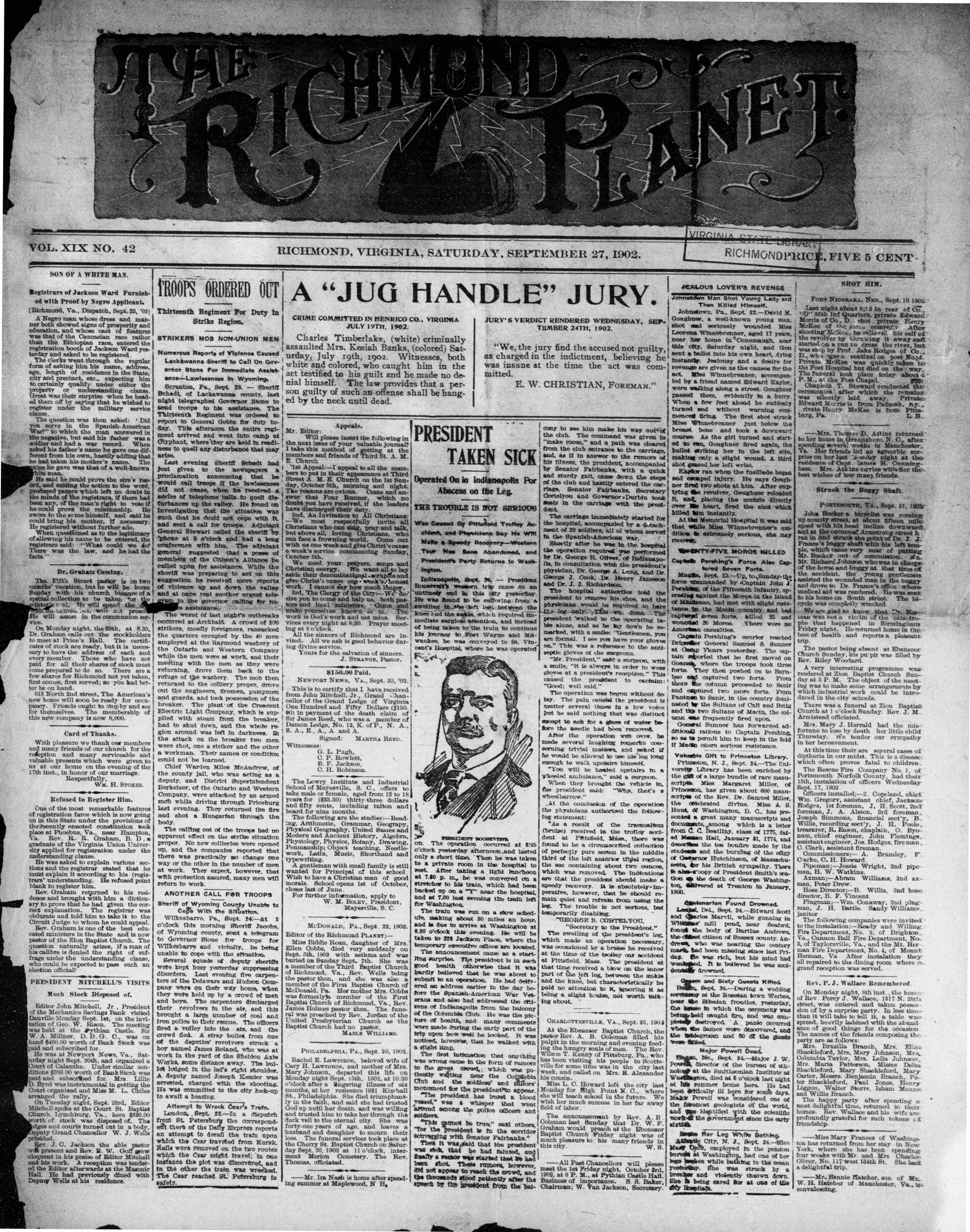
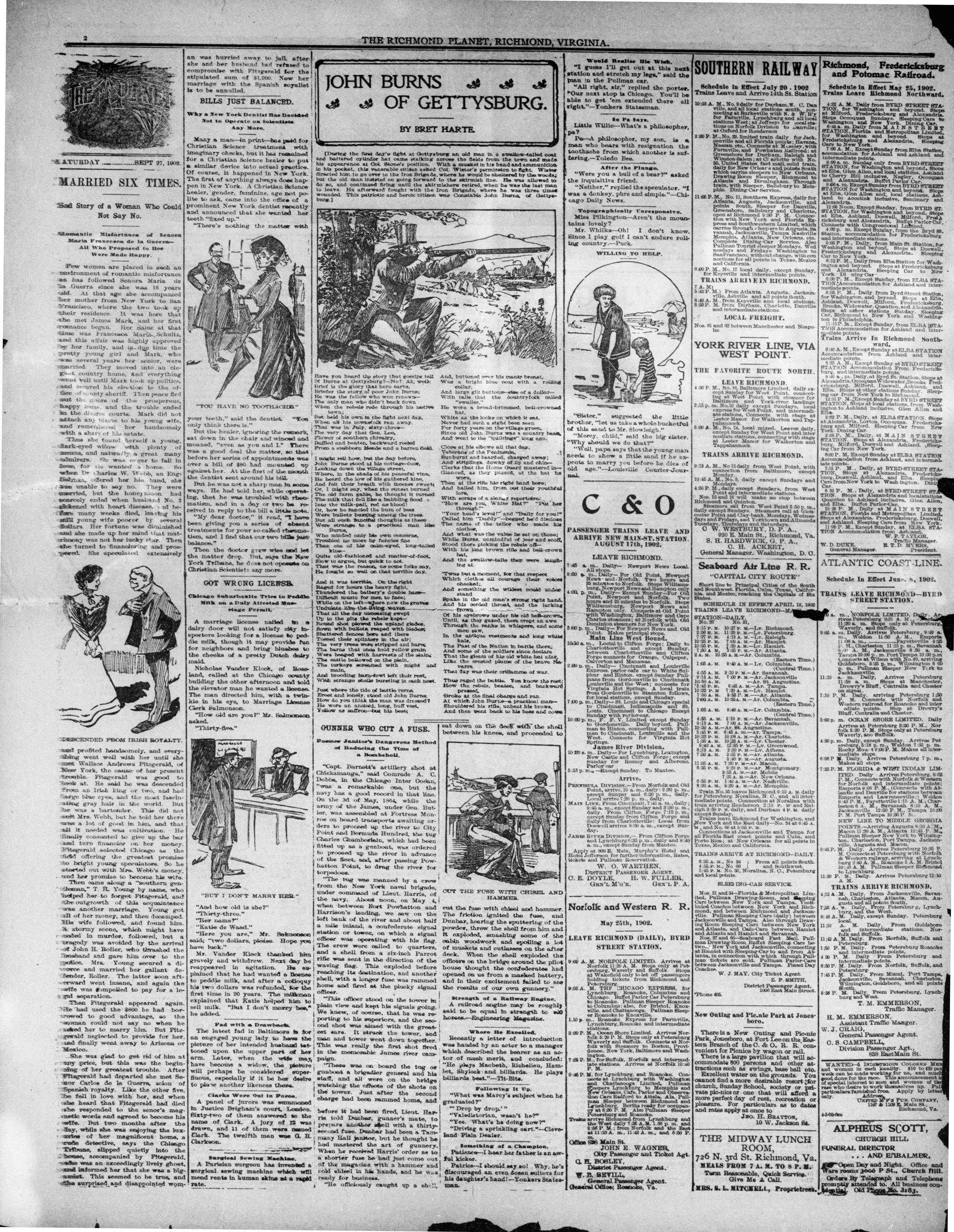
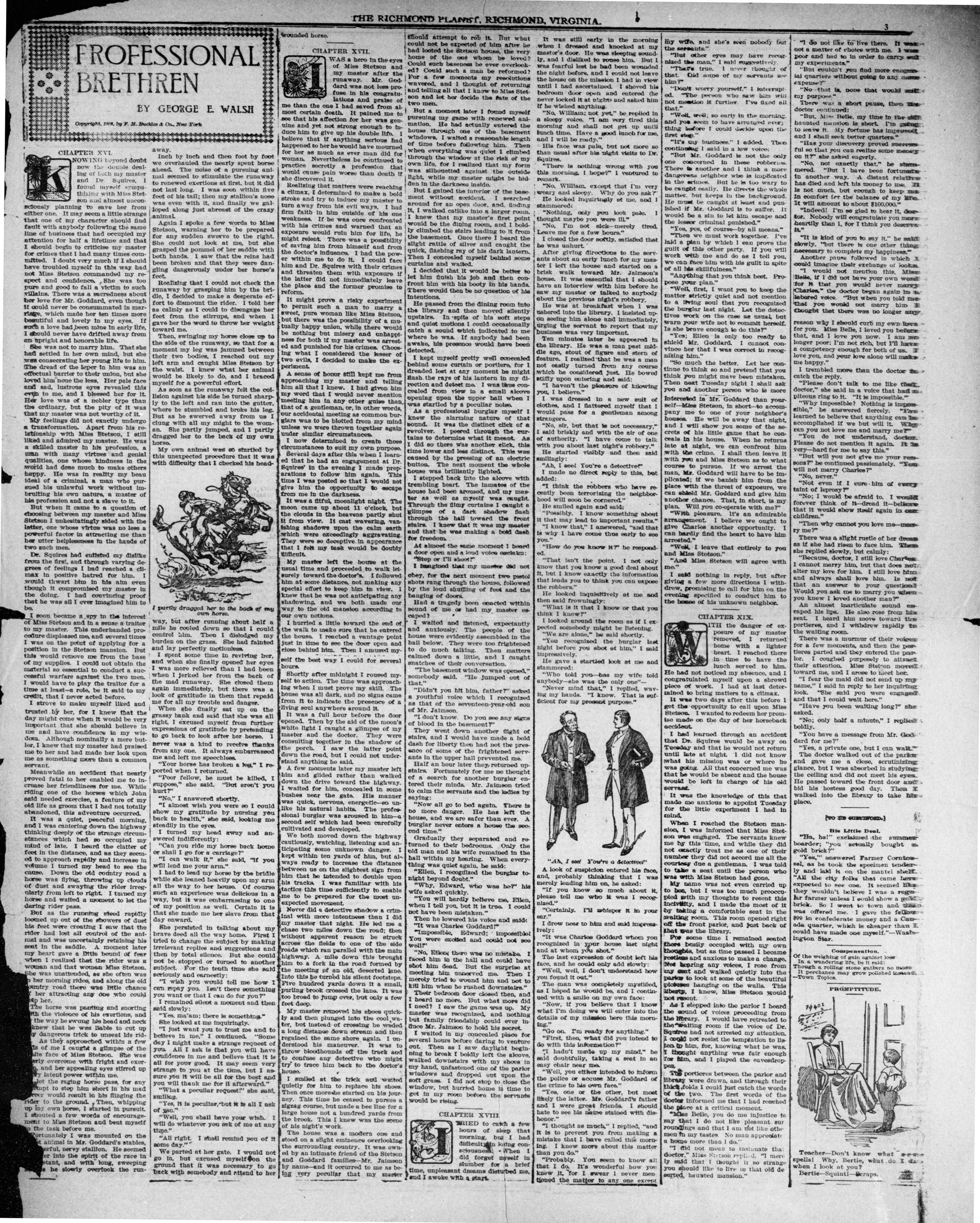
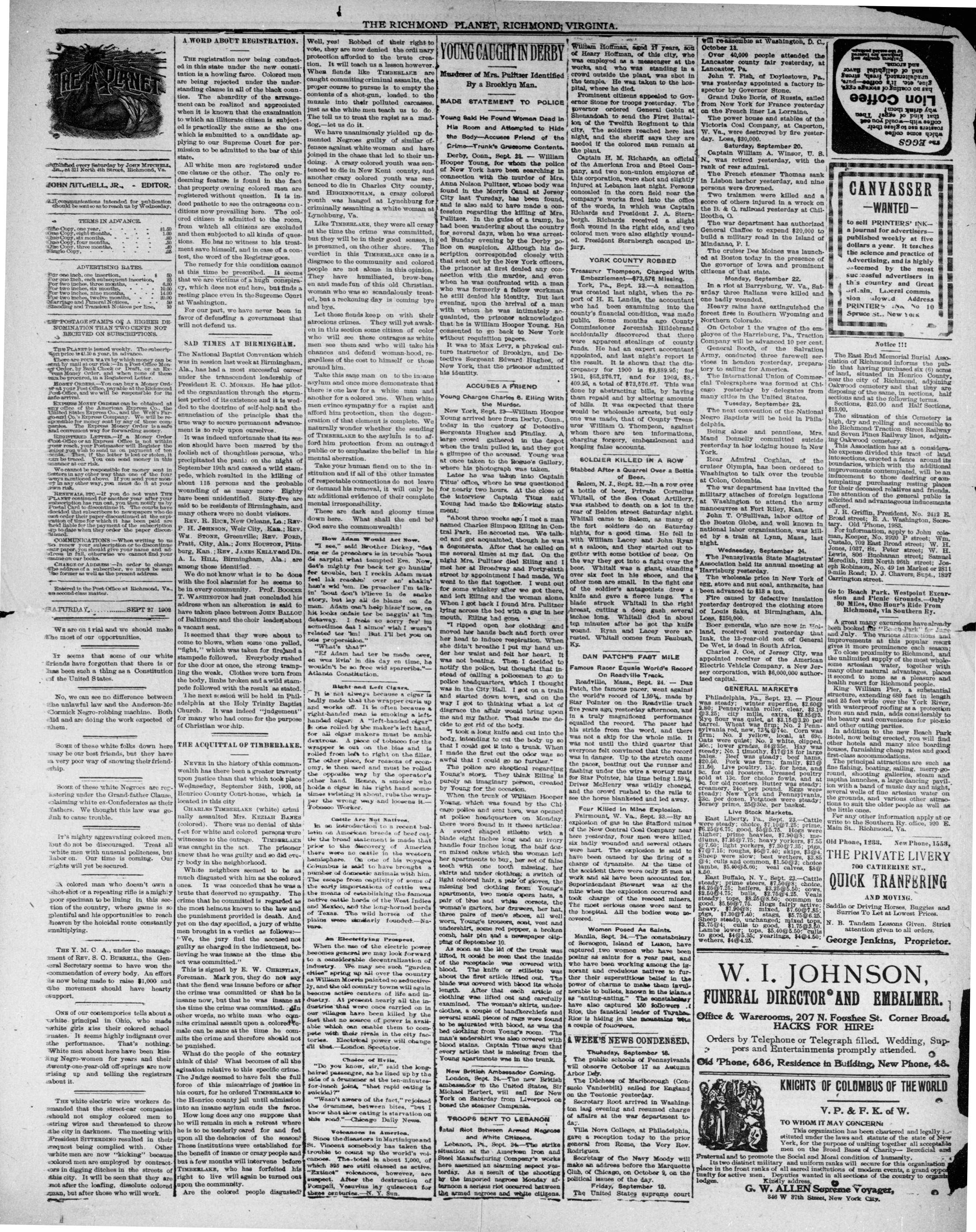
Page text (machine-generated)
THE RICHMOND PLANET
VOL. XIX NO. 42
SON OF A WHITE MAN.
Registrars of Jackson Ward Furnished with Proof by Negro Applicant. [Richmond, Va., Dispatch, Sept. 23, '03]
A Negro man whose dress and manner both showed signs of prosperity and education, and whose cast of features was that of the Caucasian race rather than the Ethiopian race, entered the registration booth of Jackson Ward yesterday and asked to be registered.
The clerks went through the regular form of asking him his name, address, age, length of residence in the State, city and precinct, etc., expecting him to certainly qualify under either the understanding clause. Great was their surprise, and the laid them off by saying that he wished to register under the military service clause.
The question was then asked: "Did you serve in the Spanish American War?" to which the man answered in the negative, but said his father was a soldier and had a war record. When asked his father's name he gave one different from his own, hastily adding that he had taken his mother's name. The same he gave was that of a well-known thief. He said he could prove the sire's record, and enlisting the action to the word, produced papar that left no doubt in the minds of the registrars, if there had been any, of the man's right to vote if he could prove the relationship. He swore to the same himself, and said he could bring his mother, if necessary. He registered without further ado. When questioned as to the legitimacy of allowing his name to be entered, the registrars said: "What could we do? There was the law, and he had the
Dr. Graham Coming.
The Fifth Street pastor is on two months' vacation, but he will be home Sunday with his church because of a special collection to be taken 'for the winter's goal. He will spend the day with the cannon but, will not preach. He will assist in the communion service.
On Monday night, the 20th, at 8.30, Dr. Graham calls out the stockholders to meet at Price's Hall. The certificates of stock are ready, but it is necessary to have the address of each and every member. Those who have not paid for all their shares of stock must come prepared to do so. There are a few shares for Richmond not yet taken, first comes, first served; so you had better be on hand.
613 North 2nd street, The American's new home will soon be ready for occupancy. Friends ought to stop by and see for themselves. The membership of this new company is now 8,000.
Card of Thanks.
With pleasure we thank our members and many friends of our church for the reception and many serviceable and valuable presents which were given to us at our home on the evening of the 17th inst., in honor of our marriage.
Refused to Register Him.
One of the most remarkable features of registration farce which is now going on in this State under the provisions of the recently enacted constitution book place at Phoebus, Va., near Hampton, Va. Rev. R. R. Graham, B. D. a graduate of the Virginia Union University applied for registration under the understanding clause.
He was asked to explain various sections and the registrar stated that he must explain it according to his (registrars' understanding. He refused point blank to register him.
Rev. Graham returned to his residence and brought with him a dictionary to prove that he had given the correct explanation. The registrar was obdurate and told him to take it to the Circuit Judge to whom he could appeal.
Rev. Graham is one of the best educated ministers in the State and is now pastor of the Zion Baptist Church. The question naturally arises, if a man of his calibre is denied the right of suffrage under the understanding clause, who could be expected to pass such an election official?
PRESIDENT MITCHELL'S VISITS
Much Stock Disposed of.
Editor John Mitchell, Jr., President of the Mechanics Savings Bank visited Danville Monday Sept. 1st, on the invitation of Geo. W. Rison. The meeting was held at the Pythian Castle. Sir W. A. Millner, D.D.G.C., was on hand $460.00 worth of Bank Stock was paid and subscribed for.
He was at Newport News, Va., Saturday night Sept. 20th, and organized a Court of Calanthe. Under similar conditions $380.00 worth of Bank Stock was paid and subscribed for. Mrs. Lillie D. Byrd was instrumental in getting the Court organized and Miss M. L. Chiles arrived on the night rally. On Tuesday Sept. 23rd, Editor Mitchell spoke at the Court St. Baptist Church, Lynchburg, Va., here $500.00 worth of stock was disposed of. The judges and courts turned out in a body, Deputy Grand Chancellor W. J. Wells presided.
Rev. J. C. Jackson the able pastor was present and Rev. R. H. Goff grew eloquent in his praise of Editor Mitchell and his work. A reception was tendered at the chapel in the historicasonic Hall. He had previously dined with Deporter Wells at his residence.
TROOPS ORDERED OUT
TROOPS ORDERED OUT
Thirteenth Regiment For Duty In Strike Region.
STRIKERS MOB NON-UNION MEN
Numerous Reports of Vigilence Caused Lackawanna Sheriff to Call On Governor Stone For Immediate Assistance—Lawlessness in Wyoming.
Scranton, Pa., Sept. 28. — Sheriff Schadt, of Lackawanna county, last night telegraphed Governor Stone to send troops to his assistance. The Thirteenth Regiment was ordered to report to General Gobhn for duty today. This afternoon the entire regiment arrived and went into camp at Glyphant, where they are held in readiness to quell any disturbance that may arise.
Last evening Sheriff Schadt had just given to the newspapers a proclamation announcing that he would call troops if the lawlessness did not cease, when he received a series of telephone calls to quell disturbances up the valley. He found on investigation that the situation was such that he could not cope with it, and sent a call for troops. Adjutant General Stewart called the Sheriff by 'phone at 9 o'clock and had a long conference with him. The adjutant general suggested that a pose of members of the Citizen's Alliance be called upon for assistance. While the sheriff was preparing to set on this suggestion he received more reports of violence up and down the valley and at once sent another urgent telegram to the governor calling for inju-
The worst of last night's outbreaks occurred at Archbold. A crowd of 200 strikers, mostly foreigners, ransacked the quarters occupied by the 40 men employed at the Raymond washery of the Ontario and Western Company while the men were at work, and their meeting with the men as they were returning, drove them back to the refuge of the washery. The mob then returned to the colliery proper, drove out the engineers, firemen, pumpmen and guards, and took possession of the breaker. The plant of the Crescent Electric Light Company, which is supplied with steam from the breaker, had to shut down, and the whole region around was left in darkness. In the attack on the breaker two men were shot, one a striker and the other a workman. Their names or condition could not be learned.
Chief Warden Miles McAndrew, of the county jail, who was acting as a deputy, and District Superintendent Berkelser, of the Ontario and Western Company, were attacked by an armed mob while driving through Priceburg last evening. They returned the fire and shot a Hungarian through the body.
The calling out of the troops had no apparent effect on the strikes situation proper. No new collieries were opened up, and the companies reported that there was practically no change one way or the other in the number of men at work. They expect, however, that with protection assured, many men will return to work.
ANOTHER CALL FOR TROOPS
Sheriff of Wyoming County Unable to Cope With the Situation.
Wilkesbarre, Pa., Sept. 24—At 2 o'clock this morning Sheriff Jacobs, of Wyoming county, sent a telegram to Governor Stone for troops for Wilkesbarre and vicinity, he being unable to cope with the situation.
Several squads of deputy sheriffs were kept busy yesterday suppressing disorders. Last evening five carpenters of the Delaware and Hudson Company were on their way home, when they were held up by a crowd of men and boys. The carpenters discharged their revolvers in the air, and this brought a large number of coal and iron police to their rescue. The officers fired a volley into the air, and the crowd fled. A stray bullet from one of the deputies' revolvers struck a boy named James Roland, who was at work in the yard of the Sheldon Axle Works, some distance away. The bullet lodged in the lad's right shoulder. A deputy named Joseph Kessler was arrested, charged with the shooting. He was committed to the city lock-up to await a hearing.
London, Sept. 23.—In a dispatch from St. Petersburg the correspondent edit there of the Daily Express reports an attempt to derail the train upon which the Czar traveled from Kursk. Halls were removed on the two routes which the Czar might travel; in one instance the plot was discovered, and in the other the train was wrecked. The Czar reached St. Petersburg in safety.
RICHMOND, VIRGINIA, SATURDAY, SEPTEMBER 27, 1902.
A "JUG HANDLE" JURY.
CRIME COMMITTED IN HENRICO CO., VIRGINIA JULY 19TH, 1902.
Charles Timberlake, (white) criminally assaulted Mrs. Keziah Banks, (colored) Saturday, July 19th, 1902. Witnesses, both white and colored, who caught him in the act testified to his guilt and he made no denial himself. The law provides that a person guilty of such an offense shall be hanged by the neck until dead.
Will please insert the following in the next issue of your valuable journal! I take this method of getting at the members and friends of Third St. A. M. E. Church
1st Appeal:—I appeal to all the members to put in their appearance at Third Street A. M. E. Church on the 1st Sunday, October 5th, morning and night. The reasons are obvious. Come and answer that Four Runner, which no doubts you have received, if the leaders have discharged their duty.
2nd, An Invitation to All Christians:—We most respectfully invite all Christians who can sing, pray and talk, but above all, loving Christians, who can face a frowning world. Come out with us one week and give Christ's cause a week's service commencing Sunday, October 5th.
We need your prayers, songs and Christian energy. We want all to lay aside their denominational scraps and give Christ's cause one week's honest work. I cannot say how much hunger.
3rd, The Clergy of the City. We desire you to come and help us, both pastors and local ministers. Come and make yourselves known to us. The work is God's work and not mine. Services every night at 8:30. Prayer meeting at 8 o'clock. All the sinners of Richmond are invited. All we ask is good behavior during divine service. Yours for the salvation of sinners. J. STRANGE, Pastor.
8150.00 Paid
This is to certify that I have received from John Mitchell, Jr., Grand Chancellor of the Green Lodge of Virginia One Hundred and Fifty Dollars ($150,00) in payment of the death clause of Sir James Reed, who was a member of Damon Lodge, No. 12, K of P., N. A., S. A. E., A., A. and A.
The Lowry Institute and Industrial School of Mayesville, S. C., offers to take male or female, aged from 12 to 18 years for ($33.50) thirty-three dollars and fifty cents, including tutton and board for nine months.
The following are the studies:—Reading, Arithmetic, Grammar, Geography, Physical Geography, United States and Modern and Ancient History, Algebra, Physiology, Physics, Botany, Drawing, Penmanship; Object teaching, Needlework, Latin, Music, Shorthand and typewriting.
A gentleman with small family is still wanted for Principal of this school. Wish to have a Christian man of good morals. School opens 1st of October, closes last of June.
For further information, apply to W. M. BOLLEY, President, Mayesville, S. C.
McDONALD, P.A., Sept. 22, 1902.
Editor of the Richmond PLANET:
Miss Biddie Roan, daughter of Mrs. Ellen Cobbs, died very suddenly on Sept. 5th, 1902 with asthma and was buried on Sunday Sept. 7th. She was a member of the Third Baptist Church of Richmond, Va., Rev. Wells being the pastor then, and she was also a member of the First Baptist Church of McDonald, Pa. Her mother Mrs. Cobbs was formerly a member of the First Baptist Church of Richmond, Va., Rev. James Holmes pastor then. The funeral was preached by Rev. Jordan of the United Presbyterian Church as the Baptist Church had no pastor.
MABLE WILLIAMS.
PHILADELPHIA, PA., Sept. 20, 1902.
Rachel E. Lawrence, beloved wife of Cary H. Lawrence, and mother of Mrs. Mary Johnson, departed this life on Monday night Sept. 15th, 1902, at 10:30 o'clock after a lingering illness of six months, at her residence 1921 Kimball St. Philadelphia. She died triumphantly in the faith, and said she had trusted God up until her death, and was willing and trusted him to take her through the dark veil to the eternal city. She was forty-one years of age, and leaves a husband and daughter to mourn their loss. The funeral services took place at the Cherry St. Baptist Church on Saturday Sept. 20, 1902 at 11 o'clock, interment Marion Cemetery. The Rev. Thomas, officiated.
Mr. Ira Nash is home after spending summer at Maplewood. N H.
JURY'S VERDICT RENDERED WEDNESDAY, SEPTEMBER 24TH, 1902.
"We, the jury find the accused not guilty, as charged in the indictment, believing he was insane at the time the act was committed.
E. W. CHRISTIAN, FOREMAN."
Operated On in Indianapolis For Abscess on the Leg.
THE TROUBLE IS NOT SERIOUS
Was Caused By Pittfield Trotley Accident, and Phyololana Say He Will Make a Speedy Recovery—Western Tour Has Been Abandoned, and President's Party Returns to Washington.
Indianapolis, Sept. 31. — President Roepeus's western trip came to an untimely end in this city yesterday. He was bound to be suffering from a swelling in the left leg, between the knee and the angle, which required immediate surgical attention, and instead of being taken to the train to continue his journey to Fort Wayne and MHawkeen, he was conveyed to St. Vincent's Hospital, where he was operated
T.
PRESIDENT ROOSEVELT
on. The operation occurred at 8:45 o'clock yesterday afternoon and lasted only a short time. Then he was taken to a private room in the hospital to rest. After taking a light luncheon at 7.80 p. m., he was conveyed on a stretcher to his train, which had been backed up on a "Y" near the hospital, and at 7.80 l'evening the train left for Washington. The train was run on a show schedule, making about 30 miles an hour and is due to arrive at Washington at 6.80 o'clock this evening. He will be taken to 228 Jackson Place, where the temporary executive offices are located.
The announcement came as a startling surprise. The president is in such good health otherwise that it was hardly believed that he was about to submit to an operation. He had delivered an address earlier in the day before the Spanish-American War Veterans and also had addressed the citizens of Indianapolis from the balcony of the Columbia Club. He was the picture of health, and many comments were made during the early part of the trip upon how well he looked. It was noticed, however, that he walked with a slight limp.
The first intimation that anything was wrong came in the form of rumors to the great crowd, which was patiently waiting near the Columbia Club and the soldiers' and soldiers' monument for the president to appear.
"The president has burst a blood vessel" was a whisper that went around among the police officers and soldiers.
"This cannot be true," said others, "for the president is in the corridor converging with Senator Falkbanka." Then it was, said that the president was sick, that he had fainted, and finally a senator was started that he had been shot. These rumors, however, did not appear to reach the crowd, and the thousands stood patiently after the speech by the president from the bal-
cony to see him make his way out of the club. The command was given to "make room," and a path was cleared from the club entrance to the carriage, and, as if in answer to the rumors of his illness, the president, accompanied by Senator Fairbanks, with a quick and sturdy gait, came down the steps of the club and hastily entered the carriage. Senator Fairbanks, Secretary Cortelyou and Governor Durbin took seats in the carriage with the president.
The carriage immediately started for the hospital, accompanied by a detachment of 20 soldiers, all of whom served in the Spanish-American war.
Shortly after he was in the hospital the operation required was performed by Dr. George H. Oliver, of Indianapolis, in consultation with the president's physician, Dr. George A. Lung, and Dr. George J. Cook, Dr. Henry Jameson and Dr. J. J. Richardson.
The hospital authorities told the president to remove his shoe, and the physicians would be required to bare the leg only. This was done. The president walked to the operating table alone, and as he lay down he remarked, with a smile: "Gentlemen, you are formal. I see you have your gloves on." This was a reference to the antiseptic gloves of the surgeons.
"Mr. President," said a surgeon, with a smile, "it is always in order to wear gloves at a president's reception." This caused the president to exclaim: "Good; well said."
The operation was begun without delay. The pain caused the president to utter several times in a low voice but he said nothing that was distinct except to ask for a glass of water before the needle had been removed.
After the operation was over, he made several laughing remarks concerning trivial matters, and asked if he would be allowed to use his leg long enough to walk upstairs himself.
"You will be hosed upstairs in a wheeled ambulance," said a surgeon. When they brought the vehicle in, the president said: "Why, that's a wheebarrow."
At the conclusion of the operation the physicians authorised the following statement:
"As a result of the traumaticism (bruise) received in the troticle accident at Ptitsfield, Masa, there was found to be a circumscribed collection of perfectly pure serum in the middle third of the left anterior thigh region, the sac containing about two ounces, which was removed. The indications are that the president should make a speedy recovery. It is absolutely imperative, however, that he should remain quiet and refrain from using the leg. The trouble is not serious, but temporarily disabling.
GEORGE B. CORTELYOU
"Secretary to the President."
The swelling of the president's leg, which made an operation necessary, was occasioned by a bruise he received at the time of the trolley car accident at Pittsfield, Mass. The president at that time received a blow on the inner part of the left leg, between the snake and the knee, but characteristically he paid no attention to it, ignoring it as being a slight bruise, not worth talking about.
CHARLOTTESVILLE, VA., Sept. 28, 1902
At the Ebenezer Baptist Church, the pastor Rev. A. B. Coleman filled his pulpit in the morning and evening feeding the hungry souls of man. The Rev. Wilson T. Kenny of Pittsburg, Pa., who has been visiting his people in Scottville for some time was in the city last week, and called on Mrs. E. Alexander his cousin.
Miss L. C. Howard left the city last Monday for High Point N. C., where she will teach school in the future. We wish her much success in her far away field of labor.
The announcement by Rev. A. B. Coleman last Sunday that Dr. W. F. Graham would preach at the Ebenezer Baptist Church Friday night was of much pleasure to his many friends in this city. W. S.
All Past Chancellors will please meet the 1st Friday night, October 3rd, 1902, at 8 P. M., at Pythian Castle Hall. Business of importance. S. S. Baker, Chairman; W. Van Jackson, Secretary.
JEALOUS LOVER'S REVENGE
Johnstown Man Shot Young Lady and Then Killed Himself.
Johnstown, Pa., Sept. 22.—David M. Goughner, a well-known young man, shot and seriously wounded Miss Leorena Winnebrenner, aged 17 years, near her home in *Conemaugh*, near this city, Saturday night, and then sent a ballet into his own heart, dying instantly. Jealousy and a desire for revenge are given as the causes for the act. Miss Winnebrenner, accompanied by a friend named Edward Kaylor, were walking along a street. Goughner passed them, evidently in a hurry. When a few feet ahead he suddenly turned and without warning commenced dring. The first shot struck Miss Winnebrenner just below the breast bone and took a downward course. As the girl turned and started to run, Goughner fired again, the bullet striking her in the left side, making only a slight wound. A third shot grazed her left wrist.
Kaptur ran when the fusillade began and camped injury. He says Goughner fired two shots at him. After emptying the revolver, Goughner reloated it, and placing the mutule directly over the heart, fired the shot which killed him instantly.
At the Memorial Hoeppital it was said that while Miss Winnebrenner's condition is extremely serious, she may recover.
Captain Pershing's Force Also Captured Seven Ports.
Mauira, Sept. 23—Up, to, Sunday—the force commanded by Captain John J. Pershing, of the Fifteenth Infantry, operating against the Moros in the island of Mundanao, had met with slight resistance in the Machin country, and had captured seven forts, killed 25 and wounded 20 Moros. There were no American casualties.
Captain Pershing's courier reached Brigade General Samuel S. Sumner at Camp Vcars yesterday. The captain reported that he first moved on Goaana, where the troops took three forts. They then pushed on to Baybao and captured two forts. From there the column proceeded to Sanir and captured two more forts. From Pantnun to Sanir, in the country dominated by the Sultans of Calf and Butig and the two Sultans of Macin, the column was frequently fired upon.
General Summer has forwarded additional ratios to Captain Pershing so as to permit him to keep in the field If McCain offers serious resistance.
Vauable Gift to Princeton Library
Valuable Gift to Princeton Library-
Princeton, N. J., Sept. 24.—The Uni-
versity Library has been enriched by
the gift of a large bundle of rare manu-
scripts. Miss Margaret Miller, of
Princeton, has given about 600 manu-
scripts of the Rev. Dr. Samuel Miller,
the celebrated divine. Miss A. S.
Hunt, of Washington, D. C., has pro-
presented a great many manuscripts and
documents, among which is a letter
from C. C. Beatliny, class of 1775, dated
Mannau Hall, January 21, 1774, and
describes the tea bonfire made by the
students and the burning of the effigy
of Governor Hutchinson, of Massachusetts,
for his British sympathy. There
is also a copy of President Smith's oration
on the death of George Washington,
delivered at Trenton in January,
1800.
Contenant Found Drowned
Louisel Del, Sept. 24.—Edward Scott and Charles Marvil, while gunning in Whitman mill pond, near Seaford, found the body of Bartine Andrews, the oldest citizen of Sussex county. Andrews, who was nearing the century mark, had been missing since last Friday. He was rich, but his mind had weakened. It is believed he was accidentally drowned.
Groom and Sixty Gunata Killed
Boston, Sept. 24.—During a wedding ceremony at the Russetan town Webzey, near the Sileian frontier, yesterday, the house in which the ceremony was being held caught fire, and was completely destroyed. A pane occurred when the flames were discovered, and the bishoproom and 60 of the guests were killed.
Major Powell Dead
Bingham, Me., Sept. 24. — Major J. W.
Powell director of the bureau of ethnology at the Smithsonian Institute at Washington, died at 8 o'clock last night at his summer home here. He had been critically ill here for some days.
Major Powell was considered one of the foremost geologists of the world, and was identified with the scientific work of the government since the early sixties.
Bronze Her Leg White Bathing.
Atlantic City, N. J., Sept. 24. — Miss Mary Cook, employed in the pension bureau at Washington, had one of her legs broken while bathing in the ocean yesterday. She was struck by a breather and violently thrown down. She is being cared for at one of the city hospitals.
SHOT HIM.
FORT NORRARE, NEB., Sept. 18 1902
Little night about 8:15 in rear of Edo.
"D" 25th Inf Quarters, private Edward
Morris of Co. D., shot, private Henry
McKee of the same company,
shooting McKee, he relieved his self
of the revolver by throwing it away and
started on a run to cross the river, but
was stop by Prof. Jake Rodges of Co.
D., who was a sentimental on post Noyd.
Private McKee was quickly taken to
the Post Hospital but died on the way.
The funeral took place today about
4 P.M., at the Post Chapel.
Chaplain T. Steward conducted the
ceremonies after which the remains
was silently laid away. Private
Edward Morris is from Paduwah, Ay.
, private Henry McKee is from Pitis-
burg, Pa.
—Mrs. Thomas D. Attins returned to her home in Greenbore, N. C., after spending several weeks to Manchester, Va. Her friends led an agreeable surprise on her last Monday night at the residence of Capt. James H. Cunningham. Mrs. Attins carries with her the best wishes of her many friends.
Strack the Buggy Shaft
John Bocker a bicyclist was coming up county street, at about fifteen mile speed with his head incline downward and at the cornwall Armstrong street he ran in and struck the point of Dr. J. J. France's buggy shaft with his left temple, which came very near of putting Mr. Bocker out of commission. Mr. Richard Johnson who was in charge of the horse and buggy at that time of the accident, the young gentlemen assisted the wounded man in the buggy and drove to Dr. France's office where medical aid was rendered. He was sent to his home on South street. The bicycle was completely wrecked.
We are glad to know that Dr. Norman was not a victim of the catastrophe that happened in Birmingham Friday night. He returned home in the best of health and reports a pleasant trip.
The pastor being absent at Ebenezer Church Sunday, his pu pit was filled by Rev. Riley Woolard.
A very interesting programme was rendered at Zion Baptist Church Sunday at 3 P. M. The object of the meeting was to make some arrangements by which industrial work could be introduced in the city schools.
There was a funeral at Zion Baptist Church at 1 o'clock Sunday. Rev. J. M. Armistead officiated.
Mrs. Mary J. Harrald had the misfortune to lose by death her little child Thursday. We tender our sympathy in her bereavement.
At this time their are several cases of diptheria in our midst. This is a disease which often proves fatal to children.
The Rescue Fire Company No. 1, of Portsmouth Norfolk County, had their 15th, installation of officers Wednesday Sept. 17, 1902.
Officers installed;—Z. Copeland, chief Wm. Gregory, assistant chief, Jackson Hodges, 1st foreman, J. H. Scott, 2nd foreman, J. A. Alston, 3rd foreman, Joseph Simmons, financial sect'y, B. Willis, recording sect'y, J. H. Poole, treasurer, R. Eason, chaplain, O. Byonum, chief engineer, John Flemlings, assistant engineer, Jos. Hodges, fireman, C. Clark, assistant fireman.
Commissioners;—A. Brumley, F. Clarke, C. H. Howard.
Pipeman;—Jessie Wright, 2nd pipeman, H. W. Watkins.
Axman;—Abam Williams, 2nd axman, Peter Drew.
Hose Director;—B. Willis, 2nd hose director, B. F. Vincent.
Plugman;—Wm. Conaway, 2nd plugman, J. H. Battle, Sandy Williams, janitor
The following companies were invited to the installation;—Ready and Willing Fire Department, No. 2, of Brighton, Va., Cannon Ball Fire Department, No. 3, of Taylorsville, Va., and the Mt. Herman Fire Department, No. 4, of Mount Herman, Va. After installation they all repaired to the dining room where grand reception was served.
Rey, P. J. Wallace Remembered
On Monday night, 8th inst., the home of Rev. Percy J. Wallace, 1817 N. 28th street, was entered and taken possession of by a surprise party. In less time than it will take to tell it, a table was spread, heavily ladened with the abundance of good things for the occasion. The names of the friends composing the party are as follows: Mrs. Brusilla Branch, Mrs. Eliza Shackleford, Mrs. Mary Johnson, Mrs. Columbia Taylor, Mrs. Lelia Johnson, Mrs. Metterson, Misses Delia Shackleford, Mrs. Shackleford, Mary Carter, Messrs. Bansor Branch, Peter Shackleford, Paul Jones, Henry Liggon, Walter Storrs, Isham Manns and Willie Branch.
The happy party after spending a most delightful time, returned to their homes. Rev. Wallace and his wife are profoundly grateful for such tokens of friendship.
Miss Mary Frances of Washington has returned from her stay in New York, where she has been spending four weeks with Mr. and Mrs Charles Oliver, No. 117 west 134th St. She has a delightful trip.
Mr. Bennie Hatcher, son of Mr. W. H. Hatcher of Manchester, Va., is convalescing.
THE PENN
MARRIED SIX TIMES.
Bad Story of a Woman Who Could Not Say No.
Romantic Misfortunes of Senora Maria Francesca de la Guerra—
All Who Proposed to Her Were Made Happy.
Few women are placed in such an environment of romantic misfortunes as has followed Senora Maria de la Guerra since she was 16 years old. At that age she accompanied her mother from New York to San Francisco, where the two took up their residence. It was here that she met James Mark, and her first romance began. Her name at that time was Francesca Marsh, Schultz, and this affair was highly approved by her family, and in due time the pretty young girl, Mark, who was several years her senior, were married. They moved into an elegant country home, and everything sweat well until Mark took up politics, and secured his election to the office of county sheriff. Then peace fled out the doors of the prosperous, happy home, and the trouble ended in the divorce courts. Mark did not attach any blame to his young wife, and remembered her handsomely with a share of his estate.
Thus she found herself a young, dark-eyed wilow with plenty ofreams, and naturally a great manyadmirers. She was eager to fall in love, for she wanted a home. So when Dr Charles W. Webb, an Englehman, offered her his hand, she was unable to say no. They weremarried, but the honeymoon hadscarcely ended when husband No. 2skicked with heart disease, and before many weeks died, leaving his still young wife poorer by severaldollars. Her fortune was diminishedand she made up her mind that matrimony was not her lucky star. Thenshe turned to financiering andpropered. She speculated extensively
A
CESCENDED FROM IRISH ROYALTY.
and profited handsomely, and everything went well with her until she met Wallace Andrews Fitzgerald, of New York, the cause of her present trouble. Fitzgerald was good to look at. He said he was descended from an Irish king or two, and had large blue eyes, and the most fascinating gray hair in the world. But he was a bartender. This did not hurt Mrs. Webb, but he told her there was a lot of good in him, and that all it needed was cultivation. He finally consented to give up the bar and turn financier on her money. Fitzgerald selected Chicago as the field offering the greatest promise to bright young speculators. So he started out with Mrs. Webb's money, and her promise to become his wife.
Then came along a "southern gentleman," T. H. Young by name, who helped her to forget Fitzgerald, and the outgrowth of this acquaintance was another marriage. Young got all of her money, and then decamped. His wife followed, and found him. A stormy scene, which might have ended in murder, followed, but a tragedy was avoided by the arrival of John H. Roller, who thrilled the husband and gave him over to the police. Mrs. Young secured a divorce and married her gallant defender, Roller. The latter soon afterward went insane, and again the wife was compelled to pay for a legal separation.
Then Fitzgerald appeared again. He had used the $800 he had borrowed to good advantage, so the woman could not say no when he asked her to marry him. But Fitzgerald neglected to provide for her, and finally went away to Arizona or Mexico.
She was glad to get rid of him at any price, but this was the beginning of her greatest trouble. After Fitzgerald had departed she met Senator Carlos de la Guerra, sconction of Spanish royalty. Like the other five, he fell in love with her, and when she heard that Fitzgerald had died she responded to the senor's magnetic words and agreed to become his wife. But two months after the day, while she was enjoying the luxuries of her magnificent home, a crude detective, says the Chicago Tribune, slipped quietly into the house, accompanied by Fitzgerald, who was an exceedingly lively ghost, and informed her that she was a big mistress. This seemed to be true, and the surprised and disappointed wom-
an was hurried away to jail, after she and her husband had refused to compromise with Fitzgerald for the stipulated sum of $1,000. Now her marriage with the Spanish royalist is to be annulled.
BILLS JUST BALANCED.
Why a New York Dentist Has Decided Not to Operate on Scientists Any More.
Many a man—in print—has paid for Christian Science treatment with imaginary checks, but it has remained for a Christian Science healer to put a similar device into actual practice. Of course, it happened in New York. The first of anything always does happen in New York. A Christian Science healer, gender, feminine, age not polite to ask, came into the office of a prominent New York dentist recently and announced that she wanted her teeth "fixed up." "There's nothing the matter with
"YOU HAVE NO TOOTHACHR."
your teeth," said the dentist. "You only think there is." But the healer, ignoring the remark, sat down in the chair and winced and moaned, "even as you and I." There was a good deal the matter, so that before her series of appointments was over a bill of $80 had mounted up against her. At the first of the month the dentist sent around his bill. But he was not a sharp man in some ways. He had told her, while operating, that he was troubled with rheumatism, and in a day or two he received in reply to the bill a little note. "My dear doctor," it read, "I have been giving you a series of absent treatments for your so-called rheumatism, and I find that our two bills just balance." Then the doctor grew wise and let the matter drop. But, says the New York Trhane, he does not operate on Christian Scientists any more.
GOT WRONG LICENSE
Chicago Suburbite Trips to Peddle Milk on a Duly Attested Masse-
sage Permit.
A marriage license nailed to a dairy door will not satisfy city inspectors looking for a license to peddle milk, though it may provide fun for neighbors and bring bluesbees to the cheeks of a pretty Dutch dairy maid.
Nicholas Vander Klock, of Rosland, called at the Chicago county building the other afternoon and told the elevator man he wanted a license. The man directed him, with a twinkle in his eye, to Marriage License Clerk Salmonson.
"How old are you?" Mr. Salmonson asked.
"Thirty-five."
"BUT I DON'T MARRY HER."
"And how old is she?"
"Thirty-three."
"Her name?"
"Katie de Waud."
"Here you are," Mr. Salmonson said; "two dollars, please. Hope you have luck."
Mr. Vander Klock thanked him gravely and withdrew. Next day he reappeared in agitation. He explained that he had wanted a house to peddle milk, and after a colloquy his two dollars was refunded, for the first time in 20 years. The milkman explained that Katie helped him to sell milk. "But I don't merry bee," he added.
Fad with a Drawback.
The latest fad in Baltimore is for an engaged young lady to have the picture of her intended husband tattooed upon the upper part of her arm. Later, when the wife may have become a widow, the picture will perhaps be considered: superfluous, especially if it be her desire to place another likeness there.
Clarks Were 0pt in Rows
Clarks Were Out in Forces.
A panel of jurors was summoned in Justice Brigham's court, London. Sixty-two of them answered to the name of Clark. A jury of 12 was drawn, and 11 of them were named Clark. The twelfth man was G. H. Clarkson.
Surgical Sewing Machine.
A Parisian surgeon has invented a surgical sewing machine which will mend rents in human skins at a rapid rate.
THE RICHMOND PLANET, RICHMOND, VIRGINIA
JOHN BURNS OF GETTYSBURG.
[During the first day's fight at Gettysburg an old man in a swallow-tailed coat and battered cylinder hat came stalking across the fields from the town and made his appearance at Col. Stone's position. With a musket in his hand and ammunition in his hand he marched to the battlefield and directed him to go over to the Iron Brigade, where he would be sheltered by the war but the old man insisted on going forward to the skirmish line. He was allowed to do so, and continued firing until the skirmishers retired, when he was the last man to leave. He afterward fought with the Iron Brigade, where he was three times armed. This patriotic and heroic citizen was Constable John Burma, of Gettysburg.]
M. W.
Have you heard the story that gooses tell of Burns at Gettysburg?—No? Ah, well: Brief is the glory that hero earns, Brief is the story of poor John Burns; Brief is the story of you renown. The only man who did not bet down When the rebels rode through his native town; But held his own in the fight next day, When all his townfolk ran away. That was in July, sixty-three. That was in July, sixty-three. Flower of southern chivalry, Buffled and beaten, backward reed From a stubborn Mecca and a barren field. I might tell how, but the day before, John Burns stood at his cottage door, Looking down the village street. Where, in the shade of his peaceful vine, He heard the low of his gathered kine, And felt their breath with incense sweet; Or, I might say, when the sunset burned Out the milk that fell like a babbling flood Into the milk-pail, red as blood! Or, how he fancied the hum of bees We were bullets burning among the trees But all such funnelled thoughts as thee Were strings to a practical man like
Who minded only be own concerne,
Troubled no more by fancies fine
Than one of his oain-eyed, long-tailed
tine.
Quite old-fashioned and matter-of-fact,
Slow to argue, but quick to act.
That was the reason, as some folks say,
He fought so well on that terrible day.
And it was terrible. On the right
Ragged for hours the heavy fight,
Thundered the battery's double bass—
Difficult music for men to face;
While on the left—where now the graves
Undulates like the living waves.
Threatened fences here and there
Up to the pits the rebels kept—
Round shot plowed the upland glades,
Sown with bullets reaped with blades;
Shattered fences here and there
The very trees were stripped and barred;
The barns that once held yellow grain
Were heaped with harvests of the slain;
The cattle beloved on the plain;
The turkeys screamed with might and
And brooding barn-fowl left their reest,
With strange shells bureting in each nest.
Just where the tide of battle turns,
Erect and lean, stood old John Burns.
How do you think the man was dressed?
Erect, Erect, Erect,
Yellow as an airplane—but his heels.
GUNNER WHO CUT A FUSE.
Posner Janitor's Dangerous Method of Reducing the Time of a Bombshell.
"Capt. Barnett's artillery shot at Chickamauga," said Comrade A. C. Dobbs, in the Chicago Inter Ocean, "was a remarkable one, but the navy has a good record in that line. On the 3d of May, 1864, while the army of the James, under Gen. Butler, was assembled at Fortress Monroe on board transports awaiting orders to proceed up the river to City Point and Bermuda Hundred, the tug Charles Chamberlain, which had been fitted up as a gunboat, was ordered to proceed up the river in advance of the fleet, and after passing Powhaton Point, to drag the river for torpedoes.
"The tug was manned by a crew from the New York naval brigade, under command of Lieut. Harris, of the navy. About noon, on May 4, when between Fort Powhaton and Harrison's landing, we saw on the loft bank of the river and about half a mile inland, a confederate signal station or tower, on which a signal officer was operating with his flag. The crew were called to quarters, and a shell from a six-inch Parrot rifle was sent in the direction of the waving flag. This exploded before reaching its destination, and another shell, with a longer fuse was rammed home and fired at the plucky signal officer.
"This officer stood on the tower in plain view and kept his signals going. We knew, of course, that he was reporting to his superiors, and the second shot was aimed with the greatest ear. It struck the tower, and man and tower went down together. This was really the first shot fired in the memorable James river campaign.
"These was on board the tug or gunboat a brigadier general and his staff, and all were on the bridge watching the effects of the shots on the tower. Just after the second charge had been rammed home, and
before it had been fired, Lieut. Harris told Dunbar, gunner's mate, to prepare another shell with a thirty-second fuse. Dunbar had been a Tammany Hall junior, but he thought he had mastered the art of gunnery. When he received Harris' order as to a shorter fuse he had just come out of the magazine with a hammer and cold chisel in his hands, and be was ready for business.
"He officiously caught up a shell."
And, buttoned over his manly breast,
Was a bright blue coat with a rolling
And large gilt buttons—else of a dollar—
With talle that the countryfolk called
"swaller."
He wore a broad-brimmed, belli-crowned
hat.
White as the books on which it sit,
Never had such a sight been seen
For forty years on the village green,
For years on the country beast,
And went to the "quiltings" long ago.
Closes at his elbows all that day.
Veterans of the Fennhill.
Then at the rite he right hand bore;
And hallaled him, from out their youthful
lore,
With sorape of a slammy repertoire:
"How are you, White Hat?" "Put her
"Your hand's level!" and "Bully for you!"
Called him "Daddy"—begged he'd discloses
The name of the tailor who made his
clothes,
And what was the value he set on those;
While Burns, unmindful of year and scoff,
Stood there picking the rebels off—
With his long brown rife and bell-crown
at.
And the swallow-tails they were laugh-
ing at.
"Twus but a moment, for that respect
White clothes all courage their voices
choose!
And something the wildest could unde-
stand
Spake in the old man's strong right hand,
And his oiled throat, and the lurking
trown.
Of his eyebrows under his old bell-crown,
Until they may gaze, there crept an awa
Through the snakes in whispers, and some
mow saw.
In the unique vestments and long white
hals.
The Past of the Nation in battle there;
And some of the soldiers since decollar
That the crested plume of the brave Navarre.
Like the crested plume of the brave Navarre.
That day was their oriflamme of war.
Thus raged the battle. You know the roost,
How the rebels, beaten, and backward
pressed.
present,
broke his final charge and ran.
At which John Burns—a practical man—
shouldered his rifle, unbent his brows,
and then went back to his bees and cows.
sat down on the deck with the shell
between his knees, and proceeded to
CUT THE FUSE WITH CHISEL AND HAMMER.
CUT THE FUSE WITH CHISEL AND HAMMER.
cut the fuse with chisel and hammer. The friction ignited the fuse, and Dunbar, hearing the sputtering of the powder, threw the shell from him and it exploded, smashing some of the cabin woodwork and spooling a lot of muskets and cutlasses on the after deck. When the shell exploded the officers on the bridge around the pilot house thought the confederates had opened on us from a masked battery, and in their excitement failed to see the results of our own gunnery."
Strength of a Railway Engine. A railroad engine may be roughly said to be equal in strength to 300 horses.—Engineering Magazine.
Where Be Excelled
Receantly a letter of introduction was handed by an actor to a manager which described the bearer as an actor of much merit, and concluded: "He plays Mabeth, Richelieu, Hamlet, Shylock and billiards. He plays billiards beat."—Tt-Bits.
Following It Up.
"What was Marcy's subject when he graduated?"
"Driving a sprinkling cart."—Cleveland Plain Dealer.
Patrice-I should say so! Why, he's discouraged an even dozen suitors for his daughter's hand!-Yonkers Statesman.
Would Realize His Wish.
"I guess I'll get out at this next station and stretch my legs," said the man in the Pullman car.
"All right, sir," replied the porter.
"Our next stop is Chicago. You'll be able to get em extended there all right."—Yonkers Statesman.
So Pa Sayz.
Little Willie—What's a philosopher, pa?
Pe—A philosopher, my son, is a man who bears with resignation the toothache from which another is suffering.—Toledo Bee.
After the Plunge.
"Were you a bull of a bear?" asked the inquisitive friend.
"Neither," replied the speculator. "I was a donkey, pure and simple."—Chicago Daily News.
Topographically Unresponsive.
Miss Pilkington—Aren't the mountains lovely?
Mr. Whilks—Oh! I don't know. Since I play golf I can't endure rolling country.—Puck.
WILLING TO HELP.
"Sister," suggested the little brother, "let us take a whole bucketful of this sand to Mr. Slowleich."
"Mercy, child," said the big sister. "Why should we do that?" "Well, papa says that the young man needs to show a little sand if he expects to marry you before he dies of old age."—Louisville Courier-Journal
C & O
PASSENGER TRAINS LEAVE AND ARRIVE NEW MAIN-ST. STATION AUGUST 17th, 1902.
LEAVE RICHMOND.
7:45 a. m. Daily - Newport News Local.
All stops
8:30 p. m. Daily - For Old Point, Newport
News and Norfolk. Two hours and
Saturday to Norfolk. Stop Williams-
burg, Newport News and Norfolk.
4:00 p. m. Daily - Except Sunday - For Old
Point, Newport and Norfolk. Two
hours and Saturday to Norfolk. Stop
Williamsburg, Newport News and
Rampton only. Connects at Old Point
with Washington, Baltimore and Gau-
don. Connects with Old
Domination steamers for New York.
5:50 p. m. Daily—For Newport News and Old Point. Makes principal stops.
Main Line West Bound.
10:40 p. m. from Charlotte Forge; Daily to Charlotteville and Clifton Sunday, between Charlotteville and Clifton Forge connects for Orange, Culpeper, Calvert and Mammans.
2:20 p. m. from Charlotte and Louisville Express, parlor car cafe to White Sulphur and Hinton, except Sunday Pullmans from Gordonville to Cincinnati, Loudoun to Virginia Hot Springs. A local train from Gordonville to Staunton follows, for local stations, except Sunday.
7:00 p. m. from Gordonville to Cincinnati, except Sunday to Cincinnati, Indianapolis and St. Louis. Cincinnati to Chicago Except Sunday with parlor-car.
10:30 p. m. Except Sunday to Gordonville. Daily beyond. Pullman to Hinton, connecting with Pullman to Cincinnati, Louisville and the Wash. Connects for Virginia Hot Springs.
James River Rivision
10 20 a. m., Daily—For Lynchburg, Lexington,
New Castle and Clifton Forge; except
Sunday for Rosney and Albernade.
Davis
PENNSILA DIVISION.--From Nortok and old
Point, arrive 10 a.m. 10 a.m.; 1:20 p.m.
old. Ship to Cincinnati 10 a.m. 10 a.m.
Ship to Manteo 10 a.m. daily.
Local arrive 7:30 p.m. m., daily.
MAIN LINE. From Cincinnati; 7:45 a.m. m., daily.
Ship to Charleston 7:45 a.m. daily.
From Clifton Forge 7:15 p.m. m., except Sunday from Clifton. Forge and
daily from Charlestonville: Local from
Cincinnati arrives 8:30 a.m. m., except Sunday.
JAMES RIVER DIVISION.--From Clifton Forge
and local arrives 8:30 a.m. 8:40 a.m. m., except Sunday from Manteo.
W. O. WINNENE
DISTRICT PASSENGER AGENT.
C. E. DOYLE, H. W. FULLER,
GEN'L M'G'R, GEN'L P A.
Norfolk and Western R. R.
Norfolk and Western R. R.
May 25th, 1902.
LEAVE RICHMOND (DAILY), BYRD
STREET STATION.
9:00 A. M. NORFOLK LIMITED. Arrives at Norfolk 11:20 A. M. Stops only at Petersburg, and details stops at Wakefield only to let off passengers holding tickets from Richmond and Petersburg.
8:00 A. M. CHICAGO EXPRESS, for Lynchburg, Roanoke, Columbus and Chicago. Buffet Parlor Car Petersburg to Columbus; also for Columbus; also for Bristol, Knoxville, and Chattanooga. Pullman Sleeper Roanoke to Knoxville.
1:10 p. M. Roanoke, Knoxville, for Farmville, Lynchburg, Roanoke and intermediate stations.
8:00 P. M. Roanoke Shore Limited. Arrives Norfolk & 20 P. M. Stops only at Petersburg Waverly and Suffolk. Connects at Norfolk with Steamers to Boston, Providence, New York, Baltimore and Washington.
7:28 P. M. for Suffolk, Norfolk and intermediate stations. Arrives at Norfolk 10:30 P. M.
9:45 P. M. for Lynchburg, and Roanoke, Conn.
and Chattanooga, and Chattanooga, Limited, Pullman
Sleepers Lynchburg to Memphis and
Tennessee Cars Badford to Attalla, Ala. Pull-
man Sleeper between Richmond and
Tennessee Company at 8:20 P. M. Also Pullman
Petersburg and Roanoke.
Trains
West daily 7:35 A. m. 1:00 p. m. and
the West daily 7:35 A. m. 1:00 p. m. and
8:56 P. M.; from Norfolk and the East
at 11:10 A. m. 11:42 A. m., and 6:50 P. M.
SOUTHERN RAILWAY
Schedule in Effect July 20, 1902
Trains Leave and Arrive 14th St. Station
10:16 A.M., No. 9 daily for Durham, N.C. Danville, and all local stations south connecting at Burkeville with N. & W.R.Y. for Farmville, Lyncheburg and all local stations West; at Jeffreys for local stations on Norfolk Division to Danville; at Oxford for Henderson
2:30 P.M., No. 29. Limited train daily for Jack, serville and all Florida points; Havana, Nassau, etc. Connect at Moseley, with Farmville, and Powhatan Railroad; at Greenboro for Durham, Raleigh and Winston-Salem; at CJ artotto with No. 35, United States fast mail, solid train, daily for New Orleans and points South which carries sleepers to New Orleans, Drawing Room Sleeper, Richmond to Atlanta and Birmingham. Through train, with Sleeper, Sallebury to Memphis. Dining Car Service
11:36 P.M. No.11, Southern Express, daily for Atlanta, Augusta, Jacksonville, and San Francisco. Send Greenboro, Salisbury and Charlotte, open at Richmond 9:36 P.M. Connecticut Express and Southwestern Line, which carries through keepers to Augusta, Savannah, Jacksonville, Tampa Nashville, San Francisco, Washington, and Complete Dining-Car Services. Pullman Tourist sleeper Mondays. Wed nestsays and Fridays. Washington to San Francisco, with connections for all points in Texas, Mexico and California.
6:00 P.M. daily, except Sunday, for Koyville and intermediate points.
TRAINS ARRIVE IN RICHMOND.
7 A.M. (M)
5:43 P.M. From Atlanta. Augusta. Jacksonville. Asville and all points South.
8:40 A.M. and local stations.
8:40 A.M. from Durham. Charlotte, Danville and intermediate stations.
LOCAL FREIGHT.
Nos. 61 and 62 between Manchester and Napolio.
YORK RIVER LINE, VIA WEST POINT.
YORK RIVER LINE, VIA WEST POINT.
LEAVE RICHMOND.
4:30 P. M., No. 16, Baltimore Limited, daily except Sunday for West Point, connect from Baltimore and York-river station for Baltimore and York-river station.
2:15 p. m. No. 10 daily except Sundays, local express for West Point, and intermediary stations. Connects with stage at Lester Manor for Walkathon and Tap pannock.
5:00 A. M. No. 74, local mixed. Leaves daily, except Sunday for West Point and inter-mediate stations, connecting with stage at the baner for Walkerton and Tampahoon.
TRAINS ARRIVE RICHMGND.
9:15 A.M. No 15 daily from West Point, with
concession from Baltimore, except
Monday.
10:45 A. M., No. 9, daily except Sundays and
Mondays.
4:50 P. M., daily except Sundays, from West
Midland and intermediate stations.
Nos. 15 and 18 work no stop between
Richmond and Quinton.
Steamers sail from West Point 5:00 p. m.,
daily except Sundays. Steamers call at Glon-
cester Point, Philadelphia, Wednesday,
wedsdays and Fridays, and Yorktown and Allmanda
Tuesdays, Thursdays and Saturdays.
C W. WESTBURY, D. P. A.,
920 E. Main St., Richmond, Va.
S. H. HARDWICK, G. P. A.,
C. H. ACKERT,
General Manager, D.W. D.
Seaboard Air Line R. R.
"CAPITAL CITY ROUTE"
Short line to Principal Cities of the South
and Southwest. Florida, Cuba, Texas, California,
and Mexico, reaching the Capitals of Six
States.
SCHEDULE IN EFFECT APRIL 18, 1902
TRAINS LEAVE RICHMOND—MARY
STATION—DAILY.
No. 27. No. 31.
2.15 P. M. 10.37 P. M.—Lv. Richmond.
2.15 P. M. 11.20 P. M.—Lv. Petersburg.
7.25 P. M. 7.00 A. M.—Ar. Hamlet.
7.25 P. M. 7.00 A. M.—Ar. Hamlet.
10.35 P. M. 7.20 A. M.—Lv. Hamlet.
10.35 P. M. 7.20 A. M.—Lv. Hamilton.
10.35 P. M. 7.20 A. M.—Ar. Hamilton.
2 A. M. 10.35 A. M.—Ar. Columbia.
(Eastern Time.)
1 35 A. M. 9:40 A. M.-Lv. Columbia.
4 35 A. M. 8:10 P. M.-Ar. Savannah.
5 15 A. M. 7:00 P. M.-Jacksonville.
6 15 A. M. 6:45 P. M.-Augustine.
7 54 P. M. 6:45 P. M.-Ar. Tampe.
10 32 P. M. 7:20 A. M.-Lv. Hamlet.
7 50 A. M. 8:55 P. M.-Ar. Atlanta.
2 00 A. M. 10 36 A. M.-Columbia.
(Eastern Time.)
1 35 A. M. 9:40 A. M.-Lv. Columbia.
(Central Time.)
4 35 A. M. 2:10 P. M.-Savannah.
9 15 A. M. 7:00 A. M.-Ar. Jacksonville.
10 30 A. M.-Ar. St. Angustine.
3 45 P. M. 6:45 A. m.-Ar. Tampa.
10 30 A. M. 10 23 A. M.-Lv. Chester.
8 48 A. M. 12 35 P. M.-Lv. Greenwood.
6 13 A. M. 7:00 P. M.-Lv. Athens.
7 50 A. M. 8:55 P. M.-Ar. Augusta.
11 35 A. M. 7:20 P. M.-Ar. Macon.
6 35 P. M. 8:55 A. M.-Legionary.
7 35 A. M.-Ar. Mobile.
7 25 A. M.-Ar. New Orleans.
3 55 P. M. 1:40 A. M.-Nashville.
6 35 P. M. 8:55 A. M.-Legionary.
Train No. 35 leaves Richmond 9:10 A. M. daily for Petersburg. Norahina, N. C., and all intermediate points. Connection at Norahina with carrying Henderson 2:10 P. M. and Raleigh, Fork and the East daily - 34 at 04:34 A. M. daily except Sunday.
Trains leave Richmond for Washington, and N. C. and the East daily - 34 at 04:34 A. M. daily except Sunday.
Connections at Jacksonville and Tampa for all Florida East coast points and Cuba, and Porto Rica; at New Orleans for all points in Texas, Mexico and California.
TRAINS ARRIVE AT RICHMOND-DAILY.
6:35 A.M. M. No 34 From all points South.
4:55 P.M. M. No 66 And southwest.
4:55 P.M. N. Norahina, N. C., Petersburg and local points.
SLEEING-CAR SERVICE
Nos. 31 and 34-Florida & Metropolitan Limited, Pullman Drawing-Droom, and Lapping Cars between New York and Richmond, and between Richmond and Jacksonville, and between Jacksonville and Tampa. Also through Drawing Room Sleeping Cars between New York and Jacksonville, and between Jacksonville and Tampa. Also through Drawing Room Sleeping Cars between New York and Jacksonville, and between Jacksonville and Tampa. Also through Drawing Room Sleeping Cars between New York and Jacksonville, and between Jacksonville and Tampa. Finest Day Coaches. W. J. MAY, City Ticket Agent. Z. P. SMITH, District Passenger Agent. 1000 East Main Street.
Phone 406
New Outing and Pic.nio Park at Jones boro.
There is a New Outing and Picnic
Park, Jonesboro, at Fort Lee on the East-
ern Branch of the O. & O. R. R. con-
venient for Plemsics by wagon or rail.
There is a large pavilion that will ac-
commodate 800 persons and other attrac-
tions such as swings, base ball etc.
Excellent water on the grounds.
You cannot find a more desirable resort for
church, Sunday School, society or pr
ivate picnics or one that will afford a
more perfect day of rest, recreation or
pleasure. For particulars as to dates
and rates apply at once to
JNO. H. BRAYTON,
10 W. Jackson St.
THE MIDWAY LUNCH
ROOM,
726 N. 3rd St. Richmond, Va.
MEALS FROM 7 A. M. TO 8 P. M.
Term Reasonable, Quick Service
Give Me A Call.
MRS. B. L. MITOMELL, Proprietress.
Richmond, Fredericksburg and Potomac Railroad.
Schedule in Effect May 25, 1902.
Trains Leave Richmond Northward.
4:22 A.M. Daily from BYRD STREET STATION, for Washington and beyond. Stops at Milford, Fredericksburg and Alexandria. Stops Occoquan, Sundays. Sleeping Cars to Washington and York. Dining Car.
6:48 a.m. Daily from M.A.N.T. to STATION, Florida and Metropolitan Limited, for Washington and beyond. Stops at Fredericksburg and Alexandria. Sleeping Cars to New York.
7:06 A.M., Except Sunday from Elba Station, accommodation for Ashland and Ashland and intermediate points.
8:00 a.m., Sunday only from BYRD STREET STATION, for Washington and beyond. Stops at Elba, Glen Allen, and local stations and to Cherry Hill inclusive, Negley, Occoquan and Alexandria. Buffet Parlor Car.
9:00 a.m., Not to Sunday from BYRD STREET STATION for Washington and Elba, Glen Allen and local stations. Stops at Elba, Glen Allen and local stations, as land to Accotink inclusive, Seminary and Alexandria.
10:00 a.m., Except Sunday, from BYRD ST. STATION, for Washington and beyond. Stops at Elba, Ashland, Doswell, Milford, Fredericksburg and Alexandria, Buffet Parlor Car, Connoisseurs with Congressional Limited.
11:00 a.m., Except Sunday, from the Bryd St. Station, accommodation for Fredericksburg and Intermediate stations.
5:35 P. M., Daily, from Main St. Station, for Washington and beyond, Stops at Dowell, Washington and Alexandria, and Sleeping Car to New York.
6:32 P. M. Daily from Elba Station for Washington and beyond, Stops at Frederickburgh and Sleeping Car to New York. Dl ning Car.
6:30 P. M. Except Sunday, from ELBA STATION accommodation for Ashland and intermediate stations.
8:35 P. M. Daily from Byrd Station Station, for Washington, and beyond. Stops at Elba, Washington, Bowdoin, Oxford, Frederickburgh, Brooke, Bowdoin, Oxford, Frederickburgh, Stops at other stations Sunday. Sleeping Car, Richmond to New York and Washington. 11:35 P. M. Except Sunday, from ELBA STATION accommodation for Ashland and intermediate points.
Trains Arrive In Richmond Southward.
6:40 A.M., Except Sunday at ELBA STATION Accommodation from Ashland and intermediate points.
8:25 A.M., Except Sunday at BYRD STREET STATION Accommodation From Fredericksburg, and intermediate points.
8:40 a., m. Daily, at Byrd St. Station. Stops at Alexandria, Occoquan Widewater, Brooke Fredericksburg. Milford, Doswell, Ashland, and Elba. Stops at other stations Sunday. Sleeping car from New York to Richmond.
12:00 P. M. Except Sunday at BYRD STREET STATION, Stops at local stations, from Washington to Ashland inclusive, Glen Allen and Elba.
P. M. Daily, at ELBA STATION. Stops at Ashland, Occoquan, Frederickburg and Milford. Sleeping Car from New York. Dining Car.
P. M., Daily, at MAIN STREET STATION, Occoquan, Frederickburg, Milford, Dowell and Ashland. Sleeping Car from New York.
P. M. Except Sunday at ELBA STATION Accommodation from Ashland, and intermediate stations.
P. M., Daily, at BYRD-STREET STATION, Stops at Alexandria, Frederickburg, Dowell, Ashland, and Elba. Sleeping Cars from New York to Washington. Dining Car.
P. M., Daily, at BYRD-STREET STATION, Stops at Alexandria and local stations, from Ashland, Occoquan, Glen Allen, and Elba. Buffet Caror-Car.
10:20 P. M., Daily at MAIN STREET STATION, Florida and Metropolitan Limited. Stops at Alexandria, Glen Allen, and Ashland. Sleeping Cars from New York.
11:00 P. M. Except Sunday, at ELBA STATION Accommodation from Ashland, W. P. Caror-Car. Traffic Manager.
W. D. DUKE. E. T. D. MVERS. General Manager. President.
ATLANTIC COAST-LINE.
Schedule In Effect June. 8, 1902.
TRAINS LEAVE RICHMOND—BYRD
STREET STATION.
10 a. m., NORFOLK LIMITED. Daily. Arrives Petersburg 3:31 a. M., Norfolk Highway at Petersburg, Waverly, and Suffolk.
9:35 a. m., Daily. Arrives Petersburg 9:39 a. m., Waldon 11:50 a. M., Emporia 11:50 a. M., Fort Tampa 4:05 p. M., Charleston 11:15 p. M., Savannah 3:00 a. M., Jacksonville 8:30 a. m., Tampa 10:50 p. M., Port Tampa 10:50 p. M., Goldsboro 3:25 p. M., Wilmington 6:00 p. M., Pullman Sleeper New York to Jacksonville.
11 a. t. m., Daily. Arrives Petersburg 11:58 a. m., Stops at Manchester, Drewrys' Bluff, Centralia and Chester on sign.
1:10 P. M. Daily, arriving Petersburg 1:50 P. M. Connects with Norfolk and Western railroad for Statenoke and inter pole stations. P. M. Drewrys' Bluff, Centralia and Chester.
3:00 p. m. OCEAN SHORE LIMITED. Daily Arrives at Petersburg 3:30 p. M., Norfolk 5:20 P. M. Stops only at Petersburg Waverly, and Suffolk.
4:30 p. M. Sunny. Arrives P. sburgsburg 5:18 p. m., Waldon 7:38 p. m., Rocky Mountain 9:00 P. M. Makes all intermediate stops.
6:00 p. M. Arrives Petersburg 7 p. m., Makes all stops.
7:25 P.M. FLORIDA & WEST INDIAN LIMITED. Daily Arrives Petersburg, 8:02 P.M., Connects with Norfolk & Western for Norfolk Ind. Interstate order to Esterra 9:08 A.M. (Connect with Atlanta and Danville for stations between Emporia and Lawrenceville); Weldon 9:48 P.M., Fayetteville 1:15 A.M., Charleston 6 A.M. (Connect with A.M. & 110 A.M. Jacksonville 12:50 P.M., Tampa 10:50 P.M. Port Tampa 10:30 P.M. NEW LINE TO MIDDLE GEORGIA POINTS—Arriving Augusta 8:10 A.M., Macon 11:20 A.M., Atlanta 12:45 P.M., Pullman Sleeper New York to Wilmington, Charleston, Port Tampa, Jacksonville, Augusta and Macon.
9:45 P.M. D. Arrives Petersburg 10:25 P.M. Connects at Petersburg with Norfolk & Western railway, arriving at Lynchburg 2:30 A.M., Roanoke 5 A.M. Bristol 10:30 A.M., Pullman Sleeper Richmond to Lynchburg.
11:30 P.M. Daily. Arrives Petersburg 12:10 A.M.
TRAINS ARRIVE RICHMOND.
4:12 A.M. Daily. From Jacksonville, Savannah, Charleston, Atlanta, Macon, Augusta and all points South, Lنغسار, L. M. Daily, From Petersburg, Lynchburg, L. M. Daily, except Sunday. Petersburg local.
A. Caual
11;10 A. M. Dally From Goldborea
and intermediate stations. Nor-
cal Borea.
11:25 A. M. Daily. From Norfolk, Suffolk and
Petersburg.
1:50 P. M. Daily. From Petersburg Roanoke
and intermediate points.
4:30 P. M. Daily. From Petersburg and
intermediate points.
6:50 P. M. Daily. From Norfolk, Suffolk, and
Petersburg.
7:45 P. M. Daily. From Miami, Port Tampa,
Savannah, Gullah, Westport,
Wilmington Goldsboro, and all points
South.
8:56 P. M. Daily. From Petersburg, Lynch-
burg and West.
T. M. EMMERSON,
Traffic Manager.
H. M. EMMERSON,
Assistant Traffic Manger.
W. J. GRAIG,
General Passenger Agent.
C. S. CAMPBELL,
Division Passenger Agt.,
888 East Main St.
WANTED - 5 INDUSTRIES COLORED MEN
and women in each locality. $10 to $30 per
man and woman. No need and good done for the race. This announcement is
of special interest to men and women of the
race who desire to work themselves up. Full
particulars furnished. Apply by letter
only.
Address:
UNFRED M. P. PUR COMPANY,
1167 & 1199 Richmond Va.
45-09-0m
ALPHEUS SCOTT,
CHURCH HILL
FUNERAL DIRECTOR
... AND EMBALMER,
Open Day and Night. Office and
Ware rooms 3006 P St., Church Hill.
Orders By Telegraph and Telephone
promptly attended to. All business con-
dential. Old Phone No. 3183.
FROFESSIONAL BRETHREN
BY GEORGE E. WALSH
Copyright, 1904, by F. M. Buckles & Co., New York
awav.
CHAPTER XVL
Inch by inch and then foot by foot we overhaul the nearly spent horse ahead. The noise of a pursuing animal seemed to stimulate the runaway to renew exertions at first, but it did not last long. I was soon within five feet of his tail; then my stallion's nose was even with it, and finally we galloped along just abreast of the crazy animal.
K
NOWING beyond doubt now the double dealing of both my master and Dr. Squires, I found myself sympathizing with Miss Steenson and almost uncon-
actually planning to save her from either one. It may seem a little strange that one of my character should find fault with anybody following the same line of business that had occupied my attention for half a lifetime and that I should begin to criticise my master for crimes that I had many times committed. I doubt very much if I should have troubled myself in this way had not Miss Stetson commanded my respect and confidence. She was too pure and good to fall a victim to such villains. There was a sacredness about her love for Mr. Goddard, even though it could never be consummated in marriage, which made her ten times more beautiful and lovely in my eyes. If such a love had been mine in early life, I should never have drifted away from an upright and honorable life.
Again I spoke a few words to Miss Stetson, warning her to be prepared for any sudden swerve to the right. She could not look at me, but she grasped the pommel of her saddle with both hands. I saw that the reins had been broken and that they were dangling dangerously under her horse's feet.
Realizing that I could not check the runaway by grasping him by the bridle, I decided to make a desperate effort to dismount the rider. I told her as calmly as I could to disengage her feet from the stirrups, and when I gave her the word to throw her weight toward me.
Then, swinging my horse close up to the side of the runaway, so that for a moment my leg was jammed between their two bodies, I reached out my left arm and caught Miss Stetson by the waist. I knew what her animal would be likely to do, and I braced myself for a powerful effort.
She was not to marry him. That she had settled in her own mind, but she was consecrating her young life to him. The dread of the leper in him was an effectual barrier to their union, but she loved him none the less. Her pale face and sad, lustrous eyes revealed this even to me, and I blessed her for it. Her love was of a nobler type than the ordinary, but the pity of it was that my master was not worthy of it.
As soon as the runaway felt the collision against his side he turned sharply to the left and ran into the gutter, where he stumbled and broke his leg. But as he swerved away from us I clung with all my might to the woman. She partly jumped, and I partly dragged her to the back of my own horse.
My feelings did not exactly undergo a transformation. Apart from his relationship with Miss Stetson, I still liked and admired my master. He was a skilled master in his profession, a man with many virtues and genial qualities, one whose kindness in the world had done much to make others happy. He was in reality my beau ideal of a criminal, a man who pursued his unlawful work without imbretting his own nature, a master of his profession and not a slave to it.
My own animal was so started by this unexpected procedure that it was with difficulty that I checked his head-
But when it came to a question of choosing between my master and Miss Stetson I unhesitatingly sided with the latter, one whose virtue was no less a powerful factor in attracting me than her utter helplessness in the hands of two such men.
Dr. Squires had enlisted my dislike from the first, and through varying degrees of feelings I had reached a climax in positive hatred for him. I would thwart him in his aim even though it compromised my master in the doing. I had convincing proof that he was all I ever imagined him to be.
I partly dragged her to the back of my own horse.
I soon became a spy in the interest of Miss Stetson and in a sense a traitor to my master. This underhanded procedure displeased me and several times I was on the point of applying for a position in the Stetson mansion. But this would remove me from the base of my supplies. I could not obtain the material so essential to conduct a successful warfare against the two men. I would have to play the traitor for a time at least—a role, he said to my credit, that I never acted before.
way, but after running about half a mile he cooled down so that I could control him. Then I dislodged my burden on the grass. She had fainted and lay perfectly motionless.
I spent some time in reviving her, and when she finally opened her eyes I was more relieved than I had been when I jerked her from the back of the mad runaway. She closed them again immediately, but there was a look of gratitude in them that repaid me for all my trouble and dangery.
I strove to make myself liked and trusted by her, for I knew that the day might come when it would be very important that she should believe in me and have confidence in my wisdom. Although nominally a mere butler, I knew that my master had praised me to her and had made her look upon me as something more than a common servant.
When she finally sat up on the grassy bank and said that she was all right, I excused myself from further expressions of gratitude by pretending to go back to look after her horse. I never was a kind to receive thanks from any one. It always embarrassed me and left me speeches.
"Your horse has broken a leg," I reported when I returned.
Meanwhile an accident that nearly proved fatal to her enabled me to increase her friendliness for me. While riding one of the horses which John said needed exercise, a feature of my old life as groom that I had not totally abandoned, this adventure occurred.
"Poor fellow, he must be killed, I suppose," she said. "But aren't you hurt?"
"No," I answered shortly.
"I almost wish you were so I could show my gratitude by nursing you back to health," she said, looking me steadily in the eyes.
It was a quiet, peaceful morning, and I was cantering down the highway thinking deeply of the strange circumstances which had so occupied my mind of late. I heard the clatter of feet in the distance, and as they seemed to approach rapidly and increase in volume I turned my head to see the cause. Down the old country road a horse was flying, throwing up clouds of dust and swaying the rider irregularly from left to right. I turned my horse and waited a moment to let the daring rider pass.
I turned my head away and answered indifferently:
"Can you ride my horse back home or shall I go for a carriage?"
"I can walk it," she said, "if you will lend me your arm."
I had to lead my horse by the bridle while she leaned heavily upon my arm all the way to her house. Of course such an experience was delicious in a way, but it was embarrassing to one of my position as well. Certain it is that she made me her slave from that day onward.
But as the running steed rapidly loomed up out of the showers of dust his feet were creating I saw that the rider had lost all control of the animal and was uncertainly retaining his seat in the saddle. A moment later my heart gave a little bound of fear when I realized that the rider was a woman and that woman Miss Stetson. She was unattended, as she often was in her morning rides, and along the old country road there was little chance of her attracting any one who could help her.
She persisted in talking about my brave deed all the way home. First I tried to change the subject by making irrelevant replies and suggestions and then by total silence. But she could not be stopped or turned to another subject. For the tenth time she said seriously and earnestly: "I wish you would tell me how I can repay you. Isn't there something you want or that I can do for you?" I remained silent a moment and then said slowly:
The horse was painting and snorting with the violence of his exertions, and by the way he swung his head and neck knew that he was liable to cut up my dangerous trick to unseat his rid. As they approached within a few ks of me I caught a glimpse of the late face of Miss Stetson. She was early overcome with fright and exertion, and her appealing eyes stirred up my latent power within me.
"Yes, me'am; there is something." She looked at me inquiringly. "I just want you to trust me and to believe in me," I continued. "Some day I might make a strange request of you. All I ask is that you will have confidence in me and believe that it is all for your good. It may seem very strange to you at the time, but I assure you it will be all for the best and you will thank me for it afterward."
let the raging horse pass, for any
uproot to stop him short in his mad
career would result in his finging the
rider to the ground. Then, whipping
up my own horse, I started in pursuit.
I shouted a few words of encouragement to Miss Stetson and bent myself to the task before me.
"What a peculiar request!" she said,
smiling.
"Yes, it is peculiar," but it is all I ask
of you."
"Well, you shall have your wish. I will do whatever you ask of me at any time."
fortunately I was mounted on the
best animal in Mr. Goddard's stables,
peril, nervy stallion. He seemed
after into the spirit of the race in
instant, and with long, sweeping
as he slowly overtook the run-
"All right. I shall remind you of it some day." We parted at her gate. I would not go in, but excused myself on the ground that it was necessary to go back with somebody and attend to her
THE RICHMOND PLANIST, RICHMOND, VIRGINIA.
wounded horse
CHAPTER XVII.
I
WAS a hero in the eyes of Miss Stetson and my master after the runaway. Mr. Goddard was not less profuse in his congratulations and praise of me than the one I had saved from almost certain death. It pained me to see that his affection for her was genuine and yet not strong enough to induce him to give up his double life. I believe that if anything serious had happened to her he would have mourned for her as much as ever man did for woman. Nevertheless he continued to practice secretly a profession that would cause pain worse than death if she discovered it.
Realizing that matters were reaching a climax, I determined to make a bold stroke and try to induce my master to turn away from his evil ways. I had firm faith in him outside of his one weakness. If he was once confronted with his crimes and warned that an exposure would ruin him for life, he might relent. There was a possibility of saving him from himself and from the doctor's influence. I had the power within me to do it. I could face him and Dr. Squires with their crimes and threaten them with exposure if the latter did not immediately leave the place and the former promise to reform.
It might prove a risky experiment to permit such a man to marry a sweet, pure woman like Miss Stetson, but there was the possibility of a mutually happy union, while there would be nothing but misery and unhappiness for both if my master was arrested and punished for his crimes. Choosing what I considered the lesser of two evils, I decided to make the experiment.
A sense of honor still kept me from approaching my master and telling him all that I knew. I had given him my word that I would never mention meeting him in any other guise than that of a gentleman, or, in other words, our accidental meeting as common burglars was to be blotted from my mind unless we were thrown together again under similar circumstances.
I now determined to create these circumstances to suit my own purpose. Several days after this when I learned that he had an engagement at Dr. Squires' in the evening I made preparations to follow him again. This time I was posted so that I would not give him the opportunity to escape from me in the darkness. It was a fitful moonlight night. The moon came up about 11 o'clock, but the clouds in the heavens partly shut it from view. It cast wavering vanishing shadows upon the calm earth which were exceedingly aggravating. They were so deceptive in appearance that I felt my task would be doubly difficult.
My master left the house at the usual time and proceeded to walk leisurely toward the doctor's. I followed him at some distance, not making any special effort to keep him in view. I knew that he was not anticipating any shadowing, and we both made our way to the old mansion according to our own notions.
I hurried a little toward the end of the walk to make sure that he entered the house. I reached a vantage point just in time to see the door open and close behind him. Then I amused myself the best way I could for several hours.
Shortly after midnight I roused myself to action. The time was approaching when I must prove my skill. The house was all dark, and no signs came from it to indicate the presence of a living soul anywhere around it.
It was a full hour before the door opened. Then by the aid of the moon's white light I caught a glimpse of my master and the doctor. They were consulting together in the shadow of the porch. I saw the latter point down the road, but I could not understand anything he said.
A few moments later my master left him and glided rather than walked down the drive toward the highway. I waited for him, concealed in some bushes near the gate. His manner was quick, nervous, energetic—so unlike his natural habits. The professional burglar was aroused in him—a second self which had been carefully cultivated and developed.
We both moved down the highway cautiously, watching, listening and anticipating some unknown danger. I kept within ten yards of him, but always ready to increase the distance between us on the slightest sign from him that he intended to double upon his tracks. I was familiar with his tactics this time sufficiently to enable me to be prepared for the most unexpected movement.
Never did a detective shadow a criminal with more intentness than I did my master that night. He led me a chase two miles down the road; then without apparent reason he struck across the fields to one of the side roads which ran parallel with the main highway. A mile down this brought him to a fork in the road formed by the meeting of an old, deserted lane. Into this he turned his silent footsteps. Five hundred yards down it a small, purling brook crossed the lane. It was too broad to jump over, but only a few feet deep.
My master removed his shoes quickly and then plunged into the cool water, but instead of crossing he waded a long distance down stream and then regained the same shore again. I understood his maneuver. It was to throw bloodhounds off the track and to confuse any detective who might try to trace him back to the doctor's house.
I smiled at the trick and waited quietly for him to replace his shoes. Then once more he started on his journey. This time he ceased to pursue a nigzag course, but made a bee line for a large house not a hundred yards from the brook. This I knew was the scene of his night's work.
The house was a modern one and stood on a slight eminence overlooking the surrounding country. It was owned by an intimate friend of the Stetson and Goddard families—Mr. Jamson by name—and it occurred to me as being very peculiar that my master
should attempt to rob it. But what could not be expected of him after he had looted the Stetson house, the very home of the one whom he loved? Could such baseness be ever overlooked? Could such a man be reformed? For a few moments my resolutions wavered, and I thought of returning and telling all that I knew to Miss Stetson and let her decide the fate of the two men.
But a moment later I found myself pursuing my game with renewed animation. He had actually entered the house through one of the basement windows. I waited a reasonable length of time before following him. Then when everything was quiet I climbed through the window at the risk of my own life, for I realized that my form was silhouetted against the outside light, while my master might be hidden in the darkness inside.
But I gained the interior of the basement without accident. I searched around for an open door, and, finding it, I walked catlike into a larger room. I knew that my master's first point would be the dining room, and I boldly climbed the stairs leading to it from the basement. Once there I bearded the slight rattle of silver and caught the quick, flashing ray of his dark lantern. Then I concealed myself behind some curtains and waited.
I decided that it would be better to let him finish his job and then confront him with his booty in his hands. There would then be no question of his intentions.
He passed from the dining room into the library and then moved silently upstairs. In spite of his soft steps and quiet motions I could occasionally catch a sound which indicated to me where he waa. If anybody had been awake, his presence would have been detected.
I kept myself pretty well concealed behind some curtain or portiere, for I dreaded lost at any moment he might flash the rays of his lanterin in my direction and detect me. I was thus concealed from view in a small alcove opening upon the upper ball when I was startled by a peculiar noise. As a professional burglar myself I knew the alarming nature of that sound. It was the distinct click of a revolver. I peered through the curtains to determine what it meant. As I did so there was another click, this time lower and less distinct. This was caused by the pressing of an electric button. The next moment the whole house was brilliantly lighted.
I stepped back into the alcove with trembling heart. The inmates of the house had been aroused, and my master as well as myself was caught. Through the filmy curtains I caught a glimpse of a dark shadow flash through the hall toward the front stairs. I knew that it was my master and that he was making a bold dash for freedom.
At almost the same moment I board a door open and a loud voice creeak: "Stop or I'll shoot!" I imagined that my master did not obey, for the next moment two pistol shots rang through the house, followed by the loud shuffling of feet and the banging of doors.
Had a tragedy been enacted within sound of me or had my master escaped?
"I waited and listened, expectantly and anxiously. The people of the house were evidently assembled in the hall below. They were too frightened to do much talking. Then matters calmed down a little, and I caught smatches of their conversation.
"The basement window was opened," somebody said. "He jumped out of that."
"Didn't you hit him, father?" asked a youthful voice which I recognized as that of the seventeen-year-old son of Mr. Jaimson.
"I don't know. Do you see any signs of blood in the basement?
They went down another flight of stairs, and I would have made a bold dash for liberty then had not the presence of some of the frightened servants in the upper hall prevented me.
Half an hour later they, returned upstairs. Fortunately for me no thought of a search for another burglar entered their minds. Mr. Jaimson tried to calm the servants and the ladies by saying:
"Now all go to bed again. There is no more danger. He has left the house, and we are safer than ever. A burglar never enters a house the second time."
Gradually they separated and returned to their bedrooms. Only the old man and his wife remained in the hall within my hearing. When everything was quiet again, he said:
"Ellen, I recognized the burglar tonight beyond doubt."
"Why, Edward, who was he?" his wife asked quickly.
"You will hardly believe me, Ellen, when I tell you, but it is true. I could not have been mistaken."
Then he lowered his voice and said:
"It was Charles Godard!"
"Iimpossible, Edward; impossible
You were excited and could not see well"
"No, Ellen there was no mistake. I faced him in the hall and could have shot him dead. But the surprise at meeting him unserved me. Then I merely tried to wound him and not to kill him when he rushed downstairs."
"Their bedroom door closed then, and I heard no more. But what more did I need? I saw the game was up. My master was recognized, and nothing but family friendship could ever induce Mr. Jaimson to hold his secret.
I waited in my concealed place for several hours before daring to venture out. Then as I saw daylight beginning to break I boldly left the alcove, walked downstairs with my shoes in my hand, unfastened one of the parker windows and dropped out upon the soft grass. I did not stop to close the window, but hurried home in time to get in my room before the servants would be rising.
CHAPTER XVII
I
BRIED to catch a few hours of sleep that morning, but I had difficulty in holding consciousness. - When I did forget myself in slumber for a brief
time, unpleasant dreams disturbed me,
end I awoke with a start.
It was still early in the morning when I dressed and knocked at my master's door. He was sleeping soundly, and I disliked to mouse him. But I was fearful lest he had been wounded the night before, and I could not leave the house on the mission I had in view until I had ascertained. I shoved his bedroom door open and entered (he never locked it at night and asked him if he wished anything.
"No, William; not yet," he replied in a sleepy voice. "I am very tired this morning and shall not get up until lunch time. Have a good lunch for me, and I will be ready."
His face was pale, but not more so than usual after his night visits to Dr. Squirea.
"There is nothing wrong with you this morning, I hope?" I ventured to remark.
"No, William, except that I'm very weary and sleepy. Why do you ask?"
He looked inquiringly at me, and I stammered:
"Nothing, only you look pike. I thought maybe you were ill."
"No, I'm not sick—merely tired.
Leave me for a few hours."
I closed the door softly, satisfied that he was unhurt.
After giving directions to the servants about an early lunch for my master I left the house and started on a brisk walk toward Mr. Jaimson's house. It was essential that I should have an interview with him before he saw my master or talked to anybody about the previous night's robbery.
He was at breakfast when I was ushered into the library. I insisted upon seeing him alone and immediately, urging the servant to report that my business was very important.
Ten minutes later he appeared in the library. He was a man past middle age, stout of figure and stern of feature. I realized that he was a man not easily turned from any course which he considered just. He bowed stiffly upon entering and said:
"I haven't the pleasure of knowing you. I believe."
I was dressed in a new suit of clothes, and I fattered myself that I would pass for a gentleman among strangers.
"No, sir, but that is not necessary," I said briskly and with the air of one of authority. "I have come to talk with you about last night's robbery."
He started visibly and then said smilingly:
"Ah, I see! You're a detective."
I made no direct reply to this, but added:
"I think the robbers who have recently been terrorizing the neighborhood will soon be cornered."
He smiled again and said:
"Possibly. I know something about it that may lead to important results."
"I know that," I answered, "and that is why I have come thus early to see you."
"How do you know it?" he responded.
"That isn't the point. I not only know that you know a good deal about it, but I know exactly the information that leads you to think you can expose the robbers."
He looked inquisitively at me and then said frowningly:
"What is it that I know or that you think I know?"
I looked around the room as if I expected somebody might be listening.
"We are alone," he said shortly.
"You recognized the burglar last night before you shot at him," I said impressively.
He gave a startled look at me and stammered:
"Who told you—bas my wife told anybody—she was the only one"—
"Never mind that," I replied, waving my hands. "I know. That is sufficient for my present purpose."
"Ah, I see. You're a detective!"
A look of suspicion entered his face, and, probably thinking that I was merely leading him on, he asked:
"If you know so much about it, please tell me who it was I recognized."
"Certainly. I'll whisper it in your ear."
I drew near to him and said impressively:
"It was Charles Goddard whom you recognized in your house last night and at whom you shot."
The last expression of doubt left his face, and he could only add slowly:
"Well, well, I don't understand how you found it out."
The man was completely mystified, as I hoped he would be, and I continued with a smile on my own face:
"Now, if you believe that I know what I'm doing we will enter into the details of my mission here this morning."
"Go on. I'm ready for anything."
"First, then, what did you intend to do with this information?"
"I hadn't made up my mind," he said doubtfully, taking a seat in an easy chair near me.
"Well, you either intended to inform the police or accuse Mr. Goddard of the crime to his own face."
"Yes, one or the other, but most likely the latter. Mr. Goddard's father and I were great friends. I should hate to see his name stained with dishonor."
"I thought as much," I replied, "and it is to prevent you from making a mistake that I have called this morning. I know more about this matter than you do."
"Probably. You seem to know all that I do. It's wonderful how you knew it. For I swear I never mentioned the matter to any one except
my wife, and she's seen nobody but the servants."
"But other eyes may have recognized the man." I said successively.
"Don't worry yourself." I interrupted. "The person who saw him will not mention it further. I've fixed all that."
"Well, well, so early in the morning, and you seem to have arranged everything before I could decide upon the first step."
"It's my business." I added. Then continuing I said in a low voice:
"But Mr. Goddard is not the only one concerned in these robberies. There is another and I think a more dangerous neighbor who is implicated in the crimes. But he is too wary to be caught easily. He directs the whole matter, but keeps in the background. He must be caught at least and punished if Mr. Goddard is to suffer. It would be a sin to let him escape and the lesser criminal punished."
"Yes, yes, of course—by all means." "Then we must work together. I've laid a plan by which I can prove the guilt of this other party. If you will work with me and do as I tell you, we can face him with his guilt in spite of all his skillfulness." "Anything that you think best. Propose your plan." "Well, first. I want you to keep the matter strictly quiet and not mention to a living soul that you recognized the burglar last night. Let the detectives work on the case as usual, but warn your wife not to commit herself. Is she brave enough to do this?" "Yes; Ellen is only too ready to shield Mr. Goddard. I cannot convince her that I was correct in recognizing him."
"So much the better. Let her continue to think so and pretend that you think you might have been mistaken. Then next Tuesday night I shall ask you and another person who is more interested in Mr. Goddard than yourself-Miss Stetson, in short-to accompany me to one of your neighbor's houses. He will be away that night, and I will show you some of the secrets of his little game that he conceals in his house. When he returns late at night, we can confront him with the crime. I shall then leave it with you and Miss Stetson as to what course to pursue. If we arrest the man, Mr. Goddard will have to be implicated; if we banish him from the place with the threat of exposure, we can shield Mr. Goddard and give him another chance. That, in short, is my plan. Will you co-operate with me?"
"With pleasure. It's an admirable arrangement. I believe we ought to give Charles another opportunity. I can hardly find the heart to have him arrested."
"Well, I leave that entirely to you and Miss Stetson."
"And Miss Stetson will agree with me."
I said nothing in reply, but after giving a few more directions I withdrew, promising to call for him on the evening specified to conduct him to the house of his unknown neighbor.
CHAPTER XIX
W
ITH the danger of exposure of my master removed, I returned home with a lighter heart. I reached there in time to have the lunch served to him. He had not noticed my absence, and I congratulated myself upon a shrewd piece of work. I had at last determined to bring matters to a climax. It was two days after this before I got the opportunity to call upon Miss Stetson. I wanted to redeem her promise made on the day of her horseback accident. I had learned through an accident that Dr. Squires would be away on Tuesday and that he would not return until late at night. I did not know what his mission was or where he was going. All that concerned me was that he would be absent and the house would be left in charge of his old servant.
It was the knowledge of this that made me anxious to appoint Tuesday for the little experiment I had in mind.
When I reached the Stetson mansion, I was informed that Miss Stetson was engaged. The servants knew me by this time, and while they did not exactly treat me as one of their number they did not accord me all the courtesy due a gentleman. I was told to take a seat until the person who was with Miss Stetson had gone.
My name was not even carried up to bed, but I was too much preoccupied with my thoughts to resent this incivility, and I made the most of it by taking a comfortable seat in the waiting room. This room opened right off the front parlor, and just back of that was the library.
For some time I remained seated there busily occupied with my own thoughts, but as time passed I became restless and anxious to make a change. Not hearing any voices, I rose from my seat and walked quietly into the parlor to look at some of the beautiful pictures hanging on the walls. This liberty, I knew, Miss Stetson would not resent.
As I stepped into the parlor I heard the sound of voices proceeding from the library. I would have retreated to the waiting room if the voice of Dr. Squiree had not arrested my attention. I could not resist the temptation to listen to him, for, knowing what he was, I thought anything was fair enough for him, and I played the eavesdropper.
The portieres between the parlor and library were drawn, and through their thick folds I could just catch the words of the two. The first words of the doctor informed me that I had reached the place at a critical moment.
"Miss Belle, you do me injustice to say that I do not like pleasant surroundings and that I am not like other men in my tastes. No man appreciate a home more than I do."
"I did not mean to instigate that doctor," Miss Stetson replied. "I merely said that I thought it so strange you should like to live in that old desert, haunted mansion."
"I do not like to live there. It was not a matter of choice with me. I was poor and had to in order to carry out my experiments."
"But couldn't you find more congruent quarters without going to any more expense."
"No-that is, none that would suit my purpose."
There was a short pause, then the doctor continued:
"But, Miss Belle, my time in the old haunted mansion is short. I'm going to leave it. My fortune has impaired and I shall seek better quarters."
"Has your discovery proved successful so that you can realize some money on it?" she asked eagerly.
"No, not exactly that," he shammered. "But I have been fortunate in another way. A distant relative has died and left his money to me. It is not much, but enough to keep me in comfort for the balance of my life. It will amount to about $100,000."
"Indeed! I'm so glad to hear it, doctor. Nobody will congratulate you more heartily than I, for I think you deserve it."
"It is kind of you to say it," he said slowly. "but there is one other thing necessary to complete my happiness."
Another pause followed in which I could imagine their exchange of looks. "I would not mention this, Miss Belle, if I did not have your own word for it that you would never marry Charles," the doctor began again in labored voice. "But when you told me that you would not marry him I thought that there was no longer any reason why I should curb my own love for you. Miss Belle, I loved you before that, and I love you now. I am no longer poor; I'm not rich, but I'll have a competency enough for both of us. I love you, and your love alone will make me happy."
I trembled more than the doctor catch the reply.
"Please don't talk to me like that doctor," she said in a voice that had a piteous ring to it. "It is impossible."
"Why impossible? Nothing is impossible," he answered fiercely. "You learned to believe that anything can be accomplished if we but will it. What can you not love me and marry me?" "You do not understand, doctor. Please do not mention it again. It is very—hard for me to say this." "But will you not give me your reasons?" he continued passionately. "You will not marry Charles?" "No, never." "Not even if I cure·him of every taint of leprosy?" "No; I would be afraid to. I would forever think of it—dread it—believe that it would show itself again in our children." "Then why cannot you love me—marry me?" "There was a slight rustle of her dream as if she had risen to face him. Then she replied slowly, but calmly:
"Because, doctor, I still love Charles I cannot marry him, but that does not alter my love for him. I still love him and always shall love him. Is not that an answer to your question? Would you ask me to marry you when you knew I loved another man?" An almost inarticulate sound escaped his lips. He also rose from his seat. I heard him move toward the portieres, and I withdrew rapidly to the waiting room. There was a murmur of their voices for a few moments, and then the portieres parted and they entered the parlor. I coughed purposely to attract their attention. Miss Steaton moved toward me, and I arose to meet her. "I fear the maid did not send up my name," I said in reply to her inquiring look. "She said you were engaged and that I could wait here." "Have you been waiting long?" she asked. "No; only half a minute," I replied boldly.
"You have a message from Mr. Goddard for me?"
"Yes, a private one, but I can walk. The doctor walked out of the park and gave me a close, scrutinizing glance, but I was absorbed in studying the ceiling and did not meet his eyes. He passed toward the front door and bid his hostess good day. Then I walked into the library to take his place.
[FO THE COURTWORKS.]
His Little Deal.
"Ha, ha!" exclaimed the summer boarder; "you actually bought a gold brick?" "Yes," answered Farmer Cornton-sel, as he took the specimen tenderly and lailt it on the mantel shelf. "All the city folks that came have expected to see one. It seemed like they wouldn't believe I was a regular farmer unless I could show a gold brick. So I went to town and this was offered me. I gave the fellow $99 in confederate money and a Canada quarter, which is cheaper than I could have made one myself."—Washington Star.
Compensation.
Of the weighing of grain against loss in a wandering life, be it said: Though a rolling stone gathers no moss it perchance may grow polished instead—Town Topics.
PROMPTITUDE.
Teacher—Don't know what spells! Why, Bertie, what do I do when I look at you?
Bertie—Squintl—Scraps.
RE PLANET
published every Saturday by JOHN MITCHELL, JS., at 81 North 4th Street, Richmond, Va.
JOHN MITCHELL, JR., - EDITOR.
All communications intended for publication should be sent so to reach us by Wednesday.
TERMS IN ADVANCE.
The Copy, one year, $1.50 One Copy, eight months, One Copy, six months One Copy, four months One Copy, three months, Single Copy,
REGISTERED LETTER.—If a Money Order Post Office or an Express Office is not within reach, your Postmaster can issue the edible portion on payment of the cents. Then, if the letter is lost or stolen, it can be traced, you can send money in this form on your account.
We cannot be responsible for money sent in letters in any other way than one of the four mail carriers above. If you send your money in any other way, you must do it at your Post Office.
RENEWAL, ETC.—If you do not want the PLANET continued for another year after your money has been discontinued, you can Post Card to discontinue it. The course has decided that subscribers to newspapers who do not order their paper discontinued at the expiration date should be liable for the payment of the subscription up to date when they order the paper discontinued.
COMMUNICATIONS—When writing to us, you renew your subscription or to discontinue our paper, you should give your name and address in full, otherwise we cannot find your name on our books.
COMMUNICATION—In order to change the address of a subscriber, we must be sent the former as well as the present address.
Entered in the Post Office at Richmond, Va., as second class matter.
We are on trial and we should make the most of our opportunities.
It seems that some of our white friends have forgotten that there is or have been such a thing as a Constitution of the United States.
No, we can see no difference between the unlawful law and the Anderson-Mc Cormick Negro-robbing machine. Both old and are doing the work expected of them.
Some of these white folks down here may be our best friends, but they have a very poor way of snowing their friendship.
Some of these white Negroes are registering under the Grand-father Clause claiming white ex-Confederates as their fathers. We thought this law was good to cause trouble.
---
It's mighty aggravating colored men, but do not be discouraged. Treat all white men with unusual politeness, but labor on. Our time is coming. Our rights will yet be secured.
A colored man who doesn't own a shot-shot or a repeating rifle is a mighty poor specman to be lining in this section of the country, where game is so plentiful and his opportunities to reach heaven by the hocidal route constantly multiplying.
THE Y. M. C. A., under the management of Rev. S. C. BURRELL, the General Secretary seems to have won the commendation of every body. An effort is now being made to raise $1,000 and the movement should have hearty support.
One of our contemporaries tells about a white principal in Ohio, who made white girls kiss their colored schoolmates. It seems highly indignant over the performance. That's nothing. White men about here have been kissing Negro-women for years and their twenty-one-year-old off-springs are now rising up and telling the registrars about it.
THE white electric wire workers demanded that the street-car companies should not employ colored men to string wires and threatened to throw the city in darkness. The meeting with President SITTERDING resulted in their request being complied with. Other white men are now "kicking" because colored men are employed by contractors in digging ditches in the streets of this city. It will be seen that they are not after the loafing, dissolute colored man, but after those who will work.
A.WORD ABOUT REGISTRATION.
THE registration now being conducted in this state under the new constitution is a howling farce. Colored men are being rejected under the understanding clause in all of the black counties. The absurdity of the arrangement can be realized and appreciated when it is known that the examination to which an illiterate citizen is subjected is practically the same as the one which is submitted to a candidate applying to our Supreme Court for permission to be admitted to the bar of this state.
All white men are registered under one clause or the other. The only redeeming feature is found in the fact that property owning colored men are registered without question. It is indeed pathetic to see the outrageous conditions now prevailing here. The colored citizen is admitted to the room, from which all citizens are excluded and then subjected to all kinds of questions. He has no witness to his treatment save himself, and in case of a contest, the word of the Registrar goes. The remedy for this condition cannot at this time be prescribed. It seems that we are victims of a hugh conspiracy, which does not end here, but finds a resting place even in the Supreme Court at Washington. For our part, we have never been in favor of defending a government that will not defend us.
SAD TIMES AT BIRMINGHAM.
The National Baptist Convention which was in session last week at Birmingham, Ala., has had a most successful career under the transcendent leadership of President E. C. MORRIS. He has piloted the organization through the sternest period of its existence and it is wedded to the doctrine of self-help and the enunciation of the principle that the true way to secure permanent advancement is to rely upon ourselves.
It was indeed unfortunate that its session should have been marred by the foolish act of thoughtless persons, who precipitated the panic on the night of September 19th and caused a wild stampede, which resulted in the killing of about 115 persons and the probable wounding of as many more. Eighty have been unidentified. Sixty-five are said to be residents of Birmingham, and many others were no doubt visitors.
REV. R. RICE, New Orleans, La.; REV. P. H. JOHNSON, Weir City, Kan.; REV. WM. STONE, Greenville; REV. FORD, Pratt, City, Ala.; JOHN HOUSTON, Pittsburg, Kan.; REV. JAMES KELLY and DR. A. L. HILL, Birmingham, Ala.; are among those identified.
We do not know what is to be done with the fool alarmist for he seems to be in every community. Prof. BOOKER T. WASHINGTON had just concluded his address when an altercation is said to have taken place between JOHN BALLOU of Baltimore and the chair leader about a vacant seat.
It seemed that they were about to come to blows, when some one yelled, "fight," which was taken for fire and a stampede followed. Everybody rushed for the door at once, the strong trampling the weak. Clothes were torn from the body, limbs broken and a wild stampede followed with the result as stated. The next session will be held in Philadelphia at the Holy Trinity Baptist Church. It was indeed "judgement" for many who had come for the purpose of Christian wor ship.
THE ACQUITTAL OF TIMBERLAKE.
NEVER in the history of this commonwealth has there been a greater treavesty upon justice than that which took place Wednesday, September 24th, 1908, at Henrico County Court-house, which is located in this city CHARLES TIMBERLAKE (white) criminally assaulted Mrs. KEZIAH BANKS (colored). There was no denial of this fact for white and colored persons were witnesses to the outrage. TIMBERLAKE was caught in the act. The prisoner knew that he was guilty and so did every body in the neighborhood.
White neighbors seemed to be as much disgusted with him as the colored ones. It was conceded that he was a brate that deserved no sympathy. The crime that he committed is regarded as the most heinous known to the law and the punishment provided is death. And yet on the day specified, a jury of white men brought in a verdict as follows—"We, the jury find the accused not guilty as charged in the indictment, believing he was insane at the time the act was committed."
This is signed by E. W. CHRISTIAN, Foreman. Mark you, they do not say that the fiend was insane before or after the crime was committed or that he is insane now, but that he was insane at the time the crime was committed. In other words, no white man who commits criminal assault upon a colored female can be sane at the time he commits the crime and therefore should not be punished.
What do the people of the country think of this? What becomes of all the agitation relative to this specific crime. The Judge seemed to have felt the full force of this miscarriage of justice in his court, for he ordered TIMBERLAKE to the Henrico county jail until admission into an insane asylum ends the force. How long does any one suppose that he will remain in such a retreat where he is to be tenderly cared for and fed upon all the dehcacies of the season? These institutions were established for the benefit of insane or crazy people and but a few months will intervene before TIMBERLAKE, who has forfeited his right to live will again be turned out upon the community. Are the colored people disgusted?
Are the colored people disgusted?
Well, yes! Robbed of their right to vote, they are now denied the ordinary protection afforded to the brute creation. It will teach us a lesson however. When fiends like TIMBERLAKE are caught committing criminal assaults, the proper course to pursue is to empty the contents of a shot-gun, loaded to the muzzle into their polluted carcasses, just as the white men teach us to do. The tell us to treat the rapist as a maddog,—let us do it.
YOUNG CAUGHT IN DERBY
Murderer of Mrs. Pulitzer Identified By a Brooklyn Man.
MADE STATEMENT TO POLICE
Young Said He Found Woman Dead in His Room and Attracted to Him.
We have unanimously yielded up demoted Negroes guilty of similar offenses against white women and have joined in the chase that led to their undoing. A crazy colored youth was sentenced to die in New Kent county, and another crazy colored youth was sentenced to die in Charles City county, and HIGGINBOTHAM, a crazy colored youth was hanged at Lynchburg for criminally assaulting a white woman at Lynchburg, Va.
Like TIMBERLAKE, they were all crazy at the time the crime was committed, but they will be in their good senses, it is presumed, on the other shore. The verdict in this TIMBERLAKE case is a disgrace to the community and colored people are not alone in this opinion. They have humiliated, brow-beat en and made fun of this old Christian woman who was so scandalously treated, but a reckoning day is coming bye and bye.
Let these flends keep on with their atrocious crimes. They will yet awaken in this section some citizen of color who will see these outrages as white men see them and who will take his chances and defend woman-hood, regardless of the cost to himself or those around him.
Take this sane man on to the insane asylum and once more demonstrate that there is one law for a white man and another for a colored one. When white men evince sympathy for a rapist and afford him protection, then the degeneration of that element is complete. We naturally wonder whether the sending of TIMERLARE to the asylum is to afford him protection from an outraged public or to emphasize the belief in his mental aberration.
Take your human fiend on to the institution and if all of the other inmates of respectable connections do not leave or demand his removal, it will only be an additional evidence of their complete mental irresponsibility.
These are dark and gloomy times down here. What shall the end be? God save the commonwealth!
How Adam Would Act Now.
"I see," said Brother Dickey, "dats one er de prechoire is in trouble 'bout de sarpaint what tamped Eva. Now, dat's mighty fur back ter go hunint' fer trouble, but I reckin Adam must feelak readoh' over an' shakin' ham's wid em. De prechaer my talkin' 'bout don't' bieve in de snake story, but lay all de blame on de man. Adam can't help bisse' now, en hit looks on fairte be naggin' at 'im datsaway. I feels so sorry fer' im sometimes dat I almoos' wish I wuzn't related ter 'im! But I'll bet you on one propersion."
"What's that?"
"Ef Adam had ter be made over, en wus livin' in dis day en time, he wouldn't be so free wid spareribs."—Atlanta Constitution.
Right and Left Sigars
It is not always because a cigar is badly made that the wrapper curls up and works off. It is often because a right-handed man is smoking a left-handed cigar. A "left-handed cigar" is one rolled by the maker's left hand, for all cigar makers must be ambidextrous. A piece of tobacco for the wrapper is out on the bias and is rolled from left to right on the filler. The other piece, for reasons of economy, is then used and must be rolled the opposite way by the operator's other hand. Hence, a smoker who holds a cigar in his right hand sometimes twisting it about, rubs the wrapper the wrong way and loosens it. Tobacco Worker.
Cattle Are Not Native
In an introduction to a recent bulletin on American breeds of beef cattle the broad statement is made that prior to the discovery of America there were no cattle in the western hemisphere. On one of his voyages Columbus is said to have brought a number of domestic animals with him. The escape from captivity of some of the early importations of cattle was the means of establishing the famous native cattle herds of the West Indies and Mexico, and the long-horned herds of Texas. The wild horses of the plains were similarly founded.—Nature.
An Electrifying Prospect
When the use of the electric power becomes general we may look forward to a considerable decentralization of industry. We may see such "garden cities" spring up all over the country as William Morris painted so seductively, and the old country towns will again become active centers of life and industry. At present nearly all the industries that were once carried on in our villages have been killed by the fact that no source of power is available which can enable them to compete with their rivals in the city factories. Electrical power will change all that. London Spectator.
Choice of Bytes
"Do you know, sir," said the long-haired passenger, as he lined up by the side of a drummer at the ten-minute-for-lunch joint, "that rapid eating is suicidal?"
"Wasn't aware of the fact," rejoined the drummer, between bites, "but I know that slow eating is starvation on this pond." Chicago Daily News.
Volcanoes in America
Since the disasters in Martinique and St. Vincent somebody has taken the trouble to count up the world's volcanoes. The-total is about 1,000, of which 825 are still classed as active. "Extinct" volcanoes, however, are suspect. After the destruction of Pompali, Vesuvius lay quiescent for these centuries.—N. Y. Sun.
YOUNG CAUGHT IN DERBY
YOUNG CAUGHT IN DERBY
Murderer of Mrs. Pulitzer Identified By a Brooklyn Man.
MADE STATEMENT TO POLICE
Young Said He Found Women Dead In
His Room and Attempted to Hide
the Body—Accuse Friend of the
Crime—Trunk's Grudge Contents
Crime-Trunk's Grusome Contents.
Derby, Conn, Sept. 23. — William Hooper Young, for whom the police of New York have been searching in connection with the murder of Mrs. Anna Nelson Pulitzer, whose body was found in the Morris Canal at Jersey City last Tuesday, has been found, and is also said to have made a confession regarding the killing of Mrs. Pulitzer. In the gulse of a trump, he had been wandering about the country for several days, when he was arrested Sunday evening by the Derby police on suspicion. Although his description corresponded closely with that sent out by the New York officers, the prisoner at first denied any connection with the murder, and even when he was confronted with a man who was formerly a fellow workman he still denied his identity. But last evening, upon the arrival of a man with whom he was intimately acquainted, the prisoner acknowledged that he is William Hooper Young. He consented to go back to New York without requisition papers.
It was to Max Levy, a physical culture instructor of Brooklyn, and Detective Sergent Edward Hughes, of New York, that the prisoner admitted his identity.
ACCUSES A FRIEND
Young Charges Charles 6. Eilling With the Murder.
New York, Sept. 23—William Hooper Young arrived here from Derby, Conn., today in the custody of Detective Sergeants Hughes and Findlay. A large crowd gathered in the depot when the train pulled in, and they got a glimpse of the accused. Young was at once taken to the Rogue's Gallery, where his photograph was taken. Later he was taken into Captain Titus' office, where he was questioned for nearly two hours. At the close of the interview Captain Titus said Young had made the following statement:
"About three weeks ago I met a man named Charles Simpson Elling in Central Park. He accosted me. We talked and got acquainted, though he was a degenerate. After that he called on me several times at my flat. On the night Mrs. Pulitzer died Elling and I met her at Broadway and Forty-sixth street by appointment I had made. We went to the flat together. I went out for some whiskey after we got there, and left Elling and the woman alone. When I got back I found Mrs. Pulitzer lying across the bed with a gag in her mouth. Elling had gone.
"I ripped open her clothing and moved her hands back and forth over her head to induce respiration. When she didn't breathe I put my hand under her waist and felt her heart. It was not beating. Then I decided to notify the police, but thought that instead of calling a policeman to go to police headquarters, which I thought was in the City Hall. I got on a train and started down town, and on the way I got to thinking what a lot of disgrace the affair would bring upon me and my father. That made me decide to get rid of the body.
"I took a long knife and cut into the body, intending to cut the body up so that I could get it into a trunk. When I made the first cut the odor was so awful that I could go no further."
The police are skeptical regarding Young's story. They think Elling is purely an imaginary person, created by Young for the occasion.
When the trunk of William Hooper Young, which was found by the Chicago police and sent here, was opened at police headquarters on Monday, there were found in if these articles: A sword shaped stiletto with a blade eight inches long and an ivory handle four inches long, the half dozen mixed cakes which the woman left her apartments to buy, her set of false teeth with one tooth missing, her skirts and under clothing, a switch of light colored hair, a pair of gloves, the missing bed clothing from Young's apartments, two men's ope hats, a pair of blue and white corsets, the woman's garters, her drawers, her hat, three pairs of men's shoes, all well worn. Young's trousers, coat, vest and undershirt, some red pepper, a broken comh, hair pin and a newspaper clipping of September 10.
As soon as the kid of the trunk was lifted, it could be seen that the inside of the receptacle was covered with blood. The knifes or stilleto was about the first article lifted out. The blade was covered with blood its whole length. After that each article of clothing was lifted out and carefully examined. The woman's skirts, underclothes, a couple of handkerchiefs and several small pieces of rags were found to be saturated with blood, as was the bed clothing from Young's room. The man's undershirt was also covered with blood stains. Captain Titus says that every article that is missing from the Young apartments was in the trunk.
New British Ambassador Coming.
London, Sept. 24.—The new British ambassador to the United States, Sir Michael Herbert, will sail for New York on Saturday from Liverpool on board the steamer Campania.
TROOPS SENT TO LEBANON
Fatal Riot Between Armed Negroes and White Citizens
Lebanon, Pa., Sept. 24—The strike situation at the American Iron and Steel Manufacturing Company's works here assumed an alarming aspect yesterday. As a result of the shooting by the imported negroes Monday afternoon a serious riot occurred between the armed negroes and white citizens.
William Hoffman, aged 14 years, son of Henry Hoffman, of this city, who was employed as a messenger at the works, and who was standing in a crowd outside the plant, was shot in the temple. He was taken to the hospital, where he died.
Prominent citizens appealed to Governor Stone for troops yesterday. The governor ordered General Gobin at Shenandoah to send the First Battalion of the Twelfth Regiment to this city. The soldiers reached here last night, and the sheriff says they are needed if the colored men remain at the plant.
Captain H. M. Richards, an official of the American Iron and Steel Company, and two non-union employees of this corporation, were shot and slightly injured at Lebanon last night. Persons concealed in the corn field near the company's works fired into the office of the words, in which was Captain Richards and President J. A. Sternbergh. Richards received a slight flesh wound in the right side, and two colored men were also slightly wounded. President Sternbergh escaped injury.
YORK COUNTY ROBBED
Embezzlement — $73,756 Milesing.
York, Pa. Sept. 23. A sensation was created last night, when the report of H. E. Landis, the accountant who had been examining into the county's financial condition, was made public. Some months ago County Commissioner Jeremiah Hildebrand accidentally discovered that there were apparent stealings of county funds. He had an expert accountant appointed, and last night's report is the result. It is shown that the discrepancy for 1900 is $9,889.95; for 1901, $55,767.77, and for 1902, $8,409.25, a total of $7,576.67. This was done by abstracting bills, by having them赎付 and by altering amounts of bills. It was expected that there would be wholesale arrests, but only one was made, that of County Treasurer William O. Thompson, against whom there are ten informations, charging forgery, embezzlement and keeping false accounts.
SOLDIER KILLED IN A BOW
Stabbed After a Quarrel Over a Bottle of Bees
Saleem, N. J., Sept 22.—In a row over a bottle of beer, Private Cornelius Whitall, of the Sea Coast Artillery, was stabbed to death on a lot in the rear of Belden street Saturday night. Whitall came to Salem, as many of the fort soldiers do on Saturday nights, for a good time. He fell in with William Lacey and John Ryan at a saloon, and they started out together with some bottles of beer. On the way they got into a fight over the beer. Whitall was a giant, standing over six feet in his shoes, and the other men are small. In the fight one of the soldier's antagonists drew a knife and gave a flerce lunge. The blade struck Whitall in the right breast, cutting a deep gash several inches long. Whitall died in about ten minutes after he got the knife wound. Ryan and Lacey were arrested. Whitall comes from Faubush, Ky.
DAN PATCH'S FAST MILE
Famous Racer Equate World's Record
On Readyville Track
Readville, Mass., Sept. 24. — Dan Patch, the famous pacer, went against the world's record of 1.59% made by Star Pointer on the Readville track five years ago, yesterday afternoon, and in a truly magnificent performance equalled the record. The pacer had his stride from the word, and there was not a skip for the whole mile. It was not until the third quarter that everyone felt convinced that the record was in danger. Up to the stretch came the pacer, beating out the runner and flashing under the wire a worty mate for Star Pointer, his time being 1.59%. Driver McHenry was wildly cheered, and the crowd rushed to the rails to see the horse blanketed and led away.
Four Killed in Mine Explosion
Fairmount, W. Va., Sept. 23.—By an explosion of gas in the Stafford mines of the New Central Coal Company near here yesterday, four men were killed, six badly wounded and several others were hurt. The explosion is said to have been caused by the firing of a charge of dynamite. At the time of the accident there were only 25 men at work and all have been accounted for. Superintendent Stewart was at the mine when the explosion occurred and took charge of the rescued miners. The most serious cases were sent to the hospital. All the bodies were recovered.
Women Posed As Saints
Manila, Sept. 24.—The constabulary of Sersogon, Island of Lazon, have captured two women who have been posing as saints for a year past, and who have been working among the ignorant and credulous natives to further their superstitious belief in the power of charms to make them invulnerable to bullets, known in the island as "anting-anting." The constabulary have also captured 150 followers. I. Rios, the fanatical leader of Tayaua. Rios is hiding in the mountains with a couple of followers.
WEEK'S NEWS CONDENSED.
Thursday, September 18.
The public schools of Pennsylvania will observe October 17 as Autumn Arbor Dey.
The Dulchess of Mariborough (Consuelo Vanderbilt) sailed for England on the Teutonic yesterday.
Secretary Root arrived in Washington last evening and resumed charge of affairs at the war department today.
Villa Nova College, at Philadelphia, gave a reception today to the prior general from Rome, the Vory Rev. Rodriguez.
Secretary of the Navy Moody will make an address before the Marquette Club, of Chicago, on October 9, on the political issues of the day.
Friday, September 19.
The United States supreme court
will reassemble at Washington, D. C.,
October 13.
Over 40,000 people attended the
Lancaster county fair yesterday, at
Lancaster, Pa.
John T. Fish, of Doylestown, Pa.,
was yesterday appointed a factory
inspector by Governor Stone.
Grand Duke Boris, of Russia, sailed
from New York for France yesterday
on the French liner La Lorraine.
The power house and stables of the
Victoria Coal Company, at Caperton,
W. Va. were destroyed by fire yesterday.
Loss, $80,000.
Saturday, September 20.
Captain William A. Winsor, U. S.
N., was retired yesterday, with the
rank of rear admiral.
The French steamer Thomas sank
in Lisbon harbor yesterday, and nine
persons were drowned.
Two trainmen were killed and a
score of others injured in a wreck on
the B. & Q. railroad yesterday at Chillicothe, O.
The war department has authorized
General Chaffee to expend $20,000 to
build a military road in the island of
Mindanao, P. I.
The cruiser Des Molnes was launched
at Boston today in the presence of
the governor of Iowa and prominent
citizens of that state.
Monday, September 22.
In a riot at Barrysburg, W. Va., Saturday three Italians were killed and one badly wounded.
Heavy rains have extinguished the forest fires in Southern Wyoming and Northern Colorado.
On October 1 the wages of the employees of the Harrisburg, Pa., Traction Company will be advanced 10 per cent.
General Booth, of the Salvation Army, conducted three farewell services in hondon yesterday, preparatory to sailing for America.
The International Union of Commercial Telegraphers was formed at Chicago yesterday by delegates from many cities in the United States.
Tuesday, September 23.
The next convention of the National Negro Baptists will be held in Philadelphia.
Being alone and penniless, Mrs. Mand Donnelly committed suicide yesterday in her lodging house in New York.
Bear Admiral Coghlan, of the cruiser Olympia, has been ordered to Washington to talk to the trouble at Colon, Colombia.
The war department has invited the military attaches of foreign legations at Washington to attend the army manoeuvres at Fort Riley, Kan.
John T. O'Sullivan, labor editor of the Boston Globe, and well known in national labor organizations, was killed by a train at Lynn, Mass., last night.
Wednesday, September 24.
The Pennsylvania State Magistrates' Association held its annual meeting at Harrisburg yesterday.
The wholesale price in New York of egg, stove and nut coal, anthracite, has been advanced to $18 a ton.
Fire caused by defective insulation yesterday destroyed the clothing store of Louis Saka, at Birmingham, Ala. Loss, $250,000.
Boer generals, who are now in Holland, received word yesterday that Izak, the 13-year-old son of General De Wet, is dead in South Africa. Charles J. Coe, of Jersey City, was appointed receiver of the American Electric Vehicle Company, a New Jersey corporation, with $6,000,000 authorized capital.
GENERAL MARKETS
Philadelphia, Pa., Sept. 23. — Flour was steady; winter superfine, $2.60@2.80; Pennsylvania roller, clear, $3.10@3.25; city mills, extra, $2.85@2.85; quail at $3.18@3.20 per barrel. Wheat was firm; $3.18@3.20 per sylvania red, new, 73%@74%. Corn was firm; No. 2 yellow, local, at 69c. Oats were quiet; No. 2 white, clipped, 36c. lower grades, 84@35c. Hay was steady; No. 1 timothy, $17@18 for large hams, $18 for small hams, $20.50. Pork was firm; family, 21.50. Live poultry, 13c for hens, and 9c for old roosters. Dressed poultry sold at 13c for choice fowls, and at 9c for old roosters. Butter was steady; Eggs were steady; New York fowls, Fennel, 23c for dozen. Potatoes were steady; Jersey prime, 25@30c. per basket.
Live Stock Markets.
East Liberty, Pa., Sept. 23. —Cattle were steady; choice, $7.10@7.25; prime, $6.25@6.75; good, $5.75. Hogs were gentle; prime, eavesy, $7.95@8; medium, prime, eavesy, $7.55@7.60; light yorkers, $7.30@7.35; $7.15@7.15; roughs, $6.70; skips, $4.4; Sheep were slow; best wethers, $3.85@4; culls and common, $1.50@2; choice lambs, $5.40@5.60; veal calves, $8@8.
East Buffalo, N. Y. Sept. 23. —Cattle steady; prime steers, $7.50@8; choice, $6.25@7.55; heffers, $3.25@5.50; cows, $2.60@7.45; bulls, $2.75@4.25. Veals are common to good, $5.60@7.95. Hogs fat are heavy, $7.90@8; mixed, $7.60@7.85; plugs, $7.30@7.40; stags, $5.75@6.25. Sheep stead, unchanged; mixed tops, $2.60@4; culls to good, $1.75@5.80. Veals to good, $5.60@7.95; culls to good, $4@5.35; yearlinga, $4@4.50; wethers, $4@4.25.
W. I. JOE
FUNERAL DIRECTOR
Office & Warerooms, 207 N.
HACKS FO
Orders by Telephone or Tele-
pers and Entertainment
Old 'Phone, 686, Residence f
W. I. JOHNSON, FUNERAL DIRECTOR AND EMBALMER.
Office & Warerooms, 207 N. Foushee St. Corner Broad. HACKS FOR HIRE: Orders by Telephone or Telegraph filled. Wedding, Suppors and Entertainments promptly attended. Old Phone, 686, Residence in Building, New Phone, 48.
KNIGHTS OF COLUMBUS OF THE WORLD
This organization has been chartered and legally instituted under the laws and statute of the state of New York, for the purpose of uniting together all acceptable men on the Broad Bases of Charity—Beneficial and
Fraternal and to promote the Social and M
Its two distinct military and uniform
place in the front ranks of all sacred institu
tunity for active men. Deputies wanted i
lodges.
Kindly address,
G. W. ALLEN Soy
Fraternal and to promote the Social and Moral condition of humanity. Its two distinct military and uniform ranks will secure for this organization place in the front ranks of all sacred institutions of modern events, a grand opportunity for active men. Deputies wanted in all sections of the country to organize lodges. Kindly address,
G. W. ALLEN Supreme Voyages,
346 W 87th Street, New York City.
THE LORD OF THE RINGS
two EGGS
which some coffee
roasters use to glaze their
coffee with—would you eat
that kind of egg? Then
why drink them?
Lion Coffee
bass no coating of storage eggs,
glue, etc. It's coffee—pure,
unadulterated, fresh, strong
and of deligulent flavor
and roma.
(you can qualify and
furnish are safe
for the coated package)
CANVASSER
—WANTED—
to sell PRINTERS' INK—
a journal for advertisers—
published weekly at five
dollars a year. It teaches
the science and practice of
Advertising, and is highly
esteemed by the most
successful advertisers in
this country and Great
Britain. Liberal commis-
sion allowed Address
PRINTERS No. 10
Spruce st. New York
The East End Memorial Burial Association of Richmond informs the public that having purchased six (6) acres of land, situated in Henrico County, near the city of Richmond, adjoining Oakwood cemetery and that they are disposing of the same, in sections, half sections and at the following terms. Sections, $25.00 and Half Sections,
Sections, $25.00 and Half Sections, $15.00.
The situation of this Cemetery is high dry and rolling and accessible to the Richmond Traction Street Railway and Seven Pines Railway lines, adjoining Oakland cemetery.
This Association has at a considerable expense divided this tract of land into sections, created finance around its boundaries, which with the additional improvements contemplated, will be an inducement to those desiring or contemplating purchasing resting places for their deceased relatives and friends.
The attention of the general public is solicited and advantageous inducements offered.
J. R. Griffin, President, No. 2412 E. Broad street; E. A. Washington, Secretary. Old 'Phone, 1983.
For information, apply to John coleman, Keeper, No. 2920 P street; W. H. Custaldo, 702 East Broad street; W. H. Jones, 1037, St. Peter street; W. H. Lewis, 806 Buchanan street; Samuel Meredith, 1233 North 26th street; Joseph Robinson, No. 49 1st Market or 3811 9-mile路; D. J. Chavers, Supt., 1827 Carrington street.
Go to Beach Park. Westpoint Excursion and Picnic Grounds. -Only 30 Miles, One Hour's Ride From Richmond, via Southern Ry.
A great many excursions have already been booked for "Beach Park" for June and July. The various attractions and improvements at this popular resort gives it more prominence each season. To close proximity to Richmond, and the unlimited supply of the most wholesome artesian water, together with many other natural advantages, places it second to none as a pleasure and health resort for Richmond people.
King William Pier, a substantial structure, extending 689 feet in length and 25 feet wide over the York River, with waterproof roofing as a protection from sun and rain, adds considerably to the beauty and convenience for picnic and other outing parties.
In addition to the new Beach Park hotel, now being erected, you will find other hotels and many nice boarding houses, furnishing cheap rates and good first-class accommodations.
The principal attractions are such as fine fishing, boating, sailing, merry-go-round, shooting galleries, steam and naphta launches, a large dancing pavilion with a band of music day and night, several wells of fine artesian water on the grounds, and various other attractions to suit the older people as well as the little ones.
For any other information apply at or write to the Southern Ry. office, 920 E. Main St., Richmond, Va.
Old Phone, 1233. New Phone, 1553,
THE PRIVATE LIVERY
700 CATHERINE ST.,
QUICK TRANFERING
AND MOVING.
Saddle or Driving Horses, Buggies and
Surries To Let at Lowest Prices.
N. B. Tandem Lessons Given. Strict
attention given to all orders.
George Jenkins, Proprietor.
JOHNSON, AND EMBALMER.
M. Foushee St. Corner Broad. OR HIRE:
Graph filled. Wedding, Supplies promptly attended.
In Building, New Phone, 48.
OF COLOMBUS OF THE WORLD
W. P. & F. K. of W.
MAY CONCERN:
Zation has been chartered and legally the laws and statute of the state of New purpose of uniting together all acceptable Broad Bases of Charity—Beneficial and moral condition of humanity.
Ranks will secure for this organization institutions of modern events, a grand oppo in all sections of the country to organi supreme Voyages.
Notice!!!
THE PLANET
SATURDAY,..... SEPT 27, 1903
TEMPERANCE NOTES WHAT SAVED HIS HAND.
Young Man Finds That Non Use of Alcohol and Tobacco Stood Him in Good Stead.
A young laboring man was brought to a certain hospital with a badly incarcerated hand. He had fallen upon an old cotton hook, and it had gone entirely through the palm of his hand, carrying with it rust and dirt. The wound was kept open so it would suppurate freely, and be readily cleansed. As time passed on the hand becomes very much swollen, turned black, and the surgeons watched carefully for signs of blood poisoning, fearing that the entire hand would have to be amputated to save the life of its possessor. These signs not appearing, it
DO YOU USE ALCOHOL IN ANY FORM?
then became a question whether more of the hand could be saved than the thumb and first two fingers. As the hand became no worse, the surgeon delayed operating on it, and after a time it began to mend, and finally healed entirely.
"Young man," said the surgeon to the patient, as the danger was passing away, "do you use alcohol in any form?"
one of his hand, a nod of his
mind, geon murmured: "That
what has scared your hand."
TEMPERANCE NOTES.
Thirty-seven per cent. of the world's tobacco crop is raised in the United States. Castile, N. Y., has a band of musicians known as "the angel band" because they will not accept any intolerating drinks, and when invited out of town to play, the band master, George Washburn, insists that they shall be served with pure cold water.
Rev. Dr. James Stalker, of Glasgow, in concluding an address to his congregation recently on the drink evil, said: "It will always be the duty of the pulpit to insist on four things, not as matters of opinion, but in the name of God—first, that drunkenness is a deadly sin; secondly, that no drunkard shall inherit the kingdom of God; thirdly, that it is the vocation of Christians to use the most effective means for putting an end to anything that is dishonoring to God; and, fourthly, that the only perfect defense against drunkenness is a living, working, and jeoicing religion."
The "Happy Home League," a temerance society originated by Archbishop Keane, of Dubuque, Ia, held a state convention in that city recently with an attendance of 200 delegates. archbishop Keane addressed the convention, urging the formation of strong organizations to fight the scion. Officers were elected, as were delegates to the Catholic Total containers' union, which meets at Dubuque, August 6-8.
The Only Care
There is evidently a strange unwillingness in many excellent minds to grapple with the gigantic wrong of the drink traffic. The reluctance looks like Alice in some and like something than cowardice in others. They arise to denounce—and that most rarely—the low drinking dives and the rum sellers, but so do the liquorers' associations. They have much easy about improving and regulating traffic, but if you even hint at the right remedy for a gross iniquity, of removing it altogether, your moral saviors of fanaticism. This of matters is the result largely ignorance. If the thoughts of men be gathered around this traffic man in what is considered its most acceptable development, we believe we would come to think and feel as —National Advocate.
One Judge's Attitude
Judge McAuley, an experienced judge of Kansas City, in speaking of the evils resultant from the liquor traffic, expresses his attitude thus: "If I had my way I would not only close every saloon in the country, Sunday the week-day, but I would stop the most intoxicating liquor in any color for any purpose whatever. I must make it a crime to manufacture毒品. This, may be far-reaching, the sentiment is justified by the rights and experiences in this courtroom. Ninety-five per cent. of the cases tried here are the direct results
of whisky, the other five per cent. includes morphine and cocaine flands and a few petty grievances that come before me for adjustment." PEOPLE DRINK LESS NOW.
The Bural Free Delivery System Has Effected an Unexpected Reform.
James L. Spink, one of the best-known traveling men of the northwest, has just returned from a long trip through the country districts of Minnesota and reports the success of rural delivery along a line that can hardly have been anticipated by those instrumental in establishing the system.
In one of the towns where Mr. Spink sold goods he overheard a saloon keeper discussing rural delivery and advancing arguments why the plan should be done away with. The main point he made was that it ruined business.
"Why," said Mr. Saloon Keeper,
"when men came into town every day for their mail they were sure to drop into my place while they waited; everybody drank, everybody treated everybody else and it made trade lively. Now the farmers come into town but two or three times a week and more often but once, and the worst of it is they don't happen to come in together, for they only come in for groceries or some other supplies and no two men's supplies are apt to give out at exactly the same time. This, you see, does away with the matter of treating and reduces trade tremendously. It's ruining business, I tell you."
Mr. Spink is an observing man, and the saloon keeper's point of view interested him. He took pains to inquire of the business men he traded with as to the correctness of the saloon keeper's judgment, finding to his surprise that it was generally conceded that rural delivery has materially affected the liquor traffic in the small towns and gives promise of being a most effective means of increasing temperance among the farmers.
"Uncle Sam's method of work and its effect, although they were not primarily intended, must give the temperance workers food for thought when contrasted with those of the Carrie Nation lik and the canteen howlers," was the observation of the leading merchants of one of the largest of the towns visited.—Minneapolis Journal.
OLD PROHIBITION COMMUNITY.
Sandx Spring, Md., Attains Industrial Prosperity and Mental and Moral Culture.
A unique community is that to be found at Sandy Spring, Md. An inland, agricultural settlement, it has attained a singular industrial prosperity, and an unusual degree of mental and moral culture. These attained results are the product of a combination of causes, none of them more potent and pronounced than the one which relates to the liquor curse.
Lung before the Maine law or the general local option movement had an existence, a local prohibitory status was obtained from the Maryland legislature. It provided that no liquor could be sold within a specified distance of the Friends' meeting house in Sandy Spring. Following closely upon the heels of this law came another which prohibited liquor selling in the vicinity of an institution of learning several miles away. These related statutes created a piece of dry territory a number of miles in extent, and this condition has remained unto this day, having existed the better part of a century.
In Sandy Spring there is a considerable colored population. It is the opinion of life-long residents of the settlement that the general order, prosperity and moral atmosphere of the neighborhood are due to it long continued greglass character. One of its successful citizens said to the writer, that he considered the fact that successive generations of white and colored people have grown up in Sandy Spring free from the temptations and demoralizations of the saloon, the most telling condition in the environment of the settlement.
It is logical to believe that a condition which promotes the social and personal goods and graces in one place will do it in another, if given a proper trial. Surely, the absence of liquor selling in a community means the removal of a vast opportunity and temptation to do evil.—The Defender.
The Only Safe Position
One of those dark tragedies which always cloud the background of Chicago's continuous drama, pictured there on a scale of sin as colossal as every other element of the life of this colossal city, was in the recent mysterious death of a respectable married woman in a disreputable saloon. She was not a drinking person in the ordinary sense of the phrase, but it is admitted that she made some use of beer as a beverage. When therefore she became lost on Chicago streets after dark, and apparently sympathetic strangers offered her a glass of beer as a refreshment—so the police theory runs—she was willing to take it. The liquor seems to have been drugged and draining the glass was but the prelude to death. Had the woman, however, been a total abstainer for conscience's sake, she would have refused the beverage, would have spurned the company of the men who offered it to her, and would doubtless have escaped with her life from her dangerous situation. The sad incident illustrates again how the only safety for man or woman amd a city's temptations is in refusing absolutely to countenance even the mildest form of the alcohol cap and in maintaining one's scruples at the highest limit against all doubtful things—Chicago Interior.
Foolish Man.
Postal Clerk--You'll have to put another stamp on that letter!
Miss Pert--Why?
"Because it's overweight."
"But, gracious! Another stamp would make it still heavier."—Philadelphia Press.
THE RICHMOND PLANET. RICHMOND. VIRGINIA.
DESTROYED BY RUM
Two Playful Bear Obs Are Made Victims of Molasses Flavored with Alcohol.
An acquaintance of mine who is very fond of hunting told recently an amusing incident that happened last fall when he was in the Maine woods, says the "C. A. P." man in the Boston Journal. "When the party had been in camp about three days, the guide asked them if they would like to see something genuinely humorous. Of course they replied in the affirmative, for novelies, especially so far from the confines of civilization, were indeed a treat. Thereupon the guide procured a gallon of rum from a nearby logging camp, and also the same
THE CUBS WERE GREEDY.
quantity of molasses; took a large tin basin, poured in the rum and the molasses over it, and set it some distance away from the camp. "Now," said he, "keep your eyes on that tin pen and you will see fun before long."
The men waited fully an hour, each taking turns as spy on the dish, when, stealthily and clumsily, two bear cubs waddled out into the open and made directly for their favorite fish, mollasses. They proceeded to devour it greedily. Soon, one of the cubs began to bat his companion over the head with his paw. The sensation evidently had now seized the other fellow, for he hopped up and down, staggered around the area and going up behind his mate gave him an upper cut behind the shoulder. This was too much; the victim who was so foully treated rushed upon his enemy fiercely, and soon they were locked in a deadly embrace. Seeing that the game had reached its limit, and the rum was doing more than he had anticipated, the guide drew head and fired, landing them both, one after the other."
RECOGNIZED THE SOUND.
Congregation Responded to Prescher's Solemn Warning with Audible Snuckorings.
Rev. Page Milburn's recent experience while delivering a sermon on the Judgment day is being told among his fellow clergymen, and thus reported by the Baltimore Sun.
It was a peaceful summer night, warm enough to have all the windows open, but not sufficiently hot to cause a fluttering of fans. The reverend gentleman was preaching upon the last solemn moment of Judgment day and presenting a graphic word picture of the majestic and trumphal coming of the judgment angel. Extending his arms, he began impressively: "Hark! What is that sound that bursts upon
'HARK! WHAT IS THAT SOUND?'
my ear?" The infuriated and appalling yowl of fellines in mortal combat on a neighboring fence rent the air.
There was a general titter from the younger folk in the congregation. Thinking to stem the current of amusement by-reproof, the clergyman continued in impressive tones; "Let not our minds be diverted. I say again, what is that solemn sound that bursts upon my ear?" An ear-splitting series of spittings and yowls came in instant rejoinder from the combatants upon the fence. It was too much for speaker and audience.
"Will the congregation join in the closing hymn?" said the discomfited preacher. And with a speedy benediction the service came to an abrupt conclusion.
The walls of an unhappy cat aroused the curiosity and sympathy of some unknown workmen engaged in erecting a house at First and Neil avenues, Columbus, O. They found her wedged between the plastered walls, and there was evidence to prove that she had been there three weeks. To sustain herself during this period she had eaten her tall off, bit by bit.
Profitable
Thorne—Of course, it does. A bar can always borrow money more easily than a man who tells the truth. —Chicago American.
"I always understood that disease germs attack the weakest part of the body."--N. Y. Journal
The True Hair Grower and Hair Straightener IS FOUND AT LAST.
Acts Quicker. Smells Sweeter, and Easier Applied than Any Other Preparation. IT WILL TAKE THE PLACE OF ALL OTHER HAIR TONICS.
Cures Danditty Tetter, Itch, and all Scalp Diseases at once and forever. Straightens curly troublesome Hair in from 7 to 30 days, without the use of hot irons or any other mediums. When the Hair has become straight, which it surely will if you use GLOSSINE, it will stay straight forever. It will stop the Hair from falling out in 2 to 4 days. It will restore Gray Hair to its natural color in 80 to 60 days. It will grow Hair on the baldest head in from 10 to 40 days. It will improve the hair at once. You do not have to wait. Just as soon as it is applied the Hair will become soft, lustrous, pliant, and wavy, so that you can dress it in any style you wish. It has never failed to straighten and beautify the most ostinate, curly, refractory, troublesome Hair, and will be sure to give you supreme satisfaction. It is good for all kinds of Hair for white or colored, for ladies and gentlemen, children or grown up people, babies, and boys and girls. Good for the Hair, the Mustache, and the Eye-Brows. It is made from roots and herbs and leaves, and is
HERE IS A TRUE AND GENERAL
JUST READ THIS.
Now you must send to us which will sell at retail agree to use it on your or have commenced to use done for you, they will receive for same, to come with us, and do us all the you actually $6.00 worth have seen your Hair, the GLOSSINE. PLEASE of GLOSSINE and seen and acme of all Hair Tonic
To Continental
Enclosed please find HAIB TONIC, worth sell all that I do not useation of you allowing me is not true, you are the future, I will endeavour privileges as specified al
JUST READ THIS. Now, here is the glorious opportunity we offer you. Remember, GLOSSINE sells at 50c. for an extra large box. Now you must send to us only $2.00 and the very moment we receive the money we will at once send to you 12 extra large boxes of GLOSSINE which will sell at retail for 50c, each or $6.00. We exact of you only the following easy conditions, which are easily complied with: 1st. You agree to use it on your own Hair; 2d. Just as soon as you see the improvement in your own Hair (which will be in a few days only after you have commenced to use it) you must talk it up to your friends, showing your own Hair to prove its merits, and, as they will see what it has done for you, they will eagerly buy it. 3d. You are to sell it for no less than 50c. per box, and you are to keep all of the money that you receive for same, to compensate you for your kind efforts in introducing the great remedy in your locality. All we ask is that you act fair with us, and do all the good you can, by showing the people, white and colored, what GLOSSINE has done for you. REMEMBER, we send you actually $6.00 worth of goods for only $2.00. Why? Because we know it will give you a beautiful head of Hair, and, when the people have seen your Hair, they will buy thousands of boxes. Every one whom you sell a box, white or colored will be a walking advertisement for GLOSSINE. PLEASE DONOT WAIT A MINUTE, but fill out the Coupon and mail to us at once, and after you have received the $6.00 worth of GLOSSINE and seen its good effects you will certainly become our Agent. Remember that GLOSSINE is now recognized as the standard and acme of all Hair Tonics by the best people of the country, who are sending us hundreds of testimonials daily.
Enclosed please find the sum of $2.00, for which please send me at once twelve (12) of your regular extra large boxes of GLOSSINE in BITONIC, worth 50c, each, or $0.00 in all. In return for this favor, I hereby bind myself to use GLOSSINE on my own Hair, and to sell me a use at no less than 50c. per package. I also agree not to cut the price under any consideration. And for and in consideration of you allowing me to use the same, I agree to set as your Agent in the future. But if all that you have told me is not true, you are to return the $2.00 that I hereby send you. I cannot set as your Agent in the future, I will endeavor to find some one who will take the Agency in my place. To all these agreements I hereby bind myself for the privileges as specified above.
If you send only $1.00, 6 boxes, worth $0.00, will be sent to you.
Name.....P. O.....
Street.....(If any).....House No.....
State.....
Nearest Express Office....
One of the astronomers at the Brussels observatory has taken several excellent large-size photographs of the sun when near its setting that show very distinctly the oval appearance it sometimes has at that hour. Everybody is familiar with the fact that the sun appears larger when near the horizon than when several degrees above it, but few persons, perhaps, have noticed that it often assumes an oval shape. This is due to the rapid change in the refractive action of the air near the horizon, by which the lower edge of the sun seems to be lifted with reference to the upper edge, giving the disk the appearance of being compressed. In one of the photographs referred to the oval shape is very noticeable, the ratio of the vertical to the horizontal diameter being as 73 to 84.—Scientific American.
Insecurity Among Negroes
Twenty-five years ago insensitivity was rare among the colored people of the south and suicide almost unknown. Since then there has been a distinct change for the worse. Dr. Babcock, superintendent of the South Carolina saylum for the insane, reports an alarming increase of mental diseases among the negroes and other physicians bear him out in this statement. Dr. Babcock says there are more insane blackes among the inmates of the saylum than ever before and the number is increasing at a greater ratio than the population. The prevalence of brain disease is attributed to the common use of drugs and bad whisky. The great majority of the patients come from the towns and cities and most of them are victims of cocaine, morphine and alcohol.-N. Y. Sun.
CoolHow Do the Hard Work
The brunt of the hard labor in Manila, as in many eastern cities, is performed by the coolie class. This is generally an ignorant but rather contented class. They receive very low wages and subsist upon what other people would throw away. They are indolent unless driven by want of food, and they bask in the sun like animals. One of the strange and interesting sights on any day in Manila is to witness the coolies at their noonday siesta. They sit about on their bunches and quietly puff their pipes and appear but half awake. This is always after they have had a full meal of rice and vegetables.—Chicago Chronicle.
Changed His Purpose
"These purists in language who shout so much about grammar always make me think of the fellow out in my district who was fishing off a dock and fell into the water," said Representative Beldier, of Ohio, a few days ago. "Some people near by helped him out. Then one of the rescuers asked: 'How did you come to fall into the water?' "I didn't come to fall into the water,' he replied. 'I came to fish'." Salt Lake Telegram.
GLOSSINE
WHAT GLOSSINE WILL DO
OUS OFFER-Not a Bluff to get your money, but a coupon. Now, here is the glorious opportunity, only $2.00 and the very moment we receive it, for 50c, each or $6.00. We exact you on our own Hair: 2d. Just as soon as you see the gift, you must talk it to your friends, eagerly buy it. 8d. You are to sell it for its good you can, by showing the people, which is of goods for only $2.00. Why? Because they will buy thousands of boxes. Every one DO NOT WAIT A MINUTE, but fill out the its good effects you will certainly become niches by the best people of the country, when the sum of $2.00, for which please send with 50c, each, or $6.00 in all. In return for it to keep the money that I receive for same, to return the $2.00 that I hereby send to you, or to find some one who will take the Agent above. If you send only $1.00, 6 box
Name
Street
State
Nearest Express Office
Made a Lucky Strike.
Patience—Did he invest in any of these get-rich-quick concerns?
Patrice—Oh, yes; he married money.—Yonkers Statesman.
Barcattie.
Cholly—You know I was knocked senseless about four years ago.
Policeman—When do you expect to get over it?—Chicago American.
WONDERFUL DISCOVERY
Curly Hair Made Straight By
This wonderful hair pomade is theonly safe preparation in the world that makes kinky or oily hair look smooth as shown above. It nourishes the scalp and breaks out, oils cures dandruff and falls out or breaking off, cures dandruff and oily hair for forty years and used by thousands. Wear over hairiness. Testimonial free on request. It is straightening kinky hair. Beware of omissions. Get the Original Ozonized Or Hair straight, soft and beautiful, to toler necessity for ladies, gentlemen and children. Get the Original Ozonized Or hair straight, soft and beautiful, to toler necessity for ladies, gentlemen and children. This wonderful hair pomade is by its nature best and most economical. It is not possible for anybody to produce a preparation equal to ours. Sold by druggers and dealers or send us 50 cents for one bottle or $1.40 for three bottles. Postal or express money order. Write your name and address plainly to
WOZONIZED OX MAKING CO.
26 obach - route, C. - cgw illinois
one who wishes
at any kind of game
regent to the smallest
marlin
like complete. We make all skins of repeating
rikes from as to as gat, cable, and our repeating
rikes are the best being by the money ever
offered. All have the solid top action and
eject at the skis. Our new automatic
machine is the best machine ever made.
all of our shooters makes it the spitfire
breech-booting gun ever built
Thomas Caddie of New
The Marlin Fire Arms Co.
New Jersey, Cana.
GLOSSINE THE WONDER
QUEEN OF ALL HAIR TONICS
FOR DIRECTIONS
BEFORE
AFTER
SEE INSIDE
STRAIGHTENS
CURLY KINKY
KNAPPY HAIR
CONTINENTAL CHEMICAL CO
SL LOUIS, MO.
your money, but a chance we offer you to secure a beautiful head of
various opportunity we offer you. Remember, GLOSSINE
moment we receive the money we will at once send to you.
We exact of you only the following easy conditions, which
as you see the improvement in your own Hair (which is
your friends, showing your own Hair to prove its merits
are to sell it for no less than 50c. per box, and you are to
efforts in introducing the great remedy in your locality
the people, white and colored, what GLOSSINE has done
Why? Because we know it will give you a beautiful hair
boxes. Every one whom you sell a box, white or colored
BE, but fill out the Coupon and mail to us at once, and all
certainly become our Agent. Remember that GLOSSINE
in the country, who are sending us hundreds of testimonial
Coupon is worth $4.00 to You—
Real-Order Agents' Co.
1700 Lucas Ave., St. Louis, Mo.
which please send me at once twelve (12) of your regular
all. In return for this favor, I hereby bind myself to use
package. I also agree not to cut the price under any con-
I receive for same, I agree to act as your Agent in the fur-
hereby send to you. If from sickness or any other good
will take the Agency in my place. To all these agree
only $1.00, 6 boxes, worth $3.00, will be sent to you.
P. O.
If any
House No.
If any
Office
Strike.
sweet in any of
concerns?
he married
A Good Route
to Try
1800
The Inventions of
the Nineteenth Cent-
ury will save Many
Centuries of labor in ages to come.
True, above all things, of the
Remington
TYPEWRITER.
so harmless that it can do no injury—not even to a three-day-old baby. Three boxes are sure to complete the treatment, and in most instances one box alone is sufficient. It is very cheap—50c. for an extra large size box, or $1.00 for three extra large size boxes, guaranteed a full and complete treatment. You will never have to use more than three boxes. After you have used that quantity your Hair will be in a perfect condition, and you will never have to use any Hair of any kind again. It is the greatest wonder of all, and will take the place of all other Hair Tonic, the market. No one, after once using GLOSSINE with any other Hair Tonic, because there is nothing to equal it in the whole wide world. Everybody be they white or colored, old or young, who will only use it, cannot fail to have a beautiful head of long, fine Hair. It is a wonder and as sure as sunrise. Who is it that will let a $1.00 bill prevent them from having a beautiful head of Hair?
beautiful head of hair, besides putting money in your pocket,
r. GLOSSINE sells at 50c. for an extra large box
once send to you 12 extra large boxes of GLOSSINE
ditions, which are easily complied with: 1st. Yoh
Hair (which will be in a few days only after you
love its merits, and, as they will see what it has
and you are to keep all of the money that you
your locality. All we ask is that you act fair
GLOSSINE has done for you. REMEMBER, we send
a beautiful head of Hair, and, when the people
write or colored will be a walking advertisement for
once, and after you have received the $0.00 worth
that GLOSSINE is now recognized as the standard
of testimonials daily.
To You—$4.00.
is' Contract.
Is, Mo.:
your regular extra large boxes of GLOSSINE
myself to use GLOSSINE on my own Hair, and to
under any consideration. And for and in consider-
ment in the future. But if all that you have told
you other good reason, I cannot act as your Agent in
these agreements I hereby bind myself for the
ent to you.
It traverses a territory rich in undeveloped resources; a territory containing unlimited possibilities for agriculture, horticulture, stock raising, mining and manufacturing. And last, but not least it is
The Frisco System now offers the traveling public excellent service and fast time
Between St. Louis and Kansas City and points in Missouri, Kansas, Arkansas, Oklahoma, Indian Territory, Texas and the Southwest.
Between Kansas City and points in Tennessee, Alabama, Mississippi, Georgia, Florida and the Southeast.
Between Birmingham and Memphis and points in Kansas, Arkansas, Oklahoma, Indian Territory, Texas and the West and Southwest.
Full information as to route and rates cheerfully furnished upon application to any representative of the Company, or to
Passenger Traffic Department,
Commercial Building,
Saint Louis.
R. W. ELSON,
417 E. Broad St. Richmond Va.
FRISCO
SYSTEM
The Scenic Route for Tourists.
BAY, FRIEND, DO YOU WANT
GOOD LUCK IN THREE DAYS!
I have been very positive bring luck to the owner in
nine days. It makes no difference whatsoever
charm will make it better. It will also cause
you to gain and control the affections of anyone
nine days. No one can hurt or harm you while
have this charm, because it is a nice preventive
waste. It can be protected if life don't fail to get
this痕 at once. Price $1 to $5. Send any
where. Also tells us, and removes any
waste. Madam Friend, 1944 S. 88th, Flint.
suppurated in one. Capital, $300,000, divided in
$10 each. Each账, Payable $1 cash,
$140 each. Monthly rent, $1 cash.
The OBJECTS for which this Corporation is
formed are to MANUFACTURE, PURCHASE,
suppurate, hold own, sell assign and
transfer, invest, trade, manage GOODS,
WARES and MERCHANDISE and
PROTECTIVE of every KIND; also to provide
a DEPARTMENT for the BENEFIT of the
MEMBERS THE DURATION OF THIS CORP
WONS PERFECTAUFUL, 511 512Pilchard
Court, Bristol, England.
OBJECT-Buy and borrow of ourselves. All
kinds of societies and clubs can join.
PASSWORDS, GRIPS OR SIGNS.
THIS ITEM buys properties for members and gives long time rent, them 25 per cent, on house rent, fuel, provisions and dry goods bill. Loans them at small interest. Gives them $2 to $10 week when sick. Punish paid for all complaints. Furnished doors. Furnished windows. Furnished baths; also $100 to $500 if living ten years. Secures EMPLOYMENT for them FREE.
Miss J. P. Shields, Sec. Rev. K. H. Newton, Tro. lawyer T. Wheeler, Sol
PARKER'S PREVENTATIVE COMP. POUND. Positively prevents ladies having ticks, fleas, and mosquitoes. QUICK REPEAT TICKS, guarantees removal. Removes ticks and days. Prevents and fectly harms lilies, $1 and FILLS, restores weakness of men. INVIGORATING FILLS, restores weakness of men. production in barren women in one month. Guns Gen. Glt. and texture, 2 to 10 days; expires in 5 to 35 days; 2 sizes; $1 and $2 each; by call. The East India Remedy Co. 511, 12th,
IF YOU ARE OUT OF VIRA YOU CAN
cant find any to do; or if you are
WAGGEN YOU WOULD BE NO GOOD
WAGGEN YOU WOULD BE NO GOOD
send and see what we can do on you.
PROCURE POSITIONS IN ALL VIRA
MONTH, for either sex or color. If
one send us $3 membership fee and set it
up, and if we fail to get take,
some other kind. If we dress the National Co-Operative Employment
association, 511 S. 128 st. Philadelphia, Mont-
CLAIRVOYANT.
Fortunes told. Send 12 cents, birthday
3 questions answered, your lucky bird-
stone and horoscope promptly mailed
free. Gonzales heals Body and Mind,
removes evil influences, reunites the sep
arated, causes speedy marriage, teaches
how to make the one you love, loves
you, gives luck and success.
Address,
GONZALES, 386 Bergen St.,
5-31-3mos.
Brooklyn, N. Y.
Wanted Weekly-100 Cooks
Housemaids and Waitresses for New
York and other Northern cities. Wages
from $3.00 to $5.00 per week. Trans-
portation furnished. Also go Farm
hands for Maryland.
REC PLANET
SATURDAY.....SEPT. 27. 1902
"AND ONE
UNKNOWN"
BY JOHN ALEXANDER.
THEY had hauled him scuffling out
of a coal bunk one morning,
where he had managed to stow him
self away, and where he had lain
curled up until the steamer was well
clear of land.
Back somewhere at one of the South American ports—Rio, most likely—he had sneaked on board at dusk, and crept rattilie to the security of the coal bunk. And now, dragged into the light of day—or, rather, such light as penetrated down there into the grimy darkness—he stood and grinned like a detected schoolboy at the little knot of firemen who had ferreted him out of his retreat.
Old Peters, the boatswain, who had gone below to investigate, pushed his cap far back on his head, and combed his grizzled beard with a meditative stroke of the hand as he regarded the stowaway. What should they do with him? The immortal Mr. Dick, if he had been present, would have decided promptly and emphatically: "Wash him!" For he certainly needed it. The layer of tan which had spread over his scraggy face was capped by an additional film of coal grime, and the whites of the fellow's eyes, as he looked around him with an affected easy, devil-may-care expression, were the only distinguishable marks in his features.
"I've arf a mind to turn the 'oee on 'im," said the boatswain, as he regarded the object of interest that stood mute before him. But eventually he decided to take his quarry along to the captain just as he had been discovered. He was dragged up on deck—no, not dragged, exactly, for there was some indefinable touch of distinction about the man, despite his grotesque appearance, that made itself felt to his rough captors—and they led him quietly, almost respectfully, into the captain's presence.
The interview turned principally upon the unknown's ability to work his passage, now that there was no means of getting rid of him until they touched at one of the West Indian ports. On that point, the stowaway, speaking for the first time and with engerness, gave an ample assurance. He knew all about machinery, he said; and if they wanted an extra hand in the engine room, why, he was ready to turn to with oil can or shovel that instant. His name?
"HE SAT THERE IN HIS BUNK, STARING WILD-EVED AND OPEN-MOUTHED."
"No, that is my own concern—nobody else's. I am a Welshman," he said, quietly. "My people are well known in Cardiff. Perhaps I could tell a tale if I liked. Perhaps I couldn't. It doesn't master to anybody." And he looked at the captain with eyes that meant he had said all he intended to say on these points.
It so happened that they were short handed enough in the engine room that run, and the captain turned him over to the burly, growling Scotch engineer, who did not seem to regard him with any great favor. "Taffy," as he was called, disappeared below, and succeeded within an hour in completely reversing the engineer's opinion. The latter, who stood by to watch him, could see with half an eye that the man was quite at home among the throbbing, pulsing engines, and turned away with the growling comment: "He'll do."
They had a few passengers aboard that trip, and in the dusk of the evening, when Taffy stole up for a mouthful of fresh air, he noticed a dainty little childish figure goskipping along the deck. He stood there, with his grimy head poked out into the softly changing twilight, watching her. Every time she turned and skipped past him, his notable eyes slew round and followed her. And as he gazed wistfully after the merry, innocent little creature, the "apple" in his bare throat moved as if with a gulp. Aye, perhaps he could have told a tale if he had chosen.
Every evening after that he slipped away from the engine room at the same hour, and looked anxiously out along the deck. The child was nearly always there. Sometimes she smiled up at the greasy, watching face as she went past; and Taffy carried that smile below with him, wrapped up in some odd corner of his heart.
The steamer had run into St. Pierre, and was lying snugged up close to the shelving beach. They were to sail again next day, and it
was a busy night on board. Cargo had to be unloaded and fresh freight shipped from the harcres alongside
shipped from the barges alongside. Taffy, being an "odd man," had been put on the donkey engine, which he worked steadily throughout the evening. Many a time, while waiting for the word to "heave," his eye turned restlessly to the distant summit of Mont Pelee, towering high up there in the darkling heavens. The huge mountain was growling and rumbling ominously, and there was a strange, lifeless bull in the air, like that which betokens an approaching thunderclapp. It was far into the night before he was released from his post and free to turn in for a few hours. Heavy-eyed and weary, he tumbled into his bunk, and was soon fast asleep. What was it that woke him? A strange, moaning sound coming from the land broke on his ears. He sat up in his bunk. Something was about to happen. He felt the mysterious, unknown calamity coming.
The air seemed to shiver and then to stand still. A flash, more vivid and blinding than the lightning, followed, and then it seemed to him as if all the machinery in the world—all that he had ever seen or handled—had been collected in one spot and had exploded at the same instant.
For one breathless second he sat there in his bunk, staring wild-eyed and open-mouthed. The next he was on the floor, as if he had been hurled there. He dashed up on deck, whence screams, agonized screams—reached him!
His shipmates, passengers and crew, were running madly about there. And no wonder: people run from a driving, splashing downpour of rain; but now it rained fire.
They ran, seeking any shelter from that awful hall of red-hot scorching cinders. Taffy ran also; but his eyes were searching frantically through the fiery deluge. The child—the child!
He found her—found her screaming and panio-stricken under the bridge, with her little hand pressed to her nostrils to shut out the deadly, suffocating fumes. He picked her up, snuggled her to his breast, and ran again. The burning hall beat upon his heart back, the fire in the air so scorched and shrivelled him, but still he ran. Down he plunged—far down into the body of the ship, where the blighting fumes had not penetrated, and the fire from the sky could not reach them. And there, in some dark corner, he fell. When the intrepid rescuer who eventually saved the plightful remnant of the crew explored the hold of the steamer, they found a man—a man who had evidently been in his bunk when the fire smote the ship—lying dead there. But underneath that scarred and blackened body there was a living, breathing child.
In the official list of those who lost their lives on the steamer, he was rated as "One Unknown."—Black and White.
BOERS IN PORTUGAL.
The Colony Taken from Africa to the Tagus Two Years Ago, to Be Sent Back.
It is perhaps not generally known that there are some 1,200 captive Boers interred in Portugal. About September 84, 1900, these 1,200 Boers, who were compelled to evacuate Koomatiport and all their stations along the Africo-Portuguese frontier, abandoned, sent or destroyed their guns, and, in a more or less destitute condition, crossed into Portuguese Africa with their families. They were the lowest and most ignorant of our enemies, and had for some time been wanting the bare necessities of life. The governor of Lourenco Marques promptly sent up troops, disarmed the fugitives, and caused them to be brought down as prisoners of war to the port, where they soon became a danger, a filthy nuisance, and a great expense. Steamers were sent out, on which they were conveyed to the Tagus, the Lisbon government had reluctantly made arrangements for their internment, says the London Globe.
All the married men, with their families, to the number of about 600, were, or rather, are, located in the palace of Caldas de Bamba (the queen's hot springs), situated in a spacious and most beautiful park, wherein they are and must have been at liberty to room unmolested. The enormous barrack rooms have been divided off by partitions as dormitories and dwelling rooms. One such room has been set apart as a schoolroom, wherein certain educated Boers have taught the children and read the Dutch Bible to them daily for several hours. Every evening the entire crowd assembled to sing and pray to the Lord of Hosts for peace.
The Lisbon government thoughtfully established and fitted up carpenters' turners' shops, and provided efficient foremen to tench these trudes to the adults and lads, who were thus kept out of mischief. The work turned out has been sold at a moderate price for their benefit. An infirmary, with medical and nursing attendance, was provided for the women and younger children, but the mortality among the latter, has been fully as great at "Caldesde Ramha" as in the British refugee camps in South Africa, and for the same reasons; the stolid indifference, invincible obstinacy and unappeasably filthy habits of the women have neutralized all efforts to keep them in a sanitary condition. Milk in abundance and other medical comforts have been given unsparingly, but the little ones have filled their stomachs with fruit, with the inevitable bowel disturbance. And what on earth is to be done with people who won't wash?
Where Was Yankee Enterprise?
It is surprising that some enterprising American, says the Chicago Record-Herald, didn't think to secure the kinetoscope privileges for the covonation.
Poor Pay of Binds
Millions of Hindus live, maery, and rear families on an income which rarely exceeds half a dollar of our money a week. They never eat meat and need hardly any clothing—Albany Argus.
A Chemico-Lingual Compound.
What is believed to be the longest word in the English language occurs in a publication just put out by the census bureau, containing a digest of the most important patente granted on chemical compounds. Hydrotrifamidodimethylphenylacridine, under certain treatment, produced a greenish-yellow color when applied to cotton. The number of the patent covering it is 305,080, granted December 25, 1888. This is the way it comes about: It is an amidobenzoflavine produced by transforming the nitro-tetraamidoditolylphenylmethan of amidditolylphenylmethan into pentaamidoditolylphenylmethan. For further particulars the readers is respectfully referred to the specifications.—N. Y. Post.
Her Tribute to Love.
They were three little maids from school riding out on a suburban car, and as they swung their school bags they discussed the relative accomplishments of their respective parents.
"My mamma has been abroad three times and can speak French just the same as American," boasted one, flipping back her curly.
"My mother can play everything on the plano—marches and all," said the second.
The third looked dreamily across the fields. "I don't know that my mother can do anything," she said, slowly, "but, oh, she is such an awfully good mother to me."—Baltimore Sun.
Lived Through Antarctic Winter.
Lived through Antarctic Winter.
Undoubtedly the penguins live on the edge of the ice pack in winter time. A curious proof of this is that during a heavy gale in the bay near Cape Ada, the ice field broke up suddenly and the floes drifted northwards into the ocean, carrying off one of my sledge dogs. We naturally looked upon the dog as lost, but a week later the sea was frozen as far as the eye could reach, and three months afterwards that dog returned to camp from over the ice, and he was fat! Now, three dogs can kill a seal, but one dog cannot; and this dog had evidently been living on penguins out at sea at the edge of the ice pack.—Prof. E. B. Corchgrevink, in Leslie's Monthly.
Reciprocity.
"Araminta, run over to the next door neighbor and see if you can borrow some dishes."
"But, mah, we don't need any dishes."
"That doesn't make any difference. They've been looking over our furniture, from the wash wringer to the sewing machine. It's about time we took our turn at inspecting their goods and chattels, with a view to determining their social status."—Washington Star.
Deceptive.
"Doy oughter pass a law," said Hungry Higgins, nursing his leg, "ter compel people ter call dek dogs by appropriate names."
"What's de matter now?" inquired Dusty Rhoads.
"Why, a woman down de road said if I didn't git out o' her yard she'll call 'Fido.' O' course I laffed. Den she called Fido, and Fido didn't do a t'ing. He was a big brindle bull"—Philadelphin Press.
Very Soft. Indeed
Fay (after a thoughtful pause)—
Who was it?
"Just think a moment."
"I am thinking; thinking hard."
"You'll never guess that way.
Think of something soft."—Catholic
Standard.
Couldn't Help It
"Did you ever take an oath?" asked the judge.
"Wance only y'ur honor," replied the witness. "Big Molke shwore at me from the top of a sivin-shtory buildin', an' I couldn't leave me team t' git at him, so I had to take it"—Cincinnati Commercial Tribune.
New Kind of Tea
Mrs. McCall—Those neighbors of yours are quite lively. I never met any people who indulged so much in repartee.
Mrs. Malaprop—You don't say so? Why I borrowed some from them the other day, and it tasted to me like Oolong. Philadelphia Press.
Full House: Yet Only a Pair
Hopley—There seemed to be some sort of excitement at your house last night.
Popley (dejectedly)—Wen, we had a deuce of a time.
"A deuce of a time, eh?"
"X nounce or a time, en."
"Yes; twins." - Philadelphba Press.
Medons in Colorado
Artesian wells made possible the growing of melons in Colorado, crops being successful several years running, and then a sand storm came along and cooked the melons on the trees.—Denver Republican.
Splendid 14 Table Server
Not even the white house can display such a splendor of tableware as the British embassy in Washington. The silver service provided for the ambassador's use is in itself worth £10,000. It contains 1,000 pounds' weight of silver and the regal arms of England are worked upon it with exquisite skill, with flowers, birds and vines surrounding them.—Washington Star.
"If I only had an ambassador at
the court of love!" sighed the bashful swain.
"A minister would be good enough
for me," repiled the demure malden.
"Arabella!"
"Herbert!"
And so they were married.—M. O.
Times-Democrat.
Mother—Did you break anything when you dropped that armful of playthings, Bessie?
Bessie—No, mother, nothing but the quiet, and that's mended already.—Detroit Free Press.
THE WHITE FRONT PRINTING HOUSE.
311 N. 4th St., Richmond, Va. WE PRINT. EVERYTHING From a Dodger to a Three-sheet Poster, Business Cards of all Note, Letter and Bill-heads, Placards, Statements, Envelopes, Financial Cards, Order and Financial Books for Lodges and Policies, Application Blanks, Medical Certificates, Tags, Minutes, Lodge and Society Constitutions
Our Job D
IS THOROUGHLY EQUIPPED
LIVERY OF ALL KINDS OF
ARE THE LOWEST, CONSI
AND GOOD WORK.
Fine Wed
OUR LATEST DESIGNS
MAY BE SEEN AT THIS
The R
As an Advertising Medium c
Family Paper, it is not to be excel
80 cents. For further information
Our Job Department
IS THOROUGHLY EQUIPPED FOR THE PROMPT DELIVERY OF ALL KINDS OF JOB WORK. OUR PRICES ARE THE LOWEST, CONSISTENT WITH FINE STOCK AND GOOD WORK.
Fine Wedding Stationery...
Fine Wedding Stationery...
OUR LATEST DESIGNS IN STATIONERY FOR BALLS, PARTIES, ENTERTAINMENTS MAY BE SEEN AT THIS OFFICE.
The Richmond Planet
As an Advertising Medium cannot be surpassed. Our Solicitor will quote you Special Rates. As a Family Paper, it is not to be excelled in any quarter. It is known of all men. One Year, $1.50; Six Months, 80 cents. For further information, call on
```markdown
```
Fine Tailoring,
CLEANING,
DYEING,
AND REPAIRING,
FUNERAL DIRECTOR
AND EMBALMER.
Warerooms:
1508 E. Broad Street,
OLD PHONE, 1484
RESIDENCE,
1308 E. Leigh St.
Richmond, Virginia.
506 E. BROAD STREET,
Richmond, Va.
DEALER IN
Fine Boots, Shoes,
and Ladies Gatters,
All Kinds of Fine Footwear.
New Phone, 479.
ROBT. S. FORRESTER,
FLORIST
RICHMOND. VIRGINIA.
Plant Decorations, Choice Rosebuds,
Out Flowers, Funeral Designs, House
Decorations for Wedding, Parties, &
a specialty. Give me a call.
Her Only Chance.
Maude—Did you hear about Miss Antiquate's elopement?
Clara—Elopement!
Maude—Yes. A horse ran away with her—Chicago Daily News.
Scientific American.
A handsomely illustrated weekly. Largest cit-
culation of any scientific journal. Torma. $8
year; four months. $1. Sold by all newadvertisers.
MUNN & Co. 361 Broadway, New York
3 Branch Office, 635 W. 64th, Washington, D. C.
New Telephone, 328.
Hardupp — I tried to sell those diamonds I bought of you, and was told they were not genuine.
Jeweler — Did you sell them?
"Yes; for almost nothing."
"We'll, you go back and try to buy them, and you will find out that they are genuine." — N. Y. Weekly.
Confidential Report
Her Father—Have you any prospects of being able to support my daughter in the style to which she is accustomed?
Sultor—Sure. I may say in all confidence that everything in that direction is altogether in the prospective.—Chicago Daily News.
This Language of Ours
Heard Over a Telephone—Now if you are going to be in this evening I'll call. But if you're not I'll put it off. It isn't anything important and I wouldn't for anything have you put yourself out to be in—Los Angeles Herald.
"All right, your honor," replied the man, reaching for his hat; "I'll pay anyone you say as long as I don't have to give my wife anything."—Yonkers Statesman.
A Waste of Breath.
Miss Kulcher—You can always tell a woman who has enjoyed the benefits of higher education.
Mr. Crabbe—Not much! You can't tell her anything; she thinks she knows it all—Catholic Standard and Times.
The Height of Jealousy
Miss Kate-I don't like to go selling with you—you hug the shore too much!
Mr. Willeboy—My goodnesal You are the most jealous girl I ever saw!—Brooklyn Life.
Her Institution
Husband (reading the paper)—What
fools some men will make of themselves.
Wife—Now, Henry, dear, what have
you done this time?—Detroit Free
Press.
In Chicago.
"Why do you say she is a matrimonial kindergartner? She has been
married several times, I am told."
"Judge," said the colored prisoner,
"is I expected tell tell do truth?"
"Of course you are!"
"Well, then, des go ahead en sentence me fast!"—Atlanta Constitution.
One Too Many.
"What you need is a vacation," advised the physician.
"Ive just had one, doctor," replied the patient. "I think another would kill me."—Chio State Journal.
From a Dodger to a Three-sheet Poster, Business Cards of all sizes, Note, Letter and Bill-heads, Placards, Statements, Envelopes, Checks, Financial Cards, Order and Financial Books for Lodges and Societies, Policies, Application Blanks, Medical Certificates, Tags, Labels, Minutes, Lodge and Society Constitutions.
"THE ECONOMY." 808 N. 3rd St.,
W. O. TURNER, PROPRIETOR.
W. S. SELDEN.
S. J. GILPIN.
215 E. Leigh Street.
50 YEARS
EXPERIENCE
PATENTS
TRADE MARKS
DESIGNS
Copyrights are
Anyone sending a sketch and faxed may
quickly ascertain our opinion free without any
warranty or liability payable. Commun-
tions strictly confidential. Hendee on Pes-
sent free. Oldest agency for securing patents.
Patents taken through. Receive special notice, without objection, in the
WE WANT YOUR TRADE.
stationery ...
FOR BALLS, PARTIES,
Second Place
Our Solicitor will quote you
is known of all men. One Ye
JOHN MITCHELL
erry...
PARTIES, ENTERTAINMENTS
Planet
will quote you Special Rates. As a
men. One Year, $1.50; Six Months.
MITCHELL. JR., Proprietor.
JOHN MITCHELL. JR., Proprietor
311 N. 4th St., Richmond, Va.
---
JOHN M. HIGGINS.
CHOICE GROCERIES,
WINES LIQUORS,
AND CIGARS.
PURE GOODS, FULL VALUE FOR
THE MONEY.
1610 East Franklin Street,
[Near Old Market.]
RICHMOND, VIRGINIA
S. W. ROBINSON.
NO. 23 NORTH 18TH ST.
FINE WINES, LIQUORS, CIGARS, &c. All Stock Sold as Guaranteed. PROMPT ATTENTION. Your patronage is respectfully solicited.
Guaranteed. TENTION. Secfully solicited. Drug 724 North Second St SECOND TO NO
The Custalo House
702 E. BROAD ST.
Having remodeled my bar, and having an up-to-date place, I am prepared to save my friends and the public at the same old stand.
Choice Wines, Liquors and Cigars.
FIRST CLASS RESTAURANT.
Meals At All Hours.
New 'Phone, 1261. Wm. Oustalo, Pam
H. F. Jonathan
Fish Oysters & Produce
17th St., Richmond, Va
all receive prompt attention
A. Hayes
First-class Hacks and Caskets of all descriptions. I have a spare room for bodies when the family have a guest place. All country orders given special attention. Your special attention is called to the new style Oak Caskets Call and seize and you shall be waited on quickly. NEW-PHONE 1196
ENTERTAINMENTS
net
Special Rates. As a
r, $1.50; Six Months,
JR., Proprietor.
MRS. P. C. MISLEY.
615 N. Second St
ICE CREAM, CONFECTION
| CAKES, ETC. |
Lawn and Pio-nio Parties, Festivals, Weddings etc., furnished with the best high-grade Ice Cream on the Shortest Notice.
Satisfaction Guaranteed.
6-7-8mos.
When You Are Sick
Pure and Fresh Medicines only will
sure you then purchase your
Drugs and Medicine from:
Leonard's
Reliable
Prescription
Drug Store
724 North Second Street.
SECOND TO NONE.
WOMAN'S CORNER-STONE
BENEFICIAL ASSOCIATION.
INCORPORATED, MARCH, 1897.
Office: 502 W. Leigh St.
Authorized Capital, $5,000:
Claims promptly paid as soon as satisfactory notice of sickness or death is placed in home office.
OFFICERS:
LOUISA E. WILLIAMS, President
KATE HOLMES, Vice-President
BETTIE BROWN, Treasurer
MILDRED COOKE JONES,
Secretary and Business Manager
BOARD OF DIRECTORS:
LOUISA B. WILLIAMS, KATE HOLMES
MATTIE P. JOHNSON, ANN M. JOHNSON
BETTIE BROWN, MILKIN B. C. JONES.
BEFORE
MAKING
Your purchase you would do well
to call as the most reliable furniture
house in the city and see the fine
line of
Refrigerators,
Mattings, Oil-Cloths
And in fact everything that is need-
ed in house furnishings.
RUGS AND CARPETS
Of every description; also the least
designs in ROOKERS and speci-
ial GHAIRS. Our goods are the
best for the price and the price is
very low.
C. G. Jurgen's Son
21 EAST BROAD ST.
Between 9th and 10th Street
THE PLANET
SATURDAY,..... SEPT 27, 1903
Played to Win Teh Thousand at Faro and Succeeded.
A Friend Waiting Outside To Commit Suicide If He Lost-Divided the Spoils and Both Got Rich.
"The other day when I was in Philadelphia," said a New York man to a Sun reporter, "I was told how one of their millionaires, Peter A. B. Widener, walked the streets of Philadelphia all night once with $10,000 in his pocket, wondering how he was going to invest it so as to double it. Now, I'll tell you a story of another man who walked all night.
'A judge of a county court in the upper end of my state came to town to play faro. His name was Bertram. He never played cards at home, but he used to come to my town and go up against it for a week at a stretch He was usually a winner
"The night I have in mind Judge Bertram met an old friend who had been running down at the heel financially until he looked like a cripple. He frescoed his story up pretty well to the judge, who was a peculiar combination. When Bertram was a winner at faro he would divide his pile with any friend, but he would let the same friend starve before he would help him until he had shaken the bank, as he put it when he won. His不便ate friend told him he was going to jump into the river that night unless he got some help. The faro bank was on the upper floor of a building that stood facing the river Bertram said to the run-down man:
"You go down on the levee and walk up and down until I give you a signal that I have made a winning. If I shake the bank, you'll get some of
banks, you n get some or
if you don't see me signal,
the river. You are no good
oney, anyway.'
a bargain and they sepera-
gudge to win or lose, his
A
AFTER THE GAME.
Friend to win or die. All night the judge wom and lost alternately. Sometimes he had stacks of reds and blues so high that they cast a shadow on the dealer's box; sometimes he had a few measly whites on a card which looked like a poor relation.
"Meanwhile the man on the river front was walking, looking at the dark flow of the water like the poor unfortunate in Hood's 'Bridge of Sigas;' anon glancing up at the windows in the gambling room. A terrific thundershower broke over the town and still the man walked along the riverfront until he was drenched to the marrow in his shearing bones.
"In the gray of the morning, with sheets of rain still falling upon the scene, Judge Bertrem left the game, a 10,000 winner, and walked down to the river front where his impeccable friend was shivering.
"I expected to find you in the river," said the judge. "I didn't signal, because I made it all in a heap."
"If it hadn't been for the rain," said his friend, "I might have jumped, but I said to myself. What's the use, you are already wet through, and if the rain keeps on you'll drown on land."
"The judge called a hack and the two drove to the best hotel in town and had breakfast. They left town together. A year later they owned one of the biggest cattle ranches in Colorado.
It was the judge's last game; and was the last time his friend ever any walking. Bertram is dead, but partner has interests stretching across the continent, in Hawaii and on."
Alsace recently a four-year-old child, the daughter of a workingman, came very ill one day, but speedily relieved, and for some days after and dismayed her parents by eating good deal more than a child of that age is wont to eat. Instead, however, it growing fatter, the girl grew thinner, and doctors who were summoned attend her were unable to explain why the food did her no good. Finally a triddle was solved, for a serpent of inches in length issued one inch from the child's mouth. The it was killed and sent to the University of Strasburg, and since then little one has enjoyed excellent It is supposed that the child and the serpent while drinking pure water.
comes flat.
A tablespoonful of turpentine boiled with your white clothes will aid in the whitening process.
In cooking meat in a covered pan never open to baste. The cover should be left on from first to last.
If the skin of a beetroot has got broken sear the part with a red-hot iron before cooking it. This will prevent the beet from bleeding.
Sweet green peppers are delightful accompaniment for fried soft shell crabs. Cut thin slices from the outside of the peppers being sure to omit the white inner part which is fiery. The strips are eaten with salt, like celery.
Motives of economy as well as refinement are satisfied by keeping a scrub-pulously clean refrigerator or ice chest. One article that has been allowed to remain in the ice chest after it has lost its freshness will soon communicate the contamination to everything else in the box.
Salt is the most common household mordant and is often an aid in fixing colors. Use one tablespoonful of salt in one gallon of water at the last rinsing. Vinegar is another convenient mordant and is especially useful in restoring aniline colors which have been faded by washing. Such colors are faded by alkalis and intensified by weak acide. Use one-quarter of a cupful of vinegar (white wine is best) in one gallon of water at the last rinsing.
Fever blisters can be got rid of by the use of powder alum.
Of the mineral acids as skin whiteners only one is of service - hydrochloric. It is well to start with a weak solution, say one per cent.
Oil as a detergent is quite commandable in some cases of surgical character. But it has been advanced by some persons, who ought to be sorry, as an ordinary toilet substitute for soap and water. Do not use it.
If high stiff collars have marked your neck bathe it nightly with hot water and castile soap, after which massage with cocoa butter or cold cream. Discard the offend-collar for the prettier stocks so much worn
Natural and healthy gums are pink at the base and gradually deepen in color until they become quite red, where they merge with the mouth. Free from deposits of tartar about them they are kept firm and in excellent condition by the use of a few drops of tincture of myrrh in the mouth wash.
If you are narrow in the chest you should drink hot milk and you should eat a great deal of fruit, although you must not take fruit and milk at the same meal. Hot milk and plenty of it, hot breads cooked twice, by toasting, by steaming or by rebaking in the oven; meats twice cooked and vegetables dressed with sauces are all very good.
Paris streets are lighted by 50,000 lamps. Their cleaning occupies 3,753 men.
Berlin uses every year nearly half a million tons of English and Welsh coal.
No less than 1,132,257 of Italy's town population above the age of 15 are illiterate.
Out of 156,000 houses or flats in Glasgow, 36,000 have one room only, and 70,000 only two rooms.
Leeds (England) possesses a factory chimney modeled on the beautiful Campanile, designed by Glotto, at Florence.
The Glasgow corporation has voted down a proposition to allow blind persons to travel free over the municipal tramway system.
Reutenburg, a German village, with 444 inhabitants, rejoices in the curious distinction of having an exactly equal number of men and women.
The Glasgow corporation has decided to carry out the extensive water scheme at Loch Arklet, so as to secure that 10,000,000 gallons of water shall be emptied into Loch Kathrine, from which Glasgow gets its water supply. The water commissioners were empowered recently to borrow in the first instance $2,500,000 in connection with the scheme.
Auctioneers pay in England £68,600 a year in Becenses. Of the 353,462 vessels using British ports 278,888 are in the coasting trade.
The permanent staff of the houses of parliament numbers 66. Their salaries total £42,000.
In 1841 only 27 per cent. of British taxes were direct taxation. Now 50 per cent. are direct.
Britain still owns 7,900 of 14,100 large steamers belonging to the 13 leading nations of the world.
Great destruction is being done by sharks and dogfish to the nets of the mackerel fishes on the west coast of Ireland.
No one can land in South Africa without a permit, and none but refugees, government employees and persons engaged in a service of a public nature will be permitted to move up into the Transvaal.
Mrs. Medders—They say he's going
tew marry Sal Perkins for her land.
Mr. Medders—That shows he's
smart.
Gotham—I don't suppose my dentist would like it if I told him that. —Yonkers Statesman.
They Felt Hungry.
She—Well, Clarence, dear, the situation is not quite as rosy as it was pictured to us before marriage, is it? He—Well, not altogether so, love. "I wish -er -I wish-" "What do you wish, dearest?" "I wish we had the rice they threw at us when we were married."—Stray Stories.
SHOOTS AT A GHOST.
Captain of the Ship Fires Three Times, But the Cook Saves Him Further Trouble.
Able Seaman A. K. Johnson, of the bark Graze Deering, now in New York harbor, says that in the first watch of a dark night, with some rain, off Good Hope, on the trip to Melbourne, the man at the wheel, in looking to see if the mizen was shaking, caught sight of a man's form standing in the leeward mizen topmast rigging.
He informed the second mate, whose watch it was, and that officer shouted loft, but, receiving no re-
W. H.
"DON'T SHOOT ANY MORE."
sponse, ordered one of his men to climb the shrouds and see who was standing in the rigging.
The able seaman refused, and suggested that the second mate himself go aloft, but he would not. The mate's watch was called, and all hands were mustered, but nobody was missing.
The mate called the captain, whose commands, threat and powers of persuasion were alike lost upon his crew. He had his pistol brought to him, and, after ordering in a shaky voice, the apperition to come down, the captain fired three bullets at the shape, all of which took effect apparently.
At this point the cook came running aft. "Don't fire any more bullets, captain." pleaded he, "or you'll ruin completely your oldfriends, sir. After I died them, sir, I kissed them in the mizzen topmast rigging to dry properly."
GIANTESS IN TROUBLR
Has Sued for a Divorce, But Is Said to Be Too Big to Get Into Court Room.
A St. Paul (Minn.) correspondent writes to the Cincinnati Enquirer that Mr. Catherine McGroatty, whose weight is over 500 pounds, and who does not travel even on shopping excursions because she cannot find a hack with a door big enough to let her in, has filed a suit for a divorce at Great Falls, Mont., against Barney McGroatty on the ground of desertion and non-support.
The interesting question has arisen how the trial is to be held. There is said to be no vehicle in the city other than the truck used for hauling safes sufficiently strong to transport the
WEIGHS OVER 500 POUNDS
plaintiful to the courthouse, and even after she has been taken there doubt is expressed as to the possibility of her being able to climb the stairs to the courtroom on the second floor. It is suggested that the court may have to enact the role of Mahomet, as recalled by the saying concerning the prophet and the mountain. Mrs. Groaty, despite her magnificent proportions, is not ungraceful, and, in fact, is quite handsome. She is nearly five feet nine inches tall, and has well-formed features.
Mrs. Elocha Erwin, an old resident of Jackson, O., left a will about a year ago, in which two feather pillows were bequeathed to Mr. Harvey Spencer. The legacy was left unmolested until a few days ago, when Mrs. Spencer, deciding to have the feathers renovated, the two pillows were emptied of their contents. A brown stocking was in one, and when opened a roll of bills amounting to $300 was found.
Gardening Taught in School.
In the rural districts of Sweden a garden is attached to every school. Here the children receive practical instruction in the cultivation of plants, berries, flowers, herbs and fruits, the management of hotbeds, greenhouses and so forth.
HELPFUL SUGGESTIONS.
To prevent cakes from burning duet a little bran at the bottom of the tin. The water in which rike has been boiled should be saved for starching muslins. Milk which has turned may be rendered fit for use by stirring in a little soda. Use boiling water as soon as it boils, or the gases escape and the water be-
THE RICHMOND PLANET. RICHMOND. VIRGINIA
BEAUTY HINTS
IN FOREIGN CITIES.
BRITISH INTERESTS
BULL FOUGHT WELL
Third Saucerian Tries to Make Off with
a Cult, But Is Defended by Jim
Carew-A Fight Worth
Jim Carew, who lives ten miles above Fort Bassinger, Fla., on the river, has some fine cattle, and the best of the lot he pastures in an inclosed pen near the river. There were four cows, a bull and two calves in the lot the other morning when, hearing a terrible din, he trotted out with his gun to see what ailed his pets. Three 'gators had managed to get into the inclosure from the river side, and while one was stalking a calf that he had managed to get to the water's edge, the other two were fighting the enraged cattle.
'Gator No. 1, the biggest of the lot and an ugly customer, was fighting the bull while No. 2 was trying to keep out of the way of the frequent and furious rushes of the cows. No. 3 had the calf in charge. It was bleating loudly and this served to infuriate the cattle.
The fight between the bull and his antagonist was a furious and bloody one. The bull charged up to the saurian, when the latter nimbly darted aside and gave the bovine a terrible blow with its tail that staggered him. With a loud bellow of rage the bull turned quickly and with good luck hooked the 'gator on the side, half turning him over. The saurian raged and bellowed and finally managed to get loose. He then struck the bull again a sounding whack, half knocking him down. Following this he darted up and caught the bull with his jaws on the nose. The bull bellowed with pain and stamped on the 'gator's head. For a few minutes they plunged around and then the bull got loose. With more caution he plunged at the 'gator and managed to gore him badly, partly ripping his side open. The 'gator had enough now and tried to crawl away, but the bull kept on pushing and goring till the 'gator was near
```markdown
```
TUGGING AWAY AT THE CALF.
ly dead. He then jumped on the bloody
carcass, furiously stamping on it till
it was a shareless mage.
Meanwhile the cows were having a hard time with No 2. But they managed things differently and had affairs more their own way. They ran toward the 'gator and, watching their chance, jumped on him. This was done repeatedly and the 'gator did not get a chance hardly to strike back. One cow ventured too close and the 'gator's long tail came around with a thund and struck her fairly on the side, sending her a doe foot. The others, enraged by this, followed their charges by trying to gore the 'gator. He kept out of their way by striking at them and trying to seize their noses in his jaws. One cow was caught by this means and half thrown. As she stood there trembling and moaning with pain, the bull, who had just finished his victim, heard her. He came up with a roar and with the utmost fury pitched at the 'gator. The wily saurian heard him coming and had turned half around when the bull caught him on his horns, half lifting him from the ground. The 'gator clawed and bit at its antagonist and the fight for several minutes was a warm and bloody one. Finally the bull triumphed and got the 'gator under his feet, when he trumped him to death.
No. 3 was all this time trying to get the calf into deep water, but the little fellow was fighting as well as he could and bleating loudly. The 'gator had gotten him into two feet of water when Mr. Carew appeared on the scene. He drew his gun and killed No. 3. 'Gators seldom venture into a herd, says the New York Sun, but will take young cattle and calves from the water's side. These 'gators must have been very hungry, Mr. Carew thinks, to venture a fight as they did with the grown cattle.
Killed by Barbecue Hash.
A plate of hash proved more deadly to Alfred Hoggood than four years' experience as a soldier during the war of the rebellion. He was present at the recent confederate reunion in Dallas, Tex., and regulated himself with a breakfast, the chief dish of which was hash. It chanced to have in it a piece of shootstring with a brass tip at the end. The brass tip caused a fatal attack of blood poisoning.
Where Is Your Share?
If the earth were equally divided among its inhabitante, each person's share would be about 22% acres.
Mutual.
Mr. Squashly—Do you know, Miss Dearthing, at times I am fearfully tempted to end my life?
Miss Dearthing (absently, as the clock strikes 11)—Are you, Mr. Squashly? So am I—Harry Lampom.
A big臂 bragged, arose the sea.
"My fate is sure unjust!
This common work bethes not me!
I am the master and trust."
This offer is, without the least doubt, the greatest value for the least
money ever offered by any newspaper in the whole history of journalism.
money ever offered by any newspaper in the whole history of journalism.
FULL SIZE
3½ cts.
GOOD PAPER
LARGE TYPE
SHEET MUSIC
a Copy
UNABRIDGED
WE have made arrangements with one of the largest music homes of Boston to furnish our readers with tea pieces, full size, complete and unabridged. Sheet Music for thirty-five eds. The music is made in the vory best. The composers' names are household words all over the continent. None but high-paid copyrights in pieces of the music are printed on regular sheet-music paper, from new plates made from large, clear type—including colored titles—and is in every way first-class, worthy of your home. 3,000,000 copies sold.
DON'T FORGET that the price you have to pay for this sheet music is only thirty-five cents; that for this you get ten pieces, not one; that it is sent to any address, postpaid; that all the little details are up to the standard. Including colored titles; that is the same as the instrumental pieces give the bass as well as melody; that this sheet music is equal to the published. Also don't forget to make your selection at once, to send us the order, and to tell your friends about this Sheet Music Offer, Satisfaction guaranteed. Order by Numbers, notNames.
This offer holds good to any of our subscribers or to any person sending as much as 50 cents for a subscription to the PLANET.
The Greatest Offer Yet! JUST WHAT THE LADIES WANT. Send A Good Photograph.
WE WILL SEND YOU A HANDSOME GOLD-PLATED BREAST-PIN WITH YOUR PICTURE HANDSOMELY COLORED AND REPRODUCED THEREON FREE OF CHARGE.
They can be worn by either male or female, being called either Button or Medallions. We have made special arrangements with one of the largest concerns in the country to furnish all new subscribers, who pay $1.50 cash in advance for the PLANET one of these handsome Medallion free of charge. Fill out the Coupon and send it with $1.50 together with a good Photograph of the person whose features you desire reproduced in colors and we will send the button or medallion. All photographs will be returned. Enclose 5 cents extra to pay postage on the same. If you are not satisfied, your money will be refunded. Send us one yearly subscriber and we will send one Medallion. Two yearly subscribers, two Medallions.
Now is the time to take advantage of the offer. The Medallion alone is worth the price of the subscription.
COUPON.
JOHN MITCHELL, JR.,
Publisher, THE PLANET:
Please find enclosed $1.50 for the Planet for one year, which you will send to the following address:
NAME,.....
STREET,.....
CITY OR TOWN,.....
COUNTY, STATE,.....
closed photograph which I desire inserted in medallion or buttons.
PRICE OF ABOVE PIECES.
Any 10 for 35 cents.
Any 21 for 65 cents.
Any 43 for $1.25.
Any 100 for $3.00.
This offer holds good to any
as much as 80 cents for a subscription.
Address,
The
JUST
Actual Size.
Write your name, full address, and list of places wanted by the numbers; enclose this, with stamps or silver, and mail or bring to address given below, and the music will be sent direct from Boston, postage prepaid.
JOHN MITCHELL, JR.,
311 N. 4th St., Richmond, Va.
A. C.
MRS. MARTH, the world renowned, highly celebrated Business and Test Medium, has made a commitment to oposition. Can she consulted upon all affairs of marriage and marriage a specialty. Every mystery reaked, also of absent, deceased and living, removes all trouble and estrangement, chases away the bad luck, coerces her in starting revelations of the past present, future events of one's life. Remember for any price flattery you may rest assured for your own sake; some she can be consulted upon all affairs of Life, Love, Courtship, Marriage Friends. Be sure to describe of your future companion. She will be a valuable friend, enemies etc., business, law and journeys, contented with divorce and specials in valuable and reliable. She reads your best deeds and marries them. MRS. MARTH tells you further things.
In terms of any two Measures you ever met, the power she tells your mother's full name before marriage, the names of all your family, their name, the name of the name and business of your present husband, the name and business next if you are to have one, the name of the young man who now calls on you, the name of your future husband, and the day, month and year of the marriage, how many children you have, or will you be present in the marriage? If you have no good heart, she will marry you; if you have no sweetheart she will tell you when you will have one and his name, business and date of inquireance. All your name, if you are in a home, clear and plain manner, and in all the end of their husbands and children; young ladies should know everything about their sweethearts or intended husband. Do not keep company, marry or go into business. If you are not let's fly relations, reptiles are not good.
Medame is the only one in the world who can tell you the full name of your future husband, with age and date of marriage, and tells whether she is the only one to live or false.
There are no truths to be gained from consulting a Medium, but such beliefs are contrary to the truth. It is only from the lack of discrimination that such a conclusion can be reached. It is not a question who placards himself or herself as a medium that can stand the test of what he or she claims.
And a person of an inquiring mind may ask the reason why. It is simply that these advisers do not take the trouble to study human nature. They do not spend their thoughts for a moment with acquiring the art of phraseology and kindred branches that will have a tendency to make the pathway to the road of the business clear and devoid of all obstacles.
It is and undeniable fact that persons will come for advice in full knowledge of what they want to know, and yet as soon as they confront a medium they'll try their utmost endeavor to dispel from their minds what they know so as to bear if it will be rehearsed by the Medium.
To get the secret out of a person by unfairly and dishonest means is the art used by many unprincipled Mediums, but to take hold of the hand and gain control of the mind thereby is a matter of impossibility to most of them.
And yet this can be done and by consulting Mrs. Marth the seemingly mystery becomes a realization.
This subject has received no little attention by saintent men and even college professors. They are infrequent in our midst with only two perhaps the gates of wisdom have not been opened to the profession. It takes a great deal more than becomes an accomplished medium and by a continuous and uniting effort, the key to the well of application, is acquired by MRS. MARTH for the benefit of the students.
246 W. 31st St. (Near 8th Avenue.)
NEW YORK CITY.
Enclose Stamp for reply.
Please mention the PLANET.
RIPANS
There is scarcely any conditions of ill-
health that is not benefited by the occasional use of a R-I-P-A-N-S Tabule.
For sale by Druggists. The Five-Cent packet is enough for an ordinary occasion.
The family bottle, 60 cents, contains a supply for a year.
Offer Yet! ADIES WANT.