Richmond Planet
Saturday, October 4, 1902
Richmond, Virginia
Page text (machine-generated)
THE RICHMOND PLANET
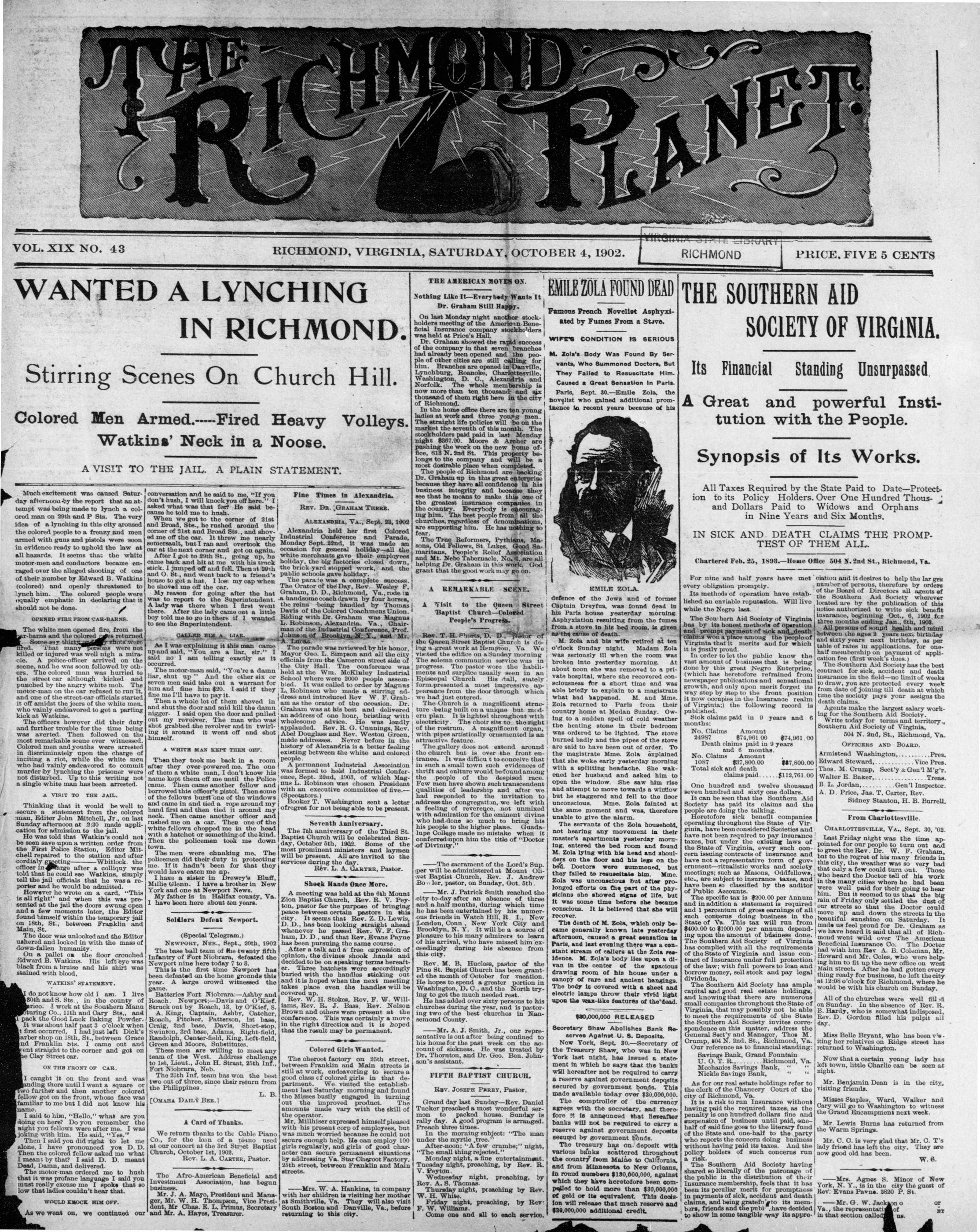
WANTED A LYNCHING IN RICHMOND.
Colored Men Armed.----Fired Heavy Volleys. Watkins' Neck in a Noose.
A VISIT TO THE JAIL. A PLAIN STATEMENT.
VOL. XIX NO. 43
WANTED
Stirring So
Colored Men A
Watk
A VISIT TO
Much excitement was caused Saturday afternoon by the report that an attempt was being made to lynch a colored man on 29th and P Sts. The very idea of a lynching in this city aroused the colored people to a frenzy and men armed with guns and pistols were soon in evidence ready to uphold the law at all hazards. It seems that the white motor-men and conductors became enraged over the alleged shooting of one of their number by Edward B. Watkins (colored) and openly threatened to lynch him. The colored people were equally emphatic in declaring that it should not be done.
OPENED FIRE FROM CAR-BARNs.
The white men opened fire, from the car-barns and the colored cars returned. Some cry thirty men, shots were fired. That many persons were not killed or injured was well nigh a miracle. A police-officer arrived on the scene, and he was soon followed by others. The colored man was hurried to the street car although kicked and punched by the angry white mob. The motor-man on the car refused to run it, and one of the street-car officials started it off amidst the jeers of the white men, who vainly endeavored to get a parting kick at Watkins. The officers however did their duty and further trouble for the time being was averted. Then followed on the most remarkable scene ever witnessed. Colored men and youths were arrested in discriminately upon the charge of inciting a riot, while the white men who had vainly endeavored to commit murder by lynching the prisoner were not disturbed. Up to this writing not a single white man has been arrested.
A VISIT TO THE JAIL.
Thinking that it would be well to secure a statement from the colored man, Editor John Mitchell, Jr., on last Sunday afternoon at 2:30 made application for admission to the jail.
He was told that Watkin's could not be seen save upon a written order from the First Police Station, Editor Mitchell repaired to the station and after cordially greeting——Whitlock, the officer in charge after a colliquy was told that he could see Watkins, simply tell the jail officials that he was a reporter and he would be admitted.
However he wrote on a card, "This is all right" and when this was presented at the jail the doors swung open and a few moments later, the Editor found himself within the temporary jail on 18th, St., between Franklin and Main, St.
The door was unlocked and the Editor ushered and locked in with the mass of down-fallen humanity.
On a pallet on the floor cronched Edward B. Watkins. His left eye was black from a bruise and his shirt was stained with blood.
WATKINS' STATEMENT.
I do not know how old I am. I live in 30th and S. Sts., in the county of Marico. I work at the Southern Manu- seturing Co., 11th and Cary Sts., and pack the Good Luck Baking Powder. It was about half past 3 o'clock when it first occurred, I had just left Dick's arber shop on 18th, St., between Grace and Franklin Sts. I came out and went straight to the corner and got on the Clay Street car.
ON THE FRONT OF CAR.
I caught it on the front and was standing there until I went a square or two further and then another colored fellow got on the front, whose face was familiar to me but I did not know his name.
I said to him, "Hello," what are you doing on here? Do you remember the night you fellows were after me, I was joking with him. He said, "Yes."
Then I said you did right to let me alone, I have pronounced you D. D. Then the colored fellow asked me what I meant by that? I said D. D. meant Dead, Dann, and delivered.
The motor-man ordered me to hush that it was profane language I said you must really excuse me I spoke that so low that ladies couldn't hear that.
WOULD KNOCK HIM OFF.
conversation and he said to me, "If you don't hush, I will knock you off here." I asked what was that for? He said because he told me to hush.
When we got to the corner of 21st and Broad, Sts., he rushed around the corner of 21st and Broad Sts., and showed me off the car. It threw me nearly somersault, but I ran and overtook the car at the next corner and got on again.
After I got to 29th St., going up, he came back and hit at me with his track stick. I jumped off and fell. Then at 29th and O. St., and went back to a friend's house to get a hat. I lost my cap when he shoved me off the car.
My reason for going after the hat was to report to the Superintendent. A lady was there when I first went there. After the lady came out a little boy told me to go in there if I wanted to see the Superintendent.
CALLED HIM A. LIAR.
As I was explaining it this man came up and said, "You are a liar, sir." I said no I am telling exactly as it occurred. The motor-man said, "You're a damn liar, shut up!" And the other six or seven men said take out a warrant for him and fine him $20. I said if they fine me I'll have to pay it. Then a whole lot of them shoved in and shut the door and said kill the damn nigger. I said open the door and pulled out my revolver. The man who was shot grabbed the revolver and in twirling it around it went off and shot himself.
A WHITE MAN KEPT THEM OFF;
Then they took me back in a room sister they over-powered me. The one of them a white man, I don't know his name kept them off me until the Police came. Then came another fellow and borrowed this officer's pistol. Then some of the fellows burst one of the windows and came in and tied a rope around my hand first and then tied it around my neck. Then came another officer and rushed me on a car. Then one of the white fellows chopped me in the head with a hatchet or something of the kind. Then the policemen took me down town. The men were chinking me. The policemen did their duty in protecting me. If it hadn't been for that they would have eaten me np. I have a sister in Drewry's Bluff, Millie Glenn. I have a brother in New York and one at Newport News.
My father is in Halifax county, Va.
I have been here about ten years.
Soldiers Defeat Newport.
(Special Telegram.)
NEWPORT, NEB., Sept. 20th, 1902
The base ball team of the twenty fifth Infantry of Fort Niobrara, defeated the Newport nine here today 7 to 8.
This is the first time Newport has been defeated on the home grounds this year. A large crowd witnessed the game.
Batteries Fort Niobrara—Ashby and Roach. Newport;—Davis and O'Kief. Struck out by Roach, 13, by O'Kief, 8. A.King, Captain, Ashby, Catcher, Roach, Pitcher, Patterson, 1st base, Craig, 2nd base, Davis, Short-stop, Swinton, 3rd base, Adams, Right-field, Randolph, Center-field, King, Left-field, Green and Moore. Substitutes.
These men are willing to meet any team of the West. Address challenge to 1st, Lieut., John H. Straat, 25th Inf., Fort Niobrara, Neb.
The 25th Inf. team has won the best two out of three, since their return from the Philippines.
L. B.
[OMAHA DAILY BEE.]
A Card of Thanks.
We return thanks to the Cable Piano Co., for the loan of a piano used at our concert at the 3rd Street Baptist Church, October 1st, 1903.
Rev. L. A. CARTER, Pastor.
The Afro-American Beneficial and Investment Association, has begun business.
Mr. J. A. Mayo, President and Manager, Mr. W. H. Thompson, Vice President, Mr Chas. E. L. Primus, Secretary and Mr. A. Hayes, Treasurer.
RICHMOND, VIRGINIA, SATURDAY, OCTOBER 4, 1902.
Fine Times in Alexandria.
REV. DR. [GRAHAM THREE.
ALEXANDRIA, VA., Sept. 23, 1902
Alexandria held her first Colored Industrial Conference and Parade, Monday Sept. 22nd, it was made an occasion for general holiday—all the white merchants gave their employees holiday, the big factories closed down, the brick-yard stopped work, and the public schools gave holiday.
The parade was a complete success.
The Orator of the Day, Rev. Wesley F. Graham, D. D., Richmond, Va., rode in a handsome coach drawn by four horses, the rebel being handled by Thomas Davis of the Being Coachmens Union.
Riding with Dr. Graham, was Magnus L. Robinson, Alexandria, Va., Chief man of the Industrial Conference, Prof. Johnson of Brooklyn, N. Y., and Mr. A. Lucas
The parade was reviewed by his honor, Mayor Geo. L. Simpson and all the city officials from the Cameron street side of the City Hall. The conference was held at the Wm. McKinley Industrial School where were 2000 people assembled. It was called to order by Magnus L. Robinson who made a stirring address and introduced Rev W. F. Graham as the orator of the occasion. Dr. Graham was at his best and delivered an address of one hour, bristling with wholesome advice. He was loudly applauded. Rev R. G. Cannings, Rev Abel Douglass and Rev. Weston Green, made addresses. Never before in the history of Alexandria is a better feeling existing between the white and colored people.
A permanent Industrial Association was formed to hold Industrial Conference, Sept. 29th, 1903, of which Magnus L. Robinson was chosen with an executive committee of five.—(Spectators.)
Booker T. Washington sent a letter obfregret for not being able to be present.
Seventh Anniversary.
The 7th anniversary of the Third St. Baptist Church will be celebrated Sunday, October 5th, 1902. Some of the most prominent ministers and laymen will be present. All are invited to the services during the day. Rev. L. A. CARTER, Pastor.
Shock Hands Once More.
A meeting was held at the 6th Mount Zion Baptist Church, Rev. R. V. Peyton, pastor for the purpose of bringing peace between certain pastors in this city. It seems that Rev. Z. D. Lewis, D. D., has been looking straight ahead whenever he passed Rev. W. F. Graham, D. D., and that Rev. Evans Payne has been pursuing the same course. After a talk and a free expression of opinion, the divines shook hands and decided to be on speaking terms hereafter. Three hatchets were accordingly buried with the handles sticking out and it is hoped when the next meeting takes place even the handles will be covered up. Rev. W. H. Stokes, Rev. F. W. Williams, Rev. R. J. Bass, Rev. Nelson Brown and others were present at the conference. This was certainly a move in the right direction and it is hoped that the result may be permanent.
Colored Girls Wanted.
the cheroot factory on 25th street, between Franklin and Main streets is still at work, endeavoring to secure a good class of colored girls in that department. We visited the establishment last Saturday morning and found the Misses busily engaged in turning out the improved product. The amounts made vary with the skill of the operator. Mr. Millhiser expressed himself pleased with his present corp of employees, but was much worried because he could not secure enough help. He can employ 100 girls regularly, and girls of good character can secure permanent situations by addressing Va. Star Cheroot Factory. 25th street, between Franklin and Main streets.
Mrs. W. A. Hankins, in company with her children is visiting her mother at Smithville, Va. They will also visit South Boston and Danville, Va., before returning to this city.
THE AMERICAN MOVES ON
Nothing Like It—Everybody Wants It
Dr. Graham Still Happy.
On last Monday night another stock-
holders meeting of the American Bene-
ficial Insurance company stockholders
was held at Price's Hall.
Dr. Graham showed the rapid success
of the company in that seven branches
had already been opened and the
people of other cities are still calling
or him. Branches are opened in Danville,
Lynchburg, Roanoke, Charlottesville,
Washington, D. C., Alexandria and
Norfolk. The whole membership is
now more than ten thousand and six
thousand of them right here in the city
of Richmond.
In the home office there are ten young
ladies at work and three young men.
The straight life policies will be on
the market the seventh of this month. The
stockholders paid paid in last Monday
night $87.00. Moore & Archer are
pushing the work on the new home office,
613 N. 2nd St. This property belongs
to the company and will be a
most desirable place when completed.
The people of Richmond are backing Dr. Graham up in this great enterprise because they have all confidence in his business integrity and because they see that he means to make this one of the greatest insurance companies in the country. Everybody is encouraging him. The best people from all the churches, regardless of denominations, are supporting him. He has nothing to fear.
The True Reformers, Pythians, Masons, Old Fellows, St. Lukes, Good Samaritans, People's Relief Association and Mt. Nebo Tabernacle, No. 4, are all helping Dr. Graham in this work. God grant that the good work may go on.
A Visit to the Queen Street Baptist Church—Colored People's Progress.
Rev. T. H. Shorts, D. D., pastor of the Queen Street Baptist Church is doing a great work at Hempton, Va. We visited the edifice on a Sunday morning The solemn communion service was in progress. The pastor wore the habiliments and surplice usually seen in an Episcopal Church His tall, stately form presented a most impressive appearance from the door through which we had just entered.
The Church is a magnificent structure being built on a unique but modern plan. It is lighted throughout with electricity. The choir site to the right of the rostrum. A magnificent organ, with pipes artistically ornamented is an attractive feature.
The gallery does not extend around the church but is over the front entrance. It was difficult to conceive that in such a small town such evidences of thrift and culture would be found among the people of the despised race. Few men have shown such transcendent qualities of leadership and after we had responded to the invitation to address the congregation, we left with a feeling of reverence, not unmixed with admiration for the eminent divine who had done so much to bring his people to the higher plane. Guadalupe College made no mistake when it conferred upon him the title of "Doctor of Divinity."
The sacrament of the Lord's Sup. per will be administered at Mount Olivet Baptist Church, Rev. J. Andrew Boomer, pastor, on Sunday, Oct. 5th.
Mr. J. Patrick Smith reached the city to day after an absence of three and a half months, during which time he has been entertained by his numerous friends in Watch Hill, R. I., New London, Conn., New York City and Brooklyn, N. Y. It will be a source of pleasure to his many admirers to learn of his arrival, who have missed him exceedingly during his absence from this city.
Rev. M. B. Hucellus, pastor of the Pine St. Baptist Church has been granted the month of October for vacation. He hopes to spend a greater portion in Washington, D. C., and the North trying to get the much needed rest.
He has added over sixty persons to his churches during the year, and is pastoring two of the best churches in Nansom County.
Mr. A. J. Smith, Jr., our representative is out after being confined to his home for the past week on the account of sickness. He was treated by Dr. Thornton, and Dr. Geo. Ben. Johnson's assistant.
FIFTH BAPTIST CHURCH.
Rsv. JOSEPH PERRY, Pastor.
Grand day last Sunday—Rev. Daniel Tucker preached a most wonderful sermon to packed house. Sunday is rally day. A good program is arranged. Preach three times.
In the morning subject: "The man under the myrtle tree."
After-noon: "A few crumbs;" night,
"The small thing rejected."
Monday night, a fine entertainment.
Tuesday night, preaching, by Rev. R.
V. Peyton.
Wednesday night, preaching, by Rev. A. S. Thomas.
Thursday night, preaching by Rev. W. H. White.
EMILE ZOLA FOUND DEAD
Famous French Novelist Asphyxiated by Fumes From a Steve.
WIFE'S CONDITION IS SERIOUS
M. Zola's Body Was Found By Servants, Who Summoned Doctors, But They Failed to Resuscitate Him. Caused a Great Sensation in Paris.
Paris, Sept. 30.—Emile Zola, the novelist who gained additional prominence in recent years because of his
TIMELD HENRY
defence of the Jews and of former Captain Dreyfus, was found dead in his Paris house yesterday morning. Aphsylia resulting from the fumes from a stove in his bed room, is given as the cause of death.
M. Zola and his wife retired at ten o'clock Sunday night. Madam Zola was seriously ill when the room was broken into yesterday morning. At about noon she was removed to a private hospital, where she recovered consciousness for a short time and was able briefly to explain to a magistrate what had happened. M. and Mme. Zola returned to Paris from their country home at Medan Sunday. Owing to a sudden spell of cold weather the heating stone in their bedroom was ordered to be lighted. The stove burned badly and the pipes of the stove are said to have been out of order. To the magistrate Mme. Zola explained that she woke early yesterday morning with a splitting headache. She wakened her husband and asked him to open the window. She saw him rise and attempt to move towards a window but he staggered and fell to the floor unconscious. Mme. Zola fainted at the same moment and was, therefore unable to give the alarm.
The servants of the Zola household, not hearing any movement in their master's apartments yesterday morning, entered the bed room and found M. Zola lying with his head and shoulders on the floor and his legs on the bed. Doctors were summoned, but they failed to resuscitate him. Mine. Zola was unconscious but after prolonged efforts on the part of the physicians she showed signs of life, but it was some time before she became conscious. It is believed that she will recover.
The death of M. Zola, which only became generally known late yesterday afternoon, caused a great sensation in Paris, and last evening there was a constant stream of callers at the Zola residence. M. Zola's body lies upon a divan in the center of the spacious drawing room of his house under a canopy of rare and ancient hangings. The body is covered with a sheet and electric lamps throw their vivid light upon the van-like features of the dead.
600,000,000 RELEASED
Secretary Shaw Abolishes Bank Reserves against N. U. Deposits.
New York, Sept. 30.—Secretary of the Treasury Shaw, who was in New York last night, has issued a statement in which he says that the banks will hereafter not be required to carry a reserve against government deposits secured by government bonds. This made available today over $30,000,000. The comptroller of the currency agrees with the secretary, and therefore it is announced that hereafter banks will not be required to carry a reserve against government deposits secured by government bonds. The treasury has on deposit with various banks scattered throughout the country from Maine to California, and from Minnesota to New Orleans, in round numbers $130,000,000, against which they have heretofore been compelled to hold more than $30,000,000 of gold or its equivalent. This decision will release that much reserve and $20,000,000 additional credit.
THE SOUTHERN AID SOCIETY OF VIRGINIA.
A Great and powerful Institution with the People.
Synopsis of Its Works.
All Taxes Required by the State Paid to Date—Protection to its Policy Holders. Over One Hundred Thousand Dollars Paid to Widows and Orphans in Nine Years and Six Months.
IN SICK AND DEATH CLAIMS THE PROMPTEST OF THEM ALL.
Chartered Feb. 25, 1893.—Home Office 504 N. 2nd St., Richmond, Va.
RICHMOND
THE SOUTHERN SOCIETY
Its Financial Sta
A Great and p tution with
Synopsis of
All Taxes Required by the ion to its Policy Holders, and Dollars Paid to in Nine Years
IN SICK AND DEATH TEST OF T
Chartered Feb. 25, 1893.—Home O
For nine and half years have met every obligation promptly.
Its methods of operation have established an enviable reputation. Will live while the Negro last.
The Southern Aid Society of Virginia has by its honest methods of operation and prompt payment of sick and death claims won a place among the people of Virginia that it merits and for which it is justly proud.
In order to let the public know the vast amount of business that is being done by this great Negro Enterprise, (which has heretofore refrained from newspaper publications and sensational growth, and only upon merit forged its way step by step to the front position it now occupies in the insurance realm of Virginia;) the following record is published.
Sick claims paid in 9 years and 6 months:
No. Claims Amount
24887 $74,961.00 $74,961.00
Death claims paid in 9 years
and 6 months.
No. Claims Amount
1087 $37,800.00 $7,800.00
Total sick and death
claims paid.....112,761.00
One hundred and twelve thousand
seven hundred and sixty one dollars.
It can be seen that the Southern Aid Society has paid its claims and the people are doing the talking.
Heretofore sick benefit companies operating throughout the State of Virginia, have been considered Societies and have not been required to pay insurance taxes, but under the existing laws of the State of Virginia, every such concern issuing contracts of insurance and have not a representative form of government—ritualistic works and society meetings; such as Masons, Oddfellows, etc., are subject to insurance taxes, and have been so classified by the auditor of Public Accounts.
The specific tax is $200.00 per Annum and in addition a statement is required and 1 percentum of gross earnings of all such concerns doing business in the State of Va. This tax will run from $400.00 to $1000.00 per annum depending upon the amount of business done. The Southern Aid Society of Virginia has complied with all the requirements of the State of Virginia and issue contract of Insurance under full protection of the law; with full powers to loan and borrow money, sell stock and pay legal dividends.
The Southern Aid Society has ample capital and good real estate holdings, and knowing that there are numerous small companies throughout the State of Virginia, that may possibly not be able to meet the requirements of the State the Southern Aid Society invites correspondence on this matter, address the General Secty and Manager, Thos M. Crump, 604 N. 2nd. St., Richmond, Va. Our reference as to financial standing: Savings Bank, Grand Fountain U. O. T. R., .. Richmond, Va. Mechanics Savings Bank, " " Nickle Savings Bank, " "
As for our real estate holdings refer to the clerk of the Chancery Court of the city of Richmond, Va.
It is a risk to run Insurance without having paid the required taxes, as the penalty is one hundred dollars fine and suspension of business until paid, one-half of said fine goes to the literary fund of the State and one-half to the party who reports the concern doing business without having paid its taxes. And the policy holders of such concerns run a risk.
The Southern Aid Society having shared so liberally of the patronage of the public in the distribution of their Insurance membership, feels that it has been its peculiar merit for promptness in payments of sick, accident and death claims, and being grateful to its members, friends and the publ. have decided to show in some tangible way its appre-
PRICE, FIVE 5 CENTS
BURN AID
SOCIETY OF VIRGINIA.
Standing Unsurpassed.
powerful Insti-
tith the People.
of Its Works.
by the State Paid to Date—Protect-
ders. Over One Hundred Thous-
to Widows and Orphans
years and Six Months.
TH CLAIMS THE PROMP-
OF THEM ALL.
Home Office 504 N. 2nd St., Richmond, Va.
cation and it desires to help the lar gew number of persons, therefore by orders of the Board of Directors all agents of the Southern Aid Society wherever located are by the publication of this notice authorized to write sick benefit insurance, beginning Oct., 6, 1902 for three months ending Jan., 6th, 1903. All persons of sound health and mind between the ages 2 years next birthday and sixty years next birthday, as per table of rates in applications, for one half membership on payment of application fee (first week's dues.) The Southern Aid Society has the best contract for sick, accident and death insurance in the field—no limit of weeks to draw, you are protected every week from date of joining till death at which time the society pays your assigns the death claims. Agents make the largest salary working for the Southern Aid Society. Write today for terms and territory., Southern Aid Society of Virginia,
Armistead Washington,..... Pres.
Edward Stewart,..... Vice Pres.
Thos. M. Crump, Sect'y & Gen'l M'g'r.
Walter E. Baker,..... Tens.
B L. Jordan,..... Gen'l Inspector.
A. D. Price, Jas. T. Carter, Rev.
Sidney Stanton, H. B. Burrell.
From Charlottesville.
CHARLOTTESVILLE, VA., Sept. 30, '02.
Last Friday night was the time appointed for our people to turn out and greet the Rev. Dr. W. F. Graham, but to the regret of his many friends in this city, the weather was so very bad that only a few could turn out. Those who heard the Doctor tell of his work in the many cities where he had been were well paid for their going to hear him. Bui it seemed to us that the big rain of Friday only settled the dust of our streets so that the Doctor could move up and down the streets in the beautiful sunshine on Saturday. It made us feel proud for Dr. Graham as we heard it said that all of Richmond went wild over The American Beneficial Insurance Co. The Doctor had with him Rev A. B. Coleman, Mr. Howard and Mr. Coles, who were helping him to fit up the new office on west Main street. After he had gotten every thing ready for business, he left the city at 12:08 o'clock for Richmond, where he would be with his church on Sunday.
All of the churches were well fill'd on Sunday. In the absence of Rev. R. B. Hardy, who is somewhat indisposed, Rev. D. Gordon filled his pulpit all day.
Miss Belle Bryant, who has been v'siting her relatives on Ridge street has returned to Washington.
Now that a certain young lady has left town, little Charlie can be seen at night.
Mr. Benjamin Dean is in the city, visiting friends.
Misses Staples, Ward, Walker and Cary will go to Washington to witness the Grand Encampment next week.
Mr. Lewis Burns has returned from the Warm Springs.
Mr. C. C. is very glad that Mr. C. T's lady friend has left the city. They are now good old has been.
—Mrs. Agnes S. Minor of New York, N. Y., is in the city the guest of Rev. Evans Pavne. 3820 P. St.
SATURDAY ... OCT. 4 1902
TEMPERANCE
THEO AND THE CONVICT.
How a Little Boy Led a Victim of Drink Out Into a New and Useful Life.
"You may speak, if you wish," said the chaplain. No. 13 stopped in his work and went up to Theo, who had accompanied his mother to the prison, where she had gone to distribute white-ribbon bouquets.
But, No. 13 did not speak, at least not at first, although his heart was full of thoughts that were longing for expression. Chaplain Mills knew this from his face, for that chaplain could read his men like a book—and since speech was denied the poor fellows, their thoughts and feelings spoke through their faces.
No, No. 13 did not speak to Theo, but he touched him as tenderly as a child would touch a flower. He took both of the lad's hands in his, he put his arm about Theo's waist, he patted his head, and did so many other unlooked for things that the boy felt almost foolish to be thus dealt with. His mother and the chaplain were standing by, so he was not afraid—it is a place to make one nervous, you know.
"He's just your age now, my Tom is," Ah. No. 13 had spoken at last, and these words showed why he had taken such an interest in Theo.
"Does Tom live in your town?" asked Theo. thinking that he must say something.
"O. no, he's over in the old country," replied the man; and then he looked at his striped suit and sighed heavily.
"Then I know that he can play cricket like everything, if he's an English boy," said Theo. "I wish I knew him."
"I wish you did," said the father, "but it is no use to wish. He does not know in what sort of a house his father lives." And the man looked frowningly upon the grim iron bars all about him.
"Perhaps he never will," said Theo.
"Perhaps not," said No. 13, "but I must go to my broom-making now. It isn't often that a boy of Tom's age comes in here. That is why I had to
TOOK THE MAN BY THE HAND
touch you and speak to you. I haven't touched a boy for 12 years. Tom was a baby when I left home."
No. 13 went back to his work with a brisker step and with a new light in his face, and Theo and his mother went down the long corridor toward the door. There was nothing homelike or cheerful in the state's great iron cage, and everything seemed to be saying: "The way of the transgressor is hard."
Upon the following Sabbath Theo begged to go to the prison with his father, who was a member of the Y. M. C. A., that held services at this place every Sunday morning, and while Mr. Tarbell did not approve of allowing a child to often visit so gloomy an abode, he finally consented to take his son with him.
Theo carefully watched the faces of the convicts as they filed into the prison chapel, hoping to discover No. 13.
"There he is!" Theo said to himself, as a man came in, his eyes directed towards the floor. Yes, this was No. 13, but there was a different expression, there was a dawning look of tenderness in his face, and as he saw Theo he answered the boy's smile and bow with glad recognition. Theo felt that his presence did the man good, so he gained his father's consent to attend the regular services at the prison. Sometimes Theo would remain after the meeting and go with the chaplain to No. 13's cell, where he would talk with the prisoner through the bars—for an outsider was never allowed to enter a cell—and at times the prisoner would talk to Theo of Tom and the nice letters that he wrote about his home and school, little dreaming that those letters reached his father at such a place.
"He always asks me if it isn't most time for me to come back and bring him and his mother to America, as I have promised to do," No. 13 said, "and I always tell him to let liquor alone—for, you know, that was what brought me here. I'd never have done the awful crime I did if I'd been in my right mind, but when a man trades his reason for a class of whisky, he has to meet the consequence every time,
lad. ye, every time."
No. 13's term was shortened because of good behavior, and at last the Sabbath came when he was dismissed from his hard service.
When the boy went to him for his usual talk, at the close of the address, the man said: "I want you to be the one to let me out of the prison, Theo. You've let me out of a good many things worse than this place, bad as it is."
"I don't know what you mean," replied Theo, "with a puzzled look.
"What I mean is this," replied No. 13. "You got me out of that hateful way of thinking about everybody and blaming everyone for my being here, when only liquor and I were to blame, and you've led me out of my sins, for since I've seen you I've begun to pray, and I believe that God has heard my prayers and saved my soul, and now—" "Yes, the lad can lead you out," interrupted an officer. So Theo opened the door, took the man by the hand and led him out again into the world of men.
Ah, this was the proudest day that Theo had ever known. Nor did his interest in No. 13 end here, for he persuaded his pastor to find work and a boarding place for his friend, and to interest him in the church. After that No. 13—now known as Mr. Kentman—began to save up his wages to bring his wife and child over from the old country, and, best of all, he let liquor severely alone.—Alice May Douglas, in Union Signal.
A YOUNG MAN'S RUIN.
Insidious Work of Alcohol Upon the Life and Home of One Who Had Bright Prospects in Life.
During our college days, a bright talented young student won the heart of a beautiful young lady, and they were married. He soon engaged in the drug business, and for awhile Heaven seemed to smile on them; but soon an enemy worse than death crept in to bring sorrow and woe, and he became a slave to the demon of drink. Behind the drug counter he learned to partake of the death-dealing poison, and little by little he went down, down, down! That manly face soon lost its freshness. The eyes were strangers to their former brightness; the energetic step was changed to a tottering irregular one, and the sanctity and happiness of the home were no longer preserved. The heart-broken wife was forced to return to her mother's home, with her young daughter, while the husband continued in dissipation.
The cruel monster did his dreadful work on soul and body and left him many times in the throes of delirium tremens until at last word reached the young wife from a distant city, that during one of these terrible convulsions his spirit departed, and he went into the presence of God.
When the secrets of men are made known in the great judgment morning, what an unfolding of sin and crime will take place. The poor drunkard will not be alone responsible for his own ruin. The druggist and the church member who voted for a continuation of the drink traffic, will share in the fearful responsibility of that young man's soul. And this is only one case among thousands who are going down to a drunkard's hell.
Oh, what an army will be arrayed before the judgment seat hopeless, lost and ruined, all through the curse of drink! Parents, watch the steps of your boys, and lead them in paths of righteousness.-Flora B. Nelson, in Christian Standard.
NOTES FROM AFIELD
Mississippi, one of the strongest prohibition states of the union, this year reports a surplus of $1,000,000 in its treasury.
The Salvation Army of London has inaugurated a movement for reclaiming 5,000 habitual drunkards during the ensuing year.
Taverns in Sweden are closed on Saturday, which is pay day, while the savings banks are kept open until midnight. This plan induces the workmen to invest their money where it will pay them interest, instead of fn alcoholic stimulants.
The number of imbeciles and idiots in the country is increasing at a rate faster than the general population.
Mr. Alexander Johnson, superintendent of the home for the feeble-minded at Fort Wayne, who has made a lifelong study of such matters, says that 75 per cent. of these unfortunates owe their defects to drunken parents.
A young man was shot down in the streets of Atlanta some years ago. He had been drinking. The man who shot him had been drinking. In his pocket, says the National Advocate, was found a list containing the names of 85 young men. On the paper was written: "These young men to my knowledge during the past few years have gone to their graves by liquor in Atlanta, Ga!"
Affects the Memory.
Among the numerous symptoms and effects from the use of alcohol in excess may be enumerated defective memory, especially a loss of the sense of time and space; a tendency to illusions, hallucinations and delusions of a changing character; a loss of esthetic and moral appreciation; depressed emotional states, irritability of temper, slowness of perception, a lack of judgment; suspicious and jealous; often delusions of persecution and marital infidelity, which ideas may become dangerous to life; inclination to suicide and homicide, a host of physical ailments too numerous to mention. In other words, there is not an organ nor a tissue or cell in the body that may not seriously be affected by this toxic substance when taken in large quantities. Reason may be dethroned and volition shattered, nothing left but dementia and untimely death—Dr. Beebe, in Lancet-Clinic.
Practical Man
He—My dear, we can't marry until I know how our board is to be paid.
She—If you really loved me, you wouldn't be bothering about board.—Detroit Free Press.
THE RICHMOND PLANET, RICHMOND; VIRGINIA.
WOMANS MAGAZINE
H. DROCH
CARE OF THE TEETH.
No Preserve and Beautify Them
Should Be the Aim of Every
Man, Woman and Child.
Everybody admires a good set of
teeth, and the owner of such is always
to be envied. An excellent cam-
phorated tooth powder which will not
destroy the enamel of the teeth, and
yet will render them white, is made of
7 drs. of precipitated chalk, one-half
dr. of powdered camphor and 1 dr. of
powdered orris root.
It is not sufficient to use only a tooth
powder; a liquid dentifrice is pleas-
ant and has a beneficial influence upon
the gums. To make one, take 2 oxs. of
borax, a quart of hot water and one
teapoonful each of tincture myrrh
and spirits of camphor. Dissolve the
borax in hot water, and when the water
is cool add the other ingredients
and bottle them for use. A few drops
used in a little water form a delightful
wash.
Yellow teeth, it is said, are usually indicative of bodily vigor, and very pearly white ones of a more fragile constitution.
There is only one general rule to offer respecting the care of the teeth, and that is that they be kept immaculately clean and in perfect health. Their color then matters nothing, for their condition will prove that they are well attended to. Should the gums be tender and spongy, the general health, upon which the condition of the teeth so much depends, should be made the subject of inquiry.
A healing and soothing tooth powder is made of precipitated chalk 1 oz., of powdered borax one-half oz., of powdered myrrh one-fourth oz., and the same quantity of powdered orchis root.—N. Y. Journal.
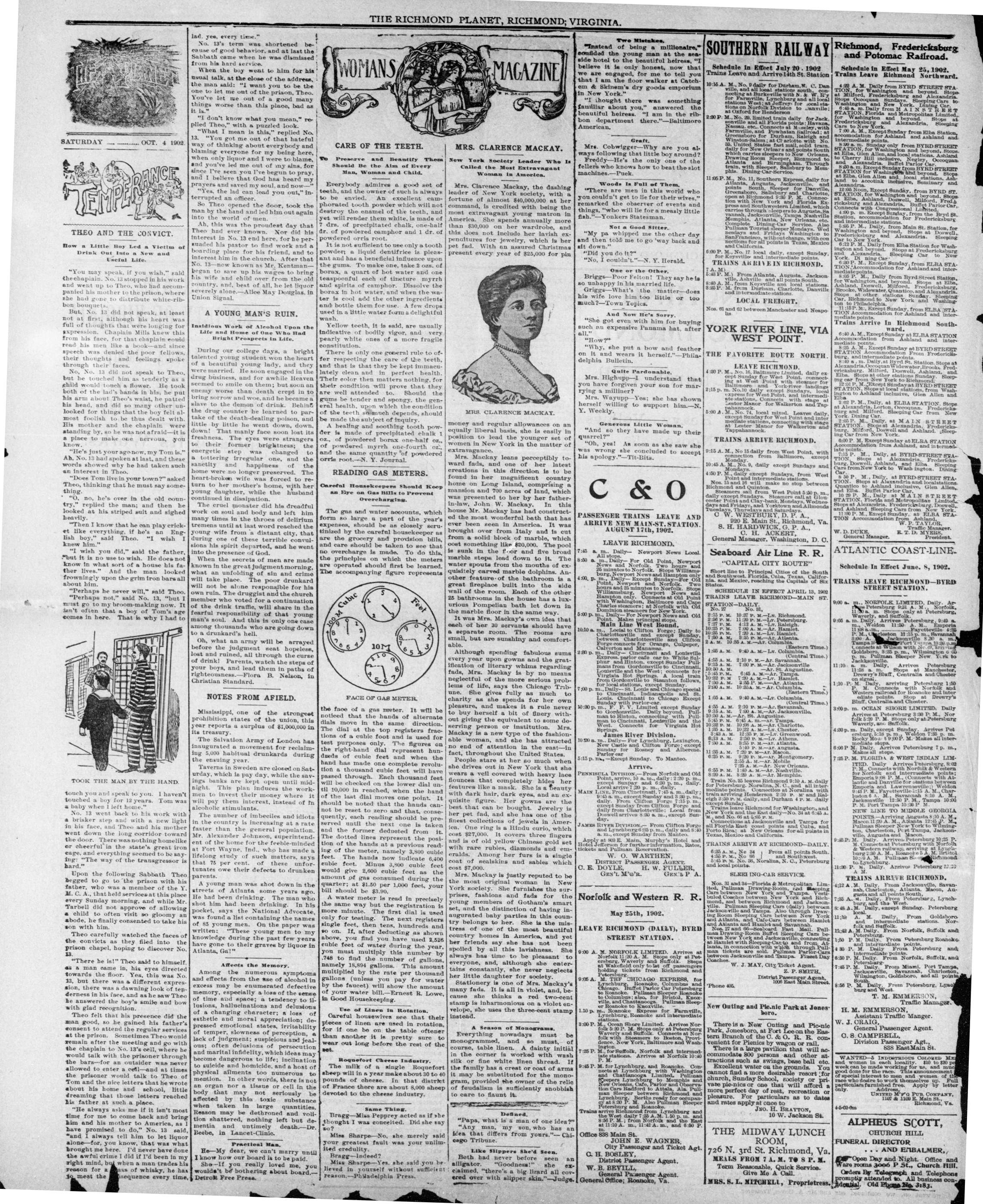
READING GAS METERS.
Careful Housekeepers Should Keep an Eye on Gas Bills to Prevent Overcharging.
The gas and water accounts, which form so large a part of the year's expenses, should be as closely scrutinized by the careful housekeeper as are the grocery and provision bills, and care should be taken to see that no overcharge is made. To do this, the principles on which the meters are operated should first be learned. The accompanying figure represents
Cubic Feet
100 M
1 M
10 M
FACE OF GAS METER
the face of a gas meter. It will be noticed that the hands of alternate dials move in the same direction. The dial at the top registers fractions of a cubic foot and is used for test purposes only. The figures on the right-hand dial represent hundreds of cubic feet and when the hand has made one complete revolution a thousand cubic feet will have passed through. Each thousand feet will be checked on the lower dial until 10,000 in reached, when the hand of the last dial moves one point. It should be noted that the hands cannot be reset to zero and that, consequently, each reading should be preserved until the next one is taken and the former deduced from it. The dotted lines represent the position of the hands at a previous reading of the meter, namely 3,800 cubic feet. The hands now indicate 6,400 cubic feet. Minus 3,800 cubic feet would give 2,600 cubic feet as the amount of gas consumed during the quarter; at $1.50 per 1,000 feet, your bill should be $3.90.
A water meter is read in precisely the same way but the registration is more minute. The first dial is used only for testing. The next registers single feet, then tens, hundreds and so on. If, after deducting as shown above, you find you have used 2,526 cubic feet of water during the year, you must multiply this number by 7.48 to find the number of gallons, namely 18,894 gallons. This amount multiplied by the rate per thousand gallons (unless you pay for water by the faucet) will show the amount of your water bill—Ernest R. Lowe, in Good Housekeeping.
Use of Linen in Rotation.
Careful housewives see that their pieces of linen are used in rotation, for if one be on the table oftener than another it is pretty sure to wear out long before the rest of the set.
Roquefort cheese industry. The milk of a single Roquefort sheep will in a year make about 30 to 40 pounds of cheese. In that district of France there are about 8,000 sheep devoted to the cheese industry.
Bragg—Miss Pepprey acted as if she thought I was conceited. Did she say so?
Miss Sharpe—No, she merely said your greatest fault was your unlimited credulity.
Bragg—Indeed?
Miss Sharpe—Yes, she said you believed in yourself without sufficient reason. Philadelphia Press.
MRS. CLARENCE MACKAY
New York Society Leader Who Is Called the Most Extravagant Woman in America.
Mrs. Clarence Mackay, the dashing leader of New York society, with a fortune of almost $40,000,000 at her command, is credited with being the most extravagant young matron in America. She spends annually more than $30,000 on her wardrobe, and this does not include her lavish expenditures for jewelry, which is her pet fad. With an assured Christmas present every year of $25,000 for pin
MRS. CLARENCE MACKAY
money and regular allowances on an equally liberal basis, she is easily in position to lead the younger set of women in New York in the matter of extravagance.
Mrs. Mackay leans perceptibly toward fads, and one of her latest creations in this direction is to be found in her magnificent country home on Long Island, comprising a mansion and 700 acres of land, which was presented to her by her father-in-law, John W. Mackay. In this house Mr. Mackay has had constructed the most wonderful bath that has ever been seen in America. It was brought over from Italy and is cut from a solid block of marble, which oost something like $20,000. The pool is sunk in the floor and five broad marble steps lead down to it. The water spouts from the mouths of exquisitely carved marble dolphins. Another feature of the bathroom is a great fireplace built into the side wall of the room. Each of the other 25 bathrooms in the house has a luxurious Pompeian bath let down in the marble floor in the same way.
It was Mrs. Mackay's own idea that each of her 30 servants should have a separate room. The rooms are small, but are sunshiny and comfortable.
Although spending fabulous sums every year upon gowns and the gratification of literary whims regarding fads, Mrs. Mackay is by no means neglectful of the more serious problems of life, says the Chicago Tribune. She gives fully as much to charity as she spends for her own pleasure, and makes it a rule never to buy herself a bit of finery without giving the equivalent to some deserving person or institution. Mrs. Mackay is a new type of the fashionable woman, and she has attracted no end of attention in the east—in fact, throughout the United States.
People stare at her so much when she drives out in New York that she wears a vell covered with heavy lace flouces that completely hides her features like a mask. She is a beauty with dark hair, dark eyes, and an exquisite figure. Her gowns are the best that can be bought. Jewelry is her pet fad, and she has one of the finest collections of jewels in America. One ring is a Hindu curio, which cost $27,000. It covers three fingers and is of old yellow Chinese gold set with rare rubies, diamonds and emeralds. Among her furs is a single coat of sealskins and sables which cost $7,000.
Mrs. Mackay is justly reputed to be the most original woman in New York society. She furnishes the surprises, fashions and fads for the young members of Gotham's smart set, and the distinction of having inaugurated baby parties in this country belongs to her. She is the mistress of one of the most beautiful country homes in America, and yet her friends say she has not been spoiled by all this laivishness. She always has time to be pleasant to everyone, and, although she entertains constantly, she never neglects her little daughter for society. Stationery is one of Mrs. Mackay's many fads. It is all in violet, and, because she thinks a red two-cent stamp is inharmonious on a violet envelope, she uses the three-cent stamp instead.
A Season of Monograms
Everything nowadays must be monogrammed, and so must, of course, table linen. A dainty initial in the corner is worked with wash silk or fine white linen thread. If the family has a crest or coat of arms it may be substituted for the monogram, provided the owner of the relic of feudalism is sufficiently snobbish to care to flaunt it.
"Papa, what is a man of one idea?"
"Any man, my son, who has an idea that differs from yours."—Chicago Tribune.
Like Slippers She'd Seen. Beth had never before seen an alligator. "Goodness!" she exclaimed, "there's a big lizard all covered over with slipper skin."—Judge.
"Instead of being a millionaire," confided the young man at the seaside hotel to the beautiful heiress, "I believe it is only honest, now that we are engaged, for me to tell you that I am the floor walker at Catchem & Skheim's dry goods emporium in New York."
"I thought there was something familiar about you," answered the beautiful heiress. "I am in the ribbon department there."—Baltimore American.
Graft.
Mrs. Cobwigger—Why are you always following that little boy around? Freddy—He's the only one of the fellers who knows how to beat the slot machines.—Puck.
Woods Is Full of Them
"There are men in this world who you couldn't get to lie for their wives," remarked the observer of events and things, "who will lie for a measly little fish."—Yonkers Statesman.
Not a Good Sitter.
"My pa whipped me the other day and then told me to go 'way back and sit down." "Did you do it?" "No, I couldn't."—N. Y. Herald.
so unhappy in his married life.
Griggs—What's the matter—does his wife love him too little or too much?—Town Topics.
And Now He's Sorry.
"She got even with him for buying such an expensive Panama hat, after all."
"How?"
"Why, she put a bow and feather on it and wears it herself."—Philadelphia Bulletin.
Quite Pardonable.
Mrs. Highupp—I understand that you have forgiven your son for marrying a milliner?
Mrs. Wayupp—Yes; she has shown herself willing to support him.—N. Y. Weekly.
Generous Little Woman.
"And so they have made up their quarrel?"
"Oh, yes! As soon as she saw she was wrong she concluded to accept his apology."-Tit-Bits.
C & O
PASSENGER TRAINS LEAVE AND
ARRIVE NEW MAIN-ST. STATION.
AUGUST 17th, 1902.
LEAVE RICHMOND.
7:45 a. m. Daily— Newport News Local.
All stops.
8:00 a. m. Daily—For Old Point, Newport
News and Norfolk. Two hours and
20 minutes. Newport Williamsburg, Newport News and Hampton only.
4:00 p. m. Daily—Except Sunday—For Old
Point, Newport and Norfolk. Two
hours and 10 minutes. Norfolk. Stops
Williamsburg, Newport News and
Hampton only. Connects at Old Point
with Washington, Baltimore and Cape
Cities steamers; at Norfolk with Old
Dominion steamers; at Newport News and Old
5:00 p. m. Daily—For Newport News and Old
5:30 p. m., Daily.—For Newport News and Old Point. Make principal stops.
5:00 p. m., West Bound.
10:10 a. m., Local to Clifton, Daily to Charlottesville and except Sunday, between Charlottesville and Clifton Forge connects for Orange, Culpeper, Charlottesville and the West. 2:30 p. m., Daily.—Cincinnati and Louisville Express, parlor cafe car to White Sulphur and Hinton, except Sunday Pullman, from Cincinnati to Cincinnati Louisville and the West. For Virginia Hot Springs. A local train from Gordonville to Stanton follows, for local stations, except Sunday. 7:00 p. m., Daily.—For Newport News except to Cincinnati, Indianapolis and St. Louis. Cincinnati to Chicago Except Sunday with parlor car. except Sunday to Gordonville. Daily beyond. Pullman to Hinton, connecting with Pullman to Cincinnati, Louisville and the West. Connects for Virginia Hot Springs.
James River Division.
10:20 a. m., Daily.—For Lynchburg, Lexington, New Castle and Clifton Forge; except New Castle for Rosney and Alberene. Parlor car.
PENNISULA DIVISION — From Norfolk and Old
Point, arrive 10 a.m., daily; 2:30 p.m.
except Sunny and 6:30 p.m., daily.
Local arrive 7:20 p.m., daily.
MAIN LINE: From Cincinnati; 7:45 a.m. daily; 9:45 a.m. except Sunday and 3:30 p.m. daily; except Sunday from Cincinnati Forge and daily from Charlotteville: Local from Doswell arrives 8:30 a.m., except Sunday.
JAMES RIVER DIVISION: From Cincinnati Forge and North Enbridge 6:35 p.m. daily; except Sunday from Masterson.
Apply at 803 E. Main, Murphy's Hotel and Hotel Jefferson for further information, Rates, tickets and Pullman Reservation.
W. O. WARTHEN,
DISTRICT PASSENGER AGENT.
C. E. DOYLE, H. W. FULLER,
GEN.' M.' M'R, GEN.' P. A.
Norfolk and Western R. R.
May 25th, 1902.
LEAVE RICHMOND (DAILY), BYRD
STREET STATION.
9:00 A. M. NORFOLK LIMITED. Arrives at
Norfolk 11:20 A.M. M. Stops only at Pet-
ersburg, Waverly and Wakefield, but
at Wakefield only to let off passengers
holding tickets from Richmond and
Petersburg.
9:05 A. M. THE CHICAGO EXPRESS, for
Lynchburg, Roanoke, Columbus and
Chicago. Buffet Pardon Gar Petersburg
to Lynchburg; to Columbus; to
Columbus; also, for Bristol, Bronx,
ville, and Chattanooga. Pullman Sleep-
er to Roanoke to Knoxville.
1:10 P. M. Roanoke to Farmville,
Lynchburg, Roanoke and intermediate
stations.
8:00 P. M. Roanoke Shore Limited. Arrives
Norfolk 9:20 P. M. Stops only at Petersburg
Waverly and Suffolk. Connects at Nor-
folk with Steamers to Boston, Provid-
ence, New York, Baltimore and Wash-
ington.
9:45 P. M. for Lynchburg, and Roanoke. Connects at Lynchburg with Washington and Washington Interstate. Pulls and Sleeps Lynchburg to Memphis and New Orleans, Cafe, Parlor and Observation Cars Radford to Attala, Ala. Pulls Walter Rivers Richmond and Lynchburg. Beeths ready for occupancy at 8:30 P. M. Also Pullman Sleeper Petersburg and Roanoke.
Trains at Lynchburg and Lynchburg and the West daily 7:38 A.M. 1:50 p. m. and 8:56 P. M.; from Norfolk and the East at 11:10 A. m., 11:43 A. m., and 6:50 P. m.
Office 888 Main St.
JOHN E. WAGNER,
City Passenger and Ticket Agt.
C. H. BOSLEY,
District Passenger Agent.
W. B. BEVILL,
General Passenger Agent.
General Office; Roanoke, Va.
SOUTHERN RAILWAY
Schedule In Effect July 20 . 1902
Trains Leave and Arrive 14th St Station
10:15 A. M., No. 9 daily for Durham, N. C. Dan
ville, and all local stations south of
conduit, for Farmville, Lynchburg, and all
stations West; at Jeffrey for local stations
on Norfolk Division to Danville; at
at Jefferson
2:00 P. M., No. 20, limited train for jack
sonville and all Florida points; Havana,
Nassau etc. Connects at Mossley, with
Fairfax, Fowhatan railroad; at
Greenbore for Baltimore; at
Winston-Salem; at CI arlote with No.
35. United States fast mail, solid train,
dale, at Birmingham South
which carries sleepers in New, Ohio.
Drawing Room Sleeper, Richmond to
Atlanta and Birmingham. Through
trail with buryingbury to Memphis.
Dining-Car Services
11:35 P. M., No. 11, Southern Express, daily for Atlanta, Augusta, Jacksonville, and points South, Sleeper for Danville, Charlotte, open at Richmond 9:30 P. M., express with New York and Florida Express and Southwestern Limited, which can through sleepers to Augusta, Saanich, Nashville, Nashville Memphis, Atlanta, New Orleans, etc. Complete Dining-Car Service. Also Pullman Tourist sleeper Mondays. Wednesdays to San Francisco, with outchange, with connections for all points in Texas, Mexico and California.
6:00 P., No. 17 local daily, except Sunday, for Keysville and intermediate points.
7 A. M.)
5:48 P. M.) From Atlanta, Augusta, Jacksonville, Ashville, and all points South.
8:40 A. M. from Keysville and local stations.
8:26 P. P. from Carmen, Charlotte, Danville
and in terrapin.
LOCAL FREIGHT.
YORK RIVER LINE, VIA WEST POINT.
THE FAVORITE ROUTE NORTH
4:30 P, M., No. 16, Baltimore Limited, dally except Sunday for West Point, connecting at West Point with steamer for Boston, York-river landings
2:15 p. M., No. 10, daily landings
5:00 A. M., No. 74, local mixed. Leaves daily, except Sunday for West Point and inter-miate stations, connecting with stage at the Tappahannock for Walkout and Tappahannock.
TRAINS ARRIVE RICHMOND
9:15 A.M. No 15 daily from West Point, with
a trip from Baltimore, except
Monday.
10:45 A.M., No. 9, daily except Sundays and
Mondays.
4:50 P.M., daily except Sundays, from West
Polebury and St. Paul stations.
Nos. 15 and 16 will make no stop between
Richmond and Quinton.
Steamers sail from West Point 5:50 p.m.,
mandatory for Sunday. Locustey
Steamers and Clay-bank, Mondays, Weeks
days and Fridays, and Yorktown and Almonds
Tuesdays, Thursdays and Saturdays.
C W. WESTBURY, D P. A.,
920 E. Main St., Richmond, Va.
S H. HARDWICK, G P. A.,
C H. ACKERT,
General Manager, Washington, D. C.
Seaboard Air Line R. R.
"CAPITAL CITY ROUTE"
Short line to Principal Cities of the South and Southwest. Florida, Cuba, Texas, California, and Mexico, reaching the Capitals of Six States.
SCHEDULE IN EFFECT APRIL 15, 1902 TRAINS LEAVE RICHMOND—MAIN ST.
STATION: DAVIN
No. 27 No. 81.
2.15 P. M. 10.37 P. M.-Lv. Richmond.
2.56 P. M. 11.20 P. M.-Lv. Petersburg.
2.57 P. M. 4.12 A. M.-Lv. Raleigh.
10.38 P. M. 7.00 A. M.-Ar. Hamlet.
10.39 P. M. 7.00 A. M.-Ar. Hamlet.
7.50 A. M. 9.55 P. M.-Ar. Atlanta.
2 A. M. 10.35 A. M.-Ar. Columbia.
(Eastern Time.)
1.05 A. M. 9.40 A. M.-Lv. Columbia.
1.05 A. M. 2.10 P. M.-Ar. Savannah.
9.15 A. M. 7.00 P. M.-Ar. Jacksonville.
10.39 A. M. 6.45 A. M.-Ar. St. Augustine.
5.45 P. M. 6.45 A. M.-Ar. Tampa.
10.39 P. M. 7.20 P. M.-Lv. Hamlet.
7.50 A. M. 2.55 P. M.-Ar. Atlanta.
2.90 A. M. 10.35 A. M.-Ar. Columbia.
(Eastern Time.)
1.05 A. M. 9.40 A. M.-Lv. Columbia.
1.05 A. M. 2.10 P. M.-Ar. Savannah.
9.15 A. M. 7.00 A. M.-Ar. Jacksonville.
10.39 A. M. 6.45 P. M.-Ar. St. Augustine.
5.45 P. M. 6.45 P. M.-Ar. Tampa.
10.39 P. M. 10.38 A. M.-Ar. Charlotte.
1.35 A. M. 10.22 A. M.-Lv. Chester.
3.43 A. M. 12.35 P. M.-Lv. Greenwood.
8.53 A. M. 12.35 P. M.-Ar. Mobile.
7.50 A. M. 9.55 P. M.-Ar. Atlanta.
1.35 A. M. 7.20 P. M.-Ar. Macon.
6.25 P. M. 7.20 P. M.-Ar. Montgomery.
6.25 P. M. 7.20 P. M.-Ar. Mobile.
7.25 A. M.-Ar. New Orleans.
6:55 P. M. 1:40 A. M.-Ar Nashville.
8:29 A. M. 8:20 A. M.-Ar Memphis.
8:29 A. M. 8:20 A. M.-Ar Memphis.
For Petersburg, North Carolina, and North 9:10 A. M. daily at intermediate points. Connection at Nashville with train arriving Henderson 2:10 P. M. and Raleigh, daily, and Durham 4:10 P. M. daily at Summa.
Trains leave Richmond for Washington, and New York and the East daily—No. 34 at 6:45 A. M. daily.
Connections at Jacksonville and Tampa for all Florida coast const points and Cuba, and Porto Rica; at New Orleans for all points in Texas, Mexico and California.
TRAINS ARRIVE AT RICHMOND-DAILY.
6:55 A. M. Ne 34 | From all points South.
4:55 P. M. No 66 | and Southwest.
6:55 P. M. Norahina, N. C., Petersburg and local points.
SLEEI ING-CAR SERVICE
Nos. 31 and 34—Florida & Metropolitan Limited, Pullman Drawing-Room, and Sleeping Cars, Net 27 and 66-Years Old. Mail Pullman Builed Cars between New York and Richmond, and between Richmond and Jacksonville. Pullman Sleeping Cars (daily) between New York and 66-Years Old. Mail Pullman Room Sleeping Cars between New York and Atlanta, and Café Cars between Hamlet and Atlanta and Hamlet and Savannah. Pullman Drawing-Room Buffet Sleeping Cars between New York and Jacksonville, connecting at Hamlet with Sleeping-Car to and from Atlanta, in connection with the Pullman tickets are sold. Pullman Parlor Cars between Jacksonville and Tampa. Finest Day Coaches. W. J. MAY, City Ticket Agent. Z. P. SMITH, District Passenger Agents. 1006 East Main Street. 'Phone 405.
New Outing and Pln.lic Park at Jones boro.
There is a New Outing and Pic-nie Park, Jonesboro, at Fort Lee on the Eastern Branch of the C. & O. R. R. convenient for Piennes by wagon or rail.
There is a large pavilion that will accommodate 800 persons and other attractions such as swings, base ball etc. Excellent water on the grounds. You cannot find a more desirable resort for church, Sunday School, society or private picnics or one that will afford a more perfect day of rest, recreation or pleasure. For particulars as to dates and rates apply at once to
THE MIDWAY LUNCH
ROOM,
726 N. 3rd St. Richmond, Va.
MEALS FROM 7 A.M. T@ 8 P.M.
Term Reasonable, Quick Service.
Give Me A Call.
Richmond, Fredericksburg and Potomac Railroad.
Schedule in Effect May 25, 1902.
Trains Leave Richmond Northward.
4.22 A.M. Daily from BYRD STREET STATION
Washington and beyond. Stops at Milford, Frederick, and Occono Sundays. Sleeping Cars to Washington and New York. Dining Car. Stops at M. M. Washington. Station. Florida and Metropolitan Limited. Stations Washington and beyond. Stops at Frederick, Washington and Alexandrin. Sleeping Cars to New York.
7.300 A.M. Except Sunday from Elae Station,
Ashland and Ashland and intermediate
intermediate points.
830 a.m. m. Sunday only from BYRD STREET
STATION, for Washington and beyond. Stops at
Allen Allen, and local stations. Ashland to
Cherry Hill, and Ocquagno and
Alexandria. Buffet Farce Car.
830 a.m. except Sunday from BYRD STREET
STATION for Washington and beyond. Stops at
Ellen Allen and local stations. Ashland to
Acotinkt inclusive. Seminary and
Alexandria.
12:08 Noon, Except Sunday, from BYRD St. Washington, for Washington and beyond. Stops at Elawood, Brownsville, Fred. Rickleburg and Alexandra, Buffalo, for Car, Connects with Congressional Limited.
4:00 p. Except Sunday, from the Bryd St. Station and intermediate stations.
5:55 p. M., Daily, from Main St. Station, for Washington and beyond. Stops at Doswell, Brownsville and Alexandra. Sleeping Car to New York. Di ning Car.
6:12 p. M., Daily from Elawood Station for Washington and beyond. Stops at Frederickburg and Sleeping Car to New York. Di ning Car.
6:30 p. M., Except Sunday, from ELBA STATION accommodation for Ashland and intermediate stations.
8:55 p. M., Daily from Bryd Street Station, for Washington, and beyond. Stops at Elawood, Brownsville, Frederickburg, Brownsville and Alexandra. Sleeping Car at other stations. Sunday. Car, Richmond to New York and Washington. Di ning Car.
11:18 p. M., Daily, from Sunday, from ELBA STATION Accommodation for Ashland and intermediate points.
Trains Arrive In Richmond Southward.
6:40 a. M., Except Sunday at ELBA STATION Accommodation from Ashland and intermediate points.
2:05 P. M., Daily, at MAIN STREET STATION, Milford, Dowell, and Ashland, Frederickburg, Milford, Dowell, and Ashland, Sleeping Car from New York.
6:00 P. M. Except Sunday at ELBA STATION Accommodation from Ashland, and in intermediate points.
6:00 P. M., Daily, by BYRD-STREET STATION, Stops at Alexandria, Frederickburg, Dowell, Ashland, and Eiba Sleeping Cars from New York to Wash ington, Dining Room.
8:00 P. M., Daily, by BYRD-STREET STATION, Stops at Alexandria and local stations to Baskerville inclusive, Glen Allen, and Eiba.
10:20 P. M., Daily at MAIN STREET STATION, Florida and Metropolitan Limited, W. New York, and Ashland Sleeping Cars from New York.
11:00 P. M., Except Sunday, at ELBA STATION Accommodation from Ashland, W. New York, Traffic Manager, W. D. DUKE General Manager, E. T. D. MYERS President.
ATLANTIC COAST-LINE
Schedule In Effect June. 8, 1902.
TRAINS LEAVE RICHMOND-BYRD
STREET STATION.
9:00 a. m., NORFOLK LIMITED. Daily. Arrives Petersburg 9:31 A. M. m., Norfolk.
11:30 m. Stops only at Petersburg, Wavney, and Waverley.
9:00 a. m. Daily. Arrives Petersburg 9:40 a. m., Weldon 11:30 A. M. Emporia 11:38 a. m., Haynesville 4:25 P. Washington 8:30 A. m., Jacksonville 8:30 a. m., Tampa 10:30 P. Port Tampa 10:30 p. Connects at Wilson with 9:40, arrives Gainesville 8:25 P. Wilson with 9:40, p. Pullman Sheeper New York to Jacksonville.
11:10 a. m. Daily. Arrives Petersburg 11:30 m. Stops only at Manchester Drewry Bluff, Centralia and Chester on signal.
1:10 P. M. Daily, arriving Petersburg 1:50 P. M. Stops only at Western railroad for Roanoke and inter edulate points. Stop at Drewry Bluff, Centralia and Chester.
3:00 p. OCEAN SHORE LIMITED. Daily Arrives at Petersburg 3:30 P. M. Norfolk 5:20 P. M. Stops only at Petersburg edulate points. Except Sunday. Arrives Pottsburg, 3:18 p. m., Weldon 7:35 p. m., Rocky Mou. t 9:00 P. M. Makes all intermediate stops.
6:00 P. Arrives Petersburg 7 p. m., Makes all stops.
7:35 P. M. FLORIDA & WEST INDIAN LIMITED. Daily Arrives Petersburg 8:03 P. M. Connects with Norfolk & Western Emporia 9:08 P. M. Connects with Atlantic and Danville for stations between Emporia and Norfolk; Weldon to Fayetteville, W. Carolina, Jackson 6 A. M. Savannah 8:10 A. M. Jacksonville 12:30 P. M. Tampa 10:30 P. M. Port Tampa 10:30 P. M.
NEW LINE TO MIDDLE GEORGIA. Daily Arrives Petersburg 8:10 A. M. Macon 11:20 A. M. Atlanta 12:45 P. M. Pullman Sleeper New York to Wilmington, Charleston, Port Tampa, Jacksonville 9:45 P. M. Daily Arrives Petersburg 10:25 P. M. Connects at Petersburg with Norfolk & Western railway, arriving at Lynchburg, Reno, Monroe 10:50 A. M. Pullman Sleeper Richmond to Lynchburg
TRAINS ARRIVE RICHMOND.
4:12 A. M. Daily. From Jacksonville, Savannah, Charleston, Atlanta, Macon, Augusta and all points South.
7:35 A. M. Daily. From Petersburg, Lynch and and Points South.
8:48 A. M. Daily, except Sunday. Petersburg local.
11:30 A. M. Daily. From Goldsboro and inordinate stations. Norfolk and Suffolk.
13:22 A. M. Daily. From Norfolk, Suffolk and Petersburg.
1:20 P. M. Daily. From Petersburg Ronotech
1:40 P. M. Daily. Intermediate points.
1:60 P. M. Daily. Petersburg and
intermediate points.
6:20 P. M. Daily. From Norfolk, Suffolk, and
Petersburg.
7:45 P. M. Daily. From Miami, Port Tampa,
Jacksonville, Savannah, Charleston,
Wilmington, Goldsboro, and all points
South.
8:56 P. M. Daily. From Petersburg, Lynch
burg and West.
T. M. EMMERSON,
Traffic Manager.
H. M. EMMERSON,
Assistant Traffic Manger.
W. J. CRAIG,
General Passenger Agent.
O. S. CAMPBELL,
Division Passenger Agt.,
888 EastMain St.
WANTED—5 INDESOUS COLORED MEN
among us in each county. You will be
week can be made working for us, and much
good done for the race. This announcement of
special interest to men and women of the
race who desire to work themselves up. Full
circular furnished. Apply by letter
Address.
UNIVERD M'P'G PUB. COMPANY.
1107 & 1109 E. Main St.
Richmond, Va.
ALPHEUS SCOTT,
CHURCH FUL
Open Day and Night. Office and Ware rooms 3006 P St., Church Hill. Order By Telegraph and Telephone promptly attended to. All business confidential. Old Phone No. 3182.
BY GEORGE E. WALSH
Copyright, 1908, bye ME. Ehuclen & Oo, New Yorke
eer
esses ee SSS
pret <x E9 o'clock. T will guarantee that you
Ps will return to your home without burt
ISS STHCSON was OF injury”
"] Somiders bis axttated ""[ pastily withdrew then. She ac-
abs nervous whieh 8b? companied me to the door. She was
Tog, theses im th watching me peculiarly, trying to de-
| Tdeiry | Her facial cide, 1 tinagine, whether I was a
SJ Ui: were drawn and “Crane or a sane man and whether she
haxzurd, | Incieating Nag made a mistake or not in promis:
the strain she bad ino to accompany me.
CHAPTER XX
ISS STETSON was
consider: biy agitated
ana nervous when she
J finatiy appeared in the
libriry Her facial
Uncs were drawn and
hagzurd, indicating
“AD considershiy agitated
by ana Berioms hah ahs
i AME | Sasity upyearcain the
BS Ba Ubriry Her facial
RG Z| lines were drawn and
PEERY itera, indicating
the strain she bad
Just passed through. Wher she en-
tered, I stood before her as I said:
“You must pardon me for telling you
an untruth, but I could not do other-
‘wise in the presence of your guest. I
do not come with a message from my
master, but with one from myself.”
She looked inquiringly at me and
‘waved her hand toward a seat while
‘she dropped wearily into another.
“No; I will stand,” I said, “until 1
find out whether my request will be
granted.”
“Your request? What is it?”
Her mind was still dwelling upon the
interview that had Just closed, and the
purport of my words had hardly at-
tracted her attention.
“Oh, I see!” she added a moment Iat-
er, with the faintest Indication of a
smile on her face. “You have come to
ask me to fulfill my promise of the oth-
er day.”
“Exactly,” I said.
“Well, what Is it?”
“As I told you then, tt will seem
‘very strange to you, and I now repeat
CHAPTER XXL
WAITED with fever-
Z| isb anxiety for Tues-
day night It was
natural that I should
experience constant
S62} fear about tho suc-
ican haa aaa
he hades 3 pk Se ee
‘scheme. If either my master or Dr.
Squires got a hint of my intentions,
the game would be up and I would
have all my labor for nothing. It
would be such an easy matter, too, for
‘elther Miss Stetson or Mr, Jaimson to
@rop a word to some relative or inti-
mate friend which would ruin every-
thing.
I had not learned what Dr. Squires’
mission was in leaving the mansion on
‘Tuesday afternoon and evening, but I
concluded that it had something to do
with his prospective fortune, and this
fortune, I felt reasonably certain, con-
sisted solely of the stolen goods which
had accumulated in his house. He had
evidently reached the point where he
thought {t advisable to ship them away
to some more convenient place where
they could be disposed of to advan-
tage. It would be comparatively easy
to send them off by express to some
distant city and melt up the silver
pieces and sell the metal for what it
would bring.
While he was making arrangements
to escape with his unlawful goods I
was planting to capture him and rob
him of his sole title to a fortune. I did
‘Bot doubt but he would take the lion's
share of the spoils, leaving my master
only a small portion, or probably be
would at the last moment escape with-
‘out dividing at all with him, He was
capable of such a trick.
Shortly after dusk on Tuesday I ap-
proached the old mansion on foot. I
had made sure of the doctor's disap-
Pearance. I saw him get on the train
about noon and leave for the city.
As soon as it was dark enough to
conceal myself from view I approached
the house and looked through the
kitehen windows, The old Indian serv-
ant was alone and seemed to be busily
engaged In cooking his supper. When
I had made sure of this, I hurried
around to the front ptazza and began
to climb the post which had once be
fore served me a stmilar good turn.
| Knowing the way well, I made quick
Work in climbing on the roof of the
| house, and I reached the cupola with
out nilshap. Here I found everything
}as I bad left it during my previous
| visit. I opened the window without
| ditieulty and proceeded to lift the trap
door in the floor. The lock had not
| been tampered with, and nobody had
| ever been the wiser for my first visit.
In a few moments I found my way
Gown the ladder and stood in the upper
hall. ‘The house was wrapped in dark.
ness, except for the light in the kitchen.
‘This all helped to make my plan easter.
I descended the front stairs noise
lessly, and through the bait open door
TI could catch a glimpse of the old
servant. From this position I could
measure his probable strength and
Powers. It was necessary that I should
be able to cope successfully with him,
and I was not going to run any risk.
For some time I watched his slow
movements about the kitchen. He pre
pared his supper and ate It in silence
‘Then when he proceeded to wash
the dishes I found that it was getting
Jate, and for the success of my plan it
would be necessary to expedite mat
ters. I purposely dropped a heavy
book in the front hall and then glided
quickly behind the office portieres
‘The noise, as I expected, attracted the
old man from his work, and be came
catlike into the hall, peering intently
ahead of him.
He did not expect to find any one fn
the Louse. ‘The noise sounded as if 1
Proceeded from the front plazza, The
old man glanced through the plate
glass of the front door before he
opened it. This was my opportunity.
I sprang out of the darkness and
landed plump upan the man's back,
carrying-him to the floor by my welght
Ae
© >
ory Gai
i i Ie \
bag 2
“Then you will not grant my request?”
it But you will find {n the end tt will
be for your own good.”
“Explain yourself,” she said, show-
Jag moe interest. “I do not Uke 60
much mystery.”
“But, ma'am, ft will be a mystery to
you for some time yet. [ cannot ex-
Plain matters even now—oot until my
Tequest is fulfilled.”
She looked at me with amusement
and then added:
“Well, go on. I've promised, and Pl
keep my word.”
“My request is this: 1 want you to
accompany me to a certain house on
next Tuesday evening at 9 o'clock
sharp, where I will explain and show
you things that will greatly alter your
Views of some of your friends.”
“Why, sir, that 1s ap abeurd propost-
~on,” she said, rising, with some dig-
nity.
“Then you will not grant my re
quest?” I said quietly.
“How can I under such circum-
stances?”
“You promised.”
“Yes, anything In reeson, But you
&sk me to go to @ strange house with
you in the evening, and what assurance
have I that”—
“I understand, ma'am; you have no
confidence in me. I reminded you at
the time you promised to do what I
asked of you that it would require con-
fidence and belief in me. I eee now
that you haven't.”
“You are severe. I did not say
that,” she answered In a less repelling
voice,
“No, but you Implied as much, But
I will not test your faith In me any
more, I ot you assurances that
my purposes aré honorable.”
She waited for me to proceed while
a@ flush overspread her face.
“You know Mr. Jaimson?” I asked.
“Yes, very well.”
“He 1s a friend of yours, and I be-
Heve you would trust yourself with
him after dark.”
She nodded affirmatively.
“Well, Mz. Iaimson is ii my secret,
and he will accompany ug Under
thoee cireumstances will you go with
me vext Tuesday evening?’
“Why, of course. It must be al
right if Mr. Jaimson approves of it.”
“He does. He will call here before
I do on that evening, and the three of
us wil go together.”
“But where do we go?’ she asked
inquisitively. ,
“I cannet tell you now. Yot wi
know that night.” 2
“*How mysterious you seom! 1 do
not understand it at all.”
“¥6u will,in time, -But one other re-
quest. Will you promise to keep this
tmatter absolutely secret? Do not even
teM Mr. Goddard or Dr. Squires. If
you do, everything will be spoiled,
and, mark my word, you will repent
of it If you do.”
“I will promise,” she answered.
“And keep your promise better than
you did the other one,” I could not re-
frain from saying, for her lack of
trust In me had piqued me a little.
She colored and at first would have
resented my bold words, but an aftor-
thought checked her.
“Yes, I will redeem my prémise this
‘time without question.”
“Thank you. Then on Tuesday at a
quarter to 9 Mr. Jatmson wil! call for
you, and you will be ready to accom-
pany him. I jill call for both of you
\
Ges
fot M2
Sa a
yy) te
“ag Ne
a hi
WB is)
WS
i YZ
EY
(SBE -
S| SS a
SR CS
s &
T had grasped ‘nts two arms,
As we fell together I had grasped his
two arms and held them securely
locked behind him, Fora moment he
was so frightened by this sudden at-
tack that he did not struggle, but when
he felt me running a rope around his
elbows and wrists he summoned all
of his strength and fought desperately.
I bad not underestimated his
strength. He was thin and lithe, but
Dowerful and sinewy. He was like a
‘HE RICHMOND PLANET. RICHMOND. VIRGINTA.
“Serpent iu b's wriggling, and I had the
greatest dificuity in the world to hold
‘him. We struggled and scufied about
the hall floor for ten minutes before 1
could tame him. Once or twice I felt
that the battle was going against me,
but I renewed my efforta and finally
Pinloned his arms behind bim with
‘the rope.
With bis arms securely tied the man
gave up the struggle and lay there
panting and trying to speak. I saw
‘that he was really dumb, although not
deaf. He could not speak, but he
could hear.
“Be quiet now, and I shall not hurt
you,” I said in answer to the question
Which 1 could plainly read in his eyes.
“'m not going to harm you; only you
must submit to being bound for the
Test of the ulght. I will make you as
comfortable as possible.”
I picked him up and carried him
‘with difficulty to one of the bedrooms
upstairs. After placing him in an easy
Position on the bed I tied him securely
to the posts, running the ropes round
and round his body and the bed. He
looked more like a bandaged mummy
than a living being when I had fin-
ished.
“Now, you'll remain there until 1 call
for you,” I said. “If I catch you at-
tempting to escape, I'll shoot you.”
I placed my revolver at his temple as
1 spoke to emphasize my words. He
looked frightened and shook his head
vigorously.
‘Then I left bim, locking the door and
‘windows securely, and returned to the
scene of our recent struggle. I lighted
a lamp long enough to give me an op-
portunity to clean up things which we
had displaced in our struggle. I want-
ed everything to appear natural when
the doctor returned home.
Leaving a dim light burning in the
kitchen, I took the front door key with
me and stepped out Into the cool night
air. “So far so good,” I said to my-
self. It was then half past 8 and I
had half an hour in which to reach
the Stetson mansion tn time to meet
my appointment.
CHAPTER XXIT.
WAS at Miss Stetson’s
promptly at 9 o'clock.
Mr. Jaimson was
‘waiting there for me,
‘and Miss Stetson was
all prepared for ber
dence Siete ad
| “I don’t Ike this at all.” she said,
biting her lip. “I don't know whether
‘to regard it as a joke or not.”
“It ts not a joke,” Mr. Jaimson re-
plied seriously. “I fear it is far from
ie”
“Why not tell me all, then? I don't
Uke mysteries.”
“It is for him to tell you,” he an-
swered, pointing toward me.
Knowing that he took me for a de-
tective, I answered evasively:
“We'll soon be there, Miss Stetson,
and then you will know all”
I led them a brisk walk down the
vid bighway until we reached the
ground surrounding the old mansion.
When I turned to go up to the house,
Mr. Jaimson started and exclaimed:
“Is it Dr. Squires?”
T nodded affirmatively and increased
my pace.
“Of course this is where Dr. Squires
ves, but what of that?" inquired Miss
Stetson, looking from one to the other.
Neither of us made reply, but trudged
on in gloomy silence.
Without any formality or explana-
tion I produced the key and opened
the front door of the old house, I
stepped inside and ilghted the hall
Jamp. Then as they followed me 1
closed the door.
“Dr. Squires is not at home tonight,"
said Miss Stetson, “and I do not see
why we should enter his house in this
way. Where did you get the key and
where fs his old servant?”
“One thing at a time, Miss Stetson,”
I replied. “I will explain everything
in a few moments. Please be seated
in the hall until I light more lamps.”
I left them in the hallway while I
bounded up the stairs to see if the old
servant was all right. I unlocked the
room and glanced in. He was propped
up in the same attitude on the bed
and his bandages were secure,
‘I closed and locked the door and
turned then to the treasure room. |
put two or three extra lights in this
place, placing them so that the ray
would glisten on the silverware and
Jewels. I drow off all the coverings of
the stolen goods and even arranged
many of them so they would show off
to the best advantage. With the lights
shining down upon them they made a
feast for the eyes that was dazzling
It was a spectacular effect that gratl.
fled my little vanity.
I returned to the hall, where I had
left my two companions, and said:
“If you will accompany me upstairs,
I will make all this mystery plain.”
‘They both eagerly followed me, ever
Miss Stetson showing’ more than her
ordinary curlosity. She preceded, Mr
Jaimson, and as she reached the door
of the room I threw it open and said:
“Behold, Miss Stetson, Dr. Squires
secret! Here is the mystery which he
has safely guarded from you and all
the people around here.”
She stepped into the room, shaded
her eyes wifi one hand and then step.
ped back with a little cry of amaze
ment.
“What does this all meané What
beautiful things? Where did the
come from?”
"Examine some of them, Miss Stet
son,” I said “Look at this handsome
silver teapot and water pitcher.”
She stepped forward and took them
out of my hand And then nearly drop.
ped them in her agitation.
“Why, they are,mine! They tv
my mother’s initials on. They are the
‘ones stolen from my house.’*
“Yes, they belong, to you, and if you
‘Will look around you will see plenty ot
others that you may recognize—no'
only those which belonged to you, but
to your neighbors,”
She picked up one after anothes
handling them with such cagernes
that she nearly dropped them. Ther
she turned helpless toward me anc
Mr. Jaimson. a
“What does it meah, Mr, Jaimson?’
sg asked tn a trembling voice.
“That we have at Inst run the robber:
to earth,” he replied sternly. .
“Who aro they?” she gasped whil
‘her face turned white and red. “Not-
ene gS
ee ee ee a ee
1s one of the guilty parties.”
“It can’t be. How could he do such
thing? I—I—don’t understand it."
She leaned against the wall for sup-
port. Mr. Jaimson put bis arm around
her waist.
“You must not give way to your
feelings.” he said tenderly. ."“You must
be brave. ‘There is more to do tonight.
We must tell you the whole story, and
yon must be equal to the’ emergency.
Tt ts attficult”—
I Interrupted him by touching his
arm. The sound of wheels on the
gravelly drive had attracted my atten-
tion.
“Somebody ts coming.” I sald. “Go
down to the office. I will follow you.”
I turned the lights out quickly, locked
the door and bounded down the stairs
two at a time. Had the doctor unex-
Pectedly returned earlier than be bad
promised?
When I reached the offles, 1 shoved
them into a closet shat off frow the
rest of the room with soft, sheeny cur-
tains. The place was barely large
enough for all of us to squeeze In. I
warned them to keep quiet until T gaye
them permission to speak. Through
the soft curtains we could see any one
in the office, but nobody could see us,
We had ‘barely closeted ourselves
‘When the sound of a key in the lock of
‘the front door announced the coming
‘of the owner of the house. Heavy
‘steps in the hall followed, and the voice
of Dr, Squires could be heard saying:
| “I suppose my man has retired,
‘Charles. I told him not to wait up for
me. Ah, he has left a lght burning
‘for me tn the office. It always seems
more cheerful to have a light waiting
for you.”
Ho entered the office, followed by
my master. After turning up the light
into a brighter blaze he removed his
overcoat.
“No, Charles; you're wrong in imag-
Intug that I do not .help you in my
treatment. I can see marked tmprove-
ment im you every week.”
‘The doctor took a bottle from the
mantelpiece and poured out some
brandy, swallowing it with a gulp,
“But you know the effect your hyp-
notie treatment bas upon me,” my mas-
ter replied. “Every morning after
you subject me to it I'm so weak and
languid that 1 do not care to do any-
thing.”
“Merely temporary—merely tempora-
ry, Charles. Nobody can be reduced
to the hypnotic state without feeling
Some ill effects of tt afterward. But
they are merely temporary and not
lasting; they leave no permanent ill.
ness. You soon rally from your fa-
tigue?”
“Yes, I'm all right after a long rest.
Dut it does not seem natural that such
@ reaction should follow.”
“On the contrary, it is very natural—
most natural. I should be surprised if
{t were not so, I cannot enter into a
detailed explanttion of hypnotism: it
Would require too much time, but 1
ean assure you that It effects the nery-
‘ous system for the time. and under the
Intense strain the nerves are eubjected
to the body must afterward feel worn
and weary. That ts all there ts to tt
If you were a weak, nervous person, I
might hesitate, but one with your
strong, vigorous constitution ought to
stand it.”
My master did not reply, but re
mained passive, looking intently at the
fire in the grate,
“Why should you be so discouraged
tonight?” the doctor added a moment
later. “Has anything occurred to make
you dissatisfied with my treatment?”
“No, except that I’m getting skep-
tleal, I believe at times that I'm en
tirely well. I would never know that
anything ailed me except when I'm re
minded of it by my engagements with
you. Then I go home from here and
‘wake up the next morning with all the
feelings of a man who had beer
through @ severe fit of sickness. 1
don't understand It."
“My dear Charles, that is the pe
cullarity of your disease and of my
treatment of it,” the doctor replted. “I
have succeeded in warding off any at
tacks of the disease itself, but at a
slight expense of nerves. That you
must expect. No medicine can cure
an Inherited disease without giving
Some counter shock to the system.”
“So you've told me before, doctor
and I've accepted {t trustingly. Bul
now I want to know wow much longer
you will have to experiinent with me!
You admit yourself tt is only experi.
mental?”
“It was at first, but not now. I'm
Positive about the results So well
have I succeeded that I'm ready to
announce that in half a dozen more
treatments you will be entirely cured
‘There will then be no more daager ot
phthisis, and you can feel that you
ure free from any taint of heredity.”
“That is consoling, and under suck
circumstances I will permit you to con
tinue the treatment for another month
‘Then I will refuse to submit longer tc
‘these hypnotic trances.”
“Very well; I accept the conditions
BER ord Beg rad et 2 Satya ert RRS
CHAPTER XXL
"= )HE doctor busted tim.
SE] self with some med-
3) | ical implements, while
‘3. ] my master remained
iz] perfectly quiet, star-
J fog gloomily and ab-
etractedly at the fire.
. i» )HE doctor busied him-
L| self with some med-
; 3) | ical implements, while
‘i | my master remained
i] Derfectly quiet, star-
i) ‘og gloomily and ab-
stractedly at the fire.
In about five minutes the former
seemed to have found what he wanted
‘and said:
| “Now, it you will take a seat in the
chair, Charles, I will hurry up, s0 you
Jean returp home early and have a
[good sleep. It fs rather Inte now—aft-
er 1"
| He looked at his wateh ns he spoke,
and my master took a seat in a large,
comfortable operating chatr. THe threw
himsel back into it and closed his eyes
for a moment.
“Now, Charles, look at me and yteld
yourself to my influence,” Dr. Squires
said. “Remain in as passive a cond
‘as possible.” = 4 |
ee ee en eee See
fly at the man, while the doctor slowly
made passes before bis eyes.
He was hypnotizing him not against
his will, but with bis full consent.
Miss Stetson breathed bard and with
Gifticulty restrained a scream. { placed
‘@ warning hand on her arm. She cou-
trolled herself with marvelous power
end waited patiently for further de-
yelopments.
In a few moments my master was re
Guced to a perfectly helplews condition.
lhe was merely an automaton obeying
the will of Dr. Squires The latter
smiled quietly to himself.
“Now, Charles, you do not remember
any of your past life, do you?" be
asked.
“No. Only the present.” ‘
“You ferl tired and weary, don't
you?”
“Yes: very tired.”
“Well. rouse yourself and do my bid-
ing with aluerity.”
“Certainly. What ts it? I feel fresh
enough for anything.”
“I thought 80."
‘Then after a short pause:
“I want you to be as shrewd and
alert as possible tonight, for I have @
_Yery difficult mission for you. You
know the large mansion on the main
road Just as you turn off from Gates
avenue?”
My master nodded.
“Well, that house is occupfed by Dr.
Chalmers, a rich old fogy, who has
' plenty of valuable articles in the man-
sion. I want you to go there and bring
back to me all that you can collect.
You must then go down the matn high-
way until you reach the house with
two elm trees in front of it. Open the
front door with a key you will find in
your pocket. Enterit and go into the
‘first bedroom on the right on the upper
landing, undress yourself and go to
bed. Sleep there until morning, and
when you awake you will remember
nothing of tonight's proceedings.”
Again my master bowed his assent
and waited for further instructions.
* “Here are your pistol and dark lan-
tern,” the doctor continued, bringing
‘out from a secret drawer in his desk
the two articles mentioned.
“I want to caution you particularly
tonight.” be added. “The house is well
Protected. There area burglar alarm, a
watchdog and several manservants In
the house. You must he extremely care-
ful or you will be caught. Now, do you
understand all?”
“Yes, I understand.”
He made a movement as if to pick
up the pistol from the desk, but I felt
that my time had come, and I stepped
quickly out of the closet and seized the
‘Weapon. Before Dr. Squires could re-
cover from his surprise I had him cov-
ered with my own pistod, while the oth-
er one was pointed at my master. 1
id not know what the latter might
attempt to do tn his hypnotic stata,
“You are caught, doctor,” I said as
calmly as possiolo under ‘the cireum-
stauces, “Do not attempt to move or
I will shoot you dead.”
‘The swarthy face paled a trifle, and
then his eyes wandered toward my
master. I saw his intention imme-
diately.
“If you order him to belp you, I will
‘shoot you first and then disarm him," 1
said. “You are the one I'm after, and
1 shall have you or kill you”
He had not spoken, but I knew that
his alert mind was active. I decided
to cower him into submission if posst-
ble.
“I'm not alone bery tonight,” I added
© moment later. “The house {8 sur-
rounded, Your servant {8 a prisoner,
and I have help behind me.”
Mr. Jaimson and Miss Stetson
stepped from thelr hiding place. The
doctor uttered a hasty exclamation
which never took the form of distinet
‘words, He realized that it was impos.
sible to deny his crime. There were
three witnesses to testify against him.
“Well, I guess the game is up” he
finally muttered.
A look of disgust and hatred entered
his faca,
“I had a suspicion from the first that
you might be a detective in disguise,”
he said, scowling at me.
“You should have acted on that sus:
picion earlier,” I replied, returning his
scowl with a smile.
“Yes, but we are young yet, and we
may meet again.”
During this exchange of words my
master had stood perfectly still, star
FH
a
1 ae
LM
Ww '
He-fell heavily to the foor.
ing at us as if petrified. He-seemed to
recognize nobody in the room except
thewoctor and me.
Suddenly Miss Stetson walked up to
his side and, taking one of his hands
said pleadingly: .
“Charles, what does all this mean?’
But he ey returifed.a stony stare.
“Don't You know me? Charles, I'm—
‘Oh, God! He doeg not know. me!”
Bhe staggered baek a few' steps, but
her agonizing. cry aroused the dulled
senses of the ‘hypnotized man. He
raised his *hand to“his forehead and
mumbled something.
| ‘Then slowly the feeble dawn of an
other intelligence seemed t6 break
upon bis-mind, He moved « step for
lward, his ‘tyes dilated, his feature:
‘gre? pale and drawn. He moaned as
‘if awakening from deep slumber:
| “Where am'I? Who ake you? Yes
Belle—my Belle—I see you. 1¥—
} His eyes grew dim,~his limbs col
‘Japsed, "and he fell heavily to the floor
tise Stetson was by Dis side in e min
holding bis head tn, her lap.
a for medical esbiance at ones,”
I sald to Mr. Jai@en “and bring oth
obey. and then I spoke to Dr. Squire
sternly:
“Now that you are cuucbt and ther:
1g no way of escape show xome more>
to the man whore life you bare meee!
Wrecked. Give bin what medient bet
You can until anotl r doctor comes ~
At firat he returned my come:
with sardonte grin, and then a spars
of @ better unture in Lim changed bi.
inind.
| Yee, I'M do ht for Chertes, tat ne
to oblige you.” he sak,
He took some brandy trom the shel:
and poured tt down the thront of th
uncouselors man. Ls this smdden rent
Ines to bel my master L thoreht the:
lurked a doubly motives He was opt:
}waiting for a chunee to mike a hres
for itherty. but I kept bin so earefu?
covered with my pistol that be did p-
have tho opportunity. 1 fattowad his
wherever he went und oney order
him not to leave the room,
“Rat 1 med mame medicines? be wait
APN do without the umxtieine”
replied, “for another physician will b-
here In a moment to relieve you.”
In half an hour Mr. Jaimson brougl:
@ doctor and two officers. While th:
latter took Dr. Squires in charge th
rest of us devoted our attention to Mr
Goddard, who seemed lost in a heays
[ro um comtxvEn.}
EOE IEE
“He kes excitement,” said tne
young man.
“So I supposed,” replied the dear
L
ony
“Weil, his obcice for a wife made
that the natural inference.”—Chicago
Post.
& Kentucky Conversation,
Mos’ strange case, cunnal,” sald
‘Maj. Giddley, looking up from his pa-
per. “Hyuh’s a story about 6 pusson
down cast who was undeh watch fob
half an hou’, an’ was finally resuci-
tated by the doctahs afteh fo’ bou's
wo'k."
“Suttenly strange,” areented the
colonel, pausing in the preparation of
an appetizer, “but, sub, yo" mua’ ao-
knowledge that {t would have been ut-
‘tebly impossible to have saved thet
‘pusson had he bad the wateh inside of
bim. It was only the fact, aub, that
the dange’ous element was on the ex-
terioh of hiv body that enabled the doo-
tohs to fetch him to life again, sub."—
Balitimore American.
Evolution.
“Sethe for your altars and your freq
‘They sald in that Nistoric day.
Time has remodeled men's desiree,
And now they etrike for better pam.
Washington Star,
90 VERY Phubere <a
x
Ss |a
¥ ‘
{
<a>
» Lb
py, = ie
— fi] — ae
(\ ARN
SSS
ee i
Upmmsien ke bay teste
if yer wants to get on. See this ‘ere
bit 9° soap—I've ‘ad it for 12
months!"—Ally Sloper.
"Hite Epitaph,
aceihe pan tteee nts oo
aseasnara espero?
SE
Bred Mires a En So
Sain isons eS
So ee
Young Sharpshine—Dad, what fs the
difference between a friend and an ao-
quaintance?
Old Sharpshins—Why, you could All
the parish church with acquaintances,
but you would be very lucky if you
could fill even the pulpit with your
friends—Ally Sloper.
Weakness on the Curb,
Osear Ambler—I must have pulled in
all of half adollaryietkldy,
. Marching Marmaduke—Did yer blow
it all in?
Oscar Ambler—Oh, yes! I never
could put by anyting fer a tirety day.
—Puek.
A Tall-Pieee.
« Fitzgibbone—Hello, Jones! That
was o capital story of yours about
the hog. But why didn't you sign
your own name to &?
Jones—Oh, I thought it was more
appropriate to sign a pen-name to a
hog tale.—Judge.
Wouldn't Do at All,
“His motto in lite is ‘Don't be too
sure."
“Well, with thet motto he can be
fore of one thing.”
“What's that?” A
“He'll never do for s political cam-
peign menager."—Chicago Post.
‘Niellas ane
, Bacon—I see Women are fast tak-
Ing positions of men, I know a womr
an who fs a well-known builder.
Eibert—Indeed!
“Yea; she builds fires."—Yonkers
Statesman.
whe Language of Flowers,
“I hear that when her engagement
was announcéd her-young friends all
sent her flowers.”
“Yes. Her gentlemen friends sent
heF forget-me‘nots and her girl friends
seat sweet peass"-—Town Topica,
AM Said.
“Well, why don’t you say some-
thing?” asked the angry woman, after
her long haringue.
“My dear,” replied her husband,
meekly, “nothing remains to be said.”
—Detroit Free Press.
A Hopeless Case.
Friend—Perhaps you could frighte>
your wife into treating you better it
You threaten to commit suicide.
Mr. Henn-Peck—No use. She'd give
Hail Columbia if I didn’t.—N. ¥.
3
Es
POETIC JOTTINGS,
ee tte
Among the fairest of her sex,
Miluéy love I've sought;
But Fate hag hidden her away;
‘My quest has beon for naught, }
My nimbiy fancy pictures hen
‘A maid of queenly grace— a
A charming, modest innocent,
‘With trusting, giritsh face. |
‘Mulady'e eyes must have the blue
That violets do unfold:
‘Milady’s hair must baye the sheen
Of rip'ling, gleaming gold. @
Milady's cheeke must have the pink
‘Of sunrise o'er a bill; }
And cach must have adimple rare, §
‘To come and go at will, é
Miladj’s ips must have the curve
Of Cupidfs dainty bow:
Their carmire stein must be ay warm,
As rare wine's deepest glow.
-
Milady love, may Fortune's gods
Deilver you to me!
May sweet reality reward
My ardent quest of theet
Ohio State Journal.
Mmakrespecd,
SHE.
He told me that I was a sweet little mink,
‘But that was a year ago;
When wo sat ail alone he made never @
plaint.
But that was a year ago;
He couldn't be happy with me out of stght,
He sat holding hands with me night after
ight,
‘When we kisred he was filled with the wild-
est delight,
But that wasa yearaga.
HE
She never found fault with the place I had
‘won,
But that was a year ago;
She gave me sweet praise for the thingsI
had done,
But that was a year ago;
She didn’t neglect to keep looking her best,
And when she compared me, sometimes,
with the rest,
T loomed and they shrank, and I thought I
was blessed—
But that war a year ago.
6 E, Kiser, in Chicago Record-Herala.
Hurry the baby ae fast as you can,
Hurry him, worry him, make him @ man.
Off with his baby-ciothes, get him In pants,
Feed him on brain-foods and make him a=
vance.
Hustle him, soon as he's able to walk,
Into a gremmerechool; cram him with
talk.
Fill his poor head full of figures and fact,
Keep on a-jamming them fn till {t crake,
Qnoe boys grew up at a rational rate,
Now we develop a man while you walt
Rush bim through college, compel him te
rab
Of every known subject a dip anda dah
Get him in business and after the cash,
All by the time he can grow @ mustache
Lot him forget he war ever a boy.
Make goN his god and tts jingle hie Joy.
‘Keep him e-bustling and clear out of
‘breath,
Uatil he wine-nerrous prostration and
jeath.
“Nixon Waterman, in the Christian Ene
deavor World
Satie ia alent ae
A shimmering sheen of sunlight, —
A flutter of leaves that gleam,
A twinkling Gance of sun-fecked grasa,
‘As I idly rock and Oream.
A full sweet calm Itke the ooran,
With only, Bindsoras clear,
While the singer tiite on a swinging bough,
‘With @ heart that knows no fear.
The glimmer of briitiant blorsxoms,
Half sven through the bending trees,
And the fitting flash of a butterfly,
Aa ho Soate on the apicy breeze,
And far above through the leafase,
‘A wonderful sky of bite,
With a soft white cloud Ike thistiadown,
Which ‘the wayside mundene strew
A shimmering sheen of sunlight,
‘A flutter of leaves that gleem,
A tranqutl rest from the world of cara,
As I idly rock and dream.
Lydia Kendall Foster, in Boston "Tran
mariaas
Rema le ace ene tee ee eee
Ho aignit do much and hie thoughts, te
ain.
‘Were borrowed from various sources.
He looked upon tot with an eye of disdain
As a waste of superior forces.
But comehow he kept getting further
ahead,
Fate ne'er seemed unkindly to caper;
For all that he did and whatever he sald
He carefuly put tn the paper,
Tf he made a small speech, or was ili with
‘a cold,
He sent for a Journalist quickly.
Till the peopie would anxiously walt to be
tol
If hie statue was robust or sickly.
And at last the community lookat upon
im
As a power: a destiny-shaper,
While the worker remained in’ obscurity
ma,
‘Cause ‘his name ditn’t get. in the paper.
—Washington Star.
Light on the Way.
In all the storm-swept night. s
In all the dreary day, &
Give us Thy certain Light— =
‘Thy Light along the way. hx
1
Where'er our feet may trond,
O'er reddening blooms of May, |,
Orer graves that hide our dead— «_
‘Thy Light along the way,
'
Where Right 1s wrecked of Wrong,
Where storn foes fight and slay
And deepest dangers throng—
‘Thy Light along the way! ‘
‘
Strength for each task; and still
Faith—biindly to obey; a
‘Thy will our sweetest WHI— ©
‘Thy Light along the way!
FL. Stanton, in Atlanta Constitu-
‘ton.
cil ec
Tn jeaty glades, by babbling brooke, |
Far from the madding crowd In town,
T loved to lounge, with trifling bool, |
And wateh the summer sun go down,
Se :|
‘To while the hours with ide chat,
¥ knew 19 pleasure half so dear
But there, I've seen the end-of that |
For in a leafy glade I met <
A fair companion on a day, 1
And trough I harbor no regret, }
/ In town eit sutmer now Pstay. {
For she must hava,the babbling brook
‘The idle hour, the tete-n-tete, j
And to her comtert I must look, !
And work in town to pay the freight,
“Philadelphia North American. {
‘The Perfect Day. {
Time enough fof sorrow:
Grief is Night
‘Let us wreathe to-morrow "
‘With the light. ; t 2
Bet the belle toringng = BF
See aee |
ven the Gnak is
Qf the day. % !
See! the light ts streaming mt
Storms, are past: *
leaver Drightly beamimrg: {
Home at esti Est
|, & FL. Stanton, in Avante Conat
i tution. ,
Seared Into His Memory,
“I'm so sorry, dear, that the cakes
got a little burned this morning.”
“Ob, it doesn’t matter. They taste
just like those my mother used to
burn.”—N. Y. Heraia.
The Bore—Haven met yousome
where before?
The Otkey Mon—WMMMn bave it was
entirely unthtentior my part5
sssure you.—N. Y. 1
THE PERET
Published every Saturday by JOHN MITCHELL,
JR., at 311 North 4th Street, Richmond, Va.
JOHN MITCHELL, JR., - EDITOR.
All communications intended for publication
should be sent so as to reach us by Wednesday.
ADVERTISING RATES
There are FOUR WAYS by which money can be sent by mail at our risk.—In a Post Office Money Order, you can send money by Exposing Money Order, and when none of these can be procured, in a Registered Letter.
MONEY ORDERS.—You can buy a Money Order at your Post Office, payable at the Richmond and we will be responsible for its safe arrival.
EXPRESS MONEY ORDERS can be obtained at any office of the American Express Co., the United States Express Co., and the Well's Farmer's Company, which is responsible for money sent by any of these companies. The Express Money Order is a safe and convenient way for forwarding money.
REGISTERED LETTER.—If a Money Order is registered, your reach, your Postmaster will Register the letter you wish to send us on payment of ten cents. Then, if the letter is lost or stolen, you can send money in this manner at our risk.
We cannot be responsible for money sent in letters in any other way than one of the four ways mentioned above. If you send your money in other way, you must do it at your own risk.
RENEWALS, ETC.—If you do not want THE PLANET continued for another year after your subscription has run out, you then notify by as soon as possible that you discontinue. The course decided that subscribers to newspapers who do not order their paper discontinued at the expiration time for which it has been paid are unable for the payment of the subscription to be made when they order the paper discontinued.
COMMUNICATIONS:—When writing to us to renew your subscription or to discontinue our paper, you should give your name and address to us, because we cannot weaken your name on our books.
CHANGE OF ADDRESS:—In order to change the address of a subscriber, we must be sent the former as well as the present address.
Entered in the Post Office at Richmond, Va., as second class matter.
LET us be polite and obliging. Never be boorish and insulting.
COLORED men, do not resist police-officers. Go with them peaceably even though wrongfully arrested and fight it out at the other end of the line.
THE laboring class of white men seem to have arrayed themselves against us. It is to be regretted, but if they can stand it, we can.
JUDGE S. B. WITT, on last Wednesday granted bail to the colored men charged with rioting and they were released. We note with pleasure this fact. It is as it should be.
OVER five thousand colored voters in this city have been disfranchised under the present constitution. All white men were allowed to register.
Yes, our present treatment makes us disposed to "cuss" and do other senseless things, but it is best to be patient and watch developments.
TOM CLARK, (colored) was burned at the stake at Corinth, Mississippi, Sunday, Sept. 28th, 1902. He was charged with an atrocious crime, but it did not surpass in fendishness the one committed by his murderers. We confess that we cannot understand how such acts on the part of the mob can be much longer tolerated. It brutalizes the community and places all of the participants on the level with the brute whom they are executing. Truly are we drifting back to the horrors of the Dark Ages.
A HALT DEMANDED
THERE is no doubt about it—determined and persistent efforts must be made by the better class of colored people to restrain and curb that element of colored people, who seem devoid of home training and a stranger to the ordinary rules of politeness. The "tough" must be made to know that he is not only injuring himself; but a large portion of our cultured, intelligent, Christian colored people, who are making a reputation for themselves and those around them.
We confess that we have no patience with these disturbers. White people have amongst them similar elements, but their actions do not react upon white people in the way that they do upon colored people. If we could have in our midst a uniformly courteous element of colored people upon all occasions, they would do more to create a favorable impression and lighten our burdens than all of the speeches and dissertations that we might deliver in a year's time. We do not train servility or the yield-
ing up of any right to which we are entitled under the law. We can maintain our contention in a respectful way. If the "New Negro" would possess himself of that "Chesterfield" politeness possessed to such a pleasing degree by the Negro of the "Old School," a change would be observable and southern white friends would come to our defense in a way, known only to the southern white man, who really desires to help a citizen of color.
Their influence is often felt where their presence is unseen. God knows these are trying times; but the bragging, bullying, insulting colored man can make them no better. It should not be forgotten that the Virginia white man, "to the manor born" is the best of all the white southern product. The tide has set in steadily against us and the ablest amongst us, those endowed with brightest intellects and soundest judgments must be permitted to come to the front and do what they can to place our people in their true light before the better class of white people of this commonwealth.
We stand ready to join in the movement. Is there a response from those to whom our people look for advice, guidance and the higher elements of true leadership?
THE TROUBLE ON CHURCH-HILL.
THE alleged riot which took place on Church-hill in this city last Saturday afternoon was nothing more or less than an effort made by the colored citizens in that locality to prevent the lynching of the colored man, WATKINS, who was alleged to have shot a white motorman.
If this is a correct view, the colored men arrested should be upheld at all hazards. If on the other hand, they were of the lawless, disreputable elements, bent upon making mischief, their severe punishment is demanded.
What are the facts in the case? Laying aside prejudices and viewing the situation in the cool, calm light of reason. It should not be forgotten that our officials are sworn to recognize all men as equal before the law. Let us presume that all parties to the controversy were either all white or all colored, or that the colored men were white and the white, colored. What would be the complexion of the case?
The report that EDWARD B. WATKINS had killed the motor-man made the street-car employees determined to kill him. We have heard no denial of this. WATKINS asserts that these men actually had a rope around his neck and was saved only by the coolness of white men who knew better. He testifies to the efficiency of the police force here, for it is openly asserted by colored men that these officers did their duty.
One of them showed us a lick on his hand gotten in the attempt to maintain the majesty of the law. The colored men were arrested and hauled up to court, some of them were responsible citizens and not law-breakers as many would have us believe.
The white men who were attempting to lynch WATKINS were guilty of attempting to commit a felony. They were attempting murder. Two of them boldly declared the part they had taken in the affair, saying that they had shot to kill and that they did not kill colored men was due only to the bad aim. The intent was there. This testimony was given before His Honor, Justice John J. CRUTCHFIELD, and yet it is a sad commentary upon the justice in this locality that not a single white man had been arrested up to that time and if one has since been arrested in order to vary the monotony, we have not heard of it. We ask in all reason, is this fair? Is it just? Can such a position be defended? C. lored men were actually afraid to come forward as witnesses, knowing that such action would lead to their arrest and incarceration in a filthy jail, without bail.
We regret to be fo eed to write this, but what are we to do?
I colored merchants and working men are to receive the same treatment as the dive-keepers, bar-room sots and jail birds, what inducement is there for a man to respect himself in this community? Colored men, who had taken no part in the disorder were charged with inciting a riot, while white men, who admitted that they had made an attempt to commit murder were not even arrested.
We challenge any white citizen in this community to meet the issue or to successfully defend the position taken by those in authority. Who resisted the police officers? Not the colored people. Who attempted to take from the police officers their prisoner? Not the colored people. Who assaulted WATKINS in particular and the police officers in general when they attempted to remove the prisoner? Not the colored people.
Somebody did it. Why is it that they have not been arrested? Thank God, there were cool-headed white men on Church-hill, who did their duty. They were hooted and jeered, but not by colored people. But whom have they arrested? All colored people Gentlemen, it will not do. Punish the guilty colored man and the guilty white one, but this "jug-handle" business will not do.
Colored people are great imitators. Many of them believe that whatever a white man does is all right. When they learned that two white police officers came to blows and one shot the other, they realized that license was being allowed in place of liberty. When one of the officers who was admittedly guilty of a felony, was not only bailed, but was subsequently discharged; they could not see why a colored man should not be accorded a similar favor. When gamblers, white men, who had been vio
lating the laws for years were permitted to practically dictate their own terms and enjoy a wine supper in the City Jail to while away the hours of their incarceration, they saw no reason why they should not be accorded a similar favor.
When two white contractors admitted in open court that they had sworn falsely and had testified to lies before the grand jury, and no warrant was sworn out, but the men guilty of perjury were permitted to be undisturbed; the colored brother rolled his eyes once more in astonishment and wondered what kind of a legal dispensary we have in this city any way.
DISCUSSED COAL STRIKE
The President and Members of Cabinet Review the Situation.
ROOSEVELT CANNOT INTERFERE
Every Phase of the Situation Was Discussed, and It Is Stated Constitution Does Not Afford Means to End the Strike.
Washington, Oct. 1.—The president yesterday took initiative steps to ascertain what if anything could be done by federal authority to settle the case.
been making derelion, incautious amount of money was killed by known as The pose of robber that knock-outistered and dragged into with a cleave.
The odor of the attention upper part of the discovery and headless basement. The covered a few furnace in w
These are a few of the white men who could have been rightfully incarcerated in jail without bail. Coopered up on the railroads of the commonwealth, denied the right of admission to places holding a public franchise, robbed of his right to vote, he has now taken from him his right to liberty and the pursuit of happiness. These men incarcerated in jail have not been tried. They have not been adjudged guilty of a felony and we must confess that we are astounded at the far reaching effect of their summary removal from all affiliation with their friends in this community.
If colored men have no right to fire revolvers in the streets of the city, then white men have no right to fire them, and if colored ones are arrested and punished for attempting to prevent a lynching, then white men should be arrested and punished for attempting a lynching.
We believe that the sober-minded, kind-hearted white Virginians, who know the class of colored people who have been arrested will be heard from and all things will yet come right in their own time.
NEGRO BURNED AT STAKE
The Morrible Fate of a Murderer at
Corinth, Mise
Corinth, Miss., Sept. 29. —Writhing in the flames of fagots piled high by hundreds of citizens, Tom Clark, alias Will Gibson, a young negro, was burned at the stake here yesterday. Clark had confessed to one of the most atrocious assaults and murders in the history of Mississippi and said that he deserved his awful fate. On August 19 last Mrs. Carrie Whitfield, the wife of a well-known citizen, was found dead in her home. Investigation showed that the lady had been assaulted. Her head was practically severed from her body.
The prisoner heavily mancled, was taken from the jail by a posse of armed men and followed by a large crowd was led to the east gate of the negro cemetery, which is situated in the western part of the city. Faggots and wood had been plied high around the stake and the negro was securely fastened to the iron rod. Clark was asked if he cared to make a statement. He said that he deserved the fate prepared for him and asked that a letter be delivered to his mother and brother. He appealed to his brother to raise his children properly, admonishing them to beware of evil companions. Finally the word was given to fire the pile. The husband and brother of Clark's victim stepped forward and applied torches, and in a moment the flames leaped upward, enveloping the trembling negro in smoke and fire. The clothing of the doomed man was soon ignited and as the flames grew hotter his skin began to parch. The negro moaned piteously at this juncture and the agonized look on his face told of the torture he was undergoing. Finally his head fell forward on his breast and in a few minutes he was dead. The flames were fed by the crowd until the body was burned to a crisp. Then the gathering disbursed in an orderly manner and the town soon assumed its normally quiet condition.
STAGE COACH ROBBED
Held Up By Three Highwaymen In Lonely Part of Orange Co., N. Y.
Middletown, N. Y., Oct. 1. — The stage coach "Pioneer," which makes daily trips between Warwick and Goshen, was held up and robbed by three masked horsemen late yesterday afternoon. The coach was bowling along the road two miles from Florida, and at a lonely spot on the road, Clinton and Horatio S. Wisner, who own the coach and were on it, saw three men on horseback suddenly emerge from the dense woods which line the highway. Clinton was driving. The robbers ordered him to pull up his horses. This he refused to do, and the highwaymen opened fire with revolvers. None of the shots took effect, but the shooting had the effect of compelling the whip to bring his horses to a stop.
Inside the coach were Mrs. J. A. Chamberlin, Mrs. Fred Webster, Mrs. James Fuller, Mrs. Hart and Mrs. Ed Johnson, all of Florida. While two of the highwaymen covered the Wisner brothers with their revolvers, the third, using many threats, compelled the passengers to give up all their money and valuables. After the robbery had been completed the robbers spurred up their horses and escaped. When news of the hold-up became known this whole section of Orange county was first astounded and then excited. Posses of armed men were hastily formed and at once started a search for the highwaymen. Clinton W. Wisner is president of the village of Warwick.
Headless Body Found In East River.
New York, Oct. 1. The headless and armless and almost nude body of a young woman was found yesterday floating in the East river. There was nothing about the remains to give any clew to their identity. The police are not prepared to say that the woman was murdered, because the dismembered portions of the body may have been torn from it after the remains had been drifting about. The woman was about 20 years old and weighed about 130 pounds. She was 5 feet 5
DISCUSSED COAL STRIKE
The President and Members of Cabinet Review the Situation.
ROOSEVELT CANNOT INTERFERE
Every Phase of the Situation Was Discussed, and It Is Stated Constitution Does Not Afford Means to End the Strike.
Washington, Oct. 1—The president yesterday took initiative steps to ascertain what if anything could be done by federal authority to settle the coal strike. The result was a rather general expression of opinion by the advisers of the president that the federal laws and constitution did not afford means of federal interference to end the strike, but another conference was held today and President Roosevelt will do all he can properly and legally to bring about a settlement.
At the temporary White House a conference was held with three cabinet officers. Attorney General Knox, Secretary Moody and Postmaster General Payne. Governor Crane, of Massachusetts, also was present. These gentlemen met with President Roosevelt first and after the subject had been considered for some time they adjourned to another room and conferred together for an hour. They all returned later in the day and held another conference with the president and the strike situation was discussed further.
During the conference every phase of the situation was discussed. The general opinion of the advisers of the president was that the situation did not present a case in which there could be federal interference by any process of law. There has been no interference with federal authority in the mining region, either by stoppage of the mails or resistance of United States court process. It was pointed out that there was no occasion for the use of federal troops, as Governor Stone, of Pennsylvania, had not cailed on the government for assistance, nor had he even exhausted the resources of the state by calling out the full strength of the state militia. The question of the right to seek appointment of receivers for the mines in order that they might be operated was discussed, but neither in the constitution nor in any known law could any legal warrant be found for such action, though the discussion on such lines even went so far as the consideration of how the properties could be relinquished and control surrendered after the object of supplying coal had been accomplished, assuming the federal government could intervene through receivers. The tenor of the whole discussion was to the effect that there was a lack of power in the federal administration to take any action at the present stage of the strike, although the seriousness of the coal famine now and the much greater evils soon to follow were considered at length and with a wish to discover some method of ending the industrial deedlock.
Advice were received that the strike might be settled by the operators and the miners themselves, and it was suggested that hasty interference of any kind by the federal government might prevent the consummation of the plans for a strike settlement, if any such were maturing.
The conference was resumed today, at which Secretary Root, who spent yesterday in New York, was present. It is understood that the visit of Secretary Root to New York was for the purpose of consulting prominent business men on the subject. It has been intimated that President Roosevelt may send for the managers of the coal properties, but this will not be done until after the conference today and perhaps not then.
SETTLEMENT PENDING
Strong Belief at Strike Headquarters
That End is Near.
Wilkesbarre, Pa., Oct. 1.—President Mitchell is still silent on his visit to Philadelphia Monday. He says he is not in a position to speak but declares that the party he was in conference with did not represent the coal operators. This declaration is not considered important as Mr. Mitchell would not deny that indirectly the person he represented might be authorized to speak for the coal companies. The impression at strike headquarters is that the mysterious man in the case is one of J. Pierpont Morgan's financial agents and that he stands very close to P. A. B. Widener. It is also believed that the party who conferred with the miner's chief got his best terms for a settlement of the strike and that those terms are now being discussed by the mine owners. President Mitchell will say nothing until the other side is heard from. District Presidents Nicholls, Duffy and Fahy are still here. It is thought they are waiting developments and may be summoned to a council any time.
Last evening President Mitchell talked over the long distance 'phone with a party in New York. It was rumored that Mr. Mitchell may go to New York almost any time now. The feeling is stronger than ever that a settlement of some kind is pending. Governor Stone is said to be interested in the negotiations. It is known that he has been in correspondence with Mr. Mitchell this week, and it is also rumored that he had a messenger here who conferred with the chief officer of the miners.
Record Price For Coal
Providence, R. L, Oct. 1.—A record price for anthracite coal was set in this city yesterday when a prominent manufacturer purchased four tons for $100.
New York, Sept. 29. - James B. Craft, a wealthy resident of Glen Cove, Long Island, was murdered Saturday and his body decapitated in a Tenderloin resort known as the Empire Garden Cafe in West Twenty-ninth street, within a few doors of Broadway. All the evidences goes to show, say the police, that Craft, who had
been making the rounds of the Tenderloin, incautiously displayed a large amount of money in the Empire and was killed by one of the waiters, known as Thomas Tobin, for the purpose of robbery. The police als. say that knock-out drops were first administered and that then the victim was dragged into the basement and killed with a cleaver. The odor of burning flesh attracted the attention of the occupants of the upper part of the house and led to the discovery by detectives of the nude and headless body of a man in the basement. The charred head was discovered a few minutes later in the furnace, in which a fire had been recently made, with the evident intention of destroying all possibility of identification of the remains. Later the body was identified by Walter Craft, of Glen Cove, as that of his father.
Tobin, who is charged with the murder, was caught hiding in the house. The police also arrested Alexander McAnerney, the bartender; Robert Kelly, a jorter in a Chinese restaurant in the building, and several women who were known to be frequenters of the place. The police said that Tobin's real name is Thomas Kelly, and that he is a brother of the Porter Kelly. They also learned that Craft attempted to get a check for $1,250 cashed before he went to the Empre.
PENSION STATISTICS
Total of Disbursements of Government
Amount to $2.929.509.019.
Washington, Sept. 29.—The annual report of the commissioner of pensions, Eugene S. Ware, made public yesterday, shows that the number of names on the pension rolls is still under the million mark, despite a net gain of 5,732 pensioners since 1898. The total enrollment July 1 last was 999,446, against 997,735 last year. The total comprises 738,899 soldiers and 260,687 widows and dependents. The aggregate includes 4,695 pensioners outside the United States.
The report says that the death rate among the pensions for the coming year will be about 40,000 and the losses to the rolls from other causes will be about 6,000. The total amount paid for pensions during the fiscal year was $137,504,268, and the yearly cost of operating and maintaining the bureau and the agencies, outside of the payment of pensions proper, aggregates $3,500,529. The pension system, says the report, since the beginning of the government, has cost $2,992,509,019, exclusive of the establishment of the soldiers' homes. The pension disbursements by the United States from July 1, 1790, to June 30, 1865, were $96,445,444.
GENERAL BRIENTHAL INSTALLED
Trenton, N. J., Oct. 1. — Governor Murphy yesterday afternoon administered the oath of office to R. Heber Brienthal, of Newark, as adjutant general of the state, and General Brienthal at once assumed charge of his office. The administering of the oath was witnessed by Acting Adjutant General Henry W. Freeman, Captain Charles W. Parker, who was prominently mentioned for the place; Colonel J. Toffey and Secretary of State Dickinson. General Brienthal will continue his residence in Newark, making several trips each week to Trenton. He will not make any changes in the force of the office.
ALGER ACCEPTS SENATORSHIP
Appointed By Governor of Michigan to Succeed McMillan.
to Succeed McMillan.
Detroit, Sept. 30.—General R. A. Alger, former secretary of war yesterday formally accepted Governor Bliss' tender of the ad inter appointment as United States senator. He sent the following telegram to Governor Bliss: "I duly received your telegram of 27th inst tendering me the appointment of United States senator to succeed the late Senator McMillan. With a deep sense of the responsibility and the honor I accept the appointment with many thanks. R. A. ALGER." Governor Bliss last night affixed his signature to the commission that makes former Secretary of War R. A. Alger a United States senator to succeed the late James McMillan.
Woman Shot at Burglar.
Altoona, Pa., Sept. 29.—Early yesterday morning Mrs. Laura Ternin was aroused by a man trying to break in a window, presumably with the intention of robbery. Arming herself with two revolvers, she ordered the man away, but he refused to go. Without hesitation, she opened fire on him. He turned and fled. She shot again, the shot taking effect, for the man fell. She continued to shoot, and he painfully gathered himself up and ran limping away.
Chaffee Relinquished Command.
Manila, Oct. 1.—General Chaffee relinquished the command of the division to Brigadier General Davis yesterday. General Davis and his personal staff assembled at headquarters, where the orders were read. The ceremony was brief.
Naval Officer Killed Himself
New York, Oct. 1.—Lieutenant Commander William V. Bronaugh, of the United States navy, committed suicide yesterday on the battleship Kearsarge at the navy yard by blowing his brains with a revolver. Friends of Commander Bronaugh believe that he was very much worried over the manifold duties of his position as executive officer, which are considered to be more arduous than those of any other position of rank in the navy.
Boers May Go to Madagascar
Paris, Sept. 29.—Two sons of Mr. Reitz, the former secretary of the Transvaal, sailed Saturday from Marseilles bound to Madagascar, to examine the lands which the French government has offered to concede to Boer settlers. They said that if the region was satisfactory they expected to take several thousand colonists to Madagascar.
ANOTHER OPERATION
President Roosevelt Again Submits to Surgeon's Knife.
BONE OF LEFT LEG AFFECTED
Doctors Give Assurance That There Is No Cause For Alarm, and Say Area Affected Is Very Silight. Speedy Recovery Looked For.
Washington, Sept. 30.—Another operation was performed Sunday on the abscess on the left leg of President Roosevelt. In the former operation, a simple needle was used to relieve the trouble, but Sunday the surgeons with a knife made an incision into the small cavity, exposing the bone, which was found to be slightly affected. The president's case has been progressing satisfactorily, but it is believed by the physicians that the further operation made Sunday will hasten his complete recovery. While none of the doctors is willing to be quoted, they give the most positive assurances that there is not the least cause for alarm, and say that on the contrary there is every indication of a speedy recovery, that the area of bone effected is very slight, and will not result in any impairment of the president's limb, and that there is no evidence whatever of any matter that would produce blood poisoning. They confidently expect that the president will be on his feet within a reasonable time and will have his robust constitution to aid in his recovery.
Dr. Shaffer of New York, who long has been acquainted with the Roosevelt family and has attended the president's children at various times, and who also is a well-known bone specialist, joined the president's physicians in their consultation Sunday. It was noticed that there had been a slight rise in the president's temperature and an increase in local symptoms and the physicians thought his recovery would be aided by making an incision to drain the wound. The president stood the pain very well and expressed his satisfaction at the result. Dr. Rixkey, the surgeon-general of the navy, performed the operation, assisted by Dr. Lung, the president's regular physician. Dr. O'Reilly, who also was present with the other physicians, is the surgeon-general of the army. Drs. Edward R. Stitt, another of those present, is in charge of the naval museum of hygiene and medical school.
The physicians took a roscate view of the president's prospects for getting out again. He has become somewhat restive because of his close confinement and the physicians are considering the advisability of permitting him to take a ride in a few days. The physicians say the question now is simply one of the healing of the wound and reiterate that this will be hastened by the operation performed Sunday.
Mr. Roosevelt passed an uneventful day yesterday, spending the time in his wheel chair, by which means he was able to be moved to various parts of the room. Last night he was reported to be progressing satisfactorily. There were no visitors except Dr. Lung, the regular White House physician, who made his usual call. Dr. Newton M. Shaffer, the New York bone specialist, who came here Sunday at the president's request and joined the other physicians in their consultation prior to the operation, returned to New York yesterday afternoon. No arrangements were made for another visit from the doctor.
Misses Alice and Ethel Roosevelt joined the president and his wife at the White House last night, the former coming from Tuxedo Park and the latter from Oyster Bay. Miss Ethel is to attend school here.
Rappahannock, Va., Sept. 30—Bayard Wright, local agent for the Weems Steamboat Company, yesterday discovered a skeleton in a trunk which had been stored in the company's warehouse here for about eight years. The skeleton was apparently that of a child twelve years old. Some tattered clothing hung around the remains. The trunk was rather more than medium size, and the body was considerably bent in order to get it inside. The trunk and contents were thrown into the river and were carried down stream by the tide. There was no name or address of any kind on the trunk.
New York, Oct. 1.—Members of the original United States Steel underwriting syndicate today received another 5 per cent dividend of $10,000,000, notices to that effect being sent out by J. P. Morgan & Co. yesterday. This makes a fourth dividend of $10, $00,000, a total profit of $40,000,000 on actual outlay of $25,800,000, a return of 160 per cent
W. I. JOHNSON FUNERAL DIRECTOR AND EMBALMER.
Office & Warerooms, 207 N. Foushee St. Corner Broad. HACKS FOR HIRE: Orders by Telephone or Telegraph filled. Wedding, Suppers and Entertainments promptly attended.
KNIGHTS OF COLUMBUS OF THE WORLD
TO WHOM IT MAY CONCERN:
This organization has been chartered and legally constituted under the laws and statute of the state of New York, for the purpose of uniting together all acceptable men on the Broad Bases of Charity—Beneficial and
Fraternal and to promote the Social and Moral condition of humanity.
It is two distinct military and uniform ranks will secure for this organization a place on the front ranks of all sacred institutions of modern events, a grand opportunity for active men. Do not confined in all sections of the country to organize lodges.
Kindly address.
Skeleton In a Trunk
160 Per Cent. Profit
P
Special rates to California and the Northwest, Via Southern Railway.
During the month of September and October, the Southern Railway will sell one-way, second-class settlers ticket to California and the northwest at greatly reduced rates. Superb service is offered by this route. Before arranging your trip, it will pay you to see a representative of the Southern Railway for detail information. The schedule and service via this popular route is without equal, in many respects.
CANVASSER
—WANTED—
to sell PRINTERS' INK—a journal for advertisers—published weekly at five dollars a year. It teaches the science and practice of Advertising, and is highly esteemed by the most successful advertisers in this country and Great Britain. Liberal commission allowed Address PRINTERS' INK No. 10 Spruce St., New York
Notice IIII
The East End Memorial Burial Association of Richmond informs the public that having purchased six (6) acres of land, situated in Henrico County, near the city of Richmond, joining Oakwood cemetery and that they are disposing of the same, in sections, half sections and at the following terms. Sections, $25.00 and Half Sections, $15.00.
The situation of this Cemetery is high, dry and rolling and accessible to the Richmond Traction Street Railway and Seven Pines Railway lines, adjoining Oakwood cemetery.
This Association has at a considerable expense divided this tract of land into sections, erected a fence around its boundaries, which with the additional improvements contemplated, will be an inducement to those desiring or contemplating purchasing resting places for their deceased relatives and friends.
The attention of the general public is solicited and advantageous inductions offered.
J. R. Griffin, President, No. 2412 E. Broad street; E. A. Washington, Secretary. Old 'Phone, 1983. For information, apply to John coleman, Keeper, No. 2930 P street; Wm. Custalo, 702 East Broad street; W. H. Jones, 1037, St. Peter street; W. H. Lewis, 806 Buchanan street; Samuel Meredith, 1233 North 26th street; Joseph Robinson, No. 49 1st market or 3811 9-mile Road; D. J. Chavers, Supt., 1827 Carrington street.
Go to Beach Park. Westpoint Excursion and Picnic Grounds.-Only 30 Miles, One Hour's Ride From Richmond, vt Southern Ry.
A great many excursions have already been booked for "Beach Park" for June and July. The various attractions and improvements at this popular resort gives it more prominence each season; To close proximity to Richmond, and the unlimited supply of the most wholesome artesian water, together with many other natural advantages, places it second to none as a pleasure and health resort for Richmond people. William Pier, a substantial structure, exceeding 689 feet in length and 25 foot rooftops over the York River, with waterproof rooftops as a protection from sun and rain, and considerably to the beauty and convenience for picnic and other outing parties. In addition to the new Beach Park Hotel, now being erected, you will find other hotels and many nice boarding houses, furnishing cheap rates and good first-class accommodations.
The principal attractions are such as fine fishing, boating, sailing, merry-go-round, shooting galleries, steam and naphtha launches, a large dancing pavilion with a band of music day and night, several wells of fine artesian water on the grounds, and various other attractions to suit the older people as well as the little ones. For any other information apply at or write to the Southern Ry. office, 920 E. Main St., Richmond, Va.
Old Phone, 1233. New Phone, 1553.
THE PRIVATE LIVERY
700 CATHERINE ST..
QUICK TRANFERING
AND MOVING.
Saddle or Driving Horses, Buggies and Surries To Let at Lowest Prices.
N. B. Tandem Lessons Given. Strict attention given to all orders. George Jenkins. Proprietor.
JHNSON,
AND EMBALMER.
W. Foushee St. Corner Broad.
OR HIRE:
Graph filled. Wedding, Supp
pts promptly attended.
In Building, New Phone, 48.
OF COLUMBUS OF THE WORLD
V. P. & F. K. of W.
ization has been chartered and legally
the laws and statute of the state of New
purpose of uniting together all acceptable
Broad Bases of Charity—Beneficial and
Moral condition of humanity.
ranks will secure for this organization
stations of modern events, a grand oppor-
in all sections of the country to organize
supreme Voyager,
New York City.
Notice !!!
= ee
ans i SUTTIES
ANB NET
RV,
2 e P —s
BATURDAY.,....... . . OUT 4, 1902
HEROISM IN WOMEN.
Students of Nervous System Say It
Is Due to Impulse.
iilliaes 6) Oocuisacstnceciae anes
phen lbs masscoaaitoeeee
ly isuey dae it aaa eee
| ine listyo tase
\ Students of the nervous systems
of men and women frequently have
called beroism--as it is generally ac-
‘epted—simply a pathological indi-
gation of hysteria. The basis for
this is in the fact that so often a
person who has no idea of the art
of swimming will plunge into water
tar beyond his depth in the effort to
Fescue some one already struggling
beyond his powers. The point made
4s that in such cases traggherolam is
hot involved; that hysterfeal impulse
only prompts the person to the deed.
Al of which, saya the Chicago Tri-
Dune, points to the fact that it is
much casier to become a heroine
than it is to become a hero.
For instance, little Mamie Miltt-
more, living on the Dugdale road,
near Waukegon, is a full fledged
heroine because she chased a burglar
more ihan a mile through the ravines
and woods of that section, and only
gave it up when, in a burst of speed,
he raced up a long hill and outdis-
tanced her hopelessly.
The child, 13 years old, saw 8 man
breaking into the house of William
Butler. A woman neighbor had her
attention attracted also, and started
after the fellow. He ran, soon leav-
ing the woman behind, but the child,
more fleet of foot, continued the
chase, keeping up with him for more
than a mile. Several times she was
80 close to the fellow that he threat-
ened her, but she did not give up,
until finally he started up an unus-
wally steep bill, and ran so fast that
she could no longer keep him in
sight. ‘The child, however, had a dis-
tinct idea of what she was trying
to do. She explained that she meant
only to keep him in sight, hoping
that they finally would come upon
= SS" —
: a
ae
See a
SS
IT WAS A DARING RESCUB.
some one who would be able to stop
the man
When Miss Helen Robinson, of Du-
buque, Ia., rescued her friend, Vir-
ginia Day, from drowning at Trout
Park, Lake Geneva, she was deserv-
ing of a medal. She, with a number
of school friends, had gone to the
park for a picnic, and as a diver-
sion they had been wading in the
water. Some one more daring than
the others, got a heavy board and in-
stead of wading, floated out some
distance from the shore, only to be
@rawn back by her companions,
Miss Day got on the board after
awhile, and, in floating out, got be-
yond ber depth, got scared, and,
jumping off, dropped into seven feet
of water. Shrieking and strangling,
she attracted the attention of her
comrades, but only Miss Robinson of
the party could swim. She, recogniz-
ing just how handicapped, a person
is in trying to rescue a panic stricken
‘womaa in the water, nevertheless
Went in and brought the strangling
girl ashore. It was a daring rescue,
and Dubuque has been disposed to
make x heroine of the young woman.
Rebecca Davis, of St. Paul, is only
15 years old, but in her rescue of a
woman neighbor a few days ago she
showed the judgment of a man and
more than the ordinary man’s pluck.
Mrs. Eva Brooks lived just below the
Davises in a flat building in Third
street, and the other evening a shriek
from the Brooks flat brought Rebec
ca Davis flying down the steps to
discover the trouble. The woman
had been filling a gasoline tank, and
while che was at work at it her lit-
tle boy unwittingly struck a match.
Instantly the woman was enveloped
im flames, and when the girl reached
Mrs. Brooks the woman was frantic,
At once the girl began to tear oft
the woman's clothing, but the victim
Fan’ out of doors, rolling over and
over on the ground in her efforts to
extinguish the blaze. The child,
fearing that the wind would only fan
the flames worse, dragged the woman
inside, and, seizing a rug from the
floor, smothered the fire. Mra. Brooks
was badly burned about the chest,
neck and arms, while Rebecca Davis
suffered keenly from burns on her
arms and hands. Forgetful of her
own burns, however, the child went
to the icebox, taking eggs trom it,
and breaking them over Mrs. Brooks:
scorched body. So. intelligently
she ac: that Mrs, Brooks will eet
well, while for herself the girl is Tot
searred at all. All the commendations
the woman has received have not
turned her head.
SNAKES PLAYED TUNES.
014 Colorado Plainaman Heard «
Reptile Family Rattle Of Pop-
wlar Airs,
“Yes, sir,” said the old plainsman,
45 he stood before a den of rattlers
at the Lincoln park z00, to a Chicaco
Inter Ocean reporter, “I don't allow
there’s a more Mterestin’ rep-tile
a-goin’ than this here same breed.
There is those as places the intel-
lect of the rattlesnake on a low or
der an’ I don’t know as they have as
good » workin’ brain as a Gila mon-
ster or tarantular, but I do know
this: ‘Their appreciation of the art
of music is profound gx’ stirrin’.
g ‘f ® ~
=,
4 ENO:
GF rh 2
Fo... & A &
em Farm, CR
> @Di
a Rae eee Ee eae
‘They takes to it like one of these
‘here Wagner fellows does to a Theo-
dore Thomas concert. An’ they're
‘smart to learn, lemme tell you!
“Up in Routt county, Colorado,
where I come from, there is most
rattlesnakes and sagebrush an’ a few
people huntin’. I remember a party
of hunters passin’ that-a-way last
fall, In the evenin’s they eet about
the camp singin’ an’ there was some
mandolins along. Three or four
times the party was scairt out by
snakes that crept into camp to hear
the music, though they should a-
known better'n to be, for there's no
barm ina rattler when there's mu-
sic gom’.
“But that ain't the curious part of
the tale which I'm unfoldin’, I was
along that place some time after the
campers broke up and was attracted
by a low musical sound from behind
the bowlder. Knowin’ somethin’ of
tunes, I was e'prised to catch the
chorus of one of the coon songs that
had been popular with the campers.
It was the one they sing down to
the Chicago opera house, ‘Ain't that
® Shame? Ponderin’ over it, I crept
up on top of the bowlder an’ looked
over at some flat rocks on the other
side. It was a sight never to fergit.
A chorus of ten rattlers had their
tails ip the air on’ was poundin’ out
the song for all they was worth! I
lay there fascinated, and, by ginger,
before they got through they dono
“The Holy City’ an’ ‘Go Way Back and
Sit Down’ as well’s I ever heard ‘em
done. Kill ‘em? "Twould been a
erime to break up a musical family
Nike that.”
DOPED BY CIGARETTE.
Victim of Canning Thief Is Rendered
Unconscious and Robbed of a
Large Sum,
While onhis way to the Imperial bank
in Warsaw recently Constantine Kai-
ax, a young Pole, was accosted by an
eleganily-dressed ‘man who politely
asked him the way to the bank.
“I am going there now,” replied Con-
etantine, “and we may as well walk
CUE &_ iE)
E Us eh ye4
as aw i ‘|
hi Kia | Ps
Won”
— @B
together." He bad with him a roll
of rubles worth about $12,000 which he
‘was intending to depasit.
The stranger thanked him and of-
tered him s cigarette, which he took,
‘and began to smoke. “A few minutes
later he became very sick and fainted
in his companion’s arms. When he
recovered consciousness he found him-
self in a drug store and soon saw that
his elegantly-dressed companion and
his roll of rubles had disappeared.
While he was wondering what had be-
come of them the druggist told him
that he had certainly been robbed.
“Your companion vanished as soon
as he brought you in here,” he eaid,
“and, of course, he took the money
with him. I suspected nothing at the
time, but Isoon noticed a peculiar odor
4rom the half-burned cigarette which
gou held between your fingers, and
when I examined it I saw’ plainly
enough that you bad been drugged.”
OS enna
Poor Little Thing.
Whyte—What makes that baby so
small?
Browne—Don’t you know? They
feed it on condensed milk.—Somer-
ville Journal.
THE RICHMOND PLANET, RICHMOND, VIRGINIA.
SKIRT WAS TOO SHORT.
‘Abbreviated Bathing Suit im Red,
Green and Blue Leads to Break-
ing of Engagement,
A matter of three inches on 6
bething suit that really would not
be voluminous if it bad 13 inches
added to it has been the cause of @
broken engagement.
The insidious suit, which stecled
the heart of a man and put a proud
girl on her mettle, is owned by Miss
Sallie Kerstris, of Upper Roxborough,
N. ¥. The suit is made of red, green
end blue cloth, and from the de-
scription would be an admirable thing
for flagging trains.
A few nights ago, says the Chi-
cago Tribune, Miss Kerstris and Wea»
% EoD see
ate
= \ oe =
= > ——
EAN eee
= a LZ cat
iy
: Tay VA ‘
ee -
a3
=
SKIRT WAS TOO SHORT,
@otted Line Shows How Her Fiance
‘Wanted Gai Larne)
ley Kinlamb, her afflianced husband,
attended a small reception at the
home of a mutual friend in Denver,
according to the Post of that city.
Miss Kerstris and her friend had or-
dered bathing suits together, and
they were looking them over in the
Women’s wraproom. Some one dared
Miss Kerstris to don her suit and
ask Kinlamb to inspect it. It was
Ro sooner said than done, but when
Kinlamb learned the nature of the
summons he refused to go.
Thereupon Miss Kerstris and her
friends repaired to the room where
the lover was. One glance was
enough to tell him that the skirt
was too inconspicuous. He turned
away blushing. Everybody else in
the room seemed to be delighted
with the garb.
“How do you like it, Wesley?”
asked Miss Kerstris.
“It's awful,” be replied, ungallant-
ly. “You can't wear that thing at
Glenwood Springs."
“Well, I intend to wear it,” said Misa
Kerstris, with an angry stamp of her
foot.
“You are not going to Glenwood
Springs with me unless you have that
‘skirt made at least three inches long-
er”
{Then I won't go to Glenwood
Springs with you. I won't speak to
you.”
“Very well. Good-night, and Kin-
lamb left the house.
Some of Kinfamb’s friends said he
was right, but most of the gueste
sided with Miss Kerstris and the bath-
ing suit. The party broke up and
Miss Kerstris went home in a tearful
mood, declaring that she would “never
marry him, never!”
As she stepped on to the trolley
car she carried the bathing suit, done
up in a neat little packuge, in her hand.
HOSPITABLE HEATHEN.
When He Found That Weary Liked
Fish He Invited Mim to Gome
Back on Friday.
Tt was high noon, and Monday.
Worse yet, it was tho thirteenth day
of the month. A knock was heard
at the kitchen door of the Burns
Van x
ex
iS Ve Oa
4 | tae gai
vm) I
iM A) 7) pean
Ki ic
a LSS
= GASSES
ae ME \
ri I V //
Ws A
P Bc N a/R
eH Arey |
uF Sy
as SN, NV
aah
Wontar ee |
manston. The Chinese servant opened
the door. A tramp of long and va-
ried experience accosted him, says
the New York Times.
“I've been traveling and have
played in mighty hard luck,” ob-
served the tramp. “I lost all my
money in an attempt to corner oats,
and now I'm hungry; very, very hun-
gry. Can't you please give me a lit-
tle bite of something to eat?”
‘The Chinaman comprehended the
situation at once. A benevolent,
placid smile spread itself over his en-
tire countenance.
“You likee flish?” he asked of the
tramp.
“Yes, Ilike fish first-rate. That
will do as well as anything.”
“Come Fliday,” said the hospitable
heathen.
Something New in Watches,
An invention which is likely to reve:
lutiontze the watch-making Industry
has been perfected by a Swiss watch-
maker named David Perrett, of Marin,
near Neufchatel. It is a watch which
goes by electricity. It was severely
tested by experts, and it was found
that it gained only seven-tenths of a
second in five weeks, The watch re-
sembles an ordinary timepiece, and
goes for 18 years without being re-
wound.—Science and Industry. __
¥ 9 GLOSSINE 2 &
4 in : ESI
— th: serous! om
The True Hair Grower and Hair Straightener |
“ IS FOUND ATLAST. «=
Acts Quicker. Smells Sweeter, and Easier Applied than Any Other Preparation.
IT WILL TAKE THE PLACE OF ALL OTHER HAIR TONICS. :
SOT OL Oe reer seer a ee
Cures Dandruff, Tetter, Itch, and all Scalp
Diseases at once and forever. Straightens curly
troublesome Hair in from 7 to 80 days, without
the use of hot ironsor any other mediunis, When
the Hair has become straight, which it surely will
if you use GLOSSINE, it will stay straight for.
evts, Tt will stop the Hair from falling out in
toddays. It will restore Gray Hainto its nature
al color in 80 to 60 days. Tt will grow Hair on
the baldest head in from 10 to40 days, It will
improve the hair at once.¢ You do not have to
wait. Just as soon as it is applied the Hair will
become soft, lustrous, pliant, and wavy, so that
youcan dress it in any style you wish. Ithas
never failed to oe and beautify the most
opstinate, curly, refractory, troublesome Heir,
and will be sure to give you Supreme satisfaction.
Tt is good for all kinds of Hair for white or color-
ed, for ladies and gentlemen, children or grown-
up people, babies, and boys and girls. “Good for
Hair, the Musteche, and the Eye-Brows. It
is made from roots and herbs and leaves, and is
cea rat ae ce EAOUS OFFER-Not a Bluff to get your money, but a chance we offer you to secure a beautiful head of hair, besides putting money in your pocket. }
SUST READ THIS. | (2 Now, here is the glorious opportunity we offer you. Remember, GLOSSINE sella at 0c. for an extra large box |
Now youmustsend to ns only $2.00 and the very moment we receive the money we will at once send to you 12extra large boxes of GLOSSINE
which will sell at retail for 602, cach or $6.00. | We exact of you only the following easy conditions, which are easily complied with: Ist. You
agree to use it on your own Hair: 2d. ioe 8 soon as you see the improvement in your own Hair (which will be in a few days only after you
have commenced to use it) you must talk it up to your friends, showing your own Blair to prove its merits, and, as they Wah see what it bon
done for you, they will eagerly buy it. 8d. You are to sell it for no less than 50c. per box, and you are to keep all of the money that you
receive for same, to compensate you for your kind efforts in introducing the great remedy in your locality. Alf we oak ie that gout nct foe
with us, and do usall the good you can,by showing epectiae white and colored, what GLOSSINE has done for you. REMEMBER, we send
on actually $6.00 worth of goods for only $2.00; | Why? Because we know it will give you a beautiful head of Nair, and, when eke people
Lcewanserone Hair, Box pay thousands of boxes. Every one whom you sell a box; white or colored will be a walking advertisement for
GLOSSINE, PLEASE DONOT WAIT A MINUTE, but fal ont ee Coupon and mail to us at once, and after you have receivel the $6.00 worth
SE SLOSSINE and scen its good effects you will certainly become our Agent. Remember that GLOSSINE 4 now recognised uo the standart
and acme of all Hair Tonics by the best people g the country, who are sending us hundreds of testimonials daily.
$4.00—This Coupon is worth $4.00 to You—$4.00.
; * ~~ “~
Special Trial-Order Agents’ Contract.
To Continental Chemical Co., 1700 Lucas Ave., St. Louis, Mo.:
FFs ORNs ahs sam of $8.00, for which please send me at once twelve (12) of your regular extra large boxes of GLOSSINE
HAIB TONIC, worth 50c. each, or $6.00 in all. In return for this favor, I hereby bind myself to use GLOSSINE on my own Hair, and to
sell all that Ido not use at no less than S0c. per package. I also agree not to ent the price under any consideration, “And feral pee
ation of you allowing me to keep the money that I receive for same, 1 agree to act as your Agent in the future. But if all that you have told
me is not true, iPu.are, to return the $2.00 that I hereby send to you. If from sickness or any other good reason, I cannot act as your Agent in
the Fiture, I will endeavor to find come one who will take the Agency in my place, ‘To all these agreements { hereby bind myeclf fee wie
Privileges as epecitied above, ¢/-If you send only $1.00, 6 boxes worth $0.00, will be sent to you
IO a es COMI a os)
mice. areas Howse Ne aT
SR cree a SR a
EM eres Seapets Rupwinn Off ¥ ”
an-the Mem Shee oh
Mise Justout—Wherein, Mr. Wise-
man, Mes the secret art of conversa-
tion?
Wiseman—Young Indy, listen!
Mise Justout—But I'am listening!
Wiseman—Well, that is all there is
of the art of conversing agreeably. —
N. ¥, Times.
Bveriastingly at It,
Bacon—He gete no peace at home,
Poor man.
Egbert—What’s the trouble?
“Why, his deughter’s @ pianist and
Bis son's a punster.”
“I see; the son is forever playing on
‘words, and the daughter on the piano.”
—Yonkers Stateaman.
Remembered,
Cholly—Had my favorite dish for
Tuncheon to-day—calves’ brains.
Miss Costique—Ry the way, that
reminds me. I was reading quite an
interesting article in last Sunday's
paper called “The Confessions of »
Cannibal.”"—Philadelphia Record.
‘Wothaisiner ae kee
“The Americanization of the Eng-
Ush nation is complete.”
“Why so?"
“They have appointed a commis.
sion to investigate the actions of
their heroes in their last war.”—Cin.-
cinnati Commercial Tribune.
Determinative,
“I said the word which determined
our going to Bar Harbor,” remarked
the man with the sparse beard,
swelling up. “I said: ‘My dear, we
really can't afford to go to Bar Har
Dor;" and that settled it."—Puek.
Definite.
“Mamme, I want a piece of bread,”
‘The little maiden sharply said.
ZA plece of bread!" again she cried.
“Have patience, Ruth,” mamma replied.
‘Then came a toes of flaxen head—
I don't want patience; I want bread.”
PVR seam
ic. VERY SIMPLE, INDEED.
igh A
Shee EA
5 BYE
OS
ore) Sica i
a Vieepaarer | =
Nd Lal
“I'm very sorry, Minna, but my
husband is not satisfied with youl
cooking.”
“Hn! That's his fault, ma'am!
Why dent you get another hus
band?"—Lustige Welt. aa
Definite.
im.
Flavor of Cane Sugar,
‘The superior flavor of cane sugar
over that from the bect gives it an ad-
ventage in the world’s market of
about half e cent a pound—Albany
Argus.
‘Senth tnes te
An ‘expressive face discounts «
pretty one 100 per cent—Milwaukee
entine’
z
WONDERFUL
g
¥
;
Curly Hair Made Straight By?
% (ieee. oe
% © a Ss
% fs 3 im 4
% 9 RS
% SS Ys
b ofez Afi §
¥ ‘TAKEN FROM LIFE:
pare
ORIGINAL
%OZONIZED OX MARROW
ae can Ores re
G He aiachrn sana tan ae
9 fail ust Ureang ci caron Sued ket
G fate evy eg atte
g havalens Vootiontain free on poquert alt
B sictenintee sip peeate af tae
¥ Sdurrow nstie origin ‘never falls to Koop.
G essai for frauen uateanstey citanes
SiSeanty peered, Whegaen eat cates
Bieeei crs. gen arcane
G cas ecaianinaNSour on hare Gon eg
J beat and ‘wmost coonomice’. Tricot woeains
G feratroty is okie prone an a
G ic" Bultaivocus with eer wot OARS
¥ oe GO conts fe a futis or Bia for trey
G beset ontcnfete Sate) Set ithe So
G bite att'adicess palsy
OZONIZED OX Ain 7 CO.,
Zx6 Wabeh P rcman Cor ee, ‘bileets,
. =
aCe
ge
7 Vr g
iN -
\SS2Seiss
‘cdeteds Ail bars a peas Soe’
=. oo ese
Sie et es
toed CSeg Sr ca
See
WES
ere OF
4 Je
~ <a
ees ail
;| E i
log OSSINE Wonrer |
yf {2 ‘QUEEN OF ALL HAIR TONICS §
i i
nN as SER i,
aN & eo foo
ey BUY.
a poe a
| SOS]
i f
b STRAIGHTEN: URLY_KINKY [
o KNAPPY HAIR «ff
h CONTINENTAL CHEMICAL CO /
My St LOUIS, MO. 4
2
A Good Route
to Try
a» '
y FRISCO
peer)
Caw)
It traverses a territory rich in
undeveloped resources; a territory
containing unlimited possibilities for
agriculture, horticulture, stock rais-
ing, mining and manufacturing. And
last, but not least it is
The Scenic Route
for Tourists.
‘The Frisco System now offers the
traveling public excellent service and
fast time—
Between St. Louis and Kansas
City and points in Missouri, Kansas,
Arkansas, Oklahoma, Indian Terri-
tory, Texas and the Southwest.
Between Kansas City and points
in Tennessee, Alabama, Mississippi,
Georgia, Florida and the Southeast.
Between Birmingham and Mem-
phis and points in Kansas, Arkansas,
Oklahoma, Indian Territory, Texas
and the West and Southwest.
Full information as to route and
rates cheerfully furnished upon appli-
cation to any representative of the
Company, or to
Passenger Traffic Department,
Commercial Building,
Saint Louts,
11800 eS
® SS = e-
Bae i ‘The inventions of
4 the Nineteenth Cen-
z tury will save Many
Centuries of labor in ages to come.
True, abuve all things, of the
:
Remin gton
TYPEWRITER .
No labor saving Invention of the
century appeals so strongly to the brain
‘worker, eens him to do twice the
it
See ee
the time, Om
— fae
<reod Prix; "| |
Paris, 1900 Ms i bets
Outranking Qin pou
all medals “So 4
—— ee
Wyckoff, Seamans & Benedict
327 Broedway, New York,
ton Standard. 7) iter Oo.
mune Blan ] yrews! Oo.
Sinrceneecia satan pmo injury—oot dvencto
a three-day-old baby. Three boxes are sure to
cunt the treatment, and in most instances
one box alone is sufficient, Itis very cheap—50c.
for an extra large size box, or £1.00 for three
extra large size boxes, guaranteed & full and come
plete treatment. ‘You will never have to use
more than three boxes, After you have used
that quantity your Hair'will be ina perfect con-
dition, and you will never have to use any Hair
Tonic of any kind again. It is the greatest won-
der of the century, and will take the place of all
other Hair Tonics now on the, market. No ene,
after once using GLOSSINE, will use any other
Hair Tonic, because there is nothing to equal it
in the whole wide world. | Everybody be they
ite or colored, old or young, wio will only use
it, cannot fail to ‘have a beautiful head of fong,
fine Hair. Tt is a wonder and as sure as sunrise.
Mhois it that will let a $1.00 bill prevent them
from having a beautiful head of Hair?
Ss
BAN DO YOU Warr
nxn BUR inven DAS
Terker'e fudian Lacky Chava wil
pecttivey bring fect ts eke stent oe
Bow ded sour condition say bor this
Foor imita tay bet 0 :
harm will make it better. It will alo reas
You te ain sre Coutral the’ aectiode Me este
Jos igh, and bing beck strayed onan (ne
Seve INS ope can hast oe hans Soe eats)
Bare thle chars, becates it's a ese Tense
agutoat both natural aod unnatural sidcores
gee wart to be srovectea for ite dia £0 wt
itesparm at coca Price gh tor gs Sees
{ die {ells vast You want to know, andi
@o_snything you wish, and remove epelis ang’
‘Madat Parken, 2244 © so0y, Pose
Pe Pe ee ee =
The Nationals oe
Co-dperse tee
‘Sesoctattons 100
Acparementa tne
corporated, tn Once Capita, $900,600, cleided
Segoe 0 Gru acne Pagani ace gE
Soattiy. 0 ee gusmctee Senos cee
"The ORTROWS te whic Ue Osthal tok te
ferugd te ManUbacet un. PLRCitae
gr otherwise sequin bolt ae seth cess
Eanafer, Invest, trade, deal ta ‘and deat with
Goons: Wein wna Menta Nps a
PROPEIeTY at every RIND. alae We pepcone
PROTECTIVE. BENEVOLENT ast BES
FRIAL Dun aierateicr for the HUNEETE we oy
Ueatiien. cus DURATION OF THis Cone
ORATONIS PERPEEU Ode Sr e1SaPSRE
Come a Join with wer wausiocion Gis
OMIRCT Aiuy ana ‘tector “st nae, Sal
inde of aoctetlen tna Siebeca aa
Ro' PASO Shins Ole SIGNS.
THis ASSOCILLION Supe provertion seme
bers and given tone tine copay for tt Sates
them, 35 per cnet oh boneo font cuch, Movitone
Sad arg Booas Si "Ceene’ theme say? et seit
Deeeeed: Givee thems 42 to £40 week Rita sete
Hewes pelt ter a comgztoes "Fessiaees aise
Botana cating ee sahren ga0" ts FSO we
fect nine 108 Co 9s00 Ie ating Sen Seats
Beeités VairLotai fost cee ene,
‘Having briefly outlined our intention In “the
gorering 4 yu senting ete ca eo
a
00 to te presidents Dee es Parker Ree, 93t
ombard atreet, Philadelphia, and a certificate
fi eee po ted tutboriy to act sw agsote
ir. Be Ps Read, Pres.
Miss J. P. Shields, Seo
Rev. A. ii Newton, Tre
SGwrec T. Wheeler, Sol Gye
SETI tueithidie “eae ae
FOUND, (Vostivaly, prevents, Jndies, Dating
cee cane cea haan
SIL Fett removentiratone a
“ibpropucrive “Sanb™iNvigbaciate
Srotoction farses wemes Te one, see
qarenivoitGA “arey Go. Ged ume
Beto 90 dayay 2 slack, $i abd $2 encht ca
Hne'aaet Tadie Reuseay cons on 2° Pi
IF YOU ARE OUT OF vn AND
sone ees “228, a
Waans you wourp Lk. “iw Ow,
eet get od ee a cn,
eer ae
HON, Tor etter ese Soar Ye “Me ERE
ene eed Ge" sS Sembenaly Sia ath iad oes
isa"yon watt aa ieee eal a pe ann
fi ie isa” wnt rg poe Senay gS
‘Scio, ‘iS eh see Poe Be
CLAIRVOYANT.
sit
Fortanos told. Send 12 cents, bi
sioner) answered, your Tacky ire
stone ‘horoscope tly mailed
free. Gonzales heals Body ‘and Mines
reord te evil influences, reunites the ep
arated, causes speedy pete teaclwea
how tomake the one you jove, loves.
you, gives luck and success.
Address, =
_ . GONZALES, 286 Boron St.
5-31-8mos. Brooklyn, ¥. Ye
Wanted Weekly— 400 Cooks
‘Housemaids and faitresses for Nev
York and other Northern cities, Wag
8 from $3.00 to $5.00 per week. ‘Fraas
SS furnished. Also so Farm
fd Maryland,
R. W- ELSON,
417 E. Broad St. Bichmosd Vo
6
_
————
tae
fie ee
4k
= \ Se
a = 4 freee
BATURDAY, ...............00T. 4, i
ae : \ ta
ERY. Toh
pO ehta
ESS 2 ~
ik YANKEE LIEUTENANT. _
In the spring or early summer of
1863 a party of federal scouts, com-
manded by Lieut. John D. Henning,
company C, Second Rhode Island cay-
alry, reached Lake Clause plantation,
West Faton Rouge parish, La. and
surprised its owner, Mr. W. W. Lem-
mon, my father. They took all the
guns, but after a long interview with
Mr. Lemmon, in which the prisoner
must have promised to go with them
later, they departed, leaving him at
home. After that Lieut, Hanning
ame out often, always accompanied
by two or more soldiers. Father
Ymade no attempt to avoid them, but
met them with hospitality. Mother
Played “Dixie” and other tunes for
them, writes Minnie J. Lemmon
Smith, in the National Tribune.
4 Liew Hanning was stationed on
this (west) side of the river to assist
‘im the siege of Port Hudson. Mr.
Bemmon’s only grown son, Lieut.
George C. Lemmon, was among those
who held Port Hudson against the
‘union troops; yet, between the Yan-
kee officer and the southern planter
friendship, strong and true, grew
pace. How righly Mr. Lemmon read
the character of the noble young
northern lieutenant. subsequent
events noon proved.
Lfeu*. Hunning’s party came ono
evening and father went with them.
Next day the lieutenant returned for
@ change of raiment for father, stat-
fing that he was going to Baton
Rouge. Three days later Mr. Lem-
mon returned and stated that he had
taken the oath of allegiance to the
United States government. Very
soon efter this Mr. Lemmon was
murdered—shot in the back of the
bead, with buckshot, in a road that
Passed through hix Lake Clause plan-
gation tu Egypt plantation, back
Lake ‘Clause, His — rief-
stricken wifs. with her two lt-
‘We boys and young servant, found
the body. In her anguish she drove
to the nearest United States troops
for aid, protection and vengeance.
Lieut. Hanning came with 50 United
States soldiers and demanded that
trailing dogs be given him, and said
without the aid of a single citizen he
‘would, with his soldiers, trace the
murderer and avenge the murder.
\y le @
fy
lar t
Vg ge TT LEE
p Wet hi
Oe SB
MV That
1 Lj 4
as |
But the dogs had been sent out of
the neighborhood two days before,
He could do nothing that way, but
Wold Mrs. Lemmon if she would point
out the murderer he would avenge
her husband. But standing there,
covered from head to foot with her
loved husband's blood, she yet feared
her suspicions might cause an inno-
cent man's death. She could not do
it—and of the collected crowd only
the :nurdered man’s nine-year-old
eon, “Robbie” Lemmon, dared to ory
aloud the name of the party whom
circumstances and his own Neart told
him had made him an orphan. Lieut.
Hanning said he “had seen hundreds
of men killed in battle, but this was
& different thing." What else was
said or done by him on that terribis
22th of July, 1863, the writer cannot
state, us it was now announced that,
the inquest ended, they were bring.
ing the remains home and, overcome
‘with horror of seeing them so dis-
figured, she fled shrieking to the
home of an humble Irish neighbor.
I still thank my God that I was
spared that sight so terrible to my
brothérs.« Next day, when Lieut.
Hanning came to attend the funeral,
I met him,*and taking his hand, ted
and pointed to the covered remains
of the loved father, for I could not
Speak. After the funeral Lieut. Han-
ning strove to aid and protect the
widow and her orphan children.
Great was her need. Port Hudson
had fallen on the 8th and the confed-
erate officers had been taken to the
United States prison in New Orleans
Word soon came that Lieut. Lem.
mon was ill unto death in prison.
Lieut. Hanning came to the mother
advised her to take the oath of alleg
dance to the United States govern
ment, and went with her to Bator
Rouge for that purpose. Also to s&
Gen. Banks, who oe bir an ordes
‘of protection, writs on the back
of Lieut. Wetter to her
“That been treasured all
hese Hanning escort.
ed her to the federal gunboat, on
which she was allowed to go to New
Orleans to the assistance of her gon.
She was permitted to remove him
from prison to the home of a rels-
tive, where she named him back to
comparative health.
| She was summoned home by the
illness of two younger children.
‘Lieut. Hanning came, placed a United
States soldier on the place, and ren
dered cvery aid and protection in his
power. At last there came a morn-
ing when he brought a Capt. Green
and @ soldier named George with
him, and said he had come to say
“Good by.” He had resigned and
was going back north. Deeply, deep
ly did we regret his departure. He
talked with mother and my brothers,
Robbie and Willie; talked to Capt.
Green and to George; but I stood
‘apart, for I realized that our kind
friend was going away. At last he
gave mother his address, wrote it on
@ piece of yellow envelope, bade her
good by, shook hands with the boys,
then crossing the gallery to where I
stood, and stooping down, he brought
his brave, handsome young face on a
level with mine and asked: “Will you
kiss a Yankee?” For answer I kissed
him heartily. This brought a storm
of teasing exclamations, for I was
noted for a rank little rebel, whom
no bribery or even threats of prison
could swerve from her allegiance;
for was not my idolized brother
Georg a Heutenant in the confedex
ate army—a prisoner at New On
leans? Licut. Hanning did not forget
him, but parsing through the eity on
his way north, ho visited brother in
the prison to which he had returned.
convalescent. (Poor brother! Far
better bad he died in that {Ilness!
He lived only to suffer and die a fear
ful death later.) ;
‘That was the last visit Lieut. Han
ning peid any of us. Years passed,
and when I grew ta womanhood I!
found the bit of yellow envelope and
wrote to him. I received a kind let
ter from him. He seemed pleased a8
my writing and promised to write
again in a “few days.” But I never
received another line from him, nor
heard trom him again, though I
wrote many letters, both to the ad-
dress he had given mother pnd the
one he had given me—72s Fulton
street, Brooklyn, N.Y. I ean no
longer hope to hear from him. He
must sleep with the honored dead. |
T hare written this minutely, fn the
hope \hat this may meet the eye of
some of his comrades—some of those
who came with him to Lake Clause—
Capt. Green, George, or some of the:
50 men who accompanied him on bis
errand of aid and folled justice on
the 12th day of July, 1863.
CIVIL WAR RELICS.
Mementocs of the Grent Strugate De-
tween North ana South That
ace Miscde Watt
In a glass case, midway between
the north door and the center court
of the National museum, may be seen
an old time shotgun and an old-thne
musket. ‘They rest in a rack, close
together, the musket above the shot-
gun, says the Washington Star. ‘The
barrels of the weapons parallet each
other and are relatively in the same
position ag they were 40 years ago
when the tragedy which gives inter-
est to the relics happened. The shot-
gun points to the north and the mus-
Ket to the south. It was with the
shotgun that Col. E. E. Elleworth,
of Ellsworth zouaves, was killed by
James P. Juckson, at the Marshall
house, Alexandria, Va, May 24, 1861.
It was with the musket, flred by one
of Elisworth’s men that Juekson was
killed. Close by the guns is a curious
Little watch chain woven of the lan-
yard of the confederate flag that
floated over the Marshall house. In
this collection is Ellsworth's cap oF-
nament, and near this te a soarfpin
that was his.
Tn the same case with the retica
mentioned fs the sword of Gen. Lyons,
who was killed in the battle of Wil-
son’s Creek. Tho story of this old
blade'is that {t was taken from Lyons!
body by a confederate soldier, who
Serriod It from the tie of the Sighs
at Wilson’s Creek, June 10, 1861,
zrell toward the close of the eivil war.
On exhibition with the weapons are
several flaga. Ono was the garrison
‘flag of Fort Moultrie, Charleston har-
bor, which was hauled down Decem-
der 26, 1860, by Maj. Robert Anderson,
First United States artillery, when
the command was about to remove to
Fort Sumter. Another fs the first
flag raised in Richmond after the eur-
render of that elty to the union
‘troops. It was the headquarters flag
of Gen. Ord. Another is a union en-
sign, the first that was raised in New
Orleans after the capture of that
city by the United States forces. Sus-
“pended in the case {s a tattered sitk-
en flag, beneath which three color
sergeants were killed in the battle
of Salem Heights, May 3 and 4, 1608.
It ls o gift to the museum from
Gen. William Henry Browne, the fed-
eral commander in that engagement.
| Opposite the Salem Heights flag {a
a signal flag which belonged to the
United States ship Haron, whieh foun
ered off the North Garolina ‘coast
in 1877, when 150 men were ldst.
Revealed to the Enemy,
Gen, Horatio C. King told tlfis story
at the dinner given to Gen. Porter,
the ambassador to Franee, at the Na-
tional Arts club a few nights ago.
“It was Guring a long mach of our
regiment in the civil war, and the
troops bad been withogt food far, sev-
eral days. At daybreak one morning
Sambo, the officers? coldred servant,
was stantled by the sound of a cock
crowing. Sambo turned to me and
said:
“Massa General, yon done hear dat
noise?”
* ‘Yes,’ I replied; ‘it was only a cock
crowing”
“‘T know it, Massa General; it was
‘only a pullet crowing, but, Massa Gen-
eral, how careless, how careless’ "—
N. ¥. Times,
whe Gaure of Pan.
“Did he have a good time on his
vacation?”
“Did he? Well, say! If
saith te hoatelt maple
way his nose is peeling you wouldn't
ask’any such foolish questiot.”
JHE RICHMOND PLANET, RICHMOND, VIRGINIA.
A Fortunate Mistake, :
Hewitt—Gruet anv is brother] ¢@@ ey ana ene DODD IBID
Mere sick ai the same time: they | enemy nmin ticemticeesicon aioe
had different uieasus but neither | +d ‘
was expected to live; in tact, the doc- 2
tor gave both up. 7 2 *
Jewett—And yet both recovered? 5
Hewitt—Yes, owing to an acci-} Py ‘
dent. fi
stmt meta? |
Hewitt—Their medicinesgot mixed, | P
and Gruet took his brother's and his} (@
brother took his.—Brooklyn Life.
. Went as He Had Come, x
At the finish of a football match re-}| §
cently @ youngster, in his hurry to get |
out, scrambled over fhe paling that is
sarrounds the ground. ?
A burly policeman, standing by.) @@ |
shouted to him as he was about to drop
outside: “You young rascal, why| %
don't you go out the way you came | (@ e
ad i.
“So Tam,” shouted the boy ashe van-| @ »
Lies sits tke Cae 3 poorer eetreecntnonrens
Se a rene i 5 D0) aie | Cae
} Visitor—What time do you expect
Mr. Rover at home this evening?
| Mrs. Rover—Ob, he’s gure to be
lute.
Visitor—Has he gone to that hor-
rid lodge, then?
Mrs. Rover—I don't know where
he's gone; but he would not wear
his new boots because they creaked
s0.—Ally Sloper.
‘The Importance of Numbers,
| wWhat do you regard as the most
Smportant element of a young man's
education?”
“Arithmetic,” answered Senator
Sorghum. ‘You can employ somebody
to do your reading or your writing.
But when it comes to figuring out ex-
Penses or profits, you want to give the
subject your close personal atten-
thon."—Washington Star.
Slightly Relented,
- “You are beautiful, but hard-heart-
eat” exclaimed the young man, with
quivering Mpa,
“Since you have eoupled a eompli-
ment with an appeal to my generos-
Sty," graciously said his hostess, who
had won all his money at bridge whist,
“I will return you enough to pay your
car fave home."—Chicago Tribune.
ak Seececiatieaieaae dinates vais:
“Is it true that men of genfus dc
not know the value of money?"
“I'm afraid it is," answered Mr
Stormington Barnos. “Most men o!
genius see so Uttle of it that they
never have a chance tw form an)
definite dens on the subject."—
Washington Star.
_~ Reem at the Sen.
Jinks—There's always room at the
top.
‘Winks—What have you struck now!
Jinks—Here’s an account of a man
who bean as © newspaper reporter at
$18 a week, and now he makes $100 a
Gay as a race horse starter.—N. Y.
Weekly.
Nothing to Them,
“Oh, but he doesn't always mean
what be says.”
“Don't you think so?
“Not Why, bis words are as
empty ox the resolutions adopted by
these state conventions.”"—Chicago
Record-Herald.
‘There's the Rub.
Mrs. Clubb—I tell you this diseuseton
of the servant girl problem is a se-
thous thing.
Mrs. Hourekeep—It fs, indeed. You
can't tell what minute the servant girl
will overhear you.—Catholic Standard
and Times,
Feminine View of It.
He—It's an oasy matter for a man
to get married. All he has to do is
find a bigger fool than be is.
She—Yes, but it fs rather dificult
for some men to do that, I imagine.
Chicago Daily News.
‘Wwhat'the @ent bata,
Mise Nora guce worea fedora
a bright us the light of Aurera,
poner
Poa rh
Ora clo ates ar cttear
Sana
VALUABLE ADVICE.
7 eZ
: Ay
YA
fii)
AP
ie
=
. = sa
Se \ ~~ \\
=e =
g RSs} )!)
ae
“L-say, doctor, what would you ad-
‘vise a man to do who has a bad ease
of neuralgia?”
“I would advise htm to pay a doc-
tor three dollars for a prescription.”
—Chieago Tribune
eo ee
‘Tom—Shall I put out the light? It
attracts mosquitoes. m
May—But the darkness will attract
papa.—Atlanta Journal.
‘A Weir Bargain.
He—Suppose our marriage isn't a
success?
She—Well, we can divide the pres
“enta.—Judge.
Matter of Form,
“Does she wear corsets through ne-
‘cessity2” # ;
“No. It's merely a matter of form.”
Pittsburg Press.
Only Thirteen Uniucky.
Manager—Are you superstitious?
Actor—No, but f’s bad luck when
there are only 13 in the audience—N.
Se esas ud
Recomnised It,
“And the brigands,” said the man
who was telling the story, “after writ-
ing me several letters demanding a
‘ransom for my wife, sent me a lady
finger as @ proof that-they really held
‘her captive.’ : ¢
; “Terrible! Terrible!” sighed his
hearers. »:
“Yes, wasn’t it?” he blithely seid,
prot them to ldher try sever)
{ PRINTING HOUSE,
‘ : wy 2 x
q 311 N. 4th St., Richmond, Va.
Sto From a Dodger to a Threesheet Poster, Dasiness Cards of all sizes,
a WE PRINT Note, Letter and Bill-heads, Placards, Statements, Envelopes, Checks,
na Financial Cards, Order and Financial Books for Lodges and Societies,
EVERYTHING Policies, Application Bianks, Medical Certificates, Tags, Labels,
cosccecooencesoseoooese: Minutes, Lodge and Society Constitutions.
Our Job Department [77
A ts THOROUGHLY EQUIPPED FOR THE PROMPT DE- WE WANT ‘ a
BARE THE LOWEST. CORIO OR, QUE ERICES YOUR TRADE
A ARE THE EST, ITH FINE STOC
§ AND GOOD WORK’ :
Se : Wi A fe
{Fine Qdding Stationery...
@ OUR LATEST DESIGNS IN STATIONERY FOR BALLS, PARTIES, ENTERTAINMENTS
# MAY BE SEEN AT THIS OFFICE,
é CC if 2 Il rs :
As an Advertising Medium capnot be surpassed. Our Solicitor will quote you Special Rates. Asa |
Family Paper, it is not to be excelled in any quarter. It is known of all men. One Year, $1.50; Six Months,
80 cents. For further information, call on
JOHN MITCHELL, JR., Proprietor
New Telephone, 328. 335 N. 4th St., Richmond, Va.
Rome and gave up all thought of ran-
‘som, for they couldn't stand her eook-
ing at all. But ae soon as they sent
thet lady finger I knew it was her
work. Tt was hard asa rock, and had
brigand toothmarke all over it."—Bal-
timore American.
Be Sure Your Right,
‘When you've a crow to ptck with one
Who's angered you, don't troat it
‘Too hastily, of ere you're done
Perhaps you'll have to eat It
—Philadeiphia Press,
i nis Puan Dor.
iy Se
{ a
— et y i
STN) N
oe
i
en Li
‘l \ .
Son of the House—Aren’t you dane
ing this? May I have the pleasure?
I'm trsing to do my duty all round
to-nigat!—Boston Globe.
aadin’ Viera:
Press me closer, closer still,
Wit wht forvec for cay maton
‘all mapenerves reapcouive tari
Erecs tus Steen stand slain,
ev Bese
ear
“Here's a copy of my speech for
the banquet to-night,” said the pzo-
fessional prominent eltizen. “It oc-
curred to me that your reporter
might not wait for it!
“You're right about that," replied
the city editor. “If your name is on
the programme, he won't."—Chicago
Post.
Fixing the Blame.
| Mra, Homer (on return from » two
weeks’ visit in the country)—My good-
ness, John! Where did the parrot
‘learn to swear sob °
| Homer (calmly)—He has probebly
Deen listening to the remarks the
neighbors make about him, my dear.
| —Chicago Daily News.
; aie MiGeecibens write:
He—I can't send my clothes to the
tailor's every time they need a but-
ton. We must economize. Can't you
sew on these suspender buttons
yourself?
: She—Here, dear; fasten them up
with @ hairpin. That sn save
thread, you know —N. Y. Weekly.
‘Kind Lady—Here’s a nickel tr
‘you, poor man. I suppose you would
work if given a chance.
Tramp—Det I would, ma'am, but
fée only one ting.
“And what {s thdt?”
fe pore ole mother made me
t "t take na
Free
“THE ECONOMY.”
808 N. 8rd St.,
Fine Taitoring,
CLEANING,
DYEING,
AND REPAIRING,
W. O, TURNER, PROPRIETOR.
W. S. SELDEN,
FUNERAL DIRECTOR
AND EMBALMER,
‘Warerooms:
$508 E. Broad Street,
‘OLD "PHONE, 1484
RESIDENCE,
1308 E. Leigh St.
Richmond, Virginia,
iri pense
$. J, GILPIN,
506 E. BROAD STREET i
Q@ Richmond, Va. |
DEALER IN eat
Fine Boots, Shoes,
and Ladies Gaiters,
All Kinds of Fine Footweaz.
SERRA ges ioe atte aay
New Phone, 478.
ROBT. S. FORRESTER,
oe
+> ==FLORIST=—
245 E. Leigh Street,
PETA Dokiraticns, Gciee Rabe,
©ut Flowers, Funeral Designs, Honse
tec Tinch, 8m.
50 YEARS’
. EXPERIENCE
ey ee beet
SOMERS Trace Marks
1 VaR rq Desicns.
CopyriaHts £e.
Angona sending a seta an doserir way
gutsniy ascertain’ our optoion free pletion a.
Biron tx prowably patentabine Com mice
natives Sigoat neency Cx pecurie pata
Taunt Sy ae Toceive
A iMlagtrated weekly. Larsost ctr
Fe ay egg Carma, ica,
361 Broadway, ork
JOHN M. HIGGINS,
DEALER IN
| CHOICE GROCERIES,
WINES LIQUORS,
AND CIGARS.
PURE GOODS, FULL VALUE FOR
THE MONEY.
cane Franklin Street,
fe [Near Old Market.] .
ee . - - Vrracurm
| > §. W. ROBINSON, ~
NO. 23 NORTH 18TH ST.
FINE WINES, LIQUORS,
| CIGARS, &a
BGP All Stock Sold as Guaranteed.~aa.
| “PROMPT ATTENTION.
Four patronage i respecttully solicited,
‘The Custalo House
702. BROADST. _.
Having remodeied my bar, and hae
_ Choice Wines, Liquors and
Cigars.
FIRST CLASS RESTAURANT
Meals At All Hours,
‘New "Phone, 1261. Wm, Oustalo, Pre
Seeeer ee Cone Be
H. ¥. Jonathan,
Fish Oysters & Prodace
17th St., Richmond, We
ao wessive & ‘Prompt stterticy
ROE
° °
A. Ha yes
OPEICE AND WARR-ROOMS,
727 North Second Street.
® RESIDENCE, 725N. andShg
| Pirwt-clase Hacks arid Caskets of of de
scriptions. I have a apare room for bet
ies when the family Lave not @ suitabled
Place. All country ‘oners ee. gives
special attention. Your special sejention-
is called tothe new style Oak
and ee me and xox
MRS, P. 6. BASLEY.
615 N. Second St.
ICE CREAM, CONFECTIONARIES,
—— | CAKEs, ETC. | ———
MF Lown and Pic-nic Parties, Festi-
vals, Weddings ete., furnished with
the best high-grade Iee Cream on
‘the Shortest Notice.
Satistcation Guaranteed.
6-7-8moa.
aoa re
When You Are Sick
“er he
Leonard’s
Reliable
Prescription
Drug Store
724 North Second Street. .
} » SECOND TO NONE. °
WOMAN'S CORNER-STONE
BENEFICIAL pssociation.
| INCORPORATED, Marcu, 1897.
Office: - 802 W. Leigh St.
Authorized Capital, $5,000:
een wes
placed in homeaffice.
OFMICERS: =
LOUBA E. WILLIAMS, President
KATE HOLMES, - Wice-President
BEITIE BROWN, : Treasurer
MILDRED COOKE JONES,
. Secretary and Business Manager
| = moanporpmectons: @
_ Lousa E. Wittrams, Kats Honmxs,
Marr F. jouwsox, ANN M. Jomyson,
Burtiz Browy. Ma-nrup C. Jones.
eeeateneepeeenegaaaennn lanl aananan
BEFORE
MAKING >
J @Your purshase you would do well
ito call at the mos¢ reliable furniture
house in the ity and vee the fine
U Refrigerators,
Blattings, Oil-Cloths,
R “din noess far that is aa
G/ RUGS'AND CARFars, -
jp|_ Ot every desgription ; also the tata
Bis aie area
best for m8 ‘peice and the price fe
N veny low, ;
g) 0x. Jurgen’s Son:
sraain anda acca” ©
0908b0060000000000000000060 00000064ESS
THE PLANET
SATURDAR, OCTOBER 4 1902
SHARK STEALS HENS.
Startling Story Told by Truthful Louisiana Lawyer.
The Robber Fish Caught in the Act, with Chicken Feathers Between His Ugly Teeth—How He Worked the Game.
It is not often that a shark breaks into a man's heenroof and steals his chickens. Such a case, however, is on record at Pointe-a-la-Hache. Emmet Hingle told the story as he showed a New Orleans Times-Democrat man around his father's back yard, which was full of lively and intelligent young chickens. Mr. Hingle has only had a few years' experience as a lawyer. His veracity is therefore unquestioned. He introduced the matter by remarking:
"We lost a great number of our chickens last year by a shark."
churchs last year by a shark.
"White or colored?" asked the visitor, incredulously.
"A shark, man—a shark from the gulf—eight feet long."
"Did he walk all the distance or come in a fish car?"
"The affairs is not as impossible as you are inclined to believe," remarked Mr. Hingle in an aggrieved tone. "You notice the levee in front of the house. Well, each year during the equinoctial season, a strong southern wind blows the waters of the gulf into Pointe-a-la-Hache and floods the town. The water is three or four feet deep. We have to go in skiffs from the front of the house to the levee. Last year, as usual, when the floods commenced, we drove all our chickens into the big henhouse. Naturally when the flood became deep they could not come down to eat.' In order to feed them we rigged up a rope parallel to each roost, and slowly pulled a basket of corn from one end to the other. In this way the chickens had to eat 'standing up.'"
"I did not know that chickens ever ate sitting down or in a reclining position," interjected the visitor. "However, that may have
"A SHARK, EIGHT FEET LONG!"
been their custom during the days of the Romans."
"It was only a method of expression," continued Mr. Hingle. "I meant that the chickens stood on the roost and ate the corn as it passed before them in the basket. Well we had been feeding them in this way for a few days when we noticed that they had begun to diminish in number. We then began to count each morning, and found that four or five disappeared each night. We finally decided to watch. I rigged myself up a platform in the chicken-house and went out to spend the night. From ten o'clock until four nothing happened, and I was becoming pretty well tired, thinking probably that the negro who had been robbing our henrooost had seen me and would not make another attempt while I was there. As the gray light began to dawn, however, I heard a series of splashes, and looking toward the rear, I saw a large shark jumping the fences as if they had been hurdles. Naturally I was very much surprised. When the shark had jumped our fence he disappeared under the water. I was looking all around for him when I heard a noise in the henhouse, and looking down I saw the shark. He had come in by diving through the large hole through which our chickens had gone into the yard when they awoke in the morning. You can imagine my consternation. I was alone in a henhouse with a chicken-eating shark, and I had no adequate assurance that he was not also a maneater. The shark did not wait for an introduction; balancing himself upon his tail, he grabbed a chicken from the roost and swallowed it whole. He repeated the feat until he had eaten six, and then, diving through the hole, went leaping over the fences again, evidently very much pleased. He had failed to see me, otherwise he might have bitten me in the leg.
"Well, to make a long story short," continued Mr. Hingle, "we waited for him next morning and stopped the hole after he had entered. We then killed him with a rifle."
Taking the visitor to the rear gallery, Mr. Hingle showed the jawbone and teeth of the shark. In the teeth were a number of chicken feathers.
"We managed to kill him before he had had time to pick his teeth," remarked Mr. Hingle, modestly.
An Electrical Rat Trap.
Electric rat traps are in use in Amsterdam. They are connected by
a wire with a supply of electricity. The place where the balt rests is the only part of the trap which is a conductor, and the moment Mr. Rat touches this a shock closes his career.
IT MADE HIM TIRED
Dude from the East Started Out to
Slay a Bear Which Refused
to Be Slain.
The station agent at Canon City had a half grown cinnamon bear chained up to a post as a pet and a curiosity, and while the train waited there for the east-bound to come along many of the passengers crossed the tracks to gaze at the living wonder. Among them, says the Philadelphia Press, was a girl-faced man with a lisp, who viewed the bear for awhile and then went back to the agent and asked: "Thir, I thee you have a bear over there. If I should kill him, could I
"HAKE LTHAN HUM"
"HAVE I THLAIN HIM?"
telegraph to my ma in New York
thathe I had thlain a savage monster
of the west?"
"You could."
"How much to let me thoot at him
thix times?" continued the young
man, as he fished up a small revolver.
"Twenty dollars for six shots," replied the agent.
"I will accept, and here is your
moneyth. Now, then, everybody
thand back while I thlay the monster in his tracks."
We moved back, and he advanced
to within ten feet of the bear and
opened fire. The beast stood broadside on, and did not even ralse his head.
"Have I thlain him?" asked the young man as he stood with empty weapon in hand.
"He doesn't appear to be slain," replied the agent. "Want to try six more at the same price?" "No, thir, I guess not. I will go in and telegraph to ma that I started out to thlay a monster of the west, but he refused to be thlain and tired me outh!"
RESCUED HER CHILD.
St. Paul Woman Shows Rare Presence of a Mind in an Unlooked For Emergency.
At St. Paul the other day, Mrs Mary McKenzie proved herself a heroine by rescuing her three-year-old boy from a cistern into which he had fallen and was drowning. The cover of the cistern was a part of the floor of the kitchen, and in order to draw water from the cistern a trapdoor in the floor had to be lifted. Mrs. McKenzie had just lifted the door and turned to pick up a pail, when little Percy topped headlong into it, falling into five feet of water. It was six feet to the water line, and the mother was helpless. She ran into the yard screaming for help, and when two women neighbors
Gabert
PERCY TOPPLED OVER.
responded she made them understand and asked that they take her, one by each foot, and suspend her head down into the well.
Without a tremor the mother lay down, and was let slide down toward the water, head first. The child was coming up for the second time when her hands reached his skirts, and, after a strong pull altogether, the two women holding to Mrs. McKenzie's ankles, drew both mother and child from the water. The child was revived in a few moments, and neither was the worse for the experience the next day.
Progressive Euchre.
Sybil—Is that Harry Scribbler's writing, Kitty?
Kitty—Yes. I'm engaged to him, you know.
Sybil—Of course. I was engaged to him last summer.
Kitty—The dear boy. I wonder who he'll eventually marry?—Pearson's Weekly.
Sue Brette—Musical comedy in three acts and nine new dresses.—Philadelphia Press.
THE RICHMOND PLANET. RICHMOND. VIRGINIA
It Includes a Fiddle, Whisky, Frogs and Magic Passes.
To This Combination the Typhoid Fever Devil Is Sure to Suecumb, According to the Miemac
The Presque Isle (Me.) correspondent of the New York Sun reports that four weeks ago old Sandy Niccut, the great medicine man of the Micmac Indians, was discovered in his tent just outside the village unconscious, and suffering from a malady, which the local doctor said was typhoid fever. He was taken to a house where he revived enough to tell his attendants that he would die unless Eli LeClare, a French-Canadian musician who lived at Miramichi, was sent for. A telegram was therefore sent to LeClare, asking him to come and bring his fiddle. Two days later, the wrinkled Frenchman and his battered fiddle reached Presque Isle.
The medicine man was unconscious when Eli entered the sickroom. The musician screwed up his instrument, twanged the strings for a moment and began to play in a minor key, the low notes rolling off from his bow like shavings under the stroke of a plane.
The sick man was tossing in a delirious fever when Eli started to play, but as the music continued, he became more quiet, his respiration was less labored, and at the end of an hour, he was sleeping quietly and perspiring. "Heem bin gecet well now," cried the fiddler. "Ah'm bin scar' out ze fever devil, so Sandy heem bin sleep."
He sent for a pint of whisky, and having drunk more than one-half of it, he mixed the remainder with cold water and began to bathe the body of his friend, chanting an Indian lullaby while he worked, and making passes, such as are practiced by magicians when they try to exorcise evil spirits.
The patient rested well that night. When he grew fervish Eli rubbed his bow across the catgut and reduced the temperature of his friend. For three
BEGAN TO PLAY THE FIDDLE.
weeks the French-Canadian watched by the bed of the sick Indian, dosing himself with whisky and bathing the patient in whisky and water every hour.
The doctor, certain that the Indian would die, paid little heed to the case beyond calling once a day to take the temperature of the sick man. The fever ran its course, and on the twenty-first day, when it turned, Ell went out for half an hour, coming back with six large bullfrogs, which he placed upon the sick man's body, three on each side.
After this he resumed his playing and did not stop sweeping the bow across the sounding strings until Sandy had broken out in perspiration and was sleeping easily.
"Now geev heem one quart of cole milk," ordered the musician, "an' heem bin geet well."
When Sandy had taken the milk as ordered and had slept for a few hours, those about his bed. He felt the cold frogs against his skin and asked to have them removed. Eli turned back the sheet and took from the bed six swollen and discolored frogs, all of them dead.
"Fever devil beem go in ze frogs an' mak' ze frogs die," said Ell. "Now Sandy heem geet well pretty kveek."
Delivering himself of his diagnosis of the case, the musician took his fiddle from the table, put on his cap and walked down to the railroad station, where he purchased a ticket for Miramichi.
Died of a Strange Disease
Rudolph Fliedner, of New Brunswick, N. J., is dead, after a lingering illness from a rare disease of the skin known to scientists as pemphigus vulgarus. No other case of the disease has ever been known in the United States, it is asserted. Fliedner's skin became as if scalded, and his nurses had to swathe his entire body in cotton. Mr. Fliedner first became ill in May. Specialists were called who studied the case with great interest, but could do nothing to relieve him, and he died from exhaustion. He was 44 years old, and, starting as a laborer, had built up a large business.
Speed of the Gulf Stream.
The gulf stream flows at the rate of about two and a half miles an hour. Five miles is exceeded in some places, and the rate varies much with conditions of weather and tide.
As a rule dwarfs live much longer than giants. The latter usually have weak constitutions, their blood circulation is sluggish, and they have brittle bones.
A Little Household Hint.
It is asserted that if new tinware is rubbed with fresh lard and thoroughly heated in the oven before it is used, it will never rust afterward, no matter how much it is put in water.
Chinese Don't Wear Wool.
The Chinese wear cotton garments all the year round, and never those made of wool. The rich, for warmth, don silk.
A Texas judge was robbed of a horse not long ago and the thief, being apprehended, was brought before him for trial. The judge eyed the prisoner with deep satisfaction for a minute or so and then delivered himself thus:
"Owing to a personal prejudice, the court will not hear this case. It will be tried by the bailiff, who will find a verdict in accordance with the facts.
"In the meantime," added his honor, impressively, "the court will go outside and prepare a rope and pick out a good tree."—Chicago Journal.
Decided Gym
Dora—Mr. Nicefello seems to have a bad cold.
Clara—Well, it's his own fault.
When he called last evening he sat down on a chair way off by himself, although there was loads of room on the sofa. Then, to give him an excuse for moving, I complained of the heat, and opened the window behind him, but there he stayed, like a gump, the whole evening—N. Y. Weekly.
It Was Ever Thus.
Some time after ten had been counted the defeated pugilist revived sufficiently to be interviewed.
"I shall never fight again," he said, "but the next time I get into the ring with that slob I'll knock his block off. I was fairly beaten, and my opponent showed great skill and tremendous hitting power, although it was a chance blow and I was doped." -Toledo Bee.
Guilty
"Hello!" said Aseum to Littleton, whom he meets in the market. "After something nice?" "Eh?" stammered Littleton, blushing guiltily. "I just saw you looking at those peaches." "Say, they were peaches, weren't they? Did you notice the one with the big brown eyes?" -Philadelphia Press.
Why Not?
"I don't understand," said the grocery clerk, "why Mr. Publio writes four capital XXXX's after his name. What do they mean?" "Mean a lot," replied Uncle Jim from the cracker barrel, "he's ex-justice of the peace, ex-mayor, ex-senator and experienced in politics"—Gincinnati Commercial Tribune.
Deacon Dreams—Before he starts
his sermon he gets the choir to sing
a lullaby.—Indianapolis News.
Probably.
"I wonder who was the first man
to say: 'Quick returns and small
profits?'"
"Some unsuccessful author, I
guess."—Cincinnati Commercial Trib-
une.
Their Advantages.
The clouds float airily all day;
The sophys sport upon the lea;
The ripples pass their time at play;
The brews go singing to the sea.
While I work on-and-that's the way
Those things are different from me.
-Chicago Record-Herald.
George—Your father asked me if I thought I could support you in the style to which you have been accustomed.
Mabel—What did you say?
George—I said I could, so long as my credit was good.—Chicago American.
Falsehood and Truth.
The chap who is a gifted liar
May off amuse, yet rouse our fire;
But he who always tells the truth
Affects us like a serpant's tooth.
—Philadelphia Record.
Her Unintended Satire.
"Charley, dear!" exclaimed young Mrs. Torkins, "the paper has a sketch of you as a rising young reformer."
"Yes. I thought that would surprise and please you. What did you think of the biography?"
"Oh, Charley, dear, it is too good to be true!"—Washington Star.
It Demand's Silence.
"Why do you call that a still?" asked the new initiate of the Georgia moonshiner.
"Because we have to work it on the quiet," replied the Georgian—Ohio State Journal.
Sure to Be Right.
"Johnny," asked the teacher of the new pupil, "do you know your alphabet?"
"Yes'm," answered Johnny, with promptitude.
"Well, then," continued the teacher, "what letter comes after 'a'?"
"All the rest of them!" was the triumphant reply—Boston Globe.
The Prevailing Fad.
She was doleful—oh, very doleful.
"John," she said, "I don't believe you ever really loved me at all."
"Why?" he demanded.
"Because," she replied, "I've been over all your old love letters, and while they seemed all right at the time they actually aren't worth publishing in a book."—Chicago Post.
How. Indeed!
Tess (just returned from her vacation)—It was so romantic there. Nothing but mountains all around you, with huge rocks and grand old trees. Jess—How was that romantic? One can't flirt with mountains and rocks and trees—Philadelphia Press.
This offer is, without the least doubt, the greatest value for the least money ever offered by any newspaper in the whole history of journalism.
★ FULL SIZE ★
★ SHEET MUSIC ★
★ a Copy ★
★ LARGE TYPE ★
★ UNABRIDGED ★
WE have made arrangements with one of the largest music houses of Boston to furnish our readers with ten pieces, full size complete and unabridged. These music pieces are the quality of this sheet music is the very best. The composers' names are household words all over the continent. None but high-priced copyright pieces or the most popular reprints. It is printed on regular sheet-music paper, from new plates made from large, clear type—including colored titles—and as in every fine touches, and worthy of your home. 3,000,000 copies sold!
LIST OF THE PIECES OFFERED AT THIS TIME
DON'T FORGET that the price you have to pay for this sheet music is only thirty-five cents; that for this you can get ten pieces, not one; that it is to any address, postpaid; that all the little details are up to the standard, including colored titles; that the vocal pieces have full piano accompaniments; that the instrumental pieces give the bass an easy-to-play piano edition published. Also don't forget to make your selection at once, to send us the order, and to tell your friends about this Sheet Music Offer, Satisfaction guaranteed. Order by Numbers, not Names.
This offer holds good to any of our subscribers or to any person sending as much as 50 cents for a subscription to the PLANET.
Address, JOHN MITCHELL, JR.,
311 N. 4th St., Richmond, Va.
The Greatest Offer Yet! JUST WHAT THE LADIES WANT. Send A Good Photograph.
WE WILL SEND YOU A HANDSOME GOLD-PLATED BREAST-PIN WITH YOUR PICTURE HANDSOMELY COLORED AND REPRODUCED THEREON FREE OF CHARGE.
They can be worn by either male or female, being called either Button or Medallions. We have made special arrangements with one of the largest concerns in the country to furnish all new subscribers, who pay $1.50 cash in advance for the PLANET one of these handsome Medallion free of charge. Fill out the Coupon and send it with $1.50 together with a good Photograph of the person whose features you desire reproduced in colors and we will send the button or medallion. All photographs will be returned. Enclose 5 cents extra to pay postage on the same. If you are not satisfied, your money will be refunded. Send us one yearly subscriber and we will send one Medallion. Two yearly subscribers, two Medallions.
Now is the time to take advantage of the offer. The Medallion alone is worth the price of the subscription.
PRICE OF ABOVE PIECES.
Any 10 for 35 cents.
Any 21 for 65 cents.
Any 43 for $1.25.
Any 100 for $3.00.
Write your name, full address, and list of pieces wanted by the numbers, enclose this, with stamps or silver and mail it bring to address given below, and the music will besent direct from Boston, postage prepaid.
PETER
MRS. MARTH, the world renowned highly celebrated Business and Test Medium consulted upon all affairs of life, business, love and marriage a speciality. Every mystery and marriage a speciality. Every mystery and friends. Removes all trouble and extratimes, challenges any Mediums who can present, starting revelations of the past, future, future and present, she will not for any price flatter you; you may test assured you will gain facts without any Life, Love, Courtship, Marriage Friends, with full description of your future company, friends, enemies etc., business, law, journeys, contested wills, divorce and specialties destiny—good or bad; she withholds MRS. MARTH tells your entire life past and present and future in a DEAD TRANSFER, has
In tests she tells your mother's full name before marriage, the names of all your family, the names of your present husband, the name of your next if you are to have one, the name of the young man who now owns you, the name of the woman who now owns you, the year of your marriage, how many children you have to will have; whether your present marriage will hold in your marriage; if you have no sweetheart she will tell you when you will have one and his name, business and date, acquaintance. All your friends will hold in old friends, a plain manner and in a dead trance. Mothers will know the success of their husbands and children, and about their sweethearts or intended husband. Do not keep company, marry or go into business, and about their sweethearts or intended husband. All serious scruples prevent your consulting. Madame is the only one in the world who can tell you all name of your future husband with her own name, and tells which one the you love is true or false.
It takes a great deal of study to become an accomplished medium and by a continuous and uniting effort, the key to the well of approachable unfathomable mysteries has been secured by MRS. MARTH for the benefit of humanity.
ADVICE BY LETTER, $1.00.
MOURS 10 A. M. to 9 P. M.
MRS. M. B. MARTH,
246 W. 31st St. (Near 8th Avenue)
NEW YORK CITY.
RIPANS
There is scarcely any conditions of the health that is not benefited by the occasional use of a R-I-P-A-N-S Tables. For sale by Druggists. The Five-Cent packet is enough for an ordinary occasion. The family bottle, 60 cents, contains a supply for a year.