Richmond Planet
Saturday, October 11, 1902
Richmond, Virginia
Page text (machine-generated)
THE RICHMOND PLANET
VOL. XIX NO. 44
HIGH-WATER MARK AT THE MECHANICS.
Oyer Eighty-five Thousand Dollars Deposited There in Ten Months.
The deposits at the Mechanics Savings Bank, No. 511 N. Third Street are now $55,572.18, eighty-five thousand, five hundred and seventy-two dollars and eighteen cents up to October 9th, 1902. Cashier Wyatt is much pleased with the showing of this institution. Deposits are received in sums of ten cents and upwards from any section of the state and interest paid on the same. Bank is open until 4 p. m. and on Saturdays until 7 p. m.
A Brilliant Marriage
POWHATAN Co., VA., Oct. 1, 1902.
One of the most brilliant marriages of the season took place at the Mt. Calvary Baptist Church Wednesday evening, October 1st at 8 o'clock. The partici pants were Mr. George W. Glenn and Miss Annie L. L. Harrison, the beautiful daughter of Rev. and Mrs. L. W. Harrison. Rev. N. B. Brown of Richmond performed the ceremony.
The bride was handsomely attired in white organdie trimmed in white satin. Her veil was adorned with orange blossoms. She was given away by her father. The best man was Mr. S. R. Glenn of New York, brother of the groom. Miss Ida Harrison, sister of the bride was maid of honor.
The church was crowded. After the ceremony, they were given a grand reception at the residence of the bride's parent. After showering congratulations upon the happy couple, the guests retired in the wee sma hours of the morning.
Among the guests from a distance were: Mr. and Mrs. Walter Harris, Mr. Robert Mayo, Mr. and Mrs. Taylor, Mr. John T. Harris, all of Philadelphia, and Mrs. W. B. Jones of Pittsburgh, Pa. The happy couple left the next day for Lakewood, N. J., their future home, presents were numerous and costly.
---
ELLA L. SCOTT—Miss Ella L. Scott,
sister of Dr. E. D. Scott of Washington,
D. C., died at Southern Pines, N. C.
Oct. 6th. For the past year she has
been advised by her physicians to visit
different sections of the south in hopes
that she might regain her health.
Her life was that of a sincere christian,
she was never too weary to give
her time and talent wherever it was
needed. She was ever noble, generous
and kind, and will be greatly missed
by her many friends.
Far away from relatives and friends
she breathed her last.—Funeral Thursday,
Oct. 9th.
O blissful lack of wisdom,
"Tis blessed not to know;
He holds me with his own right hand,
And will not let me go,
And hulls my troubled soul to rest,
In him who loves me so.
Her Sister—ELLA MOLYNEAUX SCOTT.
WILLIAM LEE—Mr. William Lee the beloved husband of Mrs. Sarah Lee departed this life Sept. 28th, 1902 at his residence, 302 West Leigh Street, after an illness of about fifteen months of which he bore with patience.
He was a faithful member of Sixth Mt. Zion Baptist Church for about twenty-five years. He leaves a wife and adopted daughter and a host of relatives and friends to mourn their loss.
But our loss is his eternal gain.
A precious one from us has gone
A voice we love is stillled,
A place is vacant in our home
Which never can be filled.
His wife, SARAH LEE
Many Thanks.
To our many friends, who have been so liberal in their contributions to our church, we extend our beaty thanks. You have made it possible for us to continue our existence as we have been able to pay the necessary $750.00 as first payment on our property.
We had anticipated reporting what each person, society and church contributed. We have reported the contributions from the churches, but the individuals and society contributions came from so many sources that we fear that to attempt this we would fail to give due credit to all. As you will readily realize in so great an effort. We hope that you will remember that "inasmuch as ye have done it unto one of the least of these my brethren ye have done it unto me," and that while we attempt to thank you that your real reward will be given you by Heaven.
God bless you—Thanking you again, we remain the members of the Leigh Street M. E. Church.
REV. W. A. C. HUGHES, Pastor.
8150.00 Paid
RICHMOND, VA., Sept. 19, 1902.
This is to certify that I have this day received from John Mitchell Jr., Grand Chancellor of the Grand Lodge of Va. One Hundred and Fifty Dollars in payment of the death claim of Sir Robt Hewlett who was a member of Richmond Lodge, No. 1, K. of P., N.A., S.A., E., A. A. and A. Signed:-Margaretx h Hewlett. Witnesses; B. P. Vandervall, Eva G. Davts.
CHARLOTTESVILLE, VA., Oct., 9, 1902.
Last Wednesday was a big day with the people of Charlottesville for it was on that day the Peidmont Industrial School was open under the auspices of the Piedmont Baptist District Convention of which the Rev. Johnson of Gordonsville, Va., is moderator for the above occasion. Those who had charge of the arrangement desire much praise.
The boys band under the leadership of Pro. Pendleton made for themselves a big reputation. At 3 o'clock the band led the large crowd from the Old Fellow's Hall to that beautiful grove in front of the school building and grounds where the Dr. W. F. Graham, A. J. Simms and the Hon. Frank Gilmore, the city attorney, addressed the large crowd, and after which a collection for the school was taken up to which Dr. Graham gave $5.00 for the benefit of the school as the best wishes of the American Insurance Company. Here the good work stop, until at 8:30 P. M., when the band played to the delight of a large crowd at the Shilow Baptist Church were an excellent program had been arranged by Madam J. A. Brown, and Prof. 1errell which gave perfect satisfaction to all present. Among the speakers of the evening were Dr. Graham, A. J. Simms, R. Kelson, Rev. Allas, and others. Among the things that Dr. Graham said, was that there cannot be too much for the race if they were to uplift the Negroes and that the Negroes should help care for the business, and he told of great Insurance Company, the American Beneficial Insurance Company with a capitol stock of $20,000 and how the people was flocking to that company. Indeed he just shut his eyes and said too many good things to be mentioned at this time, when he had finished there was a perfect ovation.
Mr. W. W. Page of No. 601 W. Leigh Street, who has been here for several months left last week for his home in Richmond, we are glad to know him.
The Rev. A. A. Galven the pastor of Loyal St. Baptist Church at Danville, Va., passed through the city last week in route to his home in Danville, Va.
For a good shave and hair cut, call on Mr. W. B. Pollard when you need them.
If you have to stop over in Charlottesville call at Mrs. Lucy Daniel 261 West Main Street.
For good fried chicken stop at Mr. John Bailey's lunch room West Main Street.
Mrs. Agnes Newman has gone to Washington to spend some time.
Mr. Robert Barcus one of our best young men left for Washington, D. C., where he is taking the course of law at Howards University.
Miss Lizzie Barcus has return home from Jersey City, N. J., where she has been for some time to spend the winter with her parents Mr. and Mrs. Wm. Barcus on South 5th Street.
Mrs. Kathleen Dalton left last week for her home, Baltimore, Md.
Among those who left the city for Washington last week were Mrs. Saint L. Angel, Willie Mitchell, A. O. Munday, Benjamin Chapmon and Leonward Minor. He said that she was going to write, "Well she may, but." W. S.
Mrs. Rebecca Mitchell, who has been indisposed much improved.
Mrs. Jane Roane, of New York, is in the city visiting her nephew Captain Moses Johnson.
Mr. W. T. Ragland of Cleveland, Ohio called on us. He left this week for home.
Rev. W. A. C. Hughes, pastor of the Leigh St. M. E. Church left the city Monday Oct., 6th to visit friends and relatives in Washington and Baltimore. He will be gone three weeks.
Mrs. Sarah Lee desires to thank her friends for their kindness shown her husband, William Lee during his illness.
Miss Emma Lee visited Ebenezar Sunday School last Sunday morning and made an interesting talk. She represents the Industrial Department of C. S. A., which will be in condition for work in a few days.
We are glad to see Mrs. Bettie Griffin of 7th Street out again—After a severe illness.
Mrs. Catharine Benson has returned home after a short absence. She has been visiting relatives in Woldon, N. C.
The marriage of Mr. James Sharpe to Miss Irene Pride will take place Oct. 15th, 1902, at the residence of the bride's son-in-law Mr. S. L. Dabney, No. 909 E. Abigail Street All friends envited.
PINERSPOINT, VA.
To the PLANET:—
The First Baptist Church Sunday School, 9:30, preaching at 11 a. m., 8 p. m., and 7:30 p. m. The Rev. D. D. Buck was expected to to fill the pulpit at 9 p. m., owing to the inclementity of the weather he failed. Rev. John Lotton preached as usual. Sunday was a rough day.
RICHMOND, VIRGINIA, SATURDAY, OCTOBER 11, 1902.
FAILED TO END STRIKE
Coal Conference With President Unsuccessful.
STRUGGLE WILL CONTINUE
Recognition of Union Proved the Stumbling Block.
FEDERAL TROOPS DEMANDED
The President Urged the Contending Parties to End the Conflict and the Labor Leaders Suggested Arbitration, But the Mine Owners Refused to Accept, Saying That If the Men Returned to Work Grievances Would Be Submitted to Judges of Pennsylvania Courts.
Washington, Oct. 4.—The great coal conference between the president and representatives of the operators and the miners came to an end at the temporary White House, facing Lafayette Square, at 4.55 o'clock yesterday afternoon, with a failure to reach an agreement. Apparently the rock upon which the conference split was recognition of the Miners' Union. The president had urged the contending party to end the strife in the interests of the public welfare; the miners through the president of their union had expressed a willingness to submit differences to arbitration for a period of from one to five years and the employers through the presidents of the railway and coal companies and a leading independent mine operator had squarely refused arbitration, had denounced the miners' labor organization as a lawless and anarchistic body with which they could and would have no dealings, had demanded federal troops to ensure complete protection to workers and their families in the mining region and court proceedings against the miners' union, and had offered if the men returned to work to submit grievances at individual collieries to the decision of the judges of the court of common pleas for the district of Pennsylvania in which the colliery was located. There the matter closed.
The President's Appeal.
At the morning session President Roosevelt addressing the conference said;
"I wish to call your attention to the fact that there are three parties affected by the situation in the anthracite trade: The operators, the miners, and the general public. I speak for neither the operators nor the miners, but for the general public. The questions at issue which led to the situation affect immediately the parties concerned—the operators and the miners; but the situation itself vitally affects the public. I disclaim any right or duty to interfere in this way upon legal ground or upon any official relation that I bear to the situation; but the urgency and the terrible nature of the catastrophe impending over a large portion of our people in the shape of a winter fuel famine impel me, after much anxious thought, to believe that my duty requires me to use whatever influence I personally can to bring to an end a situation which has become literally intolerable.
"In my judgment the situation imperatively requires that you meet upon the common plane of the necessities of the public. With all the earnestness there is in me, I ask that there be an immediate resumption of operations in the coal mines in some such way as will without a day's unnecessary delay meet the crying needs of the people.
"I do not invite a discussion of your respective claims and positions. I appeal to your patriotism, to the spirit that sinks personal considerations and makes individual sacrifices for the general good."
Mitchell Suggests Arbitration.
Upon the completion of the president's remarks Mr. Mitchell made a statement, as follows:
"Mr. President, I am much impressed with what you say. I am much impressed with the gravity of the situation. We feel that we are not responsible for this terrible state of affairs." We are willing to meet the gentlemen representing the coal operators to try to adjust our differences among ourselves. If we can not adjust them that way, Mr. President, we are willing that you shall name a tribunal who shall determine the issues that have resulted in the strike, and if the gentlemen representing the operators will accept the award or decision of such a tribunal the miners will willingly accept it, even if it is against their claims."
President Roosevelt then asked the
operators to consider the proposition and meet again at 3 o'clock in the afternoon. Upon reassembling, Mr. Baer spoke as follows:
"Mr. President, do we understand you correctly that we will be expected to answer the proposition submitted by Mr. Mitchell?"
The President: "It will be a pleasure to me to hear any answer that you are willing to make."
Mr. Baer: "I have prepared an answer."
Mr. Baer's Statement.
The following is the text of Mr. Baer's statement:
"To the President of the United States:
"We understand your anxiety is forcibly expressed in the statement you read to us this morning to bring about
'an immediate resumption of operations in the coal mines in some such way as will without a day's unnecessary delay meet the crying needs of the people.' We infer that you desired us to consider the offer of Mr. Mitchell, expressing and speaking for the United Mine Workers, to go back to work, if you would appoint a commission to determine the questions at issue.
"We represent the owners of coal mines in Pennsylvania. There are from 15,000 to 20,000 men at work mining and preparing coal. They are abused, assaulted, injured and maltreated by the United Mine Workers. They can only work under the protection of armed guards. Thousands of other workmen are deterred from working by the intimidation, violence and crimes inaugurated by the United Mine Workers, over whom John Mitchell, whom you invited to meet you, is chief.
"The constitution of Pennsylvania guarantees protection to life and property. When riot and anarchy too great to be appeased by the civil power occur the governor of Pennsylvania is bound to call out the state troops to suppress it. If the power of Pennsylvania is insufficient to re-establish the reign of law, the constitution of the United States requires the president, when requested by the legislature or the governor, to suppress domestic violence.' You see there is a lawful way to secure coal for the public.
"Under these conditions, we decline to accept Mr. Mitchell's considerate offer to let our men work on terms he names. He has no right to come from Illinois to dictate terms on the acceptance of which anarchy and crime shall cease in Pennsylvania. He must stop his people from killing, malming and abusing Pennsylvania citizens and from destroying property. He must stop it, because it is unlawful, and not because of any bargain with us."
No Dealings With Mitchell.
The president then asked the representatives of the anthracite companies whether they would accept Mr. Mitchell's proposition. They answered "No." In response to a further question from the president they stated that they would have no dealings with Mr. Mitchell looking toward a settlement of the question at issue, and that they had no other proposition to make, save what was contained in the statement of Mr. Baer, which in effect that if any man chose to resume work and had a difficulty with his employer, both should leave the settlement of the question to the judge of the court of common pleas of the district in which the mine was located.
ROOSEVELT APPEALS TO MINERS
Promises Official Investigation If Men Return to Work.
Washington, Oct. 8.—The following statement was made public at the White House yesterday afternoon:
"On Monday., October 6, Hon. Carroll D. Wright, commissioner of labor, went to Philadelphia and gave to Mr. John Mitchell the following from the president:
"If Mr. Mitchell will secure the immediate return to work of the miners in the anthracite regions the president will at once appoint a commission to investigate thoroughly into all matters at issue between the operators and miners, and will do all within his power to obtain a settlement of those questions in accordance with the report of the commission."
Mr. Mitchell has taken this matter under consideration, but the president has not yet been advised of any decision."
The president was in consultation yesterday for almost two hours with members of the cabinet relative to the coal strike situation. The president heard from Commissioner of Labor Wright, who saw Mr. Mitchell Monday night in Philadelphia, and the latter's report was that Mr. Mitchell desired time to consider the proposition and lay it before his associates.
From Danville, Va.
DANVILLE, VA., Sept. 80, 1902.
Our Y. M. C. A., is meeting with great success, but it is not yet all that it might be. They were highly entertained with an address from Mr. Jas. F. Chaffin. Subject: "God is Just." It was masterly handled.
Let every young man and all of the old men join in to make this a strong fort for demolishing of the citadel of vice and immorality.
The American Beneficial and Insurance Company is making a wonderful success here every which way you turn it is The American. Well, it can not be other-wise when such influence men are leading it.
Mr. W. A. Millner the manager—reported 1745 persons are members here in this small place. Not any of the company's need suffer, Danville can support all.
Our new and young pastor Rev. A. A. Galvin, B. D., has proven to be the most powerful preacher and most zealous working man the church has ever had. When he took charge of the church she was in an awful condition, with and indebtness of about $2000 00. But today we are thankful to make known to the public that we see the star of hope rising from behind the mountain of discouragement and disappointment. A fact that in union there is strength. We have cut the indebtedness down to about $1000., which we can easily manage.
Rev. J. W. Patterson, of Louisa C. H. has been invited to preach for the Trinity Bapt. Church Sunday, Oct, 5th, 1902, and the public is envited to turn out on hear him for he is one among the best preachers in the state.
Mrs. E. M. Clark, little Kate Lee and Clarence the little son, left for their new home, Lynchburg, Va., on the 28th Sept. O. P. C.
Seaboard Air-Line Railway, low rates to California and the West.
Every day during the months of September and October, the Seaboard Air Line will sell one-way second class settlers tickets to California and other Western points at exceedingly low rates. Service offered by the Seaboard unsurpassed by any railroad in the south.
Further information cheerfully furnished by agents or representatives of S. A. L., or call on or address.
Z. P. SMITH,
District Passenger Agent,
1006 East Main St.,
Richmond, Va.
HEAVY DAMAGES IN AUTO CASE
Joseph Hughes Awarded $12,070 For Injuries Sustained.
Trenton, N. J., Oct. 8.—A jury in the United States circuit court, after a five days' trial, awarded $12,070 damages to Joseph B. Hughes, of New York, in his suit against Felix Warburg, a banker of that city and a member of the firm of Kuhn, Loeb & Co. Hughes claimed damages for injuries sustained by the running away of his horses that were frightened by an automobile of Warburg's at Seabright, N. J. One of the horses was killed, and Hughes, who is about 60 years old, claimed that his spine was permanently injured. Considerable medical testimony was given. Warburg himself was not in the automobile at the time the horses were frightened.
Minors Opposed to President's Plan.
Wilkesbarre, Pa., Oct. 8. The two principal features of the anthracite coal strike which claim public attention in the coal fields are, will the miners yield to the desire of President Roosevelt for them to return to work, and investigate afterwards, and will the mine operators be able to carry out their promise to produce enough coal to relieve the situation, if given the protection of the full military power of the state. After a most careful inquiry among the district officers and the rank and file of miners it as found that sentiment is strongly gainst accepting the president's proposition in its present form. As to the theright feature of the situation as it exists opinion is divided and will remain so until the real test comes.
Opinion seems divided as to the affect the large force of soldiers in the field will have on the mining of coal. The operators and railroad company officials contend that many miners now in the ranks of the strikers are anxious to return to work, and that many will do so when they find they will be amply protected from assault by reason of the presence of the soldiers.
The striking miners, however, are strong in their expressions of confidence that none of the strikers will desert the ranks. They claim that there will be even less coal sent to the city market than has been the case of late. The coal that has been shipped of late, they assert, is the product that was cut before the strike and that has only recently been hoisted to the surface.
THE SOUTHERN AID SOCIETY OF VIRGINIA.
A Great and Powerful Institution with the People.
Synopsis of Its Works.
All Taxes Required by the State Paid to Date—Protection to its Policy Holders. Over One Hundred Thousand Dollars Paid to Widows and Orphans in Nine Years and Six Months.
IN SICK AND DEATH CLAIMS THE PROMPTEST OF THEM ALL.
Chartered Feb. 25, 1893.—Home Office 504 N.2nd St., Richmond, Va.
For nine and half years have met every obligation promptly.
Its methods of operation have established an enviable reputation. Will live while the Negro lasts.
The Southern Aid Society of Virginia has by its honest methods of operation and prompt payment of sick and death claims won a place among the people of Virginia that it merits and for which it is justly proud.
orders of the Board of Directors, a agents of the Southern Aid Society wherever located are by the publication of this notice authorized to write sick benefit insurance, beginning October 6, 1902, for three months, ending January 6, 1903, all persons of sound health and mind between the ages of two years next birthday and sixty years next birthday, as per table of rates in applications, for one-half membership on payment of application fee (first week's dues.) The Southern Aid Society has the
In order to let the public know the vast amount of business that is being done by this great Negro Enterprise, (which has heretofore refrained from newspaper publications and sensational growth, and only upon merit forged its way step by step to the front position it now occupies in the insurance realm of Virginia,) the following record is published:
Sick claims paid in nine years and six months:
No. claims. Amount.
24987. $74,961.00 $74,961.00
Death claims paid in nine years and six months:
One hundred and twelve thousand, seven hundred and sixty-one dollars. It can be seen that the Southern Aid Society has paid its claims and the people are doing the talking.
Heretofore sick benefit companies, operating throughout the State of Virginia, have been considered Societies and have not been required to pay insurance taxes, but under the existing laws of the State of Virginia, every such concern issuing contracts of insurance and not a representative form of government has been required to meet meetings; such as Masons, Old Follies etc., are subject to insurance taxes, and have been so classified by the Auditor of Public Accounts.
The specific tax is $200.00 per annum and in addition a statement is required and 1 percentum of gross earnings of all such concerns doing business in the State of Va. This tax will run from $400.00 to $1000.00 per annum depending upon the amount of business done. The Southern Aid Society of Virginia has compiled with all the requirements of the State of Virginia and issue contract of insurance under full protection of the law; with full powers to loan and borrow money, sell stock and pay legal dividends. The Southern Aid Society has ample capital and good real estate holdings, and knowing that there are numerous small companies throughout the State of Virginia that may possibly not be able to meet the requirements of the State, the Southern Aid Society invites correspondence on this matter. Address the General Secretary and Manager, Thos. M. Crump, 504 North 2nd Street, Richmond, Va.
Our reference as to financial standing: Savings Bank, Grand Fountain, U. O. T. R., Richmond, Va.; Mechanics Savings Bank, Richmond, Va.; Nickel Savings Bank, Richmond, Va.
As for our real estate holdings, ref. to the clerk of the Chancery Court of the city of Richmond, Va.
It is a risk to run insurance without having paid the required taxes, as the penalty is one hundred dollars fine and suspension of business until paid. One-half of fine goes to the literary fund of the State and one-half to the party who reports the concern doing business without having paid its taxes. And the policy holders of such concerns run a risk.
The Southern Aid Society having shared so liberally of the patronage of the public in the distribution of their insurance membership, feels that it has been it peculiar merit for promptness in payments of sick, accident and death claims, and being grateful to its members, friends and the public, have decided to show in some tangible way its appreciation and it desires to help the large number of persons, therefore by
orders of the Board of Directors, a agents of the Southern Aid Society wherever located are by the publication of this notice authorized to write sick benefit insurance, beginning October 6, 1902, for three months, ending January 6, 1903, all persons of sound health and mind between the ages of two years next birthday and sixty years next birthday, as per table of rates in applications, for one-half membership on payment of application fee (first week's dues). The Southern Aid Society has the best contract for sick, accident and death insurance in the field—no limit of weeks to draw, you are protected every week from date of joining until death, at which time the Society pays your assigns the death claims.
Agents make the largest salary working for the Southern Aid Society.
Write to-day for terms and territory, Southern Aid Society of Virginia, 504 North 2nd St., Richmond, Va.
OFFICERS AND BOARD
Armistead Washington, President.
Edward Steward, Vice-President.
Thomas M. Crump, Sec. & Gen'l M'g'r
Walter E. Baker, Treasurer.
B. L. Jordan, General Inspector.
A. D. Price, James T. Carter, Rev. Sidney Stanton, H. B. Burrell.
10-11-2t
Pilgrim Baptist Church.
Rev. N. C. BOOKER, Pastor.
Excellent Services last Sunday 5th,
inst. Pastor preached at night a wonderful sermon. The rally was a success
Will continue next Sunday. Be out
Tuesday night, 13th inst. Attend each service.
From Portsmouth.
The registration of voters in Norfolk County under the new constitution, has been going on for some time. Up to the present time, two hundred and twenty have registered from Western Branch district which is more than have registered from any magisterial district in the county. We hope that the number of colored men who are successful in getting on the books in the entire county will reach at least a thousand.
The cases of the colored men charged with rioting were continued until election day by Justice John J. Crutchfield last Thursday morning.
Maj. J. B. Johnson of Manchester Va., lost $300 in the street last Tuesday.
FOUND- One bundle of table napkins, stamped "Hutchinson." The same can be obtained by calling at 819 N. 5th St. They were evidently dropped by some washer-woman.
20TH CENTURY INN.
Special Invitation to All
Ladies and Gentleman.
We the memebers of the Twentieth Century Catering Company, desire to call the attention of the public to our strictly up-to-date lunch room, where all of the delicacies of the season will be served in the latest style. Cuisine unsurpassed. Please show us your appreciation of our efforts by calling at the Inn.
Yours Respectfully,
20TH CENTURY CATERING CO.
PROFESSIONAL BRETHREN
Copyright, 1902, by F. M. Buckles & Co., New York
ent form of leprosy and that I was devoting my time to curing him. This I knew would turn her from him in horror and that she would never dare marry him.
CHAPTER XXIV
A
LL that night my master remained unconscious. It was not safe to remove him from the house, and we made him as comfort able as possible in the
"But you can tell Miss Stetson that there is no more leprosy in his system than in yours or mine and that he has no inherited disease of any kind that she need be worried about. If all men were as healthy as he is, we wouldn't need doctors in this world.
Doctor's own bed. Miss Stetson and I took turns in watching by his side.
took turns in watching by his side. But dawn broke in the east before he showed any signs of recovery. Then as the sun flooded the landscape with its first rays he moved uneasily. The doctor said that a high fever was raging in him and that he would be in a critical condition for weeks. All that day and the next he tossed restlessly upon his bed, talking excitedly in his dreams, but recognizing no one
"Well, this part of the scheme didn't work entirely as I wished. The leprosy scare made her confess that she would never marry Charles, but she still loved him and wouldn't think of marrying anybody else. My only hope was to keep at it until she yielded to my importunities, and I was even contemplating some method of killing off Charles by slow degrees. With him out of the way my chances would be infinitely improved.
Meanwhile Dr. Squires was lodged in prison, and thither I went to see him. He was totally subdued now and resigned to his position. Luck had turned against him, and he was not averse to confessing everything. In fact, he prided himself upon the smart game he had played.
"That's all the story I have to tell. I was about making arrangements to ship my stolen goods away when you nabbed me. Another month and the robberies that have recently occurred in this neighborhood would forever have remained a mystery. But now the cat is out of the bag, and you can use this confession to suit yourself. I suppose I will get twenty years; maybe more. Well, I'll practice hypnotic experiments upon my keeper, and maybe I won't have to serve the full time." He showed his white teeth in one of his sardonic grins and complacently smoked a cigar the keeper had permitted him to have.
He made his confession first to me, which he afterward submitted in writing and signed in the presence of three witnesses. In his own spoken words, however, it sounded more interesting than when he repeated it out, and as such I will repeat the essential parts of it.
"You were smart to catch me," he said, "and I admire you for it. I thought I was alert enough to throw everybody off the track. In fact, you were the only one who ever suspected me. Now, be fair and tell me how you got your first claw."
CHAPTER XXV.
EN I related the whole confession to Miss Stetson, a new light slowly entered her beautiful eyes. In conclusion she laid her head alongside of that of the sick
W
"I visited your house some time ago and discovered the collection of stolen goods," I replied, "and neither you nor your servant was wise enough to find it out."
"He was always a fool," he ejaculated. "But when did you first realize that I was hypnotizing Charles and using him as my tool for my purpose."
I flushed a little, but answered
man and sobbed. A week after the arrest of Dr. Squirce I was watching by the bedside of my master. Suddenly he opened his eyes and stared hard at me. A look of recognition seemed to enter them. I did not speak, but returned his glance steadily.
I flushed a little, but answered truthfully:
"I never suspected until that night in the office when you hypnotized him night before us."
"Ha, ha! Then I had one point ahead of you!" he laughed.
"You here?" he said suddenly. "What are you doing here?"
"Yes, I never suspected it."
"Well, it's all over now, and I've had lots of excitement out of it. I wish Charles no evil and hope he will soon recover. I will explain everything so that he will be exonerated from blame. He is perfectly innocent of any crime.
I thought he was wandering in his mind, and so did Miss Stetson, who smoothed out his hair and said gently: "You mustn't talk, Charles. You must rest quietly." But he did not notice her. His eyes were still fixed upon me.
three years ago when I first Paris. It was at the time botism was a fashionable body was talking about it wanting with it. I wanted to be fashionable, too, and I soon found that I possessed wonderful powers in that direction. I had been studying medicine and occult sciences with passionate interest for years, and it was natural that I should take up with botism.
"Why is it we meet so often?" he added. "Are you dogging my footsteps?"
"No," I replied, not knowing what else to say.
"When I met you that first night, I gave you one-third of the goods and told you I never wanted to meet you again. Why do you persist in running across me, or is it accident?"
"Yes," I replied, beginning to divine his meaning. "It is pure accident."
"While I was at the height of my studies I met Charles, and we struck up an intimate friendship. He talked to me freely then about the fear he had of inheriting philosis from his father and said that it had been the means of his not marrying the girl he loved. I gradually got the wholesory out of him. Now, I wanted somebody for my hypnotic experiments, and I found that I could easily influence Charles. Consequently I concocted a story about being able to eradicate the germs of philosis from any human system through the aid of hypnotic therapeutics. He readily entered into my little scheme and willingly submitted to my experiments
"And I saved you that other night from the doctor's hounds. That should make you a little indebted to me. If you appreciate that, you will never meet me again."
"I hope I never shall."
I spoke in earnest then, for it was not my master who was talking, but the hypnotized robber and burglar whom I had twice encountered in his midnight prowlings.
The doctor, who had come in, said he was wandering in his mind, but I knew differently. His other self, which Dr. Squires had created out of him, was talking. Would that other self predominate and possess the body of Charles Goddard, my master?
"Thereafter I regularly hypnotized him at his own volition and tried all manner of experiments with him. I would get him to do the strangest things and enjoy them hugely. I had no thought of crime then. But I would send him forth at night to do absurd things for me and then tell him to forget them all when he passed into his natural condition again. I found that I could control him in everything when hypnotized and completely change his nature, but he would remember nothing when he awakened.
He soon relapsed into his former quietness. About midnight the doctor said a change would soon come. We watched critically every line of his face and forehead.
"There are signs of his recovering consciousness," the doctor said finally. "He will probably remember nothing about all that has occurred. His hypnotic state is all a blank to him, and it must never be mentioned to him. He is as pure and innocent of crime as any of us. Let him never think otherwise. The whole story can be hushed up. If he knew it all, the shock might kill him."
"When he returned home, I accompanied him as a medical adviser. He had complete faith in me and promised to pay me liberally if I would continue my treatments. He imagined by this time that I was really helping him. Well, when I arrived here and saw Miss Stetson and realized what a princely fortune she possessed my nature changed. I envied Charles his prospects. I was poor and friendly; he was rich and had the love of a beautiful woman. Why could not I possess some of these good things of life?
The climax of the fever was reached shortly after 2 o'clock in the morning. The breathing slowly lost its laboriousness, and the hands grew moist and soft. The eyelids finally futtered and opened. He looked around a moment in silence; then he said softly: "Belle, dear, I've had such horrible dreams, but they were nothing but dreams, were they?"
"It was while in this mood that I planned the scheme which you have succeeded in balking. While in his hypnotic state I made Charles rob house after house in the neighborhood. He brought all the silver plate, jewels and money to me. He was so shrewd when hypnotized that I had little fear of his ever being caught. His faculties were almost supernatural in their sensitivity. When he woke up again the next morning, he never remembered anything of the preceding night's work.
"No, Charles; nothing but dreams—nothing but horrible dreams."
She bent over him with admirable composure, but a tear trickled down and splashed on the pillow as she kissed his lips.
THE END.
A Strange Dream
As I rode along in one of the suburban tram cars I passed a cottage wherein a strange thing happened awhile ago. Near by lived an old man who had received many kindnesses from the true hearted mistress of the cottage, who took compassion upon his necessity. Early one morning this lady woke in great affright. She had dreamed that the old man was calling her in frantic haste to come and help him. She looked at the clock and noted the time. It was 4:30. Later on the lifeless body of the old man was found in a well. The medical opinion was that it must have got into the water at about 4:30 that morning. That was their independent testimony before they had been told of the curious experience of the woman. The distance
"When I had collected a small fortune in stolen goods, I determined to ship them off to some foreign country and then go there and dispose of them, giving as an excuse for my absence that a distant relative had died and left me his wealth and that my presence was required to settle up the estate. Then I meant to return and marry Miss Stetson if possible. I believe that I was learning to love her for her own sake. I certainly thought more of her than of any other woman I ever met. To gain her hand I told her that Charles was suffering from the incipi-
THE RICHMOND PLANET, RICHMOND, VIRGINIA.
of the well from the house made it impossible that she could have heard the old man cry, if he really did cry. How, then, can one explain the incident? I might relate other facts similar in their nature, all showing that there is in the world more mystery than we have yet comprehended.—London Standard.
Imitation New Potatoes
Here is a way in which imitation new potatoes are made: Late in the season, after the other crops are out of the way, the gardener plants a crop of late and good keeping potatoes. These potatoes are dug and buried in heaps in the open field and left unttt spring opens and the new potato season arrives. At the proper time the heaps are opened and the potatoes dipped into a boiling solution to curl the skin. The effect of dipping any potato, no matter how old, into this boiling lye solution is to crack and curl the skin, and at the same time it hardens or makes the potato much more firm, so that its resemblance to a new potato is so near that it would be hard to pick out the impostor, from appearance alone, from a basket of the genuine article—London Globe.
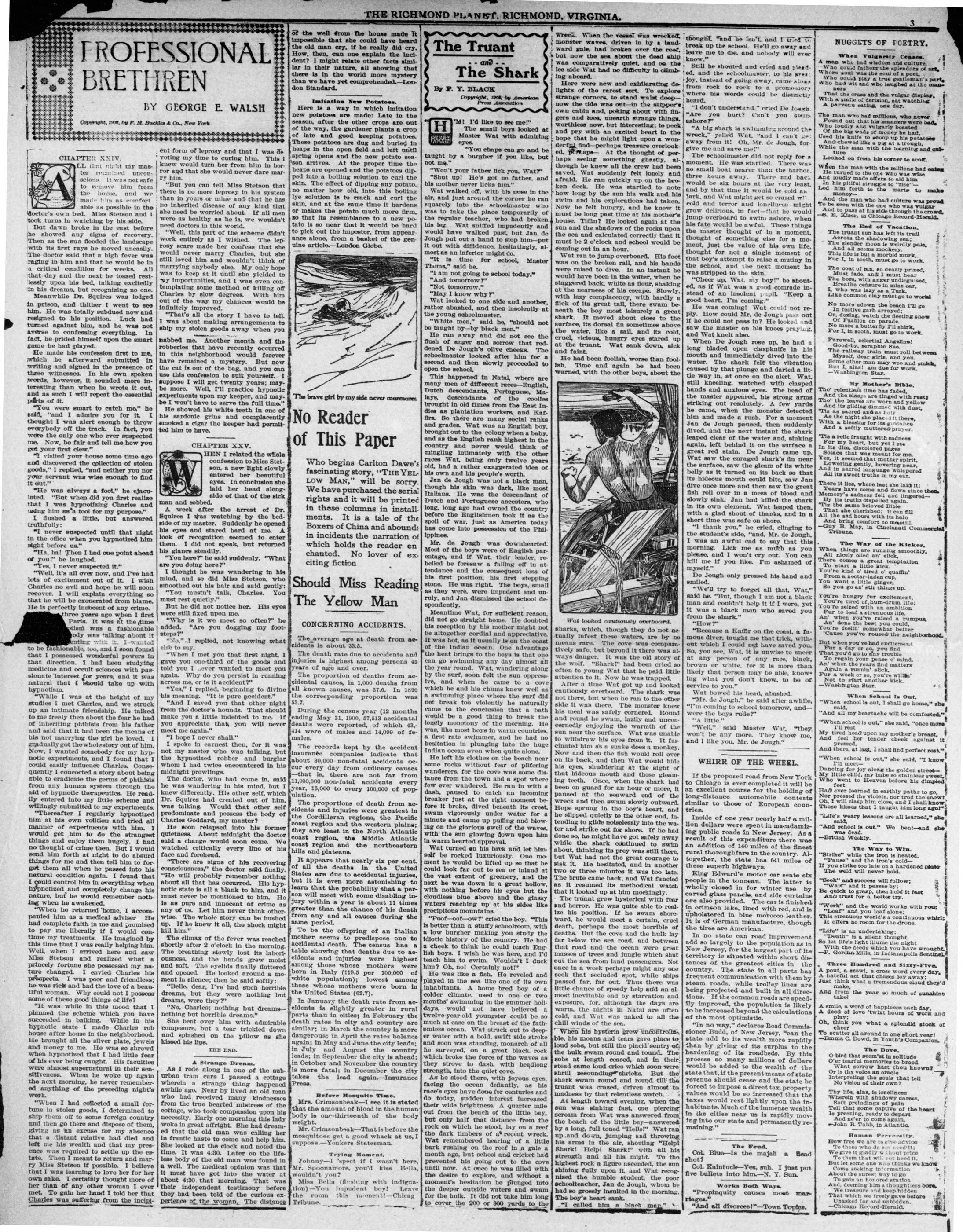
The brave girl by my side never murmured.
No Reader of This Paper
Who begins Carlton Dawe's fascinating story, "THE YELLOW MAN," will be sorry. We have purchased the serial rights and it will be printed in these columns in installments. It is a tale of the Boxers of China and abounds in incidents the narration of which holds the reader enchanted. No lover of exciting fiction
Should Miss Reading The Yellow Man
CONCERNING ACCIDENTS.
The average age at death from accidents is about 33.8.
The death rate due to accidents and injuries is highest among persons 45 years of age and over.
The proportion of deaths from accidental causes, in 1,000 deaths from all known causes, was 57.6. In 1890 the corresponding proportion was 53.7.
During the census year (12 months ending May 31, 1900, 57,513 accidental deaths were reported, of which 43,414 were of males and 14,099 of females.
The records kept by the accident insurance companies indicate that about 30,000 non-fatal accidents occur every day from ordinary causes—that is, there are not far from 11,000,000 non-fatal accidents every year, 15,000 to every 100,000 of population.
The proportions of death from accidents and injuries were greatest in the Cordilleran regions, the Pacific coast region and the western plains; they are least in the North Atlantic coast region, the Middle Atlantic coast region and the northeastern hills and plateaus.
It appears that nearly six per cent. of all the deaths in the United States are due to accidental injuries, but it is even more astonishing to learn that the probability that a person will meet with some disabling injury within a year is about 11 times greater than the chance of his death from any and all causes during the same period.
To be the offspring of an Italian mother seems to predispose one to accidental death. The census has a table showing that deaths due to accidents and injuries were highest among those whose mothers were born in Italy (119.5 per 100,000 of white population); lowest among those whose mothers were born in the United States (62.7).
In January the death rate from accidents is slightly greater in rural parts than in cities; in February the death rates in city and country are similar; in March the country is more dangerous; in April the rates balance again; in May and June the city leads; in July and August the country leads; in September the city is ahead; in October and November the country is more fatal; in December the city takes the lead again.—Insurance Press.
Before Mosquitto Time:
Mrs. Crimsonbeak—I see it is stated that the amount of blood in the human body is one-thirteenth of the body weight. Mr. Crimsonbeak—That is before the mosquitoes get a good whack at us, I suppose.—Yonkers statesman.
Trying Moment.
Johnny—I 'spect if I wasn't here,
Mr. Spoonamore, you'd kiss Bella,
wouldn't you?
Miss Bella (flushing with indignation)
—You impudent boy! Leave
the room this moment!—Chicag
Tribune.
---
The Truant
and
The Shark
By P. Y. BLACK
Copyright, 1904, by American
Press Association
"M! I'd like to see me!" The small boys looked at Master Wat with admiring eyes.
H 'M! I'd like to see me!'
The small boys looked at
Master Wat with admiring
eyes.
"You chaps can go and be
taught by a burgher if you like, but
not me."
"Won't your father lick you, Wat?"
"Shut up! He's got no father, and
his mother never licks him."
Wat walked off, with his nose in the
air, and just around the corner he ran
squarely into the schoolmaster who
was to take the place temporarily of
the regular teacher, who had broken
his leg. Wat sniffed impudently and
would have walked past, but Jan de
Jough put out a hand to stop him—put
it out with diffidence, hesitatingly,
almost as an inferior might do.
"It is time for school, Master
Thoma," said he.
"I am not going to school today."
"May I know why?" Wat looked to one side and another, rather abashed, and then insolently at the young schoolmaster. "White men," said he, "should not be taught by—by black men."
He ran away and did not see the flush of anger and sorrow that reddened De Jough's olive cheeks. The schoolmaster looked after him for a second and then slowly proceeded to open the school.
This happened in Natal, where are many men of different races—English, Dutch descendants, Portuguese, Malays, descendants of the coolies brought in old times from the East Indies as plantation workers, and Kaffirs. So there are many social ranks and grades. Wat was an English boy, brought out to the colony when a baby, and as the English rank highest in the country and never would think of mingling intimately with the other races Wat, being only twelve years old, had a rather exaggerated idea of his own and his people's worth.
Jan de Jough was not a black man, though his skin was dark, like most Italians. He was the descendant of Dutch and Portuguese ancestors, who long, long ago had owned the country before the Englishmen took it as the spoil of war, just as America today has come into possession of the Philippines.
Mr. de Jough was downhearted. Most of the boys were of English parentage, and if Wat, their leader, rebelled he foresaw a failing off in attendance and the consequent loss of his first position, his first stepping stone. He was right. The boys, small as they were, were impudent and unruly, and Jan dismissed the school despondently.
Meantime Wat, for sufficient reason, did not go straight home. He doubled his reception by his mother might not be altogether cordial and appreciative. It was hot, as it usually is on the coast of the Indian ocean. One advantage the heat brings to the boys is that one can go swimming any day almost all the year round. Wat, wandering along by the surf, soon felt the sun oppressive, and when he came to a cove which he and his chums knew well as a swimming place where the surf did not break too violently he naturally came to the conclusion that a bath would be a good thing to break the lonely monotony of the morning. He was, like most boys in warm countries, a first rate swimmer, and he had no hesitation in plunging into the huge Indian ocean even when quite alone.
He left his clothes on the beach near some rocks without fear of pifering wanderers, for the cove was some distance from the town and a spot where few ever wandered. He ran in with a dash, paused to catch an incoming breaker just at the right moment before it broke, dived beneath its crest, swam vigorously under water for a minute and came up puffing and blowing on the glorious swell of the waves, with the sun glowing down upon him in warm hearted approval.
Wat turned on his back and let himself be rocked luxuriously. One moment he would be lifted up so that he could look far out to sea or inland at the vast extent of greenery, and the next he was down in a great hollow, with nothing before his eyes but the cloondess blue above and the glassy waters reaching up at his sides like precipitous mountains.
"Poo-foot-owl" crled the boy. "This is better than a stuffy schoolroom, with a low burger making you study the idiotic history of the country. He had a cheek to think he could teach English boys. I wish he was here, and I'd teach him to swim. Wouldn't I duck him? Oh, no! Certainly not!"
He was like a fish. He revealed and played in the sea like one of its own inhabitants. A home bred boy of a colder climate, used to one or two months' swimming in the summer holidays, would not have beloved a twelve-year-old youngster could be so much at ease on the breast of the fathomless ocean. Wat struck out to deeper water with a bold, swift side stroke and soon was standing, monarch of all he surveyed, on a great black rock which broke the force of the waves as they strove to dash, with headlong strength, into the quiet cove.
As he stood there, with joyous eyes, facing the ocean defiantly, as his race's eyes have done for centuries and do today, sudden interest increased their wide brightness. A quarter mile out from the beach of the little bay, but only half that distance from the rock on which he stood, lay on a reef the dark timbers of a recent wreck. Wat remembered hearing of a little bark rushing on the reef in a gale a month ago, but school and cricket had prevented his going out to the cove until now. At once he was filled with the desire to explore, and without a moment's hesitation he plunged into the deeper outside waters and swam for the hulk. It did not take him long to cover the 200 or 300 yards to the
Wreck. When the vessel was wrecked, monster waves, driven in by a landward gale, had broken over the reef, but now the sea about the dead ship was comparatively quiet, and on the lee side Wat had no difficulty in climbing aboard.
Here were new and exhilarating delights of the rarest sort. To explore strange corners, to stand waist deep—now the tide was out—in the skipper's own cabin and, poking about with fingers and toes, unearth strange things, worthless now, but interesting; to peek and pry with an excited heart in the hope that he might light upon a wonderful find—perhaps treasure overlooked, perhaps. At the thought of perhaps seeing something ghastly, although he knew all the crew had been saved. Wat suddenly felt lonely and afraid. He ran quickly up on the broken deck. He was startled to note how long by the sun his walk and his swim and his explorations had taken. Now he felt hungry, and he knew it must be long past time at his mother's house. Tiffin? He looked again at the sun and the shadows of the rocks upon the sea and calculated correctly that it must be 2 o'clock and school would be coming out in an hour.
Wat ran to jump overboard. His foot was on the broken rail, and his hands were raised to dive. In an instant he would have been in the water, when he staggered back, white as flour, shaking at the nearness of his escape. Slowly, with lazy complacency, with hardly a flick of its great tall, there swam beneath the boy most leisurely a great shark. It moved about close to the surface, its dorsal fin sometimes above the water, like a sail, and its cold, cruel, vicious, hungry eyes stared up at the truant. Wat sank down, slck and faint.
He had been foolish, worse than foolish. Time and again he had been warned, with the other boys, about the
A man is standing on a boat, holding a sword in his right hand and a shield in his left hand. He is wearing a helmet and a sword. The boat is made of wood and has a metal railing. The water is calm and there are no waves.
Wat looked cautiously overboard, sharks, which, though they do not actually infest these waters, are by no means rare. The cove was comparatively safe, but beyond it there was always danger. It was the old story of the wolf. "Shark!" had been cried so often to young Wat that he paid little attention to it. Now he was trapped
After a time Wat got up and looked cautiously overboard. The shark was not there, but when he ran to the other side it was there. The monster knew his meal was safely cornered. Round and round he swam, lazily and inconveniently enjoying the warmth of the sun near the surface. Wat was unable to withdraw his eyes from it. It fascinated him as a snake does a monkey. Now and then the fish would roll over on its back, and then Wat would hide his eyes, shuddering at the sight of that hideous mouth and those gleaning teeth. Once, when the shark had been on guard for an hour or more, it paused at the seaward end of the wreck and then swam slowly outward. Hope sprung in the boy's heart, and he slipped quietly to the other end, intending to glide noiselessly into the water and strike out for shore. If he had done so, he might have got safely away while the shark continued to swim about, thinking its prey was still there, but Wat had not the great courage to sisk it. He hesitated, and in another two or three minutes it was too late. The brute came back, and Wat fancied as it resumed its methodical watch that it looked up at him mockingly.
The truunt grew hysterical with fear and horror. He was quite able to realize his position. If he swam shoreward, he would meet a certain, cruel death, perhaps the most horrible of deaths. But the cove and the hulk lay far below the sea road, and between that road and the ocean were great masses of trees and jungle which shut out the sea from land passengers. Not once in a week perhaps might any one seek that secluded spot, while ships passed far, far out. Thus there was little chance of speedy help and an almost inevitable end by starvation and exposure, for, although the days are warm, the nights in Natal are often cold, and Wat was naked to all the chill winds of the sea.
When his hysteria grew uncontrollable, his moans and tears gave place to loud sobs, but still the plac'd sentry of the hulk swam round and round. The sobs at length ceased, and in their stead came loud cries which soon were shrill resounding shrieks. But the shark swam round and round till the truant was crazed, driven almost to madness by that relentless watch.
At length toward evening, when the sun was sinking fast, one piercing scream from Wat was answered from the beach of the little bay—answered by a long, full toned "Hello!" Wat ran up and down, jumping and throwing his arms in the air, shouting "Helpl Shark! Helpl Shark!" with all his strength and all his might. To the highest rock a figure ascended, the sun shining fully upon it, and Wat recognized the humble student, the poor schoolteacher, Jan de Jough, whom he had so grossly insulted in the morning. The boy's heart sank.
"I called him a black man."
thought. "and he isn't, and I tried to break up the school. He'll go away and leave me to die, and nobody will ever know."
Still he shouted and cried and pleaded, and the schoolmaster, to his greet joy, instead of going away, came along from rock to rock to a memorial where his words could be distinctly heard.
"I don't understand," cried De Jough. "Are you hurt? Can't you swim ashore?"
"A big shark is swimming around the wreck," yelled Wat. "and I can't go away from it! Oh, Mr. de Jough, forgive me and save me!"
The schoolmaster did not reply for a moment. He was startled. There was no small boat nearer than the harbor, three hours away. There and back, would be six hours at the very least, and by that time it would be cold an lark, and Wat might get so crazed with cold and terror and loneliness—might grow delirious, in fact—that he would jump overboard to swim ashore, when his fate would be awful. These things the master thought of in a moment, thought of something else for a moment, just the value of his own life, thought for not a single moment of that boy's attempt to raise a mutiny in the school, and the next moment he was stripped to the skin.
"Cheer up, Wat, my boy!" he shouted, as if Wat was a good comrade instead of an insolent pupil. "Keep a good heart. I'm coming."
He was coming! Wat could not reply. How could Mr. de Jough pass out if he could not pass in? He looked and saw the master on his knees praying, and Wat knelt also.
When De Jough rose up, he had a long bladed open claspknife in his mouth and immediately dived into the water. The shark felt the vibration caused by that plunge and darted a little way in, at once on the alert. Wat, still kneeling, watched with clasped hands and anxious eyes. The head of the master appeared, his strong arms striking out resolutely. A few yards he came, when the monster detected him and made a rush. For a moment Jan de Jough paused, then suddenly dived, and the next instant the shark leaped clear of the water and, shaking again, left behind it on the surface a great red stain. De Jough came up, Wat saw the enraged shark's fn near the surface, saw the gleam of its white belly as it turned on its back so that its hideous mouth could bite, saw Jan dive once more and then saw the great fish roll over in a mess of blood and slowly sink. Jan had killed the shark in its own element. Wat leaped then, with a glad shout of thanks, and in a short time was safe on shore.
"I thank you." he cried, clinging to the student's side, "and, Mr. de Jough, I was an awful cad to say that this morning. Lick me as much as you please, and I won't cry out. You can kill me if you like. I'm ashamed of myself."
De Jough only pressed his hand and smiled.
"We'll try to forget all that, Wat." said he. "But, though I am not a black man and couldn't help it if I were, yet it was a black man who saved you from the shark."
"How?"
"Because a Kaffir on the coast, a famous diver, taught me that trick, without which I could not have saved you. So, you see, Wat. It is unwise to sneer at any person of any race, black, brown or white, for it is more than likely that person may be able, knowing what you don't know, to be of service to you."
Wat bowed his head, abashed.
"Mr. de Jongh." be said after awhile,
"I'm coming to school tomorrow, and—
were the boys rude?"
"A little."
"Well," said Master Wat, "they
won't be any more. They know me,
and I like you. Mr. de Jongh."
WHIRR OF THE WHEEL.
If the proposed road from New York to Chicago is ever completed it will be an excellent course for the holding of long-distance automobile contests similar to those of European countries.
Inside of one year nearly half a million dollars were spent in macadamizing public roads in New Jersey. As a result of this expenditure there was an addition of 140 miles of the finest rural thoroughfare in the country. Altogether, the state has 641 miles of these superb highways.
King Edward's motor car seate six people in the tonneau. The latter is wholly closed in for winter use by carved glass panels, and side curtains are also provided. The car is finished in ormison lake, lined with red, and is upholstered in blue morocco leather. It is of German manufacture, though the tires are American.
In no state can road improvement add so largely to the population as in New Jersey, for the largest part of its territory is situated within short distances of the greatest cities in the country. The state in all parts has frequent communication with them by steam roads, while trolley lines are being projected and built in all directions. If the common roads are speedily improved, the population is likely to be increased beyond the calculations of the most optimistic.
"In no way," declares Road Commissioner Budd, of New Jersey, "can the state add to its wealth more rapidly than by giving of its surplus to the hardening of its roadbeds. By this process so many millions of dollars would be added to the wealth of the state that, if the present means of state revenue should cease and the state be forced to impose a direct tax, property values would be so increased that the taxes would rest lightly upon the inhabitants. Much of the immense wealth in the cities near us is rapidly moving into our state and permanently remaining."
The Feud.
Col. Blue—Is the majah a flead
shot?
Col. Kaintuck—Yes, suh. I just put
five bullets into him—N. Y. Sun.
NUGGETS OF POETRY.
When Vulgarity Ceases.
A man who had wisdom and culture,
Who could fathom the splendors of art,
Whose soul was the soul of a poet,
Who could play a true gentleman's part,
Who had wit and who laughed at the man-
That the crass and the vulgar display.
With a smile of derision, sat watching
A perverse eating, one day.
The man who had millions, who never
Found out that his manners were bad,
Who loudly and vulgarly boasted
Of his money he had,
Used his knife to chop his potatoes
And chewed like a pig at a trough.
While the man with the learning and cul
Led him forth to the marte to make money-
And the man who had culture was proud
To be seen with the one who was vulgar.
And to pass at his side through the crowd.
S. E. Kisler, in Chicago Record-Houston.
The End of Vacation
The truant sun has left its trail
Across the shadowing sea;
The slender moon is weirdly pale,
And all seems mockery.
This life is but a morbid murk,
For I, in sooth, must go to work.
The coat of tan, so dearly prized,
Must fade, and I must hear
The boss, with anger undeiguised,
Breathe the censure in mine ear,
I, who was lazy as a Turk,
Like common clay must go to world!
No more adown the beach I'll go
In festive garb arrayed;
Or dozing, watch the fleeting show
Of rain on parade.
No more a butterfly I'll shirk,
For I, in sooth, must go to work.
Farewell, celestial Angeline!
Goodbye, seraphic Sue.
The railway train must roll between
Myself, dear sir, and you
Some other man may woe and snirk,
But I, alas! am due for work.
—Washington Star.
My Mother's Bible.
'Tho' relentless time has faded,
And the clasps are tinged with rust;
'Tho' the leaves are worn and yellow
And its gliding dimmed with dust,
'Tis as sacred and as holy
As the night she placed it there,
With a blessing for its guidance
And a softly muttered prayer.
'Tis a relic fraught with sadness
For my heart, but yet I see
In its dim, discolored pages
Solace that was meant for me.
Yet, seemed that mother spirit,
Lowering gaze, hovering near,
And in sacred language whispered
All its sweet truths in my ear.
There it lies, where last she laid it;
You have come and flown since then
Memory' has press fell and lingered—
By its truths she again.
'Tis the same beloved Bible
That she cherished; it can fill
All the sad hours with its halo
And bring comfort to mastill.
—Guy B. May, in Cincinnati Commercial
The Way of the Klecker.
When things are running smoothly,
All nicely oiled an' slick,
There comes a great temptation
To start a little kick.
You're kind o' tired o' quaffin'
From a nectar-laden cup,
You want a little ginger,
So you go an' stur things up.
You're hungry for excitement.
You're tired of hum-drum life;
You're seldized with an ambition
Fur to lead a strenuous life.
An when you rued a rumpum,
An' dona the best you could
You're feelin' somewhat better
'Cause you've roasted the neighbors
But when you've had excitement
Fur a day or so, you find
That you'd go to chy trouble
To regain your peace o' mind.
An' when the years find matters
Again a runnin' slick.
Fur a week or so, you willin'
Not to start another kick.
—Washington Star.
When School Is Out.
"When school is out, I shall go home," she said.
"And all my heartache will be comforted."
"When school is out," she said, "once more I'll rest
My tired head upon my mother's breast,
And feel her tender cheek against it pressed.
And there, at last, I shall find perfect rest."
"When school is out," she said, "I know I'll meet—
Dancing for joy along the golden street—
My little child, my babe so stainless sweet,
Who went to Heaven before his dimpled feet.
Ha$ ever learned in earthly paths to go,
N not pressed the violets, nor trod the snow!
Oh, I will clap him close, and I shall know.
Those kisses that I taught him long ago!
"Life's weary lessons are all learned," she
said,
"And school is out." We bent—and she
was done—
-Brush Wooky!
The Way to Win.
"Strike" while the iron is heated,
"Pause" and the iron's cold—
If you strike too late on a hardened plate
The wold will never hold.
"Seek" and success will follow;
"Wait" and it passes by;
Be quick to grasp, then hold it fast
And trust for a better try.
"Work" and the work works with you;
"Loaf" and you loaf alone;
This strenuous world's a continuous whirl;
It offers no room for the drone.
"Life" is an undertaking;
"Death" is a silent thought.
So let life's light illumine the night
With the deeds which you have wrought.
—P. Gordon Mills, in Indianapolis Sentinel.
Three Hundred and Sixty-Five,
A pout, a sowl, a cross word every day,
A hateful act that chases joy away;
Just think what a tremendous cloud they
make,
And from the year so much of sunshine
take!
A smile, a word of happiness each day,
A deed of love 'twink hours of work and
play;
Oh, think you what a splendid stock of
charer
To scatter all around in one short year!
—Emma C. Dowd, in Youth's Companion.
The Dove.
O bird that seem'st in solitude
Oer tearful memories to brood
What sorrow has thou known?
Or is thy voice an angel?
Interpreting the souls that tell
No vision of their own?
Thy life, alas, is loneliness
Wheresin with shadowy caroes,
Soft preludings of pain
Tell that some captive of the heart
Is preening, ready to depart
And ne'er to come again.
John B. Tabb, in Atlantic.
Human Perseverity.
How free we are to give advice
To those who do not need it;
We give it gladly without price
To them that will not heed it.
But let some one who thinks we know
Come seeking information
About the surest way to go
To gather honored station
And, deeming him a thoughtless bore
We treasure and keep hidden
That which we freely gave before
Unasked for and unbidden.
-Chicago Record-Herald.
RE PLANET
ADVERTISING RATES
For one inch, one insertion . . . $ 50
For one inch, each subsequent insertion, . . . 50
For two inches, three months, . . . 4.00
For two inches, four months, . . . 10.00
For two inches, nine months, . . . 14.00
For two inches, twelve months, . . . 20.00
Marriage and Funeral Notices, . . . 50
Standing and Transient Notices per line, . . . 10
THE POSTAGE STAMPS OF A HIGHER DE-
NOMINATION THAN TWO CENTS NOT
RECEIVED ON SUBSCRIPTIONS.
THE PLANET is issued weekly. The subscrip-
tion price is $1.50 a year, in advance.
There are FOUR WAYS by which money can be sent by mail at our risk — in a Post Office Money Order, by bank Check or drug, or an Exempt Money Order, by bank Check or drug, or if these can be procured, in a Registered Letter.
MONEY ORDERS—You can buy a Money Order at your Post Office, payable at the Richmond Post Office, and we will be responsible for its delivery.
EXPRESS MONEY ORDERS can be obtained at any office of the American Express Co., the United States Express Co., and the Well's Farmer's Company, responsible for money sent by any of these companies. The Express Money Order is a safe and convenient way for forwarding money.
REGISTERED LETTER—If a Money Order is registered, the Postmaster will register your reach, the Postmaster will register the letter you wish to send on payment of ten cents. Then, if the letter is lost or stolen, you can send money in this manner at our risk.
We cannot be responsible for money sent in letters in any other way than one of the four ways mentioned above. If you send your money in another way, you must do it at your own risk.
RENEWALS, ETC.—If you do not want THE PLANET continued for another year after your subscription has run out, you then notify us by email to tell us about it. The company decided that subscribers to newspapers who do not order their paper discontinued at the expiration of time for which it has been paid are held liable for the payment of the subscription charge when they order the paper discounted.
COMMUNICATIONS—When writing to us to renew your subscription or to discontinue our paper, you should give your name and address to us, and likewise we cannot find your name on our books.
CHANGE OF ADDRESS—In order to change the address of a subscriber, we must be sent "to former as well as the present address."
Entered in the Post Office at Richmond, Va., as second class matter.
A. DOUBLE LYNCHING.
Two colored men were lynched Wednesday night, night 1st, inst., at Newborn, Tenn. Their names are GARFIELD BURLEY and CURTIS BROWN. BURLEY was charged with fatally shooting a white man, named D. FLATT, with whom he disagreed about a horse trade. BROWN was hanged with him from all accounts simply for the purpose of furnishing BURLEY with company and because he knew him.
The judge pleaded with the mob to let the law take its course, guaranteeing that the alleged murderer should be tried at once and also assuring them that he would be hanged, but his appeals were vain and the two men were led to telephone posts; and after being swung up, facing each other, were soon pronounced dead.
Nothing will be done about it and the rule of the mob will continue in that section of the country. Had any colored people interfered or insisted that the law be permitted to take its course, they would have been charged with inciting a riot and lodged in jail.
The situation grows worse and worse, but all of such evils must run their course and then will the end come.
THE APPEAL TO THE PRESIDENT
THE situation in the coal-fields of Pennsylvania as portrayed by the mineowners in their interview with President Roosevelt is closely akin to the conditions which have existed in South Carolina, Mississippi, Louisiana, Arkansas and lastly in Kentucky and North Carolina. Any one who will read carefully the statements of these moneyed men, will understand why the President was greatly displeased with their comment on the situation.
They said that the mob should not be dallied with or their leaders encouraged. It was his business to see to it that the laws of this country were enforced to the end that men desiring to work shall be protected from violence at the hands of men who do not desire that they should work. He was told that if this could not be done and corporations and individuals protected in their property rights, then this government of ours is a miserable failure. The question presented is similar to the one which is now confronting the nation, not only in the South, but in many parts of the North. Colored men have been driven out of Arkansas, Indiana, and even Illinois.
In the latter state, the National Guard was used to uphold the dignity of state laws. In North Carolina, the same conditions prevailed and colored men are to-day spread over the North as refugees, who dare not return to their native cities. We have maintained that such treatment of colored men would
lead to the similar treatment of white men:
Now wealthy white men are as powerless in Pennsylvania as the much maligned Negro in North Carolina. We see in this a stern retribution. The white labor unions, hereabout, ignore and abuse us, denying to us the right to earn bread to support our wives and little ones. The northern millionaire mine-owners didn't have time to lend a listening ear to our appeals and we were forced to make any kind of terms with our oppressors, but it has come around to us in a way that we can look on at the procession and keep out of the funeral.
One writer has said that the white man burns coal and the black man wood and when last heard from, the latter was the happier of the two, for he was laughing. God will bring all thing right in his own time.
STILL AGAINST US.
The Richmond, Va., News indulged in a remarkable dissertation on the Negro in its issue of the 8th inst., and came out in favor of the removal of that much abused individual from this to some other section of this wide world. It was of the opinion that the two races could not live in this country together, although both races were here when the News' editor came into the world and, we make the prediction, will be here when he goes out of it.
This journal has had some excellent things to say on the race question, but its wabbling policy leads us to believe that it is either double-headed or that two different editors, entertaining different views dispense the daily editorial banquet to the public.
It was first alleged that the cause of disagreement between the Negro-haters and the Negro was due to the color-line not being drawn to the requisite fineness. Accordingly, the Supreme Court of the United States took the hint and nullified the constitutional Civil Rights Bill. The colored brother apparently acquiesced in this decision. Peace did not long exist on the other side of the line; because, it was found that the colored brother was bearing up bravely under the handicap and prospering in the face of adversity.
It was announced from the headquarters of the Negro haters that the holding of state offices was the cause of the trouble and again the Supreme Court of the United States came to their relief. The wink was given and colored men who were legally elected were either shot down or robbed out of the offices to which they had been elected.
But this did not suit. Although the Negro-haters were in possession of the ballot boxes, which were tenderly doctored to their own self-satisfaction. They wanted a law disfranchising the colored brother out-right and again the Supreme Court of the United States gave the wink and the tricksters proceeded to work, and after laboring nearly a year and doing the white people of the state more injury than they did the Negro, they brought forth an unconstitutional constitution which does exactly what the Constitution of the United States says it shall not do.
The Democratic Negro-hating leaders speak with assurance relative to the effectiveness of their work. Have they not been in touch with the United States Supreme Court Judges? Have they no understood that when the cases come up before them (if they ever reach there during our life-time) they will "wink the other eye" and decide the case on some technical unimportant point, not thought of by the attorneys for the plaintiff?
But then even this does not satisfy the Negro-haters. They have taken away the right. Now, they want a confiscation of property. If all citizens in this country are legally equal, what legal right has one set of equal citizens to deport another set?
Could it be done without a revolution? Then why discuss such absurd propositions? Why inflame the ignorant white elements by picturing a condition which can not exist and which if attempted would lead to a bloody revolution and all of the white men would not be against us either. There is one lesson in all this and that is,—the Negro has nothing to hope from the policy of inaction. The more we yield, the more we shall have to yield. One right swept away leads to another right swept away, until the glutton of prejudice demands not only our rights, but our property, and at last calls for our very existence and orders that we get off this part of the earth. We had expected better things of the News. "O, the pity of it!"
Mother and Four Children Missing.
Keokuk, Ia., Oct. 8—The police are searching this city and surrounding country for Mrs. Kate Houston and her four little girls. They are the entire family of William Houston, who reported to the police yesterday that his wife and the children had disappeared last Friday night, when he reached home, and had left no trace. The children range from 18 months to 11 years in age. The husband and sister of Mrs. Houston believe she is insane, and the theory that she has killed her children and herself is quite generally accepted.
President Invited to Hunt Moose.
Minneapolis, Minn., Oct. 7.—Frank H. Kratka, mayor of Thief River Falls, Minn., yesterday sent to President Roosevelt an invitation to hunt moose in Northern Minnesota for ten days,
beginning November 12. The invitation was burnt on birch bark and was accompanied by a special hunter's license, also on bark, for which the president, if he accepts, must pay $25, like any other non-resident hunter.
The party is to include Senators Clapp and Nelson, Governor Van Sant and Congressmen Fletcher and Morris.
THE RICHMOND PLANET, RICHMOND, VIRGINIA.
ENTIRE GUARD ON DUTY
ENTIRE GUARD ON DUTY
Governor Stone Ordered All Troops to Anthracite Coal Region
DISORDERS TO BE SUPPRESSED
General Gobin Is Instructed to Place Soldiers Where Most Needed and to Protect All Men Who Desire to Work.
Harrisburg, Pa., Oct. 7. — Governor Stone late last night ordered out the entire division of the National Guard of Pennsylvania for duty in the anthracite coal regions. The soldiers began arriving in the field this morning. The order calling out the guard is as follows:
"Headquarters National Guard, Adjutant General's Office, Harrisburg, October 6.
"In certain portions of the counties of Luzerne, Schuylkill, Carbon, Lackawanna, Susquehanna, Northumberland and Columbia, tumults and riots frequently occur, and mob law reigns, men who desire to work have been beaten and driven away, and their families threatened. Railroad trains have been delayed, stoned and the tracks torn up. The civil authorities are unable to maintain order and have called upon the governor and commander-in-chief of the National Guard for troops. The situation grows more serious each day. The territory involved is so extensive that the troops now on duty are insufficient to prevent all disorder. The presence of the entire division, National Guard of Pennsylvania, is necessary in these counties to maintain the public peace.
"The major general commanding will place the entire division on duty, distributing them in such localities as will render them most effective for preserving the public peace. As tumults, riots, mobs and disorder usually occur when men attempt to work in and about the coal mines, he will see that all men who desire to work and their families have ample military protection, and will see that threats, intimidations, assaults and all acts of violence cease at once. The public peace and good order will be preserved upon all occasions and throughout the several counties, and no interference whatever will be permitted with officers and men in the discharge of their duties under this order. The dignity and authority of the state must be maintained and her power to suppress all lawlessness within her borders be asserted.
"WILLIAM A STONE, Governor."
This is the first time since the Homestead riots in 1892 that the entire division of the guard has been ordered out for strike duty. The cost to the state of this tour of duty will probably exceed $1,000,000. How long the troops will be kept in the field depends entirely on the situation in the coal regions. As soon as the strike is settled the troops will be withdrawn. Should the men return to work under military protection and there should be no danger of a serious outbreak, it is probable the soldiers will be gradually withdrawn.
Governor Stone denied that he had ordered out the entire state militia on the request of President Roosevelt. He said he has had no communication with the president on the subject.
SUIT AGAINST COAL ROADS
BILL In Equity Charges Them With
Forming Ullah Combination
Forming Illegal Combination.
Philadelphia, Oct. 8.—Counsel for Frank H. Thompson, a citizen of this commonwealth, today filed in the United States circuit court a bill in equity against the Philadelphia and Reading Railway Company, the Central Railroad of New Jersey, the Lehigh Valley Railroad, the Delaware, Lackawanna and Western Railroad and the New York, Ontario and Western Railroad. The bill charges these companies with having formed an illegal combination for the purpose of fixing the price of coal and controlling the coal market, and asking the court to declare such combination illegal and to restrain and prohibit the respondents from meeting together for the purpose of fixing the rate at which coal shall be sold.
Application was also made in behalf of Mr. Thompson to the attorney general of the state for a revocation of the charter of the Philadelphia and Reading Railway Company for alleged violation of the state constitution.
It is charged that the respondents are unwilling and refuse to operate their mines, greatly to the loss of the complaint and in violation of the rights, duties and obligations which the said respondents owe to the public.
London, Oct. 8.—Sir Thomas Lipton's third challenge for a series of races for the America's cup was signed yesterday afternoon at Belfast, Ireland, by the officials of the Royal Ulster Yacht Club. The Hon. Charles Russell represented Sir Thomas Lipton. The challenge was immediately posted, and left for New York on the White Star Line steamer Oceanic, which sailed from Liverpool today and will sail from Queenstown tomorrow.
Choked to Death On Meat
Winston Salem, N. C., Oct. 8—While at breakfast yesterday E. A. Nelson, 53 years old, a printer, of Columbus, S. C., choked to death on a piece of "rare" beefsteak. It was noticed that he was choking, and he was carried into the yard. A physician was summoned, but Nelson died before he reached him.
TWO BOYS FOUND DEAD
Murdered—Suspect Arrested.
Camden, N. J., Oct. 6—In finding the bodies of John H. Coffin, 11 years old, and Price Jennings, three years his senior, in a weed-grown field near Haddon Heights, about seven miles southeast of Camden, Saturday morning, the police have on their hands a mystery which so far has baffled them.
The dead boys were sons of well-known Camden men. They disappeared from their homes shortly after noon last Wednesday.
Murder is strongly suspected. Paul Woodward, of Camden, 18 years old, is under arrest, charged with the killing of young Coffin only. Not a single mark of violence was found on the body of either lad. Poison was what killed them, perhaps. The police officials are inclined to this theory. The poison theory is looked at from two sides. Some of the officials incline to the opulon that death was due to eating toadstools or poisonous berries. Still others say poison was administered with murderous intent, and that a crime was committed before the two boys died. This theory has many supporters.
The police say they have a clear case against Woodward, and claim to have found a negro farm hand who saw Woodward in the woods with the boys on the day they were killed.
RUSSELL SAGE ILL
Well-Known Financier Suffering From An Attack of Bronchitis.
New York, Oct. 8.-Russell Sage is ill at his home, Cedarhurst, L. L. as a result of an attack of bronchitis, which has inconvenienced him for several weeks but did not interfere with his coming to his office in this city until Monday. On the morning of that day he got as far as the depot, intending to come to New York, but, being seized with chills, went back to his home and then to bed. Mr. Sage was seriously ill from 10 o'clock Monday until midnight, when the continuous attentions of his physicians prevented an attack of pneumonia, which at the time was threatened.
Last night the physician reported that the financier's temperature, which had been at 104 for a number of hours, had subsided to the normal point. This led the physician to add that there was not the slightest danger of serious complications, though he may not be able to come to New York for 10 days.
BIG BLAZE IN TEXAS OIL FIELDS
Twelve or More Lives Lost and Forty
Derricks Destroyed
Beaumont, Texas, Oct. 8.—Another great fire, more disastrous than the conflagration of a few weeks ago, swept over the oil fields here last night, causing the loss of twelve or more lives and entailing a property damage of many thousand dollars. The fire was discovered shortly before 11 o'clock and with remarkable rapidity it spread to the many derricks in the Hogg-Swayne tract. The encroachment of the flames was so rapid that many people were caught in the ferry path and it is known that twelve people have perished and the fatalities may reach twenty. The entire Hogg-Swayne tract, comprising one of the largest sections in the oil fields, was burned to the ground, 40 or more of the large derricks having been destroyed by the flames. The entire oil field presented a brilliant spectacle.
EARNINGS OF STEEL TRUST
Amount to $101,142,158 For Nine Months.
New York, Oct. 8.—The directors of the United States Steel Corporation yesterday issued a statement of net earnings for the nine months of the year, ended September 30. Earnings for July, August and September, with the last month estimated, aggregate $36,764,643; total net earnings for the nine months, deducting each month's expenses for ordinary repairs, renewals and maintenance of plant, also interest on bonds and fixed charges of the subsidiary companies, aggregate $101,142,158. The usual dividends of 1% per cent. on the preferred and 1 per cent. on the common quarterly were declared.
Hawaii's Treasurer Abaconda
Honolulu, Sept. 27, via San Francisco, Oct. 7—William H. Wright, treasurer of the territory of Hawaii, is alleged to be an abscessor and a defaulter to the extent of over $17,000. It is believed he stowed away on the steamship Alameda, which left here last Wednesday at noon. Secretary of the Treasury Henry E. Cooper has been appointed treasurer temporarily by Governor Dole. Under the territorial act the treasurer is not required to give bonds, and the legislature at its last session failed to make any provision for bonds.
A Doctor's Wonderful Discovery.
London, Oct. 7.—A dispatch from Moscow says a Dr. Koulatke has succeeded in his experiments in reanimating the heart of an infant. He extracted the heart from a child that had died 24 hours previously. It beat with normal regularity for one hour. Dr. Koulatke hopes that his discovery will assist in reanimating in cases of death by drowning.
Fatally Injured In Football Game.
Hagerstown, Md., Oct. 6.—Benjamin Thompson, 23 years old, of Martinsburg, W. Va., was fatal injured in a football contest here on Saturday in a game with a team representing the West Virginia City. In a scrimmage Thompson's skull was fractured. He is in a local hospital.
A WEEK'S NEWS CONDENSED.
Thursday, October 2.
Rear Admiral James E. Jouett, U. S. N., retired, died yesterday at Sandy Spring, Md.
Ex-Chief of Police F. W. Ames, of Minneapolis, Minn., was convicted yesterday of receiving a bribe.
The commandery-in-chief of the Loyal Legion of the United States decided to meet in Philadelphia next year.
Walter Sullivan, a young negro, was lynched yesterday at Portland, Ark., for shooting D. J. Roddy, a white man, in the back.
The five companies of the Pennsylvania State Guard, who were doing strike duty at Lebanon, Pa., were ordered back to Shenandoah yesterday.
Friday, October 3.
W. J. Clothier, of Harvard University, yesterday won the inter-collegiate
tennis championship at Haverford, near Philadelphia.
Secretary of War Root yesterday approved the plans for the war college buildings at Washington and at Fort Riley, Kan.
Frank Jones, the millionaire brewer, died at his home at Portsmouth, N. H., yesterday. His fortune is estimated at $10,000,000.
While entering her port at Liverpool, Eng., yesterday, the American liner Haverford was in a collision and was badly damaged. The passengers were landed safely.
Saturday, October 4.
A Manila dispatch announces the death in that city of Captain F. C. Jackson of heart disease.
Captain John R. King, of Baltimore, was appointed pension agent at Washington as successor of the late Sidney L. Willson.
The torpedo boat Wasp was placed in commission at Norfolk, Va., and is under orders to take part in naval manoeuvres this winter.
In a fierce battle between officers and four outlaws near Guthrie, Okla., yesterday, two men were killed and several others wounded.
Monday, October 6.
A theatre benefit at Cleveland, O., for the benefit of the striking miners in Pennsylvania netted $2,000.
A six-day walking match will be held in Philadelphia from November 3 to 8, for a diamond belt and large cash prizes.
A furious snowstorm, with a high wind, raged in Colorado Saturday night and yesterday. Twelves inches of snow fell at some places.
According to the report of the paymaster general, United States army expenditures last year decreased $918.189, as compared with 1991.
The building and stock of the Watts Company, wholesale dealers in nations, at Fargo, N. D., was destroyed by fire yesterday. Loss, $160,000.
Tuesday, October 7.
The Colombian gunboat Bogota sailed from San Francisco at noon today for Panama.
Over 70,000 French coal miners may strike for a fixed wage scale and an eight-hour day.
The Cuban congress yesterday decided to proclaim October 10, the anniversary of the beginning of the war of 1868, a national holiday.
A dispatch from Buenos Ayres says May Yohe and Captain Strong were not married there, as their marriage cannot take place under the laws of Argentina.
In a fit of jealousy, Lewis Lee, colored, of Clifton Forge, Va., killed a colored woman by hitting her on the head with a flatiron, and then committed suicide.
A board of United States naval engineers has decided that oil cannot compete with coal for naval use.
August Meyers, a Chicago baker, was burned to death in a fire which destroyed his bakery yesterday.
President Roosevelt yesterday appointed Thomas Roulhac United States district attorney for the district of Alabama.
The body of a man, with the legs tied together, was found in the river at Jersey City yesterday. The police believe the man was murdered.
Thomas Ryan, of Lancaster, Pa., was killed on the Pennsylvania Railroad last evening by a freight train on which he was returning home from work.
GENERAL MARKETS
Philadelphia, Pa., Oct. 7. — Flour was steady; winter superfine, $2.60@2.80; Pennsylvania roller, clear, $3.10@3.25; city mills, extra, $2.85@3.25; flour was steady; winter superfine, $3.20 per barrel. Wheat was firm; No. 23.81 sylvania red, new, $73@73%; Corn firm; No. 2 yellow, local, at 69; Oats were quiet; No. 2 white, clipped, $37½c; lower grades, $34@35c. Hay was firm; No. 18.50 large bales. Beef was firm; $20@21. Pork was firm; family, $22@23. Live poultry, at 13c for hens, and 10c for old roosters. Dressed poultry sold at 13c for choice fowls, and at 24c for roosters. Butter was steady; creamy; New York and Pennsylvania, 23c for dozen. Potatoes were steady; choice, 50@53c. per bushel.
A
He showed me where the bullet had imbedded itself in the plaster.
The Boxers of China are a powerful and mysterious society. To be marked as its enemy means to be pursued relentlessly and finally punished. The pursuit does not end there, but is often extended to other members of the family and does not cease until all have been exterminated.
The Yellow Man
By CARLTON DAWE
"But," said his friend, "there are some issues that can't be dodged." "Oh! I don't know," said the statesman, cheerfully, "you never know what you can dodge till you try!"—Puck.
Checkmating Him.
"Now, mother's cooking," he began, "was—"
"I know, I know," she interrupted. "Do you suppose, if I discharged Dinah, she would come to us for four dollars a week?"—Chicago Post.
The EGGS
which some coffee
roasters use to glaze their
coffee with—would you eat
that kind of eggs? Then
why drink them?
Lion Coffee
has no coating of storage eggs,
glue, etc. It's coffee—pure,
unadulterated, fresh, strong
and of delightful flavor
and aroma.
Uniform quality and
freshness are insured
by the sealed package.
Since the beginning of the anthracite coal strike the patent office has been doing a lively business in looking into the merits of inventions intended to be used for the production of both heat and power. Up to date there have been granted 1,280 patents for using oil as fuel; and for the use of gas and vapors, 2,700.
James Dobson, a multimillionaire carpetmaker, of Philadelphia, was "among those present" at a coal office there the other day to make application for fuel. He stood in line with a number of others and pleaded for a car load, saying he needed it badly at his factory. That was his second appeal, but he was told to "call again in the morning."
Perhaps the only woman coal operator in the country is Mrs. Jane Shirkie, of Clinton, Md., who is both superintendent and manager of a big mine. She holds a certificate of membership in the National Coal Operators' association and knows the mining industry and the coal market as well as any operator in Indiana. One hundred and fifty men are on her pay-roll. She has an office in her residence and attends to every detail of the business, including the correspondence, pay-rolls and the shipment of every ton of coal.
MIGHT USE A TELEPHONE.
He—Can't you hear how my heart beats with love for you?
She—If you sat a little closer perhaps I could.—Chicago American.
An Additional Character.
"And what," asks the teacher, "comes after the letters?"
It was thus that she taught to teach the young idea the value of the character "&."
"I know," volunteered the little wise boy.
"You may tell us, Johnny."
"The postman."—Baltimore American.
Chopping Him Off.
"By Jove, Grimshaw!" chuckled Lapdad.
"I'll have to tell you the—ha, ha,—funny thing my little boy said this morning. He looked right up at me, and—"
"Sorry, Lapdad, but I am out just now," interrupted Grimshaw. "Come around some time when I am in, will you?"—N. Y. Journal.
"Does my boy," inquired the parent "seem to have a natural bent in any one direction?" "Yes, sir," said the teacher. "He gives every indication of being a captain of industry some day. He gets the other boys to do all his work for him."—Chicago Tribune
Weary Willie—I may not look it,
mum, but I come uve derned good stock.
Mrs. Farmer—Oh, I don't doubt that.
I can see it has never been watered.—
Judge.
A Science.
"Do you think marriage a game of
chance?"
"Not at all! Dun's and Bradstreet's
have reduced it to an exact science!"—
Puck.
All Is Vanity.
Mrs. Dorcas—Why is Mrs. Gadsby so
glad she hasn't any children?
Dorcas—It gives her time to attend
those mothers' meetings—Judge.
W. I. JO
FUNERAL DIRECTOR
Office & Warerooms, 207 N.
HACKS F
Orders by Telephone or Tele-
pers and Entertainmen
Old 'Phone, 686, Residence
JOHNSON,
DIRECTOR AND EMBALMER.
Lms, 207 N. Foushee St. Corner Broad.
HACKS FOR HIRE:
phone or Telegraph filled. Wedding, Sup-
tertainments promptly attended.
Residence in Building, New Phone, 48.
KNIGHTS OF COLUMBUS OF THE WORLD
V. P. & F. K. of W.
W. I. JOHNSON, FUNERAL DIRECTOR AND EMBALMER.
Office & Warerooms, 207 N. Foushee St. Corner Broad. HACKS FOR HIRE: Orders by Telephone or Telegraph filled. Wedding, Suppers and Entertainments promptly attended.
KNIGHTS OF COLUMBUS OF THE WORLD
TO WHOM IT MAY CONCERN:
This organization has been chartered and legally instituted under the laws and statute of the state of New York, for the purpose of uniting together all acceptable men on the Broad Bases of Charity—Beneficial and the Social and Moral condition of humanity.ry and uniform ranks will secure for this organization all sacred institutions of modern events, a grand oppo-puties wanted in all sections of the country to organi-ly address.
ALLEN Supreme Voyages,
W 37th Street, New York City.
This organization has been chartered and legally instituted under the laws and statute of the state of New York, for the purpose of uniting together all acceptable men on the Broad Bases of Charity—Beneficial and
Fraternal and to promote the Social and L
Its two distinct military and uniform
place in the front ranks of all sacred instu
unity for active men. Deputies wanted
lodges. Kindly address,
G. W. ALLEN S.
346 W 37th Street
Its two distinct military and uniform ranks will secure for this organization a place in the front ranks of all sacred institutions of modern events, a grand opportunity for active men. Deputies wanted in all sections of the country to organize lodges. Kindly address.
Variations.
A number of discrepancies
Make sad this earthly lot;
Advice is always plentiful.
But coal and beef are not.
—Washington Star.
"You may tell us. Johnny."
Chopping Him Of.
Early Promise
The Real Thing
A Science
A
During the month of September and October, the Southern Railway will sell one-way, second-class settlers ticket to California and the northwest at greatly reduced rates. Superb service is offered by this route. Before arranging your trip, it will pay you to see a representative of the Southern Railway for detail information. The schedule and service via this popular route is without equal, in many respects.
CANVASSER
—WANTED—
to sell PRINTERS' INK—a journal for advertisers—published weekly at five dollars a year. It teaches the science and practice of Advertising, and is highly esteemed by the most successful advertisers in this country and Great Britain. Legislal commission allowed Address PRINTERS' INK No. 10 Spruce St., New York
The East End Memorial Burial Association of Richmond informs the public that having purchased six (6) acres of land, situated in Henrico county, near the city of Richmond, adjoining Oakwood cemetery and that they are disposing of the same, in sections, half sections and at the following terms. Sections, $25.00 and Half Sections, $15.00.
The situation of this Cemetery is high, dry and rolling and accessible to the Richmond Traction Street Railway and Seven Pines Railway lines, adjoining Oakwood cemetery.
This Association has at a considerable expense divided this tract of land into sections, erected a fence around its boundaries, which with the additional improvements contemplated, will be an inducement to those desiring or contemplating purchasing resting places for their deceased relatives and friends.
The attention of the general public is solicited and advantageous inducements offered.
J. R. Griffin, President, No. 2413 E. Broad street; E. A. Washington, Secretary. Old 'Phone, 1983. For information, apply to John colman, Keeper, No. 2920 P street; Wm. Custalo, 702 East Broad street; W. H. Jones, 1037, St. Peter street; W. H. Lewis, 806 Buchanan street; Samuel Meredith, 1223 North 26th street; Joseph Robinson, No. 49 1st market or 281 9-mile Road; D. J. Chavers, Supt., 1827 Carrington street.
Go to Beach Park. Westpoint Excursion and Picnic Grounds.—Only 30 Miles, One Hour's Ride From Richmond, via Southern Ry.
A great many excursions have been booked for "Beach Park and July. The various improvements at this gives it more prominence and season;
To close proximity to Richmond, and the unlimited supply of the most wholesome artesian water, together with many other natural advantages, places it second to none as a pleasure and health resort for Richmond people.
King William Pier, a substantial structure, extending 689 feet in length and 25 feet wide over the York River, with waterproof roofing as a protection from sun and rain, adds considerably to the beauty and convenience for pic-nic and other cutting parties.
In addition to the new Beach Park Hotel, now being erected, you will find other hotels and many nice boarding houses, furnishing cheap rates and good first-class accommodations.
The principal attractions are such as fine fishing, boating, sailing, merry-ground, shooting galleries, steam and naptha launches, a large dancing pavilion with a band of music day and night, several wells of fine artesian water on the grounds, and various other attractions to suit the older people as well as the little ones.
For any other information apply at or write to the Southern Ry. office, 920 E. Main St., Richmond, Va.
Old Phone, 1233. New Phone, 1553.
THE PRIVATE LIVERY
700 CATHERINE ST.,
QUICK TRANFERING
Saddle or Driving Horses, Buggies and Surries To Let at Lowest Prices.
N. B. Tandem Lessons Given. Strict attention given to all orders.
George Jenkins, Proprietor.
Notice !!!
A great many excursion
be booked for "Beach
and July." The various
sites are more promising.
AND MOVING.
KUNG
THE MAN WITH THE STRANGE EYES.
Being more or less of a dutiful son it is with no little compunction that I begin this narrative, for it nearly concerns my father, and I fear he will come none too well out of the ordeal.
Yet what I have to relate is so remarkable that for its singularity alone I may hope to be pardoned any lack of filial piety. And perhaps, when all is said and done, my father, though he may not cut an irreproachable figure, may appear not quite a contemptible one. It must not be forgotten that I only knew the wreck of him; the stout ship that had battled with so many tempests in so many seas was to me practically unknown. Yet, from what I have since heard, there was a time when the name of Captain Bob Kingston was respected in very strange company—when his mere entrance into a public place caused men to nudge each other and whisper low, when from Hakodate down to the Torres strait his name was common property. But that was long ago, long before the Terror had seized him.
My personal knowledge of him up to my seventeenth year was extremely slight, for, with rare intervals, he spent the whole of that period at sea. Sometimes he was away for two or three years together, and once he staid abroad for five years at a stretch. To me his absence meant little or nothing. Had it not been for my mother's talk of him I should have forgotten his very existence. To my imagination he seemed almost a myth, a sort of Flying Dutchman, who was forever battling with stormy seas. But to her, of course, he was still the man to whom she had plighted her troth, and often had I caught her poring over her album, in which were at least a dozen portraits of him. And though at first I did not know what her hasty closing of the book meant, I have still a vivid recollection of her great, sad eyes as she turned them up to me—eyes full of a pitiful, inquiring pathos. Sometimes I
thoughts of women?—but it all comes back now, and I read the meaning of those looks as I would a written page.
But, boy as I was, I soon knew that his long absences preyed upon her mind. Never once did I hear her murmur a word against him, and whenever she spoke of him it was always with a glowing satisfaction, just as one sees a face light up at the resurrection of a pleasant memory. But it was a faroff memory and one charged with ineffable sadness.
It was mainly through my Uncle Jim, my mother's brother, that I first learned to suspect my father of not being the best of husbands. But when I broached the subject to her she declared quite angrily that it would become Uncle Jim better if he were to mind his own business. And yet this I know he continued to believe was his business, for he loved his sister very dearly, and so that he might be near her he had lately taken a cottage on the Maldenhead road, a little the other side of Slough.
We lived between Slough and Windsor, a bit back from the road that branches off to Datchett. Here father and brought my mother shortly after their marriage, and there I was born. There I lived during the whole of my young life, and it was there my father spent the few weeks he could spare from the sea. I have but slight recollection of him at that time, for on the occasion of his last visit to us I was only 8 years old. I know he brought mother some laces and silks and me some queer eastern toys—dolls from Japan, idols and the like from Burma and Siam and a wonderful kite from China which was the enevy and admiration of every boy in the neighborhood. Then I thought my mother's face changed, and she looked young and pretty again. Not that she could ever have been anything but pretty with her wonderful brown eyes, her masses of black hair and her soft, sweet face, but I suppose the inward happiness heightened the effect of the mere physical beauty.
Then came the parting, and for days before a melancholy fell upon the house, while for days after she would move about like one in a dream.
At first the letters came with commendable regularity, and with a glad face she used to read extracts to me. Now he was in Japan, now in Java and now at Thursday island. It seems he had a boat of his own and used to trade between the China seas and the northern coasts of Australia. That he was a shrewd business man as well as a capable sailor I had no doubt, for, though we did not live in luxury, we had never a monetary trouble. No, it was not the want of money that gradually pailed my mother's cheek and gave her that wistful, faroff look; it was not for money that she watched the postman come down the road week in and week out.
As the years slipped on the letters came at rarer intervals. Once we did not hear from him for ten months, and then it was only a short note to say that he had just returned from a long voyage in the Pacific and that he was
YELLOW MAN.
A THRILLING STORY
OF THE BOXERS
IN CHINA.
BY CARLTON DAWE.
Copyright, 1900;
By Paul R. Reynolds.
about to undertake a mission in the interior of China. We were not to expect to hear from him for a long time, and sure enough he kept us waiting for 18 months. Then came a letter enclosing a draft for a very large sum of money and the intimation that we might hope to see him shortly. But his next communication, received some months later, informed us that he had changed his mind and that he was about to set out on a voyage to Fiji. Then at varied intervals came short notes from the most unexpected places. He seemed to have become a man with no fixed trading route, but bobbed about hither and thither, a victim to a most fantastical caprice. Uncle Jim growled. He saw the gray sorrow saddening his sister's face.
And so the long months ran into years—long months for her who watched, but for me months of youth and health and general contentment. I went to a capital school, at which it was rumored that I succeeded famously with my studies, but I regret to say that I grew so accustomed to the sad faced woman who watched the postman go by morning and evening that I failed to notice those signs which an older eye would surely have observed. Moreover, pale or not, she was just the sweetest, dearest woman in the world.
About this time we saw a lot of my Uncle Jim, and I think I lavished on him all that love which should have been given to my father. He was my mother's only brother and in his soft, kind way was as like her as it was possible for a man to be like a woman. He had reached the age of 40 and was still a bachelor, a love trouble in early life having caused him to eschew the sex. Mother told me all about it one day, and, loving her brother as she did, you may be sure she did not spare the girl who had trifled with his affections. It was the old, old story. The girl threw him over and married a brewer. Jim hated beer ever after and tried hard to persuade himself that he loathed the sex.
I never exactly knew what he was beyond the fact that, like many thousands of his countrymen, he was "in the city." I rather imagine he had something to do with promoting companies, he used to talk so much about directors, prospectuses and that sort of thing, and I have seen him laugh heartily as he read out the names on the front page of a prospectus and grin consumedly at the gullibility of the public. All the same, I am inclined to think that he had done his share of the gulling and that the smart dogcart he drove and the hunter he rode had come out of the capacious pocket of the public. Be this as it may, he had been
1885
I noticed that he had strange, dark eyes, wise in his time and retired before Nemesis overtook him. He used proudly to proclaim that he had bidden adieu to all worry and strife and that the future opened before him a long smilling vista in which there was no shadow of a cloud. He foresaw nothing but a peaceful, uneasyful life. He thanked heaven that he had no wife to worry him, no selfish children to darken his few remaining years. That is what the professed cynic used to say, what he hoped for, no doubt, but what he was not fated to enjoy. Sundry incidents were about to happen which would knock all the smiling self compacency out of Mr. James Davie and plunge him into a very sea of trouble.
For fully seven years I had not seen my father in the flesh, and I was now a big boy of 15, somewhat tall for my age, but giving promise of doing well in the future. And it was in this year that my troubles began, and I remember now, as distinctly as though it had only happened yesterday, that first meeting with the yellow man.
I was home for the holidays at the time and was doing a little work in our front garden when I heard the gate click. Looking up, I saw a man slowly push it open, carefully close it and then, with a very deferential air, advance toward me. As he raised his hat to speak I noticed that he had coal black hair, that his skin was very dark and foreign looking and that he had strange, dark eyes.
"I beg your pardon," he said, "does Captain Kingston live here?"
THE RICHMOND PLANET, RICHMOND, VIRGINIA.
pure, there was just a suspicion of foreign intonation in his voice.
"Yes," said I.
"And is the captain at home?"
"No, sir; he is in China."
The strange eyes peered up from under the strange lids, lids of which the skin seemed to be drawn up in the corners in some peculiar manner. I noticed that the man had scarcely any eyebrows and no eyelashes.
"That is very strange," he said. "I thought he would have been home long before this."
He seemed to doubt me somewhat, though he did it in a quiet way with which I could not quarrel. After all, the man would naturally be a little disappointed. It is poor fun to travel a good 20 miles to see a man and then not find him at home. And yet where could he have seen my father and how did he know he was coming home?
The man, looking at me very hard, said, "Fardon me, but are you Captain Kingston's son?"
"Yes, sir."
"His only son?"
"His only child."
"You are not much like your father."
"You know him well then?"
"Very intimately. Indeed, we were great friends in Australia."
"But you are not an Australian?" "I knew well he wasn't, but his nationality puzzled me, and I hoped that he might vouchsafe the information."
"No, but I sometimes have business there."
He regarded me intently, measuring me from head to foot, his strange eyes seeming to take in every particular of my face and dress. And this he did without speaking, a proceeding with which I was not at all pleased, which, moreover, was beginning to render me extremely uncomfortable.
"I am sorry my father is not here," I sald, "but if you will leave your name I will tell my mother to mention you the next time she writes."
"You have no idea when your father will return"
"None," I said shortly, a little annoyed at the way he ignored the suggestion that he should tell me his name.
"Ah, that's a pity! Perhaps your mother knows?"
"That is scarcely possible."
"Is she in?"
"I think so."
In fact, I knew so, but the man's questioning was not at all to my liking, and I felt suspicious, I hardly knew why. But he seemed to ignore my restraint and with a calm survey of the garden and the house remarked that we had a very pretty place, and he wondered why Captain Kingston preferred to roam so much abroad. That, I was nearly saying, was my father's business, but at that moment my mother appeared at the door and called to me.
I at once advanced toward her, the stranger following.
"This gentleman has just called to see father," I explained, pointing to the stranger, who raised his hat and bowed very low.
My mother honored him with an uncommonly sharp scrutiny, and then I thought her lips tightened and she grew a shade paler.
"I am sorry to say Captain Kingston is still abroad," she answered, and her voice was cold and distant and startlingly unlike her usual tone.
"I regret it exceedingly," said the man. "I expected to find him here."
She did not answer, but stared at him in a way which I failed utterly to comprehend. So I chipped in with:
"This gentleman met father in Australia."
"Australia!" she echoed, her eyes growing wider.
I may have been mistaken, but I thought the echo was more like a gasp. "Yes," he said, a curiously familiar smile playing round the corners of his mouth. "We were good friends out there. He gave me his address when he knew I was coming to England. I quite understood from what he said that he would have arrived by this." He spoke easily and with the same meaning smile, but his strange eyes played all over my mother, and I saw how deeply they affected her. "I am sorry," she said hastily, giving me the impression of a woman exceedingly embarrassed, and backing toward the door at the same time. "Who shall I say called?"
"Oh, it is immaterial," he replied. "I am sure to meet him when he returns." With that he raised his hat once more, bowed very politely in a distinctly foreign fashion and sauntered down the pathway.
My mother and I immediately entered the house and shut the door. That done, she sprang through the hall into the dining room and across to the window, I at her heels. The stranger had just shut the gate and was taking a final survey of the house. Seeing us, he raised his hat once more, smiled and then disappeared down the road.
(TO BE CONTINUED)
Hard to Avoid.
The parent—If he would but apply himself to his books! But he will not take the trouble.
The Pedagogue—Nay, then, if he is so averse to trouble I can see large quantities of it coming his way!—Puck.
The Cost of It.
"I wonder if advertising like this," said the unsophisticated youth, after looking over the department store announcement, "is really expensive?" "Wait till you get a wife who reads those ads and you'll find out," replied Phamliman—Philadelphia Press.
Married Man Explains.
Yeast—Why is a woman's work never done?
Crimsonbeak—Because she thinks it absolutely necessary that she should always be minding somebody else's business.—Yonkers Statesman.
Editorial Limitations.
First Contributor—I notice that the editor himself doesn't contribute to his paper any more.
Second Ditto—No. He has pushed his standard beyond his capacity.—Town Topics.
Autumn Cheer.
The autumn rhymes which bards unfold
Are often tommy rot;
It is either as a rule too cold,
Or else it's far too hot.
—Washington Star.
GLOSSINE
The True Hair Grower and Hair Straightener IS FOUND AT LAST.
Acts Quicker. Smells Sweeter, and Easier Applied than Any Other Preparation.
WHAT GLOSSINE WILL DO.
Cures Dandruff, Tetter, Itch, and all Scalp Diseases at once and forever. Straightens curly troublesome Hair in from 7 to 30 days, without the use of hot irons or any other mediums. When the Hair has become straight, which it surely will if you use GLOSSINE, it will stay straight forever. It will stop the Hair from falling out in 2 to 4 days. It will restore Gray Hair to its natural color in 30 to 60 days. It will grow Hair on the baldest head in from 10 to 40 days. It will improve the hair at once. You do not have to wait. Just as soon as it is applied the Hair will become soft, lustrous, pliant, and wavy, so that you can dress it in any style you wish. It has never failed to straighten and beautify the most onestimate, curly, refractory, troublesome Hair, and will be sure to give you supreme satisfaction. It is good for all kinds of Hair for white or colored, for ladies and gentlemen, children or grown up people, babies, and boys and girls. Good for the Hair the Mustache, and the Eye-Brows. It is made from roots and herbs and leaves, and is
BUS OFFER-Not a Bluff to get your money, but a choice Now, here is the glorious opportunity only $2.00 and the very moment we receive it for 50c, each or $6.00. We exact of you on Hair: 2d. Just as soon as you see the (1) you must talk it up to your friends, she eagerly buy it. 3d. You are to sell it for me to mansize you for your kind efforts in introducing you can, by showing the people, white of goods for only $2.00. Why? Because this is good effects you will certainly become by the best people of the country, who NOT WANT A MINUTE, but fill out this special Trial-Order Chemical Co., 1700 Lucas. The sum of $2.00, for which please send it for no less than 50c. per package. I also aim to keep the money that I receive for same return the $2.00 that I hereby send to you to find some one who will take the Age love. If you send only $1.00, 6 box
Name
Street
(if any)
State
Nearest Express Office
JUST READ THIS. Now, here is the glorious opportunity we offer you. Remember, GLOSSINE sells at 50c. for an extra large box. Now you must send to us only $2.00 and the very moment we receive the money we will at once send to you 12 extra large boxes of GLOSSINE which will sell at retail for 50c. each or $6.00. We exact of you only the following easy conditions, which are easily complied with: 1st. You agree to use it on your own Hair: 2d. Just as soon as you see the improvement in your own Hair (which will be in a few days only after you have commenced to use it) you must talk it up to your friends, showing your own Hair to prove its merits, and, as they will see what it has done for you, they will eagerly buy it. 3d. You are to sell it for no less than 50c. per box, and you are to keep all of the money that you receive for same, to compensate you for your kind efforts in introducing the great remedy in your locality. All we ask is that you act fair with us, and do us all the good you can, by showing the people, white and colored, what GLOSSINE has done for you. REMEMBER, we send you actually $6.00 worth of goods for only $2.00. Why? Because we know it will give you a beautiful head of Hair, and, when the people have seen your face, they will buy thousands of boxes. Every one whom you sell a box, white or colored will be a walking advertisement for GLOSSINE. PLEASE DONOT WAIT A MINUTE, but fill out the Coupon and mail to us at once, and after you have received the $6.00 worth of GLOSSINE and seen its good effects you will certainly become our Agent. Remember that GLOSSINE is now recognized as the standard and acme of all Hair Tonics by the best people of the country, who are sending us hundreds of testimonials daily.
$4.00—This Coupon is worth $4.00 to You—$4.00.
Enclosed please find the sum of $2.00, for which please send me at once twelve (12) of your regular extra large boxes of GLOSSINE HAIR TONIC, worth 50c. each, or $6.00 in all. In return for this favor, I hereby bind myself to use GLOSSINE on my own Hair, and to sell all that I do not use at no less than 50c. per package. I also agree not to cut the price under any consideration. And for and in consideration of you allowing me to keep the money that I receive for same, I agree to act as your Agent in the future. But if all that you have told me is not true, you are to return the $2.00 that I hereby send to you. If from sickness or any other good reason, I cannot act as your Agent in the future, I will endeavor to find some one who will take the Agency in my place. To all these agreements I hereby bind myself for the privileges as specified above. If you send only $1.00, 6 boxes, worth $3.00, will be sent to you.
She (gently)—I am afraid I do not love you enough to be your wife, but I shall always be your friend and sincerely wish for your happiness.
He (moodily)—I know what I'll do.
She (anxiously)—You surely will not do your injury.
He (calmly)—No, I will find happiness. I will marry some one else.
She—Horrors! Give me another day to consider dear. N.Y. Weekly.
WONDERFUL
DISCOVERY
Curly Hair Made Straight By
TAKEN FROM LIFE
BEFORE AND AFTER TREATMENT
ORIGINAL
OZONIZED OX MARROW
OZONIZED OX MARKURO, CO.
76 Wabash Avenue, Chicago, IL 60614
man who wishes
any kind of game
might to the smallest
line complete. We make all sizes of repeating
rifles from as to ag calibre, and our repeating
shooters are our specialty on the money ever
offered. All have the soldier on top action and
eject at the side. Our new automobiles
recruit commanders on top action and
all of our shooters make it the safest
breach-locking gun ever built.
Illustrated. Cataloging 6 cts.
The Berlin Pivn Arms Co.
New Haven, Conn.
OETORO
METORO
SAW THROUGH BET.
"Jack! Let's go back, my doll's feeling so seasick."
"It's all very well to put it on to the doll."—Ladies' Field.
THE MONK
The Yellow Man
A Thrilling Story of the Boxers of China
A Tale That Will Hold the Reader Enthralled
Look for the First Chapters in This Paper
GLOSSINE THE WONDER
QUEEN OF ALL HAIR TONIGS
FOR DIRECTIONS
BEFORE
AFTER
SEE INSIDE*
STRAIGHTENS
CURLY KINKY
KNAPPY HAIR
CONTINENTAL CHEMICAL CO
ST. LOUIS, MO.
ance we offer you to secure a beautiful head of hair we offer you. Remember, GLOSSINE is the money we will at once send to you only the following easy conditions, which improve in your own Hair (which willwing your own Hair to prove its merits, to less than 50c. per box, and you are to facing the great remedy in your locality, and colored, what GLOSSINE has done we know it will give you a beautiful head whom you sell a box, white or colored to the Coupon and mail to us at once, and after your Agent. Remember that GLOSSINE are sending us hundreds of testimonials.
worth $4.00 to You $4.00
Per Agents' Corp.
as Ave., St. Louis, Mo.
time at once twelve (12) of your regular e
this favor, I hereby bind myself to use G
gree not to cut the price under any consi
I agree to act as your Agent in the futu
u. If from sickness or any other good re
ancy in my place. To all these agreements worth $3.00, will be sent to you.
P. O.
House No.
A Good Route to Try
FRISCO SYSTEM
It traverses a territory rich in undeveloped resources; a territory containing unlimited possibilities for agriculture, horticulture, stock raising, mining and manufacturing. And last, but not least it is
The Scenic Route for Tourists.
The Frisco System now offers the traveling public excellent service and fast time—
Between St. Louis and Kansas City and points in Missouri, Kansas, Arkansas, Oklahoma, Indian Territory, Texas and the Southwest.
Between Kansas City and points in Tennessee, Alabama, Mississippi, Georgia, Florida and the Southeast.
Between Birmingham and Memphis and points in Kansas, Arkansas, Oklahoma, Indian Territory, Texas and the West and Southwest.
Full information as to route and rates cheerfully furnished upon application to any representative of the Company, or to
Passenger Traffic Department,
Commercial Building,
Saint Louis.
1800
The inventions of the Nineteenth Century will save Many Centuries of labor in ages to come.
True, above all things, of the Remington TYPEWRITER.
No labor saving invention of the century appeals so strongly to the brain worker. It enables him to do twice the writing with half the labor and in half the time.
1900
Grand Prix
Paris, 1900
Outranking
all medals
Wyckoff, Seamans & Benedict
527 Broadway, New York
Remington Standard Typewriter Co.
Richmond, Va.
hair Straightener
ST.
man Any Other Preparation.
ER HAIR TONICS.
TILL DO.
so harmless that it can do no injury—not even to a three-day-old baby. Three boxes are sure to complete the treatment, and in most instances one box alone is sufficient. It is very cheap—50c. for an extra large size box, or $1.00 for three extra large size boxes, guaranteed a full and complete treatment. You will never have to use more than three boxes. After you have used that quantity your Hair will be in a perfect condition, and you will never have to use any Hair Tonic of any kind again. It is the greatest womens injury, and will take the place of all other Hair Tonic, and will not be used after once using GLOSSINE, will use any other Hair Tonic, because there is nothing to equal it in the whole wide world. Everybody be they white or colored, old or young, who will only use it, cannot fail to have a beautiful head of long, fine Hair. It is a wonder and as sure as sunrise. Who is it that will let a $1.00 bill prevent them from having a beautiful head of Hair?
beautiful head of hair, besides putting money in your pocket.
GLOSSINE sells at 50c. for an extra large box
face send to you 12 extra large boxes of GLOSSINE
conditions, which are easily complied with: 1st. You
Hair (which will be in a few days only after you
love its merits, and, as they will see what it has
and you are to keep all of the money that you
your locality. All we ask is that you act fair
GLOSSINE has done for you. REMEMBER, we send
a beautiful head of Hair, and, when the people
write or colored will be a walking advertisement for
once, and after you have received the $6.00 worth
that GLOSSINE is now recognized as the standard
of testimonials daily.
To You—$4.00.
's Contract.
Hils, Mo.:
your regular extra large boxes of GLOSSINE
myself to use GLOSSINE on my own Hair, and to
consider any consideration. And for and in consider-
ment in the future. But if all that you have told
my other good reason, I cannot act as your Agent in
these agreements I hereby bind myself for the
ent to you.
BEFORE AFTER
MANY
GOOD LUCK IN THREE DAYS
Parker's Indian Lucky Charm will positively bring luck to the owner in life and in appearance how bad your condition may be. The charm will make it better. It will also cause you to gain and control the affections of anyone you love. It will trapeze ones in nine days. No one can hurt or harm this charm, because it's a sure preventive. have this charm, because it's a sure preventive. If you want to have natural and unnatural sickness. If you want to have this charm at once. Price $1 to $5. Send any where. Also tells what you want to know and so ample you wish, and remove spells and charms.
Hand
Miss J. P. Shields, See Rev. A. H. Newton, Tre awyer T. Wheeler, Sol
CLAIRVOYANT.
Fortunes told. Send 12 cents, birthday
3 questions answered, your lucky bribe,
stone and horoscope promptly mailed
free. Gonzales heals Body and Mind,
removes evil influences, remuites tha-
rarated, causes speedy marriage, teaches
how to make the one you love, loves
you, gives luck and success.
Address,
GONZALES, 236 Bergen St.,
5-31-3mos.
Brooklyn, N. I.
Wanted Weekly-100 Coots
Housemaids and Waitresses for New
York and other Northern cities. Wages
from $3.00 to $5.00 per week. Trans-
portation furnished. Also 50 Fork
hands for Maryland.
R. W. ELSON,
417 E. Broad St. Richmond, Va.
HE PLANET
Secretary Shaw Makes War on
"Sporty" Treasury Clerks.
Sowa Man, for the Good of the Service, Has Instituted Some Notable Moral Reforms in His Department.
THERE is a black sheep in every flock. There is an Arnold or an Iscariot for every age and nation. There is a dead fly for every ointment.
All along the shores of the great ocean of life, driven far upon the beaches of the coasts, are the wrecks and remnants of those whose embarkation seemed to be under the benignant rays of the very star of hope. They seemed to take the tide at the flood, being led on to fortune. But, alas, they knew not the shadows, shoals and quicksands of life
Just as a little leaven leaveneth the whole lump, so one pervert or misdirected entity malodors a whole class or caste. The embezzling, absconding Sunday school superintendent taints an honorable hundred thousand zealous workers for morality and religion. In like manner the thousands who serve the government in the executive departments of the national capital sometimes have their reputation injured by perverts in their midst; albeit the number of those who walk not in the straight and narrow way is small
It is so in all ages, and climes. Even the brilliant Cassius was an office holder reputed "to have an itching palm." During President Jackson's incumbency some government clerks failed to pay their board bills, and gave their class a bad name. In those days it was easy for any citizen to see the president, so one landlady called and informed the president that an employee of the patent office owed her for two months' board. The president told the lady to go and get the young man's note for 30 days. That was easy. When she brought it back to the white house, the president took it and wrote his name on the back of it. Handling it back to his caller, he said: "Put that note in bank, and if the young man don't pay it I will." It was paid by the young man, of course; and the news of it went all over the city, so that thereafter government clerks became accustomed to paying all of their debts.
During recent years government clerks have been given a bad name locally, because a sufficient number of them have been indulging in gambling to give cause for general suspicion. This condition of affairs was emphasized recently when the disbursing officer of the census office was found short in his accounts, in the sum of upwards of £8,000; and when this criminal lapse was followed by the discovery of a shortage of a similar amount in the accounts of the disbursing officer of an executive department. Inasmuch as the paying officials of all of the departments have to get their cash from the treasury department, that department naturally made inquiry into preceding conditions which led up to these defalcations. It was discovered that in both cases the fiduciary officials had been betting on the races, and that their gambling propensities had ultimately caused them to reach into the government coffers and take the moneys intrusted to their honor.
Although the laws against gambling are rigidly enforced in the
SECRETARY SHAW
District of Columbia, to the extent of the ability of the responsible officials, there are games and games Quite a number of clubs are protected by their charters, and gambling for high stakes is indulged in. There are secret games in various parts of the city. But across the river, up the river and down the river there are places within easy access by small boats, but too remote to warrant constant surveillance by the state officials of Maryland and Virginia.
Of course there are "open" poker games, and an occasional "sweat board" inside the city limits, known only to a select few. It is well understood that the Chinamen have very quiet games of loo and fanan. In the alleys and attics the colored folks have their crap games. But it is along the river shores that the great games are to be found.
On the Virginia shore, between the Aqueduct bridge and Cabin John's bridge, is "Jack Heath's place," close to the water's edge, against a steep
cliff accessible only by boat. At one of the Georgetown wharves a little steam tug receives passengers for the round trip, the price being 15 cents. Every half hour the trip is made to Heath's place. The tug belongs to the proprietor of the gambling resort, and it alone brings him a constant revenue. As soon as a load is aboard the tug strikes right out into the stream, darts under Aqueduct bridge, up the middle of the stream, puffing along in the shadow of the spires and minarets of Georgetown university. The tug bears its burden of anxious human beings up to the wharf of the club house.
Scrambling ashore, all bent on winning, or of recouping for past losses, the modest, quiet-looking house is found to be a Babel of voices. "Forty-eight, 63, 9, 15, 20—Keno," is the first distinct utterance. The front door opens into the bar, and that
A PIKER'S GAME.
shows a great head for the gambler in chief. He not only takes in money for drinks, but he starts his victims to the games with their heads not a bit too clear. Back of the bar is the poker room. On the second floor we find roulette and craps, the cheap gambling hell showing forth in all its glory. Keno and hazard are in a room to themselves.
There is a "piker's game," with chips at ten cents each, the management being willing to take car tickets at five cents each. The floor is covered with sawdust and sputum, the air reeking with the fumes of cheap tobacco, consumed in cheap pipes or cheaper cigarettes. In these rooms the pale-faced department clerks touch elbows with collarless, coattless, evil-visaged people from whose presence they would shy even on street cars. The games are carried on from Saturday night until Monday morning. Those who have stayed about the place during that entire period, whether winners or losers, and usually losers, must return to their duties; and they are both physically and mentally unfit for any kind of work.
It was with some knowledge of these conditions that the secretary of the treasury determined to strictly enforce the rules and regulations against gamblers. More than two months ago Secretary Shaw gave this matter his personal consideration. He determined that the great treasury department, wherein great responsibility devolves upon every clerk, is no place for poker players and those inclined to general gambling. The clerks would not believe that the quiet, grave-looking man would have time or take time to look after them. But "sporty boys" were surprised one day to find that the salaries of three poker-playing clerks had been reduced, and that they had been sent to less responsible positions. One clerk had his salary reduced from $1,800 per annum to $1,000. His wife and children will have a better living now than they had when he was drawing more money, for he took nearly all of it to the gaming halls. But for their dependent families the clerks might have been discharged.
The examples thus made have been productive of good, for they have caused others who have been recklessly inclined to become more home-loving in their habits. Nevertheless one clerk in the treasury continued to play the races for high stakes, and was also known as an expert in picking winners. He invented an alleged "system" whereby the races could be successfully played by those who were uninformed concerning the merits of the horses. This system was advertised by circulars, the allegation being that "the inventor holds a prominent position in the treasury department."
The "sporty" clerk was drawing a good salary, but his great "system" went so much wrong that he was obliged to go into debt, and he borrowed money from John J. Kleiner, a private banker here. When he failed to pay this indebtedness, Mr. Kleiner sent his bill to the department, inclosing the telltale circul. And the clerk with the system was removed. In passing, it may be of interest to many readers to know that Mr. Kleiner was for ten years a member of congress from Indiana, and that he was the foremost champion of the opening of the great Sioux reservation in Dakota territory. This dismissal has had an effect which will be lasting, because through out the great department there is now a feeling that the man at the helm knows how to deal with minute details of the department, as well as with the great problems which require state craft.
Secretary Shaw is a kindly-disposed Christian gentleman, a religious man a temperance man, a church goer, and a worshiper of the living God. Albeit he has been severe with those who deserve severity, he is gentle with those who deserve kindness. During the very period when he was disciplining the wrong-doers, he took the time to hear the personal sorrows of a lady clerk, and he tempered for her justice with mercy. He endeavors to be jus tice incarnate. SMITH D. FRY.
Not In It.
"I don't know but I shall have to give up my stable. This idea of having horses you can't afford doesn't pay."
"But, old man, it's nothing to have a wife you can't afford."—Brooklyn Life.
THE RICHMOND PLANET, RICHMOND, VIRGINIA.
Mining Man Started Watermelon Boom in Phenix.
Bought Up Entire Supply of the Arizona Metropolis and Then Bombarded All Who Came Along with Broken Pieces.
The Arizona Republican says that for an hour or so, not long ago, Phenix was not as dull a town as it has been for some weeks, or ever since the summer hegira to the coast set in. It had a small beginning and soon developed into a boom in the watermelon trade, which resulted in much profit to a youthful melon broker, whose offices are at No. 'steen West Adams street.
The watermelon corner was engineered by Mr. Sparks, a mining man from Alaska, who has been in Phoenix for the last two months. He had been drinking some kind of a fluid which not only exhilarated him, but also warmed the cockles of his heart and considerably decreased the size and value of the silver dollar. He bought a watermelon and accidentally let it fall on the sidewalk. It burst open and the beautiful red inside put it in his mind to paint the town red with watermelons. That was a kind of frescoing that had never been heard of before. He bought the load of melons and burst them all upon the sidewalk and soon surrounded himself with all the small boys in that part of the city. A snowball battle in August ensured; the broken pieces of melon were used in place of snowballs. The boys entered into the sport with a zest which pleased the mining man, who now and then showed his appreciation by showering pieces of silver among them. The play became more and more spirited until there were no more pieces of red watermelon hearts left big enough to throw, and the procession moved on to the post office fruit stand. To the consternation of the proprietor the mining man began taking possession of his stock of watermelons and cantaloupes and hurling them into the
HE LED WITH HIS RIGHT
street for the delectation of his youthful followers. Some of them were thrown at passing vehicles and at persons who had not been regularly enrolled in the game and who imagined that something disorderly was going on.
The mining man threw cantaloupes into the air and offered $5 to the boy who would catch them. The scramble began to growterrifo, but at last all the watermelons and the other melons were exhausted, and then the mining man picked up crates of plums and other fruits and tossed them among the shrieking youth, who at the same time were pelting him with pieces of broken melon and any other debris that came handy.
After this extraordinary sport had been going on for three-quarters of an hour, John Casey came along and though he does not reside within the city limits he butted in in the interest of law and order, which did not seem to be receiving proper consideration from any other source. Mr. Casey told the mining man that this thing would have to stop. The mining man thought that he had another recruit and that there was going to be more fun than ever. He led with his right, which fell with the force of a pile driver on Mr. Casey's jaw, and that apostle of propriety was for a moment converted into a spinning top. He brought up finally against a door, and when the world quit going around and around he went away. If the city taxpayers were willing to let such things happen, he reasoned that it was none of his business.
The mining man paid for all the havoc he had wrought and at length allowed himself to be led away by a friend. The boy with the watermelon wagon said Mr. Sparks was a Godsend. If it hadn't been for him he would have gone home broke. Mr. Casey holds that he was not a Godsend. Whoever sent him, if it had not been for him he would not have gone home with his jaw broken.
Slavery as a Punishment.
Fisher Million, a negro who was indicted in 1001 for vagrancy and has been at large since then, was captured at Lawrenceburg and tried the other day before Judge Davis in the county court at Shelbyville, Ky. The Judge returned a verdict of guilty and fixed punishment at being sold into servitude for 12 months, the highest penalty. The negro will be put on the block and sold into servitude by Sheriff Briggs if a purchaser can be found. The officials hardly know what to do in the event of no sale.
Sure of a Protecting Hand.
Before a wedding could proceed down in Kentucky the groom had to throw two brothers of the bride out of the church window. Here is one woman at least who may be sure of a protecting hand.
Sure Indication
dreamed of me?
Mrs. Henpeckt—I think I must have.
The other night I yawned in my sleep and almost dislocated my jaw—Town Topics.
In Chicago.
They now are getting so polite
That it is rumored, when
The minister has married you,
He whispers: "Come again"
—Puck.
THE WHITE FRONT PRINTING HOUSE
WE PRINT.. EVERYTHING
Our Job De
IS THOROUGHLY EQUIPPED
LIVERY OF ALL KINDS OF
ARE THE LOWEST, CONSI
AND GOOD WORK.
Fine Wed
OUR LATEST DESIGNS
MAY BE SEEN AT THIS
The R
As an Advertising Medium c
Family Paper, it is not to be excel
80 cents. For further information
Our Job Department
IS THOROUGHLY EQUIPPED FOR THE PROMPT DELIVERY OF ALL KINDS OF JOB WORK. OUR PRICES ARE THE LOWEST, CONSISTENT WITH FINE STOCK AND GOOD WORK.
OUR LATEST DESIGNS IN STATIONERY FOR BALLS, PARTIES, ENTERTAINMENTS MAY BE SEEN AT THIS OFFICE.
The Richmond Planet
As an Advertising Medium cannot be surpassed. Our Solicitor will quote you Special Rates. As a Family Paper, it is not to be excelled in any quarter. It is known of all men. One Year, $1.50; Six Months, 80 cents. For further information, call on
The Minister's Grin
Fine Tailoring
CLEANING,
DYEING,
AND REPAIRING,
W. O. TURNER, PROPRIETOR.
FUNERAL DIRECTOR
AND EMBALMER.
Warerooms:
1508 E. Broad Street,
OLD PHONE, 1484
RESIDENCE,
1308 E. Leigh St.
Richmond, Virginia.
506 E. BROAD STREET
Richmond, Va.
DEALER IN
and Ladies Gatters All Kinds of Fine Footwear.
ROBT. S. FORRESTER
FLORIST
RICHMOND. VIRGINIA
Plant Decorations, Choice Rosebuds,
Cut Flowers, Funeral Designs, House
Decorations for Wedding, Parties, &e.
a speciality. Give me a call.
His View of It.
"Is your wife ever speechless with indignation?"
"She says she is, but I have reason to doubt it.—Chicago Post.
Scientific American.
Illustrated weekly. Largest cur-
culation of any scientific journal. Tortoise, $4
a year; four months, $1. Sold by all newadweavers.
MUNN & Co 361Broadway, New York
Branch Office, 65 S P St., Worthington, D.C.
New Telephone, 328.
The minister was a great handshake, shutting down like a vise. One day he shook a little boy's hand, and absent-mindedly gave it an awful squeeze as he said:
"I was till you abook hands with me."—Little Chronicle.
Citizen—You were off your post last night for two hours, and I'm going to report you.
Officer—Say, Mr. Smith, you don't want to lose your cook! Well, then, you better not report me.—Philadelphia Press.
He Certainly Has
"I hear Dr. Killem has lots of patients."
"I guess he has; he waited about six years for me to settle, and that shows lots of patience."—Chicago American.
Appropriate.
Mrs. Newlywed—This pie crust I made is as tough as leather. What shall I do with it?
Mr. Newlywed—Turn it into a peach cobbler—Cincinnati Commercial Tribune.
An Estimate.
"How much does Gabbler make a year?"
Ensily Arranged.
Stage Director—Little Eva is ill and will not be able to appear at this evening's performance.
Show Manager—O, that's all right! I'll announce that she died before the curtain went up instead of dying during the performance, as usual—Ohio State Journal.
Parson—Do you go automobiling on Sunday?
"Oh, yes; but I never run over any one on that day." - N. Y. Journal.
From a Dodger to a Three-sheet Poster, Business Cards of all sizes, Note, Letter and Bill-heads, Placards, Statements, Envelopes, Checks, Financial Cards, Order and Financial Books for Lodges and Societies, Policies, Application Blanks, Medical Certificates, Tags, Labels, Minutes, Lodge and Society Constitutions.
"THE ECONOMY." 303 N. 3rd St.,
W. S. SELDEN.
S. J. GILPIN.
50 YEARS
EXPERIENCE
PATENTS
TRADE MARKS
DESIGNS
COPYRIGHTs &c.
Anyone sending a sketch and designator may quickly ascertain our opinion free whether an invention is properly patented or communicated strictly confidential. Handbook on Patents sent free. Oldest agency for securing patents. Patents taken through Humana. receive special notice, without charge, in the
WE WANT.
YOUR TRADE.
stationery ... FOR BALLS, PARTIES, OND PLAN Our Solicitor will quote you it is known of all men. One Ye JOHN MITCHELL
erry...
PARTIES, ENTERTAINMENTS
Planet
will quote you Special Rates. As a
en. One Year, $1.50; Six Months
MITCHELL, JR., Proprietor
JOHN MITCHELL, JR., Proprietor
311 N. 4th St., Richmond, Va.
---
JOHN M. HIGGINS.
CHOICE GROCERIES,
WINES LIQUORS,
AND CIGARS.
PURE GOODS, FULL VALUE FOR
THE MONEY,
1610 East Franklin Street,
[Near Old Market.]
RICHMOND. VIRGINIA
S. W. ROBINSON,
NO. 23 NORTH 18TH ST.
DEALER IN
FINE WINES, LIQUORS,
CIGARS, &c.
All Stock Sold as Guaranteed.
*PROMPT ATTENTION.
Your patronage is respectfully solicited.
The Custalo House
702 E. BROAD ST.
Having remodeled my bar, and having an up-to-date place, I am prepared to serve my friends and the public at the same old stand.
Choice Wines, Liquors and Cigars.
FIRST CLASS RESTAURANT
Meals At All Hours.
New 'Phone, 1281. Wm. Oustale, Bar
H. F. Jonathan
Fish Oysters & Produce
17th St., Richmond, Va
all receive prompt attention
A. Hayes
OFFICE AND WARE-ROOMS,
727 North Second Street.
ye's RG Mattings, Oil- And in fact everything the ed in house furnish RUGS AND CAR
First-class Hacks and Caskets of all descriptions,
I have a spare room for bodies when the family have not a suitable place.
All country owners give special attention. Your special attention is called to the new style Oak Call and see me and you shall be written on kindly.
NEW PHONE: 1095
ENTERTAINMENTS
net
Special Rates. As a
ar, $1.50; Six Months,
JR., Proprietor.
---
MRS. P. C. EASLEY
ICE CREAM, CONFECTIONARIES,
| CAKES, ETC. |
Lawn and Pie-nic Parties, Festivals, Weddings etc., furnished with the best high-grade Ice Cream on the Shortest Notice.
Satisfication Guaranteed.
6-7-8mos.
When You Are Sick
Purses and Fresh Medicines only will
eure you then purchase your
Drugs and Medicine from;
Leonard's
Reliable
Prescription
Drug Store
724 North Second Street.
SECOND TO NONE.
WOMAN'S CORNER-STONE
BENEFICIAL ASSOCIATION.
INCORPORATED, MARCH, 1897.
Office: 502 W. Leigh St.
Authorized Capital, $5,000:
Claims promptly paid as soon as artis-
factory notice of sickness or death is
placed in home office.
OFFICERS:
LOUISA E. WILLIAMS, President
KATE HOLMES, Vice-President
BETTIE BROWN, Treasurer
MILDRED COOKE JONES,
Secretary and Business Manager
BOARD OF DIRECTORS:
LOUISA E. WILLIAMS, KATE HOLMES,
MATTIE F. JOHNSON, ANN M. JOHNSON,
BETTIE BROWN. MILDRED C. JONES.
BEFORE
MAKING
Your purchase you would do well
to call at the most reliable furniture
house in the city and see the fine
line of
Refrigerators,
Mattings, Oil-Cloths,
And in fact everything that is need-
ed in house furnishings.
RUGS AND CARPETS.
Of every description; also the laest
designs in ROCKERS and especial
OHAIRS. Our goods are the
best for the price and the price is
very low.
C. G. Jurgen's Son
421 EAST BROAD ST.
Between 4th and 5th Street
HEY PLANET
SATURDAR, OCTOBER 11 1801
FOR SUNDAY READING
"FARTHER ON."
Pilgrim, is the pathway dreary?
And as far as eye can trace
Do you fall to see before you
Some sweet, quiet resting-place?
Orage, child. He knows your weakness.
Furious, long has gone.
Now, the briars vex your serenely,
But 'tis better farther on.
Do the clouds hang dark and threat'ning?
Does the delight almost fade?
He whose smile rejoins sunshine
Whispers: "Child, be not afraid."
Trust Him, then. He'll guide you safely
To a happy, glorious dawn.
Here, perhaps, the darkness lowers,
But 'tis better farther on.
Is your cross a heavy burden?
Does its weight your soul oppress?
As you climb life's rugged mountain
Does your strength seem powerless?
Us the steep and rugged Calvary
Tou's beloved Son.
In His innest soul reprinting,
"It is better farther on."
Then although the river be dreary,
Dark the river that you ford.
Though you find life's burden heavy,
Long the absence of your Lord;
Fearward go, press on to victory,
This the Lord's watchful hand,
Onward, upward, this your watchful,
Home and Heaven farther on.
-Hugh R. Porter, in Chicago Standard
THINKING AND CHARACTER.
A Few Suggestions as to the Right Government and Regulation of Our Thoughts,
Almost everything in the regimen of life depends on our thoughts, as a forest lies in the acorn. The Scripture itself lays stress upon this, as when the wise man says: "Keep thy heart with all diligence, for out of it are the issues of life;" and again: "As a man thinketh in his heart so is he." So the apostle says: "Think on these things." (Phil. 4:8.)
Thoughts lay down the tram lines upon which presently the power of action proceeds. Thoughts set up the wires along which the message flashes. If a man cherishes bad thoughts almost unwittingly he deteriorates; he cannot help it. There is profound imply in Roman I, where the says that because men refused God in their minds and cher-
baked the lusts, they became abandoned to passions which defiled them. Character takes on the complexion and hue of our inward thinking. If a man is ever cherishing noble thoughts he cannot help becoming noble; if he is generous in his thought he will be so in his act; if he is loving and tender in his thought he will be loving and tender in his behavior. Thoughts are the looms in the wonderful machinery of the inner life, which are running day and night and weaving the garments in which the soul shall be arrayed.
There is a remarkable touch in John Bunyan in his description of Ignorance, as he walks beside the elder pilgrims. He says: "My heart is as good as any man's heart," and adds: "As to my thoughts, I take no notice of them." Probably there are scores of people who take no notice of their thoughts. They leave the castle gate of their soul perfectly open and unguarded, for any intruder that may wish to enter, either from Heaven or hell; and so it befalls that the thoughts of the world, of vanity, of purity, the inspiration of demons, all of which are arrayed in the garb of respectable citizens, pour into the great gateway of the soul, filling the courtyard with their tumultuous uproar. Without discrimination on their part they allow themselves to be occupied and possessed with thoughts of which they would have every reason to be ashamed if they could be flashed upon some screen; but they teem in and out and do just as they will. This is the reason why you sometimes find your heart filled with passion; it is because Guy Fawkes has entered in disguise with his fellow conspirators, and under their long, flowing robes have introduced explosives. This is why our hearts become filled with hatred, malice and all uncharitableness, with murmuring and unworthy thoughts—you have not watched the great courtyard gateway.
When there was the dynamite scare in London, each policeman carefully examined every one who had business in the house of commons, lest a bomb might be introduced. What an advantage it would be if we could have a scrutator standing at the door of our hearts to examine every thought as it enters; nay, if we could have there the angel thuriel, of whom Milton speaks, and the touch of whose spear showed that the devil lurked in the toad which squatted by Eve's ear whispering its secret! How often in what seems a respectable thought entering the courtyard gate we should discover a traitor who had come from the pit of hell to set out heart on fire with sin. Probably, also, we need more than to know what is wrong, to complete our deliverance. We need also power unto salvation—some mighty influence that can roll back the gates of the soul and keep it closed against the intruding traitor.
The apostle gives six standards of thoughts. (Phil. 4:8.)
Whatsoever things are true. Beware of false standards. Refuse to be dominated by insincerity, duplicity, or want of transparency. Act truly, speak truly and live truly, and when you are sure that you have given a
False representation, call it back.
Whatsoever things are honorable.
The work in the Greek is grave, reverent, respect compelling—everything which makes itself respected. Exclude from your mind whatsoever is dishonorable, and admit only what is worthy of a child of God.
Whatsoever things are just. Be absolutely just to other people in your dealing, giving them their dues. If they are above you, report them accurately; if on your level, deal with them as you would wish them to deal with you; if beneath you, be careful of their interests.
Whatsoever things are pure. There should be a fight in every young man's life to arrest the impure, however bedizened and bedecked, and to admit into his heart only what is pure as the illy, as God's ether, as the light.
Whatsoever things are lovely. Only admit into your soul what is consistent with I Cor. 13.
Whatsoever things are of good report. Imitate the elders who obtained a good report; or Mary, of whom Jesus said: "She hath done what she could;" or the man with the ten talents to whom the Lord said: "Well done! good and faithful servant." Let these six sisters stand at the gateway of your soul and challenge every thought as it offers itself, admitting only what approves itself as true, honorable, just, pure, lovely and of good report; until you meet Christ in Heaven give up the entire control of your nature to their scene, strong and wholesome restraint, that all that is inconsistent with them may be abashed, and everything that is consistent may be admitted to infill and dwell within the soul.
Perhaps it is better to say, let Jesus Christ stand at the gateway and test your thoughts, because he cannot only test but roll back the tide of evil thought, as easily as he can make Niagara leap upward if he choose. It is mere stoicism to say: "Watch your thoughts," it is Christian philosophy to say: "Let Christ keep your thoughts, testing them, rolling back the evil and filling your soul with His glorious presence."—Rev. F. B. Meyer, in Christian Work.
NOT PREPARED FOR IT.
Why Many People Do Not See and Hear the Best There Is in Life.
It makes a very great difference what sort of eyes see and what sort of ears hear. To some the finest scenery fails to give pleasure and the sweetest music falls to stir. If the eyes have not been trained, there will be much that they will not see. If the ears have not been trained there will be much that they will not hear. It takes no splendid training to see or hear the common and the worst. It takes care, painstaking care and preparation, to be able to see or hear the best even when it is just at hand.
"The other day at the Auditorium hotel, Chicago, a guest rushed up to the desk and complained to the clerk that somebody was banging away at a piano in the next room. 'What is your number?' was asked. 'Room 505. Why?' said the astonished clerk, 'that is Joseph Hofman, and you are hearing music that would cost you two dollars to hear at the corner of the block!'
The soul did not have the ear to hear the really fine music of the artist, who was rehearsing his concert pieces. Not only ears, but hearts and minds fall of much because the time for careful preparation has not been given. Many a young person has neglected or refused to do the work and give the life that would have made them ready to hear the sweet music and to see the fine scenery when the time came. Minds and hearts are not always open. The reason too is so often in the individual. He has not cared enough to stir his being to wakeful and observing mood.
The eyes are holden that they cannot see. When that expression is used by the Saviour, often He shows how the weakness or the neglect of the individual has resulted in the holden eyes. Sometimes it was failure to believe what he said. Sometimes it was because they had not listened to Him diligently enough to understand what He meant. Sometimes it was because they clung to what they ought to have left behind, and were thinking too deeply of their own disappointment. This was the case with the two disciples on the way to Emmaus. It should be learned that it takes effort and patient use of our powers to awaken them. It is one of the great purposes of a Christian life, with its testings, burdens, fightings, and joys, to call our powers into their best and widest uses.—Philadelphia Young People.
The Province of Faith
Faith is not an exemption clause in the agreement God makes with man. There does not seem to be any reference in the Book where God promised any man that if he believed in Him certain untoward and unhappy experiences should be spared him; that faith in God might be interpreted as guaranteeing freedom from trial or temptation. Faith is not a guarantee that you shall be saved from trial, but rather saved in trial. The ministry of faith means that one shall successfully bear the trial, come off victoriously. It is the victory that overcomes the world—but it it "overcomes;" there is the struggle, the hard fight, the heavy burden, the strange and fiery trial, sometimes sickness and pain and death — but faith shines brightest during all these experiences, holds on steadily, and comes off victoriously. How common is the expression: "I do not see why I should suffer," or: "Surely I have done nothing wrong that God should punish me." The truth is there is no punishment about it! God is not a God after that sort. These are the experiences of life, and faith is not an exemption clause in the Christian's agreement. In the measure that you believe in God in that measure will you triumph in and over the "trials of life"—Baptist Union.
Delightful Death
"The doctor says that Mrs. Gadabout is dying from too much shopping," said Mrs. Tellit.
"How perfectly heavenly!" gushed Mrs. Jaili. Indora.
"How perfectly heavenly!" gushed Mrs. Izit. —Judge.
THE RICHMOND PLANET. RICHMOND. VIRGINIA
CAPTAIN WHO MARKED TIME.
An Irish Soldier's Severe Treatment of an Officer Who Was Very Unpopular.
"The soldier in the Philippines," said a veteran of the civil war, who is well known to Missourians, says a New York exchange, "will doubtless have his war stories to tell when he comes home. Some of them will be tragic and some will be funny, but none of them will equal the stories which the man who served in the civil war has told and is still telling. In the first place, the latter had a more interesting adversary, one whose brave deeds were well worth recounting; in the second place a war story needs the glamour of time to season it well."
"How about some of yours, captain?" suggested the reporter; and with that the military man lit a
FOR TWO HOURS HE MARKED TIME.
fresh cigar, poked the fire and began recalling some of the interesting incidents which marked an army life of more than three years' faithful service.
"Just after we enlisted," he began, "our company was put under the command of Capt. —, a soldier in the regular army for five years. He understood army tactics thoroughly, but he was an old tyrant. He seemed to expect the raw recruit to know at once all that he knew after five years of service. All sorts of ignominious punishments were put upon the men for trifling failures or mistakes. The boys all hated him. One night 'Mike' Flannagan, a new man, was detailed for picket duty. Capt. — was obliged to leave camp on some errand. When he came back the Irishman halted him with: 'Who goes there?' The reply came: 'A friend with the countersign' Mike, having received the required signal, recognized the captain, and was, of course, unsuspicious and off his guard. Capt. — seeing this, with a quick spring snatched the gun from the hands of the unsuspecting soldier. Instantly the thought flashed through Mike's mind that this was a trick to catch him, and would furnish an excuse for some humiliating punishment. Quick as thought, he drew his pistol, pointed it at his superior and sternly ordered him to mark time until the relief guard came. And the tyrant of a captain had no choice but to obey. For two hours he marked time under the watchful eyed of his picket man. When nearly time for the relief to appear, Mike said: 'Now, if you report me for this, I will kill you in our first battle.' The affair was never mentioned by the captain, but he was so disliked that a petition was circulated asking him to resign. He refused to pay any attention to it, and was finally killed in camp by some one of his own men, though no one ever knew whose hand fired the shot.
GARFIELD'S WAR FRIEND
The Chaphain of His Regiment, Who Is Still Living at the Age of Eighty-Nine.
Rev. J. Harrison Jones, the venerable Disciple minister, of Alilance, O., recently passed his eighty-ninth birthday. He has been a preacher for 75 years, and has seen the Disciple church grow from a few small congregations to a membership of 1,500,000. He was instrumental in the establishment of churches at Canton, Wooster, Mansfield, Bucyrus and other Ohio towns. Rev. Jones was born in Brookfield, O., June 15, 1813. He lately returned from a visit to the place of his birth, says the Cincinnati Enquirer. During the civil war Rev. Jones was chaplain of the Ohio regiment commanded for a time by Col. James A. Garfield. This regiment was recruited in and around Hiram, Hudson and Bedford.
In his younger days Rev. Jones was a member of an organization called the Quintinkle club. Other members were James A. Garfield, Mrs. Dr. Robinson, of Mentor, and Rev. Isaiah Harrison, the latter a brother of Rev. Harrison Jones. It was agreed that Rev. Harrison Jones, if living, should preach at the funerals of the other members. Owing to this pledge, he was present and took part in the funeral services of the lamented President Garfield.
Rev. Jones is unusually active for a man of his years, and almost every day walks from his home in the Sixth ward to the main part of the town, a distance of two miles. Recently he preached at the Christian church on the subject, "The Way to Be Happy." His remarks practically exemplified the life he has lived, doing good and carrying sunshine to others. He is a fine conversationalist and delights in telling of the many interesting incidents that have made his life a remarkable one.
Method in Hie Madness
Biggs—I had no old idea Graspit was a philanthropist until I saw him circulating a petition yesterday for the purpose of raising money to enable a poor widow to pay her rent. Diggs—Oh, Graspit's all right. He owns the house the poor widow lives in.—Chicago Daily News.
An Expensive Taste.
Just my luck," said a chronic grum
bler, who was looking over the markets. "Corn is going to be a dollar a bushel." "Have you sold short?" asked a friend. "No, but I have just learned to like corn bread—Chicago Chronicle.
Number of Draft Animals
A French authority estimates the number of horses in the world at 74,600,000, and the number of mules and asses at 12,100,000. Despite the inroads of the automobile, there is an unusual demand for draft animals, and the prices are high.—Scientific American.
A Hard Task.
Jack—Yes; he used to consider her very dainty and graceful. Ned—And doesn't he still think so? "No. I believe she saw her eating asparagus once."—Catholic Standard and Times.
Nearly Ruined Him. "Tell me," she cooed in pleading tones, "That I'm your ownest pearl; Assure me once again that I'm Your very dearest girl." Her lover sighed and made reply, "That me, indeed, my pet; You've cost me more than anyone I ever mashed as yet."—Ally Sloper.
A man and a woman
He—My wife is so uncultivated! She is constantly confounding "I" and "me."
She—My husband is still more uncultivated. He is constantly confounding me and and my housemaid!—Heitere Welt.
Regular Gale.
"My love is like the breeze," he sang.
"So lightly, blithely going."
And now he's married he bewalls Her everlasting blowing.
—Detroit Free Press.
Threening Old Straw.
"You know," she said, "it took you nearly three weeks to get papa to consent to let you have me."
"Yes, I know," the wretch replied.
"That was because I didn't give him to understand the first time I called that I wouldn't repeat the offer."—Chicago Record-Herald.
A 3rd Home-Coming
A Sad Home-Coming.
Winks—What makes Billinsoo glum to day?
Jinks—He has just returned from a two-weeks' vacation in the country and everybody has been telling him what delightfully cool weather we've been having lately.—N. Y. Weekly.
One of Their Failings.
"I've noticed one thing about these people who never cross bridges until they come to them."
"What's that?"
"They seldom pay their bills until they are dunned."—Chicago Record-Herald.
A man in a long coat sits in a chair, leaning back with his legs crossed, while a man in a long coat stands in front of him, holding a book.
Young Doctor (who has just received his diploma, to friend)—The next thing will be to hunt up a good sickly locality, and wait for something to turn up—like Patience on a monument.
Candid Friend—Yes, and it won't be long after you begin that the monuments are on the patients.—Moonshine.
A Woman's Happiness.
There's joy in every breath she draws. The sky is blue above her. Not that she's blessed, but just because Authority is her.—Chicago Record-House.
Nothing is remarkable.
She—Dear little Fidol! See him wag
his tail!
Archie—Why—er—what else could
he do with it, Miss Birdie?—Chicago
Tribune.
Mabel—I shouldn't wonder. He always did have wretched bad taste.—Chicago American.
**Might Rust.**
"Mamma," said little four-year-old Harry as his mother was giving him his bath. "be sure and wipe me dry, so I won't get rusty."—N. Y. News.
**Facts in the Case.**
Biggs—I hear your friend Simkins has taken a wife.
Diggs—Not a word of truth in the rumor, I assure you.
"Then he isn't married?"
"Oh, he's married all right enough; but instead of taking a wife a widow took him."—Toledo Bee.
This offer is, without the least doubt, the greatest value for the least money ever offered by any newspaper in the whole history of journalism.
★ FULL SIZE ★
3½ cts.
★ LARGE TYPE ★
SHEET MUSIC
a Copy
★ UNABRIDGED ★
WE have made arrangements with one of the largest music houses of Boston to furnish our room with ten pieces, full size, complete and unabridged Sheet Music for thirty-five cts. The quality of this sheet music is the very best. The compilers—managers—have well ever the continent. None but high-priced copyright pieces or the most popular reprints. It is printed on regular sheet-music paper, from new plates made from large, clear type—including colored titles—and is in every way first-class, and worthy of your home. 3,000,000 copies sold.
**DON'T FORGET** that the price you have *must* be five or twenty-five cents; that for this you get ten pieces, not one; that it is sent to the address, postpaid; that all the little details are up to the standard, including colored titles; that the vocal pieces have full piano accompaniments; that the instrumental pieces give the bass as you select it, and that you only publish. Also don't forget to make your selection at once, to send us the order, and to send your friends about this Sheet Music Offer.
Satisfaction guaranteed. Order by Numbers, not Name.
This offer holds good to any of our subscribers or to any person sending as much as 50 cents for a subscription to the PLANET.
Address, JOHN MITCHELL, JR.,
311 N. 4th St., Richmond, Va.
The Greatest Offer Yet! JUST WHAT THE LADIES WANT. Send A Good Photograph.
WE WILL SEND YOU A HANDSOME GOLD-PLATED BREAST-PIN WITH YOUR PICTURE HANDSOMELY COLORED AND REPRODUCED THEREON FREE OF CHARGE.
They can be worn by either male or female, being called either Button or Medallions. We have made special arrangements with one of the largest concerns in the country to furnish all new subscribers, who pay $1.50 cash in advance for the PLANET one of these handsome Medallion free of charge. Fill out the Coupon and send it with $1.50 together with a good Photograph of the person whose features you desire reproduced in colors and we will send the button or medallion. All photographs will be returned. Enclose 5 cents extra to pay postage on the same. If you are not satisfied, your money will be refunded. Send us one yearly subscriber and we will send one Medallion. Two yearly subscribers, two Medallions.
Now is the time to take advantage of the offer. The Medallion alone is worth the price of the subscription.
Please find enclosed $1.50 for the Planet for one year, which you will send to the following address:
closed photograph which I desire inserted in medallion or button
PRICE OF ABOVE PIECES.
Any 10 for 35 cents.
Any 21 for 65 cents.
Any 43 for $1.25.
Any 100 for $3.00.
Write your name, full address, and list of pieces wanted by the numbers enclose this, with stamps or silver, and mail or bring to address given below, and the music will be sent direct from Boston, postage prepaid.
PETER
MRS. MARTH, the world renowned *most highly celebrated Business and Test Medium*, consulted upon all affairs of education *Can be consulted upon all affairs of education and marriage a speciality.* Every mystery *revealed, also of absent, deceased and living challenges, challenges any Medium who precedes her in startling revelations of the past; presents events of one's life. Remember she will not furnish you with any rest assured you will gain facts without much sense; She can be consulted upon all affairs with full description, marriage, Marriage Friends. Exact with full description, marriage, Marriage Friends. She is very accurate in describing missing friends, enemies etc., business, law suits and speculation is valuable and reliable. She reads *destiny—good or bad; she withholds nothing.* *She tells your entire life past and present, challenges any Medium who precedes her in startling revelations of the past.*
246 W. 31st St. (Near 8th Avenue.)
NEW YORK CITY.
Enclose Stamp for reply.
Please mention the PLANET.
RIPANS
There is scarcely any conditions of ill-health that is not benefited by the occasional use of a R-I-P-A-N-S Tables. For sale by Druggists. The Five-Cent packet is enough for an ordinary occasion. The family bottle, 60 cents, contains a supply for a year.