Richmond Planet
Saturday, December 20, 1902
Richmond, Virginia
Page text (machine-generated)
THE RICHMOND PLANET
VOL. XX NO. 2.
FROM AFRICA
VOICE FROM THE DARK CONTINENT.
The Banner of Jesus—The
Natives Active—Man
Eating Beasts.
Dangerous Reptiles—Rev. Cheek's Interesting Letter.
BLANTYRE, B. O, A. Oct. 17, '02.
Chiradzula.
Editor Mitchell,
Richmond.
Sir and Brother:—This being
my 18th month in British Central East
Africa connected with the Foreign Mission
Board at Louisville, Ky., I thought
to give you a word as to our prospect.
"The mountain top vision" was given
me when in U. S. A. that the field is
the world, and I can say with love to
all men and faith in God that if men
drive to do what the Master commands
the way will be opened and they can
and their places.
We are in a lovely land of breezes, possibly due to the many mountains that break the country around us. Our manda fronts the chiefest of these mountains, near us, named Chiradzulo.
CAN SEE FORTY MILES.
We can look 40 miles back of our house southward and see Malanje Mr.,
the biggest in B. C. A. Between us
and that massive rocky height runs a stream that is called Chila. This rivulet bounds the greatest plains in B. C.
A. I was there and saw the games come to drink under the tropical sun.
I got the deer and tiger braa with my friend. 688 688 688 of grass as it grows elephant-
I saw the hippopotarol in their rolling moon.
MUCH GAME THERE
I saw the thousands of wild guineas and many other games I can't name from the eland gun and antelope down to the small deer, about like our goats there. Then as I strolled with my kin and company-guide, I heard him say, "Sato!" I looked and escaping in the jungle of grass was a large but beautiful reptile. It made good its escape which was my victory. It was a large boa-censtrictor. After a few days, we returned to the mission. On the way, I killed a gun and the men and boys had a feast.
THE KING OF THE FORESTS.
They reminded me of a sign of the lion, by bones of a freshly killed deer, and the fresh trodden bed of grass where the lions ate and rested. I said "the grass is high and thick, 'kivende' which means 'lets go.'" My request met a ready response and we moved on in "double-quick" time. Remember that "double-quick" in Africa by the African is like full speed to the foreigner. We returned safely and our school of nearly a hundred is in progress.
BAPTIZING THE NATIVES
We have baptized 16 and more are in the class awaiting their date, which is the first Sunday in next month. Our work is a pioneer work. We have mede the roads, rooted up its stumps, made the bricks and have turned trees into doors and tables, with a few hoes, axes and two saws (one a pit-saw for lumber.) Yes, we have got a plane.
If the way is open, we want a brick school and church some day. There are about 7 tribes here within 300 miles of us, which represent some seven millions and of course seven different languages. By the help of God and study, I can now preach in the Yao language. We have the pleasure of saying, we are surrounded with some of God's best creation in men and things. This says, these our brethren can do greater things than we can do who are there, because they are not so far from their shore.
A GOOD WIFE.
My wife is named Rachel. We believe we were born for each other, even though many thousands of miles apart. The Union Jack (British Flag) waves over us, but I think they who hoisted it often tremble. When they hear Africans reading the Holy Bible that "God made of one blood all nations that dwell upon the face of the earth and has fixed the bounds of their habitat," and especially when they see the African's kin of America telling the whole truth. They call us "Black Dangers," "Ethiopians," "Emancipation of the race" and even class us with "Islam," the Mohamedan priest, and because we are a little red, they say we are not of this race, and in fact, they "call us every thing, but a child of God."
A POINTED QUESTION.
But I say like Nehemiah of old, "why should the work of my God cease?" I say, "the wicked flee when no man pursueth." I have no fear of the best that boasts great things." Our is God and I pray that others may and build a city, plant a tree, for the gold, help the race, and the coming of God's kingdom. are for God and humanity.
NEGRO INVENTOR CREATES A GI
GANTIC ENTERPRISE.
Joseph Lee Invents the National Kneading and Mixing Machine.
For a thousand years there has been no advance in the homely art of making bread. The primitive conditions of the stone age are still the methods employed by the housewife. Through all these years it has remained for an Afro-American to invent a machine which will lessen the labor, increase the economy of bread making and insure absolute purity.
Joseph Lee, who for eleven years a steward in the United States Coast Survey, gave particular attention to bread making. He noticed that the best bread was produced when the dough was most evenly and completely kneaded. In 1894, while the proprietor of the Aburdale Hotel, Mr. Lee invented his machine for the purpose of producing a uniform bread, but with no idea of the revolutionizing the bread making industry.
While fashionable Boston came out to Auburndale to eat and carry away this particularly good bread, the inventor for five years carefully guarded the secret that his bread was made by machine and not by hand. When the secret was discovered, the National Bread Company, 25 Broad street, New York City was organized to exploit the invention of Mr. Lee. Spain is said to produce the best bread of Europe and there the dough is kneded being pounded with mallets, a process, to make one employed by the National Kneeling Machine, which employs archimedean sorews to intimately mix every particle of the mass and turn it over under pounding mallets.
After the machine was developed, the miracle was discovered of making something out of nothing. Out of each barrel of flour, this colorled man's invention produces sixty pounds more of finished bread than the hand process. This is explained when it is understood that in the hand-made bread all of the flour is not turned into bread substance, but much of it is left in its natural state throughout the body of the bread, whereas in the case of bread made by this machine the thorough kneading and manipulation so develops its lace qualities that more water is absorbed in it, done into every particle of the flour is turned into bread substance; thus the additional sixty pounds of bread is easily accounted for. If this machine was put into universal operation in the United States, it would result in a saving of $80,000,000 per year.
Mr. Lee's invention is now in the possession of the National Bread Company and its subsidiary companies, having a capitalization of $8,100,000, and contrary to the usual fact that the inventor does not profit by his invention, Mr. Lee is possessed of a very comfortable quantity of such stock. Mr. Lee's machine is now quite generally employed by bakers throughout the United States and Great Britain. In addition to his bread making machine, he has recently invented an automatic crumbing machine which, while it will not work the great industrial revolution that the National Kneading Machine has, yet it improves the versatility of this Negro inventor.
York River Lake Winter Schedule,
Effective Dec. 13, 1902.
Leave Richmond from Southern Railway, 14th Street Station, 4:30 p. m. Mondays, Wednesdays and Fridays.
Arrive Baltimore following morning 8:30 a. m.
Fare, one way, $2.50; round-trip, $4.00.
The best way to travel between Richmond, Baltimore, Philadelphia, New York and the North and East.
Short water trip, elegant steamers, steam heat, electric lights.
Notice.
There will be a call meeting of Christian Hope Lodge, No. 43, Tuesday night, December 23rd as 8 p. m. Election of officers. All are requested to be present.
By order,
J. THOS. MOORE, C, C.;
H. G. LEWIS, K. of R. & S.
Stock-holders Meeting
The Stock-holders of the Mechanics Savings Bank are requested to meet on Tuesday, January 6, 1903, at the Banking House, 511 N. 3rd street, Richmond, Va., at ' o'clock P. M.
By order of
JOHN MITCHELL, JR., Pres.;
THOS. M. CRUMP, Sec'y.
The Cohen Company is as usual the leader in low prices. If you wish useful holiday presents, call and see them. All goods are guaranteed as represented.
Do not forget that Messrs Pettit and Co., will furnish you with the very best furniture at prices and terms that will be sure to please you. See advertisement, and call and see them.
Messrs. Chas. G. Jurgens and Son are too well known to need an introduction here. They have one of the most reliable furniture houses in the country. Call and see them now.
Messrs. Sydnor & Hundley, the progressive furniture dealers invite the public to visit their mammouth establishment. Lowprices and guaranteed deliveries constitute an attractive feature. Call and see them.
RICHMOND, VIRGINIA, SATURDAY, DECEMBER 20, 1902.
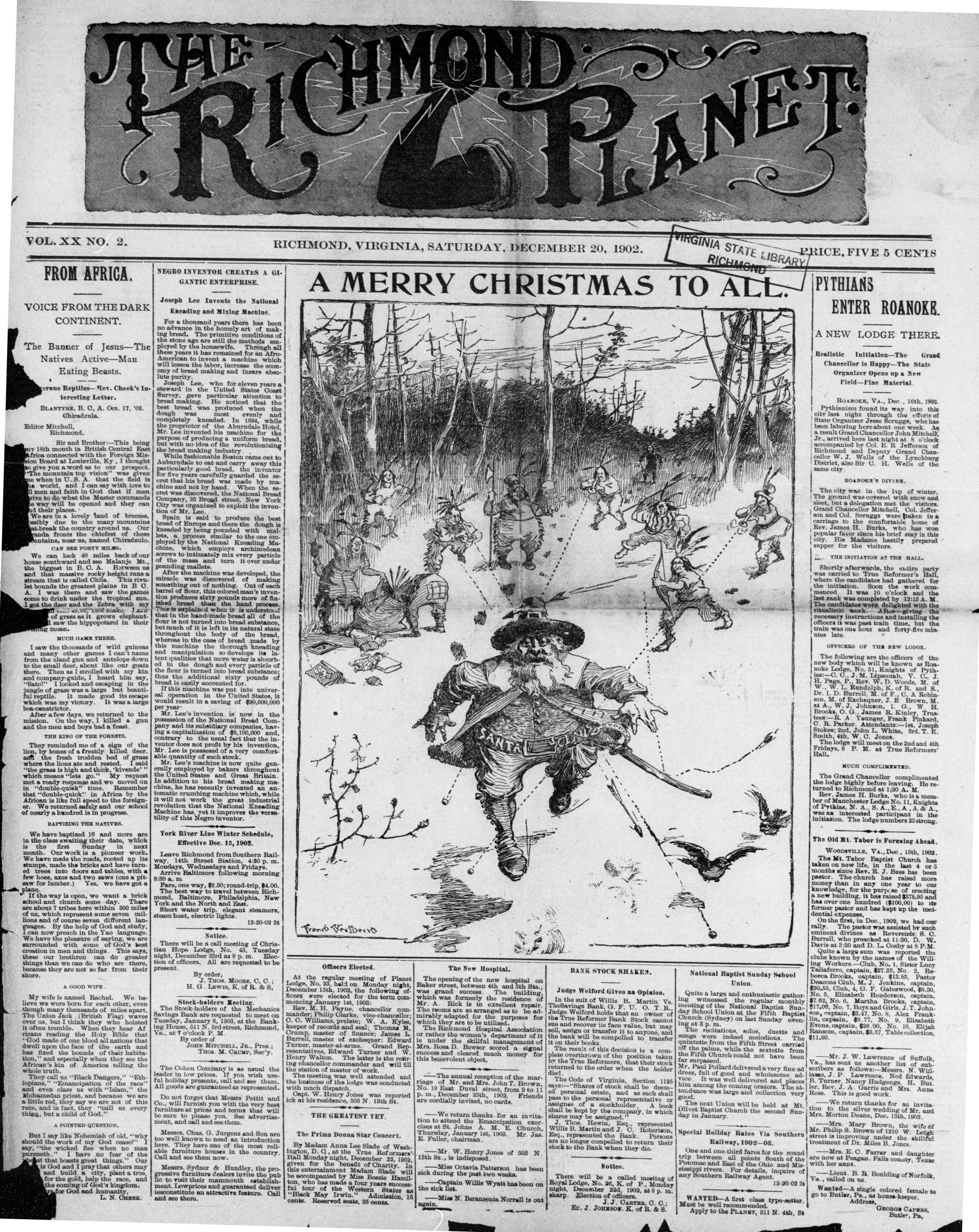
A MERRY CHRISTMAS TO ALL.
Francis Verdeer
Offloers Elected.
At the regular meeting of Planet Lodge, No. 23, held on Monday night; December 15th, 1902, the following officers were elected for the term commencing January 1st, 1903: Rev. M. H. Payne, chancellor commander; Philip Clarke, vice-chancellor; C. C. Williams, prelate; W. A. Kyles, keeper of records and seal; Thomas M. Crump, master of finance; James L. Burrell, master of exchequer: Edward Turner, master-at-arms. Grand Representatives, Edward Turner and W. Henry Walton. The latter is the retiring chancellor commander and will fill the station of master of work.
The meeting was well attended and the business of the lodge was conducted with much dispatch.
Capt. W. Henry Jones was reportedick at his residence, 503 N. 18th St.
THE GREATEST YET
The Prima Donna Star Concert.
By Madam Anna Lee Slade of Washington, D. G., at the True Reformers' Hall Monday night, December 23, 1903, given for the benefit of Charity. In this entertainment Madam Slade will be accompanied by Miss Bessie Hamilton, who has made a four years successful tour of the Western States as "Black May Irwin." Admission, 15 cents. Reserved seats. 25 cents.
The New Hospital.
The opening of the new hospital on Baker street, between 4th and 5th Sts., was grand success. The building, which was formerly the residence of Mr. A. Rick is in excellent repair. The rooms are so arranged as to be admirably adapted for the purposes for which they are to be utilized. The Richmond Hospital Association or rather the women's department of it is under the skillful management of Mrs. Rosa D. Bowser scored a signal success and cleared much money for this benevolent object.
---
The annual reception of the marriage of Mr. and Mrs. John T. Brown, No. 19 East Duval street, from 9 to 11 p.m., December 25th, 1902. Friends are cordially invited, no cards.
We return thanks for an invitation to attend the Emancipation exercises at St. Johns A. M. E. Church, Thursday, January 1st, 1903. Mr. Jas. E. Fuller, chairman.
Mr. W. Henry Jones of 503 N. 13th St., is indisposed.
Miss Octavia Patterson has been sick during the past two weeks.
Captain Willis Wyatt has been on the sick list.
Miss N. Beransenia Norrell is out again.
BANK STOCK SHAKEN.
Judge Welford Gives an Opinion.
In the suit of Willis B. Martin Vs. TheSavings Bank. G.F. U. O. T.R., Judge Welford holds that an owner of the True Reformer Bank Stock cannot sue and recover its face value, but may sell, assign or transfer it to anyone, and the bank will be compelled to transfer it on their books.
The result of this decision is a complete overthrown of the position taken by the True Reformers, that their stock returned to the order when the holder died.
The Code of Virginia, Section 1125 says:—"Shares of stock shall be deemed personal estate, and as such shall pass to the personal representative or assigne of a stockholder. A book shall be kept by the company, in which shares may be assigned." J. Thos. Hewin, Esq., represented Willis B. Martin and J. C. Robertson, Esq., represented the Bank. Persons are no longer compelled to return their stock to the Bank when they die.
There will be a called meeting of Royal Lodge, No. 26, K. of P., Monday night, December 22d, 1902, at 8 p. m. sharp. Election of officers. J. J. CARTER, O. C.; Ed. J. J. JOHNSON, K. of R. & S.
Quite a large and enthusiastic gathering witnessed the regular monthly meeting of the National Baptist Sunday School Union at the Fifth Baptist Church (Sydney) on last Sunday evening at 3 p. m.
The recitations, solos, duetts and songs were indeed melodious. The quintette from the Fifth Street carried the palms, while the sextette from the Fifth Church could not have been far surpassed.
Mr. Paul Pollard delivered a very fine ad dress, full of good and wholesome advice. It was well delivered and places him among the coming orators. The attendance was large and collection very good.
The next Union will be held at Mt. Olivet Baptist Church the second Sunday in January.
One and one-third fares for the round trip between all points South of the Potomac and East of the Ohio and Mississippi rivers. For details, inquire of any Southern Railway Agent. 12-20 02 2t
WANTED—A first class type-setter. Must be well recommended. Apply to the PLANET. 311 N. 4th St
A NEW LODGE THERE.
Realistic Initiation—The Grand Chancellor is Happy—The State Organizer Opens up a New Field—Fine Material.
ROANOKE, VA., Dec., 16th, 1902. Pythianism found its way into this city last night through the efforts of State Organizer Jesse Scruggs, who has been laboring here about one week. As a result Grand Chancellor John Mitchell, Jr., arrived here last night at 8 o'clock accompanied by Col. E. R Jefferson of Richmond and Deputy Grand Chancellor W. J. Wells of the Lynchburg District, also Sir C. H. Wells of the same city.
ROANOKE'S DIVINE.
The city was in the lap of winter. The ground was covered with snow and sleet, but a delegation met the visitors. Grand Chancellor Mitchell, Col. Jefferson and Col. Soruggs were taken in a carriage to the comfortable home of Rev. James H. Burks, who has won popular favor since his brief stay in this city. His Madame hastily prepared supper for the visitors.
THE INITIATION AT THE HALL.
Shortly afterwards, the entire party was carried to True Reformer's Hall, where the candidates had gathered for the initiation. Soon the work commenced. It was 10 o'clock and the last rank was completed by 12:15 A.M. The candidates were delighted with the ritualistic work. After giving the necessary instructions and installing the officers it was past train time, but the train was one hour and forty-five minutes late.
OFFICERS OF THE NEW LODGE.
The following are the officers of the new body which will be known as Roanoke Lodge, No. 51, Knights of Pythias—C. C., J. M. Lipscomb, V. C., J. H. Page, P., Rev. W. D. Woods, M. of W., W. L. Randolph, K. of R. and S., Dr. I. D. Burrell, M. of F., C. A. Robinson, M. of Exchaucher, J. E. Brown, M. A, W. J. Johnson, I. G., W. H. Bruskey, G., James R. Kinley, Trustees, R. A. Younger, Frank Pinkard, C. R. Parker, Attendants—1st, Joseph Stokes; 2nd, John White, 3rd, T. E. Smith, 4th, W. C. Jones.
The lodge will meet on the 2nd and 4th Fridays, 8 P. M. at True Reformers' Hall.
MUCH COMPLIMENTED.
The Grand Chancellor complimented the lodge highly before leaving. He returned to Richmond at 1:30 A. M. Rev. James H. Burks, who is a member of Manchester Lodge No. 11, Knights of Pythias, N. A., S. A. E., A. A. & A., was an interested participant in the initiation. The lodge numbers 33 strong.
The Old Mt. Tabor is Forgeing Ahead
WOODSVILLE, V.A., Dec. 15, 1902. The Mt. Tabor Baptist Church has taken on new life, in the last 4 or 5 months since Rev. R. J. Bass has been pastor. The church has raised more money than in any one year to our knowledge, for the purpose of erecting a new building, it has raised $78,95 and has over one hundred ($100,00) to its former pastor and has kept up the incidental expenses. On the first, in Dec., 1902, we had our rally. The pastor was assisted by such eminent divines as Reverends; S. C. Burrell, who preached at 11:30, D. W. Davis at 3:30 and D. L. Cosby at 8 P.M.
Quite a large sum was reported the clubs known by the names of the Willing Workers — Club, No. 1, Sister Lucy Taliafero, captain, $27.25, No. 2, Rebecca Brooks, captain, $13.85, Pastor Deacons Club, M. J. Menkins, captain, $30.55, Club, 4. G. F. Gateswood, $8.30, No. 5, Elizabeth Henderson, captain, $9.30, No. 6, Martha Brooks, captain, $17.60, 7 boys and Girls, J. T. Johnson, captain, 7 boys and Girls, J. T. Johnson, captain, No. 8, Alex Franklin, captain, $8.77, No. 1, Elizabeth Evens, captain, $26.00, No. 10, Elijah Ransom, captain, $3.57, Table collection, $11.80
Mr. J. W. Lawrence of Suffolk, Va., has sent us another list of subscribers as follows:--Messrs. N. Williams, J. P. Lawrence, Ned Edwards, B. Turner, Nancy Hudengens, H. Butler, Rev. J. A. Garris and Mrs. Anna Ross. This is good work.
We return thanks for an invitation to the silver wedding of Mr. and Mrs. Morton Deane, Dec. 13th, 1902.
Mrs. Mary Brown, the wife of Mr. Philip S. Brown of 1210 W. Leigh street is improving under the skillful treatment of Dr. Miles B. Joncs.
Mrs. E. C. Farrar and daughter are now at Peagan. Falls county, Texm with her aunt.
Lient. B. B. Boulding of Norfolk, Va., called on us.
Wanted—A single colored female to go to Butler, Pa., as house-keeper. Address
GEORGE CAPERS, Butler, Pa,
The Old Christmas Hearth
I LEAN back in my arm-chair as the snow-flakes soft and white
Clothe the hilltops and the valleys in habiliments of white,
While the cutting winds of winter send their music far and wide,
Disputing with the mellow bells the joys of Christmas-tide;
I seem to catch the echoes of the songs they sing on high,
Beyond the mystic beauty of Decamber's vaulted sky.
And again is told the story of the Christ-child's humble birth,
As I sit and, eager, listen by the dear old Christmas hearth.
HERE's music in the steeples, there are chimes deep in the dells.
And the wild winds mingle gladly with the holy Christmas bells,
And I look beyond the window on the beauty of the snow.
Recalling some sweet Christmas in life's fair "long ago;"
What scenes come floating back along the winding ways of Time,
Like the fragrance of the flowers of an ever-cherished clime;
Till my chamber fills with faces and I hear the sounds of mirth
That brighten with infectious gles the happy Christmas hearth.
SEE six little stockings hanging in a pretty row.
We hung them round this cherished hearth a twilight long ago, And we laughed and nestled closer heath the old root-tree of home, And hardly slept for watching for old Santa Claus to come; I remember, ahl who does not? how the sunny Christmas morn Revealed the wealth of treasure from the doll to drum and horn— How the house was filled with laughter till it seemed to shake the earth, While brighter glowed the fire upon the old Christmas hearth.
We hung them round this chie
And we laughed and nastiled cloak
And hardly slept for watching for
I remember, ahl who does not?
Revealed the wealth of treasure
How the house was filled with laug
While brighter glowed the fire up
O-DAY there seems to come to
The beauty and the glory of
When shepherds watched their giv
In the heaven-tinted splendor of
I see a mother bend above a mat
And a radiance not earthly drive
Till Judea wakes to glory and ne
And the choristers of Heaven sim
OLD Time seems in his dotage
Lie the snowflakes of a Chris
Far and wide the balls are ringing
Tells the story of His coming on
And mingled with their anthems
That filled a mother's heart with
And I bow my head a moment a
And silence comes to sanctify the
BLESS the glorious dawning of
It brings to all a gladness fr
And while the bells are ringing of
I bless the loves that cluster rou
O-DAY there seems to come to me across the fleecy snow
The beauty and the glory of that Christmas long ago.
When shepherds watched their gentle flocks upon the hills afar,
In the heaven-tinted splendor of the East's transcendent star;
I see a mother bend above a matchless cherub face.
And a radiance not earthly drives the shadows from the place;
Till Judea wakes to glory and new beauty crowns the earth.
And the choristers of Heaven sing about my Christmas hearth.
OLD Time seems in his dotage and upon his tresses white
Lie the snowflakes of a Christmas that has filled me with delight;
Far and wide the bells are ringing, and their music, glad and free,
Tells the story of His coming on the land and on the sea;
And mingled with their anthems is that chorus all divine
That filled a mother's heart with joy one night in Palestine;
And I bow my head a moment as the children check their mirth,
And silence comes to sanctify the dear old Christmas hearth.
BLESS the glorious dawning of this queenly winter day,
It brings to all a gladness from a region far away.
And while the bells are ringing over all this beauteous earth
I bless the loves that cluster round the dear old Christmas hearth.
T. C. HARBAUG.
A Christmas Comedy of Errors
By ELISA ARMSTRONG BENGOUGH.
ly down from the chair on which she had been standing to deck the chandelier with holly. "How surprised Josiah will be when he comes in, cold and tired, to find the place looking so like holiday times. I declare. I have a good
GOD BLEAS
DUR
"It's Your New Set of Furst!"
mind to make a fire in the stove just to please him; he kept asking for it so long—though, come to think of it, he hasn't mentioned it lately, though I always told him it only made a dirt for me to clean up and the furnace heated the whole space anyhow. He said his mother used to have a nice fire in the stove when they come in evenings. Of course, she did; his mother never saw a furnace in her life, and wouldn't have known it from a telephone she had." She paused, with her hands on her hips, to admire the result of her labor." Yes, I guess I will light a fire in that stove anyhow, it will serve as a text for more remarks about the cold and a few more hints, how I do need a new set of furs this Christmas. Josiah is a good man, but he is as close when it comes to a question of money as a potato is to its skin."
She was bustling about as she talked, making her preparations to light a fire in the brilliantly polished stove. "There, I declare," she cried, as she opened the door, "if Josiah hasn't got this stove all filled up with papers and trash, after all my talking; it does seem as if you can't teach a man to be careful about a house any more than you can teach a hen to play checkers! Never mind, I will just lay my kindlings on top of the trash and not scold—Christmas is not the time for scolding, anyhow—though when you've got to live with a man it's best to take every opportunity to teach him what's right." As the five been to crackle cheerfully, she left it and went to the old-fashioned cupboard in the room, reached carefully to the top shelf and took down a bundle. "I'll just take a last peep at Josiah's present," she said. "I tell you, there was a lot of work in the knitting of that afghan, and if he doesn't give me those furs he'll feel a good deal ashamed every time
"I infer that your daughter doesn't know of your engagement to Reginald yet," said the dear, sweet thing.
"He doesn't," admitted the girl in blue; "but why did you infer it?"
"Because," answered the sweet thing with her sweetest smile, "if Reginald had told him I think Reginald would now be walking with a limp' at the very least."—Chicago Post.
2
wished hearth one twilight long ago,
ir neath the old roof-tree of home,
old Santa Claus to come;
show the sunny Christmas morn
from the doll to drum and horn—
water it seemed to shake the earth,
on the old Christmas hearth.
me across the fleecy snow
that Christmas long ago.
snile flocks upon the hills afar,
the East's transcendent star;
wholes cherub face.
the shadows from the place;
new beauty crowns the earth,
about my Christmas hearth.
and upon his tresses white
Christmas that has filled me with delight;
g, and their music, glad and free,
the land and on the sea;
is that chorus all divine
joy one night in Palestine;
the children check their mirth,
dear old Christmas hearth.
of this queenly winter day,
from a region far away.
over all this beauteous earth
and the dear old Christmas hearth.
T. C. HARBAUGH.
R. M. BROWS.
he puts it over his knees in the buggy this winter—and the furs are not in the house. I know that, for I've been over every square inch of it in hopes I'd find he'd hidden 'em somewhere." She had unfolded a wonderful combination of colors in wool which would have made Joseph's coat a somber garment by comparison, and looked at it with great admiration. Then she carefully replaced it. "I don't know as it's just necessary to keep it away up there—he wouldn't see it if it was right under his nose. Dear me, I probably smell something burning. I would be my cake in the oven, I had almost forgot with all these other things on my mind."
"There comes Josiah now!" she cried ten minutes later, as she heard the door of the sitting room open. "I'll stay out here and see what he does. Well, surely he must be pleased with the decorations and the fire in the stove. It sounds as if he was doing a jig all over the room—and him a professing Christian, too!"
Five minutes later later she opened the sitting room door and stood transfixed on the threshold. "Why, Josiah Slickerby, what on earth is the matter?" she shricked. "You are as black as a sweep and your beard is all singed, and what is that awful smell in here, and w-what is that you have in your hand?" "It's your new set of furs, that's what it is," retorted Josiah, grimly, "a good set of clothes that cost a lot of money, too, and looks like a car that has been sitting on a can of firebreakers when they went off!" "But how on earth could—" "I had hid 'em in the stove, that's how! you said you'd never make another fire in it now we've got a furnace, and I hid 'em in it, so's I could surprise you for Christmas!" "Well, goodness knows, you have surprised me!"
"Yes, and when I came into this room it was all full of smoke, and flames were bursting out of the stove door, it was so full, and if I hadn't kept my presence of mind and hunted out that old thing to smother the flames with, the whole place might have been burned!" And he held up the afghan, which was scarcely in better condition than the furs!
IT CAN BE DONE WITHOUT.
C. W.
Capt. Makelove—But surely you don't object to go under the mistletoe, Miss Goit?
Miss Goit—Oh, yes, I do. Why bother about the mistletoe?
The Height of Dellecacy.
Clarn—Mabel is so thoughtful about her Christmas presents.
Belle—In love with way, dear?
Clara—Always leaves the price tag on so as to save me a trip down town to find out—Brooklyn Life.
Setting Him Right.
She had promised to be his forever
Till death or divorce should part;
Then the youth full of sentiment querled:
"Do these words come from your heart?"
"How absurd!" said the practical maiden;
"Do you know very well that our tongue
Extract the words from our voices—
And voices come straight from the lungs?"
THE RICHMOND PLANET, RICHMOND; VIRGINIA.
A Whole Dinner wid Mashed Potatoes
By JESSIE LLEWELLYN.
THE holiday rush kept us late, and although thoroughly tired in mind and body I felt no relief upon being free to leave the crowded store and return to my cheap boarding house. Slowly I made my way among chattering clerks, comfortable matrons and fashionable young women to the rear exit. I was horribly conscious of my frayed jacket, and the lean leather chateau at my side. "Christmas!" I smiled bitterly. "Serves you right for not staying married," I could hear the last harsh words of my maiden aunt as I left the sleepy village to seek independence and self-respect. "Other women?" rang the voice, "well, men will be men; he makes a good living for you, don't he?" I heard the key turn in the great store door, but still I remained on the step, staring out at the lights tearfully reflect-
A
"Please, Mum, Gimme a Nickel?"
ed in the wet pavement, when there came,
from somewhere below my waist line, a
small whine.
"Please, Mum, Gimme a nickel?"
Please, mum, gimme a nickel? I look down and beheld the smallest, dirtiest, most forsaken little woman I had ever seen. She could have been no more than seven, but she was either tales in the hollowes of her cheeks, and the over-bright black eyes bespoke knowledge of filth and starvation and wretchedness.
"Er a penny," she whined.
I was half interested. A thought beyond myself—and him—was welcome.
"Please, mum—" she began again.
There were just six cents in my pocket, for I had deposited my last dollar with the boarding-housekeeper in case the laundryman should call in my absence.
Notwithstanding the child's hardened little face there was an expression about her wide mouth that attracted me. It was almost motherly in its maturity. Laying the nickel and the penny side by side in my hand, I said:
"It is all I have. If you take the nickel I shall have to walk home, but if it is the penny you choose I may ride, and I am very tired."
She shot an impudent, inquisitive glance at me.
"Where d'youse live!" she asked.
Mechanically I repeated my street number.
"Ten blocks!" she solemnly replied.
"Dat's easy!" and swifty grabbing the nickel she darted around the corner.
The next day was Christmas, and I did not go down to breakfast, but lunched off soda crackers and some stale candy in my room.
"Christmas! Christmas!" I repeated the words to haunting memories, and I am afraid I cried a little. Some one tapped at my door. "Come in," I called in quite a matter of fact tone. The door opened timidly, and there on the threshold stood no other than my little beggar of the night before. She was much embarrassed, but before I could welcome her one dirty paw shot out suddenly like her quick glances, and in the begrimed little palm lay my nickel. "I brought it back," she stammered, "cause—cause—"
"Because?" I suggested, smiling.
"Jest 'cause I—I piped youse off as kind o' on youse uppers youse own self, and I ain't seemed t' sleep sound—"
She got no further—thirty, sinful, little waif, for I had gathered her up in my arms and was holding her very tight. Some one cared! On that desolate Christmas some one actually cared!
"Little woman." I said presently, laping into the language of him who was constantly in my thoughts, "there is one dollar coming to me, all on account of a derelict laundryman. What would you rather have than anything else that a dollar can buy?"
"Has youse got de dough, sure 'nough'? I nodded.
Instantly she answered me: "Say, what 'ud a whole dinner coat, wid mashed potatoes for both of usens?"
We must have made a comical picture, my new friend and I, as we entered the quiet, down-town restaurant. There was just one other person seated there on this Christmas day—a man over in the shadow of the corner.
The child had scrambled into a chair indicated by the head waiter, and I was about to take my place opposite, when the man in the corner suddenly arose. I cannot, even now, remember how it all happened. Confusedly I saw the youngster's eyes grow round with wonder, and the head waiter stifled an exclamatory oath, for I, there in the public restaurant, was at stranger's arms. And this I remember distinctly—the man's most manly words: "Forgive me, little woman, for not finding you sooner. I have been securing the land for you. Not a word, not a word of it all was truth, and if I had that cockling old maid aunt—" A voice interrupted him. It was the youngster's:
"Say, miss, dat guy is on de square— honest—I kin tell."
And bless her little heart, she did tell the truth.
Restraining Circumstances.
Ethel used to play a good deal in her Sabbath school class. One day she had been very quiet. She sat up primly and behaved so well that after the recitation was over the teacher remarked:
"Ethel, my dear, you were a very good little girl to-day."
"Yes'm, I couldn't help being good. I've got a stiff neck."—Brooklyn Eagle.
A CHRISTMAS HOLD-UP
W HAT about getting through to-toight, driver?"
It's all right, I guess.
Drifting some on the Little Cimarron, but that won't do much damage.
"It's 30 miles."
"Well, that ain't much. This team's good for it. Goin' to start right off, ma'am?"
The anxious traveler returned to the fire in the uninviting office of the Mid-Continental hotel. She was brown-haired, cheery-faced, and evidently accustomed to looking out for herself. She was bound for the Indian school at the other end of the stage line—a position awaited her.
"All aboard!" called the driver, and the passengers hurried into the three-seated carryall that served for a stage. The woman sat beside John Carlin, the owner of Circle Bar ranche. He tucked the robes around her and remarked: "Might poor day for a pleasure ride."
"Slightly remarked his seat-mate, smiling, "and we are likely to run over into Christmas, for the roads may keep us out until after midnight, ma'am."
"Call me Miss Macon—I'm the new instructor."
"Better be prepared for whatever happen in this county, this is a tough stretch of country across the territory."
"Are the Indians bad?" Her eyes grew big and wondering.
"Whites are a blamed sight worse than redskins. We can handle Indians."
"But some good men go west—very good men!" The eyes grew softer as she recalled a memory of the days back east.
"Yes; but, blame 'em, they don't stay so."
The eyes flashed and she looked out over the broad prairie, stretching away in patches of brown and white to the far horizon. Nor did she renew the conversation, and the handsome ranchman was sorry.
The day wore on. They stopped at a cabin for lunch. They climbed long slopes and toiled through sandy wastes where in springtime would be rushing rivers. They rattled down the declivities of ravines and more than once the weary horses were stalled in the drifts that had been heaped among the dead sunflowers and ragweeds in the draws. It was a tiresome, cheerless journey, and the five passengers kept mostly their impressions of its discomforts.
In the late afternoon Miss Meon broke the silence, taking up the thread of the morning's discussion: "An old friend of
TICKETS FOR
STAGE LINE
"What About Getting Through Tonight ?"
mine is in the west—he was a daring fellow, but a brave one."
"Taken he is fitted for the west. Such men are its pride—if they have the right ways." He added the afterthought and noticed that she started and studied him keenly, as if to be certain that he meant nothing of direct application. "There is more than one kind of bravery," he went on, more to keep up the conversation than because the thought was original.
She did not answer, and the stage hurried on through the gathering darkness. Once there was a coyote yell in the distance, and Carlin felt a glow of satisfaction as the graceful form beside him leaned closer to his ulster, as if for protection.
Suddenly, as they went rattling down a slope, the horses on the canter, the dead sunflowers standing on either side of the road like sentinels, there was a shot fired and a cry of "Halt!" They halted.
Then happened that usually happen when a masked group assaults the stage, and in a short time the five passengers
Truthful Sarcasm.
Letters
for
Santa Claus
Sister-What is the best way to
retain a man's love?
Brother-Don't return it.-Chicago
Daily News.
Well Versed.
Amelia-Does he seem to know
your true worth?
Amelia-Not so well as he seems
to know papa's.-Harper's Bazar.
A
By
BREAU HARGER
and the driver were standing in a long
some row in the struggling moonlight.
"Hands up!" and their arms were extended toward the stars. Miss Macon, even in her terror, noticed that the constellation of Orion was nearly overhead. And then the chief of the robbers cause her side.
"What's your'am, what have you got?" Something in the tone aroused her and she looked anlyously into the half-masked face of the handsome frontierman who bent toward her. "In New England men
C. H.
treat women with more courtesy," she retorted.
"You're from New England? What are you doing out here?"
"I'm going to the agency—I'm Miss Macon, the new—"
The man stepped back as if he had been struck by a mail hand. He motioned to his confederates to join him, but they did not see his signal. With a quick action of impatience he swung his arm across his face and the mask was for an instant displaced. Only for an instant, but it was time for the bright moonlight to fall on his clean-shaven features and for the woman gazing intently at him to realize that this was for her a time of fate.
She gathered herself together with an effort that was worthy of a better cause, and stepping closer to the bandit whispered one word. He, startled, trembled and obeyed her swift instructions to step behind the wagon, leaving the others to guard the four remaining passengers.
"Oh, Frank, how could you?" she demanded, reaching up to the strong face and lifting the mask. It was one she knew so well in the old days.
"Well, it ain't right," he admitted, shame-facedly. "But who cares?"
"I care—everybody cares—your poor old mother sitting alone in the little farm-house at Danvers, cares. You don't know how much she cares—and Anna cares!" The man brushed his arm across his face as if his eyes hurt him. "Yes, suppose he sits so. But things got mighty tough—had to do some setting. He was the first time. What can I do now?" "Go home, Frank," went on the woman's low voice. "Go home to your mother, and help her run the farm. Be a man again." "And Anna—your sister?" "Frank, she has grieved for you all this time—she wants you now." "But, bitterly, 'you will tell her about—about—this?' "I will do this, Frank. I will give you two years to prove yourself. If you are sincere, the secret will be yours and mine. If you do not, I will tell them of to-night mid-of-" Sue turned toward the group they had left in the moonlight beyond the wagon. His eyes followed hers and grew large as he saw the transformation that had taken place.
"Hands up!" Carlin's cool voice gave the order, and his revolver was pointen at them. The other robbers had fled. The chief was alone. The girl, bedless of the summons, lifted the mask to hide the face of the man beside him. Carlin lowered his gun. "Get out of the way," he called. "He'll escape!" "No, he won't escape," was the calm reply—"not now. I will speak for him. Where are the others?" "Gone. We told them the chief had skipped and they were scared. They took all our things with 'em, though." "You must begin now," said the girl, turning to the chief. "Understand?" He bowed his head. "I'll do it," he whispered, "honor bright." "Go," she ordered, and, facing the muz-
knowled
Not Wholly a Surprise.
"Was his death unexpected?"
"Not entirely, I guess. At all events the widow had plans drawn several weeks before he passed away for an addition to the house to be built with the insurance money."—Chicago Record-Herald.
She Night.
"I wonder if she regrets her marriage?"
sled rachman, held both his hands until the other had vanished in the sunflower stalks. Carlin glowed under the girl's touch, and obeyed.
"Do you belong to this—company?" he asked, a little bitterly, as she loosened his arms, now that it was too late.
"No, but you remember what you said a little while ago, 'there is more than one kind of bravery!'"
A srill whistle sounded off to the right and suddenly stood before them the quartette so recently departed. The passengers were covered by their revolvers and they were at the bandits' mercy once more.
But the masked chief stepped forward, holding in his hand Carlin's watch and pocketbook; he gave to the others their belongings—their watches, jewelry and revolvers—Carlin was the only one who had hidden his gun.
It was all done so silently and quickly that the stageload could scarcely understand what was happening.
When the last trinket had been distributed the masked chief bowed low. His fine mouth just showing beneath the fringe of dark curled a little—whether in fun or contempt none could tell.
"Merry Christmas! I am Santa Claus!" he bowed again, stepped back, bent his eyes on Miss Macon—and the strangers had departed.
The passengers, looking down at their watches, read the time—it was past midnight—Christmas morning.
The stage reached the end of its journey six hours late. Before it arrived Carlin had asked permission to call on Miss Macon and discuss the strange events of the ride, but he am not used to receiving gifts at that time of night," said he.
Though Carlin lied and they talked over the night's happenings, she did not explain. There was a newspaper story of a crazy stage robber who gave back all he stole (you may have read it) and she did not correct that—not even when, a year later, Carlin made her his bride and claimed that he had received two Christmas presents from the chief.
Years afterward they visited New England, the guests of their brother-in-law, the mayor of Danvers. "Do you know," remarked Carlin, to his wife, "Frank has a fine mouth—it reminds me of some one I have seen somewhere." She did not reply.
A Similar Experience.
Reeder (looking up from his newspaper)
—Great Scott! Here is a yarn about a man who spent a night in a pit with a Bengal tiger. Just imagine how he must have suffered!
Hennypeck—I can easily do that—I know all about it. For two weeks-before the holidays I was obliged to face the united demands of my wife and seven grown daughters for Christmas money.—Judge.
A Sight for the Gods.
The girl you'd give the world to win.
To show you how she holds you dear,
Now fondly ties beneath your chin
A necktie you can never wear.
—N. Y. World.
ADVANTAGE IN SIZE.
A
Tommy--Ain't you goin' to hang up
your stocking. Nellie?
Yes.
His Big Sister—No, Tommy. I'm too old.
Tommy—Yes, but the older one gets the more it will hold.
His Salutation.
She ne'er will speak to him.
This stupid youth so bland.
She stood beneath the mistletoe.
He merely shook her hand.
—Washington Star.
Great Expectations.
The Minister—Well, Willie, what do you expect Santa Claus is going to bring you this year?
Willie—Oh, a lot of things that ma needs around the house.—Chicago Times-Herald.
Couldn't Give Herself Away.
Charley Easyman—Well, Willie, your sister has given herself to me for a Christmas present. What do you think of that?
Willie—Huh! That's what she done for Mr. Brown last Christmas, and he gave her back to herself before Easter—N. Y. Times.
Letters
for
Santa Claus
"Well, you know they're both litterary and nowher husband thinks himself self entitled to every bright idea she has."—Detroit Free Press.
Glad of the Chance.
"Did the old man seem to hesitate when you asked him for Laura?"
"Not a bit of it." He said the caterer and the flower loved him a lot of money and it would be a good way to get even with them." — Cleveland Phil Dealer
STREET CAR COMEDY.
Electricity Got Loose and Passengers Joined Hands and Danced and Shrinked.
During a downpour of rain on a recent afternoon, says the New York Tribune, a woman of not far from 200 pounds weight entered a Madison avenue car at Fifty-ninth street, and waddled toward abreast expanse of vacancy far forward. The floor was wet from umbrella drippings, and the woman's gloves and shoes were in the same condition. As she was about to sit down she hooked the crook of her umbrella over the strap pole above to ease her descent, uttered a yell, and collapsed.
A fair-haired young man sitting next to her grabbed her hand as she went
FAT LADY UTTERED A YELL.
down, and immediately began a war dance, springing from his seat like a jack-in-the-box. A good-looking young woman by his side seized his damped tails, and, with a cry of "Oh, Cholly," joined in the remarkable scene.
The conductor rushed forward and endeavored to calm the strangely excited trio. He collared the young man, and, uttering a whoop that could be heard two blocks under ordinary atmospheric conditions, joined in the wild dance.
About that time the floor and nearly everything else in the car began to sputter. The dancers sputtered louder than anything else, and there was a "swish," a curl of blue smoke, and a sudden stoppage of the car. The three passengers tumbled into the seat in a heap, the fat woman on top. The conductor waved his arms frantically, and then pulled the big woman off the heap.
"Must be water in the slot," he said, with an air of great wisdom.
FORTUNE ON BUSHES.
Truly Marvelous Phase of the Wonderful Nebraska Crops of the Present Season.
The fairy tale of money growing on bushes was realized this week along the right of way of the Burlington railroad between Hyannis and Allamanda Neb.
A gang of section men were at work when one of them noticed something that looked like a bill waving from the tangled top of a sunflower growing by the roadside. He investigated. It was a treasury note for ten dollars.
He walked a few steps further, and there, nodding from a branch of a bit of dog fennel, was another bill of similar denomination.
He called to his companions and the entire gang threw down their tools and started on a money hunt. For
TREASURY NOTES ON BUSHES
three hours they searched up and down
the right of way and far afield.
At almost every yard their trouble was rewarded by finding either a five or ten-dollar bill. Some bills were tangled in the tops of weeds, others half hidden in bushes along the fence, and still others in the stubble of the field.
The entire day's clean-up of the eight was $2,135. When the find was reported, word came from headquarters that a money pouch containing $3,500 had been lost from an express shipment the day before.
The supposition is that the bag fell out of the open car door and was ground to pieces under the wheels and the contents were scattered to the winds. This hypothesis is supported by the later discovery of portions of the damaged pouch.
His Inquiry.
Mrs. Hennypeck (in the midst of her reading)—Men are killing their wives entirely too often, these days! Mr. Hennypeck (meekly)—True, my dear; but—er-h'm!—how often, in your opinion, should a man kill his wife?—Puck.
She -Oh! Jack! Are you perfectly certain that you love me?
He -My darling! You don't suppose that I have lived for 30 years without knowing love when I feel it.
-Brooklyn Life.
Safer Any Way.
Ukerdek-Nothing is better in a time of danger than presence of mind.
Gobang-Oh, think it over. What the matter with absence of boozy?
N. Y. Times.
华公云
Fortunately I suffered no ill effects from my immersion. When I awoke the next morning, the strange events of the previous night had left an impression on my mind only. Physically I seemed to have benefited in some extraordinary fashion. My limbs were freer, my spirit keener. I felt that something had happened which had laid open new and happy vistas of the world, and I entered on the journey of life with hope.
The captain visited me early and after once more congratulating me suddenly grew serious.
"I want to ask a favor of you," he said. "We have many nervous people on board, and the knowledge that this was a case of attempted murder would create the utmost consternation. You know what passengers are and to what extent they are likely to carry their fads. Let them once think that the decks are not safe or that they are liable to be murdered in their bunks and I can foresee a voyage unpleasant beyond all record. So I would be much obliged if you would say nothing at all of the attack and just let them think that Miss Hurst fell overboard. Fortunately it was a bad night, and, though they may wonder, they will not be altogether incredulous."
Of course I readily promised. There was nothing to be gained by inaugurating a reign of terror. From the captain's manner I was impressed with the belief that there would not be a repetition of the outrage on board the Omeo.
In reply to my inquiry if he had discovered any claw to the assailant he shook his head.
"No, and what makes the outlook so hopeless is Miss Hurst's insistence that her assailant was black. Now, I have made careful investigation, and I find there is no one on board answering in the least to her description. Indeed, the only person with us who is not white is a Chinaman who works in the galler."
"A Chinaman!"
Jim and I uttered the exclamation as with one breath and our eyes instinctively sought those of each. "But neither spoke. After all, the mere mention of the word "Chinaman" was enough to set us agog. In what way could Miss Hurst be affected by the Society of the Hidden Meaning? "Yes," continued the captain, "but he's as inoffensive as the rest of his race and would never dream of coming aft, much less of attacking a saloon passenger."
Inoffensive as the rest of his race! Dear, dear, it was an ironical world! "The firemen?" I suggested, for they were the only men likely to come up from below with black faces.
"From certain circumstances to which the engineer bears unmistakable witness it could not have been one of his men."
"Then you are at fault somewhat?" He did not like this, for he answered rather sharply: "I do not claim more than an ordinary share of intelligence. You are sure, of course, that you saw the man run off?" It was a question full of a particular and not pleasant meaning, but I put it down to a little natural irritation.
"As surely as I see you now."
"Very strange," he muttered. "We must probe deeper into this mystery." When he was gone, Jim turned to me with an inquiring look. "Of course, Davie, you retain a vivid impression of the event?" "My dear Jim!" "Of course you do. I'm almost as big a fool as the rest of them. It was suggested last night that women have committed suicide before today." "What a monstrous suggestion!"
"So I said and stopped the tongues from wagging, but the affair is very mysterious, and the story of the black man when there is no such person on board is puzzling to the ordinary mind."
"Black or white or yellow, whatever he may be, I know not, but this I do know, I saw him with my own eyes."
"Then perhaps in the semidarkness she mistook his color."
"It was not dark enough for that. No, no! Let them think what they like. I shall credit her story."
"What do you think of this Chinaman?"
"Naturally my mind at once went to the society, as did yours. But it seems impossible. How can she in any way be connected with it?"
"That, my dear lad, is just what I should like to know. Now, dress yourself and go on deck and prepare to receive compliments. I'm proud of you, Davley."
"Thanks, old fellow."
We understood each other, Jim and I.
I passed over the congratulations which were showered upon me by the passengers, among whom no one was more demonstrative than the rublecund Major Coghlan.
"The top of the mormin to you," said he.
"It's a full blown hero I have the pleasure of congratulating. You've cut the ground entirely from under me feet, and I haven't a bare inch of it to stand on."
Of course it was very nice for a young man to hear the pleasant things,
THE YELLOW MAN.
A THRILLING STORY
OF THE BOXERS
IN CHINA
Copyright, 1900.
By Pam D. Doyle.
But if was none the less embarrassing. Judged by the calculating light of cold philosophy, I had been guilty of an egregious blunder, and I owed more to the officer on watch than people seemed to imagine. But it's all well that ends well, and I bore my blushing honors with the best grace I could command.
Fortunately about this time the land began to open up, and the thought of a trip ashore so engrossed the minds of my fellow voyagers that I was left in peace.
My anxiety, I need hardly say, was centered in the welfare of Miss Hurst, and I never missed an opportunity of
A man is lying in bed and talking to two men sitting on chairs.
"A Chinaman!" Jim and I uttered the exclamation, sending a message to her or following the doctor up for information. Happily she was in a fair way of canvascence. The shock to her system had been very great, but the symptoms of fever had abated, and now the man of medicine declared that all she needed was rest. With that end in view he had requested her to keep in bed for that day, and also with the further view, I thought, of baffling the curiosity of the passengers. However, just as we were creeping up to an anchorage he came to me and said that if I would wait until the people had gone ashore Miss Hurst would like to see me for a minute or two. Naturally her wish was a command, and, informing my uncle of the circumstance, we bled our time.
Her mother, with outstretched hand and a white, pathetic face, met me at the door of the cabin.
"Mr. Gray," she said, and the false name struck me as contemptible under such conditions, "I thank you with all my heart. My daughter is all the world to me, and you have brought her back from the grave. God bless you!" She drew me to her and kissed me on the forehead, and I was selzed with a great longing to throw my arms about her and kiss her as I would have kissed my own mother. But I drew back, mumbling stupidly that it was nothing, that she was to think it nothing I had done, that I was glad I had been of service—a mixture the idiocy of which appealed to me even in the midst of my embarrassment, for embarrassed I was, and deeply, for over the mother's shoulder two great gray eyes set in a sweet, pale face were watching me from the top berth. People had spoken of my courage in jumping into the sea. Well, it may have seemed a bold thing to do, but I certainly hadn't the courage to face the wide, inquiring eyes of this delicate girl.
"Mr. Gray," she said, "I hope you do not think me unkind or remiss. I wanted to send for you before, but I am supposed to be under the doctor's orders, though why I can't imagine. Believe me, I am perfectly well, but he orders rest, and my mother wishes it. Let me thank you now."
She held out her wee white hand, which I pressed with a nervous clasp, and I looked into her face, right into her eyes, and I knew that this pale girl held my destiny in her hands.
"Don't thank me," I mumbled, scarcely knowing what I was saying. "Don't say anything more about it. It is enough for me to know that I have been of service to you."
"And it is enough for me to know," she repeated slowly, a world of meaning in her look and tone, "that you have saved my life."
"I am glad," I said. "And I," she answered in a low voice. I looked her straight in the eyes, and she returned the look frankly, without filching, and I believe we each strove to read the deeper thoughts that lay behind. To me she seemed a living piece of pale perfection, for whom I would have leaped into 50 raging seas or the deadly maelstrom itself. The doctor appearing at that moment and cautioning me not to excite his patient, we talked but a little while longer, and as I shook hands with her she said, "I suppose you are going ashore?"
"It is very probable."
"You will be careful?" There was almost a tone of entreaty in her voice.
"I promise you."
They were only little common words, but they were full of meaning. I knew now that there was some one who took more than a passing interest in me.
Well, nothing of any moment happened at Colombe, and the next day when we were well at sea once more
THE RICHMOND&PLANET. RICHMOND. VIRGINIA
Miss Hurst came up on deck and duly received the congratulations of the passengers. Naturally people expected to see me monopolize the greater part of her time, but in this I think they were disappointed. Indeed I purposely kept aloof from her, though it might have been an act of charity if I had stood by to warn off some of the more foolish people. However, in the afternoon she sent for me to come and take tea with her and her mother in their cabin, and my reply to the invitation, which was as delightful as it was unexpected. was a hasty brush up and a flurried appearance. I thought it hard that poor old Jim should have been left out in the cold, and I apologized to him before going; but, dear old fellow, he never looked for the slight and consequently failed to find it. Moreover, they had not seen much of him, and they were quite ignorant of the fact that Mr. George Carter was the uncle of Mr. Frederick Gray, who was not Mr. Frederick Gray at all.
I was received with the utmost courtesy by the widow and her daughter, and though we strove hard to talk of many things I knew we were rigidly eschewing that subject which of all others was the most interesting. Indeed during my previous visit to this cabin I had been struck by the fact that neither mother nor daughter had referred in any way to the assailant or the attempted murder, but instead indulged in vague generalities, as though the lamentable occurrence had been the result merely of accident. From a perhaps mistaken sense of modesty I also refrained from directly broaching the subject, but at the time I thought it strange, and I almost thought it stranger now.
We solemnly drank our tea and made a pretense of eating biscuits, but all the time there was a feeling in the air of an impending outbreak, and presently it came.
"Do you know, Mr. Gray." Miss Hurst began, "my mother and I have been greatly impressed with your goodness to us. I myself can never sufficiently thank you, though perhaps you won't think me ungrateful if I say that I fear your heroes will in the end avail me nothing."
"No, no, Cecil!" cried her mother. "It is wicked of you to say such things in the face of God's goodness."
"And your courage," said she, turning toward me with a sad smile. "But I cannot expect always to have this gentleman near me in the hour of danger."
It was an opening of which I dared not avail myself, but I managed to say something not entirely unsuited to the occasion. And then I boldly asked what this danger was which seemed to threaten them, for already I seemed to think that her joys had become mine, her sorrows mine also.
"I think we owe you an explanation," began the girl, "and with your permission I will begin at the beginning and make you acquainted with what no one on board for a moment suspects. Hurst is not our real name. A short time ago my father was murdered in London under conditions of horror and mystery which excited considerable public interest, and as a protection against the curious and the inquisitive we adopted another name."
"Perhaps I recollect the occurrence." I replied, feeling a deeper interest than ever in these two poor women who, like myself, were forced to such a contemptible subterfuge. "In what part of London was the crime committed?" "At the Hotel Victoria. We had just arrived from Australia, with every prospect in view of a happy time, when this cruel deed plunged us into the very depths of grief and despair."
"Pardon me," I said, for now my pulse was going like mad, worked by the thoughts which rushed tumultuously through my brain, "but your name was Hilbury?"
"Yes, Hilbury. You remember the murder?"
"Only too well. And now," I continued, warming to my subject, "it is only right that I should return confidence with confidence. Not alone do I remember the murder, but I know who committed it."
"You know?"
Both women uttered the exclamation in the selfsame breath, and as I looked at their white, scared faces I saw that the Terror had as strong a grip upon them as it had upon my father in his worst days.
"Yes, I know. The mark upon his forehead was that of the Society of the Hidden Meaning."
The ladies rose panting from the settee and confronted me with faces which were now ghostly in their pallor.
"How do you know? How do you know?"
"I will tell you. I saw it once upon my mother's forehead, I saw it later upon my father's. It would have been seen upon mine long before this but for the love of Providence. It is called the writing of Kung and is the symbol of death."
"How do you know? Who are you?"
The girl pronounced these words tremblingly and yet defiantly, as though even I were not above suspicion. I thought, though it might have been only my fancy, that she even, perhaps unconsciously, crept nearer the door. Certainly she eyed me in a way that was anything but complimentary. Her mother, poor soul, sat pale and trembling, too much amazed to speak.
"I will tell you. My name is not Gray at all, but Kingston, and I changed it for precisely the same reason that you changed yours. I look upon myself as a marked man, and I fear that if any one heard my name he might remember the great Windsor mystery or the Chichester outrage. They killed my mother first, then my father, and they have followed me with a like intent ever since. That is why I am here aboard this ship under a false name."
"So you are the son of Captain Kingston?"
"Yes. You knew him?"
"He was an old friend of my husband. They first met each other in China many years ago. He was mixed up with the— Well, well, how very strange it all is!"
Then we went into explanations, and I learned how among the late Mr. Hilbury's papers letters were found which connected him with the society. He, it seems, like many other men in this world, had had a strange, eventful history of his own, and no doubt he and Bob Kingston had indulged in many a
Weird carouse on the China coast.
They were wild days 30 years ago, and men led strange lives in those outposts of civilization. But it seemed strange above all things that my father and the father of this girl should have met and caroused, walked the same path and died the same death.
We talked for some time longer. I telling succinctly much of what had befallen me, and at length we touched upon the letter which had been delivered to Miss Hilbury (for of course the name Hurst had now become a thing of the past) in the streets of Port Salad. She at once opened her dressing bag and, extracting an envelope therefrom, handed it to me.
"Look!" he said. "See if you recognize anything familiar."
Though I knew what was coming I nevertheless opened it hastily, and my eyes instantly devoured the one line of
A man is sitting at a table with a bowl of tea. A woman stands behind him, holding a knife and pointing at him. A man sits in a chair, looking at the woman.
"The mark upon his forehead was that of the Society of the Hidden Meaning," writing which was scrawled across the sheet. It simply said, "Your father's friends are watching over you." There was no signature, no other word, but in the left hand corner, drawn with a vermilion pencil, the color of which I had learned so to fear and to detest, was the fateful elliptical sign of the Hidden Meaning.
"I if I had only known of this sooner," I said as I handed it back to her, "we might both have been spared so much, at least we should have laid our hands on the assailant. Now, unless he is the most reckless man in the world, he has surely given us the slip."
"How? What do you mean? My assailant was a black man. I have been assured that there is no such person on board."
"Your assailant may have been black for the occasion only. Unknown to you, unknown to me, there has been a Chinaman in the cook's galley all along. I only knew this the night of the attempt upon your life, which I regarded as one of those brutal outrages which mad, bad men sometimes commit. How could I possibly guess you were Miss Hilbury or connect you with the society?"
"Then this Chinaman, if it be he, is still on board?" She grew white at the mere thought of his proximity, while Mrs. Hilbury began visibly to tremble.
"We shall soon see, but if he be what I suspect he will have left us at Colombo."
"You will go and see?" she said.
"At once. In five minutes I will return."
Without more ado I made my way to the main deck and then forward to the galley. I peered in at the door, but not seeing any one at all resembling a Chinaman I beckoned to the chief cook.
"You know who I am, of course?" I said.
"Oh, yes, sir," and he smiled naturally. "A plucky thing, too, sir, and no mistake."
"Thanks," I replied. "But can you tell me where your Chinese scullery man is?"
"I wish I could, sir. But, to tell you the truth, I haven't seen the varmint since we left Colombo."
"Do you mean he is not on board?"
"Well, sir, if hunting high and low and not finding him is any proof I should say decidedly he is not on board."
"You have searched!"—
"Everywhere, sir. The slit eyed rascal went ashore at Colombo and evidently forgot to come back."
Seeing the look of intense disappointment in my face, his eyes quickened.
"Why, sir," he began, "do you suspect?"—
"Well, yes, I do—rather. But it's too late now to fuss. You might keep it to yourself."
"Certainly, sir. I only wish I'd known."
"So do I."
"Do you know, sir, now you've come to mention it. I've heard of him prowling and prowling like an evil spirit, and I know that Quartermaster Jessop found him late one night on the after deck and kicked him forward and that one of the stewards while on night duty caught him in one of the saloon alleyways. Lost himself, he said. It all looks mighty queer, sir."
"It is. I would have given £1,000 to have known of this before."
"Sorry, sir," said the cook, with a smile. "You could have had the information and the man himself for half the price."
I gave the good fellow a present and wended my way aft to the ladies, to whom I had such little consolation to offer. Yet, meager as it was, the thought that their enemy had quitted the vessel seemed to cause them infinite relief. They were not vengeful. They had no wish to cut, torture or hang. Like myself at one period of my existence, they longed for nothing but peace, peace.
CHAPTER XXI
THE GREAT AUSTRALIAN BIGHT.
Judging from the foregoing revelation, it was fairly evident that we had really succeeded in outwitting Wooching and his miscreants. That we should join the very ship in which Miss Hilbury was going home was a coincidence somewhat singular, but that she should be pursued by a creature of the society was not singular at all. The mere changing of the name was not meant as a trick to blind the society—such a feeble subterfuge would have been equivalent to the head burrying
policy of the ostrich—it was merely a cloak to conceal the identity of a timorous individual from prying and curious eyes. As a matter of fact, neither mother nor daughter knew that she had incurred the wrath of the society until the presentation of that letter in the streets of Port Said. The choosing of the name Hurst had no meaning beyond that. Beginning with the same letter as their real name, it suited the marks on their baggage and on their linen.
Over a pipe Jim and I thrashed the matter out, and as to him I no longer made a secret of the affection I bore Miss Hilbury he recognized that their destiny had become indissolubly bound up with ours, and though he candidly confessed that he had no liking for the increased responsibilities I felt sure that he had no intention of shirking them. His was not that kind of nature. This I knew, and so I let him grumble as beftiled a man who had reached a privileged age. But I knew that his real fear was that my lovesluckness would undermine my resolution. I could not tell him so then, but I had every reason to believe that it would have just a contrary effect.
For the rest of the voyage we four—that is, Mrs. Hilbury and Cecil (or so I called her in the privacy of my own heart), Jim and I—were on terms of the most excellent friendship. We called ourselves the outcasts, the black sheep of the fold, the knowledge that we were marked men and women creating an intimaea between us which no outsider could share.
As we sailed farther and farther south the new heavens opened and showed their new wonders, and night after night, the Southern Cross pointing the way, we sailed on a sea of sapphire beneath a jeweled dome. Stars! The sky was full of them. They hung in clusters as though they had burst through the blue gates of heaven. Sometimes Cecil would point to the cross and say: "When I am at home, I can see it quite plainly from my bedroom window." or "Many a night I've sat and watched it and thought no end of foolish things. I remember once driving home with father. It was a beautiful night, just like this, and he told me such a pretty story about it. Poor father! He will never see it again!"
It was on such a night in the warm Australian waters that I 'old her for the first time of our expedition to China. We were sitting away aft, well out of earshot of the other passengers, and the gentle throbbing of the screw and the lapping of the waters sounded a soft accompaniment to our talk.
"You mean to say," she said, "that you and your uncle intend to penetrate the very stronghold of these terrible men."
"That is our intention. It is for that purpose we shall go to China. As for penetrating their stronghold, that's as heaven may direct. We are going to try."
"But they will kill you."
"Undoubtedly—if they can."
"But—but it's too horrible."
"It is horrible, but what are we to do? Don't you see with Kung and Wooching alive we can never enjoy one moment free from alarm. It was not without some hesitation that my uncle and I accepted the inevitable. It is to be a battle to the death, and we do not shut our eyes to the fact that there are frightful odds against us, but it is possible that the society also has many enemies, and help may come from some unexpected quarter. I admit that our arrangements are extremely vague and from the practical point of view most unsatisfactory, but we shall not be altogether groping in the dark. In Hongkong, according to my father's statement, we must find a carpenter by the name of Koon-Sl. From him we shall learn the latest intelligence, and with him we shall lay our plans."
"You are very daring," she said. "to take such an awful step in the dark. I fear you underrate your task."
"No; not in the least. If anything, we have overrated it all along. We have waited and hoped that peace would come, but I am convinced that it cannot be gained without war. War, then, it must be, for now," and here I think my voice took a somewhat softer tone. "peace is more necessary to me than it ever was before."
She did not answer for a moment, and then, mingling with the sound of the sea, came a soft "Why?"
"Because it will insure your peace, and that to me has grown dearer than my own."
"There can be no peace for me," she answered in a low tone, a tone which the sea and the night rendered ineffably sad. "If it were not wicked, I could almost wish that you had let me drown that night."
"Hush! You must not talk like that. Do you know, even in our darkest hour, when you say unconscious on my arm, when the sea bissed and tore about us and I thought every moment would be our last, I was almost happy."
"Happy?"
"Yes, because through the gloom and the spray I saw a future, a future which was blessed with your love—with you."
"It is very late," she said, her voice trembling with emotion. "My mother will wonder what has become of me."
But she did not go just then, not for some time after, for I had much to tell, though to other ears it might have seemed but a wearisome repetition of the same old story. But the stars looked down and smiled, and the great diamonds of the cross beamed with a tenfold radiance; and the air, tempered, so it seemed to me, by the breezes from the land which lay to our north, was full of the sweetness of life and hope. It was a new delight to me, this wonderful thing called love, and for some time I was too timid to avail myself of the prerogatives of the lover. Even when I held her face up to mine and pressed my lips to hers I marveled that she did not resent the liberty.
There was very little sleep for me that night, and long after she had gone below I paced the deck burning pipe after pipe of tobacco, thinking, dreaming, hoping. Now more than ever it was necessary that I should settle accounts with the society, now more than ever was life precious, the future a thing to be fought for and secured. I had always hated the task that was allotted me, I hated it more than ever
now. But I had grown to regard misfortune as a part of my heritage, and a fatalistic indifference, born of too close an intimacy with despair, had robbed it of much of its terror.
The next day I sought out Mrs. Hillbury, told her of my love for her daughter, of my hopes and fears, but I promised that I would not bind my sweetheart to any hard and fast engagement. I had work to do, and I meant to accomplish it. If I came back and Cecil still thought of me kindly I would strive to prove by my devotion the depth of my affection; if on the contrary, she had changed her mind, a girls will, I would go away knowing that she could live in peace.
Once we had entered Australian waters the days flew with inconceivable rapidity, and I thought with regret of the quick ending of my too brief holiday. It had been a happy time, the happiest I had ever spent a gleam of sunshine in the dreary fog of my existence. Every revolution of the screw drove us so much nearer the goal, and leaning over the side, I watched the water bubble by, regretful, grudging the mighty vessel her awful speed. Like the condemned criminal, I watched the days come and go, and the fatal morrow at length arrived, and we safely made the port of Melbourne. Then there were many meetings, hearty handshakes, embraces and tears of joy and the soiled stupor of the stranger who has left all he loves behind, who feels no welcoming handshake, who enters the new land alone, a melancholy figure.
Though I stood back and saw many people come forward to greet Cecil and her mother and though my heart was hungry and I felt sad and lonely, I was glad to see her so warmly welcomed. She was among her own people, the people who loved her, but not more than the lonely young fellow who stood back and watched and thought.
Presently she came toward me, a stalwart man on each side of her, and introduced them to me as her cousins, and each in turn shook me by the hand, a sturdy, honest grip, and they were honest men, too, with eyes as frank and fearless as their own sum. Then I was led away aft, where Mrs. Hilbury stood, the center of a kindly, sympathetic circle, and I was introduced to each in turn with due formality, and from Mrs. Hilbury's lips I received an invitation to call upon her at the earliest opportunity. Next one of the aforementioned stalwarts, a huge fellow with kind gray eyes and a formidable fair mustache, took me in charge and informed me that he had already secured rooms for me and my uncle. At this I was not a little aston-
A
Presently she came toward me, a stalwart man on each side of her.
ished, but he only smiled and said Cecil had telegraphed from Adelaide to that effect, and he hoped I'd find them suitable.
In five minutes I was thoroughly at home with this big, handsome man, and no longer a stranger in a strange land. And presently, when Jim joined us, we chatted away as though we had known each other for years. Then gradually the ship began to clear, even those who were bound for Sydney going up to town with us by the same train. Major Cooghan, no longer a rival to be feared, bade the ladies an effusive goodbye and expressed the hope that they should all meet again soon, but I do not think Mrs. Hilbury took the hint. At any rate, I have no recollection of the major ever visiting them. He was an admirable companion—for five minutes.
As nothing of any moment occurred during our stay in Melbourne—that is, nothing of any mement to any one but myself—and possibly one other—I will pass over that period as briefly as possible. I paid my promised call the next day and found Ceell in her own charming home, and once more I told her of my hopes and fears, and she promised that she would wait for me and many other things which I need not here set down. Perhaps it is unnecessary to add that she endeavored to persuade me against setting out on such an adventure. She pictured and in no feeble colors the uncertainty and the peril which confronted Jim and me in such an undertaking; begged me to give it up, to stay with her. It was a sweet temptation and one to which my inclinations would willingly have succumbed had not a sterner sense of duty bound me honorably to my uncle. Moreover, it was folly, madness to think of living in peace while Kung and Wooching were at large. There could be no peace, no hope of it with them in power; and sad and desperate as was the remedy. I think her reason saw the efficacy of it.
Cruelty to a Wife
Nodd—I got ahead of my wife. I told her to decorate the house to suit herself.
Todd—But how did you get ahead of her?
"Why, half her pleasure is finding out first what I want, and then getting something else."—Brooklyn Life.
Not Popular
"Miss Sereleaf says that she was called 'The Poster Girl' at the resort where she spent the summer," remarked Maude. "Very appropriate," replied Mamie.
"She was up against the wall most of the time, I noticed."—Cincinnati Commercial Tribune.
An Historic Bird.
Customer—What sort of a chicken do you call this?
Waiter—That sir, I believe, is a Plymouth Rock.
Customer—Ah, I'm glad it has some historic interest. I thought it was just an ordinary cobblestone.—Chicago American.
Testimonial
"I was so weak and poorly," writes Mrs. Jane Slocum, of Slocum's Point, N. H., that I had to do all my own housework; but after taking your wonderful remedies for one month I am now able to keep a hired girl all the time without fatigue."—Puck.
Satisfied.
I've never had a coronation, I have no royal robes to wear. But the women in all creation Says I'm her king, so I don't care.
—Chicago Record-Herald.
QUEER COINCIDENCE.
Papa—What! You say that young man wants to marry you? Do you know how much his income is?
Daughter—No; but this is a very strange coincidence. He asked me the same question about you. — Chicago Daily News.
The Mind Reader.
She knows that she has won his love Before he tells her so,
And when she is his wife and he Lies as to why he late—ah she knows that he shows him to know.
—Chicago Record-Herald
Why They Parted
"Incompatibility of temper, you say?" "Yes. It was a sad case. He wouldn't play ping-pong, and she wouldn't run an auto."—Brooklyn Life.
"Friendel Friends! Why, the man's enmity is so malignant that he gives every canvasser who comes to his office my address, and tells him I'm an easy mark!"—Tit-Bits.
At Palm Beach
Impeccune-Which of old Moneypenny's daughters are you going to propose to?
Foreign Count—Oh, the youngest one first.-Judge.
COWS WEAR ARMOR.
New Jersey Dairymen Resorts to Unique Method to Fool the Ever Hungry Mosquito.
Mosquito proof is this cow. She permitted the photographer to approach within "shooting" distance on the banks of the lake that lends its name to that fashionable Jersey summer resort, Spring Lake. She was perfectly willing to have her picture taken, but refused to be interviewed.
From outside sources it was learned that she wears that burlap bagging strapped around her back, not because
A MOSQUITO-PROOF COW.
she wished to set the style among the other lady kine, but because of the swarms of mosquitoes which arrive at the same feeding grounds about the time she puts in an appearance. As long as she stays they are content to stay, too. A few handfuls of them gallantly accompany her home when she strolls that way as the sun is setting. Before the mosquito bag was invented the cow refused to be bothered with so much gallantry because the mosquitoes were carrying it too far, or she was carrying the mosquitoes too far. Consequently as soon as she heard their gentle voices whispering in the woodlets near by she "pulled her freight" for home as fast as she could go.
Her owner could not keep her in the pasture. All the other kine in the vicinity were of the same mind, and it looked as if there would be a milk famine until one cottager thought of the bag method.
Down that way they humorously call it a "mosquito saddle."—N. Y. Herald.
An Optimistic View
The invalid looked out of the window just as a hearse went by, and he smiled happily.
"Dye mind, Biddy," he said, "it's worth thy'din' to have a ride in a thing like that, with th' feathers on top an' a man with a bug on his hat, an' you bein' gr-reater ar' more niccissary than th' marshal iv a St. Pathrick's day parade. There's wanst in ye-er life ye're th' whole thing, an' that's whin ye're dead."—Chicago Post.
THE PLANET
Published every Saturday by JOHN MITCHELL
JR., at 811 North 4th Street, Richmond, Va.
TERMS IN ADVANCE.
One Copy, one year, - $1.50
One Copy, eight months, - $1.00
One Copy, six months, - $0.80
One Copy, four months, - $0.50
One Copy, three months, - $0.40
Single Copy, - $0.05
For one inch, one insertion, $ 50
For one inch, each subsequent insertion, $ 50
For two inches, three months, $ 6.00
For two inches, nine months, $ 10.00
For two inches, nine months, $ 14.00
For two inches, twelve months, $ 20.00
Marriage and Funeral Notices, $ 10
Standing and Transient Notices per line.
POSTAGE STAMPS OF A HIGHER DE-NOMINATION THAN TWO CENTS NOT RECEIVED ON SUBSCRIPTIONS.
THE PLANET is issued weekly. The subscript on price is $1.50 a year, in advance.
There are FOUR WAYS by which money can be sent by mail at our risk.—In a Post Office Money Order, by Bank Check or Draft, or an Exempt Money Order, you can send it, if these can be procured, in a Registered Letter.
MONEY ORDERS—You can buy a Money Order at your Post Office, payable at the Richmond Post Office, and we will be responsible for its delivery.
EXPRESS MONEY ORDERS can be obtained at any office of the American Express Co. the United States Express Co., and the Well's Farmer's Co. responsible for money sent by any of these companies. The Express Money Order is a safe and convenient way for forwarding money.
REGISTERED LETTER—If a Money Order is registered, you will reach your Postmaster will Register the letter you wish to send on payment of ten cents. Then, if the letter is lost or stolen, it can be sent money in this manner at our risk.
We cannot be responsible for money sent in letters in any other way than one of the four ways mentioned above. If you send your money in another way, you must do if at your own risk.
REWENHA, ETC.—If you do not want THE PLANET continued for another year after your subscription has run out, you then notify us by email or to discontinue it. The course has decked that subscribers to newspapers who do not order their paper discontinued at the expiration of time for which it has been paid are liable for the payment of the subscription when they order the paper discontinued.
COMMUNICATIONS—When writing to us to renew your subscription or to discontinue our paper, you should give your name and add your email, otherwise we cannot find your name on our books.
CHANGER OF ADDRESS—In order to change the address of a subscriber, we must be sent to former as well as the present address.
Entered in the Post Office at Richmond, Va., as second class matter.
THE base-ball team of the University of Virginia objected last year to playing the base-ball team of Harvard University of Cambridge, Mass., because Mr. (colored) was one of the players. This year the Harvard base-ball team dropped the University of Virginia team and held MATTHEWS. This is the proper way to deal with the unreasoning exhibition of race prejudice. They can play with a whole team of Carlisle School Indians, but object to one colored member of a Harvard base-ball team. Oh, the absurdity of it! Nojurist has succeeded better in retaining public favor while at the same time fearlessly discharging his duty than has His Honor, SAMUEL B. WITT, Judge of the Hustings Court of this city.
The case of JAMES P. EASTHAM convicted of attempting to abduct Miss JOSÉPHINE JOHNSON, the 13-year-old colored girl, came up before him upon a motion to squash the charge against him.
After hearing the case, he promptly over-ruled the motion, declaring his purpose to uphold the law and declining to take from a jury its right to pass upon its merits.
This is in keeping with the decision of Justice JOHN J. CRUTCHFIELD and the ringing declarations of Commonwealth's Attorney D. C. RICHARDSON, all of whom declared that when colored people respected themselves and conducted themselves as good citizens when they carried their grievances into the courts, they could get justice.
OUR CASE IN EQUITY.
THE outlook for the colored people has been dark and the prospects dreary, but recent happenings in the country would seem to indicate that our friends are not all dead and that God in His divine wisdom is raising up others for us.
The statments of President Roosevelt concerning his intentions with reference to the appointment of colored men to office was one of the most emphatic announcements upon that subject. Mr. Roosevelt is a republican. Then came Ex-President Grover Cleveland in an address delivered at Philadelphia, from the same platform occupied by Prof. Booker T. Washington, announcing that the colored man should be accorded those rights and privileges belonging to other American citizens and that he should be encouraged to look upwards and go forward in the race of life.
His aspirations along legitimate lines should be encouraged and the gates of hope should not be closed to him. Mr. Cleveland is a Democrat.
Then came Capt. RICHMOND P. HOSSON, who distinguished himself in the sinking of the Merrimae, and by the way, hails from Alabama. In an adress delivered at Washington recently, he is quoted as follows:
"I was brought up with your people," said he, "and in my Southland I was nursed by one of you, who was as tender to me as my own mother was. During the civil war the Negro nobly fulfilled his duty to those of the South left defenseless at home. Your ace may call upon me as long as I live, to be the truest friend I know how to be.
"I have a feeling for you also of sincere esteem, respect and affection. The colored race is one of fighters. At Santiago, when I was released, the first American troops I saw were colored regulars. You have a right to be proud of the blood you have spilled for your country. Do not complain of your social position to-day. What was your brief servitude compared to the long ages of serfdom in Europe in the Dark Ages? Your condition to-day has no comparison to that of the European peasant."
This is strong language. Capt Hobson is a Democrat. Is there any reason for despair when Rear Admiral WIN FIELD SCOTT SCHLEY spoke from the same platform in the same strain. Admiral SCHLEY is a Democrat. It proves the truth of our repeated declarations that our friends are not all dead, neither are they sleeping.
When one door shuts, another one opens. Oh, Colored men of the Southland, do not despair. The day is breaking! Let them continue their a oppressive legislation. Let them vainly attempt to check our progress. They will have their trouble for their pains. Mark our prediction: We shall yet secure our political rights at the hands of the very southern white men who are now presumed to be foremost in taking them away. As for the Supreme Court of the United States, we believe that it is prejudiced against us from the start.
It has done all that it could to destroy our rights and nothing as yet appears upon its records in recent years that tends to perpetuate 'and secure to us those privileges guaranteed by the Constitution of the United States.
The case of Mr. SAM VICK, the colored post-master at Wilson, N. C., has attracted universal attention and emphasized the fact that in some respects our leading colored men have enemies within the Republican Party, as bitterly antagonistic to their recognition and welfare as may be found in the Negro-hating department of the Democratic Party.
Senator PEITCHARD inaugurated a "lily white" Republican Party in North Carolina, from which all colored gmen were excluded.
He then blamed all colored men for not voting for a ticket that they had no part in making.
He charges that Mr. Vick did not support the movement from which Mr. Vick has been excluded. The case's now up to President Roosevelt and it is a question as to what policy he will pursue in the premises. The sympathy of all right-thinking people should be with Mr. Vick. We hope that he may win out in the contest.
DISCUSSED VENEZUELAN AFFAIRS
Senators Believe Allied Powers Did Nothing Which We Could Object To. Washington, Dec. 17.—The Venezuelan question occupied the attention of the senate in executive session yesterday for almost an hour. The question came up informally almost immediately after the public was excluded. Senator Teller, declaiming all intention of being critical, and saying he merely desired information, asked Senator Cullom, chairman of the committee on foreign relations, what information he possessed regarding the Venezuelan affair. Mr. Teller in inquiring said the situation is such that senators felt the Monroe doctrine at any time might become involved if the complication should continue.
Senator Cullom replied to the inquiry that he had no knowledge of recent events not contained in the public prints. Messrs. Bacon, Hoar, Lodge and Stewart all made remarks. In none of the addresses were anything harsh of critical said. The tone of all the speeches, whether by Republicans or Democrats, was that our position as a nation should be one of watchfulness. There was general agreement that while the means adopted by Great Britain and Germany for the collection of their debts had been quite strenuous, they thus far had committed no infringement of the Monroe doctrine, and therefore had done nothing to which the United States could take exception.
The most positive action taken by the government so far is to notify the allies that it cannot regard the "peace" blockade of the Venezuelan forts as applicable to American ships. The communication to the authorities at Berlin and London was in diplomatic language, but its effect was practically at stated.
BUBONIC PLAGUE AT NEW YORK
Three Cases Found On Steamer From South Africa.
New York, Dec. 17.—Three cases of bubonic plague are under treatment in the Swinburne island hospital at quarantine. The sufferers are the first and second cooks and the second steward of the Prince line steamer Saxen Prince, which arrived from Durban, South Africa, on Monday. When on inspection of the crew three were found to be ill a thorough examination of the patients convinced Health Officer Doty that they had all the symptoms of the plague, and they were taken to Swinburne island, where cultures are made. The examination confirmed the diagnosis.
The first patient is convalescent, but the other two are still under treatment. All three men slept together in a small compartment. The total number of the crew is $1. There are five passengers on board, a woman and four children.
The stenometer will be sent to sea to discharge the water and sand ballast taken on board at Durban. She will then return to Quarantine, when the passengers and crew will be transferred to Hefman island, where they will be held for 10 days for observation. Dr. Doty says that there is no danger of a spread of the plague, as the whole matter is well in hand.
THE RICHMOND PLANET, RICHMOND; VIRGINIA.
ANOTHER ULTIMATUM
ANOTHER ULTIMATUM
Italy Demands Payment of Claims Against Venezuela.
HER MINISTER LEAVES CARACAS
Spain and Belgium Also Present a
Joint Note For Their Claims—Allied
Powers Discussing Arbitration As
Means of Settling Dispute.
Caracas, Dec. 17.—The Italian minister to Venezuela, Signor de Riva, has received orders from Rome to leave Caracas. He will go on board the Italian cruiser Giovanni Bausan at La Guaira. Senor de Riva has been instructed by his government to present to the government of Venezuela Italy's demand for the immediate payment of $42,000 to meet the Italian claims arising from former revolutions, in the form of an ultimatum. As it is known that the Venezuelan government cannot pay the amount demanded, the communication to the minister includes orders to leave Caracas at once. The ultimatum from Italy is couched in stronger terms than those used in the ultimatums presented to Venezuela by Great Britain and Germany. Italy will take part in future demonstrations against Venezuela. The interests of Italy in Venezuela will be placed in the hands of United States Minister Bowen.
The Spanish minister to Venezuela, Senor Gaytan de Ayala, and the Belgian charge d'affaires, M. Van der Heyde, have presented a joint letter to the Venezuelan minister of foreign affairs, in which they ask, in case the claims of other foreign powers are paid by Venezuela, that the same treatment given those powers be accorded to Spain and Belgium.
MAY NOT ARBITRATE
Outlook For Peaceful Settlement of Venezuelan Dispute Net Bright.
London, Dec. 17.—As the foreign office last evening it was said that no decision had yet been arrived at in regard to Venezuelan arbitration. Many difficulties have arisen in the way of arriving at a basis of what can be arbitrated and what can be otherwise settled. The outlook for a pacific settlement of the dispute is not particularly bright.
Judging from statements given out by the foreign office, the Venezuelan situation does not appear to be any nearer a settlement. No suggestion has been made that Great Britain could eventually see its way to submitting its claims to arbitration, and the foreign office points out that Venezuela's offer to arbitrate is extremely vague. President Castro, in the communication in which he expresses his willingness to resort to arbitration, provides no guarantee that the rights of British subjects in Venezuela will be respected pending the award. The willingness of Venezuela to arbitrate the financial claims, however, will meet with no opposition in official circles in London, nor is there any desire to stir up opposition here by continuing unnecessarily the present armed compact with Germany; but, quoting from the foreign office, "at the same time there is not the slightest inclination to let Venezuela go unpunished for her repeated insults and injuries. The offer to arbitrate comes very late in the day. We are not seeking a quarrel, but we must insure ourselves against a recurrence of the acts which led to the present situation."
Germany Won't Consider Arbitration.
Cologne, Dec. 17.—The Cologne Gazette publishes a dispatch from Berlin which says it is doubtful if, at the present stage of the Venezuelan difficulty, arbitration can be considered by Germany. Germany can afford to await, the dispatch adds, the outcome of a situation that is very uncomfortable for President Castro.
Italy Desires Arbitration.
Rome, Dec. 17.—In the lobbles of the chamber of deputies Venezuela was the exclusive topic of conversation. The opinion of a majority of the deputies is that Germany has been too aggressive in her actions, which are calculated to complicate the situation. It is therefore thought to be eminently desirable that the Venezuelan matter be settled by arbitration.
British and German Cruisers Silence
Fert at Puente Cabello.
Puerto Cabello, Dec. 15.—The British cruiser Charybdes and the German cruiser Vineta have bombarded the fortress here. They quickly silenced it. The bombardment lasted for 45 minutes. The fortress is composed of Fort Salane and the Castle Libtador. After the firing ceased the Charybdes sent marines to occupy the castle. The fortress was almost demolished. It is probable that only a few persons were injured by the shelling. The commander of Castle Libtador has been taken prisoner. While the firing continued there was intense excitement in this port. Every house in town was closed. The cruisers are still here.
The Charybdes and the Vineta arrived here Saturday morning. The captain of the English merchant steamer Tepaise, which was seized by a mob last Wednesday, visited the English commodore on board the Charybdes and returned an hour later with a detachment of 50 marines, who took charge of the Tepaise. The populace was greatly excited at this incident, and raised the ary "To arm," but no incident occurred.
The English commodore then sent a demand to the authorities for immediate satisfaction for having pulled down the British flag from the Tepaise, and advised the government that Maita-
would be sent to the reception of this demand sent a message to President Castro asking for instructions.
At 5 o'clock the Charybdes and the Vineta opened fire on the fortress and custom house. The fortress replied, but was seen glimored. No damage was done to the town.
The United States council went on board the two fortresses and was in-
formed by their commanders that they had come to this port in search of the Venezuelan warships.
German Officer Killed In Bombardment
Puerto Cabello, Dec. 17.—It has been learned here that during the bombardment of Puerto Cabello December 13 by the British cruiser Charybdis and the German cruiser Vineta that the Charybdis was struck in the bow by a shot fired from a cannon on the Plaza Bruzual. The Vineta was struck twice by the Venezuelan cannon fire. The report which has been in circulation here that an officer of the Vineta was killed during the bombardment by a rifle bullet fired from the shore appears now to be true. The Vineta left this port suddenly, although it was supposed she would remain here to protect German interests. She is at present at Willemstad, Curacao, where she arrived with her flag flying at half mast. It is believed the German cruiser went to Willemstad for the purpose of burying the body of the dead officer there.
GENERAL GRANT'S WIDOW DEAD
Passed Away at Her Washington Resi-
dence From Heart Failure.
Washington, Dec. 15.—Mrs. Ulysses S. Grant, wife of President Grant, died at her residence in this city at 11.17 o'clock last night, aged 76 years. Death was due to heart failure, Mrs. Grant having suffered for some years from valvular disease of the heart, which was aggravated by a severe attack of bronchitis. Her age prevented her rallying from the attacks. Her daughter, Nellie Grant Sartoris, was the only one of her children with her at the time of her death, her three sons, who had been summoned here, all being out of the city.
Death came peacefully, the sufferer retaining almost complete consciousness practically to the end. Word has come from Jesse and Ulysses S. Grant, two of the sons, now in California, that they have started on their way to Washington. The ether son, General Fred Grant, is in Texas, and he will hasten here as soon as he receives a message telling him of his mother's death. The remains of Mrs. Grant will be deposited in the tomb at Riverside Park, New York, where those of her husband now repose.
Mrs. Grant, whose malden name was Julia Dent, was born in St. Louis in 1826, and was a daughter of Frederick and Ellen Wrenshall Dent. She was married to General( then Captain) Grant in 1846. During the Civil War Mrs. Grant was with the general much of the time and remained as near as possible to him when he was campaigning. She saw her husband twice inaugurated as president, and accompanied him on his journey around the world. Four children were born to General and Mrs. Grant, three sons and one daughter, all of whom are living.
Six Children Killed By Gas Explosion at Fort Lee, N. J.
Fort Lee, N. J., Dec. 17.—By the explosion of an acetylene gas tank yesterday the residence of John Puglughi was demolished, his six children instantly killed and his wife so seriously injured that her recovery is doubtful. The dead are: Ida Puglughi, aged 14; Tillie, aged 12; Irene, aged 10; Adelene, aged 7; George, aged 5, and Clorinda, aged 22 years. The mother was found 200 feet from where the explosion took place, her right arm almost torn from her body.
Just returned from school, the children were at the lunch table, when the explosion occurred. The roof and the sides of the house were blown out. An adjoining cottage was also partially destroyed. The debris immediately took fire, and the bedies of the dead were badly charred.
Mrs. Puglughi, who was waiting on the children at the table, was blown through the side of the house and was found on the road. The father was away from home.
FORCING UP PRICE OF COAL
George F. Baer Deprecates Action of Independent Operators.
New York, Dec. 17.—President Geo.
F. Baer, of the Reading Railroad,
made a statement yesterday deprecating the course pursued by the independent coal operators, who it is alleged have forced the price for their coal up to $11.50 a ten to dealers, equal to $14 to the consumer.
"Unfortunately there seems to be no way to compel them to sell down to the level fixed by the railroads," said Mr. Baer. "If their sense of obligation to the people cannot deter them from asking prohibitive prices, nothing the public or the railroads can do would be of any effect. The railroads cannot refuse to transport their coal, the law regulating the business of all public carriers opposing it. The charge that the railroads are selling railroad coal to the independents for disposal in the open market is absolutely false. We are doing everything in our power to keep down the price of coal and to get it to market quickly."
Girl Set Fire to Herself
Newark, N. J., Dec. 16—Anna Stanfield, 17 years old, of Belleville, who was discharged from the city hospital Sunday, where she had been sick for some time, was returned to that institution yesterday badly burned about the limbs and body. Anna said she was walking on South Sixth street, Reserville, when a boy threw oil on her dress and set fire to it. John Murray, who responded to her screaming and extinguished the flames, claims there was nobody in sight at the time. As matches were found in the girl's pocket and there was no trace of oil on her dress, it is believed she set fire to herself.
Wants Congress to Relieve Bistress.
Boston, Dec. 16.—Former Representative Borofsky, of this city, recently wrote a letter to President Roosevelt, offering the suggestion that he urge upon Congress an appropriation of 000,000,000 to be used in relieving the distress of the coal famine. The letter has been acknowledged by Mr. Cortelyou, the secretary to the president, who states that the president is considering tah subject of coal famine most carefully.
PENNSY GETS TUNNEL
PENNSY GETS TUNNEL
New York Aldermen Grant Franchise by Small Majority.
MINORITY REPORTS DEFEATED
Railroad's Contract With City Does Not Contain Eight-Hour-Day and Prevailing Rate of Wages Clauses. Tammany Admits Defeat.
New York, Dec. 17.—After repeated postponements and a protracted debate the board of aldermen yesterday by a vote of 41 to 36 granted the Pennsylvania Railroad tunnel franchise.
A minority report, signed by Aldermen McCall and Diemer, was read. This report gave as a reason for opposing the franchise the refusal of the company to insert in the contract the eight-hour day and prevailing rate of wages clauses.
Alderman Wafer's minority report opposed the franchise on the same grounds and because a clause was not inserted to the effect that the grant should not be assigned, sublet or leased to any other corporation without the consent of the board of aldermen. This report was accepted by Alderman McCall, but the question to recommit was defeated by a vote of 32 to 35.
In the discussion that followed, Jacob Cantor, president of the borough of Manhattan, said that he was opposed to the franchise in its present form, and spoke for the insertion of the eight-hour day and prevailing rate of wages clauses. He contended that these clauses would be constitutional. President Swanstrom, of the borough of Brooklyn, followed, favoring the passage of the franchise, and held that the labor clauses would not be constitutional. At the conclusion of a speech by Alderman Dowling, in which he said that the Pennsylvania Railroad could be depended on to deal fairly with laboring men, Timothy P. Sullivan conceded that the Tammany forces were powerless to stop the granting of the franchise.
The question was then put to a vote and carried, President Cantor, of Manhattan, being the only one of the borough presidents to vote against the franchise.
Under the terms of the contract the Tunnel Company to be organized by the Pennsylvania Railroad Company will pay to the city about $500,000 annually as tax on tracks in New York city. At the end of 25 years the amounts to be paid shall be readjusted. As the bill stands the "prevailing rate of wages" clause is not a part of it. The Pennsylvania Railroad Company will spend $40,000 in the next three years tunneling the two rivers. The company owns $10,000,000 worth of real estate in the heart of this city, which will be used for terminal purposes.
BUILDING COLLAPSED
Fifty Men Buried Under Falling Round House at Philadelphia.
Philadelphia, Dec. 16.—The weight of ice and snow sent the roof of a round house of the Pennsylvania Railroad Company, at Thirtieth and Arch streets, crashing in upon 50 men shortly before 2 o'clock yesterday afternoon, injuring 16 so seriously that they were at once hurried to hospitals. The collapse occurred when the place was filled with engine wipers, drivers and firemen. The locomotives were buried under the ruins with the workmen, and the roar of escaping steam and the dense clouds of vapor led many to believe that several men had been scalded to death.
Rescue parties were at once froamed and 16 injured men were rescued. Eight were sent to the University Hospital, three were taken to the Medico-Chirurgical Hospital and five to the Presbyterian Hospital. Several of the injured men sustained broken limbs. Shortly after the accident and before all of the men were rescued the ruins took fire, but the flames were speedily extinguished. The improvements the Pennsylvania Railroad is making in West Philadelphia undermined the foundations of the round house, and the weight of the snow and ice further weakened the structure. The roof began falling on the north side and continued clear around the building. The cries of the terrified workmen could be heard above the hissing of the steam. The firemen and police did good service in rescuing the injured. The 17 locomotives caught in the ruins were badly damaged.
Hazing at St. John's College
Annapolis, M., Dec. 15.—An attempt on the part of upper class men of St. John's College to haze the preparatory students yesterday resulted in a general fight, in which more than a hundred students participated, and which resulted in several broken heads. The first class men went early yesterday morning to the dormitory building of the "preps," but were repulsed. They returned with reinforcements, and the battle which ensued lasted for nearly three hours. Professor Rapier, one of the instructors of the "preps," took part in the fight and led the younger students throughout the conflict.
Maryland's First Teach of Winter. Baltimore, Md., Dec. 16—Snow, rain and sleet, accompanied by high winds, alternated yesterday and last night, and gave to Marylanders the first real winter weather of the season. Reports from all parts of the state indicate that the storm was general. Telegraph and telephone wires have fallen from their looy weight and communication to all points is interrupted. In the cities electric travel has been interfared with. No serious damage has been reported from any section of the state.
Dr. Irvin Leses His Case.
Huntingdon, Pa., Dec. 17.—The conspiracy case of Dr. I. N. W. Irvine, the deposed rector of St. John's Episcopal Church here, against Bishop Talbot and Mr. and Mrs. Alexander Elliott, of Huntingden, for $25,000 damages, ended yesterday when, on motion of the attorneys for the defense, the court instructed the jury to render a verdict for the defendants.
and returning the Lion heads, cut from the packages, to Woolson Spice Co., Toledo, O., you get a fine assortment of valuable presents Free of Cost—there is no advertising of any kind on them.
W. I. JOHNSON, FUNERAL DIRECTOR AND EMBALMER.
Office & Warerooms, 207 N. Foushee St. Corner Broad. HACKS FOR HIRE: Orders by Telephone or Telegraph filled. Wedding, Suppers and Entertainments promptly attended Old 'Phone, 686, Residence in Building, New Phone, 48.
This organization has been chartered and legally situated under the laws and statute of the state of New York, for the purpose of uniting together all acceptable men on the Broad Bases of Charity—Beneficial and Fraternal and to promote the Social and Moral condition of humanity. Its two distinct military and uniform ranks will secure for this organization a place in the front ranks of all sacred institutions of modern events, a ground opportunity for active men. Deputies wanted in all sections of the country to organize lodges. Kirkly address.
P.
MRS. MARTH, the world renowned and highly celebrated Business and Test Medium, reveals everything. No imposition. Can be consulted upon all affairs of life, business, love and marriage a specialty. Every mystery revealed, also of absent, deceased and living friends. Removes all trouble and estrangements, challenges any Mediums who can exceed her in starting revelations of the past, present, future events of one's life. Remember she will not for any price flatter you; you may rest assured you will gain facts without nonsense; She can be consulted upon all affairs of Life, Love, Courtship, Marriage Friends, Etc. with full description of your future companion. She is very accurate in describing missing friends, enemies etc., business, law suits journeys, contested wills, divorce and speculation is valuable and reliable. She reads your destiny—good or bad; she withholds nothing.
MRS. MARTH tells your entire life past and present and future in a DEAD TRANCE, has his own life. You ever meet. In tests she tells your mother's life, your family, their marriage, the names of all your family, their ages and description, the name and bust-up-life of your parent, his husband, the name of your next if you are to be his son. In the case of your young man who now calls on you, the name of your future husband, and the day, month and year of your marriage, how many children you present, how many children you sweetheart will be true to you and if he will marry you; if you have no sweetheart she will tell you when you will have one and his name, if you are acquaintance. All your future will be told in a de-facture letter. In the case of your parents, the main manner and in a dead trance. Mothers should know the success of their husbands and children; young ladies should know everything about the family. In the case of husband, do not keep company, marry or try to invest in money until you know all, do not let silly religious scruples prevent your consulting. In the case of your family, you can tell you the full name of the world who has and will have the full name of the family and, with age and date of marriage, and tell the rest of the one you love is true or false.
There are some persons who believe that they are the only people in making the world, but they are the only people that they are. The only from the lack of discrimination is the only person who places them to her self as a medium that can stand the test of what he or she claims.
And a person of an inquiring mind may ask the reason why I am simply that these advertisements make you take the nature. They do not spend their thoughts for a moment with acquiring the art of phrasiology and kindred branches that will have a tendency to do want and it is therefore the business clear and dovoid of all obstacles.
It is and undeniable fact that persons will contend for advice in full knowledge of what they want and it is therefore the medium they try their utmost endeavor to dispel from their minds what they know so as to hear if it will be rehearsed by the Medium, and dishonest means is the art used by many unprincipled Mediums, but to take hold of the hand and gain control of the mind thereby is a challenge. And yet this can be done and by consulting Mrs. Marth the seemingly mystery becomes a routine.
This subject has received no little attention by eminent men and even college professors. So it proves conclusively that although there are infringers in our midst with oily tongues, an unintelligent medium and by a continuous and unintelligent effort we have not been closed to the entire profession.
It takes a great deal of study to become an infringer in a medium and by a continuous and unintelligent effort we have not been closed to the entire profession.
ADVICE FOR THE BETTER OF humanity.
HOURS FROM 10 A. M. TO 9 P. M.
MRS. M. B. MARTH,
246 W. 31st St. (Near 8th Avenue.)
NEW YORK CITY.
Enclose Stamp for reply.
Please mention the PLANET.
Have you paid? your subscription?
If not do so at once.
W. I. JO
FUNERAL DIRECTOR
Office & Warerooms, 207 N
HACKS R
Orders by Telephone or Te
pers and Entertainment
Old 'Phone, 686, Residence
KNIGHTS
TO WHOMS
This org
stituted under
York, for the
men on the
Fraternal and to promote the Social and
Its two distinct military and uniform
place in the front ranks of all sacred ins
unity for active men. Deputies waste
lodges.
Kindly addresse,
G. W. ALLEN S.
Old Phone, 1238. New Phone, 1558.
THE PRIVATE LIVERY
700 CATHERINE ST.,
QUICK TRANFERING
AND MOVING.
Saddle or Driving Horses, Buggies and
Surries To Let at Lowest Prices.
N. B. Tandem Lessons Given. Strict
attention given to all orders.
George Jenkins, Proprietor.
Notice III
The East End Memorial Burial Association of Richmond informs the public that having purchased six (6) acres of land, situated in Henrico County, near the city of Richmond, adjoining Oakwood cemetery and that they are disposing of the same, in sections, half sections and at the following terms. Sections, $25.00 and Half Sections, $15.00. The situation of this Cemetery is high, dry and rolling and accessible to the Richmond Traction Street Railway and Seven Pines Railway lines, adjoining Oakwood cemetery. This Association has at a considerable expense divided this treat of land into sections, erected a fence around its boundaries, which with the additional improvements contemplated, will be an inducement to those desiring or contemplating purchasing resting places for their deceased relatives and friends. The attention of the general public is solicited and advantageous inducements offered.
J. R. Griffin, President, No. 2412 E. Broad street; E. A. Washington, Secretary. Old 'Phone, 1883. For information, apply to John eolman, Keeper, No. 3930 P street; Wm. Custalo, 702 East Broad street; W. H. Jones, st. Peter street; W. H. Lewis, 806 Buchanan street; Samuel Meredith, 1233 North 26th street; Joseph Robinson, No. 49 1st market or 2811 9-mile Road; D. J. Chavers, Supt., 1837 Carrington street.
Go to Beach Park. Westpoint Exercis
sion and Picnic Grounds.—Only
30 Miles, One Hour's Ride From
Richmond, vin Southern Ry.
A great many excursions have already been booked for "Beach Park" for June and July. The various attractions and improvements at this popular resort gives it more prominence each season. To close proximity to Richmond, and the unlimited supply of the most wholesome artesian water, together with many other natural advantages, places it second to none as a pleasure and health resort for Richmond people. King William Pier, a substantial structure, extending 689 feet in length and 25 feet wide over the York River, is waterproof roofing as a protection from sun and rain, considerably to the beauty and convenience for picnic and other outing parties. In addition to the new Beach Park hotel, now being erected, you will find other hotels and many nice boarding houses, furnishing cheap rates and good first-class accommodations.
The principal attractions are such as fine fishing, boating, sailing, merry-ground, shooting galleries, steam and naptha launches, a large dancing pavilion with a band of music day and night, several wells of fine artesian water on the grounds, and various other attractions to suit the older people as well as the little ones.
For any other information apply at or write to the Southern Ry. office, 920 E. Main St., Richmond, Va.
REC PLANET
SIDES WITH THE MINERS
Independent Operator Believes in Labor Unions.
SAMUEL GOMPERS ON THE STAND
President of Federation of Labor Created Stir In Strike Hearing By Accusing Coal Companies of Bringing Illiterate Foreigners Here.
Scranton, Pa., Dec. 17. — Notwithstanding the fact that the mine workers announced Monday that they had closed their case with the exception of calling one more witness, the entire two sessions of the strike commission yesterday were consumed in hearing three witnesses for the men. They were John C. Haddock, an independent operator; Rev. Dr. Peter Roberts, who is assisting the miners, and President Samuel Gompers, of the American Federation of Labor.
Regarding the prices of coal, Mr. Haddock said the middlemen in New York are paying $11 and $12 a ton. "Do they pay the operators that price?" Judge Gray asked. "Possibly," was the reply. Mr. Haddock believed in the combination of capital and of the laborers. He looked upon the organization of labor as a necessity, and said he had no objection to dealing with labor unions if properly conducted. He believed the mine workers, because of the good market for coal, were justified in asking for an increase in wages. The witness said he favored before the strike making a concession to the men under certain conditions. He had no objection to the eight hours for the miners, and favored nine hours for other classes of mine workers. He also thought a reduction in the hours of firemen and engineers, who work 12 hours a day, would not be objectionable.
The miners made another attempt yesterday to have the commission admit as evidence a large mass of testimony tending to show that the anthracite coal carrying roads charge extortionate and discriminating freight rates and that a monopoly exists in the anthracite mining industry which keeps the wages of men at an naturally low level. The commission again decided that the evidence must be limited to the scope of the commission, and that if it did take up the claims made in the evidence proposed to be submitted, the justifiableness of the mine workers demands would still remain.
Sampel Gompers, president of the American Federation of Labor, occupied the witness stand throughout the afternoon session. He began his testimony by giving the story of the Federation of Labor, and followed this with a brief sketch of the progress and influence of organized labor, which he said has been very great.
Chairman Gray, who is taking an especial interest in boycotts, asked Mr. Gompers what he thought of such methods. The witness said he would boycott any person that is unfair to his workmen, but would not boycott a man who chooses to do business with the person that is boycotted.
The question of the recognition of unions was then taken up, and Mr. Gompers said that employers made a mistake when they refused to recognize organized labor. The employer, he said, has no moral right to refuse to confer with a committee of his employees.
In reply to Bishop Spalding, Mr. Gompers said he would not favor incorporating a union.
Mr. Gompers was then cross-examined by James Torrey, counsel for the Delaware and Hudson Company. Mr. Torrey asked the witness if he did not believe that members of the Mine Workers of America should be 21 years of age and able to read and write before they are admitted to membership in the union.
To this the witness replied: "Yes, 10 years from now, and when the companies stop bringing illiterate foreigners to this country. They are brought here by the companies, and the labor unions must protect them and see that they get their rights."
Mr. Torrey asked him if he could prove that coal companies were guilty of such a thing, and the witness replied that he felt certain it was true, because he had seen copies of circulars which have been sent around in southern Europe asking people to come into Pennsylvania, as there was plenty of money to be earned in the mines.
Mr. Torrey asked him if steamship companies were not the authors of these circulars, to which Mr. Gompers replied that he had seen 10, 20 and 30 men huddled together in huts in the anthracite coal fields, and he noted that it wasn't long after their arrival here that they were given employment in the mines.
He offered to give to the commission the name of a man who could give the facts to the commission. He did not care to make his mame public.
A WEEK'S NEWS CONDENSED.
Thursday, December 11.
Harry Price, of Sehonetady, N. Y., was struck by a train and instantly killed while pleading coal yesterday.
Julia Thernton, 70 years old, was found frozen to death in her room in a Providenee, R. I., tenement yesterday.
The telegraph operators on the Norfolk and Western Railroad have been granted a 10 per cent increase in
wages, shorter hours and extra pay for overtime.
The house committee on agriculture today reported to the house a bill appropriating $1,000,000 to wipe out the foot and mouth disease among New England cattle.
Friday, December 12.
Andrew Carnegie arrived in New York yesterday from Liverpool on the steamer Oceanic.
Dittmar's Powder Works, near Lakewood, N. J., was wrecked yesterday by an explosion. One employee was injured.
The senate committee on military affairs yesterday acted favorably on a bill retiring General H. C. Merriam as a major general.
President Roosevelt yesterday received a deputation of all religious bodies doing missionary work in Turkey. They claimed their institutions were not treated fairly by the sultan.
The building of J. L. Counell & Co., wholesale grocers, at Scranton, Pa., was destroyed by fire yesterday. Loss, $125,800. President Roosevelt has approved the findings of the court-martial which found Lieutenant Owen guilty of financial irregularities. Harry Pulliam, of Pittsburg, was elected president, secretary and treasurer of the National Base Ball League at New York yesterday. George W. Simmons, master mechanic of the Philadelphia and Reading Railroad at Pattisville, Pa., was struck by a Pennsylvania Railroad train at Harrisburg yesterday and killed. Monday, December 15. German societies in New York are trying to obtain a national pension of $2,000 a year for Mrs. Elise Sigel, the widow of Major General Sigel.
President Roosevelt has accepted an invitation to attend the dedication of a monument to commemorate the battle of Manila Bay at San Francisco next May.
Two roe shad, weighing 10 pounds each, having evidently strayed from their southern haunts, were caught in Chesapeake Bay off Tolchester Beach, Md., on Saturday.
Four mills of the American Sheet Steel Company, at Canal Dover, O., were destroyed by fire on Saturday night. Loss, $1,000,000, including $750,000 in finished products.
Tuesday, December 16.
Sol Hurrah, ex-United States minister to Turkey, died yesterday at Portland, Ore.
The Virginia legislature passed a bill appropriating $50,000 for an exhibit at the St. Louis Exposition.
President Roosevelt yesterday nominated Frank F. Patterson, Sr., to be assistant collector of customs at Camden, N. J.
Mrs. Mary Bond and her two small daughters were burned to death yesterday in a tenement house fire in New York.
The congregation of the Propaganda has proposed to Pope Leo the appointment of Bishop J. E. Quigley, of Buffalo, N. T., as archbishop of Chicago, to succeed the late Archbishop Foehan.
Wednesday, December 17.
Comptroller of the Currency Ridgely has closed the National Bank of South Pennsylvania at Hyndman, Pa., and appointed a receiver.
By pouring kerosene on the fire for amusement, Albert and Claude Bellmore, aged 3 and 5 years, were fatally burned at Manchester, N. H., yesterday.
Thomas Tobin was convicted in New York yesterday of the murder of Captain J. B. Craft, whose decapitated body was found two months ago in a Bowery dive.
Brigadier General H. C. Hasbrouck will be retired in a few days and Colonel E. M. Hayes, Thirteenth Cavalry, will succeed him.
Factory Inspector James Campbell, of Pennsylvania, will investigate the testimony given before the strike commission at Scranton in regard to little girls working at night.
Pacific Cable Soliced.
San Francisco, Dec. 15.—"In memory of John W. Mackay I christen the Pacific cable. May it always carry messages of happiness." With these words Lucille Gage, 11-year-old daughter of H. I. Gage, governor of California, yesterday christened the trans-Pacific cable, and breaking a bottle of champagne over the shore end, inaugurated a new era in the commercial development of the Pacific coast. The landing and splicing of the shore end, which is to connect the mainland with Honeulou, was accomplished without hitch and was witnessed by nearly 30,000 people.
Reading Detective Gets Six Months. Reading, Pa., Dec. 16—William Y. Lyon, aged 73 years, for 50 years constable, police officer, special detective, etc., and a leading Republican politician of this city, was yesterday sentenced to six months' imprisonment and a fine of $108, he having been convicted of extortion in accepting $50 in settlement of two gambling cases in which he was the prosecutor.
Canal Treaty Nearly Ready
Washington, Dec. 17.—Dr. Herran, the Colombian charge, who has been clothed with full powers by the Bogota government to sign a canal treaty, was a caller at the state department yesterday and spent half an hour with Secretary Hay in a further effort to reach an agreement as to the price this country shall pay for the concession. Dr. Herran predicts that the treaty will be ready for submission to congress before Christmas. It is understood both at the state department and at the Colombian legislation that the question of price is the only barrier now to the conclusion of a satisfactory convention.
How It Started.
Jack—She and her husband have had their first quarrel.
Tom—About what?
Jack—About the best way for married couples to avoid quarrels. —Judge.
From Foot to Face.
"When a man hns an aching corn," remarked the Observer of Events and Thing, "it shows very plainly on his face." Yonkers Stotman.
THE RICHMOND PLANET, RICHMOND, VIRGINIA
Don't Die of Consumption !!!
A Positive Cure Found by a Celebrated Michigan Physician. He Sends a Large Trial Package Free by Mail to All Who Write.
At last a cure has been found. Incredible as it may seem, after the centuries of failure, a positive and certain
DR. D. P. YONKERMAN
DR. D. P. YONKERMAN.
the Discoverer of Tuberculose—Endorsed by State Officials and Greatest Medical Men in the World as the Only Cure for Consumption.
cure for the deadly consumption has at last been discovered. It remained for a great physician of Michigan to find the only cure for consumption, after almost a life's work spent in experimenting and study.
Consumptives who have returned from the West—come home to die because they thought nothing could be done for them—have tried this new discovery and are now well and strong.
If you are afflicted, do not fail to send at once to Dr. Derk P. Yonkerman, 1361 Shakespeare Bldg, Kalamazoo, Mich., for a free trial package of this remedy, proofs and testimonials from hundreds of cured patients; it costs nothing. The doctor does not ask any one to take his word or any one else's, as he sends a trial package free, and a few days' use will show you how easily and quickly you can be cured. Delay is dangerous. There is no time to lose when the death hand of consumption is tightening its clutch upon you. Write to-day.
Phrenologist—Your son will never die in jail.
Mother—I am very glad to hear it.
Phrenologist—He will live to serve
out his sentence.—Philadelphia Press.
The Dencon Fell from Grace.
The scorcher, motorcycle crew and fleet,
Ran into Deacon Bruce.
The scorcher fell some feet.
The deacon fell from glaze.
-Portland (Ore) Journ.
Not True Now
"Who was it that said it was cheaper to move than to pay rent?" "I don't know, but I am reasonably sure of one thing." "What's that?" "The remark was made before the teamsters had their union in working order."—Bróoklyn Eagle.
The Truth Wil Out.
The Parson (to stranger)—This is the first time I have had the pleasure of seeing you at our church. Where is your regular place of worship, may I ask?
Young Man—Why, er—at her father's house, to be sure.—Chicago Daily News.
The Truly Remarkable.
"Do you think there is anything remarkable in love at first sight?" asked the romantic youth.
"Not at all," answered the cynic. "It's when people have been looking at each other for four or five years that it becomes remarkable."—Washington Star.
Not Always Hard
"Yes, he swindled us," said one of the victims, "and we considered him such a perfect gentleman; he had such a gentle, suave way about him." "Proving," remarked the other, "that the way of the transgressor is something soft."—Catholic Standard.
His Mean Return
"You married me for my money," she exclaimed, angrily. As for him, he refused to lose his temper. "You must have been looking at yourself in the glass," was all he said.—Chicago Post.
Easy Money.
Client—Don't you think your bill is rather large?
Lawyer—No, I don't think so. That will be five dollars more.
Client—For what?
Lawyer—For the opinion I just gave you.—N. Y. Herald.
Friends.
Miss Gush—What do your suppose the result would be if we could hear what our friends say about us in our absence?
Miss Candor—I think we'd have a trifle more modesty, and considerable fewer friends.—Town and Country.
A Live Man Wanted
"Is your company for 'Hamlet' complete?"
"Yes." answered Mr. Stormington Barnes. "All I want is a good, live young man for the ghost."—Washington ten Star.
POULTRY AND BEES
They Solve the Problem of Eggs in Winter and Sound, Unfrested Combs in the Spring.
A western poultry keeper, E. W. Geer, of St. Francois county, Mo., has solved the problem of eggs in winter, and sound, unfrosted combs in the spring. He has done it in a very simple and inexpensive way. At the same time he has insured fertile eggs in midwinter, something ordinarily very hard to obtain. He has accomplished this by means of concrete poultry houses that are free from dampness in the most rainy seasons, and as warm inside in the coldest days as a cellar.
In constructing the house, an elevation is thrown up a foot or more above the surface. In this elevation the stone base for the walls is laid.
HOUSE TO SECURE WINTER EGGS.
HOUSE TO SECURE WINTER EGGS. then a frame of any good stout material is made, as shown in the illustration. The base piece is imbedded in the concrete, and the wall is made two inches wider than the wooden uprights, on each side of them, and as the wall is carried up, the uprights are inclosed in the concrete. The latter is made of lime and sand, small stones, cheap, broken bricks and pieces of hard wood. In fact, any hard substance may be worked into the wall. It is leveled up and smoothed over by the lime and sand mixture.
At first the originator used cement in the latter mixture, but, finding the lime answered as well, and cost less than one-third as much as the cement, he abandoned the cement. When finished the walls are smooth and white, will last a lifetime and harbor no vermin whatever. In making the roof, Mr. Geer uses a four-inch scantling placed on edge. On top a waterproof roof is laid. Under the rafters tongued and grooved ceiling is nailed and the four-inch space is packed with forest leaves or some other inexpensive material. Double windows, with stout shutters for the night, date the frost.
In houses of this character, Mr. Geer's fowls mate and lay all winter. February 6 he took off an incubator hatch of 162 chickens from a total installment of 223 eggs tested down to 199 fertile ones. He attributes the high per cent. of fertility of his eggs in winter to the natural warmth of his fowls in the concrete houses, which is superior to the artificial warmth generated by furnace or hot water pipes. In houses of this kind the early-hatched pullets and the early molted hens lay all winter, little chickens thrive and grow, while the incubator is unaffected by any change of temperature outside.—Henry B. Geer, in Orange Judd Farmer.
How a Traveler Got Eggs.
An English traveler who has visited every nation in the world is authority for the statement that one food is universal throughout all countries.
“There is not a part of the world,” he says, “where you cannot get an egg.” While in western China, however, he at first had some difficulty in getting even eggs. The natives could not understand him, and refused to recognize the pictures he drew of eggs.
“The way I got out of the difficulty,” he adds, “was that I squatted down on my hammocks, flapped my wings and cock-a-doodle-doo’d until the entire nation grasped what I wanted, and I was simply provided with hundreds of eggs.”
Live Beetles Kill Poultry
One thing which is responsible for the death of many turkeys is their eating of live beetles, says a writer in the Midland Farmer. If the potato beetles are killed before eating, no harm is done, but when swallowed alive, they will live for a number of days, destroying the lining of the crop and bringing on inflammation. Chickens are not apt to eat potato beetles, but often swallog cinch bugs alive, which are smaller, but about as harmful. Grasshoppers are so large that they are usually torn to pieces before eating. All soft insects may be swallowed without danger to the turkey or chicken.
Stopping the Little Leaks.
There must be some way of stopping the little leaks in the family pocketbook, if farming is to be successful, and poultry and eggs to take to town are just the right thing to stop that leak. If the egg and chicken money pays all the living expenses, money from the sale of other products can be used to great advantage somewhere else. Poultry brings in returns all the time, every week in the year, just as the family need them. Many cases might be cited where farmers' wives have paid all the living expenses of large families simply by the poultry sales.—Commercial Poultry.
Don't try to keep the flock just alive in winter and expect it to come out in good shape in the spring. It is poor economy to feed any stock in such manner.
POULTRY IN WINTER.
Flocks Should Be Culled with a View of Making Each and Every Bird Prove Profitable.
Many flocks are run through the winter at an expense, simply because we neglect to take a proper interest in them, and because we do not study and learn just what is neces-
sary to make a profitable winter flock.
To make poultry profitable during winter, we should begin in autumn. With poultry, it is in the same line with any kind of stock on the farm, good wintering depends upon the condition of the stock in autumn or at the beginning of winter. In the first place cull down your flock of laying hens, and keep none that it not liable to make a good winter layer. The age of hens must be taken into consideration. Early spring pullets, or, say, pullets hatched from March on until June, should make the best of winter layers. One-year-old hens do fairly well at egg production in winter, but it is an exception that older hens are profitable winter layers. This depends somewhat on the variety, as the smaller varieties carry egg production much longer than the larger ones.
Perhaps we might here say that there will be found but little difference as to the number of eggs produced from any good standard variety of well bred and well kept hens of either the larger or the small breeds until they begin reaching two years old, after which the small varieties lead.
Laying hens, if the eggs are for market purposes and not for hatching, are much better without cock-erels running with them. No flock of hens will produce near the number of eggs if a large number of cock-erels are running with them.
Fowls should be classed and kept in separate flocks during winter, if more than one class are kept.
Late hatches should be kept by themselves, cockerels by themselves, and the laying flock should be given special care in the way of housing and feeding.—A. H. Duff, in Farmera' Voice.
THE TOULOUSE GOOSE.
Very Popular in France and England But American Fanciers Seem to Prefer the Embden.
Toulouse geese are the pride of France. From them comes the pate de foie gras, so much enjoyed as a delicacy by the gormands of the world. They gain their name from the city of the same name in southern France, but like the Houdan and other fowls of France the Toulouse geese in their native land are cultivated purely for market purposes. The finish for exhibition—fine feathers and increased size—has come under the handling of the English and American fanciers. Mr. Lewis Wright tells us that the goose is the result of breeding and feeding up the graylag and selecting the largest and darkest colored specimens.
Miss Carnpain, of England, writes as follows: "It is 20 years since I started breeding geese. For years I
A PAIR OF TOULOUSE GEESE.
have been an exhibitor of Toulouse and win my full share of prizes. I started with a pair of the finest to be obtained, the gander a very long bird, the goose remarkable for color, very wide dupe and not showing the least tinge of brown in plumage, but a beautiful silvery gray." Size and this beautiful silvery gray color free from any discoloration are most important features for the exhibition Toulouse. None can be more attractive than they when of high quality, large size and rich color. They more than any other goose have gained the admiration of visitors to the showroom.
The looser plumage of the Toulouse adds to their apparent size, while, in fact, they are usually under the weight of the best Embden. Records show that at Birmingham Toulouse ganders have weighed 36 and 33 pounds each and ranged from 52 to $62\frac{1}{2}$ pounds per pair, but the general average of the White Embden has been the best and most regular, and, while the show weights of the present do not equal the above because they have quit showing them in a fattened condition, the average is in favor of the Embden if of the same age.
The Weight of Feeds
The following are the average weights of the most common feeds, one quart being the bulk quantity in every case:
Lbs. Oz.
Wheat bran ... 8
Wheat middlings (coarse) ... 12 4-6
Wheat (middlings fine) ... 1 1-6
Pulses ... 1 8
Corn meal ... 1 8
Linseed meal (old process) ... 1 3-6
Cotton seed meal ... 1 8
Flatten meal ... 11 4-5
Mixed wheat feed ... 9 2-5
Rye bran ... 9 8-5
In a Back Seat.
Dr. De Style—What's wrong, my love?
Mrs. De Style—All my work and worry go for nothing. I am no longer the first lady in our set. I have become a mere nobody since that Mrs. Oldfam came back.
Mr. De Style—Why should that be?
She had noble ancestors, but so had you. She has valuable heirlooms, but so have you.
Mrs. De. Style—All of no use now.
Her husband was killed on the Matterhorn, and you never even climbed in—M. Y. Weekly.
Just as Good.
"Did you run over 15 miles an hour on your last trip in the auto?" asked Richboy of Gazoleen.
"No," replied Gazoleen, "only three cows and two dogs."—Cincinnati Commercial Tribune.
Weak Men Cured Free.
A man and a woman sitting on a couch, each holding a newspaper, in a room with a wall clock and a picture frame.
The world's greatest living specialist who discovered the grandest remedy ever known which has been the means of curing thousands of men of nervous debility lost vigor, varicocle, night losses, failing memory and all other consequences of youthful ignorance and other causes, and restoring the organs to full strength and vigor sends free to every sufferer the entire receipt so that each despairing man may cure himself at home and thus obtain the great re-
many who whiten
any kind of game
request to the smallest.
Marlin
Here complete. We make all kinds of repeating
rites from as to ag callies, and our repeating
shoopers are the most valuable, for the
otherwise. All have the solid top action and
eject at the sides. Our new automatic
repeating device has been built on
all of our shoopers makes it the most
breath-taking machine.
11th Avenue. Catalog for 4 ctn.
The Marlin Fire Arms Co.
New Haven, Conn.
As He Defined the Difference,
"What is the distinction between
a politician and a reformer?"
"A politician," answered Senator
Sorghum, "is a man who is frank
enough to confess that he is running
for office. A reformer wants to
make people believe that the office
is running after him."—Washington
Star.
A Great Saver.
Gladys—Mrs. Blowitt hasn't been able to leave her bed since her "auto" ran away with her.
Rupert—No. Blowitt says the machine has more than paid for itself already.—Judge.
His Modest Request.
Landlady—What portion of the chicken would you like, Mr. Newcomer?
Mr.Newcomer—Oh, half of it will be ample, thank you.—Chicago Daily News.
HIRED IN SELF-DEFENSE.
"I'm Prof. Herr and I came to give you a singing lesson."
"Why, I didn't send for you!"
"I know it; but aren't you the lady that sings every evening?"
"Yes."
"Well, the neighbors sent for me and paid me for the lessons in advance."-N. Y.Journal.
to sell PRINTERS' INK-
a journal for advertisers-
published weekly at five
dollars a year. It teaches
the science and practice of
Advertising, and is highly
esteemed by the most
successful advertisers in
this country and Great
Britain. Legal commis-
sion allowed Address
PRINTERS. No 10
Spruce St. New York
sult of perfect manly strength and vigor for life
The doctor wants all suffering men to share with him the knowledge he has personally attained. He sends the receipt free, and all the reader need do is to send his name and address to Dr. Knapp Medical Co., 825 Hull Building, Detroit Mtch, requesting the free receipt as reported in this paper. It is a generous offer, and all men ought to be glad to have such an opportunity.
NO PASSWORD, GRIPS OR SIGNS. THIS ASSOCIATION buys properties for mem-
bers and will time to pay for the Seven them as 25 percent, on house rent, fuel, provisions
and dry goods bill. Leans them money at small interest. Gives them $2 to $10 week when sick. Women paid for all complaints, cureshills does,
or and medicine free. $30 to $450 of $100 to $100 if living ten years.
Securities: EMO LIFOMENT for them FREE.
Having briefly outlined our intention in the foregoing, you will take the risk of
benefit to the president, Dr. E. Parker Reed, 927
Lombard Street, Philadelphia, and a certificate will be sent to you
and you will be sent to the office of the President.
Miss J. P. Shields See Rev. A. H. Newton, Tre
"awyer T. Wheeler, Sol
PARKER'S PREVENTATIVE COM-
POUND. Positively prevents ladies having trouble, unless desired. QUICK RELIEF
PILLS, guaranteed to removeobstructions in 2
days, 10 days and 100 days. A INVOORATING
PRODUCTION: A new process of men and causes no
PILLS, restores weakness of men and causes no
reduction in barren women in one month. $1
SYPHILORHOBA cures Gon. Glit. and Stride
to 10 days; syphls, itching, catarrh, sore
5 to 35 days. Reach $1 and $3 each; by mail
The East India Remedy Co. $11 $2th, $11
IF YOU ARE OUT OF THE AND
can't find any to do; or
can't read the mail
WAGES YOU WOULD LIKE.
send and see what we can do.
WE PROCURE POSITIONS IN ALL
MONTHS FROM $12 TOTAL PER
MONTH, for either job. If
one send us $2 membership fee and so do
the kind you want, and if we fail to get toot,
or some other kind, will return your money. A
cocktail, 61 L. 81 st. Phillip, Merrill, the
WONDERFUL DISCOVERY Curly Hair Made Straight By
TAKEN FROM LIFE:
OZONIZED OX MARROW
(Copyrighted).
This wonderfully shaped is the only safe preparation in the world that makes hair curly hair stright as shown above. Is nourishing hair the only way to fall out, falling out or breaking off, cures dandruff and makes the hair grow long and silky. Sold over the counter or on request. Testimonial free on request. It was the first preparation ever sold for hair treatments. Get the Original Ozonized Ox. It is the genuine never fails to keep the hair curly and has the necessary necessity for ladies, gentlemen and children. It is named. The great advantage of this wonderfully shaped is the ability to can straighten your own hair at home. Owing to its best and most durable and lasting qualities it is the best and most suitable for anybody to produce a preparation equal to your own hair with every bottle. Only 50 cents. Sold by the bottle. For $50 cents. Sold by the bottle. For $1.40 for three cents. Sold by the bottle. For $1.40 for three cents. Send postal or express money order. Write your name and address plainly to
OZONIZED OX MARROW CO.
76 Wabash Avenue, Chicago, Illinois
Wanted Weekly-100 Cooks
Housemaids and Waitresses for New
York and other Northern cities. Wage
from $3.00 to $5.00 per week. Tran-
portation furnished. Also 50 Farm
hands for Maryland.
R. W. ELSON,
417 E. Broad St. Richmond Va.
THE PLANET
CASTLES IN THE AIR.
("If you want to know what a manila, examine his castles in the air."—Spectator.)
Where is my castle in the air,
My true self's home and palace fair?
Its towers high-built in land of cloud,
With dream-wrought pageantry endowed,
A place of mounts, spires and turrets, where
With magic spell the orbed queen
Weaves warp and wood of shade and sheen,
And brimming stars spill from the sky
The jewels of their galaxy?
Or it's a place of moss-grown walls
Where sad, sweet memory recalls
The deeds of other spacious days
Far past, yet ringing with men's praise?
Or upland cot in some far dale?
Or where in deep sequestered vale,
A twilight bowel forest,
Drowse with hum of honey-bees,
Tempts men to sleep and dream away
The languorous length of summer day?
Or it's among the thronging feet
Of crowding multitudes, the street
Resounding loud to drum and life,
The trumpet's blare, the clanging strife,
Some mighty voice accalming far
Ah, not ah, not my true home there,
Where my glad spirit debonair
Can range, from vain temptations free,
To list diviner melody;
Bringings of life and love and truth,
Of child's innocence and manhood's ruth,
Of quiet joys and simple ways.
The dear wife's smile, the good friend'
praise:
The laugh of forties by Fortune sent,
The scorn of cynic argument
Honor wives may redress
The balance of the care and less,
Forgetful that to dare and fail
is better than to win and quail.
Nay, this my chiefest aim and mark
To be myself: then days may dark,
My soul's at peace, my heaven's all light,
Afar or near, at noon, at night,
Hap then what will, or weal or woe,
Conscience will crown me, and I, so,
Knew myself, shall everywhere
Be my mind, and palace fair,
—Charles W. Stubbe in The Spectator.
The Young Subaltern's Ride
By Fred Myron Colby.
WHEN the terrible Sepoy war, which our fathers and mothers remember so well, broke out in India, Sir Henry Barnard, who commanded the English forces at Meerut, desired to send a message to Gen. Arnold, at Delahal. The distance was so miles, through a country alive with the rebels, and it was believed to be all a man's life was worth to undertake the journey.
However, there were applicants enough for the undertaking, and it only remained for Sir Henry to select his messenger. Surveying the young officers with a keen eye, he picked out a slight, slender fellow, who had a firm mouth and an eye like a falcon's and who wore the chevrons of a lieutenant. Calling him to his side, the commandant asked:
"Do you think you can convey a missive to Gen. Anson, and carry it through safely?"
"I can try, sir," replied the young lieutenant, with an air that meant he should do it or die in the attempt.
"It is very important that Gen. Anson should have this by early morning. Have you a good horse?"
"As good as there is in the army."
"Then be ready to start in half an hour, for there is a long ride before you."
Five minutes before the half hour had expired the young subaltern stood in the presence of his commanding
THEY WERE IN PURSUIT AND MEANT
TO RUN HIM DOWN.
officer, ready to start on his dangerous mission.
"The lives of thousands may depend on your success," said the commander.
"Be vigilant and be swift."
The young officer saluted, mounted his horse and galloped away, while the gallant old Briton wiped a tear from his sunburned cheeks as he thought of the brave messenger who had ridden, as he feared, to his death.
It was, indeed, a dangerous undertaking, and the young lieutenant knew it, but he was prepared to meet the danger. All that summer night he rode on through the darkness, lighted only by the stars, avoiding as far as possible the traveled highway, for there the danger lay in encountering bodies of Sepoys that might be on the watch. On and on he rode through the jungle paths lined with banyans, mangoes and cocoanuts, by watercourses that glimmered dark and silent under the stars, past fields of maize and cotton. Villages and hamlets he avoided, for he could afford to take no risks. Two-thirds of the distance had been passed, and he was nearing Delhi. Once he had halted to let his steering steed drink at a stream, and he had heard
far off the roar of a leopard and the howls of jackals, but human beings he had not seen nor heard, and he hoped to reach the British lines about Delhi without interference.
But suddenly, as his horse dashed round a sharp turn of the road, he saw galloping toward him half a dozen horsemen. He had no time to turn about, for they were within 30 yards of him, and by the early dawn light he could distinguish the familiar uniform of silvery gray faced with scarlet, and the white sun helmets denoting that they were Sepoy sowars, or native cavalry. There was but one thing to do, and that was to keep right on; he could not retreat.
Drawing his sword and revolver, the brave young officer dug his rowels into the side of his horse and plunged forward. One of the Sepoys fell by a bullet from his revolver, another swarthy-aged native was cleft half to the middle by a stroke of his heavy saber. He broke through them and was away like the wind, without a scratch, only that a bullet from a carbine grazed his scalp, causing a tiny ripple of blood to run slowly down his face. The cry of "Halt! Shoot the Fering-hee!" from his pursuers, and the beat of hoops behind him made it clear that they were in pursuit and meant to run him down.
The eastern sky was all ablaze and the sun would be risen. All the greater would be his danger by daylight, for he might run unadvisedly into other parties of the enemy, and besides he could not so easily elude the pursuers already on his track. He did not dare to look back, he could hear the pounding of the hoof-strikes of his pursuers, and he expected any moment to feel the sting of a bullet from their carbines. For an hour this exciting chase kept on, and then something happened.
While passing a low line of bushes that lay in his path the Englishman saw a slender figure in white rise suddenly like a ghost, and raise a rifle. There was a swift, sharp report, and as it rung out his horse stumbled to its knees, pitching him over its head. He alighted somewhat stunned, but still unhurt, and seeing at a glance that his horse was wholly disabled, he bent low and ran swiftly toward the thicket of bushes. He gained their shelter and then plunged forward still deeper into their recesses, for he could hear his pursuers close behind him. He had no thought but to escape his enemies by some means, and get to Delhi to deliver his message, but he came to a sudden stop as he saw an open glade in front and beyond, at the farther side, a small ruined Hindu temple.
Hope now lent wings to the fugitive; here was a place of refuge, or at least a place where he could sell his life dearly, if brought to bay. He had barely time to scramble up the steps and drop down behind a couple of fallen columns when the maddened Sepoys were upon him. There were a dozen of them now, and their threats were frightful to hear. They stood in wholesome fear, however, of the young officer's revolver, and halted at a respectful distance.
"You had better surrender, Feringhee," cried one, who seemed to be their leader. For an answer the lieutenant discharged his revolver, taking the best aim possible, and had the satisfaction of seeing the Sepoy bite the dust. A furious howl arose from his companions, and the next moment they made a rush. Three, four, five shots rang out, and two of the Sepoys fell, but the rest kept on, tumbling up the stairway and over the broken columns, only to find that their expected prey had escaped them.
In the midst of the smoke he had rushed in through the temple and out at the rear, and before they fairly realized the situation the gallant youth had seized one of their horses which stood tethered to a tree, and was galloping away. While they were struggling to unfasten their horses and remount there was heard the sound of a bugle close at hand, and a detachment of English cavalry centered by, thus rendering all pursuit useless.
The subaltern met with no further adventure, and as he gained the open country he saw far off the sun's rays flashing on the minarets of the Jami Musjid. A little later he placed his message in the hands of Gen Anson within the English lines. He had accomplished his mission, and two months afterward, when the rebellion was over, he was rewarded for his bold venture by receiving a captain's commission.
That was 44 years ago, and the brave young subaltern who made that long night ride to Delhi is now the grizzled veteran, Lord Roberts, baron of Kandahar and Waterford, the beloved "Bobs" of the English soldiery, and the present commander in chief of the British army--Young People.
A Son to Be Proud Of.
A Hartford (Conn.) woman was left years ago a widow with two young children and almost penniless. There was a mortgage of $500 on the little house the family occupied, and in order to get money for daily expenses the widow had to take in washing. When one of the boys was 11 years old a friend gave him five dollars, which he put in the bank. At this time he went to work in a mill, and for ten years thereafter dressed himself at his own expense and paid his mother regularly for his board. In addition thereto he laid away money enough in the bank to amount to $400, and in addition has paid premiums upon insurance on his life. During the last three years he has let his mother have $200 in money, and now, just coming of age, is about to assume the mortgage of $500 which has been so great a burden to the little family.
We do not care to hear a man abused, for the man who abuses other people will also abuse us.—Washington (Ia.) Democrat.
His Private Opinion.
He says "all men are equal."
But in his heart you'll find
He feels that he is gifted with
A most superior mind.
—Washington Star.
THE RICHMOND PLANET, RICHMOND, VIRGINIA
SOUTHERN RAILWAY
Schedule in Effect Nov. 30 • 1902
Trains Leave and Arrive 14th St. Station
7:00 A. M., No. 7 Danville, and all local stations
south commuting Danville and Danville
tions to Lynchburg, also with D. & W.
Ryder Martinsville and stations on that
Lynchburg Grosboro for all stations on
west and west.
12:50 P. M. No. 13, limited train daily for Jack, seaville and all Florida points: Havana, seaville and all Florida points at Moseley, with at Farmville, and at Pawtucket, with Greenbore for Durham, Kaleigh and Winston Saterm; at Danville, with No. 15, limited train daily for mid solid train, daily for New Orleans, and which carries sleepers to New Orleans, Columbia, Savannah and Jacksonville, Montmorency and Riverside, Kommond to Atlanta and Birmingham, Through coach for Chase City, Oxford and Durham. Through train, with San Francisco to Memphis, Dining-Car Service.
11:35 P. M. No. 11, Southern Express, daily for Atlanta, Augusta, Jacksonville, and Georgia, South. Sleeper for Danville, Georgia, open at Richmond 9:30 P. M. reception with New York and Florida Express and Southwestern Limited, which can travel to Augusta, Savannah, Jacksonville, Memphis, Atlanta, New Orleans, etc. Complete, Dining-Car Service. Also Programmed days and Fridays Washington to San Francisco, with outchange, with connections for all points in Texas, Mexico and other countries.
6:00 P. M. No. 17 local daily, except Sunday, for Koysville and intermediate points.
TRAINS ARRIVE IN RICHMOND.
6:55 A. M.
6:25 P. M.) From Atlanta, Augusta, Jacksonville, Ashville, and all points South.
8:40 A. M., From Keysville and local stations.
3:35 P. M. From Durham, Charlotte, Danville and介mediate住处
**LOCAL FREIGHT.**
Nos. 61 and 62 between Manchester and Neapoils.
YORK RIVER LINE, VIA WEST POINT.
THE FAVORITE ROUTE NORTH
4:30 P. M., No. 16, Baltimore, daily, daily, daily except Sundays for West, Point, connecting at West Point with steamers for Baltimore and York-river landings
2;15 p. m. No.10 daily except Sundays, local express for West Point, and intermediate Connects with stage at Lester Manor for Walkerton and Tappahannock.
5:00 A. M., No. 74, local mixed. Leaves daily, intermittent for West Fork and intermediate stations, connecting with stage and station for Walkerton and Tappahannock.
TRAINS ARRIVE RICHMOND.
9:15 A.M. No 15 daily from West Point, with
connection from Baltimore, except MCPH
10:45 A. M., No. 9, daily except Sundays and
Mondays. P. M., except Sundays, from West
4:20 P. M., except Sundays, from West
Nos. 15 and 16 will make no stop between
Brighton and Burlington.
Steamers sail from West Point 5:20 p. m. daily except Sundays. Steamers call as Gloucester Point and Clay-bank, Mondays, Wednesdays and Fridays, and Yorktown and Allmonds Tuesdays, Thursdays and Saturdays.
O WAYNE, B.P. A., 920 E. Main St., Richmond, Va.
S. H. HARDWICK, G. P. A., C. H. ACKERT,
General Manager, Washington, D. C.
ATLANTIC COAST-LINE
Schedule In Effect Nov. 30, 1902.
TRAINS LEAVE RICHMOND-BYRD
STREET STATION.
9:00 a. m., NORFOLK LIMITED, Daily. Arrives Petersburg 9:31 A.M., Norfolk, 11:20 a. m. Stops only at Petersburg, Waverly, and Suffolk.
8:30 a.m. Daily. Arrives Petersburg, 9:18 a.m., Weldon, 11:22 A.M., Emporia, 10:42 a.m., Fayetteville, 4:35 P.M., Charleston, 11:35 p.m., Savannah, 9:00 A.M., Jacksonville, 9:05 a.m., Tampa, 7:00 A.M., Port Tampa 7:00 p.m. Unconnects at Wilmsland, No.49, arriving Goldsboro, 2:35 p.m., Wilmington, 5:40 p.m., Pullman Steeper New York to Jacksonville.
12:20 P.M. Daily, arriving Petersburg 1 P.M. Connects with Norfolk and West-ern railroad for Roanoke and intermediate points. Stop at Drewry's Bluff, Centralia and Chester.
3:00 p.m. OCEAN SHORE LIMITED. Daily Arrives at Petersburg 3:30 P.M., Norfolk 5:20 P.M., Stops only at Petersburg Waverly, and Suffolk.
4:10 p.m. Daily, except Sunday. Arrives Petersburg, 4:38 p.m., Weldon, 6:54 p.m., Rocky Mount 5:10 P.M. Makes all intermediate stops.
11:15 A. M. Daily, except Sunday in Rocky Mount and intermediate stations. Northwest
7:45 P. M. Daily. From Manti, Port Tampa,
Jacksonville, Savannah, Charleston,
Wilmington, Goldsboro, and all points
South.
8:56 P. M. Daily. From Petersburg, Lynch-
burg and West.
H. M. EMMERSON,
Traffic Manager.
W. J. CRAIG,
General Passenger Agent.
C. S. CAMPBELL,
Division Passenger Agt.,
838 EastMain St.
WANTED—5 INDUSTRIUS COLORED MEN
and women in each locality. $10 to $20 per
week can be made working for us, and much
good done for the race. This announcement is
of special interest to men, and woman of the
race who desire to work themselves up. Full
particulars furnished free. Apply by letter
only.
Address:
UNITED M. F. PUB. COMPANY,
1107 & 1108 E. Main St.
Richmond, Va.
4-5-02-6m
ALPHEUS SCOTT,
CHURCH HILL
FUNERAL DIRECTOR
... AND ENBALMER,
Open Day and Night. Office and
Ware rooms 3006 P EK, Church Hill.
Orders By Telephone and Telephone
promptly arranged 18. All business con-
fidential. Office No. 3183.
Local. All stops.
9:00 a.m. All stops.
Point, Newport
News and Norfolk. Time
25 minutes to Norfolk. Stops Williamsburg, Newport News Hampton and
Portsmouth.
4:00 p. m. Daily Except Sunday--For Old Point. Newport News and Norfolk. 32 hours and 25 minutes to Norfolk. Stops when Washington News and Hampton only. Buffalo. Gordonsville to Old Point Connects at Newport News on Mondays, Thursdays, Fridays and Saturdays, with M, S steamers to Baltimore; at Old Point with W. Newport. CapeCharles steamers* at Norfolk with Old Dominion steamers for New York.
5:00 p. m. Daily—For Newport News and Old
Point. On Sunday only connects for
Norfolk. Makes principal stops.
Main Line West Bound.
10:10 a. m. Local Except Sunday to Clifton
Maryland. On Monday to Gage, Culpeper,
Calverton and Manassas.
2:00 p. m. Dinecini and Louisville
Express. Buffet parlor car to Gordon-
villeman Steepers from Gordonville
to Clifton. Car in Gordonville, Connects
Car on at Gordonville, Connects
for Virginia Hot Springs. A local
train from Gordonville to Staunton fol-
lows by local stations, except Sunday.
5:15 P M Except Sunday. Accommodation to
Dowell.
7 100 p. m., Daily - St. Louis and Chicago special
carrier; Carroll car; Richmond
to Cincinnati; Glenwood car,
apolis, and St. Louis. Parlor car
incinnati to Chicago. Dining car on
Glenwood to Chicago. James River Division.
10 200 a. m., Daily - Forlynch, Loxington,
and Clifton Forge; except Sunday
for Lynch, Alberene and New
Castle. Parlor car.
PENNISULA DIVISION: From Norfolk and Old
Point, arrive, 10:13 a. m., daily; and 6:38
p. m., daily. 11:45 a. m., and 7:20 p. m.
excess Sunny.
MAIN LINE. From Cincinnati and the west 7:45
a. m., daily; and 8:30 p. m., daily
7:10 a. m., except Sunday. Local 8:30
a. m., except Sunday.
JAMES RIVER DIVISION. 8:35 p. m., daily and
8:40 a. m., except Sunay
Apply at 809 e. E. main, street, 903 e. Main
e. E. main, street and Main-Street station for further information,
rates, tickets and Pullman Reservation.
W. O. WARTHEN,
DISTRICT PASSENGER AGENT.
C. E. DOYLE, H. W. FULLER,
GEN'L M'G'R, GEN'L P. A.
Norfolk and Western R. R.
LEAVE RICHMONE (DAILY), BYRD
STREET STATION.
8:00 A. M. NORFOLK LIMITED. Arrives at
Norfolk 11:20 A. M. Stops only at
Petersburg, Waverly and Suffolk. Stops
at Norfolk only to let off passengers
holding tickets to Norfolk and
Petersburg.
9:00 A. M. CHICAGO EXPRESS. Arrives at
Lynchburg, Roanoke, Columbus,
Cincinnati and Chicago. Buffet Parlor
Car Petersburg to Roanoke. Pullman
Shops. Roanoke to Columbus and
Birdfield to Roanoke for Fiat for
Town. Knoxville and Chattanooga. Pull-
Sleeper Roanoke to Knoxville,
either by train or by car.
12:20 D. m. Roanoke Express for Farmville,
Lynchburg, Roanoke and intermediate
stations.
8:00 P. M. Norton Store Limited. Arrives
Norton 8:20 P. M. Stops only at Petersburg
Waverly and Suffolk. Connects at Nor-
folk with Steamers to Boston, Provid-
ence, New York, Baltimore and Wash-
ington.
6:26 P. M. for Suffolk, Norfolk and inter-
med instations. Arrives at Norfolk 10:40
P. M.
9:35 P. M. for Lynchburg, and Roanoke. Connects at Lynchburg, with Washington and Chattanooga Limited. Pullman Station, with Monroe and New Orleans, Cafe, Parlor and Observation Cars Radford to Attala, Ala. Pullman Sleeper between Richmond and Lynchburg. Northerly ready for occupancy. 9:35 P. M. Also Pullman Sleeper Petersburg and Roanoke.
Trains arrive Richmond from Lynchburg and the West daily 7:35 A.M. 2 p.m. and 8:30 P. M.; from Norfolk and the East at 1:10 A. m., 11:42 A. m., and 0:50 P. m.
Office 888 Main St.
JOHN E. WAGNER,
City Passenger and Ticket Agt.
O. H. ROSLEY.
General Passenger Agent
General Office: Ronnoke Vg.
Richmond, Fredericksburg and Potomac Railroad.
Schedule in Effect Nov. 30, 1992.
Trains Leave Richmond Northward.
4:15 A.M. Daily from BYRD STREET STA
Train Wash, Wash, Washington.
At Milford, Fredericksburg and Alexandria.
Stops Occoquan Sundays. Sleeping Cars to
7 000 A. M., Except Sunday from Elba Station, accomodation for Aashland and intermediate stations. 8 000 a. m. Sunday only from BYRD STREET STATION, for Washington and beyond, Stops on the road, and local stations, Aashland to Cherry Hill, and Coquan and Alexandrin. Buffet Carar.
b, in. except Sunday, from the Bryd St
Station and in. Fredericks-burg
and intermediate stations.
5:35 P. M., Daily, from Main St. Station, for Washington and beyond, Stops at Dowell, Frederick's Brook, Widewater and Akron, Sleeping Car to New York.
6:25 P. M., Except Sunday, from ELBA STATION, Accommodation for Ashland and intermediate points.
8:35 P. M., Daily by Bydr Station Station for Ashland and beyond, Stops at Elba Ashland, Dowell, Milford, Frederick's Brook, Widewater, Quantico, and Alexandria Stops at other stations Sunday. Sleeping to Philadelphia to New York and Washington
11:15 P. M., Except Sunday, from ELBA STATION Accommodation for Ashland and intermediate points.
Trains Arrive Richmond South-
ward.
6:40 A.M. Except Sunday at ELBA STATION
Accommodation from Ashland and inter-
mediate points.
8:00 a.m. m. Daily, at Byrd St. Station, Stops a
8:00 a.m. m. Biggman Widewater, Brooks Fredr
ersburg, Bogan Station, Fredericksburg
and Elba. Stops at other stations Sunday. Buff
Sleeping car from New York to Richmond.
Except Sunday at BYRD STREET
STATION. Except Sunday at Fredericksburg,
and intermediate points.
12:01 P. M., Except Sunday at BYRD STREET STATION, Stops at local stations. Washington to Ashland inclusive, Glen Allen and Elba Harbor Car. P. M., Daily, at MAIN STREET STATION, Stops at alexandra, Lorton, Ocoquan, Quantico Fredwicksburg, Milford, Doswell & Ashland, Buffet Sleeping car from New York.
650 P. M. Except Sunday at ELBA STATION
Accommodation from Ashland, and informed
pointes.
M. D. Daily, at BYRD-STREET STATION.
Stops at Alexandria, Trierkirc-
burg, Dowell, Ashland, and Elba. Hiking
Cars from New York and Washington. Dining
Car.
M. D. Daily, at BYRD-STREET STATION.
Stops at Alexandria and local situations
Quantico to Ashland inclusive. Glen Allen,
and Elba. Buffet Parlor Car.
10 29 P. M., Daily at MAIN STREET STATION. Florida and Metropolitan Limited Stops at Alexandria, Fredericksburg, Doswell, Buffet Sleep Cars from New York.
11:00 P.M. Excelsi Sunday, at ELBA STA
TION Accommodation from Ashland,
The Greatest Offer Yet! JUST WHAT THE LADIES WANT. Send A Good Photograph.
WE WILL SEND YOU A HANDSOME GOLD-PLATED BREAST-PIN WITH YOUR PICTURE HANDSOMELY COLORED AND REPRODUCED THEREON FREE OF CHARGE.
They can be worn by either male or female, being called either Button or Medallions. We have made special arrangements with one of the largest concerns in the country to furnish all new subscribers, who pay $1.50 cash in advance for the PLANET one of these handsome Medallion free of charge. Fill out the Coupon and send it with $1.50 together with a good Photograph of the person whose features you desire reproduced in colors and we will send the button or medallion. All photographs will be returned. Enclose 5 cents extra to pay postage on the same. If you are not satisfied, your money will be refunded. Send us one yearly subscriber and we will send one Medallion. Two yearly subscribers, two Medallions.
Now is the time to take advantage of the offer. The Medallion alone is worth the price of the subscription.
COUPON.
JOHN MITCHELL, JR.,
Publisher, THE PLANET:
Please find enclosed $1.50 for the one year, which you will send to the following address:
NAME,.....
STREET,.....
CITY OR TOWN,.....
COUNTY, STATE,.....
closed photograph which I desire inserted in medallion or button.
We have some twenty-five or thirty suits bought, most of which will be in stock in a few days. "Don't do a thing" until you see this line.
This always popular chair of rest will be in as much demand this fall as ever. Part of our stock has already arrived and $10 values vie with $15 values of a year ago. Call, see our stock of Bed Room. Furniture and save time and money. Passenger elevator.
Sydnor & Hundley,
709-11-13 E. Broad St.
Wyckoff, Seamans & Benedict
327 Broadway, New York
CAMERA
1800
Remington Standard Typewriter Co.
Richmond, Va.
The inventions of
the Nineteenth Cent-
tury will save Many
Centuries of labor in ages to come.
True, above all things, of the
Remington
TYPEWRITER
No labor saving invention of the
century appeals so strongly to the orn
worker. It enables him to do twice the
writing with
1900
There is scarcely any conditions of ill-health that is not benefited by the occasional use of a R-L-P-A-N-S Tabule. For sale by Druggists. The Five-Cent packet is enough for an ordinary occasion. The family bottle, 60 cents, contains a supply for a year.
The
JUST
WE have made arrangements with one of the largest music houses of Boston to furnish our readers with ten pieces, full complete and unabridged. Sheet Music for thirty-five cts. and the other six are the very best we have ever given over the continent. None but high-priced copyright pieces or the most popular reprints. It is not only the music that is the most important, but the largest, including colored titles — and is in every way first-class, and worthy of your hands. 3,400,000 copies.
This 0 fer holds good to any of our subscriptions to any person sealing as much as 50 cents for a subscription to the
Address, JOHN MITCHELL, JR.,
311 N. 4th St., Richmond, Va.
PRICE OF ABOVE PIECES.
Any 10 for 35 cents.
Any 21 for 65 cents.
Any 43 for $1.25.
Any 100 for $3.00.
Write your name, full address, and list of pieces wanted by the numbers, enclose this, with stamps or silver and mail or bring to address given below, and the music will be sent direct from Boston, postage prepaid.
HEART OF DUCK
WANT 5,000.00 SUIT INSTITUTED
DISTINGUISHED DEFENDANTS.
The Governor Made A Party:
WILL CONTINUE THE AGITATION.
A PECULIAR SITUATION.
[Dispatch, Dec., 14, 1902.]
Suit was entered yesterday afternoon in the Circuit Court of the United States for the Eastern District of Virginia against Governor Montague, all the members of the Constitutional Convention who voted for the proclaiming of the constitution in the organic law of the State, who live in the Eastern District and against six others: the latter being connected with the reg-stration in Jackson Ward under the new Constitution.
The plaintiff is Edgar Poe Lee (colored) and he is represented by James Hayes, of Richmond, and J. C. Carter, of Halifax, both Negroes. John S. Wise is also counsel for the plaintiff.
The defendants in the case are John S. Barbour, Joseph L. Barham, Thomas H. Barnes, Hill Carter, William L. Cobb William F. Dunaway, Albert Fletcher, G. Taylor Garnett, James W. Gordon, R. Lindsay Gordan, Roger Gregory, L. A. Hardy, Goodrich Hatton, John H. Ingram Clagget B. Jones, Gilmor Kendall, John W. Lawson, Richard McIwaine, Charles V. Meredith, John Garland Pollard, Jonathan B. Richmond, George P. Tarry, James B. T. Thornton, Robert Turnbull, C. Harding Walker, J. M. Willis, Jonathan Woodhouse and Andrew J. Montague, and the registration officers, James H. Bradley, John A. Haley, John McCaney, Charles P. Nichols, Pius Keller, and Alfred Otto.
THE CHIEF ALLEGATION.
The chief allegation is "that defendants did unlawfully combine and conspire, together with sundry other persons who are not made parties to this action, because they are not residents of this district, to subject or cause to be subjected, the plaintiffs, citizens of the United States and Virginia and lawful voters of Virginia, to deprive them of their rights to vote and by means of the combination and conspiracy aforesaid and in the manner hereafter described did, under color certain alleged ordinances, constitution and schedules of the so-called convention of Virginia and the proclamation of defendant Andrew J. Montague, or of Virginia did, or cause to be subjected the plaintiffs to the deprivation of their right to vote at the petitionation and to the deprivation of their rights, privileges and immunities secured to them as citizens of the United States and lawful voters in the State of Virginia by the constitution and laws."
The complaint further recites the failure of the defendant, members of the convention, to take the oath prescribed by law, and says; "Said convention did not become, and never was, a lawful body, and all its proceedings were null, void and of no effect."
"DESIGN OF CONSPIRATORS."
Another clause says "that the design of the said conspirators both in the framing of said constitution and in the enactment of said registration ordinance was, contrary to law, to deprive these plaintiffs of their rights, privileges and immunities secured by the constitution and laws of the United States and the lawful constitution of Virginia then in force." The refusal of the convention to submit the constitution to popular vote and next recited.
One paragraph is devoted especially to Governor Montague. It says "that the said Andrew J. Montague, well knowing that said constitution, schedules and ordinance were invalid, unlawful and in violation of his oath of office and of the rights of the plaintiff and of others, lawful citizens of the United States and citizens and voters of Virginia, did then and there become a party to said conspiracy and did make said proclamation and call upon the people of Virginia to obey and respect said constitution, schedules and assemblies as the organ of the State whereby said Andrew J. Montague became a party to said conspiracy and was and responsible for all damage sustained by plaintiffs."
The amount of damage asked is $5,000 and judgment is demanded against the defendants, collectively and severally for that sum, with ooats.
SUIT. IN NORFOLK.
A similar suit was entered in Norfolk yesterday. This suit is brought in the name of Antony S. Pinner, a colored letter-carrier. The complaint of Pinner, besides the foregoing allegations, includes separate and specific allegations to the effect that under the new registration law, 161 colored men were registered in Hunterville prescinct; that after the registration the registrars made a new list and cut off 81 colored men, including school teachers, doctors, preachers, business men and tax-payers. It is alleged that some of the persons so cut off are among the most intelligent and best educated people in Norfolk one of them being a distinguished colored preacher."
STILL ANOTHER TO COME.
A like suit, it is said, will be entered in the Circuit Court of the United States for the Western District against nineteen other members of the constitutional convention who reside in the Western District. The defenders in this case will be: Rufus A. A. Ayers, William H. Boaz, Allen Capterton, John Thompson Brown, Preston W. Campbell, David Q. Eggleston, Basil T. Gordon, Kerryman Green, George W. James, James H. Lindsay, H. Lovell, James Munz, W. Orr, Richard S, Parks, Julian M. Quarles Joseph Stebbins, A. C. Walter, Eugene Withers, W. T. Yancy, and John Goode.
ROLL OF HONOR.
VALLEY SCHOOL.
Week Ending, Dec., 12, 1902.
Fourth Grammar-Elizabeth Mitchell,
Florence Phillips.
Third Grammar—Joseph Brockenbrough, Isaac Minor, William Wood.
Second Grammar—Ethel Jones.
First Grammar—Leroy Brown, Jos,
Anderson, Otie Johnson, Gertrude
Harris, Rosa B. Wheatherless, Rosa
Moody, Hattie Covington.
Seventh Primary—Annie Holland,
Emmett Coleman, Vivian Kemp, Bertha
Crump, Annie Freeman, Lily Jones,
Earnest Edwards, Robert Brown, Elia
White, Beulah Thomas.
Sixth Primary—George Murry, Mary
Francis, Rosa Perkins, Florence White,
Lilian West.
Fifth Primary, No. 34.—Jas, Pernell,
Fannie Braxton, Eva Thomas, Mary
Woodson, Gertrude Walbarrow, Bessie
Wilson, Zipporah Yearman.
Fifth Primary No. 35—Mabel Grammar, Charles Davis, Osborn Mason, Blanche Eddleton, Millie Washington, Virginia Brown.
Fourth Primary—Mattie Thomas, Leonora Kenney, Louise Bolling Louise Duncan, Arthur Hope, Walter Phillips.
Third Primary No. 37—Ida Hargrove, Essie Jenkins, Amanda Reid, Doris Young, Oscar Allen, Asa Lipscomb.
Third Primary No. 38—Maria Brooks, Gertrude Ellett, Charles Walborrow, Milton Dabney, Emma Moody, John Ellett, Joseph Jones, Geo. Moody, Ethel Shelton.
Second Primary No. 39—Charles Hunt, Irvin Guy, Eli Anderson, John Moody, Wm. Anderson, Moses Brown, Joseph Brown, Harrison Byrd, Oscar Brown, Joseph Dixon, Cabell Hill; Percy Moody, Alex Watt, Willie Lee Burrell, Ellie Caskie, Sadie Dabney, Isetta Keiley, Julia Moore, Alma Minton, Cora Overert, Malinda Payne, Cora Smith, Katie Thomas, Cora Whitaker, Annie White. Hattie White.
Second Primary No. 41—John Hargrave, Charles Shields, Dean Taylor, Chastain Williams, Eddie Watkins, Elizabeth Bravens, Adela Jones, Mabel Kelly, Maria Nash Sallie Watkins
First Primary No. 42—Alex Dandridge, Harry Ellis, Osceola Jennings, Shirley Kenny, Sherman Kenny, Jackson Morris, Charles Mann, Willie Robinson, Joseph Scott, Sarah Allen, Bessie Bell, Cora Crump, Marie Jackson Ruth Woodson.
First Primary No. 40—Wm. Gregory, Leo Ackington, Major Brown, Leon Cooke, Elisha Kid, Daniel Lewis, Elisha Moulden,玛丽 Montmoran, Nosh Thompson, Lonnie Williams, Oceline Booker, Amanda Burrell, Alberta Coleman, Mamie Harris, Gladys Hill, Mary Kinney, Rebecca Mankin, Laura Muse, Lucy Overton; Lucy Scott, Blanche Smith.
---
The Southern Loan and Endowment Association of America, placed in the hands of receivers by Judge Daniel Grinnan in The Chancery Court of Richmond, Va., Wednesday.
The above Association was placed in the hands of David Meade White and J. Kent Ralwley receivers Wednesday by Judge Grinnan on the application of Mollie Keiths Administratrix and others who sues on their own behalf and all other stockholders of the said Association, through R. W. Ivey their counsel.
An injunction was also granted restraining the Association, its officers from interfering with the assets of the same. This company did a loan and insurance business on the sick benefit and endowment basis, a time in 1899 went out of business, and claimed it was broke, they had thousands of policies and stockholders among the colored and white people of Richmond and vicinity. It was capitalized at $400,000 00, and A. M. POLLARD was its President and J. F. Securty, Sup't of Endowment Department, and H. E. STRUDWICK Secretary.
Charlottesville.
CHARLOTTESVILLE, VA., Dec., 16, 1902.
Now that the interest in the testing of the new constitution have been laid aside for awhile, the pastors of the city have decided to discuss a theological R. Roy, A. R. Colman and J. H. Prestley in the affirmative, and R. R. Hardy and R. O. Quarles in the negative, discussed the subject as to whether the Devil was once in Heaven, there being no judges the debaters decided to leave the decision with the audience, but it was clearly seen after such hard contest from both sides that they were afraid to let the audience vote their decision but dismissed them to retire to the lecture room of the church where many refreshing things were awaiting them.
At the Shiloh Church of which Rev. J. Clias is pastor have been celebrating their anniversery with much success under the leadership of Mr. and Mrs. J. A. Brown.
Sunday was a happy day at the Ebenezer Baptist Church. The pastor Rev. A. B. Coleman served the Lord's Supper to a spiritual gathering in the P. M., and at the evening service Rev. William Barber preached a very instructive sermon.
The Peidmont Industrial School of which Prof. Terrell is president is making a reputation for its self.
The friends of Mrs. Fannie Logan are glad that she is able to return home after undergoing an operation at the University Hospital.
The Planet can be gotten at 305 W. Main St.
Mrs. Kathleen Dalton has return back to Charlottesville from Sparrows Point' Md., to spend the winter with her mother-in-law Mrs. Jeannette Dalton.
W. S.
EXIT. VA.
Rev. Thomas Hill of Norfolk, Va., who has been preaching at Little Bethlehem Baptist Church at Chuckatuck, has won for himself no small degree of honor, he was called to take gastrobial charge there about five years ago, since that time he has built one of the finest country churches in tide water and has absolutely cancelled the debt. On last Sunday he preached his annual sermon at the above name church. He chose for his text, Joseph, 20th, chapter 1st, and 2nd, verses, subject, "The cities of refuge." It was beautifully handled and it caused rejoicing and tears came in eyes of every body. Rev. Hill is one
THE RICHMOND PLANET RICHMOND, VIRGINIA.
The Triumph
COHE
Christmas
REPRESENTS MUCH LABOR
MONTHS' STUDY AND PRACTICE
Thousands where there were huge
sales are justified by larger investment.
"DIFFICULT NOT TO BUY IN THE
One Lady Said
ALL THE PRICES ARE B
GOODS COST. The choice as y
The Triumph of COHEN'S Christmas Store
REPRESENTS MUCH LABOR AND MANY MONTHS' STUDY AND PREPARATIONS.
Thousands where there were hundreds. The increasing sales are justified by larger investments.
"DIFFICULT NOT TO BUY IN THAT BASEMENT," One Lady Said.
ALL THE PRICES ARE BELOW WHAT THE GOODS COST. The choice as yet is almost unbroken.
The large Sleeping Dolls are marked.....75c. 12/c. 20-inch Kid Body, riveted joints for.....98c. by buy for 9c. bu
Reformers' Mercantile
Industrial
THE BEST GOODS
LOWEST PR
Get your HOLIDAY
ERIES from Our S
Fresh Citron, c
Raisins, ca
NOW ON HAND
ALL GOODS PROMPTL
STORES
Reformers' Mercantile &
Reformers' Mercantile &
THE BEST GOODS AT THE LOWEST PRICES. Get your HOLIDAY GROCERIES from Our Stores
ALL GOODS PROMPTLY DELIVERED
501 N. 6th, St., RICHMOND, VA.,
OLD PHONE, 1909.
NEW PHONE, 1028.
14th, and Hull Sts, MANCHESTER, VA.
NEW PHONE, 1697.
14th, and Hull Sts.
When you see Bro. J. W. Lawrence coming, don't say, I wonder what he is coming for? But say he is coming to bring us a valuable peace of property which is the PLANET.
Let us all subscribe for it.
Miss D. L. Luke, Miss Etta Rodgers,
and others are planning for a box supper
for Little Mount Zion Baptist S. S., on
the second night of the christmas. A
grand time is promised.
The little two year old boy of Mr.
and Mrs. Henry Edwards who was so
badly scald a few weeks ago, was buried
last Saturday in the Rodger's Cemetery.
Y. M. C. A. Notes.
All who attended the explanation on Sunday School Lesson last Saturday were very much benefited. Come again.
The meetings in the city jail and alms house were very impressive and much good was accomplished. 125 requested special prayer.
The boys enjoyed the address which was delivered to them last Sunday, committeeman, J. H. Rhorer, it was extremely helpful in every way.
Assistant State Secretary Mr. W. R. Walker delivered a very pathetic address to the men last Sunday. Subject: "God's Claim." The influence of a mother was thouroughly emphasized. Every man was touched.
The music by the quartette led by Mr. Walter Jones added much to the meeting. These young men deserve much credit. We hope to hear them again soon.
Do not fail to hear Prof. G. R. Hovey Saturday 5 P. M., at our rooms on the
40-inch Iron Axle Buckboards that were to have been sold for $1.10 are 65c.
32-inch Padded Seat Hobby Horse for .....59c.
Bissell's "Daisy" Carpet Sweeper is .....8c.
50c. Go-Carts sell for 25c.
86-inch Blackboards for 10c.
75c. Shoo-Fly's are 39c.
The large 75c. Drums are 50c.
ANY GAME that has been 50c. to $1
Rubber Figures as Infants' Toys, 15c.
9-inch Jointed Dolls are 7c.
11-inch "Dolly Vardens" handsomely
dressed and with blonde hair, for 10c.
Triple-plated Fruit Baskets with glass bowls that were $1.25 are ..79c.
Pickle Stands for 75c.
30c. Children's Knives and Forks are .....15c.
And all the Silverware at similar reductions.
explanation on the Sunday School Lesson. Come and bring a friend.
Be on time boys Sunday 4 p. m.. at our rooms. Mr. J. H. Rhrorer will have charge. Do not fail to meet him.
Let every man and woman go to the True Reformers' Hall Sunday 3:30 p. m. to hear the lecture by Mr. Roger J. Kyles, Subject; "Get off and Get on" Richmond should manifest the same interest as other places have done. Come out and show that you want to encourage your young men. Madame T; W. Tayor will read a special selection. Music by a quartet. Mr. W. D. Jones will lead. Solos by Messrs Jackson and Smith. Mrs. S. A. Alice Kemp Eurrell will sing "Where is my Wandering Boy Tonight." Come early and get a good seat. Free for women and men.
Remember men you are invited to spend your holidays with us. The Y. M. C. A. 214 East Leigh St. Tell the other fellow.
Mr. Paul Pollard will lead the early meeting Christmas morning 9 o'clock at our rooms. Come out men and begin right.
ISAAC STRAUS
ISAAC STRAUS
& COMPANY,
FAMILY WINES,
LIQUORS AND
CIGAR STORE,
422 E. Broad St.
RICHMOND, VA.
mph of
EN'S
mas Store
H LABOR AND MANY
AND PREPARATIONS.
were hundreds. The increasing
vestments.
Y IN THAT BASEMENT,"
Dy Said.
RE BELOW WHAT THE
ce as yet is almost unbroken.
THE UMBRELLA CORNER
is the happy hunting ground of Christmas shopping. Here are Umbrellas that were made to have sold for $4. for men or women, the price. $2.50
For $2.98 Umbrellas equal to any that could be made for $4.75.
See what a handsome Umbrella you buy for. $1.50
Or the Ivory Carved $15 Umbrella for. $8.75
$4.00 to $6.00 buys Umbrellas that cost more by weight of the sterling silver in the handle.
English Gloria Umbrellas, nearly always 39c. for. 29c.
WHAT KIND OF A BOOK?
You can save from 25 to 75 per cent. by buying your Books at COHEN'S.
9c. buys the choice of 1,400 volumes.
12%c. and 19c. buys Books, the regular book stores' 25 and 50c. Books.
25c. buys 75c. Fancy Bound Gift Volumes.
Fancy Gold Stamped Poets, full and complete, for .....75c.
Padded Poets are 58c.
A complete line of poets are 25c.
JUVENILE WORKS one-half the usual price charged, 8c. to .....85c.
cantile &
rial Association.
OODS AT THE
P
THEIR MARVELOUS GROWTH OF HAIR.
FREE TO ALL
A trial package of a new and wonderful remedy mailed free to convince people it actually grows hair, stops hair falling out, removes dandruff and quickly restores luxuriant growth to shining scalps, eyebrows and eyelashes. Send your name and address to the Altemachin Medical Dispensary, 7583 Foose Building, Cincinnati, Ohio, for a free trial package, enclosing a 2-cent stamp to cover postage. Write to-day.
13-20-02-1t
Have you paid your subscription for the past year? Have you paid it for the New Year? Why not do so at once and enable the PLANET to enjoy its Christmas with you?
Why God let the Devil exist? Is a question that puzzles a millions of people. Yet few can satisfactorily answer it.
This book makes the matter clear. It tells' who the Devil is and where 'he came from. 10 Cents Each.
DR. S. W. PATTERSON
45 W. 66th, St., New York, N. Y
Wife Wanted.
Young business man wants a wife not
over 55 years old, (mulatto) of good dis-
position, worth five hundred dollars in
cash or property of similar value. En-
close picture with full particulars.
Address by letter,
H. D. J.,
336 W. 59th St.
New York City.
Kates 1902 and 1903.
On account of Christmas and New Year Holidays the Southern Railway will sell special round trip tickets between all points on its lines and to points on lines of its connections at greatly reduced rates, basis one and a third fares for the round trip. These special tickets to be on sale for students and teachers in colleges, presenting certificates from many colleges, teachers, December 16th, to 23rd inclusive, with return limit January 8th, 1903.
To the general public December 3rd, 24th, 30th, 31st, and Janu rst, with return limit January 3rd, 1903. These special rates will apply to all points south of the Potomac and east of the Mississippi and Ohio River.
THE MIDWAY LUNCH ROOM.
726 N. 3rd St. Richmond, Va.
MEALS FROM 7 A. M. TO 8 P. M.
Term Reasonable, Quick Service.
Give Me A Call.
MRS. S. L. MITCHELL, Proprietress
BLACK SKIN REMOVER.
REGISTERED
IN
PATENT OFFICE
U.S.
BEFORE
AFTER
A Wonderful Face Bleach.
AND HAIR STRAIGHTENER.
both in a box for $1, or three boxes for $2 Guaranteed to do what we say and to be the "best in the world." One box is all that is required if used as directed.
A WONDERFUL FACE BLEACH.
A PEACH-LIKE complexion obtained if used as directed. Will turn the skin of a black or brown person four or five shades lighter, and a mulatto person perfectly white. In forty-eight hours a shade or two will be noticeable. It does not turn the skin in spots but bleaches out white, the skin remaining beautiful without continual use. Will remove wrinkles, freckles, dark spots, pimples or bumps or black heads, making the skin very soft and smooth. Small pox pits, tan, liver spots removed without harm to the skin. When you get the color you wish, stop using the skin.
THE HAIR STRAIGHTENER
every one dollar box is enough to make it happen, but keep it from falling out. Highly perfumed and durable, it is one of our customers say one of our dollar boxes is the NO-SMELL box we sell it for one dollar box. THE NO-SMELL
Any person sending us one dollar in a letter or the money order, express money order or registered letter, will be through the mail postage prepaid; or if you want it sent C. O. D., it will come by express. 25c. extra. In any case, you will to do what we claim, we will return the money or send a box free of charge. Packed so that no one will know contents except receiver.
GRANE AND CO., 122 west Broad Street, BURKINCOLL, VA.
HOWARD UNIVERSITY
Including Medical, Dental and Pharmacoeutic Colleges.
Thirty-fifth Session (1902-1903) will begin October 1, 1903, and continue seven (7) months.
Tuition fee in Medical and Dental Colleges, each $30. Pharmaceutical College $70.
All students must register before October 13, 1903.
For catalogue or further information apply to
F. J. SHADD, A. M., M. D.
Secretary.
901 E Street, Northwest,
Washington, D. C.
WOMAN'S UNION.
(INCORPORATED, JULY, 1898.)
We pay slick Benefits Promptly,
Death Benefits in 24 hours after sat-
ifactory proof is been filed in the
Office.
OFFICERS & BOARD:
PRES., ROSA K. JONES
VICE-PRES., MAGGIE W. WALKER
TREAS., FANNIE C. THOMISON
SECY & MAN'GR., PATSIEK. ANDERSON.
LIZZIE M. DAMMALLS, M. LOU HARRIS
VICTORIA MOON, LILLIAN H.
PAYNE, JULIA H. HAYES,
ROSA B. WATSON, DELIA LEWIS.
MISS CLARA L. SCUDDER, Pianist, Organist and Percenter of the highest choral services. MR. GERARD MILLAR, Australia's Premier Basso Soloist, Dramatic Reader, Impersonator and Magician. The above named Artists having just returned from abroad will be in Richmond during the first week in January, 1903. Churches, Societies, Clubs and Organizations desiring their services will write at once to Manager GERARD MILLAR, 620 So. Broad St., Phila., Pa. "Phone" 1.43.66. D.
THE PLACE WHERE
You Spend
All Your L
May be as pretty as any in the land
you will only make it so,
WE WILL HELP YOU
OUR TERMS ARE YOUR
PETTIT & CO
and
Your Life
any in the land if
it so,
HELP YOU.
ARE YOURS.
T & CO.,
May be as pretty as any in the land if you will only make it so,
WE WILL HELP YOU.
OUR TERMS ARE YOURS.
PETTIT & CO.,
Successor to Mayer & Pettit.
Southern Furniture and Carpet Co.,
Cor. Foushee & Broad Sts.
NEW PHONE, 1133
A. D. PRICE
THE FUNERAL DIRECTOR, EMBALMER AND L
All orders promptly filled at short notice by telegraph or tele-
rented for meetings and nice entertainments Plenty of room with
conveniences. Large picnic or band wagons for hire at reasonable
ing but first-class carriages, buggies, etc. Keeps constantly on hand
Supplies.
212 EAST LEIGH STREET
PRICE,
IMBALMER AND LIVERYMAN.
notice by telegraph or telephone. Hall
ents Plenty of room with all necessary
ons for hire at reasonable rates and noth-
keeps constantly on hand fine Funeral
HIGH STREET.
A. D. PRICE,
THE FUNERAL DIRECTOR, EMBALMER AND LIVERYMAN. All orders promptly filled at short notice by telegraph or telephone. Hall treated for meetings and nice entertainment. Plant or room with all necessary conveniences. Large picnic or band wagons for hire at reasonable rates and nothing but first-class carriages, buggies, etc. Keeps constantly on hand fine Funeral Supplies.
[Residence Next Door.]
OPEN ALL DAY & NIGHT-Man on Duty
MECHANICS' SAVINGS
T—Man on Duty All Night SAVINGS BANK
OPEN ALL DAY & NIGHT—Man on Duty All Night
MECHANICS' SAVINGS BANK
511 North 3rd Street, Richmond, Va.
Capital $25000.
4 PER CENT Interest Paid on All Deposit ing 60 Days or over.
LOANS NEGOTIATED.—The patronage of is solicited.
For all information concerning Stock, D. Loans, Etc., apply to the Cashier.
Banking Hours: 9 A. M. to 4 P. M. Saturday 9 A. M. to 3 M. to 7 P. M.
Apartments are fitted up with modern improvements. Building gas and electricity. Polite officials will be pleased to serve you.
OFFICERS:
JOHN MITCHELL, JR., President. H. F. JONATHAN, THON. H. WYATT, Cashier.
BOARD OF DIRECTORS:—J. C. FARLEY, W. F. GRAHAM, E. JNO. R. CHILKS, B. P. VANDERVALL, D. J. CHAVERS, W. JOHN MITCHELL, JR., JNO. T. TAYLOR, H. F. JONATHAN, THON. R. W. WHITING, THOS. M. CRUMP, SECY, E. A. WASHINGTON WILLIAM CUSTALO.
Paid on All Deposits Remain-
days or over.
The patronage of the Public
concerning Stock, Deposits, and
lier.
Saturday 9 A. M. to 3 P. M. and 5 P.
7 P. M.
on improvements. Building lighted with
be pleased to serve you.
CERS:
H. F. JONATHAN, Vice-President.
NATT, Cashier.
BLEY, W. F. GRAHAM, E. R. JEFFERSON
D. J. CHAVERS, WM. A. HANKINS,
R. H. F. JONATHAN, THOMAS SMITH,
SCOY, E. A. WASHINGTON, J. J. CARTER,
CUSTALO.
4 PER CENT Interest Paid on All Deposits Remaining 60 Days or over.
LOANS NEGOTIATED.—The patronage of the Public is solicited.
For all information concerning Stock, Deposits, and Loans, Etc., apply to the Cashier.
Banking Hours: 9 A. M. to 4 P. M. Saturday 9 A. M. to 3 P. M. and 5 P. M. to 7 P. M.
Apartments are fitted up with modern improvements. Building lighted with gas and electricity. Polite officials will be pleased to serve you.
OFFICERS:
JOHN MITCHELL, JR., President. H. F. JONATHAN, Vice-President.
THOS. H. WYATT, Cashier.
BOARD OF DIRECTORS:—J. C. FARLEY, W. F. GRAHAM, E. R. JEFFERSON, JNO. R. CHILES, B. P. VANDERVALL, D. J. CHAVERS, WM. A. HANKINS, JOHN MITCHELL, JR., JNO. R. TAYLOR, H. F. JONATHAN, THOMAS Smith, R. W. WHITING, THOS. M. CRUMP, SEC.Y. E. A. WASHINGTON, J. J. CARTER, WILLOW CITY.
DENTISTRY
PAINLESS EXTRACTION .... For beautiful Teeth, Comfort, Pleasure and Health. OFFICE HOURS:—From 8 A.M. to 6 P.M. Old Phone, 816. DR. P. B. RAMSEY, 102 W. Leigh St., Richmond, Va. Money to Loan On Easy Terms
THE STOVE MAN.
You can have all kinds of Stoves Repaired and put up. Also your Roofs, Gutters, Conductors Repaired and Painted at a reasonable price.
Your patronage will be highly appreciated.
FRED G. GRAY,
208 West Leigh St., Richmond, Va.
Rents are being advanced every day. It is cheaper to buy. After you have bought, the price cannot be raised on you. We will loan you the money to buy, or pay off your mortgage on such easy monthly terms that the money you pay in rent will pay for your house. Call on.
GEO. O. JEFFERSON,
Times Building
No. 10 North Tenth Street.
GEO. O. JEFFERSON,
Times Building,
No. 100th Tenth Street.
'PHONE, 577
BOOKER'S
Market.
The leading Grocery in the city for its low prices. This store should be patronized by all Afro-Americans, a full line of Green Groceries and Poltry, Wood and Coal.
Fred G. Gray,
THE STOVE MAN.
You can have all kinds of Stoves Repaired and put up. Also your Roofs, Gutters, Conductors Repaired and Painted at a reasonable price.
Your patronage will be highly appreciated.