Richmond Planet
Saturday, January 17, 1903
Richmond, Virginia
Page text (machine-generated)
THE RICHMOND PLANET
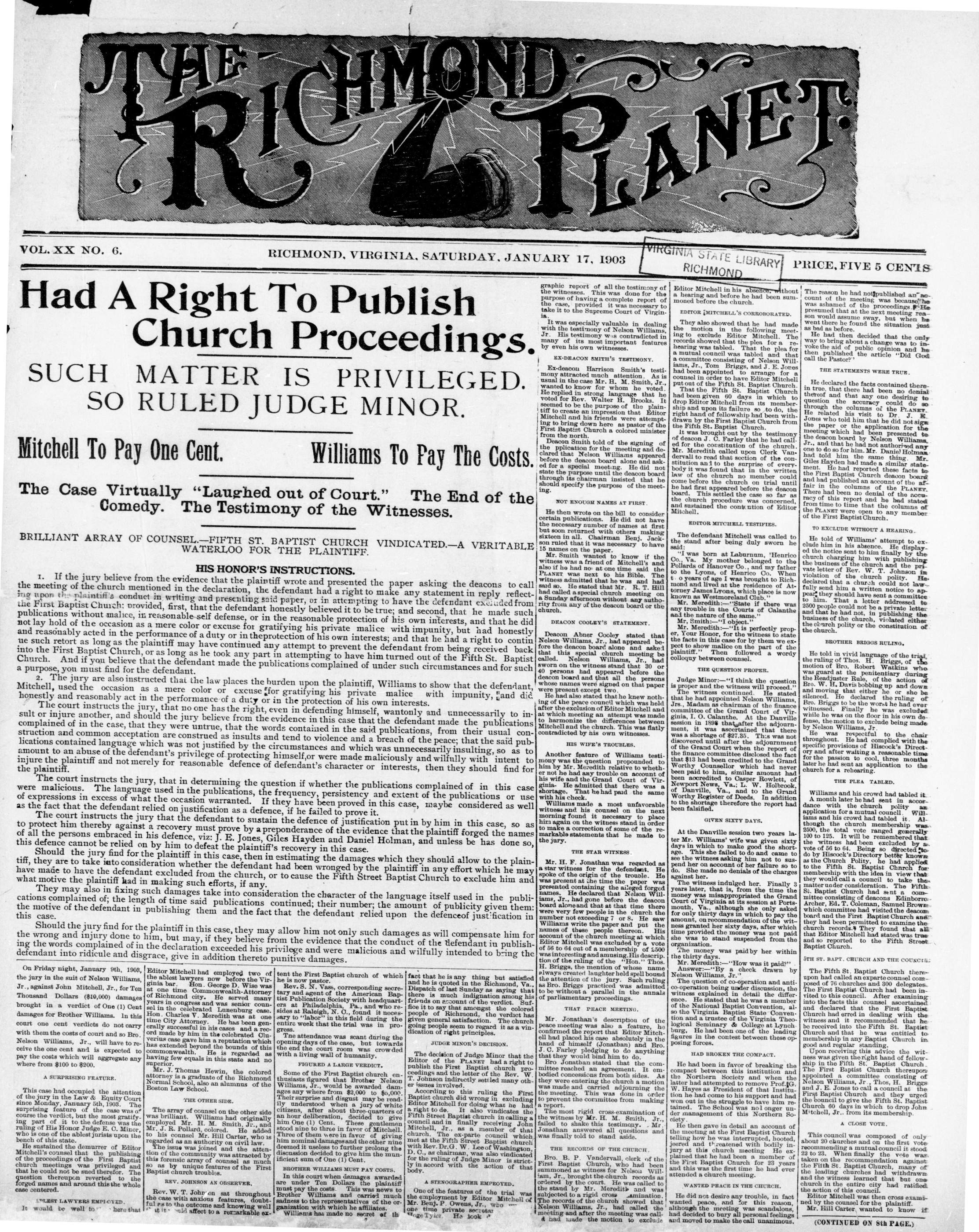
Had A Right To Publish Church Proceedings SUCH MATTER IS PRIVILEGED. SO RULED JUDGE MINOR.
Mitchell To Pay One Cent.
The Case Virtually "Laughed out of Court." The End of the Comedy. The Testimony of the Witnesses.
BRILLIANT ARRAY OF COUNSEL.—FIFTH ST. BAPTIST CHURCH VINDICATED.—A VERITABLE WATERLOO FOR THE PLAINTIFF
1. If the jury believe from the evidence that the plaintiff wrote and presented the paper asking the deacons to call the meeting of the church mentioned in the declaration, the defendant had a right to make any statement in reply reflecting upon the plaintiff's conduct in writing and presenting said paper, or in attempting to have the defendant excluded from the First Baptist Church; provided, first, that the defendant honestly believed it to be true; and second, that he made such publications without malice, in reasonable self defense, or in the reasonable protection of his own interests, and that he did not lay hold of the occasion as a mere color or excuse for gratifying his private malice with impunity, but had honestly and reasonably acted in the performance of a duty or in the protection of his own interests; and that he had a right to continue such retort as long as the plaintiff may have continued any attempt to prevent the defendant from being received back into the First Baptist Church, or as long as he took any part in attempting to have him turned out of the Fifth St. Baptist Church. And if you believe that the defendant made the publications complained of under such circumstances and for such a purpose, you must find for the defendant.
2. The jury are also instructed that the law places the burden upon the plaintiff, Williams to show that the defendant, Mitchell, used the occasion as a mere color or excuse for gratifying his private malice with impunity, and did honestly and reasonably act in the performance of a duty or in the protection of his own interests.
The court instructs the jury, that no one has the right, even in defending himself, wantonly and unnecessarily to insult or injure another, and should the jury believe from the evidence in this case that the defendant made the publications complained of in the case, that they were untrue, that the words contained in the said publications, from their usual construction and common acceptance are construed as insults and tend to violence and a breach of the peace; that the said publications contained language which was not justified by the circumstances and which was unnecessarily insulting, so as to amount to an abuse of the defendant's privilege of protecting himself, or were made maliciously and wilfully with intent to injure the plaintiff and not merely for reasonable defence of defendant's character or interests, then they should find for the plaintiff.
The court instructs the jury, that in determining the question if whether the publications complained of in this case were malicious. The language used in the publications, the frequency, persistence and extent of the publications or use of expressions in excess of what the occasion warranted. If they have been proved in this case, maybe considered as well as the fact that the defendant relied on justification as a defence, if he failed to prove it.
The court instructs the jury that the defendant to sustain the defence of justification put in by him in this case, so as to protect him thereby against a recovery must prove by a preponderance of the evidence that the plaintiff forged the names of all the persons embraced in his defence, viz: J. E. Jones, Giles Hayden and Daniel Holman, and unless be has done so, this defence cannot be relied on by him to defeat the plaintiff's recovery in this case.
Should the jury find for the plaintiff in this case, then in estimating the damages which they should allow to the plaintiff, they are to take into consideration whether the defendant had been wronged by the plaintiff in any effort which he may have made to have the defendant excluded from the church, or to cause the Fifth Street Baptist Church to exclude him and what motive the plaintiff had in making such efforts, if any.
They may also in fixing such damages take into consideration the character of the language itself used in the publications complained of; the length of time said publications continued; their number; the amount of publicity given them: the motive of the defendant in publishing them and the fact that the defendant relied upon the defence of justification in this case.
Should the jury find for the plaintiff in this case, they may allow him not only such damages as will compensate him for the wrong and injury done to him, but may, if they believe from the evidence that the conduct of the defendant in publishing the words complained of in the declaration exceeded his privilege and were malicious and wilfully intended to bring the defendant into ridicule and disgrace, give in addition thereto punitive damages.
VOL. XX NO. 6.
Had A
SUCH M
SO I
Mitchell To Pay
The Case Virtu
Come
BRILLIANT ARRAY OF
1. If the jury believe from the meeting of the church meeting upon the plaintiff's conduct the First Baptist Church, brov publications without malice, it not lay hold of the occasion as and reasonably acted in the plea such retort as long as the plea into the First Baptist Church Church. And if you believe that a purpose, you must find for the
2. The jury are also instigated Mitchell, used the occasion honestly and reasonably act in the court instructs the jury to suit or injure another, and she complained of in the case, that construction and common acceptations contained language amount to an abuse of the definite injure the plaintiff and not meet the plaintiff.
The court instructs the jury were malicious. The language of expressions in excess of what as the fact that the defendant's the court instructs the jury to protect him thereby against all the persons embraced in this defence cannot be relied on.
Should the jury find for the诉, they are to take into consideration have made to have the defenda what motive the plaintiff had for them. They may also in fixing cations complained of; the lenient motive of the defendant in this case.
Should the jury find for the the wrong and injury done to ing the words complained of in defendant into ridicule and dis
On Friday night, January 9th, 1908, the jury in the suit of Nelson Williams, Jr., against John Mitchell, Jr., for Ten Thousand Dollars ($10,000) damages brought in a verdict of One (1) Cent damages for Brother Williams. In this court one cent verdicts do not carry with them the costs of court and so Bro. Nelson Williams, Jr., will have to receive the one cent and is expected to pay the costs which will aggregate any where from $100 to $200.
A SURPRISING FEATURE
This case had occupied the attention of the jury in the Law & Equity Court since Monday, January 5th, 1903. The surprising feature of the case was of course the verdict, but the most gratifying part of it to the defense was the ruling of His Honor Judge E. C. Minor, who is one of the ablest jurists upon the bench of this state.
He sustained the demurrer of Editor Mitchell's counsel that the publishing of the proceedings of the First Baptist church meetings was privileged and that he could not be sued therefor. The question thereupon reverted to the forged names and around this the whole case centered.
LEST LAWYERS EMPLOYED.
It would be well to see here that
HIS HONOR'S INSTRUCTIONS.
from the evidence that the plaintiff sationed in the declaration, the act in writing and presenting said provided, first, that the defendant has a reasonable self defense, or in a mere color or excuse for graff performance of a duty or in the plaintiff may have continued an action as long as he took any part that the defendant made the public defendant.
Constructed that the law places the burden as a mere color or excuse for the performance of a duty or in the plaintiff, that no one has the right, or could the jury believe from the fact they were untrue, that the wordation are construed as insults and which was not justified by the defendant's privilege of protecting merely for reasonable defence of the jury, that in determining the query used in the publications, they that the occasion warranted. If the relied on justification as a defense, that the defendant to sustain it a recovery must prove by a proof of his defence, viz: J. E. Jones, Gun by him to defeat the plaintiff, the plaintiff in this case, then in determination whether the defendant ant excluded from the church, or on making such efforts, if any. Such damages take into consideration of time said publications in publishing them and the fact the plaintiff in this case, they may him, but may, if they believe for the declaration exceeded his pro grace, give in addition thereto.
ence that the plaintiff wrote and presented the declaration, the defendant had a right and presenting said paper, or in attempt that the defendant honestly believed it to self defense, or in the reasonable protec- or or excuse for gratifying his private use of a duty or in the protection of his own if he have continued any attempt to prevent as he took any part in attempting to haveendant made the publications complained.
The law places the burden upon the plaintiff, color or excuse for gratifying his pro- mance of a duty or in the protection of his one has the right, even in defending his y believe from the evidence in this case, untrue, that the words contained in the instrued as insults and tend to violence are not justified by the circumstances and wi vilege of protecting himself, or were ma- reasonable defence of defendant's character.
determining the question if whether thou the publications, the frequency, persisten- tion warranted. If they have been proven justification as a defence, if he failed to pro- defendant to sustain the defence of just must prove by a preponderance of the e- viz: J. E. Jones, Giles Hayden and D. defeat the plaintiff's recovery in this case, in this case, then in estimating the dam- either the defendant had been wronged from the church, or to cause the Fifth such efforts, if any.
les take into consideration the character said publications continued; their num- them and the fact that the defendant.
at this case, they may allow him not only say, if they believe from the evidence that tion exceeded his privilege and were in addition thereto punitive damages.
Editor Mitchell had employed two of the ablest lawyers now before the Virginia bar. Hon. George D. Wise was at one time Commonwealth Attorney of Richmond city. He served many years in congress and was senior counsel in the celebrated Lunenburg court. Hon. Charles V. Meredith was at one time Attorney. He has been generally successful in his cases and recorded by him in the celebrated Oliverius case gave him a reputation which has extended beyond the bounds of this commonwealth. He is regarded as having few equals in this state and no superior.
Mr. J. Thomas Hewin, the colored attorney is a graduate of the Richmond Normal School, also an alumnus of the Boston Law School.
THE OTHER SIDE
The array of counsel on the other side was brilliant. Williams had originally employed Mr. H. M. Smith, Jr., and Mr. J. R. Pollard, colored. He added to his counsel Mr. Hill Carter, who is regarded as an authority on civil law. The issue was joined and the attention of the community was attracted by this forensic array of counsel as much so as by unique features of the First Baptist church troubles.
REV. JOHNSON AN OBSERVER.
Rev. W. T. John on sat throughout the case with anxious features, doubtful to the outcome and knowing well it it it it affect to a reverable
RICHMOND, VIRGINIA, SATURDAY, JANUARY 17, 1903
Williams To Pay The Costs.
iff wrote and presented the paper defendant had a right to make a good paper, or in attempting to have honestly believed it to be true; and the reasonable protection of his identifying his private malice with protection of his own interests; and any attempt to prevent the defense in attempting to have him turn publications complained of under s. 10 burden upon the plaintiff, William, or gratifying his private malice in the protection of his own interest in defending himself, want evidence in this case that the documents contained in the said public tend to violence and a breach circumstances and which was un himself, or were made malicious defendant's character or interest question if whether the publication frequency, persistency and extent they have been proved in this case, if he failed to prove it. In the defence of justification put reponderance of the evidence that miles Hayden and Daniel Holm is recovery in this case. In estimating the damages which he had been wronged by the plaintiff to cause the Fifth Street Bap eration the character of the language continued; their number; the amount that the defendant relied upon. I allow him not only such damage from the evidence that the condemn privilege and were malicious and punitive damages.
tent the First Baptist church of which he is now pastor.
Rev. S. N. Vass, corresponding secretary and agent of the American Baptist Publication Society with headquarters at Philadelphia, Pa., and who resides at Raleigh, N. O., found it necessary to "labor" in this field during the entire week that the trial was in progress.
The attendance was scant during the opening days of the case, but towards the end the court room was crowded with a living wall of humanity.
FIGURED A LARGE VERDICT.
Some of the First Baptist church enthusiasts figured that Brother Nelson Williams, Jr., would be awarded damages any where from $2,000 to $5,000. Their surprise and disgust may be readily understood when a jury of white citizens, after about three-quarters of an hour deliberation, decided to give him One (1) Cent. These gentlemen stood nine to three in favor of Mitchell. Three of them were in favor of giving him nominal damages and the other nine deemed it useless to further prolong the discussion decided to give him the muni-ficient sum of One (1) Cent.
BROTHER WILLIAMS MUST PAY COSTS.
In this court when damages awarded are under Ten Dollars the plaintiff must pay the costs. This was news to Brother Williams and carried much sadness to the representatives of the organization with which he affiliates.
Williams has made no secret of th
fact that he is any thing but satisfied and he is quoted in the Richmond, Va. Dispatch of last Sunday as saying that there is much indignation among his friends on account of the verdict. Surface it to say that amongst the colored people of Richmond, the verdict has given general satisfaction. The church going people seem to regard it as a vindication of right principles.
JUDGE MINOR'S DECISION
The decision of Judge Minor that the Editor of the PLANET had a right to publish the First Baptist church proceedings and the letter of the Rev. W.T. Johnson indirectly settled many other issues involved. According to this ruling the First Baptist church did wrong in excluding Editor Mitchell for doing what he had a right to do. It also vindicates the Fifth Street Baptist church in calling a council and in finally receiving John Mitchell, Jr., as a member of that church. The expatriate council which met at the Fifth Street Baptist church with Rev.Dr.G. W. Lee of Washington, D.C., as chairman, was also vindicated for the ruling of Judge Minor is strictly in accord with the action of that body.
A STENOGRAPHER EMPEOYED
One of the features of the trial was the employment by Editor Mitchell of M. Benj, P. Owens, Jr., who was one private secretary. One Grace Taylor, H. Hockock
graphic report of all the testimony of the witnesses. This was done for the purpose of having a complete report of the case, provided it was necessary to take it to the Supreme Court of Virginia. It was especially valuable in dealing with the testimony of Nelson Williams, Jr. His testimony was contradicted in many of its most important features by even his own witnesses.
EX-DEACON SMITH'S TESTIMONY
Ex-deacon Harrison Smith's testimony attracted much attention. As is usual in the case Mr. H. M. Smith, Jr., wanted to know for whom he voted. He replied in strong language that he voted for Rev. Walter H. Brooks. It seemed to be the purpose of the plaintiff to create an impression that Editor Mitchell and his friends were attempting to bring down here as pastor of the First Baptist Church a colored minister from the frontier. Deacon Smith told of the signing of the plication for the meeting and declared that Nelson Williams appeared before the deacon board alone and asked for a special meeting. He did not state the purpose until the deacon board through its chairman insisted that he should specify the purpose of the meeting.
NOT ENOUGH NAMES AT FIRST
He then wrote on the bill to consider certain publications. He did not have the necessary number of names at first but soon returned with others making sixteen in all. Chairman Benj. Jackson ruled that it was necessary to have 15 names on the paper.
Mr. Smith wanted to know if the witness was a friend of Mitchell's and also if he had no at one time said the PLANET was next to his Bible. The witness admitted that he was and had said so. He stated that Mr. R. T. Hill had called a special church meeting on a Sunday afternoon without any authority from any of the deacon board or the church.
DEACON COOLEY'S STATEMENT
Deacon Abner Cooley stated that Nelson Williams, Jr., had appeared before the deacon board alone and asked that this special church meeting be called. Nelson Williams, Jr., had sworn on the witness stand that 30 or 40 persons had appeared before the deacon board and that all the persons whose names were signed on that paper were present except two.
He had also stated that he knew nothing of the peace council which was held after the exclusion of Editor Mitchell and at which meeting an attempt was made to harmonize the differences between Mitchell and the church. This was flatly contradicted by his own witnesses.
HIS WIFE'S TROUBLES
Another feature of Williams testimony was the question propounded to him by Mr. Meredith relative to whether not he had any trouble on account of his wife and the Grand Court of Virginia. He admitted that there was a shortage. That he had paid the same with his check.
Williams made a most unfavorable witness and his counsel on the next morning found it necessary to place him again on the witness stand in order to make a correction of some of the remarkable statements that he made to the jury.
THE STAR WITNESS
Mr. H. F. Jonathan was regarded as a star witness for the defendant. He spoke of the origin of the trouble. He was present at the time the paper was presented containing the ailed forged names. He declared that Nelson Williams, Jr., had gone deacon the board alone and that at that time there were very few people in the church the number not exceeding 7 or 8. He saw Williams write the paper and put the names of these people there. His account of the church meeting at which Editor Mitchell was excluded by a vote of 56 to 64 out of a membership of 5500 was interesting and amusing. His description of the ruling of the "Hon." Thos. H. Briggs, the mention of whose name always created laughter held spell bound the attention of the jury. Such ruling as Bro. Briggs practiced was admitted to be without a parallel in the annals of parliamentary proceedings.
THAT PEACE MEETING
Mr. Jonathan's description of the peace meeting was also a feature, he confirmed the report that Editor Mitchell had placed his case absolutely in the hand of himself (Jonathan) and Bro. J.C. Farley pledging to do anything that they would bind him to do.
Bro Jonathan stated that the committee reached an agreement. It embodied concessions from both sides. As they were entering the church a motion was made and carried adjourning the meeting. This was done in order to prevent the committee from making a report.
The most rigid cross-examination of the witness by Mr. H. M. Smith, Jr., failed to shake this testimony. Mr. Jonathan answered all questions and was finally told to stand aside.
THE RECORDS OF THE CHURCH
Bro. B. P. Vandervall, clerk of the First Baptist Church, who had been summoned as witness for Nelson William, Jr., brought the church records as ordered by the court. He was called to the stand by Mr. Meredith and was subjected to a rigid crossamination. The records of the church showed that Nelson Williams, Jr., had called the meeting and after the meeting was called had made the motion to exclude
Editor Mitchell in his absence, without a hearing and before he had been summoned before the church.
EDITOR MITCHELL'S CORRORORATED
They also showed that he had made the motion in the following meeting to exclude Editor Mitchell. The records showed that the plea for a hearing was tabled. That the plea for a mutual council was tabled and that a committee consisting of Nelson Williams, Jr., Tom Briggs, and J. E. Jones had been appointed to arrange for a counsel in order to have Editor Mitchell put out of the Fifth St. Baptist Church. That the Fifth St. Baptist Church had been given 60 days in which to drop Editor Mitchell from its membership and upon its failure so to do, the right hand of fellowship had been withdrawn by the First Baptist Church from the Fifth St. Baptist Church.
It was brought out by the testimony of deacon J. C. Farley that he had called for the constitution of the church. Mr. Meredith called upon Clerk Vandervall to read that section of the constitution and to the surprise of everybody it was found that in the written law of the church no member could come before the church on trial until he had first appeared before the deacon board. This settled the case so far as the church procedure was concerned, and sustained the contention of Editor Mitchell.
EDITOR MITCHELL TESTIFIES
The defendant Mitchell was called to the stand after being duly sworn he said:
"I was born at Laburnum, 'Henrico Co., Va. My mother belonged to the Pollards of Hanover Co., and my father to the Lyons, of Henrico Co. When t o years of age I was brought to Richmond and lived at the residence of Attorney James Lyons, which place is now known as Westmoreland Club."
Mr. Meredith: "State if there was any trouble in the Courts of Calanthe and the nature of the same."
Mr. Smith: "I object."
Mr. Meredith: "It is perfectly proper, Your Honor, for the witness to state the facts in this case for by them we expect to show malice on the part of the plaintiff." Then followed a wordy colloquy between counsel.
THE QUESTION PROPER
rage and—I think the question is paper and the witness will proceed." The witness continued. He stated that he had appointed Nelson Williams, Jrs., Madam as chairman of the finance committee of the Grand Court of Virginia, I. O. Calanthe. At the Danville session in 1898 that after the adjournment, it was ascertained that there was a shortage of $27.35. This was not discovered until after the adjournment of the Grand Court when the report of the finance committee disclosed the fact that $13 had been credited to the Grand Worthy Counsellor which had never been paid to him, similar amount had been accredited to Casper Rowlett, of Newport News, Va.; L. W. Holbrook of Danville, Va., and to the Grand Worthy Register of Deeds. In addition to the shortage therefore the report had been falsified.
GIVEN SIXTY DAYS.
At the Danville session two years later Mr. Williams' wife was given sixty days in which to make good the shortage. This she failed to do and came to see the witness asking him not to suspend her on account of her failure so to do. She made no denials of the charges against her.
The witness indulged her. Finally 3 years later, that is, from the time the money was misappropriated the Grand Court of Virginia at its session at Portsmouth, Va., although she only asked for only thirty days in which to pay the amount, on recommendation of the witness granted her sixty days, after which time provided the money was not paid she was to stand suspended from the organization.
The money was paid by her within the thirty days.
Mr. Meredith:—"How was it paid?"
Answer:—"By a check drawn by Nelson Williams, Jr."
The question of co-operation and antico-operation being under discussion, the witness explained in detail the difference. He stated that he was a member of the National Baptist Convention, also the Virginia Baptist State Convention and a trustee of the Virginia Theological Seminary & College at Lynchburg. He had been one of the leading figures in the contest between these opposing forces.
HAD BROKEN THE COMPACT
He had been in favor of breaking the compact between this institution and the Northern Society and when the latter had attempted to remove Prof. G. W. Hayes as President of that Institution he had come to his support and had won out in the struggle to have him retained. The School was no longer under management of this Northern Society.
He then gave in detail an account of the meeting at the First Baptist Church telling how he was interrupted, hooted, jeered and teathed with bodily injury at this church. He explained that he had been a member of the First Baptist Church for 23 years and this was the first time he had ever attended a church meeting.
WANTED PEACE IN THE CHURCH
He did not desire any trouble, in fact wanted peace, and for this reason, although the meeting was scandalous, had decided to bury all personal feelings and moved to make the call unanimous.
The reason he had not published an account of the meeting was because he was ashamed of the proceedings. He presumed that at the next meeting reason would assume sway, but when he went there he found the situation just as bad as before. He had then decided that the only way to bring about a change was to invoke the aid of public opinion and he then published the article "Did God call the Pastor?"
THE STATEMENTS WERE TRUE
He declared the facts contained therein in true, that there had been no denial thereof and that any one desiring to question the accuracy could do through the columns of the PLANET. He related his visit to Dr. J. E. Jones who told him that he did not sign the paper or the application for the meeting which had been presented to the deacon board by Nelson Williams, Jr., and that he had not authorized any so to do for him. Mr. Daniel Holman had told him the same thing. Mr. Giles Hayward had made a similar statement. He had reported these facts to the First Baptist church deacon board and had published an account of the affair in the columns of the PLANET. There had been no denial of the accuracy of this report and he had stated from time to time that the columns of the PLANET were open to any member of the First Baptist Church.
TO EXCLUDE WITHOUT A HEARING
He told of Williams' attempt to exclude him in his absence. He displayed the notice sent to him finally by the church charging him with publishing the business of the church and the private letter of Rev. W. T. Johnson in violation of the church polity. He declared that a church could not lawfully send him a written notice to appear, they should have sent a committee to him. That a letter addressed to 2500 people could not be a private letter and that he had not, in publishing the business of the church, violated either the church polity or the constitution of the church.
BROTHER BRIGGS RULING.
He told in vivid language of the triumph, the ruling of Thos. H. Briggs, of the motion of Bro. Robert Watkins who was guard at the penitentiary during the Readjuster Rule, of the action of Bro. W. H. Davis bobbing up and down and moving that either he or she be silenced. He declared the ruling of Bro. Briggs to be the worst he had ever witnessed. Finally he was excluded while he was on the floor in his own defense, the motion to exclude being made by Nelson Williams, Jr.
He was respectful to the chair throughout. He had complied with the specific provisions of Hiscock's Directory and after waiting a reasonable time for the passion to cool, three months later he had sent an application to the church for a rehearing.
THE PLEA TABLED.
Williams and his crowd had tabled it. A month later he had sent in accordance with the church polity an application for a mutual council. Williams and his crowd had tabled it. Although the church membership was 2500, the total vote ranged generally 100 to 125. It will be remembered that the witness had been excluded by a vote of 56 to 64. Being so directed go by hiscock's Directory better known as the Church Polity, he had applied to the Fifth St. Baptist Church for membership with the idea in view that they would call a council to take the matter under consideration. The Fifth St. Baptist Church had sent a committee consisting of deacons Edinboro Archer, Ed. T. Coleman, Samuel Brown which committee had visited the deacom board and the First Baptist Church and they had been permitted to examine the church records. They found that all that Editor Mitchell had stated was true and so reported to the Fifth Street Baptist Church.
5TH ST. BAPT. CHURCH AND THE COUNCIL.
The Fifth St. Baptist Church thereupon had called an exparate counsel composed of 76 churches and 800 delegates. The First Baptist Church had been invited to this council. After examining into the facts this counsel ascertained and declared that the First Baptist Church had erred in dealing with the witness and it recommended that he be received into the Fifth St. Baptist Church and that he was entitled to membership in any Baptist Church in good and regular standing.
Upon receiving this advice the witness was given right hand of fellowship in the Fifth St. Baptist Church. The First Baptist Church thereupon appointed a committee consisting of Nelson Williams, Jr., Thos, H. Briggs and J. E. Jones to call a council at the First Baptist Church and they urged the council to give the Fifth St. Baptist Church 60 days in which to drop John Mitchell, Jr., from its membership.
A CLOSE VOTE
This council was composed of only about 20 churches and on the first vote recommending a mutual council it stood 22 to 23. When finally the vote was taken on the recommendation against the Fifth St. Baptist Church, many of the leading churches had withdrawn and the witness learned that but one more of the entire city had ratified the action of the council. Editor Mitchell must then cross examined by the counsel for the plaintiff. Mr. Hill Carter wanted to know.
(CONTINUED ON 8th PAGE.)
must be straight and angular. The change in figure is coming much more rapidly than the untutored night think possible, and the designers are lending every aid to its rapid development. It matters not that it is far from the beautiful so long as it is fashionable.
"The new figure," explained a specialist, "follows the perpendicular as nearly as it is possible for a woman's outline to do it. In acquiring this figure a slight woman will have a great advantage over her stout sister. The only hope of the latter lies in her corset.
"A straight front is to be accentuated, not only below but above the waist line, and the back, too, must look as if a board was strapped to
The Novelties
ample of this style is shown in the elegant cloak of black box cloth which has been sketched. This original garment is ornamented with geometrical strappings of the same material, and the fronts are lined with pale French gray cloth with a trellis of narrow strips of black cloth and ribbon velvet, the lining being of French gray soft satin.
The large picture hat which is worn with tails is of black velvet with a flat crown in the Tam-o'-Shanter style, and a wide brim trimmed in an entirely new way with foils of velvet and satin plaited into one another so that bands of satin form the outer edge of the lining. A cluster of choice ostrich tips on the left side completes the trimming.
The smart coat in the sacque shape is made of the palest beaver colored box cloth trimmed with appliques of the same cloth on canvas, which is worked with small designs in black silk. This forms the collar, revers and cuffs, which are edged with stitched strappings of black glace silk and rows of narrow white braid, and the lining is of rich white satin brocade.
A lovely feather hat with the sides turned up and caught at the back is black on the outside and white underneath, and it has no trimmings except clusters of black and white feathers at the back, and long loops of black ribbon velvet in the center.
A new coat of putty colored box cloth is trimmed with bows and ends of silk passementerie to match with a narrow band of red silk under the passementerie at the neck and on the sleeves. This artistic garment is
血代號
Reedered a Difficult Number Without a Single Mistake and Tac a Disappeared.
"Can a fellow get a chance to get in on this?"
The question was addressed to Miss Nellie Conarty, organist of the Roman Catholic Church of the Immaculate Heart, at Chester, Pa. The choi was singing the requiem for Rev Thomas J. McGlynn, late rector of the church.
"Onewald's Mass" was being used and when the organist turned to see who had addressed her she was face to face with a tramp, ragged and dirty, with clothes soiled by miles of weary walking, but with a longing
W. G. T.
"CAN A FELLOW GET A CHANCE?"
expression upon his countenance that she could not deny. She nodded assent to the strange request and the ragged visitor took his place among the singers, who, astonished at the spectacle, forgot for a moment their parts and ceased singing.
Rev. Father Baker, the celebrant, paused in the service and looked askance at the organ loft. Then the church was suddenly filled with the rich melody of a tenor voice that made the entire congregation turn and gaze at the choir. The "hobo," for such he said he really was, finished the mass, giving to the singers an enthusiasm and spirit never seen in the gallery before.
Then, as the officiating priest left the altar, the tramp turned and slipped from the organ loft as noiselessly as he had entered it. not stopping to give his name nor his history, except to say that he once sang in one of the leading choirs in the country. He had heard the familiar strains as he was about to pass the church, and the music awakened fond memories, he said.
PASSING OF THE COAT.
Boy Was Worried More About Fate of His Outer Garment Than That of the Rich Man.
A well-known Reading (Pa.) merchant was in the habit of paying weekly visits to a farm which he had purchased. To those living along the route he was wont to drive he was at first the object of much speculation, but in due time the cause of his frequent visits became known, as did also the fact that he was a man of considerable influence and wealth.
As he was driving along one Sunday morning last summer he saw plooding ahead of him a small boy of the country thereabout, carefully carrying on his arm a coat, which, on account of the heat, he had removed; and, acting on a charitable impulse,
C. H.
"HOLY MOSES!"
invited the thoroughly abashed lad to ride as far as the "Sunday school," having gleaned that to be his destination. They were soon there, but the boy, in his perturbed state, did not realize until he had taken his place in his class that he had left his coat in the carriage.
The well-known parable of Lazarus and the rich man having been assigned as the lesson for that day, the teacher, addressing the newcomer, inquired: "What became of the rich man?"
"He drove on down the road to his farm," promptly answered the youth, still thinking of the coat.
"For his misdeeds," affirmed the teacher, ignoring the answer, "he went to an awful place of torment, from which he can never return."
"Holy Moses!" broke in the youth. "He's got my coat with him!"
The New Fashionable
The Novelties in Winter Coats
A
A
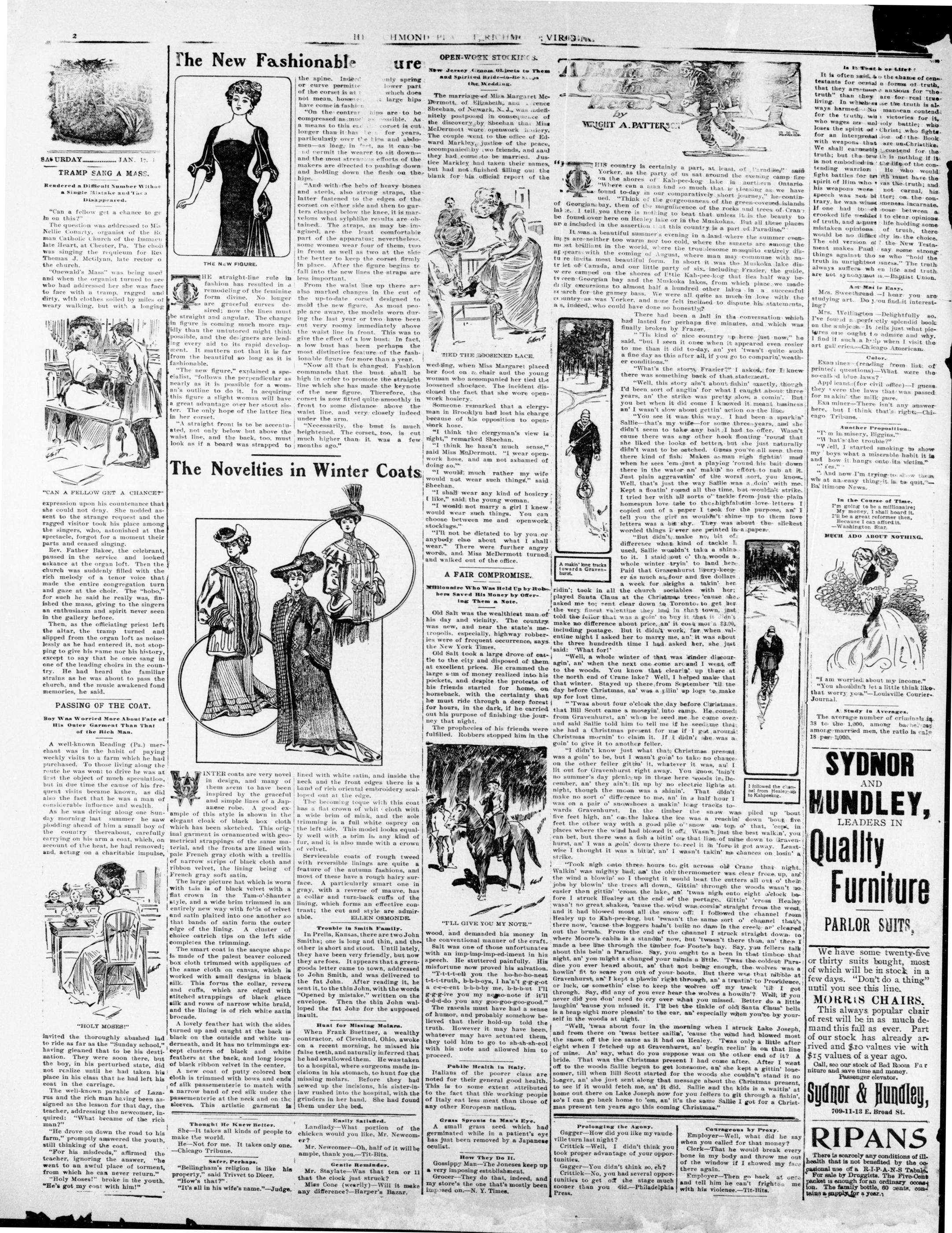
THE NEW FIGURE.
HE straight-line rule in fashion has resulted in a remodeling of the feminine form divine. No longer are graceful curves desired; now the line
T
W
INTER coats are very novel in design, and many of them seem to have been inspired by the graceful and simple lines of a Japanese robe. A good ex-
Thought He Knew Better.
She—It takes all kinds of people to make the world.
He—Not for me. It takes only one.
—Chicago Tribune.
Suffer, Perhaps.
"Bellingham's religion is like his property," said Trivet to Dicer.
"How's that?".
"It's all in his wife's name."—Judge.
HMOND PLA LRICHM
the spine. Indeed, only spring or curve permitted in lower part of the corset is at its which does not mean, however, that large hips have come in fashion.
"On the contrarrier hips are to be compressed as much as possible. As a means to this end the corset is cut longer than it has been for years, particularly over the hips and abdomen—as long, in feet, as it can be and permit the wearer to sit down—and the most strenuous efforts of the makers are directed to pushing down and holding down the flesh on the hips.
"And with the help of heavy bones and steels, also strong straps, the latter fastened to the edges of the corset on either side and then to garter clasped below the knee, it is marvelous what sylphlike results are obtained. The straps, as may be imagined, are the least comfortable part of the apparatus; nevertheless, some women wear four of them, two in front as well as two at the side the better to keep the corset firmly in place. After the figure begins to fall into the new lines the straps are less important.
From the waist line up there are also marked changes in the cut of the up-to-date corset designed to mold the new figure. As most people are aware, the models worn during the last year or two have been cut very roomy immediately above the waist line in front. This was to give the effect of a low bust. In fact, a low bust has been perhaps the most distinctive feature of the fashionable figure for more than a year. "Now all that is changed. Fashion commands that the bust shall be high in order to promote the straight line which she has made the keynote of the new figure. Therefore, the corset is now fitted quite smoothly in front to some distance above the waist line, and very closely indeed under the arm. "Necessarily, the bust is much heightened. The corset, too, is cut much higher than it was a few months ago."
in Winter Coats
lined with white satin, and inside the neck and the front edges there is a band of rich oriental embroidery scalloped out at the edge.
The becoming toque with this coat has a flat crown of whit cloth with a wide brim of mink, and the sole trimming is a full white ossprey on the left side. This model looks equally well with a brim in any kind of fur, and it is also made with a crown of velvet.
Serviceable coats of rough tweed with reversible linings are quite a feature of the autumn fashions, and most of these have a rough hairy surface. A particularly smart one in gray, with a reverse of mauve, has a collar and turn-back cuffs of the lining, which forms an effective contrast; the cut and style are admirable.
ELLEN OSMONDE
In Prella, Kansas, there are two John Smiths; one is long and thin, and the other is short and stout. Until lately, they have been very friendly, but now they are foes. It appears that a green-goods letter came to town, addressed to John Smith, and was delivered to the fat John. After reading it, he sent it, to the thin John, with the words "Opened by mistake," written on the envelope. Then the thin John walloped the fat John for the supposed insult.
When Frank Buettner, a wealthy contractor, of Cleveland, Ohio, awoke on a recent morning, he missed his false teeth, and naturally inferred that he had swallowed them. He was taken to a hospital, where surgeons made incisions in his stomach, to hunt for the missing molars. Before they had sewed up the incisions, his sister-in-law rushed into the hospital, with the grinders in her hand. She had found them under the bed.
Landlady—What portion of the chicken would you like, Mr. Newcomer?
Mr. Newcomer—Oh, half of it will be ample, thank you—Tit-Bits.
Gentle Reminder.
Mr. Staylate—Was that ten or 11 that the clock just struck?
Miss Cone (wearly)-Will it make any difference? -Harper's Bazar.
ure
the spine. Indeed or curve permit of the corset is at not mean, however have come in fashion
Trouble in Smith Family
Hunt for Missing Molars
Easily Satisfied.
OPEN-WORK STOCKINGS.
New Jersey Cenom Objects to Them and Spirited Bride-to-lie Stops the Wedding.
The marriage of Miss Margaret McDermott, of Elizabeth, and Lorence Sheehan, of Newark, N.J., was indefinitely postposed in consequence of the discovery by Sheehan that Miss McDermott wore openwork hosiery. The couple went to the office of Edward Markley, justice of the peace, accompanied by two friends, and said they had come to be married. Justice Markley had taken their names, but had not finished filling out the blank for his official report of the
FIED THE DOOSENED LACE
wedding, when Miss Margaret placed her foot on & chair and the young woman who accompanied her tied the loosened shoelace. The incident disclosed the fact that she wore openwork hosiery.
Someone remarked that a clergyman in Brooklyn had lost his charge because of his opposition to openwork hose.
"I think the clergyman's view is night," remarked Sheehan.
"I think he hasn't much sense," said Miss McDermott. "I wear openwork hose, and am not ashamed of doing so."
"I would much rather my wife would not wear such things," said Sheehan.
"I shall wear any kind of hosiery I like," said the young woman.
"I would not marry a girl I knew would wear such things. You can choose between me and openwork stockings."
"I'll not be dictated to by you or anybody else about what I shall wear." There were further angry words, and Miss McDermott turned, and walked out of the office.
A FAIR COMPROMISE.
Millionaire Who Was Held Up by Robbers Saved His Money by Offering Them a Note.
Old Salt was the wealthiest man of his day and vicinity. The country was new, and near the state's metropolis, especially, highway robberies were of frequent occurrence, says the New York Times.
Old Salt took a large drove of cattle to the city and disposed of them at excellent prices. He crammed the large sum of money realized into his pockets, and despite the protests of his friends started for home, on horseback, with the certainty that he must ride through a deep forest for hours, in the dark, if he carried out his purpose of finishing the journey that night.
The prophecies of his friends were fulfilled. Robbers stopped him in the
A
"TLL GIVE YOU MY NOTE."
wood, and demanded his money in the conventional manner of the craft. Salt was one of those unfortunates with an imp-imp-imp-ediment in his speech. He stuttered painfully. His fortune now proved his salvation.
"T-t-t-t-eLL you the ho-ho-ho-nest t-t-t-truth, b-b-b-oys, I ha'n't g-g-g-o-g a c-c-c-e-n b-b-b-by me, b-b-b-ut I'll g-g-ive you my no-note if it'll d-d-d-do you any goo-goo-goo-good." The rascals must have had a sense of humor, and probably somehow believed that their hold-up told the truth. However it may have been, whatever may have actuated them, they told him to go to sh-sh-sh-eol with his note and allowed him to proceed.
Italians of the poorer class are noted for their general good health. This is to some extent attributed to the fact that the working people of Italy eat less meat than those of any other European nation.
Grass Sprouts in Man's Eye.
A small grass seed which had germinated while in a patient's eye has just been removed by a Japanese oculist.
How They Do It.
Gossipy Man—The Joneses keep up a very imposing establishment.
Grocer—They do that, indeed, and my store's the one that's mostly been imposed on—N. Y. Times.
A Hunting and Cottage Preserve
by
WRIGHT A. PATTERSON
HIS country is certainly Yorker, as the party on the shores of Kalamazoo. "Where can a man indo found to-day in our co-rued. "Think of the go- of Georgian bay, then of the magni-lable. I tell you there is nothing to be found over here on Henley lake o- are included in the assertion that the
It was a beautiful summer's evi- ings are neither too warm nor too- most brilliant in the world, where a appears with the coming of August tu re incits most beautiful form. I trie t of Canada, and our little par- were camped on the shores of Pitt- tween Georgian bay and the Musk- daily excursions to almost half a lea search for the gamey bass. We we- country as was Yorker, and none it a s, indeed, who could have done so l
A Madden's Can Crime Rescue by WRIGHT A. PATTERSON
"His country is certainly a part, at least, of Paradise," said Yorker, as the party of us sat around the evening camp fire on the shores of Kah-pee-kog lake in northern Ontario. "Where can a man find so much that is pleasing as we have found to-day in our comparatively short journey," he continued. "Think of the gorgeousness of the green-covered islands of Georgian bay, then of the magnificence of the rocks and trees of Crane lake. I tell you there is nothing to beat that unless it is the beauty to be found over here on Henley lake or in the Muskokas. But all these places are included in the assertion that this country is a part of Paradise."
It was a beautiful summer's evening in a land where the summer evenings are neither too warm nor too cold, where the sunsets are among the most brilliant in the world, where the troublesome mosquito entirely disappears with the coming of August, where man may commune with nature incests most beautiful form. In short it was the Muskoka lake district of Canada, and our little party of six, including Frazier, the guide, were camped on the shores of Little Kah-pee-kog that lies half way between Georgian bay and the Muskoka lakes, from which place we made daily excursions to almost half a hundred other lakes in a successful search for the gamey bass. We were all quite as much in love with the country as was Yorker, and none felt inclined to dispute his statements, a s, indeed, who could have done so honestly?
There had been a full in the conversation which had lasted for perhaps five minutes, and which was finally broken by Frazer.
"Tis kind o' nice country up here just now," he said, "but I seen it once when it appeared even rosier to me than it did to-day, an' yet 'twan't quite such a fine day as this after all, if you go to comparin' weather conditions."
"What's the story, Frazier?" I asked, for I knew there was something back of that statement.
"Well, this story ain't about fishin' exactly, though I'd been sort of anglin' for what I caught about three years, an' the strike was pretty slow, a comin'. But you bet when it did come I knew it meant, business an' I wasn't slow about gettin' action on the line.
"You see it was this way. I had been a sparkin' Sallie--that's my wife--for some three years, and she didn't seem to take any bait. I had to offer. Wasn't cause there was any other hook floating 'round that she liked the looks of better, but she just naturally didn't want to be outached. Guess you've all seen them there kind of fish. Makes as man nigh fightin' mad when he sees 'em just a playing 'round his bait down there in the water an' makin' no effort to nab at it. Just plain aggravatin' of the worst sort, you know. Well, that's just the way Sallie was a doin' with me. Kept a floatin' round all the time, but woulded strike. I tried her with all sorts of' tackle from just the plain homespun love love to the highfalconi love letters I copied out of a paper I took for the purpose, an' I tell you the girl as wouldn't shine up to them love letters was a but shy. They was about the silkest worded things I ever see printed in a paper.
"A makin' long tracks towards Gravenhurst.
But didn't make no, bit of difference what kind of tackle I used, Sallie wouldn't take a shim to it. I stait out c' the woods a whole winter tryin' to land here. Paid that Gravenhurst livery-keeper as much as four and five dollars a week for sleighs a takin' her ridin'; took in all the church sociables with her; played Sauta Claus at the Christmas tree 'cause she asked me to; sent clear down to Toronto; to get her the very finest valentine they had in that town, just told the feller that was a goin' to buy it that it didn't make no difference about price, an' it cos a mora a $3.00, including postage. But it didn't work, for when valentine night I asked her to marry me, an' it was about the three hundredth time I had asked her, she just said: 'What for!'
ridin'; took in all the church socc
played Sauta Chaus at the Christmas
asked me to; sent clear down to T
the very finest valentine they had
told the feller that was a goin' to be
make no difference about price, an' it
including postage. But it didn't
entire night I asked her to marry me
the three hundredth time I had as
said: 'What for!'
"Well, a whole winter of that w
agin, an' when the next one come
to the woods. You know that clea
the north end of Crane lake? Well,
that winter. Stayed up there from
day before Christmas, an' was a pillin
up for lost time.
"Twas about four o'clock the day
that Bill Scott came a mosein' into
from Gravenhurst, an' when he seed
and said Sallie told him to tell me
she had a Christmas present for me
Christmas mornin' to claim it. If I
goin' to give it to another feller.
"I didn't know just what that
was a goin' to be, but I wasn't goin'
on the other feller gittin' it, what
lit out for Gravenhurst right away,
no summer's day plein' in these
cember, an' they ain' lit up by no
night, though the moon was a shin
make no sort o' difference to me, an
was on a pair o' snowshoes a maki
wards Gravenhurst. In the tim
five feet high, an' on the lakes the
feet the other way with a good pile
places where the wind had blowed it
can bet, but there was a fish a bitin'
hurst, an' I was a goin' down there
wise I thought it was a bitin' an' I
strike.
"Took nigh onto three hours to
Walkin' was mighty bad; an' the old
the wind a blowin' so I thought it
jobs by blowin' the trees all down,
easier then gittin' cross the lake,
fore I struck Healey at the end of
wasn't no great shakes, cause the wi
and it had blowed most all the snow
Healey up to Kah-pee-kog, but 'waa
there now, cause the loggers hasn't
out the brush. From the end of the
where Moore's cabin is a standin' no
made a bee line through the timber
about this bein' a Paradise. Say, you
night, an' you might a changed your
pise you ever heard about, an' that
howlin' fit to scarce you out of your
Gravenhurst, an' I kept a plowin' right
or luck, or somethin' else to keep to
through. Say, did any of you ever he
never did you don' need to cry over
laughin' because you missed it. I be
is a heap sight more pleasin' to the ee
self in the woods at night.
"Well, 'twas about four in the
and from there on 'twas better sail
the snow, off the ice same as it had
eight when I fetched up at Gravenhur
of mine. An' say, what do you sup
bride. That was the Christmas pres
off to the woods Sallie begun to get
somer, till when Bill Scott started to
longer, an' she just sent along that
to see if it would fetch me, an' it d
home out there on Lake Joseph now
so's I can go back home to 'em, an' 'mas present ten years ago this comin'
at the church sociables with her; at the Christmas tree, 'cause she clear down to Toronto to get her entine they had in that town, just was a gain' to buy it that it didn't about price, an' it cost a $3.00. But it didn't work, for when valed her to marry me, an' it was about time I had asked her, she just winter of that was kinder discourse next one come around I went off you know that clearing' up there atane lake? Well, I helped make that up there from September till the was, an' was a pilin' up logs to make your o'clock the day before Christmas. Be a moseyin' into camp. He comed' an' when he seed me he came over him to tell me if he seed me that was present for me if I got around to claim it. If I didn't she was another feller.
Just what that Christmas present, but I wasn't goin' to take no chance, gittin' it, whatever it was, an' I must right away. You snow, 'tin' up in these here woods in Dein't lit up by no electric lights at moan was a shinin'. That didn't reference to me, an' in a half hour I knewowshe a makin' long tracks to. In the timber the snow was the lakes the ice was a reaching with a good pile o' snow on top and had blower it off. Wasn't just the rain a fish a bitin' on that line of rain down there to reel it in 'fore it was a bitin', an' I wasn't takin' no more than three hours to, git across old Cory bad; an' the old thermometer was so I thought it would beat the utter trees all down. Gittin' through the 'cross the lake, an' 'twas night onto ey at the end of the portage. Gittin' knees, 'cause the wind was comin' strait all the snow off. I followed tree-koog, but 'twasn't the same sort the loggers had built no dame in the end of the channel I struck a standin' now, but 'twasn't the through the timber for Foote's bay. So paradise. Say, you ought to a been it a changed your nands a little. Twad about, an' that not being enough, you out of your boots. But there a plewin' right through, an' a truth it else to keep the wolves off my way of you ever hear the wolves a how need to cry over what you missed. I missed it. I'll bet the tinkle of old pleain' to the ear, an' especially when night.
Out four in the morning when I stit 'twas better sailin', 'cause the wives as it had on Healey. 'Twas up at Gravenhurst, an' begin reel what do you suppose was on the other Christmas present I had come after the little begun to get lonesome, an' she he fell Scott started for the woods she could sent along that message about the fetch me, an' it did. Sallie and the kake Lake Jones now for you fellers to go home to 'om, an' it's the same Salliears ago this coming Christmas."
“Well, a whole winter of that was under discouragin', an' when the next one come around I went off to the woods. You know that clearin' up there at the north end of Crane lake? Well, I helped make that winter. Stayed up there from September till the day before Christmas, an' was a gillin' up logs to make up for lost time.
“Twas about four o'clock the day before Christmas that Bill Scott came a moseyn' into camp. He comed from Gravenhurst, an' when he seed me he came over and said Sallie told him to tell me if he seed me that she had a Christmas present for me if I got around Christmas mornin' to claim it. If I didn't she was a goin' to give it to another feller.
“I didn't know just what that Christmas present was a goin' to be, but I wasn't goin' to take no chance on the other feller giten' it, whatever it was, an' I lit out for Gravenhurst right away. You snow'tain' no summer's day picnic up in these here woods in December, an' they ain' lit up by no electric lights at night, though the moon was a shinin'. That didn't make no sort o' difference to me, an' in a half hour I was on a pair o' snowshoes a makin' long tracks to
wards Gravenhurst. In the timber the snow was piled up 'bout five feet high, an 'an' the lakes the ice was a reachin' down 'bout five feet the other way with a good pile o' snow on top o' that, 'cerr, in places where the wind had blowed it off. Wasn't just the best walkin', you can bet, but there was a fish a bitin' on that line of mine down to gravenhurst, an' I was a goin' down there to reeil it in 'fore it got away. Leastwise I thought it was a bitin', an' I wasn't takin' no chances on losin' a strike.
"Took nigh onto three hours to git across old Crane that night. Walkin' was mighty bad; an' the old thermometer was clear froze up, and the wind a blowin' so I thought it would beat the cutters all out o' their jobs by blowin' the trees all down. Gittin' through the woods wasn't no easier than gittin' cross the lake, an' twasn' night onto eight o'clock before I struck Healey at the end of the portage. Gittin' cross Healey wasn't no great shakes, cause the wind was comin' straight from the west, and it had blowed most all the snow off. I followed the channel from Healey up to Kah-pee-kog, but 'wasn't the same sort o' channel that's there now, cause the loggers hadn't built no dam in the creek an' cleared out the brush. From the end of the channel I struck straight down to where Moore's cabin is a standin' now, but 'wasn't there than, an' then I made a bee line through the timber for Foote's bay. Say, you fellers talk about this bein' a Paradise. Say, you ought to a been in that timber that night, an' you might a changed your minds a little. 'Twas the coldest Paradise you ever heard about, an' that not being enough, the wolves was a howlin' fit to scare you out of your boots. But there was that nibble at Gravenhurst, an' I kept a plowin' right through, an' a trustin' to Providence, or luck, or somethin' else to keep the wolves off my track 'til I got through. Say, did any of you ever hear the wolves a howlin'? Well if you never did you don' need to cry over what you missed. Better do a little laughin' cause you missed it. I'll bet the tinkle of old Santa Claus' bells is a heap sight more pleasin' to the ear, an' especially when you're by yourself in the woods at night.
"Well, 'twas about four in the morning when I struck Lake Joseph, and from there on 'twas better sailin', 'cause the wind had blowed most the snow, off the ice same as it had on Healey. 'Twas only a little after eight when I fetched up at Gravenhurst, an' begin reelin' in on that line of mine. An' say, what do you suppose was on the other end of it? A bride. That was the Christmas present I had come after. After I went off to the woods Sallie begin to get lonesome, an' she kept a gittin' lonesomer, till when Bill Scott started for the woods she couldn't stand it no longer, an' she just sent along that message about the Christmas present, to see if it would fetch me, an' it did. Sallie and the kids is a waitin' at home out there on Lake Joseph now for you fellers to git through a fishin', so's I can go back home to 'em, an' it's the same Sallie I got for a Christmas present ten years ago this coming Christmas."
Prolonging the Agony.
Gagger—How did you like my vaude-ville turn last night?
Crittick—Well, I didn't think you took proper advantage of your opportunities.
Gagger—You didn't think so, eh?
Crittick—No, you had several opportunities to get off the stage much sooner than you did.—Philadelphia Press.
Courageous by Proxy.
Employer—Well, what did he say when you called for that money?
Clerk—That he would break every bone in my body and throw me out of the window if I showed my face there again.
Employer—Then go back at once and tell him he can't frighten me with his violence.—Tit-Bits.
VIRG
T
A makin' long tracks towards Gravenhurst.
long tracks to-
her the snow was piled up 'bout
rice was a reachin' down 'bout five
o' snow an top o' that, 'ceps in
off. Wasn't just the best walkin', you
not that line of mine down to draven-
o reel it in 'fore it got away. Least-
wasn't takin' no chances on losin' a
git across old Crane that night,
thermometer was clear froze up, and
could beat the cutters all out o' their
Gittin' through the woods wasn't no
min' twas night onto eight clock be-
the portage. Gittin' cross Healey
had comin' straight from the west,
off. I followed the channel from
n't the same sort o' channel that's
built no dame in the creek an' cleared
channel I struck straight down to
but, but 'twas not there than, an' then I
Iose Foose's bay. Say, you fellers talk
tought to a been in that timber that
sends a little. 'Twas the coldest Paran-
not being enough, the wolves was the
boots. But there was that nibble at
through, an' a trustin' to Providence,
the wolves off my track 'till I got
at the wolves a howlin'? Well, if you
what you missed. Better do a little
at the tinkle of old Santa Claus' bells
er, an' especially when you've by your-
morning when I struck Lake Joseph,
a' cause the wind had blowed most
on Healey. 'Twas only a little after
est, an' begin reelin' in on that line
rose was on the other end of it? A
Ient I had come after. After I want
tonesome, an' she kept a gittin' louer-
er the woods she couldn't stand it no
message about the Christmas present,
al. Sallie and the kids is a waitin' at
or you fellers to git through a fishin',
's the same Sallie I got for a Chri-
tag Christmas."
Courageous by Proxy.
Employer-Well, what did he say
when you called for that money?
Clerk-That he would break every bone in my body and throw me out of the window if I showed my face there again.
Employer-Then go back at once and tell him he can't frighten me with his violence.-Tit-Bits.
I followed the channel from Heale up to Kahpeekog.
```markdown
```
Is it That k or Lifet?
It is often said, no the shame of contestants for certain n forms of truth, that they are more anxious for "the truth" than they are for real true living. In which case the truth is always harmed. No man can contend for the truth, with victories for it, who wages are unuly battle; who loses the spirit of Christ; who fights for an interpretation of the Book with weapons that are un-Christlike. We shall earnestly contend for the truth; but the truth is nothing if it is not embodied in the life of the contending warrior. He who would fight battles for truth must have the spirit of Him who was the truth; and his weapons were not carnal, his speech was not bitter; on the contrary, he was wiser ameness incarnate. If one had to choose between a crooked life weeded to clear opinions of truth, and a pure life holding some mistaken opinions of truth, there would be no difficulty in the choice. The old version of 7 the New Testament makes Paul say some strong things against thou se who "hold the truth in unrightened issness." The truth always suffers when life and truth are not synonymous—Baptist Union.
Ant-Mati le Easy:
Mrs. Sweethead — I hear you are studying art. Do you find it interesting?
Mrs. Wellington — Delightfully so. I've found a perfectly splendid book on the subjean. It tells just what pictures one ought to admire and why. I find it such a help when I visit the art galleries — Chicago American.
Color.
Examiner—(reading from list of printed questions)—What were the so-called blue laws?
Applicants (for civil office)—I guess they were the laws that was passed for making the milk pure.
Exa miner—There isn't any answer here, but I think that's right—Chicago Tribune.
"What's the trouble?"
"Well, I started smoking to show my boys what a miserable habit it is and how it hangs onto its victim."
"Yes."
"And now I'm trying to show them wha at an easy thing it is to quit."—Baltimore News.
In the Course of Time.
I'm going to be a millionaire;
My money, I shall hoard it.
I'll be a great reformer then.
Because I can afford it.
—Washington Star.
MUCH ADO ABOUT NOTHING.
"I am worried, about my income."
"You shouldn't let a little think like that worry you."—Louisville Courier- Journal.
The average number of criminals is
38 to be 1,900, among bachelors,
among-married men, the ratio is only
18 per 1,000.
SYDNOR
AND
HUNDLEY,
LEADERS IN
Quallty
Furniture
PARLOR SUITS.
We have some twenty-five or thirty suits bought, most of which will be in stock in a few days. "Don't do a thing" until you see this line.
MORRIS CHAIRS.
This always popular chair of rest will be in as much demand this fall as ever. Part of our stock has already arrived and $10 values vie with $15 values of a year ago.
Call, see our stock of Bad Room Furniture and save time and money.
Passenger elevator.
Sydnor & Hundley,
709-11-13 E. Broad St.
RIPANS
There is scarce any conditions of ill-health that is not benefited by the occasional use of a R-I-P-A-N-S Tables. For sale by Druggists. The Five-Cent packet is enough for an ordinary occasion. The family bottle, 60 cents, contains a supply for a year.
(RE RH UGE TE Et Ete
‘ : : os
oe : ot
ye, \ YELLOW
Wi 4 Ty Th os 2
PA Nina #*
Ase =S i A THRIELING STORY. S34
fi = OF THE BOXERS 3
fe ET ' iN_CHINA. Psi
Ne : SCART.
Rent eee
oo ee
SHhReRS Ss VS ws
© CHAPTER: XXVIIL | have wearehed tonm<nough for you, but
, been removed to a separate cell, and J
“knew nat how our captors were trent-
ing him. The monotony of my exist
dence wasibroken oulyiby the dally visit
‘of my) Jailer, who brought mr foot
aad water with unfailing regularity
‘Dut who never uttered a word. tu-
+ deed, even if I could have spoken Chi
nese, T'should have been Just as uuhap-
pily clreumstanced, for the man who
‘waited upon me, umfortpnate wnateb,
«was tongueless.
It being quite impossthie for me, sit
uated as Taras, to tell:aight from day,
11 reckoned, having -naxother way df
theckoning, that my Jailer paid me a
morning visit, and im this way I kept
vount of the time far some three or
sfour weeks. Then my figures got mud-
dled, and incthe end J @bandoned my
endeavors. ‘With the spirit low, the
physical frame exhausted and ‘hepe
gone,“ what was there for me but 10
fink Into nothingness and; pass away?
And fecling thus I gradually fell inte
sueh a comatese state that even Kung
and his intemtions no longer plagueé
me. It mattered nothing what came
Only if he did: not move seon I knew
that he would.come too late.
‘Then, after, Jong watting, another
Sceue was enacted in the drama.
One day, long. long after tho punish-
ment of Ah~¥on, the lights flashed
yonce more in my cell, men ran to and
fro,-and to my_ joy and amazement
Tim was presently led in. He was still
upright and carried bis Lead as a man
‘who is ready to face any fate, but he
was very thin asd haggard, and in
spite .ot his bearing there was the
Weariness of death in his face.
He steod stock still as he saw me
sand then took a step forward, peering
«closely.
“It's Davie?” he gasped.
“Yes.”
“Thank <Goa!”
He satl no more,-mnd really:sthere
was nothing more to:be said. Know-
fing him as I did and the occasional
cynic frame of his apind, I was gure
‘the thought would obtrude itself, Was
there so mush to thaak God for? ‘The
condemned criminal, ashe stands upon
the fatal trapdoor, ax hesfeels the noose
nestling round his throst, might have
as much cause to thank God that he dx
not already dead. Thereiis not always
hope while there is life.
He was trices. up as before, while my
chain was shortened, thus com:pelling
me to stand uptight, and fer some min-
utes 1 was filled with conjecture as to
what would heppes next. Kung's
chair was vacant, but ready to receive
him, and presently he appeared in com-
pany with Koons! and angther. He
greeted me with a.smile, which I have
‘@ dim recollection of returning with a
stolid stare signifying nothing. Koon-
Si grinneé as usual, ‘The other China
man, who wore a.sieh silk robe, kept
an Impassive face.
From Keng and the carpenter my
glance went to this individual and
there rested. For thee was something
horribly familiar about is face, and I
cudgeled my brains as § had not done
for weeks, But whether my sight had
grown dim or my Intelligence dull I
know not; this I know, a mist seemed
to riso between me and this man
through which I vainly trove to see.
“Behold our visitors,” eid Kung.
“As I have said, I know not thelr
names, but perhaps my brother has
met them before?”
The stranger came close te me and
peered into my face, and I drew back
‘with a shudder. It was the yellow
man with the strange eyes, Wooching.
“You see,” said he, turning to Kung
and speaking in Englisu, “he recog:
‘sizes me. Well met, Mr. Kingston.”
“Kingston ?” crled Kung, bounding to
his feet.
“Aye, Mr. Davie Kingston, son of
Captain Kingston, who sailed away
with the writing of Kung. This other
is his uncle, Mr. Davie. This is an un-
expected pleasure, gentlemen. Be-
Lieve me, after the adrolt manner in
which you outwitted me in London I
had no hopes of meeting you on the ts-
land of Ching-hi. At a later period, if
you have time, I should like you to tell
me how you did it, for, believe me,
your getting away was 4 severe blow
to our prestige. We believed that we
need only play with you until we wish-
ed to strike. In your England one has
to be extremely circumspect. Here it
is different. It was good of you to
come, for It relieves me of a great anx-
fety, ax I shall now be able to devote
myself to the pursuit of peace. Gen-
tlemen, I give you welcome to China.”
I could only look at him with burn-
ing, wondering eyes, my brain with a
confused motion hurriedly retracing
the past, but Jim spoke, and despite
the treatment to which he had been
subjected his voice was clear and firm.
“Why do you talk?” he said. “We
Tecognize that the game Is up. We
played the fool and must pay for our
folly, We were not afraid to come
Lither. We are not afraid to go hence.”
“Bravely spoken,” answered Woo-
ching. “It is inexpressibly pleasing to
know that our guests are men of suel
undaunted courage. I would I bad met
you earlier.”
“It is not my fault.” said Jim. “J
Ne nt en SO ERAT.
“1 think don .woong: me somewhat
and de not rightly consider all the eir-
| cumstances. Why.are you here? You
do nat answer. :Iyevill tel! you. To
kilt Kung-aod:me. Why? Because,
throng our.agency. your sister ant
her thusbansl met: thelr denth. \-It te
| very uutural. "T have no: fault to find
| But consider:amy case. My father war
betrayed to death, and I pursued the
betrsyor. Whet isonetural.in one in:
stance cannot sbe;unnatural. im, anoth-
er”
‘The cithanesseot: this: man; che calm:
sess ef them all, wasamazing. It was
Fvery odd Ao think that: this individual
da the sille robe, who-condescemled to
argue so puilitely.with kis enems, was
}ahe man with the strange eyes who
shed walked cup ceur garden, path that
aweful day wt Windsor,.who hadafilled
my life with :asterror which .wMi al-
‘ways be a partiof-me. \Wooching, the
implacable yellow man, the subject ct
so, many fears, se many dreams. I
could scarcely realize, though standing
face to face with him, that this.palite
Utale gentleman was, the Oeud.who had
wrought such horror to me and imine.
Tasges Ike one confounded, amazed,
‘and, strange as itimay seem; bis dread:
fulpresence nov awakened in mom
feeling more of entiosity than of ter-
ror, ,eren though J tknew that death
out of his eyes was ctaringame in. the
face.
Assdim dil not amswer Wooching
turned to Keng with a smile. And
sll It-waa Impossfille to realize that
these njwo men, so gulet, so polite,
wielded such awful mower. ‘The im:
passive Kung, with the thin, curling
Ups, the, meaning smile. Was it,posst-
ble that this could be ithe man who
(rilled acrime im China and had it exe
Cutnd in-a country town In Engknd?
Ther was no sign of power, nothing to
Impness.pne, as st were, and yet shis
grip was as sure as death itself.
“I fear our illustrious guests realsae
the farce of my argument.” sald Weo-
ching. “Well, it is an exeellent thing
to have a.good understanding, and tl
hope it willenable them te bear phito
sophicatly some of the surprises whic}
the society has in store for them.”
He went back to his position by the!
chair, and then Kung rose siowly and
came to me. ‘Kor @ time he stared me
closely in the face, as though be would
devour every feature. His little black
eyes, at frst cold and Insulpeable, be-
gan to glow, anrpresently (ey _gleam-
ed like fire.
“It is a long time ago,” he sald, “and
aI cannot trace ajfeature. Yet you do
not deny that yonzere the son of Cap-
tain Kingston?"
“1 do not deny It"
"You are not wise. A serpent breeds
serpents, and as they,are dangerous we
kW them.”
“Bis lips writhed, ibis eyes gleamed.
‘Fhe memory of my father stirred all
that was black and evicked in this
mattis nature. He was no longer the
Impassive yellow man, Dut a seething
caldren of wrath whieh, I feared,
would presently bubbleover.
“So,” he continued, “you are the son
of that dog, that wretched traitor wha!
detrayed his friends, thet miserable
creature who thought he could pit bis
fool's wits against mine? ‘The dog!
But he perished, as all perish who
would descroy me. Our friendship is
sacred, ovr hate is death. For your
father's crime I swore that Twould ex-
terminate ‘bis brood, and with you will
o the Inst dog and son of a dog!" end
with his long, yellow fingers he struck
me fiercely ecross the eyes and then
sputt in my face.
“Fools,” he swent on, “to think that
you could grapple with me and hope to
win—to win where the emperor bimself
has failed. Kung, the boat builder, is
in Ching-hi today; tomorrow where?
But wherever he goes the sign rallies
the faithful round him. You have seen
it once, twice maybe? You shall eee it
again, and you shall feel it, too, before
you go hence.”
He flew from the ebamber, shouting
something in Chinese, and the others
quickly followed him, extinguishing
the lights as they went. But Jim this
time was left to keep me company, and
I had no doubt that the last order of
Kung had been to this effect. What
was the meaning of {t 1 could not
guess, but I wes glad of the compan-
fonship. It was some consolation to
hear even the rattle of Jim's chains.
For some time we did not speak at
all. Under such conditions there was
nothing left for us Dut to deplore our
fate, and as Jim was one not much
given to railing at misfortune we spoke
Dut little, We knew that the end was
not far off, and my prayer was for a
speedy death. 1 did not want to die,
but I had grown go accustomed to the
thought of death that Insensibly 1 had
robbed it of some of its terror. What
I feared was the torture, the threat of
Kung foreshadowing some such horr!-
ble fate. 1 knew something of Chinese
tortures, and ere I was subjected to
them T prayed devoutly that God would
strike me dead.
For a long time we were left in
peace—perhaps an hour, perhaps three.
I no longer attempted accurately to
thn ho ce aoe ee
ante Ri Ch IMO. SAND RE (4 Nn YIRG
dad grown very unex y andi that t
sharp teeth of the caller wereceati
deeper and deeper Inte myrmeck. iE!
gan to imagine all sorts .6f™horri!
things, when suddenty the door-epen!
S o- ES I
bef AOAN ft M4
NA A de U
er AVN
lit [i :
gps e~
“SAS
The stranger came <lsae to measth peered
into my face.
nolselessly and a man bearimg a: bra-
zier entered the cell. That it was the
same man I had seem enter before.and
that he bore the same brazier T had-no
doubt, but as the chamber, suventhere
the fire stole out fram the holes. in. the
brazier, was in complete darkness I
could nut see his face. Hoavever, it
mattered nothing. I knew whyiheshad
come.
Presentiy the wretch squattet! before
the infernal instrument and began os-
tentationsly to turn the irans, -and
when he thought they were sufficient}y
heated he withdrew them fromithe fire
and held them toward us through the
gloom. And once more I saw the fatal
sign, but this time red hot, and already
AL felt it on my forehead. But our-time
was not yet-come, for the man return.
ved the Irons:co the fire and then, ikea
‘shadow, stole softly to the door.
With eager eyes I watched him dis-
appear In the gloom, and presently
‘came the sound of the door being shut,
‘ut of a sud@en, mingling with ft, waa
‘nother sound and one which puzzled
me considerebly. Like a sob it seem-
eG, a groan almost. Then the stilmess
of death followed, and my eyes wan-
‘dered back to the glowing brazier
‘which wrought strange lights and
shatdows in thevdarkness, ut my oars
were listening at.the door.
“What was that?” whispesed Jim
“Fleayen knows.”
But after waiting for a few moments
longer another shadow slipped through
the durkness and,came toward us. At
first I thought it:was the wretch re
turned again, but suddenly a voice
‘came to us through the gloom:
“ANU. You belong there?”
It wae Ah Yon.
CHAPTRR X XTX.
Pe SS Sun AND BAe AED A PaOpA,
I almost shrieketh aloud with joy.
Why? a, moment's eflection gave me
pause. ‘Truly it was Ah Yon, but for
‘What purpose? He hed been false to
} Rung onee, and kig.;punishment was
such that ke was little likely to atfend
egein. Yat his wnexpected advent,
coming at the psychologice! moment.
was answerable for my,great revuleion
of feeling.
‘Kes, Ab won,” saideJim, “we are
here. What for you males come?”
‘“Makee set: flee,” replied the China.
manexcitedix. “No ‘ave time to lowe.
In :8, 20 minute Kang, Wooching.
come, makeq wee play. After pelhape
you belong dead men. “No cam tell
Some time makee more tolfure. Some-
ithme KDL Kung: no ‘ave lave for you.
Wooching welly cluel also. My ‘ave
come makee look, see.”
“You think we ihave a chance?”
“No cam tell. Relhaps. Supposee no
exe got-chance, my no belyng come.
My t'ink fave chance supposes you be-
Yong blayewan.”
“Try us," said Sten.
As he spake You.kept hopping from
me ao Jim,testing qpr chains and jab-
bering excitedly to bimself. ‘Shen he
selze@ the beazier avd, using it 2s a
light, investigated our bonds still more
closely. A grpnt of eatisfaction ezcap.
ed him, ant..depositing the bragler on
the floor, he set to work upon my ghain
and in a wery.short space of time had
wrenched it ‘from its fastening i the
wall. For though it wes no dificult
feat for a free man to, escomplish-ghe
chain was so arranged thet the person
whom it eamfined was utierly power-
less to loosen it. -Avd then tf by chanee
he did succeed in feceing himself trop
the wall he was still.held captive in the
cell. '
Jim's release followed quickly, and
after a silent handshake with me he
turned to Yon.
“I thought you would be sorry, Yon,”
he said, patting that worthy .on the
shoulder. “Get us out af this,-and you
shall live in luxury all the days of your
lite.”
“No wantee luxuly,” eai¢ Yon. “My
bleast makee buln, buln—you sebee?
‘My wantee levenge. Kung too muchee
cluel, too muchee no good. He makee
tolture, I makee tolture. Can do. My
‘elpee you, you 'elpee me.”
“It's a bargain, Yon.”
‘Though we were free of the wall, we
were by no means rid of the collar and
chain, nor could we loosen them,
though we wasted a full five roinutes
in attempting to do so. The eollars
were locked and so ingeniously that
without the key a-hammer and chisel
would be necessary to force them.
However, we wound the chaine round
ur bodies, fastening them to the ends
of our loose blouses. I found mine a
cumbersome appendage to carry, but 1
could have borne it gladly and lightly
had it been ten times its welght.
Yon next handed us each a knife, ac-
companying the gift with these words,
“Be welly caleful and don’t be aflaid
to use Jt.” ‘Then whispering for us to
follow him he took up the brazier and
led the way from the chamber. Out-
side the door I stumbled over some-
thing and might have fallen had not
Jim caught me. Yon turned round and
lowered the light, and I saw a man ly-
ing in a pool of blood, and 1 recognized
him as the wretch who had muteiy
taunted me with the trons. ‘The pres-
ence of this boy accounted for the
nolse which we had heard previous to
You's entrance,
“'Im poor dumb bjnte,” muttered
Yon. “No can makee cly. ‘Im gloan
welly small. Solly, but "im makee top-
side now. No more tlouble,”
| (‘On we stile quietly along asnatrow
{gaved paxaage whieh. extended for,
about & Gozen spacesewind which ded
abruptly lm a fightzef steps. These
| Yon mounted, thesitaring Just a imo-
ament te Tisten. “Welfollowed etre: in
his footsteps, Thewext, [ bringer up.
‘the rear. In thisumamer we vers rap-
ity reached « thigher level, and then
‘wwe paused once more.” Yon drew Tose.
» “Makee: welly:calafet step.” heawhis-
“cpered. “You “uldeeane, cap'n. Your
‘fiend ‘cbdee you. \Mekee Knife Senay.
| Ne can teil”
). We did as weaveré:pilitden andta'ovr
s bare feet xtilewtomg!tirouch the dark,
for at thix point Yor had droppet the
Ibrazier. Fortumitelysne knew his way.
and after sereepluseen for: some tile
dime we ame toe further Ligat of
steps which, te my yioy, L saw =e
bathed with Iki. ‘Ddleed as xoom as|
we had reached dhesttep of them we!
wen enabled (throutis. a great funnel
APL were, toseaerthost y
“Ne are itn ithe panda ys. where
Bim. Ab Yonmodded. '
Rot how to gat.out? So:tar-we had
J ween fortunate in.eluding the vigitance
: €.any one who ‘hail! been left to guard
tbat strange ‘subterganean.. prison or
h mbitation, hut we were mot et. out-
‘s} ele,cand even supposing that we. were
we were still on Kuug’s Islatd. and
m never less in ithe power of him and
bis t-ereatures,
I docked up.and aromuti, but could see
ho way out of the difficulty. The-walls
Tost heer to the dilapidated top, and
even ‘the first window was 20° feet
above ms. There was no door that I
could see, Dutm sinill;paxsnee eaeom to
our right, ané when Jin, painted to-
ward, title Yon moddeul.
“The enly way,” he-sakl. "tmakee
thJough _Kung’é loam. «Come. «Look,
see! Pelhaps Kung mo there.”
‘We-ergpt on.ps silently as before in
the samevorder and presestly, perceived
je light.ebaning throughsa-crevice. Yon
slackened,and we instinctively follow-
ed his exagpple. 1 wandered: what was
seonring mext.
AS We approached there -was;a-sud-
aden clattenas of bolts withdcawnand
wpresently ‘the door swung: qpen. Then
o®, man’s voice was heard hurriedly
Speaking, and shortly after its.owner
stgeared Jnythe doorway, :but sheswas.
Ike a shadow in the indistinct light,
amé I failed mtterly to identify: him.
‘he voice ‘within next axid.sometbing,
to. which the .person tn the doorway
answered politely, as a servant -wonld
to. ais master; then, cloging the deor
fofug ater tiny be came toward us.
We. squeemd back agaimst che wall,
and.beld our breath, .and the manca-
tually; passed within a foot.ofwne. “As
his figure disappeared at the euil.oftin>
passage Ah Ton glided swiftly after
him, and we waited in the foreible ex-
pectatsen of fearing another death
groan. But, mueb to my relief, our
oworthy :friend himself returned. amd
hsvhispering to Jim;and me as he ppass-
ed, “Makee leady supposee my makes!
-eell,” he ¢lipped dram us and went to-
ward thesdoor. Pushing it opem gen-
tly, he diseppeared «within.
What. wes happentug now it weuld
he impossible to say, and Jin and J
sheank stilt closer én;against the wall,
aué listened intently. Jt was a terrible
ordeal that.qaiting tlre in the dark,
expecting we knew nat what. and to
me ithe seconds, fraugint with horror as
they were, erept onwee! with heavy
feet. But presently the, stillness wae
startled by a ery, 2 gromm, a sort of sti-
fled sirick,. aig! I felt ewery nerve of
me tingle with appremenson. For a
Uttle qpace we stood srmesolute, and
then Jim, calling to me, “ome along,
Davie.” rushed forward. fi his heels.
Pushing: open the door, we entered,
and in the faraorner of a low, tong
ehamber which was lightedsby a soll-
tary lump 1 saw:the figure pf a man
stooping aver something whiqh lay up-
on the floa:. Rushing forward, I rec-
oguized im the maz our servact Yon,
but he was.so (ment upon the thing
beneath his (thet be never raised his
head at our approach.
“Yon, You." cried Sim, “what have
you gone?”
“Lak see, @epin.” was the gigating
reply. He rose.as:he spoke, and f saw
that his long anife was smeared with
@ substance themame.of-which I guess-
€d only too well.
The thing benexth bine was a man,
but the face was so trancfigured with
blood that at the Gest glance I failed;to
Tecognize It. A seeon(l, :howvever, dresz
from me the one ward, “Kung!”
“Yes,” seid Ab Yen, and in his ex,
‘eltement he grinned with a fr :
‘which was perfectly idiotic; “this be-
long Kung.”
“He ts dead?” |
_ “Makee look see,” and he touched.
sthe body contemptuousiy with suis bare
‘toes. “My makee one—two—thinst. He
fell. Good. Kung makae no more tol-
ture. He no more tleatse poor plecee:
‘Chinaman alee samee dog. Bab!" And
again he spurned the body and degan
to zail at it in his native tengua “My
makee mark, you see. Kang makee
plenty mark once. He makee no more
mark.” As he spoke he polmted with?
UD ides.
Eng" il.
Lyf ae | i CN
SH
NS a)
sheinpchagyt ety Be oP wa ove
that this was really tho end of hin
ee ee
awbovbad been tome a living night.
mare. “Kill Kupg.” my father bad
sald. It wasall verystrange.
“And now,” said Jim, “what ts the
~next:move?”
“My ‘ave worked «many day.” said
sYou. “*Ave got boat. Must lun down
“the Iver.”
“And Wooching?* asked Jim.
“SNo can telly no-ean stop. Pelbaps
; Wooebing ne likee follow now Kung
gone.” He went tothe door which led
to the passage and locked tt carefully
Good.” be muttered. “Makee that
eon fellow stay/bebind a little lon-
er
“And these things?" said Jim, touch-
fing tix cham
«You tooked round. then suddenly ran
to'the body of Kung and bean to
search tt [a moment or two be drew
from one of the spockets a bunch of
keys
PTMY Chek “ave got ‘ere. be said.
Wh Otted The locks. anit presently
we were The
“Now.” said Yon. “you makee follow
me. Supposse man ay, ‘Stop! you
Sabbee whst to do. Rot no t'ink dan-
ger now.”
AWe passed) from the room, leaving
‘Kung stretebed upon ithe floor, the fa.
tal sign which be had so often used
stamped indelibly. upon his forehead.
Closing the doer :belind us and duly
locking It, we entered another chamber
and once more saw the light of day
struggling te pierce through an ill de-
fined window. Yon immediately went
to the doorinnd, opening it, peered out.
“All clear.” he said. “Caine.”
‘We needed no second bidding. Pass-
ing through the door, we found our
selves in a little gardon, which we tray-
ersexd with all speed. Yon made for a
chump of trees some 200 yards away,
and notwithstanding our ewfeebled con-
ditien 1 think we cleared that open
Space in fairly good thne.
Entering the shelter, we stopped to
breathe, and I turned back to look at
the place witich bad been our prison
and. which but for ¥en would have
been our grave.
‘The pagode, old, ditepidated, stood
on. the brow of a considerable emi-
nenoe, and the cottage from which we
had escaped, an abode of the poorest
description, sestled In an indentation
some 50 or 69 yards from the base of
the pagoda. One would never assocl-
ate the two, and as these old pagodas
are ssually Incrusted with reverential
Superstition it is highly probable that
any. ene alighting on Ching-hi would
keep. a respectiul distance from the
} venerable structure. In this way Kung
could surely comnt on Immunity from
prying eyes.
Yon gave us a eespite of a moment or
two and then fed us onward through
the trees. His face was now ghastly in
its paleness, and notwithstanding a
brooding determination of the brows
his jaws clattered nervously tegether.
He seemed fully to realize whatshe had
done, and a terror over which be had
no control took porsession of him. But
he led us on quickly, surely, «nd I
cknew that his anxiety to get away
rom the island would insure us as far
#s lay within bis power a quick spd a
safe retreat.
Presently from @ ;thick clump of
shrubs we emerged upon the river, and
vanfew paces farther om, bidden among
ssome tall rashes, was.a sampan. .Ah
Men pointed excitedly to It.
‘Good sampan, good boat, plenty
glub. Make lun down-the liver all I.
Makee Shanghal side thlee—four day.”
(He unmoored the boat,and drew i
alongside the dank. Jim looked at aim,
aut me.and thew back in the direetion of
ithe pagoda.
“And Wooching?” he said.
| I began to be apprehensive and look-
eft him inquiringjy in the faee.
“Well?” L asked.
“Ele is.etill alive.”
_ “Woocking no «makee tlouble now
Kamg go.” said Yen. “Kung be belong
topeide man.”
_ Come, Jim,” I sail. “I am astisfied.
Let ws thank God if-we can get away.
It would be madness further te tempt
Providence.”
He sesitated for a moment, but.tor a
moment only. Then he sald, “Get in.”
I needed no second bidding. He fol-
lowed, and Yon, pushing the boat out
into the atream, leaped aboard. ‘Ther
with all haste we got out the oars and
pulled for the opposite bawk, Yon rega-
lating the great steering scall aft.
Slowly and without mishap we drop-
ped down past the island, and ere tong
a bend In the river fild even the pagoda
from view.
1 breathed a silent prayer.
CHAPTER NXX.
THE LAST OF THE TELLOW MAN.
+Of that voyage down the great river
I tave nothing startling to relate. Of
course there were many alarms, for we
feared greatly that Wooching or some
other member of the diabolical associa-
tion would give chase, but fortunately
such «iid not transpire, and except for
the imconventence of such a method of
traveling we encountered nothing
which duipn Uy we were not able to sur-
mount. Mucy an anxious glance was
cast back aivug the river, and any junk
that overtook us we regarded with the
utmost distrust and could scarcely real-
ize when it passed without molesting
us that it contained no enemy. What
‘was happening away back in the pago-
da it would be bard to say. But Kung
was dead—Kung, the all powerful and
implacable enemy. This, too, seemed
@ thing which it was scarcely possible
to realize.
Hour attcr hour as the boat sped
swiftly down the great river 1 sat and
thought of what bad been, of the terror
that had so long hung over me. And it
was ended. Was it? We were still in
China, and but half of our work was
complete. “Wooching must die. You
must kill Kung.” So my father had
written long ago. Well. Kung was
gone—gone the way 07 all oppressors,
smitten by the creature be despised.
All powerful and skilled in the reading
of men, he bad yet failed to read aright
‘the heart of Yon, because forsooth a
servant like Yon was to be beaten for
|disobcdience and then forgotten.
Yon's regaining of grace was told in
a few words. After his branding,
thongh his heart was full of revenge,
he feigned repentance. and Kung, care-
less in bis might, forzot that a cools
may haye a soul So in time Yoo was
‘permitted once more to be of use. Thea
be ThoMebt oF me ane tow we angle
fea Tor wae his ey vensce
Well Kung was gone out ae tea |
fetant wae Sti aT hence amd gotwitth
stamting Yous vetiet that Waoching
would Het us nest wats denntfuL
Know the peetiaeity wt that dread
fat man
Well. se evached Shamstar without
bustap and ation Stacie there for iwo
Moos took ship for Masizkong, imend
mate art way buck ta, Met
wit alt disymtet Yom wan 80
any cle ay Tar ae fonzkone.
Sltere sor had oon hie xuftlenent
remuneration to #? him up for the rest
‘of bis life. Indeed Jim wished to take
Lim across the great water, but I suc
ceeded in dissuading him of the idea
Yon was a most exveilent fellow In a
pagoda or on & river, but just a lth
too violent for a pwateefad Euzlish
home.
Though be traveled with ‘ue as ou:
Servant. hemevertholons sept forwar
with the oter cooly pansion a
om the moming of the wscond day ou
the captain came to Jine and me in our
cabin saying that there bad been a row
among the coolies and «bat our servant
was serbously injured. Of course our
thouglits naturally few to the society.
and. begging the skipper to show us
‘the way, we burried forward.
Yon was still alive. and that was all
that could be said of bim. His eyes
‘were glazed, and I don't think be ree
ognize us, but, though it may only
have ‘been my fapey, just before he
\
| Thelast of the weliow man Wooching.
‘lied Isthought:be turned to Jim and
ssmiled. ‘Then the doctor drew a cover.
ing-over hi, poor ace.
| ‘Dread‘ul row.” sald the doctor.
“Sudden quarrel for no apparent rea-
son. Koivesamd two dead men.”
“Blay ave see the other body?”
“Gertainly. Come this way.”
For some half dozen steps he led us
along the passage, stopping before 1
door .on ithe right, which, extracting a
key from bis pocket, he unlocked. I
entered wer him, trembling with ex-
jeltemant. The body was stretched on
@ low bunk still dressed in its cooly
otis which here and there were
‘lashed and soddec with blood. A
eonrse towel was flung carelessly
Meross the face.
Upon this being: removed a most bor-
rible sizht giescnted itself, for Yon's
“knife had struck when and where tt
could, bet cut and dead and awful as
he was { immediately recognized the
features of Wooching.
Without speaking :f Jooked at Jim,
and he looked et me.
“It Js horrible,” I sai@ as we turned
away.
And that wae the tast of the yellow
man Wooching.
ee ah Meee waa “Vallis:
Many years tuose passed since then,
aad the girl of wy heart has long been
ithe wife of my bosom. Once more we
live as those about as, injuring no one,
fecring no one. for, as my father had
prophesied, with the «death of Wooching
and Kung our persecution ceased,
thaygh It was long before I.could bring
myself to belleve it, and to this day I
ean jnever look upon a yellow fee
without a stadder.
Jim, 1 am glad to aay. is getting quite
rosy again and only now needs & good
wife to make him sapremely blessed.
But beeschews matrimony with « zeal
worthy «f a better cause. And yet he
has confessed that a woman like Cecil
might tempt him to the direful decd
But as there is only one Ceeif I have 90
hope for Jiw.
But he always stays with us when he
fs at home, asd to my boys he is Uncle
Jim, just as he was to me. And some
times when aM the house is quiet he
and I sit over a glass of whisky and a
pipe and talk of the awful days that
lave gone, never to return; of Kung,
the Society of the Hidden Meaning and
of Wooching, the yellow man.
THE EXD.
Real Thing.
‘The tales that people tell us
‘Of cause our teare to flow,
But tt taker the waep to get there
With his litle tall of wees
Chicago Daily News
GREAT EXPRCTATIONS.
og
CL pes Ma
Ores
ey AL
iS Vay,
Zo \\ Wes \
7 AONE
A RY
ie ‘ RANG)
Wp /
{ ay 4
I Zs Y
“ ah
\e in >)
ZA
Ya Ue
First Fair One—It's coming on to
rain, dear—we've got no umbrellas.
' Second Fair One—Don't fret-—some
are coming.—-Ally Sloper.
Mina ec a
__ She had defied his authority and he
‘was angry.
“Didn't you promise,” he asked, “to
love, honor and obey me?"
“Oh, yes,” she answered carelessly.
“I made that promise, but it was
with a mental reservation."—Chicago
Post.
3
—_—_——SS wa
CORSET MADE TROUBLE.
It Separated Man and Wife and Re~
waited Them After Many
Hearinches.
Hidden away in a drawer filled with
che innumerable treasures of her
trousseau, Mrs. Robert — Livingston
Leckman, the beautiful daughter of
Sen. and Mrs, Samuel Thomas, of
New York, has a dream of a corset
which was the innocent cause of
bringing the one shadow into the life
of a happy married Brookyin couple.
A few years ago Mrs. Beekman,
who was then Miss Eleanor Thomas,
‘set out with her maid on a trip to
the far west. ‘The pride of her trav-
cling wardrobe was a corset made of
the richest kina of ‘slik and trimmed
Py
Meter
ant Wh hed
Ge 4 i FU
NT Ms
ny’
Seti ) D
with lace. After leaving Cincinnati,
Miss Thomas missed the corset and
called upon the maid for explanation.
‘The maid said sie was sure she had
packed it. Inquiry was made of the
hotel people, but it had not been
Seen. Miss ‘Thomas always was
anxious to solve the mystery of the
corset's disappearance, and when her
father, Gen. Samuel Thomas, went to
Cincinnati a year later she asked him
to inquire further at the hotel about
it. He did so.
‘The clerk looked dazed for a min-
ute and then burst out:
“Then you don't know that that
corset has seporated a most devoted
couple and that a lawyer is now here
getting evidence upon which to base
@ separation suit.”
Gen, Thomas was amazed and
eagerly Mstened to the story of the
adventures of the missing treasure.
When Miss ‘Thomas left her room at
the hotel her maid ieft the corset
in the wardrobe. The next day a
traveling man from Brooklyn occu-
pied the room. He was suddenly
called away, and left orders with the
clerk to have his trunk packed with
all his possessions in the room and
sent to his Brooklyn home. A por-
ter, coming across the corset, packed
that, so that when the young wife
unpacked the trunk in Brooklyn the
first thing that met her eyes was the
corset Explanations “didn't go”
with the wife. There was a quarrel
and she went home to her mother.
When Mrs, Beekman learned of this
she wrote to the wife, telling who
she was and how she had lost the
corset. The wife was obdurate, and
would net accept an explanation un-
til Mrs. Beekman called on her a
short time ago and convinced her of
her husband's inndtence.
| WHY HE WAS THANKFUL.
| Peculiar Cane of a Young Man Whe
Lost His Right Arm hy a Pre-
matare Explosion.
“The first serious accident case I
ever had,” said an old surgeon to a
‘New York Sun reporter, “was that
@f a young man who had lost an ara
© |e
~~
saa 4 AN) .
ie pif i ‘i
(I ee RTA 72
A Hh ii.
a
ce || / Mtl)
fd 4 z
q me <
a S f
er
“SUPPOSE I'D LOST MY LEFT?" —
—his right arm it was, too—by the
Premature explosion of a blast.
“Somehow he didn't have himself
‘the downheartedness that you might
Feasonably expect of a man who had
suffered his loss; but, on the con
trary, he was really cheerful over it;
and this I didn't understand. And f
said to him one day that I thought
he was a pretty plucky sort of a man
to look at things as he did, consid-
ering that it was his right arm, too.
““Why, that,’ he said, ‘is the one
redeeming feature of the whole busi«
ness. Suppose I'd lost my left?
“What?” said I.
“Why! said the man, ‘I'm left
handed! Where would I’ have been
now if Thad lost my left arm? Td
been up the stump then, sure enough.
“So, to be sure, as between the two,
It was lucky tor him to lose his right
arm; and still it seemed an odd rea-
son for thankfulness.”
Siataibae* Sudtawanasa.:
save you Carper's Magazine?”
asked the railway passenger of the
train newsboy.
“Yes, sir,” replied the literature
Merchant briskly; “will you have the
unabridged or ‘the expurgated edi-
tion?”
“What on earth is the expurgated
edition?"
“It has all the corset advertise-
ments cut out."—Town Topics.
Sih chia Ee ee
THE PLANET
Published every Saturday by JOHN MITCHELL
JR., at 811 North 4th Street, Richmond, Va.
JOHN MITCHELL, JR., - EDITOR.
All communications intended for publication
should be sent so as to reach us by Wednesday
TERMS IN ADVANCE
$one Copy, one year, - - - - - - - - - $1.50
$one Copy, eight months, - - - - - - - - - 1.00
$one Copy, six months, - - - - - - - - - .80
$one Copy, four months, - - - - - - - - - .40
$one Copy, three months, - - - - - - - - - .40
$single Copy, - - - - - - - - - .05
ADVERTISING RATES
REGISTERED LETTER—If a Money Order Post Office or an Express Office is not within your letter you wish to send us on payment of ten cents. Then, if the letter is lost or stolen, it may be can send money in this manner at our risk.
We cannot be responsible for money sent in letters in any other way than one of the four ways mentioned above. If you send your money in any other way, you must do it at your own risk.
RENEWAL, ETC. If you do not want the ANET continued for another year after your letter, you can continue it. The courts have decided that subscribers to newspapers who do not order their paper discontinued at the expiration date and issued liable for the payment of the subscription aid to date when they order the paper discounted.
COMMUNICATIONS—When writing to us to renew your subscription or to discontinue our paper, you should give your name and address in full, otherwise we cannot find you, name on our books.
COMMUNICATIONS—In order to change the address of a subscriber, we must be sent a former as well as the present address.
Entered in the Post Office at Richmond, Va. second class matter.
We must engage in business and buy land.
Colored men, good behavior will help us in our struggle.
We are having a hard struggle, but it will all come right by and by.
It seems that every righ taken from the cotored brother makes the abuse of him more radical.
PRESIDENT ROOSEVELT has appointed W. H. LEWIS, Esq., (colored) as Assistant District Attorney of Boston, Mass. This was a centre shot at the Negro voters, who had been claiming that he made appointments to colored men only in the Southland.
Big Fire at Mechanicsburg.
Mechanicsburg, Pa., Jan. 14. — The worst fire that has visited this place since 1876 broke out in the Thomas block Monday night and continued for five hours. The entire block, including the plants of the Dally Journal and the Farmers' Friend, and the post office, was completely destroyed. Ald from Harrisburg had to be secured to prevent the further spread of the flames. The total loss is $40,000, and the insurance will amount to but half that amount.
Wilcox's Second Trial Begu
Charlotte, N. C., Jan. 14.—The second trial of James F. Wilcox for the alleged murder of Nellie Cropsey, his sweetheart, at Elizabeth City, a year ago, began at Hertford, N. C., yesterday. The prisoner was brought into court and a venier of 100 men from which to select a jury drawn and adjournment taken. The selection of the jury began this morning at 10 o'clock and the hearing of evidence will probably not begin before tomorrow.
Congressman Tongue Des
Washington, Jan. 12.—Representative Thomas H. Tongue, of the first congressional district of Oregon, died suddenly at his residence in this city at 1 o'clock yesterday afternoon of heart failure following an attack of dyspepsia.
Nine-Year-Old Murderer and Suicide. Carbondale, Ill., Jan. 14—Mrs. Frank Trucker was killed on Monday night by her 9-year-old son while the boy was in a fit of rage. The son then committed suicide. The mother had tried to reason with her son, who was playing with a gun, and who paid no attention to her. She then started to take the weapon away from him. As she approached the boy he drew the gun to his shoulder and killed his mother instantly. He then deliberately shot himself.
British Premier III.
London, Jan. 13.—Premier Balfour again has been obliged to cancel his public engagement on account of illness.
BAER ON FUEL FAMINE
Tells Mayor Low Companies Are Doing Utmost to Supply Coal.
CAN'T CONTROL INDEPENDENTS
President of Reading Says His Companies Will Continue to Sell Coal at Present Prices and Will Protect the Public.
New York, Jan. 14. — Mayor Low and representatives of the coal carrying railroads held an hour's conference yesterday to discuss the coal situation in the five boroughs of Greater New York. The railroad presidents present were George F. Baer, of the Reading; F. D. Underwood, of the Erie; Fowler, of the Ontario and Western, and Thomas, of the Lehigh Valley, and S. M. Prevost, of the Pennsylvania Railroad. John B. Markle represented the independent operators.
Mr. Baer, explaining the position of the coal roads, said:
"Mr. Mayor—I keenly appreciate the anxiety of the public to secure an adequate supply of anthracite coal. I can say, with a clear conscience, that the companies I represent have done and are doing all that it is possible for them to do in relief of the situation. The unfounded assumption that there is a coal combination of which I am the reputed head is daily made by certain newspapers. There is no such combination. I am responsible for the acts of the companies of which I am the president, but I am powerless to control the action of the other companies and of the individual operators.
"The companies I represent have steadfastly adhered to the policy of selling coal to the public at reasonable prices. To protect the public I have given notice to every dealer that if he sells any of the coal purchased from our companies at unfair prices (by that I mean at a price in excess of the normal profit which a dealer is entitled to receive) we will arbitrarily refuse to deal with him in the future. Some of the dealers assert that this is arbitrary, and that we have no right to impose such terms. Under ordinary conditions I admit that such action would be arbitrary. If it turns out that under the technical laws of the land the enforcement of such an order will subject us to an action for damages I have nevertheless concluded to take that risk.
"Fault has been found with the coal companies because they have failed to compel the individual operators to sell coal at reasonable prices, but so far no one has ventured to tell us how we can do it. It is easy to start out with the false assertion that we have the power, but it is not so easy to show where we get it, or how we can enforce it. The prices at which coal is sold by the operators to the large companies is based on the f. o. b. market price, New York harbor. Some of the operators point to the fact that many others have sold their coal at $8 per ton, whereas the circular price of the larger companies f. o. b. New York is only $5 per ton. Litigation was threatened. The coal company having these contracts was compelled to face this contingency. Should the courts decide that the price at which we sold the coal purchased from the individual operators was not the market price, but that the market price was the highest price at which coal was sold in New York, then there was a possibility of having to pay from $3 to $4 per ton more for this coal than we received. In justice to our stockholders we could not assume any such risk, and no fair-minded man could ask us to do it.
"But, without reference to the price at which any one else sells coal, the Philadelphia and Reading Coal and Iron Company and the Lehigh and Wilkesbarre Coal Company will continue to sell their coal at the present circular price, and will endeavor (as they have for the past two months) to prevent coal dealers from charging unfair prices on the coal these companies sell to them.
"The real cause of the present scarcity of coal and our inability to meet the public demand, lies in the fact that no coal was mined during the summer months, and none was, therefore, stored for use during the winter. We are compelled in the winter months of this year not only to provide the normal output of the winter months, but to overcome the deficit caused by the non-storage of coal in the summer months.
"We have dealt fairly with New York in the distribution of our coal. We have tried to keep down the price. Early in the fall, before the strike ended, at the suggestion of Mr. De Forest, I directed the whole output of one of the Temple Iron Company's collieries to be sent to New York in relief of the poor. We have responded to every call to the utmost of our ability.
"We cannot ship all of our coal to New York. The whole of raildale and southeastern Pennsylvania, with its large and small cities, and with its multiplied industries, are dependent upon us for fuel. We have done our utmost to get bituminous coal to relieve the situation. What more we can do in relief of your city, Mr. Mayor, we will do. Wherever a practical suggestion of help is made to that we will give a hearty response."
It was finally agreed by all the coal men present that they would do their utmost to expedite and increase the supply of coal to all dealers in Greater New York and to co-operate with them in selling anthracite at 10 cents per pail for a 25-pound pail of coal.
MITCHELL'S LETTER TO MINERS
Union Men Requested to Co-operate to Increase Coal Production
Philadelphia, Jan. 13. — President Mitchell, of the United Mine Workers of America, last night issued the following circular letter to all local unions in the anthracite districts:
"Gentlemen—You are no doubt aware that a serious coal famine exists in all the eastern and seaboard cities, due to the shortage of the anthracite coal sup-
ply. The situation has reached an acute stage and has resulted in great suffering and hardship on the poor of the cities, whose earnings are insufficient to enable them to pay the excessive prices now being charged for fuel, and it is subjecting the general public to great inconvenience.
"To relieve the situation and alleviate, as far as possible, the suffering now being endured, is the duty of every one connected with the production of coal. With this end in view we are prompted to address this communication to all members of our union and request that they co-operate with the management of the mines in an effort to increase the production of coal. The gravity of the situation is such as to require that every mine worker shall exert himself and use every means at his command to this end.
SECRETARY MOODY HURT
Leaped From Carriage in a Runaway at Annapolis.
LANDED ON FACE ON PAVEMENT
Mr. Moody Was Rendered Unconscious, But is Not Dangerously Injured—Salute of 17 Guns Frightened Horses, Which Got Beyond Control.
Annapolis, Md., Jan. 13.—Secretary of the Navy William H. Moody was seriously, but not dangerously, injured in the naval academy grounds yesterday by a runaway accident. Accompanied by Senator Hale, chairman of the executive officers of the naval academy.
Actual Results ness After One Use of ZOMOD
"Upon reading this communication in the columns of the daily papers local unions should hold meetings and devise means whereby the daily output of the mines may be increased. These efforts should be continued until the weather moderates and the great necessity for fuel shall be ceased."
Ways and Means Committee Reports Bill to Relieve Fuel Famine
Washington, Jan. 14.—Congress is now at work in earnest to relieve the people from the exorbitant prices demanded for coal. Yesterday the ways and means committee, after a conference at the White House with the president, made a favorable report on a bill to refund all duties collected on all kinds of coal for one year from the passage of the bill.
The bill was brought into the house today under a special rule, and the senate, it is believed, will act with equal expedition, with the result that the bill should become a law this week.
The bill reported provides: "That the secretary of the treasury be and he is hereby authorized and required to make full rebate of duties imposed by law on all coal of every form and description imported into the United States from foreign countries, for the period of one year from and after the passage of this act."
Midshipman Pearson's Jaw Broken In
Fight With F. G. Blasde.
Annapolis, Md., Jan. 12.—As a result of a fight between Midshipman Robert A. Pearson, a member of the fourth class, from Concord, N. H., and Francis G. Blasdel, of New York, the former is in the hospital with a broken jaw and Blasdel is locked up. The affair occurred a week ago, and was the result of Pearson's refusal to be hazed by upper classmen. The upper classmen had been "running" him, and some time ago he is said to have fainted under the ordeal. He was accused of cowardice and was required to fight a third class man. Blasdel was pitted against him, who in the first round broke Pearson's jaw. The latter, however, continued to fight until the fifth round, when a first class man present stopped the contest.
It is reported that a first class man was referee, and that seconds were chosen by the men from their respective classes. Blasdell has been placed under arrest, and others connected with the affair will probably be arrested also by the academic authorities, who are determined to punish the guilty parties.
JUDGE TAFT TO REMAIN
Will Continue Indefinitely As Civil Governor of Philippines.
Washington, Jan. 14.—After mature consideration, it has been decided by the president that Judge Taft shall remain in the Philippines as civil governor. The decision was reached only after the president had discussed the Philippine question thoroughly with Secretary Root and the other members of the cabinet, and with Vice Governor Luke E. Wright, who has been in this country for two months.
Governor Taft is known, as one high official expressed it, "to be thoroughly wrapped up in his work in the Philippines." Yesterday, in response to the president's letter offering to him the supreme justiceship, a cablegram was received from him suggesting, with a sincere appreciation of the tender made to him by the president, that it might be better for him, in view of all the circumstances, to remain where he was. After this it was announced unofficially, but entirely authoritatively, that Governor Taft would remain indefinitely as civil governor of the Philippines. Many serious problems remain yet to be solved with respect to the islands, and the administration is looking with confidence to Governor Taft to reach such a solution of them as will be satisfactory to the people of this country, to the Filipinos and to the world.
BLOCKADE MUST BE RAISED
Venezuela's Condition Before Adjusting Allies' Claims.
Washington, Jan. 13.—Minister Bowen, before leaving La Guaira Sunday on the Dolphin, dispatched a short cablegram to the state department announcing his departure, but not stating what port he expected to make in the United States.
Later advices received here indicate that while Minister Bowen comes as Venezuela's commissioner in negotiations looking to a settlement of the claims of the allies, President Castro has made it a condition that the Blockade shall be raised before Mr. Bowen proceeds with the preparation of the protocol for the peaceful adjustment of the claims. Moreover, it now develops that in this request Venezuela is likely to have the support of Italy, The United States, though not a party to the negotiations, of course will throw the weight of its moral inference on the same side. The Italian government does not desire to crush Venezuela, but simply to procure the repayment of claims. The continuance of the blockade by sapping the very life of the country threatens to make it impossible for Venezuela to pay these claims within any reasonable period of time, so that any judgment rendered against her by private arrangement or by the Hague tribunal would be hollow and almost without results.
SECRETARY MOODY HURT
Leaped From Carriage in a Runaway at Annapolis.
LANDED ON FACE ON PAVEMENT
Mr. Moody Was Rendered Unconscious, But is Not Dangerously Injured—Salute of 17 Guns Frightened Horses, Which Got Beyond Control. Annapolis, Md., Jan. 13.—Secretary of the Navy William H. Moody was seriously, but not dangerously, injured in the naval academy grounds yesterday by a runaway accident. Companied by Senator Hale, chairman of the senate naval affairs committee, the secretary came here to inspect the new buildings being erected in the naval academy grounds, being driven from the railroad station in Superintendent Brownson's private carriage.
The battalion of cadets were drawn up in line of salute just inside the academy grounds, and as the carriage bearing the secretary, Senator Hale and their escort, Lieutenant Poyer, passed in review a salute of 17 guns belched forth from the guns on the Santee wharf. The restive horses attached to the carriage swerved suddenly and got beyond control of the driver. They dashed down the row, past the line of cadets, the driver meantime making every effort to quiet them. The breaking of the pole of the carriage as the spirited animals dashed down the roadway served to render them more excited. As the maddened animals dashed down the hill towards College Creek the driver, seeking to stop them, suddenly turned their heads into a vacant lot between the two houses. Secretary Moody, who had opened the door of the carriage as the horses dashed over the frozen ground, suddenly leaped to the pavement as the carriage made the turn into the enclosure. He landed on his face on the pavement, and was rendered unconscious by the shock.
The battalion of midshipmen had broken ranks without orders as the carriage pased by, and very soon the secretary was lifted by tender hands and carried to the nearby residence of Superintendent Brownson, where he shortly recovered consciousness. Slight cuts and bruises on his forehead, nose and face are thought to be the extent of the secretary's injuries. Nelther Senator Hale nor Lieutenant Poyer were injured, as the horses were brought up against a wall shortly after making the turn into the open lot.
CONDUCTORS ASK FOR MORE PAY
Men of New York Division of P. & R.
Present Grievances.
Philadelphia, Jan. 14—Reading Railway employees are not satisfied with the equalization of wages plan decided on by President Baer recently, and yesterday a committee of conductors from the New York division waited on Superintendent Beach at the Reading Terminal and presented a list of grievances, together with a demand for $3.19 per day, to become affective February 1. In presenting this letter the committee gave as reasons the increase of traffic in both passenger and freight service. The demands are for $3.10 per day of 11 hours, with overtime at 30 cents per hour, with overtime to begin when a train is more than 30 minutes behind its schedule time. For freight crews a trip shall be considered complete when the crew reaches the terminal point on the run; all additional work requested or running engines to home round house shall be paid at overtime rates for time consumed.
Philadelphia Merchant Murdered
Philadelphia Merchant Murdered.
Philadelphia, Jan. 12—Edward Powers, a produce merchant, was killed early yesterday morning by an unknown highwayman, who attacked him on the street a few blocks from his home. Powers' body was found at daybreak by a policeman. Powers conducted several stalls in the West Philadelphia markett, and left there about midnight Saturday, with $250 on his person. This money was missing when the body was found. His gold watch and chain had also been taken. The merchant's skull was crushed, evidently by a blunt instrument.
Non-Union Man Caused Miners' Arrest
Scranton, Pa., Jan. 13—George Bowen, the non-union miner poet, who gave some very dramatic testimony before the mine commission here, winding up with the threat that if his house was ever dynamited he would take the life of President John Mitchell, of the mine workers, yesterday caused the arrest of Samuel Newell and John Powell, union miners. He alleges that they spat upon him and declared that as soon as the mine commissionAJourned they will blom him and house to hades. The men were held in ball to appear at court.
Killed By Explosion of Benzine Fumes Newark, N. J., Jan. 14. — Sidney Knight, son of Thomas Knight, proprietor of a japanning factory here, was instantly killed yesterday by an explosion of benzine fumes, which wrecked the building. John Mundrick, a workman in the factory, was fatally injured. The explosion was caused by the premature heating of an oven in which some articles coated with a japanning mixture, of which benzine is a part, had been hung up to dry.
Transvaal to Contribute $150,000,000
Transvaal to Contribute $150,000,000.
Johannesburg, Jan. 14. — Colonial
Secretary Chamberlain and the leaders
of the mining community here
have arrived at an agreement in the
matter of a financial settlement. Under
this agreement the Transvaal war
contribution will amount to $150,000,
000. A guarantee also will be given
for an imperial lean of $150,000,000,
which is to be expended in reproductive
public works in the Transvaal and
in the Orange River Colonel.
Btole a Whole Railroad
Newark, N. J., Jaa. 13. —George Kincead, of Norlstorm, Pa., is under arrest as a fugitive from justice. He is charged with stealing a railroad in
ZOMODONE, THE NEWEST AND MOST RAI HAIR GROWER IN EXISTENCE.
Makes the Hair grow with lightning-like rapidity. No waiting for results. ZOMODONE prevents Falling Hair, Grey Hair, Brittle Hair, Carly Hair, Harsh Hair and Scurf. Cures Dandruff, Itch, Tetter, Eczema, and Ring-Worm. No more Heads, Scanty Partings, Splitting Ends, and Bald Temples. ZOMODONE gro. luxuriant, soft, fine, silky Hair. Makes the Hair grow down to and below the line in most every instance in which it is used. ZOMODONE is a direct Hair food, and softens and lengthens the Hair, so that it can be arranged in any style desired. Not a fraud or a fake, to get your money, but an honest remedy, tried and true. ZOMODONE acts quickly; results are seen at once. If you want Hair down to your waist, send in your order right now—do not delay. No free samples sent; a sample is not sufficient to do good. Price, 50c., or 3 bottles (a complete treatment) for $1.00, or will send four complete treatments for $3.00.
AGENTS WANTED. Everything is in favor of the Agent. LIBERAL, CREDIT EXTENDED. This is an unprecedented chance to make money. Write quick for territory and particulars. Address
THE HELEN MARTIN TOILET CO. 910 E. F. Richmond Va.
Actual Results from Baldness After Only 4 Weeks' Use of ZOMODONE.
Norristown, Pa. It was only a little railroad running from the Pennsylvania Line to an abandoned limekiln belonging to William B. Morris, Phoebe Morris, a widow, and two children. The rails were carried away and Kinceda was charged with the theft and arrested.
Fatally Frozen on a Street Car.
Toledo, O., Jan. 13.—James Maher, aged 80, is dying as the result of having been frozen while on a street car yesterday. The aged man was riding in the cars all morning, transferring frequently and not knowing just where he wanted to go. He cannot live more than a few hours, the attending physicians say.
Pressing.
Cleverton—Well, I must go—have an engagement with a pretty girl. Dashaway—Can't you put it off? "No; it's too pressing." — N. Y. Herald.
Stranger Than Fiction
"Well, sir, I had a funny experience yesterday."
"What was it?"
"I went into a downtown restaurant to get my lunch and across the table from me sat two middle-aged, prosperous-looking men. They weren't talking about business or money."—Chicago Record-Herald.
Profuse Anologier
"See here!" said the hotel clerk,
"you'll have to move on. We can't
have any loitering around the hall."
"Well," replied the offender, "the head-waiter told me to stay here till he came. I'm after a job as waiter." "O! I beg your pardon. I thought you were only a guest."—Philadelphia Press.
Benefactor of Mankind.
"Hobbs is weak, financially, isn't he?"
"Well, he hasn't much to boast of, but he gives employment to a great many men."
"Who are they?"
"Other fellows' bill collectors."—N. Y. Times.
He—I believe you are making a fool of me.
She—Why should I? — Somerville Journal.
Always Taking Chances.
Wango—Why is it these Wall street brokers so often marry actresses?
Gowan—They can't resist speculating, I suppose!—Brooklyn Life.
Decidedly.
"Well, the patient is lucky when there isn't any worse termination."—Fuck.
A Feminine Dig.
"Mrs. Sniffy is awfully uppish, isn't she?"
"Yes, made-uppish." — Cleveland Plain Dealer.
His Only Failing:
Glady's—He is as bright as a dollar.
Ethel—Yes; if he was only as easy to
get rid of he'd be all right.—Puck.
New Version of Old Story.
Arthur—Do you mean to tell me you
proposed to that Miss Bloomer? Why.
she smokes cigarettes, drinks high-
balls, boxes, fences and is really more
like a man than—
Percy—I know! I know!
Arthur—What did she say when you
asked her to be your wife?
Percy—Said she'd be a brother to me.
—Town Topics.
Interruptions:
"I am afraid that people will be annoyed if we continue to talk aloud," said Mrs. Cumrox's daughter as she seated herself in an obscure corner of the box at the theater.
"Well, dear," answered her mother, "if we annoy them any more than this music and applause annoys me, I'm sorry for them."—Washington Star.
Pursely a Business Matter.
Manager—The salesman in department 400 says he won't perjure his soul longer lying about our goods. He's a good man, and it will be hard to replace him. What shall I do?
Proprietor—What's his salary?
Manager—Ten dollars, sir.
Proprietor—Give him eleven.—N. Y.
Times.
His Experience:
Hix—Every time I pick up a hairpin on the street I get a letter. I never knew it to fail
Dix—I did. I picked up one the other day and put it in my pocket, but I didn't get a letter.
Hix—You didn't?
Dix—No. But my wife found it, and I got a lecture.—Chicago Daily News.
A Lapse.
Esau Hipp O'Crit—I believe in prohibition myself.
Reuben Eck—Wonder you don't practice it, then; I saw you in Ginsling's saloon this morning.
Esau Hipp O'Crit—Yes—er—I wasn't myself this morning—Philadelphia Press.
A Sage of the Track.
Jones—That horse I bet on in the last race led half-way around the track, and then turned around and ran back.
Johnson-You should have played him both ways, my boy.-Town Topics.
T
CANVASSER
-WANTED-
e Friends, Etc.
France, compa-
describing miss-
iness, law suits
and specu-
laries reads your
holds nothing.
Infinite past and
TRANCE, has
Notice !!!
tell you the full manne of your work which
tell you the full manne of your work which
tell you the full manne of your work which
A great deal of study to become an accomplished
accomplished teacher, must unfittering
offering, the key to the well of apparently
unusualombre mysteries has been secured by
MRS. MARTH for the benefit of humanity.
ADVICE BY LETTER, $1.00.
HOURS FROM 10 A. M. TO 9 P. M.
246 W. 31st St. (Near 5th Avenue.)
NEW YORK CITY.
Enclose Stamp for reply.
Please mention the PLANET.
Old Phone, 1233. New Phone, 1553,
THE PRIVATE LIVERY
700 CATHERINE ST.,
QUICK TRANFERING
AND MOVING.
Saddle or Driving Horses, Buggies and
Surries To Let at Lowest Prices.
N. B. Tandem Lessons Given. Strict
attention given to all orders.
JOHNSON,
DIRECTOR AND EMBALMER.
Ims, 207 N. Foushee St. Corner Broad.
HACKS FOR HIRE:
none or Telegraph filled. Wedding, Sup-
tertainments promptly attended.
Residence in Building, New Phone, 48.
KNIGHTS OF COLUMBUS OF THE WORLD
George Jenkins, Proprietor.
W. I. JOE
FUNERAL DIRECTOR
Office & Warerooms, 207 N
HACKS R
Orders by Telephone or Te
pers and Entertainment
Old 'Phone, 686, Residence
W. I. JOHNSON, FUNERAL DIRECTOR AND EMBALMER.
Office & Warerooms, 207 N. Foushee St. Corner Broad. HACKS FOR HIRE: Orders by Telephone or Telegraph filled. Wedding, Suppers and Entertainments promptly attended. Old 'Phone 686 Residence in Building New Phone 48
Old 'Phone, 686, Residence in Building, New Phone, 48.
KNIGHTS OF COLUMBUS OF THE WORLD
TO WHOM IT MAY CONCERN:
This organization has been chartered and legally instituted under the laws and statute of the state of New York, for the purpose of uniting together all acceptable men on the Broad Bases of Charity—Beneficial and the Social and Moral condition of humanity. and uniform ranks will secure for this organization all sacred institutions of modern events, a grand oppor-tuities wanted in all sections of the country to organi-ly address.
ALLEN Supreme Voyager,
W. 11th Street, New York City.
This organization has been chartered and legally
situated under the laws and statute of the state of New
York, for the purpose of uniting together all acceptable
benefits of the state. Beneficial and the
Social and Moral condition of humanity.
Fraternal and to promote the Social and
Its two distinct military and uniform
place in the front ranks of all sacred insti-
tunity for active men. Deputies wanted
lodges. Kindly address.
G. W. ALLEN S.
840 W. 8th St.
condition or humanity.
Its two distinct military and uniform ranks will serve for this organization a place in the front ranks of all sacred institutions of modern events, a great opportunity for active men. Deputies wanted in all sections of the country to organize lodges. Kindly address.
G. W. ALLEN Supreme Voyager
120 W. 11th Street New York City
MRS. M. B. MARTH.
Enclose Stamp for reply
PICCOLIN
Have you paid your subscription
If not do so at once.
to sell PRINTERS' INK—a journal for advertisers—published weekly at five dollars a year. It teaches the science and practice of Advertising, and is highly esteemed by the most successful advertisers in this country and Great Britain. Lateral commu- tion allowed Address PRINTERS N. no. 10 Spruce St. New York
Notice !!!
The East End Memorial Burial Association of Richmond informs the public that having purchased six (6) acres of land, situated in Henrico County, near the city of Richmond, adjoining Oakwood cemetery and that they are disposing of the same, in sections, half sections and at the following terms: Sections, $25.00 and Half Sections, $15.00.
The situation of this Cemetery is high, dry and rolling and accessible to the Richmond Traction Street Railway and Seven Pines Railway lines, adjoining Oakwood cemetery.
This Association has at a considerable expense divided this tract of land into sections, erected a fence around its boundaries, which with the additional improvements contemplated, will be an investment to those desiring or contemplating purchasing resting places for their deceased relatives and friends.
The attention of the general public is solicited and advantageous inducements offered.
J. R. Griffin, President, No. 2412 E. Broad street; E. A. Washington, Secretary. Old 'Phone 1983.
For information, apply to John oedman, Keeper, No. 2930 P street; Wm. Custaldo, 702 East Broad street; W. H. Jones, 1087, St. Peter street; W. H. Jewis, 806 Buchanan street; Samuel Mewis, Jr. 20th street; Joseph Robinson, No. 260 Martins Street; 9-mile Road; D. J. Chavers, Supt., 1897 Carrington street.
HOUR LIFE AN OPEN BOOK
LIGHT LIGHT
Friends, this is the GREATEST OFFER ever made to the public, Ms. Dr. Wren, will for a short time only, give every visitor a gift of their life for only 25c. Just think of it. Everybody has heard or read of it. Wonderful Woman. She will send you a wonderful mail, sealed in a plain addressed envelope for only 25c. Send lock of hair, date, month and year of your birth. Note to you and to the greatest life writer on earth send at once, as this offer will never occur again in a life time. She can re-read your letter and change your life from evil to good, and remove all evil influences from you and your homes. Send today. Send 25c. in letter and 25c. in stamps. All business strictly confidential, Address all letters to:
MRS. DR. WHITE
1917 E. Pratt St. Baltimore, Md.
2 Cont stamp and 25 Cents in money for immediate reply.
State in what paper you saw this.
V. P. & F. K. of W.
HEAVYNET
COAL EXPERT CORNERED
Admits Company Gets Higher Price at Mines Than in New York.
D. & H. CLOSE THEIR CASE
Strike Commission Refuses to Hear Evidence On Freight Rates—Erie Company Opens Its Case and Calls Witnesses.
Philadelphia, Jan. 14.—Having occupied nearly three days in calling witnesses to testify in opposition to the demands made by the anthracite miners, the Delaware and Hudson Company closed its case before the coal strike commission yesterday afternoon, and the commission's attention was then called to the conditions existing in and about the collieries operated by the Erie Company. This corporation manages the Hillside Coal and Iron Company and the Pennsylvania Coal Company, and its counsel before the commission is Wayne MacVeagh, of Philadelphia, and Major Everett Warren, of Scranton. General Wilson, owing to the illness of Judge Gray, again acted as chairman of the commission, and was several times called upon to intervene in the personal titls between opposing counsel over the admission of certain evidence.
One of the principal witnesses called before the commission yesterday was Thomas F. Torrey, general coal sales agent of the Delaware and Hudson Company at New York, who testified that the company he represents is deriving no benefit from the present abnormal price which the public is paying for its fuel.
Mr. Torrey claimed that in the absence of certain papers relating to the business he was unable to give the commission all the information it desired regarding coal prices. The commission would not hear any evidence relating to freight rates, on the ground that its jurisdiction did not cover that phase of the coal industry. Mr. Torrey explained that the Delaware and Hudson Company had no control over coal prices in New York harbor; that it turned its tidewater coal over to the Hillside Coal and Iron Company at Carbondale, and that his company gets 65 per cent of the circular tidewater price in New York harbor, and that it derives no benefit from the present abnormal retail prices. The Hillside Company (owned by the Erie) receives the other 85 per cent, but allows the Delaware and Hudson a portion of this for hauling the coal 40 miles from its mines to the Erie's tracks. The tidewater price of coal, he said, was $5 for domestic sizes. He did not know what the dealers were getting for the coal in New York, beyond what he learned from hearsay. The company did, he added, sell coal to dealers in New York state and in New England at circular prices. He could not give the prices at certain places or the prices during 1901 without referring to his books, and he promised to have them for the commission later.
"What is your company charging for coal at Carbondale?" asked Mr.Darrow. Witness hesitated in answering. "Haven't you sold coal there for as high as $6?" "That may be." "Isn't it a fact that you are selling coal at many points within 25 miles of your mines above the $5 basis that you say governs the sales made by your company?" "Yes, sir. I understand we have been selling coal at or about $6 to prevent the manipulation of speculators."
"Oh!" remarked Mr. Darrow, again resorting to his favorite exclamation. Among other witnesses called by the Delaware and Hudson Company were two physicians, who gave testimony tending to show that the occupation of a mine worker is not so unhealthful as physicians for the miners have stated; a real estate agent, who testified to the amount of property owner by miners of the company, and an employee of the Delaware and Hudson Company, who made an investigation of wages paid to bituminous miners, which showed that their pay was under that received by the anthracite miners.
The Erie Company then opened its case, and after Major Warren read a statement of what the company intends to prove, began calling witnesses. Captain W. A. May, of Scranton, general superintendent, was the first witness. He told of the improvements made in and about the collieries during the last 20 years, which tended to make the occupation of the miner more healthful. In answer to questions put by counsel he said there was no reason for a miner who is industrious to send his boy to work in the mines, and if he had his way he would make the age limit for boys in the mines 16 years and outside the mines 14. The law now is 14 and 12 years respectively. He described the docking system, and said it is principally left to the judgment of the docking boss. He was opposed to a check docking boss. The average dockage from April, 1901, to April, 1902, at the Hillside mines was $3½ per cent. and at the Pennsylvania mines 10.5 percent.
Captain May further stated that the most accidents in mines are due to falls of roof. Many of the accidents, he said, were due to carelessness of the men. They are anxious to get out of the mines, and "familiarity breeds contempt," he said. Speaking of the amount of impurities in the loaded
mine car as it comes from the mines,
he said there was from 10 to 30 per
peat, waste in running it through the
breaker. It was not possible for a
miner to clean his coal in the mine.
A WEEK'S NEWS OONDENSED.
By an explosion of gas at a colliery at Mahanoy City, Pa., yesterday three miners were fatally burned.
The Central Hotel building, the largest in Mauch Chunk, Pa., was destroyed by fire yesterday. Loss, $30,000.
Andrew Carnegie has offered to give Camden, N. J., $100,000 for its library provided the city will contribute $10,000 a year for its maintenance.
It is reported that Jamaica has prohibited the importation of cattle from Canada and the United States on account of the foot and mouth disease.
Senator Quay yesterday introduced a bill prohibiting persons not members of societies composed of war veterans to wear the insignia of members.
Friday. January 9.
Emperor William, of Germany, will reach Rome April 26, on a visit to the Italian court.
The Bank of Louisville, Neb., was broken into and robbed of $5,200 early yesterday morning.
The explosion of a gas plant at Mapleton, Ia., broke every pane of glass in town and killed two men.
A dispatch from Berlin says Germany will negotiate for a new commercial treaty with the United States in the spring.
The 33d annual convention of the National Board of Trade will be held in Washington January 13, to continue three or four days.
Saturday, January 10.
The monument to the Seventy-third Rogiment of Pennsylvania Volunteers at Chickamauga Park was completed yesterday.
The house committee on naval affairs yesterday refused to report the bill to retire Lieutenant Commander Richmond P. Hobson.
Governor Nash, of Ohio, issued a proclamation yesterday, calling upon the people of Ohio to observe January 29 as the 60th anniversary of William McKinley's birth
Richard Burmeister, of Baltimore, has accepted an offer from the Royal Conservatory of Music in Dresden, Germany, to become head instructor in the piano department.
Monday, January 12.
Stepping from his engine, Edward Walsh, a popular Erie engineer, was run down by a passing train and killed at Avoca, Pa.
The Marconi Wireless Telegraph Company of Canada will ask for a charter to do business all over British North America. Lack of coal caused the closing of the Glucose and Sugar Refining Company's plant at Peoria, Ill., throwing 600 men out of work. Rear Admiral George W. Melville, chief of the bureau of steam engineering, was retired on Saturday, having reached the age Limit of 62 years. Tuesday, January 13. W. J. Bailey was inaugurated as governor of Kansas yesterday. Chief Justice Henry McIver, of South Carolina, died at his home at Cheraw yesterday. While skating on a pond near Whaleys, Del., yesterday 12-year-old Robert Wilson broke through the ice and was drowned. For assaulting a crippled boy at Aiken, S. C., Tom Jefferson, a negro, was whipped by a crowd of white people and driven from the town.
John Mitchell will leave Philadelphia next Saturday for Indianapolis to open the United Mine Workers national convention which convenes there the following Monday.
Wednesday, January 14.
Russia's budget for 1903 places revenues at $948,516,339, and expenditures at $940,202,614.
John B. Stetson, of Philadelphia, was elected a trustee of bucknell University, at Lewisburg, Pa., yesterday.
United States Senator Mason, of Illinois, yesterday withdrew from the contest for re-election, admitting his defeat.
A passenger train on the St. Paul Railroad was wrecked by spreading rails last night at Alton, Ill., killing the engineer and injuring four trainmen.
President A. J. Cassatt, of the Pennsylvania Railroad, has resigned from the directory of the Manhattan Trust Company, of New York, to devote all his time to railroad affairs.
ROYAL PROCESSION FIRED ON
Bianlac Attempts to Kill Spanish Duke of Sotomayer.
Madrid, Jan. 12.—As King Alfonso, Dowager Queen Christina, and the court were returning from church Saturday afternoon, a man who afterward gave his name as Felto fired a pistol at one of the carriages in the royal procession. The bullet went wild and no one was injured. The king heard the shot and put his head out of the carriage window, but was immediately dragged back into his seat by the queen mother. The escort of civil guards threw themselves upon the would-be assassin and overpowered him.
Felto was taken to the police station, where he said he did not wish to kill the king, but the grand chamberlain, the Duke of Sotomayer, at whose carriage he had aimed. He was searched and in his pockets were found unmailed letters marked "Registered" and addressed to President Roosevelt, King Edward, the emperor of Germany, and the president of the high court of justice of Mexico, and also receipts for a number of registered letters and a visiting card of the mayor of Madrid.
Felto later was put under examination by a magistrate, to whom he repeated his statement as to the object of his shooting. He insisted that he was not an anarchist, and said that his wife, a French woman, had confined him in a lunatic asylum. The prisoner in making this statement did not appear excited, but there are indications that he is insane.
Pay our collector when he calls.
Mr. Sillitoe's Insurance
I WAS taking some letters into the private office of Mr. Bauer, of the firm of Bauer & Middleweek, brokers, in whose service I was a clerk, when I heard a fragment of discourse within which made me pause on the threshold.
"He's insured for £15,000."
"And if I succeed my share will be-"
"Hum! A thousand pounds is a thousand pounds."
"Yes, and murder is murder."
The speaker who made this grim reply was Randal Haigh, once a man of fortune—to-day a social outcast. He came to our office now and then, I supposed for a little flutter, as he had money occasionally, though nobody knew where or how he made it. He had been forced to resign his commission in the army for some piece of devilry, and had been on the down grade ever since. He was handsome and still young, but there was a wolfish glare in his eyes that marred his good looks. The other speaker was Mr. Bauer, the leading spirit in the firm, a man who, at five-thirty, had made some mark in the city. Bauer posed as a philanthropist, but I had always distrusted him, and I suspected that of late he had speculated too deeply.
I paused in the act of tapping at the door, resolving to do a little eavesdropping, which I thought the circumstances justified. There was a pause after Haigh's remark, and then Bauer observed: "Why, really, now, considering your history, Mr. Haigh. I shouldn't have thought you so particular."
"My record's none of the best, but
A
THE FIGHT
SILLITOE FELL WOUNDED
I've never done anything of this sort —yet."
"You want to back out, then?"
"You want to back out, then?"
"I haven't said I wouldn't do it."
"It's a case of more money, then, I suppose?"
"It is."
"How much? Remember, if I bid higher I can get better men — or, rather, men with better characters, and therefore less open to suspicion."
A pause.
"Make it 2,000, and I'll do it," said the man, desperately.
Bauer haggled a bit, and then 1,500 was agreed upon. I saw that Bauer didn't want to lose Haigh's services, and, judging from his evil record, the man was well-fitted for the work. I waited, hoping to obtain more details, but a noise in the street prevented me from hearing distinctly. I gathered, however, that the affair wouldn't come off for a fortnight; that the victim was to be lured to the Highlands for a walking tour, and that at a certain lonely spot Haigh was to shoot his companion or push him into the loch, and then raise an alarm at the nearest village, alleging that they had been attacked by poachers.
"There's no fear of any hitch about the insurance, I suppose?" asked Haigh.
"No. Neither he nor the company has the faintest suspicion of my connection with the firm who, lent him the money, and to whom the insurance is to be paid. As to yourself, you can easily prove that you have no interest in his death."
"How am I to be quite sure you'll act on the square by me?"
"The instant the news reached London I'll pay over the money to anybody you appoint."
"Good. Then I'll see him to-night, and settle the details of the journey."
At this point I judged it prudent to tip-toe back to my desk, where I planned out my course of action. I resolved to "shadow" Haigh when he visited his intended victim. A gossip with the clerk at the next desk gave me the necessary information, and as soon as the office closed, I hastened to Haigh's lodgings in a street off the Strand. As I guessed, he had gone home to dinner, and I was in time to see him set forth city-wards again. His tall figure and military bearing rendered him easy to follow, even along the Strand. When we had gone some distance he turned down a quiet side street, and presently entered the rectory of Rev. Sherwood Sillitoe, a talented but eccentric Drine, noted for his almost extravagant charity, and his great sue
"What has Charlie done with his sofa pillows?"
"Why, he's using them as pads for his football suit."—Detroit Free Press.
Ought to Be Hen-d.
"Is there much tone to her new dress?"
"Well, it has accordion plaits and fluted ruffles."—Philadelphia Bulletin.
"He's insured for £15,000."
"One thousand pounds." "Little enough."
Ought to Be Heard
cess in the conversion of "society" sinners.
I didn't wait for Haigh's coming out, but hurried off to a friend who was engaged in insurance business, to inquire if Rev. Mr. Sillitoe was known to be insured.
"Yes. he has been lately insured for £.5,000. He has borrowed largely for this new, charitable scheme of his, I understand, and, as he knows nothing of business, has been persuaded to insure for a good deal more than is strictly necessary," was the reply.
Next I called on an ardent member of Sillitoe's congregation, whom I happened to know, and in the course of a chat about the church, inquired if Mr. Sillitoe were going to take a holiday during the summer.
"He's going to the Highlands, to a kind of retreat." said my friend. "In fact, he's taking some new convert of his there—some one who's been in 'Society,' but is a pretty black sheep now, I've heard."
I ascertained that Glasgow was to be the first stopping-place on the journey, and as I was about to take my holiday, I determined to follow the travelers and frustrate Haigh's scheme at the moment when he was about to carry it into execution, so that there should be no question of bringing the guilt home to the two villains concerned.
I was unknown personally to either of the travelers, and I was able to ascertain all particulars about the journey from my friend, so all went well till we reached the hotel at Glasgow where they were to stay the night.
Now came the most exciting portion of my task. I had studied the road the travelers would take with the aid of a local guide, and easily recognized the spot where the murder was to take place. I concluded that as it would be impossible to follow them without being observed, I would go on first, and conceal myself among the firs which abounded near the path.
1900
I did so. After a long and anxious time of waiting Haigh and Sillitoe appeared, talking earnestly, and seemingly on the best of terms. They approached the critical point. I braced myself for an encounter with a desperate man. They were there—I held myself in readiness to spring upon Haigh—they passed the spot. I was amazed. Then two shots were fired in rapid succession from the other side of the path. Sillitoe fell, wounded, as a tall, gray-haired man sprang out and aimed a pistol at Haigh. I was so taken by surprise that for a moment I did nothing. Haigh defended himself desperately, but the other was his match, and, moreover, Haigh was evidently unarmed. I soon rushed forward and turned the balance in his favor.
As he saw me the gray-haired man uttered a fierce imprecation, fired, and missed me, and then flung himself into the loch, far below the path, where no effort of ours could save him.
His voice was that of Bauer.
A few, words from Haigh sufficed to explain the situation.
tused to be in society "I've turned detective," said he; "and I was put on this thing by the X—Insurance company. They'd began to suspect Mr. Bauer of complicity in certain insurance frauds, and wanted positive proof. They guessed that if he was looking out for a tool I should be the likely man to get the job, and so it proved, for I had not been many times in his company when he made overtures to me. I told Mr. Sillitoe of the conspiracy, and secured his cooperation to defeat a scheme which we suspect has already cost more than one life. We arranged to separate on the hills. I was to go on to the village and announce that we had been attacked by poachers, and that Sillitoe had been thrown into the loch." A pressman whom I knew was to put this report in circulation in London at once, and as Bauer would then pay over the reward to my agent in London, we should obtain the final proof which we required. As it is, Bauer seems to have suspected at the last moment that I was laying a trap for him, and in despair determined to kill both Sillitoe and myself."
I am glad to say that Mr. Silliteo soon recovered from his injuries. He and Haigh became fast friends, and, whether through Silliteo's influence, or the sobering effect of the startling scenes through which he had passed, Haigh seems to have turned over a new leaf since his connection with the memorable affair of "Mr. Silliteo's Insurance."—Sloper's Half-Holiday, London.
Would Take No Risks
"Now, Freddie, go and kiss your little sweetheart and make it up," said Freddie's mother.
"No, I won't."
"Go and tell her how much you love her and how sorry you are."
"No, I won't. Pa says he got into a breach of promise case by tellin' a girl that, and had to marry the old thing. I won't run any risks, I won't."—Tit-Bits.
Old Hardeash—Yes, Miss Youngthing has given me some encouragement; at least she hasn't refused me. She says she first wishes to see my family Bible. I presume she wants to make sure that I am no older than I say.
Friend—No, she doesn't.
"Eh? Then what can she want?" "She wants to see if you come of a long-lived family."—N. Y. Weekly.
Philosophically Considered.
"Students of the subject say that it is dangerous for a man to have too much meat," remarked the beef trust promoter consolingly.
"Yes," answered the consumer; "but you can't always go by what the students say. They have also declared that it is sometimes dangerous for a man to have too much money."—Washington Star.
"Sherif sold you out o' house and home?"
"Yes suh—thanky."
"Never left a penny?"
"No, suh—thanky!"
"Well, what in the mischief have you got to be thankful for!"
"Good Lawd, Marse Tom—don't you see I still livin'!"—Atlanta Constitution.
Wrong Diagnosis:
"The trouble with you," the doctor said, after examining the young man, "seems to be that something is the matter with your heart."
"With my heart?"
"Yes. To give it a name, it is angina pectoris."
"You'll have to guess again, doctor," said the young man. "That isn't her name at all."—Chicago Tribune.
Wanted a Year's Guaranty.
"It's almost impossible, dear, to lease a house for a shorter term than one year, nowadays," he said, "so, to protect myself, I must ask you—"
"Ask me what?" interrupted his bride-to-be.
"To agree not to seek a divorce until the expiration of the first year's lease."—Catholic Standard.
One Recompense
"Yes, he's blind. As a matter of fact, both his eyes are glass now." "Too bad," she commented, sympathetically. "But—but—" "Well?" "I was just thinking that at least he has the privilege of selecting the color of them now."—Chicago Post.
Rather Extreme.
"Jigley's just back from Europe, isn't he?" "Yes, and he's mad as a hatter. You know he raised a beard while he was on the other side, and the customs officials wanted him to pay duty on it as a foreign product."—Philadelphia Press
Too Much.
Mrs. Marryat—Mamma is talking of closing her house and coming to live with us. Do you think you could support both of us? Mr. Marryat—My dear, I can support you very nicely now, but I'm afraid your mother would be insupportable. —Catholic Standard Times.
There Are Others
"What's the matter with me," said the parrot, "is that I"I—he was an old bird and therefore knew enough to address himself when speaking in confidence. Honest confession is good for the soul, but not for publicity"—talk too many and say too less."—Judge.
Paradoxical.
Briggs—It's a funny thing about coal.
Briggs—I don't see the fun.
Briggs—Why, just as soon as it began to come up it went down—Town Topics.
Careless Troubadour.
"Come to my arms, Nora darling!"
He sang as he stood by the gate;
But she called from the window above him:
"I'm aunt I love you, it Kate!"
—Philadelphia Bulletin.
AN EVIL FORTUNE.
Turkey Fortune-Teller—Beware of a tall, dark man. He is even now seeking to get you within his grasp. Should he succeed in his designs, the cards predict death for you.—Detroit Free Press.
He's a Jewel Now
Clara—Why, my dear, you declared you detested the man.
Clarice—Yes, darling, I did; but you must remember that was before his proposal.—Town Topics.
The Usual Way.
He—How did you come to get interested in that story?
She—I liked the way it ended.—Detroit Free Press.
Both.
Baron Smooth—Did Lord Outofcash put up here last week?
Hotel Clerk—Yes; he did and he didn't.—Baltimore American.
Knows Everything
What More Could He Ask?
"But can you provide for my daughter properly?" asked the father.
"Certainly," replied the youth from Europe. "I can provide her with a title, can't I?"—Chicago Post.
An Unfortunate Guess.
"She broke the engagement, eh?"
"Yes; she asked him to guess her age."
"Well?"
"He guessed it."—Smart Set.
Weak Men Cured Free.
THE
JOHN + EYE'S SEND FOR IT TO-DAY.
The world's greatest living specialist who discovered the grandest remedy ever known which has been the means of curing thousands of men of nervous debility lost vigor, varicoccle, night losses, failing memory and all other consequences of youthful ignorance and other causes, and restoring the organs to full strength and vigor send free to every sufferer the entire receipt so that each despairing man may cure himself at home and thus obtain the great re-
suit of perfect manly strength for life.
The doctor wants all sufferers share with him the knowles personally attained. He sends free, and all the reader to send name and add Knapp Medical Co., 825 Hull Detroit Mitch, requesting the cept as reported in his pap generous offer, and all men glad to have such an opportunity.
man who wishes
any kind of game
rests to the smallest
like complete. We make all sizes of reposting
rifles from an to ag caliber, and a reposting
shortrams are the best value for the money over
officed. All have the usual top action and
eject at the side. Our new patents
recoil-operating decals now furnished on
all of our shortrams and machine-brech-
tching gun over both.
Illustrated Catalog for 6 cts.
The Harville Pkw Arms On.
New Shrewsbury, Cumb.
Go to Beach Park. Westpoint Excursion and Picnic Grounds.—Only 30 Miles, One Hour's Ride From Richmond, via Southern Ry.
A great many excursions have already been booked for "Beach Park" for June and July. The various attractions and improvements at this popular resort gives it more prominence each season. To close proximity to Richmond, and the unlimited supply of the most wholesome artesian water, together with many other natural advantages, places it second to none as a pleasure and health resort for Richmond people.
King William Pier, a substantial structure, extending 689 feet in length and 25 feet wide over the York River, with waterproof roofing as a protection from sun and rain, adds considerably to the beauty and convenience for pie-nic and other outing parties.
In addition to the new Beach Park Hotel, now being erected, you will find other hotels and many nice boarding houses, furnishing cheap rates and good first-class accommodations.
The principal attractions are such as fine fishing, boating, sailing, merry-go-round, shooting galleries, steam and naptha launches, a large dancing pavilion with a band of music day and night, several wells of fine artesian water on the grounds, and various other attractions to suit the older people as well as the little ones.
For any other information apply at or write to the Southern Ry. office, 920 E. Main St., Richmond, Va.
An Innocent Question
"Susie," said a teacher to one of her pupils, "you shouldn't make faces. You'll grow up ugly if you do so." Susie looked thoughtfully into the teacher's face for a moment, and then innocently asked: "Did you make faces when you were a little girl?"—Tit-Bits.
Not That Sort.
Miss Flirtie—No, it cannot be. I am already engaged.
Adoren—Eh? If you were already engaged, why didn't you tell me so?
Miss Flirtie (indignantly)—I am not the sort of a girl to boast of my conquests.—N. Y. Weekly.
"Then why did you cut him just now?"
"Because I know him."—Brooklyn Life.
Heavy Burden.
Maid—Phwat name did ye say, sor? Visitor—Herr von Vanderschmerzen-tooleheimer.
Maid—Yes, sor. Will ye plaze walk upstairs an'—an' bring it wid ye?—London Scraps.
Not Flattering.
"They tell me your little boy looks like you."
"Yes. Everybody says so. Have you seen him?"
"No, I don't think I care to see him."
—Cleveland Plain Dealer.
For Shame, Papa and Mamma.
Teacher (pointing to T)—What letter is that, Jimmy?
Teacher-Well, what do papa and mamma drink at supper?
Jimmy----Beer.----Princeton Tiger.
sult of perfect manly strength and vigor for life.
The doctor wants all suffering men to share with him the knowledge he has personally attained. He sends the receipt free, and all the reader need do to send his name and address to Dr. Knapp Medical Co., 825 Hull Building, Detroit Mitch, requesting the free receipt as reported in this paper. It is a generous offer, and all men ought to be glad to have such an opportunity.
BAY, FRIEND, DO YOU?
GOOD LUCK IN THREE DAYS?
Charm positively bring luck to the owner in nine days. It makes no difference how bad your condition may be; this charm makes it better. It will also cause you gain calm and peace. Anyone you wish, and brings back strayed ones in nine days. No one can hurt or harm you until this charm, because it's a sure preventive against both bad and good days. If you want to be protected for life don't fall this charm at once. Price $1 to $5. Send any whens. Also tells what you want to know, and anything you wish, and remove spells and Madam Parker, 1244 S. 38th, Philadelphia.
PARKER'S PREVENTATIVE COURSE
POUND. Positively prevents ladies having trouble, unless desired.
QUICK RELEASE
days. Prevents a fever, improves recovery.
Days. Prevents a footy harmness, $1 and $2
REPRODUCTIVE AND INVIGORATING
HAS. restores weakness of men and causes repro-
duction. SYPHILORRHOCA cures Gon, Glt, and Striate
ture, 2 to 10 days; syphil. Igh, stitching, sore,
5 to 15 days; 2 sizes, $1 and $2 each; by mail.
The East India Remedy Co, 511 12th, phil.
IF YOU ARE OUT OF
IF can't find any to do; or
can't ready
your job. WAGES YOU WOULD LIK.
send and see what we can do, we
PROCURE POSITIONS IN ALL
months, for either sex or color. If you
one send us $2 membership fee and to the
kind you want, and if we fail to get tat, or
month, for either sex or color. If you
address the National Co-Operative Employment
Association, 511 S. 12th, st. Phila, Mettlethorpe.
WONDERFUL DISCOVERY Curly Hair Made Straight By
LAWY FROM AGE
Wanted Weekly-100 Cooks
Housemaids and Waitresses for New
York and other Northern cities. Wages
from $3.00 to $5.00 per week. Trans-
portation furnished. Also go Farm
hands for Maryland.
R. W. ELSON
417 E. Broad St. Richmond, Va.
THE PLANET
Elopements That Didn't Turn Out as They Were Planned.
That It Is But a Short Step from the Romantic to the Absurd is Demonstrated by These Truthful Tales.
When an elopement is successful it is generally romantic. When it is frustrated it is nearly always absurd. It is as short a step from the romantic to the absurd as it is from the sublime to the ridiculous.
There are the experiences of Henry Halliday, the son of an English squire, and Miss Margaret Danby to illustrate the point. These two young people and the opponents of their marriage seem to have copied an old English comedy. At least their experiences had been the plot of a play a hundred years before.
The father of the bride to be frowned on the match, as fathers do occasionally, and then the lovers, as lovers do occasionally, prepared to defy the parental displeasure and elope. With the assistance of a coachman and a groom belonging to Mr. Danby they escaped from the bride's home one night and got into the carriage, which was closed tightly,
Then they dashed away for the railroad station at a furious pace. The rain poured down and the carriage plowed through pools of water. Within the lovers were snug enough, and radiant with the thought that a half hour would find them on a train and beyond the jurisdiction of the aire.
The wild dash of the horses never slackened. After a half hour of such riding they began to expect that the station would soon be reached, but the pace kept up. Surely a half hour had passed, but they kept going on. Just as the young man was about to raise a disturbance, thinking that the wrong road must have been taken, the carriage stopped.
Confident at last, the two prepared to emerge. As they stepped from the vehicle the young woman's father stepped forward to aid them out.
GIRL'S FATHER STEPPED FORWARD.
They found themselves at the door of Danby hall. The bride's brothers were gathered around them, and all were laughing.
"Come in and get something warm," said the stern parent. "You must be cold after your ride."
Of course the coachman had betrayed them. They had been going in a circle which had brought them back to the starting point.
The sad story of the English lovers is similar to that of two young people of southern Illinois who had arranged to play with fate and balk papa—the bride's papa, of course.
All arrangements had been made for a stealthy departure for Chicago. They left the bride's home secretly, and rode to a distant railroad station. There they hid and waited until train time. Just as the whistle sounded down the road they emerged from their hiding place and ran into the arms of papa and several of his friends.
Several vehicles were waiting for them, and, instead of taking the train, they rode home with chastened spirit. It appeared that the lover, in an expansive spirit, had revealed the intended trip to his bosom friends, sworn to deepest secrecy, naturally. The pledge held good until the young man was out of sight, and then—well, the secret was too good to keep, and papa finally heard of it.
When the father was asked why he had not prevented the runaway instead of stopping it half way, he laughed and said:
"Oh, I thought I would give them a run for their money."
Which proved that papa had sporting blood in his veins.
There was another case of an ardent lover who found his plans all gone wrong at the last minute. He had arranged with the young woman in the case to call for her at night. He was to place a ladder underneath her window and, mounting it, was to give the signal by tapping on her window. Then she was to descend, and they were to depart in haste. He carried out his end of the agreement, but the father in the case became aware of the plan. When the lover tapped on the window, it was opened. But the next instant a large pair of stout arms, not the slender ones of his sweetheart, were around his neck, and he went into the room with more expedition than grace. It was papa again. The young man left the district the next day.
AMERICAN SOLDIERS BRINGING IN INSURGENT PRISONERS
Taken All in All, Conditions There Are Not Unfavorable.
Natives Are Beginning to Understand
That They Must Submit to Our
Rule and Western Civi-
[Special San Francisco Letter.]
WHILE those who, if anyone should know the situation there, report, with reservations, that the Philippines are practically pacified, the nature of these same reservations is such as to cause grave anxiety to those in authority, as well as to all intelligent American citizens. There is a somewhat forcible, if rather inegal, expression, which, in substance, relates to a man who bit off more than he could conveniently masticate. There seems to be a shadowy resemblance between the condition of this gentleman and that of our nation, with its rather embarrassingly large quantity of complications in the interesting islands above mentioned. The question as to whether the situation could have been avoided, or whether it was thrust upon us by necessity, is of minor importance at the present time. A careful consideration of everything which may throw light on existing conditions is, apparently, the duty of every thinking person. As the war correspondence is not the property of the general public, much that has been in the minds of those controlling events remains unknown. It is, doubtless, as well thus, for no American could fully comprehend, even had he been more or less among them, the state of affairs which obtains in our squally Pacific island appendages. Gen. Chaffee, who has recently returned from the archipelago, considers that peace reigns. But it would require that a person be an optimist indeed to believe that the mixed Malay, Tagal, Visayan, Ilocano, Vicol,
AMERICAN SOLDIERS BRINGIN
Samarite and Moro population, with its semi-savage combination of idolatry, Mohammedanism and Confucianism, on which the good Franciscan fathers have tried to graft the religion of the Roman church, which our own missionaries will endeavor, more or less forebly, to mold into the various forms which Protestantism has taken, will take kindly for any length of time to the civilization which we shall undoubtedly administer, to a greater or less extent, in compact form, from the barrels of our army rifles.
What the result would be to us and to other civilized nations, were we to retire from the islands at the present time, it would be impossible to conjecture. We are like a man grasping the handles of an electric battery. Having taken hold, although it hurts
FILIPINO SOCIETY LEADERS
very badly, it is impossible to let go—at least suddenly.
As one of the foremost of the educated Christian nations of the world, we have a duty to perform, as best we may. Nearly all who have been directly or indirectly concerned in the matter have been more or less criticised, and their successors, whoever they may be, or whatever they do, will suffer the same fate for some time to come, although it is probable that none of us, in our own inner consciousness, believes that we could achieve success in their places, whatever our line of action.
A large proportion of the Filipinos are inferior, intellectually or morally, generally both. They have no conception of our civilization, while it would be almost equally hard for an ordinary American to descend to a plane where he could appreciably comprehend theirs. They are treacherous and bloodthirsty, while many of them consider that they have been deceived. Whether they have
The Coming Era.
"So you wish to marry my son, do you, young woman?"
Young Woman—I do, madame.
Fond Mother—Well, er—is your income sufficient to support him in the condition of innocuous desuetude to which he has always been accustomed?—Philadelphia Inquirer.
THE RICHMOND PLANET, RICHMOND, VIRGINIA
adequate grounds for believing this is neither here nor there. We have these islands on our hands. What are we going to do about it? They did not want our government in the first place, neither do they want it now. In our government, we believe, we have a good thing, which we wish them to become enlightened enough to appreciate and desire.
Our own troops have fought heroically with savages who have no conception of the usages of civilized warfare—if there be such a thing. They are now being recalled. There are those who have been on the ground who contend that, for all civil rights vested in the natives in their present uncultured state, there should be an increase in American forces on the island to enforce civil authority. Others, who have enjoyed equal privileges of observation, urge that the Filipinos are submissive and that our men should be relieved from their life of hardship and our public expenses thus lessened. It is due to the latter that about 20,000 native auxiliary troops are being recruited who will act as police and scouts, thus taking the place of our own soldiers. It has been urged that these men are all animated by a spirit inimical to our own countrymen and are acting under the advice and instructions of insurgent leaders who wish them to receive the arms, ammunition and training that will enable them to meet Americans more successfully when another insurrection is started. Whichever way one turns, he encounters another horn of the dilemma. The islanders certainly managed to kill a great many of our men with native weapons. With the revolvers and shotguns which we are providing and their knowledge of the topography of their own country, they would be foes not to be despised. On the other hand, while they quarrel among themselves, and large numbers profess loyalty to our rule, how can we expect progress unless we furnish instruction and the necessary means for carrying it out?
Gen. Chaffee denies the report that the loss of life among the Filipinos was great. He states that there have
ING IN INSURGENT PRISONERS.
been only 741 persons killed in Batanzas since the war began, while rumor had placed the number at 100,000. That in July, 1901, our government had 43,000 soldiers at 631 stations, in August, 1902, there were but 23,000 men in 178 stations. That the savage Moros are likely to give little trouble beyond picking off sentinels whenever possible, in order to obtain their rifles, which they greatly covet. The M-vos have no villages. Their small dwellings are set in the midst of their beautiful rice and corn fields. Nevertheless, the force with which we conquered Mexico was only about one-half as large as that maintained in the Philippines during the past year, when they were declared practically in a state of peace. The "roving bands" managed to kill four times as many of our soldiers during that time as were lost during the whole war with Spain, while 15,000 men have surrendered their arms to our troops. Some of the leading natives, who have changed sides from time to time during the wars and insurrections, now profess themselves loyal to our government. Very little reliance can be placed in them; yet it has been deemed necessary to place them in positions of more or less importance because of their influence among their countrymen. They are generally closely watched. Many of the guerrilla leaders are very able men and work solely for the advancement of their own interests. The greater part of the insurrections are due to these men, who inflame the minds of their fellows until a sufficient number are gathered to compel whole settlements to join their forces against the white men. We have not always been able to give timely support to those who would otherwise have been loyal.
Lucbar, at the time of the Samar insurrection, instructed his men to give no quarter to Americans, while our men were as merciful as possible, taking as prisoners those who afterward murdered them whenever they could be found off guard. Our men marched day after day, drenched with rain, through mud and bogs, achieved almost impossible mountain climbing, holding to trees, roots and vines, tore their clothing, hands and faces, in the nearly impenetrable jungles, and return with very different ideas of the difficulties our nation will encounter in civilizing the degraded, fetish-worshiping natives to be found in almost inaccessible portions of these picturesque, semi-barbarous slands.
In and around Manila, conditions are very favorable, and one who had never penetrated to remote portions of the archipelago might well entertain optimistic views. It is a great matter of encouragement that those in authority who should possess the larger outlook seem satisfied that matters are progressing as well as could be expected. EDWARD JULIAN.
Not the First.
"No," said the bride-to-be, "I didn't accept Jack the first time he proposed."
"How could you?" replied Miss Wryvel.
"Why not?"
"Your weren't there."—Philadelphia Press.
THE WHITE FRONT PRINTING HOUSE 311 N. 4th St., Richmond. Va.
Our Job Department
IS THOROUGHLY EQUIPPED FOR THE PROMPT DELIVERY OF ALL KINDS OF JOB WORK. OUR PRICES ARE THE LOWEST, CONSISTENT WITH FINE STOCK AND GOOD WORK.
OUR LATEST DESIGNS IN STATIONERY FOR BALLS, PARTIES, ENTERTAINMENTS MAY BE SEEN AT THIS OFFICE.
The Richmond Planet
As an Advertising Medium cannot be surpassed. Our Solicitor will quote you Special Rates. As a Family Paper, it is not to be excelled in any quarter. It is known of all men. One Year, $1.50; Six Months, 80 cents. For further information, call on
New Telephone, 328.
Idiomatic Blunder.
"Mr. Henpeeque, let me introduce you to the Count De Dippee."
"Ah, eet eez ze honor to meet a musician. I hear, sar, zat you an' your family play ze music."
"Why, I don't know the first thing about music."
"Why, I hear eet all around zat you 'play second fiddle, to your wifel'"—Baltimore Herald.
Reward of Merit.
Boss—I understand you are very economical.
Bookkeeper—Yes, sir. Since I have been with you I have managed to save $5,000.
Boss—Ummh! As I always try to pay my clerks according to their needs, I'll have to cut down your salary. N. Y. Times.
Reassuring Him:
She had been shopping, and he was naturally disturbed.
"I hope you didn't spend much money while you were down-town today," he remarked.
"Not a cent, except car fare, George," she answered, reassuringly.
"I had everything charged."—Chicago Post.
Taking No Chances.
"I think," said the first business man, "I'll go home to lunch to-day. A new cook arrived at our house just after breakfast, and she has the reputation of being a good one."
"Why not wait for your usual six o'clock dinner?"
"She may be gone by that time."—Philadelphia Press.
Neighborly Courtesies.
Mrs. Dobbs—Mrs. Hobbs has got our cook; she met her and offered her a dollar more a week than we pay.
Mrs. Dibbs—How horrid in her!
Mrs. Dobbs—Yes, but she was very nice and ladylike about it; she sent her old cook over to see if we wanted her—Puck.
A Thoughtful Waiter.
Irate Individual—Confound it, waiter, didn't I tell you I was in a hurry, and only wanted one egg? Why the dickens did you bring me two?
Waiter (rather hurt)—I thought, as you was in a hurry, sir, I'd bring two, 'eos one of 'em might be bad!—Punch.
"You'd do it if you could, would you?"
"Well, I'm not sure I'd do it if I could, but it's one of those things you'd like to do when you can't."—Brooklyn Life.
"What do you mean by that?"
"She got a divorce and her husband took an appeal. One court says she's married and one says she isn't."—N. Y. Sun.
Her Apprehension Realized.
Algy—I saw you sitting alone here, and I feared you were not enjoying yourself.
Amy Abell—Yes. I feared you would fear I was not enjoying myself!—Puck.
From a Dodger to a Three-sheet Poster, Business Cards of all sizes, Note, Letter and Bill-heads, Placards, Statements, Envelopes, Checks, Financial Cards, Order and Financial Books for Lodges and Societies, Policies, Application Blanks, Medical Certificates, Tags, Labels, Minutes, Lodge and Society Constitutions
"THE ECONOMY."
308 N. 3rd St..
Fine Tailoring,
CLEANING,
DYEING,
AND REPAIRING,
W. O. TURNER, PROPRIETOR.
W. S. SELDEN,
FUNERAL DIRECTOR
AND EMBALMER.
Warerooms:
1508 E. Broad Street.
OLD PHONE, 1484
RESIDENCE,
1308 E. Leigh St.
Richmond, Virginia.
S. J. GILPIN.
506 E. BROAD STREET,
Richmond, Va.
DEALER IN
Fine Boots, Shoes,
and Ladies Gaiters,
All Kinds of Fine Footwear.
New Phone, 478.
ROBT. S. FORRESTER
FLORIST
215 E. Leigh Street,
RICHMOND, VIRGINIA
Plant Decorations, Choice Rosebuds,
Cut Flowers, Funeral Designs, House
Decorations for Wedding, Parties, &c.
a specialty. Give me a call.
50 YEARS' EXPERIENCE
PATENTS
TRADE MARKS DESIGNS
COPYRIGHTS & C.
Anyone sending a sketch and description may quickly assert their opinion free whether a invention is prob' by patentable. Communicate, neatly bound and handbook on Patents sent free. Oldest agency for securing patents. Patents taken through Munn & Co. receive special notice, without charge, in the Scientific American.
A handsomely illustrated weekly. Largest publication of any scientific journal. Terms, $5 a year; four months. $1. Sold by all newsstands.
MUNN & Co. 361 Broadway, New York
Branch Office, 655 F. 25th, Washington, D. C.
WE WANT .
YOUR TRADE.
stationery...
FOR BALLS, PARTIES,
Second Place
Our Solicitor will quote you
it is known of all men. One Ye
JOHN MITCHELL
ery...
PARTIES, ENTERTAINMENTS
Planet
fill quote you Special Rates. As a
men. One Year, $1.50; Six Months,
MITCHELL. JR., Proprietor.
311 N. 4th St., Richmond, Va.
JOHN M. HIGGINS,
---
CHOICE GROCERIES,
WINES LIQUORS,
AND CIGARS.
PURE GOODS, FULL VALUE FOR
THE MONEY.
1610 East Franklin Street
[Near Old Market.]
RICHMOND. VIRGINIA
NO. 23 NORTH 18TH ST.
FINE WINES, LIQUORS,
CIGARS, &c.
All Stock Sold ns Guaranteed.
P.ROMPT ATTENTION.
Your patronage is respectfully solicited.
SECOND TO NONE. WOMAN'S CORNER-STONE BENEFICIAL ASSOCIATION.
The Custalo House
702 E. BROAD ST.
Having remodeled my bar, and having an up-to-date place, I am prepared to serve my friends and the public at the same old stand.
Choice Wines, Liquors and Cigars.
FIRST CLASS RESTAURANT
Meals At All Hours,
New'Phone, 1281. Wm. Gustalo, Pre
H. F. Jonathan
17th St., Richmond, Va
ill receive prompt attention
Refrigerators,
Mattings, Oil-Cloths,
And in fact everything that is need-
ed in house furnishings.
RUGS AND CARPETS.
A. Hayes
RESIDENCE 725 N. 2nd St.
First-class Hacks and Caskets of all descriptions. I have a spare room for bodies when the family have not a suitable country of orders are given special attention to the attention is called to the new style Oak Caskets. Call and see me and you shall be waked on kindly.
NEW 'PHONE' 1198
S. W. ROBINSON.
MRS. P. C. EASLEY.
615 N. Second St.
ICE CREAM, CONFECTIONARIES,
| CAKES, ETC. |
Lawn and Picnic Parties, Festivals,
Weddings etc., furnished with
the best high-grade Ice Cream on
the Shortest Notice.
Satisfaction Guaranteed.
6-7-8mos.
When You Are Sick
Pure and Fresh Mediomes only will
sure you then purchase your
Drugs and Medicine from:
Leonard's
Reliable
Prescription
Drug Store
724 North Second Street.
INCORPORATED, MARCH, 1897.
Office: 502 W. Leigh St.
Authorized Capital, $5,000:
Claims promptly paid as soon as satisfactory notice of sickness or death is placed in home-office.
OFFICERS:
LOUISA E. WILLIAMS, President
KATE HOLMES, Vice-President
BETTIE BROWN, Treasurer
MILDRED COOKE JONES,
Secretary and Business Manager
BOARD OF DIRECTORS:
LOUISA E. WILLIAMS, KATE HOLMES,
MATTIE F. JOHNSON, ANN M. JOHNSON,
BETTIE BROWN MILDRED C. JONES.
BEFORE MAKING
*Your purchase you would do well to call at the most reliable furniture house in the city and see the fine line of
Of every description; also the laest designs in ROCKERS and special CHAIRS. Our goods are the best for the price and the price is very low.
between 4th and 5th Street
THE PLANET
TEMPERANCE
A TERRIBLE FOE.
The Saloon Exerts a More Baleful Influence Than Would a Boa-Constructor Let Loose.
Some time ago, as the workmen were busily storing away a show in winter quarters in an Ohio town, they noticed a motion in a bundle of rubbish in one corner of the large building. Upon closer observation they were convinced that some living thing must be there. After consultation they decided upon a plan of attack. Tearing away the rubbish, they discovered an immense boa-construtor which had escaped from winter quarters two years previously. By her side were eight baby boas, each one weighing 20 to 30 pounds. When she first escaped her weight was only 35 pounds, and her length 12 feet. Now she tipped the scales at 68 pounds and measured over 19 feet. Upon being driven from her hiding place she attempted the lives of the men, and gave them all the fight they wanted for five hours. In the strug
WHISKY
MORE FEROCIOUS THAN A BOA CON
VICTOR.
gle she killed a Great Dane dog, valued at $250. For two years this terrible snake had been in the vicinity of the people of that town, but they knew it not. For two years their lives had been in jeopardy while they slumbered on in ignorance and tranquility. How starling to think of! Yet a rum-constrictor, immensely larger and more ferocious, is known to exist in almost every community, from Boston to San Francisco. It not only exists, but is protected by powerful legal safeguards. Occasionally certain communities rouse up and have a tussle with this monster. If they subdue him for a season, he usually finds some way of asserting his beasty power. It is indeed a fierce and fearless foe—Christian Uplook.
AN EXPENSIVE HABIT
How Much Alcohol Costs the People of Europe as Estimated by Dr. Madden.
In a thesis defended before the faculty of the University of Copenhagen, Denmark, Matti Helenius, a candidate for the degree of doctor of philosophy, gave the following figures as to the cost of alcohol in "blood and treasure" to the people of Europe: During the past 30 years there died in Europe, as the result of alcohol drinking, 7,500,000 people. This is more than died as the results of all the wars of the whole nineteenth century.
In Denmark every seventh man who dies between the ages of 35 and 55 dies of alcoholism. The annual number of deaths from alcohol in the countries of Europe he gives as follows:
Great Britain 40,000
Holland and Holland 20,000
Russia 100,000
France 40,000
Germany 40,000
Scandinavia and Switzerland 20,000
Comparing the people's liquor bill with their national expenses he finds the following results:
In 1898-99, for her great army and navy, Germany spent 750,000,000 marks. The same year for alcoholic beverages she gave 3,000,000,000 marks. In other words, the drink bill of the German people was just four times as great as their military bill under which all the world supposes they are groaning.
Sweden pays yearly for defense 35,000,000 kroner. Sweden pays yearly for intoxicants 80,000,000 kroner.
Denmark pays annually a military bill of 17,000,000 kroner and an alcohol bill of 63,500,000 kroner.
We must not forget that these figures are not those of the professional statistician, who is seeking above all things to create a sensation. They are those of a man who knows that they must bear the closest possible scrutiny of critical minds, for the getting of his Ph.D. depended upon his ability to substantiate his statements.
A Medical Opinion.
"I will tell you who cannot take alcohol with impunity, and that is very
important in the present day. Of all the people I know who cannot stand alcohol it is the brain workers, and you know it is the brain workers that are increasing in number, and that the people who do not use their brains are going down, and that is a noteworthy incident."—Medical Temperance Review.
A WHISKY LETTER.
Subterfuges to Which Liquor Makes Resort in Disposing of Their Hellish Warces.
The following from the Michigan Christian Advocate makes interesting reading:
An official member in one of our fine villages forwards to us a letter he had just received from an Ohio distillery urging whisky upon him. Several previous letters had been unanswered, and the firm appears to have been getting anxious for a response. The letter runs as follows:
"Dear Sir: Won't you please tell us why you have never favored us with an order, though we have written you several times soliciting your patronage? If you don't use whisky, either medicinally or otherwise, kindly say so, and we will not take up your time with any more letters. If you do use whisky, please be frank enough to tell us why we have not interested you, if you are not willing to fill out and mail us the enclosed card.
"We hand you a stamped and addressed envelope for your reply. It will take but a minute or two of your time, and will be a favor which we will greatly appreciate.
"A few words more, if you use whisky. Won't you let us ship you a trial order? You don't have to pay a cent, not even a postage stamp, if you are not satisfied. When you receive the whisky, take several drinks, have your friends sample it, and if the verdict is not in our favor, then send back what is left. We pay the express charges going, and coming back, too, if you don't want to keep the whisky. How could an offer be fairer? It certainly indicates that we have confidence in you and in the satisfying quality of our goods.
"We thank you in advance for the courtesy of a reply, even if you will not give us a chance to please you and save you money, as we have done with over a quarter of a million people who are now our regular customers. Yours very truly, The — Distilling company."
The cheekiness of the above letter is characteristic of the liquor trade. The recipient says he does not know how the firm secured his address, as he has never written them. Then see how the vile stuff is urged upon this good Methodist who "doesn't have to pay a cent, not even a postage stamp," to get the goods and freely sample them. "Take several drinks; have your friends sample it." "We pay express charges both ways." "We have confidence in you."
We wonder whether any member of our church has been weak enough to yield to these bold and bad temptations. It is said that the circular has been freely distributed, and that packages have arrived at express offices, which indicates that some people are yielding. The firm claims to sell its entire product direct to the consumer, and that it has "a quarter of a million of regular customers." We would like to see the Michigan "customers" corraled and mark their appearance, the sizes of their brains, color of noses, expression of countenance and steadiness of walk. They must be a sorry lot, who, in this enlightened age, would permit men of gall to thrust upon them stuff that's worse than gall at so much cash per gallon.
TALE OF TWO DOLLAR BILL.
Sad But True Story Written on the Face of the Last Piece of Money of a Drunkard.
A story has been going the rounds for a good while of a $2 bill in circulation on which a drunkard in his last extremity had written a few pathetic facts concerning himself and a word of warning to all other drinking men. The veritable bill seems to have found its way into Topeka or at least one similar to it. W. B.Kirkpatrick, president of the Knights and Ladies of Security, brought to the office of the State Temperance union the other day a $2 bill the property of J. W. Tincher, 414 Western avenue, Topeka, on which is written in red ink the following words: "Wife, children and $40,000 all gone. I alone am responsible. All have gone down my throat. When I was 21 I had a fortune. I am now 35 years old. I have killed my beautiful wife, who died of a broken heart, have murdered my children with neglect. When this bill is gone I do not know how I am to get my next meal. I shall die a drunken pauper. "Tis my last money in all my history. If this bill comes into the hands of any man who drinks, let him take warning from my ruin."
The bill containing this sad story is of the series of 1899. It was received by Mr. Tincher quite recently in trade. Many a piece of money might appropriately tell a similar sorrowful story. Frequently a bill or a coin passes through the hands of a happy, well-to-do man or woman or a laughing, carefree girl or boy, which, but a little time before, left the trembling hands of a disconsealable wreck of manhood, degraded and impoverished by drink. The deplorable tale of the $2 bill may fittingly cause serious reflection to people whose eyes see the things about them and who have brains enough to think of what they see.
A Great Temperance Sermon.
It was not preached by a minister nor even from a pulpit. It did not come from a Christian church, but from the prison where Thomas Sharkey was confined for the murder of Mr. Fish, the New York banker. Thomas Sharkey himself was the preacher, and this is what he said:
"If Mr. Fish had not been drinking and I had been sober, they would not have been any trouble, and Mr. Fish would be alive and I out of the tombs."
It Was Continuous.
"How much did your daughter's wedding cost?"
THE RICHMOND PLANET. RICHMOND, VIRGINIA
SOUTHERN RAILWAY
Schedule in Effect Nov. 30 1902
Trains Leave and Arrive 14th St. Station
7:00 A. M., No. 7 Danville,
Charlotte, and all local stations
sections on the North Side and
tions to Lynchburg, also with D. & W.
Ry for Martinsville and stations on
line at Greensboro for all stations on
that route.
12:50 P. M., No. 13 limited train daily for Jack, senile and all Florida points: Havana, Nassau, etc., Connects to New Orleans, Pensacola, and Greenborsor for Durham, Raleigh and Winston-Sauem; at Durville, with No. 14 limited train daily for New Orleans and points South which carries sleeper to New Orleans, Columbia, Savannah and Jacksonville, Durham to Atlanta and Birmingham. Through coach for Chase City, Oxford and Durham. Through train, with San Francisco to Memphis. Dining-Car Service.
11:05 P. M., No. 11, Southern Express, daily for Atlanta, Augusta, Jacksonville, and points South, sleeper for Danville, Greenborsor, Salisbury and Charlotte, operation with P. M. M., connection with New York and Florida Express and Southwestern Limited, which carries, too steep to Augusta, Savannah, Jacksonville and Memphis, Atlanta, New Orleans, etc. Complete Dining-Car Service. Also Dullman and Memphis, and Fridays Washington to San Francisco, with outchange, with connections for all points in Texas, Mexico and California.
6:00 P. M., No. 15 limited daily, except Sunday for Keysville and intermediate points.
TRAINS AK1A1E IN RICHMOND.
6:25 P. M.) From Atlanta, Augusta, Jackson
ville, Ashville and all points South.
8:40 A. M., From Keysville and local stations.
3:25 P. M. From Durham, Charlotte, Danville
and intermediate stations
LOCAL FREIGHT.
Nos. 61 and 62 between Manchester and Neapo
ls
YORK RIVER LINE, VIA WEST POINT.
THE F. VORITE ROUTE NORTH
4:30 P. M., No. 15 Baltimore Limited, daily except Sundays for West Point, connective stations, at Baltimore and York-river landings
2:15 p. m. No.10 daily except Sundays, local express for West Point, and intermediate stations, connective stations, with stage Lester Manor for Walkerton and Tappahannock.
5:00 A. M., local mixed. Leaves daily, except Sundays for West Point and intermediate stations, connecting with stage at Lester Manor for Walkerton and Tappahannock.
TRAINS ARRIVE RICHMOND.
9:15 A. M., No 15 daily from West Point, with connection from Baltimore, except Monday.
10:45 A. M., No. 9, daily except Sundays and
Mondays.
4:50 P. I., except Sundays, from West
Point and intermediate stations.
Nos. 15 and 16 will make no stop between
Houston and New York.
Steamers sail from West Point 8:30 p.m. daily except Sundays. Steamers call at Gloucester Kettering and All Windsdays and Fridays, and Yorktown and All Windsdays, Thursdays and Saturdays.
G W. Kettering, G. P. A., 930 E. Main St., Richmond, Va.
S. H. HARDWICK, G. P. A., C. H. ACKERT,
General Manager, Washington, D. C.
ATLANTIC COAST-LINE
Schedule In Effect Nov. 30, 1902.
TRAINS LEAVE RICHMOND—BYRD
SREET STATION.
9:00 a. m., NORFOLK LIMITED, Daily. Arrives Petersburg 9:31 A. M., Norfolk
11:20 a. m. Stops only at Petersburg, Waverley, and Suffolk.
8:30 a. m. Daily. Arrives Petersburg. 8:13 a. m.
Weldon 11:22 a. M. Emporia
30 p. M. Emporia 11:22 a. M. Savannah
300 a. M. Charleston 11:15 p. M. Savannah
300 a. M. Jacksonville 9:05 a. m.
Tampa 7:00 p. m. Port Tampa 7:00 p. m.
(c. m. with wagon arriving, arriving
Goldsbury. 2:55 p. Wilmington. 5 p. m.
P. m. Pullman Sleeper New York to
Jacksonville.
12:20 p. M. Daily. arriving Petersburg 1
P. M. Connects with Norfolk and
Western railroad for Ronnoke and inter
mediate points. Stop at Drewry's
Bluff, Centralia and Chester.
3:00 p. m. OCEAN SHORE LIMITED. Daily
Arrives at Petersburg 3:30 P. M. Nor.
m. Rocky Mount 8:10 P. M. Makes all inter-
mediate points. Waverly, and Suffolk.
4:10 p. m. Daily, except Sunday. Arrives Petersburg. 4:38 p. m. Weldon 6:54 p. m.
Rocky Mount 8:10 P. M. Makes all inter-
mediate points. Waverly, and Suffolk.
5:56 P. M. Daily. Arrives Petersburg 7 p. m.
Makes all stops.
8:50 P. M. FLORIDA & WEST INDIAN LIM-
TED. DAILY Arrives Petersburg 7:32 M.
Macon for Norfolk and intermediate points;
Emporia 8:43 P. M. (Connects with Atlantic
and Danube for stations between
Lawrence and Norfolk)
9:09 P. M. Wilmington 10:10 m. A.
M. Savannah 12:00 m. A.
M. Savannah 7:55 A. M. Jacksonville
1:05 P. M. Tampa 10:50 P. M. Port Tampa
10:30 P. m
NEW LINE TO MIDDLE GEORGIA
Pittsburgh Arriving Angola
Macon 11:35 A. M. Atlanta 1:60 P. M.
Pulman Steeper New York to Wilmington,
Charleston, Port Tampa, Jackson-
ville, Augusta and Macon. Dining-car services
35 P. M. Daily. Arrives Petersburg 10:15 P.
M. Daily. Arrives Petersburg 10:15 P.
& We-teen nursery, arriving at Lynchburg 2:45 A. M. Roanoke 4:45 a.m. b. Brisden 10:15 a.m. Midsleep Sleeper Richmond
Lynchburg.
11:30 F. M. Daily - Arrives Petersburg 12:10
TRAINS ARRIVE RICHMOND.
4:0f A M. Daily, From Jacksonville, Savannah
and Jacksonville, Mason, Augusta,
and Jacksonville, Sumter, S.C.
8:48 A.M. Daily, except Sunday. Petersburg
local.
11;13 A. M. Daily, except Sunday from Rocky
Mount and intermediate stations. Norfolk
and Plymouth. From Norfolk, Suffolk and
11;42 A. M. Daily. From Norfolk, Suffolk and
2 0 0 P. M. Daily. From Petersburg Roanoke
and in intermediate points.
6 50 P. M. Daily. From Norfolk, Suffolk and
Petersburg
7:45 P. M. Daily. From Miami, Port Tampa Jacksonville, Savannah, Charleston Wilmington, Goldsboro, and all points South.
8:56 P M. Daily. From Potersburg, Lynchburg and West.
H. M. EMMERSON,
Traffic Manager.
W. J. CRAIG,
General Passenger Agent.
O. S. CAMPBELL,
Division Passenger Agt.,
888 EastMain St.
WANTED-5 INDUSTRIOUS COLORED MEN
and women in each locality $10 to $30 per
week. Unpaid work and much
good done for the race. This announcement is
of special interest to men and women of the
race who desire to work themselves up. Full
particulars furnished free. Apply by letter
to: 450 Main St.
UNITED M'F'G PUB. COMPANY,
1107 & 1109 E. Main St.,
Richmond, Va.
4-5-02-6m
ALPHEUS SCOTT,
CHURCH HILL
FUNERAL DIRECTOR
... AND EIBALMER,
Open Day and Night. Office and
Ware rooms 3006 P St., Church Hill.
Orders By Telegraph and Telephone
promptly attended to. All business con-
fidential. Old Phone No. 3183.
C & O
PASSENGER TRAINS LEAVE AND
ARHVNE NEW MAIN-ST, STATION.
NOVEMBER 29th, 1902.
LEAVE RICHMOND
7:45 a. m. Except Sunday Newport News
Local. All stops.
9:00 a. m. Daily For Old Point, Newport
News and Norfolk. Two hours and
25 minutes to Norfolk. Newport News
bursar Newport Hanpton and
Phobos.
4:00 p. m. Daily Except Sunday—For Old
Point, News and Norfolk. Two hours and
25 minutes to Norfolk. Stops
Williamsburg. Newport News and
Hampton on NY. Two hours to Old Point. Connects
at Newport News on Mondays. Thursdays,
Fridays and Saturdays, with M
4 & 5. Two hours to Old Point with
Washington. Baltimore and
CapeCharles steamers' at Newport with
Old Dominion steamers for New York.
5:00 p. m. Daily Except Sunday, for Old
Point. On Sunday only connects for
Norfolk. Makes principal stops.
Main Line West Bound.
10:10 a. m. Local Except Sunday to Clifton
Point. Clifton Point, Culpeper,
Culverton and Manasas.
2:00 p. m., Daily - Cincinnati and Louisville
Express. Buffet pastor car to Gordonsville
village. Pullman aparters from Gordonsville
village. Pullman aparters in Gordonsville.
Car on at Gordonsville. Connects
for Virginia Hot Springs. A local
travel company to town, for local stations, except Sunday.
5:15 P M Except Sunday. Accommodation to
Doowell.
7:00 p. m., St. Louis and Chicago special
Daily, with Pullman car; Richmond
to Cincinnati; Gordonsville; Ladius-
apolis, and St. Louis. Parlor car in
town to Chicago. Dining car on at
Gordonsville.
James River Division.
10:20 a. m., Daily - For Lynchburg, Lexington,
and Difton Forge; except Sunny
for Roscoe, Aberene and New
Castle. Parlor car
Arrive.
PENNISULA DIVISION. — From Norfolk and Old
Point, arrive 10:05 a.m. m., daily; and 6:30
p. m., daily. 11:45 a.m. m., and 7:00 p. m.
Sunday.
MAIN LINE. From Candmanstad the west 7:45
a. m., daily; and 3:30 p. m., daily.
7:10 p. m., except Sunday. Local 8:30
a. m., except Sunday.
JAMES DIVISION. From Candmanstad 1:35 p. m., daily
and 8:40 a. m., 8:45 a. m., 8:50 a. m.
Apply at 890 2. east Main, street, 903 east Main street, Murphy's Hotel Jefferson Hotel and Main-Street Station for further information, rates, tickets and Pullman Reservation.
W. O. WARTHEN,
DISTRICT PASSENGER AGENT.
C. E. DOYLE, H. W. FULLER,
GEN'L M'G'R. GEN'L P A.
Norfolk and Western R. R.
LEAVE RICHMOND (DAILY), BYRD
STREET STATION.
9:00 A. M. NORFOLK LIMITED. Arrives at
Norfolk 11:20 A. M. Stops only at
Petersburg, Waverly and Suffolk. Stops
at Norfolk only to let off passengers
holding tickets from Roanond and
Petersburg.
9:00 A. M. THE CHICAGO EXPRESS, for
Lincoln, Chicago and Chicago. Buftee Parlor
Car Petersburg to Roanoke. Pullman
Car Petersburg to Roanoke. Pullman
Car Petersburg to Chicago. Also for Bris-
tol, Knoxville and Chattanooga. Pull-
Sleeper Roanoke to Knoxville,
or Roanoke to Knoxville.
12:20 D. M. Lynchwood for Farmville,
Lynchburg, Roanoke and intermediate
stations.
8:00 P. M. Lynchwood Shore Limited. Arrives
Norfolk 5:20 P. M. Stops only at Petersburg
Waverly and Suffolk. Connects at Norfolk
with Steamers to Boston, Provid-
ence, New York, Baltimore and Washington.
6:56 P. M. for Suffolk, Norfolk and intermed-
iate stations. Arrives at Norfolk 10:40 P.
9:35 P. M. for Lynchburg, and Roanoke. Con-
tinued for Lynchburg and Chattanooga. Limited. Pullman
Sleeper Lynchburg to Memphis and
tion Cars Radford to Attalas, Ala. Pullman
Sleeper between Richmond and
Lynchburg for occupancy at
8:30 P. M. Also Pullman Sleeper
Petersburg and Roanoke.
Trains are operated by the West daily 7:35 A.M. 2:00 p. m. and
8:56 P. M.; from Norfolk and the East at
11:10 A. m., 11:42 A. m., and 6:50 P. M.
City Passenger and Ticket Agt.
C. H. BOSLEY,
District Passenger Agent.
W. B. BEVILL,
General Passenger Agent.
General Office; Roanoke Va.
Richmond, Fredericksburg and Potomac Railroad.
Schedule in Effect Nov. 30, 1902.
Trains Leave Richmond Northward.
4:15 A.M. Daily from BYKD STREET STA
Train at Milford, Fredericksburg and Alexandra.
Stops Occoquan Sundays. Sleeping Cars to
Alexandra. Daily from M A I N STREET
STATION, Florida and Metropolitan Limited,
Washington and beyond. Stops at
Alexandra, Buffet Sleeping Cars to New York.
7:00 A.M. Except from Ela Station.
accommodation for Ashland and intermediate
polls.
8:30 a.m. Sunday only from BYRD STREET
STATION, for Washington and beyond, Stops
at Elba, Glen Allon, and local stations, Ashland
and Chelsea, Buffalo, Oceancounty, Oceancounty
and Alexandria, Buffet Fare Car
8:40 a.m. Except Sunday from BYRD STREET
STATION for Washington and beyond. Stops
at Elba, Glen Allen and, local stations, Aslah
Alexandria, inclusive, Parlor car.
12:55 a.m. Except Sunday from BYRD STREET
STATION for Washington and beyond. Stops
at Elba, Ashland, Doswell, Milford, Frederick
burg and Alexandra, Buffet Parlor Car.
Connects with Congressional limited.
4300 p. m. Except Sunday, from the Bryd St
for Fredericksburg and intermediate station.
5:05 P. M., Daily, from Main St. Station, for Dwell, Dowell, Stops at Dwell, Frederick's Brook, from Main St. Station, for Dwell, Frederick's Brook, Buffet Sleeping Car to New York, exandria. Buffet Sleeping Car to New York, 6:25 P. M., Except Sunday, from ELBA STATION, for accommodation for Ashland and intermediate points. 8:05 P. M., Daily from Byrd Street Station, for Dwell, Stops at Ela, Ashland, Dowell, Milford, Brooke, Widewater, Quantico, and Alexandria stations Sunday. Sleeping Car, Richmond to New York and Washington to Philadelphia. 13:15 P. M., Except Sunday, from ELBA STATION, for accommodation for Ashland and intermediate points.
Trains Arrive Richmond South-
ward.
6:40 A.M. M., Except Sunday at ELBA STATION
Acoustic from Glen from the inter-
medial point.
8:00 a. m., Daily, at Byrd St. Station, Stops at
Alexandria, Occoquan Widewater, Brooks
Fredericksburg, Milford, Doswell, Ashland, and
Sunday stations. Buffet
Sleeping car from New York and
Montclair.
8:25 A. M., Except Sunday at BYRD STREET
STATION Accommodation From Fredericksburg,
and intermediate points.
8:25 A. M., Except Sunday at BYRD STREET
STATION at local stations, Washington
to Ashland inclusive, Glen Allen and
Elba. Parlor Car.
2:05 P. M., Daily, at MAIN STREET
STATION. Stops at Alexandria, Lorton, Ocoquan, Quantico Fredericksburg, Milford, Dos
sland, Ashland. BuffetSleeping car from New
York.
6:00 P. M. Except Sunday at ELBA STATION
Accommodation from Ashland, and intermed-
ial points.
6:30 P. M., Daily, at BYRD-STREET STATION,
Stops at Alexandria, Fredericks-
burg, Dowell, Ashland, and Eba. Sleeping
from New York and Washington. Dining
Car.
10 20 P. M., Daily at MAIN STREET
STATION. Florida and Metropolitan Imitated
Shop in Alexandria. Frudericksburg, Doswell
Bell Street from New York.
11 30 P. M., Excort Station.
The Greatest Offer Yet! JUST WHAT THE LADIES WANT. Send A Good Photograph.
WE WILL SEND YOU A HANDSOME GOLD-PLATED BREAST-PIN WITH YOUR PICTURE HANDSOMELY COLORED AND REPRODUCED THEREON FREE OF CHARGE.
They can be worn by either male or female, being called either Button or Medallions. We have made special arrangements with one of the largest concerns in the country to furnish all new subscribers, who pay $1.50 cash in advance for the PLANET one of these handsome Medallion free of charge. Fill out the Coupon and send it with $1.50 together with a good Photograph of the person whose features you desire reproduced in colors and we will send the button or medallion. All photographs will be returned. Enclose 5 cents extra to pay postage on the same. If you are not satisfied, your money will be refunded. Send us one yearly subscriber and we will send one Medallion. Two yearly subscribers, two Medallions.
Now is the time to take advantage of the offer. The Medallion alone is worth the price of the subscription.
COUPON.
JOHN MITCHELL, JR.,
Publisher, THE PLANET:
Please find enclosed $1.50 for the first one year, which you will send to the following address:
NAME,.....
STREET,.....
CITY OR TOWN,.....
COUNTY, STATE,.....
closed photograph which I desire inserted in medallion or button.
Short line to Principal Cities of the South and Southwest, Florida, Cuba, Texas, California, and Mexico, reaching the Capitals of Six States.
SCHEDULE IN EFFECT NOV 2022
TRAIN 3 LEAVE RICHMOND- ST
STATION-DAILY.
No.27 No.31.
2:15 P. M. 10:37 P. M.-Lv Richmond
2:53 P. M. 11:20 P. M.-Lv Petersburg
9:35 P. M. 7:15 A. M.-Ar. Huntington
9:45 P. M. 7:15 A. M.-Ar. Huntington
7:35 A. M. 4:00 P. -Ar. Atlanta
1:15 A. M. 11:30 A. M.-Ar. Columbia
12:20 P. M. 10:25 A. M. Lv Columbia
4:55 A. M. 2:35 P. M. Ar. Savannah
9:15 A. M. 7:00 P. M. Ar. Jacksonville
11:45 A. M. -Ar. St. Augustine
6:00 A. M. 1:45 A. M. Atlanta
10:32 P. M. 10:33 A. M.-Lv Atlanta
12:34 A. M. 10:30 A. M.-Lv Chestnut
3:25 A. M. 12:33 A. M.-Lv Greenwood
5:58 A. M. 12:33 A. M.-Lv Athens
7:35 A. M 4:00 P. M.-Ar. Atlanta
5:40 P. M.-Ar. Augusta
11:35 A. M 7:30 P. M.-Ar. Macon
6:25 P. M. 2:50 A. M.-Montgomery
2:50 A. M.-Ar. Atlanta
7:23 A. M.-Ar. New Orleans
6:35 P. M. 1:30 A. M.-Ar. Nashville
8:30 P. M. 2:30 A. M.-Ar. Memphis
Train No. 265 is based in Richmond, N.C. and all in
mediate points. Connection at Northam who
train arriving Henderson 2:02 P. M. and
except Sunday.
**Connections at Jacksonville for all four locations and all points in Cuba.** At Atlanta for geography, New Orleans for all points in Texas, Texas and California; also for Chattanooga, New York and Florida. **TRAINS ARRIVE AT RICHMOND-DAILY** 6:35 A.M. No. 34 | From all points outloud 4:55 P.M. No. 66 | and Southwest 4:55 P.M. No. 69 | Noralina, N. C. Petersburg and local points
SLEEI UNG-CAR SERVICE
Nos. 31 and 34—SEABA ARD EXPRES. by Pullman Drawing Room. and Sleeping Cars between New York and Tampa. Visited Coaches between New York and Rochester, and Lafayetteville. Pullman Sleeping Cars (daily) between Jacksonville and Tampa. Also through Drawing Room Sleeping Cars between New York and Atlanta. Cars between Hamlet and Montgomery. and Harvest and Weekly Sleeper between Washington and Pinchurst, leaving Washington Tuesdays, Thursdays and Saturdays; returning, leaving Washington Mondays and Saturdays. Nos. 27 and 69—Seaboard Fast Main. Pullman Drawing-Room Buffet Sleeping Cars between New York and Jacksonville, connecting Jacksonville, in connection with which through Jacksonville, in ticket are sold. Finest Day Coaches, Buffet Parlor-Car Service between Washington and Jacksonville, leaving Hamlet, leaving Washington Mondays, Wednesdays and days; returning, leave Hamlet tuesdays Thursdays and Saturdays. Cafe Cars on all through trains.
W. J. MAY, City Ticket Agent.
Z. P. SMITH,
District Passenger Agent,
1006 East Main Street.
Money to Loan On Easy terms
Rents are being advanced every day
It is cheaper to buy. After you have
bought, the price cannot be raised on
you. We will loan you the money to
buy, or pay off your mortgage on such
easy monthly terms that the money you
pay in rent will pay for your house.
Call on.
GEO. C. J. JEFFERSON,
Times Building.
No. 6 North Tenth Street
Fred G. Gray,
208 West Leigh St.
THE STOVE MAN.
You can have all kinds of Stoves Repaired and put up. Also your Roofs, Gutters, Conductors Repaired and Painted at a reasonable price.
Your patronage will be highly appreciated.
FRED G. GRAY,
208 West Leigh St., Richmond, Va.
Actual Size.
WE WILL, SEND YOU YOUR PICTURE THEREON FREE OF CH
They can be worn by eitl lions. We have made special to furnish all new subscribers these handsome Madellers
This offer is, without the least doubt, the greatest value for the least money ever offered by any newspaper in the whole history of journalism.
★ FULL SIZE ★
3½ cts.
★ GOOD PAPER
a Copy
★ LARGE TYPE
★ UNABRIDGED
WE have made arrangements with one of the largest music houses of Boston to furnish our dealers with tee pieces, full size, complete and unabridged Sheet Music for thirty-five cts. The quality of the sheet music is the very best. The composers' names are household words all over the continent. None but high-pitched copyright pieces or the most popular regiment I printed on regular sheet-music paper, from new plates made from large, clear type. Including colored titles — and is in every way first-class, and worthy of your home. 3,000,000 copies sold
This oter holds good to any of our s oler to any per on sending as much as 50 cents for a subscription to the PL. ctr.
Address, JOHN MITCHELL, JR.,
311 N.4th St., Richmond, Va
PRICE OF ABOVE PIECES.
Any 10 for 35 cents.
Any 21 for 65 cents.
Any 43 for $1.25.
Any 100 for $3.00.
Write your name, full address, and list of pieces wanted by the numbers; enclose this, with stamps or silver, and mail it bring to address given below, and the music will be sent direct from Boston, postage prepaid.
8
THE PLANET
HAD A RIGHT TO PUBLISH CHURCH PROCEDINGS.
(CONTINUED FROM 1st PAGE.)
each copy of the PLANET was not separate and distinct. The witness replied that this was by no means true that he would look on the front page he would see that it ran in volumes and that the papers for each year constituted a book.
SOME COLORED PEOPLE BELIEVED.
He wanted to know whether it was not a fact that the colored people would believe that the charge of forgery related to a criminal offense. He saw that the witness had some knowledge of law. Editor Mitchell replied that if he was referring to those kind of colored people that were interrupting him at the First Baptist church he would answer in the affirmative. The witness had been careful to state in each issue of the PLANET. "who forged the names to application for the meeting." He reminded Mr. Carter that his knowledge of law taught him that a name might be forged to a document or a paper and it would not constitute a criminal offense unless some loss was sustained.
At this reply the counsel for the plaintiff found it useless to cross examine further and they announced to the court that they were through with the witness.
DR. GRAHAM'S TESTIMONY.
Rev. W. F. Graham, D. D., pastor of the Fifth St. Baptist church was called to the stand.
He was asked to explain the difference between co-operation anti-co-operation declaring that the co-operationists acted in conjunction with the Northern Societies and controlled all of the Schools and publications that they operated. The anti-cooperationists composed the National Baptist Convention and co-operated with the Southern Baptist Convention.
Under the latter arrangement the colored people had the management of their own affairs and had the management of their own money, under the former they seemed to be afraid to trust the southern colored people with a dollar less they steal it.
He explained about the application of Editor Mitchell to the Fifth St. Baptist church.
He told of the Baptist council held at the church, of the findings of that council.
He explained that both co-operationists and anti-cooperationist had been invited and that the President of the General Association (colored) had also been invited.
He declared that it was perfectly proper to invite churches inside and outside of the State. The members of the council from New York and Pennsylvania were southern men who were life members of the Virginia Baptist State Convention.
Mr. Smith—"Were there any cooperationists in that Baptist Council at the Fifth Street Baptist church?"
ALL: COOPERATIONISTS
Dr. Graham—"They were all cooperationists." This reply created amazement and Mr. Smith looked at the witness and repeated the question, thinking that he had made a mistake. "They all cooperate with the Southern Baptist Convention," was the smiling rejoinder. The laugh was on the plaintiff's counsel and it was several minutes before order could be restored. Sheriff John E. Epps was forward in declaring, "Gentlemen, this is not the police court."
OTHER WITNESSES
Brother Henry G. Carter, who has been known in these columns as Bro. "Shad-belly" was called to the stand and testified relative to the signing of the names to the application for the meeting.
Bro John J. Spottswood, known to our readers as "baby" testified also, but they were not cross-examined to any extent. Brother Peter Riley testified that brother Giles Hayden had told him that he had signed the paper for the application for the meeting.
Mr. Meredith:—If he told you that, did you not know that it was untrue? Did you not know that he cannot write? Brother Riley replied in the negative and he was allowed to retire.
Brother W. R. Minor testified that brother Giles Hayden had told him in brother Riley's presence that he had signed the paper for the application for the meeting.
SISTER HEWLETT AS A WITNESS.
Sister Margaret Hewlett was a most amusing witness. She had been called the fleshy sister by Mr. H. M. Smith, Jr., and when she appeared, her looks bore out the statement. She told about the calling of the meeting, but blundered in contradicting some of the most positive statements that brother Williams had made when on the witness stand. Sister Hewlett was dumbfounded when she was told by Mr. Meredith that she was contradicting brother Nelson Williams, Jr.
She was of the opinion and so declared that Editor Mitchell had been notified to be present at the first meeting, the one in which brother Williams had moved to exclude the editor without a hearing, and when she was told that she was all wrong in her statements, her distress was apparent. Sister Hewlett did not tarry long on the witness stand.
BROTHER RUSSELL SPOKR PLAINLY.
Brother John Russell was one of the most amusing witnesses summoned by the court. What he didn't know would fill a book. He declared that he had made the motion to adjourn the meeting when the peace committee was coming in. He regarded this as a self-constituted committee.
"Are you a cooperationist or a anticooperationists?" asked Mr. Meredith.
"I don't know what you mean," replied brother Russell. "I aint been to school like you have and I don't know what those big words mean."
"When you send delegates to the
Baptist convention, who do you vote sor?" asked Mr. Meredith. "The one that goes." "On which side are you in the church?" again queried Mr. Meredith. "On the right side," replied the witness. This brought forth another laugh from the crowd that filled the court. Mr. Meredith popped the stone with a whim, and the band for the witeness to stand aside, smilingly remarked, "Your ignorance is delightful."
REV. JONES' TESTIMONY.
Rev, Dr. J. E. Jones took the stand and in reply to the question whether or not he was a co-operationist answered in the affirmative. After stating where he was employed and naming the Society which controlled the Virginia U. University he told about the application for the church meeting on which application Nelson Williams Jr., had signed his name.
He stated that Editor Mitchell had called to see him at his residence, and had asked him if he had signed a paper calling a meeting excluding him from the church and if he had authorized any one to sign such a paper. He stated he had not done so. He was in favor of a meeting, however that had been called. He had left the church that Sunday morning before the paper had been presented to the deacons and had told Nelson Williams, Jr. to put him down.
NOT VERY DISORDERLY.
He did not think that the church meeting which called the pastor was very disorderly. He was present when Editor Mitchell was excluded from the church. He admitted that he had been interrupted while making his defense and when asked whether or not he ascribed these interruptions to malice he declared he thought they were due to ignorance. There was not a written law as to the number of names to be affixed to the application. It was due to custom and the deacons usually regulated that. Meredith cross examined Dr Jones in a purcellan court. He wanted to know if he had not seen in the PLANET the statement that his (Jones) name had been forged to the application for the meeting. When the witness replied, he wanted to know why he had not taken steps to correct the said impression.
MOVED UNEASILY.
Prof. Jones moved unceasing in his seat and admitted that it was due to the fact that he had been previously misrepresented in the PLANET. This disclosed the fact that witness had malice against the defendant and Mr. Meredith was not slow to bring this to the attention of the jury.
Mr. R. T. Hill, after being duly sworn, in reply to queries announced that he was a co-operationist. He related the circumstances in connection with the calling of a pastor the First Baptist Church. He admitted that there was disorder in the meeting. He admitted virtually that the vote was not unanimous by stating that 50 or more persons in the audience had not voted and that he had not put the other side of the question.
MR. HILL'S REASON
When asked about his called a church meeting on Nelson Williams' application and without the authority of the deacon board, he explained that it was because he was chairman of the pulpit committee and no official communication had reached him that the names had been forged.
Mr. Meredith:—"Had you seen in this copy of the PLANET the charge that the names had been forged?"
Answer: I have not read the PLANET thereby for more than two years." He stated that he had read the headline to articles.
HAD HEARD OF THE ALLEGED FORGERY.
Mr. Meredith passed to other questions. He then reverted to the subject offered forged names and asked Mr. Hill if he had heard that the names had been forged. Hill admitted that he had heard it.
Mr. Meredith wanted to know whether in his position as a deacon he would call a meeting when he had reason to believe that the names on the application were forged.
Mr. Hill admitted that he did not think that it would be proper.
Mr. Meredith: "Are you sure that you did not see the PLANet of Aug. 13th, 1901 which charged that three names on the application for the meeting were forged."
Answer: "Yes."
Will you swear that you did not read the PLANet of this date Aug. i3th, 1901? "Yes." was the reply.
THE PLANET AS EVIDENCE.
Mr. Meredith then drew forth a copy of the PLANET of Aug. 20th. He proceeded to read to Bro. Hill. It was a letter written and signed by R. T. Hill, cashier and W. P. Burrell, Grand Worthy Secretary. It was dated Aug.8, 1901, and began with these words, "We have read in the PLANET of Aug. 13th, 1901 etc." It placed Mr. Hill in a most embarrassing predicament. He had sworn that he had not read a copy of the PLANET of Aug. 13th, 1901 and over his own signature he had written a letter stating that he had read a PLANET of Aug. 13th, 1901.
There was a painful silence in the court room as Mr. Meredith announced that he was through with the witness.
Rev. Dr. Z. D. Lewis was put on the stand by brother William,' counsel. It was evident that it was expected that he would testify about Baptist Councils and cooperation. Before he had gotten well started in his testimony Mr. Meredith wanted to know whether his knowledge of councils was due to the fact of having any trouble in his church recently.
Mr. Smith: I object.
Judge Minor sustained the objection, and Mr. Meredith laughingly settled back in his seat and handed back a copy of the PLANET which he was about to use and smilingly said "The Judge won't let me use it."
The effect of this question on Bro. Lewis was apparent. It seemed that it had winded him from the outset. He stated that the call of council composed of persons outside of the locality in which the trouble occurred was not in accord with the Baptist Polity.
JUST WANTED TO KNOW
Mr. Meredith wanted to know whether he had the copies of the Baptist Polity that specified that this could not be done.
Brother Lewis said that he had not.
Mr. Meredith pointed to the Hiscock's Church Directory with an idea of having brother Lewis find the place in the directory where it was specified that he would be called of churches only in the vicinity. Brother Lewis replied that Hiscock was general on that subject, but that Harvey was more specific.
Mr. Meredith wanted to know which church directory did the churches of Richmond use.
Brother Lewis said some of them use Hiscock's.
of them did not use Hiscock's. Brother Lewis admitted that they did. "Well," said Mr. Meredith, "What about Harvey?" mend and return from all points in the State at rate, fare and one-third for the round trip Tickets on sale January 18, 19, and 20, with final return limit January 25th, 1908.
Brother Lewis said Harvey was used mostly by theological students.
Mr. Meredith stated that we were looking after the directory that the churches of Richmond use and not after one used by theological students. He would accordingly rest his case on Hiscock's.
Mr. Meredith asked brother Lewis whether the members composing the council in the Barksdale case at Danville were called from the immediate vicinity.
Brother Lewis admitted that they were not, but it was contrary to custom.
Mr. Meredith asked brother Lewis whether the Troy council called some years ago in Richmond was composed altogether of churches in this vicinity. Bro. Lewis admitted that it was not, but said that it was contrary to custom.
Mr. Meredith ended the cross-examination of brother Lewis and was told to aside; not however, before being asked by Mr. Meredith how many churches had the action of the exparate council held at the First Baptist church of which he was the leading feature.
Brother Lewis stated that he could not name a single church that had done so.
Editor Mitchell was called to the stand and was asked whether or not Mr. Mitchell told him that he was in favor of the meeting held at the First Baptist church.
He replied that he had not.
Judge Minor then read the instructions to the jury and announced that two hours would be allowed to each side. Then began the argument of counsel for the plaintiff.
(TO BE CONTINUED.)
---
HARRIS—COLES—Mr. J. Y. Harris
and Mrs. Lucy A. Coles were married
on the evening of January 8th, 1903 by
Rev. W. H. Stokes, B. D. Reception,
Thursday evening, January 23d, from
7:30 to 10:30 P. M., at their residence,
1821 Dance street, Richmond, V..
Friends are invited, no cards.
ALLEN—JACKSON—The marriage of
Miss Charlotte B. Allen to Mr. Grant
Jackson took place Wednesday, Jan. 14,
1903, at the residence of Rev. Parete.
Reception, Sunday, January 18th, at
the residence of the bride, 402 Webster
street, from 5:30 to 11:30 P. M. Friends
are invited.
An Error Corrected.
Otway Sampson, who was arranged in the Police-court last Monday was not Ottoway Sampson of 105 West Duval St.
---
—Mr. W. H. Mosby of 836 Grace street is out the city, visiting his sister-in-law, Mrs. Jennie Brown, and hunting in Arringale, Southampton Co., Va.
The Municipal Orchestra of which Mr Moses Johnson is leader, will begin its two weeks engagement at Price's Hall next Monday night
—Rev. C. H. Phillips left the city Friday for Trenton, J. J., to conduct the revival services at the Union Baptist church, Rev. J. L. Burton, pastor.
Manchester Roll of Honor.
Month Ending January 2nd
5th Grade—Miss Bertha E. Hughes, teacher, Public Schools—A class, Wesley Coleman, Leslie Graham, Sarah Simmons, Minnie Hilton, Lee King, Herbert Harris, Leonia Howell, Florence James, Robert Hobson, B class, Hickman, Arthur Powell, Lizzie Jefferson, Frenchoilua King, Ora Gogbill.
---
STOLEN—At the Mount Olivet Baptist Church Christmas Tree exercises Tuesday night, January 6th, a bag containing $10.00, belonging to the Union Bloom of Youth Sick Beneficial Society for a reward will be paid for its return to
Mrs. EMMA RUFFIN,
1116 Pink St., Church-hill, City.
The National Baptist Sunday School Union.
The regular monthly meeting of the National Baptist Sunday School Union was held Sunday afternoon at Mount Olivet Baptist church, President B. H. Peyton presiding. Notwithstanding the inclement weather, the attendance was very large. The meeting was one of the most successful ever held. The recitations and songs were well rendered and much enjoyed. Rev. J. A. Bowler was very entertaining in his remarks. The next Union will be held at the Zion Baptist church, Manchester, Rev. W. & Ashburn will deliver the installation address. The Union will be held on the second Sunday in February, 1908. Among the earnest Sunday School workers present were Revs. Ed. Thomas, J. A. Bowler, M. H. Payne, S. A. Clay, E. J. Hill, J. H. Crutchfield, E. Washington, C. C. Williams, A. W. Dandridge, M. L. Crittendon, Brown Stevens.
After two weeks illness of Mrs. C. H. Lewis, she is able to be going around in her room.
We have received the Register of Cornell University, Ithaca, N. Y., for the year 1902-1903. It is one of the most complete publications of the kind we have ever seen.
Southern Railway Reduced Rates.
Mardi Gras; New Orleans, La., Mobile, Ala., Pensacola, Fla. February, 18-24, 1903.
For the above occasions the Southern Railway will sell special tickets from all stations in Virginia, North and South Carolina to New Orleans, Mobile and Pensacola and return, at one fare for the round trip.
Tickets to be on sale February 17 to 23rd inclusive, with return limit Feb., 28th, except by deposit of tickets by original purchasers with Joseph Richardson, Special Agent, at New Orleans, Mobile or Pencola not later then Feb. 28th, and upon payment of fee of fifty cents, an extension of limit to not later than March 14th, 1903 may be obtained
This offers a rare opportunity to those wishing to visit these delightful cities at one of the most desirable seasons. The Southern is the through car line from this section to all of the above points, requiring but one night on the road from Washington. Richmond, Norfolk and intermediate points.
Meeting Virginia Anti-Saloon League Richmond, Va., January 20-22, 1903. For the above occasion the Southern Railway will sell special tickets to Rich-
mend and return from all points in the State at rate, fare and one-third for the round trip Tickets on sale January 18, 19, and 20, with final return limit January 25th, 1903.
To California via the popular New Orleans Route.
Double daily limited service via Southern Railway and Sunset Route.
The famous Sunset limited trains now run daily between New Orleans Los Angeles and San Francisco, reducing the time from this section to San Francisco to less than five days and offering every comfort on the finest and safest trains.
There is but one Sunset Limited and that is run from New Orleans and in connection with the Southern Railway's through trains.
The best way to reach Texas, Mexico, New Mexico, Arizona and all Pacific Coast Points. Tourist tickets on sale daily.
C. W. Westbury, D. P. A.
Anything to Oblige
Mr. Greatman—I wish you'd stop printing my portrait every time any little thing happens to me, or else get a new one. You've had that old plate in 17 times.
Editor—All right, my dear sir. Anything to oblige.
Assistant Foreman (a week later)—I can't find that picture of Sam, the sneak thief, anywhere.
Foreman—Well, dump in that old picture of Mr. Greatman. It ain't going to be used for him any more.—N. Y. Weekly.
"Oh, butcher, you may think you've won,
but surely I'm a head!" —N. Y. Herald.
HE HAD A CONSCIENCE.
A
"I can't comprehend why you dickered so long about the price of that suit. You don't intend to pay for it, anyway."
"Just because I've got a conscience. I want that poor chap of a tailor to lose as little as possible."—Fliegende Blaetter.
Weighs and Means.
Here is a simple problem, yet
"Tis hard to answer right;
How can a ton of coal so dark
Turn out so very light?
—Chicago Daily News.
Like All Walters.
"How obsequious those monkey waiters are toward that pair of ostriches," remarked the Lion.
"Yes," replied the beautiful tigress, who acted as cashier in the Jungle restaurant, "they heard somebody say that ostrich tips are very valuable."—Philadelphia Press.
An Old Story.
Hiram—It tells here in this paper about a German doctor who has discovered a sure cure for consumption. Silas—It does beat all how slow them foreigners are, don't it? Why, they've been sellin' sure cures for consumption down to the village drug store for the last 20 years!—Puck.
Equally Ignorant.
Assessor—I am sorry your husband is not in. By the way, maybe you can tell me, approximately, the amount of his personal property. The Wife—Why, no! I had thought perhaps I might find out from you.—Chicago Tribune.
A Radical Cure.
Biggs—I understand Mrs. Strong-
mind married her husband to reform
him.
Bogg—Reform him? Of what?
Biggs—He used to be a regular
brute to his first wife—Judge.
Dinner Table Gallantry.
The Hostess—You are such an epile-
cure, Mr. Stuffer, that I was almost
afraid to ask you to dinner.
Stuffer—But the pleasure of your
company more than compensates me.
-N. Y. Times.
Preity High.
"It is high C that your daughter is singing?"
"I should say so," answered Mr. Cumrox.
"Cost me several thousand dollars for her to learn that."—Washington Star.
The Limit.
Wife—I believe you are the laziest man in the world.
Artist—You ought to have seen my brother Bill. He died 'cause he was too lazy to breathe.—Chicago American.
Etianette.
Mrs. Blank—Is your husband going to Mrs. Jason's funeral? Mrs. Dash—Decidedly not! She never returned my last call—Smart Set.
when you are gone, I shall pine away."
"Don't," he answered, adding with an uneasy laugh: "Don't pine away, spruce up."—Princeton Tiger.
A. Suggested.
Biggs—It strikes me that the foolkiller is neglecting his business.
Diggs—He's kept pretty busy, I suppose, but you might send him your address.—Chicago Daily News.
Not Acquainted with Her.
"He who ruas may read," began the wise one.
Coffees Coated
with stale eggs, glue
and other things are
not fit to drink.
Lion Coffee
is pure, uncoated
coffee—fresh, strong,
well flavored.
The coated package in-
sures milkiness, quality
and freshness.
Regular Morning Work.
Citiman—It must be lonely and mon-
notonous in the country now.
Subbubs—Oh, no; we have a rousing
time every day.
Bluff That Didn't Work
"If you insist on breaking our engagement, Miss Fickle, I shall make your letters public."
"You are welcome to do so, Mr. Scamper; there is nothing in them that I am ashamed of except the address on the envelopes."—Tit-Bits.
Unavoidable.
"I am poor, but honest, sir."
"You could not possibly be otherwise under the circumstances."
"Otherwise than honest?"
"No; otherwise than poor."—N. Y. Times.
A Girl of Duquesne.
There was a fair girl in Duquesne
Who was awfully, awfully, vuesne,
She'd look in the glass
Whenever she'd pass,
And in time she became quite vuesne.
—Brooklyn Life.
FISHING IN FLORIDA WATERS.
"I beliebe Ize got a nibble!"—Louisville Courier-Journal.
Partial to Anthracite.
Old King Cole was a merry old soul,
And a merry old soul was he.
He girl threw him down,
"Your boy down,
And I don't like soft coal," said she.
—Princeton Tiger.
Hiram Hayseed—All the trains on this here line are limited. Drummon—Limited?
Hiram Hayseed—Yes; limited to eight miles an hour.—Louisville Courier-Journal.
DENTISTRY
PAINLESS EXTRACTION .... For beautiful Teeth, Comfort, Pleasure and Health.
OFFICE HOURS:—From 8 A. M. to 6 P.
M. Old Phone, 816.
DR. P. B. RAMSEY,
102 W. Leigh St., Richmond, Va.
BLACK SKIN REMOVER.
REGISTERED
IN PATENT OFFICE
U.S.
BEFORE AFTER
A Wonderful Face Bleach.
AND HAIR STRAIGHTENER.
both in a box for $1, or three boxes for $2. Guaranteed to do what we say and to be the "best in the world." One box is all that is required if used as directed.
A. WONDERFUL FACE BLEACH.
A PEACH-Like commaion obtained if used as a separator between a black or brown person four or five shade lights. A person perfectly white. In forty-eight house shade skins, but bleaches not when you turn the skin in spots and bleaches without continual use. Will maintain beautiful without continual use. Will bumps or bumps on spots, pimples or bumps or black heads, making skin smooth and smooth. Small pox pits, tan, liver spots resemble skin. Skin. When you get cold you with skin spots.
THE HAIR STRAIGHTENER
that gets in every one dollar box is enough to make anyone's hair grow long and straight, and makes the hair soft and shiny. High perfumed and of our customers say one of our dollar boxes is worth ten dollars, yet we sell it for one dollar a person. Any person sending us one dollar in a letter or 035-Office letter, express money order or registered letter, we will send it through the mail and sent C. O. D., it will come by express, 265. extra. In any case where it fails to do what we claim, we will return the money or send a box free of contents or that no one will know contents except receive.
A. B.
POETICAL W
POETICAL WORK OF PROF. JAMES E. McGIRT.
His Poems are declared by both America the greatest written in this age regalizes a work in literature for his race, that. The books can be bought for half price, two cloth bound volumes, fitted for Persous desire to become agents, will His poems are endorsed by Mr. Julian Hla Wheeler Wilcox Rebecca Harding I (Send Money Order.)
are declared by both American and English critics written in this age regardless of race or color, and that nature for his race, that will last for ages. Can be bought for half price. The card volume silk finished, will be sent to any one. Going to become agents, will ask for agent's terms with endorsed by Mr. Julian Hawthorne, Col. A. K. McCox Rebecca Harding Davis, Margaret Sangster (order.)
both American and English critics to be among
the regardless of race or color, and that he has made
race, that will last for ages.
for half price. The complete work,
finished, will be sent to any one. Send 750.
ents, will ask for agent's terms with their order.
Julian Hawthorne, Col. A. K. McClure, Miss El-
Harding Davis, Margaret Sangster and others.
His Poems are declared by both American and English critics to be among the greatest written in this age regardless of race or color, and that he has made a work in literature for his race, that will last for ages.
The books can be bought for half price. The complete work, two cloth bound volume silk finished, will be sent to any one. Send 75c. Persons desiring to become agents, will ask for agent's terms with their order. His poems are endorsed by Mr. Julian Hawthorne, Col. A. K. McClure, Miss Ella Wheeler Wilcox Rebecca Harding Davis, Margaret Sangster and others. (Send Money Order.)
WRITE, J. E. McGIRT,
Perot St., King's Bridge, N.Y.
DEAL HOME.
THE PLACE WHERE
Spend
All Your Life
pretty as any in the land if
may make it so,
WILL HELP YOU.
FARM'S ARE YOURS.
TIT & CO.,
essor to Mayer & Pettit.
Furniture and Carpet Co.,
Foushee & Broad Sts.
AN IDEA
THE PLACE
You Speak
All You
May be as pretty as
you will only make
WE WILL
OUR TERMS
PETTIT
Successor to
Southern Furniture
Cor. Foushee
AN IDEAL HOME
THE PLACE WHERE
You Spend
All Your Lives
May be as pretty as any in the land
you will only make it so,
WE WILL HELP YOU
OUR TERMS ARE YOURS
PETTIT & CO.
Successor to Mayer & Pettit.
Southern Furniture and Carpet Co.,
Cor. Foushee & Broad Sts.
AN IDEAL HOME.
THE PLACE WHERE
You Spend
All Your Life
May be as pretty as any in the land if
you will only make it so,
WE WILL HELP YOU.
OUR TERMS ARE YOURS.
PETTIT & CO.,
Successor to Mayer & Pettit.
Southern Furniture and Carpet Co.,
Cor. Foushee & Broad Sts.
A. D. F
THE FUNERAL DIRECTOR,
All orders promptly filled at short time
rented for meetings and nice entertainment
conveniences. Large picnic or band wag-
ing but first-class carriages, buggies, etc.
Supplies.
212 EAST LE
A. D. PRICE
GENERAL DIRECTOR, EMBALMER AND L
s promptly filled at short notice by telegraph or te
settings and nice entertainments. Plenty of room with
Large picnic or band wagons for hire at reasonable
class carriages, buggies, etc. Keeps constantly on hand
12 EAST LEIGH STREET
D. PRICE,
VECTOR, EMBALMER AND LIVERYMAN.
at short notice by telegraph or telephone. Halls
entertainments Plenty of room with all necessary
or band wagons for hire at reasonable rates and noth-
eggies, etc. Keeps constantly on hand fine Funeral
ST LEIGH STREET.
A. D. PRICE,
THE FUNERAL DIRECTOR, EMBALMER AND LIVERYMAN.
All orders promptly filled at short notice by telegraph or telephone. Hall rented for meetings and nice entertainments. Plenty of room with all necessary conveniences. Large picnic or band wagons for hire at reasonable rates and nothing but first-class carriages, buggies, etc. Keeps constantly on hand fine Funeral Supplies.
[Residence Next Door.]
OPEN ALL DAY & NIGHT MECHANICS'
MANICS' SAVINGS
NIGHT-Man on Duty All Night. S' SAVINGS BANK
OPEN ALL DAY & NIGHT--Man on Duty All Night.
MECHANICS' SAVINGS BANK
511 North 3rd Street, Richmond, Va.
Capital $25000.
4 PER CENT Interest B
ing 60 D
LOANS NEGOTIATED.—
is solicited.
For all information co
Loans, Etc., apply to the Cash
Banking Hours: 9 A. M. to 4 P. M.
M. to
Apartments are fitted up with moden
gas and electricity. Polite officials will
OFFIC
JOHN MITCHELL, JR., President.
THOS. H. W.
BOARD OF DIRECTORS: J. C. FA
JNO. R. OHILES, B. P. VANDERVALL,
JOHN MITCHELL, JR., JNO. T. TAYLOR
R. W. WHITING, THOS. M. ORUMP
WILLIAM
CENT Interest Paid on All Deposit in 60 Days or over.
NEGOTIATED.—The patronage of the CENT is excited.
For all information concerning Stock, Dept., apply to the Cashier.
Hours: 9 A. M. to 4 P. M. Saturday 9 A. M. to 8 P. M. to 7 P. M.
Issues are fitted up with modern improvements. Building city. Polite officials will be pleased to serve you.
OFFICERS:
HELL, JR., President. H. F. JONATHAN, W.
THOS. H. WYATT, Cashier.
DIRECTORS: J. C. FARLEY, W. F. GRAHAM, E.
MES, B. P. VANDERVALL, D. J. CHAVERS, W.
HELL, JR., JNO. T. TAYLOR, H. F. JONATHAN, THOM
WHITING, THOS. M. CRUMP, SECY, E. A. WASHINGTON
WILLIAM CUSTALO.
Interest Paid on All Deposits Remaining 60 Days or over.
TED.—The patronage of the Publication concerning Stock, Deposits, and the Cashier.
To 4 P. M. Saturday 9 A. M. to 3 P. M. and 5 P. M. to 7 P. M. with modern improvements. Building lighted with officials will be pleased to serve you.
OFFICERS:
President. H. F. JONATHAN, Vice-President.
MOS. H. WYATT, Cashier.
J. C. FARLEY, W. F. GRAHAM, E. R. JEFFERSON.
INDERVALL, D. J. CHAVERS, WM. A. HANKINS,
S. T. TAYLOR, H. F. JONATHAN, THOMAS SMITH,
M. CRUMP, SECY'E, A. WASHINGTON, J. J. CARTER,
WILLIAM CUSTALO.
4 PER CENT Interest Paid on All Deposits Remaining 60 Days or over.
LOANS NEGOTIATED.—The patronage of the Public is solicited.
For all information concerning Stock, Deposits, and Loans, Etc., apply to the Cashier.
Banking Hours: 9 A. M. to 4 P. M. Saturday 9 A. M. to 8 P. M. and 5 P. M. to 7 P. M.
Apartments are fitted up with modern improvements. Building lighted with gas and electricity. Polite officials will be pleased to serve you.
OFFICERS:
JOHN MITCHELL, JR., President. H. F. JONATHAN, Vice-President.
THOS. H. WYATT, Cashier.
BOARD OF DIRECTORS: J. C. FARLEY, W. F. GRAHAM, E. R. JEFFERSON.
JNO. R. CHILES, B. P. VANDERVALL, D. J. CHAVERS, WM. A. HANKINS,
JOHN MITCHELL, JR., JNO. T. TAYLOR, H. F. JONATHAN, THOMAS SMITH,
R. W. WHITING, THOS. M. CRUMP, SEC'Y. E. A. WASHINGTON, J. J. CARTER,
WILLIAM CUSTALO.
Have you paid your subscription for
for the past year? Have you paid it for
the New Year? Why not do so at once
and enable the PLANET to enjoy its
Christmas with you?
WOMAN'S UNION.
(INCORPORATED, JULY, 1898.)
HOME OFFICE:
ST. LUKE'S HALL, 900 ST. JAMES
RICHMOND, VA.
ATED, JULY, 1898. THE OFFICE: HALL, 900 ST. JAMES HMOND, VA. BOOKER'S
BOOKER'S Market.
We pay sick Benefits Promptly. Death Benefits in 24 hours after satisfactory proof has been filed in the Office.
OFFICERS & BOARD:
PRES, - - - ROSA K. JONES
JICE-PRES, - - MAGGIE L. WALKER
TREAS, - - FANNIE C. THOMPSON
SCEV & MAN'OR, PATSIEK, ANDERSON
LIZZIE M. DAMMALLS, M. LOU HARRIS
VICTORIA MOSON, LYVAN H
All goods delivered free.
A. C. Booker,
501 WEBSTER, STREET.
'PHONE, 577
SELLING THE GREAT
The New Poet of the Race.
WRITE, J. E. McGIRT.
NEW PHONE, 1133.
THE MIDWAY LUNCH ROOM,
726 N. 3rd St. Richmond, Va.
MEALS FROM 7 A.M. TO 8 P.M.
Term Reasonable, Quick Service.
Give Me A Call.
MRS. S. L. MITCHELL, Proprietress.
The leading Grocery in the city for low prices. This store should be patronized by all Afro-Americans, a full line of Green Groceries and Poltry, Wood and Coal.