Richmond Planet
Saturday, January 24, 1903
Richmond, Virginia
Page text (machine-generated)
THE RICHMOND PLANET
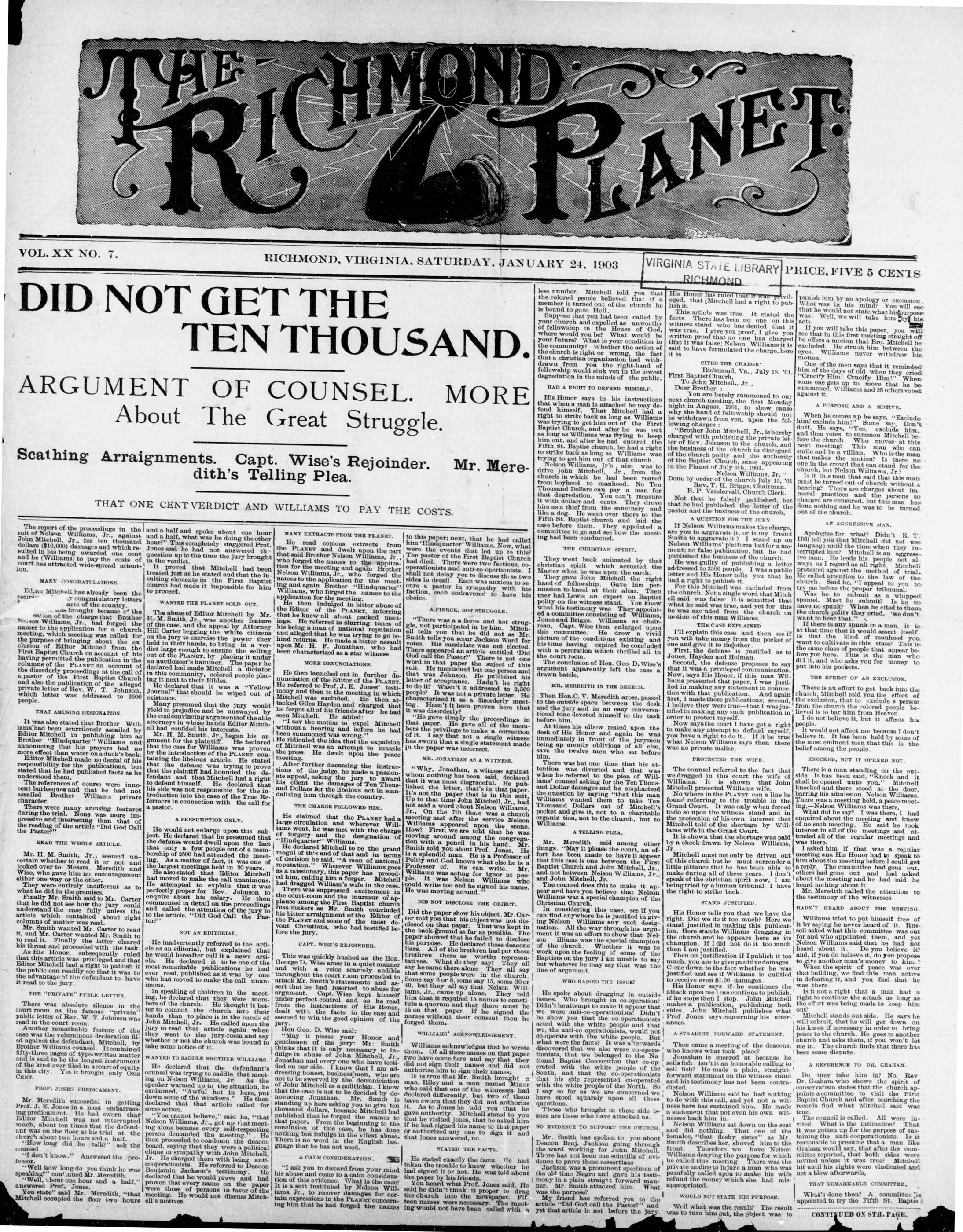
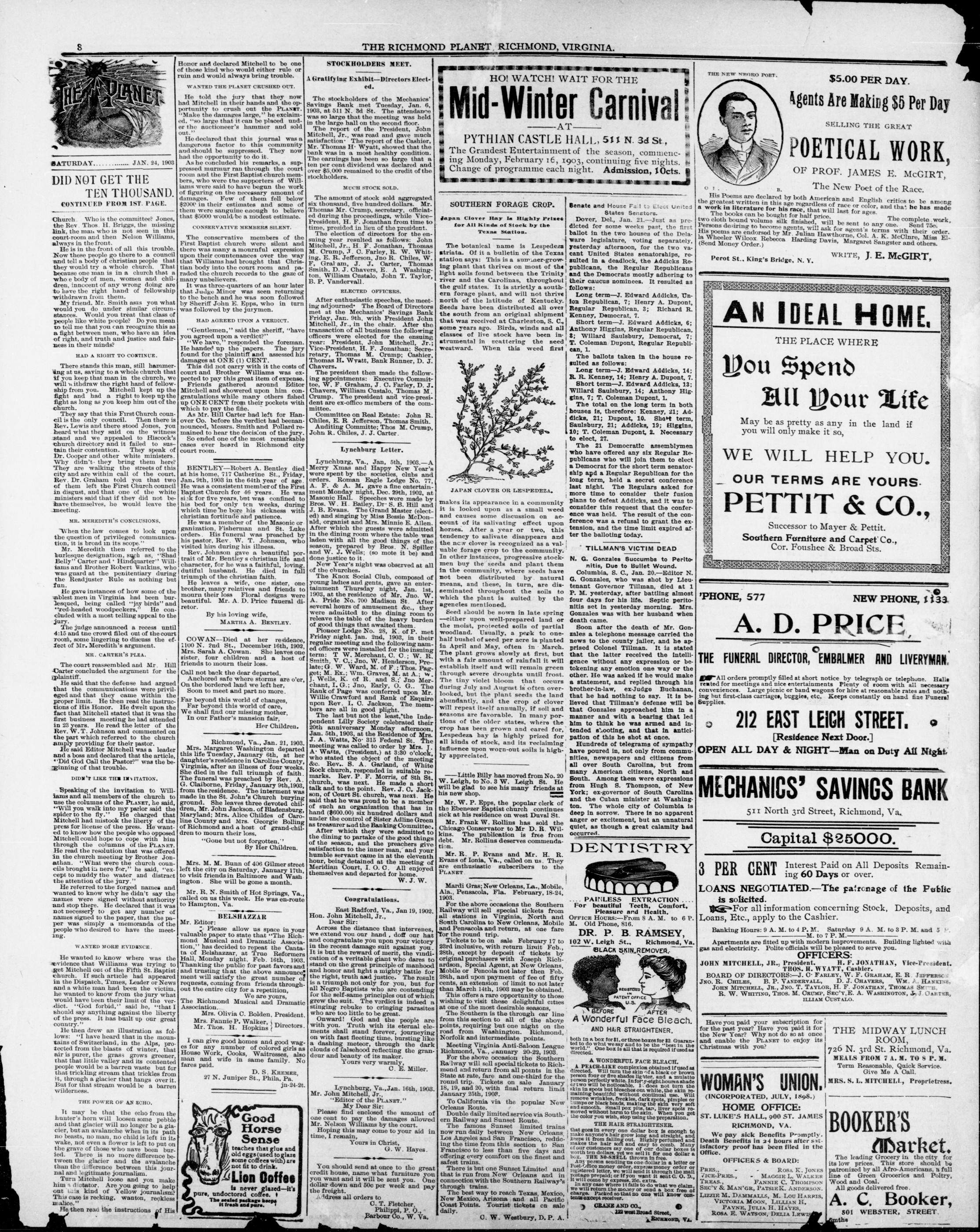
DID NOT GET THE TEN THOUSAND.
ARGUMENT OF COUNSEL. MORE About The Great Struggle.
Scathing Arraignments. Capt. Wise's Rejoinder. Mr. Meredith's Telling Plea.
THAT ONE CENTVERDICT AND WILLIAMS TO PAY THE COSTS
VOL. XX NO. 7.
DID NO
ARGUME
Ab
Scathing Arrai
THAT ON
The report of the proceedings in the suit of Nelson Williams, Jr., against John Mitchell, Jr., for ten thousand dollars ($10,000) damages and which resulted in his being awarded one cent and he (Williams) to pay the costs of court has attracted wide-spread attention.
MANY CONGRATULATIONS
Editor Mitchell has already been the recipient of congratulatory letters parts of the country. It was brought because of the action of the charge that Brother Nelson Williams, Jr., had forged the names to the application for a church meeting, which meeting was called for the purpose of bringing about the exclusion of Editor Mitchell from the First Baptist Church on account of his having permitted the publication in the column of the PLANET an account of the disorderly meetings at the call of a pastor of the First Baptist Church and also the publication of the alleged private letter of Rev. W. T. Johnson, which letter was addressed to 2500 people.
THAT AMUSING DESIGNATION
It was also stated that Brother Williams' had been scurrilously assailed by Editor Mitchell in publishing him as Brother "Hindquarter" Williams and announcing that his prayers had no more effect than water on a duck's back. Editor Mitchell made no denial of his responsibility for the publications, but stated that he had published facts as he understood them.
The references of course were innocent resumes and that he had not assailed Brother Williams private character.
There were many amusing features during the trial. None was more impressive and interesting than that of the reading of the article "Did God Call the Past?"
READ THE WHOLE ARTICLE
Mr. H. M. Smith, Jr., seemed uncertain whether to read it or not and looked over to Messrs. Meredith and Wise, who gave him no encouragement either one way or the other. They were entirely indifferent as to what he did in the premises.
Finally Mr. Smith said to Mr. Carter that he did not see how the jury could understand the case fully unless the article which contained about eight columns of matter was read.
Mr. Smith wanted Mr. Carter to read it, and Mr. Carter wanted Mr. Smith to read it. Finally the latter cleared his throat and proceeded with the task. As His Honor, subsequently ruled that this article was privileged and that Editor Mitchell had a right to publish it the public can readily see that it was to the advantage of the defendant to have it read to the jury.
THE "PRIVATE" PUBLIC LETTER
There was absolute silence in the court room as the famous "private" public letter of Rev. W. T. Johnson was read in the court room.
Another remarkable feature of the case was the voluminous declaration filings against the defendant, Mitchell, by Brooke Williams counsel. It contained fifty-three paragraphs co-written matter and is said to be the longest instrument of the kind ever filed in account of equity in this city. Yet it brought only ONE CENT.
PROF. JONES PREDICAMENT
Mr. Meredith succeeded in getting Prof. J. E. Jones in a most embarrassing predicament. He had sworn that Editor Mitchell was not interrupted much, about ten times that the defendant was on the floor at his trial at the church about two hours and a half.
"How long did he talk?" ask the counsel.
counsel.
"I don't know." Answered the one.
"I don't know." Answered the professor.
"Well how long do you think he was speaking?" con'nued Mr. Meredith.
"Well, about one hour and a half," answered Prof. Jones.
You state" said Mr. Meredith, "that Mitchell occupied the floor two hours
and a half and spoke about one hour and a half, what was he doing the other hour?' This completely staggered Prof. Jones and he had not answered the question up to the time the jury brought in the verdict. It proved that Mitchell had been treated just as he stated and that the insulting elements in the First Baptist church had made it impossible for him to proceed.
WANTED THE PLANET SOLD OUT.
The abuse of Editor Mitchell by Mr. H. M. Smith, Jr., was another feature of the case, and the appeal by Attorney Hill Carter begging the white citizens on the jury to exercise the power they held in their hands, to bring in a verdict large enough to ensure the selling out of the PLANET, by placing it under an auctioneer's hammer. The paper he declared had made Mitchell a dictator in this community, colored people placing it next to their Bibles. He declared that it was a "Yellow Journal" that should be wiped out of existence.
Many presumed that the jury would yield to prejudice and be unswayed by the cool convincing arguments of the able attorneys in whose hands Editor Mitchell had confided his interests.
Mr. H. M. Smith, Jr., began his argument for the plaintiff. He declared that the case for Williams was proven by the introduction of the PLANET containing the libelous article. He stated that the defense was trying to prove that the plaintiff had hounded the defamator and that Mitchell had a right to defend him. He declared that his side was not responsible for the introduction into the case of the True Reformers in connection with the call for a pastor.
A PRESUMPTION ONLY.
He would not enlarge upon this subject. He declared that he presumed that the defense would dwell upon the fact that only a few people out of a membership of 2500 had attended the meeting. As a matter of fact, it was one of the largest meetings held in 20 years. He also stated that Editor Mitchell had moved to make the call unanimous. He attempted to explain that it was perfectly proper for Rev. Johnson to enquire about his salary. He then commented in detail on the proceedings and called the attention of the jury to the article, "Did God Call the Pastor?"
NOT AN EDITORIAL
He inadvertently referred to the article as an editorial, but explained that he would hereafter call it a news article. He declared it to be one of the most remarkable publications he had ever read, published as it was by one who had moved to make the call unanimous. In speaking of children in the meeting, he declared that they were members of the church. He thought it better to commit the church into their hands than to place it in the hands of John Mitchell, Jr. He called upon the jury to read that article again when they went to the jury-room and say whether or not the church was bound to take some notice of it.
WANTED TO SADDLE BROTHER WILLIAMS
He declared that the defendant's counsel was trying to saddle that meeting on Nelson Williams, Jr. As the speaker warmed up to the situation, he exclaimed, "Awful hot in here, put down some of the windows." He then declared that that article called for some action.
"You cannot believe," said he, "that Nelson Williams, Jr., got up to meet alone because every self-respecting person demanded the meeting." He then proceeded to condemn the deacon board, saying that they were a political coalition in sympathy with John Mitchell, Jr. He charged them with being anticooperaiousness. He referred to Deacon Benjamin Jackson's testimony. He declared that he would prove and had proven that every name in the paper were those of persons in favor of the meeting. He would not discuss Mitchell's motives.
RICHMOND, VIRGINIA, SATURDAY, JANUARY 24, 1903
MANY EXTRACTS FROM THE PLANET.
He read copious extracts from the PLANET and dwelt upon the part that said Brother Nelson Williams, Jr., who forged the names to the application for the meeting and again Brother Nelson Williams, Jr., who forged the names to the application for the meeting and again Brother "Hindquarter" Williams, who forged the names to the application for the meeting.
He then indulged in bitter abuse of the Editor of the PLANET, inferring that he knew all about packed meetings. He referred in slurring tones of being a man of national reputation and alluring him as he was trying to go behind return. He made a bitter assault upon Mr. H. F. Mannan, who had been characterized as a stalker.
MORE DENUNCIATIONS
He then launched out in further denunciation of the Editor of the PLANET. He referred to Prof. J. E. Jones' testimony and then to the meeting in which Mitchell was excluded. He then attacked Giles Hayden and charged that he forgot all of his friends after he had seen Mitchell. He added: "I say the motion to expel Mitchell without a hearing and before he had been summoned was wrong." He rieled the idea that the expulsion of Mitchell was an attempt to muzzle the press. He dwelt upon the peace meeting.
After further discussing the instructions of the judge, he made a passionate appeal, asking the jury to award his client the damages of Ten Thousand Dollars for the libelous act in scandalizing him through the country.
THE CHARGE FOLLOWED HIM
He claimed that the PLANET had a large circulation and wherever Williams went, he was met with the charge of forgery and the designation of "Hindquarter" Williams. He declared Mitchell to be the grand mogul of this's and of that and in terms of derision he said, "A man of national reputation." Wherever Williams goes as a missionary, this paper has preceded him, calling him a forger. Mitchell had dragged William's wife in the case. There was suppressed excitement in the court-room and the murmur of applause among the First Baptist church fuss-makers as Mr. Smith concluded his bitter arraignment of the Editor of the PLANET and some of the most devout Christians, who had testified before the jury.
CAPT. WISE'S REJOINDER
This was quickly hushed as the Hon. George D. Wise arose in a quiet manner and with a voice scarcely audible throughout the court room proceeded to attack Mr. Smith's statements and assert that he had resorted to abuse for argument. Capt. Wise kept himself under perfect control and as he read from the instructions of His Honor, dealt with a the facts in the case and seemed to win the good opinion of the jury.
Hon Geo. D. Wise said:
"May it please your Honor and gentlemen of the jury: Mr. Smith thinks that it is only necessary to indulge in abuse of John Mitchell, Jr., Jonathan and every one who have testified on our side. I know that I am addressing honest, business men, who are not to be swerved by the denunciation of John Mitchell as a politician. I know that the case is not to be decided by denouncing Jonathan. Mr. Smith is standing up here asking you to give ten thousand dollars, because Mitchell had published that he forged the names to that paper. From the beginning to the conclusion of this case, he has done nothing but indulge in the vilest abuse. There is no word in the English language that he has not used.
A CALM CONSIDERATION
"I ask you to discard from your mind his abuse and come to a calm consideration of this evidence. What is the case? It is a suit instituted by Nelson Williams, Jr., to recover damages for certain expressions in the PLANET concerning him that he had forged the names
to this paper; next, that he had called him 'Hindquarter' Williams. Now, what were the events that led up to this? The pastor of the First Baptist Church had died. There were two factions, cooperationists and anti-co-operationists. I shall not delay you to discuss the two sides in detail. Each was anxious to secure a pastor in sympathy with his faction, each endeavored to have his choice.
A FIERCE, HOT STRUGGLE
"There was a a fierce and hot struggle, not participated in by him. Mitchell tells you that he did not as Mr. Smith tells you scour Jackson Ward for votes. His candidate was not elected. There appeared an article entitled 'Did God call the Pastor?' There is not one word in that paper the subject of this suit. He mentioned but one person and that was Johnson. He published his letter of acceptance. Hadn't he right to do it? Wasn't it addressed to 2,600 people? It was not a private letter. He characterized it as a disorderly meeting. Hasn't it been proven here that it was disorderly? "He gave simply the proceedings in that paper. He gave all of the members the privilege to make a correction of it. I say that not a single witness has sworn that a single statement made in the paper was incorrect.
MR. JONATHAN AS A WITNESS
"Why, Jonathan, a witness against whom nothing has been said, declared that it was most disgraceful. He published the letter, that's in that paper. It's not the paper that is in this suit, Up to that time John Mitchell, Jr., had not said a word about Nelson Williams, Jr., On the 7th thee, he was a church meeting and after the service Nelson Williams appeared upon the scene. How? First, we are told that he was moving around among the congregation with a pencil in his hand. Mr. Smith told you about Prof. Jones. He is a splendid man. What is a Professor of Polity and God know what else he is a Professor of. He can write. Mr. Williams was acting for nt people. It was Nelson Williams who could write too and he signed his name. He was moving around."
DID NOT DISCLOSE THE OBJECT
Did the paper show his object. Mr. Carter told you that his object was not disclosed on that paper. That was kept in the back-ground as far as possible. The paper showed that he failed to disclose his purpose. He declared those deacons liars. All of the brethren had put those brethren there as worthy representatives. What do they say? They all say he came there alone. They all say some people were in the church. Some, or all, 8 say some 15, some 30 or 40, but they all say that Nelson Williams, Jr., came to none. They told him that it required 13 names to constitute a quorum and that there must be 15 on that paper. If he signed the names without their consent then he forged them.
WILLIAMS' ACKNOWLEDGEMENT
Williams acknowledges that he wrote them. Of all those names on that paper two have come here and say that they did not sign their names and did not authorize him to sign their names.
It is true that Mr. Smith brought a man, Riley and a man named Minor who said that one of the witnesses had declared differently, but two of them have sworn that they did not authorize it. As to Jones he told you that he gave authority. Mitchell stated to you that he visited Jones, that he asked him if he had signed his name to that paper or authorized any one to sign it and that Jones answered, no.
STATED THE FACTS.
He stated exactly the facts. He had taken the trouble to know whether he had signed it or not. He was told about the paper by his friends. You heard what Prof. Jones said. He said the church it proper to drag the church into the room. The teen names were necessary. The meeting would not have been called with a
less number. Mitchell told you that the colored people believed that if a member is turned out of the church he is bound to go to Hell.
Suppose that you had been called by your church and expelled as unworthy of fellowship in the House of God, where would you be? What would be your future? What is your condition in the community? Whether the action of the church is right or wrong, the fact that a Christian organization had withdrawn from you the right-hand of fellowship would sink you in the lowest degradation in the minds of the public.
HAD A RIGHT TO DEFEND HIMSELE
His Honor says in his instructions that when a man is attacked he may defend himself. That Mitchell had a right to strike back as long as Williams was trying to get him out of the First Baptist' Church, and after he was out as long as Williams was trying to keep him out, and after he had entered the Fifth St. Baptist church, he had a right to strike back as long as Williams was trying to get him out of that church. Nelson Williams, Jr's aim was to drive John Mitchell, Jr, from the church in which he had been reared from boyhood to manhood. No Ten Thousand Dollars can pay a man for that degradation. You can't measure it with dollars and cents. They drove him as a thief from the sanctuary and like a dog. He went over there to the Fifth St. Baptist church and laid the case before them. They appointed a committee to go and see how the meeting had been conducted.
THE CHRISTIAN SPIRIT
They went back animated by that christian spirit which actuated the Master when he was upon the earth. They gave John Mitchell the right hand of fellowship. Gave him permission to kneel at their altar. Then they had Lewis an expert on Baptist polity on the witness stand. You know what his testimony was. They appointed a committee consisting of Williams, Jones and Briggs. Williams as chairman, Capt. Wise then enlarged upon this committee. He drew a vivid picture of the conditions existing and his time having expired he concluded with a peroration which thrilled all in the court room. The conclusion of Hon. Geo D. Wise's argument apparently left the case a drawn battle.
MR. MEREDITH IN THE BREECH.
Then Hon.C. V. Meredith arose, passed to the outside space between the desk and the jury and in an easy conversational tone devoted himself to the task before him.
At times his elbow rested upon the desk of His Honor and again he was immediately in front of the jurymen being ap arently oblivious of all else, save the twelve men who sat before him.
There was but one time that his attention was diverted and that was when he referred to the plea of Williams' counsel asking for the Ten Thousand Dollar damages and he emphasized the question by saying "that this man Williams wanted them to take Ten Thousand Dollars out of Mitchell's pocket and give it, not to a charitable organiztion, not to the church, but to Williams.
A TELLING PLEA.
Mr. Meredith said among other things. "May it please the court, an effort has been made to have it appear that this case is one between the First Baptist Church and John Mitchell, Jr., and not between Nelson Williams, Jr., and John Mitchell, Jr.
The counsel does this to make it appear and have you believe that Nelson Williams was a special champion of the Christian Church.
In considering this case, see if you can find anywhere he is justified in giving Nelson Williams any such designation. All the way through his argument it was an effort to show that Nelson illiams was the special champion of the church. Whether it was to work upon the feeling of some of the Baptists on the jury I am unable to say but whatever he may say that was the line of argument.
WHO RAISED THE ISSUE $ ^{2} $
He spoke about dragging in outside issues. Who brought in co-operation? Didn't he attempt to make it appear that we were anti-co-operationists! Didn't he show you that the co-operationists acted with the white people and that we, the anti-co operationists, would not co operate with the white people. But what were the facts? It was a 'terwards discovered that we also were co-operationists, that we belonged to the National Baptist Convention that co-operated with the white people of the South, and that the co-operationists that his side represented co-operated with the white people of the North. So I say so far as we are concerned we have stood squarely upon all these questions.
Those who brought in these side issues are those who have attacked us.
NO EVIDENCE TO SUPPORT THE CHURCH
Mr. Smith has spoken to you about Deacon Benj. Jackson going through the ward working for John Mitchell. There has not been one scintilla of evidence to prove these assertions. Jackson was a prominent specimen of the old time Negro and gave his testimony in a plain straight forward man manner. He attacked him. What was the purpose? My friend has referred you to the article "Did God call the Pastor?" and yet that article is not before the irry
His Honor has ruled that it was privileged, that Mitchell had a right to publish it.
This article was true. It stated the facts. There has been no one on this witness stand who has denied that it is true. I give you proof, I give you written proof that no one has charged that it was false; Nelson Williams it is said to have formulated the charge, here it is.
CITED THE CHARGE:
Richmond, Va., July 18, '01.
First Baptist Church,
To John Mitchell., Jr.
Dear Brother :
You are hereby summoned to our next church meeting, the first Monday night in August, 1901, to show cause why the hand of fellowship should not be withdrawn from you, upon the following charges :
"Brother John Mitchell, Jr., is hereby charged with publishing the private letter of Rev. Johnson to the church, and the business of the church in disregard of the church polity and the authority of the Baptist Church, same appearing in the Planet of July 6th, 1901.
Nelson Williams, Jr."
Done by order of the church July 15, '01
Rev. T. H. Briggs, Chairman.
B. P. Vandervall, Church Clerk.
Not that he falsely published, but that he had published the letter of the pastor and the business of the church.
A QUESTION FOR THE JURY
If Nelson Williams makes the charge, are you to aggravate it, or is my friend Smith to aggravate it? I stand up on Nelson Williams' platform for a moment; no false publication, but he had published the business of the church. He was guilty of publishing a letter addressed to 2500 people. I was a public letter and His Honor tells you that he had a right to publish it. For this Mitchell was excluded from the church. Not a single word that Mitch ell said was false. It is admitted that what he said was true, and yet for this he was excused from the church on motion of this man Williams.
THE CASE EXPLAINED
I'll explain this case and then see if you will take money from the pocket of one and give it to the other.
First, the defense is justified as to Jones, Hayden and Holman.
Second, the defense proposes to say that it was a privileged communication.
Now, says His Honor, if this man Williams presented that paper, I was justified in making any statement in connection with that publication. And again first, I made those publications; second, I believe they were true—that I was justified in making any such publication in order to protect myself.
Now says the court I have got a right to make any attempt to defend myself, you have a right to do it. If it be true what Nelson Williams says then there was no private malice.
PROTECTED THE WIFE
The counsel referred to the fact that we dragged in this court the wife of Williams. It is shown that John Mitchell protected Williams wife. No where in the PLANET can a line be found referring to the trouble in the Grand Court. It was only when forced to do so upon the witness stand and in the protection of his own interest that Mitchell told of the shortage by Williams wife in the Grand Court. It is shown that the shortage was paid by a check drawn by Nelson Williams, Jr. Mitchell must not only be driven out of this church but he must surrender a little pittance that he has been able to make during all of these years. I don't speak of the christian spirit now, I am being tried by a human tribunal. I have the right to strike back.
STAND JUSTIFIED
His Honor tells you that we have the right. Did we do it too much? Here we stand justified in making this publication. Here stands Williams dragging in the church and he appears here as its champion. If I did not do it too much then I am justified.
Then on justification if I publish it too much, you are to give punitive damages. G come down to the fact whether he was justified and see if Williams is entitled to receive even $1.00 damages.
His Honor says if he continues the attack then you must continue to publish, if he stops then I stop. Mitchell makes a publication, publishing both sides. John Mitchell publishes what Prof Jones says concerning his utterances.
A STRAIGHT FORWARD STATEMENT
Then came a meeting of the deacons,
who knows what took place?
Jonathan is sneered at because he sells fish. isn't it an honorable calling to sell fish? He made a plain, straightforward statement on the witness stand and his testimony has not been contradicted. Nelson Williams said he had nothing to do with this call, and yet not a witness here has sustained him. He made a statement that not even his own witnesses back him in. Nelson Williams sat down on the seat and did nothing. That one of the females, "that fleshy sister" as Mr. Smith describes her, shoved him to the front. Therefore we have Nelson Williams denying the purpose for which he called this meeting. There was the private malice to injure a man who was painfully called upon to make his wife refund the money which she had misappropriated.
WOULD NOT STATE HIS PURPOSE.
Well what was the result? The result was to turn him out, the object was to
punish him by an apology or excuse.
What was in his mind? You will see that he would not state what his purpose was. Well, we will take him by his acts.
If you will take this paper, you will see that in this first meeting straight off he offers a motion that Bro. Mitchell be excluded. He struck him between the Williams never withdrew his motion.
One of the men says that it reminded him of the days of old when they cried "Crucify Him! Crucify Him!" When some one hits up to move that he be summoned, Williams and 25 others voted against it.
A PURPOSE AND A MOTIVE
When he comes up he says, "Exclude him! exclude him!" Some say, Don't do it. He says, "Yes, exclude him, and then votes to summon Mitchell before the church. Who moves at this next meeting? This man who can smile and be a villian. Who is the man that makes the motion? Is there no crowd that can stand for the church, be a Wilson Williams, Jr.? Is it th.s. man that said that this man must be turned out of church without a hearing? There are charges about immoral practices and that persons so charged are censured, but this man has done nothing and he was to be turned out of the church.
AN AGGRESSIVE AN
Apologize for what? Didn't R. T. Hill tell you that Mitchell did not use language until the time when they interrupted him? Mitchell is an aggressive man. He leads his people not always as I regard as all right. Mitchell protested against the method of trial. He called attention to the law of the church. Said he, "I appeal to you to try me before the proper tribunal. Was he to submit as a whipped spainel. Must he submit? Is he to have no spunk? When he cited to them the church polity they cried, 'we don't want to kill you'? If there is an spunk in a man, it is at that time that it would assert, itself. Is that the kind of manhood you want to cultivate in this state? This is the same class of people that appear before you here. This is the man who did it, and who asks you for money to put into his pockets.
THE EFECT OF AN EXCLUSION
There is an effort to get back into the church, Mitchell told you the effect of the exclusion, that to exclude a person from the church the colored people believed is to bar him from Heaven. I do not believe it, but it affects his people. It would not affect me because I don't believe it. It has been held by some of the most eminent men that this is the belief among the people.
KNOCKED, BUT IT OPENED NOT
There is a man standing on the outside. It has been said, "Knock and it shall be opened unto you." Mitchell knocked and there stood at the door, barring his admission Nelson Williams. There was a meeting held, a peace meeting.—Nelson Williams was there.
What did he say? I was there, I had enquired about the meeting and knew of no such meeting. He said he took interest in all of the meetings and attended all of the regular meetings and was there.
I asked him if that was a regular meeting and His Honor had to speak to him about the meeting before I could get a reply. The committee had gone out, others had gone out and had asked about the meeting and he had said he heard nothing about it.
Mr. Meredith called the attention to the testimony of the witnesses.
HADN'T HEARD ABOUT THE MEETING.
When the spirit of peace was over that building, we find this man active in defeating it, and you find that he was there.
Is it not a right that a man had a right to continue the attack as long as the effort was being made to keep him out?
Mitchell stands out side. He says he will submit, that he will get down on his knees if necessary in order to bring peace to the church. He goes to another church and asks them, if you won't let me in. The church finds that there has been some dispute.
A REFERENCE TO DR. GRAHAM.
Do they take him in? No. Rev Dr. Graham who shows the spirit of conservatism states that the church appoints a committee to visit the First Baptist Church and after searching the records find what Mitchell said was true.
The council is called. All were invited. What is the intimation? That it was gotten up for the purpose of sustaining the anti-cooperationists. Is it reasonable to presume that a man like Graham would say, that after the committee reported, that both sides were invited unless it was true? Mitchell hit until his rights were vindicated and not a blow afterwards,
THAT REMARKABLE COMMITTEE.
What's done then? A committee is appointed to try the Fifth St. Baptis
SATURDAY..... JAN. 25, 1903
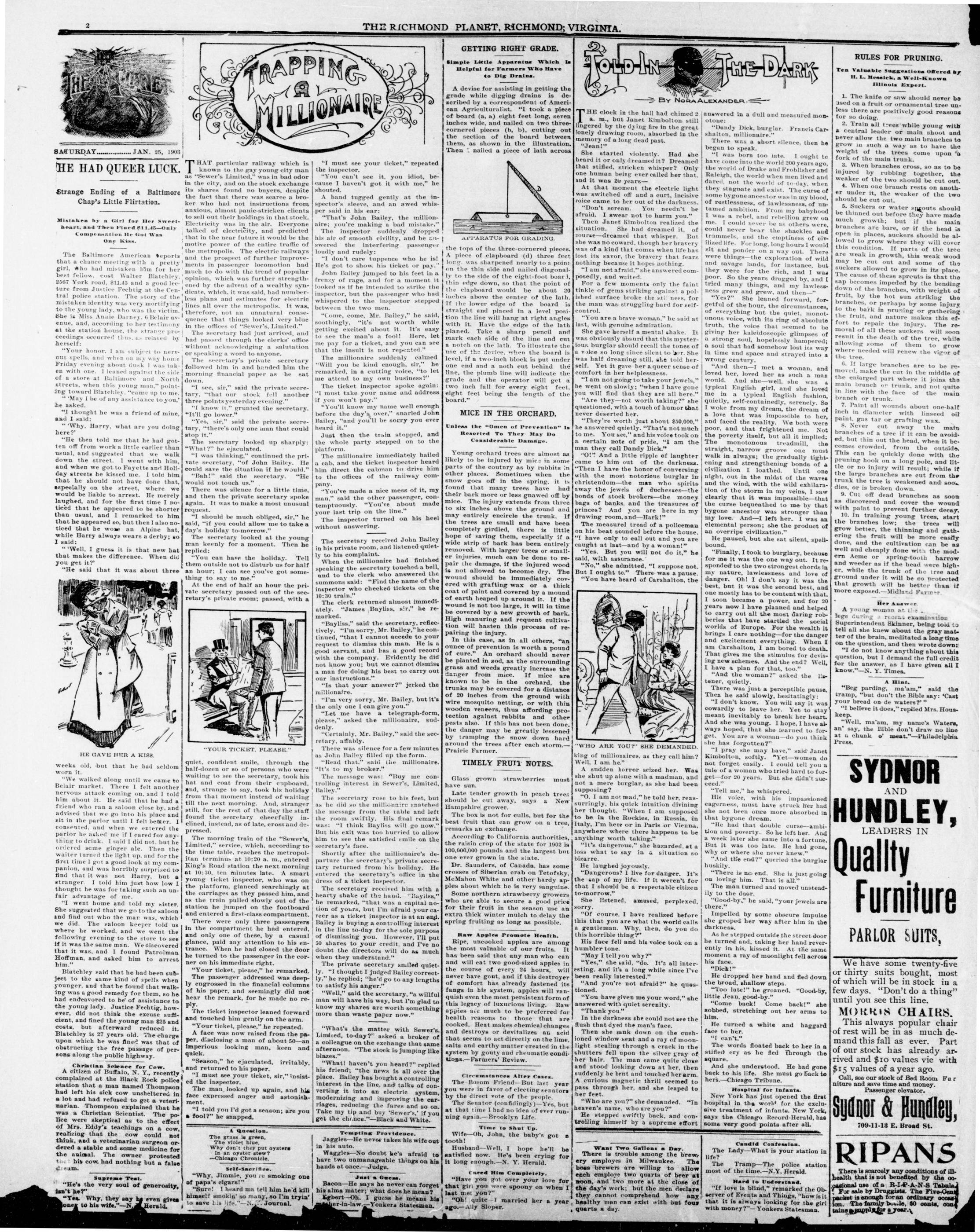
HE HAD QUEER LUCK.
Strange Ending of a Baltimore Chap's Little Flirtation.
Mistaken by a Girl for Her Sweet-heart, and Then Fined $11.45—Only Compensation He Got Was One Kiss.
The Baltimore American reports that a chance meeting with a pretty girl, who had mistaken him for her best fellow, cost Walter Blatchley, 2567 York road, $11.45 and a good lecture from Justice Fechtig at the Central police station. The story of the mistaken identity was very mortifying to the young lady, who was the victim. She is Miss Annie Darney, 6 Belair avenue, and, according to her testimony at the station house, the strange proceedings occurred thus, as related by herself:
"Your honor, I am subject to nervous spells, and when on my way home Friday evening about dusk I was taken with one. I leaned against the side of a store at Baltimore and North streets, when this young man," pointing toward Blatchley, "came up to me." "May I be of any assistance to you," he asked. "I thought he was a friend of mine, and I said: "Why, Harry, what are you doing here?"
"He then told me that he had gotten off from work a little earlier than usual, and suggested that we walk down the street. I went with him, and when we got to Fayette and Holiday streets he kissed me. I told him that he should not have done that, especially on the street, where we would be liable to arrest. He merely laughed, and for the first time I noticed that he appeared to be shorter than usual, and I remarked to him that he appeared so, but then I also noticed that he wore an Alpine hat, while Harry always wears a derby; so I said:
"Well, I guess it is that new hat that makes the difference. When did you get it?"
"He said that it was about three
Edward
HE GAVE HER A KISS.
weeks old, but that he had seldom worn it.
"We walked along until we came to Belair market. There I felt another nervous attack coming on, and I told him about it. He said that he had a friend who ran a saloon close by, and advised that we go into his place and sit in the parlor until I felt better. I consented, and when we entered the parlor he asked me if I cared for anything to drink. I said I did not, but he ordered some ginger ale. Then the waiter turned the light up, and for the first time I got a good look at my companion, and was horribly surprised to find that it was not Harry, but a stranger. I told him just how low I thought he was for taking such an unfair advantage of me.
"I went home and told my sister. She suggested that we go to the saloon and find out who the mar was, which we did. The saloon keeper told us where he worked, and we went the following evening to the store to see if it was the same man. We discovered that it was, and I found Patrolman Hoffman, and asked him to arrest him."
Blatchley said that he had been subject to the same kind of spells when younger, and that he found that walking was a good remedy for them, so he had endeavored to be of assistance to the young lady. Justice Fechtig, however, did not think the excuse sufficient, and fined the young man $25 and costs, but afterward reduced it. Blatchley is 27 years old. The charge upon which he was fined was that of obstructing the free passage of persons along the public highway.
Christian Science for Cow.
A citizen of Buffalo, N. Y., recently complained at the Black Rock police station that a man named Thompson had left his sick cow unsheltered in a lot and had refused to get a veterinarian. Thompson explained that he was a Christian Scientist. The police were skeptical as to the effect of Mrs. Eddy's teachings on a cow, realizing that the cow could not think, and a veterinarian surgeon ordered a stable and some medicine for the animal. The owner protested that his cow, had nothing but a false dream.
Supreme Test.
"He's the very soul of generosity, isn't he?"
"Yes. Why, they say he even gives ones to his wife."—N. Herald.
TRAPPING
A
MILLIONAIRE
THAT particular railway which is known to the gay young city man as "Sewer's Limited," was in bad odor in the city, and on the stock exchange its shares found no buyers, despite the fact that there was searc a broker who had not instructions from anxious, almost panie-stricken clients to sell out their holdings in that stock. Electricity was in the air. Everyone talked of electricity, and predicted that in the near future it would be the motive power of the entire traffic of the metropolis. The electric railways and the prospect of further improvements in passenger locomotion had much to do with the trend of popular opinion, which was further strengthened by the advent of a wealthy syndicate, which, it was said, had numberless plans and estimates for electric lines all over the metropolis. It was, therefore, not an unnatural consequence that things looked very blue in the offices of "Sewer's Limited."
The secretary had just arrived, and had passed through the clerks' office without acknowledging a salutation or speaking a word to anyone.
The secretary's private secretary followed him in and handed him the morning financial paper as he sat down.
"I see, sir," said the private secretary, "that our stock fell another three points yesterday evening."
"I know it," grunted the secretary. "It'll go lower."
"Yes, sir," said the private secretary, "there's only one man that could stop it."
The secretary looked up sharply: "What?" he exculated.
"Bah!" said the secretary. "He would not touch us."
There was silence for a little time, and then the private secretary spoke again. It was to make a most unusual request.
"I should be much obliged, sir," he said, "if you could allow me to take a day's holiday to-morrow."
The secretary looked at the young man keenly for a moment. Then he replied:
"You can have the holiday. Tell them outside not to disturb us for half an hour; I can see you've got something to say to me."
At the end of half an hour the private secretary passed out of the secretary's private room; passed with a
"YOUR TICKET, PLEASE."
quiet, confident smile, through the half-dozen or so of persons who were waiting to see the secretary, took his hat and coat from their cupboard, and, strange to say, took his holiday from that moment instead of waiting till the next morning. And, stranger still, for the rest of that day the staff found the secretary cheerfully inclined, instead, as of late, cross and depressed.
The morning train of the "Sewer's, Limited," service, which, according to the time table, reaches the metropolitan terminus at 10:20 a. m., entered King's Road station the next morning at 10:30, ten minutes late. A smart young ticket inspector, who was on the platform, glanced searchingly at the carriages as they passed him, and as the train pulled slowly out of the station he jumped on the footboard and entered a first-class compartment.
There were only three passengers in the compartment he had entered, and only one of these, by a casual glance, paid any attention to his entrance. When he had closed the door he turned to the passenger in the corner on his immediate right.
"Your ticket, please," he remarked.
The passenger addressed was deeply engrossed in the financial columns of his paper, and seemingly did not hear the remark, for he made no reply.
The ticket inspector leaned forward and touched him gently on the arm.
"Your ticket, please," he repeated.
A face was now raised from the paper, disclosing a man of about 50—an imperious looking man, keen and quick.
"Season," he ejaculated, irritably, and returned to his paper.
"I must see your ticket, sir," insisted the inspector.
The man looked up again, and his face expressed anger and astonishment.
"I told you I'd got a sensor; are you a fool?" he snapped.
A Question.
The grass is green.
The violet blue.
Why don't they put oysters
In an oyster stew?
—Chicago Chronicle.
Self-Sacrifice.
"Why, Jimmie, you're smoking one of papa's cigars!"
"Sure! I heard ma tell him he'd kill himself smokin' so many, so I'm tryin' to save his life."—N. J. Journal.
THE RICHMOND PLANET, RICHMOND; VIRGINIA
"I must see your ticket," repeated the inspector.
"You can't see it. you idiot, because I haven't got it with me," he shouted.
A hand tugged gently at the inspector's sleeve, and an awed whisper said in his ear:
"That's John Bailey, the millionaire; you're making a bad mistake."
The inspector suddenly dropped his air of smooth civility, and he answered the interfering passenger loudly and rudely:
"I don't care tuppence who he is! He's got to show his ticket or pay."
John Bailey jumped to his feet in a frenzy of rage, and for a moment it looked as if he intended to strike the inspector, but the passenger who had whispered to the inspector stepped between the two men.
"Come, come, Mr. Bailey," he said, soothingly, "it's not worth while getting excited about it. It's easy to see the man's a fool! Here, let me pay for a ticket, and you can see that the insult is not repeated."
The millionaire suddenly calmed "Will you be kind enough, sir," he remarked, in a cutting voice, "to let me attend to my own business?"
The ticket inspector spoke again: "I must take your name and address if you won't pay."
"You'll know my name well enough before the day's over," snarled John Bailey, "and you'll be sorry you ever heard it."
Just then the train stopped, and the whole party stepped on to the platform.
The millionaire immediately hailed a cab, and the ticket inspector heard him direct the cabman to drive him to the offices of the railway company.
"You've made a nice mess of it, my man," said the other passenger, contemptuously. "You've about made your last trip on the line."
The inspector turned on his heel without answering.
The secretary received John Bailey in his private room, and listened quietly to his complaint.
When the millionaire had finished speaking the secretary touched a bell, and to the clerk who answered the summons said: "Find the name of the inspector who checked tickets on the 10:30 train."
The clerk returned almost immediately. "James Bayliss, sir," he remarked.
"Bayliss," said the secretary, reflectively. "I'm sorry, Mr. Bailey," he continued, "that I cannot accede to your request to dismiss this man. He is a good servant, and has a good record with the company. Evidently he did not know you; but we cannot dismiss a man for doing his best to carry out our instructions."
"Is that your answer?" jerked the millionaire.
"I'm very sorry, Mr. Bailey, but it's the only one I can give you."
"Let me have a telegraph-form, please," asked the millionaire, suddenly.
"Certainly, Mr. Bailey," said the secretary, affably.
There was silence for a few minutes as John Bailey filled up the form.
"Read that," said the millionaire. "It's to my broker."
The message was: "Buy me controlling interest in Sewer's, Limited, Bailey."
The secretary rose to his feet, but as he did the millionaire snatched the message from the table and left the room swiftly. His final remark was: "I think Bayliss will go now." But his exit was too hurried to allow him to see the satisfied smile on the secretary's face.
Shortly after the millionaire's departure the secretary's private secretary returned from his holiday. He entered the secretary's office in the dress of a ticket inspector. The secretary received him with a hearty shake of the hand, "Bayliss," he remarked, "that was a capital notion of yours, but I'm afraid your career as a ticket inspector is at an end. Bailey is buying a controlling interest in the line to-day for the sole purpose of dismissing you. However, I'll put 50 shares to your credit, and I've no doubt the directors will do as much when they understand."
The private secretary smiled quietly. "I thought I judged Bailey correctly," he replied; "he'd go to any lengths to satisfy his anger."
"Well," said the secretary, "a willful man will have his way, but I'm glad to know my shares are worth something more than waste paper now."
"What's the matter with Sewers' Limited, to-day?" asked a broker of a colleague on the exchange that same afternoon. "The stock is jumping like blazes." "What! haven't you heard?" replied his friend; "the news is all over the place. Bailey has bought a controlling interest in the line, and talks of converting it into an electric system, modernizing and improving the carriages, reducing the fares and so on. Take my tip and buy 'Sewer's,' if you get the chance."—Black and White.
Tempting Providence.
Jaggle—He never takes his wife out in his auto.
Waggle—No doubt he's afraid to have unmanageable things on his hands at once.—Judge.
Just a Guess.
Bacon—He says he never can forget his alma mater; what does he mean? Egbert—Oh. I guess he means his mother-in-law—Yonkera Statesman.
Simple Little Apparatus Which Is Helpful for Farmers Who Have To Dig Drain.
A devise for assisting in getting the grade while digging drains is described by a correspondent of American Agriculturalist. "I took a piece of board (a, a) eight feet long, seven inches wide, and nailed on two three-cornered pieces (b, b), cutting out the section of the board between them, as shown in the illustration. Then I nailed a piece of lath across
APPARATUS FOR GRADING.
the tops of the three-cornered pieces. A piece of clapboard (d) three feet long, was sharpened nearly to a point on the thin side and nailed diagonally to the side of the eight-foot board, thin edge down, so that the point of the clapboard would be about 20 inches above the center of the lath. If the lower edge of the board is straight and placed in a level position the line will hang at right angles with it. Have the edge of the lath planed. Take a sharp pencil and mark each side of the line and cut a notch on the lath. To illustrate the use of the device, when the board is level, if a two-inch block is put under one end and a noth cut behind the line, the plumb line will indicate the grade and the operator will get a two inch fall for every eight feet, eight feet being the length of the board."
MICE IN THE ORCHARD
Unless the "Omen of Prevention" Is Resorted To They May Do Considerable Damage.
Young orchard trees are almost as likely to be injured by mice in some parts of the countryside as by rabbits in other places. Sometimes when the snow goes off in the spring, it is found that many trees have had their bark more or less gnawed off by mice. The injury extends from three to six inches above the ground and may entirely encircle the trunk. If the trees are small and have been completely girdled, there is little hope of saving them, especially if a wide strip of bark has been entirely removed. With larger trees or smaller injuries, much can be done to repair the damage, if the injured wood is not allowed to become dry. The wound should be immediately covered with grafting wax or a thick coat of paint and covered by a mound of earth heaped up around it. If the wound is not too large, it will in time be covered by a new growth of bark. High manuring and request cultivation will hasten this process of repairing the injury.
In this case, as in all others, "an ounce of prevention is worth a pound of cure." An orchard should never be planted in sod, as the surrounding grass and weeds greatly increase the danger from mice. If mice are known to be in the orchard, the trunks may be covered for a distance of 20 inches from the ground with wire mosquito netting, or with thin wooden veneers, thus affording protection against rabbits and other pests also. If this has not been done, the danger may be greatly lessened by tramping the snow down hard around the trees after each storm.—Prairie Farmer.
TIMELY FRUIT NOTES.
Glass grown strawberries must have sun.
Late tender growth in peach trees should be cut away, says a New Hampshire grower.
The box is not for culls, but for the best fruit that can grow on a tree, remarks an exchange.
According to California authorities, the raisin crop of the state for 1902 is 100,000,000 pounds and the largest but one ever grown in the state.
Dr. Saunders, of Canada, has some crosses of Siberian crab on Tetofsky, McMahon White and other hardy applies about which he is very sanguine.
Some northern strawberry growers who are able to secure a good price for their fruit in the season use an extra thick winter mulch to delay the spring fruiting as long as possible.
Raw Apples Promote Health
Ripe, uncooked apples are among the most valuable of our fruits. It has been said that any man who can and will eat two good-sized apples in the course of every 24 hours, will never have gout, and if this destroyer of comfort has already fastened its fangs in his system, apples will vanquish even the most persistent form of this legacy of luxurious living. Raw apples are much to be preferred for health reasons to those that are cooked. Heat makes chemical changes and destroys or devitalizes an acid that seems to act directly on the lime, salts and earthy matter created in the system by gouty and rheumatic conditions.—Farmers' Review.
The Bosom Friend—But last year you were in favor of electing senators by the direct vote of the people.
The Senator (confidingly)—Yes, but at that time I had no idea of ever running again.—Brooklyn Life.
Time to Shut Up.
Wife—Oh, John, the baby's got a tooth!
Husband—Well, I hope he'll be satisfied now. He's been crying for it long enough.—N. Y. Herald.
Cured Him Completely.
"Have you got over your love for that girl you were spoony on when I last met you?"
"Oh! quite I married her a year ago.—Ally Sloper."
THE clock in the hall had chimed 2 a. m., but Janet Kimbolton still fingered by the dying fire in the great lonely drawing room, absorbed in the memory of a long dead past. "Jean!"
She started violently. Had she heard it or only dreamed it? Dreamed that stifled, stricken whisper? Only one human being ever called her that, and it was 20 years—
answered in a dull and measured motone:
"Dandy Dick, burglar. Francis C. shalton, millionaire."
There was a short silence, then began to speak.
"I was born too late. I ought have come into the world 200 years a the world of Drake and Froblisher a Raleigh, the world when men lived a dared, not the world when today, who
At that moment the electric light was switched off and a curt, incisive voice came to her out of the darkness, "Don't scream. You needn't be afraid. I swear not to harm you." Then Janet Kimbolton realized the situation. She had dreamed it, of course—dreamed that whisper. But she was no coward, though her bravery was of a kind that comes when life has lost its savor, the bravery that fears nothing because it hopes nothing. "I am not afraid," she answered com-
"I am not afraid," she answered composedly, and waited. For a few moments only the faint tinkle of gems striking against a polished surface broke the stillness, for the man was struggling hard for self-control. "You are a brave woman," he said at last, with genuine admiration. She gave herself a mental shake. It was obviously absurd that this mysterious burglar should recall the tones of a voice so long since silent to her. She was half dreaming still, she told herself. Yet it gave her a queer sense of comfort in her helplessness. "I am not going to take your jewels," he went on slowly; "when I have gone you will find that they are all here." "Are they—not worth taking?" she questioned, with a touch of humor that never deserted her.
"They're worth just about $5,000," he answered quietly. "That's much to me. You see," and his voice took on a certain note of pride, "I am the man they call Dandy Dick."
"O!!" And a little ripple of laughter came to him out of the darkness. "Then I have the honor of conversing with the most notorious burglar in christendom—the man who spirits away the jewels of duchesSES—the bonds of stock brokers—the money bags of banks, and the treasures of princes? And you are here in my drawing room, and-Hark!"
The measured tread of a policeman on his beat sounded before the house. "I have only to call out and you are caught at last—and by a woman!"
"Yes. But you will not do it," he said, with assurance.
"No," she admitted, "I suppose not. But I ought to." There was a pause. "You have heard of Carshalton, the
"WHO ARE YOU?" SHE DEMANDED. king of millionaires, as they call him? Well, I am he."
A sudden horror seized her. Was she shut up alone with a madman, and not a mere burglar, as she had been supposing?
"O. I am not mad," he told her, reassuringly, his quick intuition divining her thought. "When I am supposed to be in the Rockies, in Russia, in Italy, I'm here or in Paris or Vienna, anywhere where there happens to be anything worth taking."
"It's dangerous," she hazarded, at a loss what to say in a situation so bizarre.
He laughed joyously.
"Dangerous? I live for danger. It's the sap of my life. If it weren't for that I should be a respectable citizen to-morrow."
She listened, amused, perplexed, sorry.
"Of course, I have realized before this that you are what the world calls a gentleman. Why, then, do you do this horrible thing?"
His face fell and his voice took on a humbler tone.
"May I tell you why?"
"Yes," she said, "do. It's all interesting, and it's a long while since I've been really interested."
"And you're not afraid?" he questioned.
"You have given me your word," she answered with quiet serenity.
"Thank you."
In the darkness she could not see the flush that dyed the man's face.
Then she sank down on the cushioned window seat and a ray of moonlight stealing through a crack in the shutters fell upon the silver gray of her hair. The man came quite close and stood looking down at her, then suddenly he bent and touched her arm. A curious magnetic thrill seemed to pass through her, and she leaped to her feet.
"Who are you?" she demanded. "In heaven's name, who are you?"
He stepped swiftly back, and
controlling himself by a supreme effort
Want Two Gallons a Day.
There is trouble among the brewery employees in Milwaukee. The boas brewers are willing to allow each employ two quarts of beer at moon, and two more at the close of the day's work; but the men declare they cannot comprehend how any healthy man can exist with but four quarts a day.
answered in a dull and measured monotone:
"Dandy Dick, burglar. Francis Carshalton, millionaire."
There was a short silence, then he began to speak.
"I was born too late. I ought to have come into the world 200 years ago, the world of Drake and Frobisher and Raleigh, the world when men lived and dared, not the world of to-day, when they stagnate and exist. The curse of some bygone ancestor was in my blood, of restlessness, of lawlessness, of untamed ambition. From my babyhood I was a rebel, and rebellion grew on me. I could never be as others were, could never bear the shackles and trammels, and the emptiness of civilized life. For long, long hours I would sit and ponder on a way out. There were things—the exploration of wild and savage lands, for instance, but they were for the rich, and I was poor. So the years dragged by, and I tried many things, and my lawlessness grew and grew, and then—"
"Yes?" She leaned forward, forgetful of the hour, the circumstances, of everything but the quiet, monotonous voice, with its ring of absolute truth, the voice that seemed to be giving her kaleidoscopic glimpses of a strong soul, hopelessly hampered; a soul that had somehow lost its way in time and space and strayed into a wrong century.
"And then—I met a woman, and loved her, loved her as such a man would. And she—well, she was a typical English girl, and she loved me in a typical English fashion, quietly, self-containedly, serenely. So I woke from my dream, the dream of a love that was impossible to her, and faced the reality. We both were poor, and that frightened me. Not the poverty itself, but all it implied: The monotonous treadmill, the straight, narrow groove one must walk in always; the gradually tightening and strengthening bonds of a civilization I loathed. Until one night, out in the midst of the waves and the wind, with the wild exhilaration of the storm in my veins, I saw clearly that it was impossible—that the curse bequeathed to me by that bygone ancestor was stronger than my love. And—I left her. I was an elemental person; she the product of an overripe civilization."
He paused, but she sat silent, spell-bound.
"Finally, I took to burglary, because for me it was the one way out. It responded to the two strongest chords in my nature, lawlessness and love of danger. Oh! I don't say it was the best, but it was the second best, and one mostly has to be content with that. I soon became a power, and for 20 years now I have planned and helped to carry out all the most daring robberies that have startled the social worlds of Europe. For the wealth it brings I care nothing—for the danger and excitement everything. When I am Carshalton, I am bored to death. That gives me the stimulus for devising new schemes. And the end? Well, I have a plan for that, too."
"And the woman?" asked the listener, quietly.
There was just a perceptible pause. Then he said slowly, hesitating:
"I don't know. You will say it was cowardly to leave her. Yet to stay meant inevitably to break her heart. And she was young. I hope, I have always hoped, that she learned to forget. You are a woman—do you think she has forgotten?"
"I pray she may have," said Janet Kimbolton, softly. "Yet—women do not forget easily. I could tell you a tale of a woman who tried hard to forget—for 20 years. But she didn't succeed."
"Tell me," he whispered.
His voice, with his impassioned eagerness, must have struck her had she not been once more absorbed in that bygone dream.
"He had that double curse—ambition and poverty. So he left her. And a week later she eame into a fortune. But it was too late. He had gone, why or where she never knew."
"And the end?" queried the burglar huskily.
"There is no end. She is just going on loving him. That is all."
The man turned and moved unsteadily to the door.
"Good-by," he said, "your jewels are there."
Impelled by some obscure impulse she groped her way after him in the darkness.
As he stepped outside the street door he turned and, taking her hand reverently in his, kissed it. At the same moment a ray of moonlight fell across his face.
"Dick!"
He dropped her hand and fled down the broad, shallow steps.
"Too late!" he groaned. "Good-by, little Jean, good-by."
"Come back! Come back!" she sobbed, stretching out her arms to him.
He turned a white and haggard face to her.
"I can't."
The words floated back to her in a stiffed cry as he fled through the square.
And she understood. He had gone back to his life. She must go back to hers.—Chicago Tribune.
Hospital for Infants.
New York has just opened the first hospital in the world for the exclusive treatment of infants. New York, says the Chicago Record-Herald, has some very good points after all.
Cordid Conferring
The Lady—What is your station in life?
The Tramp—The police station most of the time—N.Y. Herald.
Hard to Understand.
"If love is blind," remarked the Observer of Events and Things, "how is it that it is always looking for the girl with money?" —Yonkers Statesmen.
RULES FOR PRUNING.
Ten Valuable Suggestions Offered by H. L. Messick, a Well-Known Illinois Expert.
1. The knife or saw should never be used on a fruit or ornamental tree unless there are positively good reasons for so doing.
2. Train all trees while young with a central leader or main shoot and never allow the two main branches to grow in such a way as to have the weight of the trees come upon a fork of the main trunk.
3. When branches cross, so as to be injured by rubbing together, the weaker of the two should be cut out.
4. When one branch rests on another under it, the weaker of the two should be cut out.
5. Suckers or water sprouts should be thinned out before they have made much growth; but if the main branches are bare, or if the head is open in places, suckers should be allowed to grow where they will cover this condition. If parts of the tree are weak in growth, this weak wood may be cut out and some of the suckers allowed to grow in its place. The cause of these sprouts is that the sap becomes impeded by the bending down of the branches, with weight of fruit, by the hot sun striking the branches, or perhaps by some injury to the bark in pruning or gathering the fruit, and nature makes this effort to repair the injury. The removal of all these suckers will soon result in the death of the tree, while allowing some of them to grow where needed will renew the vigor of the tree.
6. If large branches are to be removed, make the cut in the middle of the enlarged part where it joins the main branch or trunk, and not quite in line with the face of the main branch or trunk.
7. Paint all wounds about one-half inch in diameter with linseed oil paint, gas tar or grating wax.
8. Never cut away the main branches of a tree if it can be avoided, but thin out the head, when it becomes crowded, from the outside. This can be quickly done with the pruning hook on a long pole, and little or no injury will result; while if the large branches are cut from the trunk the tree is weakened and sooties, or is broken down.
9. Cut off dead branches as soon as discovered and cover the wound with paint to present further desor
10. In training young trees, start the branches low; the trees will grow better, the thinning and gathering the fruit will be more easily done, and the cultivation can be as well and cheaply done with the modern Ame or spring-tooth harrow and weeder as if the head were higher, while the trunk of the tree and ground under it will be so protected that growth will be better than if more exposed.-Midland Farner.
Her Answer
lege during a recent examination
Superintendent Skinner, being told to
tell all she knew about the gray matter
of the brain, meditated a long time
on the question, and then wrote down:
"I do not know anything about this
question, but I demand the full credit
for the answer, as I have given all I
know."—N. Y. Times.
A Hint.
"Beg parding, ma'm," said the tramp, "but don't the Bible say: 'Cast your bread on de waters?'"
"I believe it does," replied Mrs. Hous-keep.
"Well, ma'm, my name's Waters, an' say, the Bible don't draw no line at a chunk o' meat."—Philadelphia Press.
SYDNOR
AND
HUNDLEY,
LEADERS IN
Quality
Furniture
PARLOR SUITS.
We have some twenty-five or thirty suits bought, most of which will be in stock in a few days. "Don't do a thing" until you see this line.
MORRIS CHAIRS.
This always popular chair of rest will be in as much demand this fall as ever. Part of our stock has already arrived and $10 values vie with $15 values of a year ago.
Call, see our stock of Bed Room. Furniture and save time and money.
Passenger elevator.
Sydnor & Hundley,
709-11-13 E. Broad St.
RIPANS
There is scarcely any conditions of ill-health that is not benefited by the occasional use of a R-I-P-A-N-S Tables.
For sale by Druggists. The Five-Oat packet is enough for an ordinary occasion. The family bounty, 50 cents, contains supplies for a year.
rs Z eG oa
Aibgeseodeg
Ae
~ is ig
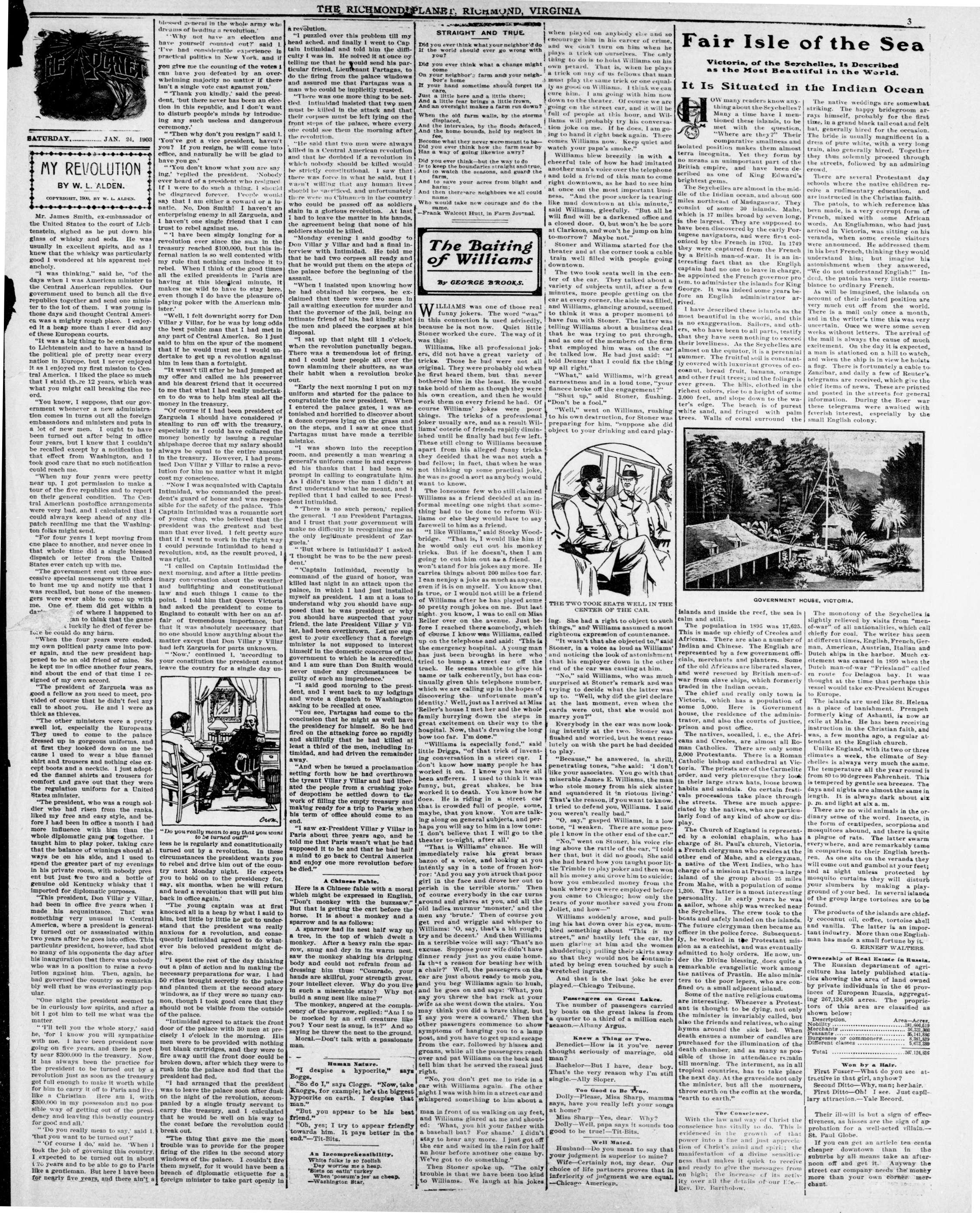
MY REVOLUTION $
BY W. L. ALDEN. i
tenstein, sighed as he put down his
glass of whisky and soda. He was
usually in excellent spirits, and as 1
knew that the whisky was particularly
good I wondered at his apparent mel-
ancholy.
“1 was thinking,” said be, “of the
days when I was American minister to
the Central American republics. Our
government used to bunch all the five
Tepublics together and send one minis-
ter to the lot of them. I was young in
those days and thought Central Ameri-
ca was a mighty rough place. I enjoy-
ed it a beap more than I ever did any
of these European courts.
“It was a big thing to be embassador
to Lichtenstein and to have a hand in
the political pie of pretty near every
nation in Europe, but I never enjoyed
Jt as 1 enjoyed my first misston to Cen.
tral America. I liked the place so much
that I staid th.re 12 years, which was.
what you might call breaking the rec-
ord.
“You know, I suppose, that our goy-
ernment whenever a new administra-
tion comes in turns out all the foreign
embassadors and ministers and puts in
a lot of new men. I ought to have
been turned out after being in office|
four years, but I knew that I couldn't
be recalled except by a notification to
that effect from Washington, and 1
took good care that no such notification
could reach me.
“When my four years were pretty
near up, I got permission to make a|
tour of the five republics and to report
on their general condition. ‘The Cen.
tral American postoffice arrangements
were very bad, and I calculated that 1
could always keep ahead of any dis-
Patch recalling me that the Washing-
ton folks might send.
“For four years I kept moving from
‘ene place to another, and never once in
that whole time did a single blessed
dispatch or letter from the United
States ever catch up with me.
“The government sent out three suc-
cessive special messengers with orders
to hunt me up and notify me that 1
‘Was recalled, but none of the messen-
gers were ever able to come up with
me. One of them did get within a
dar of where I happened to
‘an to think that the game
Cluckily he died of fever be-
ture be could do any harm.
“When the four years were ended,
my own political party came Into pow:
er again, and the new president bap-
pened to be an old friend of mine. So
be kept me in office another four years,
and about the end of that time I re-
elgned of my own accord.
“The president of Zargucla was as
good a fellow as you need to meet, pro-
vided of course that he didn't feel any
call to shoot you. He and I were as
thick as thieves,
“The other ministers were a pretty
swell lot, especially the Europeans.
They used to come to the palace
dressed up in gorgeous uniforms, and
at frst they looked down on me be-
cause 1 used to wear a blue flannel
sbirt and trousers and nothing else ex-
cept boots and a necktie. I just adopt-
ed the flannel shirts and trousers for
comfort cnd gave out that they were
the regulation uniform for a United
States minister.
“The president, who was a rough sol-
ier who had risen from the ranks.
liked my free and easy style, and be-
fore I had been in office a month I had
more influence with him than the
whole diplomatic gang pug together. 1
taught him to play poker, taking care
that the balance of winnings should al-
ways be on his side, and 1 used to
spend the greater part of my evenings
in his private room, with nobody pres
ent but just We two and a bottle of
genuine old Kentucky whisky that I
imported for diplomatle purposes.
“This president, Don Villar y Villar,
had been in office five years when I
made his acquaintance. That was
something very unusual in Central
America, where a president is general-
ly turned out or assassinated within
two years after he goes into office. This
particular president, however, had shot
0 many of his opponents the day after
bis inauguration that there was nobody
who was In a position to raise a revo-
lution against him. Then, again, he
had governed the country so remarka
bly well that he was everlastingly pop.
ular.
“One night the president seemed to
be in curiously tow spirits, and after a
bit I got him to tell me what was the
matter.
“Til tell you the whole story.’ said
he, “for I know you will sympathize
with me. 1 have been president now
going on five years, and there is pret:
ty near $300,000 in the treasury. Now.
it has always been the practice for
the president to be turned out by a
Tevolution Just as soon as the treasury
got full enongh to make it worth while
for him to carry It off to Paris and live
Uke a Christian Here am 1, with
$300,000 in my possession and no pos:
sible way of getting out of the presi-
dency and leaving this beastly country
for gooe and all”
“Do you really mean to say,’ said 1
dreams of beading a revolution.”
“Why not have an election ang
have yourself counted ont? said L
‘I've bad consilerable experience tp
Practical politics In New York, and if
you give me the counting of the votes §
can bave you defeated by an over-
whelming majority no watter if there
isn’t a single vote cast axaimst you.’
“Thank you kindly,” said the prest-
dent, ‘but there never has been an elee-
tion in this republic, and I don’t want
to disturb people's minds by Introduc-
ing any such useless and dangerous
ceremony.’
“Then why don’t you resign?’ said 1.
‘You've got a vice president, haven't
you? If you resign, he will come into
office, and naturally he will be glad to
have you go.”
“*You don't know what you are say
ing,’ replied the president. ‘Nobody
ever beard of a president who res!;zned
If 1 were to do sueh a thing, 1 should
be disgraced forever. People would
sa) that 1 am either a coward or a lu-
natic. No, Don Smith! I haven't an
enterprising enemy in all Zarguela, and
1 haven't one single friend that I can
trust to rebel against me.
“‘l bave been simply longing for a
revolution ever since the sum in the
treasury reached $100,000, but this in-
fernal nation fs so well contented with
my rule that nothing can induce it to
rebel. When I think of the good times
all the exiled presidents in Paris are
having at this Idengical minute, it
makes me wild to have to stay here,
even though I do have the pleasure of
playing poker with the American min-
ister.’
“Well, 1 felt downright sorry for Don
Villar y Villar, for he was by long odds
the best public man that I had met in
any part of Central America. So I just
said to him on the spur of the moment
that if he would trust me I would un-
dertake to get up a revolution against
him In less than a fortnight.
“It wasn’t till after he had jumped at
my offer and called me bis preserver
and his dearest friend that it occurred
to me that what I had really undertak-
en to do was to help him steal all the
money in the treasury.
“Of course if I had been president of
Zarguela 1 should have considered |
stealing to run off with the treasury,
especially as I could have collared the
money honestly by issuing a regular
shipshape decree that my salary should
always be equal to the entire amount
in the treasury, However, I had prom-
ised Don Villar y Villar to raise a revo-
lution for him no matter what it might
cost my conscience.
“Now I was acquainted with Captain
Intimidad, who commanded the pres'-
dent's guard of bonor and was respon-
sible for the safety of the palace. This
Captain Intimidad was a romantic sort
of young chap, who believed that the
president was the greatest and best
man that ever lived. I felt pretty sure
that if I went to work In the right way
I could persuade Intimidad to head a
revolution, and, as the result proved, |
was right.
| “1 called on Captain Intimidad the
next morning, and after a little prelim
inary conversation about the weather
and bullfighting and — constitutional
law and such things I came to the
point. I told him that Queen Victoria
had asked the president to come to
Bngland to consult with her on an af-
fair of tremendous importance, but
that It was absolutely necessary. that
no one should know anything about the
matter except that Don Villar y Villar
had left Zarguela for parts unknown.
‘Now,’ continued 1, ‘according to
your constitution the president cannot
leave the country for a single day un-
1 3
© ie |
5 JLT >
Tia am, a
emmy Cll
KS ae a biel Lo
Wn bi FS oon my
ie
$ ome Wreereas Sennen that you want
tobe turned out” Ye
fess he is regularly and constitutionally
turned out by a revolution. In these
circumstances the president wants you
to rebel an¢ drive him out of the coun-
try next Monday night He expects
you to hold on to the presidency for,
say, six months, when he will return
and bead a revolution that will put him
back in office again.’
“The young captain was at first
knocked all in a heap by what I said to
him, but little by little he got to under
stand that the president was really
anxious for a revolution, and conse-
quently Intimidad agreed to do what-
ever bis beloved president might de-
sire.
“I spent the rest of the day thinking
out a plan of action and in making the
necessary preparations for war. 1 had
50 rifles brought secretly to the palace
and planted them at the second story
windows, as if they were so many can-
non, though I took good care that they
should not be visible from the outside
of the palace.
“Intimidad agreed to attack the front
door of the palace with 30 men at pre-
cisely 1 o'clock In the morning. His
men were to be provided with nothing
but blank cartridges, and they were to
fire away until the front door could be
broken down, after which they were to
rush into the palace and find that the
president had fled.
“I bad arranged that the president
‘was to leave the palace soon after dusk
‘on the night of the revolution, accom-
panied by a single trusty servant to
carry the treasury, and I calculated
that he would be well on his way to
the coast before the revolution could
break out.
“The thing that gave me the most
trouble was to provide for the proper
firing of the rifes in the second story
“Windows of the palace. I couldn't fire
them myself, for it would have been a
‘breach of diplomatic etiquette for a
foreign minister to take part openly in
THE RICHMONDPPLANE r, RicnmMVUND, VIRGINIA
_* passied over this problem till my
head ached, and finally 1 went to Cap_
tain Intimidad and told bim the aif-
culty I was in. He solved it at once oy
telling me that he yould send bis par-
Geulas fcod, Laenieaut Fartagaer ta
do the firing from the palace windows:
and assured me that Partagas was a
man whe could be implicitly trusted.
“There was one more thing to be set-
tled. Intimidad insisted that twp men,
must be killed in the attack and that
their corpses must be left lying on the
front steps of the palace, where every
one could sce them the morning after
the revolution.
_ “He said that two men were always
killed in 8 Central American revolution
and that he doubted If # revolution in
which nobody should be killed would
be strictly constitutional, 1 saw that
there was force In what he said. but L
wasn't willing that any human lives
should be <acriticed. and unfortunately
there were no Chinanien In the country
who could be passed off as soldiers
slain in a glorious revolution. At last
1 had to leave the matter in his hands,
the agreement being that none of his
soldiers should be killed.
“Monday evening 1 said goodby to
Don Villar y Villar and bad a final in-
terview with Intimidad. He told me
that he bad two corpses all ready and
that he would put them on the steps of
the palace before the beginning of the
assault.
“When I insisted upon knowing how
he had obtained bis corpses, he ex-
claimed that there were two men In
jail awaiting execution for murder and
that the governor of the jali, being an
intimate friend of his, had kindly shot
the men and placed the corpses at his
disposal.
“I sat up that night till 1 o'clock,
when the revolution punctually began.
‘There was a tremendous lot of firing,
and I could hear people all over the
town slamming their shutters, as was
their habit when a revolution broke
out.
“Early the next morning I put on my.
uniform and started for the palace to
congratulate the new president. When
I entered the palace gates, I was as-
tonished and horrified to discover about
a dozen corpses lying on the grass and
on the steps, and I saw at once that
Partagas must have made a terrible
mistake.
“I was shown Into the reception
room, and presently a man wearing a
general's uniform came In and express
ed his thanks that 1 had been so
Prompt in calling to congratulate him.
As I didn’t know the man I didn't at
first understand what he meant, and 1
replied that 1 had called to see Presi-
dent Intimidad.
"There is no such person,’ replied
the general. ‘I am President Partagas,
and I trust that your government will
make no difficulty In recognizing me as
the only legitimate president of Zar.
guela.’
“But where is Intimidad? 1 asked.
‘I thought he was to be the new presl-
dent’
“‘Captain Intimidad, recently In
command of the guard of honor, was
killed last night in an attack upon the
palace, in which I had just installed
myself as president. I am at a loss to
understand why you should have sup-
posed that he was president or why
You should have suspected that your
friend. the late President Villar y Vil-
tar, bad been overthrown. Let me sug-
gest to your excellency that a foreign
minister Is not supposed to interest
himself in the domestic concerns of the
government to which he is accredited,
and I am sure than Don Smith would
never under any circumstances be
guilty of such an Imprudence.’
“I said good morning to the presi-
dent, and I went back to my lodgings
and wrote a dispatch to Washington
asking to be recalled at once.
“You see, Partagas had come to the
conclusion that he might as well have
the presidency for himself. So he had
fired on the attacking force so rapidly
and skillfully that he had killed at
least a third of the men, including In-
timidad, and had driven the remainder
away.
“And when he tssued a proclamation
setting forth how he had overthrown
the tyrant Villar y Villar and had lber-
ated the people from a crushing yoke
of despotism he settled down to the
work of filling the empty treasury and
‘making ready for a trip to Paris when
his term of office should come to an
end.
“I saw ex-President Villar y Villar in
Paris about three years ago, and he
told me that Paris wasn’t what he had
supposed it to be and that he bad halt
a mind to go back to Central America
and enjoy one more revolution before
he died.”
Here is a Chinese fable with e moral
which might be expressed in English,
“Don't monkey with the buzzsaw.”
But that ts getting the cart before the
horse. It is about a monkey and a
sparrow and Is as follows:
A sparrow had its nest half way up
& tree, in the top of which dwelt a
monkey. After a heavy rain the spar
row, snug and dry in ts warm nest.
saw the monkey shaking his dripping
body and could not refrain from ad
dressing him thus: “Comrade, your
hands are skillful, your strength great,
your {ntellect clever. Why do you live
in such u miserable state? Why not
build a snug nest like mine?”
The monkey, angered at the compla-
cency of the sparrow, replied: “Am I to
be mocked by an evil creature like
you? Your nest is snug, fs {t?” And so
saying he threw the nest to the ground.
Moral.—Don’t talk with a passionate
man,
| aaa
“I despise a hypocrite,” says
‘Boggs.
("So do J,” saya Clogs. “Now, take
(Knoggs, for example; he’s the biggest
“‘hypoorite on earth. I despise that
man.”
“But you appear to be his best
friend.”
| “Oh, yes; I try to appear friendly
towards him. It paye better in the
end.”—Tit Bite. ,
An Incomprehensibility.
‘White folks te 20 foolish
Dey worries me » heap.
*Bists on eatin’ turkey
‘When ‘possum's jew’ as cheap.
‘Washington Star,
STRAIGHT AND TRUE
Did you ever think what your nelghbor'¢ do
Af the world should ever go wrong with
you?
Di@ you ever think what a change might
come
‘On your neighbor’: farm and your nelgh-
dor's home
IX your hand sometime should forget ita
care,
Just a little here and a little there;
And a little fear rings a little frown,
And an oversight makes a farm run down?
‘When the old farm walls, by the storms
displaced,
And the Intervales, by the floods defaced,
And the home bounds, held by neglect tn
fee,
Become what they never were meant to be—
Did you ever think how the farm near by
Has a way of going likewise awry?
Did you ever think—but the way todo
In to keep the boundaries straight anditruc,
And to watch the seasons, and guard the
farm,
And to sive your acres from blight and
harm;
And then there-are neighbors we ali could
name
Who would take new courage and do the
same.
—Frank Welcott Hutt, in Farm Jovvnal.
The Baiting
of Williams
By GEORGE BROOKS.
ES rae ere ee ee RD
because he is not now. Quiet little
Stoner worked the cure. The way of it
was this:
Williams, like all professional jok-
ers, did not have a great variety of
tricks. Those he had were not all
original. They were probably old when
he first heard them, but that never
bothered him in the least. He would
take hold of them as though they were
his own creation, and then he would
work them on every friend he had. Of
course Williams’ jokes were poor
things. The tricks of a professional
joker usually are, and asa result Wil-
liams’ coterie of friends rapidly dimin-
ished until he finally had but few left.
‘These still clung to Williams because
apart from his alleged funny tricks
they decided that he was not such a
bad fellow; in fact, that when he was
not thinking up some practical joke,
he was as good a sort as anybody would
want to know.
‘The lonesome few who still claimed
Williams as a friend decided at an in-
formal meeting one night that some-
thing had to be done to reform Wil-
liams or else they would have to say
farewell to him as a friend.
“I like Williams,” said Stocky Wood-
bridge. “That is, I would like him if
he would only cut out his monkey
tricks. But if he doesn’t, then I am
going to cut him out asa friend. 1
won't stand for his jokes any more. He
carries things about 200 miles too far.
Tean nenjoy a joke as much as anyone,
even if it is on myself. You know that
is true, or I would not still be @ friend
of Williams after he has played some
60 pretty rough jokes on me. But last
night. you know, I was to call on Miss
‘Reller over on the avenue. Just be-
fore I reached there somebody, which
of course I know was Williams, called
‘up on the telephone and said: ‘This is
the emergency hospital. A young man
has just been brought in here who
tried to bump a street car off the
track. He seems unable to give his
name or talk coherently, but has con-
tinually given this telephone number,
which we are calling up in the hopes of
discovering the unfortunate man’s
identity.’ Well, just as I arrived at Miss
"Reller’s house I met her and the whole
family hurrying down the steps in
great excitement on their way to the
hospital, Now, that's drawing the long
bow too far. I'm done.”
“Williams is especially fond,” said
little Driggs, “of that trick of invent-
Jing conversation in a street car. I
‘don't know how many people he has
worked it on. I know you have all
been sufferers. I used to think it was
funny, but, great shakes, he has
worked it todeath. You know how he
does, He is riding in a street car
that is crowded full of people, some,
maybe, that you know. You are talk-
ing along on general subjects, and per-
haps you will say to him in a low tone:
‘{ don’t believe that I will go to the
theater to-night, after all.’
“That is Williams’ chance. He will
immediately raise his great brass
bazoo of a voice, and looking at you
intently say in a tone of frozen hor-
ror: ‘And you say you struck that poor
girl in the face and drove her out to
perish in the terrible storm.’ Then
of course everybody in the car turns
jeround and glares at you, and all the
‘old ladies murmur ‘monster,’ and the
men say ‘brute.’ Then of course you
get red and wriggle and whisper to
Williams: ‘O, say, that's a bit rough;
try and be decent.’ And then Williams
jin a terrible voice will say: ‘That's no
excuse. Suppose your wife didn't have
dinner ready just as you came home.
Is thet a reason for beating her with
achair? Well, the passengers on the
car are just about ready to mob you,
and you beg Williams again to hush,
‘and he goes on and says: ‘What, you
say you threw the hat rack at your
wife as she went down the stairs. You
may think you did « brave thing, but
I say you were a coward.’ Then the
other passengers commence to show
symptoms of hanging you to a lamp
post, and you have to get upand escape
from the car, followed by hisses apd
groans, while all the passengers reach
over and pat Williams on the back and
tell him that he served the raseal just
right.
“No, you don't get me to ride ina
car with Williams again. Ihe other
night I was with him ina streetcar and
whispered something to him about a
man in front of us walking on my feet,
and Williams glared at me and shout
ed: ‘What, you hit your father with
a baseball bat? For shame.’ I didn’t
stay to hear any more. I just got off
the car and waited in the rain for halt
an hour before another one came by.
‘We've got to do something.”
‘Then Stoner spoke up. “The only
trouble is that we bave been too kind
to Williams. We laugh at his jokes
Molated position makes them almost
terra incognita, Yet they form by
RO means an unimportant part of the
British empire, and have been de-
scribed as one of King Edward's
brightest gems.
‘The Seychelles are almost in the mid-
dle of the Indian ocean, and about 600
miles northeast of Madagascar. ‘They
consist of some 30 islands. Mahe,
which is 17 miles broad by seven long,
is the largest. ‘They are supposed to
have been discovered by the early Por-
fugese navigators, and were first col-
onized by the French in 1702. In 1749
they were captured from the French
by a British man-of-war. It is an in-
teresting fact that as the English
captain had no one to leave in charge,
he appointed the French governor pro
tem. to administer the islands for King
George. It was indeed some years be.
fore an English administrator ar-
rived.
T have described these islands as the
most beautiful in the worid, and this
is no exaggeration. Sailors, and oth-
ers, who have been to all parts, testify
that they have seen nothing to exceed
their loveliness. As the Seychelles are
almost on the equator, it is a perennial
summer: The fruitful soil is constant-
ly covered with luxuriant groves of co-
coanut, bread fruit, banana, orange
and other fruit trees: and the foliage is
ever green, The hills, clothed in the
Fichest colors, rise tua height of some
3,000 feet, and slope down to the wa-
ter’s edge. The beach is of purest
white sand, and fringed with palm
trees. Walls of coral surround the
islands and inside the reef, the sea is
calm and still.
‘The population in 1895 was 17,625.
This is made up chiefly of Creoles and
Africans. There are also a number of
Indian and Chinese. The English are
represented by a few government offi-
cials, merchants and planters. Some
of the old Africans are liberated slaves,
and wer? rescued by British men-of-
war from slave ships, which formerly
traded in the Indian ocean.
The chief and really only town ix
Victoria, which has a population of
some 5,000. Here js Government
house, the residence of the adminis-
trator, and also the courts of justice,
prison and post office.
‘The natives, socalled, i. €., the Afri-
cans and Creoles, are almost all Ro-
man Catholics. There are only some
2,000 Protestants. There is a Roman
Catholic bishop and cathedral at Vie-
toria. The priests are of the Carmelite
order, and very picturesque they loak
in their large straw hats, loose brown
habits and sandals. On certain festi-
vals processions take place through
the streets. These are much appre-
ciated by the natives, who are particu-
larly fond of any kind of show or dis-
play.
‘The Church of England is represent-
ed by a colonial chaplain, who has
charge of St. Paul's chureh, Victoria,
a French clergyman who resides at the
other end of Mahe, and a clergyman,
‘a native of the West Indies, who has
charge of a mission at Prastin—a large
island of the group about 25 miles
from Mahe, with a population of some
1,200. The latter is a most interesting
personality. In early years he was
a sailor, whose ship was wrecked near
the Seychelles. The crew took to the
boats and safely landed on the islands.
‘The future clergyman then became an
officer in the police force. Subsequent
ly, he worked in tee Protestant mis-
sion as a catechist, and was eventually
admitted to holy orders. He now, un-
der the Divine blessing, does quite a
remarkable evangelistic work among
the natives of Prastin. He also minis-
ters to the poor lepers, who are con-
fined ou a small adjacent island.
Some of the native religious customs
‘are interesting. Whenever a Protest-
ant is thought to be dying, not only
the minister is invariably called, but
also the friends and relatives, who sing
hymns around the sick bed. When
death ensues a number of candles are
purchased for the illumination of the
death chamber, and as many as pos-
sible of those in attendance remain
till morning. The interment, as in all
tropical countries, has to take place
the next day. At the graveside not only
the minister, but all the mourners,
‘throw earth on the coffin at the words,
“earth to earth.”
}when pisyed on anybody eine and so
jesourege him in bis carcer of crime,
nd we don't turn on him when he
plays a trick om ourselves. ‘The only
thing to do Is to holae Williams on bis
own petard. ‘That is, when he plays
@ trick on any of us fellows that man
}inust play the same trick or one equal-
ly as good on Williams. 1 think we can
ee him. 1 am going with him now
down to the theater. Of course we are
going on the street car, and it will be
‘fall of people at this hour, and Wil-
}liamx will probably try his conversa-
tion joke on me. If he does. Lam go-
ing to hand it right back again. ‘There
comes Williams now. Keep quiet and
wateh your papa’s smoke.”
Williams blew breezily in with «
cheerful tale of how he had imitated
another man’s voice over the telephone
}and told a friend of this man to come
right downtown, as he had to see him
at once on the most important busi-
ness. “And the poor sucker is tearing
like mad downtown at this minute,”
said Williams, gleefully. “But all he
will find will be a darkened office and
a closed door. , but won't he be sore
at Clarkson, and’ won't he jump on him
to-morrow? Maybe not.”
| Stoner and Wiliams started for the
theater and at the corner took a cable
_ train well filled with people going
downtown.
| ‘The two took seats well in the cen-
ter of the car. They talked about a
variety of subjects until, after a few
minutes, more people getting on the
car at every corner, the aisle was filled,
and Williams, glancing around, seemed
rel think it was a proper moment té
have fun with Stoner. The latter was
telling Williams about a business deal
that he was trying to put through,
and as one of the members of the firm
that employed him was on the car
jhe talked low. He had just said: “I
told Denner that I could fix the thing
up all right.”
“What,” said Williams, with great
earnestness and in a loud tone, “your
fiancee broke off the engagement 2”
“Shut up,” said Stoner, flushing.
“Don't be a fool.”
“Well,” went on Williams, rushing
to his own destruction, for Stoner was
preparing for him, “suppose she did
object to your drinking and card play-
2 no
Si ite
\ Zh 7
z&
i iL :
ing. She had a right to object to such
things,” and Williams assumed a most
righteous expression of countenance.
“It wasn't that she objected to,” said
Stoner, in a voice as loud as Williams’
and noticing the look of astonishment
that his employer down in the other
end of the car was casting at him.
“No,” said Williams, who was much
surprised at Stoner’s remark and was
trying to decide what the latter was
up to. “Well, why diff the girl declare
at the last moment, even when the
cards were out, that abe would not
marry you?”
| Everybody in the car was now look-
ing intently at the two. Stoner was
flushed and worried, but he went reso-
lutely on with the part he had decided
to play.
“Because,” he answered, in shrill,
penetrating tones, “she said: ‘I don’t
‘like your associates. You go with that
miserable James E. Williams, the man
who stole money from his sick sister
and squandered it in riotous living.’
‘That's the reason, if you want to know.
I tried to defend you, Williams. I said
you weren't really bad.”
“O, say,” gasped Williams, in-a low
tone, “I weaken. There are some peo-
ple 1 know in the other end of the car.”
“No,” went on Stoner, his voice ris-
ing above the rattle of the car, “I told
her that, but it did no goods She said
she had heard how you taught poor lit-
tle Trimble to play poker and then won
all his money ana drove him to suicide;
how you embezzled money from the
bank where you were employed before
you came to Chicago; how only the
tears of your mother saved you from
Joliet, and how—"
Williams suddenly arose, and pull-
ing his hat down over his eyes, mum-
bled something about “This is my
street,” and hastily left the car, the
men glaring at him and the women
shudderingiy pulling their skirts away
so that they would not be éontamin-
ated by being even touched by such a
‘wretched ingrate.
And that is the last joke he ever
played.—Chicago Tribune.
Passengers on Great Lakes.
‘The number of passengers carried
by boats on the great lakes is from
‘a quarter to a third of a million each
‘season.—Albany Argus.
piccee ee ce
|. Benedict—How is it you've never
thought seriously of marriage, old
man?
Bachelor—But I have, dear boy.
‘That's the very reason why I'm still
single.—Ally Sloper.
Too Good to Ne Mae.
Dolly—Please, Miss Sharp, mamma
says, have you really left your songs
at home?
Miss Sharp—Yes, dear. Why?
Dolly—Well, papa says it sounds too
good to be true!—Tit-Bits.
Well Mated.
Husband—Do you mean to say that
your judgment is superior to mine?
Wife—Certainly not, my dear. Our
choice of life partners proves that in
inferiority of jnégment we are equal.
esiGieae “Kinerkeatie.«
:
Fair Isle of the Sea
Victoria, of the Seychelles, Is Described
as the Most Beautiful in the World.
It Is Situated in the Indian Ocean
OW many readers know any-| The native weddings are somewhat
tioned these islands, to be | time, in a grand black tail coat and felt
a i eee,
ee. |S
Fe erent. Se eee Meee 8
aie” eae hi oe
hye ye oS
ran Hae ig] Zo
| Se a oo ge WW
ie pe bX Fa
| aN es Se 1 hee
| = 1 as Ps , 7 je. ie
With the law and way of Christ the
conscience hax vitully io do. This is
evidenced in the growth of that
power into a fine and just appreci«
tion of Christ's mind and spiric; the
manifestation of a divine xensitive-
ness that makes it quick to receive
and ready to give the messages from
on high; the increase of its setiv-
ity over all the details ofour Pe
Ret. Dr. Rattholow,
(B—
ed
oo
iia ee Gi eee tee naee..
‘The native weddings are somewhat,
striking. ‘The happy bridegroom ar-
rays himself, probably for the first
time, in a grand black tail coat and felt
hat, generally hired for the occasion.
‘The bride is usually magnificent in a
dress of pure white, with a very long
train, also generally hired. Together
they thus solemnly proceed through
the streets, followed by an admiring
crowd,
‘There are several Protestant day
schools where the native children re-
ceive a rudimentary education, and
are instructed in the Christian faith.
‘The patois, to which reference bus
been made, is a very corrupt form of
French, mixed with some African
words. An Englishman, who had just
arrived in Victoria, was sitting on his
veranda, when some creole visitors
were announced. He addressed them
in his best French, thinking they would
understand him; but imagine his
astonishment when they answered,
“We do not understand English!” In-
deed, the patois has very little resem-
blance to ordinary French.
As will be imagined, the islands on
account of their isolated position are
very much cut off from the world.
‘There is a mail only once a month,
and in the writer's time this was very
uncertain. Once we were some seven
weeks without letters. ‘The arrival of
the mail is always the cause of much
excitement, On the day it is expected,
a man is stationed on a hill to watch,
and when the ship is in view he hoists
a flag. There is fortunately a cable to-
Zanzibar, and daily a few of Renter's
telegrams are received, which give the
chief items of news. These are printed
and posted in the streets for general
information. During the Boer war
these telegrams were awaited with
feverish interest, especially by the
small English colony.
The monotony of the Seychelles is
slightly relieved by visits from *men-
of-war” of all nationalities, which call
chiefly for coal. The writer has seen
at different times, English, French, Ger-
man, American, Austrian, Italian and
Duteh ships in the harbor. Much ex-
citement was cansed in 1899 when the
Dutch man-of-war “Friesland” called
en route for Delagoa bay. It was
thought at the time that perhaps this
vessel would take ex-President Kruger
to Europe.
The islands are used like St. Helena
asa place of banishment, Prempeh
formerly king of Ashanti, is now ar
exile at Mahe. He has been receiving
instruction in the Christian faith, ané
was, a few months ago, a regular at-
tendant at the English chureh.
Unlike England, with its two or three
climates a week, the climate of Sey:
chelles is always very much the same,
The temperature all the year round is
from 80 to 90 degrees Fahrenheit. This
iy tempered by gentle sea breezes. The
days and nights are almost the same in
length. It is always dark about six
p.m. and light at six a.m.
‘There are no wild animals in the or-
dinary sense of the word, Insects, in
the form of centipedes, scorpions and
moxquitoes abound, and there is quite
4 plague of rats. The latter swarm
everywhere, and are remarkably tame
in comparison to their English breth-
ren. As one sits on the veranda they
will come out and gambol at your feet;
and at night unless protected by
mosquito curtains they will disturb
your slumbers by making a play-
ground of your bed. In several islands
of the group large tortoises are to be
found.
The products of the islands are chiet-
ly cocoanut oil, coffee, tortoise shell
and vanilla. ‘The latter is an impor-
tantindustry, More than one English.
man has made a small fortune by it.
G. ERNEST WALTERS.
Ownership of Real Estate in Russia.
The Russian department of agri-
culture has lately published statis-
tics showing the area of land owned
by private individuals in the 46 prov-
inces of European Russia, aggregat-
ing 267,124,836 aeres. The proprie-
tors of this area are classified as
shown below:
ee Area—Acres.
Merchants ssvisssi eae
Burgesses ot Somimonera..i02222: Paras
Diterent clames erect Gees
Total vessesseseeseeerenerneses ee AE
Won by « Hair.
First Fusser—What do you see at-
tractive in that girl, anyhow?
Second Ditto—Why, man; herhair.
First Ditto—Oh! I see. Just capil-
lary attraction. —Yale Record,
| Their ill-will is but a sign of effee
tiveness, as hisses are the sign of ap
probation for a well-acted villain.—
St. Paul Globe.
If you can get an article ten cents
cheaper downtown than in the
suburbs by all: means take an after-
‘noon off and get it. Anyway the
street car company needs the money
‘more than your own corner ‘mer-
chant. *
3
ee
HE PLANET
published every Saturday by JOHN MITCHELL
JR., at 811 North 4th Street, Richmond, Va.
All communications intended for publication
should be sent so as to reach us by Wednesday
TERMS IN ADVANCE.
ADVERTISING RATES.
REGISTERED LETTER—If a Money Order Post Office or an Express Office is not within your city, you may send a letter you wish to send us on payment of ten cents. Then, if the letter is lost or stolen, it can be returned on can send money in this manner at our risk.
We cannot be responsible for money sent in letters in any other way than one of the four ways mentioned above. If you send your money in another way, you must do it at your own risk.
RENEWALS, ETC. If you do not want the PLANET continued for another year after your subscription has run out, you cannot continue it. The courts have decided that subscribers to newspapers who do not order their paper discontinued at the time of your Curd to continue it. The courts hold liable for the payment of the subscription up to date when they order the paper discontinued.
COMMUNICATIONS—When writing to us to renew your subscription or to discontinue our paper, you should give your name and address in full, otherwise we cannot find your address.
CHANGE OF ADDRESS—In order to change the address of a subscriber, we must be sent the former as well as the present address.
Entered in the Post Office at Richmond, Va., as second class matter.
BATURDAY, ..... JAN. 24, 1903
CREEPING BEAR, an Indian, toma-
hawed a policeman in Memphis, Tenn.,
because he called him a Negro. The
policeman has since died.
Things have reached a low ebb, when
even an Indian resents the imputation.
We note that the New York Acz is hopeful and that it is a sposed to trust the Supreme Court of the United States. All right! We hope that its conclusions may be verified. In the meantime, it would be well to keep 'call' on the proceedings.
---
THE Si. Louis GLOBE-DEMOCRAT calls attention to the fact that but four north ern states have Democratic Governors and three of these states are normally Republican. It ascribes this fact to the Democratic assault upon sound currency, and the effacement of the Negro in the south as a political factor by constitutional enactments. It declares that a solid south will always be met by a solid north. It concludes its remarks with the assertion that the Democratic Party is in a flabbier condition at the present time than it has ever been since the foundation of the Republican Party. There is much wisdom in this conclusion.
PITTSFIELD MEN PLEAD GUILTY
Were Indicted For Causing Death of President's Bodyguard.
Pittsfield, Mass., Jan. 21. — Euclid Madden and James T. Kelley, indicted for manslaughter in connection with the accident here last August, in which William Craig, President Roosevelt's bodyguard, was killed, yesterday retracted a previous plea of not guilty and pleaded guilty.
Madden was sentenced to serve six months in the house of correction and to pay a fine of $500. Kelley's case was placed on file.
Drowned Himself in Bath Tub.
Baltimore, Jan. 20. — Emil Kiel, a machinist, 38 years old, being treated at the city hospital for nervous prostration, eluded the vigilant nurses yesterday and drowned himself in a bath tub. Kiel apparently climbed over a partition separating the bath room from the ward lavatory. When found Kiel's lifeless body was face downward, floating in the tub, which was full of water.
Tore Half Her Tongue Away.
Hazleton, Pa., Jan. 19. — Five-year-old Edna Ruch, of this city, is dying as a result of placing her tongue on an iron post outside her home, on a recent day when the thermometer registered below zero. In extricating her tongue, which adhered to the cold iron, nearly half of the member was torn away.
Abram S. Hewitt is Dead.
New York, Jan. 19. — Abram S. Hewitt, former mayor of New York, and for many years representative in congress, died yesterday morning, in his 81st year, having been critically ill for 10 days. With him at the moment of death were his wife, his three sons and three daughters.
RIGHTS OF UNION MEN
Mr. Darrow Tells Strike Commission His Views.
DISCRIMINATION LIFE OF UNIONS
Miners' Attorney Claims They Have a Right to Prevent Non-Union Men From Working By Moral Suasion.
D. L. & Ws. Wage Statement.
Philadelphia, Jan. 21.—When the anthracite coal strike commission adjourned yesterday the 400th witness summoned before the arbitrators was being examined. Of the 400, 174 were called by the striking mine workers, 155 by the non-union men, 63 by the operators, and eight by the commission. The Delaware, Lackawanna and Western Railroad Company concluded its case, and the Temple Iron Company began the presentation of its side of the controversy. The companies yet to be heard are the Lehigh Valley Coal Company, Lehigh and Wilkesbarre Coal Company, Markle Brothers and about 60 other independent operators, and the Philadelphia and Reading Coal and Iron Company. After the coal companies end their case the miners will take up some time in examining witnesses in rebuttal.
Yesterday's testimony did not bring out anything that was particularly new. There was a lively interchange of opinion between Chairman Gray and Attorney C. S. Darrow, for the miners, on the question of the rights of the union men. Mr. Darrow said: "The right to discriminate and to say that its members will not work with non-union men is the strength of a labor union, and it in part represents the strength of the United Mine Workers of America, and it content that the exercise of this right is not incompatible with the greatest good to the greatest number.
"Why, the union has the right to object to working with a red-headed man if it so elects," added Mr. Darrow, addressing his remarks alternately to the commission and to Major Warren, of counsel for the Delaware, Lackawanna and Western Company.
"But has the union the right to prevent a red-headed man from working if he so desires?" interjected Commissioner Wright.
"It has the right to prevent him by moral suasion. Of course, it hasn't the right to kill him, or assault him, or even to assail him with abusive language. The civil courts are open to the slandered man, whether he be a union or a non-union man."
During the examination in chief of Superintendent_Williams, of the Delaware, Lackawanna and Western Company, he said the steam men do not work very hard at night, and that they get a chance to sleep. On cross-examination he testified that the company does not permit its men to sleep while on duty. The day engineers hoist cars from the bottom of the shaft to the surface, a distance of 500 feet, at the rate of 70 cars a minute. Engineers have 15 minutes for lunch. They work 10 hours a day, and when they are on duty at night they work 14 hours.
A. S. Baker, of Scranton, auditor of the mining department of the Delaware, Lackawanna and Western Railroad Company, presented to the commission the wages statement showing the wages paid to all of its employees. A summary of the wage statement of the contract miners for 1901 is as follows:
Two hundred and forty-three men earned less than $100; 99 between $100 and $150; 130 between $150 and $200; 69 between $200 and $250; 90 between $250 and $300; 112 between $300 and $350; 140 between $350 and $400; 163 between $400 and $450; 198 between $450 and $500; 200 between $500 and $550; 329 between $550 and $600; 336 between $600 and $650; 284 between $650 and $700; 226 between $700 and $750; 140 between $750 and $800; 75 between $800 and $850; 50 between $850 and $900, and 121 over $900.
A statement giving the wages of all classified company men, that is men who work by the day or week, was also presented. These men have demanded a 20 per cent. reduction in the hours of labor, with no reduction in pay. The average wages paid these men in 1901 ranged from $154.80 for slate pickers (boys) to $931.04 for boiler inspectors.
The Lackawanna Company here rested its case, and the Temple Iron Company began calling its witnesses. The attorneys called five men on behalf of the Temple Company, all of them mine foremen, who testified to conditions in and about the collieries over which they have charge. Much of their testimony was in contradiction of evidence adduced when the mine workers were presenting their side of the controversy to the commission at Scranton.
BAER DENIES CAR SHORTAGE
President of Reading Says Company
Has More Than They Can Use
Philadelphia, Jan. 20—Inquiry was made of George F. Baer yesterday regarding the statement to the effect that large quantities of coal are being held on the line of the Philadelphia and Reading railway, and he replied as follows:
"It is not true that there are large quantities of coal—some reports making it as high as 150 000 tons—on the line of the Philadelphia and Reading railway. The traffic is now moving freely and fully to destination. There is no scarcity of coal cars. We now have more than we can use. The coal movement has been very heavy. Saturday and Sunday 3,018 cars of anthracite coal passed over the Reading division, and during the same time there were unloaded in the city of Philadelphia 481 cars and at Port Richmond 439 cars anthracite coal. There were also 194 cars bituminous coal unloaded at Port Richmond At Port Reading 364 cars of anthracite and 182 cars of bituminous coal were dumped.
"The car reports show that after filling colliery calls for coal and foreign cars, there is a visible supply of 8000
THE RICHMOND PLANET, RICHMOND; VIRGINIA
"Six collieries with a daily production of 4,000 tons were drowned out by the Miners' Union ordering out the pumping gangs, and we were powerless to keep the water out of them during the strike. Two of these collieries are entirely ruined and must be abandoned. The other four are being pumped out and in the course of time will again be worked. Their destruction prevents the use of these surplus cars, deprives the public of coal, and many men of employment. What would have happened had the strikers succeeded in drowning out all our collieries should give the public serious thought."
ASKS FOR $100,000,000
Aguinaldo Petitions United States to
Loan Filinnes That Amount.
Lanah Pipinos That Amount.
Washington, Jan. 21. — Secretary Root yesterday transmitted to the senate and house copies of a petition received by him through Governor Taft, from Aguinaldo, the late insurgent leader in the Philippines.
The petition in part says: "I propose to the honorable civil service commission to obtain from congress a United States treasury loan of $20,000,000 gold, in cash, and also a credit of $50,000,000 gold, which will guarantee the issue of paper to serve as money in the islands. This sum shall be used for the development and improvement of Philippine agriculture, and shall be paid within 20 years, the payments being made in three installments at the end of 10, 15 and 20 years respectively.
"When the loan and credit were approved and the above mentioned sum here in the Philippines, a bank would be opened, which could be called 'United States of America Agricultural Philippine Bank,' and which should be under the inspection and supervision of the insular government. After the civil commission had dictated the proper regulations and established all the necessary safeguards for the security and stability of the ban', the bank would begin to operate, making available for the agriculturists such sums as they should ask for, in compliance with the necessary formalities, at an annual maximum of 4 per cent, payable semi-annually.
"From the the $100,000,000 capital will be subtracted $2,000,000 for the construction of buildings for branch banks throughout the arcnipelago, and for other necessary preliminary expenses.
"By the time that the United States treasury has been repaid at the end of the stated period of 20 years, the Philippine treasury should have at least $50,000,000, which would serve to guarantee the issue of paper money to that amount."
STITCHED UP HIS HEART
Daring Surgical Operation Performed at St. Louis Hospital.
St. Louis, Jan. 20.—A remarkable surgical operation was performed at the city hospital Sunday night to save the life of Edward Spilker, aged 19, who had attempted suicide by shooting himself in the left breast. An aperture was made and between pulsations the wound in the heart was closed with three stitches. The bullet had also perforated the apex of the left lung. A portion an inch and a half square was cut away, a heavy silk ligature tied about the lung, draining tubes being established, and the chest cavity closed. The patient speedily rallied and it is believed he will recover.
GENERAL MARKETS
Philadelphia, Pa., Jan. 20. — Flour was steady; winter superfine, $2.60@2.80; Pennsylvania roller, clear, $3.10@3.25; mills mills, extra, $2.85@3. Rye flour was quiet, at $1.55@3.20 per bbl; Pennsylvania, red, new, 81@81%c. Corn was No. 2 yellow, local, 55c. Oats quiet; No. 2 white, clipped, 51c.; lower grades, 42%c. Hay was steady; No. 1 timothy, $20.50@2; for large bales, New York, between 81%c. Corn was firm; family $20.0. Pork was firm; family $9.0. Pork was 13c, for hers, and 9%c for old roosters. Dressed poultry, 13%c for choice fowls, and 10c. for old roosters. Butter was steady; creamery, 20c. per pound. Eggs were steady; New York and Pennsylvania, 27%c. per dozen. Potatoes were steady; choice, 65%c. per bushel.
Live Stock Markets.
East Liberty, Pa. Jan. 20.—Cattle were steady; choice, $5.25@5.40; prime, $5.20; good, $4.75@5. Hogs were medium; mediums, $6.05@5.80; mediums, $6.65@5.80; mediums, $6.65@6.60; light yorkers, $6.50@6.55; pigs, $6.40@6.50; roughs, $5@6.25. Sheep were lower; best wetlands, $4.50@4.60; culls and common, $1.75 lambs, $5.75@5.90; veal calves, $8@8.40.
East Buffalo, N. Y., Jan. 20.—Cattle were steady; prime steers, $5.15@5.50; heifers, $3.50@4.50; cows, $2.75@4.25; bulls, $3@4.25; stock heifers, $2.50@3.25; common to good, $5.50@9.00; Hogs were heavy, $7.00@8.80; mixed, $6.60@7.00; yorkers, $6.50; pigs, $6.60; roughs, $5.75@6; stags, $4.75@5.25; Sheep and lambs, $4.25; culls to good, $2@3.90; sheep, $4@6.10; culls to good, $4.25@5.90; yearlings, $3@5.25; ewes, $4.25@4.40.
Pennsylvania Editors Elect Officers.
Harrisburg, Pa., Jan. 21. — The annual meeting of the Pennsylvania State Editorial Association was held yesterday in this city. The following officers were elected: President, B. F. Vogel, Greensburg; 1st vice president, Derick Lamade, Williamsport; 2d vice president, A. Nevin Pomeroy, Chambersburg; 3d vice president, T. H. Harter, Bellefonte; secretary and treasurer, R. N. Thomas, Mechanicsburg; corresponding secretary, J. W. Stober, Elizabethtown; assistant secretary, R. N. Thomas, Jr., Mechanicsburg; executive committee, J. L. Stewart, Washington; E. Conrad, McVeytown; R. B. McKee, Freeport; J. W. Merley, Lansford, and J. W. C. Austin, York.
Rev. A. S. Lloyd Elected Bishop.
Jackson, Miss., Jan. 21—Rev. Arthur Seldon Lloyd, D. D., of Virginia, general secretary of the Episcopal board of missions, was yesterday elected bishop of the Protestant Episcopal diocese of Mississippi to succeed the late Rev. Dr. Hugh Miller Thompson. Dr. Lloyd received 14 of the clerical votes to 2 for Rev. Arthur Howard, of New York; one for Rev. Quincy Ewing, of Greenville; one for Rev. P. C. Sears, of Meridian, Miss., and one for Rev. P. F. Reese, of Macon, Ga.
PENNYPACKERSWORNIN
PENNYPACKERSWORNIN
Inaugurated Governor of Pennsylvania to Succeed W. A. Stone.
PENROSE RE-ELECTED SENATOR
Governor Nennypacker, In His Address Suggested Means of Holding In Check "Yellow" Newspapers—Inaugural Parade Finest Ever Seen.
Harrisburg, Pa., Jan. 21.—Samuel W. Pennypacker was yesterday Inaugurated governor of Pennsylvania to succeed William A. Stone Stone; William
J. B.
Governor Pennypacker.
M. Brown succeeded J. P. S. Gobin as lieutenant governor, and Boies Penrose was elected by the general assembly to succeed himself in the United States senate.
The inauguration ceremonies of the governor took place at noon in a large stand at the west front of the capitol, in the presence of an immense crowd. Immediately after these exercises the lieutenant governor was inducted into office with simple ceremonies in the senate chamber. The house and senate balloted separately yesterday afternoon for the United States senator, the Republicans voting for Senator Penrose and the Democrats for Colonel James M. Guffey, of Pittsburg. The vote in the house was: Penrose, 156; Guffey, 42; in the senate: Penrose, 37; Guffey, 10.
The inaugural parade was the finest the state capital has ever seen. A large number of political clubs, a provisional brigade of the National Guard of Pennsylvania, the Harrisburg fire department and some of the best marching bands in Pennsylvania turned out to do honor to the new governor. Last evening Governor and Mrs. Pennypacker held a public reception at the executive mansion. They were assisted in receiving by the wives of members of the legislative inaugural committee and several Harrisburg ladies.
The inaugural ceremonies at the front of the capitol were opened with music by the Commonwealth Band, of Harrisburg, after which prayer was offered by Rev. B. H. Lelsenring, of Chambersburg. The certificate of election of the governor was read by Chief Clerk Smiley, of the senate. The oath of office was then administered to the governor by Supreme Court Judge D. Newton Fell, of Philadelphia. A salute of 17 guns was next fired. Governor Pennypacker then read his inaugural address. Speaking of newspapers, he said:
"The doctrine of the liberty of the press, conceived at a time when it was necessary to disclose the movements of arbitrary power, has become in recent days too often a cover for base and ignoble purposes, and, like the sanctuaries of old, a place of retreat where any wrong-doer may secure immunity from punishment.
"Sensational journals have arisen all over the land, the owners in concealment and the writers and purveyors undesignated, and they have thriven by propagating crime and disseminating falsehood and scandal, by promulgating dissension and anarchy, by attacks upon individuals and by assaults upon government and the agencies of the people. They are a terror to the household, a detriment to the public service, and an impediment to the courts of justice. It would be helpful and profitable to reputable journalism if they could be suppressed. The time is near at hand and may have already come when society will find means to prevent this development of vicious life which constitutes the most conspicuous instance of existing ills.
"I know of no reason why Pennsylvania, which has been foremost in so many directions in the past, should not take the lead in a needed effort to improve manners and morals by such a reform.
"Our constitution imposes responsibility for the abuse of the liberty of the press, and I suggest for the consideration of the legislature whether or not it would be well to extend to such cases the law of negligence as developed by the decisions of our courts, so that there should be liability in damages for the physical and mental suffering caused by publications made without 'reasonable care.'
"I further suggest an inquiry as to the propriety of requiring the names and residences of the owners of newspapers to be published with each issue. It may be that on consideration the legislature in its wisdom will be able to devise other means which, while protecting journals of good repute, will tend to eliminate the unworthy."
The North German Lloyd steamer Lahn, which grounded on a sand bank near the rock of Gibraltar, was floated yesterday.
Fire destroyed the plant of the Schaffer Piano Manufacturing Company, at Chicago, yesterday, entailing a loss of $200,000.
A London dispatch says the report circulated in the United States that an anthracite coal trust is being formed in Wales is incorrect.
ZOMODONE, THE NEWEST AND MOST RAPID HAIR GROWER IN EXISTENCE.
Makes the Hair grow with lightning-like rapidity. No waiting for results. ZOMODONE prevents Falling Hair, Grey Hair, Brittle Hair, Curly Hair, Harsh Hair, and Scurf. Cures Dandruff, Itch, Tetter, Eczema, and Ring-Worm. No more Bald Heads, Scanty Partings, Splitting Ends, and Bald Temples. ZOMODONE grows long, luxuriant, soft, fine, siky Hair. Makes the Hair grow down and below the waist line in most every instance in which it is used. ZOMODONE is a direct Hair food, and softens and lengthens the Hair, so that it can be arranged in any style desired. Not a fraud or a fake, to get your money, but an honest remedy, tried and true. ZOMODONE acts quickly; results are seen at once. If you want Hair down to your waist, send in your order right now—do not delay. No free samples sent; a sample is not sufficient to do good. Price. 50c., or 3 bottles (a complete treatment) for $1.00, or will send four complete treatments for $3.00.
AGENTS WANTED. Everything is in favor of the Agent. LIBERAL CREDIT EXTENDED. This is an unprecedented chance to make money. Write quick for territory and particulars. Address
Actual Results from Baldness After Only 4 Weeks' Use of ZOMODONE.
Actual Results from Baldness After Only 4 Weeks' Use of ZOMOON
WE MUST HAVE ONE AGENT in every city and county immedi-
ately, may act, valuable, honest, colored lady or gentleman can make from $18.00 to $50.00 per week with ease. We will prove it to you, and trust to your honor.
BEFORE. AFTER.
OZONO
In order to prove to you that you can make more money as our Agent than at a regular offer: Cut out this advertising offer: Send it to us with only $1.00, and upon receipt of same, we will send to you one $30 large, square, 50c, size, boxes of OZONO at 50c, each, or $0.10 in all. When sold you must send us $2.00 more. Keeping the balance of the money (you will make $30c) is easier, and easily a sold a dozen in a few hours. We back all and refund the money if you cannot sell them. This test is sure to make you will become our regular Agent and have hundreds of dollars monthly. Address
BOSTON GEMICAL CO., ManT'g Chemists,
310 E. Broad Street, Richmond, Va.
A WEEK'S NEWS CONDENSED.
Thursday, January 15.
Crown Prince Frederick William, of Germany, left Berlin yesterday for St. Petersburg, to visit the Czar.
Governor Jefferson Davis, of Arkansas, was inaugurated yesterday for his second term of two years.
The superior court of Pennsylvania held its opening session at Scranton yesterday, with four of the seven judges present.
Congressman Sulzer, of New York, yesterday introduced a bill appropriating $50,000 for a statue to Samuel J. Tilden, to be erected in Washington.
Fire at Christiansburg, Va., yesterday destroyed Charles Gardner's printing office and Johnson & Janney's wholesale grocery store. Loss, $75,000.
Friday, January 16.
The interstate commerce commission will investigate alleged secret violations of the interstate commerce law by railroads entering Chicago.
President Roosevelt commuted the 15-year sentence of Henry Starr, of Indian territory, convicted of manslaughter, and he was released from prison.
The Pennsylvania board of pardons decided to give Mrs. Kate Edwards, of Berks county, under sentence of death for the murder of her husband, a rehearing.
Michael Flaherty, a mine worker at the Indian Ridge colliery, Shenandoah, Pa., fell down the shaft, a distance of 310 feet, and was crushed into an unrecognizable mass.
Saturday, January 17.
Mrs. James Nossick, of Laurel, Del., fell down stairs yesterday and broke her neck.
George J. Stear, a flagman, was struck by an Atlantic City train and killed at a Camden, N. J., crossing.
Emma and John Cliska, aged 10 and 12 years, were struck by a Lake Shore train at Valparaiso, Ind., and killed.
J. M. Huff, of Purdy, Mo., shot and killed his wife yesterday and then killed himself. Domestic troubles caused the tragedy.
The register of Lehigh University, South Bethlehem, Pa., shows the attendance of 581 students, from 27 states and six foreign countries.
Monday, January 19.
The will of the late Mrs. Mary J. Winthrop, leaving $3,000,000 to the Princeton Theological Seminary, will be contested.
The funeral of the late Congressman T. H. Tongue was held yesterday at Hillsboro, Ore., over 3,000 people being in attendance.
Citizens of Birmingham, Ala., have given 50 carloads of coal to the city of New York for distribution among the poor of the city.
The state of Virginia proposes to place a statue of General R. E. Lee beside that of George Washington in Statuary Hall, Washington, D. C.
Lleutenant Mitchell, a graduate of Annapolis, who was an officer on the Colombian government gunboat Bogota, died at Panama of yellow fever.
Tuesday, January 20.
Peter Knapp, of Philadelphia, committed suicide yesterday by jumping from a Pennsylvania express train near Harrisburg, Pa.
Baron Speck von Sternburg, the German charge d'affaires at Washington, sailed from Hamburg, Germany, for New York today.
Owing to the coal shortage the Susquehanna Iron and Steel Mills at Columbia, Pa., employing 1500 men, had to shut down yesterday.
The anniversary of the birth of General Robert E. Lee was observed in the public schools throughout the southern states yesterday.
Wednesday, January 21.
In a boiler explosion yesterday at the Pittsburgh Glass factory, at Elwood, Ind., three men were fatally injured.
Pay our collector when he calls.
M.
MRS. MARTH, the world renowned and highly celebrated Business and Test Medium, everything. No imposition. Can be consulted on business, life, business, love and marriage a specialty. Every mystery revealed, also of absent, deceased. Every mystery revealed, also of absent, deceased. Removes all trouble and estrangements. Challenges. Mediums who can exceed her in startling revelations, the past, present, future events of one's life. Reason she will not for any price flatter you; you may gain facts without nonsense; she can be convinced of life affairs of Life, Love, Courthist, Marriage Friend with full description of your future company with full description of your future company with accurate in describing missing friends, enemies, law suits journeys, contested wives, divides information is valuable and reliable. She reads our durability or bad; she withholds nothing. MRS. MARTH
MRS: MARTH tells your entire life past and present and future in a DEAD TRANSFER, has
world who can tell you the full name of your family, the name of your marriage, and tells whence or the one you love is from.
There are some persons who believe that there is no truth to be gained from consulting a person with an uninformed contrary to the truth. It is only from the lack of knowledge that such a conclusion can be reached. It is not every one who placards himself or her claims or she claims. And a person of an inquiring mind may ask a person inquiring that these advertisers do not take the trouble to test the what he or she claims.
And a person of an inquiring mind may ask a person inquiring that these advertisers do not take the trouble to test the nature. They do not spend their thoughts for acquiring the art of phrasiology and kindred knowledge, and tendency to make the pathway to the road of the business clear and devoid of all obstacles. These persons will come for advice in full knowledge, and they will want to know, and yet as soon as they confront themselves, their utmost endeavor to dispense from their knowledge to hear if it will be rehearsed by the Medium. To get the secret out of a person by unfairness, impossibility to most of them, many unprincipled Medians, but to take hold of a hand and gain control of the mind thereby is a matter of impossibility to most of them. Consulting Mrs. Marth the seemingly mystery becomes a realization. The suspect has received no little attention by eminent men and even college professors. It so proves conclusively that although there are unfringers in our midst with oily tongues, we have not been closed to the entire profession.
takes a great deal of study to become an accountant and an accountant with unifering effort, the key to the well of apparently unfathomable mysteries has been secured by MRS. MARTH for the benefit of humanity.
—ADVICE BY LETTER, $1.00.
Hours FROM 10 A. M. TO 9 P. M.
246 W. 31st St. (Near 8th Avenue.)
NEW YORK CITY.
Enclose Stamp for reply.
Please mention the PLANET.
Old Phone, 1233. New Phone, 1558,
THE PRIVATE LIVERY
700 CATHERINE ST.,
QUICK TRANFERING
AND MOVING.
Saddle or Driving Horses, Buggles and
Surries To Let at Lowest Prices.
N. B. Tandem Lessons Given. Strict
attention given to all orders.
JOHNSON,
DIRECTOR AND EMBALMER.
Ims, 207 N. Foushee St. Corner Broad,
HACKS FOR HIRE:
phone or Telegraph filled. Wedding, Sup-
tertainments promptly attended.
Residence in Building, New Phone, 48.
KNIGHTS OF COLUMBUS OF THE WORLD
George Jenkins, Proprietor.
W. I. JO
FUNERAL DIRECTOR
Office & Warerooms, 207 N
HACKS F
Orders by Telephone or Tele
pers and Entertainme
Old 'Phone, 686, Residence
W. I. JOHNSON, FUNERAL DIRECTOR AND EMBALMER.
Office & Warerooms, 207 N. Foushee St. Corner Broad, HACKS FOR HIRE:
Orders by Telephone or Telegraph filled. Wedding, Suppers and Entertainments promptly attended.
Old 'Phone, 686, Residence in Building, New Phone, 48.
KNIGHTS OF COLUMBUS OF THE WORLD
TO WHOM IT MAY CONCERN:
This organization has been chartered and legally instituted under the laws and statute of the state of New York, for the purpose of uniting together all acceptable men on the Broad Bases of Charity—Beneficial and the Social and Moral condition of humanity. y and uniform ranks will secure for this organization all sacred institutions of modern events, a grand oppo- peties wanted in all sections of the country to organiz- y address,
ALLEN Supreme voyager,
W 87th Street, New York City.
This organization has been chartered and legally situted under the laws and statute of the state of New York, for the purpose of uniting together all acceptable men on the Broad Bases of Charity—Beneficial and
Fraternal and to promote the Social and d
Its two distinct military and uniform
place in the front ranks of all sacred inst
unity for active men. Deputy wanted
lodges.
Kindly address,
G. W. ALLEN So
846 W 37th Street
Fraternity and to provide a place in two distinct military and uniform ranks will secure for this organization a place in the front ranks of all sacred institutions of modern events, a grand opportunity for active men. Deputies wanted in all sections of the country to organize lodges.
G. W. ALLEN Supreme voyager,
840 W 87th Street, New York City.
MRS. M. B. MARTH.
AND MOVING.
THE MUSICIAN
Have you paid your subscription?
If not do so at once.
CANVASsER
—WANTED—
to sell PRINTERS' INK—a journal for advertisers—published weekly at five dollars a year. It teaches the science and practice of Advertising, and is highly esteemed by the most successful advertisers in this country and Great Britain. Legal commission allowed Address PRINTERS, No. 10 Spruce St., New York
Notice !!!
The East End Memorial Burial Association of Richmond informs the public that having purchased six (6) acres of land, situated in Henrico County, near the city of Richmond, adjoining Oakwood cemetery and that they are disposing of the same, in sections, half sections and at the following terms.
Sections, $25.00 and Half Sections, $15.00.
The situation of this Cemetery is high, dry and rolling and accessible to the Richmond Traction Street Railway and Seven Pines Railway lines, adjoining Oakwood cemetery.
This Association has at a considerable expense divided this tract of land into sections, erected fence around its boundaries, which with the additional improvements contemplated, will be an inducement to those desiring or templating purchasing resting places for their deceased relatives and friends.
The attention of the general public is solicited and advantageous inducements offered.
J. R. Griffin, President, No. 2412 E. Broad street; E. A. Washington, Secretary, Old 'Phone, 1988.
For information, apply to Joe coleman, Keeper, No. 2930 P.
Custalo, 702 East Broad st.
Jones, 1037 St. Peter street
Jones, 1037 St. Peter street
Samuel Meredith, 1223 Newman street;
Joseph Robinson, No. 49 1st Market or 3811
9-mile Road; D. J. Chavers, Supt., 1837
Carrington street.
NOUR LIFE AN OPEN BOOK
LIGHT LIGHT
Friends, this is the GREATEST OFFER ever made to the public Mrs. Dr. Wren will for a short time only, give every will to the greatest life for only 25c. Just think of it. Everybody has heard or read of this Wonderful Woman. She will be small, sealed in a plain addressed envelope for only 25c. Send lock of hair, date, month and year of your birth. Write by the greatest life writer on send at once, as this offer will never occur again in a life time. She can re-arrange it. Separated, Give you luck. Change your will. Remove all will influences from you and your homes. Send today. Send 25c. in letter, do not send stamps. Remove all will by confidential Address all letters to
MRS. DR. WHITE,
1917 E. Pratt St. Baltimore, Md.
Send 2 Cnt stamp and 25 Cnts in money for immediate delivery.
State in what purpose you want them.
V. P. & F. K. of W.
HEY PLANET
SATURDAY.....JAN 24 1903
MITCHELL'S FAREWELL
Tells Strike Commission That 3,000 Miners Are Idle.
RESTLESS AND MENACE TO PEACE
Companies Fall to Give Men As Many Cars As They Could Load and Tracks Are Congested—Non-Union Men Betrayed.
Philadelphia, Jan. 19.—In making what will probably prove to be his final address before the anthracite strike commission John Mitchell Saturday called attention to the fact that 3,000 anthracite miners are still without employment, and that the restlessness of these men is something of a menace to the existing peace in the region. The presentment of the New York, Ontario and Western case was concluded. Mr. Mitchell later left for Indianapolis to attend the annual convention of the United Mine Workers.
The first witness for the Delaware, Lackawanna and Western was on the stand when the usual hour of adjournment arrived. Mr. Mitchell then indicated his desire to address the commission, and Judge Gray directed him to proceed. In a clear, penetrating voice the miners, leader said: "This will likely be the last session of the investigation that I shall be able to attend. The national convention of the United Mine Workers of America usually continues in session for ten days. At the expiration of that time we meet in our national wage convention with the bituminous coal operators to fix the annual wage scale for the year ending May 31, 1904. I wish to take this occasion to express my satisfaction and that of the miners whom I represent for the manner in which the investigation is being conducted.
"There has been a large part of the time of the commission taken up by the presentation of evidence to show lawlessness in the coal fields, or that lawlessness existed to a large extent during the strike, or during the latter part of the strike. The nonunion man who was brought here, the fellow who was called a scab, was brought here for the same purpose he was put in the mines. He was put in the mines for the purpose of destroying the efforts of the men who went on strike. He was brought here under the pretext of getting an advance in wages.
decoyed by a plea made be commission that an effort
he made by those who had his in charge to secure for him an increase in wages. He came here paid by the companies, hotel bills paid by them, and our men, who went around to see them, say money was furnished to them to enjoy themselves while they were here. He came here, and in not one single instance did those who represent him attempt to show that he was entitled to an increase in his earnings. The non-union man was used, betrayed, by those who proposed to take care of his interests before the commission.
"There is one other question that I feel it is my duty to speak of. As the commission are no doubt aware, several days ago I addressed a communication to all the anthracite mine workers, urging them to cooperate with the management of the mines in increasing the output of the mines for the purpose of relieving this terrible suffering due to the coal famine. Since my communication was received by them I have heard from a large number of our local unions, and in nearly every instance the miners tell me that the production of coal cannot be increased through any effort of theirs; that in most cases the companies are failing to furnish them as many cars as they could load. In other words, the regular turn of cars would not amount to as much as the men are accustomed and willing to load, so that they cannot increase the output of the mines. There may be some few cases, they say, where they could, and have agreed to do so.
"We have 3,000 men who were on strike and have so far been refused the right to work. They are ready to mine coal, and if there is a shortage of coal in the country, and it is possible to move a larger amount of it, they at least can increase it to the extent of putting to work our 3,000 men, whom they agreed to start to work when they submitted to this commission.
"We have waited patiently since the date of resumption for our men to be placed back in the mines. We believe they ought to be given work. We do not want to, and will not, cause trouble at the mines, but will do all we can to prevent it. But I want the commission to understand that the men who have been idle all this time are getting impatient. They are writing every day asking if something cannot be done to secure them work in the mines. They are charged, of course, with being criminals. It is alleged they left their jobs, and all that, but if they are going to have a term of peace for some years in the anthracite field, it seems to me they ought to stop fighting now, and that any desire to punish men by the companies ought to cease. We are willing and anxious to get along in harmony with those in the coal fields, and will do all we can to establish good relationship there, and we hope the coal operators will meet us half way in doing that."
President Roosevelt has accepted an invitation to attend the bi-centennial celebration of the birthday of John Wesley, to be held in New York, February 26
TEMPERANCE
BABY'S BIT OF BLUE.
One night within our Temperance Hall, men both of mark and mind, were teaching Gospel Temperance truths, in words both wise and kind. The people sat in breathless crowds, by love of Gospel brought; They listened with attentive ears to truths by Christians taught.
A dunkard's wife amid that throng, had donned a bit of blue; Ah! she from drink had suffered, so all
its horrors knew.
She thought that her example might o'er John some hold obtain.
That he would hold the blue, he would from drink abstain.
The lodge of blue felt to the ground, where,
in thin rags arrayed,
The drunkard's sick and only child with broken playthings played.
The baby clutched the bit of blue, it mild her playthings hid.
And listened trembling to the oaths with which her father chid.
Her thoughts were deeper than her years, she knew the meaning then.
She thought: "If father wore this blue he'd never drink again!"
To her, the drink meant oaths and blows,
and hunger, want and dread;
While keeping from the public house meant
peace, and clothes, and bread.
And baby kept the treasure blue, after that
stormy night;
And arm in arm the badge until she'd
faded from their sight.
For hunger dire wrought fatal work, it
made her fade and sink.
She was a martyr to the cup, and mur-
dered by the drink.
She'd starved and pined, while day by day
the landlord had her share;
To her, the crumbs his table lost had been
To her, the crumbs his table lost had been as "prince's fare."
Her father's heart was not all stone, some bitter tears he shed.
While gazing on the thin dead form laid on the wretched bed.
He took the ice hand in his; he kissed the brow so calm.
And lo, he found the bit of blue in baby's palm.
It was a voice heard from a grave, it cried
so sad and clear:
"Oh, father, if you'd worn this blue, I'd not be lying here!"
The drunkard dropped the lifeless hand, the cord was unraveled at last!
Conceience and memory shine in sore, and showed his sin-stained past.
And sorrow's rain fell from his eyes, his sobs came unrepressed.
He took the baby's bit of blue, and pinched it on his breast. And
And crying mightily for strength, for God's restraining power.
He signed that day the Temperance pledge, and keeps it to this hour.
-Harriet A. Beavan, in National Advocate
A CAUSE OF TUBERCULOSIS.
Dr. Lawson, of Copenhagen, Declares That Alcohol Is a Most Active Agent in Producing the Disease.
In the recent discussions of the causes of tuberculosis alcohol has not been considered as either an active or predisposing cause requiring special mention. An exception to this was noted in the London congress for the study of tuberculosis, in which one of the papers read emphasized the importance of alcohol as a cause. In other similar gatherings little or no reference was made to alcohol as an etiologic factor of this disease. Recently Dr. Larsen, of Copenhagen, has published a pamphlet in which he describes alcohol as one of the most prominent and active causes of tuberculosis. He shows from results of modern research that alcohol is one of the most dangerous poisons in common use, not only by impairing oxidation of the blood, but favoring and encouraging fibroid, sclerotic and fatty changes of cell and tissue. Also it diminishes force, nerve energy, and is a special proplastic poison.
He asserts that its narcotic and anaesthetic action diminishes metabolism and lowers vitality. In this way, it favors the growth of the bacillus of consumption. He also proves that all persons who use alcohol have feeble powers of resistance with increased susceptibility to the formation of toxic states and the encouragement of bacterial growths. Dr. Little, of Paris, in a paper read at a medical congress in Vienna, declared that the use of alcohol was very intimately associated with and very frequently preceded tuberculosis. He declared an axiom that all chest diseases were curable when they occurred in total abstainers, but in alcoholics and moderate drinkers they were practically fatal. He asserted that nearly all Parisian workmen were alcoholics before they became tuberculous, and that alcohol always prepares the way and makes the soil more fertile for the growth of tuberculosis. He showed from statistical studies that deaths from alcoholism, both directly and indirectly, far exceeded that of tuberculosis, and urged that an anti-alcoholic movement was far more practical than an anti-tuberculous crusade. These and other papers less prominent intimate a new field of causation which deserves more active study. In a recent examination of the histories of 100 fatal cases of tuberculosis, the following significant facts appeared: Forty-four of the 100 had
The Beauty of the Square of St. Mark, Venice
Around It Cling Many Memories Dear to Every Venetian Heart.
—those who had seen, those who had hoped to see, felt for the moment as if the world were bare—as if the prophecy of Byron were coming true:
"When falls the Campanile, Venice ralls; When Venice falls, the world."
If a thunderbolt had riven it—had laid it in a shapeless mass upon the earth, men would have stilled their heart-beats and said, God willed it. Oh, the pity of it! Ignorance and greed did it. For seven years a stone-mason, a man of sense, who knew his business, a man who loved the Campanile, as if it were a living thing, implored his superiors to strengthen it within and without; otherwise, it would surely fall. At first they laughed at him—they chaffed him, then grew angry at his persistency. To be rid of him they would have transferred him to Sardinia. He would not go. They dismissed him. He could endure hunger and poverty. "When Venetians don't see the belfry tower of St. Mark, they die," was his pathetic answer.
The swinging of the bells, the crashing of the artillery at the arsenal went on as if death were not in the air. The cracks widened above, widened below—could be seen by the naked eye. Can one believe it? One custodian dwelt within the walls of the Campanile—dragged out stones to increase the size of his kitchenl. His superiors knew it—ignored it.
The fools laughed on. Saturday afternoon the usual lottery was held in the loggetta. Stones began to fall. Some one, not of the guardians of the Campanile, but of the people, forbade the band playing in the square, as was their wont, on Sunday evenings. The
PALACE OF THE CITY OF MILAN
custodian did move his bed; not that there was any danger—oh, no. Alackl He had a timid wife. Even then something might have been moved—priceless things saved. The crash came. The golden angel, 16 feet high, which had stood for centuries on the pinnacle, lay a broken mass at the central porch of St. Mark. The bronze statues, Minerva, Mercury, Apollo and Peace, were shattered, but, save for the loss of two fingers, can be restored.
It seemed as if the patron saint hovered over and guarded his own. While two priceless pictures by the old masters were ruined, Titian's "Transport of the Body of St. Mark from Alexandria" and "St. Mark Saving a Saracen from Drowning," were saved. One bronze gate is twisted out of shape, the others are uninjured, also some marble tablets. Four of the five bells were broken, but the largest, the Marangona, was spared. The peals of the Marangona governed the very life of the Venetians—even the doves, which brave, blind old Dandolo established in the square, in return for the services of carrier pigeons in the taking of Constantinople, never flew down for their two o'clock dinner till the Marangona rang. After the fall they could scarcely be coaxed back.
No wonder the populace rose and cried for vengeance. "Venice is ours and we made it," they cried. The faces of the men grew grim—tears rolled down their swarthy cheeks—the women sobbed. "We must have our bell tower," said all. "Our fathers made for us a Campanile; they minded not labor or expense. Are we so poor and mean—have we sunk so low as to cheat our children and our children's children of their glorious inheritance? If excavating will imperil St. Mark and the Ducal palace, use the vulcan powers our fathers used and gird them about." Now, no half measures would appease them. The city council hastily met, solemnly promised that the Campanile should rise again and voted a large sum of money.
Venice was born and established a republic in 697- it died at the flat of Napoleon in 1797. He stood before the doge in the doge's palace and as if he had the power of Him who said: "Hitherto shalt thou come and no farther," thundered out: "The republic of Venice no longer exists."
There is now a united Italy and the restoration of the Campanile belongs to the royal house. Victor Emanuel
Feeling is like smoke, indicative not of heat but of the fuel—Ram's Horn.
The more humble we are, the more kindly we shall talk; the more kindly we talk, the more humble we shall grow—Faber.
We will find help in thanking God for common things by thinking. We will find help in thanking God for hard
often moderate or excessive users of alcohol before tuberculosis appeared; 39 of the 100 were descendants of inebriate ancestors, hence had inherited a strong predisposition to exhaustion with low resistant power; ten of the 100 had received alcoholic treatment at the onset of the disease, which had increased its activity rather than diminished it. From observations collected by two Italian authorities it was found that occupation and professional work, in which alcoholism was common, had a very high mortality from tuberculosis. In another study made in Paris of 45 cases, 322 proved to be alcoholics. In this country it appears that the descendants of alcoholic parents show an excessive mortality in which tuberculosis and meningitis is the most common form of disease. These are only hints and intimations of the intimate association of alcohol in the production of tuberculosis. Clinical studies of the previous habits of tuberculous patients, particularly concerning the use of spirits among their ancestors, would throw much light on this most interesting study—Journal of Inebriety.
TOBACCO LEGISLATION
Some Old-Time Laws In New England Which Harassed the User of the Weed.
It is one of the curiosities of old-time legislation in New England that the use of tobacco was in early colonial days regarded by the magistrates and elders as far more injurious, degrading, and sinful than that of intoxicating liquors. Both the use and the planting of the weed were forbidden, the cultivation of it being permitted only in small quantities "for meere necessities, for phisik, for preservation of the health, and that the same be taken privately by aucient men." But the "Creature called Tobacko" seemed to have an indestructible life. Mrs. Alice M. Eaule writes of these early restrictions about tobacco in "Stage-Coach and Tavern Days."
Landlords were ordered not to "suffer any tobacco to be taken into their houses" on a penalty of a fine to the "victualler," and another to "the party that takes it." The laws were constantly altered and enforced; and still tobacco was grown, and was smoked. No one could take it "publiquely," nor in his own house or anywhere else before strangers. Two men were forbidden to smoke together.
No one could smoke within two miles of the meeting-house on the Sabbath day. There were wicked backsliders who were caught smoking around the corner of the meeting-house, and others on the street, and they were fined, and set in the stocks and in cages.
Until within a few years there were New England towns where tobacco smoking in the streets was prohibited, and innocent cigar-loving travelers were astounded at being requested to cease smoking.
Mr. Drake wrote in 1886 that he knew men then living who had had to plead guilty or not guilty in a Boston police court for smoking in the streets of Boston.
In Connecticut, in early days, a great indulgence was permitted to travelers—a man could smoke once during a journey of ten miles.
ITEMS.
The Anti-Saloon league, of Illinois, has arranged to establish a weekly paper.
The town board of Fulton, Kalamazoo, Mich., is wrestling with an unusual problem, which involves their right to grant a license for a saloon within 80 rods of a cemetery.
The British lunacy commission reports that the cases for which alcohol is assigned as the cause of insanity average 21.8 per cent. of the whole number for males and 9.5 per cent. in females in England.
The smuggling of liquor, on an extensive scale, has been discovered by Collector Cruzen, of San Juan, Porto Rico. Army and navy officers, as well as several prominent citizens of San Juan, are implicated.—Union Signal.
"The world has less and less use," remarks the Nebraska State Journal, "for the young man who drinks whisky;" and the Chicago Tribune adds: "While the young man, if he drinks enough whisky, has no use whatever for the world.
A Policeman's Testimony:
Capt. Nott-Bower, commissioner of police in Liverpool, and who for 20 years had been chief constable of Liverpool, while speaking of the appalling amount of Saturday night drinking in that city made a statement to the effect that if the money spent in the public houses on that single evening of the week were only spent on the necessaries of life, the ordinary stocks of the grocers and bakers and provision dealers in the city would not be able to supply the demands that would be made upon them. This indicates something of the amount of starvation that is occasioned by the vice of intemperance, according to the experience of a man who, from the position he has held, is well able to form an accurate opinion on the matter.
In the Miner.
Jason Peckham—I always said, an' I'll say ag'in, the the gver'ment should own the coal mines.
Hiram Close—Thet's exactly my idear, too, B'goosh! Them darn gover'ment clerks should be made tew earn their wages by workin'—Puck.
Cleaning Dairy Utenails.
To clean tin utensils properly rinse them in lukewarm water. Never allow the milk adhering to the vessel to dry, as it is hard to remove it then. Scrub the vessels in hot water with some cleaning material, such as soda or soap, added to it, rinse in clean hot water, and finally expose utensils to live steam, if possible, or put into boiling water for a somewhat longer time. If vessels are treated to live steam, they will dry quicker. After washing, remove to a place where the atmosphere is pure, and which is exposed to sunshine.—Robert Weidig, in Farm and Home.
HE Campilea of St. Mark has fallen," flashed the wires on the 14th of July. The lovers of the beautiful, the lovers of art, the lovers of the historic past
MILAN
PALACE OF THE DOGES IN VENICE.
HELPFUL AND TRUE.
T
will grudge no expense—is the man for the emergency.
The day after the fall Minister Nagi came from Rome and dismissed the faithless guardians.
To Commendatore Boni, the most capable Italian engineer, is committed the task of rebuilding. He is peculiarly fitted for the task by his work of excavating and reconstructing the Roman forum. Withal he is an enthusiast in dealing with ruins. The removal of the debris goes on apace.
To the Venetians the Campanile seemed something human. They understood the language of its bells. They speak of it as the "dead or dying man," and the church as his widow. "The honest man in dying," said one, "left her beauty unimpaired, though he struck an angle of the Ducal palace." "To show his grief," said another, "the dying one left enough of his bones to fill up the breach and sustain the broken arch." Is it broken? Can it be saved? Only the removal of these "bones" can answer. They are carried away in barrows and the workmen are paid by weight. "Poor dear," exclaimed one, "now they have killed thee, they weigh thy bones."
To this generation the new can never be as the old. The very bricks seem hallowed by age. Signor Boni found some of Roman make, dating back to the days of Nero, Cleudius and Antonius Pius, all well preserved and bearing the impress of animals of many kinds. The artillery at the arsenal is hushed—there is to be no jar by the driving of piles, but they are to be sunk by hydraulic pressure. A great quantity of puzzalano, something harder than cement, has been personally subscribed for the arena, for the foundation is to be doubled. "The loggetta" of sansovino will be built just as it was and again serve as the chief entrance.
The Campanile was begun in 888—
VENICE
not finished till 1511. Twice, before its fall, had it been in danger—once in the seventeenth century by lightning (repairs were neglected), again in the great upheaval of 1848 which shook every throne in Europe. The Venetians bore the shattering of their palaces, but when the artillery threatened the square of St. Mark they capitulated. Even the Austrian soldiery were awed by the sight of so much architectural beauty—to their credit be it spoken—were very tender of it. The palace of the Doges, carved with fantastic network, fretted with pinnacles, whose number is past counting—begun in 1354 by the traitor Doge, Falkieri, is one of—we may say the most beautiful building in the world. Dickens said of it: "It is more majestic in its old age than all the buildings of the earth, in the high prime and fullness of their youth."
The church of St. Mark is the most glorious church in the world. Its exterior looks more like the work of fairies than that of man. On the porterico are the four famous bronze horses. Never were horses fashioned in bronze so life-like as those of Lysippus. If one stands beside them, they look heavy, show age and repairs—below they look so light and mettlesome, so on the point of plunging down, one almost fears to stand beneath them. "A glorious team of horses," said Goethe. They have been great travelers. Dandolo brought them from Constantinople, as trophies, at the time of the fourth crusade. Napoleon, in the fullness of his arrogance, ordered them to be sent to Paris. After Waterloo they were restored. The interior of St. Mark dazzles the eye; no words can describe its beauty. Of these triple miracles of architecture one has fallen. We are told the others are in a state of collapse.
Even on solid English ground, St. Paul's, London, is in danger. Ruin threatens the Sphinx, unless a nightcap be fitted to protect her from the sands of the desert, which have blown upon her for thousands of years. In the ages to come there may be nothing of the present day left, save the prehistoric mounds of America.
The Scarlet Fever Serum
The Scarlet Fever Serum.
In the last two years the scarlet fever serum of Dr. Moser, of Vienna, has been tried on 400 patients. Its efficiency as a cure has been shown by a reduction of the mortality in these cases to nine per cent.
things by trusting—George Hodges.
Religion is the consciousness of the fatherhood of God and the brotherhood of man, manifested in peace and good-will and all work for human welfare.—Rev. George E. Littlefield.
A man who lives right and is right has more power in his silence than another has by his words. Character is like bells which ring out sweet music, and which when touched, accidentally
LYDIA L. GORDON.
Weak Men Cured Free.
A
The world's greatest living specialist who discovered the grandest remedy ever known which has been the means of curing thousands of men of nervous debility lost vigor, varicocle, night losses, failing memory and all other consequences of youthful ignorance and other causes, and restoring the organs to full strength and vigor sends free to every sufferer the entire receipt so that (each despairing man may cure himself at home and thus obtain the great re-
man who wishes
any kind of gums
urgent to the smallest
turlix
line complete. We make all sizes of operating
rifles from as to as calibre, and our spending
can be as good as but value for the prune any
different. All parts, the solids, the acidic
and eject at the side. Our new automatic
recoil-operating device now furnished on
all of our machines makes it the most
breech-looking, runs ever just.
Illustrated Catalog for 4 cts.
The Turlix Pro Arms Co.
Hew Haven, Cunn.
or Bir
Go to Beach Park, Westpoint Excursion and Picnic Grounds--Only 30 Miles, One Hour's Ride From Richmond, via Southern Ry.
A great many excursions have already been booked for "Beach Park" for June and July. The various attractions and improvements at this popular resort gives it more prominence each season. To close proximity to Richmond, and the unlimited supply of the most wholesome artesian water, together with many other natural advantages, places it second to none as a pleasure and health resort for Richmond people.
King William Pier, a substantial structure, extending 689 feet in length and 25 feet wide over the York River, with waterproof roofing as a protection from sun and rain, adds considerably to the beauty and convenience for picnic and other outing parties.
In addition to the new Beach Park Hotel, now being erected, you will find other hotels and many nice boarding houses, furnishing cheap rates and good first-class accommodations.
The principal attractions are such as fine fishing, boating, sailing, merry-ground, shooting galleries, steam and naptha launches, a large dancing pavilion with a band of music day and night, several wells of fine ertesian water on the grounds, and various other attractions to suit the older people as well as the little ones.
For any other information apply at or write to the Southern Ry. office, 920 E. Main St., Richmond, Va.
even, resound with sweet music.—Phillips Brooks.
The memory must be cultivated, or the progress will be slow indeed. We dare not forget all His benefits. We cannot forget any of His benefits without being so much the poorer. The more we forget, the more we lose in power and enthusiasm. Every man has in the yesterday of his life some sacred spot at which he can rekindle his faith and gratitude, if only he revisits it.—J. E. McFadyen.
This is the way to do a good day's work: Begia it with God; do all in the name of the Lord Jesus and for the glory of God; count nothing common or unclean in itself—it can be so only when the motive of your life is low. Be not content with eye-service, but, as servants of God, do everything from the heart and for His "Well done." Ask Him to kindle and maintain in your heart the loftiest motives, and be as men which watch for the coming of the master of the house.—F. B. Meyer.
Born So.
"To what do you attribute the Chicago woman's fondness for matrimony?"
"It must be a combination of habit and hereditary instinct." — N. Y. Times.
Her Creed.
"Does Mrs. Strongmind believe in the brotherhood of man?"
"Yes; but she doesn't think it's of any importance. She believes in the sisterhood of women." — Puck.
Everybody Get Under.
"That will of Jenkins' was a shady piece of business."
"Indeed?"
"Yes; he leaves only a family tree." — Baltimore News.
sult of perfect manly strength and vigor for life
The doctor wants all suffering men to share with him the knowledge he has personally attained. He sends the receipt free, and all the reader need do is to send his name and address to Dr. Knapp Medical Co., 835 Hull Building, Detroit Mtch, requesting the free receipt as reported in this paper. It is a generous offer, and all men ought to be glad to have such an opportunity.
incorporated in one. Capital, $500,000, divided in four $10 each. Payable $1 each, $1 monthly. The OBJECTS for which this Corporation is formed are to MANUFACTURE, PURCHASE, own sell, assign and transfer, invest, trade, GOODS, WARES and MERCHANDISE and provide of every KIND: also to provide a PROTECTIVE DEPARTMENT for the BENEFIT of the MEMBER: THE DURATION OF THIS CORPORATION: PERPETUAL OFFICE, 511 SJ23Pilled OBJECT $10 OBJECT-Buy and borrow of ourselves. All kinds of societies and clubs can join.
IF YOU ARE OUT OF WORK AND
can't find any to do; or do not ready
working, BUT ARD NO, CAN'T READY
WORKING, BUT ARD NO, CAN'T READY
WORKING, BUT ARD NO, CAN'T READY
WORKING, AND see what we can do you, WE
PROCURE POSITIONS IN ALL ITS
DATES, AND FROM $1000 TO $2000
MONTH, for either or for all. If
one send us $2 membership fee and so to
kind you want, and if we fail to get taut, we
can send you another fee. We also
address the National Co-Operative Employment
Association, 611 S. 12 st., Philadelphia, Md.
WONDERFUL DISCOVERY Curly Hair Made Straight By
1.
OZONIZED OX CO.
76 Wabash AVE., Chicago, Illinois.
Wanted Weekly-100 Cooks
Housemaids and Waitresses for New
York and other Northern cities. Wages from $3.00 to $5.00 per week. Transportation furnished. Also 50 Farm hands for Maryland.
R. W. ELSON,
417 E. Broad St., Richmond, Va.
6
yee
Se eee
A TEAL ie
te i} a NE} ie
ries Ree”
ee NN:
Tite
~ re =
BATURDAY, see TAN. 24, 1908
MANAGING MILK COWS.
Much of the Dairy man's Success with
muviecepeccabss cen
a eee
I wish to give you a few hints on
mailking cows. The farm hand who
knows how to milk properly is more
Waluable to the careful dairyman than
@py other help. To milk cow re
quires time and patience. ‘The milk
should be drawn slowly and steadily.
Some cows have very tender teats,
and if you want a well-disposed cow,
be gentle in your treatment toward
her, as she is naturally impatient and
oes not like rough handling. With
constant irritation she will fail in
quantity of milk. As the udder be-
Somes filled with milk she is anxious
Xo be relieved of its contents and will
Seldom offer resistence without a
wgause. When a patient cow becomes
fractious we cau always trace it to
the milker. Note this: We should
Bot allow them to stand a long time
waiting to be milked. When cows
give a large quantity of milk it is
Yery painful when the udder has
Alled to the utmost therefore caising
them to become very nervous and
restless. To delay milking at the
Proper time will do more to cause
® cow to go dry before her period
than anything else. She should also
De milked to the last drop, if pos
sible, for the last portion of milk is
Said to be the richest. Still another
Point: There are many ways of con-
@ueting a dairy. Among these are:
Wholesome food, such as wheat bran,
cottonseed meal. Always be careful
to keep the cows well salied, pro:
tected from bad weather, giving kind
handling, careful milking, regular
feeding, clean stabling, good ventila.
tion and plenty of pure water. In
some sections we have what. is called
Bitter weed, which cows are fond of,
causing the milk to become so tiuch
affected that it is hardly St for use
I find that by. giving the cow about
two tablespoonfuls of sugar at each
meal for two or three days the milk
is entirely relieved of the bitter
taste.—Barnum’s Midland Farmer.
SIMPLE CHEESE PRESS.
Xe Can Ne Made at Home ata Triging
Cost and WIN Be Found ¢o
Re Very Unetat.
Here is a sketch of a cheese press
that we have found to be very use-
ful to vs and hope that your read-
ers will profit by it; it can be made
at a trifling cost. The uprights are
2x4 inch scantling, four or five feet
tong, with pieces of the same fastened
‘to the bottom for bases; 30. inches
Prom the floor stout cleats are nailed
firmly to the uprights, unon which
Fests a two-inch punk, which serves
( D
: gee — |
= = NF
FARM CHEESE PRESS.
jms a table; upon this plank is a
theese hoop with a cheese inside to
De pressed; above this is a stout
Strip (2x4) with ends resting in mor:
‘ises cut in the uprights; this strip
should be five or six feet in length;
under it, in the center, is a block
which rests upon a round follower
the exact size of the cheese to be
pressed. The power is furnished by
the eccentrics, or arms, which are
merely levers with unequal circular
ends; these werk on a bolt which
pierces the circle near the top; to
the ends of the arms fasten strings,
which are tied to the side of the table
to maintain the pressure. When
‘tthe cheese is placed in the hoop, the
follower and block adjusted, by pul
Ting down on the eccentrics a pres.
sure of any required degree is ap.
plied unon the cheese. Both the
board and strip being elastic, the
pressure is maintained as long as
Fequired.—Jacob Harper, in Epi.
tomist.
Mahia’ Rabicuea a ae ae
Since butterine is sold under its
natural color the makers of winter
Dutter have found the lack of color
in their product somewhat detri
mental to its sale or imagine they
hhave so found. Some are advocating
coloring all the butter to resemble
June butter and thus distinguish it
from butterine. This is a point of
not so much value as some might
Suppose. There is not the same rea.
son for coloring butter uniformly as
there was to color butterine to re
semble butter. Yellow butterine was
Sold for butter. White butterine is
not sold for butter, and is not likely
to be. Even the whitest of butter
does not look like butterine. We do
not sitach much importance to the
question of coloring butter, and be.
Tieve the less color used the better.—
Farmers’ Review.
Doiag Her bee
“A husbend and wife should try to
‘cooperate.” ssid the woman who gives
Good advice. “Each should endeavor
to supply what may be lacking in the
other's nature.”
“That's just what Charley and I are
firying to vo,” answered young Mrs.
{Torkins, with a sigh. “Charley is play-
fing a sysiem at the races and I have
Feinea 4 ‘Don’t Worry’ club.”—Wash-
‘Hangton Stay. “
Loss of Life in Navigating
the Great Lakes
THE OCEAN SEAMAN DOES NOT REALIZE THE
DANGERS THAT BESET HIS INLAND BROTHERS.
T THIS season of the year
those that live on the
shores of our great inland
seas wonder, as they look
upon the stormy waters
tossing and foaming and
churning most tremendously far as
the eye can see, how fares it with the
brave men that even in these cruel
December winds are battling with
the lakes. Anxiously, after some un-
usually heavy storm, the papers are
scanned, and as one reads of won-
derful escapes upon Lake Superior,
that great, deep sea that never gives
up her dead, one thinks the days of
miracles not yet over; and when one
reads, as one does not infrequently,
of a brave commander the last to
leave his doomed vessel, one thrills
that the days of heroism and heroes
are still with us.
Ihave been told mapy a sailor, and
many an officer, that leads the haz-
ardous life of a lake mariner, is
what may be called superstitious;
that they are given to the consulting
of spiritualist mediums, clairvoyants,
and such, and one at all familiar with
the perils that surround these men
does not feel like ridiculing them.
There are moments when certainly
other than man’s aid seems most
needful, and it may be the belief in
powers occult or supernatural helps
often when hopelessness would weak-
en the courage and make powerless
the arm.
| And yet, looking over statistics of
‘the wrecks on or near the coast, pub-
lished in the annual report of the
bere States life-saving service, one
"eG SS CRN as «Saale aa ghee
as SEE o ed
a Pies SA Se |
é oe Liss
—Se, ees ed ES, fice hee a
Be ae eae i Le eS
went i ES OE eRe ie
Fikes ciicce ot ee
is ee Te fen oe Pee as
ag! aes ry
ee he
=< 4
eee
"Ralmeaag isang ee
2 ee
See nee Be oa Fao
SS Pee sito =
SS
See ee ee a
SSS eee
fs surprised at the comparatively
small loss of life. Whe» one thinks
of the fierce storms, the treacherous
waters, the army of ships constantly
passing and repassing, steaming
along in the biack night as well as
‘the broad daylight, the reported
oss of life seems sinall. T have be-
fore me a list of notable wrecks on
the great lakes between the years
1838 and 1893, which tells of the de-
struction of 24 vessels and the loss
of 1,942 lives. Fire was responsible
for the destruction of almost half of
these vessels and more than half the
lives, ten vessels being burned and
over 900 people killed in the confla-
grations. In this list only one boil-
er explosion is given, three collisi«
are reported, one wreck noted, six
vessels are entered as having floun-
dered, one as going ashore, and one
as breaking in two out on the lake.
We quote in full from the report:
Steamboat Washington takes fire on
Lake Erie, near Sliver Creek; 4 to 0 lives
Tost, June’ 16, 1638,
Steamboat “Erie, burned on Lake Brie
about 38 miles from Buffalo; about 190 uves
lost, August 9, 1841,
Steamer Phoenix burned on Take Mich-
igan, 16 miles of Sheboygan; “about 240
lives lost, mostly emigrants from Holand,
November 21, 1847.
Steamer Anthony Wayne, trom Sandusky
to Buffalo, on Lave Erte, explodes her boll-
er and sinks; 3 killed or missing, April 27
10
Steamer Griffith, from Erie to Cleveland,
burned: only 20 oF 4 out of 290 lives saved.
Sune 17, 1360,
Steamer Atiantle collides with propeller
Ogdensburg on Lake Erie and sinks tn half
an hovr; 260 lives lost. August 20, 1502,
Steamer EB. K. Collins, from Sault Ste.
Marie to Cleveland, takes fire on the lake
and is burned; 28 lives lost. “October 8, 1864
‘Steamer Northern Indiana, burned on
Lake Erie; over 9 lives lost.” July 17, 196
Steamer ‘Niagara burned on Lake Micht-
an; 00 to 70 lives lost. September 24, 1856.
American steamer Lady Higin, sank in
collision with schooner Augustus on Lake
Michigan; of 26 persons on board, 27 lost:
Including Herbert Ingram, M. P.,. founder
of the Iilustrated London News, and his
son. September 8, 1800.
Steamer Sea Bird burned on Lake Michi-
gan; 100 lives lost. April & 1968.
Steamer Hippocampus wrecked on Lake
Michigan; many lives lost. September &,
1888,
American steamer Equinox founders on
Lake Michigan, 18 miles off Point Au Sable;
36 lives lost. September 9, 1803,
American ‘steamer St. Clair burned on
Lake Superior, near Fourteen Mile Point
Taly 9, 1876.
American steamer Alpena founders on
Lake Michigan; 0 lives lost. October 16,
1880
Northwest transit service steamer Asia
founders between Ontario and Saul St
Marie; about % lives lost. ‘September It,
iss,
American steamer Manitoba founders off
Eagle Harbor, Lake Michigan; 80 lives lose
November 14, 1883,
Fashionable Piety.
“Well, good-by. I'll see you at
church Sunday.”
“Ye-es, if my new gown is ready in
time.”—N. Y. Journal.
Lowtc, Mate and Female,
She—I know that it is not so, but I
cannot help feeling that it is.
__-He—I don't care: whether it's so of
‘not—I don't believe it.—Judge.
British steamer Algoma stranded on
south shore Iste Royal, Lake Superior; 4§
lives lost. November 7, 1886.
American steamer Champhain burned off
Fisherman's Island, Lake Michigan; 23
hives lost. June 17, 1887.
American steamer Vernon founders 03
Lake Michigan; 1 lives lost. October 2
| Steel steamer Western Reserve breaks in
| two on Lake Superior; 28 persone drowned,
| September 1, 1882.
| ,Propeller Wococken ashore off Lake
| Point, Lake Erie; 14 lives lost. October 16
| Propeller Dean Richmond founders off
Dunkirk, Lake Erie; 2 lives lost. October
14, 1880,
Propellers Philadelphia and Albany col-
[Woe off Point Aix Baraues, Lake Huron}
24 lives lost. November 1, iss.
| In the six years between 1894 and
1900 among many lesser disasters oc-
‘curred the following: On the 17th
(of May a violent storm raged
| throughout the northwest, and many
lives were lost on the great lakes;
(on January 24, 1895, the steamer Chi-
cora sank on Lake Michigan, and 27
‘lives were lost; the following year,
\during a heavy storm, the Idaho was
| sunk near Long Point, Lake Erie, and
|19 persons drowned; on December 5,
| 1897, the steamer Niagara foundered
|in Lake Erie, and 16 lives were lost:
/on March 28, 1899, the steamer Mar-
| garet Olwil was lost on Lake Erie,
and nine persons went down.
Mr. George Ethelbert Walsh writes
m Cassier’s Engineering Magazine
that in building up the commerce
of the great lakes at first safety was
sacrificed to cost; the reason being
that the precautions necessary for
ocean voyages was not needed for ves-
sels engaged in the lake trade. The
mistake was discovered very soon,
and builders and owners agreed on
the construction of practically ocean-
going carriers for use on the tem-
pestuous inland seas, Mr. Walsh re-
ports that 90 per cent. of the vessels
being built in the Lake Superior ship-
yards in the spring of 1898 were prac-
tically ocean-going craft; and adds
that insurance men and ship owners
are constantly figuring on the con-
struction of vessels and steamers
that will be even more seaworthy
than those recently built.
Mr. Walsb calls to miad the mot-
ley procession that has passed over
these lakes. ‘The Indian paddling hia
fragile canoe along shore; the sloop
and schooner of later years; then the
large wooden brigs; to-day the steel
freighters and the passenger steam-
ers, great floating hotels. But to-day,
as in the day of the Indian and the
canoe, the skipper must be a man of
courage and experience, must bear
on his shoulders a heavy responsibil-
ity.
If all the mysteries of the lakes
could be disclosed, what a tale they
might tell! Vessels have left lake
ports and no vestige of them ever re-
turned, ever been discovered. They
have been swallowed up utterly by
the waters that perhaps not long
after the tragedies showed a most
innocent, inviting surface. Every se-
vere storm on the lakes is attended
with great disaster to the shipping,
and the weather man’s signals mean
not a little to those employed in
service on these waters. In the last
decade there have been fewer acei«
dents in proportion to the number of
vessels in use, but there are still too
many.
The extensive lake navigation is
practically closed in winter, but con-
‘siderable late fall traffic is continued
often at great risk; for the sake of
filthy luere the risk being assumed in
the face of well-recognized danger.
Greed also accounts for the over-
loading of the freighters, more of
which is noted in the lake than in the
ocean carriers; although the bliz-
zards that sweep over the northwest
raise a tumult in the lake watera
that the stormy Atlantic cannot
easily outrival. Another danger en-
countered on the lakes is the shal-
lowness natural to certain localities,
and many a good lake vessel has not
jonly had a hole stove in her because
of unknown rocks, but also many a
‘one has come to gricf on account of
Chie eleeate:.
Quite « Difference.
“What kind of a letter did your hus.
band write when he wasaway?”
“He started: ‘My Precious Treas.
ure,’ and ended by sending ‘love.’ ”
“How did you answer?”
“I started with: ‘My Precious Treas-
urer,” and ended with ‘Send me fifty,’ *
=—N. Y. Times,
THE RICHMOND PLANET, RICHMOND, VIRGINIA.
“cates cen sateen eaten ERED a AAR ural,
y 3
(THE WHITE FRONT}
INTING |
{ PRINTING HOUSE,
= e
311 N. 4th St., Richmond, Va.
givvorenereessrstirce From a Dodger to a Three-sheet Poster, Basiness Cards of all sizes,
es Note, Letter and Bill-heads, Placards, Statements, Envelopes, Checks,
s WE PRINT, 4 Financial Cards, Order and Financial Boot. for Lodges aud Societies,
EVERYTHING Policies, Application Blanks, Medical Certificates, ‘Tags, Labels,
. Socacsacanaaneetice, Minutes, Lodge and Society Constitutions,
Our Job Department |
u p ‘
IS THOROUGHLY EQUIPPED FOR THE PROMPT DE. WE WANT Biss
LIVERY OF ALL KINDS OF oe WORK. OUR PRICES R TRAD
ARE THE LOWEST, CONSIS’ ENT WITH FINE STOCK y E.
AND GOOD’ WORK’ |
. if e .
Fine Wedding Stationery...
eZ .
OUR LATEST DESIGNS IN STATIONERY FOR BALLS, PARTIES, ENTERTAINMENTS
MAY BE SEEN AT THIS OFFICE.
& Che Richmond Planet4
:
a As an Advertising Medism cannot be surpassed. Our Solicitor will quote you Speciai Rates. Asa |
Family Paper, it is not to be exvelled in any quarter. It is known of ali men. One Year, $1.50; Six Months, |
@ 80 cents. For further information, call on |
\
; JOHN MITCHELL. JR., Proprietoz, )
a New Telephone, 328. 315 N. 4th St, Richmond, Va.
é
ee POR) II CI IOI ITC ITT) ITI TEC
SN Re a IRD) SIDI) CI OI TC D)ITCITE I SIEC ICI) CPI
A RACK FOR SCREENS.
Convenient Little Arrangement to
Have Around When Steves
Have to Be Stored.
Our illustration shows a convent-
‘ent home made rack for storing fan-
ning mill screens or sieves. It ean be
made of any suitable size. Secure
four pieces of well-seusoned wood
= 1
|
ears Resi nae ates,
one inch square, the length depend-
ing on the size of the strips used or
the thickness of the screen frames.
Strips should be one-fourth to one-
half inch square and a little longer
than the screens. Fasten the strips
to the end pieces with one-half or
three-fourth-inch screws. Attach the
‘two sides of the rack together by
four strips about one inch square, as
shown in the figure. Mark ‘the
Screens on one end. The rack may
be stored away and completely cov-
ered up, but if one end is exposed
with the screens properly marked
they can be easily gotten.—J. G. Alls-
house, in Orange Judd Farmer.
hon Basta Bienes Dee
An Illinois orchardist says: When
you wish to start an orchard, go to
‘the nearest nurseryman you have con-
fidence in, who grows the trees him-
self, not one who purchases from oth-
ers; the latter I do not call a nursery-
man, he is a tree merchant. Do not go
to a nurseryman who advertises a
great many high-priced novelties or
wonders. On general principles it is
safe to let him alone, Almost every
‘person who has written an article on
fruit growing has warned you against
the tree peddler. Still, this warning
is so little heeded it seems necessary
to sound the alarm all the time. Do
not buy of any agent unless you know
him to be all right and the agent of
some reliable nursery. Nine times ont
of ten money paid to these unknown
agents is worse than thrown away.
‘This le un Clear ax Mud.
“A seed is an altimate, trigenera-
tional, symbiotic unit in the plant life
history, integrsted from tissues and
structures belonging to two sphor-
ophytic generat'ons and the interven-
ing gametophytic phase.” Comment-
ing on this definition of a “seed” given
by the Botanical Gazette, the Rural
New Yorker says: “We have neither
time nor language to attempt to deny
this statement. We vould like to have
‘the man who wrote “ls clear deserip-
tion now give an =xut definition of a
seeds man who catalogues the seed!”
For the pecan choose land where
the hickory thrives.
ae Gans ae
| Amie—I wonder if i: is you or me
hora all the people jock so @@dmiringly
at :
Arthur—Me.
‘Amie—What! You?
‘Arthur—Yes; they ail think whata
bright chap I am to have such a fine
girl.—Chicago American.
“THE ECONOMY.”
808 N, Brd St.
Fine Taitoring,
CLEANING,
DYEING,
AND REPAIRING,
W. 0. TURNER, PROPRIETOR.
W. S, SELDEN, |
FUNERAL DIRECTOR
AND EMBALMER.
Warerooms:
1508 E. Broad Street,
OLD "PHONE, 1484
RESIDENCE,
1308 E. Leigh St.
Richmond, Virginia.
acinar sans eek
S. J. GILPIN,
‘506 E. BROAD STREET,
C_ Richmond, Va.
DEALER IN —~aat>
Fine Boots, Shoes,
and Ladies Gaiters,
Alf Kinds of Fine Footwear.
‘New Phone, 473.
ROBT. S. FORRESTER,
—=FLORIST—
245 E. Leigh Street,
age Pesicaticns, hots Rossbuds,
Ont Flowers, Funeral Designs, House
Decorations for Wedding, Partics, &e.,
aspecialty. Give mea call.
2 inch, &m,
650 YEARS"
EXPERIENCE
Trace Marks
Desicns:
alee moerenit tar enn fae hate ay
ane riety foubdentnks Tixnaook on Ps! one
wefan ey ig Sg Co
Scientific American,
fant four mamtha B Bala OF nesses
MUNN & Co,2e:0-ssr New Yori
§. Co, 20t0rmeere. Hew Yr
JOHN M. HIGGINS,
DEALER IN
| CHOICE GROCERIES,
‘WINES LIQUORS,
AND CIGARS.
PYRE GOODS, FULL VALUE FOR
hs THE MONEY.
1610 Ba Franklin Street,
e [Near'Oid Market.]¢
pice, - + + Vinctivs
} >. W. ROBINSON, -
NO. 23 NORTH 18TH ST.
eae
FINE WINES, LIQUORS,
CIGARS, &c.
B@-All Stock Sold as Guaranteed.-wa
PROMPT ATTENTION.
our patronage is respecttully solicited.
.
The Custalo House,
702 E. BROAD ST.
Having remodeled my bar, and hay
Sie
‘the same old stand,
Chotce Wines, Liquors and
Cigars.
FIRST CLASS RESTAURANT
Meals At All Hours,
ew Phone, 1261, Wm. Ouatalo, Pre
H. ¥. Jonathan
Fish Oysters & Produce
17th St., Richmond, Wa
101 receive prompt attentte
OFFICE AND WARK-RooMS,
727 North Second Street.
© RESIDENCE, 725N. 2dSt.
First-class Hacks and Caskets of all de
scriptions, I have a spare room for bod-
ies when the family have not @ suitable
place, All country orders wee given
special attention. Your special attention
ds called to the new style Oak Caskets,
Call and see me and you-shall be waftod
on kindly." NEW "PHONE, 1198
MRS. P. C. BASLEY.
615.N. Second &
ICE CRESM, CONPECTIONA
— | CAKEs, ETc. | ——
MF Lawn ant Pio-nic Parties, Festi-
vals, Weddings etc., furnished with
the best high-grade Ice Cream on
the Shortest Notice.
Satistcation Guaranteed.
6-7-8mos.
| When You Are Sick
Tare and Fresh Modiomes oniy will
| “Sietieae tae
'Leonard’s
Reliable
Prescription
Drug Store
| 724 North Second Street.
» SECOND TO NONE.
WOMAN'S CORNER-STONE
BENEFICIAL ASSOCIATION.
INCORPORATED, MARCH, "1897.
Office: - 302 W. Leigh St.
Authorised Capital, $5,000:
Claims promptly paid as soon as satis-
factory notice “of sickness or death is
placed in home sffice.
OFFICERS:
LOUISA E. WILLIAMS, President
Bee, oho
SHON COOKEJONES,
Secretary and Business Manager
) * BOARD OF DIRECTORS:
" Loursa BE. WILLIAMS, KATE Horaces,
MATTIE F, JOHNSON, ADY M. Jonsson,
Berrie BROws. Mizpeep C, Tones.
'—@<“iLt“«
BEFORE
MAKING >
| eYour purchase you would do well
to Call at the most reliable furnitare
fe thecity and see the fine
[J]| Retrigerators,
Blattings, Oil-Gloths,
Ri And in aap Feed! hind need-
(jj) RUGS_AND CARPETS,
Ot every deveription ; also the lat-
Bilest detiene tn ROOKIES and epee.
ial OHAIRS. a are the
Nirerzion. price the price it
J
g) 0. G. durgen’s Son
421 EaST BROAD'ST,,
MM betmpen-tth and bth Street
endnoceedtaeecanetadeeemeebuduanneanhna
THE PLANET
THE LESSON OF THE LEAF.
The frost-tinged, golden leaves again
Come sailing to the sod,
And Autumn walks the dappled plain
With rustling sandals shod.
When one surveys a single leaf,
So tinted, veined and fair.
The marvel is that so brief
Should have such marks of care.
And wonder more, great Nature seems
To be in very haste,
When most her work with glory gleams,
To yield it up to waste.
For robbers from the frosty stars
Steal down to loose its hold,
And swift winds from their Northern bars
Break through and steal the gold.
But yet in spite of wind and frost
And slight of Autumn's sun,
The leaf its mission hath not lost,
Nor left its work undone.
It duly spread its grateful shade;
Its breath made pure the air;
Its building in the branch is laid,
In strength and fiber fair.
Though gone, it lives in Fancy's eyes,
Its grace is in my heart;
Here, too, its treasured lesson lies
And will not soon depart.
When I my clasp on life shall yield,
Twill make the parting sweet
To know that I have held a shield,
Where suns and tempests beat:
To know that I have builted, too,
Though small should seem the grain,
Something of goodness where I grew,
That may long years remain:
To know, when I cannot endure,
That still earth's atmosphere
Is made more vital, sweet and pure,
For my brief staying here:
That when I loose my trembling hold
On life's unsteady spray,
Still, all the season's unwrought gold
Shall with me pass away.
-Joel Swartz, in Washington Star.
"A Man Named Smith"
ZEBULON SMITH dealt in real estate at Arkville when there was anything doing. When real estate was dull he soiled coal and wood, rented houses and placed insurance. His career for 25 years had been an unbroken one, when two important events or curred. His good wife died and was laid in the new edition to the cew had sold to the town himself, and the funeral was hardly over when he received news that a distant relative had died and left him a legacy of $10,000 in cash. A few weeks later, when the money came, Zebulon Smith astonished Arkville and the surrounding country by declaring that he was going abroad. He not only declared his intentions, but he packed his trunk and left 5,000 people holding their breath in amazement.
Mr. Smith spent three or four days in New York before sailing. He had
"I HAVE YOU AT LAST!" REPLIED CARTER.
hardly registered at a hotel when he observed a stranger looking him over with apparent interest, and later on this stranger found opportunity to introduce himself as Mr. Carter, a resident of Plum Creek, Wis. Mr. Carter stuck to Mr. Smith like a burr for the next 36 hours and proved himself a good companion. He was talkative, jolly and open-handed, and Mr. Smith was regretting that they must part, when Mr. Carter announced that he was going to take a run over to Europe on the same steamer. Some men become old friends in a day, as it were. It was so in this case. Mr. Carter's business, when at home, was shingles, laths and clothespins, with wooden toothpicks as a side issue. What particular incident was responsible for his trip abroad he did not state. Indeed, it was evidently a weighty secret, and one he felt he must guard with is life.
In their confidential talks Mr. Smith would tell of his early struggle to get ahead—the dodges practiced in the real estate business—the family quarrels that had interrupted his domestic happiness—his hopes of finding a second Mrs. Smith on his return. He kept nothing back. In return, Mr. Carter would tell of going to school barefooted in the winter of falling in love at an early age—of earning his first dollar, and finally being able to sell the public laths and shingles by the car load. He had also enjoyed a few family quarrels, and had found the world cold and heartless; but his story always stopped right there, and Smith was unable to tell whether Mrs. Carter was still Hiring or had been laid to
rest. That was the only mystery about an otherwise open and pleasant friendship.
Mr. Smith and Mr. Carter saw London and Paris together, and they traveled through Italy and finally brought up in the shadows of the Matterhorn, in Switzerland, for a stay of two weeks. Mr. Smith didn't care for
mountains, being in the real estate business and knowing how hard it was to unload them on the public, but Mr. Carter was more solicitous of his welfare—more anxious as to accident. His demeanor somehow reminded Smith of the deathwatch set over a prisoner. Up to the time of leaving Paris he had called Smith Smith. After that he called him Zebulon, and seemed to love the name. On one occasion he had asked Smith where he would like to be buried in case of death, and on another had hoped that he would die without suffering if he died at all. These things somewhat worried Smith for a time, but he finally dismissed them from his mind as somehow belonging to the lath and shiggle business.
During the first three days in Switzerland S.ith and Carter met with unpleasant weather and did not wander from the hotel. In this interval Carter's solicitousness became so great as to be almost offensive. He would even get out of bed at midnight to see that Smith hadn't kicked the bed-clothes off or was lying on his back. He bought the choicest wines and the best cigars—he told his funniest jokes and his best stories—he worked harder to give Smith a good time than as if he was being paid a hundred dollars a day. Smith wondered over it, but he was soon to know the awful truth. On the fourth day the two walked out together in a twin-brother way. In Switzerland the only way you can walk out is to walk up hill. They walked up hill. They ascended at least 500 feet above the hotel roof, when they came to a bridge spanning a ravine. It was 200 feet to the bottom of that ravine, with no air cushions on the rocks below. The two men sat down to get breath, and Smith noticed that Carter was looking at him in a hungry way—the way a wolf is popularly supposed to look at a baby weighing about 24 pounds of fat.
"What's the matter now?" asked Smith, as a chill crept up his back.
"I have you at last?" replied Carter, as he smacked his lips and sharpened his teeth.
"Come off and explain yourself!" Then Carter settled down and told a little story, and as he told it he kept one eye on Smith and the other on that dark, dank, deep ravine. While he was attending to his lath and shingle business at Plum Creek his wife went up to Oconemawac on a visit to her sister. Her sister gave high teas and lawn parties, and at one of these the wife met a suave, sleek villain. She didn't like his sleekness, but the villain pursued. What arguments he used against the lath and shingle business the deponent couldn't say, but the result was that Mrs. Carter eloped with him and left Carter hanging in the air. She had ten day's start, but the wronged husband set out to secure revenge on the villain who had broken up his happy home and guided simply by chance he had found him and was now about to drop him off the bridge spanning the ravine. He would grant the villain just three minutes in which to prepare for efortness.
"What the devil do you mean by such talk?" asked Smith as the story was finished.
"You — are — the — villain!" slowly and impressively answered Carter.
"Ha! You deny it?"
"Of course, I do! What in Texas would I be snooking around after Mrs. Carter for when I had a wife of my own?"
"But it was a man named Smith," persisted the trembling husband.
"Well, what of it?"
"Then it must have been you. You are a Smith, and you can't deny it!"
"But do you imagine that I am the only Smith in the United States?"
"I—never heard of any other."
"You ass! Why, there are over 4,000 Smiths in the state of Wisconsin alone!"
"Is it possible?"
"And over a hundred thousand in the United States, to say nothing of Canada. Did you follow me here from New York to wreak your vengeance on me because I happened to be named Smith?"
"I did. I was sure you were the man. I can't understand it. I learned that it was a man named Smith, and you are Smith, and—"
"And you are Carter, and the biggest ass in the world! Come along back to the hotel and let's have a drink!"
"But how about Smith?" wailed Carter. "You—he—Smith ran away with Mrs. Carter."
"Yes, you said so."
"And I've followed you—he—Smith clear over here to drop him into a ravine."
"Yes, I know, but 'you—he—Smith' objects to being dropped. It was another Smith. It was one of the hundred thousand Smiths. It was a Smith who has got clear off with Mrs. Carter and will never be heard of again, and now let's have a cocktail or mint julep or some thing and be happy."—Sunny South.
All in the Family
Mr. Bunker—What shall you give your wife for Christmas?
Mr. Tee—A new golf set.
"But she never plays golf."
"I know she doesn't—but I do."—N. Y. Times.
In ages gone by there were ferocious sharks, 70 feet in length. Plenty of their teeth have been found which are five inches long, whereas the biggest of the teeth belonging to sharks that exist at the present day are $1\frac{1}{2}$ inches long.
Goodyear, in 1839, patented his plan of vulcanizing India rubber, by which it was made hard enough to resist wear and tear, and to be molded into the innumerable articles for which it is now used.
THE RICHMOND PLANET, RICHMOND, VIRGINIA.
SOUTHERN RAILWAY
Schedule in Effect Nov. 30. 1902
Trains Leave and Arrive 14th St. Station
7:30 A. M. No. 7 Danville.
charlotte, and all local stations
situated on all major D. local
stations to Lynchburg, also with D. & W.
Ry for Martinsville and stations on that
line at Greensboro for all stations east
and west of Danville.
12:50 P. M., No. 18 limited train daily for Jack, senile and all Florida points: Havana, NBC, etc. Connects at Musley, with Farmville, and Fayetteville at Greenbush for Durham, Raleigh and Winston-Salem; at Danville, with No. 35 limited train daily for New Orleans and points South which carries sleepers to New Orleans, Columbia, Savannah and Jacksonville Dauphin, Montgomery to Atlanta and Birmingham. Through coach for Chase City, Oxford and Durham. Through train, with San Francisco to Memphis. Dining-Car Service.
11:05 P. M., No. 11, Southern Express, daily for Atlanta, Augusta, Jacksonville, and points South. Sleeper for Danville, open at Richmond 9:39 P. M. connection with New York and Florida Express and Southwestern Limited, which carries vannah, Jacksonville, Tampa Nashville Memphis, Atlanta, New Orleans, etc. Complete Dining-Car Service. Also provides needles and Fridays Washington to San Francisco, without connections for all points in Texas, Mexico at all.
6:00 P. M., No. 17 local daily, except Sunday, for Keysville and intermediate points.
TRAINS ARRIVE IN RICHMOND.
Nos. 61 and 62 between Manchester and Neapo
hs.
YORK RIVER LINE, VIA WEST POINT.
THE FAVORITE ROUTE NORTH.
4:30 P. M., No. 16, Baltimore Limited, daily except Sundays for West Point, connect with Baltimore and York-river landing
2:15 p. M., no. 10 daily except Sundays, local express for West Point, and intermediates at Lester Manor for Walkerton and Tappahannock
5:00 A.M., local mixed. Leaves daily, except Sundays for West Point and intermediate stations, connecting with stage at Lester Manor for Walkerton and Tappahannock
TRAINS ARRIVE RICHMOND.
9:15 A.M., no. 15 daily from West Point, with connection from Baltimore, except Monday.
10:45 A.M. M., No. 9, daily except Sundays and
4:50 P.M. daily except Sundays, from West
Point and intermediate stations.
Nos. 10 and 11 are no stop between Richmond
and Quinton.
Steamers sail from West Point 5:30 p.m.
Caily except Sundays. Steamers call at Gloucester Point and Gay bank, Mondays, Wednesdays and Fridays, and Yorktown and Almonds Tuesdays. Thursdays. CWESTBURY, D.P.A.,
920 E. Main St., Richmond, Va.
S. H. HARDWICK, G.P.A.,
C. H. ACKERT,
General Manager, Washington, D. C.
Richmond, Fredericksburg and Potomac Railroad.
3:46 a.m. Except Sunday from BYND STREET
STATION for Washington and beyond. Stops
STATION for Washington and beyond, local stations,
Ashland to Alexandria, Parlor car.
12:05 Noon, Except Sunday, from BYND
STATION for Washington and beyond. Stops
at Ebs, Ashland, Dowell, McFord, Frederick
burg and Alexandria, Buffet Parlor Car,
Congressional Limited.
4:00 a.m. Except from the Bryd St.
Station, accommodation for Frederickburg
and intermediate stations.
8:00 a.m. m. Daily, at Byrd St. Station. Stops at
Fredericksburg, Milford, Downey, and Elba. Stops at other stations Sunday. Buffet
Sleeping car from New York to Richmond. Station at Byrd St. BYRD STREET
STATION Accommodation from Fredericksburg, and intermediate points.
12:30 P. M., Except Sunday at BYRD STREET STATION, Stops at local stations, Washington to Ashland inclusive, Glen Allen and Elder Park Car.
2:05 P. M. Daily, at MAIN STREET STATION, Stops at Madison, Lorton, Ocoquan, Quantico Fredericksburg, Milford, Doswell & Ashland, BuffetSleeping car from New York.
6000 P. M. Except Sunda at ELBA STATION
Accommodation from Ashland, and in termed
areas.
6:46 P. M., Daily, at BYRD-STREET STATION, Dowell, Ashland, and Elba. Sleeping Cars from New York and Washington. Dining Car. P. M., Daily, at BYRD-STREET STATION. Stops at Ashland and local stations. Quantico to Ashland inclusive. Glen Alon, and Elba. Buffet Parker Car. MAIN STREET STATION Seafloor. Florida from Washington and beyond, makes no local. All Pullman cars and dining cars, no extra charge other than regular Pullman. MAIN STREET ACHTION Accommodation from Ashland.
11:40 P. M., Daily except Sunday at Bryrd. MAIN STREET Fork and Florida Special from Washington and Ashland. no local stops. All Pullman cars and Dining cars, no extra charge other than regular fare.
Open Day and Night. Office and Ware rooms 3006 P St., Church Hill. Orders By Telegraph and Telephone promptly attended to. All business confidential. Old Phone No. 3182.
C & O
PASSENGER TRAINS LEAVE AND ARKNEE NEW MAIN-ST. STATION. NOVEMBER 29th, 1902.
LEAVE RICHMOND.
7:45 a. m. Except Sunday Newport News Local. All stops.
9:00 a. m. Daily- For Old Point, Newport news and Norfolk. Two hours and 25 minutes. Hop Willowsburg, Newport News Hampton and Phoobus.
4:00 p. m. Daily Except Sunday- For Old Point, Newport News and Norfolk. Two hours and 25 minutes to Norfolk. Stops Williamsburg, Newport News and Hampton only. Buffet Parlor Car Gordonvilleville (Old Point). Connects at News on Monday, Thursday, Fridays and Saturdays, with M & M Steamers to Baltimore; as Old Point, with Washington, Baltimore and Corinthville. Old Dominion steamers for New York.
5:00 p. m. Daily- For Newport News and Old Point. On Sunday only connects for Norfolk. Makes principal stops.
10:10 a. m., Local Except Sunday to Clifton
Forge; connects for Orange, Culpeper,
Calverton and Manassas.
2:00 p. m., Local Except Sunday and Louisville
Express; Buffet parlor car to Gordonville
Pulman Sleee ; from Gordonville
Duncan; Incident; Dining Car on Gordonville
County for Virginia Hot Springs. A
local train from Gordonville to Stamton follow-
ing the I-40. P.M. Except Sunday. A
5:15 p. M Except Sunday. Accommodation to
Doewell.
7:00 p. m., St. Louis and Chicago special
Daily, with Pulman car; Richmond to
Cincinnati; Gordonville, Indian-
apolis, and St. Louis. Parlor car in-
cident to Dining. Dining car on at
Gordonville.
James River Division.
10:20 a. m., Daily- for Lynchburg, Lexington,
for Rosney and Albany and New
Castle. Parlor car.
Arrive.
PENNISBULA DIVISION. - From Norfolk and Old Point, arrive, 10:06 a.m., m.daily; and 6:30 p.m., daily, 11:45 a.m., and 7:20 p.m. Sunday.
MAIN LINK. From Cindinnation and the west 7:45 a.m., daily; and 3:30 p.m., daily 7:10 p.m. except Sunday. Local 8:30 a.m. except Sunday.
JAMES HARRIS DIVISION. p.m., daily and 8:40 p.m. Sunday.
Apply at 800 e.ast Main, street, 903 east Main street, Murphy's Hotel Jefferson Hotel and Main-Street Station for further information, rates, tickets and Pullman Reservation.
W. O. WARTHEEN,
DISTRICT PASSENGER AGENT.
C. E. DOYLE, H. W. FULLER,
GEN'L M'G'R, GEN'L P.A.
Norfolk and Western R. R.
Nov. 20th, 1908
LEAVE RICHMOND (DAILY), BYRD
STREET STATION.
9:00 A. M. NORPOLK LIMITED. Arrives at
Norfolk 11:20 A. M. Stops only at
Petersburg, Waverly and Suffolk. Stops
at Wakefield only to let off passengers
holding tickets from Richmond and
Petersburg.
9:00 A. M. THE CHICAGO EXPRESS, for
Lynchburg, Roanoke, Columbus Cincinnati,
Car Peterburg to Roanoke, Pullman
Sleeper Roanoke to Columbus and
Bluefield to Cincinnati; also for Bris-
ter, Peterburg to Columbus. Pull-
Sleeper Roanoke to Knoxville,
er Roanoke to Knoxville.
12:20 D. m. Roanoke Express for Farmville,
Lynchburg, Roanoke and intermediate
6:35 P. M., for Suffolk, Norfolk and intermediate
stations. Arrives at Norfolk 10:40
P. M.
9:35 P. M. for Lynchburg, and Roanoke. Connects
at Lynchburg with Washington
and Chattanooga Limited. Pullman
Scoopers Lynchburg to Memphis and
New Orleans data. Dutton and Owen.
Pioneers Gars Radford to Attain. Ala. Pullman
Sleeper between Richmond and Lynchburg. Berths ready for occupancy.
Petersburg and Roanoke.
Trains arrive Richmond from Lynchburg and
the West daily 7:35 A.M. 2:00 p. m. and
8:55 P. M.; from Norfolk and the East
at 11:10 A. m., 11:43 A. m., and 6:30 P. m.
Office 838 Main St.
JOHN E. WAGNER,
City Passenger and Ticket Agt.
C. H. BOSLEY,
District Passenger Agent.
W. B. BEVILL,
General Passenger Agent.
General Office; Roanoke Va.
ATLANTIC COAST-LINE.
Schedule In Effect Nov. 30, 1902.
TRAINS LEAVE RICHMOND—BYRD
STREET STATION.
9:00 a. m. NORFOLK LIMITED. Daily. Ar-
rives Petersburg 831 A. M., Norfolk,
11:30 a. m. Raynard at Petersburg,
Waverly, and Suffolk.
8:30 a. m. Daily. Arrives Petersburg, 9:13
a. m. Weldon 11:22 A. M., Emporia
10:32 a. m. Port Tampa, 9:59 a. m.
P. M., Charleston 11:13 p. m., Savannah
3:00 a. M. Jacksonville 9:05 a. m.
Tampa 7:90 p. m. Port Tampa 7:90 p. m.
Caddisbon with No.48, arriving
Goldsboro, 2:55 p. m., Wilmington
& 5 p. m. Pullman Sweeper New York to
Jacksonville.
12:20 a. m. Daily, arriving Petersburg
1 P. M., Jacksonville, Western railroad for Roanoke and inter
mediate points. Stop at Drewry's
Bluff, Centralia and Chester.
3:00 a. m. OCEAN SHORE LIMITED. Daily
Arrives at Petersburg 3:30 P. M., Nor-
folk 5:20 P. M. Steps only at Petersburg
Waverly, and Suffolk.
4:10 a. m. Daily stops Sunny. Arrives Pet-
ersburg, 4:58 P. M., Wadda 6:54 p. m.
Rocky Mount 8:10 P. M. Makes all inter-
mediate stops.
5:56 P M. Daily Arrives Petersburg 7 p.m. m. takes stops.
6:56 P M. WEST WIND INDIAN LIM-ITED. Daily Arrives Petersburg, 7:38 P.M., Connects with Norfolk & Western for Norfolk and intermediate points; Eastern for Norfolk, Atlantic and Danville for steel between Emporia and Emporiaceville); Weddon 9:00 P.M., Wilmington 10:10 a.m. M. Railroad 12:45 a.m. A.M. Savannah 7:35 A.M., Jacksonville 1:05 P.M., Tampa 10:00 P.M. Port Tamp job.
NEW LINE TO MIDDLE GEORGIA POINTS—Arriving Augusta 8:25 A.M. M. Macon 11:35 A.M., Atlanta 1:00 P.M. Pillman Sheeper New York to Wilmington, Hartford, York Tampa, Jacksonville, Augusta and Macon. Dining-car service.
9:35 P.M. Arrives Petersburg 10:35 P.M., Connects Parks, Western and Western railway, arriving at Lynchburg 2.45 A.M. M. Rosnoke 4.45 a.m. m. Bristol Pillman Sheeper Richmond to Lynchburg
11:38 P. M. Daily. Arrives Petersburg 12:10
A M.
TRAINS ARRIVE RICHMOND.
4:07 A. M. Daily. From Jacksonville, Savannah, Charleston, Atlanta, Macon, Augsburg, and all point South.
4:88 A. M. Daily, except Sunday. Petersburg local.
11:10 A. M. Daily, except Sunday from Rocky Mountain and intermediate stations. Norfolk and Suffolk.
11:42 A. M. Daily. From Norfolk, Suffolk and Petersburg.
2:6 P. M. Daily. From Petersburg Roanoke and intermediate points.
6:50 P. M. Daily. From Norfolk, Suffolk and Petersburg.
7:45 P. M. Daily. From Miami, Port Tampa, Jacksonville, Savannah, Charleston, Wilmington, Goldsboro, and all point South.
8:56 P. M. Daily. From Petersburg, Lynchburg and West.
H. M. EMERSON,
Traffic Manager.
W. J. CRAIG,
General Passenger Agent.
O. S. CAMPBELL,
District Manager.
The Greatest Offer Yet!
Send A Good Photograph.
WE WILL SEND YOU A HANDSOME GOLD-PLATED BREAST-PIN WITH YOUR PICTURE HANDSOMELY COLORED AND REPRODUCED THEREON FREE OF CHARGE.
They can be worn by either male or female, being called either Button or Medallions. We have made special arrangements with one of the largest concerns in the country to furnish all new subscribers, who pay $1.50 cash in advance for the PLANET one of these handsome Medallion free of charge. Fill out the Coupon and send it with $1.50 together with a good Photograph of the person whose features you desire reproduced in colors and we will send the button or medallion. All photographs will be returned. Enclose 5 cents extra to pay postage on the same. If you are not satisfied, your money will be refunded. Send us one yearly subscriber and we will send one Medallion. Two yearly subscribers, two Medallions.
Now is the time to take advantage of the offer. The Medallion alone is worth the price of the subscription.
COUPON.
JOHN MITCHELL, JR.,
Publisher, THE PLANET:
Please find enclosed $1.50 for the one year, which you will send to the following address:
NAME,.....
STREET,.....
CITY OR TOWN,.....
COUNTY, STATE,.....
closed photograph which I tire inserted in medallion or button.
AIR LINE RAILWAY
Short line to Principal Cities of the South and Southwest. Florida, Cuba, Texas, California and Mexico, reaching the Capitals of Six States.
SCHEDULE IN EFFECT NOV23, 1902
TRAINS LEAVE RICHMOND-MAIN ST.
STATION-DAILY.
No.27 No.31.
2:15 P. M. 10:37 P. M. -Lv Richmond.
2:58 P. M. 10:37 P. M. -Lv Petersburg.
3:58 P. M. 7:15 A. M. -Ar Hamlet.
9:35 P. M. 7:15 A. M. -Ar Hamlet.
9:45 P. M. 7:35 A. M. -Ar Hamlet.
7:35 A. M. 4:00 P. M. -Ar Atlanta.
1:15 A. M. 11:20 A. M. -Ar Columbia.
12:20 M. 10:25 M. -Lv Columbia.
(Central Time.)
4:55 A. M. 2:35 P. M. -Ar Savannah.
9:15 A. M. 7:00 P. M. -Ar Jacksonville.
11:25 A. M. 6:45 A. M. -Ar St. Augustine.
10:32 P. M. 10:33 A. M. -Lv Champa.
12:51 A. M. 10:33 A. M. -Lv Chester.
3:25 A. M. 12:35 A. M. -Lv Greenwood
5:58 A. M. 5:35 A. M. -Lv Adams.
7:35 A. M 4:00 P. M. -Ar Atlanta.
5:40 P. M. -Ar ugusta.
11:35 A. M. 7:20 P. M -Ar Macon.
6:25 P. M. -Ar Montgomery.
2:35 A. M. -Ar Montgomery.
7:25 A. M. -Ar New Orleans.
6:55 P. M. 1:30 A. M. -Ar Nashville.
6:25 P. M. -Ar Memphis.
Not available. No M. daily for Petersburg, Nortina, N.C., and all intermediate points. Connection at, Nortina with trainning Henderson 2:02 P. M. and Rail. M. daily, and Durham 4:00 P. M. daily excursion.
**Connections at Jacksonville for all Florida**
**and Tampa for all Hawaii**
**and all points in Cuba.**
**gomery. New Orleans for all points in Texas,**
**Texico and California; also, for Chattanooga,**
**Mississippi.** **TRAINS ARRIVE AT RICHMOND-DAILY**
**6 35 A.M. M. No 34** From all points South.
**4 55 P.M. No 66** And southwest.
**4 55 P.M. No 66, Noralina, N. C. Petersburg**
and local points.
SLEEELING-CAR SERVICE
Nos. 31 and 34—SEABARD EXPRESS
Pullman Drawing-Room. and Sleeping
Cars between New York and Tampa. Vest-
tion Coaches between New York and Rich-
mond, and between Richmond and
Knoxville. Pullman Sleeping Cars (daily) between
Jacksonville and Tampa. Also through Draw-
ing Room Sleeping Cars between New York
and Atlanta, and Cafe Cars between Houl-
st and Atlanta and Harlet and Savannah. Tri-
weekly Sleeper between Washington and
Pinehurst, leaving Washington Tuesdays,
and Pinehurst Mondays. Tri-weekly
Pinehurst Mondays, Wednesdays, and Fridays.
Nos. 27 and 66—Seaboard Fast Mail. Pull-
man Drawing-Room Buffet Sleeping Cars cie-
ssters are sold. Finest Day Coaches,
Beijing, Southern Pines, and Hammett,
Washington Mondays, Wednesdays, and
Fridays; returning, leave Hammett Tuesdays Thurs-
days and Saturdays. Cafe Cars on all through
trains.
W. J. MAY, City Ticket Agent.
Z. P. SMITH,
District Passenger Agent,
1006 East Main Street.
'Phone 405.
Money to Loan On Easy Terms
Rents are being advanced every day.
It is cheaper to buy. After you have
bought, the price cannot be raised on
you. We will loan you the money to
buy, or pay off your mortgage on such
easy monthly terms that the money you
pay in rent will pay for your house.
Call on.
GEO. O. JEFFERSON,
Times Building,
No. 6 North Tenth Street.
Fred G. Gray,
208 West Leigh St.
THE STOVE MAN.
You can have all kinds of Stoves Repaired and put up. Also your Roofs,
Gutters, Conductors Repaired and
Painted at a reasonable price.
Your patronage will be highly appreciated.
208 West Leigh St., Richmond, Va.
The
JUST
Actual Size.
This offer is, without the least doubt, the greatest value for the least money ever offered by any newspaper in the whole history of journalism
FULL SIZE
3 1/2 cts.
SHEET MUSIC
a Copy
LARGE TYPE
UNABRIDGED
WE have made arrangements with one of the largest music houses of Boston to furnish our readers with tea pieces, full size, complete and unabridged. Sheet Music for thirty-five cts. The quality of this sheet music is the very best. The composers' names are household words all over the continent. None but high-priced copyright pieces or the most popular reprints. It is printed on regular sheet-music paper, from new plates made from large, clear type—including colored titles—and is in every way first-class, and worth of more.
This offer holds good to any of our subscribers to any person sending a much as 50 cents for a subscription to the PLANET
Address, JOHN M.T.CHELL, JR.,
311 N.4th St., Richmond, Va.
PRICE OF ABOVE PIECES.
Any 10 for 35 cents.
Any 21 for 65 cents.
Any 43 for $1.25.
Any 100 for $3.00.
Write your name, full address, and list of pieces wanted by the numbers; enclose this, with stamps or silver and or mail or bring to address given below, and the music will be sent direct from Boston, postage prepaid.
THE PLANET
DID NOT GET THE TEN THOUSAND. CONTINUED FROM IST. PAGE.
Church. Who is the committee? Jones, the Rev. Thos H. Briggs, the missing link, the man who is not seen in this court-room and then Nelson Williams, always in the front.
He is in the front of all this trouble. Now these people go there to a council and tell a body of christian people that they would try a whole church. That because one man is in a church that a whoe body of men, women and children, innocent of any wrong doing are to have the right hand of fellowship withdrawn from them.
My friend, Mr. Smith asss you what would you do under similar circumstances. Would you treat that class of people like white people? Do you mean to tell me that you can recognize this as a fight between men, who have an idea of right, and truth and justice and fairness in their minds?
HAD A RIGHT TO CONTINUE.
There stands this man, still hammering at us, saving to a whole church that if you keep that man in the church, we will withdraw the right hand of fellowship from you. Mitchell kept up the fight and had a right to keep up the fight as long as you keep him out of the church.
They say that this First Church council is the only council. Then there is Rev. Lewis and there stood Jones, you heard what they said on the witness stand and we appealed to Hiscock's church directory and it failed to sustain their contention. They speak of Dr. Cooper and other white ministers. He's not a priest, he loved them. They are walking the streets of this city and are within call of the court, Rev. Dr. Graham told you that two of them left the First Church council in disgust, and that one of the white ministers said that if they did not be behave themselves, he would leave the meeting.
MR. MEREDITH'S CONCLUSIONS.
When the law comes to look upon the question of privileged communication, it is broad in its scope." Mr. Meredith then referred to the burlesque designation, such as, "Shad Burtley" Carter and 'Hindquarter' Williams and Brother Robert Watkins, who was guard at the penitentiary during the Readjuster Rule as nothing but fun.
He gave instances of how some of the noblest men in Virginia had been burlesqued, being called "jay birds" and "red-headed woodpeckers." He concluded with a most telling appeal to the jury.
The judge announced a recess until 4:15 and the crowd filed out of the court room, some lingering to discuss the effect of Mr. Meredith's argument.
MR. CARTER'S PLEA.
The court reassembled and Mr. Hill Carter concluded the argument for the plaintiff.
He said that the defense had argued that the communications were privileged and that they came within the proper limit. He then read the instructions of His Honor. He dwelt upon the fact that Mitchell stated that it was the first business meeting he had attended in 23 years. He read the letter of the Rev. W. T. Johnson and commented on the part which referred to the church amply providing for their pastor.
He said Editor Mitchell was a leader and a boss and declared that the article, "Did God Call the Pastor?" was the beginning of that trouble.
DIDN'T LIKE THE INVITATION.
Speaking of the invitation to Williams and all members of the church to use the columns of the PLANET, he said, "Will you walk into my parlor said the spider to the fly." He charged that Mitchell had mistook the liberty of the press for license of the press. He wanted to know how the people who opposed Mitchell could hope to cope with him through the columns of the PLANET. He read the resolution that was offered in the church meeting by Brother Jonathan. "What were the church councils brought in here for," he said, "except to muddy the water and distract the attention of the jury." He had helped named names and wanted to know why he didn't say the names were signed without authority and stop there. He declared that it was not necessary to get any number of names signed to the paper, that the paper was simply a memoranda of the people who desired to have the meeting.
WANTED MORE EVIDENCE
He wanted to know where was the evidence that Williams was trying to get Mitchell out of the Fifth St. Baptist church. If such article had appeared in the Dispatch, Times, Leader or News and a white man had been the victim, he wanted to know from the jury what would have been their limit of the verdict. "God forbid," said he, "that I should say anything against the liberty of the press. It has built up our great country." He then drew an illustration as follows: I have heard that in the mountains of Switzerland, in the Alps, protected from the blasts of winter, that air is purer, the grass grows greener, that that little valley and its countryside people would be a barren stream but for that trickling stream that trickles from it, through a glacier that hangs over it. But for that stream would be a barren wilderness.
THE POWER OF AN ECHO.
It may be that the echo from the hunter's horn will loosen some pebble and that glacier will no longer be a glacier, but an avalanche when in its path no beats, no man, no child is left in its wake, not even a flower is left to put on the grave of those who have been buried. There is no more difference between the glacier and the avalanche than the difference between this journal and legitimate journalism.
Turn Mitchell loose and you make him a dictator. Are you going to help out this kind of Yellow journalism? This case is recking, wanton, reckless malice."
He then read the instructions of His
Honor and declared Mitchell to be one of those kind who would either rule or ruin and would always bring trouble.
WANTED THE PLANET CRUSHED OUT.
He told the jury that they now had Mitchell in their hands and the opportunity to crush out the PLANET. "Make the damages large," he exclaimed. "so large that it can be placed under the auctioneer's hammer and sold out." He declared that this journal was a dangerous factor to this community and should be suppressed. They now had the opportunity to do it.
As he concluded his remarks, a suppressed murmur ran through the court and the First Baptist church members, who wore the supervisors of Williams were said to have begun the work of figuring on the necessary amount of damages. Few of them fell below $2000 in their estimates and some of them were sanguine enough to believe that $5000 would be a modest estimate.
CONSERVATIVE MEMBERS SILENT.
The conservative members of the First Baptist church were silent and there was many a mournful expression upon their countenances over the way that Williams had brought that Christian body into the court room and paraded the church records to the gaze of many unbelievers. The authorities of an hour later that Judge Minor was seen returning to the bench and he was soon followed by Sheriff John E. Epps, who in turn was followed by the jurymen.
HAD AGREED UPON A VERDICT
"Gentlemen," said the sheriff, "have you agreed upon a verdict?"
"We have," responded the foreman. He handed up the papers. The jury found for the plaintiff and assessed his damages at ONE (1) CENT.
This did not carry with it the costs of court and Brother Williams was expected to pay this great item of expense. Friends gathered around Editor Mitchell and showered upon him congratulations while many others fished up ONE OENT from their pockets with which to pay the fine. As Mr. Hill Carter had left for Honour, the court diet had been announced, Messrs Smith and Pollard mained to hear the decision of the jury. So ended one of the most remarkable cases ever heard in Richmond city court.
---
BENTLEY—Robert A. Bentley died at his home, 717 Catherine St., Friday, Jan. 9, 1908 in the 64th year of age. He was a consistent member of the First Baptist Church for 46 years. He was sisk for five years, but was confined to his bed for only ten weeks, during which time he bore his sickness with christian fortitude and patience. He was a member of the Masonic organization, Fisherman and St. Luke orders. His funeral was preached by his pastor, Rev. W. T. Johnson, who visited him during his illness. Rev. Johnson gave a beautiful portrait of Mr. Bentley's christian life and character, for he was a faithful, loving, dutiful husband. He died in full triumph of the christian faith. He leaves a wife, one sister, one brother, many relatives and friends to mourn their loss. Floral designs were beautiful. Mr. A. D. Price funeral director.
COWAN--Died at her residence
1100 N. 2nd St., December 16th, 1902
Mrs. Sarah A. Cowan. She leaves one
sister, four children and a host of
friends to mourn their loss.
Call not back the dear departed.
Anchored safe where storms are o'er.
On the bordered land we left her,
Soon to meet and part no more.
Far beyond this world of changes,
Far beyond this world of care,
We shall find our missing mother,
In our Father's mansion fair,
Her Children
Richmond, Va., Jan. 21, 1903.
Mrs. Margaret Washington departed this life Tuesday, January 6th, at her daughter's residence in Caroline County, Virginia, after an illness of four weeks.
She died in the full triumph of faith.
The funeral was preached by Rev. A. G. Claiborne, Friday, January 9th, 1903, from the residence. The interment was made in the St. John's Church burying ground. She leaves three devoted children, Mr. John Jackson, of Bladensburg, Maryland; Mrs. Alice Childes of Caroline County and Mrs. Georgie Bolling of Richmond and a host of grand-children to mourn their loss.
"Gone but not forgotten."
By Her Children.
Mrs. M. M. Bunn of 406 Gilmer street left the city on Saturday, January 17th, to visit friends in Baltimore and Washington. She will be gone a month.
Mr. R. N. Smith of Hot Springs, Va., called on us this week. He was en-route to Hampton, Va.
Please allow us space in your valuable paper to state that "The Richmond Musical and Dramatic Association," has decided to repeat the Cantata of Belshazzar, at True Reformers Hall, Monday night, Feb. 16th, 1903. Thanking the public for past favors and trusting that the above announcement will satisfy the great number of requests, coming from friends throughout the entire city for a repetition,
We are yours,
The Richmond Musical and Dramatic Association.
Mrs. Olivia C. Bolden, President.
Mrs. Fannie P. Walker, Directors.
Mr. Thos. H. Hopkins
I can give good homes and good wagges for any number of colored girls as House Work, Cooks, Waitresses, also man and wife in same family. No fares paid.
Good Horse Sense
teaches that glue and
old eggs (used to glaze
some coffees with) are
not fit to drink.
Lion Coffee
is never glazed—it's
pure, undoctorad coffee.
The sealed package keeps
it fresh and pure.
THE RICHMOND PLANET RICHMOND, VIRGINIA.
STOCKHOLDERS MEET.
A Gratifying Exhibit—Directors Elected.
The stockholders of the Mechanics' Savings Bank met Tuesday, Jan. 6, 1903, at 511 N. 3d St. The attendance was so large that the meeting was held in the large hall on the second floor. The report of the President, John Mitchell, Jr., was read and gave much satisfaction. The report of the Cashier, Mr. Thomas H. Wyatt, showed that the bank was in a most healthy condition. The earnings has been so large that a ten per cent dividend was declared and over $5,000 remained to the credit of the stockholders.
MUCH STOCK SOLD.
The amount of stock sold aggregated six thousand, five hundred dollars. Mr. Thomas Mr. Crump, secretary, officiated during the proceedings, while Vice-President, H. F. Jonathan from time to time, presided in lieu of the president. The election of directors for the ensuing year resulted as follows: John Mitchell, Jr., H. F. Jonathan, Thomas M. Coffey, O. Farley, R. W. Hinging, E. R. Joffers, J. C. Chiles, W. F. Gral-am, J. J. Carter, Thomas Smith, D. J. Chavers, E. A Washington, William Custalo, John T. Taylor, B. P. Vandervell
ELECTED OFFICERS
After enthusiastic speeches, the meeting adjourned. The Board of Directors met at the Mechanics' Savings Bank Friday, Jan. 9th, with President John Mitchell, Jr., in the chair. After the transaction of all business the following officers were elected for the ensuing year: President, John Mitchell, Jr.; Vice-President, H. F. Jonathan; Secretary, Thomas M. Crump; Cashier, Thomas H. Wyatt, Bank Runner, D. J. Chavers.
The president then made the following appointments: Executive Committeeman, F. Graham, J. O. Farley, D. J. Chaver, William Cusalo, thomas M. Crump. The president and vice-president are ex-officio members of the committee.
Committee on Real Estate: John R. Chiles, E. R. Jefferson, Thomas Smith.
Auditing Committee; Thos M. Crump, John R. Chiles, J. J. Carter.
Lynchburg Letter.
Lynchburg, Va., Jan, 5th, 1903.—A Merry Xmas and Happy New Year's were spent by the societies, clubs and orders. Roman Eagle Lodge No. 77, A. F. & A. M, gave a fine entertainment Monday night, Dec. 29th, 1902 at Masonic Hall. Speeches were made by Bros. W. H. Bailey, Dr. S. B. Hill and J. B. Evans. The Grand Master (elected) and singing by Miss Bessie McDonald, organist and Mrs. Minnie E. Allen. After which the guests were admitted in the dining room where the table was laden with all the good things of the season, prepared by Bros. N. Spiller and W. J. Wells; (so mote it be) and done justice to it.
New Year's night was observed at all of the churches.
The Knox Social Club, composed of young ladies and gents, gave an entertainment Thursday night, Jan. 1st, 1903, at the residence of Mr. Jno. W. A, Pride No. 700 Madison St. After several hours of amusement &c., they were admitted to the dining room to releave the table of the heavy burden of good things that awaited them.
Pioneer Lodge No. 28, K. of P. met Friday night. Jan. 2nd, 1903, in their regular meeting and the following named officers were installed for the insuing term: T W. Merchant, C. C.; W. R. Smith, V. C.; Jno. W. Henderson, Prelate; G. W. Ward, M. of F.; Thos. Paget, M. Ex.; Wm. Graves, M. at A.; w. J. Wells, K. of R. and S.; Jno Merchant, I. G.; Jno, Early, O. G.. The Rank of Page was conferred upon Mr. Willie Crawford and Rank of Esquire upon Rev. I. C. Jackson. The members are all in good plight.
The last but not the least,' the Independent Lilly Society celebrated their 20th anniversary Monday afternoon, Jan. 5th, 1903, at the Residence of Mrs. J. A. Watts, No. 315 Federal St. The meeting was called to order by Mrs. J. A. Watts, (President.), at 3:30 o'clock, who stated the object of the meeting &c. Rev. S. A. Garland, of White Rock church, responded in suitable remarks. Rev. P. F. Morris, of 8th St. church, was next. He made a short talk and to the point. Rev. J. O. Jack-He said that he was proud to be a member of such an organization that has in hand ($600.00) chairs and under the control of Sister Adline Green as treasurer and the Banking Company.
After which they were admitted to the dining to partake of the good things of the season, and the process gave satisfaction to the inner man, and humble servant came in at the eleventh hour, being detained at the meeting of Meridian Court, I. O. C. All enjoyed themselves and denoted for home.
Congratulations.
East Radford, Va., Jan 19, 1902.
Hon. John Mitchell, Jr.,
Dear Sir:
Across the distance that intervenes,
we extend you our hand, doff our hat
and congratulate you upon your victory
in the recent damage suit against you.
It is but the reward of merit, the vindication of a veritable giant who dares to stand on the great principle of manhood
and honor and fight a mighty battle for
the truth, truth and justice. The result
is a trumpet, and for you, but for
all Negro Baptists who contending
for the self-same principles out of which
grew the suit. The verdict is indeed a
stinging rebuke to cringing parasites
who are too little to be great.
Onward! God and the people are
with you. Truth with its eternal elements shall stand forever, journeying on with fast fleeting meteor, bursting like a dashing meteor, through the dark clouds of falsehood reflecting the grandeur and beauty of its maker.
Lynchburg, Va., Jan. 16th, 1903.
Mr. John Mitchell, Jr.
"Editor of the PLANET."
My Dear Brother.
Please find enclosed the amount of one cent to pay the damages allowed Mr. Nelson Williams by the court.
Hoping this may come to your aid in time, I remain.
You should send at once to the great credit house, name what furniture you you want and it will be sent you. One dollar down and 50c per week and pay the freight.
Address all orders to
C. T. Fletcher,
Philippi, P. O.,
Barbour Co., W. Va.
HO! WATCH! WAIT FOR THE Mid-Winter Carnival
PYTHIAN CASTLE HALL, 511 N. 3d St. The Grandest Entertainment of the season, commencing Monday, February 16, 1903, continuing five nights. Change of programme each night. Admission, 10cts.
SOUTHERN FORAGE CROP.
Japan Clover Hay Is Highly Prized for All Kinds of Stock by the Texas Station.
The botanical name is Lespedeza striata. Of it a bulletin of the Texas station says: This is a summer-growing plant that thrives on most of the light soils found between the Trinity river and the Carolinas, throughout the gulf states. It is strictly a southern forage plant, and will not thrive north of the latitude of Kentucky. Seeds have been distributed all over the south from an original shipment that was received at Charleston, S. C., some years ago. Birds, winds and all classes of live stock have been instrumental in scattering the seed westward. When this weed first
JAPAN CLOVER OR LESPEDEZA.
makes its appearance in a community it is looked upon as a small weed and causes some discussion on account of its salivating effect upon horses. After a year or two, this tendency to salivate disappears and the new clover is recognized as a valuable forage crop to the community. In other instances, progressive stockmen buy the seeds and plant them in the community, where seeds have not been distributed by natural means, and these, in turn, are disseminated throughout the soils to which the plant is suited by the agencies mentioned.
Seed should be sown in late spring—either upon well-prepared land or the moist, protected soils of partial woodland. Usually, a peek to one-half bushel of seed per acre is planted in April and May, often in March. The plant grows slowly at first, but with a fair amount of rainfall it will establish itself and will remain green through severe droughts until frost. The tiny violet bloom that occurs during July and August is often overlooked, but the plant seeds the land abundantly, and the crop of clover will repeat itself annually, if soil and seasons are favorable. In many portions of the older states, where the crop has been grown and cared for, Lespedeza hay is highly prized for all kinds of stock, and its reclaiming influence upon worn-out soils is highly appreciated.
Little Billy has moved from No. 20 W. Leigh, to No. 3 W. Leigh St. He will be glad to see his many friends at his new shop.
Mr. W. P. Epps, the popular clerk of the Ebenezer Baptist church continues sick at his residence on west Duval St.
Mr. Frank W. Rollins has sold the Chicago Conservator to Mr D. R. Wilkins. The publication is free from debt. Mr. Rollins deserves commendation.
Mr. R. P. Evans and Mr. H. R. Evans of Ionia, Va., called on us. They are enthusiastic subscribers to the PLANET
Mardi Gras; New Orleans, La., Mobile, Ala, Pensacola, Fla. February, 18-24, 1903.
For the above occasions the Southern Railway will sell special tickets from all stations in Virginia, North and South Carolina to New Orleans, Mobile and Pensacola and return, at one fare for the round trip.
This offers a rare opportunity to those wishing to visit these delightful cities at one of the most desirable seasons. The Southern is the through car line from this section to all of the above points, requiring but one night on the road from Washington. Richmond, Norfolk and intermediate points.
Meeting Virginia Anti-Saloon League Richmond, Va., January 20-23, 1903
For the above occasion the Southern Railway will sell special tickets to Richmond and return from all points in the State at rate, fare, and one-third for the round trip. Tickets on sale January 18, 19, and 20, with final return limit January 35th, 1909.
To California via the popular New Orleans Route.
Double daily limited service via Southern Railway and Sunset Route.
The famous Sunset limited trains now run daily between New Orleans, Los Angeles and San Francisco, reducing the time from this section to San Francisco to less than five days and offering every comfort on the finest and safest trains.
There is but one Sunset Limited and that is run from New Orleans and in connection with the Southern Railway's through trains.
The best way to reach Texas, Mexico, New Mexico, Arizona and all Pacific Coast Points. Tourist tickets on sale daily.
C. W. Westbury, D. P. A.
Senate and House Fail to Elect United States Senators.
Dover, Del, Jan. 21—Just as predicted for some weeks past, the first ballot in the two houses of the Delaware legislature, voting separately, yesterday afternoon, for the two vacant United States senatorships, resulted in a deadlock, the Addicks Republicans, the Regular Republicans and the Democrats mostly adhering to their caucus nominees. It resulted as follows:
Long term—J. Edward Addicks, Union Republican, 7; Henry A. Dupont, Regular Republican, 3; Richard R. Kenney, Democrat, 7.
Short term—J. Edward Addicks, 6; Anthony Higgins, Regular Republican, 3; Willard Saulsbury, Democrat, 7; T. Coleman Dupont, Regular Republican, 1.
The ballots taken in the house resulted as follows:
Long term—J. Edward Addicks, 14; R. R. Kenney, 14; Henry A. Dupont, 7. Short term—J. Edward Addicks, 13; Willard Saulsbury, 14; Anthony Higgins, 7; T. Coleman Dupont, 1. The total on the long term in both houses is, therefore: Kenney, 21; Addicks, 21; Dupont, 10. Short term, Saulsbury, 21; Addicks, 19; Higgins, 10; T. Coleman Dupont, 2. Necessary to elect, 27.
The 21 Democratic assemblymen who have offered any six Regular Republicans who will join them to elect a Democrat for the short term senatorship and a Regular Republican for the long term, held a secret conference last night. The Regulators asked for more time to consider their fusion plans to defeat Addicks, and it was to consider this request that the conference was held. The result of the conference was a refusal to grant the extension, and the time limit expired after the balloting today.
TILLMAN'S VICTIM DEAD
N. G. Gonzales Succumbs to Perlton-
nillo. Presta Publishing.
hitis, Due to Bullet Wound.
Columbia, S. C., Jan. 20.—Editor N.
G. Gonzales, who was shot by Lieutenant Governor Tillman, died at 1 P. M. yesterday, after battling almost four days for his life. Septic peritonitis set in yesterday morning. Mrs. Gonzales was with her husband when death came.
Soon after the death of Mr. Gonzales a telephone message carried the news to the county jailer, and he apprised Colonel Tillman. It is stated that the latter received the intelligence without any expression or betokening any emotion one way or the other. He was asked if he would make a statement, and replied through his brother-in-law, ex-Judge Buchanan, that he had nothing to say. It is believed that Tillman's defense will be that Gonzales approached him in a manner and with a bearing that led him to think he was armed and intended shooting, and that in anticipation of this he shot at once.
Hundreds of telegrams of sympathy have poured in, not only from communities, newspapers and citizens from all over South Carolina, but from many American citizens, North and South. Among them were expressions from Hugh S. Thompson, of New York; ex-governor of South Carolina and the Cuban minister at Washington. The whole city of Columbia is deep in sorrow. There is no apparent anger or excitement, but an unnatural quiet, as though a great calamity had occurred.
DENTISTRY
PAINLESS EXTRACTION
For beautiful Teeth, Comfort,
Pleasure and Health.
OFFICE HOURS: From 8 A.M. to 6 P.M.
OFFICE HOURS:—From 8 A.M. to 6 P.
M. Old Phone, 816.
DR. P. B. RAMSEY,
102 W. Leigh St., Richmond, Va
BLACK SKIN REMOVER.
REGISTERED
IN PATENT OFFICE
U.S.
BEFORE AFTER
both in a box for $1, or three boxes for $2 Guaran-
tate to what we say and to the "best in the
world." One box is all that is required if used as
directed.
A WONDERFUL FACE BLEACH
A PEACH-LIKE complex bracelet is fitted and directed. Will turn the skin of a brown person four or five shades light, and a maltail person perfectly white. In for-y-eight hours shade skin in spots but black spots, it does not turn the mainning beautiful without continual use. Will remove wrinkles, freckles, dark spots, pimples or bumps or black heads, making the skin very soft and removable without harm to the skin. When spots removed without harm to the skin, will set the color you wish, stop the use of the bracelet.
THE HAIR STRAIGHTENER
that goes in every one dollar box is enough to make anyone's hair grow long and straight, and keeps it from falling out. Highly perfumed and makes the hair soft and easy to comb. Many of our customers say one of our dollar boxes is worth ten dollars, yet we sell it for one dollar a
Any person sending us one dollar in a letter or Post-Office money order, express money order or postage order, express money order or postage prepaid, or if you want it to O, B, it will come by express, 256. extra. If we want that we claim, we will return the money or send a box free of charges. Packed so that no one will know con-
THE NEW WORK POET.
O I. B.
OF PROF. JAMES E. McGIRT.
His Poems are declared by both Amos the greatest written in this age regarded a work in literature for his race, that the books can be bought for half price two cloth bound volume silk finished, two Persons desiring to become agents, will his poems are endorsed by Mr. Julian Hla Wheeler Wilcox Rebecca Harding D (Send Money Order.)
are declared by both American and English critics in this book regardless of race or color, and that literature for his race, that will last for ages. The book can be bought for half price. The cold volume silk finished, will be sent to any one. Try to become agents, will ask for agent's terms with endorsed by Mr. Julian Hawthorne, Col. A. K. McClox Rebecca Harding Davis, Margaret Sangster (Order.)
both American and English critics to be among
e regardless of race or color, and that he has made
race, that will last for ages.
for half price. The complete work,
finished, will be sent to any one. Send 75e.
ents, will ask for agent's terms with their order.
Julian Hawthorne, Col. A. K. McClure, Miss El-
Harding Davis, Margaret Sangster and others.
His Poems are declared by both American and English critics to be among the greatest written in this age regardless of race or color, and that he has made a work in literature for his race, that will last for ages. The books can be bought.
The books can be bought for half price. The complete work, two cloth bound volume silk finished, will be sent to any one. Send 75c. Persons desiring to become agents, will ask for agent's terms with their order. His poems are endorsed by Mr. Julian Hawthorne, Col. A. K. McClure, Miss Elia Wheeler Wilcox Rebecca Harding Davis, Margaret Sangster and others. (Send Money Order.)
WRITE, J. E. McGIRT,
Perot St., King's Bridge, N. Y.
DEAL HOME.
THE PLACE WHERE
Spend
All Your Life
pretty as any in the land if
may make it so,
ALL HELP YOU.
FARM'S ARE YOURS.
TIT & CO.,
lessor to Mayer & Pettit.
Furniture and Carpet' Co.,
Foushee & Broad Sts.
AN IDEA
THE PLACE
You Speak
All You
May be as pretty as
you will only make
WE WILL
OUR TERMS
PETTIT
Successor to
Southern Furniture
Cor. Foushee
AN IDEAL HOME
THE PLACE WHERE
You Spend
All Your Lives
May be as pretty as any in the land
you will only make it so,
WE WILL HELP YOU
OUR TERMS ARE YOURS
PETTIT & CO.
Successor to Mayer & Pettit.
Southern Furniture and Carpet' Co.,
Cor. Foushee & Broad Sts.
AN IDEAL HOME.
THE PLACE WHERE
You Spend
All Your Life
May be as pretty as any in the land if
you will only make it so,
WE WILL HELP YOU.
OUR TERMS ARE YOURS.
PETTIT & CO.,
Successor to Mayer & Pettit.
Southern Furniture and Carpet' Co.,
Cor. Foushee & Broad Sts.
A. D. P
THE FUNERAL DIRECTOR, E
All orders promptly filled at short re
rested for meetings and nice entertainment
conveniences. Large picnic or band wag
ing but first-class carriages, buggies, etc.
Supplies.
212 EAST LE
[Residence]
OPEN ALL DAY & NIGHT
MECHANICS' S
A. D. PRICE
GENERAL DIRECTOR, EMBALMER AND L
s promptly filled at short notice by telegraph or tele-
tings and nice entertainments Plenty of room with
Large picnic or band wagons for hire at reasonable
class carriages, buggies, etc. Keeps constantly on hand
12 EAST LEIGH STREET
[Residence Next Door.]
L DAY & NIGHT—Man on Duty
MANICS' SAVINGS
D. PRICE,
STOR, EMBALMER AND LIVERYMAN.
at short notice by telegraph or telephone. Hall's entertainments Plenty of room with all necessary band wagons for hire at reasonable rates and noth-ggies, etc. Keeps constantly on hand fine Funeral
T LEIGH STREET.
residence Next Door.]
NIGHT—Man on Duty All Night.
S' SAVINGS BANK
THE FUNERAL DIRECTOR, EMBALMER AND LIVERYMAN.
All orders promptly filled at short notice by telegraph or telephone. Hall
related for meetings and nice entertainments. Plenty room with all necessary
conveniences. Large picnic or band wagons for hire at reasonable rates and noth-
ing but first-class carriages, buggies, etc. Keeps constantly on hand fine Funeral
Supplies.
OPEN ALL DAY & NIGHT--Man on Duty All Night.
MECHANICS' SAVINGS BANK
511 North 3rd Street, Richmond, Va.
Capital $25000.
3 PER CENT Interest B
ing 60 D
LOANS NEGOTIATED.—T
is solicited.
For all information co
Loans, Etc., apply to the Cash
Banking Hours: 9 A. M. to 4 P. M.
M. to
Apartments are fitted up with modem
gas and electricity. Polite officials will
OFFICE
JOHN MITCHELL, JR., President.
THOS. H. W.
BOARD OF DIRECTORS: J. O. F.
JNO. R. CHILES, B. P. VANDERVALL,
JOHN MITCHELL, JR., JNO. T. TAYLOR
R. W. WHITING, THOS. M. CRUMP
ILLIAM
CENT Interest Paid on All Deposit in 60 Days or over.
NEGOTIATED.—The patronage of the CENT is excited.
For all information concerning Stock, Dept., apply to the Cashier.
Hours: 9 A. M. to 4 P. M. Saturday 9 A. M. to 8 P. M. M. to 7 P. M.
Items are fitted up with modern improvements. Building facility. Polite officials will be pleased to serve you.
OFFICERS:
HELL, JR., President. H. F. JONATHAN, W. HON. H. WYATT, Cashier.
DIRECTORS:—J. C. FARLEY, W. F. GRAHAM, E. WES, B. P. VANDERVALL, D. J. CHAVERS, W. HELL, JR., JNO. T. TAYLOR, H. F. JONATHAN, THON WHITING, THOS. M. CRUMP, SEC'V. E. A. WASHINGTON ILLIAM CUSTALO.
Interest Paid on All Deposits Remaining 60 Days or over.
TED.—The patronage of the Publication concerning Stock, Deposits, and the Cashier.
To 4 P. M. Saturday 9 A. M. to 8 P. M. and 5 P. M. to 7 P. M. with modern improvements. Building lighted with officials will be pleased to serve you.
OFFICERS:
President. H. F. JONATHAN, Vice-President.
MOS. H. WYATT, Cashier.
—J. C. FARLEY, W. F. GRAHAM, E. R. JEFFERSONS
NDERVALL, D. J. OHAVERS, WM. A. HANKINS,
D. T. TAYLOR, H. F. JONATHAN, THOMAS SMITH,
M. CRUMP, SECY, E. A. WASHINGTON, J. J. CARTER,
ILLIAM CUSTALO.
3 PER CENT Interest Paid on All Deposits Remaining 60 Days or over.
LOANS NEGOTIATED.—The patronage of the Public is solicited.
For all information concerning Stock, Deposits, and Loans, Etc., apply to the Cashier.
Banking Hours: 9 A. M. to 4 P. M. Saturday 9 A. M. to 3 P. M. and 5 P. M. to 7 P. M.
Apartments are fitted up with modern improvements. Building lighted with gas and electricity. Polite officials will be pleased to serve you.
OFFICERS:
JOHN MITCHELL, JR., President. H. F. JONATHAN, Vice-President.
THOS. H. WYATT, Cashier.
Have you paid your subscription for
for the past year? Have you paid it for
the New Year? Why not do so at once
and enable the PLANET to enjoy its
Christmas with you?
WOMAN'S UNION.
(INCORPORATED, JULY, 1898.)
HOME OFFICE:
ST. LUKE'S HALL, 900 ST. JAMES
RICHMOND, VA.
RATED, JULY, 1898.)
ME OFFICE:
HALL, 900 ST. JAMES
HMOND, VA.
BOOKER'S Market.
We pay sick Benefits Promptly.
Death Benefits in 24 hours after satisfactory proof in 24 hours been filed in the Office.
OFFICERS & BOARD:
PRES., - - - ROSA K. JONES
VICK-PRES., - - MAGGIE L. WALKER
TREAS., - FANNIE C. THOMPSON
SECY' & MAN'GR, PATSIE K. ANDERSON.
A. C. Booker,
501 WEBSTER, STREET.
8mths
JIZZER M. DAMMALLS, M. LOU HARRIUS,
VICTORIA MOON, LILLIAN H,
JULIANA M.
'PHONE, 577
The New Poet of the Race.
WRITE, J. E. McGIRT.
NEW PHONE, 1133
THE MIDWAY LUNCH ROOM,
726 N. 3rd St. Richmond, Va.
MEALS FROM 7 A.M. TO 8 P.M.
Term Reasonable, Quick Service.
Give Me A Call.
MRS. S. L. MITCHELL, Proprietress.
The leading Grocery in the city for its low prices. This store should be patronized by all Afro-Americans, a full line of Green Groceries and Poltry, Wood and Coal.