Richmond Planet
Saturday, January 31, 1903
Richmond, Virginia
Page text (machine-generated)
THE RICHMOND PLANET
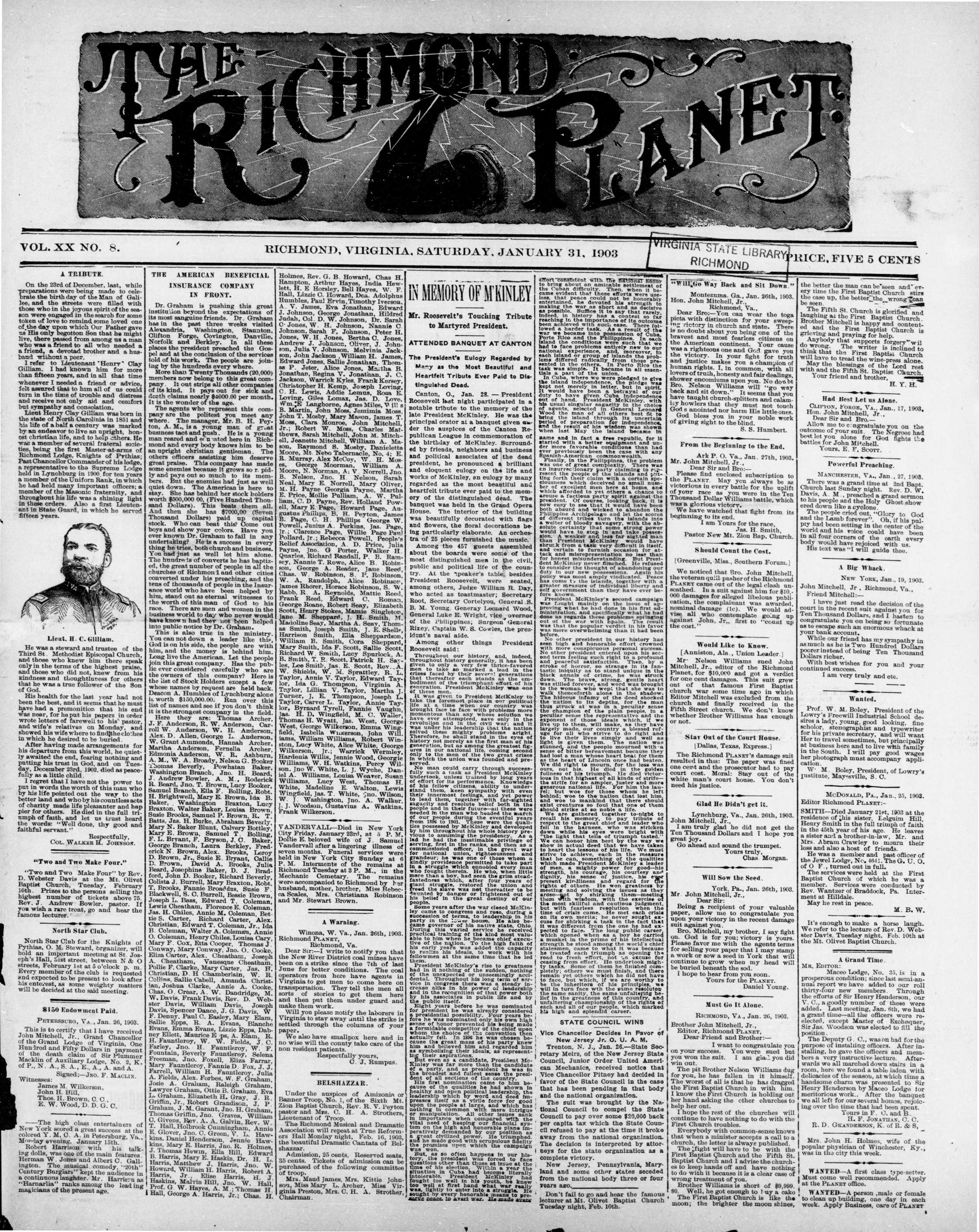
A TRIBUTE.
On the 23rd of December, last, while preparations were being made to celebrate the birth day of the Man of Galilee, and the streets were filled with those who in the joyous spirit of the season were engaged in the search for some token of love to remind some loved one of the day upon which Our Father gave us His only begotton Son that he might live, there passed from among us a man who was a friend to all who needed a brother and a husband without a peer. I refer to Lientenant 'Henry' Clay Gilliam. I had known him for more than fifteen years, and in all that time whenever I needed a friend or advice, felt assured that to him all of us could turn in the time of trouble and distress and receive not only aid and comfort but sympathy and consolation.
Lient Henry Clay Gilliam was born in the state of North Carolina in 1851 and his life of a half a century was marked by an endeavor to live an upright, honest Christian life, and to help others. He was a member of several fraternal societies, being the first Master-at-arms of Richmond Lodge, Knights of Pythias; Past Chancellor Commander of his lodge, a representative to the Supreme Lodge held in Lynchburg in 1900 for ten years a member of the Uniform Rank, in which he had held many important officers; a member of the Masonic fraternity, and throughout his life was a shining light in these orders. Also a first Lieutenant in State Guard, in which he served fifteen years.
Lieut. H. C. Gilliam.
He was a steward and trustee of the Third St. Methodist Episcopal Church, and those who knew him there speak only in the terms of the highest praise, and those who did not, knew from his kindness and thoughtfulness for others that he was a true follower of the Son of God.
His health for the last year had not been the best, and it seems that he must have had a premonition that his end was near, for he put his papers in order wrote letters of farewell to his pastor, and wife's relatives on Monday, and showed his wife where to find the clothes in which he desired to be buried.
After having made arrangements for his departure from this world, he quietly awaited the end, fearing nothing and putting his trust in God, and on Tuesday, December 23rd, 1902, died as peacefully as a little child.
I regret that I have not the power to put in words the worth of this man who by his life pointed out the way to the better land and who by his countless acts of charity made life pleasanter and hap pier for others. He died in the full triumph of faith, and let us trust heard the words: "Well done, thy good and faithful servant."
Respectfully,
COL. WALKER H. JOHNSON.
"Two and Two Make Four."
"Two and Two Make Four" by Rev. D. Webster Davis at the Mt. Olivet Baptist Church, Tuesday, February 10th. Prizes to the persons selling the highest number of tickets above 75. Rev. J. Andrew Bowler, pastor. If you wish a rare treat, go and hear the famous lecturer.
North Star Club.
North Star Club for the Knights of Pythias, O. M. Steward, organizer, will hold an important meeting at St. Joseph's Hall, 51st street, between N & O streets, February 1st at 5 o'clock p. m. Every member of the club is requested and expected to be present to look after his interest, as some weighty matters will be decided at the said meeting.
$150 Endowment Paid
PETERSBURG, VA., Jan. 26, 1908.
This is to certify that I have received John Mitchell, Jr., Grand Chancellor of the Grand Lodge of Virginia, One Hundred and Fifty Dollars in payment of the death claim of Sir Plummer Macklin of Auxiliary Lodge, No. 2, K. of P., N. A., S. A., E., A. and A. Signed—JNO. F. MACLIN.
Witnesses:
James M. Wilkerson,
John H. Hill,
Thos. H. Brown, C. C.,
E. W. Wood, D. D. G. C.
The high class entertainers of New York scored a great success at the colored Y. M. C. in Petersburg, Va., Monday evening, January 15th.
Robert Harrison with his talking dolls, was one of the main features. Herman W. Jones and Albert C. Gallington. The musical comedy, "20th Century Burgians" kept the audience in a continuous laughter. Mr. Harrison as "Harnarlia" ranks among the leading magicians of the present age.
THE AMERICAN BENEFICIAL INSURANCE COMPANY IN FRONT.
Dr. Graham is pushing this great institution beyond the expectations of its most sanguine friends. Dr. Graham has in the past three weeks visited Alexandria, Washington, Staunton, Clifton Forge, Covington, Danville, Norfolk and Berkley. In all these places the president preached the Gospel and at the conclusion of the services told of his work. The people are joining by the hundreds every where. More than Twenty Thousands (20,000) members of the great company Is out stripe all other of its kind. It pays out for sick and death claims nearly $4000.00 per month. It is the wonder of the age.
The agents who represent this company are the politest you meet any where. The manager, Mr.B.H. Perton, A.M., is a young man of great business tact and push. He is a young man reared and educated here in Richmond and every body knows him to be an upright christian gentleman. The others officers assisting him deserve great praise. This company has made some enemies because it grows so r. piddy and pays out so much to its members. But the enemies had just as well quiet down. The American is here to stay. She has behind her stock holders worth $500,000,000. (Five Hundred Thousand Dollars). This beats them all. And then she has $7000,000. (Seven Thousand Dollars) paid up capital stock. Who can beat this? Come out boys to show your colors. Have you known Mr. Richmond to fail in any undertaking? He is a success in every thing he tries, both in business and business. You had just as well be alone. The hundre is of converts he has embarked, the great number of people in all the churches of Richmond and other cities converted under his preaching, and the tens of thousands of people in the insurance world who have been helped by him, stand out as eternal witnesses to the worth of this man of God to his race. There are men and women in the business world to day who never would have known had they not been helped into public notice by Dr. Graham.
This is also true in the ministry.
You can not down a leader like this,
God is on his side, the people are with
him, and the money is behind him.
Long live the American. Let the people
join this great company. Has the public
ever considered carefully who are
the owners of this company? Here is
the list of Stock Holders except a few
whose names by request are held back.
Deacon A. Humbles of Lynchburg alone
is worth $150,000. Run over this
list of names and see if you don't think
it is the strongest company in the field.
RICHMOND, VIRGINIA, SATURDAY, JANUARY 31, 1903
Holmes, Rev. G. B. Howard, Chas H. Hampton, Arthur Hayes, India Hewlett, E. Horsley, Bell Hayes, W. F. Hall, Lizzie C. Howard, D. Adolphins Humbles, Paul Ervin, Timothy Iverson. A. V. James, Eva Jonathan, Judah J. Johnson, George Jonathan, Hilred Judah, Col. D. W. Johnson, Dr. Sarah C. Jones, W. H. Johnson, Nannia C. Johnson, Sarah F. Johnson, Peter H. Jones, W. H. Jones, Bertha C. Jones, Andrew J. Johnson, Oliver, J. Johnson, Julia V. Johnson, Melvinia Jackson, John Jackson William H. James, Edward Jones, Sallie Jonathan, Thomas P. Jeter, Alice Jones, Martha B. Jonathan, Regina V. Jonathan, J. C. Jackson, Warrick Kyles, Frank Kersley, Christopher H. Kemp, Joseph Loving, C. H. Lewis, Addie Lemus, Rosa E. Loving, Giles Lomax, Jas. D. Love, Wm. E' Langhorne, Agnes Miles, Will's B. Martin, John Moss, Jeminia Moss, T. Mosy, Mary Mason, James T. Moss, Clara Monroe, John Mitchell, Jr.; Robert W. Moss, Charles Matthews, Sarah Mitchell, John M. Mitchell, Jeanette Mitchell, William A. Mason, Raymond S. Mosby, Danielle Moore, M. Nebo Tabernacle, No. 4; E. R. Murray, Alex McCoy, W. H. Moses, George Moorman, William A. Moore, N. Norman, A: V. Norrell, Jno B. Nelson, Jno. H. Nelson, Sarah Neal, Mary E. Norrell, Mary Oliver, M. H. Payne Georgia Payne, Martha E. Price, Mollie Pulliam, A. W. Pulliam, C. D. Payne, Rev. Holland Powell, Mary E. Page, Howard Page, Augustus Phillips, B. H. Peyton, James B. Page, C. H. Phillips George W. Powell, junius A. Perkins, Jas. Page, Jr.; Clarence Page, Willie Page Paul Pollard, Jr.; Rebecca Powell, People's Relief Association, A. D. Price, Julia Payne, Jno. G. Porter, Walker H. Quaries, Richard Randall, P. B. Ramsie, Nannie T. Rowe, Alice B. Robinson, George A. Reader, Jane Reed, Was. W. Robinet, S. P. Robinet, R. Randolph, Alice Robinson, James Rhorse, Horace Robinson, S. W. Rabb, R. A. Reynolds, Mattie Reck, Frank Reed, Edward C. Roman, George Roane, Robert Seay, Elizabeth Scott, Henry Stokes, Jamie Singleton, Jane M. Sheppard, S. S. Robinet, M. Maioline Smith, Martha A. Seam, Thomas Smith, Joseph Smith, E. J. Shells, Harrison Smith, Ela J. Sheppard, William B. Smith, Cora Sheppard, Mary Smith, Ida F. Scott, Scott, Richard W. Smith, Lucy Spurlock, B. Smith, T. R. Scott, Patrick H. Saves, Lee Smith, Jas. E. Scott, Rey A. W. Shields, W. M. Sprattley, R. T. Laylor, Annie V. Taylor, Edward T. Laylor, J. E. Thompson, Joseph T. Laylor, Carver L. Taylor, Annie Taylor, Byrnda Tyrrell, Fannie Vangn, Jas. H. D. Wingfield, M. C. Wailer, Thomas H. Wyatt,jas. West, George West, George Wilkerson, Emma Wingfield, Isabella Wingerson, John Williams, William Williams, Robert Winston, Lucy White, Alice White, George Wilkerson, Jr.; Warrick Wermley, Hardenia Willis, W. H. Watkins, Percy Wilson, Jno W. White, L. J. Wyche, Daniel A. Williams, Louisa Weaver, Susan Williams, Lucy West, Thomas H. White, Madeline E. Walton, Lewis Wingfield, Jas. T. White, jno Wilson, W. J. Washington, Jno. A. Walker, J. J. Woodson, Gustavius A. Watkins, Frank Wilkerson.
---
VANDERVALL—Died in New York City Friday. January 23rd, at 5 P. M. Dollie E. beloved wife of J. Samuel Vandervall after a lingering illness of seven months. Funeral services were held in New York City Sunday at 6 P. M. Interments of the remains at Richmond Tuesday at 3 P. M., in the Mechanic Cemetery. The remains were accompanied to Richmond by her husband, mother, brother, Miss Rebecca Scales, Mrs. Christiana Robinson and Mr. Stewart Brown.
A Warning
Winona, W. Va., Jan. 26th, 1903.
Richmond PLANET,
Richmond, Va.
Dear Sir: I write to notify you that the New River District coal mines have been on a strike since the 7th of last June for better conditions. The coal operators from here have agents in Virginia to get men to come here on transportation. They tell the men all sorts of stories to get them here and then put them under guard and make them work.
Will you please notify the laborers in Virginia to stay away until the strike is settled through the columns of your paper.
We also have smallpox here and in no wise will the county take care of the non resident patients.
Respectfully yours,
C. J. Rumpus.
BELSHAZZAR
Under the auspices of Amizonia or Banner Troop, No.1, of the Sixth Mt. Zion Baptist Church, Rev. R. V. Peyton pastor and Mrs. C. H. A. Strothers, Lieutenant of Troop. The Richmond Musical and Dramatic Association will repeat at True Reformers Hall Monday night, Feb. 16, 1903, the beautiful Dramatic Cantata of Belshazzar. Admission, 25 cents, Reserved seats, 35 cents. Tickets of admission can be purchased of the following committee of troop. Mrs. Maud James, Mrs. Kittie Johnson, Miss Mary L. Archer, Miss Virginia Preston, Mrs. C. H. A. Strother, Chairman.
IN MEMORY OF M'KINLEY
IN MEMORY OF M'KINLEY
Mr. Roosevelt's Touching Tribute to Martyred President.
ATTENDED BANQUET AT CANTON
The President's Eulogy Regarded by Many as the Most Beautiful and Heartfelt Tribute Ever Paid to Distinguished Dead.
Canton, O., Jan. 28. — President Roosevelt last night participated in a notable tribute to the memory of the late President McKinley. He was the principal orator at a banquet given under the auspices of the Canton Republican League in commemoration of the birthday of McKinley. Surrounded by friends, neighbors and business and political associates of the dead president, he pronounced a brilliant and eloquent eulogy on the life and works of McKinley, an eulogy by many regarded as the most beautiful and heartfelt tribute ever paid to the memory of the distinguished dead. The banquet was held in the Grand Opera House. The interior of the building was beautifully decorated with flags and flowers, the floral decorations being particularly elaborate. An orchestra of 25 pieces furnished the music.
Among the 457 guests assembled about the boards were some of the most distinguished men in the civil, public and political life of the country. At the speaker's table, besides President Roosevelt, were seated, among others, Judge William R. Day, who acted as toastmaster; Secretary Root, Secretary Cortelyou, General S. B. M. Young, Generay Leonard Wood, General Luke E. Wright, vice overnor of the Philippines; Surgeon General Rixey, Captain W. S. Cowles, the president's naval aide.
Among other things President Roosevelt said:
Throughout our history, and, indeed, throughout history generally, it has been given to only a very few thrice-favored men to take so marked a lead in the war that thereafter each stands as the embodiment of the triumphant effort of his generation. President McKinley was one
It was given to President McKinley to take the foremost place in our political history. The country was brought face to face with pro-immigration momentous than any whose solution we have ever attempted, save only in the past. The nation was under his leadership that the nation solved these mighty problems aright. Therefore, he shall stand in the eyes of the nation, and in the eyes of the generation, but as among the greatest figures in our national life, coming second only to the men of the two great crises when the union was founded and preserved.
No man could carry through successfully such a task as President McKinley wanted, or effort for its performance. Knowledge of his fellow citizens, ability to understand and resolve belief both in the people and in the man, was needed in the man who headed the march of our people during the eventful years possessed by McKinley and developed by him throughout his whole history predeceased him. He had the inestimable privilege of serving, first in the ranks, and then as a commissioned officer, in the great war grandeur; he was one of those whom a kindly providence permitted to take part in who fought therein. He who, when little more than a boy, had seen the grim steadfast giant struggle, restored the union and freed the slave was not thereafter to be punished by danger or frightened out of his belief in the great destiny of our people.
Some years after the war closed McKinley came to congress and rose, during a period of great turmoil, to party in the Lower house. He also became governor of his native state, Ohio. He was also practical training of the kind most valuable to him when he became chief executive of the state. His early years was added the capacity to realize his ideals, to work with his fellowmen at the same time that he led them. President McKinley's rise to greatness had in it nothing of the sudden, nothing of the sudden power of leadership and in the recognition of his ability by his associates in public life and by the public itself. Before he was nominated for president he was already considered a presidential possibility. Four years before he was nominated, because of honor prevented his being made a formidable competitor of the chief upon whom the choice of the convention then rested, he became a party ideal, as representing their aspirations.
But even as a candidate, President McKinley was far more than the candidate in the broadest and fullest president he was in the broadest and fullest president of all sections of the country. His first nomination came to him because of qualifications he had shown in health and office experience and leadership which by word and deed impresses itself as a vilile force for good upon the people at large and which has the need to keep our financial system on the upright and peratively demanded by our position as a great civilized power. He triumphed, and he made good with scrupulous fidelity and persistence upon which the campaign was won.
But, as so often happens in our histories, the president was forced to face the challenge of a new time of his election. Within a year the situation in Cuba had become literally too difficult. Dickinley had fought too well in his youth to too well at first hand what war really was, lightly to enter into a struggle. He was prepared to preserve peace in a vast war. He
effort consistent with the national honor to bring about an amicable settlement of the Cuban difficulty. Then, when it became evident that these efforts were useless, that peace could not be honorably entertained, he devoted his strength to making the war as short and as decisive as possible. Suffice it to say that rarely, indeed, in history has a contest so far reaching in the importance of its outcome been achieved with such ease. There followed a harder task. As a result of the war we became into possession of Cuba, Porto Rico and the Philippines. In each island the conditions were such that we had to face problems entirely new to our national experience, and, moreover, in each island or group of islands the problems differed radically from those presented in the others. In Porto Rico the task was simple. It became in all essentials a part of the union.
In Cuba, where we were pledged to give the island independence, the pledge was that it would have been a betrayal spirit. It would have been a betrayal spirit. It would have given Cuba independence out of hand. President McKinley, with a choice of agents, selected in General Law Wood the man of all others best fit to bring the island through its uncertain independence, and the result of his wisdom, when last May the island became in name and in fact a free republic, for it started with a better equipment and under more favorable conditions than had any Spanish-American commonwealth.
Finally, in the Philippines, the problem was with the complex. There was an inexperienced cleric. There was an inexperienced cleric. Resent the people of the islands and putting forth their claim with a certain specimen, which afforded to yet others a chance to be president. Of course, looking back, it is now easy to see that it would have been absurd and wicked to abandon the Philippine president of different tribes turn the islands into a welter of bloody savagery, with the absurd and wicked would have to step in and take possession. A weaker and less far sighted man president McKinley would have shrunk the population and certain to furnish occasion for attack and misrepresentation no less than the president McKinley never finched. He refused to consider the thought of abandoning our policy in our new possessions. Again his policy has come to t) the islands, together with a greater measure of individual liberty and commitment than they have ever before known.
President McKinley's second campaign aimed at proving what he had done in his first administration, and specifically what he had done in the war with the Philippines, springing out of the war with Spain. He was that the popular verdict in his favor was more overwhelming than it had been before.
No other president in our history has seen high and honorable effort crowned with more conspicuous personal success. No other president entered upon his second term feeling such right to a profound and peaceful satisfaction. Then, by the work of his change in the law of the tactic inquiry as to stand unique in the black annals of crime, he was struck down. The brave, strong, gentle heart was stilled forever, and word was brought to the woman who wept that she was to walk thenceforth alone in the shadow of the night. He was the man who had the power to be the man thus struck at was in a peculiar sense the champion of the plain people, in a peculiar sense the representative and the exponent of those ideals which, if we live up to them, will make, as they have largely made, our country a blessed refinement. He was the man who did not live for their lives simply and well as light is given them. The nation was stunned, and the people mourned with a sense of bitter bereavement because they had lost a man whose heart beat for them as the heart of Lincoln once had beaten. He did light the more for the loss of our own life. He died in the golden fullness of his triumph. He died victorious in that highest of all kinds of strife—the strife for an amplifier, juster and more generous national life. For him the laurel; but woe for those whom he left behind; woe to the nation that lost him. He died in the night of the last of all that exist creatures so foul that one of them should strike at so noble a life.
We are gathered together to nought to recall his memory, to pay tribute of respect to the great chief and leader who led us through the war, to the great success of the day while his eyes were bright with "the light that tells of triumph tasted." We can honor him best by the way we show in actual deed that we have taken the lead of him, and that we have taken strive to achieve, each in the measure that he can, something of the qualities which made President McKinley a leader of men, a mighty power for good-his own, a mighty power for his own dignity, his sense of justice, his eyes present kindness and regard for the rights of others. He won greatness by meeting and solving the issues as they were, and that he was the only man who, with wisdom, with the exercise of the most skilful and cautious judgment, but with fearless resolution when the time of crisis came. He met each crisis with a heartfelt and heartfelt respect for his cause for shirking a task in the fact that it was different from the one he had expected to face. The long public career, which opened when as a boy he carried his way to the great strength he stood among the world's chief statesmen, came to what it was because he treated each triumph as opening the road to fresh effort, not to excuse for lack of strength, but to be contented with the tasks. Some of them he finished completely; others we must finish, and there remain yet others which he did not have to face, but which, if we are worthy to do so, we must be contented with the same resolution will in turn face with the same resolutely the same sanity, the same unfaltering belief in the greatness of this country, and unfaltering championship of the rights of others. We have much to look at, and we have much to do with this.
STATE COUNCIL WINS
Vice Chancellor Decides In Favor of New Jersey Jr. O. U. A. M.
Trenton, N. J., Jan. 26.—State Secretary Meirs, of the New Jersey State Council, Junior Order United American Mechanics, received notice that Vice Chancellor Pitney had decided in favor of the State Council in the case that has been pending in that body and the national organization.
The suit was brought by the National Council to compel the State Council to pay over some $20,000 back per capita tax which the State Council refused to pay at the time it broke away from the national organization.
The decision is interpreted by attorneys for the state organization as a complete victory.
New Jersey, Pennsylvania, Maryland and some other states seceded from the national body three or four years ago.
Don't fail to go and hear the famous lecturer at Mt. Olivet Baptist Church Tuesday night. Feb. 10th.
"Will Go Way Back and Sit Down."
Montezuma, Ga., Jan. 26th, 1903.
Hon. John Mitchell, Jr.,
Richmond, Va.,
Dear Bro:—You can wear the toga
picta with distinction for your sweeping
victory in church and state. There
is no doubt about you being one of the
bravest and most fearless citizens on
the American continent. Your cause
was a righteous one and God gave you
the victory. In your fight for truth
and justice makes you a champion of
human rights, in common, with all
lovers of truth, honesty and fair dealings,
shower encomium upon you. No doubt
Bro. Nelson William will go way
back and sit down." It seems that you
have taught church-splitters and calamity
howlers that they must not touch
God's anointed nor harm His little one.
God bless you in your noble work
of giving sight to the blind.
S. S. Humbert.
From the Beginning to the End
Ark P. O. Va., Jan. 27th, 1903.
Mr. John Mitchell, Jr.
Dear Sir and Bro:
Please find enclosed subscription to the PLANET. May you always be as victorious in every battle for the uplift of your son as you were in the Ten Thousand Dollars Williams battle, which was a glorious victory.
We have watched that fight from its beginning to its end.
Should Count the Cost.
[Greenville, Miss., Southern Forum.]
We noticed that Bro. John Mitchell, the veteran quill pasher of the Richmond PLANET came out of the legal clash unscathed. In a suit against him for $10,000 damages for alleged libelous publication, the complaint was awarded, nominal damage (1c). We would advise all who contemplate going up against John, Jr., first to "count up the cost."
Would Like to Know.
[Amhston, Ala., Union Leader.]
Mr. Nelson Williams sued John Mitchell, Jr., editor of the Richmond Planet, for $10,000 and got a verdict for one cent damages. This suit grew out of that famous First Baptist church war some time ago in which Editor Mitchell was excluded from the church and finally received in the Fifth Street church. We don't know whether Brother Williams has enough or not.
The Richmond PLANET's damage suit resulted in this: The paper was fined one cent and the prosecutor had to pay court cost. Moral: Stay out of the white man's court house. You don't need his justice.
Glad He Didn't get it.
Lynchburg, Va., Jan. 26th, 1903.
John Mitchell, Jr.
I once glanced the did not get the
Ten Thousand Dollars and I hope you
great joy.
Go ahead and sound the trumpet
Will Sow the Seed
York, Pa., Jan. 26th, 1903.
Mr. John Mitchell, Jr.,
Dear Sir:
Being a recipient of your valuable paper, allow me to congratulate you upon your victory in the recent damage suit against you.
Bro. Mitchell, my brother, I say fight on. God is for you; victory is yours.
Please favor me with the agents terms for selling your paper that I may stamp a work or sow a seed in York that will continue to grow when my head will be buried beneath the sod.
Must Go It Alone
RICHMOND, VA., Jan. 26, 1903.
Brother John Mitchell, Jr., Editor, Richmond PLANET, Dear Friend and Brother:— I want to congratulate you on your success. You were sued but you won the suit. I am glad you did win out.
The pit Brother Nelson Williams dug for you, he has fallen in it himself. The worst of all is that he has dragged the First Baptist Church in with him. I know the First Church is holding out her hand asking the other churches to help her out.
I hope the rest of the churches will continue to have nothing to do with the First Church troubles.
Everybody with common-sense knows that when a minister accepts a call to a church, the letter is always published.
The fight will have to be with the First Baptist Church and the Fifth St. Baptist Church and I advise the churches to keep hands off and have nothing to do with it because it is a clear case of wrong treatment of you.
Brother Williams is short of $9,999.
99. Well, he got enough to buy a cake
The First Baptist Church is like the
moon; the brighter the moon shines.
the better the man can be seen and 'every time the First Baptist Church stirs the case up, the better the wrong can be seen.
The Fifth St. Church is glorified and laughing at the First Baptist Church. Brother Mitchell is happy and contented with the First Baptist Church is grieving and praying for help.
Anybody that supports forgery will do wrong. The writer is inclined to think that the First Baptist Church will have to tread the winnery alone.
May the blessings of the Lord rest with the Fifth St. Baptist Church. Your friend and brother,
H. Y. H.
CLIPTON, FORGE, VA., Jan., 17, 1903.
Hon. John Mitchell, Jr.
Dear Sir and Bro.—
Allow me to congratulate you on the
outcome of your suit. The Negroes had
best let you alone for God fights the
battles for John Mitchell.
Powerful Preaching.
MANCHESTER, VA., Jan. 27, 1908.
There was a grand time at 2nd Bapt. Church last Sunday night. Rev. D. W. Davis, A. M., preached a grand sermon to his people and the Holy Ghost show ered down like a cyclone.
The people cried out, "Glory to God and a Lamb forever." Oh, if his pulpy had been his face in the center of the world and his voice could have been in all four corners of the earth every body would have rejoiced with us.
His text was: "I will grieve."
A Big Whack
John Mitchell, Jr., Richmond, Va., Friend Mitchell:
I have just read the decision of the court in the recent suit against you for Ten Thousand Dollars, and I hasten to congratulate you on being so fortunate as to escape such an enormous wack at your bank account.
While our friend has my sympathy in as much as he is Two Hundred Dollars poorer instead of being Ten Thousand Dollars richer.
With best wishes for you and your continued success.
I am very truly and etc.
Prof. W. M. Boley, President of the Lowry's Willow Industrial School desires a lady, young, good looking, fine scholar, stenographist and typewriter for his private secretary, and will want Her to travel sometimes, but principally at business here and to live with family in the South. I will pay good wages her photograph must accompany application.
W. M. Boley, President, of Lowry's Institute, Maysville, S. C.
MCDONALD, PA., Jan., 25, 1903.
Editor Richmond PLANET:
SMITH—Died January 21st, 1903 at the residence of his sister, Leolignum Hill, Henry Smith in the full triumph of faith in the 45th year of his age. He leaves a sister and a brother-in-law, Mr. and Mrs. Abram Crawley to mourn their loss and also a host of friends.
He was a member and past officer of the Jewel Lodge, No. 4641. The G. U. O. of O F., turned out in full.
The services were held at the First Baptist Church of which he was a member. Services were conducted by Rev. Wantzer of Braddock, Pa. Interment at Hildale. May he rest in peace.
M. B. W.
It's enough to make a horse laugh.
We refer to the lecture of Rev. D. Webster Davis. Tuesday night. Feb. 10th at the Mt. Olivet Baptist Church.
A Grand Time
Maceo Lodge, No. 35, is in a prosperous condition; since last semi-annual report we have added to our roll thirty-four new members. Through the efforts of Sir Henry Henderson, our V.C., a goodly number of these were added. Last meeting, Jan. 6th, we had a grand time—all the officers were reelected, except Master of Exchequer, Sir Jas. Woodson was elected to fill the position.
The Deputy G. C., was on hand for the purpose of installing officers. After installing, he gave the officers and members a very instructive lecture. Afterwards we all marched down stairs in a rowman's room, found a table laden with delicacies of the museum, at which time a handsome charn was presented to Sir Henry Henderson by Maceo Lodge or meritorious work. After the banquet we all left for our several homas, rojoining over the time that had been spent.
Yours in F. C. and B.
H. F. JONATHAN, C. C.
R. D. GKANDERSON, K. of R. & S.
Mrs. John H. Holmes, wife of the popular physician of Winchester, Ky., was in the city this week.
WANTED—A first class type-setter. Must come well recommended. Apply at the PLANET office.
WANTED—A person, male or female to clean up building, one day in each week. Apply Business, care of PLANET
eet Peas 1 peer ne ee eee eT
clude the winter coat. For anyone
who would get out of doors the win-
ter coat isa necessity. For those who
cannot afford them furs may be left
out of the winter's consideration.
They are not among the abso-
lute necessities of life. The mother
with little daughters must think
also of not only her own coat
out for like warm garments for
her daughters. Health, if nothing
aise, demands that the children be out
of doors in the keen winter air, but
they must be warmly clad, and it is
their desire also to be prettily clad.
Both considerations are easily met
this winter for the woman who
neither desires nor can afford any lav-
ish expenditure for clothes. In fact
t would seem that the designers of
our fashions for children had special-
ly in mind the great middle class when
they were at work upon the winter
modes. A few dollars will buy both a
serviceable and dainty coat of which
20 girl need feel ashamed.
| The straight coat, coming down to
the shoe tops, and made with single,
double and triple capes, are the popu-
jar modes. In fect they are about the
: .,* more popular this winter
than for several past sea-
sons, The reason may
probably be found in the
fact that they are more
feminine. Say what you will, the
great majority of women prefer the
distinetly feminine garment. The
fad of the moment sometimes carries
them away from this mode, but they
are sure to return to it after a short
time, more enthusiastic over its
charms than ever before. So it has
been with the tailor-made, the fur-
ther it got away from the feminine
the less its popularity, and so soon ay
ite feminine features began returning
its old-time popularity began to be in
evidence. The tailor-made gown of
the winter is a strietly feminine gar-
ment. It has lost both the stiffness
and plainness that tended to make it
masculine.
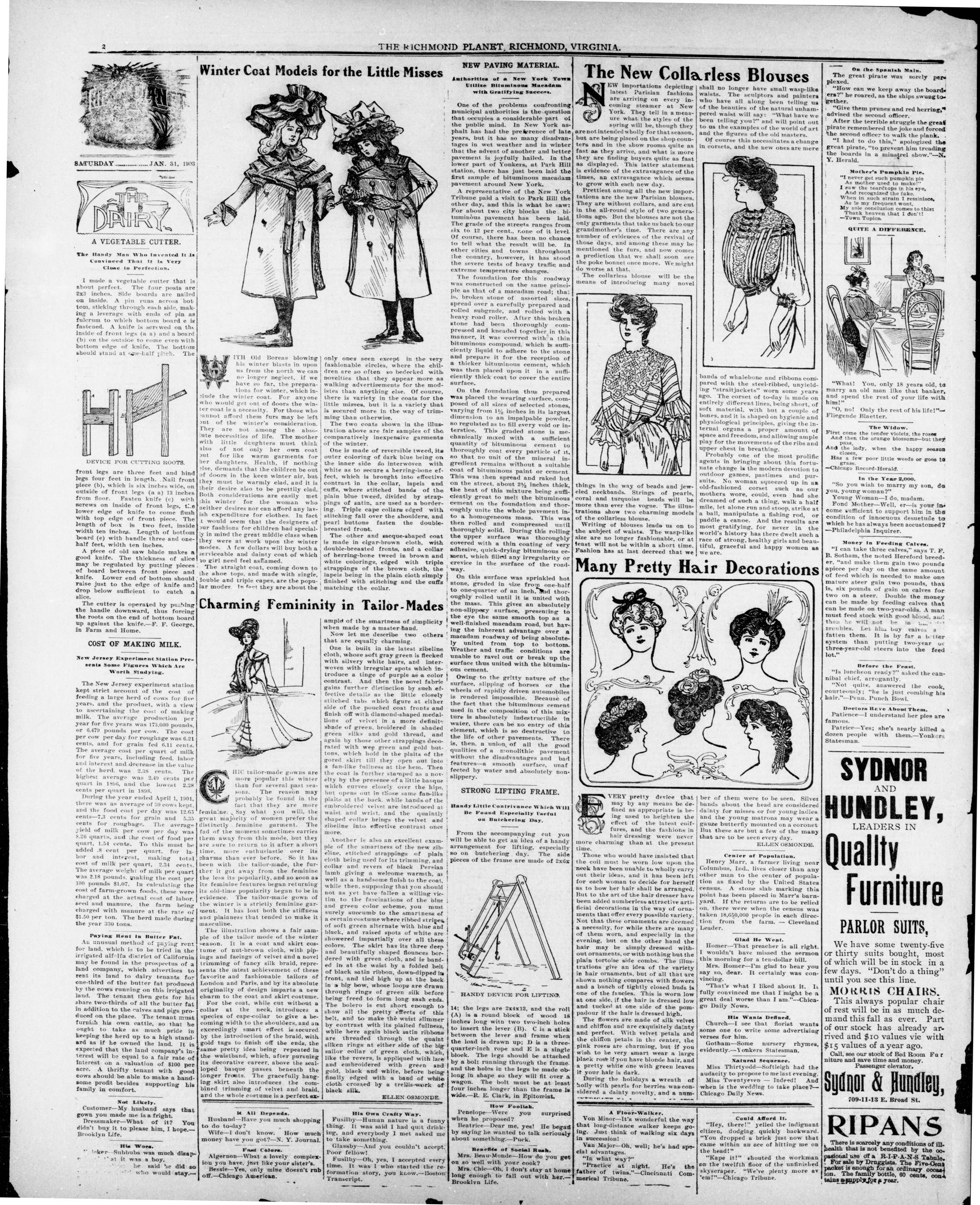
‘The illustration shows a fair sam-
ple of the tailor mode of the winter
season. It is a coat and skirt cos-
tume of nut-brown cloth, with pip-
ings and facings of velvet and a novel
trimming of fancy silk braid, repre-
sents the iatest achievement of these
favorite and fashionable tailors of
London and Paris, and by its absolute
originality of design imparts a new
charm to the coat and skirt costume.
For the coat, while cut witbout a
collar at the neck, introduces a
species of cape-collar to give a be-
coming width to the shoulders, and an
exceedingly smart effect is secured
by the introduction of the braid, with
gold tags to finish off the ends, the
same pretty idea being repeated in
the waistband, which, after pursuing
its decorative career, above the seal-
loped basque passes beneath the
longer fronts. The gracefully hang-
ing skirt also introduces the com-
bined trimming of velvet and braid,
and the whole costume is a perfect ax.
2
eee
SESW es
Nee - a
een ee
Tig vc TNs
gue ay
BS Sot: NR
BRS Fe ARS
pat i AN
BATURDAY seeccen JAN. Bt, 1908
i
—
are SN
a ji Bb \
DY E2s7
DRURY. \
A VEGETABLE ‘CUTTER. i.
Ene Bacay: ead Whe ieyecion thas
IT made a vegetable cutter that is
shout paclesees The teas oats are
2x3 inches. Side boards are nailed
on inside. A pin runs across bot
tom, sticking through each side, mak-
ing a leverage with ends of pin as
fulerum to whieh bottom board e is
fastened. A knife is serewed on the
inside of front legs (a a) and a board
(b) on the ontsice to come even with
bottom edge of knife, The bottom
should stand at mie-half pitch. The
i TG VY) AL e
i Yj Les Z
a eo
ee |Z
HOw
Hl OWE H
H| i
i EU i}
front legs are three feet and hind
legs four feet in length. . Nail front
piece (b), which ix six inches wide, on
outside of front legs (a a) 13 inches
from floor. Fasten knife (c) with
screws on inside of front legs, tie
lower edge of knife to come flush
with top edge of front piece. ‘The
length of box is two feet, inside
Width ten inches. Length of bottom
beard (e) with handle three and one-
half feet, width ten inches,
A piece of old saw blade makes a
good knife, The thickness of slice
may be regulated by putting pieces
of board between front piece and
knife. Lower end of bottom should
raise just to the edge of knife ané
drop below sufficient to catch a
slice.
The cutter is operated by pushing
the handle downward, thus forcing
the roots on the end of bottom board
‘up against the knife—F. F. George,
in Farm and Home.
COST OF MAKING MILK.
New Jersey Experiment Station Pre-
nents Some Figures Which Are
‘Worth Stedying.
The New Jersey experiment station
kept strict account of the cost of
feeding a large herd of cows for five
years, and the produet, with a view
io ascertaining the cost of making
milk, The average production — per
year for five years was 173,000 pounds,
or 6479 pounds per cow. The cost
per cow per day for roughage was 6.21
cents, and for grain fed 6.11 cents
The average cost per quart of milk
for five years, including feed, labor
and interest and decrease in the value
of the herd, was 238 cents. ‘The
Righest average was 249 cents per
quact in 1896, and the lowest 2.98
cents per quart in 1898,
During the year ended April 1, 1901,
there was ax average of 20 cows kept
and the food cost per day was 12.63
eents—T.3 cents for grain and 5.2!
cents for roughage. The averages
yield of milk per cow per day was
£26 quarts, and the cost of food per
quart, 1.54 cents. To this must be
added 8 cent per quart, for ta.
vor and intezest, making — total
cost of milk per quart, 2.34 cents:
‘The average weight of milk per quart
was 2.18 pounds. yaking the cost per
300 pounds $1.07, In calculating the
cost of farm-grown foods, these were
charged at the actual cost of labor,
seed and manure, the farm being
charged with manure at the rate oi
$1.50 per ton. ‘The herd made during
the year 330 tons.
avium Sede ba. dias
An unusual method of paying rent
for land, which is to be tried in the
irrigated alfvlfa district of California
may be found in the prospectus of a
land company, which advertises to
rent its land to dairy tenants for
one-third of the butter fat prodneed
hy the cows running on this irrigated
land, The tenant then gets for his
share two-thirds of all the butter fat
in addition to the calves and pigs pro-
duced on the place. The tenant must
furnish his own cattle, so that he
ought to take as much pride in
keeping the herd up to a high stand-
ard as if he owned the land. It is
expected that the land company’s in-
terest will ke equal to a fair rate of
interest on a valuation of $100 per
acre. A thrifty tenant with good
cows should be able to make a hand-
some profit besides supporting his
family in comfort.
Not Likely.
Customer—My husband seys that
gown you made me isa fright,
Dressmaker—What of it? You
didn't buy it to’please him, I hope.—
Brooklyn Life.
Hle Woes.
" \cker-Subbubs was much disap-
at ft was. a boy,
he said Ye did so
“who would (stay
Winter Coat Modeis for the Little Misses
JF i\¢ AS \
or See
yy) toa S 8
Je; . 5
Se Re
ee a NN
Ps Ne Sr wt,
AS | OP Re
aT Te
Als hi | a \ "i
9 i | v \q j
/ j, TN i \\ \
LAT ES
Sen — AS
s — 4 Fs 3 A
Charming Femininity in Tailor-Mades
ITH Old Boreas blowing
his winter blasts in upon
us from the north we can
no longer neglect, if we
have so far, the prepara-
w-AJ
“WW
SS |
aS $3
(i
“A \.
m AU Depends.
Husband—Have you much shopping
to do to-day? %
Wife—I don't know. " How much
money have you got?—N. Y. Journal.
Frat Colora.
Algernon—-What a lovely complex.
fon you have, just Tike your sister's.
Bessie—Yes, only mine doesn’t rab
| off:— Chisago Ameriean:
THE RICHMOND PLANET, RICHMOND, VIRGINIA.
a * a
only ones seen except in the very
fashionable circles, where the chil-
dren are so often so bedecked with
novelties that they appear more as
walking advertisements for the mod-
istes than anything else. Of course,
there is variety in the coats for the
little misses, but it is a variety that
Js wecured more in the way of trim-
ming than otherwise.
The two coats shown in the illus
tration above are fair samples of the
comparatively inexpensive garments
of the winter,
One is made of reversible tweed, its
outer coloring of dark blue being on
the inner side So interwoven with
white as to secure a herring-bone ef-
fect, which is brought into effective
contrast in the collar, lapels and
cuffs, where stitched bands of the
plain blue tweed, divided by strap-
pings of satin, are used as a border-
ing. Triple cape collars edged with
stitching fall over the shoulders, and
pearl buttons fasten the double-
breasted front.
‘The other and sacque-shaped coat
is made in cigarbrown cloth, with
double-breasted fronts, and a collar
of herring-bone tweed in brown and
white colorings, edged with triple
strappings of the brown cloth, the
lapels being in the plain cloth simply
finished with stitching and the cuffs
matebing the. collar.
ampl¢ of the smartness of simplicity
when made by a master hand.
Now let me describe two others
that are equally charming.
One is built in the latest zibeline
cloth, whose soft gray green is flecked
with silvery white hairs, and inter-
woven with irregular spots which in-
troduce a tinge of purple as a color
contrast. And then the novel fabric
gains further distinction by such ef-
fective details ax the little closely
stitched tabs which figure at either
side of the pouched coat fronts and
finish off with diamond-shaped medal-
lions of velvet in a more definit.
shade of green, broidered in shaded
green silks and gold thread, and
again by those other strappings deco-
rated with weg green and gold but-
tons, which hold in the plaits of the
gored skirt till they open out into
a fan-like fullness at the hem. ‘Then
the coat is further stamped as a nov-
elty by the presence of a little basque
Which curves closely over the hips,
but opens out in tose same fanlike
plaits at the back. while bands of the
embroidered velvet are introduced at
waist and wrist, and the quaintly
shaped collar brings the velvet and
zibeline into effective contrast once
more.
Another is also an excellent exam-
ple of the smartness of the new zib-
cline, stitched strappings of plain
eloth being used for its trimming, and
collar and revers of black Persian
lamb giving a welcome warmth, as
well as a handsome finish to the coat,
while then, supposing that you should
not as yet have fallen a willing wie-
im to the fascinations of the blue
and green color scheme, you must
surely succumb to the smartness of
a ceriain costume where ribbed stripes
of soft green alternate with blue and
black, and raised apots of white are
showered impartially over all these
colors, The skirt has its three deep
and beautifully shaped flounces bor-
dered with green cloth, and is band-
ed in at the waist by a folded belt
of black satin ribbon, down-dipped in
front, and tied high up at the back
in @ big bow, whose loops are drawn
through rings of green silk before
being freed to form long sash ends.
The bolero is eut short enongh to
show all the pretty effects of this
belt, and to make thé waist slimmer
by contrast with its plaited fullness,
while here again black satin ribbons
are threaded through the quaint
silken rings at either side of the big
sailor collar of green cloth, which,
like the revers, fs appliqued with lace
and embroidered with green and
gold, black and white, before being
finally edged with a band of white
cloth crossed by a trellis-work of
black silk,
_ ‘ELLEN OSMONDE.
His Own Cratty Way.
Fusilby—Human nature is a funny
thing. It was said I had quit drink.
ing, and everybody 1 met asked me
to take something.
Glassby—And you couldn't accept
Poor fellow!
Fusilby—Oh, yes, I accepted every
time. It was I wito started the ré-
formation story, you know.—Doston
Transcript.
3 ee ee Cee: ene
arenotintended wholly for that season,
but are being placed on the shop coun-
ters and in the show rooms quite as
fast as they arrive, and what is more
they are finding buyers quite as fast
as displayed. This latter statement
is evidence of the extravagance of the
times, an extravagance which seems
to grow with euch new day.
Prettiest among all the new impor-
tations are the new Parisian blouses,
They are without collars, and are cut
in the all-round style of two genera-
tions ago. But the blouses are not the
only garments that take us back to our
grandmother's time. There are any
number of evidences of the revival of
those days, and among these may be
mentioned the furs, and now comes
a prediction that we shall soon see
the poke bonnet once more. We might
do worse at that.
The collarless blouse will be the
means of introducing many novel
things in the way of beads and jew-
eled neckbands. Strings of pearls,
coral and turquoise beads will be
more than ever the vogue. The illus-
trations show two charming models
of the collariess blouse.
Writing of blouses leads us on to
the subject of waists. The wasp-like
size are no longer fashionable, or at
feast will not be within a short time.
Fashion has at last decreed that we
Many Pretty Hair Decorations
NEEL fures, and the fashions in
hair dressing were never
more charming than at the present
time.
Those who would have insisted that
the coil must be worn low upon the
neck have been unable te wholly carry
out their ideas, and it has been left
for each woman to decide for herself
as to how her hair shall be arranged.
But to the art of the hair dresser have
been added numberlesy attractive arti-
ficial decorations in the way of orna-
ments that offer every possible variety.
Not that these ornaments are deemed
@ necessity, for while there are many
of them worn, and especially in the
evening, but on the other hand the
hair may be simply dressed with.
out ornaments, or with nothing but the
plain tortoise side combs. The illus-
trations give an idea of the variety
in hair ornaments, but of all that are
shown nothing compares with flowers
and a bunch of tightly closed buds is
‘one of the fancies. This is worn low
at one side, if the hair is dressed low
and tucked at one side of the pom-
padour if the hair is dressed high.
‘The flowers are made of silk velvet
and chiffon and are exquisitely dainty
and perfect. With velvet petals and
the chiffon petals in the center, the
pink roses are charming, but if you
wish to be very smart wear a large
plack rost if you haye blonde hair, and
a pretty white one with green leaves
it your hair is dark.
During the holidays a wreath of
holly with pearls for berries was con-
sidered a dainty novelty, and a num-
NEW PAVING MATERIAL.
Authorities of a New York Town
Utilize Bitaminows Mucadam
with Gretitying: Saceees.
One of the problems confronting
municipal authorities is the-question
that occupies a considerable part of
the public mind. In New York as-
phalt has had the preference of late
Years, but it has so many disadvan-
tages in wet weather and in winter
that the advent of another and better
pavement is joyfully hailed. In the
lower part of Yonkers, at Park Hill
station, there has just been laid the
first sample of bituminous macadam
pavement around New York.
A representative of the New York
Tribune paid a visit to Park Hill the
other day, and this is what he saw:
For about two city blocks the. bi-
tumindus pavement has been laid.
The grade of the streets ranges from
six to 12 per cent., rone of it level
Of conrse, there has been no chance
to tell what the result will be. In
other cities and towns throughout
the country, however, it has stood
the severe tests of heavy traffic and
extreme temperature changes.
The foundation for this roadway
Was constructed on the same princi-
ple as that of a macadam road; tha!
is, broken stone of assorted — sizes,
spread over a carefully prepared and
rolled subgrade, and rolled with a
heavy road roller. After this broken
stone had been thoroughly eom-
pressed and kneaded together, in this
Manner, it was covered witha thin
bituminous compound. which is sumi-
ciently liquid to adhere to the stone
and prepare it for the reception of
@ thicker bituminous cement, which
was then placed upon it in a suffi-
ciently thick coat to cover the entire
surface.
On the foundation thus prepared
was placed the wearing surface, com-
Posed of all sizes of selected stones,
varying from 1% inches in its largest
dimension to an impalpable powder,
So regulated as to fill every void or in-
terstice. This graded stone is me-
chanically mixed with a sufficient
quantity of bituminous cement to
thoroughly coat every particle of it,
so that no unit of the mineral in-
gredient remains without a suitable
coat of bituminous paint or cement
‘This was then spread and raked hot
‘on the street, about 2% inches thick,
the heat of this mixture being suffi.
ciently great to melt the bituminous
cement on the foundation and thor-
oughly unite the whole pavement in-
to a homogeneous mass. This was
then rolled and compressed until
thoroughly solid. During this rolling
the upper surface was thoroughly
covered with a thin coating of very
adhesive, quick-drying bituminous ce-
ment, which filled any irregularity or
crevice in the surface of the road-
way.
On this surface was sprinkled hot
stone, graded in size frosp one-half
to one-quarter of an inch, Yad thor-
oughly rolled until it is united with
the mass. This givee an absolutely
non-slippery surface, presenting to
the eye the same smooth top as a
well-finished macadam road, but hav-
ing the inherent advantage over a
macadam roadway of being absolute-
ly united from top to bottom.
Weather and traffic conditions are
unable to ravel out or break up the
surface thus united with the bitumin-
ous cement.
Owing to the gritty nature of the
surface, slipping of horses or the
wheels of rapidly driven automobiles
is rendered impossible. Because of
the fact that the bituminous cement
used in the composition of this mix-
ture is absolutely indestructible in
water, there can be no entry of this
element, which is so destructive (o
the life of other pavements. ‘There
is, then, a union of all the good
qualities of a monolithic pavement
without the disadvantages and bad
features—a smooth surface, unat
fected by water and absolutely non-
slippery.
STRONG LIFTING FRAME.
Mandy Little Conteivance Whien Win
Re Foand Kapeclally Uaetat
on Mutehering Day,
From the accompanying cut you
will be able to get an idea of a handy
arrangement for lifting, especially
so on butchering day. ‘The side
Pieces of the frame are made of 2x6x
Y
Tou)
=
p-/RY
A
4 /
hs /, \
Gort \
wf /- = 5
Xe Se \
ee
~ HANDY DEVICE FOR LIFTING.
14; the legs are 2x4x12, and the roll
(A) is a round block of wood 18
inches long witn two two-inch holes
to insert the lever (B). C is a stick
between the lever and frame when
the load is drawn up; D is a three-
quarter-inch rope and E is a single
block. The legs should be attached
by a bolt running through the frame.
and the holes in the legs be made ob-
long in shape so they will fit over a
wagon, The bolt must be at least
four inches longer than the frame is
wide—R. E. Clark, in Epitomist,
How Pooliah,
Penelope—Were you _ surprised
when he proposed?
Beatrice—Dear me, yes! He begat
by saying he wanted to talk seriously
about something.—Puck.
Renefite of Social Rash,
|. Mrs. Beau-Monde—How do you get
‘on 80 well with your cook?
| Mrs. Chic—Oh, I don’t, stay at home
long enough to fat out with her—
Brooklyn Life. J
The New Collarless Blouses
ff + om ee w , y
{ Ge oA) ‘Yt C )
fs) <a 7
x? Sf ‘ vs
J Hs ev |
Ace n9) gE (
yy eye ro eS 365 f < wy
/ pe : oe y g = Se
| ma = NG
| P Se > Ha
\ ees en i
aN
EW importations depicting
latest Parisian fashions
are arriving on every in-
coming steamer at New
York. They tell in a meas-
ure what the styles of the
DESRIA
KIO
ARPES
et
om)
VERY pretty device that
may by any means be de-
fined as appropriate is be-
ing used to heighten the
effect of the latest coif-
fures, and the fashions in
sures, and the fashions in
A Bloor-Walker.
Von Minor—It's wonderful the way
that long-distance walker keeps go-
ing. Just think of walking six days
in succession!
Van Major—Oh, well; he's had spe-
cial advantages.
“In what way?”
“Practice at night. He's the
father of twins.”—Cinciunati Com-
‘merical Tribune,
shal Bo longer have small wasp-like
waists. The sculptors and painters
who have all along been telling us
of the beauties of the natural unham-
pered waist will say: “What have we
been telling you?” and will point out
to us the examples of the world of art
and the figures of the old masters.
Of course this necessitates a change
im corsets, and the new ones are mere
eee Ay
ra
Sr
ae
eae |
Pa)
Hi
ee |
bands of whalebone and ribbons com-
Pared with the steel-ribbed, unyield-
ing “straitjackets” worn some years
ago. The corset of to-day is made on
entirely different lines, being short, of
soft material, with but a couple of
bones, and it is shaped on hygienic and
physiological principles, giving the in-
ternal organs a proper amount of
space and freedom, and allowing ample
play for the movements of the ribs and
upper chest in breathing.
Probably one of the most prolific
agents in bringing about this fortu-
nate change is the modern devotion to
outdoor games, pastimes and pur-
suits, No woman squeezed up in am
old-fashioned corset such as our
mothers wore, could, even had she
dreamed of such a thing, walk a half
mile, let alone run and stoop, strike at
a ball, manipulate a fishing rod, or
paddle a canoe. And the results are
most gratifying, for never in the
world’s history has there dwelt such a
race of strong, healthy girls and beau.
tiful, graceful and happy women as
Weare:
ber of them were to be seen. Silver
bands about the head are considered
dainty for misses or for young ladies
and the young matrons may wear a
gauze buiterfiy mounted on a coronet
But these are but a few of the many
that are to be seen every day.
ELLEN OSMONDE.
Center of Population.
Henry Marr, a farmer living near
Columbus, Ind. lives closer than any
other man to the center of popula-
tion as fixed by the United States
census, A stone slab marking this
point has been placed in Marr's barn-
yard. If the returns are to be relied
‘on, there were when the census was
taken 18,650,000 people in each diree-
tion from the farm. — Cleveland
Leader,
Glad He Went.
Homer—That preacher is all right.
I wouldn’t have missed the sermon
this morning for a ten-dollar bill.
Mrs. Homer—I'm glad to hear you
say so, dear. It certainly was con-
vineing.
“That's what I liked about it. 1.
fully convinced me that I' might be a
great deal worse than I am."—-Chica-
go Daily News.
His Wants Dedned,
Church—I see that florist wants
some one to write some advertising
verses for him.
Gotham—Some nursery rhymes,
evidently.—Yonkers Statesman,
Natural Sequence.
Miss Thirtyodd—Softleigh had the
audacity to propose to me last evening.
Miss Twentyeven — Indeed! And
when is the wedding to take place?—
Chicago Daily News.
Could Afford It.
“Hey, there!” yelled the indignant
citizen, dodging quickly backward.
“You dropped a brick just now that
came within an ace of hitting me on
the head!”
“Kape it!” shouted the workman
on the twelfth floor of the unfinished
skyscraper. “We've plenty more av
*em!"—Chicago Tribune.
ey. 08 the Spaninh Main.
The great pirate was sorely per
plexed.
“How can we keep away the boards
ers?” he roared, as the ships swung tow
gether.
\ “Give them prunes and red herring,"
advised the second officer.
' After the terrible struggle the great
pirate remembered the joke and forced
‘the second officer to walk the plank.
“I had to do this,” apologized the
great pirate, “to prevent him treading
the boards in a minsgrel show."—N.
Y¥. Herald.
Bisthes"s Meaekiiiel men,
“I never get such pumpkin pie
, At mother used to maker
I eaw the tcardiops tr his eve,
Ana recognized the fake,
When in such strain T reminisce,
‘As to my frequent wont,
My sole conclusion comes to this: |
‘Thank heaven that Toot! |
—Town Topica i
QUITE A DIFFERENCE.
ye C8
2 LK.
‘ et R=
( ASS | sq
\A Game Wy (aN
VA 7 AVEAN
Wee eee
\ Mast “eS
KN KS =
th We) E
My WAN =p
Mile \ GP
‘AA NA fl
WH Re . | |
|
“What! You, only 18 years old, te
marry an old man like that banker,
and Spend the rest of your life with
him!”
“O, no! Only the rest of his life!"—
Fliegende Blactter.
caus eames
First come the tender violets, the roses
Ang then the orange blossoms—but they,
‘Ana the iady, when the happy sceson
closes,
Has a f6w poor little weeds or eves ta
—Chitago Record-Herata.
In the Year 2,000.
“So you wish to marry my son, do
you, young woman?”
Young Woman—I do, madam.
Fond Mother—Well, er—is your ins
come sufficient to support him in thé
condition of innocuous desuetude to
which he has always been accustomed?
—Philadelphia Inquirer.
Money In Feeding Calves.
“I can take three calves,” says T. F.
B. Sotham, the noted Hereford breed=
er, “and make them gain two pounds
apiece per day on the same amount
of feed which is needed to make one
mature steer gain two pounds, that
is, six pounds of gain on calves for
two on a steer. Double the money
can be made by feeding calves that
can be made on two-year-olds, A man
must feed stock with good blood, aud
then he wil not be im tues
troubles. Let hita buy calves a
fatten them. It is by far a better
system than putting two-year oF
three-year-old steers into the feed
lot.”
Seba aa Teac
“Is luncheon ready?” asked the can-
nibal chief, arrogantly.
“Not quite, answered the cook,
courteously; “he is just combing his
hair."—Penn. Punch Bowl.
Doctors Reve About Them,
Patience—I understand her pies are
famous.
Patrice—Yes; she’s nearly killed a
dozen people ‘with them.—Yonkers
‘Statesman.
AND
LEADERS IN
F it lu [
PARLOR SUITS,
We have some twenty-five
or thirty suits bought, most
of which will be in stock in a
few days. “Don’t do a thing”
until you see this line.
MORRIS CHAIRS.
This always popular chair
of rest will be in as much de-
mand this fall as ever. Part
of our stock has already ar
rived and $10 values vie with
$15 values of a year ago.
Call, see our stock of Bed Room Far
nitare and save time and money.
Passenger elevator.
dydnor & Hundley,
7709-11-18 E. Broad St.
‘
| h — is ant eee ee id
ig I-P-A-
Pi ae by Drags, Toe Pipe Cath
seem ran pty oan
tains epppplyfor g year.
RE PLANET
SATURDAY..... JAN. 31, 1903
TEMPERANCE
GERALD THORN'S REFORM.
He Won Victory Over His Appetite for Liquor When He Learned to Depend Upon the Divine Arm.
"Don't worry, little mother; it's not so bad as you think—there's no danger of your son becoming a drunkard! Pride and my social standing forbid that."
"Promise me, Gerald," said Mrs. Thorn, whose heart had known many misgivings in the past, "promise me that you will abstain from drinking in the future."
Kissing the upturned face of his mother, Gerald Thorn solemnly uttered, "I promise," and immediately left the room, well satisfied with himself and with his prospects for the future.
Joyfully, hopefully, he ascended the steps of the Lee home, and soon the question that had burned in his heart and trembled on his lips had been asked. And the answer had come, gantly, but firmly: "No, Gerald; I cannot trust my happiness to the keeping of any young man given to strong drink."
Had a thunderbolt from a clear sky fallen at his feet, Gerald Thorn would not have been more astonished. He resented the imputation. Could he deny it? No.
Looking into those honest brown eyes before him he knew it was useless for him to argue; that his only hope lay in proving himself no longer guilty. From that moment neither Heaven nor earth held anything half so dear to him as Mabel Lee. He made no promises, nor exacted any of her. His pride was deeply
IT'S A PITY HE DRINKS SO HEAVILY. touched, and for the first time in his life he began to question his "social standing."
His mind was made up. He would quit. A two months' trial convinced him that to do so he must seek other work and other associates. To "take a drink" and "to treat" was daily expected of him as head clerk in Mains' drug store.
He found employment in a prominent law office, and through sheer force of will he had refrained from drinking. The day had been sultry and the work pressing, and the drink demon unusually clamorous. At last the day's duties were over, and resting his head upon his hands Gerald Thorn muttered: "My God! has it come to this? Am I such a slave?"
Fate in the person of Fred Mains awaited him below. No sooner had he emerged into the open air than that individual slapped him upon the shoulder, saying:
"Hello, Gerald! old fellow, how are you?"
When opposite the city drug store, Fred turned in, and Gerald in the midst of an animated conversation followed, without noting where they were until inside.
"Here, Gerald," said Fred, "as a drugget, you ought to be able to tell whether this is the proper thing for any sick friend, or not." Reluctantly Gerald placed the bottle to his lips and tasted.
"All right," he said, giving the bottle back to Fred. Where one little demon had plead before ten were pleading now. On his way to his rooms two hours later Gerald met the senior member of his firm and received a reprimand that well-nigh sobered him.
"Was that meeting with Fred accidental?" he asked himself, remembering Fred Mains' admiration for Mabel Lee.
"Our reformed friend stepped into the trap slick enough," said Fred Mains two days later, and then he proceeded to give a detailed account of what happened, laughing uproariously as he did so. He did not see a slight figure glide from the store, on whose face was written wrath and indignation.
The evening following, Mabel Leeanced to meet Fred Mains. She was about to pass him with slight recognition, when he detained her ith:
"Mabel, I want to tell you that I met our old friend Gerald Thorn the other day."
Mabel, although she made no comment, looked him steadily in the face. The situation was becoming embarrassing; but Fred held to his pur-
pose and was bound to make it known. Summoning up his courage, he continued:
"Gerald is a good fellow—and it's a pity that he drinks so heavily. I should have passed him by without speaking, when I saw his condition if he had not recognized me and claimed my attention."
"I have had a quite different version of the affair, and from your own lips, too, Mr. Mains," said Mabel, scornfully.
"Perhaps you are not aware that I wasan unwilling listened to your little recital this morning. I think Mr. Pierce must have been highly entertained, and your opinion of yourself must be an exalted one," and she swept past, leaving him standing in stupefied amazement. For weeks Fred was conscious of that look and heard those sarcastic words.
Two weeks had passed since the fall of Gerald. "I misjudged Fred," said he. laying down a letter from Mabel, in which no mention had been made of the humiliating affair. "She does not know, and I will write to her." After beating his pen upon the paper for some moments without forming a word, with an impatient gesture he threw it down, saying: "I will never forget my chains any tighter until I see some hope of escape from this accursed bondage. Every day but adds to my misery."
The city streets were crowded with people making their way to Association hall. Gerald had no particular destination in view, and aimlessly drifted with the crowd. His thoughts were far from the scene before him, and it was not until the magnetic voice of the speaker sounded upon his ears that he prepared to listen. "Can the Ethiopian change his skin, or the leopard change his spots? then may ye also do good that are accustomed to do evil." Plainly, tenderly he pointed out the way. Before him were men in every stage of debauchery; men who had long since lost all sense of shame. As Gerald ascended the stairs he passed one such on the way. Loathing and disgust filled his soul.
That, together with the words of the speaker, made Gerald Thorn the first to rise when experiences were called for. The confession that followed brought tears from the eyes and prayers from the hearts of many who listened. Mabel was satisfied. She had heard, and she returned to her home, after a week spent in the city, without once meeting Gerald.
"I must prove myself, before I would prove another," said he, manfully; "and my mother-God bless her—shall be the first to hear from me."
Mrs. Thorn's tears fell thick and fast as she read that first letter in which her son told of his struggles and defeat.
"Ah!" she said, when she had finished, "he is no longer trusting in the 'Arm of Flesh, but in the Living God,'" and she fell upon her knees and poured out her soul in thanksgiving.
There are hours in our lives the record of which would be too sacred to give to the public; and so we will not tell of the confession that followed, nor just when the word was spoken that brought such joy to the heart of Gerald Thorn.
The quiet wedding that took place in the Lee home two years later attested to the fact that Gerald was no longer guilty. Five years have passed since then, and Mabel regards her husband as a tower of strength. In him every young man finds a friend, and every tipler a wise counsel—Mrs. E. L. Raymond, in Union Signal.
TEMPERANCE FACTS.
The Japanese government has taken under consideration the project to prohibit the sale of intoxicants and opium among uncivilized races by an international treaty of all commercial powers. Temperance workers must rejoice in this contemplated action, and no civilized country of the globe should refuse its support to such a treaty as that proposed by Japan.—Union Signal.
The seven lunch wagons managed by the Squirrel Inn in New York city and carried on under the auspices of the Church Temperance society of that city, are said to be yielding fair profit. The money derived from this work is used for the erection of iced water fountains, of which there are now 17 in various crowded parts of the city. The Church Temperance society sends a coffee van to the great fires, that the firemen may obtain the refreshment they sorely need, without recourse to the saloon. Smoking has been prohibited at Carroll college, Waukesha, Wis. That President Rankin intends to rigidly enforce the new rule is evident. Two students, members of the football team, who were discovered smoking on the street corner, were promptly notified that they were expelled from the college. We may look to Carroll college, under its present regime, for a high standard of excellence in scholarship. It has taken a step which we believe will sooner or later be taken by all colleges and universities in the country.
Drinking Among Social Leaders.
In New York not long since a social leader, together with the president of the New York States W. C. T. U., made a thorough personal investigation of that city to ascertain whether the use of liquor in public places was general among the fashionable set.
To this end they visited the places where fashionable people lunch and dine, at the hours when the greatest numbers were present. At a favorite lunching place they noted that at 50 per cent. of the tables women were drinking some kind of liquor. There were only three or four men in the room, but women lunching alone ordered wine, champagne, and claret as freely and naturally as any lady would order tea or coffee.
The Paradox.
What a language is owl. Oh! ye gods!
It's idioms ito are deceivin'.
What speak of folks being at odds
They want to get even.
- Phildephia Press.
THE RICHMOND PLANET. RICHMOND. VIRGINIA
MONKEY HATES HIM.
Young Man Is Not Persona Grata with Simian Pet.
Jo Would Kill Human Tormentor If
He Had a Chance—Tale of a Tame
Coon Which Became Wild
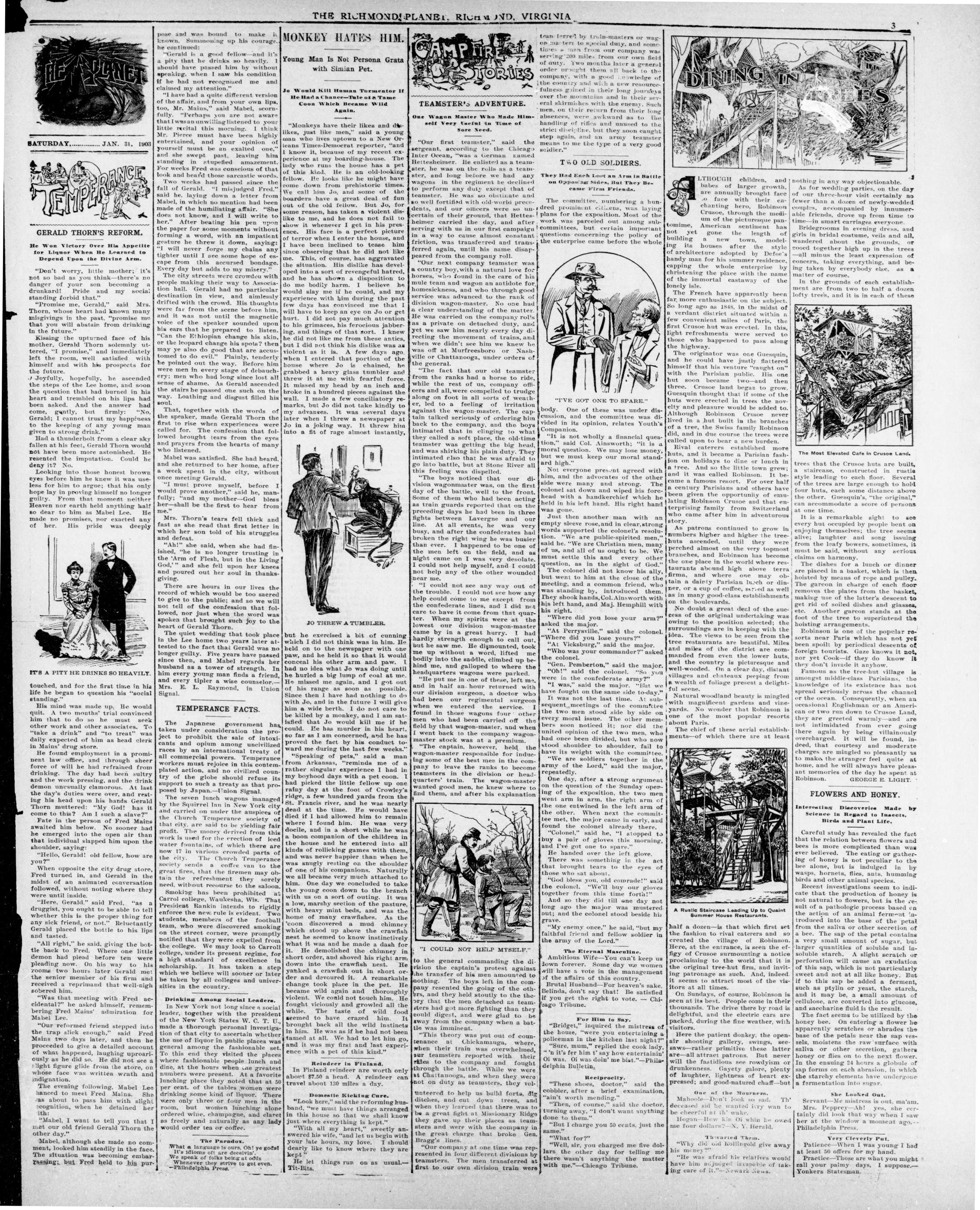
"Monkeys have their likes and dislikes, just like men," said a young man who lives uptown to a New Orleans Times-Democrat reporter, "and I know it, because of my recent experience at my boarding-house. The lady who runs the house has a pet of this kind. He is an old-looking fellow. He looks like he might have come down from prehistoric times. We call him Jo, and some of the boarders have a great deal of fun out of the old fellow. But Jo, for some reason, has taken a violent dislike to me, and he does not fail to show it whenever I get in his presence. His face is a perfect picture of terror when I enter the house, and I have been inclined to tease him since observing that he did not like me. This, of course, has aggravated the situation. His dislike has developed into a sort of revengeful hatred, and he has shown a disposition to do me bodily harm. I believe he would slay me if he could, and my experience with him during the past few days has convinced me that I will have to keep an eye on Jo or get hurt. I did not pay much attention to his grimaces, his ferocious jabbering, and things of that sort. I knew he did not like me from these antics, but I did not think his dislike was as violent as it is. A few days ago, when I entered that portion of the house where Jo is chained, he grabbed a heavy glass tumbler and threw it at me with fearful force. It missed my head by an inch and broke in a hundred pieces against the wall. I made a few conciliatory remarks, but Jo did not take kindly to my advances. It was several days later when I threw a newspaper at Jo in a joking way. It threw him into a fit of rage almost instantly.
A man is sitting on a desk and is being hit by a monkey.
JO THREW A TUMBLER.
but he exercised a bit of cunning which I did not think was in him. He held on to the newspaper with one paw, and he held it so that it would conceal his other arm and paw. I had no idea what Jo was doing until he hurled a big lump of coal at him. He missed me again, and I got out of his range as soon as possible. Since then I have had nothing to do with Jo, and in the future I will give him a wide berth. I do not care to be killed by a monkey, and I am satisfied that Jo would kill me if he could. Ee has murder in his heart, so far as I am concerned, and he has proved the fact by his conduct toward me during the last few weeks."
"Speaking of pets," said a man from Arkansas, "reminds me of a rather singular experience I had in my boyhood days with a pet coon. I had picked the little fellow up one rainy day at the foot of Crowley's ridge, a few hundred yards from the St. Francis river, and he was nearly dead at the time. He would have died if I had allowed him to remain where I found him. He was very docile, and in a short while he was a boon companion of the children in the house and he entered into all kinds of rolling games with them, and was never happier than when he was smugly resting on the shoulder of one of his companions. Naturally we all became very much attached to him. One day we concluded to take the young coon down to the branch with us on a sort of outing. It was a low, marshy section of the pasture, with heavy mint beds, and was the home of many crawfishs. As the 'coon discovered a mud chimney which stood up above the crawfish nest he seemed to know instinctively what it was and he made a dash for it. He demolished the chimney in short order, and showed his right arm down into the crawfish nest. He yanked a crawfish out in short order and devoured it. A remarkable change took place in the pet. He became wild again and thoroughly violent. We could not touch him. He fought viciously and growled all the while. The taste of wild food seemed to have crazed him. It brought back all the wild instincts in him. He was as if he had not been tamed at all. We had to let him go, and it was my first and last experience with a pet of this kind."
Reindcer in Finland.
In Finland reindeer are worth only about $7.50 a head. A reindeer can travel about 130 miles a day.
Domestic Kicking Cure.
"Look here," said the reforming husband, "we must have things arranged in this house so that we shall know just where everything is kept."
"With all my heart," sweetly answered his wife, "and let us begin with your late hours, my love. I should dearly like to know where they are kept."
He let things run on as usual.—
Tit-Bits.
CAMPFIRE STORIES
TEAMSTER'S ADVENTURE.
One Wagon Master Who Made Himself Very Useful in Time of Sore Need.
"Our first teamster," said the sergeant, according to the Chicago Inter Ocean, "was a German named Hettesheimer. He enlisted as a teamster, he was on the rolls as a teamster, and long before we had any wagons in the regiment he declined to perform any duty except that of teamster. He was so obstinate and so well fortified with old-world precedents, and our officers were so uncertain of their ground, that Hettesheimer carried the day, and after serving with us in our first campaign in a way to cause almost constant friction, was transferred and transferred again, until his name disappeared from the company roll.
"Our next company teamster was a country boy, with a natural love for horses, who found in the care of his mule team and wagon an antidote for homesickness, and who through good service was advanced to the rank of division wagon-master. No one had a clear understanding of the matter. He was carried on the company rolls as a private on detached duty, and yet we saw him nearly every day directing the movement of trains, and when we didn't see him we knew he was off at Murfreesboro or Nashville or Chattanooga, under orders of the general.
"The fact that our old teamster from the ranks had a horse to ride, while the rest of us, company officers and all, were compelled to trudge along on foot in all sorts of weather, led to a feeling of irritation against the wagon-master. The captain talked seriously of ordering him back to the company, and the boys intimated that in clinging to what they called a soft place, the old-time teamster was getting the big head, and was shirking his plain duty. They intimated also that he was afraid to go into battle, but at Stone River all this feeling was dismelled.
"The boys noticed that our division wagonmaster was, on the first day of the battle, well to the front. Some of them who had been acting as train guards reported that on the preceding days he had been in three fights between Lavergne and our line. At all events, he was very busy, and after the confederates had broken the right wing he was busier than ever. I happened to be one of the men left on the field, and as night came on I was very desolate. I could not help myself, and I could not help any of the other wounded near me.
"I could not see any way out of the trouble. I could not see how any help could come to me except from the confederate lines, and I did not care to have it come from that quarter. When my spirits were at the lowest our division wagon-master came by in a great hurry. I had hardly strength enough to call out, but he saw me. He dismounted, took me up without a word, lifted me bodily into the saddle, climbed up behind me, and galloped to where the headquarters wagons were parked.
"He put me in one of these, left me, and in half an hour returned with our division surgeon, a doctor who had been our regimental surgeon when we entered the service. I found in those wagons four other men who had been carried off the field by that wagon-master, and when I went back to the company wagon-master stock was at a premium.
"The captain, however, held the wagon-master responsible for inducing some of the best men in the company to leave the ranks to become teamsters in the division or headquarters' train. The wagon-master wanted good men, he knew where to find them, and after his explanation
"I COULD NOT HELP MYSELF."
to the general commanding the division the captain's protest against the transfer of his men amounted to nothing. The boys left in the company resented the going of the others, and they held stoutly to the theory that the men detached as teamsters had got more fighting than they could digest, and were glad to be away from the company when a battle was imminent.
"This theory was put out of countenance at Chickamauga, where, when their train was overwhelmed, our teamsters reported with their rifles to the company and fought through the battle. While we were at Chattanooga, and when they were not on duty as teamsters, they vol-
unteered to help us build forts, dig ditches, and cut down trees, and when they learned that there was to be a great fight at Missionary Ridge they gave up their places as teamsters and were with the company in the great charge that broke Gen. Bragg's lines. "Our company at one time was represented in four different divisions by teamsters. The men transferred at first to our own division train were
team ferred by train-masters or wagon-masters to special duty, and sometimes a man from our company was serving 200 miles, from our own field of duty. Two months later a general order brought them all back to the company, with a good knowledge of the country and with a new resourcefulness gained in their long journeys over the mountains and in their several skirmishes with the enemy. Such men, on their return from their long absences, were awkward as to the handling of rifles and unused to the strict discipline, but they soon caught step again, and an army teamster means to me the type of a very good soldier.
TWO OLD SOLDIERS
They Had Ench Lost an Arm in Battle on Opposing Sides, But They Become Firm Friends.
The committee, numbering a hundred prominent citizens, was laying plans for the exposition. Most of the work was parceled out among subcommittees, but certain important questions concerning the policy of the enterprise came before the whole
"I'VE GOT ONE TO SPARE."
body. One of these was under discussion, and the committee was divided in its opinion, relates Youth's Companion.
"It is not wholly a financial question," said Col. Ainsworth; "it is a moral question. We may lose money, but we must keep our moral standard high."
Not everyone present agreed with him, and the advocates of the other side were many and strong. The colonel sat down and wiped his forehead with a handkerchief which he held in his left hand. His right hand was gone.
Just then another man with an empty sleeve rose, and in clear, strong words supported the colonel's resolution. "We are public-spirited men," said he. "We are Christian men, many of us, and all of us ought to be. We must settle this and every other question, as in the sight of God." The colonel did not know his ally, but went to him at the close of the meeting, and a common friend, who was standing by, introduced them. They shook hands, Col. Ainsworth with his left hand, and Maj. Hemphill with his right. "Where did you lose your arm?" asked the major. "At Perrysville," said the colonel. "Where did you lose yours?" "At Vicksburg," said the major. "Who was your commander?" asked the colonel. "Gen. Pemberton," said the major. "Oh!!" said the colonel. "So you were in the confederate army?"
"I was," said the major. "But we have fought on the same side to-day." It was not the last time. At subsequent meetings of the committee the two men stood side by side on every moral issue. The other members soon noticed it; nor did the united opinion of the two men, who had once been divided, but who now stood shoulder to shoulder, fail to have its weight with the committee. "We are soldiers together in the army of the Lord," said the major, repeatedly.
One day, after a strong argument on the question of the Sunday opening of the exposition, the two men went arm in arm, the right arm of the one entwined in the left arm of the other. When next the committee met, the major came in early, and found the colonel already there.
"Colonel," said he. "I stopped to buy a pair of gloves this morning, and I've got one to spare."
He handed over the left glove. There was something in the act that brought tears to the eyes of those who sat about.
"God bless you, old comrade!" said the colonel. "We'll buy our gloves together from this time forth!"
And so they did till one day not long ago the major was mustered out; and the colonel stood beside his grave.
"My enemy once," he said, "but my faithful friend and fellow soldier in the army of the Lord."
The Eternal Masculine:
Brutal Husband—For heaven's sake.
Belinda, don't say that! Be satisfied
if you get the right to vote. — Chicago Tribune.
For Him to Say:
"Bridget," inquired the mistress of the house, "were you entertaining a policeman in the kitchen last night?" "Sure, mum," replied the cook lady, "n't it's fer him t' say how entertainin' Oi was. Oi was doin' me bist."—Philadelphia Bulletin.
Reciprocity.
"These shoes, doctor," said the cobbler, after a brief examination, "ain't worth mending."
"Then, of course," said the doctor, turning away, "I don't want anything done to them."
"But I charge you 50 cents, just the same."
"What for?"
"Well, sir, you charged me five dollars the other day for telling me there wasn't anything the matter with me."—Chicago Tribune.
DINING IN TREES
G
LTHOUGH children, and babes of larger growth, are annually brought face so face with their enchanting hero, Robinson Crusoe, through the medium of the picturesque pan-American sentiment has
tomime, American sentiment has not yet gone the length of building a new town, modeling its houses after the style of architecture adopted by Defoe's handy man for his summer residence, capping the whole enterprise by christening the place with the name of the immortal castaway of the lonely isle. The French have apparently been far more enthusiastic on the subject. So long ago as 1848, in the midst of a verdant district situated within a few convenient miles of Paris, the first Crusoe hut was erected. In this, light refreshments were served to those who happened to pass along the highway.
The originator was one Guesnquin, and he could have justly flattered himself that his venture "caught on" with the Parisian public. His one hut soon became two—and then three. Crusoe land began to grow. Guesnquin thought that if some of the huts were erected in trees the novelty and pleasure would be added to. Although Robinson Crusoe never lived in a hut built in the branches of a tree, the Swiss family Robinson did, and in due course the trees were called upon to bear a new burden.
Rival caterers established more huts, and it became a Parisian fashion on holidays to dine or lunch in a tree. And so the little town grew; and it was called Robinson. It became a famous resort. For over half a century Parisians and others have been given the opportunity of emulating Robinson Crusoe and that entertising family from Switzerland who came after him in adventurous story.
As patrons continued to grow in numbers higher and higher the treehuts ascended, until they were perched almost on the very topmost branches, and Robinson has become the one place in the world where restaurants abound high above terra firma, and where one may obtain a dainty Parisian lunch or dinner, or a cup of coffee, served as well as in many good-class establishments on the boulevards.
No doubt a great deal of the success of the original undertaking was owing to the position selected; the surroundings are in keeping with the idea. The views to be seen from the tree restaurants are beautiful. Miles and miles of the district are commanded from even the lower huts, and the country is picturesque and well-wooded. On a clear day, distant villages and chateaux peeping from a wealth of foliage present a delightful scene. Natural woodland beauty is mingled with magnificent gardens and vineyards. No wonder that Robinson is one of the most popular resorts about Paris. The chief of these aerial establishments—of which there are at least
A Rustic Staircase Leading Up to Quaint Summer House Restaurants.
half a dozen—is that which first set the fashion to rival caterers and so created the village of Robinson. Here, at the entrance, is seen the effigy of Crusoe surmounting a notice proclaiming to the world that it is the original tree-hut firm, and inviting patronage as such. And, indeed, it seems to attract most of the visitors at all times. On Sundays, of course, Robinson is seen at its best. People come in their thousands. The drive there by road is delightful, and the electric cars are packed, during the fine weather, with visitors. Here the patient donkey, the openair shooting gallery, swings, seesaws—rather primitive these latter are—all attract patrons. But never will the fastidious see rowdyism or drunkenness. Gayety galore, plenty of laughter, lightness of heart expressed; and good-natured chaff—but
Mahoole—Don't look so sad. Th' deceased sid he wanted ery wan to be cheerful at th' wake.
Hogan—How kin Of whin he owed me four dollars?—N. Y. Herald.
Th'varied Them.
"Why did old Kollingold give away his money?"
"He was afraid his relatives would have him adjuged incapable of taking care of it."—Newark News.
nothing in any way objectionable.
As for wedding parties, on the day of our three-hour visit certainly no fewer than a dozen of newly-wedded couples, accompanied by innumerable friends, drove up from time to time—in smart carriages everyone.
Bridegrooms in evening dress, and girls in bridal costume, veils and all, wandered about the grounds, or cooed together high up in the trees—all minus the least expression of concern, taking everything, and being taken by everybody else, as a matter of course.
In the grounds of each establishment are from two to half a dozen lofty trees, and it is in each of these
The Most Elevated Cafe in Cruspe Land.
trees that the Crusoe huts are built, a staircase, constructed in rustic style leading to each floor. Several of the trees are large enough to hold four huts, each some distance above the other. Guesquin's, "the original," can accommodate a score of persons at one time.
It is a remarkable sight to see every hut occupied by people bent on enjoying themselves; the tree seema alive; laughter and song issuing from the leafy bowers, sometimes, it must be said, without any serious claims on harmony.
The dishes for a lunch or dinner are placed in a basket, which is then hoisted by means of rope and pulley. The garcon in charge of each floor removes the plates from the basket, making use of the latter's descent to get rid of soiled dishes and glasses, etc. Another garcon stands at the foot of the tree to superintend the hoisting arrangements.
Robinson is one of the popular resorts near Paris which has not yet been spoilt by periodical descents of foreign tourists. Gaze knows it not, nor yet Cook—if they do know it they don't invade it anyhow.
Famous as the tree-hut village is amongst middle-class Parisians, the knowledge of its existence has not spread seriously across the channel or the ocean. Consequently, when an occasional Englishman or an American or two run down to Crusoe Land, they are greeted warmly—and are not intimidated from ever going there again by being villainously overcharged. It will be found, indeed, that courtesy and moderate charges are mingled so pleasantly as to make the stranger feel quite at home, and he will always have pleasant memories of the day he spent at Robinson.
GEORGE E. LIGHT.
FLOWERS AND HONEY
Interesting Discoveries Made by Science in Regard to Insects, Birds and Plant Life.
Careful study has revealed the fact that the relation between flowers and bees is more complicated than was ever believed. The eating or gathering of honey is not peculiar to the bee alone, but is indulged in by wasps, hornets, flies, ants, humming birds and other animal species.
Recent investigations seem to indicate that the production of honey is not natural to flowers, but is the result of a pathologic process based on the action of an animal ferment introduced into the base of the petal from the saliva or other secretion of a bee. The sap of the petal contains a very small amount of sugar, but larger quantities of soluble and insoluble starch. A slight scratch or perforation will cause an exudation of this sap, which is not particularly sweet and not at all like honey. But if to this sap be added a ferment, such as ptylin or yeast, the starch, and it may be, a small amount of cellulose, are converted into glucose, and saccharine fluid is the result.
The fact seems to be utilized by the honey bee. On entering a flower be apparently scratches or abrades the base of the petals near the sap vessels, moistens the raw surface with saliva or other secretion, gathers honey or flies on to the next flower. In the ensuing 24 hours a globule of sap forms on each abrasion, in which the starchy elements have undergone a fermentation into sugar.
She Looked Out.
Servant—Me mistress is out, ma'ma.
Mrs. Pepprey—Ah! yes, she certainly did look that way when I saw her at the window a moment ago.
Philadelphia Press.
Very Cleverly Put.
Patience—When I was young I had at least 50 offers for my hand.
Practice—Those are what you might call your palmy days, I suppose.
Yonkers Statesman.
REAL PLANET
Published every Saturday by JOHN MITCHELL.
JR., at 811 North 4th Street, Richmond, Va.
JOHN MITCHELL, JR., - EDITOR.
All communications intended for publication
should be sent so as to reach us by Wednesday
One Copy, one year, • • • $1.50
One Copy, eight months, • • • 1.00
One Copy, six months, • • • .80
One Copy, four months, • • • .50
One Copy, three months, • • • .40
Single Copy, • • • • .05
ADVERTISING RATES
For one inch, one insertion, . . . $ 50
For one inch, each subsequent insertion, . . . $ 50
For two inches, three months, . . . $ 60
For two inches, six months, . . . $ 10.00
For two inches, nine months, . . . $ 14.00
For two inches, twelve months, . . . $ 20.00
Mortgage and Trusts Notice per line, . . . $ 10
Standing and Transit Notice per line, . . . $ 10
# POSTAGE STAMPS OF A HIGHER DEFINITION THAN TWO CENTS NOT RECEIVED ON SUBSCRIPTIONS.
The PLANET is issued weekly. The subscription price is $1.50 a year, in advance.
There are FOUR WAYS by which money can be obtained by the American Money Order, by bank Check or Draft, or an Express Money Order, and when none of these can be procured, in a Registered Letter.
Outside United States, you have a Money Order at your Post Office, payable at the Richmond Post Office, and we will be responsible for its safe arrival.
Express Money Orders can be obtained at the American Express Co., and the Well Fargo and Co.'s Express Company. We will be responsible for the American Express companies. The Express Money Order is a safe and convenient way for forwarding money.
REGISTERED LETTER-If a Money Order Post Office or an Express Office is not within your address, you may send a letter you wish to send us on payment of ten cents. Then, if the letter is lost or stolen, it can be sent to you can send money in this manner at our risk.
We cannot be responsible for money sent in letters in any other way than one of the four ways mentioned above. If you send your money in another way, you must do it at your own risk.
RENEWALS, ETC. If you do not want the PLANET continued for another year after your post office has run out, you should send your Postal Card to us. The courts have decided that subscribers to newspapers who do not order their paper discontinued at the expiration date, hold liable for the payment of the subscription up to date when they order the paper discontinued.
COMMUNICATIONS-When writing to us to renew your subscription or to discontinue our paper, you should give your name and address in full, otherwise we cannot find your address.
CHANGE OF ADDRESS-In order to change the address of a subscriber, we must be sent the former as well as the present address.
Entered in the Post Office at Richmond, Va. as second class matter.
SATURDAY, ..... JAN. 31, 1903
Yes, we have had quite a fight on our hands and it has nerved us to greater efforts. Still, we have lost neither flesh nor sleep in the contest.
The city of Richmond seems to be having a hard time with its contracts. It has built a new jail with no system ventilation.
EDITOR JOHN MURPHY deserves much credit for the excellent journal he is giving the colored people of Baltimore. The AERO-AMERICAN is all right.
THE New Orleans, La., So. western Christian ADVOCATE of the 22d instant contains an excellent portrait and sketch of the able Rev. C. I. WITHROW, A. M., pastor of the Augusta St., M. E. Church at Staunton, Va.
THE Philadelphia, Pa., TRIBUNE announces that Attorney John A. SPARKS (colored) has secured a verdict of $11,000 against the West Jersey railroad. His client was Mrs. FANNIE A. JACKSON of Haddonfield, N. J. This is a remarkable showing and we congratulate the young attorney.
We have never liked the idea of training our guns on colored people. It has always been distasteful to us; but down here, every race leader who goes down dies from the treacherous attack of some of his own people, who are put up to "do" him by members of the other race. There is no worse enemy to the Negre than the Nerro himself.
THE colored Baptists of this state should not fail to rally to the support of the Virginia Theological Seminary and College at Lynchburg, Va. The progress now being made by this institution is a revelation. Handicapped as it has been by poverty, it nevertheless stands forth as a monument to the possibilities of colored Baptists.
President G. W. HAYES has stood the test to which he has been continually subjected and the Baptists will make no mistake in continuing to recognize his leadership. We have the money, therefore, let us send it to the institution that has weathered the storm and is about to land us in the harbor of racial achievement.
DON'T WANT "COLD WATER."
OUR esteemed contemporary, the Cleveland, O., GAZETTE in language that impresses us with the sincerity of its motives thinks that we should stop throwing cold water on the efforts now being made in this state to test the constitutionality of the unconstitutional constitution of Virginia.
If giving our opinion of the Supreme Court of the United States is injuring
any legitimate effort now being made to better our condition in this state, we are willing to desist. The colored man who believes that any decision can be obtained from that tribunal in accord with the expectations of those who are pressing the test cases, is hopeful indeed. However, we expect to say no more along this line, feeling confident that time will justify us in our conclusions. A glance at the PLANET's files during the last five years will convince any one that the editor of the PLANET has had no confidence in the United States Supreme Court.
---
SOME of our, contemporaries have wondered why the PLANET has not shown its old time vigor along editorial lines. It has been due to contending with racial jealousy, caused by our success along other lines. We are now President of a banking institution whose deposits have aggregated $130 000 00 in twelve months.
As one of our "money-wanting" brethren down here seemed to think that we owned the money instead of the bank, he went into court here and asked a white jury, whom, he evidently presumed would be swayed by prejudice against us to make us give him Ten Thousand Dollars. The jury directed us to give him ONE (1) CENT, and the law directed him to pay all of Costs. The brother knows now that we haven't been fighting in the courts of the Southland eighteen years without understanding the situation. We have been winning for other people and we would indeed be a poor specimen of humanity not to be able to win for ourselves.
THAT SOUTH CAROLINA TRAGEDY
SOUTH CAROLINA has sown the tares and it is now reaping the whirlwind. The brutal murder of Editor N. G. GONZALES by Lieutenant-Governor JAMES H. TILLMAN is the result of the lawlessness which has hung over that state like a pall for more than a quarter of a century.
That a Lieutenant-Governor, sworn to observe the laws would walk from the presiding officer's chair at the capitol at Columbia and kill an unarmed man will surprise some people, but will hardly cause a thought among those colored people and white Republicans, who have been the victims of similar assassinations.
When a state will send a self-confessional murderer to the United States Senate as was done in the case of Senator B. R. TILLMAN, it is not surprising that the nephew of this man should follow in his foot-steps and stain his hands with the blood of a southern white man.
The disregard of the oath with reference to the colored man has led to a similar disregard with reference to the white one.
All of the parties concerned have an antipathy to the Negro and all we have to say is, Go on with the funerals!
THE SITUATION.
THE situation in this country at the present time is highly disappointing to the colored people, who love liberty and appreciate guaranteed privileges. At the first blush, it would seem that we have lost and are losing friends among the white people of the country. This may be true, or it may be that those white persons who were passively opposed to us are now giving voice to their opinions.
Still, we have many strong, true and tried friends among the white people of this country to-day. It is necessary for the conservative colored men of the race to cultivate this friendship and especially among the liberal white elements of the Southland. We can do this by deserving their friendship, by the expressions of good-will, and by the faithful discharge of the duties of citizenship.
The ignorant, insulting, blatant members of our race, those who violate the laws and respect neither God nor Mammon, should be made to understand that they will receive no support or sympathy at the hands of those self-respecting colored people, who are improving their condition and is adding to the material wealth of the communities in which they live. With this policy, faithfully and steadily carried out, we shall find that we have advocates where we least expect them and that the Negro-haters will find themselves attacked from unexpected quarters. The colored people are better off today than they have ever been since the first "hand-full" of them landed at Jamestown, Va:
THE PRESIDENT IS UNMOVED BY CRITICISM.
PRESIDENT ROOSEVELT invited Hon. John C. DANCY, Recorder of Deeds and Hon. JUDSON LYONS, Register of the Treasury to the reception given at the White House last week in honor of the Judiciary. The Negro-hating journals of the South immediately set up a showl, but were considerably "cooled, off," when they were reminded of the fact that President CLEVELAND (Democrat) had invited the late Hon. FREDERICK DOUGLASS to the White House on a similar occasion.
It is now stated that no southerner can be found in the Washington who will admit that he left the White House on account of the presence of these distinguished Afro-Americans.
To emphasize his attitude, it is now announced that the President has invited the recently appointed Assistant
THE RICHMOND PLANET, RICHMOND, VIRGINIA
United States District Attorney W. H. Lewis (colored) and his wife to visit the White House.
We are of the opinion that it is time for the conservative, justice loving white men of the southland to take some steps toward the discouragement of the disposition of certain Negro-haters in making fools of themselves.
MANY KILLED AND INJURED
Appalling Wreck on Jersey Cent-
INTIMIDATING A GOVERNMENT OFFICIAL.
THE case of Mrs. MINNIE COX, the colored postmistress of Indianola, Miss , is one of the most remarkable ever brought to the attention of the government. It will tend to open the eyes of the north to the true condition of affairs existing in the southland and will expose the hypocrisy of that class of Negro-haters, who have alleged that their opposition to the Negro was based on his ignorance, his incapacity and his poverty. We have all along asserted that the true cause was due to the progress of this remarkable race of people and that the illiterate whites were against the better class of colored people.
Mrs. MINNIE COX is educated, owning property, variously estimated to be worth $15,000. She has served as postmistress for eight years and is endorsed for the position by some of the leading white citizens in the community. Yet a number of prejudiced white citizens under the influence of a white man, who was candidate for the office, threaten her and ask her to resign. It was then up to the national government. That there could be no reasonable excuse for this action is evident, when it is known that colored postmasters may be found throughout the southland and colored route agents and letter-carriers are everywhere in evidence from Maine to Texas.
Mrs. COX, no doubt, had a vivid recollection of the lamented FRAZIER B. BAKER in South Carolina, who was shot down and his body cremated at Lake City, S. C.
These are stormy times for us, but God is raising up white friends for us even where the prejudice is most rampant and the persecution, hottest.
President Roosevelt is not defending Mrs. Minnie Cox. He is compelling respect for the law, and emphasizing the right of the government to appoint any eligible citizen of good character to office.
A WEEK'S NEWS CONDENSED.
Thursday, January 22.
The internal revenue receipts for December, 1902, were $20,743,852, a decrease from December, 1901, of $2,069,-062.
Jacob H. Gallinger was re-elected United States senator from New Hampshire yesterday.
A bill passed both houses of the Kansas legislature yesterday providing that a commission be appointed to investigate the coal famine.
The Good Roads convention at Albany, N. Y., adopted resolutions favoring the bill in congress appropriating $20,000,000 for good roads.
The New Jersey board of pardons commuted to life imprisonment the sentence of George Taylor, colored, who was to have been hanged in Jersey City tomorrow for murder.
Friday, January 23.
A bill to prohibit the kissing of the Bible in the administering of oaths was defeated by the Virginia legislature.
The postmaster general has ordered the establishment of free delivery postal service at Cape May, N. J., March 1.
Rev. Jean Skyles, of Gibson, Miss., was sentenced to 10 years in the penitentiary yesterday for bigamy. He had seven wives.
The United Mine Workers' convention, in session at Indianapolis, yesterday issued a letter of thanks to the public for financial aid given them during the anthracite coal strike.
Saturday, January 24.
The house of representatives of the Cuban congress has appropriated $200,000 to build a capitol.
M. W. Savage, of Minneapolis, owner of Dan Patch, the famous pacer, has insured the animal for $112,000.
The fall of a bucket down a shaft at the Torresdale filter plant, near Philadelphia, yesterday fatally injured two workmen.
Samuel M. Bryan, a well-known financier of Baltimore and Washington, died yesterday of a complication of diseases.
Captain Sherwood, of the British steamer Carlisle, committed suicide in the cabin of his vessel at Savannah, Ga., yesterday.
Monday January 26.
General Miles reached Berlin Saturday night and proceeded to Paris a few hours later.
An unusually large number of miners are competing in the annual examination at Alcoona, Pa., for positions as foremen, etc.
John B. Scott, proprietor of the Raleigh Hotel, Atlantic City, N. J., died suddenly yesterday from a stroke of paralysis.
A man named Shaffer shot and killed Richard Smith at Madison, Ind., yesterday and when lodged in jail tore his clothing to strips and hanged himself.
Charged with the murder of his 4-year-old adopted child Albert Jordan, a rich farmer of Crystal Plains, Kan., has been put in jail, but mob violence is feared.
Tuesday, January 27.
Brigadier General E. M. Hayes was retired yesterday and Col. Charles L. Davis, Fifth Infantry, will be promoted to the vacancy.
The 13th annual banquet of the Confederate Veteran Camp of New York was held at the Waldorf-Astoria, New York, last night.
The banking house of Boughton, Ford & Co., of Burton, O., made an assignment yesterday. Assets, $500,000; liabilities, $300,000.
Two men were killed and one fatally injured in a freight wreck on the Williamsport & North Branch railroad, near Williamsport, Pa., yesterday.
AND INJURED
Appalling Wreck on Jersey Central at Graceland.
24 BODIES RECOVERED
Many Bodies Believed to Have Been Cremated.
HORRIFYING SCENES AT WRECK
Royal Blue Express Ploughed Into Local Train at Terrific Speed, Shattering Three Cars, and Before Injured Could Be Rescued Two of the Cars Were Consumed By Fire—Victims Were Cremated In Sight of Rescuers.
New York, Jan. 28.—One of the most appalling railroad wrecks that has occurred in the vicinity of New York for many years, the loss of life being estimated at not less than 30 persons, took place last night at Graceland, on the Central Railroad of New Jersey, near Westfield, N. J., when the Royal Blue line express ploughed at top speed into the rear of a local train. Immediately after the crash three of the shattered cars of the local train took fire, rendering impossible the rescue of many of the wounded, who were pinned fast in the wreck. Many bodies are believed to have been consumed.
The dead so far identified are: Edgar Williams, a New York lawyer; C. G. Sayer, of Plainfield; Harry G. Hand, of New York city; Harry Patterson, of Dunellen; George E. Reed, of Scotch Plains; Thomas Cuming, of Plainfield; Rowland R. Chandler, of Plainfield; Edward Flynn, of Plainfield.
In addition to this list there are many charred bodies, unidentified, still at the scene of the wreck.
It is known that there are 24 dead. Sixteen charred bodies have now been taken out. Eight dead were either recovered before the fire or died after being taken out of the wreck.
Those injured are: Edward Clark,
William Sampson, Miss Lizzie Cutter,
William Dunn, George Force, Howard
R. George, Miss Mildred Everett, Mrs.
D. Cuming, E. M. Brokaw, Miss Cora
Brokaw, Frederick Kanner, all of
Plainfield; Roy Apgar and William
Frederick, of Dunellen, N. J.; William
Geddies, of Dunellen, both legs broken;
George Chandler, spine injured;
Charles Longworthy, injured all over
the body; Mrs. Belch, both legs broken
and body crushed; Mary Ryan, injured
about head; William Van Venter, cut
about body and face; Everett Relghton,
both legs cut off; Miss Lizzie
Keller, scalp torn perc; Orcy Irving, of
Dunellen, legs crushed; Mrs. Qulean,
brushed about body and head.
The train which was run into left New York at 5.45 and ran express to Bound Brook, making stops at Elizabeth, Westfield and Plainfield. Beyond Bound Brook it runs as a local. The Royal Blue train left 15 minutes later, but travels at a higher speed and makes no stops, except at Elizabeth, and is scheduled to overtake the slower train just beyond Graceland, where the latter switches from track 3 onto track 4 to permit the Royal Blue to pass.
Last evening a freight train was blocked on track 4, and the local received orders to proceed on the express track to Dunellen and there take the outside track. She had just started and was moving slowly when the Royal Blue, traveling apparently at full speed, which at that point usually approximates 65 miles an hour, crashed into the rear end.
The heavy engine of the Royal Blue tore its way into the rear car, and at the same time drove the forward end of that car into the rear end of the car ahead, which in turn was driven into the third car, and this in turn was driven into the fourth car from the rear. The fourth car was only partly wrecked, but the last three were torn to pieces.
The engine of the Royal Blue left the rails and turned over on her side, the engineer and fireman sticking to their posts and going down in the wreck. They are now in the Muhlenberg Hospital at Plainfield, and the engineer is not believed to have a chance of living.
The train ahead had sent a flagman back, but it seems he was recalled when the train got under way, and, although he left torpedoes, the Royal Blue did not heed them, or else was going too fast to stop in the short distance remaining.
The engine and the three worst wrecked cars were piled into an awful heap, containing at least 100 dead and injured. From the mass came fearful cries for aid. A minute later the wreck caught fire from the fire box of the locomotive. The screams of the injured in the heap were intensified as they found themselves hewn in by the flames. The passengers in the two forward cars of the first train and all the men from the express and every one in the neighborhood went to work at once to get out the injured before the flames could reach them. At times while toiling in the wreckage the flames reached the rescues, and their clothing took fire, but they worked on though in constant danger of being killed themselves. Some of the injured were burned to death in sight of the men who were working with desperation to save them, but the flames soon gained complete mastery of the last two cars.
The fireman from Westfield were summoned by phone, but arrived too late to save wany lives. Doctors were called for from Elizabeth, Westfield and Plainfield, and there was a score on hand. The parlor cars of the Royal Blue line train were converted into temporary hospitalia.
The fireman after a time mastered the flames. Then the wreckage was
ZOMODONE, THE NEWEST AND MOST RAPID HAIR GROWER IN EXISTENCE.
Makes the Hair grow with lightning-like rapidity. No waiting for results. ZOMODONE prevents Falling Hair, Grey Hair, Brittle Hair, Curly Hair, Harsh Hair, and Searf. Cures Dandruff, Itch, Tetter, Eczema, and Ring-Worm. No more Bald Heads, Scanty Partings, Splitting Ends, and Bald Temples. ZOMODONE grows long, luxuriant, soft, fine, silky Hair. Makes the Hair grow down to and below the waist line in most every instance in which it is used. ZOMODONE is a direct Hair food, and softens and lengthens the Hair, so that it can be arranged in any style desired. Not a fraud or a fake, to get your money, but an honest remedy, tried and true. ZOMODONE acts quickly; results are seen at once. If you want Hair down to your waist, send in your order right now—do not delay. No free samples sent; a sample is not sufficient to do good. Price, 50c., or 3 bottles (a complete treatment) for $1.00, or will send four complete treatments for $3.00.
AGENTS WANTED. Everything is in favor of the Agent. LIBERAL CREDIT EXTENDED. This is an unprecedented chance to make money. Write quick for territory and particulars. Address
THE HELEN MARTIN TOILET·CO., 910 E. Leigh St., Richmond, Va.
Actual Results from Baldness After Only 4 Weeks Use of ZOMODONE.
WE MUST HAVB ONE AGENT in every city and county immediately. Any active, reliable, honest-colored lady, or createe, may make from $18.00 to $60.00 per week with ease. We will prove it to you, and trust to your honor.
BEFORE. AFTER.
OZONO
is the undisputed and acknowledged only and original King of all Hair Tonics. It also removes and disagreeable tendency. It also removes and disagreeable tendency of the Hair to draw up, curl, tangle and contract, split, break off and fall, and covers thin, scanty places and bare temples, making it easy to dress the Hair in any style desired.
In order to prove to you that you can make more money as your Agent than at your own expense, please offer: Cut out this advertisement, and send it to us with only $1.00, and, upon your request, cut out the one dozen (12) large, square, 50c skincare OZONO. These you must sell to your friends at 50c, each, or $0.00 in all. When you receive the balance of the money you will make $3.00 for your trouble. You can easily dozen in a few hours. We take back the money you cannot sell them. This test is sure to convince you, and you will become our regular Agent and earn hundreds of dollars monthly. Address BOSTON CHEMICAL CO., Man'Tg Chemists, 310 E. Broad Street, Richmond, Va.
attacked again and the work of recovering the bodies was begun. Out of the first car eight bodies were taken. The sight while the wreck was burning was horrifying. Men could be seen in the wreckage pinned fast amid the timbers of the cars and struggling to be free while the flames roared around them. The rescuers were helpless to aid them, as they already had been driven from the wreck by the flames. One of those who tried to take out a man pinned in found that he was held down by one leg near the ankle, and seeing it would be useless to do anything else, is said to have finally severed the man's leg and then carried him to one of the parlor cars. Both rescued and rescuers were badly burned. When the engine ploughed into the rear car it partly split the car open, and at the same time lifted it up and on to itself. This car was the first to take fire and most of those in 't are dead. Some of them are believed to be beneath the overturned engine.
Those in the car ahead, which was lifted over the rear car, suffered the most. For some time before the flames reached them the car below and behind them were enveloped in smoke and steam, and it was here that the worst sights were witnessed. The imprisoned ones begged for death to end their agonies, and implored those who were laboring to get them free to crush their heads with the axes they were using to chop away the wreckage.
One passenger only was severely hurt on the Royal Blue. He was walking in the aisle of one of the cars when the crash came, and the impact hurled him up into the air and sidewise across the heads of several persons in chairs and then through a window. One of his hands was cut and he was badly bruised. He said he was a son of John Wanamaker, of Philadelphia. He did good work later on after his hand had been bandaged.
A Westfield doctor weat into the wreck and bandaged and treated the injured even before they were released. Some of those he treated were afterwards suffocated or burned to death.
FED ARSENIC TO PARENTS
Girl of 13 Explains Mysterious Illness of Father and Mother
Corning, N. Y., Jan. 26—Thirteen-year-old Nellie Kinsley has confessed that a mysterious illness from which her parents, Mr. and Mrs. Isaac B. Kinsley, have been suffering is due to poison she put into the food in order to obtain their property after death.
"Do you know how to get money and houses and everything you want?" she asked her playmats while her parents were ill. "When your father and mother are dead all they own will belong to you. I found that out a little while ago, and I took some of the rat poison papa got to kill the rats with and put it in the supper I cooked. I did not eat the supper, but papa and mamma did and then they got sick. If they die I will have money."
At the Susquehanna Home, at Binghamton, she repeated the story of the poisoning. Nellie was adopted by Mr. and Mrs. Kinsley when she was 2 years old. Recently Mr. Kinsley had bought some arsenic, and it was kept on a shelf in the pantry. Soon after Nellie prepared supper for her parents and they were taken violently ill. It was traced to arsenic and Nellie was suspected. Mrs. Kinsley will probably be crippled for life as a result of the poisoning.
Pennsy Settles Suit for Damages.
Hollidaysburg, Pa., Jan. 27. — The suit of Ephraim W. Mentzer against the Pennsylvania Railroad Company to recover $860,000 damages for alleged discriminations in freight rates was settled in court yesterday. The amount of the settlement made by the company was stated to be $75,000.
MRS. MARTH, the world renowned and beloved business and Test Medium, reveals everything life can be consulted upon all affairs of life, business and marriage a speciality. Every mystery revealed and married is loved and living friends. Removes all troubles encountered, challenges any Medians who can experience, challenges any Medians who can present, future events of one's life; she will not for any price flatter you; you may be unable to handle without nonsense; She can be consulted upon your future companion; Life, Courtship, Marriage Friends, Etc. She is very secure and reliable in making friends, enemies etc., business, law and education is valuable and reliable and speculation is valuable and bad or bad; she withholds your destiny—good or bad; she withholds your
present and future in a DEAD TRANCE, has the power of any two Mediums you ever met in tests she tells your mother's full name before marriage, the names of all your family, their ages and description, the name and business of your present husband, the name of your next if you are to have one, the name of the young man who now calls on you, the name of your future husband, and the day, month and year of your marriage, how many children you live or will have; whether your present sweetheart will be true to you and if he will marry you; if you have no sweetheart she will tell you when you will have one and his name, business and date of acquaintance. All your future will be told in an honest, clear and plain manner and in a dead trance. Mothers should know the success of their husbands and children; young ladies should know everything about their sweethearts or intended husband. Do not keep company, marry or go into business until you know all, do not let silly religious scruples prevent your consulting.
Madame is the only one in the world who can tell you the full name of your future husband with age and date of marriage, and tells whether the one you love is true or false.
There are some persons who believe that there is no truth to be gained from consulting a Medium, but such beliefs are contrary to the truth. It is not possible to check of discrimination that such a conclusion can be true. It is not every one who placards himself or her self as a medium that can stand the test of what he has done.
And a person of an inquiring mind may ask the reason why. It is simply that these advertisers do not take the trouble to study human life and do not know what he两岸 for a moment with another study. Theology and kindred branches that will have a tenderly to make the pathway to the road of the business is done and devoid of all obstacles.
It is hard to think of the persons who will come for advice in full knowledge of what they want to know, and yet as soon as they confront a medium they try their utmost endeavor to do so. It is not a question of the fact that it is to hear if it will be rehearsed. The new so? To get the secret out of a person by unfair and dishonest means is the art used by many people. It is not a question of the way they do so, but it is a matter of impossibility to most of them.
And yet this can be done and by consulting a Medium with the seemingly mystery becomes a realization.
This subject has received no little attention by eminent men and even college professors. So it proves conclusively that although there are many things that are so much only tongues, perhaps the gates of wisdom have not been closed to the entire profession.
It takes a great deal of study to become an accomplished medium and by a continuous and uninterrupted effort, the key to the wall of appurtenance unfathomable mysteries has been secured by MRS. MARTH for the benefit of humanity.
ADVICE BY LETTER, $1.00.
HOURS FROM 10 A. M. TO 9 P. M.
MRS. M. B. MARTH,
246 W. 31st St. (Near 8th Avenue.)
NEW YORK CITY.
Enclose Stamp for reply.
Please mention the PLANET.
Old Phone, 1233. New Phone, 1553,
THE PRIVATE LIVERY
700 CATHERINE ST.,
QUICK TRANFERING
Saddle or Driving Horses, Buggies and Surries To Let at Lowest Prices.
N. B. Tandem Lessons Given. Strict attention given to all orders.
JOHNSON,
DIRECTOR AND EMBALMER.
Ims, 207 N. Foushee St. Corner Broad.
BACKS FOR HIRE:
Phone or Telegraph filled. Wedding, Sup-
tertainments promptly attended.
Residence in Building, New Phone, 48.
KNIGHTS OF COLUMBUS OF THE WORLD
George Jenkins, Proprietor.
W. I. JO
FUNERAL DIRECTOR
Office & Warerooms, 207 N
HACKS R
Orders by Telephone or Te
pers and Entertainme
Old 'Phone, 686, Residence
W. I. JOHNSON, FUNERAL DIRECTOR AND EMBALMER.
Office & Warerooms, 207 N. Foushee St. Corner Broad. HACKS FOR HIRE: Orders by Telephone or Telegraph filled. Wedding, Suppers and Entertainments promptly attended. Old 'Phone, 686, Residence in Building, New Phone, 48.
TO WHOM IT MAY CONCERN:
This organization has been chartered and legally instituted under the laws and statute of the state of New York, for the purpose of uniting all acceptable men on the Broad Bases of Charity—Beneficial and
This organization has been chartered and legally instituted under the laws and statute of the state of New York, for the purpose of uniting together all acceptable men on the Broad Bases of Charity—Beneficial and the Social and Moral condition of humanity.ety and uniform ranks will secure for this organization all sacred institutions of modern events, a grand oppose deputies wanted in all sections of the country to organi-ly address.
ALLEN Supreme voyager
W. 37th Street, New York City
Fraternal and to promote the Social and
Its two distinct military and uniform
place in the front ranks of all sacred in
tunity for active men. Deputies want
lodges.
Kingly address,
G. W. ALLEN S.
W. 37th St.
Fraternal and to promote the Social and Moral condition or formality. Its two distinct military and uniform ranks wield the same authority in the front ranks and is involved in modern events, a grand opportunity for active men. Deputies wanted in all sections of the country to organize a wide address.
M.
AND MOVING.
A
Have you paid your subscription
if not do so at once.
CANVASsER
—WANTED—
to sell PRINTERS' INK—a journal for advertisers—published weekly at five dollars a year. It teaches the science and practice of Advertising, and is highly esteemed by the most successful advertisers in this country and Great Britain. Lateral commission allowed Address PRINTERS No. 10 Spruce St., New York
Notice !!!
The East End Memorial Burial Association of Richmond informs the public that having purchased six (6) acres of land, situated in Henrico County, near the city of Richmond, adjoining Oakwood cemetery and that they are disposing of the same, in sections, half sections and at the following terms. Sections, $25.00 and Half Sections, $15.00.
The situation of this Cemetery is high, dry and rolling and accessible to the Richmond Traction Street Railway and Seven Pines Railway lines, adjoining Oakwood cemetery.
This Association has at a considerable expense divided this tract of land into sections, erected a fence around its improvements, which with the additional improvements contemplated, will be an inducement to those desiring or contemplating purchase resting places for their deceased relatives and friends.
The attention of the general public is solicited and advantageous inducements offered.
J. R. Griffin, President, No. 2412 E. Broad street; E. A. Washington, Secretary. Old 'Phone, 1983.
For information, apply to John coleman, Keeper, No. 2930 P街; Wm. Custalo, 709 East Broad street; W. H. Jones, 1037 St. Peter street; w. h. Bohanman street; Sannel Meredith, 1329 South street; Joseph Robinson, No. 49 1st Marrot or 89 9-mile Road; D. J. Chavers, 1837 Carrington street.
NOUR
LIFE AN OPEN
BOOM
LIGHT
LIGHT
Friends, Ltls is the GREATEST OFFER ever made to the public Mrs. Dr. Wren, or short time only, give every reader the opportunity of their life for only 25¢. Just think of it. Everybody has heard or seen a wonderful woman. She will send you a letter of your birth, mail, sealed in a plain addressed envelope for only 25¢. Send lock of hair, ten by the greatest life writer on earth send at once, as this offer will never be unmet. You can unite the Separated; Give your luck. Change your life from evil to good, and remove all evil influences from you and your homes. Send today. Send 25¢. In lieu of not sending, all business strictly confidential. Address all letters to:
MRS. DR. WHITE,
1917 E. Pratt St. Baltimore, Md.
2 Cent stamp and 25 Cents in money for immediate reply.
State in what paper you saw this ad.
V. P. & F. K. of W.
THE PLANET
SATURDAY..... JAN. 31, 1903
FOR
SUNDAY
READING
LIGHT AT EVENTIDE.
Safely guide my steps. O Saviour mine,
Guide my slender bark, with love Divine.
Fierce that tempest bedding o'er my soul.
Wave after wave, with restless losses
roll.
But list: His promise brings me delight,
For I know at evening time it shall be light.
Life's bitter sorrows dim our mortal eyes,
We see the cloud that with such nearness lies,
Forgetting the golden edge in wisdom given,
To bespeak beyond a cloudless Heaven
Where ends the darkening shadows of the night,
And brings with joy at evening time the light.
Distrustful heart, with doubts and fears that blight,
That smother with its power the vision bright,
Giving no comfort where sweet hope still lives,
Velling in mist His glorious promises,
O, cease thy doubting, look beyond the night.
For well thou knowest at evening time it shall be light.
-M. A. Goodman, in N. Y. Observer.
HARD CIRCUMSTANCES.
Few People Put a Right Estimate Upon Them—Part of the Training of Life.
Everybody cries out against them. Almost everybody fights against them. Few put real value upon them. People like things easy and pleasant. That is natural. But there are a few voices that have some very good things to say about hard circumstances. These voices say that the best and strongest and most far-seeing characters have grown up out of hard circumstances. Almost all the brightest lives of the world have graduated from the "college of hard knocks."
The Scriptures are constantly telling us about great characters that were born where many things were against them. It was true of Jesus. Everything and every person was against Him from the hour of His birth. When He describes the one whom He called the greatest ever born. He marks Him as surrounded by hostile circumstances. He was not born to wear soft raiment. He was not brought up in kings' houses. Still He was no reed shaken by the wind. His strong and great character was born and educated in hard circumstances. Peter and Paul, says the Philadelphia Young People, are seen growing sweeter and tenderer and greater while circumstances pinch them with fetters and harass them with threats.
In hard circumstances Milton wrote his "Paradise Lost." In like circumstances Bunyan grew great and strong enough to write his "Pilgrim's Progress." If Milton had not been blind and if Bunyan had not been cast into prison we should not have known their immortal works. Livingstone in his youth looked up at the great bare walls of a cotton mill. He read there no promise of opportunity or of greatness, but he made hard circumstances splendid servants to lead to large things for himself and the world. Hard circumstances did not keep him from being laid among the great in his death. His character and his work cannot be forgotten.
Lincoln in his younger years never knew the caresses of fortune. Everything that he gained had to be forced from the unwilling hand of hard environment. Adversity was his teacher. He did not repine. He fought for his life. He put adverse circumstances under his feet. Some one has said: "Many men owe the grandeur of their lives to their tremendous difficulties." Certainly the life of this man revealed its grandeur in the hours when the small soul would have been defeated.
This is the truth that the Bible is seeking to teach us when it says that Jesus "learned obedience by the things which He suffered." Hard circumstances should not discourage. There is a right side and a bright side to them. That side is on top. The problem is to find the friendly hand of Divine promise to aid us in getting on that right side. Another says: "Not in the spots of earth where plenty breeds indolence do we meet with the perfected type. It is in the land of adversity and out of much pain and travail that fully emerge the highest manifestation." Believing in this view of life, Bunyan wrote his conviction that the best things come to life by the schooling of hard circumstances. He said he believed it when he wrote:
Sculptor souls, I lift to thee.
Encourage heart and hands;
Spare not the chin get free.
However dear the hand.
Like the Stars
Phillips Brooks, speaking of those lives from which we derive the most real courage and helpfulness, said: "It is the lives like the stars, which simply pour down on us the calm light of their bright and faithful being, up to which we look and out of which we gather the deepest calm and courage. No man or woman of the humble sort can really be strong, gentle, pure and good, without the world being better for it; without somebody being helped and comforted by the very existence of that goodness."
Wealth. Wealth can be a public danger only
because it is first a danger to the individual character.—Rev. P. Barr.
Confidence.
Confidence betrayed is confidence destroyed.—United Presbyterian.
OTHERS! ESTIMATES OF US
"Never Give Less Than Your Best" Is a Good, Safe Rule to Always Follow.
How quick we are to excuse some unkind or rude action by saying that "persons must take us as we mean, not as we say;" that "at heart" we are all right. Perhaps it would be wiser to remember that we are usually judged by our words and actions and not by our heart's secret impulses and promotings. It is hard to make the world see deeper than the outward manifestations. We are all too busy with our own lives to stop long at the portals of another life and study its secret ways, go down the various paths that lead to the hidden chambers and note the causes that mar or beautify the outward actions.
After all, why should we not be willing to be judged by the daily trend of our lives, by the way we live before the world? It is not often true that we are better than we seem to those who know us best, because it is characteristic of human nature to wish to satisfy the expectations of friends and this makes us eager to do our best to gain their love and esteem. We unconsciously many times seek to hide our mistakes or sins from loving hearts lest some little shadow fall upon the brightness of the love that has made life sweet to us. Our "best" is ourselves, and our real selves will always be the result of what lies deepest down in the recesses of our hearts which springs to life at the demand of another nature that appeals to us strongly.
We cannot help giving "our best" to those whom we hold dear and we are apt to misstate the faces when we claim that we are not what we seem. You never mistake a rose for a thistle, nor a stately lily for a field daisy. Everything in nature produces its own kind freighted with individual characteristics that cannot be mistaken, and to human beings alone we ascribe the power of concealing their real natures and appearing in characters that are mere outward masks wholly unlike what lies beneath. There is something radically wrong with a nature that finds it easy to practice deception, even in small matters. It is repugnant to a truly noble character to deceive even an enemy, even to use what might be termed "kindly deception," where the plain truth would seem to be hazardous. It is a blot on the fair "banner" of truth, even if it be done in kindness, and when once it is known that we have deceived our friend, never again will there be just the same perfect trust imposed in us by that friend, for a shaken faith ever after trembles in the balance, uncertain whether to believe implicitly or not. We are all, in a measure, open books, read by more than we think and better understood than we have believed possible.
We deceive ourselves oftener than others when we excuse our outward lives, calling the fountain sweet when its overflow is impure. Some where, deep down in our natures, lie the germs that breed the deformities in our characters that we attempt to justify as necessary—or look lightly upon as mere outward growths easily removed. When we give ourselves we give "our best," whether it be worthy of acceptance depends upon what we are, and the outward man is after all but the reflection of the inward, the real self. It will not do to dignify occasional lofty impulses that come to every human being; the real character is not what we would be, but what we are. It is the source of all the outward manifestations by which the world is led; its decision as to our real worth.
It is true that the soul has locked chambers into which no one but the Father ever enters, and there are pure thoughts, the memory of kind deeds and Christlike acts, never noted by any but the one in whose eyes nothing is too small to be noted that is done in His name. Still these are not always the index to the real life whose daily and hourly acts are telling for good or evil on those about them. As "every tree is known by its fruit," so every life writes its own record by its contact with the world. How we live is what tells, not how long, for "that life is long which answers life's greatest end."—Burlington Hawkeye.
FOOD FOR THOUGHT.
A lie is a loan on which you will never cease to pay manifold interest. —Ram's Horn. Be not discouraged at broken and spilled resolutions; but to it and to it again!—S. Rutherford. Many a man prays about freedom who is bound hand and foot by evil habits. —United Presbyterian.
Anyone can love. That is the beauty of it. Not everyone can be eloquent or rich or strong or wise or famous; but anyone can be loving. That is one reason why love is the greatest thing in the world. Only a few can possess these other good things; but everyone of us can possess and display the greater thing in the world, which is love.—Wellspring. If we would reassure our restless hearts that our future is in the hands of God we have but to scan our past. Can any man that is not altogether blind look over the way he has traversed without surprise and awe as he sees it marked everywhere by mysterious footprints other than his own—even the footprints of the living God? We thought we were going a way of our own and all the time we have been on the King's highway.—J. E. McFadden.
"He says he's bound to have his magazine read."
"How's he going to do it?"
"He's going to put the reading matter where the advertising usually is" --Detroit Free Press.
THE RICHMOND PLANET, RICHMOND, VIRGINIA.
most evident of the triumphs is that which has been achieved over the natural obstacle of the Nile. A river has been dammed which in the months of drought has a mean daily flow double the size of the English Thames at flood time.
A few sentences must dispose of the general method of Egyptian irrigation. All cultivable land lies in a narrow strip on either side of the Nile, and into this great country canals from the Nile stretch out like the feathered barbs on either side of an arrow. At flood Nile these canals are filled. At low Nile, during the summer months, they would be empty. Therefore the first great dam at the delta was built in order to keep the Nile flood from all running away to the Mediterranean, and in order to serve the irrigation canals of lower Egypt. But now come the claims of middle Egypt. At Assiout, 400 miles higher up the river, another barrage has been built, and this will shore up the waters of the lean months, so that they may drip into a great canal, called the Ibrahimiyeh canal, just above the barrage. But this is not enough storage. There must be a dam still higher up, which will serve as a milch cow for the Assiout barrage and the Ibrahimiyeh canal, and this is the work which the great dam at Assouan will do.
The Great Nile Dam at Assouan Looking U
Locks at the Side.
miles long, stretching as far up as Korosko. The depth of the lake will begin, at its deepest end, with 67 feet, and it will hold 1,000,000,000 tons of water. The water will always be running out of it. In the lean months before mentioned it will be doled out at a rate, as we have said, equal to the double flow of the Thames in November or February. When the Nile is in flood the water will pour through the sluices of the dams at the rate of 15 miles an hour and 15,000 tons a second. As the flood subsides the sluices will be shut one by one, or ten by ten, until the flow is harnessed and curbed to its proper speed, and until the water has risen within a few feet of the top of the dam.
CAUGHT IN COON TRAP.
Kentucky Trapper Saved His Life by Cutting Off His Finger with a Barlow Knife.
Silas Remey, who lives on Chapline river in Mercer county, is a famous trapper, says the Louisville Evening Post. Monday Silas and his little son spent all the afternoon setting traps along the river cliffs and set their last one just at nightfall.
This was one of Silas' own invention and most effective in catching coons. On the river bank was a log that every 'coon that passed would visit and here Silas set his trap.
So when Silas had set his trap, as it was now almost dark, he thrust in his
C. M.
SILAS ASTRIDE THE LOG.
finger to feel the points. They seemed to be set about right — in fact, were set so nicely that when he tried to withdraw his finger he was in Mr. 'Coon's plight exactly. One of the barbs entered his finger and almost before he knew it all had him tight. The more he struggled the deeper his barbs sung into his flesh. This was anything but a laughing matter to Silas. His old knife was too dull to make any headway in cutting the nails, so after thinking the matter over he started his little boy home with a lighted lantern to get the pliers to pull out the nails. The boy made his way up the cliff, lost his way, fell over the rocks and logs and extinguished the lantern. Unable to get his bearing, the lad slept under a ledge of rock and came near freezing. Meanwhile Silas sat astride the log in a pouring rain and thought Sunday school words. But a real danger began to threaten him. The river began rising rapidly. It crept up until it reached the lower end of the log.
As daylight approached it began to rock slightly and Silas knew an end was floating. Higher and higher rose the water and Silas knew that if he washed into the current with the log death was certain. In his desperation he pulled his dull barlow and literally sawed his finger off above the middle joint and the log floated away. In five minutes afterward another trapper came along and found him. He was so chilled that he was unable to walk home alone.
FISH STORY EXPERT.
He Tells of the Most Accommodating School of Fanny Creatures He Ever Ran Into.
"Did I catch any fish?" said the suspect, who had just returned from St. Simon's island. "Well, I should think so. I hired a boat and a man to tend
WEIGHED WITH THEIR OWN SCALES
it. He was to bait the hook and take off the fish as I caught 'em. All that I expected to do was to just haul 'em in. Well, sir, we must have struck a regular school of 'em, and a mighty big one, for the first thing I knew I was catching 'em so fast the man couldn't keep up with me, and I had to help him take 'em off the hook an' put on bait till I didn't get time to do anything else."
"Who hauled in the fish then?"
"Who hauled 'em in? Bless your soul, they didn't need any hauin' in. I'll tell you what's a fact. They must have been sheepsheads, for they acted just like a flock of sheep. Once they got started comin' into that boat they commenced to jump over the gunwales an' first I knew the boat was so full that she was about to sink. Me an' the man had to drop everything else an' go to throwin' 'em over board's fast as we could slung em. We threw over more'n two ton an' as soon as we could get up sail we put in to shore. I put up 40 barrel of what we had left."
"How did you know that you threw more than two tons overboard?" he was asked, says the New York Times. "How could you tell that?"
"Tell? Why, confound it, I weighed them with their own scales!"
She—Do you believe automobiles are as dangerous as they're said to be?
He—Oh, sure. A fellow can get engaged in one of them as easily as he used to in the old-fashioned buggies.—Puck.
Divorce a Profane Act.
Mrs. D. Frye—Rev. Dr. Fourthly has denounced divorce as a profane act.
Miss D. Meenor—He's right; it certainly constitutes taking some one's name in vain. Harvard Lampoon.
NILE DAMS FOR THE IRRIGATION OF EGYPT
THE ONE AT ASSOUAN COMPLETES ONE OF THE GREATEST IRRIGATION SYSTEMS OF THE WORLD
THE BRIDGE
The Great Nile Dam at Assouan Looking Up the River and Showing Also the Navigation Locks at the Side.
N the formal opening of the greatest of the Nile dams, at Assouan, completed a work which represents the triumph of man's energy over many obstacles. The
I
It has been built over the rocky islands and the tubulent channels of the first cataract. The Nile here is a mile wide, and behind the dam—that is to say, south of the dam—the waters of the river will be banked up in a great lake, a lake often a mile wide and 150
In appearance the dam is a solid wall built across the river. It is a wall with
South Entrance to the Navigation Lock of the Assouan Dam.
a straight side towards the flow of the waters, and a slope down stream; so that at the top it is some 24 feet wide and 100 feet base at its base. The 100 feet base is the average calculated width. As a matter of experience the rock on which the dam was built proved in some places to be not the hard diorite quartz which had been promised, but a friable mica seist which crumbled and afforded no support. Consequently at such places the foundations had to be dug out as much as 40 feet deeper, and the width at the base of the dam was correspondingly increased from 100 feet to 140 feet.
The length of the dam from side to
Food for Gosplai.
"Mr. Goodman is quite a good writer, isn't he?" said Gaussip. "Good?" replied Editor Jocum. "Well the last bit of writing of his that I saw was very sensitive."
"You don't say? And he's a pillar of the church. What was it?"
"A letter he sent me suggesting that I send him a check for his last contribution."—Philadelphia Press.
side of the river is a mile and a quarter; but this length embraces, perhaps, a quarter of a mile of approaches. Its greatest height above the dam and below it is calculated at 67 feet. It has been built of granite, all of which has come from the old quarries of Old Egypt, and much of which bears the chisel marks of the workers in stone who labored for Joseph in the days of Pharaoh. One of the greatest features of the dam is its system of sluices. The dam is pierced by 180 of these openings.
Sluices in the Assouan Dam in Action.
140 of which are about 22 feet high and six feet six inches wide, and 40 of which are a little more than half the height. These sluices are arranged at different levels, so as to regulate the outflow of banked-up water; and they are grouped in bunches of eights or fours, with solid buttresses between them for strength. The great work of building this dam over island and channel and on rock foundation, good and bad, was to have taken five years. The contract was signed in February, 1898; the work was to have been opened in July of
Up the River and Showing Also the Navigation
this year. But the unfailing support of Lord Cromer, the ability of Sir Benjamin Baker and the other official engineers; and, above all, the grit of the contractors, have finished the task months before the allotted time.
At times as many as 11,000 workmen have been employed upon the works at Assouan and Assiout. The rough work has been done by natives, the stone dressing largely by Italian workmen; all the responsible work of supervision by English foremen.
In addition to the work at Assiout, the task at Assouan has been increased by the building of a navigation channel of locks. The navigation channels approach the dam both up and down stream by cuttings half a mile long, and boats are lifted up or lowered down stream by a ladder of four locks, each of which is 260 feet long and 32 feet wide. The total left over the 1,040 feet of their combined length is, of course, the difference between the water levels, 67 feet. There are five lock gates 32 feet wide, and varying in height up to 60 feet. They are of an entirely different type from ordinary folding lock gates, being hung from the top on rollers, and moving like a sliding door. This arrangement was adopted for safety, owing to the enormous pressure of water, and each of the two upper gates is made strong enough to hold up the water assuming the four other gates to be destroyed.
The Shoe on the Other Foot
A manufacturerr who is said to be very agreeable with his employees tells a good story about himself.
A Quaker who had just arrived from England called on him to ask for work.
"Have you any recommendation?" asked the merchant.
"No," replied the man, "but I have friends who will give me one."
He put his bundle on the floor and left. In the course of an hour he returned, took up his bundle and was leaving the office without a word.
"Didn't you 'get your character?' asked the merchant.
Without halting a moment or raising his eyes the man answered: "Nay, master, but I got thine."—Philadelphia Telegraph.
Amount of Air We Breathe.
A gallon of air a minute is breathed by the average grown person.
"Sorry, sir," apologized the waiter, "but you wanted to be called early, and we have nothing in the house this morning but breakfast food." "What kind of breakfast food have you?" asked Cholly, languidly. "Any kind, sir." "Well, you may bring me some ham and eggs, fried potatoes and a pot of coffee."—Chicago Tribune.
Weak Men Cured Free.
A
JOHN, LET'S SEND FOR IT TQ-DAY.
The world's greatest living specialist who discovered the grandest remedy ever known which has been the means of curing thousands of men of nervous debility lost vigor, varicocle, night losses, failing memory and all other consequences of youthful ignorance and other causes, and restoring the organs to full strength and vigor sends free to every sufferer the entire receipt so that each despairing man may cure himself at home and thus obtain the great re-
ast
marlin
man the whale
may kind of game
right to the smallest
One complete. We make all sizes of repeating
rifles from as to asg caliber, and our repeating
rifles have the same weight the money ever
offered. All have the solid two action and
eject at the side. Our new automatic
recoilering drives show how an automatic
all of our shoots can make it the subject
breeding, built.
Illustrated. Cataloging 6 ch.
The Marlin Fire Arms Co.
New Haven, Conn.
Go to Beach Park. Westpoint Excursion and Picnic Grounds.—Only 30 Miles, One Hour's Ride From Richmond, via Southern Ry.
A great many excursions have already been booked for "Beach Park" for June and July. The various attractions and improvements at this popular resort gives it more prominence each season. To close proximity to Richmond, and the unlimited supply of the most wholesome artesian water, together with many other natural advantages, places it second to none as a pleasure and health resort for Richmond people.
King William Pier, a substantial structure, extending 689 feet in length and 25 feet wide over the York River, with waterproof roofing as a protection from sun and rain, adds considerably to the beauty and convenience for picnic and other outing parties.
In addition to the new Beach Park Hotel, now being erected, you will find other hotels and many nice boarding houses, furnishing cheap rates and good first-class accommodations.
The principal attractions are such as fine fishing, boating, sailing, merry-go-round, shooting galleries, steam and napha launches, a large dancing pavilion with a band of music day and night, several wells of fine artesian water on the grounds, and various other attractions to suit the older people as well as the little ones.
For any other information apply at or write to the Southern Ry. office, 920 E Main St., Richmond, Va.
IN THE INTELLIGENCE OFFICE.
SITUATIONS
FURNISHED
FOR
THE
USE
OF
THE
MEN
AND
WOMEN
Lady—How are you on fancy dishes?
Cook—I'm very careful, but the best of us has accidents sometimes.—Detroit Free Press.
A few cases of a new type of influenza are now under treatment in North London, states the St. James' Gazette. The victims are attacked by severe rheumatic pains about the body, accompanied by a swelling of the legs and ankles.
College Idiot—Oh, the baker's wagon, I suppose.—Columbus Jester.
Experienced.
"What is the best way to keep your friends? Treat them kindly?"
"No, often."—Town and Country.
sult of perfect manly strength and vigor for life
The doctor wants all suffering men to share with him the knowledge he has personally attained. He sends the receipt free, and all the reader need do is to send his name and address to Dr. Knapp Medical Co., 825 Hull Building, Detroit Mtch, requesting the free receipt as reported in this paper. It is a generous offer, and all men ought to be glad to have such an opportunity.
SAT, FRIEND, DO YOU THAT GOOD LUCK IN THREEN DAYS?
Parker's Indian Lucky Charm will positively bring luck to the owner in nine days. It makes no difference.
How bad your condition may be; this charm will make it better. It will also cause you to gain control the affections of anyone you wish, and brings back strayed ones in nine days. No one can hurt or harm you while you have this charm, because it's a sure preventive against both natural and unnatural sickness. If you want to be protected for life don't fall to good charm at once. Price $1 to $5. Send any when. Also tells what you want to know, and so anything you wish, and remove spells and Madam Parker, 1244 S. 35th. Phila.
PARKER'S PREVENTATIVE COMPOUND. Positively prevents ladies having trouble, unless desired. QUICK BELIEF days. Removes scars. removals days. Prevents 2 feet柔韧ness, $1 and 2 REPRODUCTIVE AND INVIGORATING PILLS, restores weakness of men and causes bruises. SYPHILORHIOBA curs Gun, Glt, and Stirrure, 2 to 10 days; syph, itching, catarra, sore 5 to 35 days; 2 sizes, $1 and $2 each; by math. The East India Remedy Co. 511, Tenth Avenue. IF YOU ARE OUT OF YOUR AND CAN'T find any to do; or cannot be ready to do, you WAGES YOU WOULD LIK. Don't send and see what we can do. We PROCURE POSITIONS IN ALL WEATHER MONTH, for either sex or color. If we want one send us $2 membership fee and sit at the kind you want, and if we fail to get another one, we will dress the National Co-Operative Employment Association, 511 S. 12th, St. Philadelphia.
WONDERFUL
DISCOVERY
Curly Hair Made Straight By
TAKEN FROM LIFE:
This wonderful hair pomade is the or, yale or curly hair straight as shown on page 15. I miss the scalp, prevents the hair from fall. It makes the hair grow long and silky. Sold overform, and uses the first preparation sold for straightening kinky hair. Beware of **OR METW** as this genuine never fails to work. **OR METW** is that healthy, life-like appearance as much desired. A bolster necessity for ladies, and it is superior and lasting qualities it possesses. It is possible for anybody to produce a preparation equal to it. Full directions with every product and dealers or send us SO cents for one lot of express charges. Seed postal or express money order. Please mention name of this product. Write your name and address plainly so
OZONIZED OX MARROW CO.
76 Wabash Ave., Chicago, Illinois.
Wanted Weekly-100 Cooks
Housemaids and Waitresses for New York and other Northern cities. Wages from $3.00 to $5.00 per week. Transportation furnished. Also 50 Pairs hands for Maryland.
R. W. ELSON
417 E. Broad St. Richmond, Va.
THE PLANET
CAT HUNTS LIKE DOG.
Tom Has a Keen Scent and Will Ever Go Intq the Water to Retrieve Game.
A cat that delights in the chase, the cat that “points” and retrieves, is the latest curiosity to cross the path of the wondering sportsmen of Chester, N. J.
Michael Kenney, gardener on the old Denis estate near Chester, is the owner of Tom, and he it was who discovered and developed pussy’s talent for the chase. Tom since his kitten days has been the companion of his master, following him in his rambles over the countryside when permitted to do so. Kenney is an enthusiastic
A hunter
THE CAT POINTED.
huntsman, and it happened that Tom, the cat, was allowed to follow the man behind the gun on a hunting expedition early in the present season.
Kenney had not been out long until he became aware that Tom was manifesting a keen interest in proceedings. Finally when Kenney brought down a pheasant, the big spotted cat leaped from cover, and seizing the bird neatly by the neck, brought him to his master and laid him down. No trained dog ever performed a neater bit of retrieving.
Kennedy proceeded, then, to develop Tom's talent, until to-day the cat is an adept in all the arts of the chase.
He points superbly, and in following a scent he displays an instinct equaled by few dors.
Kenney recently shot a bird that fell into a pond. Knowing the natural aversion of cats to water, he expected nothing of Tom on that occasion. But Tom seems to have abandoned much of the feline sophistry. Into the water he leaped, and in a trice the bird was at the feet of the gunner, while a very wet cat was industriously engaged in making his toilet on a sunny log.
Philadelphia huntsmen who have gone out to see this wonderful cat agree that his services equal those of any dog. Kenney has been offered fancy prices for the cat, but he declares that the kind of money that will part him from Tom has not yet been coined.
USE OF WIDE TIRES.
Matter That Is of Vital Interest to the Preservation of Roads in Good Condition.
One of the greatest aids to better roads is the use of wider tires on the wagons. No matter what kind of material is used for the construction of the road, the width of the tire is of vital importance. It is also vastly to the interest of almost every farmer from an economic standpoint to have at least a three or four inch tire in place of the old fashioned narrow tire. The loads will draw more easily about his fields and on almost all kinds of roads. The wide tired wheels are much stronger and more lasting and present much less trouble in the shape of loose tires. In many sections their economic advantages are being recognized and they are rapidly replacing the narrow tire. This transition should be hastened as rapidly as possible. All new purchases should be of the wide sort. So thoroughly has the relation of wide tires to good roads been recognized abroad that laws have been passed regulating the width of tires. In Germany four-inch tires are required. In France traffic tires must be from three to ten inches wide, according to the weight of the load, and the front axle must be shorter than the rear axle, to prevent "tracking." In Austria wagons carrying more than two and a quarter tons are required to have tires at least four and one-third inches wide and every load over four and a half tons must be carried on tires of six and one-fourth inches in width.—Prairie Farmer.
Farms in Dismal Swamp.
A group of Ohio capitalists, incorporated as the Virginia Land and Lumber company, has purchased 10,000 acres of land in Dismal Swamp from the Wallace company. They have made complete plans to clear up and drain the land, expecting to sell it to settlers from Ohio. They have already constructed a large lumber mill and are employing a hundred hands in turning out great quantities of lumber. Houses are already being built, and soon prosperous farms will exist where now there are only tangled swamps. The land is naturally exceedingly fertile.
BILL'S SPECIAL PROVIDENCE
WHEN John Ashe returned from the city and found that the farm next to his had been sold, he was vastly displeased. He had intended to buy that farm for himself, but had evidently delayed too long. It wasn't John Ashe's way to take things on hearsay, he visited the county clerk's office to make certain the sale actually had taken place. Sure enough, there was the deed duly recorded, and giving "A. Wilkins" as the name of the purchaser of the coveted farm.
"A. Wilkins" growled the good-hearted but irascible John. "A. probably stands for Alexander. One of those fellows that everyone calls Alex, and who thinks he knows it all. Never did like a man of that name. Well, if this Alex Wilkins don't mind his own business, or if he lets his stock or chickens run over my place, he will get into trouble."
the other side of the low fife pared A. Wilkins, the perch whom John Ashe had promised "worst thrashing man ever." But John Ashe did not move as if to attack A. Will stead, he stood holding the rooster in his arms, feeling guilty and miserable crimin world, for A. Wilkins was dainty looking. A. Wilk cheeks touched with pink, a brown hair, and eyes of the color. John recognized her pretty girl he had seen in a office the evening before. He remembered that A. courier for other names than Alex Alice, for instance.
"So, not content with thme, you had to stone my poo less, innocent rooster!" said er of the brown eyes, see "Give him to me this instant
Which showed a rather unjustifiable tendency on the part of John Ashe to jump at conclusions regarding both the name and the personal qualities of the new owner of the adjoining farm.
But A. Wilkins apparently did not keep his fences in good order, neither had he impressed on his chickens the vast importance of not troubling the vegetables and peace of mind of John Ashe. First, the big rooster crawled through a hole in the fence. He looked around in a lordly manner. The ground seemed eminently adapted as foraging territory for himself and his clucking satellites, the hens. He called to them in the imperative manner common to all self-respecting big roosters. One by one the hens hurried through the broken fence. The big rooster strode haughtily toward the spot where John Ashe's choice vegetables were planted. The hens bustled along after him.
John Ashe saw the rooster and his wives at work pecking and scratching in the ground that had been so carefully planted. He drove them out with stronger words than he was in the habit of using. The hens fled as fast as their legs could carry them. The big rooster tried to combine
DILIVERY
"I DON'T BLAME THE HENS."
speed with dignity, but he reached the break in the fence only a short distance behind the hens.
Three times that day the rooster and his family invaded the vegetable garden, and thrice John Ashe drove them out. He used hard words, but no violence, for, in spite of his apparent quick temper, John was soft-hearted and did not wish to hurt the hens. And hard words hurt no hens, whatever may be true of sticks and stones. Anyhow, John did not blame the hens so much as he did their owner, A. Wilkins, the recent purchaser of the adjoining farm. Against A. Wilkins his wrath burned deep and strong.
When John Ashe went for his mail that evening he detailed to the sympathetic Widow Brown, the village postmistress, the story of his wrongs. As he neared the end of his tale of woe, a young woman, whom a swift glance showed to John Ashe as more than usually attractive, entered the little post office. She was a stranger. John thought she must be visiting some one in the village. "I don't blame the hens, for they don't know any better," said John, as he finished the tale of his troubles; "but if I catch that A. Wilkins I'll give him the worst thrashing man ever got."
Now, what there was in that speech to amuse anybody was more than John Ashe could tell. But it certainly did. The postmistress opened her eyes wide, gave a little gasp, started as if to say something, glanced at the pretty girl who had just entered, and then went into a perfect spasm of laughter. And the girl, after a startled and indignant little glance, also seemed to find the situation extremely amusing. John left the post office in a state of indignation. He felt that he deserved sympathy, not ridicule. He was angry at the postmistress. Perhaps he should have felt equally vexed at the girl. But he wasn't. For she was an extremely pretty girl.
The next morning the rooster and his faithful hens crawled through the break in the fence and began to renew their depredations on John Ashe's garden. Now patience had ceased to be a virtue. John not only chased them out, but, picking up a stone, threw it at the rooster. It wasn't a big stone, and John didn't throw it very hard. But it struck the big rooster on the leg. He fell over, uttering loud clucks of mingled pain and anger. John had not meant to hurt the rooster, only to frighten it. He hurried to pick up the injured fowl. And just at that moment on
THE RICHMOND PLANET, RICHMOND; VIRGINIA.
peared A. Wilkins, the person to whom John Ashe had promised the "worst thrashing man ever got." But John Ashe did not make any move as if to attack A. Wilkins. Instead, he stood holding the injured rooster in his arms, feeling the most guilty and miserable criminal in the world, for A. Wilkins was dainty and sweet looking, A. Wilkins had cheeks touched with pink, and wavy brown hair, and eyes of the same color. John recognized her as the pretty girl he had seen in the post office the evening before. Too late he remembered that A. could stand for other names than Alexander—Alice, for instance.
"So, not content with threatening me, you had to stone my poor, helpless, innocent rooster!" said the owner of the brown eyes, scornfully. "Give him to me this instant. I will take the poor thing home and care for him. I don't dare come the other side of the fence to get him, for I suppose I would receive 'the worst thrashing man ever got.'" John passed the injured fowl over the fence. A. Wilkins took it in her arms and walked rapidly away with it. John stood in sorrowful but admiring silence, watching her. Four times his garden had been raided by the "helpless, innocent rooster." Some persons would have said John was justified in throwing the stone. But John did not feel that way.
All that day John Ashe wandered about in melancholy fashion, his gloom deepening when he remembered the scorn in the pretty brown eyes of A. Wilkins. In the evening, however, he took heart of grace. It would be only neighborly to inquire after the condition of the injured rooster. He donned his best clothes. In fact, he took far more care of his attire than is usual with a person inquiring as to the condition of wounded roosters. Just before starting for the house of A. Wilkins, John stopped and gathered a bouquet of his choicest flowers, for, of course, if there is anything which a rooster with a broken leg longs for it, is flowers.
After that John Ashe found it often necessary to visit the house in which A. Wilkins resided. Even after the rooster had regained his usual health and again began to raid John's garden—now unmolested—the visits did not cease. In fact, they were kept up until Alice decided that A. was an excellent initial, not only for the first, but for a last name—Ashe, for instance—N. Y. Times.
CHILDREN PREVENT DIVORCES.
Statistics Gathered from All Countries by German Scientist Who Has Made Great Research.
Children are the best preventive of divorces according to statistics gathered by Dr. Frederick Pringing, a German scientist, who has devoted his life to the study of the conditions leading to separations and who has made a careful examination of the reports from all countries. The figures show that in cases of voluntary separation 54 per cent. of the couples have no children, says the Chicago Tribune.
The statistics prove that a large proportion of divorces are of persons who marry under 20 years of age. As marriage has grown later, the ratio of divorces steadily decreases. Divorce rules highest in the sixth or seventh year after marriage.
The number of divorces in different countries depends, of course, largely on creeds and laws, as well as on national temperament and morals; but, on the whole, the proportion of divorces to the sum total of married life is remarkably small among the European nations, ranging from 0.42 and 0.11 per thousand married couples.
In Japan divorce is much more common, and in the United States the negroes largely swell the number. Everywhere it seems on the increase. A significant feature in Germany is the growing number of divorces granted on the ground of mutual agreement. For the five years ending 1897 there were in Berlin alone 173, 302, 423, 416, 457.
In Berlin, in 1897-98, in 1,000 divorces, the surviving children were as follows: No children, 54 per cent.; one child, 21.3 per cent; two children, 13.9 per cent.; three children, 6 per cent; four children, 2.6 per cent.; five children, 1.1 per cent; six children, 1 per cent.-a strong argument for large families.
"What sort of a fellow is he? How does he strike you?" "He strikes me for five dollars usually."—Chicago Daily News.
Paris (France) waiters have revolted against the tip system and have made a union demand for regular wages.
He Was Too Slow.
He reached out as if he would catch hold of her, but she eluded his grasp. Again he made an equally feeble attempt, and again she eluded him. Once more he made a feeble attempt, and she had no difficulty in escaping. This time she became indignant, almost angry.
"What do you mean, sir," she explained "by thus trying to kiss me?" "I—I—I presume," he hesitated, "that I meant to kiss you."
She drew herself up proudly, then stepped near him and gazed down on him defiantly.
"Well," she said, emphatically, "why in heaven's name don't you do it?"—N. Y. Herald.
THE WHITE FRONT PRINTING HOUSE 311 N. 4th St., Richmond, Va.
WE PRINT.. EVERYTHING
Our Job De
IS THOROUGHLY EQUIPPED
LIVERY OF ALL KINDS OF
ARE THE LOWEST, CONSIS
AND GOOD WORK.
Fine Wed
OUR LATEST DESIGNS
MAY BE SEEN AT THIS
The R
As an Advertising Medium ca
Family Paper, it is not to be excelle
80 cents. For further information
Departm
QUIPPED FOR THE PR
ANDS OF JOB WORK. O
CONSISTENT WITH FI
Wedding S
DESIGNS IN STATIONERY
AT THIS OFFICE.
Richm
Medium cannot be surpassed.
to be excelled in any quarter. I
information, call on
Our Job Department
IS THOROUGHLY EQUIPPED FOR THE PROMPT DELIVERY OF ALL KINDS OF JOB WORK. OUR PRICES ARE THE LOWEST, CONSISTENT WITH FINE STOCK AND GOOD WORK.
Fine Wedding Stationery...
OUR LATEST DESIGNS IN STATIONERY FOR BALLS, PARTIES, ENTERTAINMENTS MAY BE SEEN AT THIS OFFICE.
The Richmond Planet
The Richmond Planet
Family Paper, it is not to be excelled in any quarter. It is known of all men. One Year, $1.50; Six Months, 80 cents. For further information, call on
---
Fine Tailoring,
CLEANING,
DYEING,
AND REPAIRING,
W. O. TURNER, PROPRIETOR.
FUNERAL DIRECTOR
AND EMBALMER.
Warerooms:
1508 E. Broad Street,
OLD PHONE, 1484
RESIDENCE,
1308 E. Leigh St.
Richmond, Virginia.
506 E. BROAD STREET,
C Richmond, Va.
DEALER IN
Fine Boots, Shoes,
and Ladies Gaiters,
All Kinds of Fine Footwear.
New Phone, 478.
ROBT. S. FORRESTER,
FLORIST
215 E. Leigh Street,
RICHMOND. VIRGINIA
Plant Decorations, Choice Rosebuds,
Cut Flowers, Funeral Designs, House
Decorations for Wedding, Parties, &c.,
a specialty. Give me a call.
Scientific American.
A handsomely illustrated weekly. Largest circulation of any scientific journal. Terms in a year, four months $. Sold by all newadolescents.
MUNN & Co. 361Broadway. New York
Branch Office, 65 E. P. Washington, D. C.
---
New Telephone, 328.
HYPNOTIZED BY FLAME.
A Florida Man's Truly Extraordinary Story of How He Got a Painful Burn.
A remarkable story of the hypnotic influence of fire upon a well-known Floridian named Thomas Matthews is reported at Mount Claire, Fla. The unknown force impelled him to thrust
THRUST HIS HAND IN THE STOVE.
his hand and arm into the blaze and hold it there while his flesh blistered and burned, and he was only saved from a more horrible fate by his daughter discovering his predicament and pulling him away from the fire.
He says he was sitting in front of the stove with the door open, and his gaze became concentrated upon the flashing mass of embers and leaping tongues of flame. He became fascinated. He was a statue, unable to move. The dancing demons of the flames seemed to possess and control him. A force which he could not resist impelled him to throw himself into the fire and bathe in the leaping beauty of the flames. This he could not do because of the fire being confined in a small stove. But the mysterious force impelled him to thrust his hand and arm into the flames and hold them there. This he did. There was no sensation of pain, rather one of joy.
Attracted by the smell of burning flesh, his oldest daughter entered the room and stood for a moment horrified by the spectacle. Quickly, however, she recovered, clasped her father about the neck and dragged him back from the stove. As soon as the hypnotic charm of the fire was removed he realized the horror of the situation and almost swooned.
A Frequent Invitation.
"A minister must find it rather hard to keep temperate."
"I don't see why."
"Well, you know, there are so many couples coming around and saying, 'Will you join us?'"—Philadelphia Bulletin.
Dixenchanted.
"How did you enjoy your visit to the Bermudas, Uncle Jed?"
"I was a good deal disappointed. The onions didn't come up to my expectations. Why, gosh, I've eat better Bermuda onions right here!"—Chicago Tribune.
From a Dodger to a Three-sheet Poster, Business Cards of all sizes, Note, Letter and Bill-heads, Placards, Statements, Envelopes, Checks, Financial Cards, Order and Financial Book for Lodges and Societies, Policies, Application Blanks, Medical Certificates, Tags, Labels, Minutes, Lodge and Society Constitutions.
"THE ECONOMY."
303 N. 3rd St.
W. S. SELDEN.
S. J. GILPIN,
50 YEARS' EXPERIENCE
PATENTS
TRADE MARKS
DESIGNS
COPYRIGHTS & C.
Anyone sending a sketch and description may quickly ascertain our opinion. Free communications strictly confidential. Handbook on Patent Sant free. Oldest agency for securing patients. Patients taken through Mm & Co. receive special notice, without charge.
WE WANT YOUR TRADE.
stationery ...
FOR BALLS, PARTIES,
Second Place
Our Solicitor will quote you
it is known of all men. One Ye
JOHN MITCHELL
ry...
PARTIES, ENTERTAINMENTS
Planet
will quote you Special Rates. As a
men. One Year, $1.50; Six Months,
MITCHELL. JR., Proprietor.
JOHN MITCHELL, JR., Proprietor
311 N. 4th St., Richmond, Va.
JOHN M. HIGGINS, MRS. P. C. E
DEALER IN
615 N. Secor
---
CHOICE GROCERIES,
WINES LIQUORS,
AND CIGARS.
PURE GOODS, FULL VALUE FOR
THE MONEY.
1610 East Franklin Street
[Near Old Market.]
RICHMOND. VIRGINIA.
S. W. ROBINSON.
NO. 23 NORTH 18TH ST.
FINE WINES, LIQUORS,
CIGARS, &c.
All Stock Sold as Guaranteed.
PROMPT ATTENTION.
Your patronage is respectfully solicited.
, SECOND TO NONE. WOMAN'S CORNER-STONE BENEFICIAL ASSOCIATION. INCORPORATED, MARCH, 1897.
The Custalo House
702 E. BROAD ST.
Having remodeled my bar, and having an up-to-date place, I am prepared to serve my friends and the public at the same old stand.
Choice Wines, Liquors and Cigars.
FIRST CLASS RESTAURANT
Meals At All Hours.
New 'Phone, 1281. Wm. Oustalo, Pro
H. F. Jonathan
17th St., Richmond, Va
ill receive prompt attention
A. Hayes
RESIDENCE, 725 N. 2nd St.
First-class Hacks and Caskets of all descriptions. I have a spare room for bodies when the family have not a suitable country orders are given special attention and special attention is called to the new style. Oak Call and see me and you shall be waited on kindly. NEW 'PHONE' 11298
are room for bodie
e not a suitable
orders are given
special attention
le Oak Caskets.
shall be waited
PHONE, 1198.
S. C. G. Jurgen's Son
421 EAST BROAD ST.,
between 4th and 5th Street
---
MRS. P. C. EASLEY.
615 N. Second St.
ICE CREAM, CONFECTIONARIES
| CAKES, ETC. |
Lawn and Pic-nic Parties, Festivals, Weddings etc., furnished with the best high-grade Ice Cream on the Shortest Notice.
Satisfication Guaranteed.
6-7-3mos.
When You Are Sick
Pure and Fresh Mediences only will
sure you then purchase your
Drugs and Medicine from:
Leonard's
Reliable
Prescription
Drug Store
724 North Second Street.
Office: 502 W. Leigh St.
Authorized Capital, $5,000:
Claims promptly paid as soon as satisfactory notice of sickness or death is placed in home-office.
OFFICERS:
LOUISA E. WILLIAMS, President
KATE HOLMES, Vice-President
BETTIE BROWN, Treasurer
MILDRED COOKE JONES,
Secretary and Business Manager
BOARD OF DIRECTORS:
LOUISA E. WILLIAMS, KATE HOLMES,
MATTIE F. JOHNSON, ANN M. JOHNSON,
BETTIE BROWN MILDRED C. JONES.
BEFORE
Your purchase you would do well to call at the most reliable furniture house in the city and see the fine line of
Refrigerators,
Mattings, Oil-Cloths,
And in fact everything that is needed in house furnishings.
RUGS AND CARPETS.
Of every description; also the latest designs in ROOKERS and special CHAIRS. Our goods are the best for the price and the price is very low.
THE PLANET
PUT me ashore! I was a fool to come out with you."
In the stern of the little row boat Nancy Dalton's voice rose loudly—half angry, half frightened. The frail craft swung out, pointing toward the center of the mountain lake, glittering in the hot sun of the August afternoon.
"Oh, Dick, please take me in." Her tone was pleading now. "It's getting late, Dick."
The tanned face bending above the oars was curiously pale. "Not yet," broke from the set lips. "I don't have many chances to row you, lately."
"But they'll expect me." She glanced anxiously at the receding banks. No answer. The boat sht: on. After a moment: "Dick!"
"Well?"
"There is no use in being so foolish. It's silly. A big, strong man like you shouldn't mind. There are plenty of other girls."
The man paused in his rowing and pointed with a dripping oar. "Look!" he said, hoarsely. "Way over on the hill—my little house, Nan. I was building it for you—for us. When I could make you a home,' you said. It is almost done. Now—" A quick choke strangled his words.
"I'm sorry, Dick. Of course, I couldn't tell about—about." Her hand went to her eyes. "I'm only a girl, you know."
Dick Caney's words came fiercely:
"You're sorry! You couldn't tell! Only a girl! In the name of the Heaven I hoped for and the hell I'm going to, how does that help me? it's your eyes and hair and hands and voice—you! Nannie, I've worked and planned and waited, dreaming of the day coming when I should take you home. To look in your eyes, to stroke your hair, feel your hands, hear your voice and know at last you were mine—all mine."
"Oh, Dick!"
"And trusting you, I never dreamed of anyone else. I don't blame Burns. He's a man same as I am. And you are ten years younger than I. Your folks—well, he's got money and style, and I'm only Dick Caney. I'll take the blame for my blindness, but he shall never have you, Nannie—never!" "Oh, take me home, Dick! Don't talk like that! Don't look so at me! Please take me home."
"I'm going to." The strained, weather-beaten face was full of a fierce pity. The suffering eyes roved off across the water.
"She said," he spoke as if to himself, "she said, 'Dick. I'd as lief marry you as anyone, and when you've made
"OH, DICK, PLEASE TAKE ME IN."
a comfortable home for me, I will! She promised. Yes, she promised. Of course she belongs to me. Poor little Nan! So soft and sweet and pretty! Oh, she can never know what just thinking of her has been to me all these lonely days and nights. To think of my harming one hair of her head. It will be over quickly."
The girl screamed. Caney looked at her.
"If I didn't love you so, dear, I wouldn't do this," said the man, quietly. "Come home with me now."
His bared muscular arm went out suddenly. One brown hand pressed firmly on the terrified lips.
"Cr-r-ack!" The rifle shot echoed and reeched about the peaceful, wooded shores. Coney's head sank in the fainting woman's lap. A gasp, a shuddering, downward slide, and his body collapsed, huddled at her feet. The girl slipped forward and the boat careened to the gunwale.
Leonard Burns from his canoe hidden in the rushes had taken a rapid aim, but he was an expert. There seemed no other way, and he fired without a second of hesitation. Now the water boiled behind him as his paddle flew. Surely he had just time. Coming down to the pond from the pasture after an hour's hunt of the elusive woodchuck, it had been cool and pleasant lying there among the high weeds with his eye on that distant fishhawk, his gun upon his arm. Pleasant, too, his thoughts of Nannie Dalton, yet with a shadow. That delightful flirtation; it had ripened suddenly and unexpectedly into an engagement. Her people? His people? Well, he would stick to it—but?
What was the story about Dick Caney, that tall, dark chap with the long curly hair? Half crazy over Nan, and she had encouraged him? Something of the sort. That was Caney's lookout, though. The girl was enough
to turn any man's head—she had turned his.
Then the screams—that scene—the lightning sense of what it meant, and that he must act quickly. Bad business, but he had saved her.
He let his bout drift as he boarded the other boat and seized the ours.
"Don't try to talk, Nannie," he said, sharply, as the frightened eyes razed blankly at him. "You're faint. I'll get you ashore in a half minute.
Thank God I happened to be on hand."
Strong strokes, a streak of foam in the wake, a crunching on the sand. Burns waded in to his knees, lifted her out, and away from the thing still resting against the white dress. Kissing her tenderly she splashed back.
"Sit there, under that tree, dear. Don't look! I'll have to bring him in—the brute!"
"Leonard Burns, did you do that?"
Naney's voice was full of horror.
"Of course I did, child. In another moment he would have murdered you—but I nailed him just right."
"We are the murderers, Leonard, you and 1. No one will marry a pair of murderers!" She laughed shrilly.
"Nannie!"
"I never will! I couldn't now. No, Leonard, I never can."
Burns groaned and pulled himself together, "There, there," he said, soothingly, "you are not yourself, dear. I told you not to talk. Keep quiet."
Presently they were on their knees by the limp form on the moss. The girl seemed suddenly inspired with strength and action.
"He is breathing!" she cried. "Oh, run for help! I'll stay!"
Leonard was carefully examining. "Only a scalp wound. Merely stunned. I think, but he has lost a lot of blood. Let me attend him, Nannie. You hurry home and get your father."
"No, you go. I won't leave him. Poor, poor old Dick!" She was recklessly tearing strips from her clothing, wetting them in the lake, trying to stanch the wound, her face transfigured. Burns stared. "Aren't you afraid to remain?" he began. "That man—" "Hurry! Afraid? No! Of course, not." "But he tried to kill you!" "He only tried to kiss me. You fired accidentally. See? Go along!" Leonard Burns ran through the brush. "By jove! she's a thorough-bred," he commented. "Half wild as she is she thought of that. To save him, to protect me, to make it appear a simple accident. I suppose it's a woman's way. No man would ever do it. How she did brace up when she found he was alive. One thing is certain, I'll have a plucky wifel!" He laughed and went on.
The wavelets whispered in sedge and every sandbar, cooling the breeze springing from the west. All nature smiled serenely.
Nancy Dalton sat very still, gazing upon the bandaged head resting upon her lap. Could that be Dick? Those strong limbs sprawling so helplessly; that great chest moving with the feeble breath. And she brought him to this. Away beek her thoughts roved to many little things. She could not remember when Dick had not been patient and kind, always waiting in the background to help her in every possible way.
"Hurt her? Why, he had plunged into that very pond to save her kitten, his best clothes on, too. She had sort of owned Dick—to take or leave. That promise! Yes, she had been happy enough in thinking of it, until Mr. Burns came. Dick wouldn't mind, she guessed; it was such a fine thing for her—for them all. What was the love of this quiet man to drag her down to death beside him rather than give her up? It appalled, but it thrilled, warmed, made her lips dry and her tears to start. If she had been in Dick's place, would she have felt like doing that? If Mr. Burns had not come, and some other girl—" A great wave of tenderness, a new, powerovering sense of possession and longing swept over her. Caney sighed, opened a pair of bewildered gray eyes, closed them happily and nestled the poor head closer
Down went the girl's lips to his.
"No, dear," she sobbed. "I'll never leave you—oh! Dick."
When the wheels of the wagon crunched along the wood road, they had moved a trifle and the man was sitting up with the sunset at his back, one arm enfolding the slight figure, weeping against his broad shoulder.
"Nan!" shouted the heavy tones of Gideon Dalton, "whar be ye? I see—I see—wal! ye look comfy for a dead man. Dick. The blamed guns ez I was tellin' Burns—why—whar' is he?"
But Mr. Burns had vanished. That evening the moon saw him walking with Nancy Dalton. He left her at her father's gate, and his face was pale and serious, but very kind.
"Good-by, little girl!" he said, "I will do my best, and I believe you are right. Good-by!"
Then he stepped quickly away into the shadows, followed by a pair of tear-dimmed eyes.—Sunny South, Atlanta.
Saved by Prayer
Two small children of a friend of ours were chased across a field one day by a ferocious cow, and in telling about the escape, the little girl said: "We were saved, mamma, in answer to a prayer. I told Tommy to pray as we ran, and he said he didn't remember any prayer, so I told him to say what pape says at breakfast. So he shouted: 'For what we are about to receive, make us truly thankful.' Then we crawled under the fence and were saved."—Little Chronicle.
Planning Abend
Marie—But she learned last winter.
Edith—Yes; but she broke her engagement to that fellow—Judge.
A Relief.
Mrs. Hatterson—I gave my husband an awful lecture yesterday.
Mrs. Catterson—Did he need it?
"No. But I did."—Life.
THE RICHMOND PLANET, RICHMOND, VIRGINIA.
SOUTHERN RAILWAY
Schedule in Effect Nov. 30. 1902
Trains Leave and Arrive 14th St. Station
7:00 A. M., No. 7 Danville,
Garbolette, and all local stations
situated near Danville stations
to Lynchburg, also with D. & W.
Bry for Martinsville and stations on that
at Greensboro for all stations east
and west.
12:50 P. M. No. 13 limited train daily for Jack, senile and all Florida points: Havana, Nassau, etc., and Powhatan Island, with Franklin,boro, and Powhatan Island, with Greenboreboro for Durham, Raleigh and Winston-Satem; at Danville, with No. 54, fast train daily for New Orleans and points South, which carries sleepers to New Orleans, Columbia, Savannah and Jacksockville, Drake, Burke, Burke, Kienmey to Atlanta, and Birmingham, Through coach for Chase Oak, Oxford and Durham. Through train, with San Francisco, may return to Memphis, Dining-Car Service.
11:35 P. M. No. 11, Southern Express, daily for Atlanta, Augusta, Jacksonville, and points South, sleeper for Danville, Gainesville, open at Richmond 9:30 P. M. Connection with New York and Florida Express and Southwestern Limited, which can through sleeper to Augusta, San Juan, Memphis, Atlanta, New Orleans, etc. Complete, Dining-Car Service. Also provide needles and Fridays Washington to San Francisco, without contact, with conitions for all points in Texas, Mexico and California.
6:00 P. M. No. 17 local daily, except Sunday, for Keysville and intermediate points.
TRAINS ARRIVE IN RICHMOND.
6:55 A. M.)
6:25 P. M.) From Atlanta, Augusta, Jacksonville, Ashville, and all points south.
8:40 A. From Keysville and local stations.
8:25 P. M. From Durham, Charlotte, Danville and intermediate stations
LOCAL FREIGHT.
Nos. 61 and 62 between Manchester and Napolons.
YORK RIVER LINE, VIA WEST POINT.
THE FAVORITE ROUTE NORTH.
LEAVE RICHMOND.
4:30 P. M. No. 16, Baltimore Limited. daily except Sundays for West Point. connect at West. at Yorkshire landings Baltimore an inter-river. at 2:15 p. M. no.10 daily except inter-express, at West Point, with stage at stations, Counts, and Tapestor Manor for Walkout. pahannock.
5:00 A. M. local mixed. Leaves daily except Sunday for West Point and inter-miate stations, connecting with stage at Lester Manor for Walkout and
TRAINS ARRIVE RICHMOND.
0:15 A.M. No 15 daily from West Point, with
a departure from Baltimore, except
Monday.
10:45 A. M., No. 9, daily except Sundays and
Mondays.
4:50 P. M., except Sundays, from West
Point and intermediate stations.
Nos. 15 and 16 will make no stop between
Richmond and Quinton.
Steamers sail from West Point 5:30 p. m.,
daily; Steamers sail at Glenn
Cester Point and Cay-bank, Mondays, Wednesdays and Fridays, and Yorktown and Almonds
Tuesdays, Thursdays and Saturdays.
C W. WESTBURY, D. P. A.,
920 E. Main St., Richmond, Va.
S. H. HARDWICK, G. P. A.,
C. H. ACKERT,
General Manager, shington, D. C.
Richmond, Fredericksburg and Potomac Railroad.
Schedule in Effect Jan. 11, 1903.
Trains Leave Itchmond Northward.
4:15 A.M. Daily from BYRD STREET STATION, for Washington and beyond. Stops at Muford, Fredericksburg and Alexandria.
Stops Occogan Sundays. Sleeping Cars to Washington and New York. Dining Car.
6:15 A.M., Daily from Main Street Station for Washington and beyond. Stops at Frederickburg and Alexandria. Buffet sleeping cars to New York.
6:16 A.M. Daily from MAINSTREET STATION, for Washington and beyond. Stops at Fredericksburg and Alexandria. Buffet Sleeping Cars to New York.
6:14 A.M., Daily except Sunday from Byrd Street Station. New York and Florida Special for Washington and beyond makes no local stops. All fullman cars and Dining cars, no extra charge other than regular pulman fare.
7:15 A.M. Except Sunday from Elba Station, accommodation for Ashland and intermediate points.
8:00 a.m. Sunday only from BYRD STREET
STATION, for Washington and beyond. Stops
at Elba, even Allen, and local stations, Ashland
and Alexandria, Buffet Parlor Car, Coquan and
Alexandria. Buffet Parlor Car. 8:40 a.m. Except Sunday from BYRD STREET
STATION for Washington and beyond. Stops
at Elba, Ashland, and local stations, Ashland
to Alexandria. Buffet Parlor Car. 12:05 Noon, Except Sunday, from BYRD ST.
STATION, for Washington and beyond. Stops at
Elba, Ashland, -Dowell, Milford, Fredre
Connects with Alexandria, Buffet Parlor Car,
4:00 p.m. Except Sunday, from the Breed St.
Campbell, Sunday, from the Bryd St.
Station, accommodate or Fredericks
and intermediate stations.
5:05 P. M., Daily, from Main St. Station, for Washington and beyond. Stops at Doswell, Forsythburg Brooke, Widewater and Alexandria York. 6:25 P. M., Except Sunday, from ELRA STATION Accommodation for Ashland and intermediate points. P. M., Daily from Byrd Street Station, for Washington and beyond. Stops at kba, Ashland, Doswell, Milford, Bedford, Brooke, Widewater, Quantico, and Alexandria Stops at other stations Sunday. Sleeping Car, Rammond to New York and Washington. 11:10 P. M., Except Sunday, from ELRA STATION Accommodation for Ashland and intermediate points.
Trains Arrive Richmond South-
ward.
12:25 Daily at Main Street Station from
Washington and beyond. Stops at Alexandria
Fredericksburg, and Dowell. Buffet sleeping
cars from New York.
8:30 A.M. Except Sunday at ELBA STATION
Awarding from Ashland and intermediate
points.
8:00 s. m. Daily, at BYRD St. Station, Stops at Alexandra, Ocoquan Widewater, Brooks Fredericksburg, Milford, Dowell, Ashland, and Buffalo. Attend Sunday. Buffet Sleeping car from New York Island. Attend.
8:25 A.M. Except Sunday at BYRD STREET STATION Accommodation From Fredericksburg, and intermediate points. Except Sunday at BYRD STREET STATION, and local stations, Washington to Ashland inclusive, Glen Allen and Elba. Parlor Car.
8:25 P.M. Daily, at MAIN STREET STATION. Stops at Alexandra, Lorton, Ocoo Quantum Fredericksburg, Milford, Doswell Ashland. Buffet Sleeping car from New York.
6:00 P. M. Except Sunday at ELBA STATION
Accommodation from Ashland, and intermedi-
aries
6:46 P. M. Daily, at BYRD-STREET STA-
TION, Stops at Alexandra, Frederick-
burg, Dowell, Ashland, and Elba. Sleeping
from New York and Washington. Dining
Car.
9 00 P. M., Daily, at BYRD-STREET STATION. Stops at Alexandria and localstations Quantifox to Ashland inclusive, Glen Allen, and Elba. Built Patroller Car.
10 25 P. M., Daily at MAIN STREET
washington and board Florida Limited from
Washington and board Florida limited from
local stops. All Pullman cars and dining cars, no extra
charge other than regular Pullman.
Open Day and Night. Office and
Ware rooms 3006 P. St., Church Hill
Orders By Telegraph and Telephone
promptly attended to. All business
confidential. Old Phone No. 2182.
PASSENGER TRAINS LEAVE AND ARKNEY NEW MA1N-ST. STATION NOVEMBER 29th, 1902.
LEAVE RICHMOND.
7:45 a. m. Except Sunday Newport News
Local. All stops.
9:00 a. m. Daily - For Old Point, Newport
News and Norfolk. Two hours and
23 minutes to Norfolk. Stops Williams-
burg, Newport News Hampton and
Phoebus.
4:00 p. m. Daily Except Sunday-For Old
Point, Newport News and Norfolk.
2 hours and 23 minutes to Norfolk. Stops
Williamsburg, Newport News and
Hampton only. Buffet Parlor Car
and Old Dominion steamers at Norfolk.
Newport News on Mondays, Thursdays,
Fridays and Saturdays, with M
& M Steamers to Baltimore; as old
Point, Newport News and Old
Dominion steamers at Norfolk with
Old Dominion steamers for New York.
5:00 p. m. Daily - For Newport News and Old
Point, Newport News and Norfolk.
Makes principal stops.
Main Line West Bound.
10:10 a. m. Local Except Sunday to Clifton
Forge; connects for Orange, Clupear,
Cape Charles and New York.
2:00 p.m. Daily Clininnati and Louisville Express. Buffet parlor car to Gordonsville Pullman Sleepers, from Gordonsville to Cincinnati, and Louisville. Din for Virginia Hot Springs. A local train from Gordonsville to Staunton follows, for local stations. except Sunday.
5:15 P.M. Except Sunday. Accommodation to Downwell.
7:00 p.m., Daily—St. Louis and Chicago special Daily, with Pullman cars: Richmond to Clininnati; Gordonsville, Indianapolis, and St. Louis. Parlor car, in-continued to Chicago. Dining car on at Gordonsville.
10:30 a.m. Daily—For Lynchburg, Lexington, and Clifton Forge: except Sunday for Rosney and Alberene and New Castle. Parlor car
5:15 p.m.—Except Sunday. To Bremo.
Arrive.
PENNSILA DIVISION.—From Norfolk and Old Point, a return, at 2:05 a.m., daily: and 6:20 p.m., daily: 11:45 a.m. and 7:20 p.m. except Sunpay
MAIN LINE. From Cincinnati and the west 7:45 a.m., daily; and 3:30 p.m. daily 7:10 p.m., except Sunday. Local 8:30; except Sunday.
JAMES RIVER DIVISION.—6:35 p.m., daily and 8:20 a.m.
Apply at 809 E. east Main, 903 east Main street, Murphy's Hotel Jefferson Hotel and Main Street Station for further information, rates, tickets and Pulman Reservation
Norfolk and Western R. R.
NOV. 30TH, 1982.
LEAVE RICHMOND (DAILY), BYRD
STREET STATION.
9:00 A. M. NORFOLK LIMITED. Arrives at
Norfolk 11:20 A. M. Stops only at
Petersburg, Waverley and Suffolk. Stops
at Wakefield only to let off passengers
holding tickets from Richmond and
Petersburg.
9:00 A. M. THE CHICAGO EXPRESS, for Lynchburg, Roanoke, Columbus Cincinnati and Chicago. Bulet Parlor and Sleeper Roanoke to Columbus and Bluefield to Cincinnati: also for Bristol, Knoxville and Chattanooga. Pullman Roanoke to Columbus and Roanoke to Knoxville. Express for Roanoke to Lynchburg, Lynchburg, Roanoke and intermediate stations.
3:00 P. M. Roanoke Express for Farmville, Lynchburg, Roanoke and intermediate stations.
6:56 P. M. for Suffolk, Norfolk and intermediate stations. Arrives at Norfolk 10:30 P. M.
9:35 P. M. for Lynchburg, and Roanoke. Connects at Lynchburg with Washington and Chattanooga Limited. Pullman Sleeps Lynchburg to Memphis and New York. Pullman Cars Radford to Attica. Also Pullman Sleeper between Richmond and Lynchburg. Berths ready for occupancy at Suffolk. Pullman Sleeper Lynchburg and Roanoke. Trains arrive Richmond from Lynchburg and the West daily 7:35 A.M. 2:00 p. m. and 8:56 P. M.; from Norfolk and the East at 11:10 A. m., 11:42 A. m., and 6:50 P. M.
City Passenger and Ticket Agt.
C. H. BOSLEY,
District Passenger Agent.
W. B. BEVILL,
General Passenger Agent.
General Office: Roanoke Va.
ATLANTIC COAST-LINE.
Schedule In Effect Nov. 30, 1902.
TRAINS LEAVE RICHMOND—BYRD
STREET STATION.
9:00 a. m., NORFOLK LIMITED, 9:31 A.M., Norfolk,
11:30 m. Stops only at Petersburg,
Waverly, Waverly.
8:30 a. m., Daily. Arrives Petersburg, 9:13 a. m.
Weldon, 11:22 A.M., Emporia,
P. M. Jayette Park, 4:38
3:00 a. M. Charleston, 11:35 A.M., Savannah
3:00 a. M. Jacksonville, 9:05 a. m.
Tampa 7:00 p. m. Port Tampa 7:00 p. m.
Connects with No4.00, arriving
Goldsboro, 2:55 p. m. Pullman Skeeper New York to
Jacksonville.
12:20 p. M. Daily. arriving Petersburg 1
P. M. Connects with Norfolk and
Western railroad for Roanoke and inter
mediate points. Stop at Drewry's
Bloff, Centralia and Chester.
3:00 p. m. ON SHREET LIMITED, 3:00 P. M., Norfolk
arrives at Petersburg, 3:00 P. M., Norfolk
5:20 p. M. Steps only at Petersburg
Waverly, and Suffolk.
4:10 p. m. Daily. except Sunday. Arrives Petersburg
4:50 p. m., Weldon 6:54 p. M.
Arrives Petersburg
5:20 p. M. Makes all inter-
mediate stops.
6:55 P. M. FLORIDA & WEST INDIAN LIMITED. Daily Arrives Petersburg 7:32 P. M., Connects with Norfolk & Western points; Emporia 8:43 P. M., Connects with Atlantic and Danville for stations between Emporia and Lawrenceville); Weldon 9:09 P. M., Washington 10:10 a. M.; Petersburg 12:47 P. M., Washington 7:55 a. M.; A.M., Savannah 7:55 a. M.; Jacksonville 1:05 P. M., Tampa 10:30 P. M. 10:30 P. m
NEW LINE TO MIDDLE GEORGIA
POINTS: Arriving Augusta 8:25 a. M.; Mason 11:35 a. M.; Pullman Sleeper New York to Wilmington, Charleston, Port Tampa, Jacksonville, Augusta and Macon. Dining-car service
9:35 P. M. Daily. Arrives Petersburg 10:15 P. M., Connects at Petersburg with Norfolk & Western railway, arriving at Lynchburg 2.45 A. M., Roanoke 4.45 a. M., bristol 4.45 P. M., Pullman Sleeper Richmond to Lynchburg
11:30 P. M. Daily, Arrives Petersburg 12:10
A M.
**TRAINS ARRIVE RICHMOND.**
4;07 A. M. Daily. From Jacksonville, Savannah, Charleston, Atlanta, Macon, Augusta and all points South.
8:48 A. M. Daily, except Sunday. Petersburg local.
11:13 A. M. Daily, except Sunday from Rocky Mount and intermediate stations. Norfolk and South.
11:42 A. M. Daily. From Norfolk, Suffolk and Petersburg.
2:00 P. M. Daily. From Petersburg Roanoke and Suffolk, alternate points.
6:50 P. M. Daily. From Norfolk, Suffolk, and Petersburg.
7:45 P. M. Daily. From Miami, Port Tampa, Jacksonville, Savannah, Charleston, Wilmington, Goldsboro, and all points South.
8:56 P. M. Daily. From Petersburg, Lynchburg and West.
H. M. EMMERSON,
Traffic Manager.
W. J. CRAIG,
General Passenger Agent.
G. S. CAMPBELL.
The Greatest Offer Yet!
JUST WHAT THE LADIES WANT. Send A Good Photograph.
WE WILL SEND YOU A HANDSOME GOLD-PLATED BREAST-PIN WITH YOUR PICTURE HANDSOMELY COLORED AND REPRODUCED THEREON FREE OF CHARGE.
They can be worn by either male or female, being called either Button or Medallions. We have made special arrangements with one of the largest concerns in the country to furnish all new subscribers, who pay $1.50 cash in advance for the PLANET one of these handsome Medallion free of charge. Fill out the Coupon and send it with $1.50 together with a good Photograph of the person whose features you desire reproduced in colors and we will send the button or medallion. All photographs will be returned. Enclose 5 cents extra to pay postage on the same. If you are not satisfied, your money will be refunded. Send us one yearly subscriber and we will send one Medallion. Two yearly subscribers, two Medallions.
Now is the time to take advantage of the offer. The Medallion alone is worth the price of the subscription.
COUPON.
JOHN MITCHELL, JR.,
Publisher, THE PLANET:
Please find enclosed $1.50 for the first one year, which you will send to the following address:
NAME,.....
STREET,.....
CITY OR TOWN,.....
COUNTY, STATE,.....
closed photograph which I desire inserted in medallion or button.
Short line to Principal Cities of the South and Southwest. Florida, Cuba, Texas, California, and Mexico, reaching the Capitals of Six States.
SCHEDULE IN EFFECT NOV23, 1902
TRAINS LEAVE RICHMOND-MAIN ST.
STATION-DAILY.
No. 27 No. 31.
2:15 P. M. 10:37 P. M.-Lv Richmond.
2:53 P. M. 11:20 P. M.-Lv Petersburg.
9:35 P. M. 11:25 P. M.-Lv Hampton.
9:35 P. M. 7:15 P. M.-Ar Hampton.
9:45 P. M. 7:35 A. M.-Lv Hampton.
7:35 A. M. 4:00 P. M.-Ar Atlanta.
1:15 A. M. 11:20 A. M.-Ar Columbus.
12:20 A. M. 10:25 A. M.-Lv Columbia.
(Central Time.)
4:55 A. M. 2:35 P. M.-Ar Savannah.
9:15 A. M. 7:30 P. M.-Ar Jacksonville.
11:25 A. M. -Ar St. Augustine.
7:00 A. M. 6:45 A. M.-Lvampa.
10:32 P. M. 10:33 A. M.-Lv Chattanooga.
12:51 P. M. 10:30 A. M.-Lv Chester.
3:25 A. M. 12:37 A. M.-Lv Greenwood.
5:38 A. M. 5:38 A. M.-Lv Adams.
7:35 A. M 4:00 P. M.-Ar ugusta.
11:35 A. M. 7:20 P. M.-Ar Mason.
6:25 P. M. -Ar Montgomery.
2:55 A. M. Mount.
7:25 A. M.-Ar New Orleans.
6:55 P. M. 1:30 A. M.-Ar Nashville.
6:25 P. M. 8:30 A. M.-Ar Memphis.
2:55 A. M. Mount and A. M. daily
for Petersburg, Norland, N.C. and all inter-
mediate ports. Connection at, Norland with
train arriving Henderson 2:02 P. M. and Ral-
ley, and durum, and Durham P. M. daily
except Sunday.
Connections at Jacksonville for all Florida
cousins points. at Tampa for tampa
and all Louisiana points. at gomery,
New Orleans for all points. *Texas,
Mexico and California.*; also, for Chattanooga,
Mississippi. *TRAINS ARRIVE AT RICHMOND-DAILY*
6:35 A.M. No 34 | From all points South.
4:55 P.M. No 64 | and Southwest.
4:55 P.M. Noralina, N.C. Petersburg
and leap points.
SLSEI ING-CAR SERVICE
Nos. 31 and 32 - SEABAARD EXPRESS
Pullman Drawing Room. and Sleeping
Cars between New York and Tampa. Vest-
tained Cars between New York and Tampa.
and between Richmond and Jackson-
ville. Pullman Sleeping Cars (daily) between
Jacksonville and Tampa. Also through Draw-
ing Room Sleeping Cars between New York
and Tampa. Cafe-Car Cars between New York
and Atlanta and Harlet and Savemur. Tri-
Weekly Sleeper between Washington and
Wichita, leaving Washington Tuesdays,
Thursday and Saturday. Cafe-Car Cars at
Pinehurst Mondays, Wednesdays, and Fridays.
Nos. 27 and 36 - Seaboard Fast Mail. Pull-
man Drawing Room Buffet Sleeping Cars bei-
tween Washington and Wichita, leaving Washington Tuesdays,
Thursday and Saturday. Cafe-Car Cars at
Hamlet with Sleeping Car to and from Atlanta,
in connection with which through Pull-
man cars are sold. Finest Day Coaches,
Fairway Cafe-Car Cars, Hamlet, Washington,
Southern Pines, and Hamlet, leaving
Washington Mondays, Wednesdays, and Fridays;
returning, leave Hamlet Tuesdays Thurs-
days and Saturdays. Cafe Cars all through
trains.
W. J. MAY. City Ticket Agent.
Z. P. SMITH.
District Passenger Agent.
1006 East Main Street.
Phone 405
Money to Loan On Easy Terms
Rents are being advanced every day.
It is cheaper to buy. After you have
bought, the price cannot be raised on
you. We will loan you the money to
buy, or pay off your mortgage on such
easy monthly terms that the money you
pay in rent will pay for your house.
Call on.
GEO. C. JEFFERSON,
Times Building,
No. 6 North Tenth Street.
Fred G. Gray,
208 West Leigh St.
THE STOVE MAN.
You can have all kinds of Stoves Repaired and put up. Also your Roofs,
Gutters, Conductors Repaired and Painted at a reasonable price.
Your patronage will be highly
Your patronage will be highly appreciated.
FRED G. GRAY,
208 93t Leigh St., Richmond, Va.
The
JUST
Actual Size.
This offer is, without the least doubt, the greatest value for the least money ever offered by any newspaper in the whole history of journalism.
WE have made arrangements with one of the largest music houses of Boston to furnish our
workstations, complete with computers, sheet music, Sheet Music library, thirty-five etc.
The quality of this sheet music is the best in the compers' collection. Our compers' are
presented on the continent. None but high-prized copyright pieces or the most popular reprints. It is
preferred to purchase from us. We are proud to offer colored titles — and is in every way first-class, and worthy of your home. 3,000,000 copies sold
This offer holds good to any of our s.t.h.b.a.s or to any person sending a much as 50 cents for a subscription to the PLANER.
Address, JOHN MITCHELL, JR.,
311 N.4th St., Richmond, Va.
PRICE OF ABOVE PIECES.
Any 10 for 35 cents.
Any 21 for 65 cents.
Any 43 for $1.25.
Any 100 for $3.00.
Write your name, full address, and list of pieces wanted by the **number**s, a choice this, with stamps or silver, and mall or bring to address given below, and the music will be sent direct from Boston, postage prepaid.
8
HE PLANET
HAUNTED BARBER SHOP.
Peculiar Antics of a Chair Witnessed by Many Candidates for a Saturday Night Shave.
Some of the patrons of Hooper's barber shop, at Millbury, Mass., declare the place is haunted.
The theory started one Saturday night at a late hour when several men were waiting for their Sunday shave. A peculiar thumping sound was heard several times, and the torsional artists and customers looked and listened.
After several recurrences of the noise John Cardin, who works for Mr. Hooper, accidentally glanced at a vacant chair which stood at the rear of the room, and says he saw it walk. Cardin is a muscular man, and claims
PRO CREDIT
CHANGE
THE CHAIR WALKED AWAY.
not to be afraid of anything living, but has no use for spooks, and when he saw, or thought he saw, the chair walking, he walked toward the street door, at the same time calling Mr. Hooper's attention to the strange antics of the inanimate chair.
The nearest man to the walking chair at the time was S. C. Spooner, and Hooper accused him of putting up some kind of a trick. The chair was examined to see if there was a string attached, but none was found. Spooner did not answer his accuser except with a smile, and Hooper said he was more than ever convinced by his actions that Spooner was up to some ghostly prank. He said while Spooner was being shaved the chair was quiet, and afterward he caught him making mysterious motions above and about the chair, and again it thumped about the floor.
Cardin was so nervous over the ghostly walk that he took a vacation the following Monday. Hooper said he always knew Spooner had much magnetism about him, having felt his hands prickle when shaving him, but he did not know before that he could hypnotize furniture and make it walk.
EDWARD WAS NERVY.
Struck by a Train, New Jersey Boy Held to Cowcatcher Until Rescued.
Struck by an Atlantic City express train going at a speed of 60 miles an hour at Waterford, N. J., Edward T. Kean, 16 years old, escaped death. Crossing the track with his head down to resist the wind, which was blowing a gale at that place and which drowned the rumble of the train, young McKean was unaware of the approach of the express until the pilot of the engine was hardly a hundred yards away. With a leap he attempted to clear the track. While he was in the air the
ATTEMPTED TO CLEAR TRACK
engine struck him. As it did McKean frantically caught hold of the cowcatcher. He held or for dear life. One of his arms hung limp. It was broken, but with the remaining hard he held fast to the rail of the pilot. In this manner McKean held on for 400 yards until the train was brought to a full stop. Then, as the engineer and fireman jumped from the engine, expecting to see the mangled remains of a railroad victim, the boy swung himself from the pilot to the ground without their aid. There was a cut on his head and his arm was broken, but despite his terrible experience he was able to walk. In company with his brother he came to this city. At the foot of Market street McKean jumped into a street car and afterward walked several blocks to the hospital.
Neat Way of Putting It.
An Irish auctioneer, in Willoughby
street, Brooklyn, sali of a set of mourning jewelry which he was trying to dispose of that it was "just the sort of article he would purchase for his wife if she were a widow."
Wednesday, January 28
Charles M. Schwab, president of the United States Steel Corporation, has requested a private audience with the Pope.
John C. Spooner was re-elected to the United States senate yesterday by the Wisconsin legislature.
John Gerfin, of Columbia, Pa., a brakeman on the Pennsylvania Railroad, was thrown from his train yesterday and killed.
Colonel A. K. McClure, of Philadelphia, last evening addressed the Pennsylvania house of representatives in support of a proposed monument to General R. B. Lee at Gettysburg.
Republicans of New Haven, Conn., last evening formed the "McKinley Association of Connecticut," to observe President McKinley's birthday.
GENERAL MARKETS
Philadelphia, Pa. Jan. 27. — Flour was steady; winter superfine, $2.70@2.90; Pennsylvania roller, clear, $3.10; mills, extra,ills, $2.95@2.90; Rye flour mills, $3.10; No. 2 Peanut barrel. Wheat was firm. No. 2 Peanut sylvania, red, new, 83c. Corn firm; No. 2 yellow, local, 55c. Oats were quiet; No. 2 white, clipped, 42c; lower grades, 42c; Hay was steady; No. 1 peanut, clipped, 42c; large bales. Beef was steady; beef thawed. Pork was firm; family, $20. Live poultry, 13c. for hens, and 9@19c. for old roosters. Dressed poultry, 13c% for choice, fowls, and 10c. for old roosters. Butter was steady; cream-steady; Petter was steady; cream-steady; New York and Pennsylvania, 26c. per dozen. Potatoes were steady; choice, $8@70c. per bushel.
Live Stock Markets
East Liberty, Pa. Jan. 27. —Cattle were slow; choice, $5.25@$4.0; prime, $5.20; good, $4.75@$5. Hogs higher, $4.75; grass, $4.50; arms, $6.90@$6.95; heavy heyers, $6.85@$6.95; light yorkers, $6.80@$6.85; plugs, $6.70@$6.75; roughs, $6.40. Sheep were worse; roughs, $4.65@$4.80; culls and combat, $1.75@$4.80; lambs, $6.90@$6.10; veal calves $7.90
East Buffalo, N. Y., Jan. 27—Cattle were steady; prime steers, $5.10@5.40; heifers, $3.50@4.50; cows, $2.90@4.25; bulls, $3.50@4.50; Veals were steady; steers, $8.25@5.00; common to good, $5.60@8.25; Hogs active; heavy, $6.90@7.0; mixed, $6.80@6.90;orkers, $6.75; pigs, $6.75@8.0; stags, $4.75@5.25; roughs, $6.80@6.15. Sheep were steady; top mixeed, $4.25@4.50; good, $4.15@4.50; ambs were higher; top, $6.15@2.5; cows to good, $4.25@6.10; yearlings, $5@5.25; ewes, $4.50@4.75.
GROUND UP ALIVE IN A MILL
Man Was Oiling Machinery When Drawn Into the Cogs.
Bellefonte, Pa., Jam 26—While at work as a miller at one of the stone crushers of the American Lime and Stone Company, Mackey S. Lyons met a horrible death Saturday. He was under the machine oilling, when his clothing was caught by a cog-wheel. Lyons was drawn through the wheel and thrown out the other side, his arms, legs and body being crushed to a pulp.
Lyons was 23 years old, and four months ago was married to Miss Lucy Hampton. The young wife is almost crazed with grief.
Americans Boloed.
Manila, Jan. 27.—It is reported here that the volunteer force organized at Bolinao, Province of Zambales, for the purpose of dispersing the Ladrones in that vicinity has been defeated and that three Americans, including Mr. Osborne, a teacher, were killed. The Ladrones outnumbered the volunteers, surrounded the latter and boomed them. The Americans died fighting. The details of the affair obtainable at present are meagre.
Will Observe McKinley's Birthday,
Cincinnati, Jan. 26.—The McKinley
Carnation League has issued a call
for all to observe McKinley's birthday
next Thursday, January 29, by wearing
a carnation in the lapel of their
coats. As there is opposition to having
any more legal holidays, this simple
observance of the day, without any
interference with business duties,
is all that the league contemplates, and
efforts are being made to have the
first observance a success.
MAY LIFT BLOCKADE SHORTLY
Caracas, Jan. 28.—The news cabled Monday that the blockade will be called off today is confirmed by the semi-official press here, which says: "There are well-founded reasons for the belief that the blockade will be suspended before tonight." It is a visible fact that only foreigners are suffering from the effects of the blockade. The Venezuelans themselves, accustomed to native produce, are not undergoing hardships, except because of the shortage of salt. The supply of corn is sufficient to furnish native bread for a year.
Outlaw Shot From Ambush.
Middlesboro, Ky., Jan. 26—Henry Cummings, notorious among the highwaymen of the mountains, met death from ambush before daybreak here yesterday on one of the principal streets. James Adley Turner, who was walking with him, was shot in the arm. The assassins are unknown. It is common report that Cummings killed John Gorman, president of the United Mine Workers' Union, two years ago; Greenwood Ward soon afterward, and about a year ago Branam Elam, a Kentuckian, while the death of others is generally attributed to him, so that it is almost impossible for officers to get a clue as to the assassins.
Pratt's Second Trial Begins
Reading, Pa., Jan. 27.—The second trial of William H. Pratt, of West Chester, charged with murdering his wife on July 24,1901, began here yesterday before Judge Ermentrout. Pratt pleaded not guilty. Yesterday's session was devoted to selecting a jury. After the jury was completed Ex-District Attorney Baldwin, of Chester county, outlined what the prosecution intended to prove. The hearing of testimony began today.
Subscribe to The Planet.
THE RICHMOND PLANET, RICHMOND; VIRGINIA
Lion Coffee is 16 ounces of pure coffee to the pound. Coated Coffees are only about 14 ounces of coffee and two ounces of eggs, glue, etc., of no value to you, but money in the pocket of the roaster. The sealed package insures uniform quality and freshness.
HO! WATCH! WAIT FOR
Mid-Winter Café
AT
PYTHIAN CASTLE HALL, 51
The Grandest Entertainment of the seating Monday, February 16, 1903, continue Change of programme each night.
Prof. W. C. O. Jacques was in the city delivering lectures and giving exhibitions of art work.
The well known Rev. J. Franklin Walker was installed pastor of the Corinthian Baptist Church at Indianapolis, Ind.
Mr. W. C. Wright is now located at No. 75 Studley St., Cleveland, Ohio.
Rev. J. H. Travis of New York in company with his daughter, Mrs. J. B. L. Vandervall of this city called on us.
Mr. J. M. Sharp of Denver, Col. called on us.
Where the Negro Came From.
An answer to the question, is he a beast? Do you know if Adam and Eve were white or colored?
This book gives many points on the race question. Price 10cts. I beg to remain yours truly. Prof. S. W. Patterson, Schools' of Psychiatrism, 45 w. 66th, New York City, N. Y.
JUDGE GRAY IMPATIENT
Chairman of Strike Commission Used Strong Language to Witness.
ANSWERS NOT SATISFACTORY
Markle Expert Failed to Explain If Widow and Son Were Compelled to Work Out Father's Debt—Other Interesting Testimony.
Philadelphia, Jan. 28.—Considerable progress was made yesterday by the anthracite coal strike commission, and the independent operators will conclude their cases today. The Reading Company will follow and will occupy the attention of the commission during the remainder of the week.
The G. B. Markle Company concluded its case with the testimony of P. Edward Ross, a public accountant, who has audited the accounts of the company for the last 10 years. Mr. Ross asked permission to correct some of the figures contained in the company's answer, and when the corrections were made most of the amounts given as average wages were reduced. The figures, witness said, were the net earnings of contract miners and the average for 10 to 11 and one-half months was $654. In some cases miners had earned more than $1,000 in one year, but this, he said, was exceptional.
He was asked to explain the statement of Mrs. Michael Burns, who had testified to the commission that her husband had died indebted to the company, and that, although she and her son had both worked for the company, they were unable to liquidate the debt for a number of years. The witness' answers were unsatisfactory, and, Chairman Gray, becoming impatient, said:
"Of all things in the world, get a professional accountant who can't see anything unless it is in a column of figures. Let us get at the facts that underlie the bookkeeper's statement. Do you know whether the boy or his mother received any money from the company during the time specified?"
"I don't know," answered the witness.
Addressing the company's counsel, Chairman Gray said: "This man doesn't know anything about this case."
"I think that is hardly fair," responded the lawyer.
"I do not usually resort to strong expressions of opinion without reason," returned Chairman Gray. "This man knows only what his figures show."
"Did Mrs. Burns' boy receive wages in cash during the four years he worked?" Chairman Gray asked.
"I don't know. I feel certain, however, that he did.
But this did not satisfy Judge Gray, who insisted on positive and definite evidence, and, after undertaking a brief but sharp cross-examination of the witness, the judge concluded that Ross could not explain the situation satisfactorily, and passed over it."
"Do you know how the accounts of this family were kept?" asked Commissioner Watkins.
"Yes; they were kept on the store books."
Mr. Darrow, counsel for the miners, objected to this explanation. He insisted that the credit given Mrs. Bruns represented the labor of her son for four years.
"That is not so," responded the witness. "Markle & Co. charged Mrs. Burns with but $40 during the four years her son worked. Every cent of the rest of her big debt was forgiven her."
Albert C. Leisenring, superintendent of the Upper Lehigh Coal Company, said the relations of the men and employees have always been cordial. He was asked if he had determined to permit his mines to fill with water rather than grant the eight-hour demand of the men.
"We prefer not to break the classified rates," he said.
"Is that on your own account?" he was asked, and he replied: "Not on our account."
Witness further sald committees of the men are always welcomed by the company, and that he believed such meetings to be beneficial to both parties.
Pay our collector when he calls.
Mid-Winter Carnival
PYTHIAN CASTLE HALL, 511 N. 3d St. The Grandest Entertainment of the season, commencing Monday, February 16, 1903, continuing five nights. Change of programme each night. Admission. 10cts.
MADAM ALLEN'S SCIENTIFIC REMEDIES
TRADE MARK
THE ONLY
MADAME ALLEN'S REMEDIES
FOR THE HAIR, SKIN EYE
COLORED WOMAN IN THIS COUNTRY
HAIR GROWER
COLORED GIRL
SKIN GROWER
LEATHER
GOOD
MADAM ALLEN'S MARVELOUS HAIR GROWER
Stops hair from falling out in a short time, cures all kinds of scalp trouble and
makes it long, wavy and glossy. Price, 30 cents.
Madam Allen's Scientific Skin Food
from the face and hands, and makes them like baby skin. Price 25 cents. Madam Allen's Twentieth Century Wonderful Face Bleacher removes all blemish of any kind from the skin and makes it five shades whiter. Guaranteed harmless. Price. 25 cents.
Madam Allen's New Discovery Corn Cure removes any corn of long standing. Madam Allen's Tooth Powder absolutely harmless, beautifies the teeth and sweetens the breath. Price, 25 cents. Agents wanted, liberal price offered to them. Madam Allen, formerly of Boston, New York and New Jersey. Address letters and money orders to Madam Allen, Post Office Box 458, Lexington, Va. Instruction given in professional massage of the face head, neck, and body. Scalp, hands, and nails treated and taught. All muscles of the face and body scientifically taught.
MADAME E. HACKLEY Coming to Richmond.
Mrs. E. Azalia Hackley, soprano graduate of the University of Denver, College of Music, will make her first appearance in the South at the True Reformers' Opera Hall, February 17th, 1903, at 8:00 o'clock, under the auspices of St. Phillip's P. E. Church for the purpose of reducing its building fund debt.
Mrs. Hackley is reputed to be the most accomplished singer of her race that has ever appeared behind the footlights. Her voice, a clear soprano, of rare sweetness, is under remarkable control. Her selections are of the choice kind and are rendered with that artistic skill which captivates her audience.
The south in general and Richmond in particular are to be felicitated in having the opportunity to hear an artist whose voice, temperament and melodic technique place her among the singers of the highest order.
Madame Hackley will be supported by local talent, whose musical ability is already well-known to lovers of music in our city. To mention such names as Madame F. Payne Walker, Miss Margaret Tinsley, Mr. Edward Ellis, Jr., Mr. W. B. Smith, Jr., "Liliputian" Quinstein and Mr. Christopher Jackson, is sufficient to assure any one of the one of the musical to be greatest artists, supporting the greatest Prima Dona of the race, promise to Richmond one of the rarest musical treats ever offered to any community. The date is February the 17th, 1903, and the place is True Reformers' Opera Hall. 1-31-31.
The Grand Lodge of the United Waiters' Union.
Organized May 2nd, 1902, at Hot Springs, Va., for the purpose of helping its members in cases of sickness and death and in securing employment.
Death Benefits.....$75.00.
Sick Benefits...$1.25 to $2.25 per week.
OFFICERS OF THE GRAND LODGE.
R. N. Smith, President,
Hot Springs, Va.
J. H. Dickerson, Vice-President,
Charlottesville, Va.
S. D. Pannell, General Secretary,
Lexington, Va.
R. N. Smith, Treasurer,
Hot Springs, Va.
Rev. W. H. Hacket Chaplain.
We are organizing subordinate lodges throughout the state.
For further information write to the President, R. W. Hornby
Hot Springs, Va.
Endowment Association
The Endowment Association of Viri is the leading life insurance company of America and the only life insurance company operated by colored people. This company was chartered April, 1902, and since that time done a thriving business—paid all death claims, paid for license and have enough money on deposit to meet any demand that may come to us. If you want to carry insurance call at our office or listen to our agents when they call on you. S. Stanton, President, P. A. Crump, Sec'y & Mgr. No. 709 N. 2nd St.
I can give good homes and good wages for any number of colored girls as House Work, Cooks, Waitresses, also man and wife in same family. No fares paid.
You should send at once to the great
credit house, name what furniture you
you want and it will be sent you. One
dollar down and 50c per week and pay
the freight.
Address all orders to
C. T. Fletcher,
Philippi, P. O.,
Barbour Co., W. Va.
Mardi Gras; New Orleans, La., Mobile, Ala., Pensacola, Fla., February, 18-24, 1903.
For the above occasions the Southern Railway will sell special tickets from all stations in Virginia, North and South Carolina to New Orleans, Mobile and Pensacola and return, at one fare for the round trip.
Tickets to be on sale February 17 to 23rd, inclusive, with return limit Feb. 28th, except by deposit of tickets by originators with Joseph Richardson, Special Agent, at New Orleans, Mobile or Pensacola, later than Feb. 28th, and upon payment of fee of fifty cents, an extension of limit to not later than March 14th, 1909 may be obtained.
This offers a rare opportunity those wishing to visit these delightful cities at one of the most delightful seas
The Southern is the through car lin from this section to all of the above points, requiring but one night on the road from Washington. Richmond, N.C., and intermediate points. Meeting Virginia Anti-Saloon League Richmond, Va.
Rhondtown, Va., January 30-23, 1903.
For the above occasion the Southern Railway will sell special tickets to Richmond and return from all points in the State at rate, fare and one-third for the round trip. Tickets on sale January 18, 19, and 20, with final return limit January 25th, 1903.
To California via the popular New Orleans Route.
Double daily limited service via Southern Railway and Sunset Route.
The famous Sunset limited trains now run daily between New Orleans, Los Angeles and San Francisco, reducing the time from this section to San Francisco to less than five days and offering every comfort on the finest and safest trains.
There is but one Sunset Limited and that is run from New Orleans and in connection with the Southern Railway's through trains.
The best way to reach Texas, Mexico, New Mexico, Arizona and all Pacific Coast Points. Tourist tickets on sale daily.
C. W. Westbury, D. P. A.
DENTISTRY
PAINLESS EXTRACTION For beautiful Teeth, Comfort, Pleasure and Health.
OFFICE HOURS:—From 8 A. M. to 6 P.
M. Old Phone, 816.
DR. P. B. RAMSEY,
102 W. Leigh St., Richmond, Va.
BLACK SKIN. REMOVER.
REGISTERED
PATENT OFFICE
U.S.
BEFORE
AFTER
both in a box for $1, or three boxes for $2. Guaran-
tica is the world. One box is all that is required if used as
a phone.
A WONDERFUL FACE BLEACH
PARTIAL FACE BLEACH.
A PEACH-LIME complexion obtained if used as directed. Will turn brown, and a brown person four or five shades lighter, and at a person perfectly white. In forty-eight hours shade a two will be noticeable. It does not turn the skin darker, but outweighs it, the skin remains beautiful with light, the skin removes wrinkles, freckles, dark spots, pimples or bumps or black heads, making the skin very soft. Small pox pits, tan, liver spots removed without pain. When you get the color you wish, stop using the powder.
THE HAIR STRAIGHTENER
that goes in every one dollar box is enough to make anyone's hair grow long and straight, and keeps it from falling out. Highly perfumed and the hair soft and easy to comb. Many of our customers prefer dollar boxes in worth ten dollars, yet we sell it for one dollar a box. THE NO-SMELL in thrown in.
Any person sending us one dollar in a letter or e-mail, sending us money express order or registered letter, we will send us a postage prepaid; or if you want it sent C. O. B. postage prepaid; or if you want it sent C. O. B. In any case where it fails to do what we claim, we will return the money or send a free of cost message that no one will know contents receive
T I C NEW N N G R O POET.
O. PORT.
POETICAL WORK.
OF PROF. JAMES E. McGIRT
The New Poet of the Race.
are declared by both American and English critics to be among
written in this age regardless of race or color, and that he has made
ature for his race, that will last for ages.
can be bought for half price. The complete work,
and volume silk finished, will be sent to any one. Send 750.
ag to become agents, will ask for agent's terms with their order.
endorsed by Mr. Julian Hawthorne, Col. A. K. McClure, Miss, Ellecox Rebecca Harding Davis, Margaret Sangster and others.
Order.)
by both American and English critics to be among
the regardless of race or color, and that he has made
race, that will last for ages.
for half price. The complete work,
finished, will be sent to any one. Send 750.
ents, will ask for agent's terms with their order.
r. Julian Hawthorne, Col. A. K. McClhre, Miss El-
Harding Davis, Margaret Sangster and others.
His Poems are declared by both America, the greatest written in this age regarded a work in literature for his race, that his. The books can be bought for half price two cloth bound volume silk finished, will Persons desiring to become agents, will a his poems are endorsed by Mr. Julian Hla Wheeler Wilcox. Rebecca Harding I. (Send Money Order.)
His Poems are declared by both American and English critics to be among the greatest written in this age regardless of race or color, and that he has made a work in literature for his race, that will last for ages. The books can be bought for kindergarten.
The books can be bought for half price. The complete work, two cloth bound volume silk finished, will be sent to any one. Send 750. Persons desiring to become agents, will ask for agent's terms with their order. His poems are endorsed by Mr. Julian Hawthorne, Col. A. K. McClure, Miss Ela Wheeler Wilcox, Rebecca Harding Davis, Margaret Sangster and others. (Send Money Order.)
WRITE, J. E. McGIRT,
Perot St., King's Bridge, N. Y.
DEAL HOME.
THE PLACE WHERE
Spend
All Your Life
pretty as any in the land if
may make it so,
WILL HELP YOU.
FIRMS ARE YOURS.
TIT & CO.,
essor to Mayer & Pettit.
Furniture and Carpet Co.,
Foushee & Broad Sts.
AN IDEA
THE PLACE
You Speak
All You
May be as pretty as
you will only make
WE WILL
OUR TERMS
PETTIT
Successor to M
Southern Furniture
Cor. Foushee
AN IDEAL HOME
THE PLACE WHERE
You Spend
All Your Lives
May be as pretty as any in the land
you will only make it so,
WE WILL HELP YOU
OUR TERMS ARE YOURS
PETTIT & CO.
Successor to Mayer & Pettit.
Southern Furniture and Carpet Co.,
Cor. Foushee & Broad Sts.
AN IDEAL HOME.
THE PLACE WHERE
You Spend
All Your Life
May be as pretty as any in the land if
you will only make it so,
WE WILL HELP YOU.
OUR TERMS ARE YOURS.
PETTIT & CO.,
Successor to Mayer & Pettit.
Southern Furniture and Carpet Co.,
Cor. Foushee & Broad Sts.
A. D. P
THE FUNERAL DIRECTOR, E
All orders promptly filled at short notice for meetings and nice entertainment conveniences. Large picnic or band wag ing but first-class carriages, buggies, etc. Supplies.
212 EAST LE
A. D. PRICE
CORAL DIRECTOR, EMBALMER AND L
promptly filled at short notice by telegraph or tel
ings and nice entertainments Plenty of room with
Large picnic or band wagons for hire at reasonable
less carriages, buggies, etc. Keeps constantly on hand
12 EAST LEIGH STREET
D. PRICE,
ECTOR, EMBALMER AND LIVERYMAN.
at short notice by telegraph or telephone. Hall
entertainments Plenty of room with all necessary
or band wagons for hire at reasonable rates and noth-
ggies, etc. Keeps constantly on hand fine Funeral
T LEIGH STREET.
All orders promptly filled at short notice by telegraph or telephone. Halis rented for meetings and nice entertainments. Plenty of room with all necessary furnaces. Large picnic or band wagons for hire at reasonable rates and nothing but first-class carriages, buggies, etc. Keeps constantly on hand fine Funeral Supplies.
[Residence Next Door.] OPEN ALL DAY & NIGHT-Man on MECHANICS' SAVING
L DAY & NIGHT-Man on Duty MANICS' SAVINGS
NIGHT-Man on Duty All Night. S' SAVINGS BANK
OPEN ALL DAY & NIGHT--Man on Duty All Night.
MECHANICS' SAVINGS BANK
511 North 3rd Street, Richmond, Va.
Capital $25000.
3 PER CENT Interest B
ing 60 D
LOANS NEGOTIATED.—T
is solicited.
For all information co
Loans, Etc., apply to the Cash
Banking Hours: 9 A. M. to 4 P. M.
M. to
Apartments are fitted up with moden
gas and electricity. Polite officials will
OFFICE
JOHN MITCHELL, JR., President.
THON. H. W.
BOARD OF DIRECTORS: J. C. FA
JNO. R. CHILES, B. P. VANDERVALL,
JOHN MITCHELL, JR., JNO. T. TAYLOR
R. W. WHITING, THOS. M. CRUMP
ILLIAM
CENT Interest Paid on All Deposit in 60 Days or over.
NEGOTIATED.—The patronage of the Secured.
For all information concerning Stock, Dept.,
apply to the Cashier.
Hours: 9 A. M. to 4 P. M. Saturday 9 A. M. to 3 P. M. to 7 P. M.
Features are fitted up with modern improvements. Building facility. Polite officials will be pleased to serve you.
OFFICERS:
HELL, JR., President. H. F. JONATHAN,
THON. H. WYATT, Cashier.
DIRECTORS:—J. C. FARLEY, W. F. GRAHAM, E.
RES, B. P. VANDERVALL, D. J. CHAVERS, W.
CHELL, JR., JNO. T. TAYLOR, H. F. JONATHAN, THON.
WHITING, THOS. M. CRUMP, SECY, E. A. WASHINGTON,
ILLIAM CUSTALO.
Interest Paid on All Deposits Remaining 60 Days or over.
TED.—The patronage of the Public Nation concerning Stock, Deposits, and the Cashier.
to 4 P. M. Saturday 9 A. M. to 3 P. M. and 5 P. M. to 7 P. M.
with modern improvements. Building lighted with officials will be pleased to serve you.
OFFICERS:
President. H. F. JONATHAN, Vice-President.
HOS. H. WYATT, Cashier.
J. C. FARLEY, W. F. GRAHAM, E. R. JEFFERSON.
ANDERVALL, D. J. CHAVERS, WM. A. HANKINS,
O. T. TAYLOR, H. F. JONATHAN, THOMAS SMITH,
M. CRUMP, SEC'Y, E. A. WASHINGTON, J. J. CARTER,
ILLIAM CUSTALO.
Scription for
3 PER CENT Interest Paid on All Deposits Remaining 60 Days or over.
LOANS NEGOTIATED.—The patronage of the Public is solicited.
For all information concerning Stock, Deposits, and Loans, Etc., apply to the Cashier.
Banking Hours: 9 A. M. to 4 P. M. Saturday 9 A. M. to 3 P. M. and 5 P. M. to 7 P. M.
Apartments are fitted up with modern improvements. Building lighted with gas and electricity. Polite officials will be pleased to serve you.
OFFICERS:
JOHN MITCHELL, JR., President. H. F. JONATHAN, Vice-President.
THOS. H. WYATT, Cashier.
BOARD OF DIRECTORS—J. C. FARLEY, W. F. GRAHAM, E. R. JEFFERSON
JNO. R. CHILES, B. P. VANDERALLY, D. J. CHAVERS, W. M. A. HANKINS,
JOHN MITCHELL, JR., JNO. R. CHILES, H. H. CONATHAN, THOMAS SMITH,
R. W. WHITING, THOS. M. CURDUM, SEC'Y A. WASHINGTON, J. J. CARTER,
UILLIAM, CUSTALED.
Have you paid your subscription for
for the past year? Have you paid it for
the New Year? Why not do so at once
and enable the PLANET to enjoy its
Christmas with you?
WOMAN'S UNION.
(INCORPORATED, JULY, 1898.)
HOME OFFICE:
ST. LUKE'S HALL, 900 ST. JAMES
RICHMOND, VA.
RATED, JULY, 1898. ME OFFICE: HALL, 900 ST. JAMES CHMOND, VA. BOOKER'S
BOOKER'S Market.
We pay sick Benefits Promptly. Death Benefits in 24 hours after satisfactory proof has been filed in the Office.
OFFICERS & BOARD:
PRES, - - - ROSA K. JONES
VICE-PRES, - - MAGGIE K. WALKER
TREAS, - - FANNIE C. THOMPSON
SECU'Y & MAN'G, PATSIE K. ANDERSON,
LIZZIE M. DAMMALLS, M. LOU HARRIS,
VICTORIA MOON, LILLIAN H.
THOMPSON ANDERSON. DU HARRIS, AN H. VES, LEWIS. All goods delivered free. A. C. Booker, 501 WEBSTER, STREET. 6mths
PAYNE, JULIA H. HAYES,
ROSA E. WATSON. DELLI LAWIS.
'PHONE, 577
SELLING THE GREAT
The New Poet of the Race.
WRITE, J. E. McGIRT.
NEW PHONE, 1133.
THE MIDWAY LUNCH ROOM,
726 N. 3rd St. Richmond, Va.
MEALS FROM 7 A.M. TO 8 P.M.
Term Reasonable, Quick Service.
Give Me A Call.
MRS. S. L. MITCHELL, Proprietress
The leading Grocery in the city for its low prices. This store should be patronized by all Afro-Americans, a full line of Green Groceries and Poltry, Wood and Coal.
Old 'Phone, 1307.