Richmond Planet
Saturday, February 14, 1903
Richmond, Virginia
Page text (machine-generated)
THE RICHMOND PLANET
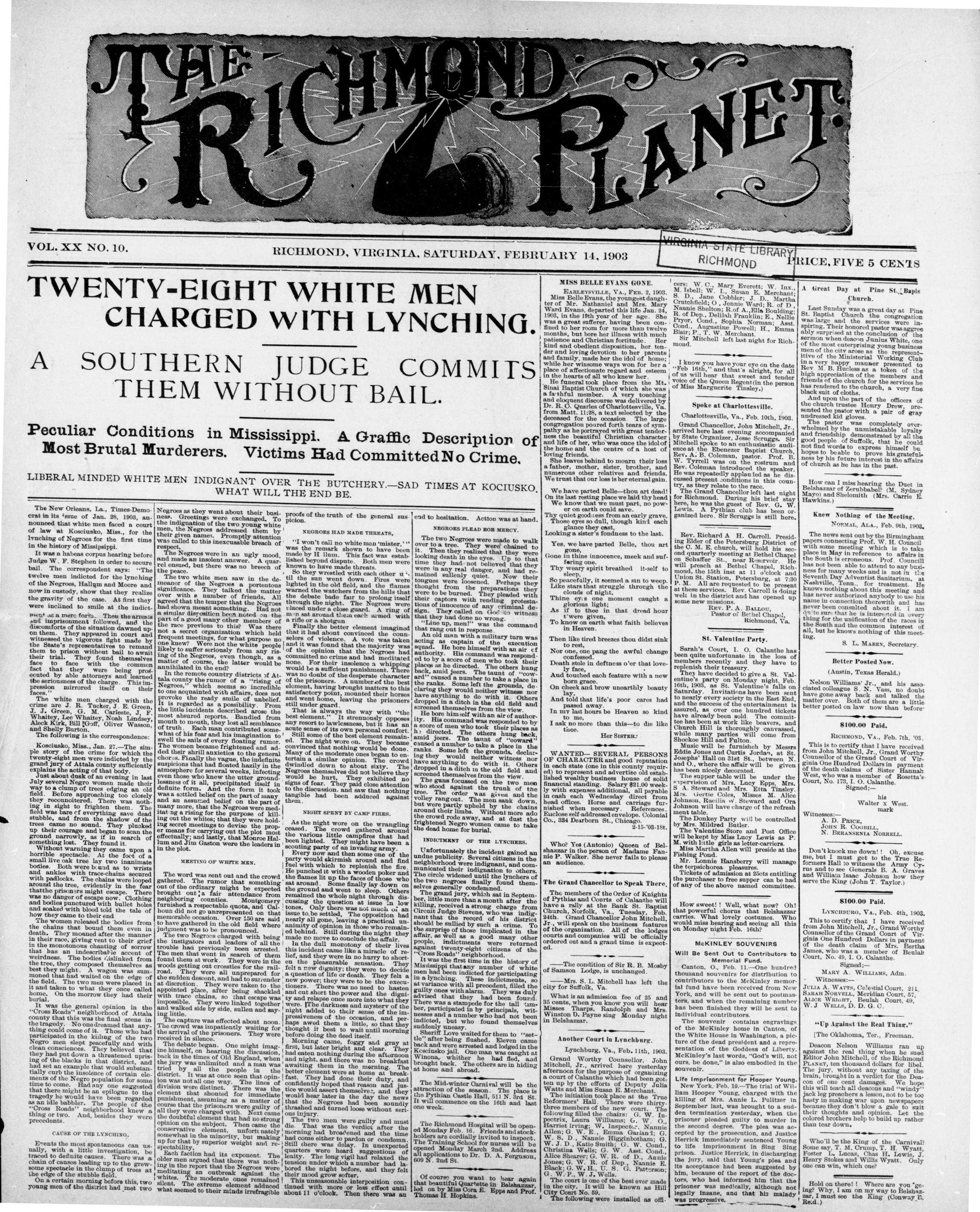
TWENTY-EIGHT WHITE MEN CHARGED WITH LYNCHING.
A SOUTHERN JUDGE COMMITS THEM WITHOUT BAIL.
Peculiar Conditions in Mississippi. A Graffic Description of Most Brutal Murderers. Victims Had Committed No Crime. LIBERAL MINDED WHITE MEN INDIGNANT OVER THE BUTCHERY.—SAD TIMES AT KOCIUSKO. WHAT WILL THE END BE.
VOL. XX NO. 10.
TWENTY
CHA
A SOUT
TH
Peculiar Condi
Most Brutal M
LIBERAL MINDED WHITE
The New Orleans, La., Times-Democrat in its 'issue of Jan. 28, 1903, announced that white men faced a court of law at Kosciusko, Miss., for the lynching of Negroes for the first time in the history of Mississippi.
It was a habes corpus hearing before Judge W. F. Stephen in order to secure bail. The correspondent says: "The twelve men indicted for the lynching of the Negroes, Hallum and Moore and now in custody, show that they realize the gravity of the case. At first they were inclined to smile at the indict
ment as a mere form. Then the arrests and imprisonment followed, and the discomforts of the situation dawned upon them. They appeared in court and witnessed the vigorous fight made by the State's representatives to remand them to prison without bail to await their trial. They found themselves face to face with the common fact that they were being prosecuted by able attorneys and learned the seriousness of the charge. This impression mirrored itself on their faces."
The white men charged with the crime are J. R. Tucker, J. E. Green, J. Green, G. M. Carleste, J, F. Whaiter, Lee Chatey, Noah Lindsey, Aleck Kirk Bill Goff, Oliver Wasson, and Shelly Burton.
The following is the correspondence:
Kosciusko, Miss., Jan. 27.—The simple story of the crime for which the twenty-eight men were indicted by the grand jury of Attala county sufficiently explains the acting of that body.
Just about dusk of an inexistent in last July several Negro women made their way to a clump of trees edging an old field. Before approaching too closely they reconnitered. There was nothing in sight to frighten them. The field was bare of everything save dead stubble, and from the shadow of the trees came no sound. They plucked up their courage and began to scan the ground narrowly, as if in search of something lost. They found it. Without warning they came upon a horrible spectacle. At the foot of a small oak tree lay two inanimate bodies. Both were bound as to wrists and ankles with trace-chains secured with padlocks. The chains were looped around the tree, evidently in the fear that the prisoners might escape. There was no danger of escape now. Clothing and bodies punctured with bullet holes and soaked with blood told the tale of how they came to their end.
The women released the 'bodies from the chains that bound them even in death. They moaned after the manner in their race, giving vent to their grief in the monotonous chanting of sorrow that has an indescribable accent of weirdness. The bodies 'islinked from the tree, they composed themselves as best they might. A wagon was summed that had waited on the edge of the field. The two men were placed in it and taken to what they once called home. On the morrow they had their burial.
It was the general opinion in the "Cross Roads" neighborhood of Attala county that this was the final scene in the tragedy. No one dreamed that anything could come of it. Those who had participated in the kilking of the two Negro men slept peacefully and with clean consciences. They believed that they had put down a threatened uprising of the blacks in that district, and had set an example that would substantially curb the insolence of certain elements of the Negro population for some time to come. Had any one suggested that there might be an epilogue to the tragedy he would have been regarded as an idle babbler. The people of the "Cross Roads" neighborhood knew a thing or two. And, besides they were precedents.
CAUSE OF THE LYNCHING
Events the most spontaneous can usually, with a little investigation, be traced to definite causes. There was a chain of causes leading up to the grewsome spectacle in the clump of trees at the edge of the stubble field. On a certain morning before this, two young men of the district had met, two
Negroes as they went about their business. Greetings were exchanged. To the indignation of the two young white men, the Negroes addressed them by their given names. Promptly attention was called to this inexcusable breach of respect. The Negroes were in an ugly mood, and made an insolent answer. A quarrel ensued, but there was no breech of the peace. The two white men saw in the demeanor of the Negroes a portentous significance. They talked the matter over with a number of friends. All agreed that the temper that the Negroes had shown meant something. Had not a similar disposition been noted on the part of a good many other members of the race previous to this? Was there not a secret organization which held frequent meetings, for what purpose no one knew? Were not the white people likely to suffer seriously from any rising of the Negroes, even though, as a matter of course, the latter would be annihilated in the end?
In the remote country districts of Attala county the rumor of a "rising of Negroes," which seems so incredible to one acquainted with affairs, does not provoke the ready smile of unbelief. It is regarded as a possibility. From the little incidents described arose the most absured reports. Bandied from mouth to mouth, they lost all semblances of truth. Each man contributed somewhat of his fear and his imagination to swell the sails of every floating rumor. The women became frightened and added their shrill anxieties to the general chorus. Finally the vague, the indefinite suspicions that had floated happily in the atmosphere for several weeks, infecting even those who knew the utter groundlessness of it all, precipitated itself in definite form. And the form it took was a settled belief on the part of many and an assumed belief on the part of many more, that the Negroes were mediating a rising for the purpose of killing out the whites; that they were holding secret meetings to devise the proper means for carrying out the plot most effectually; and lastly, that Monroe Hallum and Jim Gaston were the leaders in in the plot.
MEETING OF WHITE MEN
The word was sent out and the crowd gathered. The rumor that something out of the ordinary might be expected brought out; a fair attendance from neighboring counties. Montgomery furnished a respectable quote, and Oat houn did not go unrepresented on that memorable occasion. Over 150 are said to have gathered in the old field where judgment was to be pronounced. The two Negroes charged with being the instigators and leaders of all the trouble had previously been arrested. The men that went in search of them found them at work. They were in the woods getting out crossties for the railroad. They were all unprepared for the sudden descent, and had to surrender at discretion. They were taken to the appointed place, after being shackled with trace chains, so that escape was impossible. They were linked together and walked side by side, sullen and saying little. The capture was effected about noon. The crowd was impatiently waiting for the arrival of the prisoners. They were received in silence.
The debate began. One might imagine himself, on hearing the discussion, back in the times of Old England, when the jury was unlimited and a man was tried by all the people in the district. It was at once seen that opinion was not all one way. The lines of division were distinct. There was the element that shouted for immediate punishment, assuming as a matter of course that the prisoners were guilty of they were charged with. Next came the dangerous element that had no strong opinion on the subject. Then came the conservative element, unfortnotely somewhat in the minority, but making up for that by superior weight and respectability. Each faction had its exponent. The older men argued that there was nothing in the report that the Negroes were meditating an outbreak against whites. The moderate ones remained silent. The extreme element adnced what seemed to their minds irrefractible
RICHMOND, VIRGINIA, SATURDAY, FEBRUARY 14, 1903
proofs of the truth of the general sus picion.
NEGROES HAD MADE THREATS:
"I won't call no white man 'mister,'" was the remark shown to have been made by H illum. This fact was established beyond dispute. Both men were known to have made threats. So they wrestled with each other until the sun went down. Fires were lighted in the old field, and the flames warned the watchers from the hills that the debate bade fair to prolong itself through the night. The Negroes were placed under a close guard. A ring of men sat around them each armed with a rifle or a shotgun.
Finally the better element imagined that it had about convinced the counselors of violence. A vote was taken and it was found that the majority was of the opinion that the Negroes had committed no crime and had meditated none. For their insolence a whipping would be a sufficient punishment. There was no doubt of the desperate character of the prisoners. A number of the best element, having brought matters to this satisfactory point, mounted their horses and went home, leaving the prisoners still under guard.
That is always the way with "the best element." It strenuously opposes any resort to lawlessness, but it has an acute sense of its own personal comfort. Still some of the best element remained. The night wore on. They became convinced that nothing would be done. Many of the moderate ones began to entertain a similar opinion. The crowd dwindled down to about sixty. The Negroes themselves did not believe they would be hurt. They exhibited no signs of fear. They paid close attention to the discussion, and saw that nothing tangible had been adduced against them.
NIGHT SPENT BY CAMP FIRES
As the night wore on the wrangling ceased. The crowd gathered around the various little campfires that had been lighted. They might have been a scouting party of an invading army. Every now and then some one of the party would skirmish around and find fuel with which to replenish the fire. He punched it with a wooden poker and the flames lit up the faces of those who sat around. Some finally lay down on the ground and went to sleep. Others remained the whole night through discussing the question at issue in low tones. Only there was not much of an issue to be settled. The opposition had nearly all gone, leaving a practical unanimity of opinion in those who remained behind. Still during the night they made no move to conclude the affair.
In the dull monotony of their lives this incident came like a miracle of relief, and they were in no hurry to shorten the pleasurable sensation. They felt a new dignity; they were to decide a question of life or death. They felt a new power; they were to be the executioners. There was no need to hasten and cut short the power and the dignity and relapse once more into what they were. The darkness and mystery of the night added to their sense of the impressiveness of the occasion, and perhaps awed them a little, so that they thought it best to wait until morning before doing the deed itself.
Morning came, foggy and gray at first, but later bright and clear. They had eaten nothing during the afternoon and night, and there was no breakfast awaiting them in the morning. The better element were at home at breakfast. They had done their duty, and confidently hoped that reason and justice would assert themselves; and they would hear later in the day the news that the Negroes had been soundly thrashed and turned loose without serious injury. The two men were guilty and must die. That was the verdict after the morning had broadened and the time had come either to pardon or condemn. Still there was delay. In unexpected quarters were heard suggestions of lenity. The long vigil had relaxed the tension under which a number had labored the night before, and they felt their mood grow softer. This unreasonable interposition continued with more or less effect until about 11 o'clock. Then there was an
end to hesitation. Action was at hand.
NEGROES PLEAD FOR MERCY.
The two Negroes were made to walk over to a tree. They were chained to it. Then they realized that they were looking death in the eyes. Up to that time they had not believed that they were in any real danger, and had remained sullenly quiet. Now their tongues were loosed. Perhaps they thought from the preparations they were to be burned. They pleaded with their captors with rending protestations of innocence of any criminal design. They called on God to witness that they had done no wrong.
"Line up, men!" was the command that rang out in response.
An old man with a military turn was acting as captain of the execution squad. He bore himself with an air of authority. His command was responded to by a score of men who took their places as he directed. The others hung back, amid jeers. The taunt of "cow-whore" numbered a number to take a place in the ranks. One left the grounds, declaring they would witness nor have anything to do with the Others dropped in a ditch in the old field, and screened themselves from the view.
HOW: He bore himself with an air of authority. His command was responded to by a score of men who took their places as he directed. The others hung back, amid jeers. The taunt of "oward" caused a number to take a place in the ranks. Some left the grounds, declaring they would neither witness nor have anything to do with it. Others dropped in a ditch in the old field and screened themselves from the view.
The guns focussed on the two men who stood against the trunk of the tree. The order was given and the rhyme rang out. The men sank down, but they barely upheld the chains around the crowd. Without more ado the crowd rode away, and at dust the frightened Negro woman to take the dead home for burial.
INDICTMENT OF THE LYNCHERS
Unfortunately the incident gained an undue publicity. Several citizens in the neighborhood were indignant, and communicated their indignation to others. The circle widened until the lynchers of the two negroes finally found themselves generally condemned. The grand jury, which sat in September, little more than a month after the killing, received a strong charge from Circuit Judge Stevens, who was indignant that the record of his district should be sullied by such a crime. To the surprise of those implicated in the affair, as well as a good many other people, indictments were returned against twenty-eight citizens of the "Cross Roads" neighborhood.
It was the first time in the history of Mississippi that any number of white men had been indicted for participating in a lynching. These indictments, so at variance with all precedent, filled the guilty ones with alarm. They was duly advised that they had been found. There was a stampede for the tall timber, participated in by principals, witnesses and a number who had not been indicted, but who found themselves suddenly uneasy.
Sheriff Love waited for them to "settle" after being flushed. Eleven came back and were arrested and lodged in the Kosciusko jail. One man was caught at Winona, whither he had fled, and brought back. The others are in hiding at home and abroad.
The Mid-winter Carnival will be the attraction of the season. The place is the Pythian Castle Hall, 511 16th and last one week. It will commence on the 16th and last one week.
The Richmond Hospital will be opened Monday Feb. 16. Friends and stockholders are cordially invited to inspect. The Training School for nurses will be opened Monday March 2nd. Address all applications to Dr. D. A. Ferguson, 609 N. 2nd St.
Of course you want to hear again that beautiful Quartette in Belshazzar, led on by Miss Cora E. Epps and Prof. Thomas H. Hopkins.
MISS BELLE EVANS GONE
EARLEYSVILLE, VA., FEB. 2, 1903.
Miss Belle Evans, the youngest daughter of Mr. Nathaniel and Mrs. Mary Ward Evans, departed this life Jan. 24, 1903, in the 19th year of her age. She was a great sufferer, having been confined to her room for more than twelve months, but bore her illness with much patience and Christian fortitude. Her kind and obedient disposition, her tender and loving devotion to her parents and family, made her the idol of home; while her winsome ways won for her a place of affectionate regard and esteem in the hearts of all who knew her.
He funeral took place from the Mt. Sinai Baptist Church of which she was a faithful member. A very touching and eloquent discourse was delivered by Dr. R. O. Quarles of Charlottesville, Va. from Matt. 11:28, a text selected by the deceased for the occasion. The large congregation poured forth tears of sympathy as he portrayed with great tenderness the beautiful Christian character and life of her, who was once the idol of the home and the centre of a host of loving friends.
She leaves behind to mourn their loss a father, mother, sister, brother, and numerous other relatives and friends. We trust that our loss is her eternal gain.
We have parted Belle—thou art dead! On its last resting place we laid thy head We know that we must part, no power on earth could save. Thy quiet goodness from an early grave, Those eyes so dull, though kind each glance they cast.
glance they cast,
Looking a sister's fondness to the last.
Yes, we have parted Belle, thou art gone,
Gone in thine innocence, meek and suffering one.
Thy weary spirit breathed it-self to sleep.
So peacefully, it seemed a sn to weep.
Like stars that struggle through the clouds of night.
Thine eyes one moment caught a glorious light;
As if to thee in that dread hour t'were given,
To know on earth what faith believes in Heaven.
Then like tired breezes thou didst sink to rest.
Nor one, one pang the awful change confessed.
Death stole in deftness o'er that lovely face,
And touched each feature with a new born grace.
On cheek and brow unearthly beauty lay,
And told that life's poor cares had passed away.
In my last hours be Heaven so kind to me,
I ask no more than this—to die like thee.
WANTED—SEVERAL PERSONS OF CHARACTER and good reputation in each state (one in this county required) to represent and advertise old established wealthy business house of solid financial standing. Salary $21.00 weekly with expenses additional, all payable in cash each Wednesday direct from head offices. Horse and carriage furnished when necessary. References. Euclide self-addressed envelope. Colonial Co., 334 Dearborn St., Chicago. 2:15-'03-18t.
Who? Yes (Antonio) Queen of Belshazzar in the person of Madame Fannie P. Walker. She never fails to please an audience.
The Grand Chancellor to Speak There
The members of the Order of Knights of Pythias and Courts of Calanthe will have a rally at the Bank St. Baptist Church, Norfolk, Va., Tuesday, Feb. 24th. Grand Chancellor John Mitchell, Jr., will speak on the business features of the organization. All of the lodges courts and companies will be officially ordered out and a grand time is expected.
The condition of Sir R. B. Mosby of Samson Lodge, is unchanged.
Mrs. S. L. Mitchell has left the city for Suffolk, Va.
What is an admission fee of 25 and 35 cents, when you know you will hear Misses Tharps, Randolph and Mrs. Winston D. Payne sing Monday night in Belshazzar.
Another Court in Lynchburg
Lynchburg, va., Feb. 11th, 1903.
Grand Worthy Counselor, John Mitchell, Jr., arrived here yesterday afternoon or the purpose of organizing a conference and had been gotten up by the efforts of Dana Julia Watts and Miss Susan E. Merchant
The initiation took place at the True Reformers' Hall. There were thirty-three members of the new court. The following filled the chairs: G. W. Inpectrix, Laura Williams; G. W. O. Harriet Irving; W. Inspector, Nannie Allen; G. W. E. Emma Garlan; G. W. S. D., Nannie Gignbotham; G. W. J. D., Katie Smith; G. W. Cond. Christina Wells; G. W. Asst. Cond. Alice Shearer; G. W. R. of D., Annie Jones; G. W. R. of Dep., Nannie E. Black; G. W. H. U. S. G. Patterson; G. W. P. W. J. Wells.
The court is one of the best ever made in the city. It will be known as Hill City Court No. 59.
The following were installed as offi.
cers: W. C., Mary Everett; W. Inx,
M. Isbell; W. I. Susan E. Merchant;
S. D. Jane Cobler; J. D. Martha
Crutchfield; O, Jennie Ward; R. D. d,
Nannie Shelton; R. of A., Ella Boulding;
R. of Dep. Dellahil Franklin; E, Nellie
Cond. Cond, Sophia Norman; Asst.
Cond. Cine Powell; H, Hena
Blair; P, T. W. Merchant.
Sir Mitchell last night for Richmond.
---
I know you have your eye on the date "ib 16th," and that's alright, for all of us. That's sweet and tender voice of the Queen Robert (in the person of Miss Marguerite). This
Spoke at Charlottesville
Charlottesville, Va., Feb. 10th, 1903.
Grand Chancellor, John Mitchell, Jr., arrived here last evening accompanied by State Organizer, Jesse Scruggs. Sir Mitchell spoke to an enthusiastic audience at the Ebenezer Baptist Church, Rev. A. B. Coleman, pastor. Prof. B. W. Tyrrell was on the rostrum and Rev. Coleman introduced the speaker. He was repeatedly applauded as he discussed present conditions in this country, as they relate to the race.
The Grand Chancellor left last night for Richmond. During his brief stay here, he was the guest of Rev. G. W. Lewis. A Pythian club has been organized here. Sir Scruggs is still here
Rev. Richard A H. Carroll. Presiding Elder of the Petersburg District of the C. M. E. church, will hold his second quarterly meeting at Bethel Chapel on Schaffer St. near Reservoir. He will preach at Bethel Chapel, Richmond, the 15th inst at 11 o'clock and Union St. Station, Petersburg, at 7:30 P.M. All are requested to be present at these services. Rev. Carroll is doing well in the district and has opened up some new missions. Rev. P. A. BALLOU, Pastor of Bethel Chapel, Richmond, Va.
St. Valentine Party
Sarah's Court, I. O. Calanthe has been quite unfortunate in the loss of members recently and they have to replenish their treasury.
They have decided to give a St. Valentine's party on Monday night, Feb. 16th, 1903, as St. Valentine's falls on Saturday. Invitations have been sent to nearly every society in the East End, and the success of the entertainment is assured, as over one hundred tickets have already been sold. The committee has been at work like beavers, and Church Hill is thoroughly canvassed, while many parties will come Shockoe Hill and Fulton.
Music will be furnished by Messrs Eddie Jones and Curtis Jordan, at St. Joseph's Hall on 31st St., between N. and O., where the affair will be given has been nicely decorated.
The supper table will be under the supervision of Mrs. Lucy Epps, Mrs. S. A. Steward and Mrs. Etta Tinsley, Mrs. Gertie Coles, Misses M. Alice Johnson, Racilia W. Steward and Ora Johnson will have charge of the refreshment table.
The Donkey Party will be controlled by Mrs. Mildred Butler.
The Valentine Store and Post Office will be kept by Miss Lucy Lewis as P. M. with little girls as letter-carriers.
Miss Martha Allen will preside at the Fishing Pond.
Mr. Lonnie Hansberry will manage the terpsichorea pleasures.
Tickets of admission at 25cts entitle the purchaser to free supper can be had of any of the above named committee.
How sweet! ! Well, what now? Oh! that powerful chorus that Belshazzar carries. What lovely costumes. Who would miss hearing and seeing all this on Monday night Feb. 16th?
McKINLEY SOUVENIRS
Will Be Sent Out to Contributors to Memorial Fund.
Canton, O., Feb. 11.—One hundred thousand souvenirs for distribution to contributors to the McKinley memorial fund have been received from New York, and will be sent out to postmasters, and when the remaining number has been finished they will be sent to individual contributors.
The souvenir contains engravings of the McKinley home in Canton, of the White House in Washington, a picture of the dead president and a representation of the Goddess of Liberty. McKinley's last words, "God's will, not ours, be done," is also embodied in the souvenir.
Life Imprisonment for Hooper Young. New York, Feb. 10.—The trial of William Hooper Young, charged with the killing of Mrs. Annie L. Pulitzer in September last, was brought to a sudden termination yesterday, when the prisoner pleaded guilty to murder in the second degree. The plea was accepted by the prosecution, and Justice Herrick immediately sentenced Young to life imprisonment in Sing Sing prison. Justice Herrick, in discharging the jury, said that Young's plea and its acceptance had been suggested by him, because of the report of the doctors, who had informed him that the prisoner was medically, although not legally insane, and that his malady was progressive.
Last Sunday was a great day at Pine St. Baptist Church the congregation was large and the services were inspiring. Their honored pastor was agreeably surprised at the conclusion of the sermon when deacon Junius White, one of the most enterprising young business men of the city arose as the representative of the Ministerial Working Club in a very happy manner presented to Rev M. B. Hucless as a token of the high appreciation of the members and friends of the church for the services he has rendered to the church, a very fine black suit of cloths. Also in part of the officers of the church muster Henry Drew, presented the chair with a pair of gray undressed kid glove. The pastor was completely overwhelmed by the unmistakable loyalty and friendship demonstrated by all the good people of Suffolk, that he could not find words to express himself hopes to beable to prove his gratefulness by his future interest in the affairs of church as he has in the past.
How can I miss hearing the Duet in Belshazzar of Zerubbabel? (M, Sydney May) and Shelomith (Mrs. Carrie E. Hawkins.)
The news sent out by the Birmingham papers connecting Prof. W. H. Council with some meeting which is to take place in May in reference to affairs in the South is erroneous. Prof. Council has not been able to attend to any business for many weeks and is not in the Seventh Day Adventist Sanitarium, at Nashville, Tenn., for treatment. He knows nothing about this meeting and has never authorized anybody to use his name in connection therewith and has never been consulted about it. I am quite sure that he is interested in every thing for the unification of the races in the South and the common interest of all, but he knows nothing of this meeting.
S. L. MABEN, Secretary.
Nelson Williams' Jr., and his associated colleague S. N. Vass, no doubt have gone away back and talked the matter over. Both of them are a little better posted on law now than before.
$100.00 Paid.
RICHMOND, VA., Feb. 7th, '03.
This is to certify that I have received from John Mitehell, Jr. Grand Worth Counsellor of the Grand Court of Virginia One Hundred Dollars in payment of the death claims of Sister Hannah West, who was a member of Rosetta's Court, No. 173, I. O. Calanthe.
Witnesses:
A. D. PRICE,
JOHN R. COGBILL,
N. BERANSENIA NORRELL.
Don't knock me down!! Oh, excuse me, but I must get to the True Reformers Hall to witness the Army Cyrus and to see Generals B. A. Graves and William Isaac Johnson how they serve the King (John T. Taylor.)
$100.00 Paid.
LYNCHBURG, VA. Feb. 4th, 1903. This to certify that I. have received from John Mitchell, Jr. Grand Worthy Counsellor of the Grand Court of Virginia One Hundred Dollars in payment of the death claim of Mrs. Bertha James, who was a member of Beulah Court, No. 48. I. O. Calanthe.
Signed:—
MARY A. WILLIAMS, Adm.
Witnesses:—
JULIA A. WATTS, Celestial Court, 211
SARAH NORVELL, Meridian Court, 57
ALICE WRIGHT, Beulah Court, 49,
W. J. WELLS, D. D. G. C
"Up Against the Real Thing."
[The Oklahoma, Ter., Freeman.
Deacon Nelson Williams ran up against the real thing when he sued Editor John Mitchell, of the Richmond PLANET, ten thousand dollars for libel. The jury, without any taxing of the brain, brought in a verdict for the Deacon of one cent damages. We hope this will teach all deacons and "windy" jack leg preachers a lesson, not to be too hasty in making war upon newspapers because they don't blow a gale to suit their thoughts and opinion. Let the colored brothers help to build up rather than tear down.
Who'll be the King of the Carnival Some say, T. M. Crump, T. H. Wyatt, Foster L. Lucas, Chas H. Lewis, J. Henry Stokes and Willis Wyatt. Only one can win, which one?
---
Hold on there!! Where are you 'give-
ing? Why, I am on my way to Belshaz
zar, I must see the King (Conway K.
R.e.d.)
2
eres
eR ga is
See SS Pega
pe ae
Chey ok SR a
ee ae
A ME Sc.
ee ae
Se s oo =
EAPURDAY vest FEB. 1M, 1908
7 Geectictn ts bheee
The German emperor has entered
upon a n-w phase of his development,
Af we are to believe the statement
that he was lately seen reading the
newspapers in a railway train with the
help of pince-nez, Nor is this to be
wondered at when we remember the
lament once made by the kaiser him-
self, who, speaking of his school days
at Cassel, remarked that out of a class
of 20 “no fewer than 18 of his fellow-
pupils wore spectacles, while two of
these, with their glasses on, could not
even see the length of the table.” As
compared with other nations, the
Germans may be described as a spee-
tacle-wearing people, and there can
be no doubt that the main cause of
their defective sighte is the peculiar
character of their type, which is most
trying to the eyes. ‘The present em-
péror, no less than Bismarck, has al-
Ways protested on patriotic grounds
against the substitution of the Koman
for the Teutonic, or black letter, char-
acter in print, and both have had to
suffer equally for their Chauvinism.—
London Chronicle.
ie ieee ieee creas
Along the line of the Trenton-New
Brunswick railroad, between Mill-
town and Dayton, is'a ramshackle old
bara, at the end of which are a wind-
mill ‘tower aud a windinill that look
like a piece out of a Duteh landscape.
‘The natives tell wonderful stories of
the mill's history—how it was brought
from Holland in sections many years
ago and erected by the then owner
of the farm, a worthy descendant of a
line of burghers with an ancestry that
would give him the seat of honor at a
reunion of the Holland society. As a
matter of fact, however, the mill is
only about 20 years old, and it was
built by an Irish carpenter, who was
employed by the Scotchman who oc-
cupied the farm, renting . it from a
Frenchman who then held title to the
property. But it makes an interest.
ing, though a spurious, antique, and
it is a veritable treasure trove for a
small army of water colorists, sketch-
ers and amateur photographers.—
New Brunswick News.
be Walaa ea
Among the great ground landlords
in London the crown is one of the
greatest, owning properties in vari
ous parts of the capital yielding in
ground rents £460,000 per annum.
Fifteen years ago the estates pro.
duce £250,000 only; but many leases
have fallen in within that time, and
the increased rents have been ex.
acted for renewal fines or for new
leases. The Carlton hotel is a strik.
ing instance of the increased value
ef ground in London, Formerly the
site on which the hotel stands was
held from the crown for a ground
rent of £763 per aunum; now £4,
200 yearly has te be paid.—London
Express.
Fond of Mie Tomb.
An eccentric old gentleman named
Chapelin lately died at Monhoudou, in
the department of Sarthe, who had
caused a monumental tomb to be
built on a plece of fend adjoining the
cemetery. In this tomb be had for 20
years pust spent several hours a day,
often sleeping there, in order, as he
said, to get used to his future dwelling
place. At his house he kept the coffin
in which he was to be buried, and used
it as a bed, while he invariably had his
winding sheet or shroud laid on the
table in the dining-room in len of @
tablecloth_—Philadelphia Press
‘aiseain ean.
“Prisoner,” said the judge, “you are
convicted of bigumy—of having mar.
Fied two wives. Have you any plea for
merey before the sentence of the court
is imposed on you?”
“Yes, judge,” said the prisoner, “give
me as big a sentence in jail as you can,”
“What?”
“I want t' keep out o? the clutches
of those two wives as long as I can,
and a long jail sentence will be true
merey."—Baltimore Herald.
Awaiting Hie Opportunity.
Mrs. Newlyriche—John, we must
really make some move to get into
high society! Now, how are we going
to do it?
Mr. Newlyriche—Hanged if I know,
Jane;—but I'm going to put that ques.
tion to the butler just as soon as I ean
eatch him with a confidential jag on.—
Puck.
Free Parisian ‘Theatricala,
Some of the Parisian theaters give
gratuitous performances three or four
times a year. They are intended for
poor people, and those who are first
in line are usually at the doors sev-
eral hours before the house is opened.
Indianapolis News.
ahiceitah Temata aati ee
‘The teacher asked the class wherein
lay the difference in meaning between
the words “sufficient” and “enough.”
“Sufficient,” ” answered Tommy, “is
when mother thinks it's time for me
to stop eating pudding: ‘enough’ is
when I think it is."—Stray Stories.
Carelenanean.
Wiggle—He has one foot in the grave
already.
Woggle—Why, he looks young
enough, Explain yourself.
“He left it in “the Philippines.”—
Harvard Lampoon.
‘Sauiiied sane.
The handsome young man halted at
‘the beauty tent in the church fair.
“So you are selling kisses for $1 for
the benefit of the chureh 2” he asked.
“Yes,” said the pretty girl, blushing.
“Any reduction?”
“Welt, if the right man came along]
aight elt one for 99 cents."—Chicage
Daity News,
2 Ce
Aric and GIRL
ig at
ag OCs yee
= eee —aial
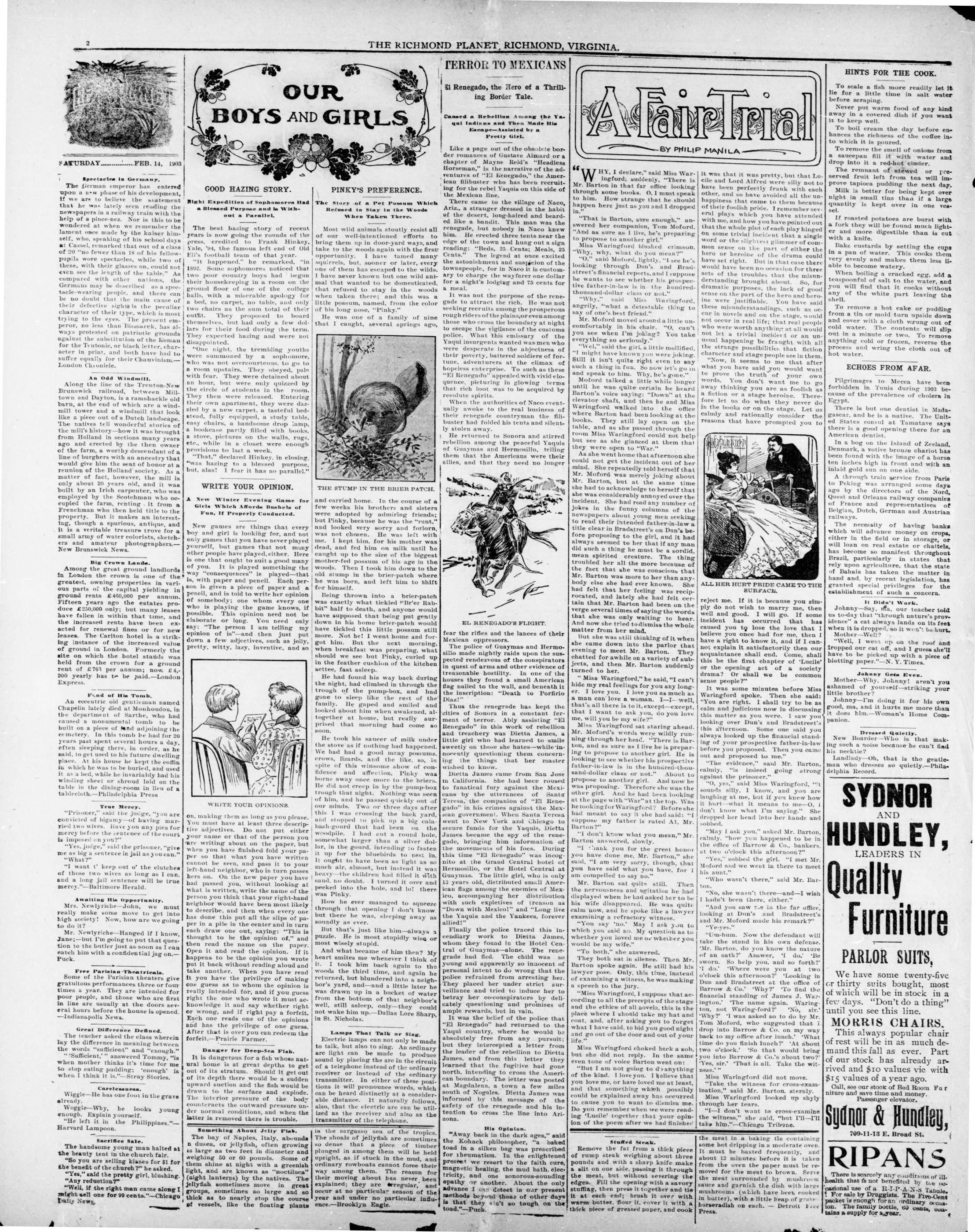
GOOD HAZING STORY.
Right Expedition of Sophomores Had
4 Blessed Parpone and ia With-
Gah te kcal
The best hazing story of recent
years is now going the rounds of the
press, credited to Frank Hinkey,
Yale, "M4, the famous left end of Old
Eli's football team of that year.
“It happened.” he remarked, “in
1892. Some sophomores noticed that
two poor country boys had begun
their housekeeping ina room on the
ground floor of one of the college
halls, with a miserable apology for
a bed, no carpet, no table, and only
two chairs as the sum total of their
cuttit. They proposed to board
themselves, but had only a few dol-
lars for their food during the tern.
They expected hazing and were not
disappointed.
“One night, the trembling youths
were summoned by a sophomore,
who was not overcourteous, to go to
@ room upstairs. They obeyed, pale
with fear. They were detained about
an hour, but were only quizzed by
the circle of students in the room.
‘They then were released. Entering
their own apartment, they were daz-
zled by a new carpet, a tasteful bed-
stead, fully equipped, a study table,
easy chairs, a handsome drop iamp,
& bookease partly filled with books,
a stove, pictures on the walls, rugs,
ete, while ina closet were enongh
provisions to last a week.
“That.” declared Hinkey, in closing,
“was hazing to a blessed purpose,
but, alas! I fear it has no parallel.”
WRITE YOUR OPINION.
A New Winter Evening Game for
Girls Which Afforda Ruahela of
Fun, If Property Conducted.
New games are things that every
boy and girl is looking for, and not
only games that you have never played
yourself, bat games that not) muny
other people have played,either. Here
is one that ought to suit a good many
of you. It is played something the
way “consequences” is played—that
is, with paper and pencil. Eaéh per-
son is given a piece of paper and a
pencil, and is told to write her opinion
f somebody; one whom every one
who is playing the game knows, if
possible. This opinion need not be
elaborate or long. You need only
say: “The person I am telling my
epinion of is”—and then just put
down a few adjectives, such as jolly,
pretty, witty, lazy, inventive, and so
we ae keg
Sw tharke
Wo Aaa
> A Cr
NN ot LIPO
Ye Ih"
WRITE YOUR Genucms
‘on, making them as long as you please.
You must have at least three deserip-
tive adjectives. Do not put either
your name or that of the person you
‘are writing about on the paper, but
when you have finished fold your pa-
Per so that what you have written
cannot be seen, and pass it to your
left-hand neighbor, who in turn passes
hers on. On the new paper you have
had passed you, without looking at
what is written, write the name of the
person you think that your right-hand
neighbor would have been most likely
to describe, and then when every one
has done this put all the slips of pa-
per in a pile in the center and in turn
each draw one out, saying: “This is
thought to be the opinion of,” and
then read the name on the paper.
Open it and read the opinion. If it
happens to be the opinion you wrote
put it back without reading aloud and
take another, When you have read
ft you have the privilege of making
fone guess as to whom the opinion is
really intended for, and if you guess
right the one who wrote it must ac-
knowledge it aud say whether right
or wrong, and if right pay a forfeit.
Each one reads one of the opinions
and has the privilege of one guess.
After that is over you can redeem the
forfeit.—Prairie Farmer.
cdtester hie: SiciadcBaa! we:
It is dangerous for a fish whose nat-
ural home is at great depths to get
out of its stratum. Should it get out
of its depth there would be a sudden
upward suction and the fish would be
drawn to the surface and explode.
‘The interior pressure of the body
counteracts the outward pressure un-
der normal conditions, and when the
latter is removed there is trouble.
————————
Something About Jcliy Fiab.
The bay of Naples, Italy, abounds
n dusea, or jellyfish, often growing
4s large as two feet in diameter and
weighing 50 or 60 pounds. Some of
them shine at night with a greenish
light, and are known as “noctiluca”
(aight lanterns) by the natives. The
Jellyfish sometimes move in great
groups, sometimes so large and so
thick as to nearly stop the course
of vessels, like the floating plants
THE RICHMOND PLANET, RICHMOND, VIRGINIA.
, PINKY’S PREFERENCE.
The Story of a Pet Posum Which
Retased to Stay in the Woods
When Taken There.
Most wild animals stoutly resist all
of our well-intentioned efforts to
bring them up in door-yard ways, and
take to the woods again with the first
opportunity, I have tamed many
squirrels, but, sooner or later, every
one of them has exeaped to the wilds.
L have never known but one wild ani-
mal that wanted to be domesticated.
that refused to stay in the woods
when taken there; and this was a
little possum, named, from the color
of bis long nose, “Pinky.”
He was one of a family of nine
that I caught, several springs ago,
| '% hE :
iy 7 &e é )
yy Eas LS
oe Bf . 4
a
d an. ) es
aa
geet poe
Sate ese ae
EN SEER OY,
ie HEU aN THe BRR PASO,
and carried home. In the course of a
few weeks his brothers and sisters
were adopted by admiring friends;
but Pinky, because he was the “runt,”
and looked very sorry and forlorn,
was not chosen. He was left with
me. I kept him, for his mother was
dead, and fed him on milk until he
caught up to the size of the biggest
mother-fed possum of his age in the
woods. Then I took him down to the
old stump in the brier-patch where
he was born, and left him to shift
for himself.
Reing thrown into a_ brier-pateh
was exactly what tickled *Br'er Rab-
bit” half to death, and anyone would
have supposed that being put gently
down in his home brier-patch would
have tickled this little possum. still
more. Not he! I went home and for-
got him, But the next morning,
when breakfast was preparing, what
should we see but Pinky, curled up
in the feather cushion of the kitchen
settee, fast asleep.
He had found his way back during
the night, had climbed in through the
trough of the pump-box, and had
gone to sleep like the rest of the
family. He gaped and smiled and
looked about him when awakened, al-
together at home, but really sur-
prised that morning had come so
soon,
He took his saucer of milk under
the stove as if nothing had happened.
We had had a good many possums,
crows, lizards, and the like, so, in
spite of this winsome show of con-
fidence and affection, Pinky was
borne away once more to the briers.
He did not creep in by the pump-box
trough that night. Nothing was seen
of him, and he passed quickly out of
our minds, Two or three days after
this 1 was crossing the back yard,
and stopped to pick up a big cala.
bash-gourd that had been on the
woodpile. I had cut a round hole,
somewhat larger than a silver dol
lar, in the gourd. intending io fasten
it up for the bluebirds to. nest in,
Ty ought to have been as light as so
much air, almost, but instead it was
heavy—the children had filled it With
sand, no doubt. 1 turned it over and
peeked into the hole, and lo! there
was Pinky.
How he ever managed to squeeze
throngh that opening I don't know.
but there he was, sleeping away as
soundly as ever.
But that’s just like him—always a
puzzle. He is most stupidly wise or
most wisely stupid.
And what became of him then? My
heart smites me whenever I think of
it, I took him back again to the
woods the third time, and again he
returned, but blundered into a neigh-
bor's yard, and—and a little Inter he
was drawn up in a bucket of water
from the bottom of that neighbor's
well, still asleep, only—they could
not wake him up.—Dallas Lore Sharp,
in St. Nicholas.
Lamps That Talk or Sing.
Electric lamps can not only be made
to talk, but also to sing. An ordinary
are light can be made to produce
sound by placing the are in the cireuit
of a telephone instead of the ordinary
receiver or instead of the ordinary
transmitter. In either of these posi
tions it will pronounce words, which
can be heard distinetly at a consider.
able distance. It naturally follows,
also, that the electric are cin be util.
ized as the receiver and also as the
transmitter of the telephone.
See
im the Sargasso sea of the tropics,
‘The shoals of jellyfish are sometimes
so dense that a piece of timber
planged in among them will be held
upright, as if stuek in the mud, and
ordinary rowboats cannot force their
way umong them. The reason for
their moving about bas never, been
explained; they are @reguiar, and
occur at no particular season of the
year and under no particular influ-
‘ence.—Brooklyn Eagle.
TERROR TO MEXICANS
31 Renegado, ihe Hee ote Thril-
ing Border Tale.
Caines. a mnbawioniacece’ pa ve
| Like a page out of the obsolete bor
‘der romances of Gustave Aimard or a
chapter of Mayne Reid’s “Headless
Horseman,” is the narrative of the ad-
ventures of “El Wenegado,” the Amer-
ican filibuster who has been recruit-
ing for the rebel Yaquis on this side of
the Mexican line,
‘There came to the village of Naco,
Ariz. a stranger dressed in the habit
of the desert, long-haired and beard-
ed like a bandit. ‘This man was the
renegade, but nobody in Naco knew
him.” He erected three tents near the
edge of the town and hung out a sign
reading: “Beds, 25 Cents; Meals, 25
Cents.” The legend at once excited
the astonishment and suspgcion of the
townspeople, for in Naco it is custom-
ary to charge the wayfarer one dollar
for a night's lodging and 75 cents for
a meal, :
It was not the purpose of the rene-
gade to attract the rich. He wus not
seeking recruits among the prosperous
rough riders of the plainsjor even among
those who cross the boundary at night
to escape the yigilance of the customs
police. What this emissary of the
Yaqui insurgents wanted was men who
were desperate in the abjectness of
their poverty, battered soldiers of for-
tune, adventurers at the climax of
hopeless enterprise. To such as these
“EI Renegado” appealed with vivid elo-
quenee, picturing in glowing terms
that rich loot was to be acquired by
resolute spirits.
When the authorities of Naco event-
ually awoke to the real business of
their renegade countryman the fili-
buster had folded his tents and silent-
ly stolen away.
. He returned to Sonora and stirred
rebellion among the peaceful Yaquis
of Guaymas and Hermosillo, telling
them that the Americans were their
allies, and that they need no longer
a ey os
La eS”
Ry ks hgh et
a zo wa
SiS a =
ite BAN
77
oy =
mr . vs
nf EE
cee
as
ee nae eee
fear the rifles and the lances of their
Mexican oppressors.
‘The police of Guaymas and Hermo-
sillo made nightly raids upon the sus-
pected rendezvous of the conspirators
in quest of arms and other evidence of
treasonable hostility. In one of the
houses they found a small American
flag nailed to the wall, and beneath it
the inscription: “Death to Porfirio
Diaz!”
Thus the renegrade has kept the
cities of Sonora in a constant fer-
ment of terror. Ably assisting “El
Renegado” in this work of rebellion
and treachery was Dieta James, a
little girl who had learned to smile
sweetly on those she hates—while in.
nocently questioning them concern-
ing the things that her master
wished to know.
Dietta James came from San Jose
im California, She had been roused
to fanatical fury against the Mexi-
cans by the utterances of Santa
Teresa, the companion of “El Rene-
gado” in his crimes against the Mex-
ican government. When Santa Teresa
went to New York and Chicago to
secure funds for the Yaquis, Dieta
James beeame the spy of the rene-
gade, bringing him information of
the movements of his foes. During
this time “El Renegado” was incog-
nito at the Grand Central hotel of
Hermosillo, or the Hotel Central at
Guaymas. ‘The little girl, who is only
13 years old, distributed small Amer-
ican flags among the enemies of Mex-
ico, accompanying her distribution
with such expletives of treason as
“Down with Mexico!” and “Long live
the Yaquis and the Yankees, forever
allied!”
Finally the police traced this in-
cendiary work to Dietta James,
whom they found in the Hotel Cen:
tral of Guaymas—alone. ‘The rene-
grade had fled. The child was so
young and apparently so innocent of
Personal intent to do wrong that the
police refrained from arresting her.
‘They placed her under strict sur-
veillance and tried to induce her to
betray her co-conspirators by deli:
cately questioning and promises of
ample rewards, but in vain,
It was the belief of the police that
“El Renegado” had returned to. the
Yaqui country, where he would be
absolutely free from any pursuit;
but they intercepted a letter from
the leader of the rebellion to Dietta
James, and from this. letter they
learned that the fugitive had gone
north, intending to cross the Ameri-
can boundary. The jetter was posted
at Magdalena, a town a few miles
south of Nogales. Dietta James was
informed by this message of _ the
safety of the renegade and his in-
tention to cross the line into Ari-
zona.
His Opinion.
“Away back in the dark ages,” said
the Kohack philosopher, “a baked
toad in a silken bag was prescribed
for 1heumatism. In the enlightened
Prestmt we resort to the faith cure,
Magnetic healing, the mud bath, élee
tricity, and one sonorous-sounding
epathy or snother. About the only
advance I can detect in our present
methods beyond those of other days
ia that they vin't so tough on the
toad.”—Puck.
ee tan eeeniar tien
* 2 :
Ademelirral
eee tt BY PHILIP mani LA
happen here just as you and I dropped
‘aoe
“That is Barton, sure enough,” an-
swered her companion, Tom Moford.
“And as sure as 1 live, he’s preparing
to propose to another girl.”
Miss Waringford blushed crimson.
“Why, why, what do you mean?”
“0,” said Moford, lightly, “I see he's
looking through Dun's and Brad-
street's financial reports, and I suppose
he wants to see whether his prospec-
tive father-in-law is in the hundred-
thousand-dollar class or not.”
“Why.” said Miss Waringford,
angrily, “what a detestable thing to
say of one’s best friend.”
Mr. Moford moved arounda little un-
comfortably in his chair. “0, can't
you see when I'm joking? You take
everything so seriously.”
“Wel,” said the girl, a little mollified,
“I might have known you were joking
Still it isn't quite right even to say
such a thing in fun. So now let’s go in
and speak to him. Why, he’s gone.”
Moford talked a little while longer
until he was quite ceriain he heard
Barton's voice saying: “Down” at the
clevator shaft, and then he and Miss
Waringford walked into the office
where Barton had been looking at the
books. They still lay open on the
table, and as she passed through the
room Miss Waringford could not help
but see as she glanced at them that
they were open to “War.”
As she went home that afternoon she
could not get the incident out of her
mind. She repeatedly told herself that
Mr. Moford was merely joking about
Mr. Barton, but at the same time
she had to acknowledge to herself that
she was considerably annoyed over the
incident. She had read any number of
jokes in the funny columns of the
Rewspapers about young men seeking
to read their intended father-in-law a.
title clear in Bradstreet's on Dun’s be-
fore proposing to the girl, and it had
always seemed to her that if any man
did such a thing he must be a sordid,
mean spirited creature. The thing
troubled her all the more because of
the fact that she was conscious that
Mr. Barton was more to her than any-
body else she had ever known. She
had felt that her feeling was recip-
rocated, and lately she had felt cer-
tain that Mr. Barton had been on the
verge several times of saying the words
that she was only waiting to hear.
And now she tried todismiss the whole
matter from her mind,
But she was still thinking of it when
she came down into the parlor that
evening to meet Mr. Barton, They
chatted for awhile on a variety of sub-
jects, and then Mr, Barton suddenly
turned to her.
“ Miss Waringford,” he said, “I can’t
hide my real feelings for you any long-
er. I love you, I love you as much as
& man can'love a woman. I—I- well,
that’s all there is to it, except—except,
that I want to ask you, do you love
me, will you be my wife?"
Miss Waringford sat staring ahead.
Mr. Moford’s words were wildly run-
ning through her head. “There is Bar-
ton, and as sure as [live he is prepar-
ing to propose to another girl. He is
looking to see whether his prospective
father-in-law is in the hundred-thou-
sand-dollar class or not.” About to
Propose to another girl. And now he
was proposing. Therefore she was the
other girl. And he had been looking
at the page with “War"at the top. Was
Helookingtor Waringtord? Teforeshe
had meant to say it she had said: “1
suppose my father is rated At, Mr.
Barton?"
“I don’t know what you mean,” Mr.
Barton answered, slowly.
“I shauk you for the great honor
you have done me, Mr, Barton,” she
suid, “Lam very sorry, though, that
you have said what you have, for |
am compelled to say no.”
Mr, Barton sat quite still, ‘Then
the nervousness and agitation he had
displayed when he had asked her to be |
his wife disappeared. He was quite
calm now, and he spoke like a lawyer
examining 2 refractory witness.
“You say ‘no.’ May Task you to
which you said no. My question as to |
whether you loved me ov whether you
would be my wife."
“To both,” she answered,
‘They both sat in silence. ‘Then Mr.
Barton spoke again. He still had his
lawyer pose. Only, this time, instead
of examining a witness, he was making
a speech to the jury.
“Miss Waringford, I suppose that ac-
cording to all the precepts of the stage
and the ethics: of all novels, this is the
place where I shonld take my hat and
coat, and, after asking you to forget
what I have said, to bid you good night
and go out of the door and out of your
life.”
Miss Waringford choked back a sob,
but she did not reply. In the same
even tone of voice Rarton went on:
“But Iam not going to dyanything
of the kind. Iloveyou. I \elieve that
you love me, or have loved me at least,
and that something which possibly
could be explained away has ocenrred
to cause you to want to dismiss me.
Do you remember when we were read-
ing ‘Lucile’ together that your opin-
Staffed Steak.
Remove the fat from a thick piece
of rump steak weighing about three
pounds and with a sharp knife make
& slit on one side, passing it through
the meat, but without severing the
edges. Fill the opening with a savory
stuffing, then press it together and tie
ft at each end; brush it over with
warm: butter, flour if, cover ic with a
thick piece of greased paper, and cook
it was that it was pretty, but that Lu.
cile and Lord Alfred were silly not t
have been perfectly frank with each
other, and so have avoided all the un.
happiness that came to them because
of their foolish pride, Iremember sev-
emul plays which you have attended
with me, and how you have pointed out
that the whole plot of each play hinged
on some trivial incident that a single
word or the sliziiest glimmer of com-
mon sense on the part of either the
hero or heroine of the drama could
have set right. But in that case there
would have been no occasion for three
acts of the troubles that the misun-
derstanding brought about. So, for
dramatic purposes, the lack of good
sense on the part of the hero and hero.
ine were justifiable. You have said
these misunderstandings, such as oc.
cur in novels and on the stage, would
not occur in real life; that real people
who were worth anything at all would
not let a trivial ineidert or an un-
usual happening be fraught with all
the strange possibilities, that fiction
character and stage people see in them,
“Now, it seems to me that after
what you have said you would want
to prove the truth” ot your own
‘Words. You don't want me to go
away thinking you are as foolish as
‘a fiction or a stage heroine. There
fore let us do what they never do
‘in the books or on the stage. Let us
calmly and rationally consider the
[reasons that have prompted you to
thabainanl a
Hocabihy =. ES |
| Se 2e 1
Bic
yr & De
bax ARGC
Sys
ee oy
| eadont me. If it is because you sim
ply do not wish to marry me, ther
well and good. I will go. If som
incident has occurred that ha:
caused you tg lose the love that |
believe you once had for me, then |
have a right to know it, and if I can
not explain it satisfactorily then ou:
acquaintance shall end. Come, shal
this be the first chapter of ‘Lucile
or the opening act of a society
drama? Or shall we be commor
sense people?”
It was some minutes before Miss
Waringford spoke. ‘Then she said:
“You are right. I shall try to be as
calm and judicious now in discussing
this matter as you were. I saw you
looking over Dun's and Bradstreet’s
this afternoon, Some one said you
always looked up the financial stand.
ing of your prospective father-in-law
before you proposed. Then you came
out and proposed to me.”
“The evidence,” said Mr, Barton,
calmly, “is indeed going strong
against the prisoner.”
“0, yes,” said Miss Waringford,
sounds silly, I know, and yon are
langhing at me, bat if you knew how
it hurt—what it means to me—O, |
dropped her head into her handy and
sobbed.
“May {ask you,” asked Mr, Barton,
calmly. “how yeu happened to be in
the office of Marrow & Co., bankers,
at two o'clock this afternoon?"
“Yes,” sobbed the girl. “I met Mr
Moford and we went in there to meet
his aunt.”
“Who wasn’t there,” said Mr. Bar-
ton,
“No, she wasn't there—and—TI wish
‘T hadn't been there, either.”
“And you saw te ia the far office,
looking at Dun's and Bradstreet’s
and Mr. Moford made his remark?”
“Yeven”
“Um-hum. Now the defendant wil
take the stand in his own defense.
‘Mr. Barton, do you know the nature
ef an oath?” Answer, ‘I do. ‘Re
sworn. So help you, and so forth?
‘L do” ‘Where were you at two
o'clock this afternoon? ‘Looking in
Dun and Bradstreet at the office of
Barrow & Co.’ ‘Why? ‘To find the
finaneial standing of James J. Waz-
ington.’ ‘The name again. Waring.
ton, not Waring-ford?’ ‘Na, sir
‘Why? ‘Twas asked so to do by Mr.
Tom Moford, whe suggested that i
drop into Barrow & Co. on my way
back to my office after lunch.’ ‘What
time de you finish lunch? ‘At about
two o'clock.’ ‘So that would bring
you into Barrow & Co.'s about two?’
‘Yes, sir.’ ‘That is all. Take the wit-
ness.”
Miss Waringford did not move.
“Take the witness for cross-exam-
ination,” said Mr. Barton, sternly.
Miss Waringford looked up shyly
through her tears,
“II don't want to cross-examine
the witness,” she said, “but [U—IN
take him.”—Chicago Tribane.
the meat in @ baking tin containing
peibe Nak eects t moderstc aves
Tt must be basted frequently, and
from the oven the paper must be re-
moved for the meat to brown. Serve] qthere ts scarcely ai
the meat surrounded by mushroom }health that fs not be
eauce and garnish the dish with larve feegional ase of a. Ie
mushrooms (which have beew cooked |{ Por sale by Drage
in batter), with # little heap of grwte packer is enough for
horseradish on each. — Detroit tice . The family poe
Press. tains a supply for ay
ee it
HINTS FOR THE COOK.
To scale a fish more readily let it
lie for a little time in salt water
before scraping.
Never put warm food of any kind
away in a covered dish if you want
it to keep well.
‘To boil cream the day before ene
hances the richness of the coffee in-
to which it is poured.
__ To remove the smell of onions from
@ saucepan fill it with water and
drop into it a red-hot cinder,
‘The remnant of stéwed or pre-
served fruit left from tea will im-
Prove tapioca pudding the next day.
Milk is better for being kept over
night in small tins thaa if a large
quantity is kept over in one ves
sel.
If roasted potatoes are burst with
a fork they will be found muen light~
er and more digestible than is cut
with a knife.
Bake custards by setting the cups
in a pan of water. This cooks them
very evenly and makes them less lie
able to become watery.
When boiling a cracked egg, add a
teaspoonful of salt to the water, and
you will find that it cooks without
any of the white part leaving the
shell,
To remove a hot cake or pudding
from a tin or mold turn upside down
and cover with a cloth wrung out of
cold water. ‘The contents will slip
ont in a minute or two. To remove
anything cold or frozen, reverse the
Process and wring the cloth out of
ok water:
ECHOES FROM AFAR.
Pilgrimages to Mecca have been
forbidden in Tunis during 1903 be-
cause of the prevalence of cholera in
Egypt.
‘There is but one dentist in Mada-
gascar, and he is a native. ‘The Unit-
ed States consul at Tamatave says
there is a good opening there for am
American dentist.
In a bog on the Island of Zeeland,
Denmark, a votive bronze chariot has
been found with the image of a horse
ten inches high in front and with an
inlaid gold sun on one side.
A throngh train service from Paria
to Peking was arranged some days
ago by the directors of the Nord,
Quest and Orleans railway companies
of France and representatives of
Belgian, Dutch, German and Austrian
railways.
‘The necessity of having banks
which will advance money on crops,
either in the field or in storage, oF
will loan on real estate or chattels,
has become so manifest throughout
Brazil, particularly in states that
rely upon agriculture, that the state
of Babaia has taken the matter in
hand and, by recent legislation, has
granted special privileges for’ the
establishment of such a concern.
Jobnny—Say, rffa, our teacher told
us to-day that “through nature's prov-
idence” a cat always lands on its feet
when it is dropped, so it won't be hurt,
Mother—Well?
“Well, I went up on the roof ana
dropped our cat off, and I guess she'll
have to be picked up with a piece of
blotting paper."—N. Y. Times.
Johnny Gets Even.
Mother—Why, Johnny! aren't you
ashamed of yourself—striking your
little brother?
Johnay—I'm doing it for his own
good, ma, and it hurts me more than
it does him.—Woman's Home Com-
panion.
iieamak dkaiedeie,
New Boarder—Who is that mak-
ing such a noise beeause he can’t find
his necktie?
Landiady—Oh, that is the gentle
man who dresses so quietly.—Phila-
| dba: theneih:
AND
LEADERS IN
F it
PARLOR SUITS
’
We have some twenty-five
cr thirty svits bought, most
of which will be in stock in a
few days. “Don’t do a thing”
until you see this line.
MORRIS CHAIRS.
This always popular chair
of rest will be in as much de-
mand this fall as ever. Part
of our stock has already are
rived and $10 values vie with
$15 values of a year ago.
Call, see our stock of Bed Room Far
niture and save time and money.
Passenger elevator.
Sudnor & Hundley,
709-11-13 E. Broad St. {
RIPANS
There is scarcely any couditums of ile
health that fe not bended bye ot
‘eagional use of a RI-P-A.N.
ror ale by, Drags. The Fie
packer is enongh foran ordinary occwss
fon. ‘The family bottle, 0 conte, com,
eles s Gapply tox anaes: oe
It Dida't Work.
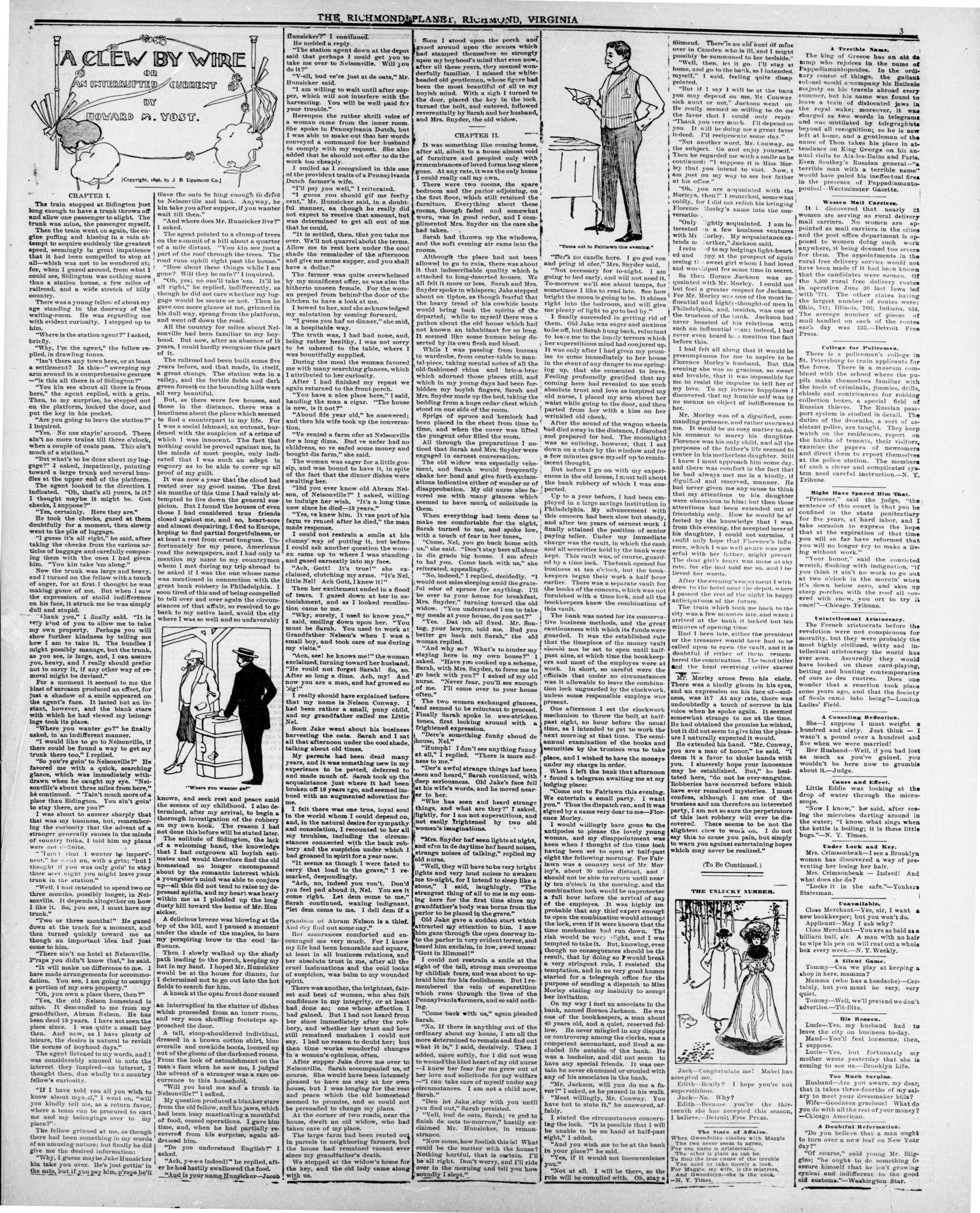
A CLEW BY WIRE
OR
AN INTERRUPTED CURRENT
BY
HOWARD M. YOST.
[Copyright, 1896, by J B. Lippincott Co.]
The train stopped at Sidington just long enough to have a trunk thrown off and allow one passenger to alight. The trunk was mine, the passenger myself. Then the train went on again, the engine puffing and hissing in a vain attempt to acquire suddenly the greatest speed, seemingly in great impatience that it had been compelled to stop at all—which was not to be wondered at; for, when I gazed around, from what I could see, Sidington was nothing more than a station house, a few miles of railroad, and a wide stretch of hilly country.
There was a young fellow of about my age standing in the doorway of the waiting-room. He was regarding me with evident curiosity. I stepped up to him.
"Where is the station agent?" I asked, briefly.
"Why, I'm the agent," the fellow replied, in drawing tones.
"Isn't there any town here, or at least a settlement? Is this—" sweeping my arm around in a comprehensive gesture —"is this all there is of Sidington?"
"You kin see about all there is from here," the agent replied, with a grin. Then, to my surprise, he stepped on the platform, locked the door, and put the key in his pocket.
"Are you going to leave the station?" I inquired.
"Yes. No use stayin' around. There ain't no more trains till three o'clock, when a couple of coals pass. This ain't much of a station."
"But what's to be done about my luggage?" I asked, impatiently, pointing toward a large trunk and several bundles at the upper end of the platform.
The agent looked in the direction I indicated. "Oh, that's all yours, is it? I maybe thought it might be. Got checks, I suppose?"
"Yes, certainly. Here they are."
"Yes, certainly. Here they are."
He took the checks, gazed at them doubtfully for a moment, then slowly went to the pile of luggage.
"I guess it's all right," he said, after taking the checks from the various articles of baggage and carefully comparing them with the ones I had given him. "You kin take 'em along."
Now the trunk was large and heavy, and I turned on the fellow with a touch of anger, for at first I thought he was making game of me. But when I saw the expression of stolid indifference on his face, it struck me he was simply dull and stupid.
"Thank you," I finally said. "It is very kind of you to allow me to take my own property. Perhaps you will show further kindness by telling me how I am to take it. The bundles I might possibly manage, but the trunk, as you see, is large, and, I can assure you, heavy, and I really should prefer not to carry it, if any other way of removal might be devised."
For a moment it seemed to me the blast of sarcasm produced an effect, for just a shadow of a smile appeared on the agent's face. It lasted but an instant, however, and the blank stare with which he had viewed my belongings took its place.
"Where you wanter go?" he finally asked, in an indifferent manner.
"I would like to go to Nelsonville, if there could be found a way to get my trunk there too," I replied.
"So you goin' to Nelsonville?" He favored me with a quick, searching glance, which was immediately withdrawn when he caught my eye. "Nelsonville's about three miles from here," he continued. "Tain't much more of a place than Sidington. You ain't goin' to stay there, are you?" I was about to answer sharply that that was my business, but, remembering the curiosity that the advent of a stranger generally causes in the minds of country folks, I told him my plans were not definite.
"I taint that I wanter be impertinent," he went on, with a grin; "but I thought if you was only goin' to stay there over night you might leave your trunk in the station."
"Well, I had intended to spend two or three months, possibly longer, in Nelsonville. It depends altogether on how I like it. So, you see, I must have my trunk."
"Two or three months!" He gazed down at the track for a moment, and then turned quickly toward me as though an important idea had just come to him.
"There ain't no hotel at Nelsonville. Praps you didn't know that," he said.
"Oh, you own a place there, then?" "Yes, the old Nelson homestead is mine. It descended to me from my grandfather, Abram Nelson. He has been dead 18 years. I have not seen the place since. I was quite a small boy then. And now, as I have plenty of leisure, the desire is natural to revisit the scenes of boyhood days."
The agent listened to my words, and I was considerably amused to note the interest they inspired—an interest, I thought then, due wholly to a country fellow's curiosity.
"I If have told you all you wish to know about mys.if," I went on, "will you kindly tell me, as a return favor, where a team can be procured to cart me and my belongings over to my place?".
The fellow grinned at me, as though there had been something in my words of an amusing nature; but finally he did give me the desired information:
"Why, I guess maybe Jake Hunsicker kin take you over. He's just gettin' in the outs, but if you pay him, praps he'll"
have the oats be long enough to drive to Nelsonville and back. Anyway, he kin take you after supper, if you wanter wait till then."
"And where does Mr. Hunsicker live?" I asked.
The agent pointed to a clump of trees on the summit of a hill about a quarter of a mile distant. "You kin see just a part of the roof through the trees. The road runs uphill right past the house."
"How about these things while I am gone? Will they be safe?" I inquired.
"Oh, yes; no one'll take 'em. It'll be all right," he replied, indifferently, as though he did not care whether my luggage would be secure or not. Then he gave one more glance at me, grinned in his dull way, sprang to the platform, and went off down the road.
All the country for miles about Nelsonville had been familiar to my boyhood. But now, after an absence of 18 years, I could hardly recognize this part of it.
The railroad had been built some five years before, and that made, in itself, a great change. The station was in a valley, and the fertile fields and dark green forests on the bounding hills were all very beautiful.
But, as there were few houses, and those in the distance, there was a loneliness about the place which seemed to find a counterpart in my life. For I was a social Ishmael, an outcast, burdened with the suspicion of a crime of which I was innocent. The fact that nothing could be proved against me, in the minds of most people, only indicated that I was such an adept in reguery as to be able to cover up all proof of my guilt.
It was now a year that the cloud had rested over my good name. The first six months of this time I had vainly attempted to live down the general suspicion. But I found the houses of even those I had considered true friends closed against me, and so, heart-sore and almost despairing, I fled to Europe, hoping to find partial forgetfulness, or at least a rest from cruel tongues. Unfortunately for my peace, Americans read the newspapers, and I had only to mention my name to my countrymen whom I met during my trip abroad to be asked if I was the one whose name was mentioned in connection with the great bank robbery in Philadelphia. I soon tired of this and of being compelled to tell over and over again the circumstances of that affair, so resolved to go back to my native land, avoid the city where I was so well and so unfavorably
A
"Where you wanter go!"
known, and seek rest and peace amid the scenes of my childhood. I also determined, after my arrival, to begin a thorough investigation of the robbery on my own hook. The reason I had not done this before will be stated later. The solitude of Sidington, the lack of a welcoming hand, the knowledge that I had outgrown all boyish estimates and would therefore find the old homestead no longer encompassed about by the romantic interest which a youngster's mind was able to conjure up—all this did not tend to raise my depressed spirits, and my heart was heavy within me as I plooded up the long dusty hill toward the home of Mr. Hun sicker.
A delicious breeze was blowing at the top of the hill, and I paused a moment under the shade of the maples, to bare my perspiring brow to the cool influence.
Then I slowly walked up the shady path leading to the porch, keeping my hat in my hand. I hoped Mr. Hunsicker would be at the house for dinner, for I determined not to go out into the hot fields to search for him.
A knock at the open front door caused an interruption in the elatter of dishes which proceeded from an inner room, and very soon shuffling footsteps approached the door.
A tall, stoop-shouldered individual, dressed in a brown cotton shirt, blue overalls and cowhide boots, loomed up out of the gloom of the darkened rooms. From the look of astonishment on the man's face when he saw me, I judged the advent of a stranger was a rare occurrence to this household.
"Will you haul me and a trunk to Nelsonville?" I asked.
My question produced a blankier stare from the old fellow, and his jaws, which had been busy masticating a mouthful of food, ceased operations. I gave him time, and, when he had partially recovered from his surprise, again addressed him.
"Do you understand English?" I asked.
"Ach, y-e-e-s indeed!" he replied, after he had hastily swallowed the food.
"And is now name Hendrickson, Joseph
"And is your name Hungicker-Jacob
Hunsicker?" I continued.
He nodded a reply.
"The station agent down at the depot said that perhaps I could get you to take me over to Nelsonville. Will you do it?"
"V-eil, bud ve're just at de oats," Mr. Hunsicker said.
"I am willing to wait until after supper, which will not interfere with the harvesting. You will be well paid for your trouble."
Hereupon the rather shrill voice of a woman came from the inner room. She spoke in Pennsylvania Dutch, but I was able to make out that her words conveyed a command for her husband to comply with my request. She also added that he should not offer to do the work too cheaply.
I smiled as I recognized in this one of the provident traits of a Pennsylvania Dutch farmer's wife.
Soon I stood upon the porch and gazed around upon the scenes which had stamped themselves so strongly upon my boyhood's mind that even now, after all these years, they seemed wonderfully familiar. I missed the white-headed old gentleman, whose figure had been the most beautiful of all to my boyish mind. With a sigh I turned to the door, placed the key in the lock, turned the bolt, and entered, followed reverentially by Sarah and her husband, and Mrs. Snyder, the old widow.
CHAPTER II.
It was something like coming home, after all, albeit to a house almost void of furniture and peopled only with remembrances of loved forms long since gone. At any rate, it was the only home I could really call my own.
"I'll pay you well," I reiterated.
"I guess you should gif me feefy cent," Mr. Hunsicker said, in a doubtful manner, as though he really did not expect to receive that amount, but was determined to get all out of me that he could.
"It is settled, then, that you take me over. We'll not quarrel about the terms. Allow me to rest here under the cool shade the remainder of the afternoon and give me some supper, and you shall have a dollar."
The farmer was quite overwhelmed by my munificent offer, as was also the hitherto unseen female. For the woman peeped from behind the door of the kitchen to have a look at me.
I bowed to her, and she acknowledged my salutation by coming forward.
"I guess you haf no dinner," she said, in a hospitable way.
The truth was, I had had none, and, being rather healthy, I was not sorry to be ushered to the table, where I was bountifully supplied.
During the meal the woman favored me with many searching glances, which I attributed to her curiosity.
After I had finished my repast we again returned to the front porch.
"You have a nice place here," I said, handling the man a cigar. "The house is new, is it not?"
"About fife year old," he answered; and then his wife took up the conversation.
"Ve rented a farm ofer at Nelsonville for a long dime. Bud ve nefer had no childrens, so ve safed some money and bought dis farm," she said.
The woman was eager for a little gossip, and was bound to have it, in spite of the fact that the dinner dishes were awaiting her.
"Did you ever know old Abram Nelson, of Nelsonville?" I asked, willing to indulge her wish. "It's a long time now since he died—15 years."
"Yes, ve knew him. It was part of his farm ve remanded after he died," the man made response.
I could not restrain a smile at his clumsy way of putting it, but before I could ask another question the woman came up to where I was standing and gazed earnestly into my face.
"Ach, Gott! It's true!" she exclaimed, clutching my arms. "It's Nel, little Nell! Ach Gott, I knew it!"
Then her excitement ended in a flood of tears. I gazed down at her in astonishment, and as I looked recollection came to me.
"Why, surely, I used to know you," I said, smiling down upon her. "You must be Sarah. You used to work at Grandfather Nelson's when I was a small boy, and took care of me during my visits."
"Ach, see! he knows me!" the woman exclaimed, turning toward her husband. "He would not forget Sarah! So, so. After so long a dime. Ach, my! And now you are a man, and haf grown so big!"
I really should have explained before that my name is Nelson Conway. I had been rather a small, puny child, and my grandfather called me Little Nel.
Soon Jake went about his business harvesting the oats. Sarah and I sat all that afternoon under the cool shade, talking about old times.
My parents had been dead many years, and it was something new in my experience to be petted, deferred to and made much of. Sarah took up the acquaintance just where it had been broken off 18 years ago, and seemed imbued with an augmented adoration for me.
I felt there was one true, loyal soul in the world whom I could depend on, and, in the natural desire for sympathy and consolation, I recounted to her all my troubles, including the circumstances connected with the bank robbery and the suspicion under which I had groaned in spirit for a year now.
"It seems as though I were fated to carry that load to the grave," I remarked, despondingly.
"Ach, no, indeed you don't. Don't you feel pad about it, Nel. You see it come right. Let dem come to me," Sarah continued, waxing indignant, "let dem come to me. I dell dem if a grandson of Abram Nelson is a thief. And doy find out some day."
Her assurances comforted and encouraged me very much. For I knew my life had been honorable and square, at least in all business relations, and her absolute trust in me, after all the cruel insinuations and the cold looks of suspicion, was balm to my wounded spirit.
There was another, the brightest, fairest and best of women, who also felt confidence in my integrity, or at least had done so; one whose affection I had gained. But I had not heard from her since immediately after the robbery, and whether her trust and love still remained unshaken I could not say. I had no reason to doubt her; but then time works wonderful changes in a woman's opinions, often.
After supper Jake drove me over to Nelsonville. Sarah accompanied us, of course. She would have been intensely pleased to have me stay at her own house, but I was longing for the rest and peace which the old homestead seemed to promise, and so could not be persuaded to change my plans. At the corner of two roads, near the house, dwelt an old widow, who had taken care of my place. The large farm had been rented out in parcels to neighboring farmers, but the house had remained vacant ever since my grandfather's death. We stopped at the widow's home for the key, and the old lady came along with us.
Soon I stood upon the porch and gazed around upon the scenes which had stamped themselves so strongly upon my boyhood's mind that even now, after all these years, they seemed wonderfully familiar. I missed the white-headed old gentleman, whose figure had been the most beautiful of all to my boyish mind. With a sigh I turned to the door, placed the key in the lock, turned the bolt, and entered, followed reverentially by Sarah and her husband, and Mrs. Snyder, the old widow.
CHAPTER II
It was something like coming home, after all, albeit to a house almost void of furniture and peopled only with remembrances of loved forms long since gone. At any rate, it was the only home I could really call my own.
There were two rooms, the spare bedroom and the parlor adjoining, on the first floor, which still retained the furniture. Everything about these rooms, though faded and somewhat worn, was in good order, and I complimented Mrs. Snyder on the care she had taken.
Sarah had thrown up the windows, and the soft evening air came into the rooms.
Although the place had not been allowed to go to ruin, there was about it that indescribable quality which is attached to long-deserted houses. We all felt it more or less. Sarah and Mrs. Snyder spoke in whispers; Jake stepped about on tiptoe, as though fearful that the heavy tread of his cowhide boots would bring back the spirits of the departed; while to myself there was a pathos about the old house which had not known an inhabitant for so long. It seemed like some human being deserted by its own flesh and blood. While I was passing from bureau to wardrobe, from center-table to mantel-piece, taking mental notes of all the old-fashioned china and brie-a-brac which adorned those places still, and which in my young days had been forbidden my boyish fingers, Sarah and Mrs. Snyder made up the bed, taking the bedding from a huge cedar chest which stood on one side of the room.
Sprigs of spruce and hemlock had been placed in the chest from time to time, and when the cover was lifted the pungent odor filled the room.
All through the preparations I noticed that Sarah and Mrs. Snyder were engaged in earnest conversation.
The old widow was especially vehement, and Sarah would frequently shake her head and give forth exclamations indicative either of wonder or of disapprobation. My old nurse also favored me with many glances which seemed to have much of solicitude in them.
When everything had been done to make me comfortable for the night, Sarah turned to me, and spoke low, with a touch of fear in her tones.
"Come, Nel, you go back home with us," she said. "Don't stay here all alone in dis grade big house. I am afraid to haf you. Come back with us," she reiterated, appealingly.
"No, indeed," I replied, decidedly. "I would not miss sleeping amid the grateful odor of spruce for anything. I'll be over to your house for breakfast, Mrs. Snyder," turning toward the old widow. "You understand I am to take my meals at your house, do you not?" "Yes. Dat it shall fixed. Mr. Sontag, your lawyer, told me. Bud you better go back mit Sarah," the old woman replied.
"And why so? What's to hinder my staying here in my own house?" I asked. "Have you cooked up a scheme, Sarah, with Mrs. Snyder, to force me to go back with you?" I asked of my old nurse. "Never fear, you'll see enough of me. I'll come over to your house often."
The two women exchanged glances, and seemed to be reluctant to proceed. Finally Sarah spoke in awe-streaked tones, first looking around with a frightened expression.
"Dere's something funny abud de house, Nel."
"Humph! I don't see anything funny at all." I replied. "There is more sadness to me."
"Der's awful strange things haf been seen and heard," Sarah continued, with deep seriousness. Old Jake's face fell at his wife's words, and he moved nearer to her.
"Who has seen and heard strange things, and what are they?" I asked, lightly, for I am not superstitious, and not easily frightened by two old women's imaginations.
"Mrs. Snyder haf seen lights at night, and often de daytime haf heard noises, strange noises of talking," replied my old nurse.
"Well, they will have to be very bright lights and very loud noises to awaken me to-night, for I intend to sleep like a stone," I said, laughingly. "The strangest thing of all to me is my coming here for the first time since my grandfather's body was borne from the parlor to be placed in the grave."
Old Jake gave a sudden start which attracted my attention to him. I saw him gaze through the open doorway into the parlor in very evident terror, and heard him exclaim, in low, awed tones: "Gott in Himmel!"
I could not restrain a smile at the sight of the tall, strong man overcome by childish fears, and was about to upbraid him for his foolishness. But I remembered the vein of superstition which runs through the lives of the Pennsylvania farmers, and so said nothing.
"Come back with us," again pleaded Sarah.
"No. If there is anything out of the ordinary about my house, I am all the more determined to remain and find out what it is," I said, decisively. Then I added, more softly, for I did not wisen to wound the kind heart of my old nurse—I knew her fear for me grew out of her love and solicitude for my welfare—"I can take care of myself under any circumstances. I am not a child now, Sarah."
"Den let Jake stay with you until you find out," Sarah persisted.
"Vell, bud de oats, Sarah; ve god to finish de oats to-morrow," hastily exclaimed Mr. Hunsicker, in remonstrance.
"Now come, how foolish this is! What could be the matter with the house? Nothing hurtful, that is certain. I will be all right. Don't worry, and I will ride over in the morning and tell you how soundly I slept."
A
"Come out to Fairlawn this evening."
"Der's no candle here. I go ged von and pring id offer." Mrs. Snuder said.
"Not necessary for to-night. I am going to bed early, and will not need it. To-morrow we'll see about lamps, for sometimes I like to read late. See how bright the moon is going to be. It shines right into the bedroom, and will give me plenty of light to go to bed by." I finally succeeded in getting rid of them. Old Jake was eager and anxious to be off, but Sarah hung back, reluctant to leave me to the lonely terrors which her superstitious mind had conjured up. It was only after I had given my promise to come immediately to her house in the event of any danger to me springing up, that she consented to leave. Feeling profoundly gratified that my coming here had revealed to me such absolute trust and love as inspired my old nurse, I placed my arm about her waist while going to the door, and then parted from her with a kiss on her wrinkled old cheek.
After the sound of the wagon wheels and died away in the distance, I disrobed and prepared for bed. The moonlight was so enticing, however, that I sat down on a chair by the window and for a few minutes gave myself up to reminiscent thought.
But before I go on with my experiences in the old house, I must tell about the bank robbery of which I was suspected.
Up to a year before, I had been employed in a large savings institution in Philadelphia. My advancement with this concern had been slow but steady, and after ten years of earnest work I finally attained the position of senior paying teller. Under my immediate charge was the vault, in which the cash and all securities held by the bank were kept. This vault was, of course, guarded by a time lock. The bank opened for business at ten o'clock, but the bookkeepers began their work a half hour earlier. There was a separate vault for the books of the concern, which was not furnished with a time lock, and all the bookkeepers knew the combination of this vault.
The bank was noted for its conservative business methods, and the great cautiousness with which its funds were guarded. It was the established rule that the timepiece of the money vault should not be set to open until half-past nine, at which time the bookkeepers and most of the employees were at work. In short, so careful were the officials that under no circumstances was it allowable to leave the combination lock unguarded by the clockwork, unless some responsible employee was present.
One afternoon I set the clockwork mechanism to throw the bolt at half-past eight, an hour before the usual time, as I intended to get to work the next morning at that time. The semi-annual examination of the books and securities by the trustees was to take place, and I wished to have the moneys under my charge in order.
When I left the bank that afternoon I found a telegram awaiting me at my lodging place:
"Come out to Fairlawn this evening. We entertain a small party. I want you." Thus the dispatch ran, and it was signed by a name very dear to me—Florence Morley.
I would willingly have gone to the antipodes to please the lovely young woman, and my disappointment was keen when I thought of the time lock having been set to open at half-past eight the following morning. For Fairlawn was a country seat of Mr Morley's, about 30 miles distant, and I should not be able to return until nearly ten o'clock in the morning, and the combination lock would be unprotected a full hour before the arrival of any of the employees. It was highly improbable that any thief expert enough to open the combination would attempt the lock, even if it were known that the time mechanism had run down. The risk would be very slight, and I was tempted to take it. But, knowing, even though no consequences should be the result, that by doing so I would break a very stringent rule, I resisted the temptation, and in no very good humor started for a telegraph office for the purpose of sending a dispatch to Miss Morley stating my inability to accept her invitation.
On my way I met an associate in the bank, named Horace Jackson. He was one of the bookkeepers, a man about 40 years old, and a quiet, reserved fellow. He never mingled in any dispute or controversy among the clerks, was a competent accountant, and lived a secluded life outside of the bank. He was a bachelor, and did not seem to have any special friends. It was certain he never chummed or croned with any of his associates in the bank.
"Mr. Jackson, will you do me a favor?" I asked, as he paused in his walk.
"Most willingly, Mr. Conway. You have but to state it," he answered, affably.
I stated the circumstances concerning the lock. "It is possible that I will be unable to be on hand at half-past eight." I added.
"And you wish me to be at the bank in your place?" he said.
"Yes, if it would not inconvenience you."
"Not at all. I will be there, so the rule will be compiled with. Oh, stay a
moment. There is an old aunt of mine over in Camden who is ill, and I might possibly be summoned to her bedside." "Well, then, let it go. I'll stay at home, and go to the bank, as I intended, myself," I said, feeling quite disappointed.
"But if I say I will be at the bank you may depend on me, Mr. Conway, sick aunt or not." Jackson went on. He really seemed so willing to do me the favor that I could only reply. "Thank you very much. I'll depend on you. It will be doing me a great favor indeed. I'll reciprocate some day."
"Not another word, Mr. Conway, on the subject. Go and enjoy yourself." Then he regarded me with a smile as he continued: "I suppose it is Miss Morley that you intend to visit. Now, I am just on my way to see her father at his office."
"Oh, you are acquainted with the Morleys, then?" I remarked, somewhat coldly, for I did not relish his bringing Florence Morley's name into the conversation.
"Only lightly acquainted. I am interested in a few business ventures with Mr. Morley. My acquaintance extends no further," Jackson said.
Tretu'd to my lodgings light-hearted and appy at the prospect of again seeing the sweet girl whom I had loved and wished for sometime.
ed and happy at the prospect of again seeing the sweet girl whom I had loved and worshiped for some time in secret. So then Horace Jackson was acquainted with Mr. Morley. I could not but feel a greater respect for Jackson. For Mr. Morley was one of the most influential and highly-thought-of men in Philadelphia, and, besides, was one of the trustees of the bank. Jackson had never boasted of his relations with such an influential man; indeed, I had never even heard him mention the fact before this. I had felt all along that it would be presumptuous for me to aspire to be Florence Morley's husband. But this evening she was so gracious, so sweet and lovable, that it was impossible for me to resist the impulse to tell her of my love. To my intense happiness I discovered that my humble self was by no means an object of indifference to her.
Mr. Morley was of a dignified, commanding presence, and rather overwhelmed me. It would be no easy matter to ask his consent to marry his daughter. Florence was his only child, and all the purposes of the father's life seemed to center in his motherless daughter. Still I knew I must approach him some day, and there was comfort in the fact that he had always met me in a kindly, if dignified and reserved, manner. He had never given me any cause to think that my attentions to his daughter were obnoxious to him; but then those attentions had been extended out of friendship only. How he would be affected by the knowledge that I was, from this evening, the accepted lover of his daughter, I could not surmise. I could only hope that Florence's influence, which I was well aware was powerful with her father, might prevail. The dear girl's heart was mine at any rate, for she had told me so, and I believed her words.
After the evening's enjoyment I withdrew to the hotel near the depot, where I passed the rest of the night in happy anticipations of the future.
The train which took me back to the city was a few minutes late, and when I arrived at the bank it lacked but ten minutes of opening time.
Had I been late, either the president or the treasurer would have had to be called upon to open the vault, and it is doubtful if either of them remembered the combination. The bond teller and the head receiving teller shared
Mr. Morley arose from his chair.
There was a kindly gleam in his eyes, and an expression on his face of—sadness, was it? At any rate, there was undoubtedly a touch of sorrow in his voice when he spoke again. It seemed somewhat strange to me at the time.
He had obtained the promise he wished, but it did not seem to give him the pleasure I naturally expected it would.
He extended his hand. "Mr. Conway, you are a man of honor," he said. "I deem it a favor to shake hands with you. I sincerely hope your innocence may be established. But," he hesitated here, "do not be over-sanguine. Robberies have occurred before which have ever remained mysteries. I must confess, although I am one of the trustees and am therefore an interested party. I am not so sure the perpetrators of this last robbery will ever be discovered. There seems to be not the slightest clew to work on. I do not say this to cause you pain, but simply to warn you against entertaining hopes which may never be realized."
(To Be Continued.)
THE UNLUCKY NUMBER.
F. P.
Jack—Congratulate me! Mabel has accepted me.
Edith—Really? I hope you're not superstitious.
Jack—No. Why?
Edith—Because you're the thirteenth she has accepted this season, I believe—Detroit Free Press.
The State of Affairs
When Gwendoline clashes with Maggie
The two never seem to agree,
For one name is aristocratic,
The other tells us we can
To find the true cause of the trouble
You need to take merely a look,
For Maggie, my wife, is the mistress,
And Gwendolyn—she is the cook.
-N. Y. Times.
A Terrible Name.
The king of Greece has an aid detemp who rejoices in the name of Pappadiamantopoulos. In the ordinary course of things, the gallant colonel would accompany his Hellenic majesty on his travels abroad every summer, but his name was found to leave a train of dislocated jaws in the royal wake; moreover, it was charged as two words in telegraphs and was mutilated by telegraphists beyond all recognition; so he is now left at home, and a gentleman of the name of Thon takes his place in attendance on King George on his annual visits to Aix-les-Bains and Paris. Even Southey's Russian general—"a terrible man with a terrible name" would have paled his ineffectual fires in the presence of Pappadiamantopoulos!-Westminster Gazette.
Women Mail Carriers
It i. discovered that nearly 25 women are serving as rural delivery mail carriers. No women are appointed as mail carriers in the cities and the post office department is opposed to women doing such work anywhere, it being deemed too severe for them. The appointments in the rural free delivery service would not have been made if it had been known that the candidates were women. Of the 8,500 rural free delivery routes in operation June 30 last Iowa led with 771. The other states having the largest number of routes were: Ohio, 741; Illinois, 766; Indiana, 654. The average number of pieces of mail handled on each of the routes each day was 132.—Detroit Free Press.
College for Policemen
There is a policeman's college in St. Petersburg to train applicants for the force. There is a museum combined with the school where the pupils make themselves familiar with the tools of criminals, jimmies, drills, chisels and contravances for robbing collection boxes, a special field of Russian thieves. The Russian passport system is studied in detail. The duties of the dvorniks, a sort of assistant police, are taught. They keep watch on the residences, report on the habits of tenants, their visitors, examine the papers of newcomers and direct them to report themselves at the police station. The members of such a clever and complicated system need careful instruction.—N. Y. Tribune.
Might Have Spared Him The
"Prisoner," said the judge, "the sentence of this court is that you be confined in the state penitentiary for five years, at hard labor, and I take occasion to express the hope that at the expiration of that time you will so far have reformed that you will no longer try to make a living without work."
"Your honor," said the convicted wretch, flushing with indignation, "if you think it ain't no work to go out at two o'clock in the mornin' when it's down below zero, and skin up steep porches with the roof all covered with snow, you ort to try it once!"—Chicago Tribune.
Enintellectual Aristocron
The French aristocrats before the revolution were not conspicuous for morality, but they were probably the most highly civilized, witty and intellectual aristocracy the world has ever seen. Assuredly they would have looked on these card-playing, betting and hunting contemporaries of ours as des rustres. Does one wonder that a reaction took place some years ago, and that the Society of Souls came into being?—London Ladies' Field.
A Controling Reflection
She—I suppose I must weight a hundred and sixty. Just think — I wasn't a pound over a hundred and five when we were married! Her Husband—Well, if you had lost as much as you've gained, you wouldn't be here now to grumble about it.—Judre.
Cause and Effect.
Little Eddie was looking at the drop of water through the microscope.
"Now I know," he said, after seeing the microbes darting around in the water; "I know. what sings when the kettle is boiling; it is these little bugs." -N. Y. Times.
Under Lock and Key:
Mrs. Crimsonbeak—I see a Brooklyn woman has discovered a way of preventing her losing her hair.
Mrs. Crimsonbeak — Indeed! And what does she do?
"Locks it in the safe."—Yonkers Statesman.
Unavailable
Close Merchant—Yes, sir, I want a new bookkeeper; but you won't do. Applicant—May I ask why? Close Merchant—You are as bald as billiard ball, sir. A man with no hair to wipe his pen on will rust out a whole box every week.—N. Y. Weekly.
A Silent Game
Tommy—Can we play at keeping a shop in here, mamma?
Mamma (who has a headache)—Certainly, but you must be very, very quiet.
Tommy—Well, we'll pretend we don't advertise.—Tit-Bits.
His Reason.
Lucie—Yes, but fortunately my mother wrote yesterday that she is coming to see us.—Brooklyn Life.
Too Much Surplus.
Husband—Are you aware, my dear,
that it takes three-fourths of my salary
to meet your dressmaker bills?
Wife—Goodness gracious! What do you do with all the rest of your money?
Chicago American.
A Doubtful Reformation:
"Do you believe that a man ought to turn over a new leaf on New Year day?" "Of course," said young Mr. Bliggins; "he ought to do something to assure himself that he isn't growing cynical and indifferent to the good old customs."—Washington Star.
THE PLANET
published every Saturday by JOHN MITCHELL
JR., at 511 North 4th Street, Richmond, Va.
All communications intended for publication should be sent so as to reach: us by Wednesday.
TERMS IN ADVANCE.
One Copy, one year,
One Copy, eight months,
One Copy, six months,
One Copy, four months,
One Copy, three months,
Single Copy,
REGISTERED LETTER—If a Money Order Post Office or an Express Office is not within reach, each your bestest wish will be the letter to your account on payment of dollars. Then, if the letter is lost or stolen, it can be traced. You can send money in this manner to your responsible money sent in letters in any other way than one of the four ways mentioned above. If you send your money in any other way, you must do it at your station. RENEWALS, ETC. If you do not want THE PLANET continued for another year after your subscription has run out, you then notify us by email your discontinuation. The courts have decided that subscribers to newspapers who do not order their paper discontinued at the expiration date hold liable for the payment of the subscription up to date when they order the paper discontinued.
COMMUNICATIONS—When writing to us, your subscription or to discontinue our paper, you should give your name and address in full, otherwise we cannot find your name on our books.
COMMUNICATION—In order to change the address of a subscriber, we must be sent the former as well as the present address.
Entered in the Post Office at Richmond, Va., as second class matter.
COLORED men, we relinquish no rights guaranteed us by the national Constitution, and submit to superior force under protest.
THAT Mississippi lynching so graphically portrayed in these columns stirs the blood and awakens sympathy. Even white men in that blood-stained state seem to be horrified.
DON'T despair, colored men! The day is dark and the attitude of some of our own people disheartening, but it has always been so. Israel experienced the same difficulties two thousand years before the coming of CHRIST, but they reached the Promised Land and so will we, if we hold out, prove faithful, and faint not by the waverside.
SECRETARY ROOT AND THE NEGRO.
HON. ELHU ROOT, Secretary of War delivered a speech at the fortieth anniversary of the Union League Club in New York, February 6th, 1903. It was a notable production and may be taken to be an expression of the administration at Washington. We confess that we have scanned carefully the lines and find much therein which will constitute food for serious thought and sober reflection. The speech was remarkable for what it does and for what it does not contain. We confess that we have been able to extract but little comfort from the close, concise, but blunt words which this distinguished statesman has seen fit to make virtually direct to the public.
Analyzed under the searching rays of a noon-day sun, he declared that there were two ominous problems confronting the government to-day. One is the laboring white man and the other is the struggling Negro. This is a clean-out statement of fact. He did what every thinking man in the country would have done—recognize that labor whether white or black must stand on the same level and rise or fall together.
He dealt the labor organizations or rather some of them a sledge-hammer blow when he remarked:
"There are some labor organizations which fight against the better man doing more work than the poor man, and hold down the competent man to the level of the incompetent and stupid. I do not declare war against labor organizations. I believe in them. The laborer is entitled to organize to get his own."
The above was very shrewdly stated. He was equally as fortunate in his use of language when he said:
"There are many problems coming up to-day on which the safety of this government depends. There are to-day situations of possible evils for our country that call for devoted patriotism. First, division between the rich and the poor under which wealth control-
legislation and poverty is trying to stir up a war of classes, but every good citizen should declare that never in this free land shall we have a war of classes."
This same element, which, in the North is stirring up a war of classes as against the rich white man is stirring up a war of classes in the South as against the poor Negro. These white men recognize as they seem to think in the Negro a menace to their well-being and prosperity.
We are frank to state, however, that we do not believe that Mr. Root has had it presented to him in this light. But this is neither here nor there. It is his references to the Negro with which we desire to deal. He is quoted further:
"After the civil war the great question was, 'What shall we do with the black man?' and the anser was, 'Give him citizenship, equal rights, and the franchise and he will rise.' Three amendments were added to the Constitution and I fear that we will have to face the conclusion that the experiment has failed."
It is this phase of the question with which we desire to deal. Has the experiment failed? He continued:
"The suffrage has been taken away from the Negro, and, in many of the Southern States, the black man no longer has the right to suffrage."
This is true, sir, but has the experiment failed?
Mr. Roor said further:
"A curious development has been seen within the past year. President Roosevelt has appointed fewer black men than President McKinley did, and there are to-day fewer black men holding office than when McKinley died. Yet loud outcries are to be heard in the South about President Roosevelt's policy of appointing black men to office in the South. Under previous Presidents —McKinley, Cleveland, Harrison, and back to Hayes' time—more Negroes were appointed to office and nothing was said.
"A black man attended an official reception in Washington at the White House in short ago. The black man, as an official of the government, had always attended these receptions. Yet the invitation of the Presidents these men was the signal for an outcry of a thousand papers in the South that the whites were being insulted."
Mr. Root continued:
"I don't want to argue this question. I am certainly showing that we have to face a new change of feeling in the South, that the black man is denied the right to aspire to the highest there is in American citizenship. This right to aspire to the highest dignity which was formerly unquestioned is now questioned. In a short time the white man will succeed in excluding the black man from all offices in the Southern States.
"We can never throw off the responsibility that rests on our people for the welfare of these black people that we held in slavery for so many generations.
"Now that the first attempt has failed, the question is what to do, and it should take the greatest thought of the greatest minds of the country."
We are of the opinion that these words, falling from the lips of the central figure, barring one in President Roosevelt's cabinet are grimly ominous and they may be the fore runners of as starling a change in the future policy of the national administration as has been ever witnessed since the foundation of the government.
We confess that we do not regard with favor either all of his statements or his conclusions. It emphasizes our opinion previously expressed that after all the rights which we now enjoy from a Republican political standpoint are directly traceable to the political power of our colored brethren in the North.
Secretary Root in the beginning of his remarks guardedly said that he feared that the experiment had failed and before he concluded his utterances, he unguardedly declared that the experiment had failed. It was the lamented statesman, CHARLES SUMNER, who said: "Give him (Negro) citizenship, equal rights and the franchise and he will rise." His words were prophetic and he has risen.
Blind indeed must be the man who does not see that the period during which the Negro enjoyed the right to vote and to hold office was the one which furnished the inspiration for the present. Cast down, forsaken, suffering for the necessities of life, his elevation to a place in the body politic where the best men of the race could be seen and heard, it lighted the watch-fires of hope and inspired every black citizen of the Sunny South to go forward.
The illiterate black man labored to educate the son and the daughter and practiced the lesson of frugality, for they already knew the problem of toil. As a result, the progress of this wonderful race of people has been without a parallel in the history of the world. That the Negro used the ballot wisely, no honest man acquainted with the facts will deny. He had sense enough to vote with his friends and give his support to those white men who recognized his political equality and favored measures for his elevation and betterment. That he was not resentful and did not harbor animosities is attested by the fact that he supported for office not only northern men who were candidates for office, but also southern ones who asked for similar favors.
Gen. LONGSTREET, that dashing Condeederate commander knows this to be true. While Gen. WILLIAM MAHONE, if he could be called from the grave would testify to the fidelity of the black men, who rallied about him during his life-time and at his death shed tears over his grave.
Was the experiment a mistake? Read the statistics of the value of the property owned by the colored people of the Southland, without counting that possessed by those of our race in the north, and it approximates on the most conservative estimate three hundred million dollars. These people produce by their labor cotton, tobacco, wheat, sn
gar, etc., to the value of six hundred million dollars per annum. The statistics of the country, Mr. Secretary, will bear out the contention.
Has the experiment failed? If it has failed then the Declaration of Independence, giving the right of suffrage and the boon of political equality to the poverty-streken, illiterate white man has also failed, for the rich plutocratic trusts are now confronted with the same problem in dealing with him as is announced by the South and some of the Republican leaders in dealing with the Negro.
But enough! Well said Mrs. Heard.
"We are coming, coming boldly. Though the nation greets us coldly. We are coming from the hill-side and the plain.
With our scars, we tell the story. Of the cane-brake, wet and gory. Where our brothers bones he bleaching with the slain.
We are coming, coming proudly. We are crying, crying loudly. Oh, for justice from the rulers of the hand.
And that justice will be given. For the mighty God of Heaven. Holds the balances of power in H's hand."
When you argue the Negro out of the equation, you argue universal suffrage for the white man out by the same line of reasoning. It may be that some white men at the North presumed that after the ballot had been placed in the hands of the Negro that he would maintain himself in the possession of it by force. The idea is as nonsensical as it was foolish. The defense of those kind of rights, sir, are vested in the national government. We give it the courts and the armed forces of the United States for its defense and preservation.
When you expect or hope to delegate that power to the individual, be he black or white, you create a condition of anarchy, from which all law-abiding citizens shrink. It is true that the cowardice in not forcing a respect for the law was begun at Washington and Hon. RUTHERFORD B. HAYES, now dead and gone to heaven, we trust, to, gether with his supporters are directly responsible for the untoward conditions which are being charged up to the Negro.
Colored men have never yet failed to obey orders, whether they came from a southern masser or from a northern one and if it had been the wish or desire of the national government as represented by its President that the Negro should retain political control and continue to vote, he would have done so or "would have reported to God the reason why."
The Republican Party lost this political power, but sir, it was the result of its own folly. It allowed us to be shot down, hashed, butchered, burned at the stake, robbed at the ballot-box and in the midst of it all, advised us to submit. In recent years, it has tolerated a BEN. TILLMAN in the United States Senate, who boasted that his hands were stained with human blood, not of white men, but of black men.
If this distinguished Secretary means to state that in the perpetuation of the Republican Party in the Southland, without further effort on the part of that party to protect its allies and supporters in the Southland then, we grant the contention and discontinue the discussion.
But Mr. Root made a somewhat startling announcement when he said that President Roosevelt had appointed less colored men to office than any of his predecessors. Does he mean to state that while he was vouch-safing us social recognition at the White House that he was taking away from us official recognition in the Southland? If this is not the meaning of the statements, will some one be kind enough to make it plainer?
Is it possible that the Negro-hating southerners in their blind fury have attacked the most liberal Republican President, who ever sat in the White House at Washington? If so truly "It is God's way. His will be done, not ours."
But possibly Mr. Root was not a soldier. He is not aware of the impelling forces which secured for the Negro of this country the rights which he should now enjoy. He purchased his political rights with his suffering and paid for eternal freedom with his blood.
Gen. B. F. BUTLER tells why the Negro secured his freedom and a guarantee of his political rights. In speaking of the magnificent charge of the Negro Brigade at Fort Harrison in 1864, he said:
"It became my painful duty, sir, to follow in the track of that charging column, and there, in a space not wider than the Clerk's desk and three hundred yards long, lay the dead bodies of five hundred and forty three of my colored comrades, fallen in defence of their country, who had offered up their lives to uphold its flag and its honor, as a willing sacrifice; and as I rode along among them, guiding my horse this way and that way lest he should profane with his hoof what seemed to me the sacred dead, and as I looked on their bronzed faces upturned in the shining sun to Heaven, as if in mute appeal against the wrongs of the country for which they had given their lives, and whose flag had only been to them a flag of stripes, on which no star of glory had ever shown for them,—feeling I had wronged them in the past, and believing what was the future of my country to them,—among my dead comrades there I swore to my self a solemn cunning and my tongue cleave to the roof of my mouth, if I ever fail to defend the rights of these men who have given their blood for me and my country this day, and for their race forever and, God helping me, I will keep that oath.
From that hour all prejudice was gone, and an old-time States right Democrat became a lover of the Negro race, and as long as their rights are not equal to the rights of other men under this Government, I am with them against all comers; and when their rights are assured, as other men's rights are held sacred then, I trust, we shall have what we sought to have, a united country North and South, white and black, under one glorious flag, for which we and our fathers have fought with an equal and not to be distinguished valor."
We don't know, Mr. Secretary, but it seems to us that there should be somewhere in this broad land of ours Union Veterans in places of affluence and influence who are permeated by the same spirit and who could be induced to step in the breach and say a word against this wholesale condemnation of an humble, patroltic and faithful people.
But enough! Well said Mrs. Heard.
"We are coming, coming boldly.
Though the nation greets us coldly.
We are coming from the hill-side and the plain.
the pain
With our scars, we tell the story
Of the poison brake, wet and gory.
Where our brothers bones lie bleaching
with the slain.
We are coming, coming proudly.
We are crying, crying loudly.
Oh, for justice from the rulers of the
ds the balances of power in H's hand."
STEAMER WRECKED
The Mindiana a Total Loss on the Bermuda Reefs.
HAD EXCURSION PARTY ABOARD
After a Thrilling Experience All of the Passengers and the Crew Were Rescued and Brought Safely to Land In Life Boats.
Hamilton, Bermuda, Feb. 11. — The Quebec Steamship Company's steamer Madiana, Captain Fraser, which sailed from New York last Saturday with a party of excursionists for a special cruise around the Carribean Sea, went ashore on the reef off this island at 3 o'clock yesterday morning. The passengers had a thrilling experience. The ship is a total loss, but all on board were rescued and brought safely to land after a perilous trip in life boats from the wreck to a tug standing a mile off. The mails and the passengers' baggage were also saved.
All the passengers were in their bunks when the Madiana struck the rocks, but the shock of the impact awakened them and they rushed on deck, the majority of them without attempting to dress. Considerable alarm, though not a panic, prevailed among the passengers when they found that the vessel was hard on the rocks, but the officers went among them and calmed them, although a number did not venture below again to seek proper clothing. A part of the crew did not share the coolness of the officers, but the latter soon restored order among the troublesome seamen.
Signals of distress were sent up, and the passengers passed an anxious time during the latter part of the night. The Madiana listed heavily after a time, and when morning broke she lay broadside to the wind. The passengers were huddled together on the hurricane deck, and the sea, breaking over the steamer, drenched them to the skin.
As soon as the news of the wreck became known here government and other tugs proceeded to the scene to endeavor to render assistance. A heavy sea, however, was running and they dared not approach too closely to the reef on which the Madiana was pounding. For some time no communication with the Madiana was possible. The tug Gladisfen stood about a mile off awaiting an opportunity to assist, but it was not until 11 o'clock yesterday morning that it became possible to effect a rescue. The crew of the Madiana launched a boat, but it could not live in the sea then running and was dashed to pieces against the steamer's side. A second and more successful attempt was made a little later, and some of the passengers were lowered into it, and after much exertion it succeeded in reaching the Gladisfen. The Madiana's other life boats were then launched in succession, and the remainder of the passengers and the captain and crew gained the salvage tug in safety.
By the prompt action of Engineer Nelson, who had the Madiana's bulkheads broken through, the mails and the passengers' light baggage were taken out and 'brought in the last boats to the Gladisfen, which landed the passengers, crew, mails and baggage here yesterday afternoon.
Speaking of the coolness displayed by the officers and passengers in spite of the danger and discomfort of the situation, a passenger said: "It all passed off as though it were a part of the program of the cruise."
FILIPINO BANDITS ROUTED
Fifteen Killed in Engagement With Constabulary.
Manila, Feb. 10.—A force of 100 constabulary, under Inspector Keithley, on Sunday defeated a body of 200 insurgents near Mariquina, a small town seven miles from Manila City, after a severe engagement, in which Inspector Harris and one man of the constabulary were killed and two other men of the constabulary wounded. The enemy left 15 dead and three wounded. Inspector Harris' home was at Atlanta, Ga.
The body of insurgents formed the main force of the irreconcilable General San Miguel. The constabulary were divided into three detachments, which were scouting in the Maraquina Valley. The detachment commanded by Inspector Harris came upon the enemy, who were in a strongly intrenched position. Inspector Harris fell at the first volley, being hit five times. The detachment of constabulary, although outnumbered, held its position until Inspector Keithley with the main force arrived, when the enemy were put to rout. Their headquarters were captured and burned, and the constabulary seized the records of General San Miguel, who claims that he succeeded to the command of the insurrectionary forces when the other generals surrendered. He has only a handfull of men under him, and his operations have been of no consequence. The wounded Americans are all severely injured.
Earthquake at Owensboro, Ky.
Owensboro, Ky., Feb. 9. — A distinct earthquake shock was felt here at 6.45 o'clock last night. Pictures were shaken from walls and tables in the second stories of many houses. The shock was also felt at several other Kentucky towns and by some in Illinois.
Killed While Playing With Pistol.
Wilkesbarre, Pa., Feb. 9. — While playing with a loaded revolver yester-
ZOMODONE, THE NEWEST AND MOST RAPID HAIR GROWER IN EXISTENCE.
Makes the Hair grow with lightning-like rapidity. No waiting for results. ZOMODONE prevents Falling Hair, Grey Hair, Brittle Hair, Curly Hair, Harsh Hair, and Scurf. Cures Dandruff, Itch, Tetter, Eczema, and Ring-Worm. No more Bald Heads, Scanty Partings, Splitting Ends, and Bald Temples. ZOMODONE grows long, luxuriant, soft, fine, silky Hair. Makes the Hair grow down to and below the waist line in most every instance in which it is used. ZOMODONE is a direct Hair food, and softens and lengthens the Hair, so that it can be arranged in any style desired. Not a fraud or a fake, to get your money, but an honest remedy, tried and true. ZOMODONE acts quickly; results are seen at once. If you want Hair down to your waist, send in your order right now—do not delay. No free samples sent; a sample is not sufficient to do good. Price, 50c., or 3 bottles (a complete treatment) for $1.00, or will send four complete treatments for $3.00.
AGENTS WANTED. Everything is in favor of the Agent. LIBERAL CREDIT EXTENDED. This is an unprecedented chance to make money. Write quick for territory and particulars. Address
THE HELEN MARTIN TOILET CO. 910 E. Leigh St. Richmond Va.
Actual Results from Baldness After Only 4 Weeks' Use of ZOMODONE.
WE MUST HAVE ONE AGENT in every city and county immedi-
ately. Any active, reliable, honest-colored lady or gentleman can make from $18.00 per week with ease. We will prove it to you, and trust to your honor.
BEFORE. AFTER.
OZONO
is the undisputed and acknowledged only and original King of all Hair Tonics. It is the most effective Dandruff, but causes the Hair to grow long, soft, luxuriant, and glossy, giving to the Hair length, lustre life, and beauty. It also removes the disagreeable tendency of the Hair to draw up, curt, fangle and contract, split, break off and fall, and covers thin, scanty places and bare temples, thus making it easy to dress the Hair in any style desired.
In order to prove to you that you can make more money as our Agent than at your own expense, please offer: Cut out this advertisement, and send it to us with only $1.00, and, upon receipt of your payment, one dozen (12) large, square, 68c size boxes OZONO. These you must sell to your friends at 50c, each, or $0.00 in all. When you receive the balance of the money (you will make $3.00) for your trouble. You can easily obtain it in a few hours. We take back all your money and cannot sell them. This test is sure to convince you, and you will become our regular Agent and earn hundreds of dollars monthly. Address BOSTON CHEMICAL CO., Man'Tg Chemists, 310 E. Broad Street, Richmond, Va.
day, Louis Reel shot and killed his companion, Thomas Mossip. They are both 17 years of age and well connected. Reel was arrested and placed in the city prison for a hearing.
MURDERED AND BOBRED
Boarding House at Portage, Pa., Blown Up to Hide Double Crime.
Johnstown, Pa., Feb. 10.—A dastardly attempt to hide robbery and murder resulted in the wrecking by dynamite of an Italian boarding house at Portage, this county, early yesterday morning. Two persons are dead, two are injured and a score of others had miraculous escapes from death when the explosive let go. The concussion broke the windows in all the buildings for nearly a square and did some other damage. The dead are: Tony Grillo, aged 44; Mrs. Tony Grillo, aged 41.
The scene of the affair was an Italian boarding house occupied by Grillo, his wife, three daughters and about 25 boarders.
When the explosive let go the inmates were hurled in all directions, but the most of them escaped serious injury. The bodies of Grillo and his wife were found buried beneath the ruins of the building, which was completely demolished.
The boarders are all employed about the railroad at Portage. They had no occasion to use dynamite, and none of the explosive was known to be in the house, yet persons familiar with its use say that at least 25 pounds must have been put off under the room where Grillo and his three little girls slept. It was stated that Grillo had between $600 and $700 and his wife $200 more in the house, but none of the money has yet been found, and the theory is that it was stolen by some one who killed the couple and then exploded the dynamite to cover the crime. Evidence which developed yesterday afternoon tends to strengthen this theory. The coroner's examination disclosed the fact that Grillo's head was crushed as if by some heavy instrument, and his ribs were all caved in. Further investigation is being made.
BRITISH PROTOCOL ACCEPTED
Those of Germany and Italy Undergoing Revision.
Washington, Feb. 11. — Great Britain's protocol has been formally accepted by Mr. Bowen for Venezuela. The German and Italian conventions are still undergoing revision, but assurances are given in authoritative quarters that they eventually will be made to conform in all essential respects to that of the British ambassador. Owing to the illness of the British ambassador, Mr. Bowen called at the embassy yesterday and personally signified his approval of the agreement to the ambassador. He then presented his formal note of acceptance, and it has been cabled to the London foreign office. It appears that the insertion in the German protocol of the provision for advance payment of the original $340,000 demanded of President Castro in the German ultimatum, was the result of a misunderstanding on the part of the German foreign office of certain steps in the negotiations here. Through the activity of the German minister, Baron Spec von Sternberg, this point is being cleared up.
A Peculiar Railroad Accident
Buffalo, Ia., Feb. 10.—F. H. Croft and his wife were seriously injured and their 5-year-old daughter was killed in a peculiar accident here yesterday. As a Rock Island freight train, drawn by two locomotives, was passing the second engine and several cars jumped the track, and a loaded car plunged through the passenger station, in which Croft and his wife and child were standing.
It is much easier for most people to shut their eyes to the good points of others than to shut their ears to scandal; but perhaps nature should be blamed for this. — Washington Times.
Incredible.
Some girls so very stupid are, (So those who claim to know insist), They cannot think of ought to say, Even when they're playing whist. — Puck.
SKATING
- TO DAY
CARR
He—Ah, good morning, Miss Bright-
ly, will you go skating with me?
She—No, thank you, I've been sitting
down all the morning.—St. Louis
Globe-Democrat.
A Wise Woman.
"They say her husband gratifies her smallest wish."
"Very likely. She knows better than to have any big wishes."—Cleveland Plain Dealer.
Go to Beach Park. Westpoint Excursion and Picnic Grounds.—Only 30 Miles, One Hour's Ride From Richmond, via Southern Ry.
A great many excursions have already been booked for "Beach Park" for June and July. The various attractions and improvements at this popular resort gives it more prominence each season; and the proximity to Richmond, and the unlimited appeal of the most wholesome artesian water, together with many other natural advantages, places it second to none as a pleasure and health resort for Richmond people.
King William Pier, a substantial structure, extending 689 feet in length and 25 feet wide over the York River, with waterproof roofing as a protection from sun and rain, adds considerably to the beauty and convenience for picnic and other outing parties.
In addition to the new Beach Park hotel, now being erected, you will find other hotels and many nice boarding houses, furnishing cheap rates and good first-class accommodations.
The principal attractions are such as fine fishing, boating, sailing, merry-ground, shooting galleries, steam and naphtha launches, a large dancing pavilion with a band of music day and night, several wells of fine artesian water on the grounds, and various other attractions to suit the older people as well as the little ones.
For any other information apply at or write to the Southern Ry. office, 920 E. Main St., Richmond, Va.
CANVASsER
—WANTED—
to sell PRINTERS' INK—a journal for advertisers—published weekly at five dollars a year. It teaches the science and practice of Advertising, and is highly esteemed by the most successful advertisers in this country and Great Britain. Lateral commission allowed Address PRINTERS No. No. 10 Spruce St. New York.
W. I. JO
FUNERAL DIRECTOR
Office & Warerooms, 207 N
HACKS F
Orders by Telephone or Te
pers and Entertainment
Old 'Phone, 686, Residence
W. I. JOHNSON, FUNERAL DIRECTOR AND EMBALMER.
Office & Warerooms, 207 N. Foushee St. Corner Broad. HACKS FOR-HIRE: Orders by Telephone or Telegraph filled. Wedding, Suppers and Entertainments promptly attended. Old 'Phone. 686. Residence in Building, New Phone, 48.
TO WHOM IT MAY CONCERN:
This organization has been chartered and legally
situated under the laws and statute of the state of New
York, for the purpose of uniting together all acceptable
men on the Broad Bases of Charity—Beneficial and
Fraternal and to promote the Social and
Its two distinct military and uniform
place in the front ranks of all sacred insu
tunity for active men. Deputies wante
lodges. Kindly address,
G. W. ALLEN S
346 W. 89th Street
In two distinct military and uniform ranks will secure for this organization a place in the front ranks of all sacred institutions of modern events, a grand opportunity for active men. Deputies wanted in all sections of the country to organize lodges. Kindly address.
G. W. ALLEN Supreme voyager,
546 W. 89th Street, New York City.
Natural Difficulties.
PICCOLIN
44
MRS. MARTH, the world renowned and highly celebrated Business and Test Medium, reveals everything. No imposition. Can be consulted upon all affairs of life, business, love and marriage a specialty. Every mystery revealed, also of absent, deceased and living friends.
Removes all trouble and estrange-
ments, challenges any Mediums who can ex-
ceed her in startling revelations of the past,
present, future events of one's life. Remember
she will not for any price flatter you; you may
rest assured you will gain facts without non-
sense; She can be consulted upon all affairs of
Life, Love, Courtship, Marriage Friends, Etc.
with full description of your future company-
tion. She is very accurate in describing missi-
journeys, contested wills, divorcees, law suit-
ions is valuable and reliable. She reads your
destiny—good or bad; she withholds nothing.
MRS. MARTH tells your entire life past and
present and future in a DEAD. THE
the power of any two Mediums you ever met,
she tells your mother's full name before
marriage, her name after marriage, their ages and description, the name and business of your present husband, the name of your young man who now calls you, the name of your future husband, and the day, month and year of your marriage, how many children you present sweetheart will be true to you and if you carry your wife, if you have no sweetheart she will be true to you and if you have business and date of acquaintance, the name, business and date of acquaintance, the future will be told in an honest, clear and reliable manner, in a trance. Mothers should know the success of their children; young ladies should know everything about their sweetheart or intended husband. Business until you know all, do not let your religious scruples prevent your consulting. Mothers should tell you the full name of your future husband with age and date of marriage, and tells which one you love is true or false. Therefore there is no truth to be gained from consulting a medium, but such beliefs are contrary to the truth, because such a conclusion can be reached. It is not every one who places himself or her in a medium that can stand the test of what he or she is
And a person of an inquiring, mind may ask the reason why. It is simply that these adversaries are not so far from the human nature. They do not spend their thoughts as a moment with acquiring the art of phrasedology and kindred branches that will have a tendency to change their way. It is not a need for the best means clear and devoid of all obstacles.
It is and undeniable fact that persons will come to advice in full knowledge of what they want to know about their goals and frontlines of a medium they try their utmost endeavour to dispel from their minds what they know so as to hear it will be rehearsed by the Medium.
The fact is that the art of unfair and dishonest means is the art used by unprincipled Mediums, but to take hold of the hand and gain control of the mind thereby is a matter of impossibility to most of them and. And yet this can be done and by consulting Mrs. March the seemingly mystery becomes a reputation.
This object has received no little attention by eminent men and even college professors. So it proves conclusively that although there are infringers in our midst with oily tongues, the art of impossibility to most of them has not been closed to the entire profession.
It takes a great deal of study to become an uncomplained medium and by a continuous and unfeasible way to make the world unaffordable mysteries has been secured by Mrs. March for the benefit of humanity.
- ADVICE BY LETTER $1.00.
HOURS FROM 10 A.M. TO 9 P.M.
MRS. M. B. MARTH,
246 W. 31st St. (Near 8th Avenue.)
NEW YORK CITY.
Enclose Stamp for reply.
Please mention the PLANET.
Old Phone, 1233. New Phone, 1558,
THE PRIVATE LIVERY
700 CATHERINE ST.,
QUICK TRANFERING
AND MOVING.
Saddle or Driving Horses, Buggies and
Surries To Let at Lowest Prices.
N. B. Tandem Lessons Given. Strict
attention given to all orders.
George Jenkins, Proprietor.
JHNSON,
R. AND EMBALMER.
N. Foushee St. Corner Broad.
OR HIRE:
legraph filled. Wedding, Supp
nts promptly attended.
in Building, New Phone, 48.
OF COLUMBUS OF THE WORLD
V. P. & F. K. of W.
organization has been chartered and legally for the laws and statute of the state of New York purpose of uniting together all acceptable Broad Bases of Charity—Beneficial and Moral condition of humanity in ranks will secure for this organization institutions of modern events, a grand oppo- dition in all sections of the country to organi- supreme voyager, at, New York City.
AET PLANET
SATURDAY.....FEB.14, 1903
1000 PERSONS DROWNED
Tidal Wave Swept Over Eighty of the South Sea Islands.
WERE COMPLETELY INUNDATED
Natives Were Compelled to Take to Cocoanat Trees When Water Covered the Land—Survivors Destitute of Food, Shelter and Clothing.
San Francisco, Feb. 9.—News of a fearful loss of life in a destructive storm that swept over the South Sea Islands last month reached here yesterday by the steamer Mariposa direct from Tahiti. The loss of life is estimated at 1,000 persons. On January 13 last a huge tidal wave, accompanied by a terrific hurricane, attacked the Society Islands and the Thomotu group with fearful force, causing death and devastation never before equalled in a land of dreaded storms.
The storm raged several days, reaching its maximum strength between January 14 and January 16. From the meager details received at Tahiti up to the time the vessel sailed it is estimated that 1,000 of the islanders lost their lives. It is feared that later advices will increase this number.
The first news of the disaster reached Papeeta, Tahiti, January 26 by the schooner Elimeo. The captain of the schooner placed the fatalities at 500. The steamer Excelsior arrived at Papeeta the following day with 400 destitute survivors. The captain of the Excelsior estimated the total loss of life to be 800. On Hikuera Island, where 1,000 inhabitants were engaged in pearl diving, nearly one-half were drowned. On an adjacent island 100 more were washed out to sea.
The number of islands visited by the tidal wave is placed at 80. The surviving inhabitants are left destitute of food, shelter and clothing, all having been swept away by the storm. As the islands were barely 20 feet above sea level and were not surrounded by coral reefs, it was necessary for all the inhabitants to take to the cocoanut trees when the tidal wave began to cover the land. These trees grow to an immense height, many reaching an altitude of 100 feet. All of the lower trees were covered by the raging seas which swept with pitiless force about and over them. The natives in the taller trees were safe until the cocoanut roots gave way, and then they too were swept out into the sea.
The 400 survivors brought by the Excelior to Papeeta gained the ship's side by swimming three and four miles from the tops of the coconut trees. The Elimeo, though badly damaged by the storm, also brought off as many persons as could swim to her sides, she, like the Excelior, being unable to run close to the shores because of the violence of the ocean swells, which continued to run abnormally high for a week after the tidal disturbances. The French government, upon receipt of the disaster, took prompt measures to relieve the distressed districts and dispatched two warships with fresh water and provisions. The Italian man-of-war Calabria accompanied the French vessels on their errand of mercy. As the supply of fresh water and provisions was totally exhausted by the storm, it is feared that many lives will be lost before the relief ships can arrive. As far as is known, eight white people were among the drowned.
PROTEST AGAINST REED SMOOT
Washington, Feb. 10.—Senator Burrows, chairman of the committee on privileges and elections, has received a protest against the seating of Hon. Reed Smoot as a senator from Utah, on the ground that he is an apostle of the Mormon Church, and that as such he should not represent the people of Utah in the senate. The document is very voluminous, and quotes liberally from the sermons, speeches and other Mormon utterances, showing the power of the priesthood of the Mormon Church over all matters spiritual and temporal.
Senator Frye, as president pro tem, of the senate, received a copy of the protest. It was decided by Senators Burrows and Frye not to present the protest to the senate until Mr. Smoot's credentials are presented, when both will be referred to the committee on privileges and elections.
J. P. Morgan's Name Forged.
London, Feb. 11.—According to the Daily Chronicle, two bills for over $55000, each purporting to have been given by J. Pierpont Morgan in payment for purchases of pictures and bric-a-brac, which were sent to New York for collection, have just been returned with an intimation that the signatures were forged. It is reported that many more such bills have been circulated in the London market. The origin of the forgeries has not yet been discovered.
A WEEK'S NEWS CONDENSED
About 100 men were caught yesterday by the New York police in a raid on a gambling house in West 31st street.
General Miles yesterday was the guest of Colonel Cody in London, where the Wild West Show is being given.
Senator Lodge yesterday introduced
a bill authorizing the erection in Washington of a monument to John Paul Jones, at a cost of $50,000.
The Pennsylvania legislature yesterday passed a resolution for the appointment of a commission of 32 to represent Pennsylvania at the St. Louis Fair and appropriating $300,000 for the erection of a building.
Friday, February 6.
Former United States Senator Henry L. Dawes died yesterday at Pittsfield, Mass.
The French cruiser Tage, Admiral Rivet, has arrived at New Orleans and will remain 15 days.
Twelve houses at Norristown, Pa., were unroofed by the violent wind storm of Wednesday night. No one was injured.
The annual convention of the Republican State Editorial Associations in the United States will be held at Washington February 26 and 27.
A resolution was introduced in the U. S. senate yesterday to appoint Senator Quay a member of the board of managers of the National Soldiers' Home to fill a vacancy.
Saturday. February 7.
Secretary Moody yesterday accepted Captain R. P. Hobson's resignation from the navy.
Hardie Henderson, formerly a well-known base ball player, was struck and killed by a trolley car at Philadelphia yesterday.
Burglaries dynamited the safe in the postoffice at Mainville, Columbia county, Pa., yesterday morning. They secured about $60.
The Philadelphia and Reading Railway Company yesterday declared a semi-annual dividend of 2 per cent. on the first preferred stock.
President Woodrow Wilson, of Princeton University, was the guest of honor last night at the 18th annual banquet of the Princeton Alumni Association of Maryland at Baltimore.
Monday, February 9.
The funeral of the late Congressman J. M. Moody was held Saturday at Asheville, N. C.
William Jennings Bryan will lecture in Carlisle, Pa., for the benefit of the Y. M. C. A., on February 23.
The Kansas has instructed its senators in congress to vote for the Cuban reciprocity treaty and the Panama Canal bill.
Sparks from his pipe fell into a powder keg and John Gallow was blown to shreds in a quarry at Heller-town, Pa.
A mob took Lee Hall, colored, from the jail at Wrightsville, Ga., Saturday and lynched him, for the murder of Sheriff Crawford.
Tuesday, February 10.
Colonel Charles B. Davis, of the Fifth Infantry, U. S. A., will be retired at his own request.
Dr. George A. Harris, a well known physician of Bridgeton, N. J., dropped dead in his office yesterday.
San Francisco medical men say there is no case of bubonic plague in that city and that all danger has long been passed.
President Roosevelt yesterday signed the bill appropriating $1,500,000 for a new Department of Agricultural building at Washington.
One man was killed and three others fatally injured by the overturning of a ladle of molten metal at a steel plant at Pueblo. Col., yesterday.
Wednesday, February 11.
Samuel W. Glenn, the veteran actor, died yesterday at Baltimore, Md., aged 75 years.
Fire yesterday completely destroyed the plant of the Ontario Malting Company, at Oswego, N. Y., Loss, $150,000.
One person was killed and two others fatally injured in a boiler explosion in a foundry at Milwaukee, Wis., yesterday.
The total resources of New York savings banks on January 1 were $1,191,327,573, and increase during the year of $59,762,949.
Gennaro Rubino, the anarchist, who attempted to kill King Leoold, of Belgium, last November, was yesterday sentenced to life imprisonment.
GENERAL MARKETS
Philadelphia, Pa., Feb. 10. — Flour was steady; winter superfine, $2.70@2.90; Pennsylvania roller, clear, $3.10@3.25; city mills, extra, $2.95@3.10. Rye flour was quiet, at $3.15@3.20 per barrel.heat was firm; No. 2 Pennsylvania roller. Corn firm; No. 2 yellow, local $45%; quiet; No. 2 white, clipped, $4c; low grades, $42%; Hay; was steady; No. 1 timothy, $19 for large bales. Beef was steady; beef hams, $19@20. Pork was firm; family, $20. Live poultry, 13c for heens, and $9@12c for old roosters. and $9@12c for choice fowls, and 10c. for old roosters. Butter steady; creamery, 28c per potato. Beef were steady; New York and Pennsylvania, 20c per dozen. Potatoes were steady; choice, 68@70c per bushel.
Live Stock Markets.
East Liberty, Pa. Feb. 10—Cattle were steady; choice, $4.15@5.25; prime, $4.90@5.10; good, $4.60@4.85. Hogs were active; prime heavies, $7.15; meats, $7.05; light Yorkers, $6.30@6.95; $7.05; light Yorkers, $6.30@6.95; $5.80@6.35; roughs, $5.50@6.30. Sheep were higher; best wethers, $4.80@5; culls and common, $1.75@2; choice lams, $6.35@6.50; veal calves, $7.50@8; were active; prime steers, $5.25; cows, $2.75@4; heifers, $3.50@4.25; bulls, $3@4; fresh cows, $60@55 per head. Veals strong; tops, $9.25@7.5; active; heavy, $7.05@7.10;毛羊 fairly active; heavy, $7.05@7.10; Yorkers and pigs, $7; roughs, $6@2.5; stags, $5@5.00. Sheep and lambs were steady; top lambs, $6.55@6.55; culls to good, $4.25@5.60; yearlings, $5.25@8; top mixed sheep, $4.50@4.75; culls to good, $2.25@4.40.
Through the Air on Gar's Roof
Pottsville, Pa., Feb. 9.—To be blown nearly 100 feet upon the top of the roof listed from a box freight car during a violent wind storm, was the thrilling experience which Joseph Wachter, of Pottsville, passed through Saturday. Save for a few contusions he is none the worse for this most unusual accident. Watchcher is a brakeman employed on the Reading. His train was en route from Reading to Pottsville when the terrific gust of wind struck it.
Fire at a Chemical Works
Paterson, N. J., Feb. 10.—The Barnes Chemical Works were partly destroyed by fire yesterday. There were many explosions of chemicals and this greatly retarded the firemen, who were driven back repeatedly while fighting the fire. The loss is estimated at about $30,000, fully covered by insurance.
THE RICHMOND PLANET, RICHMOND, VIRGINIA.
POULTRY AND BEES THE PLYMOUTH ROCKS. For Early Broilers, Boasting Fowls or Capsons They Are One of the Very Best Breeds.
No breed is so popular or well thought of by farmers as the Plymouth Rock and no breed is so often met with on farms. It is an American breed adapted to American needs and good in any and every place. The greatest consideration among farmers is that they are hardy. They need no pampering and are able to shift for themselves when necessary, yet give big returns for good food and care. The hens are good winter layers of large brown eggs. They are also good sitters and mothers. For early broilers, roasting fowls or capons they are one of the best breeds.
CHICKEN
The bright yellow legs and skin gives them a very attractive appearance in market. The Plymouth Rock is good enough for anybody and it has not been necessary to bring out a lot of different colored varieties. Yet in addition to the original barred there is the pure white and the buff. In dressing, these two varieties do not show dark pin feathers. The fancier who delights to breed for farm and feather will find ample opportunity with the barred Plymouth Rock. The most prominent breeders follow a system of double mating—matching up one pen to produce cockerels and another for pulllets. The demand is for a much lighter color in males than in females. The standard weights are: Cocks, 9½ pounds; cockerel, 8 pounds; hen, 7½ pounds; pullet, 6½ pounds. A typical pair of show birds is here illustrated from a picture taken for the Orange Judd Farmer.
Bees Do Not Injure Fruit:
Because honey-bees sting people who don't like them and are disliked by them, they are often accused of sundry misdoings. Among these it is claimed that bees will sometimes injure ripe fruits. To determine whether the accusation was deserved or not, an experiment was tried. A quantity of damaged fruit was placed on a table in the open air, and many bees from neighboring hives were attracted to it. After they had gotten fairly to work upon it, the damaged fruit was removed, and sound fruit put in its place. In a few minutes the bees had abandoned the table. Most of the damage to fruit charged to bees is done by birds, ants, wasps and hornets; the honey bee is not able to injure sound fruit.—Midland Farmer.
Profit in Large Flocks:
If a man can make a reasonable profit out of ten hens, and there can be no question but what he can, there is no reason why he cannot make 100 times as much out of a thousand hens, provided he gives them the same care and attention. Few, however, are prepared to do this, and it is for this reason that so many failures occur with a greater number. With large range, a few hens will take care of themselves and make up for a good deal of neglect that would prove fatal to success with a large number. That there is money in poultry no one can doubt, but to get the most out of it one must have experience and learning sufficient to enable him to use feed, labor and all to advantage.—O. P. Bennett, in Farmers' Review.
The Horse and His Feet
Each time the horse comes into the stable the feet should be lifted and cleaned out with a hook. Where this is done there will be far fewer cases of nail prick, for it is a very common thing for a nail to lie alongside of the frog, or in the cleft, doing no harm until the horse happens to tip the nail in pawing; then it is stepped upon and the mischief is done. This practice also saves horses from becoming troubled with "thrush," for the disease is noticed at its inception and is then easily cured by application of calcineel and the more careful cleansing of the stable.—Rural World.
Warm Water for Poultry.
A good way to give the poultry water in the winter is to get a five-gallon oil can with a faucet near the bottom. Fill it with water and set it on the stove until the water is rather warm. Then wrap the can in old blankets or a piece of old carpet and set it on a block in the poultry house. Turn the faucet so it will drip rapidly but not run a stream, putting a pan under to catch the drip Water in such a can will keep warm from morning till night and the fowl will be saved from warming it with the heat of their bodies after drinking it—Commercial Poultry.
ARTIFICIAL COLONIES.
New Solution of the Difficult Problem of Controlling the Desired Increase of Bees.
There has always been rather a difficult problem in controlling increase of bees, and also in making artificial swarms or colonies by any method that will give as good returns as natural swarms. A method that has been re-
cently practiced to quite an extent, seems to have come near the desired effect, and swarms made on this plan have, as a general thing, given as good results as natural swarms. The honey-producer as a rule does not want swarms, or increase of colonies, for increase thus is always at the expense of the honey crop, writes A. H. Duff, in Kansas Farmer. But owing to very close attention it takes to keep down swarming, which the apiarist has not always time to give, especially when he is running several apiaries at different locations, it turns out that he loses many good swarms of bees in his absence, which means a heavy loss to the honey crop. If he could arrange to have all his colonies to swarm on one and the same day, he would not object so strongly to swarms. The plan hit upon is about the same thing. Perhaps it is a little ahead. It is called "shook swarms." When the hives become strong and nearing the swarming point, the apiarist opens them up and takes out the frames and the bees are shaken off into a new hive, and enough only are left in the old hive to take care of the young brood in the combs. The new hive is prepared to receive the bees as a hive would be to receive any swarm. The bees are well smoked before shaking, so that they are well filled with honey as in natural swarming, and the colony thus formed is composed of classes of bees the same as a natural swarm, being field-workers, comb-builders and nurse bees. They are thus left to the old stand to begin work anew, and they do it with as much vigor and in the same businesslike manner as natural swarms. This satisfies the bees in the line of swarming seemingly, the same as in natural swarming.
CLOVER FOR POULTRY.
Why It Should Become an Essential Part of Every Ration Fed to the Chickens.
Experience has demonstrated the value of clover for egg producing time and again. Clover has just the material in it to form eggshell, says the Massachusetts Ploughman, and hence it becomes an essential part of every ration fed to the chickens. It may not be generally understood that there are nearly 30 pounds of lime contained in each 1,000 pounds of clover. The chickens fed daily with clover will consequently prove better egg-layers than those denied it. The clover hay should be given to chickens in winter in quantities sufficient to satisfy them, and to make them eat more it is desirable sometimes to prepare it in various ways. Cook and chop it up, and mix it with meal and other articles. This will sometimes induce the hens to consume a great amount of clover every day. Cut up into short lengths and mix with warm mash and then feed it up each day, is probably the most economical way to feed the clover. Some cut the second crop of clover and place it in the poultry yard for the chickens to eat and scratch over at pleasure. This of itself is all right, but it is rather wasteful. More than half of the clover will be lost, and the chickens do not actually eat more than the leaves. The stalks contain most of the lime, and these should be prepared so the chickens will consume them. Of all foods that can be raised on a farm for poultry clover is not only the best, but probably the cheapest, and a field of it is an essential to success as a pasture field is necessary to the success of dairying.
THE HENS IN WINTER
Experts Are Unanimous in Believing That Each Fowl Should Have Ten Feet for Roaming.
It is a matter of great importance to know how many hens can be kept in one pen and at a profit. There is quite a general opinion that hens which are allowed to roam at will or have spacious yards do best in flocks of 40 to 45, and on being confined to winter quarters should have about ten square feet for each hen. From actual tests this
SCRATCHING SHED HOUSE.
has proved about right. They may be confined closer, if they have a scratching shed where they can run in bright weather.
This may be made open to the soul and annexed to the hen house, and it would be better if such shed or apartment was closed with plenty of glass on the south side. This apartment need not be as warm as the regular house. Mine is of plain boards put on up and down, and cracks batttened. It has two large windows in south, as cut shows, with spacious door, which can be left open on fine winter days, so the hens enjoy a good warm sun bath. The windows should be arranged with curtains to close cold nights. Most of the feeding is done in the scratching pens in litter of chaff or straw.—Orange Judd Farmer.
We cannot say too often to the beginner: Go slow. There is money poultry, but it isn't to be found without hard work and persistence.
Convenient.
Friend (to amateur artist)—I suppose you'll give up painting when you marry.
Amateur—Oh, no! It'll be so convenient and economical when we have to make wedding presents.—Woman's Home Companion.
Prussalau Shoe Trust.
A gigantic shoe trust exists in Russia. Nearly all the shoes sold in that country are manufactured by one firm in St. Petersburg, which is one of the most prosperous stock companies in the world. N. Y. Sun.
None on Top.
Wiggers----Do you know how bald
Mugby is?
Jiggers----No; how bald is he?
"Why, he's so bald that he can have his hair cut without taking off his hat—N. Y. Times.
LIVE
STOCK
Saves Much Hard Work in Lifting and Enables Ms User to Scald the Hogs Expeditiously.
The cut represents a scene on an Indiana farm at butchering time. In the foreground is shown an improvement over the old method of using a barrel and heating the water in kettles and with hot stones. This pan saves much hard work in lifting and the hogs are scalded better, as the water can be kept at the right tempera-
INDIANA SCALDING TROUGH
INDIANA SCALEDING THROUGH
ature. The pan has a sheet iron bottom and ends and is placed over a small trench in which a fire is built to heat the water in the scaler. The sides and ends are made flaring and the dimensions of the pan are as follows, outside measurements: Bottom, 33 inches wide and five feet eight inches long; ends, 23 inches wide at bottom, and 30 inches at top; sides, 24 inches deep, five feet eight inches long at bottom, and six feet three inches at top. The bottom and ends are one piece, and nailed directly to the two-inch pine sides. This pan cost four dollars and has been in use every winter by nearly all our neighbors for ten years. Try one.—dimer G. Tufts, in Rural New Yorker.
ABOUT BLIND STAGGERS
A Pig Disease Which Usually Yields Very Quickly to Medicine and Change in Feeding.
The attack is generally preceded by dullness for a day or so with apparent tendency of blood to the head, which will be shown by inflamed eyes. The bowels are constipated and the pulse hard and quick. If not relieved during this stage of the attack the animal runs wildly about, generally in a circle, appears blind, will run against objects, breathing laboriously, and often dies during one of these fits. Often it is caused by indigestible food, feeding hogs on dry corn when they should have a mixed and sloppy diet. It is more often caused by a fit of indigestion combined with costiveness, and can be relieved by getting the bowels to act freely early in the disease by injection of warm soapsuds accompanied with three drams of pulverized castor bean mixed with molasses and smeared on the back of the tongue. If the hogs are badly constipated a teaspoonful of calomel may be substituted. Cold water should be frequently dashed on the head, while along the spine turpentine may be applied, well rubbed in. Sulphite of soda may be added to the injection, materially adding to its rapidity. Turpentine in small quantities added to injections will have a stimulating as well as a local effect.—Rural New Yorker.
Thoroughbred and Scrub
Thoroughbred and Scrub.
In point of feed it costs less to maintain and mature a thoroughbred or high grade steer than a scrub; no more space for shelter is required for the one than the other, but the one of good blood can be put into marketable shape earlier, presents a better appearance and commands a higher market price than the scrub. And aside from a consideration of relative financial results there is a great deal more pleasure in caring for neat, compact, thrifty and handsome cattle than there is in "coaxing" a lot of angular, scrawny, coarse-haired scrubs.-C. R. Gentry, in Ruralist.
Keep the Heng on the Go.
Egg-eating might be called the trick of an idle hen. Male birds seldom, if ever, learn to eat eggs, and hens that are compelled to work hard all day for their food seldom contract the egg-eating habit. If better care were given the hens all over the country the waste that goes on would pay the debt of one state a year, if it could be saved. Thousands that die might be saved; many tons of food that are now wasted could be saved, and so many eggs are frozen, eaten by hens, and lost under barns and outhouses, that if saved would make us rich - Midland Farmer.
Shredded Corn for Horses
Tests of shredded corn fodder as feed for horses have been made at several experiment stations, and the estimate varies at from 50 to 100 per cent. value compared with timothy—the usual standard. At the Vermont station corn fodder gave as good results as timothy with work stock. For idle horses it proved to be rather more indigestible than timothy. In this, however, all tests agree: Corn fodder is altogether too valuable for hay to be permitted to dry up in the field, as is the custom in the southwest.
Qualified Friendship
Mooney—Brace up, man! Troth, yez luk as if yez didn’t have a fri’nd in th’ whole wun’rid.
Hogan—Oi hovn’t.
“Gwan! If it ain’t money yez want t’ borry, Oi’m as good a fr’nd as liver yez had.”—Brooklyn Eagle.
The Earliest National Alliance.
The very earliest example of a national alliance is contained in what
Weak Men Cured Free.
A
JOHN, LET'S SEND FOR IT TO-DAY
The world's greatest living specialist who discovered the greatest remedy ever known which has been the means of curing thousands of men of nervous debility lost vigor, varicocle, night losses, falling memory and all other consequences of youthful ignorance and other causes, and restoring the organs to full strength and viger sends free to every sufferer the entire receipt so that each despairing man may cure himself at home and thus obtain the great re-
Is the oldest historical document yet known, inscribed on a bowl found at Sungir, in Chaldea—the Shinar of the Bible—and dating from about 7000 B. C.-N. Y. Sun.
9Id Alaska Flour Mills
That wheat has grown in Alaska a century ago is proven by the discovery of two old flour mills, built by the subjects of the earz, in the southern part of the territory.—Cleveland Leader.
Ending the Diasertation.
"Would you call a cat herbivorous or carnivorous?" asked a man who is learned but tedious.
"Neither," answered the man who yawns, "merely vociferous."—Stray Stories.
During the Family Jar.
Professional Violinist—But, my dear, we will have to do some economizing until I can make more money.
His Wife (petulantly)—Ob, fiddle!—Judge.
Expensive Engagements
Long engagements are rather expensive affairs in Russia. The bridegroom-elect is expected to send his fiancee a present every day.—Albany Argus.
Unparalleled Activity
"So this is your dull season, eh?" observed the visitor. "When is the busiest period in your factory?" "When the whistle blows for the men to leave work," answered the manufacturer—Stray Stories.
Would He Be it?
The Fellow—Are you looking for anything that I can help you find?
The Girl—Perhaps. I am looking for a son-in-law for my mother.—Kansas City Journal.
Brown—To my knowledge I have not an enemy in the world.
Jones—I have; somebody sent my little boy a tin horn by mail!—Detroit Free Press.
A Bridge of Coming
Engineers, as most of us know, are famous for their ready resources in emergencies. During the recent Chinese war it was necessary to get a number of troops across a river in a great hurry, to prevent the enemy taking an important position. There was no bridge and there were no boats. An engineer took a detachment to a village near by, raided it and came back with a number of coolies, each carrying one of these large painted coffins which every Chinaman keeps in his house. With these as pontoons, a bridge was improvised, and the men got across in time, thereby saving the loss of much time, ammunition and, perhaps, valuable lives.—N. Y. Sun.
Her Method.
They were just concluding a series of "first aid to the injured" lessons in one of the settlements, and the worker in charge thought it might be a good idea to have a written test. Among other questions she wrote:
"How would you resuscitate consciousness to a person who had been rescued from drowning?"
In answer to this a maiden with an affection for polysyllables wrote:
"When the resuscitation is complete plump the person on a barrel till he is thoroughly exhausted."—N. Y. Times.
Man's Inhumanity to Man.
First Detective—How did you manage to get a confession from that desperado?
Second Detective—Well, you see we traveled together by rail for 200 miles.
"But what had that to do with his confession?"
"I bought a cigar of the train boy and gave it to him. After smoking it he thought he was going to die, so he told me everything."—Oakland Tribune.
suit of perfect manly strength and vigor for life
The doctor wants all suffering men to share with him the knowledge he has personally attained. He sends the receipt free, and all the reader need do is to send his name and address to Dr. Knapp Medical Co., 825 Hull Building, Detroit Mtch, requesting the free receipt as reported in this paper. It is a generous offer, and all men ought to be glad to have such an opportunity.
The Grand Lodge of the United Waiters' Union.
Organized May 2nd, 1903, at Hot Springs, Va., for the purpose of helping its members in caes of sickness and death and in securing employment.
Death Benefits ..... $75.00.
Sick Benefits ..$1.25 to $3.25 per week.
OFFICERS OF THE GRAND LODGE.
R. N. Smith, President.
Hot Springs, Va.
J. H. Dickerson, Vice-President.
R. N. Smith, Treasurer, Lexington, Va.
Hot Springs, Va.
Rev. W. H. Hacket Chaplain,
Covington, Va.
M. W. Pannell, M. D. Medical Director,
Staunton, Va.
We are organizing subordinate lodges throughout the state.
For further information write to the President,
R. N. SMITH,
Hot Springs, Va.
WONDERFUL
DISCOVERY
Curly Hair Made Straight By
```markdown
```
BEFORE AND AFTER TREATMENT.
ORIGINAL
OZONIZED OX MARROW
This wonderful hair pomade is the only safe preparation in the world that makes kinky or oily hair shine. It shines the scalp, prevents the hair from falling out or breaking off, cures dandruff and it provides forty years and used by thousands. Warranted hardness. It was the first preparation ever for hair extensions and imitations. Get the Original Ozonized hair pomade. It keeps the hair straight, soft and beautiful, giving it that healthy, life-like appearance so gentlemen and children. Elegantly perfumed. Owing to its superior and lasting qualities it is possible for anybody to produce a preparation equal to it. Full directions with every step. Use $0.00 for dealers or send us $50 for one bottle or $1.40 for three bottles. We pay all money order. Please mention name of this paper when writing. Write your name and address alphabetly to:
76 Wabash Ave., Chicago, Illinois.
NOUR LIFE AN OPEN BOOK
LIGHT LIGHT
Friends, this is the GREATEST OFFER ever made to the public Mrs. Dr. Wren, with short time only, give every reader of this book an ing of their life for only 25c. Just think of it. Everybody has heard or seen a Wonderful Woman. She will send you a book, a mail, sealed in a plain addressed envelope for only 25c. Send lock of hair, date, month and year of your birth. She will send you a written ten by the greatest life writer on a send at once, as this offer will never occur again in a life time. She can re-arrange it; give you luck. Change your life free; remove all life influences from you and your homes. Send today. Send 25c. in letter, do not send stamps.
All business strictly confidential
Address all letters to
RS. DR. WHITE,
1017 E St. Baltimore, Md.
Send 2 Cents stamp and 25 Cents
in money for immigrant
State in what name you saw this ad.
HEY PLANET
SATURDAY... FEB.14 19C3
SONG OF THE DERELIOT.
When the hour is gone, and the leaf grown brown.
Its green delight over—far better be down! Well the wind come then, and deliver
The leaf to the earth or the sea-going rver: What should it do there, outliving its day? Well if the wind come, and blow it away.
For a leaf I have seen, still left, withering on
Between the wind and the wintry sun.
Wrinkled and wizened—shaming the hour
When the beech-tree was proud and the
**forest in lower:**
**What, said I, avails it, outliving its days?**
**Well if the wind come, and blow it away.**
**Well if the wind stop down in its force.**
Well if the wind stoop down in its force,
When the life is lived out, for better or
worse.
Good luck, I pray now, take thought and
deliver.
Old age in its time, as the leaf to the river
What should it do there, outliving its day?
Well if the wind come, and blow it away,
—Ernest Rhys, in Fail Mall Gazette
THE GREAT AMERICAN SERIAL By DAVID H. DODGE.
"MR. 'OPKINS!"
It was the voice of the proprietor of the Monocle, the new weekly publication that had been started in London, which spoke, and it was the managing editor to whom the owner addressed himself.
The said owner was Mr. John Broadwood, a middle-aged, stoutish and pompous person with strong business instincts. He had made a fortune in trade, and had decided to increase the same by running a paper. He knew himself to be incapable of doing so directly, but he believed his young friend Hopkins could do it.
"Yes, sir," replied Mr. Hopkins, "here."
"Mr. 'Opkins,' said the proprietor of the Monocle, "don't you think it would be a good idea if we was to 'ave an American story in the paper? There's lots of Americans livin' in London now, and I think we ought to cater to 'em What do you think?" "I think, sir," said the managing editor, "it is a very good idea indeed. A very good idea." "Well, then, 'Opkins, go a'ead, as they say in the states, and write one. You know 'ow to do it, don't yer?" "Well, sir, I think I do. True, I have never yet visited America, but I have read a good deal of American literature, such as it is, for it isn't anything as good as ours, and I can easily get a friend of mine who has been there to verify any trifling errors I may make." "All right, 'Opkins. Let's 'ave the first installment next week."
So Mr. Hopkins wrote his great American story. The first installment appeared in due course in the Monocle and created a decided stir among the Americans in London, who awaited the chapters in the following issue with so much eagerness that that number was completely sold out. There was no third installment, and it might be proper to say that there would have been no second installment had it not been that the edition was printed before there was any time to make a change.
It is impossible to reproduce all of the novel which appeared in the Monocle, but a few selections may be made to show the nature of this thrilling piece of fiction:
CHAPTER I
It was a cold, gray, gloomy day in the month of September in New York and Arthur Dacre, as he turned into Broadway from First street, felt in his heart that the weather accorded well with his bitter feelings. The rattle of the Broadway elevated trains overhead disturbed him not at all. Being a borr and bred New Yorker, he was used to the noise.
He had just been rejected by the haughty beauty, Gladys Baltimore. She had led him on at first, and allowed him to think that he was the most favored of her many suitors. She had encouraged him to drop in the parlor of her palatial Sixth avenue home, near the corner of one of the most exclusive side streets which the Americans call "Grand," almost every day to five o'clock tea. Then, when at last he took his courage in his hands and asked the all-important question, she had refused him, and not kindly. In fact, she had intimated that her fortune and not herself was the principal object of his solicitude.
It is true that Gladys Baltimore was very rich, or, rather, that her father was. Old Bertram Baltimore had been born in the little town of Michigan, in the state of Detroit, and amassed a fortune early by striking oil there. He afterward purchased wide tracts of land in New Jersey, where he cultivated the cotton plant and owned more than a thousand slaves, for this was before the great war of the rebellion of 1873, when the intrepid south stamped out the snake of slavery and conquered the northern brethren on the field of Gattyboy. Thinking of all these things, what wonder is it that Arthur Dacre felt his head swim as he strolled down Broadway, with his pipe in his mouth? But, bethinking himself of an appointment with his solicitor, he hailed a passing bus.
CHAPTER IV.
"I think Trevelyan will be elected!"
"No fear. I am positive McMas-
ters will!" "I bet you two dollars Trevelyan will be our next president!" "Done! Two to one, bar one!" It was the night before election day. The cool ocean breezes swept over knoose island, the summer watering place of New York's lower classes, and made a welcome finish to the hot July day. The next morning the whole American nation were to cast their ballots for a new president, and excitement was in the air. Small groups of men, in two and threes, were seen everywhere, all of them with loaded revolvers in their hands and chewing gum or tobacco, as is the custom of the Yankees at this critical period.
The fashion of electing a fresh president every three years seems very strange to an Englishman, but the ruling classes of the United States are much averse to receiving advice from the more experienced John Bull, and we will therefore not indulge in any criticism.
Suddenly a figure jumped up on an old barrel near by and addressed the crowd with great vehemence. This was none other than Mr. Trevelyan, the present president, who was desirous of reelection. He had already been elected four times, but he was too fond of power to resign his seat. "My friends," he exclaimed, in a strong American accent, "the time has some, I guess, I reckon, to consider the sitivation. Air we gwine terriency continue the policy what has
SUDDENLY A FIGURE JUMPED UP
ON AN OLD BARREL.
been so successful durin' the past years? Air we, I says. Yes, Sah! Yew kin bet we air!" At that moment an interruption arose and several shots were fired.
CHAPTER VII.
The court hall was still and all eyes were turned on the prisoner, Arthur Dacre, accused of attempting the life of the president of the United States.
The judge, with his wig on one side and his legs up on the table, stopped for a moment whittling the piece of wood in his hands and glanced at Dacre. Then he expectorated on the ceiling and seemed buried in thought.
What would be the prisoner's answer to the pointed question of the keen-eyed barrister?
This was in the state of Columbia, of course, where all law cases are heard in America.
Even the hostile audience in the room felt for the accused. "I'm blowed if it ain't a bully shame!" was heard more than once.
Suddenly a strange thing happened. A slight female figure was seen to be hastily making her way to the side of the prisoner.
"Tis me—Cladys Baltimore!" she muttered, as she shewn her heavy veil aside, displaying her abundant chestnut hair done in a bun.
[To Be Continued.]
But that is just where the author made his last and greatest mistake. "I think me and you 'ad better part, Mr. Opkins," said Mr. Broadwood, one morning. "All them Yankees in London is a lafin' at us and the story what you wrote. 'Ere's your week's celery, six pounds six, and my word of advice to you in the future is—" But what does the advice of such an unjust employer as Mr. Broadwood matter?—N, Y. Times
SCIENTIFIC LUCK
A Variety of Clover That Has Normally Four Leaves Produced by Dutch Expert.
The botanical papers report that De Vries, the great Dutch experimental evolutionist, has by long-continued selection produced a variety of clover which has normally four leaves. Thus it is that science contributes something daily to the increase of human happiness and good fortune, says the Independent. How many hours we have spent on our hands and knees searching for the lucky leaf. Even yet some of us always walk across a clover patch with downcast eyes and are arrested by unconscious cerebration at any indication of quadruplicate foliation. Now we can buy our own luck at the greenhouse, provided, of course, we are lucky enough to have the money. The disparity of fortune, an evil already so threatening to our social and political life, will be increased by this new discovery. The rich man can buy his four-leaved clovers, even his five-leaved and six-leaved clovers, and roll in them, while the poor man will still have to hunt long on the lawn for even a little luck, and then he is likely to be told to keep off the grass. His only hope will be for the new variety to escape from cultivation and grow like the Russian thistle by the sidewalk. But by that time the millionaire will doubtless have eight-leaved clovers in his conservatory.
One New York Boy.
A New York boy found a gold brick in Wall street the other day. Let us hope, however, says the Chicago Record-Herald, that this will not result in a general hunt for Wall street gold bricks.
Silence Is Golden.
The man who to the highest rung
Goes easiest and best
Is he who always gives his tongue
Vast quantities of rest.
—San Francisco Bulletin.
THE RICHMOND PLANET, RICHMOND; VIRGINIA
To whiten the finger nails and remove all stains cut a lemon in half and rub the finger tips well with it at night. Wash off in warm water the next morning.
The juice of a lemon, half an ounce of glycerin and a teaspoonful of sugar is an excellent remedy for hoarseness and is within the reach of everybody. Take a teaspoonful every few hours.
For red hands use a little chloride of lime—dropping a few grains into the water used for washing the hands. Be careful to remove all rings and bracelets first, for chloride of lime will tarnish them.
A singular new contrivance is guaranteed to rid the complexion of disfigurements in this wise: There is a rubber cup which is clapped to the face, and through a rubber tube hot or cold water, as the case requires, is sprayed upon the spot to be treated. The suction and forcible spraying are said to have beneficent effect.
Gritty tooth powders destroy the enamel of the teeth and lead to decay. Essentially a tooth powder is a mechanically acting detergent. It cleanses teeth just as powdered brick or sand will cleanse metal. The source of danger is in the particles of the powder being so coarse as to scratch the enamel. Chalk, charcoal, pumice stone and cuttle fish bone are the four chief bases of ordinary tooth powders.
Six drops of olive oil used every third night to massage the lower face and throat will long keep off the first throat and chin wrinkles that all women dread. Use the tips of the fingers, and stroke the oil in gently, yet firmly. Leave it on over night, washing it off in the morning with hot water and without soap. If it is found that every third night keeps the skin a bit too oily, the interval may be a little lengthened.
FOR THE HOUSEKEEPER.
A teaspoonful of sugar in the stove blacking will add to the luster of the stove.
To remove mud stains from dresses wash them with a little carbonate of soda dissolved in water.
Tinware may quickly be cleaned by rubbing it with a damp cloth, dipped in soda. Rub briskly and wipe dry.
Sour milk should be used for adding to the water with which linoleum and oilcloth are washed, for it will make them like new.
A tablespoonful of turpentine put into the copper will whiten the clothes boiled in it and will prove an economy both of soap and labor.
Gold lace may be cleaned by rubbing it with a flannel well dusted with powdered ammonia, and then polishing it with a soft handkerchief.
When soot falls upon the carpet it may be removed by sprinkling on plenty of finely powdered salt and sweeping off in the direction of the fireplace. Repeat until the marks are gone.
To clean white silk ties, rub them over with French chalk, and afterward hold to the fire. The heat will cause the chalk to absorb the grease, and a shaking or brushing will render the tie quite clean.
MODES OF THE SEASON
A jeweled girdle forms the striking finish of many house gowns.
Shawl shapes and shawl collars are the prominent features of the neckwear this season.
Many of the latest blouses seem to be especially designed to effectually disguise any waistline.
Exquisite gowns are made of white panne with incrustations of black chantilly on skirt and bodice.
Very smart women are wearing wide ribbon bows beneath the chin and some of velvet is always pretty, mixed with lace and tulle.
Black lace gowns, profusely trimmed with lace medallions and jet, over a white foundation, are one of the smartest evening gowns of the winter.
The use of white satin, fur, gold braid, laces and Russian giurepure medallions is again the feature of cloth and velvet gowns and handsome coats of various kinds for afternoon calls, receptions and matinees.
The best veils are of fine mesh, with chenille spots of various sizes thereon. The disfiguring spots of abnormal size have become demode. It was but the whim of a moment, and a very foolish one, for it was certain that a spot would get over one's eye or nose.
SCIENCE SIFTINGS.
The ants of South America have been known to construct a tunnel three miles in length. That natural sleep is due to the drugging effect of accumulated carbonic acid in the body, is the view taken by a French physiologist, Dr. Raphael Dubois.
A piece of skin cut from a human body will show signs of life for ten days after separation. This discovery is important in connection with the grafting of new skin over a damaged part of the body.
Dr. J. Colling Warren, of Boston, has in his museum the most perfect example in the world of the osseous formation of the extinct mastodon. It only lacks a couple of toes or so of being absolutely complete.
Prof. Koch, the noted bacteriologist, declares that typhoid fever can be stamped out through proper treatment of each case. He urges that every case of typhoid fever be as strictly isolated as a case of cholera and by such isolation the disease could be wholly exterminated.
Useless to Her.
"Cholly has room to let in his upper story," said Miss Frocks to Miss Kittish.
"But I don't wish to rent a flat," added the latter.—Judge.
Always There.
Elderly Masher—What a beautiful complexion you have, little girl Just like your mamma's.
Little Girl--Yes; only mine doesn't rub off--Judge.
THE WHITE FRONT PRINTING HOUSE 311 N. 4th St., Richmond, Va.
WE PRINT.. EVERYTHING
Our Job D
IS THOROUGHLY EQUIPPED
LIVERY OF ALL KINDS OF
ARE THE LOWEST, CONSID
AND GOOD WORK.
Fine Wed
OUR LATEST DESIGNS
MAY BE SEEN AT THIS
The R
As an Advertising Medium c
Family Paper, it is not to be excel
80 cents. For further informatio
Our Job Department
IS THOROUGHLY EQUIPPED FOR THE PROMPT DELIVERY OF ALL KINDS OF JOB WORK. OUR PRICES ARE THE LOWEST, CONSISTENT WITH FINE STOCK AND GOOD WORK.
Fine Wedding Stationery...
OUR LATEST DESIGNS IN STATIONERY FOR BALLS, PARTIES, ENTERTAINMENTS MAY BE SEEN AT THIS OFFICE.
The Richmond Planet
As an Advertising Medium cannot be surpassed. Our Solicitor will quote you Special Rates. As a Family Paper, it is not to be excelled in any quarter. It is known of all men. One Year, $1.50; Six Months, 80 cents. For further information, call on
Clonde Without Dust
Fine Tailoring,
CLEANING,
DYEING,
AND REPAIRING,
W. O. TURNER, PROPRIETOR.
W. S. SELDEN,
FUNERAL DIRECTOR
AND EMBALMER.
Warerooms:
1508 E. Broad Street.
OLD PHONE, 1484
RESIDENCE,
1308 E. Leigh St.
Richmond, Virginia.
506 E. BROAD STREET,
Richmond, Va.
DEALER IN
Fine Boots, Shoes,
and Ladies Gaiters,
All Kinds of Fine Footwear.
New Phone, 473.
ROBT. S. FORRESTER.
FLORIST
RICHMOND, VIRGINIA
Plant Decorations, Choice Rosebuds,
Cut Flowers, Funeral Designs, House
Decorations for Wadding, Parties, &o.
a specialty. Give me a call.
New Telephone, 328.
For 20 years the assertion of Dr. Aitken, based on a series of beautiful experiments, that clouds cannot form in the air without dust particles to serve as nuclei for condensation, has been accepted, but now Dr. Aitken himself has made a little sensation by disproving his own previous statement. He has found that certain gases, such as hydrogen peroxide, sulphurized hydrogen and chlorine, when present in the atmosphere, are converted by the action of sunlight into nuclei, upon which cloudy condensation can take place. Accordingly, although dust is ordinarily necessary for cloud formation, yet clouds may form in dustless air miles above the earth. It should be added that when his original conclusion was published Dr. Aitken admitted the possibility that sunshine might creat gaseous nuclei, but he has only recently established the fact that it does.—Science.
Telegraph Facts.
Every day that a telegraph operator works at three minutes before 11 there is only one man in the whole country from San Francisco to New York that is privileged to use his key. That man is the operator at Washington. In those three minutes every key is open and all operators wait for three minutes' ticking which tells them the correct time. From that ticking every telegraph company's clock is set. There are at least 20,000 operators at work. Taking three minutes from every one of them equals 60,000 minutes idled away with every day. It would take one man 125 years to do the listening of all these men for those few minutes. At the rate of $50 a month, and working for the required number of years, this man would receive $75,000. This is what the companies pay to their men a year for just listening—Boston Journal.
Individuality of the American Girl,
The American girl has often more individual character and strength of mind than any other girl in the world. She knows what she likes, what she wants, and what she dislikes and detests. This alone is a comfort when it comes to being associated with anyone in a social way. The colorless damsel who simpers out: "Anything you like, please," when you ask her what she wants for luncheon, is by no means a joy forever. The American girl knows what she wants to eat, what she needs to wear, what she cares to read. If she likes walking or riding or boating, she will say so, and if she doesn't like them she is quite likely to announce her predilections. — Woman's Home Companion.
Mexico's Mining Industry.
Over 120,000 men are engaged in mining in Mexico, whose salaries place in circulation daily at least $300,000. The production of the mines of Mexico is reported to be, and pays taxes on, $130,000,000, part of which is exported in bars and part coined, according to fiscal statistics. Add to this the production of coal and iron and the gold which crosses the frontier without going through the customs houses, and it may naturally be presumed that the total production of minerals is not less than $150,000,000 per annum.-N. Y. Commercial Advertiser.
From a Dodger to a Three-sheet Poster, Business Cards of all sizes, Note, Letter and Bill-heads, Placards, Statements, Envelopes, Checks, Financial Cards, Order and Financial Book for Lodges and Societies, Policies, Application Blanks, Medical Certificates, Tags, Labels, Minutes, Lodge and Society Constitutions.
"THE ECONOMY." 308 N. 3rd St.,
W. O. TURNER, PROPRIETOR.
S. J. GILPIN.
215 E. Leigh Street.
2 inch, 8m.
50 YEARS' EXPERIENCE
PATENTS
TRADE MARKS DESIGNS
COPYRIGHT & C.
Anyone sending a sketch and description must quickly ascertain our opinion free whether an invention a public interest, a community interest, strongly intellectual, Dunbuck book or patent free. Obtent agency for securing patents. Patents taken through Munny & Co. receive special notices, without charge, in the Scientific American.
In hundreds of illustrated weekly. Largest collection of invention year; four months, $1. Sold by all newsletters MUNN & Co. 361 Broadway, New York Branch Office, 625 F. St., Washington, D.C.
WE WANT .
YOUR TRADE.
stationery...
FOR BALLS, PARTIES,
ond Pla
Our Solicitor will quote you
t is known of all men. One Ye
JOHN MITCHELL
311 N. 4th
JOHN M. HIGGINS,
DEALER IN
ry...
ARTIES, ENTERTAINMENTS
Planet
will quote you Special Rates. As a
n. One Year, $1.50; Six Months,
MITCHELL. JR., Proprietor,
311 N. 4th St., Richmond, Va.
JOHN MITCHELL, JR., Proprietorz. 311 N. 4th St., Richmond, Va.
CHOICE GROCERIES,
WINES LIQUORS,
AND CIGARS.
PURE GOODS, FULL VALUE FOR
THE MONEY.
1610 East Franklin Street
[Near Old Market.]
RICHMOND, VIRGINIA
NO. 23 NORTH 18TH ST.
FINE WINES, LIQUORS,
CIGARS, &c.
All Stock Sold as Guaranteed.
P. PROMPT ATTENTION.
Your patronage is respectfully solicited.
The Custalo House
702 E. BROAD ST.
Having remodeled my bar, and have ing an up-to-date place, I am prepared to serve my friends and the public at the same old stand.
Choice Wines, Liquors and Cigars.
FIRST CLASS RESTAURANT
Meals At All Hours.
New 'Phone, 1261, Wm. Oustal's Bar
H. F. Jonathan
Fish Oysters & Product
BEFORE MAKING
17th St., Richmond,
ill receive prompt attention
A. Hayes
OFFICE AND WARE-ROOMS,
727 North Second Street
First-class Hacks and Caskets of all descriptions. I have a spare room for bodies when the family have not a suitable place. All are special attention. Your special attention is called to the new style Oak Caskets Call and see me and you shall be wetted on kindly. NEW'PHONE, 1198.
S. W. ROBINSON.
ENTERTAINMENTS
net
u Special Rates. As a
ar, $1.50; Six Months,
JR., Proprietor,
St., Richmond, Va.
MRS. P. C: EASLEY.
615 N. Second St.
ICE CREAM, CONFECTIONARIES,
| CAKES, ETC. |
Lawn and Picnic Parties, Festivals,
Weddings etc., furnished with
the best high-grade Ice Cream on
the Shortest Notice.
Satisfication Guaranteed.
6-7-3 mos.
When You Are Sick
Pure and Fresh Mediomes only will cure you then purchase your Drugs and Medicine from: Leonard's Reliable Prescription Drug Store 724 North Second Street. SECOND TO NONE. WOMAN'S CORNER-STONE BENEFICIAL ASSOCIATION. INCORPORATED, MARCH, 1897. Office: - 502 W. Leigh St. Authorized Capital, $5,000:
Claims promptly paid as soon as satisfactory notice of sickness or death is placed in home-office.
OFFICERS:
LOUISA E. WILLIAMS, President
KATE HOLMES, Vice-President
BETTIE BROWN, Treasurer
MILDRED COOKE JONES
LOUISA E. WILLIAMS, KATE POLMES,
MATTIE P. JOHNSON, ANN M. JOHNSON,
BETTIE BROWN MILDRED C. JONES.
BEFORE
MAKING
Your purchase you would do well
to call at the most reliable furniture
house in the city and see the fine
line of
Refrigerators,
Mattings, Oil-Cloths,
And in fact everything that is need-
ed in house furnishings.
Of every description; also the latest designs in ROCKERS and special CHAIRS. Our goods are the best for the price and the price is very low.
C. G. Jurgen's Son
421 EAST BROAD ST.,
between 4th and 5th Street
THE PLANET
CAMPFIRE STORIES
HE DIDN'T KNOW GRANT.
One of the General's Officers Got a Surprise That Was Somewhat Starilling.
When Grant was appointed brigadier general and ordered to Cairo to take command, Col. Oglesby was acting in that capacity. The latter had received notice of the appointment from the war department, and was advised that the new general was on his way south, relates the American Tribune. A day or so after the colonel was seated at his desk, busily writing. In the room were several officers chatting together in subdued tones. The chief of staff entered and announced the arrival of Grant. The colonel nodded and went on writing; evidently he had not understood the officer. Presently a man dressed in a plain soldier's blouse, slouch hat in hand, and nondescript trousers, sauntered in, remarkable for nothing unless it was for a generous quantity of dust on his clothes, a stubby, reddish beard, a keen gray eye, and a half-consumed cigar clinched between
"HELP YOURSELF, MY MAN."
his teeth. Taking a survey of the apartment and its occupants, he approached the colonel and said, in a quiet voice: "Will you let me have a sheet of paper?" "Help yourself, my man," responded the colonel, in a surprised and somewhat indignant tone, as his pen scratched on uninterruptedly; "you'll find one over there on the far side of the table."
The stranger seated himself, uninvited, and, drawing the paper toward him, wrote a few words, knocked the ashes from his cigar, and coolly passed the scrawl over to the colonel. The surprise and indignation on Oglesby's face deepened, but finally gave way to astonishment when he had mastered the words. They proved to be an order relieving him from his present duty, and ordering him to join his regiment over the river. It was dated "Headquarters, Cairo," and signed "U. S. Grant, Brigadier General, commanding." etc. Col. Oglesby rose and walked around the table, never removing his eyes from it, and finally burst forth with: "Well, you are Grant? Why, I thought you were some one's orderly, and was near ordering you out a moment ago." Then turning, "Gentlemen, our chief, Brig. Gen. Grant."
CONFEDERATE SHINPLASTERS
A Good Many of the Southern Banknotes Are Still Lying Around the Country.
"The Star's story the other day," said a member of one of the Georgia posts, relates that Washington paper, "about a sword which had been found in a hollow tree being sent to the Washington manager of the Associated Press, together with some confederate money and other things, reminds me that there is a good deal of old confederate money and state money lying around in out-of-the-way places yet. Not many months ago I bought a lot of old furniture, and in the lot was an old desk, a very fine piece of work. In having it overhaulled I found a secret drawer and in it were a number of old notes, checks and several packages of 50 and 25-cent Georgia shinplasters, just as they came from the bank, and in packages of $50, numbered consecutively. I suppose there was fully $1,000 in small shinplasters, and it had remained in that old desk undisturbed for more than a quarter of a century. Now, there is one city in my state that has never repudiated a debt, and that is Augusta. I don't care how old the bill is the city will pay its face value with interest.
"There is one thing that is getting scarce in the south, and that is confederate uniforms. They are hard to find. The great trouble, you see, is the fact that when our boys—I was not one of them, but I have lived with them so long that I find my classifying myself as one of them—came back from the war they had to wear their uniforms because they had no other clothes. It was the uniform or nothing with them. The result was that within a few years confederate clothes were hard to find. A complete uniform worn by a confederate would
bring a good price in any southern city."
England's Meat Imports.
Seventy-five per cent, of the meat eaten in England comes from foreign countries.
FORAGERS AT WORK.
The Men Sometimes Were Absent from Their Companies for Weeks at a Time.
"The thing that most interested me," said the adjutant, according to the Chicago Inter Ocean, "was the unawerving loyalty of even the most reckless foragers to their commanders and to the army as an army. In hundreds of cases on the march to Savannah and on the longer march of 425 miles from there to Goldsboro, men were absent from company roll call for several days in succession. At first this absence caused a great deal of irritation, but as the march proceeded it was found that such men were far in advance, taking care of themselves and devoting themselves zealously to the interests of the army. Sometimes they were 20 or 30 miles from their companies. They had forged ahead under the soldierly impulse of doing the best they could and had been carried beyond their own plans of the morning. Sometimes they were surrounded by the enemy and had to fight their way out. At other times they were in hiding and could not report until the enemy was driven away.
"Again having learned the location of heavy supplies of forage and provisions, they were keeping watch that the supplies might not be carried off by the confederates. In one case I remember a party of a dozen men took possession of every vehicle in a neighborhood and met the advance regiment of their brigade with wagons, carts and old family coaches loaded with supplies. In another case when Gen. Howard was deploying a division to capture an important railway five miles away a bummer rode up to report that a squad of foragers had already captured the road, and wanted him to hurry up. Wherever the foragers were, they were, in their own language, 'workin' for Uncle Sam.'
"This meant that they were doing whatever came to their hand in the service of the government. If they had cared to desert or to shirk duty, opportunities were open to them in every direction, but in no single case in our division did any forager who escaped the enemy's bullets fail to report to his company. Many of them were punished for missing roll calls. Not a few of them were marked on the rolls as absent without leave, but they accepted punishment and scoldings in good spirit, saying that a man who was working for Uncle Sam could not be particular.
"In one case, one of our men was absent for over two weeks and the conclusion was that he had been killed in some skirmish or that he had taken French leave. But in the end it appeared that one of his squad of foragers had been severely wounded and that he had remained with his wounded acquaintance until the latter was well enough to be moved, when he carried him to the road along which he knew the union troops were passing and reported all the circumstances to the commanding officer of the regiment. This officer in due time made report to our own regimental commander and the soldier who had been marked 'absent without leave' was received by his comrades as a 'bully boy.'
"Sometimes," said the sergeant, "the regulation bummer was in the rear. He seemed to know when the confederate cavalry would attempt to cut in between brigades, and he was nearly always 'just foolin' round whenever anything of that kind happened. Often a bummer on a mule would give notice of a movement to
A FORAGING PARTY
the rear and would ride along with the intercepting regiment to see the work well done. Occasionally a force moving in this way could come upon a group of foragers watching at a crossroads for the enemy.
"One night a corporal came in late and reported that he had left Sergt. White five miles back, sick as a horse. Without a word, another sergeant who had just come over from headquarters left the bivouac and was not seen or heard of for two days. He went back for his sick friend, helped him forward just in time to prevent his capture, and after numerous adventures brought the sick man into the zone of safety. He never said much about how he saved his friend. It was enough for the boys to know that they saved him."
Marvelous Escape.
"The fact that I am a good musician," said the lady from a country village, "was the means of saving my life during a flood in our town a few years ago."
"How was that?" asked a young lady who sang.
"When the water struck our house my husband got on the folding bed and floated down the stream until he was rescued."
"And what did you do?"
"Accompanied him on the piano."—Detroit Free Press.
Not a Smooth Road.
Prudence—I should hate to go riding in Freddie Richly's auto—he's always running over some one.
Prunella—Yes, it must be terribly bumpy riding.—Smart Set.
THE RICHMOND PLANET, RICHMOND, VIRGINIA.
SOUTHERN RAILWAY
Schedule in Effect Nov. 30 1902
Trains Leave and Arrive 14th St. Station
7:30 A. jm. No. 7 Danville, ..., and all local stations
southern, and all local stations
situations to Lynchburg, also with D. & W. Ry for Martinsville and stations on that
line at Greensboro for all stations east and west.
12:50 p. m., No. 13, limited train daily for Jack, senile and all Florida points; Havana, New Orleans, and Ft. Lauderdale; Farmville, and Pawtucket farmland; Greensboro for Durham, Raleigh and Winston-Salem; at Danville, with No. 5 and 10 daily for New Orleans and points South which carries sleepers to New Orleans, Columbia, Savannah and Jacksonville, Dauphin to Atlanta and Birmingham. Through coach for Chase City, Oxford and Durham. Through train, with San Francisco to Muni-phis. Dining-Car Service.
11:35 p. m., No. 11, Southern Express, daily for Atlanta, Augusta, Jacksonville, and points South. Sleeper for Danville, open at Richmond 9:30 p. M. Connection with New York and Florida Express and Southwestern Limited, which carries sleepers to Augusta, Savannah, Jacksonville, Dauphin, Memphis, Atlanta, New Orleans, etc. Complete. Dining Car Service. Also provides days and Fridays Washington to San Francisco, with outchange, with connections for all points in Texas, Mexico and Australia.
6:00 p. m., No. 17 local daily, except Sunday, for Keysville and intermediate points.
TRAINS ARRIVE IN RICHMOND.
6:55 A. m.)
6:25 p. m.) From Atlanta, Augusta, Jacksonville, Ashville, and all points South.
8:40 a. m. from Keysville and local stations.
3:25 p. m. from Durham, Charlotte, Danville and intermediate stations
LOCAL FREIGHT.
Nos. 61 and 62 between Manchester and Neapolis.
YORK RIVER LINE, VIA WEST POINT.
THE FAVORITE ROUTE NORTH
4:30 P. m., No. 16, Baltimore Limited, dally except Sundays for West Point, point except for Baltimore and York-river landings 2:15 P. m., No. 16, Baltimore Express for West Point, and intermediate stations, Connects with stage at Lesior Manor for Walknort and Tapnort.
5:00 A. m. No. 74, location mixed. Leaves daily, except Sunday for West Point and intermediate stations, connecting with stage at Manor for Walkerton and Tupalampa.
TRAINS ARRIVE RICHMOND.
9:15 A. m. No 15 daily from West Point, with
excursion from Baltimore, except
Monday.
10:45 A.m. m. No. 9, daily except Sundays and
Mondays.
4:50 P.m. except Sundays, from West
Point and intermediate stations.
Nos. 15 and 16 will make no stop between
Houston and New York.
Steamers sail from West Point 5:30 p.m. daily except Sundays. Steamers call at Gloucester Point and Clay-bank, Mondays, Wednesdays and Fridays, and Yorktown and Allmonds Tuesdays, Thursdays and Saturdays.
C W. HARDWICK, D. P. A., 920 E. Main St., Richmond, Va.
S. H. HARDWICK, G. P. A., C. H. ACKERT,
General Manager, shington, D. C.
Richmond, Fredericksburg and Potomac Railroad.
Schedule in Effect Jan. 11, 1903.
Trains Leave Richmond Northward.
4:15 a.m. Daily from BYRD STREET STATION
at 4:15 a.m. Washington, Sleeping Cars to
Milford, Fredericksburg and Alexandria.
Stops Occoquan Sundays. Sleeping Cars to
Milford, Fredericksburg and Alexandria.
4:15 a.m. Daily from Main Street Station
for Washington and beyond. Stops at Fredericksburg. Buffet sleeping
cars. New York.
4:15 a.m. Daily from MAIN STREET
STATION, for Washington and beyond. Stops
at Fredericksburg. Buffet sleeping
cars to New York.
6:54 A. m., Daily except Sunday from Byrd Street Station, New York and Florida Special Stops, All Pullman cars and Dining cars, no extra charge other than regular pullman fare. 7:15 A. m., Except Sunday from Elba Station, accommodation for Ashland and intermediate points. 8:90 a. m., Sunday only from BYRD STREET STATION, for Washington and beyond, Stops at Elba, Glen Allen, and local stations, Ashland to Cherry Hill inclusive, Negley, Coquan and Alexandra, Buffet Parlor Car. 8:40 a. m., Except Sunday from BYRD STREET STATION, for Washington and beyond, Stops at Elba, Glen Allen and local stations, Ashland to Alexandra; inclusive. Parlor car. Noon, Except Sunday, from BYRD ST. Station, for Washington and beyond, Stops at Elba, Ashland, Deswell, Milford, Fredericksburg and Alexandra, Buffet Parlor Car. Connects with Congressional Limited. Noon, Except Sunday, from the Bryd St. Station, accommodation for Fredericksburg and intermediate stations. 6:35 P. m., Daily, from Main St. Station, for Fredericksburg brooke, Widow St. station, exandria, Buffet Sleeping car to New York. 6:25 P. m., Except Sunday, from ELBA STATION, accommodation for Ashland and intermediate points.
8:05 P. M., Daily from Byrd Street Station, for Washington, and beyond. Stops at Elba, Brooke, Widewater, Quantise, Fordericksburg, Brooke, Widewater, Quantise, Fordericksburg, Stops at other stations Sunday. Sleeping Cur, Richmond to New York and Washington, 11:10 P. M., Except Sunday, from ELBA (STATION Accommodation for Ashland and intermediate points.
Trains Arrive Richmond Southward.
12:35 Daily at Main Street Station from Washington and beyond. Stops at Alexandria Fredericksburg, and Dowell. Buffet sleeping cars from New York.
8:30 A.M. M. Except Sunday at ELBA STATION
Accommodation from Ashland and intermediate
points.
8:30 a.m. M. Daily, at Byrd St. Station. Stops at
Fredericksburg, Milford. At Brook伯克堡
Fredericksburg, Milford. Dowell, Elba.
Stops at other stations Sunday. Buff. of
Sleeping car from New York to Richmond.
BYRD STREET
STATION Accommodation from Fredericksburg,
and intermediate points.
12:30 P. M., Except Sunday at BYRD STREET STATION, Stops at local stations, Washington to Ashland inclusive, Glen Allen and Elba. Parlor Car.
2:05 P. M., Daily, at MAIN STREET STATION, Stops at Alexandria, Lorton, Ocoquan, Quan, Food paddocksburg, Milford, Dos well & Ashland. BuffetSleeping car from New York.
600 P. M. Except Sunday at ELBA STATION
Accommodation from Ashland, and intermediate
points.
M. D., Daily, at BYRD-STEET STATION
Stops at Alexandria, Frederick-
burg, Dowell, Ashland, and Elba. Sleeping
Cars from New York and Washington. Dining
Car.
M. D., Daily, at BYRD-STEET STATION
Stops at Alexandria and local situations
Quantico to Ashland inclusive. Glen Allen,
and Elbs. Buffet Parlor Car.
10 25 P. M., Daily at MAIN STREET
10 25 P. M., Littleton, limited from
Washington and beyond, makes no
All Pullihan cars and dimming cars, no extra
charge other than Pullihan.
E. Exhibit S. ERA STA.
11:30 P. M., Except Sunday, at ELBA STATION Accommodation from Ashland.
11:40 P. M., Daily except, Sunday at Bryd
Special from Washington and beyond, and
Special from Washington and beyond, no
local stops. All Pullman cars and Dining
cars, no extra charge other than usual fare.
ALPHEUS SCOTT,
CHURCH VILY
FUNERAL DIRECTOR
... AND EMBALMER,
Open Day and Night. Office and
Ware rooms 3006 P St., Church Hill
Orders By Telegraph and Telephone
promptly attended to. All business
confidential. Old Phone 3183.
PASSEYGER TRAINS LEAVE AND
ARKNE NEW MAIN-S. STATION.
FEBRUARY 1st. 1908.
LEAVE RICHMOND.
Local. All stops.
9:00 a.m. Old Point, Old Point, Newport
News and Norfolk. Two hours and
25 minutes to Norfolk. Stops Williams-
Newport News Hampton and
Phoebus.
4:00 p. m. Daily Except Sunday--For Old
Point. Newport News and Norfolk
Stops. Norfolk Stops and
Williamsburg. Newport Stops.
Hampton only. Connects at Newport
News on Mondays. Thursday
Friday and Saturday, with M &
m Steamers to Hampton or Old
Point with Washington. Baltimore and
CapeCharles steamers at Norfolk with
old Dominion steamers for New York.
Old Point. On Sunday only connects for
Norfolk. Makes principal stops.
Main Line West Bound.
10:10 a. Daily Except Sunday to Clifton
Forge; connects to Gage, Culpeper,
Calverton and Manasas.
9:30 p. m. Daily - Cincinnati and Louisville Excuse. Pullman Sleeperers from Gordonville, for local stations. Car on at Gordonville, Counsellors for Virginia Hot Springs. A local station for Stanton follows, for local stations, for local stations. 5:15 p. M Except Sunday. Accommodation to Dowell. 10:20 p. m. Daily - with Pullman cars for Hinton, Cincinnati and Louisville.
**James River Division.**
10:20 a. m. Daily - For Lynchburg, Lexington, and Clifton Forge; except Sunday for Los Angeles, Albene and New Castle. Carlar car
PENNSULA DIVISION. — From Norfolk and Old
Point, arrive 10:35 a.m. and 6:30 p.
m.; 14:45 a.m., and 7:20 p. m.
except Sunny
MAIN LINE. From Cincinnati the west 8:15
a. m., daily; and 3:30 p. m., daily
7:15 a. m., daily; Sunday. Local 3:30
a. m., except Sunday.
JAMES RIVER DIVISION. — 9:35 p. m., daily
and 8:40 a. m., except 3 a.m.
Apply at 893 E. east Main, street, 903 east
Main street, Murphy's Hotel Jefferson Hotel
and Main Street Station for further infor-
mation, rates, tickets and Fullman Reservation.
W O. WARTHEN,
DISTRICT PASSENGER AGENT.
C. E. DOYLE, H. W. FULLER,
GEN'L M'G'R. GEN'L P. A.
Norfolk and Western R. R.
LEAVE RICHMOND (DAILY), BYRD
STREET STATION.
9:00 A. m. NORFOLK LIMITED. Arrives at
Petersburg. Steps only at Petersburg,
Waverly and at Wakefield only to let off passengers
holding tickets from Richmond and
Petersburg.
9:00 A. m. THE CHICAGO EXPRESS, for Lynchburg, Roanoke, Columbus Cincinnati and Chicago. Buet Parlor Cincinnati and Baltimore. Pullman Sleeper, Roanoke to Columbus, Bluefield to Cincinnati; also for Brissti, Knoxville and Chattanooga. Pull-Sleeper Roanoke to Knoxville. or Lynchburg, Roanoke and intermediate stations.
12:20 P. m. Roanoke Express for Farmville, Lynchburg, Roanoke and intermediate stations.
3:00 P. m. Roanoke Shore Limited. Arrives Norfolk 5:30 P. m. M. Stops only at Petersburg Waverly and Suffolk. Connects at Norfolk with Steamers to Boston, Provided New York, Baltimore and Washington.
6:56 P. m. for Suffolk, Norfolk and intermediate stations. Arrives at Norfolk 10:40 P. m.
9:35 P. m. for Lynchburg, and Roanoke. Connects at Lynchburg, lynchburg, with Washington and Chattanooga Limited. Pullman Sleeps Lynchburg to Memphis and New York. Also for Parlor and Observation Cars Raddio to Lynchburg. Pullman Sleeper between Richmond and Lynchburg. Berths also for occupancy at 8:30 P. m. and Pullman Sleeper Lynchburg and Roanoke. Roanoke and Lynchburg. Trains arrive Richmond from Lynchburg and the West daily 7:55 A.M. 2:00 p. m. and 8:56 P. m.; from Norfolk and the East at 11:10 A. m., 11:43 A. m., and 6:56 P. m.
City Passenger and Ticket Agt
C. H. BOSLEY,
District Passenger Agent.
W. B. BEVILL,
General Passenger Agent.
General Office; Roanoke Va.
ATLANTIC COAST-LINE
Schedule In Effect Nov. 30, 1902.
TRAINS LEAVE RICHMOND—BYRD
STREET STATION.
9:00 a. m., NORFOLK LIMITED, Daily. Arrives Petersburg 8:39 a. M., Norfolk, W. 12:39 a. m., Stops only at Petersburg, W. 12:39 a. m.
8:30 a. m., Daily. Arrives Petersburg, 9:13 a. m., Weldon 11:22 a. M., Emporia 10:42 a. m., Fayetteville 4:38 P. M., Charleston 11:15 p. M., Savannah 3:48 p. M., Mount Tampa 7:00 p. M., Tampa 7:00 p. M., Port Tampa 7:00 p. M., Connects at Wilson with No.49, arriving Goldsboro, 2:55 p. M., Wilmington 5:45 p. M., Pullman Skeeper New Yr.kr to Joplin.
12:20 P. M., Daily, arriving Petersburg 1 P. M., Connects with Norfolk and Western railroad for Roanoke and inter mediate points. Stop at Drewry's Bancroft Center and Waverly.
8:00 p. M., OCEAN SHORE LIMITED, Daily Arrives at Petersburg 8:39 P. M., Norfolk 5:20 P. M., Steps only at Petersburg Waverly, and Suffok.
4:10 p. M., daily, except Sunday. Arrives Petersburg, 4:53 p. M., Weldon 6:54 p. M., Rocky Mount 8:10 P. M., Makes all inter mediate stops. Arrives Petersburg 7 p. m., Makes all stops.
6:56 P. M. FLORIDA & WEST INDIAN LIMITED. Daily Arrives Petersburg 7:32 P. M., Connects with Norfolk & Western railway, intermediate points; Emporia 8:43 P. M. (Connects with Atlantic and Danville for stations between Emporia and Lawrenceville); Weldon 9:00 P. M. (Wilmington 10:10 a. M. Petersburg 9:00 P. M. (Savannah 9:55 a. M. Savannah 10:35 a. M. Jacksonville 1:05 P. M., Tampa 10:30 P. M. Port Tamp 10:30 P. M.
NEW LINE TO MIDDLE GEORGIA POINTS—Arriving Augusta 8:25 A. M. M. (Midtown 10:30 A. M. Pullman Sleeper New York to Wilmington, Charleston, Port Tampa, Jacksonville, Augusta and Macon. Dining-car service.
9:35 P. M., Arrives Petersburg 9:15 P. M., Connects Petersburg with Norfolk & Western railway, arriving at Lynchburg 2.45 A. M. M. Roanoke 4.45 a. M. bristle 10:40 A. M. Pullman Sleeper Richmond to Nashville.
11:30 P. M. Daily. Arrives Petersburg 12:10 A. M.
TRAINS ARRIVE RICHMOND.
4:07 M. Daily. From Jacksonville, Savannah, Charleston, Atlanta, Macon, Augusta and all points South.
8:48 M. Daily, except Sunday. Petersburg local.
11:13 A. M. Daily, except Sunday from Rocky Mount and intermediate stations. Norfolk and Suffolk.
11:82 A. M. Daily, From Norfolk, Suffolk and Peterburg.
2:00 P. M. Daily, From Petersburg Roanoke and intermediate points.
6:50 P. M. Daily, From Norfolk, Suffolk, and Petersburg.
7:45 P. M. Daily, From Miami, Port Tampa, Jacksonville, Savannah, Charleston, Wilmington, Goldsboro, and all points South.
8:56 P. M. Daily, From Petersburg, Lynchburg and West.
H. M. EMMERSON, Traffic Manager.
W. J. CRAIG, General Passenger Agent.
C. S CAMPBELL, Division Passenger Agt.
The Greatest Offer Yet! JUST WHAT THE LADIES WANT. Send A Good Photograph.
WE WILL SEND YOU A HANDSOME GOLD-PLATED BREAST-PIN WITH YOUR PICTURE HANDSOMELY COLORED AND REPRODUCED THEREON FREE OF CHARGE.
They can be worn by either male or female, being called either Button or Medallions. We have made special arrangements with one of the largest concerns in the country to furnish all new subscribers, who pay $1.50 cash in advance for the PLANET one of these handsome Medallion free of charge. Fill out the Coupon and send it with $1.50 together with a good Photograph of the person whose features you desire reproduced in colors and we will send the button or medallion. All photographs will be returned. Enclose 5 cents extra to pay postage on the same. If you are not satisfied, your money will be refunded. Send us one yearly subscriber and we will send one Medallion. Two yearly subscribers, two Medallions.
Now is the time to take advantage of the offer. The Medallion alone is worth the price of the subscription.
Short line to Principal Cities of the South and Southwest. Florida, Cuba, Texas, California, and Mexico, reaching the Capitals of Six States.
SCHEDULE IN EFFECT NOVES, 1902 TRAINS LEAVE RICHMOND-MAIN ST. STATION-DAILY.
No. 27
No. Si.
2:15 P.M. 10:37 P.M. -Lv. Richmond.
2:53 P.M. 11:20 P.M. -Lv. Petersburg.
6:58 P.M. 4:15 A.M. -Lv. Raleigh.
9:35 P.M. 7:15 A.M. -Ar. Hamlet.
9:35 P.M. 7:35 A.M. -Ar. Hamlet.
7:35 A.M. 4:00 P.M. -Ar. Atlanta.
1:15 A.M. 11:20 A.M. -Ar. Columbia.
(Eastern Time.)
12:20 A.M. 10:25 A.M. -Lv. Columbia. (Central Time.)
4:55 A.M. 2:35 P.M. -Ar. Savannah.
9:15 A.M. 7:00 P.M. -Ar. Jacksonville.
11:25 A.M. 6:45 A.M. -Ar. St. Augustine.
6:30 P.M. 6:45 A.M. -Lv. Tampa.
10:22 P.M. 10:33 A.M. -Lv. Charlotte.
12:51 A.M. 10:30 A.M. -Lv. Chester.
3:25 A.M. 12:37 A.M. -Lv. Greenwood.
5:58 A.M. 2:52 P.M. -Lv. Athens.
7:35 A.M. 4:00 P.M. -Ar. Atlanta.
5:40 P.M. 5:40 A.M. -Australia.
11:35 A.M. 7:30 P.M. -Ar. Macon.
6:25 P.M. 9:20 P.M. -Ar. Montgomery.
2:55 A.M. -Ar. Mole.
7:25 A.M. -Ar. New Orleans.
6:55 P.M. 1:39 A.M. -Ar. Nashville.
8:20 A.M. 8:20 A.M. -Ar. Memphis.
Train No. 35 leaves Richmond 9:10 A.M. daily for Petersburg, Norlina, N.C., and all intermediate points. Connection at, Norlina with having Henderson 2:02 P.M. and Raleigh 8:47 P.M. daily, and Durham 4 P.M. daily exceeds Sunday.
Connections at Jacksonville for all Florida
and all points. **u b** At Atlanta for Mon
gomery, New Ors aa for all points in Texas,
Mexico and California; also for Chattanooga,
Mississippi. **TRAINS ARRIVE AT RICHMOND-DAILY**
6:35 A.M. No 34 | From all points South.
4:55 P.M. No 66 | and Southwest.
4:55 P.M. No 34 | Noralina, N. C., Petersburg
and local points
SLEEI ING-CAR SERVICE
Nos. 31 and 34-SEABOARD EXPRESS
Pullman Drawing Room. and Sleeping
Cars between New York and Tampa. Vest-
tioned Coaches between New York and Richi-
mond and between New York and Richi-
mond. Pullman Sleeping Cars (daily) between
Jacksonville and Tampa. Also through Draw-
ing Room Sleeping Cars between New York
and Jacksonville. Pullman Sleeping Cars
at Atlanta and Harvey and Sawvarn. Weekly Sleeper between Washington and
Pinehurst, leaving Washington Tuesdays,
Pinehurst, leaving Washington Tuesdays,
returning leave Pinehurst Mondays Tuesday,
Nos. 27 and 66-Seaboard Fast Mail. Pull-
man Drawing Room Buffet Sleeping Cars between
New York and Jacksonville, connecting
Pinehurst, leaving Washington Tuesdays,
connection with which through Pullman
tickets are sold. F finest Day Coaches,
Buffet Parlor-Car Service between Washington
and Jacksonville, leaving Buffet, leaving
Washington Mondays, Wednesdays, thurs-
days; returning leave Hamlet Tuesdays Thurs-
days and Saturdays. Cafe Cars on all through
trains.
W. J. MAY, City Ticket Agent.
Z. P. SMITH.
District Passenger Agent.
1006 East Main Street.
Money to Loan On Easy Terms
Rents are being advanced every day.
It is cheaper to buy. After you have
bought, the price cannot be raised on
you. We will loan you the money to
buy, or pay off your mortgage on such
easy monthly terms that the money you
pay in rent will pay for your house.
Call on.
GEO. C. JEFFERSON,
Times Building,
No. 6 North Tenth Street.
Fred G. Gray,
208 West Leigh St.
THE STOVE MAN.
You can have all kinds of Stoves Repaired and put up. Also your Roofs, Gutters, Conductors Repaired and Painted at a reasonable price.
Your patronage will be highly appreciated.
FRED G. GRAY,
10333 Laird St. Richmond, Va.
1780
Actual Size.
Send M
WE WILL SEND YOU
YOUR PICTURE
THEREON FREE OF CH
They can be worn by eitl
lions. We have made special
to furnish all new subscriber
these handsome Modellion fr
This offer is, without the least doubt, the greatest value for the least money ever offered by any newspaper in the whole history of journalism.
★ FULL SIZE ★
3½ cts.
★ LARGE TYPE ★
SHEET MUSIC
a Copy
★ UNABRIDGED
WE have made arrangements with one of the largest music houses of Boston to furnish our readers with ten pieces, full size, complete and unabridged Sheet Music for thirty-five cts. The quality of this sheet music is the very best. Use compass' magazine household words over the continent. None but high-priced copyright pieces or the most popular type—including colored titles—and in every way first-class, and worthy of your home. 3,600,000 copies sold.
LIST OF THE PIECES OFFERED AT THIS
This offer holds good to any of our subscribers or to any person sending a much as 50 cents for a subscript. Address, JOHN MITCHELL, JR., 311 N.4th St., Richmond, Va.
PRICE OF ABOVE PIECES.
Any 10 for 35 cents.
Any 21 for 65 cents.
Any 43 for $1.25.
Any 100 for $3.00.
Write your name, full address, and list of pieces wanted by the numbers, enclose this, with stamps or silver, and mail it bring to address given below, and the music will be sent direct from Boston, postage prepaid.
as follows:
"The following are some of the objections which the operators urge to the character, aims and methods of the United Mine Workers:
"First—It is a gigantic trust, formed for the express and avowed purpose of controlling all the labor connected with the entire mining industry of the country, and thereby to dominate absolutely that industry.
"Second—It must be manifest to the commission that it is unwise and inexpedient that both the immense bituminous industry and the anthracite industry, which are rival and competing industries, should be controlled by the same organization.
"Third—The operators have over and over again stated that they had never discriminated against any of their employees because of their membership of any union. The operators do, however, insist that each company is an entity by itself; that it has a right to insist upon dealing directly with its own employees.
"Fourth—We most strenuously object to the character of the organization of the United Mine Workers. It not only admits to its membership, but it seeks to force into it, all the employees, including boys, who constitute about 20 per cent. of its membership, and foreigners unable to speak the English language, thereby rendering its local unions a body only fit to be called an unreasoning mob, subject to every appeal to passion and prejudice, and swayed by the specious arguments of a professional agitator.
"Fifth—We claim that we ought not to be asked to enter into contracts with an organization which is utterly irresponsible. It refuses to become incorporated or to take any other methods of giving substantial guaranty of the fulfillment of its contracts.
"Sixth—We contend that the power to declare strikes by a viva voce vote and a bare majority is considered in connection with the character of the personnel of the organization, constitutes a constant menace to the operators who deal with it.
"Seventh—The higher officers of the organization seek to escape responsibility for the more glaring effects in its operation. A careful consideration of the testimony, however, will indicate that the very worst things which are done are the direct outgrowth of the principles enunciated by its leaders.
"Eighth—The union does not discipline its members for crime. All of the testimony shows this.
"Ninth—The union sets itself against and above the institutions and laws of the country. Every branch of government comes within its condemnation. The executive, consisting of peace officers and military arm of government, is accused of every sort of improper action, and is condemned.
"Speaking for the party whom I represent—and I doubt not for all the operators, whether corporate or independent—I would be willing to set aside all other issues which are presented to the commission, and request them to make their award upon the issue thus presented. The encouragement which would result to unions of the character of the United Mine Workers, and the stimulus which would be given to the tyrannical lawlessness and defiant methods which they have pursued, by any substantial award in their favor, would be so disastrous to the future commercial well-being of the country as to be dearly bought by the opinion that the award was giving some help where help was needed."
The EGGS
which some coffee
roasters use to glaze their
coffee with—would you eat
that kind of eggs? Then
why drink them?
Lion Coffee
has no coating of storage eggs,
glue, etc. It's coffee—pure,
unadulterated, fresh, strong
and of delightful flavor
and aroma.
Uniform quality and
freshness are insured
by the sealed package.
You never saw a Turkish Auction
Well, we should say not, when the
purchaser is unacquainted with the lady of
the purchase until after he has bound
the bargain.
REPORT OF THE CONDITION OF THE MECHANICS SAVINGS BANK At Richmond, in the Commonwealth of Virginia, at the close of business. February 6th, 1903, made to the Auditor of Public Accounts of the Commonwealth of Virginia.
RESOURCES.
Loans and discounts..... $ 2,319 41
Overdrafts..... 22 36
Due from National Banks..... 7,626 45
Other real estate..... 15,780 95
Furniture and fixtures..... 1,607 12
Current expenses and taxes paid..... 426 17
Checass and other cash items..... 758 17
Specie, nickels and coins..... 858 98
Paper currency..... 4,674 00
Total,..... $34,073 61
LIABILITIES.
Capital stock paid in..... $ 4,857 27
Surplus fund..... 3,000 00
Undivided profits..... 499 75
Individual deposits subject to check..... 9,500 47
Time certificates of deposits... 17,216 12
Total,..... $34,073 61
State of Virginia, city of Richmond, ss.
I. Thomas H. Wyatt, cashier of the above named bank, do solemnly swear that the above statement is true, to the best of my knowledge and belief.
THOMAS H. WYATT, Cashier.
Subscribed and sworn to before me this 10th day of Feb. 1903.
Correct Attest.
H. F. JONATHAN,
WM. CUSTALO,
JOHN MITCHELL, JR.
Directors
HE PLANET
SATURDAY..... FEB. 14, 1905
ATTACKS MINERS' UNION
J. T. Lenahan, Speaking For Non-
Men, Makes Sensational Address.
JAMES H. TORREY ALSO SPOKE
Attorney Lenahan Reviewed Strike
Outrages and Lays Blame at Door
of Miners' Union—Operators' Lawyer
Presented Objections to Union.
Philadelphia, Feb. 11.—The United
Mine Workers of America as an or
organization was severely scored yesterday
by counsel before the anthracite
coal strike commission. The non-union
men, through their attorney, John T.
Lenahan, presented their side of the
controversy and demanded consideration
at the hands of the commission,
claiming the legal right to earn a livelihood as they might elect, without the consent or dictation of the union.
James H. Torrey, counsel for the Delaware and Hudson Company, claimed that the question of recognition of the union was not an issue before the commission, but he devoted considerable time to the consideration of that demand. Major Everett Warren, counsel for the Hillside Coal Company, answered the demands of the miners in detail, and declared the Socialistic theories of the union or some of its leaders to be responsible for unreasonable claims.
Mr. Lenahan's Address
Mr. Lenahan said in part:
"Gentlemen of the Commission—It is a source of congratulation to the whole country that so abiding is the confidence of all the parties to this controversy in the personnel of this commission that, no matter what your judgment may be, it will meet with approval even by those on whom it bears most hard. I am here asking at your hands a redress for those wrongs to which a deaf ear has been turned by the ordinary courts of justice. We have been denounced as traitors and as allies; and on what ground, may it please this commission? We never vowed allegiance to this organization. We never owed it fetality. We repudiated its doctrines; we disclaimed its principles, and we condemned its practices. And it is because we, in the exercise of our inilienable rights as citizens of this country, refuse co-operation with them, that we are to be stamped as traitors, outlaws and outcasts?
"Now, gentlemen of the commission, we have three propositions to submit to this commission. The first proposition is that crime was committed, and that this crime was the result of the acts of this organization. The second is that a citizen of the United States has a right to sell his labor to whomgover or at whatsoever price he sees it. The third proposition is that no finding of this commission shall be made which shall cause this organization, either through its individual members or as a body, to make contracts which shall bind us.
"Addressing myself now to the first proposition, I stand here to arraim the miners' organization as guilty of almost every crime known in the catalogue of offenses. We have proven the crime; and with equal certainty, in many instances, we have proven the identity of the culprit. What are these crimes? Murder—four foul murders. 'And,' say the gentlemen, 'these murders count for naught because it was announced by some irresponsible party that 21 murders were persecuted.' What else have we shown here? We have shown the house burning in the dead hour of the night. "What else? Here in this room it was declared, under the solemnity of an oath, undenied and undisputed, that the right of sepulchre was denied to a man because he thought fit to work. The hate and vindictiveness of this organization pursues not alone the living, but it cannot me satiated in its vengeance upon the corpse of the dead.
"And who were the perpetrators of these offenses? Who were they, under the undisputed evidence of this case? Union men. Men allied in sympathy, men allied in membership with the organization. And what steps have been taken since to declare on the part of this organization its protest against this crime, this high crime, the highest crime known to the laws of Pennsylvania? The only answer is: 'We have taken no steps because we are awaiting'—what? 'Because we are waiting the judgment of the tribunal of the law in the county of Lackswanna.'
"Of what avail are the courts of justice of the anthracite region to the poor, inoffensive, and unoffending non-union man?"
Mr. Lenahan then proceeded to describe other alleged outrages, laying the blame at the door of the Miners' Union. In conclusion, he said:
"We trust that the declaration that will come forth from this commission will be such as will teach the United Mine Workers that the laws of this land must be obeyed; that their infraction will be visited with punishment alike upon the leader and the lowly member; and that no mitigation of sentence will be made or urged in their behalf; that they shill stand alike and equal at the criminal bar, there to receive the judgment of the law for these crimes that they have perpetrated against that law."
James H. Torrey's Address.
James H. Torrey, counsel for the Delaware and Hudson Company, who followed Mr. Lenahan, spoke in part
"First—It is a gigantic trust, formed
BANK
THE RICHMOND PLANET, RICHMOND; VIRGINIA.
CANTATA DANIEL
The beautiful Cantata of Daniel, in the captivity and restoration, will be presented at the 6th Mt. Zion Baptist church Monday night, Feb. 16th, 1903, under the auspices of Troop A., J. R. Holmes, Captain.
Come and see Daniel in the Lion's Den. This scene with Daniel in the Den surrounded by Lions is worth the price of the admission. Another feature of the Cantata is the Three He brew Children in the Flery Furnace. This scene is destined to be as real as possible, or money has been spared to make this the grandest Cantata ever presented to the public of Richmond.
CASTE
Queen, Miss H Bell Fitzhugh,
King, Mr. Samuel L. Johnson.
Companions of Azarish, Messrs. John Washington and R. Beverly. Daniel, Mr. Thomas L. Turner. Herald, Mr. Richard Beverly. 2nd & 3rd Presidents, Messrs. R. Beverly and Samuel Wilson.
Trio of Female Voices, Mesdames Emma J. Wingfield, Christina Coy and Miss Hardenia Willis.
Trio of Male Voices, Messrs. Nelson Booker, Samuel H. Walker, and R. Beverly.
Chorus of Israelites, Mrs. Pollie Wilson and others.
Chorus of Assyrians and Persians, Mrs. Thos. L. Turner, Misses Sarah and Edmonia Anderson.
MRS. SOPHIA LEMUS, Organist,
MR. WM. H. Coy, Musical Director.
Admission, 10cts. 2t
MADAME E. HACKLEY
Coming to Richmond.
Mrs. E. Azalia Hackley, soprano, graduate of the University of Denver, College of Music, will make her first appearance in the South at the True Reformers' Opera Hall, February 17th, 1903, at 8:00 o'clock, under the auspices of St. Phillip's P. E. Church for the purpose of reducing its building fund debt.
Mrs. Hackley is reputed to be the most accomplished singer of her race that has ever appeared behind the footlights. Her voice, a clear soprano, of rare sweetness, is under remarkable control. Her selections are of the choice kind and are rendered with that artistic skill which captivates her audience.
The south in general and Richmond in particular are to be felicitated in having the opportunity to hear an artist whose voice, temperament and melodic technique place her among the singers of the highest order.
Madame Hackley will be supported by local talent, whose musical ability is already well-known to lovers of music in our city. To mention such names as Madame F. Payne Walker, Miss Margaret Tinsley, Mr. Edward Ellis, Jr., Mr. W. B. Smith, Jr., "Lilliputian" Quintette and Mr. Christopher Jackson, is sufficient to assure any one of the tone of the musical to be given. These artists, supporting the greatest Prima Dona of the race, promise to Richmond one of the rarest musical treats ever offered to any community. The date is February the 17th, 1903, and the place is True Reformers' Opera Hall. 1:31-3t.
The Knights of Pythias and the Courts of Calanthe will have a grand mass-meeting and rally at the Sixth Mt. Zion Baptist Church, Thursday night, February 12th. The public is invited.
How we delight to hear Miss Mary E. Washington as the (Jewish Princess), and Miss Bessie Murray (as the Angel to Cyrus). They are hard to excel.
WANTED—A first class type setter. Must come well recommended. Apply at the PLANET office.
You should send at once to the great credit house, name what furniture you want and it will be sent you. One dollar down and 50c per week and pay the freight.
Address all orders to
C. T. Fletcher,
Philippi, P. O.,
Barbour Co., W. Va.
Where the Negro Camel From.
An answer to the question, is he a beast? Do you know if Adam and Eve were white or colored?
This book gives many points on the race question. Price 10cts.
1 beg to remain yours truly.
Prof. S. W. Patterson,
Schools of Psychiatry, 45 w. 66th, New York City, N. Y.
BLACK SKIN REMOVER.
REGISTERED
IN
PATENT OFFICE
U.S.
BEFORE
AFTER
both in a box for $1, or three boxes for $2. Guarantee to what we say and to the best in the world. One box is all that is required if used as directed.
A WONDERFUL FACE BLEACH.
A PEACHLIKE complexion complexion used if as directed. Will turn the skin to a person four or five shades lighter, and a mutant person perfectly white. In four-sixth-hourshade a shade not noticeable. It does not turn the skin in spots of white, the skin remaining beautiful without coming out. It removes wrinkles, freckles, dark spots, pimples or bumps or black heads, making the skin very soft and smooth. It puts tan, liver spots removed without harm and gets the color you wish, stop using the preparation.
THE HAIR STRAIGHTENER
that goes in every one dollar box is enough to make anyone's hair grow long and straight, and keeps it from falling out. Highly perfumed and makes the hair soft and easy to comb. Many of our customers say one of our dollar boxes is worth ten dollars, yet we sell it for one dollar a box. THE NO-SMELL thrown in free.
Any person sending us one dollar in a letter or Post-Office money order, express money order or registered letter, we will send it through the mail postage prepaid; or if you want it sent C. O. D., it will come by express, 25c. extra.
In any case where it fails to do what we claim, we will return the money or send a box free of charge. Packed so that no one will know contents except receiver
Wanted Weekly-100 Cooks
Housemaids and Waitresses for New
York and other Northern cities. Wages from $3.00 to $5.00 per week. Transportation furnished. Also 50 Fare hands for Maryland.
R. W-ELS01,
417 E. Broad St. Richmond V-
THE TRAVELS OF COLUMBUS.
HO!! FUN!!!
AND BENEFIT
MID-WINTER
Pythian C
511 North Third Street
ONE WEEK O
Feb. 16, 17, 18
For the Benefit of the
ment of the Knight
Courtsof Calanthe.
ENTERTAINMENT
SON. Who will be
Carnival? Voting up
1903.
MONDAY NIGHT. All
Pythias will be out in
Turkish Auction—The
off to the highest bidder
canvas so that only the
seen. The purchaser w
lady in person after the
ty of fun in this.
TUESDAY NIGHT. On
Social" and Guessing
another feature of great
WEDNESDAY NIGHT.
Gypsy Marriage and H
will laugh till your s
out.
THURSDAY NIGHT.
ment. A prize for th
for the most ridiculous.
correctly the greatest n
will get a prize.
FRIDAY NIGHT. Creat
awarding prizes. The
King will go on through
VOTE FOR YO
One Share of Stock to the
that turn out neare
Three prizes for ti
Come all.
ADMISSION: . . .
MADAM ALLEN'S SOL
STOPS hair from falling out in a short
makes it long, wavy and glossy. Price.
Madam Allen's Scientific Skin Food
from the face and hands, and makes the
Madam Allen's Twentieth Century
blemish of any kind from the skin and
teed harmless. Price, 25 cents.
Madam Allen's New Discovery Corn
Madam Allen's Tooth Powder absolu
sweetens the breath. Price, 25 cents.
Agents wanted, liberal price offered
ton, New York and New Jersey. Addi
Allen, Post Office Box 458, Lexington
massage of the face head, neck, and bo
taught. All muscles of the face and bo
At the Convent of La
about half. a league f
appeared one day two
ing on foot, a man a
man asked of the port
child.
At the Convent of La Rabida, situated about half a league from Palos, there appeared one day two strangers traveling on foot, a man and a boy. The man asked of the porter bread for his child.
FIND THE PORTER.
FUN!!! PLEASURE!
AND BENEFIT AT THE
WINTER CARNIVAL
Pythian Castle Hall
North Third Street, Richmond,
ONE WEEK COMMENCING
16, 17, 18, 19 and 20
The Benefit of the Business Desk
of the Knights of Pythias,
of Calanthe. THE GRAND
ENTAINMENT OF THE SHOW.
Who will be the King of
aval? Voting until Friday, Feb
DAY NIGHT. All the lodges of K
will be out in full. Inspection
of Auction—The ladies to be
the highest bidder will appear
so that only the outline of them.
The purchaser will be introduced
person after the sale is concluded
in this.
DAY NIGHT. Cadets Drill. Co.
and Guessing Match. This
feature of great interest.
DAY NIGHT. Indian Marriage and Rag-a-muffin Marriage till your sides ache. Co.
DAY NIGHT. Masquerade Ball.
A prize for the prettiest mask,
most ridiculous. The one who
woy the greatest number of person
a prize.
DAY NIGHT. Crowning the King
prizes. The voting for the
will go on throughout the week.
NOTE FOR YOUR FAVORITE
of Stock to the Court and al
turn out nearest its full men
prizes for ticket selling. Ou
all.
ION: . . . 10
ALLEN'S SCIENTIFIC MARK
THE ONLY
NAME ALLEN'S REMEDIES
FOR THE HAIR, SKIN, AND
COLORED WOMAN
IN THIS COUNTRY
ALLEN ALLEN'S MARVELOUS HAIR GREAT
calling out in a short time, cures all kinds
of and glossy. Price, 30 cents.
Scientific Skin Food removes hollow ch
ands, and makes them like baby skin.
Wintenth Century Wonderful Face B
from the skin and makes it five shade
face, 25 cents.
New Discovery Corn Cure removes any co
ooth Powder absolutely harmless, beauti
Price, 25 cents.
B liberal price offered to them. Madam Allen
New Jersey. Address letters and money
Box 458, Lexington, Va. Instruction g
head, neck, and body. Scalp, hands, a
sides of the face and body scientifically taug
511 North Third Street, Richmond, Virginia. ONE WEEK COMMENCING Feb. 16, 17, 18, 19 and 20th. For the Benefit of the Business Department of the Knights of Pythias and Courtsof Calanthe. THE GRANDEST ENTERTAINMENT OF THE SEASON. Who will be the King of the Carnival? Voting until Friday, Feb. 20, 1903.
MONDAY NIGHT. All the lodges of Knights of Pythias will be out in full. Inspection of Staff. Turkish Auction—The ladies to be auctioned off to the highest bidder will appear behind a canvas so that only the outline of them will be seen. The purchaser will be introduced to his lady in person after the sale is concluded. Plenty of fun in this. TUESDAY NIGHT. Cadets Drill. A "Mum Social" and Guessing Match. This will be another feature of great interest. WEDNESDAY NIGHT. Indian Marriage or Gypsy Marriage and Rag-a-muffin Match. You will laugh till your sides ache. Courts turn out.
THURSDAY NIGHT. Masquerade Entertain ment. A prize for the prettiest mask and one for the most ridiculous. The one who can name correctly the greatest number of persons masked will get a prize. FRIDAY NIGHT. Crowning the King and awarding prizes. The voting for the Carnival King will go on throughout the week. VOTE FOR YOUR FAVORITE One Share of Stock to the Court and also Lodge that turn out nearest its full membership. Three prizes for ticket selling. Come one, Come all. ADMISSION: 10 CENTS
MADAM ALLEN'S SCIENTIFIC REMEDIES
TRADE MARK
THE ONLY
MADAME ALLEN'S REMEDIES
FOR THE HAIR, SKIN, ETC.
COLORED WOMAN IN THIS COUNTRY
HAIR GROWER
COLOUR
SKIN
WEARER
6000
SKIN
WEARER
MADAM ALLEN'S MARVELOUS HAIR GROWER
Stops hair from falling out in a short time, cures all kinds of scalp trouble and
makes it long, wavy and glossy. Price, 30 cents.
Madam Allen's Twentieth Century Wonderful Face Bleacher removes all blemish of any kind from the skin and makes it five shades whiter. Guaranteed harmless. Price, 25 cents.
Madam Allen's New Discovery Cure removes any corn of long standing. Madam Allen's Tooth Powder absolutely harmless, beautifies the teeth and sweetens the breath. Price, 25 cents.
Agents wanted, liberal price offered to them. Madam Allen, formerly of Boston, New York and New Jersey. Address letters and money orders to Madam Allen, Post Office Box 458, Lexington, Va. Instruction given in professional massage of the face head, neck, and body. Scalp, hands, and nails treated and taught. All muscles of the face and body scientifically taught.
Endowment Association
The Endowment Association of Viris is the leading life insurance company of America and the only life insurance company operated by colored people. This company was chartered April, 1902, and since that time done a thriving business—paid all death claims, paid for license and have enough money on deposit to meet any demand that may come to us, you want to carry insurance or agent or place or listen to our agents when they call on. S. Stanton, President, P. A. Crump, Secy & Mgr. No. 709 N. 2nd St.
at the Convent of La Rabida, situated at half a league from Palos, there ared one day two strangers travel-on foot, a man and a boy. The asked of the porter bread for his
PLEASURE !!!
ATT AT THE CARNIVAL!
Castle Hall,
Richmond, Virginia.
COMMENCING
July 19 and 20th.
The Business Depart-
ents of Pythias and
THE GRANDEST
BET OF THE SEA-
the King of the
until Friday, Feb. 20,
in the lodges of Knights of
full. Inspection of Staff.
ladies to be auctioned
will appear behind a
outline of them will be
will be introduced to his
sale is concluded. Plen-
Cadets Drill. A "Mun-
Match. This will be
interest.
Indian Marriage or
mag-a-muffin Match. You
ides ache. Courts turn
Masquerade Entertain
the prettiest mask and one
The one who can name
number of persons masked
Downing the King and
voting for the Carnival
about the week.
OUR FAVORITE
Court and also Lodge
st its full membership.
market selling. Come one,
10 CENTS
Scientific Remedies
SENS REMEDIES
HAIR, SKIN FRE
WOMAN
THIS COUNTRY
VELOUS HAIR GROWER
time, cures all kinds of scalp trouble and
30 cents.
removes hollow cheeks and wrinkles
like baby skin. Price 25 cents.
Wonderful Face Bleacher removes all
makes it five shades whiter. Guarantee
Pure removes any corn of long standing
likely harmless, beautifies the teeth and
them. Madam Allen, formerly of Boston
less letters and money orders to Madam
Va. Instruction given in professional
y. Scalp, hands, and nails treated and
only scientifically taught.
DENTISTRY
PAINLESS EXTRACTION
For beautiful Teeth, Comfort,
Pleasure and Health.
OFFICE HOURS:—From 8 A. M. to 6 P.
M. Old Phone, 816.
DR. P. B. RAMSEY,
r02 W. Leigh St., Richmond, Va.
THE NEW NEGRO POET.
POETICAL WORK.
OF PROF. JAMES E. McGIRT.
His Poems are declared by both Amelia the greatest written in this age regardless a work in literature for his race, that. The books can be bought for half price two cloth bound volume silk finished. Persons desiring to become agents, will His poems are endorsed by Mr. Julian Hla Wheeler Wilcox. Rebecca Harding N (Send Money Order.)
are declared by both American and English criti-
cites written in this age regardless of race or color, and
the nature for his race, that will last for ages.
The can be bought for half price.
The ad volume silk finished, will be sent to any one.
ing to become agents, will ask for agent's terms wi-
nended by Mr. Julian Hawthorne, Col. A. K. Mc
lecox. Rebecca Harding Davis, Margaret Sangster
Order.)
by both American and English critics to be among
age regardless of race or color, and that he has made
race, that will last for ages.
for half price. The complete work,
finished, will be sent to any one. Send 75c.
ents, will ask for agent's terms with their order.
r. Julian Hawthorne, Col. A. K. McClure, Miss El-
Harding Davis, Margaret Sangster and others.
His Poems are declared by both American and English critics to be among the greatest written in this age regardless of race or color, and that he has made a work in literature for his race, that will last for ages.
The books can be bought for half price. The complete work, two cloth bound volume silk finished, will be sent to any one. Send 75c. Persons desiring to become agents, will ask for agent's terms with their order. His poems are endorsed by Mr. Julian Hawthorne, Col. A. K. McClure, Miss Ella Wheeler Wilcox. Rebecca Harding Davis, Margaret Sangster and others. (Send Money Order.) WRITE, J. E. McGIRT, Perot St., King's Bridge, N.Y.
IDEAL HOME.
THE PLACE WHERE
Spend
all Your Life
pretty as any in the land if
may make it so,
WILL HELP YOU.
FIRMS ARE YOURS.
TIT & CO.,
essor to Mayer & Pettit.
Furniture and Carpet Co.,
Foushee & Broad Sts.
AN IDEA
THE PLACE
You Speak
All You
May be as pretty as
you will only make
WE WILL
OUR TERMS
PETTIT
Successor to M
Southern Furniture
Cor. Foushee
AN IDEAL HOME
THE PLACE WHERE
You Spend
All Your L
May be as pretty as any in the land
you will only make it so,
WE WILL HELP YOU
OUR TERMS ARE YOUR
PETTIT & CO
Successor to Mayer & Pettit.
Southern Furniture and Carpet Co.,
Cor. Foushee & Broad Sts.
AN IDEAL HOME.
THE PLACE WHERE
You Spend
All Your Life
May be as pretty as any in the land if
you will only make it so,
WE WILL HELP YOU.
OUR TERMS ARE YOURS.
PETTIT & CO.,
Successor to Mayer & Pettit.
Southern Furniture and Carpet Co.,
Cor. Foushee & Broad Sts.
A. D. P
THE FUNERAL DIRECTOR, E
All orders promptly filled at short not
related for meetings and nice entertainme
conveniences. Large picnic or band wag
ing but first-class carriages, buggies, etc.
Supplies.
212 EAST LE
[Residence]
OPEN ALL DAY & NIGHT
MECHANICS' S
A. D. PRICE
GENERAL DIRECTOR, EMBALMER AND I
s promptly filled at short notice by telegraph or te
settings and nice entertainments Plenty of room with
Large picnic or band wagons for hire at reasonable
less carriages, buggies, etc. Keeps constantly on hand
12 EAST LEIGH STREET
[Residence Next Door.]
L DAY & NIGHT--Man on Duty
MANICS' SAVINGS
D. PRICE,
VECTOR, EMBALMER AND LIVERYMAN.
at short notice by telegraph or telephone. Hallie
entertainments Plenty of room with all necessary
band wagons for hire at reasonable rates and noth-
ggies, etc. Keeps constantly on hand fine Funera?
T LEIGH STREET.
residence Next Door.]
NIGHT--Man on Duty All Night.
S' SAVINGS BANK
All orders promptly filled at short notice by telegraph or telephone. Halles rented for meetings and nice entertainments Plenty of room with all necessary conveniences. Large picnic or band wagons for hire at reasonable rates and nothing less-class carriages, buggies, etc. Keeps constantly on hand fine Funners! Supplies
OPEN ALL DAY & NIGHT--Man on Duty All Night
MECHANICS' SAVINGS BANK
511 North 3rd Street, Richmond, Va.
Capital $25000.
3 PER CENT Interest B
ing 60 D
LOANS NEGOTIATED.—T
is solicited.
For all information co
Loans, Etc., apply to the Cash
Banking Hours: 9 A. M. to 4 P. M.
M. to
Apartments are fitted up with moden
gas and electricity. Polite officials will
OFFICE
JOHN MITCHELL, JR., President.
THOS. H. W.
BOARD OF DIRECTORS: J. C. FA
JNO. R. CHILES,
B. P. VANDERVALL,
JOHN MITCHELL, JR., JNO. T. TAYLOR
R. W. WHITING, THOS. M. CRUMP,
ILLIAM
CENT Interest Paid on All Deposit in 60 Days or over.
NEGOTIATED.—The patronage of the Custler.
For all information concerning Stock, Dues, apply to the Cashier.
Hours: 9 A. M. to 4 P. M. Saturday 9 A. M. to 3 P. M. to 7 P. M.
Itals are fitted up with modern improvements. Building city. Polite officials will be pleased to serve you.
OFFICERS:
HELL, JR., President. H. F. JONATHAN, THOS. H. WYATT, Cashier.
DIRECTORS: J. C. FARLEY, W. F. GRAHAM, E. W. B. P. VANDERVALL, D. J. CHAVERS, W. CHELL, JR., JNO. T. TAYLOR, H. F. JONATHAN, THOS. WHITING, THOS. M. CRUMP, SECY, E. A. WASHINGTON, ILLIAM CUSTALO.
Interest Paid on All Deposits Remaining 60 Days or over.
TED.—The patronage of the Publication concerning Stock, Deposits, and the Cashier.
to 4 P. M. Saturday 9 A. M. to 3 P. M. and 5 P.
M. to 7 P. M.
with modern improvements. Building lighted with officials will be pleased to serve you.
OFFICERS:
President. H. F. JONATHAN, Vice-President.
108. H. WYATT, Cashier.
J. C. FARLEY, W. F. GRAHAM, E. R. JEFFERSON
N. J. CAVALLE, D. J. CHAVERS, WM. A. HANKINS,
D. T. TAYLOR, H. F. JONATHAN, THOMAS SMITH,
M. CRUNP, SECY, E. A. WASHINGTON, J. J. CARTER,
ILLIAM CUSTALO.
3 PER CENT Interest Paid on All Deposits Remaining 60 Days or over.
LOANS NEGOTIATED.—The patronage of the Public is solicited.
For all information concerning Stock, Deposits, and Loans, Etc., apply to the Cashier.
Banking Hours: 9 A. M. to 4 P. M. Saturday 9 A. M. to 3 P. M. and 5 P. M. to 7 P. M.
Apartments are fitted up with modern improvements. Building lighted with gas and electricity. Polite officials will be pleased to serve you.
OFFICERS:
JOHN MITCHELL, JR., President. H. F. JONATHAN, Vice-President. THOS. H. WYATT, Cashier.
Have you paid your subscription for
for the past year? Have you paid it for
the New Year? Why not do so at once
and enable the PLANET to enjoy its
Christmas with you?
WOMAN'S UNION.
(INCORPORATED, JULY, 1898.)
HOME OFFICE:
ST. LUKE'S HALL, 900 ST. JAMES
RICHMOND, VA.
ATED, JULY, 1898.)
IE OFFICE:
HALL, 900 ST. JAMES
HMOND, VA.
BOOKER'S
BOOKER'S Market.
We pay sick Benefits Promptly. Death Benefits in 24 hours after satisfactory proof has been filed in the Office.
OFFICERS & BOARD:
PRES., ROSA K. JONES
VICE-PRES., MAGGIE L. WALKER
TREAS., FANNIE C. THOMPSON
SEC'Y & MAN'GR, PATSIEK. ANDERSON
LIZZIE M. DAMMALLS, M. LOU HARRIS
A. C. Booker,
501 WEBSTER, STREET.
6mths.
Old Phone, 1307.
VICTORIA MOON, LILLIAN H.
PAYNE, JULIA H. HAVES,
ROSA E. WATSON, DELIA LEWIS.
MOON, LILLIAN H.
JULIA H. HAVES,
ATSON, DELIA LEWIS.
501 WEBSTER,
6mths
Old Phone, 1
'PHONE, 577
SELLING THE GREAT
The New Poet of the Race.
WRITE, J. E. McGIRT,
NEW PHONE, 1133
THE MIDWAY LUNCH ROOM,
726 N. 3rd St. Richmond, Va.
MEALS FROM 7 A.M. TO 8 P.M.
Term Reasonable, Quick Service.
Give Me A Call.
MRS. S. L. MITCHELL, Proprietress.
The leading Grocery in the city for its low prices. This store should be patronized by all Afro-Americans, a full line of Green Groceries and Poltry, Wood and Coal.