Richmond Planet
Saturday, February 21, 1903
Richmond, Virginia
Page text (machine-generated)
THE RICHMOND PLANET
VOL. XX NO.11.
PYTHIANS RALLY. FINE SPEECHES.
THE WORK OF ORDER.
PRESENT PRESENTED GRAND CHANCELLOR
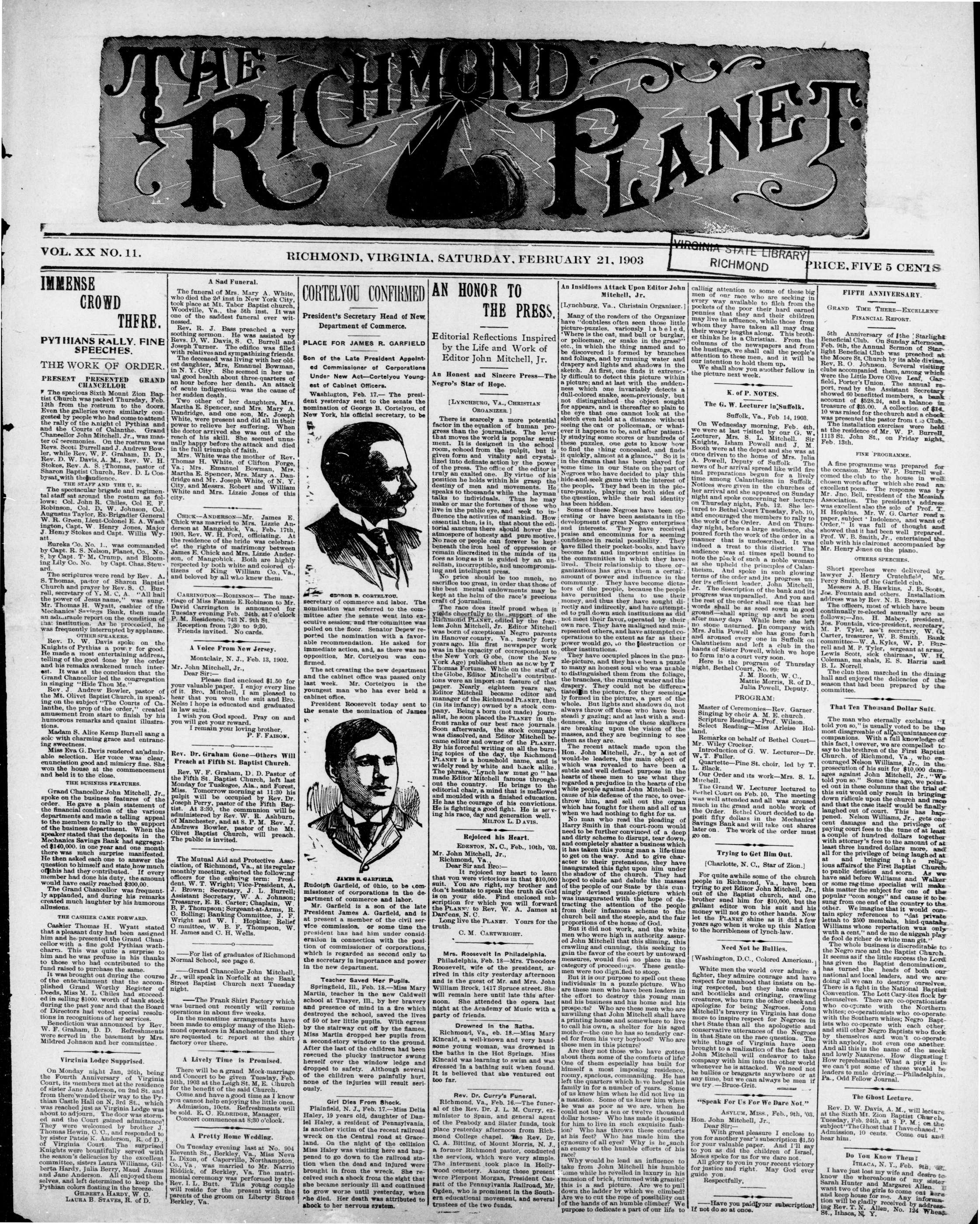
The spacious 36th Mount Zion Baptist Church was packed Thursday, Feb. 12th from the rostrum to the doors. Even the galleries were similarly congested by people who had come to attend the rally of the knight of Pythias and and the Courts of Calanthe. Grand Chancellor John Mitchell, Jr., was master of ceremonies. On the rostrum was Revs. Scott Burrell and J. Andrew Bowler, while Rev. W. F. Graham, D. D., Rev. D. W. Davis, A. M., Rev. W. H. Stokes, Rev. A. S. Thomas, pastor of Sharon Baptist Church, Rev. D. L. Cosbyat, with the audience.
THE STAFF AND THE U. R.
The spectacular brigade and regimental staff sat around the rostum as follows: Col. John R. Chiles, Col E. F. Robinson, Col. D. W. Johnson, Col. Augustus Taylor, Ex-Brigadier General W. R. Green, Lient-Colonel E. A. Washington, Capt. W. Henry Jones, Major J. Henry Stokes and Capt. Willis Wyatt.
Bureka Co. No. 1., was commanded by Capt. R. S. Nelson, Planet, Co., No. 5, by Capt. T. M. Crump, and Blooming Lily Co. No. by Capt. Chas. Steward.
The scriptures were read by Rev. A. S. Thomas, pastor of Sharon Baptist Church and prayer by Rev. S. C. Burrell, secretary of Y. M. C. A. "All hail the power of Jesus name," was sung. Mr. Thomas H. Wyatt, cashier of the Mechanics' Savings Bank, then made an adamantate report on the condition of that institution. As he proceeded, he was frequently interrupted by applause.
OTHER SPEAKERS
Rev. D. W. Davis spoke on the Knights of Pythias a powr for good. He made a most entertaining address, telling of the good done by the order and his remarks awakened much interest. It was at the conclusion that the Grand Chancellor led the congregation in singing "Hide Thon Me." Rev. J. Andrew Bowler, pastor of the Mt. Olivet Baptist Church, in speaking on the subject "The Courts of Calanthe, the prop of the order," created amusement from start to finish by his humorous remarks and quaint illustration. Madam S. Alice Kemp Burrell sang a solic with charming grace and entrancing sweetness. Miss Eva G. Davis rendered an admirable selection. Her voice was clear, enunciation good and mimicry fine. She won the house at the commencement and held it to the close.
THE BUSINESS FEATURES
Grand Chancellor John Mitchell, Jr., spoke on the business features of the order. He gave a plain statement of the financial condition of the various departments and made a telling appeal to the members to rally to the support of the business department. When the speaker stated that the deposits in the Mechanics Savings Bank had aggregated $140,000, in one year and one month there was much surprise manifested. He then asked each one to answer the question to himself and state how much of this had they contributed. If every member had done his duty, the amount would have easily reached $200.00.
The Grand Chancellor was frequently applauded, and during his remarks created much laughter by his humorous allusions.
THE CASHIER CAME FORWARD
Cashier Thomas H. Wyatt stated that a pleasant duty had been assigned him and he presented the Grand Chancellor with a fine gold Python watch-charm. This was quite a surprise to him and he was profuse in his thanks to those who had contributed to the fund raised to purchase the same. It was brought out during the course of the entertainment that the accomplished Grand Worthy Register of Deeds, Miss M. L. Chiles had succeeded in selling $1000. worth of bank stock during the past year and that the Board of Directors had voted special resolutions in recognitions of her services. Benediction was announced by Rev. W. F. Graham, D. D. Refreshments were served in the basement by Mrs. Mildred Johnson and her committee.
Virginia Lodge Supprised
On Monday night Jan. 26th, being the Fourth Anniversary of Virginia Court, its members met at the residence of sister Jane Anderson, on 2nd St. and from there wended their way to the Pythian Castle Hall on N. 3rd St., which was reached just as Virginia Lodge was about to adjourn. The door was stormed and the Court gained admittance? They were welcomed by brother J. Thomas Hewin, C. C., and responded to by sister Patsie K. Anderson, R. D. of, Virginia Court. The surprised Knights were bountifully served with the season's delicacies by the excellent committee, sisters Laura Williams, Gilberta Hardy, Julia Berry, Mand James and Jane Anderson. All enjoyed them selves, and left determined to keep the Pythian colors floating in the breeze.
GILBERTA HARDY, W. C.
LAURA B. STAVES, R. OF D.
A Sad Funeral.
The funeral of Mrs. Mary A. White, who died the 2d inst in New York City, took place at Mt. Tabor Baptist church, Woodville, Va., the 5th inst. It was one of the saddest funeral ever witnessed.
Rev. R. J. Bass preached a very soothing sermon. He was assisted by Revs. D. W. Davis, S. C. Burrell and Joseph Turner. The edifice was filled with relatives and sympathizing friends. The deceased was living with her oldest daughter, Mrs. Emanuel Bowman, in N. Y. City. She seemed in her usual good health about three quarters of hour before her death. An attack of indigestion was the cause of her sudden death.
Two other of her daughters, Mrs. Martha E. Spencer, and Mrs. Mary A. Dandridge, and one son, Mr. Joseph White, were present and did all in their power to relieve her suffering. When the doctor arrived she was out of the reach of his skill. She seemed unusually happy before the attack and died in the full triumph of faith.
Mrs. White was the mother of Rev. Thomas H. White, of Clifton Forge, Va.; Mrs. Emanuel Bowman, Mrs. Martha E. Spencer, Mrs. Mary A. Dandridge and Mr. Joseph White, of N. Y. City, and Messrs. Robert and William White and Mrs. Lizzie Jones of this city.
CHICK—ANDERSON—Mr. James E. Chick was married to Mrs. Lizzie Anderson at Mangohick, Va., Feb. 17th, 1900. Rew. H. Ford, officiating. At the residence of the bride was celebrated: the rights of matrimony between James E. Chick and Mrs. Lizzie Anderson, of Mangohick. Both are highly respected by both white and co-citizens of King William Co., Va., and beloved by all who knew them.
CARRINGTON-ROBINSON- The marriage of Miss Fannie E. Robinson to Mr. David Carrington is announced for Tuesday evening Feb. 24th at 7 o'clock P. M. Residence, 743 N. 9th St. Reception from 7:30 to 9:30.
A Voice From New Jersey
Montclair, N. J., Feb. 13, 1902.
Mr. John Mitchell, Jr.
Dear Sir:—
Please find enclosed $1.50 for
your valuable paper. I enjoy every line
of it. Bro. Mitchell, I am pleased to
hear that you won the suit and Bro.
Nels I hope is educated and graduated
in law suits.
I wish you God speed. Pray on and
you will get your reward.
I remain your loving brother,
P. F. FAISON.
Rev. Dr. Graham Gone-Others Will Preach at Fifth St. Bantist Church
Rev. W. F. Graham, D. D. Pastor of the Fifth St. Baptist Church, left last Monday for Tuskegee, Ala., and Forest, Miss. Tomorrow morning at 13:30 his pulpit will be occupied by Rev. Dr. Joseph Perry, pastor of the Fifth Baptist. At 3:30, the communion will be administered by Rev. W. R. Asaburn, of Manchester, and at 8. P. M. Rev. J. Andrews Bowler, pastor of the Mt. Olivet Baptist Church, will preach. The public is invited.
The Mutual Aid and Protective Association, of Richmond, Va., at its regular monthly meeting, elected the following officers for the ensuing term: President, W. T. Wright; Vice-President, A. J. Brown; Secretary, J. L. Burrell; Assistant Secretary, W. A. Johnson; Treasurer, E. R. Carter; Chaplain, W. B. F. Thompson; Sergeant-at-Arms, R. C. Bolling; Banking Committee, J. F. Wright and W. I. Hopkins; Relief Committee, W. B. F. Thompson, W. H. James and C. H. Wells.
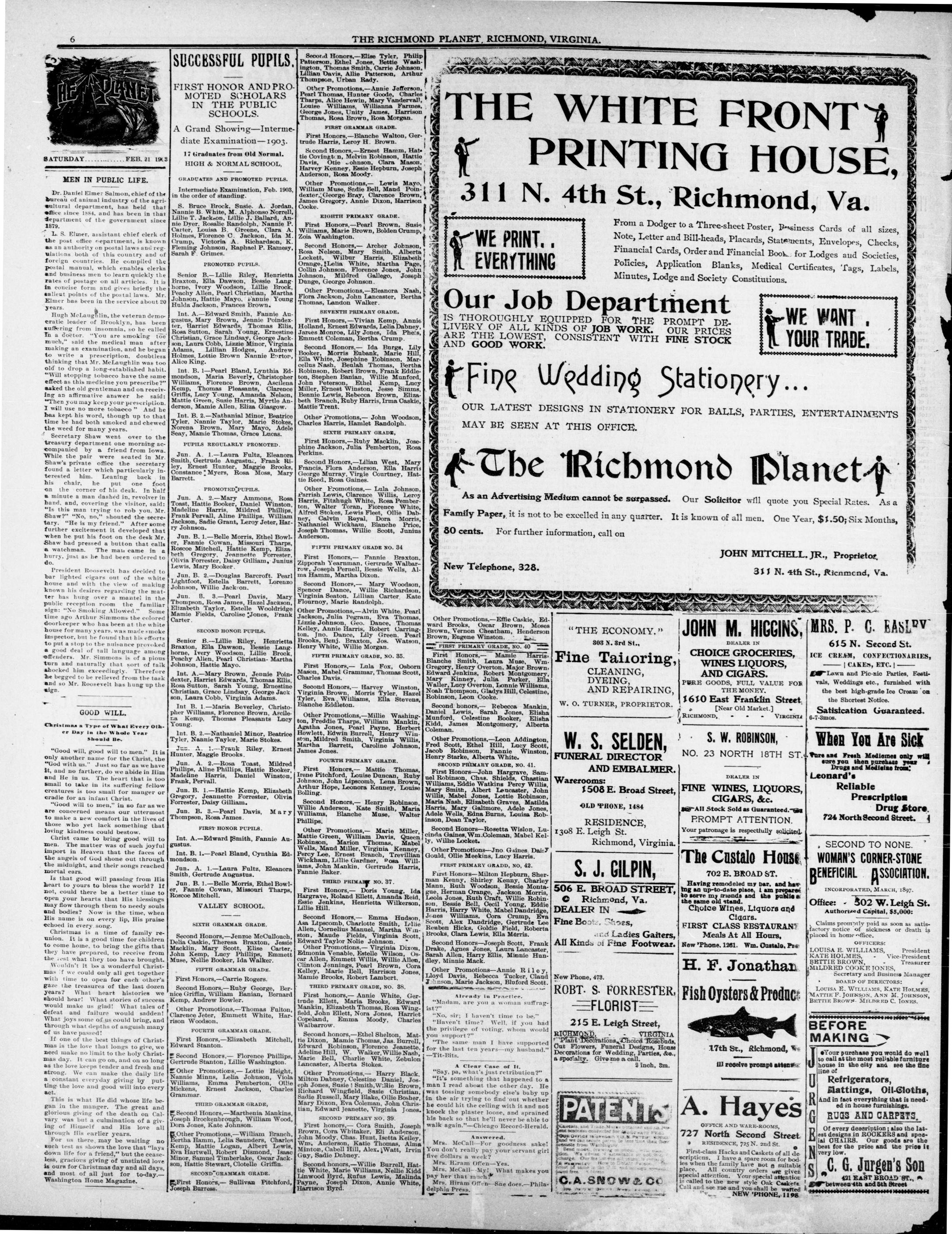
For list of graduates of Richmond Normal School, see page 6.
Grand Chancellor John Mitchell, Jr., will speak in Norfolk at the Bank Street Baptist Church next Tuesday night.
The Frank Shirt Factory which was burned out recently will resume operations in about five weeks.
In the meantime arrangements have been made to employ many of the Richmond operators in Manchester and they are requested to report at the shirt factory over there.
A Lively Time is Promised
There will be a grand Mock marriage and Concert to be given Tuesday, Feb. 24th, 1903 at the Leigh St. M. E. Church for the benefit of the said Church.
Come and have a good time as I know you cannot help enjoying the little ones.
Admission: 10cts. Refreshments will be sold. E. C. ELDRIDGE, Manager.
A Pretty Home Wedding
On Tuesday evening last at No. 904 Eleventh St., Berkley, Va. Miss Neva L. Dixon, of Caperville, Northampton, Co., Va., was married to Mr. Narrio Riddick, of Berkley, Va. The matrimonial ceremony was performed by the Rev. I. L. Butt. This young couple will reside for the present with the parents of the groom on Liberty Street Berkley, Va.
RICHMOND, VIRGINIA, SATURDAY, FEBRUARY 21, 1903
CORTELYOU CONFIRMED
CORTELYOU CONFIRMED
President's Secretary Head of New Department of Commerce.
Son of the Late President Applinte
ed Commissioner of Corporations
Under New Act—Cortelyou Youngest
of Cabinet Officers.
Washington, Feb. 17.—The presi
dent yesterday sent to the senate the
nomination of George B. Cortelyou,
of New York, his official secretary, to be
B.
secretary of commerce and labor. The nomination was referred to the committee after the senate went into executive session, and the committee was polled on the floor. Senator Depew reported the nomination with a favorable recommendation. He asked for immediate action, and, as there was no opposition, Mr. Cortelyou was confirmed.
The act creating the new department and the cabinet office was passed only last week. Mr. Cortelyou is the youngest man who has ever held a cabinet office.
President Roosevelt today sent to the senate the nomination of James
A.
JAMES R. GARFIELD.
Rudotip Garfield, of Ohio, to be commissioner of corporations in the department of commerce and labor.
Mr. Garfield is a son of the late President James A. Garfield, and is at present a member of the civil service commission. or some time the president has had him under consideration in connection with the position of commissioner of corporations, which is regarded as second only to the secretary in importance and power in the new department.
Teacher Saved Her Pupil
Springfield, Ill., Feb. 18.—Miss Mary Martin, teacher in the new Caldwell school at Thayer, Ill., by her bravery and presence of mind in a fire which destroyed the school, saved the lives of 50 of her little pupils. With egress by the stairway cut off by the flames, Miss Martin dropped her pupils from a second-story window to the ground. After the last of the children had been rescued the plucky instructor swung herself over the window ledge and dropped to safety. Although several of the children were painfully hurt, none of the injuries will result seriously.
Girl Dies From Shock
Plainfield, N. J., Feb. 17.—Miss Delia Haley, 19 years old, daughter of Daniel Haley, a resident of Pennsylvania, is another victim of the recent railroad wreck on the Central road at Graceland. On the night of the collision Miss Haley was visiting here and happened to go down to the railroad station when the dead and injured were brought in from the wreck. She received such a shock from the sight that she became seriously ill and continued to grow worse until yesterday, when she died. Her death was attributed to shock to her nervous system.
AN HONOR TO THE PRESS.
AN HONOR TO THE PRESS.
Editorial Reflections Inspired by the Life and Work of Editor John Mitchell, Jr. An Honest and Sincere Press—The Negro's Star of Hope.
[LYNCHBURG, VA., CHRISTIAN
ORGANIZER ]
There is scarcely a more potential factor in the equation of human progress than the journalists. The lever that moves the world is popular sentiment. It is designed in the schoolroom, echoed from the pulp, but is given form and vitality and crystallized into definite action by the power of the press. The office of the editor is truly an exalted one. By virtue of his position he holds within his grasp the destiny of men and movements. He speaks to thousands while the layman talks to individuals. Thus he may make or mar the fortunes of those who live in the public eye, and seek to influence the activities of markind. How essential then, is it, that about the editorial sanctum there should hover the atmosphere of honesty and pure motive. No race or people can forever be kept beneath the iron heel of oppression or remain discredited in the minds of its foes as long as it is guided by an unselfish, incorruptible, and uncompromising and intelligent press.
No price should be too much, no sacrifice too great, in order that those of the best mental endowments may be knotted to the race's precious craft of journalism.
The race does itself proud when it yields cheerfully to the support of the Richmond PLANET, edited by the fearless John Mitchell, Jr. Editor Mitchell was born of exceptional Negro parents in Hanover county, Va. nearly forty years ago. His first newspaper work was in the capacity of correspondent to the New York G obe (now the New York Age) published then a now by T. Thomas Fortune. While on the staff of the Globe, Editor Mitchell's contributions were an important feature of that paper. Nearly eighteen years ago, Editor Mitchell became editor and manager of the Richmond PLANET, then (in its infancy) owned by a stock company. Being a born (not made) journalist, he soon placed the PLANET in the front ranks of our best race journals. Soon afterwards, the stock company was dissolved, and Editor Mitchell became editor and owner of the PLANET. By his forceful writing on all the burning topics of the day, the Richmond PLANET is a household name, and is widely read by white and back alike. The phrase, "Lynch law must go" has made Editor Mitchell famous throughout the country. He brings to the editorial chair, a mind that is mellowed and moulded with a finished education. He has the courage of his convictions. He is fighting a good fight. He is serving his race, day and generation well.
Rejoiced his Heart.
EDENTON, N.C., Feb., 10th, '08
Mr. John Mitchell, Jr.,
Richmond, Va.,
Dear Sir and Bro:—
It rejoiced my heart to learn that von were victorious in that $10,000 suit. You are right, my brother and don't hesitate to speak the truth as God is on your side. Find enclosed subscription for which you will forward the PLANET to Rev. W. A. James at Dardens, N. C. Long live the PLANET. Yours for the truth.
Mrs. Roosevelt in Philadelphia.
Philadelphia, Feb. 18—Mrs. Theodore Roosevelt, wife of the president, arrived in this city yesterday afternoon and is the guest of Mr. and Mrs. John William Brock, 1417 Spruce street. She will remain here until late this afternoon. She attended the opera last night at the Academy of Music with a party of friends.
Drowned In the Baths
Richmond, Va., eb. 18—Miss Mary Kincaid, a well-known and very handsome young woman, was drowned in the baths in the Hot Springs. Miss Kincaid was learning to swim and was dressed in a bathing suit when found. It is believed that she ventured out too far.
Rev. Dr. Curry's Funeral.
Richmond, Va., Feb. 16—The funeral of the Rev. Dr. J. L. M. Curry, exminister to Spain, and general agent of the Peabody and Slater funds, took place yesterday afternoon from Richmond College chapel. The Rev. Dr. C. A. Bitting, of Mount Morris, N. J., a former Richmond pastor, conducted the services, which were very simple. The interment took place in Hollywood cemetery. Among those present were Plerpont Morgan, President Cassatt of the Pennsylvania Railroad, Mr. Ogden, who is prominent in the Southern educational movement, and several trustees of the two funds.
An Insidious Attack Upon Editor John Mitchell, Jr.
[Lynchburg, Va., Christain Organizer.
Many of the readers of the Organizer have "doubliest often seen those little picture-puzzles, variously labeled," Where is the cat, mad bull or burglar or policeman, or snake in the grass" etc, in which the thing named and to be discovered is formed by branches and foliage, and by running water and drapery and lights and shadows in the sketch. At first, one finds it extremely difficult to detect this picture within a picture; and at last with the sudeness which one invariably detects a dull-colored snake, seen-previously, but not distinguished the object sought for appears, and is thereafter plain to the eye that one cannot look at the sketch even held at a distance without seeing the cat or policeman, or whatever it happens to be, and after patiently studying some scores or hundreds of these puzzles, one gets to know how to find the thing concealed, and finds it quickly, almost at a glance." So it is in the drama that has been played for some time in our State on the part of Negroes who have decided to play this hide-and-seek game with the interest of the people. They had been in the picture-puzzle, playing on both sides of the question, while their real identity has been hidden.
Some of these Negroes have been operating or have been assistants in the development of great Negro enterprises and interests. They have received praise and encomnias for a seeming confidence in racial possibility. They have filled their pocket-books, and have become fat and important entities in the communities in which they have lived. Their relationship to these organizations has given them a certain amount of power and influence in the community. They have become dictators of the people, because the people have permitted them to use their money, and thus they have sought directly and indirectly, and have attempted to pull down such institutions as did not meet their favor, operated by their own race. They have maligned and misrepresented others, and have attempted cooperations to the extent as far as their power would go, so the destruction or other institutions.
They have occupied places in the puzzle-picture, and they have been a puzzle to many an honest soul who was unable to distinguished them from the foliage, the branches, the running water and the drapery. They could not be differentiated in the picture, for they seemingly formed in the picture, a part of the whole. But lights and shadows do not always throw off those who have been steadi y gazing; and at last with a sadness, the images of these skullers are breaking upon the vision of the masses, and they are beginning to see them as they are.
The recent attack made upon the BH Mitchell Mitchell, Jr., by a set of would-be leader, the main object of which was revealed to have been a subtle and well defined purpose in the hearts of these men to use what they regarded a prejudice in the hearts of the white people against John Mitchell because of his defense of the race, to overthrow him, and sell out the organ which has fought for them and all of us when we had nothing to fight for us.
No man who read the pleading of Harry Smith in that court-room would need to be further convinced of a deep and dirty scheme to disrupt, tear down, and completely shatter a business which it has taken this young man a life-time to get on the way. And to give character to their pretensions, they have inaugurated this fight upon him under the shadow of the church. They had hoped to elude and delude the masses of the people of our State by this cunningly devised puzzle-picture which was inaugurated with the hope of detracting the attention of the people from their infamous scheme to the church bell and the steepe, and the fair proportions of the house of God.
But it did not work, and the white men who were high in authority assured John Mitchell that this sliming, this crawling and cunning, this seeking to gain the favor of the court by untoward measures, would find no place in the category of proceedings. These gentlemen were too dignified to stoop. But it is our purpose to spell out these individuals in a puzzle picture. Who are these men who have been leaders in the effort to destroy this young man and his business and his home and his prospects? Who are these men who are unwilling that John Mitchell shall have a printing house and somewhere to live to call his own, a shelter for his aged mother—the one he has so tenderly cared for from his very boyhood? Who are these men in this picture?
Are they not those who have gotten about them some of the comforts of life? One of them especially has built for himself a most imposing residence, roomy, spacious, commanding. He has left the quarters which he have hedged his family in for a number of years. Some of us knew him when he did not live in a mansion. Some of us knew him when he was as poor as we are, when he could not buy a ten or twelve thousand dollar house- Who has made it possible for him to live in such exquisite fashion? Who has thrown these comforts at his feet? Who has made him the cynosure of all eyes? Why is he such an enemy to the humble efforts of his ranch? Why would he lend an influence to take from John Mitchell his humble home while he revelled in luxury in his mansion of brick, trimmed with granite? this is a sad picture. Are we to pull down the ladder by which we climbed? Are we to cut the rope of possibility out of the hands of an humble climber? We purpose to dedicate a part of our life to
calling attention to some of these big men of our race who are seeking in every way available to filch from the pockets of the poor their hard earned pennies that they and their children may live in affluence, while those from whom they have taken all may drag their weary lengths along. This brother thinks he is a Christian. From the columns of the newspapers and from the hustings, we shall call the people's attention to these men, and it will be our intention to hold them up.
We shall show you another fellow in the picture next week.
K. of P. NOTES
The G. W. Lecturer in Suffolk
On Wednesday morning, Feb. 4th, we were at last visited by our G. W. Lecturer, Mrs. S. L. Mitchell. Sir Knights, Isham Powell and J. M. Booth were at the depot and she was at once driven to the home of Mrs. Julia Apowell, Deputy of Suffolk. The news of her arrival spread like wild fire and preparation began for a lively time among Calantheism in Suffolk. Notices were given in the churches of her arrival and she appeared on Sunday night and spoke concerning her lecture on Thursday night, Feb. 12. She lectured to Bathlet Court Tuesday, Feb. 10, and encouraged the members to rally to the work of the Order. And on Thursday night, before a large audience, she poured forth the work of the order in a manner that is undescribed. It was indeed a treat to this district. The audience was at times spell bound to note the plack of such a noble woman as she upheld the principles of Calantheism. And spoke in such glowing terms of the order and its progress under its efficient leader, John Mitchell, Jr. The description of the bank and its progress was unparalleled. And you and the rest of the order shall see that her words shall be as seed sown in good ground—shall spring up and be seen after many days. While here she left the stone unturned. In company with Mrs. Julia Powell she has gone forth and aroused every one in Suffolk on Calantheism and left a club in the hands of Sister Powell, which we hope to form into a court very soon.
Here is the program of Thursday night, Bethel Court, No. 99:
J. M. Booth, W. C.
Mattie Morris, R. of D.
Julia Powell, Deputy.
PROGRAM:
Master of Ceremonies—Rev. Garner.
Singing by choir A. M. E. church.
Scripture Reading—Prof. Wilson.
Select Reading—Miss Arleise Holland.
Remarks on behalf of Bethel Court—Mr. Wiley Crocker. Introduction of G. W. Lecturer—Dr W.T. Fuller.
Quartette—Pine St. choir, led by T. L. Black.
Our Order and its work—Mrs. S. L. Mitchell.
The Grand W. Lecturer lectured to Bethel Court on Feb. 10. The meeting was well attended and all was aroused by the grand and noble work of the Order. Bethel Court decided to deposit fifty dollars in the Mechanics' Savings Bank and will take out shares later on. The work of the order must go on.
For quite awhile some of the church people in Richmond, Va., have been trying to get Editor John Mitchell, Jr., out of the Baptist church, and one brother sued him for $10,000, but the gallant editor won his suit and his money will not go to other hands. Now let the PLANET shine as it did a few years ago when it woke up this Nation to the horribleness of lechwah.
Need Not be Bullies
[Washington, D.C., Colored American.
White men the world over admire a fighter, they admire courage and have respect for manhood that insists on being respected, but they hate craves and bootlicks and cringing, crawling creatures, who turn the other check and apologize for being Negroes. John Mitchell's bravery in Virginia has done more to inspire respect for Negroes that State than all the apologetic and conservative utterances of the Negroes in that State on the race question. The white thugs of Virginia have been brought to a realization of the fact that John Mitchell will endeavor to take company with him into the other world whenever he is attacked. We need not be bullies or braggs anywhere or at any time, but we can always be men if we try. —Bruce-Grit.
ASYLUM, Miss., Feb., 9th, '03.
Hon. John Mitchell, Jr.,
Dear Sir;—
With great pleasure I enclose to
you for another year's subscription $1.50
for your valuable paper. And I'll say
to you as did the children of Israel,
Moses speak for us for we dare not.
All glory to you in your recent victory for justice and right. May God ever guide you.
FIFTH ANNIVERSARY.
GRAND TIME THERE-EXCELLENT
FINANCIAL REPORT.
5th Anniversary of the 'Starlight Beneficial Club. On Sunday afternoon, Feb. 9th, the Annual Sermon of Starlight Beneficial Club was preached at the Moore St, Church by its able divine, Rev, R. O. Johnson. Several visiting clubs accompanied them, among which were the Little Dove Olive Leaf, Garfield, Porter's Union. The annual report, read by the Assistant Secretary showed 60 benefitted members, a bank account of $28.24, and a balance in treasure of $25.00. A collection of $14.10 was raised for the church and a check was presented the pastor from t. Club.
Fort 13 Oak
The installation exercises were held at the residence of Mr. W. P. Burrell,
1113 St. John St., on Friday night.
Feb. 13th.
FINE PROGRAMME
A fine programme was prepared for the occasion. Mrs. W. P. Burrell welcomed the club to the house in well chosen words after which she read an excellent poem. The response was by Mr. Jno. Bell, president of the Messiah Association. The president's address was excellent also the solo of Prof. T. H. W. Mr. W. G. Carter read a paper, subject of enclosure, and want of Order." It was full of thought and showed that it had been well prepared. Prof. W. B. Smith, Jr., entertained the club with his claironet accompanied by Mr. Henry Jones on the piano.
OTHERS SPEECHES
Short speeches were delivered by lawyer J. Henry Crutchfield, Mr. Percy Smith, of the Garfield club. Messers A.B. Hawkins, J. B. Scott, Jos. Fountain and others. Installation address was by Rev. N. B. Brown.
The officers, most of which have been continually re-elected annually are as follows: Jno. H. Mabey, president, Jos. Fountain, vice-president, secretary, M. P. Tyler, ass't secretary, W. G. Carter, treasurer, W. B. Smith. Bank committee, W. A. Kyles, W. P. Burger, P. Tyler, sergeant at arms, Lewis Scott, sick chairman, W. H. Coleman, ma shals, E. S. Harris and B. L. Norrell. The club then marched in the dining hall and enjoyed the delicacies of the season that had been prepared by the committee.
That Ten Thousand Dollar Suit
The man who eternally exclaims "I told you so," is usually voted to be the most disagreeable of all acquaintances or companions. With a full knowledge of this fact, I owe, we are compelled to say to the brethren of the First Baptist Church. of Richmond, Va., who encouraged Nelson Williams, Jr., in the prosecution of his suit for $10,000 damages against John Mitchell, Jr., "We told you so." Some time ago, we pointed out in these columns that the trial of this suit would only result in bringing down ridicule upon the church and race and that the case itself would be finally laughed out of court. This has happened. Nelson Williams, Jr., gets one damage to the privilege of paying court fees to the tune of at least a couple of hundred dollars together with attorney's fees to the amount of at least three hundred dollars more, and all for the privilege of being laughed at at and bringing to the religious affairs of the First Baptist Church to public deference and scorn. We have said before Williams and Walker or some rag-time specialist will make this matter the subject for one of the popular "coon songs" and cause it to be sung from one end of the country to the other. We imagine that it would contain spicy references to "dat private lettah to 2500 membahs, hind-quatahs Williams whose repertation wuz only wuth a cent., and de mo de nigghag play de fool de richer de white man git."
The whole business is discreditable to the Negro race and the Baptist Church. It seems as if the little success the Lord has given the Baptist denomination, has turned the heads of both national and local leaders, and we are doing all we can to destroy ourselves. There is a fight in the National Baptist Convention. The Lott Cary-ites flock by themselves. There are co-operationists who co-operate with the Northernites; co-operationists who co-operate with the Southern whites; Negro Baptists who cooperate with each other, and still other Negro Baptists who flock by themselves, won't co-operate with anybody, not even one another. And all this in the manner of the meek and lowly Nazarene. How disgusting! How reprehensible! What a dirty it is we can't put some of these would be leaders to mule driving.—Philadelphia, Pa., Odd Fellow Journal.
The Ghost Lecture
Rev. D. W. Davis, A. M., will lecture at the Sixth Mt. Zion Baptist Church, Tuesday, Feb. 24th, at 8 P. M.; on the subject "The Ghost that I have chased." Admission, 10 cents. Come out and hear him.
Do You Know Them?
THACA, N. Y., Feb. 9th, 68.
I have just lost my wife and desire to know the whereabouts of my sister Sarah Hunter and Margaret Allen. I want two of the girls to come out here and keep house for me. Any information will be gladly by addressing Rev. T. N. Allen, No. 124 Wheats St., Ithaca, N. Y.
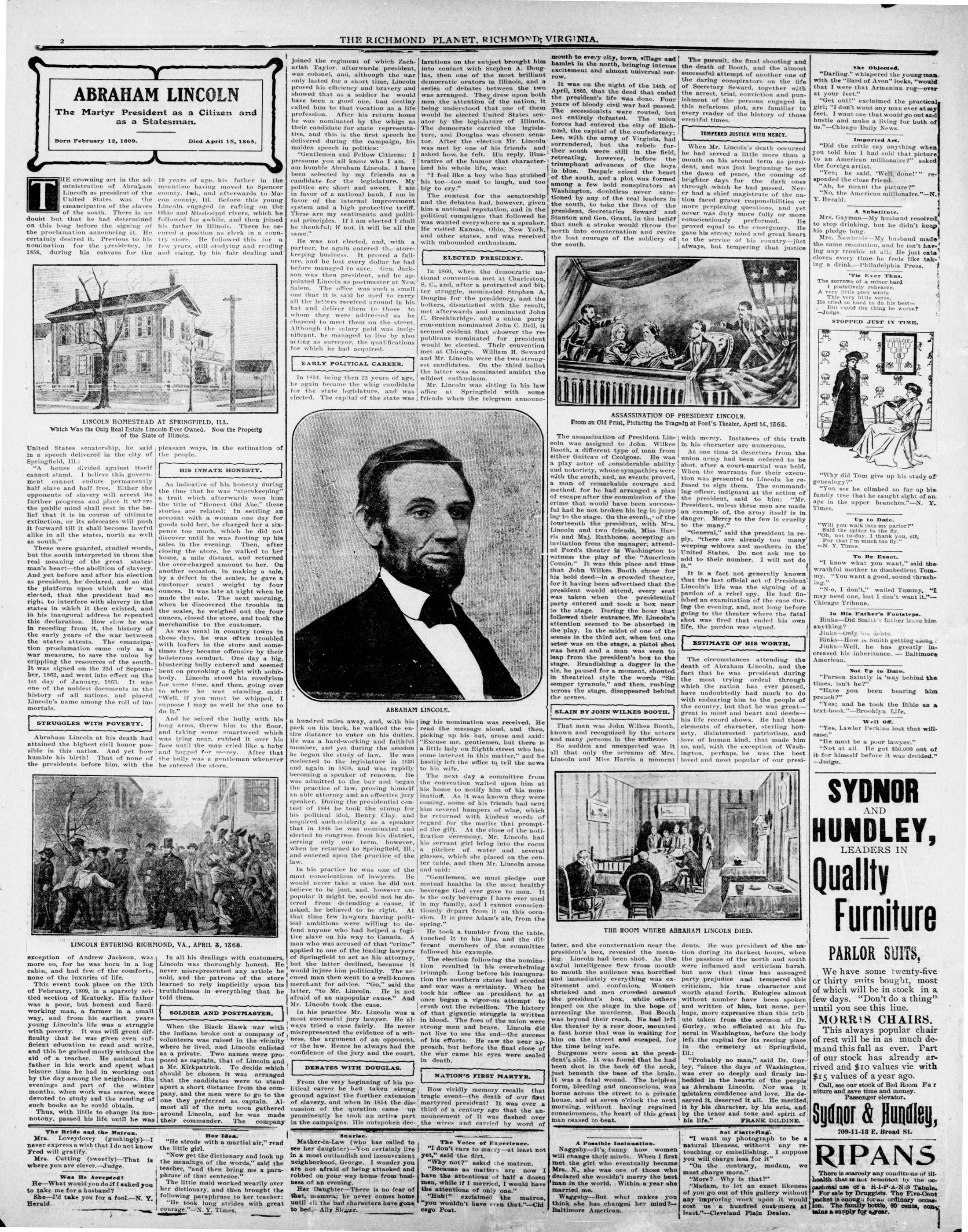
ABRAHAM LINCOLN
The Martyr President as a Citizen and as a Statesman.
Born February 12, 1809. Died April 15, 1865.
LINCOLN HOMESTEAD AT SPRINGFIELD, ILL.
Which Was the Only Real Estate Lincoln Ever Owned. Now the Property of the State of Illinois.
LINCOLN ENTERING RIGHMOND, VA., APRIL 3, 1865.
THE crowning act in the administration of Abraham Lincolh as president of the United States was the emancipation of the slaves of the south. There is no doubt but that he had determined on this long before the signing of the proclamation announcing it. He certainly desired it. Previous to his nomination for the presidency, in 1858, during his canvass for the
LINCOLN HOMESTEAD
Which Was the Only Real Estate Line
of the State
United States senatorship, he said in a speech delivered in the city of Springfield, Ill.: "A house divided against itself cannot stand. I believe this government cannot endure permanently half slave and half free. Either the opponents of slavery will arrest its further progress and place it where the public mind shall rest in the belief that it is in course of ultimate extinction, or its advocates will push it forward till it shall become lawful alike in all the states, north as well as south."
These were guarded, studied words, but the south interpreted in them the real meaning of the great statesman's heart—the abolition of slavery. And yet before and after his election as president, he declared, and so did the platform upon which he was elected, that the president had no right to interfere with slavery in the states in which it then existed, and in his inaugural address he repeated this declaration. How slow he was in receding from it, the history of the early years of the war between the states attests. The emancipation proclamation came only as a war measure, to save the union by crippling the resources of the south. It was signed on the 23d of September, 1862, and went into effect on the 1st day of January, 1863. It was one of the noblest documents in the history of all nations, and placed Lincoln's name among the roll of immortals.
STRUGGLES WITH POVERTY.
Abraham Lincoln at his death had attained the highest civil honor possible in this nation. And yet how humble his birth! That of none of the presidents before him, with the
LINCOLN ENTERING RIGHN
exception of Andrew Jackson, was more so, for he was born in a log cabin, and had few, cf the comforts, none of the luxuries of life.
This event took place on the 12th of February, 1809, in a sparsely settled section of Kentucky. His father was a poor, but honest and hardworking man, a farmer in a small way, and from his earliest years young Lincoln's life was a struggle with poverty. It was with great difficulty that he was given even sufficient education to read and write, and this he gained mostly without the aid of a teacher. He assisted his father in his work and spent what leisure time he had in working out by the day among the neighbors. His evenings and part of the winter months, when work was scarce, were devoted to study and the reading of such books as he could obtain.
Thus, with little to change its monotony, passed his life until he was
The Bride and the Matron.
Mrs. Loveydovey (gushingly)—I never express a wish that I do not know Fred will gratify.
Mrs. Cutting (sweetly)—That is where you are clever.—Judge.
Was He Accepted?
What Have Accepted?
He—What would you do if I asked you
to take me for a husband?
She—I'd take you for a fool.—N. Y.
Herald.
19 years of age, his father in the meantime having moved to Spencer county, Ida, and afterwards to Macon county, Ill. Before this young Lincoln engaged in rafting on the Ohio and Mississippi rivers, which he followed for awhile, and then joined his father in Illinois. There he secured a position as clerk in a country store. He followed this for a few years, still studying and reading and rising, by his fair dealing and
AT SPRINGFIELD, ILL.
Colin Ever Owned. Now the Property
of Illinois.
pleasant ways, in the estimation of the people.
HIS INNATE HONESTY.
As indicative of his honesty during the time that he was "storekeeping" a trait which afterwards won him the title of "Honest Old Abe," these stories are related: In settling an account with a woman one day for goods sold her, he charged her a sixpence too much, which he did not discover until he was footing up his sales in the evening. Then, after closing the store, he walked to her home, a mile distant, and returned the over-charged amount to her. On another occasion, in making a sale, by a defect in the scales, he gave a customer scant weight by four ounces. It was late at night when he made the sale. The next morning, when he discovered the trouble in the scales, he weighed out the four ounces, closed the store, and took the merchandise to the customer.
As was usual in country towns in those days, he was often troubled with laffers in the store and sometimes they became offensive by their boisterous conduct. One day a big, blustering bully entered and seemed bent on provoking a fight with somebody. Lincoln stood his rowdyism for some time, and then, going over to where he was standing, said: "Well, if you must be whipped, I suppose I may as well be the one to do it." And he seized the bully with his long arms, threw him to the floor, and taking some smartweed which was lying near, rubbed it over his face until the man cried like a baby and begged for mercy. After that the bully was a gentleman whenever he entered the store.
IOND, VA., APRIL 3, 1868.
In all his dealings with customers, Lincoln was thoroughly honest. He never misrepresented any article he sold, and the patrons of the store learned to rely implicitly upon his truthfulness in everything that he told them.
SOLDIER AND POSTMASTER
When the Black Hawk war with the Indians broke out a company of volunteers was raised in the vicinity where he lived, and Lincoln enlisted as a private. Two names were proposed as captain, that of Lincoln and a Mr. Kirkpatrick. To decide which should be chosen it was arranged that the candidates were to stand apart a short distance from the company, and the men were to go to the one they preferred as captain. Almost all of the men soon gathered around Lincoln, and he was made their commander. The company
"He strode with a martial air," read the little girl.
"Now get the dictionary and look up the meanings of the words," said the teacher, "and then bring me a paraphrase of that sentence."
The little maid worked wearily over her dictionary, and then brought the following paraphrase to her teacher:
"He took long strides with great courage." - N. Y. Times.
joined the regiment of which Zachariah Taylor, afterwards president, was colonel, and, although the war only lasted for a short time, Lincoln proved his efficiency and bravery and showed that as a soldier he would have been a good one, had destiny called him to that vocation as a life profession. After his return home he was nominated by the whigs as their candidate for state representative, and this is the first speech he delivered during the campaign, his maiden speech in politics;
larations on the subject brought him into contact with Stephen A. Douglas, then one of the most brilliant democratic orators in Illinois, and a series of debates between the two was arranged. They drew upon both men the attention of the nation, it being understood that one of them would be elected United States senator by the legislature of Illinois. The democrats carried the legislature, and Douglas was chosen senator. After the election Mr. Lincoln was met by one of his friends and
mouth to every hamlet in the excitement and row.
It was on 1 April, 1865, the thirty years of blood. The secession not entirely forces had end mnd, the capi Lee, with the surrendered,
"Gentlemen and Fellow Citizens: I presume you all know who I am. I am humble Abraham Lincoln. I have been selected by my friends as a candidate for the legislature. My politics are short and sweet. I am in favor of a national bank. I am in favor of the internal improvement system and a high protective tariff. These are my sentiments and political principles. If I am elected I shall be thankful; if not, it will be all the same."
He was not elected, and, with a partner, he again entered the store-keeping business. It proved a failure, and he lost every dollar he had before managed to save. Gen. Jackson was then president, and he appointed Lincoln as postmaster at New Salem. The office was such a small one that it is said he used to carry all the letters received around in his hat and deliver them to those to whom they were addressed as he chanced to meet them on the street. Although the salary paid was insignificant, he managed to live by also acting as surveyor, the qualifications for which he had acquired.
EARLY POLITICAL CAREER.
In 1834, being then 25 years of age, he again became the whig candidate for the state legislature, and was elected. The capital of the state was
ABRAHAM
A. B.
ABRAHAM LINGOLN
a hundred miles away, and, with his back on his back, he walked the entire distance to enter on his duties. He was a hard-working and faithful member, and yet during the session he began the study of law. He was reelected to the legislature in 1836 and again in 1838, and was rapidly becoming a speaker of renown. He was admitted to the bar and began the practice of law, proving himself an able attorney and an effective jury speaker. During the presidential contest of 1844 he took the stump for his political idol, Henry Clay, and acquired such celebrity as a speaker that in 1846 he was nominated and elected to congress from his district, serving only one term, however, when he returned to Springfield, Ill., and entered upon the practice of the law.
In his practice he was one of the most conscientious of lawyers. He would never take a case he did not believe to be just, and, however unpopular it might be, could not be deterred from defending a cause, if asked, he believed to be right. At that time few lawyers having political ambitions were willing to defend anyone who had helped a fugitive slave on his way to Canada. A man who was accused of that "crime" applied to one of the leading lawyers of Springfield to act as his attorney, but the latter declined, because it would injure him politically. The accused man then went to a well-known merchant for advice. "Go," said the latter, "to Mr. Lincoln. He is not afraid of an unpopular cause." And Mr. Lincoln took the case.
In his practice Mr. Lincoln was a most successful jury lawyer. He always tried a case fairly. He never misrepresented the evidence of a witness, the argument of an opponent, or the law. Hence he always had the confidence of the jury and the court.
DEBATES WITH DOUGLAS.
From the very beginning of his political career he had taken strong ground against the further extension of slavery, and when in 1854 the discussion of the question came up prominently he took an active part in the campaigns. His outspoken dee
Mather-in-Law (who has called to see her daughter)—You certainly live in a most outlandish and inconvenient neighborhood, George. I wonder you are not afraid of being attacked and robbed on your way home from business of an evening.
Her Daughter—There is no fear of that, mamma; he never comes home until all the bad characters have gone to bed. Ally Sieger.
Scurlae.
Irations on the subject brought him into contact with Stephen A. Douglas, then one of the most brilliant democratic orators in Illinois, and a series of debates between the two was arranged. They drew upon both men the attention of the nation, it being understood that one of them would be elected United States senator by the legislature of Illinois. The democrats carried the legislature, and Douglas was chosen senator. After the election Mr. Lincoln was met by one of his friends and asked how he felt. His reply, illustrative of the humor that characterized his whole life, was: "I feel like a boy who has stubbed his toe—too mad to laugh, and too big to cry."
The contest for the senatorship and the debates had, however, given him a national reputation, and in the political campaigns that followed he was wanted everywhere as a speaker. He visited Kansas, Ohio, New York, and other states, and was received with unbounded enthusiasm.
In 1860, when the democratic national convention met at Charleston, S. C., and, after a protracted and bitter struggle, nominated Stephen A. Douglas for the presidency, and the bolters, dissatisfied with the result, met afterwards and nominated John C. Breckinridge, and a union party convention nominated John C. Bell, it seemed evident that whoever the republicans nominated for president would be elected. Their convention met at Chicago. William H. Seward and Mr. Lincoln were the two strongest candidates. On the third ballot the latter was nominated amidst the wildest enthusiasm.
Mr. Lincoln was sitting in his law office at Springfield with some friends when the telegram announc-
LINCOLN.
ing his nomination was received. He read the message aloud, and then, picking up his hat, arose and said: "Excuse me, gentlemen, but there is a little lady on Eighth street who has some interest in this matter," and he hastily left the office to tell the news to his wife.
The next day a committee from the convention waited upon him at his home to notify him of his nomination. As it was known they were coming, some of his friends had sent him several hampers of wine, which he returned with kindest words of regard for the motive that prompted the gift. At the close of the notification ceremony, Mr. Lincoln had his servant girl bring into the room a pitcher of water and several glasses, which she placed on the center table, and then Mr. Lincoln arose and said:
"Gentlemen, we must pledge our mutual healths in the most healthy beverage God ever gave to man. It is the only beverage I have ever used in my family, and I cannot consciently depart from it on this occasion. It is pure Adam's ale, from the spring."
He took a tumbler from the table, touched it to his lips, and the different members of the committee followed his example.
The election following the nomination resulted in his overwhelming triumph. Long before his inauguration the southern states had seceded and war was a certainty. When he took his office as president he at once began a vigorous attempt to crush out the rebellion. The history of that gigantic struggle is written in blood. The foes of the union were strong men and brave. Lincoln did not live to see the end—the success of his efforts. He saw the near approach, but before the final close of the war came his eyes were sealed in death.
NATION'S FIRST MARTYR
How vividly memory recalls that tragic event—the death of our first martyrned president! It was over a third of a century ago that the announcement of it was flashed over the wires and carried by word of
The Voice of Experience.
"I don't care to marry—at least not yet," said the flirt.
"Why not?" asked the matron.
"Because as matters are now I have the attentions of half a dozen men, while if I married, I would have the attentions of only one."
"Huh!" exclaimed the matron,
"you wouldn't have even that."—Chicago Post.
ELECTED PRESIDENT.
mouth to every city, town, village and hamlet in the north, bringing intense excitement and almost universal sorrow.
It was on the night of the 14th of April, 1865, that the deed that ended the president's life was done. Four years of bloody civil war had passed. The secessionists were routed, but not entirely defeated. The union forces had entered the city of Richmond, the capital of the confederacy; Lee, with the army of Virginia, had surrendered, but the rebels further south were still in the field, retreating, however, before the triumphant advances of the boys in blue. Despair seized the heart of the south, and a plot was formed among a few bold conspirators at Washington, doubtless never sanctioned by any of the real leaders in the south, to take the lives of the president, Secretaries Seward and Stanton and Gen. Grant, in the belief that such a stroke would throw the north into consternation and revive the lost courage of the soldiery of the south.
ASSASSINATION OF
From an Old Print, Picturing the Trag
ASSASSINATION OF PRESIDENT LINCOLN.
From an Old Print, Picturing the Tragedy at Ford's Theater, April 14, 1865.
The assassination of President Lincoln was assigned to John Wilkes Booth, a different type of man from either Guiteau of Czolgosz. He was a play actor of considerable ability and notoriety, whose sympathies were with the south, and, as events proved, a man of remarkable courage and method, for he had arranged a plan of escape after the commission of the crime that would have been successful had he not broken his leg in jumping to the stage. On the evening, of the fourteenth the president, with Mrs. Lincoln and two friends, Miss Harris and Maj. Rathbone, accepting an invitation from the manager, attended Ford's theater in Washington to witness the play of the "American Cousin." It was this place and time that John Wilkes Booth chose for his hold deed—in a crowded theater, for it having been advertised that the president would attend, every seat was taken when the presidential party entered and took a box near to the stage. During the hour that followed their entrance, Mr. Lincoln's attention seemed to be absorbed in the play. In the midst of one of the scenes in the third act, when but one actor was on the stage, a pistol shot was heard and a man was seen to leap from the president's box to the stage. Brandishing a dagger in the air, he paused for a moment, shouted in theatrical style the words "Sic semper tyrannis," and then, rushing across the stage, disappeared behind the scenes.
SLAIN BY JOHN WILKES BOOTH.
That man was John Wilkes Booth, known and recognized by the actors and many persons in the audience.
So sudden and unexpected was it all that only the screams of Mrs. Lincoln and Miss Harris a moment
A
THE ROOM WHERE ABRAHAM LINCOLN DIED.
later, and the consternation near the president's box, revealed the meaning. Lincoln had been shot. As the awful intelligence flew from mouth to mouth the audience was horrified and immediately everything was excitement and confusion. Women shrieked and men crowded around the president's box, while others leaped on the stage in the hope of arresting the murderer. But Booth was beyond their reach. He had left the theater by a rear door, mounted a fast horse that was in waiting for him on the street and escaped, for the time being safe.
Surgeons were soon at the president's side. It was found that he had been shot in the back of the neck, just beneath the base of the brain. It was a fatal wound. The helpless form, bleeding and unconscious, was borne across the street to a private house, and at seven o'clock the next morning, without having regained consciousness, the heart of this great man ceased to beat.
A Possible Insulation.
Naggsby—It's funny how women will change their minds. When I first met the girl who eventually became Mrs. N., she was one of those who declared she wouldn't marry the best man in the world. Within a year she married me.
Waggsby—But what makes you think she has changed her mind?—Baltimore American.
The pursuit, the final shooting and the death of Booth, and the almost successful attempt of another one of the daring conspirators on the life of Secretary Seward, together with the arrest, trial, conviction and punishment of the persons engaged in this nefarious plot, are familiar to every reader of the history of those eventful times.
TEMPERED JUSTICE WITH MERCY.
When Mr. Lineolin's death occurred he had served a little more than a month on his second term as president, and was just beginning to see the dawn of peace, the coming of brighter days for the dark ones through which he had passed. Never had a chief magistrate of the nation faced graver responsibilities or more perplexing questions, and yet never was duty more fully or more conscientiously performed. He proved equal to the emergency. He gave his strong mind and great heart to the service of his country—just always, but tempering that justice
PRESIDENT LINCOLN.
ledy at Ford's Theater, April 14, 1865.
with mercy. Instances of this trait in his character are numerous. At one time 24 deserters from the union army had been ordered to be shot, after a court-martial was held. When the warrants for their execution was presented to Lincoln he refused to sign them. The commanding officer, indignant at the action of the president, said to him: "Mr. President, unless these men are made an example of, the army itself is in danger. Mercy to the few is cruelty to the many."
"General," said the president in reply, "there are already too many weeping widows and mothers in the United States. Do not ask me to add to their number. I will not do it."
It is a fact not generally known that the last official act of President Lincoln's life was the signing of a pardon of a rebel spy. He had finished an examination of the case during the evening, and, not long before going to the theater where the fatal shot was fired that ended his own life, the pardon was signed.
ESTIMATE OF HIS WORTH.
The circumstances attending the death of Abraham Linecoln, and the fact that he was president during the most trying ordeal through which the nation has ever passed, have undoubtedly had much to do with endearing him to the people of the country, but that he was great—great in mind and heart and deeds—his life record shows. He had those elements of character, sterling honesty, disinterested patriotism, and love of human kind, that made him so, and, with the exception of Washington, perhaps, he was the best loved and most popular of our presi-
A
dents. He was president of the nation during its darkest hours, when the passions of the north and south were inflamed and criticism harsh, but now that time has assuaged party prejudice and tempered this criticism, his true character and worth stand forth. Eulogies almost without number have been spoken and written of him, but none, perhaps, more expressive than this tribute taken from the sermon of Dr. Gurley, who officiated at his funeral in Washington, before the body left the capital for its resting place in the cemetery at Springfield, Ill.:
"Probably no man," said Dr. Gurley, "since the days of Washington, was ever so deeply and firmly imbedded in the hearts of the people as Abraham Lincoln. Nor was it mistaken confidence and love. He deserved it, deserved it all. He merited it by his character, by his acts, and by the tenor and tone and spirit of his life." FRANK DILDINE.
Not Flattefing.
"I want my photograph to be a natural likeness, without any retouching or embellishing. I suppose you will charge less for it"
"On the contrary, madam, we must charge more."
"More? Why is that?"
"Madam, to let an exact likeness of you go out of this gallery without any improving work upon it would cost us a hundred customers at least."—Cleveland Plain Dealer.
She Objected.
"Darling," whispered the young man with the "Bard of Avon" locks, "would that I were that Armenian rug—ever at your feet."
"Get out!" exclaimed the practical girl; "I don't want any man ever at my feet. I want one that would go out and hustle and make a living for both of us."—Chicago Daily News.
Imported Art:
"Did the critic say anything when you told him I had sold that picture, to an American millionaire?" asked the foreign artist.
"Yes; he said, 'Well done!'" responded the close friend.
"Ah, he meant the picture?"
"No, the American millionaire."—N. Y. Herald.
A Substitute.
Mrs. Gayman—My husband resolved to stop drinking, but he didn't keep his pledge long.
Mrs. Newbride—My husband made the same resolution, and he isn't having any trouble at all. He just eats cloves every time he feels like taking a drink—Philadelphia Press.
"The Ever Thus.
The sorrows of a minor bard
I plaintively rehearse.
A very little poet wrote
This very little verse.
He worked so hard to his best—
But could the thing be worse?
Judge.
"Why did Tom give up his study of genealogy?"
"You see he climbed so far up his family tree that he caught sight of an ape in the upper branches."—N. X. Times.
Up to Date.
"Will you walk into my parlor?" Sala the spider to the fly.
"Oh, not today, I thank you, sir, For that I'm much too fly."
—N. Y. Times.
To Be Exact:
"I know what you want," said the wrathful mother to disobedient Tommy. "You want a good, sound thrashing." "N-o, I don't," wailed Tommy, "I may need one, but I don't want it."—Chicago Tribune.
In His Father's Footsteps
In His Father's Footstep.
Binks—Did Smith's father leave him anything?
Jinks—Only his debts.
Binks—How is Smith getting along?
Jinks—Well, he has greatly increased his inheritance. — Baltimore American.
Not Up to Date.
"Parson Saintly is 'way behind the times, isn't he?"
"Have you been hearing him preach?"
"Yes; and he took the Bible as a text-book."—Brooklyn Life.
Well off.
"Yes, Lawler Perkins lost that will-case."
"He must be a poor lawyer."
"Not at all. He got $50,000 out of it for himself before it was decided."
—Judge.
SYDNOR AND HUNDLEY, LEADERS IN Quality Furniture
PARLOR SUITS.
We have some twenty-five or thirty suits bought, most of which will be in stock in a few days. "Don't do a thing" until you see this line.
MORRIS CHAIRS.
This always popular chair of rest will be in as much demand this fall as ever. Part of our stock has already arrived and $10 values vie with $15 values of a year ago. Call, see our stock of Bed Room Fur
Call, see our stock of Bed Room Fur niture and save time and money. Passenger elevator. Sydnor & Hundley,
RIPANS
There is scarcely any conditions of ill-health that is not benefited by the occasional use of a R-I-P-A-N-S Tabule. For sale by Druggists. The Five-Oent packet is enough for an ordinary occasion. The family bottle, 60 cents, contains a盈乖 for a year.
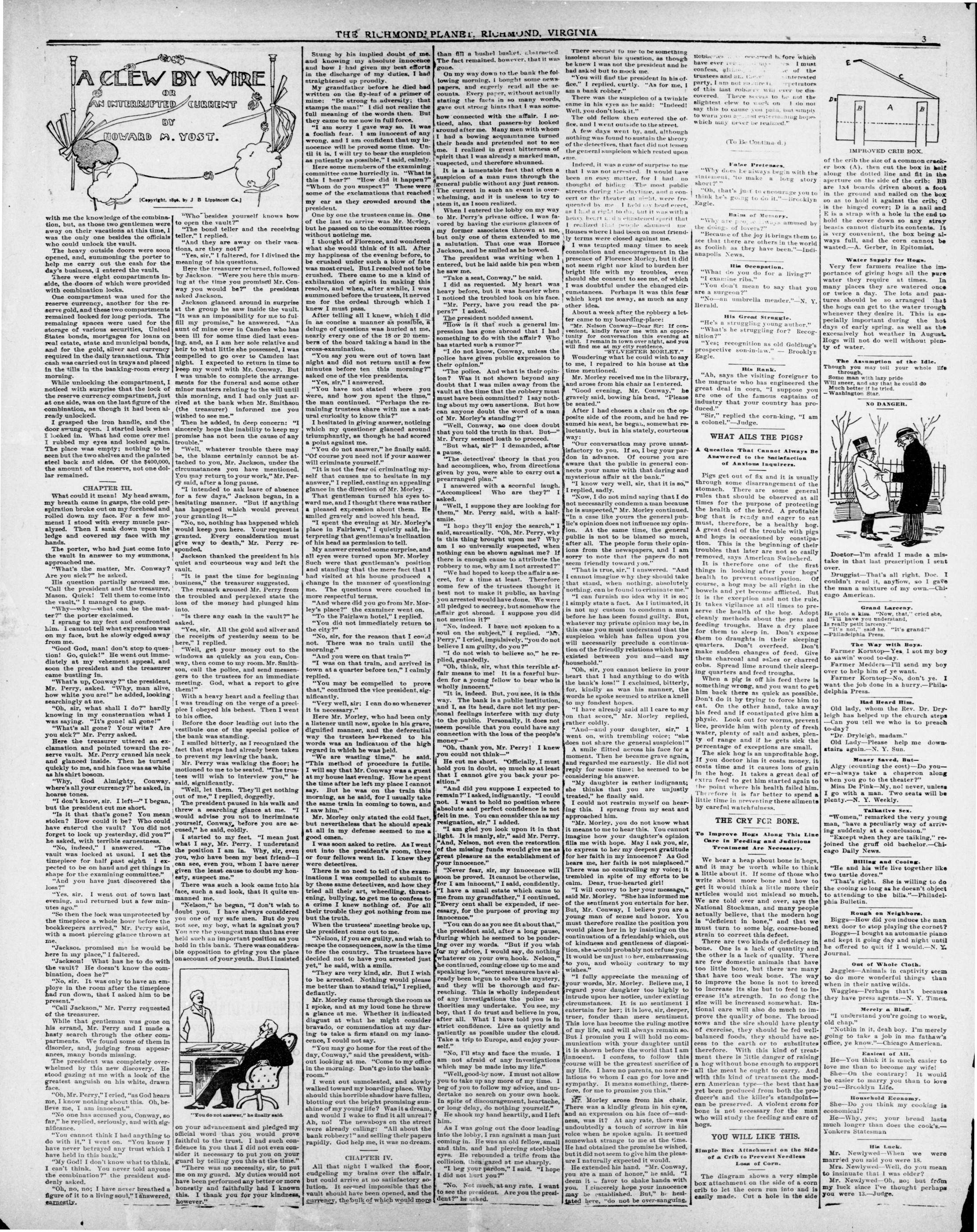
A CLEW BY WIRE
OR
AN INTERRUPTED CURRENT
BY
HOWARD M. YOST.
[Copyright, 1896, by J B Lippincott Co.]
with me the knowledge of the combination, but, as those two gentlemen were away on their vacations at this time, I was the only one besides the officials who could unlock the vault. The heavy outside doors were soon opened, and, summoning the porter to help me carry out the cash for the day's business, I entered the vault. There were eight compartments inside, the doors of which were provided with combination locks. One compartment was used for the reserve currency, another for the reserve gold, and these two compartments remained locked for long periods. The remaining spaces were used for the storage of various securities, United States bonds, mortgages for loans on real estate, state and municipal bonds, and for the gold, silver and currency required in the daily transactions. This cash was carried out in trays and placed in the tills in the banking-room every morning.
While unlocking the compartment, I noticed with surprise that the lock of the reserve currency compartment, just at one side, was on the last figure of the combination, as though it had been already unlocked.
I grasped the iron handle, and the door swung open. I started back when I looked in. What had come over me! I rubbed my eyes and looked again. The place was empty; nothing to be seen but the two shelves and the painted steel back and sides. Of the $400,000, the amount of the reserve, not one dollar remained.
CHAPTER TII.
What could it mean! My head swam, my breath came in gasps, the cold perspiration broke out on my forehead and rolled down my face. For a few moment I stood with every muscle paralyzed. Then I sank down upon the ledge and covered my face with my hands.
The porter, who had just come into the vault in answer to my summons, approached me.
"What's the matter, Mr. Conway? Are you sick?" he asked.
His question partially aroused me. "Call the president and the treasurer, Mason. Quick! Tell them to come into the vault," I managed to gasp.
"Why—why—what can be the matter?" the porter exclaimed.
I sprang to my feet and confronted him. I cannot tell what expression was on my face, but he slowly edged away from me.
"Good God, man! don't stop to question! Go, quick!" He went out immediately at my vehement appeal, and soon the president and the treasurer came bustling in.
"What's up, Conway?" the president, Mr. Perry, asked. "Why, man alive, how white you are!" he added, looking searchingly at me.
"Oh, sir, what shall I do?" hardly knowing in my consternation what I was saying. "It's gone! all gone!"
"What's all gone? Your wits? Are you sick?" Mr. Perry asked.
Here the treasurer uttered an exclamation and pointed toward the reserve vault. Mr. Perry craned his neck and glanced inside. Then he turned quickly to me, and his face was as white as his shirt bosom.
"Why, God Almighty, Conway, where's all your currency?" he asked, in hoarse tones.
"I don't know, sir. I left—" I began, but the president cut me short.
"Is it that that's gone? You mean stolen? How could it be? Who could have entered the vault? You did not forget to lock up yesterday, did you?" he asked, with terrible earnestness.
"No, indeed," I answered. "The vault was locked at usual. I set the timepiece for half past eight. I expected to be on hand and get things in shape for the examining committee."
"And you have just discovered the loss?"
"Yes. sir. I went out of town last evening, and returned but a few minutes ago."
"So then the lock was unprotected by the timepiece a whole hour before the bookkeepers arrived," Mr. Perry said, with a most piercing glance thrown at me.
"Jackson, promised me he would be here in my place," I faltered.
"Jackson! What has he to do with the vault? He doesn't know the combination, does he?"
"No, sir. It was only to have an employee in the room after the timepiece had run down, that I asked him to be present."
"Call Jackson," Mr. Perry requested of the treasurer.
While that gentleman was gone on his errand, Mr. Perry and I made a hasty search through the other compartments. We found some of them in disorder, and, judging from appearances, many bonds missing.
The president was completely overwhelmed by this new discovery. He stood gazing at me with a look of the greatest anguish on his white, drawn face.
"Oh, Mr. Perry," I cried, "as God hears me, I know nothing about this. Oh, believe me, I am innocent."
"No one has accused you, Conway, so far," he replied, seriously, and with significance.
"You cannot think I had anything to do with it," I went on. "You know I have never betrayed any trust which I have held in this bank."
"My God! I don't know what to think. I can't think. You never told anyone the combination?" the president suddenly asked.
"Oh, no, no; I have never breathed a figure of it to a living soul," I answered, earnestly.
"Who besides yourself knows how to open the vault?"
"The bond teller and the receiving teller," I replied.
"And they are away on their vacations, are they not?"
"Yes, sir," I faltered, for I divined the meaning of his questions.
Here the treasurer returned, followed by Jackson. "Were you here this morning at the time you promised! Mr. Conway you would be?" the president asked Jackson.
Jackson glanced around in surprise at the group he saw inside the vault. "It was an impossibility for me to fulfill my promise," he answered. "An aunt of mine over in Camden who has been ill for some time died last evening, and, as I am her sole relative and heir to what little she possessed, I was compelled to go over to Camden last night. I expected to return in time to keep my word with Mr. Conway. But I was unable to complete the arrangements for the funeral and some other minor matters relating to the will until this morning, and I had only just arrived at the bank when Mr. Smithson (the treasurer) informed me you wished to see me."
Then he added, in deep concern: "I sincerely hope the inability to keep my promise has not been the cause of any trouble."
"Well, whatever trouble there may be, the blame certainly cannot be attached to you, Mr. Jackson, under the circumstances you have mentioned. You may return to your work," Mr. Perry said, after a long pause.
"I intended to ask leave of absence for a few days," Jackson began, in a hesitating manner. "But if anything has happened which would prevent your granting it—"
"No, no, nothing has happened which would keep you here. Your request is granted. Every consideration must give way to death," Mr. Perry responded.
Jackson thanked the president in his quiet and courteous way and left the vault.
"It is past the time for beginning business," the treasurer suggested.
"Is there any cash in the vault?" he asked.
"Yes, sir. All the gold and silver and the receipts of yesterday seem to be here," I replied.
"Well, get your money out to the windows as quickly as you can, Conway, then come to my room. Mr. Smithson, call the police, and send messengers to the trustees for an immediate meeting. God, what a report to give them!"
With a heavy heart and a feeling that I was treading on the verge of a precipe I obeyed his behest. Then I went to his office.
Before the door leading out into the vestibule one of the special police of the bank was standing.
I smiled bitterly, as I recognized the fact that steps had already been taken to prevent my leaving the bank.
Mr. Perry was walking the floor; he motioned to me to be seated. "The trustees will wish to interview you," he said, significantly.
"Well, let them. They'll get nothing out of me," I replied, doggedly.
The president paused in his walk and threw a searching glance at me. "I would advise you not to incriminate yourself, Conway, before you are accused," he said, coldly.
I started to my feet. "I mean just what I say, Mr. Perry. I understand the position I am in. Why, sir, even you, who have been my best friend—I can see, even you, whom I have never given the least cause to doubt my honesty, suspect me."
There was such a look came into his face, such a sad look, that it quite unmanned me.
"Nelson," he began, "I don't wish to doubt you. I have always considered you one of my safe men. But do you not see, my boy, what is against you? You are the youngest man that has ever held such an important position as you hold in this bank. There was considerable opposition to giving you the place on account of your youth. But I insisted
"You do not answer." he finally said.
on your advancement and pledged my official word that you would prove faithful to the trust. I had such confidence in you that I did not even consider it necessary to put you on your guard by telling you this at the time." "There was no necessity, sir, to put me on my guard. My duties would not have been performed any better or more honestly and faithfully had I known this. I thank you for your kindness, however."
Stung by his implied doubt of me. and knowing my absolute innocence and how I had given my best efforts in the discharge of my duties, I had straightened up proudly.
My grandfather before he died had written on the fly-leaf of a primer of mine: "Be strong in adversity; that stamps the man!" I did not realize the full meaning of the words then. But they came to me now in full force.
"I am sorry I gave way so. It was a foolish fear. I am innocent of any wrong, and I am confident that my innocence will be proved some time. Until it is, I will try to bear the suspicion as patiently as possible," I said, calmly.
than fill a bushel basket, abstracted. The fact remained, however, that it was gone.
On my way down to the bank the following morning, I bought some newspapers, and eagerly read all the accounts. Every paper, without actually stating the facts in so many words, gave out strong hints that I was somehow connected with the affair. I noticed, also, that passers-by looked around after me. Many men with whom I had a bowing acquaintance turned their heads and pretended not to see me. I realized in great bitterness of spirit that I was already a marked man, there so insolent as he knew I had asked "You will face." I re-read an a bank There we came in in Well, you. The old and lice. A few a nothing w of the deter the genera as patiently as possible," I said, calmly.
One by one the trustees came in. One of the last to arrive was Mr. Mclevey, but he passed on to the committee room without noticing me.
I thought of Florence, and wondered what she would think of it all. After my happiness of the evening before, to be crushed under such a blow of fate was most cruel. But I resolved not to be crushed. There came to me a kind of exhilaration of spirit in making this resolve, and when, after awhile, I was summoned before the trustees, it nerved me for the ordeal through which I knew I must pass.
After telling all I knew, which I did in as concise a manner as possible, a deluge of questions was hurled at me, nearly every one of the 18 or 20 members of the board taking a hand in the cross-examination.
"You say you were out of town last night and did not return until a few minutes before ten this morning?" asked one of the vice presidents.
"Yes, sir," I answered.
"You have not stated where you were, and how you spent the time," the man continued. "Perhaps the remaining trustees share with me a natural curiosity to know this?"
I hesitated in giving answer, noticing which my questioner glanced around triumphantly, as though he had scored a point against me.
"You do not answer," he finally said.
"Of course you need not if your answer will criminate yourself."
"It is not the fear of criminating myself that causes me to hesitate in my answer," I replied, casting an appealing glance in the direction of Mr. Morley.
That gentleman turned his eyes toward me, and I thought there was rather a pleased expression about them. He smiled gravely and bowed his head.
"I spent the evening at Mr. Morley's place in Fairlawn," I quietly said, interpreting that gentleman's inclination of his head as permission to tell.
My answer created some surprise, and all eyes were turned upon Mr. Morley Such were that gentleman's position and standing that the mere fact that I had visited at his house produced a change in the manner of questioning me. The questions were couched in more respectful terms.
"And where did you go from Mr. Morley's place?" the examiner went on.
"To the Fairlawn hotel," I replied.
"You did not immediately return to the city?"
"No, sir, for the reason that I could not. There was no train until the morning."
"And you were on that train?"
"I was on that train, and arrived in town at a quarter before ten," I calmly replied.
"You may be compelled to prove that," continued the vice president, significantly.
"Very well, sir; I can do so whenever it is necessary."
Here Mr. Morley, who had been only a listener until now, spoke in his grave, dignified manner, and the deferential way the trustees hearkened to his words was an indication of the high regard in which he was held.
"We are wasting time," he said.
"This method of procedure is futile. I will say that Mr. Conway was a guest at my house last evening. How he spent the time after he left my place I cannot say. But he was on the train this morning, as he said, for I usually take the same train in coming to town, and I saw him."
Mr. Morley only stated the cold fact, but nevertheless that he should speak at all in my defense seemed to me a good omen.
I was soon asked to retire. As I went out into the president's room, three or four fellows went in. I knew they were detectives.
There is no need to tell of the examinations I was compelled to submit to by these same detectives, and how they tried all their art, wheedling, threatening, bullying, to get me to confess to a crime I knew nothing of. For all their trouble they got nothing from me but the truth.
When the trustees' meeting broke up, the president came out to me.
"Nelson, if you are guilty, and wish to escape the consequences, now is the time to flee the country. The trustees have decided not to have you arrested just yet," he said, with a smile.
"They are very kind, sir. But I wish to be arrested. Nothing would please me better than to stand trial," I replied, defiantly.
Mr. Morley came through the room as I spoke, and at my loud tone he threw a glance at me. Whether it indicated disgust at what he might consider bravado, or commendation at my daring to take a firm stand on my innocence, I could not say.
"You may go home for the rest of the day, Conway," said the president, without looking at it. "Come to my office in the morning. Don't go into the bankroom."
I went out unmolested, and slowly walked toward my boarding place. Why should this horrible shadow have fallen, blotting out the bright promising sunshine of my young life? Was it a dream, and would I wake to it all unreal? Ah, no! The newsboys on the street were already calling: "All about the bank robbery!" and selling their papers rapidly. God help me, it was no dream.
CHAPTER IV.
All that night I walked the floor, cudgeling my brains over the affair, but could arrive at no satisfactory solution. It seemed impossible that the vault should have been opened, and the currency, the bulk of which would more
than fill a bushel basket, abstracted. The fact remained, however, that it was gone.
On my way down to the bank the following morning, I bought some newspapers, and eagerly read all the accounts. Every paper, without actually stating the facts in so many words gave out strong hints that I was some how connected with the affair. I noticed, also, that passers-by looked around after me. Many men with whom I had a bowing acquaintance turned their heads and pretended not to see me. I realized in great bitterness of spirit that I was already a marked man, suspected, and therefore shunned.
It is a lamentable fact that often a suspicion of a man runs through the general public without any just reason. The current in such an event is overwhelming, and it is useless to try to stem it, as I soon realized.
When I entered the lobby on my way to Mr. Perry's private office, I was favored by having the curious glances of my former associates thrown at me, but only one of them extended to me a salutation. That one was Horace Jackson, and he smiled as he bowed. The president was writing when I entered, but he laid aside his pen when he saw me. "Take a seat, Conway," he said.
The president nodded assent.
"How is it that such a general impression has gone abroad that I had something to do with the affair? Who has started such a rumor?"
"I do not know, Conway, unless the police have given public expression to their opinion."
"The police. And what is their opinion? Was it not shown beyond any doubt that I was miles away from the vault at the time that the robbery must have been committed? I say nothing about my own assertions. But how can anyone doubt the word of a man of Mr. Morley's standing?"
"Well, Conway, no one does doubt that you told the truth in that. But—" Mr. Perry seemed loath to proceed.
"But what, sir?" I demanded, after a pause.
"The detectives' theory is that you had accomplices, who, from directions given by you, were able to carry out a prearranged plan."
I answered with a scornful laugh. "Accomplices! Who are they?" I asked.
"Well, I suppose they are looking for them," Mr. Perry said, with a half-smile.
"I hope they'll enjoy the search," I said, sarcastically. "Oh, Mr. Perry, why is this thing brought upon me? Why am I so universally suspected, when nothing can be shown against me? If there is enough cause to attribute the robbery to me, why am I not arrested?" "We had hoped to keep the affair a secret, for a time at least. Therefore some few of the trustees thought it best not to make it public, as having you arrested would have done. We were all pledged to secrecy, but somehow the affair got abroad. I suppose you did not mention it?" "No, indeed. I have not spoken to a soul on the subject," I replied. "Mr. Perry." I cried, impulsively, "you do not believe I am guilty, do you?"
"I do not wish to believe so," he replied, guardedly.
"Oh, think, sir, what this terrible affair means to me! It is a fearful burden for a young fellow to bear who is wholly innocent."
"It is, indeed. But, you see, it is this way. The bank is a public institution, and I, as its head, dare not let my personal feelings interfere with my duty to the public. Personally, it does not seem possible that you could have any connection with the loss of the people's money—"
"Oh, thank you, Mr. Perry! I knew you could not think—"
He cut me short. "Officially, I must hold you in doubt, so much so at least that I cannot give you back your position."
"And did you suppose I expected to remain?" I asked, indignantly. "I could not. I want to hold no position where absolute and perfect confidence is not felt in me. You can consider this as my resignation, sir." I added.
"I am glad you look upon it in that light. It is manly, sir," said Mr. Perry. "And, Nelson, not even the restoration of the missing funds would give me as great pleasure as the establishment of your innocence." "Never fear, sir, my innocence will soon be proved. It cannot be otherwise, for I am innocent," I said, confidently. "I have a small estate which came to me from my grandfather," I continued. "Every cent shall be expended, if necessary, for the purpose of proving my innocence."
"You can do as you see fit about that," the president said, after a long pause, during which he seemed to be pondering over my words. "But if you wish for my advice, I would say, do nothing whatever on your own hook. Nelson," he continued, coming close up to me and speaking low, "secret measures have already been begun to solve the mystery, and they will be thorough and far-reaching. This is wholly independent of any investigations the police authorities may undertake. You see, my boy, that I do trust and believe in you, after all. What I have told you is in strict confidence. Live as quietly and patiently as possible under the cloud. Take a trip to Europe, and enjoy yourself."
"No, I'll stay and face the music. I am not afraid of any investigations which may be made into my life."
"Well, good-by now. I must not allow you to take up any more of my time. I beg of you to follow my advice, and undertake no search on your own hook. In spite of discouragement, heartache, or long delay, do nothing yourself." He shook my heart heartily, and I left him.
As I was going out the door leading into the lobby, I ran against a man just coming in. He was an old fellow, small and thin, and had piercing steel-blue eyes. He rebounded a trifle from the collision, then gazed at me sharply.
"I beg your pardon," I said. "I hope I did not hurt you?"
"No. Not much, at any rate. I want to see the president. Are you the president?" he asked.
There seemed to me to be something insolent about his question, as though he knew I was not the president and he had asked snd to mock me.
"You will find the president in his office," I replied, curtly. "As for me, I am a bank robber."
There was the suspicion of a twinkle came in his eyes as he said: "Indeed! Well, you don't look it."
The old fellow then entered the office, and I went outside to the street.
A few days went by, and, although nothing was found to sustain the theory of the detectives, that fact did not lessen the general suspicion which rested upon me.
Indeed, it was a case of surprise to me that I was not arrested. It would have been an easy matter, for I had no thought of hiding. The most public streets during the daytime, and a concert or the theater at night, were frequented by me. I held my head erect, as I had a right to do, but it was with a heavy heart and a constrained spirit that I realized that people shunned me Houses where I had been on most friendly terms were closed against me.
I was tempted many times to seek consolation and encouragement in the presence of Florence Morley, but it did not seem right nor kind to burden her bright life with my troubles, even should she consent to see me, of which I was doubtful under the changed circumstances. Perhaps it was this fear which kept me away, as much as any other idea.
About a week after the robbery a letter came to my boarding-place:
"Mr. Nelson Conway—Dear Sir: If convenient, kindly favor me with an opportunity for conversation this evening at eight. I remain in town over night, and you will find me at my city residence. MYLLEY MURLEY."
Wondering what he could wish to say to me, I repaired to his house at the time mentioned.
Mr. Morley received me in the library, and arose from his chair as I entered.
"Good evening, Mr. Conway," he gravely said, bowing his head. "Please be seated."
After I had chosen a chair on the opposite side of the room, and he had resumed his seat, he began, somewhat reluctantly, but in his stately, courteous way:
"Our conversation may prove unsatisfactory to you. If so, I beg your pardon in advance. Of course you are aware that the public in general connects your name with that daring and mysterious affair at the bank."
"I know very well, sir, that it is so," I replied, sadly.
"Now, I do not mind saying that I do not necessarily condemn a man because he is suspected," Mr. Morley continued. "In a case like yours the general public's opinion does not influence my opinion. At the same time, the general public is not to be blamed so much, after all. The people form their opinions from the newspapers, and I am sorry to note that the papers do not seem friendly toward you."
"That is true, sir." I answered. "And I cannot imagine why they should take that stand, when nothing, absolutely nothing, can be found to criminate me."
"Oh, sir, you cannot believe in your heart that I had anything to do with the bank's loss!" I exclaimed, bitterly, for, kindly as was his manner, the words he spoke seemed to strike a knell to my fondest hopes.
"I have already said all I care to say on that score," Mr. Morley replied, rather coldly.
"And—and your daughter, sir," I went on, with trembling voice; "she does not share the general suspicion!" A smile flitted across his face for a moment. Then he became grave again, and regarded me earnestly. He did not reply for some time; he seemed to be considering his answer.
"My daughter is rather indignant; she thinks that you are unjustly treated," he finally said.
I could not restrain myself on hearing this. I sprang from my seat and approached him.
"Mr. Morley, you do not know what it means to me to hear this. You cannot imagine how your daughter's opinion fills me with hope. May I ask you, sir, to express to her my deepest gratitude for her faith in my innocence? As God hears me, her faith is not misplaced." There was no controlling my voice; it trembled in spite of my efforts to be calm. Dear, true-hearted girl! "I will convey to her your message," said Mr. Morley. "She has informed me of the sentiment you entertain for her. But, Mr. Conway, I believe you are a young man of sense and honor. You must therefore realize the position you would place her in by insisting on the continuation of a friendship which, out of kindness and gentleness of disposition, she would probably not refuse you. It would be unjust to her, embarrassing to you, and wholly contrary to my wishes."
"I fully appreciate the meaning of your words, Mr. Morley. Believe me, I regard your daughter too highly to intrude upon her notice, under existing circumstances. It is no sentiment I entertain for her; it is love, sir, deeper, truer, fonder than mere sentiment. This love has become the ruling motive of my life, and will always remain so. But I promise you I will hold no communication with your daughter until it is shown before the world that I am innocent. I confess, to follow this course will be the greatest sacrifice of my life. I have no parents, no near relations to whom I can go for love and sympathy. It means something, therefore, for me to promise you this."
Mr. Morley arose from his chair. There was a kindly gleam in his eyes, and an expression on his face of—sadness, was it? At any rate, there was undoubtedly a touch of sorrow in his voice when he spoke again. It seemed somewhat strange to me at the time. He had obtained the promise he wished, but it did not seem to give him the pleasure I naturally expected it would.
He extended his hand. "Mr. Conway, you are a man of honor," he said. "I deem it . . . favor to shake hands with you. I sincerely hope your innocence may be established. But," he hesitated here, "do not be over-sanguining.
robberies occurred before which have ever been my days. I must confess, glitter, of the trustees and an, there interested party, I am not so sure, the executors of this last robbery will ever be discovered. There seems to be not the slightest elew to work on. I do not say this to cause you pain, but simply to wara you you must entertaining hopes which may never be realized."
(To Be Conting.)
False Preferences
"Why does he always begin with the statement, 'to make a long story short?'"
"Oh, that's just to encourage you to think he's going to do it."—Brooklyn Eagle.
Bain of New York
"Why are people always amused by the doing, of lovers?" "Because of the joy it brings them to see that there are others in the world as foolish as they have been."—Indianapolis News.
Hig Occupation
"What do you do for a living?"
"I examine ribs."
"You don't mean to say that you are a surgeon?"
"No-an umbrella mender."—N. Y. Herald.
His Great Struggle
"What's he struggling young author." "What's he struggling for? Recognition?" "Yes; recognition as old Goldbug's prospective son-in-law." — Brooklyn Eagle.
Hits Rank
"Ah, says the visiting foreigner to the magnate who has engineered the great deal in corn. "I suppose you are one of the famous captains of industry that your country has produced." "Sir," replied the corn-king, "I am a colonel."—Judge.
WHAT AILS THE PIGS?
A Question That Cannot Always Be Answered to the Satisfaction of Anxious Inquirers.
Pigs get out of fix and it is usually through some disarrangement of the stomach. There are some general rules that should be observed at all times for the purpose of protecting the health of the herd. A profitable hog that is ready and eager to eat must, therefore, be a healthy hog. A great deal of the trouble with pigs and hogs is occasioned by constipation. This is the beginning of their troubles that later are not so easily removed, says American Sawhord.
It is therefore one of the first things in looking after your hogs' health to prevent constipation. Of course, a hog may be all right in the bowels and yet become afflicted. But it is the exception and not the rule. It takes vigilance at all times to preserve the health of the hog. Adopt cleanly methods about the pens and feeding troughs. Have a dry place for them to sleep in. Don't expose them to draughts in their sleeping quarters. Don't overfeed. Don't make sudden changes of feed. Give them charcoal and ashes or charred cobs. Spread lime around their sleeping quarters and feed troughs.
When a pig is off his feed there is something wrong, and you want to get him back there as quick as possible. Don't do it by trying to force him to eat. On the other hand, take away his feed and if constipated give him a physic. Look out for worms, prevent lice, provide him with plenty of fresh water, plenty of salt and ashes, plenty of range and if he gets sick the percentage of exceptions are small. The sick hog is an unprofitable hog. If you doctor him it costs money, it costs time and it causes loss of gain in the hog. It takes a great deal of extra feed to get him started again to the point where his health failed him. Therefore it is far better to spend a little time in preventing these ailments by careful watchfulness.
THE CRY FCR BONE.
To Improve Hogs Along This Line Care in Feeding and Judicious Treatment Are Necessary.
We hear a heap about bone in hogs, and it may be worth while to think a little about it. If some of those who write about more bone and how to get it would think a little more their articles would not mislead so much. We are told over and over, says the National Stockman, and many people actually believe, that the modern hog is "deficient in bone," and that we must turn to some big, coarse-boned strain to correct this defect.
There are two kinds of deficiency in bone. One is a lack of quantity and the other is a lack of quality. There are few domestic animals that have too little bone, but there are many that have too weak bone. The way to improve the bone is not to breed to increase its size but to feed to increase it's strength. In so dong the size will be increased somewhat. Rational care will also do much to improve the quality of bone. The brood sows and the sire should have plenty of exercise, they should be fed well balanced foods, they should have access to the earth or to substitutes therefore. With this kind of treatment there is little danger of raising a hog without bone enough to support all the meat he ought to carry. And with this kind of treatment the modern American type—the best that has yet been produced from both the producer's and the killer's standpoint—can be preserved. A violent cross for bone is not necessary for the man who will study the feeding and care of hogs.
YOU WILL LIKE THIS.
Simple Box Attachment on the Side of a Crib to Prevent Needless Loss of Corn.
The diagram shows a very simple box attachment on the side of a corn crib to let the corn run into and is easily made. Cut a hole in the side
IMPROVED CRIB BOX
of the crib the size of a common cracker box (A), then cut the box in half along the dotted line and fit in the aperture on the side of the crib: BB are 1x4 boards driven about a foot in the ground and nailed on the box so as to hold it against the crib; C is the hinged cover; D is a nail and E is a wrap with a hole in the end to hold the cover down so any stray beasts cannot disturb its contents. It is very convenient, the box being always full, and the corn cannot be wasted.—A. Gerber, in Epitomist.
Water Supply for Hogs.
Very few farmers realize the importance of giving hogs all the pure water they require at times. In many places they are watered once or twice a day. The lots and pastures should be so arranged that the hogs can get to the water trough whenever they desire it. This is especially important during the hot days of early spring, as well as the excessively hot weather in August. Hogs will not do well without plenty of water.
The Assumption of the Idle. Though you may toll your whole life through, Some man with lazy pride Will answer and say that he could do Much better if he tried. - Washington Star
NO DANGER.
Doctor—I'm afraid I made a mistake in that last prescription I sent over.
Druggist—That's all right. Doc. I couldn't read it, anyhow, so I gave the man a mixture of my own.—Chicago American.
Grand Larceny:
The Way with Boys
Farmer Korntop—Yes. I sot my boy to sawin' wood to-day.
Farmer Medders—I'll send my boy over to help him ef ye want.
Farmer Korntop—No, don't ye. I want the job done in a hurry.—Philadelphia Press.
Had Heard Him:
Old lady, whom the Rev. Dr. Dryleigh has helped up the church steps—Can you tell we who is to preach to-day? "Dr. Dryleigh, madam." Old Lady—Please help me downstairs again—N. Y. Sun.
Money Said. But
Algy (counting the cost)—Do you—er—always take a chaperon along when you go to the theater?**
Miss De Pink-My, no! never, unless I go with a man. Two seats will be plenty.—N. Y. Weekly.
Talkative Sex.
"Women," remarked the very young man, "have a peculiarly way of arriving suddenly at a conclusion." "Except when they are taiking." rejoined the gruff old bachelor.-Chicago Daily News.
Billing and Cooling
"He and his wife live together like two turtle doves."
"That's right. She is willing to do the cooing so long as he doesn't object to attending to the bills."—Philadelphia Bulletin.
Borough Neighbour
Biggs—How did you induce the man next door to stop playing the cornet? Bogggs—I bought an automatic piano and kept it going day and night until he offered to quit if I would.—N. X. Journal.
Out of Whole Cloth.
Jaggles—Animals in captivity seem to do more wonderful things than when in their native wilds.
Waggles—Perhaps that's because they have press agents.—N. Y. Times.
Merely a Bluff.
"I understand you're going to work, old chap."
"Nothin in it, deah boy. I'm merely going to take a job in me fathaw's office, ye know."—Chicago American.
Easiest of All.
He—You think it is much easier to
love me than to become my wife!
She—On the contrary! It would
be easier to marry you than to love
you!—Brooklyn Life.
Household Economy
She—Do you think my cooking is economical?
He—Why, yes; your bread lasts much longer than does the cook's.
Yonkers Statesman
His Luck.
Mr. Newlywed—When we were married you said you were 18.
Mrs. Newlywed—Well, do you mean to insinuate that I was older?
Mr. Newlywed—Oh, no; but fróm my luck since I've thought perhaps you were 13.—Judge.
THE PLANET
published every Saturday by JOHN MITCHELL
JR., at 311 North 4th Street, Richmond, Va.
All communications intended for publication should be sent so as to reach us by Wednesday.
TERMS IN ADVANCE.
See Copy, one year,
See Copy, eight months,
See Copy, six months,
See Copy, four months,
See Copy, three months,
Single Copy,
ADVERTISING RATES.
For one inch, one insertion . . . $ 50
For one inch, each subsequent insertion . . . $ 50
For two inches, six months . . . 6.00
For two inches, nine months . . . 10.00
For two inches, twelve months . . . 30.00
For two inches, Receipt Notes . . . 50
Standing and Transient Notes, per line. 18
# POSTAGE STAMPS OF A HIGHER DEFINATION THAN TWO CENTS NOT RECEIVED ON SUBSCRIPTIONS.
The PLANET is issued weekly. The subscription price is $1.50 a year, in advance.
There are four ways by which money can be procured in the Post Office. Order, by Bank Check or Drift, or an Express Money Order, and when none of these can be procured, in a Registered Letter.
MONEY ORDER. Post Office, payable at the Richmond Post Office, and we will be responsible for its arrival.
Express Money ORDERs can be obtained at Post Office, Express Co. and the Wells Fargo and Co.'s Express Company. We will be responsible for money sent by any of these companies. Post Office, Express Co. or a safe convenient way for forwarding money.
REGISTERED LETTER—If a Money Order Post Office or an Express Office, it must not within ten minutes after your letter wishing to send us on payment of ten cents. Then, if the letter is lost or stolen, it must be returned, you can send money in this manner at our risk.
We cannot be responsible for money sent in letters in any other way than one of the four ways mentioned above. If you send your mom on another way, you must do it at your own risk.
RENEWALS, ETC. If you do not want THE PLANET continued for another year after your Postal Card to discontinue it. The courts have decided that subscribers to newspapers who do not order their paper discontinued at the expiration date liable for the payment of the subscription up to date when they order the paper discontinued.
COMMUNICATIONS—When writing to us to renew your subscription or to discontinue your paper, you should give your name and address in full, otherwise we cannot find your name on our books.
RENEWALS—In order to change the address of a subscriber, we must be sent a former as well as the present address.
Entered in the Post Office at Richmond, Va., on second class matter.
We can write more now since the colored folks have let us alone.
Let us buy land, engage in business and win the genuine respect and esteem of our neighbors.
The disreputable, insulting, lawless elements amongst us do us much harm.
Do you read a race journal? Every colored man should consider it his duty so to do.
Yes, there are tens of thousands of colored people supporting race journals and the number is on the increase.
The south said that it would settle the race problem if it were left alone. It has entire control of all the state governments and is still yelling at the North about the Negro.
The Tennessee legislature has passed Jim Crow Street Car Bill for the city of Memphis. The advocates of this measure are, of course, the "best friends of the colored people."
THE Harrisonburg, Va., SPIRIT OF THE VALLEY is one of the truest journals in the country in its avowal of genuine Republican principles. It is ably credited and to attack its position is to invite disaster from an argumentative standpoint.
The New York AGE is not suffering to any appreciable extent by the distinguished T. THOMAS FORTUNE's absence. The editorial chair is filled all right and the articles given to the public possess much of the old time fire for which Mr. FORTUNE was noted. The AGE is strictly an up-to-date journal.
No, we don't believe that the conferring of universal suffrage upon the Negro was any more of a mistake than the conferring of universal suffrage upon the white man was a mistake.
The man, be he white or black, who entertains an opposite opinion concerning the black man hasn't very far to go in order to entertain a similar opinion with reference to the white one.
Mr. Root thinks that it is only a question of a short time when the blacks will be excluded from all offices in the Southern States. He may be right, if the Republican party is to continue its former policy of retreat, at the vociferous clamor of a few Southern hotheads, but we do not think it will retreat while President Roosevelt is its leader.—New York Age.
But Mr. Root states that it is recreating and it is while President Roosevelt is its leader. This, sir, is the disappointing feature of Secretary Roost's awful.
COLORED men, our attitude must be respectful, but at no time servile. All of the good white folks are not dead yet.
We should not forget that there are black Negro haters as much so as there are white Negro-haters. They hate every other Negro but themselves, and shed tears of regret because the usual face-bleaches do not make them as "white as snow." Oh, the Negro-hating Negroes are a curse to the race with which they are identified.
EVERY colored Baptist in the state should remember that Virginia Theological Seminary and College needs financial help and material assistance. If we will all do our share of the work, $15,000.00 can be raised and all indebtedness on that institution wiped out. No one can visit that magnificent spot and gaze upon the students, noticing closely the work being done there, without being impressed with the magnitude of the task and the great strides being made to effect its consummation.
The Virginia Baptist State Convention, under the matchless leadership of Rev Dr. R. H. BOLLING of Norfolk is about to make another new record for itself. As to Prof. G. W. HAYES, he has been tried by fire and has come out true gold. The work he has accomplished at Lynchburg is a wonder. Friend and foe, desiring to be in strict accord with the truth must admit this. The colored people of the state own Virginia Theological Seminary and College. Let the colored people of the state wipe out its indebtedness. We can raise the money. Let us do it.
THE Senate Committee on Commerce, by a vote of 6 to 8 decided to make a report to the United States Senate, recommending the rejection of Dr. W. D. CRUM, (colored) who had been nominated by President ROOSEVELT as Collector of the Port at Charleston, S. C. The grounds for his rejection were based wholly and solely upon his color. Senator B R. TILLMAN of South Carolina led the fight against Dr. CRUM. This result would not have been possible but for the support of two Republicans, Senator JONES of Nevada and Senator PERKINS of California, who joined with the Democrats, when the question came to an issue.
Each and every one of the these Senators have sworn to recognize the civil and political equality of all men before the law. It seems to us, to recommend the rejection of this South Carolinian solely because he is colored to violate the oath of office. The question will be settled by the United States Senate and the out-come will be watched with interest. President Roosevelt, it is now announced, is determined to stand by the appointment and to force the Senate to decide whether or not color shall constitute a bar to office in violation of the plain provisions of the Constitution of the United States.
MR. A. GOLDSMITH of Melbourne, Australia, sends us several copies of the Argus and the AGE, daily papers published there by white men and asks, "When are we going to have a good daily newspaper, something like the Argus and the Age?" The answer is easy although its realization is hopeless. When colored people learn to support a weekly paper of their own then they can hope for people with money to venture upon the experiment of giving them a daily paper worthy of the name.
We note in the journals cited, column after column of high-priced advertising matter. This insures the success of the paper without refrence to the subscribers. A colored man drawing a salary of $1,000 per year rarely sees his way clear to pay $1.50 per year for a colored weekly journal.
It is the man who is drawing $300 per year who will pay for it, or the woman, who is receiving $100 per year who will be forward in doing a similar favor. To be frank, we do not believe that any metropolitan daily can exist for any length of time as a strictly race paper. Its scope is too limited for the expense entailed in its maintenance. The dead-head and slow-paying subscriber is the ban of the colored journals.
The croakers are to be found among those who either never pay for a colored journal or never subscribe for one.
SENATOR TILLMAN AND THE
NEGRO.
THE thirtieth annual dinner of the New York Press Club was appropriately observed at the Waldorf-Astoria, New York, February 14th, 1903. More than three hundred persons were present, among whom were Hon. WILLIAM J. BRYAN and Senator B. R. TILLMAN. Mr. BryAN's utterances were those of a statesman, while those of Mr. TILLMAN were those of a demagogue. The striking feature was the hissing of Senator TILLMAN during his remarks on the Negro. This was especially significant, and demonstrated that the rampant Negro-hater has reached his limit. The telegraphic dispatches reported as follows:
"Three months ago," he said, "the President wrote a letter in which he said that when a Negro showed himself qualified to fill public office, he was unwilling to shut the door of hope in his face."
"Commenting on this, Senator Tillman said that if the present condition of education continued and the Negro is to gain control of the state of South Carolina and the white become subordinate, the deplorable result would
that in a hundred years the population would be half mulatto. He had no practicable solution of the problem, he said, unless it be that the North take its share of the blacks, "if you love them so well."
the current of her life blood, rendering her less strong, less holy, less American. The republic is committed to our and our care. Let us be loyal to her. This is the lesson of Lincoln Day."
To presume that the colored people as such could or would gain control of the state of SOUTH CAROLINA because one qualified Negro is appointed Collector of the Post of CHARLESTON is an absurdity. His remarks relative to amalgamation of the races as a result of education is on a par with the other statements. It is this very amalgamation against which we are protesting. Here we are in a quandary, not knowing whether we are Negroes or white men, and all because white men like Senator TILLMAN will not stay with their own families at night, but are continually scouting around after the women of a defenseless race.
It does not require education by any means to bring about this change for we have seen white men of the TILLMAN stripe following after some of the blackest and some of the most repulsive women God ever created. Many of them are specimens that the average colored man would hardly "look at." These women are not educated.
We believe in maintaining the integrity of the Negro race and that is why we advocate the measure for the punishment of a white person who may carnally know a colored person or a colored person who may carnally know a white one. If the true social situation in the southland was made known, these Negro-hating hypocrites would have to check their baggage for the Klondyke and bid farewell to family and their mulatto children. If Brother TILLMAN wants to debate this side of the question, he will have no difficulty in finding persons on the other side of the controversy. His kind debauches the race and then abuses those whom he has debauched.
Ethics teaches that the debaucher is as bad, if not worse than the one debauched.
And again:
"His address grew more impassioned as he continued. At first only applause greeted his utterances, but toward the end an occasional hiss was heard, and finally he was interrupted by a voice crying, 'What, about your nephew?' "Senator Tillman was at the moment defending the summary measure adopted in the South for the punishment of Negroes guilty of crime, especially against women. After the excitement caused by the interruption had subsided, Mr. Tillman said there was much more he could say, and would like to say, but that he regarded it as highly inappropriate to refer in public to family affairs."
The remarks made last should have been uttered first.
His defense of murder or rather his attempted defense of it disgusted his hearers and caused them to emphasize their impatience by a resort to hisses, which is the most popular method in the North of emphasizing a telling rebuke.
The law provides a punishment for criminal assault and the mob cannot be allowed to usurp its function without pandering to lawlessness and inviting anarchy. Senator TILLMAN is a Jonah of which the Democratic Party of the North would gladly be rid. He is a product of the southland and in him is epitomized all of the evils of that section.
ARCHBISHOP IRELAND'S UTTER- ANCES.
It was with a feeling of gratification that we read the ringing words of Archbishop IRELAND, the great representative of the Roman Catholic Church. He was the guest of honor at a banquet given in Chicago, III., at the Auditorium Hotel, February 12th, 1903, in commemoration of the birth of ABRAHAM LINCOLN.
His words were in striking contrast to those used by that distinguished Republican, Secretary ELIHU ROOT, in his remarkable effort at New York. Who can read the utterances of the Archbishop without feeling the thrill of patriotic fire and voicing a wish that ten thousand men of as great an influence and as pure a motive could be induced to speak out as he has done? He said:
"The republic is what she is because she has vitally remained what Washington intended her to be, what Lincoln bade him to be—a government of the people, by the people, for the people. This is what she must remain if she is still to live and to reign. The vital principles of democracy must animate her. Every man under the flag must be equal before the law in civil and political rights; it matters not what his place of birth, what his religious creed, what the color of his face; if he is an American citizen the laws of the land must shield him, the favors of the land must flow upon him. To announce, for instance, that the citizen who is black must not aspire to a political office, must not approach the ballot-box, is to war against American institutions."
There are no vacillating words in these statements. They are stamped with candor and punctuated with truth. They are in strict accord with the teachings of the good and lowly Jesus and at the same time squared to the measurement of true statesmanship. He laid down a rule of conduct for the government of the Philippines which, if followed would or should settle all of the embarrassing questions which have arisen in connection with its occupation. He would hold out to its inhabitants the promise of citizenship and to the country, the hope of statehood. He voiced a warning when he said:
"And while we proclaim that no harm, no dishonor, shall come to the republic from outside the fold, let us guard her well from enemies within her own bosom, and see to it that we, within be, not, unconscionally perhaps, among such enemies, weakening by false doctrines or perversions, practice
the current of her life blood, rendering her less strong, less holy, less American. The republic is committed to our love and our care. Let us be loyal to her. This is the lesson of Lincoln Day." Colored men, here is a distinguished churchman voicing great principles. He is not limited by confines, but the doctrine which he enunciates is universal. It applies to the Filipino as much as it does to the Negro. He is a lover of mankind and the declarations of WENDELL PHILLIPS and CHARLES SUMNER are again heard in this country. Truly falsehood seeks cover when truth is abroad in the land.
THAT HORRIBLE LYNCHING.
THE account of the lynching of colored men, HALLUM and MOORE in Attaula county, Miss., was horrible and the arrest of them deserved. Because they refused to call white men Mister, they were ignominiously shot down after having been kept tied to trees during the entire night before. It is inconceivable that men could be found possessed of such fiendish brutality. That the conservative white element should assert itself and attempt to mete punishment to the murderers is commendable.
There seems to be no doubt but what the officials have arrested the right parties. It is too much to hope for their conviction. The Judge, we learn refused to grant them bail and they are as yet in jail. We have repeatedly insisted that colored men in these localities should sell their lives as dearly as possible. To surrender under the circumstances is to be butchered like dumb cattle. It seems that even after these colored men had been declared innocent by a vote of the mob itself, they were wantonly murdered. Colored men should never make threats. They should be polite and obliging, fearless in their demeanor and inviting respect from even those adjudging themselves their superiors.
When mobs visit them, they should be prepared to receive them and in addition to a trusty rifle or shot-gun, have a through ticket to heaven after they have laid low two or more of the lynchers who have come to take their lives. By this course, liberal-minded white men will respect us and the lawless ones fear us. The trouble now is that most lynchings are sheep-killing incidents. When it becomes serious business, the female relatives of the lynchers will dissuade them from engaging in this lawless and dangerous vocation. Six coffins for the lynched Negroes and two for the lynching white men will cool the ardor of any community and assure peace in that neighborhood for quite a time to come. The average lawless white man in the southland believes that one white man's life is worth more than the lives of a hundred Negroes. Lynch-law must go!
RIVER STEAMER SUNK
Was Struck By Cyclone and Sent to Bottom of Chowan River.
SEVENTEEN PEOPLE DROWNED
Majority of Passengers and Crew Were Below When Storm Struck Vessel and Had No Opportunity to Make Their Escape.
Norfolk, Va., Feb. 18.—A cyclone struck the passenger steamer Olive, which plies between Franklin, Va., and Edenton, N. C., at 2 o'clock yesterday morning and sent her to the bottom of the Chowan river, off Woodley's Pier, between Mount Pleasant and Oliver's Wharf. Seventeen people are known to have been drowned, and others who were rescued are in a serious condition.
The whirlwind when it struck the Olive caused her to go over on her beams, and when she righted it was only to sink on account of the water she had taken. A majority of the passengers and crew were below at the time and had no opportunity to reach the pilot house of the vessel. This point was the only portion left above water, and in it standing waist deep from the time of the accident until 6 o'clock yesterday morning, Captain George H. Withey and five others were saved.
According to the statement of Captain Withey last night, there are 17 known to have been lost on the sinking steamer, and a lifeboat loaded with Engineer C. L. Conway, Assistant Engineer J. P. Murphy, Purser J. N. Bell, ohe white and two colored passengers, unknown, and two colored deck hands, which left the steamer in hopes of reaching a vessel, whose lights could be seen in the distance. They were picked up after rowing four hours by the tug Gazelle.
Those known to be dead are: Jacob Lassiter, white, Rich Square, N. C.; Mrs. Bennett and her 12-year-old daughter, Franklin, Va.; Mrs. Vaughan, Franklin, Va.; Frank Hunter, George Butt, W. H. Edwards, Andrew Vaughan, coored, deck hand; Abraham Cooper and John Prescott, colored, firemen; John Cooper, colored, porter; George White, colored, preacher, the others being unknown.
At 6 o'clock yesterday morning the river steamer Pettit hove in sight and rescued the almost frozen survivors
Captain Withey said: "We left Franklin on our regular trip to Edenton Monday morning at 11 o'clock. A heavy southwest wind was blowing, but along the Chowan river we did not mind it very much. It was just about 2 o'clock yesterday morning when everything became inky black and a terrible roaring broke out of the night. I was alone in the pilot house and most of those below had turned in. In a second something struck the boat on her port beam and turned her over on her starboard side. I thought she would never right herself, and a monster wave dashed over us. It flooded
ZOMODONE, THE NEWEST AND MOST RAPID HAIR GROWER IN EXISTENCE.
Makes the Hair grow with lightning-like rapidity. No waiting for results. ZOMODONE prevents Falling Hair, Grey Hair, Brittle Hair, Curly Hair, Harsh Hair, and Scurf. Cures Dandruff, Itch, Tetter, Eczema, and Ring-Worm. No more Bald Head, Scanty Partings, Splitting Ends, and Bald Temples. ZOMODONE grows long, luxurious, soft, fine, silky Hair. Makes the Hair grow down to and below the waist line in every instance in which it is used. ZOMODONE is a direct Hair food, and softens and lengthens the Hair, so that it can be arranged in any style desired. Not a fraud or for sale, get your money, but an honest remedy, tried and true. ZOMODONE acts quickly, results are seen at once. If you want Hair down to your waist, send in your order right now—do not delay. No free samples sent; a sample is not sufficient to do good. Price, 50c., or 3 bottles (a complete treatment) for $1.00, or will send four complete treatments for $3.00.
AGENTS WANTED. Everything is in favor of the Agent. LIBERAL CREDIT EXTENDED. This is an unprecedented chance to make money. Write quick for territory and particulars. Address
THE HELEN MARTIN TOULED
Actual Results from Baldness After Only 4 Weeks' Use of ZOMODONE.
WE MUST HAVB ONE AGENT in every city and county immedi-
ately, by act, reliable, honest-colored lady or gentleman can make from $18.00 to $50.00 per week with ease. We will prove it to you, and trust to your honor.
BEFORE. AFTER.
is the undisputed and acknowledged only and original King of all Hair Tonics. It not-only cures Tetter, Itch, Scurf, and Dandruff, but causes the Hair to grow long, soft, luxuriant, and glossy, giving the hair to the hairless hairless and the loss-removing to its other removeable tendency of the Hair to draw up, curl, tangle and contract, split, break off and fall, and covers thin, scanty places and bare temple. It is the hairless hairless and the hair to dress in an style which does not make more money as our Agent than any other work, we make this liberal off. Cut out this advertisement, and send it to the whittl on the 1000, and upon receipt of same, we will send to you one dozen (12) large, square, 50c. size, boxes of OZONO. These you must sell to your friends at 50c. each, or $6.00 in all. When sent to the house send us $2.00 more, keeping the balance of the money to us will be $3.00 for your trouble. You can easily sell a dozen in a few hours. We take back all and refund the money if you cannot sell them. This test is sure to be the right way to the end of the time. If you become our regular Agent and earn hundreds of dollars monthly. Address
BOSTON CHEMICAL CO., Man'g Chemists,
310 E. Broad Street, Richmond, Va.
the hold and smashed everything around us. With the rush of water into her hold the Olive slowly righted, and in less than two minutes after having struck she was resting on the bottom, with only the pilot house above the river. The boat sunk so quickly after being struck that none below had a chance to reach the deck, and they must have been drowned in the berths.
PENNSYLVANIA ELECTIONS
Result in Philadelphia, Pittsburg, Al
legheny and Scranton.
Philadelphia, Feb. 18. — Municipal elections were held in all townships, boroughs and cities in Pennsylvania yesterday. Owing to the snow storm the vote polled was not as heavy as was expected, except in a few local places where there were sharp contests.
In Philadelphia the election passed off extremely quietly. The full vote for mayor and two magistrates (the law permitting minority representation on magistrates) was as follows: John Weaver, Rep. Municipal League and United Labor, 168,781; Francis Fisher Kane, Dem., 32,769; Alfred D. Calvert, Prohibition, 1,015; Howard H. Caldwell, Socialist, 1,599. Magistrates—James Fealy, Rep., 131,100; John O'Donnell, Dem., 60,264; William F. Ritter, Pro., 951; David T. Hart, Municipal League and United Labor, 8,358; Mason Gill, Socialist, 1,477.
Beside the city ticket the various wards elected members of select and common councils and ward officers.
Pittsburg and Allegheny.
Pittsburg, Feb. 18.—One of the most fiercely contested political campaigns known in this city and Allegheny for many years was closed at the polls yesterday, with the thermometer hovering near zero and a blizzard prevailing during the early hours. The contest was for the first elective recorder in the two cities under the provisions of the new charter, and was waged between the régular Republican and the Citizens' Democratic parties. An extremely heavy vote was polled in spite of the weather.
The result in Pittsburgh shows the election of William B. Hays Citizens-Democrat, over John C. Haymaker Republican, by a majority of about 7,000. In Allegheny, James G. Wyman, Citizens-Democrat, has defeated Dr. S. Woodburn, Republican, by a majority of about 5,000. Municipal elections were held generally throughout Western Pennsylvania, many of them exciting and hotly contested.
Scranton.
Scranton, Fa., Feb. 18.—Alex. T. Connell, Republican, was elected city recorder yesterday by a plurality of 1,800 over John J. Fahey, Democrat, and Rev. Thomas R. Watkins, a preacher-miner, who was put in the field by the labor unions. The labor candidate carried four of the mining districts. Connell is a former state representative, nephew of Congressman Williams Connell, and cousin of the present recorder, W. L. Connell. The ward elections made no material change in the standing of council. Despite blizzardy weather the normal vote was cast.
He Glided Five-Cent Pieces,
Lancaster, Pa., Feb. 17. - Elmer Welfert, aged 30 years, who is thought to have operated extensively in Philadelphia and this city, was arrested here yesterday by Secret Service Detective Matthew F. Griffin on the charge of gliding and milling five-cent pieces and passing them as five-dollar gold coins. Several of the counterfeits were found in his boarding house, United States Commissioner O. F. Bricker remanded Welfert for a hearing.
It is much easier for most people to shut their eyes to the good points of others than to shut their ears to scandal; but perhaps nature should be blamed for this. — Washington Times.
Incredible.
Some girls so very stupid are, (So those who claim to know insist), They cannot think of aught to say. Except when they are playing whist. — Puck.
SKATING
- TO DAY
PARK
He—Ah, good morning, Miss Bright-
ly, will you go skating with me?
She—No, thank you, I've been sitting
down all the morning.—St. Louis
Globe-Democrat.
"They say her husband gratifies her smallest wish." "Very likely. She knows better than to have any big wishes."—Cleveland Plain Dealer.
Go to Beach Park, Westpoint Excursion and Picnic Grounds.—Only 30 Miles, One Hour's Ride From Richmond, via Southern Ry.
A great many excursions have already been booked for "Beach Park" for June and July. The various attractions and improvements at this popular resort gives it more prominence each season. To close proximity to Richmond, and the unlimited supply of the most wholesome artesian water, together with many other natural advantages, places it second to none as a pleasure and health resort for Richmond people. King William Pier, a substantial structure, extending 689 feet in length and 25 feet wide over the York River, a waterproof roofing as a protection from sun, adds considerably to the beauty and convenience for picnic and other cutting parties. In addition to the new Beach Park Hotel, now being erected, you will find other hotels and many nice boarding houses, furnishing cheap rates and good first-class accommodations.
The principal attractions are such as fine fishing, boating, sailing, merry-go-round, shooting galleries, steam and naptha launches, a large dancing pavilion with a band of music day and night, several wells of fine artesian water on the grounds, and various other attractions to suit the older people as well as the little ones.
For any other information apply at or write to the Southern Ry, office, 920 E. Main St., Richmond, Va.
CANVASsER
—WANTED—
to sell PRINTERS' INK—a journal for advertisers—published weekly at five dollars a year. It teaches the science and practice of Advertising, and is highly esteemed by the most successful advertisers in this country and Great Britain. Lateral commission allowed Address PRINTERS' INK, No 10 Spruce St. New York.
W. I. JO
FUNERAL DIRECTOR
Office & Warerooms, 207 N
HACKS F
Orders by Telephone or Tele
pers and Entertainment
Old 'Phone, 686, Residence
W. I. JOHNSON, FUNERAL DIRECTOR AND EMBALMER.
Office & Warerooms, 207 N. Foushee St. Corner Broad. HACKS FOR HIRE: Orders by Telephone or Telegraph filled. Wedding, Suppers and Entertainments promptly attended. Old 'Phone, 686, Residence in Building, New Phone, 48.
KNIGHTS OF COLUMBUS OF THE WORLD
TO WHOM IT MAY CONCERN:
This organization has been chartered and legally
stituted under the laws and statute of the state of New
York; for the purpose of uniting together all acceptable
men on the Broad Bases of Charity—Beneficial and
Fraternal and to promote the Social and Its two distinct military and uniform place in the front ranks of all sacred insunity for active men. Deputies want lodges. Kindly address,
G. W. ALLEN S.
830 W. 89th Street
Francisco adds distinct military and uniform ranks will secure for this organization a place in the front ranks of all sacred institutions of modern events, a grand opportunity for active men. Deputies wanted in all sections of the country to organize lodges. Kindly address.
G. W. ALLEN Supreme voyager.
830 W. 87th Street, New York City.
Pablo Picasso
O
*MRS. MARTH, the world renowned and highly celebrated. Business and Test Medium, can be consulted upon everything. No imposition. Can be consulted upon business, love and marriage a specialty. Every important, also of absent, deceased and dying individuals, challenges any Medium. Coveness her in startling revelations of the past, present, future events of one's life. Remember that, if you will rest assured you will, gain facts you will sense; She can be consulted upon all affairs of Courtship, Marriage Friends, Ete., with full knowledge of your companion. She is very accurate in deserves friends, enemies etc., business, law suits journey, contested wills, divorce and sponacular matters. She can be consulted upon your destiny—good or bad; she withholds nothing. MRS. MARTH tells your entire life past and
In tests she tells your mother's full name before marriage, the names of all your family, their ages and description, the name and business of your present husband, the name of your next if you are to have one, the name of the young man who now calls on you, the name of your future husband, and the day, month and year of your marriage, how many children you have or will have; whether your present sweetheart will be true to you and if he will marry you; if you have no sweetheart she will tell you when you will have one and his name, business and date of acquaintance. All your future will be told in an honest, clear and plain manner and in a dead trance. Mother's should know the success of their husbands and children; young ladies should know everything about their sweethearts or intended husband.
Do not keep company, marry or go into business until you know all, do not let silly religious scruples prevent your consulting.
Madame is the only one in the world who can handle the question of your future husband with age and date of birth in tell us which er the one you love is true or false. There are some people who believe that there is no such thing as a medium, but such beliefs are contrary to a medium, but such beliefs are contrary to a medium, but such beliefs are contrary to a medium that can stand the test of what he or she claims. Of an inquiring mind may ask the reason why. It is simply that they adverbs describe the trouble to study human nature. They do not acquire a moment with acquiring the art of philosophy and kindred branches that will have a tendency to the business clear and devoid of all obstacles. It is and undeniable fact that persons will want to know in knowledge of what they want to know yet not in knowledge of what they need a medium they try their utmost endeavor to dispel from their minds what they know so as to understand the world of the hand and gain control of the mind thereby in a matter of impossibility to most of them.
And yet this can be done and by consulting M.M. which the seemingly mystery becomes a realization. This subject has received no little attention by eminent men and even college professors. so it proves conclusively that although there are many individuals of all tongues, perhaps the gates of wisdom have not been closed to the entire profession. It takes a great deal of study to become an eminent individual by a continuous and untiming effort, the key to the unfortunate unfathomable mysteries has been secured by MRS. MARTH for the benefit of humanity. ---ADVICE BY LETTER, $1.00. ---Hours FROM 10 A. M. TO 9 P. M.
246 W. 31st St. (Near 8th Avenue.)
NEW YORK CITY.
Enclose Stamp for reply.
Please mention the PLANET.
Old Phone, 1233. New Phone, 1553,
THE PRIVATE LIVERY
700 CATHERINE ST.,
QUICK TRANFERING
AND MOVING.
Saddle or Driving Horses, Buggies and
Surries To Let at Lowest Prices.
N. B. Tandem Lessons Given. Strict
attention given to all orders.
George Jenkins, Proprietor.
JHNSON,
R. AND EMBALMER.
N. Foushee St. Corner Broad.
FOR HIRE:
Telegraph filled. Wedding, Suppents promptly attended.
in Building, New Phone, 48.
OF COLUMBUS OF THE WORLD
V. P. & F. K. of W.
organization has been chartered and legally
for the laws and statute of the state of New
the purpose of unifying together all acceptable
Broad Bases of Charity—Beneficial and
Moral condition of humanity
ruals will secure for this organization
institutions of modern events, a grand oppo-
dition in all sections of the country to organi
supreme voyager.
4, New York City.
HEY PLANET
SATURDAY.....FEB. 21. 1908
STRIKE HEARING CLOSED
Commission Will Meet in Washington to Consider Its Award.
MR. DARROW'S CLOSING SPEECH
Strikers' Attorney Touched Upon Almost Every Phase of Conflict, and When He Closed Was Greeted With Long Applause.
Philadelphia, Feb. 14.—The anthracite coal strike commission, after being in public session for more than three months, closed its open hearings yesterday with an all-day argument by Clarence S. Darrow, in behalf of the miners. The commission will meet in secret in Washington next Thursday and begin the consideration of its award. It is expected that by the end of this month the arbitrators will be ready to make their announcement. If an increase in wages is determined upon the increase is to date from the 1st of last November, the commission having decided upon that date on October 31. After the session yesterday the commission held a short conference with the lawyers for the several sides and asked them to hold themselves in readiness in case they are called upon by the commission.
The crowd that heard Mr. Darrow speak yesterday was fully as great as that which listened to Mr. Bacer and Mr. Darrow on Thursday. He took up the entire time of both sessions—five and a half hours. He touched on almost every phase of the strike, and when he closed he was greeted with long applause, which Chairman Gray did not suppress. President Mitchell was in court all day, but did not have anything to say to the commission in parting.
Yesterday Mr. Darrow took up the question of violence. "You can never have a great strike excepting here and there violence is done," he said, "and so it was in the coal fields, where 750,000 persons are living very close to life." He said it was no wonder after the operators had insolently and cruelly rejected the requests of the men, that there was not more violence among this population, which was reduced to a condition bordering on starvation. He paid a tribute to the foreigners in the coal regions, whom he are a warm-hearted, emotional, sympathetic, religious people. It comes with poor grace, he said, for the operators to say that the Poles and Slavs, whose labor the operators have taken for years, could not speak English, and therefore are not a responsible party with whom they could make a contract. He spoke of the strict adherence of the operators to the dead letter of the law, and the moral law of humanity, and remarked that if "each of the captains of industry would respect their fellow man, the bitter war just ended would not have occurred, and those who lost their lives in that struggle would be alive today."
Conflicts between capital and labor will continue, he said, until these captains of industry respect their fellow men. It is idle, futile and useless to talk of curing it in any other way, he said.
Mr. Darrow then took up the 13 evictions on the Markle property, and with language that was extremely strong he pictured the eviction of a sick wife and of a blind woman 100 years old. "You may roll together all the cruelty and violence committed in the anthracite region," he exclaimed, "and you cannot equal the fiennish cruelty of John Markle when he turned these helpless people into the street simply to satisfy his hellish hate."
Turning to the boycott, Mr. Darrow said there was one illustrious example, at least, in the United States of the boycott, and that was in the American Revolution. "There is not one specific act that is charged to the mine work rs, he said, but what was charged to the Loyallists whom we teach our children to love and venerate. "You and may sit here and judge men by the dead letter of the law. We may say that this act is right and that act is wrong, but up there sits the living God, and He judges the acts of men by another standard than ours. Let me say there is the legal side and the moral side. The boycott is an ancient weapon; it is respectable when the operators use it, but not respectable when we use it."
He told of the distinction between the boycott that is criminal and the boycott that is within the law, and then spoke of the non-union men, whom he termed "scabs," although he remarked he did not like the word, but used it because it is commonly used. These men, he said, have always been hated. Sometimes they are good men, often they act from necessity, but they are traitors to their class. They are men, he continued, who are used by the capitalists to destroy the rights and aspirations and hopes of the workingmen.
"As a class," he said, "this body of men, as they have in this case, have always been ready to take the benefits that flow from organized labor and never been willing to fight to obtain it. They have never been ready to face starvation and hunger and abuse in the common cause, and as a rule the scab is a man who has no abiding place on the face of the earth. He is a wandering tramp, ready to be used by anybody who will pay the price to use him, and when the strike is over the operators let him walk home again, or let the union send him home. And it cannot be but that he will be de
spiled, mistrusted, hated and reviled b all men who love liberty and who love their fellow men and who have the point of view of the organized laboring man " Regardin the demand for eight hours a day, Mr. Darrow said: "This is not a demand to shirk work, as is often claimed to be the case. It is a demand for the right of the individual to have a better life, a fuller life, a completer life; and this, like everything else, depends upon your point of view. There is only one standpoint from which you have a right to approach this question and that is what will make the best man, the best American citizen, to build up a nation where there will be no more strikes and no more violence. Other gentlemen may measure it in dollars and cents. I shall not."
In closing he said: "This contest is one of the important contests that have marked the progress of human liberty since the world began—one force pointing one way, another force the other. Every advantage that the human race has won has been at fearful cost. Every contest has been won by struggle. Some men must die that others may live. It has come to these poor miners to bear this cross, not for themselves—not that, but that the human race may be lifted up to a higher and broader plane than it has ever known before."
AWAITING THE VERDICT
Coal Strike Commission to Make Award Within the Month
Award Within the Month.
Philadelphia, Feb. 16.—Several carloads of books and records, typewriters, cabinets and duplicating machines are all that is left to show that the greatest hearing in the history of the Republic took place in this city. The anthracite strike commission is gone. John Mitchell and Clarence S. Darrow, foremost figures in labor's greatest struggle, left the city Saturday night, and the two-score non-resident lawyers who participated in the battle of giants have returned to their homes. The big force of stenographers, copyists and clerks, each one an expert, have moved back to Washington, after having successfully completed the greatest contract for shorthand ever executed in the country, a matter of 3,000,000 words duplicated 100 times.
The report of the commission will include two publications. The first will be a brief summary of the case and the award, the second an elaborate, detailed discussion of the whole proposition; an analysis of all the schedules and a review of all the evidence. This publication, it is believed, will be the most notable contribution to the labor literature of the world ever made.
It is admitted by both sides that the commission will award the mine workers an increase in wages amounting to at least 10 per cent. It is also believed that a nine-hour workday will be made obligatory and that the operators will be called upon to abandon the system of paying miners by the car. Whether the new system will be based on the weight or the yardage or day's wages cannot be forecasted, but it is almost a certainty that the car system will be abandoned sooner or later.
It is also believed that the mine workers will be severely censured for violence; the boycott will be condemned, and the United Mine Workers of America will not be recognized as an organization in the finding. It is an open secret that the company store will be condemned and ordered abolished. The award will be made within the month, and the report filed sometime within three months.
SISTERS ACCUSE BROTHER
George Neik Listened to Story of How He Killed His Mother.
He Killed His Mother.
Philadelphia, Feb. 18.—By three sisters George Nelk was yesterday pointed out in the coroner's court as the murderer of his mother in her home at Germantown, and was committed to prison to await the action of the grand jury.
Minnie Nelk, whose skull was fractured by the accused at the time of the murder, is still in a critical condition. Her story of the crime as told in the hospital is as follows:
"Mother was sitting in her rocking chair and I was tidying up the room. George walked through the room without a word and went into the kitchen. I heard him go into the back shed for a minute, and then he came into the room where mother and I were. He carried a hatchet. Still without saying a word, George went and stood right in front of mother. He raised the hatchet and struck her a horrible blow. The shock and terror made me fall to the floor. George came over to where I was and struck me with the hatchet. Then without a word he left the room and locked the door as he passed out." One sister collapsed as she was obliged to point to her brother as the murderer, and the other two went into hysterics when they mentioned his name. The jury's verdict was that: "Mrs. Nelk came to her death from the result of blows administered by her son. George Nelk."
The prisoner gave no evidence of feeling, his only remark after being led away was: "Well, can't I have a cigarette now?"
THE BLOCKADE RAISED
Allies' Warships Sail Away From Venezuela Ports.
La Guaira, Venezuela, Feb. 16.—The blockade has been officially raised. The commander of the British cruiser Tribune, the only warship here, sent an officer ashore yesterday morning with the announcement that the Tribune would leave for Trinidad. The populace is wild with joy.
The government was puzzied until 11 o'clock, when the news reached Caracas that the captain of the Tribune had notified the authorities at La Guaira that the blockade was raised. At 3 o'clock yesterday afternoon the Tribune left for Trinidad.
The news received from all the Venezuelan ports, except Coro and Higuero, is that the foreign warships sailed away yesterday. The government immediately on receiving the news that the blockade had been raised took military measures and sent troops in all directions to crush the revolution without giving the rebels a moment's respite.
NESS early in 1884 by the operations about Knoxville, supported himself by cutting cordwood. He had a good supply on hand, in fact, quite a wood yard of his own, when Sheridan's division camped near, and the boys confiscated every stick and chip, and were jolly over finding the wood chopped and piled up ready to hand. "Of course, the men of Sheridan's division will plead guilty. It was a hard wrist injury. She was lily dressed, fresh face, she was ti been worki
CAMPFIRE STORIES
TRADING HORSES IN WAR TIME
One Instance Which Illustrates the Fact That It Was Not Agreeable to Both Sides.
I am sorry to say that soldiers in the civil service did not always conduct themselves on strictly honorable principles. Many times unnecessary suffering was caused helpless women and children and poor, old decrepit men. Cruel, uncalled-for insults were even offered them on too many occasions; doubly cruel because their victims were helpless to defend themselves, and must suffer indignities from those who should have considered themselves men, says a writer in the American Tribune.
The most of us could plead guilty to some acts that could not be pronounced just right. But I never could be heartless enough to molest unnecessarily the unprotected. I would much rather relieve their suffering if it was within my power to do so. Only once did I ever take anything, except it was something to eat, from
LED THEM FROM THE BARN.
a woman. Then, I think I should not have done so had she been truthful and treated us with any degree of respect. She was wealthy and haughty, and, after she had abused us as only a hot-blooded woman can abuse anyone, I being a kind of leader on this scout, concluded that if there was anything about the premises that would be of use to us, we would appropriate it for that purpose.
My battery team was getting rather thin with hard labor and short rations, and I had noticed a large barn before entering the house that looked as though there might be horses in it. I put the question to her:
"Have you any horses?"
"No, we have none."
"What is that big barn for, if you have no horses to put in it?"
"Oh, we had horses before the war!"
"I suppose they are now in the confederate service?" I remarked.
confederate service?" I remarked.
"That, sir, I consider is none of your business, and you will please trouble me with no more of your importinence, sir," she replied very disdainfully.
"Very well, madam," I said. "Come on, boys; we will see what is in that barn without troubling the madam to answer any more questions."
On entering the barn, the first thing that greeted my vision was a splendid pair of carriage horses. I laid my hands on them and turned to the boys, who were following closely.
"Boys, these are mine!"
Several made exclamations of surprise.
"You understand," I emphasized,
"these are mine; whatever else you may find you are welcome to, as far as I am concerned," and led them from the barn.
The lady came out, and pleaded piteously for her carriage team. But it was of no use then. If she had treated us with respect we would not have molested her property. I told her there was my battery team; all they needed to make a good carriage team was a little feeding up, and I would trade with her. I unhitched my shadows, hitched on the noble pair, led the relieved pair into the barn, and tied them. The trade was made.
After we returned to camp, the captain, noticing the improvement in my team, asked:
"Where did you get that team?"
"Traded for it, sir. Pretty fine team, isn't it, captain?"
"Noble animals, sir. Pretty fine team, yes. But where did you get them? Who did you get them of? How did you trade?" he questioned
"Well, sir, I got them at a fine plantation we visited to-day, of a lady, and I gave my team for them, even up."
"Was the lady willing to trade?"
"Well, we held quite a conversation over the matter, and I brought the team away with me."
"Didn't the woman protest against letting you bring them away?"
"I didn't ask her."
"I think, sir, you will have the pleasure of returning that team to the owner in the morning," said he, somewhat steraly. "We can't allow such work."
"All right, captain, if you say so."
But when morning came the captain did not enforce the order, and I determined not to carry it out unless I had to do so.
WHEN FIRES WERE NEEDED.
The Soldiers Acquired the Fence Rail Habit and Hustled for Anything to Burn.
"N. S. Woodward," said the captain, according to the Chicago Inter Ocean, "tells a good story in the last number of the Express Gazette. Woodward served as agent of the Adams Express company in the south during
civil war, and, put out of busi-
ness early in 1854 by the operations about Knoxville, supported himself by cutting cordwood. He had a good supply on hand, in fact, quite a wood yard of his own, when Sheridan's division camped near, and the boys confiscated every stick and chip, and were jolly over finding the wood chopped and piled up ready to hand.
"Of course, the men of Sheridan's division will plead guilty. It was a hard winter, and at many camps wood was scarce. In this particular case there was abundance of wood, without the chopping, and the boys appreciated Woodward's work, and I have no doubt scores of them will write him at Knoxville, Tenn., expressing their thanks for favors rendered in the matter of cordwood 39 years ago. This story reminds me of scores of incidents in which tired or freezing soldiers burned anything combustible, from shingles to saw logs, or from fence rails to houses, with enthusiasm and a reckless disregard of consequences.
"When we first camped at Shell Mound, after crossing the Tennessee in 1865, there was a neat, substantial brick building used as the railway station, and the orders were that the structure be strictly guarded. It was, but in the comings and goings, up and down the Tennessee, the boys needed brick for fireplaces in their little shanties and frame timbers for the same. A few bricks were torn out first from one corner and then from another, until the Building was pronounced unsafe. Then the men of the regiment swooped down upon it like vultures, and in 20 minutes there was only a bare skeleton left, and that was carried off that night.
"Open campaigns in winter would have abounded in hardships had it not been that most of the men in the service were good fire builders. When we first entered Kentucky in January, 1862, every fence rail was tied down, as the boys put it, with the order, 'don't touch,' and I have see 3,000 men shivering in rain and snow through a cold night without shelter and without fire, because there was nothing to burn. There were trees and wood piles all about us, but none for soldiers. Several of our officers were put under arrest because they instructed their men to appropriate wood or rails to prevent great suffering.
"The men of some companies in the old army," said the major, "called themselves 'destroying angels,' and when it came to building fires or providing shelter, they were. In the early spring of 1864 our brigade was 20 or 30 miles east of Chattanooga, and, with no expectation of severe weather, the men lay down under blankets or the thin shelter teats, and during the night were literally snowed under. When revellers sounded the next morning there were six inches of snow on the ground. The camp looked like a cemetery, with its clusters and lines of little billocks, and there was only one fire in the brigade, and that was at guard headquarters.
"As the men were roused from heavy sleep and threw out their arms to lift overcoat, cape, or blanket
THE BOYS NEEDED BRICK FOR FIRE PLACES.
from their faces, the snow startled them to sitting or standing posture, and the scene was comical beyond any other I ever saw in the army. Those who had taken off their shoes could not find them. Many could not find their hats. All were chilled, but the boys laughed and swore by turns. Then they started to build fires, and while some cut down dead trees as big as saw logs, others tore down an old barn, and in half an hour dozens of big fires were going, coffee was boiling, breakfast was cooking, and with bodies warm, the men were as frolicsome as children.
"It so happened that the barn destroyed belonged to one of the Brownlow clan, and when he saw the fires that had been built of its material, he opened his eyes very wide and said 'shucks'. The boys joined in making out a certificate for him which read: 'This is to certify that the First Kentucky volunteer infantry, being buried in a snowstorm and suffering dire distress and other things, did on this — day of April, 1864, ear down and appropriate a barn worth about $25 belonging to the holder hereof, who is a good union man, and if Uncle Sam can't pay him for the barn, we will do it ourselves.' This was signed by about 40 men who saw that 'the plucky man of the Brownlow clan' didn't lose a cent."
**Its Disposal.**
Mr. Torque—How much did you pay for that opera cloak?
Mrs. Torque—Twenty-five dollars, dear.
"That price for a cloak is a sin and a shame."
"Well, the sin will rest on my own shoulders."—Baltimore Herald.
A Napoleon of Finance.
Tomson—Johnson has no ability of any kind.
Jackson—Nonsense. Why, he can ask you for a loan in such a way that you thank your lucky stars for the opportunity to accommodate him.—Tit-Bits.
Not Like Mother's.
"You think I make some pretty bad breaks, don't you, Fred?" asked the young wife.
"Yes, dear," replied the husband kindly; But they're not like the breaks mother used to make."—Yonkers Statesman.
WOULDN'T TAKE SEAT.
A Young Woman in Kansas City
Gives a Lesson in Politeness
to Three Cads.
She was neatly but not elaborately dressed. In spite of her pretty, fresh face, it was easy to see that she was tired. She evidently had been working all day. She sat wearily, says the Kansas City Star, in the only remaining vacant seat on a Fifteenth street car. The occupants of the car were all women except three men, who sat nearly opposite her. They were evidently traveling salesmen, judging from their conversation, as they told of the different towns that they had "made" during the week, and of the shattered
C. L. B.
SHE DECLINED A SEAT.
hearts they had left in the various hotel dining-rooms. At Twelfth and Walnut streets a woman, probably 55 years old, boarded the car. Her features showed years of hard toil. Her hair was gray. She walked to the center of the car, glanced around, and, seeing no vacant seat, reached up and took hold of a strap. The three traveling men did not budge. Their conversation suddenly became more earnest. It was only for a moment that she stood there. The girl was on her feet.
"Please take my seat," she said, with a smile. The older woman hesitated, then yielded. She sat down with a profusion of thanks. In an instant the three men were on their feet.
"Please take my seat," they all said, in chorus, to the pretty girl. The young woman drew herself to her full height, and she was not very tall. One withering glance took them all in.
"I thank you, but gentlemen (emphasis on "gentlemen") who are so tired that they could not give this old lady a seat are certainly too tired for me to disturb."
The men left the car at Fifteenth and Grand avenue, but, womanlike, the girl avoided the seat vacated by them, and did not sit down until another woman got off, two blocks beyond.
BUYS COAL WITH GUN.
Resolute Detroit Woman Compels Dealer to Sell a Ton of Fuel at Her Own Price.
Mrs. W. T. Richardson, of Detroit, Mich., a boarding-house keeper, the other afternoon entered the office of Stanley B. Smith & Co., coal dealer, and, at the point of a revolver, tendered
HE CHANGED HIS MIND.
Clerk Sim J. Boden $7.50 and demanded an order on the yard for a ton of anthracite coal.
Boden gazed down the blue barrel of the weapon and promptly produced the order. She had a wagon ready and drove into the yard, where she obtained the fuel. Her son tried to get the order earlier in the day, but failed.
"The coal dealers of Detroit are holding up everyone for higher prices," she said the other morning. "I have been dealing with Smith for 15 years, and I thought it was about time some of them were held up, so I took my husband's hammerless out of the bureau drawer, drove to the coal office, and, in a ladylike manner, asked Mr. Boden for a ton of hard coal.
"He told me that I could not have it. I politely informed him I generally got what I went after, and he said he would not be asleep while I was trying to get it.
"The next moment he was looking into the barrel of the revolver. He changed his mind, but the queer part of it is that when I reached home with the coal I found that the revolver was not loaded."
Early and Late.
"My wife was in fit because I came home late last night." "Mine was in a fit because I came home early this morning."—N. Y. Herald.
In the Closest Analysis.
Arthur—How would you define friendship?
Edgar—Well, nowadays, friendship is the patience people have with each other's fads—Detroit Free Press.
Weak Men Cured Free.
1
JOHN, LET'S SEND FOR IT TO-DAY
The world's greatest living specialist who discovered the grandest remedy ever known which has been the means of curing thousands of men of nervous debility lost vigor, varicocele, night losses, falling memory and all other consequences of youthful ignorance and other causes, and restoring the organs to full strength and vigor sends free to every sufferer the entire receipt so that each despairing man may cure himself at home and thus obtain the great re-
Angry Father (stick in hand, to little Willy)—Why are your clothes soiled so frightfully?
Little Willy (whimpering)—I fell in the gutter.
“And with your new trousers on?”
“Yes, pa. I didn’t have time to come home and change ‘em.”—Cincinnati Enquirer.
An Angry Threat.
Struggling Merchant—If you don’t attend to business better, I’ll reduce your income by one-half.
Chief Clerk—Eh? Only yesterday you said you thought of taking me into partnership.
Struggling Merchant—That’s what I mean—N. Y. Weekly.
THE
FRISCO
SYSTEM
Carrying Pullman Sleepers. Cafe Cars
(a la carte) and Chair Cars (seats free).
Electric Lighted Throughout
Birmingham, Memphis and Kansas City AND TO ALL POINTS IN
THE ONLY THROUGH SLEEPING CAR LINE
BETWEEN THE SOUTHEAST AND
KANSAS CITY
Descriptive literature, tickets are
arranged and through reservations made
upon application to
W. T. SAUNDERS, GEN'L AGT. PASS. DEPT.
OR
F.E. CLARK, TRAV. PASS. AGT., ATLANTA, GA.
W. T. SAUNDERS
Gen'l Agent Passenger Department
ATLANTA, GA
OSLINE
THE GREAT HAIR POMADE
Has no equal for Straightning,
Growing and Dressing the hair.
It will remove every curl from the
hair, and make it perfectly straight.
It will restow the hair to its original
color, stop it from breaking off and fail-
ing out. OSLINE will make the hair as
soft as silk and start a luxurious
grow.
It is prepared from the finest ingredients and is prefectly harmless.
Price 50c. per bottle or 3 bottles for $1.25.
Face Bleach.
Our bleach removes freckles, pimples, and blemishes on the face two to four shades blanches the face two to four shades
We guarantee a beautiful clear
transparent complexion to all who
will use this world known face.
Hip hop fashion here.
It makes the face as soft as a ba-
bies skin. Try it and be convinced.
Price 58c, per bottle or 3 bottles
for $1.25.
FOR SALE BY ALL DRUGGISTS
or you can order direct from us. Send
postal or express money order for
goods. Address
VENOL COMPANY,
3132 State St.
CHICAGO, ILLS.
(Successors to the Online Co.)
AGENTS WANTED
sult of perfect manly strength and vigor for life
The doctor wants all suffering men to share with him the knowledge he has personally attained. He sends the receipt free, and all the reader need do it to send his name and address to Dr. Knapp Medical Co. ,825 Hull Building, Detroit Metch, requesting the free receipt as reported in this paper. It is a generous offer, and all men ought to be glad to hive such an opportunity
The Grand Lodge of the United Writers' Union.
Organized May 2nd, 1902, at Hot Springs, Va. for the purpose of helping its members in cases of sickness and death and in securing employment.
Death Benefits.....$75.00.
Sick Benefits.....$1 25 to $2.25 per week.
OFFICERS OF THE GRAND LODGE.
R. N. Smith, President,
Hot Springs, Va.
J. H. Dickerson, Vice-President.
R. N. Smith, Treasurer.
Hot Springs, Va.
Rev, W. H. Hacket Chaplain,
Covington, Va.
M. W. Pannell, M. D. Market Director,
Stanton, Va.
We are organizing subordinate lodges throughout the state.
For further information write to the President, R. N. SMITH,
Hot Springs, Va.
WONDERFUL DISCOVERY Curly Hair Made Straight By
TAKEN FROM LUK.
This wonderful hair pomade is the only safe preparation in the world that makes kinky or oily hair shine. It prevents the hair from falliness, the scalp, prevents the hair from falliness, makes the hair grow long and silky. Soldover forty years and used by thousands. Warranted harmlessness. Preparation even for straightening kinky hair or of imitations. Get the Original Ozonized hair, keep the hair straight, soft and beautiful, giving it a healthy, life-like appearance so gentlemen and children. Elegantly perfumed. The hair is the best and most economical. It is not possible for anybody to produce a prepara-
bition, but you can do so in bottles. Only 50 cents. Sold by drugstores and dealers or send 50 cups for one bottle. Express charges. Send postal or express charges. Send mousetown name of this paper when ordering. Write your name and address plainly to
OZONIZED OX CO.
76 Wabush Ave., Chicago, Illinois.
YOUR LIFE ARE OPEN BOOK
LIGHT LIGHT
Friends, this is the GREATEST OFFER ever made to the public Mrs. Dr. White will, for a short time only, give every reader a chance to live for only 25c. Just think of it. Everybody has heard or read of this Wonderful Woman. She mail, sealed in a plain addressed envelope for only 25c. Send lock of hair, date, month and year of your birth. Send ten teen by the greatest life writer on earth send at once, as this offer will never occur again in a life time. She can re-arrange your life, change your life from evil to good, and remove all will influences from you and your homes. Send today. Send 25c. in letter, send to you. Send business, strictly confidential.
All business strictly confidential.
Address all letters to
N. DR. WHITE,
1917 E. Pratt St. Baltimore, Md.
Send 2 Cot stamp and 25 Cents in
movie for interest.
State to what paper you saw this ad.
HE PLANET
MEN IN PUBLIC LIFE.
Dr. Daniel Elmer Salmon, chief of the bureau of animal industry of the agricultural department, has held that office since 1884, and has been in that department of the government since 1879.
L. S. Elmer, assistant chief clerk of the post office department, is known as an authority on postal laws and regulations both of this country and of foreign countries. He compiled the postal manual, which enables clerks and business men to learn quickly the rates of postage on all articles. It is in concise form and gives briefly the salient points of the postal laws. Mr. Elmer has been in the service about 20 years.
Hugh McLaughlin, the veteran democratic leader of Brooklyn, has been suffering from insomnia, so he called in a doctor. "You are smoking too much," said the medical man after making an examination, and he began to write a prescription, doubtless thinking that Mr. McLaughlin was too old to drop a long-established habit. "Will stopping tobacco have the same effect as this medicine you prescribe?" asked the old gentleman and on receiving an affirmative answer he said: "Then you may keep your prescription. I will use no more tobacco." And he has kept his word, though up to that time he had both smoked and chewed the weed for many years.
Secretary Shaw went over to the treasury department one morning accompanied by a friend from Iowa. While the pair were seated in Mr. Shaw's private office the secretary found a letter which particularly interested him. Leaning back in his chair, he put one foot on the corner of his desk. In half a minute a man dashed in, revolver in hand, and, covering the visitor, said: "Is this man trying to rob you, Mr. Shaw? "No, no," shouted the secretary. "He is my friend." After some further excitement it developed that when he put his foot on the desk Mr. Shaw had pressed a button that calls a watchman. The man came in a hurry, just as he had been ordered to do.
President Roosevelt has decided to bar lighted cigars out of the white house and with the view of making known his desires regarding the matter has hung over a mantel in the public reception room the familiar sign: "No Smoking Allowed." Some time ago Arthur Simmons the colored doorkeeper who has been at the white house for many years, was made smoke inspector, but he found that his efforts to put a stop to the nuisance provoked a good deal of tail language among offenders. Mr. Simmons is of a pious turn and naturally that sort of talk shocked him exceedingly. Therefore he begged to be relieved from the task and so Mr. Roosevelt has hung up the sign.
GOOD WILL.
Christmas a Type of What Every Other Day in the Whole Year Should Be.
"Good will, good will to men." It is only another name for the Christ, the "God with us." Just so far as we have it, and no farther, do we abide in Him and He in us. The heart that is too small to take in its suffering fellow creatures is too small for manger or cradle for an infant Christ.
"Good will to men." in so far as we are concerned means our uttermost to make a new comfort in the lives of those who yet lack something that loving kindness could bestow.
Christ came to bring good will to men. The matter was of such joyful import in Heaven that the faces of the angels of God shone out through the midnight, and their songs reached mortal ears.
Is that good will passing from His heart to yours to bless the world? If not, could there be a better time to open your hearts that His blessings may flow through them to needy souls and bodies? Now is the time, when His name is on every lip, His praise echoed in every song.
Christmas is a time of family reunion. It is a good time for children to come home, to bring the gifts that they have prepared, to receive from the rest what they too have brought. Wouldn't it be a wonderful Christmas if we could only all get together with time to open for each other's gaze the treasures of the last dozen years? What heart histories we should hear! What stories of success would make us glad! What tales of defeat and failure would sadden! What joys some of us could bring, and through what depths of anguish many of us have passed!
If one of the best things of Christmas is the love that longs to give, we need make no limit to the holy Christmas day. It can go on, and on so long as the love keeps tender and fresh and strong. We can make the daily life a constant everyday giving by putting the love and good will into every act.
This is what He did whose life began in the manger. The great and glorious giving of the death on Calvary was but a culmination of a giving of Himself and His love all through His earlier years.
For us there, may be waiting no such test as shows the love that "lays down life for a friend," but the ceaseless, gracious giving of unstinted love is ours for Christmas day and all days, and most of all just for to-day.—Washington Home Magazine.
SUCCESSFUL PUPILS.
FIRST HONOR AND PRO MOTED SCHOLARS IN THE PUBLIC SCHOOLS.
diate Examination—1903.
17 Graduates from Old Normal.
HIGH & NORMAL SCHOOL.
GRADUATES AND PROMOTED PUPILS.
Intermediate Examination, Feb. 1903,
in the order of standing.
S. Bruce Brock, Susie. A. Jordan,
Nannie B. White, M. Alphonso Norrell,
Lillie T. Jackson, Lillie J. Ballard, Annie Dyer, Rosalie Randolph, Nannie P. Carter, Louisa B. Greene, Clara A. Holmes, Florence C. Jackson, Ida M. Crump, Victoria A. Richardson, K. Fleming Johnson, Raphael P. Ramesy,
Sarah F. Grimes.
PROMOTED PUPILS.
Senior B.—Lillie Riley, Henrietta Braxton, Ella Dawson, Bessie Langborne, Ivory Woodson, Lillie Brock, Peachy Anne, Pearl Christian, Martha Johnson, Hattie Mayo, Fannie Young Hulda Jackson, Frances Brown.
Int. A.—Edward Smith, Fannie Augustus, Mary Brown, Jennie Poindexter, Harrist Edwards, Thomas Ellis, Rosa Sutton, Sarah Young, Ernestine Christian, Grace Lindsay, George Jackson, Laura Cobb, Lizzie Minion, Virginia Adams, Lillian Hodges, Andrew Holmes, Lottie Brown Nannie Porton, Alice King.
Int. B.1—Pearl Bland, Lynthia Edmondson, Maria Beverly, Christopher Williams, Florence Brown, Ascena Kemp, Thomas Pleasants, Clarence Griffis, Lucy Young, Amanda Nelson, Mattie Green, Susie Harris, Myrtle Anderson, Mamie Allen, Eliza Glasgow.
Int. B.2.—Nathanial Minor, Beatrice Tyler, Nannie Taylor, Marie Stokes, Norena Brown, Mary Mayo, Addele Seay, Mamie Thomas, Grace Lucas.
PUPILS REGULARLY PROMOTED
Jun. A. 1.-Laura Fultz, Eleanora
Simm, Gertrude Augustus, Frank Ri-
ry, Ernest Hunter, Maggie Brooks,
Constance "Myers, Rosa Moss, Mary
Barrett
PROMOTED PUPILS
Jun. A. 2.—Mary Ammons, Rosa Toast, Hattie Booker, Daniel Winston, Madeline Harris, Mildred Phillips, Frank Pervall, Aline Phillips, William Jackson, Sadie Grant, Leroy Jeter, Harry Johnson.
Jun. B. 1.—Belle Morris, Ethel Bowler, Fannie Cowan, Missouri Tharps, Roscoe Mitchell, Hattie Kemp, Elizabeth Gregory, Jeannette Forrester, Olivia Forrester, Daisy Gilliam, Junius Lewis, Mary Booker.
Jun. B. 2.—Douglas Barcroft. Pearl Lightfoot, Estella Barrett, Lorenzo Johnson, Willie Jack-on.
Jun. B. 3.—Pearl Davis, Mary Thompson, Rosa James, Hazel Jackson, Elizabeth Taylor, Estelle Wooldridge Mamie Fields, Carolise Jones, Frank Carter.
SECOND HONOR PUPILS
Senior B.—Lillie Riley, Henrietta Braxton, Ella Dawson, Bessie Langhorne, Ivery Woodson, Lillie Brock, Peachy Allen, Pearl Christian-Martha Johnson, Hattie Mayo.
Int. A.—Mary Brown, Jeennie Poindexter, Harriet Edwards, Thomas Ellis, Rosa Sutton, Sarah Young, Ernestine Christian, Grace Lindsay, George Jackson, Laura Cobb, Virginia Adams.
Int B. 1.—Maria Beverley, Christopher Williams, Florence Brown, Asciline Kemp, Thomas Pleasants Lucy Young.
Int B. 2.—Nathaniel Minor, Beatrice Tyler, Nannie Taylor, Marie Stokes.
Jun. A. 1.—Frank Riley, Ernest Hunter, Maggie Brooks.
Jun. A. 2.—Rosa Toast, Mildred Phillips, Aline Phillips, Hattie Booker, Madeline Harris, Daniel Winston, Frank, Pervall.
Jun. B. 1.—Hattie Kemp, Elizabeth Gregory, Jeannette Forrester, Olivia Forrester, Daisy Gilliam.
Jun. B. 3.—Pearl Davis, Mary Thompson, Ross James.
FIRST: HONOR PUPILS
Int. A.—Edward Smith, Fannie Augustus.
Int. B. 1.—Pearl Bland, Cynthia Edmondson.
Jun. A. 1.—Laura Fultz, Eleanora Smith, Gertrude Augustus.
Jun. B. 1.—Belle Morris, Ethel Bowler, Fannie Cowan, Missouri Tharps, Roscoe Mitchell.
VALLEY SCHOOL
SIXTH GRAMMAR GRADE
Second Honors, —Jennie McCulloch,
Delia Caskie, Theresa Braxton, Jessie
Macklin, Mary Scott, Elise Carter,
Emmett Fennett
Muse, Nellie Booka, Ida Walker.
FIFTH GRAMMAR GRADE.
First Honors,—Carrie Rogers.
Second Honors,—Ruby George, Bernice Griffin, William Banian, Bernard Kemp, Andrew Bowler.
Other Promotions,—Thomas Fulton, Clarence Jeter, Emmett White, Harrison Woodson.
FOURTH GRAMMAR GRADE.
First Honors,—Elizabeth Mitchell, Edward Stanton.
Second Honors,—Florence Phillips, Gertrude Stanton, Lillie Washington.
Other Promotions,—Lottie Height, Nannie Minns, Lelia Johnson, Viola Williams, Emma Pemberton, Ollie Mickens, Ernest Jackson, Charles Grammar.
THIRD GRAMMAR GRADE.
Second Honors,—Marthenia Mankins, Joseph Brockenbrough, William Wood, Dora Jones, Kate Johnson.
Other Promotions,—William Branch, Bertha Hamm, Lelia Saunders, Charles Kemp, Mattie Logan, Albert Lewis, Eva Hartwell, Robert Dismond, Isaac Minor, Samuel Timberlake, Oscar Jackson, Hattie Stewart, Clotelle Griffin.
SECOND GRAMMAR GRADE.
First Honors,—Sullivan Pitchford, Joseph Burress.
THE RICHMOND PLANET, RICHMOND, VIRGINIA.
Second Honors,—Elise Tyler, Philip Patterson, Ethel Jones, Bettie Washington, Thomas Smith, Carrie Johnson, Lillian Davis, Allie Patterson, Arthur Thompson, Urban Rady.
Other Promotions,—Annie Jefferson, Pearl Thomas, Hunter Goode, Charles Tharps, Alice Hewin, Mary Vandervall, Louise Williams, Willianna Farmes, George Jones, Unity James, Harrison Thomas, Rosa Brown, Rosa Morgan.
FIRST GRAMMAR GRADE.
First Honors.—Blanche Walton, Gertrude Hrade, Leroy H. Brown.
Second Honors.—Ernest Hamm, Hattie Covingt, m, Molynin Robinson, Hattie Davis, Otie Johnson, Clara Mason, Harvey Kenney, Essie Hepburn, Joseph Anderson, Rosa Moody.
Other Promotions.—Lewis Mayo, William Muse, Sedie Bell, Mand Poindexter, George Bray, Clarence Brown, James Gregory, Annie Dixon, Harrison Cooke.
EIGHTH PRIMARY GRADE.
First Honors.—Pearl Brown, Susie Williams, Marie Brown, Bolden Crump, Zoia Washington.
Second Honors.—Archer Johnson, Rosa Nelson, Mary Smith, Alberta Lockett, Wilbur Harris, Elizabeth Orange, Lelia White, Martha Page, Collin Johnson, Florence Jones, John Johnson, Mildred Gallego, Joseph Dunge, George Johnson.
Other Promotions.—Eleanora Nash, Flora Jackson, John Lancaster, Bertha Thomas, Landon Walker.
SEVENTH PRIMARY GRADE.
First Honors,—Vivian Kemp, Annie Holland, Ernest Edwards, Lilia Dabney, James Monroe, Lily Jones, Ida Pheis, Emmett Coleman, Bertha Crump.
Second Honors,— Ida Burgs, Lily Booker, Morris Eubank, Marie Hill, Ella White, Josephine Eobinson, Marissa Ash, Beulah Thomas, Pertha Robinson, Robert Brown, Irma Middleton, Stephen Bianan, Willie Munford, John Peterson, Ethel Kemp, Loy Miller, Ernest Winston, Jesse Simms, Bennie Lewis, Rebecca Brown, Elizabeth Branch, Ruby Harris, Irma Caskie, Mattie Trent.
Other Promotions,— John Woodson, Charles Harris, Hamlet Randolph.
SIXTH PRIMARY GRADE.
First Honors...Ruby Macklin, Josephine Jackson, Julia Pemberton, Rosa Perkins.
Second Honors...Lilian West, Mary Francis, Flora Anderson, Ella Harris George Murray, Virgie Courtney, Hattie Reed, Rosa Gaines.
Other Promotions...Lula Johnson, Parrish Lewis, Clarence Willis, Leroy Harris, Fitzzugh White, Rosa Pembermoran, Thelma Florence White, Alfred Stokes, Lewis Pichia Olivey, Calvin Royal, Dora Morris, Nathaniel Wickham, Blanche Price, Joseph Thomas, Willie Scott, Junius Anderson.
FIFTH PRIMARY GRADE NO. 34
First Honors,— Fannie Braxton, Zipporah Yearman, Gertrude Walbarrow, Joseph Pernell, Bessie Wells, Alma Hamm, Martha Dixon.
Second Honors,— Mary Woodson, Spencer Dance, Willie Richardson, Virginia Seillan, Lillian Carter, Kate Flournoy, Marie Randolph.
Other Promotions,— Alvin White, Pearl Jackson, Julia Pegram, Eva Thomas, Lizzie Johnson, Geo. Dance, Thomas Kelley, Annie Harris, Robert Carrington, Jno. Dance, Lily Green, Pearl Brooks, Benj. Braxton, Jos. Watson, Henry White, Willie Morgan.
FIFTH PRIMARY GRADE. NO. 35.
First Honors,—Lula Fox, Osborn Mason, Mabel Grammar, Thomas Scott, Charles Davis.
Second Honors,—Harvey Winston, Virginia Brown, Morris Tyler, Hazel Tyler, Eva_Williams, Ella Stevens, Blanche Eddleton.
Other Promotions,—Millie Washington, Freddie Tharps, William Mankin, Agatha Jones, Pearl Pape, Harebert Howlett, Edwin Burrell, Henryston, Mildred Smith, Virginia Willis, Martha Barrett, Caroline Johnson, James Jones.
FOURTH PRIMARY GRADE.
First Honors,— Mattie Thomas, Irene Pitchford, Louise Duncan, Ruby Johnson, John Lipscomb, Lena Brown, Arthur Hoone, Leonora Kenney, Louise Bolling.
Second Honors,— Henry Robinson, Willie Anderson, Kate Smith, Maria Williams, Blanche Muse, Walter Phillips.
Other Promotions,— Marie Miller, Mattie Green, William Davis, Queen Robinson, Marion Thomas, Mabel Wells, Maud Miller, Virginia Kenney, Percy Lee, Ernest Branch, Trevillian Wickham, Lillie Gardner, Rosa Williams, John Mankin, Gertrude Harris, Fannie Baker.
THIRD PRIMAR NO. 37.
First Honors,— Doris Young, Ida Hargrave, Roland Ellett, Amanda Reid, Essie Jenkins, Henrietta Wilkerson, Lillie Hill.
Second Honors,— Emma Hudson, Asa Lipscomb, Charlotte Smith, Lillie Allen, Cornelius Manuel, Martha Winston, Maude Fields, Virginia Scott, Edward Taylor Nolie Johnson.
Other Promotions,— Virginia Dixon, Edmonia Venable, Estelle Wilson, Oscar Allen, Emmett Willis, Willie Allen, Clinton Jennings, Pearl Brown, Cora Kelley, Marie Bell, Harrison Jones, Mamie Brooks, Robert Lambert.
THIRD PRIMARY GRADE. NO. 38
First honors—Annie White, Gertrude Elllett, Maria Brooks, Edward Mankin, Elizabeth Thomas, Rosa Wingfield, John Elllett, Nora Jones, Harriet Copeland, Emma Moody, Charles Walbarrow.
Second honors—Ethel Shelton, Mattie Dixon, Mamie Thomas, Jas. Burrell, Edward Robinson, Florence Jeanette, Adeline Hill, W. Walker, Willie Nash, Marie Bell, Charlie White, Zebulon Lancaster, Alberta Stokes.
Other Promotions—Harry Black, Milton Dabney, Celestine Daniel, Joseph Jones, Susie Smith, Willie Brown, Richard Wingfield, Susie Christian, Sadie Russell, Mary Blake, Ollie Bosher, Mary Dixon, Eva Coleman, John Christian, Edward Jeanette, Virginia Jones.
SECOND PRIMARY NO. 39
First honors,—Cora Smith, Joseph Brown, Cora Whitaker, Eli Anderson, John Moody, Chas. Hunt, Isetta Keiley, Wm, Anderson, Katie Thomas, Alma Minton, Cabell Hill, Alex, Watt, Irvin Guy, Sadie Debney.
Second honors,—Willie Burrell, Hattie White, Marie Williams, Nellie Kidd Linwood Byrd, Rufus Lewis, Malinda Payne, Joseph Dixon, Annie White, Harrison Byrd.
THE WHITE FRONT PRINTING HOUSE 311 N. 4th St., Richmond, Va.
Our Job Department
IS THOROUGHLY EQUIPPED FOR THE PROMPT DELIVERY OF ALL KINDS OF JOB WORK. OUR PRICES ARE THE LOWEST, CONSISTENT WITH FINE STOCK AND GOOD WORK.
Fine Wedding Stationery...
OUR LATEST DESIGNS IN STATIONERY FOR BALLS, PARTIES, ENTERTAINMENTS MAY BE SEEN AT THIS OFFICE.
The Richmond Planet
As an Advertising Medium cannot be surpassed. Our Solicitor will quote you Special Rates. As a Family Paper, it is not to be excelled in any quarter. It is known of all men. One Year, $1.50; Six Months, 80 cents. For further information, call on
New Telephone, 328.
Other Promotions, Effie Caskie, Edward Brooks, Oscar Brown, Moses Brown, Vernon Cheatham, Henderson Brown, Eugene Winston.
FIRST PRIMARY GRADE, NO. 40
First Honors,— Mamie Harris-
Blanche Smith, Laura Muse, Wm-
Gregory, Henry Overton, Major Brown,
Edward Jenkins, Robert Montgomery,
Mary Kinney, Julia Parker, Ella
Waller, Lyce Overton, Lonnie Williams,
Noah Thompson, Gladys Hill, Celestine,
Robinson, Leon Cooke.
Second honors,— Rebecca Mankin,
Daniel Lewis, Sarah Jones, Elisha
Munford, Celestine Booker, Elisha
Kidd, James Montgomery, Alberta
Coleman.
Other Promotions,—Leon Addington,
Fred Scott, Ethel Holt, Lucy Scott,
Jacob Robinson, Fannie Winston,
Henry Starke, Albera White.
SECOND PRIMARY GRADE. NO. 41
First Honors—John Hargrave, Samuel Robinson, Chas. Shields, Chastian Williams, Eddie Watkins Percy Willis, Mary Smith, Albert Leucaster, John Willis, Mabel Jones, Lottie Robinson, Maria Nash, Elizabeth Graves, Matilda Harris, Mary Gallmore, Addee Jones, Addee Wells, Edna Burns, Lisa Robinson, Dean Taylor.
Second Honors—Rosetta Wislon, Lucinda Gaines, Wm.Coleman, Mabel Kelly, Willie Locket.
Other Promotions—Jno Gaines, Daiy Gould, Ollie Meekins, Louis Harris.
FIRST PRIMARY GRADD, NO. 42.
First Honors—Milton Hepburn, Sherman Kenny, Shirley Kenny, Charley Mann, Ruth Woodson, Bessie Montague, Herman Orange, Jackson Morris, Leola Jones, Ruth Craft, Willie Robinson, Bessie Bell, Cecil Young, Eddie Harris, Harry White, Mabel Dandridge, Jones Williams, Cora Crump, Eva Scott, Alex Dandridge, Gertrude Lee Reneben Hicks, Goldie Field, Roberta Brooks, Clara Lewis, Ella Merris.
Second Honors—Joseph Scott, Frank Drake, Agnes Jones, Laura Lancaster, Sarah Allen, Harry Ellis, Minnie Hundley, Minnie Mack.
Other Promotions—Annie Riley, Lloyd Davis, Rebecca Tucker, Claud Johnson, Marie Jackson, Bluford Scott.
Already in Practice.
"Madam, are you a woman suffragist?"
"No, sir; I haven't time to be."
"Haven't time? Well, if you had the privilege of voting, whom would you support?"
"The same man I have supported for the last ten years—my husband."—Tit-Bits.
A Clear Case of It.
"Say, pa, what's just retribution?"
"It's something that happened to a man I read about the other day. He was tossing somebody else's baby up in the air trying to find out whether he could hit the ceiling with it and not knock the plaster loose, and sprained his back so that he'll never be able to walk again."—Chicago Record-Herald.
Answered.
Mrs. McCall—For goodness sake! You don't really pay your servant girl five dollars a week?
Mrs. Hiram Offen-Yes.
Mrs. McCall-My! What makes you pay her that much.
Mrs. Hiram Offen-Sne does.-Philadelphia Press.
From a Dodger to a Three-sheet Poster, Business Cards of all sizes, Note, Letter and Bill-heads, Placards, Statements, Envelopes, Checks, Financial Cards, Order and Financial Books for Lodges and Societies, Policies, Application Blanks, Medical Certificates, Tags, Labels, Minutes, Lodge and Society Constitutions.
"THE ECONOMY."
303 N. 3rd St.,
Fine Tailoring,
CLEANING,
DYEING,
AND REPAIRING,
W. O. TURNER, PROPRIETOR.
W. S. SELDEN.
AND EMBALMER.
Warerooms:
1508 E. Broad Street,
OLD PHONE, 1484
RESIDENCE,
1308 E. Leigh St.
Richmond, Virginia.
S. J. GILPIN.
506 E. BROAD STREET,
Richmond, Va.
and Ladies Gaiters,
All Kinds of Fine Footwear.
New Phone, 473.
ROBT. S. FORRESTER,
FLORIST
215 E. Leigh Street,
RIGHMOND. VIRGINIA
Plant Decorations, Choice Rosebuds,
Cut Flowers, Funeral Designs, House
Decorations for Wedding, Parties, &c.
a specialty. Give me a call.
2 inch. 3m.
PATENTS
Carcats, and Trade Marks obtained and on loan
to our clients for those who want to.
OUR OFFICE is located in the heart of their
and we can secure them in less than their
remote from Walthamstreet.
Send model drawings with their names
and contact information to us at
Our offices all day is available.
A reminder
How to Identify Patents
of some in the U.S. and foreign countries.
C.A.SNOW & CO
---
WE WANT .
YOUR TRADE.
stationery...
FOR BALLS, PARTIES,
Second Place
Our Solicitor will quote you
it is known of all men. One Ye
JOHN MITCHELL
ry...
PARTIES, ENTERTAINMENTS
Planet
will quote you Special Rates. As a
men. One Year, $1.50; Six Months,
MITCHELL. JR., Proprietor.
JOHN MITCHELL. JR., Proprietor
311 N. 4th St., Richmond, Va.
---
JOHN M. HIGGINS.
CHOICE GROCERIES,
WINES LIQUORS,
AND CIGARS.
PURE GOODS, FULL VALUE FOR
THE MONEY.
1610 East Franklin Street,
[Near Old Market.]
RICHMOND. VIRGINIA
NO. 23 NORTH 18TH ST.
FINE WINES, LIQUORS,
CIGARS, &c.
All Stock Sold as Guaranteed.
PROMPT ATTENTION.
Your patronage is respectfully solicited.
SECOND TO NONE. WOMAN'S CORNER-STONE BENEFICIAL ASSOCIATION. INCORPORATED, MARCH, 1897.
The Custalo House
Having remodeled my bar, and having an up-to-date place, I am prepared to serve my friends and the public at the same old stand.
Choice Wines, Liquors and Cigars.
FIRST CLASS RESTAURANT Meals At All Hours.
New 'Phone, 1261. Wm. Custalo, Pr©
H. F. Jonathan
Fish Oysters & Produce
17th St., Richmond,
ill receive prompt attention
A. Hayes
OFFICE AND WARE-ROOMS,
727 North Second Street
RESIDENCE, 725 N. 2nd St.
First-class Hacks and Caskets of all de
criptions. I have a spare room for bod
when the family have not a suitable
place. All country orders we give
special attention. Your special attention
is called to the new style Owl
Caskets Call and see me and you shall be wafted
NEW IPHONE
S. W. ROBINSON.
MRS. P. C. EASL
615 N. Second St.
ICE CREAM, CONFECTIONARIES,
| CAKES, ETC. |
Lawn and Pic-nic Parties, Festivals, Weddings etc., furnished with the best high-grade Ice Cream on the Shortest Notice.
When You Are Sick
Pure and Fresh Mediomes only will
sure you then purchase your
Drugs and Medicine from:
Leonard's
Reliable
Prescription
Drug Store.
724 North Second Street.
Office: 502 W. Leigh St.
Authorized Capital, $5,000:
Claims promptly paid as soon as satisfactory notice of sickness or death is placed in home office.
OFFICERS:
LOUISA E. WILLIAMS, President
KATE HOLMES, Vice-President
BETTIE BROWN, Treasurer
MILDRED COOKE JONES,
Secretary and Business Manager
BOARD OF DIRECTORS:
LOUISA E. WILLIAMS, KATE HOLMES,
MATTIE F. JOHNSON, ANN M. JOHNSON,
BETTIE BROWN, MILDRED C. JONES.
BEFORE
*Your purchase you would do well to call at the most reliable furniture house in the city and see the fine line of Refrigerators, Mattings, Oil-Cloths, And in fact everything that is needed in house furnishings.
Of every description; also the latest designs in ROCKERS and special CHAIRS. Our goods are the best for the price and the price is very low.
between 4th and 5th Street
BE PLANET
FARM AND GARDEN
USEFUL TREE INDEED.
its Fith Is Being Used as a Castle and Sheep Feed by Farmers in the Antipodes.
We herewith reproduce from the australasian a cut of the "bottle trees," which is now being used as boder in Australia. According to some reports only the pith of the tree is used as feed; according to others all of the tree inside the bark is edible for cattle, and the branches also are utilized in this way. We quote from a Brisbane (Queensland, Australia.) paper: The value of the bottle tree as fodder for stock during times of drought has been brought under the notice of the agricultural department by Mr. E. Bownan, of Bauhiniavale, Taroom. He states that a trial was first made by
AUSTRALIAN BOTTLE TREE
* neighbor. Mr. Bowman was cutting down a tree for the leaves, when the sheep began to run after the ships, and so the tree was opened up with the result, he says, that every head of stock "went mad over it." Mr. Bowman, although he has no
has bought 900 merino ewes the strength of the discovery. Lambs eat it as well as the old sheep. An instance is given of a 15-year-old pet wether, without a tooth, growing fat since eating the tree. Any kind of stock will eat the wood after a little use of it. Mr. Bowman considers that it will soon be carried on the railway at fodder rates. He stated that cows which were almost dry from want of condition are now not only fat and strong, but are giving a good yield of milk. Bottle trees often contain from 50 to 100 tons of fodder. There are plenty of bottle trees within easy reach of the railways. Mr. Bowman believes that hundreds of stock can be saved with it. The trees will keep for months in the log with the bark on. The tree is allied to the Gouty stem tree (Adansonia Gregorii), being thickened below, tapering upwards, or often swollen in the middle to the extent of 30 to 40 feet in circumference, with an apparently small tree growing out of its apex, so that it has been compared to the neck of a bottle. The gouty stem is soft and porous, and contains much mucilaginous gum, which is readily obtained by pressure, and is used as an article of food by the natives. It is also called barrell tree.
Farmers Need a Moses
The implement dealers have organized; the beef packers are following suit; the steel producers, the sugar makers, the millers, the butcher, the baker, the candlestick maker, every profession and every trade has its association c: its union. What are the farmers of this country going to d in this direction? Will they be the last to get together for mutual protection and welfare? And after every citizen in the United States is a member of a trust, union or mutual benefit association, how much better off will we be than in the old days of individualism and free competition? Let the farmers take this up before it is too late to do them any good except defensive. What is first needed is a leader. Where is there a Moses? —Colman's Rural World.
It Pays to Use Scales.
Every farm should have its scales and the farmer should use them. Experience proves that in marking hay, grain, live stock, etc., one cannot always rely on the figures he must take from the dealer. Then, where he is feeding stock, he is running great risk if he does not weigh the amount of feed put into the lot, and determine the rate of gain the animals are making by weighing at least once a week. It pays, as many successful feeders know, by experience, to know as soon as a loss in the rate of gain begins. It pays to know on what feed the animals do best, and to figure out the amount of profit. You cannot do this without a pair of good scales.—Midland Farmer.
Where the Prost Comes In
Where the Profit Comes In.
If it takes 20 bushels of corn to the acre to pay the expenses of raising a crop, and we raise but 20 bushels per acre, we are not making any headway. But every bushel we raise above the 20 bushels per acre is that much more to
be added to the profit side of the ledger. And there is where the farmer or merchant must do his best thinking and use his best efforts to increase his crop yield or trade, above and beyond the point of expense.—Farmers' Voice. THE INTELLIGENT FARMER.
He Gets the Best There Is Out of the Farm Because He Puts His Own Best Into It.
E. L. Vincent says in Farm and fireside: "Few of us get the best there is in our farms. That is because we do not put the best there is in us into them. There isn't much ease in expecting great things on the farm unless we are willing to plan, work and study how to get those great things. How shall we go at it to do that? In the first place, the soil must be in a good state of fertility. This means that we have carefully saved up every particle of barnyard manure we have, and have seconded this effort by a judicious use of commercial fertilizer. It means, too, that we have not previously cropped the land to death. Then we will plow thoroughly. Not one man out of ten in this country knows how to plow; or, if he does, he has not the grit and the gumption to do it. Once in awhile we meet a farmer who insists that this part of the farm work shall be done thoroughly. He is on the way to success. It was an old Scotchman who said: 'Ye dinna ken how to plow in this country; ye only scratch the groon.' And that is about what most of us farmers do—we scratch the ground. And again, to get the best there is in our farms we must use the harrow more faithfully. The farmer has no better tool than a good harrow. I say a good harrow, because hosts of farmers have not such a thing as a first-class harrow on the place. They are working away with the same old V-shaped 'away' their fathers used, or else have picked up at some sale a worn-out thing not worth bringing home. No good work can be done with such a tool. Harrows of an up-to-date pattern are reasonable in price nowadays, and every farmer ought to have one or more. Good, clean seed is a requisite, too. No use to sow seed that will not grow, or that is full of weed seed. This may mean the purchase of a fanning mill, to be used in recleaning seed. We may better do this than to seed our farms down with foul weeds. But, finally, we will fail after all if we do not keep the weeds down in every crop that can be cultivated. This means steady work for a few weeks in the spring of the year, until the potatoes have been billed up and the corn is too large to admit of working a horse through it. But the end tells the story. Other things being equal, the man who puts himself into his work as I have here described may rest assured of a good crop—the best the soil will produce. And that ought to make him happy."
IMPROVED PLANK DRAG.
An Implement Which Is Needed on Every Farm and Can Be Made at Small Expense.
We get from the Practical Farmer the illustration of an improved plank drag. The rear plank, A, is set flat instead of sloping and has
EXCELLENT PLANK DRAG.
two rows of straight, narrow teeth set in it. The teeth project three inches. A block of wood, B, is used at each end of plank as shown in cut and this may be taken out to vary the depth of the teeth. The rear of each plank also is shod with iron strips two inches wide and one eighth inch thick. This adds to the life and efficiency of the drag.
Mature Birds for Layers.
Maturity is an important thing, says a writer in Farmer's Advocate. The bird that is to be pushed for eggs must be thoroughly mature or she cannot stand the pace. When I began to keep hens I was pleased down to the ground whenever a little misguided pullet began to lay at the age of four or five months, and I would send an item about it to the local paper. But I have learned better now. A preocious pullet never makes a phenomenal layer. She lays one litter of eggs in September or October and then shuts up shop until February or March. I want a bird that has got her growth, a bird that is thoroughly mature; and I will keep her busy from the time she lays her first egg, about Thanksgiving, until she goes into moult the following fall.
Hero of Cabbage Field.
An old English soldier tells how he missed the Victoria cross: "I was once sent out to India with a regiment to be pushed forward to the front, as a fierce war was going on. But one night we were suddenly attacked and I got separated from my comrades and wandered about in the thick scrub for nearly three hours, until I suddenly came into the open. I then laid myself flat on the ground to listen, as it was very dark. But I suddenly fancied I could see the enemy in front of me kneeling. I sprang to my feet, determined to cut some of them down before I was powered and shot, and, dashing forward, I slashed right and left until daylight broke over me, when I found that I had beheaded 550 red cabbages!" — Pearson's Weekly.
Roup is unusually prevalent this year. Keep the chickens in a dry house free from draughts, and look out for colds, which may develop intoroup. —Commercial Poultry.
Not at All Embarrassed.
"Is it true that Piker is financially embarrassed?"
"He is awfully in debt, but it doesn't seem to embarrass him at all."—Cincinnati Enquirer.
THE RICHMOND PLANET, RICHMOND, VIRGINIA.
SOUTHERN RAILWAY
Schedule In Effect Nov. 30 1902
Trains Leave and Arrive 14th St. Station
7:00 A. m., No. 7 Danville, ..... Charlotte, and all local stations
mature and all stations
tions to Lynnburg, also with D. & W. Ry for Martinsville and stations on that
line at Greensboro for all stations east
and west of Danville.
12:50 P. m., No. 13 limited train daily for Jack,
sonville and all Florida points: Havana,
Nassau, etc. Connects at Moseley, with
Parkway and all stations east of
Greensboro for Durham, Raleigh and
Winston-Salem; at Danville, with No.
50 miles daily for New Orleans and points South
which carries sleeper to New Orleans,
Columbia, Savannah and Jacksonville,
Drakeville and all stations east of
Atlanta and Birmingham.
Through coach for Chase City, Oxford
and Durham. Through train, with
Sleeper. Mail resume to Memphis. Dining.
Carrier-Service.
11:35 p. m. No. 11, Southern Express, daily for
Atlanta, Angela, Jacksonville, and
points Southwest Cooper for Danville,
Greenbush, Salem, and Charlotte
open at Richmond 9:30 p. M. M. Connection with New York and Florida
Express and Southwestern Limited, which
conduct through Bayport to Danville
vannah, Jacksonville, Tampa Nashville
Memphis, Atlanta, New Orleans, etc.
Complete Dining-Car Service. Also
Pullman Tourist stopper Sundays, Wednesdays, Wednesdays to San Francisco, without change, with
connections for all points in Texas, Mexico
and California.
6:00 p. m. No. 17 local daily, except Sunday,
for Keysville and intermediate points.
TRAINS ARRIVE IN RICHMOND.
6:35 A. m.
6:25 p. m. From Atlanta, Angela, Jacksonville,
Ashville and all points South.
8:40 A. m. from Keysville and local stations.
8:25 P. m. from Durham, Charlotte, Danville
and intermediates stations
LOCAL FREIGHT.
Nos. 61 and 62 between Manchester and Neapolis.
YORK RIVER LINE, VIA WEST POINT.
THE FAVORITE ROUTE NORTH
4:30 P. m., No. 16, Baltimore Limited, daily except Sundays for West Point, intermediate stations for Baltimore and York-river
2:15 p. m. No.10 daily except Sundays, local intermediate stations, intermediate stations, Connects, with intermediate stations for Walkerton and Tappahannock.
5:00 A. m., local mixed. Leaves daily, except Sundays for West Point and intermediate stations, connecting with stage at Lester Manor for Walkerton and Tappahannock.
TRAINS ARRIVE RICHMOND.
9:15 A. m., No 15 daily from West Point, with connection from Baltimore, except Mt.
10:45 A.m. m. No.9, daily except Sundays and
Mondays.
4:50 P.m. except Sundays, from West
Point and intermediate stations.
Nos. 15 and 16 will make no stop between
Bicheno and Bicheno.
Steamers sail from West Point $ 50 p m. daily except Sundays. Steamers call at Gloucester Point and Clay-bank, Mondays, Wednesdays and Fridays, and Yorktown and Allmonds Tuesdays, Thursdays and Saturdays.
C W. WESTBURY, D. P. A., 920 E. Main St., Richmond, Va.
S. H. HARDWICK, G. P. A., C. H. ACKERT,
General Manager. shington, D. C.
Richmond, Fredericksburg and Potomac Railroad.
4:00 p. - m. Except Sunday, from the Bryd St
Schoen accommodation for Fredericks St
School.
5:35 P. M., Daily, from Main St. Station, for Washington and beyond. Stops at Doswell, Dowell, Widewater and Alexandra. Sleeping Car Service. 6:25 P. M., Except Sunday, from ELBA FTA TION, Accommodation for Ashland and intermediate points. Daily from Byrd Street Station, for Washington and beyond. Stops at Ashland, Dowell, Milford, Fredericksburg, Brooke, Widewater, Quantico, and Alexandra Stops at other stations Sunday. Sleeping Car Service. New York and Washington to Philadelphia. 11:30 P. M., Except Sunday, from ELBA FTA TION Accommodation for Ashland and intermediate points.
Trains Arrive Richmond Southward.
12:35 Daily at Main Street Station from Washington to Stops at Alexandria Fredericksburg, and Dowell. Buffet sleeping cars from New York.
12:35 Sleeping Sunday at ELBA STATION Accommodation from Ashland and intermediate points.
8:00 a. m. daily, at Byrd St. Station Stops at Alexandria after Brooks Fredericksburg, Milford, Dowell, and Elba. Stops at other stations Sunday / Buffet Sleeping car from New York to Richmond.
8:25 a. M. Except Sunday at BYRD STREET STATION from Fredericksburg, and intermediate points.
12:35 P. M. Except Sunday at BYRD STREET STATION Stops at local stations, Washington, inclusive, Glen Allen and Elba. Parlor Car.
12:35 P. M. Daily at MAIN STREET STATION Stops at Alexandria, Lorton. Ocoquan Quantico Fredericksburg, Milford, Dos
6:00 P. M. Except Sunday at ELBA STATION
Accommodation from Ashland, and intermed-
tial car. 6:30 P. M., Daily, at BRYD-STREET STA-
TION, Stops at ALEXRID, Fredericks-
burg, Dowell, Ashland, and Elba. Sleeping
from New York and Washington, Dining
Car.
9 00 P. M., Daily, at BYRD STREET STATION. Stops at Alexandria and localizations Quantico to Ashland inclusive, Glen Allen, and Ebbets Fur Parlor Car. Stops at Pinehurst IN STREET STATION Seaboard. Florida Limited from Washington and beyond, makes no local stops. All Pallman cars and dining cars, no extra charge other than regular Pullman.
11:00 P. M., Except Sunday, at ELBA STATION Accommodation from Ashland.
11:40 P. M., Daily except Sunday at Bryd
Street Station. New York and Florida
Special from Washington and beyond, makes
no local stope. All Pullman cars and Dining
cars, no extra charge other than regular fare.
W. P. TAYLOR,
Traffic Manager.
W. D. DUKE,
General Manager.
C. W. CULP,
Ass't Gen. M'g'r.
ALPHEUS SCOTT,
OHUROH HILL
FUNERAL DIRECTOR
... AND ENBALMER,
Open Day and Night. Office and
Ware rooms 3006 P St., Church Hill
Orders By Telegraph and Telephone
promptly attended to. All business con-
dential. Old Phone No. 3163.
PASSENGER TRAINS LEAVE AND ARKNE NEW MAIN-S. STATION.
FEBRUARY 1st. 1903.
LEAVE RICHMOND.
Local. All stops.
9:00 a. Do Not Go to Point. Newport.
b. News and Norfolk. To Newport.
25 minutes to Norfolk. Stops Williams-
land News Newham Hampton and
Prologus.
30 p. m., Daily Except Sunday—For Old
Fount. Newport News and Norfolk.
Newport News and Norfolk.
Williamsburg, Newport News and
Hampton only. Connects at Newport
news on Mondays.
Thursday, Friday and on Saturday.
& m Steamers to Baltimore; at Old
City with Washington, Baltimore and
Cape Cod. For Norfolk with
Old Dominion steamers for Newport.
5:00 p. m. Daily. For Newport News and Old Point. On Sunday only connects for Norfolk. Make principal stops.
10:10 a. m. Local Excursion to Clifton Fork; connects for Orange, Culpeper, Calverton and Manassas.
2:00 p. m. Daily-Cincinnati and Louisville Express. Pullman Sleepers from Gordonville. On Sunday. Dining Car on at Gordonville. Connects for Virginia Hot Springs. A local train from Gordonville to Staunton follows, for local stations, except Sunday.
5:15 P M. Daily. Sunday. Accommodation to Dowell.
10:30 p. m. Daily. with Pullman cars for Hinton, Cincinnati and Louisville.
James River Division.
10:20 a. m. Daily. For Lynchburg, Lexington, and Clifton Fork; except Sunday for Hinton, Albene and New Castle. Parlor car.
15:15 p. m. Except Sunday. To Bremo.
Arrive.
PENNSULA DIVISION. — From Norfolk and Old
Point, arrive, 10:35 a.m. m. daily; and 6:50
p. m. daily; 14:50 a.m., and 7:00 p. m.
must Sunny.
MAIN LINE. From Cindennati and the west 8:15
a. m. daily; and 3:30 p. m. daily.
7:15 p. m. except Sunday. Local 8:30
a. m. daily; and 8:40 p. m. except Smyrna.
JAMES RIVER DIVISION. — 5:35 p. m. daily
and 8:40 a. m. except Smyrna.
Apply at 800 e. g. East Main, street, 903 east
Main Street, Murphy's Hotel Jefferson Hotel
and Main-Street Station for further information,
rates, tickets and Pullman Reservation.
Norfolk and Western R. R.
LEAVE RICHMOND (DAILY), BYRD
STREET STATION.
9:00 A. m. NORFOLK LIMITED. Arrives at
Norfolk 11:20 A. m. M. Stops only at
Petersburg, Waverly and Suffolk. Stops
at Waverly and Suffolk holding
holding tickets from Richmond and
Petersburg.
9:00 A. m. CHICAGO EXPRESS. Arrives
Lynchburg, Roanoke, Columbus
Cincinnati and Chicago. Buet Parlor
Car Petersburg to Roanoke. Pullman
Shore Roanoke to Columbus and
Bluedock to Columbus for his
toi. Knoxville and Chattanooga. Pull-
Sleeper Roanoke to Knoxville.
with his coach.
12:20 P. m. Roanoke Express for Farmville,
Lynchburg, Roanoke and intermediate
stations.
3:00 P. m. Roanoke Express for Farmville,
Lynchburg, Roanoke and intermediate
stations.
3:00 P. m. M. Stops only at Petersburg
Waverly and Suffolk. Connects at
Norfolk with Steamers to Boston, Provid-
ance, New York, Baltimore and Washington.
6:56 P. m. for Suffolk, Norfolk and interm-
mediate stations. Arrives at Norfolk 10:40
P. m.
9:35 P.M. for Lynchburg, and Roanoke. Connects at Lynchburg with Washington and Chattanooga Limited. Pullman Steepers Lynchburg to Memphis and New Orleans. Cafe, Parlor and Observation Cars Radford to Attala. Ala. Pullman Sleeper between Richmond and Lynchburg. Berths ready for occupancy at 8:30 P.M. Also Pullman Sleeper Petersburg and Roanoke.
Trains arrive Richmond from Lynchburg and the West daily 7:35 A.M. 2:00 p.m. and 8:56 P.M.; from Norfolk and the East at 11:10 A.m., 11:42 A.m., and 6:50 P.
City Passenger and Ticket Agt.
C. H. BOSLEY.
General Passenger Agent General Office; Roanoke Va.
ATLANTIC COAST-LINE.
Schedule In Effect Nov. 30, 1902.
TRAINS LEAVE RICHMOND—BYRD
STREET STATION.
9:00 a. m., NORFOLK LIMITED, Daily. Arrives Petersburg 9:31 A. M., Norfolk, Illinois at Petersburg, Waverley, and Sinkfolk.
8:30 a. m. Daily. Arrives Petersburg, 9:13 a. m.
Weldon 11:22 a. M., Emporia
10:30 a. M., Mount Vernon, 9:30 a. M., Charleston 11:15 p. m., Savannah
3:00 a. M., Jacksonville 9:05 a. m.
Tampa 7:00 p. m., m. Port Tampa 7:00 p. m.
Connects at Jackson with No.49, arriving
Garden City 2:55 p. m., Jacksonville 2:55 p. m.
Pulman Skeeper New Y.rk to
Jacksonville.
12:20 D. M. Daily. arrives Petersburg 1
P. M. Connects with Norfolk and
Western railroad for Roanoke and inter
mediate points. Stop at Drewry's
Bluff, Centralia and Chester.
8:30 p. m. OCEAN SHORE LIMITED. Daily
Arrives at Petersburg 10:30 p. M., Nor-
fork and only at Petersburg
Waverly, and Sunflower.
4:10 p. m. Daily, except Sunday. Arrives Pet
ersburg, 4:35 p. m., Weldon 6:54 p. m.
Rocky Mount 8:10 p. M. Makes all inter-
mediate stops.
5:56 P. Daily. arrives Petersburg 7 p. m.
Makes all stops.
6:56 P. M. FLORIDA & WEST INDIAN LIMITED. Daily Arrives Petersburg, 7:38 P. M., Connects with Norfolk & Western for railway, intermediate points; Emporia 8:43 P. M., Connects with Atlantic and Danville for stations between Emporia and Lawrenceville); Weldon 9:09 P. M., Wilmington 10:10 a. M., Emporia 12:43 P. M., Emporia 12:43 P. M., Savannah 7:45 A. M., Jacksonville 1:05 P. M., Tampa 10:30 P. M. Port Tamp 10:30 P. M.
NEW LINE TO MIDDLE GEORGIA POINTS. Arriving Augusta 8:25 A. M. M., Mount Vernon 8:25 A. M., Pullman Sleeper New York to Wilmington, Charleston, Port Tampa, Jacksonville, Augusta and Macon. Dining-car service.
9:55 P. M. Daily. Arrives Petersburg 10:25 P. M., Connects at Petersburg with Norfolk & Western railway, arriving at Lynchburg 2:45 A. M., Roanoke 4:45 a. M., bristle to Lynchburg. Pullman Sleeper Richmond to Lynchburg.
11:30 P. M. Daily. Arrives Petersburg 12:10 A. M.
The Greatest Offer Yet! JUST WHAT THE LADIES WANT. Actual Size. Send A Good Photograph.
WE WILL SEND YOU A HANDSOME GOLD-PLATED BREAST-PIN WITH YOUR PICTURE HANDSOMELY COLORED AND REPRODUCED THEREON FREE OF CHARGE.
They can be worn by either male or female, being called either Button or Medallions. We have made special arrangements with one of the largest concerns in the country to furnish all new subscribers, who pay $1.50 cash in advance for the PLANET one of these handsome Medallion free of charge. Fill out the Coupon and send it with $1.50 together with a good Photograph of the person whose features you desire reproduced in colors and we will send the button or medallion. All photographs will be returned. Enclose 5 cents extra to pay postage on the same. If you are not satisfied, your money will be refunded. Send us one yearly subscriber and we will send one Medallion. Two yearly subscribers, two Medallions.
Now is the time to take advantage of the offer. The Medallion alone is worth the price of the subscription.
COUPON.
JOHN MITCHELL, JR.,
Publisher, THE PLANET:
Please find enclosed $1.50 for the first one year, which you will send to the following address:
NAME,.....
STREET,.....
CITY OR TOWN,.....
COUNTY, STATE,.....
closed photograph which I desire inserted in medallion or button.
SEABOARD AIR LINE RAILWAY
Short line to Principal Cities of the South and Southwest. Florida, Cuba, Texas, California and Mexico, reaching the Capitals of Six States.
SCHEDULE IN EFFECT NOV 23, 1902
TRAINS LEAVE RICHmOND—mAIN ST.
STATION-DAILY.
No. 27 No. 31,
2.15 P.M. M—Lv Richmond.
8.38 P.M. M—Lv Petersburg.
8.38 P.M. M—Lv Hamlet.
7.45 P.M. M—Lv Hamlet.
7.45 P.M. M—Lv Atlanta.
1.15 A.M. M—Ar. Columbia.
(Eastern Time.)
12.20 A.M. M—12.35 A.M. Lv. Columbia.
4.55 A.M. M—2.35 P.M. Ar. Savannah.
9.15 A.M. M—7.00 P.M. Ar. Jacksonville.
8.90 P.M. M—4.55 A.M. Ar. Augustine.
6.90 P.M. M—6.45 A.M. Ar. Tampa.
10.20 P.M. M—10.35 A.M. Lv. Charlotte.
12.51 A.M. M—10.35 A.M. Lv. Chester.
9.15 A.M. M—7.00 P.M. Ar. Woodland.
8.90 P.M. M—2.52 P.m—Lv Athena.
7.35 A.M. M—4.00 P.m—Ar. Atlanta.
11.15 A.M. M—5.40 P.m—Ar. ngusta.
6.25 P.M. M—5.40 P.m—Ar. Montgomery.
6.25 P.M. M—2.55 A.M. Ar. Mobile.
6.55 P.M. M—1.30 A.M. Ar. Nashville.
8.30 A.M. M—8.20 A.M. Ar. Memphis.
Train No. 35 leaves Richmond 9:10 A.M. daily for Petersburg. Norlina, N.C., and all intermediate points. Connection at. Norlina with Norlina at. Richmond 9:10 A.M. and Raleigh 3:49 A.M. daily, and Durham 4:P.M. daily. exceeds Sunday.
Connections at Jacksonville for all Florida East coast points. At Tampa for Havana and New Orleans. At New Orleans for all points in Texas, Mexico and California; also, for Chattanooga, Nashville, and all points west.
TRAINS ARRIVE AT RICHMOND-DAILY.
6:35 A.M. No 34 From all points South.
4:55 P.M. No 66 And southwest.
4:55 P.M. No 39, Norlina, N.C., Petersburg and local points.
SLEEI ING-CAR SERVICE
Nos. 31 and 34—SEABARD EXPRESS
Pullman Drawing Room. and Sleeping
Cars between New York and Tampa. Vest-
tured, hardwood, and hardwood, between New York
and Richmond, and between Richmond and Jackson-
ville. Pullman Sleeping Cars (daily) between
Jacksonville and Tampa. Also through Draw-
ing Room Sleeping Cars between New York
Albany, and Cafe Cars between Hamlet
and Atlantas and Harvet Car and Savannah.
Tri-weekly Sleeper between Washington and
leaving Washington Tuesdays,
Thursdays, and Fridays. Pinehurst Mondays, Wednesdays, and Fridays.
Nos. 27 and 34—Seaboard Fast Mail. Pull-
man Drawing-Room Buffet Sleeping Cars bei-
nween Hamlet with Sleeping Car to and from
Atlanta, in connection with which through Pull-
man tickets are sold. F finest Day Coaches,
Hamlet, Southern Pinehurst, Southern Pinehurst, Southern Pinehurst, and Hamlet, leaving
Washington Mondays, Wednesdays, and Fridays; returning leave Hamlet Tuesdays Thurs-
days and Saturdays. Cafe Cars on all through
trains.
W. J. MAY, City Ticket Agent.
Z. P. SMITH,
District Passenger Agent,
1009 East Main Street.
'Phone 405.
Money to Loan On Easy Terms
Rents are being advanced every day.
It is cheaper to buy. After you have
bought, the price cannot be raised on
you. We will loan you the money to
buy, or pay off your mortgage on such
easy monthly terms that the money you
pay in rent will pay for your house.
Call on.
GEO. C. JEFFERSON,
Times Building,
No. 6 North Tenth Street
Fred G. Gray,
208 West Leigh St.
THE STOVE MAN.
You can have all kinds of Stoves Repaired and put up. Also your Roofs, Gutters, Conductors Repaired and Painted at a reasonable price.
Your patronage will be highly appreciated. old 'Phone, 3807.
FRED G. GRAY,
303 657 Lugh St., Richmond, Va.
The
JUST
Actual Size.
This offer is, without the least doubt, the greatest value for the least money ever offered by any newspaper in the whole history of journalism.
FULL SIZE
3½ cts.
SHEET MUSIC
a Copy
LARGE TYPE
UNABRIDGED
WE have made arrangements with one of the largest music houses of Boston to furnish our readers with all pieces, full size, complete and unabridged. Sheet Music for thirty-five cts. The quality of this sheet music is the very best. The composers' names are household words all over the continent. None but high-price copyright pieces or the most popular titles are printed on ocular sheet-music paper, from new plates made from large, clear type—including colored titles—and is in every way first-class, and worthy of your home. 3,600,000 copies sold.
This offer holds good to any of our subscribers or to any person sending as much as 50 cents for a subscription to the PLAYER.
Address, JOHN MITCHELL, JR.,
311 N.4th St., Richmond, Va.
PRICE OF ABOVE PIECES.
Any 10 for 35 cents.
Any 21 for 65 cents.
Any 43 for $1.25.
Any 100 for $3.00.
7
Write your name, full address, and list of places wanted by the numbers enclose this, with stamps or silver, and mail or bring to address given below, and the music will be sent direct from Boston, postage prepaid.
RE PLANET
WEEK'S NEWS CONDENSED
George Geiss was instantly killed at Wilkesberre, Pa., yesterday by stepping in front of an express train.
Ansgar College, at Hutchison, Minn., was destroyed by fire yesterday. Over 80 students lost all their belongings. By a collision of freight trains at Port Clinton, Pa., on the Reading Railway, yesterday Fireman H. H. Yoho was instantly killed.
The state convention of Pennsylvania school superintendents convened in Harrisburg yesterday and selected Norristown as the next place of meeting.
The Kansas senate adopted a resolution asking congress to call a constitutional convention to amend the constitution so that United States senators may be elected by popular vote.
Friday, February 13.
A class of 47 was graduated yesterday at the 15th annual commencement of the Carlisle (Pa.) Industrial School for Indians.
The sheet metal workers of Wilkesbarre, Pa., have made a demand for an increase of wages and an eighth-hour workday.
While answering a telephone call Theodore Dixon, of Wilmington, Del., received an electric shock which rendered him senseless.
The Utah legislature held memorial services yesterday in honor of Presidents Lincoln and McKinley. All the members wore carnations.
The home of James Lyons, at Lincoln, Neb., was burned and his 5-year-old boy and baby perished in the flames. They had been left alone in the house.
Saturday, February 14.
The Hotel Lawrence, at Washington, D. C., was damaged by fire yesterday to the extent of $3,000.
One man was murdered and three others seriously hurt in a stabbing affray yesterday among Italians at New Castle, Pa.
The Howard County Bank, at Nashville, Ark., suspended payment yesterday, and its officers ask that a receiver be appointed.
King Edward, of Great Britain, yesterday received William Marconi, inventor of wireless telegraphy, at Buckingham Palace, London.
Samuel Alcorn, a retired farmer, near Wilmington, Del., committed suicide yesterday by cutting his throat with a razor. He was afflicted with melancholia.
Monday. February 16.
Falling into a tub of hot water at Shamokin, Pa., Frank Stankawicz, 3 years old, was scalded to death.
Extreme cold during the past 15 days is reported from Dawson, the thermometer being reported as low as 66 below zero.
Miss Alice Roosevelt and Miss Root, daughter of Secretary Root, left Washington last night for New Orleans to attend the Mardi Gras festivities.
Rev. Dr. Francis Clark is in Denver, Colo., arranging for the Y. P. S. C. E. convention in July, hoping to have a larger attendance than in 1895 at Boston, Mass.
Tuesday, February 17.
Postmaster General Payne is confined to his apartments by an attack of gout.
President Palma, of Cuba, yesterday signed the naval coaling station agreement.
William J. Bryan yesterday delivered an address before the Women's Democratic Club, of Brooklyn, N. Y.
William R. Trigg, president of the Richmond Shipbuilding Company, died at his home at Richmond, Va., last night, aged 54 years.
Stepping out of the way of a west-bound freight Charles Halft and wife, of Stroudsburg, Pa., were struck by a fast east-bound freight on the Lackawanna railroad and fatally injured.
Wednesday, February. 18.
The cold weather yesterday made a new record in Kansas, thermometers registering 10 degrees below zero.
Coal freight rates from the bituminous mines of Western Pennsylvania, Ohio and West Virginia have been advanced 15 cents per ton.
Miss Katharine White, daughter of Governor White, of West Virginia, will christen the new cruiser West Virginia, to be launched in April next.
Owing to the heavy snowfall the Automobile Club of America has abandoned its run from New York to Philadelphia on Washington's birthday.
A Rome dispatch says the Vatican has been unofficially informed that President Roosevelt will congratulate the Pope on the 25th anniversary of his coronation.
TO PRESS CANAL TREATY
Senate Will Continue Consideration of It Until Disposed Of.
Washington, Feb. 18.—The Republican senators held a caucus yesterday and decided to have the senate continue consideration of the Panama Canal treaty today and on future days until the treaty shall be disposed of. This result was reached after an hour and a half of discussion on the legislative situation in the senate. The conclusion reached was unanimous. The understanding is that the statehood bill does not lose its advantageous position in the order of business when the senate is in legislative session. The Republican supporters of the statehood bill agree not to antagonize a motion for an executive session to consider the canal treaty, nor to make any objection to the prolongation of such sessions to any extent necessary to secure ratification.
Consequently when adjournment was reached the announcement was made that after the close of the routine business Senator Quay should move to go into executive session and that none of the Republicans should oppose the motion, and that consideration of the
treaty should continue until it was
disposed of.
GAVE LIFE TO SAVE COMRADE
Moses Keller Asphyxiated in Oil Tank
Treatment
Trying to Rescue Companion.
Lancaster, Pa., Feb. 17—Moses Keller, aged 40 years, gave up his life yesterday afternoon in a brave attempt to save a companion from asphyxiation in an oil tank. David Lindeman had entered the tank, which he was emptying to sweep out oil that had failed to run off. Ordinarily this was a safe procedure, but yesterday the heavy atmosphere confined the poisonous gases which usually evaporated. Lindeman was overcome and fell unconscious. Seeing Lindeman's predicament, Keller bravely dropped through the manhole of the tank to the rescue, refusing to take the precaution urged upon him of tying a rope about himself, shouting there was no time to be lost. Keller, too, was overcome. Several fellow workmen were rendered unconscious by the fumes that escaped through the manhole in attempting to reach the men in the tank. By means of hooks both were finally dragged out, but Keller was dead. Lindeman soon recovered.
Denounced Southern Negroes
Schenectady, N. Y., Feb. 16.—In a sermon last night before the local post of the G. A. R., the Rev. Fred. Winslow Adams, pastor of the State Street Methodist Church, denounced the southern negroes, saying: "They are low, bestial, degraded, ignorant and diseased. You may think these are strong words for a minister, but if you were to go south and see them you would use stronger language." The sermon was listened to by over 1,000 people.
School Teacher Killed By Fall
Cumberland, Md., Feb. 14. — Miss Ora Montgomery, 23 years old, a school teacher in Westernport, slipped and fell yesterday while running after a recalcitrant pupil. Her neck was broken in her fall down the stairway. She died almost instantly.
Mail Carriers' Narrow Escape
Riverton, N. J., Feb. 17—George W. Tucker, who drives the rural free delivery wagon at Riverton, N. J., had a miraculous escape from death at Taylors Lane yesterday while on his route. After the westbound train had passed he attempted to cross the tracks when the eastbound train struck the horse, cutting him in two and completely demolishing the wagon. Tucker escaped with a few bruises.
Colonel Pratt Retired
Carlisle, Pa., Feb. 18.—Colonel R. H. Pratt yesterday received official notice from the war department that he had been retired as colonel. He at once telegraphed his resignation as superintendent of the Carlisle Indian School, to take effect at once.
GOOD HOUSEKEEPING.
An Accomplishment That Is Absolutely Essential to Secure a Genuinely Happy Home.
Good housekeeping is absolutely essential to secure a well ordered and happy home. Housekeeping must be acquired by practice, study and experiment, but the young and inexperienced housekeeper generally reaches success only through great tribulation. It ought to be absorbed in girlhood, by easy lessons, taken between school studies. If girls were taught to take as much genuine pride in dusting a room well, hanging a curtain gracefully, or broiling a steak to a nicety as they feel when they have mastered one of Mozart's or Beethoven's grand symphonies, there would be fewer complaining husbands and unhappy wives.
The great lesson to learn is that work well done is robbed of its curse. The woman who is satisfied only with the highest perfection in her work drops the drudge and becomes the artist. There is no dignity in slighted work; but to the artist, no matter how humble his calling, belongs the honor which is inseparable from all man's struggles after perfection. No mother who has the happiness of her daughter at heart will neglect to teach her first the duties of the household, and no daughter who aspires to be queen at home, and in her circle of friends, can afford to remain ignorant of the smallest details that contribute to the comfort, the peace, and attractiveness of home.
There is no luck in housekeeping; everything works by exact rule; and even with thorough knowledge, eternal vigilance is the price of success. There must be a place for everything and everything in its place, a time for everything and everything in its time; and "Patience, patience," must be written in glowing capitals all over the walls. The reward is sure. The husband, may admire his wife's grace and ease in society, her wit, her ornamental accomplishments, but all in perfection will not atone for a ill-ordered kitchen, indigestible bread, muddy coffee, tough meat, unpalatable vegetables, soggy pastry and the whole train of horrors that result from bad housekeeping. On the other hand, success wins gratitude and attachment in the home circle and adds luster to the most brilliant intellectual accomplishments. —N. Y. Weekly.
SOLE MATCH SCRATCHER.
An Appropriate Gift for One of the Sterner Sex Who Is Addicted to the Smoking Habit.
How convenient the sole of one's shoe has many times proved for striking a match. The idea has been adopted for a scratcher that would make a nice gift for one of the sterner sex. For the foundation use whitewood and brown in the decorations if one has pyrographic talent. If not stiff cardboard, mat board or cartridge paper will do. A color that will contrast with the sandpaper will be most effective. Cut the sole of sandpaper, and to make it more realistic build up the heel with several thicknesses of cardboard, having the top lift of sandpaper. Make the nail heads and shading of sepia, and the lettering of black or gilt. Strraggling characters
THE RICHMOND PLANET, RICHMOND; VIRGINIA.
It is my sole intention
To bravely
meet my
match.
And tho'
all
scarred
and battered.
I'll make light
of every scratch.
A few real matches sewed on the card here and there will appropriately complete the design. Ribbon to hang it by or brass rings should be fastened to the two upper corners.—Gauge Judd Farmer.
Keeping Up Appearances.
Keeping up appearances.
You will see plenty of women who will look smart for a few weeks each season and then degenerate into dowdiness. It is because they do not take good care of their clothing and its freshness lasts only a short time. Sometimes they are women who have both time and money, but are lacking in good habits and for them no excuse can be found. A tired body and very little spare time will receive pardon for many omissions of duty, but, truth to tell, not among such surroundings do we find untidiness as a general thing. Business women are compelled to keep up appearances, sometimes by the rules of the house which commands their services and always by the knowledge that a pleasing appearance is of financial advantage to them in any employment.
Renovating Fancy Deals
To clean fancy denim or cretonne soft pillow covers, where soap and water cannot be used, make a thick paste of starch and water and cover the soiled and stained surfaces; let it remain till perfectly dry, when it can be brushed off. Repeat the operation if the stains have not entirely disappeared.
Side Lights on History.
"The trouble with you, Job," said one of his tormenters, "is that you can't see the grotesque features of your case. You have no sense of humor."
"No sense of humor," groaned Job, searching in vain for a place where he could scratch himself. "When my blood is full of it!"—Chicago Tribune.
His Mourning Musing.
"Between the wolf chronically at the door," despondently cogitated the man whom his neighbors catalogued as a worthy-person-but-it's-too-bad-he-has-so-fittle-faculty, "and the stork on the roof every once in a little while, I feel as if I were up against a trained animal show."—Town Topics.
Time Files, Sometimes.
She—Papa said you must not stay after eleven o'clock.
He—It's nine o'clock now.
She—Mercy! We have only two hours to say good-night.—N. Y. Weekly.
COOK'S ATTENTION— $8.00 per month for a cook and house cleaner. If in need of a good home with a small family, or if desirous of a change, send name giving references, to
W. G. LONG,
1004 E. Cary, St.,
Richmond, Va.
Fred G. Gray,
208 West Leigh St.
THE STOVE MAN.
You can have all kinds of Stoves Repaired and put up. Also your Roofa Gutters, Conductors Repaired and Painted at a reasonable price.
Your patronage will be highly appreciated.
old 'Phone, 2807
FRED G. GRAY,
Richmond, Va.
BLACK SKIN REMOVER.
REGISTERED
PATENT OFFICE
U.S.
BEFORE AFTER
both in a box for $1, or three boxes for $2. Guaranteed to do what we say and to be the "best in the world." One box is all that is required if used as directed.
A WONDER LINE FACE BLEACH.
A PAIR LINE complex obtained if used as directed. Will be made of a black or brown person four or five shades light brown. Person perfectly white. In forty-eight hours a shade two will be noticeable. It does not turn the skin white. It reaches out white, the skin remains beautiful without it. It removes wrinkles, freckles, dark spots, pimples or bumps or black heads, making the skin very soft. A small pox pits, tan, liver spots removed without it. You get the color you wish, stop using the reamer.
THE HAIR STRAIGHTENER
that goes in every one dollar box is enough to make anyone's hair grow long and straight, and keeps it from falling out. Highly perfumed end makes the hair soft and easy to comb. Many of our customers say one of our dollar boxes is worth ten dollars, yet we sell it for one dollar a box. THE NC-SMELL thrown in free.
Any person sending us one dollar in a letter or Post-Office money order, express money order or registered letter, we will send it through the mail postage prepaid; or if you want it sent C. O. D., it will come by express, 25c. extra.
In any case where it fails to do what we claim, we will return the money or send a box free of charge. Packed so that no one will know con
Wanted Weekly-100 Cooks
Housemaids and Waitresses for New
York and other Northern cities. Wages
from $3.00 to $5.00 per week. Transport
furnished. Also 50 Fare
hands for Maryland.
R. W. ELSON,
417 E. Broad St., Richmond, Va.
VIRGINIA—In the Law and Equity
Council of the city of Richmond, Feb. 14,
1968.
The object of this suit is to obtain a divorce a vinculo matrimonii by the plaintiff from the defendant.
An affidavit having been made and filed that the defendant is not a resident of the State of Virginia it is ordered that she appear here within fifteen days after due publication hereof and do what is necessary to protect her interest in this suit.
Take notice that I shall on the 31st day of March, 1903, at the office of E. M. Roscher, 128 W. Clay street, in the city of Richmond, Va., between the hours of 9 o'clock A. M. and 6 o'clock P. M., of that day proceed to take the depositions of witnesses to be read as evidence in my behalf in a certain suit in chancery depending in the Law and Equity Court for the city of Richmond, Va., wherein you are defendant and I am plaintiff, and if from any cause the taking of the said depositions be not commenced on that day or if commenced be not concluded on that day the taking of the same will be adjourned and continued from day to day, or from time to time at the same place and between the same hours until the same shall be completed.
Very low rate Colonist mixed class tickets via Southern Railway to the South and Southwest.
During the months of February, March and April the Southern Railway will sell mixed class Colonist tickets to California, Texas, Mexico, New Mexico, Colorado, Montana, Nevada, Oregon, Utah and Washington at very low rates. For detailed information inquire of any Southern Railway Agent or write C. W. Westbury, D. P. A., Richmond, Va.,
WANTED—A first class type-setter. Must come well recommended. Apply to the PLANET office.
Where the Negro Came From.
An answer to the question, is he a beast? Do you know if Adam and Eve were white or colored?
This book gives many points on the race question. Price 10cts.
Prof. S. W. Patterson,
Schools of Psychiatrism, 45 w. 66th, New
York City, N. Y.
THE TRAVELS OF COLUMBUS.
While being refreshed, the w
friar, Juan Perez de Marchena, con-
to the gates, was much impressed
the stranger, and, judging him a for-
er, engaged him in conversation.
being refreshed, the worthy
in Perez de Marchena, coming
us, was much impressed with
er, and, judging him a foreign-
d him in conversation.
While being refreshed, the worthy friar, Juan Perez de Marchena, coming to the gates, was much impressed with the stranger, and, judging him a foreigner, engaged him in conversation.
FIND THE FRIAR WHO BROUGHT FOOD.
(Solution to last week's puzzle:—Inver
right shoulder of large stranger. Porter.
MADAM ALLEN'S SO
TRADE
MADAME ALLEN
FOR THE H
HAIR COLOR
CARO COLOR
MADAM ALLEN'S MAR
Stops hair from falling out in a short
makes it long, wavy and glossy. Price,
Madam Allen's Scientific Skin Food
from the face and hands, and makes the
Madam Allen's Twentieth Century
blemish of any kind from the skin and
teed harmless. Price, 25 cents.
Madam Allen's New Discovery Corn
Madam Allen's Tooth Powder absolu
sweetens the breath. Price, 25 cents.
Agents wanted, liberal price offered to
ton, New York and New Jersey. Addr
Allen, Post Office Box 458, Lexington,
massage of the face head, neck, and boo
taught. All muscles of the face and boo
last week's puzzle:—Invert the picture. Head of pot of large stranger. Porter's face is at stranger's chin.
ALLEN'S SCIENTIFIC REAL
TRADE MARK
THE ONLY
MADAME ALLEN'S REMEDIES
FOR THE HAIR, SKIN, EYES
COLORED WOMAN IN THIS COUNTRY
HAIR CLEARER
COIN CLAY
FACE MARKER
SKIN CLEARER
FACE MARKER
MADAM ALLEN'S MARVELOUS HAIR GROWER
from falling out in a short time, cures all kinds of soot, wavy and glossy. Price, 30 cents.
Madam Allen's Scientific Skin Food removes hollow cheeks and hands, and makes them like baby skin. Price 25 cents.
Madam Allen's Twentieth Century Wonderful Face Bleach is kind from the skin and makes it five shades white. Price, 25 cents.
Madam Allen's New Discovery Corn Cure removes any corn off the Tooth Powder absolutely harmless, beautifies breath. Price, 25 cents.
Liberal price offered to them. Madam Allen, for ink and New Jersey. Address letters and money order. Office Box 458, Lexington, Va. Instruction given on face head, neck, and body. Scalp, hands, and nasal muscles of the face and body scientifically taught.
(Solution to last week's puzzle): Invert the picture. Head of porter is at the right shoulder of large stranger. Porter's face is at stranger's chin.)
MADAM ALLEN'S SCIENTIFIC REMEDIES
TRADE MARK
THE ONLY
MADAME ALLEN'S REMEDIES
FOR THE HAIR, SKIN, ETC.
HYDROCOLORED WOMAN
& IN THIS COUNTRY
HAIR
GC00272
COAT
CURL
STRAW
FOOD
PEELER
MADAM ALLEN'S MARVELOUS HAIR GROWER
hops hair from rolling out in a short time, cures all kinds of scalp trouble and makes hair glossy. Price, 30 cents.
Madam Allen's Teniwtie Century Skin Food removes hollow cheeks and wrinkles from the face and hands, and makes them like baby skin. Price, 35 cents.
Madam Allen's Twentiwtie Century Wonderful Face Bleach removes all blight of any kind from the skin and makes it five shades whiter than guaranteed harmless. Price, 25 cents.
Madam Allen's New Discovery Corn Cure removes any corn of long standing. Madam Allen's Tooth Powder absolutely harmless, beautifies the teeth and sweetens the breath. Price, 25 cents. Agents wanted, liberal price offered to them. Madam Allen, formerly of Boston, New York and New Jersey. Address letters and money orders to Madam Allen, Post Office Box 458, Lexington, Va. Instruction given in professional massage of the face head, neck, and body. Scalp, hands, and nails treated and taught. All muscles of the face and body scientifically taught.
Endowment Association
The Endowment Association of Viris is the leading life insurance company of America and the only life insurance company operated by colored people. This company was chartered April, 1902, and since that time done a thriving business—paid all death claims, paid for license and have enough money on deposit to meet any demand that may be required. You want to carry insurance call at the office or listen to our agents when they call on you. S. Stanton, President, P. A. Crump, Sec'y & Mgr. No. 709 N. 3nd St
To Nanny Smith:
NICKEL SAVINGS BANK At Richmond, in the Commonwealth of Virginia, at the close of business, February 6, 1903, made to the Auditor of Public Accounts of the Commonwealth of Virginia.
RESOURCES.
Loans and discounts,.....$5,225 50
Furniture and fixtures.....1,600 00
Current expenses and taxes paid.....208 00
Exchanges for clearing-house,.....172 46
Specie, nickels and cents.....1,572 06
Paper currency.....4,705 00
Total.....$13,483 02
LIABILITIES.
Capital stock paid in.....$6,000 00
Surplus fund.....1,100 00
Individual deposits subject to
check,.....5,783 02
Time certificates of deposit.....600 00
Total.....$13,483 02
State of Virginia, city of Richmond, ss:
I. E. A. Washington, cashier of the
above named bank, do solemnly swear
that the above statement is true, to the
best of my knowledge and belief.
E. A. WASHINGTON, Cashier.
Subscribed and sworn to before me,
this 16th day of February, 1303.
W. NORRIS BOELEEP,
Notary Public.
Commission expires,
March 8, 1905.
Correct—Attest:
R. F. TANCIL,
R. J. BASS,
L. L. BANKS,
WANTED- SEVERAL PERSONS OF CHARACTER and good reputation in each state (one in this county required) to represent and advertise old established wealthy business house of solid financial standing. Salary $21.00 weekly with expenses additional, all payable in cash each Wednesday direct from head offices. Horse and carriage furnished when necessary. References. Enclose self-addressed envelope. Colonial Co. 334 Dearborn St., Chicago.
You should send at once to the great credit house, name what furniture you you want and it will be sent you. One dollar down and 50c per week and pay the freight.
Address all orders to
orthy
coming
with
reign.
at the picture. Head of porter is at the
's face is at stranger's chin.)
Scientific Remedies.
MARK
S REMEDIES
HAIR, SKIN, ETC.
RED WOMAN
THIS COUNTRY
PURE
FOOD
FACE LENGTH
WELOUS HAIR GROWER
time, cures all kinds of scalp trouble and
30 cents.
removes hollow cheeks and wrinkles
m like baby skin. Price 25 cents.
Wonderful Face Bleacher removes all
makes it five shades whiter. Guaran-
Cure removes any corn of long standing.
tely harmless, beautifies the teeth and
them. Madam Allen, formerly of Bos-
ess letters and money orders to Madam
Va. Instruction given in professional
ly. Scalp, hands, and nails treated and
ly scientifically taught.
DENTISTRY
PAINLESS EXTRACTION
For beautiful Teeth, Comfort,
Pleasure and Health.
OFFICE HOURS:—From 8 A.M. to 6 P.
M. Old Phone, 816.
DR. P. B. RAMSEY,
102 W. Leigh St., Richmond, Va.
2-15-'03-18t
C. T. Fletcher, *
Philippi, P. O.,
Barbour Co. W., Va.
O
POETICAL W
POETICAL WORK,
POETICAL WORK.
OF PROF. JAMES E. McGIRT,
The New Poet of the Race.
are declared by both American and English critics to be among
written in this age regardless of race or color, and that he has made
ature for his race, that will last for ages.
can be bought for half price.
The complete work,
and volume silk finished, will be sent to any one. Send 75c.
to become agents, will ask for agent's terms with their order.
endorsed by Mr. Julian Hawthorne, Col. A. K. McClure, Miss Ellicox.
Rebecca Harding Davis, Margaret Sangster and others.
Order.)
The New Poet of the Race.
In both American and English critics to be among
he regardless of race or color, and that he has made
race, that will last for ages.
for half price.
The complete work,
finished, will be sent to any one. Send 75c.
ents, will ask for agent's terms with their order.
Julian Hawthorne, Col. A. K. McClure, Miss El-
Harding Davis, Margaret Sangster and others.
His Poems are declared by both Am
the greatest written in this age regardle
a work in literature for his race, that
The books can be bought for half pr
two cloth bound volumes, talk finished
Persons desiring to become agents, will
His poems are endorsed by Mr. Julian B
la Wheeler Wilcox, Rebecca Harding
(Send Money Order.)
His Poems are declared by both American and English critics to be among the greatest written in this age regardless of race or color, and that he has made a work in literature for his race, that will last for ages. The books can be bought.
The books can be bought for half price. The complete work, two cloth bound volume silk finished, will be sent to any one. Send 75c. Persons desiring to become agents, will ask for agents' terms with their order. His poems are endorsed by Mr. Julian Hawthorne, Col. A. K. McClure, Miss Elia Wheeler Wilcox. Rebecca Harding Davis, Margaret Sangster and others. (Send Money Order.)
WRITE, J. E. McGIRT,
Perot St., King's Bridge, N. Y.
DEAL HOME.
THE PLACE WHERE
Spend
All Your Life
pretty as any in the land if
may make it so,
LL HELP YOU.
ARM'S ARE YOURS.
TIT & CO.,
ssor to Mayer & Pettit.
Furniture and Carpet Co.,
Foushee & Broad Sts.
AN IDEA
THE PLACE
You Speak
All You
May be as pretty as
you will only make
WE WILL
OUR TERMS
PETTIT
Successor to
Southern Furniture
Cor. Foushee
AN IDEAL HOME
THE PLACE WHERE
You Spend
All Your L
May be as pretty as any in the land
you will only make it so,
E WILL HELP YOU
OUR TERMS ARE YOUR
PETTIT & CO
Successor to Mayer & Pettit.
Southern Furniture and Carpet Co.,
Cor. Foushee & Broad Sts.
AN IDEAL HOME.
THE PLACE WHERE
You Spend
All Your Life
May be as pretty as any in the land if
you will only make it so,
WE WILL HELP YOU.
OUR TERMS ARE YOURS.
PETTIT & CO.,
Successor to Mayer & Pettit.
Southern Furniture and Carpet Co.,
Cor. Foushee & Broad Sts.
A. D. H
THE FUNERAL DIRECTOR, E
All orders promptly filled at short
rented for meetings and nice entertainment
conveniences. Large picnic or band wag
ing but first-class carriages, buggies, etc.
Supplies.
212 EAST LE
A. D. PRICE
GENERAL DIRECTOR, EMBALMER AND
tings promptly filled at short notice by telegraph or te-
tings and nice entertainments Plenty of room with
Large picnic or band wagons for hire at reasonable
class carriages, buggies, etc. Keeps constantly on hand
12 EAST LEIGH STREET
. PRICE,
ATOR, EMBALMER AND LIVERYMAN
at short notice by telegraph or telephone. Hallie entertainments Plenty of room with all necessary band wagons for hire at reasonable rates and noth- ggies, etc. Keeps constantly on hand fine Funers!
T LEIGH STREET.
A. D. PRICE.
All orders promptly filled at short notice by telegraph or telephone. Halie rented for meetings and nice entertainments Plenty of room with all necessary conveniences. Large picnic or band wagons for hire at reasonable rates and nothing but first-class carriages, buggies, etc. Keeps constantly on hand fine Funers Supplies.
[Residence Next Door.]
OPEN ALL DAY & NIGHT MECHANICS'
MANICS' SAVINGS
NIGHT--Man on Duty All Night S' SAVINGS BANK
OPEN ALL DAY & NIGHT--Man on Duty All Night
MECHANICS' SAVINGS BANK
511 North 3rd Street, Richmond, Va.
Capital $25000.
3 PER CENT Interest B
ing 60 D
LOANS NEGOTIATED.—T
is solicited.
For all information co
Loans, Etc., apply to the Cash
Banking Hours: 9 A. M. to 4 P. M.
M. to
Apartments are fitted up with mode
gas and electricity. Polite officials will
OFFI
JOHN MITCHELL, JR., President,
THOS. H. W.
BOARD OF DIRECTORS: J. C. FA.
JNO. R. CHILES, B. P. VANDERVALL,
JOHN MITCHELL, JR., JNO. T. TAYLOR
R. W. WHITING, THOS. M. CRUMP
ILLIAM
CENT Interest Paid on All Deposit in 60 Days or over.
NEGOTIATED.—The patronage of the CENT is not yet accepted.
For all information concerning Stock, Dept., apply to the Cashier.
Hours: 9 A. M. to 4 P. M. Saturday 9 A. M. to 3 P. M. to 7 P. M.
Itals are fitted up with modern improvements. Building society. Polite officials will be pleased to serve you.
OFFICERS:
HELL, JR., President. H. F. JONATHAN, W.
THON. H. WYATT, Cashier.
DIRECTORS: J. C. FARLEY, W. F. GRAHAM, E.
WES, B. P. VANDERVALL, D. J. CHAVERS, W.
HELL, JR., JNO. T. TAYLOR, H. F. JONATHAN, THON.
WHITING, THOS. M. CRUMP, SECY, E. A. WASHINGTON.
ILLIAM CUSTALO.
Interest Paid on All Deposits Remaining 60 Days or over.
TED.—The patronage of the Publication concerning Stock, Deposits, and the Cashier.
4 P. M. Saturday 9 A. M. to 3 P. M. and 5 P. M. to 7 P. M.
With modern improvements. Building lighted with specials will be pleased to serve you.
OFFICERS:
President. H. F. JONATHAN, Vice-President.
OS. H. WYATT, Cashier.
J. C. FARLEY, W. F. GRAHAM, E. R. JEFFERSON, DERVALL, D. J. CHAVERS, WM. A. HANKINS, T. T. TAYLOR, H. F. JONATHAN, THOMAS SMITH.
M. CRUMP, SEC'Y, E. A. WASHINGTON, J. J. CARTER, ILLIAM CUSTALO.
3 PER CENT Interest Paid on All Deposits Remaining 60 Days or over.
LOANS NEGOTIATED.—The patronage of the Public is solicited.
For all information concerning Stock, Deposits, and Loans, Etc., apply to the Cashier.
Apartments are fitted up with modern improvements. Building lighted with gas and electricity. Polite officials will be pleased to serve you.
OFFICERS:
JOHN MITCHELL, JR., President. H. F. JONATHAN, Vice-President.
THON. H. WYATT, Cashier.
BOARD OF DIRECTORS
Have you paid your subscription for for the past year? Have you paid it for the New Year? Why not do so at once and enable the PLANET to enjoy its Christmas with you?
WOMAN'S UNION.
ST. LUKE'S HALL, 900 ST. JAMES RICHMOND, VA.
We pay sick Benefits Promptly. Death Benefits in 24 hours after satisfactory proof has been filed in the Office.
OFFICERS & BOARD:
PRES. - - - ROSA K. JONES
JICE-PRES. - - - MAGGIE L. WALKER
TREAS. - - - FANNIE C. THOMPSON
SECY & MAN'GR. PATSIEK, ANDERSON.
LIZZIE M. DAMMALLS, M. LOU HARRIS,
VICTORIA MOON, LILLIAN H.
HOMPSON
ANDERSON.
HARRIS,
H.
S.
Hewis.
A. C. Booker,
501 WEBSTER, STREET.
6mths
RUGEN, ROGN, MJAXN H.
PAYNE, HI.
ROSA, W. WATSON, DLAWN LISK
'PHONE, 577
SELLING THE GREAT
WRITE, J. E. McGIRT.
NEW PHONE, 1133
THE MIDWAY LUNCH ROOM,
726 N. 3rd St. Richmond, Va.
MEALS FROM 7 A.M. TO 8 P.M.
Term Reasonable, Quick Service.
Give Me A Call.
MRS. S. L. MITCHELL, Proprietress.
BOOKER'S
The leading Grocery in the city for its low prices. This store should be patronized by all Afro-Americans, a full line of Green Groceries and Pollyr, Wood and Coal. All goods are for
Old 'Phone, 1307.