Richmond Planet
Saturday, February 28, 1903
Richmond, Virginia
Page text (machine-generated)
THE RICHMOND PLANET
VOL. XX NO.12.
PRIZEMONEY FOR DEWEY
Supreme Court Decides in Favor of the Admiral and His Men.
Opinion Says If Efforts at Salvage Had Failed or Cost Exceeded the Value, Dewey's Men Still Would be Entitled to Bounty.
Washington, Feb. 24.—The United States supreme court yesterday decided the prize money cases brought by Admiral Dewey in behalf of himself and the officers and men of his fleet on account of the vessels sunk at Manila and afterward reclaimed, in their favor, but the cases of Admiral Sampson, for whose name that of Admiral Taylor was substituted in his own behalf and that of his officers and men on account of the Maria Theresa, sunk at the battle of Santiago, were decided adversely to the claimants. The Theresa was sunk after being rescued, whereas the vessels reclaimed at Manila are still in use.
The court first passed on the Dewey case. Taking up the question as to whether the Spanish vessels, Don Juan
Austria, the Isle de Cuba and Isla Luzon, were properly adjudicated as prizes for the benefit of captors, in view of their condition immediately after the engagement at Manila, and their being subsequently raised and put in commission, the opinion says that if the effort at salvage had failed, or if the cost had equaled or exceeded the value, the captors still would be entitled to bounty.
"As to the property taken from the vessels raised and reconstructed, and tl taken from the vessels destroyed," a the opinion think that its legal status regarded as the same as that the vessel to which it belonged. * The statute did not contemplate a division of the grant, and an award of prize money and bounty in respect to the same transaction."
Concluding on this point, the opinion says that even if the contention be correct that bounty alone would be an inadequate reward, that would not justify the court in attributing to the statute a scope not permitted by its terms.
Concerning the naval stores captured by Admiral Dewey at Cavite, the opinion says the property in question was taken subject to the exercise of the power of restitution, and the government must be regarded as absolved from liability for whatever was restored under the treaty of peace.
Taking up the Sampson case and passing on the case of the Maria Teresa, the court reverses the decree of condemnation of the District Court to the effect that that vessel and all the property taken from her and from the other vessels were lawful prize of war, and directs that the libel filed by the naval officers be dismissed.
RESERVOIRS GAVE WAY
Shelton, Conn., Was Flooed and Much Damage Done.
Derby, Conn., Feb. 28.—The breaking of three reservoirs in the town of Shelton early yesterday caused damage estimated at $100,000 and there were several narrow escapes from death. There are three reservoirs in the town, situated on a hill in the western part of the town. In some unknown manner a hole was broken in the largest reservoir. The rush of water soon increased the hole to immense proportions, and the water flowed down to the reservoirs below. These were unable to withstand the pressure, and their walls gave way, giving the water a free path to town.
The torrent tore a great gully 110 feet long and 30 feet wide through Howe avenue. Logs, trees and huge cakes of ice were carried along and crashed into several buildings.
The house of Walter Nichols was struck by the flood. Nichols was away and his wife was aroused by the ice crashing against the door. A few moments later the water commenced to flow into the bedrooms, where six children were sleeping. Mrs. Nichols hurried to the door and held it while her children escaped to an upper floor. A few moments later she escaped just before the water and ice forced in the door and flooded the rooms. The family remained prisoners in the upper part of the house until the water receded.
Warren Wilber was awakened by a cake of ice crashing through his door. He ran into the street, where the water was waist high, and hurried to the nearest point of safety. Several times he was hit by ice and fallen trees and painfully injured. Ten minutes later the side of the building was swept away, and the bed in which he had been sleeping was carried along in the flood.
Died From Drinking Wood Alcohol.
Schenectady, N. Y., Feb. 23.—Mrs.
George Stave, aged 52, and her daugh-
ter
ter. Mrs. Lemuel David, aged 27, died yesterday from drinking wood alcohol. They had been accustomed to drink small quantities of hot diluted grain alcohol to relieve illness, and during Saturday night, neither one being well they prepared by mistake wood alcohol and drank it. They survived several hours and died within an hour of each other.
This Food Inspector Inspects.
Philipsburg, N. J., Feb. 23.—As a result of Deputy State Health Inspector Vandergrift's second visit to this city, Edward Karcher and Pursel Brothers, grocers; J. J. Murphy and M. L. Barnitt, druggists, were Saturday $50 each for selling adulterated olive oil and laudanum. Complaints are to be made against a number of others for violating the food laws.
PYTHIAN RALLY THERE
The Grand Chancellor in Norfolk. The Business Features Explained.
Norfolk, Va., Feb. 25th, 1903.
The Knights of Pythias and Courts of Galante had a grand rally here last night at the Rank St. Baptist Church. A large crowd was present. This had been under way here for about two weeks. Sir J. W Granby, D. Deputy Grand Chancellor had charge of the arrangements for the Knights and Mrs. Mary N. Gay, D. Deputy Grand W. Councillor for the Courts of Galante. Grand Chancellor, John Mitchell, Jr. arrived here last evening via C. & O. Route. He was met by Col. R. M. Sears, Inspector Gen. Gareth whose guest was during his brief stay here.
Shortly after 8 o'clock the Second Regiment in command of Col. Edw rd Langley reached the church. Gen. John Mitchell, Jr., headed the provision attained in a full dress of his rank. He was accompanied by Gen. M. D. Meekins and Col. R. M. Seare, Maj. J. Edward Bright and Major J. J. Corprew.
The following are the officers and companies: First Battallion, Second Regiment—Major, Chas. M. C. Doles; Adjutant, E. C. Crocker. Progressive Company—Capt. W. H. Miller, 1st Lieut., Albert Christain; 2nd Lieut., John Bunch, Conaway Co. No. 18—Capt., Peter Judkins; 1st Lieut. L. Rayne; 2nd Lieut. M. H. Austin, Norfolk Co. No. 9—Capt. H. M. Hill; 1st Lieut. C. H. Berry; 2nd Lieut. Daniel Harris. National Co. No. 6—Capt. W. M. Harris, 1st Lieut. John Boney; 2nd Lieut. Frank Pool. Visitors Portsmouth—Capt. Dempay White; 1st Lieut., Samuel Hedges, 2nd Lieut. L. Baines, L. Hunt. The devotional exercises were conducted by Rev. W. M. Moss, B. D. Deputy Gramby was master of ceremonies
An essay on the Order was read by Miss _____. Deputy M. N. Gay then read a review of her work in Norfolk. It showed that she had been instrumental in organizing many courts. Her review of the field was gratifying and the members testified their approval.
Mrs. S. L. Mitchell, the Grand Worthy The Lecturer, who was present, read an excellent paper on the Order, telling of its benefits and the advantages, to be derived from membership. She made a most favorable impression.
Grand Chancellor, John Mitchell, Jr., was then introduced and gave a detailed account of the origin of the Order and its progress in this State. He told of the business department and read a list of the names of courts and lodges that had purchased stock and the dividends paid to each. He stated that the deposits in the Mechanics' Savings Bank aggregated $145,000.
He interspersed his remarks with amusing anecdotes and he was listened to with rapt attention.
At the conclusion of his remarks $300 worth of stock was subscribed and paid for. This ended one of the most successful Pythian rallies ever held in this city.
Editor Dickerson Outspoken...A Fell-
citons Congratulation.
]Norfolk, Va., News & Advertiser.]
EDITOR JOHN MITCHELL.
The ten thousand dollars suit against Editor John Mitchell' of the Richmond Planet, has been decided and the same gone against the man who brought the suit (Nelson Williams). We have been watching with interest this and other cases against Editor Mitchell and from the decision of those in authority he has won out. It was a many fight on the part of John Mitchell from start to finish. This case goes on to show the evil and prejudice that exists among church people, so-called Christians. It appears to us that only sinners and ungodly people could have made such an unjust fight upon a man whose history has been chiefly made by defending his race. It further shows that there is a great deal of hypocrisy in the church among some of the so-called church leaders. But right must prevail, regardless of the consequences. The truth that is crushed to the earth shall rise again. All honor to Our John Mitchell, Jr.
We have received $1.50 from Mr. B. Mitchell at Springhill, Kan., together with ringing words of congratulation on the outcome of the Williams libel suit, also $1.50 from Mr. J. L. Brooks, of Sewell, W. Va., and words of congratulation on the Williams libel suit. We appreciate fully these expressions of goodwill.
RICHMOND, VIRGINIA, SATURDAY, FEBRUARY 28, 1903
NEW ORLEANS CARNIVAL ENDED
Pageants Were On a Scale of Great Artistic Splendor.
New Orleans, Feb. 25.—The carnival closed last night in a blaze of glory. In point of attendance of strangers it has been the most successful ever held, while the pageants were on a scale of great artistic splendor. The parade last night was by the Mystic Krewe of Comus. Its title was "A Leaf from the Mahabharata," and it illustrated in 20 superb floats the great epic poem of the Hindus.
The culminating society event of the season was the ball of Comus at the French opera. The curtain rose upon a picturesque tablean revealing Comus on a throne of light and the maskedkrewe grouped on either side. Comus chose for his queen Miss MyrtleStauffer. Miss Alice Roosevelt was present and was the object of special attention. Admiral and Mrs. Schley and General Joseph Wheeler and his daughters were among the guests. Rex held his ball in Washington Artillery Hall, temporarily converted into a carnival palace. There was a great crush of the king's subjects. Miss Ingersoll was chosen queen of the carnival and several society girls served as her attendants. After midnight there was an exchange of visits between Comus and Rex and their courts.
The period of sack cloth and ashes came today. There was a general exodus of visitors.
LADRONES FLED TO MOUNTAINS
Government Will Force San Miguel to Fight Or Disband His Followers. Manila, Feb. 25.—General San Miguel's force of insurgent ladrones has abandoned Montalban, 16 miles from here, and probably has fled to the Morong mountains. Reports from Bosoboso indicate the presence of ladrones in that vicinity. Reinforcements for the government troops reached Montalban too late and failed to overtake the retreating ladrones. San Miguel has about 300 men with him. It is not believed that they can subsist for any length of time in the mountains. The government is preparing to occupy the valleys and passes and force San Miguel to fight or disband his followers. Detachments of constabulary and scouts encountered bands of the enemy on Saturday, and a series of skirmishes ensued. The government forces were victorious.
San Miguel has issued a manifesto directing his adherents to avoid a conflict with the Americans and to content themselves with harassing the police.
RIOT CARTRIDGES READY
to State governors on Demand.
Washington, Feb. 24. The war department has sent notice to the governors of each state of the union that it is prepared to supply them upon demand and according to their legal allowances with "riot cartridges." This is a new form of ammunition prepared by the experts of the ordnance bureau, to enable officers of the law and soldiers to repel rioters with the least possible loss of life to the "innocent spectator."
The shell is like that of the regular shell used in the army rifle with the important exception that instead of the long nickel-plated and steel-clad bullet, two balls are placed in the mouth. The design was apparently to secure something of greater range than buckshot, yet not dangerous to persons at a distance. The cartridge is charged with about thirty-four grains of smokeless powder. The balls are made of a mixture of lead and tin in the proportion of 16 to 1, and are slightly coated with paraffine.
NEARLYCOOKED IN COAL POCKET
Boy Hung On to Hot Steam Pipe Fifteen Minutes.
Shenandoah, Pa., Feb. 23.—William Breaskey, aged 16 years, had a shocking experience and a narrow escape from death at Ellangowan colliery on Saturday. He was in a chestnut coal pocket shoveling when the car loaders commenced to load. He was fast being drawn through a large body of coal, when he clasped hold of the mouth of a steam pipe in the pocket used to steam the wet coal and keep it from freezing. For fully 15 minutes he hung in space crying pitiously for some one to rescue him, with the steam pouring against his chest and stomach and the hot pipe roasting his hands, before fellow workmen heard and saved him. The boy is horribly burned, but physcians expect him to recover.
A Blow at Telephone Companies
A Browse at Telephone Companies.
Chambersburg, Pa., Feb. 25.—Judge John Stewart yesterday rendered an opinion in which he holds that telephone companies do not have the right of eminent domain so far as going upon private land is concerned, nor have they the right to build lines upon highways adjoining land without giving the landowners damages. The Pennsylvania Telephone Company
sought to obtain possession of two fields in Quincy township, and Judge Stewart upheld the owners' refusal to grant permission.
Monument to General Lawton Unveiled Manila, Feb. 23. — Two hundred troops and hundreds of veterans participated yesterday in the unveiling of the monument marking the spot where General Lawton was killed at San Mateo. General Davis and others made speeches eulogizing General Lawton.
Driven Insane By Small-pox Scare. Bound Brook, N. J. Feb. 23. —Driven insane, temporarily at least, by worry over the recent small-pox scare in this section. William Henry Ayres, president of the board of health of South Bound Brook, was yesterday removed to the state retreat at Trenton.
Y. M. C. A. NOTES.
The class for the explanation on the Sunday School Lesson was well attended last Saturday. Remember that both women and men are invited to this class.
The committee held five meetings in the city jail last Sunday. Results were good.
The greater meetings for men were opened last Sunday at the True Reformer's Ball. Much interest was manifested. Rev D. Webster Davis, A. M., was at his best. Subject: The Watershed of Indecision. The Rev. showed that many were having the experience of the subject. 450 men pledged to do better and to help the other men to do better. This pledge carried out will soon put Richmond in a better condition. The singing was led by Mr. Walter D. Jones, whose heart and soul are in music.
Mr. John H. Braxton gave the boys last Sunday a very timely and helpful address. The boys quartette tried their new books.
Explanation on the Sunday School Lesson Saturday 5 P. M. by Prof. G. R. Hovey. Women and men are welcome.
The Great meeting for men Sunday 3:30 P. M. at the True Reformers' Hall. Let no man miss this meeting. Prof. J. R. L. Diggs, of the Virginia Union University will speak. Subject: Life's Value. Special music by the Y. M. C. A Quartet under the direction of Mr. Walter D. Jones. Men, come early and get a good seat. Bring the other men. Be a committee for this meeting. Seats are free.
Mr. J. H. Rhorer will conduct the boys meeting Sunday 4 P. M. at our rooms. Boys, be on time.
The social for men last Friday was a success in every respect. The fellas enjoyed having the men to serve them. Mr. George W. Gaskins and his committee deserve much credit. Watch for the next one. Five minutes with the Y. M. C. A. will be more to you than your whole life in vice. Let every man feel that every right thinking man is his friend. The social standard must be raised. This can be done by taking Christ as your companion.
New papers are being put on file in reading room. Stop in and read them.
One Hundred Per Cent and None Tardy for Twenty Weeks.
At Baker School, Fifth Grammar Grade, Miss Marietta L. Chiles Teacher, the pupils had 100 per cent and none tardy for 20 weeks, and were given cream and cake by the teacher. The records in scholarship were also excellent, as the pupils were all promoted, making fine percents in the various sub- 18 First Honors (above 90 per cent). 7 Second Honors (above 80 per cent). The following are the names of the pupils in order of their standings:
William Partie, Lillian Harris, Goldie Young, John Jackson, Anna Callaway, Gertine Taylor, Irene Williams, Jessie Scott, Julian Jackson, Emily Lewis, Frank Harper, Elizabeth Howard, Margaret Hampton William Randolph, James Payne, Constance Farley, Annie Giles, James Wines, Robert Deane, Maggie Gray, Carrie Cary, Lula Jackson, Josephene Stanard, Lillian Jones.
Spoke There.
Grand Worthy Counsellor John Mitchell, Jr., spoke at Union Level Baptist Church, Fulton last Sunday afternoon to a club being organized by Deputy Anna Taylor. Rev. A. E. Jeffress is pastor of the church.
Grand Master at Arms S. S. Baker also spoke and made arrangements for the organization of a lodge of Knights of Pythias. Mrs George F. Weeden was also present, The meeting was a grand success.
—The popular teacher, Miss Fannie E. Robinson was married to Mr. David Carrington at 743 N. 9th St., last Tuesday night.
—Fine fish and oysters, fresh and promptly delivered is the slogan.
Mr. H. F. Jonathan has enlarged his place of business and is now doing a wholesale and retail business second to no one in the city. Orders are filled in minutes of a thousand miles. See advertisement. Mr. Jonathan is all right.
HEAVY STRIKE LOSSES
HEAVY STRIKE LOSSES
Net Earnings of D. L. & W. Decreased 21 Per Cent by Coal Strike.
VIOLENCE WITHOUT PARALLEL
President Truesdale Says Had Like Outrages Been Perpetrated On Americans In a Foreign Country the Government Would Have Interfered.
New York, Feb. 25.—The stockholders of the Delaware, Lackawanna and Western Railroad held their annual meeting here yesterday. All the directors and officers were re-elected. The annual report shows a decrease in gross earnings of $2,108,869, or 8.9 per cent, and in net earnings a decrease of $2,137,742, or 21.60 per cent, due to losses from the coal miners' strike last summer.
The report of President Trudeau says certain circumstances attending the inauguration of the strike and much that has occurred during its continuance, and since, lead to the conclusion that it was incited by certain bountiful interests which are in direct and active competition with the anthracite industry.
Continuing, President Trudeau says: "The reckless, irresponsible element throughout the anthracite region inaugurated a reign of lawlessness and terror, accompanied with murder, assault and outrage on individuals, in total disregard of rights of persons and property, and without parallel in this country. Had one-half of the authenticated cases of crime and outrage committed against persons and property during this strike in Pennsylvania been perpetrated on citizens of that or any other of these United States, residing in a foreign country and likewise engaged in lawful, peaceful pursuits, and the government of such country had not taken immediate steps to stop same and make prompt, full and satisfactory reparation for the injuries done and the wrongs suffered, can any one possibly doubt that the entire army and navy of the United States would have been called into active service if necessary to protect these citizens and enforce such reparation even though war should result?"
President Truedale refers to the large expenditures necessary to maintain the efficiency of the road, and adds:
"Increased wages will have to be paid this year, fuel and all other supplies and materials used in large quantities by railway companies are higher in price than in many years, and the cost of all other items making up the expense of performing transportation service has been greatly enhanced by existing conditions, so that it is doubtful whether as favorable net results will be possible in the future as have been secured in the past."
COLORED EDITOR GETS DAMAGES
H. P. Johnston, of Camden, Who Sued
Bullman Company, Awarded $100,000.
Pullman Compay, Awarded $500.
Trenton, N. J., Feb. 24.—In the United States Court here yesterday a jury awarded $500 damages to Rev. Henry P. Johnston, of Camden, a colored man, who sued the Pullman Car Company for $10,000. Johnston is editor of the Christian Advocate, and on March 25th last, while riding in a Pullman car between Richmond, Va., and Washington sought service in the dining car. He was refused food by different subterfuges, notwithstanding he applied three times. Finally, when all the passengers had been served and the employees were eating, he was offered food.
Cape May Improvements
Cape May, N. J., Feb. 25—City council last night adopted three ordinances and an agreement by which this resort and a syndicate of Pittsburgh capitalists are to make municipal and private improvements which will aggregate within the next two years more than $2,000,000. An extension to the beach boulevard, the building of a modern sewerage system and the preparation for use of 3,000 acres of meadow land are the principal factors of the improvements agreed upon last night. The municipal improvements are to cost $245,000, of which the syndicate is to pay $110,000.
The G. A. B. Encampment
The G. A. R. Encampment.
San Francisco, Feb. 25. — General Thomas J. Stewart, commander-in-chief of the Grand Army of the Republic, and member of the National Council of Administration, which is accompanying him on his tour, and the local committee in charge of preparations for the coming national encampment, have decided to hold the encampment during the week of August 17. Tickets will be put on sale by the railroads August 1, and they will be good for stop-overs both coming and going. The executive committee will invite President Roosevelt to attend the encampment.
The Mid-Winter Carnival a Grand Success.
The Mid-Winter Carnival held last week at the Pythian Castle Hall, 511 N. 3rd St., for the benefit of the Business Department of the Order, was a grand success, notwithstanding the terrible weather that prevailed in Richmond during the greater part of the week.
Monday night the rain poured down in torrents and it was impossible to do anything but postpone the program for Tuesday.
Tuesday night, although the coldest weather of the season prevailed, the hall was well filled with anxious spectators and members of the Order vying with each to gain the share of stock for the best attendance in proportion to the membership.
The Cadets' Drill under Master Roscoe C. Mitchell, was very fine. The little boys reflected great credit upon themselves for the knowledge of military tactics displayed.
The Ragmuffin Parade and "Mum Social" was a feature of great amusement as the boys and girls were attired in rags to perfection, and one little fellow had his dog along to perform tricks to add to the amusement.
The Gypsy Parade was excellent. Mrs. Salle Jenkins personated a gypsy throughout the week and played her part so well that life long friends failed to recognize her. The parade had the Gypsy wagon, with frying pan hanging to the side, bundle of hay tied on and other utensil scarried by these wandering people besides a real baby tied in a shawl crying "Mamma." The applause was deafening.
The most unique, and if there can be any comparison as to which was the most laughable feature of the week, we suppose it would be credited to the Turkish Auction.
Mr. John Mitchell, Jr., wore the robe and mask for the Turkish Auctioneer, won the highest praise in his new position. He recommended the ladies in most glowing times, as one after another was auctioned off to the highest bidder. The ladies were masked and numbered, the gentlemen had to bid on the shadow as it passed the screen. When the required number had been sold they were marched in and unmasked and handed over to the purchaser.
The fortunate bidders' faces were wreathed in smiles as the fair young ladies were escorted over to the purchasers until removing the mask disclosed the faces of two of the sir Knights, Willie E. Mitchell and Mr. S. S. Baker when the immense throng were wild with laughter at expense of the purchasers.
The Ancient Marriage was the next feature of the week's entertainments. Mrs. Anna Taylor, the "Queen of Organizers" of the Courts of Calanthe, was the blushing bride and Mr. S. S. Baker the spry groom of 95 winters, the bride wore handsome old black silk with the lace draped gracefully over it, tulle wore orange blossoms, the groom was attired in an old beaver in keeping with his age a broad cloth coat about 50 years old. We and mask. Mrs. Sarah Steward and Mrs. George Weeden were bride's maids. Mr. E. A. Washington performed the ceremony in a style in keeping with the occasion and peal after peal of laughter resounded through the hall as he pronounced Mr. Snodgrass and Miss Ficklemind not husband wife.
The Indian Marriage came next and was fine. Mr. James Frazier was the Indian Chief Powhatan and was acknowledged by all to be the most perfect mask of the evening entertainment. Pocahontas was Mrs. Anna Lewis, who was perfect in her costume. Mrs. Diana Coleman was an Indian squaw also. Other Indians were present and the disgust of the old chief at his daughter marrying other than her own race plainly seen when Sire Dale gave her away to be married to Mr. John Rolfe.
The Masquerade Thursday night was excellent. Little-Bo-Peep, Miss Rosetta Williams; Hermione, Miss Hattie Fortune; were noticed besides various humorous masks, Mrs. Sallie Jenkins, as an old organ grinder with a little boy for the monkey, was considered the most ridiculous mask. The monkey was so perfect as he carried his cup around to collect that ladies jumped up to get away from him. The Indian chief led the march and was the best masked personage in the crowd.
The entertainment ended Friday night when the crowning of the King of Mid-Winter Carnival, who was Mr. Thos. M. Crump, Thomas Wyatt crowned the King in a sunny speech and Miss Eva. G. Davis heard the gold Pythian ring upon the finger of the new King, after which the Carnival was declared closed by the Kig.
Every part of the program was so beautifully carried out that the public was anxious to have it last a week longer. Over 800 tickets were taken in during the four night.
The successful contestants for the other prizes will be announced later.
It is now believed that the Shafer building will be acquired for the purpose of erecting an annex to the present post-office building.
Mr. S. W. Robinson is too well known to need further commendation. His bitters are all right and he will do all that he promises. See advertisement.
The Woman's Cornerstone Beneficial Association complies with all of its obligations. Its agents are polite and obliging. Give them your application. See advertisement.
Yes, Mr. A. O. Booker sells groceries at the most reasonable prices. Call and patronize him. See advertisement.
The American Eagle of St. Louis, Missouri, amuses us in its admirable article on "dead head and bad paying subscribers."
We know all about it, having had eighteen years experience in the business, the newspaper man has a hard time of this, his condition is aptly described in this merciless but sidelitting denunciation of those who are and have been defending him.
THEY ARE FOUND FROM THE BIG
STUCK UP NIGRO, CLEAR DOWN
TO THE LITTLE FELLOW.
[St. Louis, Mo., American Eagle.
We have some of the best people on earth taking this paper. A LARGE MAJORITY of our readers and patrons are the best paying people, and are sure of Heaven when they die.
And on the other hand, we have some of the biggest liars you ever saw.
saw.
They don't do a thing but rob us out of our time and money. They make the collectors sweet promising lies right along.
Some are principals of the public schools.
Some are lawyers.
Some are women putting on lots of of style, and want to be considered Miss or Mrs. So and So.
They have the collector to call, causing him to spend money for car-fare besides losing his time. The collector has been to their houses so often that these promisers can tell him when they see him away off, so they send one of their children, or some other one, to the door he for them, and say he or she is not in.
All this is done because they owe us a few dimes, and are too mean to pay it. And when the collector finally runs them down, they have a number of faults to find. Some of these dead-beats say: I didn't want the paper, no how. I just took it because it was a colored paper and I wanted to help.
A FINE WAY TO HELP, by having us to pay out money for printing and mailing the paper, and then fail to pay for it.
We intend to let everybody know who comes to this office who these dead-beats are. We are going to open the books on you. We shall not disguise the columns of THE AMERICAN EAGLE by printing your names, but we are going to talk about you, and show you up good and plenty.
Personal and Briefs.
Mrs. Sarah Lewis is indisposed. The death of the well-known Mr. John M. Shepherd has caused general regret. He was popular with both white and colored. Mr. John Harris, nurse at the Colored Alms-house died suddenly last week. It's no use to hesitate. If you wish first class drugs, cosmetics &c, and wish your prescriptions compounded just as ordered, call on the reliable Pharmacist Thos. W. Leonard. Have you paid your subscription If not, do so at once. Have the PLANET sent to your address every week. You'll not be liable to miss an issue then. It is only $1.50 per year. Rev W. H Stokes continues to make a record for himself as pastor of the Ebenezer Baptist Church. He is steadily growing in public favor. Sir Roseberry Mosby, the well-known member of Samson Lodge No. 16, continues ill at his residence.
—Capt. Benj. Scott, who has been so indisposed, is out again.
—Mrs. Florence Cogbill, of 200 W. 21st street, Manchester, Va., was taken quite sick on last Monday night at her home.
—Mrs. M. A. Hughes of Manchester continues very sick at her home on Hull St.
—Mr. S. A. Corbett, of New York, sends us a letter which is too lengthy for publication this week, relative to conditions affecting our people in this country. It is all right.
—Mr. Robt. Mayo of Farmville, Va., has been quit a indisposed for the past few weeks.
Rev. P. Thomas Stanford, A.M., M.D., D. D., LL. D., who has just refused a call to the pastorate of Wilborforce Memorial Orchid, Birmingham England, his old charge; is the author of "The Tragedy of the Negro in America." "Negro Heroes and Heronines."
President of the New England Side and Protective Association for friendless Girls and Childrens, Boston, Mass. Chaplan to the Hotel Waiters of Boston, Mass., Vice President of Christs Medical and Theological College, Baltimore, Md., Corresponding Editor of the Afro-American Ledger, Baltimore, Md., Contributor to the Homilistic Review, New York and London and one of the Vice-Presidents to the National Baptist Convention, and a strong, advocate of True Reformerism.
COOK'S ATTENTION— $5.00 per month for a cook and house cleaner. If in need of a good home with a small family, or if desirous of a change, send name giving references, to
HE PLANET
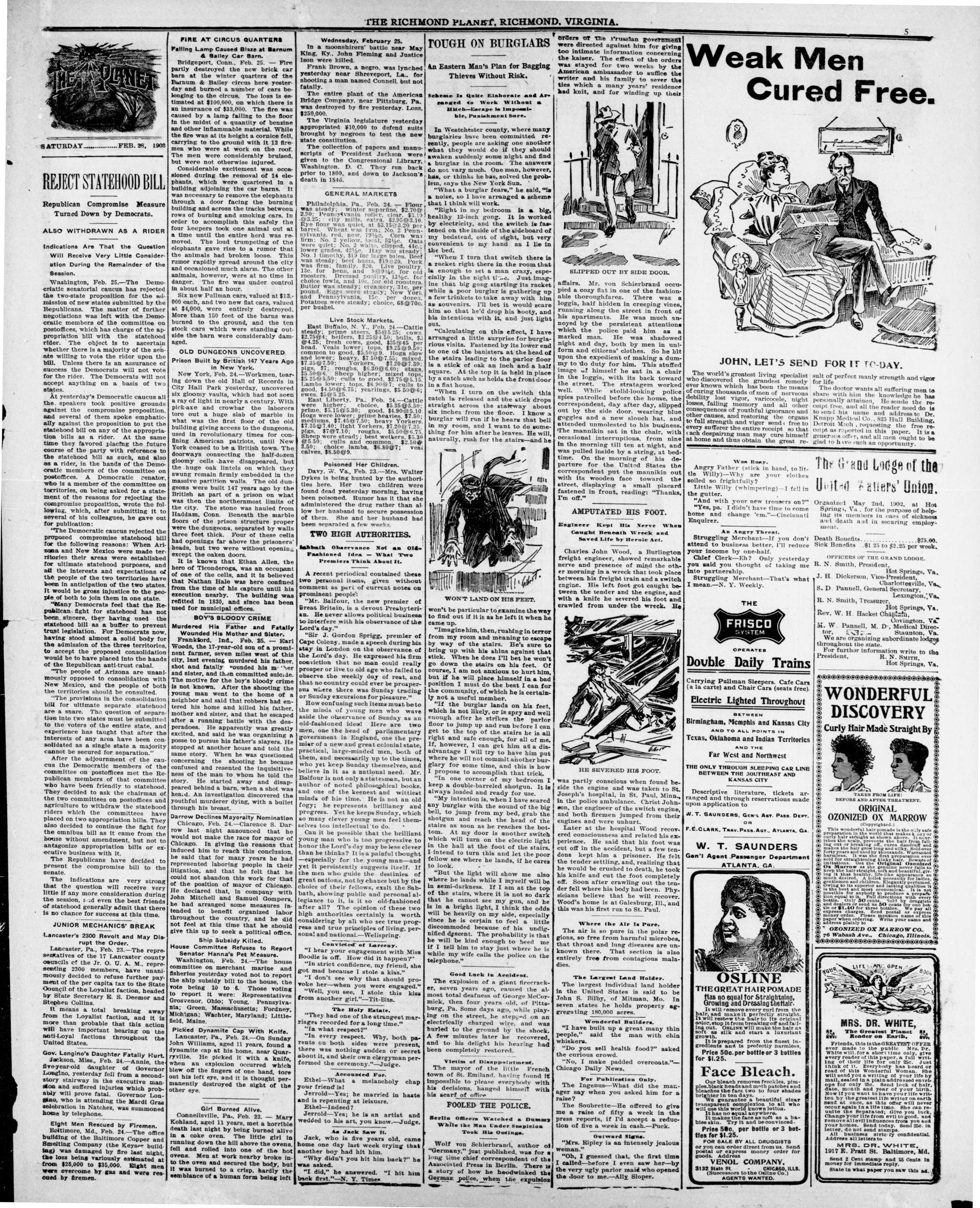
AN ASYLUM OUTRAGE
Experience of a Reporter with the Woes of Patients.
He Meets a Man Who, Although Harassed by Fate and Greedy Relatives, Retained an Angelic Disposition.
"Yes," said the crusade editor of the Baltimore American, sadly, "there is scarcely any limit to the number of outrages committed under the grace of law in confining sane persons in anylums merely because it is to the advantage of some mercenary relative to be temporarily or permanently relieved of them. Go you"—turning, with the air of a Spartan mother, to one of his trusted reporters"—and visit the neighboring institution and ascertain facts. Draw into conversation any intelligent looking patient you may, and look for material that may help along our crusade."
As becomes the true reporter, at a young man put on his gloves and unquestioningly obeyed his chief. Arriving at the asylum, he was speedily gratified by meeting a well-dressed, kindly-faced gentleman, who, in answer to his adroitly put question, replied that he was a patient. "At least," he added, with bitterness in his tone, "they say I am—and I am helpless."
"My story? Come with me to this warm corner, where the sun shines, and I will tell you. Ten years ago I was a prosperous merchant, with a beautiful wife and three sweet children. To care for them, to furnish them with the comforts—nay, even the luxuries—of life was not a duty to me—it was the keenest pleasure. Every night upon my return home I was met at the door with a quartette of kisses, and eight loving arms struggled to give me the first embrace. No better or happier home could be imagined. I was de-
"I AM A POACHED EGG."
Hiriously happy. Something kept telling me it could not last; yet I refused to listen to these forebodings, and enjoyed, untrammeled, my little paradise. One day upon my return home I found my wife seriously ill. Rapidly she grew worse, and soon—ah, how soon!—I was left to be father and mother to my little ones. Still there was something to live for. My babies clung to me, and the pathos of their helpless, dependent affection made it trefully sweet and rendered the awful heartache bearable. Yet even this did not last. Diphtheria settled upon my household—my little, motherless bairns could not be left to comfort the heart-spoken father. One by one in rapid succession they died, while I, shut out of my own home, away from the ones dearer than life to me, could but press my face against the pane that separated my dying treasures from me.
"Then despair seized upon me. I thought I had sounded the depths of human wretchedness. Not so. I had until that time retained my honor, independence and self-respect. Shortly after this blow an uncle died and left to my brother and me, jointly, a fortune of several millions. The grasping brother, taking advantage of my grief-numbed condition, schemed, with the aid of crafty lawyers, to rob me of my just portion. One day, while at my business, still listened with the sorrow that had crushed me, I was approached by a gentleman who asked me, as a favor, to accompany him to the office of a justice near by. Mechanically I obeyed. There I was confronted by two physicians, and questions were asked me whose purport I failed to grasp. At length they said: 'That will do,' and I was taken into custody.
"That is all, except that I am here, Sane? If ever a man lived who had full possession of his faculties, I am that man." With tears in his eyes, yet with a heart exultant over the splendid starter he had secured for his paper's crusade, the reporter turned and hurried toward the gate. Just as the reporter was passing through the iron wicket the narrator of the touching tale called after him. Turning, he was, quietly, "You don't happen to have a piece of toast about you, do you?"
"No," replied the reporter, in some surprise. "But, why?" "I." said the man, eloquently, "am a poached egg. I'm tired and want to sit down."
WOMAN'S
MAGAZINE
B. K. D. APPLE DUMPLINGS. ARE CLOSELY LINKED
Peel and core as many apples
As your appetite may wish-
So or eight—perhaps a dozen-
That would be a generous dish.
Make a dough in a bowl, beat,
Roll it thin with skill and care;
Place an apple lightly on it-
Take your knife and cut it square-
Large enough to fold your fruit in
then within the vacant place
Or let it cool.
Cinnamon and sugar pie.
Draw your square up well together,
Pinch it gently on the top.
So your dough will be protected,
Lest the cooking juices pop.
When your apples are all covered,
Take them in the oven, strong.
Twill prove better in the baking-
Haif a dozen times will do.
Bake them slowly, and while cooking,
Take of sugar just a cup.
And a modest lump of butter—
And with a light hand cream them up,
Addicing with sugar sauce
Set on ice to harden more.
Life your apples from the oven,
And your labors will be o'er.
Serve them hot—the sauce adds flavor,
And each dough, firm and brown.
Adds a jewel of achievement—
Columbus (O.) Journal.
RULES FOR VISITORS.
Guests at House Parties Have Certain Obligations Which Should Not Be Neglected.
Do not stay too long. It is much to break into the life of any family, even for a few days. Pay no attention to urgings to stay longer, however sincere they seem. Set a time to go when you arrive, and stick to it.
Conform absolutely to the household arrangements, especially as to times of rising, going to meals, and retiring. Be ready in ample time for all drives or other excursions.
Carry with you all needed toilet supplies, that you may not be obliged to mortify your host by pointing out possible deficiencies in the guest room, such as a clothes brush—the article most commonly lacking.
Enter heartily into all their plans for entertaining you, but make it plain that you do not care to be entertained all the time, or to have every minute filled with amusement.
Be ready to suggest little plans for pleasure when you see your host at a loss to entertain you. Try how well you can entertain him for a change. Turn about is fair play in visiting, as well as in everything else.
Be pleased with all things.
If you ever were brisk and sprightly, be so now.
Your high spirits and evident enjoyment are the only thanks your host wants.
Take some work with you, so that when your host has to work you may keep him in countenance by working also. More good times are to be had over work than over play, anyway.
Do not argue, or discuss, debatable matters. Few things leave a worse taste in the mouth.
Offer to pay the little incidental expenses that will be caused now and then by your visit; but merely offer—do not insist upon it, which would be very rude—Woman's Life.
LINEN BOOK COVER.
R Not Only Saves the Volume But Makes a Shabby Book Look Nent and Attractive.
Some book covers of brown linen which I made for my Emerson's essays and poems, outlining the pansy designs in ink, have been much admired by friends. The pansy design for the works of "America's greatest thinker" is peculiarly appropriate. The linen is cut according to the
A LINEN BOOK COVER
working design and the size of the book. The edges should be turned over and neatly overhanded down at the corners. One who is skillful with the brush may paint the pansies. Designs suitable for other books will suggest themselves to the worker.—Orange Judd Farmer.
Lemons in the Toilet
Lemons are a necessary adjunct to every woman's toilet; besides their healthfulnesss, which is not to be questioned, they are also beautifiers. A teaspoonful of lemon juice in a cupful of warm water will remove all stains from the hands and will make the nails soft and pliable, rendering them easy to polish.
Powder Puff for Baby.
A small bunch of absorbent cotton makes a splendid powder puff for baby's morning bath, and is desirable, as it will be discarded for a fresh one offtener than a regular puff would be.
When to Buy Footwear.
To get comfortably fitting shoes buy them in the afternoon when the exercise of the day has stretched the muscles to their largest extent.
Educational Discipline.
Little Girl—If I was a teacher I'd make everybody behave.
Auntie—How would you accomplish that?
Little Girl—Very easy. When girls was bad I'd tell them they didn't look pretty; and when little boys was bad I'd make them sit with the girls, and when big boys was bad I wouldn't let them sit with the girls.
-Tit-Bits.
THE RICHMOND PLANET, RICHMOND; VIRGINIA.
ARE CLOSELY LINKED.
Gov. and Mrs. La Follette of Wisconsin Are Business as Well as Life Partners.
A governor's wife of practical purposes and whose character presents many unusual features in Belle Case La Follette, matron of the executive mansion of the state of Wisconsin. She is 47 years old, of the same age as her husband, and her life has been linked with his, both in the practice of law and in his official and political career, in manner most unique. She became acquainted with Robert M. La Follette, the present governor, while the two were students in the college of letters and science of the University of Wisconsin at Madison back in the later seventies. They graduated together from the collegiate department in 1879 and that same year each took high honors in oratory. Miss Case won
MRS. ROBERT M. LA FOLLETTE
the Lewis prize for the best oration in a contest of eloquence and her future husband won the final oratorical contest of the university and later in the spring won in the intercollegiate contest. Miss Case graduated from the law department of the university two years later, attending the school part of the time with Mr. La Follette. They were married shortly after this and practiced law together, "Bob" doing the active work before the bar and "Belle" doing important service in briefing and consultation.
Mrs. La Follette is the founder of the Madison branch of the Emily Bishop league, a woman's club of which physical culture and dress reform are the purposes. She devotes a share of her time to this work. She is not overactive socially, gives few elaborate functions and goes to parties and balls only in a formal way, as the wife of the governor.
GENUINE EGG SHAMPOO
A Formula for Making a Preparation That Is Absolutely Reliable and Sure to Please.
Many of the compounds called egg shampoos contain no eggs. They are generally a stiff soap paste, made up in substantially this fashion: Take four ounces of transparent soap, half an ounce of carbonate of potash, six ounces of water and two of glycerine. The soap should be coarsely powdered and mixed with water in which the carbonate of potash has already been dissolved. Heating over a fire hastens the melting of the soap. The glycerine should be mixed in last of all. If the composition is too firm on cooling, a little water may be added. A sample may be tested for this purpose before the whole batch has cooled. Perfume may be introduced, if it be wanted.
For a genuine egg shampoo the following formula is recommended by the New York Tribune:
Three fresh eggs, half an ounce of spirit of soap, 160 grains of carbonate of potash, 150 minims of ammonia water, two drops of rose oil, the same amount of bergamot oil, one drop of geranium oil, one of oil of bitter almonds, and 27 ounces of rosewater. The eggs should be well whipped and mixed with the rosewater. The ammonia water, carbonate of potash and spirit of soap having first been combined, they may be added to the other fluid. The whole having been well stirred, the perfumes may be added. The volume of the latter will be so small that another vigorous stirring is essential to their thorough incorporation.
According to Your Means.
When people with small means are thrown in the way of wealthier acquaintances, always let it be with frankness. Putting on airs is detrimental to self-respect. A great deal of misery comes to people who are not able to make both ends meet. The effort to keep up appearances which are beyond one's income is a constant nervous strain, with which no sensible person should willingly burden himself. Much better say at once: "I cannot afford it."—American Queen.
In Case of Frost Bite.
In cases of frost bite no warm air, warm water or fire should be permitted near the parts affected until the natural temperature is nearly restored. Rub gently the affected part with snow in a cold room, and make applications of ice water.
Her Duty.
Henpeck (nervously)—You go first,
my dear. The burglarss wouldn't shoot
a woman.
Mrs. H. (firmly)—Never. It is a
wife's duty to follow her husband.—
Baltimore American.
BASTED THE CHICKEN.
Armsing Leaf from the Experience of a Dear Woman Who Knew Little of Cooking.
Said a woman who knows how to cook nearly everything: "I was very poor and unwildly when I first married, and had a lot of things to learn about the simplest affairs of housekeeping. It was shocking, I know, not to know how long to cook an egg, for instance. I let the first I cooked stay on 20 minutes, I believe. Walter was awfully considerate, and hated to hurt my feelings. When the first batch of bread I made could not be sliced I concluded that I had better get a cook book and learn it in earnest.
"The first thing I wanted to do, of course, was something wildly ambitious. I had no mother to go to for advice, and as Walter and I were miles from his family, it wasn't much better that way.
"I am going to have a chicken," I told my husband.
"Don't you want me to select it?" my husband asked.
"But I said no, and stubbornly started out to get it.
"It was a round and plump-looking creature, and I fancied the surprise I would have in it for Wally.
"Then I took the book and gave it a thorough examination for how-to-cook-a-chicken recipes. There seemed to be numberless confusing ways, and I had difficulty in selecting one that looked simple.
"I had scalded the hen and in taking off the feathers had torn the skin somewhat. I was wondering what to do with it, when I saw those never to be forgotten words: 'Baste well.'"
"Certainly I would baste well. Had I not seen, in my grandfather's kitchen once, the very needle and thread they evidently meant? She had used it. I found out later, for sewing up the stuffing in a turkey. But, never pausing to consider what reason she might have had. I leaped to the first conclusion that entered my mind.
"I obtained a large darning needle and a stout thread, and carefully sewed and darned the wrinkled skin of that fowl. It was a sight for gods when I got through—so knit and knotted that Wally's knife and carving fork caught in the charred stitches when I had it cooked after four hours.
"What's the matter?' asked my husband, looking up at my tear-stained face as he probed and sawed and got tangled up in the basting.
"I'm sure I don't know,' I said, and broke down completely. 'I basted it well,' I managed to blurt out between sobs.
"Basted it,' said my husband. 'Well, I should say you did,' and when I quieted down he told me what 'basting' meant. I laughed, too, but it was horrible, nevertheless." — Milwaukee Sentinel.
PLANTS FOR WINTER.
Nothing So Brightens Home as a Judicious Display of Flowers and Follage Plants.
This is the season when a few choice plants in the sitting room windows add much good cheer to our homes. A nice arrangement is shown in the cut. It is well to have a variety of plants, some for flowers, others for foliage. These may be readily procured of any florist, or even ordered by mail or express. At this season, much satisfaction follows the planting of a few bulbs, such as hyacinths, tulips, lilies, crocus, etc. These comes into bloom in a few weeks and are exceedingly pretty. There is a great array of foliage plants that may be readily secured.
A COCK WINDOW
A COZY WINDOW.
some also having bright and choice flowers. The latter include geniums, fuchias, primrose, etc. A palm, or two, fern, rubber plant, etc., add greatly to the ornamentation of a window filled with plants, or to the living room.
There are many styles of shelves that may be used. A plain, smooth board is often handy. Above it, on the other side, brackets may be screwed to the window easing, each containing arms with a flat, round top, for plants. A stand or table in a bay window, may often be used to advantage. Things of this kind are very common in city homes as well as in numberless cheerful farm homes. But there are, as a rule, none too many plants in our homes. As flowers bring refinement and elevating thoughts, let us have more of them.-Farm and Home.
Scented Cloth for Dresses.
Scented cloth, designed for ladies' dresses, is the latest novelty from Paris. The fabric retains its fragrance so long as there is a fragment of the material left; you may tear, drench with rain or fling aside the perfumed gown, but its particular fragrance will cling to it still.
Ether Cleans Fine Leather.
Ether will clean a pocketbook of glossy tan-colored leather. From suede, the finest sandpaper used with great care will remove traces of soil.
Like a Bell.
Cherricus—I have a constant ringing in my head. I wonder what is the cause of it?
Cherrious—Thought not; bells don't ring when they're cracked.—Baltimore American.
REHGIOUS MATTERS
HIS CARE
God holds the key of all unknown,
And I am glad;
If other hands should hold the key,
Or if He trusted it to me,
I might be sad.
What if to-morrow's cares were here,
Without it's rest?
I'd rather He unlock the day.
WHAT WE OWE TO OTHERS.
The True Standard of Greatness Is Service—How Christ Would Define Friendship.
The true standard of greatness is service. It is not what we have of gifts, culture, strength, but what we do with our endowed life. Some one says: "He only is great of heart who floods the world with a great affection. He only is great of mind who stirs the world with great thoughts. He only is great of will who does something to shape the world to a great career. And he is greatest who does the most of all these things and does them best." We are living worthily only when we are holding all that is in us at the service of our fellow-men. We must love, and if we love we must serve.
There are some people who say they want to have friends, meaning by friends pleasant people who will come into their lives to do things for them, who will minister to their comfort, who will make living easier for them; but that is not the way Christ would define friendship. He would put it just the other way, says Wellspring. The true Christian desire is to be a help to them. To everyone we meet we have some errand.
This does not mean that we should be obtrusive in pressing our help on those we meet. That is the best helpfulness which flows out from the life as light from a star, as fragrance from a flower. Love works most effectively when it works unconsciously, inspired from within. Your friend does not come to you and say: "I want to cheer you up. I want to help you to be noble." No one wants to be helped in that officious way. But he comes rather as your friend, with no programme, announcing of his desire—comes quietly, bringing into your life the best that is in his own life to give. Then virtue passes unconsciously from him to you, and new happiness and blessing come to you from him, you know not how. You go away with new courage, new gladness, new inspiration, in your heart. You are strengthened in your purpose to live worthily. You are more eager than before to make the most of your life.
Of course, love should be discriminating. Not all people need us in the same measure. Our helpfulness should go out most to those who need us most. The strong ought to help the weak. It is wonderful what Christianity is doing for the world in this way. The blind are educated until the privation of blindness is almost eliminated. The dumb are taught to speak. Men take the feeble-minded and, with almost infinite patience, find the soul that lies hidden in the remote depths of the being and call it out, oftimes restoring to sanity and to usefulness lives that seemed hopelessly imbecile. This is very beautiful. It is all the work of Christianity—the love of Christ working out through human hearts to help the weak. Heathen civilization had no sympathy with infirmity. The sickly child, it was said, would better die. The lame and blind, the dumb, the insane, were simply cast out to perish. But Christianity is filling the world with love. The other night, four of the wisest physicians in a great city sat by a young child's crib through all the watches, doing the best that science and skill could do to save the little one's life. It is Christianity that has taught such lessons as this.
Our debt to others, however, includes not only physical service, but interest in the whole life. Those who have experience should become guides to the inexperienced. Those who have been comforted in sorrow should carry comfort to those who are sorrowing. The best that is in us should ever be at the service of even the least worthy who stand before us, needing help. If we have this love in our hearts, we will look at no human life with disdain. We will ask concerning every one who passes before us, not "What can I get from this man for my own advantage?" but, rather, "What can I do to help this brother of mine?"
If this were the habitual attitude of love paradise would soon be restored. We live continually in the midst of human needs, and every one has something to give that would help a little, at least, in supplying these needs. If we have only five barley loaves and will bring them to the Master for His blessing on them, we can then go forth and with them feed thousands.
Light on the Way
There is no dark path where the Light of life shines.—United Presbyterian.
FACING TO THE FRONT.
Men Who Had Learned the Lesson of War and Stood Their Ground Under Fire.
"We had an explosion near our school building the other day," said the professor, according to the Chicago Inter Ocean, "and I was greatly interested in the bearing of children under the unusual excitement. Of a group of
boys nearest the scene or trouble all scurried away except two. One of these faced, in a dazed, mechanical way, toward the smoke, brought his heels together and stood in the position of a soldier, straight and stolid, awaiting developments. The other boy threw himself flat on the ground, and with head slightly raised, watched excitedly the turmoil about the scene of the explosion.
"I knew both boys well, and their fathers before them. Going out from Nashville along the Murfreesboro pike on the 26th of December, 1682, our brigade, part of Rosecrans' army, move
NOT A MAN MOVED
ing on Stone river, came suddenly on the rear guard of the enemy. Our company was marching at the time in two ranks in the midde of the white road, while other companies and battalions were in order of battle on either side of the road. As the advance, we were pressing forward, not anticipating any serious resistance, when we saw on a rise in front of us, and beyond our skirmishers and videttes, the flash of brass field guns, going into position.
"A minute later three cannon balls struck in quick succession on the road not three feet to the left of the center of our company as it halted in two rank formation, extending back along the pike. Everyone was taken by surprise by the suddenness and the viciousness of the attack, but not a man moved. The man nearest the spot where the shot struck the hard, macadamized road, and whose face and clothes were covered with the dust and gravel thrown up, looked neither to the right nor the left, but, straightening his figure, stood at attention, facing squares to the front. The next shot might strike him, and it might come in an instant, but instinctively he faced the danger, whatever it was.
"The colonel, not 20 feet away, noticed the bearing of the men with a gleam of pride in his eyes, and then said, in a matter-of-course way: 'They have your range, men. Move off the road before they fire again.' The men moved deliberately to the line of fence on the roadside, and a minute later three more cannon balls were planted just where the company had stood, and again my stolid man faced to the front, and said, unexcitedly: 'There they go. They have skedaddled.' Four days later I saw this same man in the panic hour of a day's battle and in the midst of the terror and confusion he stood, stolidly facing the front, and other men fleeing from crumbling lines, aligned themselves upon him.
"So it happened that he became the center of a new line, of desperate fighters looking for something to rally upon, for something to cling to in the storm of battle, for somebody who would stand against the pursuing enemy. He stood and they stood, and later it became a habit with all of them when confronted by danger to face as he faced that day, and to confidently wait developments. The boy who faced the smoke on the day of our small explosion was the youngest son of my stolid soldier friend, and my theory is that he did as he did because it was in his blood to do it, and that the instinct of facing to the front in time of danger will go down to his sons and grand-sons.
A Close Shave.
A physician tells the following: I remember one day in making my hospital rounds a patient, just arrived, presented me an amputated forearm, and in doing so, could scarcely refrain from a broad laugh; the titter was constantly on his face.
"What is the matter? This does not strike me as a subject of laughter?"
"It is not, doctor; but excuse me. I lost my arm in so funny a way that I still laugh when I look at it. Our first sergeant wanted shaving badly, and got me to attend it, as I am corporal. We went together in front of his tent. I had lathered him, took him by the nose, and was applying the razor, when a cannon ball came, and that was the last I saw of either his head or my arm. Excuse me, doctor, for laughing as I do, but I'll be especially blasted if ever I saw such a bully thing."—American Tribune.
A Secret.
Father—What did I tell you I was going to do to you if I caught you smoking again?
Johnnie—If you don't remember it, pa, you needn't think I'm going to tell you!—Woman's Home Companion.
The Psalm of Wealth.
Lives of millionaires remind us
We can reach fame's shining strand
If we'll only leave behind us
Libraries to beat the band.
—Judge.
No Chance to Forget.
"Here's an account of a man who was cast away on a desert island for 16 years and when taken off could speak the language just as well as the day he landed."
"I wonder why he didn't forget it?"
"His wife was with him."—N. Y. Herald.
Didn't Freighten Him.
"Horace Greeley once said that a man with more than a million dollars is a nuisance."
"Well, I'd rather be that kind of a nuisance than the other kind."
"What other kind?"
"The kind that wants to borrow a V."—Brooklyn Eagle.
VIRGINIA ROMANCE
Groom Failed to Steal His Bride and Was Finally Compelled to Ask Papa.
Because he didn't wish to ask the consent of the father of his intended, Mr. Burton, of Scottsburg, Va., was put to a good deal of unnecessary trouble in trying to have the matrimonial knot tied, and at last had to adopt the usual course in such matters and ask for the hand of his bride, He got her and the two were married, but the red tape to which he said he objected had to be unwound just the same.
The young lady who becomes his wife was Miss Henderson, of News Ferry. The young couple first went to South Boston last Sunday and asked
JUMPED FROM THE PLATFORM
the county clerk to give them a license. This he declined to do because it was the Sabbath. Then they prevailed upon him to stay up until after midnight and issue the license. So the prospective bride and groom went to church to hear a sermon during their visit. While this was in progress, however, the father entered, took his daughter by the hand and led her from the church. The wedding party meekly followed.
The next day the father and his daughter boarded the train for home. Just before the time for the train to pull out, however, the young lady jumped from the platform and ran to a buggy which had been provided by friends, the intention being to drive to North Carolina and there marry. But the father again proved that he was more than equal to the occasion captured his runaway daughter, and led her back to the train. They reached home safely, and after a few days consent was given to the marriage. The wedding took place Wednesday at Houston. The stern parent did not object to the marriage of his daughter, but he thought it was due him that his consent be secured.
A Thoughtless Sister
Mrs. Gettheher—Such impudence
Here's Sister Matilda proposing
come here with both her children
make us a boy or girl
Mr. G.—But you sp. alf the summer
at her home in the country, and
you had four children and a nurse.
Mrs. G.—A different thing altogether.
She has no servants, but she knows
perfectly well that we have several and
that every one of them will get mad
and leave if the family is increased.
N. Y. Weekly.
A Sheer Waste:
Deacon James—Don't you think it wrong for your husband to go fishing on the Sabbath?
Mrs. Brown—Wrong? It's positively wicked the way he wastes his time and his money on tackle and bait, and hardly ever brings home more than one or two mean little fishes.—Boston Transcript.
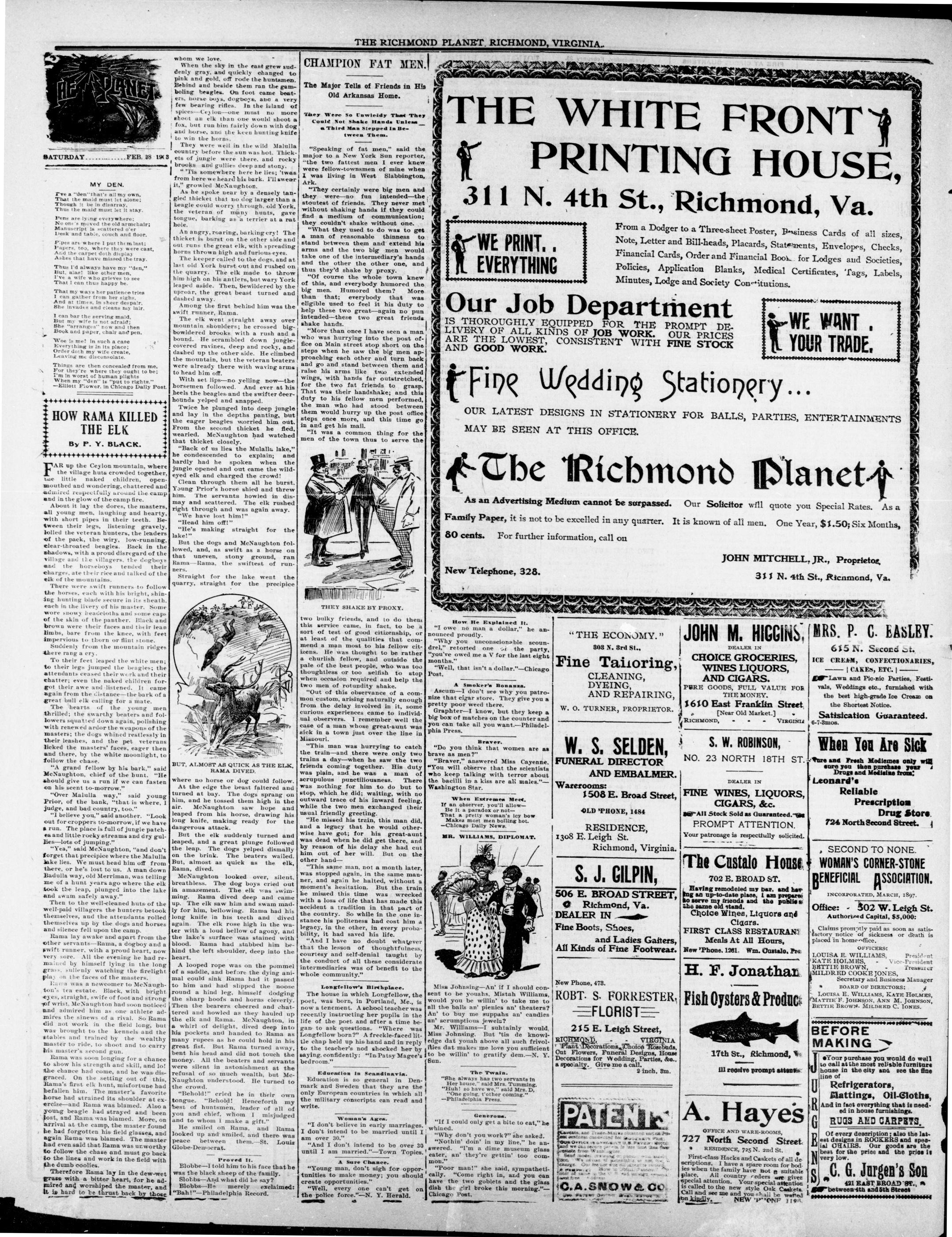
SYDNOR AND HUNDLEY, LEADERS IN Quality Furniture
We have some twenty-five or thirty suits bought, most of which will be in stock in a few days. "Don't do a thing" until you see this line.
MORR'S CHAIRS.
This always popular chair of rest will be in as much demand this fall as ever. Part of our stock has already arrived and $10 values vie with $15 values of a year ago.
Call, see our stock of Bed Room Far
Call, see our stock of Bed Room. Far r niture and save time and money. Passenger elevator. Sydnor & Hundley,
RIPANS
There is scarcely any conditions of ill-health that is not benefited by the occasional use of a R-I-P-A-N-S Tabu'. For sale by Druggists. The Five-Oent packet is enough for an ordinary occasion. The family bottle, 60 cents, contains a supply for a year.
A CLEW BY WIRE
OR
AN INTERRUPTED CURRENT
BY
HOWARD M. YOST.
[Copyright, 1896, by J. B. Lippincott Co.]
CHAPTER V. low, redolent with the grateful health giving aroma of spruce. I closed my
On the first evening of my occupancy of the old homestead I recalled Mr Morley's words and thought with sorrow how much superior his judgment had been to mine. A year had gone by, a year of heartache, disappointment and unfulfilled
"Speak out, I say, or I'll fire!"
longing, and the cloud had not been lifted from my life. And, oh, I was so homesick for just a glimpse of my dear love's face.
A few days after my interview with Mr. Morley I had received a note from Florence:
"Dear Mr. Conway: Father has informed me of your resolve not to call on me or at night to jump up the staircase when me so happy, until you are freed from all suspicion. I appreciate the manliness which prompts you to such a resolve, and I wish to assure you from the bottom of my heart that I respect and trust you. I know you are a great friend, and keep up a brave spirit. The mystery will be explained and you exonerated. Remember, I believe in you wholly, and shall always remain, Your true friend, "FLORENCE MORLEY."
I took the worn note from the locket which I wore around my neck and pressed it to my lips, as I had done many times since its receipt, and I wondered if her heart was still true to the sentiment expressed in it.
The harvest moon was resplendent and the white beams came into the window where I sat in my night robe, flooding my white drapery with light. There were no sounds of human life; the world seemed left wholly to the crickets and katydies. With a sigh from the depths of my lonely heart I replaced the note in its receptacle and arose.
Turning from the window, I saw right opposite me, on the other side of the room, a tall white figure. What was it? There it stood, while I gazed spellbound, motionless, mysterious. In a lightning flash of thought Sarah's forebodings came to me.
Then I grasped my pistol, which was lying on the table beside me.
"Now, then, if this is a practical joke, intended simply to frighten me, let it stop," I said. It was with some difficulty, I confess, that my voice was kept steady.
"Whoever you are, speak and explain, or I'll see if you have substance enough to stop a bullet!" I paused for a reply, but none came. "Speak out, I say, or, as sure as there is a God in Heaven, I'll fire!" I called again, and again received no reply. The white thing remained there, in spite of my threats. After another pause, during which the cold chills chased up and down my spine, I raised my arm, took deliberate alm and fired. A rattle of breaking glass followed the report of the pistol, and a dark spot appeared in the center of the white figure. The flash of the pistol had been reflected back, and in an instant I realized the truth. With a scornful laugh and a condemnatory exclamation at my foolishness, I placed the pistol on the table and got into bed.
Then a slight scuffling noise, seeming to come from beneath, reached my ear, and I said, aloud, and with a laugh: "I've stirred up the ruts, at any rate Hello, what's that?" I exclaimed, as a deep, muffled sound, accompanied by a slight jar, immediately followed. It was as though a heavy door in some distant part of the house had slammed. For quite a time I sat up in bed and listened, but no more unusual sounds followed.
Mrs. Snyder's words concerning mysterious happenings in my house and Sarab's unreasonable fears for my safety, followed by the two events just mentioned, did have an effect upon me, although the first event was due wholly to an ordinary cause, and the second, the apparent sound of a slamming door, might be, and probably was, just what it seemed. A gentle night breeze had arisen, and some of the windows in the upper part of the house might have been left open, thereby producing a draught and causing an intervening door to swing shut. True, the sound seemed to come from beneath me. But then that was probably imagination. In the silence of night a sudden noise is rather difficult to locate. How often the most common events, under unfamiliar circumstances, become inexplicable mysteries!
I am not of a superstitious make-up, and therefore Sarah's vague fears did not produce in me a feeling of fright; but there was a watchfulness about my senses as though there were "funny things," to use Sarah's term, about the house, which would become apparent in due time. Nestling my head down on the pil-
low, redolent with the grateful health-giving aroma of spruce. I closed my eyes.
Sleep did not come as quickly as I had boasted to my old nurse it would, and it was some time before my consciousness began to wander into the domain of vague fancies and indistinct ideas which characterize the period between waking and sleeping.
Then, almost before my eyes could open, I suddenly sat up in bed and listened with bearing sharpened by the sense of expectancy which had come over me.
Out through the silence of my room there came stealing the sound of a voice—but such a voice! Not possessed by any human being, surely! Pitched on a high, quavering tone, and yet so soft and small; so faint, as though borne from a great distance; so plain, as though right at my bedside; bearing no semblance to human tones, but nevertheless undoubtedly a voice; for after a time I could distinguish a word now and then.
If there were in the world weird, misshapen little folks like fairies and gnomes, and we could hear their conversation, I imagine their voices would sound like this one to which now I was listening.
There was no wonder Mrs. Snyder had been impressed by it, if this were the voice she had heard.
Strange indeed, and unnatural, as though not of this world, it seemed to me. A creeping sensation came over me, not exactly like that produced by fear; there was more of awc, of solemnity, about it.
The sound of the voice was intermittent. There would be a few words, then a pause, and so on. I could make no sense of the few disjointed sentences. It lasted but a few minutes. Indeed, so brief was the conversation, if that is what it was, there was no time to make an investigation.
After a long period of anxious listening I settled down again for sleep. And when at last slumber came, it was troubled. Vague, shadowy dreams flitted across my consciousness, and through them all was a sort of premonition of future events, which seemed to have a bearing upon the robbery.
The next morning I was awakened by the sun shining in my face. Hardly had I got my eyes open and my senses aroused to my new surroundings, when a loud and long-continued thumping on the front door caused me to spring out of bed. Hastily donning a few garments, I went to the door and opened it.
Mrs. Snyder was standing there, and an unmistakable look of relief came over her face when she saw me.
"Ach my! you schleep so sound I was afraid somesing de matter!" she said. "Breakfas's vas retty long dime alretty."
"All right. I'll be right over and eat it."
While I was dressing the recollection of the strange voice of the last night came to me. Now, in the broad glare of the forenoon, when all mystery takes flight and the hallucinations of the darkness become trivial, I wondered if my imagination had played me a trick. It seemed as though I had heard the voice in a dream, so unreal did the circumstance appear now.
I was standing by the huge chimney, when again, breaking in upon my thoughts, came the sound of that mysterious small voice.
As on the night before, there were no completed sentences; only a word between pauses of various duration. The sounds were plainer, however; not louder, but more distinct.
Here was a mystery indeed, one which did not choose only the shades of night for its manifestations, but came in the daytime, as though possessed of such subtle and unaccountable qualities that it might defy research.
After the voice had ceased, and I continued my toilet, the sound of talking, coming from the walk outside, reached me.
I glanced out of the window, and saw Sarah and Mrs. Snyder again in most earnest conversation.
Somewhat surprised to see my old nurse so early in the day, I called to her:
"Hello, Sarah! What's the trouble? What brought you here at this time?" "Ach, Nel, bud I am glad to see you!" she exclaimed. "I couldn't schleep all night."
"Now, that was too bad," I said. "What kept you awake?" "I was thinkin' of you all alone in dislott house, and so much strangeness about it," the good soul replied, with her honest old face upturned to me.
"That was very foolish. Nothing is going to happen to me," I said, lightly, although I was not so sure of it now.
When I went outside the two women were still talking, and there was an awe-stricken expression on each face.
"What are you two superstitious old girls doing now?" I asked. "Hatching up more mysterious tales?"
Mrs. Snyder gravely shook her head, as though seriously condemning levity on supernatural subjects. Sarah rested her hand on my arm, and gazed up into my face. There was deep concern in every line of her countenance.
"Nel, you come wiz me," she said, leading the way. I followed around the corner of the house, and she stopped before a window, the shutters of which were closed.
"Look!" she exclaimed, pointing toward the shutters. "Mrs. Snyder says dat was not dere yesterday."
Like those of most Pennsylvania farmhouses, the downstairs windows were provided with solid board shutters.
To the center of this particular pair was a small round hole, from the edges of which a few chips running with the grain of the wood were broken.
"Well, what of it?" I asked, hoping that I could avoid giving an explanation, for I was a trifle ashamed of my self for firing at my own reflection.
"Somebody shot through de shuttle; and try to kill you, maybe. It's a bullet hole, alit it? Oh, Nel, didn't you hear it? Mrs. Snyder heard it from her house, and she look out her window and saw a man runnin' away down de road. You can't stay here, Nel. You go home wiz me."
I could not forbear a smile at Sarah's fears, but, remembering they were the consequence of the deep affection she felt for me, I checked the frivolous reply which my tongue was about to utter.
see?" I asked
"Ach, Nel; hat you forgot de place you always wanted to go to and ve wouldn't led you, because it was damp and dark?"
"That's so. You mean the cellar."
"Yes, yes, to be sure. You was lost nostr, and ve couldn't fint you for a long dime. When ve did, you vas aschleep in de cellar."
"Well, come along. Let us have a look at it." I said, eagerly. The noise like a slamming of a door had seemed to come from below. Perhaps I should discover the cause down there.
On opening the door leading down from the dining-room, a musty odor assailed my nostrils.
It is peculiar how the sense of smell brings back to one old associations and memories. I recollected that musty odor perfectly, and it brought back the pand. She cognition, she swept by. And this aration, a sickness. I the girl wished trust. I watch the road he looked to disappear. A touch thoughts, the solicite. I the guess said Mrs. so, too. Me.
"Yes, she shi! I mul for answer tempt at
"Why, bless your dear old loving heart, Sarah," I said, taking hold of her arm, "come. I'll explain that, and when you know about it you'll laugh at me."
The women went along into my room. "You see that window? You remember the shutters were always kept
"Yes, and she so fine and pout."
closed. Well, I had forgotten all about it last night, and after I was undressed I saw my figure, clad in my white night robe, reflected from the glass. You women must have made me somewhat nervous by your talk while making up my bed. Anyhow, I was a trifle frightened at my own shadow, and fired a bullet at it. So, you see, no one tried to kill me at all. It was only my own foolishness, of which I am heartily ashamed. Now let me get some breakfast, and then we'll go all over the house to satisfy you there can be nothing in it which could do me harm."
I said nothing about the voices I had beard, nor of the noise like the slamming of a door. There was no use in adding to the inexplicable feeling of alarm which my old nurse felt.
As for the man Mrs. Snyder had seen after the shot fleeing down the road, that was easily explained.
If my house had the reputation of being haunted, it was most likely a passerby would have wings to his heels on hearing the report of a pistol about the place.
After breakfast we went through the house.
I noticed that all the windows were closed. Therefore it was no sudden gust of air that caused the shamming of a door. But nothing was discovered which would give one reason to suppose there was anything unusual about the place.
We finally came to the attic, and I looked out of one of the small windows, first brushing away the curtain of cobwebs.
From this height I could see over the orchards. On the brow of Sunset Hill, about half a mile distant, was a large house, evidently quite new.
It was a splendid structure for the country, and I fancied a wealthy resident of the city had discovered the beauties of Nelsonville and built him a summer residence here.
"Whose place is that over on Sunset Hill?" I asked.
"Some rich man's from de city," Sarah answered.
"Do you know his name?" I continued, moved by curiosity.
"Vell, I did know. Ach, what is it, now? I forget eferysing soon," Sarah replied.
Here Mrs. Snyder chimed in: "His name is Morley."
"What??" I exclaimed, in amazement. "Morley? Sylvester Morley?" "I don't know his first name," the old widow answered. "Has he a daughter? Is she here?" "Yes, and she so fine and prout. Ach, and so pretty! Yes, she is here. Dey live here now in de summer," continued the old lady, glad for the opportunity of imparting news. "I see dem almost efery day. Dey drye by. And him, de man, ach, that a fine shentleman! So tall and straight, such a fine peard, and he looks so prout, too!" The garrulous old widow's description satisfied me. My heart beat rapidly. I had come into this secluded place with no thought further from my mind than that I should find Miss Morley here.
Was there a design of fate in this? And—was she still my true love? Perhaps I should see her; but I remembered my determination and my promise to her father, and how far I still was from removing the condition imposed on the renewal of our friendship, and I hoped, our love.
This afterthought filled me with an impatience to commence some kind of investigation on my own hook.
I had had a short interview with Mr. Perry, the president of the bank, just before my departure for Europe. It had been most unsatisfactory to me, for Mr. Perry was able to hold out no hope of immediate relief. He was just as earnest, however, in advising me to still keep on my course of apparent indifference and do nothing in the way of a search myself.
Since that interview six months had
elapsed, and I had heard nothing from him. I now resolved to take the affair in my own hands. For to go on living, with Florence Morley so near to me, and still refrain from indulging in her sweet society, would simply be torture.
"Come, Nel," Sarah finally said, breaking in upon my thoughts. "We haf not seen all yed."
CHAPTER VI
When we were again standing in the main hall on the first floor, Sarah's last remark came to me.
"We have been over the whole house, have we not?" What more is there to
see?" I asked
"Ach, Nel! but you forget de place you always wanted to go to and ve wouldn't led you, because it vas damp and dark?"
"That's so. You mean the cellar."
"Yes, yes, to be sure. You vas lost vonst, and ve couldn't fint you for a long dime. When ve did, you vas aschleep in de cellar."
"Well, come along. Let us have a look at it," I said, eagerly. The noise like a slamming of a door had seemed to come from below. Perhaps I should discover the cause down there.
On opening the door leading down from the dining-room, a musty odor assailed my nostrils.
It is peculiar how the sense of smell brings back to one old associations and memories. I recollected that musty odor perfectly, and it brought back the days of boyhood more vividly than anything else had done.
We descended the stairway, and found the cellar bare and empty. I peered into every dark nook and corner, but there was nothing which could have caused the noise. "Nothing to be seen here, Sarah," I said. "Maybe we can find something of interest in the old storeroom." My grandfather, in his latter days, had kept the village store and post office. The house was built on the side of a small hill, so that it was three stories high on the street side and two in the rear. The cellar was divided into two apartments by a thick wall of stone. One apartment was used for the house supplies. The other section was in turn divided in two, the front facing on the street serving as the store and post office, the rear, a deep, cavernous, underground room, having been used for the storage of barrels of vinegar, molasses, tobacco and dried fruit.
We descended the open stairway leading down to the storeroom from the main hall. The door was at the bottom, and at first I thought it was locked. Upon closer examination, I discovered that it had only become tightly jammed by a slight settling of the surrounding timbers. A few vigorous kicks soon caused it to open, and we stepped down into the room. The shutters to the windows were closed, but there was above the door leading to the street a small transom. Through the dust and moisture-begripped glass a few rays of light penetrated, producing a twilight gloom in the apartment, but not so deep that we were unable to see.
One of the old counters still remained, and scattered over the floor were a few empty boxes and barrels. I thought of the white-haired old man whose form had been so familiarly associated with the room, and I glanced over to the corner with a fancy that he was here still, seated behind the desk.
"Why, there's de door gone?" Sarah cried out, in tones of excitement.
"What door, Sarah?"
"Nel, you know, you remember. Der used to be a door to de store cellar, and now dere ain't any."
Sarah was right. There had been a doorway, through which I had stolen many times for the purpose of filling my pockets with raisins and dried fruit. There was none now. The wall of solid masonry confronted us.
It really seemed a matter of very little importance, but Sarah kept up excited exclamations about it, until I finally stopped her.
"Why, Sarah, I don't see anything very strange in the walling up of a cellar doorway. No doubt Mr. Sonntag, my lawyer, had it done. I remember the place was dark, damp and unhealthy. He thought it best to have it closed up, perhaps. There was another door from that cellar leading outside, was there not?"
"Yes, right unter your betroom window," Sarah answered.
"Well, that can be easily broken down if you want to get in the place. But what would be the use of all that trouble? I don't want to use the cellar."
But then I remembered the noise which had seemed to come from beneath my bedroom, and the cause of which I was unable to discover throughout the rest of the house.
"We might take a look at the other door," I finally said, reflectively.
We ascended the stairway and went around the house. Thick vines, reaching to my bedroom window, completely hid the outside cellar door.
I parted the vines, and found again the solid foundation wall. This doorway had also been walled up.
Sarah was so greatly impressed by this new discovery that her excited exclamations broke out anew, and she again began to plead with me to leave the place.
Again I sought to quiet her fears by laughing at her, although it did seem a trifle strange that my agent should have walled up the doorways. I was satisfied he had had it done, and I wondered what his reasons could have been. Perhaps, after all, Mrs. Snyder was right in affirming that there were mysteries about the old house. Perhaps this walked-up cellar was the seat of supernatural demonstrations, and my agent had sealed it up for that reason. "I do not intend to lose any sleep over it," I said, lightly. "Sonntag must have had good reasons for doing this, and I can easily find out what they were by driving over and seeing him. I want to have a talk with him, anyhow." Here the rumble of wheels reached my ear. As I glanced down the roadway and saw the approaching turnout, why did my heart beat faster and a dimness cloud my sight?
Mrs. Suyder had also glanced in that direction. "Vell, now look, Mr. Nel," she began, excitedly. "You can see yourself how dey look. Dey is coming. Dat is de Morleys."
My heart had given me the information before the widow's tongue.
There were two persons in the light road-wagon which was being whirled toward us at a rapid rate by the spirited horses. I could not be mistaken in the graceful poise of the head and the general outlines of beauty about the young lady, nor in the grave dignity of the man.
The carriage swept along. When nearly opposite us, the young woman evidently caught sight of the group standing back from the roadway, for she leaned forward and sent a glance past her father toward us. I saw, even though my sight was dimmed by emotion, her face turn pale and her eyes ex-
Pand. She gave no other sign of recognition, however, and the carriage swept by.
And this was all. After a year of separation, a year of longing and home sickness, I was greeted with a stare by the girl who had declared she would always trust and believe in me.
I watched the wagon until a bend in the road hid it from view, and then still looked toward the spot where it had disappeared.
A touch on my arm recalled my thoughts, and I glanced around into the solicitous face of my old nurse.
"I guess de young woman is putty," said Mrs. Snyder. "Ach, and you dink so, too, Mr. Nel."
"Yes, she is beautiful, very beautiful." I murmured, more to myself than for answer to the widow's clumsy attempt at pleasantry.
Sarah's watchful old eyes and the promptings of her affection for me discerned something more in the fixed gaze I had sent after the wagon than a suddenly awakened admiration.
"What is id, Nel? Do you know her?" the good soul asked, anxiously. "Tell you some time," I answered. Yes, yes; beautiful indeed was Florence, lovelier than ever, and good and true—well, I did not seem to feel so sure of her faith. She had passed me by without extending a salutation. I could not blame her for not recognizing me, after the resolve I had made, but it cut me to the heart, nevertheless. The remainder of the forenoon was spent in going through the barns and over the farm.
A small structure, twenty or thirty feet from the house, had been used to do the cooking, baking, churning, washing and ironing in. We could not gain access to the cooking house, as it had been called, the door being locked. There had been no care taken of this place, and I could hardly see through the dust and dirt which obscured the windows, when I attempted to look inside.
"There is nothing to be seen in there, anyhow," I said. But I remembered the pile of cakes and the loaves of bread which had issued from the old Dutch oven built in one side of the cook-house. How I wish for some of the good things now!
After a midday dinner, I harnessed the horse in the buggy. According to my instructions, my agent had provided me with a single rig, and I now proposed to use it to drive Sarah home and then keep on down the road, past Sidington Station, across the river to Twineburgh, in which place Mr. Sonntag, my lawyer, resided.
I had never seen Mr. Sonntag. My former agent had died nearly a year ago, and six months after his death Sonntag had bought the law business from the heirs.
I had been advised of this fact by a circular letter from the present incumbent, giving references as to ability, honesty, etc. Mr. Sonntag had also requested me to allow him to assume management of my small estate. As Mr. Perry, the president of the bank, was down among the names of reference, I was most willing to grant Mr. Sonntag's request, and wrote him to that effect.
On the way to Sarah's house I unbosomed myself to the good old soul. I told her of my hopes regarding Florence, and my fears that those hopes would never be realized.
"Ach, yes," answered Sarah, "you vill marry her some day. Just see how you've been brought both to de same place togeddder. And I know she lofes you."
"You are more certain than I am of that," I answered, somewhat gloomily. "I have told you everything about myself, because I have no mother to confide in; and you will no more violate my confidence than a mother would; of that I am certain."
"Ach, Nel! I got no leetle vons of mine own," she answered, with trembling voice. There were tears in her eyes, too, when she said: "I would do as much for you as a mudder; I guess I would, Nel."
Her love was grateful to me, orphaned as I had been for many years, and for the last year without a friend to console or advise me.
"Bud you you was foolish, Nel, to say you not see her undil you fint de robbers," Sarah went on—"foolish of you, and hart for her, too. I bet you she haf lots of heartache."
"What else could I do, though, in honor?" I exclaimed.
"Vell, you are innocent, and she loes you, and knows, too, dat you didn't rob de bank. So den it would be no dishonor to drust her lofe and be happy in id."
Sarah's logic found an ecko in my heart. Perhaps it was unjust to Florence's love not to ask her to share my burden. I knew, if I could share any sorrow or trouble of hers, how happy I would be.
We soon reached Sarah's house, and I reined up to allow her to alight. Then I continued on my way.
Twineburgh was about two miles across the valley beyond Sidington. It was a lively little place, of about 2,000 inhabitants. One of the great trunk lines of railroad run through the town.
The road to Twineburgh crossed the track at Sidington station, near the depot.
As I reined up my horse to a walk and glanced up and down the track before crossing, I saw the station agent standing on the edge of the platform.
I nodded to the fellow and he answered with a grin. Then, as he slowly came toward me, I stopped the horse and waited.
"You took the trunk, didn't you?" he asked.
"Mr. Hunsicker came for it," I replied.
"I saw the trunk was gone when I came back," he said, in his lumbering fashion. "Did Jake take you over to Nelsonville?"
"Yes. I am much obliged to you for directing me to him," I said. shortly.
"I thought mebbe he would."
Having said this, he shifted his weight to the other foot. I patiently waited.
"Nice country around Nelsonville," he finally went on. "Some of the city folks beginning to find it out and go there for the summer. Mr. Morley's been there six months now. Know Mr. Morley?"
"I am slightly acquainted with him," I replied.
"Then there's another feller comes up from the city. Let's see—what's his name, now? He's got a little hut a mile
so from here he takes up to hunt and fish. Guess he don't shoot very much. I never see him take any game back to town with him. Ob. yes, now I remember. His name's Jackson."
I started in surprise and became a little more interested.
"What? Not Horace Jackson?" I asked.
"Yes, that's his name. Acquainted with him?"
"I used to know Mr. Jackson quite well."
"Seems to be a nice fellow," the agent remarked, reflectively.
"A very pleasant gentleman. Oh, by the way." I went on, "is there a telegraph instrument at the depot?"
"To be sure."
"And I could send a message whenever I want to?"
"Yes; that is, whenever I'm here."
"Well, but supposing I had an important message to send when you are not here?" I asked. "Where could I find you?"
"I live up the track about a mile," he replied.
"This direction?"
"Yes. The house is right by the track, just where the switch begins."
"And what's your name?"
"Ask for Hunter."
It appeared to me that the fellow did not relish my questioning. He seemed to be ill at ease under it.
"Does Jackson go to Mr. Morley's house when he comes up here?" I asked.
"I guess he does, sometimes. He ain't been up lately; not for five or six weeks. At least I haven't seen him."
"Does Mr. Morley stay at Nelsonville all the time?" I asked. "Or does he go to town every day?"
"He goes to the city three days in the week; sometimes more'n that. He takes the morning train here at Sidlington, and comes up to Twineburg on the afternoon train."
I bowed my head and drove on.
The fellow's words gave me food for thought. Horace Jackson a frequent
HKS
Florence Morley
visitor at the Morleys, or at least until recently—why? I knew he had some business relations with Mr. Morley; Jackson himself had told me so. But then why did he not transact his business at Mr. Morley's office in the city? No doubt he did, and therefore visited Nelsonville for another reason. Florence Morley was the attraction. Remembering that she had passed me by without a greeting, my heart grew heavy with doubt.
(To Be Continued.)
Enjoyed Himself.
"What kind of a time did you have at the party?" asked the old friend.
"First rate," answered Mr. Cumrox.
"You see, it was a masquerade party, and mother and the girls couldn't identify me and criticise my grammar and deportment."—Washington Star.
Don't It. Though?
"But what is the use of your getting angry when you talk of the coal trust, Smithers? It doesn't trouble the trust or do you any good."
"Doesn't it, though? I get so hot thinking about the blamed wretches that I don't miss the furnace fire!" —Cincinnati Commercial-Tribune.
**Strenuous Life in Chicago.**
Mrs. Dearborn—Oh, my! Life is such a bore!
Mrs. Wabash—What's wrong now?
"Why, a woman no sooner gets through with one wedding than she has to begin getting ready for her next." —Yonkers Statesman.
A. Good Definition
Tommy Wise—Pa, what is an optimist?
Mr. Wise—An optimist, my son, is a person who has the faculty for making a mole-hill out of a mountain.—Judge.
But he found out, alas! when he came from
the wreck.
He had landed instead on his own.
-N. Y. Herald.
A REMINISCENT SOUND.
"I'm surprised that you keep this parrot. He swears like a pirate!" "I know, but he reminds me so much of my late husband!"—Lustige Welt.
RELIC OF REVOLUTION.
"Mother Mary," 153 Years of Ag, Remembers Gen. Washington and Valley Forge.
New Year's day of 1903 was an event of great importance to "Mother Mary" McDonald at the Home for Aged and Infirm Colored People in West Philadelphia, for it was the one hundred and thirty-third New Year's day that she has seen.
"Mother Mary" is the oldest woman in the country and possesses the use of her faculties to a remarkable extent. She is always ready to tell of the stirring times of the revolutionary war and of the bitter winter when Washington and his troops were encamped near her home at Valley Forge.
This bright, cheerful little woman is a familiar figure in the home. She thinks that smoking tobacco has lengthened her life, and is perfectly happy with her old short-stemmed pipe in her mouth. She says that she could not do without it. She clings to this old-time custom which was common in her young days, and even while she was ill some time ago the doctors would not allow her pipe to be taken from her.
With her pipe in her mouth—for she declares she cannot remember without it—"Mother Mary" tells of the days when Washington and Jef-
MOTHER MARY M'DONALD
ferson, with other men, were working for the freedom of the 13 colonies.
She was born in Frogtown, near Valley Forge, five years before the revolutionary war begun, and in spite of her youth can remember many events connected with those stirring times. She was bound out to Keese Howell, a wealthy farmer living at Valley Forge, when she was four or five years of age. She is very proud of the part she played in the war while the soldiers were stationed in that neighborhood.
The horrors of that winter at Valley Forge were so dreadful that they were indelibly impressed on her childish mind. Indeed, she recalls how she pilfered potatoes, nuts and apples and saved from her own small store when she was only seven years old in order to help the poor, ragged soldiers who encamped near the Howell farm.
Many a time she trudged through the snow to the encampment with the small stores hidden in her apron under her coat. But her master was as much in sympathy with the sufferings of the soldiers as his little maid servant, and, discovering her desire to help, very often sent her to carry his generous contributions.
"Mother Mary" says she will never forget the cheers that greeted the welcome sight of those overflowing baskets, nor how the soldiers lifted her down and carried her around amid the almost crazy delight of the men.
"It was enough to make your heart sick," she exclaimed, "to see the poor men in their rags and bare feet, cut and bleeding from the cruel ice and cold, go wild over those baskets of food. They cried and laughed at once and petted me till I was as proud as a princess.
"And I remember very well that they took me into Gen. Washington and he patted me on the head and smiled. He was so grave and dignified that I felt afraid at first, but after he smiled and spoke to me I did not feel at all afraid.
"I guess our soldiers have never suffered since as they did that winter, and I never saw more patient and hopeful men than those who made up the continental army. I used to think the American soldiers were the bravest in the world, and I think so still, though it has been nearly 125 years since I was right among them.
"The rest of the time that they were stationed in our neighborhood they made me welcome to their headquarters, and even the highest officers would raise their three-cornered hats and bow with much courtesy whenever they met me."
An Artificial Aurora.
At the Royal society rooms recently Prof. Ramsay showed an experimental proof of the electrical nature of the northern lights. Between the poles of a powerful electromagnet he suspended an exhausted glass globe, containing at the top a metallic ring. An alternating current discharged through the ring in the globe produced an annular glow, and when a current was sent through the coils of the electromagnet the glow was deflected downward in streamers resembling those of the aurora borealis. The spectrum of the natural aurora shows the presence of krypton, and in Prof. Ramsay's experiment krypton was produced in the discharge through the rarefied air within the globe.
One Inference.
"She says she has a mission in life
and will never marry."
"Dear me! is she so unattractive as
all that?"—Chicago Post.
Do You Recognize 'Em?
O all the sad and sorry words
O that mankind ever writ,
The sadness most of us—
These two: "Please most of."
—Chicago Daily News.
HE PLANET
published every Saturday by JOHN MITCHELL
JR., at 311 North 4th Street, Richmond, Va.
published every Saturday by JOHN MITCHELL JR., at 311 North 4th Street, Richmond, VA.
All communications intended for publication should be sent so as to reach us by Wednesday.
TERMS IN ADVANCE.
One Copy, one year,
One Copy, eight months,
One Copy, six months,
One Copy, four months,
One Copy, three months,
Single Copy,
ADVERTISING RATES
FOR one inch, one insertion . . . $ 50
FOR one inch, each subsequent insertion . . . 25
FOR two inches, six months . . . 6.00
FOR two inches, six months . . . 10.00
FOR two inches, nine months . . . 14.00
FOR two inches, twelve months . . . 20.00
Marriage and Punishment Notices . . . 50
Standing and Transit Notices per line . . 10
POSTAGE STAMPS OF A HIGHER DENOMINATION THAN TWO CENTS NOT RECEIVED ON SUBSCRIPTIONS.
THE PLANET is issued weekly. The subscript price is $1.50 a year, in advance. There are FOUR ways by which money can be procured. You can buy a Money Order, by bank Check or Draft, or an Express Money Order, and when none of these can be procured, in a Registered Letter. MONEY ORDERS—You can buy a Money Order from the Drury Bank, available at Richmond Post Office, and we will be responsible for its arrival. EXPRESS MONEY ORDERS can be obtained at the Drury Bank, available at Richmond United States Express Co., and the Wells Fargo and Co.'s Express Company. We will be responsible for money sent by any of these compounded by the Drury Bank, is a safe and convenient way for forwarding.
REGISTERED LETTER.—If a Money Order Post Office or an Express Office is not within your reach you wish to send us on payment of ten cents. Then, if the letter is less or lost, it can be traced. But you can send money in this manner at our office.
We cannot be responsible for money sent in letters in any other way than one of the four ways mentioned above. If you send your money in any other way, you must do it at your renewal. ETC. If you do not want the PLANET continued for another year after your subscription has run out, you then notify us by email. If you decide that subscribers to newspapers who do not order their paper discontinued at the expiration date have been paid are liable for the payment of the paper up to date when they order the paper discontinued.
COMMUNICATIONS.—When writing to us to request your subscription or to discuss our paper, you should give your name and address in full, otherwise we cannot find your name on our books.
COMMUNICATIONS.—In order to change the address of a subscriber, we must be sent the former as well as the present address.
Entered in the Post Office at Richmond, Va., second class matter.
SATURDAY, ..... FEB. 28, 1903
We should teach our children politeness.
We should support race enterprises and take one good race paper.
Let us be respectful at all times to white people and to every other kind of people.
COLORED men, let us buy land and engage in business. If we fail, we are better off for having tried.
THERE are some colored folks just like some white folks—you can't make anything of them no matter what you do with them.
It seems that the Negro-haters are not after the loafing, worthless Negro. All of their efforts are now centered on the industrious kind.
The good Negroes and the good white folks of the South are having no trouble with each other, but God help the bad elements of both races.
If colored people would save one-half of the money spent in frivolity and foolishness, we would be worth a billion dollars by the time the next census is taken.
THE BAPTIST SENTINEL thinks that Brother NELSON WILLIAM, JR., should be happy over the one cent verdict, which presumably carries with it a one cent character. The case has been settled where Brother WILLIAMS lives, but seems to have been reopened in Raleigh, N.C., where Brother S. N. Vass lives. These people are very much like the snake, whose body was wiggling after the head had been cut off. They're dead and don't know it.
PROF. WASHINGTON'S UTTERANCES.
PROF. BOOKER T. WASHINGTON improves with age. No one who will carefully compare his utterances of to-day with those of ten years ago can fail to discern a change in his statements to the public. He spoke at the Academy of Arts and Sciences February 22d and is quoted as follows:
"To deal practically and directly with the affairs of my own race I believe that both the teachings of history, as well as the results of every-day observation, should convince us that we shall make our most enduring progress by laying the foundations carefully, patiently, in the ownership of the soil, the exercise of habits of economy, the saving of money, the securing of the most complete education of hand and head, and the cultivation of Christian virtues."
There is no servility in those clean-cut expressions. There is no limitation to the education advocated. He states the proposition so that the Negro can begin at the bottom and go to the top. His theory as herein set forth is all right.
He continued:
"I cannot believe. I will not believe, that a country that invites into its midst every type of European, from the highest to the very drags of the earth, and gives these comers shelter, protection, and the highest encouragement, will refuse to accord the same protection and encouragement to her black citizens. The Negro seeks no special privileges."
This is the basic principle of political equality, admirably stated. It will appeal to the conscience of the cool-headed, but thoughtful northerner, while constituting an appeal to the liberal-minded white elements of the southland.
He continued:
"All that he asks is opportunity; that the same law which is made by the white man and applied to the one race he applied with equal certainty and exactness to the other."
This is indeed all that we ask. Will the country grant this request or will it slam the door of hope in our face upon the insolent demand of Senator B. R. TILLMAN?
And again:
"The age for settling great questions, either social or national, with the shotgun, the torch, and by lynchings has passed. An appeal to such methods is unworthy of either race. I believe the time has come—and I believe it is a perfect practical thing—when a group of representative Southern white men and Northern white men and Negroes should meet and consider with the greatest calmness and business sagacity the whole subject as viewed from every standpoint."
The above is admirably stated. The call for a national gathering made up of northerners and southerners and the Negroes themselves is a proposition which will meet with favor at the hands of every patriotic citizen who wishes the republic well and will do all in his power to promote a movement that will bring peace and foster contentment in this great land of ours.
These utterances have the ring of true statesmanship and it may be that this honored leader sees far ahead the dawn of a brighter day when the Negro will be the Negro no longer, but all references to him will be based primarily upon his birth-right to true American citizenship.
THE PARTING OF THE WAYS.
We have repeatedly maintained that a race-war would never take place in this country, that there will be an armed conflict between contending white men, and that colored men would be on both sides of the conflict. Events seem to be bearing out this view of the contention. The hot-headed leaders from the South are steadily becoming more over, bearing and offensive to the leaders from the North. The wholesale disfranchisement of the colored people in the South instead of allaying irritation and soothing the feelings has had a tendency to awaken slumbering emotions.
While the North has acquiesced in the sacrifice of the colored brother from a political stand-point, it is very much alarmed over the sacrifice of the white brother in the northern section for the same reason. It should be remembered that a white man in the South by virtue of the Negroes being counted in the voting population and not being allowed to exercise the right of franchise has just double the voting power possessed by the white man of the North. The cool-headed northerner is enquiring why the South should not consent to a reduction of the electoral vote in proportion to the curtailment of Negro suffrage. This then will eventually be the rallying cry between the two contending sections.
The meeting of Lee Camp on the 20th inst., and the reputed utterances of Gen. FITZHUUGH LEE, who is now a retired officer in the regular army, and drawing pay from the national government has attracted much attention throughout the country. He was quoted in the Richmond, Va., TIMES-DISPATCH as follows:
When General Lee was called out he refe red to this and made the remarkable statement, stirring up wildest enthusiasm, that he would never rejoice in the consequences of the war. Before he would express such a sentiment, or if such a sentiment was in his heart, he would head a mop, and, going to the West End, would tear down and scatter to the win's the splendid statue of R. E. Lee; he would go to the Capitol Square and mutilate and break to pow'r Jackson, statue of Jackson; he would say to the ladies who are holding fairs and bazaars in their efforts to rain money with which to honor Confederate heroes; "Ocease from your labors, it is useless and your heroes are now worthy."
He would never say that it was not best for this country to have two republics instead of one. He declared that if Gettysburg had been won, and it would have been won, he contended, had the orders of General Lee been given, the orders of General Lee have been victorious and two republics would risen in place of the present government, or, at least, the South would have gotten the recognition her due.
And again:
Those sentiments were reiterated by former United States Senator Eppa Hunton. General Hunton declared that he did not want to see the man who even now did not want the South to win and would not have anything to do with such a one. He was a Confederate and would die one. He would die tomorrow to defiance of the truth and righteousness of the Southern cause. He said these words, his eyes brightened and flashed as those of a young man, and his tall form towered over those around him.
Fighting for the Confederacy which is
dead and against the Negro, who is alive is not the way to bring prosperity to the section in which we live, or peace and contentment within its confines. Oh, that some southern statesman could and would rise to the necessities of the occasion and set the true standard of leadership in a way that the white people of the South-land might follow.
Only a small percentage were bad, and these, as said, are leading the rest, and being patted on the back by politicians."
How can he hate his own flesh and blood? How can he hate the mulattoes of South Carolina? He permits a system of concubinage in South Carolina which is not surpassed any where in this
MR. TILLMAN AGAIN ON EXHIBITION.
SENATOR B. R. TILLMAN of South Carolina seems never to tire in his effort to misrepresent and malign the Negro. He has been and is as much the cause of irritation to the northern Democrats as he is to the people whom he constantly abuses. It is now being realized that while he pleases the Negro-hating elements in his own section he is steadily decreasing the Democratic vote in the northern and western portions of the country.
To such an extent has this become true that the Republicans now give him the right of way in the United States Senate whenever the opportunity presents itself. But to the point. Senator TILLMAN in discussing the Indianola, Miss., post-office incident is quoted as follows:
"Mr. Tillman said the President and Postmaster-General transcended their authority, and isorted to methods which were both tyrannical and unconstitutional. He wanted to know if, in figuring up the purpose of their newborn zeal, 'this cold blooded, calculative, advisedly taken action' was not prompted by a low motive. He charged that 800,000 Negroes are coercing 50,000,000 of white people in the North to deal with 17,000,000 white men in the South in the interest of the 8,000,000 ignorant Negroes in that section."
This was giving the alleged ignorant Negroes of the Southland credit for political acumen, the like of which has never been seen exhibited in any race since the foundation of the government. And again:
"He referred to the cost in lives and money on account of the race problem in this country, and, addressing the Republican side, called on them to meet him upon the same plane of patriotism, of race pride, and of civilization, and not to fall into the painful cesspool of partisan politics." He read extracts from the letter of the President, written some time ago since, covering his views with respect to appointments of Negroes to office. He wanted to be just to the President, he said, but the views wer superficial.
"How little and small and infinitesimu m," he said, "s the knowdge behind such a view." He added that the people of the North have no more use for the Negro at close quarters than he had. He cited instances of assaults by Negroes on white women, and declared that the more the Northern people find on behalf of the Negro the less use they have for him. The ballot of the Negro, he minstained, was the most government, and the people of the North are coming to realize that the enfranchisement of him bordered on a crime.
Here is a self-confessed murderer of Negroes dealing in references to great principles and lecturing the patient representatives from the North as to their duties. His insulting assertions concerning President Roosevelt are worth thousands of vote to the Republican Party of the country. He is delivering learned dissertations upon the evils of the Negro suffrage, although this question has been settled in South Carolina and the Negro disfranchised.
His appeal to race prejudice by attempting to convey the idea that all lynchings of Negroes or nearly all of them are the result of criminal assault was as riliculous as it was untrue. In the same telegraph reports which contained his scandalous utterances appear accounts of two lynchings, neither of which were criminal assaults. Here they are:
Griffin, Ga., Feb. 24.—William Fambro, a Negro, was shot to death on the outskirts of this city late last night by a mob of men, who fired on his house. Fambro's wife, who was in the house, escaped injury.
The Negro some time ago was arrested on a charge of insulting a white woman and her child and sentenced to a term in the county chain gang. His fine was afterward paid by his employer. Over a thousand shots were sent into the building before the mob retired.
Shreveport, La., Feb. 24.—Frank Brown, a Negro, was lynched at McDade Station, near here, early this morning. Brown shot a man named Connell, but not fatally.
He seemed to have wilted when he came again face to face with President Roosevelt's declaration of principles for he is quoted as follows:
"Reverting to the President's utterance that he was unwilling to shut the door of hope and opportunity in the case of a worthy and competent colored man, Mr. Tillman said at first blush there is not a man alive who would not agree with that sentiment, but he inquired if it ever occurred to any one that in opening that door of hope it might not be shut in the face of the white man. The door of hope in South Carolina, he said, at one time had been closed by bayonets to the whites for eight years, while rapine, murder, and misgovernment riot, with an abomination in the sight of man presiding over the State."
If the misappropriation of funds during reconstruction period exceeded the robberies of state treasuries in the South under Democratic rule since then truly the financial condition of the South at present should be akin to that of a ten-day fasting razor-back hog or a two year service Confederate government mule, being bad off for repairs, sadly in need of rations and calling for a well earned rest.
Senator TILLMAN made a statement which we all knew to be true before he was frank enough to plead guilty to the soft impeachment.
The report continues:
"He declared that he did not hate the Negro and that all Negroes are not bad."
Only a small percentage were bad, and these, ate said, are leading the rest, and being patted on the back by politicians."
How can he hate his own flesh and blood? How can he hate the mulattoes of South Carolina? He permits a system of concubinage in South Carolina which is not surpassed any where in this or any other country. He punishes a white man for marrying a colored woman or a colored man for marrying a white woman and yet permits this same white man, outside of the bonds of wed-lock, "to raise up children to Abraham."
President ROOSEVELT can hardly conceive of the illicit revelry that takes place between white men of the TILLMAN stripe and the most degraded Negro women. They eat with them, sit down at the table with them and the same roof shelters them in the exercise of the most pronounced form of social equality.
And then these whited hypocrites go out in public places and declare their abhorrence of the poor Negro. But then these are subjects that few men have the nerve to discuss or the hardihood to condemn. We are in favor of the separation of the races in a way that will separate. We as a race are bleaching out too fast and we desire to help the white people to put a stop to it. The miscegenation laws of the Southland have about as much effect so far as remedying the evil complained of as would a bandage around the head bring about the cure of a pain in the stomach. And again:
"He regarded it as his duty, he said, to his State, to stand forever opposed to any idea of political or social equality on the part of the Negro with the whites."
Senator TILLMAN is sworn to recognize and support the civil and political equality of all men before the law. He could not be a Senator until he had sworn to support and recognize a Negro as the political equal of a white man. What then are his assertions but the worst form of perjury? Truly may it be said of him:
"O conscience! Thou hast flown to bristish beasts and men have lost their reason."
He voiced a "wish that was father to the thought" when he quoted:
"I beg you, for God's sake," he said, facing the Republican side, "not to produce an acute stage of hatred which will bring the two races together, with the resolve of the whites to die in order to retain their supremacy."
But why discuss Senator TILLMAN further? The country knows him and hundreds of thinking men in the land have long since ceased to take him seriously. Oh, that some passing showman could induce him to accept an engagement in a dime museum!
WORRYING ABOUT THE LADIES
THE Richmond, Va., DISPATCH was known for its Negro-hating tendencies while the Richmond, Va., TIMES was more liberal in its dealings with the citizen of color. Recently the two journals combined and the result has reminded us of the story told of the parrots.
It is said that that a man owned a pet parrot, to which he was much attached but it had formerly been in the possession of a sailor who had taught it to curse in the most outrageous manner. The parrot grew worse in this respect instead of better and he finally decided to secure a parrot from a minister which was known for its religious qualities, repeating prayers and the like.
He thought that this would bring about a reformation of his erring bird. The two were put in the room together and after a few days companionship the man was horrified to find that he had two cursing parrots instead of one. This seems to have been the case with he two newspapers referred to, instead of the TIMES having improved the DISPATCH, the DISPATCH has ruined the TIMES. In nearly every issue now we hear the shrill notes of the cursing tarrot. It is "Nigger! Nigger! Nigger!" all the time. In its issue of the 26th inst under the caption of "New England Clap-trap," it says:—
Senator Hoar recently remarked that Negroes like Booker Washington are as welcome at his table as at the White House. Now that means, if it is a sincere statement, that educated Negro lads are welcome to call on the lassies in Mr. Hoar's household and win their hearts if they can and marry them and bring forth a generation of mulattoes. It means that Mr. Hoar would welcome these mulatto children into the family and be glad to know that the blood of his family circulated in their veins. It means that one of the young men in the family should marry a black woman of culture and refinement Mr. Hoar would welcome the kinky-haired woman and welcome the kinky-haired children that should be borne of the union, and be proud for them to bear his family name.
We presume that Senator HOAR meant what he said and he did not say that. The statement is a serious reflection upon the families of the persons giving utterance to such a thought. Senator HOAR designated BOOKER T. WASHINGTON and educated Christian gentlemen like him. He knew that colored men of Prof. WASHINGTON's type have no such ideas as those advanced by the TIMES-DISPATCH editor. Moreover Prof. WASHINGTON is married, and as a man in this country is permitted to have but one wife, it is out of the question for him to entertain any such notions as this Negro-hating editor would ascribe to him.
It seems to us that the less that is said about this mulatto children question the better it will be for some of the white men in the south-land. We call attention too to the fact that mulatto children are to be found in practically unlimited
ZOMODONE, THE NEWEST AND MOST RAPID HAIR GROWER IN EXISTENCE.
Makes the Hair grow with Lightning-like rapidity. No waiting for results. ZOMODONE prevents Falling Hair, Grey Hair, Brittle Hair, Curly Hair, Harsh Hair, and Sourf. Cures Dandruff, Itch, Tetter, Eczema, and Ring-Worm. No more Bald Heads, Scanty Partings, Splitting Ends, and Bald Temples. ZOMODONE grows long, luxuriant, soft, fine, silky Hair. Makes the Hair grow down to and below the waist in most every instance in which it is used. ZOMODONE is a direct Hair food, and softens and lengthens the Hair, so that it can be arranged in any style desired. Not a fraud or a fake, to get your money, but an honest remedy, tried and true. ZOMODONE acts quickly; results are seen at once. If you want Hair down to your waist, send in your order right now—do not delay. No free samples sent; a sample is not sufficient to do good. Price. 50c., or 3 bottles (a complete treatment) for $1.00, or will send four complete treatments for $3.00.
AGENTS WANTED. Everything is in favor of the Agent. LIBERAL CREDIT EXTENDED. This is an unprecedented chance to make money. Write quick for territory and particulars. Address
Actual Results from Baldness After Only 4 Weeks Use of ZOMODONE
numbers below the Mason and Dixon Line, where miscegement laws obtain and not above that line where the races are permitted to live together 'after God's holy ordinances.' In plain words, there are less mulatto children in states where the white and colored persons are permitted to marry than there are in sections where they are not permitted to marry.
Senator HOAR does not believe that it is necessary to pass laws in order to keep white ladies of standing from marrying colored men, although the editor of the TIMES-DISPATCH has placed himself in the ridiculous attitude of impugning the motives of the best ladies in the southland. We do not believe that the accomplished white ladies either North or South require the enactment of cruel and unconstitutional laws in order to prevent them from marrying a Negro even of the BOOKER WASHINGTON type. A colored man cannot marry a white woman without her consent.
We pause here to remark that white men in this section have welcomed and recognized their mulatto children of the kinky-haired type, and this was and is being done in Virginia and other southern states where the ideas of the distinguished New Englander do not obtain.
Truly has it been said, "Evil be to him, who evil thinks." Such thoughts as those indulged in by the TIMES-Dispatch have hardly entered the mind of Senator Hoar. There are numbers of white men who visit white families and the parents of the ladies would resent their marriage with their daughters as much as they would their' union with a citizen of color. Colored men are admitted into the homes of the best white families in the Southland and their uniform courtesy and retiring manners have caused them to be trusted in the family house-hold from the garret to the kitchen. Because white men or some of them seem to be unable to look at a colored female without a desire to ruin her, they seem to think that colored men cannot look at a white female without having their minds filled with similar notions.
We do not need the white females. We have white Negroes,—thanks to the white man—and brown Negroes, red Negroes, yellow Negroes, chocolate Negroes and black Negroes,—thanks to the black man and have no such narrow confines as those to which the white man is limited.
We have, sir, in our orchard all of the "fruits of the garden" and you need have no fear that because we eat with you a meal of viotuals that we have any desire to encroach within the sacred boundaries of your family territory.
All we say to you and yours is, stay home at night with your own families, and leave the poor Negro man and his bouquet of Negro women severely alone.
We have no cause to fear amalgamation1 from white men of Senator HoAR's stripe. Our trouble comes from white southerners who are all the time abusing the Negroes and yet all the time hugging them.
WEEK'S NEWS CONDENSED
The foundry plant of Thomas Carlin's Sons Co., Allegheny, was destroyed by fire yesterday. Loss, $250,000.
The senate committee on foreign relations has authorized a favorable report on the extradition treaty with Mexico.
Two men lost their lives in a fire which destroyed the St. Clair Hotel at Port Huron, Mich., yesterday. The financial loss is $125,000.
Orders were issued at the war department yesterday for the retirement of Brigadier General J. P. Farley, recently promoted from colonel.
Friday, February 20.
James B. Colgate, of New York, has given $100,000 to Colgate University, Hamilton, N. Y., as an addition to its endowment fund.
The Tonopah, Nev., Athletic Club has offered a purse of $25,000 for a finish fight between Jeffries and Jim Corbett.
William E. Meehan, of Philadelphia, gave an illustrated lecture on fish culture to the Pennsylvania legislature last night.
Secretary Moody has ordered the trial by court martial of Lieutenant Chester Wells, charged with neglect in the loss of the naval tug Leyden on the south coast of Block Island, January 21.
Saturday, February 21.
Governor Pennypacker, of Pennsylvania, appointed T. J. Lynch, of Easton, executive clerk, vice J. F. Rodgers, resigned.
Governor Murphy, of New Jersey, was notified yesterday that the war department would equip the National Guard with the standard United States army magazine rifle.
A large number of guests attended the musicale given by Mrs. Roosevelt at the White House yesterday. It was under the direction of the Washington Symphony Orchestra.
The minutes of the Nebraska constitutional convention of 30 years ago, which were supposed to have been destroyed by fire in 1875, were found in
fact in a vault in the state house at Lincoln.
Monday, February 23.
Montana will expend $25,000 for an exhibit at the St. Louis Exposition.
While operating a circular saw at Phillipsburg, N. J., Clinton Hayes had his right leg cut off.
The carpet factory of Lamont & Robinson, at Paterson, N. J., was gutted by fire Saturday. Loss. $50,000.
The United States transport Hancock reached New York Saturday from San Francisco to be converted into a receiving ship.
In a pistol duel on the streets of Eureka Springs, Ark., Deputy United States Marshal J. D. Keys was killed and W. S. Hudson seriously injured.
Tuesday, February 24.
The senate yesterday confirmed William R. Day as associate justice of the United States supreme court.
Vice Governor Luke E. Wright, of the Philippines, arrived in Washington last night. He will sail for Manila on April 1.
Three children of William Adams, of Hillside, I. T., were burned to death Sunday night in a fire which destroyed their home.
Daniel Bevan, postmaster at Miner, Mills, near Wilkesbarre, Pa., was stricken with small-pox yesterday, and the postoffice is now closed.
Two men were instantly killed and two fatally hurt in a grade crossing accident at Joliet, Ill. yesterday, when an express train struck their carriage.
WE MUST HAVE ONE AGENT in each city and county immediately at least, and must make est-colored lady or gentleman can make from $18.00 to $60.00 per week with case. We prove it to you, and trust to your honor.
BEFORE. AFTER. OZONO.
is the undisputed and acknowledged only
an original King of all Hair Tonics. It
makes soft, luxurious, and glossy, giving
Dandruff, but causes the Hair to grow
long, soft, luxurious, and glossy, giving
Dandruff, but causes the Hair to grow
long, soft, luxurious, and glossy, giving
It also removes the disagreeable tendency
of the Hair to draw up, curl, tangle and
break, wake off and fall, and cover
thin, scanty hair, and covers
plies, thus making it easy to dress the
Hair in any style desired.
You can make more money as an Agent than
at any other work, we make this liberal
and easy job, we make money and
send it to us with only $1.00, and
receipt of same, we will send to you one
$250, large, square, 60c, size, boxes of
OZONO $250, large, square, 60c, size, boxes of
friends at 50c, each, or $0.00 in all. When
you sold must send us $2.00 more, keeping
$3.00 for your trouble. You can easily
sell a dozen in a few hours. We take
care to refund the money if you cannot
cannot convince you, and you will become our
regular Agent and earn hundreds of dollars monthly. Address
BOSTON CHEMICAL CO., Man'Tg Chemists,
310 E. Broad Street, Richmond, Va.
CANVASsER
-WANTED-
W. I. JO
FUNERAL DIRECTOR
Office & Warerooms, 207 M
HACKS F
Orders by Telephone or Tele-
pers and Entertainment
Old 'Phone, 686, Residence
W. I. JOHNSON, FUNERAL DIRECTOR AND EMBALMER.
Office & Warerooms, 207 N. Foushee St. Corner Broad. HACKS FOR HIRE: Orders by Telephone or Telegraph filled. Wedding, Suppers and Entertainments promptly attended.
TO WHOH IT MAY CONCERN:
This organization has been chartered and legally
stituted under the laws and statute of the state of New
York, for the purpose of uniting together all acceptable
men on the Broad Bases of Charity—Beneficial and
Fraternal and to promote the Social and its two distinct military and uniform place in the front ranks of all sacred unity for active men. Deputies wante lodges. Kindly address,
G. W. ALLEN S
440 W 87th Street
in its two distinct military and uniform ranks will secure for this organization a place in the front ranks of all sacred institutions of modern events, a grand opportunity for active men. Deputies wanted in all sections of the country to organize lodges. Kindly address,
G. W. ALLEN Supreme voyager,
490 W. 87th Street New York City.
Monday. February 23.
to sell PRINTERS' INK—
a journal for advertisers
published weekly at five
dollars a year. It teaches
the science and practice of
Advertising, and is highly
attended by the most
successful advertisers in
this country and Great
Britain. Federal commu-
tion office. Address
PRINTERS No. 10
Spruce St. New York
PICasso
F.
MRS. MARTH, the world renowned and highly celebrated Business and Test Medium, reveals everything. No imposition. Can be consulted upon all affairs of life, business, love and marriage a specialty. Every mystery revealed, also of absent, deceased and living friends. Removes all trouble and estrangements, challenges any Mediums who can exceed her in startling revelations of the past, present, future events of one's life. Remember she will not for any price flatter you; you may rest assured you will gain facts without nonsense; She can be consulted upon all affairs of Life, Love, Courtship, Marriage Friends, Etc. with full description of your future companion. She is very accurate in describing missing friends, enemies etc., business, law suits journeys, contested wills, divorce and speculation is valuable and reliable. She reads your destiny—good or bad; she withholds nothing.
MRS. MARTH tells your entire life past and present, about the TRANCE, has the power of any two: Mediums in tests she tells your mother's full name before marriage, the names of all your family, the names of your business and business of your present husband, the names of next if you are to have one, the names of the young man who now calls on you, the name of the woman who calls on you, month and year of your marriage, how many have or will have; whether your present is true to you and if he will marry you; if you will marry you tell you when you will have one and his name, business and date of acquaintance. All your information told in an honest, clear and plain manner and told in a respectful manner should know the success of their husbands children; young ladies should know everything about the sweetesthees or intended husband. You should know how to enter business until you know all, do not tell religious scruples prevent your consulting.
Adams is the only one in the world who can tell us how to do it. He is a future husband with age and date of marriage, to tell us whether or the one you love is true or false.
There are some persons who believe that the person who is gained from consulting a Medium, but such be the fact of the time of the truth. It is only from the lack of discriminism, the fact that such a conclusion can be reached. It is never one who placards himself or herself as a mediaist that can stand the test of what he or she claims.
And a person of an inquiring mind may ask the reason why. It is simply that these advertisers do not like to spend the time of human nature. They do not spend the time of a moment with acquiring the art of phraseology and kindred branches that will have a tendency to be the power to be the road of the business. It is and undecile the fact that the person will come for advice in full knowledge of what they want to know, and yet as soon as they confront the media, the most endeavor to dispel from their minds what the show is to hear if it will be rehearsed by the Medium.
To get the secret out of a person by unfair and unprincipled手段, the art is by many unprincipled Mediums, but the time of the work is the hand and gain control of the mind thereby is the matter of impossibility to most of them.
And this can be done and by consulting Mr. Marth the seemingly mystery becomes a realization.
This subject has received no little attention by eminent men and, even today, many professors. So it will not surprise you that there are infringers in our midst with only tongue perhaps in our profession that have not been offered to the entire profession. It takes a great deal of study to become an eminent medium and by a continuous and uniting effort, the skill of apparently unfathomable mysteries has been brought by MRS. MARTH for the benefit of humanity.
ADVICE BY LETTER, $1.00.
Hours From 10 A. M. to 9 P. M
MRS. M. B. MARTH,
246 W. 31st St. (Near 8th Avenue.)
NEW YORK CITY.
Enclose Stamp for reply.
Please mention the PLANET.
Old Phone, 1233. New Phone, 1553.
THE PRIVATE LIVERY
700 CATHERINE ST.
Saddle or Driving Horses, Buggies and Surries To Let at Lowest Prices.
George Jenkins, Proprietor.
JHNSON,
R. AND EMBALMER.
N. Foushee St. Corner Broad.
FOR HIRE:
Legraph filled. Wedding, Supp
ents promptly attended.
in Building, New Phone, 48.
OF COLUMBUS OF THE WORLD
V. P. & F. K. of W.
organization has been chartered and legally
over the laws and statute of the state of New
the purpose of uniting together all acceptable
Broad Bases of Charity—Beneficial and
Moral condition of humanity.
term ranks will secure for this organization
institutions of modern events, a grand oppo-
sed in all sections of the country to organi-
Supreme vovager,
New York City.
HEET PLANET
SATURDAY.....FEB. 28, 1903
REJECT STATEHOOD BILL
Republican Compromise Measure Turned Down by Democrats.
ALSO WITHDRAWN AS A RIDER
Indications Are That the Question Will Receive Very Little Consideration During the Remainder of the Session.
Washington, Feb. 25.—The Democratic senatorial caucus has rejected the two-state proposition for the admission of new states submitted by the Republicans. The matter of further negotiations was left with the Democratic members of the committee on postoffices, which has charge of the appropriation bill with the statehood rider. The object is to ascertain whether there is a majority of the senate willing to vote the rider upon the bill. Unless there is an assurance of success the Democrats will not vote for the rider. The Democrats will not accept anything on a basis of two states.
At yesterday's Democratic caucus all the speakers took positive grounds against the compromise proposition, and several of them spoke emphatically against the proposition to put the statehood bill on any of the appropriation bills as a rider. At the same time they favored placing the future course of the party with reference to the statehood bill as such, and also as a rider, in the hands of the Democratic members of the committee on postoffices. A Democratic senator, who is a member of the committee on territories, on being asked for a statement of the reasons for rejecting the compromise proposition, wrote the following, which, after submitting it to several of his colleagues, he gave out for publication:
"The Democratic caucus rejected the proposed compromise statehood bill for the following reasons: When Arizona and New Mexico were made territories their areas were established for ultimate statehood purposes, and all the interests and expectations of the people of the two territories have been in anticipation of the two states. It would be gross injustice to the people of both to join them in one state.
"Many Democrats feel that the Republican fight for statehood has not been sincere, they having used the statehood bill as a buffer to prevent trust legislation. For Democrats now, having stood almost a solid body for the admission of the three territories, to accept the proposed consolidation would be to have placed into the hands of the Republican anti-trust cabal.
"The people of Arizona are unanimously opposed to consolidation with New Mexico, and the people of both the territories should be consulted."
"The provisions in the consolidation bill for ultimate separate statehood are a snare. The question of separation into two states must be submitted to the voters of the entire state, and experience has taught that after the interests of any area have been consolidated as a single state a majority cannot be secured for separation."
After the adjournment of the caucus the Democratic members of the committee on postoffices met the Republican members of that committee who have been friendly to statehood. They decided to ask the chairman of the two committees on postoffices and agriculture to withdraw the statehood riders which the committees have placed on two appropriation bills. They also decided to continue the fight for the omnibus bill as it came from the house without amendment, but not to antagonize appropriation bills or executive business with it.
The Republicans have decided to present the compromise bill to the senate. The indications are very strong that the question will receive very little if any more consideration during the session, and even the best friends of statehood generally admit that there is no chance for success at this time.
JUNIOR MECHANICS' BREAK
Lancaster's 2300 Revolt and May Disrupt the Order.
Lancaster, Pa., Feb. 23.—The representatives of the 17 Lancaster county councils of the Jr. O. U. A. M., representing 2300 members, have unanimously decided to refuse further payment of the per capita tax to the State Council of the Loyalist faction, headed by State Secretary E. S. Deemer and Stephen Collins.
It means a total breaking away from the Loyalist faction, and it is more than probable that this action will have important bearing on the anti-Loyal factions throughout the United States.
Gov. Longino's Daughter Fatally Hurt. Jackson, Miss., Feb. 24.—Annie, the five-year-old daughter of Governor Longino, yesterday fell from a second-story stairway in the executive mansion and suffered injuries which probably will prove fatal. Governor Longino, who is attending the Mardi Gras celebration in Natchez, was summoned home by telephone.
Eight Men Rescued by Firemen.
Baltimore, Md., Md. Feb. 24.—The office building of the Baltimore Copper and Smelting Company (the Keyser building) was damaged by fire last night, the loss being variously estimated at from $25,000 to $35,000. Eight men were overcome by gas and were rescued by firemen.
FIRE AT CIRCUS QUARTERS
Falling Lamp Caused Blaze at Barnum
& Bailey Car Barn.
Bridgeport, Conn., Feb. 25. — Fire partly destroyed the new brick car barn at the winter quarters of the Barnum & Bailey circus here yesterday and burned a number of cars belonging to the circus. The loss is estimated at $100,000, on which there is an insurance of $33,000. The fire was caused by a lamp falling to the floor in the midst of a quantity of benzine and other inflammable material. While the fire was at its height a cornice fell, carrying to the ground with it 12 firemen who were at work on the roof. The men were considerably bruised, but were not otherwise injured.
Considerable excitement was occasioned during the removal of 14 elephants, which were quartered in a building adjoining the car barns. It was necessary to remove the elephants through a door facing the burning building and across the tracks between rows of burning and smoking cars. In order to accomplish this safely the four keepers took one animal out at a time until the entire herd was removed. The loud trumpeting of the elephants gave rise to a rumor that the animals had broken loose. This rumor rapidly spread around the city and occasioned much alarm. The other animals, however, were at no time in danger. The fire was under control in about half an hour.
Six new Fullman cars, valued at $13,000 each, and two new flat cars, valued at $4,000, were entirely destroyed. More than 150 feet of the barns was burned to the ground, and the ten stock cars which were standing outside the barn were considerably damaged.
New York, Feb. 24.—Workmen, tearing down the old Hall of Records in City Hall Park yesterday, uncovered six gloomy vaults, which had not seen a ray of light in nearly a century. With pick-axe and crowbar the laborers toore out a huge slab of marble in what was the first floor of the old building giving access to the dungeons, used in revolutionary times for confining American patriots, until New York ceased to be a British town. The doorways connecting the half-dozen gloomy cells have disappeared, but the huge oak lintels on which they swung remain firmly embedded in the massive partition walls. The old dungeons were built 147 years ago by the British as part of a prison on what was then the northernmost limits of the city. The stone was hauled from Haddam, Conn. Beneath the marble floors of the prison structure proper were the dungeons, separated by walls three feet thick. Four of these cells had openings far above the prisoners' heads, but two were without opening except the oaken doors.
It is known that Ethan Allen, the hero of T涧ceronda, was an occupant of one of the cells, and it is believed that Nathan Hale was here confined from the time of his capture until his execution nearby. The building was refitted in 1830, and since has been used for municipal offices.
BOY'S BLOODY CRIME
Murdered His Father and Fatally
Wounded His Mother and Sister
Wounded His Mother and Sister.
Frankford, Ind., Feb. 25. — Earl Woods, the 17-year-old son of a prominent farmer, seven miles west of this city, last evening murdered his father, shot and fatally "vounded his mother and sister, and then committed suicide. The motive for the boy's bloody crime is not known. After the shooting the young man went to the home of a neighbor and said that robbers had entered his home and killed his father, mother and sister, and that he escaped after a running battle with the desperadoes. He apparently was greatly excited, and said he was organizing a posse to pursue his father's slayers. He stopped at another house and told the same story. When he was questioned concerning the shooting he became confused and resented the inquisitiveness of the man to whom he told the story. He started away and disappeared behind a barn, when a shot was heard. An investigation discovered the youthful murderer dying, with a bullet through his breast.
Darrow Declines Mayoralty Nomination Chicago, Feb. 24—Clarence S. Darrow last night announced that he would not make the race for mayor of Chicago. In giving the reasons that induced him to reach this conclusion, he said that for many years he had represented laboring people in their litigation, and that he felt that he could not abandon this work for that of the position of mayor of Chicago. He declared that, in company with John Mitchell and Samuel Gompers, he had arranged some measures intended to benefit organized labor throughout the country, and he did not feel at this time that he should give this up to seek a political office.
Ship Subsidy Killed.
House Committee Refuses to Report Senator Hanna's Pet Measure.
Washington, Feb. 24.—The house committee on merchant marine and fisheries yesterday voted not to report the ship subsidy bill to the house, the vote being 10 to 6. Those voting to report it were: Representatives Grosvenor, Ohio; Young, Pennsylvania; Green, Massachusetts; Fordney, Michigan; Wachter, Maryland; Littlefield, Maine.
Picked Dynamite Cap With Knife.
Lancaster, Pa., Feb. 24.—On Sunday John Williams, aged 11 years, found a dynamite cap at his home, near Quarryville. He picked it with a knife, when an explosion occurred which blew off the fingers of one hand, tore out his left eye, and it is thought permanently destroyed the sight of the other eye.
Girl Burned Alive
Connellsville, Pa., Feb. 23. — Mary Kohland, aged 11 years, met a horrible death last night by being burned alive in a coke oven. The little girl in running down the hill above the ovens, fell and rolled into one of the hot ovens. Men at work nearby broke into the oven and secured the body, but it was burned to a crisp, hardly the semblance of a human form being left
THE RICHMOND PLANET, RICHMOND, VIRGINIA.
Wednesday, February 25.
In a moonshirers' battle near May King, Ky., John Fleming and Justice Ison were killed.
Frank Brown, a negro, was lynched yesterday near Shreveport, La., for shooting a man named Connell, but not fatally.
The entire plant of the American Bridge Company, near Pittsburg, Pa., was destroyed by fire yesterday. Loss, $250,000.
The Virginia legislature yesterday appropriated $10,000 to defend suits brought by negroes to test the new state constitution.
The collection of papers and manuscripts of President Jackson were given to the Congressional Library, Washington. D. C. They run back prior to 1800, and down to Jackson's death in 1845.
GENERAL MARKETS
Philadelphia, Pa., Feb. 24. — Flour was steady; winter superfine, $2.70@2.90; Pennsylvania roller, clear, $3.10@3.25; city mills, extra, $2.95@3.10. @3.25 per barrel. Wheat was firm. No. 2 per sylvania, red, new, 79%c. Corn was firm. No. 2 yellow, local, 52%c. Oats were quiet; No. 2 white, clipped, 44c; lower grades, 42%c. Hay was steady; beef was steady; beet hams, $19%c. was firm; family, $20. Live poultry, 13c for hens, and 9@9c for old roosters. Dressed poultry, 13%c for choice fowls, and 10c; for old roosters. Butter was steady; creamy, 31c; per potato. Wheat was steady; corn, and Pennsylvania, 15c. per doom. Potatoes were steady; choice, 68@70c. per bushel.
Live Stock Markets
East Buffalo, N. Y., Feb. 24—Cattle
steady; prime steers, $5@5.25; cows,
$2.75@4; helfers, $3.25@4.50; bulls, $3.25@4.25;
fresh cows, good, $3.25@45 per
common to good, $5.50@9.50;
common to good, $5.50@9.50;
and lower, heavy, $7.50@7.50; mixed,
$7.35@7.50; Yorkers, $7.20@7.30;
pigs, $7; roughs, $6.30@6.30; stags,
$5.50@6.00; Sheep higher; mixed tops,
$5.25@5.50; culls to good, $2.75@5.15;
comb toops, $6.90@7; culls to
goat, $4.50@6.00; yearlings, $5.60@6;
wes, $5.25
East Liberty, Pa. Feb. 24. —Cattle were higher; choice, $.35.50@5:10; prime, $.15.50@5:10; good, $.49.00@5:10; Hogs were lower; prime heavies, $.75.00; mediums, $.74.50@7:50; heavy Yorkers, $.73.50@7:40; light Yorkers, $.72.05@7:25; roughs, $.55.00@6:75; Sheep were stead; choice, $.50.00@5:50; calls and common, $.25.00@3:50; choice lambs, $.68.00@7; venal calves, $.50.09@.
Poisoned Her Children
Davy, W. Va, Feb. 23.—Mrs. Walter Dykes is being hunted by the authorities here. Her two children were found dead yesterday morning, having been poisoned. Rumor has it that she administered the drug rather than allow her husband to secure possession of them. She and her husband had been separated a few weeks.
TWO HIGH AUTHORITIES.
Labbath Observance Not an Old-Fashioned Idea — What Two Premiers Think About It.
A recent periodical contained these two personal items, given without comment as part of current notes on prominent people:
"M. Balfour, the new premier of Great Britain, is a devout Presbyterian. He never allows political business to interfere with his observance of the Lord's day."
"Sir J. Gordon Sprigg, premier of Cape Colony, made a speech during his stay in London on the observance of the Lord's day. He expressed his firm conviction that no man could really prosper or live to old age who failed to observe the weekly day of rest, and that no country could ever be prosperous where there was Sunday trading or Sunday excursions for pleasure."
How confusing such items must be to the minds of young men who wave aside the observance of Sunday as an old-fashioned ideal! Here are two men, one the head of parliamentary government in England, one the premier of a new and great colonial state, practical, large-minded men, both of them, and necessarily up to the times, who yet keep Sunday themselves, and believe in it as a national need. Mr. Balfour is not only a statesman, but an author of noted philosophical books, and one of the keenest and wittiest minds of his time. He is not an old fogy; he represents brilliancy and progress. Yet he keeps Sunday, which so many clever young men feel themselves too intellectual to do.
Can it be possible that the brilliant young man who is too progressive to honor the Lord's day may be less clever than he thinks? It is a painful thought—especially for the young man—and yet it persistently suggests itself. If the men who guide the destinies of great nations, not by chance but by the choice of their fellows, exalt the Sabbath, showing public and personal allegiance to it, is it so old-fashioned after all? The opinion of these two high authorities certainly is worth considering by all who see true progress and true principles of living, personal and national.—Wellspring.
Convicted of Larceny
"I hear your engagement with Miss Boodle is off. How did it happen?" "In strict confidence, my friend, she got mad because I stole a kiss." "I don't see why that should provoke her—when you were engaged." "Well, you see, I stole this kiss from another girl." -Tit-Bits.
The Holy Estate:
"They had one of the strongest marriages recorded for a long time."
"In what respect?"
"In every respect. Why, both parents on both sides were present, there was nothing sudden or secret about it, and their own clergyman performed the ceremony."—Judge.
Accounted For:
Ethel—What a melancholy chap your friend is!
Jerrold—Yes; he married in haste and is repenting at leisure.
Ethel—Indeed?
Jerrold—Yes; he is an artist and wedded to his art, you know—Judge.
An Jack Saw It
Jack, who is five years old, came home one day last week crying that another boy had hit him.
"Why didn't you hit him back?" he was asked.
"I did," he answered. "I hit him back first."—N. Y. Times
An Eastern Man's Plan for Bagging Thieves Without Risk.
Scheme Is Quite Elaborate and Ar-ranged to Work Without a Hitch—Escape Is Impossible, Punishment Sure.
In Westchester county, where many burglaries have been committed recently, people are asking one another what they would do if they should awaken suddenly some night and find a burglar in the room. The answers do not vary much. One man, however, has, or thinks he has, solved the problem, says the New York Sun.
"What a burglar fears," he said, "is a noise, so I have arranged a scheme that I think will work.
"Right in my bedroom is a big, healthy 12-inch gong. It is worked by electricity, and the switch is fastened on the inside of the sideboard of my bedstead, out of sight, but very convenient to my hand as I lie in the bed.
"When I turn that switch there is a racket right there in the room that is enough to set a man crazy, especially in the night time. Just imagine that big gong starting its racket while a poor burglar is gathering up a few trinkets to take away with him as souvenirs. I bet it would scare him so that he'd drop his booty, and his intentions with it, and just light out.
"Calculating on this effect, I have arranged a little surprise for burglarious visits. Fastened by its lower end to one of the banisters at the head of the stairs leading to the parlor floor is a stick of oak an inch and a half square. At the top it is held in place by a catch such as holds the front door in a flat house.
"When I turn on the switch this catch is released and the stick drops straight across the stairway about six inches from the floor. I know a burglar will run if he hears that bell in my room, and I want to do something for him after he leaves. He will naturally, rush for the stairs—and he
WON'T LAND ON HIS FEET
won't be particular to examine the way to find out if it is as he left it when he came up.
"Iimagine him, then, rushing in terror from my room and meaning to escape by way of the stairs. He's sure to bring up with his shins against that stick. When he does I'll bet he won't go down the stairs on his feet. Of course, I am not anxious to hurt him, but if he will place himself in a bad position I must do the best I can for the community, of which he is certainly not a useful member.
"If the burglar lands on his feet, which is not likely, or is spry and well enough after he strikes the parlor floor to jump up and run before I can get to the top of the stairs he is all right and safe enough, for all of me. If, however, I can get him at a disadvantage I will try to have him put where he will not commit another burglar for some time, and this is how I propose to accomplish that trick."
"In one corner of my bedroom I keep a double-barreled shotgun. It is always loaded and ready for use.
"My intention is, when I have scared any burglar with the sound of the big bell, to jump from my bed, grab the shotgun and reach the head of the stairs as soon as he reaches the bottom. At my door is another switch which will turn on the electric light in the hall at the foot of the stairs. I intend to turn this and let the poor fellow see where he lands, if he cares to look.
"But the light will show me also where he lands while I myself will be in semi-darkness. If I am at the top of the stairs, where it is not so dark that he cannot see my gun, and he is in a bright light, I think the odds will be heavily on my side, especially since he is certain to feel a little discommoded because of his undignified descent. The probability is that he will be kind enough to heed me if I tell him to stay just where he is while my wife calls the police on the telephone."
Good Luck in Accident
The explosion of a giant firecracker, seven years ago, caused the almost total deafness of George McCormick, then four years old, of Pittsburgh, Pa. Some days ago, while playing on the street, he stepped on an electrically charged wire, and was hurled to the ground by the shock. A few minutes later he recovered, and to his delight his hearing had been completely restored.
Victim of Disappointment.
The mayor of the little French town of St. Emiland, having found it impossible to please everybody with his decisions, hanged himself with his scarf of office.
FOOLED THE POLICE.
Berlin Officers Watched a Dummy
While the Man Under Suspicion
Took His Outings.
Wolf von Schierbrand, author of "Germany," just published, was for a long time chief correspondent of the Associated Press in Berlin. There is a story of how he wedgewinked the German police, when the expulsion
orders of the Prussian government were directed against him for giving too intimate information concerning the kaiser. The effect of the orders was stayed for two weeks by the American ambassador to suffice the writer and his family to sever the ties which a many years' residence had knit, and for winding up their
A man in a hat and coat steps out of a door.
SLIPPED OUT BY SIDE DOOR
affairs. Mr. von Schierbrand occupied a cozy flat in one of the fashionable thoroughfares. There was a loggia, half hidden in creeping vines, running along the street in front of his apartments. He was much annoyed by the persistent attentions which the police paid him as a marked man. He was shadowed night and day, both by men in uniform and citizens' clothes. So he hit upon the expedient of making a dummy to do duty for him. This stuffed image of himself he sat in a chair in the loggia, with its back toward the street. The stratagem worked well. While stolid-looking police spies patrolled before the house, the correspondent, day after day, slipped out by the side door. wearing blue goggles and a new slouch hat, and attended unmolested to his business. The mannikin sat in the chair, with occasional interruptions, from nine in the morning till ten at night, and was pulled inside by a string, at bedtime. On the morning of his departure for the United States the correspondent put the mannikin out with its wooden face toward the street, displaying a small placard fastened in front, reading: "Thanks, I'm off."
AMPUTATED HIS FOOT.
Engineer Kept His Nerve When Caught Beneath Wreck and Saved Life by Heroic Act.
Charles John Wood, a Burlington freight engineer, showed remarkable nerve and presence of mind the other morning in a wreck that took place between his freight train and a switch engine. His left foot got caught between the tender and the engine, and with a knife he severed his foot and crawled from under the wreck. He
HE SEVERED HIS FOOT
was partly conscious when found beside the engine and was taken to St. Joseph's hospital, in St. Paul, Minn., in the police ambulance. Christ Johnson, the engineer of the switch engine, and both firemen jumped from their engines and were unhurt. Later at the hospital Wood recovered consciousness and related his experience. He said that his foot was cut off in the accident, but a few tendons kept him a prisoner. He felt the tender settling, and, realizing that he would be crushed to death, he took his knife and cut the foot completely off. Soon after crawling out the tender fell where his body had been. Physicians believe that he will recover. Wood's home is at Galesburg, Ill., and this was his first run to St. Paul.
Where the Air Is Pure:
The air is so pure in the polar regions, so free from harmful microbes, that throat and lung diseases are unknown there. That section is also entirely free from contagious maladies.
The Largest Land Holder.
The largest individual land holder in the United States is said to be John S. Bilby, of Mitman, Mo. In seven states he holds property aggregating 180,000 acres.
Wonderful Builders.
"I have built up a great many thin people," said the man with chin whiskers.
"Do you sell health food?" asked the curious crowd.
"No, I make padded overcoats."—Chicago Daily News.
For Publication Only.
The Ingenus—What did the manager say when you asked him for a raise?
The Soubrette—He offered to give me a raise of fifty a week in the press reports, if I'd accept a reduction of five a week in cash.—Puck.
Outward Signs:
"Mrs. Ripley is an intensely jealous woman."
"Oh, I guessed that, the first time I called-before I even saw her-by the very ugly parlor maid who opened the door to me--Ally Sloper.
Weak Men Cured Free.
?
JOHN, LET'S SEND FOR IT TO-DAY
The world's greatest living specialist who discovered the grandest remedy ever known which has been the means of curing thousands of men of nervous debility lost vigor, varicocelle, night losses, failing memory and all other consequences of youthful ignorance and other causes, and restoring the organs to full strength and vigor sends free to every sufferer the entire receipt so that each despairing man may cure himself at home and thus obtain the great re-
Was Busy.
Angry Father (stick in hand, to little Willy)—Why are your clothes soiled so frightfully?
Little Willy (whimpering)—I fell in the gutter.
"And with your new trousers on?"
"Yes, pa. I didn't have time to come home and change 'em."—Cincinnati Enquirer.
An Angry Threat.
Struggling Merchant—If you don't attend to business better, I'll reduce your income by one-half.
Chief Clerk—Eh? Only yesterday you said you thought of taking me into partnership.
Struggling Merchant—That's what I mean—N. Y. Weekly.
THE
FRISCO
SYSTEM
Carrying Pullman Sleepers. Cafe Cars (a la carte) and Chair Cars (seats free).
Birmingham, Memphis and Kansas City AND TO ALL POINTS IN
THE ONLY THROUGH SLEEPING CAR LINE
BETWEEN THE SOUTHEAST AND
KANSAS CITY
Descriptive literature, tickets arranged and through reservations made upon application to
W. T. SAUNDERS, GEN. L. AGR. PASS. DEPT.
OR
F.E.CLARK, TNAV.PASS.AGT., ATLANTA, GA.
W. T. SAUNDERS
Gen'l Agent. Passenger Department
ATLANTA, GA.
OSLINE
THE GREAT HAIR POMADE
Has no equal for Straightening,
Growing and Dressing the hair.
It will remove every curl from the
hair, and make it perfectly straight.
It will restow the hair to its original
shape, and make it look as if each
out. OSLINE will make the hair as
soft as silk and start a luxurant
growth.
It is prepared from the finest
ingredients and is prefectly narmless.
Price 50c. per bottle or 3 bottles
for $1.25.
Face Bleach.
Our bleach removes freckles, pimples, and scars. It blends the face two to four shades
We guarantee a beautiful clear transparent complexion to all who will use this world known notion. It makes the face as soft as a babies skin. Try it and be convinced.
Price 50c, per bottle or 3 bottles for $1.25.
FOR SALE BY ALL DRUGGISTS or you can order direct from us. Send postal or express money order for goods. Address
VENOL COMPANY,
3132 State St. CHICAGO, ILLS.
(Successful orders to the Online Co.)
WANTED
sult of perfect manly strength and vigor for life.
The doctor wants all suffering men to share with him the knowledge he has personally attained. He sends the receipt free, and all the reader need do is to send his name and address to Dr. Knapp Medical Co., 835 Hull Building, Detroit Mich, requesting the free receipt as reported in this paper. It is a generous offer, and all men ought to be glad to hive such an opportunity.
The Grand Lodge of the United Fatters' Union.
Organized May 2nd, 1902, at Hot Springs, Va., for the purpose of helping its members in cases of sickness and death and in securing employment.
Death Benefits . . . $75.00
Sick Benefits . . $1.25 to $2.25 per week.
OFFICERS OF THE GRAND LODGE.
R. N. Smith, President,
Hot Springs, Va.
J. H. Dickerson, Vice-President,
Charlottesville, Va.
S. D. Pannell, General Secretary,
Lexington, Va.
R. N. Smith, Treasurer,
Hot Springs, Va.
Rev. W. H. Hacket Chapman,
Owington, Va.
M. W. Pannell, M. D., Medical Director,
Staunton, Va.
We are organizing subordinate lodges throughout the state.
For further information write to the President, R. N. SMITH, Hot Springs, Va.
WONDERFUL
DISCOVERY
Curly Hair Made Straight By
```markdown
```
This wonderful hair pomade is the only safe preparation in the world that makes k.msy or curly hair straight as shown above. It ncurishes the scalp, prevents the hair from falling out or breaking off, cures dandruff and makes the hair grow long and silky. Sold over forty years and used by thousands. Warranted harmless. It was the first preparation ever used for straightening kimky hair. Beware of imitations. Get the genuine Ozonized OX Marrow as the genuine never falls. Keep the hair straight, soft and beautiful, giving it that healthy, life-like appearance so much desired. A toilet necessity for ladies, gentlemen and children. Elegantly perfumed. Owing to its superior and lasting qualities is the best and most economical. It is not possible for anybody to produce a preparable, equal and full directions with every bottle. Only 50 cents. Sold by druggist and dealers or send us 50 cents for textile or $1.40 for three bottles. We pay all express charges. Send postal or express money order. Please mention name of this paper when ordering. Write your name and address plainly to
OZONIZED OX MARROW CO.
76 Wabash Ave., Chicago, Illinois.
NOUR LIFE AN OPEN BOOK
LIGHT LIGHT
MRS. DR. WHITE
Friends, this is the GREATEST OFFER ever made to the public. Ms. Dr. White will, for a short time only, give every reader of this paper, a full written offer to read it. Everybody has heard or read of this Wonderful Woman. She will send you a writing of your life by e-mail, and will offer to open for only 25c. Send lock of hair, date, month and year of your birth. Now if you want to have your life written to you, send at once, as this offer will never occur again in a life time. She can remit the Separated; Give you luck, send at once, as this offer will never occur again in a life time. Send today. Send 25c. in letter, do not send stamps. Remove all留言 influences from you and your homes. Send today. Send 25c. in letter, do not send stamps. Address all letters to
MRS. DR. WHITE
1917 E. Pratt St. Baltimore, Md.
Send 2 Cent stamp, and 55 Cents in money for immediate reply.
State in what paper you saw this.
HE PLANET
MY DEN.
I've a "den" that's all my own,
That the mall must let alone;
Though it be in disarray,
Thus the maid must let it stay.
Pens are lying everywhere;
No one's moved the old armchair;
Manuscript is scattered o'er
Desk and table, couch and door.
Pipes are where I put them last;
Papers, too, where they were cast,
And the carpet doth display
Ashes that have missed the tray.
Thus I always have my "den,"
But, alas! like other men,
I've a wife who grieves to see
That I can thus happy be.
That my ways her patience tries
I can gather from her sighs,
And at times, in sheer despair,
She invades and cleans my hair.
I can bar the serving maid,
But my wife is not afraid;
She "arranges" now and then
She book and paper, chair and pen.
Woe is me! in such a case
Everything is in its place;
Order doth my wife create,
Leaving me disconsolate.
Things are then concealed from me, For they're where they ought to be; For they're where they ought to be. When my "den" is "put to rights." —Elliott Flower, in Chicago Daily Pos
HOW RAMA KILLED THE ELK
By P. Y. BLACK.
FAR up the Ceylon mountain, where the village huts crowded together, the little naked children, open-mouthed and wondering, chattered and admired respectfully around the camp and in the glow of the camp fire. About it lay the dores, the masters, all young men, laughing and hearty, with short pipes in their teeth. Between their legs, listening gravely, lolled the veteran hunters, the leaders of the pack, the wiry, low-running, clear-throated beagles. Back in the shadows, with a proud disregard of the village and the villagers, the dogbogs and the horseboys tended their charges, ate their rice and talked of the elk of the mountains.
There were swift runners to follow the horses, each with his bright, shining hunting blade secure in its sheath, each in the livery of his master. Some wore snowy headcloths and some caps of the skin of the panther. Black and brown were their faces and their lean limbs, bare from the knee, with feet impervious to thorn or flint stone. Suddenly from the mountain ridges there rang a cry.
To their feet leaped the white men; to their legs jumped the beagles; the attendants ceased their work and their chatter; even the naked children forgot their awe and listened. It came again from the distance—the bark of a great bull elk calling for a mate.
The hearts of the young men thrilled; the swarthy beaters and followers squatted down again, polishing with renewed ardor the weapons of the masters; the dogs whined restlessly in their leashes, and the pet veterans licked the masters' faces, eager then and there, by the white moonlight, to follow the chase.
"A grand fellow by his bark," said McNaughton, chief of the hunt. "He should give us a run if we can fasten on his scent to-morrow."
"Over Malulla way," said young Prior, of the bank, "that is where, I judge, and bad country, too."
"I believe you," said another. "Look out for croppers to-morrow, if we have a run. The place is full of jungle patches and little rocky streams and dry gullies—lots of jumping."
"Yea," said McNaughton, "and don't forget that precipice where the Malulla lake lies. We must head him off from there, or he's lost to us. A man down Badulla way, old Merriman, was telling me of a hunt years ago where the elk took the leap, plunged into the lake and swam safely away."
Then to the well-cleaned huts of the well-paid villagers the hunters betook themselves, and the attendants rolled themselves up by the dogs and horses and silence fell upon the camp.
Rama lay awake and apart from the other servants—Rama, a dogboy and a swift runner, with a proud heart, now very sore. All the evening he had remained by himself lying in the long grass, sullenly watching the firelight play on the faces of the masters.
Rama was a newcomer to McNaughton's tea estate. Black, with bright eyes, straight, swife of foot and strong of wrist, McNaughton had soon noticed and admired him as one athlete admires the sinews of a rival. So Rama did not work in the field long, but was brought to the kennels and the stables and trained by the wealthy master to ride, to shoot and to carry his master's second gun.
Rama was soon longing for a chance to show his strength and skill, and lo! the chance had come, and he was disgraced. On the setting out of this, Rama's first elk hunt, misfortune had befallen him. The master's favorite horse had strained its shoulder at exercise—and Rama was blamed. Also a young beagle had strayed and been lost, and Rama was blamed. More, on arrival at the camp, the master found he had forgotten his field glasses, and again Rama was blamed. The master had even said that Rama was unworthy to follow the chase and must go back to the lines and work in the field with the dumb coolies.
Therefore Rama lay in the dew-wet grass with a bitter heart, for he admired and worshiped the master, and it is hard to be thrust back by those
whom we love.
When the sky in the east grew suddenly gray, and quickly changed to pink and gold, off rode the huntamen.
Behind and beside them ran the gamboling beagles. On foot came beaters, horse boys, dogboys, and a very few bearing rifles. In the island of spices—Ceylon—one must no more shoot an elk than one would shoot a fox, but run him fairly down with dog and horse, and the keen hunting knife to win the horns.
They were well in the wild Maluilla country before the sun was hot. Thickets of jungle were there, and rocky brooks and gullies deep and stony.
"Tis somewhere here he lies; 'twas from here we heard his bark. I'll swear it," growled Mnaughton.
As he spoke near by a densely tangled thicket that no dog larger than a beagle could worry through, old York, the veteran of many hunts, gave tongue, barking as a terrier at a rat hole.
An angry, roaring, barking cry! The thicket is burst on the other side and out runs the great elk, with spreading horns thrown high and furious eyes.
The keeper called to the dogs, and at last old York burst out and rushed on the quarry. The elk made to throw him high on his antlers, but wary York leaped aside. Then, bewildered by the uproar, the great beast turned and dashed away.
Among the first behind him was the swift runner, Rama.
The elk went straight away over mountain shoulders; he crossed big-bowleder brooks with a rush and a bound. He scrambled down jungle-covered ravines, deep and rocky, and dashed up the other side. He climbed the mountain, but the veteran beaters were already there with waving arms to head him off.
With set lips—no yelling now—the horsemen followed. And ever at his heels the beagles and the swister deer-hounds yelped and snapped.
Twice he plunged into deep jungle and lay in the depths panting, but the eager beagles worried him out. From the second thicket he fled, wearied. McNaughton had watched that thicket closely.
"Back of us lies the Mulalla lake," he condescended to explain; and hardly had he spoken when the jungle opened and out came the wild-eyed elk and charged the crowd!
Clean through them all he burst. Young Prior's horse shied and threw him. The servants howled in dismay and scattered. The elk rushed right through and was again away.
"We have lost him!"
"Head him off!"
"He's making straight for the lake!"
But the dogs and McNaughton followed, and, as swift as a horse on that uneven, stony ground, ran Rama—Rama, the swiftest of runners.
Straight for the lake went the quarry, straight for the precipice
A DEER JUMPS UPON A MOUNTAIN.
BUT, ALMOST AS QUICK AS THE ELK,
RAMA DIVED.
where no horse or dog could follow.
At the edge the beast faltered and
turned at bay. The dogs sprang on
him, and he tossed them high in the
air. McNaughton saw hope and
leaped from his horse, drawing his
long knife, making ready for the
dangerous attack.
But the elk suddenly turned and
leaped, and a great plunge followed
the leap. The dogs yelped dismally
on the brink. The beaters wailed.
But, almost as quick as the elk,
Rama, dived.
McNaughton looked over, silent, breathless. The dog boys cried out in amazement. The elk was swimming. Rama dived deep and came up. The elk saw him and swam madly for him, bellowing. Rama had his long knife in his teeth and dived again. The elk rose high in the water with a loud bellow of agony, and the lake's surface was stained with blood. Rama had stabbed him behind the left shoulder, deep into the heart.
A looped rope was on the pommel of a saddle, and before the dying animal could sink Rama had it passed to him and had slipped the noose round a hind leg, himself dodging the sharp hoofs and horns cleverly. Then the bearers cheered and chattered and howled as they hauled up the elk and Rama. McNaughton, in a whirl of delight, dived deep into his pockets and handed to Rama as many rupees as he could hold in his great fist. But Rama turned away, bent his head and did not touch the money. All the beaters and servants were silent in astonishment at the refusal of so much wealth, but McNaughton understood. He turned to the crowd.
"Behold!" cried he in their own tongue. "Behold! Henceforth my best of huntsmen, leader of all of you and chief, whom I misjudged and to whom I make a gift."
He smiled on Rama, and Rama looked up and smiled, and there was peace between them.—St. Louis Globe-Democrat.
Proved It.
Blobbe—I told him to his face that he was the black sheep of the family.
Slobbs—And what did he say?
Blobbs—He merely exclaimed:
"Bah!"—Philadelphia Record.
THE RICHMOND PLANET, RICHMOND, VIRGINIA
The Major Tells of Friends in His Old Arkansas Home.
They Were So Unwieldy That They Could Not Shake Hands Unless a Third Man Stepped In Between Them.
"Speaking of fat men," said the major to a New York Sun reporter, "the two fattest men I ever knew were fellow-townsmen of mine when I was living in West Slabbington, Ark.
"They certainly were big men and they were—no fun intended—the stoutest of friends. They never met without shaking hands if they could find a medium of communication; they couldn't shake without one.
"What they used to do was to get a man of reasonable thinness to stand between them and extend his arms and the two big men would take one of the intermediary's hands and the other the other one, and thus they'd shake by proxy.
"Of course the whole town knew of this, and everybody humored the big men. Humored them? More than that; everybody that was eligible used to feel it his duty to help these two great—again no pun intended—these two great friends shake hands.
"More than once I have seen a man who was hurrying into the post office on Main street stop short on the steps when he saw the big men approaching each other and turn back and go and stand between them and raise his arms like two extended wings, with hands far outstretched, for the two fat friends to grasp. That was their handshake; and this duty to his fellow men performed, the man who had stood between them would hurry up the post office steps once more, and this time go in and get his mail.
"It was a common thing for the men of the town thus to serve the
C.
two bulky friends, and to do them this service came, in fact, to be a sort of test of good citizenship, or at least of the qualities that commend a man most to his fellow citizens. He was thought to be rather a churlish fellow, and outside the pale of the best people, who was too thoughtless or too selfish to stop when occasion required and help the two men of rotundity shake.
"Out of this observance of a common custom, arising naturally enough from the delay involved in it, some curious experiences came to individual observers. I remember well the case of a man whose great-aunt was sick in a town just over the line in Missouri.
"This man was hurrying to catch the train—and there were only two trains a day—when he saw the two friends coming together. His duty was plain, and he was a man of scrupulous punctiliousness. There was nothing for him to do but to stop, which he did; waiting, with no outward trace of his inward feeling, while the two men exchanged their usual friendly greeting.
"He missed his train, this man did, and a legacy that he would otherwise have got; for his great-aunt was dead when he did get there, and by reason of his delay she had cut him out of her will. But on the other hand—
"This same man, not a month later, was stopped again, in the same manner, and again he halted, without a moment's hesitation. But the train he missed this time was wrecked with a loss of life that has made this accident a tradition in that part of the country. So while in the one instance his politeness had cost him a legacy, in the other, in every probability, it had saved his life.
"And I have no doubt whatever that the lesson of thoughtfulness, courtesy and self-denial taught by the conduct of all these considerate intermediaries was of benefit to the whole community."
Longfellow's Birthplace
The house in which Longfellow, the poet, was born, in Portland, Me., is now a tenement. A school teacher was recently instructing her pupils in the life of the poet and after a time began to ask questions. "Where was Longfellow born?" A freckle-faced little chap held up his hand and in reply to the teacher's nod shocked her by saying, confidently: "In Patsy Magee's bedroom."
Education in Scandinavia.
Education is so general in Denmark and Sweden that they are the only European countries in which all the military conscripts can read and write.
Woman's Ages.
"I don't believe in early marriages. I don't intend to be married until I am over 30."
"And I don't intend to be over 30 until I am married."—Town Topics.
A Sure Chance.
"Young man, don't sigh for opportunities to make money; you should create opportunities."
"Well, every one can't get on the police force."—N. Y. Herald.
THE WHITE FRONT PRINTING HOUSE.
WE PRINT.. EVERYTHING
Our Job D
IS THOROUGHLY EQUIPPED
LIVERY OF ALL KINDS OF
ARE THE LOWEST, CONSIS
AND GOOD WORK.
Fine Wed
OUR LATEST DESIGNS
MAY BE SEEN AT THIS
The R
As an Advertising Medium c
Family Paper, it is not to be excelle
80 cents. For further information
Our Job Department
IS THOROUGHLY EQUIPPED FOR THE PROMPT DELIVERY OF ALL KINDS OF JOB WORK. OUR PRICES ARE THE LOWEST, CONSISTENT WITH FINE STOCK AND GOOD WORK.
OUR LATEST DESIGNS IN STATIONERY FOR BALLS, PARTIES, ENTERTAINMENTS MAY BE SEEN AT THIS OFFICE.
The Richmond Planet
As an Advertising Medium cannot be surpassed. Our Solicitor will quote you Special Rates. As a Family Paper, it is not to be excelled in any quarter. It is known of all men. One Year, $1.50; Six Months, 80 cents. For further information, call on
---
Fine Tailoring, CLEANING, DYEING, AND REPAIRING,
PUNERAL DIRECTOR AND EMBALMER. Warerooms: 1508 E. Broad Street,
RESIDENCE,
1308 E. Leigh St.
Richmond, Virginia.
506 E. BROAD STREET,
Richmond, Va.
DEALER IN
Fine Boots, Shoes,
and Ladies Gaiters,
All Kinds of Fine Footwear.
New Phone, 478.
ROBT. S. FORRESTER
FLORIST
215 E. Leigh Street,
RICHMOND. VIRGINIA
Plant Decorations. Choice Rosebuds.
Cut Flowers, Funeral Designs, House
Decorations for Wedding, Parties, &o.
a specialty. Give me a call.
Carcasses and Trade Marks are owned and used
by our dealers for stock and for sale.
Our Office is located at 200 W. 40th St.
and we can be present in the store and also
serve clients from Washington.
Read models, artwork or photos on our
website.
Our store will sell all items on our
charge. Our store will sell all items on our
website.
How to obtain Panasonic
of same in the V. 12 and present remnants
free.
C.A. SWOEN & CO.
Our Factory District Broom Street.
New Telephone, 328.
How He Explained It.
"I owe no man a dollar," he announced proudly.
"Why you unconscionable scoundrel," retorted one of the party,
"you've owed me a V for the last eight months."
"Well, that isn't a dollar."—Chicago Post.
A Smoker's Bonanza.
Ascum—I don't see why you patronize that cigar store. They give you a pretty poor weed there.
Graphter—I know, but they keep a big box of matches on the counter and you can take all you want.—Philadelphia Press.
Braver.
"Do you think that women are as brave as men?"
"Braver," answered Miss Cayenne.
"You will observe that the scientists who keep talking with terror about the bacilli in a kiss are all males."—Washington Star.
When Extremes Meet.
If an observer, you'll allow—
Be it a paradox or not—
That a pretty woman's ice bow
Makes most men boiling hot.
-Chicago Daily News.
MR. WILLIAMS, DIPLOMAT.
A
Miss Johnsning—An' if I should consent to be youahs, Mistah Williams, would you be willin' to take me to all the balls an' pienics an' theaters? An' to buy me suppahs an' candies an' scrumptious jewels?
Mr. Williams—I subtainly would, Miss Johnsning. But 'tis de knowledge dat youah above all such frivolities dat makes me love you sufficient to be willin' to gratify dem.—N. Y. Sun.
The Twin.
"She always has two servants in Her house," said Mrs. Tumming. "Huh! so have we," said Mrs. D, "One going, 'tother coming."
—Philadelphia Press.
"If I could only get a bite to eat," he whined.
"Why don't you work?" she asked.
"Nothin' doin' in my line," he answered.
"I'm a dime museum glass cater, an' they're gettin' too common."
"Poor man!" she said, sympathetically.
"Come right in, and you can have the two goblets and the glass dish the girl broke this morning."—Chicago Post.
From a Dodger to a Three-sheet Poster, Business Cards of all sizes, Note, Letter and Bill-heads, Placards, Statements, Envelopes, Checks, Financial Cards, Order and Financial Books for Lodges and Societies, Policies, Application Blanks, Medical Certificates, Tags, Labels, Minutes, Lodge and Society Constitutions.
"THE ECONOMY." 308 N. 3rd St..
W. O. TURNER, PROPRIETOR.
W. S. SELDEN.
S. J. GILPIN.
PATENTS
WE WANT YOUR TRADE.
stationery...
FOR BALLS, PARTIES,
ond Pla
Our Solicitor will quote you
t is known of all men. One Ye
JOHN MITCHELL, JR., Proprietor,
311 N. 4th St., Richmond, Va.
JOHN M. HIGGINS,
DEALER IN
CHOICE GROCERIES,
WINES LIQUORS,
AND CIGARS.
PURE GOODS, FULL VALUE FOR
THE MONEY.
1610 East Franklin Street
[Near Old Market.]
RICHMOND, VIRGINIA
MRS. P. C. E.
615 N. Second
ICE CREAM, CONFEC
CAKES, ETC.
Lawn and Picnic H
vals, Weddings etc., fu
the best high-grade I
the Shortest Notice.
Satisfication Guar
S. W. ROBINSON,
NO. 23 NORTH 18TH ST.
DEALER IN
FINE WINES, LIQUORS,
CIGARS, &c.
All Stock Sold as Guaranteed.
P.ROMPT ATTENTION.
Your patronage is respectfully solicited.
The Custalo House
702 E. BROAD ST.
Having remodeled my bar, and having an up-to-date place, I am prepared to serve my friends and the public the same old stand.
Choice Wines, Liquors and Cigars.
FIRST CLASS RESTAURANT
Meals At All Hours.
New 'Phone: 1281. Wm. Ostalte, Pa
H. F. Jonathan
Fish Oysters & Produce
17th St., Richmond,
ill receive prompt attention
A. Hayes
OFFICE AND WARE-ROOMS,
727 North Second Street
RESIDENCE, 725 N. 2nd St.
First-class Hacks and Caskets of all descriptions. I have a spare room for bodies when the family have not a suitable place. All country stores are given special attention. Your special attention is called to the new style Oak Caskets. Call and see me and you shall be waited on kindly. NEW PIONEER 1988
ENTERTAINMENTS
net
1 Special Rates. As a
ar, $1.50; Six Months,
---
MRS. P. C. EASLEY.
615 N. Second St.
ICE CREAM, CONFECTIONARIES,
| CAKES, ETC. |
Lawn and Pic-nic Parties, Festivals, Weddings etc., furnished with the best high-grade Ice Cream on the Shortest Notice.
Satisification Guaranteed.
6-7-3mos.
When You Are Sick
Pure and Fresh Medicines only will
sure you then purchase your
Drugs and Medicine from:
Leonard's
Reliable
Prescription
Drug Store
724 North Second Street.
SECOND TO NONE.
WOMAN'S CORNER-STONE
BENEFICIAL ASSOCIATION.
INCORPORATED, MARCH, 1897.
Office: 502 W. Leigh St.
Authorized Capital, $5,000:
Claims promptly paid as soon as satisfactory notice of sickness or death is placed in home-office.
OFFICERS:
LOUISA E. WILLIAMS, President
KATE HOLMES, Vice-President
BETTIE BROWN, Treasurer
MILDRE COOK JONES
LOUISA E. WILLIAMS, KATE HOLMES,
MATTIE F. JOHNSON, ANN M. JOHNSON,
BETTIE BROWN, MILDRED C. IONES.
BEFORE
MAKING
Your purchase you would do well
to call at the most reliable furniture
house in the city and see the fine
line of
Refrigerators,
Mattings, Oil-Cloths,
And in fact everything that is need-
ed in house furnishings.
Of every description; also the latest designs in ROOKERS and special OHAIRS. Our goods are the best for the price and the price is very low.
C. G. Jurgen's Son
421 EAST BROAD ST.,
between 4th and 5th Street
THE PLANET
SATURDAY..... FEB. 28, 1903
WAR
REMINISCENCES
Oh, tell not of Leonidas and the pass he guarded well.
Where with his brave three hundred so long ago he fell;
Why search through misty ages for deeds of daring high?
The men who charged with Keenan have taught us how to die.
Through every vein the life-blood pulsed with rythmic ebb and flow.
Theirs not the hope even valor craves—to win hard-fought fray;
Hesp sweetly, O, ye heroes! When English bards shall tell
How Nolan and his soldiers at Balaklava fell
We'll show them where you charged alone,
an army on its way.
And say: "Here died their brothers—as
true, as brave as they."
—Ninette M. Lowater, in American Tribu-
me.
A GALLANT DEED'S RETURN.
An Act of Splendid Courage Amply Rewarded and the Life-Long Friendship It Made.
In the movement of Stoneman's cavalry in the fall campaign of 1862, the advance was led by Lieut. Paine of the First Maine cavalry.
Being separated by a considerable distance from the main body, Paine's command unexpectedly encountered a vastly superior force of the southern troops, and his whole party were taken prisoners.
They were hurried off as rapidly as possible, to get them out of the way of the advancing union forces, and in crossing a deep and rapid stream, Capt. Henry, commanding the confederate guards, was swept off his horse, and being unable to swim, sank at once, relates the Amer-ter. Trilune.
His own, were so bewildered that they did not make a move to save him. But Lieut. Paine showed that misfortune had neither deprived him of courage nor of presence of mind. Quick as a flash, he threw off his coat, plunged into the current, and, seizing the drowning man, he swam with him to the shore, and thus literally captured his captor.
Paine was sent to Richmond with the rest of the prisoners, and the facts being made known to Gen. Fitz-Hugh Lee, he wrote a statement of them to Gen. Winder, then provost marshal at the confederate capital. Winder ordered the instant release of Lieut. Payne, without even parole, promise or condition. The lieutenant's sword was even returned to him, and a guard of honor, with a flag of truce, gave him safe conduct to the lines of his friends.
Men capable of such splendid conduct should never have had cause to fight each other; but the strangest part of
CAPTURED HIS CAPTOR
this remarkable story is yet to be told. A few months after this Lieut. Paine was in Washington, where he learned that the officer whose life he had so gallantly saved had been taken prisoner by the union forces and was then confined in the Old Capitol prison. Paine visited his friendly float once, and supplied all his wants, except his want of liberty. The gallant Maine cavalryman visited Gen. Martindale, then in command of Washington, and, telling his story, interested him at once in the prisoner. The consequence was that Capt. Henry was paroled and allowed to return to the south. These gallant young soldiers fought on opposite sides till the war was ended, when they sought each other out, and since then their relationship has been that of brothers between whom no sign of strife has ever passed.
An Irish Town.
Out of a population of 60,000 in Waterbury, Conn., from 27,000 to 38,000 are Irish or of Irish descent. They predominate in municipal affairs, and their societies are the strongest in the city. It is one of the few cities in the country where Gaelic is taught in night schools.—N. Y. Sun.
THEY LIVE IN SILENCE.
Carmelite Order, a Relic of Media
val Times, is Showing Some
Growth in This Country.
Prayer, penance, fast and silence during all the 365 days of the year, is the manner of life of an order of women who have just established another branch of their institution in the United States. They are known as the discalceated nuns of Mount Carmel and are followers of the Church of Rome. Despite the fact that this strange order of women is a relic of the medieval age, and that the daily routine of their lives is entirely contrary to the dictates of modern civilization, they are gaining a strong foothold in this country, and their convents and numbers are steadily increasing.
In a gloomy looking old house on Poplar street, just west of Fifteenth street, in Philadelphia, they have opened, or, more properly speaking, have entered and closed, another convent of Mount Carmel. In it are cloistered six young nuns. There are also two lay sisters, who attend to the business of the institution. These six choir nuns, as those taking the perpetual vows are called, have never since the day of their profession entered the world, nor come in contact
100
CARMELITE'S HOUSE.
(Located on Poplar Street, Near Fifteenth,
Philadelphia.)
with the people of the world, save on
this one occasion, when they traveled
from their mother house, near Baltimore,
to their new convent in Philadelphia.
No life known to modern times is to
the average healthy mind so absolutely
unnatural as that of the Carmelite
nuns. All the abstemious details of
their existence are not known, except
to a few who have studied the religious
orders of the Roman Catholic
church. If their lives be unhappy or
distasteful in any way their secret is
never known to the world. From the
hour when they take their final vows
their faces are never seen. Neither
father, mother nor sister may ever
look upon them again, and even their
veiled forms may not be seen.
When business or some other important matter demands converse with the world they speak from behind curtained bars. The daily life of a Carmelite nun is as barren of beauty and luxury even of what are deemed by the very poorest as absolute necessities, as is the existence of a doomed convent. Their bed is a plain, hard board, their clothes winter and summer, are of the coarsest woolen, ever spotlessly clean, but harsh, and in warm weather exceedingly uncomfortable. Of recreation and amusement they have absolutely none, not even of the most childish and harmless kind. Their day begins at the first hour when the chapel chimes toll 12. Then they arise from their hard beds and in silence enter their sanctuary, where an hour is spent in prayer. Their hour of midnight adoration ended, they return to their board couches and rest until the stars begin to pale, when a day of work and fast and prayer is begun. There is another hour before the altar, and then what they very inappropriately call break-fast.
Always the first meal of the day consists of dry bread and black coffee, except that in case of illness an egg is given. With this scent nourishment they start the work and exacting prayer of the day.
After the tolling of the midday Angelus another repast, ironically called dinner, is served. Dry bread, plain boiled potatoes and perhaps codfish balls or some other inexpensive fish constitute the full menu of their midday meal. No butter, no sugar, no coffee or tea, never a beverage of any kind nor a relish or dessert, and the taste of flesh of any description is absolutely strange to them.
Probably the strangest of all the customs of the Carmelites is that of placing on the dining table before them a skull as a reminder that death must finally claim them all. It is said that young novices frequently give up their scant meals for days before they can accustom themselves to the grew-somely nauseate object before them. That fleshless face is always there. But the young girls who enter the Carmelite converts must be injured to this sight. The rosary, hung with a crucifix, is their only ornament, and a crucifix and perhaps a skull, are the only decorations in their narrow, gloomy cells.
Think of from six to 20 women sitting in a room for two hours and not speaking one word, and this when all the rest of the day had been spent in silence. And yet this is what the Carmelite nuns do every day of their lives. Silence—silence—silence, always except when their lips murmur prayer, and even the fall of their feet upon the rough wood floors is almost noiseless.
New Iron Disease.
A white rust is an unexplained "disease" of English and German galvanized iron that has developed within a year or two.—N. Y. Sun.
THE RICHMOND PLANET, RICHMOND, VIRGINIA.
SOUTHERN RAILWAY
Schedule in Effect Nov. 30 1902
Trains Leave and Arrive 14th St. Station
7:30 A. m., No. 7 Danville,
Charlotte, and all local stations
on Danville, including Danville
tions to Lynchburg, also with D. & W.
Ry for Martinsville and stations on that
line at Greensboro for all stations on east
and west sides.
12:50 p. m. No. 13. limited train daily for Jack, senville and all Florida pointe: Havana, Miami, Farmville, and Powhatan Railroad; at Greensboro for Durham, Raleigh and Winston-Satem; at Danville, with No. 14. limited train daily for New Orleans and points South which carries sleepers to New Orleans, Columbia, Savannah and Jacksonville, Monroe to Atlanta and Birmingham. Through coach for Chase City, Oxford and Durham. Through train, with Southwest Airway to Mem-phis. Dining-Car Service.
11:35 p. m. No. 11. Southern Express, daily for Atlanta, Augusta, Jacksonville, and points South. sleeper for Danville, Charlotte, open at Richmond 9:30 p. M. connection with New York and Florida Express and Southwestern Limited, which carries through leopards to Augusta, Savannah, Atlanta, Memphis, Atlanta, New Orleans, etc. Complete Dining-Car Service. Also furnished days and Fridays Washington to San Francisco, with outchange, with connections for all points in Texas, Mexico and California.
6:00 p. m. No. 10. limited daily, except Sunday, for connections and intermediate points.
TRAINS ARRIVE IN RICHMOND.
6:25 P. m.) From Atlanta, Augusta, Jacksonville, Ashville and all points South.
8:40 A. m. From Keysville and local stations.
3:25 P. m. From Durham, Charlotte, Danville and intermediate stations
**LOCAL FREIGHT.**
Nos. 61 and 62 between Manchester and Neapolls
YORK RIVER LINE, VIA WEST POINT.
THE F.VORITE ROUTE NORTH
4:00 p. except Sundays for West Point. connect-
oint with steamers for Baltimore and York-river landings
2:15 p. in Tappanhack. local express for West Point, and local
estate stations. Connects with stage at
Lestor Manor for Walkout and Tappanhack.
5:00 A. m. No. 74, local mix. Leaves daily,
except Sunday for West Point and inter-
mediate stations, connecting with stage at
Lestor Manor for Walkout and Tappanhack.
TRAINS ARRIVE RICHMOND.
9:15 A. m., No 15 daily from West Point, with connection from Baltimore, except Miami.
10:45 A.m m No.9, daily except Sundays and
4:50 P.m m No.10, except Sundays, from West
Point and intermediate stations.
Nas. and Osp. make no stop between
Richmond and Opuntia.
Steamers sail from West Point 5:30 p m,
daily except Sundays. Steamers call at Gloucester Point and Clay-bank, Mondays, Wednesdays and Fridays, and Vorkwynk and Almonds Tuesday.
C W. WESTBURY, D. P. A.,
920 E. Main St, Richmond, Va.
S. H. HARDWICK, G. P. A.,
O. H. ACKERT,
General Manager, shington, D. C.
Richmond, Fredericksburg and Potomac Railroad.
430 p. m. Except Sunday, from the Bryd St.
communication to Fredericksburg
and interment at St. Mary's Church.
5:45 P. M., Daily, from Main St. Station, for Washington and beyond, Stops at Doswell, Frederick's Brooke, Widewater and Alcorn Interstate, for Washington and beyond, Yokogawa, 6:25 P. M., except Sunday, from Elk STA TION, Accommodation for Ashland and intermediate points. 8:45 P. M., Daily from Byrd Street Station, for Washington and beyond, Stops at Ela Bay, Ashland, Doswell, Milford, Frederick's Brooke, Widewater, Quantico, and Alexandria Stops at other stations Sunday. Sleeping Our, Richmond to New York and Washingto
Trains Arrive Richmond Southward.
12:25 Daily at Main Street Station from Washington and beyond. Stops at Alexandria Frederickburg and owell. Buffet sleeping from Washington and beyond. 6:40 A.M. Except Sunday at ELBA STATION Accommodation from Ashland and intermittent sleeping from Washington. 8:00 a.m. daily, by Byrd St. Station, Stops at Alexandria, Occupian Widewater, Brook Frederickburg, Doolle Ashland, and Echo Stops at other stations. Buffet sleeping from New York to Richmond. 8:25 A.M. Except Sunday at BYRD STREET STATION Accommodation From Frederickburg and intermittent points. 8:35 P.M. Except Sunday BYRD STREET STATION, Stops at local stations, Washington to Ashland inclusive, Glen Allen and 2:05 P.M. M., Daily at MAIN STREET STATION. Stops at Alexandria, Lorton, Ocoquan, Quatico Frederickburg, Mifford, Dos well and Ashland. BuffetSleeping car from New York.
600 P. M. Except Sunday at ELBA STATION
Accommodation from Ashland, and intermediate
points.
600 P. M. Daily, at BYRD-STREET STATION
Stops at Alexandria, Freedburg,
Dowell, Ashland, and Elba. Sleeping
Cars from New York and Washington. Dining
Car.
600 P. M. Daily, at BYRD-STREET STATION
Stops at Alexandria and localization
Quantico to Ashland inclusive, Glen Allen,
and Elba. Buffet Pair Car.
10 25 P. M. Daily at MAIN STREET
Stops at Washington and beyond, makes no local
charge. All Pullman cars and dining cars, no extra
charge other than regular Pullman.
11:30 P. M., Except Sunday, at ELBA STATION Accommodation from Ashland.
11:49 P.M., Daily except Sunday at Bryd
Street, Station. New York and Florida
are closed on Sundays. All new local
no stops. All Pullman cars and Dining
cars, no extra charge other than regular fare.
Open Day and Night. Office and
Ware rooms 3006 P St., Church Hill
Orders By Telegraph and Telephone
promptly attended to. All business con-
fidential. Old Phone No. 3183.
C & O
PASSENGER TRAINS LEAVE AND
ARKNE NEW MAIN-S. STATION.
FEBRUARY 1st. 1908.
LEAVE RICHMOND.
Local. Daily Newport, News
9:00 a.m. , m., Daily - for Old Point, Newport
10:00 a.m. , m., Daily - for Norfolk, Newport
25 minutes to Norfolk. Stops Williams-
land News Newham and Phoebe.
4:00 p. m., Daily Except Sunday--For Old Point. Newport News and Norfolk. Norfolk St. and Norfolk St. Williamsburg. Newport St. and Hampton ony. Connects at Newport News on Monday, Thursday, Friday to Saturday, with M & m Steamers to Old Point with Washington. Baltimore and CapeCharles steamers to Norfolk with Old Omnibus steamers for New York. 5:00 p. m., Daily Except Old Point. On Sunday only connects for Norfolk. Makes principal stops.
Main Line West Bound.
10:10 a.m., Except Sunday to Clifton Forest; connect steamers, Culpeper, Calverton and Manassas.
2:30 p. m. Daily - Cincinnati and Louisville Exc.
Press. Pullman Sleepers from Gordon-
sville, Cincinnati, and Louisville. Dining
Car Cincinnati, and Louisville. Connect
for Virginia Hot Springs. A local
tourist attraction. Stamton follow-
ers for local stations, and Stamton
followers for local stations. Accommodation
for Dewalt.
10:30 p. m. Daily - with Pullman cars for
Hinton, Cincinnati and Louisville.
James River Division.
10:30 a. m. Daily - for Lynchburg, Lexington,
and Clifton Forge; except sunny
for location in Albene and New
Castle. Parlor car
5:15 p. m. —Except Sunday. To Bremo.
Arrive.
PENNSULA DIVISION. - From Norfolk and Old Point, arrive 10:35 a.m. by 6:30 p.m. daily; and 7:45 a.m. and 7:30 p.m. except Sunny.
MAIN LINE. From Cincinnati and the west 8:15 a.m. daily; and 3:30 p.m. daily 7:15 p.m. except Sunday. Local 8:30 a.m. except Sunday.
JAMES RAVENBURG. From 3:30 p.m. daily and 8:40 a.m. except 3 a.m.
Apply at 830 e.ast Main, street, 903 east Main street, Murphy's Hotel Jefferson Hotel and Main Street Station for further information, rates, tickets and Pullman Reservation.
W O. WARTHEN,
DISTRICT PASSENGER AGENT.
C. E. DOYLE, H. W. FULLER,
GEN L'M G'R.
Norfolk and Western R. R.
Nov. 30th, 1902.
LEAVE RICHMOND (DAILY), BYRD STREET STATION.
9:00 a.m. NORFOLK LIMITED. Arrives at Norfolk 11:20 a.m. M. Stops only at Petersburg, Waverley and Suffolk. Stops at Wakefield only to let off passengers holding tickets from Richmond and Fayetteville.
9:00 a. m. THF CHICAGO EXPRESS, for Lynchburg, Roanoke, Columbus Cincinnati and Chicago. Buffet Parlor Car Petersburg to Roanoke. Pullman Shoreline to Columbus and Bluefield to Cincinnati also for Brisut. Knoxville and Chattanooga. Pull-Sleeper Roanoke to Knoxville. er Roanoke to Knoxville.
12:20 b. m. Roanoke Express for Farmville, Knoxville, Roanoke and intermediate stations.
3:00 P. m., Ocean Beach Limited. Arrives Norfolk
6:30 P. 3:00 P. M. Stops only at Petersburg
Washington. Arrives Norfolk with Steamers to Boston, Providence, New York, Baltimore and Washington.
6:56 P. m., Suffolk, Norfolk and interm
mediate stations. Arrives at Norfolk 10:40 P. m.
9:35 P. m. for Lynnburg, and Roanoke. Con-
tinues with Lynnburg, Roanoke, Winston
and Chattanooga Limited. Pullman
Sleepers Lynnburg to Memphis and
Nashville, Cafe Parker and Observation
Cars Ride to Nashville. Pullman
Sleeper between Richmond and
Lynnburg, Berths ready for occupancy.
Pullman Sleeper and Roanoke.
Trains arrive Richmond from Lynchburg and the West daily 7:35 A.M. 2:00 p.m. and 8:40 p.M.; from Norfolk and the East at 11:10 A.m., 11:42 A.m., and 6:50 P.m.
Office S88 Main St.
JOHN E. WAGNER,
City Passenger and Ticket Agt.
C. H. BOSLEY,
District Passenger Agent.
W. B. BEVILL,
General Passenger Agent.
General Office; Roanoke Va.
ATLANTIC COAST-LINE.
Schedule In Effect Nov. 30, 1902.
TRAINS LEAVE RICHGND—BYRD
STREET STATION.
9:00 a. m. NORFOLK LIMITED. Daily. Ar-
rives from Palm Beach, N. C., Norfolk,
11:30 a. m. Stops only at Petersburg,
Waverley, and Suffolk.
8:30 a. m. Daily. Arrives Petersburg, 9:13 a. m.
10:22 a. m. Payetteville, 4:35
p. M. Charleston 11:15 p. m., Savannah
6:40 p. M. Palm Beach, Tampa, 7:00 p.
Tampa 7:00 p. m. Port Tampa 7:00 p.
Connects at Wilson with No. 49, arriving
Goldsboro, 2:35 p. m., Wilmington 5:45
p. Palm Beach Sneeper New York to
Jacksonville.
12:30 P. M. Daily, arriving Petersburg 1
P. M. amectes, arriving Fortofork and
Western railroad for Kortowick
mediate points. Stop at Drowry's
Bluff, Centralia and Chester.
3:00 p. m. OCEAN SHORE LIMITED. Daily
Arrives at Petersburg 3:03 P. M. nor.
Nor at Petersburg 4:30 P. M. nor at Petersburg
Waverly, and Suffok.
4:10 p. m. Daily, except Sunday. Arrives Pet
ursburg, 4:33 p. m., Welden 6:54 p. m.
Korotowick 10:30 P. M. Makes all inter-
mediate stops.
5:56 P M. Daily. Arrives Petersburg 7 p. m., Makes all stops.
6:56 P M. FLORIDA & WEST INDIAN LIMITED. Daily Arrives Petersburg 7:38 P.M. Connects with Norfolk & Western Railway for station at Emporia 8:38 P.M. (Connects with Atlantic and Daville for stations between Emporia and Lawrenceville); Weldon 0:09 P.M. (Lincoln 10:10 a.m. Petersburg 12:47 P.M. (Missouri 14:34 a.M. Savannah 7:55 P.M. Jacksonville 1:05 P.M. Tampa 10:30 P.M. 10 p.m. NEW LINE TO MIDDLE GEORGIA POINT. Arriving Augusta 8:25 A.M. M. Monroe 11:38 A.M. M. Pulman Sleeper New York to Wilmington, Charleston, Port Tampa, Jacksonville, Augusta and Macon. Dining-car service.
9:35 P M. Daily. Arrives Petersburg 10:25 P.M. Connects at Petersburg with Norfolk & Western railway, arriving at Lynchburg 2:45 A.M. Rosmoke 4:45 a.m. Brisle 3:45 p.m. Pulman Sleeper Richmond to Lynchburg
The Greatest Offer Yet! JUST WHAT THE LADIES WANT. Send A Good Photograph.
WE WILL SEND YOU A HANDSOME GOLD-PLATED BREAST-PIN WITH YOUR PICTURE HANDSOMELY COLORED AND REPRODUCED THEREON FREE OF CHARGE.
They can be worn by either male or female, being called either Button or Medallions. We have made special arrangements with one of the largest concerns in the country to furnish all new subscribers, who pay $1.50 cash in advance for the PLANET one of these handsome Medallion free of charge. Fill out the Coupon and send it with $1.50 together with a good Photograph of the person whose features you desire reproduced in colors and we will send the button or medallion. All photographs will be returned. Enclose 5 cents extra to pay postage on the same. If you are not satisfied, your money will be refunded. Send us one yearly subscriber and we will send one Medallion. Two yearly subscribers, two Medallions.
Now is the time to take advantage of the offer. The Medallion alone is worth the price of the subscription.
COUPON.
JOHN MITCHELL, JR.,
Publisher, THE PLANET:
Please find enclosed $1.50 for the one year, which you will send to the following address:
NAME,.....
STREET,.....
CITY OR TOWN,.....
COUNTY, STATE,.....
closed photograph which I desire inserted in medallion or button.
SEABOARD AIR LINE RAILWAY
Short line to Principal Cities of the South and Southwest. Florida, Cuba, Texas, California and Mexico, reaching the Capitals of Six States.
SCHEDULE IN EFFECT NOV23, 1902
TRAINS LEAVE RICHOND-MAIN ST.
STATION -DAILY.
No. 31,
2:15 P.M. 10:37 A.M. -Lv Richmond.
2:53 P.M. 11:20 P.M. -Lv Petrogurg.
2:58 P.M. 4:15 A.M. -Lv Raleigh.
9:35 P.M. 7:15 A.M. -Ar Hamlet.
9:38 P.M. 7:35 A.M. -Ar Hamlet.
7:58 P.M. 7:35 A.M. -Ar Atlanta.
1:15 A.M. 11:30 A.M. -Ar Columbia.
(Eastern Time.)
12:20 A.M 10:25 A.M. -Lv Columbia.
(Central Time.)
12:58 A.M 2:35 P.M. -Ar Savannah.
9:15 A.M 7:00 P.M. -Ar Jacksonville.
12:35 A.M. 6:45 A.M. -Ar St. Augustine.
10:32 P.M 10:35 A.M. -Ar Tampa.
12:51 A.M 10:30 A.M. -Lv Chester.
3:25 A.M 12:35 A.M. -Lv Greenwood.
5:58 A.M 2:32 P.M -Lv Athens.
7:58 A.M 4:35 A.M. -Ar Atlanta.
11:35 A.M 5:40 P.M. -Augusta.
11:35 A.M 7:20 P.M -Ar Macon.
6:25 P.M 9:20 P. -Ar Montgomery.
8:25 P.M. 3:25 A.M. -Ar Mobile.
7:25 P.M. 7:25 A.M. -New Orleans.
6:55 P.M. 1:30 A.M. -Ar Nashville.
8:30 A.M 8:20 A.M. -Ar Memphis.
Train No. 35 leaves Richmond 9:10 A.M. daily for Petersburg, Norlina, N.C., and all intermediate points. Connection at Norlina with M. and Raleigh 3:49 A.M. daily for Norlina and Raleigh 3:49 A.M. daily, and Durham 4:P.M. daily except Sunday
Connections at Jacksonville for all Florida Coast estates points. at Tampa for Havana and all other points. at Norlina gomery, New Orleans for all points in Texas, Mexico and California; also, for Chattanooga, Nashville, and all points west.
TRAINS ARRIVE AT RICHMOND-DAILY.
6:35 A.M. No 34 From all points South.
4:55 P.M. No 66 And southwest.
6:35 P.M. No 39, Norlina, N.C., Petersburg and local points.
SLEEI ING-CAR SERVICE
Nos. 31 and 34—SEABOARD EXPRESS Pullmas Drawing Room, and Sleeping Cars between New York and Tampa, Veston and Richmond, New York and Richmond, and between Richmond and Jacksonville, Pullman Sleeping Cars (daily) between Jacksonville and Tampa. Also through Drawing Cars between New York and Atlanta, and Cafe Cars between Hamlets and Atlanta and Hamlet and Savannah, Tri-Weekly Sleeper between Washington and Plainsburg, Washington and Thursday, and Saturday, Wednesday, and Friday.
No. 27 and 36—Seabod and Plainsburg, Plainsburg Cars between New York and Jacksonville, connecting at Hamlet with Sleeping-Car to and from Atlanta, in connection with which through Pullman tickets are sold.
Hudley For-Car Service between Washington, Southern Pines, and Hamlets, Washington Mondays, Wednesdays, and Fridays; returning, leave Hamlet Tuesdays/Thursdays and Saturdays. Cafe Cars on all through trains.
W. J. MAY, City Ticket Agent.
Z. P. SMITH.
District Passenger Agent,
1006 East Main Street.
Phone 405.
Money to Loan On Easy Terms
Rents are being advanced every day.
It is cheaper to buy. After you have
bought, the price cannot be raised on
you. We will loan you the money to
buy, or pay off your mortgage on such
easy monthly terms that the money you
pay in rent will pay for your house.
Call on.
GEO. C. JEFFERSON,
Times Building,
No. 6 North Tenth Street.
Fred G. Gray,
Fred G. Gray,
208 West Leigh St.
THE STOVE MAN.
You can have all kinds of Stoves Repaired and put up. Also your Roofs, Gutters, Conductors Repaired and Painted at a reasonable price.
Your patronage will be highly appreciated. old Phone, 2807. FRED G. GRAY, Richmond, Va.
Actual Size
Send A
WE WILL SEND YOU
YOUR PICTURE
THEREON FREE OF CH
They can be worn by eit
lions. We have made special
to furnish all new subscriber
these handsome Medallion f
This offer is, without the least doubt, the greatest value for the least money ever offered by any newspaper in the whole history of journalism.
FULL SIZE
3½ cts.
LARGE TYPE
SHEET MUSIC
a Copy
GOOD PAPER
UNABRIDGED
WE have made arrangements with one of the largest music houses of Boston to furnish our readers with ten pieces, full size, complete and unabridged Sheet Music for thirty-five cts. The quality of this and music is the very best. The composers' names are household words all over the couch. None but high-piece copyright pieces or the most popular reprints. It is printed on regular sheet-music paper, from new plates made from large, clear type, including colored titles — and is in every way first-class, and worthy of your home. 3,000,000 copies
PRICE OF ABOVE PIECES.
Any 10 for 35 cents.
Any 21 for 65 cents.
Any 43 for $1.25.
Any 100 for $3.00.
This offer holds good to any of our subscribers or to any person sending as much as 50 cents for a subscription to the PLAYER.
Address, JOHN MITCHELL, JR., 311 N.4th St., Richmon Va.
Write your name, full address, and list of pieces wanted by the numbers! enclose this, with stamps or silver, and mail or bring to address given below, and the music will be sent direct from Boston, postage prepaid.
7
HE PLANET
TEMPERANCE
AIMED AT THE DECANTER.
A Suggestion as to How We Shall Solve the Problem of the Drink Evil.
There is a current story that a Quaker once discovered a thief in his house, and, taking down his grandfather's fowling piece, he quietly said: "Friend, thee had better get out of the way, for I intend to fire this gun right where thee stands." With the same considerate spirit we warn certain good people that they had better take the decanter off their table, for we intend to aim a Bible truth right where that decanter stands.
It is in the wrong place. It has no more business to be there at all than the thief had to be in an honest Quaker's house. We are not surprised to find a decanter of alcoholic poison on the counter of a dram shop whose keeper is licensed to sell death by measure, but we are surprised to find it on the table or the sideboard of one who professes to be guided by the spirit and the teachings of God's Word.
That bottle stands right in the range of the following inspired utterance of St. Paul: "It is good neither to eat flesh, nor to drink wine, nor anything whereby your brother stumbles." This text must either go out of the Christian Bible or the bottle go off the Christian's table. The text will not move, and the bottle must. The passage itself is so clear that it can hardly admit of a cavil or a doubt. It teaches the lofty and benevolent principle—that abstinence from things that are necessarily hurtful to others is a Christian expediency that has the grip of a moral duty. This sounds at first like a very radical doctrine, but so conservative an expounder as Prof. Hodge, of Princeton, has defined the text as teaching that things which are not always wrong per se are to be given up for the sake of others.
He says that the legal liberty of a good man is never to be exercised where a moral evil will necessarily flow from it. We are never to put stumbling blocks in the way of others. Good men are bound to sacrifice anything
THE QUAKER AND HIS GUN.
and everything that is counter to the glory of God and destructive of the best interests of humanity.
It would be easy to prove unanswerably that alcoholic beverages are injurious to those who use them. The famous athlete Tom Sayers, was once asked by a gentleman: "Well Thomas, I suppose that when you are training you use plenty of beefsteaks, and London porter and pale ale?" The boxer replied: "In my time I have drunk more than was good for me, but when I have 'business' to do there is nothing like water and the dumbbells." After retiring from "business" he took to drink and died a cot. Cold water made him a Samson, alcohol laid him in his grave. As a matter of personal health and long life, "it is good not to drink wine"; as an example to others, total abstinence is a Christian virtue.
The inherent wrong of using intoxicating drinks is two-fold: It exposes to danger the man who tampers with it. For no man was ever positively assured by his Creater that he could play with the adder that lies coiled up in a wine cup without being stung by it, and it puts a stumbling block in the way of him whom we are commanded to love as ourselves.
We lay down, then, the proposition that no man has a moral right to do anything the influence of which is certainly and inevitably hurtful to his neighbor. I have a legal right to do many things which as a Christian I cannot do.
I have a legal right to swallow arsenic or strychnine, but I have no moral right to commit this self-destruction.
Now, on the same principle (not of self-preservation, merely, but of avoiding what is dangerous to others), what right have I to sustain those fountainheads of death from which the drink poison is sold?
What right have I to advocate their license, to patronize the traffic, or even in any way to abet the whole system of drinking alcoholic stimulants at home or abroad?
If a glass of wine on my table will entrap into dissipation some young man or some one who is inclined to stimulants, then I am thoughtlessly
setting a trap for his life.
I am his tempter.
I give the usage of my sanction, and to him the direct inducement to partake of the bottled demon that sparkles so seductively before him.
If the contents of that sparkling glass make my brother stumble, he stumbles over me.
If he goes away from my table and commits some outrage under the effects of that stimulant, I am to a certain degree guilty of that outrage.
I have a partnership in every blow we strikes, or in every oath he may utter, or in every bitter wound he may inflict on the heart of those he loves, while under the spell of my glass of "Cognac" or "Burgundy."
The man who puts the bottle to his neighbor's lips is accountable for what comes from his lips under the influence of the dram, and is accountable, too, for every outrage that the maddened victim of the cup may perpetrate luring his temporary insanity. In this view of the question, is it too much to ask of every professed Christian and every lover of his kind that he will wholly abstain from everything that will intoxicate? For the sake of your children do it, for the sake of a brother, a husband, a friend, for the sake of those who will plead your example, for the sake of trail tempted ones who cannot say: "No," for your fellow-travelers' sake to God's bar and to the eternal world, touch not the bottled devil under whose shining scales damnation hides its adder sting.
It is old-fashioned total abstinence that we are pleading for. We ask it, is Paul did, for the sake of those who stumble. Oh, those stumblers! those stumblers!
We dare not speak of them. It would touch many of us too tenderly. It would reveal too many wrecks—wrecks that angels have wept over. It would open tombs whose charitable green turf hides out of sight what many a survivor would love to have forgotten. It would recall to me many a college friend who went down at midday into the blackness of darkness.
And to-day I see this social curse coming back into our house, into our daily usages of life with redoubled power.
Would that every parent were a probabitory law to his family! Would that every pulpit and every platform would take up the work and thunder forth the old warning cry: "Look not on the wine when it is red, when it giveth its color in the cup, for at the last it bitch like a serpent and stingeth like an adder."
At the last! At the last!
But who can tell when that last shall ever end? When will the victim's last groan to be heard? When will the last horror seize upon his wretched soul?
This great twentieth century cruade should call forth a healthy response from every man, every woman interested in the progress and welfare of humanity, and the outlook for an unheard of success is very bright.—Rev. Theodore L. Cuyler, D. D., LL.D., in Union Signal.
FROM NEWFOUNDLAND.
Instructive Study of the Drink Statistics of the Little Island Government.
Newfoundland's drink statistics are very instructive. In 1870 the islanders drank 5,644 gallons of brandy, 4,200 of whisky, 110,000 of rum, 16,500 of gin and 10,315 of wines. In 1900 brandy had dropped to 3,800, rum to 41,453, gin to 2,100 and wines to 3,500. Whisky alone showed an increase; it quadrupled, or ran up to 16,000 gallons. This increase is, however, not altogether real. The fishermen who drank rum have reduced their tipple very largely. Gin was mostly brought from St. Pierre-Miquelon and used on the south coast, but our anti-bait laws have stopped its consumption. Brandy is employed very largely for medicinal purposes and the wines and champagnes find their chief markets in St. Johns. It is the same way with the whisky. The bulk of the increase is represented by our growing tourist and hunting traffic. The numbers of visitors who come here every season by rail, mailboat and yacht to enjoy themselves cruising along our coast or tramping the interior consume a goodly share of whisky, which, as the fashionable drink to-day, they would be most given to. The inhabitants of the island are themselves so abatement that a very moderate supply of whisky would satisfy them. Chicago Daily News.
ITEMS.
The constructive thought of one generation does not become vital and dynamic until the next. The history of nations and of reforms proves the accuracy of this statement, and it is well for the pessimistically inclined to bear in mind this bit of philosophic truth. True reformers are far-seers. —Union Signal.
An English coroner appended the following remark to his report on a recent case, where a man had fractured his skull while under the influence of liquor. "It makes you ill," he said; "it wastes your money; and it loses you your character. If we could stop this drinking my post would be a sinecure; we should be able very soon to shut up our workhouses; and we should have no trouble about old-age pensions."
A Fearless Judge.
County Judge Lindsey, of Denver, Col., who has fined a man $100 for selling five cents' worth of tobacco to a child, has fined the Overland Cotton Mills company to the limit for employing child labor, and has decided against the wine room, is reminded by the state W. C. T. U. superintendent of Christian Citizenship and Law Enforcement that the women of that state take cognizance of his work and that they believe in it.
Proper Ammunition.
Ot "Care will kill a cat," they say, And so when forth you fare To kill such beast in night or day Be careful to take care.
-Philadelphia Press.
THE RICHMOND PLANET, RICHMOND, VIRGINIA
Mr. Harlemfat (pettishly)—George, I wish you would rock the baby.
Harlemflat (gruffly)—What'll Rock the baby for?
Mrs. Harlemflat (bristling)—Because he's not very well, and what's more, half of him is yours, and you should not object to rocking him.
Harlemflat—Well, don't half belong to you?
Mrs. Harlemflat—Yes.
Harlemflat—Well, you can rock your half and let my half holler.—N. Y. Times.
VIRGINIA—In the Law and Equity Court of the city of Richmond, Feb. 14, 1903.
Robert Smith (Nanny Smith.)
The object of this suit is to obtain a divorce a vinculo matrimonii by the plaintiff from the defendant.
An affidavit having been made and filed that the defendant is not a resident of the State of Virginia it is ordered that she appear here within fifteen days after due publication hereof and do what is necessary to protect her interest in this suit.
A copy Teste:
and the crash to ensue
Should demolish the two
'Twould seem much too good to be real
—N. Y. Herald.
HIGH-PRICED.
Mother—Now take your medicine
Johnny, and I'll give you a penny.
For the Same Reason
"I never understood why they called it angel cake." "Simple as peach pie. They call it angel cake because—well, for the same reason they call the railroad the New York Central."
"I don't tumble."
"Why, the railroad takes you to New York."—Baltimore News.
Not in His Line.
"What is his status in this community, if I may ask?" "He ain't got none that I ever heerd on. He run a grocery for awhile down the Corners, but if he ever had any status there 'twan't kep' out in sight where anybody could see it."—Chicago Record-Herald.
Padagogies.
"Oh, yes," replied the bright and scientific young mother, "I always give Clifford 25 cents when I spank him. The best authorities are quite agreed that punishing a child for nothing tends to confuse his ethical notions." —Puck.
Household Hint.
Assistant—Here's a man writes to the paper and wants a remedy for cold feet.
Editor—Cold feet, eh? Oh, tell him to saturate well in gasoline and touch gently with a lighted match.—N. Y. Journal.
Special Notice to Colored Barbers
A very rare business opportunity for a colored barber with a little capital. For particulars., address.
CHAS. PRESTON,
Gen. Delivery, Prov. P. O.,
Providence, R. I.
You should send at once to the great credit house, name what furniture you want and it will be sent you. One dollar down and 50c per week and pay the freight.
Address all orders to
C. T. Fletcher,
Philipp, P. O.,
Barbour Co., W. Va.
WANTED—SEVERAL PERSONS OF CHARACTER and good reputation in each state (one in this county required) to represent and advertise old established wealthy business house of solid financial standing. Salary $21.00 weekly with expenses additional, all payable in cash each Wednesday direct from head offices. Horse and carriage furnished when necessary. References. Enclose self-addressed envelope. Colonial Co., 334 Dearborn St., Chicago.
2-15-03-18t.
BLACK SKIN REMOVER
REGISTERED
AT
PATENT OFFICE
U.S.
BEFORE AFTER
A Wonderful Face Bloody
both in a box for $1, or three boxes for $2 Guaranteed to do what we say and to be the "boss in the world." One box is all that is required if used as directed.
A WONDERFUL FACE BLEACH
A PEACH-LIKE complexion obtained if used as directed. Will turn the skin of a black or brown person four or five shades lighter, and a mutilate skin with five shades lighter. In forty-eight hours a shade or two will be noticeable, but not turn the skin in spots but bleaches out which mainnain beautiful without continual use. Will remove winkles, freckles, dark spots, pimples or smooth spots, making the skin very soft and smooth. Will spot removals without harm to the skin. Will get the color you wish, stop using the preparation.
THE HAIR STRAIGHTENER
that goes in every one dollar box is enough to make anyone's hair grow long and straight, and keeps it in place and easily perfumed and makes the hair soft and easy to wash of our customers say one of our dollar boxes is worth ten dollars yet we sell it for one dollar a box. Any person sending us one dollar a letter or Post-Office money order, express money order or registered letter, we will send it through the mail and we will send it as sent C. O. D., it will come by express, 26c extra. In any case where it fails to do what we claim, we will return the money or a box free of content except receive.
Wanted Weekly-100 Cooks
Housemaids and Waitresses for New
York and other Northern cities. Wages
from $3.00 to $5.00 per week. Transport
portation furnished. Also 50 Fairs
hands for Maryland.
R. W. ELSON,
417 E. Broad St. Richmond, Vr
VIRGINIA—In the Law and Equity
Council of the city of Richmond, Feb.
14, 1903.
The object of this suit is to obtain a divorce a vinculo matrimonii by the plaintiff from the defendant.
An affidavit having been made and filed that the defendant is not a resident of the State of Virginia it is ordered that she appear here within fifteen days after due publication hereof and do what is necessary to protect her interest in this suit.
Take notice that I shall on the 31st day of March, 1903, at the office of E. M. Roscher, 128 W. Clay street, in the city of Richmond, Va., between the hours of 9 o'clock A. M. and 6 o'clock P. M. of that day proceed to take the depositions of witnesses to be read as evidence in my behalf in a certain suit in chancery depending in the Law and Equity Court for the city of Richmond, Va., wherein you are defendant and I am plaintiff, and if from any cause the taking of the said depositions be not commenced on that day or if commenced be not concluded on that day the taking of the same will be adjourned and continued from day to day, or from time to time at the same place and between the same hours until the same shall be completed
Very low rate Colonist mixed class tickets via Southern Railway to the South and Southwest.
During the months of February, March and April the Southern Railway will sell mixed class Colonist tickets to California, Texas, Mexico, New Mexico, Colorado, Montana, Nevada, Oregon, Utah and Washington at very low rates. For detailed information inquire of any Southern Railway Agent or write C. W. Westbury, D. P. A., Richmond, Va.,
WANTED—A first class type setter. Must come well recommended. Apply to the PLANET office.
Where the Negro Came From.
An answer to the question, is he a beast? Do you know if Adam and Eve were white or colored?
This book gives many points on the race question. Price 10cts.
1 beg to remain yours truly.
Prof. S. W. Patterson,
Schools of Psychiatrism, 45 w. 66th, New
York City, N. Y.
THE TRAVELS OF COLUMBUS.
The in Col
They Colu
plan
Atlas
The stranger tells the is Columbus and the lad. They are detained by the Columbus discloses son plan concerning western Atlantic.
The stranger tells the Iriar that he is Columbus and the lad his son, Diego. They are detained by the worthy Iriar. Columbus discloses something of his plan concerning western lands in the Atlantic.
FIND A THIRD FRIAR.
MADAM ALLEN'S SCIENCE
STOPS hair from falling out in a short time makes it long, wavy and glossy. Price, Madam Allen's Scientific Skin Food from the face and hands, and makes them blemish of any kind from the skin and teed harmless. Price, 25 cents.
Madam Allen's New Discovery Corn Oil Madam Allen's Tooth Powder absolutes sweetens the breath. Price, 25 cents.
Agents wanted, liberal price offered to ton, New York and New Jersey. Addre Allen, Post Office Box 458, Lexington, massage of the face head, neck, and body taught. All muscles of the face and body
week's puzzle:—Invert the picture. Head
Friar's hand just below lantern.
ALLEN'S SCIENTIFIC HAIR
TRADE MARK
THE ONLY
DAME ALLEN'S REMEDIES
FOR THE HAIR, SKIN, B
HALORED WOMAN
IN THIS COUNTRY
HAIR
GROUVER
CORE CUB
SUN
FREE REFERER
ALLEN'S MARVELOUS HAIR GRO
falling out in a short time, cures all kinds
of dry and glossy. Price, 30 cents.
Scientific Skin Food removes hollow ch
hands, and makes them like baby skin. P
Twentieth Century Wonderful Face Bl
d from the skin and makes it five shade
ice, 25 cents.
New Discovery Corn Cure removes any con
Pooth Powder absolutely harmless, beauti
h. Price, 25 cents.
Biblical price offered to them. Madam Allen
and New Jersey. Address letters and money
Box 458, Lexington, Va. Instruction gie
head, neck, and body. Scalp, hands, an
es of the face and body scientifically taugh
(Solution to last week's puzzle:--Invert the picture. Head of f. tiar is at right leg of tall stranger. Friar's hand just below lantern.
MADAM ALLEN'S SCIENTIFIC REMEDIES
TRADE MARK
THE ONLY
MADAME ALLEN'S REMEDIES
FOR THE HAIR, SKIN, EYE
THE COLORED WOMAN IN THIS COUNTRY
HAIR CROWDER
COBALT CURL
STAIN KEEPER
FOOD
Stops hair from fallingput in a short time, cures all kinds of scalp trouble and makes it long, wavy and glossy. Price, 30 cents.
Madam Allen's Scientific Skin Food removes hollow cheeks and wrinkles from the face and hands, and makes them like baby skin. Price 25 cents.
Madam Allen's Twentieth Century Wonderful Face Bleacher removes all blemish of any kind from the skin and makes it five shades whiter. Guaranteed harmless. Price, 25 cents.
Madam Allen's New Discovery Corn Cure removes any corn of long standing.
Madam Allen's Tooth Powder absolutely harmless, beautifies the teeth and sweetens the breath. Price, 25 cents.
Agents wanted, liberal price offered to them. Madam Allen, formerly of Boston, New York and New Jersey. Address letters and money orders to Madam Allen, Post Office Box 458, Lexington, Va. Instruction given in professional massage of the face head, neck, and body. Scalp, hands, and nails treated and taught. All muscles of the face and body scientifically taught.
Endowment Association
The Endowment Association of Viris is the leading life insurance company of America and the only life insurance company operated by colored people. This company was chartered April, 1902, and since that time done a thriving business—paid all death claims, paid for license and have enough money on deposit to meet any demand that may insure to us. If you want to carry insurance in an office or listen to our agents when they call you. S. Stanton, President, P. A. Crump, Sec'y & Mgr. No. 700 N. 2nd St.
To Nanny Smith:
RF.&P. Richmond, Fredericksburg & Potqmac R. R.
Commencing February 14th and continuing to April 29th, 1903, the Southern Railway will sell daily Mixed Class Colonist Tickets from all points on its lines to any destination in far Southwest. These tickets will be on sale to points in California, Texas, Mexico, New Mexico, Colorado, Montana, New Hampshire, and Washington. The Southern Railway is the great trunk line to all the South and Southwest and gives the choice of various routes.
For details apply to any Agent or C. W. Westbury, D. P. A. Richmond, Va.
848.25 to California
Is the remarkably low rate at which Southern Railway is selling Colonist tickets in connection with; which passengers may avail themselves of the through Excursion Sleeper, three weekly in which berth is only $7.00. Sleeper may be had at points in California.
For details apply to
C. W. Westbury, D. P. A.,
2920 E. Main St, Richmond, KyA
he stranger tells the friar that he
dumbus and the lad his son, Diego.
are detained by the worthy friar.
dumbus discloses something of his
concerning western lands in the
antic.
at the picture. Head of fair is at right below lantern.
Scientific Remedies.
MARY ONLY
S REMEDIES
HAIR, SKIN, ETC.
RED WOMAN
THIS COUNTRY
DURE
FLEET LEAGER
6000
FLEET LEAGER
VELOUS HAIR GROWER
time, cures all kinds of scalp trouble and 30 cents.
removes hollow cheeks and wrinkles like baby skin. Price 25 cents.
Wonderful Face Bleacher removes all makes it five shades whiter. Guaran-
Cure removes any corn of long standing. Very harmless, beautifies the teeth and them. Madam Allen, formerly of Bossess letters and money orders to Madam Va. Instruction given in professional y. Scalp, hands, and nails treated and scientifically taught.
DENTISTRY
PAINLESS EXTRACTION
For beautiful Teeth, Comfort,
Pleasure and Health.
OFFICE HOURS:—From 8 A. M. to 6 P.
M. Old Phone 816
THE NEW NEGRO POET.
OF PROF. JAMES E. [McGIRT.]
His Poems are declared by both An
the greatest written in this age regardl
a work in literature for his race, that
The books can be bought for half p
two cloth bound volume ilk finished
Persons desiring to become agents, will
His poems are endorsed by Mr. Julian
la Wheeler Wilcox. Rebecca Harding
(Send Money Order.)
are declared by both American and English critics written in this age regardless of race or color, and the literature for his race, that will last for ages. The can be bought for half price. The and volume silk finished, will be sent to any one. to become agents, will ask for agent's terms wendorsed by Mr. Julian Hawthorne, Col. A. K. McIlcox. Rebecca Harding Davis, Margaret Sangster Order.)
both American and English critics to be among
he regardless of race or color, and that he has made
race, that will last for ages.
for half price. The complete work,
finished, will be sent to any one. Send 75c.
ents, will ask for agent's terms with their order.
Julian Hawthorne, Col. A. K. McClure, Miss El-
Harding Davis, Margaret Sangster and others.
His Poems are declared by both American and English critics to be among the greatest written in this age regardless of race or color, and that he has made a work in literature for his race, that will last for ages. The books are
The books can be bought for half price. The complete work, two cloth bound volume silk finished, will be sent to any one. Seed 750. Persons desiring to become agents, will ask for agent's terms with their order. His poems are endorsed by Mr. Julian Hawthorne, Col. A. K. McClure, Miss Elsie Wheeler Wilcox. Rebecca Harding Davis, Margaret Sangster and others. (Send Money Order.)
WRITE, J. E. McGIRT,
Perot St., King's Bridge, N. Y.
DEAL HOME.
E PLACE WHERE
Spend
Your Life
pretty as any in the land if
may make it so,
WILL HELP YOU.
ARMS ARE YOURS.
TIT & CO.,
issor to Mayer & Pettit.
Furniture and Carpet Co.,
Foushee & Broad Sts.
NEW PHONE, 1133
. PRICE,
ATOR, EMBALMER AND LIVERYMAN.
at short notice by telegraph or telephone. Halle entertainments Plenty of room with all necessary band wagons for hire at reasonable rates and noth- gies, etc. Keeps constantly on hand fine Funeral
T LEIGH STREET.
AN IDEA
THE PLAN
You Speak
All Y
May be as pretty as
you will only make
WE WILL
OUR TERMS
PETTIT
Successor to
Southern Furniture
Cor. Foushee
'PHONE, 577
A. D. P
THE FUNERAL DIRECTOR,
All orders promptly filled at short
rested for meetings and nice entertainme
conveniences. Large picnic or band wag
ing but first-class carriages, buggies, etc.
Supplies.
212 EAST LE
AN IDEAL HOME
/THE PLACE WHERE
You Spend
All Your L
May be as pretty as any in the land
you will only make it so,
E WILL HELP YOU
OUR TERMS ARE YOUR
PETTIT & CO.
Successor to Mayer & Pettit.
Southern Furniture and Carpet Co.,
Cor. Foushee & Broad Sts.
577 NEW PHOTO
A. D. PRICE
GENERAL DIRECTOR, EMBALMER AND I
promptly filled at short notice by telegraph or tele-
tings and nice entertainments Plenty of room with
Large picnic or band wagons for hire at reasonable
class carriages, buggies, etc. Keeps constantly on hand
12 EAST LEIGH STREET
AN IDEAL HOME.
/THE PLACE WHERE
You Spend
All Your Life
May be as pretty as any in the land if
you will only make it so,
WE WILL HELP YOU.
OUR TERMS ARE YOURS.
PETTIT & CO.,
Successor to Mayer & Pettit.
Southern Furniture and Carpet Co.,
Cor. Foushee & Broad Sts.
All orders promptly filled at short notice by telegraph or telephone. Halle rented for meetings and nice entertainments. Plenty of room with all necessary furnaces. Large picnic or band wagons for hire at reasonable rates and nothing but first-class carriages, buggies, etc. Keeps constantly on hand fine Funeral Supplies.
[Residence Next Door.] OPEN ALL DAY & NIGHT-Man on MECHANICS' SAVING
L DAY & NIGHT-Man on Duty MANICS' SAVINGS
NIGHT-Man on Duty All Night SAVINGS BANK
OPEN ALL DAY & NIGHT--Man on Duty All Night
MECHANICS' SAVINGS BANK
MECHANICS' SAVINGS BANK
511 North 3rd Street, Richmond, Va.
Capital $25000.
3 PER CENT Interest B
ing 60 D
LOANS NEGOTIATED.—
is solicited.
For all information co
Loans, Etc., apply to the Cash
Banking Hours: 9 A. M. to 4 P. M.
M. to
Apartments are fitted up with modu
gas and electricity. Polite officials will
OFFICE
JOHN MITCHELL, JR., President.
THOS. H. W.
BOARD OF DIRECTORS: J. C. FA.
JNO. R. OHILES, B. P. VANDERVALL,
JOHN MITCHELL, JR., JNO. T. TAYLOR
R. W. WHITING, THOS. M. ORUMP
ILLIAM
CENT Interest Paid on All Deposit ing 60 Days or over.
NEGOTIATED.—The patronage of the CENT is excited.
For all information concerning Stock, Dept., apply to the Cashier.
Hours: 9 A. M. to 4 P. M. Saturday 9 A. M. to 3 P. M. to 7 P. M.
Items are fitted up with modern improvements. Buildi city. Polite officials will be pleased to serve you.
OFFICERS:
HELL, JR., President. H. F. JONATHAN, THOS. H. WYATT, Cashier.
DIRECTORS:—J. C. FARLEY, W. F. GRAHAM, E. W. B. P. VANDERVALL, D. J. CHAVERS, W. H. CHELL, JR., JNO. T. TAYLOR, H. F. JONATHAN, THOS. WHITING, THOS. M. CRUMP, SECY, E. A. WASHINGTON, ILLIAM CUSTALO.
Interest Paid on All Deposits Remaining 60 Days or over.
ED.—The patronage of the Publication concerning Stock, Deposits, and the Cashier.
4 P. M. Saturday 9 A. M. to 3 P. M. and 5 P. M. to 7 P. M.
with modern improvements. Building lighted with specials will be pleased to serve you.
OFFICERS:
President. H. F. JONATHAN, Vice-President.
S. H. WYATT, Cashier.
J. C. FARLEY, W. F. GRAHAM, E. R. JEFFERSON.
ERVALL, D. J. CHAVERS, WM. A. HANKINS,
T. TAYLOR, H. F. JONATHAN, THOMAS SMITH,
M. CRUMP, SECY, E. A. WASHINGTON, J. J. CARTER,
ILLIAM CUSTALO.
3 PER CENT Interest Paid on All Deposits Remaining 60 Days or over.
LOANS NEGOTIATED.—The patronage of the Public is solicited.
For all information concerning Stock, Deposits, and Loans, Etc., apply to the Cashier.
Banking Hours: 9 A. M. to 4 P. M. Saturday 9 A. M. to 3 P. M. and 5 P. M. to 7 P. M.
Apartments are fitted up with modern improvements. Building lighted with gas and electricity. Polite officials will be pleased to serve you.
BOARD OF DIRECTORS—J. C. FARLEY, W. F. GRAHAM, E. R. JEFFERSON, JNO. R. CHILES, B. P. VANDERALLY, D. J. CHAVERS, W. M. AHINKINS, JOHN MITCHELL, JR., JNO. TAYLOR, H. F. JONATHAN, THOMAS SMITH, R. W. WHITING, THOS. M. ORUM, SECY, E. A. WASHINGTON, J. J. CARTER
Have you paid your subscription for
the past year? Have you paid it for
the new year? Have you not do so at once
and double the PANET to enjoy its
Christmas with you.
WOMAN'S UNION.
WOMAN'S UNION.
(INCORPORATED, JULY, 1898.)
HOME OFFICE:
ST. LUKE'S HALL, 900 ST. JAMES
RICHMOND, VA.
We pay sick Benefits Promptly.
Death Benefits in 24 hours after satisfactory proof has been filed in the Office.
OFFICERS & BOARD:
PRES, - - - ROSA K. J. KONES
VICE-PRES, - - MAGGIE L. WALKER
TREAS, - FANNIE C. THOMPSON
SNCV & MAN'G, PATSIE K. ANDERSON
LIZZIE M. DAMMALLS, M. LOU HARRIS,
VICIORIA MOON, LILY
All goods delivered free.
A. C. Booker,
501 WEBSTER, STREET.
6mths
Old 'Phone, 1807.
MEOON, LILLIAN H.
PAYNE, HAYES
ROSA E. WATTS
The New Poet of the Race.
WRITE, J. E. McGIRT.
THE MIDWAY LUNCH
ROOM,
726 N. 3rd St. Richmond, Va.
MEALS FROM 7 A.M. TO 8 P.M.
Term Reasonable, Quick Service.
Give Me A Call.
MRS. S. L. MITCHELL, Proprietress.
BOOKER'S
BOOKER'S
The leading Grocery in the city for its low prices. This store should be patronized by all Afro-Americans, a full line of, Green Groceries and Poltry, Wood and Coal.