Richmond Planet
Saturday, October 3, 1903
Richmond, Virginia
Page text (machine-generated)
THE RICHMOND PLANET
THE CASE OF DOC BACON.
Rev. Ferrell's Letter--To Hang To-day at Boydtn.
THE GOVERNOR ALONE CAN SAVE HIM—THE COMMONWEALTH'S ATTORNEY WORRIED— THE TELEGRAM AND ITS RESULTS.
VOL. XX NO. 43.
THE CAS
DOC
Rev. Ferrell's
To-day at
THE GOVERNOR ALON
COMMONWEALTH'S A
THE TELEGRAM
Petersburg, Va., Sept. 5th, 1903. Mr. John Mitchell, Jr., Dear Sir and Brother: I have just arrived home (Petersburg) from Boydton. Governor Montague gave Doc Bacon three days respite. He did not interfere any further. Anderson Finch was hanged Wednesday evening, Sept. 2nd. Doc Bacon again was brought back to Petersburg for safe-keeping until Friday, Sept. 4th. Deputy Sheriff Beals carried Doc Bacon back to Boydton for execution Friday evening.
BEGGED AND PLEADED.
I only just went to the depot with the intention of bidding Doc Bacon goodbye. He cried and begged so pitifully that I would please stay with him to the last. I decided then that for his comfort, I would go along back to Boydton, as it might make his burden light. Soily way of the S. A. L., we left Petersburg on the 9:58 south-bound train, changing at Lacrosse to the Southern, hence on to Boydton. Three stations before coming to Boydton. Mr. Goode, the prosecuting District Attorney, jumped on the rain.
A POINTED QUESTION
After talking awhile with the Deputy Sheriff and Doc Bacon, he took me to one side in a seat to ourselves and spoke to me in a confidential way. I could see in his face that he was deeply affected and interested on account of Doc Bacon's sad case. He at once began the following conversation:
"Bave you been with Doc Bacon since his first confinement?"
"Yes sir."
"Let me ask you right point blank. Do you think Doc Bacon is guilty?"
"I fully believe that man is innocent," was my response. "Explain to me," said he, "why you believe he is innocent."
I said: "Bacause, in view of the fact since the first, he has made but one statement, and after much critical catechizing he still retains his firmness."
He said: "God forbid that I ever have anything to do with the life of an innocent man."
TELEGRAPHED THE GOVERNOR
By this time we were coming near Boydton. He took from his pocket a telegraphic blank, a message and showed it to me. It read something like this: "Gov. Montague, I am satisfied now in my mind that Doc Bacon is not guilty. Also I have just been talking with his spiritual adviser. He also, on the face of facts, believes Doc Bacon innocent, wise judgment, why not respite him for thirty days?" By this time we we know at Boydton, I saw him myself go to the office to send this telegram to the Governor. I was still going on to the jail with Doc Bacon.
A TOUCHING SCRNE.
Bacon—Everything was now in readiness for the execution. It was now about 3:15. Other brethren were admitted in to sing and pray with Bacon before time for him to hang. Such a swarming crowd out side was never seen. Voices outside in the crowd, "Stop that singing and praying in there and break that Niggers neck." And many similar expressions were heard. It was now long after the time appointed for the execution. No one understood the long delay, when at last lo, behold sure enough, the Governor had sent a respite for 30 days for Doc Bacon.
THE MOB ANGRY.
Night was close at hand. The mole outside was at fever heat. The High Sheriff was busy at work swearing in extra deputies armed with winchester for Doc Bacon's protection. After swearing in, say 25 it was time to make a move, for Boydton was no place to have Doc Bacon after sun-set. Having cheated the ready-waiting gallows when we came to behold, the High Sheriff had already dispatched to officials of the Southern railway company.
STOPPED THE TRAIN
They stopped an east bound freight took the engine and caboose and came to Boydton at about a mile a minute. It was now at sun-set. Judge Holmes stepped on the jail office steps and made a loud stirring speech begging the citizens please not make confusion. Let the law have its course. "Respect your county" said he "respect law, order and justice. When these 30 days respite is over the prisoner will be brought back here and be hanged." And many other such expressions were made by Judge Holmes.
TWILIGHT CAME.
it was now twilight. They slipped Doo
con out a side door quickly and down
to the waiting engine and caboose and down towards Emporia faster than a mile a minute.
Doc is now here again in Petersburg for safe keeping for 30 days which will enable me and my lawyer to make a fight for the life of an innocent man.
This is my first experience in this work and may it be the last.
Many Colored People Duped-No Money
"for the Ex-slayers."
Rev. G. W. Cope of Illinois is in the city engaged in evangelistic work. He is a cripple and usually preaches from a platform. He will attend the churches during his stay here. He states that swindling agents are visiting the counties in Virginia deceiving the colored people by telling them that Congress has pensioned all ex-slaves and that they have only to pay one dollar in order to get the amount. A badge is given in return for this. He wrote to the Pension Office at Washington and received the following reply:
LAW DIVISION, DEPARTMENT OF THE
[INTERIOR, BUREAU OF PENSIONS.
Washington, D. C., Sept. 23, 1903.
MR G. W. COPE.
Petersburg, Va
Sir.-Replying to your communication dated September 10, 1903, asking whether any law has been enacted granting pensions to ex-slaves, and stating that agents are going through the country calling mass-meetings and stating that the Pension Office has sent them out to do so, and that ex-slaves will be granted pensions in a short time, -you areDivided that while the United States pensions laws providing for payment of pensions to those shown to be entitled to the same by reason of military service are extended in their benefits without regard to race or color, there is no existing law by means of which a pension can be granted to an ex-slave as such; and any statements made to the contrary are false.
FRAUD ORDERS ISSUED
This Bureau is in receipt of information tending to show that certain unprincipled persons have been imposing upon the colored people in Virginia and other states and collecting money in connection with the so-called effort to obtain pensions for ex-slaves; but it has also been shown that the money so collected is issued for the benefit of the agents referred to or the officers of the association they represent; and the Post Office Department has issued fraud orders against many such agents and officers for that reason.
WILL PROSECUTE THE OFFENDERS
If you have personal knowledge that any man has represented himself to be an officer or employee of the United States Government and has collected money by means of such false representation, you are requested to state his name, personal description and present whereabouts, together with the names and post office addresses of persons by whose testimony the facts may be shown.
Please return this letter with your reply in the enclosed envelope which requires no stamp.
Very respectfully,
J. L. DAVENPORT.
Acting Commissioner.
A Card of Thanks to the Endowment Association of Virginia.
My uncle, Wm. J. Jackson died September 32nd, 1903.—The officers of the company did not question the matter at all, simply read the doctor's certificate, examined the policy and found that he was insured for $74.37, issued a check in my favor and told me, good bye.Many, many thanks to W. F. Denny, Pres., Benjamin Jackson, vice-president, J. A. Jones, Sec'ty and P. A. Martin,Treas.
Very Respectfully
Maggie Lee,
143 Jackson St.,
Richmond, Va.
The Doll Concert and Mock Marriage was a grand success that was given at the Pythian Hall last Monday night and will be repeated at the Third St. A. M. E. Church, Oct. 5th, 1903. Doors open at half past seven o'clock p.m. Admission, 10 cents.
MARY E. HOOPER, Manager
NANNIE N. JONES, Organist
RICHMOND, VIRGINIA, SATURDAY, OCTOBER 3, 1903.
Entered!Into Rest.
Entered into rest Friday, September 11th, 1903, at her residence, 204 W. Leigh street, Mrs. Lucy Richardson, mother of George W. Richardson.
Her death was a shock to her many friends. Although in feeble health, she was about at the time of her sudden demise.
The funeral took place from the Sixth Mt. Zion Baptist Church, the 14th instant, services being conducted by the Rev. R. V. Peyton, assisted by the Rev. Dr. W. T. Johnson.
The Rev. Peyton, in his sermon, paid a beautiful tribute to the noble Christian character of the deceased and her long life of usefulness to the church.
The solemnity of the services were made more impressive by the beautiful selections rendered by the choir and a solo by M<sup>+</sup> Fannie Payne Walker. The interment was made in Evergreen Cemetery.
She is survived by her son and six grand-children, who mourn their loss.
At Rest.
Doctor Joseph Redd, of Waldo, P. O.
Prince Edward county, Va., born March
27th, 1882, died September 7th, 1903.
He was a young man of good stand-
ing and was always found in the work
of the Lord.
He leaves behind a mother, father,
two brothers and one sister.
Our loss is his eternal gain. He is now sleeping in Jesus.
"Sleep on, beloved, sleep and take thy rest."
His sister,
Waldo, Va.
PAULINE REDD.
Mrs. Marta Richardson.
The funeral of Mrs. Martha Richardson, who departed this life Wednesday, September 23rd, 1903, took place Friday evening, Sept. 25th, at 3 o'clock from the Leigh M. E. Church, of which she had been a consistent member for a number of years. The funeral services were conducted by Rev. Pinckney, pastor of the said church. She leaves one daughter, Mrs. Laura Barnes, and one niece, Mrs. Sallie Harris and a host of friends to mourn their loss. She was also a faithful member of Loving Daughters of Bethlehem. God, in his wisdom has recalled
SALLIE HARRIS.
PAYNE—Died Tuesday, Sept. 22nd, 1903, Mrs. Eliza Payne at her residence 1115 St. Paul St., Richmond, Va. after two weeks illness. She was 47 years old. The funeral was preached at the Sixth Mt. Zion Baptist Church, Thursday, 24th inst at 3 p. m., Rev. R. V. Peyton officiating.
---
You can make your engagement now for the Pythian Carnival of Nations, which will commence Monday night October 19th, 1903, and last two weeks. There will be odd scenes and much music.
Grand Organ Recital.
The opening event of the season will be a grand musical and organ recital at the Second Baptist Church Monday night, October 26th, 1903, at 8:30 o'clock by some of the best white talent of the city, assisted by a professional violinist from New York, under the direction of Mr. J. Louis Sullivan. DR. Z. D. LEWIS, Pastor
A Literary Department.
On last Friday evening, September 25th, Madams M. H. Payne and B. H. Peyton, at their residence, 19111 Catherine St., gave a "Red Literary Social in honor of Misses Virginia A. Taylor, Annie V. Taylor, Mildred Shelton and Zora Parks.
The evening was pleasantly spent and the programme consisted of a graphaphone entertainment, followed by literary exercises. Prof. B. H. Peyton acted as master of ceremonies. The exercises were of high order. Miss Zora Parks and Miss Annie Taylor carried off the literary honors, while Mr. Benj. Harris came in for high praise for his many excellent productions.
Among those present were Misses Mildred Shelton, Zora Parks, M Madolon Seay, Annie V. Taylor, Virginia A. Taylor, Madams Carrie B. Peyton, George E. Payne, Mary M. James, Susie Bennett, Edmonia Anderson, Susie Ross, Messrs Benj, Harris, Philip T. Clarke, Wesley Mayo, C. E. Fowlkes, M. L. James, M. H. Payne, B. H. Peyton.
After partaking of the many delicacies prepared, the guest wended their way home well pleased with the evening's entertainment.
Rey, Hucless Here
Rev. M. B. Hucless, the popular pastor of the Pine St. Baptist Church of Suffolk, Va., was in the city this week. His work is in a prosperous condition. He has succeeded in paying all of the indebtness on the church, entertained the Woman's Baptist State Convention, and materially increased the membership of his flock.
This divine will leave shortly on an extended trip to Washington, Philadelphia and New York.
His church voted him this vacation and he is taking advantage of their伯良ity.
The elder is looking well after his family in a healthy cond- many friends here were啦
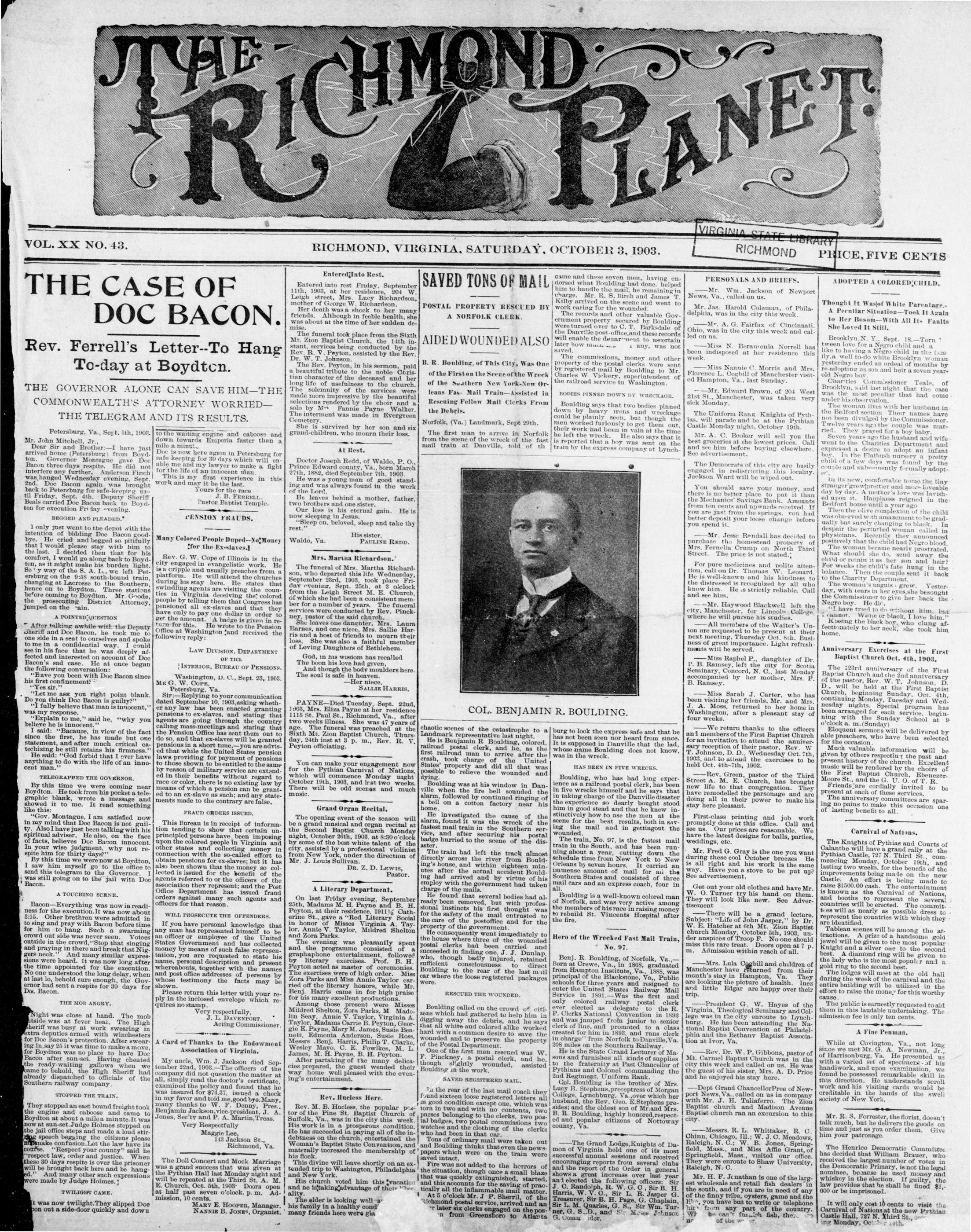
SAVED TONS OF MAIL
SAVED TONS OF MAIL
POSTAL PROPERTY RESCUED BY
A NORFOLK CLERK.
AIDEDWOUNDEDALSO
B. R. Boulding, of This City, Was One of the First on the Scene of the Wreck of the Southern New York-New Orleans Fax-Mail Train—Assisted in Rescuing Fellow Mail Clerks From the Debris. Norfolk, (Va.) Landmark, Sept 29th. The first man to arrive in Norfolk from the scene of the wreck of the fast mail train at Danville, told of th
1910
M. H.
chaotic scenes of the catastrophe to a Landmark representative last night.
He is Benjamin R Boulding, colored, railroad postal clerk, and he, as the first railroad man to arrive after the crash, took charge of the United States' property and did all that was possible to relieve the wounded and dying.
Boulding was at his window in Danville when the fire bell sounded the alarm, followed by continued ringing of a bell on a cotton factory near his home.
He investigated the cause of the alarm, found it was the wreck of the fastest mail train in the Southern service, and after securing his postal badge hurried to the scene of the disaster.
burg to lock the express has not been seen nor hated. It is supposed in Danville whose name Boulding was in the wreck.
HAS BEEN IN FIVE
Boulding, who has encease as a railroad post in five wrecks himself in taking charge of the experience so dear him in good stead and is distinctively how to use the scene for the best resing the mail and in wounded.
The train, No. 97, is train in the South, and
The train had left the track almost directly across the river from Boulding's house, and within eighteen minutes after the actual accident Boulding had arrived and by virtue of his employ with the government had taken charge of the mails.
He found that several bodies had already been removed, but with professional instincts his first thought was for the safety of the mail entrusted to the care of the postoffice and for the property of the government.
He consequently went immediately to the house where three of the wounded postal clerks had been carried and succeeded in finding one, J. J. Dunlap, who, though badly injured, retained sufficient consciousness to direct Boulding to the rear of the last mail car where the loose registered packages were.
RESCUED THE WOUNDED
Boulding called on the crowd of citizens which had gathered to help him in digging away the debris, and he says that all white and colored alike worked hard with a common desire to save the wounded and to preserve the property of the Postal Department. One of the first men rescued was W. F. Pinckney, a postal clerk, and he, though slightly wounded, assisted Boulding in the work.
SAVED REGISTERED MAIL:
In the rear of the last mail coach they found sixteen loose registered letters all in good condition except one, which was torn in two and with no contents, two purses belonging to the clerks, two postal badges, two postal commissions two watches and the clothing of the clerks who had been in that car.
Tons of ordinary mail were taken out and Boulding thinks that even the newspapers which were on the train were saved intact.
Fire was not added to the horrors of the situation, though once a small blaze that was quickly extinguished, started, and this accounts for the saving of practically all the inflammable mail matter.
At 5 o'clock Mr. J P. Sherrill, of the Richmond postal service, arrived and an later six clerks engaged on the post.
came and these seven men, having endorsed what Boulding had done, helped him to handle the mail, he remaining in charge. Mr. R. S. Birch and James T. Kilby arrived on the scene and went to work caring for the wounded. The records and other valuable Government property secured by Boulding were turned over to C. T. Barksdale of the Danville post-office, and these records will enable the department to ascertain later how much money any, was not saved. The commissions, money and other property of the postal clerks were sent by registered mail by Boulding to Mr. Charles W. Vickery, superintendent of the railroad service in Washington
BODIES PINNED DOWN BY WRECKAGE
Boulding says that two bodies pinned down by heavy irons and wreckage could be plainly seen, but though the men worked furiously to get them out, their work had been in vain at the time he left the wreck. He also says that it is reported that a boy was sent on the train by the express company at launch.
papyrus at Byrne
burg to lock the express safe and that he has not been seen nor heard from since. It is supposed in Danville that the lad, whose name Boulding does not know, was in the wreck.
HAS BEEN IN FIVE WRECKS.
Boulding, who has had long experience as a railroad post clerk, has been in five wrecks himself and he says that in taking charge of the Danville disaster the experience so dearly bought stood him in good stead and that he knew instinctively how to use the men at the scene for the best results, both in saving the mail and in getting out the wounded.
The train, No. 97, is the fastest mail train in the South, and has been running about a year, cutting down the schedule time from New York to New Orleans by seven hours. It carried an immense amount of mail for all the Southern States and consisted of three mail cars and an express coach, four in all.
Boulding is a well-known colored man of Norfolk, and was very active among the members of his race in raising money to rebuild St. Vincents Hospital after the fire.
Hero of the Wrecked Fast Mail Train No. 97.
Benj. R. Boulding, of Norfolk, Va., — Born at Crewe, Va., in 1868, graduated from Hampton Institute, Va., 1888, was principal of the Blackstone, Va., Public schools for three years and resigned to enter the United States Railway Mail Service in 1891. — Was the first and only colored railway postal clerk ever elected as delegate to the R. P. Clerks National Convention in 1892 and was jumped from junior to senior clerk of line, and promoted to a class created for him in 1893, and runs clerk in charge" from Norfolk to Danville, Va. 208 miles on the Southern Railway.
He is the State Grand Lecturer of Masons and furnishes all kinds of supplies to the fraternity at Past Chancellor of Pythians and Colonel commanding the 2nd Regiment, Uniform Rank.
Col. Boulding is the brother of Mrs. Lucy B. Stephens, preceptress of Morgan College, Lynchburg, Va., over which her husband, the Rev. Geo. E. Stephens presides; and the oldest son of Mr. and Mrs. B. R. Boulding, highly honored, respected and popular citizens of Nottoway county, Va.
The Grand Lodge, Knights of Damon of Virginia held one of its most successful virgin sessions and received encouraging reports from several clubs and the report of the Order in general shows a great increase over last year and elected the following officers: Sir J. C. Randolph, R. W. G. O, Sir B. H. Harris, W. V. O., Sir L. R. Jasper G. Treasurer, Sir B. H. Page, G. Chaplain, Sir L. M. Quarles, G. S., Sir Wm. Turner, G. S. D., and Sir Moses Johnson G. Conn. ider
PERSONALS AND BRIEFS.
Mr. Wm. Jackson of Newport News, Va., called on us.
Mr. Jas. Harold Coleman, of Philadelphia, was in the city this week.
Mr. A. G. Fairfax of Cincinnati, Ohio, was in the city this week and called on us.
Miss N. Beranenia Norrell has been indisposed at her residence this week.
Miss Nannie C. Morris and Mrs. Florence L. Cogbill of Manchester visited Hampton, Va., last Sunday.
Mr. Edward Brown, of 204 West 21st St., Manchester, was taken very sick Monday.
The Uniform Rank Knights of Pythias, will parade and be at the Pythian Castle Monday night, October 19th.
Mr. A. C. Booker will sell you the best groceries at the lowest prices. Call and see him before buying elsewhere. See advertisement.
The Democrats of this city are basically engaged in redistricting this locality. Jackson Ward will be wiped out.
You should save your money, and there is no better place to put it than the Mechanics' Savings Bank. Amounts from ten cents and upwards received. If you are just from the springs, you had better deposit your loose change before you spend it.
—Mr. Jesse Rendall has decided to purchase the homestead property of Mrs. Fernella Crump on North Third Street. The price is not stated.
For pure medicines and polite attention, call on Dr. Thomas W. Leonard. He is well-known and his kindness to the distressed is recognized by all who know him. He is strictly reliable. Call and see him.
—Mr. Haywood Blackwell left the city, Manchester, for Lincoln College, where he will pursue his studies.
All members of the Waiter's Union are requested to be present at their next meeting, Thursday Oct. 8th. Business of great importance. Light refreshments will be served.
Miss Raphel P., daughter of Dr. P. B. Ramsey, left the city for Scotia Seminary, Concord, N. C., last Monday accompanied by her mother, Mrs. P. B. Ramsey.
Miss Sarah J. Carter, who has been visiting her friends, Mr. and Mrs. J. A. Moss, returned to her home in Washington, after a pleasant stay of four weeks.
We return thanks to the officers and members of the First Baptist Church for an invitation to attend the anniversary reception of their pastor, Rev. W. T. Johnson, D. D., Wednesday Oct. 7th, 1903, and to attend the exercises to be held Oct. 4th-7th, 1903.
Rev. Green, pastor of the Third Street A. M. E. Church, has brought new life to that congregation. They have remodelled the parsonage and are doing all in their power to make his stay here pleasant.
First-class printing and job work promptly done at this office. Call and see us. Our prices are reasonable. We have the latest designs for balls, parties, weddings, etc.
Mr. Fred G. Gray is the one you want during these cool October breezes. He is all right and his work is the same way. Have you a stove to be put up? See advertisement.
Get out your old clothes and have Mr. W. O. Turner try his hand on them. They will look like new. See Advertisement
There will be a grand lecture, Subject: "Life of John Jasper," by Dr. W. E. Hatcher at 6th Mt. Zion Baptist church Monday, October 5th, 1903, under anspies of Troop F. No one should miss this rare treat. Doors open at 7 p. m. Admission within reach of all.
Mrs. Lula Cogbill and children of Manchester have returned from their month's stay in Hampton, Va. They are looking the picture of health. Inez and little Edgar are happy over their trip.
President G. W. Hayes of the Virginia, Theological Seminary and College was in the city enroute to Lynchburg. He has been attending the National Baptist Convention at Philadelphia and the Bethany Baptist Association at Ivor, Va.
Rev. Dr. W. P. Gibbons, pastor of Mt. Carmel Baptist Church was in the city this week and called on us. He was the guest of his sister, Mrs. A. D. Price and he enjoyed his stay here.
—Dept Grand ChancellorPree of Newport News, Va., called on us in company with Mr. J. H. Taliaferro. The Zion Baptist church and Madison Avenue Baptist church ran an excursion to this city.
—Messrs. R. L. Whittaker, R. C. Chinn, Chicago, Ill.; W. J. C. Meadows, Raleigh, N.C.; W. B. Jones, Springfield, Mass., and Miss Affie Grant, of Springfield, Mass., visited our office. They were enroute to Shaw University, Raleigh, N.C.
Mr. H. F. Jonathan is one of the largest wholesale and retail fish dealers in the south, and if you are in need of any of the finny tribe, oysters, game and the fish, you have to write or telephone him from any part of the country. We can't for, fish the.
ADOPTED A COLORED CHILD.
Thought It Wasof White Parentage. A Peenial Situation—Took It Again to Her Bosom—With All Its Faults She Loved It Still.
Brooklyn, N. Y., Sept. 18.—Torn tween love for a Negro child and a
ween love for a Negro child and a like to having a Negro child in the family. a well-to-do white Brooklyn woman yesterday ended an ordeal of months by re-adopting as son and heir a seven year-old Negro boy.
Chaplain Commissioner Teale, of Brooklyn, said last night that the case was the most peculiar that had come under his observation.
The woman lives with her husband in the Belford section. Their names have not been divulged by the Commissioner. Twelve years ago the couple was married. They prayed for a boy baby.
Seven years ago the husband and wife went to the Charities Department and expressed a desire to adopt an infant boy. In the Flatbush nursery a pretty child of a few days was found by the couple and subsequently formally adopt.
In its new, comfortable nome the tiny stranger grewpretetter and more loveable day by day. A mother's love was lavished upon it. Happiness reigned in the Bedford home until a year ago.
Then the dive complexion of the child was observed with amazement to be gradually but surely changing to black. In despair the perturbed woman called in physicians. Recently they announced positively that the child had Negro blood. The woman became nearly prostrated. What should she do, send away the child or retain it as her son and heir? For nurses the child's fate hung in the balance. The couple sent it back to the Charity Department. The woman's anguish grew. Yesterday, with tears in her eyes, she besought the Commissioner to give her back the Negro boy. He did. "I have tried to do without him, but I cannot. White or black, I love him." Kissing the black boy, who clung affectionately to her neck, she took him home.
Anniversary Exercises at the First Baptist Church Oct. 4th, 1903
The 123rd anniversary of the First Baptist Church and the 2nd anniversary of the pastor, Rev. W. T. Johnson, D. D., will be held at the First Baptist Church, beginning Sunday, October 4th, continuing Monday, Tuesday and Wednesday nights. Special program has been arranged for each service, beginning with the Sunday School at 9 o'clock a.m. (Sunday)
Eloquent sermons will be delivered by able preachers, who have been selected for the occasion.
Much valuable information will be given by others respecting the past and present history of the church. Excellent music will be rendered by the choirs of the First Baptist Church, Ebenezer-Moore St., and the G. U. O. of T. R.
Friends are cordially invited to be present at each of these services.
The anniversary committees are sparing no pains to make this occasion one of lasting benefit to all.
Carnival of Nations.
The Knights of Pythias and Courts of Calanthe will have a grand rally at the Pythian Castle, 727 N. Third St., commencing Monday, October 19th, and lasting two weeks, for the benefit of the improvements being made on the new Castle. An effort is being made to raise $1500.00 cash. The entertainment is known as the Carnival of Nations, and booths to represent the several countries will be erected. The committees will as nearly as possible dress to represent the countries with which they are identified. Tableau scenes will be among the attractions. A prize of a handsome gold jewel will be given to the most popular Knight and a silver one to the second best. A diamond ring will be given to the lady who is the most popular and a gold ring to the second best. The lodges will meet at the old hall during the week of the carnival and the entire building will be utilized in the effort to raise the money for this worthy cause.
The public is earnestly requested to aid them in this laudable undertaking. The admission fee is only ten cents.
A Fine Penman.
While at Covington, Va., not long since we met Mr. G. A. Newman, Jr., of Harrisonburg, Va. He presented us with a varied set of specimen-of his handiwork, and upon examination, we found he possessed remarkable skill in this direction. He understands scroll work and his visiting cards would be creditable in the hands of the swell society of New York.
Mr. R. S. Forrester, the florist, doesn't talk much, but he delivers the goods on time and just as you order them. Give him your patronage.
The Henrico Democratic Committee has decided that William Brauer, who received the largest number of votes in the Democratic Primary, is not the legal nominee, because he used money and whiskey in the election. If guilty, the law provides that he shall be fined $1,000 or be imprisoned.
It will only cost 10 cents to visit the
Carnival of Nations at the new Pythian
Castle Hall, 727 N. Third St.,
ing Monday, October 11.
THE PLANET
RELIGIOUS MATTERS
COME AND DINE.
What is this form on the sandy beach, Busy with work sublime? Living a hall in human speech, Bidding them come and dine. With sorred hands He gathers the wood, Roasting the fish in the sun, Preparing for hungry men their food, When tolls of the sea are done. What are these marks on His manly feet? On His brow? where the crown should be, generous hall to the fishermen's feet, And a meal by the side of the sea. Wholesome fears on their souls were cast, Reverent worship given, Double meal, a sweet repast, O rarest bread from Heaven. Bread for the body, bread for the soul, By resurrection power, Baking a dish that them whole, Crown of their lasting dower. Rey, H. T. Miller, in N. Y. ObsERVER.
HAPPINESS.
Not to Be Found by Those Who Seek
It by Lowering of Moral
Standards.
If we judge men by their actions,
and the objects which they pursue,
their chief desire seems to be that
they may attain happiness. A man is
called blessed who can invent a new
joy, or show his fellow men the way
to further pleasures. The chief question
asked, in a change of position or
occupation, often is: "Will I like the
new place better than the old?"
Men will toil hard, early and late,
and do it willingly if you can only
show them a recompense of happiness
at the end of it all.
But this world is after all a sad one. It is full of disappointment, sick, sorrowing, baffled and defeated men. The cynic is everywhere in evidence. Bright hopes are blasted. Riches take unto themselves wings and fly away. Position, talent, and hopeful worldly influence are no protection against the plague of black care.
We have then, says the Chicago Advance, the anomaly of man fitted for happiness, and desiring it above all things, yet having it flee from him. Some philosophers have declared that the whole world is an illusion, and that there is no such thing as reality. It is impossible, we are told, for a man to attain the things which he desires and that it is useless for him to fret himself about them. The Greeks expressed this idea in the table of Tantialus in Tartarus. He was immersed in water up to his chin and a tree loaded with luscious fruits hung its branches just over his head. He was thirsty and hungry, but when he attempted to drink, the water fled from him, and when he tried to pick the fruit, just above his head, it vanished away.
But why should happiness flee from man, when he so ardently desires it? The trouble is that men for the most part seek it through relaxation, and the lowering of the standards. It is the old history of Adam and Eve over again. There was a settling down of moral integrity on their part for the grasping of what they considered a greater happiness. Men ask to-day: Why should we obey this or that law of God, man, or of our moral nature, when it bars the way to our enjoyment? This is part of the revolt against what men call "Puritanism." The Chinaman smokes his opium pipe regardless of the consequences, because it, for the time being, brings to him dreams of surprising bliss. Men seem to care little for the consequences in their pleasures, and hence some their wanderings in bleak wilderness.
Jesus Christ showed that if a man would be truly happy he must attain to this happiness through a mastery of the situation. There is no joy like that of the victor. It is the man who has gone down into the tumult and uproar of life and fought and conquered in some good cause who tastes of the nectar of supreme joy. The master words with Christ were: "Fight, watch and pray;" here is the entrance to the real Utopia for which men seek. The man who has no mastersy over his appetites, passions and temper can never know what genuine toy is.
The conditions of happiness which produce no illusions and brighten more and more unto a perfect day are not difficult to name. There must be some supreme object of love and hope upon which the heart is fixed. There must be a harmony with the will of God. There must be endurance in the cause of Jesus Christ. There must be an inner peace which no outer tumult can disturb.
GEMS OF THOUGHT.
It is God's glory to help at a pinch.
If you want to remember truth mediate, repeat, confer. Act it as soon as you hear it.
Under sin we are free to do anything but good; under Christ we are free to do anything but evil.
Come, said Latimer, to the public meetings, though thou comest to sleep; it may be God may take thee napping. Absence is without hope.
God made man after His image, and men (to requite Him) will needs make image; cast Him anew.
tan. The Macedonians have also had the example of Crete for encouragement; but Macedonia is not an island, and the Macedonians "have the fate of both the Armenians and Thessalians to warn them that on the mainland the Turk cannot be resisted by half-drilled forces."
Put Greeks, Bulgarians and Turks together, and it goes without saying that peace will depart from their joint abode. The fiery Greek, the wily Turk, the revolutionary Bulgarian, none of them are wont to turn the other cheek to the smiter. Broils within, egged on by broilers without, thus to the layman appears the situation in Macedonia.
AUST
BELG
SERV
BOSNIA
MONTENEGRO
SKUTARI
ADRIATIC
SEA
BRINDISI
ITALY
TURBANIA
JONIAN
SEA
MEDITERRANEAN
SEA
in their base mold, and make an idol of Him. Xenophanes was wont to say, that if beasts were able to paint, they would portray a god like to themselves. —Rev. S. Hartwell Pratt, in N. Y. Observer.
PERILS OF PRIVILEGE
Position, Family and Wealth All Mean Added Responsibility for Those Exceptionally Favored.
Christ taught a proportionate responsibility, says the Boston Congregationalist. "To whosoever much is given, of him much shall be required; and to whom they commit much, of him will they ask the more." Great gifts and privileges, therefore, carry with them a corresponding danger. This is so with personal gifts, it is doubly so with our relation to corporate bodies in which we hold a membership. The strong man likes to use his strength. He may use it for evil, but he is not likely to let it lie unused. In the parable it is not the one who has ten talents who hides them away unused. The great danger is more frequently with the weak, who rest upon the attainment of others, and fail to exert and improve what strength they have. The perils arising from privileges are most frequently the perils of the weak and the few talented.
One such peril is that of narrowness of view. Prosperity is, on the whole, exceptional, but the thoughtless members of a successful church or company are apt to fall out of sympathy with the unsuccessful members. Members of strong churches hear with some impatience the call for help in mission fields. They are used to strength, their imagination is too feeble to enable them to sympathize with the struggle and hardship in which all great work begins. The personally prosperous, especially the prosperous through inheritance, have little patience with poverty or misfortune, which too often seem like crimes. But to be unsympathetic is to be dead to the fellowship of believers, to whom Christ prophesied that they must suffer tribulation.
In the same way, pride of family is often treated as if it were a virtue which the owner had himself acquired, instead of a responsibility which God has laid upon him. This view of good descent as a ground of personal merit is as common as it is amusing, but it easily becomes a peril to the soul. The same is often true of national pride, which also is God's call to great responsibilities. To be an American is only a matter of choice to those who are not born Americans. To be a good American is a responsibility and an opportunity. The danger is that we may think that because America is so strong we can afford to be weak or careless citizens. To be an American is little. Three assassins of three presidents have been Americans by birth or choice. But to be the right sort of an American is much.
The church is made up of men who lift, and men who lean, of men who are feeders of strength, and men who are parasites. The world is in need of a whole-souled, unanimous, growing and Christ-like church. It is a peril of privilege if any disciple believes that this need does not include his own enthusiasm and growth toward strength. The strong can never help the weak as they might do, until every church has all the working force at its disposal which God has given. The bracing atmosphere of struggle may be far better for the soul than confidence in the attalments and the strength of which we are a part, but to which we contribute nothing.
TWO KINDS OF SYMPATHY.
One Kind Bestows a Miserable Sort of Comfort, the Other Is Truly Helpful.
Sympathy is a word set over from the Greek, and means "suffering with." Hence one who sympathizes with another suffers with him. In our careless use of the word we do not put so much meaning into it. As generally employed, it means that one has a gentle touch of pity for another who is in trouble. In order to have it signify anything worth while we should put its full meaning into it when we use it.
There are two kinds of sympathy, says Wellspring. There is a so-called sympathy that is simply depressing. If one is in trouble, it makes his trouble seem greater ard harder to bear. It weeps with one, but not in a comforting way. On the contrary, it makes one feel that he indeed has occasion to weep, and that there is no real solace for him. If one is cast down because of his health, it makes him almost give up all hope of recovery. In his friends Job had sympathizers, but he was justified in saying to them: "Miserable comforters are ye all."
The other is a sympathy that puts heart, hope, manhood into one. If one is cast down it leaves him cheered. Afterwards the obstacles do not look so formidable or the clouds so black. In our despondent words we magnify our troubles; helpful sympathy enables us to see them in their true proportions. This kind of sympathy not only weeps with those who are sorrowful, but speaks a comforting word. It does not merely pity the unfortunate, it puts out a hand to lift him up. If one really sympathizes—suffers with—another, he will do something besides condole, if something besides condolence is needed. Sympathize with others, as you would like to have others sympathize with you.
Is a Slow Death
Worry is slow death and neither hospital nor asylum can bring relief. The physician cannot cure it. All the ozone of the mountains and the soft salt breezes of the sea are powerless in its presence. Flee worry; it is the bane of all peace. United Presbyterian.
Based on Divine Love
The sacrifice of Christ is a part of the
vary essence of Christianity, but the
basis of Christianity is the eternal love
of God.—Henry Drummond.
The Usual Fate.
Contentment's better far, they say.
Than wealth, but Oh, my brother!
We just plod on from day to day
With neither one nor other.
Philip up in Press.
THE RICHMOND PLANET, RICHMOND; VIRGINIA
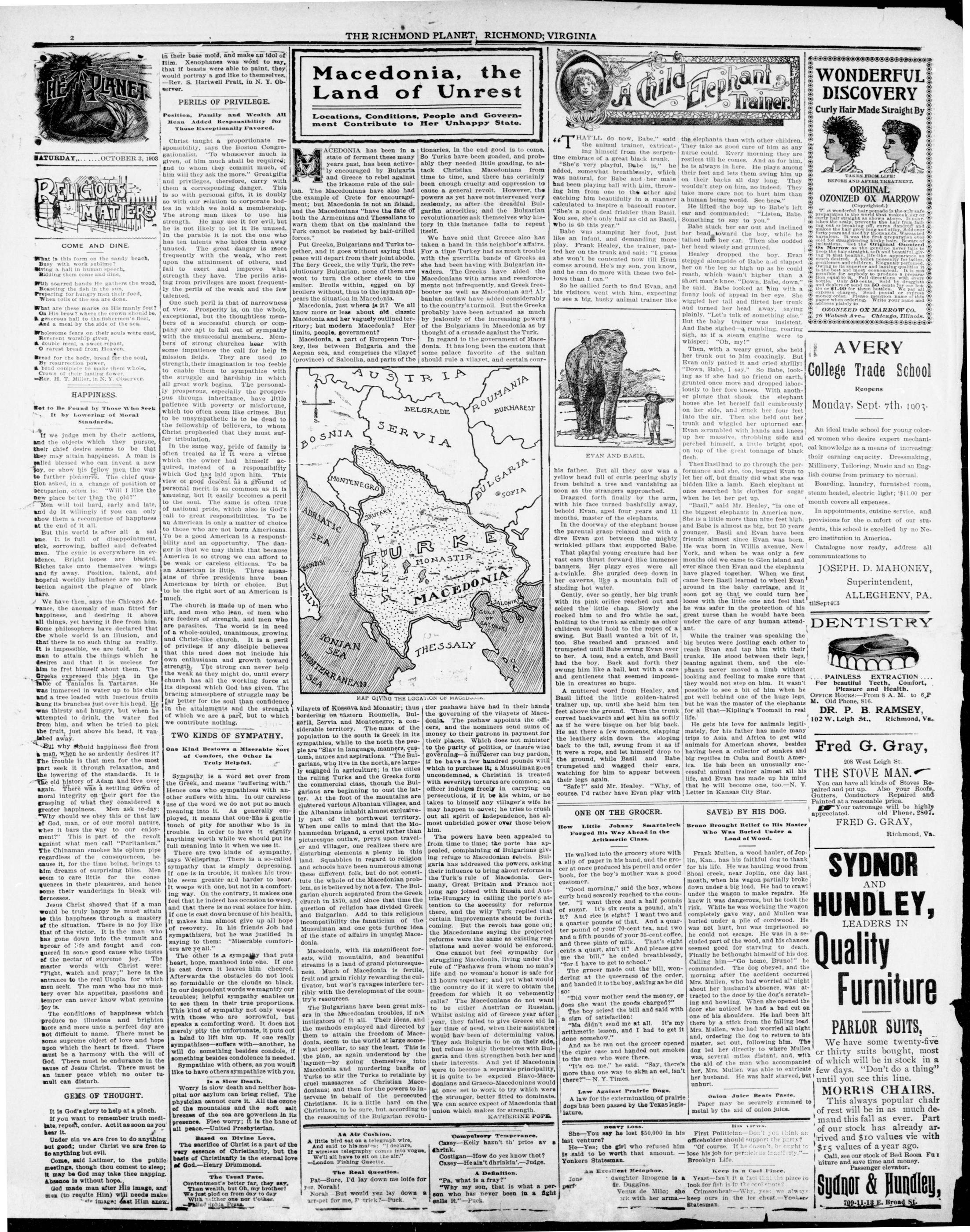
Macedonia, the Land of Unrest
Locations, Conditions, People and Government Contribute to Her Unhappy State.
ACEDONIA has been in a state of ferment these many years past, has been actively encouraged by Bulgaria and Greece to rebel against the irksome rule of the sul-
Macedonia, just where is it? We all know more or less about old classic Macedonia and her vaguely outlined territory; but modern Macedonia? Her limits, people, government?
Macedonia, a part of European Turkey, lies between Bulgaria and the Aegean sea, and comprises the vilayet (province) of Salonika, and parts of the
AUSTRIA
BELGRADE
ROUMANIA
BUKHAREST
SERVIA
BOSNIA
MONTENEGRO
BULGARIA
©SOFIA
ADRIATIC
SEA
BRINDISI
ITALY
ALBANIA
TURKEY
MONASTIR
MACEDONIA
SALONIKI
GULF OF SALONIKI
TONIAN
SEA
MEDITERRANEAN
SEA
THESSALY
MAP GIVING THE LOGATION OF MACEDONIA
vilayets of Kossava and Monastir; thus bordering on eastern Roumelia, Bulgaria, Servia and Montenegro; a considerable territory. The mass of the population to the south is Greek in its sympathies, while to the north the people are "Slav in language, manners, customs, names and aspirations." "The Bulgarians, who live in the north, are largely engaged in agriculture; in the cities the ruling Turks and the Greeks form the commercial class, though the Bulgarians are beginning to oust the latter. At the foot of the mountains are clustered various Albanian villages, and the Albanians inhabit almost exclusively part of the northwest territory. When one calls to mind that the Mohammedan brigand, a cruel rather than picturesque outlaw, preys upon traveler and villager, one realizes there are disturbing elements a plenty in this land. Squabbles in regard to religion and schools have been numerous among these different folk, but do not constitute the whole of the Macedonian problem, as is believed by not a few. The Bulgarian church separated from the Greek church in 1870, and since that time the question of religion has divided Greek and Bulgarian. Add to this religious incompatibility the fanaticism of the Mussulman and one gets further idea of the state of affairs in unquiet Macedonia.
Macedonia, with its magnificent forests, wild mountains, and beautiful streams is a land of grand picturesqueness. Much of Macedonia is fertile, fruit and grain richly rewarding the cultivator, but war's ravages interfere terribly with the development of the country's resources.
The Bulgarians have been great mixers in the Macedonian troubles, if not instigators of it all. Their ideas, and the methods employed and directed by them to attain the freedom of Macedonia, seem to the world at large somewhat peculiar, to say the least. This is the plan, as again understood by the laymen—by going themselves into Macedonia and murdering bands of Turks to stir the Turks to retaliate by cruel massacres of Christian Macedonians; and then for the powers to intervene in behalf of the persecuted Christians. It is a little hard on the Christians, to be sure, but, according to the reasoning of the Bulgarian revolu-
An Air Cushion.
A little bird sat on a telegraph wire,
And said to his mates: "I declare,
If wireless telegraphy comes into vogue,
We'll all have to sit on the air."
—London Fishing Gazette.
The Real Question.
Pat—Sure, I'd lay down me loife for
you, Norah!
Norah—But would yez lay down a
arr-pet for me, F trick?—Puck.
M
tionaries, in the end good is to come. So Turks have been goaded, and probably they needed little goading, to attack Christian Macedonians from time to time, and there has certainly been enough cruelty and oppression to cause a general revolt. However, the powers as yet have not intervened very zealously, as after the dreadful Bulgarian atrocities; and the Bulgarian revolutionaries ask themselves why history in this instance fails to repeat itself.
We have said that Greece also has taken a hand in this neighbor's affairs. For a time Turkey had as much trouble with the guerrilla bands of Greeks as she had been having with Bulgarian invaders. The Greeks have aided the Macedonians with arms and reenforcements not infrequently, and Greek freebooster as well as Macedonian and Albanian outlaw have added considerably to the country's turmoil. But the Greeks probably have been actuated as much by jealously of the increasing powers of the Bulgarians in Macedonia as by thought of a crusade against the Turk. In regard to the government of Macedonia. It has long been the custom that some palace favorite of the sultan should rule a vilayet, and certain cour-
RIA
GRADE
ROUMANIA
BUKHAREST
VIA
BULGARIA
©SOFIA
RKEY
MONASTIR
MACEDONIA
SALONIKI
GULF
OF
SALONIKI
THESSALY
tier pashaws have had in their hands the governing of the vilayets of Macedonia. The pashaw appoints the officers, and the nominees send sums of money to their patrons in payment for their places. Which does not minister to the purity of politics, or insure wise governing—a murderer can buy pardon, if he have a few hundred pounds with which to purchase it; a Mussulman goes uncondemned, a Christian is treated with severity; tortures are common; an officer indulges freely in carrying on persecutions, if it be his whim, or he takes to himself any villager's wife he may happen to covet; he tries to crush out all spirit of independence, has almost unbridled power over those below him.
The powers have been appealed to from time to time; the porte has appealed, complaining of Bulgarians giving refuge to Macedonian rebels. Bulgaria has addressed the powers, asking their influence to bring about reforms in the Turk's rule of Macedonia. Germany, Great Britain and France not long ago joined with Russia and Austria-Hungary in calling the port's attention to the necessity for reforms there, and the wily Turk replied that certain improvements should be forthcoming. But the revolt has gone on; the Macedonians saying the projected reforms were the same as existing regulations and never would be enforced.
One cannot but feel sympathy for struggling Macedonia, living under the rule of "Pashaws from whom no man's life and no woman's honor is safe for 12 hours together; and yet what would the country do if it were to obtain the freedom for which it so vehemently calls? The Macedonians do not want to be either Austrian or Russian. Whilst asking aid of Greece year after year, they failed to give Greece aid in her time of need, when their assistance would have been of determining value. They ask Bulgaria to be on their side, but refuse to ally themselves with Bulgaria and thus strengthen both her and their interests. And yet if Macedonia were to become a separate principality, it is quite to be expected Slavo-Macedonians and Graeco-Macedonians would at once set to work to try which were the stronger, better fitted to dominate. We can scarce expect of Macedonia that union which makes for strength.
Compulsory Temperance.
Casey—Kelly hazn't th' price av
dhrink.
Costigan—How do yez know that?
Casey—He ain't dhrinkin'.—Judge.
"Why my son, that is what a person who has never been in a fight calls it"—Puck.
KATHERINE POPE
A Child Elephant Trainer.
"THAT'LL do now, Babe," said the elephants than with other children the animal trainer, extricating himself from the serpentine embrace of a great black
"She's very playful, Babe is," he added, somewhat breathlessly, which was natural, for Babe and her mate had been playing ball with him, throwing him from one to the other and catching him beautifully in a manner calculated to inspire a baseball rooter. "She's a good deal friskier than Basil. You see, she's only half as old as Basil, who is 60 this year." Babe was stamping her foot, just like an infant, and demanding more play. Frank Healey, the trainer, patted her on the trunk and said: "I guess she won't be contented now till Evan comes around. He's my son, you know, and he can do more with these two fellows than I can."
So he sailed forth to find Evan, and his visitors went with him, expecting to see a big, husky animal trainer like
EVAN AND BASIL.
his father. But all they saw was a yellow head full of curls peering shyly from behind a tree and vanishing as soon as the strangers approached. Dragged forth finally by the arm, with his face turned bashful away, behold Evan, aged four years and 11 months, master of the elephants. In the doorway of the elephant house the parental grasp relaxed and with a dive Evan got between the mighty wrinkled pillars that supported Babe. That playful young creature had her vast ears thrust forward like immense banners. Her piggy eyes were all a-twinkle. Sheurged deep down in her caverns, like a mountain full of sizzling hot water.
Gently, ever so gently, her big trunk with its pink orifice reached out and seized the little chap. Slowly she rocked him to and fro while he sat, holding to the trunk as calmly as other children would hold to the ropes of a swing. But Basil wanted a bit of it, too. She reached and pranced and trumpeted until Babe swung Evan over to her. A toss, and a catch, and Basil had the boy. Back and forth they swung him like a ball, but with a care and gentleness that seemed impossible in creatures so huge.
A muttered word from Healey, and Basil lifted the little golden-haired trainer up, up, until she held him ten feet above the ground. Then the trunk curved backwards and set him as softly as if he were bisque on her big back. He sat there a few moments, slapping the leathery skin down the sloping back to the tail, swung from it as if it were a rope, and let himself drop to the ground, while Basil and Babe trumpeted and wagged their ears, watching for him to appear between their legs again.
"Safe?" said Mr. Healey. "Why, of course, I'd rather have Evan play with
ONE ON THE GROCER.
How Little Johnny Smartaleck
Forged His Way Ahead in the
Arithmetic Class.
He walked into the grocery store with a slip of paper in his hand, and the grocer at once produced his pencil and order book, for the boy's mother was a good customer.
"Good morning," said the boy, whose curly head scarcely reached to the counter.
"I want three and a half pounds of sugar. It's six cents a pound, ain't it? And rice is eight? I want two and a quarter pounds of that. And a quarter pound of your 70-cent tea, and two and a fifth pounds of your 35-cent coffee, and three pints of milk. That's eight cents a quart, ain't it? And please give me the bill," he ended breathlessly, "for I have to get to school."
The grocer made out the bill, wondering at the queerness of the order and handed it to the boy, asking as he did so.
The boy seized the bill and said with a sign of satisfaction:
"Ma didn't send me at all. It's my arithmetic lesson, and I had to get it done somehow."
And as he ran out the grocer opened the cigar case and handed out smokes to the men who were there.
"It's on me," he said. "Say, there's more than one way to skim an eel, isn't there?"—N. Y. Times.
Law Against Prairie Dogs.
A law for the extermination of prairie dogs has been passed by the Texas legislature.
the elephants than with other children. They take as good care of him as any nurse could. Every morning they are restless till he comes. And as for him, he is always in here. He plays among their feet and lets them swing him up on their backs all day long. They wouldn't step on him, no indeed. They take more care not to hurt him than a human being would. See here." He lifted the boy up to Babe's left ear and commanded: "Listen, Babe. Something to say to you." Babe stuck her ear out and inclined her head toward the boy, while he talked into her ear. Then she nodded her head wisely and grunted.
Healey dropped the boy. Evan stepped alongside of Babe and slapped her on the leg as high up as he could reach, which wasn't higher than a short man's knee. "Down, Babe, down," he said. Babe looked at him with a funny look of appeal in her eye. She wiggled her tail and flirted her trunks and turned her head away, saying plainly. "Let's talk of something else." But the baby trainer was insistent. And Babe sighed—a rumbling, roaring sigh, as if a steam engine were to whisper: "Oh, my!"
Then, with a weary grunt, she held her trunk out to him coaxingly. But Evan only patted it and cried shrilly: "Down, Babe, I say." So Babe, looking as if she had no friend on earth, grunted once more and dropped laboriously to her fore knees. With another plunge that shook the elephant house she let herself fall cumbrous on her side, and stuck her four feet into the air. Then she held out her trunk and wiggled her upturned ear. Evan scrambled with hands and knees up her massive, throbbing side and perched himself, a little bright spot, on top of the great tonnage of black flesh.
Then Basilhad to go through the performance and she, too, begged Evan to let her off, but finally did what she was bidden like a lamb. Each elephant at once searched his clothes for sugar when he let her get up.
"Basil," said Mr. Healey, "is one of the biggest elephants in America now. She is a little more than nine feet high, and Babe is almost as big, but 30 years younger. Basil and Evan have been friends almost since Evan was born. He was born in Willis avenue, New York, and when he was only a few months old we came to Glen island and ever since then Evan and the elephants have played together. When we first came here Basil learned to wheel Evan around in the baby carriage, and it soon got so that we could turn her loose with the little one and feel that he was safer in the protection of his great nurse than he would have been under the care of any human attendant.
While the trainer was speaking the big brutes were jostling each other to reach Evan and tap him with their trunks. He stood between their legs, leaning against them, and the elephants never moved a limb without looking and feeling to make sure that they would not step on him. It wasn't possible to see a bit of him when he got well behind one of the huge legs, but he was the master of the elephants for all that—Kipling's Toomail in real life.
He gets his love for animals legitimately, for his father has made many trips to Asia and Africa to get wild animals for American shows, besides having been a collector of snakes and big reptiles in Cuba and South America. He has been an unusually successful animal trainer almost all his life, and Evan has made up his mind that he will become one, too.—N. Y. Letter in Kansas City Star.
SAVED BY HIS DOG
Bruno Brought Relief to His Master Who Was Buried Under a Lord of Wood.
Frank Mullen, a wood hauler, of Joplin, Kan., has his faithful dog to thank for his life. He was hauling wood from Shoal creek, near Joplin, one day last month, when his wagon partially broke down under a big load. He had to crawl under the wagon to make repairs. He knew it was dangerous, but he took the risk. While he was working the wagon completely gave way, and Mullen was buried under a pile of cordwood. He was not hurt, but was imprisoned so he could not escape. He was in a secluded part of the wood, and his chances seemed good for starving to death. Finally he bethought himself of his dog. Calling him—"Go home, Bruno!" he commanded. The dog obeyed, and the morning after the accident occurred Mrs. Mullen, who had worried all night about her husband's absence, was attracted to the door by the dog's scratching and howling. When she opened the door she noticed he had a bad cut on one of his shoulders. He had been hit there by a stick from the falling load. Mrs. Mullen, who had worried all night and, ordering the dog to return to his master, set out, following him. The dog led her directly to where Mullen was, several miles distant, and, with the aid of the man who accompanied her, Mrs. Mullen was able to extricate her husband. He was half starved, but unhurt.
Onion Juice Beats Paste. Paper may be securely gummed to metal by the aid of onion juice.
First Politician—Don't you think an officeholder should support the party?
"Of course. If he doesn't, he ought to lose his job for perilous femininity."—Brooklyn Life.
Yeast—don't it? It can't take the place to look for fish is in the cool store? We heat—in the kitchen—always keep ours in the ice chest—Yoan Lerz-Statesman.
WONDERFUL DISCOVERY Curly Hair Made Straight By
TAKEN FROM LIFE
T. It is wonderful hair pomade is the only safe preparation in the world that makes kary or hair shine the scalp, prevents the hair from falling out or breaking our ears, stands and flattens hair, and provides forty years and used by thousands. Warranted for straightening kinky hair. Beward of sold for straightening kinky hair. Beward of Or Marrow as the genuine newborn to keep the hair soft, soft and beautiful, giving much desired. A toilet necessity for ladies. Dying to its superior and lasting qualities it is not possible for anybody to economise a proof not equal to it. Full directions with every dealer or send us 50 cents for one bot and dealers or send us 50 cents for one bot express charges. Send postal or express money order. Please mention name of this business to writing. Write your name and address plply to.
* OZONIZED OX MARROW CO.
* Wubash Chicago, Illinois.
*
AVERY College Trade School
Reopens Monday, Sept. 7th, 1903.
An ideal trade school for young colored women who desire expert mechanical knowledge as a means of increasing their earning capacity. Dressmaking, Millinery, Tailoring, Music and an English course from primary to normal. Boarding, laundry, furnished room, steam heated, electric light; $11.00 per month covers all expenses. In appointments, cuisine service, and provisions for the comfort of our students, this school is excelled by no Negro institution in America. Catalogue now ready, address all communications to JOSEPH. D. MAHONEY.
Superintendent,
ALLEGHENY, PA.
tilSept403
DENTISTRY
PAINLESS EXTRACTION
For beautiful Teeth, Comfort,
Pleasure and Health.
OFFICE HOURS:—From 8 A. M. to 6 P.
M. Old Phone, 816.
DR. P. B. RAMSEY,
102 W. Leigh St., Richmond, Va.
Fred G. Gray,
Fred G. Gray,
208 West Leigh St.
THE STOVE MAN.
You can have all kinds of Stoves Repaired and put up. Also your Roofs, Gutters, Conductors Repaired and Painted at a reasonable price.
Your patronage will be highly appreciated.
FRED G. GRAY,
Richmond, Va.
SYDNOR
AND
HUNDLEY,
LEADERS IN
Quality
Furniture
PARLOR SUITS.
We have some twenty-five or thirty suits bought, most of which will be in stock in a few days. "Don't do a thing" until you see this line.
MORRIS CHAIRS.
This always popular chair of rest will be in as much demand this fall as ever. Part of our stock has already arrived and $10 values vie with $15 values of a year ago. Call, see our stock of Bed Room Furniture and save time and money. Passenger elevator. Sydnor & Hundley, 709-11-18 E. Broad St.
SPANISH PEGGY
A STORY OF YOUNG ILLINOIS
BY MARY HARTWELL CATHERWOOD
CHAPTER III.
Ann Rutledge heard through the open window Peggy's muffled cry and struggle, and ran to the door. By starlight it was barely possible to see a shadow fleeing from the hand-mill; but Antwine La Chance, in pursuit of it, passed across the bar of light, a lithe, long-bodied and long-limbed shape, his uncovered blond hair flying back from a face cut like the high-bred features of a French noble. He bounded by the hand-mill and crossed a fence at the foot of the garden.
When Antywine thought he was about to overtake the object down the ravine, a scamper of horse's hoofs sounded through the valley, Peggy's captor had left a horse ready for flight. Instead of making southeastward for the Rock creek bridge and the road to Springfield, he rounded the bluff and the village, and was evidently striking toward Beardstown. The western continuation of NewSalem street, stretching across the prairies until it met and curved with bluffs along the Sangamon, was the route to Beardstown, which stood at the junction of the Sangamon with the illinois.
Light-footed as a deer, scarcely pausing to think, Antwine with inherited instinct turned east toward the river, though it was the direction opposite that in which Peggy was carried. A boat could be found at the mill. The river was high and running swiftly. By taking advantage of the unusual current he might reach the bluff road as soon as a horse floundering across the mud of the prairies would be able to reach it. What he would then do afoot he did not attempt to foresee. There was a small settlement at the mouth of Ruddy Creek called Wolf. Oxen were too small than horses in W. K. Sanem; yet Antwine knew in flash of determination to see there and demand a horse. But breathless with haste, he plunged through naked woods and down the terraced bank of the Sangamon, sliding on dead leaves in his descent, straight to the mill.
The boat was tied above the dam. He pushed out before he thought of the dam, half covered by swelling water and roaring across the width of the Sangamon. Antywine was never more alive than when his feet were planted in a boat. He came of a line of voyageurs who had threaded Canadian rapdits time out of mind. Although his later years had been spent in Belleville, off great stream courses, his inborn dexterity was too much a part of him to be forgotten. There was no time for thought. He swooped down the curve poised in the stern of his boat, laughing aloud at the shock, which nearly swamped him. The boat ran without direction, making for partly submerged trees while he bailed with his hands. Antywine stuck out an car for a rudder in his craft into the water, baling with onions, the other, he soon able to swim, cars into rowing, racing force with Branches and logs.
The shores were black. Froth spots like white money appeared and disappeared around him with phosphoric swiftness. And underneath rose and fell the bullfrogs' diapason.
Not many miles down was the fork of the Sangamon, where the stream turned toward the Illinois. Beardstown, by prairie and river-bluff route, was nearly 40 miles from New Salem. Frost was out of the ground, and a bottomless trail would delay the most hurried rider. The scalloped bank, ascending and descending in serated cliff and hollow, seeming to swim past Antywine, finally curved away from a wider current; and he made for shore through drift. He drew the boat out, and left it beached above the rising water.
There was no sound abroad in all that void darkness except the Sanga-
mon's low note and the intermittent cry of frogs. He thought of sloughs on the Beardstown road and of hungry wolves infesting the night. Starlight had become lost in thickening mist, and as Antywine pushed on he felt the sting of rain in the face. He tried to distinguish a track which ought to darken the pallid turf near this place, and set out in the direction of Beardstown.
He heard at his left the suction of horse feet in mud. It came nearer, and he braced himself to spring at the bridle, if he had been so fortunate as thus to intercept Peggy's captor. But two horses, instead of one, plunged up from a slough, and swept past him in a tearing race toward Beardstown.
"Shlockshack and Sleur Abe," thought Antywine. He shouted after them, but they did not hear him. There was so little travel at that season he felt sure these riders were in pursuit of Peggy, and comforted, he followed lightly on, keeping to the spongy dead grass by the roadside.
The humid forest stretching from the bank of the Sangamon still darkened his way with skeleton trees. He passed an empty cabin which he had seen once before when hunting deer. The rain now began to pelt. Though he had lived so long among English-speaking people at Belleville that their language had become in a measure his own, Antywine never found himself able to part with buck-
skins. The hunting shirt was sometimes exchanged for one of linsey, but buckskin breeches, molding his supple limbs down to his moccasins, he always wore, making them himself, as his father had done before him. Indifferent to weather, he stepped on through darkness and was within hand's reach of an unsteady object before he saw it.
A
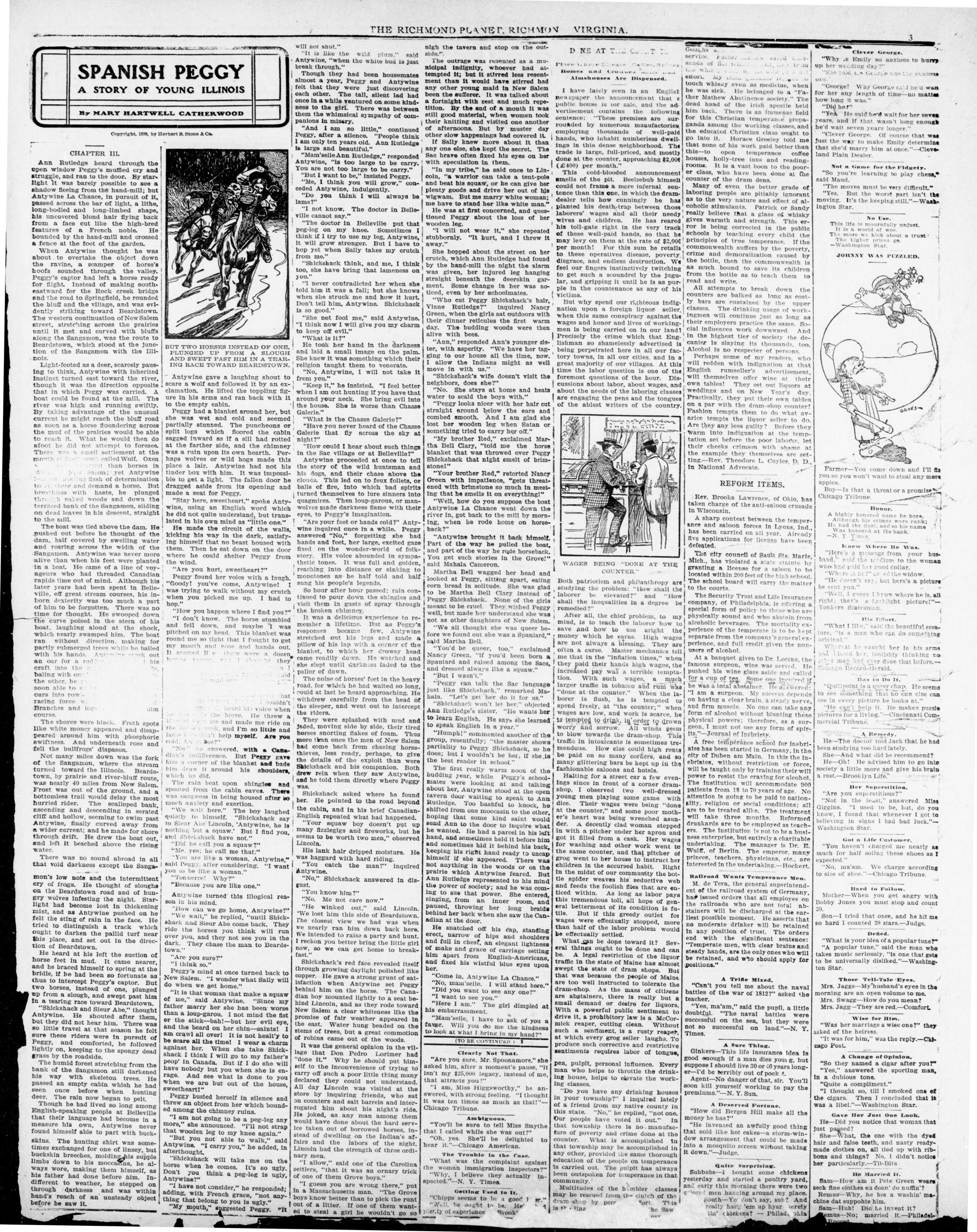
BUT TWO HORSES INSTEAD OF ONE,
PLUGENED UP FROM A SLOUGH
AND SWEPT PAST HIM IN A TEARING RACE TOWARD BEARDSTOWN.
Antywine gave a laughing shout to scare a wolf and followed it by an exclamation. He lifted the toppling figure in his arms and ran back with it to the empty cabin.
Peggy had a blanket around her, but she was wet and cold and seemed partially stunned. The puncheons or split logs which floored the cabin sagged inward as if a sill had rotted at the farther side, and the chimney was a ruin upon its own hearth. Perhaps wolves or wild hogs made this place a lair. Antywine had not his tinder box with him. It was impossible to get a light. The fallen door he dragged aside from its opening and made a seat for Peggy.
"Stay here, sweetheart," spoke Antywine, using an English word which he did not quite understand, but translated in his own mind as "little one." He made the circuit of the walls, kicking his way in the dark, satisfying himself that no beast housed with them. Then he sat down on the door where he could shelter Peggy from the wind.
"Are you hurt, sweetheart?"
Peggy found her voice with a laugh. "Goody! you've come, Antywine! I was trying to walk without my crutch when you picked me up. I had to hop."
"How you happen where I find you?"
"I don't know. The horse stumbled and fell down, and maybe I was pitched on my head. This blanket was round me so tight that I fought to get my mouth and nose and hands out. It seemed like there were a dozen home readers, and I thought they
he heard in voice when he came to the horse. He threw a bliss over me and made me ride on the horse's neck, and I was so little and lame I couldn't help myself. Are you cold, Amy? Are you answered, with a Canadian's indifference. But Peggy gave him a corner of the blanket and bade him draw it around his shoulders, which he did.
The rain beat upon shingles and spotted from the cabin eaves. There was sanguine in being housed after so much anxiety and exertion.
"We wait here." The boy laughed quietly to himself. 'Shickshack say to Sieur Abe Linecoln, 'Antywine, he is nothing but a squaw.' But I find you, and Shickshack have not."
"Did he call you a squaw?"
"Me, yes; he call me that."
"You are like a woman, Antywine," said Peggy, after considering. "I want you to be like a woman."
"Because you are like one."
Antywine turned this illogical reason in his mind.
"How can we go home, Antywine?"
"We wait," he replied, "until Shickshack and Sieur Abe come back. They ride the horses you think will run over you, and they not see you in the dark. They chase the man to Beards-town."
"Are you sure?"
"I think so."
Peggy's mind at once turned back to New Salem. "I wonder what Sally will do when we get home."
"It is that woman that make a squaw of me," said Antywine. "Since my father marry her she has been worse than a loup-garou. I not mind the fist or the stick—bah!—but her evil eye, and the board on her chin—saints! I am crawl all over! It is not healty to be scare all the time! I wear a charm against her. When she take Shick-shack I think I will go to my father's peop' in Canada. But if I do she will have nobody but you when she is enrage. And see what is done to you when we are but out of the house, sweetheart!" Peggy bused herself in silence and threw an object from her which bounded among the chimney ruins.
"I am not going to be a peg-leg any more," she announced. "I'll not strap that wooden leg to my knee again."
"But you not able to walk," said Antywine. "I carry you," he added, in afterthought.
"Shilekshack will take me on the horse when he comes. It's so ugly. Don't you think a peg-leg is ugly, Antywine?" "I have not consider," he responded; adding, with French grace, "not anything that belong to you is ugly."
THE RICHMOND PLANET. RICHMON VIRGINIA.
will not shut."
"It is like the wild plum," said Antywine, "when the white bud is just break through."
Though they had been housemates almost a year, Peggy and Antywine felt that they were just discovering each other. The tall, silent lad had once in a while ventured on some kindness to the girl. There was between them the whimsical sympathy of companions in misery.
"And I am so little," continued Peggy, after a silence. "People think I am only ten years old. Ann Rutledge is large and beautiful."
"Mam'selle Ann Rutledge," responded Antywine, "is too large to be carry. You are not too large to be carry." "But I want to be," insisted Peggy. "Me, I think you will grow," conceded Antywine, indulgently. "Do you think I will always be lame?"
"I not know. The doctor in Belleville cannot say."
"The doctor in Belleville put that peg-legged on my knee. Sometimes I think if I try to use my leg, Antywine, it will grow stronger. But I have to hop yet when Sally takes my crutch from me."
"Shickshack think, and me, I think too, she have bring that lameness on you."
"I never contradicted her when she told him it was a fall; but she knows when she struck me and how it hurt. Don't tell him, Antywine. Shickshack is so good."
"She not fool me," said Antywine.
"I think now I will give you my charm to keep off evil."
"What is it?"
He took her hand in the darkness and laid a small image on the palm. She knew it was something which their religion taught them to venerate.
"No, Antywine, I will not take it from you."
"Keep it," he insisted. "I feel better when I am out hunting if you have that around your neck. She bring evil into the house. She is worse than Chasse Galerie." "What is the Chasse Galerie?"
"Have you never heard of the Chasse Galerie that fly across the sky at night?"
"How could I hear about such things in the Sac village or at Belleville?"
Antywine proceeded at once to tell the story of the wild huntsman and his dogs, and their chase above the clouds. This led on to feux follots, or balls of fire, into which bad spirits turned themselves to lure sinners into quagmires. Then loup-garous, or manwolves made darkness flame with their eyes, to Peggy's imagination.
"Are your feet or hands cold?" Antywine answered once in a while. Peggy answered "No," forgetting she had hands and feet, her large, excited gaze fixed on the wonder-world of folk-story. His voice abounded in sympathetic tones. It was full and golden, reaching into distance or sinking to monotones as he half told and half sung his people's legends.
So hour after hour passed; rain continued to pour down the shingles and visit them in gusts of spray through the broken chimney.
It was a delicious experience to remember a lifetime. But as Peggy's responses became few, Antywine stretched out his legs and made a pillow of his lap with a corner of the blanket, to which her drowsy head came readily down. He watched and she slept until darkness faded to the pallor of dawn.
The noise of horses' feet in the heavy road, for which he had waited so long, could at last be heard approaching. He withdrew carefully from the head of the sleeper, and went out to intercept the riders.
They were splashed with mud and faded, moving side by side, their tired horses snorting flakes of foam. Thus more than once the men of New Salem had come back from chasing horse-thieves, less ready, perhaps, to give the details of the exploit than were Shickshack and his companion. Both drew rein when they saw Antywine, and he told them directly where Peggy was.
Shickshack asked where he found her. He pointed to the road beyond the cabin, and in his brief Canadian-English repeated what had happened.
"Your squaw boy doesn't put up many fizzlegigs and fireworks, but he seems to be worth two men," observed Lincoln.
His lank hair dripped moisture. He was haggard with hard riding.
"You catch the man?" inquired Antywine.
"No," Shickshack answered in disgust.
"You know him?" "No. Me not care now." "He winked out," said Lincoln. "We lost him this side of Beardstown. The closest view we had was when we nearly ran him down back here. We intended to raise a party and hunt. I reckon you better bring the little girl now, so we can get home to breakfast."
Shickshack's red face revealed itself through growing daylight polished like copper. He gave a strong grunt of satisfaction when Antywine set Peggy behind him on the horse. The Canadian boy mounted lightly to a seat behind Lincoln, and as they rode toward New Salem a clear whiteness like the promise of fair weather appeared in the east. Water hung beaded on the stems of trees, but a great commotion of robins came out of the woods.
It was the general opinion in the village that Don Pedro Lorimer had "done it." Why he should put himself to the inconvenience of trying to carry off such a poor little thing many declared they could not understand. All day Lincoln was visited at the store by inquiring friends, who sat on counters and salt barrels and interrogated him about his night's ride. He joked, as any man among them would have done about the hard service taken out of borrowed horses, instead of dwelling on the Indian's affairs and the labors of the night. Lincoln had the strength of three ordinary men.
"I allow," said one of the Carolina settlers, "that it was an ornary trick of one of them Grove boys."
"I guess you are wrong there," put in a Massachusetts man. "The Grove boys know better than to pick the runt out of a litter. If one of them wanted to steal a girl he wouldn't go so
nigh the tavern and stop on the outside."
The outrage was resented as a municipal indignity, whoever had attempted it; but it stirred less resentment than it would have stirred had any other young mald in New Salem been the sufferer. It was talked about a fortnight with zest and much repetition. By the end of a month it was still good material, when women took their knitting and visited one another of afternoons. But by muster day other slow happenings had covered it. If Sally knew more about it than any one else, she kept the secret. The Sac brave often fixed his eyes on her with speculation in them.
"In my tribe," she said once to Lincoln, "a warrior can take a tent-pole and beat his squaw, or he can give her plenty goods and drive her out of his wigwam. But me marry white woman; we have to stand her like white man."
He was at first concerned, and questioned Peggy about the loss of her wooden leg.
"I will not wear it," she repeated stubbornly. "It hurt, and I threw it away."
She hopped about the street on her crutch, which Ann Rutledge had found by the hand-mill the night the alarm was given, her injured leg hanging straight beneath the deerskin garment. Some change in her was noticed, even by her schoolmates.
"Who cut Peggy Shickshack's hair, Viane Rutledge?" inquired Nancy Green, when the girls sat outdoors with their dinner reticules the first warm day. The budding woods were then alive with bees.
"Ann," responded Ann's younger sister, with asperity. "We have her tagging to our house all the time, now. I allow the Indians might as well move in with us."
"Shickshack's wife doesn't visit the neighbors, does she?"
"No. She stays at home and heats water to scald the boys with."
"Peggy looks nicer with her hair cut straight around below the ears and combed smooth. And I am glad she lost her wooden leg when Satan or something tried to carry her off."
"My brother Red," exclaimed Martha Bell Clary, "told me the horse blanket that was thrown over Peggy Shickshack that night smelt of brimstone!"
"Your brother Red," retorted Nancy Green with impatience, "gets threatened with brimstone so much in meeting that he smells it on everything!"
"Well, how do you suppose the boat Antwine La Chance went down the river in, got back to the mill by morning, when he rode home on horseback?"
"Antywine brought it back himself. Part of the way he pulled the boat, and part of the way he rode horseback. You get such stories in the Grove!" said Mahala Cameron.
Martha Bell wagged her head and looked at Peggy, sitting apart, eating corn bread in solitude. She was glad to be Martha Bell Clary instead of Peggy Shickshack. None of the girls meant to be cruel. They wished Peggy well, but made her understand she was not as other daughters of New Salem.
"We all thought she was queer before we found out she was a Spaniard," said Martha Bell.
"You'd be queer, too," exclaimed Nancy Green. "If you'd been born a Spaniard and raised among the Sacs, and dressed always like a squaw."
"But I wasn't."
"Peggy can talk the Sac language just like Shickshack," remarked Mahala. "Let's get her do it for us."
"Shickshack won't let her," objected Ann Rutledge's sister. "He wants her to learn English. He says she learned to speak English in a year." "Humph!" commented another of the group, resentfully; "the master shows partiality to Peggy Shickshack, so he does; but I wouldn't be her, if she is the best reader in school."
The first really warm noon of the budding year, while Peggy's schoolmates were looking at and talking about her, Antywine stood at the open tavern door waiting to speak to Ann Rutledge. Too bashful to knock, he shifted from one moccasin to the other, hoping that some kind saint would send Ann to the door to inquire what he wanted. He had a parcel in his left hand, and sometimes held it before him and sometimes hid it behind his back, keeping his right hand ready to uncap himself if she appeared. There was not anything in the woods or on the prairie which Antywine feared. But Ann Rutledge represented to his mind the power of society; and he was coming to sue that power. She entered, singing, from an inner room, and paused, throwing her long braids behind her back when she saw the Canadian at the door.
He snatched off his cap, standing erect, narrow of hips and shoulders and full in chest, an elegant lightness of make and grace of carriage setting him apart from English-Americans, and fixed his wistful blue eyes upon her.
"Come in, Antywine La Chance."
"No, man'selle. I will stand here."
"Did you want to see any one?"
"I want to see you."
"Here I am." The girl dimpled at his embarrassment.
"Mam'selle, I have to ask of you a faver. Will you do me the kindness to look at what I bring in my hand?"
Clearly Not That.
"Are you sure, Mr. Spoonamore," she asked him, after a moment's pause, "It isn't my $25,000 legacy, instead of me, that attracts you?" "I am, Miss Higgsworthy," he answered, with strong feeling. "I thought it was ten times as much as that!"—Chicago Tribune.
Ambiguous.
"Oh, yes. She'll be delighted to hear it."—Chicago American.
The Trouble in the Case.
"What was the complaint against the woman immigration inspectors?"
"Why, I believe they actually inspected."—N. Y. Times.
Getting Used to It.
"Chipps seems to be a good lawyer."
"Well, he ought to be. He' 1 plenty of experience Brook'
D NE AT THE COUNTY.
Place Where Else Are United States Homes and Crowded Cities and Almshouses Are Dispensed.
I have lately seen in an English newspaper the announcement that a public house is ior sale, and the advertisement contains the following sentence: "These premises are surrounded by numerous manufactories employing thousands of well-paid hands, who inhabit numberless dwellings in this dense neighborhood. The trade is large, full-priced, and mostly done at the counter, approaching $2,000 (£400) per month."
This cold-blooded announcement smells of the pit. Beelzebub himself could not frame a more infernal sentence than this one, in which the dramdealer tells how cunningly he has planted his death-trap between those laborers' wages and all their needy wives and children. He has reared his toll-gate right in the very track of these well-paid hands, so that he may levy on them at the rate of $2,000 per month! For this sum he retails to these operatives disease, poverty, disgrace, and endless destruction. We feel our fingers instinctively twitching to get such a scoundrel by the jugular, and gripping it until he is as purple in the countenance as any of his victims.
But why spend our righteous indignation upon a foreign liquor seller, when this same conspiracy against the wages and honor and lives of workingmen is being carried on in our land! Precisely the crime which that Englishman so shamelessly advertised is being perpetrated here in all our factory towns, in all our cities, and in a great majority of our villages. At this time the labor question is one of the foremost questions of the hour. Discussions about labor, about wages, and about the needs of the laboring classes are engaging the pens and the tongues of the ablest writers of the country.
WAGES BEING "DONE AT THE COUNTER"
Both patriotism and philanthropy are studying the problem: "How shall the laborer be elevated?" and "How shall the inequalities in a degree be remedied?"
After all, the chief problem, to my mind, is to teach the laborer how to save and how to use aright the money which he earns. High wages are not always a blessing. They are often a curse. Master mechanics tell me that in the "inflation times," when they paid their hands high wages, the increased pay was a terrible temptation. With such wages, a much larger traffic in tobacco and rum was "done at the counter." When the laborer is flush, he is tempted to spend freely, at "the counter;" when wages are low, and work is scarce, he is tempted to drink, in order to drown worry and sorrow. All winds seem to blow towards the dram-shop. This traffic in intoxicants is sometimes tremendous. How else could high rents be paid on so many corners, and so many glittering bars be kept up in the fashionable saloons and hotels.
Halting for a street car a few evenings since in front of a corner dramshop, I observed two well-dressed young men playing some game with dice. Their wages were being "done at the counter," and some poor mother's heart was being wrenched asunder. A decently clad woman stepped in with a pitcher under her apron and got it filled from a cask. Her wages for washing and other work went to the same counter, and that pitcher of grog went to her house to instruct her children in the accursed habit. Right in the midst of our community the bottle spider weaves his seductive web and feeds the foolish files that are enticed within. As long as labor pays this tremendous toll, all hope of general betterment of its condition is futile. But if this greedy outlet for wages were effectually stopped, more than half of the labor problem would be effectually settled.
What can be done toward it? Several things ought to be done and can be. A legal restriction of the liquor traffic in the state of Maine has almost swept the state of dram shops. But that was because the people of Maine are too well instructed to tolerate the dram-shop. As the mass of citizens are abstainers, there is really but a small demand or desire for liquors. With a powerful public sentiment to drive it, a prohibitory law is a McCormick reaper, cutting clean. Without such a sentiment, is a rusty reaper, at which every grog seller laughs. To produce such corrective and restrictive sentiments requires labor of tongue, pen, pulpit, personal influence. Every man who helps to throttle the drinking house, helps to elevate the working classes.
"Do you have any drinking houses in your township?" I inquired lately of a friend from my native county in this state. "No," he replied, "not one. Our people have voted it out." In that township there is no manufacture of poverty and crime done at the counter. What is accomplished in that township may be accomplished in any other, provided the same thorough education of the people on temperance is carried out. The pulpit has always been outspoken for temperance in that community.
Multitudes of the hambler classes may be rescued from the clutch of the dram-shop by peru vort. This is like the saw
service. Father Mathew saved thousands of the lives of children from the whirlwind of the war in Iraq in effort. My sister graduated to touch whiskey even as medicine, when he was sick. He belonged to a "Father Mathew Abstinence society." The dead hand of the Irish apostle held him back. There is an immense field for this Christian temperance propaganda among the working classes, and the educated Christian class ought to go into it. Horace Greeley told me that none of his work paid better than this—to open temperance coffee houses, holly-tree inns and reading rooms. It is a vast boon to the poorer class, who have been done at the counter of the dram dens.
Many of even the better grade of laboring people are pitiably ignorant as to the very nature and effect of alcoholic stimulants. Patrick or Sandy really believe that a glass of whiskey gives warmth and strength. This error is being corrected in the public schools by teaching every child the principles of true temperance. If the commonwealth suffers by the poverty, crime and demoralization caused by the bottle, then the commonwealth is as much bound to save its children from the bottle as to teach them to read and write.
All attempts to break down the counters are balked as long as costly bars are sustained by the upper classes. The drinking usage of workingmen will continue just as long as their employers practice the same. Social influences work downward. And in the highest tier of society the decanter is slaying its thousands, too. Alcohol is no respecter of persons.
Perhaps some of my readers, who will redden with indignation at that English rumseller's advertisement, will themselves offer wine at their own tables! They set out liquors at weddings and on New Year's day, Practically, they put their own tables on a par with the dram-shop counter! Fashion tempts them to do what avarice tempts the liquor seller to do. Are they any less guilty? Before they warm into indignation at the temptation set before the poor laborer, let their cheeks crimson with shame at the example they themselves are setting.—Rev. Theodore L. Cuyler, D. D., in National Advocate.
REFORM ITEMS
Rev. Brooks Lawrence, of Ohio, has taken charge of the anti-saloon crusade in Wisconsin.
A sharp contest between the temperance and saloon forces in Lyons, Ind., has been carried on all year. Already five applications for license have been defeated.
The city council of Sault Ste. Marie, Mich., has violated a state statute by granting a license for a saloon to be located within 200 feet of the high school. The school board will carry the matter to the courts.
The Security Trust and Life Insurance company, of Philadelphia, is offering a special form of policy to those who are physically sound and who abstain from alcoholic beverages. The mortality experience of the temperate is to be kept separate from the company's general experience, and full credit given the non-users of alcohol.
At a banquet given to Dr. Lorenz, the famous surgeon, wine was served. He pushed his wine glass aside and called for a cup of tea. Some one inquired if he was a total abstainer. He answered: "I am a surgeon. My success depends on having a clear brain, a steady nerve, and firm muscle. No one can take any form of alcohol without blunting these physical powers; therefore, as a surgeon, I must not use any form of spirits." - Journal of Inbriety
A free temperance school for inebriates has been started in Germany, in the city of Duben am Main. In this the inebriates, without restriction or force, will be taught only by training their will power to resist the craving for alcohol. The institution will accommodate 900 patients from 18 to 70 years of age. No attention is going to be paid to nationality, religion or social conditions; all are to be treated alike. The treatment will take three months. Reformed drunkards are to be employed as teachers. The institution is not to be a business enterprise, but entirely a charitable undertaking. The manager is Dr. E. Wulff, of Berlin. The emperor, many princes, teachers, physicians, etc., are interested in the undertaking—Hockert.
Railroad Wants Temperance Men.
M. de Tera, the general superintendent of the railroad system of Germany, has issued orders that all employees on the railroads who are not total abstainers will be discharged at the earliest possible moment. He asserts that no moderate drinker will be retained in any position of trust. The orders end with the significant sentence: "Temperate men, with clear brains and steady hands, are the only ones who will be retained, and who should apply for positions."
A Trifle Mixed.
"Can't you tell me about the naval battles of the war of 1812?" asked the teacher.
"Yes, ma'am," said the pupil, a little doubtful.
"The naval battles were successful on the sea, but they were not so successful on land."—N. Y. Times.
A Sure Thing.
Ginkks—This life insurance idea is good enough if a man dies you g, but suppose I should live 30 or 40 years longer—I'd be terribly out of pock t.
Agent—No danger of that, sir. You'll soon kill yourself working to pay the premiums."—N. Y. Sun.
A Deserved Fortune
"How did Bergen Hill make all the money he has?"
"He invented an awfully good thing that sold like hot cakes—a storm-window arrangement that could be made into a mosquito screen without taking it down."—Judge
Quite Surprising:
Subbubs—I bought some chickens yesterday and started a poultry yard, and early this morning there were two colored men hanging around my place. South—Yo don't say, sub? And really hang 'em up hyerely lil' chickens? — Philad, phila
3
"Why is Emily so anxious to hurry up her wedding day?"
"She told L. George was the anxious one."
"George! Why George said he'd wan for her any length of time—no matter how long it was."
"Did he?"
"Yea. He said he'd wait for her seven years, and if that wasn't long enough he'd wait seven years longer."
"Clever George. Of course that was just the way to make Emily determine that she'd marry him at once."—Cleveland Plain Dealer.
Not a Game for the Fidgety.
"So you're learning to play chess," said Maud.
"The moves must be very difficult."
"Yes. But the worst part isn't the moving. It's the keeping still."—Washington Star.
No Use.
This life is mournful unjust.
It is a world of woe.
The more we kick about a trust
The higher prices go.
-Washington Star.
GROES
Farmer—You come down and I'll fix
you so you won't want to steal any more
apples.
Boy—Is that a threat or a promise?
Chicago Tribune.
Honor.
A highly honored name he bore.
Although his crimes were rank;
He had the dust, and so his name
Was honored at the bank.
-N. Y. Times
Knew Where He Was.
"Here's a message from your husband," said the medium to the woman who had paid her good dollar.
"Where is he?" asked the widow.
"He doesn't say, but here's a picture he sent you."
"Well, I guess I know where he is, all right; that's a flashlight picture!"—Yonkers Statesman
His Effort.
"What I like," said the beautiful creature, "is a man who can do something original."
What he caught her in his arms and lissed her, tooilsly thinking no other man had ever done that before.—Chicago Record-Herald.
Has to Do It.
"Quillpoint is a queer chap. He seems to see something that no one else can see in every picture he looks at."
"He can't help it. He makes puzzle pictures for a living."—Cincinnati Commercial Tribune.
A Remedy.
He—The doctor told Jack that he had been studying too hard lately.
She—Ah what did he recommend?
He—Oh! He advised him to go into society a little more and give his brain a rest.—Brooklyn Life.
Her Superstition.
"Not in the least," answered Miss Giggins. "I used to be, but, do you know, I found that whenever I got to believing in signs I had bad luck."—Washington Star.
Got a Life Customer.
"You haven't charged me nearly as much for half soling these shoes as I expected."
"No, ma'am. We charge according to size of shoe."—Chicago Tribune.
Hard to Follow
Mother—When you get angry with Bobby Jones you must stop and count 20.
Son—I tried that once, and he hit me so hard I counted 20 stars.—Judge.
Defied.
"What is your idea of a popular tune?"
"A popular tune," said the man who takes music seriously, "is one that gets to be universally disliked."—Washington Star.
Those Tell-Tale Eyes.
Mrs. Jaggs—My husband's eyes in the morning are an open volume to me.
Mrs. Swagg—How do you mean!
Mrs. Jaggy—They are red.—Comfort.
Wise for Him.
"Was her marriage a wise one?" they asked of the heiress.
"It was for him," was the reply.—Chicago Post.
A Change of Opinion.
"So they named a cigar after you?"
"Yes," answered the sporting man, in a dubious tone.
"Quite a compliment."
"I thought so, till I smoked one of the cigars. Then I concluded that it was a libel."—Washington Star.
Gave Her Just One Look.
He—Did you notice that woman that just passed?
She—What, the one with the dyed hair and false teeth, and nasty ready-made clothes on, all tied up with ribbons and things? No. I didn't notice her particularly.—Tit-Bits
He Married It.
Sam—How am it ite Green wears
sech fine clothes ena doan' do nuffin'?
Remus—Why, he hes a washin' machine dat suppoits him.
THE PLANET
established every Saturday by JOHN MITCHEL
JR., at 311 North 4th Street, Richmond, Va.
JOHN MITCHEL, JR., - EDITOR.
All communications intended for publication
should be sent so as to reach us by Wednesday.
One Copy, one year, * * * * * * * $1.50
One Copy, eight months, * * * * * * * 1.00
One Copy, six months, * * * * * * * .80
One Copy, four months, * * * * * * * .50
One Copy, three months, * * * * * * * .40
Blingle Copy, * * * * * * * .05
ADVERTISING RATES
or one inch, one insertion, . . . $ 50
or one inch, each subsequent insertion, . . . $ 50
or two inches, three months, . . . $ 10
or two inches, four months, . . . $ 10
or two inches, nine months, . . . $ 14.00
or two inches, twelve months, . . . $ 20.00
arrangement and Funeral Notices, . . . $ 10
standing and Transient Notices per line, . . . $ 10
POSTAGE STAMPS OF A HIGHER DE
DOMINATION THAN TWO CENTS NOT
RECEIVED ON SUBSCRIPTIONS.
The PLANET is issued weekly. The subscript
price is $1.50 a year, in advance.
There are four ways by which money can be
bail out at our risk—In a Post Office Money
Order, in a Money Order, in a Money Order,
and in a Money Order. When none of these
can be procured, in a Registered Letter.
MONEY ORDERS—Can you buy a Post Office
Order, the World Wide Web, the Richmond
Post Office, and we will be responsible for its
arrival.
MONEY ORDERS can be occluded at
United States Express Company, the Well,
Fargo and Co.'s Express Company. We will be
responsible for money sent by any of these com-
munities, and we will be safe and convenient war for forwarding money.
REGISTERED LETTER—If a Money Order Post Office or an Express Office is not within the city where you wish to send it on payment of ten cents. Then, if the letter is not or stolen, it can be received on can send money in this manner on your risk.
We cannot be responsible for money sent in letters in any other way than one of the four ways mentioned above. If you send your money in other way, you must do it at your risk.
RENEWALS, etc. If you do not want the CLASSET continued for a mother year after your subscription has run out, you then notify by mail that you do not wish to receive that subscriber to new papers who do not order their paper discontinued at the expiration date and inable for the payment of the subscription up to date when they order the paper discontinued.
COMMUNICATIONS—When weiling to us renew your subscription or to discontinue our paper, you should give your name and address in full, otherwise we cannot find you.
CHANGE OF ADDRESS—In order to change the address of a subscriber, we must be sent "be former as well as the present address."
Entered in the Post Office at Richmond, Va. second class matter.
SATURDAY, ... OCTOBER 3, 1903
The outlook is that some of these white folks can do more stealing than the colored folks.
---
COLORED men should engage in business and make an honest, persistent effort to improve their financial condition.
COLORED folks are still buying pianos and organs. They'll know how to make plenty of music when they get over on other shore.
SHOULD an innocent man be hanged because the people in the locality want him hanged? This was the question up to Gov. MONTAGUE and he has answered it.
BLESSED is he who robs colored men out of their votes, for he shall rob white men out of the same kind of franchise a short while afterwards, just as they have been doing in Henrico county, Va.
---
THE Negro-haters declared that if the Negro was disfranchised that honest elections would follow. There is more fraud now than ever before and some of the white folks have taken the colored folks place in howling.
WHEN "up-stairs colored folks" learn to patronize each other and realize that there should exist amongst us a "community of interests," the progress of the race in that special section will be even more surprising than it is at the present time.
---
THE lazy, good for-nothing Negro is a serious draw-back to our progress and a blind man can almost see it. The white folks have the same kind of material on their side, but there are so many industrious, hustling elements among them that this class is not so observable.
Some colored folks will stop a white man's tobacco factory in order to go on an excursion train. And the funny part of the business is that the white man taught them to do it.
Any one who attacks the right of the Negro to vote, attacks the right of the white man to do the same thing and is opposed to universal suffrage as proounded by the forefathers of the Republic.
We hope to be alive and well when the first boat-load of JOHN TEMPLE GRAVES' Negroes leave the United States for some other country in carrying out his great separation act. We hope, too, that none of them shall be able to call either him or his friends "daddy," as the steamer leaves the wharf. We know, however, that "there will be hot times in the old town that night," if certain white men are not allowed to go and that there will be "weeping, wailing and grashing of
teeth, and thea will be many Rachels weeping and refusing to be comforted, because their children are not." Come to think of it, Brother GRAVES, you had bet er not ride that horse any further for he will be sure to throw you
---
Ir seems to us that the colored folks have done and are doing surprisingly well. They have demonstrated their ability to keep themselves in the foreground and to be the brunt of all discussion. Both the Indian and the Chinaman occupy second places when the Negro is discussed. Great is the Negro, and great is the white man.
---
THE race prejudice in the southern states is serving its purpose to the extent of causing tens of thousands of them to buy land and save their money. The colored people now own enough real-estate in this section to bury ten million Negroes, or white folks either, and have some room to spar. It used to be grave-yard first and house and lot afterwards. Now, it is house and lot first and grave-yard afterwards.
---
YES, colored folks have plenty of religion, the result of about 250 years accumulation. They now want some money in order to practice the precepts of the Bible in a decent and orderly style. Moreover, their preachers are much more expensive than they used to be.
If the government will agree to feed the colored folks free of charge for the space of five years, they will be the wealthiest race of people on the face of the globe. As the matter now stands, the Saturday night market-basket is the most dangerous foe to the accumulation of a fortune, while the clothing and the dry-goods stores make an occasional dig in the same direction. But a "big eat" is the greatest attraction for the colored brother of the southland.
ORGANIZED LABOR AND THE PRESIDENT.
PRESIDENT ROOSEVELT has decided to stand by his association of principles in the case of Foreman WILLIAM A. MILLER, who is employed in the Government Printing Office at Washington and was dismissed from service because of his suspension for some trivial offense as a member of a labor union. A strike of the government employees was threatened, unless the order restoring him to the position was rescinded. After a careful investigation, the matter was allowed to rest there and President ROOSEVELT announced that a citizen's membership or non-membership in a labor union should not operate against his employment by the government.
We have been at a loss to understand how the labor leaders could expect the President to reach any other conclusion. If the contention of the labor leaders was to be accepted, it would serve as an effectual bar to every citizen of color in the southern states.
President Roosevelt's reply to the members of the Executive Committee of the American Federation of Labor is a model of its kind. He said:
"As regards the Miller case, I have little to add to what I have already said. In dealing with it I ask you to remember that I am dealing purely with the relation of the government to its employees. I must govern my action by the laws of the land, which I am sworn to administer, and which differentiate any case in which the government of the United States is a party from all other cases whatsoever. These laws are enacted for the benefit of the whole people, and cannot and must not be construed as permitting discrimination against some of the people."
The above is the statement of a bedrock principle. He continued:
"I am President of all the people of the United States, without regard to creed, color, birthplace, occupation, or social condition. My aim is to do equal and exact justice as among them all. In the employment and dismissal of men in the government service I can no more recognize the fact that a man does or does not belong to a union as being for or against him than I can recognize the fact that he is a Protestant or a Catholic, a Jew or a Gentile, as being for or against him."
It will be observed that Mr. Roosevelt does not say that he will not, but that he cannot. He is "up against" the law and his sworn obligation. He did not make the law, but he must enforce it. What must be thought of men who would force such an issue upon him?
The Anthracite Coal Commission, appointed by him and by whose decision both he and the labor leaders are morally bound enunciated similar doctrine.
"In the communications sent me by various labor organizations protesting against the retention of Miller in the Government Printing Office, the grounds alleged are two-fold: 1. That he is a non-union man; 2, that he is not personally fit. The question of his personal fitness is one to be settled in the routine of administrative detail, and cannot be allowed to conflict with or to complicate the larger question of governmental discrimination for or against him or any other man because he is or is not a member of a union. This is the only question now before me for decision, and as to this my decision is final."
We cannot see how these leaders could have expected any other decision from the Chief Executive of the nation. To have yielded to their demands would have been to merit contempt and court obloquy. The path of duty was straight before him and he took it. For every vote he loses as a result of his decision, he will gain ten others from men, who admire manhood and integrity. If the labor unions have been injured, it is chargeable to those short-sighted leaders who forced the issue.
THE RICHMOND PLANET, RICHMOND: VIRGINIA
TRAIN FALLS FROM HIGH TRESTLE
Nine Killed and Seven Injured in Disaster on Southern Railway.
VICTIMS HORRIBLY MUTILATED
Charlotte, N. C., Sept. 28.—While running at a high rate of speed, train No. 97, on the Southern railway, the south-bound fast mail train, jumped from a trestle 75 feet high, half a mile north of Danville, Va., and was almost demolished. Of the crew of 16 men, including mail carriers, on the train, nine were killed and seven injured. All of the injured men are seriously hurt and have been taken to the hospital in Danville. The recovery of Mail Clerk Spiers is not expected, and other clerks are thought to have received mortal injuries. The trestle where the accident occurred is 500 feet long and is located on a sharp curve. Engineer Broady was a new man on that division of the Southern, and it is said he came to the curve at a very high rate of speed.
The engine had gone only about 50 feet on the trestle when it sprang from the track, carrying with it four mail cars and an express car. The trestle, a wooden structure, also gave way for a space of 50 feet.
At the foot of the trestle is a shallow stream, with a rocky bottom. Striking this, the engine and cars were reduced to a mass of twisted iron and steel and pieces of splintered wood. As the cars went down they touched the sides of the Riverside Cotton Mill, which is very close to the trestle.
All the dead men were killed instantly, it is thought, and all were greatly mutilated. The skin and hair on the engineer and fireman were torn off by the impact of the steam engine.
Several thousand people were soon at the scene of the wreck. No one on any of the cars had made an effort to jump, and the bodies of all those killed were found in the wreckage of the different cars to which they belonged. Ladies who drove out to the wreck from Danville fainted at the sight of the bodies, some of which were crushed to a ghastly degree. It seemed miraculous that any one should have escaped, for each car falling with the engine bounded from it and completely collapsed after striking the rocks at the foot of the treadle. All the express matter in the express car was practically destroyed, except six crates full of canary birds. None of the birds was hurt, though the crates were in the thickest of the debris. All unofficial opinions that have been ascertained agree in giving only one cause for the wreck—the high speed of the train on the sharp curve. Train No. 97 was running about an hour behind time. F is thought that the engineer, being unfamiliar with the road, did not take into consideration the danger of coming on the curve with such great velocity.
The mail bags in all the mail cars were broken open and the letters and packages were scattered, but it is believed that none were lost. Fire, which appeared in the wreckage shortly after it occurred, was quickly extinguished by the Denville fire department.
MINERS' WAGES RAISED
Get Six Per Cent. Advance on Selling Price of Coal.
Wilkesbarre, Pa., Sept. 29.—The Delaware, Lackawanna and Western Company began with the first half of this month to pay its employees a 6 per cent. advance on the sliding scale, as computed on the advance in the selling price of coal at tidewater.
The increase percentage on wages paid by this company on the general April advance of 10 per cent. under the sliding scale is as follows: Paid in June, 2 per cent. advance; paid in July, 3 per cent. advance; paid in August, 5 per cent. advance; paid in September, 6 per cent. advance.
The present outlook shows that there will likely be no decrease in the selling price of coal until next spring, the possibilities being for a further advance, which may bring the miners' percentage up to 10 per cent., as the coal companies are guarding the output to prevent a break in rates at tidewater.
The Delaware, Lackawanna and Western company, by paying a six per cent, advance this month has admitted that the selling price of coal is now $4.80 at tidewater. It will have to sell at $5 a ton at that point before the miners will receive 10 per cent, advance on the sliding scale.
Special Session Jersey Legislature.
Trenton, N. J., Sept. 30.—Governor Murphy, after a conference with the law committee of the state board of education and a number of state officials, decided to call a special session of the legislature for Thursday, October 15. The purpose of this session will be to pass an act to take the place of the general school law of the state that was about two weeks ago declared unconstitutional by the court of errors and appeals. The state school board's law committee convinced the governor that the immediate passage of a new school law will be necessary to straighten out the chaotic condition which now exists by reason of there being no workable school law.
From France to England In Balloon.
London, Sept. 28. — Count de la
Vauxl and Count d'Outremont descended
in a balloon near Hull, Yorkshire,
having journeyed from Paris in 17%
hours. This is the first time that a
balloon has successfully traveled from
France to England.
GREWSOME SCENE AT HANGING
Rope Stretched and Wilkesbarre Sheriff Held Body Up.
Wilkesbarre, Pa., Sept. 30.—Peter Lenousky, of West Pittston, was hanged in the county jail here for the murder of Anthony Sennick on February 11, 1903. Several hundred spectators witnessed the hanging, many seeing a mistreatment the use of forged before the Sheriff
Jacobs
Throughout his six months' imprisonment the accused boasted that he would not hang and refused to see callers or discuss the crime with which he was charged. A few minutes before the walk to the scaffold was begun a change occurred and he received a priest and became penitent. The trap was sprung and 15 minutes later Lenousky was pronounced dead. When the body was taken from the trap it was found that the rope had stretched fully two feet and the feet of the doomed man rested on the ground. This was followed by a scene never before witnessed in this county.
Sheriff Jacobs summoned several deputies to the scaffold and, gripping the rope, they lifted the body clear of the ground and held it in this position for several minutes. The gruesome sight sent a majority of the spectators hurrying from the jail. Physicians, after the examination, said that his neck had been broken and death was almost instantaneous. The body was sent to a medical college in Philadelphia.
SOFT COAL STRIKE IMMINENT
15,000 Men In Central Pennsylvania May Come Out October 3.
Altoona, Pa., Sept. 28. — President Patrick Gilday, of District No. 2, United Mine Workers, is authority for the statement that a strike of the 15,000 miners employed by the Pennsylvania Coal and Coke company in the Central Pennsylvania field, is threatened. He has given the officials until October 3 to agree to carry out the provisions of the Altoona scale. Failing to do so, he will order a strike. The Pennsylvania company operates more than 40 mines and practically dominates the Central Pennsylvania coal field. Men formerly prominent in the anthracite region control it. Thomas Watkins, who was a member of the anthracite arbitration commission, is a big stockholder, and Vice President W. A. Lathrop, formerly with the Lehigh Valley railroad, is the president. President Gilday asserts that the company has for some time refused to pay yardage at its A. M. Amsbry, Cambria county mines, where the union is not strong, and seeks to est. a precedent which will disrupt the wage agreement.
J. H. TILLMAN ON TRIAL
Great Array of Lawyers On Both Sides
In. Murder. Case.
Lexington, S. C., Sept. 29.—James H. Tillman, former lieutenant governor of South Carolina, was placed on trial here in the circuit court for Lexington county, under an indictment charging him with the murder of N. G. Gonzales, editor of the Columbia State. Judge Frank B. Gary presided. The jury was selected without trouble and the first witnesses called. Probably never in the history of this judicial circuit has there been so great an array of counsel engaged in the trial of a case in the circuit, or perhaps in the entire state. The solicitor is assisted by five attorneys, while the defendant has 11 lawyers, W. G. W. Croft, a representative in congress from Alken, as chief counsel, conducting the defense. A vigorously contested legal battle is in prospect. It was manifested at the very outset of the trial that every inch of ground is to be contested.
It is estimated that there are about 200 witnesses to be heard.
FATHER AND SON KILLED
John and William Schiffert, of Allens
town, Meet Death In Stone Quarry.
Allentown, Pa., Sept. 30.—John and William Schiffert, of Allentown, father and son, each the head of a family, were instantly killed. They were working in Reyer's stone quarry at Dry Run, four miles from here, and had prepared a blast, which failed to explode. The blast discharged as the men were tamping the load. Both were hurled 50 feet and horribly mangled.
Griffith Schall, a widower, 44 years of age, was instantly killed in G. H. Hardner's stone quarry a mile from Allentown. A stone which he was prying fell on him, crushing his chest. His twin brothers were eye-witnesses of the accident.
Big Whisky Seizure.
Greensboro, N. C., Sept. 30.—Internal revenue agents at Milton, Caswell county, made the largest seizure of liquor known in the history of the department in North Carolina. Six thousand gallons valued at $8,000 were seized by Deputy Collector Starbuck just as the barrels were being loaded on the train for shipment. The 115 barrels were all properly stamped and were seized for violation of the revenue law. Officers decline to divulge the particulars. The whisky will be stored in the government warehouse here unless the owner gives bond. The distillery belonged to T. M. Angle, of Milton, and was the most extensive government distillery in this district.
Cow Wrecks a Train.
Chattanooga, Tenn., Sept. 29—A Cincinnati Southern passenger train ran into a cow at Glenmary, Tenn., 120 miles north of Chattanooga, and the engine, two mailcars, baggage car and express car left the track and rolled down a steep embankment. Engineer Frank Parker, of Chattanooga, was instantly killed, and seven men were badly injured, two fatally.
Denounced For Spitting In Church
Norfolk, Va., Sept. 28—Rev. John J.
Doherty, pastor of St. Mary's church,
the largest Catholic church in Norfolk,
created consternation at mass
when he denounced male members of
the parish for spitting on the floor of
the church. Father Doherty declared
such men desecrated the house of God
by their action and were not wanted
in the church. "I have a pretty fair
idea of these men's identity," he said,
"but to be doubly sure I will employ
a detective to attend services and report
expectorators to me. These reps
reports I will read to the congregation
and I will cause the arrest of the
guilty parties as violators of the city
ordinance prohibiting spitting in pub
lie build."
MOB ATTACKS LAKE SUPERIOR WORKS
Discharged Employes Start Rioting at Canadian Soo.
THE TROOPS RESTORE ORDER
Sault Ste. Marie, Mich., Sept. 29.—The situation in the Canadian Soo, which has been the scene of serious rioting by the discharged employees of the Consolidated Lake Superior Company, who were put off with promises after they demanded their wages, is very grave. No reinforcements of militia have arrived from outside, and the only defense against the mob, which grows hourly, is a more or less demoralized police department and a small company of militiamen. An assault upon the office of the building by the mob before the arrival on the ground of the troops was successful, and a mass of frenzied rioters secured possession of the ground floor of the building, destroying everything movable that came in their path. A crowd of the office staff with drawn revolvers prevented their gaining access to the upper floors of the building. Every window and door in the building is smashed in. The arrival of the troops on the grounds armed with ball cartridges served to restore some semblance of order. The rioters then contented themselves with throwing stones at the building and hurling invectives at the soldiers, who established a "dead line" and prevented any approach toward the building by any of the rioters. The greatest number of the mob are of ignorant Italians, Finns, Norwegians and Frenchmen, the latter perhaps the hardest of all to handle. All had been drinking more or less, although the bars finally obeyed the order to close up. The mob is one that cannot be reasoned with, and the man they seem most anxious to get at is Mr. Coyne, the assistant manager, who in the absence of Mr. Shields is in charge of the works. Mr. Coyne has discreetly kept out of sight.
The leaders of the mob held a conference and demanded that the company feed the men until the money for their wages is forthcoming. In order to appease the crowd, this demand was granted, and the men have taken possession of the White House, a large boarding house operated by the company. Provisions are being sent there to feed them. As their leaders are making the most inflammatory sort of speeches, grave fears are entertained for the outcome.
It is estimated that there are 2000 men in the Soo, and these are reinforced by all the idle rabble in town. A train carrying 400 more woodsmen is expected to arrive on the Algona Central.
The local police force is being strengthened by the addition of all the deputies who can be found, each man being given a badge and a revolver and ordered to use the latter whenever necessary. Considerable feeling has been aroused by the shooting of two Frenchmen by the police during the trouble. The mob threatens an attack upon police headquarters with a view of effecting the release of all the men who have been arrested. Both this building and that occupied by the fire department is guarded against attack. These developments have created a problem which appears to be beyond the solution of any of the company officials on the ground. Apparently their only hope is that the anger of the mob will spend itself and that the men will get out of town by degrees.
RECEIVER FOR SUPERIOR
Judge Platt in Connecticut Appoints J. G. Carruth, of Philadelphia.
New Haven, Conn., Sept. 25.-John G. Carruth, of Philadelphia, president of the Industrial Title and Trust Company, was appointed receiver for the Consolidated Lake Superior Company by Judge Platt in the United States district court. His bond was placed at $10,000.
The application for the receivorship was presented by Judge Walter C. Noyes, of the firm of Noyes & Brandegee, of New London, in behalf of H. F. Rothermel, Jr., Samuel M. Clemens, Jr., and Joseph DeF. Junkin, of Philadelphia, attorneys for certain stockholders of the company. It was set forth in the application that the directors of the company had failed to take up the loan of $5,050,000 of Speyer & Co., of New York; that the actual value of the plant, as expressed in the amount expended in buildings, machinery and other properties, is far in excess of the amount of the loan; that the stockholders fear that if a forced sale were allowed they would lose the entire amount of their investment. A receiver was, therefore, asked for, and also a temporary injunction to prevent the sale of the property under foreclosure proceedings.
1. WEEK'S NEWS CONDENSED.
The 150th academic year of Columbia University, New York, opened with a large attendance of students.
The Erie railroad station at Great Bend, Pa., was wrecked by burglar, who blew up the safe. The robbers secured nothing of value.
Mrs. Emma Connell, of Landenberg, Pa., while driving to the Wilmington, Del., market, was stricken with apoplexy and died in an hour.
The Baltimore convention of the Sovereign Grand Lodge of Odd Fellows refused to grant to the Rebekah branch of the order the right to establish a death and funeral fund.
Friday, September 25.
A proclamation has been issued designating Friday, October 16, as Arbor Day in Pennsylvania.
Two railroad men were killed in a head-on collision on the Cleveland and Pittsburg road near New Philadelphia, O.
One man was killed and two fatally injured by being knocked from a freight car by a bridge on the New York Central Railroad near Buffalo, N. Y.
Fourteenth of the 17 flour mills of the Pillsbury-Washburn, the Washburn-Crosby Company and the Consolidated Milling Company at Minneapolis have been closed down by strikes.
Saturday, September 26.
The International Peace Conference will meet in St. Louis next year.
Sherman Stevens, a negro, was hanged at Wedowee, Va., for the murder of his father.
Richard S. Howse, formerly trainer in King Edward's stables, died at Denver, Col., of consumption.
Two lives were lost and several injured in a fire which destroyed the Hotel Brunswick at Buffalo, N. Y.
Curtis Jett, convicted of Cynthiana, Ky., of murdering James Cockrill, has been sentenced to hang December 18.
Six indictments have been found against six members of the Detroit, Mich., board of public works for conspiracy to defraud the city.
A negro was lynched at Thomasville, Ga., for criminal assault on a small white girl.
Mary Maloney, aged 19, of Waterbury, Conn., under arrest for arson, confessed to starting five fires in 24 fours for revenge.
Over 10,000,000 pieces of mall were received in the year ending June 30 by the dead letter office. $48,634 in money being found in them.
Charged with forcibly putting eight colored men aboard a Russian bark as sailors, Harry Oleson and Jack Johnson are under arrest at Savannah, Ga.
A reunion of non-resident natives of North Carolina will be held at Greensboro, October 12 and 13. Delegations from many northern states will attend.
Tuesday, September 29.
Commander E. M. Hughes, U. S. N., attached to the Asiatic fleet, died in a hospital at Yokohama, Japan.
In a collision between a runaway cable car and a wagon in Chicago one person was killed and 16 injured.
Nearly 800 horses are entered in the exhibition of the Louisville (Ky.) Horse Show Association. Twenty-six states and Canada are represented.
The cornerstone of the new Frances E. Willard National Temperance Hospital at Chicago was laid with imposing ceremonies. The building will cost $70,000.
An explosion at the Connell Powder mills at Shamokin, Pa., wrecked three buildings and fire that followed destroyed three more. No one was injured. Loss, $10,000.
Wednesday, September 30.
Robert R. West, of Kentucky, has been appointed auditor for the government printing office.
Commissioner of Pensions Ware has returned to Washington from his summer vacation, which he spent in Kansas.
James Owens, a plasterer, was killed and three other workmen seriously injured by a gas explosion on the roof of a New York hotel. By the capsizing of his boat while fishing at Westport, Mass., Henry Steers, a prominent New York business man, was drowned. A Chesapeake and Ohio express train was wrecked near Montgomery, W. Va., and several persons injured. The rails spread and five cars left the track.
GENERAL MARKETS
Philadelphia, Pa., Sept. 30. — Flour was steady; winter superine, $3@ 3:20; Pennsylvania roller, clear, $3.50 @ 3:70; city mills, fancy, $4.75 @ 5. Rye flour was quiet at $3.25 per bar; wheat was firm; No. 2 Pennsylvania roller, clear, $4.75 @ 5. firm; No. 2 yellow, local, $5.2c; Oats were quiet; No. 2 white, clipped 44c; lower grades, $42.1c. Hay was steady; No. 1 timothy, $15@15.50 for large bales. Beef was steady; beef hams, $20@12. Pork was firm; farnish, $20@12. Chicken was firm; old roosters, $11@11c. Dressed poultry, choice fowls, $14.4c; old roosters, 9c. Butter was steady; creamy, 22c. Eggs were steady; New York and Pennsylvania, 25c. per doz. Potatoes were steady; 25@30. per basket. Baltimore. Seven, $7@15.50 for wheat farm. Seattle, $7@15.50 for No. 2 red western, $8@28@3c; steamer No. 2 red, $72@72@3c; southern, by sample, 68@78@3c; southern on grade, 74@79@3c; corn was firm; spot, 53@53@3c; steamer mixed, 51@51@3c; southern white corn, 54@57c; southern yellow corn, 54@57c; Oats were mixed, 42@42@3c; mixed, 41c. Rye was easier; No. 2 58c; No. 2 western, 59c.
Live Stock Markets.
Herr's Island, Pa. Sept. 30.—Cattle
were slow; choice, $5.50@6.10; prime,
$5.10@5.25; fabr, $3.60@4.25; Hogs
beaver, $3.60@4.25; Beavers, $3.60@4.25;
modiums, $6.50@6.75; New Yorkers,
$6.60@6.65; pigs, $6@6.25; roughs, $6
@5.75. Sheep were slow; prime wee
ers, $4@4.15; culls and common, $1.5
@2; choice lambs, $5.60@5.80; veal
calves, $7@7.50.
PLAYING MILLIEARIA.
"Why, children, what in the world are you perched up on that sharp rail fences for?"
"Because we're playin' millionaires,
and Tommie's John Peepert Morgan,
and he rade all the rest of us get off the
earth."—Chicago Tribune.
The Anthem of Industry.
The factory whistle lifts its note.
There from its broad and grimy throat
it whispers to us who understand,
The most anthem in the land.
-Washington Star.
What She Left.
Jack—I have just received a telegram saying that a rich aunt, my only relative, has died, and left me— His Flancee (eagerly)—Yes, and left you— Jack—All alone in the world—Kansas City Journal.
A Generous Impulse:
"Stuppe you succeed in owning the earth," said the abrupt man, "what good will it do you?" "Well," answered the trust promoter, "I'm naturally a man of hospitable instincts. There will be a kind of satisfaction in feeling that I am permitting other people to inhabit this globe."—Washington Star.
"Twas Ever Thus
Blinker—That young friend of you
seems to be rather pessimistic.
Clinker—Yes, poor fellow! He's an
amateur photographer.
Blinker—What's that got to do with it?
Clinker—Why, his views of life are naturally poor.—Chicago Daily News.
Purely Business
Hotspur—See here! I understand you said you'd be glad to lay out my friend Jenks if you got a chance.
Berriam—That's my business.
Hotspur—It is, eh? Do you know the poor fellow is dead?
Berriam—Yes; I'm an undertaker.→ Philadelphia Press
Friends Worth Having
Fred—Well, old chap, it's all settled.
I'm going to marry Miss Missing next month, and I want you to act as best man.
Joe—You can count on me, my dear boy. I never desert a friend when misfortune overtakes him.—Cincinnati Enquirer.
That Ends It.
"I suppose," remarked Mias Conti-
mentle, "that since Mr. Bravely saved
her life, she will think of him as her
hero all the rest of her life."
"Oh, no," replied Mr. Practical, "she
married him last week."—Cincinnati
Commercial Tribune
Pushing Him Along
"Would you mind pinning a flower in my coat when I go?" asked young Do-Borem.
"Certainly not," replied Miss Wearyun.
"It will afford me pleasure to do it at once."—Chicago Daily News.
Only Remedy.
Young Man—Doctor, I feel wretched all the time, nothing interests me, have no appetite and can't sleep. What would you advise me to do?
Old Doctor—Marry the girl, sir; marry the girl—Chicago Daily News.
In Doubt.
His Wife's Mother—You must think I want to quarrel—
He—Oh! I didn't know whether you wanted to quarrel or whether you'd rather have your own way without quarrelling.—Fuck.
Interest Aroused
"Running an auto must be exciting," said the friend.
"It is," said the owner. "Every time you stop you wonder if the machine will start again when you are ready."—Brooklyn Life.
John's Mishap.
A Chinaman once lost his queue.
And he didn't know what to dieue;
He searched here and there.
And almost everywhere.
But it never came to his vuece.
—Chicago Daily News.
HE FOUND HER WELL.
Mr. Jassack—Aw, good evening, Miss Boredone. I find you well, I hope. Miss Boredone—Indeed, you do. Why, I can't go any place but you find me. N. Y. Sun.
The Izerepressible Agent,
"I'll tell you out a polly."
"Not on your life," said Hutch.
"Of course not," said the ugen blond.
"But on your own—how much?"
-Judge.
Hardened Cases.
Yeast—I see in a far eastern city a prison has been unearthed and the mummies are supposed to have been prisoners.
Crimsonbeenk—Hardened criminals without a doubt—Yonkers Statesman.
The Latest.
"Have you heard of Gobang's latest
fad?"
"No. What is he doing now?"
"Collecting breakfast foods. He has
tabulated 200 varieties, of which fully
one-third are edible."—N. Y. Times.
En to Date Motto
"Do you know that Mrs. Bickers has made three attempts to elope, all unsuccessful?"
"Indeed? Her motto seems to be, 'If at first you don't succeed, fly, fly again.'"—Town Topics.
Profitable.
"Did those mining stocks prove to be a good investment?"
"Yes," answered the hard luck man, "for the people who sold them to me." Washington Star.
She knew Something
Pupill (blushing)—Oh! matrimony, sin
—Ally Sloper.
In Worldly Goods
"It isn't every man that knows when he is well off."
"No; but lots of us know that we are not."—Brooklyn Life.
Fine Automobile Speedway.
An automobile speedway 40 feet wide and paralleled by wire fences and hedges is projected from Blackwell's island bridge to Montauk Point, L. L.
Development.
Our pleasures change but little.
As the years speed on their way.
This year we played "shinny"
Are playing golf today.
-Washington Star.
THE PLANET
SATURDAY..... OCTOBER 8, 1903
GYPSY GIRL AUCTION.
Seven Maidens Sold at Prices Rang ing from Eighty to Twelve Hundred Dollars.
Seven girls were sold at auction in Chicago a few days ago.
The highest price paid was $1,200 for a young woman of exceptional beauty. The lowest price was $80.
The girls thus disposed of like slaves or cattle are members of the tribe of Russian gypsies encamped at Archer avenue and Forty-sixth street.
The buyers of the girls are men connected with the tribe.
The Chicago Examiner says the sale was conducted much after the manner of the southern institution that perished in the civil war, and was accompanied with similar scenes.
A big gypsy, one of the leading men.
W. M.
LYDA WAS PUT ON THE BLOCK FIRST.
conducted the sale and acted as auctioneer.
The girls offered for sale stood in line near one of the tents and were dressed in all their weird finery. They were inspected and prospective buyers argued one with the other upon the comparative merits of the young women.
With the Russian gypsies beauty alone is not taken into account. Ability in necromancy and fortune telling, power to win money from others, is thought more of than anything else.
A girl 18 years old, known in the neighborhood as Lyda, was put on the block first. She was noted for her marvelous beauty and acuteness. She has the reputation of having made more money by telling fortunes than any of the other maidens in the camp.
A tribesman started the bidding on her at $500. There is a young man in the camp who thinks much of Lyda. He has a small amount of money, but not enough to bid against this figure. The girl was sold at $750. A girl of 12 was next disposed of at $80. Others went at $160, $200 and $600. The beauty of the camp, Mydid, was reserved as the last to be sold. A half dozen bidders contested for her. Five hundred, then $300 was bid, on up to $1,150. There the figure stood for a time and the auctioneer was about to close the sale when $1,200 was bid by a tribesman known as Jake, who is one of the wealthy men of the colony.
HAD A FREEZING RIDE.
Two Young Georgians Taken Out of a Refrigerator Car in Almost Frozen Condition.
As a result of a banter, Lewis Hopkins and Tracey Matthewson, of Augusta, Ga., the latter married, were taken out of a refrigerator car nearly frozen to death after being eleven hours in the car without food or drink. On Wednesday night these two, with a young man named Stovale, decided, as a joke, to beat their way from Augusta
FRO
to Kansas City. At the freight yards they entered the first open car they found, and went to sleep.
After a few hours Stovale became so cold that he left the car and returned to the city. He realized the danger his companions were in, and notified Hopkins' brother, but the train had gone. At Belair, eight miles out, the conductor sealed the car doors. Tracers were sent after the car, and it was found at five o'clock the following afternoon in the Atlanta freight yard. When the young men were taken out they were almost frozen.
Stick to Old Methods.
So little have the industries of India been affected by the British occupation that the native smith still forges locally made iron on a stone anvil within Siamas of Simla.
A SOLDIER'S PREMONITION
Tragic Reminiscence of the Great Civil War
There are but few persons living who have not at some time in their lives had some superstitious feelings regarding death. It matters not under what circumstances or conditions these may creep upon us, few live whom they have not touched. A case is well in my memory, and I propose to give the same in a simple, unvarnished manner, and let the reader draw his own inference, writes Herman Beyland, in Cincinnati Commercial Tribune.
Ferdinand Borz was a volunteer in the famous Ninth Ohio volunteer infantry regiment at the outbreak of the civil war, commanded by the lamented Robert L. McCook, and did his duty nobly as such. For his good behavior, his studious qualities and other good traits he was soon promoted to a noncommissioned officer in company A, of which he was a member. In all campaigns and marches, in each and every fight that he participated in, he showed the qualities that good soldiers are composed of
studious and painstaking in camp and on the march and fearless and courageous in battle and on the skirmish line. Always prim and proper in appearance, clean and tidy in person and of manly character above reproach, Borz was a pattern of young manhood such as thousands were who volunteered in those dark days. In conversation and deportment always clean, no evil lan-
1234567890
THE FEDERAL MILITARY OFFICER AND THE MILITARY OFFICER
"WHAT AILS YOU. ANYWAY?"
guage tainted his speech; scrupulously honest and exact in all his dealings, he was a young man to be of proud of; the men loved him, the officers extolled and praised him; and, withal, he was one of the most congenial comrades in the entire company. Like many another, he had dependent parents at home, and for them he saved up the stipend he received as pay from the government. I never knew him to grumble at short rations, or weary marches, or confinement in camp life; his disposition and character were much above that. Taking it for granted that we had volunteered and had expected all these hardships, he beautifully resigned himself to all exactions of the struggle in which we had voluntarily engaged.
During the confining enforced encampment we endured in Chattanooga immediately after the terrible struggle gone through in the famous battle of Chickamanga he was a frequent visitor at my quarters, all of us living in casements immediately adjacent to the rifle pits or in similar entrenchments, made of railroad rails, which had to be carried to the place upon our shoulders for miles, in the confined space allotted to us. At several calls I noticed his more than usually downcast spirits—none of us were too highly elated at our immediate prospects and our very short rations—and he seemed particularly low and down-hearted on this evening, prior to the first day of the battle of Missionary Ridge. After inviting Borz to a seat on the bunk beside me, I inquired of him: "What ails you, anyway; and why are you so crestfallen lately?" After laying down his pipe—he was, as nearly all of us were, an inveterate smoker—he said to me:
"Well, Herman, I want to make a clean breast of my feelings to you to-
"NOT APPROVED."
"In the winter of 1863-4," said a grand army man over a glass of refreshing beer after the Memorial day parade, "my regiment went out on the line one February day to take its turn at picket duty. The enemy had an outpost at a log house half a mile in our front, and were so annoying with their sharpshooters that it was determined to capture the place and hold it long enough to burn down the house. Forty of us were detailed under command of a captain, and one dark night we set out through the woods. The object was to get as close as possible before we rushed, and we were a full hour in making that half mile. We finally drew near the house, and had struck the barn and were ready to line up, when we got a scare to lift us out of our boots.
"There was a big hog sleeping on the path, and as our captain got within three or four feet of him the animal was disturbed. He was a good confederate
A cockney wag, while taking his holiday in the Highlands, met an old sheepherd driving a flock of sheep, and, wishing to show off a bit, said;
"Now, if I were a shepherd, I would teach the sheep to follow me." "Oh, ay-an" I've nae doubt ye wid manage it, too, for, if the beasties saw anither sheep in front, they would be sure to follow." -Fit-Bits
night; have had it on my mind for some time, and to-morrow it will be to late, for we are going into a big battle, and I will be killed in it. Here are some papers of mine and some money for the folks, and as you are now promoted to lieutenancy in the Kentucky heavy artillery and soon going home north, you take all these and deliver them for me, and wish all of them a God bless you and a good-by for me. Tell them that I have made my peace with my God and Creator, and not to worry about my death; it is for our glorious country, and, as far as concerns myself, I care little, and cheerfully meet my fate, for I know I will be killed! . . ."
After unburdening himself of this load he looked at me long and steadily from out his deep blue eyes, as much as to say: "Well, boy, I expect I astonished you." Such was my condition of feelings exactly. I turned upon him with all the eloquence I had at my command, exhorted him to eschew all such feelings, to disperse any such thoughts, and not to give way to any such nonsense, not to mind forebodings or forewarnings; and, as a rivet to the argument, showed him that as he had been in many a skirmish and many a battle, and came forth without a scratch, so
for cows.
relations
the fami
he would out of the coming conflict, and escape unharmed.
"No," he answered, "it is of no avail. I am to be killed in to-morrow's battle. All your talk will not persuade me to the contrary!"
I labored with him to the very best of my ability until tattoo was sounded on the bugles for retreat, all to no purpose and of no avail. I refused to take his papers and refused to deliver message or money to his folks, expecting thus to dissuade him from his fixed hallucination or infatuation.
He left my bunk for his own when lights out was sounded on the bugles, wishing me good-by, and asking me if I would not kindly explain to his folks, etc.
I laughed at his proposition, saying: "You will think better of it by morning."
At about two o'clock in the morning we heard our bugles sound the alarm. We formed in line, left our quarters at Fort Negley, marched to the center in front of the enemy on Missionary Ridge, and held that position until ordered to charge the enemy's rifle pits, which we captured. After this charge I looked for my noble comrade, Ferdinand Borz. I found him lying face down, his finger on the trigger of his Springfield rifle, ready to fire, but he was stone dead. A bullet had entered his neck just where the back-bone connects, and thus his life had gone out, as so many lives had to go out that day, only that his death had been premortorially announced to him. Who is it that shall say he did not know! And who will gainsay the great poet: "Verily, Horatio, there are more things in Heaven and earth than thou and I have ever dreamed of in our philosophy."
hog, and as he woke up he charged. He struck the captain full tilt and bowled him over, and before he had finished with us he knocked four or five others down and started a panic. In the darkness and excitement nobody knew whether he had a hog or an infernal machine to deal with, and as the confederates in the house began blazing away the 40 of us got up and did some tall running into the federal lines.
"The captain didn't have a fair start with the rest of us, and the first thing he did after getting in was to prefer charges against every man who had outran him. If he could have had his way about it every man would have been court-martialled, but as his charges reached the colonel the latter read and returned them with the indignations.
"Not approved. If the captain hadn't been upset by a hog his men wouldn't have been upset by him. The head being upset, the tail naturally ran away. Try again, but let some one lead who can smell a hog 50 feet away."
Glasgow possesses more public billiard rooms than any other city in the United Kingdom
A Conscientious Barkeeper.
Policeman—You say you always refuse to sell a man liquor after he had had as much as is good for him?
Bartender—That's my rule. When he begins to see double, I bounce him.
"An' a good rule it is. But how do you know when he begins to see double?"
"When he hands me five cents for a ten-cent drink and insists that he paid me ten"—N. Y. Weekly.
THE RICHMOND PLANET. RICHMOND VIRGINIA
new interest, and a comparison of the methods in vogue in this country and Europe may be of practical benefit to those interested in the subject, and should also prove gratifying to American pride, so far superior are our methods when compared with those of Europe.
MILK DELIVERY FROM CASE
amount of cheap labor. In other countries, as well as Denmark, much attention is paid to cleaning the cow stables, but the conclusion has been forced upon us that this is done more from an appreciation of the value of all farm manurial matter and the fixed habit of saving it than from any knowledge or intention of cleanliness as of prime importance in dairying. This is especially shown by the fact that cows are milked in just about as careless and unclearly a manner in Great Britain and all over Europe as, it must unfortunately be confessed, is the common practice in the United States. The very general use of women as milkers in all foreign dairy districts is a decided advantage; they are vastly better than the average farm laborer, who does all sorts of work during the day. Much attention is being given, especially in England, to perpetuate the custom of employing women instead of men for milking, and to maintain the efficiency of milkmals; the popular public milking
"What can I do for you, little girl?" "Why, I've got a cent to spend for candy, but I don't know what's the best kind to get. Couldn't I try some samples first?"—Chicago American.
Dairying Conditions in This Country and Europe
Our Milk Supply Is Better and Cleaner and Our Methods Superior to Those of the Old World.
A boy and a man stand in front of a horse pulling a cart loaded with barrels.
MILK DELIVERY FROM CASKS IN HELSINGOR: DENMARK
W
ITH practically every large city in America making strenuous efforts to improve the quality of milk supplied to the public the subject of dalryng assumes a
To begin with, the housing and care of dairy cows from which the public must secure their milk and milk products, no foreign country shows, as a rule, in general practice, any methods or conditions better than those of America. The average conditions everywhere are bad enough, with opportunities for very great improvement; but such improvement is being made as rapidly in this country as anywhere. Nowhere else is there a better appreciation of the importance and economy of abundant room, light, air, dryness, comfort, and cleanliness for cows. One hears much of the close relations between the dairy cows and the families of their owners in Hol-
land and Switzerland, connecting apartments, under the same roof, etc.; but the stables which are seen in summer converted into conservatories and rooms for weaving and cheese curing are the exceptional and show places. Even the best of these, when visited in midwinter, with the cattle in place, are often dark, close, ill ventilated, crowded and insanitary in many respects, although frequently kept clean. The construction of cow stables generally in the dairy regions of the old world is of a substantial kind, but with little regard to light and ventilation, convenience of arrangement, or ease in cleaning. The labor necessary to keep them in decent condition would be regarded as impossible in this country. The cowhouses of Denmark average the best of all in Europe, but they are no better in any respect than the average of those in the distinctively dairy districts of this country, and there is here far more regard for economy of labor in management. Danish stables are generally kept clean—probably cleaner than in America—but at the cost of a vast
STREET MARKET FOR EDAM CHEESE AT
HOORN, HOLLAND.
contests at the dairy shows are useful and commendable. Many parts of Europe have the additional advantage of keeping the cows in the fields continuously the greater part of the year and milking them in the open air. This practice does much to insure clean milk and pure products.
The care which is given to milk on the farm where produced, whether it is to go to a milk market or to be made into butter or cheese, with the location, construction and arrangement of dairies or milk rooms, their equipment and management, show great variety and lack of uniformity in every country. The good, the bad, and the indifferent are common to all. Good milk rooms, well located, thoroughly built, shaded, cool, and well kept, are not hard to find in any dairy district. Construction is heavier and more durable in Europe; convenience and ease of management are common in America. Excepting Denmark and Sweden, no country compares with America in the general appreciation and use of cold water and ice in the care of milk. The almost entire absence of refrigeration in France, and the general ignoring of the value of cold in dairying, is truly astonishing. In the matter of dairy appliances and equipment
SKS IN HELSINGOR, DENMARK.
the United States is surpassed by no other country, although Denmark and parts of Great Britain stand about as well.
The business of transporting, caring for, and distributing milk for consumption in its natural state and for household purposes seems to be in every possible stage of development in different parts of the world. Cows or their substitutes are driven through the streets and milked at customers' doors in British India and the West Indies. Milch goats are managed in the same way even in the best streets of Paris and Rome. The milk service of villages and small towns is conducted in an exceedingly crude, yet often picturesque, manner in some of the oldest dairy regions of Europe. In Scotland, Holland, Denmark and Switzerland milk is still carried in wooden vessels and retailed from them in towns and cities. The local milk service in similar places in the United States is often poor enough, with little regard for care or cleanliness, but nowhere as crudely performed. In most of the big cities of Europe there are large market milk establishments, admirably conducted. There are fine ones in London, better in Copenhagen, and the biggest and best of all in Berlin. Paris probably has the poorest milk service of any of the large cities. There was a time, not many years ago, when a few foreign milk supply establishments far exceeded in many respects the best of like character to be found in America. But at the present time, although some of these European milk companies do a larger business and have more extensive and costly plants, it is the opinon of the writer that we have in the United States a considerable number of establishments for city milk supply which are superior in many respects.
It is well worthy of note that at a special show of perishable dairy products held as an annex to the Paris exposition, in July, 1900, just outside the city limits, where French producers had every opportunity of exhibiting their goods in the best possible shape (although under unfavorable local conditions after reaching the exhibit), there was a large collection of natural milk and cream. But the only samples of these products, absolutely free from chemical preservatives and uncooked, which were sweet and palatable after noon of the exhibition day, were from the dairies in New York and New Jersey, then 18 days from the cow!
The foregoing facts and conditions as to dairying in the old world apply mainly to countries (and districts in them) where dairying has been for several centuries one of the leading agricultural industries, if not the principal one. American dairying has been developed wholly within one century, and all of its notable progress has been within 50 years. The comparisons made show that there is little for us to learn from foreign countries to improve our dairying.
HENRY E. ALVORD.
Wrong Diagnosis.
"You want to cheer up," said a physician to his patient.
"You don't expect a man to cheer up when he has dyspepsia, do you?" was the disconsolate rejoinder.
Open Day and Night. Office and Ware rooms 3006 P St., Church Hill. Orders By Telegraph and Telephone promptly attended to. All business confidential. Old Phone No. 3183.
THE
Wonder of the World
YOUR LIFE READ FROM THE CRADLE TO THE GRAVE
For the benefit of those who wish to have their life read by the world's greatest life reader, one that can tell you all that you wish to know, give you luck, change your life from evil to good, reunite the separated, restore a lost love, draw to you your sweetheart, husband or wife, make people do as you wish them
In fact this wonderful **IUOMAN** is the Greatest on Earth.
Now if you want to find out what your future life will be and what your past has been, and want to have it changed from evil to good, send it once to this wonderful medium.
Send lock of hair, date of your birth and 25 cents in silver, and receive your life written from cradle to grave. Do not send postage stamps. Address all letters to MRS. DR. WHITE.
to MRS. DR. WHITE.
1917 E. Pratt St. Baltimore, Md.
C
JOSEPH STRANGE
12TH WARD BOX
DIAMOND
OPEN DAY AND NIGHT.
OLD VIRGIN
19 Thirtieth Street.
Call and be happy. Polite Attention
COAL!
PLACE YOUR ORD
GET IT AT THE LOWEST
Crump & W
Phone 83. 18
4mos
W. I. JOE
FUNERAL DIRECTOR
Office & Warerooms, 207 N.
HACKS FO
Orders by Telephone or Tele-
pers and Entertainment
Old 'Phone, 686, Residence
PH. STRANGE. PROPRIETOR
THE
ARD BOARDING
DAMOND KITCHEN
AND NIGHT. OLD VIRGINIA
OLD VIRGINIA STYLE.
Street, Pit
7. Polite Attention and a Square M
AL! CO
YOUR ORDER WITH U
THE LOWEST SUMMER
o & West Co
183. 18th & Ca
S. JOHNSON
DIRECTOR' AND EM
Rooms, 207 N. Foushee St.
HACKS FOR HIRE:
phone or Telegraph filled. V
Entertainments promptly att
, Residence in Building, New
KNIGHTS OF COLUMBUS
V. P. & F. K.
JOSEPH STRANGE. PROPRIETOR.
2TH WARD BOARDING HOUSE
DIAMOND KITCHEN OPEN DAY AND NIGHT. OLD VIRGINIA DISHES. OLD VIRGINIA STYLE. 19 Thirtieth Street. Pitsburg, Pa. Call and be happy. Polite Attention and a Square M. 27-3-m
PLACE YOUR ORDER WITH US NOW AND GET IT AT THE LOWEST SUMMER PRICE. Crump & West Coal Co. Phone 83. 18th & Cary Sts
W. I. JOHNSON, FUNERAL DIRECTOR AND EMBALMER.
Office & Warerooms, 207 N. Foushee St. Corner Broad HACKS FOR HIRE: Orders by Telephone or Telegraph filled. Wedding, Suppers and Entertainments promptly attended. Old 'Phone, 686, Residence in Building, New Phone, 48
KNIGHTS OF COLUMBUS OF THE WORLD
TO WHOM IT MAY CONCERN:
This organization has been cha-
stituted under the laws and statute
York, for the purpose of uniting to
men on the Broad Bases of Char-
te the Social and Moral condition of
historic and uniform ranks will secure for
all sacred institutions of modern e-
Deputies wanted in all sections of the
This organization has been chartered and legally in situted under the laws and statute of the state of New York, for the purpose of uniting together all acceptable men on the Broad Bases of Charity—Beneficial and Praternal and to promote the Social and Moral condition of humanity. Its two distinct military and uniform ranks will secure for this organization place in the front ranks if all sacred institutions of modern events, a grand opportunity for active men. Deputies wanted in all sections of the country to organi- iges. Hindly address,
A
THE
FRISCO
SYSTEM
OPERATES
Carrying Pullman Sleepers. Cafe Cars (a la carte) and Chair Cars (seats free)
Electric Lighted Throughout
BETWEEN
Birmingham, Memphis and Kansas City
AND TO ALL POINTS IN
Texas, Oklahoma and Indiana Territories
THE ONLY THROUGH SLEEPING CAR LINE
BETWEEN THE SOUTHEAST AND
KANSAS CITY
Descriptive literature, tickets
ranged and through reservations made
upon application to
W. T. SAUNDERS, GENEI AGT. PASS. DEV.
OR
F. E. CLARK TOWN DISTRICT
F.E. CLARK, TRAV. PASS. AGT., ATLANTA, GA.
W. T. SAUNDERS
Gen'l Agent Passsnger Department
ATLANTA, GA.
GONZALES
The Greatest Clairvoyant &
Fortune Teller the World
Has Ever Known.
Unites Separated, Brings back the
one you Love, Helps Quickly all in
Trouble.
Removes Evil Influences, Ours Mysterious Diseases, Gives Luck and Success. Send Lock of Hair, Date of Birth and 12 cents. Ask three questions and receive Horoscope and Lucky Birthstone by mail. GONZALES, 236 Bergen Street, Brooklyn, New York.
GE. PROPRIETOR.
THE
BOARDING HOUSE
KITCHEN
OLD VIRGINIA DISHES.
NIA STYLE.
Pitsburg, Pa.
on and a Square M 27-8-m
COAL!
ER WITH US NOW AND
T SUMMER PRICE.
West Coal Co.
with & Cary Sts
JHNSON,
'AND EMBALMER.
Fowshee St. Corner Broad.
OR HIRE:
graph filled. Wedding, Sup-
ts promptly attended.
on Building, New Phone, 48.
OF COLUMBUS OF THE WORLD
W. P. & F. K. of W.
ization has been chartered and legally in the laws and statute of the state of New purpose of uniting together all acceptable broad Bases of Charity - Beneficial and formal condition of humanity. ranks will secure for this organization institutions of modern events, a grand oppoer in all sections of the country to organize
3mos.
THE PLANET
SATURDAY, OCTOBER 3, 1903
HEROES.
HEROES.
John O'Day, if years a member of the
department, is dead as a result of in-
juries sustained in the line of duty. He
had a record as a rescuer of lives—Local
News Note!
He was as many heroes, undiscovered
and unsung.
The praise that is their portion falls in
silence on the tongue.
The hold the wreath of laurel and the
plaudits for the one
Who comes alive from sea or field where
killing has been done?
Yet the day they pass us on their
way to care the grave—
The heroes of the helmet, who are hurry-
ing to save.
So them there is a summons in the cla-
nging of the gang
Clear and keen and calling as the ring-
ing bugle song
That blares across the silence where the
soldiers slumber deep
Thrills them with the message that
wakes them from sleep.
And yet we have our heroes who go maddy
into strife
To dare a thousand deaths if they may
save a single life.
The clamor of the cannon and the clashing
of the targe.
The thunder of the hoofbeats in the frenzy of the charge.
The swaying of the vessel as she sweeps against the foe.
The rage of the conflict—all of these the domen know.
And yet we hold our cheering, and our toasting cups we fill to kill.
Give cheer the men of battle and the winners of the fray.
But let an echo of it find the soul of John O'Day.
Give promise that the laurel and the myrtle and the song of the gong.
Shall greet the men who listen for the warning of the gong.
The world has many heroes, and there is no man more brave.
Than he who heeds the summons and goes hurrying to save.
Chicago Daily Tribune.
But Not
Without Love
By F. H. LANCASTER
LOUISIANA has passed a law prohibiting marriage between cousins. Cast bon! But a year ago this was not no! Then it was quite possible—among the 'Cajan population, quite profitable for a man to be his son's second cousin; his cousin's brother; his mother's nephew, or his grandmother's father-in-law. Do not laugh, amoni; it est vrai. And this is how it happened—so the wise one tells us—that in nine families out of every ten there was at least one child extremely dull of wit. As the parents cheerfully put it, "I'll n' ous me tete."
This was what was the matter with Zoeph Grimmeure; he had no head. The teacher, not being a native of Louisiana, did not understand. She tried to teach Zoeph his letters. He learned readily, but—he forgot even more readily than he learned. It was as though a hand with a sponge followed the hand that wrote. The teacher looked into those eyes bright as a wild animal's, and blamed her methods. She read up on memory culture; she tried coaxing and coercion. Then madam, his mother, explained:
"My Zoeph don' learn moch? No! not no head, heem."
And after long trial the teacher was rewarded to accept the explanation. The teachers that succeeded her, one by one, did the same. Zozeph was always in his place, very neat, with his hair slicked over his ears and his trousers tied up with a string. Always carrying with careful pride his well-worn primer. According to her moral make-up, the teacher found him pitiful or exasperating.
So the boy without a head grew to tall sadhood and fell in love. Fell in love with beautiful Madeline, the belle of the school and its brightest scholar.
Comment done. Do not boys generally fall in love with pretty girls? Zooph's hair was slicked down with more stick precision, his trousers were tied with more trig tightness, and a wonderful, wistful light grew in those beautiful bright eyes of his. He brought Madeline daily great handfuls of flowers, and showed her all the pictures in his precious primer. The other girls laughed, but Madeline was kind—too kind, it would seem, to be quite right. Ah, mon ami, it is in love much as it is in politics—you vote not to please your friend, but to punish your enemy. And Madeline had an enemy. Dame. How else could you call him? A boy who will not make love as he expected to do. Who stares stupidly at his geography when he might know one is longing to show off his devotion before the other girls. Naturally one detests a self-contained lover, who does all his love-making behind the house or in lonely places, where there is no one to see. Mals ciel, that is stupid. But that is just what the big Alphonse did. He was ready enough to kiss his pretty cousin when they sat upon the steps to together in the moonlight and to hold her hand then. But to hold it—or try to hold it in class before all those giggling girls—Ah que non! Alphonse left such things for boys who had no heads. En bien, the boy who had no head was willing enough to do them. Too willing, for his own good, poor fellow! His devotion was pitifully patient. He carried her books and buckets, sharpened her pencils and ruled her estate. Madeline smiled sweetly and talked to him over the fence at recess but the big cousin remained obdurate. The "days of blue and gold" came to grace, bringing that soft, awakening springtime that Hindu poets love.
sing about, and the time between recesses grew very long for Zozeph. The teacher was astonished when he held up his hand to speak; he had never done such a thing before. Of course, Zozeph spoke to Madeline. "Didn't she want her penell sharpened?" And, of course, Madeline did, giving him the penell and a kind smile also. Because of this smile and its great kindness, boldness came to Zozeph, and he caught the slim brown hands to his lips with eager kisses. The teacher did not see, but the school did, saw the kiss and the eagerness and the swift look Madeline swept up to the boy as she snatched away her hand. A boy who sat next to the big cousin heard somebody's teeth grinding slowly, and instantly to thanking his stars that he was not Zozeph Grimmeure. When Zozeph returned to his seat, he walked on air. He knew not that he had a body. Voil! Before midnight he was not only painfully conscious of his body but of every bone in it. Quel vonnez-vous? He put up the best fight he could; the fight of one untaught animal against the trained human. He was brave—mails out certainment, but the big Alphonse was very big and—Madeline was covered with glory.
"Zooseph should not go back to school!" No? It was madam, his mother, who said it. N'importe. The teacher was not sorry, nor the pupils—not very. As for Madeline—En bien! These days of blue and gold were very blue and very gold. The summer that followed, very golden also. Passing so swiftly on its sunny wings. In Madeline's home but one thing was talked of—the wedding. There was to be a wedding! Mais out! Your 'Cajan youth is not like your American man—making love with him is not a pastime, but a business.
He has the marriage ceremony in plain view from the first time he dons a red necktie and goes to sit on pere Somebody's front gallery.
Ah, mon ami, and could you have peeped into Madeline's home, you would have never doubted that there was to be a wedding. The pigs and chickens being hoarded against the occasion, the file that was laid up, the coffee. Madam sewing always in the shade of the house, her hide-bottom chair tipped at a comfortable angle, and her bare tears gripping its runnels in suppressed excitement. And Madeline's machine whirring ceaslessly until sundown, and Alphouse came together.
And, then, at last, the great day! The great procession wending its way to the tiny gray church. First the bride and all the women folk—save the ones that had stalled behind to make gumbo and coffee—then the groom and his cavalcade, that dashed up to the door, with all the clang and clatter and bus-
DOWN BY THE SWAMP
tle of gallantry. There was a pause of deep reverence while the holy father joined the boy and girl in sacred bonds, then the procession formed again, madder than ever with merriment—all memory of the mass going down before it. What harmless merriment it was. How true the laughter rang from the heart. And, ah ciel, what a dinner it was! What gumbo file! what coffee! Roast pigs and pies—and anisette by the jug full. When the sun went down, he was not missed, so brightly blazed the fagots and so fearlessly flared the kerosene. Had not all the neighbors lent their lamps? And in all this merrymaking and feasting was the sun's the only presence that was not missed? Did no glance wander in search of a pair of wild bright eyes, of an upright figure, slender form, or of carefully-slicked locks?
Search for Zooph? Ah, que non. If n' a pas un tete. Why should he be here? Not here? Then why was he there. Down by the swamp where the frogs croaked in the moonlight and the owl hooted his dismal protest against the night's brightness. Why did he crouch there among the damp ferns and mosses; twisting his thin fingers and breathing hard, broken breaths? He had no head! Non? But he had a heart, mon aml, and it was breaking!
Two Sunsets a Day.
There is only one place in the world where the sun sets twice daily, and that is at Leek, in Staffordshire. The reason of this is that a jagged mountain is situated to the west of the town, and in the evening the sun sets behind it and darkness comes on. Then is the first sunset, the gas lamps are lit, and apparently night has set in. But it has not, for in the space of an hour or so the sun reappears again through the opening at the side of the mountain and daylight again appears. Artificial lights are extinguished and daylight again prevails until the sun descends below the opening and the second sunset follows and night comes to stay.
Ants as Task-Masters.
Attention was recently called to a curious crab of Mauritius that continually holds a sea anemone in each claw, presumably as a means of defense. A French biologist has now brought to notice, as equally remarkable, an ant of the East Indies which, while having no spinning glands at adult age, long puzzled naturalists by building nests of leaves fastened with silk threads. It was at last discovered that the larvae of the same species were held by the working ants and caused to spin silk where it was required—Nature.
Feminine Judgment
Feminine Judgment.
Belle—She's older than she looks.
Claire—How do you know?
Belle—She paid more attention to her dinner than to that good-looking man who took her in—Town Topics.
Tommy Knew.
"Now, children," said the teacher of the kindergarten class, trying to bring to the attention of the scholars the active flea, "what is it that goes quickly from place to place?"
"I know," quickly said Tommy.
"Well, Tommy, what is it that goes quickly from place to place?"
"A cook, ma'am!"—Yonkers Statesman.
Admitted to the Bar
"He doesn't look smart enough to be a lawyer."
"He isn't."
"But you said he was admitted to the bar."
"Quite right."
"Well, how did it happen?"
"Easily enough. The barkeeper admitted him."—Chicago Post
Good Reason
"Why are you crying, little boy?" asked the tourist in Texas. "Boo-hoo!" sobbed the youngster, "the cyclone blew down every house in town but one." "What one was that?" "The schoolhouse," answered the boy, between his sobs.—Philadelphia Record.
Poor Boy.
"Your new brother is the eleventh child in the family, is he not?" asked the caller.
"Yes, ma'am," said the little girl.
"Have you named him yet?"
"I think we're going to name him Jerusalem. That's what papa called him when he was born."—Chicago Tribune.
Reason.
"Here's an interview with a man whose name is withheld, it says, for obvious reasons. Now, I don't see any reason."
"Oh, that's perfectly obvious."
"Well, what is it?"
"There's no such man." — Detroit Free Press.
An Unsuccessful Attempt
"It's funny our minister never gets married," remarked the young husband, who had just refused his wife a bonnet, in his endeavor to change the subject. "I think he'd make a good husband." "Well," replied the wife, warmly, "he didn't seem to make a very good one when he married us"—Tit-Bits.
Corrected Himself
Mr. Blunder—Why, your mother looks as young as you do, Miss Stale.
Miss S. (stiffly)—That is not very complimentary to me, Mr. Blunder.
Mr B. (confusely)—I I didn't mean that.
I I mean you look as young as your mother!—Tit-Bits.
It Comes Back.
Subbubs—Do you really mean to say you keep a cat?
Backlotz—Yes.
Subbubs—I shouldn't think you'd want one around the house.
Backlotz—I don't, but the cat insists.
—Philadelphia Press.
As It Should Be:
Student—What kind of treatment would you recommend for inebriates, professor?
Professor—I wouldn't recommend any. The worst possible thing you can do for an inebriate is to treat him.—Chicago Daily News.
Words of Wisdom.
Men who choice language command,
May talk on all subjects at will;
But wiser are they who understand
Just when and where to keep still.
—Chicagonati Enqnirer.
KNWEW WITHOUT GUESSING.
Vera Smartsette—What flowers do you think I love the most? Now, guess. Jack Hardup—Oh! I know; the most expensive ones.—Chicago Chronicle.
Trouble Coming.
Trouble Coming.
The hens are in the garden,
It makes me smile with glee.
It's Johnson's garden they are in
And the hens belong to me.
-N. Y. Evening Sun.
Customer—I wonder if I could see him at his home?
"If your eyes are very good."—Detroit Free Press.
Anticipations.
Caroline—Does Winifred expect many wedding presents?
Margaret—Oh, yes; but she has no idea she will receive as many as she expects.—Kansas City Journal.
Deserved Popularity
Deserved Popularity
Mae—How is it that Mr. Frost is so cordially liked by everyone?
Tomme—Oh, he has such a good memory that he knows exactly what to forget, and when.—Pek.
Filling an Aching Void.
Kurious—Why did he insist upon posing with his hands in his pockets?
Viktim—Because, as I found later, he had nothing else to put in them.—N. Y. Times.
A Professional.
"Does Hunter play golf for pleasure?"
"No, for money. He plays with the rich Miss Notmarried."—Brooklyn Life.
It Requires No Bait.
Simple—I wonder why fishermen always exaggerate so terribly about the fish they catch?
Sharpe—Because it's a lot easier to lie than it is to catch fish.—Ally Sloper.
Marvel of Consistence.
"Oh, he was a born debater!" said one friend to another the other day.
"There is nothing he likes better than an argume." He won't eat anything thir ees with him."—Bits.
THE WHITE FRONT PRINTING HOUSE 311 N. 4th St., Richmond, Va.
WE PRINT..
EVERYTHING
Our Job D
IS THOROUGHLY EQUIPPED
LIVERY OF ALL KINDS OF
ARE THE LOWEST, CONSID
AND GOOD WORK.
Fine Wed
OUR LATEST DESIGNS
MAY BE SEEN AT THE
The
As an Advertising Medium
Fam Paper, it is not to be exce
80 For further informati
Our Job Department
Our Job Department
IS THOROUGHLY EQUIPPED FOR THE PROMPT DELIVERY OF ALL KINDS OF JOB WORK. OUR PRICES ARE THE LOWEST, CONSISTENT WITH FINE STOCK AND GOOD WORK.
Fine Wedding Stationery...
OUR LATEST DESIGNS IN STATIONERY FOR BALLS, PARTIES, ENTERTAINMENTS MAY BE SEEN AT THIS OFFICE.
The Richmond Planet
As an Advertising Medium cannot be surpassed. Our Solicitor will quote you Special Rates. As a
80 For further information, call on
---
MRS. MARTH எல் is the wholes nothing.
MRS. MARTH tells you are the same thing and present and future in a DEAD TRANCE, has the power of any two Mediums you ever met.
In tests she tells your mother's fill name before marriage, the names of all your family, the nation, the nation, the business of your present husband, the name of your next if you are to have one, the name of the young man who now calls on you, the name of your future husband, and the day, month and month of the marriage, how many children you have or will have whether you are the sweetheart will be true to you and if he will marry you; if you have no sweetheart she will tell you when you will have one a.d his name, and date, a.d is acquaintance. All your future will be told in a honda and plain manner and in a dead trance. Mothers should know the success of their husbands and children; young ladies should know everything about their sweethearts or intended husband.
Do not tell you or who you know all, do not let silly religions scruples prevent your consulting.
New Telephone, 328.
M.
MRS. MARTH, the *world* renowned and highly celebrated Busi- sist and Test Medium, can be consulted upon all affair trifle, business can and marriage a special. Every mystery re-vealed, an absent accessed and living moments. Remove any challenges, challenges any Medians who can exceed her in startling revelations of the past, remember she will not for any price flatter you; rest assured you will gain facts without non- life. Married to Marion upon all affairs of Love, Courtship, Married with full description of your future companion. She is very accurate in describing miss- journeys, contested wills, divorce and speculation is valuable and reliable. She reads your
can tell you the full name of your future husband,
the name of your future wife, and tells which
of the two you love is true or false.
There are some persons who believe that the medicine but such a conclusion is from consulting a doctor, but such a conclusion is from consulting a truth. It is only from the lack of discrimination that such a conclusion can be reached. It is not every one who placards himself or her with its tisers do not take the trouble to study human nature. They do not spend their thoughts for the medicine and kindred branches that will have a tendency to make the pathway to the road of the business clear and devoid of all obstacles. These professors will come for advice in full knowledge of what they want to know, and yet as soon as they confront dispel from their minds what they hear to hear if it will be rehearsed by the Medium. To get the secret out of a person by unfair unprincipled Mediums, but to take hold of the hand and gain control of the mind thereby is a matter of impossibility to most of them. Marth the seemingly mystery becomes a realization. The object has received no little attention by eminent men and even college professors. So it proves conclusively that although there are infringers in our midst with oily tongues, they have not been closed to the entire profession.
It takes a great deal of study to become an accomplished medium and by a continuous and uninterrupted effort, the skill of apparently unfamiliar mysteries has been secured by MRS. MARTH for the benefit of humanity.
—ADVICE BY LETTER, $1.00.
HOURS FROM 10 A. M. TO 9 P. M
MRS. M. B. MARTH.
246 W. 31st St. (Near 8th Avenue.)
NEW YORK CITY.
Enclose Stamp for reply.
Please mention the PLANET.
From a Dodger to a Three-sheet Poster, Business Cards of all sizes, Note, Letter and Bill-heads, Placards, Statements, Envelopes, Checks, Financial Cards, Order and Financial Book for Lodges and Societies, Policies, Application Blanks, Medical Certificates, Tags, Labels, Minutes, Lodge and Society Constitutions.
"THE ECONOMY."
303 N. 3rd St..
Fine Tailoring,
CLEANING,
DYEING,
AND REPAIRING,
W. O. TURNER, PROPRIETOR.
W. S. SELDEN,
FUNERAL DIRECTOR
AND EMBALMER.
Warerooms:
1508 E. Broad Street,
OLD 'PHONE, 1484
RESIDENCE,
1308 E. Leigh St.
Richmond, Virginia.
S. J. GILPIN,
506 E. BROAD STREET,
C Richmond, Va.
DEALER IN
Fine Boots, Shoes,
and Ladies Gaiters,
All Kinds of Fine Footwear.
H. F. JONATHAN
Fish Oysters & Produce
TRANSFER
ALL ORDERS WILL RECEIVE PROMPT ATTENTION.
Long Distance Phone, 752.
New Phone, 478.
ROBT. S. FORRESTER
FLORIST
215 E. Leigh Street,
RIOHMOND, VIRGINIA
Plant Decorations, Choice Rosebuds,
Cut Flowers, Funeral Designs, House
Decorations for Wedding, Parties, &c.
a specialty. Give me a call.
2 inch. 8m.
WE WANT
YOUR TRADE.
stationery ...
FOR BALLS, PARTIES,
Second Place
Our Solicitor will quote you
it is known of all men. One Y
JOHN MITCHELL
311 N. 4th
ry ...
ARTIES, ENTERTAINMENTS
Planet
I'll quote you Special Rates. As a
en. One Year, $1.50; Six Months,
MITCHELL JR., Proprietor
311 N. 4th St., Richmond, Va.
JOHN MITCHELL JR., Proprietor
311 N. 4th St., Richmond, Va.
JOHN M. HIGGINS,
DEALER IN CHOICE GROCERIES, WINES LIQUORS, AND CIGARS. PURE GOODS, FULL VALUE FOR THE MONEY. 1610 East Franklin Street [Near Old Market.] RICHMOND, VIRGINIA
NO. 23 NORTH 18TH ST.
FINE WINES, LIQUORS, CIGARS, &c. All Stock Sold as Guaranteed. PROMPT ATTENTION.
SECOND TO NONE WOMAN'S CORNER-STONE BENEFICIAL ASSOCIATION.
'Phone, 1589 Residence No. 911 32d Street.
ROBT. W. WILLIAMS,
FUNERAL DIRECTOR &
EMBALMER.
NO. 3019 P. STREET, BETWEEN
30TH AND 31ST STREETS.
RICHMOND VA
RICHMOND, VA.
Special attention given to all business
enrusted to me. Cariages for funer-
als, receptions and marriages at all
hours. Satisfaction guaranteed to all.
t116-20-04
A. Hayes
OFFICE AND WARE-ROOMS,
727 North Second Street.
BEFORE MAKING
First-class Hacks and Caskets of all descriptions. I have a spare room for beds when the family have just a spare place. All country orders are gives special attention. Your special attention is called to the new style Oak Caskets Call and see me and you shall be watted on kindly.
The Custalo House
The Custalo House
Having remodeled my bar, and having an up-to-date place, I am prepared to serve my friends and the public the same old stand.
Choice Wines, Liquors and Cigars.
FIRST CLASS RESTAURANT
Meals At All Hours,
S. C. G. Jurgen's Son
421 EAST BROAD ST.
between 4th and 5th Street
Oustale, Pro
New Phone, 1261. Wm. Custale, Pro
S. W. ROBINSON.
'Phone, 2778.
702 E. BROAD ST.
---
MRS. P. G. EASLEY.
ICE CREAM, CONFECTIONARIES,
| CAKES, ETC. |
Lawn and Picnic Parties, Festivals, Weddings etc., furnished with the best high-grade Ice Cream on the Shortest Notice.
Satisfaction Guaranteed.
0-7-3mos.
When You Are Sick
Pure and Fresh Medicines only will
sure you then purchase your
Drugs and Medicine from:
Leonard's
Reliable
Prescription
Drug Store.
724 North Second Street.
INCORPORATED, MARCH, 1897.
Office: 502 W. Leigh St.
Authorized Capital, $5,000:
Claims promptly paid as soon as satisfactory notice of sickness or death is placed in home-office.
OFFICERS:
LOUISA E. WILLIAMS, President
KATE HOLMES, Vice-President
BETTIE BROWN, Treasurer
MILDRED COOKE JONES,
Secretary and Business Manager
BOARD OF DIRECTORS:
LOUISA E. WILLIAMS, KATE HOLMES,
MATTIE F. FJOHNSON, ANN M. JOHNSON,
BETTIE BROWN. MILDRED C. JONES.
Your purchase you would do well to call at the most reliable furniture house in the city and see the fine line of Refrigerators, Mattings, Oil-Gioths, And in fact everything that is needed in house furnishings.
Of every description; also the laest designs in ROCKERS and special CHAIRS. Our goods are the best for the price and the price is very low.
THE PLANET
WAR
REMINISCENCES
SOLDIERI SOLDIERI
Soldier!
Swart of face and litle of limb.
Lips that smile and still are grim—
It runs to see you come
Swinging with the drum.
Swaying to the trumpet song
As you swiftly march along—
Soldier!
How the bayonets all swerve
When your ranks come round the curve—
With the banner that you serve!
There's a wall of feet;
And the blood begins to thrill
As the blood of battle will
Soldier!
When you come with clank of steel,
Clinking spurs and rumbling wheel,
Then we hear the roar that pealed
Over some far battlefield;
Hear the rushing bugle feet
And the shock when foemen meet.
Soldier!
When you come in this array,
Then we look away—away—
Where the crushing battle sound
Quivers through the shaking ground,
And the brazen bugle calls
Over parapets and walls.
Soldier!
When they bring you home some day—
Bring you back from the fray—
We may stand and look and weep
Where you fold your hands in sleep,
But the bugle and the life
And the drum wall of truth life
All the memories of you
When you swung across our view.
Soldier!
-W. N. D., in Chicago Tribune.
LINCOLN'S WAY ROUND
Got a Soldier Boy His Discharge in
Spite of the Secretary
of War.
Many stories of Abraham Lincoln turn upon his tact. One was told recently before the Middlesex club and repeated in the Boston Herald. During the civil war a Bridgeport boy, returning from school, was taken by a bounty agent and hurried to the front without his parents' knowledge. His father, the late Judge Beardsley, had sought in vain for his release, and a delegation of citizens, who appealed to the secretary of war, met with a gruff refusal.
in the hope of being able to accomplish something, Congressman Brandegee and Senator Dixon, of Connecticut, determined to use their influence in behalf of the afflicted mother. They visited the secretary of war and asked for the boy's release. Mr. Stanton instantly roared out an absolute refusal. He had decided that case before. The boy had taken his money and enlisted. If he should discharge all the minors whose mothers wanted them at home there would soon be no soldiers at the front.
Leaving the war office the congressman and senator went to the white house and appealed to the president. Mr. Lincoln heard the case with sympathetic interest and at once wrote on an envelope:
"Let young Beardsley, of Connecticut, a minor enlisted by fraud in the 75th New York regiment, be discharged and sent immediately to Washington.
"A. LINCOLN."
The two men returned to the war office and showed this order to the secretary. He glanced at it, crumpled it in his fingers, threw it on the floor and said: "I won't do it!" "Shall I report that to the president?" Congressman Brandegee asked. "Yes!" roared the secretary. "And you may add that I'll resign my portfolio before I'll adopt such a precedent as that!" The men reported to the president everything that had occurred. "Did Stanton say that after reading my order?" asked Mr. Lincoln. "Yes," Mr. Brandegee replied, expecting an explosion. "Well," Mr. Lincoln said, with a slow smile, "I guess he would do it. We must find some other way to get that boy back to his mother." He took a piece of paper and wrote to the commanding officer of the regiment: "Discharge young Beardsley and send him to Washington
IN COULD.
In a week the boy was in his mother's
arm at Bridgenort.
VITALITY AND PLUCK.
As an instance of remarkable vitality and pluck I believe a surgical case we had at the battle of Lexington, Mo., in September, 1861, will equal anything during the war, says the American Tribune.
A member of company E, Thirteenth Missouri, was struck by a cannon ball which carried away his arm and shoulder, and also lacerated his chest. This happened about four p. m. the first day of our fight. The boy was picked up and carried to the hospital, but as the ease was considered hopeless and many others to attend to, nothing was done for him until 11 p. m., when all the other wounded had been cared for. Finding him still alive he was carried to the table and his wounds carefully dressed, with no expectation of recovery. On the seventh day Price's men captured our hospital, which was in a brick building some 300 yards to our right, and our wounded were put in a cellar to be out of the way of bullets. When our men charged to retake the hospital this boy
selzed a gun in his one hand, ran out with arms at trail from the cellar, and led the charge into and through the building. He lived through the trials and exposures of our imprisonment and is living to-day.
ACROSS THE BIG BL'CK.
Odd Exchange of Courtesies Between
Yank and Reb at Long
"Some time ago," said Col O. H. Williams, according to the Chicago Inter Ocean, "I met down in Mississippi Col. Montgomery, now Gen. Gordon a chief of staff. He lived in Edwardsville, near where our division crossed the Big Black in May, 1863. His daughter married the son of that Mr. Champion who owned Champion Hill, and the old battlefield is now the property of that daughter. This association with the field of our operations, nearly 40 years ago, led to a very pleasant acquaintance, and the colonel told me a good many stories of the Vicksburg, and other campaigns.
"At the time Grant's army was maneuvering south and east of Vicksburg Montgomery was chief of the confederate scouts, and posted his men at the crossings of the Big Black river to watch the movements of the union army. On one occasion, when the scouts in blue came up on the opposite side there was brisk firing, but it was not effective. After a day or two of this sort of work, the confederates became restive, fearing they were being held at that particular point to serve some purpose of the union commander.
"It seemed, however, that the Yanks were as restive or as tired of the useless firing as the rebs, for one rainy day the officer in command of the union skirmishers made his way to the extreme front, and shouted across the river: "Hello, Johnny, who is in command over there?" Montgomery, under cover, replied that he was, and asked what was wanted. The union officer answered that he was tired of the durn fool firing; that it was a waste of ammunition without doing any good for either side, and proposed that they agree to stop it, and that there be no more shooting except one party or the other attempted to cross the river.
"Montgomery expressed his willingness to discuss the matter, but asked the union officer to take the initiative by standing up and waving his handkerchief. The officer did so, and Montgomery stood up also. Thereupon the Yank said: 'What is the use of shoot-
"WHAT IS THE USE OF SHOOTING?"
ing? and asked the confederate to come over for conference. He explained that his quarters were in a house near, where he had abundant supplies, including some very good whisky, and the Johnny would come over they could refresh the inner man while they were discussing the agreement as to shooting.
"Montgomery conferred with his men, and every one of them was against the adventure. However, Montgomery decided to accept the invitation, and, jumping into a small boat, rowed across. He was received hospitably, was taken to the captain's headquarters, and was given the best of all that was in the house. As the rain still continued, he was persuaded to stay all night, and slept in the same room with his host. He awoke during the night, and wondered what had happened to him, and where he was. Bewildered, he sat up in bed.
"After rubbing his eyes, he recalled the incidents of the day, and wondered if he had walked into a trap. Just then his host said: 'Better than sleeping out in the rain, isn't it? I tell you, captain, there is no sense in plugging away at each other across the river.' Both lay down again, and the next morning Montgomery returned to his side of the river, his men viewing his start toward them with amazement. He explained the situation, and for a time the men on the Big Black stood guard without shooting.
"This incident was, of course, the merest trifle, when considered in its relation to the battles at Jackson, Champion's Hill, and the Black River bridge, or when considered in association with the great campaign that culminated in the siege and fall of Vicksburg. In the rush of tremendous events, it was forgotten by the two participants, who, swept apart by the high tide of war, never saw or heard of each other again. Montgomery does not remember even the name of the union officer who entertained him on the Big Black, but if that officer should ever step off the train at Edwards Station, he would meet with a royal welcome from at least one old confederate."
Masculine View.
Wife (reading)—Here's an account of a man who hanged himself with his suspenders.
Husband—Married man?
"Yes."
"That accounts for it."
"How does it?"
"His buttons were probably all off and he had no other use for suspenders."—Chicago Daily News.
Woman.
All summer she is cultivating tan
At tennis games and golf;
All winter long she buys all sorts of things
To try to get it off.
-Judge.
T.IE RICHMOND PLANET. RICHMOND VIRGINIA.
LATE LOVE STORIES.
Two of Them Are Cheerful and One of Them Is Tearful.
And That Is Just the Way It Goes in Real Life—An Elopement at Midnight—Funeral Instead of Wedding.
Jacob S. Rosenthal, of Chincinnati went about his courtship in a strange way. He represents a New York house, and in the course of his traveling stopped at Indianapolis. He used the telephone on numerous occasions and fell in love with the voice of the telephone operator. He proposed marriage over the telephone and was accepted.
The two made an appointment to meet and look at each other. They were not disappointed. They decided on an immediate marriage and at two o'clock in the morning hunted up Magistrate Stout at his home, roused him out of bed, and had the ceremony performed, the magistrate in his night garments.
The father of the groom took the matter philosophically and said that his son was old enough to take care of his own heart as well as his purse.
Miss Bessie McNeal, of Wayne, Neb., also had a peculiar sort of wedding. She escaped from Wayne in boy's clothing with Henry A. Blunt and was married at Sioux City in the presence of her stepmother and all her relatives. The getaway in boy's clothing was just to add a dash of romance to the affair. They had been caught on the runaway by their stepmother and had been brought back to Wayne. There everything was talked over and it was agreed to permit the marriage. So the wedding party set out for Sioux City and there the marriage took place. The bride wore her hair tied with a ribbon and hanging down her back.
Instead of the wedding which was to have taken place between Oscar Hill and Miss Mary Morrison, the funeral of Oscar
THEY ROUSED HIM OUT OF BED.
Hill occurred from the bride's home, 667 Mississippi street, St. Paul.
The gay bridal garments, which had all been made, and other incidentals to the 'he ceremony which had been provided, were laid aside in an unoccupied room, and the young woman who was to have been joined for life to the man of whom death had robbed her was arrayed in mournful black. The priest who had already been engaged to perform the marriage ceremony read the funeral service.
The end of the engagement of Mr. Hill and Miss Morrison came on Monday, when the intended groom died at Bethesda hospital of appendicitis. The stricken man was taken ill two weeks before, but the nature of his affliction was not known at first. His physicians held out assuring hopes to the anxious man and the more anxious young woman, who was constantly at his bedside to attend him.
Finally, his condition not improving, he was advised to go to the hospital. The exact state of his condition was carefully kept from the solicitous youn, woman, and she was told that he would be out of the hospital entirely well before the day set for the wedding. Preparations, therefore, were carried on, and as the day drew near everything was in readiness. Monday, however, came a fatal relapse, and all that his physicians could do for him was of no avail. In the evening he died, while his intended bride was putting the finishing touches to the gown she was to have worn at her wedding. Gently the sad news of the death of her intended husband was broken to the ill-fated girl. So prostrated was she by the news that she was carried to her bed, where she was carefully attended by sympathizing friends. She recovered sufficiently to be present at the funeral.
Force of Habit In a Cow:
The force of habit was forcibly illustrated by an incident last week at the pumping station of the waterworks at Enid, says the Enid (Okla.) Eagle. A tank standing just outside the building is kept full of water for the accommodation of passers-by and the neighborhood stock. A cow accustomed to drink at this tank came for her morning drink. The valley was covered with water to within two or three inches of the top of the tank, but the cow went over the waste of waters to the tank. Twice she stuck in the mud and appeared to be in danger of drowning, but by perseverance she finally reached the objective point. After drinking long and copiously, she turned about and slowly made her way to land, apparently satisfied that she had done the only available thing to find water.
American Gods for India
American Goods for India.
The chief market for Philadelphia made goods is India, where the demand is for Buddhas and Ganesas. The most expensive ones are marble Buddhas two feet high, which cost $50.
Egbert—Yes; when you find it in the butter you can make up your mind it has stopped growing.—Yonkers Statesman.
OLD DOMINION STEAM-
SHIP COMPANY.
Night Line for Norfolk.
Leave Richmond daily at 7 p.
m., stopping at Newport
News in both directions.
Daily except Sunday by C. & O. Railway,
9:00 a. m., 4 p. m. 9 a. m. and
3 p. m. by N. & W. Railway; all lines
connect at Norfolk with direct steamers
for New York, sailing daily except
Sunday, 7 p. m.
Steamers sail from company's wharf
(foot of Ash Street) Rockets.
H. B. WALKER, V. P. & T. M., New York.
June 14th, 1903
C & O
ROUTE.
CHESAPEAKE & OHIO
RAILWAY.
2 Hours and 25 Minutes to Norfolk.3
LEAVE RICHMOND—EASTBOUND.
7:45 a.m.—daily—Local to Newport News
and way stations.
9:300 a.m.-Daily-Limited-Arrives Willis
m. a.m. a.m. Newport News 10:30
a.m. Old Point 3:00 a.m. Norfolk 11:30
a.m.
4:000 week days-Special-Arrives Willis
m. hamilton 4:30 p.m. Newport News 5:30
p.m. Old Point 6:30 p.m. Norfolk 6:30
p.m.
5:00 p. m.-Daily-Local at 5:00 Point.
10:10 a. m.-Daily to Chicopee and except Sunday to Chicopee Pier.
2:00 p. m.-Daily-Special to Cincinnati, Louisville and Chicopee.
5:15 p. m.-Weekday to Gordonsville
5:15 p. m.-Daily-Limited to Cincinnati, Louisville, St. Louis and Chicago.
10:20 a. m.-Express to LynchburgLexington Clifton Forge and principal stations.
5:15 a. m.-Week days - Local to Warren.
Nortokil and OK Point 10:00 a. m., daily. 11:45 a. m.Ex. Sun. and 7:00 p. m., daily.Newport News Local 7:55 p. m., daily.
From Cincinnati and West 8:15 a.m. m. daily
from Cincinnati and Main Line Local from
Clifton Forge a.m. daily and daily
from Charlestonville. Oordownville Accom-
modation 8:10 a.m. m. Ex. Sun.
Clifton Forge a.m. daily Local from Clifton Forge
6:35 p.m. daily Warren Accomodation 8:30 a.m. m. Ex.
Sun. DOWNEY
C. L. Z. W. W. O. WARTHEN,
Gen'l Manager. Dist.Pass. Agt
SOUTHERN RAILWAY
Effective June 23, 1903.
TRAINS LEAVE, RICHMOND.
7:00 a.m.-daily. Local for Charlotte.
12:50 p.m.
Johny—Douy, Limited, Brent Pullman
to Atlanta and F. Ingham, New Orleans,
Memphis, Chattarla and all the South.
6:00 p. m.—xu. 14, Chase City.
6:00 p. m.—xu. 14, Chase City.
1:38 p.m. - Daily, nited. Pullman ready
3:30 p.m. - South, nited.
YORK & LINE
4 p.m. & 4:30 p.m. at 100 West 4th Street
The favorite movie of Richmond 4:30 p.m. Dally
except Sunday.
a. a. m. --Except Sunday. Local mixed for West Point.
2:15 p. m. --Locate for West Point.
2:30 p. m. --Except Sunday. For West Point,
connecting with steamers for Baltimore and river landings
**TEAMS AREIVE RICHMOND.**
2:55 a. a. and 6:25 m. --From all the South.
2:30 p. m.
2:55 a. a. and 6:25 m. --From all the South.
2:30 p. m.
2:55 a. a. --From Chase City.
2:55 a. a. --Baltimore and West Point.
2:55 a. a. --From West Point.
H. C. ACKERK, G.M. S.H. HARDWICK, G.P.A. C. W. C. WESTHURST, D. P.A., Richmond, Va.
SEABOARD AIR LINE RAILWAY
**TRAINS LEAVE RICHMOND DAILY.**
2:20 p.m. - Seaboard Mail - 10:35 p. m. Seaboard Express - To Savannah, Jacksonville, Atlanta and Southwest.
9:10 a.m. - Local - For Norrland and Hamlet.
Tuesday - DRIVE RICHMOND-DAILY.
6:35 a.m. - Local - For m. No. 66 - From Florida, Atlanta, and Norrland.
5:30 p.m. - From Norrland and local points.
P. m.—from Norlana and local points. H. S. Lough, District Passenger Agent. No. 830 E. Main St., Richmond, Va.
Phone, 405.
W. J. May, City Ticket Agent.
R.F.&P. R.²-mond, Fredericksa-
Trains Leave Rt: 2nd.-Northward, 3:51 a.m., daily, By 1st. Through. 6:45 a.m., daily, Min. 2nd. Through. 7:15 a.m., week days, Elba, Ashland accommodation.
8:00 a.m., Sunday only. Byrd st. Through. 8:40 a.m., week days. Byrd st. Through. 12:05 noon, week days. Byrd st. Through. 4:00 p.m., week days. Byrd st. Through. 1:00 p.m., week days.
5:00 p.m., daily, Main st. Through. 6:25 p.m., week days. Elba, Ashland accommodation.
8:30 p.m., daily, Byrd st. Through.
Trains Arrive Richmond.-Southward. 6:40 a.m., week days, Elba, Ashland accommodation.
8:30 a.m., week days, Byrd st. Fredericksa-burg accommodation.
8:35 a.m., daily, Byrd st. Through. 11:55 a.m., week days, Byrd st. Through. 2:00 p.m., daily, Main st. Through. 3:00 p.m., week days. Elba, Ashland accommodation.
? 15 p. m. daily. Byrd st. Through.
10 p. m. daily. Byrd st. Through.
10 29 p. m. daily. Byrd st.
NOTE-Pulman Sleeping or Pailor Cars on all trains except local accommodations.
D. W. DUKE. C. W. CULP. W. P. TAYLOR,
Gen'l Man'r. Ass' Gen'l Man'. Traf. Map
ATLANTIC OAST-LINE
TRAINS LEAVE RICHMOND DAILY
BYRD STREET STATION.
8:30 a. m. To all points South.
9:00 a. m. Petersburg and Norfolk.
12:20 p. m. Petersburg and N. & W. West.
14:10 p. m. Petersburg and Norfolk.
14:10 p. m. Goldsboro local.
5:56 p. m. Petersburg local.
6:56 p. m. To points South.
9:35 p. m. Petersburg and N. & W. West.
11:30 p. m. Petersburg local.
**TRAINS ARRIVE RICHMOND.**
4:07 a. m. 7:35 a. m. 8:25 a. m. except Sunday
11:10 a. m. 11:42 a. m. 2.00 p. m. 6:50 p. m.
7:45 p. m. 8:45 p. m.
Except Sunday.
C. S. CAMBELL, Div. Pass. Agt.
W. J. CRAIG, Gen. Pass. Agt.
Norfolk and Western R. R.
LEAVE RICHMOND (DAILY), BYRD
STREET STATION
m. mORFOLK LIMITED. Arrives at
Norfolk. Suffolk only at Peersburg;
Waverley and Suffolk.
8:00 A.m. CHICAGO EXPRESS Buffet Parlor
Lynchburg to Lynchburg and Roanakis,
Pullman City to Columbus and
Phillips City to Cincinnati; and
Ronke to Knoxville, and Knoxville to Chattanooga, and
Milwaukee.
12:00 A.m. Ronke Express for Farmville,
Lynchburg, and Roanakis.
8:00 P.m. Ocean Street, mited Arrives Nor
for 5:30 P.M. Stops only! Pottsburg Waverly
Canada, with Steamers to Boston, Providence, Mt. York, Baltimore and Washington.
6:35 p. M., for Norwalk, d all stations east of Petersburg.
9:35 p. M. NEW ORLEANS SHORT LINE. Pull-men Richmond to Lynchburg, Petersburg to Lynchburg to Chattanooga. Memphis and New York. Car, Trains arrive from the west 7:35 a. m., 2 p. m. and 8:35 p. m., from Norfolk 11:30 a. m. and 11:33 a. m. and 8:35 p. m.
The Greatest Offer Yet! JUST WHAT THE LADIES WANT. Actual Size. Send A Good Photograph.
WE WILL SEND YOU A HANDSOME GOLD-PLATED BREAST-PIN WITH YOUR PICTURE HANDSOMELY COLORED AND REPRODUCED THEREON FREE OF CHARGE.
They can be worn by either male or female, being called either Button or Medallions. We have made special arrangements with one of the largest concerns in the country to furnish all new subscribers, who pay $1.50 cash in advance for the PLANET one of these handsome Medallion free of charge. Fill out the Coupon and send it with $1.50 together with a good Photograph of the person whose features you desire reproduced in colors and we will send the button or medallion. All photographs will be returned. Enclose 5 cents extra to pay postage on the same. If you are not satisfied, your money will be refunded. Send us one yearly subscriber and we will send one Medallion. Two yearly subscribers, two Medallions.
Now is the time to take advantage of the offer. The Medallion alone is worth the price of the subscription.
COUPON.
JOHN MITCHELL, JR.,
Publisher, THE PLANET:
Please find enclosed $1.50 for the Plan one year, which you will send to the following address:
NAME,.....
STREET,.....
CITY OR TOWN,.....
COUNTY, STATE,.....
closed photograph which I desire inserted in medallion or button.
Artist (angrily)—Why did you sky
by "Portrait of a Gentleman?" Can't
see it without a stepladder.
Hanging Committeeman—Very sorry;
but, you see, he looks like the
sort of a person who would feel more
comfortable up there than down on a
level with ordinary people.—N. Y.
Weekly.
An Economist
"Why don't you play with the little boy next door?"
"Because," answered the youth with many freckles, "he's too easy. I'd win all his marbles. He's one of these children that start right in bein' good as soon as one circus is over for fear they can't go to the next."—Washington Star.
Always the Autocrat
"She is very haughty since her family attained wealth," said the sensitive woman. "I doubt if there is anybody she doesn't snub." "Yes, there is," answered Macyanne. "If she wants good dinners she's got to be polite to the cook the same as the rest of us."—Washington Star.
Behind the Times.
Caller—You have changed to homeopathy, I see.
Fair Invalid—Yes; the homeopathic doctors give their medicines in little pellets, while the allopaths nearly always order their dose by the spoonful—and spoons are dreadfully out of fashion.—N. Y. Weekly.
Poor Human Nature.
Waggles—He couldn't remember why his wife tied a string around his finger, so he was afraid to go home, and stayed out all night.
Jaggles—What was it he should have remembered?
Waggles—To come home early.—Smart Set.
Took Her Choice
"Bobby," said the mother of a pre-occioidal five-year-old, "I see your little sister has the small apple. Did you let her have her choice, as I told you to?" "Yes'm," replied Bobby, "I told her she could have the small one or none, and she took the small one."—Cincinnati Enquirer.
His Own Way.
"Do you ever have your own way?" asked the cynical near relative. "Yes." answered Mr. Meckton. "Sometimes I have my own way; but not without consulting Henrietta very carefully before I make up my mind." -Washington Stur.
She Did Her Best.
Mrs. Uppmann—I must tell you, Delia,
that I was displeased at your entertaining
that policeman in the kitchen last
night.
Delia—Faith, Oi did ax him into the
parlor, ma'am, but he wouldn't go.—
Philadelphia Press.
Has Reached the Limit
First American Countess—So you've grown weary of supporting your husband!
Second American Countess—My dear, he's become perfectly insupportable.—Town Topics.
WHISKEY. How to make fine Old Whiskey for less than 25 cents a gallon. This recipe has raised many a poor man to fame and fortune. Sample Free. E. EHILER, Box 28, Freedom. Pa. B. C.
CHESAPEAKE & OHIO RAILWAY.
2000-Mile Tickets Discontinued.
On and after June 1, 2000-Mile Tickets will be withdrawn from sale and replaced by the 1000-Mile Refund Interchangeable Tickets heretofore announced.
The
JUST
Actual Size.
Send A
WE WILL SEND YOU YOUR PICTURE THEREON FREE OF CH
They can be worn by eitl lions. We have made special to furnish all new subscriber these handsome Medallion fre
This offer is, without the least doubt, the greatest value for the least money ever offered by any newspaper in the whole history of journalism.
★ FULL SIZE ★
3½ cts.
★ GOOD PAPER ★
a Copy
★ LARGE TYPE ★
UNABRIDGED
WE have made arrangements with one of the largest music houses of Boston to furnish our readers with ten pieces, full size, complete and unabridged. Sheet Music for thirty-five cts. The quality of this sheet music is the very best. The compassors' names are household words over the continent. None but high quality, lightweight pieces or the most popular reprints, printed on regular sheet-music paper, from new, large, clear type—including color, type, and in every way first-class, and worthy of your home. 3,000,000 copies sold.
DON'T FORGET that the price you have to pay for this sheet music is only thirty-five cents; that for this you get ten pieces, not one; that it is sent to any address, postpaid; that all the little details are up to the standard, including colored titles; that the vocal pieces have full piano accompaniments; that the instrumental pieces give the bass and guitar parts to an author published. Also don't forget to make your selection at one, to send us the order, and to ask our friends about this Sheet Music Class Satisfaction guaranteed. Order by Numbers, not Names.
This offer holds good to any of our subscribers or to any person sending as much as 50 cents for a subscription to the PLANET.
Address, JOHN MITCHELL, JR.,
311 N.4th St., Richmond, Va.
PRICE OF ABOVE PIECES.
Any 10 for 35 cents.
Any 21 for 65 cents.
Any 43 for $1.25.
Any 100 for $3.00.
Write your name, full address, and pieces wanted by the numbers: this with stamps or silver, and mail to address given below, and the money be sent direct from Boston, postage prepaid.
THE PLANET
SATURDAY..... OCTOBER 3, 1903
PRESIDENT MEETS LABOR LEADERS
Decision Not to Dismiss Non-Union Bookbinder Final.
NO DISCRIMINATION IN SERVICE
Washington, Sept. 30.—An important conference took place at the White House last night between President Roosevelt and five members of the executive council of the American Federation of Labor, including President Gompers and Mr. Mitchell, head of the Miners' Union, during which the case of Foreman W. A. Miller, of the government printing office, who was dismissed because he had been expelled from the local Bookbinders' Union, and afterwards was reinstated by direction of the president, was the principal topic of discussion. The conference was granted at the request of the labor leaders. The Miller case was very fully presented by the members of the executive council, at the close of which the president made a statement, in which he announced that his decision not to dismiss Miller was final, and that the question of his personal fitness must be settled in the regular routine of administration. The statement is as follows:
"I thank you and your committee for your courtesy, and I appreciate the opportunity to meet with you. It will always be a pleasure to see you or any representatives of your organizations or of your federation as a whole.
"As regards the Miller case, I have little to add to what I have already said. In dealing with it I ask you to remember that I am dealing purely with the relation of the government to its employees. I must govern my action by the laws of the land, which I am sworn to administer, and which differentiate any case in which the government of the United States is a party from all other cases whatsoever. These laws are enacted for the benefit of the whole people, and cannot and must not be construed as permitting discrimination against some of the people. I am president of all the people of the United States, without regard to creed, color, birthplace, occupation or social condition. My aim is to do equal and exact justice as among them all. In the employment and dismissal of men in the government service I can no more recognize the fact that a man does or does not belong to a union as being for or against him than I can recognize the fact that he is a Protestant or a Catholic, a Jew or a Gentile, as being for or against him.
"In the communications sent me by various labor organizations protesting against the retention of Miller in the government printing office, the grounds alleged are twofold: 1, that he is a non-union man; 2, that he is not personally fit. The question of his personal fitness is one to be settled in the routine of administrative detail, and cannot be allowed to conflict with or to complicate the larger question of governmental discrimination for or against him or any other man because he is or is not a member of a union. This is the only question now before me for decision; and as to this, my decision is final."
MAD DOG IN SCHOOL
Seriously Bites Principal and Citizen of Dalton, Pa.
Scranton, Pa., Sept. 29. — Winton Green, principal of the Factoryville high school, and E. Howell Fisk, a citizen of Dalton, were taken to the Pasteur Institute, New York, to receive treatment. Both men were badly bitten by a dog which was suffering from rubles. The dog ran into the Factroyville high school and began snapping at the scholars. Professor Green attempted to drive the brute from the room, when it turned upon him. The professor was terribly bitten about the arms and legs, but succeeded in driving the dog from the room without any of the children having been bitten.
Professor Green secured a rifle and killed the animal, but not before it had attacked and lacerated Mr. Fisk.
Princeton Student Badly Hurt
Princeton, N. J., Sept. 29. — Swift Tarbell, of New York, son of G. E. Tarbell, vice president of the Equitable Life, was badly hurt at Monmouth Junction by Arthur Mount, an innkeeper, who struck him on the head with a wagon shaft. Young Tarbell and two companions, Princeton students, were horseback riding. Mount picked a quarrel with the boys, according to their version of the affair, and when he cursed them one of the students knocked him down. Then he felled Tarbell, knocking him unconscious. Tarbell was hurried to New York for treatment. It is feared he may lose his eyesight.
Senator Hanna in Trolley Accident.
Berlin Heights, O., Sept. 30.—The private electric car carrying Senator Hanna and others from Cleveland to the Republican meeting here struck a derailing switch three miles east of Berlin Heights and jumped the track while running at a rapid rate of speed.
All the occupants of the car were thrown into a heap at one end of the coach, but aside from being badly shaken up all escaped serious injury.
Children's Day at Trenton Fair.
Trenton, N. J., Sept. 30.—Yesterday
was children's day at the inter-state fair, and all the school children of the city were admitted frse. The attendance was very large and approximated 23,000.
LYNCHING CHARGES IGNORED
Delaware Jury Does Not Indict Those
Acquired by Burning White
Accused or Burning White.
Wilmington, Del., Sept. 30.—The grand jury of this county came into court and announced that it had decided to ignore the bill of complaint against eight persons charged with being implicated in the burning at the stake last June of George White, the colored murderer of Miss Helen Bishop. The jury completed its work in connection with the lynching and was discharged by the court.
One of the jurors said that there was a great difference of opinion among the members of the jury as to what should be done with the report submitted to the jury from the judges of the court, but that the jury had almost unanimously decided that the members had but one thing to say that the courts made a mistake in not seeing that it was necessary to provide for speedy trials of such cases as that of White.
Had it been a case in which the guilt was not admitted, the jury said this member would have acted without any compunction in the matter and all concerned would have been indicted. The juror then said: "I feel that an error in judgment has been made and the grand jury members are not the proper persons to take the blame of so important a matter from the court. The man got only what he deserved, and I would take part myself in lynching such a brute." The persons against whom the grand jury ignored bills are George W. Curry, Fred Lyon, William Wood, William Aker, Nathan Baker, James F. Early, Clayton White and James A. Kane
COUNCILMEN GO TO JAIL
Days For Contempt of Court.
Manch Chunk, Pa., Sept. 29. — The five councilmen of the borough of Summit Hill, this county, who refused to obey the order of the Carbon county court to perform their duties, were declared in contempt of court and were sentenced to 10 days' imprisonment in the county jail, pay the costs of the proceedings and stand committed until the sentence is compiled with. The councilmen are Phillip Brogan, James Kennedy, John Gallagher, John McHugh and Frank Gillespie. President Judge Horace Heydt held a special session of court to hear the case.
The men had refused to perform the duty of councilmen, and an order was issued by the court directing them to comply with the rules to meet and transact the business of the branch. They refused, and an order was issued directing them to show cause why an attachment should not be issued against them. They also failed to answer, and the sheriff was directed to bring them into court. The borough citizens were willing to let them off on payment of the costs, which amounted to $32, but the councilmen claimed they could not pay this, as they have no employment. The court then declared them guilty of contempt of court and sentenced them as above stated.
GENERAL UPRISING PROCLAIMED
Macedonian Peasants Are Joining the Insurgent Army.
Sofia, Bulgaria, Sept. 30. — A telegram received here from the camp of General Zontcheff, the commander-in-chief of the Macedonian insurgents, at Bazlog, 55 miles from Sofia, announces that a general rising was proclaimed September 27 in the districts of Bazlog, Nevrokop, Demirhissar, Melnik and Seres, and that all the insurgent bands in Eastern Macedonia had received direct orders to begin operations.
The chief hope of the revolutionary organizations now centers in the outbreak in Eastern Macedonia, which is expected to assume considerable proportions, as the leaders there are all officers of the Bulgarian reserve. This, the sympathizers with the Macedonian cause hope, will arouse a war feeling in the Bulgarian army and force the government to espouse the Macedonian cause.
Dispatches received here from various sources say General Zontcheff has been greeted everywhere with the greatest enthusiasm, and that all the peasants are flocking to his banner.
Big Blaze at Bridgeton, N. J.
Bridgeton. N. J., Sept. 28. — The plant of the Ferracute Machine Company, of this city, was destroyed by fire, entailing a loss estimated at $100,000, which is partially covered by insurance. The fire is supposed to have been started by an explosion in the boiler room of the establishment. The company manufactured, among other things, fine dies for coins and medals, etc. Two hundred persons are thrown out of work. This is the third large industrial concern in this city to be destroyed by fire within the last few weeks, and this disaster will prove a serious loss to the city.
Major Hay Killed By Fall.
Major Hay Killed By Fall.
Pittsburgh, Pa., Sept. 30. — Major Samuel W. Hay met instant death by falling from the fourth floor of the Arrett building through the elevator shaft to the basement, making a drop of six stories. Major Hay, who is a member of one of Pittsburg's oldest families, was in the building on business, and as he stepped from the elevator at the fourth floor it is said the cage was started before he was entirely out. His foot slipped through the opening between the car and the floor, and as the elevator ascended his body dropped to the bottom.
Two Killed in Slate Quarry.
Easton, Pa., Sept. 30.—Levi Henderson, 25 years of age, and an Italian were killed in a slate quarry at Pen Argyl. They were at work in the hole of the quarry when a falling derrick struck them.
Anxiety and Appetite.
"He cometh not!" she says, the while
Her eyes the vista scan,
"He comes!" she greets him with a smile,
At last—the ice cream man!
-N. Y. Sun
HISTORIC HITCHING POST.
Oastiron Chinaman in Washington That Held the Horses of Civil War Generals.
One of the oldest signs in Washington is the castiron figure of a Chinaman, about three and a half feet in height, that stands in front of a livery stable on Sixth street northwest, between Pennsylvania and Louisiana avenues. It has been there since 1862, and is one of the familiar landmarks of the city, says the Baltimore American.
WANTED—Young colored man to assist caterer, one with little capital preferred. Wages $50.00 per month. A good opportunity for rigot party.
Address "C. C. C.," Bonsilene Hotel, Woodmont, Conn.
It is a long way around, but a short way across to the Pythian Carnival of Nations at the Pythian Castle, Monday, October 19th, and lasting two weeks. There will be plenty of music and refreshments.
Politeness.
[Richmond, Va. Times-Dispatch, Sep.
During the civil war Gens. Grant, McClellan, Hooker and others who patronized this stable a great deal tied their steeds to this hitching post, and since then other distinguished personages have had occasion to ure this post during every presidential inauguration that has occurred since Lincoln's second term.
As a matter of fact, this much of Sixth street northwest, between Pennsylvania and Louisiana avenues is an historic locality in more than one sense. It was on the corner of this street and Louisiana avenue that Gen. Robert E. Lee bade farewell to his old commander, Gen. Winfield Scott, when the former withdrew from the union army to join that of the confederates. During the first two years of the war Gen. McClellar
and others came here regularly to purchase and inspect horses, it being at that time a sort of horse market.
Taking No Chance
During the civil war orders had been issued to kill all bloodhounds, as these used to be kept for hunting slaves. One day a soldier, seizing a poodle, was carrying it off to execution, in spite of the heartrending appeals of its mistress. "Madam," he said, "our orders are to kill every bloodhound." "But this is not a bloodhound." "Well, madam," said the soldier, as he went away with it, "we cannot tell what it will grow into if we leave it behind."—Kansas City Times.
Artistic
"She is very artistic," said the impressionable youth.
"Yes," answered the man with the steely eye, "she is one of the sort of girls who think a bunch of hand-painted daisies are more important on a dinner plate than an omelette."
—Washington Star.
Knocking the Lieutenant.
Captain (to squad of recruits)—You knock-need, big-footed idiots, you are not worthy of being drilled by a captain; what you need is a monkey to drill you. Lieutenant, you take charge of them.—Philadelphia Enquirer.
As Compared.
Ethel—What do you think of young Softhead?
Mae—Oh, he reminds me of a blotting pad.
Ethel—Indeed! What's the answer?
Mae—He bears the impression of some good things, but lacks the ability to make use of them.—Cincinnati Enquirer.
Remembrance
Ethel (ecstatically)—Oh, Charlie, would you just as leave propose all over again, and do it in this phonograph?
Cholly—Why?
"Why, I want to have something to remember you by after you have gone in and spoken to papa about it."—Life
Depressingly Cynical
"Most people convicted of crime," said the sociologist, "are under 35 years of age."
"Does that indicate that people get better as they grow older?"
"Either that, or else that they become more shrewd and cautious."—Washington Star.
A Wonderful Performance.
"Fred made a remarkable record with his automobile last Sunday."
"How many miles did he go?"
"I don't know anything about the distance, but he ran the thing nearly all day without hurting anybody or breaking down once."—Chicago Record-Herald.
"I propose," said the ambitious young man, "to girdle the earth."
"Oh!" she innocently exclaimed, "why do you begin on such a big thing?"
But he just sat there and twirled his hat, the foolish fellow.—Chicago Record-Herald.
No More Money.
Old Lawyer—Why do you feel that your client will lose his case? Have you exhausted every means at your disposal to—
Young Lawyer—No, but I have exhausted all the means at his disposal.—Philadelphia Press.
That's All.
The "honor 'mongst thieves"
Of which some prate
Is merely his honor,
The magistrate.
—Philadelphia Press.
QUOTE SO.
A
Man (with a cast)—According to my idea—there are two ways of looking at it. Ally Sloper.
WANTED—Young colored man to assist caterer, one with little capital preferred. Wages $20.00 per month. A good opportunity for right party.
Address "C. C. C." Bonsilene Hotel, Woodmont, Conn.
It is a long way around, but a short way across to the Pythian Carnival of Nations at the Pythian Castle, Monday, October 19th, and lasting two weeks. There will be plenty of music and refreshments.
[Richmond, Va. Times-Dispatch, September 30th.]
It is reported from Raleigh that a messenger boy, who was recently summoned to the establishment of a Negro, was asked by the Negro if he would remove his hat should he enter a private residence. The boy replied that it depended upon whose residence it was. By which he meant to say, we presume that he would not remove his hat if he should enter the residence of a Negro.
We hope that the boy readers of this paper will not imitate that boy's example. It is not necessary to say that this paper is opposed to social equality but politeness is politeness without distinction of races, and politeness requires that when one enters the residence of any man, be he white or black, he shall conform to the ordinary rules of etiquette. It is incumbent upon the whites to set the example in all such matters. It should be remembered that when a white man or white boy is guilty of an act of rudeness toward a Negro, the reflection is not upon the Negro, but upon the good manners of the offender. No man loses anything by acting the part a gentleman in all his dealings and without respect to persons
Organ Day at the Fifth Street Baptist Church.
Last Sunday's exercises at the Fifth Street Baptist Church were quite interesting. The church is preparing to put in a $2,000.00 organ and to make other necessary repairs. Dr. W. P. Gibbons, of Washington, D. C., preached morning and evening. His sermons were rich, instructive, spiritual and captivating. The great crowds that listened to him pronounced him one of the best preachers they had ever listened to. Dr. Gibbons is a powerful pulpit orator, handles his subject with grace and ease and carries his congregation with him at will. Richmond will always be glad to hear him.
The clubs worked well. The following amounts were raised by them: One Dollar Club, W. A. Jordan, president, $28.50; East End Club, No. 1, Mrs. Georgiana Walker, president, $26.63 Freewill Workers Club, Mrs. Josie A. Graham, president, $88.10; Rally Club, Mrs. Mary Page, President, $51.75 Macedonia Club, Mrs. Isbella Wilkerson, president, $75.35; Young Reapers Club, Mrs. Callee Brown, president, $25.00; Valley Club, Mrs Mary Hamm, president, $50.00; Usher's Club, Wm. Mason, president, $60.74; Fairmount Club, Mrs. Alice Johnson, president, $8.80; Organ Club, Mr. Alex McCoy, president, $62.60; Christian Watch Word Club, C. C. Williams, president, $16.25; Secret Service Club, V. L. Hawkins, president, $12.00. General collection, $22.87. Grand total, $581.61, with many more reports to come in.
Faster W. F. Graham and his efficient
deacon board feel very much encouraged.
WEAK MEN CURED WITHOUT STOMACH DRUGGING; FREE
Simple Home-Method in Possession of Detroit Specialist Does Wonders For Men—Something Entirely New.
SENT FREE TO ALL
There has been discovered by a well-known Detroit specialist a simple, direct and quick home method for the cure of such conditions as sexual weakness or lost manhood, night losses, varicocle, shrunken organs, bladder trouble, diseases of the kidneys and urinary orgas, prematurity, etc., and so effective is it in results on men, even as old as 85, that it should at once recommend itself to every thinking man who suffers in this way. The cure, strange to say, is accomplished without the use of drugs, salves, ointments or anything of that kind. And yet it is no mechanical device, but one of the truly great discoveries in materia medica that cures without taking anything into the stomach and arouses a glow of warmth, energy and good feeling almost instantly in oldest person.
The discovery can be relied upon to cure the worst and most long standing cases, and it is especially urged that men who have been unable to find a cure before, as well as those who have not known a happy moment in years, write at once to Doctor H. C. Raynor, 78 Smith Building, Detroit, Michigan, and you will immediately receive a package of the discovery entirely FREE as well as a scholarly essay on the subject describing all the symptoms in detail, sent plain and securely sealed. Consider that nothing is impossible in this century of marvelous achievements, the century that gave us anti-toxin and X-rays, and that however doubtful you may be because of past failures to find a permanent cure, yet this may prove the very thing you have so long sought. Let your response be prompt DR. H. C. RAYNOR, 78 Smith Building, Detroit, mich.
Keep Up With the Times
YOU WILL ALWAYS BE BEHIND THE TIMES IF YOU DON'T GET ONE OF CARR'S EXCELLENT Time Keepers. k of this beautiful ladies LVER WATCH
YOU WILL ALWAYS BE BEHIND THE TIMES IF YOU DON'T GET ONE OF CARR'S EXCELLENT
Stem Wind and Set and is a very good time keeper.
Price Only $3.50.
are for $5.00. If you watch these advertisements, you good bargains in jewelry. Remember this is no fake. Fair toto. Satisfaction guaranteed. Send mail or express money or name and address plainly. Address all matters to
A. R. CARR,
New York City, N. Y.
No. 900.
Sold elsewhere for $5.00. If you watch these advertisements, you will get marry good bargains in jewelry. Remember this is no fake. Fain dealing is my motto. Satisfaction guaranteed. Send mail or express money order. Write your name and address plainly. Address all matters to
A. R. CARR,
P. O. Box, No. 900.
New York City, N. Y.
Politeness.
THE WESTERN POCKET WATCH
VIRGINIA:—In the Circuit Court of
Henrico County, September 29th,
1903. In vacation.
MARY ANN BROWN,..... Plaintiff.
vs.
JORDAN BROWN ..... Defendant.
IN CHANCERY.
The object of this suit is to obtain a divorce from the bonds of matrimony by the plaintiff from the defendant. An affidavit having been made and filed that the defendant, Jordan Brown, is a non-resident of the State of Virginia, it is ordered that he appear here within fifteen days after the due publication of this order and do what is necessary to protect his interest in this suit.
A copy, teste, J. E. BROADDUS,
J. H. CRUTCHFIELD, p. q.
Clerk.
To Jordan Brown:
You will take notice that I shall, on the 19th day of November, 1903, at the office of Phil B. Shield, numbered 60, Chamber of Commerce building, Richmond, Virginia, between the hours of 9 o'clock a. m., and 6 o'clock p. m. of that day, proceed to take the depositions of witnesses, to be read as evidence in my behalf in a certain suit in Chancery, depending in the Circuit Court for the county of Henrico, Virginia, wherein you are defendant and I am plaintiff, and if from any cause the taking of the said depositions be not commenced on that day, or if commenced be not concluded on that day, the taking of the same will be adjourned and continued from day to day or from time to time at the same place and between the same hours until the taking of the said depositions shall have been concluded.
MARY ANN BROWN.
By Counsel.
J. HENRY CRUTCHFIELD. p. q.
Office 1211½ E. Broad St.
Richmond, Va.
There will be a grand lecture at Pythian Castle Hall, 727 N. Third Street by Rev. F. W. Williams, pastor of the Rising Mount Zion Baptist, October 12th. A rare treat. Admission 10 cents. Go and hear him. Exercises begin at 8:30. tiloct10ine
WANTED—Honest colored man to induce his people to buy homes and save money. Pay $20 to $00, according to ability. Address Box 30, Richmond, Va.
I would like to know the where-
abouts of my sisters. When last bea-
dout of about thirty years ago one was living
in Rappahannock county, Va. Her name
was Mrs. Sarah Scott. The other, Mrs.
Jane Harris, lived in Richmond, Va.
I had a nephew who lived on Church
Hill. His mother's maiden name was
Polly Fox. I will pay a reward for any
information concerning my relatives.
ANDERSON LEWIS,
717 Union St.,
tiloct3inc
Springfield, Mass.
Cheap Settlers' Tickets.
On the first and third Tuesday of each month till April, 1904, the Frisco Road) will sell reduced one-way tickets from Birmingham, Memphis and Saint Louis to all points in Arkansas, Kansas, Missouri, Oklahoma, Indian Territory and Texas. Write W. T. Saunders, General Aftent Passenger Dept., Atlanta, Ga., for further information
Nature Health Restorer,Asthma Cure
The greatest discovery of the Age.
Why suffer from disease when you can
enjoy health and happiness. No drugs,
no appliance, no fake. Self treatment
by mail.
Send 10 cent for sample and full
instructions.
Agents wanted.
Low Rates to California and North west.
FRISCO SYSTEM
We will sell daily between September 15th and November 30th, 1903, low rate colonist tickets to points in Washington, Oregon, California, Montana, Idaho, Wyoming, Colorado, Nevada, Utah, Arizona and New Mexico. Short line, quick time, no bus transfers, free reclining chairs. For rates, schedules, maps, and full in formation write to F. E. Clark, Traveling Passenger Agent, Atlanta, Ga.
FRANK WALLER, JR.
PRACTICAL HOUSE
914 N. St. James St., Richmond, Va.
Residence, 1 E. Orange St.
Prompt attention given to all mail orders. Satisfaction guaranteed.
All Kinds of Painting Done Cheap.
Give me a call before going elsewhere
Grand Lecture.
Do You Know Them?
Dr. Patterson,
No. 45 W. 66th St.,
New York City.
W. I. SAUDERS,
Gen'l Agt. Pass. Dept.
W. H. H.
WOOD and Coal, Gigars
ALL GOODS AT
Dunlop and Obelisk, per bag.....280
Best Salt Pork, per lb.....120
Salt Butts.....100
Meal, per peck.....200
1omatoes, 3 lb.....100
Tomatoes, 2 lb.....80
Moca and Java.....140
Sugar, per lb.....50
ALL GOODS
501 WEBSTER S
TEPHONE 130
A. C. BOO
Coal, Cigars and Tobacco
ALL GOODS AT LOWEST PRICE
lisk, per bag.....28c Mixed Tea,
per lb.....12c Best Rice,
10c Large can Good Luck I
20c Clip Herrings, per doze
10c Pure Lard,
8c Snow Drift,
14c Breakfast Bacon,
5c Shoulders,
ALL GOODS DELIVERED.
I WEBSTER ST., RICHMOND,
HONE 1307
C. BOOKER, Pr
ALL GOODS AT LOWEST PRICES
ALL GOODS DELIVERED.
501 WEBSTER ST., RICHMOND, VA.
TELEPHONE 1307
A. C. BOOKER, Prop.
Mechanics'
Savings Bank
OF RICHMOND, VA
—511 North Third Street
Capital, $25.00
Money received on deposit amounts above $1.00 which re
Money Loaned on Satisfaction Business Accounts Hand
Amounts of ten cents and
This establishment is fitted up in the white vault, burlar-proof steel chest, ele-
ience for safety and the accommodation.
For all information concerning Stock Cashier.
Banking Hours have been arranged
ing people as follows: 9 A. M. to 4 P.
close Saturday at 3 P. M. and open again
P. M. Call by as you come from work.
OFFICE
JOHN MITCHELL, JR., President.
THOS. H. W.
received on deposit and interest
love $1.00 which remains 60 days and
Loaned on Satisfactory Security.
less Accounts Handled Promptly.
bits of ten cents and upwards received
ishment is fitted up in the most improved style,
clar-proof steel chest, electric lights and every
and the accommodation of the public.
formation concerning Stocks, Deposits, Loans, etc.
hours have been arranged for the special conveni-
lows: 9 A. M. to 4 P. M. Saturdays, 9 A. M. to
at 3 P. M. and open again at 5 P. M., remaini-
s you come from work.
Money received on deposit and interest paid on all amounts above $1.00 which remains 60 days and over.
Money Loaned on Satisfactory Security.
Business Accounts Handled Promptly.
Amounts of ten cents and upwards received on deposit
This establishment is fitted up in the most improved style, having a large white vault, burlar-proof steel chest, electric lights and every modern convenience for safety and the accommodation of the public.
For all information concerning Stocks, Deposits, Loans, etc., apply to the Cashier.
Banking Hours have been arranged for the special convenience of the working people as follows: 9 A. M. to 4 P. M. Saturday, 9 A. M. to 3 P. M. We close Saturday at 3 P. M. and open again at 5 P. M., remaining open until 7 P. M. Call by as you come from work.
OFFICERS:
JOHN MITCHELL, JR., President. H. F. JONATHAN, Vice-President. THOS. H. WYATT, Cashier. BOARD OF DIRECTORS:
REV. W. F. GRAHAM, D. D., JN
E. R. JEFFERSON H. F. JONATHAN
J. C. FARLEY
E. A. WASHINGTON, R. W. WHITING
JOHN MITCHELL, JR. FRES.
THE LAND O
A
SAPPHIRE
IN WESTERN N
ALL-YEAR-RO
LAKE TOXAWAY—Fifteen Mills Sho
Ashville, Hot Springs, Hende
Lakes Toxaway, Fairfied and S
Scenery Unparalled—Highest Mounta
Summer
SOUTHER
LAND OF THE
AND
PHIRE COUNTY
IN WESTERN NORTH CAROLINA.
YEAR-ROUND RESORT
WAY—Fifteen Mills Shore Line—Equal to the Lake Hot Springs, Hendersonville, Waynesville, Exaway, Fairfied and Sapphire. Elegant Tourist called—Highest Mountains East of Rockies—Olive Summer or Winter.
SOUTHERN RAILWAY
THE LAND OF THE SKY
SAPPHIRE COUNTRY IN WESTERN NORTH CAROLINA.
ALL-YEAR-ROUND RESORTS.
LAKE TOXAWAY - Fifteen Mills Shore Line -Equal to the Lakes of Europe Ashville, Hot Springs, Hendersonville, Waynesville, Brevard, Lakes Toxaway, Fairfield and Sapphire. Elegant Tourist Hotels Scenery Unparalleled - Highest Mountains Ease of Rockies -Climate Superb in Summer
WILL CARRY YOU THERE IN THROUGH TRAINS.
ASK ANY TICKET AGENT FOR FOLDER
AND DESCRIPTIVE MATTER.
S. H. HARDWICK, GE
WASH
3 IN ONE
Negro Almanac
History. Negro
Histoire y Negro
Spanish-Americ
AGENT FOR FOLDER S. H. HARDWICK, GEN
CAPTIVE MATTER. WASHINGTON
ASK ANY TICKET AGENT FOR FOLDER S. H. HARDWICK, GEN'L PASS, AGENT AND DESCRIPTIVE MATTER. WASHINGTON, D.C.
All For $1.00. 50,000 of the HISTORY NEGRO RACE and NEGRO SOLDIERS HAVE BEEN SOLD.
THE NEGRO ALMANAC AND STA
concerning the race for nearly each day
deeds of the race forthe last two year
Military Affairs, Politics and Business
tions and names of the inventors; also l
cations; also the latest statistics about t
ting the latest census reports as to popu
It is a most handy reference book for
wish good reading and want to keep up
PRICE FIFTY CENTS. ONE DO
AGENTS
WRITE E. A. JOHNS
PHONE, 577.
A. D.
THE FUNERAL DIRECTOR,
All orders promptly filled at short
rented for meetings and nice entertain
conveniences. Large picnic or band w
ing but first-class carriages, buggies, et
Supplies.
212 EAST L
ALMANAC AND STATISTICS contains some race for nearly each day in the year also gives race for the last two years in Education, Religious, Politics and Business; also a list of the difference of the inventors; also list of the Negro Authors of latest statistics about the race in finance and education reports as to population, rate of increase, &c andandy reference book for ministers, public speakers and want to keep up with race progress.
CENTS. ONE DOLLAR FOR THE THREE AGENTS WANTED.
T E E. A. JOHNSON, Attv., Raleigh
THE NEGRO ALMANAC AND STATISTICS contains some historical event concerning the race for nearly each day in the year also gives the creditable deeds of the race for the last two years in Education, Religion, Art, Music, Military Affairs, Politics and Business; also a list of the different Negro inventions and names of the inventors; also list of the Negro Authors and their publications; also the latest statistics about the race in finance and education containing the latest census reports as to population, rate of increase, &c., &c.
It is a most handy reference book for ministers, public speakers and others who wish good reading and want to keep up with race progress.
PRICE FIFTY CENTS. ONE DOLLAR FOR THE THREE COMBINED.
AGENTS WANTED.
WRITE E. A. JOHNSON, Atty, Raleigh, N. C.
A. D. PRICE
CIRCAL DIRECTOR, EMBALMER AND
promptly filled at short notice by telegraph or or
ings and nice entertainments Plenty of room w
Large picnic or band wagons for hire at reasonable
carriages, buggies, etc. Keeps constantly on h
12 EAST LEIGH STREET
THE FUNERAL DIRECTOR, EMBALMER AND LIVERYMAN. All orders promptly filled at short notice by telegraph or telephone. Hall rented for meetings and nice entertainments. Plenty of room with all necessary conveniences. Large picnic or band wagons for hire at reasonable rates and nothing but first-class carriages, buggies, etc. Keeps constantly on hand fine Funeral Supplies.
[Residence Next Door.]
OPEN ALL DAY & NIGHT-Man on Duty All Night
Booker Market
501 Webster St. A FULL LINE OF FINE GROCERIES AND FRESH MEATS.
Sugars and Tobacco.
AT LOWEST PRICES.
... 28o Mixed Tea, ... 45o
... 12o Best Rice, ... 8o
... 10o Large can Good Luck Powders, ... 8o
... 20o Clip Herrings, per dozen, ... 10o
... 10o Pure Lard, ... 12o
... 8o Snow Drift, ... 10o
... 14o Breakfast Bacon, ... 15o
... 5o Shoulders, ... 11o
ODS DELIVERED.
R ST., RICHMOND, VA.
307
DOKER, Prop.
Mechanics'
Savings Bank
OF RICHMOND, VA
511 North Third Street.
Capital, $25,000.
deposit and interest paid on all
which remains 60 days and over.
satisfactory Security.
Handled Promptly.
and upwards received on deposit*
in the most improved style, having a large
est, electric lights and every modern conven-
dation of the public.
G Stocks, Deposits, Loans, etc., apply to the
changed for the special convenience of the work
4 P. M. Saturdays, 9 A. M. to 3 P. M. We
en again at 5 P. M., remaining open until 7
work.
WILLIAM CUSTALO, J. J. CARTER,
THOMAS M. CRUMP, SEC'Y.
BAD OF THE SKY
AND
RE COUNTRY.
IN NORTH CAROLINA.
ROUND RESORTS.
Is Shore Line—Equal to the Lakes of Europe
Hendersonville, Waynesville, Brevard,
and Sapphire. Elegant Tourist Hotels
Mountains East of Rockies—Climate Superb in
summer or Winter.
ERN RAILWAY.
S. H. HARDWICK. GEN'L PASS. AGENT, WASHINGTON, D. C.
Negro Almanac Statistics.
History. Negro Race.
History Negro Soldiers in Spanish-American War.
STATISTICS contains some historical event each day in the year also gives the creditable two years in Education, Religion, Art, Music, business; also a list of the different Negro invento- also list of the Negro Authors and their publifi- out the race in finance and education contain- population, rate of increase, &c., &c. ask for ministers, public speakers and others who keep up with race progress.
THE DOLLAR FOR THE THREE COMBINED ENTS WANTED.
HINSON, Attv., Raleigh, N. C.
RICHMOND, VA.
PRICE,
DR, EMBALMER AND LIVERYMAN.
A short notice by telegraph or telephone. Hall
tainments Plenty of room with all necessary
and wagons for hire at reasonable rates and noth-
tes, etc. Keeps constantly on hand fine Funeral
LEIGH STREET.