Richmond Planet
Saturday, October 17, 1903
Richmond, Virginia
Page text (machine-generated)
THE RICHMOND PLANET
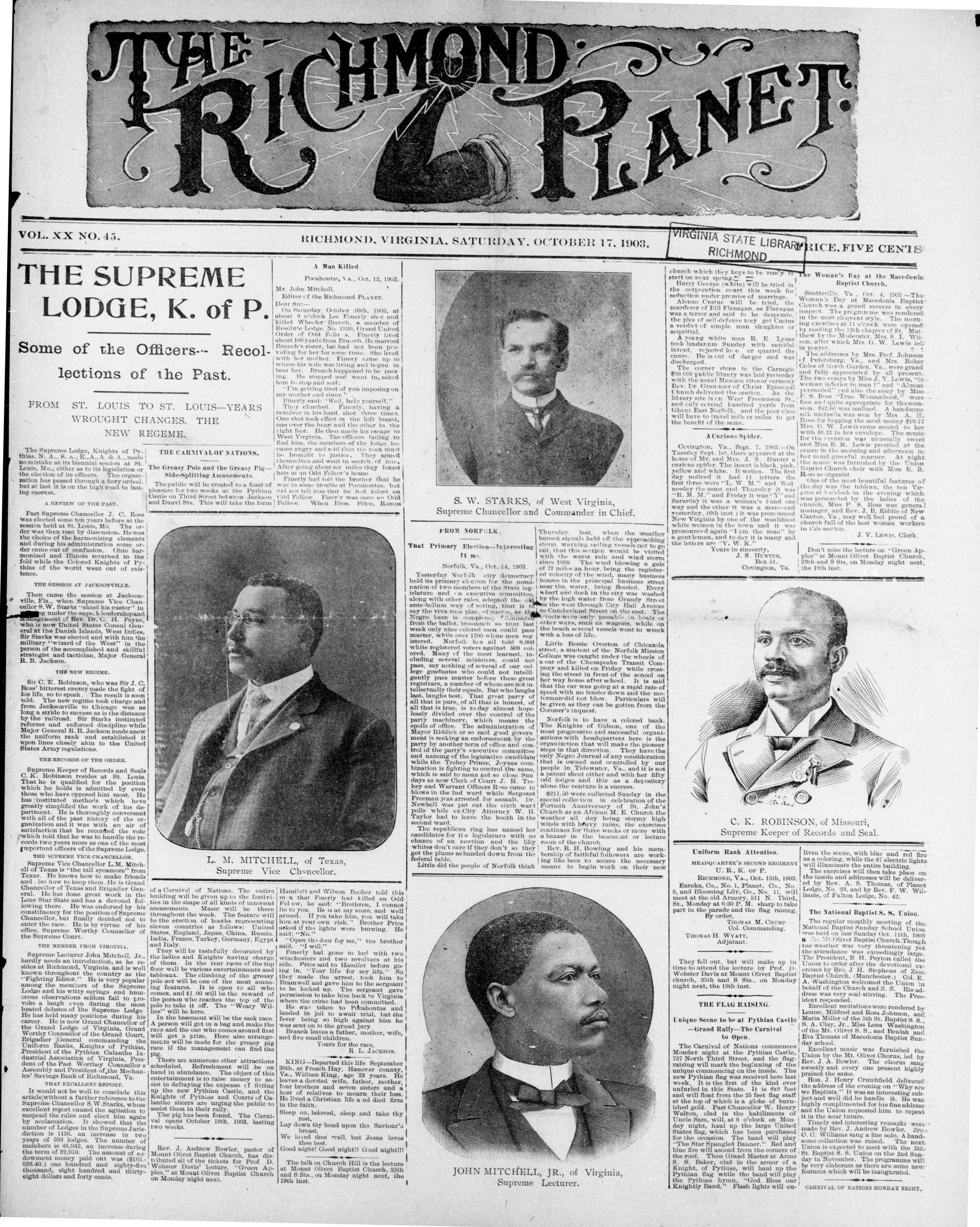
THE SUPREME LODGE, K. of P.
ST. LOUIS TO ST. LOUIS-YEARS WROUGHT CHANGES. THE NEW REGEME.
VOL. XX NO. 45.
THE SUP
LODGE
Some of the O
lections of
FROM ST. LOUIS TO
WROUGHT CH
NEW RI
The Supreme Lodge, Knights of Pythias, N. A., S. A., E. A., A & A., made no mistake at its biennial session at St. Louis, Mo., either as to its legislation or the election of its officers. The organization has passed through a fiery ordeal, but at last it is on the high road to lasting success.
A REVIEW OF THE PAST.
Past Supreme Chancellor J. C. Ross was elected some ten years before at the session held at St. Louis, Mo. The order was then rent by dissension. He was the choice of the harmonizing elements and during his administration some order came out of confusion. Ohio hardened his Hollis tenure to the fold while the Colored Knights of Pythias of the world went out of existence.
THE SESSION AT JACKSONVILLE:
Then came the session at Jacksonville, Fla., when Supreme Vice Chancellor S. W. Starks "shied his castor" in under the supe, leadership and management of Rev. Dr. C. H. Payne, who is now United States Consul General at the Danish Islands, West Indies, Sir Starks was elected and with him the military "wizard of the West" in the person of the accomplished and skillful strategist and tactician, Major General R. R. Jackson.
THE NEW REGIME
Sir C. K. Robinson, who was Sir J. C. Ross' bitterest enemy made the fight of his life, so to speak. The result is soon told. The new regime took charge and from Jacksonville to Chicago was as long a stride to success as is the distance by the railroad. Sir Starks instituted reforms and enforced discipline while Major General R. R. Jackson made anew the uniform rank and established it upon lines closely akin to the United States Army regulations.
THE RECORDS OF THE ORDER.
Supreme Keeper of Records and Seals C. K. Robinson resides at St. Louis. That he is qualified for the position which he holds is admitted by even those who have opposed him most. He has instituted methods which have greatly simplified the work of his department. He is thoroughly conversant with all of the past history of the organization and it was with an air of satisfaction that he recorded the vote which told that he was to handle the records two years more as one of the most important officers of the Supreme Lodge.
THE SUPREME VICE CHANCELLOR.
Supreme Vice Chancellor L.M. Mitchell of Texas is "the tall sycamore" from Texas. He knows how to make friends and, so loo to keep them. He is Grand Chancellor of Texas and Brigadier General. He has done great work in the Lone Star State and has a devoted following there. He was endorsed by his constituency for the position of Supreme Chancellor, but finally decided not to enter the race. He is by virtue of his office, Supreme Worthy Counsellor of the Supreme Court.
THE MEMBER FROM VIRGINIA
Supreme Lecturer John Mitchell, Jr., hardly needs an introduction, as he resides at Richmond, Virginia, and is well known throughout the country as the "Fighting Editor." He is very popular among the members of the Supreme Lodge and his witty sayings and humorous observations seldom fail to provoke laughs even during the most heated encounters of the Supreme Lodge. He has held many positions during his career. He is now Grand Chancellor of the Grand Lodge of Virginia, Grand Worthy Counselor of the Grand Court, Brigadier General commanding the Uniform Ranks, Knights of Pythias, President of the Pythian Calantha Industrial Association of Virginia, President of the Past Worthy Counselor's Assembly and President of the Mechanics' Savings Bank of Richmond, Va.
THAT EXCELLENT REPORT
It would not be well to conclude this article without a further reference to the Supreme Chancellor S.W.Starks, whose excellent report caused the agitation to suspend the rules and elect him again by acclamation. It showed that the number of Lodges in the Supreme Jurisdiction is 1158. an increase in two years of 393 lodges. The number of members is 46,943, an increase during the term of 23,010. The amount of eudowment money paid out was ($185. 838.40.) one hundred and eighty-five thousand, eight hundred and thirty-eight dollars and forty cents.
THE CARNIVAL OF NATIONS.
The Greasy Pole and the Greasy Pig—Side-Splitting Amusements.
The public will be treated to a feast of pleasure for two weeks at the Pythian Castle on Third Street between Jackson and Duval Sts. This will take the form
M.
[Name not visible in the image]
of a Carnival of Nations. The entire building will be given up to the festivities in the shape of all kinds of innocent amusements. Music will be there throughout the week. The feature will be the erection of booths representing eleven countries as follows: United States, England, Japan, China, Russia, India, France, Turkey, Germany, Egypt and Italy. They will be tastefully decorated by the ladies and Knights having charge of them. In the rear room of the top floor will be various entertainments and tableaux. The climbing of the greasy pole act will be one of the most amusing features. It is open to all who comes, and $1.00 will be the reward of the person who reaches the top of the pole to take it off. The "Weary Wil-lies" will be here.
Hamillett and Wilson m that Finerly hut Felow, he said: "B lie to you. He is at m armed. You take h him at your own risks asked if the lights wa- said: "No." "Open the door for me." "I will." Finerly had gone winchester and two side. Price said to H ing in. "Your life made the arr- Bramwell and gave h to be locked up. The permission to take him where the crime had h He was taken landed in jail.
In the basement will be the sack race. A person will get in a bag and make the race and the one who comes around first will get a prize. Here also arrangements will be made for the greasy pig race if the management can find the pig.
There are numerous other attractions scheduled. Refreshment will be on hand in abundance. The object of this entertainment is to raise money to assist in defying the expense of fitting over Pythian Castle, and the Knights of Pythias and Courts of Calanthe sisters are urging the public to assist them in their rally.
The pig has been found. The Carnival opens October 19th, 1903, lasting two weeks.
Rev. J. Andrew Bowler, pastor of Mount Olivet Baptist Church, has distributed all of the tickets for Prof. D. Webster Davis' lecture, "Green Apples," at Mount Olivet Baptist Church on Monday night next.
RICHMOND, VIRGINIA, SATURDAY, OCTOBER 17, 1903.
A Man Killed
Pocahontas, V. a., Oct. 12, 1903.
Mr. John Mitchell,
Editor of the Richmond PLANET.
Deer Sir:—
On Saturday, October 10th, 1903, at about 9 o'clock Le Funely shot and killed Wheeler-Branch, a member of Resolute Lodge, No. 2830, Grand United Order of Odd Folio s. Finery lived about 100 yards from Branch. He married Branch's sister, but had not been providing for her for some time. She lived with her mother. Finery came up to where his wife was living and began to beat her. Branch happened to be passing. He stopped and went in, asked him to stop and said: "I'm getting tired of you imposing on my mother and sister."
Finely said: "Well, help yourself," they clunched. Finely, having a revolver in his hand, shot three times. One shot took effect in the left breast, one over the heart and the other in the right foot. He then made his escape to West Virginia. The officers failing to find him, the members of the lodge became angry and said that the man must be brought to justice. They armed themselves and went in search of him. After going about six miles they found him at an Odd Fellow's house. Finely had told the brother that he was in some trouble at Pocahontas, but did not tell him that he had killed an Odd Fellow. Finely was once an Odd Fellow. When Bros. Price, Ramos
[Name]
Hamlett and Wilson Booker told this man that Fuerley had killed an Odd Felow, he said: "Brethren, I cannot lie to you. He is at my store, and well armed. If you take him, you will take him at your own risk." Brother Price asked if the lights were burning. He said: "No." "Open the door for me," the brother said. "I will." Finerly had gone to bed with two winchesters and two revolvers at his side. Price said to Hamilt before going in, "Your life for my life." So they had the arrest, took him to Bramwell and gave him to the sergeant to be locked up. The sergeant gave permission to take him back to Virginia where the crime had been committed. He was taken to Pleochantas and landed in jail to await trial, but the fever being so high against him he was sent on to the grand jury. Branch leaves a father, mother, wife, and five small children.
KING—Departed this life September 30th, at French Hay, Hanover county, Va., William King, age 33 years. He leaves a devoted wife, father, mother, four brothers and seven sisters and a host of relatives to mourn their loss. He lived a Christian life a nd died firm in the faith.
Sleep on, beloved, sleep and take thy rest,
Lay down thy head upon the Saviour's breast.
We loved thee well, but Jesus loves thee best.
Good night! Good night!! Good night!!!
The talk on Church Hill is the lecture at Mount Olivet Baptist Church, 35th and S Sts., on Monday night next, the 19th inst.
M. B.
S. W. STARKS, of West Virginia, Supreme Chancellor and Commander in Chief.
JOHN MITCHELL, JR., of Virginia, Supreme Lecturer.
Norfolk, Va., Oct. 14, 1903
Yesterday Norfolk city democracy held its primary election for the nomination of two members of the State legislature and an executive committee, along with other rules, adopted the old ante-bellum way of voting, that is to say the viva voce plan, of course, as the Negro here is completely illuminated from the ballot, insomnch so that last week only nine colored men could pass muster, while over 1700 white men registered. Norfolk has all told 8,000 white registered voters against 509 colored. Many of the most learned, including several ministers, could not pass, say nothing of several of our college graduates who could not intelligently pass muster before these great registrars, a number of whom are not intellectually their equals. But who laughs last, laughs best. That great party of all that is pure, of all that is honest, of all that is true, is to day almost hopelessly divided over the control of the party machinery, which means the spoils of office. The administration of Mayor Riddick or so said good government is seeking an endorsement, by the party by another term of office and control of the party's executive committee and naming of the legislative candidate while the Trehey-Prince, Joynes combination is fighting to control the same, which is said to mean not so close Sundays as now Clerk of Court J. H. Trehey and Warrant Officers Rose came to blows in the 2nd ward while Sergeant Freeman was arrested for assault. Dr. Newbell was put out the sixth wart polls while ex-City Attorney W. H. Taylor had to leave the booth in the second ward.
The republican ring has named her candidates for the legislature with no chance of an ejection and the illly whites don't care if they don't so they are handed down from the federal table. Little did the people of Norfolk think
Thursday, last, when the weather bureau signals held off the approaching storm warning sailing vessels not to go out, that this section would be visited with the worst rain and wind storm since 1889. The wind blowing a gale of 72 miles an hour, being the registered velocity of the wind, many business houses in the principal business street near the water, being flooded. Every wharf and dock in the city was washed by the high water from Grandy Street on the west through City Hall Avenue to Cumberland Street on the east. The streets were only passable in boats or other ways, such as wagons, while on the beach several vessels went to wreck with a loss of life.
Little Bessie Overton of Chicagola street, a student of the Norfolk Mission College was caught under the wheels of a car of the Chesapeake Transit Company and killed on Friday while crossing the street in front of the school on her way home after school. It is said that the car was going at a rapid rate of speed with no fender down and the motorman did not blow. Particulars will be given as they can be gotten from the Coroner's inquest.
Norfolk is to have a colored bank. The Knights of Gideon, one of the most progressive and successful organizations with headquarters here is the organization that will make the pioneer steps in that direction. They have the only Negro Journal of any consideration that is owned and controlled by our people in Tidewater, Va., and it is not a patent sheet either and with her fifty odd lodges and this as a derosory alone the venture is a success.
$211.50 were collected Sunday in the special collection in celebration of the Fortieth Anniversary of St. John's Church as an African M. E. Church the weather all day being stormy high winds with heavy rains, the exercises continues for three weeks or more with a bazaar in the basement or lecture hall. Rev. R. H. Bowling and his membership of faithful followers are working like bees to secure the necessary means to begin work on their new
church which they hope to be ready to start on next spring.
Harry George (white) will be tried in the corporation court this week for seduction under premise of marriage. Alonzo Custus will be tried, the murderer of Bill Flannagan, as Flanagan was a terror and said to be desperate, the plea of self-defense may get Custus a verdict of simple man slaughter or acquittal. A young white man R. E. Lyons took laudanum Sunday with suicidal intent, rejected love or quarrel the cause. He is cut of danger and was discharged. The corner stone to the Carnegie $50 000 public library was laid yesterday with the usual Masonic rites or cemetery Rev. Dr Grammar of Christ Episcopal Church delivered the oration. As the library site is on West Freemason St., and only several hundred yards from Ghent East Norfolk, and the poor class will have to travel mile or miles to get the benefit of the same.
A Curious Spider.
Covington, Va., Sept. 7, 1903.—On Tuesday Sept. 1st, there appeared at the home of Mr. and Mrs. J. S. Hunter a curious spider. The insect is black, pink, yellow and white. It writes. The first day noticed it had 11 letters the first three were "L. W. M." and Wednesday the same and Thursday it was "R. M. M." and Friday it was "Y" and Saturday it was a woman's hand one way and the other it was a man—and yesterday, (6th inst.) it was pronounced Virginia by one of the wealthiest white women in the town, and it was pronounced again "I am the man" by a gentleman, and to day it is many and the letters are "Y. W. K."
Yours in sincerity,
J. S. HUNTER,
Box 51.
Covington, Va.
J. K.
C. K. ROBINSON, of Missouri, Supreme Keeper of Records and Seal.
Uniform Rank Attention
HEADQUARTER'S SECOND REGIMENT
U. R., K. OF P.
RICHMOND, VA., Oct. 15th, 1903.
Eureka, Co., No.1, Planet, Co., No.8, and Blooming Lily, Co., No.11, will meet at the old Armory, 511 N. Third, St., Monday at 6:30 P. M. sharp to take part in the parade and the flag raising.
By order,
THOMAS M. CRUMP
Col. Commanding.
THOMAS H. WYATT,
Adjutant.
They fell out, but will make up in time to attend the lecture by Prof. D. Webster Davis at Mount Olivet Baptist church, 25th and S Sts., on Monday night next, the 19th inst.
THE FLAG RAISING
Unique Scene to be at Pythian Castle
—Grand Rally—The Carnival
The Carnival of Nations commences Monday night at the Pythian Castle, 727 North Third Street, and the flag-raising will mark the beginning of the unique commencing on the inside. The new Pythian flag was received here last week. It is the first of the kind ever unfurled in this State. It is 8x9 feet and will float from the 25 feet flag staff at the top of which is a globe of burnished gold. Past Chancellor W. Henry Walton, clad in the habiliments of Uncle Sam, will, at S o'clock on Monday night, haul up the large United States flag, which has been purchased for the occasion. The band will play "The Star Spangled Banner." Red and blue fire will ascend from the corners of the root. Then Grand Master at Arms S. S. Baker, clad in the armor of a Knight, of Pythias, will haul up the Pythian flag while the band will play the Pythian hymn, "God Bless our Knightly Band." Flash lights will en-
to Open.
The Woman's Day at the Macedonia Baptist Church.
Scottsville, Va., Oct. 4, 1903 — The Woman's Day at Macedonia Baptist Church was a grand success in every respect. The programme was rendered in the most elegant style. The morning exercise at 12h o'clock were opened by reading the 12th chapter of St. Matthew by the Moderator, Mrs. S. I. Wilson, after which Mrs. G. W. Lewis led in paver.
The addresses by Mrs. Prof. Johnson of Petersburg, Va., and Mrs. Rober Coles of North Garden, Va., were grand and fully appreciated by all present. The two essays by Miss J. V. Lewis, "In woman inferior to man?" and "Almost persuaded" and also the essay by Miss P. S. Ross "True Womanhood," were fine and quite appropriate for the occasion. $4.65 was realized. A handsome silk umbrella was won by Mrs A. H. Ross for begging the most money $10.77 which Lewis came second to her with $4.22 in her envelope. The music for the occasion was unusually sweet and Miss B. M. Lewis attended at the organ in the morning and offered her usual graceful manner. At night the music was furnished by the Union Baptist Church choir with Miss E. B. Ross as organist.
One of the most beautiful features of the day was the tableau, the ten Virgins at 8 o'clock in the evening which was personified by the ladies of the church, Miss P. S. Ross was general manager, and Rev. J. B. Riddle of New Canton, who may well feel proud of a full or full of the best woman workers in this section.
Don't miss the lecture on "Green Apples" at Mount Olivet Baptist Church, 29th and S Sts, on Monday night next, the 19th inst.
M.
liven the scene, with blue and red fire as a coloring, while the 67 electric lights will illuminate the entire building.
The exercises will then take place on the inside and addresses will be deliver- ing to the homes of Planet Lodge, No. 23, and by F. W. Williams of Fulton Lodge, No. 42.
The National Baptist S. S. Union.
The regular monthly meeting of the National Baptist Sunday School Union was held on last Sunday Oct. 11th, 1903 a the Mt. Olivet Baptist Church. Though the weather was very threatening yet the attendance was exceedingly large. The President, B. H. Peyton called the Union to order after the devotional exercises by Bro. J. H. Stephens of Zion Baptist Church, (Manchester.) Col. E. A. Washington welcomed the Union in behalf of the Church and S. S. His address was very soul stirring. The President responded.
Excellent recitations were rendered by Louise, Mildred and Rosa Johnson, and Maria Miller of the 5th St. Baptist S. S., S. A. Clay, Jr., Miss Lena Washington of the Mt. Olivet S. S., and Beulah and Eva Thomas of Macedonia Baptist Sunday school.
Excellent music was furnished the Union by the Mt. Olivet Chorus, led by Rev. J. A. Bowler. The chorus sang sweetly and every one present highly praised the same.
Hon. J. Henry Crutchfield delivered the address of the evening on "Why are we Baptists." It was an interesting subject and well did he handle it. He was highly complimented for his fine address and the Union requested him to repeat it in the near future.
Timely and interesting remarks were made by Rev. J. Andrew Bowler. Bro. C. C. Williams sang a fine solo. A handsome collection was raised. The next Union is expected to meet with the 5th St. Baptist S. S. Union on the 2nd Sunday in November. The programme will be very elaborate as there are some new features which will be inaugurated.
CARNIVAL OF NATIONS MONDAY NIGHT.
J. V. LEWIS. Clerk
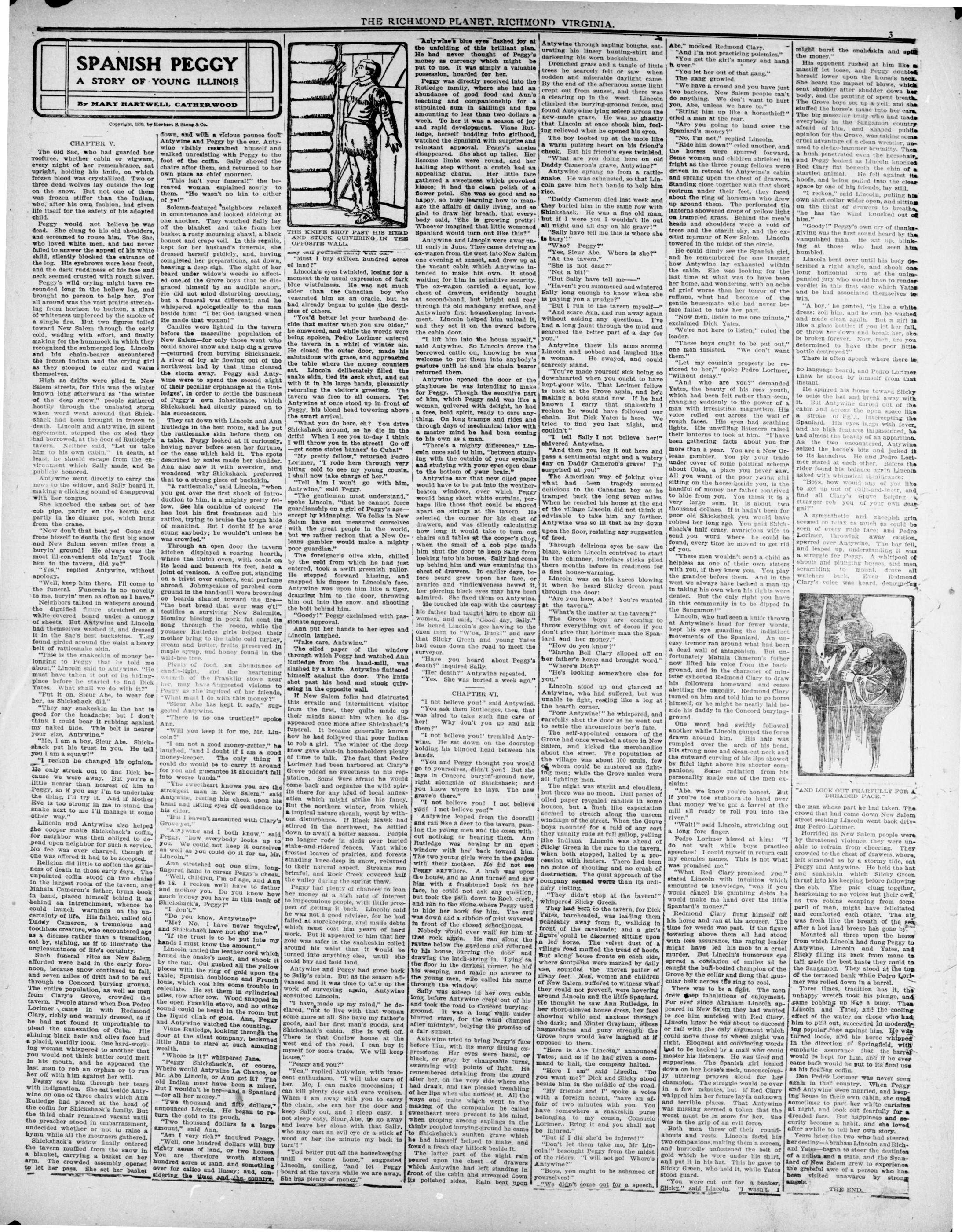
SPANISH PEGGY
A STORY OF YOUNG ILLINOIS
By MARY ieee CATHERWOOD
‘Copyright, 1S, by Herbert 8 Stone & Co.
Mperent, Holding Sis knife, on which
frozen blood was crystallized. Two or
three dead wolves lay outside the log
on the snow. But not one of them
was frozen stiffer than the Indian,
‘who, after his own fashion, had given
Iife itself for the safety of his adopted
child. z
Pegsy would not believe he was
dead. She clung to his old shoulders,
‘and screamed to rouse him. The Sac,
who loved white men, and had never
failed to answer the appeal of his white
child, stlently bloaked the eatrance of
the log. His eyebrows were hoar frost,
and the dark ruddiness of his face and
neck seemed crusted with rough silver.
Peggy's wild orying might have re-
sounded long tn the hollow log, and
brought no person to help her. For
all around was the vast prairie stretch-
ing from horlzon to horizon, a glare
‘of whiteness unplerced by the smoke of
a single fire. But two figures tolled
toward New Salem through the early
cold, wading with effort, and finally
aking for the hummock in which they
recognized the submerged log. Lincoln
and his chain-bearer eneountered
the frozen Indian and tho crying girl
‘as they stooped to enter and warm
themselves.
High as drifts were piled in New
Salem streets, for this was the winter
known long afterward as “the winter
‘of the deep snow,” people gathered
hastily through the unabated storm
when word went around that Shick-
shack had been brought in frozen to
death. Lincoln and Antywine, in silent
agreement, stopped the ox sled they
had borrowed, at the door of Rutledge’s
tavern. Neither said, “Let us take
him to his own cabin.” In death, at
least. he should escape from the ‘en-
Vircoment which Sally made, and be
publicly honored.
Antywine went directly to carry the
news to the widow, and Sally heard it,
making a clicking sound of disapproval
with ber tongue.
She knocked the ashes out of her
cob pipe, partly en the hearth and
partly in the dinner pot, which hung
from the crane,
“Now don't that beat ye! Gone and
froze bisself to death the first big snow
and New Salem seven miles from a
buryin’ ground! He always was the
most ill-convenient old In'jan! Took
him to the tavern, did ye?"
“Yes,” replied ‘Antywine, without
apoloxy.
“Well, keep him there. I'll come to
the funeral. Wunerals is no novelty
to me, buryin’ men as often as I have.”
Neighbors talked in whispers around
the dignified frure stretched on a
white-covered board under a canopy
of sheets. But Antywine and Lincoln
had themselves washed it, and dressed
it in the Sac’s best buckskins. Tuey
found girded around the waist a heavy
belt of rattlesnake sitin,
“Thie is the snakeskin of money be-
longing to Posxy thst he told me
about,” Lincoln said to Antywine. “He
must have taken it out of its hiding-
place before he started to find Dick
Yates. What shall we do with it?”
“Put {t on, Sieur Abe, to wear for
her, as Shickshack did.”
“They say snakeskin in the hat is
good for the headache; but I don't
think I could bear {t rubbing against
my naked bide. ‘This belt ls nearer
your size, Antywine.”
“Me, Iam a boy, Stour Abe. Shick-
shack put his trust in you. He tell
you lam a squaw!”
.~"I reckon he changed bis opinion,
He only struck out to find Dick be-
cause We were away. But you're a
litle nearer than nearest of kin to
Pegey, so i you say I'm to undertake
the thing, Pil try it And it Mother
Eve is too strong in me to stand the
snake next to me I'll manage it some|
other way,” |
Lincoln and Antywine also helped
dhe cooper make Shickshack’s coffin,
for neighbor was then obliged to de.
Pend upon neighbor for such a service.
No fee was ever charged, though it|
‘Ono Was offered it had to be accepted.
Religion did little to soften the grim-
‘Ress of death in those early days. ‘The
Unpainted coffin stood on two chalss
in the largest room of the tavern, and
Mahala Cameron's father, hymn book
in hand, placed himself behind it as
‘behind an intrenchment, whence he
could launch warnings’ on the un-
certainty of life His father, called old
Daddy Cameron, a tremulous and
toothless creature, who encountered age
8 a disease rather than a transition,
sat by, sighing, as if to {llustrate the
unpleasantness of life's certainty.
Such funeral rites as New Salem
afforded were held in the early fore-
noon, because snow continued to fall,
and seven miles of drift had to be cut
through to Concord burying ground.
The entire population, as well as men
from Clary's Grove, crowded the
tavern. People stared when Don Pedro
Lorimer \came in with Redmond
Clary, richly and warmly drossed, as if
he had not found it unprofitable to
plead the annexation of Cuba. His
shining black hair and olive face had
® placid, worldly look. One hard-work-
ing woman whispered to another that
you would not think batter could melt
in his mouth, and he appeared the
last man to rob an orphan or to run
her off with him against her will. i
Pexgy saw him through her tears |.
with indignation. She sat beside Ant, |!
CHAPTER Vv.
Se ee eee ae See ORES ET
wine visibly restained himself and
walked unresisting with Pezzy to the
foot of the coffin. Sally shoved the
chairs after them, and returned to her
own place as chief mourner.
“This isn’t your funeral!” the be-
reaved woman explained sourly to
them. “He wasn't no kin to either
of yet"
Solemn-featured “neighbors relaxed
im countenance and looked sidelong at
one another. They watched Sally lay
off the blanket and take from her
basket @ rusty mourning shawl, a black
bonnet and crape veil. In this regalia,
kept for her husband's funerals, she
dressed herself publicly, and, having
completed her preparations, sat down,
heaving a deep sigh. ‘The sight of hor
beard under widow's weeds so aifect-
‘ed one.of the Grove boys that he dis-
graced himself by an audible snort.
He did not mind disturbing meeting,
but a funeral was different; and he
whispered apologetically to the man
beside him: “I bet God laughed when
He made that woman!”
Candles were lighted in the tavern
defore the masculine population of
New Salem—for only those went who
could shovel snow and help dig a grave
—xeturned from burying Shickshack.
A river of icy air flowing out of the
northwest had by that time cleared
the storm away. Peggy and Anty-
‘wine were to spend the second night
of their peculiar orphanage at the Rut-
ledges’, in order to settle the business
of Peggy's own inheritance, which
Shickshack had silently passed on to
| his successors,
| _ ‘They sat down with Lincoln and Ann
Rutledge in the best room, and he put
| the rattlesnake skin before them on
a table. Peggy looked at it curiously,
having never before scen hor fortune,
‘or the case which held it. The spots
| described by scales made her shudder.
| Ann also saw ft with aversion, and
| wondered why Shickshack preferred
| that to a strong piece of buckskin,
“A rattlesnake,” said Lincoln, “when
you get over the first shock of intro-
| duction to him, 1s a mighty pretty fel-
low. See his combine of colors! He
has lost his first freshness and his
rattles, trying to bruise the tough hide
of mankind. But I doubt if he ever
stung anybody; he wouldn't unless he
was crowded.”
Through an open door the tavern
kitchen displayed a roaring hearth,
where the Dutch oven, with coals on
its head and beneath its feet, held a
Joint of venison. A coffee pot, standing
| on a trivet over embers, sent perfume
abroad. Johnnycakes of parched corn
ground in the hand-mill were browning
op boards slanted toward the fre—
“the best bread that ever was e't!”
testifies a surviving New Salemite,
Hominy hiesing in pork fat sent its
song through the room, while the
younger Rutledge girls belped their
mother bring to the table cold turkey,
cream and butter, fruits preserved in
maple syrup, and honey found in the
wild-bee tree.
| Plenty of food, an abundance of
Feandie-ilght, and the — heartening
timth of the Franklin stove near
her, may have Suggested visions to
| Povzy a she inquired of her friends
“What must 1 do with this money?”
| “Sieur Abo has kept {t safe," sug-
gested Antywine,
| “There is no one trustier!” spoke
Ann,
WII you Keep it for me, Mr. Line
coin?”
“I am not a good money-getter,” he
laughed, “and I doubt if I am a good
money-keoper. The only thing
could do would de to carry tt around
for you and muneantee 18 shouldn't fall
{ato worse hands,”
“Tbe sweetheart knows you are thé
strongest man in New Salem,” sald
Anty Wine, resting his cheok upon his
pend and iting eyes df eonddence to
is elder.
cnet, Baven't measured with Clary's
“Ay wine and I both know,” said
Pegsy, “how. everybody looks up to
Zou We could not keep it ourselves
8 Well as You co1
Soe jud do it for us, Mn,
Ann stretehed out one
fingered hand to caress Eee ee
“Well, children, I'm of age, and Anu
4s 18. 1 reckon ‘we'll have to father
and mother yo. Do you know how
uch inoney you hay
Shichshaci’s, Peggy?” "NS PARE of
“E don't”
ep, You know, Antywiner”
le? No. I have never ,
fand Shickshack have not sho! we
“If the trust is to be put in
hands I must know the amount”
ncoin untied the leather
bound the snake's neck, sed chook
by the tail. Out gushed all the yellow.
Ploces with the ring of gold upon the
table; Spanish doubloons and French
louis, which cost him some trouble to
calculate. He set them in cylindrical
piles, row after row. Wood snapped in
the open Franklin stove, and no other
sound could be heard in the room but
the liquid clink of gold. Ann, Peggy
and Antywine watched the counting.
Viane Rutledge, looking through the
rar, at the silent company, beckoned
je Jane to si
seal tare at such amazing
“Whose {s it?” whispered Jane.
THE RICHMOND PLANET, RICHMOND VIRGINIA.
Ba
pda
=F iN
ial
Laon b/
44 |
AND STUCK QUIVERING IN THE
OPPOSITE WALL.
euny cull FOUTS Tay Wet Oe
“Must I buy sixteen hundred acres
of land?”
Lincoln's eyes twinkled, losing for a
moment their usual expression of dark
blue wistfulness. He was not much
older than the Canadian boy who
venerated him as an oracle, but ha
bad already begun to guide the desti-
nies of others.
“You'd better let your husband de-
cide that matter when you are older,”
he answered, and while the words were
being spoken, Pedro Lorimer entered
the tavern in a whirl of winter air.
He closed the outer door, made his
salutations with grace, and appreachtd
the table where the money counters
sat. Lincoln deliberately filled the
snaxe skin, tled its aeck shut, and sat
with it in his large bands, pleasantly
returning the visitor’s greeting. ‘The
tavern was free to all comers. Yet
Antywine at once stood up in front of
Peggy, his blond head towering above
the swart arrival.
“What you do here, eh? You drive
Shickshack around, so he die in the
arift! When I see you to-day I think
I will throw you in the street! Go off
—got some states hannex’ to Cubal”
“My pretty fellow,” returned Pedro
Lorimer, “I rode here through very
biting cold to see my young cousin.
I shall now take charge of her.””
“Tell him I won't go with him,
Antywine,” said Peggy.
“The gentleman must understand,”
spoke Lincoln, “that he cannot force
guardianship on a etrl of Porzy's axe—
except by kidnaping. We folks in New
Salem have not measured ourselves
with the great people tn the world,
but we rather reckon that a New Or-
leans gambler would make a mighty
poor guardian.”
Tho foreigner’s olive skin, chilled
by the cold from which he had just
entered, took a swift greenish pailor.
Ho stepped forward hissing, and
snapped his fingers in Lincoln's face.
Antywine was upon him like a tlger,
dragging him to the door, throwing
him ont into the snow, and shooting
the bolt behind him.
“Goody!” Peggy exclaimed with pas-
sionate approval.
Ann put her hands to her eyes and
Lincoln laughed.
“Take care, Antywine.”
The olled ‘paper of the window
through which Peggy had watched Ann
Rutledge from the hand-mill, was
slashed by a knife, Antywine flattened
himself against the door. ‘The knife
shot past his head and stuok quiv-
ering in the opposite wall.
It New Salem folks had distrusted
this erratic and intermittent visitor
from the first, they quite made up
thelr minds about him when he dls-
appeared once more after Shickshack’s
funeral. It became generally known
how he had follgwed that poor Indian
to rob a girl, ‘The winter of the deep
How gave shut-in householders plenty
of time to talk. The fact that Pedro
Lorimer had been harbored at Clary’s
Grove added no sweetness to his rop-
tation. Some Were afraid he would
come back and organize the wild spir-
its there for any kid of local annex-
ation which might strike his fancy.
But the northern winter, from which
& tropical nature shrank, went by with-
put disturbance, If Black Hawk had
stirred in the northwest, he settled
down to await a better season. People
no longer rode in sleds over buried
stake-and-ridered fences, Vast white
rosted loaves of prairies, and forests
tanding knee-deep in snow, returned
fo thelr natural aspect. Streams yan
rrimful, and Rock Creek coveret falf
he valley during the spring thaw.
Peggy had plenty of chancés to fean
ter money at a high rate of interost
0 Impecunious people, with Tittle pros-
ect Of Ketting it back. Lincoln sale
Ie Was not a xood adviser, for he had
ailed at storekeeping, and made debts
which must cost him years of hard
rork. But it appeared to him that her
‘old was safer in the snakeskin coiled
round his waist than it Would be
urned into anything else, until she
ould buy and hold land.
Antywine and Peggy had gone back
© Sally's cabin. But as the season ad-
anced and it was time to tal:e up the
york of surveying again, Antywine
onsulted Lincoln,
“I have, made up my mind,” he de-
lared, “not to live with that woman
ome more at all. She have my father’s
oods, and her first man's goods, and
hickshack’s cabin, She ts well off.
here s that Onslow house at the
est end of the road. I can buy it
iyself for some trade. We will keep
ouse,”
“Peggy and you?”
“Yes,” replied Antywine, with Inno-
ent enthusiasm. “I will take care of |
er. Me, I can make moccasins; I}
in kill plenty deer and cure venison. |.
fhen I am away with you to carry |:
1 chain, she can bar the door and #:
rep Sally out, and I sleep easy. If:
at sleep easy, Sieur, Abe, tm go away |
ad leave her alone with that Sally, |
ho may cast an evil eye or a stick of
ood at her the minute my back is}
rat" ‘
Sieh Seles ilk: han ee ae NOR Se
__ Antywines blue eyes Hashed joy at
the unfolding of this brilliant plan.
He had never thought of Peggy's
money as currency which might be
put to use. It was simply a valuable
Possession, hoarded for her.
Peggy was directly received into the
Rutledge mmily, where she had ap
abundance of good food and Ann's
teaching and companionship for a
stipulated sum in shillings and fips
amounting to less than two dollars a
week. To her it was a season of joy
&nd rapid development. Vine Rut-
ledge, herself budding Into girlhood,
watched the Spaniard with surprise and
Telustant appsoral. Peggy's angles
disappeared. She shot up taller. Her
lissome limbs were round, and her
halting step without a crutch had an
appealing charm. Her little face
gathered a sweetness which provoked
Kiases; it had the claan polish of a
flower petal. She was so good and so
happy, so busy learning how to man-
age the affairs of dally living, and so
glad to draw her breath, that every-
body sald, “She ts growing pretty!
‘Whoever imagined that little weazened
Spaniard would turn out like this?"
Antywine and Lincoln were away un-
til earlyin June. They came driving an
ox-wagon from the west IntoNew Salem
one evening at sunset, and drew up at
the vacant cabin which Antywine in-
tended to make his own. It stood
waiting for him in primitive security.
‘The ox-wagon carried a squat, low
chest of drawers, evidently bought
at second-hand, but bright and rosy
through {ts old mahogany surface, and
Antywine’s first housekeeping Invest-
ment. Lincoln helped him unload tt,
and they set it on the sward before
the cabin door.
“I lft him into the house myself,”
sald Antywine. So Lincoln drove the
borrowed cattle on, knowing he was
welcome to put them into anybody's
pasture until he and bis chain bearer
returned them.
Antywine opened the door of the
playhouse he was intending to make
for Peggy. Though the sensitive part
of him, which Peggy sald was lke a
woman, quivered with delight, he had
a free, bold spirit, ready to dare any-
thing. On long tramps and rides and
through days of mechanical labor with
@ master mind he had been coming
to bis own as a man.
cerThere’s a mighty difference,” Ttn-
eein once sald to him, “between study-
ing with the outside of your eyeballs
end studying with your eyes open clear
to the bottom of yeur brain.”
| Antywine saw that new oiled paper
‘would have to be put Into the weather-
Deaten windows, over which Peggy
would hang short white curtains, per-
haps like those that could be shoved
apart on strings at the tavern. He
selected the corner for his chest of
@rawers, and was silently calculating
how long it would take to turn out
chairs and tables at the cooper’s shop,
When the smell of a cob pipe made
him shut the door to keep Sally from
looking into his house. Sally had come
up behind him and was examining th?
chest of drawers. In earlier days, bo-
fore beard grew upon her face, of
avarice and vindictiveness hewed tt,
her plercing black eyes may have been
admired. She fixed tiem on Antywina,
He touched bis cap with the courtesy
Bis father had taught hia to show all
Women, and wad, “Good day, Sally."
He heard Lincoin's gee-hawing to the
oxen turn to “W'oa, Buck!” and saw
that Slicky Green and young Yates
had como down the road to meet the
surveyor.
| “Have you hoard about Peggy's
cath?” inquired Sally,
| “Her death?” Antywine repeated.
| “Yea She was buried a week ago.”
Pree
CHAPTER VI.
“I not believe you!" said Antywine,
“You ask them Rutledges, thea, that
was hired to take such fine care of
}her! = Why don’t you go and ask
them?”
“I not believe you!’ trembled Anty-
wine. He sat down on the doorstep
holding his blinded head between his
hands.
“You and Peggy thought you would
{ go to yourselves, didn’t you? But she
lays in Concord buryin’-ground now,
right alongside of Skickshaek; and
{you know where he lays, The new
‘srave's there."
} ‘1 not believe you! 1 not believe
L¥@u! I not believe yout®
| Auitywine leaped from the doorsttl
and rari Mke a deer to the tavern, pass-
| ing the young men and the oxen with-
out noticing or hearing them. Ann
Rutledge was sewing by an open
Window with her back toward him.
The two young girls were in the garden
‘With their mother. He did not see
Peggy anywhere. A hugh was upon
tho houds, and as Ann turned and saw
Bim with @ frightened look on her
face, he cotid not ask any question,
but took the path down to Rock creek,
and ran to the sfone-where Pezsy used
to hide her hook for him. The sux
was dowd and a ribber of mist wavered
tm front of the closed schoojhouse,
Nobody Would ever wait’ for him at
that rock agin. He ran diong the
ravine below the gardens still retarned
to his house, varring the doo and
drawing the latch-string in. ‘Lying on.
the floor in the darkest corner, he hid
his weeping, and made no answer to
the young men, wifo called his name
through the window.
Sally was asleep id’ her own cabin
ong before Antywine crept out of his
and took the road to Contord burying.
ground. It was a long’ walk. winder
blurred stars, for the wiiid changed
after midnight, belying the promise of
a fair sunset.
Autywine tried to bring Peggy's face
before him, with its many flitting ex-
presvions. Her eyes were hazel, or
black, or grey, by changeable turns,
warming with points of light, He
remembered drinking from the gourd
ufter her, on the very side where she
bad drauk, and the pleased trembling
it her lips when she notieed it, All the
Ways and traits which went to the
making of the companion he called
weetheart were present to his mind,
when groping among saplings in the
hinly peopled burying-zround he eama
o Shickshack’s sunken grave which
1 bad himself helped to make, and
ound a fresh clay hillock beside it.
The latter part of the night rain
jeured upon the chest of drawers
rhich Antywine had left standing in
ront of the cabin and streamed Gown |
polished sides. Rain beat upon
By the end of the afternoon some light
crept out from sunset, and there was
a clearing up in the ‘west. Lincotn
fumbed the burying-ground fence, and
found Antywine lying asleep across the
‘Rew-made grave. He was so ghastly
that Lincoln at once shook him, feel-
Ang relieved when he opened his eyes.
‘The boy looked up at the mole like
‘a warm pulsims heart on his friend's
cheek. But his friend’s eyes twinkted.
“What are you doing here on old
Daddy Cameron's grave, Antywine?”
Antywine sprang as from a rattle-
snake. He was exhausted, so that Lin-
coln gave him both hands to help him
rise.
| “Daddy Cameron died last week and
they buried him in the same row with
Shickshack. He was a fine old man,
but if I were you I wouldn't He out
all night and all day on his grave!”
“Bally have tell me this is where she
{ bury'!”
“Who? Pesay?”
| “Yes, Sieur Abe. Where is she?”
At the tavern.”
"She is not dead?”
| “Not a bit!”
_ “But Sally have tell me—"
_,“Haven’t you summered and winterea
Sally long enough to know when she
is paying you a grudge?”
| “But I ron to the tavern myself—"
“And scare Ann, and run away again
without asking any questions, I’ve
had a long jaunt through the mud and
searched the better part of a day for
you.”
" Antywine threw his arms around
Lincoln and sobbed and laughed like
& woman. He swayed, and could
scarcely stand.
“You've made yourself sick being so
downhearted when you ought to have
kept.your wits, That Lorimer fellow
is back at the Grove again, and he's
making @ bold stand now. If he had
mown I carry that snakeskin 1
Teckon he would have followed our
chain, But Dick Yates is here. We
tried to find you last night, and
couldn't”
“I tell Sally I not believe her!”
shivered Antywine.
“And then you leg it out here and
pass a sentimental night and a watery
ay on Daddy Cameron's grave! I'm
surprised at you!”
The American way of joking over
what had teen tragedy seemed
delicious to the Canadian boy as he
tramped back the long seven miles,
‘When he reached his house at the end
of the village Lincoln did not think it
advisable to take him any farther.
Antywine was so ill that he lay down
upon the floor, resisting any suggestion
of food.
Through delirious eyes he saw the
Dlaze, winich Lincoln contrived to start
im the chimney, interlace sticks piled
there months before in readiness for
@ first house-warming.
Lincoln was on his knees blowing
{t when he heard Slicky Greon pant
through the door:
“Are you here, Abe? You're wanted
Rt the tavern,”
“What's the matter at the tavern?"
The Grove boys are coming to
throw everything out of doors if you
don’t give that Lorimer man the Span-
fard snd her money.”
“How do you know?"
“Martha Bell Clary slipped off on
her father’s horse and brought word.”
“Where's Dick?”
“He's looking somewhere else for
you."
Lincoin stood up and glanced at
Antywine, wha hind suffered, but was
unable to Sight, resting like a log at
the hearth corner.
“Poor Antywine!” he whispéted, and
farefully shut the door as he went out
to settle the unconscious boy's fate.
‘The self-appointed censors of the
Grove had once wreeked a store in Now
Salem, and kicked the merchandise
about the street. ‘The poputatien of
the village was about 100 souls, few
Whom could bo mustered as iight-
ins men; while the Grove males were
all fighting men.
The night was starlit and cloudless,
but there was no moon. Dull panes of
oiled paper revealed candies in some
houses, but a Rush Ike expectation
seomed to stretch along the unscen
Windiuigs of the street. When the Grove
boys mounted for a ratd of any sort
they usually rode at full gallop, yelling
like Indians, Lincoli was ahead of
Sllcly Green in the race to the tavern,
when both stopped, halted by a pro-
cession with lanters. There liad been
no nolse of shouting and no crash of
destruction, The quiet approach of the
company seemed worze than its ordi-
nary risting.
“They dide't stop at the tavern!”
whispered Slicky Greet.
‘They had Son to the tavern, for Dick
Yates, bareheaded, was leating them
peacéably away from it, walkitig in
front of the cavalcade; ‘and a girl's
igure'could be discerned sitting upon
a Jed horse. The velvet dust of a
village foad muffled the tréad of hoofs.
But along’ house fronts on each side,
where Sootpaths were marked by daily
use, sounded the uneven patter of
any feet. Mex, women and children
of New Salem, suffered to witness what’
hey could not prevent, were hovering
‘round incoln and the Litt’s Spaniard,
A Srcee mae ae Prernicing potemnien.”:
“You get the girl’s money and hand
fh over.” :
“You let her out of that gang.”
‘The gang growled.
“We have a crowd and you have Just
two backers. New Salem people can't
do anything. We don’t want to hurt
You, Abe, unless we have to.”
“String him up like a horsethief!”
eried a man at the rear.
“Are you going to hand over the
Spaniard’s money?"
“No, I'm not,” replied Lincoln,
“Ride him down!” cried another, and
the horses were spurred forward.
Seme women and children shrieked in
fright as the three young fellows were
driven in retreat to Antywine’s cabin
and sprang upon the chest of drawers.
' Standing close together with that short
Tostrum under their feet, they faced
about the ring of horsemen who drew
|up around them. ‘The perforated tin
lanterns showered drops of yellow light
{om trampled grass. Behind the men's
heads and shoulders were a yoid of
fees and the starlit sky, and the ex-
eee eye of New Salem. Lincoln
towel in the midst of the circle.
| He could dimly see the Spanish girl,
and he remembered for one instant
how Antywine lay exhausted within
the cabin. She was looking for the
last time at what was to have been
her home, and wondering, with an ache
of grief worse than her terror of the
ruffians, what had become of the
gentle housemate who had never be-
fore failed to take her part.
“Now men, listen to me one minute,”
exclaimed Dick Yates.
“We're not here to listen,” ruled the
leader.
“These boys ought to be put out,”
one man insisted. “We don't want
them.”
“Let my cousin’s property be re-
stored to her,” spoke Pedro Lorimer,
“without delay.”
“And who are you?” demanded
Yates, the beauty of his rosy youth,
which had been felt rather than seen,
changing suddenly to the power of a
man with irresistible magnetism. His
voice rolled out across the wall of
rough faces. His eyes had scathing
Mghts. His unwilling listeners raised
their lanterns to look at him. “Ihave
been gathering facts about you for
more than a year. You are a New Or-
Jeans gambler. You ply your trade
under cover of some political scheme
about Cuba, a place you never saw.
All you want of the poor young gli
sitting on the horse beside you, is the
bandful of money her father contrived
to hide from you. You think it is a
Very large sum. It is about two
thousand dollars. If it hadn't been for
poor old Shickshack you would have
robbed her long ago. You paid Shick
shack’s half crazy, avariciois wife to
fend you word Where he could be
found, every time he moved to get rid
of you.
“These men wouldn't send a child as
helpless as one of their own sisters
with you, if they knew you. You play
the grandee before them. And in the
west we always have backed a man up
in taking his own when his rights were
denied. But the only right you have
in this community is to be dipped in
the Sangamon!”
Lincoin, who had seen a knife thrown
at Antywine's head for fewer words,
kept his eye guarding the indistinct
Movements of the Spaniard. An un-
easy tremor ran around what had been
a dead wall of antagonism. But un-
fortunately Mahala Cameron's father
now lifted his volce from the back
ground, and im the character of min-
ister exhorted Redmond Clary to draw
His followers homeward and cease
abetting the ungodly. Redmond Clary
turned on him and told him to go homa
himself, or he might be neatly laid be-
| side his daddy tn the Concord burying-
ground.
One word had swiftly followed
another while Lincoln gauged the force
drawn around him. His hair war
rumpled over the arch of his head.
‘His strong nose and clean-cut neck and
the outward curving of his lips showed
by fitful light above his shorter com-
panions:; Some radiation from his
Personality made one of the men ex-
claim:
“Abe, we know you're honest. But
if you're too stubborn to hand over
that money we've got a barrel at the
mill afl ready to roll you into the
river.”
“Wait!” said Lincotn, strotching out
@ long fore finger.
Pedro Lorimer hissed at him: “1
do not wait while boys practice
speeches! I could myself in return call |
my enemies names, This is not what
was promised me.” |
“What Red Clary promised you,"
‘stated Lineoin with intuition Which
amounted te knowledge, “was if you
would cincel bis gambling debta he
would make me hand over the little
Spaniard’s money.”
Redmond Clary flung himself oft
his horse and ran at his accuser. The
time for words was past. If the figure
towering above them all had stood
‘with less assurance, the raging leader
might have led his mob to a cruel
murder. But Lincoln’s humorous =
spread a con(agion of smiles a3 he |
eS ee ee oo
-
might burst the snakéskin and spd
‘the money.” '
His opponent rushed at him like =
mastiff let loose, and Pesey soubled:
herself lower upon the horse's neck,
She heard the impact of blows, which
sent shudder after shudder down her
body, and the panting of spent breath.
‘The Grove boys set up a yell, and she
stuffed the horse’s mane into her care
‘The big museviar buily who bad made
everybody in the Sungamon country
afraid of him, and shaped publie-
opinion for the Grove, was taking some
cruel advantare of a clean wrostior, ume
used to slelge-hammer brutatity. Thea
@ hush penetrated even the horschain,
end Peggy looked as Lincoln knocke@
Red Clary fiat benesth the chin ote
startled animal. He fell against tte
hoofs, and being puliod into the clear
‘Space by one of hig friends, lay still,
“I reckon,” said Lincoin, polling his:
own shirt collar wider open, and sitting:
on the chest of drawers to brea
“he has the wind knocked oa
him.”
“Goody!” Pegzy’s own cry of thanks=
giving was the first sovnd heard by the,
vanquished man. He sat up, biinke
img at those who had seen bia
humbled.
Lincoln bent over until bis body dew
scribed a right angle, and shook ome
Jong horizontal arm at the unime
paneled jury who would have to renders
Verdict in this first. case which Yatew
and he bad associated themselves te
win.
“A boy,” he panted, “is like a white
dress: soil him, and he can be washe@
and made clean again. But a girl te
like a glass bottle: if you ist her fal,
or throw ker down and break her, she
4s broken forever. Now, men, fre you
determined to have this poor little
bottle destroyed?”
‘There is often speech where there Im
20 language heard; and Podro Lorimes
Mew he stood by iumscif from that
Instant,
He spurred his horse toward Slicky
to seize the bat and break awny with
ML Bat Antywine darted aut of the
cabin and aciors the opm apace Ike
& stroke of Lix’.t, intercepting the
Spaninrd. is eyes iacge with lever,
and his high features impassioned, he
bad almost the Leanty of an apparition,
As the two encountered, Antywine
seized the horse's bits and jerked it
to its haunches. He and Pedro Lorte
mer starod at each other, Hefere the
rider found his balance asrin Lincolm
asked with whimsi ianiteance:
“Boys, how would any of you like
to get up out of chitt-end-fever, and,
find all Ciary's Gtove helping
stranger rob you of your own gene
gait” %
A sympathetic and sheepish grim
Seemed to relax es much as could de
seen of every rede face; and Pedro
Lorimer, throwing away caution,
‘Sprrred over Antswine. ‘The hay fell,
and leaped up, understanding it was
@ struggle for Pegsy. A whirlpool of
shouts and plunsing horses, and mon
fserambling to mount. dove all
watchers bac, Even itedmond
Clary'e volce was heard, denoypetag-
pe) el
ey pe
Bos Pes ear.
Fx |. Se
a ? <a ae
Faecal ts gtr {¢/ Sade
ates N94 Vo y
Hs ENN age
4 im HANS”
ays hs
1 th he j
ae
Wi HW
“AND LOOK OUT FEARFULLY FOR &
DREADED Pace. -
the man whose part ke had taken, The
crowd that had come down New Salem
Street secking Lincoln went back drive
ing Podro Lorimer.
Horrifled as New Salem people were
by threatened violence, they were un-
able to refrain from cheering, They
crowded to:the chest of drawers, where,
left stranded as by a stormy tide, sat
Peggy end Antywine. He held the hat
and snakeskin whieh Slicky Green
thrust into his keeping before following
the ebb. The pair clung together,
hearkening to no yoices but their owf,
as two robins escaping from some
Peril of man, might have felicitated
find comforted each other. The ain
was fresh lke the breath of the gem
after a hot land breeze has gone by
Mounted all three upon the horse’
from which Lincoin had flung Peggy to
Antywine, Lincoln and Yates, and
Silcky filling its back from mane te
tat, guade the best haste they could to
the Sangamon. They stood at the top
Of the terraced bank While Pegro Yorke
mer Was rolled down Ina barrel. —~
Three times, tradition has it, the
unhapp;' wretch took his plunge, and
came bobbing up Nke a buoy. Them
Litesin and Yates, ar? the cooling
effect ef the water on those who had
him to pill out, succeeded in moderate
Dopular.tage against him. He wae
shee loose, ad his horse As
in the difection cf Springfteld, with!
mphatic assurance fhat the barreP~
would be kept for lum, ati ff he ever
ame back would he put to its final use
8 his floating coftin,
Don Pedr Lorimer was never seen
gain in tha’ country. When Persy
md Antywine Were married, and keep-
ng house in thei* own cabin, she used
omelimes to part ker white curtatee
t night, and look out fearfully far @
readed face. But happiness and se
urity become a habit, and she loved
fter awhile to tell her own story.
Years later the two who had steered
erdestiny—Abraham Lincoln and Rich«
td Yates—began to steer the destinies
a nation and a state, and the Spane
rd of New Salem crow to experience
fe grateful awe of a person who has.
em visited unawares by stro:
ee a
THE END =f -/
THE PLANET
published every Saturday by JOHN MITCHEL
J.K., at 311 North 4th Street, Richmond, Va
or one inch, one insertion . . . $ 50
or one inch, each subsequent insertion . . . 25
or two inches, three months . . . 25
or two inches, six months . . . 10.00
or two inches, nine months . . . 14.00
or two inches, twelve months . . . 26.00
arrangement and Funeral Notices . . . 50
standing and Transfers of Notices per line. . . 10
# POSTAGE STAMPS OF A HIGHER DE
# NOMINATION THAN TWO CENTS NOT
# RECEIVED ON SUBSCRIPTIONS.
THE PLANET is issued weekly. The subscript
on price is $1.50 a year, in advance.
There are FOUR WAYS by which money can be sent by mail at our risk. - In a Post Office Mail Order, by Bank Check or Draft, or an Exemption of these fees can be procured, in a registered Letter.
MONEY ORDERS - You can buy a Money Order at your Post Office, payable at the Richmond and we will be responsible for its arrival.
EXPRESS MONEY ORDERS can be occluded at the United States Express Company. We will be responsible for money sent by any of these companies and convenient way for forwarding money.
REGISTERED LETTER - If a Money Order post Office or an Express Office is not within your letter you will send us on payment of the cents. Then, if the letter is lost or stolen, you can send money in this manner at our risk.
We cannot be responsible for money sent in letters in any other way than one of the four ways mentioned above. If you send your money in another way, you must do it at your own risk.
RENewALS, TEC - If you do not want THE MONEY ORDER has run out, you then notify us by postal Card to discontinue it. The courts have decided that subscribers to newspapers who send their subscription has run out, are notATION of time for which it has been paid, are liable for the payment of the subscription up to date when they order the paper discount.
COMMUNICATIONS.....When writing to us to renew your subscription or to inquire about a substitute your name and of course in full, otherwise we cannot find your name on our books.
At our office a purpose.....In order to change your address or a subscriber, we must be sent our form as well as the present address
Entered in the Post Office at Richmond, Va. second class matter.
SATURDAY.....OCTOBER 17, 1903
THE POST AND NEGRO LEADERS.
THE Washington, D. C., POST, in its issue of the 14th inst., discusses "Negroes and Their Leaders." It says:
"A colored Chicago person, described in the press reports as former Representative John G. Jones, delivered himself of an attack on Prof. Booker Washington at a meeting of the Illinois Civil Rights Protective League on Monday last. His complaint was that Prof. Washington approved the suffrage laws of the South and the effect of which is to disfranchise, temporarily at least, the bulk of the Negro voters. Former Representative Jones, of Chicago, regards this attitude as hostile to the race. He does not express his opinion of the principle involved—the elevation and purification of the franchise—nor is it important to know what he thinks on that point. Prof. Washington has approved legislation which takes the ballot out of the hands of the ignorant, the shiftless and the irresponsible, and that is enough to condemn him forever in the estimation of Brother Jones."
Here we have another one of the Post's bullish statements, statements which are misleading and have only a semblance of the truth. We refer only to that portion which refers to the suffrage laws of the South. As to whether or not the distinguished leader, Prof. BOOKER T. WASHINGTON has or has not approved of the suffrage laws of the South, we leave to him and the popular Afro-American advocate of the great state of Illinois. As for ourselves, we have never approved of this southern suffrage legislation and we never expect to do so until it is framed on different lines than those now plainly evident to the people of this section. It was born in corruption and conceived in iniquity.
We are personally familiar with every phase of the system, living in a state where its tyranny is felt as absolutely as it is in Mississippi. We are unwilling to believe that even Prof. Washington, "away down in his heart of hearts," approves of a system which affords no ray of hope for the industrious citizens of color whom he is sending out from his institution of learning. If he does, he indeed has eyes that see not and ears that hear not, and like Ephraim the Negro-hating white man of the southland is "joined to his idols."
The Post says that the principle involved is the elevation and purification of the franchise. This statement is made for northern consumption. The principle involved is the "keeping the Negro down." It is the establishment in this country of the doctrine of caste and the intention is to have the citizen of color constitute the peon class of the country, while the white man, however ignorant or degraded is to be the enslining class, regardless of merit or money.
As one thing leads to another, it would not be a century before the confiscation of property would follow and an attempt would be made to establish servile conditions closely akin to those in vogue in many of the countries of the Old World. Intelligent Negro
headers, who read history with their eyes open realize and know this.
Here in this city are colored men, who can, not only read and write, but are in the United States Government's twice as mail carriers, having passed the Civil Service examinations before United States officers and yet are not permitted to vote, because a Democratic white registrar, who can hardly write his own maue legibly, sitting as judge says that he does not thoroughly understand the Virginia Constitution.
This same white registrar enters on the books every porter white rude sucking male resident in this locality, to the evident disgust of the respectable white people themselves. If the white men of the south would make an honest, impartial effort to purify the babo, visiting its provisions and penalties upon the white and colored alike, money per cent of the colored leaders would be forward in supplying such an effort, but until this is done, these same people will be counted on the other side.
The average southern white man starts out with the basic proposition that no colored man should be allowed to vote. Now, such a person is a pretty specimen of humanity to be extruded with the task of framing legislation for the purpose of giving all citiz- us, regardless of color, the right to vote. It is as absurd a prop situa as to expect a crooked legged man to walk straight. He couldn't doso, if he tried.
If Prof. WASHINGTON has approved of legislation which takes the ballot out of the hands of the ignant, the shiftless, and the irresponsible of both races, that is enough to commend him in the minds of right-thinking people everywhere. The Post observes:
"Right here we find the true material of judgment between the two classes of Negro leaders—the Booker Washington class and the Fortune Jones, &c., class. Washington, who lives among them, labors with them, and, according to his lights, endeavors to improve their condition in life, is willing to see the Negro's removed for the present from the temptations and the demoralizing influences of politics.
So the Post would remove the colored brother from the demoralizing effect of politics. How kind! For the same reason, the tiger would remove the lion from the demoralizing effect of feasting upon the careless of a young lamb. For the same reason, the big boy would remove the little boy from the demoralizing effect of eating the plum-pudding when there is not enough to "go round."
Oh, yes, we know something about the demoralizing effect of government offices and also something about the white man's 'winking the other eye' when he makes the statement. From a careful observation of the situation, the colored brother is very much in need of a great dead more of that kind of demoralization.
It would be well to remark that Mr. T THOMAS FORTUNE is a devotee, so to speak, of Mr WASHINGTON and seldom fills to endorse him or his policies. The Post says:
"He understands that it will be infinitely better for them to devote their energies, in the immediate future, to the acquisition of property, the accumulation of the means of independence, and the practice of the domestic virtues which spring up in well-ordered homes. That such a term of preparation and probation will fit them for the duties of citizenship he realizes perfectly. That no white man will find fault with a voter who has substantial reasons for preferring good to bad government goes without the saying.
Our esteemed contemporary seems to forget that we have plenty of Negroes for the purposes above mentioned and plenty more to vote and hold government office. All of them never did vote when they had the opportunity so to do. We have plenty more who are absolutely willing to accept the demoralization of holding government office if some of these insignificant white Democrats, whom President Roosevelt has appointed in the Southland will "turn loose" long enough for the colored brother to take hold.
The Post is in error when it says that no white man will find fault with a voter who has substantial reasons for preferring good to bad government. You have only to come to Richmond and to step over into Henrico county in order to have your ideas "knocked into smithereens" and your fondest idol shattered. White men are in both places who are finding fault with white men, who for substantial reasons are preferring good to bad government. What would they say and do to Negroes who held similar opinions? Come down off your pedestal, Mr. Posr, and learn about these Negro-hating, Democratic white people, with whom we come in contact. You cannot mean to deceive your readers, while knowing the facts and we are charitable enough to believe that you are too far away from the white southern product or else your journalistic telescope is out of order, and badly in need of repairs by some colored artisan who makes a specialty of that kind of business.
The Post makes an unkind charge when it says:
"On the other hand, the Fortunes and the Jonesses want the ballot in the hands of the Negroes, no matter how ignorant and vicious they may be, because that arrangement furnishes them with dupes and tools whom they can employ for their own personal advantage. They are not considering the welfare of the general community or the interests of the individual when they demand unrestricted suffrage for the Negro. What they want is a following, a political asset upon which they can trade, something they may deliver for value received or for promises to be redeemed. Divested of this, they lose their importance. With nothing more than their individual merits as working capital, they could find no market for their disreputable traffic.
The lines of the contrast are sharply
drawn. No one need be in any doubt as to their meaning.
We cannot accept this unreasonable conclusion, knowing personally as we do all the parties to the controversy. We pause to remark, however, that even if it were true they are but following in the footsteps of some of the ablest white men that this country has produced. If history is correct, a certain distinguished statesman, George Washington, by name, advocated just this sort of doctrine and the armies of King George III had the Post's side of the contention.
FLOODS AND GALE WRECK TOWNS
A Terrific Storm Raged Along the Atlantic Coast.
LOSS WILL RUN INTO MILLIONS
Paterson, N. J., Oct. 12.—For 48 hours Paterson was at the mercy of the Passaic river. The waters have
Old Dominion, New York. Norfolk after the gale. Traged to any fering of the those in the ing.
Locked in hinging and lurking, men, women, panic-strikes terror could. Many of the tossing of the fractured II
The suffrage was for all men and as a result, this same GEORGE WASHINGTON was elected President of this republic. This would seem to indicate that all of the white people in this country at that time were in possession of those kind of ideas and as thousands of them who constituted the Continental Army could not read or write, it seems now that it would have been the most dangerous kind of folly for him to be in favor of any other kind of doctrine.
It might have been charged by the uncharitable that what he wanted was a political asset, a following on which he might trade. But those who watched he conflict and observed the result of the battle know better. And then there was another man, whose name was THOMAS JEFFERSON, who was not in favor of WASHINGTON's ideas of universal suffrage, but was "simpleton" enough to write in the Declaration of Independence the words that "all men are created equal." The colonists were "fools" enough to adopt his ideas and to endorse this doctrine, while the Negro-haters have been wise enough to be kicking about it ever since. All of these men were Virginians, and PATRICK HENRY, another Virginian was rampant in advocating the idea.
If then Messrs. FORTUNE and JONES have misled, it is but natural. They thought that the gentlemen named were very good authority and it seems that even Mr. WILLIAMS JENNINGS Bryan is guilty of the same kind of hallucination.
4. WEEK'S NEWS CONDENSED.
Bartholomew O'Brien, a medical student, was adjudged insane by New York experts and placed in an asylum.
John P. Nields, appointed United States district attorney for Delaware by President Roosevelt, was sworn in at Wilmington, Del.
Four men were killed and two seriously injured in a collision on the Kansas Southern Railroad, near Salonan Springs, Ark.
Ex-President Cleveland will be the guest of honor of the Commercial Club of Chicago on October 14 and make an address before the club.
Friday, October 9.
Former President Grover Cleveland attended the funeral of former Postmaster General W. S. Bissell at Buffalo.
A trolley car at Kansas City, Mo., struck a wagon containing 14 persons, all of whom were injured, several fatally.
A boiler explosion at the stave mill of the Standard Oil Company at Crossville, Tenn., killed one man and fatally injured two others.
The torpedo boat Dahlgren has been docked at Greenport, L. I., to repair the damages made by the submarine boat Shark, which rammed her during a test.
The Washington, D. C., criminal court has issued a bench warrant for the arrest of George E. Green, state senator of New York, indicted for postal frauds.
Saturday, October 10.
Saturday, October 10.
Sir Thomas Lipton sailed for England on the steamer Cedric.
In a battle at Aurora, Ill., between three highwaymen and two policemen, one of the robbers was killed and another wounded.
Governor Pennypacker and staff will visit Chickamauga during the dedication of Pennsylvania's monuments, November 9 and 15.
The miners of the Somerset Coal Company, at Somerset, Pa., who have been on strike, have returned to work. All grievances were adjusted.
Chief Wilkie, of the United States secret service, announces the discovery of a new counterfeit $20 bank note on the First National Bank of Mayfield, Ky.
Monday, October 12.
Mrs. Dwight L. Moody, widow of the famous evangelist, died at her home, at East Northfield, Mass., aged 60 years.
By shooting through the head W. A. Madison, for 10 years deputy treasurer of Petersburg, Va., committed suicide
The Standard Oil company's main pipe line through Wayne county, W. Va., has been tapped in several places and thousands of gallons of crude oil stolen. The 3000 regulars and all the National Guardmen who participated in the army manoeuvres at West Point, Ky., have left for home.
Tuesday, October 13.
Seven persons were killed in a drunken row on the Black Foot Indian reservation, Montana.
More than 100 officers attended an executive session of the National Guard Association of Pennsylvania at Scranton.
Secretary of the Interior Hitchcock has returnd to Washington after an absence of several weeks at his home, in New Hampshire.
It is announced in Washington that the call for the extra session of congress to meet November 9 will be issued on the 20th instant.
Davis Wolf, aged 80, inventor of several agricultural implements, was found dead in a field near Avon, Lebanon county, Pa. Death was due to apoplexy.
Wednesday, October 14.
The 14th annual convention of the National Association of Underwriters was held at Baltimore, Md.
The 29th annual convention of the Directors of the Poor and Charities of Pennsylvania was held at Lancaster.
FLOODS AND GALE WRECK TOWNS
A Terrific Storm Raged Along the Atlantic Coast.
LOSS WILL RUN INTO MILLIONS
Paterson, N. J., Oct. 12.—For 48 hours Paterson was at the mercy of the Passaic river. The waters have maintained a height sufficient to cut the western half of the city from the eastern half and almost all means of communication by bridges have been destroyed. Two bridges above the falls remain. Seven other bridges in the city have been carried away, and their loss alone is $500,000. The inundation of the low-lying districts of the city has resulted in inconceivable damage to property. All day long boatmen were at work rescuing people from the flooded districts. The suffering in the First and Second wards has been intense, as it was almost impossible to reach the residents there. Several hundred persons were removed from houses completely surrounded by the flood and ready to collapse at any moment. A dozen more of these houses later did collapse and floated down the stream.
The damage to mill property is chiefly from the submersing of portions of plants and great quantities of products. Thousands of men, women and children will be out of employment for a long time and it seems altogether probable that this flood will cause to the city of Paterson a greater direct loss of money and property than the fire of nearly two years ago. The gross loss then was $6,000,000, with an insurance of more than $4,000,000. The loss today is estimated at considerably more than $2,000,000, with no insurance. Over 500 families are homeless. Of these about 150 families are being sheltered in the Apollo Hall, while the others will be taken care of in the armory.
The city of Passaic, passed a sleepless night, it being feared that the Dundee dam would give way. That would have relieved the river at Paterson at the expense of the cities below. Fortunately, however, Dundee dam is still intact. The suffering in Wellington and Duttonville has been very great, as no relief has been able to reach these places. All through this district houses and outbuildings, together with a great quantity of dead stock, may be seen floating about. Twenty-five bridges are down in Passaic and Sussex counties on the Susquehanna railroad. Street Commissioner Brett fears that many houses on River, Main and West streets will fall.
BURLINGTON, N. J., INUNDATED
Nearly the Entire City Under Water and Food Scarcity.
Burlington, N. J., Oct. 12. — This town is suffering from the worst flood in its history, approximately four-fifths of the place was under water, caused by the tremendous flood in the Delaware river. The highest point of the town was only three feet above the flood in some of the streets. The southern section of the town was flooded to a depth of from two to six feet, and much of the surrounding country was also under water. In East Burlington it is estimated that 90 per cent, of the houses are inundated. Many families are in want of food, and the mayor and the chief of police made a tour of some of the streets in a bateau and furnished food to those in need. The town was entirely cut off from communication except by telegraph and telephone, and unless the water recedes soon there will be a general scarcity of food. No trains are running on the Camden and Amboy division of the Pennsylvania railroad, which passes through here.
The water rushed down the main street so rapidly that people who navigated through the town in boats had a difficult time of it. Some buildings have become undermined, and unless promptly repaired will probably collapse. The flood cut a new channel back of the town, washing away three wagon roads and the Mt. Holly bridge.
Five persons were rescued from a floating house in the Delaware river in sight of hundreds of lookers. The building was a two-story frame structure of Florence, near here. It had been surrounded by water, and its occupants sought refuge in the upper story. Without any warning it broke from its foundations, and before the five persons could escape was carried into the Delaware river and down the stream. A party of men met the house off this town and took two men from the roof. They broke off shingles from the top of the house and rescued two children and the mother from the attic. They were landed here.
COAST STREWN WITH WRECKAGE
Damage to Shipping Along Virginia Coast Will Be Heavy.
Norfolk, Va., Oct. 12—The Virginia coast from Cape Henry to Dum Neck Mills, 12 miles south, is strewn with the wreckage of several ill-fated craft. All communication with the seashore is cut off, but it is known that three vessels have been wrecked and several lives lost. Of the coal barges Ocean Belle and Georgia nothing is now left except miles of wreckage on the shore. Captain George H. Adams and Seaman Charles Peters were drowned, while Joseph Peters, Peter Lopoz and M. Payne owe their lives to the herosism of Surfman Charles Cappa, of life saving station No. 2. All these men were on the Ocean Belle, and when this barge was dashed ashore the waves swept her decks clear of rigging and chew. Cappa plunged into the surf, and after desperate struggles brought all three men to land.
The three-masted schooner Nellie W
Howlett, Captain Green, lumber
laden, from Pensacola, is a total wreck
on the coast three miles from Dam
Neck Mills. The crew is safe.
The passenger steamer reported off shore in a dangerous position was the
Old Dominion steamer Hamilton, from New York. The Hamilton reached Norfolk after a terrible experience in the gale. The steamer was not damaged to any great extent, but the suffering of the passengers, particularly those in the steerage, was heart-rending.
Locked in the bowels of the plunging and lurching ship, these foreigners, men, women and children, became panic-striken, and their shrieks of terror could be heard above the gale. Many of them were bruised by the tossing of the boat, and three received fractured limbs, aside from other hurts.
Among the first-class passengers the fear of death in the storm was as great as among those below. Life preservers were worn constantly by nearly every one, and some women became hysterical and collapsed.
A tour of the coast revealed scenes of havoc in the path of the gale. At Ocean View the immense pleasure pier is a total wreck, and the damage to the club houses, cottages and extensive bulkheads will run far into the thousands. The handsome new home of the Hampton Roads Yacht Club is one of the worst sufferers, but all along the bay shore the damage is great. At Cape Henry the bay and ocean beach is covered with the wreckage from small craft, and the marmoth double-decked pavilion is badly damaged. The loss at Virginia Beach exceeds that of any other place hereabouts. The wide boardwalk, extending for two miles along the ocean front, is practical. Demolished, the portions left standing being in such a condition as to require rebuilding. Cottages are partly unroofed and porches washed away by the sea that threatened to engulf the entire resort
BIG DAMAGE AT OCEAN CITY, MD.
Many Buildings Wrecked and Women and Children Fleeing For Safety
and Children Preening For Safety.
Ocean City, Md., Oct. 12.—Hurricanes and high tides have done great damage to this city during the past two days. Nearly all of the female residents of the town have left on relief trains, taking their children with them; most of the male population has remained to save what personal property they can. All the hotels have been seriously damaged, one of them, the Eastern Shore Hotel, having collapsed. Many cottages have been either washed from their foundations or practically ruined. House boats have been deserted and floated away from their moorings.
Shipping in the bay also sustained great damage, but as far as known no casualties have resulted. Captain J. J. Dunton, of the Ocean City life saving station, and his crew rendered great assistance to those who decided to leave. Captain Dunton said that it is the worst storm he has experienced in the 18 years of his connection with the service. He has advised all persons to leave for inland points.
Hundreds Homeless at Scranton
Hundreds Homeless at Scranton.
Scranton, Pa., Oct. 12. — Property valued at almost $1,000,000 was destroyed and hundreds of families were rendered homeless as a result of the flood which visited this section. The waters in some quarters are still rising, and the entire police and fire departments are engaged in rescuing the terror-streaker people. Traffic on the railroads is at a standstill, and it is an utter impossibility to reach New York from this city. The damage is due to the washing away of railroad tracks and of bridges and the flooding of cellars and of mines. The Delaware and Hudson railroad is the heaviest sufferer in this respect.
BOLD ATTEMPT TO MURDER
Wilmington, Del., Veterinary Surgeon
Lured to Country and Shot
Lured to Country and Shot.
Wilmington, Del, Oct. 14. — Dr. James R. Mehaffy, a veterinary surgeon of this city, was lured from his office to a country road near the Concord turnpike, about three miles from this city, and then shot by Charles Jack, a young drug clerk of this city. Jack called for the surgeon to attend some horses on the Miller farm. They rode along together until near the place, when Jack suddenly whipped out his pistol and fired twice at the surgeon. One bullet entered the head and another the neck, but neither, it is believed, will be fatal. Jack then leaped from the wagon after a scuffle with the surgeon, in which the pistol went off again, a third bullet entering the thigh of Dr. Mehaffy's horse. Jack ran to this city and was arrested. He admitted the shooting to the police, and said he thought the surgeon carried a large sum of money and he wanted to get it. Jack admitted that he had been using cocaine lately.
Eighty-five Italians Arrested.
William export, Pa., Oct. 14—Deputy Sheriff Millner, with 14 deputies, arrested 85 Italians, employed on Philadelphia and Reading improvements east of this city. The Italians have been burning fences, raiding fields and orchards and otherwise annoying the farmers through whose land the railroad runs. They were brought to the Williamsport jail in two trolley cars and are trying to effect a settlement so they can get out and go to work. The arrest will tie up the extensive work on the Reading until the men are released.
Belvidere, N. J., Oct. 14.—Two more bodies, victims of the flood, were found in a field near here. The two men, who were Germans, slept in a small house on the banks of the Delaware river, and the great rush of water carried the house away and the men were drowned before they could get out.
Well-Known Educator Dead
Reading, Pa., Oct. 14. — Professor Henry R. Nicks, a widely known educator, who conducted several institutions of learning at Kutztown before the establishment of the Keystone State Normal School at that place, died suddenly here, aged 73 years. For a number of years he taught in the latter institution, and later he was principal of Palatinate College at Meyerstown.
BIG MISSIONARY CONVENTION
Methodist Gathering in Philadelphia Represent 3,600,000 Members.
BISHOP FOWLER'S PREDICTIONS
Philadelphia, Oct. 14.—The great missionary convention of the Methodist Episcopal Church, at which delegates are present from all of New England and the middle Atlantic states, was formally opened at the Academy of Music, in this city, in the presence of an audience that taxed the capacity of the building. Distinguished clergy and laymen of the church from all parts of the country are present and will take an active part in the convention, which will remain in session until tomorrow. The gathering is held under the auspices of the Open Door Emergency Commission of the Missionary Society of the Methodist Episcopal Church, which commission was originated by the board of bishops and was organized primarily to devise ways and means for promoting a larger missionary interest and enthusiasm among the 3,000,000 members of that denomination. Of this commission, Bishop Edward G. Andrews, of New York, is chairman, but Bishop Cyrus D. Foss, of this city, will preside at all the sessions of the convention. The following conferences are represented at the meeting:
Maine, East Maine, New England New England Southern, Vermont, New Hampshire. Northern New York, Troy, Central New York, Genesee, New York East, New York, Newark, New Jersey, Philadelphia, Wyoming, Central Pennsylvania, Erie, Pittsburg, Wingham, Delaware, Baltimore, Washington, East German, Eastern Swedish, Virginia and West Virginia.
One of the features of the convention is the missionary exhibit in the foyer of the Academy, which includes maps and paraphernalia, together with about a score of missionaries who explained the evangelization work being done by Methodists in many countries.
The program of the first session was one of hymnal praise, scriptural instruction, prayer and addresses. The addresses were made by Bishop Foss, the presiding officer, and Bishop Charles H. Fowler, of Buffalo, N. Y. The latter's address was the most striking feature. He took for his subject "The Place of Missions in the World's Movements." He said that the trend of the age is God-ward, and that the storm-centre of the world was the Pacific. China is the supreme hypocrit of all the races and of all the ages. This moral mummy is embalmed and wrapped in superstitions 4000 years old and more than 10,000 layers deep. The problem with China is this: Which way is she going? She may change dynasties, she may come under the control of some foreign power, but she will not cease to be. The yellow race will remain the menace of the world, and is the world's problem for the twentieth century.
Speaking of the missionary work to be done in the east. Bishop Fowler touched upon events in the Orient. He said: "Russia is the coming power. We are up against an inearable proposition. If Russia appropriates and assimilates China we are face to face with the most powerful empire ever known among men. If such a power rises in Europe and Asia nothing is impossible to it. Establish the czar's authority in Pelik, then the absorption of India will only be a matter of time. The Russian empire then extending from the Polar Sea to the Indian Ocean and from Germany to the Yellow Sea, and controlling half of the human race, will put Europe in greater peril than it ever was in the days of the Mogul empire."
Bishop Fowler said that England in the impending struggle stands as the bulwark of liberty and the defender of Christianity. He said the United States is another factor in this problem.
BIG BLAZE AT HARRISBURG, PA.
Manufacturing Plant Destroyed and State Printing Office Damaged. Harrisburg, Pa., Oct. 13.—Boll Brothers' manufacturing establishment was completely destroyed by fire, involving a loss of $100,000, which is partially covered by insurance. The building adjoins the state printing office, which took fire and was damaged to the extent of $4000. The flames also communicated to the Mulberry street bridge, a portion of which was burned. This bridge is owed by the city of Harrisburg, and the loss will be about $25,000. Boll Brothers manufactured iron and brass beds and mattresses, and employed 200 hands. Their building is a complete wreck. The fire strated in the engine room and burned for several hours before it could be extinguished. The state printing office is owned by Stanley W. Ray, and the damage to the building is covered by insurance.
ARCHBISHOP KAIN DEAD
Prelate Passed Away Surrounded By Priests and Relatives.
Baltimore, Oct. 14.—The Most Rev. John Joseph Kain, archbishop of St. Louis, died last night at the St. Agnes sanitarium, this city, where he had been a patient since May 12. Death, which came peacefully, had been hourly expected by his attending physicians for several days. Dr. J. M. Stone and a number of priests and relatives, including his sister, a sister of charity, known in the religious world as Sister Mary Joseph, were at his bedside when the end came.
Heart disease was the allment for which the archbishop was first treated when he arrived at the institution, but a general breakdown from overwork caused him much trouble. Recently appendicitis developed and the prelate rapidly sank, an operation, which was deemed necessary, being practicable.
owing to the enfeebled condition of the patient.
AMERICAN WHALER LOST
The Joseph Manta Coes Down With All On Board.
Faynal. Azores. Oct. 14.—The American whaler Joseph Manta has been wrecked on the Island of Pico, one of the Azores group, and all on board were lost.
The Joseph Manta bailed from Provincetown, Mass., was of 116 tons, and was built in 1500 at Essex, Mass. She carried a crew of 15 men.
Aged Widow Choked to Death
Wilkesbarre, Pa., Oct. 14. — Mrs. William Minch, an aged widow, who lives in a cabin at the edge of the woods near Mill Creek, was found dead on the mountain near her home. Her little 8-year-old grandson, who went into the woods with her to gather firewood, was found lying asleep beside her dead body. When roused the boy told a story that an old man, with long whiskers and two sticks, choked his grandmother to death. A posse is coursing the woods looking for the supposed murderer.
Odd Case of Lese Majeste
BerHin, Oct. 14—An odd case of lese majeste is reported from Meiden, Davaria, against a priest who refused to administer communion to a sick person until a portrait of the empress was removed, on the ground that her dress, which was low cut, was an evil spectacle for youth. The priest also ordered out the emperor's picture, alleging that both portraits belonged together. The state's attorney caused the priest's indictment.
WAR IN FAR EAST IS INEVITABLE
Hostilities Between Russia and Japan May Start Any Moment
NEGOTIATIONS REACH A CRISIS
London, Oct. 13.—All despaches from the far east indicate that war between Japan and Russia over the Korean and Manchurian situations is inevitable, and that news to the effect that hostilities have commenced may be looked for at any hour. The latest messages say that Japan has fully occupied Masanpo with troops and that a declaration of war is expected simultaneously from Tokyo and St. Petersburg. The foreign official says it has no confirmation of the movement of troops. The correspondent of the "Morning Post" at Che-Foo says:
"It is stated that the Japanese have decided to declare hostilities on the expiration of their ultimatum to Russia. The Russian fleet has cleared from Port Arthur." Later, he reported that up to Sunday no change had occurred in the situation, although hostilities were believed to be imminent, and that the Russians had fixed Friday next foreginning fighting.
In spite of the reassuring statements of the foreign office and Baron Hayashi, the frequent reiteration that hostilities between Russia and Japan are imminent, the mysterious movements of the Russian and Japanese fleets and the excited state of public opinion in Japan are beginning to cause disquiet in Great Britain, which, by reason of her alliance with Japan, is so intimately concerned in any action which the latter may take in the far east. Only the most sanguine persons believe that in the event of hostilities they could be kept within the limits which would free Great Britain from her obligation to support her Japanese ally. Even Baron Hayashi, who heretofore had ridiculed all suggestion of war, is not so optimistic. Indirectly he admits the possibility of war by expressing the hope that in the event of a crisis Japan will have the active sympathy of her ally, Great Britain.
While refusing to credit the reports of an ultimatum having been delivered, Baron Hayashi admitted that the diplomatic situation had changed since October 8, and that developments may have arisen from the failure of the Russians to fulfill their engagements to evacuate Manchuria on that date. He however, had heard nothing from his government on the subject.
Has Reached a Crisis
Berlin, Oct. 13.—A dispatch from Shanghai to the Frankfurter Zeitung states that news has reached there from Chefohe to the effect that the Japanese have occupied Masampho, and that an official declaration of war is expected.
The relations between Japan and Russia have reached a crisis, according to the official news here. The exact nature of the diplomatic exchanges between the two governments that brought out the present tension appear to be unknown at the legations of the two countries here or at the German legations at St. Petersburg and Tokio, although it is understood that Great Britain is privy to Japan's movements.
Dispatches from Che-Foo report that a Russian warship and a transport with 500 troops left Port Arthur October 4 for Corea. The Russian forces at New Chwang are reported to have been increased.
Pennypacker Fears a Lynching.
Harrisburg, Pa., Oct. 13.—Governor Pennypacker has refused to honor a requisition made upon him by Governor Hunn, of Delaware, for the return to New Castle of Ed Riley, colored, who is wanted for the criminal assault of a 10-year-old girl. The governor said that he wanted full information in regard to the crime with which Riley is charged, and will make an investigation before he grants the extradition of the negro to Delaware. Riley is under arrest in Philadelphia. It is thought the governor fears that if Riley is sent back to Delaware he may be lynched.
It is a long way around, but a short way across to the Pythian Carnival of Nations at the Pythian Castle, Monday, October 19th, and lasting two weeks. There will be plenty of music and refreshments.
THE PLANET
Smooth Individual Sold Senator's Vote for $5,000.
Phase of Washington Legislative Life That Sounds Like Fiction—How the Shrewd Confidence Game Was Worked.
A former distinguished senator, and a man who died poor, although he spent his entire life in public affairs, told a Washington Post reporter a very interesting story of how his vote was sold without his knowledge. Possibly other senatorial votes have been sold in a like manner.
In a Pullman car one day the senator renewed the acquaintance of a prominent railroad man he had met in Washington and who he knew was interested in a land grant bill which had become a law and had received the senator's support.
"Well, your bill got through all right," remarked the senator, "though you were so very uneasy about it."
"We had a right to be uneasy," responded the railroad man. "In these times of antirailroad sentiment many public men feared to vote for a railroad bill."
"Well, I voted for it because it was a just measure, and no amount of prejudice could have scared me," remarked the senator.
"Oh, yes, we knew we had your vote," the railroad man remarked with a peculiar look.
"How did you know it?" asked the senator, sharply.
"Because we paid $5,000 for it," answered the railroad man, firmly.
The senator gasped, got his breath, demanded an explanation, and the particulars of the affair then came out.
"YES, IT'S ALL RIGHT."
it developed that when this bill was pending the railroad men received information that there was danger of its being defeated, and came to Washington to see about it. Soon after his arrival he met a man whom he knew slightly as a legislative promoter, and a number of senators said to be doubtful were named, but, added the promoter, their votes could be had for a consideration. The price of this particular senator was fixed at $5,000.
"Now, he is a little particular about these things," said the promoter, "and you had better let me see him first; then later in the day you can call on him and see if he promises his vote." It seems that this promoter did call on the senator, and mentioned the railroad bill and said that there was a man in the city who would be glad to know that the senator would support the bill, and might call later and hear him say so.
"Oh, yes," said the senator, "it's a good bill and I'll vote for it, but I have no time to bother with this man."
Nevertheless, in the afternoon the railroad man and his friend were ushered into the senator's committee room and the promoter said:
"Senator, this is the gentleman I spoke to you about this morning, interested in that land grant 'bill. He will be glad to know it is all right."
"Yes, it's all right," said the senator. "The bill ought to pass, and, as I said this morning, I am going to support it."
The incident apparently closed until renewed afterward upon the train.
"Upon the strength of that interview," said the railroad man, "we paid that promoter $5,000 for your vote."
"Well, it is needless for me to say I never knew anything about it. But, tell me, why didn't you come to me first, without any negotiation, and find out how I stood and what I would do?"
"Well, we were so scared we didn't take any chances on anything," was the reply.
Telling the story afterward, the senator said: "I had often looked at some of my colleagues whose reputations had been impugned, and asked myself: 'Are they knaves or fools?' but after this incident, when I felt like criticising a fellow member for being a knave and taking money for his vote, or plased in a position where he was suspected of it, and, therefore, a fool, I would check myself, as some one might be as asking: 'To which class do you belong?' "
An Suggested
"I wonder if man is really made of dust?" mused the first dear girl.
"I don't know." replied dear girl No. 2, "but the one you marry should be made of gold dust"—Cincinnati Enquirer.
Early Winter Millinery Modes
LADY'S HAT
Seasonable Fashion Gossip
Seasonable Fashion Gossip
HERE are signs of a great change coming over the spirit of the millinery world. Birds, wings, and quills are being extensively used for trimming trees.
T
eling and morning hats; in fact, there is evidence of a "feathery" winter in front of us. The three hats sketched show exactly the characteristic features of the new winter morning hats. The French sailor on the left is of black and white felt, trimmed with white wings and a chou of black silk ribbon. On the right is one of the glorified tammy toques, which are so nice for traveling and golf; it is mounted, as all tammys should be, on a circular bandeau, cut very deep at the side, where it is trimmed with wings and a twist of ribbon. The third hat is sketched with a view to meeting of the requirements of the sportswoman. It is made of stitched cloth or tweed, matching the costume with which it is to be worn, and has two peasant quills held in place by a small clasp at the left side, and loops of ribbon at the back.
It seems that we are also to have a revival of the high "jam-pot" crowns and sharply-turned-up brims for smart winter headscarf. These hats usually have rather high upstanding trimming of ostrich plumes, or else one long feather curling over the turned-up brim. Beavers, too, will have quite a vogue of their own; I have seen one, a very silky beaver of a dark strawberry shade with a glint of dead-leaf brown about it, due to some silky brown hairs being woven into the material. This particular hat was of cornet shape, with the left
N
NEW YORK—There is no doubt that sloping shoulders are going to be the rage, and that the pelerine effects will be much en evidence. It is a quaint, curious, old-fashion, and many people were doubtful whether it would ever obtain a real hold on public fancy. Our couturiers have tried more than once to bring it in, and have failed, but it appears this season as if it has come to stay.
Pelerine collar effects will be seen in far on evening dress. Black taffeta, black satin, and black velvet will all be used as pelerines for the early autumn, and there is no doubt that velvet will be the favorite fabric for the winter.
The severe, tailor-made toilettes are adorned with the sweetest little cra-
vats, which are rapidly taking the place of the old fancy collars.
Very smart are the short trotteuse skirts in brown cloth, heavily strapped, with a little basque bodice to correspond, adorned with a dainty little cavat in finely stitched muslin and lace.
Small turquoise blue scarlet, black and brown motifs appear on a great deal of white or cream lace. These motifs are nothing more nor less than a large chenille or velvet spot, resembling those on our veils. It is a pretty fashion and the lace so treated forms a dainty finish to an otherwise severe toilette.
The real elegante does not dress very elaborately now in the daytime, but in the evening the display of picture hats and wonderful toilettes is extraordinary. Nothing seems too gorgeous for the cafes, where the palest colors are worn with any quan
"I'll get the hang of this game in a minute," said the gambler who had been caught cheating in Arizona.—Yale Record.
Coverless Carts.
Dubbs—Chubbs turned prematurely gray the other morning.
Tubbs—Why, how did it happen?
Dubbs—They were collecting ashes in his block.—N. Y. Herald.
THE RICHMOND PLANET, RICHMOND VIRGINIA
brim rolled up over the crown, and filled in with ruchings of pale strawberry satin. The only trimming on the upper part of the hat was a bird of the parrakeet species, with plumage of every imaginary shade of pink and red. Many milliners are also making up colored chenille hats and toques in brown, green and mauve, trimmed with speckled and parti-colored birds and wings.
The close-fitting Tudor toque will be much en evidence among the early autumn models in velvet and silk.
The French sailor and the Torcador are giving place to the Robespierre, showing a high crown and a wider brim in front, but caught abruptly up at the back, where great, thick choux rest on the coffure, which, by the way, is mostly high once again over here.
A great many of the new hats are trimmed with ruches of satin or velvet, and with wings across the back.
For the moment travelling hats in soft chip and Panama, simply trimmed with foulard scarves, are en evidence, and these will gradually give place to felts. Nowadays, if we visit the leading tallors and hatters we can get toques admirably suited to outdoor sports, but these are specialties which do not come into the category of new millinery. It is only within the last few years that we have been able to really look our best when wearing practical headgear; to do so now still needs care and discrimination, for soft, picturesque headgear is more suited to the majority of women than a tweed cap. But with skillful manipulation of the brim and a careful choice of colors leading milliners have achieved success in this line.
tity of beautiful lace. The enormous black picture hat, with its large feather drooping right onto the shoulder, still holds its own.
And here amongst the best and newest modes you see how very full the skirts are becoming. The loose blouse bodice seems to be no more, but though there is a tendency to wear tight-fitting bodices, the lines of souple elegance, which have been characteristic of La Mode for so long, are still preserved.
The waistband, for instance, shows a tendency towards tightness. It is so much boned that it almost forms a corset in itself, and some of the most charming early Victorian fchu effects are enhanced by the addition of beautifully fitted, pointed waist-bands.
Personally, I like the fuller skirts. Serpentlike drapers are now only permitted in frocks for house wear. The new full skirt of the moment is a triumph of elegance, and whether it be long or short, it has a most distinctive air.
There are, as usual, a great many after-season weddings coming off during the next few weeks, and in view of the vexation of spirit caused by the effort to think of something pretty and original for the bridesmaids to wear at a time when fashions are somewhat at a standstill. I will describe the dainty bridesmaids' gown which is pictured, and which I saw recently.
It is of palest yellow mousseline desote. The bodice has a transparent yoke of ecrut-tinted lace, and a deep gauged berthe edged with deep tucks and fastened in front with a bunch of russet brown velvet ribbon, which is also used for the sash and to trim the full elbow sleeves. The skirt is gathered on the hips, and gauged and tucked from the knees to the hem. The picture hat accompanying this dress is of brown beaver with the new jampot crown. Each of the bridesmaids should carry a marquise stick with a bouquet of chrysanthemum tied to it with the palest yellow streamers, similar to the one shown in the sketch. It is a very pretty fashion, that of dressing the bridesmaids in the color of the flowers they are to carry, and the chrysanthemum scheme just described is quite ideal for an autumn wedding, for it is light and daltony without looking unreasonable or chilly.
For a bride's dress, white mousse-
line de lae is a very suitable ma-
terial. To have the wedding dress
made on somewhat the same lines of
the bridesmaids' frocks has been one of
the unwritten laws of the past season,
and it is a very good rule, too, for it
prevents the wedding cortege looking
"patchy."
The Man from Chicago.
"Yes, he told me he was not a marry-
ing man."
"Why, he's been married three times."
"But they don't call that anything in
Chicago."—Cleveland Plain Dealer.
A Simile.
This world is like a puzzle page
With problems ever new;
They seem so hard to solve and yet
So easy when you're through!
-Washington Star.
The Recent Death of Lord Salisbury Marks the End of a Distinguished Coterie of Diplomats.
WHEN Lord Salisbury died there passed away not merely a great statesman and a commanding personality, but the last of the distinguished group of diplomatists of European reputation who made modern Europe. Beaconsfield, Gladstone, Russell, Bismarck, Gortschakoff, Crispii and Andrassy—these were his contemporaries, and one looks for successors with such wide-reaching influence.
The great influence wielded by Lord Salisbury in a democratic age and through the medium of a system with which he had scant sympathy is a striking illustration of the power exercised by high character, lofty motives and ardent patriotism. Without any of the flexibility of political conviction which distinguished Mr. Gladstone, and wholly devoid of the arts of the demagogue which often temporarily command public success, Lord Salisbury yet managed to find a following at the polls larger than any English statesman ever enjoyed before, and to secure a degree of confidence at the hands of the nation which has scarcely any parallel. His great rival, Glad-
W. M. Bower 59.
W. S. B. B. B. B.
stone, had a stronger personal following it is very likely, but Lord Salisbury's strength lay in the confidence which he inspired when any international question arose.
He was the survivor of a day when the grand manner ruled in politics and great personages steered the ships of state. He had witnessed the last great dramas of European history, and was regarded as a sort of Nestor ripe with wisdom, rich in experience and, above all, imbued with that great sense of responsibility which is so sonеп脒ously absent from the mediocrities produced by the present democratic regime in England.
Carnar Disrae the said ducing own. he was form; fare of tions w days b great to the points Hugh fired b fense church
There have been greater names in English history than that of Lord Salisbury, but no minister could ever point to so favorable a condition of the country and the empire as that which attended his administration. He was scarcely a reformer, and was never an enthusiast for the new imperialism, and yet the people prospered and the empire became more and more of a living reality under his guidance. As a constructive statesman he was seen at his best in foreign affairs, and he was most in his element, says a well-known writer, "whenever he had to deal with foreign chancellors and to study international problems."
He embarked upon politics the inheritor of a great tradition. Three hundred years ago a Cecil was a minister of state, and this circumstance once moved even Mr. Gladstone to write: "We have in 1890, a prime minister whose ancestors were similarly employed to the great benefit of England ten generations ago. Is not this a good? Is not this tie of lineage for him a link binding him to honor and to public virtue?"
Born on February 13, 1830, Lord Robert Cecil was the second son of the second marquis, who was himself a statesman of some note, having twice held office as cabinet minister. He went to Eton and to Oxford, and took his B.A. in 1849. He did not offer himself as a candidate for honors, but he acquitted himself so well in the pass examination that he was awarded an "honorary fourth." He took an active part in the debates of the Oxford union, and then, leaving Oxford, undertook a long foreign tour, visiting many of England's colonies and gaining at first hand a knowledge of men and countries which at that time was considered an all-essential part of the training of those who aspired to political honors.
On his return to England in 1853
"He told me he was intoxicated by his wife's charming taste in dress."
"Oh, that was a polite way of saying that her extravagance drove him to drink."—N. Y. Herald.
The Prime Requisite.
Tom—Is Miss Dere up-to-date?
Flora—Is she? Well, she has read the latest novel and eaten the newest breakfast food.—N. Y. Times.
W
How He Meant It
Lord Robert Cecil was elected a fellow of All Souls and very shortly entered parliament, being returned unopposed for Stamford. For 15 years he represented that constituency, and then, on the death of his father, succeeded to the title, and forsook the commons for the lords. As a young member he quickly made his mark in the house, even as outside his trenchant writings and forcible style at once attracted attention, for at one time he practised journalism with some assiduity. At 25 he was a prominent person, and in 1857 he attempted to introduce a bill which should encourage people to vote by providing them with voting papers to fill up at home, instead of enforcing their attendance at the poll. In 1866 Lord Cranborne, as he then was, his elder brother having died in the previous year, for the first time received office, being appointed by Lord Derby to be secretary for India in the conservative government which was formed by him after Mr. Gladstone's reform bill of that year had been defeated.
He was not in office long, for with characteristic independence he resigned in the following year with Lord
ALISBURY.
Carnarvon when Lord Derby and Mr. Disraeli tried to take the wind out of the sails of the liberal party by introducing a sweeping reform bill of their own. Subsequent events showed that he was by no means opposed to reform; indeed that subject and the welfare of the church were the two questions which occupied him most of the days before he became known as a great foreign minister. With regard to the church, he must have had many points of resemblance to his son, Lore Hugh Cecil. The subject that most fired his enthusiasm was church defense. From whatever direction the church was attacked, he was ready to defend her with hot, uncompromising speech. When, after Lord Beaconfield's death in 1881, he had become leader of the conservative party he was largely instrumental in throwing out in the lords Mr. Gladstone's great franchise act of 1884; but it was the way it was introduced more than the bill itself which excited his opposition, and a compromise on the bill was subsequently arrived at—Lord Salisbury putting on one side his openly avowed distrust of a democratic electorate, in order to secure a peaceful solution of a dangerous political conflict.
"For over 49 years Lord Salisbury's parliamentary career extended, and in many ways his last periods of office were the most notable. The skill with which he handled many crises subsequently will only be known when the full history of our times is written. The Venezuelan dispute required most careful handling; the Fashoda question, referred to before, needed beyond anything a firm hand on the reins; the siege in Peking developed internal questions of the gravest importance, while, last and greatest of all, the South African war was a severe and protracted strain on the statesman in his old age. There is a story which may or may not be true, that when the German emperor sent his famous telegram to President Kruger Lord Salisbury was giving a dinner party at Hatfield. An urgent message was put into his hands, and he excused himself for some time. He afterwards explained to a friend the nature of the news received. "What did you do?" said his friend. "I acted instantly," was the reply, "and ordered a flying squadron to be called together ready for any emergency."
The average residue of ashes left after the cremation of the human body amounts to only 8 ounces.
Job Secured by Phonograph.
A congregation of Hungarian Jews in Chicago needed a rabbi, and a committee wrote to the chief rabbi of Presburg, in Hungary, asking him to send over an eloquent speaker, able to preach in the Magyar tongue. As the windy city is too far away for a trial trip, the chosen candidate preached some of his best discourses, in Magyar and in German, into a phonograph, and when the records reached Chicago he was promptly elected.
Can't Lose 'Em.
Oh, why should we daily encounter,
As we wander to and fro.
The man who recalls such weather
Some fifty-odd years ago.
-Cincinnati Enquirer.
FELT A LITTLE ANXIOUS.
A man in a suit blowing a cigar. A boy stands in front of him.
"Now what do you want?"
"Will my hair fall off when it's ripe
—like yours?"—Ally Sloper.
Family Symptoms.
Mr. Jones—That young Snodgrass
acts as if he was one of the family.
His Only Daughter—How, so papa?
Mr. Jones—Why, he acts scared
when your mother's around!—Puck.
THE ROMANTIC FEMININE.
A man kneeling on a cliff, with a cloud above him.
"Ah, Eddurd, could we but fly, fly away!"
"Gee, I wisht we wuz turkey buz-tards."—Chicago Tribune.
Promises. But No Fulfillment.
He promised he'd return the lock of hair
She'd given him in those sweet days before her
Love could. "Twas but a promise, ending there
Like that of any other hair restorer,
—Philadelphia Public Ledger.
PAINFUL DUTY.
Miss Whing-I'm sorry to hear your husband is ill in town.
Mrs Whang—Yes, it's very unfortunate, just when I have to stay here
seep Fido away from the heat of the town—Chicago Daily News
Bia Point of View:
Mrs. Peckem—I just received a letter from an old so-called mine, if which she tells me that she had been married only three years when her husband was arrested for bigamy and sent to prison for ten years. Wasn't that awful? Peckem—Oh, I don't know! Some men seem to have more luck than sense Cincinnati Enquirer.
ALPHEUS SCOTT,
CHURCH HILL
FUNERAL DIRECTOR
... AND EMBALMER,
Open Day and Night. Office and Ware rooms 3006 P St., Church Hill
Orders By Telegraph and Telephone promptly attended to. All business confidential. Old Phone No. 3183.
W. I. JOE
FUNERAL DIRECTOR
Office & Warerooms, 207 N.
HACKS FO
Orders by Telephone or Tele-
pers and Entertainment
Old 'Phone, 686, Residence in
W. I. JOHNSON, FUNERAL DIRECTOR AND EMBALMER.
Office & Warerooms, 207 N. Foushee St. Corner Broad HACKS FOR HIRE:
Orders by Telephone or Telegraph filled. Wedding, Suppers and Entertainments promptly attended.
Old 'Phone, 686, Residence in Building, New Phone, 48.
TO WHOM IT MAY CONCERN:
This organization has been chartered and legally instituted under the laws and statute of the state of New York, for the purpose of uniting together all acceptable men on the Broad Bases of Charity—Beneficial and Fraternal and to promote the Social and Moral condition of humanity.
Its two distinct military and uniform ranks will secure for this organization place in the front ranks of all sacred institutions of modern events, a grand opportunity for active men. Deputies wanted in all sections of the country to organize lodges.
Kindly address,
G. W. ALLEN Supreme voyager.
048 W. 97th Street, New York City.
TOMB OF THE MAYOR
THE
FRISCO
SYSTEM
OPERATED
Carrying Pulman Sleepers, Cafe Cars (a la carte) and Chair Cars (scats free)
Birmingham, Memphis and Kansas City
AND TO ALL POINTS IN
Texas, Oklahoma and Indian Territories
THE ONLY THROUGH SLEEPING CAR LINE
BETWEEN THE SOUTHEAST AND
KANSAS CITY
Descriptive literature, tickets
ranged and through reservations
upon application to
W. T. SAUNDERS, GEN'L AGT. PASS. DEP.
OR
F.E. CLARK, TRAV. PASS. AGT., ATLANTA, GA.
W. T. SAUNDERS
Gen'l Agent Passsnger Department
ATLANTA, GA.
Wonder of the World
YOUR LIFE READ FROM THE CRADLE TO THE GRAVE.
For the benefit of those who wish to have their life read by the world's greatest life reader, one that can tell you all that you wish to know, give you luck, change your life from evil to good, remite the separated, restore a lost love, draw to you your sweetheart, husband or wife, make people do as you wish them
In fact this wonderful UOMAN is the Greatest on Earth.
Now if you want to find out what your future life will be and what your past has been, and want to have it changed from evil to good, send at once to this wonderful medium.
Send lock of hair, date of your birth and 25 cents in silver, and receive your life written from cradle to grave. Do not send postage stamps. Address all letters to Mrs. Dr. Whets.
to MRS. DR. WHITT.
1917 E. Pratt St. Baltimore, Md.
PAINTER,
914 N. St. James St., Richmond, Va.
Residence, 1 E. Orange St
Prompt attention given to all mail
orders. Satisfaction guaranteed
All Kinds of Painting Done Cheap
Give me a call before going elsewhere
GONZALES
The Greatest Clairvoyant &
Fortune Teller the World
Has Ever Known.
Unites Separated, Brings back the
one you Love, Helps Quickly all in
Trouble.
Removes Evil Influences, Cures Mysterious Diseases, Gives Luck and Success. Send Lock of Hair, Date of Birth and 12 cents. Ask three questions 'and receive Horoscope and Lucky Birthstone by mail. GONZALES, 236 Bergen Street, Brooklyn, New York.
V. P. & F. K. of W.
HE PLANET
TURDAY, OCTOBER 17, 1:30
RELIGIOUS MATTERS
WHAT WOULD WE DO?
This little poem was written by a young artist for one who had passed through deep waters of affliction, and who received great compassion from the ones it was about His hand. To lead us day by day, Without His listening or to hear His children when they pray? What would we do all about Himself, Without His changeless love, How that joy and rest and peace, What cometh from above? What would we do when sorrow comes, And we no longer sing, Could we not all our burdens, To our gracious saviour bring? What would we do did we not feel His loving, watchful care? So we die and end it all. Might be our earnest prayer. What would we do, what could we do, How empty life would be, How we knew that One Who died for us and me? Whom I wonder we so go, Whas church, what used form, Would ever take the place of Him, A shelter in the storm?
No, indeed, there is none other,
Let us have no anxious fears.
For we know that if we trust Him,
He will one day dry our tears.
No we'll praise Him through life's journey,
We reach the glory land,
We enter the kingdom,
How He kept us in His hand.
E. C. Caswell, in N. Y. Observer.
MODERN SOCIAL EMPTATIONS.
se Largely from a False Sense of Proportion—ManFood Should Be Sought Before Success.
The temptations of social life largely arise from a false sense of proportion. We are like men who stand so close to some outgoing rock that they cannot see the mountain. We are so close to our immediate work, says the Congregationalist, that we cannot realize that it is only a part of our true life. The whole duty of man cannot be bounded by the apparent requirements of business success. It takes account of relations to God as well as self, to others as certainly as to those who are dependent on us. We may praise diligence in business with a keen conscience only so long as we combine with it the other requirements of the apostle: "In diligence is stolthful; fervent in spirit; service to the Lord." Because we have our place in the social order and business competition to sugain, we must study the proportion of these claims to the demands of our filial relation to God and our brotherly relation to men. It will be serving the world badly if we succeed in offering it a successful business at the cost of giving it a
There is a certain cynically allit-ative rule of life which charges a young man to "get on, get honor, get honest." The stress of business com-sition seems to call for some such progress by way of success to position and self-respect. It is a real and constant temptation, only to be met by remembering that if the man makes the business, the business also makes the man. Even success may be too easily bought. It may be spending life to climb the rock when the real mountain of vision and honor is be-ld it. It may mean so short-sighted perspective that time fills the vis-while eternity is out of sight, and at the praise of men may satisfy while the praise of God may be forgot or refused. The business man needs the sense of proportion which makes account of God as well as man, old age as well as maturity, of self-pect in days to come as well as the ability which follows wealth to day.
The companion of this desire to get in business at any cost is the social rivalry and display which is always with us, but which has never reached larger proportions than in our recent prosperous times. It is a gentlemour which takes possession of the soul and destroys the sense of great sound, small, of true and false. It evades definition, it escapes analysis. It turns sensible men and women into foolish names, a competency into the strain of poverty, wealth into a real indigence, because the thing desired is always just beyond the reach of those who seek it. This social ambition which has the one side seeks self glorification in lavish display and on the other by keeping those who are lower in the ranks of fashion becomes a destroyer of the brotherhood of men, a contradiction of the Christlike spirit.
Here, too, a sense of the proportion of our life, a sense of the dignity of every child of God is the corrective for this insanity of false ambition. The resources which are employed for service are the true satisfactions of the social instinct, and bring the true reward of honor. To seek with feverish endeavor the praise of men is always disappointing. To seek the praise of God sooner or later also brings in its train the honor and the save of men.
A Concelled Conscience.
"There is nothing so unmanageable a conceived conscience," says another. The Pharisee had one, and has many successors. It exists in use where self-approval is so enormously inflated that the one ennured behind it cannot see over to cover the disapproval of God or man—Philadelphia Young People.
THE ROAD TO TRUTH.
Failure to Act According to Our Light
results in Inability to Renson
Rightly.
"The end of man," says Carlyle, "is an action, not a thought." That is not saying that thought is not necessary part of all high action, of course. But thought that steps in itself is stopping on the road to truth. Action and action alone, says Philadelphia Young People, takes it forward. Prof. James, the noted psychologist, has well represented thought as "only a place of transit, the bottom of a loop, both of whose ends have their point of application in the outer world." All that our eyes, our ears, our daily connection with the world and with others bring to us, must pass through our minds and souls, and return to the outside world again transmuted into action. "In plain English, perception and thinking are only there for behavior's sake," says the professor, and long before modern psychology came to this conclusion the Bible summed up the same truth, "Faith, if it hath not works, is dead, being alone."
For this reason truth can never be learned by mere argument. We do not really possess a truth until we have acted on it, and it takes continual action on it to make it part of the fiber of our minds and souls. We can fail to make progress toward truth by refusing to act upon it. The young man who hols the Gospel message in his mind, but determines not to take any action on it at present, is losing clear perception of it, and power of clear (thought about it, daily. He may not think so, he may think instead that he is gaining an intellectual perception of its difficulties. But the fact is, that he is all power to act by not acting—that is all. He has checked the advance of truth half way, shutting it up in thought when it ought to be set free in act. "If any man will Go His will he shall know of the doctrine whether it be of God." Thought alone is powerless to know God; feeling alone is powerless to love God. We must keep God's commandments, putting our emotions and thoughts into acts of obedience before we can abide in His love, and "know Him whom to know aright is life eternal.
It is a very simple road after all. To perceive, to think, to act—surely anyone can reach truth without trouble. But that third step is where many young people pause. It is easy to see the beauty of holiness, and easy to think about it. Those two steps are unnoticed, create no antagonism, make no costly demands. But to act—that means a great deal. Better wait for a little more knowledge, a little more consideration of the matter, whispers the enemy of souls, and many souls yield to the whisper. And then, having blocked the road to truth, they lose themselves in mazes of doubt, and never get anywhere. Perhaps, like Pilate, who knew the right but refused to act upon it, they end by falling back upon the philosophical remark: "What is truth?" Alas! the reason Pilate never reached any further acquaintance with truth was that he would not act on the knowledge of Christ he had already. The dying thief had not had half Pilate's opportunities, but he was a man of action, and it saved him. For many of us to-day salvation hangs upon action. Shall we act, then—or shall we pause in the barrenness of thought and never reach saving truth?
RELIGIOUS TRUTHS.
A man in rags is not half so pitable as a character in rags—Wellspring. Prayer may not bring money, but it brings us what no money can buy—a power to keep from sin and to be content with God's will, whatever else He may send—George Eliot.
"Let patience have her perfect work" and bring forth celestial fruits. Trust to God to weave your little thread into a web, though the pattern show not yet—George MacDonald.
The sins by which God's spirit is ordinarily grieved are the sins of small things—auxiles in keeping the temper, slight neglect of duty, lightness, sharpness of dealing.—Horace Dashnell.
Accident does very little toward the production of any great result in life. Though sometimes what is called "a happy hit" may be made by a bold venture, the common highway of steady industry and application is the only safe road to travel.—Samuel Smiles.
Guard within yourself that treasure, kindness. Know how to give without hesitation, how to lose without regret, how to acquire without meanness. Know how to replace in your heart, by the happiness of those you love, the happiness that may be wanting in yourself.—F. W. Faber.
Do your best loyalty and cheerfully and suffer yourself to feel no anxiety or fear. Your times are in God's hands. He has assigned you your place. He will direct your paths. He will accept your efforts if they be faithful. He will bless your aims if they be for your soul's good.—Frederick W. Farrar.
The Larger Life.
I am quite clear that one of our worst failures is at the point where, having resolved like angels, we drop back into the old matter-of-fact life and do just what we did before, because we have always done it, and because everybody does it, and because our fathers and mothers did it; all which may be the very reason why we should not do it. . . There is no station of life, and no place of one's home, where, if he want to enlarge his life in caring for people outside himself, he may not start on a career of enlargement which shall extend indefinitely. And we shall find the answer to our question to be that the man who enters upon infinite purposes lives the infinite life. He enlarges his life by every experience of life.—Phillips Brooks.
VALUE OF SOUND FEET.
Beauty Don'ts for Women Who Want to Have Trim Feet and Best of Health.
Don't neglect the care of the feet. There is an intimate connection between the feet and the complexion. It is only when the former are in good condition that a woman looks her best. Don't fail to put on a fresh pair of
stockings daily. A single night's exposure to the air is insufficient to free stockings of moisture.
Don't wear woolen stockings. Cotton ones are always preferable, except for persons who suffer from perspiration.
Don't wear tight, stiff or ill-fitting shoes or boots. They are the common cause of corns, causing pressure or friction on the projections of the bones.
Don't wear rubber overshoes in the house. Remove them at once. They interfere with the proper ventilation of the feet, as they are air-tight. If worn too much they cause tender feet dizziness and headache.
Don't spend so much time learning the art of manicuring that there is no opportunity to practice pedicuring. Take a few lessons from an expert chiropodist.
Don't attempt to treat a corn without first baiting the feet in warm water.
Don't use the chisel when a bit of pumice stone will answer the purpose.
paint stone will answer the purpose.
Don't cut the nail round. Make them square. If rounded like finger rails there is danger of their growing in, and nothing is more painful than an ingrown nail.
Don't go to bed with cold, damp feet, if you wish to preserve your health. From a briquette point of view, a wet back should be less shunned than wet or cold feet.
Don't stand for any length of time on snow or ice or the cold ground. Many diseases may be traced to cold suddenly applied to the feet.
Don't think that a foot is beautiful because it is small. It must be in proportion to the stature—the insten moderately high, the toes regular, the heel nonpruding and the general outline graceful.—St. Louis Globe-Democrat
UNIQUE MUSIC RACK.
Jova Bright Woman Utilized Broomsticks and Brinns to Excellent Advantage.
What a perplexing combination it is, that of luxurious tastes and consumptive pocketbooks, and how many of us suffer from it in different degrees! To the very poor it is, of course, a tragedy, but to that great army of people whose moderate incomes supply them the necessaries of life, but to whom the luxuries are a forbidden joy, it is formidable enough. How often the wife or daughter sighs for some dainty addition to the parlor or sitting-room, which the many demands on the purse make impossible. To such a timely suggestion, together with a small amount of confidence and clever fingers, is invaluable and will work wonders. Broomsticks and brains are especially a happy combination.
I have in mind a long cherished dream of my own, now brought to full realization through the above medium, the
IMPROVISED MUSIC RACK
Sticks marked 1, 2 and 2 should be 28 inches long; 4 and 6, 32 inches; 6 and 7, 32 inches; 8 and 9, 32 inches, and 16 and 11, 18 inches.
telling of which may benefit some ambitions sister. I had the parlor and the piano, which are necessities, but I wanted a music rack or case, which in the condition of my finances then was a luxury, so I set my wits to work, and this is what they evolved—a music-rack which answers every possible requirement of utility and beauty.
Having collected 11 broomsticks, I cut them to the lengths desired—three of them 28 inches long, two 29 inches, two 32 inches, two 29 inches, and two 18 inches, and whitted the ends round. Then with a gimlet I bored holes, and fastened the sticks together with screws in the manner illustrated. At the center crossing of the sawhorse I fastened a thin, smooth board about two inches wide, and another on each side, making a sort of trough for the wood to stand in. When completed it is just three feet high and two feet two inches long, and when painted white with a coat of enamel, it makes a pretty piece of furniture. A dash of gold paint or a bright ribbon wound between the sticks would further improve its appearance.
Now, I am only a girl, neither mentally brilliant nor physically strong, but the idea is original with me, and my own hands did the work. The result was a piece of furniture that invariably calls forth the remark: "Where did you get such a quantitly pretty music rack?" Try it, sister, and I think you will be pleased.—M. Estelle Smith-Hymers, In Farm and Fliesle.
Cold Water Preserves Yolks. Yolks of eggs left over when the whites have been used will keep for several days if placed in a bowl) of cold water.
When the Window Rattles. If windows rattle at night a few folded slips of paper placed between the sash and the casing will bring peace and quiet.
The Modern Way. Mrs. Knicker—Aren't you glad your children are all settled?
Getting Him Classed.
"Pa, who was Napoleon?"
"He was the J. Pierpont Morgan of his time." - Chicago Record-Herald.
Little Wonder.
"Certainly, sir," said the polite clerk;
"of course we will install it. Moreover,
the company will deposit $10 with you
as a guarantee against swindling."
However, at this moment Jones awakened.—N. Y. Times
Selfishness.
Selfishness is a plant which brings forth bitter fruit. Generosity, kindness, nobleness, charity, love, friendship and other virtues do not grow upon it.—Wellspring.
THE WHITE FRONT PRINTING HOUSE 311 N. 4th St., Richmond, Va.
Our Job Department
IS THOROUGHLY EQUIPPED FOR THE PROMPT DELIVERY OF ALL KINDS OF JOB WORK. OUR PRICES ARE THE LOWEST, CONSISTENT WITH FINE STOCK AND GOOD WORK.
Fine Wedding Stationery...
Fine Wedding Stationery...
OUR LATEST DESIGNS IN STATIONERY FOR BALLS, PARTIES, ENTERTAINMENTS MAY BE SEEN AT THIS OFFICE.
The Richmond Planet
As an Advertising Medium cannot be surpassed. Our Solicitor will quote you Special Rates. As a Farm Paper, it is not to be excelled in any quaiter. It is known of all men. One Year, $1.50; Six Months, 80 For further information, call on
---
new telephone, 328.
A.
MRS. MARTH tells your entire life past and the power of two Mediums. TRANCE, has the power of one Medium. IN tests she tells your mother's 2ull name before marring, the names of all your family, the names of your position, the name and business of your present mother, and the name of next if you are to have one, the name of the young man who now calls on you, the name of the woman who now calls on you, the name of your marriage, how many children you have or will have; whether your present marry, will he marry you, if you have no sweetheart you will tell you when you will have one and his name, business and date of acquaintance. All your business and date of acquaintance will be plain manner and in a dead trance. Mothers should know the success of their husbands and children; young ladies should know everything about them. Do not keep company, marry or go into business until you know all, do not let sily religiousness be the only world who can tell you the full name of your future husband with age and date of marry go, and tell which of them is the only one who can be truth. There are some persons who believe that there is no truth to be gained from consulting a medium, and that the medium is to the truth. It is only from the lack of knowledge that such a conclusion can be reached. It is not every one who placas himself or her mother, who can stand the test of what he or she claims.
And a person of an inquiring mind may ask the reason why. It is simply that these advertise nature. They do not spend their thoughts for a moment with acquiring the art of phrasology and they do not spend their thoughts for the tendency to manage the pathway to the road of the business clear and devoid of all obstacles. It is and undeniable fact that persons will contend with the animals they know want to know, and yet as soon as they confront a medium they try their utmost endeavor to dispel from the animals what they know so as to know what they want to know. To get the secret out of a person by unfair and dishonest means is the art used by many people to gain control of the mind thereby is a matter of impossibility to most of them. And yet this can be done and by consulting MARTHE, the seemingly mystery becomes a realization. This subject has received no little attention by the gates of wisdom have not been opened, so it proves conclusively that although there are infringers in our midst with oily tongues, perhaps the gates of wisdom have not been opened, so it proves conclusively that although there is a great deal of study to become an accomplished medium and by a continuous and unstoppable effort unfashionable mysteries has been secured by MRS. MARTHE for the benefit of humanity.
ADVICE BY LETTER, $1.00.
HOURS TO 10 A. M. TO 9 P. M.
MRS. M. B. MARTH,
246 W. 31st St. (Near 8th Avenue.)
NEW YORK CITY.
Please mention the PLANET.
From a Dodger to a Three-sheet Poster, Business Cards of all sizes, Note, Letter and Bill-heads, Placards, Statements, Envelopes, Checks, Financial Cards, Order and Financial Books for Lodges and Societies, Policies, Application Blanks, Medical Certificates, Tags, Labels, Minutes, Lodge and Society Constitutions.
"THE ECONOMY." 303 N. 3rd St.,
Fine Tailoring
CLEANING,
DYEING,
AND REPAIRING,
W. O. TURNER, PROPRIETOR.
W. S. SELDEN.
FUNERAL DIRECTOR
AND EMBALMER.
Warerooms:
1508 E. Broad Street,
OLD PHONE, 1484
RESIDENCE,
1308 E. Leigh St.
Richmond, Virginia.
S. J. GILPIN,
506 E. BROAD STREET,
Richmond, Va.
DEALER IN
Fine Boots, Shoes,
and Ladies Gaiters,
All Kinds of Fine Footwear.
H. F.JONATHAN Fish Oysters & Produce
120N, 17th St., RICHMOND, VA.
ALL ORDERS WILL RECEIVE
PROMPT ATTENTION.
Long Distance Phone, 752.
New Phone, 478.
ROBT. S. FORRESTER
FLORIST
215 E. Leigh Street,
RICHMOND. VIRGINIA:
Plant Decorations, Choice Rosebuds,
Cut Flowers, Funeral Designs, House
Decorations for wedding, Parties, &c.
a specialty. Give me a call.
3 inch. 3m.
WE WANT YOUR TRADE.
stationery...
FOR BALLS, PARTIES,
ond Pla
Our Solicitor will quote you
t is known of all men. One Y
JOHN MITCHELL
ry...
PARTIES, ENTERTAINMENTS
Planet
will quote you Special Rates. As a
en. One Year, $1.50; Six Months,
MITCHELL, JR., Proprietor,
JOHN MITCHELL JR., Proprietor,
311 N. 4th St., Richmond, Va.
---
JOHN M. HIGGINS,
CHOICE GROCERIES,
WINES LIQUORS,
AND CIGARS. *
PURE GOODS, FULL VALUE FOR
THE MONEY.
1610 East Franklin Street
[Near Old Market.]
RICHMOND, VIRGINIA
NO. 23 NORTH 18TH ST.
FINE WINES, LIQUORS,
CIGARS, &c.
All Stock Sold as Guaranteed.
PROMPT ATTENTION.
SECOND TO NONE. WOMAN'S CORNER-STONE BENEFICIAL ASSOCIATION.
'Phone, 1589. Residence No. 911 32d Street.
ROBT. W. WILLIAMS
FUNERAL DIRECTOR &
EMBALMER.
NO. 3019 P. STREET, BETWEEN
30TH AND 315T STREETS.
RICHMOND, - - - VA.
Special attention given to all business
entrusted to me. Carringes for funer-
als, receptions and marriages at all
hours. Satisfaction guaranteed to all.
til6-20-04
A. Hayes
OFFICE AND WARE-ROOMS,
727 North Second Street
RESIDENCE, 725 N. 2nd St.
BEFORE MAKING
First-class Hacks and Caskets of all descriptions. I have a spare room for bodies when the family have not a suitable place. All country orders are given special attention. Your special attention is called to the new style Oak Caskets. Call and see me and you shall be watted on kindly.
The Custalo House
Having remodeled my bar, and having an up-to-date place, I am prepared to serve my friends and the public of the same old stand.
S. C. G. Jurgen's Son
421 EAST BROAD ST.,
between 4th and 5th Street
FIRST CLASS RESTAURANT Meals At All Hours,
New Phone, 1261. Wm. Oustalo, Pre
S. W. ROBINSON.
---
MRS. P. C. EASLEY.
615 N. Second St.
ICE CREAM, CONFECTIONARIES,
| CAKES, ETC. |
Lawn and Pic-nic Parties, Festivals, Weddings etc., furnished with the best high-grade Ice Cream on the Shortest Notice.
Satisfication Guaranteed.
6-7-3mos.
When You Are Sick
Pure and Fresh Mediames only will
eure you then purese your
Drugs and Medicine from:
Leonard's
Reliable
Prescription
Drug Store.
724 North Second Street.
INCORPORATED, MARCH, 1897.
Office: - 502 W. Leigh St.
Authorized Capital, $5,000:
Claims promptly paid as soon as satisfactory notice of sickness or death is placed in home-office.
OFFICERS:
LOUISA E. WILLIAMS, President
KATE HOLMES, Vice-President
BRETTE BROWN, Treasurer
MILDRED COOKE JONES.
LOUISA E. WILLIAMS, KATE HOLMES,
MATTIE F. JOHNSON, ANN M. JOHNSON,
BETTIE BROWN, MILDRED C. JONES.
Your purchase you would do well to call at the most reliable furniture house in the city and see the fine line of Refrigerators, Mattings, Oil-Cloths, And in fact everything that is needed in house furnishings.
Of every description; also the latest designs in ROOKERS and special CHAIRS. Our goods are the best for the price and the price is very low.
8
w=
&.
oo ¥
ae te 2 Sane
thea Aba By :
Lip mata sis
Lite Raye 25
ee eee bod
Ppegcst. Ro
st
BATURDAY .......OCTOBEK 17, 1908
¥. MLC. A. Notes. :
Vc ¥. M. CA. Conference was ad-
@ressce Ly President RT. Hill lest Bri-
dey. Nuch inspiration and enceurag-
mart vr given tothe men ty Brother
Hil. Ve vew building was epoken of
tie Lresident wi ich was a source of
jerstoe to the men, ‘The Bee stung as
usual. Rev. Daly sang with a power.
‘The sterm @id not couse the class to
Ice sr teet lest Setvrday. ‘The atten-
d@erce wes god. Dr. Hovey made the
lesecn very impressive. This class should
de nttenced by everytedy.
‘The rerorts frem the alms henuse and
jail were gocd. ‘The fellowing members
‘of the wssceiatin served cn the com
mitice lust Suxeay, Rev. W. H. Stokes,
B.b.. A. B.. Chanmen F. W. Quarles
-and Siephen Braxton.
‘The Loys were eut in large numbers
Jast £01 Cny to hear Pres. Clifton Cabell
Rho reve them a very, timely address
Chatman J. H. Reber is working hard
to have this department do more work
this season.
‘The oven meeting for men lest Sun-
ny vas enjoyed by all. ‘The men took
ap tet ve part. Subject; “A blessing or
acune.” Led by General Secretary
8. ©. Burrell.
Women ard men are invited to the
expleration on the Sunday School Les-
son to cay 5 p.m.,at our rooms. Free.
‘The cemmittee for Sunday will find
much work to be done. Be on time.
Miss Lucy Peters, one of our earnest
Christian workers will address the boys
Sunday 4p. m.,atcur rooms. Special
music. Be on time, boys.
‘The men will be addressed Sunday
5:80 p. m_ at, our rooms by Brother W.
8. Morgan, Cpe of our business young
men. Subject: “Duty.” Men sce that
we have a large gathering. Good sing-
ing.
Madame Mary Church Terrell will
lecture Monday Oct. 1th at the Trae
Reformers’ Hall, § p.m., sharp. Subject;
“Txele Sam and the Sons of Ham " Do
not miss this opportunity.Sueh does not
come every day. The ¥ Al C. A; Quar.
tette will sing special masic. Prof. Wal-
ter D Jones director.Miss Bessie Murry,
Pianist. | Admission to all arts of, the
1, 15 cents. Loors open 7 p. m. Come
early and get « good eat.
‘Tell the men abont the Young Men's
Christian Association. Invite them to
the rooms. Bring them. Five minutes
with the Y. M, ©. A., will do you more
good than your whole life spent in vice.
Charch*Anniversary.
‘The Emmaus Baptist Church celebrat-
ed its 37th Auniversary Sept. 27h, 1908,
The programme was as follows:
1. Doxology by the congregation.
3. Scripture lesson and invocation by
the pastor, Rey. W. A. Brown.
3. Singing by the Sunday School.
4. Sermon by the pastor.
&. History of the church.—Bro. B.
Jobnson.
6. Growtn of the church Bro. J. S
Pleasuut.
7. Condition of the church financially,
past and present.—H. D. Hudson.
8. General remarks concerning the
church by E. H Ham.
9. On part of the young people, F. L,
Scott.
10. On Sunday school, by W. 8.
Jones.
11. On part of females, sister L. 3,
Daggett. Anexcellent paper,
— 32. Miss Eva Ham read an appro-
priate essay and sang a ‘90.
48, A-collection was lifted by Bros,
Hopkins. Ham and Pleasants amount-
ing to $26.12.
4. Song of praise by congregation.
15. Prayer by Bro. Wm. Cox. Bene-
diction by pastor.
Be :t also remembered that the con-
gregation was well cared for by the ais
ters on ihe out side, and ali seeined to
Fly thewselves
“the whole ‘Soousion was one of the
grandest oF the history of the Church,
Long betore the hour of service, the
chureh yard was well represented Dy ve-
hicles trom various parts of the country.
‘The church was handsemely decorated
by the ladies ef the church and our
good people had the church newly paint-
ed white on the outside. Indeed old Em-
maus «oks as if she was in her first
year of her existence. At 12.30 o'clock
Hecv. Brown atore on the rostrum and
stated that be regretted much that Rev.
Joseph Perry hat ai led to come bat we
must prdceed with the program. iter
the congregation sang the Doxology,the
tor, Rey. W. A. Brown again stated
Toned proposed to act master of cere-
mony. Since our brother has failed to
mut in his appearance I expect I will
Tove to act preacher too. The 8. 8.
then sang one of those stirring songs
Rev. Brown preached a sermon that
will not soon be forgotten, taking as his
text 133rd_ Psalm “Behold how good
and how pleasant it is for brethren tc
dwell together in unity.” The history
of the church as rendered by Brother:
Johnson and Pleasants was indeed touch:
ing. Many of the old heads who wer
in the Orgamzation and followed the
chareh for 37 years listened with tear.
ful eyes, while the young people won
dered at the mighty hand of God. Mis:
Eva Ham made both old and young fee
jad when she read from a paper that
She had prepared for the occasion on
God’s tender care for his church then
sweetly sang ‘What a friend we have
in Jesus.” ‘The females were not for
gotten by sister L. S. Daggett. Her
‘thonghts as presented on her fair ses
‘were just grand.
We are proud to say that our churet
is in a prosperous condition. Pray fo)
i 2s
5 i. D. He
Below is the list of those who con
tributed to the Thirty-seventh anniver
sary of the Emmans Baptist Church en
the amount contributed.
fadson 20 cents, N. DL. Hudson
eens Sodats, J. W
10 cents, s. J 2
P. 'T, Hudson 5 cents, W. 8. Jones
Gents, J. E. Jones 10 cénts, Mamie Jone
Sp cents, B. Johnson 2 cents, Jame
- Johnson 26 conte, E77 Seokaun & ots
‘1. Jackson 5 cents, 1. O. Jackson 0 cts.
Jobn Kiney, 25 cents, J. S. Kiney 5ets.,
Femond Kiney Scents, C. Eye Seis.
M.L. Lynch i0 cents, Bettie Lewis 5
cents, Gertie Lewis 19 cents, Tom Lewis
10 cents, Sarah Mayo 25 ‘cents, Jeff
Mayo 10'cents, J. J. Mealey 25 cents
Martha Mealy 25 cents, Eliza Mealy 10
cents, R. I. Mealy 5 cents, W. T. Mealy
25 cents, Ed Minor 25 cents, A. L. Mar-
tin 25 cents, M. Owens 25 cents, J. S.
Pleasants, 50 cents, W. G. Plearants 10
cents, John Payne 25 cents, M. Cue
25 cents. Charles Payne 1 cent, A. Pin-
dexter 10 cents, annie Pondexter 20 cts.,
| Ehza Pondexter § cents, Martha Pryor
5 cents, Jennie Scott $1.00, Nettie Scott,
BOets. PL, Scott 25ets,fPrae Scott Lets,
‘Florence Shelton 10 cents, Hettie Shel:
ton 10 cents, Isaac Smith 10 cents, M. J.
Smith 10 cents, Laura Smith 10 cents,
Joseph Allen 25 cents, Betsey Allen 25
cents, W. A. Brown 25 cents, Isabelle
Boles 25 cents, Amelia Boles 25 cents,
Nanvie Boles 25 cents, Emma Boles 5
‘cepts, Abraham Boles 10 cents, Lonisa
Broxton 15 cents, Wm. Cox 50 cents,
Ellen Cox 50 cents, J. Crawford 25. ets.
Agnes Crawford, 25 cents, Wesley
Crawford 25 cents, Hamp. Cooper 25
cents, Clara Cooper 5 cents, Bettie
Cooper 10 cents, J. E. Cousins 25 cents,
L.S. Dagget 50 cents, B. W. Fife—
M. J. Gustus 5 cents, M. J. Gabbin 50
cents, R. B. Grey 25 cents, Bettie Grey
15 cents, Wm. E. Grey 5 ceuts, Ida M.
Grey 2 cents, Eva Grey 5 cents, Colier
Harris 5 cents, Sallie Hall 15 cents, J.
H. Hall 10 cents, J. E. Hopkins 25 cts.,
D. H. Hopkins 90 cents, Bettie Hopkins
25 cents, William Hopkins 25 cents,
Violet Hopkins 5 cents, Richard Hop-
kins 17 cents Pearl Hopkins 5 cents, V.
Henderson 2% cents, E. H, Ham 25. ets.,
Lucinda Haw 85 cents, Lucinda Ham,
dr., 30 cents, Julian Ham 5 cents, Eva
Hem 20 cents,Carr Ham 25 cents, Willie
Ham cents, Mary Tyler 5 cents, R.
‘Tyler, 10 cents, R. Toms 50 cents, David
Watson 25 cents, Wm. Woodson 2 cts.,
M. Ware 10 cents, Mary White 25 cts..
Betsey White 10 cents, H. Winston 25
cents, Cordelia Winston 25 cents, Thos.
Winston 25 cents, Mary Winston 5 cts.,
M.L. Willis 26 cents, William Willis
Scents, Susan Willis 10 cents, Tena
Winston 10 cents, Emma Winston 5
cents, Wm. Winston. Jr., 10 cents, Jen-
me Wills 5 cents, Veron Willis 8 cts.,
J. Williams 25 cents, Martha Williams
10 cents, John Williams 10 cents, Frank
‘Williams 10 cents, W. B. Fleming 25
cents, Malissa Fleming 10 cents, S. J.
Fleming 10 cents, M. B. Fleming 15 cts.,
Willie A. Fleming 5 cents, M. Oyms
35 cents.
Tid you say that ‘ the mnie langhed?””
Well, it must have been when Prof. D.
Webster Dayis lectured on “Green Ap-
ples.” Hear him again on Monday
night next; the 19th inst., at Mount
Olivet Baptist Church.
————
eae i ist .
$150.00 Endowment Paid.
Berkey, Va., Oct. 14th, 1903,
This is to certify that I have received
from John Mitebell, Jr. Grand. Chan-
cellor of the Grand "Lodge of Virginia
(3150.00) One Hundred and Fifty Dollars
in payment of the death claim of the
Jato Sir Peter Spratley. who wasa mem.
ber of Charity Lodge, No. 82, K. of P.
N.A, S.A, EB, ACA,and A.
her
Signed;—Etizanerit x SPRATLEY,
mark
Witnesses:—J. M. Powe, V.6.,
T. iH. Water,
D. b,,G.0.
$150.00 Endowment Paid.
Newport News, Va., Oct. 12, 1993.—
‘This is to certify that I haye received
from John Mitchell, Jr., Grand Chan-
cellor of the Grand ‘Lodge of Virginia,
Knights of Pythias, ($150.00.) One Hau:
dred and Fifiy Doilare in payment of
the death claim of the Inte Sir W. H.
Dixon, who was a member of Damon
Lodge, No. 12, K. of P., N. A. 8. A.
BA, A.& A.
Signed;— Many E. Dixox.
Witnesses:
Ovrney Bett ©. 0,
S. H. Mansttant, I. of R. & 8. .
ae Booier,
8. Honsox, P. ©.
‘T. J. Pree, D. D., G. 0. .
—— a
Have you heard Prof. D, Webster
Davis’ new lecture? “Green Apples.” If
not, then hear him at Mount Olivet
Baptist Church, 25th and 8 Sts, on
Monday night, next, the 19th inst.
Saat
$8154.00 Endowment Paid.
«Newport News, Va., Oct. 12, 1908 —
‘This is to certify that [ have received
from John Mitchell, Je., Grand. Chan-
cellcr of the Grand Lodge of Virginia,
Knights of Pythins, (150,00) One Hun:
dred and Fifty Dollars in payment of
the death claim of the late L. S, Whit-
field, who was a member of the Lily of |
the Valley Lodge, No. 40, K. of P.. N..
A,8. AaB, Ay A. & AL
Signed. Renecea Wurrrrerp,
Witnesses:
W-.F. CLarkson, C. ©.
JL. Wins, B.C.
A. O. JENninus,
3. J. Booxer,
-T.T. Pree, D.D., G. 0.
eo
$150.00 Endowment’Paid.
Hampton, Va., Oct. 6th, 1903,
This is to certify pat I have received
from John Mitchell, Jr., Grand Chan-
cellor of the Grand Lodge of Virginia,
Knights of Pythias. ($150.00) One Han-
dred and Fifty Dollars in Payment of
the death claim of Sir John Davis, who
was a member of Peninsvia Lodge, “No.
88, K.of P.,N.A., 8. A. E, A. A,
&A.
Her
Signed:— Marinpa X Davis.
Witnesses:— Mark.
‘Wm, E. Atkins,
8. E, Biue.
— a
Laugh? Yes, over laugh when you
hear Prof. D. Webster Davis lecture at
Mount Olivet po Church on Mon-
day night next, the 19th inst.
From Daivine,
Pabiille, Va., Seye. 7, 1903.—Mrs,
Jane Clarke, wife of the lato James ‘T.
Oiacke departed this life Sept. 1st. She
Raves three children; two sons and one
daughter, Jas, M. Clarke of Danville,
‘Va., Eugene Clarke of Lynchburg, Va.,
and Mrs. Martha Terry of Danville,
nine grand children and a host of relati-
yes and friends to mourn their loss, The
funeral services were condacted Wed-
nesday afternoon from the High St.
Baptist Church of which the deceased
was a consistent member. Her pastor,
‘Rev. W. T. Hall being wbsont from the
city Rov A. A. Galvin of Loyal Stroct
Church officiated, assisted by Rev, Carr
pastor of the Presbyterian Ohurch and
THE RICHMOND PLANET, RICHMOND, VIRGiNTA
Rev. O. H. Stepteau of the Lynn St. | VIRGINIA—
M. E. Church. Henrico Co
She wasa member of Household of 1903. In ¥ae
Ruth, No. 225. G. U.O. of O. F., and <a
Independent Fountain No. 134, G. U. Maky ANS Br
O. of TR. ve.
She was buried with the honors of the SS Joxpax Brow
household, "The following gentlemen FS. f .
acted ts fall bearers: Afeaats David Sy ll a
Warren, G. P. Holland, W. H.Harrison, —X + a. gt es The object of
R. J. Meade, T.H. Lockett, John Cobbs. FRB o. Sag Vj Aivorce from th
‘The following Sisters acted as flower PaRenaes ea od y the plaintitr ¢
‘bearers: Dethieh Cobbs, Marion Par- Bit wae, So Fr] Cf asicavic havir
‘hom, Janie Holbrook, Fannie Deswell. RNG eq | that the defend
[Matilda Logan, Adaline Reynolds and BMBPRESS A) oe Mjausteaides te
Mamie and Carrie Betts. Pag SS» is ordered that
She was buried beside her husband in [x yx Mae || fifteen dave aft
Green Hill Cemetery, he having been & ea ca this order and |
laid to rest two years and six months F GX] (| protect his inte
age age j & S1 | Acopy, teste
pSEIDE SERS ces a aN Wo 3H Crorens
The Endowment Association Indepen- PEE oA RE) To Jordan Bro
Bec EN ere Aye You will tah
The stock books of the Endowment
Association closed on Oct. 6th, 12 p.m.
‘This of course enhances the value of the
stock of the association. ‘The writer had
an interview with Mr. W. F. Denny, the
President on the 7th inst. and he assur-
edme by reference that this is the
strongest and most reliable insurance
compony in the state. He also showed
me the lst of claims paid by this com.
pany in the last twelve months which
amounted to several thousand dollars.
‘The stock-holders of the association hha
an open eye to business when they elect-
ed Mr. Denny to the Presiaency of this
company. Indeed he 1san upright, bold,
Christian gentleman and one of the
brightest business men the race claims.
Mrs. M. J. Foster is the cashier for the
company, Mr. Benj . Jackson, vice-presi-
dent and Mr. J. “A” Jones,'Sect., and
Manager. What an able body?
Some Newspaper Subscribers Branded
‘as Awful Liars.
The following symposium on ‘Liars”
is worth reading, even if it fails to do
the subject complete justice:
‘The liar whom the editor hates worst
of a!) is the man who, when dunned for
a year’s subscription, says he only re.
ceived two or three copies during the
year and refuses to pay.—Clarksville
Graphic.
Next to, if not above this one, the
editor hates a liar who takes the pape
‘seven or eight years, and when ily
cornered for settlement, says he never
een the paper at all—Pike County
st.
But the worst liar of the whole outfit
is the man who takes the paper several
Years, then moves away without paying
or saying anything about it, and yet
says he is an honest man.—Elsbury Ad.
vance. =r
Brethren, you all Tali short of the
‘truth. The biggest liar in the lot is
the editor who pablishes the obituary of
these aforesaid liars and intimates that
they have gone to heaven.—Plymouth
Independent. he
|, In adting onr mite to the above it is
fair to say that Chicago is full of indi
viduals who delight in beating editors
out of their subscriptions, and_ these
smooth liars, still profess to be honest
‘Christians, but if there is a. place some.
‘where set apart to receive rascals an¢
ars it will be filled up with ‘those whe
have skinned editors out of their just
dues,—Chicago Broad-Ax.
- To'all of which we say, Amen to thei
damnetion and pause to remark that we
‘fare well acquainted with all of th
various kind of liars herein described.
—-Mr. Henry 0. Lewis, of Pitts.
burg, Pa., called on us,
——Col, B, R. Boulding, hero of the
wrecked fast mail train 'at Danville,
Va., was in the city last week.
Mr. and Mrs. George W. Johnson
of New York and Mrs. Charles Colten
of this city called on us.
Make your engagement now for the
lecture at Mount Olivet Baptist Charch
on Monday night next. Subject: “Green
Apples.” by Prot, D. Webster Davis,
ohe of the greatest lecturers,
——- = __
An Opportunity for Homeseekers to
Heme-seek.
The Frisco System a nin announces
that it will sell tickets from St. Louis
and Kansas City to points in Oklahoma,
Indian Territory, Kansas and Texas, al
the very low round-trip rate of $15.00.
Opportunities for homes in the South-
west ere still plentiful, and the best
lands ate by no means all taken up.
Excursion tickets sold at this extremely
tow rate will be good on any of the
Frisco regular trains leaving St. Louis
at 2:0 p.m., 8:35 p.m. and 10:00 pf.
October 20,’ and leaving Kansas) iy
7:15 p. m., and 11:80 p. m., on the same
date. "If you are looking 10 the South
west for a future home, this excarsion
of October 20th is an excellent oppor:
tunity to investigate th country.
|Your «wn home ticket agent will be
able to give you full information as to
rates and limits of tickets,
Write for our interesting booklet en
titled “New Lands Along the. Frisco
System,” by Bryan Snyder, and for de
tailed information to R. S. Lemon, Sec:
retary Frisco Immigration Bureau, St.
Louis.
FIRST MILLINERY STORE.
A New Venture—Patronize Them
“The first millinery store in this city
owned and operated by colored people
‘was established on the Ist day of Oct.,
1908, by a number of our enterprising
people at No. 528 East Broad Street—up
stairs on the second floor over the color-
ed dry goods store.
We cordially invite our ladies and
friends to give us at least a part of their
patronage in our efforts to establish a
business, wherein we can give employ.
ment to a limited number of our girls, es.
pecially since we can furnish them with
the best of goods and the latest styles
and at the lowest prices. Call and see
us before purchasing elsewhere, as we
guarantee Gerard e |
‘ery respectfully,
‘Tue Ricuanox MiLLINSRY Co,
filnovesing ;
Bees
SPECIAL LOW RATES.
Via Seaboaré Air Line Railway to
North Carolina Industrial Fair
(Colored) Raleigh, N. C.,
Oct. 27-80, 1903.
, On account of the above occasion the
Seaboard Air Line Railway will sell
tickets to Raleigh and returr at rate of
one fare bored re os cents admis
sion to fair grounds, ‘Tickets on sale
October 27th to 29th, inclusive, final
limit, November Ist.
piste, 70a reontved =, bill foe the
aNET? We for an
ep er
enough to do likewise.
CG) Keep Up With the Times
GRY
GB YOU WILL ALWAYS BE BEHIND
QUE THE TIMES If YOU DON'T GET
ff ae BONE OF CARR'S EXCELLENT
RA)
re
Think of this beautiful ladies
Stem Wind and Set and is a
| very good time keeper.
e
Price Only $3.50.
|__ Sold elsewhere for $5.00. gagRIt you watch these advertisements, you
will get many good bargains in jewelry. Remember this is no fake. | Fair
dealing is my motto. Satisfaction guaranteed. Send mail or express money
order. Write your name and address piainly,, Address all matters to
| 1A. RK CARR,
P. 0. Box, No. 900, jew York City, N.Y.
Be
The
ts semen cataoarua es
‘written by Frederic Reddale, entitled
The Other Man
WATCH FOR IT
‘The opening chapters will appear in
oped
The Other Man
each ne eee
DRUGGING: FREE
Simple Home-Method In Possession
of Detroit Specialist Does Won-
ders For Men—Something
Entirely New.
SENT FREE TO ALL
drugs, salves, ointments or anything of that
into the stomach and arovsesa glow of warmth,
ere
oldest person,
ae
eee ee
however,doubtful you may be because of past
failures to find a permanent cure, yet this may
Prove the very thing you have so long sought
irs amare ae
a
Carnival of Nations. +
The Knights of Pythias and Courts of
Calanthe will have a grand rally at the
Pythian Castle, (27 N. Third St., com-
mencing Monday, October 19th, and
lasting two weeks, for the benefit of the
improvements being made on the new
Castle. An effort is being made to
‘aise $1500.00 cash, The entertainment
is known as the Carnival of Nations,
and booths to represent the several
countries will be erected. The commit-
tes wtll as nearly as possible dress to
[represent the countries with which they
are identified.
‘Tableau scenes will be among the at-
[tractions, A prize of a handsome gold
ae will be given to the most popular
night and a silver oue to the second
best. A diamond ring will be given. to
| the lady who is the most popul’r and a
gold ring to the second best.
‘The lodges will meet at the old hall
during the week of the carnival and the
entire building will be utilized in the
| effort to raise the money for this worthy
cause.
‘The public is earnestly requested to aic
‘them in this laudable undertaking. The
admission fee is only ten cents
VIRGINIA:—In the Circuit Court of
Henrico County, September 20th,
1908. In Vacation. 0° =
MAity ANS Browx,...——._. Plaintitr
vs.
Jorpax Brown, ... | Defendant
Booker’s
Rrs* 00
me arket
\ d Viet
5 y Za of
Oo “f° 501 Webster'St.
VZIN'! 7 ZN A FULL LINEIOF FINE
7% i) \ Al fy GROCERIES ANID FRESH
tae" MEATS & VEGETABLES.
‘ood and Coal, Cigars and Tebecco,
nee aes
YOU CAN SAVE MONEY BY “GIVING ME A CALL.
| ALL GOODS DELIVERED TO YOU FREE.
TELE PHONE 1507 <—
A. C. BOOKER, Prop,
50! WEBSTER ST. k ICHMOND, Va.
peta ee tease Mose tn ial Ay
IN CHANCERY.)
‘The object of this svit'is tof obtain” a
divorce from the bonds of matrimony bs
the plaintiff from the defendant.” An
affidavit having teen made filed
that the defendant, Jordan Brown, is a
non-resident ot the State of Virginia, it
is ordered that he appear here within
fiftoen days after the due publication of
this order and do what. is necessary to
protect his interest in this suit.
A copy, teste, J. E. Broavpus,
JH. Crercnrtern, p. q. Clerk.
Todordan Brown: » te
~, You will take notice that I shall, on
the 19th day of November, 1903, ‘at’ the
office of Phil B. Shield, numbered 60
Chamber of Commerce building, Rich-
mond, Virginia, between the hours of
Do'clock a. m.,and 6 o'clock p. m. of
that day, procred to take the depositions
of witnesses, to be read as evidence. in
my behalf in a certain suit in Chancery,
depending in the Circuit Court for the
county of Henrico, Virginia, wherein
you are defendant and I am’ plaintiff,
and if from any cause the taking of the
said depositions be not commenced on
that day, or if commenced be not con:
eluded on ‘that day, the tuking of the
same will be adjourned und continued
from day to day or from time to time at
the same place’ and between the same
hours until the taking of the said depo-
sitions shall have been concluded.
é Maky ANN Brows,
= By Counsel
J. Hexny Crutcnrtern. p. q.
Office 121135 E. Broad St.,
Richmond, Va.
* WANTED—Honest colored man to in-
duce his people to buy homes and save
money. Pay $30 to $90, according to
ability. Address Box 80, Richmond “Va.
a
Z q ’
V4 Pe Mechanics
{ 8 ings B
a cs Savings Bank
Pays > BS | OF RICHMOND, VA
ibe Sa > :
fcr" % —5i1 North Third Street
r # by - —_—_______
Sati \ ;.
SS Capital, $25,000,
Money received on deposit and interest paid on all
amounts above $1.00 which remains 60 days and over.
Money Loaned on Satisfactory Security.
Business Accounts Handled Promptly.
Amounts of ten cents and upwards received ont deposit
‘This establishment is fitted up in the most improved style, having a large
white vault, burlar-proof steel chest, electric lights and every modern conven-
For all information concerning Stocks, Deposits, Loans, etc., apply to the
‘Cashier.
Banking Hours have been arranged for the special convenience of the work-
ing people as follows: 9 A. M.to4 P.M. Saturdays, 9A. M. to 3. P. 2 We
close Saturday at 3 P.M. and open again at 5 P. M., remaining open ~xtil 7
P. M. Call by as you come from work.
OFFICERS:
JONN MITCHELL, IR., President, H. PF. JONATHAN, Vice-President,
THOS. H. WYATT, Cashier,
BOARD OF DIRECTORS:
- Rev. W. F. Granam, D. D., Jo. R. Omurs, B. P. Vaxpervatt,
E.R. Jerrexson H. F. Joyaruay, ‘THomas Ssorn ‘D. J. Ouavenrs,
J. 0. Parcey, Jno. T. TAYLOR,
E. A. Wasurxatox. R. W. Wairixe, Wiitam Ovsta.o, J.J. Carter,
JOHN MITCHELL, JR. Fares, THOMAS M. CRUMP, Sxo'r.
Notice,
© All persons who have furniture stored
at A. Hayes’ and not paid for within 30
days, will be sold at eae auction, un-
Jess otherwise agreed upon. Call’ and
See abont your furniture at once and
pay for the Same.
A. HAYES,
727 N. 2nd St.
F Don't fail to make your engagements
for the Carnival of Nations at the Py-
thian Castle, commencing October 19th.
Admission only i0e.
——
= Attention, Ladies, ~
Go to Mrs. M. D. Chamiece, 318 East
Broad Street for your fall millinery.
Most beautiful and latest of styles;
prices to suit all. Salesla¢y accommo:
dating to colored and white.
Mas. M.D, Cuasier.
tiloct! Tine
an
* Have you paid your subscription?
Your receipt is ready. Bring on the
money.
es
———
An Interesting Article From the St.
Lonis Globe-Demoerat, of Sept.
14th. 1902
|, BRING COMPLETED FOR TIE FRISCO.
Special Dispatch to the Globe-Democrat,
| Guthrie, Okla., Sept. 13.—In the com.
pletion of the Arkansas’ Valley and
Western railroad from Tuls, I. T.,. to
Enid, Okla., the Frisco will have an-
other valuable trunk line through the
richest agriculiural section of tho two
territories. The tracklaying has been
completed as far as Pawnee, Okla., a
distance of 125 miles from Tulsa, and. is
now within sight of Perry, fifty miles to
the westward from Pswse. The com-
Dany is working a fall force, the bridge
work is'all completed as far as Perry.
and the grade work as far as Euid,
forty two miles west of Perry,
The Arkansas Valley and’ Western
was first chartered from Tulsa to. Enid,
but this has been extended to Denver,
Colo... and the grade between Enid and
Avard, im Woods county, sixty miles
west of Enid, is now complete. The
management’ announces positively
that the line will be built into Den-
ver. November 1st is the wate now
‘named for the cdmpletion and operation
of the road between Enid and Tulsa,
This road will be a great factor for
northern Oklahoma, and it is said that
when built will do ‘the principal busi-
ness for the Frisco between Western
points and St. Louis. At Enid connec
tion ismade with the Blackwell, Entd
and Southwestern, recently purchased
by the Frisco, to Vernon, Texas. The
Arkansas Valley and Western traverses
an untraveled country ,and it crosses
the central portion of the Osage Indian
reservation, rich in cattle, agricultare
and mineral, and through the counties
of Pawnee. Noble, Garfiel@ and Woods
it strikes the wheat belt of Oklahoma,
With the Arkansas Valley and West-
em through northern Oklahoma, the
Oklahoma City and Western southwest
to Quanah, Tex.; the Blackwell, Enid
and Southwestern to Vernon, Tex.; the
Arkansas and Choctaw into Ardmore
}from the east; the recently acquired
| Ozark and Cherokee Central through
central Indian Territory; the lines south
| from Sapulpa to Denison, and the main
line in Oklahoma direct from St. Louis,
| the Frisco is nan enviable positicn
| having more than any other one line
in the two territories, through sec-
tions ustraversed by other roads, th:
richest portions of the territories.
——_——OF_ VIRGINIA-—_-—__
:
HOME OFFICE - - 604 N 2nd $t., Richmond, Va,
| One of the strongest and promptest paying Sick Bene-
fit Insurance Companies in the State. You cannot
| afford to be out of it and should not hesitate to join
| when our agents call on you.
HONESTY Tur Brest POLICY is“OUR MOTTO”
OFFICERS AND BOARD:
A, Wasninetos, Presipest; Eewanp Stew arp, Vick-PRresipext
Watrter E. Baker, TREASURER;
B. L. Jorpay, Rey. Srpyry B. Stayton, Heyry B. Borwein
ve James T. Carter, A. D. Price.
& THOS. M. CRUMP, SECRETARY & GENERAL MANAGER.
Negro Almanac Statistics.
lstory, Neg o Race.
} Histo y Nego soldiers in
| span'sh-\mcrican War.
All For $1.00. l
50,000 of the HISTORY NEGRO RACE and NEGRO
SOLDIERS HAVE BEEN SOLD.
| THENEGRO ALMANAC AND STATISTICS contains some historical event
concerning the race for nearly each day in the year also gives the creditable
deeds of the race forthe last two years in Education, Religion, Art, Music,
Military Affairs, Polities and Business; also a list of the different Negro inven-
tions and names of the inventors; also list of the Negro Authors and their publi-
cations; also the latest statistics about the race in finance and education contain-
ing the latest census reports as to population, rate of increase, &c., &c. mee
‘Tris a most handy reference book for ministers, public speakers and others"who
wish good reading and want to keep up with race progress.
PRICE FIFTY CENTS. ONE DOLLAR FOR THE THREE COMBINED,
AGENTS WANTED.
WRITE E- A- JOHNSON, Atty-, Raleigh, N. C
PHONE, 577. RICHMOND, VA.
A. D. PRICE, -%
° ° 9 < gt
THE FUNERAL DIRECTOR, EMBALMER AND LIVERYMAK.
Oe ate ere promptly Alled at abort notice by. tclegrapl de tle al accep
conveniences, Large picnic or band wagons for hire at reasonable rates and noth-
ing hut first-class carriages, brggies, etc, Keeps constantly on hand fine Funeral
Bupplies
12 EAST LEIGH STREET. =
| ct
| [Residence Next Door.]
OPEN ALL DAY & NIGHT--Man on Duty All Night