Richmond Planet
Saturday, October 24, 1903
Richmond, Virginia
Page text (machine-generated)
THE RICHMOND PLANET
THE CARNIVAL OF NATIONS.
A Grand Success=The Pythian Flag Raised.
Spectacular Parade-Interesting Exercises-Vice-Pres. Jonathan Presided.
Large Crowds Throng the Building--The Greasy Pole Contest--Won by a Boy. CHASING A WELL GREASED PIG-NONE COULD HOLD HIM. CONTINUES NEXT WEEK.
VOL. XX NO. 46.
THE C
A Grand
ian
Spectacular
cises-Vice-
Large Crowds T
Pole
CHASING A WELL
The Carnival of Nations, the most unique and attractive entertainment among colored people in the history of the city, commenced last Monday night at the Pythian Castle, No. 727 North Third Street, with a crowd clamoring for admission that packed the doors from the "cellar to the garret." Many were turned away.
STRANGE COUNTRIES
Eleven countries are represented by booths, the sellers are attired in gartes of the inhabitants of the countries which they represent. The flag-raising was a great success. The Uniform Rank, Knights of Pythias, met at the old Castle at 6:30 and at 7:15 the line moved off under the direct command of Lieutenant Colonel E. A. Washington. The electric sign in front of the Mechanics' Savings Bank showed in all its brilliancy. Eureka Co. No. 1, was under the command of Lieut. David Allen; Planet Co. No. 8, was under the command of Lieut. Adolphus Jackson and Blooming Lily Co., No. 11, was under the command Capt. Charles Steward.
The Boy Zonaves were commanded by Capt. Roscoe C. Mitchell. The Church Hill Cadets were also out.
OFFICERS IN LINE
The following members of the Brigade Staff were in line: Col. John R. Chiles, Col. Jesse Scruggs, Col. E. R. Jefferson, Col. E. F. Robinson, Major John J. Bly, Col. D. W. Johnson, Col. W. Henry Stokes, Major R. S. Nelson, Regimental 'Staff': Lieutenant Colonel E. A. Washington, Capt Thomas H. Wyatt, Capt. Willis Wyatt, Capt. W. Henry Jones, Capt. John G. Smith. Mitchell, Jr., wore the white fatigue suit and Brigadier General. The Municipal Battalion headed the parade. As it moved off, James S. Forrester and Sir S. S. Baker burned red and blue fire. This was continued throughout the line of march
RAISING THE FLAG.
The Castle was reached promptly at 8 o'clock and Past Chancellor W. H. Walton hauled up the United States colors while the band played. A few moments later Grand Master at Arms S. S. Baker appeared, clad in the armor of a Sir He had also the battle-axe and constituted the most imposing figure at the red and blue hues incurred from the two cornice globes on the roof. He hauled on the Pythian flag.
FINE EXERCISES
Then the march inside of the hall was concluded. The crowd was immense. The exercises opened with Scripture reading and prayer by Deacon E. A. Washington. He then delivered an address and was followed by the flag exercises by the little girls, under the capable management of Miss M. L. Chiles. Miss Bertha Thompson presided at the piano. The rendition was fine and the encore deafening. Vice-President H. F. Jonathan was Master of Ceremonies, and well did he perform the duties of that office. Grand Chancellor John Mitchell, Jr., delivered a short address and then the hall was turned over to the fun-lovers. Rev. F. W. Williams, who is also Chaplain on the Brigade Staff with the rank of Major, was present.
FINE BOOTHS.
The Eifel Tower, built for France, is very fine, and the ship built for Japan
is lovely, the decorations being grand, Mr. W. Henry Walton built both of them. The other booths are pretty and impressive. We shall publish a detailed account of all of them. The greasy pole was amusing. It was under the management of Sirs James S. Forrester, W. Henry Walton and J. L. Baker. A bottle was tied to the top. No one could reach it until Wednesday night, when a boy filled the pockets with sand and climbed to the top. Bringing down the dollar amidst laughing pandals of the crowd. He spent all of it on the good things in the hall.
THAT GREASY PIG
The greasy pig was the admired of all admirers. He is a white pig and he is a runner from a-way back. His name is Dick and Sir Elam L. Banks' mother is the owner. They guarantee that pig to leave anything on the race track and Capt. Benjamin Scott is in the ring today to do the same thing, and these conclusions are concurred in by the four managers who tried to win that $2.50 gold pig holding him by the tail just one minute, but the time it looked like they would win, but they only temporary. The pig shot away and the tail went with him. The boy couldn't "hold his holt." The audience was convulsed with laughter.
CAPT. SCOTT AND THE PIG RACE
Capt. Scott's face was blacked and he wore a beaver decked in United States colors. He was Manager and he managed it to the infinite delight of all present. The other members of the committee are Vice-President H. F. Jonathan, chairman; Director, William Custal; Col. Jesse Scruggs. Sir J. W. Robinson. The pit in which the run was made is 10x60 feet. President W. F. Denny was judge of the contest.
The pit race will continue every other night. Capt. Scott is arranging for a race, also also a steel-barrow race in which both will be blindfolded and then permitted to race.
THAT SIAMESE TWIST
The Siamese Twist, which consisted in wrapping a pole while the little girls danced was superb and marked Wednesday night as the Red Letter night as a result of it. They were under the direct management of Mrs. Sallie Jenkins and Miss Chiles. It will be repeated next week.
Planet Lodge Degree Team will give a public exhibition next Wednesday night. The Boy Zonaves will parade and drill and the band will play.
The members of the various committees are doing fine work and giving satisfaction to every one. The door committee is all right too. The new Pythian flag is lovely and floats in the wind during this and next week.
Mr. Willie L. Carter was united in matrimony to Miss Inez Weavor on the night of Oct. 21st, 1903, at 9 P. M. at the residence of his mother, 1012 N. 2nd St., Richmond, Va. We wish them much success.
Have you heard Prof. D. Webster Davis' new lecture? "Green Apoles." If not, then hear him at Mount Olivet Baptist Church, 23th and S Sts., on Monday night, next, the 26th inst.
Pythias Co., No. 7, U. R., Knights of Pythias of Danville, Va., had a prize drill. The amount offered for the best drilled Sir Knight was $10.00 and S. L. Sutherlin and Samuel Bailey were the two best drilled men in the company. H. S. Keen, Captain; James Stokes, Recorder.
Oh, how that pig did run and he was greasy, too. He is at the Carnival of Nations every other night.
Miss Susan Belle Anderson is Coming.
During a tour of the Old World, Miss Susan Belle Anderson visited and sang before audiences in Australia, New Zealand, Tasmania, Canada, Great Britain, South Africa and many other noted cities, countries, after which she is now touring the United States, and that the musical loving citizens of Richmond might hear her chatting voice, she has kindly consented to appear before an audience in this city at True Reformers' Opera Hall on Tuesday night, November 3rd, 1903.
Miss Anderson made her first appearance in America before the National Negro Business League [that convened in this city August 25th, 1902, and sang to a large audience, which she swayed at her will. She was repeatedly recalled, until Prof. Booker T. Washington, President of the League, feeling that it was an imposition upon this novel songster, pacified them by promisst-g that she would appear at a later die. Her fame has gone before her, in this city, and the sweet songs that she sang on that occasion still ring in the ears of every one who heard her, and the by-word of the citizens of this city daily is "I will hear Miss Anderson on November 3rd." The public is invited to this musical treat. The admission will be 25c; reserved seats, 35c. The entertainment will be given for the benefit of Mt. Carmel Baptist Church, of which Rev. W. H. White is pastor. Come early and avoid the rush. Doors open at 7:30 P. M. Exercises commence 8:30. Tickets on sale at Reformers' Bank. 2t E. W. Brown, Manager.
The Carnival of Nations will continue next week. The good order has been the special feature and you can take your lady there.
Another $150.00 Endowment Paid
RICHMOND, VA., Oct. 14th, 1903.
is to certify that I have received from John Mitchell, Jr., Grand Chancellor of the Grand Lodge of Virginia ($150 00) One hundred and Fifty Dollars in payment of the endowment claim of the late William Hill, who was a member of Virginia Lodge, No. 6, Knights of Pythias, N. A., S. A., E. A., A. & A.
Signed:—Mrs. JULIA HILL.
Administrix,
Mrs. Julia Hill.
Witnesses to both signatures:
Fred. Brauer, Jr.
Alice Pullen Brauer.
The talk on Church Hill is the lecture at Mount Olivet Baptist Church, 25th and S Sts., on Monday, 26th inst., the 19th inst.
—Mr. W. L. Young of Ideal, Va., was in the city this week.
Mrs. M. M. Bunn of 406 Gilmer street has returned to the city after spending seven weeks in the cities of Cleveland, Detroit, Windsor Can. and Pittsburg. While in Detroit, Mrs. Bunn was the guest of Dr. H. Peyton Johnson, formerly of this city.
Mrs. C. H. Lewis, in company with Miss Alice Farrar left the city to visit Mrs. Rosa Adams of Hinton, W. Va.
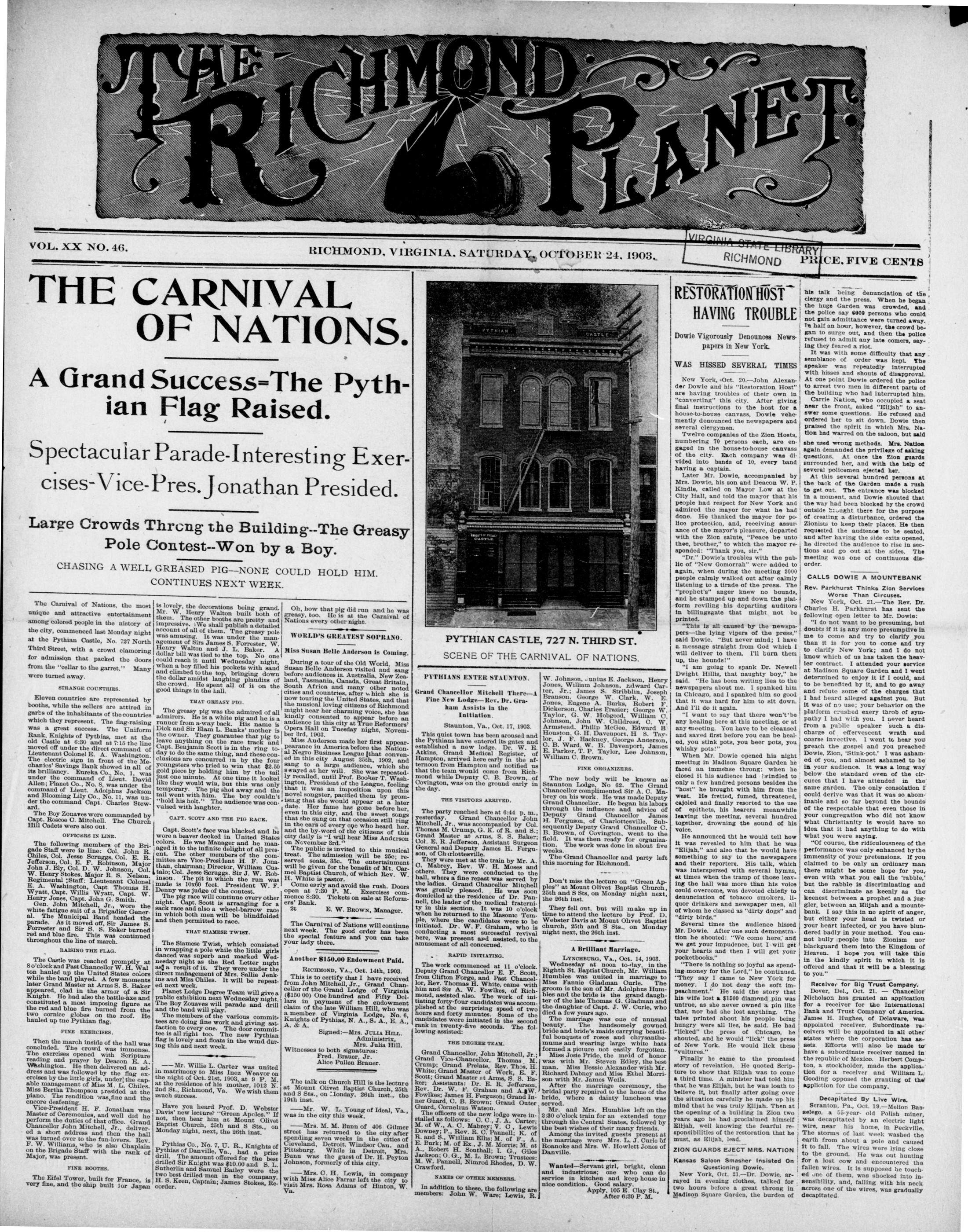
PYTHIAN CASTLE
PYTHIAN CASTLE, 727 N. THIRD ST.
SCENE OF THE CARNIVAL OF NATIONS.
PYTHIANS ENTER STAUNTON.
Grand Chancellor Mitchell There—A Fine New Lodge—Rev. Dr. Graham Assists in the Initiation.
Staunton, Va., Oct. 17, 1903.
This quiet town has been aroused and the Pythians have entered its gates and established a new lodge. Dr. W. E. Atkins, Grand Medical Register, of Hampton, arrived here early in the afternoon from Hampton and notified us that the team would come from Richmond while Deputy C. B. Brown, of Covington, was on the ground early in the day.
W. Johnson, sunius E. Jackson, Jones, William Johnson, edwter, Jr.; James S. Stribblin, Branson, George W. Clark, Jones, Eugene A. Burks, R. Dickerson, Charles Frazier; G. Taylor, G. W. Hobgood, W. Johnson, John W. Childress, Armstead, Philip McGee, E. Houston, G. H. Davenport, H. lor, J. F. Hackney, George A. C. B. Ward, W. B. Davenport, E. Parker, T. P. Taylor, Lee William C. Brown.
FINE ORGANIZERS.
The new body will be in Staunton Lodge. No 62. The chancellor commissioned this report.
THE VISITORS ARRIVED
The party reached here at 6:44 p. m., yesterday. Grand Chancellor John Mitchell, Jr., was accompanied by Col. Thomas M. Crump, G. K. of R. and S. Grand Master at Arms, S. S. Baker, Col. E. R. Jefferson, Assistant Surgeon General and Deputy James H. Ferguson, of Charlottesville. They were met at the train by Mr. A. C. Mabrey, Rev. W. H. Moses and others. They were conducted to the hall, where a fine repast was served by the ladies. Grand Chancellor Mitchell was greatly pleased. He was soon headed at the residence of Dr. Pannell, the leader of the medical fraternity in this town. He was 10 o'clock when he returned to theasonic Temple, where the candidates were to be initiated. Dr. W. F. Graham, who is conducting a most successful revival here, was present and assisted, to the amusement of all concerned.
RAPID INITIATING.
The work commenced at 11 o'clock Deputy Grand Chancellor E. F. Scott, from Clifton Forge, and Past Chancellor, Rev. Thomas H. White, came with him and Sir A. W. Fowlkes, of Richmond, assisted also. The work of initiating forty-four candidates was accomplished at the surprising speed of two hours and forty minutes. Some of the candidates were initiated in the second rank in twenty-five seconds. The following assisted:
THE DEGREE TEAM
Grand Chancellor, John Mitchell, Jr., Grand Vice-Chancellor, Thomas M. Crump; Grand Prelate, Rev. Thos. H. White; Grand Master of Work, E. F. Scott; Grand Master at Arms, S. S. Baker; Assistants: Dr. E. R. Jefferson; Rev. Dr. W. F. Graham and A. W. Fowkles; James H. Ferguson; Grand Inner Guard, C. B. Brown; Grand Outer Guard, Cornelius Watson.
The officers of the new lodge were installed as follows: C. C, J. A. Carter; M. of W., A. C. Mabrey; V. C, Lewis Downey; P., Rev. R. C. Pannell; K. of R. and S., William Ellis; M. of F. E. E. Burk; M. of Ex. J. M. Morris; M. at A, Robert H. Southall; I. G., Giles Jackson; O. G., M. L. Brown; Trustees, M. W. Pannell, Nimrod Rhodes, D. W. Crawford.
NAMES OF OTHER MEMBERS
In addition to these, the following are members: John W. Ware; Lewis, R.
W. Johnson, J. unius E. Jackson, Henry Jones, William Johnson, edward Carter, Jr.; James S. Stribblin, Joseph Branson, George W. Clark, W. E. Jones, Eugene A. Burks, Robert F. Dickerson, Charles Frazer; George W. Taylor, G. W. Hobgood, William C. Johnson, John W. Childress, C. W. Armstead, Philip McGee, Edward B Houston, G. H. Davenport, H. S. Taylor, J. F. Hackney, George Anderson, C. B. Ward, W. B. Davenport, James E. Parker, T. P. Taylor, Lee Johnson, William C. Brown.
FINE ORGANIZERS
The new body will be known as Staunton Lodge, No 62. The Grand Chancellor complimented Sir A. C. Mabrey on his work. He was made Deputy Grand Chancellor. He began his labors through the influence and advice of Deputy Grand Chancellor James H. Ferguson, of Charlottesville. Subsequently Deputy Grand Chancellor C. B. Brown, of Covington, went to the field. It was then ready for organization. The work was done in about five weeks.
The Grand Chancellor and party left this morning for Richmond.
Don't miss the lecture on "Green Apples" at Mount Olivet Baptist Church, 25th and S Sts, on Monday night next, the 26th inst.
They fell out, but will make up in time to attend the lecture by Prof. D. Webster Davis at Mount Olivet Baptist church, 25th and S Sts., on Monday night next, the 26th inst.
A Brilliant Marriage.
LYNCHBURG, VA., Oct. 14, 1903. Wednesday at noon to day, in the Eighth St. Baptist Church, Mr. William Humbles was united in marriage to Miss Fannie Gladman Curle. The groom is the son of Mr. Adolphus Humbles and the bride is the grand daughter of the late Thomas G. Gladman and the daughter of Capt. J. W. Curle, who died a few years ago. The marriage was one of unusual beauty. The handsomely gowned bride and bride's maids carrying beautiful bonquets of roses and chrysanthemums and wearing large white hats formed a picture not easily forgotten. The bride, the master of honor was with Mr. Steven Edley the best man. Miss Bessie Alexander with Mr. Richard Dabney and Miss Ethel Morrison with Mr. James Wells. After the marriage ceremony, the bridal party repaired to the home of the bride, where a dainty luncheon was served. Mr. and Mrs. Humbles left on the 2:30 o'clock train for an extended tour through the Central States, followed by the best wishes of their many friends.
Among the invited guests present at the marriage were Mrs. L. J. Curle of Roanoke and Mrs. W. Howlett Jones of Danville.
Wanted—Servant girl, bright, clean and industrious; one who can do service in kitchen and keep house in nice condition. Good health.
Apply 105 E. Clay St.,
After 6:30 P. M.
RESTORATION HOST HAVING TROUBLE
Dowie Vigorously Denounces Newspapers in New York.
WAS HISSED SEVERAL TIMES
New York, Oct. 20.—John Alexander Dowie and his "Restoration Host" are having troubles of their own in "converting" this city. After giving final instructions to the host for a house-to-house canvass, Dowie vehemently denounced the newspapers and several clergymen.
Twelve companies of the Zion Hosts, numbering 70 persons each, are engaged in the house-to-house canvass of the city. Each company was divided into bands of 10, every band having a captain.
Later Mr. Dowie, accompanied by Mrs. Dowie, his son and Deacon W. P. Kindle, called on Mayor Low at the City Hall, and told the mayor that his people had respect for the New York and admired the mayor for what he had done. He thanked the mayor for police protection, and, receiving assurance of the mayor's pleasure, departed with the Zion salute, "Pace be unto thee, brother," to which the mayor responded: "Thank you, sir."
"Dr. Dowie's troubles with the public of "New Gomorrah" were added to again, when during the meeting 2000 people calmly walked out after calmly listening to a tirade of the press. The "prophet's" anger knew no bounds, and he stamped up and down the platform reviling his departing auditors in billinggate that might not be printed.
"This is all caused by the newspapers—the lying vipers of the press," said Dowie. "But never mind; I have a message straight from God which I will deliver to them. I'll burn them up, the bounds!"
"I am going to spank Dr. Newell Dwight Hillis, that naughty boy," he said. "He has been writing lies to the newspapers about me. I spanked him in Chicago, and I spanked him so good that it was hard for him to sit down. And I'll do it again.
"I want to say that there won't be any healing here at this meeting, or at any meeting. You have to be cleansed and saved first before you can be healed, you stink pots, you beer pots, you whisky pots!"
When Mr. Dowie opened his night meeting in Madison Square Garden he faced an immense throng; when he closed it his audience had windled to only a few hundred persons besides the "host" he brought with him from the west. He fretted, fumed, threatened, cailed and finally resorted to the use of epithets, his hearers meanwhile leaving the meeting, several hundred together, drowning the sound of his voice.
He announced that he would tell how it was revealed to him that he was "Elijah," and also that he would have something to say to the newspapers and their reporters. His talk, which was interspersed with several hymns, at times when the tramp of those leaving the hall was more than his voice could overcome, was devoted chiefly to denunciation of tobacco smokers, liquor drinkers and newspaper men, all of whom he classed as "dirty dogs" and "dirty birds."
Several times the audience hissed Mr. Dowie. After one such demonstration he shouted: "We come here; and we get your impudence, but I will get your hearts and then I will get your pocketbooks."
"There is nothing so joyful as spending money for the Lord," he continued. "They say I came to New York for money. I do not deny the soft impeachment." He said the story that his wife lost a $1500 diamond pin was untrue, as she never owned a pin like that, nor had she lost anything. The tales printed about his people being hungry were all lies, he said. He had "licked" the press of Chicago, he shouted, and he would "lick" the press of New York. He would lick these "vultures."
Finally he came to the promised story of revelation. He quoted Scripture to show that Elijah was to come a third time. A minister had told him that he was Elijah, but he was loath to believe it, but finally after going over the situation carefully he made up his mind that he was truly Elijah. Then at the opening of a building in Zion two years ago he had proclaimed himself Elijah, well knowing the fearful responsibilities of the restoration that he must as Elijah lead.
ZION GUARDS EJECT MRS. NATION
Kansas Saloon Smasher Insisted On Questioning Dowle.
New York, Oct. 21.—Dr. Dowie, arrayed in evening clothes, talked for two hours before a great throng in Madison Square Garden, the burden of
his talk being denunciation of the clergy and the press. When he began the huge Garden was crowded, and the police say 6000 persons who could not gain admittance were turned away. In half an hour, however, the crowd began to surge out, and then the police refused to admit any late comers, saying they feared a riot.
It was with some difficulty that any semblance of order was kept. The speaker was repeatedly interrupted with hisses and shouts of disapproval. At one point Dowie ordered the police to arrest two men in different parts of the building who had interrupted him. Carrie Nation, who occupied a seat near the front, asked "Elijah" to answer some questions. He refused and ordered her to sit down. Dowie then praised the spirit in which Mrs. Nation had warred on the saloon, but said
she used wrong methods. Mrs. Nation again demanded the privilege of asking questions. At once the Zion guards surrounded her, and with the help of several policemen ejected her. At this several hundred persons at the back of the Garden made a rush to get out. The entrance was blocked in a moment, and Dowie shouted that the way had been blocked by the crowd outside brought there for the purpose of creating a disturbance, ordered the Zionists to keep their places. He then requested the audience to be seated, and after having the side exits opened, he directed the audience to rise in sections and go out at the sides. The meeting was one of continuous disorder.
CALLS DOWIE A MOUNTEBANK
Rev. Parkhurst Thinks Zion Services Worse Than Circuses.
New York, Oct. 21.—The Rev. Dr. Charles H. Parkhurst has sent the following open letter to Mr. Dowie: "I do not want to be presuming, but doubts if it is any more presumptive in me to come and try to clarify you than it is for you to come and try to clarify New York; and I do not know which of us has taken the heavier contract. I attended your service at Madison Square Garden and I went determined to enjoy it if I could, and to be benefited by it, and to go away and refute some of the charges that I had heard alleged against you. But it was of no use; your behavior on the platform crushed exery throb of sympathy I had with you. I never heard from a public speaker such a discharge of effervescent wrath and coarse invective. I went to hear you preach the gospel and you preached Dowle, Zion, 'Stink-pot.' I was ashamed of you, and almost ashamed to be in your audience. It was a long way below the standard even of the circuses that I have attended in the same garden. The only consolation I could derive was that it was so abominable and so far beyond the bounds of the respectable that even those in your congregation who did not know what Christianity is would have no idea that it had anything to do with what you were saying.
"Of course, the ridiculousness of the performance was only enhanced by the immensity of your pretensions. If you claimed to be only an ordinary man there might be some hope for you, even with what you call the 'rabble', but the rabble is discriminating and can discriminate as keenly as the keenest between a prophet and a juggler, between an Ellijah and a mountbank. I say this in no spirit of anger, but either your head is twisted or your heart infected, or you have blundered badly in your method. You cannot bully people into Zionism nor blackguard them into the Kingdom of Heaven. I hope you will take this in the kindly spirit in which it is offered and that it will be a blessing to you."
Receiver for Big Trust Company.
Dover, Del., Oct. 21. — Chancellor Nicholson hss granted an application for a receiver for the International Bank and Trust Company of America.
James H. Hughes, of Delaware, was appointed receiver. Subordinate receivers will be appointed in all other states where the corporation has assets. Efforts will also be made to have a subordinate receiver named in the republic of Mexico. Herbert Compton, a stockholder, made the application for a receiver and William L. Gooding opposed the granting of the applition for the company.
Decapitated By Live Wire
Scranton, Pa., Oct. 19.—Melion Basslego, a 55-year old Polish miner, was decapitated by an electric light wire, near his home, in Peckville. The storms of last week washed the earth from about a pole and caused it to fall. The wires were lying close to the ground. He was out hunting for a lost cow and encountered the fallen wires. It is supposed he touched one of them, was shocked into insensibility, and, falling with his neck across one of the wires, was gradually decapitated.
THE PLANET
SATURDAY.....OCTOBER 24 1903
TEMPERANCE NOTES
A GIRL DRUNKARD.
One Instance Where a Physical and Moral Wreck Was Restored to Useful, Happy Life.
The suprientendent of a New York home recently related a story of her own exper. ce in rescue work, so wonderful and so encouraging to wretched victims of sin that it ought to be made public. The story in substantially her own language was as follows:
"I was sent for one morning many years ago by one of the judges of the court, who had before him a girl about 16 years of age. The girl's father had caused her arrest and had appealed to the court to sentence her to some home as an incorrigible.
"The history of the girl was this: At 12 years of age she had been put to service in the dining-room of a saloon as a waiter. Her duties required her to serve liquors and she acquired a passion for drink and became a drunkard.
"I never saw a human being that loved liquor as she did. She could drink a glass of clear whisky with the greatest relish, and she had absolutely no control over her appetite. At 16 she was a confirmed drunkard and a street walker. She was devoid of any moral principle and had a perfectly insane temper.
"The judge heard the case and sentenced her to the home of which I was superintendent. When she learned her destiny she flew into an uncontrollable rage. She screamed and fought and cursed like a demon. She had to be taken to the home by main force, and when she got there we were at our wits' end what to do with her. She was perfectly lawless, desperately ugly and her manner was more like a demon than a human being. We tried all sorts of treatment for her; we tried to win her by love; we tried reason with her; then we tried punishing her—in fact, we exhausted our resources all to no purpose. For three years
WAS WAITER IN A SALOON AT
TWELVE
that girl kept our home in a turmoil. Nothing we could do had any effect upon her. She attended our Gospel service, but to all appearances they had no influence over her.
"At the end of three years a change came over her. She began to pray and to believe in God. After we had her under control, we sent her out to service in a Christian family on a farm in a neighboring state. She was a small girl, not very strong, but she took hold of the heavy work of a servant's place in a country home with an amazing vim. It seemed as if she couldn't do enough for her employers.
"But the work was too much for her, and after the first year she returned to us quite worn-out and broken down. Then she took up fancy work and became an expert. The finest kind of work seemed to come perfectly natural to her.
"When the term of her sentence expired, at 21 years of age, she left our home and supported herself by doing fancy work learned in the home. She was then one of the most lovable, sweet-mannered, kind-hearted, gentle girls that I ever knew. We all loved her and she used to come and instruct the other girls in fancy work. She had grown to be a very handsome girl, with a fair complexion and a beautiful face.
A young man out of an excellent family in our city, became interested in her, and finally married her, and took her to his father's home, where she was admitted on equal terms with the other sons and daughters, of whom there were several. She became a favorite with them all, and the father-in-law speaks of her endearingly as his "little kid."
"You asked me if I knew of any cases of girls rising from a life of shame to a respectable womanhood and my answer is this true story of a girl who is now the mother of a dear little girl, and who is one of the loveliest Christian characters of my acquaintance. It is one of many evidences that there is no limit to the power and grace of God.
"Jesus is 'able to save to the uttermost all that come unto God by Him.' What a refuge the Lord is to every sinner who will flee to Him for help."—National Advocate.
Profitso on Whisky
The report of President Curley, of the Distillers' Securities corporation, of the operations of that corporation for the fiscal year ending June 30, 1903, has been made public. It shows that the total receipts from all sources for the year were $82,730,706; total operating expenses, $78,764,074. After charging off the amounts paid for interest on notes and loans, taxes, rentals, insur-
ance, additions to reserve fund, maintenance and repairs, and interest on all bonds, a net profit of $2,184,791 is shown for the year, an increase of $450,-436 over that of the fiscal year ended June 30, 1902.
WAR ON DRINK IN EUROPE.
Strong Sentiment Manifesting Itself in Germany, England, France and Other Countries.
The rapid increase of intemperance in European countries of late has resulted not merely in a much more vigorous crusade against the evil by temperance societies, but also, in many countries, in legislation expressly designed to reduce the consumption of liquors. The German government's proposed bill, of which yesterday's dispatches told, is simply one more indication of the tendency. The German plan is, indeed, a very mild one, though it may have exceedingly beneficial effects if adopted. One feature of it is the forbidding of the extension of credit by saloon keepers to their customers; another is the requirement that nonintoxicating drinks, such as tea, coffee, lemonade and milk, and also cold foods, must be sold wherever alcoholic drinks are sold.
In England legislation has taken two forms. For one thing it is operating through commissions to reduce the number of public houses, and for another it is seeking to reform habitual drunkards by placing them on blacklists, and making it a punishable offense to sell liquor to them over the bar.
France has been awakened to its great need by clear evidences of the ravages made by liqueurs, and especially by absinthe. Medical statistics recently compiled indicated that the great increase in pulmonary tuberculosis was due almost entirely to alcoholism, and also that two-thirds of the inmates of the insane asylums were suffering from the same cause. There is now talk of prohibiting the sale of adulterated liquors and of creating a state monopoly of alcohol, which will supply only the pure article, and that at a very high price.
In Belgium the tax on spirits has been increased, and at the same time the tax on tea has been removed, with the object of encouraging the use of tea as a beverage. In Holland a league has been formed to fight the use of spirits. It aims at legislation, but for the present it is doing personal work by posting agents at the doors of public houses to urge the patrons not to enter.
Austria is considering a law which provides that drunkards shall, after ten convictions, be sent to a reformatory, there to be imprisoned till physicians certify that their curing is cured. Norway has a similar system now in force, except that it applies it much more promptly.
In Switzerland the police are required to arrest every person showing the slightest signs of intoxication. Alcohol is sold by a government monopoly, and each canton is required to spend ten per cent. of the receipts from this source on hospitals and other agencies for combating the evil. -Chicago Record-Herald
NEWS AND COMMENTS.
The fruits of the saloon go back to its roots in the citizen.—Ram's Horn. Better to be seen in a small company of those who try to do right than to be hid among a company of wrong-doers.
"Man is born unto trouble as the sparks fly upward," and the drunkard's wife is married to trouble, as sure as the saloons drag downwards.
—National Advocate.
Professor Pfuger, of the University of Bonn, maintains that one-third of all the deaths registered in Munich are due to heart disease, brought on by the immoderate use of beer, and that tobacco also claims a large percentage of the victims.
The factory inspection of Milwaukee revealed 60 boys and girls under 14 years working in the various city shops. In almost every case the mothers, when examined as to the cause, said: "My husband drinks." One thousand two hundred permits were issued for children between the ages of 14 and 16.
The Daily News, one of the leading papers of Great Britain, has had the moral courage to exclude from its columns all betting news and all liquor advertisements, and to give prominence to all religious news. This is a brave thing to do, and a costly sacrifice to make. This makes the Daily News a "clean" paper and the only clean paper published in the great metropolis.
INCREASE THE DRINK EVIL.
Growth of Women's Clubs in London Declared to Be Attended by Excessive Indulgence in Liquor.
The increase in the number of women's clubs in London is said to be attended by an alarming increase in the drinking habit, and the London World said recently that liquor drinking, especially creme de menthe, had grown to a grievous extent.
At these clubs one sees more whiskies and sodas on the table at luncheon than one sees at men's clubs, in which there is a marked decrease in drinking. The club managers, of course, deny these allegations, but they are known to be none the less true in the main.
Dover street, Picadilly, has now so many women's clubs that it has been nicknamed Petticoat lane.
Post Cards with a Moral.
M. Capmartin, of Blaye, France, has had half a million picture postcards printed illustrating the evils of drunkenness. They have such titles as "The Drunkard's Doom," "Dear in the Bottle" and "The Drink Flend," and the author suggested they might be posted to confirmed drunkards. Two or three slander actions have already been started by people who have received the cards, and one recipient is being proceeded against for violently assaulting a sender.
Death to Alcoholics.
An attack of typhoid fever, of pneumonia or of crysipelas that would be mild in a sober man will kill one adobe to alcoholics quickly.
No Encouragement
He—If you didn't play golf it wouldn't have any attraction for me.
She—Dear me! Now, do you know I like golf for itself alone.—Puck
THE RICHMOND PLANET. RICHMOND; VIRGINIA
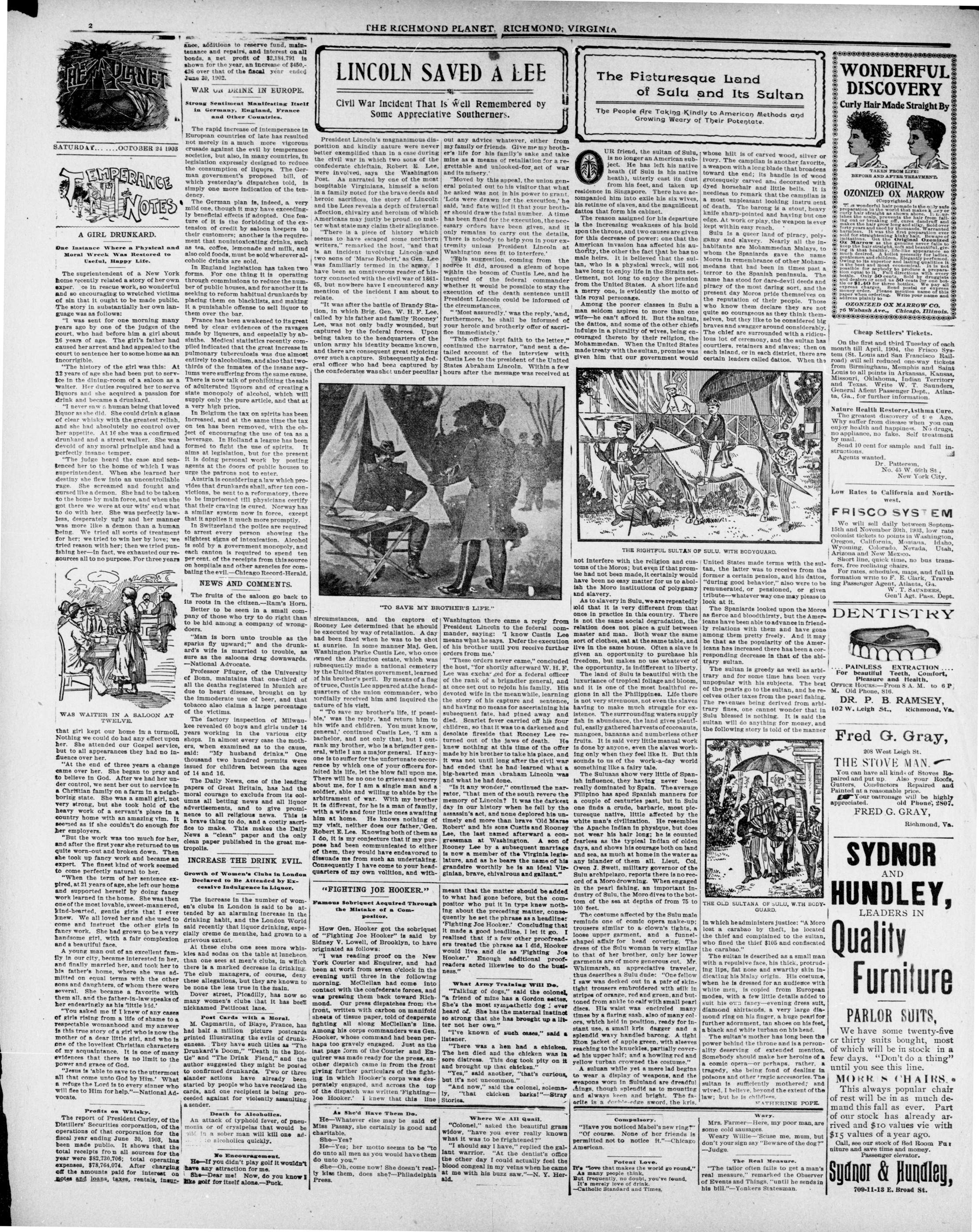
LINCOLN SAVED A LEE
Civil War Incident That Is Well Remembered by Some Appreciative Southerners.
President Lincoln's magnanimous disposition and kindly nature were never better exemplified than in a case during the civil war in which two sons of the confederate chieftain, Robert E. Lee, were involved, says the Washington Post. As narrated by one of the most hospitable Virginians, himself a sclon in a family noted for the brave deeds and heroic sacrifices, the story of Lincoln and the Lees reveals a depth of fraternal affection, chivalry and heroism of which Americans may justly be proud. no matter what state may claim their allegiance. "There is a piece of history which seems to have escaped some northern writers," remarked the host, "and that is an incident involving Lincoln and two sons of 'Marse Robert,' as Gen. Lee was familiarly termed in the army. I have been an omnivorous reader of history connected with the civil war of 1861-65, but nowhere have I encountered any mention of the incident I am about to relate.
"It was after the battle of Brandy Station, in which Brig. G. W. H. F. Lee, called by his father and family 'Rooney' Lee, was not only badly wounded, but captured by the federal forces. Upon being taken to the headquarters of the union army his identity became known, and there are consequent great rejoicing over such a capture. Subsequently a federal officer who had been captured by the confederates was shot under peculiar
```markdown
```
THE TENT
"TO SAVE MY BROTHER'S LIFE."
circumstances, and the captors of Rooney Lee determined that he should be executed by way of retaliation. A day had been fixed when he was to be shot at sunrise. In some manner Maj. Gen. Washington Parke Custis Lee, who once owned the Arlington estate, which was subsequently made a national cemetery by the United Government, learned of his brother's peril. By means of a flag of truce, Custis Lee appeared at the headquarters of the union commander, who cordially received him and inquired the nature of his visit.
Washington the then President Lincoln mander, saying: means what he sai of his brother orders from me." "These orders the host, 'for she Lee was exchag of the rank of at once set out, to devoted wife in the story of his, and having no me."
“To save my brother's life, if possible, was the reply, 'and return him to his wife and children. You must know, general,' continued Custis Lee, 'I am a bachelor, and not only that, but I outrank my brother, who is a brigadier general, while I am a major general. If anyone is to suffer for the unfortunate occurrence by which one of your officers forfeited his life, let the blow fall upon me. There will be no one to grieve and worry about me, for I am a single man and a soldier, able and willing to abide by the arbitrament of war. With my brother it is different, for he is a man of family, with a wife and four little ones awaiting him at home. He knows nothing of my visit, neither does our father.' Gen. Robert E. Lee. Knowing both of them as I do, it is my conjecture that if my purpose had been communicated to either of them, they would have endeavored to dissuade me from such an undertaking. Consequently I have come to your headquarters of my own volition, and with-
"FIGHTING JOE HOOKER."
Famous Sobriquet Acquired Through the Mistake of a Compositor.
How Gen. Hooker got the sobriquet of "Fighting Joe Hooker" is said by Sidney V. Lowell, of Brooklyn, to have originated as follows:
"I was reading proof on the New York Courier and Enquiler, and had been at work from seven o'clock in the evening until three in the following morning. McClellan had come into contact with the confederate forces, and was pressing them back toward Richmond. Our press dispatches from the front, written with carbon on manifold sheets of tissue paper, told of desperate fighting all along McClellan's line. Among his corps commanders was Gen. Hooker, whose command had been perhaps too gravely engaged. Just as the last page form of the Courier and Enquiler was made ready for the press, another dispatch came in from the front giving further particulars of the fighting in which Hooker's corps was desperately engaged, and across the top of the dispatch was written 'Fighting—Joe Hooker.' I knew that this line
As She'd Have Them Do:
He—Whatever else may be said of Miss Passay, she certainly is good and charitable.
She—Yes?
He—Yes; her motto seems to be "to do unto all men as you would have them do unto you."
She—Oh, come now! She doesn't really kiss them, does she?—Philadelphia Press.
out any advice whatever, either from my family or friends. Give me my brother's life for his family's sake and take mine as a means of retaliation for a regrettable and unlooked-for, act of war and its misery.
"Moved by this appeal, the union general pointed out to his visitor that what he asked was not in his power to grant. Lots were drawn for the execution," he said, and fate willed it that your brother should draw the fatal number. A time has been fixed for the execution, the necessary orders have been given, and it only remains to carry out the details. There is nobody to help you in your extremity unless President Lincoln at Washington sees fit to interfere.
"This suggestion, coming from the source it did, aroused a gleam of hope within the bosom of Custis Lee, and he inquired of the federal commander whether it would be possible to stay the execution of the death sentence until President Lincoln could be informed of the circumstances.
"Most assuredly," was the reply, 'and, furthermore, he shall be informed of your heroic and brotherly offer of sacrifice immediately.' "This officer kept faith to the letter," continued the narrator, "and sent a detailed account of the interview with Custis Lee to the president of the United States Abraham Lincoln. Within a few hours after the message was received at
not inter-
toms of the
ise had no
have been
ish the M
and slaves
As to sl
Washington there came a reply from President Lincoln to the federal commander, saying: 'I know Custis Lee means what he says. Defer the execution of his brother until you receive further orders from me.' "These orders never came," concluded the host, "for shortly afterward W. H. F. Lee was exchanged for a federal officer of the rank of a brigadier general, and at once set out to rejoin his family. His devoted wife in the meanwhile, learning the story of his capture and sentence, and having no means for ascertaining his subsequent fate, had pinned away and died. Scarlet fever carried off his four children, so that it was a darkened and desolate fireside that Rooney Lee returned out of the jaws of death. He knew nothing at this time of the offer made by his brother to take his place, and it was not until long after the civil war had ended that he had learned what a big-hearted man abraham Lincoln was and what he had done.
"Is it any wonder," continued the narrator. "that men of the south revere the memory of Lincoln? It was the darkest day in our history when he fell by the assassin's act, and none deplored his untimely end more than brave Old Marseus Robert' and his sons Custis and Rooney Lee, the last named afterward a congressman at Washington. A son of Rooney Lee by a subsequent marriage is now a member of the Virginia legislature, and as he bears the name of his grandsister worthily he is an ideal Virginian, brave, chivalrous and gallant."
meant that the matter should be added to what had gone before, but the compositor who put it in type knew nothing about the preceding matter, consequently he set the phrase as a headline: 'Fighting Joe Hooker.' Concluding that it made a good headline, I let it go. I realized that if a few other proofreaders treated the phrase as I did, Hooker would live, and die as 'Fighting Joe Hooker.' Enough additional proofreaders acted likewise to do the business."
What Army Training Will Do.
"Talking of dogs," said the colonel, "a friend of mine has a Gordon setter. She's the most sympathetic dog I ever heard of. She has the maternal instinct so strong that she has brought up a litter not her own."
"I've known of such cases," said a listener.
"There was a hen had a chicken. The hen died and the chicken was in sore distress. This dog took pity on it and brought up that chicken." "Yes," said another, "that's curious, but it's not uncommon." "And now," said the colonel, solemnly, "that chicken barks!"—Stray Stories.
Where We All Quail
"Colonel," asked the beautiful grass widow, "have you ever really known what it was to be frightened?"
"I should say I have," replied the gallant warrior. "At the dentist's office the other day I could actually feel the blood congeal in my veins when he came at me with his buzz saw."—N. Y. Herald.
"Have y
Of cou
permitted
American
It's "Love
As many
But few
It's more
—Catholic
A
not interfere with the religion and customs of the Moros; but even if that promise had not been made, it certainly would have been no easy matter for it to abolish the Moro institutions of polygamy and slavery.
The costume affected by the Sulu male reminds one of comic opera make-up; trousers similar to a clown's tights, a loose upper garment, and a funnel-shaped affair for head covering. The dress of the Sulu woman is very similar to that of her brother, only her lower garments are of more generous cut. Mr. Whitmarsh, an appreciative traveler, thus describes a Sulu dude: "One fellow I saw was decked out in a pair of skin-tight trousers embroidered with silk in stripes of orange, red and green, and buttoned from ankle to calf with small pearl discs. His waist was encircled many times by a flaring sash, also of many colors, which held in position, ready for instant use, a small kris dagger and a splendid wavy handled barong. A tight Eton jacket of apple green, with sleeves reaching to the knuckles, partially covered his upper half; and a howling red and yellow turban crowned the costume."
A suluan while yet a mere lad begins to wear a display of weapons, and the weapons worn in Sululand are dreadful things, though splendid as to mounting and always keen and bright. The farite is a double-edge sword, the kris.
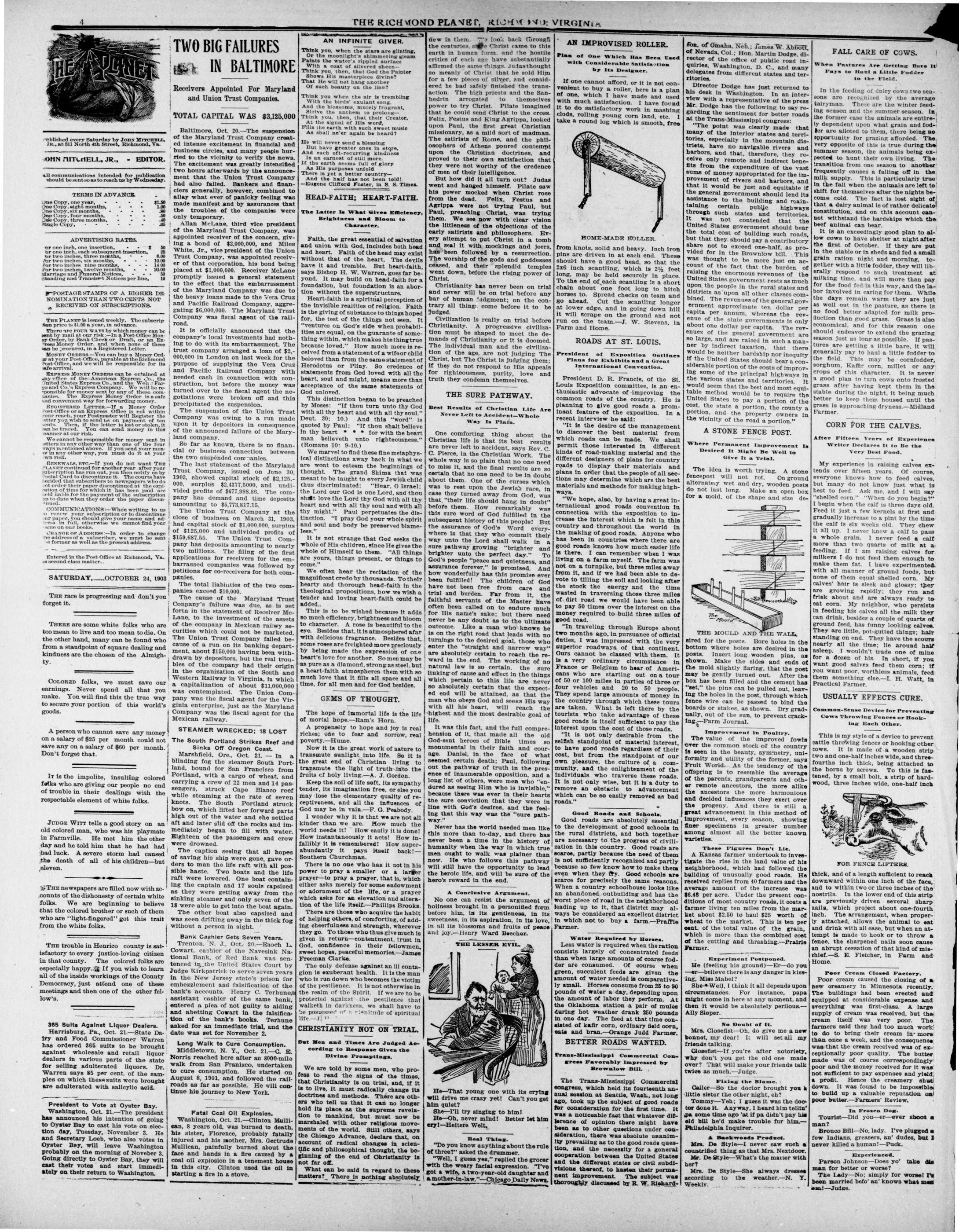
The Picturesque Land of Sulu and Its Sultan
The People Are Taking Kindly to American Methods and Growing Weary of Their Potentate.
UR friend, the sultan of Sulu, is no longer an American subject. He has left his native heath (if Sulu is his native heath), utterly cast its dust from his feet, and taken up residence in Singapore. There have accompanied him into exile his six wives, his retinue of slaves, and the magnificent dattos that form his cabinet.
The reason assigned for his departure is the increasing weakness of his hold upon the throne, and two causes are given for this decrease of power: one that the American invasion has affected his authority, the other the fact that he has no male heirs. It is believed that the sultan, who is a physical wreck, will not have long to enjoy life in the Straits settlement, not long to enjoy the pension from the United States. A short life and a merry one, is evidently the motto of this royal personage.
Among the poorer classes in Sulu a man seldom aspires to more than one wife—he can't afford it. But the sultan, the dattos, and some of the other chiefs indulge in a plurality of wives, being encouraged thereto by their religion, the Mohammedan. When the United States made treaty with the sultan, promise was given him that our government would
A boy on horseback, being led by a man in a turban, is surrounded by three men in traditional attire. One man is kneeling, another is sitting, and the third is standing. The background features a large tent with a curtain.
THE RIGHTFUL SULTAN OF SULU, WITH BODYGUARD
As to slavery in Sulu, we are repeatedly told that it is very different from that once in practice in this country. There is not the same social degradation, the relation does not place a gulf between master and man. Both wear the same sort of clothes, eat at the same table, and live in the same house. Often a slave is given an opportunity to purchase his freedom, but makes no use whatever of the opportunity, is indifferent to liberty. The land of Sulu is beautiful with the luxuriance of tropical foliage and bloom, and it is one of the most healthy regions in all the Philippines. Life there is not very strenuous, not even the slaves having to make much struggle for existence. The surrounding waters supply fish in abundance, the land gives plentiful, easily gathered harvests of cocoanuts, mangoes, bananas and numberless other fruits. It is said very little manual work is done by anyone, even the slaves working only when they feel like it. But this sounds to us of the work-a-day world something like a fairy tale.
The Suluans show very little of Spanish influence, they having never been really dominated by Spain. The average Filipino has aped Spanish manners for a couple of centuries past, but in Sulu one finds a crude, barbaric, most picturesque native, little affected by the white man's civilization. He resembles the Apache Indian in physique, but does not wear his hair long; he is counted fearless as the typical Indian of olden days, and shows his courage both on land and sea, as much at home in the water as any islander of them all. Lieut. Col. Owen J. Swett, military governor of the Sulu archipelago, reports there is no record of a Moro drowning. When engaged in the pearl fishing, an important industry of Sulu, the Moro dives to the bottom of the sea at depths from 75 to 100 feet.
Compulsory
"Have you noticed Mabel's new ring?"
"Of course. None of her friends is
permitted not to notice it."—Chicago
American.
Potent Love.
It's "love that makes the world go round."
As many people think.
But frequently, no doubt, you've found.
It's merely love of drink.
—Catholic Standard and Times.
O
whose hilt is of carved wood, silver or ivory. The campanil is another favorite, a weapon with a long blade that broadens toward the end; its handle is of wood grotesquely carved and decorated with dyed horsehair and little bells. It is needless to remark that the campanil is a most unpleasant looking inrent nud of death. The barong is a stout, heavy knife sharp-pointed and having but one edge. At work or play, the weapon is ever kept within easy reach.
Sulu is a queer land of piracy, polygamy and slavery. Nearly all the inhabitants are Mohammedan Malays, to whom the Spaniards gave the name Moros in remembrance of other Mohammedans that had been in times past a terror to the Spanish peninsula. The name has stood for dare-devil deeds and piracy of the most daring sort, and the present day Moros pride themselves on the reputation of their people. Those who know them declare they are not quite so courageous as they think themselves, but they like to be considered big braves and swagger around considerably. The chief are surrounded with a ridiculous lot of ceremony, and the sultan has courtiers, retainers and slaves; then on each island, or in each district, there are certain leaders called dattos. When the
A
United States made terms with the sultan, the latter was to receive from the former a certain pension, and his dattos, "during good behavior," also were to be remunerated, or pensioned, or given tribute—whatever way one may please to look at it.
The Spaniards looked upon the Moros as fierce and bloodthirsty, but the Americans have been able to advance in friendly relations with them and have gone among them pretty freely. And it may be that as the popularity of the Americans has increased there has been a corresponding decrease in that of the arbitrary sultan.
The sultan is greedy as well as arbitrary and for some time has been very unpopular with his subjects. The best of the pearls go to the sultan, and he receives other taxes from the pearl fishing. The revenues being derived from arbitrary fines, one cannot wonder that in Sulu blessed is nothing. It is said the sultan will do anything for money, and the following story is told of the manner
THE OLD SULTANA OF SULU, W.TH BODY-GUARD.
in which he administers justice: "A Moro lost a carabao by theft, he located the thief and complained to the sultan, who fined the thief $105 and confiscated the carabao." The sultan is described as a small man with a repulsive face, his thick, protruding lips, flat nose and swarthy skin indicating his Malay origin. His costume, when he is dressed for an audience with white men, is copied from European modes, with a few little details added to suit his own fancy—evening dress suit, diamond shirtsuits, a very large diamond ring on his finger, a huge pearl for further adornment, tan shoes on his feet, a black and white turban on his head.
The sultan's mother has long been the power behind the throne and is a personality deserving of extended mention. Somebody should make her heroine of a comic opera—or perhaps, rather, a tragedy, she being fond of dealing in poisons and other tragic accessories. The sultan is sufficiently mothered; and wived, I believe, beyond the extent of the law; but he is childless.
Mrs. Farmer—Here, my poor man, are some cold sausages.
Weary Willie—'Scuse me, mum, but don't your sign say 'Beware of the dog?'—Judge.
The Real Measure.
"The tailor often fails to get a man's real measure," remarked the Observer of Events and Things, "until he sends in his bill."—Yonkers Statesman.
KATHERINE POPE
TAKEN FROM LIST
T. as wonderful hair pomadels the only safe preparation in the world this makes k. l.y or curly hair straight as shown above.
Ishes the scalp, prevents the hair from falling out or breaking off, cures dandruff and makes the hair grow long and silky. Sold over forty years and used by thousands. Warranted harmless. It was the first preparation ever to be straightening kinky hair. Beware of imitations.
Original Ozonized Ox Marrow as the genesis of fails to keep the hair straight, soft and beautiful, giving it that healthy, life-like appearance so much desired. A toilet necessity for ladies, gentlemen and children. Elegantly perfumed. Owing to its superior and lasting qualities it is the best and most economical. It is not possible for anybody to produce a preparation equal to Full directions with every bottle.
Only 50 cents of druggists and dealers or send us 50 cents for one bottle or $1.40 for three bottles. We pay all express charges. Send postal or express money order. Please mention name of this paper when ordering. Write your name and address plainly to
OZONIZED OX MARROW CO.
7000 W. 10TH ST.
(212) 234-7800
Cheap Settlers' Tickets.
On the first and third Tuesday of each month till April, 1904, the Frisco System (St. Louis and San Francisco Railroad) will sell reduced one-way tickets from Birmingham, Memphis and Saint Louis to all points in Arkansas, Kansas, Missouri, Oklahoma, Indian Territory and Texas, Write W. T. Saunders, General Affent Passenger Dept., Atlanta, Ga., for further information.
Nature Health Restorer,Asthma Cure.
The greatest discovery of the Age. Why suffer from disease when you can enjoy health and happiness. No drugs, no appliance, no fake. Self treatment by mail.
Send 10 cent for sample and full instructions.
Low Rates to California and Northwest.
FRISCO SYSTEM
We will sell daily between September 15th and November 30th, 1993, low rate colonist tickets to points in Washington, Oregon, California, Montana, Idaho, Wyoming, Colorado, Nevada, Utah, Arizona and New Mexico.
Short line, quick time, no bus transfor-
free reaching chairs.
For larger rooms, and full in-
formation write to F. E. Clark, Traveling Passenger Agent, Atlanta, Ga.
W. T. SAUnders,
Gw. T. Art. Pass, Dent
DENTISTRY
PAINLESS EXTRACTION
For beautiful Teeth, Comfort,
Pleasure and Health
Pleasure and Health.
OFFICE HOURS: -From 8 A.M. to 6 P.
M. Old Phone, 816.
DR. P. B. RAMSEY,
102 W. Leigh St., Richmond, Va.
Fred G. Gray,
208 West Leigh St.
THE STOVE MAN.
THE STOVE MAN
You can have all kinds of Stoves Repaired and pat up. Also your Roofs, Gutters, Conductors Repaired and Painted at a reasonable price.
Your batroonage will be highly appreciated. old Phone: 2807.
FRED G. GRAY
FRED G. GRAY,
Richmond. Va.
SYDNOR AND HUNDLEY, LEADERS IN Quality Furniture
PARLOR SUITS.
We have some twenty-five or thirty suits bought, most of which will be in stock in a few days. "Don't do a thing" until you see this line.
This always popular chair of rest will be in as much demand this fall as ever. Part of our stock has already arrived and $10 values vie with $15 values of a year ago. Call, see our stock of Bad Room Fur niture and save time and money.
Call, see our stock of Bed Room Fur niture and save time and money. Passenger elevator. Sydnor & Hundley,
709-11-13 E. Broad St.
THE OTHER MAN
By FREDERIC REDDALE
Under the scorching rays of an afternoon sun the limitless expanse of the African veldt lay shimmering and quivering in torrid heat.
All around there rose, fold upon fold, an interminable and maddening succession of low, rounded rises, clothed to their stony summits with short, coarse grass and purple karoo bushes, the reddish soil baked hard by the drought of the dry season.
Scarcely a sound broke the stillness of the wilderness; not a wing whirred; not an insect buzzed. There was no spoor or sign of game, large or small—most of it had been killed off long ago. The grass bent languidly to the faint draught that came out of the north as from a furnace mouth.
All nature drooped and panted for nightfall; the desolation was profound; the silence was oppressive.
Out of the west, following the windings of a little kloof, there crept a lumbering, dusty, and dirty white-topped wagon, of the kind used by traders or hunters, innumerable creakings and groanings and shudderings testifying to many day's journeying with a "plentiful lack" of axle-grease.
Four poorly-conditioned oxen drew the cumbersome equipage. The lolling tongues of the beasts, their languid, dragging steps, and their lean condition told eloquently of hard travel and scanty forage.
By the side of the cattle shambled two Kaffir "boys," each armed with a long goad. In front of the team strode a white man, his naturally white face tanned to a dusky red, his clothing soiled and travel-stained from many nights' sleeping out, his veltdt-schoon in the last stages of dilapidation. Resting in the hollow of his left arm lay a shining Winchester, the best-kept and smartest thing in the whole of his shabby outfit. For upon the rifle the little band of adventurers depended mainly for their subsistence from day to day. Game was scarce and shy; the wagon was none too plentifully stocked with the bare necessities of flour, sugar, and coffee; a poor shot might mean a supperless bed.
He was a giant in stature—fully six feet two, with the build and brawn of the pioneer. In age he was on the better side of 30. A great brown beard swept his chest, and there was a tawny mustache to match, while from under the front peak of his fore-aft pith helmet there gleaned a clean-cut profile and a pair of keen, Saxon blue eyes of the kind that are apt to be undimmed by fatigue or undaunted by disaster.
Slowly the little caravan plodded on, the Kaffirs continually urging the weared beasts with throaty, clicking sounds, the white "baas" striding sturdily along, consulting a pocket-compass from time to time as the windings of the kloof brought the sun now upon one hand, and anon upon the other.
Evening was approaching; not more than a couple of hours' daylight remained; it was time to be thinking of a camp for the night.
After a more than usually heavy ascent, the oxen of their own accord stopped to breathe, the Kaffirs squatting listlessly under the wagon out of the sun. The white man, glancing back for a moment, strode without halting to the summit of the nearest kopje, and there stood shading his eyes and looking steadily northeast. Suddenly he was roused by a loud cry: "Water, baas! I smell water!" shouted one of the "boys," pointing in the same direction.
Simultaneously the drooping oxen picked up their heads, and of their own accord started onward at a smarter pace. The "baas" descended and fell in at the rear of the wagon, for the Kaffir instinct is infallible, and water was surely not far away. This meant not only renewed life for the cattle, a camping place, and probably some game for the pot, but also the goal of their journey.
Likewise success or another dismal failure!
Half a mile was covered in this fashion, the man in the helmet consulting a rude map as he stumbled through the slippery veldt grass, after which, with an exclamation of satisfaction, he called out:
"We must be nearly there, Joey!"
Scarcely had the words left his lips than the heavy wagon commenced to move more speedily down an easy decline, and the weary beasts broke into a shambling trot.
A sudden turn round the shoulder of a hill revealed the wider expanse of a little valley, perhaps a half mile broad, through which meandered a thin ribbon of shallow water, bordered by a narrow expanse of pebbly beach that in time of flood would be entirely covered with a yellow, swirling torrent.
In a trice the wagon stopped, the oxen were unhitched and galloping towards the water, into the center of which they waded knee-deep, drinking greedily of the precious fluid. This done, they proceeded to wallow in the stream, after which they turned their attention to the more succulent grass growing near by. Although the near-by kopjes were casting long shadows eastward, there was yet more than an hour of daylight. Method cally and silently the younger native proceeded to unpack the scanty camp utensils and build a fire, while Joey, taking a gun from the bed of the wagon, sneaked off up-stream in quest of an eland, a harte-beeste, or a klipsspringer buck.
The white man, leaving all these details to his "boys," strode off in the contrary direction down-stream, apparently at random and as though he were likewise looking for game, until out of sight around a bend. Then his whole demeanor changed. He attentively studied the dried-up shore on
either hand, crossing the exposed river beach diagonally from the farther margin of caked bluish clay to the strip of coarse gravel and pebbles that bordered the water's edge.
Apparently the indications were satisfactory. Bending nearly double, he eagerly scanned the patches of pebbles, scratching here and there with his fingers, and letting the stuff winnow through his hand.
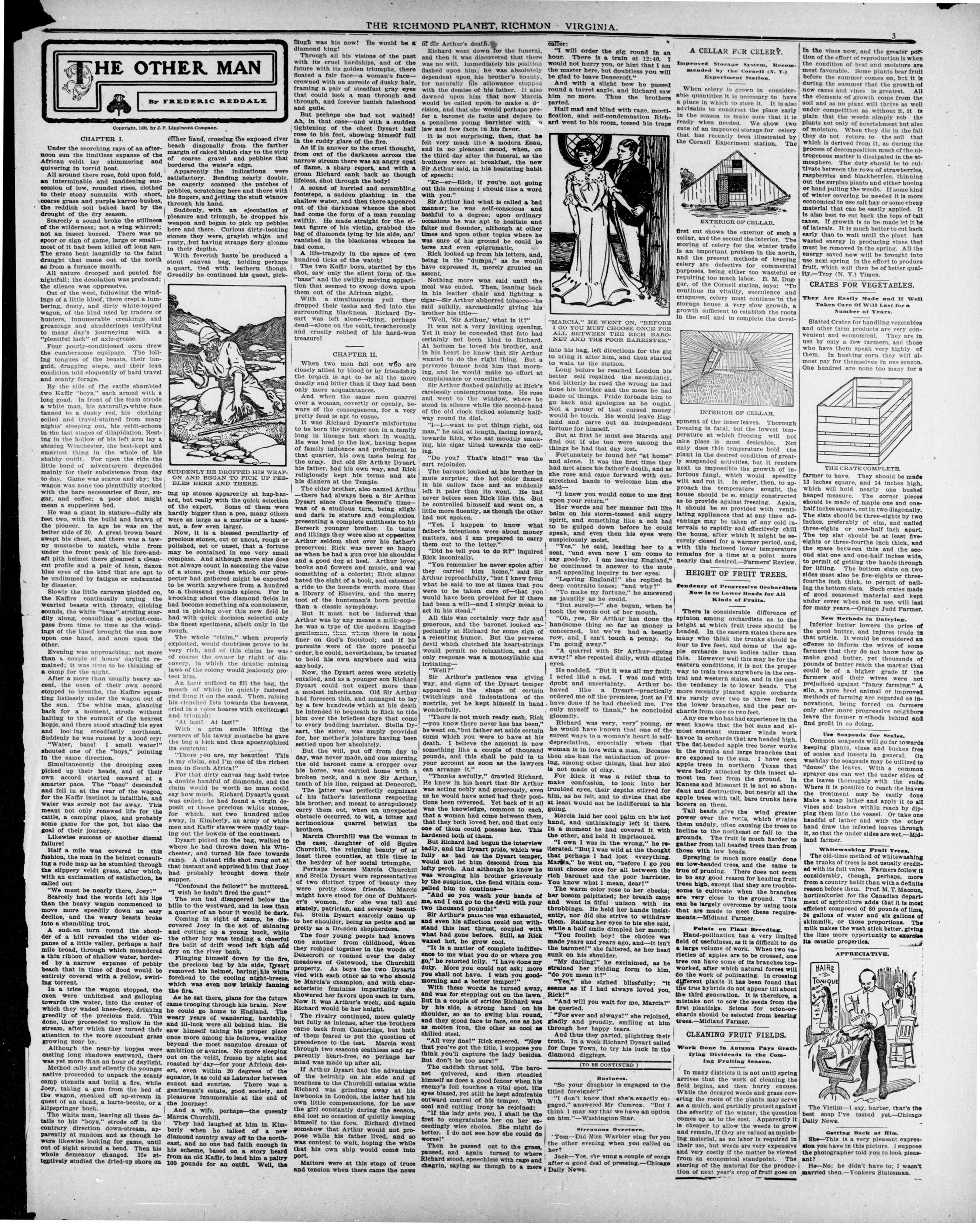
Suddenly, with an ejaculation of pleasure and triumph, he dropped his weapon and began to pick up pebbles here and there. Curious dirty-looking stones they were, grayish white and rusty, but having strange fiery gleams in their depths.
With feverish haste he produced a stout canvas bag, holding perhaps a quart, tied with leathern thongs. Greedily he continued his quest, pick-
A man kneeling on a rocky river bank, holding a stick in his hand.
SUDDENLY HE DROPPED HIS WEAP
PUBLES, HEBE, ANP, THRUR
SUDDENLY HE DROPPED HIS WEAPON AND BEGAN TO PICK UP PEBLES HERE AND THERE.
ing up stones apparently at hap-hazard, but really with the quick selection of the expert. Some of them were hardly bigger than a pea, many others were as large as a marble or a hazelnut, a few even larger.
Now, it is a blessed peculiarity of precious stones, cut or uncut, rough or polished, set or unset, that a fortune may be contained in one very small compass. And although mere size does not always count in assessing the value of a stone, yet those which our prospector had gathered might be expected to be worth anywhere from a hundred to a thousand pounds apiece. For in knocking about the diamond fields he had become something of a connoisseur, and in picking over this new field he had with quick decision selected only the finest specimens, albeit only in the rough.
The whole "claim," when properly exploited, would doubtless prove to be very rich, and of this claim he was of course the owner by right of discovery, in which the drastic mining laws of the colony would jealously protect him.
An hour sufficed to fill the bag, the mouth of which he quickly fastened and flung it on the sand. Then, raising his clenched fists towards the heavens, cried in a voice hoarse with excitement and triumph:
"At last! At last!"
With a grim smile lifting the corners of his tawny mustache he gave the bag a kick and thus apostrophized its contents:
"There you are, my beauties! This is my claim, and I'm one of the richest men in South Africa!"
For that dirty canvas bag held twice a double handful of diamonds, and the claim would be worth no man could say how much. Richard Dysart's quest was ended; he had found a virgin deposit of those precious white stones, for which, not two hundred miles away, in Kimberly, an army of white men and Kaffir slaves were madly tearing out the bowels of the continent.
Dysart picked up the bag, walked to where he had thrown down his Winchester, and turned his face towards camp. A distant rifle shot rang out at that instant and apprised him that Joey had probably brought down their supper.
"Confound the fellow!" he muttered.
"I wish he hadn't fired the gun!"
The sun had disappeared below the hills to the westward, and in less than a quarter of an hour it would be dark.
Coming in sight of camp, he discovered Joey in the act of skinning and cutting up a young buck, while the other boy was tending a cheerful fire built of drift wood left high and dry on the river bank.
Flinging himself down by the fire, the precious bag by his side, Ipsart removed his helmet, barring his white forehead to the cooling night-breeze, which was even now briskly fanning the fire.
As he sat there, plans for the future came trooping through his brain. Now he could go home to England. The weary years of wandering, hardship, and ill-luck were all behind him. He saw himself taking his proper place once more among his fellows, wealthy beyond the most sanguine dreams of ambition or avarice. No more sleeping out on the veldt, frozen by night and roasted by day—for your African desert, even within 20 degrees of the equator, is as cold as Labrador between sunset and sunrise. There was a gentleman's estate, good society, and pleasures innumerable at the end of the journey!
And a wife, perhaps—the queenly Marcia Churchill.
They had laughed at him in Kimberly when he talked of a new diamond country away off to the northeast, and no one had faith enough in his scheme, based on a story heard from an old Kaffir, to lend him a paltry 100 pounds for an outfit. Well, the
THE RICHMOND PLANET, RICHMON VIRGINIA.
Rough was his now! He would be a diamond king!
Through all his visions of the past with its cruel hardships, and of the future with its golden triumphs, there floated a fair face—a woman's face—crowned with an aureole of dusky hair, framing a pair of steafast gray eyes that could look a man through and through, and forever banish falsehood and gulle.
But perhaps she had not waited! Ah, in that case—and with a sudden tightening of the chest Dysart half rose to his feet, showing himself full in the ruddy glare of the fire.
As if in answer to the cruel thought, from out of the darkness across the narrow stream there was an angry spat of flame, a sharp report, and with a groan Richard sank back as though lifeless, shot through the body!
A sound of hurried and scrambling, footsteps, a sudden plashing in the shallow water, and then there appeared out of the darkness whence the shot had come the form of a man running swiftly. He made straight for the silent figure of his victim, grabbed the bag of diamonds lying by his side, and vanished in the blackness whence he had come.
A life-tragedy in the space of two hundred ticks of the watch!
The two Kafir boys, startled by the shot, saw only the silent form of the "baas" and the swiftly moving apparition that seemed to swoop down upon them out of the African night.
With a simultaneous yell they dropped their tasks and fled into the surrounding blackness. Richard Dysart was left alone—dying, perhaps dead—alone on the veldt, treacherously and cruelly robbed of his hard-won treasure!
CHAPTER II
When two men fall out who are closely allied by blood or by friendship the breach is apt to be all the more deadly and bitter than if they had been only mere acquaintances. And when the same men quarrel over a woman, covertly or openly, beware of the consequences, for a very pretty feud is apt to ensue. It was Richard Dysart's misfortune to be born the younger son in a family long in lineage but short in wealth. He was bred to the law, having hopes of family influence and preferment in that quarter, his own taste being for the army. But old Sir Arthur Dysart his father, had his own way, and Rick religiously kept his terms and ate his dinners at the Temple.
The elder brother, also named Arthur — there had always been a Sir Arthur Dysart since Charles Second's time—was of a studious turn, being slight and dark in stature and complexion presenting a complete antithesis to his Berserk younger brother. In taster and likings they were also at opposites Arthur seldom shot over his father's preserves; Rick was never so happy as when he had a gun over his shoulder and a good dog at heel. Arthur loved books and flowers and music, and was something of a colorist; Rick almost hated the sight of a book, and esteemed a ride to the hounds worth more than a library of Elzevirs, and the merry toot of the huntsman's horn prettier than a classic symphony.
But it must not be inferred that Arthur was by any means a milk-sop—he was a type of the modern English gentleman, than whom there is none finer on God's footstool; and if his pursuits were of the more peaceful order, he could, nevertheless, be trusted to hold his own anywhere and with anybody.
Now, the Dysart acres were strictly entailed, and as a younger son Richard Dysart could not expect more than a modest inheritance. Old Sir Arthur had foreseen this, and managed to lay by a few hundreds which at his death he intended to bequeath to Rick to tide him over the briefness days that come to every budding barrister. Stella Dysart, the sister, was amply provided for, her mother's jointure having been settled upon her absolutely.
But the will, put off from day to day, was never made, and one morning the old baronet came a cropper over his horse, was carried home with a broken neck, and a new Sir Arthur, tenth of his line, reigned at Dencroft. The latter was perfectly cognizant of his father's intentions respecting his brother, and meant to scrupulously carry them out, when an unexpected obstacle occurred, to wit, a bitter and acrimonious quarrel betwixt the brothers.
Marcia Churchill was the woman in the case, daughter of old Squire Churchill, the reigning beauty of at least three counties, at this time in the heydey of her social triumphs.
Perhaps because Marcia Churchill and Stella Dysart were representatives of two distinct types of beauty they were pretty close friends. Marcia might have stood for one of DuMaurier's women, for she was tall and stately, patrician, and severely beautiful. Stella Dysart scarcely came up to her shoulder, being as petite and as pretty as a Dresden shepherdess. The four young people had known one another from childhood, when they romped together in the woods of Dencroft or roamed over the daisy meadows of Gatewood, the Churchill property. As boys the two Dysarts vied with each other as to who should be Marcia's champion, and with characteristic feminine impartiality she showered her favors upon each in turn. Now it was Arthur's week, and again Richard would be her knight.
The rivalry continued, more quietly but fully as intense, after the brothers came back from Cambridge, but both of them feared to put the question of precedence to the test. Marcia went through two seasons scathell and apparently heart-free, so perhaps her mind was made up after all.
If Arthur Dysart had the advantage of the heirship on his side and of nearness to the Churchill estates while Richard was grinding away at his lawbooks in London, the latter had his own little compensations, for he saw the girl constantly during the season, and lost no occasion of quietly keeping himself to the fore. Richard divined somehow that Arthur would not propose while his father lived, and so was content to wait, hoping the while that his own ship would come into port.
Matters were at this stage of truce and tension when there came the news
Richard went down for the funeral, and then it was discovered that there was no will. Immediately his position flashed upon him; he was absolutely dependent upon his brother's bounty, for naturally his allowance stopped with the demise of his father. It also dawned upon him that now Marcia would be called upon to make a decision, and that she would perhaps prefer a baronet de facto and dejure to a penniless young barrister with a law and few facts in his favor.
It is not surprising, then, that he felt very much like a modern Esau, and in no pleasant mood, when, on the third day after the funeral, as the brothers were at breakfast, the new Sir Arthur said, in his hesitating habit of speech:
"Er—er-Rick, if you're not going out this morning I should like a word with you."
Sir Arthur had what is called a bad manner; he was self-conscious and bashful to a degree; upon ordinary occasions he was apt to hesitate and falter and flounder, although at other times and upon other topics where he was sure of his ground he could be terse and even epigramatic.
Rick looked up from his letters, and, being in the "dumps," as he would have expressed it, merely grunted an assent.
Nothing more was said until the meal was ended. Then, leaning back in his leather chair and lighting a cigar—Sir Arthur abhored tobacco—he said sulkily, sarcastically giving his brother his title—
"Well, 'Sir Arthur,' what is it?"
It was not a very inviting opening. Yet it may be conceded that fate had certainly not been kind to Richard. At bottom he loved his brother, and in his heart he knew that Sir Arthur wanted to do the right thing. But a perverse humor held him that morning, and he would make no effort at compliance or conciliation.
Sir Arthur flushed painfully at Rick's carelessly contemptuous tone. He rose and went to the window, where he stood in silence while the second-hand of the old clock ticked solemnly half-way round its dial.
"I—I—want to put things right, old man," he said at length, facing inward, towards Rick, who sat moodily smoking, his cigar tilted towards the ceiling.
"Do you? That's kind!" was the curt rejoinder.
The baronet looked at his brother in mute surprise; the hot color flamed in his sallow face and as suddenly left it paler than its wont. He had never before seen Rick like this. But he controlled himself and went on, a little more fluently, as though the other had not spoken.
"Yes. I happen to know what father's intentions were about money matters, and I am prepared to carry them out to the letter."
"Did he tell you to do it?" inquired Rick laconically.
"You remember he never spoke after they carried him home," said Sir Arthur reproachfully, "but I knew from what he said to me at times that you were to be taken care of—that you would have been provided for if there had been a will—and I simply mean to act in his stead."
All this was certainly very fair and generous, and the baronet looked expectantly at Richard for some sign of a relenting humor. But the perverse devil which clutched his heart-strings would permit no relaxation, and the only response was a monosyllabic and irritating—
"Well?"
Sir Arthur's patience was giving way, and signs of the Dysart temper appeared in the shape of certain twitchings and indentations of the nostrils, yet he kept himself in hand wonderfully.
"There is not much ready cash, Rick—you know there never has has been," he went on, "but father set aside certain sums which you were to have at his death. I believe the amount is now something like a couple of thousand pounds, and this shall be paid in to your account as soon as the lawyers can arrange it."
"Thanks awfully," drawled Richard. He knew in his heart that Sir Arthur was acting nobly and generously, even as he would have acted had their positions been reversed. Yet back of it all was the knowledge, common to each, that a woman had come between them, that they both loved her, and that only one of them could possess her. This hardened both of them.
But Richard had begun the interview badly, and the Dysart pride, which was fully as bad as the Dysart temper, would not let him descend from his lofty perch. And although he knew he was wronging his brother grievously by the suspicion, the fiend within compelled him to continue—
"And so you wash your hands of me, and I can go to the devil with your two thousand pounds!"
Sir Arthur's patience was exhausted, and even his affection could not withstand this last thrust, coupled with what had gone before. Still, as Rick waxed hot, he grew cool.
"It is a matter of complete indifference to me what you do or where you go," he retorted icily. "I have done my duty. More you could not ask; more you shall not have. I wish you good morning and a better temper!" With these words he turned away, and was for stepping out on the lawn. But in a couple of strides Richard was by his side, a strong hand on his shoulder, so as to swing him round, and they stood face to face, one as hot as molten iron, the other as cool as chilled steel. "All very fine!" Rick sneered. "Now that you've got the title, I suppose you think you'll capture the lady besides. But don't be too sure!" The caddish thrust told The baronet quivered, and then steadied himself as does a good fencer when his enemy's foil touches a vital spot. His eyes blazed, yet still he kept admirable outward control of his temper. With cool and cutting irony he relied:
"If the lady gets you, I shall be the first to congratulate her on her exceedingly wise choice. She might do better. I do not see how she could do worse!" Then he passed out to the grass, paused, and again turned to where Richard stood, speechless with rage and chagrin, saying as though to a mere
caller:
"I will order the gig round in an hour. There is a train at 12:40. I would not hurry you, or hint that I am the master here, but doubtless you will be glad to leave Denecroft."
And with a slight bow he passed round a turret angle, and Richard saw him no more. Thus the brothers parted.
Half mad and blind with rage, mortification, and self-condemnation Richard went to his room, tossed his trump
B. W. H.
"MARCIA," HE WENT ON, "BEFORE I GO YOU MUST CHOOSE ONCE FOR ALL BETWEEN THE RICH BARONET AND THE POOR BARRISTER."
into his bag, left directions for the gig to bring it after him, and then started to walk to the station.
Long before he reached London his better self regained the ascendancy, and bitterly he rued the wrong he had done his brother and the mess he had made of things. Pride forbade him to go back and apologize as he ought. Not a penny of that cursed money would he touch. He would leave England and carve out an independent fortune for himself.
But at first he must see Marcia and find out if she too were among the things he had that day lost.
Fortunately he found her "at home" and alone. It was the first time they had met since his father's death, and as she rose and came forward with out-stretched hands to welcome him she said—
"I knew you would come to me first upon your return."
Her words and her manner fell like balm on his storm-tossed and angry spirit, and something like a sob had to be gulped down before he could speak, and even then his eyes were suspiciously moist.
"Yes," he said, leading her to a seat, "and even now I am come to say good-by. I am leaving England," he continued in answer to the mute and appealing inquiry in her eyes.
"Leaving England!" she replied in deep contralto tones; "and why?"
"To make my fortune," he answered as jauntly as he could.
"But surely—" she began, when he took the words out of her mouth.
"Oh, yes, Sir Arthur has done the handsome thing so far as money is concerned, but we've had a beastly row, and I can't touch a penny. So I'm going away."
"A quarrel with Sir Arthur—going away!" she repeated dully, with dilated eyes.
He nodded. "But it was all my fault; I acted like a cad. I was mad with doubt and uncertainty. Arthur behaved like a Dysart—practically ordered me off the premises, just as I'd have done if he had cheeked me. I've only myself to thank," he concluded gloomily.
Richard was very, very young, or he would have known that one of the surest ways to a woman's heart is self-depreciation, especially when that woman is in love with a man. Because then she has the satisfaction of proving, among other things, that her idol is not made of clay.
For Rick it was a relief thus to make confession, to look into her troubled eyes, their depths stirred for him, as he felt, and to divine that she at least would not be indifferent to his going.
Marcia laid her cool palm on his hot hand, and unthinkingly left it there. In a moment he had covered it with the other, and held it imprisoned.
"I own I was in the wrong," he reiterated. "But I was wild at the thought that perhaps I had lost everything. Marcia," he went on, "before I go you must choose once for all between the rich baronet and the poor barrister. You know what I mean, dear!"
The warm color rose to her cheeks; her bosom palpitated; her breath came and went in fifth unison with its throbbings. He held her hands insistently, nor did she strive to withdraw them. Raising her eyes to his she said, while a half smile dimpled her mouth:
"You foolish boy! the choice was made years and years ago, and—it isn't the baronet!" she faltered, as her head sunk on his shoulder.
"My darling!" he exclaimed, as he strained her yielding form to him, "do you mean it?"
"Yes," she sighed blissfully; "it seems as if I had always loved you, Rick!"
"And will you wait for me, Marcia?" he queried.
"For ever and always!" she rejoined, gladly and proudly, smiling at him through her happy tears.
And thus they parted, plighting their troth. In a week Richard Dysart sailed for Cape Town, to try his luck in the diamond diggings.
(TO BE CONTINUED )
Business.
"So your daughter is engaged to the titled foreigner?"
"I don't know that she's exactly engaged," answered Mr Cumrox. "But I think I may say that we have an option on him."—Washington Star.
Strenuous Overture.
Tom—Did Miss Warbler sing for you the other evening when you called on her?
Jack—Yes, she sung a couple of songs after a good deal of pressing.—Chicago Daily News.
A CELLAR FOR CELERY
Improved Storage System, Recommended by the Cornell (N. Y.) Experiment Station.
When celery is grown in considerable quantities it is necessary to have a place in which to store it. It is also advisable to construct the place early in the season to make sure that it is ready when needed. We show two cuts of an improved storage for celery that has recently been illustrated by the Cornell Experiment station. The EXTERIOR OF CELLAR
first cut shows the exterior of such a cellar, and the second the interior. The storing of celery for the winter trade is an important problem in the north, and the present methods of keeping celery are defective for commercial purposes, being either too wasteful or requiring too much labor. B. M. Duggar, of the Cornell station, says: "To continue its vitality, succulence and crispness, celery must continue in the storage house a very slow growth, a growth sufficient to establish the roots in the soil and to complete the devel-
INTERIOR OF CELLAR
opment of the inner leaves. Thorough freezing is fatal, but the lowest temperature at which freezing will not take place is most desirable. Not only does this temperature hold the plant in the desired condition of greatly suspended activities, but it renders next to impossible the growth of injurious fungi, which would speedily wilt and rot it. In order, then, to approach the temperature sought, the house should be so snugly constructed as to provide against freezing. Again, it should be so provided with ventilating appliances that at any time advantage may be taken of any cold intervals to rapidly and effectively chill the house, after which it might be securely closed for a warmer period, and, with this inclosed lower temperature remains for a time at a point more nearly that desired.—Farmers' Review.
HEIGHT OF FRUIT TREES.
Fendency of Progressive Orchardists Now Is to Lower Heads for All Kinds of Fruits.
There is considerable difference of opinion among orchardists as to the height at which fruit trees should be headed. In the eastern states there are many who think the trunks should be four to five feet, and some of the apple orchards have bodies taller than this. However well this may be for the eastern conditions, it is not the proper way to train trees anywhere in the central and western states, and in the east the tendency is to lower heads. The more recently planted apple orchards are rarely over two to three feet to the lower branches, and the pear orchards from one to two feet.
Any one who has had experience in the west knows that the hot suns and almost constant summer winds work havoc in orchards that are headed high. The flat-headed apple tree borer works in the trunks and large branches that are exposed to the sun. I have seen apple trees in northern Texas that were badly attacked by this insect almost ten feet from the ground. In Kansas and Missouri it is not so abundant and destructive, but nearly all the apple trees with tall, bare trunks have borers on them.
Tall heads give the wind greater power over the roots, which strains them unduly, often causing the trees to incline to the northeast or fall to the grounds. The fruit is much harder to gather from tall headed trees than from those with low heads.
Spraying is much more easily done on low-headed trees, and the same is true of pruning. There does not seem to be any good reason for heading fruit trees high, except that they are troublesome to cultivate when the branches are very close to the ground. This can be largely overcome by using tools that are made to meet these requirements.—Midland Farmer.
Points on Plant Breeding
Hand-pollination has a very limited field of usefulness, as it is difficult to do a large volume of work. When two varieties of apples are to be crossed, one tree can have some of its branches top-worked, after which natural forces will do the work of pollinating. In crossing different plants it has been found that the true hybrids do not appear till about the third generation. It is therefore, a mistake not to sow the seeds from the first plantings. Sclons for sclon-orchards should be selected from bearing trees. -Midland Farmer.
CLEANING FRUIT FIELDS.
Work Done in Autumn Pays Gratifying Dividends in the Coming Fruiting Season.
In many districts it is not until spring arrives that the work of cleaning the field begins, and then hurry ensues. While the decayed weeds and grass covering the roots of the plants may serve as a mulch, and partially protect against the severity of the winter, the question comes up as to the cost. Apparently it is cheaper to allow the weeds to grow and remain, if they are valued as mulching material, as no labor is required in their use, but weeds are very expensive and very costly if the matter be viewed from an economical standpoint. The storing of the material for the production of next year's crop of fruit goes on
In the vines now, and the greater portion of the effort of reproduction is when the condition of heat and moisture are most favorable. Some plants bear fruit before the summer comes on, but it is during the summer that the growth of new canes and vines is greatest. All the elements of growth come from the soil and as no plant will thrive as well under competition as without it, it is plain that the weeds simply rob the plants not only of nourishment but also of moisture. When they die in the fall they do not return to the soil that which is derived from it, as during the process of decomposition much of the nitrogenous matter is dissipated in the atmosphere. The duty should be to cultivate between the rows of strawberries, raspberries and blackberries, thinning out the surplus plants and either hoeing or hand pulling the weeds. If some kind of winter covering be needed it is more economical to use salt hay or some cheap material that can be easily applied. It is also best to cut back the tops of tall canes. If growth is to be made let it be of laterals. It is much better to cut back early than to wait until the plant has wasted energy in producing vines that must be removed in the spring. All the energy saved now will be brought into use next spring in the effort to produce fruit, which will then be of better quality.—Troy (N. Y.) Times.
CRATES FOR VEGETABLES
They Are Easily Made and If Well Taken Care Of Will Last for a Number of Years.
Slatted Crates for handling vegetables and other farm products are very convenient and economical. They are in use by only a few farmers, and those who have them speak very highly of them. In husking corn they will almost pay for themselves in one season. One hundred are none too many for a
THE CRATE COMPLETE
farmer to have. They should be made 13 inches square, and 14 inches high, which will hold nearly one bushel heaped measure. The corner pieces should be made of maple or one and one-half inches square, cut in two diagonally. The slats should be three-eights by two inches, preferably of elm, and nailed three-eights or one-half inch apart. The top slat should be at least five-eights or three-fourths inch thick, and the space between this and the second slat one and one-half inches wide, to permit of getting the hands through for lifting. The bottom slats on two sides must also be five-eights or three-fourths inch thick, to permit of nailing the bottom slats. Such crates made of good seasoned material and kept under cover when not in use, will last for many years.—Orange Judd Farmer.
New Methods in Dairying
Inferior butter lowers the price of the good butter, and injures trade in that article. It would be considered an offense to inform the wives of some farmers that they do not know how to make good butter, yet thousands of pounds of butter reach the market that could be of a higher grade if the farmers and their wives were not prejudiced against "fancy farming." A silo, a pure bred animal or improved methods of farming are regarded as innovations, being forced on farmers only after more progressive neighbors leave the former methods behind and find profit in so doing.
Use Soapsuds for Scales
Common soapsuds will go far towards keeping plants, vines and bushes free of scales and insects in general. On washday the soapsuds may be utilized to "douse" the leaves. With a common sprayer one can wet the under sides of the leaves thoroughly with the suds. Where it is possible to reach the leaves the treatment may be easily done Make a soap lather and apply it to all vines and bushes within reach by dipping them into the vessel. Or take one handful of lather and with the other hand draw the infested leaves through it, so that the under sides are wet.—Midland farmer.
Whitewashing Fruit Trees
The old-time method of whitewashing the trunks of trees is not usually credited with its full value. Farmers follow it considerably, though, perhaps, more from a country habit than with a definite reason before them. Prof. M. T. Macoun, horticulturist for the Canadian department of agriculture adds that it is most efficient composed of 60 pounds of lime, 24 gallons of water and six gallons of skimmilk, or those proportions. The milk makes the wash stick better, giving the lime more opportunity to exercise its caustic properties.
APPRECIATIVE.
HAIRE
TONIQUE
The Victim—I say, barber, that's the best soap I've tasted yet.—Chicago Daily News.
The Vietim—I say, barber, that's the best soap I've tasted yet—Chicago Daily News.
Getting Back at Him.
She—This is a very pleasant expression you have in this picture. I suppose the photographer told you to look pleasant?
He—No; he didn't have to; I wasn't married then—Yonkers Statesman.
THE PLANET
OHN MITCHELL, JR., - EDITOR.
All communications intended for publication should be sent so as to reach us by Wednesday.
TERMS IN ADVANCE.
One Copy, one year, $1.50
One Copy, eight months, 1.00
One Copy, six months, .80
One Copy, four months, .50
One Copy, three months, .40
Single Copy, .05
ADVERTISING RATES
or one inch, one insertion,
or one inch, each subsequent insertion,
or two inches, three months,
for two inches, six months,
for two inches, nine months,
for two inches, twelve months,
marriage and Funeral Notices,
standing and Transient Notices per line,
POSTAGE STAMPS OF A HIGHER DE
NOMINATION THAN TWO CENTS NOT
RECEIVED ON SUBSCRIPTIONS.
THE PLANET is issued weekly. The subscription price is $1.50 a year, in advance.
There are FOUR WAYS by which money can be sent by mail at our risk :- In a Post Office Monetary Order, an Ex-Post Money Order, and when none of these can be procured, in a Registered Letter.
MONEY ORDERS—You can buy a Money Order at your Post Office, payable at the Richmond Post Office, and we will be responsible for its delivery. EXPRESS MONEY ORDERS can be obtained at any office of the American Express Co., the United States Express Co., and the Well Fargo and Co.'s Express Company. We will be responsible for your payment of these expenses. The Express Money Order is a safe and convenient way for forwarding money.
REGISTERED LETTER—If a Money Order post office or an Express Office is not within your address, you can send us on payment of ten cents. Then, if the letter is lost or stolen, it can be traced, you can send money in this way. We cannot be responsible for money sent in letters in any other way than one of the four ways mentioned above. If you send your money in any other way, you must do it at your own expense.
RENEWALS, ETC.—If you do not want THE PLANET continued for another year after your subscription has run out, you then notify us by postal card to discontinue it. The courts have ruled that you must not order their paper discontinued at the expiration of time for which it has been paid, and you must notify when they order the paper discontinued.
COMMUNICATIONS :- When writing to us to renew your subscription or to discontinue your paper, you should give your name and address in full, otherwise we cannot find your name on our books.
CHANGE OF ADDRESS :- In order to change the address of a subscriber, we must be sent the former as well as the present address.
Entered in the Post Office at Richmond, Va. second class matter.
SATURDAY.....OCTOBER 24, 1903
The race is progressing and don't you forget it.
THERE are some white folks who are too mean to live and too mean to die. On the other hand, many can be found who from a standpoint of square dealing and kindness are the chosen of the Almighty.
COLORZD folks, we must save our earnings. Never spend all that you make. You will find this the true way to secure your portion of this world's goods.
A person who cannot save any money on a salary of $25 per month could not save any on a salary of $60 per month. Don't forget that.
It is the impolite, insulting colored folks who are giving our people no end of trouble in their dealings with the respectable element of white folks.
JUDGE WITT tells a good story on an old colored man, who was his playmate in Farmville. He met him the other day and he told him that he had had bad luck. A severe storm had caused the death of all of his children—but eleven.
THE newspapers are filled now with accounts of the dishonesty of certain white folks. We are beginning to believe that the colored brother or such of them who are "light-fingered" got this trait from the white folks.
The trouble in Henrico county is satisfactory to every justice-loving citizen in that county. The colored folks are especially happy. If you wish to learn all of the inside workings of the County Democracy, just attend one of these meetings and then one of the other fellow's.
365 Suite Against Liquor Dealers. Harrisburg, Pa., Oct. 21.—State Dairy and Food Commissioner Warren has ordered 365 suits to be brought against wholesale and retail liquor dealers in various parts of the state for selling adulterated liquors. Dr. Warren says 85 per cent. of the samples on which these suits were brought are adulterated with salicylic acid.
President to Vote
President to Vote at Oyster Bay. Washington, Oct. 21.—The president has announced his intention of going to Oyster Bay to cast his vote on election day, Tuesday, November 3. He and Secretary Loeb, who also votes in Oyster Bay, will leave Washington probably on the morning of November 3. Going directly to Oyster Bay, they will cast their votes and start immediately on their return to Washington.
TWO BIG FAILURES IN BALTIMORE
Receivers Appointed For Maryland and Union Trust Companies.
TOTAL CAPITAL WAS $3,125,000
Baltimore, Oct. 20.—The suspension of the Maryland Trust Company created intense excitement in financial and business circles, and many people hurried to the vicinity to verify the news. The excitement was greatly intensified two hours afterwards by the announcement that the Union Trust Company had also failed. Bankers and financiers generally, however, combined to alley what ever of panicky feeling was made manifest and by assurances that the troubles of the companies were only temporary.
Allan McLane, third vice president of the Maryland Trust Company, was appointed receiver of the concern, giving a bond of $2,000,000, and Miles White, Jr., vice president of the Union Trust Company, was appointed receiver of that corporation, his bond being placed at $1,000,000. Receiver McLane promptly issued a general statement to the effect that the embarrassment of the Maryland Company was due to the heavy loans made to the Vera Cruz and Pacific Railroad Company, aggregating $6,000,000. The Maryland Trust Company was fiscal agent of the railroad.
It is officially announced that the company's local investments had nothing to do with its embarrassment. The trust company arranged a loan of $2,000,000 in London on last week for the purpose of supplying the Vera Cruz and Pacific Railroad Company with needed cash in connection with construction, but before the money was turned over to the fiscal agent the negotiations were broken off and this precipitated the suspension.
The suspension of the Union Trust Company was owing to a run made upon it by depositors in consequence of the announced failure of the Maryland company.
So far as known, there is no financial or business connection between the two suspended companies.
The last statement of the Maryland Trust Company, issued on June 30, 1903, showed capital stock of $2,125.000, surplus $2,4377,5000, and undivided profits of $677,998.86. The company has demand and time deposits amounting to $5,773,817.15.
The Union Trust Company at the close of business on March 31, 1903, had capital stock of $1,000,000, surplus of $125,000 and undivided profits of $159,687.55. The Union Trust Company has deposits amounting to nearly two millions. The filing of the first applications for receivers for the embarrassed companies was followed by petitions for co-receivers for both companies.
The total liabilities of the two companies exceed $10,000.
The cause of the Maryland Trust Company's failure was due, as is set forth in the statement of Receiver McLane, to the investment of the assets of the company in Mexican railway securities which could not be marketed. The Union Trust Company failed because of a run on its banking department, about $150,000 having been withdrawn by depositors, but the real troubles of the company had their origin in the organization of the South and Western Railway in Virginia, in which a capitalization of about $11,000,000 was contemplated. The Union Company was the fiscal agent for the Virginia enterprise, just as the Maryland Company was the fiscal agent for the Mexican railway.
STEAMER WRECKED: 18 LOST
The South Portland Strikes Reef and
Sinks Off, Oregon, Coast
Marshfield, Ore., Oct. 21. — In a blinding fog the steamer South Portland, bound for San Francisco from Portland, with a cargo of wheat, and carrying a crew of 22 men and 14 passengers, struck Cape Blanco reef while steaming at the rate of seven knots. The South Portland struck bow on, which lifted her forward parts high out of the water and she settled aft and later slid off the rocks and immediately began to fill with water. Eighteen of the passengers and crew were drowned.
The other boat also capsized and was seen drifting away in the thick fog without a person in sight.
Bank Cashier Gets Seven Years
Trenton, N. J., Oct. 20.—Enoch L. Cowart, cashier of the Navesink National Bank, of Red Bank was sentenced in the United States Court by Judge Kirkpatrick to serve seven years in the New Jersey state's prison for embezzlement and falsification of the bank's accounts. Henry C. Terhung assistant cashier of the same bank, entered a plea of not guilty to aiding and abetting Cowart in the falsification of the bank's books. Terhung asked for an immediate trial, and the date was set for November 2.
Long Walk to Cure Consumption
Long Walk to Cure Consumption.
Middletown, N. Y., Oct. 21. C. E. Norris reached here after an 8000-mile walk from San Francisco, undertaken to cure consumption. He started on August 8, 1901, and followed the railroads as far as possible. He will continue his journey to New York.
Fatal Coal Oil Explosion
Washington, Oct. 21.—Clinton Mullican, 8 years old, was burned to death, his sister, Florence, probably fatally injured and his mother, Mrs. Gertrude Mullican, painfully burned about the face and hands in a fire caused by a coal oil explosion in a tenement house in this city. Clinton used the oil in starting a fire in a stove.
THE RICHMOND PLANET. RICHMOND; VIRGINIA
AN INFINITE GIVER.
Think you, when the stars are glinting,
Or the moonlight's shimmering gleam
Paints the water's rippled surface
Wet with the light
Think you, then, that God the Painter
Shows His masterpiece divine?
That He will not hang another
Of such beauty on the line?
Think you when the air is trembling
With the birds' exultant song.
And the blossoms, mutely fragrant,
Strive the anthem to prolong—
This is the Creator,
At the signal of His word.
Fills the earth with such sweet music
As shall ne'er again be heard?
He will never have a blessing
But have greater ones in store,
And each oft-recurring kindness
Is an earnest of still more.
If the earth seems full of glory
And is full of light
There is yet a better country—
And the half has not been told!
—Eugene Clifford Foster, in S. S. Times
HEAD-FAITH; HEART-FAITH.
The Latter Is What Gives Efficiency, Brightness and Bloom to Character.
Faith, the great essential of salvation and union with God, includes both head and heart. Faith of the head may exist without that of the heart. The devils have it and tremble. But heart-faith, says Bishop H. W. Warren, goes far beyond. It may build on head-faith for a foundation, but foundation is an abortion without the superstructure.
Heart-faith is a spiritual perception of the invisible realities of religion. Faith is the giving of substance to things hoped for, the test of the things not seen. It "ventures on God's side when probabilities are equal, on the guarantee of something within, which makes it thing true because loved." How much more is received from a statement of a wife or child beloved than from the same statement of Herodotus or Pliny. So credence of statements from God loved with all the heart, soul and might, means more than acceptance of the same statements of God unloved.
This distinction began to be preached by Moses: "If thou turn unto thy God with all thy heart and with all thy soul." Deut. 30: 10. And this "word" is quoted by Paul: "If thou shalt believe in thy heart • • • for with the heart man believeth unto righteousness." (Romans 10: 9-10).
We marvel to find these fine metaphysical distinctions away back in what we are wont to esteem the beginnings of thought. The grand Shima that was meant to be taught to every Jewish child thus discriminated: "Hear, O Israel: the Lord our God is one Lord, and thou shalt love the Lord thy God with all thy heart and with all thy soul and with all thy might." Paul perpetuates the distinction: "I pray God your whole spirit and soul and body be preserved blameless."
It is not strange that God seeks the whole of His children, since He gives the whole of Himself to them. "All things are yours, things present, or things to come."
We often hear the recitation of the magnificent credo by thousands. To their hearty and thorough head-faith in the theological propositions, how we wish a tender and loving heart-faith could be added.
This is to be wished because it adds so much efficiency, brightness and bloom to character. A rose is beautiful to the eye. Besides that, it is atmosphere afar with delicious fragrance. Besides that, some roses are freighted more preciously by being made the expression of one heart's love for another. So men may be as pure as a diamond, strong as steel, but a heart-faith atmospheres them with so much love that it fills all space and all time, for all men and for God besides.
GEMS OF THOUGHT.
The hope of immortal life is the life of mortal hope—Ram's Horn.
A propensity to hope and joy is real riches; one to fear and sorrow, real poverty—Hume.
Now it is the great work of nature to transmute sunlight into life. So it is the great end of Christian living to transmute the light of truth into the fruits of holy living.—A. J. Gordon.
Keep the soil of life soft, its sympathy tender, its imagination free, or else you may lose the elementary quality of receptiveness, and all the influences of God may be in vain.—F. G. Peabody.
I wonder why it is that we are not all kinder than we are. How much the world needs it! How easily it is done! How instantaneously it acts! How infallibly it is remembered! How superabundantly it pays itself back!—Southern Churchman.
There is no one who has it not in his power to pray a smaller or a larger prayer—to pray a prayer, that is, which either asks merely for some endowment or adornment of the life, or a prayer which asks for an elevation and alteration of the life itself—Phillips Brooks.
There are those who acquire the habit of helping others, of comforting, of adding cheerfulness and strength, wherever they go. To those who thus give much is given in return—contentment, trust in God, confidence in their fellowmen, sweet hopes, peaceful memories.—James Freeman Clarke.
The only defense against an ill contagion is exuberant health. It is the man who is run down who becomes the victim of the pestilence. It is not otherwise in the realm of the Spirit. If we are to be protected against the pestilence that walketh in darkness, we shall have to be possessed of a magnitude of spiritual life.—J.
CHRISTIANITY NOT ON TRIAL.
But Men and Times Are Judged According to Response Given the Divine Promptings.
We are told by some men, who profess to read the signs of the times, that Christianity is on trial, and, if it is to live, it must radically change its doctrines and methods. There are others who tell us that it can no longer hold its place as the supreme revelation to mankind, but must now be marshaled with other religious movements of the world. Still others, says the Chicago Advance, declare that, on account of radical changes in scientific and philosophical thought, the beginning of the end of Christianity is not far off.
What can be said in regard to these matters? There is nothing absolutely
new in them. We look back through the centuries, since Christ came to this earth in human form, and the hostile critics of each age have substantially affirmed the same things, judas thought so meanly of Christ that he sold Him for a few pieces of silver, and considered he had safely finished the transaction. The high priests and the Sanhedrin arrogated to themselves power to try Christ. Pilate imagined that he could send Christ to the cross. Felix, Festus and King Agrippa, looked upon Paul, the first great Christian missionary, as a mild sort of madman. The satirists of Rome, and the philosophers of Athens poured contempt upon the Christian doctrines, and proved to their own satisfaction that they were not worthy of the credence of men of their intelligence.
But how did it all turn out? Judas went and hanged himself. Pilate saw his power mocked when Christ rose from the dead. Felix, Festus and Agrippa were not trying Paul, but Paul, preaching Christ, was trying them. We see now with clear vision the littleness of the objections of the early satirists and philosophers. Every attempt to put Christ in a tomb and seal it with mockings and jeers, has been followed by a resurrection. The worship of the gods and goddesses ceased, and their splendid temples went down, before the rising power of Christ.
Christianity has never been on trial and never will be on trial before any bar of human judgment; on the contrary all things come before it to be judged.
Civilization is really on trial before Christianity. A progressive civilization must be shaped to meet the demands of Christianity or it is doomed. The individual man and the civilization of the age, are not judging The Christ, but The Christ is judging them; if they do not respond to His appeals for righteousness, purity, love and truth they condemn themselves.
THE SURE PATHWAY
Best Results of Christian Life Are Never Left to Accident-Whole Way Is Plain.
One comforting thing about the Christian life is that its best results are never left to accident, says Rev. C. C. Pierce, in the Christian Work. The whole way is so plain that no one need to miss it, and the final results are so certain that no one need to be in doubt about them. One of the curses which was to rest upon the Jewish race, in case they turned away from God, was that "their life should hang in doubt" before them. How remarkably was this sure word of God fulfilled in the subsequent history of this people! But the assurance of God's Word everywhere is that they who commit their way unto the Lord shall walk in a sure pathway growing "brighter and brighter unto the perfect day." To God's people "peace and quietness, and assurance forever," is promised. And how wonderfully has this promise ever been fulfilled! The children of God have not been free from care and trial and burden. Far from it, the faithful servants of the Master have often been called on to endure much for His name's sake; but there need never be any doubt as to the ultimate outcome. Like a man who knows he is on the right road that leads with no turnings to the desired goal, those who enter the "straight and narrow way" are absolutely certain to reach the reward in the end. The working of no natural law is so certain. the sure linking of cause and effect in the things which pertain to this life are never so absolutely certain that the expected end will be attained, as that the man who obeys God and seeks His way with all his heart, will reach the highest and the most desirable goal of life.
It was this fact, and the full comprehension of it, that made all the old God-sent heroes of Bible times so monumental in their faith and courage. Daniel, in the face of what seemed certain death; Paul, following out the pathway of truth in the presence of innumerable opposition, and a long list of others, were men who "dured as seeing Him who is invisible," because there was ever in their hearts the sure conviction that they were in line with God's desires, and the feeling that this way was the "sure pathway."
Never has the world needed men like this more than to-day, and there has never been a time in the history of humanity when the way in which true men ought to walk was plainer than now. He who follows this pathway will still have the opportunity to lead the heroic life, and will be sure of the hero's reward in the end.
A Conclusive Argument
No one can resist the argument of holiness brought in a personified form before him, in its gentleness, in its sweetness, in its aspiration, in its love, in all its blossoms and fruits of peace and joy—Henry Ward Beecher.
THE LESSER EVIL.
He—That young one with its crying will drive me crazy yet! Can't you get him quiet?
She—I'll try singing to him!
He—Oh, never mind! Better let him
cry! Heltere Welt.
Real Thing.
"Do you know anything about the rule of three?" asked the drummer.
of three?" asked the drummer.
"Well, I guess yes," replied the grocer
with the weary facial expression. "I've
got a wife, a two-year-old daughter and
a mother-in-law."—Chicago Daily News.
AN IMPROVISED ROLLER.
Plan of One Which Has Been Used with Considerable Satisfaction by Its Designer.
If one cannot afford, or it is not convenient to buy a roller, here is a plan of one, which I have made and used with much satisfaction. I have found it to do satisfactory work in mashing clods, rolling young corn land, etc. I take a round log which is smooth, free
HOME-MADE ROLLER
from knots, solid and heavy. Iron inch pins are driven in at each end. These should have a good head, so that the 2x6 inch scantling, which is $2\frac{1}{2}$ feet long, may be held securely in place. To the end of each scantling is a short chain about one foot long to hitch horses to. Spread checks on team and go ahead. Cut the scantling longer at lower edge, and in going down hill it will scrape on the ground and not run on the team.—J. W. Stevens, in Farm and Home.
ROADS AT ST. LOUIS.
President of Exposition Outlines
Plans for and a Great
International Conference
President D. R. Francis, of the St. Louis Exposition committee, is an enthusiastic advocate of improving the common roads of the country. He is planning to give good roads a prominent feature of the exposition. In a recent interview he said:
"It is the desire of the management to discover the best material from which roads can be made. We shall permit those interested in different kinds of road-making material and the different designers of plans for country roads to display their materials and plans in order that the people of all sections may determine which are the best materials and methods for making highways.
"We hope, also, by having a great international good roads convention in connection with the exposition to increase the interest which is felt in this country and throughout the world in the making of good roads. Anyone who has been in countries where there are good roads knows how much easier life is there. I can remember when I was living on a farm myself. The farm was not on a turnip, but three miles away from it, and if we had been able to devote to tilling the soil and looking after the stock the energy and the time wasted in traversing those three miles of dirt road we would have been able to pay 50 times over the interest on the money required to build three miles of good road.
"In traveling through Europe about two months ago, in pursuance of official duties, I was impressed with the very superior roadways of that continent. Ours cannot be classed with them. It is a very ordinary circumstance in France or Belgium to hear of Americans who are starting out on a tour of 50 or 100 miles in parties of three or four vehicles and 20 to 50 people. They spend large amounts of money in the country through which these tours are taken. What is left there by the tourists who take advantage of these good roads is itself sufficient to pay the interest upon the cost of those roads.
"It is not only desirable from the selfish standpoint of material interest, to have good roads regardless of their cost, but from the standpoint of our own pleasure, the culture of a community, and the enlightenment of the individuals who traverse these roads. It is not only wise, but it is a duty to remove an obstacle to advancement which can be so easily removed as bad roads."
Good Roads and Schools
Good roads are absolutely essential to the development of good schools in the rural districts, and both together are necessary to the progress of civilization in this country. Good roads are scarce, partly because the need of them is not sufficiently recognized and partly because so few know how to make them even when they fly. Good schools are scarce for precisely the same reasons. When a country schoolhouse looks like an abandoned outbuilding and has the worst piece of road in the neighborhood leading up to it, that district may always be considered an excellent district in which not to buy a farm—Praffle Farmer.
Water Required by Horse
Less water is required when the ration consists largely of concentrated feeds than when large amounts of coarse fodder are consumed. Of course when green, succulent feeds are given the amount of water needed is comparatively small. Horses consume from 25 to 90 pounds of water a day, depending upon the amount of labor they perform. At the Oklahoma station a pair of mules during hot weather drank 250 pounds in one day. The feed at that time consisted of kafir corn, ordinary field corn, oats and bran. -Orange Judd Farmer.
BETTER ROADS WANTED.
Trans-Mississippi Commercial Congress Favorably Impressed by Brownlow Bill.
The Trans-Mississippi Commercial congress, which held its fourteenth annual session at Seattle, Wash., not long ago, took up the subject of good roads for consideration for the first time. It was a noticeable fact that whatever difference of opinion there might have been as to other questions under consideration, there was absolute unanimity prevailing as to the good roads question, and the necessity for a general cooperation between the United States and the different states or civil subdivisions thereof, to hasten their permanent improvement. The subject was thoroughly discussed by B. W. Richard-
Son, of Omaha, Neb.; James W. Abbott, of Nevada, Col.; Hon. Martin Dodge, director of the office of public road inquiries, Washington, D. C., and many delegates from different states and territories.
Director Dodge has just returned to his desk in Washington. In an interview with a representative of the press Mr. Dodge has the following to say regarding the sentiment for better roads at the Trans-Mississippi congress:
"The point was clearly made that many of the interior states and territories, especially in the mountain districts, have no navigable rivers and harbors, and that, therefore, they receive only remote and indirect benefits from the expenditure of the vast sums of money appropriated for the improvement of rivers and harbors, and that it would be just and equitable if the general government should lend its assistance to the building and maintaining certain public highways through such states and territories. It was not contended that the United States government should bear the total cost of building such roads, but that they should pay a contributory share not to exceed one-half, as provided for in the Brownlow bill. This was thought to be more just on account of the fact that the burden of raising the enormous revenues of the United States government rests as much upon the people in the rural states and districts as upon all other classes combined. The revenues of the general government approximate ten dollar per capita per annum, whereas the revenue of the state governments is only about one dollar per capita. The revenues of the general government are so large, and are raised in such a manner by indirect taxation, that there would be neither hardship nor inequity if the United States should bear a considerable portion of the costs of improving some of the principal highways in the various states and territories. It would seem that the best and most equitable method would be to require the United States to pay a portion of the cost, the state a portion, the county a portion, and the property owners in the vicinity of the road a portion."
A STONE FENCE POST
Where Permanent Improvement Is Desired It Might Be Well to Give It a Trial.
The idea is worth trying. A stone fencepost will not rot. On ground alternately wet and dry, wooden posts do not last long. Make an open box for a mold, of the shape and size de-
THE MOULD AND THE WALL, sired for the posts. Bore holes in the bottom where holes are desired in the posts. Insert long wooden pins, as shown. Make the sides and ends of the mold slightly flaring, that the post may be gently turned out. After the box has been filled and the cement has "set," the pins can be pulled out, leaving the holes in the post, through which fence wire can be passed to bind the boards or stakes, as shown. Dry gradually, out of the sun, to prevent cracking.—Farm Journal.
Improvement in Poultry
Improvement in Poultry. The value of the improved fowls over the common stock of the country is seen in the beauty, symmetry, uniformity and utility of the former, says Fruit World. As the tendency of the offspring is to resemble the average of the parents, grandparents and other remote ancestors, the more alike the ancestors the more harmonious and decided influences they exert over the progeny. And there is still a great advancement in this method of improvement, every season, showing finer specimens in greater number among almost all the better known varieties.
A Kansas farmer undertook to investigate the rise in the land value of his neighborhood, which had followed the building of unusually good roads. He received replies from 40 farmers and the average amount of the increase was $6.48 per acre. Under the present conditions of most country roads, it costs a farmer living ten miles from the market about $2.50 to haul $25 worth of wheat to the market. This is ten per cent. of the total value of the grain, which is more than the combined cost of the cutting and thrashing—Prairie Farmer.
Experiment Postponed.
He (feeling his ground)—Er—do you
—er—believe there is any danger in kissing,
Miss Mabel?
She—Well, I think it all depends upon
circumstances. For instance, papa
might come in here at any moment, and
then it would be absolutely perilous.
Ally Sloper.
No Right of It.
Mrs. Closefist—Oh, do give me a new bonnet, my dear! It will set all my friends talking.
Closefist—If you're after notoriety, why don't you get the old one made over? That will make your friends talk twice as much.—Judge.
Fixing the Blame.
Caller—So the doctor brought you a little sister the other night, eh?
Tommy—Yeh; I guess it was the doctor done it. Anyway, I heard him tellin' pa some time ago 'at if pa didn't pay his old bill he'd make trouble fur him.—Philadelphia Inquirer.
A Backwoods Product.
Mrs. De Style—I never saw such a countrified thing as that Mrs. Nextdoor.
Mr. De Style—What's the matter with her?
Mrs. De Style—She always dresses according to the weather—N. Y. Weekly.
FALL CARE OF COWS.
When Pastures Are Getting Bare If Pays to Haul a Little Fodder to the Field.
In the feeding of dairy cows two seasons are recognized by the average fairyman. These are the winter feeding season and the summer season. In the former case the animals are entirely dependent upon what grain and fodder are allotted to them, there being no opportunity for grazing afforded. The very opposite of this is true during the summer season, the animals being expected to hunt their own living. The transition from one season to another frequently causes a falling off in the milk supply. This is particularly true in the fall when the animals are left to shift for themselves after the nights become cold. The fact is lost sight of that a dairy animal is of rather delicate constitution, and on this account cannot withstand the hardships which the beef animal can bear.
It is an exceedingly good plan to allow cows to have shelter at night after the first of October. If they are put in the stable or in sheds and fed a small grain ration night and morning, together with a little fodder, they will liberally respond to such treatment at milking time, and will more than pay for the food fed in this way, and the labor involved in caring for them. While the days remain warm they are just as well out in the pasture, as there is no food better adapted for milk production than good grass. Grass is also economical, and for this reason one should endeavor to extend the grazing season just as long as possible. If pastures are getting a little bare, it will generally pay to haul a little fodder to the field. This may be cornfodder, sorghum, Kaffir corn, millet or any crops of this character. It is never a good plan to turn cows onto frosted grass after having kept them in the stable during the night, it being much better to keep them housed until the grass is approaching dryness.—Midland Farmer.
CORN FOR THE CALVES
After Fifteen Years of Experience
Writer Declares It to Be the
Very Best Food.
My experience in raising calves extends over fifteen years. Of course, everyone knows how to feed calves, but many do not know just what is best to feed. Ask me, and I will say "shelled corn." "When do you begin?" I begin when the calf is three days old. Feed it just a few kernels at first and gradually increase to a pint by the time the calf is six weeks old. They chew it all up. I never knew a calf to pass a whole grain. I never feed a calf more than two quarts of milk at a feeding. If I am raising calves for milkers I do not feed them enough to make them fat. I have experimented with all manner of ground foods, but none of them equal shelled corn. My calves' hair is sleek and glossy; they are growing rapidly; they run and frisk about and are always ready to eat corn. My neighbor, who persists in feeding his calves all the milk they can drink, besides a couple of quarts of ground feed, has funny looking calves. They are little, pot-gutted things; hair standing on end. They have the scours nearly all the time; lie around half asleep. I wouldn't trade one of mine for a dozen of his. In short, if you want good salves feed them corn; if you want poor, worthless animals, feed them something else—I. H. Watt, in Practical Farmer.
USUALLY EFFECTS CURE.
Common-Sense Device for Preventing Cows Throwing Fences or Hooking Each Other.
This is my style of a device to prevent cattle throwing fences or hooking other cows. It is made of a wooden strip two and one-half inches wide, and three-fourths inch thick, being attached to the horns by screws. To this is fastened, by a small bolt, a strip of hardwood, three inches wide, one-half inch
FOR FENCE LIFTERS
thick, and of a length sufficient to reach downward within one inch of the face, and to within two or three inches of the nostrils. In the lower end of this strip are previously driven several sharp nails, which project about one-fourth inch. The arrangement, when properly attached, allows the animal to eat and drink with all ease, but when an attempt is made to hook or to throw a fence, the sharpened nails soon cause an abrupt cessation of that kind of mischief.—S. E. Fletcher, in Farm and Home.
BooR Cream Closed Fo
Poor cream closed Factory.
Poor cream caused the closing of a new creamery in Minnesota recently. The buildings had been erected and equipped at considerable expense and everything was first-class. A large supply of cream was received, but the cream itself was very poor. The farmers said they had too much work to do to bring their cream in more than once a week, and the consequence was that the cream received was of exceptionally poor quality. The butter made was of course correspondingly poor and the money received for it was not sufficient to pay expenses and yield a profit. Hence the creamery shut down. It was found to be impossible to build up a valuable reputation on poor butter—Farmers' Review.
In Frozen Dog.
Tourist—Did you—er—ever shoot a man?
Bronco Bill—No, lady. I've plugged a few Indians, greasers, an' dudes, but I never killed a human!—Puck.
Experienced.
Parson Johnson—Does yo' take dis man for better or worse?
The Lady—No; simply for worse! I've been married befo' an' knows what mess em!—Judge.
AC PLANET
CHEAP PRACTICAL SILO.
Wats Given to the Connecticut Dairymen's Association by Edward Van Alstyne.
The silo must be practically airtight, it must be strong and durable, and should be constructed as economically as possible. I believe a good silo is the round silo, but whether the round silo is going to give the satisfaction that some think, I am not so sure. In the stave silo the lumber being uneven, it may be inclined to rot out in some places, and give more or less trouble. One thing is certain, if you build a round silo, you must build a good deal better one than if you build a square one.
For hoops, five-eighths-inch wire rope is very satisfactory. It can be bought for the same price as the rods, but the
PLAN OF CONSTRUCTION
tensile strength of the five-eighths-inch rope is very much greater than the tensile strength of the iron rod, and it has this advantage, that it gives and takes the expansion and contraction of heat and cold better, and only needs one buckle or coupling, and it is very much more easy to put around. The round silo is best in one respect, and that is because it has no corners.
The picture shows a silo that anybody can build, who has the lumber. It is economical, strong and tight. I have three of this kind, and speak whereof I know. One has been filled, this is the thirteenth winter, and another one has been filled for nine winters. Anyone can build one of this sort who can handle a level and saw, or use a hammer and nails, and a good thing about them is that they can be set anywhere and made to conform to the size of the barn, if you want to put them inside.
The picture shows clearly how the silo is built. The foundation is below frost, made of stones laid in cement mortar. On this is placed sills of two by six or two by eight. Matched pine siding is stood up and braced by two by eight or two by ten-inch scantling, placed as shown. The corners are put in on a bevel to avoid the square corner, and also to allow of braces to strengthen the silo.
A second thickness of siding should be put on to break joints. Do not use paper between the boards, as it will not out. I have a silo built of single boards of six-inch matched pine. The lumber was as dry as I could get it, and put together as tight as possible, but I found after the first year that those boards would shrink apart a little, and that many places would never get tight again. That is the danger of the single-board silo, and also the danger of the poorly constructed round silo.
An Ideal Potato Patch.
If the ground is quite level place your stirring plow in the center, at one end of your patch. Back furrow. Harrow it nicely. In a few days do the same thing in the same way. Now you have a plot in good tilth and well drained, as you have left it shaped somewhat as the roof of a house. Fertilize in the center. Now you can plant this in drills or in hills, that is, checks. Harrow often, keeping the ground loose and clean, and you will certainly be rewarded for your labor. Potatoes do not do well when not well drained. The shape of the subsol will drain it, and good cultivation will insure a sufficiency of moisture—Isaac N. Green, in the Epitomist.
The Art of Calf Feeding.
J. H. Grindale, in the Farmer's Sentinel, says that there is an art in calf feeding. The only diet for the first three weeks to be its mother's milk, and that fed so often that it would not get ravenously hungry at any time. It should be fed four times a day at first. The calf to be kept in warm quarters in the winter and have its quarters kept clean. Never feed the calf so much as to bring on the scours, as there is nothing more injurious to the growth of the calf, but feed all that it can digest, and it can be gradually brought on to a diet of warm separator milk.
An Awful Jolt.
De Borum—I wonder what time it is?
Miss Meeker (wearily)—Really, I can't say!
De Borum—Well, it must be about time I was going home.
Miss Meeker—Oh, I'm sure it is ever so much later than that!—Chicago Daily News.
Gone Higher.
"No," said Woohy, "I don't see Wiseman at all any more. He has dropped out of our social set."
"He tells a different story," remarked Sinnickson.
"Indeed?"
"Yes; he claims he climbed out."—Catholic Standard and Times.
The Story of a Southern Jean Valjean
Revealed as an Escaped Convict After Twenty Years of Mental Torture—Revealed His Secret to a Friend Who Betrayed Him to the Prison Authorities.
C. F. KELLY, alias Felix Daly, who has just been brought back to the Mississippi penitentiary from Birmingham, Ala., to complete his sentence, interrupted by an escape from the penitentiary 20 years ago, tells a remarkable story of remorse and inability to keep a secret. The New York Sun says that Daly was living in Birmingham under the assumed name of Kelly. He had married there, had a son almost grown, had done well in business and had prospered generally. During the 20 years since he had escaped from the Mississippi penitentiary he had greatly aged, and had changed so in appearance that even the old wardens would not have known him. There was never the slightest chance of his rearrest and imprisonment, indeed, the fact that a man by the name of Daly had escaped from the Mississippi jail had been forgotten by everyone.
The only person who knew of it was Daly himself, but the knowledge so preyed upon his mind that he could not keep the secret. He wanted to confide in everyone he met, and finally told his story to a man who investigated it, found it true, and communicated the facts to the Mississippi penitentiary authorities. Daly was rerestored, to the great surprise of his family, and taken back to the penitentiary. He made no denial, but confessed his identity at once, and expressed great relief that the secret was off his mind.
"It has kept me in a condition of nervous excitement for the entire 20 years," said Daly. "Every day I expected the officers to come and arrest me. Every day I felt that I ought to confess to the authorities that I was an escaped convict and go back to the penitentiary and complete my term."
There can be no question that Daly is telling the truth in regard to his mental anguish and suffering. As a matter of fact, he has twice gone insane through worrying over the matter without anyone imagining the secret that had mentally unbalanced him. After a short rest in the asylum he recovered and went back to his home his mind still weighted with his past.
Filled with the wild desire that possessed him to share his secret with some one he opened the subject several times with strangers, he says. He even went to the governor of Georgia to tell his
ARRESTED FOR BIGAMY.
Wrong Man Is Nabbed at Request of Two Women Who Didn't Know Their Hubby.
Lillian Wink, of 113 Jefferson avenue, and Gertrude Connor, of 80 Rockway avenue, Brooklyn, visited the Gates avenue police court in the borough the other day to obtain a warrant for the arrest of Joseph Lauer, on a charge of
M.
"THERE'S JOE!" bigamy. They told their story to Magistrate Furlong, who issued the warrant. Gertrude Connor said she was married to Lauer on November 13, 1902, and soon after the marriage Lauer deserted her. On Thursday she heard that he had married the second time. She went to the house of the Wink girl and learned that Lauer had married Lillian on May 13 last. Lauer was at home at the time, but when he saw Gertrude he skipped out and did not return. While the clerk was making out the warrant the two girls stood looking out of the window on Gates avenue.
"There's Joe," said one of them.
"That's him," cried the other.
They pointed out the man and Officer Sheedy went across the street and brought him into the courtroom. He was locked up in the pen. After the warrant had been signed the man was brought before Magistrate Furlong.
"Why, that's not Joe," was the remark made by both girls.
"No," said one of them, "but he's a dead ringer for Joe."
"My name is Willian Kelly," said the man, and I never saw these women before. What am I locked up for?"
"Bigmay," said Magistrate Furlong.
"That's a good one," said Kelly, "why, I was waiting for my brother-in-law when this officer came across and took me to the courtroom."
Magistrate Furlong said he was sorry that a mistake had been made, and promptly released Kelly, who hurriedly left.
At last accounts a court officer, armed with the knife, was looking for Joe.
SMOKING OUT SNAKES.
Three Hundred Dollars of Eazy Money for a Trio of Enterprising Lads in Maine.
A Boston druggist who came to Maine two years ago told the farmers and lumbermen in Tilgen he would give from 25 to 50 cents for every skin of the Down East water snake they could send aim. He had a great demand for them from customers who made them intr
THE RICHMOND PLANET, RICHMOND VIRGINIA.
tale, to get his assistance in securing clemency, but he broke down at the last minute. Finally the secret became too weighty for him, as for King Midas barber. He told the friend—who betrayed him. During all his 20 years of freedom Daly was in mortal terror. Even when he slept he dreamed of prisons. He was twice in the Alabama state.
A. M.
KELLY TOLD HIS STORY.
asylum at Tuskaloosa for insanity but when released was apparently as sane as anyone else, although a physical wreck and with his nerves unstrung.
Daly was convicted of assault with intent to murder William E. Smith. The crime was committed at Moss Point, Miss., in 1879. He was convicted on May 26, 1881, and sentenced to the penitentiary for five years. He escaped on January 9, 1883, after serving a little more than a year and a half. There was no trouble about the escape, but Daily never got over it.
It is probable that he will be pardoned, as he has suffered during his 20 years of freedom more than if he had been confined all that time, and he is such a physical and nervous wreck that he could not possibly hope to serve out the remaining three and a half years of imprisonment he owes the state; indeed, it would take a very short term in the penitentiary to kill him.
belts and wore them around their waists next the skin as a relief for rheumatism. Owing to the retiring disposition of water snakes few were captured and the frustigist increased his offer to 75 cents for whole skins which were four feet in length. Even this did not bring as many as he wished. Then the state of Maine placed a bounty of 25 cents a head on hedgehogs, and all the hunters forgot the premium on snake skins in their zeal for the new way of earning money. Last week while three boys were building fires at the mouth of the cave at the end of Beech hill pond and trying to smoke out a score or more of hedgehogs which were inside, they noticed that water snakes were swimming down the brook which emerges from the cave. It was then that they remembered the
A man carrying a large stick in his hand, surrounded by swirling lines and shapes.
KILLED FOUR HUNDRED.
price paid for snake skins, and for two hours they piled green brush on the fire and killed snakes, paying no heed to the choking hedgehogs which ran by them to gain fresh air. The smoke filled the cavern so thoroughly that the snakes abandoned their den to fall under the clubs of their slayers.
In two days more than four hundred snakes were slain and their skins sent to Boston by express. Three days later the druggist who cured rheumatism wired the shipper that he had all the snake skins he could use for a year, and asked that no more be sent, as he would not pay for them.
General Massacre of Cats.
Many of the cats in Amberg, Bavaria, became afflicted with hydrophobia, and the authorities ordered a general massacre. Not a cat escaped.
A Reason for It.
Mrs. Winrow—You don't hear of women getting taken in by them bunco men.
Mr. Winrow—Of course not. With all them bargain counters in the city, what chance has a bunco man of gettin' a woman's money?—Puck.
Ought to Be.
"What a fine lot of hens," said the visitor, as three fat fowls paraded by. "They look like the flower of the flock." "They ought to be," replied the suburbanite, bitterly. "They belong to my neighbor, and they've fed on my flower seeds all spring."—Cincinnati Enquirer.
The Friendly Alligator
"Yes, suh," said Brother Williams, "de alligator crope up on de river bank whilst he wuz fas' asleep, en swallered him whole—shoes en all!" "Bless God!" exclaimed Brother Rastus: "dat's one nigger dat can't be lached!" - Atlanta Constitution.
Farmer Plus Hen Caught Rare Fox
Wary Silver-Gray Fell When Pierre Used Feathered Live Bait — Drew Fowl to Trap by Aid of String — Fox Followed and Was Made Prisoner.
WHEN Elmer Pierre, a farmer living near Barnard, Vt. who makes a specialty of raising fewls for market, opened the door of his hen house several mornings ago he found hens and chickens in a greatly disturbed state of mind. The next moment he got a glimpse of a silver gray fox puppy worming through a hole in the floor that led to the barnyard. When he reached the barn the animal had disappeared. A silver gray fox is a rare animal, and the farmer cursed his luck because he did not see him in time to
A man in a cowboy hat is standing in a wooden crate, holding a bucket. There is a large metal bucket in the background.
FOUND REYNARD DEAD.
prevent his escape. They are so shy that men seldom lay eyes on them, and as for getting one alive no one about here ever heard of such a thing. The farmer never expected to see the little animal again, but two mornings later he got a glimpse of a shining silvery tail disappearing over the hill back of the barn.
Believing that the fox had lost his parents and was foraging for himself, he came to the conclusion that he would return, and laid plans to capture him. He set several traps, and even lay in wait for the animal, but all to no purpose. Whenever a trap was laid the fox smelled trouble and kept out of rifle shot. He even got so wary that he confined his prowlings to the midnight hours. Whenever the farmer took a rest, however, he was sure to get into the henhouse and
Comedian—Ne money to pay salaries, you say? Well, you're a nice manager, you are.
Manager—Well, the business has been bad—
Comedian—If I don't get my money I'll leave.
Manager—Perhaps you'd better, for then the attendance may pleck up so I can pay you—Brooklyn Life.
The Practical.
"Oh, no," replied the practical, modern housekeeper; "my bread is not heavy. I carefully weigh my husband before and after eating, and lest you deem me boastful, here are the figures."
She blushed a little, as became a modest woman, and yet her bearing exhibited all the dignity of conscious worth.—Puck.
No Longer a Reformer.
Former Resident (back at the old home on a visit)—What has become of Lustigio, who used to be such a loud howler against monopolists, corporations, and all that sort of thing?
Old Citizen—He's here still, but he isn't doing any howling now. He found a vein of coal in his land a few years ago.—Chicago Tribune.
Smith—Isn't Green a cold-blooded sort of chap?
Brown—That's what. Have you heard the latest about him?
Smith—Don't know. What is it?
Brown—They say a mosquito bit him the other night and the poor thing died of pneumonia a few seconds later.—Cincinnati Enquirer.
Very Dull.
"Oh, yes, I've opened an office," said the young lawyer. "You may remember that you saw me buy an alarm clock the other day." "Yes," replied his friend. "You have to get up early these mornings, eh?" "Oh, no. I use it to wake me up when it's time to go home."—Philadelphia Press.
Logical Inference
Spellbinder—Yes, my friends, eternal vigilance is the price of liberty! Be on your guard; a word to the wise is sufficient.
Voice from the Audience—Then you must take us for gol-darn fools! You have been talking for an hour and a half!—Kansas City Journal.
Believed.
"So the physicians thought you had appendicitis?"
"Yes," answered Mrs. Cumrox, "and I was ever so relieved to learn they were mistaken. Appendicitis is going completely out of style, you know."—Washington Star.
A Modern Master.
Miss Cutting—She suffers a great deal for her beliefs.
Morton—What are her beliefs?
Miss Cutting—She believes she can wear a No. 2 shoe on a No. 4 foot, and a 25-inch corset on a 32-inch waist—Tit-Bits.
Valued.
Maud—Jean values her flancee very highly, doesn't she?
Ethel—Not a bit more highly than Bradstreet values him—about seven millions.—N. O. Times-Democrat.
A Prize for All.
Braggsy—Why do you call marriage a lottery—there are no blanks; every one draws a prize?
Waggsy—That's so; but most of them are booby prizes.—N. Y. Times.
make off with a chicken. Finally his depredations became the joke of the neighborhood, and Farmer Pierce was good-natured "guyed" until he got sore.
"You folks think I'm not much of a fox hunter," he said to his next-door neighbor, "but I'll get that little devil yet—and I'll get hip alive."
That night when the moon was well up he put a new scheme in operation. Catching a Plymouth Rook chicken, Pierce tied a strong string to one of its legs and liberated the fowl on a hill back of the henhouse. Then he took the other end of the string, passed it through a pulley just inside the hole in the henhouse floor and carried it to a point back of the barn where he could watch the hill without being seen. He sprinkled a trail of corn from the hill to the henhouse and waited developments.
Then, says the New York World, the chicken which had been given short feed for a couple of days, took up the end of the trail and slowly but surely the corn made its way into the hen's midst. When it stopped or digressed a tug on the line served to hurry it along. A light wind blew from the direction of the hill, and when the fox showed up about midnight it failed to scent danger. First the little animal's nose appeared over the hill, and then the furry body, lying close to the ground, followed. Pierce gave the string a gentle pull and the chicken progressed toward the henhouse. The fox followed and prepared to jump on its prey. Just as it was getting ready to spring the farmer gave the string another jerk and the fox was forced to crawl along once more in order to get within stricking distance.
This was repeated several times, and before the silver fox knew it he was worming his way through the hole in the house. His tall had hardly disappeared before the farmer ran up, rolled a rock in front of the aperture and made the fox his captive. It was then easy to snare him and place him in a big wooden crate. Here he was left for the night. In the morning when Pierce went to look over his captive he found him dead. During the early morning hours the little animal had repeatedly jumped against the strong timbers in an effort to butt his way to freedom until he had fractured his skull. The farmer will have the fox stuffed. The skin in the fall would have been worth nearly $100.
PERILS IN SPOONING.
New Jersey Swains Band Together to
Punish Mean Man Who Anno-
yed Them.
Summer lovemaking has been hazard-
ous at North Bergen, N. J., during the
closing days of the season. Frequently
couples strolling in the moonlight would
be confronted by a man, crying:
"I've caught you! Kissing, eh?"
Or:
"Take your arm from that girl's waist.
COCCOCOCO
THEY FELL ON CARNEY.
That's disorderly conduct. I arrest you!
Then the man would display a badge and prey on the young woman's fears by describing the horrors of the station house and picturing the shame of the publication of her name in the newspapers. Always the fellow demanded money to release those whom he pretended to arrest, and usually he got it.
The other night several young men banded together to punish the pseudo policeman. John Ring, disgusted in his sister's dress, basked in the sunlight of Peter Sheehan's smiles, while the pair strolled along Hudson boulevard. Suddenly in their path appeared a man who proved to be John Carney.
"Spooning! Hugging! Actually hugging!" exclaimed Carney. "I arrest you!
"Oh, my! What will mommer say?" cried Ring, as shrilly as he could.
This was the signal to two husky companions close at hand. The four fell on Carney and thrashed him within an inch of his life. Nor did Ring's dress hamper his blows. Carney had his assailants arrested. Their punishment will be light.
Five Thousand to a Pound.
Just before they have hived 5,000 bees weigh about one pound; but when they come to their hives, fresh from the fields and flowers, full of honey, they weigh about three pounds.
WILLIAM SOUGHT HONEY.
But He Found Only Bees Which Almighted on His Head and Stung Him Violently.
William Yoakum now lies in a presious condition at his home, three miles from Louisville, Ky., from the effects of bee stings sustained while attempting to deprive some bees of their honey.
While out in his woodland some days
ago Mr. Yoakum discovered a tree which contained a swarm of those little creatures that distill the sweets from the buds and blossoms. He went out to filch from them the results of their labor. He felled the tree which contained their hive, and, gathering some old rags, ignited them to smoke the bees from their home.
To Mr. Yoakum's surprise and discomfure, the little honey gatherers same pouring from the opening of their hive, and immediately besieged their marauder. They alighted on his head, almost completely enveloping it and
I
stung him so violently that he ran to a trough several hundred yards distant and got in the water to rid himself of his tormentors.
Each time he would rise to the top of the water his winged enemy, ever on the alert, was ready to attack him. He repeated this aquatic procedure many times before he was liberated. Finally after being greatly wearied, he managed to get to his home, about half a mile distant, where he has since been under treatment.
Generosity of the Mafia.
Money is subscribed lavishly by the Mafia when a member is in trouble. One of the society is to be tried for murder in Florence. In Palermo alone his comrades have contributed about $7,000 for his defense. Other Italian cities have local
An incident during the royal visit to Edinburgh, which was the cause of a good deal of amusement at the time, occurred on the occasion of the conferring of the accolade by the king on one of the newly made knights. The worthy citizen, when placing himself upon his knees in order to receive the all-important tap on the shoulder from the royal sword, knelt down in the flurry of the moment at such a distance from the king's chair that he was quite out of reach. A sign was made to him by some one in attendance to approach nearer, whereupon the good man, without rising to his feet, shuffled along on his knees until he got within the required distance. His majesty expressed his interest by a genial smile, while his gracious consort held up to berface an enormous bouquet.—Modern Society.
His Lips Are Sealed.
"Now, Willie, what will you say if I give you a piece of cake?"
"Please, ma'am, I don't know what to say, 'cause ma told me I wasn't to ask for a second helping."—Chicago American.
Leading Him On.
"It is a great mistake, Mabel, to trifle with the affections of a man who loves you by encouraging someone else."
"I was disappointed in the last story of yours," observed Nagmus. "You killed off the strongest and most interesting character in it."
"Do you really think he was the best character in the story?" asked E. Will Borus, the struggling author.
"Beyond all comparison."
"Well, then I didn't kill him. I only caused the villian to throw him over a high precipice. In my next story I'll explain how he escaped, and use him again."—Chicago Tribune.
FUNERAL DIRECTOR
... AND ENBALMER,
Open Day and Night. Office and
Ware rooms 3006 P St., Church Hill.
Orders By Telegraph and Telephone
promptly attended to. All business
confidential. Old Phone No. 3183.
W. I. JO
FUNERAL DIRECTOR
Office & Warerooms, 207 B
HACKS B
Orders by Telephone or Te
pers and Entertainment
Old 'Phone, 686. Residence
W. I. JOHNSON, FUNERAL DIRECTOR AND EMBALMER.
Office & Warerooms, 207 N. Foushee St. Corner Broad. HACKS FOR HIRE: Orders by Telephone or Telegraph filled. Wedding, Suppers and Entertainments promptly attended. Old 'Phone, 686, Residence in Building, New Phone, 48.
KNIGHTS OF COLUMBUS OF THE WORLD
TO WHOH IT MAY CONCERN:
This organization has been chartered and legally
stituted under the laws and statute of the state of New
York, for the purpose of uniting together all acceptable
men on the Broad Bases of Charity - Beneficial
Fraternal and to promote the Social and
Its two distinct military and unifo
place in the front ranks of all sacred in
tunity for active men. Deputies want
lodges.
G. W. ALLEN S
846 W 87th St
Fraternal and to promote the Social and Moral condition of humanity. Its two distinct military and uniform ranks will secure for this organization place in the front ranks of all sacred institutions of modern events, a grand opportunity, for active men. Deputies wanted in all sections of the country to organize lodges. Kindly address,
G. W. ALLEN Supreme voyager,
846 W. 87th Street, New York City.
RAN TO A TROUGH
Generosity of the Mafia.
An Amusing Incident:
His Lips Are Sealed
Leading Him On.
According to Doyle.
A
THE
FRISCO
SYSTEM
Carrying Pullman Sleepers, Cafe Cars (a la carte) and Chair Cars (seats free)
Electric Lighted Throughout
BETWEEN
Birmingham, Memphis and Kansas City
AND TO ALL POINTS IN
Texas, Oklahoma and Indian Territory
THE ONLY THROUGH SLEEPING CAR
BETWEEN THE SOUTHEAST AND
KANSAS CITY
Descriptive literature, tickets
ranged and through reservations
upon application to
W. T. SAUNDERS, GEN'L AGT. PAGE. DEV.
OR
F.E.CLARK, TRAV.PASS.AGT., ATLANTA, GA.
W. T. SAUNDERS
Gen'l Agent Passsnger Department
ATLANTA, GA.
THE
Wonder of the World
YOUR LIFE READ FROM THE
CRADLE TO THE GRAVE
For the benefit of those who wish to have their life read by the world's greatest life reader, one that can tell you all that you wish to know, give you luck, change your life from evil to good, reunite the separated, restore a lost love, draw to you your sweetheart, husband or wife, make people do as you wish them
In fact this wonderful WOMAN is the Greatest on Earth.
Now if you want to find out what your future life will be and what your past has been, and want to have it changed from evil to good, send at once to this wonderful medium.
Send lock of hair, date of your birth and 25 cents in silver, and receive your life written from cradle to grave. Do not send postage stamps. Address all letters to MRS. DR. WHITE.
to MRS. DR. WHITE.
1917 E. Pratt St. Baltimore, Md.
FRANK WALLER, JR
PRACTICAL HOUSE
PAINTER,
914 N. St. James St., Richmond, Va.
Residence, 1 E. Orange St.
Prompt attention given to all man
orders. Satisfaction guaranteed.
All Kinds of Painting Done Cheap
Give me a call before going elsewhere
GONZALES
The Greatest Clairvoyant &
Fortune Teller the World
Has Ever Known.
Unitas Separated, Brings back the one you Love, Helps Quickly all in Trouble.
Removes Evil Influences, Oures Mysterious Diseases, Gives Luck and Success.
Send Look of Hair, Date of Birth and 12 cents. Ask three questions and receive Horoscope and Lucky Birthstone by mail. GONZALES, 236 Bergen Street, Brooklyn, New York.
JOHNSON,
MER AND EMBALMER.
N. Foushee St. Corner Broad.
FOR HIRE:
Telegraph filled. Wedding, Supp
ents promptly attended.
in Building, New Phone, 48
OF COLUMBUS OF THE WORLD
V. P. & F. K. of W.
organization has been chartered and legally under the laws and statute of the state of New Jersey purpose of uniting together all acceptable and Moral condition of humanity.orm ranks will secure for this organization institutions of modern events, a grand oppo- in all sections of the country to organi Supreme voyages, set, New York City.
3mos
HE PLANET
THE MAN FROM THE CROWD
Men seem as alike as the leaves on the trees.
as alike as the bees in a swarming of bees:
And we look at the millions that make up the state.
**And the pride of our courage is cowed.**
**Then he pilots for a man who is larger**
**than Meat.**
There's a surge in the crowd—there's a movement—and then
There arises the man who is larger than men—
And the man comes up from the crowd.
The chasers of trifles run hither and yon,
And the little small days of small things go on,
And the world seems no better at sunset than dawn,
And the race still increases its plentiful size.
And the voice of our walling is loud.
Then the Great Deeds calls out for the Great Man to come,
And the crowd, unbelieving, sits sullen and dumb—
But the Great Ded is done, for the Great
Dan is come...
Are, he comes up from the crowd.
There's a dead hum of voices, all say the
same thing.
And our forefathers' songs are the songs that we sing;
And the deeds by our fathers and grandfathers are done by the son of the son of the son. And our heads in contrition are bowed. Lo, a call for a man who shall make all the deeds.
For the man who comes up from the crowd.
And where is the man who comes up from the throng.
Who does the new deed and who sings the new song,
And who makes the old world as a world that is new?
The man!
Come up from the jostle as soon as you can;
Come up from the crowd there, for you
are the man--
The man who comes up from the crowd.
Philadelphia Price Current.
The Death of
a Specter
By J. A. BOYLE
(Copyright, 1905, by Daily Story Pub. Co.)
THE Los Angeles Limited drew out of King's City just as the clock in the tower of the courthouse toled midnight. The first puff of steam from No. 1919's stubby black stack as the train moved gently away from the station half-drowned the first stroke of the midnight bell.
The train gathered speed quickly. By the time the switch light at the yard limits flashed past the cab the steam which at first had come in puffs, poured out of the stack in an uninterrupted stream, with a roar so deep it might have issued from the depths of the earth.
Ned Harper hung out of the side window of the cab watching the track ahead of his flying locomotive. The night was stormy and dark. Heavy black clouds, which in the darkness seemed no higher than the treetops, hid the heavens. The train whirled on through the night. San Lucas had been left far behind, and No. 1919 was just commencing the 20 mile climb that ends at San Ardo when Harper turned his eyes for a second from the track before him while he opened the Injector that feeds the steam pipes. Then once again he dropped back into his seat and leaned out of the window. The second his eyes rested on the track he uttered a cry of alarm. In a fraction of an instant he had closed the
THERE'S SOMETHING WRONG HERE."
throttle and thrown the air brake lever to the "emergency" notch. The locomotive jolted and jarred under the strain of the iron arms which were checking its flight.
"What's up, Ned?" crled the startled fireman, leaping to the box beside the engineer.
"Look there!" Harper pointed ahead. "Directly before the train, in the glare of the headlight, the fireman say a figure slowly swinging a black object across the rails. Under the magnifying power of the reflected light it seemed to be of gigantic proportions as it stood directly between the rails, apparently with no intention of moving.
The grinding brakes creaked and groaned and the train, like a spirited horse reined in with an irresistible bit, came to a stop with a jar that awakened every sleeper in the Pullmans behind.
Harper and his fireman still gazed from the cab window at the figure on the rails. It continued to swing what looked like a great misshapen hand across the track. As the men watched it the object advanced a few steps. It seemed to move without touching the ground. Something deeper than awe, which sent
a shudder through the eyebrow and fireman, crept over them. The object was like and yet unlike a man. Its body was very large and its abnormally long limbs seemed knotted and distorted.
"Boy," said the old engineer, to the fireman, wiping beads of perspiration from his brow, "there's something wrong here. That Thing is no nearer than when I threw on the air a quarter of a mile back."
"What's wrong?" shouted Jones, the conductor, running up from the rear. Harper pointed to the figure, which was exactly as when he had first seen it.
"Look! look!" exclaimed the fireman, hoarsely.
The three men clutched each other by the shoulders. Before their eyes the black Apparition was slowly rising from the earth. It moved upward slowly. Its head disappeared in the darkness above the corridor of light thrown by the locomotive's reflector. Then its body vanished, and lastly its limbs and huge hands, which seemed to reach as low as the ankles, passed slowly out of sight in the impenetrable darkness.
"Boys," said Harper, slowly, "we'll never reach San Luis to-night. We're bound for the ditch."
He climbed back into his cab. The conductor and fireman followed. The engineer started his locomotive slowly. They crept along for a mile. Nothing happened. Another mile was passed, and still all was well.
"My God, there it is again!" cried Harper, a moment later. "Do you fellows see it, or am I crazy?"
"I see it. I wish I didn't." answered the fireman in a shaking voice.
Once more that horribly grotesque shape danced in the light before the eyes of the three men.
"It was two miles back where we say it before. No human thing could have been there and here, too," said Harper, huskily.
The Los Angeles Limited was 45 minutes late when No. 1919 stopped in front of the San Luis Obispo station in the gray of the morning.
Ned Harper climbed down from his cab as the round house men uncoupled the locomotive and ran her on a sliding to make way for the new crew. Harper climbed the stairs to the dispatcher's office and walked to the desk where his superior sat. Jones, the conductor, followed him.
"Well!" ejaculated the official, with emphasis and distinctly profane punctuation. "Do you fellows think you have been pulling a freight? You've lost time all—what's the matter, Harper?" he asked, suddenly noticing the old man's bloodless face.
"Nothing," said the white-haired engineer. "But I'll never pull a train back over this division. You have my resignation."
George Collins took No. 1919 out the next evening. Harper was inflexible in the face of entreaties and commands. He refused flatly to take his engine north, and so, when the north-bound limited drew out of the picturesque old Spanish town, Collins, one of the youngest engineers on the road, was at the throttle. "Optical illusion," he remarked when he heard the story.
No. 1919 never made a better run than she did that night. The limited left San Ardo exactly on time after the 100 mile run from San Luis Obispo, and headed down the San Lucas grade, in ascending which the phantom had appeared.
Harper's fireman was still with the engine. Half way down the grade he climbed to the box beside the new engineer.
Directly in front of them, and so close that it seemed scarcely 100 yards away, was the apparition.
Collins gasped as he shut off the steam and threw on the brakes. The fireman stood speechless, gazing at the figure. The train came to a quick stop.
The apparition, which, until then, had been motionless, seemed to walk toward the train, but its long legs were far above the ground.
"It has a rope around its neck," whispered the fireman.
Collins climbed out on the running board and walked forward. The apparition was motionless. He climbed down on the pilot and the figure rose a dozen feet in the air and then gently settled back to earth. He walked toward it and it vanished, reappeared and vanished again.
Collins, notwithstanding his contempt for the supernatural, trembled as he turned away from the spectre and walked back toward his locomotive. The fireman and other trainmen were all at the front of the engine.
"What do you make of it, George?" some one asked.
"It beats me," answered the engineer. "Old Ned Harper was wise to drop out this trip. That black thing out there gives me the shivers."
As he spoke he looked up at the headlight.
"Aha! what's this?" he exclaimed, jumping up on the pilot and climbing to the big light. He threw open the heavy glass in front of the reflector.
"Look, look!" he cried, pointing to a gigantic spider hanging in front of the reflector at the end of a web it was spinning.
He caught it in a piece of the waste he held in his hand and dragged down the web.
"There goes the phantom flagman and the rope that was around his neck," he said, crushing it beneath his foot. That was the end of the spectre of San Lucan.
Humane Man.
She handed him his evening clothes.
They had been packed away all summer
with a moth-exterminating substance.
As the odor of tar and camphor assailed
him his face grew sad.
"What is troubling you?"
"I was thinking of these clothes."
"It seems to me that you ought to look
pleased. There certainly are no moths
in them."
"I can't help my sympathetic nature,"
he responded. "Sometimes it leads me
to an absurd extreme. If course, I'm
glad that the moths are gone, but," and
he sighed deeply, "it must have been a
horrible death."—N. Y. Times.
M. Curie, the discoverer of radium,
has found that the rays of radium
color glass a violet blue.
"Twas Ever Thus.
It is woman, lovely woman,
Drawing with a silken thread,
That makes you covered man
Think he leads while being led.
—Cincinnati Enquirer."
THE RICHMOND PLANET, RICHMOND, VIRGINIA
SLEEPS IN OLD HEARSE.
Retired Undertaker, When He Dies,
Will He Cremated in the
Historic Vehicle.
Josiah Newcastle, of Bilsboro, N. Y.
an aged and retired undertaker, sleeps
in an old hearse which, years ago, he
used in his business. The old man lies
alone in a barn on his premises and rents
his farm and dwelling on. For 15 years
he has slept in the hearse. The latter
is an antiquated affair containing the
old-fashioned oval glass windows and
foors and the usual lugubrious trim-
mings and draperies.
Newcastle was an undertaker during
the civil war and conducted what was
known as the "underground railway."
He was paid fabulous sums to get
A
PROUD OF HIS HEARSE.
vounded union soldiers—and in fact anyone else who was willing to pay the price or transist—over into Canada in those troublesome times. The hearse still contains the tell-tale "air-holes," which afforded the supposed corpse air. In the hearse was a rough box ingeniously made with holes to admit enough oxygen to let the "corpse" breathe.
The hearse, box, and the faithful team of jet blacks owned by Newcastle at that time, combined with the undertaker's natural stock of craft and diplomacy, secured the exit to Canada for several hundred soldiers and others inclined that way. The hearse brought in Newcastle more than $50,000.
He was twice married. His last wife died 25 years ago, when the old man decided to spend the rest of his days in the barn and in his hearse. The latter is cleaned every day and the brass rails tept shiny. The equipment of the hearse consists of a hair mattress, two quilts, a naryn bird and an old lantern. Newcastle cheerfully shows the hearse to all persons with good intent. He has requested that at his death the hearse and his body be cremated together. He has one brother living in Michigan who will carry out this request of his eccentric undertaker brother.
LOST WEDDING RING.
Bride Hurled Apple Core from Wash ington Monument and the Trinket Slipped Off.
According to the Washington correspondent of the New York World, the wedding ring of a bride is lost in the grass at the Washington monument. D has been sought in vain. Custodian Craig has had the grass cut to facilitate the search.
A young man and woman creeping about on their hands and knees in the grass attracted much attention. It was ascertained that they were a newly married couple from Baltimore. They had come to this city on their wedding tour They went up to the top of the monument, which is 555 feet high, and took some apples with them. While looking at the city from this great height they munched the apples.
"See how far you can throw the core," said the bridegroom.
"Oh, you think a girl can't throw,
A man in a suit salutes a man kneeling in front of him. The background features a cityscape with buildings and a dome.
THEY SEARCHED IN VAIN.
don't you?" was the arch reply of the bride as she raised her arm over her head and made the characteristic feminine sweep. The core went sailing down. As it left her hand the bride cried out in consternation. Her wedding ring, placed on her finger only a few hours before, had slipped off and disappeared. In reply to the bridegroom's promise to buy another ring the bride indignantly demanded to know how anyone could buy a second wedding ring. So the search for the missing ring was begun.
The World's Hair Supply.
Most of the black hair used in wigs and "switches" comes from the Italian and Spanish convents, and most of the blond hair from the heads of Swedish, Danish, Russian and German peasant girls.
"Did you have a good time fishing?"
"Oh, fair, fair," replied the candid man, "but we had a better time lying about it when we got back."—Chicago Post.
Nothing Doing.
That "good intentions never die."
We haven't any doubt.
Perhaps that is the reason why they're seduced carried out.
—Philadelphia Press.
THE WHITE FRONT PRINTING HOUSE 311 N. 4th St., Richmond, Va.
Our Job Department
IS THOROUGHLY EQUIPPED FOR THE PROMPT DELIVERY OF ALL KINDS OF JOB WORK. OUR PRICES ARE THE LOWEST, CONSISTENT WITH FINE STOCK AND GOOD WORK.
Fine Wedding Stationery...
OUR LATEST DESIGNS IN STATIONERY FOR BALLS, PARTIES, ENTERTAINMENTS MAY BE SEEN AT THIS OFFICE.
The Richmond Planet
As an Advertising Medium cannot be surpassed. Our Solicitor will quote you Special Rates. As a Fam Paper, it is not to be excelled in any quarter. It is known of all men. One Year, $1.50; Six Months. For further information, call on
New telephone. 328.
PETER
MRS. MARTH, the world renowned and highly celebrated Business and Test Medium, reveals everything. No imposition. Can be consulted upon all affairs; life, business, love and friendship; business, love and friendship; also of absent deceased and living friends. Removes all trouble and estrangements, challenges any Mediums who can exert themselves upon the past, present, future events of ones life. Removes she will not for any price flatter you; you may rest assured you will gain facts without non-essential information upon all affairs of Life, Love, Courtship, Marriage and with full description of your future companion. She is very accurate in describing missing friends, enemies etc. business, law suits and other matters. Information is valuable and reliable. She reads your destiny—good or bad; she withholds nothing.
MRS. MARTHY tells your entire life past and the power of the life of the TAMACE, has the power of any two Mediums you ever know. In tests she tells your mother's full name before marriage, the names of all your family, their ages and description, the name and business of their children, the name of their children, the name of their children, the name of your future husband, the name of your future husband, and the day, month and year you have to be a son of the son of you have to be a son of you who are the other.
Do not keep company, marry or go into business until you know all, do not let silly religious seruptions prevent your consulting.
If you are the only one in the world who can tell you the full name of your life, they will be the only one in the world who can tell you what age and date of marriage, and tell when he or she are some persons who believe that the world is the only one in the world, consulting a Medium, but such beliefs are contrastive. It is only from the sick of discrimination that such a conclusion can be reached. It is not every one who placars is himself or herself. It is not the same thing that can stand the test of what he or she is.
And a person of an inquiring mind may ask the reason why. It is simply that these advertisers do not take the trouble to study human nature. They do not spend their thoughts for a moment with acquiring the art of phraseology and kindred branches that will have a tendency to make the pathway to the road of the business clear and devoid of all obstacles.
It is and undeniable fact that persons will come for advice in full knowledge of what they want to know, and yet as soon as they confront a medium they try their utmost endeavor to dispel from their minds what they know so as to hear if it will be rehearsed by the Medium. To get the secret out of a person by unfair and dishonest means is the art used by many unprincipled Mediums, but to take hold of the hand and gain control of the mind thereby is a matter of impossibility to most of them.
And yet this can be done and by consulting M.M. the seemingly mystery becomes a realization.
This subject has received no little attention by eminent men and even college professors. Some of them are in the midst with oily tongues, perhaps the gates of wisdom have not been closed. I take a great deal of study to become an accomplished medium and by a continuous and uninterrupted study by unthinkable mysteries has been secured by MRS. MARTH for the benefit of humanity.
ADVICE BY LETTER, $1.00.
Hours FROM 10 A. M. TO 9 P. M.
From a Dodger to a Three-sheet Poster, Business Cards of all sizes, Note, Letter and Bill-heads, Placards, Statements, Envelopes, Checks, Financial Cards, Order and Financial Books for Lodges and Societies, Policies, Application Blanks, Medical Certificates, Tags, Labels, Minutes, Lodge and Society Constitutions.
"THE ECONOMY."
303 N. 3rd St.,
Fine Tailoring
CLEANING,
DYEING,
AND REPAIRING,
W. O. TURNER, PROPRIETOR.
W. S. SELDEN,
FUNERAL DIRECTOR
AND EMBALMER.
Warerooms:
1508 E. Broad Street,
OLD 'PHONE, 1484
RESIDENCE,
1308 E. Leigh St.
Richmond, Virginia.
S. J. GILPIN.
506 E. BROAD STREET,
Richmond, Va.
DEALER IN
Fine Boots, Shoes,
and Ladies Gaiters,
All Kinds of Fine Footwear.
H. F. JONATHAN
Fish Oysters & Produce
120 N. 17th St., RICHMOND, VA.
ALL ORDERS WILL RECEIVE
P OMPT ATTENTION.
Long Distance Phone, 752.
New Phone, 478.
ROBT. S. FORRESTER
FLORIST
215 E. Leigh Street,
RICHMOND. VIRGINIA
Plant Decorations. Choice Rosebuds
Cut Flowers, Funeral Designs, House
Decorations for wedding, Parties, &c
a specialty. Give me a call.
3 inch. 8m.
WE WANT YOUR TRADE.
stationery...
FOR BALLS, PARTIES,
ond Pla
Our Solicitor wfill quote y
t is known of all men. One Y
JOHN MITCHEL
ry...
PARTIES, ENTERTAINMENTS
Planet
fll quote you Special Rates. As a
en. One Year, $1.50; Six Months.
MITCHELL, JR., Proprietor,
JOHN MITCHELL, JR., Proprietor
311 N. 4th St., Richmond, Va.
---
JOHN M. HIGGINS,
615 N. Second St.
ICE CREAM, CONFECTIONARIES,
| CAKES, ETC. |
Lawn and Pic-nic Parties, Festivals, Weddings etc., furnished with the best high-grade Ice Cream on the Shortest Notice.
CHOICE GROCERIES,
WINES LIQUORS,
AND CIGARS.
PURE GOODS, FULL, VALUE FOR
THE MONEY.
1610 East Franklin Street,
[Near Old Market.]
RICHMOND, VIRGINIA
NO. 23 NORTH 18TH ST.
FINE WINES, LIQUORS, CIGARS, &c. All Stock Sold as Guaranteed. PROMPT ATTENTION.
SECOND TO NONE. WOMAN'S CORNER-STONE BENEFICIAL ASSOCIATION.
Your patronage is respectfully solicited.
'Phone, 1589. Residence No. 911 32d Street.
ROBT. W. WILLIAMS,
FUNERAL, DIRECTOR &
EMBALMER.
NO. 3019 P. STREET, BETWEEN
30TH AND 31ST STREETS.
RICHMOND, - - - VA.
Special attention given to all business
enrusted to me. Carriages for funer-
als, receptions and marriages at all
hours. Satisfaction guaranteed to all.
t116-20-'04
A. Hayes
BEFORE MAKING
First-class Hacks and Caskets of all descriptions. I have a spare room for bodies when the family have not a suitable place. All country orders give special attention. Your special attention is called to the new style Oak Caskets. Call and see me and you shall be waited on kindly.
The Custalo House
The Custalo House
Having remodeled my bar, and having an up-to-date place, I am prepared to serve my friends and the public at the same old stand.
Choice Wines, Liquors and Cigars.
S. C. G. Jurgen's Son
421 EAST BROAD ST.,
between 4th and 5th Street
FIRST CLASS RESTAURANT Meals At All Hours, New Phone.1261. Wm. Oustalo, Pre
S. W. ROBINSON.
'Phone, 2778.
702 E. BROAD ST.
MRS. P. G. EASLEY.
Satisfication Guaranteed.
6-7-8mos.
When You Are Sick
Pure and Fresh Mediemes only will
sure you then purchase your
Drugs and Medicine from;
Leonard's
Reliable
Prescription
Drug Store
724 North Second Street.
INCORPORATED, MARCH, 1897.
Office: 502 W. Leigh St.
Authorized Capital, $5,000:
Claims promptly paid as soon as satisfactory notice of sickness or death is placed in home-office.
OFFICERS:
LOUISA E. WILLIAMS, President
KATE HOLMES, Vice-President
BETTIE BROWN, Treasurer
MILDRED COOKE JONES,
Secretary and Business Manager
BOARD OF DIRECTORS:
LOUISA E. WILLIAMS, KATE HOLMES,
MATTIE F. JOHNSON, ANN M. JOHNSON,
BETTIE BROWN. MILDRED C. JONES.
Your purchase you would do well to call at the most reliable furniture house in the city and see the fine line of
Refrigerators,
Mattings, Oil-Cloths,
And in fact everything that is needed in house furnishings.
RUGS AND CARPETS.
Of every description; also the latest designs in ROOKERS and special OHAIRS. Our goods are the best for the price and the price is very low.
THE PLANET
MORNING GLORIES.
Oh! It's you, my baby, baby!
*Cerring at me, the picture of you,*
*Of the lips my lips have kissed!*
*Yellow ringlets all a-lifting*
*I'll be there!*
Where supernal lights shine through
Morning glories, lifelong glories!
May they ever bloom for you!
May they away their beauty blossoms
Always, always low for you!
May their cups be always brimming
With their weight of crystal dew!
May you always be as happy
May refreshing breezes seek you
With a soft refreshing touch!
You give your papa's morning glory,
And be loves you! Guess how much!
Guess how much your papa loves you!
Now I seem to feel you creep
In your arms, like a giant
Hear you whisper: "Dess a heap!"
So you guess your papa loves you
Just a heap, dear heart, you do?
You a-stoam amid the grasses
Wilhelm
BY FRANK H. SWEET
(Copyright, 1905, by Daily Story Pub. Co.)
GOOD morning, Wilhelm." Mrs. Carr
looked up from her book as tall
broad-shouldered Wilhelm, the garden-
er, tiptoed heavily across the veranda.
"Is there anything I can do for you?"
Wilhelm's good-natured face broke
into a deprecating smile.
"Goot morning, Mis' Carr," he an-
wered; "and yes, there be somet'ing. I
will haf ten dollar."
"Why, you had ten dollars yester-
day."
"Yes, but dat was for somet'ing else;
dis be for anodder t'ing. I can haf him,
yes?" somewhat anxiously.
"Of course. There is still over a hundred due you." She rose and stepped through a broad, low window to a desk, returning a few moments later with a crisp note, which she handed him. "You ought to take your wages each month and put the money in a bank, Wilhelm," she said, as she resumed her chair and picked up the book. "You would be drawing interest then." Wilhelm shook his head. "It better like dis. I know who lose money in de bank one time, and I haf none of him. Tank you for dis. I go now." But still he lingered. Evidently that was not all. The book was again low-ered.
"Well?"
"It is 'bout de girl, Greta," Wilhelm deprecated. "She be de finest girl in de world."
"Yes, Greta is a very fine girl," Mrs. Carr assented; "and a splendid cook. What about her?"
But there was a little smile on Mrs. Carr's lips now, and the book was once more closed, with a feweled bee
"I BEEN WRITE FOR HIM TO COME HERE."
tween its leaves as marker. She had seen Wilhelm lingering about the kitchen door very often of late, and had thought very little of it. But with that glow on his face, and the eager hesitation in his speech the situation suddenly became transparent. She gave a little imperceptible nod to herself as she waited for the slow lips to proceed. Wilhelm was a handsome man, and Greta was a very pretty, capable girl. They had both been in her employ long enough for her to fully appreciate their value, and good servants were hard to obtain. Her mind skimmed over the possibilities quickly and conclusively. There was that pretty cottage at the foot of the garden, which the butler had once occupied. She would raise the wages of both, and they should have a week's outing at some good place on the seashore, and— "It is my brudder," Wilhelm was saying, proudly. "Maybe you haf hear me speak of him."
"The one who came over with you? Yes, you told me about him the day you got here. He was very bright, I believe."
"Very bright," Wilhelm assented. "All he odder of my peoples haf bodies; he haf head. So we going let him build up de family name. My fader say he be lawyer, my moder tink he better be preacher. Den gey die, my moder de last, and she tell me do everyting for Fritz. I bring him to America, and work on de New York streets till he go trow de twc tree kind of school where he want to learn. When he know everyting I
find him job in a big store where dey be chance for promote; den I see your loice for gardener and come here. I like country work de bes''
"Fritz is still at work in the store, I supposs?"
Wilheim's face clouded slightly.
"No; he been write me it too me—me-notonous. He leave and* go in a drug store, den work in a factory keeping books, and after dat he try be a detective—he pretty young," apologetically "only twenty-tree, and he been haf mind high 'bove de job he get."
Wilhelm drew himself up sturdily.
"I been write for him to come here," he answered. "I been tell him 'bout Greta long time, how she de pretties' and de bes' girl in de world; and Fritz he get int'rested, and write plenty question 'bout Greta. You see," looking her squarely in the face, "I been want get Fritz settle down, and Greta be de bright, steady girl dat help him. I be seen people and I find dere's some smart ones dat drift round and never settle, and dere's odders not a bit more smart who get hold of sometime and climb right up. I want Fritz to get settle. Yes'day I hear he out of job, and I sen' de ten dollar and write for him to come quick. I been speak to de bank peoples, and dey say if he competent dey maybe find some job mit de figures. Den I have him marry Greta."
Mrs. Carr looked up protestingly.
"I thought you and Greta," she began, then stopped. Wilhelm's face was white and drawn, but his gaze did not fall.
"Fritz been a hundred time finer man as me, if he be only half as big in size," he said, steadily, "I been tell Greta 'bout him a long time, and she listen and say she like to see Fritz. Noting ain matter 'bout me; but Fritz he mus' be settle. He be here to-morrow."
"Indeed," said Mrs. Carr, faintly.
"Dat is why I tell you all dis," Wilhelm went on, "so you know and be able to help. I been tinking 'bout de cottage in de garden. It fine place, and maybe we be's open de doors and windows and let in de air and sunshine, so it look pleasant. When Fritz come I be taken him t'rou de house and haf him see how nice it be."
"But look here, Wilhelm," Mrs. Carr remonstrated, her finger withdrawing from the book, and the book itself slumping unnoticed to the floor. "Greta has never seen your brother yet. Hadn't you better leave the house until things are more definite? Has Greta been told about the—the proposed arrangement?"
"Not 'bout de marriage; no. Dat be for Fritz. But it been all right. Fritz talk forty word as I do one, and dey be all big book word. Fritz fah de head. Greta sure to like him when she hear de talk, and say yes. I going now to fix de rores round de cottage plaza so dey look nice."
Two mornings later, as Mrs. Carr was cutting some sprays from the honey-suckle which enclosed the back porch she heard the sounds of alteration at the kitchen door. Greta's gentle voice was raised higher than usual, and Wilhelm's, too, in tones of wonder and remonstrance.
"I been tell you, Wilhelm," Greta was saying, "he's only a monkey, and no higher up nor my shoulder."
"But he's got de head," eagerly. "It bene no matter 'bout de size; it be de head dat make great peoples. You know dat, Greta."
"Great peoples—Fritzi!" scornfully.
"Why, dat bubbling head never know so much as your little finger, Wilhelm. If he ain' been your brudder you see dat long ago. It be just talk, talk, talk, and dat be all."
"Den—den you not marry him?"
"Marry—Fritzi!" Greta burst out angrily. As she heard the words, Mrs. Carr's hand closed softly upon the honeysuckle sprays. The voice was sharp, but it was full of humiliated tears. She was slipping back into the house when the next words relieved the strain. Evidently there had been something in Wilhelm's eyes or face, for the sharp voice suddenly broke.
"I be not mad, Wilhelm, mit you. No, no, it be not dat. I—I—I—ain' you been see!" with an indignant quaver. "I—I never tink I be so bold and wicked as ds. Whatever would my moder say? But you so tick headed and—and so blind. No, no." with sudden alarm coming into the voice, "not right here. You be a hundred time better man nor Fritz, but you needn't turn de odder way so fas." Mrs. Carr smilingly arranged the sprays upon her dressing table. "Yes," she assented, nodding to her own smile in the glass, "you may as well let Wilhelm put up the roses around the cottage plaza so they will look more nice, and have the doors and windows opened to let in the sunshine."
Romance in Art.
The viciastudes of art are curiously illustrated by a lawsuit in Paris concerning a portrait by Lawrence, which, besides its association with the great English portrait painter, brings to light a little romance of an English royal duke in the days of George III. The portrait is of a Mr. Strachan, of Nairn, who is stated to have been a morganatic son of the duke and a friend of the artist. How this picture can have been lost for nearly a century is unknown, but four years ago a M. Leon, an amateur, bought it at a Paris dealer's, and on cleaning it up brought to light a note signed "Rose Strachan," a daughter of the subject, requesting her residuary legatee to convey the picture to the Comte de Las Cascas, whose grandfather was the friend of her family. The count has brought action for the possession of the portrait on the strength of the note, but the court decided that it constituted no title of the nature of property.—London Globe.
Pertinent Suggestion:
"I'm going to write a book," said the young woman with straggling hair and inky fingers. "I'm going to give my views on the social system, touch especially on marriage and divorce." "Why don't you write a cook book?" asked Miss Cayenne, kindly. "I don't know anything about cooking." was the answer. "But my dear, I hope you don't mean to familiarize yourself with everything you write about." - Washington Star.
Sizing Him Up.
My dentist has an eagle eye,
And vicious tools he hacks with.
His clever, but I've come to think
that makes me better blacksmith.
N. Y. Herald
THE RICHMOND PLANET. RICHMOND VIRGINIA.
A
IT'S UP TO YOU
Not to miss a good thing by falling
into any vory which begins in this
issue, entitled
By FREDERIC REDDALE.
It is a stirring story of love in old England and adventure in the South African diamond fields. It is a story that is well worth the time of reading, and
The Other Man
BY FREDERIC REDDALE
Copyright, 100, by J. P. Lippincott Company.
The Secret Out.
"Why is it, it?" asked the Ludlow youth,
"that of all the people who come to you
for advice, none ever appear to go away
dissatisfied?"
"That's easily explained," answered
the Cumminsville Sage. "When a man
comes to me for advice I find out what
kind he wants, and give it to him."—Cincinnati Enquirer.
Dutiful Daughter.
"You must admit that you gave me
some encouragement," said the young
man who had been filled.
"Yes," said the girl; "you see, father says that the first essential in the development of character is to learn to say no; and I wanted you to practice on." -Washington Star.
Rapid Improvement.
Mrs. A—How are you getting on with your new housemaid?
Mrs. B—Oh, she's improving right along. Why, yesterday she only broke three glasses and one parlor ornament, and this morning she only smashed my son's bicycle, trying to ride it in the hall.—Brooklyn Life.
Against the Sherman Law.
"Hortense," murmured the fond youth, "would you give me a penny for my thoughts?"
"Wilmot," she replied with an arch look, "fear such a proceeding would be contrary to the law. You know it is held illegal to control the entire output of any industry."—Judge.
The Man for Her:
Little Ethel—Reggie Rex and I is goin' to be married w'en we grow up.
Nurse—I thought you didn't like Reggie.
Little Ethel—I don't; but married men is never at home, and I'd rather have him away all the time than any boy I know yet.—Tit-Ibts.
What Did She Mean.
She—And are you really so much better since you returned from your trip abroad?
He—Yes, indeed! I'm quite another man, I assure you.
She—Well, I'm sure all your friends will be delighted to hear it.—Chicago Daily News.
When that was just what Mary meant,
-Judge. _____
A VICTIM OF FISH STORIES.
A
He—Fishing is good exercise.
She—For the imagination, it is.—Chicago Chronicle.
Evidence of the Fact.
"My husband," said Mrs. Nippy to the company, "is easy to manage. I can talk him into anything."
Mr. Nippy lifted his weary gaze to the marriage certificate over the piano.
"Yes," he sighed.—Newark Evening News.
Loyal Admiration
"I understand that your daughter has many accomplishments."
"Yes," answered Mr. Cumrox. "Ethel-Inda can sing, paint, write stories and speak French. But she can't sew on buttons or broil steak like her mother used to do."—Washington Star.
Leave Richmond daily at 7 p.
m., stopping at Newport
News in both directions.
Daily except Sunday by C. & O. Railway,
9:00 a.m. 4 p.m 9 a.m. and 3
p.m. by N. & W. Railway; all lines
connect at Norfolk with direct steamers
of New York, sailing daily except
Sunday, 7 p.
Steamers sail from company's wharf
(foot of Ash Street) Rockets.
K. F. CHALKLER, City Ticket Agt.
1212 E Main St.
JOHN F. MAYER, Agt. Wharf Foot
of Ash St., Richmond, Va.
H. B. WALKER, V. P. & T. M., New York.
C & O
CHESAPEAKE & OHIO
RAILWAY.
2 Hours and 25 Minutes to Norfolk.
LEAVE RICHMOND-EASTBOUND.
7:45 a.m.-daily-Local to Newport News
and way stations.
9:00 p.m.—Limited—Arrives Williamsburg 9:30 p.m. Newport News 10:00 a.m. Old Point 11:00 a.m. Norfolk 11:25 a.m.
4:00 p.m.—Week days—Special—Arrives Williamsburg 4:30 p.m. Newport News 5:30 p.m. Old Point 6:30 p.m. Norfolk 6:25 p.m.
5:00 p. m.-Daily -Located a 9:00 Point.
5:00 p. m.-Daily to Chattanooga JUND.
5:00 p. m.-Daily to Chattanooga and except Sunday to Chattanooga.
2:00 p. m.-Sunday -Located in Louisville, St. Louis, St. Louis.
2:00 p. m.-Week days -Local to Gordonville
10:20 a. m.-Weekdays -limited to Cincinnati, Louisville, St. Louis, St. Chicago.
JAMES RIVER LINE.
10:20 a. m.-Express to Lynchburg,Lexington Clifton Forge and principal stations.
5:15 p. m.-Week days -Local to Warren
STRAIN 3 -Daily DROP FROM Norfolk or Old Point 10:35 a. m. 10:35 a. m. Ex. Sun. and 7:30 p. m. Newport
From Cincinnati and West 8:15 a. m. daily.
From Cincinnati and West 8:15 a. m. daily.
From Chattanooga, Ouachitaville Accommodation 8:10 a. m. Ex. Sun.
*Local Local from* ilton Forge
6:30 p.m. daily. Warre Accom. 8:30 a.m. Exx
Doyle.
SOUTHERN RAILWAY
TRAINS LEAVE RICHMOND.
7:30 a.m. to 12:00 p.m. for jacket.
12:00 a.m. to 1:30 p.m. for hutte.
1:30 a.m. to 3:00 p.m. Limited. Buffalo Billman.
And Fu tingham, New Orleans,
Memphis, and Ky. South.
6:30 p.m. to 8:30 p.m. Ex.
6:30 p.m. to 8:30 p.m. Chase City.
9:30 p. m., for all 4 s. South.
YORK I WERE LINE.
The favorite points 4. 4 Baltimore and eastern
points Leave Richmond 4. 30 p. m. Dally ex-
cept Sunday.
5:39 a.m.—Except Sunday. Local mixed for
2:15 p.m.—Local for West Point.
4:30 p.m.—Except Sunday. For West Point,
steamers with steamers for Baltimore and
river landings
TEAINS ARBIN RICHMOND
5:35 a.m. and 6:45 p.m. - From all the South.
5:35 a.m. - From Chase City.
5:15 a.m. - Baltimore and West Point.
5:15 a.m. - Baltimore and West Point.
C. H. ACKERPT, G. M. S. BARDWICK, G. P.A.
C. W. WESTBURY, D. P.A. Richmond, Va.
SEABOARD AIR LINE RAILWAY
**TRAINS LEAVE RICHMOND DAILY**
9 a.m. Seaboard Mail—10:35 p.m. m. Seaboard Express—Manhattan, Jacksonville, Atlanta and Southwest.
a. m.—Local for Norlina and Hamlet TRAINS LEAVE RICHMOND DAILY.
6:35 a.m. m.—No. 34—4:35 p.m. m.—No. 68—From Florida, Atlanta, and Southwest.
530 p. m.—From Oma!na and local points.
E. 530 p. m. District Passenger Agent,
No. 880 I. M. St., Richmond, Va.
'Phone', 403.
W. J. MAY, Ticket Agent.
RF. & P R'-hmond, Fredericks-
bw bw & Potomac R. R
Trains Leave Rieb: sad—Northward,
8:51 a.m., daily, Byr. 1 St. Through.
8:15 a.m., daily in st. Through.
7:15 a.m., a.m. in st. Ashland accommodation.
7:15 a.m., a.m. in st. Ashland accommodation.
8:00 a.m. Sunday only. Byrd st. Through.
8:00 a.m. week days. Byrd st. Through.
12:55 noon, week days. Byrd st. Through.
4:00 p.m., week days. Byrd st. Freder cks-
lumbering.
4:00 p.m., daily, Main st. Through.
6:25 p.m., week days. Elba. Ashland accommodation.
6:25 p.m., daily, Main st. Through.
8:55 p.m., Byrd st. Through.
Trains Arrive Richmond—Southward.
6:40 a.m., week days. Elba. Ashland accommodation.
8:15 a.m., week days. Byrd st. Fredericks-
burg accommodation.
burg accommodation.
8:35 a.m., m daily, Byrd st. Through.
8:35 a.m., m daily, Main st. Through.
2:35 p.m., m daily, Main st. Through.
6:30 p.m., week days. Elba. Ashland accommodation.
7:15 p.m., m daily, Byrd st. Through.
9:30 p.m., m daily, Byrd st. Through.
10:29 p.m. m daily Main st. Through.
New York sleeper or Parlor. Cars on all trains except local trains.
D.W. DUKE, C. W. CULP, W. P. TAYLOR, Gen'l Man'r. Asse' Gen'l Man', Traf. Man
TRAINS LEAVE ICHAON DAILY
BYRD STREET STATION.
8:30 a.m. To all points South.
9:00 a.m. Petersburg and Norfolk.
12:20 p.m. Petersburg and N. & W. West.
3:30 p.m. Petersburg and Norfolk.
14:10 p.m. Goldsboro local.
5:50 p.m. Petersburg local.
6:56 p.m. To points South.
9:35 p.m. Petersburg and N. & W. West.
11:30 p.m. Petersburg local.
TRAINS ARRIVE RICHMOND.
4:07 a.m. 7:35 a.m. 8:25 a.m. except Sunday
11:10 a.m. 11:42 a.m. 2:00 p.m. 6:50 p.m.
7:40 p.m. 8:45 p.m.
+Except Sunday.
C. S. CAMBELL, Div. Pass. Agt.
W. J. CRAIG, Gen. Pass. Agt.
Norfolk and Western R. R.
LEAVE RICHMOND (DAILY), BYRD
STREET STATION.
e:00 A.m. NORFOLK LIMITED. Arrives at
Norfolk 11:30 A.M. Stops only at Peersburg,
Waverly and Suffolk.
9:00 A.m. CHICAGO EXPRESS Buffet Parlor
Petersburg to Lynchburg and Baskets,
Copperhead to Lynchburg and Baskets,
Cumulus and
Puffball to Lynchburg;
Cullumati also; Rochester,
Knoxville, and Knoxville to Chattanooga,
Milwaukee.
12:00 A.m. Roanoke Express for Farmville,
Lynchburg, and Roanoke.
8:30 p. m., Ocean Shore, united Arrives Norfolk
folk 8:30 p. M. Stops coyly Petersburg Wav-
ville, Conezell, with Steamers to
Boston, Providence, Mackock, Baltimore and
Washington.
6:56 p. m., for Norfolk and all stations east
of Pete Gray.
9:35 p. M. NEW ORLEANS SHORT LINE. Pull-
burg Sleeper Richmond to Lynchburg, Peters-
burg to Roanoke, Lynchburg to Chattanooga.
Memphis and New Orleans to Carriage Car.
Trains arrive from the west 7:35
p. m. and 8:56 p. m., from Norfolk 11:10 a. m.
11:28 a. p. m.
Office No. 888 East Main Street.
W. B. BEVILL.
Gen. Pass. Act
C. H. BOSLEY
Div. Pass Agent.
The Greatest Offer Yet! JUST WHAT THE LADIES WANT. Send A Good Photograph.
WE WILL SEND YOU A HANDSOME GOLD-PLATED BREAST-PIN WITH YOUR PICTURE HANDSOMELY COLORED AND REPRODUCED THEREON FREE OF CHARGE.
They can be worn by either male or female, being called either Button or Medallions. We have made special arrangements with one of the largest concerns in the court to furnish all new subscribers, who pay $1.50 cash in advance for the PLANET one these handsome Medallion free of charge. Fill out the Coupon and send it with $1.50 together with a good Photograph of the person whose features you desire reproduced in colors and we will send the button or medallion. All photographs will be returned. Enclose 5 cents extra to pay postage on the same. If you are not satisfied, your money will be refunded. Send us one yearly subscriber and we will send one Medallion. Two yearly subscribers, two Medallions.
Now is the time to take advantage of the offer. The Medallion alone is worth the price of the subscription.
closed photograph which I desire inserted in medallion or button.
"Mr. Jones, do you mean to say that you sell goods at a loss and yet make money."
"Certainly, my dear. If the customer buys and takes away the goods, I lose the goods, don't I?"—Yonkers Statesman.
A hair-cut he did need one day-
He was too mean to "cough"—
He wet his hair and let it freeze,
and hit it off.
—Konkers, Statesman
Bride—Now, dear, that we are married and must have everything in common, I'll ask you from now on also to share my opinion—Fliegende Biaetter.
"Something seems to be troubling Chollyboy's mind. Notice how worried he looks?" asked Smithers. "Yes," replied Smithers; "new sensations are troublesome. He has an idea that he has an idea.—Cincinnati Commercial-Tribune.
GAVE HIMSELF AWAY.
Clerk.—Mr. Bondclipp, a lady begs to speak with you over the telephone. I believe it is your wife.
Mr. Bondclipp—Begs to speak with me? That isn't my wife.—Fliegende Blaetter.
WHISKEY How to make fine 01d
Whiskey for less than 25 cents a gallon.
This recipe has raised many a poor man to fame and fortune. Sample Free.
E. EHLER, Box 28,
Freedom, Pa. B. C.
CHESAPEAKE & OHIO RAILWAY.
2000-Mile Tickets Discontinued.
On and after June 1, 2000-Mile Tickets will be withdrawn from sale and replaced by the 1000-Mile Refund Interchangeable Tickets heretofore announced.
The
JUST
Actual Size.
WE WILL SEND YOU
YOUR PICTURE
THEREON FREE OF CH
They can be worn by ei
lions. We have made speci
to furnish all new subscribe
This offer is, without the least doubt, the greatest value for the least money ever offered by any newspaper in the whole history of journalism
★ FULL SIZE ★
★ FULL SIZE ★
3½ cts. SHEET MUSIC a Copy
★ LARGE TYPE ★
★ LARGE TYPE ★
★ UNABRIDGED ★
WE have made arrangements with one of the largest music houses of Boston to furnish our readers with ten pieces, full size, complete and unabridged Sheet Music for thirty-five cts. The most sound sheet music is the very best. The composers' names are household words all over the continent, but high-pitched copytapes pieces on a sheet popular reprint are printed on regular sheet-music paper, from new plates made from large, clear type, including colored titles, and is in every way first-class, and worthy of your home. 2,000,000 copies sold.
DON'T FORGE cents; that for this you get ten pieces, not one; that it is sent 30 any address, postpaid; that all the little details are up to the standard, including colored titles; that the vocal pieces have full piano accompaniments; that the instrumental pieces give the bar well an melody; that the score is equal to your selection at once, to send us the order, and to tell your friends about this Sheet Music. Satisfaction guaranteed. Order by Numbers, not Names.
PRICE OF ABOVE PIECES.
Any 10 for 35 cents.
Any 21 for 65 cents.
Any 43 for $1.25.
Any 100 for $3.00.
Write your name, full address, and pieces wanted by the numbers;
this, with stamp or silver, and mail to address given below, and the number
bests direct from Boston, postage prepaid.
This offer holds good to any of our subscribers or to any person sending as much as 50 cents for a subscription to the PLANET.
Address, JOHN MITCHELL, JR.,
311 N.4th St., Richmond.
Write your name, full address, and
pieces wanted by the numbers;
this, with stamps or silver, and mail e
to address given below, and the mnn
besent direct from Boston, postage prepaid.
8
HELP ME
SATURDAY .....OCTOBER 24, 1908
WEEK'S NEWS CONDENSED.
Four men robbed the Farmers' State Bank at Berwick, Ill., of $2800 and escaped.
A 4-month-old son of Cuban Minister Quessda died in Washington after an illness of a week.
The 114th annual session of the Pennsylvania conference of the United Brothren in Christ was held at Chambersburg.
While temporarily insane Mrs. Emma Quigley, of Wilmington, Del., hanged herself to a towel rack in her kitchen. She was dead when found.
During a violent storm lightning struck a frame building at Lafayette, Ind., killing one woman instantly and seriously burning five others.
Friday, October 16.
Secretary of War Root expects to sail from England October 30 and be in Washington November 9.
George Duncan, a New York lawyer, was accidentally killed and killed near Russellville, Ky., while out hunting.
The joint army manoeuvres of the regulars and national guard at Fort Riley, Kan., will be participated in by 14,000 men.
Albert Breckman, of Butte, Mont., shot and killed Miss Helen Kelly because she jilted him after he gave her $800 to buy her trousseau.
The reorganized National Bank, of Doylestown, Pa., reopened its doors, with more than $500,000 available to depositors, but there was no semblance of a "run."
Saturday, October 17.
Over $300 tons of the Philippine exhibits have arrived at St. Louis for the World's Fair.
W. J. Bryan announces that he will make his European trip, concerning which he had doubts a short time ago. Slippery rails caused a collision of street cars at Richmond, Va., in which 12 people were injured, some seriously. One man was killed and three others overcome by gas in an accident at the Mahoning Foundry Co., Youngstown, O. The bodies of 83 American soldiers who died in the Philippines were interred at Arlington National Cemetery with military honors.
Monday. October 19.
King Victor Emanuel and Queen Helena, of Italy, who visited Paris as guests of the French president, have returned to Rome.
Since Secretary of State Hay took office he has issued over 79,000 passports, which is 27,000 more than any secretary ever issued.
Pressed for money to cover bets lost on horse races, Albert Joendt, a letter carrier at Chicago, Ill., is under arrest for thieving from the mails.
D. J. K. Lineaweaver, president of the Columbia (Pa.) board of health, died at him home. He was a member of the National and Pennsylvania Medical Societies.
Tuesday, October 20.
Over 12,000 persons attended the opening of the annual horse show at Kansas City, Mo.
The Supreme Council of the 33d degree of Scottish Rite Masons of the Southern Jurisdiction met at Washington, D. C.
E. F. Graigin, of New York, and W. J. Cook, of Oregon, were appointed agents of the Nicaraguan government to represent it in canal matters.
Four men were run down and killed on the Mahoning Valley Street railway at Youngstown, O. They were intoxicated and sleeping on the track. By dressing a 1200-pound steer in three minutes and 38 seconds, Jacob Baer, of Denver, Colo., reduced the world's record by 20 seconds and won the western championship.
Wednesday, October 21.
Fire in the business portion of Rockingham, N. C., destroyed over $100,000 worth of property.
A terrific storm at Mazatlan, Mex., killed 16 persons and injured many. The property damage was heavy.
A call has been issued for a meeting of the National Afro-American Republican League at Washington D. C., December 14 and 15.
The 55 bishops of the Protestant Episcopal church in the United States, Canada and the West Indies held a conference in Washington. The Detroit (Mich.) board of commerce adopted a resolution favoring Canadian reciprocity and urging a joint high commission to negotiate a treaty.
NOTED FORGER ESCAPES
A. E. Bell Calmly Walked From Car at Philadelphia.
Philadelphia, October 20.—Albert E. Bell, swindler, mail pouch thief and forger, is at large. Eluding the sleepy vigilance of two deputies from the United State's marshal's office in Denver, Col., this shrewd thief, who is wanted here for many offenses against the postal laws, calmly walked to the platform of a Pullman sleeping car in Broad Street Station and escaped. Detectives guard every railroad station and ferry house within the city limits, but Bell has covered his tracks so cleverly that no one recognized him after he left the train.
There was nothing dramatic in Bell's escape. When the train pulled into Broad Street Station he remarked: "I guess I'll go back to the wash room and fix up a bit."
"All right," responded the deputy, "I'll go with you."
The two men entered the wash room together. Bell was not fully dressed. He carried his hat and coat in his hand. As Deputy Davis was leaning over the wash bowl with his back to
wards him. Bell quietly slipped out and made his way from the ear. As he left he put on his coat and hat, and, mingling with the crowd, left the station. Several station hands, ignorant of his identity, saw him leave the train shed, but thought he was a passenger who was to catch another train.
The prisoner was enroute from Denver to this city to answer a charge of stealing a mail pouch containing some 1200 bank checks, said to aggregate $500,000, from a Pennsylvania express between New York and the West. The robbery occurred at Germantown Junction the night of September 8. Bell went to Asbury Park, and by raising the checks and changing the names victimized many banks in this vicinity.
TROTTING RECORD BROKEN
Cresceus Goes a Mile at Wichita, Kan., in 1.59%.
Wichita, Kan., Oct. 20. — Cresceus broke the world's trotting record for a mile here by a quarter of a second, going the distance in 1.59%. The previous record, 2.00, was held by Lou Dillon and Major Delmar.
Such an ovation as was given Cresceus has rarely been witnessed. The stallion was nearly smothered, so eager were the people to get near enough to pat him.
The track was in prime condition. Cresceus was paced by a running mate, Mike the Tramp, to a sulky. Cresceus used no wind shield. The first quarter was made in 30 seconds, the half in 58% seconds, the three-quarter in 1.30, and the mile in 1.59%.
George H. Ketcham, who owns Cresceus, and who drove him, said:
"The conditions were perfect. When I was here week before last the track was wet, but I saw its advantages and determined to come back. The result justified my expectations. I knew before the race that the stallion would beat his record, but I did not anticipate a triumph so complete. I shall go to Oklahoma City and Fort Scott right away to keep engagements, and that will be the last time Crescue will appear in public."
PRESIDENT DENIES RUMORS
No Difference of Opinion With Cabinet Members Over Postal Probe. Washington, Oct. 20. — President Roosevelt has authorized the statement that there is no truth whatever in the rumors of differences of opinion between himself and Secretary Shaw, or among members of the cabinet, growing out of the report which has been made to him by Charles Bonapart and Holmes Conrad of their investigations into charges affecting the postal service.
Illegal Fishermen Fined.
Harrisburg, Pa., Oct. 20.—A number of illegal fishermen have been caught in the drag nets of the department of fisheries within a day or two. Frank P. Martin, of Johnstown, was fined by a Somerset county justice $10 a piece for 19 short trout, which he caught July 31 last, making a total fine of $190. John Peoples, of Lancaster, was arrested for using nets in the Conestoga, and Isaac Secrist for using an eel basket in Chickies creek without a license. Over in Adams county a warden arrested C. W. Butt, E. B. Eisenhart and James Julius for running fish baskets without a license. They were fined $25 each.
WORKMEN HURLED TO DEATH
Twelve Men Killed by Falling Crane at Wabasin Bridge, Near Pittsburgh. Pittsburg, Oct. 20—By the breaking of the ropes carrying five beams to their position, letting the tons of iron fall upon the movable crane at the Pittsburg end of the new Wabash bridge being built by the American Bridge Company over the Monongahela river, almost a dozen workmen were hurled to death by a fall of more than 100 feet, striking the water and two barges beneath. Eight of the dead have been recovered. Five are seriously injured. Several bodies are yet pinned under the wrecked barge. The part of the bridge extending out over the river from the Water street side is a total wreck.
It was rumored that the accident was due to an experiment in the construction of the ridge in order to save time. The rumor had it that this was the first bridge ever built without underpinning, and that the company did not use any underpinning because it was thought that much time might be saved.
John McTighe happened to be on the Monongahela wharf, watching the men at work when the accident occurred. McTighe, in giving a description of the accident, said:
"The men were preparing to ram in one of the pins on the bridge when the accuent took place. Before I knew what had happened I saw the entire top of the 'traveler' collapse and the next minute the men were falling through the air. It was a terrible sight. The men turned over and over as they fell, and their bodies looked like so many flies. One of the men who fell from the top of the structure alighted on his head on the barge and rebounded several feet, falling into the water. His crushed body was taken out later."
Winter Tourist Excursion Rates Via the Southern Railway.
Beginning with October 15th, 1908 and continuing until, April 30th, 1904, the Southern Railway will have on sale excursion tickets to many points in the South and South-west, at greatly reduced rates. Frequent and convenient schedules; Through Pullman and Thoroughfare cars; dining car service of the highest class on all through trains. For details, apply to agents. C. W. Westbury, D. P. A., Richmond, Va.
To California, the South and South West Via Southern Railway.
Low rates excursion ticket one way, and round trip now on sale Via Southern Railway to California and the South West. Elegant through service, "Dining cars." For details, apply to agents. C. W. Westbury, D. P. A.
VIRGINIA:—In the Circuit Court of Henrico County, September 29th, 1903. In vacation.
MARY ANN BROWN,..... Plaintiff. vs.
AMERICA WINS BOUNDARY CASE
plished, the r agreed to fix, entire bounds American ca and Jette th
The object of this suit is to obtain a divorce from the bonds of matrimony by the plaintiff from the defendant. An affidavit having been made and filed that the defendant, Jordan Brown, is a non-resident of the State of Virginia, it is ordered that he appear here within fifteen days after the due publication of this order and do what is necessary to protect his interest in this suit. A. J. H. CRUTCHFIELD, J. E. BROADDUS, J. H. CRUTCHFIELD, p. q. Clerk. To Jordan Brown:
You will take notice that I shall, on the 19th day of November, 1903, at the office of Phil B. Shield, numbered 60, Chamber of Commerce building, Richmond, Virginia, between the hours of 9 o'clock a. m., and 6 o'clock p. m., of that day, proceed to take the depositions or witnesses, to be read as evidence in my behalf in a certain suit in Chancery, spending the day in the county of Henrico, Virginia, wherein you are defendant and I am plaintiff, and if from any cause the taking of the said depositions be not commenced on that day, or if commenced be not concluded on that day, the taking of the same will be adjourned and continued from day to day or from time to time at the same place and between the same hours until the taking of the said depositions shall have been concluded.
MARY ANN BROWN.
D. Counsel.
J. HENRY CRUTCHFIELD, p. q.
Office 1211% E. Broad St.
Richmond, Va.
Rev. J. Andrew Bowler, pastor of Mount Olivet Baptist Church, has distributed all of the tickets for Prof. D. Webster Davis' lecture, "Green Apples," at Mount Olivet Baptist Church on Monday, 26th inst.
WANTED—Honest colored man to induce his people to buy homes and save money. Pay $30 to $90, according to ability. Address Box 30, Richmond, Va.
Notice.
All persons who have furniture stored at A. Hayes' and not paid for within 30 days, will be sold at public auction, unless otherwise agreed upon. Call and see about your furniture at once and pay for the same.
A. HAYES,
727 N. 2nd St.
Carnival of Nations.
The Knights of Pythias and Courts of Calanthe will have a grand rally at the Pythian Castle, 727 N. Third St., commencing Monday, October 19th, and lasting two weeks, for the benefit of the improvements being made on the new Castle. An effort is being made to raise $1500.00 cash. The entertainment is known as the Carnival of Nations, and booths to represent the several countries will be erected. The committees will as nearly as possible dress to represent the countries with which they are identified.
Tableau scenes will be among the attractions. A prize of a handsome gold jewel will be given to the most popular Knight and a silver to the second best. A diamond ring will be given to the lady who is the most popular and a gold ring to the second best.
The lodges will meet at the old hall during the week of the carnival and the entire building will be utilized in the effort to raise the money for this worthy cause.
The public is earnestly requested to aid them in this laudable undertaking. The admission fee is only ten cents.
Laugh? Yes, over laugh when you hear Prof. D. Webster Davis lecture at Mount Olivet Baptist Church on Monday night next, the 26th inst.
An Opportunity for Homeseekers to Home-seek.
The Frisco System ain't announces that it will sell tickets from St. Louis and Kansas City to points in Oklahoma, Indian Territory, Kansas and Texas, at the very low round-trip rate of $15.00. Opportunities for homes in the Southwest are still plentiful, and the best lands are by no means all taken up. Excursion tickets sold at this extremely low rate will be good on any of the Frisco regular trains leaving St. Louis at 2:30 p.m., 8:35 p.m. and 10:00 p.m., October 20, and leaving Kansas City 7:15 p.m. and 11:30 p.m. on the same date. If you are looking to the Southwest for a future home, this excursion of October 20th is an excellent opportunity to investigate the country. Your own home ticket agent will be able to give you full information as to rates and limits of tickets.
Write for our interesting booklet entitled "New Lands Along the Frisco System," by Bryan Snyder, and for detailed information to R. S. Lemon, Secretary Frisco Immigration Bureau, St. Louis.
FIRST MILLINERY STORE.
A New Venture—Patronize Them.
The first millinery store in this city owned and operated by colored people was established on the 1st day of Oct., 1903, by a member of our enterprising people at No. 528 Bast Broad Street—up stairs on the second floor over the colored dry goods store. We cordially invite our ladies and friends to give us at least a part of their patronage in our efforts to establish a business, wherein we can give employment to a limited number of our girls, especially since we can furnish them with the best of goods and the latest styles and at the lowest prices. Call and see us before purchasing elsewhere, as we guarantee satisfaction.
Very respectfully,
THE RICHMOND MILLINERY Co.
tilnov28Sinc
SPECIAL LOW RATES.
Via Seaboard Air Line Railway to North Carolina Industrial Fair (Colored) Raleigh, N. C., Oct. 27-30, 1903.
On account of the above occasion the Seaboard Air Line Railway will sell tickets to Raleigh and return at rate of one fare plus twenty-five cents admission to fair grounds. Tickets on sale October 27th to 29th, inclusive, final limit, November 1st.
Did you say that "the mule langed?" Well, it must have been when Prof. D. Webster Davis lectured on "Green Apples." Hear him again on Monday night next; the 26th inst., at Mount Olivet Baptist Church.
AMERICA WINS BOUNDARY CASE
Lower Alaskan Gold Fields Belong to United States.
CANADA GETS ONE WATERWAY
London, Oct. 13.—The Alaska Boundary Commission has reached an agreement whereby all the American contentions are sustained, with the exception of those in relation to the Portland canal, which Canada wins. All that now remains to be done is for
Downeen
Klondike
Boundary shared by
Alaska
Boundary shared by
United States
YUKON
North Harbor Rapid
SAGE OF GOLD
Atlantic
BOSTON
GEORGIA
PACIFIC
OCEAN
Gresham
MAP OF DISPUTED TERRITORY.
MAP OF DISPUTED TERRITORY. the commissioners to affix their signatures to the decision and complete the map which will accompany it. On the map will be marked the boundary line definitely fixing the division of American and British territory, on such a basis that no American citizen will lose a foot of land he already believed he held, while the United States will get all the waterways to the rich Alaskan territory, with the exception of the Portland canal, which gives Canada the one outlet she so much needed.
The long standing dispute was only settled after a week of keen, trying, secret deliberation between the arbitrators. Even up to the last moment there was an acute possibility that a disagreement might result and the whole proceedings fall to the ground. Lord Alverstone, though openly inclined to believe in the justice of the American argument, that the United States was entitled to the heads of inlets, as contained in question five, held out that Canada had established her case in questions two and three, dealing with the Portland canal. Senator Lodge, Secretary Root and Senator Turner agreed to cede those points and to start the American boundary line from the head of the Portland canal, thus giving the Canadians that channel and some small islands on which there are only a few disused storehouses. This accom-
GROCERIES, GROC
A Great Cu
AT
Reforme
THIS
Cut in Prices AT THE amers' Store HIS WEEK:
A Great Cut in Prices
Good Lard, lb ..... 80
Nice Pork, lb ..... 80
Patent Flour, sk ..... 280
Baking Powders ..... 40
American Oats, package ..... 90
Maccaroni, pkg ..... 90
Small Hams, lb ..... 90
Bologna Sansage, per lb ..... 70
Pure Cream Cheese, per lb ..... 140
3 Cans Peaches ..... 250
Navy Beans, qt ..... 80
Large Jars Mustard ..... 70
Dunlop's Meal, pck ..... 190
American Granulated S
GOODS DELIVERED FREE
REFORME
6th & Clay Streets.
SUGAR, . . . . . 5 Cents. D FREE TO ALL PARTS OF THE CITY. RMERS' STORE,
GOODS DELIVERED FREE TO ALL PARTS OF THE CITY.
Keep Up With the Times
YOU WILL ALWAYS BE BEHIND THE TIMES IF YOU DON'T GET ONE OF CARR'S EXCELLENT Time Keepers. k of this beautiful ladies LVER WATCH
YOU WILL ALWAYS BE BEHIND THE TIMES IF YOU DON'T GET ONE OF CARR'S EXCELLENT Time Keepers.
Think of this SOLID SILVER
Think of this beautiful ladies
Stem Wind and Set and is a very good time keeper.
Price Only $
Sold elsewhere for $500. If you watch the will get many good bargains in jewelry. Remember dealing is my motto. Satisfaction guaranteed. Send order. Write your name and address plainly. Address
Only $3.50.
00. If you watch these advertisements, you gains in jewelry. Remember this is no fake. Fair issufaction guaranteed. Send mail or express money and address plainly. Address all matters to
Sold elsewhere for $5 00. If you watch these advertisements, you will get many good bargains in jewelry. Remember this is no fake. Fair dealing is my motto. Satisfaction, guaranteed. Send mail or express money order. Write your name and address plainly. Address all matters to
A. R. CARR,
New York City, N. Y.
P. O. Box, No. 900.
---
10
plished, the majority of the tribunal agreed to fix, with this exception, the entire boundary as outlined in the American case, Messrs. Aylesworth and Jette, the Canadian commissioners, refused to sign the decision, and make it unanimous, but it will not affect the validity of the agreement. This afternoon everything was ready for signature.
Leaves Boundary Where It Now Is. Washington, Oct. 19.—The effect of the decision, it is stated here, is to leave the Alaskan boundary practically where it is now. The main point of the Canadian content involved the outlet from the Klondike gold fields at the head of Lynn canal, including the ports of Skagway and Dyea, through which the Klondike business is transacted. These ports remain American territory. The decision is taken to concede the American claim to a strip 10 leagues in width from tidewater, extending from the head of Portland canal to the 141st meridian of west longitude. The Americans laid especial stress upon their content that this strip should be measured from the heads of estuaries, or bays, while the Canadians argued that the measurement should be from the main water of the ocean. The control of the sites of Skagway and Dyea was involved in this controversy.
PAPAL SECRETARY OF STATE
Pope Appoints Mgr. Merry Del Val—Will Also Be Made Cardinal.
Rome, Oct. 19.—Pope Plus X has appointed Monsignor Merry del Val papal secretary of state. The announcement of this appointment was made in a letter presented by the pope to Mgr. Merry del Val. The nomination, however, will not be made officially until the next consistory, when the monsignor will also be made a cardinal.
The pope has fixed November 9 as the date for a secret consistory, and a public consistory will be held November 12.
Make your engagement now for the lecture at Mount Olive Baptist Church on Monday, 26th inst., Subject: "Green Apples," by Prof. D. Webster Davis, one of the greatest lecturers.
New Games
A FREE game inside each package of
Lion Coffee
Prepared Buckwheat, pkg ..... 1
8 Large Bars Soap ..... 2
Preserves of all kinds, lb
Gloss Starch, lb
Lion Coffee, lb
Arbuckle's Coffee, lb.
N.Y. C Chipped Herrings, doz
Large Malt Beef
Assorted Preserves, 3 jars
Porto Rico Molasses, gal
Star Lye, per can
Corn Starch pkg
Potted Ham
60 different games.
GROCERIES
'Phone, 1299
A. R. CARR
New York City, N. Y.
Charles Gayton
Wood and Coal, Cigar
AT THE LOWEST
YOU CAN SAVE MONEY
ALL GOODS DELIVER
TELEPHONE
A. C. BOOKE
501 WEBSTER S
Coal, Cigars and Tobacco. THE LOWEST MARKET PRICES. SAVE MONEY BY GIVING ME A CALL. OODS DELIVERED TO YOU FREE. ELEPHONE 1307 BOOKER, Prop. 1 WEBSTER ST., RICHMOND, VA.
AT THE LOWEST MARKET PRICES.
YOU CAN SAVE MONEY BY GIVING ME A CALL.
ALL GOODS DELIVERED TO YOU FREE.
TELEPHONE 1307
501 WEBSTER ST., RICHMOND, VA.
JAPAN
Money received on deposit amounts above $1.00 which rest Money Loaned on Satisfaction Business Accounts Hand Amounts of ten cents and This establishment is fitted up in the white vault, burlar-proof steel chest, evidence for safety and the accommodation For all information concerning Stock Cashier. Banking Hours have been arranged people as follows: 9 A. M. to 4 P. close Saturday at 3 P. M. and open again P. M. Call by as you come from work.
OFFICE
JOHN MITCHELL, JR., President.
THOS. H. W.
BOARD OF
REV. W. F. GRAHAM, D. D., J.
E. R. JEFFERSON H. F. JONATHA
J. C. FARLEY,
E. A. WASHINGTON, R. W. WHITING
JOHN MITCHELL, JR. FRES.
SOUTHERN
OF W
HOME OFFICE -- 504 N
One of the strongest and pfit Insurance Companies in afford to be out of it and when our agents call on HONESTY THE BEST POLICE
OFFICERS
A. WASHINGTON, PRESIDENT; E. WALTER E. B.
B. L. JORDAN, REV. SIDNEY
JAMES T. CARTER,
THOS. M. CRUMP, SECRET
received on deposit and interest paid on all
love $1.00 which remains 60 days and over.
Loaned on Satisfactory Security.
Less Accounts Handled Promptly.
Sets of ten cents and upwards received on deposit.
Installment is fitted up in the most improved style, having a large
solar-proof steel chest, electric lights and modern conveni-
and the accommodation of the public.
Information concerning Stocks, Deposits, Loans, etc., apply to the
hours have been arranged for the special convenience of the work-
flows: 9 A.M. to 4 P.M. Saturdays, 9 A.M. to 3 P. We
at 3 P.M. and open again at 5 P.M., remaining open until 7
you come from work.
OFFICERS:
BELL, JR., President. H. F. JONATHAN, Vice-President.
THOS. H. WYATT, Cashier.
BOARD OF DIRECTORS:
A. GRAHAM, D.D., JNO. R. CHILES, B. P. VANDERVALL,
N. H. F. JONATHAN, THOMAS SMITH D. J. CHAVERS,
J. C. FARLEY, JNO. T. TAYLOR,
TON, R. W. WHITING, WILLIAM CUSTALO, J. J. CARTER,
OHELL, JR. PRES. THOMAS M. CRUMP, SEC'R.
SOTHERN AID SOCIETY
OF VIRGINIA
OFFICE -- 504 N 2nd St., Richmond, Va.
The strongest and promptest paying Sick Bene-
ance Companies in the State. You cannot
be out of it and should not hesitate to join
agents call on you.
THE BEST POLICY is "OUR MOTTO"
OFFICERS AND BOARD:
BINGTON, PRESIDENT; EWARD STEWARD, VICE-PRESIDENT;
WALTER E. BAKER, TREASURER;
REV. SIDNEY B. STANTON,
C. CARTER,
A. D. PRICE.
M. CRUMP, SECRETARY & GENERAL MANAGER.
Money received on deposit and interest paid on all amounts above $1.00 which remains 60 days and over.
Money Loaned on Satisfactory Security.
Business Accounts Handled Promptly.
Amounts of ten cents and upwards received on deposit
This establishment is fitted up in the most improved style, having a large white vault, burlar-proof steel chest, electric lights and every modern convenience for safety and the accommodation of the public.
For all information concerning Stocks, Deposits, Loans, etc., apply to the Cashier.
Banking Hours have been arranged for the special convenience of the working people as follows: 9 A.M. to 4 P.M. Saturdays, 9 A.M. to 3 P. We close Saturday at 3 P.M. and open again at 5 P.M., remaining open: 7 P.M. Call by as you come from work
JOHN MITCHELL, JR., President. H. F. JONATHAN, Vice-President.
THOS. H. WYATT, Cashier.
BOARD OF DIRECTORS:
REV. W. F. GRAHAM, D. D., JNO. R. CHILES, B. P. VANDERVALL,
E. R. JEFFERSON H. F. JONATHAN, THOMAS SMITH D. J. CHAVERS,
J. C. FARLEY, JNO. T. TAYLOR,
E. A. WASHINGTON, R. W. WHITING, WILLIAM CUSTALO, J. J. CARTER,
JOHN MITCHELL, JR. PRES. THOMAS M. CRUMP, SEC'x.
SOUTHERN AID SOCIETY
HOME OFFICE -- 504 N 2nd St., Richmond, Va.
One of the strongest and promptest paying Sick Benefit Insurance Companies in the State. You cannot afford to be out of it and should not hesitate to join when our agents call on you. HONESTY THE BEST POLICY IS "OUR MOTTO"
A. WASHINGTON, PRESIDENT; EEWARD STEWARD, VICE-PRESIDENT;
WALTER E. BAKER, TREASURER;
B. L. JORDAN,
REV. SIDNEY B. STANTON,
HENRY B. BURWELL
JAMES T. CARTER,
A. D. PRICE.
THOS. M. CRUMP, SECRETARY & GENERAL MANAGER.
3 IN ONE
Negro Almanac Statistics
History. Negro Race.
History Negro Soldiers in
Spanish-American War.
50,000 of the HISTORY NEGRO RACE and NEGRO
SOLDIERS HAVE BEEN SOLD.
THE NEGRO ALMANAC AND STATEMENT concerning the race for nearly each day deeds of the race for the last two yeas Military Affairs, Politics and Business and names of the inventors; also citations; also the latest statistics about the latest census reports as to population. It is a most handy reference book for wish good reading and want to keep up.
PRICE FIFTY CENTS. ONE DOZEN AGENTS.
WRITE E. A. JOHNS
ALMANAC AND STATISTICS contains some historical event race for nearly each day in the year also gives the creditable race for the last two years in Education, Religion, Art, Music, Politics and Business; also a list of the different Negro inventors of the inventors; also a list of the Negro Authors and their published statistics about the race in finance and education contain- us reports as to population, rate of increase, &c., &c. and reference book for ministers, public speakers and others who want and want to keep up with race progress.
CENTS. ONE DOLLAR FOR THE THREE COMBINED AGENTS WANTED.
E E. A. JOHNSON, Attv., Raleigh, N. C.
THE NEGRO ALMANAC AND STATISTICS contains some historical event concerning the race for nearly each day in the year also gives the creditable deeds of the race for last two years in Education, Religion, Art, Music, Military Affairs, Politics and Business; also a list of the different Negro inventions and names of the inventors; also list of the Negro Authors and their publications; also the latest statistics about the race in finance and education containing the latest census reports as to population, rate of increase, &c., &c.
It is a most handy reference book for ministers, public speakers and others who wish good reading and want to keep up with race progress.
PRICE FIFTY CENTS. ONE DOLLAR FOR THE THREE COMBINED AGENTS WANTED.
WRITE E. A. JOHNSON, Attv., Raleigh, N. C.
PHONE, 577.
A. D. I
THE FUNERAL DIRECTOR,
All orders promptly filled at short
rented for meetings and nice entertain-
conveniences. Large picnic or band w
ing but first-class carriages, buggies, etc.
Supplies.
212 EAST L
A. D. PRICE,
CERIAL DIRECTOR, EMBALMER AND LIVERYMAN.
promptly filled at short notice by telegraph or telephone. Hall
ings and nice entertainments Plenty of room with all necessary
Large picnic or band wagons for hire at reasonable rates and noth
carriages, buggies, etc. Keeps constantly on hand fine Funeral
2 EAST LEIGH STREET.
All orders promptly filled at short notice by telegraph or telephone. Halls relied for meetings and nice entertainments Plenty of room with all necessary conveniences. Large picnic or band wagons for hire at reasonable rates and noth- first-class carriages, buggies, etc. Keeps constantly on hand fine Furnal Supplies.
212 EAST LEIGH STREET.
[Residence Next Door.]
OPEN ALL DAY & NIGHT
DAY & NIGHT--Man on Duty All Night
OPEN ALL DAY & NIGHT--Man on Duty All Night
All For $1.00.
Booker'S Market
501 Webster St. A FULL LINE OF FINE GROCERIES AND FRESH MEATS & VEGETABLES
Mechanics'
Savings Bank
OF RICHMOND, VA
-511 North Third Street-
Capital, $25,000.
OFFICERS:
Negro Almanac Statistics. History, Negro Race. History Negro Soldiers in Spanish-American War.
RICHMOND, VA.