Richmond Planet
Saturday, October 31, 1903
Richmond, Virginia
Page text (machine-generated)
THE RICHMOND PLANET
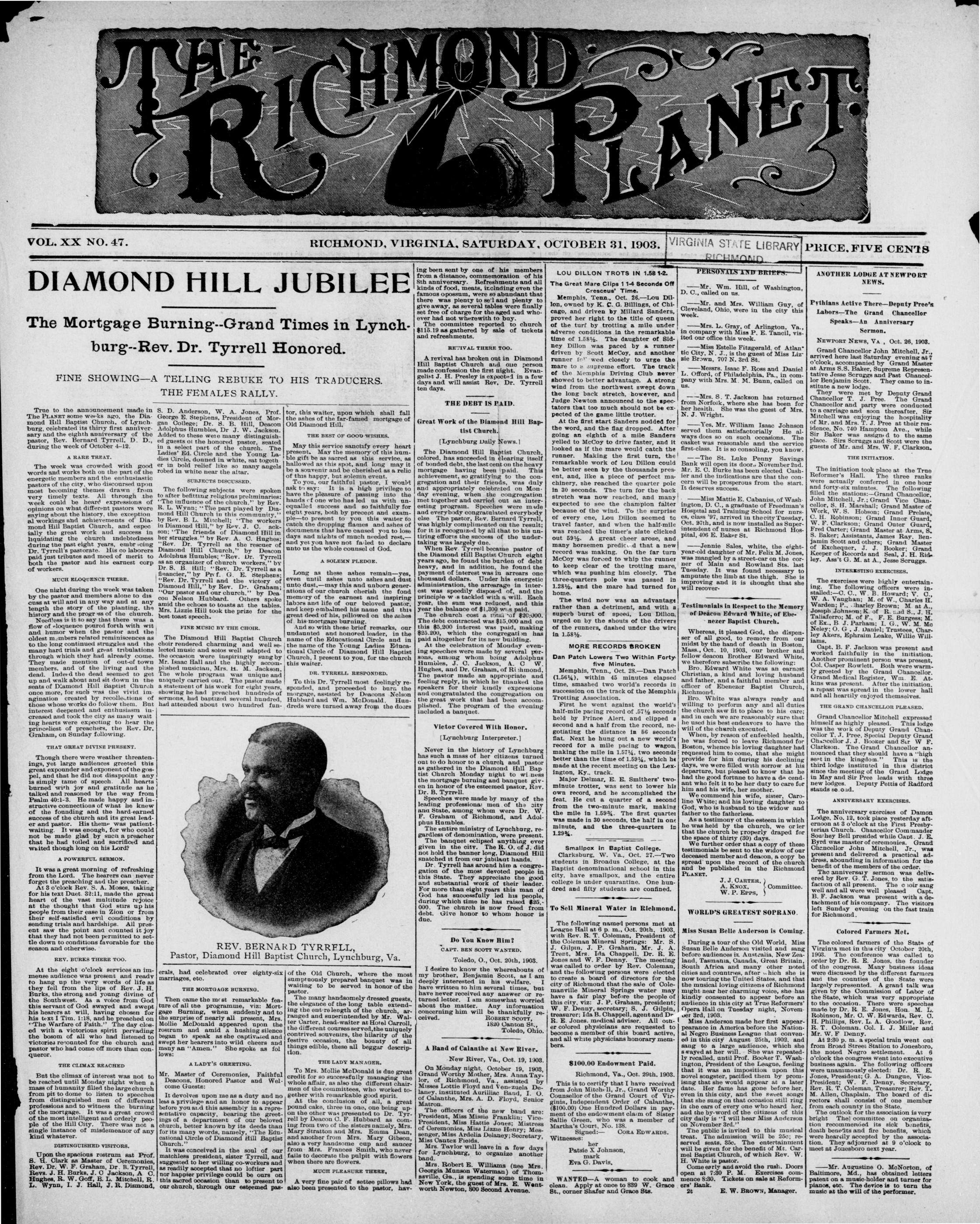
DIAMOND HILL JUBILEE
The Mortgage Burning--Grand Times in Lynchburg--Rev. Dr. Tyrrell Honored.
FINE SHOWING—A TELLING REBUKE TO HIS TRADUCERS
VOL. XX NO. 47.
DIAMOND
The Mortgage B
burg--Re
FINE SHOWING—A
True to the announcement made in The PLANET some weeks ago, the Diamond Hill Baptist Church, of Lynchburg, celebrated its thirty first anniversary and the eighth anniversary of the pastor, Rev. Bernard Tyrrell, D. D., during the week of October 4-12.
A BARE TREAT.
The week was crowded with good words and works both on the part of the energetic members and the enthusiastic pastors of the city, who discoursed upon most becoming themes drawn from very timely texts. All through the week could be heard expressions of opinions on what different pastors were saying about the history, the exceptional workings and achievements of Diamond Hill Baptist Church, and especially the great work and success in liquidating the church indebtedness during the past eight years, embracing Dr. Tyrrell's pastorate. His co laborers paid just tributes and meed of merit to both the pastor and his earnest corp of workers.
MUCH ELOQUENCE THERE.
One night during the week was taken by the pastor and members alone to discuss at will and in any way and at any length the story of the planting, the history and the progress of the church. Needless is it to say that there was a flow of eloquence poured forth with wit and humor when the pastor and the oldest members related reminiscences as to the long continued struggles and the many hard trials and great tribulations through which they had already come. They made mention of out-of town members, and of the living and the dead. Indeed the dead seemed to get up and walk about like down in the seats of Diana Hill in the park once more, for such was the vivid imitation, created by recollections of those whose works do follow them. But interest deepened and enthusiasm increased and took the city as many waiting hearts were expecting to hear the prince of preachers, the Rev. Dr. Graham, on Sunday following.
THAT GREAT DIVINE PRESENT
Though there were weather threatenings, yet large audiences greeted this great expounder and exponent of the gospel, and that he did not disappoint any is simply a tame of speech. All hearts burned with joy and gratitude as he talked and reasoned by the way from Psalm 40:1-3. He made happy and instructive connections of what he knew of the founding and the hard-earned success of the church and its great leader and pastor. His theme was patient-waiting. It was enough, for who could not be made glad by such a preacher that he had toiled and sacrificed and waited though long on his Lord?
A POWERFUL SERMON
It was a great morning of refreshing from the Lord. The hearers can never forget the preaching and the preacher. At 3 o'clock Rev. S. A. Moses, taking for his text Duet. 32:11, made the great heart of the vast multitude rejoice at the thought that God stirs up his people from their case in Zion or from their self-satisfied evil conditions by sending trials and hardships. All present saw the point and counted it joy that they had not been permitted to settle down to conditions favorable for the season and otherwise.
REV. BURKS THERE TOO
At the eight o'clock services an immense audience was present and ready to hang up the very words of life as they fell from the lips of Rev. J. H. Burks, the strong and young divine of the Southwest. As a voice from God this servant of God swayed and swept his hearers at will, having chosen for his text I Tim. 1:18, and he preached on "The Warfare of Faith." The day closed with a victorious spirit pervading the bosom of all who had listened to victories recounted for the church and pastor who had come off more than conqueror.
THE CLIMAX REACHED
But the climax of interest was not to be reached until Monday night when a mass of humanity filled the large church from pit to dome to listen to speeches from distinguished men of different professions and to witness the burning of the mortgage. It was a great crowd of people, of the elderly people of the Hill City. There was not a single instance of misdemeanor of any kind whatever.
DISTINGUISHED VISITORS
Upon the spacies rostrum sat Prof. S. H. Clark as Master of Ceremonies, Rev. Dr. W. F. Graham, Dr. B. Tyrrell, Revs. J. H. Burks. J. O. Jackson, A. C. Hughes, R. W. Goff, B. L. Mitchell, R. L. Wynn, J. I. Hall, J. R. Dismond
[Image of a man in a suit with a bow tie, facing slightly to the right.]
REV. BERNARD TYRRFLL, Pastor, Diamond Hill Baptist Church, Lynchburg, Va.
THE FEMALES RALLY.
S. D. Anderson, W. A. Jones, Prof. George E. Stepien, President of Morgan College; Dr. S. B. Hill, Deacon Adolphus Humbles, Dr J. W. Jackson. Added to these were many distinguished guests of the honored pastor, seated in a select part of the church. The Ladies' Ed. Circle and the Young Ladies Circle, donned in white, sat together in bold relief like so many angels robed in white near the altar.
SURJECTS DISCUSSED
The following subjects were spoken to after befitting religious preliminaries: "The influence of the church." by Rev. R. L. Wynn; "The part played by Diamond Hill Church in this community." by Rev. B. L. M. Mitchell; "The workers in Diamond Hill." by Rev. J. C.ACKson; "The friends of Diamond Hill in her struggles." by Rev. A. C. Hughes; "Rev. Dr. Tyrrell as the resuer of Diamond Hill Church," by Deacon Adolphus Humbles; "Rev. Dr. Tyrrell as an organizer of church workers," by Dr. S. B. Hill; "Rev. Dr. Tyrrell as a financier," by Prf. G. E. Stephens; "Rev. Dr. Tyrrell and the victory of Diamond Hill." by Rev. Dr. Graham; "Our pastor and our church," by Deacon Nelson Hubbard. Others spoke amid the echoes to toasts at the tables. Mrs. Lizzie Hill took the prize for the best toast speech.
FINE MUSIC BY THE CHOIR.
The Diamond Hill Baptist Church choir rendered charming and well selected music and solos well adapted to the occasion were inspiringly sung by Mr. Isaac Saw and the highly accomplished musician, Mrs. t. H. M. Jackson. The whole program was unique and uniquely carried out. The pastor made a statement of his work for eight years, showing he had preached hundreds of sermons, had baptized several hundred, had attended about two hundred fun-
REV. BERNA
Pastor, Diamond Hill Bapt
erals, had celebrated over eighty-six marriages, etc.
THE MORTGAGE BURNING.
Then came the most remarkable feature of all the programme, viz: Mortgage Burning, when suddenly and to the surprise of nearly all present, Mrs. Mollie McDonald appeared upon the rostrum and amid a hushing silence began to speak as she captivated and swept her hearers into wild cheers and many an "Amen." She spoke as follows:
A LADY'S GREETING.
Mr. Master of Ceremonies, Faithful Deacons, Honored Pastor and Welcome Guests:
It devolves upon me as a duty and no less a privilege and an honor to appear before you and this assembly in a representative capacity, bearing the greetings of a department of our beloved church, better known by its deeds than for its many words, namely. "The Educational Circle of Diamond Hill Baptist Church."
It was conceived in the soul of our matchless president, sister Tyrell, and suggested to her willing co-workers and as readily accepted that no loftier part nor happier privilege could be ours on this sacred occasion than to present to our church through our esteemed res
RICHMOND, VIRGINIA, SATURDAY, OCTOBER 31, 1903.
tor, this waiter, upon which shall fall the ashes of the far-famed mortgage of Old Diamond Hill.
THE REST OF GOOD WISHES.
May this service sanctify every heart present. May the memory of this humble gift be as sacred as this service, as hallowed as this spot, and long may it be a souvenir and be cherished as a relic of this happy, but solemn event. To you, our faithful pastor, I would ask to say: It is a high privilege to have the pleasure of passing into the hands of one who has led us with unequaled success and so faithfully for eight years, both by precept and example—to present to you this water to catch the dropping flames and ashes of documents that have caused you to lose days and nights of much needed rest,—and yet you have not failed to declare unto us the whole counsel of God.
A SOLEMN PLEDGE.
Long as these ashes remain—yes, even until ashes unto ashes and dust unto dust,—may this and unborn generations of our church cherish the fond memory of the earnest and inspiring labors and life of our beloved pastor, and keep embolmed his name and this great deed of his, pillowed on the ashes of his mortgage burning.
And so with these brief remarks, our undaunted and honored leader, in the name of the Educational Circle and in the name of the Young Ladies Educational Circle of Diamond Hill Baptist Church, I present to you, for the church this waiter.
DR. TYRRELL RESPONDED.
To this Dr. Tyrell most feelingly responded, and proceeded to burn the mortgage, assisted by Deacons Nelson and John B. McCormick, the dreds were turned away, from the doors
RD TYRRELL,
ist Church, Lynchburg, Va.
of the Old Church, where the most sumptuously prepared banquet was in waiting to be served in honor of the pastor.
The many handsomely dressed guests, the elegance of the long table extending the entrelength of the church, arranged and superintended by Mr. Walter Carter, head-waiter at Hotel Carroll, the different courses served, the uniquely contrived souvenirs, the bidity of the festive occasion, the bounty of all things edible, these all beggar description.
THE LADY MANAGER.
To Mrs. Mollie McDonald is due great credit for so successfully managing the whole affair, as also the different chairmen of the committees, who worked together with remarkable good spirit. At the conclusion of all, a great pound cake, three in one, one being upon the other was presented to Dr. Tyrrell by Deacon C. F. Hubbard as coming from two of the sisters namely, Mrs. Mary Stratton and Mrs. Emma Dean, and another from Mrs. Mary Gibson, also a very handsome cup and saucer from Mrs. Frances Smith, who never fails to decorate the pulpit with flowers when there are flowers.
MUCH PLEASURE THERE.
A very fine pair of settep pillows had also been presented to the pastor, hav-
ing been sent by one of his members from a distance, commemoration of his 8th anniversary. Refreshments and all kinds of food, meals, including even the famous opossum, were so abundant that there was plenty to se1 and plenty to give away, as several tables were finally set free of charge for the aged and whoever had not wherewith to buy. The committee reported to church $115.19 as gathered by sale of tickets and refreshments.
REVIVAL THERE TOO.
A revival has broken out in Diamond Hill Baptist Church and one person made confession the first night. Evangelist J. H. Presley is expecte-1 in a few days and will assist Rev. Dr. Tyrrell ten days.
THE DEBT IS PAID
Great Work of the Diamond Hill Baptist Church.
[Lynchburg Daily News.]
The Diamond Hill Baptist Church, colored, has succeeded in clearing itself of bonded debt, the last cent on the heavy mortgage having been paid. This achievement, so gratifying to the congregation and their friends, was duly and appropriately celebrated on Monday evening, when the congregation met together and carried out an interesting program. Speeches were made and everybody congratulated everybody else. The pastor, Rev. Bernard Tyrrell, was highly complimented on the result; for it is recognized by all that to his untrying efforts the success of the undertaking was largely due.
When Rev. Tyrell became pastor of the Diamond Hill Baptist Church eight years ago, he found the burden of debt heavy, and in addition, he found the payment of interest was in arrears one thousand dollars. Under his energetic administration, the arrearsage in interest was speedily disposed of, and the principle w was tackled with a will. Each year, the sum was reduced, and this year the balance of $1,300 was paid.
The church cost a total of $20,000. The debt contracted was $15,000 and on this $5,200 interest was paid, making $25,200, which the congregation has paid altogether for its new building.
At the celebration of Monday evening speeches were made by several persons, among whom being Adolphus Humbles, J. C. Jackson, A. C W. Hughes, and Dr. Graham, of Rishmond, the pastor made an appropriate and feeling reply, in which he thanked the speakers for their kindly expressions and congratulated the congregation on the great work that had been accomplished. The program of the evening included a banquet.
Victor Covered With Honor. [Lynchburg Interpreter.]
Never in the history of Lynchburg has such a mass of her citizens turned out to do honor to a church and pastor as gathered in the Diamond Hill Baptist Church Monday night to wi mess the mortgage burning and banquet given in honor of the esteemed pastor, Rev. Dr. B. Tyrrell.
Speeches were made by many of the leading professional men of the city and State, among whom were Dr. W. F. Graham of Richmond, and Adolphus Giles.
The entire ministry of Lynchburg, regardless of denomination, were present.
The banquet eclipsed anything ever given in the city. The R. O. of J. did not hold the banner long, Diamond Hill snatched it from our jubilant hands.
Dr. Tyrrell has around him a congregation of the most devoted people in this State. They appreciate the good and substantial work of their leader. For more than eight years this man of God has successfully led his people, during which time he has raised $35,000. The church is now freed from debt. Give honor to whom honor is due.
Do You Know Him?
CAPT. BEN SCOTT WANTED.
Toledo, O., Oct. 20th, 1903.
I desire to know the whereabouts of my brother, Benjamin Scott, as I am deeply interested in his welfare. I have written to him several times, but have never received any answer. I returned letter. I am somewhat worried about the matter. Any information concerning him will be thankfully received.
ROBERT SCOTT,
1820 Canton St.,
Toledo, Ohio.
A Band of Calanthe at New River.
New River, Va., Oct. 19, 1903.
On Monday night, October 19, 1903, Grand Worthy Mother, Mrs. Anna Taylor, of Richmond, Va., assisted by Misses Lottie Floyd and Venezuela Delaney, instituted Aurillac Band, I. O. Calanthe, Mrs. A. D. Floyd, Senior Manager.
The officers of the new band are: President, Miss Missie Franklin; Vice-President, Miss Hattie Jones; Mistress of Ceremonies, Miss Lizzie Henry; Messenger, Miss Ardela Delia; Secretary, Miss Cantez Fields.
Mrs. Taylor will leave in a few days for Lynchburg, to organize another band.
Mrs. Robert E. Williams (nee Mrs. Georgia Munson Waterman) of Thomasville, Ga., is spending some time in New York, the guest of Mrs. E. Wentworth Newton, 800 Second Avenue.
LOU DILLON TROTS IN 1.58 1-2.
Memphis, Tenn., Oct. 26.—Lou Dillon, owned by K. C. G. Billings, of Chicago, and driven by Millard Sanders, proved her right to the title of queen of the turf by trotting a mile under adverse conditions in the remarkable time of 1.581⁴. The daughter of Sidney Dillon was paced by a runner driven by Scott McCoy, and another runner fell wed closely to urge the mare to a supreme effort. The track of the Memphis Driving Club never showed to better advantage. A strong wind from the northwest swept down the long back stretch, however, and Judge Newton announced to the spectators that too much should not be expected of the game little trotter.
At the first start Sanders nodded for the word, and the flag dropped. After going an eighth of a mile Sanders yelled to McCoy to drive faster, and it looked as if the mare would catch the runner. Making the first turn, the remarkable work of Lou Dillon could be better seen by the thousands present, and, like a piece of perfect machinery, she reached the quarter pole in 30 seconds. The turn for the back stretch was now reached, and many expected to see the champion falter because of the wind. To the surprise of every one, Lou Dillon seemed to travel faster, and when the half-mile was reached the timer's slate clicked out $59\%$. A great cheer arose, and many horsemen predicted that a new record was making. On the far turn McCoy was forced to whip the runner to keep clear of the trotting mare, which was pushing him closely. The three-quarters pole was passed in $1.28\%$, and the mare had turned for home.
The wind now was an advantage rather than a detriment, and with a superb burst of speed, Lou Dillon, urged on by the shouts of the drivers of the runners, dashed under the wire in 1.58%.
MORE RECORDS BROKEN
Dan Patch Lowers Two Within Forty-five Minutes.
Memphis, Tenn., Oct. 28.—Dan Patch (1.56%) within 45 minutes elapsed time, smashed two world's records in succession on the track of the Memphis Trotting Association.
First he went against the world's half-mile pacing record of 571/2 seconds held by Prince Alert, and clipped a second and a half from the record, negotiating the distance in 56 seconds flat. Next he hung out a new world's record for a mile pacing to wagon, making the mile in 1.571, two seconds better than the time of 1.591/4, which he made at the recent meeting on the Lexington, Ky. track.
Major Delmar, E. E. Smithers' two-minute trotter, was sent to lower his own record, and he accomplished the feat. He cut a quarter of a second from the two-minute mark, making the mile in $1.59\%$. The first quarter was made in 30 seconds, the half in one minute, and the three-quarters in $1.29\%$.
Smallpox in Baptist College.
Clarksburg, W. Va. Oct. 27.—Two students in Broadus College, at the Baptist denominational school in this city, have smallpox, and the entire college is under quarantine. One hundred and fifty students are confined.
To Sell Mineral Water in Richmond.
The following named persons met at League Hall at 6 p. m., Oct. 20th, 1903, with Rev. R. T. Coleman, President of the Coleman Mineral Springs: Mr. S. J. Gilpin, J. P. Graham, Mr. J. A. Trent, Mrs. Ida Chappell, Dr. R. E. Jones and W. F. Denny. The meeting was called to order by Rev. Coleman, and the following persons were elected to create a board of directors for the city of Richmond that the sale of Colemanville Mineral Springs water may have a fair play before the people of wiz. wiz. Ida Coleman, W. F. Denny, secretary; S. J. Gilpin, treasurer; Ida B. Chappell, agent and Dr. R. E. Jones, medical adviser. All other colored physicians are requested to be a member of this board active, and all white physicians honorary members.
$100.00 Endowment Paid.
Richmond, Va., Oct. 29th, 1903.
This is to certify that I have received from John Mitchell, Jr., Grand Worthy Counselor of the Grand Court of Virginia, Independent Order of Calanthe, ($100.00) One Hundred Dollars in payment of the endowment claim of Sister Sallie Green, who was a member of Martha's Court, No. 138.
Signed:— CORA EDWARDS.
Witnesses:
WANTED—A woman to cook and clean. Apply at once to 839 W. Grace St. corner Shafer and Grace Sts.
PERSONALS AND BRIEF
Mr. Wm. Hill, of Washington, D. C., called on us.
Mr. and Mrs. William Guy, of Cleveland, Ohio, were in the city this week.
Mrs. L. Gray, of Arlington, Va., in company with Miss P. E. Tancil, visited our office this week.
Miss Estelle Fitzgerald, of Atlantic City, N. J., is the guest of Miss Lizzie Brown, 707 N. 3rd St.
Messrs. Isaac F. Ross and Daniel L. Offord, of Philadelphia, Pa., in company with Mrs. M. M. Bunn, called on us.
Mrs. S. T. Jackson has returned from Norfolk, where she has been for her health. She was the guest of Mrs. N. J. Wright.
Yes. Mr. William Isaac Johnson served them satisfactorially. He always does so on such occasions. The casket was reasonable and the service first-class. It is so consoling, you know.
—The St. Luke Penny Savings Bank will open its door. November 2nd. Mr. E. C. Burke has been elected Cashier and the indications are that the concern will be prosperous from the start. It deserves success.
—Miss Mattie E. Cabaniss, of Washington, D. C., a graduate of Freedman's Hospital and Training School for nurses, class '37, arrived in the city Tuesday, Oct. 27th, and is now installed as Superintendent of nurses at Richmond Hospital, 406 E. Baker St.
—Jennie Sales, white, the eight-year-old daughter of Mr. Felix M. Jones, was mangled by a street-car on the corner of Main and Rowland Sts. last Tuesday. It was found necessary to amputate the limb at the thigh. She is improving and it is thought that she will recover.
Testimonials in Respect to the Memory of Deacon Edward White, of Ebenezer Baptist Church.
Whereas, it pleased God, the dispenser of all good, to remove from our midst by the hand of death in Boston, Mass., Oct. 10, 1903, our brother and fellow deacon Brother Edward White, we therefore subscribe the following: Bro. Edward White was an earnest Christian, a kind and loving husband and father, and a faithful member and officer of Ebenezer Baptist Church, Richmond. Bro. White was always ready and willing to perform any and all duties the church saw fit to place to his care; and in each we are reasonably sure that he used his best endeavors to have the church executed. White was of enlightened health, he was forced to be Richmond for Boston, whence his loving daughter had requested him to come, that she might provide for him during his declining days, we were filled with sorrow at his departure, but pleased to know that he had the good fortune to have a deendant who felt it to be her duty to care for him and his wife, her mother.
We commend his wife, sister, Caroline White; and his loving daughter to God, who is husband to the widow and father to the fatherless.
As a testimony of the esteem in which he was held by the church, we or let that the church be properly draped for the space of thirty (30) days.
We further order that a copy of these testimonials be sent to the widow of our deceased member and deacon, a copy be spread upon the record of the church and be published in the Richmond PLANET.
Miss Susan Belle Anderson is Coming.
During a tour of the Old World, Miss Susan Belle Anderson visited and sang before audiences it Australia, New Zealand, Tasmania, Canada, Great Britain, South Africa and many other noted cities and countries, after which she is now touring the United States, and that the musical loving citizens of Richmond might near her charming voice, she has consented to appear before an audience in its city of True Reformers' Opera Hall on Tuesday night, November 3rd, 1903.
Miss Anderson made her first appear pearance in America before the Nation, al Negro Business League that convened in this city August 25th, 1902, and sang to a large audience, which she swayed at her will. She was repeatedly recalled, until Prof. Booker T. Washington, President of the League, feeling that it was an imposition upon this novel songster, pacified them by promising that she would appear at a later date. Her fame has gone before her, even in this city, and the sweet songs that she sung on that occasion still ring in the ears of every one who heard her, and the by-word of the citizens of this city daily is "I will hear Miss Anderson on November 3rd."
The public is invited to this musical treat. The admission will be 25c; reserved seats, 35c. The entertainment will be given for the benefit of Mt. Carmel Baptist Church, of which Rev. W. H. White is pastor.
Come early and avoid the rush. Doors open at 7:30 P. M. Exercises commence 8:30. Tickets on sale at Reformer's Bank.
PRICE, FIVE CENTS
ANOTHER LODGE AT NEWPORT NEWS.
Pythians Active There—Deputy Free's
Labor's—The Grand Chancellor
NEWPORT NEWS, VA. Oct. 26. 1903.
Grand Chancellor John Mitchell, Jr., arrived here last Saturday evening at 7 o'clock, accompanied by Grand Master at Arms S.S. Baker, Supreme Representative Jesse Scruggs and Past Chancellor Benjamin Scott. They came to institute a new lodge. They were met by Deputy Grand Chancellor T. J. Pree. The Grand Chancellor and party were conducted to a marriage and soon thereafter, Sir Mitchell enjoyed the hospitality of Mr. and Mrs. He and their residence, No. 740 Hampton Ave., while Sir Baker was assigned to the same place. Sirs Scruggs and Scott were the guests of Mr. and Mrs. W. F. Clarkson.
THE INITIATION
The initiation took place at the True Reformer's Hall. The three ranks were actually conferred in one hour and forty-six minutes. The following filled the stations:—Grand Chancellor, John Mitchell, Jr.; Grand Vice Chancellor, S. H. Marshall; Grand Master of Work, W. S. Hobson; Grand Prelate, C. H. Robinson; Grand Inner Guard, W. F. Clarkson; Grand Outer Guard, Fred Carter; Grand Master at Arms, S. S. Baker; Assistants, James Ray, Benjamin Scott and others; Grand Master of Exchequer, J. J. Booker; Grand Keeper of Records and Seal, J. H. Ridley. Ass'g T. M. at A., Jesse Scruggs.
INTERESTING EXERCISES.
The exercises were highly entertaining. The following officers were installed:—C. C., W. B. Howard; V. C., W. A. Vaughan; M. of W. Charles H. Warden; P., charley Brown; M at A. Joseph Johnson; K of R. and S., J. H. Taliafero; M of F., F. E. Burgess; M of E., B. J. Parham; I. G., W. M. Mc Neley; O. G., J. Daniel; Trustees, Charley Akers, Ephraim Lea, Willie Williams.
Capt. B. F. Jackson was present and worked faithfully in the initiation. Another prominent person was present, Col. Casper Rowlett. Both were warmly greeted by the Grand Chancellor, Grand Medical Register, Wm. E. Atkins was present. After the initiation, a repast was spread in the lower hall and all heartily enjoyed themselves.
THE GRAND CHANCELLOR PLEASED
Grand Chancellor Mitchell expressed himself as highly pleased. This lodge was the work of Deputy Grand Chancellor T. J. Pree, Special Deputy Grand Chancellor J. J. Booker and Sir W F. Clarkson. The Grand Chancellor announced that they should have a "high seat in the kingdom." This is the seat of the Chancellor in this district since the meeting of the Grand Chancellor in May and Sir Pree leads with three new lodges. Deputy Pettis of Radford stands so.oud.
ANNIVERSARY EXERCISES
The anniversary exercises of Damon Lodge, No. 12, took place yesterday afternoon at 3 o'clock at the First Presbyterian Church. Chancellor Commander Southey Bell presided while Capt. J. E. Byrd was master of ceremonies. Grand Chancellor John Mitchell, Jr., was present and delivered a practical address, abounding in information for the benefit of the members of the order. The anniversary sermon was delivered by Rev. G. T. Jones, to the satisfaction of all present. The c oir song well and all were well pleased Capt. B. F. Jackson was present with a detachment of his company. The visitors left Sunday evening on the fast train for Richmond.
Colored Farmers Met.
The colored farmers of the State of Virginia met in this city October 20th, 1903. The conference was called to order by Dr. R. E. Jones, the founder of the congress. Many business ideas were discussed by the different farmers and the counties of the State were largely represented. A grand talk was given by the Commission of Labor of the State, which was very appropriate to the occasion. There were speeches made by Dr. R. E. Jones, Hon. M. L. Robinson, Mr. C. W. Edwards, Rev. O. H. Phillips, Rev. L. A. Goodlow, Rev. R. T. Coleman, Col. I. J. Miller and Mr. W. F. Denny.
At 2:30 p. m. a special train went out from Broad Street Station to Jonesboro, the noted Negro settlement. At 6 o'clock the congress went into executive business again. The following officers were unanimously elected: Dr. R. E. Jones, President; G. W. Dungue, Vice-President; W. G. F. Danny, Secretary, Rev. R. T. Coleman, Treasurer; Rev. T. M. Allen, Chaplain. The board of directors shall consist of one member from each county in the State.
The outlook for the association is very bright. Thel committee on organization recommended its sick benefits, death benefits and fire benefits, which were heartily accepted by the association. They adjourned at 9 o'clock to meet at Jonesboro next year.
Mr. Augustine O. McNorton, of Baltimore, Md., has obtained letters patent on a music-holder and turner for pianos, etc. The device is to turn the music at the will of the performer.
THE PLANET
SATURDAY...OCTOBER 31, 1908
SEES DEATH IN DREAM.
Montana Ranchman Murdered by
Tramp He Had Wronged and
Offended Twice.
Students of the occult are finding
much food for thought in the murder of
Fred Teasdale, a rancher of Bridger,
Mont., by a tramp who refuses to give
his name, but who says that he knew
the dead man long ago and that Teasdale did him a deadly wrong.
"I had a queer dream last night, only it was not really a dream," said Teasdale, when he went into the field in the morning, addressing several men. "I thought that I was living long, long ago and did a fearful wrong to a man who once was my friend. We parted and met many years later, when we engaged in a quarrel. During this quarrel he shot me. The funny part of it all was that at the time I seemed to be living firearms had not been invented."
As the men were working, about noon, a tramp appeared in the field and asked to be put to work. He was given employment. When his eyes fell on Teasdale he turned pale and staggered as if hit a heavy blow.
Soon Teasdale began joking about his poor workmanship. This angered the tramp, and hot words followed. Suddenly Teasdale leaned forward and struck the tramp in the face.
"Curse you, that's twice you have wronged me in this world," shouted the tramp, "but it will be the last."
Then he drew a revolver and fired, the ball penetrating the heart of the
A
"TWICE YOU HAVE WRONGED ME." rancher, who fell dead. The trump was seized and taken to jail. He refuses to give his name, saying only that Teasdale knew him and that he merely took revenge for an injury done him many years before. The trump showed indications of having at one time filled a high position in the world and is evidently a man of education.
Girl Frightened to Death
Mary McAndrews, an amabil and pretty factory girl, and 17, of Scranton, Pa., became slightly 11. Her companions in the factory, to tease her, said she showed the early symptoms of smallpox, some scattered case of which malady were in the city. The girl became so alarmed that she went home and committed suicide by taking carbolic acid.
Indiana's Champion Porker.
An immense hog, weighing 955 pounds dressed, was raised by H. C. Shanahan, a farmer, of Mishawaka, Ind. He sold it to a provision dealer for $85.95
STRUCK BY LIGHTNING
Thrilling Experience of a Missouri Farmer Who Was Thought to Be Dead.
A few days ago G. W. Peacher, of Sturgeon, Mo, 31 years old, was struck by lightning and given up for dead. But he lives to tell the story. Peacher
L. T.
STRUCK HIM ON THE LEFT SHOULDER.
was visited at his residence, ten miles south of Sturgeon, and said:
"Well, I may not look like a dead man, but it seems to me like I was dead, buried, and am now resurrected. It was the closest call I ever had, and if anybody could have been found about the time I was struck I would have bet them my farm against a glass of buttermilk that I was done for.
"The lightning struck me on the left shoulder and burned me to my toes. Both shoes were badly torn, and in the photograph here you can see for yourself how it treated my clothes. Well, for a few minutes I was dead. The boys gathered around me and I heard one of them say that I died easy.
"The boys told me it was fully 20
minutes before I moved, and the first thing I said was a request or water. This was brought to me, and I drained all of it. My companions asked me what physician I wanted, and I told them that I would be dead before any of those at Sturgeon could be told about the affair.
"My nerves were racked, and whatever courage I had possessed in former days deserted me. In an hour the doctor arrived, gave me an opiate, and I went to sleep. I was brought to Sturgeon over night, and the next day my friends took me home."
Found Snake in Her Hair
Dreaming that she was putting up her hair and having difficulty in disentangling it from her fingers. Mrs. Ida Whalen, of Logansport, Ind., woke up the other night to find a snake coiled around her fingers. She hastily flung the reptile to the floor, and succeeded in killing it. In the struggle the snake bit her several times, inflicting painful and probably dangerous wounds. The snake measured 12 inches and is of the water snake variety, which are not considered very poisonous. The presence of the snake is accounted for from the fact that the family cat frequently brings them to the house. It is thought the cat brought this one in the night and carried it into the bedroom, springing upon the bed with it.
His Prediction
"Yes," he said, "it will rain next Thursday evening."
"Do you set yourself up as an infallible weather prophet?" some one asked.
"Certainly not," he replied.
"Yet you speak confidently of what the weather will be four or five days from now."
"Oh, well, there are some signs that never fail, and my wife has planned a garden party for that evening."—Chicago Post.
Based on Experience
"My dear," asked Mrs. Wedderly, "what's the difference between idealism and realism?"
"Idealism," replied the son-in-law of her mother, "is love's young dream."
"Yes," said the other half, "and realism?"
"Oh," answered the masculine end of the sketch, "that's what matrimony bumps one up against."—Cincinnati Enquirer.
Ominous.
The farmers threaten to create
A corner to control the wheat;
In which event the old cross road
For terror will have Wall street beat.
—Washington Star.
QUITE ANOTHER ANIMAL.
A
She—My brother tells me you have been going in for a little speculation on the stock exchange, lately. Were you a bull or a bear?
He—Neither! I was an ass!!—Ally Sloper.
Often the Case.
She had fifteen million dollars,
Placed in bonds, and shares, and rents
He had fifteen million dollars,
So they merged their sentiments,
Now they raised a son who's valued
at exactly thirty cents.
—N. C. Brown, comment writer
Rather Egotistical.
"I never argue with fools," said Crankleigh.
"Because why?" asked the bartender.
"Because when they don't agree with me I feel sorry for them," replied the home-grown philosopher; "and when they do agree with me I feel sorry for myself." -Cincinnati Enquirer.
Knowing Open.
"It seems to me," said the auburn-haired damsel, "that it is only the men who never marry who know all about women."
"Or, in other words," replied the cynical bachelor, "it is only the men who know all about women who never marry." -Chicago Daily News.
Success Assured.
Jaggles—the members of that exploring party seem confident that they will make wonderful scientific discoveries. Have they good reasons for thinking so? Waggles—the best. They have taken a press agent along—N. Y. Times.
At the Seashore.
"No," he answered, "but I can hold you up while you're trying to learn."
"That is all that is necessary," she cried, joyously.
And so they went into the water.—Brooklyn Eagle.
question," said the broad-minded man. "That's true," answered Senator Sorghum. "and the question must always be carefully studied to ascertain which side is going to pay the best."—Washington Star.
Payment by Proxy
Neighbor's Pretty Daughter—How much is this a yard? Draper's Son (desperate "spoons" on her)—Only one kiss. "If it's so cheap I will take three yards, and grandma will pay you."—Tit-Bits.
All Scraus.
Pete—Dey tell me dat bully was always coming around here looking for scraps. Did yo' accommodate him?
Sam—Should say so. Ah hit him wild a bowl ob hash—Chicago Daily News.
THE RICHMOND PLANET RICHMOND VIRGINIA
Fierce Battle With Hungry Bats
Explorers of a New York State Cave Have Thrilling Adventure—Polar Bear Kept Captain and Crew of a Ship in New York Harbor Guessing for Several Hours.
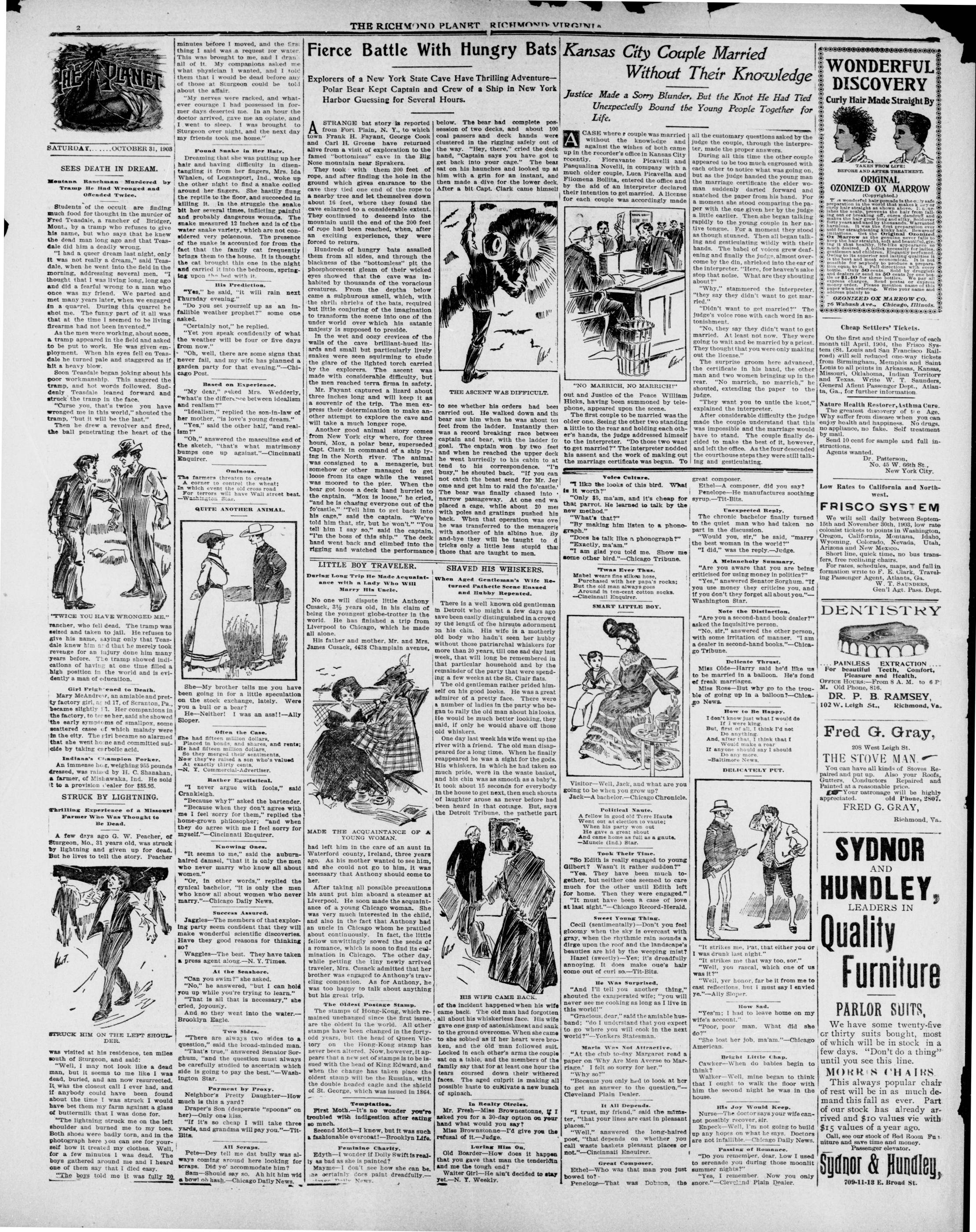
STRANGE bat story is reported from Fort Plain, N. Y., to which town Frank H. Fayant, George Cook and Carl H. Greene have returned alive from a visit of exploration to the famed "bottomless" cave in the Big Nose mountain near Sprakers. They took with them 200 feet of rope, and after finding the hole in the ground which gives enrance to the cave they tied one end of the rope to a nearby tree and let themselves down about 16 feet, where they found the cave enlarged to a considerable extent. They continued to descend into the mountain until the end of the 200 feet of rope had been reached, when, after an exciting experience, they were forced to return.
Hundreds of hungry bats assailed them from all sides, and through the blackness of the "bottomless" pit the phosphorescent gleam of their wicked eyes showed that the cave was inhabited by thousands of the voracious creatures. From the depths below came a sulphurous smell, which, with the shrill shrinks of the bats, required but little conjuring of the imagination to transform the scene into one of the under world over which his satanic majesty is supposed to preside.
In the wet and oozy crevices of the walls of the cave brilliant-hued lizards and small but particularly lively snakes were seen squirming to elude the glare of the lighted torch carried by the explorers. The ascent was made with considerable difficulty, but the men reached terra firma in safety. Mr. Fayant captured a lizard about three inches long and will keep it as a souvenir of the trip. The men express their determination to make another attempt to explore the cave and will take a much longer rope.
Another good animal story comes from New York city where, for three hours, Mox, a polar bear, superseded Capt. Clark in command of a ship lying in the North river. The animal was consigned to a menagerie, but somehow or other managed to get loose from its cage while the vessel was moored to the pier. When the bear got loose a deck hand hurried to the captain. "Mox is loose," he cried, "and he is chasing everyone out of the fo'castle." "Tell him to get back into his cage," said the captain. "We've told him that, str, but he won't." "You tell him I say so," said the captain. "I'm the boss of this ship." The deck hand went back and climbed into the rigging and watched the performance
LITTLE BOY TRAVELER
During Long Trip He Made Acquaintance with a Lady Who Will Marry His Uncle.
No one will dispute little Anthony Cusack, 3½ years old, in his claim of being the youngest globe-trotter in the world. He has finished a trip from Liverpool to Chicago, which he made all alone.
His father and mother, Mr. and Mrs. James Cusack, 4638 Champaign avenue.
A
MADE THE ACQUAINTANCE OF A
YOUNG WOMAN
MADE THE ACQUAINTANCE OF A YOUNG WOMAN.
had left him in the care of an aunt In Waterford county, Ireland, three years ago. As his mother wanted to see him, and she could not go to him, it was necessary that Anthony should come to her.
After taking all possible precautions his aunt put him aboard a steamer at Liverpool. He soon made the acquaintance of a young Chicago woman. She was very much interested in the child, and also in the fact that Anthony had an uncle in Chicago whom he prattled about continuously. In fact, the little fellow unwittingly sowed the seeds of a romance, which is soon to find its culmination in Chicago. The other day, while petting the tiny newly arrived traveler, Mrs. Cusack admitted that her brother was engaged to Anthony's traveling companion. As for Anthony, he was too happy to talk about anything but his great trip.
The blest Postage Stamp.
The stamps of Hong-Kong, which remained unchanged since the first issue, are the oldest in the world. All other stamps have been changed in the forty-odd years, but the head of Queen Victory on the Hong-Kong stamp has never been altered. Now, however, it appears that a new set of stamps is to be issued with the head of King Edward, and when the change has taken place the oldest stamp will be the Russian, with the double headed eagle and the shield of St. George, which was issued in 1864.
Temptation.
First Moth.—It's no wonder you're troubled with indigestion after eating so much.
Second Moth—I know, but it was such a fashionable overcoat!—Brooklyn Life.
Feminine Charity.
Edyth—I wonder if Dolly Swift is really as bad as she is painted?
Mayme—I don't see how she can be, she certainly does paint dreadfully.
Jane Dolly News.
below. The bear had complete possession of two decks, and about 100 coal passers and deck hands were clustered in the rigging safely out of the way. "Hey, there," cried the deck hand, "Captain says you have got to get back into your cage." The bear sat on his haunches and looked up at him with a grin for an instant, and then made a dive for the lower deck. After a bit Capt. Clark came himself
V. H.
THE ASCENT WAS DIFFICULT.
to see whether his orders had been carried out. He walked down and the bear saw him when he was about ten feet from the ladder. Instantly there was a record breaking race between captain and bear, with the ladder for goal. The captain won by two feet and when he reached the upper deck he went hurriedly to his cabin to attend to his correspondence. "I'm busy," he shouted back. "If you can not catch the beast send for Mr. Jerome and get him to raid the fo'caster. The bear was finally chased into a narrow passageway. At one end was placed a cage, while about 20 men with poles and gratings pushed him back. When that operation was over he was transferred to the menagerie with another of his albino hue. By and-by they will be taught to do tricks only a little less stupid than those that are taught to men.
SHAVED HIS WHISKERS
When Aged Gentleman's Wife Returned Pathetic Scene Ensured and Hubby Repented.
There is a well known old gentleman in Detroit who might a few days ago save been easily distinguished in a crowd by the length of the hirate adornment on his chin. His wife is a motherly old body who hadn't seen her hubby without those patriarchal whiskers for more than 30 years, till one sad day last week, that will long be remembered in that particular household and by the remainder of the party that were spending a few weeks at the St. Clair flats.
The old gentleman rather prided himself on his good looks. He was a great admirer of a pretty face. There were a number of ladies in the party who began to rally the old man about his looks. He would be much better looking, they said, if only he would shave off those old whiskers.
One day last week his wife went up the river with a friend. The old man disappeared for a long time. When he finally reappeared he was a sight for the gods. His whiskers, in which he had taken so much pride, were in the waste basket, and his chin was as smooth as a baby's. It took about 15 seconds for everybody in the house to get next, then such shouts of laughter arose as never before had been heard in that cottage. But, says the Detroit Tribune, the pathetic part
Victor
HIS WIFE CAME BACK.
of the incident happened when his wife came back. The old man had forgotten all about his whiskerless face. His wife gave one gasp of astonishment and sank to the ground overcome. When she came to she sobbed as if her heart were broken, and the old man followed suit. Locked in each other's arms the couple sat on a table, and the members of the family say that for at least one hour the tears coursed down their withered faces. The aged culprit is making all possible haste to cultivate a new bunch of spinach.
In Realty Circle
Mr. Fresh—Miss Brownestonne, **I** asked you for a 30-day option on your hand what would you say?
Miss Brownestonne—I'd give you the refusal of it.—Judge.
Luring Him On.
Old Boarder—How does it happen that you gave that man the tenderloin and me the tough end?
Waiter Girl—He ain't decided to stay yet—N. Y. Weekly.
Kansas City Couple Married Without Their Knowledge
Justice Made a Sorry Blunder, But the Knot He Had Tied Unexpectedly Bound the Young People Together for Life.
CASE where a couple was married without the knowledge and against the wishes of both came up in the recorder's office in Kansas City recently. Floravante Picavelli and Pasqualina Novelli, in company with a much older couple, Luca Picavella and Filomena Bollita, entered the office and by the aid of an interpreter declared their intention to get married. A license for each couple was accordingly made all the customary questions asked by the judge the couple, through the interpreter, made the proper answers.
During all this time the other couple appeared to be too much engrossed with each other to notice what was going on, but as the judge handed the young man the marriage certificate the elder woman suddenly darted forward and snatched the paper from his hand. For a
WILLIAM H. HARRIS
"NO MARRICH, NO MARRICH!" out and Justice of the Peace William Hicks, having been summoned by telephone, appeared upon the scene. The first couple to be married was the older one. Seeing the other two standing a little to the rear and holding each other's hands, the judge addressed himself to the interpreter. "Do those two want to get married?" The interpreter nodded his assent and the work of making out the marriage certificate was begun. To
"I like the looks of this bird. What is it worth?"
"Only $5, ma'am, and it is cheap for that parrot. He learned to talk by the new method."
"What's that?"
"By making him listen to a phonograph."
"Does he talk like a phonograph?"
"Exactly, ma'am."
"I am glad you told me. Show me some other bird."—Chicago Tribune.
"Twas Ever Thus.
Mabel wears fine silken hose, Purchased with her papa's rocks; But the old man always goes Around in ten-cent cotton socks.
—Cincinnati Enquirer."
SMART LITTLE BOY.
Mother and Son
Visitor—Well, Jack, and what are you going to be when you grow up?
Jack—A bachelor.—Chicago Chronicle.
Political Naute.
A fellow in good old Terre Haute
Went out at election to vaute;
When his party won out
He gave a great shout
And came home as full as a gaute.
—Muncie (I). Star.
Took Their Time
"So Edith is really engaged to young Gilbert? Wasn't it rather sudden?" "Yes. They have been much together, but neither one seemed to care much for the other until Edith left for home. Then they were engaged." "It must have been a case of love at last sight." -Chicago Record-Herald
Sweet Young Thing:
Cecil (sentimentally)—Don't you feel gloomy when the sky is overcast with gray, when the rhythmic rain sounds a dirge upon the roof and the landscape's beauties are住 by the weeping mist? Hazel (sweetly)—Yes; it's dreadfully annoying. It does make one one's hair come out of curl so—Tit-Bits.
He Was Surprised
"And I'll tell you another thing," shouted the exasperated wife; "you will never see me cooking as long as I live in this world!" "Gracious, dear," said the amiable husband; "do I understand that you expect to go where you will cook in the next world?" "Yonkers Statesman.
Marla Was Not Attractive.
"At the club to-day Margaret read a paper on 'Why Are Men Averse to Marriage,' I felt so sorry for her."
"Why so?"
"Because you only had to look at her to get an answer to the question."—Cleveland Plain Dealer.
It All Depends.
"I trust, my friend," said the minister, "that your lines are cast in pleasant places."
"Well," answered the long-haired poet, "that depends on whether you call waste baskets pleasant places or not."—Cincinnati Enquirer.
Great Composer.
Ethel—Who was that man you just bowed to? Penelone—That was Dobson, the
---
all the customary questions asked by the judge the couple, through the interpreter, made the proper answers.
During all this time the other couple appeared to be too much engrossed with each other to notice what was going on, but as the judge handed the young man the marriage certificate the elder woman suddenly darted forward and snatched the paper from his hand. For a moment she stood comparing the paper with the one given her by the judge a little earlier. Then she began talking rapidly to the young couple in her native tongue. For a moment they stood as though stunned. Then all began talking and gesticulating wildly with their hands. The babel of voices grew deafening and finally the judge, almost overcome by the din, shrieked into the ear of the interpreter. "Here, for heaven's sake stop that noise. What are they shouting about?" "Why," stammered the interpreter, "they say they didn't want to get married."
"Didn't want to get married?" The judge's voice rose with each word in astonishment. "No, they say they didn't want to get married. At least not now. They were going to wait and be married by a priest. They thought that you were only making out the license."
The surprise groom here advanced, the certificate in his hand, the other man and two women bringing up in the rear. "No marrigh, no marrigh," he shouted, extending the paper to the judge.
"They want you to untie the knot," explained the interpreter.
After considerable difficulty the judge made the couple understand that this was impossible and the marriage would have to stand. The couple finally decided to make the best of it, however, and left the office. As the four descended the courthouse steps they were still talking and gesticulating.
Ethel—A composer, did you say?
Penelope—He manufactures soothing syrup.—Tit-Bits.
Unexpected Reply.
The chronic bachelor finally turned to the quiet man who had taken no part in the discussion.
"Would you, sir," he said, "marry the best woman in the world?"
"I did," was the reply.—Judge.
A Melancholy Summary
Are you aware that you are being criticised for using money in politics?" "Yes," answered Senator Sorghum. "If you use money they criticise you, and if you don't they forget all about you."—Washington Star.
Note the Distinction
"Are you a second-hand book dealer?" asked the inquisitive person. "No, sr." answered the other person with some irritation of manner. "I am a dealer in second-hand books."—Chicago Tribune.
Delicate Thrust.
Miss Olde—Harry said he'd like us to be married in a balloon. He's fond of freak marriages.
Miss Rose—But why go to the trouble of going up in a balloon?—Chlcago News.
How to Be Happy.
I don't know just what I would do
If I were king.
But, first of all, I think I'd not
Do anything.
And, after that, I think that I
Would make a roar
If anyone should say I should
Do any more.
-Baltimore News.
DELICATELY PUT.
"It strikes me. Pat, that either you or I was drunk last night."
"It strikes me that way too, sor."
"Well, you rascal, which one of us was it?"
"Well, yer honor, far be it from me to cast reflections, but I must say I envied ye."—Ally Sloper.
**How Sad.**
"Yes'm; I had to leave home on my wife's account."
"Poor, poor man. What did she do?"
"She lost her job, ma'am."—Chicago American.
**Bright Little Chap.**
Cawker—When do babies begin to think?
Walker—Well, mine began to think that I ought to walk the floor with him the second night he was in the house.
His Joy Would Keep
Nurse—The doctor says your wife cannot not possibly recover, sir.
Enpeck—Well, I'm not going to build up any hopes on what he says. Doctors are not infallible.—Chicago Daily News.
Passing of Romance.
"Do you remember, dear, how I used to serenade you during those moonlit summer nights?"
"Yes, I remember. Now you only snore."—Cleveland Plain Dealer.
WONDERFUL DISCOVERY Curly Hair Made Straight By
TAKEN FROM LIFE
OZONIZED OX MARROW CO.
76 Wabash Ave. Chicago, Illinois.
Cheap Settlers' Tickets.
On the first and third Tuesday of each month till April, 1904, the Frisco School (St. Louis and San Francisco Railroad) will sell reduced one-way tickets from Birmingham, Memphis and Saint Louis to all points in Arkansas, Kansas, Missouri, Oklahoma, Indian Territory and Texas. Write W. T. Saunders, General Affent Passenger Dept., Atlanta, Ga., for further information.
Nature Health Restorer, Asthma Cure.
The greatest discovery of the Age.
Why suffer from disease when you can enjoy health and happiness. No drugs.
no appliance, no fake. Self treatment by mail.
Send 10 cent for sample and full instructions.
Low Rates to California and Northwest.
FRISCO SYSTEM
We will sell daily between September 15th and November 30th, 1903, low rate colonist tickets to points in Washington, Oregon, California, Montana, Idaho, Wyoming, Colorado, Nevada, Utah, Arizona and New Mexico.
Short line, quick time, no bus transfers, free rechaining chairs, states, schedules to chairs, and full in formation write to E. Clark, Traveling Passenger Agent, Atlanta, Ga.
W. T. SAUNDERS,
Gent' Art, Pass, Dent
PAINLESS EXTRACTION
For beautiful Teeth, Comfort,
Pleasure and Health.
OFFICE HOURS:-From 8 A.M. to 6 P.M.
Old Phone, 816.
DR. P. B. RAMSEY,
102 W. Leigh St., Richmond, Va.
Fred G. Gray,
208 West Leigh St.
THE STOVE MAN.
You can have all kinds of Stoves Repaired and put up. Also your Roofs,
Gutters, Conductors Repaired and Painted at a reasonable price.
Your patronage will be highly appreciated.
old Phone, 2807.
FRED G. GRAY,
Richmond, Va.
SYDNOR AND HUNDLEY, LEADERS IN Quality Furniture
PARLOR SUITS.
We have some twenty-five or thirty suits bought, most of which will be in stock in a few days. "Don't do a thing" until you see this line.
MORRIS CHAIRS
This always popular chair of rest will be in as much demand this fall as ever. Part of our stock has already arrived and $10 values vie with $15 values of a year ago.
Call, see our stock of Bed Room Furniture and save time and money.
Sydnor & Hundley,
709-11-13 E. Broad St.
THE OTHER MAN
BY FREDERIC REDDALE
It is a far cry from the African veldt, with its tragedies and its strenuous struggles for Nature's crude wealth, to the neighborhood of the most respectable Old Lady of Threadneedle street, yet under her beneficent shadow there are equally fierce strivings for financial prestige and power.
In a richly and newly furnished suite of offices in Mincing Lane there sat one morning a man whose word and flat had in less than a year become a power in the "city." Upon the outer door was emblazoned in severely plain script the name "Rossiter Kane."
His outer office was besieged, even as early as ten o'clock, by a motley crowd—stock-brokers, promoters, solid men, with here and there a titled name, speculators, clerks, and messengers. The air teemed with suppressed excitement, and rumors of vast deals, enterprises of monetary pith and moment, flew from Hips to eager ears. The weekly press printed the wildest gossip concerning the man, and even in the West End clubs one caught his name tossed and bandied about from group to group.
"Most astonishing personality," said the veteran stock-jobber, Marmaduke Ashby, to some of his cronies. "How much is he worth? Ask me something easy, dear boy; I know he cleared a hundred thousand in Tires alone. Everything he touches turns out well. Kane's lead is good enough for me!" "Who is he, and where did he come from?" quarried another, not so well informed.
"Says he's an American," was the answer, "but I know he came here direct from South Africa. He must have been in the diamond fields, for he marketed some of the finest uncut stones ever seen in Europe."
"Yes, and that makes me think of another funny thing," broke in young Lord Appleby; "he doesn't seem to know any of the African gang. Wonder if he was ever an I. D. B.?" these cabalistic letters standing for "illicit diamond buyer."
"Rott!" rejoined Ashby. "He doesn't belong to the Barney Barnato crowd, that's all. Everything he does is well done, and there's none of their heathenish display and barbaric 'push' about Kane. He's a gentleman at heart, whatever his origin, or I miss my guess. Why, he goes everywhere, and you'll find his name on the subscription list of every hospital and charity in London."
"I'd like to know how he does it," sighed young Appleby, who took an occasional flyer in stocks.
"Why don't you ask him?" said one of the group jokingly.
"I did," was the naive reply. "Says he, I've starved, I've tramped, I've almost begged, but things came my way at last!"
"Sort of Orphic revelation, that," laughed Renniss. "Do you suppose it can be true?"
"Shouldn't wonder a bit; I'll wager a hat that those cool eyes and that smooth face have looked on some rare doings."
When Kane threw open his Park Lane mansion all the world and his wife flocked thither, no less to be seen than to see the enigma of a man who had literally captured the realms of fashion and finance single-handed.
As he stood to receive his guests, with polished ease, as though to the manner born, one saw a man five feet ten inches in height, of rather spare yet hardy frame, delicately chiselled features cleanly shaven as an abber's, with hair closely cropped, slightly tinged with gray at the temples, and a pair of blue eyes that had a curious trick of dilating and contracting, of darkening and lightening, according to the mood that possessed their owner. In age he might be anywhere from 35 to 50.
On being presented to his host old General Scarlett remarked—"They tell me you have been quite a traveler, Mr. Kane?"
"I have seen quite a little of the world," was the smiling reply, "but very few know the ups and downs that have fallen to my lot. I was born in America, but my father I never saw to remember him. I was a waif, an outcast of the Sierra camps, adopted by an old miner who had nothing to give me but his name and surname." But for the interruption occasioned by the arrival of more guests Kane might have added that he had been a veritable Jack-of-all-trades—teamster, mall carrier, prospector, miner and gambler in that free-for-all country known as the "West." Drifting around the world to South Africa, he successively clerked in an up-country store, dealt faro and played the piano in dance-houses in Kimberley and Johannesburg, where he had also picked up some knowledge of the diamond country.
"How had he come by his wealth in diamonds?" Found them, like many another man, of course. Success had come to him very suddenly—a "strike," he called it—and then changed the subject.
Men sought his society for the market "tips" he could give; women liked him for the air of quiet power which pervaded every word and action.
Said one title dame to some intimates over their afternoon tea:
"My dears, his house is a marvel of chaste elegance, and his weekly dinners are a dream! In his waking hours he is surrounded by crowds of clients, guests, or dependents. How he stands the pace is more than I can fathom, yet he is always smiling and debonair, cool and collected, and never at a loss for a timely word or a suitable remark. De Lacy says he seems equally at home with dowagers or debatants, with dukes or cab-drivers, with money-kings or crossing-sweepers."
And it was true, every word of it.
CHAPTER III.
One episode, widely reported at that time, throws a flood of light upon the character of this much-canvassed personage.
Kane had manipulated a big corner in "Cochineal Consols," one of the fancy stocks of the day, and had the market at his mercy. Among the "shorts" was a small speculator named Ackery, who on more than one occasion had run foul of Kane and his schemes. When "settling day" came, Ackery stood to be ruined if Kane chose to force matters. It so happened that his daughter, Rose Ackery, who had been studying music, was to make her professional debut the same night at Queen's Hall.
Upon the eventful morning that would seal her father's fate she drove up to Kane's office and besought an interview with the great man. Her eyes suffused with tears, and her voice trembling with emotion, she begged the financier's indulgence for her father.
"Women should not meddle with such matters," was Kane's curt and stern comment. Then—
"Does your father know of this visit?"
"No, oh, no, sir," was the tremulous but evidently truthful reply.
"You must understand, I am sure, Miss Ackerly, that it is merely the fortune of war, and ordinary usage in the city is no respecter of persons," said Kane quietly, and then with a sudden change of manner and a genial smile he went on: "But such a sweet supplicant must not go unrewarded. You may leave it to me—your father shall not suffer."
He stopped her thanks with a wave of the hand, and then inquired:
"And how is your recital coming along? Can I be of any assistance there?"
"If you only would!" the girl began, timidly. "One needs so much influence in London, you know."
"Say no more," said Kane, quickly. "I see how it is; you shall have a good house."
Hardly was she gone, a new light shining in her pretty eyes, than Kane dispatched a messenger for 50 guineas' worth of seats, and put his secretary at work addressing notes to the more influential of his friends, begging their acceptance of the tickets enclosed, and bespeaking their attendance at the musicale. As a consequence, Rose Ackery's fortune was made.
"I can be hard as nails," Kane said when taxed with soft-heartedness anent this performance; "Ackery's a cur and richly deserved to be made to squeal; but every man should know how to temper justice with mercy. I've been in too many tight places myself not to realize how it feels to be jumped on!"
So there you have the unique personality, outward and inward, then newly launched in the cream of English society.
No smart function was complete without him, and in response to his own lavish entertaining in town during the season, he was deluged with invitations to visit some of the most exclusive country houses in England for the shooting season. Being a bachelor, "with not a relative in the world," as he said, he was naturally regarded as a big fish in the matrimonial swim, and might have married a titled beauty before the summer was over, thus reversing the accepted Anglo-American procedure in recent years.
In course of time Rossiter Kane's round of autumn visits brought him to Denecroft.
Three years had passed from the date of Richard Dysart's self-expatriation. Time had brought no outward change in the lives of those hitherto concerned in this story. Stella Dysart was still reigning mistress at Dencroft. Sir Arthur, as may be imagined, lost no time in putting the all-important question to Marcia Churchill, only to be met with a gracious but kindly refusal and the tidings that his brother had been beforehand. Thenceforward he remained single, nor showed no signs of transferring his affections elsewhere.
Marcia kept her troth, although little had been heard from the absent lad. A brace of letters in the first six months; then a long silence; finally a single impassioned appeal, enclosing his picture, for which she had asked, reiterating his undying love, begging her to wait for him, hinting at all sorts of bad luck, but intimating that a certain venture then impending would make or break him. After that, silence and suspense.
True to his word, Sir Arthur paid in £2,000 to Richard's credit at the family banker's, but it was never drawn against. Whatever he was doing, the boy was clearly determined to sink or swim by his own unaided efforts. The Baronet, on his part, felt too deeply wounded to write or make any overtures at a reconciliation.
So Marcia waited, her beauty enhanced and spiritualized by her faithful love and daily hope.
"He will come back," she said for the hundredth time.
"Of course he will," echoed Stella, for Rick had been her favorite brother, and in these latter days she and Marcia learned to love each other as sisters, and jokingly vowed to live together as old maids to the end of the chapter.
Rossiter Kane had met Stella Dysart in town, likewise Marcia Churchill. With the former he appeared to be at once empress, and it would be hard to say which of the two girls liked him best. With Sir Arthur, too, he got along famously, for his was the happy faculty of adapting himself, chameleon-like, to the surroundings or the person with which or with whom he happened for the moment to be brought in contact. He could interest himself in Sir Arthur's old manuscripts and early Italian canonets, although as
THE RICHMOND PLANET, RICHMON VIRGINIA
He quietly confessed to Stella, he had no personal appreciation of their beauty or their value.
"I started too late in life, Miss Dysart," he would say, "and what I need most is some kind person to take pity on me, become my mentor, and lick me into shape, as we used to say out west."
It needed no oracle to interpret the inference. Rossiter Kane, had the nomination been left to him, would have chosen his mentor then and there, and the post would have possessed a life tenure.
Evidently Kane's time had come at last, and he was hard hit. He had escaped the meshes and the machina
A
MORNING AFTER MORNING FOUND
HIM AT HER SIDE IN LONG RIDES.
MORNING AFTER MORNING FOUND HIM AT HER SIDE IN LONG RIDES. tions of managing mammas all through the season, only to surrender at discretion to this motherless girl whose thoughts were more for her absent brother than for the chances of picking up a husband. And, then, of course, she had not known him very long or very well. But this was a matter that could readily be remedied by a mastermind, and Kane took care that Stella Dysart should have plenty of chance to become acquainted with him in the two weeks he spent under the Baronet's roof.
Day after day, although a splendid shot, he would decline to go out with the other guns; morning after morning found him at her side in long rides through the Dorset woods and uplands; night after night in the drawing-room he strove, like Othello, to awaken her interest by recounting strange tales of adventure by flood and field of which, it is but fair to say, he was only occasionally the hero.
Nor were his efforts wholly in vain. Stella Dysart was half-won when her curiosity was excited and her expectation aroused by the many moods of this extraordinary man.
From the instant of their first meeting, Rossiter Kane determined to win her for his wife. Thenceforward life had but one object for him, and if ever a pure and unsullied affection for a spotless malden could redeem a man and lift him out of his lurid past, here was certainly such an occasion.
Akin to every other man born of woman, Rossiter Kane was a compound of good and evil, with the evil predominating at times, not from love thereof, but from force of circumstances.
A modern satirist has registered the truthful saying that it is easy to be virtuous on five thousand a year. Kane the pariah, the outcast, forced to live by his wits, took life at a vastly different view-point from Kane the millionaire. A change of fortune killed off the weeds, and gave the innate and dormant good in his character a chance to fructify.
If he could only have blotted out certain cruel memories of stratagems and spoils his present outlook would have been serene and full of promise.
CHAPTER IV
Over the Karroo Desert the stars paled and the dawn broke swiftly. From every kloof there floated pale wisps and wreaths of silver mist, out of which the flat-topped kopies rose like islands in a ghostly sea. The surface of the Mooi river was hidden by a thicker pail of this same fog.
With the coming of the sun there came a merry breeze, which swept kloof and kopje clean as with an invisible besom, and anon the waters of the little river sparkled and rippled in the glorious sashine of a new day.
But it was yet cold—horribly cold—reminding one of the hill country of North India. Gradually the sun gets in his work, and the chill of the air gives place to a genial warmth which before the meridian will turn to an oppressive heat.
An antelope and its mate came trotting to the water's edge to drink, but are quenching their thirst sniffed the air suspiciously, and then galloped off down-stream, their hard little hoofs rattling like castanets over the stones. A hundred yards off the wild creatures halted and gazed timorously back. On the bank, by the gray embers of dead fire, lay a ghastly thing, huddled shapelessly in a heap, the clothing soiled and dusty, a great reddish-brown stain on the khaki jacket, the ends of a waving brown beard matted and clotted with the blood which had dripped and oozed and discolored the light, clayey soil. Richard Dysart! Alive?—perhaps. Dead?—if not, he surely soon will be unless succor comes.
Down the little kloof through which the old wagon had creaked so cheerfully the day before there stole like shadows two dusty Kaffir boys. Timidly they gained its shelter, and cautiously peered through the spokes of the heavy wheels.
They point eagerly at the recumbent figure, and chatter to each other in their queer, clicking speech. Then, looking fearfully around and over their shoulders, they advance, and Joey drops on his knees beside his master.
"Baas, Baas!" he whines, and with thumb and forefinger raises an eyelid to see if there be left any life.
The blue and parched lips move, and there is a whispered moan:
Tutor: W. E.
The other boy joins on stupidly and stolidly, but Joey dances to the wagon for a tic cup, which he fills at the stream, and raiding the head of the sorely wounded man, manages to tilt some of the blessed liquid down his throat.
Catching sight of the neck of a flask protruding from the sufferer's pocket, Joey sends some brandy chasing after the water, and the vivifying effect of the cordial is almost magical.
Dysart opened his eyes, drew a few shuddering breaths, and then managed to sit up, supporting himself with one hand while he pressed the other to his wounded side.
At sight of the blood-stained jacket and the dark pool which discolored the ground there were more excited Kaffir clicks, while the poor, faithful, half-famished blacks watched their master anxiously.
Slowly and painfully the details of the tragedy came back to his throbbing and fever-parched brain. His gaze sought the ground on either hand, then he groaned:
"Robbed! The damned hound!"
Reaching out his hand for the precious flask, he took another gulp of its contents, and then made as if he would rise, but fell back, helpless as a child. His limbs were cramped and stiff with the night's exposure, to a freezing temperature, and he was besides, awfully weak from loss of blood.
But Dysart knew what must be done if he would save his life, and so he whispered:
"Strip me, Joey."
Tenderly as women the boys did his bidding. Slowly and amid many smothered exclamations of pain they got his belt and jacket off; then his heavy flannel shirt, and a silk undershirt—the last refusing to budge until all around the wound had been well wetted. Then was disclosed an angry red puncture just below and a little to the left of the right armpit. There was a larger and more jagged wound at the back, where the heavy-callibre bullet had ploughed its exit, lodging between the flesh and the clothing, whence it dropped to the ground as the last garment was removed.
Joey picked it up with a click and a grin of astonishment and handed it to Richard, who coolly slid it into his trousers-pocket. Under his directions the wound was washed clean, and then carefully bandaged with the silk shirt torn into strips.
By this time the warming sun had done its genial work, and Dysart's legs were thawed out. So, by dint of both boys bracing themselves and tugging on his sound arm he managed to stagger to his feet and tootter to the wagon, where, after much boosting and grooming on their part and his, he was made fairly comfortable on the heavy mattress which covered the bed of the conveyance. Then the wounded man collapsed.
The days ran into weeks, and the weeks mounted into months before the lonely adventurer began to mend. Fever wasted him to a skeleton; malaria sapped his vitality. Help there was none within a hundred miles; he could not stand the jolting of the wagon, and in his lucid moments he sternly vetoed Joey's offers to go for help. He knew what that would mean—a rush of strangers to his claim. So there, on the banks of the Mool river, he fought his second fight with death, tended and nursed only by his faithful Kaffirs—and won out at last! All through those weary weeks, in the intervals of delirium and the tedium of convalescence, he planned and plotted vengeance on the miscreant who had robbed him. He would chase him round the world and back again if need be! Dally and hourly he looked for a rush of diamond seekers to the new field. That they did not come proved that the unknown robber must have kept his own counsel, and was doubtless far enough away enjoying the fruits of his unhappy spell.
But there were enough shining stones left on the beach to make another fortune—several fortunes, in fact—and Dysart was still a rich man. The first thing was to get to the coast, and easily divining that the criminal would make for the nearest seaport rather than for Kimberley or Pretoria, Richard determined to strike for Ladysmith, at that time the nearest town whence ran the railroad for Durban. It was on a bright morning late in the South African spring when the word was given to inspan and trek once more, to the huge delight of Joey and his brother. The oxen had waxed fat over their long idleness, and good speed might be looked for.
The little party reached Ladysmith without mishap further than the loss of two of the cattle from drinking "red water." There Dysart disposed of some of his smallest stones, so as not to excite too much inquiry, suitably rewarded Joey and the other boy with a handful of yellow sovereigns apiece, made them a present of a new wagon and a dozen oxen, entered and proved his claim to the new field on the Mool, replenished his wardrobe, got a shave, a haircut and a bath, and then was ready to turn amateur detective.
He stumbled on his first clew by accident.
"A middlein' fine passel o' stones, Bister Dysart," said one of the dealers, a little Houndsditch Jew named Moses Plish, to whom he sold a small part of his find, after the purchase was concluded. "There was another gent 'ere avile ago with jest sich a lot; in a steamin' 'urry e' wos too!"
"Indeed?" said Richard, as nonchalantly as possible, keeping his eyes averted lest old "lish should espy their angry gleam.
"Yessir; a cool an' 'aughty customer 'e was! 'Ow much for the lot,' sezee, 'an' no questions arsed?' I 'ad done a leetle business with 'im afore, an' I known 'is vavys!'
"I didn't sy, Bister Dysart," said Plish, with a cunning grin, "'cos I never 'eard it—leastways 'is genoine nyme; ven I see 'im afore, a matter o' two or three years back, e'us play
the planner in a dance 'ouse in Durban."
"H-m-m," mused Dysart, drumming on the dirty table. "What was this chum like, Plish?"
"Tall an' thin, sorter grizzly 'air, with vite 'ands and long fingers like a woman's. But all this 'ere's strickly confidenceshul an' atewen ourselves, Bister Dysart. Like as vun gent to another."
"Oh, certainly," asserted Richard, quietly pocketing the invidiously impudent classification. "It doesn't really matter, you know. Thought I might know the beggar," and he rose to go.
"Ere's somethin' e' left be'nd 'im, slr," said Plish, who had been rumaging in a drawer, displaying a dirty canvas bag.
Rick seized it and went to the open door to examine it.
Sure enough, it was the canvas bag of which he had been looted on the bank of the Moo! Turning to the Jew, he inquired as carelessly as possible: "You don't mean to tell me he had this full of stones?" "Oh, no, Bister Dysart, not by no manner o' means; I only saw abart a 'andful.' was the reply. "I'll keep this bag, Plish, if you've no objections," said Richard, stowing it away carefully. "Don't bention it, Bister Dysart, sir," was the affable reply. "One more question, Plish, and I'm done," said Richard. "Which way was your friend traveling, do you suppose?" He had risen, and stood carelessly flicking his boot with his riding-whip, yet much depended upon the reply he should receive.
"I appen to know e' vent 'round to Cape Town by the first steamer," said Plish. "But all this is strickly pers'nal an' privit, Bister Dysart, sir," he whined, for something in Richard's manner told him he had been talking too much.
"Quite so," was the terse answer, and with a parting nod off he swung down the wide and sunny street.
A week later he landed in Cape Town, where, in the process of forming a company to work the new claim, and arranging for the shipment to London and the insurance of the remainder of his stones, he was able to make a few cautious and casual inquiries about the man of whom he was in search. Not much could be gleaned, yet enough to convince him that the trail led in the direction he was himself most anxious to pursue—namely, to England.
He left Cape Town nine months and more behind the other. For clews he possessed a rather hazy personal description which might or might not be trustworthy, a dirty canvas bag and a 44-caliber bullet. On board the steamer running around from Durban to Cape Town Richard Dysart still further added to his stock of information.
He was accosted on deck one morning by a certain Sergt. Cupples, one of the special force detailed to patrol in plain clothes the various steamship lines on the watch for contraband diamonds and smugglers thereof.
To his surprise, he learned that his own movements since arriving at Ladysmith were perfectly well known, and this led to some confidential talk concerning the devious ways of the L D. B., which proved especially interesting to our friend.
"What moonshining is to the southern states of America, what counterfeiting is at home and abroad, what the slave trade was a few years ago, so is the present day illicit trade in diamonds in South Africa," said Cupples. "In the estimation of legitimate mine owners and traders it may be set down as 'the sum of all villainies.' Despite the utmost vigilance of the Cape police and an army of secret agents, stones are annually smuggled out of the country to the tune of thousands of pounds."
"How can the authorities manage to cover such a vast field with any degree of success?" inquired Rick.
"Well, you see, the camps and productive fields are all known, mapped and located. These outlets are watched and their output is pretty accurately known from month to month. So also with the towns inland and the coastwise cities like Durban, Delagao Bay, Port Elizabeth and Cape Town itself. The 'fences' are also known and kept under closer surveillance, and there is one of our men on every outgoing steamer." Dysart nodded; much of this was already familiar to him.
"But suppose a new field is discovered—a man might become legitimately possessed of stones in that way?" he ventured.
"You are referring to your own case," said the police agent with a smile; and then, in answer to the other's mute query: "We know all about
P
HE WAS ACCOSTED ON DECK ONE MORNING BY A CERTAIN SERGEANT CUPPLES.
you, Mr. Dysart. In the first place, you declared and proved your claim according to law; in the second place, Moses Plish 'gave you away' before you'd been out of his place an hour!
"The devil he did!" exclaimed Richard. "I wonder if he did as much for my predecessor?"
Sergt. Cupples looked at him narrowly from under the peak of his
steamer cap, took a few turns along the deck, and then said quietly: "I'm on that case myself. Better let me have the whole story, Mr. Dysart. Being a mine owner, you are as much interested in this matter as I am." "And a good deal more," said Richard quietly. So, in the seclusion of a little nine-by-twelve stateroom on the Lanark Castle, the story of the grim tragedy on the Mool river was for the first time told to the ear of a white man.
At its conclusion: "We can run him down, Mr. Dysart—that's certain. But whether we can hold him is another matter. You can charge highway robbery with intent to kill, and it's 20 years in Portland prison if he's convicted. But I question whether the loot would come under the statute of illicit diamonds, because at the time of the seizure the claim had not been entered and proved."
"That's quite to my liking," exclaimed Richard, who had begun to fear that his private vengeance might be balked. "It's a personal matter between him and me, and I'd like to deal with the rascal myself in my own way. You have no clew as to his identity?" "Not a particle beyond the personal description of old Plish," was the regreful reply.
(TO BE CONTINUED )
No Matter to Him:
Mrs. von Blumer—What are you going to do with those awful cigars?
Von Blumer—I'm saving them for a friend of mine who has just become a Christian Scientist.—Life.
There Was One Defect.
"I am a self-made man," said the proud individual.
"Well, you are all right except as to your head," commented the other part of the conversation.
"How's that?"
"The part you talk with is out of proportion to the part you think with."—San Francisco Wasp.
Too True to Nature
Hostess—All the mechanical toys you make seem to be very successful.
Inventor—Yes. I've only had one failure.
Hostess—What was the matter with it?
Inventor—Too realistic. It was a toy tramp and it wouldn't work.—Illustrated Bits.
Where All Men Fail.
A man may stop a foaming horse that's tearing down the street.
May stop an enemy's advance amid the battle's heat;
In fact, stop almost anything in situations trying;
But not a single man alive can stop a baby crying.
Henri—If I kised you, would you give it away to your father?
Marie—Of course not! What would he want with your kisses?—La Vie Parisienne.
The Disinterested Spectator.
From minding other men's affairs
He never gives himself a rest.
Advice he gives in lavish shares
But never offers to invest.
—Washington Star.
In Paris.
Newrocks—It's a big advantage not to know French.
Mrs. Newrocks—How?
Newrocks—Why, it saves you from wasting a lot of time trying to make yourself understood by these people in their own language—Brooklyn Life.
Bough on the Infant
"Have you decided on a name for the baby yet, Tanklesy?"
"Yes, we've named him for my new automobile."
"What?"
"Fact. We call her Gasolena."—Philadelphia Inquirer.
His Faux Pas.
"Do you believe there is any truth in signs?" he asked.
"Oh, yes, firmly," she answered, pointing to the one that said "Delicious ice cream soda, ten cents a glass."—Chicago Record-Herald.
And Pay the Bills.
"This shopping business is an awful nuisance."
"Why, Henry. You have no reason to complain. I'm doing the shopping. All you do is to carry the parcels"—Chicago American.
Genius at Home
"I am striving," said the poet, "to write my name on the scroll of fame."
"Oh, heaven!" his sad-eyed wife replied, "I wish you could write it on the back of a good, big cheek just once"—N. Y. Herald.
Too Far Advanced.
"What a tiny egg you've got there!" she exclaimed, over the breakfast table. "Isn't it cute?" "Cute!" he replied, when he had broken it; "I should say, rather, it is chic."-Philadelphia Ledger.
The Charitable Sex.
Phyllis—That young millionaire took a great fancy to me at the ball last night. He danced with me five times. Elvira—Oh, that doesn't prove anything. It was a charity ball, you know.—Cincinnati Enquirer.
A Possible Reason:
She—Nonsense, Mr. De Sever; you are hardy acquainted with me.
He—I know; but then—why, perhaps that's the reason.—Tit-Bits.
3
A Deep Scheme.
Towne—It's funny. Borrowings is never preaching to his friends about the necessity of saving their money. Browne—Well?
Towne—Well, he's the last fellow in the world who should preach that. Browne—Not at all. The more his friends save the more he has a chance to borrow. Philadelphia Press.
Not So Big.
"When he first proposed to me, he seemed a big fool and I refused him." "And then?" The dear young thing looked shyly down. "Well, he lost 20 pounds right away after that," she faltered.-Detroit Free Press.
A Plex for Mercy
Bacon—What do you think of the weather?
Egbert—I beg of you do not press that question. I have promised my wife a new silk dress the next time I am heard using language unbecoming a gentleman. — Yonkers Statesman.
Extremes.
The man who runs too many risks
On losses oft must sadly muse;
The man never takes a chance
Will probably naught to lose.
-Washington Star,
A
Helen (piqued)—I really do not know what to make of you, Jack.
Jack (blandly)—Er—why not try husband?—N. Y. Times.
Reputation for Wisdom.
His praises everybody slings,
He is esteemed in many land.
He has a way of saying things
That no one really understands.
-Washing on Star.
Different Views:
Longly—There's nothing in all the world equal to the friendship of a woman you can trust.
Shortun—Oh, I don't know. What's the matter with the friendship of a man who will trust you a few dollars worth occasionally?—Cincinnati Enquirer.
Poor Consolation
Fred—I'm in love with Miss Upperten, but haven't the nerve to propose. Joe—You're in luck, old man. Fred—In luck, why, how's that? Joe—You'll never know how humilating it is to be turned down.—Cincinnati Enquirer.
Inconsaidrate.
Miss Nexdor—This is a pretty time of night for that Dasher girl to be playing the piano.
Miss Also—O, she's no respecter of time. You can tell that from the way she's playing—Baltimore American.
His Business.
"What's your prospective son-in-law's business?" assed the old friend, "Love-making, principally," growled the old man. "At least, I don't see how he finds time for much of anything else."—Chicago Post.
Criticism
Mr. Holmes—These cooking schools are not thorough.
Mrs. Holmes—What do you mean?
Mr. Holmes—They ought to teach the pupils how to treat dyspepsia—Puok.
An Original Definition
Twin boys attending school in Brooklyn were asked by the teacher what are traits, when one at the five-year-old youngsters replied: "Couple of fellows that live in the same house."—Brooklyn bife.
The Brutal Husband
"Oh, John, there are some lovely hats in that window."
"Yes. I know. They look so well there, that it would be a pity to take any of them away."—Chicago American.
A Reel Wonder.
He—what did you think or the speaker last night? Wasn't he a wonder? I never saw him. I never saw a man drink so much water in my whole life! -Yonkers Statesman
He Sleeps On:
Cadleigh—Pardon me, but it must be pretty tough to be married to a strong-minded woman.
Henpeck—O! it has its advantages. When my wife thinks she hears burglaries down stairs she won't trust me to go down and investigate.—Catholic Standard and Times.
Health Note.
Employer—Mr. Redink, you got off yesterday afternoon under the plea of being ill. I saw you afterwards going to the races and you didn't appear at all unwell. Clerk—You ought to have seen me after the second race, sir; I was bad enough then.—Tit-Bits.
Insluid.
He—Yes—he certainly is a queer-looEing chap. Is he nice?
She—Did you ever drink water after eating ice cream?
He—Yes—but why do you ask?
She—Because, that's what he's like.—Brooklyn Life.
Matter of Business
Stringen—There goes a man who makes $25 a day, on an average, yet he is always looking down in the mouth.
Nibleton—Because why is that?
Stringem—Because that's what he gets paid for. He's a dentist—Cincinnati Enquirer.
THE PLANET
established every Saturday by JOHN MITCHELL
JR., at 311 North 4th Street, Richmond, Va.
JOHN MITCHELL, JR., - EDITOR.
all communications intended for publication
should be sent so as to reach us by Wednesday
One Copy, one year, $1.50
One Copy, eight months, 1.00
One Copy, six months, .80
One Copy, four months, .50
One Copy, three months, .40
Single Copy, .05
or one inch, one insertion, $ 50
or one inch, each subsequent insertion, $ 50
or two inches, three months, $ 10.00
or two inches, nine months, $ 14.00
or two inches, twelve months, $ 20.00
marrige and Financial Notices, $ 10
Standing and Transit Notices per line, $ 10
POSTAGE STAMPS OF A HIGHER DE NOMINATION THAN TWO CENTS NOT RECEIVED ON SUBSCRIPTIONS.
THE PLANET is issued weekly. The subscription price is $1.50 a year, in advance.
There are FOUR WAYS by which money can be procured. One is by a Mail Order, by Bank Check or Draft, or an Expense Money Order and when none of these can be procured, in a Registered Letter.
At your Post Office, payable at the Richmond Post Office, and we will be responsible for its arrival.
EXPRESS MONEY ORDERS can be occluded at the United States Express Co., and the West, Far and Co.'s Express Company. We will be responsible for the delivery of the Express Money Order is a safe and convenient way for forwarding money.
REGISTERED LETTER—If a Money Order
Post Office or an Express Office is not within
the city, you may send it to the
letter you wish to send to us on payment of ten
cents. Then, if the letter is not or stolen, it can
be sent on us can send money in this
matter at our risk.
We cannot be responsible for money sent in
letters in any other way than one of the four
ways n. entioned above. If you send your money
in any other way, you must do it at your
renewal, etc. If you do not want the
LANET continued for another year after your
payment, you must not offer your
Card to discontinue it. Theses have
decided that subscribers to newspapers who do
not order their paper discontinued at the
extension of time for which it has been paid, are
not allowed to continue with their order to
date when they order the paper discontinued.
COMMUNICATIONS—When writing to us
you have your subscription or to purchasing
our paper, you should give your name and not
ness in full, otherwise we cannot find you
same on our books.
COMMUNICATIONS—In order to change
the address of a subscriber, we must be sent
former as well as the present address.
Entered in the Post Office at Richmond, Va.
second class matter.
SATURDAY,.....OCTOBER 31, 1903
COLORED men, never be discouraged. God is for us and what does it matter as to who is against us.
In all of the reports made on the Post Office scandals, no reference is made to the color of the persons guilty of these abuses.
OUR daily journals here are still discussing the Negro and the Negro is steadily increasing his amount of property and widening his area of business influence.
THE Democrats of Maryland, under the leadership of Senator GORMAN, are making the Negro an issue. This is in keeping with the Democratic policy of the country and will no doubt result in its being injected in the national campaign, if the Democrats are successful in that state.
A telegram from Chicago, Ill., tells us that the heirs of "Click" MITCHELL have received their proportion of the damages awarded on account of his having been lynched in Ohio. Some of his relatives resided in Cook county, Illinois, and they are now, for the time being smiling. This result was obtained under the HARRY C. SMITH Anti-Lynching statute. The beneficiaries were Mrs. LILLIAN BROWN and Mrs. DAISY PAINE of Chicago, sisters of CHARLES W. MITCHELL, who was lynched at Urbana, Ohio, June 4th, 1897. Each secured one-fourth of a verdict of $5,000. The remainder went to the two heirs residing in Ohio. This is the crowning act in the life's work of Editor SMITH and he has been generously praised by the right-thinking people throughout the country.
---
We have received "The Nations From a New Point of View" by Rev. Dr. HARVEY JOHNSON of Baltimore, Md. It is unquestionably one of the most remarkable productions that has yet emanated from the pen of the citizen of color. He makes assault after assault upon the past and present history of the white man and by citations from unquestioned authorities establishes facts which will prove to be a startling revelation to the average reader. He frames and delivers a reply to W CABELL BRUCE, Esq., and declares that the white man is a failure in government. The book is remarkable in more ways than one, and with the author's permission, we shall give our readers a few extracts from its unique pages. To fully appreciate the fervor and earnestness of the writer, it will be necessary to secure a copy of the work. National Baptist Publishing Board, Nashville, Tenn., Publishers.
---
ANOTHER BUTCHERY.
REPORTS tell of a butchery of colored men in the rear of Pecan Grove Plantation, St. Charles Parish, Louisiana, October 19th, 1903. Three colored men were killed and eight wounded. These colored men had been working for the Mississippi Valley Railroad and are alleged to have refused to pay certain bills said to be held against them. White men organized under the leadership of a constable and proceeded to kill them as above stated. The newspapers call it a race war instead of a race butchery, as only colored men were killed.
This condition of affairs will continue as long as colored men submit to it. In conflicts with the lower strata of white men of these localities a colored man has nothing to expect but death and he should resolve to sell his life as dearly as possible. His maxim should be to "kill and be killed." There is no other way out. It should be remembered that, according to the Christian's belief, "death is the gate to endless joy."
Of course, no one likes to go through it by the "shot-gun route." Still its all the same at last and colored men should see to it that they have company. There are numbers of good white people in the southland, but there are millions of the other kind. Politeness to white and colored people, manhood and a determination to sell our lives as dearly as possible when we are called to go are the elements which will simplify the situation and bring respect to those whom we have left behind.
EATING THEIR OWN COOKINGS.
THE Democratic party of Virginia made the Negro an issue and spent over a half million dollars of the state's funds for the purpose of holding an unconstitutional "Constitutional" Convention for the special benefit of the colored brother, alleging that he was the "hindering cause" in the way of a pure election. It alleged that if he were "wiped out" as a voting factor, "peace would reign in Warsaw" and dishonesty in elections be a thing of the past. We repeatedly asserted that this was a vain hope. The ballot box stuffer and tally sheet manipulator must have something to do and with the Negro out of the way, they would at once begin work on the "brother in white." When there are no white men's chickens to raise from the roost, the colored brother must of necessity pay his respects to the colored brother's barn-yard in the neighborhood.
This is the amusing phase of the situation. Even the dishonest colored man now realizes that he is not able to "hold a light" for the white thieves now infesting this neighborhood and he knows too that the colored race as such is unquestionably one of the most honest types of mankind on the face of the globe.
Are elections 'onest now? Do white men rob white men? Here is a report of political meetings held Thursday, October 23d, 1903 in Henrico county. It speaks for itself:
"The speaking itself was of a pretty lively sort. On the Todd side, a hot fire was poured at the State Committee and at the newspapers of the city. Chairman Ruffin made a calm, clear argument for his contention that the State Committee had no jurisdiction, and that the county dd right in finding E auer guilty. Mr. St George Coalter followed in a speech in which he brought some sensational charges against the Brauer side and in which he incidentally belabored the papers. Mr. Todd himself followed and what he said about the State committee was pretty lively and brisk to say the least. He practically charged that the committee had been bought up with whiskey. He said he had been "gold-bricked" and "sand-bagged" by the honorable gentlemen of the committee."
The above extract from the TIMES-DISPATCH of the 23rd inst. is very comforting reading to the colored people.
And again:
"Then Mr. Ruffin referred to the evidence in the Brauer-Hechler case, and declared that Brauer was guilty out of his own mouth. The defendant had confessed to paying the man Green the sum of $22. The counsel for Brauer had tried to influence the County Committee, as it did influence the State Committee, by begging that it refrain from airing the dirty linen of the party for the benefit of its enemy, the Republicans. But the day for cheating was over, and the County Committee, as honorable gentlemen were trying to make it so that there would be no dirty linen to air."
Then more followed:
"Mr. Todd denominated as a 'dirty persecution' the work of the newspapers of Richmond in behalf of the State Committee. Of this latter body he also had a few words to say. He said he went to it expecting to see a party of honest gentlemen in the performance of their duty. He went merely to protest against any action by them, and did not at any time agree to submit to their decision. But he saw a little room near the State Committee room, and he saw Bill Sands dragging the members of the State Committee into it, and there was a good deal of whiskey in that room. He walked around arm in arm with Bill Sands, walking his whiskey. Finally Bill came out and called for 'Pete' Barksdale, who also got into the room; likewise 'Joe' Button.
"Why, Bill just pressed the Button, said Mr. Todd, and Pete did the rest. It was the most disgraceful scene I had ever witnessed. Even if I had agreed to the decision of the State Committee and went there expecting to meet honest men, I would have refused t submit after I found that I was gold-bricked and sand-bagged." This is rich reading and shows plainly that retribution is at hand and that the same measure ye mete, the same shall be measured unto you again. What care we? Go it, ye cripples, and may the best man win!
THE RICHMOND PLANET. RICHMOND: VIRGINIA
CARDINAL RUMORS SURPRISE VATICAN
Reports That Several to be Named in United States a Mistake.
WHAT IS MEANT BY "AMERICAN"
Rome, Oct. 28.—Some time after the recent conclave the Vatican was surprised by a report from the United States that a high prelate of the church there had spoken repeatedly of the possibility of several Americans being nominated cardinals. As the good faith of the prelate in question could not be doubted, it was supposed that he was laboring under a misapprehension. His apparent mistake can easily be explained. Europeans generally, and Italians in particular, use the term "American" as applying to Canadians, citizens of the United States and South Americans equally.
According to this custom, therefore, even if the pope, who does not speak English, mentioned his intention to create several American cardinals, he did not mean that they should come exclusively from the United States.
The argument has been made that the United States, considering its 12,000,000 Catholic inhabitants, has not a sufficient number of representatives in the sacred college; that Canada has not had a cardinal since the death of Cardinal Taschereau in 1888, and that the whole of Central and South America, with a Catholic population of over 50,000,000, never had one. Brazil, the largest of the Latin American countries, has repeatedly asked for a cardinal, not only through its clergy, but directly through its government. This the United States has always refused to do. It is probable that the Archbishop of Rio Janeiro will be the first South American preslate to be raised to the purple; but if this is done it will be difficult to refuse the same favor to Mexico, which has a Catholic population almost equal to Brazil, and even more difficult not to extend the privilege to the archbishops of Buenos Ayres, Argentina and Santiago, Chile, where Archbishops Espinosa and Cusanova respectively have been rivals for the red hat for years.
In the United States there are several archbishops whose high attainments fit them to enter the sacred college. Archbishop Ryan, of Philadelphia, is considered first among these, but the situation is such that not only the personality of the man to be selected must be considered, but also the importance of the geographical situation of the archdiocese. For instance, if a new cardinal were to be nominated, the relative importance of Philadelphia, New York, Chicago and St. Louis must be taken into consideration, as owing to their positions in the Catholic world, either one of them would be worthy to be the see of the new prince of the church.
The pope, especially in the matter of nominating cardinals, can make an unexpected decision at any moment; but according to the opinion prevailing at the Vatican, it is not likely that in the next consistory or in the one following will a red hat be sent to the United States.
ADMIRAL BOWLES LEAVES NAVY
Resigns to Become President of Private Shipbuilding Company
Washington, Oct. 27.-Rear Admiral Francis T. Bowles, chief of the bureau of construction and repair of the navy department, has tendered his resignation as an officer in the United States navy to the president, and it was accepted, to take effect October 31. Constructor W. L. Capps, now on duty at the New York navy yard, has been selected by the president for the vacancy. Admiral Bowles is leaving the naval service to accept the presidency of a private shipbuilding company in Massachusetts. He called on the president, accompanied by Secretary Moody, and verbally tendered his resignation. This will be followed by a formal tender, when the appointment of his successor will be officially announced.
Naval Constructor Capps entered the service in 1880, and has been on duty at the New York navy yard since March, 1901. Admiral Bowles expects to continue actively on duty until the date of his relinquishment of the administration of the office of chief constructor.
Paid $225 For An Office
York, Pa., Oct. 26.—The grand jury made a sensational report in reference to the almshouse. Witnesses had asserted under oath that B. S. Heindel was required to pay $225 to secure his appointment as steward. One witness testified that he saw the money paid. Steward Heindel, his daughter and his son, were, it is alleged, compelled to put together their meagre resources to make up the amount required to buy the office. According to the evidence of Mrs. Heindel, widow of the late steward, Dr. Z. K. Meyers, treasurer of the board, made the demand.
Reading Collieries Shut Down
Philadelphia, Oct. 28.—The 11 collieries of the Philadelphia & Reading Coal and iron company in the Shamokin district, employing about 7,000 men and boys, shut down and will remain closed until the day after election. The remaining collieries of the Reading company, all the mines of the Lehigh Valley Coal company, the Delaware, Lackawanna & Western company and some of the operations of other companies will close tonight for a week. More than 60,000 men and boys are affected by the shut down.
A WEEK'S NEWS CONDENSED.
Thursday, October 22.
The Superior, Wis., postoffice was broken into and robbed of over $10,000 in stamps and cash.
The Delaware and Hudson Railroad company has announced that it will lay off 200 men, or 10 per cent. of the working force.
Howard Elliott, of St. Paul, Minn., has been elected president of the Northern Pacific railroad, vice C. B.
Mellen, resigned.
S. E. Morse, owner of the Indianapolis (Ind.) Evening Sentinel, fell from a third floor window to the pavement and was instantly killed.
The 11th annual conference of the American Sunday School Union was held in Chicago, with over 600 delegates present, including 100 missionaries.
Friday. October 23.
The widow of Rev. Charles H. Spurgeon, the noted Methodist minister, died in London. Hawaii is to be represented at the St. Louis World's Fair by a building of typical Polynesian architecture. The town of San Miguel, Cal., was visited by a fire that nearly destroyed the town. The loss will exceed $225,000. The Pennsylvania German Society held its 13th annual convention at Lebanon, and elected Dr. J. S. Stahs, of Lancaster, president. Charles S. White, one of the best known journalists in northeastern Pennsylvania, connected with the Wilkesbarre Leader, died after a week's illness.
Saturday. October 24.
Burglaries broke into the store room of the Deutsch Jewelry Company, at Cleveland, O., and stole $6000 worth of diamonds.
Secretary of the Navy Moody arrived at Hampton Roads on the Dolphin and visited the Norfolk, Va., navy yard for the first time.
A boat containing five Hungarian laborers was swept over the Springdale dam, near Pittsburg, Pa., and four of the occupants were drowned.
The navy department will rush work on the cruiser Chattanooga, which was towed to the Brooklyn navy yard from the shinyard at Elizabethport, N. J.
Monday, October 26
Five Italian laborers repairing the tracks of the Erie road at Ramapo, N. Y., were struck by an express train and killed.
Cincinnati, O., is making elaborate arrangements for the National W. C. T. U. convention, which meets there November 13 to 18.
For embezzling $22,000, Albert W. Deibel, former paying teller of the City National Bank at Canton, O., was given five years in prison.
Terribly cut and riddled with bullets, the dead bodies of Mrs. Annie Holcomb and her 17-year-old daughter were found dead at Jasper, Ga., with no clew to the assassins.
Tuesday, October 27.
The banking firm of Scrogging & Wortman, at Sheridan, Ore., was robbed of $12,000. The safe was blown open with dynamite.
In a drunken fight at Cleveland, O., one man was fatally stabbed and six others badly injured by knives and clubs. A number of arrests were made.
Lieutenant General Young, chief of staff, has returned to Washington from Fort Riley, Kan., where he inspected the troops engaged in the war manoeuvres.
The Twentleth Century Club, of Boston, has started a movement to raise funds to relieve distress in Macedonia, which resulted from the insurrection.
They expect to raise $1,000,000.
Wednesday, October 28.
U. S. District Judge M. M. Estee died at Honolulu from an operation for kidney troubles.
Fire at the Bay Shore Lumber Co. plant at Marinett, Wis., destroyed 6,000,000 feet of lumber valued at $120,000.
J. A. Marcoux and wife were chloroformed to death in their home at Lead, S. D., by burglars, who then ransacked the house.
Three men were killed and five injured in an accident at the Canadian Niagara Power company's plant at Niagara Falls, Ont.
Two children of Albert Coleman, near Bryan, Louisa county, Va., were burned to death in a fire which destroyed their home.
MEXICAN PRESIDENT FIRED ON
Ex-Convict Attempts to Assassinate Him In Street Car.
Guanajuato, Mexico, Oct. 28.—Great excitement was caused here by an attempt on the life of President Diaz, who was a guest of the state govern-
ment during the festivities here. The president, his staff and guests were passing by the Cantagor Garden in a street car when a man of the lower class, named Ellis Toscano, approached the car shouting and fired five shots from a revolver at the car. None of the shots took effect.
Pakio Escandon, of the president's staff, rushed out of the car and caught the man, wrenching the revolver from his grasp. The police took Toscano to prison. He is a man with a bad criminal record, and was but recently released from prison at Greendias, where he had served a term for homicide. The matter will be investigated.
The president remained perfectly cool, and was acclaimed by the crowd of citizens, who showed their joy at his escape. Toscano's evil record renders the theory of a deliberate attempt at assassination probable.
PENNSY ENGINE BLEW UP
Two Killed and Two Fatally Injured by Explosion of Leucoptera
By Explosion of Locomotive.
Lancaster, Pa., Oct. 27—Pennsylvania railroad locomotive No. 2318, drawing a westbound freight, exploded just west of Rohrerstown. Two men were instantly killed, and two others fa-
tally injured. The explosion was of terrific force, tearing up the track for a distance of several hundred feet. The dead are: James Rowan, conductor, and Fireman Leslie A. Heim. The fatally injured: Engineer Aaron R. Lutz and Brakeman Sherman E. Swingler. All are residents of Columbia, Pa. All of the victims were horribly mangled. The wheels of the locomotive remained on the track, though portions of the engine were hurled in all directions for several hundred yards. The cause of the explosion is not known. In his delirium the engineer muttered: "The boiler was full of water." Swingler was blown a distance of 60 feet into a field along the track. Engineer Lutz was blown 25 yards to the right of the track and Fireman Heim double that distance to the left. Brakeman Swingler died early this morning.
SENATOR STEWART MARRIED
Aged Nevada Politician Wedded to Mrs. M. A. Cone at Atlanta.
Atlanta, Ga., Oct. 27.—United States Senator William M. Stewart, of Nevada, was married in a private parlor of the Piedmont Hotel, of Atlanta, to Mrs. Mary Agnes Cone, widow of the late Theodore C. Cone, of Georgia, and for several years past a resident of Washington.
The ceremony was private, the only witnesses being Hon. Thomas M. Norwood, of Savannah, who served in the senate 30 years ago with Senator Stewart; Hon. Clark Howell and State Treasurer R. E. Park. The ceremony was performed by Rev. H. S. Bradley, ex-Senator Norwood acting as best man. The bride and groom left for Washington.
Senator William M. Stewart is 76 years old, and, because of his long white beard, has been known in Washington as "Old Santa Claus." He was one of the California pioneers of 1849, but made his big fortune largely as a lawyer in Nevada. He was originally a Republican, but in recent years has been a leader of the Silver party.
President's 45th Birthday
Washington, Oct. 28. — President Roosevelt yesterday celebrated the 45th anniversary of his birth. Many beautiful and touching reminders of the event came to him from every part of the country. Hundreds of telegrams and letters of congratulation were received at the White House during the day. When the members of the cabinet assembled for the usual semiweekly meeting they joined in extending cordial congratulations to the president. The cabinet room and the president's private office were filled with exquisite floral offerings. A huge basket of chysanthemums was sent to the president from the government propagating gardens. It contained about twoscore of handsome specimens, many of them as large as the crown of a derby hat and of splendid coloring.
Schwab's Cousin Starving?
Vienna, Oct. 27.—A man named William Schwab, who has been playing recently in a Vienna theatre under the name of Salis, and who has been missing for some days, has just been found in a starving condition. He has in his possession papers which seem to show that he is a cousin of Charles M. Schwab, former president of the United States Steel Corporation, and he has announced his intention of going to America to seek assistance from his relative.
DOWIE SPEAKS OF LIFE SECRET
Says He is Not the Son of John Murray Dowie, of Iowa.
DENOUNCES ALLEGED FATHER
New York, Oct. 27. — In a broken voice, with tears streaming down his face and his body shaking with emotion, John Alexander Dowie stood on the platform in Madison Square Garden before an audience of 10,000 persons and announced that in truth he was not the son of John Murray Dowie, of Essex, Ia., from whom he takes his patronymic, but that his father was a British army officer of high family by a "Scotch marriage." He heaped villification and denunciation upon John Murray Dowie, whom he declared had made his mother believe her marriage to Dowie's father was shameful, and, the army officer having been taken away by his relatives, his mother, in the first flush of ner shame, had sought to give her son a name by marrying John Murray Dowie.
The revelation was made at the end of an hour's tirade against the press of this city, its treatment of his work and himself being styled a "conspiracy of falsehood," the reporters denounced as "yellow dogs, poisonous reptiles, who have wrecked thousands of home and broken thousands of hearts."
He led up to the publication of extracts from letters passing between himself and John Murray Dowie, indicating Dowie's renunciation of the latter as a parent, and which were responsible for the general overseer's partial exposition of the great secret of his life.
Shouting at one moment in a fit of violent rage at the newspapers, Mr. Dowie would the next moment speak in the most gentle voice of his mother and wife. The great audience was moved by his evident emotion. Women wept, and at times bursts of applause greeted his declarations.
Dowie announced that just one year ago he had addressed a meeting in Chicago, at which he had told of an attempt to blackmail by a man writing from Boston, who claimed to have certain letters which had passed between himself and John Murray Dowie.
"That man wrote me," said Mr. Dowie, "that the letters if published might cause me annoyance, and in the generosity of his heart said that for $1000 he would turn them over to me instead of to a Chicago newspaper. Garbled extracts from these letters
were published in a paper in this city. I challenge taht paper to produce the original letters, what was printed being only misrepresenting extracts, distorted quotations and largely pure concoction, obtained either from the man who tried to blackmail me a year ago, gotten by him from John Murray Dowle, of Essex, Iowa, or else John Murray Dowle, poor, wicked man, was so far lost to me as to sell the letters of him whom he falsely said was his son. These letters have come either by robbery or a sin much deeper and more wicked, the basest of all sin."
Mr. Dowle was becoming greatly excited and tramped the platform with nervous steps, his frame quivering with the intensity of his emotion.
"The best proof that John Murray Dowle was not my father," he shouted, "is that he has given up my letters to him, rebuking him for the most terrible crime a man could ever commit, in my judgment. Were it all against myself, I would not care, but there is one, the dearest, sweetest, purest woman that ever was, who is now 10 years, thank God, in Heaven—my mother.
"I denounce the publication of those letters because they are false in many parts, large extracts being omitted, thereby distorting the meaning of the rest.
"I want to say that I never wanted this story to come out, but it is known that I am not the son of the miserable scoundrel, who, in order to strike at me, sold the letters in which I reproached him to the vile press of New York."
Dowie burst into invective of the bitterest type against the press for publishing the letters. He raged like a man crazed by the enormity of injury done him, and then, as if spent by the exertion of his tirade, broke down and wept. He said he was glad his wife and son were away, so that he bear the humiliation alone. He likened himself to David and Solomon, but added that he did not consider he was illegitimate.
RAISE ONLY THE BEST.
In the Production of Fruits Success Depends on. Quality Rather Than Quantity.
The value of a crop of fruit depends more upon its quality than quantity. No matter how large the general fruit crop may be, or how heavily the markets may be glutten, good fruit will always sell readily and at fair prices. Nor can there be a surplus grown. If not sold immediately the crops may be dried, evaporated or canned, for there will arrive a time when such will be in demand. Too much fruit has not yet been produced during any season. When the blackberry was made a cultivated crop it was predicted that, as the fence corners and abandoned locations had always afforded a supply, the introduction of large quantities of the cultivated kinds would render prices too low to realize profits; but as the crops were increased the berries were improved, and a demand was created that grew with the supply, the consequence being that although carloads are shipped to our large cities during the fruit season, the prices have been higher than at any other previous time, when the crop grew the same rule applies to other fruit crops. As the supply increases the fruit growers endeavor to advance prices by improving the size and quality of the fruit. There are many ways open for preserving the crops. Such crops as apples, pears, peaches, plums and cherries may be evaporated and stored, while cider, wine and vinegar are also products, to say nothing of the various methods of canning and preserving the different kinds of fruit. In venturing upon fruit growing the varieties selected should be the best adapted to the climate in which they are to be grown, prolificacy, hardiness and quality being the chief considerations. And it must not be overlooked that some varieties require special cultivation, while the character of the soil is also an important factor. In marketing fruit something depends upon the mode of shipment, while the manner of harvesting and the proper time for sooting largely affects the keeping qualities. Like every other pursuit, labor is necessary. Preventing insect depredations and pruning at the right moment call for good judgment and careful attention.-Troy (N. Y.) Times.
HOW TO PACK APPLES
Barreling Press Can Be Rigged Quickly and Without Any Expense Worth Mentioning.
If there are but few apples to be barreled, it may not pay to buy a press. One can be rigged very quickly by using a plank or scantling with one end under a stud reaching to the shed plate and temporarily nailed in place. The barrel to be headed forms the fulcrum. Be careful not to press the apples too hard.
In packing apples, select a cool, open
IMPROVISED APPLE PRESS.
shed or the shade of a tree. Apples should be cooled as much as possible before putting them into barrels. If stored hot they are very liable to decay before the mass becomes cooled through. Always pick with the stems on. Avoid bruises, and do not handle more than necessary; the natural bloom should be left on. Two layers of fruit should be placed in the bottom, with stems down and as close to together as possible. These will form the facing, for this end will be the top when opened. Fill in with the same grade, shake often, and when near the top put in two more layers with stems up, letting the last layer stand a full inch above the chime of barrel. Now put on lid and press
slowly into place, shaking the barrel in the meantime—Farm Journal.
Birds as Tree Planters
An old-time Arizona woodchopper says the blue jays have planted thousands of the trees now growing all over Arizona. e says these birds have a habit of burying small seeds in the ground with their beaks, and that they frequent pinn trees and bury large numbers of the small pine nuts in the ground, many of which sprout and grow. He was walking through the pines, with a man from the east a short time ago when one of these birds flew from a tree to the ground, stuck his bill into the earth and quickly flew away. When told what had happened the eastern man was skeptical; but the two went to the spot, and, with a knife blade, dug out a sound pine nut from a depth of about an inch and a half. Thus it will be seen that nature has her own plan for forest perpetuation. -Indianapolis News.
How Grapea May Be Kent
To keep grapes, dip the end which has been plucked from the vine into hot sealing wax; to exclude the air, and prevent the juice from escaping. To properly test them allow them to stand a day—those that have been thoroughly sealed will not shrivel up. They should be packed carefully, without crowding, in wooden boxes, containing dry sawdust in alternate layers; care being taken to have sawdust at the bottom and on the top. They should be kept in a cool, dry place. They may be kept in excellent condition, without losing any of their fine flavor, all winter.—E. A. Davia, in Eptomist.
LEFT TRAIL OF PIE.
Thleving Tramps Discovered While
Enjoying Stolen Pastry of
Huckleberry Variety.
Three Weary Willies came to grief on
Kneeland street at Boston Mass., the
other morning, and two of them are now
in custody awaiting trial on a charge of
robbery. The festive tramps conceived
the idea of running a restaurant accord-
ing to their own ideas. They picked out
a closed establishment, that of Percy D.
Cutler at 168 Kneeland street, broke
through a cellar window, came up
through the trap door, and were mon-
archs of all they surveyed.
Ple is a staple, in New England at
least, and blueberry pie is a seasonable
delicacy. The tramps helped themselves
liberally to the pastry, sat down on the
HELPED THEMSELVES TO PIE
floor, and were fast bidding adieu to care and trouble when Patrolman Walton discovered them.
One of the three made his escape through a window, leaving a trail of blueberry pie behind him which a blind man could have followed. The officers caught the other two and the feast was ended. The prisoners gave the names of Joseph Whalen and Michael Sullivan. The police say the latter has a state prison record.
Strange Death of a Boy.
A strange accident befell a boy who was chopping wood near Augsburg, Germany. His ax struck a wire clothing and at the same moment a flash of lightning struck the line, passed down the hatchet and killed him.
Water for Creameries.
A number of dairy and creamery journals have been discussing the question of using the waste water from creameries for the purpose of irrigation. The water is applied within a short distance of the creameries to vegetables and flower gardens. Such use of the waste water is certainly a commendable one, and would be especially sensible in the states where there is a deficiency in the rainfall. Using the water in this way both gets rid of the water and gets a profit out of it.—Farmers' Review.
The Telegraph Plant
In a paper recently read before the Linnean society of London, Prof. Bose gave the result of some experiments that he had made with the so-called telegraph plant. The peculiarity of the plant is in the way its leaflets rise and fall, like semaphores, at regular intervals, which were found by Prof. Bose to be about three and one-half minutes. The cause of this spontaneous action is an electric disturbance traveling in the plant.
Held No Grudge.
Walking about one day in the land of shadows, Charles Dickens unexpectedly encountered Mr. Pecksniff.
"My dear fellow," said Mr. Dickens. "I hope you entertain no ill will toward me on account of the unenviable notoriety I seem to have given you."
"Sir," loftily replied Mr. Pecksniff, "you owe me no apology. The name of Pecksniff will be remembered long after the name of Dickens is forgotten!"—Chicago Tribune.
How He Knew.
Simpkins—How is it that you are always dressed to suit the weather and carry an umbrella at the right time? I read the government indications carefully, but I get left.
Simpkins—Oh, I don't bother with the forecasts. Got a better scheme than that.
Simpkins—What is it?
Timpkins—My wife. Always get her opinion and do just the reverse.—N. Y. Times.
THE PLANET
SATURDAY.....OCTOBER 31, 1908
ROAD AND FARM IMPROVEMENT AN INGENIOUS GATE. It Is the Invention of a Missouri Man Who Considers It the Best Thing Ever Devised.
My gate is made of one by four boards for ends and braces a and b, and one by six for the body of the gate. The ends, one by four, and braces, are double, or one on either side of body boards, and are put together with a three-eighths bolt at each corner, and at each end of brace b, as shown by small circle. A 20 spike is driven through the center of the ends and brace b and body boards, except where bolts are used, as brace
UP AND DOWN SWING GATE
a, shown by heavy dots. It has a three-elengths bolt through lower end and bottom board, then bolt through brace and bottom board in center and also one in upper end above top board.
The gate is then hung in position. By lifting the front end of gate, brace a will be raised a couple of feet or so from ground. Now on top of top board of gate, set in several iron pins at the top of bolt of brace a and hook bolt of brace a over whichever pin will make gate swing clear of ground.
If post ever gives and lets gate sag, lift on front of gate and hook brace a up a pin or so till clear of ground again. If a big snow comes along, hook the gate up till it swings almost clear. If you want hogs or sheep or small calves to pass through and restrain larger stock, just hook your gate up in front till high enough to allow the animals to pass, then let it down again, when not needed in that way. The gate is kept closed by a common swing latch, as shown. Try it, brother farmers, and I think you will say it is the best gate you ever used.—J. W. Stevens, in Farm and Home.
OLD POLITICAL ISSUE.
Nation's Legislative History Prover That Government Can Assist in Road Building.
In the early days of our national history, whether the general government should take a hand in making internal improvements became one of the great political issues. The matter was fought out in congress and in political campaigns, and finally settled in the affirmative. Among the improvements discussed, the building of roads was probably the most important. Plans were made for connecting the different parts of the country by national highways. The national pike was built from Cumberland, Md., to the Ohio river, and then on westward. The plan was to build on to St. Louis, but before that point was reached the building of steam railroads had begun, and the people lost interest in the road question.
In these days when river and harbor bills are looked upon as a matter of course, and national aid to road improvement is considered a novel proposition, it is interesting to recall that the question of road building by the nation was a great and burning issue long before river and harbor bills were ever heard of. It is also worth noting that presidents were vetoring river and harbor bills as unconstitutional long after national aid to road improvement had become a settled policy.
It does not seem probable that the question of constitutionality will ever be seriously raised against such legislation as that proposed in the Brownlow bill for national aid in the building of roads. It can be defended as strongly as river and harbor legislation under those clauses of the constitution which authorize the federal government "to promote the general welfare," and to "regulate commerce between the states." But in addition to these, it finds its strongest warrant in the authority conferred upon congress "to establish post-roads," a provision that is growing in practical importance every year with the extension of the rural free delivery system.
"Don't Chew the Rag."
Do not grumble. If things do not go to suit you, and all your efforts seem out of joint, as they often will seem, accept the inevitable without complaint and have another try. A chronic grumbler is a nuisance to himself and all around him. Every one feels like giving a wide berth to the one who is always complaining of hard luck. The man who cannot meet trouble face to face when it comes, and conquer it, will find a rough path—but the one who, with a stout heart and cheerful determination, takes the bad with the good, and makes the best of the bad and the most of the good, will find his path way smoother for it—Epitomist
A Missouri Dairy Woman
A woman in Butler county, Mo., is very proud of the fine income from her dairy, which she manages herself. She sells milk for ten cents a gallon, and butter for 25 cents a pound. During the last year she has sold 2,190 gallons of milk and 1,439 pounds of butter. The total receipts for the year
were $578.75; or an average of $48.25
per month. This record is particularly
remarkable in Missouri, where the
dairy cow has never been given the
chance and encouragement she deserves.
GOOD ROADS SENSE
Col. J. B. Killebrew Tells Why Farmers Should Favor Government Co-Operation.
The rapidity with which the sentiment in favor of national aid to the common roads of the country has spread, and the eagerness with which the proposition is welcomed since the introduction of the Brownlow bill in congress, have not only been highly gratifying to the friends of the measure, but surprising and astonishing to its opponents. The truth is the great body of the farmers of the land are slow in demanding what they are justly entitled to. Had the same necessity as the want of good roads among farmers existed in relation to the manufacturing, mining or commercial interests of the country, such a necessity would have long since been recognized and met by adequate appropriations from congress. The tillers of the soil do not work in concert for their own advancement. By the census of 1900 the whole number of people above the age of ten years engaged in gainful occupations in the United States was 29,074,117. Of this number 10,381,765 were engaged in agricultural pursuits. No other specified occupation employs so many. The manufacturing and mechanical pursuits employ 7,085,929 persons; trade and transportation, 4,766,964, and professional service, 1,258,739. And yet the farmers of the country, that contribute more to its permanent prosperity than all other classes combined, have the smallest amount of consideration in the matter of congressional appropriations. In all the history of the past legislation of the country but few efforts have been made to equalize the benefits of congressional appropriations. Until the rural mail routes were established a citizen living in the country rarely received direct benefits from the money expended by the general government, except that for the agricultural department.
The commerce of the country felt the exuberance of fresh and lusty life and vigor from the improvement of the rivers and harbors, but this exuberance would have been vastly increased had half the money appropriated for rivers and harbors been applied to aid in the improvement and maintenance of the public roads, the very foundation of commerce.
It must not be imagined that anyone proposes that the government shall enter upon the work of building public highways without the cooperation of the state, county or other political subdivision. The policy of the government should be to help those communities that help themselves; to stimulate action and enterprise rather than to repress it by appropriating money to those communities that do nothing for themselves.
TRAVELING MAIL BOX
Follow Instructions Here Given and Your Letters Will Come from Road to House.
Request is made for a device for running a mail box on wheels. If ground is level from point of delivery to house this diagram will send the box to and from the house. If you want the box at the road slip the wire up the post from B to A on the wire AB; when you
MAIL BOX ON WHEELS
wish the mail to come to the house slip C down to B and it will come. If the house is uphill from the route near the house plant a post, and attach a wheel with a groove in its outer edge, with crank attached with a wire stretched up hill as H, and a cord K attached to mail box. When the box is wanted turn the crank to the right and the mail box, suspended on the wire by a pulley, will come to the house as prompt as a cow will come to her caff. It can be loaded and sent back. If the distance is too great for two posts more posts may be added. As to boys meddling with the mail box there should be no fears, as boys get tired of meddling with Uncle Sam's property.—Rural New Yorker.
Everything in Its Place:
The owner of a certain up-to-date farm here in the central west took up the farm as a homestead and has attained success entirely through his own efforts. He has posted up in a prominent place in each one of his buildings the following motto: "A place for everything and everything in its place." Needless to say every part of the farm and every person who works on it shows the indirect influence of this motto. The tool and machine houses are in such order that no time need be lost in looking for implements. The rotation of the crops plainly shows the everpresent application of this motto. The home, the dairy, the orchard and the garden are all continual illustrations of its application. It is scarcely necessary to add that this farmer does not belong to the too long list of men who complain that farming doesn't pay.—Prairie Parmer.
Clara—How was his voice when he proposed?
Maud—Oh, it had the right ring to it. Town Topics.
THE RICHMOND PLANET, RICHMOND VIRGINIA
A Cheerful Bird That Prevented a Horrible Murder.
Frightened Life Out of Would-Be Assassin by Quoting from the Ten Commandments and Denouncing Homicide.
"When it comes to parrots," said J. Cheerful Layer, of Punto Perdido country, to a New Orleans Times-Democrat man, the Mexican parrot is undoubtedly the most intelligent of the tribe. The fellow I owned for many years had belonged, ere he came into my hands, to an old Spanish priest, and had picked up, little by little, the larger part of the prayers and services of his master's church. He could swear also—the parrot never lived who wouldn't make a cowboy look as small as the left eyelash of an infinitesimal microbe in matters of profanity—but theology was his forte. To this peculiarity of Benito (the creature's appropriate name) I owe the preservation of a life rather important to myself. Punto Perdido and the world at large. When the incident I am going to tell you occurred Benito hadn't been my property long, and his accomplishments had not as yet become, as they did later, the wonder and the pride of the entire surrounding country.
"To be brief, I was then, as other great men have been, the object of implacable and cowardly hatred. A number of low-down, immoral characters had sworn to encompass my death, and a greaser called Felipe, an assassin of considerable experience, had been hired at the expense of 25 silver dollars, American money, to stab me to the heart. Permit me to explain," said J. Cheerful Layer, with a complacency not altogether inexcusable, "that this sum is just ten times higher than the standard tariff for assassinations in Punto Perdido. An ordinary person may be dispatched for $2.50 at any time.
"My family was out of town. About eight p. m., just after dark, Felipe sneaked into my residence and into my bedroom, to await my coming. There was no light anywhere, of course, and the murderer crouched close to the door, with the idea of leaping upon me as I opened it, and dispatching me without noise or trouble. "What his thoughts may have been as he lay in waiting is neither here nor there, but the conscience of even so
FLUNG HIS DAGGER AWAY
depraved a being as a professional cut-throat must have turned various salto-mortales when suddenly, coming from nowhere, a ghostly voice sang out:
"Thou shalt not kill.'
"Thou shalt not kill.'
"Thou shalt not kill."
"Felipe started to break away. But his sense of duty held him back. The 25 pesos were heavy in his pocket. He had given his word, too, and a greaser never breaks a sacred promise to kill. He was trying to persuade himself that his imagination had played him a shabby trick, when, in a voice painfully, horribly distinct, came a homily on homicide and hell delivered in the purest Spanish, and setting forth at length the terrors of the lower world.
"Although half dead, through fright, Felipe still stood steadfast. The sound ceased, and he breathed again.
"Suddenly sounded the peal of a funeral bell. A low chant followed, and the impressive words used in consigning a human atom to eternity floated mournfully through the room. Felipe had heard the service many a time in the old mission chapel, but never so impressively, so wieldly sung. He felt that it was a ghostly celebration of his own funeral, and with one wild cry he fung his dagger away and plunged into the night.
"Also into my arms, as I made ready to enter. The assassin's self-possession had fled completely. He confessed his design, sobbing like a sick monkey. Instead of having him hanged, I let him go. He is a fanatical partisan of mine now, and every few months comes to see me, with an offer of removing from my path any friend or enemy I may choose to designate.
"When I came into my room later that night Benito's voice sang: 'Pax Vobiscum!' from the corner where his cage was hidden."
They Don't Bathe in Winter.
A dusty traveler, after signing the register at a hotel in southwest Missouri, informed the colored boy who carried his grip to his room that he would like to take a bath. "Sorry, sah," said the little darky, "but we ain't got no bath in this heah house." "How do you people bathe?" asked the guest. "Well, sah," returned the negro, "in de summah we all goes out to de East Fork and ducks in the oreek, and in de wintah we je' waits fo' de good ool summah time."
A Practical Dramatist.
Friend—Why do you kill off so many people in every act?
Dramatist—The company is small, and that is the only way I can work in all the characters.—N. Y. Weekly.
Encouraging.
She—I am afraid we shall have trouble with servants after we are married.
He—I won't mind that, dear, as long as I have you.—Brooklyn Life.
Dogs That Were Heroes Indeed
Budge Saved Two of Her Puppies at Risk of Her Own Life — Daisy, Another Canine Mother, Perishes for Maternal Love — Wire-Haired Terrier Attempts to Save Companion.
THE cases on record in which dogs have risked their lives to save their fellow creatures are almost
then tenow creatures are almost as numerous as the acts of heroism chronicled in the annals of humanity. The finest medal that was ever struck would not have been too great a reward for the noble act performed by Budge, a spaniel, in a recent Hoboken fire. Budge lived at 413 Fourteenth street, together with 50 carrier pigeons, a dozen fancy rabbits, and her own four puppies, only a few days old.
Before the building was well alight Mr. Seins, the landlord and owner of Budge, managed to escape with his family, but the carrier pigeons, the rabbits and the puppies were forgotten. Budge was absent at the time, but returned half an hour after the fire started.
For a moment she stood agast at the flames, and then, realizing that her family was in dire danger, she dashed
BUDGE TO THE RESCUE.
through the fire and in a moment returned carrying a badly blistered puppy. Her anxious face wore a look of quiet triumph as she left the little creature in a place of safety and once more returned to the burning building. Again she came back with another puppy, a little more inged this time, but also living. Her own hair was now ablaze, but, unmindful of the pain, she dropped the pup in the street and started back again.
So badly burned was the brave animal that an ambulance was called, and she and the pups were taken to the dog hospital, where they were detained for nearly a week. Of all the live stock in that building the only creatures saved were the two puppies, and they owed their dives not to man but to what, in this instance at least, proved to be the nobler animal.
Mother love was the cause of the death of Daisy, a beautiful little fox terrier, the daughter of Mouse, a noted prize winner, the property of Col. G. A. Stevens, a millionaire. Daisy belonged to Capt. Woodall, who has charge of the barges of the New Jersey Ice company. Daisy was the mother of four puppies, which were born on New Year's day, and she was the proudest parent in all New York state.
In the second week of January last
PORCELAIN NEST EGG.
Snake Tried to Swallow It, But Couldn't, and Was Slowly Choked to Death.
A record-breaking snake story, the truthfulness of which cannot be doubted, comes from A. L. Osterhage, postmaster at Freelandville, Ind. His wife had been missing eggs from her henhouse for several days. The other evening she stepped into the hennery to gather what eggs were there, when she was startled by a monster snake coiled up near the nests. The snake was in the act of swallowing a porcelain nest egg.
Mrs. Osterhage quietly slipped away without disturbing the busily engaged reptile, and, going to a near-by shed, secured an ax with which to dispatch the egg thief. She was absent but a few moments, and on returning was surprised to find the snake stretched out on the floor
A woman in a dress is cleaning a door with a snake.
FOUND THE SNAKE DEAD.
of the house dead, with the porcelain nest egg wedged firmly in its throat, the reptile having choked to death on the artificial egg. Mrs. Osterhage chopped the body of the snake in twain and four artificial nest eggs were disclosed. The snake measured five feet and four inches in length and was of the viper species.
RATS IN JERSEY JAIL
Prisoner Is After Them to Earn
Enough Money to Pay the Fine
Imposed on Him.
Catching rats to pay his fine is the seri-
ous occupation of a prisoner in the Cam-
den county jail at Camden, N. J. He will
sell their skins for 20 cents each. Ulti-
mately these will be made into gloves
and grace the hands of fair women.
Capt. Woodall made the discovery that one of the puppies was dead, and when Dalsy was away he threw the little corpse into the Hudson, but the tide was low and there was no current to carry it away. When the mother returned to her litter she instantly saw that one was missing. She went wild with anxiety, and raced from barge to barge looking for her lost puppy.
At last she caught sight of it bobbing up and down in the water, and in an instant she was after it. She swam to the side of the body, took it in her mouth, and turned towards the shore. But the ley waters of the river were too much for the gently bred dog, and though she made the most heroic efforts to save herself and the puppy, which she fondly imagined still lived, it was no use, and after a little while she gave up the attempt as a bad job, and before help could come she sank, carrying the puppy with her.
Capt. Woodall was almost as grief stricken for his pet as Daisy had been for her offspring, and offered a big reward for the two bodies, which were secured by a boatman. An attempt was made to bring up the three little orphans on the bottle, which succeeded so well that they are now growing up and almost old enough to understand the story of their mother's heroism, which Capt. Woodall's little son is never tired of telling them.
Another case in which a dog made a heroic attempt to save the life of a friend was that of Jack, a wire-haired terrier. After he had been in the family for a few months a stranger was introduced in the shape of a fluffy little black King Charles spaniel. Jack and the new arrival—who was called Queenie—became firm friends, sleeping in the same basket and eating from the same plate.
Queenie was devoted to the fire, and would lie inside the fender and go to sleep peacefully. Whenever Jack found her in this dangerous position he would look at her for a moment and then, taking her by the neck, would place her on the rug.
One evening he came to his master with a look of anxiety, making a peculiar noise, half bark, half whine. He looked at his master for a moment and then left the room. Returning again he made the same noise and started for the door, looking back at every step. His master was busy just then and took no notice until for the third time he returned, when the master rose and followed him. The dog led the way through several passages and finally into the kitchen, walked up to the range, and placed one paw on the oven. The fire was out, for the maids had gone to bed, and on opening the door there was Queenie at her last gasp. She had not been burnt, but simply suffocated.
Every effort was made to revive the dog, while Jack stood by with a look of the most intense anxiety on his face. But it was no use, and the little body was taken into the garden and laid upon the lawn. Jack gave one glance at his friend, put his nose to hers, then ran off. He was not seen again for three days, when he returned dirty, bedraggled and lame. Never did he enter that kitchen again. He had made a noble effort to save his friend, and it was not his fault that the density of one man's comprehension had prevented his succeeding.
Ten rats in three days is the record. He had to stay awake all night to rebait
A man sits on a bench in a room with a window. He is wearing a suit and has a bag on his lap. In front of him are two boxes.
CATCHES RATS IN JAIL.
the trap to get these. When he catches nine more and sells their hides to a tanery he will have a trifle more than the amount of his fine, $3.67, and will be liberated.
The county jail's front walls are being torn down and the cells, after all lights are extinguished for the night, are overrun with rats, feeding on the crumbs dropped from meals of the prisoners.
The turnkey reported that other prisoners are now equally ambitious and are making traps.
Matter of Orthography.
"And what is your first name, Mr. Peck?" asked the directory canvasser.
"It was 'Claude' before I jumped the matrimonial hurdle," replied the scanty-haired Peck.
"Am I to understand that marriage altered your name?" queried the directory man.
"N—no, not exactly," replied the victim of circumstances, "only I spell it 'C-l-a-w-e-d' now."—Cincinnati Enquirer.
Why He Was Alarmed.
Wedderly—I say, doctor, I wish you would drop in and see my wife some time to-day. I'm afraid she is going to have brain trouble.
Dr. Mixem—Why do you think that?
Wedderly—Because upon her return
from church last Sunday she actually
repeated the text, and never said a
word about what the other women had
on—Cinnattini Punter.
HANDY FRUIT PICKER
For Occasional Use It Can Be Recommended, But It Doesn't Do Hand Work.
The cut is engraved partly from a wide model of the hook part, sent us by a correspondent. It consists of a pronged wire hook, with small, open mouthed bag beneath, both attached to a long handle or pole. Its method of use is shown in the cut. It has long been in occasional use, and is kent
EMERGENCY FRUIT PICKER
on sale (except the handle) at most large hardware stores. Its principal use is for picking a few very fine specimens, not otherwise accessible, except by shaking, and too valuable to shake and bruise. We have long had one, but we seldom use it. The human hand can reach nearly all specimens from a well made and skillfully set ladder. All of our picking ladders come gradually to a point at the top, and can be run anywhere through a tree, or be set in quite a small crotch. If the ladder is set very nearly plumb, the pressure upon the crotch or limb is very slight; and the human hand (both hands, with basket hooked on ladder round, or hung, by strap, snap and ring, around the picker's neck and shoulder) can pick ten times as fast and well as any picking hook or device we have ever seen.—Ohio Farmer.
SEVERE ROOT PRUNING.
System Has Many Advocates and Is Especially Applicable Where Climate Is Dry.
The advocates of severe root pruning for trees being transplanted, seem to be increasing in number. According to Luther Burbank this system is especially advantageous for planting in dry climates. In a recent issue of the Rural New Yorker he says: Every experienced nurseryman trims all the small side roots off his nursery stock before planting. This is a universal custom, and in my experiments I have found that seedlings and very young trees should always be treated in this way under all circumstances. A young seedling tree which has had its roots cut off to within a few inches of the collar, and the top almost wholly removed, will in all cases make a far better growth than the one planted with all its roots, even if the top should be removed. Of course it is necessary to remove the top in proportion to the amount of roots removed, and, strange as it may seem, it is especially necessary to prune the roots short when they are to be planted on land that has little moisture near the surface. For the trees having many side roots divide their forces in starting in all directions, instead of making a good, substantial main tap root, which the closely pruned seedling will always proceed to do. Though of universal application, these facts are especially applicable to dry califlms like California and Texas.
FALL ORCHARD NOTES
Put up fruit for sale in neat, attractive packages, if top prices are wanted.
Mow all weeds in orchard and berry patch, if you can't take time to pull by hand. If dry, burn.
Well kept grapes ought to fetch a good price; fresh fruit, with exception of apples, is in limited supply.
Cut out all old wood in raspberry and blackberry patches before winter sets in. Cut back the new growth so it will ripen well and not freeze back.
Oyster shell bark louse may now be destroyed on fruit trees by spraying with whitewash. Two applications are necessary to insure all limbs being covered. San Jose scale is too tough to be affected by this treatment.—Farm and House.
ALPHEUS SCOTT,
OHUROH HILL
FUNERAL DIRECTOR
... AND EMBALMER,
Open Day and Night. Office and
Ware rooms 3006 P St., Church Hill
Orders By Telegraph and Telephone
promptly attended to. All business
confidential. Old Phone No. 3183.
W. I. JOE
FUNERAL DIRECTOR
Office & Warerooms, 207 N
HACKS F
Orders by Telephone or Te
pers and Entertainme
Old 'Phone, 686, Residence
W. I. JOHNSON FUNERAL DIRECTOR AND EMBALMER.
Office & Warerooms, 207 N. Foushee St. Corner Broad. HACKS FOR HIRE: Orders by Telephone or Telegraph filled. Wedding, Suppers and Entertainments promptly attended. Old 'Phone, 686. Residence in Building, New Phone, 48.
KNIGHTS OF COLUMBUS OF THE WORLD
TO WHOM IT MAY CONCERN:
This organization has been chartered and legally
stituted under the laws and statute of the state of New
York, for the purpose of uniting together all acceptable
men on the Broad Bases of Charity—Beneficial and
Praternal and to promote the Social and Moral condition of humanity.
Its two distinct military and uniform ranks will secure for this organization
place in the front ranks of all sacred institutions of modern events, a grand oppo-
unity for active men. Deputies wanted in all sections of the country to organi-
lize lodges.
G. W. ALLEN Supreme voyager,
846 W. 87th Street, New York City.
A
THE
FRISCO
SYSTEM
Carrying Pullman Sleepers. Cafe Cars
(a la carte) and Chair Cars (seats free)
Electric Lighted Throughout
BETWEEN
Birmingham, Memphis and Kansas
AND TO ALL POINTS IN
THE ONLY THROUGH SLEEPING CAR LINE
BETWEEN THE SOUTHEAST AND
KANSAS CITY
Descriptive literature, tickets
ranged and through reservations made
upon application to
W. T. SAUNDERS, GENL AGT. PASS. DEP.
OR
F.E.CLARK, TRAV. PASS. AGT., ATLANTA, GA
W. T. SAUNDERS
Gen'l Agent Passsnger Department
ATLANTA, GA.
THE
Wonder of the World
YOUR LIFE READ FROM THE
CRADLE TO THE GRAVE
For the benefit of those who wish to have their life read by the world's greatest life reader, one that can tell you all that you wish to know, give you luck, change your life from evil to good, reunite the separated, restore a lost love, draw to you your sweetheart, husband or wife, make people do as you wish them
In fact this wonderful WOMAN is the Greatest on Earth.
Now if you want to find out what your future life will be and what your past has been, and want to have it changed from evil to good, send at once to this wonderful medium.
Send lock of hair, date of your birth and 25 cents in silver, and receive your life written from cradle to grave. Do not send postage stamps. Address all letters
to MRS. DR. WHITE
1917 E. Pratt St. Baltimore, Md.
FRANK WALLER, JR
PRACTICAL HOUSE
PAINTER,
914 N. St. James St., Richmond, Va.
Residence, 1 E. Orange St
Prompt attention given to all mail
orders. Satisfaction guaranteed
All Kinds of Painting Done Cheap
Give me a call before going elsewhere
GONZALES
The Greatest Clairvoyant &
Fortune Teller the World
Has Ever Known.
Unitas Separated, Brings back the one you Love, Helps Quickly all in Trouble.
Removes Evil influences, Ours Mysterious Diseases, Gives Luck and Success.
Send Lock of Hair, Date of Birth and 12 cents. Ask three questions and receive Horoscope and Lucky Birthstone by mail. GONZALES, 236 Bergen Street, Brooklyn, New York. 3mos
V. P. & F. K. of W.
THE PLANET
ONE'S OWN FOLKS.
Smoated and folded and laid away
barments tooe choice for every day;
Lavender-scented and nicely pressed,
darkened drawer or massive chest;
daintered drawer or massive chest;
Dust's defilement and stain of toil;
Broadcloth, ladies' cloth, satin, mull,
Fashioned and turbelowed, beautiful!
barments too fair for tired eyes
No place at night with pleased sur-
prise
When nothing especial care evokes,
And there's nobody in but one's own
folks.
Studied, molded and laid away
Manners too fine for every day!
The graceful bow and the gentle touch
That cost so little, and mean so much;
The smile that charms like the rare per-
fusion jar hid in a shadowy room;
The song from the twilight nook apart
That finds its way to a burdened heart;
The yielding of self, and selfish ends,
Reserved for the plaudits of transient
friends;
That this—the cruel sneer provokes,
"Anything goes with one's own folks!"
Straightened, folded and laid away
Ralment we should wear every day!
The rare, white vestments with embroid-
For the daily "laying on of hands."
Friends, give heed. Let us keep not back
so brief, uncertain, our bivouac
On the narrow plain 'twixte sea and sea.
palm twint sea and sea
Love's dally, ministry
We take from My
daily dabs
As we take from His hand our daily bread
let us see to it well that "our own" are
fed.
* for sunbeam and heart-beam and smile to coax
The rose into blossom for one's own folks
Emma Herrick Weed, in Youth's Companion.
MUFFINS AND
THE GIRL
By CLARA MORTON
YES, Mrs. Wamp uses decidedly poor judgment. I have always said so. I say so still. She knows how exclusive I am. Yet what does she do but place the new boarder at my table. Had the new boarder been a gentleman, and one of quiet, refined tastes like myself, I should not have made any objections. But as I look over my morning paper the first object that greets me is a woman sitting opposite, gorging herself on oatmeal and cream. And she is using such a quantity of cream. I'm sure she thinks cream comes in barrels. She fushed her oatmeal much with it, as if she were using the garden hose. I know she is going to take it all and leave none for me. And Mrs. Wamp makes embarrassing remarks when we ask for a second pitcher. I peruse my morning paper, inwardly bewailing Mrs. Wamp's poor judgment.
"If you please, sir, I'll take a muffin." With a vague idea that I am addressed I raise my eyes. Yes, the woman is looking straight at me. The muffin plate is near and evidently intended for me. I have no desire to share my hot muffins with a strange woman just because she happens to sit at my table. Furthermore, I am astounded. She asked for muffins without having had any introduction. Her conduct is highly improper. When I ignored her entreaty and showed my contempt by resuming
I AM SURPRISED TO FIND MRS
WAMP AT MY ELBOW
my paper she extended her hand to the muffin plate and deliberately took one from under my nose. I said nothing. But I have fully made up my mind to go directly to Mrs. Wamp and have this stranger removed to another part of the dining-room. I ate my breakfast in some irritation. Mrs. Wamp is fully aware of my aversion to women, and to forward women especially. I am a man of quiet tastes. She has heard me express myself forcebly on the subject. When old Mrs. Pennywell first came, she sat at my table. I immediately had the rich old snob removed to another table. Now she sits and waves her be-diamond fingers at the waiters and looks at me through her lorgnette. I have always disliked Mrs. Pennywell.
The woman opposite is not like Mrs. Pennywell. She's a younger female. In fact, much younger. Too young, indeed, to be allowed to annoy gentlemen of quiet tastes. I observe that Mrs. Pennywell dislikes the young woman at my table. She now levels her lorgnette at her instead of me. There must be something nice about the young woman to arouse Mrs. Pennywell's resentment. I see. The lady is very young. I am interested to find that her chin has a simple and a delicate turn that reminds me of Sarah Belle. Sarah Belle was a small, curly-headed girl that I went to school with. But this girl is decidedly forward. Mrs. Pennywell still stares at her. And all the other boarders watch her, too. There is not an eye in the dining-room that does not follow her as she goes out. She is decidedly pretty. Too bad, too bad, that she is followed in her manners.
I am quite prejudiced on account of that muffin episode. She is graceful, too. I am sure if Sarah Belle had lived she would have walked with just such movements. A sort of lilt in every step.
Mrs. Pennywell has just frowned at her for turning to look after her. Young 'ennywell is a scamp. If he dares to speak to her I'll knock him down. As I hurry out I remember I wish to speak to Mrs. Wamp, the landlady, about some matter. For the life of me, I can't think what it is.
I find as I open the door that the air is delicious. The day is bright and sunny and perfect. As I descend the steps I wave my hand lightly to Tom Hall, who is passing on the other side of the street. He stops, looks at me inquiringly, and finally crosses over.
"Why, what's the matter?" he exclaims, coming nearer.
"Nothing. Why?"
"By George, are you crazy?" as he slaps me on the back.
I only smile at Tom. Somehow the sun is so warm and cheery that I can afford to be affable.
The office is a dreary place. A horrid, grinding place. Men come in and interrupt your quietest thoughts. If that tobacco scheme I have afloat comes to a head I am going to take a rest from business. Strange, though. I had not thought business careers irksome before. I am to dine with George Scott to-night. It seems there is a difference of opinion among the stockholders about the dividends. When Scott left my office just now he asked if I had heard good news. He remarked in explanation that I seemed jolly to-day. Great Heavens, can it be true that I have not been jolly all the time! But, then, this tobacco scheme in Mexico has been on my mind a good deal of late.
I'm glad the day is over. I dined with Scott. The business wasn't so important, after all.
At table this morning I took up the paper, as usual. I don't care much about the news to-day; but I must make a pretense. I must be careful about holding it upside down. That young Pennywell is dull, but he would notice that and sing it out before the whole dining-room. And he might make it very embarrassing for a gentleman of quiet tastes.
I notice that Mrs. Pennywell is staring at the chair opposite me. It must be occupied. I glance slyly. It is, and she has a fuzzy pink bow under her chin this morning. Sarah Belle wore pink. I like pink. My plate of muffins is steaming hot. I am sure she'll like them. I pass them across. She looks at me moment with wide-open eyes, then, deliberately ignoring my courtesy, she called the walter and requested a plate of muffins for herself. She placed disagreeable emphasis on each word. If Sarah Belle had lived I would have sworn that the saucy eyes flashing at me and the scornful, willful nout were hers.
I am surprised to find Mrs. Wamp at my elbow. "Excuse me, Mr. Gray, the servants made a mistake in placing Miss Ashley at your table. I failed to remind them of your wishes. Mrs. Pennywell has kindly consented to let Miss Ashley sit at her table. Hers being the only one with a vacant place."
Can I believe my own ears? Mrs. Wamp speaks to me as if I were in the habit of objecting to people at my table. She seems to take it as a matter of course.
"Why, indeed, Mrs. Wamp," I begin. I am greatly embarrassed, for I am thinking of Sarah Belle—I mean, Miss Ashley—plotting her at the table with the lorgnette and that young Pennywell with his inane grin. "I am sure if Miss Ashley has no objection to sit here I have none."
My face is very red, I know, and you may hear a pin drop in the silence of the room.
She tosses her head. I know she has decided on the other table. She turns about and coolly surveys it. She meets the insipid smile of young Pennywell. She evidently likes the scoundrel. She pulls Mrs. Wamp down and whispers. Mrs. Wamp smiles, nods and passes out. I am surprised to see the young lady proceed with her breakfast. I am all curiosity. She pours the cream over her oatmeal. I like people who enjoy cream. "Are you going to stay here at my table?" I venture. "Wouldn't it be wise to have the table surveyed first?" "Why?" "I want to know the boundary line. I won't trespass any more, and I'll pcy back the muffins I borrowed yesterday." "Forget about it," I began, "I mean forgive me. My muffin plate is yours and the muffins on it—" I stopped. I wanted to say more. "And you won't care, and you won't be cross?"
Bless her heart and her Sarah Belle-like face. But I say aloud, with good-breeding and reserve, because, of course, she wouldn't realize about fishing-ponds and pink sun-bonnets and curls and dainty laughs and brown eyes, "I should be delkented."
Danger Signal.
A pair of frightened horses were dashing madly down the street. The coachman was sawing at the reins, and the carriage was swaying from side to side in a dangerous fashion. The occupants of the vehicle, an elderly woman, noted for her extreme prismulousness, and her pretty niece, gave no outward signs of fear; but just as the horses came to a standstill, the younger woman unexpectedly fainted.
"I wasn't frightened a bit," she explained, afterward. "until, just as we rounded that last corner with three wheels in the air, Aunt Caroline exclaimed: 'I'd give a dollar to be out of this!' I knew the case must be serious if Aunt Caroline was beginning to risk dollars in that fashion."—Youth's Companion.
If You've Got to Lie
"Some folks say there's nothin' they hate wuss 'n they do a liar," remarked Uncle Bill Abbott. "I don't see why, though.
"If a man don't tell a lie once 'r awhile it stands t' reason that he must 'tit jest chock full of falsehood an' deceit. Why, if you don't tell the lies yer got in yer, how else yer got t' work 'em off yer system?"—N. Y. Sun.
The chops on which we dined to-day
—Chicago Record-Herald
1. know.
THE RICHMOND PLANET, RICHMOND, VIRGINIA.
How Trouble Began.
Two young mothers met for the first time on the street after their young hopefuls had begun to get their first teeth, and straightway there was a volume of baby talk.
"Did your little one cut his teeth far apart?" asked the woman in white.
"I should say not," indignantly answered the woman in blue. "They came in very evenly and close together. You can look for yourself if you don't believe me."
It took a good deal more talk to square matters, and then they separated, after saying "good-bye" only once apiece.—Detroit Free Press.
Best Kind of Proof.
"Here!" exclaimed the irate customer to the trunk dealer, "I thought you said that chest I bought of you was mothproof?"
"Well," said the dealer, "wasn't it?"
"No! When I opened it my things were full of moths!"
"Great Scott, man! What better proof of 'em do you want?"—Browning's Magazine.
The Anglomaniac.
I ape the English fashion,
I ape the English walk;
It's ever been my passion
To ape the English talk;
And 'tis this great accession—
This aping powr, I think—
Has given the impression
That I'm the missing link.
—Brooklyn Eagle.
IT FILLS THE BILL.
A man in a hat is flying through the air with a pencil in his hand. Below him is a small boy wearing a hat and a scarf, standing on a patch of ground with a stick in his hand.
"Gracious! What possible use can such language be?"
"Why, lady, langwich like dis is de only relief fer a bile on a feller's neck!"—Chicago American.
**Accounted For.**
Yes, she's a charming woman—
That is, as charmers go;
And no one ever heard her
Dispensing tales of woe.
As to her neighbors' doings,
She is discreetly mum—
Perhaps the secret of it is
The lady's deaf and dumb.
—Cincinnati Enquirer.
**Broke the Chain.**
Smithkins—There's old Buffkins. I don't care to meet him. Let's turn this way. Last summer I requested a loan of $20 from him.
Tiffkins—Well, he ought to have obliged you; he's rich enough.
Smithkins—The trouble is he did.—San Francisco Wasp.
No Delay.
Tess—He wasn't in our parlor more than ten minutes last night before he announced that he was going to kiss me. Jess—The idea! You should have had a hatpin to stick him with. Tess—Oh! he didn't need to be spurred on.—Philadelphia Press.
The Retort Courteous
Snapp—He's got a scheme for making money that seems to be all right in the theory.
Skrapp—Huh! all men with theories are fools.
Snapp—Indeed. That's your theory, is it?—Philadelphia Public Ledger.
Complete Reparation
"But your Harry broke my window. I tell you!" Mrs. Bellingham persisted.
"No, Mrs. Bellingham; he didn't," declared Mrs. Giddings. "He not only told me that he didn't do it, but he promised never to do it again."—Judke.
A Desided Relief
Miss Fisher—Quite a confidential chat you were having with Miss Kulcher. I fear you'll find me dull by comparison. Mr. Blunt—Not at all. It's a relief to talk to a girl who isn't clev—that is—er—not at all. Not at all!
Not Telling Trade Secrets.
"What are your eggs worth this morning?" asked the housekeeper.
"I don't dast to tell ye, ma'am," replied the grocer's new clerk. "The boss says I mustn't only tell what we're sellin' 'em for—Philadelphia Press.
Cooking School Note
Bacon—See that prosperous looking man?
Egbert—Yes.
"Well, he can thank the cooking schools for his prosperous condition."
"That seems strange."
"No; you see he is the proprietor of a dyspepsia cure, and he's just going money."—Yonkers Statesman.
Often the Case
"There is a time in every man's life," said the philosopher, "when within him he feels the rising soul of genius, hears the prompting voice of duty and swells with the proud sense of responsibility, only—"
"Only," interrupted the cynic, "to find that he is billous!"—Baltimore News.
Lost and Found.
"I'm glad to notice," said old Roxley, "that young Poorman is less persistent in his attentions to you."
"Yes?" his willful daughter queried. "Yes, he seemed to be losing heart, and—"
"Ol he's lost it completely, but he's found another."—Catholic Standard.
The Power of Song.
Author—I understand, my dear fellow, that my song once saved your life.
Grateful Person—It did. Achapstarted to sing it and I hurried out of the room. Ten minutes later a fire broke out in the theater. I might have been among these killed.—Baltimore American.
THE WHITE FRONT PRINTING HOUSE 311 N. 4th St., Richmond, Va.
Our Job Department
IS THOROUGHLY EQUIPPED FOR THE PROMPT DELIVERY OF ALL KINDS OF JOB WORK. OUR PRICES ARE THE LOWEST, CONSISTENT WITH FINE STOCK AND GOOD WORK.
Fine Wedding Stationery...
OUR LATEST DESIGNS IN STATIONERY FOR BALLS, PARTIES, ENTERTAINMENTS MAY BE SEEN AT THIS OFFICE.
The Richmond Planet
As an Advertising Medium cannot be surpassed. Our Solicitor will quote you Special Rates. As a Fam Paper, it is not to be excelled in any quarter. It is known of all men. One Year, $1.50; Six Months. 80 For further information, call on
WE PRINT.. EVERYTHING
Our Job
IS THOROUGHLY EQUIVALENT
LIVERY OF ALL KIND,
ARE THE LOWEST, C
AND GOOD WORK.
Fine W
OUR LATEST DES
MAY BE SEEN AT
The
As an Advertising Me
Fam Paper, it is not to
80 For further inf
New Telephone, 328.
MRS. MARTH, the world renowned and highly celebrated Business and Test Medium, reveals everything. No imposition. Can be consulted upon all affairs, life, business, love revealed, the mystery revealed, also of absent and deceased friends. Removes all trouble and estrangements, challenges any Mediums who can exert themselves in the negotiations of the past, present, future events of your life; she will not for any price flatter you; you rest assured you will gain facts without nonsense; She can be consulted upon all affairs of your business, Friends, Etc., with full description of your situation. She is very accurate in describing missing friends, enemies etc., business, law suits journeys, contested wills, divorce and speculations, your destiny - good or bad; she withholds potions.
The present and future in the past and present and future in the future, has the power of any two Mediums you ever do, but the time you tell us how you will be. In tests she tells your mother's full name before marriage, the names of all your family, business of your present husband, the name and business if you are to have one, the name of the young man who now calls on you, the name of your future husband, and the day, month and year you are to have. If you are to have many children you have or will have; whether your time you have, or will be true to you and if he will marry you; if you have no sweetheart she will tell you when you will have one and his name, business and date about you. If you are to have your future will be told in an honest, clear, and plain manner and in a dead trance. Mothers should know the success of their husbands and children. If you should know everything about their sweethearts, they should know that they are not in business until you know, marry or go into building. If you know all, do not let silly religious scruples prevent your consulting. If you know the world you can tell you the full name of your husband, with age and date of marriage, and tell us whether or the one you love is true or false.
There are some persons who believe that they are the only people who are consulting a Medium, but such beliefs are controlled by truth. It is only from the sick of discrimination that such a conclusion an be reached. It is not every one who placards himself or herself, but a sum that can stand the test of what he or she claim.
And a person of an inquiring mind may ask the reason why. It is simply that these advertisements are not the best nature. They do not spend their thoughts for a moment with acquiring the art of phrasology to make a tendency to make the pathway to the road the business clear and devoid of all obstacles. It is and undeniable fact that persons will want to know, and yet as soon as they confront a medium they try their utmost endeavor to dearen the minds what they know so as fear it will be filled with doubts. To get the secret out of a person by unfair and dishonest means is the art used by many professors. To gain control of the hand and gain control of the mind thereby is a matter of impossibility to most of them. This can be done and by consulting Mrs. Marth the seemingly mystery becomes a realization. This subject has received no little attention by the most esteemed professors. So it is present in the mind that there are infringers in our midst with oily tongues, perhaps the gates of wisdom have not been opened. It takes a great deal of study to become an accomplished medium and by a continuous and intimate understanding the well of apparently invisible mysteries by MRS. MARTH for the benefit of humanity.
ADVICE BY LETTER, $1.00.
HOURS FROM 10 A. M. TO, 9. P. M.
MRS. M. B. MARTH.
246 W. 31st St. (Near 8th Avenue.)
NEW YORK CITY.
Enclose Stamp for reply.
Please mention the PLANET.
From a Dodger to a Three-sheet Poster, Business Cards of all sizes, Note, Letter and Bill-heads, Placards, Statements, Envelopes, Checks, Financial Cards, Order and Financial Books for Lodges and Societies, Policies, Application Blanks, Medical Certificates, Tags, Labels, Minutes, Lodge and Society Constitutions.
"THE ECONOMY." 303 N. 3rd St.,
Fine Tailoring,
CLEANING,
DYEING,
AND REPAIRING,
W. O. TURNER, PROPRIETOR.
W. S. SELDEN,
FUNERAL DIRECTOR
AND EMBALMER.
Warerooms:
1508 E. Broad Street,
OLD 'PHONE, 1484
RESIDENCE,
1308 E. Leigh St.
Richmond, Virginia.
S. J. GILPIN,
506 E. BROAD STREET,
Richmond, Va.
and Ladies Gaiters,
All Kinds of Fine Footwear.
H. F. JONATHAN
Fish Oysters & Produce
120 N. 17th St., RICHMOND, VA.
ALL ORDERS WILL RECEIVE
P OMPT ATTENTION.
Long Distance Phone, 752.
New Phone, 478.
ROBT. S. FORRESTER
FLORIST
215 E. Leigh Street.
RIHOMOND, VIRGINIA
Plant Decorations, Choice Rosebuds,
Cut Flowers, Funeral Designs, House
Decorations for wedding, Parties, &c.
a specialty. Give me a call.
WE WANT .
YOUR TRADE.
stationery ...
FOR BALLS, PARTIES,
ond Pl
Our Solicitor will quote you
it is known of all men. One Y
JOHN MITCHEL
ry...
PARTIES, ENTERTAINMENTS
Planet
will quote you Special Rates. As a
en. One Year, $1.50; Six Months.
MITCHELL, JR., Proprietor.
JOHN MITCHELL, JR., Proprietor
311 N. 4th St., Richmond, Va.
JOHN M. HIGGINS,
MRS. P. C. E.
615 N. Second
---
CHOICE GROCERIES,
WINES LIQUORS,
AND CIGARS.
PURE GOODS, FULL VALUE FOR
THE MONEY.
1610 East Franklin Street
[Near Old Market.]
RICHMOND. VIRGINIA
NO. 23 NORTH 18TH ST.
DEALER IN
FINE WINES, LIQUORS,
CIGARS, &c.
All Stock Sold as Guaranteed.
PROMPT ATTENTION.
Your patronage is respectfully solicited.
SECOND TO NONE. WOMAN'S CORNER-STONE BENEFICIAL ASSOCIATION.
Phone, 1589. Residence No. 911 32d Street.
ROBT. W. WILLIAMS,
FUNERAL DIRECTOR &
EMBALMER.
NO. 3019 P. STREET, BETWEEN
30TH AND 315T STREETS.
RICHMOND, - - - VA.
Special attention given to all business
entrusted to me. Carriages for funer-
als, receptions and marriages at all
hours. Satisfaction guaranteed to all.
ti16-20-'04
BEFORE MAKING
First-class Hacks and Caskets of all descriptions. I have a spare room for bodies when the family have not a suitable place. All country orders given special attention. Your special attention is called to the new style Oak Caskets. Call and see me and you shall be watted on kindly.
The Custalo House
The Custalo House
Having remodeled my bar, and having an up-to-date place, I am prepared to serve my friends and the publishe the same old stand.
STAURANT
Hours,
Oustalo, Pre
S. C. G. Jurgen's Son
421 EAST BROAD ST.,
between 4th and 5th Street
FIRST CLASS RESTAURANT Meals At All Hours, New Phone, 1261. Wm. Oustalo, Pro
S. W. ROBINSON.
DEALER IN
792 E. BROAD ST.
MRS. P. C. EASLEY.
ICE CREAM, CONFECTIONARIES,
| CAKES, ETC. |
Lawn and Pic-nic Parties, Festivals, Weddings etc., furnished with
the best high-grade Ice Cream on
the Shortest Notice.
Satisfication Guaranteed.
0-7-8mos.
When You Are Sick
Pure and Fresh Mediomes only will
eure you then purchase your
Drugs and Mediine from;
Leonard's
Reliable
Prescription
Drug Store.
724 North Second Street.
INCORPORATED, MARCH, 1897.
Office: - 502 W. Leigh St.
Authorized Capital, $5,000:
Claims promptly paid as soon as satisfactory notice of sickness or death is placed in home office.
OFFICERS:
LOUISA E. WILLIAMS, President
KATE HOLMES, Vice-President
BETTIE BROWN, Treasurer
MILDRED COOKE JONES
LOUISA E. WILLIAMS, KATIE HOLMES,
MISSOURI, MONTECOLLE, BETTIE BROWN, MILLED R. C. JONES
Your purchase you would do well to call at the most reliable furniture house in the city and see the fine line of Refrigerators, Mattings, Oil-Cloths, And in fact everything that is needed in house furnishings.
Of every description; also the laest designs in ROOKERS and special OHAIRS. Our goods are the best for the price and the price if very low.
THE PLANET
BRIDE OF THIRTEEN.
Sought a Divorce in an English Court,
But the Judge Would Not
Grant Decree.
One of the most remarkable stories
ever told in the divorce court of London
was related to Mr. Justice Buckill
in connection with the petition of
Louisa Alice Weary for a decree of
nullity in respect to her marriage with
William Weary, of Grays, Essex. The
ground of the petition was that she
was induced to go through the ceremony
of marriage through the fear and
duress of her father, and that she did
not understand the nature of the ceremony.
The husband did not defend
the action.
Mr. Marsham, counsel for Mrs. Weary, explained that in 1891 his client was living at Grays with her father, William Munn. She was 13 years of age, while William Weary was 14 or 15, and lived with his parents at Purfleet. It was discovered that the girl was likely to become a mother, and to avoid a scandal she was taken to an anunt in London by her father, and criminal proceedings were threatened by the police against Weary. On her father's instructions she was married at the registry office at Grays. In reply to the judge, Mrs. Weary said that she did not know what the
JUDGE DISMISSED PETITION
ceremony was that she went through. His Lordship—Did you know what the wedding ring was for? Mrs. Weary—I did not. I had seen rings on people's fingers. I did not exactly know the nature of the ceremony. The judge dismissed the petition. He could not, he said accept Mrs. Weary's statement.
An Island Without Mice. There is something so disagreeable to mice in the soil of one of the islands in Saint Magnus bay, on the west of Shetland, that the little pests cannot exist there. To test the truth of this statement, several mice, at various times, were taken there, but the soil proved so uncongenial that they soon died.
DOG CALLS FOR MAIL.
Goes to the Post Office Every Sunday Morning and Takes His Place in Line.
A collie dog that will go to the post office Sunday morning, take his place in line, and ask for the mail of his
T.
"ANYTHING FOR PYLE?"
master is owned by Elmer E. Pyle, of Benton Harbor, Mich.
The dog learned, its trick from seeing Mr. Pyle make his way to the carrier's window Sunday morning. It is accustomed to rear up on its hind legs, place its forepaws on the shelf, and then to the carrier, who knows it, the dog barks out his want and it is quickly filled. Receiving the bunch of letters and papers, the dog trots off to his home, holding the stuff in its mouth until taken out by its master.
This is only one of the tricks of the dog, which is called Max. It will meet the carrier on week days in the street and, looking him squarely in the face, will say, as plainly as if he could speak:
"Anything for Pyle?"
If there is, the dog gets the mail and takes it to the shop where his master stays on week days.
Max's almost constant companion is a bay horse eight years old, called Jerry. The dog rides Jerry bareback, the latter seeming to have no objection. The horse has a strange fancy for the dog, and being told to kiss Max deliberately lowers its head and licks the face of the collie. Not long since the horse succeeded in pulling a board off his manger and got his head fastened in the opening. Max discov-
ered the horse's predicament and raced off after Mr. Pyle and brought him to the rescue. Mother Terranln at Work
Terrapin eggs are hatched in about 30 days. With her forepaws the female terrapin scratches a hole in the sand, and in it places her eggs, from 13 to 59. She then covers them, and relies upon the sun to do the hatching.
DROWNED IN WINE TANK
Fumes of the Spirits Overcrowd Two Coopers in California and Cause a Tragedy.
Overpowered by the fumes rising from an old wine vat, which they were repairing, Jacob Walker and Alfred Richardson, Fresno, Cal., fell into the receptacle and before assistance could be given them they were drowned. The accident
L.
WALKER DESCENDED.
happened at Kingsburg, where a new winemaking plant is being constructed by the Italian-Swiss colony.
George Lawson, another cooper, employed with the drowned men, also fell into the tank, but fortunately escaped the fate of his companions.
The tank is of 33,000 gallons' capacity, and had $2\frac{1}{2}$ feet of mixed wine and water in it. The men had taken off the head of the tank and in doing so had accidentally dropped some of their tools inside. A rope was lowered into the tank and Walker descended on it to secure the tools. He had gone but a little way when he was overcome by the fumes and fell to the bottom. He called for help as he was falling and a ladder was secured at once and Richardson started into the tank to his assistance. Richardson, too, was overcome by the fumes and fell into the tank. Lawson followed Richardson, intending to get both men out of the tank. When he felt the fumes overpowering him he clung to the ladder until his companions hauled him back out of danger. Walker and Richardson were dead when fresh air made it safe for the other men to venture into the tank.
The dead men were coopers and had been working at the new plant about a month. Both were from San Francisco. Nothing is known concerning their relatives. Neither was married.
MYSTERY OF A COFFIN.
Three Trembling Policemen Badly
Scared When Supposed Corpse
Speaks to Them.
His hands crossed peacefully on his
breast, the body of a man lay on the top
of a polished oak casket in an alley to the
rear of an undertaking establishment at
863 Wells street, Chicago. The coffin
was supported on chairs, and a dozen
lighted candles flickered and flared in
the night air.
"Ha!" said the foremost. "A mystery!"
The three approached. When they saw the still form they hesitated.
"A wake," said the man in the rear, mopping his brow. "Far be it from me to disturb the slumber of the dead."
Investigation was necessary, however. There were no mourners in view and the policemen tremblingly approached.
As they did so the corpse sat upright The policeman did not flee—principally because their trembling legs would not support them.
"Whazzer mazzer?" inquired the corpse, balancing unsteadily.
He was placed under arrest. At the Chicago avenue station he gave his
MATTERS
"HA! A MYSTERY!"
name as John Golden, 120 Chicago avenue. He had been out with convivial companions. When he sought slumber his friends carried out a coffin from the undertaking establishment to the alley, placed it on four chairs, and placed lighted candles on it. Then they raised their slumbering friend on it. He was too large to find accommodations within. Then they left him.
Travels of a Bullet.
A rifle bullet is traveling at its greatest speed not as it leaves the muzzle, but at about ten feet in front of the muzzle.
Impossible.
They say that faith is dying out
And so we have been told.
But yet consider the amount
Of hair restorer sold!
—Brooklyn Life.
And Sold Them
"Scientists," remarked the man who reads on the train, "have discovered a way to make gold out of silver." "That's all right," replied the man with the necklace, "but I knew a feller in N'york what discovered a way to make silver and gold and paper out of plain brass. He molded the bricks himself."—Cincinnati Commercial Tribune
Of Earlier Origin
Cholly—I tell you I keep a sharp look-out for automobiles whenevah I cwoss the sweet now.
Miss Pepprey—Why?
Cholly—0, didn't you hear about it?
One of them knocked me silly—
Miss Pepprey—Nonsense! Automobiles weren't invented that long ago.—Philadelphia Press.
More Active.
Hicks—O, I never even notice him any more.
Wicks—Is that so?
Hicks—Yes; nothing disgusts me more than a dead beat.
Wicks—O, they don't bother me; it's the live ones that make me tired.—Philadelphia Ledger.
Not Lamblike.
"I understand that your husband was one of the lambs in Wall street," said the woman who likes to talk things over. "Whoever said that doesn't know anything about Charley's disposition," said young Mrs. Torkins. "He was more like a raging lion than a lamb."—Washington Star.
A Slight Sarcasm
"Is your son going back to college?"
"Yes," answered Farmer Corntossel.
"Doesn't he know enough?"
"Yes; he's got book learnin', but from the way he's been helpin' around the place this summer I reckon he needs a few more athletics." - Washington Star.
No Judge.
Young Artist—it's an outrage to have such an ignoramus as Puffers on a hanging committee.
Friend—No judge of art. eh?
Young Artist—He is a half-idiot. Why, sir, he thought my cows were horses.—N. Y. Weekly.
Sure to Agree.
New Girl (timidly)—I's pose you are a fine cook, mum?
Young Mistress—Bless me, no; I don't know a thing about it.
New Girl (relieved)—Then we'll get on famously, mum. I don't, either.—N. Y. Weekly.
As to Pluggins.
"Yes, Pluggins has risen in the world, I know, but it's all due to his wife. She spurs him to action."
"Well, any man with a particle of spirit will get up when his wife uses spurs on him, won't he?"—Chicago Tribune.
Then the Smile Faded.
Old Gentleman (continuing)—A little
of it goes a very long way.—Tit-Bits.
Will Come in Handy.
He—Now I guess that Phister girl's knowledge of fencing and boxing which she got at school will come in handy.
She—Why so?
"She's going to be married!"—Yonkers Statesman.
The Wife—But I can't live without you.—Town Topics.
Esteem.
That Mary's lamb was dear to her
'Tis very safe to bet;
But when the meat trust sent it out
That lamb was dearer yet.
—Washington Star.
DRASTIC COMPARISON.
Ferg Waltling
"John, don't stand there as spiritless as an empty champagne bottle."—Flegende Blaetter.
After the Summer Campaign.
Jones—Where do you go from Newport, Miss Strang?
Miss Strang—Papa has it decided whether to send me to a hospital or a sanitarium.—Town Topics.
"Oh, mamma, how could I withhold it, after he had confessed himself utterly unworthy of it?"—Detroit Free Press.
Different Opinions.
"So young Robinson wants to marry you, eh? Such impudence!"
"Why, papa! I think he shows very good taste."—Chicago American.
An Exception.
Gladys—That Ms. Talk much always gets in the last word.
Elsie—Except when she's talking to another woman—Brooklyn Life.
Mrs. Myles—Does your new girl answer all your purposes?
Mrs. Styles—No; she doesn't even answer the bell half the time.—Yonkers Statesman.
Stays There.
Stella—Did he get down on his knees when he proposed?
Bella—Yes; but papa won't set him on his feet.—Puck.
Night Line for Norfolk.
Daily except Sunday by C. & O. Railway, 9:00 a.m. m, 4 p. m 9 a.m. and 3 p. m by N. & W. Railway; all lines connect at Norfolk with direct steamers for New York, sailing daily except Sunday, 7 p.m.
Steamers sail from company's wharf (foot of Ash Street) Rockets.
K. F. CHALKLER, City Ticket Agt., 1212 E. Main St,
JOHN F. MAYER, Agt. Wharf Foot of Ash St., Richmond, Va.
H. B. WALKER, V. P. & T. M., New York.
June 14th, 1903.
C & O
ROUTE.
CHESAPEAKE & OHIO
RAILWAY.
2 Hours and 25 Minutes to Norfolk.
LEAVE RICHMOND-EASTBOUND.
7;45 a.m.-daily-Local to Newport News and way stations.
9;00 a.m.-Daily-Limited-Arrives Williamsburg 9;36 a.m., Newport News 10;36 a.m., Old Point 11;00 a.m., Norfolk 11;25 a.m.
4:50 p.m. - Week days - Special - Arrives Will-
5:00 p.m. - 5:00 p.m. - Newport News 5:30
p.m. - Oldport p.m. w p Norfolk 6:25
p.m.
5:00 p.m. - Daily-Loots 5:00 p.m.
MAIN LINE NE 10:00 p.m.
10:30 p. m. - Daily-1 L. Local to Gordonsville
Cincinnati, Louisville, St. Louis and Chicago
DAMES RIVER LINE.
10:20 a. m. - L. Lynchburg, Lexington
Clinton Forge and principal stations
5:15 a. m. - Week days - Local to Warren
TRAIN AIR 3 RICHMOND MONTANA
Norfolk and Old Point 10:35 a. m. daily, 11:45
a. m. daily, 10:30 p. m. daily. Newport
News Local 7:35 p. m.
From Cincinnati and West 8:15 a. m. daily,
8:30 p. m. daily. Main Line Local from
Cincinnati 8:15 p. m. Sun, and daily
from Charlestonville. Onville Accommodation 8:10 a. m. Ex. Sun.
James River Line Local from, lifton Forge
6:35 a. m. Warren Accommodation 8:30 a. m. Ex. Sun.
C. E. DOYLE. W. O. WARTHEN.
Gen'l Manager. Dist. Pass. Agt.
Effective Oct. 4th, 1903.
TRAINS LEAVE RICHMOND.
7:00 a. m.-Daily. Local for Charlotte.
12:30 p. m.-Daily. Limited, Bcet Pullman
to Atlanta and Ft. Ingram, New Orleans
Mphis, Chattawag and all the South.
6:00 p. m.-Lake City.
11:30 p. m.-Daily. local roads
11:38 p. m.-Daily, t. mited; Pullman ready
9:20 p. m. for a South.
11:38 p. m.-Daily, t. mited; Pullman ready
RICHMOND 4, NET LINCOLN
The favorite rookie for the eastern
leaders Richmond 4:30 p. m. Daily
except Sunday.
5 294 p. m.—Except Sunday. Local mixed for
1 215 p. m.—Except Sunday. Local mixed for
2 155 p. m.—Local for West Point.
4 260 p. m.—Except Sunday. For West Point
cameras for Baltimore and river landings.
**TEAMS ARRIVE RICHMOND.**
8:35 a. m. and 6:45 p. m. - From all the South.
8:45 a. m. - From Chase City.
8:45 a. m. - Baltimore and West Point.
8:45 a. m. - From West Point.
H. C. GERMAN - HARDWICK, G. P.A.
C. W. WESTRUCK, D. P. Bishaw.
SEABOARD
AIR LINE RAILWAY
TRAINS LEAVE RICHMOND DAILY
2:20 p. m.—Seaboard Mail—10:35 p. m. Seaboard Express—To Savannah, Jacksonville, Atlanta and Southwest.
9:10 a. m. — Local—For Norlina and Hamlet
8:30 a. m. — Local—MOND—DAILY.
6:35 a. m. — No. 34—14:55 a. m. — 66—From Florida, Atlanta, and Southwest.
5:30 p. m. — From Norlina and local points.
H. a. m. — District Passenger Agent,
No. 80 E. St. Richmond, Va.
Phone, 405.
W. J. MAY, City Ticket Agent.
RF. & P R. hmond, Fredericksk
buz & Potomac R. P
RF. & P R. hmond, Fredericksk
buz & Potomac R. P
Trains Leave Ridg, and—Northward,
3:51 a.m., daily, By 1:17 St. Through,
4:45 a.m., daily, By 1:17 St. Through,
4:55 a.m., weekly, By 1:17 Elba, Ashland accom
modation.
8:30 a.m. , Sunday only. Byrd st. Through.
8:30 a.m., week days. Byrd st. 7 through.
12:30 a.m. , Sunday only. Byrd st. Through.
4:30 p.m. , week days. Byrd st. Fredericks
burg accommodation.
4:30 p.m. , daily. Main st. Through.
6:25 p.m. , daily. Elba. Ashland accom-
modation.
8:30 a.m., daily. Byrd st. Through.
6:40 a.m. , week days. Elba. Ashland accom-
modation.
8:15 a.m. , week days. Byrd st. Fredericks
burg accommodation.
bark accommodation.
8:30 a.m., daily. Byrd st. Through.
11:30 a.m., weekdays. Byrd st. Through.
2:30 p.m., daily. Main st. Through.
6:00 p.m., weekdays. Elba. Ashland accommodation.
7:15 p.m., daily. Byrd st. Through.
9:30 p.m., daily. Byrd st. Through.
10:20 p.m., daily. Main st. Through.
No meals except eating or carier Cars on all trains except local train.
W.D. DUKE, C. W.CULP, W.P. TAYLOR, Gen'l Man'n. Ass't Gen'l Man'. Traf. Man
ATLANTIC OAST-LINE
8:30 a. m. To all points South.
9:30 a. m. Petersburg and Norfolk.
12:30 p. m. Petersburg and N. & W. West.
13:30 p. m. Petersburg and N.
14:10 p. m. Goldsboro local.
15:36 p. m. Petersburg local.
16:36 p. m. Petersburg and N. & W. West.
11:30 p. m. Petersburg local.
**TRAINS ARRIVE RICHMOND.**
4:07 a. m. 7:35 a. m. 8:25 a. m. except Sunday
11:10 a. m. 11:32 a. m. 2:00 p. m. 6:50 p. m.
7:45 p. m. 8:55 p. m.
Except N. C. S. CAMBELLE, Div. Pass. Agt.
W. J. CRAIG, Gen. Pass. Agt.
**Norfolk and Western R. R.**
**LEAVE RICHMOND (DAILY), BYRD**
**STREET STATION.**
9:00 a. m. NORFOLK LIMITED. Arrives at Norfolk H. S. Apples only at Peersburg, Waverley and Suffolk.
9:00 A.m. CHICAGO EXPRESS Buffet Parlor
Copperstones to Lynchburg end Roakats
Copperstones to Lynchburg end Roakats
and Pluviale to Lynchburg; also
Roakate
Roakale, and Knoxville to Charlotteoga,
and Memphis.
1:00 A.m. Roakate Express for Farmville,
Lynchburg, and Ronnebeck
3:00 P.m. o. Ocean Shelter, limited Arrives Novi
folk 5:20 P.m. M. Stops only 1 Petersburg Waverly
and Stuffo. Censors with Steamers to
Providence, Mack Park, Baltimore and
Washington.
6:58 P.m. for Norfolk d all stations east
of Petersburg.
9:35 P.M. M. NEW ORLEANS SHORT LINE. Pullman
Sleeper Richmond to Lynchburg, Lynchburg,
Memphis to Danokee; Lynchburg to Chattanooga.
Memphis to Carrsville. Carrsville to Carrsville.
Trins arrives from the west. 7:35 m., m. 2
p. m. and 8:56 p. m. from Norfolk 11:10 a.
11:32 a. m. a. m. and 6:50 p. m.
11:32 a. m. 6:58 East Main Street.
W. B. BEVILLE
Gen. Pass. Arg. East Pass. Arg.
The Greatest Offer Yet JUST WHAT THE LADIES WANT.
WE WILL SEND YOU A HANDSOME GOLD-PLATED BREAST-PIN WITH YOUR PICTURE HANDSOMELY COLORED AND REPRODUCED THEREON FREE OF CHARGE.
They can be worn by either male or female, being called either Button or Medallions. We have made special arrangements with one of the largest concerns in the country to furnish all new subscribers, who pay $1.50 cash in advance for the PLANET on these handsome Medallion free of charge. Fill out the Coupon and send it with $1.50 together with a good Photograph of the person whose features you desire reproduced in colors and we will send the button or medallion. All photographs will be returned. Enclose 5 cents extra to pay postage on the same. If you are not satisfied, your money will be refunded. Send us one yearly subscriber and we will send one Medallion. Two yearly subscribers, two Medallions.
Now is the time to take advantage of the offer. The Medallion alone is worth the price of the subscription.
Please find enclosed $1.50 for the Place one year, which you will be to the following address:
closed photograph which I desire inserted in medallion or button.
Stripping Fodder doesn't Pay.
One asks about stripping fodded the leaves of corn are more palatable and digestible than the stalks, but the labor involved in stripping and bundling scarcely pays. There is much nutriment in the stalk, and if shredded or cut stock will eat nearly all. We should prefer cutting and snacking corn while the plant has some green in it. The grain will ripen and the whole plant is thus made available. The chief point to remember in harvesting corn is to cut at the proper stage, not too ripe nor too green.—Rural World.
Hash and the Three Graces.
"This hash," said the star boarder, "reminds me of the three graces."
"Oh," replied the delighted landlady; "in what way?"
"One is foolish to tackle it without faith, hope and charity."—Chicago Record-Herald.
Taste In Art
Kitty—Harry Dix says you are pretty
as a picture.
Clara—Nonsense! He didn't mean it.
Kitty—Oh, yes, he did. But, of course
you know Harry's taste in pictures isn't
anything to brag about.—Boston Trans-
cript.
Putting on Style
"Have they changed much since they inherited all that money?" "Yes, indeed. Why, they have three names hyphenated now, and they've changed the spelling of their daughter's name from Mamie to Mayme."—Chicago Post.
Partly Correct
Miss Vane—I know he was talking to you about me. Now, wasn't he?
Miss Speitz—Well, yes.
"I thought I heard him remark that I had a thick head of hair."
"Partly correct. He didn't mention your hair, however."—Stray Stories.
The Better Way
Miss G. Ada Boutte—Have you heard about Mrs. Poorie? She had a baby, and then double pneumonia!
Mrs. Soberly—It would have been better for her to have had twins, and only one pneumonia!—N. Y. Times.
The Only Way.
"I see by the papers," remarked Mrs. Waggles, "that Pike county is so overrun with rattlesnakes that a bounty of a quarter of a dollar is paid for each skin." "That looks like a rather dangerous way of making money," commented her husband. "But there must be some safe way of getting the skins." "Yes; there is, my dear." "How's that?" "Walt until the snakes shed them."—N. Y. Times.
Why Bobby Was Glad.
"What is that ma said to you when you came in?" whispered Bobby to Featherly, one of the invited.
"Oh, simply that she was delighted to see me; that was all, Bobby." "I'm glad of it," said Bobby, and a look of genuine relief came over his face, "cause she said this morning she hoped you wouldn't come."—Tit-Bits.
WHISKEY How to make fine 01d Whiskey for less than 25 cents a gallon. This recipe has raised many a poor man to fame and fortune. Sample Free. E. EHLER, Box 28, Freedom, Pa. B. C.
CHESAPEAKE & OHIO RAILWAY.
2000-Mile Tickets Discontinued.
On and after June 1, 2000-Mile Tickets will be withdrawn from sale and replaced by the 1000-Mile Refund Interchangeable Tickets heretotest announc-
1780
Actual Size.
Actual Size.
WE WILL SEND YOU A HAND YOUR PICTURE HAND THEREON FREE OF CHARGE.
They can be worn by either male lions. We have made special arrangement to furnish all new subscribers, who possess these handsome Medallion free of chap together with a good Photograph of the colors and we will send the button Enclose 5 cents extra to pay postage will be refunded. Send us one yearly yearly subscribers, two Medallions.
Now is the time to take advantage price of the subscription.
JOHN MITCHELL, JR.,
PUBLISHER, THE PLANET:
Please find enclosed $1.00
to the following address:
NAME,.....
STREET,.....
CITY OR TOWN,.....
COUNTY, STATE,.....
closed photograph which
This offer is, without the least doubt, the greatest value for the least
movie ever offered by any newspaper in the whole history of journalism
★ FULL SIZE ★
3½ cts.
SHEET MUSIC
a Copy
★ GOOD PAPER
★ LARGE TYPE ★
★ UNABRIDGED
WE have made arrangements with one of the largest music houses of Boston to furnish our
readers with ten pieces, full size, complete and unabridged sheet music for thirty-five cts.
The quality of this sheet music is the very best. The composers' names are household words all
over the continent. None but high-pitched copyright pieces or the most popular reprints. It is
printed on a regular sheet-music paper, from new plates made from large, clear type, including
colored titles - and is in every way first-class, and worthy of your home.
DON'T FORGET that the price you have to pay for this sheet music is only thirty-five cents; that for this you get ten pieces, not one; that it is sent to any address, postpaid; that all the little details are up to the standard, including colored title; that the vocal pieces have full piano accompaniments; that the instrumental pieces give the bass well as melody; that this sheet music is equal to any published. Also don't forget to; your salutation at once, to send us the order, and to tell your friends about this Sheet Music.
This offer holds good to any of our subscribers or to any person sending as much as 50 cents for a subscription to the PLANET.
Address, JOHN MITCHELL, JR.,
311 N.4th St., Richmond, Va.
PRICE OF ABOVE PIECES.
Any 10 for 35 cents.
Any 21 for 65 cents.
Any 43 for $1.25.
Any 100 for $3.00.
7
Write your name, full address, and
places wanted by the numbers g
this, with stamps or silver, and mail e
to address given below, and the mum
besent direct from Boston, postage prepaid
THE PLATTER
SATURDAY .....OCTOBER 31, 1908
THE BOOTBLACK'S STORY.
Terrible Wrongs and Privations Suffered Because of the Existence of the Saloon.
Going from the office one evening last week we were stopped on the second floor of the building by a wan-faced, sad-eyed boy. He says he's 17, but in size he doesn't look it by a half dozen years. He hadn't had enough to eat since he came into the world. Hunger is a law of his life. Despair peeps from his sad little eyes, and premature sorrow has been cut into the cheeks which God intended should bloom with roses of youthful joy. But joy is a stranger to this youngster. He lives in hell—the hell created by a drunken father. He was cursed before he was born, and the saloon did it.
"Let me give you a shine for mother's sake," he said. The appealing tone in which he spoke must have stormed the heart of God. It was more than an appeal; it was a live coal of prayer from off the white altar of the Eternal.
As his slender little hand moved swiftly to and fro across the shoe, he said: "Say, 'Can I handle a brush, Mister?' "You can, indeed, my boy." Seeing he was disposed to talk, we asked: "Are your parents living?" "Yes," he answered quickly, and a flood of bitter memories seemed to look through his eyes. "Yes, but you see, Dad—he don't live with us no more." "Doesn't he?" "No; we had to drive him away. He'd
"HE WAS ABOUT TO KILL MOTHER AND ME."
steal mother's hard-earned money and mine, and spend it for beer."
"Too bad, boy; too bad."
"But say, Mister, he like to get us before he went." Here his eyes sparkled as he recalled their narrow escape. "Police-men were just in time to save us."
"Save you? How?"
"Why, man, he had a big butcher knife, and was about to kill mother and me, when the cops nabbed him."
This boy is worse than fatherless. Why? Ask the saloon. While brutalizing his father it also robbed him of the money with which he could have built a home.
This boy has not an equal chance in the world with other boys. Why? The saloon makes him shine shoes, when his place is in school.
This boy goes home every night to a crushed, broken and husbandless mother. Why? Because the saloon has taken away her husband.
The brave little warrior goes forth every morning into the streets to fight the wolf for mother, himself, and five still smaller ones who are unconsciously saloon victims.
The institution which will make a thief and a murderer of a father will destroy a nation, if given time. The one remedy is: Destroy the institution.—Keystone Citizen.
TEMPERANCE FACTS
A child is the beginning of what he will be, an old man the remains of what he has been.—National Advocate. The further down you can drive the saloon, the further away you remove temptation from those who work in high places. All the saloons in Pike county, Ind., having been closed, the State Temperance league is now taking up the fight against the saloons in Dubois county. No state in the union is more thoroughly in earnest in its fight against the liquor evil than Tennessee. Twenty years ago whisky was on sale almost everywhere. To-day in only 13 towns can liquor be legally gold.
The late W. S. Caine's memory is to be perpetuated in India by the establishment of a central temperance institute. There are at the present time about 300 temperance societies in India which Mr. Caine helped to found, mostly composed of educated natives, many of whom are known to us in connection with the Anglo-Indian Temperance association.
Protecting the Revenue.
A clergyman of the Reformed church whose work lay in a village near Klausenburg, in Hungary, set himself earnestly to the task of reducing drunkenness among his flock. After months of persuasion he at last got so far as to found a temperance union. The constitution was drawn up and duly forwarded to the minister of the interior for his approbation. After a short delay the pastor received a communication to the effect that as the objects of the union were calculated to reduce the revenue receipts the minister did not see his way to granting the application.—National Advocate.
Plenty of Sleeve.
Husband—My dear, don't you think that dress a—er—trifle immodest? Wife—immodest! Goodness me! Just look at the sleeve.—N. Y. Weekly.
WOMEN WHO DRINK.
Lady Henry Somerset Declares That England Has an Appalling Number of Them.
"But in order rightly to understand," says Lady Henry Somerset, writing about London in the North American Review, "we must leave for a moment the fields and flowers and birds and beasts, and go into the dingy city, and pass the courts and the alleys and the pawnbrokers' shops and the old clothes shops; we must go down into the kitchens where the rats share the damp darkness with the inhabitants, and then walk out again into the dusty street; and then we shall begin to understand what is the center of attraction to the dwellers in the narrow court and gloomy slum. At the corner of the street there is a public house, and, if we watch the swinging door for a moment, we shall be able to realize why it is that in England there are more drunken women than in any other nation, and how it is that the brewers have made larger fortunes than can be amassed at any other trade.
"Between the hours of one and three o'clock you will see in this squalid district from 100 to 200 women enter the drink shop with little babies in their arms, and as those women crowd into that public house and stand to drink, they will often give the baby a share of the liquor, and the little mouth will greedily suck the spoon or the glass that has in it the taste of gin. Between those hours, too, you will see 150 or 200 girls, with tattered clothes, torn pinafores, some almost sheoeless, all ragged, all dirty, all disheveled, entering with jugs to carry away the drink to their miserable homes. As many boys under the age of 14 or 15 will be there, too, making, perhaps, a total in one afternoon of 500 children. I remember on one occasion of standing in front of just such a public house (and if you look down the street you will see that there are 20 more), with an American, and when she saw the women going into the public house, some of them respectively clad, she said: "Are they going to hold a crusade meeting there, as they did in America 20 years ago?"
"It seemed to her inconceivable that women were going there to drink; but to us it has become a commonplace, and those who know anything of the social life of the people in England have long realized that children are drunk for the first time in their mothers' arms, or cursed with the appetite before they are born. In their earliest association, the public house stands as the most prominent factor in their existence, and has stored their minds with the impressions of everything that is vile and bad.
"But there is another picture of our social life of which I have to speak before I go back again to the country farm, and, in order to bring this before the minds of those who are interested in social problems, I must ask them to go inside a large London drink den. There you will find a great number of entrances, six, eight or ten, and each of these entrances leads into a separate small bar, and, if you are inclined to sit for a moment and ask for a glass of lemonade, you can watch those who pass in and out.
"A young girl, well dressed and of respectable parentage, will come in, accompanied by the young man to whom she is engaged, and they will call for a glass of spirits or beer and sit down to drink as a matter of course. A middle-aged woman, who has known better days, draws her mantle about her, and looks around to see if any one has noticed that she has crossed the threshold; her face is pale and drawn, and she has anxious lines around her eyes. Employment is hard to get, and she is going to try to forget how difficult it is to live, as she carries in her thin, trembling hand a glass of neat spirit to the further corner of the bar. Then there is a middle-aged man and his wife, who ask for beer, a woman with a baby and a young husband; the baby cries, and the mother dips her finger in the glass and rubs its lips. A little noise in another bar tells us that there a different class has assembled, and there we see the ragged denizens of the slums; but every class is represented, and among them women are prominently to be found.
"What wonder, then, that as we read the annals of the English police courts we realize that drunkenness has not only invaded the homes of the poorest of the people, but also that drinking is alarmingly on the increase among women of the wealthy and the leisureed classes; that not only are destitute and degraded women committed to our prisons, who are unable to pay the fine, but that women in apparently respectable positions are continually convicted of drunkenness, until it may be truly said that scarcely a family exists but has some record of this hideous disease."
The Ruin of a College Man
A Harvard graduate, the son of a wealthy family whose name is honorable, drank carbolic acid, and fell dead at the feet of the woman he loved, not a great while ago in New York city. What had wrought such ruin in a strong, cultivated, elegant young man? It was the drink. Little by little it had undermined hs will power and had become his master.
Liquor Men Fail.
Nineteen bills were introduced in the Nebraska legislature this last session by the liquor man that had for their object the modifying of the force of the Slocum law, but all failed to become law. Two bills passed which make the law more stringent than before. There are 400 cities and towns in Nebraska without licensed saloons. —Mida's Criterion.
Almost a Temperance State. Only 12 out of the 96 counties in Tennessee legalize the sale of liquor.
Chauncey—I think I am deucedly dull
—don't you?
Penelope—No; deededly clever when you talk like that.—Judge.
The Ony Way.
Bertha—So they were divorced?
Bert—Yes; the cook said she wouldn't work where there was more than one in the family.—Puck.
THE RICHMOND PLANET, RICHMOND, VIRGINIA
ALLENTOWN GIRL FOUND MURDERED
Body of Miss Mabel Bechtel Discovered in Areaway of Her Home.
POLICE COMPLETELY MYSTIFIED
Allentown, Pa., Oct. 28.—The police of this city are completely mystified by the murder of Miss Mabel H. Bechtel, aged 18 years, who was found dead in the areaway of her home. Her skull was crushed and she was otherwise mutilated. The case appears to have many points in common with the murder of Jennie Bosschieter in Paterson, N. J., several years ago.
Miss Bechtel, who worked in a silk mill here, was engaged to be married to Alfred Eckstein, a young man of Allentown, and was to have wed him soon. Lately, however, David Welsenberg, 32 years of age, of South Bethlehem, a traveling salesman for a New York cigar firm, has been paying marked attentions to the young woman.
During the day he called for her and took her out driving. That was the last seen of the girl until her body was found.
Mrs. Bechtel, the murdered girl's mother, said: "Mabel said she was going driving with David Weisenberg, and began to cry. This was 9 o'clock in the morning. I told her not to cry. She replied: 'It may be your turn to cry soon.' She did not come home during the day or evening, and we went to bed at 1 o'clock. During the night I was awakened by the sound of carriage wheels in the alley back of the house. I looked out and saw a carriage with two horses. Two men were carrying something up the walk in the back of the house next door. I thought that one of our neighbors had been away in the country and brought home apples or potatoes in bags. Soon after our front door opened and somebody entered the house. I think all of us at home heard the slight noise this made, but we thought nothing of that, either, for our front door is never locked, and we were under the impression that one of the boys had come home.
"I dropped off into a deep sleep immediately. When I got up I was not surprised to find Mabel's hat, coat and shoes on a rocking chair in the dining room. I thought she had come home during the night, doffed her clothing and crept into bed. We were going to wash, and I went into the cellar to get out the washing machine. In the areaway I found -my daughter dead. She had two love affairs, one with Alfred Eckstein, a furniture finisher, who kept company with her three years. They were engaged a year ago. The other with David Weisenberg, with whom she seemed infatuated."
Chief Eastman has his entire police force at work, assisted by other detectives, but they are baffled. Alfred Eckstein, one of the girl's lovers, to whom she was engaged, and whose engagement ring was found in her pockets, proved that he had not seen the girl since Sunday evening, and he accounts satisfactorily for all his movements. Members of the Bechtel household, especially the girl's four brothers, were also under suspicion, but they have cleared themselves to the satisfaction of the authorities.
David Weisenberg, of South Bethlehem, with whom Miss Bechtel went driving, left for Newark, N. J., his parents say, and thither the detectives have gone. Weisenberg was in a theatre in this city until 10:30 that night and then left for his home. The girl was not with him at the time. It was two hours later that the girl's mother saw her body being carried from a carriage near the house.
The post-mortem examination revealed that the girl's skull was crushed by a blunt instrument, probably a heavy cane; the nose was broken, the frontal bone crushed and splintered, and the crown battered in. Mingled with clotted blood in her hair were ashes and bits of wood, as though she had fallen in a street or an alley when struck. The contents of the stomach are being analyzed.
The police have found no trace of the horses or carriages said by Mrs. Bechtel to have been used in carrying the girl home. From the appearance of the body and the clothing the girl had been assaulted, and had been unclad when the assault was made. Some of her clothing had then been put about her, the remainder having been laid in the dining room when the body was placed in the underground alley.
Weisenberg Claims He Is Innocent.
New York, Oct. 28—A well-dressed young man, who said he is David Weisenberg, asked the police at headquarters if they were looking for him.
The chief of police of Allentown, Pa., was communicated with by telephone, and replied asking that Weisenberg be detained until one of his men who was in Newark looking for Weisenberg could go to New York to take charge of him. Weisenberg told the police that he was innocent of the murder, and that he knew nothing of it until he read the account in the papers.
Turkish Minister's Son Badly Hurt
Sayville, L. I., Oct. 28.—The 10-year-old son of Cheikh Bey, the Turkish minister, has been seriously hurt while out shooting at his father's country residence here. The lad was loading a muzzle-loading shot gun, when it was discharged, the ramrod passing through one hand and partly through the other. The minister and his family expect to return to Washington this week.
TRAIN WRECKER FOUND GUILTY
John Kennedy Convicted of First Degree Murder at Staunton, Va.
Staunton, Va., Oct. 28.—In the Augusta county court here John Kennedy, alias Crawford, charged with wrecking a Norfolk and Western rail road passenger train near Greenville Va., last December, and with the murder of Engineer Bailey, of Roanoke who lost his life in the wreck, was
New Games
A FREE game inside each package of
Lion Coffee
60 different games
WANTED - Honest colored man to induce his people to buy homes and save money. Pay $30 to $90, according to ability. Address Box 30, Richmond, Va.
SPECIAL LOW RATES.
Via Seaboard Air Line Railway to North Carolina Industrial Fair
(Colored) Raleigh, N.C.,
Oct. 27-30, 1903.
On account of the above occasion the Seaboard Air Line Railway will sell tickets to Raleigh and return at rate one fare plus twenty-five cents admission to fair grounds. Tickets on sale October 27th to 29th, inclusive, final limit, November 1st.
FIRST MILLINERY STORE.
A New Venture—Patronize Them.
The first millinery store in this city owned and operated by colored people was established on the 1st day of Oct., 1903, by a number of our enterprising people at No. 528 East Broad Street—up stairs on the second floor over the colored dry goods store.
We cordially invite our ladies and friends to give us at least a part of their patronage in our efforts to establish a business, wherein we can give employment to a limited number of our girls, especially since we can furnish them with the best of goods and the latest styles and at the lowest prices. Call and see us before purchasing elsewhere, as we guarantee satisfaction.
Very respectfully,
THE RICHMOND MILLINERY Co.
tilnov2Sinc
Winter Tourist Excursion Rates Via the Southern Railway.
Beginning with October 15th, 1909 and continuing until April 30th, 1904, the Southern Railway will have on sale excursion tickets to many points in the South and South-west, at greatly reduced rates. Frequent and convenient schedules; Through Pullman and Thoroughfare cars; during car service of the highest class on all through trains. For details, apply to agents. C. W. Westbury, D. P. A., Richmond, Va.
To California, the South and South-West Vis. Service Railway.
West Via Southern Railway. Low rates excursion ticket one way, and round trip now on sale Via Southern Railway to California and the South West. Elegant through service, "Dining cars."
For details, apply to agents.
C. W. Westbury, D. P. A.
GROCERIES, GROCERIES,
A Great Cut in P
AT THE
Reformers'
THIS WEE
t in Prices ! THE ers' Store WEEK:
A Great Cut in Prices
Prepared Buckwheat, pkg ..... 9c
8 Large Bars Soap ..... 25c
Preserves of all kinds, lb ..... 6c
Gloss Starch, lb ..... 4c
Lion Coffee, lb ..... 9c
Arbuckle's Coffee, lb ..... 10c
N. O., Clipped Herrings, doz ..... 10c
Large Mack-rel ..... 10c
Assorted Preserves, 3 jars ..... 25c
Porto Rico Molasses, gal ..... 20c
Star Lye, per can ..... 4c
Corn Starch pkg ..... 4c
Potted Ham ..... 4c
American Granulated Sugar, . . .
GOODS DELIVERED FREE TO ALL PART
REFORMERS' S
6th & Clay Streets.
TO ALL PARTS OF THE CITY.
American Granulated Sugar, . . . . . 5 Cents.
GOODS DELIVERED FREE TO ALL PARTS OF THE CITY.
Up With the Times
ALL ALWAYS BE BEHIND
TIMES IF YOU DON'T GET
CARR'S EXCELLENT
the Keepers.
beautiful ladies
R WATCH
YOU WILL ALWAYS BE BEHIND THE TIMES IF YOU DON'T GET ONE OF CARR'S EXCELLENT
Think of this beautiful lad
SOLID SILVER WA
Stem Wind and Set and is a
very good time keeper.
Price Only $
Sold elsewhere for $5 00. If you watch the
will get many good bargains in jewelry. Remember
dealing is my motto. Satisfaction guaranteed. Send
order. Write your name and address plainly. Address s
July $3.50.
If you watch these advertisements, you
alry. Remember this is no fake. Fair
guaranteed. Send mail or express money
mainly. Address all matters to
Price Only $3.50.
Sold elsewhere for $5 00. If you watch these advertisements, you will get many good bargains in jewelry. Remember this is no fake. Fair dealing is my motto. Satisfaction guaranteed. Send mail or express money order. Write your name and address plainly. Address all matters to.
---
---
convicted of murder in the first degree, the jury being out five minutes Sentence will be imposed at a later day in the term. Kennedy said some time ago he was certain he would hang, and attempted to break jail twice. He pleaded guilty to the charge He is 19 years old and intelligent. His accomplice, James Bailey, is now on trial, and the trial of Mrs Ellen Bailey, the aged mother of James Bailey, whom Kennedy claims planned the wreck, will occur next.
Contracts For Armor Awarded.
Contracts for Arbor Awarded.
Washington, Oct. 27. — Secretary Moody has decided the long standing question of the awards for furnishing armor for the battleships Vermont Minnesota, Kansas, Mississippi and Idaho. The Midvale Steel Company of Philadelphia, gets the contract for supplying 6000 tons, and the Carnegie and Bethlehem Companies a contract for supplying 5000 tons each. The companies named comprised all those who submitted bids for furnishing the plate. The bids of the Carnegie and Bethlehem Companies were identical, namely, $6,944,000, the delivery to begin in nine months, while the Midvale Company's bid was $6,606,332, delivery to begin in 20 months.
Wentz's Body Not Found.
Chattanooga, Tenn., Oct. 28.—A special from Bristol, Tenn., says that the report that the body of Edward T. Wentz, the Philadelphia millionaire who disappeared some weeks ago, had been found, is an error. The country for many miles around has been scoured and no trace of the young man has been found. The belief that he has been kidnapped and is held for ransom has gained considerable credence.
Cornell Professor Dead.
Cornell Professor Dead.
Ithaca, N. Y., Oct. 26—Professor Robert H. Thurston, director of the Sibley college of engineering, Cornell University, died suddenly at his home on the campus. He was sitting in his library awaiting the arrival of former President Andrew D. White, Dean Huffcut, of the college of law; Prof. Hewett and others who were to be his guests at dinner, it being his 64th birthday. He seemed to fall asleep but when his wife made efforts to rouse him she found him unconscious and he was dead before a physician could be summoned. Heart disease was the cause of death. He had been in apparent good health and spirits and had just returned from a brisk walk.
Low Winter Tourist Rates via Sea-board Air Line Ry.
Seaboard Air Line Railway announces special winter tourist rates to all of the principal points in Florida and the Southwest. Tickets on sale daily until April 30th, good returning until May 31st, 1904.
Drawing-room Pullman Cars on all through trains; Dining Car service south Hamlet. Information as to rates, ticket office cheerfully furnished on application to the undersigned.
H. S. LEARD, W. J. MAY,
Dist. Pass. Agt., City Ticket Agt.
830 E. Main St.,
Richmond, Va. tilde19in
GROCERIES
Good Lard, lb
Nice Pork, lb
Patent Flour, sk
Baking Powders
American Oats, package
Macaroni, pkg
Small Ham, lb
Bologna Sausage, per lb
Pure Cream Cheese, per lb
3 Cans Peaches
Navy Beans, qt
Large Jars Mustard
Dunlop's Meal, pok
HAMILTON
P. 0. Box, No. 900.
GROCERIES
'Phone, 1299
A. R. CARR,
New York City, N. Y.
C. W. L.
Wood and Coal, Cigar
AT THE LOWEST
YOU CAN SAVE MONEY
ALL GOODS DELIVER
TELEPHONE
A. C. BOOKE
501 WEBSTER S
FOOD and Coal, Cigars and Tobacco. AT THE LOWEST MARKET PRICES. U CAN SAVE MONEY BY GIVING ME A CALL. ALL GOODS DELIVERED TO YOU FREE. TELEPHONE 1307 C. BOOKER, Prop. 501 WEBSTER ST., RICHMOND, VA.
Wood and Coal, Cigars and Tobacco.
AT THE LOWEST MARKET PRICES.
YOU CAN SAVE MONEY BY GIVING ME A CALL.
ALL GOODS DELIVERED TO YOU FREE.
TELEPHONE 1307
A. C. BOOKER, Prop.
501 WEBSTER ST., RICHMOND, VA.
Money received on dep
amounts above $1.00 which re
Money Loaned on Satisfa
Money received on deposit and interest paid on all unts above $1.00 which remains 60 days and over. Money Loaned on Satisfactory Security.
Money received on deposit and interest paid on all amounts above $1.00 which remains 60 days and over.
Money Loaned on Satisfactory Security.
Business Accounts Handled Promptly.
Amounts of ten cents and
This establishment is fitted up in the
white vault, burlar-proof steel chest, ele-
lence for safety and the accommodation.
For all information concerning Sto-
Cashier.
Banking Hours have been arranged
ing people as follows: 9 A. M. to 4 P.
close Saturday at 3 P. M. and open again
P. M. Call by as you come from work.
OFFICE
JOHN MITCHELL, JR., President.
THOS. H. W.
BOARD OFFICE
REV. W. F. GRAHAM, D. D., JN.
E. R. JEFFERSON H. F. JONATHAN
J. O. FARLEY,
E. A. WASHINGTON, R. W. WHITING
JOHN MITCHELL, JR. PRES.
SOUTHERN
OF W
HOME OFFICE -- 504 N.
One of the strongest and pr
fit Insurance Companies in
afford to be out of it and s
when our agents call on y
HONESTY THE BEST POLI
Amounts of ten cents and upwards received on deposit.
This establishment is fitted up in the most improved style, having a large vault, burlar-proof steel chest, electric lights and every modern conveniencer for safety and the accommodation of the public. For all information concerning Stocks, Deposits, Loans, etc., apply to the er.
Banking Hours have been arranged for the special convenience of the workpeople as follows: 9 A.M. to 4 P.M. Saturday, 9 A.M. to 3 P.M. We Saturday at 3 P.M. and open again at 5 P.M., remaining open until 7 Call by as you come from work.
OFFICERS:
N MITCHELL, JR., President. H. F. JONATHAN, Vice-President.
THOS. H. WYATT, Cashier.
BOARD OF DIRECTORS:
REV. W. F. GRAHAM, D. D., JNO. R. CHILES, B. P. VANDERVALL,
JEFFERSON H. F. JONATHAN, THOMAS SMITH D. J. CHAVERS,
J. C. FARLEY, JNO. T. TAYLOR,
WASHINGTON, R. W. WHITING, WILLIAM CUSTALO, J. J. CARTER,
OHN MITCHELL, JR. PRES. THOMAS M. CRUMP, SEC'T.
SOUTHERN AID SOCIETY
OF VIRGINIA
HOME OFFICE -- 504 N 2nd St., Richmond, Va.
One of the strongest and promptest paying Sick Bene-Insurance Companies in the State. You cannot ford to be out of it and should not hesitate to join when our agents call on you.
NESTY THE BEST POLICY is "OUR MOTTO"
Amounts of ten cents and upwards received on deposit
This establishment is fitted up in the most improved style, having a large white vault, burlar-proof chest steel, electric lights and every modern convenience for safety and the accommodation of the public.
For all information concerning Stocks, Deposits, Loans, etc., apply to the Cashier.
Banking Hours have been arranged for the special convenience of the working people as follows: 9 A.M. to 4 P.M. M. Saturdays, 9 A.M. to 3 P. We close Saturday at 3 P.M. M. and open again at 5 P.M., remaining open until 7 P.M. Call by as you come from work.
JOHN MITCHELL, JR., President. H. F. JONATHAN, Vice-President.
THOS. H. WYATT, Cashier.
BOARD OF DIRECTORS:
REV. W. F. GRAHAM, D. D., JNO. R. CHILES, B. P. VANDERVALL,
E. R. JEFFERSON H. F. JONATHAN, THOMAS SMITH D. J. CHAVERS,
J. C. FARLEY, JNO. T. TAYLOR,
E. A. WASHINGTON, R. W. WHITING, WILLIAM CUSTALO, J. J. CARTER,
JOHN MITCHELL, JR. PRES. THOMAS M. CRUMP, SEC'Y.
SOUTHERN AID SOCIETY
One of the strongest and promptest paying Sick Benefit Insurance Companies in the State. You cannot afford to be out of it and should not hesitate to join when our agents call on you. HONESTY THE BEST POLICY IS "OUR MOTTO"
OFFICERS AND BOARD:
A. WASHINGTON, PRESIDENT; EE
WALTER E. BA
B. L. JORDAN,
REV. SIDNEY
JAMES T. CARTER,
THOS. M. CRUMP, SECRET
3 IN ONE
A. WASHINGTON, PRESIDENT; EEWARD STEWARD, VICE-PRESIDENT;
WALTER E. BAKER, TREASURER;
REV. SIDNEY B. STANTON,
HENRY B. BURWELL
JORDAN,
JAMES T. CARTER,
A. D. PRICE.
THOS. M. CRUMP, SECRETARY & GENERAL MANAGER.
A. WASHINGTON, PRESIDENT; EWARD STEWARD, VICE-PRESIDENT;
WALTER E. BAKER, TREASURER;
B. L. JORDAN,
REV. SIDNEY B. STANTON,
JAMES T. CARTER,
THOS. M. ORUMP, SECRETARY & GENERAL MANAGER.
All For $1.00. [
50,000 of the HISTORY NEGRO RACE and NEGRO
SOLDIERS HAVE BEEN SOLD.
THE NEGRO ALMANAC AND STATE
concerning the race for nearly each day
deeds of the race for the last two year
Military Affairs, Politics and Business
tions and names of the inventors; also
locations; also the latest statistics about the
ting the latest census reports as to popula
It is a most handy reference book for
wish good reading and want to keep up
PRICE FIFTY CENTS. ONE DO
AGENTS
WRITE E. A. JOHNSON
PHONE, 577.
ENEGRO ALMANAC AND STATISTICS contains some historical event during the race for nearly each day in the year also gives the creditable of the race for the last two years in Education, Religion, Art, Music, Library Affairs, Politics and Business; also a list of the different Negro inventors and names of the inventors; also list of the Negro Authors and their publics; also the latest statistics about the race in finance and education contain the latest census reports as to population, rate of increase, &c., &c. A most handy reference book for ministers, public speakers and others who good reading and want to keep up with race progress.
E FIFTY CENTS. ONE DOLLAR FOR THE THREE COMBINED AGENTS WANTED.
WRITE E. A. JOHNSON, Attv., Raleigh, N. C.
THE NEGRO ALMANAC AND STATISTICS contains some historical event concerning the race for nearly each day in the year also gives the creditable deeds of the race for the last two years in Education, Religion, Art, Music, Military Affairs, Politics and Business; also a list of the different Negro inventions and names of the inventors; also list of the Negro Authors and their publications; also the latest statistics about the race in finance and education containing the latest reportas to population, rate of increase, &c., &c.
It is a most handy reference book for ministers, public speakers and others who wish good reading and want to keep up with race progress.
PRICE FIFTY CENTS. ONE DOLLAR FOR THE THREE COMBINED.
AGENTS WANTED.
WRITE E. A. JOHNSON, Attv., Raleigh, N. C.
A. D. PRICE,
FUNERAL DIRECTOR, EMBALMER AND LIVERYMAN.
All orders promptly filled at short notice by telegraph or telephone. Hall and for meetings and nice entertainments Plenty of room with all necessary amenities. Large picnic or band wagons for hire at reasonable rates and noth at first-class carriages, buggies, etc. Keeps constantly on hand fine Funerales.
212 EAST LEIGH STREET.
[Residence Next Door.]
A. D. PRICE,
THE FUNERAL DIRECTOR, EMBALMER AND LIVERYMAN
All orders promptly filled at short notice by telegraph or telephone. Hall rented for meetings and nice entertainments. Plenty of room with all necessary conveniences. Large picnic or band wagons for hire at reasonable rates and nothing but first-class carriages, buggies, etc. Keeps constantly on hand fine Funeral Supplies.
212 EAST LEIGH STREET.
OPEN ALL DAY & NIGHT--Man on Duty All Night
Booker'S Market
501 Webster St. A FULL LINE'OF FINE GROCERIES AND FRESH MEATS & VEGETABLES
Mechanics'
Savings Bank OF RICHMOND, VA 511 North Third Street.
Capital, $25,000.
OFFICERS
Negro Almanac Statistics.
History, Nego Race.
History Nego Soldiers in
Spanish-American War.
RICHMOND, VA.