Richmond Planet
Saturday, November 7, 1903
Richmond, Virginia
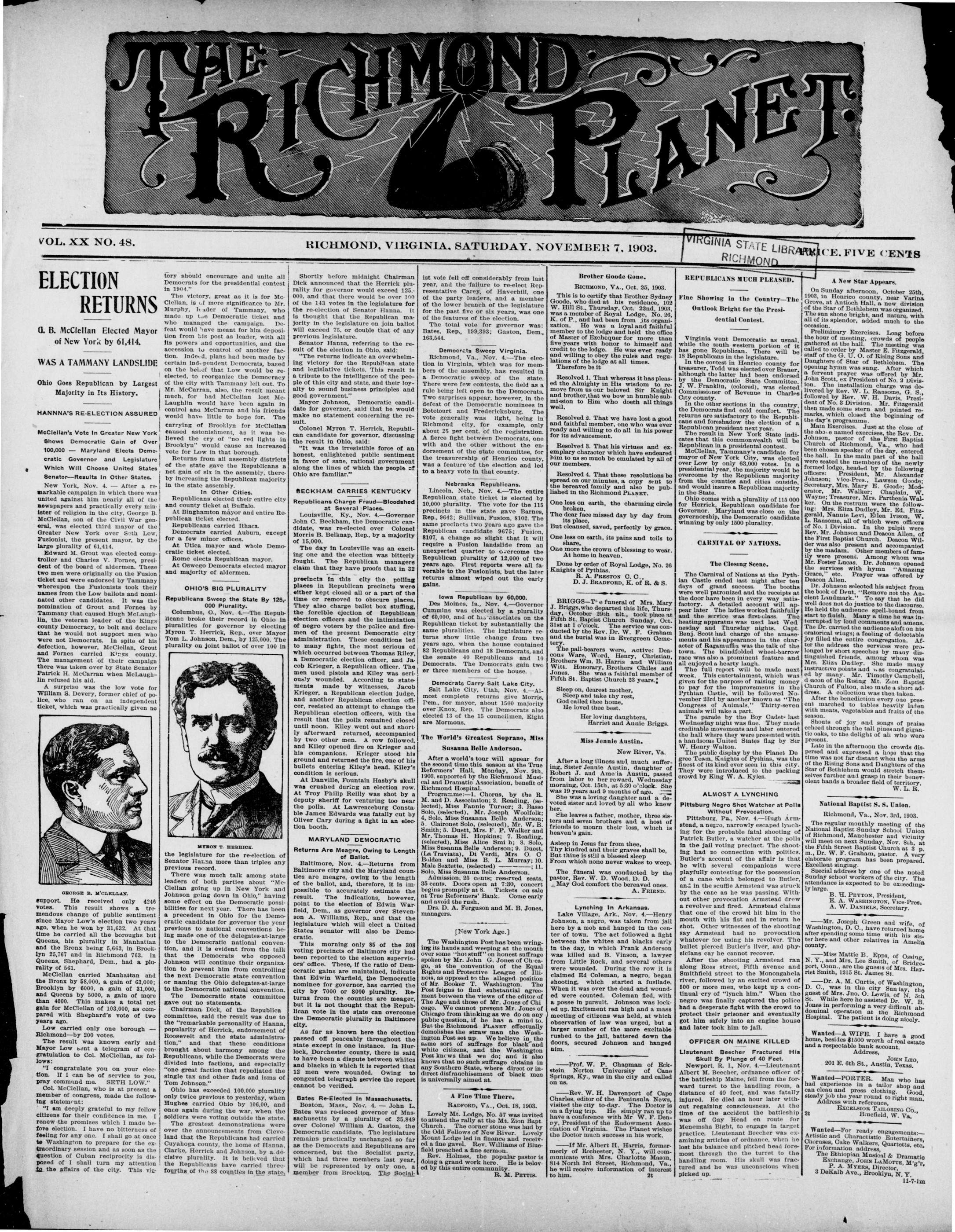
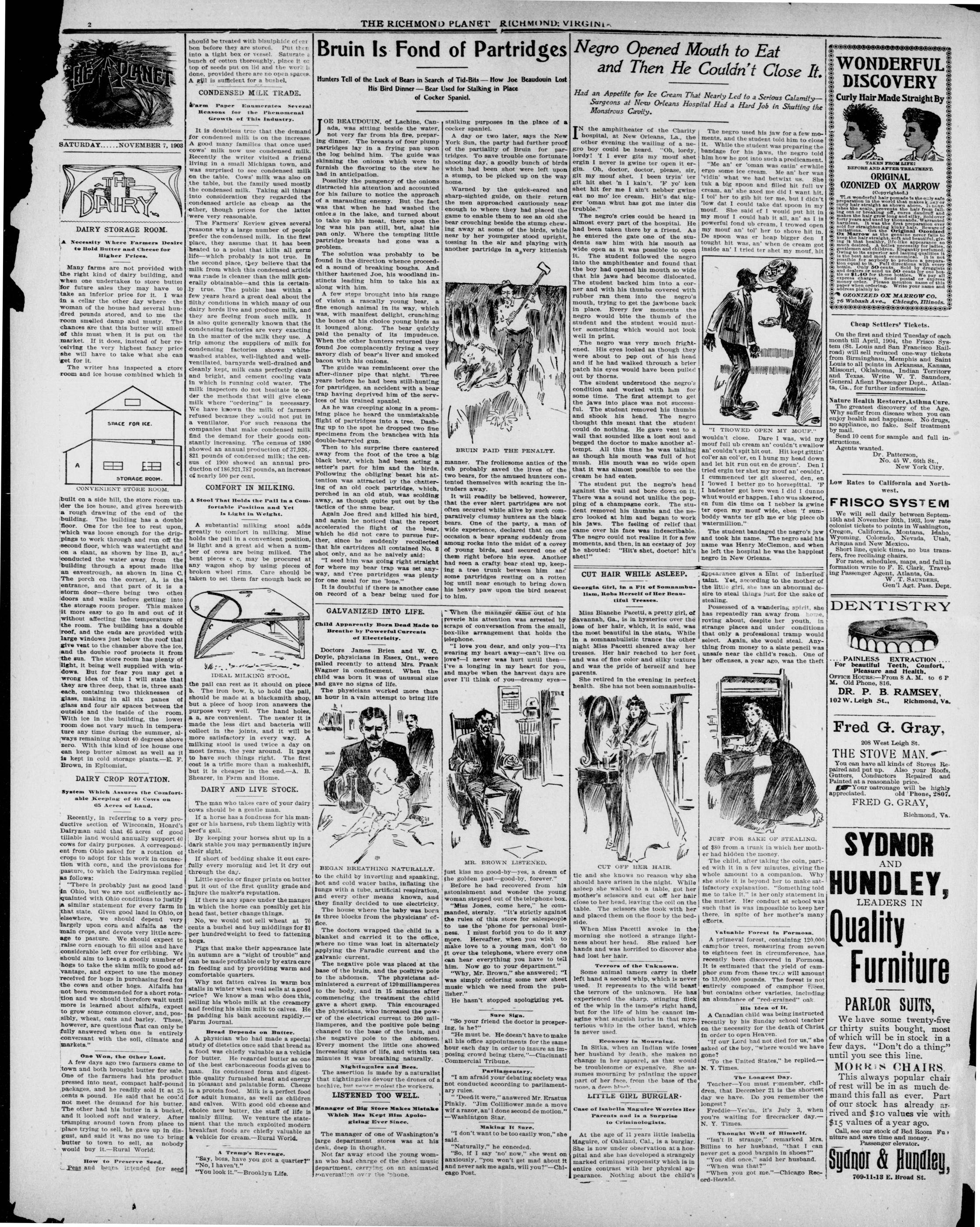
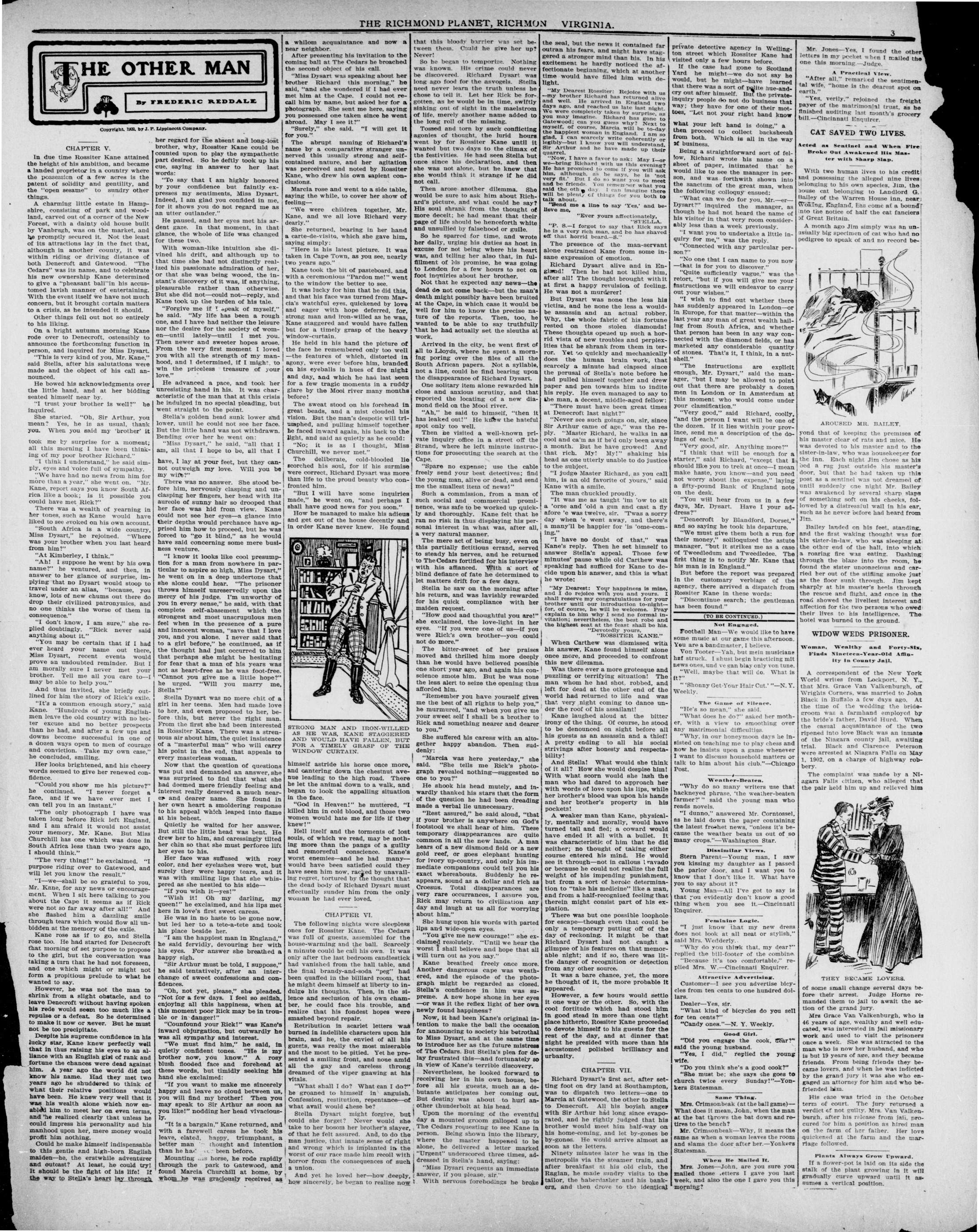
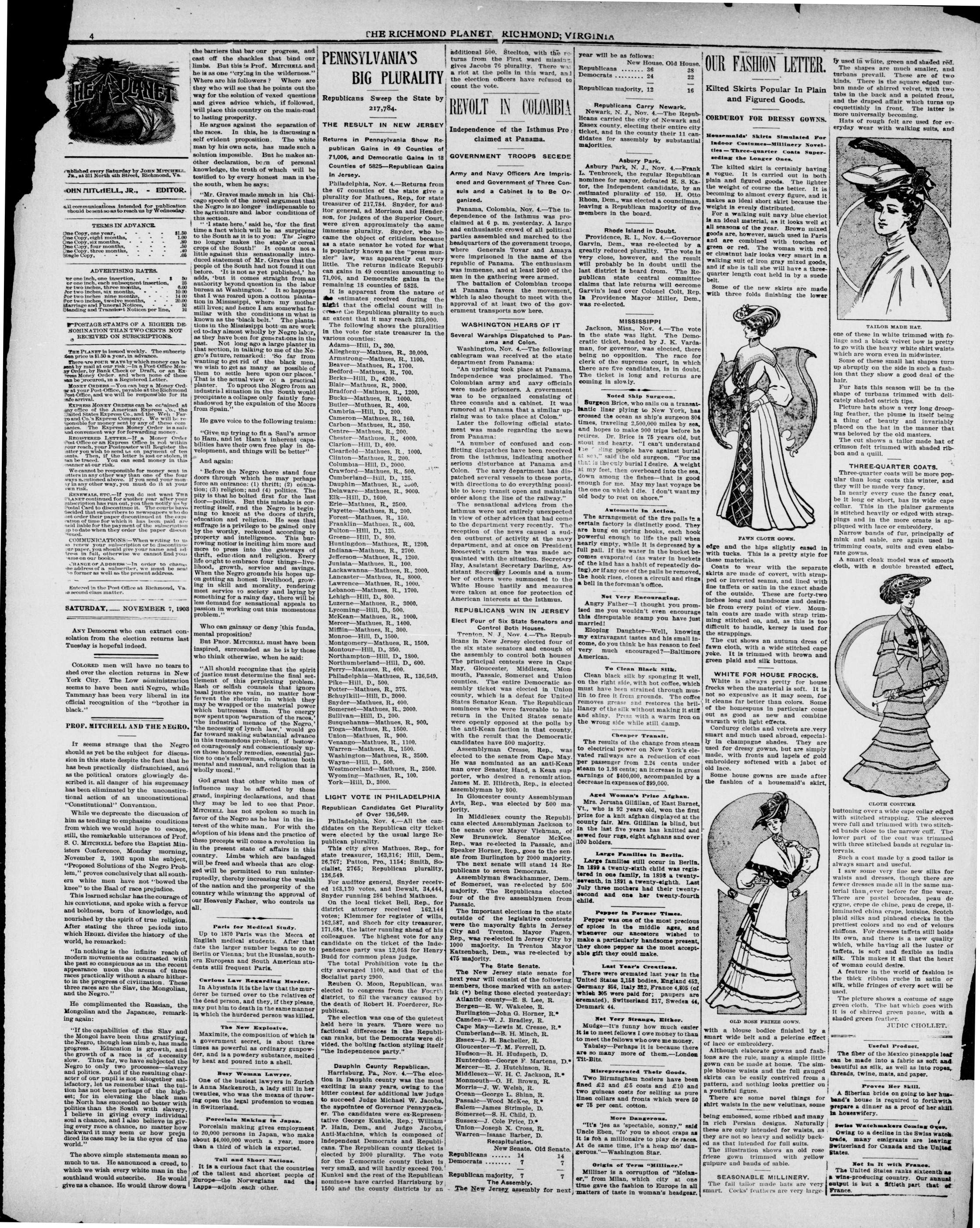
Page text (machine-generated)
THE RICHMOND PLANET
VOL. XX NO. 48.
ELECTION RETURNS
G. B. McClellan Elected Mayor of New York by 61,414.
WAS A TAMMANY LANDSLIDE
Ohio Goes Republican by Largest Majority in Its History.
HANNNA'S RE-ELECTION ASSURED
McChellan's Vote In Greater New York Shows Democratic Gain of Over 100,000 — Maryland Elects Democratic Governor and Legislature Which Will Choose United States Senator—Results In Other States.
New York, Nov. 4. — After a remarkable campaign in which there was united against him nearly all of the newspapers and practically every minister of religion in the city, George B. McChellan, son of the Civil War general, was elected third mayor of the Greater New York over Sally Low, Fusionist, the present mayor, by the large plurality of 61.414.
Edward M. Grout was elected comptroller and Charles V. Fornes, president of the board of aldermen. These two men were originally on the Fusion ticket and were endorsed by Tammany whereupon the Fusionists took their names from the Low ballots and nominated other candidates. It was the nomination of Grout and Fornes by Tammany that caused Hugh McLaughlin, the veteran leader of the Kings county Democracy, to bolt and declare that he would not support men who were not Democrats. In spite of his defection, however, McClellan, Grout and Fornes carried Kings county. The management of their campaign there was taken over by State Senator Patrick H. McCarran when McLaughlin refused his aid.
A surprise was the low vote for William S. Devery, former chief of police, who ran on an independent ticket, which was practically given no
M.
GEORGE B. M.CLELLAN.
support. He received only 4240 votes. This result shows a tremendous change of public sentiment since Mayor Low's election two years ago, when he won by 31,632. At that time he carried all the boroughs but Queens, his plurality in Manhattan and the Bronx being 5,663, in Brooklyn 25,767 and in Richmond 763. In Queens, Shephard, Dem., had a plurality of 561.
McClellan carried Manhattan and the Bronx by 58,000, a gain of 63,000; Brooklyn by 6000, a gain of 31,000, and Queens by 5000, a gain of more than 4000. This makes a total net gain for McClellan of 103,000, as compared with Shephard's vote of two years ago.
Low carried only one borough — Richmond—by 200 votes.
The result was known early and Mayor Low sent a telegram of congratulation to Col. McClellan, as follows:
"I congratulate you on your election. If I can be of service to you, pray command me. SETH LOW." Col. McClellan, who is at present a member of congress, made the following statement: "I am deeply grateful to my fellow citizens for their confidence in me. I renew the promises which I made before election. I have no bitterness of feeling for any one. I shall go at once to Washington to prepare for the extraordinary session and as soon as the question of Cuban reciprocity is disposed of I shall turn my attention to the affairs of the city. This vic-
tory should encourage and unite all Democrats for the presidential contest in 1904."
The victory, great as it is for McClellan, is of more significance to Mr. Murphy, leader of Tammany, who made up the Democratic ticket and who managed the campaign. Deaf would have meant for him deposition from his post as leader, with all its powers and opportunities, and the accession to control of another faction. Indeed, plans had been made by certain ind-pendent Democrats, based on the belief that Low would be reelected, to reorganize the Democracy of the city with Tammany left out. To Mr. McCrawler, also, the result meant much, for had McClellan lost McLaughlin would have been again in control and McCarran and his friends would have little to hope for. The carrying of Brooklyn for McClellan caused astonishment, as it was believed the cry of "no red lights in Brooklyn" would cause an increased vote for Low in that borough.
Returns from all assembly districts of the state gave the Republicans a net gain of six in the assembly, thereby increasing the Republican majority in the state assembly.
In Other Cities.
Republicans elected their entire city and county ticket at Buffalo.
At Binghamton mayor and entire Republican ticket elected.
Republicans carried Ithaca.
Democrats carried Auburn, except for a few minor offices.
At Utica mayor and whole Democratic ticket elected.
Rome elects Republican mayor.
At Oswego Democrats elected mayor and majority of aldermen.
OHIO'S BIG PLURALITY
Republicans Sweep the State By 125, 000 Plurality.
Columbus, O., Nov. 4.—The Republicans broke their record in Ohio in pluralities for governor by electing Myron T. Herrick, Rep., over Mayor Tom L. Johnson, Dem., by 125,000. The plurality on joint ballot of over 100 in
M.
MYRON T. HERRICK.
the legislature for the re-election of Senator Hanna more than triples any previous record.
There was much talk among state leaders of both parties about "McClellan going up in New York and Johnson going down in Ohio," having some effect on the Democratic possibilities for next year. There has been a precedent in Ohio for the Democratic candidate for governor the year previous to national conventions being made one of the delegates-at-large to the Democratic national convention, and it is evident from the talk that the Democrats who opposed Johnson will continue their organization to prevent him from controlling the next Democratic state convention or naming the Ohio delegates-at-large to the Democratic national convention.
The Democratic state committee gave out no statements.
Chairman Dick, of the Republica committee, said the result was due to the "remarkable personality of Hanna, popularity of Herrick, endorsement of Roosevelt and the state administration," and that these conditions brought about harmony among the Republicans, while the Democrats were divided into factions, and especially "one great faction that repudiated the single tax and other fads and isms of Tom Johnson."
Ohio has exceeded 100,000 plurality only twice previous to yesterday, when Hughes carried Ohio by 106,00, and once again during the war, when the soldiers were voting outside the state
The greatest demonstrations were over the announcements from Cleveland that the Republicans had carried Cuyahoga county, the home of Hanna, Clarke, Herrick and Johnson, by a decisive plurality. It is believed that the Republicans have carried three-fourths of the 88 counties in the state.
Shortly before midnight Chairman Dick announced that the Herrick plurality for governor would exceed 125,000, and that there would be over 100 of the 143 votes in the legislature for the re-election of Senator Hanna. It is thought that the Republican majority in the legislature on join ballot will exceed 75, or double that of any previous legislature.
Senator Hanna, referring to the result of the election in Ohio, said:
"The returns indicate an overwhelming victory for the Republican state and legislative tickets. This result is a tribute to the intelligence of the people of this city and state, and their loyalty to sound business principles and good government."
Mayor Johnson, Democratic candidate for governor, said that he would make no statement concerning the result.
Colonel Myron T. Herrick, Republican candidate for governor, discussing the result in Ohio, said:
"It was the irresistible force of an honest, enlightened public sentiment in favor of sane, rational government along the lines of which the people of Ohio are familiar."
Republicans Charge Fraud—Bloodshed at Several Places.
Louisville, Ky., Nov. 4.—Governor John C. Beckham, the Democratic candidate, was re-elected over Colonel Morris B. Belknap, Rep., by a majority of 15,000.
The day in Louisville was an exciting one and the election was bitterly fought. The Republican managers claim that they have proof that in 32
precincts in this city the polling places in Republican precincts were either kept closed all or a part of the time or removed to obscure places. They also charge ballot box stuffing, the forcible ejection of Republican election officers and the intimidation of negro voters by the police and firemen of the present Democratic city administration. These conditions led to many fights, the most serious of which occurred between Thomas Riley, a Democratic election officer, and Jacob Krieger, a Republican officer. The men used pistols and Kiley was seriously wounded. According to statements made by witnesses, Jacob Krieger, a Republican election judge, and another Republican election officer, resisted an attempt to change the Republican election officers, with the result that the polls remained closed until noon. Kiley went out and shortly afterward returned, accompanied by two other men. A row followed, and Kiley opened fire on Krieger and his companions. Krieger stood his ground and returned the fire, one of his bullets entering Kiley's head. Kiley's condition is serious.
At Danville, Fountain Hasby's skull was crushed during an election row. At Troy Philip Reilly was shot by a deputy sheriff for venturing too near the polls. At Lawrenceburg Constable James Edwards was fatally cut by Oliver Cary during a fight in an election booth.
MARYLAND DEMOCRATIC
Returns Are Meagre, Owing to Length of Ballot.
Baltimore, Nov. 4.—Returns from Baltimore city and the Maryland counties are meagre, owing to the length of the ballot, and, therefore, it is impossible to accurately estimate the result. The indications, however, point to the election of Edwin Warfield, Dem., as governor over Stevenson A. Williams, Rep, and that the legislature which will elect a United States senator will also be Democratic.
This morning only 85 of the 308 voting precincts of Baltimore city had been reported to the election supervisors' office. These, if the ratio of Democratic gains are maintained, indicate that Edwin Warfield, the Democratic nominee for governor, has carried the city by 7000 or 8000 plurality. Returns from the counties are meager, but it is not thought that the Republican vote in the state can overcome the Democratic plurality in Baltimore city.
As far as known here the election passed off peaceably throughout the state except in one instance. In Hurlock, Dorchester county, there is said to have been a dispute between whites and blacks in which it is reported that 12 men were wounded. Owing to congested telegraph service the report cannot be verified.
Bates Re-Elected In Massachusetts. Boston, Mass., Nov. 4. — John L. Bates was re-elected governor of Massachusetts by a plurality of 35,849 over Colonel William A. Gaston, the Democratic candidate. The legislature remains practically unchanged so far as the Democrats and Republicans are concerned, but the Socialist party, which had three members last year, will be represented by only one, a member from Brockton. The Social-
list vote fell off considerably from last year, and the failure to re-elect Representative Carey, of Haverhill, one of the party leaders, and a member of the lower branch of the legislature for the past five or six years, was one of the features of the election.
The total vote for governor was: Bates, Rep., 199,393; Gaston, Dem., 163,544.
Democrats Sweep Virginia.
Richmond, Va., Nov. 4.—The election in Virginia, which was for members of the assembly, has resulted in a Democratic sweep of the state. There were few contests, the field as a rule being left open to the Democrats. Two surprises appear, however, in the defeat of the Democratic nominees in Botetourt and Fredericksburg. The vote generally was light, being in Richmond city, for example, only about 25 per cent. of the registration. A fierce fight between Democrats, one with and the other without the endorsement of the state committee, for the treasurership of Henrico county, was a feature of the election and led to a heavy vote in that county.
Nebraska Republicans.
Lincoln, Neb., Nov. 4.—The entire Republican state ticket is elected by 10,000 plurality. The vote for the 115 precincts in the state gave Barnes, Rep. 9642; Sullivan, Fusion, 8102. The same precincts two years ago gave the Republican candidate 9675; Fusion, 8107, a change so slight that it will require a Fusion landslide from an unexpected quarter to overcome the Republican plurality of 12,000 of two years ago. First reports were all favorable to the Fusionists, but the later returns almost wiped out the early gains.
Iowa Republican by 60.000
Des Moines, Ia., Nov. 4.—Governor Cummins was elected by a plurality of 60,000, and of his associates on the Republican ticket by substantially the same pluralities. The legislature returns show little change from two years ago, when the house contained 82 Republicans and 18 Democrats, and the senate 40 Republicans and 10 Democrats. The Democrats gain two or three members of the house.
Democrats Carry Salt Lake City.
Salt Lake City, Utah, Nov. 4.—Almost complete returns give Morris, Pem, for mayor, about 1500 majority over Knox, Rep. The Democrats also elected 13 of the 15 councilmen, Eight are Mormons.
The World's Greatest Soprano, Miss Susanna Belle Anderson.
After a world's tour will appear for the second time this season at the True Reformers' Hall, Monday, Nov. 9th, 1903, supported by the Richmond Musical and Dramatic Association, benefit of Richmond Hospital. Programme:—1 Chorus, by the R. M. and D. Association; 2 Reading, (selected), Miss Fannie Turner; 3 Basso Solo, (selected), Mr. Joseph Woolfolk; 4 Solo, Miss Susanna Belle Anderson; 5 Claironet Solo, (selected), Mr. W. B. Smith; 5 Duett, Mrs. F. P. Walker and Mr. Thomas H. Hopkins; 7 Reading, (selected), Miss Alice Smi h; 8 Solo, Miss Susanna Belle Anderson; 9 Duet, Traviata) Mrs. A. Dri, Mrs. O. C Bolder, Mrs. B. M. Murray; 10 Male Saxette, (selected); 11 Solo, Miss Susanna Belle Anderson. Admission, 25 cents; reserved seats, 35 cents. Doors open at 7:30, concert begins promptly at 8. Tickets on sale at True Reformers' Bank. Come early and avoid the rush. Drs. D. A. Ferguson and M. B. Jones, managers.
[New York Age.]
The Washington Post has been wringing its hands and weeping at the mouth over some "hot stuff" on honest suffrage spoken by Mr. John G. Jones of Chicago, at the convention of the Equal Rights and Protective League of Illinois, as opposed to the alleged position of Mr. Booker T. Washington. The Post feigns to find substantial agreement between the views of the editor of The Age and those of Mr. Jones of Chicago. We cannot prevent Mr. Jones of Chicago from thinking as we do on any public question, if he has a mind to. But the Richmond PLANET effectively demolishes the straw man the Washington Post set up. We believe in the same sort of suffrage for black and white citizens, and the Washington Post knows that we do; and it also knows that no such suffrage obtains in any Southern State, where direct or indirect disfrauchishment of black men is universally aimed at.
A Fine Time There.
Lovely Mt. Lodge, No. 57 was invited to attend the rally at the Mt. Zion Bapt. Church. The corner stone was laid by the Odd Fellows of New River. Lovely Mount Lodge led in finance and received a fine gavel. Rev. Williams of Bluefield preached a fine sermon.
Rev. Holmes, the popular pastor is doing a grand work here. He is beloved by this entire community. R. M. PETTIS.
Brother Goode Gone.
RICHMOND, VA., Oct. 25, 1903.
This is to certify that Brother Sydney Goode, who died at his residence, 109 W. Hill St., Thursday, Oct. 22nd, 1903 was a member of Royal Lodge, No. 36 K. of P, and had been from its organization. He was a loyal and faithful member to the lodge and held the office of Master of Exchequer for more than five years with honor to himself and credit to the lodge. He was ever ready and willing to obey the rules and regulations of the lodge at all times. Therefore be it
Resolved 1. That whereas it has pleased the Almighty in His wisdom to remove from us our beloved Sir Knight and brother, that we bow in humble submission to Him who doeth all things well.
Resolved 2. That we have lost a good and faithful member, one who was ever ready and willing to do all in his power for its advancement.
Resolved 3. That his virtues and exemplary character which have endeared him to us so much be emulated by all of our members.
Resolved 4. That these resolutions be spread on our minutes, a copy sent to the bereaved family and also be published in the Richmond PLANET.
One less on earth, the charming circle broken.
The dear face missed day by day from its place.
But cleansed, saved, perfectly by grace.
One less on earth, its pains and toils to share.
One more the crown of blessing to wear.
At home in heaven.
Done by order of Royal Lodge, No. 26 Knights of Pythias.
BRIGGS—T'e funeral of Mrs. Mary J. Briggs, who departed this life, Thursday, October 29th 11th, took place at Fifth St. Baptist Church Sunday, Oct. 31st at 1 o'clock. The service was conducted by the Rev. Dr. W. F. Graham and the burial was in Evergreen Cemetery. The pall-bearers were, Active; Deacons Ware, Word, Henry, Christian, Brothers Wm. B. Harris and William Witt. Honary, Brothers Chiles and Jones. She was a faithful member of Fifth St. Baptist Church 23 years."
Sleep on, dearest mother,
Sleep and take thy rest,
God called thee home,
He loved thee best.
Her loving daughters, Harriet and Annie Briggs
Miss Jennie Austin.
New River, Va.
After a long illness and much suffering, Sister Jennie Austin, daughter of Robert J. and Ame ia Austin, passed from labor to her reward, Wednesday morning, Oct. 15th, at 5:30 o'clock. She was 19 years and 9 months of age.
She was a loving daughter and a devoted sister and loved by all who knew her.
She leaves a father, mother, three sisters and seven brothers and a host of friends to mourn their loss, which is heaven's gain.
Asleep in Jesus far from thee,
Thy kindred and their graves shall be,
But thine is still a blessed sleep
From which none never wakes to weep.
The funeral was conducted by the pastor, Rev. W. D. Wood, D. D.
May God comfort the bereaved ones.
A. FRIEND.
Lynching In Arkansas
Lake Village, Ark., Nov. 4.—Henry Johnson, a negro, was taken from jail here by a mob and hanged in the center of town. The act followed a fight between the whites and blacks early in the day, in which Frank Anderson was killed and B. Vinson, a lawyer from Little Rock, and several others were wounded. During the row it is claimed Ed Coleman, a negro, began shooting, which started a fusillade. When it was over the dead and wounded were counted. Coleman fled, with a posse in pursuit. Johnson was locked up. Excitement ran high and a mass meeting of citizens was held, at which observation of law was urged, but a larger number of the more excitable rushed to the jail, battered down the doors, secured Johnson and hanged nim.
—Prof. W. P. Chapman of Eckstein Norton University of Cane Springs, Ky., was in the city and called on us.
—Rev. W. H. Davenport of Cape Charles, editor of the Peninsula News, visited the city to day. The Doctor is on a flying trip. He simply ran up to have a conference with N. W. F. Deny. President of the Endowment Association of Virginia. The Planet wishes the Doctor much success in his work.
—If Mr. Albert H. Harris, formerly of Rochester, N. Y., will communicate with Mrs. Charlotte Mason, 814 North 3rd Street, Richmond, Va., he will receive information of interest to him. 2t
REPUBLICANS MUCH PLEASED.
Fine Showing in the Country—The Outlook Bright for the Presidential Contest.
Virginia went Democratic as usual, while the south western portion of it has gone Republican. There will be 18 Republicans in the legislature.
In the contest in Henrico county for treasurer, Todd was elected over Brauer, although the latter had been endorsed by the Democratic State Committee, J. W. Franklin, (colored), was elected Commissioner of Revenue in Charles City county. In the other sections in the country, the Democrats find cold comfort. The returns are satisfactory to the Republicans and foreshadow the election of a Republican president next year. The result in New York State indicates that this commonwealth will be Republican in a presidential contest. McCillan, Taumann's candidate for mayor of New York City, was elected over Low by only 63,000 votes. In a presidential year, the majority would be overcome by the Republican majority from the counties and cities outside, and would insure a Republican majority in the State. Ohio comes with a plurality of 115,000 for Herrick, Republican candidate for Governor. Maryland was close on the governorship, the Democratic candidate winning by only 1500 plurality.
CARNIVAL OF NATIONS
The Closing Scene.
The Carnival of Nations at the Pythian Castle ended last night after ten days of grand success. The booths were well patronized and the receipts at the door have been in every way satisfactory. A detailed account will appear later. The ladies worked faithfully and the service was first-class. The heating apparatus was used last Wednesday and Thursday nights. Capt. Benj. Scott had charge of the amusements and his appearance in the character of Ragamuflu was the talk of the town. The blindfolded wheel-barrow race was also a prominent feature and all enjoyed a hearty laugh. The full report will be made next week. This entertainment, which was given for the purpose of raising money to pay for the improvements in the Pythian Castle, will be followed November 23rd by another known as "The Congress of Animals." Thirty-seven animals will take a part.
The parade by the Boy Cadet last Wednesday night was fine. They made creditable movements and later entered the hall where they were presented with a handsome United States flag by Sir W Henry alton. The parade by the Planet Degree Team, Knights of Pythias, was the finest of its kind ever seen in this city. They were introduced to the packing crowd by King W. A. Kyles.
ALMOST A LYNCHING
Pittsburg Negro Shot Watcher at Polls Without Provocation.
Pittsburg, Pa., Nov. 4—Hugh Armstead, a negro, narrowly escaped lynching for the probable fatal shooting of Patrick Butler, a watcher at the polls in the jail voting precinct. The shooting had no connection with politics. Butler's account of the affair is that he with several companions were playfully contesting for the possession of a cane which belonged to Butler, and in the scuffle Armstead was struck by the cane as he was passing. Without other provocation Armstead drew a revolver and fired. Armstead claims that one of the crowd hit him in the mouth with his fist and in return he shot. Other witnesses of the shooting say Armstead had no provocation whatever for using his revolver. The bullet pierced Butler's liver, and physicians cay he cannot recover.
After the shooting Armstead ran along Ross street, Fifth avenue and Smithfield street to the Monongahela river, followed by an excited crowd of 500 or more men, who kept up a continual cry of "lynch him." When the negro was finally captured the police had a desperate fight with the crowd to protect their prisoner and eventually got him safely into an engine house and later took him to jail.
OFFICER ON MAINE KILLED
Lieutenant Beecher Fractured His Skull By Plunge of 40 Feet.
Newport, R. L, Nov. 4.—Lieutenant Albert M. Beecher, ordnance officer of the battleship Maine, fell from the forward turret to the handling room, a distance of 40 feet, and was fatally injured. He died an hour later without regaining consciousness. At the time of the accident the battleship was off Gay Head en route for Menemsha Bight, to engage in target practice. Lieutenant Beecher was examining articles of ordnance, when he lost his balance and pitched head foremost through the the turret to the handling room. His skull was fractured and he was unconscious when picked up.
A New Star Appears
On Sunday afternoon, October 25th, 1903, in Henrico county, near Varina Grove, at Antioch Hall, a new division of the Star of Bethlehem was organized. The sun shone bright, and nature, with all of its splendor, added much to the occasion.
Preliminary Exercises. Long before the hour of meeting, crowds of people gathered at the hall. The meeting was called to order by Master E. Fitzgerald, staff of the G. U. O. of Rising Sons and officers of Star of Bethlehem. The opening hymn was sung. After which a fervent prayer was offered by Mr. John Scott, ex President of No. 2 Division. The installation charge was delivered by Rev. W. L. Ransom, S., followed by Rev. W. H. Davis, President of No. 2 Division. Mr. Fitzgerald then made some stern and pointed remarks, which closed the beginning of the day's programme.
Main Exercises. Just at the close of the abo'e named exercises, the Rev. Dr. Johnson, pastor of the First Baptist Church of Richmond, Va., who had been chosen speaker of the day, entered the hall. In the main part of the hall were seated the members of the newly formed lodge, headed by the following officers: President, Mr. Alexander Johnson; vice-Pres., Lawson Goode; Secretary, Mrs. Mary E. Goode; Moderator, Mr. Walker; Chaplain, W. Wayne; Treasurer, Mrs. Parthenia Walker; the rostrum were the following: Mrs. Eliza Dudley, Mr. Ed. Fitzgerald, Nana Levi, Eilen Ivison, W. L Ransome, of which were officers of No. 1 Division. In the pulpit were Rev. Mr. Johnson and Deacon Allen, of the First Baptist Church. Deacon Wilder was also present and accompanied by the madam. Other members, family were present. Among whom was Mr. Foster Lucas. Dr. Johnson opened the services with hymn "Amazing Grace," etc. Prayer was offered by Deacon Allen.
Dr. Johnson selected his subject from the book of Deut. "Remove not the Ancient Landmark." To say that he did well does not do justice to the discourse. He held the audience spell-bound from start to finish. Many a time he was interrupted by loud comments and amens. The Dr. carried the audience aloft on his oratorical wings; a feeling of delectable joy filled the entire congregation. After the address the services were prolonged by short speeches by many distinguished friends, among whom was Mrs. Eiza Dudley. She made many more points and was congratulated by many men. Mr. Timothy Campbell, dacon of the Rising Mt. Zion Baptist Church of Palo Alto, made a short address. A collection was then taken. After the benediction one present marched to tables heavily laden with meats, vegetables and fruits of the season.
Shouts of joy and songs of praise echoed through the tall pines and gigantic oaks, to the delight of all who were present.
Late in the afternoon the crowds dispersed and expressed a hope that the time was not far distant when the arms of the Rising Sons and Daughters of the Star of Bothelehem would stretch themselves further and grasp in their benevolent hands a broader field of territory.
National Baptist N. S. Union
The regular monthly meeting of the National Baptist Sunday School Union of Richmond, Manchester and vicinity will meet on next Sunday, Nov. 8th, at the Fifth Street Baptist Church at 3 p.m., Dr. W. F. Graham, pastor. A very elaborate program has been prepared. Excellent singing.
Special address by one of the noted Sunday school workers of the city. The attendance is expected to be exceedingly large.
B. H. PEYTON, President,
E. A. WASHINGTON, Vice-Pres.
A. W. DANIELS, Secretary.
Mr. Joseph Green and wife, of Washington, D. C., have returned home after spending some time with his sister here and other relatives in Amelia county.
Miss Mattie B. Epps, of Ossing, N. Y., and Mrs. Lee Smith, of Bridgeport, Oonn., are the guesses of Mrs. Harriet Smith, 1215 St. James St.
Dr. A. M. Curtis, of Washington, D. C., was in the city Sun lay, the guest of Mrs. Jno. O. Lewis, of N. 5th St. While here he assisted Dr. W. B. Jones in performing a very difficult abdominal operation at the Richmond Hospital. The patient is doing nicely.
Wanted—A WIFE. I have a good home, besides $1500 worth of real estate and a respectable bank account.
Wanted—PORTER. Man who has had experience in a tailor shop and can clean and press clothing. Good. Steady job and year-round to right man. Steady with reference
Wanted—For ready engagements:—
Artistic and Charismatic Entertainers,
Choruses, Cake Walkers, Quartetts, etc.
For information address,
The Ethiopian Musical & Dramatic
Exchange, JOHN LA MOTTE, 'M'g'r,
P. A. MYERS, Director,
3 DeKalb Ave., Brooklyn, NY
HE PLANET
SATURDAY.....NOVEMBER 7. 1903
THE DAIRY
A Necessity Where Farmers Desire to Hold Butter and Cheese for Higher Prices.
Many farms are not provided with the right kind of dairy building, and when one undertakes to store butter for future sales they may have to take an inferior price for it. I was in a cellar the other day where the woman of the house had several hundred pounds stored, and to me the room smelled damp and musty. The chances are that this butter will smell of this must when it is put on the market. If it does, instead of her receiving the very highest fancy price she will have to take what she can get for it.
The writer has inspected a store room and ice house combined which is
SPACE FOR ICE.
B
A
C
STORAGE ROOM.
CONVENIENT STORE ROOM
built on a side hill, the store room under the ice house, and gives herewith a rough drawing of the end of the building. The building has a double floor. One for the ice to rest upon, which was loose enough for the drippings to work through and run off the second floor, which was watertight and on a slant, as shown by line B, and conducted the water away from the building through a spout made like an avestrough, as shown in line C. The porch on the corner, A, is the entrance, and that part of it is a storm door—there being two other doors and walls before getting into the storage room proper. This makes it more easy to go in and out of it without affecting the temperature of the room. The building has a double roof, and the ends are provided with large windows just below the roof that give vent to the chamber above the ice, and the double roof protects it from the sun. The store room has plenty of light, it being well supplied with windows. But for fear you may get a wrong idea of this I will state that they are three deep, that is, three sash each, containing two thicknesses of glass, making in all six panes of glass and four air spaces between the outside and the inside of the room. With ice in the building, the lower room does not vary much in temperature any time during the summer, always remaining about 40 degrees above zero. With this kind of ice house one can keep butter almost as well as it is kept in cold storage plants.—E. F. Brown, in Epitomist.
DAIRY CROP ROTATION.
System Which Assures the Comfortable Keeping of 40 Cows on 65 Acres of Land.
Recently, in referring to a very productive section of Wisconsin, Hoard's Dairyman said that 65 acres of good tillable land would annually support 40 cows for dairy purposes. A correspondent from Ohio asked for a rotation of crops to adopt for this work in connection with corn, and the provisions for pasture, to which the Dairyman replied as follows:
"There is probably just as good land in Ohio, but we are not sufficiently acquainted with Ohio conditions to justify a similar statement for every farm in that state. Given good land in Ohio, or elsewhere, we should depend very largely upon corn and alfalfa as the main crops, and devote very little acreage to pasture. We should expect to raise corn enough to fill silos and have considerable left over for cribbing. We should aim to keep a goodly number of hogs to take the skim milk to good advantage, and expect to use the money received for hogs in purchasing feed for the cows and other hogs. Alfalfa has not been recommended for a short rotation and we should therefore wait until more is learned about alfalfa, expect to grow some common clover, and, possibly, wheat, oats and barley. These, however, are questions that can only be fully answered when one is entirely conversant with the soil, climate and markets."
One Won, the Other Lost.
A few days ago two farmers came to town and both brought butter for sale. One of the farmers had his product pressed into neat, compact half-pound packages, and he readily sold it at 25 cents a pound. He said that he could not meet the demand for his butter. The other had his butter in a bucket, and it looked soft and watery. After tramping around town from place to place trying to sell, he gave up in disgust, and said it was no use to bring butter to town to sell, as nobody would buy it.-Rural World:
How to Preserve Seed.
Peas and beans intended for seed
should be treated with bisulphide of cer-
bon before they are stored. Put them
into a tight box or vessel. Saturate a
bunch of cotton thoroughly, place it or
top of seeds put on lid and the work
is done, provided there are no open spaces.
A gill is sufficient for a bushel.
CONDENSED M(LK TRADE.
Farm Paper Enumerates Several Reasons for the Phenomenal Growth of This Industry.
It is doubtless true that the demand for condensed milk is on the increase. A good many families that once used cows' milk now use condensed milk. Recently the writer visited a friend living in a small Michigan town, and was surprised to see condensed milk on the table. Cows' milk was also on the table, but the family used mostly the condensed milk. Taking all things into consideration they regarded the condensed article as cheap as the other, though prices for the latter were very reasonable.
The Farmers' Review gives several reasons why a large number of people prefer the condensed milk. In the first place, they assume that it has been heated to a point that kills all germ life—which probably is not true. In the second place, they believe that the milk from which this condensed article was made is cleaner than the milk generally obtainable—and this is certainly true. The public has within a few years heard a great deal about the filthy conditions in which many of our dairy herds live and produce milk, and they are fleeing from such milk. It is also quite generally known that the condensing factories are very exacting in the matter of the milk they use. A trip among the suppliers of milk for condensing factories shows white-washed stables, well-lighted and well-ventilated, barnyards well-drained and cleanly kept, milk cans perfectly clean and bright, and cement cooling vats in which is running cold water. The milk inspectors do not hesitate to order the methods that will give clean milk where "ordering" is necessary. We have known the milk of farmers refused because they would not put in a ventilator. For such reasons the companies that make condensed milk find the demand for their goods constantly increasing. The census of 1890 showed an annual production of 37,926,821 pounds of condensed milk; the census of 1900 showed an annual production of 186,921,787 pounds, an increase of nearly 500 per cent.
COMFORT IN MILKING
A Stool That Holds the Pail in a Com
fortable Position and Yet
Is Light in Weight.
A substantial milking stool adds greatly to comfort in milking. Mine holds the pail in a convenient position, is light and a great aid when a number of cows are being milked. The bent pieces c c c, may be procured at any wagon shop by using pieces of broken wheel rims. Care should be taken to set them far enough back so
the pail can rest as it should on piece b. The iron bow, b, to hold the pail, should be made at a blacksmith shop, but a piece of hoop iron answers the purpose very well. The hand holes, a a, are convenient. The neater it is made the less dirt and bacteria will collect in the joints, and it will be more satisfactory in every way. A milking stool is used twice a day on most farms, the year around. It pays to have such things right. The first cost is a trifle more than a makeshift, but it is cheaper in the end.—A. B. Shearer, in Farm and Home.
DAIRY AND LIVE STOCK
The man who takes care of your dairy cows should be a gentle man.
If a horse has a fondness for his manger or his harness, rub them lightly with beef's gall.
By keeping your horses shut up in a dark stable you may permanently injure their sight.
If short of bedding shake it out carefully every morning and let it dry out through the day.
Little specks or finger prints on butter put it out of the first quality grade and injure the maker's reputation.
If there is any space under the manger in which the horse can possibly get his head fast, better change things.
No, we would not sell wheat at 70 cents a bushel and buy middlings for $1 per hundredweight to feed to fattening horses.
Pigs that make their appearance late in autumn are a "sight of trouble" and can be made profitable only by extra care in feeding and by providing warm and comfortable quarters. Why not fatten calves in warm box stalls in winter when veal sells at a good price? We know a man who does this, selling his whole milk at the cremery and feeding his skim milk to calves. He is padding his bank account rapidly.—Farm Journal.
Bread Depends on Butter.
A physician who had made a special study of dietetics once said that bread as a food was chiefly valuable as a vehicle for butter. He regarded butter as one of the best carbonaceous foods given to man. Its condensed form and digestible quality furnished heat and energy in pleasant and palatable form. Cheese is a protein food. Milk is a perfect food for adult humans, as well as children and calves. With good old cheese and choice new butter, the staff of life is mainly filling. We venture the statement that the much exploited modern breakfast foods are chiefly valuable as a vehicle for cream.—Rural World.
A Tramp's Revenge.
"Say, boss, have you got a quarter!"
"No, I haven't."
"You look it."—Brooklyn Life
THE RICHMOND PLANET RICHMOND; VIRGINIA
Bruin Is Fond of Partridges
Hunters Tell of the Luck of Bears in Search of Tid-Bits — How Joe Beaudouin Lost His Bird Dinner — Bear Used for Stalking in Place of Cocker Spaniel.
OE BEAUDOUIN, of Lachine, Canada, was sitting beside the water,
ada, was sitting beside the water, not very far from his fire, preparing dinner. The breasts of four plump partridges lay in a frying pan upon the log behind him. The guide was skimming the onions which were to furnish the flavoring to the stew he had in anticipation. Possibly the pungency of the onions distracted his attention and accounted for his failure to notice the approach of a marauding enemy. But the fact was that when he had washed the onions in the lake, and turned about to take up his meat, there upon the log was his pan still, but, alas! his pan only. Where the tempting little partridge breasts had gone was a problem. The solution was probably to be found in the direction whence proceeded a sound of breaking boughs. And thither hastened Joe, his woodland instincts leading him to take his ax along with him.
A few steps brought into his range of vision a rascally young bear, a fine enough animal in its way, which was, with manifest delight, crunching the bones of his choice young birds as it loured along. The bear quickly paid the penalty of its impudence. When the other hunters returned they found Joe complacently frying a very savory dish of bear's liver and smoked bacon with his onions.
The guide was reminiscent over the after-dinner pipe that night. Three years before he had been still-hunting for partridges, an accident with a bear trap having deprived him of the services of his trained spaniel.
As he was creeping along in a promising place he heard the unmistakable flight of partridges into a tree. Dashing up to the spot he dropped two fine specimens from the branches with his double-barreled gun.
Then to his surprise there centered away from the foot of the tree a big black bear, which had been acting a setter's part for him and the birds. Following the obliging beast his attention was attracted by the chattering of an old cock partridge, which, perched in an old stub, was scolding away, as though quite put out by the tactics of the same bear.
Again Joe fired and killed his bird, and again he noticed that the report accelerated the flight of the bear, which he did not care to pursue further, since he suddenly recollected that his cartridges all contained No. 8 shot only, and as he naively said:
"I seed him was going right straight for where my bear trap was set anyway, and tree partridges was plenty for one meal for me 'lone."
It is doubtful if there is another case on record of a bear being used for
GALVANIZED INTO LIFE
Child Apparently Born Dead Made to Breathe by Powerful Currents of Electricity.
Doctors James Brien and W. C. Doyle, physicians in Essex, Ont., were called recently to attend Mrs. Frank Wagner in confinement. When the child was born it was of unusual size and gave no signs of life. The physicians worked more than an hour in a vain attempt to bring life
10
BEGAN BREATHING NATURALLY.
to the child by inverting and spanking,
hot and cold water baths, inflating the
lungs with a tube, artificial respiration,
and every other means known, and
they finally decided to use electricity.
The house where the baby was born
is three blocks from the physicians' office.
The doctors wrapped the child in a
blanket and carried it to the office,
where no time was lost in alternately
applying the Faradic current and the
galvanic current.
The negative pole was placed at the base of the brain, and the positive pole to the abdomen. The physicians administered a current of 120 milliamperes to the body, and in 15 minutes after commencing the treatment the child gave a short gasp. This encouraged the physicians, who increased the power of the electrical current to 200 milliamperes, and the positive pole being changed to the base of the brain, and the negative pole to the abdomen. Every moment the little one showed increasing signs of life, and within ten minutes it was breathing naturally.
Nightingales and Bees.
The assertion is made by a naturalist that nightingales devour the drones of a beehive, but never molest the workers.
LISTENED TOO WELL.
Manager of Big Store Makes Mistake Which Has Kept Him Apologizing Ever Since.
The manager of one of Washington's large department stores was at his desk, deep in thought.
Not far away stood the young woman who had charge of the sheet music department, carrying on an animated conversation over the phone.
stalking purposes in the place of a cocker spaniel.
A day or two later, says the New York Sun, the party had further proof of the partiality of Bruin for partridges. To save trouble one fortunate shooting day, a goodly bunch of birds which had been shot were left upon a stump, to be picked up on the way home.
Warned by the quick-eared and sharp-sighted guide, on their return the men approached cautiously near enough to where they had placed the game to enable them to see an old she bear crouching beside the stump chewing away at some of the birds, while near by her youngster stood upright, tossing in the air and playing with another partridge in a very kittenish
A man with an axe stands over a bear.
BRUN PAID THE PENALTY.
manner. The frolicsome antics of the cub probably saved the lives of the two bears, for the amused hunters contented themselves with scaring the intruders away.
It will readily be believed, however, that the ever alert partridges are not often secured while alive by such comparatively clumsy hunters as the black bears. One of the party, a man of wide experience, declared that on one occasion a bear sprang suddenly from among rocks into the midst of a covey of young birds, and secured one of them right before his eyes. Another had seen a crafty bear steal up, keeping a tree trunk between him and some partridges resting on a rotten log until near enough to bring down his heavy paw upon the bird nearest to him.
When the manager came out of his reverie his attention was arrested by scraps of conversation from the small, box-like arrangement that holds the telephone.
"I love you dear, and only you—I'm wearing my heart away—can't live on love!" I never was hurt until then—I've a longing in my heart for you, and maybe when the harvest days are over I'll think of you—dreamy eyes—
TELE
MR. BROWN LISTENED.
just kiss me good-by—yes, a dream of
the golden past—good-by, forever."
the golden past—good-by, forever.
Before he had recovered from his astonishment and wonder the young woman stepped out of the telephone box.
"Miss Jones, come here," he commanded, sternly. "It's strictly against the rules of this store for salespeople to use the 'phone for personal business. I must forbid you to do it any more. Hereafter, when you wish to make love to a young man, don't do it over the telephone, where every one can hear everything you have to tell him. Now go to your department."
"Why, Mr. Brown," she answered; "I was simply ordering some new sheet music which we need from the publisher."
He hasn't stopped apologizing yet.
Sure Sign.
"So your friend the doctor is prospering, is he?"
"He must be. He doesn't have to make all his office appointments for the same hour each day in order to insure an imposing crowd being there."—Cincinnati Commercial Tribune.
Parliamentary
"I am afraid your debating society was not conducted according to parliamentary rules.
"Deed it were," answered Mr. Erastus Plinkly. "Jim Colliiflower made a move wif a razor, an' done second de motion."
—Washintgon Star.
Making It Sure.
"I don't want to be too easily won," she said.
"Naturally," he conceded.
"So, if I say 'no' now," she went on anxiously, "you won't get mad about it and never ask me again, will you?"—Chicago Post.
Negro Opened Mouth to Eat and Then He Couldn't Close It.
Had an Appetite for Ice Cream That Nearly Led to a Serious Calamity— Surgeons at New Orleans Hospital Had a Hard Job in Shutting the Monstrous Cavity.
In the amphitheater of the Charity hospital, at New Orleans, La, the other evening the wailing of a negro boy could be heard. "Oh, lordy, lordy! 'I ever gits my mouf shet ergin I never is gwine ter open it ergin. Oh, doctor, doctor, please, sir, git my mouf shet. I been tryin' erit git hit shet 'n I kaint. 'F yo' ken shet hit fer me i ain't nebber gwine eat no mo' ice cream. Hit's dit nigger 'oman whut has got me inter dis trubble."
The negro's cries could be heard in almost every part of the hospital. He had been taken there by a friend. As he entered the gate one of the students saw him with his mouth as wide open as it was possible to open it. The student followed the negro into the amphitheater and found that the boy had opened his mouth so wide that his jaws had become dislocated. The student backed him into a corner and with his thumbs covered with rubber ran them into the negro's mouth, trying to get the jawbone back in place. Every few moments the negro would bite the thumb of the student and the student would mutter something which would not look well in print.
The negro was very much frightened. His eyes looked as though they were about to pop out of his head and if he had walked through a brier patch his eyes would have been pulled out by thorns.
The student understood the negro's condition and worked with him for some time. The first attempt to get the jaws into place was not successful. The student removed his thumbs and shook his head. The negro thought this meant that the student could do nothing. He gave vent to a wall that sounded like a lost soul and begged the doctor to make another attempt. All this time he was talking as though his mouth was full of hot mush. His mouth was so wide open that it was almost possible to see the cream he had eaten.
The student put the negro's head against the wall and bore down on it. There was a sound not unlike the popping of a champagne cork. The student removed his thumbs and the negro looked at him and began to work his jaws. The feeling of relief that came over his face was indescribable. The negro could not realize it for a few moments, and then, in an cestasy of joy he shouted: "Hit's shet, doctor! hit's shet!"
CUT HAIR WHILE ASLEEP.
Georgia Girl, In a Fit of Somnambulism, Robs Herself of Her Beautiful Tresses.
Miss Blanche Pacetti, a pretty girl, of Savannah, Ga., is in hysterical over the loss of her hair, which, it is said, was the most beautiful in the state. While in a somnambulistic trance the other night Miss Pacetti sheared away her tresses. Her hair reached to her feet and was of fine color and silky texture and was the pride of herself and her parents. She retired in the evening in perfect health. She has not been somnambulis-
A woman stands in front of a mirror, adjusting her hair. She is wearing a long, flowing dress with a high collar and a wide skirt. The background is a room with a window and a wall.
CUT OFF HER HAIR
tie and she knows no reason why she
should have arisen in the night. While
asleep she walked to a table, got her
mother's scissors and cut off her hair
close to her head, leaving the coil on
the table. The scissors she took with her
and placed them on the floor by the bed-
side.
When Miss Pacetti awoke in the
morning she noticed a strange light-
ness about her head. She raised her
hands and was horrified to discover she
had lost her hair.
Terrors of the Unknown
Some animal tamers carry in their left hand a second whip, which is never used. It represents to the wild beast the terrors of the unknown. He has experienced the sharp, stinging flick of the whip in the tamer's right hand, but for the life of him he cannot imagine what anguish lurks in that mysterious whip in the other hand, which is never used.
Economy in Mourning.
In Sitka, when an Indian wife loses her husband by death, she makes no change in her apparel, as that would be troublesome or expensive. She assumes mourning by painting the upper part of her face, from the base of the nose, a deep black.
LITTLE GIRL BURGLAR:
Case of Isabella Maguire Worries Her Parents and Is a Surprise to Criminalists.
At the age of 11 years little Isabella Maguire, of Oakland, Cal., is a burglar. She is now under observation at a hospital and she has developed a strangely marked criminal propensity which is in entire contrast with her physical appearance. Nothing about the child's
The negro used his jaw for a few moments, and the student told him to close it. While the student was preparing the bandage for his jaws, the negro told him he got into such a predicament. "Me an' er 'oman was catin' erwille ergo some ice cream. Me an' her was 'vidin' what we had betwix us. She tuk a big spoon and filled hit full uv cream, an' she axed me did I want hit. I tol' her to gib hit ter me, but I didn't 'low dat I could take dat spoon in my mouf. She said if I would put hit in my mouf I could hab it all, an' as I is powerful fond ub cream, I trowed open my mouf an' tol' her to shove hit in. De poupon was er heap bigger den Iought hit was, an' when de cream got inside an' I tried tset shet my cream hit
Viv
"I TROWED OPEN MY MOUF."
wouldn't close. Dare I was, wid my mouf full ub cream an' couldn't swallow an' couldn't spit hit out. Hit kept gittin' coler an col'er, en I hung my head down and let hit run out en de groun'. Den I tried ergin ter shet my mouf an' couldn', I commenced ter git skeered, den, en I 'towed I better go to horseptallt. "F I hadenert got here wen I did I dunno what would er happen. I sho was skeered, en fun dis time on I nebber is gwine ter open my mouf wide, eben 'f sum-boddy wants ter gib me er big piece ob watermillion." The student bandaged the negro's jaw and took his name. The negro said his name was Henry McClemon, and when he left the hospital he was the happiest negro in New Orleans.
appearance gives a hint of inherited taint. Yet, according to the mother of the little girl, she has an abnormal desire to steal things just for the sake of stealing.
Possessed of a wandering spirit, she has repeatedly ran away from home, roving about, despite her youth, in strange places and under conditions that only a professional tramp would select. Again, she would steal. Anything from money to a slate pencil was unsafe near the child's reach. One of her offenses, a year ago, was the theft
A woman is opening a box.
JUST FOR SAKE OF STEALING.
of $80 from a trunk in which her mother had hidden the money.
The child, after taking the coin, parted with it in a few minutes, giving the whole amount to a companion. Why she stole it is beyond her to make satisfactory explanation. "Something told me to take it." is her only statement in the matter. Her conduct at school was such that is was impossible to keep her there, in spite of her mother's many efforts.
Valuable Forest in Formosa.
A primeval forest, containing 120,000 camphor trees, measuring from seven to eighteen feet in circumference, has recently been discovered in Formosa.
It is estimated that the yield of camphor gum from these trees will amount to 13,000,000 pounds. The forest is not entirely composed of camphor trees, but contains other varieties, including an abundance of "red-grained" oak.
A Canadian child was being instructed recently by his Sunday school teacher on the necessity for the death of Christ in order to open Heaven. "If our Lord had not died for us," she asked of the boy, "where would we have gone? "To the United States," he replied.—N. Y. Times.
The Longest Day.
Teacher—You must remember, children, that December 21 is the shortest day we have. Do you remember the longest?
Freddie—Yes'm, it's July 3, when you're waiting for firecracker day.—N. Y. Times.
Thought Well of Himself.
"Isn't it strange," remarked Mrs. Billins to her husband, "that I can never get a good bargain in shoes?"
"You did once," said her husband.
"When was that?"
"When you got me."—Chicago Record-Herald.
```markdown
```
TAKEN FROM LIFE:
TLs wonderful hair pomade is the only safe preparation in the world that makes it jay of curly hair straight as shown above. In our ishes the scalp, prevents the hair from falling out or breaking off, cures dandruff and makes the hair grow long and silky. Sold over forty years and used by thousands. Warranted hair is was the first preparation ever sold for straightening in the sky hair. Beware of limitations. Get the Ordering. Oversee OX Marrow as the genuine never falls to keep the hair straight, soft and beautiful, giving it that healthy, life-like appearance so much desired. A toilet necessity for ladies gentlemen and children. Elegantly perfumed Owing to its superior and lasting qualities is the best and most economical. It is not possible if a anybody to produce a preparation equal to full directions with every bottle. Only 50 cents. Sold by drugless and dealers or send us 50 cents for one not tie or $1.40 for three bottles. We pay all express charges. Send postal or express money order. Please mention name of this paper when ordering. Write your name and address plainly to
OZONIZED OX MARROW CO.
Illinois
Cheap Settlers' Tickets
On the first and third Tuesday of each month till April, 1904, the Frisco System (St. Louis and San Francisco Railroad) will sell reduced one-way tickets from Birmingham, Memphis and Saint Louis to all points in Arkansas, Kansas, Missouri, Oklahoma, Indian Territory and Texas. Write W. T. Saunders, General Affient Passenger Dept., Atlanta, Ga., for further information.
Nature Health Restorer, Asthma Cure.
The greatest discovery of the Age.
Why suffer from disease when you can enjoy health and happiness. No drugs, no appliance, no fake. Self treatment by mail.
Send 10 cent for sample and full instructions.
Agents wanted.
Dr. Patterson,
No. 45 W. 66th St.,
New York City.
Low Rates to California and North-west
FRISCO SYSTEM
We will sell daily between September 15th and November 30th, 1903, low rate colonist tickets to points in Washington, Oregon, California, Montana, Idaho, Wyoming, Colorado, Nevada, Utah, Arizona and New Mexico.
Short line, quick time, no bus transfor- free reaching chairs.
For rates, and full in- formation write to F. E. Clark, Traveling Passenger Agent, Atlanta, Ga.
W. W. T. SAUDRERS,
Gen'l Art. Pass, Dept.
DENTISTRY
PAINLESS EXTRACTION
For beautiful Teeth, Comfort,
Pleasure and Health.
OFFICE HOURS:-From 8 A.M. to 6 P.
M. Old Phone, 816.
DR. P. B. RAMSEY,
102 W. Leigh St., Richmond, Va.
Fred G. Gray.
208 West Leigh St.
THE STOVE MAN.
You can have all kinds of Stoves Repaired and put up. Also your Roofs, Gutters, Conductors Repaired and Painted at a reasonable price.
Your patronage will be highly appreciated.
FRED G. GRAY,
Richmond, Va.
SYDNOR AND HUNDLEY, LEADERS IN Quality Furniture
PARLOR SUITS.
We have some twenty-five or thirty suits bought, most of which will be in stock in a few days. "Don't do a thing" until you see this line.
MORRIS CHAIRS.
This always popular chair of rest will be in as much demand this fall as ever. Part of our stock has already arrived and $10 values vie with $15 values of a year ago.
Call, see our stock of Bed Room Fu niture and save time and money.
Call, see our stock of Bed Room Fu
niture and save time and money.
Passenger elevator.
Sydnor & Hundley,
709-11-13 E. Broad St.
THE OTHER MAN
By FREDERIC REDDALE
In due time Rossiter Kane attained the height of his ambition, and became a landed proprietor in a country where the possession of a few acres is the patent of solidity and gentility, and the "open sesame" to sundry other things.
A charming little estate in Hampshire, consisting of park and woodland, carved out of a corner of the New Forest, with a dainty old house built by Vanbruggh, was on the market, and he promptly secured it. Not the least of its attractions lay in the fact that, although in another county, it was within riding or driving distance of both Denecroft and Gatewood. "The Cedars" was its name, and to celebrate his new ownership Kane determined to give a "pheasant ball" in his accustomed lavish manner of entertaining. With the event itself we have not much concern, but it brought certain matters to a crisis, as he intended it should.
Other things fell out not so entirely to his liking.
On a bright autumn morning Kane rode over to Denecroft, ostensibly to announce the forthcoming function in person, and inquired for Miss Dysart. "This is very kind of you, Mr. Kane," said Stella, after his salutations were made and the object of his call announced. He bowed his acknowledgments over the little hand, and at her bidding seated himself near by. "I trust your brother is well?" he inquired. She started. "Oh, Sir Arthur, you mean? Yes, he is as usual, thank you. When you said my 'brother' it took me by surprise for a moment; all this morning I have been thinking of my poor brother Richard." "I think I understand," he said simply, eyes and voice full of sympathy.
"We have had no news from him for more than a year," she went on. "Mr. Kane, report says you know South Africa like a book; is it possible you could have met Rick?"
There was a wealth of yearning in her tones, such as Kane would have liked to see evoked on his own account.
"South Africa is a wide country, Miss Dysart," he rejoined. "Where was your brother when you last heard from him?"
"At Kimberley, I think."
"Ah! I suppose he went by his own name?" he ventured, and then, in answer to her glance of surprise, implying that no Dysart would stoop to travel under an alias, "because, you know, lots of new chums out there do drop their civilized patronymics, and no one thinks the worse of them in consequence."
"I don't know, I am sure," she replied doubtingly. "Rick never said anything about it."
"You may be certain that if I had ever heard your name out there, Miss Dysart, recent events would prove an undoubted reminder. But I am morally sure I never met your brother. Tell me all you care to—I may be able to help you." And thus invited, she briefly outlined for him the story of Bloik's cell
of him the story of Rick's exile.
"It's a common enough story," said Kane. "Hundreds of young Englishmen leave the old country with no better excuse and no better prospects than he had, and after a few ups and downs become successful in one of a dozen ways open to men of courage and conviction. Take my own case," he concluded, smiling.
Her looks brightened, and his cheery words seemed to give her renewed confidence.
"Could you show me his picture?" he continued. "I never forget a face, and if we have ever met I can tell you in an instant."
"The only photograph I have was taken long before Rick left England, and I am afraid it would not assist your memory, Mr. Kane. But Miss Churchill has one which was done in South Africa less than two years ago, I should think."
"The very thing!" he exclaimed. "I purpose riding over to Gatewood, and will let you know the result."
"I—we—shall be so grateful to you, Mr. Kane, for any news or encouragement. When I sit here talking to you about the Cape it seems as if Rick were not so far away after all!" And she flashed him a dazzling smile through tears which would flow all unbidden at the memory of the exile.
Kane rose as if to go, and Stella rose too. He had started for Denecroft that morning of set purpose to propose to the girl, but the conversation was taking a turn that he had not foreseen, and one which might or might not form a propitious prelude to what he wanted to say.
However, he was not the man to shrink from a slight obstacle, and to leave Denecroft without having spoken his rede would seem too much like a repulse or a defeat. So he determined to make it now or never. But he must not be too precipitate.
Despite his supreme confidence in his lucky star, Kane knew perfectly well that in thus raising his eyes to an alliance with an English girl of rank and fortune the chances were dead against him. A year ago the world did not know his name. Had they met two years ago he shuddered to think of what their relative positions would have been. He knew very well that it was his wealth alone which now enabled him to meet her on even terms, and 'he realized clearly that unless he could impress his personality and his manhood upon her, mere money would profit him nothing.
Could he make himself indispensable to this gentle and high-born English malden—he, the erstwhile adventurer and outcast? At least, he could try! It should be the fight of his life! If the way to Stella's heart lay through
CHAPTER V.
"At Kimberley, I think."
her regard for the absent and long-lost brother, why, Rossiter Kane could be counted upon to play the sympathetic part desired. So he deftly took up his cue, saying in answer to her last words:
"To say that I am highly honored by your confidence but faintly expresses my sentiments, Miss Dysart. Indeed, I am glad you confided in me, for it shows you do not regard me as an utter outlander."
He paused, and her eyes met his ardent gaze. In that moment, in that glance, the whole of life was changed for these two.
With woman-like intuition she divined his drift, and although up to that time she had not distinctly realized his passionate admiration of her, or that she was being wooed, the instant's discovery of it was, if anything, pleasurable rather than otherwise. But she did not—could not—reply, and Kane took up the burden of his tale.
"Forgive me if I speak of myself," he said. "My life has been a rough one, and I have had neither the leisure nor the desire for the society of women—until lately—until I met you. Then newer and sweeter hopes arose. From the very first moment I loved you with all the strength of my manhood, and I determined, if I might, to win the priceless treasure of your love."
He advanced a pace, and took her unresisting hand in his. It was characteristic of the man that at this crisis he indulged in no special pleading, but went straight to the point.
Stella's golden head sunk lower and lower, until he could not see her face. But the little hand was not withdrawn. Bending over her he went on:
"Miss Dysart," he said, "all that I am, all that I hope to be, all that I have, I lay at your feet, but they cannot outweigh my love. Will you be my wife?"
There was no answer. She stood before him, nervously clasping and unclasping her fingers, her head with its aureole of sunny hair so drooped that her face was hid from view. Kane could not see her eyes—a glance into their depths would perchance have apprised him how to proceed, but he was forced to "go it blind," as he would have said concerning some mere business venture.
"I know it looks like cool presumption for a man from nowhere in particular to aspire so high, Miss Dysart," he went on in a deep undertone that she alone could hear. "The prisoner throws himself unreservedly upon the mercy of his judge. I'm unworthy of you in every sense," he said, with that complete self-abasement which the strongest and most unscrupulous men feel when in the presence of a pure and innocent woman, "save that I love you, and you alone. I never said that to a girl before," he continued, as if the thought had just occurred to him that perhaps she might be hesitating for fear that a man of his years was not as heart-free as he was foot-free. "Cannot you give me a little hope?" he urged. "Will you marry me, Stella?"
Stella Dysart was no mere chit of a girl in her teens. Men had made love to her, and even proposed to her, before this, but never the right man. From the first she had been interested in Rossiter Kane. There was a strenuous air about him, the quiet insistence of a "masterful man" who will carry his point in the end, that appeals to every masterless woman.
Now that the question of questions was put and demanded an answer, she was surprised to find that what she had deemed more friendly feeling and interest really deserved a much nearer and dearer name. She found in her own heart a smoldering response to his appeal which leaped into flame at his behest.
Quietly he waited for her answer. But still the little head was bent. He drew her to him, and caressingly tilted her chin so that she must perforce lift her eyes to his.
Her face was suffused with rosy color, and her eyelashes were wet, but surely they were happy tears, and it was with smiling lips that she whispered as she nestled to his side— "If you wish it—yes!" "Wish it! Oh my darling, my queen!" he exclaimed, and his lips met hers in love's first sweet caress. He was in no haste to be gone now, but led her to a tete-a-tete and took his place beside her. "I am the happiest man in England," he said fervidly, devouring her with his eyes. For answer she breathed a happy sigh. "Sir Arthur must be told, I suppose," he said tentatively, after an interchange of sweet confessions and confidences. "Oh, not yet, please," she pleaded. "Not for a few days. I feel so selfish, enjoying all this happiness, when at this moment poor Rick may be in trouble or in danger!"
"Counfound your Rick!" was Kane's inward objuration, but outwardly he was all sympathy and interest. "We must find him," he said, in quietly confident tones. "He is my brother now, you know." A rosy blush flooded face and forehead at these words, but timidly seeking his hand she exclaimed:
"If you want to make me sincerely happy and leave no cloud between us, you will find my brother! Then you may speak to Sir Arthur as soon as you like!" nodding her head vivaciously.
"It is a bargain." Kane returned, and with a farewell caress he took his leave, elated, happy, triumphant, a better man thought and intention than he had been before.
Mounting his horse, he rode rapidly through the park to Gatewood, and found Marcia Churchill at home, by whom he was graciously received as
THE RICHMOND PLANET, RICHMON VIRGINIA
a whilom acquaintance and now a near neighbor.
After presenting his invitation to the coming ball at The Cedars he broached the second object of his call.
"Miss Dysart was speaking about her brother Richard this morning," he said, "and she wondered if I had ever met him at the Cape. I could not recall him by name, but asked her for a photograph. She sent me here, saying you possessed one taken since he went abroad. May I see it?"
"Surely," she said. "I will get it for you."
The abrupt naming of Richard's name by a comparative stranger unserved this usually strong and self-contained nature, and her agitation was perceived and noted by Rossiter Kane, who drew his own sapent conclusions.
Marcia rose and went to a side table, saying the while, to cover her show of feeling—
"We were children together, Mr. Kane, and we all love Richard very dearly."
She returned, bearing in her hand a carte-de-visita, which she gave him, saying simply:
"Here is his latest picture. It was taken in Cape Town, as you see, nearly two years ago."
Kane took the bit of pasteboard, and with a ceremonious "Pardon me!" went to the window the better to see.
It was lucky for him that he did this, and that his face was turned from Marcia's watchful eyes, quickened by love and eager with hope deferred, for, strong man and iron-willed as he was, Kane staggered and would have fallen but for a timely grasp of the heavy window-curtain.
He held in his hand the picture of the face he remembered only too well—the features of which, distorted in agony, were ever before him, branded on his eyeballs in hues of fire night and day, and which he had last seen for a few tragic moments in a ruddy glare by the Mooi river many months before!
The sweat stood on his forehead in great beads, and a mist clouded his vision. But the man's despotic will triumphed, and pulling himself together he faced inward again, his back to the light, and said as quietly as he could: "No; it is as I thought, Miss Churchill, we never met."
The delibrate, cold-blooded lie scorched his soul, for if his surmise were correct, Richard Dysart was more than life to the proud beauty who confronted him.
"But I will have some inquiries made," he went on, "and perhaps I shall have good news for you soon."
How he managed to make his adieus and get out of the house decently and in order Kane never knew. He found
B
STRONG MAN AND IRON-WILLED AS HE WAS, KANE STAGGERED AND WOULD HAVE FALLEN, BUT FOR A TIMELY GRASP OF THE WINDOW CURTAIN.
himself astride his horse once more, and cantering down the chestnut avenue leading to the high road. There he let the animal down to a walk, and began to look the appalling situation in the face.
"God in Heaven!" he muttered, "I killed him in cold blood, and those two women would hate me for life if they knew!"
Hell itself and the torments of lost souls, of which we read, may be nothing more than the pangs of a guilty and remorseful conscience. Kane's worst enemies—and he had many—would have been satisfied could they have seen him now, raced by unavailing regret, tortured by the thought that the dead body of Richard Dysart must effectually sunder him from the only woman he had ever loved.
CHAPTER VI.
The following nights were sleepless ones for Rossiter Kane. The Cedars was full of guests, assembled for the house-warming and the ball. Scarcely a minute could he call his own. It was only after the last bedroom candlestick had vanished from the hall table, and the final brandy-and-soda "peg" had been quaffed in the billiard room, that he might deem himself at liberty to indulge his thoughts. Then, in the silence and seclusion of his own chamber, he could face his trouble, and realize that his fondest hopes were smashed beyond repair.
Retribution in scarlet letters was burned in indelible characters upon his brain, and he, the enviod of all his guests, was really the most miserable and the most to be pitied. Yet he presented a smiling front, and none amid all the gay and careless throng dreamed of the viper gnawing at his vitals.
"What shall I do? What can I do?" he groomed to himself in anguish, Confession, restitution, repentance—of what avail would these be?
Stella Dysart might forgive, but could she forget? Never would she take to her bosom her brother's slayer, of that he felt assured. And, to do the man justice, that innate sense of right and wrong which is implanted in the worst of our race made him recoil with horror from the consequences of such a union.
And yet he loved her—how deeply, how sincerely, he began to realize now
that this bloody barrier was set between them. Could he give her up? Never!
So he began to temperize. Nothing was known. His crime could never be discovered. Richard Dysart was long ago food for the asvogels. Stella need never learn the truth unless he chose to tell it. Let her Rick be forgotten, as he would be in time, swiftly sinking out of sight in the maelstrom of life, merely another name added to the long roll of the missing.
Tossed and torn by such conflicting agonies of thought, the lurid hours went by for Rossiter Kane until it wanted but two days to the climax of the festivities. He had seen Stella but once since his declaration, and then she was not alone, but he knew that she would think it strange if he did not call.
Then arose another dilemma. She would be sure to ask him about Richard's picture, and what could he say? His soul shrank from the thought of more deceit; he had meant that their page of life should be henceforth white and unsuilled by falsehood or gulle.
So he sparred for time, and wrote her daily, urging his duties as host in excuse for not being where his heart was, and telling her also that, in fulfillment of his promise, he was going to London for a few hours to set on foot inquiries about her brother.
Not that he expected any news—the dead do not come back—but the man's death might possibly have been bruited at the Cape, in which case it would be well for him to know the precise nature of the reports. Then, too, he wanted to be able to say truthfully that he had actually set the sieuths at work.
Arrived in the city, he went first of all to Lloyds, where he spent a morning poring over the files of all the South African papers. Not a syllable, not a line, could he find bearing upon the disappearance of Richard Dysart.
One solitary item alone rewarded his close and anxious scrutiny, and that reported the locating of a new diamond field on the Mooi river.
"Ah," he said to himself, "then it has leaked out!" He knew the hateful spot only too well.
Then he visited a well-known private inquiry office in a street off the Strand, where he left minute instructions for prosecuting the search at the Cape.
"Spare no expense; use the cable freely send your best detectives; find the young man, alive or dead, and send me the smallest item of news!"
Such a commission, from a man of such social and commercial prominence, was safe to be worked up quickly and thoroughly. Kane felt that he ran no risk in thus displaying his personal interest in what was, after all, a very natural manner.
The mere act of being busy, even on this partially fictitious errand, served to steady his nerves, and he returned to The Cedars fortified for his interview with his afflianced. With a sort of blind defiance of fate he determined to let matters drift for a few days.
Stella he saw on the morning after his return, and was lavishly rewarded for his quick compliance with her malden request.
"How good and thoughtful you are!" she exclaimed, the love-light in her eyes. "If you were one of us—if you were Rick's own brother—you could not do more."
The bitter-sweet of her praises moved and thrilled him more deeply than he would have believed possible one short year ago, and again his conscience smote him. But he was none the less alert to seize the opening thus afforded him.
"Remember you have yourself given me the best of all rights to help you," he murmured, "and when you give me your sweet self I shall be a brother to Rick and something nearer and dearer to you."
She suffered his caress with an altogether happy abandon. Then suddenly:
"Marcia was here yesterday," she said. "She tells me Rick's photograph revealed nothing—suggested no one to you?"
He shook his head mutely, and inwardly thanked his stars that the form of the question he had been dreading made a verbal lie unnecessary.
"Rest assured," he said aloud, "that if your brother is anywhere on God's footstool we shall hear of him. These temporary disappearances are quite common in all the new lands. A man hears of a new diamond field or a new gold reef, or goes elephant hunting for ivory up-country, and only his immediate companions could tell you his exact whereabouts. Suddenly he reappears, sound as a dollar and rich as Croesus. Total disappearance are very rare occurrences, I assure you. Rick may return to civilization any day and laugh at us all for worrying about him."
She hung upon his words with parted lips and wide-open eyes.
"You give me new courage!" she exclaimed resolutely. "Until we hear the worst I shall believe and hope that all will turn out as you say."
Kane breathed freely once more. Another dangerous cape was weathered, and the episode of the photograph might be regarded as closed. Stella's confidence in him was supreme. A new hope shone in her eyes—or was it the reflex light of her own newly found happiness?
Now, it had been Kane's original intention to make the ball the occasion for announcing to society his betrothed to Miss Dysart, and at the same time to introduce her as the future mistress of The Cedars. But Stella's plea for delay frustrated this—and fortunately so in view of Kane's terrible discovery.
Nevertheless, he looked forward to receiving her in his own house, before all his guests, much as a debutante anticipates her coming out. But destiny was about to hurl another thunderbolt at his head.
Upon the morning of the eventful day a mounted groom galloped up to The Cedars requesting to see Kane in person. Being shown into the library, where the master happened to be alone, he delivered a letter marked "Urgent" underscored three times, addressed in Stella's hand, saying: "Miss Dysart requests an immediate answer, if you please, sir."
With nervous forebodings he broke
the seal, but the news it contained far outran his fears, and might have staggered a stronger mind than his. In his excitement he hardly noticed the affectionate beginning, which at another time would have filled him with delight.
"My Dearest Rossiter: Relocation with us—my Richard has returned alive and well. He is in England two days ago, and reached us late in the night. We were completely taken by surprise, you may imagine. Richard has gone to Gatewood; can you guess why? Next to you, once. Marcia will be to-day the happiest man in England, am so glad, I can scarcely write coherent legibly—but I know you will understand, Sir Arthur and he have made up their quarters.
Now, I have a favor to ask: May I—or we—bring Richard with us this week? He has promised to come if you will ask him, although, as he says, he is 'not very fit.' But I do so want you to meet friends. You remember what you said the other day. I can imagine there will be plenty of things for you both to talk about.
"Bend me a line to say 'Yes,' and believe me,
"Ever yours affectionately.
"STIELA.
"P. S.—I forgot to say that Rick says he is a very rich man, and he has shaved off that horrid beard—S."
The presence of the man-servant alone restrained Kane from some insane expression of emotion.
Richard Dysart alive and in England! Then he had not killed him, after all! The thought brought withit at first a happy revulsion of feeling. He was not a murderer!
But Dysart was none the less his victim, and he none the less a would-be assassin and an actual robber. Why, the whole fabric of his fortune rested on those stolen diamonds! These thoughts opened up such a horrid vista of new troubles and perplexities that he shrank from them in terror. Yet so quickly and mechanically does the human brain work, that scarcely a minute had elapsed since the perusal of Stella's note before he had pulled himself together and drew paper and pen towards him to indite his reply. He even managed to say to the man, a decent, middle-aged fellow:
"There must have been great times at Denecroft last night?"
"Never see such goings on, sir, since Sir Arthur came of age," was the reply.
"Master Richard, he walks in as cool and ca'm as if he'd only been away a month. But he have growed! And that rich. My! My!" shaking his head as one utterly unable to do justice to the subject.
"I judge Master Richard, as you call him, is an old favorite of yours," said Kane with a smile.
The man chuckled proudly.
"It was me as taught 'im 'ow to sit a 'orse and 'old a gun and cast a fly afore 'e was twelve, sir. 'Twas a sorry day when 'e went away, and there's a many'll be happier for 'is 'ome-coming.
"I have no doubt of that," was Kane's reply. Then he set himself to answer Stella's appeal. Those few minutes' pause while old Carthew was speaking had sufficed for Kane to decide upon his answer, and this is what he wrote:
"My Dearest: Your happiness is mine, and I do rejoice with you and yours. I shall reserve my congratulations for your brother and my dear friend, for, of course, he will be welcome. Pray explain to him why I send no formal invitation; nevertheless, the best robe and the highest seat at the feast shall be his. "Devotedly yours," "ROSSITER KANE."
When Carthew was dismissed with his answer, Kane found himself alone once more, and proceeded to confront this new dilemma.
Was there ever a more grotesque and puzzling or terrifying situation! The man whom he had shot, robbed, and left for dead at the other end of the world had returned to life and was that, very night coming to dance under the roof of his assailant!
Kane laughed aloud at the bitter irony of the thing. Of course, he stood to be denounced on sight before all his guests as an assassin and a thief! A pretty ending to all his social strivings after honesty and respectability!
And Stella! What would she think of it all? How she would despise him! With what scorn would she lash the man who had dared to approach her with words of love upon his lips, while her brother's blood was upon his hands and her brother's property in his pockets!
A weaker man than Kane, physically, mentally and morally, would have turned tall and fed; a coward would have ended it all with a bullet. It was characteristic of him that he did neither; no thought of taking either course entered his mind. He would see it through—not in callous! l'avado or because he could not realize the full weight of his impending punishment, but from a sort of heroic determination to "take his medicine" like a man, and from a half-recognition feeling that therein might consist part of his expiation.
There was but one possible loophole for escape—though even that could be only a temporary putting off of the day of reckoning. It might be that Richard Dysart had not caught a glimpse of his features on that memorable night; and if so, there was little danger of recognition or detection from any other source.
It was a bare chance, yet, the more he thought of it, the more probable it appeared.
However, a few hours would settle it one way or the other. So, with the cool fortitude which had stood him in good stead in more than one tight place hitherto, Rossiter Kane proceeded to devote himself to his guests for the rest of the day, and at dinner that night he presided with more than his accustomed polished brilliancy and urbanity.
CHAPTER VII
Richard Dysart's first act, after setting foot on dry land at Southampton, was to dispatch two letters—one to Marcia at Gatewood, the other to Stella to Denecroft. All his boyish anger with Sir Arthur hadd long since evaporated, and he rightly judged that his brother would meet him half-way on his home-coming, and let by-gones be by-gones. He would arrive almost as soon as the letters.
Ninety minutes later he was in the metropolis via the steamer train, and after breakfast at his old club, the Raglan, he made sundry visits to the tailor, the haberdasher and his bankers, and then drove to the identical
private detective agency in Wellington street which Rossiter Kane had visited only a few hours before.
If the case had gone to Scotland Yard he might—we do not say he would, but he might—have learned that there was a sort of polite hue-and-cry out after himself. But the private inquiry people do not do business that way; they have for one of their mottoes, "Let not your right hand know what your left hand is doing," a then proceed to collect backsheesh from both. Which is all in the way of business.
Being a straightforward sort of fellow, Richard wrote his name on a sheet of paper, intimated that he would like to see the manager in person, and was forthwith shown into the sanctum of the great man, when the following colloquy ensued:
"What can we do for you, Mr.—er—Dysart?" inquired the manager, as though he had not heard the name of his visitor in that very room considerably less than a week previously.
"I want you to undertake a little inquiry for me," was the reply.
"Connected with any particular person?"
"No one that I can name to you now—that is for you to discover."
"Quite sufficiently vague," was the retort, "but if you will give me my instructions we will endeavor to carry out your wishes."
"I wish to find out whether there has suddenly appeared in London—or in Europe, for that matter—within the last year any man of great wealth hailing from South Africa, and whether that person has been in any way connected with the diamond fields, or has marketed any considerable quantity of stones. That's it, I think, in a nutshell."
"The instructions are explicit enough, Mr. Dysart," said the manager, "but I may be allowed to point out that there are probably a dozen men in London or in Amsterdam at this moment who would come under your classification."
"Very good," said Richard, coooly,
"and the person I want will be one of
the dozen. If it lies within your province, send me a description of the doings of each."
"Very good, sir. Anything more?"
"I think that will be enough for a starter," said Richard, "except that I should like you to trek at once—I mean make haste, you know—and you need not worry about the expense," laying a fifty-pound Bank of England note on the desk.
"You will hear from us in a few days, Mr. Dysart. Have I your address?"
"Denecroft by Blandford, Dorset," and so he saved his departure.
"We must give them both a run for their money," soliloquized the astute manager, "but it strikes me as a case of Tweedledum and Tweedledee. The first thing is to notify Mr. Kane that his man is in England."
But before the report was prepared in the customary verbiage of the agency, there arrived a dispatch from Rossiter Kane in these words:
"Discontinue search; the gentleman has been found."
Not Engaged.
Football Man—We would like to have some music at our game this afternoon. You are a bandmaster, I believe.
Von Tooter—Yah, but mein musician haf struck. I shust begin practicating mit news ones, und ve gan blay only von tune.
"Well, maybe that will do. What is it?"
"Shonny Get-Your Hair Cut.'"—N.Y. Weekly.
The Game of Silence.
"He's so mean," she said.
"What does he do?" asked her mother, with a view to smoothing over any matrimonial difficulties.
"Why, in our honeymoon days he insisted on teaching me to play chess and now he insists upon a game whenever I want to discuss household matters or talk to him about his club."—Chicago Post.
Weather-Boston
"Why do so many writers use that hackneyed phrase, 'the weather-beaten farmer?'" said the young man who reads novels.
"I dunno," answered Mr. Corntossel, as he laid down the paper containing the latest froghet news, "onless it's because the weather beats us out of so many crops."—Washington Star.
Dissimilar Views
Stern Parent—Young man, I saw you kissing my daughter as I passed the parlor door, and I want you to know that I don't like it. What have you to say about it?
Young Man—All I've got to say is that you evidently don't know a good thing when you see it.—Cincinnati Enquirer.
Feminine Logic.
"I just know that my new dress does not look at all neat or stylish," said Mrs. Wedderly.
"Why do you think that, my dear?" replied the bill-footer of the combine.
"Because it's too comfortable," replied Mrs. W.—Cincinnati Enquirer.
Attractive Advertising.
Customer—I see you advertise bicycles from ten cents to one hundred dollars.
Dealer—Yes, sir.
"What kind of bicycles do you sell for ten cents?"
"Candy ones."—N. Y. Weekly.
"Yes, I did," replied the young wife.
"Do you think she's a good cook?" "She must be; she says she goes to church twice every Sunday!"—Yonkers Statesman.
Same Thing.
Mrs. Crimsonbeak (at the ball game)—What does it mean, John, when the man at the bat throws the bat down and retires to the bench?
Mr. Crimsonbeak—Why, it means the same as when a woman leaves the room and slams the door after her.—Yonkers Statesman.
When He Mailed It.
Mrs. Jones—John, are you sure you mailed those letters I gave you last week, and also the one I gave you this morning?
Mr. Jones—Yes, I found the other letters in my pocket when I mailed the one this morning—Judge.
A Practical View.
"After all," remarked the sentimental wife, "home is the dearest spot on earth."
"Yes, verily," rejoined the freight payer of the matrimonial trust, as he finished auditing last month's grocery bill—Cincinnati Enquirer.
CAT SAVED TWO LIVES.
Acted as Sentinel and When Fire Broke Out Awakened His Master with Sharp Slap.
With two human lives to his credit and possessing the alleged nine lives belonging to his own species, Jim, the house cat belonging to Landlord G. Bailey of the Warren House inn, near Woking, England, has come at a bound into the notice of half the cat fanciers of Great Britain.
A month ago Jim simply was an unusually big specimen of cat who had no pedigree to speak of and no record be-
C. M.
AROUSED MR. BAILEY, yond that of keeping the premises of his master clear of rats and mice. He was devoted to his master and to the sister-in-law, who was housekeeper for the inn. Each night Jim chose as his bed a rug just outside his master's door, but that he had taken up this post as a sentinel was not dreamed of until suddenly one night Mr. Bailey was awakened by several sharp slaps of something soft on his cheeks, followed by a distressful wall in his ear, such as he never before had heard from Jim.
Bailey landed on his feet, standing, and the first waking thought was for his sister-in-law, who was sleeping at the other end of the hall, into which a roaring fire was eating. Dashing through the blaze into the room, he found the sister unconscious and carried her out of the stifling smoke just as the floor sunk through. Jim kept sharply at his master's heels through the rescue and flight, and once in the road showed the liveliest interest and affection for the two persons who owed their lives to his intelligence. The hotel was burned to the ground.
WIDOW WEDS PRISONER
Woman, Wealthy and Forty-Stx,
Finds Nineteen-Year-Old Affinity in County Jail.
A correspondent of the New York World writes from Lockport, N. Y., that Mrs. Grace Van Valkenburgh, of Wrights Corners, was married to John Black in Buffalo a few days ago. At the time of the wedding the bridegroom was a farmhand employed by the bride's father, David Hurd. When the casual acquaintance of the two ripened into love Black was an inmate of the Niagara county jail, awaiting trial. Black and Clarence Peterson were arrested at Niagara Falls on May 1, 1902, on a charge of highway robbery.
The complaint was made by a Niagara Falls citizen, who alleged that the pair held him up and relieved him
A
THEY BECAME LOVERS. of some small change several days before their arrest. Judge Horne remanded them to jail to await the action of the grand jury.
Mrs Grace Van Valkenburgh, who is 46 years of age, wealthy and well educated, was interested in jail missionary work and used to visit the prisoners once a week. She was attracted to the man who is now her husband, and who is but 19 years of age, and they became friends. From being friends they became lovers, and when he was indicted by the grand jury it was she who engaged an attorney for him and who befriended him.
His case was tried in the October term of court. The jury returned a verdict of not guilty. Mrs Van Valkenburgh, after his release from jail, procured for him a position as hired man on the farm of her father. Her love quickened at the farm and the marriage followed.
If a flower-pot is laid on its side the stalk of the plant growing in it will gradually curve upward until it assumes a vertical position.
the barriers that bar our progress, and cast off the shackles that bind our limbs. But this is Prof. MITCHELL and he is as one "crying in the wilderness." Where are his followers? Where are they who will see that he points out the way for the solution of vexed questions and gives advice which, if followed, will place this country on the main-road to lasting prosperity.
He argues against the separation of the races. In this, he is discussing a self evident proposition. The white man by his own acts, has made such a solution impossible. But he makes another declaration, born of personal knowledge, the truth of which will be testified to by every honest man in the south, when he says:
Published every Saturday by JOHN MITCHELL JR., at 811 North 4th Street, Richmond, Va. JOHN MITCHELL, JR., - EDITOR.
"Mr. Graves made much in his Chicago speech of the novel argument that the Negro is no longer indispensable to the future and labor conditions of this section.
"I state here," said he, "for the first time a fact which will be as surprising to the South as it is to you; The Negro no longer makes the staple or cereal crops of the South!" It counts not a little against this sensitiously introduced statement of Mr. Graves that the people of the South had not found it out before. 'It is not as yet published,' he adds, 'but it comes straight from an authority beyond question in the labor bureau at Washington.' It so happens that I was reared upon a cotton plantation in Mississippi, where my mother still lives; and hence I am somewhat familiar with the conditions in what is known as the 'black belt.' The plantations in the Mississippi bottom are work ed to-day almost wholly by Negro labor, as they have been for generations in the past. Not long ago a large planter in that section, in talking to me of the Negro's future, remarked: 'So far from wanting to get rid of the black men, we wish to get as many as possible of them to settle here upon our places.' That is the actual view of a practical planter. To uproot the Negro from an industrius situation in the South would precipitate a collapse only faintly foreshadowed by the expulsion of the Moors from Spain."
He gave voice to the following truism:
"Give up trying to fit a Saul's armor to Ham, and let Ham's inherent capabilities have their own free play in development, and things will be better"
And again:
"Before the Negro there stand four doors through which he may perhaps force an entrance; (1) thrift; (2) education; (3) religion; and (4) politics. The pity is that he bolted first for the last door—politics. But this mistake is correcting itself, and the Negro is beginning to knock at the doors of thrift, education and religion. He sees that suffrage is a privilege to be gained only by the worthy, reckoned according to property and intelligence. This burrowing notion is inciting him more and more to press into the gateways of the education and religion. Every life light embraces four things—livelihood, growth, savings. When the Negro grounds his hopes upon getting an honest livelihood, growing in skill and morality, rendering meet service to society and laying by something for a rainy day, there will be less demand for sensational appeals to passion in working out this momentous problem."
Who can gainisay or deny !this funda.
mental proposition?
But PROF. MITCHELL must have been inspired, surrounded as he is by those who think otherwise, when he said:
"All should recognize that the spirit of justice must determine the final settlement of this perplexing problem. Rash or selfish counsels that ignore basal justice are vain, no matter how fevent the rhetoric in which they may be wrapped or the material power which buttresses them. The energy now spent upon 'separation of the races,' 'the industrial menace of the Negro,' 'the necessity of lynch law,' would go far toward making substantial advance in this tremendous problem, if bestowed courageously and conscientiously upon those homely remedies, essential justice to one's fellowman, education both mental and manual, and religion that is wholly moral."
God grant that other white men of influence may be affected by these grand, inspiring declarations, and that they may be led to see that Prop. MITCHELL has not spoken so much in favor of the Negro as he has in the interest of the white man. For with the adoption of his ideas and the practice of these precepts will come a revolution in in the present state of affairs in this country. Limbs which are bandaged will be freed and wheels that are clogged will be permitted to run uninterruptedly, thereby increasing the wealth of the nation and the prosperity of the country while winning the approval of our Heavenly Father, who controls us all.
Up to 1870 Paris was the Mecca of English medical students. After that date the larger number began to go to Berlin or Vienna; but the Russian, southern European and South American students still frequent Paris.
Curious Law Regarding Murder.
In Abysstina it is the law that the murderer be turned over to the relatives of the dead person, and they, if they please, may put him to death in the same manner in which the hurdered person was killed.
Maximile, the composition of which is a government secret, is about three times as powerful as ordinary gunpowder, and is a powdery substance, melted by heat and poured into a shell.
Busy Woman Lawyer.
One of the busiest lawyers in Zurich is Anna Mackenroth, a lady still in her twenties, who was the means of throwing open the legal profession to women in Switzerland.
Porcelain Making in Japan.
Porcelain making gives employment to 20,000 persons in Japan, who make about $4,000,000 worth a year, more than a third of which is exported.
Tall and Short Nations.
It is a curious fact that the countries of the tallest and shortest people of Europe—the Norwegians and the Lappa—adjoin each other.
THE PLANET
all communications intended for publication should be sent so as to reach us by Wednesday
TERMS IN ADVANCE.
One Copy, one year, $1.50
One Copy, eight months, 1.00
One Copy, six months, .80
One Copy, four months, .50
One Copy, three months, .40
Single Copy, .05
ADVERTISING RATES
or one inch, one insertion,
or one inch, each subsequent insertion,
or two inches, three months,
or two inches, and two months,
for two inches, nine months,
for two inches, twelve months,
for two inches, and Funeral Notices,
Standing and Transient Notices per line,
POSTAGE STAMPS OF A HIGHER DEMOGNATION THAN TWO CENTS NOT
RECEIVED ON SUBSCRIPTIONS.
THE PLANET is issued weekly. The subscriber price is $1.50 a year, in advance.
There are four ways by which money can be sent by mail at our desk at Post Office Mon-
ary, O'Reilly, Bank Check or Draft, or an Express Money Order, and when none of these can be procured, in a Registered Letter.
Money ORDERS—You can buy a Money Order at your Post Office, payable at the Richmond Post Office, and we will be responsible for its
Express Money Orders can be obtained at any office of the American Express Co., the United States Express Co., and the Weh F
For the address of the Weh F
For the address of the company, we will be responsible for money sent by any of these companies. The Express Money Order is a sale and
The Express Money Order is a sale and
convenient way for forwarding money.
REGISTERED LETTER—If a Money Order Post Office or an Express Office is not within your reach, your Postmaster must send you payment in the form of a note. Then, if the letter is lost or stolen, it can be traced. You can send money in the form of a note.
We cannot be responsible for money sent in letters in any other way than one of the four ways mentioned above. If you send your monogram in any other way, you must do it at your renewal, ETC. If you do not want the PLANET continued for another year after your monogram, you must not. The card is a New Card to discontinue it. The course has decided that subscribers to newspapers who do not order their paper discontinued at the expiration of time for which it has been paid may up to date when they order the paper discontinued.
COMMUNICATIONS—When writing to us to renew your subscription or to discontinue our paper, you should give your name and address in fail, otherwise we cannot find you on our books.
CORRECTION—In order to change the address of a subscriber, we must be sent in former as well as the present address.
Entered in the Post Office at Richmond, Va. second class matter.
Any Democrat who can extract consolation from the election returns last Tuesday is hopeful indeed.
COLORED men will have no tears to shed over the election returns in New York City. The Low administration seems to have been anti Negro, while Tammany has been very liberal in its official recognition of the "brother in black."
PROF. MITCHELL AND THE NEGRO.
It seems strange that the Negro should as yet be the subject for discussion in this state despite the fact that he has been practically disfranchised, and as the political orators glowingly described it, all danger of his supremacy has been eliminated by the unconstitutional action of an unconstitutional "Constitutional" Convention. While we deprecate the discussion of him as tending to emphasize conditions from which we would hope to escape, still, the remarkable utterances of Prof. S. C. MITCHELL before the Baptist Ministers Conference, Monday morning, November 2, 1903 upon the subject, "Proposed Solutions of the Negro Problem," proves conclusively that all southern white men have not "bowed the knee" to the Baal of race prejudice.
This learned scholar has the courage of his convictions, and spoke with a fervor and boldness, born of knowledge, and nourished by the spirit of true religion. After stating the three periods into which HEGEL divides the history of the world, he remarked:
"In nothing is the infinite reach of modern movements as contrasted with the past so conspicuous as in the recent appearance upon the arena of three races practically without a share hitherto in the progress of civilization. These three races are the Slav, the Mongolian, and the Negro."
He complimented the Russian, the Mongolian and the Japanese, remarking again:
"If the capabilities of the Slay and the Mongol have been thus gratifying, the Negro, though less nimb e, has made progress. Education is growth, and the growth of a race is of necessity slow. Thus far, we have subjected the Negro to only two processes—slavery and politics. And if the resulting character of our pupil is not altogether satisfactory, let us remember that the tuition has not been perhaps of the highest; for in elevating the black man the North has succeeded no better with politics than the South with slavery. I believe in giving every individual soul a chance, and I also believe in giving every race a chance, no matter how backward it may seem or how prejuiced its case may be in the eyes of the world."
The above simple statements mean so much to us. He announced a creed, to which we wish every white man in the southland would subscribe. He would give us a chance. He would throw down
Paris for Medical Study
The New Explosive
Busy Woman Lawyer
Tall and Short Nations
CHE RICHMOND PLANET RICHMOND; VIRGINIA
PENNSYLVANIA'S BIG PLURALITY
Republicans Sweep the State by 217,784.
Returns in Pennsylvania Show Republican Gains in 49 Counties of 71,006, and Democratic Gains in 18 Counties of 5825—Republican Gains in Jersey.
Philadelphia, Nov. 4.—Returns from the 67 counties of the state give a plurality for Mathues, Rep., for state treasurer of 217,784. Snyder, for auditor general, ad Morrison and Henderson, for judges of the Superior Court, were given approximately the same immense plurality. Snyder, who became the object of criticism because as a state senator he voted for what is popularly known as the "press muzzler" law, was apparently cut very little. The returns indicate Republican gains in 49 counties amounting to 71,006, and Democratic gains in the remaining 18 counties of 5825.
It is apparent from the nature of the estimates received during the night that the official count will increase the Republican plurality to such an extent that it may reach 225,000. The following shows the pluralities in the vote for state treasurer in the various counties:
LIGHT VOTE IN PHILADELPHIA
Republican Candidates Get Plurality of Over 136,549.
Philadelphia, Nov. 4.—All the candidates on the Republican city ticket were elected by the usual large Republican plurality.
This city gives Mathues, Rep., for state treasurer, 163,316; Hill, Dem., 26,767; Patton, Pro., 1154; Smith, Socialist, 2765; Republican plurality, 136,549.
For auditor general, Snyder received 163,130 votes, and Dewalt, 34,444, Snyder running 286 behind Mathues.
On the local ticket Bell, Rep., for district attorney received 162,144 votes; Klemmer for register of wills, 162,587, and Shoch for city treasurer, 171,684, the latter running ahead of his colleagues. The highest vote for any candidate on the ticket of the Independence party was 12,058 for Henry Budd for common pleas judge.
The total Prohibition vote in the city averaged 1100, and that of the Socialist party 2900. Reuben O. Moon, Republican, was elected to congress from the Fourth district, to fill the vacancy caused by the death of Robert H. Foerderer, Republican. The election was one of the quietest held here in years. There were no factional differences in the Republican ranks, but the Democrats were divided, the bolting faction styling itself "the Independence party."
Dauphin County Republican
Harrisburg, Pa., Nov. 4.—The election in Dauphin county was the most exciting in many years, owing to the bitter contest for additional law judge to succeed Judge Michael W. Jacobs, the appointee of Governor Pennpacker. The candidates were ex-Representative George Kunkle, Rep.; William P. Hain, Dem., and Judge Jacobs, Anti-Machine, which is composed of Independent Democrats and Republicans. The Republican county ticket is elected by 2000 plurality. The vote for the Democratic county ticket is very small, and will hardly exceed 700. Kunkel and the rest of the Republican nominees have carried Harrisburg by 1500 and the county districts by an
additional 500. Steelton, with the returns from the First ward missing, gives Jacobs 76 plurality. There was a riot at the polls in this ward, and the election officers have refused to count the vote.
REVOLT IN COLOMBIA
Independence of the Isthmus Pro-
claimed at Panama.
GOVERNMENT TROOPS SECEDE
Army and Navy Officers Are Imprisoned and Government of Three Consuls and a Cabinet Is to Be Organized.
Panama, Colombia, Nov. 4.—The independence of the Isthmus was proclaimed at 6 p. m. yesterday. A large and enthusiastic crowd of all political parties assembled and marched to the headquarters of the government troops, where Generals Tovar and Amaya were imprisoned in the name of the republic of Panama. The enthusiasm was immense, and at least 3000 of the men in the gathering were armed.
The battalion of Colombian troops at Panama favors the movement, which is also thought to meet with the approval of at least two of the government transports now here.
WASHINGTON HEARS OF IT
Several Warships Dispatched to Panama and Colon.
Washington, Nov. 4.—The following cablegram was received at the state department from Panama:
"An uprising took place at Panama. Independence was proclaimed. The Colombian army and navy officials were made prisoners. A government was to be organized consisting of three consuls and a cabinet. It was rumored at Panama that a similar uprising was to take place at Colon." Later the following official statement was made regarding the news from Panama:
"A number of confused and conflicting dispatches have been received from the isthmus, indicating another serious disturbance at Panama and Colon. The navy department has dispatched several vessels to these ports, with directions to do everything possible to keep transit open and maintain order along the line of the railway."
The sensational advices from the Isthmus were not entirely unexpected in view of other advices that had come to the department very recently. The reception of the news caused a sudden outburst of activity at the navy department, and at once on President Roosevelt's return he was made acquainted with the situation. Secretary Hay, Assistant Secretary Darling, Assistant Secretary Loomis and a number of others were summoned to the White House hastily and measures were taken at once for protection of American interests at the Isthmus.
REPUBLICANS WIN IN JERSEY
Trenton, N. J., Nov. 4.—The Republicans in New Jersey elected four of the six state senators and enough of the assembly to control both houses. The principal contests were in Cape May, Gloucester, Middlesex, Monmouth, Passaic, Somerset and Union counties. The entire Democratic assembly ticket was elected in Union county, which is a defeat for United States Senator Kean. The Republican nominees who were favorable to his return in the United States senate were openly opposed at the polls by the anti-Kean faction in that county, with the result that the Democratic candidates have 500 majority.
Assemblyman Cresse, Rep., was elected to the senate from Cape May. He was nominated as an anti-Kean man over Senator Hand, a Kean supporter, who desired a renomination. James M. E. Hildreth, Rep., is elected assemblyman by 800.
In Gloucester county Assemblyman Avis, Rep., was elected by 500 majority.
In Middlesex county the Republicans elected Assemblyman Jackson to the senate over Mayor Viehman, of New Brunswick. Senator McKeen Rep., was re-elected in Passaic, and Speaker Horner, Rep., goes to the senate from Burlington by 2000 majority.
The next senate will stand 14 Republicans to seven Democrats.
Assemblyman Swackhammer, Dem. of Somerset, was re-elected by 500 majority. The Republicans elected four of the five assemblymen from Passaic.
The important elections in the state outside of the legislative contests were the mayoralty fights in Jersey City and Trenton. Mayor Fagen, Rep., was re-elected in Jersey City by 1000 majority. In Trenton Mayor Katzenbach, Dem., was re-elected by 475 majority.
The State Senate.
The New Jersey state senate for next year will consist of the following members, those marked with an asterisk (*) being those elected yesterday: Atlantic county—E. S. Lee, R.
Bergen—E. W. Wakelee, R.
Burlington—John G. Horn, R.*
Camden—W. J. Bradley, R.
Cape May—Lewis M. Cresse, R.*
Cumberland—B. H. Minch, R.
Essex—J. H. Bachelier, R.
Gloucester—T. M. Ferrell, D.
Hudson—R. H. Hudspeth, D.
Hunterdon—George F. Martens, D.*
Mercer—E. J. Hutchinson, R.
Middlesex—W. H. C. Jackson, R.*
Monmouth—O. H. Brown, R.
Morris—J. W. Welsh, R.
Ocean—George L. Shlnn, R.
Passale—Wood McKee, R.*
Salem—James Strimple, D.
Somerset—S. H. Child, D.
Sussex—J. Cole Price, D.*
Union—Joseph X. Cross, R.
Warren—Isaaac Barber, D.
year will be as follows:
New House, Old House,
Republicans ..... 36 38
Democrats ..... 24 22
Republican majority, 12 16
Republicans Carry Newark.
Newark, N. J., Nov. 4.—The Republics carried the city of Newark and Essex county, electing their entire city ticket, and in the county their 11 candidates for assembly by substantial majorities.
Asbury Park
Asbury Park, N. J., Nov. 4.—Frank L. Tenbrock, the regular Republican nominee for mayor, defeated E. S. Kator, the Independent candidate, by an estimated plurality of 150. H. Otto Rhom, Dem., was elected a councilman, leaving a Republican majority of five members in the board.
Rhode Island in Doubt.
Providence, R. I., Nov. 4.—Governor Garvin, Dem., was re-elected by a greatly reduced plurality. The vote is very close, however, and the result will probably be in doubt until the last district is heard from. The Republican state central committee claims that late returns will overcome Garvin's lead over Colonel Colt. Rep. In Providence Mayor Miller, Dem., was re-elected.
MISSISSIPPI
Jackson, Miss., Nov. 4.—The vote in the state was light. The Democratic ticket, headed by J. K. Vardaman, for governor, was elected, there being no opposition. The race for clerk of the supreme court, in which there are five candidates, is in doubt. The ticket is long and returns are coming in slowly.
Noted Ship Surgeon.
Surgeon Brice, who calls on a transatlantic liner plying to New York, has crossed the ocean as ship's surgeon 804 times, traveling 2,500,000 miles by sea, and hopes to make 900 trips before he retires. Dr. Brice is 75 years old, but stout and hearty. "I can't understand the 'cling people have against burial at sea,' said the old surgeon. "For me that is the only burial I desire. A weight at my feet, then overboard into the sea, down among the fishes—that is good enough for me. May my last voyage be the one on which I die. I don't want my old body to rest on shore."
Automatic in Action:
The arrangement of the fire pails in a certain factory is distinctly good. They are hung on spring hooks, each hook powerful enough to life the pail when nearly empty, while it is depressed by a full pail. If the water in the bucket becomes evaporated (as water in buckets of the kind has a habit of repeatedly doing), or if any one of the pails be removed, the hook rises, closes a circuit and rings a bell in the foreman's office.
Not Very Encouraging.
Angry Father—I thought you promised me you wouldn't even encourage this disreputable scamp you have just married!
Eloping Daughter—Well, knowing my extravagant tastes and his small income, do you think he has reason to feel very much encouraged?—Baltimore American.
To Clean Black Silk
Clean black silk by sponging it well on the right side, with hot coffee, which must have been strained through muslin to free it from grounds. The coffee removes grease and restores the brilliance of the silk without making it stiff and shiny. Press with a warm iron on the wrong side while still damp.
Cheaper Transit.
The results of the change from steam to electrical power on New York's elevated railways are a reduction of cost per passenger from 2.24 cents under steam to 1.98 cents; an increase in gross earnings of $400,000, accompanied by a decrease in expenses of $99,000.
Aged Woman's Prize Afghan.
Mrs. Jerusha Glifilian, of East Barnet, Vt., who is 92 years old, won the first prize for a knit afghan displayed at the county fair. Mrs. Glifilian is blind, but in the last five years has knitted and sewed four rugs, eight afghans and over 100 holders.
Large Families in Berlin
Large families still occur in Berlin. In 1899 a twenty-sixth child was registered in one family, in 1898 a twenty-seventh, in 1891 a twenty-eighth. Last July three mothers had their twenty-second and one her twenty-fourth child.
Pepper in Former Times
Pepper was one of the most precious of spices in the middle ages, and whenever our ancestors wished to make a particularly handsome present, they chose pepper as the most acceptable gift they could make.
Last Year's Creations
There were oremated last year in the United States 315, 185 bodies, England 452, Germany 856, Italy 322, France 4,806 (of which 305 were paid for; paupers are oremated). Switzerland 217, Sweden 44, Denmark 44.
Not Very Strange, Either
Mudge—It's funny how much easier it is to meet fellows I owe money to than to meet the fellows who owe money. Yabssle—Perhaps it is because there are so many more of them.—London Tit-Bits.
Misrepresented Their Goods.
Two Birmingham nosers have been fined £2 and £5 costs and £10 and two guineas costs for selling as pure linen collars and fronts which were 50 or 75 per cent. cotton.
More Dangerous.
"It's 'jes as 'spectable, sonny,' said Uncle Eben, 'fo' you to shoot craps as it is foh a millionaire to play de races. At de same time, it's a heap mo' dangerous." - Washington Star.
Origin of Term "Milliner."
Milliner is a corruption of "Milan," from Milan, which city at one time gave the fashion to Europe in all matters of taste in woman's headgear.
OUR FASHION LETTER.
Kilted Skirts Popular In Plain and Figured Goods.
CORDUROY FOR DRESSY GOWNS.
Housemilds' Skirts Simulated For Indoor Costumes—Millinery Novelties—Three-quarter Conta Superseeding the Longer Ones.
The kilted skirt is certainly having a vogue. It is carried out in both plain and figured goods. The lighter the weight of course the better. It is becoming to almost every figure, and it makes an ideal short skirt because the weight is evenly distributed.
For a walking suit navy blue cheviot is an ideal material, as it looks well at all seasons of the year. Brown mixed goods are, however, much used in Paris and are combined with touches of green or red. The woman with red or chestnut hair looks very smart in a walking suit of iron gray mixed goods, and if she is tall she will have a three-quarter length coat held in by a suede belt.
Some of the new skirts are made with three folds finishing the lower
FAWN CLOTH GOWN.
edge and the hips slightly eased in with tucks. This is a pretty style for these materials.
Coats to wear with the separate skirts are made of covert, with strapped or inverted seams, and lined with fine taffeta or satin in the exact shade of the outside. These are forty-two inches long and handsome and desirable from every point of view. Mountain coats are made with strap trimming stitched on, and, as this is too difficult to handle, kersey is used for the strappings.
The cut shows an autumn dress of fawn cloth, with a wide stitched cape yoke. It is trimmed with brown and green plaid and silk buttons.
WHITE FOR HOUSE FROCKS
WHITE FOR HOUSE FROCKS.
White is always pretty for house frocks when the material is soft. It is not so expensive as it may seem, for it cleans far better than colors. Some of the homespuns in particular come out as good as new and combine warmth with light effects.
Corduroy cloths and velvets are very smart and much used abroad, especially in champagne shades. They are used for dressy gowns, but are simply made, with fronts and lapels of gold embroidery softened with a jabot of old lace.
Some house gowns are made after the fashion of a housemaid's skirt.
```markdown
```
OLD ROSE FRIEZE GOWN.
with a blouse bodice finished by a smart wide belt and a pelerine effect of lace or embroidery.
Although elaborate gowns and fashions are the rule, many a simple little gown can be made at home. The simple blouse waists and the full gauged skirts can be easily contrived from a pattern, and nothing looks prettier on a youthful figure.
There are some novel things for shirt waists in the new velutinas, some being embossed, some ribbed and many in rich Persian designs. Naturally these are only intended for waists, as they are not so heavy and solidly backed as that intended for full suits.
The illustration shows an old rose frieze gown trimmed with yellow goupure and bands of sable.
SEASONABLE MILLINERY.
The fall tailor made hats are very smart. Cocks' features are very large.
ly used in white, green and shaded red. The shapes are much smaller, and turbans prevail. These are of two kinds. There is the square edged turban made of shirred velvet, with two tabs in the back and a pointed front, and the draped affair which turns up coquettishly in front. The latter is more universally becoming. Hats of rough felt are used for everyday wear with walking suits, and
TAILOR MADE HAT.
one of these in white trimmed with foliage and a black velvet bow is pretty to go with the heavy white shirt walstis which are worn even in midwinter.
Some of these small hat shapes turn up abruptly on the side in such a fashion that they show a good deal of the hair.
Fur hats this season will be in the shape of turbans trimmed with delicately shaded ostrich tips.
Picture hats show a very long drooping feather, the plume in itself being a thing of beauty and invariably placed on the hat in the manner that was beloved by the old masters.
The cut shows a tailor made hat of crimson felt trimmed with shaded ribbon and a quill.
THREE-QUARTER COATS.
Three-quarter coats will be more popular than long coats this winter, and they will be made very fancy.
In nearly every case the fancy cont, be it long or short, has its wide cape collar. This in the plainer garments is stitched heavily or edged with strappings and in the more ornate is applied with lace or embroidery.
A smart cloak model was of smooth cloth, with a double breasted effect.
CLOTH COSTUME
buttoning over a wide cape collar edged with stitched strapping. The sleeves were full and trimmed with two stitched bands close to the narrow cuff. The lower part of the coat was trimmed with three stitched bands at regular intervals.
Such a coat made by a good tailor is always smart and useful.
I saw some very fine new silks for waists and dresses, though there are fewer dresses made all in the same material than, ever before for fine wear. There are pastel brocades, peau de dyeigne, crepe de chine, peau de crepe, illuminated china crape, louisine, Scotch plaid silks and pinhead checks in the prettiest colors and no end of velours chiffons. For dresses taffeta still holds its own, and there is a new quality which, while having all the luster of taffeta, is soft and flexible as india silk. This makes it all that the heart of woman could desire.
A feature in the world of fashion is the thick ribbon ruche in satin or silk, while fringes of every sort will be used.
The picture shows a costume of sage green cloth. The hat which goes with it is of shirred green panne, with a shaded green feather.
JUDIC CHOLLET.
Useful Product.
The fiber of the Mexico pineapple leaf can be made into a fabric as soft and beautiful as silk, as well as into ropes, threads, twine, mats, and paper.
Prove Her Skill
A Silberian bride on going to her husband's house is required to forthwith prepare a dinner as a proof of her skill in housewifery.
Swiss Watchmakers Coming Over.
Owing to a decline in the Swiss watch trade, many emigrants are leaving Switzerland for Canada and the United States.
Not in It with France.
The United States ranks sixteenth as a wine-producing country. Our annual output is but a 51st part that of France.
SATURDAY.....NOVEMBER 7. 1903
FOR
SUNDAY
READING
THE LIFE DIVINE.
When mid thy common days God sends
thee one,
A day whose radiance of earth and sun
is mated to thy soul's responsive mood.
And thou with open eyes seest all things
good;
When the Lord speaks to thee in flower and bird,
and grants up to thee His hidden word,
And grants the long-held answer to thy prayer.
A day when suddenly thou art aware
Of what own message to thy heart revealed
And leaping to thy lips by love unsealed;
Oh, then give thanks and praise, for come
what may.
The Holy Ghost hath shared thy life, one
day.
But if the morrow bringeth thee again
Into the world of sinful, needy men,
Eagor to tell thy message and to give
As God whereby dying souls may live;
And io, the carmiling world will not believe
The heaven sign, not yet thy words recei-
cive;
When thy new speech thy brother doth oftend
And art but a dreamer to thy friend—
Then, as thou seekest comfort from thine own
And fendhest thy art 4th with God alone,
Reloice with joy that none shall take away,
For thou hast shared the life of Christ, one
day.
—Elliot Hamlin Butler, in Congregationalist.
RAILWAYS AND SABBATH REST
One Great System Finds It Profitable to Give Its Employees One Day in Seven.
The cause of Sabbath rest has been injured in years past by the running of Sunday trains, which necessitated and endures chain of Sunday labor. It will rejoice everybody who is interested in this reform to learn that it is now being strengthened by the railways themselves, which in times past have done so much to weaken it. The principal officials of the big trunk lines have long appreciated the fact that it was business wisdom to give a man one-seventh of his time for recuperation and that of all vocations this is more true of the railway service than of almost any other. Where Sunday traffic has been largely suspended more work has been actually accomplished in six days than was formerly done in seven, and even the rolling stock of the roads seemed to show the benefit of complete cessation from toll. The result was no perceptible decrease in earnings, but a decided decrease in wrecks. Considerations of this nature, no doubt, have led the officials of the great Chicago & Northwestern system to notify all of its connecting lines of other railways that hereafter no "dead freight" will be received by that company on Sundays between seven a. m. and seven p. m. As a consequence, says the Ram's Horn, fully 6,000 of the men employed in the operation of freight trains on the Northwestern system spend their day of rest at home, and the general officers of the company do the same. According to the latter the innovation of providing a Sunday at home for employees of the operating department has proved a great success. One of the officials says: "Reports received from all over the system show that the men appreciate the rest, and go to their work Monday in a happy frame of mind and ready to hustle. We do not experience any inconvenience from reducing freight movement to live stock, perishable shipments and fuel, and find that we are in good shape Monday morning. We do not see why the plan cannot be followed from this on, and believe that it will result in benefit to our men and to the company, as well." On all branch or "country" divisions of the system scarcely any trains are moved, and on the main line divisions the movement is reduced by at least 60 per cent. In the terminals of the company at Chicago and other large cities fewer freight engines are at work on Sunday than at any time in the last 40 years. When all the railways of the country follow this splendid example 1,000,000 tollers will be released from seven-day bondage. If something now could be done to suppress the screech of the Sunday newspaper we might dare hope that the delightful days were returning when the Sabbath of our fathers, with its restful quiet, could be enjoyed once more.
RELIGIOUS TRUTHS
Don't wait for great things; for while you wait the door to the little ones may close.—Galax Leaf.
Though we travel the world over to find the beautiful, we must carry it with us or we find it not.—Emerson.
The surest method of arriving at a knowledge of God's eternal purposes about us is to be found in the right use of the present moment.—F. W. Faber.
The mark of a saint is not perfection, but consecration. A saint is not a man without faults, but a man who has given himself without reserve to God.—B. F. Westcott.
Pause, you who read this, and think for a moment of the long chain of iron or gold, of thorn or flowers, that never would have bound you but for the formation of the first link of one memorable day.—Charles Dickens.
If we knew the secrets of the lives of those—alias innumerable—who seem to have no real apprehension of anything, none of the light which it is said lighteneth every man that cometh into the world, it would—robably—be found that
they have not been born without, but have forfeited their noblest human heritage by repeated practical denials of the things which they have seen.—Coventry Patmore.
A SCHOOL OF HAPPINESS.
Advice to Founder of Unique Institution in London-Spiritual Life Cannot Be Ignored.
Dr. Paul Valentin is about to establish a school of happiness in the great city of London. The school includes a course of lectures, and of course it must have its organ, so there will be a publication called "The Normal Life." The school should certainly have a large number of students, for it must be confessed that the seekers after happiness form the largest army in this unhappy world. And the difficulty is that most of these seekers seem to feel that the possession of one thing or another is all that is needed to complete happiness. If there is one who can teach an unwilling world that possession is not happiness, that being is greater than having, he will do the world a great and lasting service. This was just what Jesus tried to do, and has been seeking to do through all these years, says the Baptist Union, both by the teaching of His faithful servants, and yet more by the wonderful Word which He left behind—the record of His own sayings. It was He who said that a man's life did not consist in the things which he possessed. But not even His own followers all believe that; indeed, if one were to know the truth, it would have to be admitted that the large part of His own people do not readily accept this part of His doctrine. For saints and sinners are on the "make," everywhere; seeking to "get," more than they are seeking to be, or seeking to do. The whole cry of the Gospel was to an age that was wearied in the search for the golden fleece, the possession of which was supposed to complete the circle of happiness in the world. They had not found it, they never would find it—and in despair they were committing suicide, by order of the sages and philosophers!
It was Jesus who cried to men, saying: "If any man thirst, let him come to Me and drink!" And he said to them that if they came and drank they should have no other thirst, wander desires would cease, and the complete satisfaction of the happy life would be theirs. But they heeded Him not then, and they will not heed Him now. If the founder of this new school of happiness wishes a subject for his first lecture, or for the opening address of the institution, he can find it in no better place than that portion of the Sermon on the Mount which urges men to seek first the kingdom of God and His righteousness—which is the outer gateway to happiness, the only door! It is a cheering sign to read the following from a secular paper, the writer of which evidently realizes some things in his own life which he is not unwilling to express in the columns of a paper like "Harper's Weekly:" "That an intelligent, civilized man should find a permanent measure of positive happiness without some basis of religion to support him does not accord with expectation. If the London professor tries to conduct a school of happiness without including a certain kind of religious instruction, his work will necessarily be superficial, and fall of the best results. He may teach manners. He may teach the greedy the folly of over-eating, and the bibulous the folly of over-drinking. He may teach husbands to be civil to their wives, and vice versa. He may lay stress on the importance of keeping expenditures well within incomes, on the need of work for the idle, and of altruism for the selfish. All that is important, and may be helpful. But the spirits of thinking people have got to be satisfied in some way if they are to be happy. Nature gives us cravings—hunger and thirst to insure due care for the body, mental aspirations to insure activity of the mind, spiritual aspirations to insure something else. If the mind rusts we grow dull, and can't have much fun. Neither can we be happy if the cravings of the spirit find no response."
The truth is that happiness is never found in the seeking. It is an inner possession—we carry it with us, or we never get it. And it is likewise true that it is not *e* possession which comes through earthly channels; it is the spiritual life that only can measure happiness, and that spiritual life can be touched by none other than the Infinite—God Himself. There is no need for a school of happiness other than the one great school founded by Jesus Christ, who invited all tired and worn souls to come to Him, and to learn of Him.
How to Enrich Character.
Who doubts that Christian character would be far richer, and church activities tenfold more successful if Christians generally would put in practice the most familiar suggestions concerning the use of the Word of God? I submit these: 1. To read the Bible regularly every day. 2. As nearly as possible at a fixed hour. 3. Alone in your room. 4. Never when in haste. 5. The morning is the best time; but if you have found no other opportunity during the day, take time immediately before retiring at night. 6. Read in course. 7. Select, in addition, from any part of the Bible such passages as you especially need. 8. From time to time, read largely—several chapters, or a whole epistle or other book, at a sitting. In this way give your Bible a chance to pour into your soul its great tides of truth. 9. Above all, read devoutly, as for your soul's life. Prayer is the key that unlocks the Word—Bishop C. D. Foss.
To-Day and To-Morrow.
Part of to-day belongs to to-morrow, as the seed belongs to the shoot, as the foundation belongs to the building. So to-day owes its best to to-morrow, nor not to do right to-day may ruin to-morrow. But the reverse is not true. To-morrow cannot ruin to-day. Time's wheel does not run backward. Banish, then, foreboding and anxious forecast, and fill to-day with faithful work, with kindness and courage and hope; and so you will keep to-morrow from being a marplot, and make it a good, honest to-day when it comes.—M. D. Babcock.
Berlin and Rome.
The density of population in Berlin is about the same as in Rome. Munich affords five times as much room for each inhabitant as those two cities, and Cologne twice as much as Munich.
THE RICHMOND PLANET, RICHMOND VIRGINIA
Two Brides Who Spent Honeymoon Without Husbands.
One Visited Europe and Had a Good Time All by Herself; the Other Traveled Through Germany with Her Sister.
One cannot but admire the nerve of the man who would suggest to his bride to be a few days before the wedding ceremony that she should take the honeymoon trip alone, as, owing to press of business matters, it would be impossible for him to accompany her. And a soupon of admiration must also be felt for the bride, who, instead of being offended by such a suggestion, cheerfully agrees and sets out for herself on a solitary bridal tour.
That such instances of "honeymooning" alone are not so rare as one would suppose, is shown by the marriage of George Chapman and Mrs. Emily Hartman, which took place at McKeesport, on the Hudson river. Owing to "office worries" Mr. Chapman suggested to his wife that if she were desirous of having a honeymoon trip, she should take it alone, as it was advisable that he should remain in McKeesport to look after his affairs.
Instead of getting gloomy over the prospect of so lonely a honeymoon, the bride (who had been married before, and therefore knew what she was about) agreed with unflattering alacrity, and informed her husband that she would accept his proposition on two conditions — viz.: that the trip should last three months, and that it should be spent in Europe. Mr. Chapman was a bit thunderstruck at the cool manner in which his proposal was received, but nevertheless agreed to the two conditions, and Mrs. Chapman toured Europe alone until she reached London, where she was joined by her husband.
A similar case occurred a short time ago in Berlin, and perhaps the fact that the bridegroom belonged to a nation
A
AGREED WITH ALACRITY. which is not remarkable for its appreciation of the romantic in marriage may be in some way accountable for his prosic views regarding the honeymoon tour. In this instance the newly made Benedict, whose name was Paul Ehardt, was not pressed by business matters, his simple and sole excuse for not accompanying his wife being that he detested traveling. Though a man of 45, he had never been ten miles from the German capital, and saw no reason why he should after this state of things simply on account of having married. He had thought to get over the difficulty by not having a honeymoon at all, but to this the bride objected.
Then Mr. Erhardt, whose bump of unselfishness had evidently contracted in his youth, thought that a wedding trip without the groom would be something of a novelty, and suggested this unique method of solving the difficulty to his wife, who, after some expostulation, agreed to take a couple of weeks' holiday in the company of her sister, returning to her husband's house at the end of that time.
A curious honeymoon, in which nearly the whole of the time was spent by the bride and bridegroom looking for each other, happened to a couple who were married at Syracuse, N. Y. After the wedding ceremony Mr. and Mrs. Edward Thompson, who were both deaf and dumb, started on their moneymoon trip with every prospect of having a long and happy time.
Mr. Thompson was wealthy, and the couple had decided to go to California, but for some reason the husband left the train at one of the numerous stops, and only turned up as it was disappearing, the newly-made wife being carried a hundred miles before she discovered her husband was not in the smoking car. She tried her best to make the officials understand her, but, as no one comprehended the deaf and dumb language, and she was unable to write, she was unsuccessful. Meanwhile the husband was in much the same predicament. None of the people at the little roadside station understood his gesticulations, and so he did the most sensible thing he could have done under the circumstances—took the next train for Chicago, where they had decided to stop for a few days. The train which he boarded overtook his wife's train and passed it.
When he arrived in Chicago, he waited for the appearance of the slower train, but his bride had left it some 300 miles back, and was returning to Syracuse, under the impression that Mr. Thompson had regretted his matrimonial step and "disappeared." It was more than a week before the couple met, and then they were so tired of their honeymoon tour that they decided to forego taking the rest of it.
Wants Equal Opportunity
Dr. Helene Friedericke Stelnzer expresses her disapproval, in the Medizinische Wochenshrift, of Munich, of Prof. Stieda's proposal that there should be separate medical colleges for women. She believes that in such a case the women students would have to put up with inferior teachers, collections and opportunities for clinical study and practice, with the result that people would refuse to engage women doctors.
At One Time It Rained Bass, At Another, Frogs and Tadpoles.
Strangely Truthful Man Might Have Added, Without Injuring His Reputation for Veracity, That It Also Might Have Rained Liars Down on the Coast of the Gulf of Mexico.
"SOME years ago I was at a popular place on the Gulf coast, a place which has become famous for fine fishing, and particularly for the big catches of black bass which have marked the sport in that region," says a strangely truthful man in the New Orleans Times-Democrat. "There is a fine sweep of clear tableland at that place, and it stretched out from the house I occupied toward the coast line and seemed to almost lose itself in the blue waters of the big gulf. Often the clouds of that section seemed to grow right up out of the sea, and waterspouts of the smaller kind are by no means uncommon. As will hereinafter appear, these conditions will explain the phenomena
M.
BASS COVERED THE GROUND.
I am about to describe. One day—it was along in the afternoon, toward sunset—a sudden shower came and I heard a fearful tumbling and fluttering around the house. It seemed as if a cloud had fallen toward the earth and had wrapped itself around the little shanty I was occupying. As soon as the clattering had ceased I ventured out into the open. I never was more astonished in my life than at the sight that met my gaze. The ground was simply covered with floundering black bass, and I hurried out with a basket and picked up enough fish for a fine fish supper, and it was as fine a lot or fish as I ever beheld. You see, the spawn had been thrown out by a waterspout, the wind had blown and shifted it about with the
SOLDIER ENOCH ARDEN.
Returns After Absence of Five Years to Find His Wife Remarried to a Cousin.
Enoch Arden has been played again, this time at Pensacola, Fla. Five years ago Sherman Grant entered a volunteer regiment and went to Cuba. He had recently been married, but his wife consented to his departure. At Santiago he was taken sick with yellow fever. A few days afterward his cousin, who had enlisted and was serving in the same regiment with him, sent Grant's wife news that he had died.
Mrs. Grant was greatly affected by her loss, and went into mourning for a year. It seems, however, that the hospital authorities, in informing the cousin of Grant's death, were themselves mistaken. He was ill for a long time. When he recovered, as he was without money and had the offer of a position as machinist in a sugar factory on the island, he went there with the resolution of remaining a few
A man in a suit and hat stands in front of a door, holding a baby in his arms. A woman in a dress and apron stands beside him, holding a child in her arms. A man in a suit and hat stands in front of a door, holding a baby in his arms. A woman in a dress and apron stands beside him, holding a child in her arms.
WHEN GRANT GOT HOME. months and making enough money to return home. The months lengthened into years. When Grant got home Friday, it was to find his wife married to another cousin, W. G. Grant, and the mother of two little children. At first the original husband was angry, then he decided to allow W. G. Grant to keep his wife. Mrs. Grant will enter a suit for divorce against her former husband, and he will not oppose it. Afterward she will be legally married to W. G. Grant.
Man Reduced to Ashes. When an adult human body is cremated, the residuum is a mass of gray ashes weighing about two pounds.
GOT WRONG LICENSE.
Absent-Minded Bridegroom Applies to Chicago County Clerk for Hunter's Permit.
The other day a young Chicagoan, who, according to report, wore a frightened and embarrassed look, slowly entered the office of the county clerk. Standing in the center of the main office the stranger sazed about him in
clouds which had hovered over that section, the temperature had been favorable to the growth and development of the fish, and there was, for some reason, a sudden precipitation which covered the land area near my place with fish. That was the whole explanation of the thing.
"But there had been another little incident in my career which gave operation to the same principle, and again established the accuracy of the theory which science has promulgated. It happened in the same section of the country, and was no doubt brought about by the same conditions. But this other peculiar happening did not redound to my material benefit. I did not get a mess of fish out of it. Nevertheless, it excited the keenest imaginable wonderment, and while my stomach did not profit, I enjoyed a rare mental feast as the result of it all. The shower was not quite so heavy as the black bass shower, though it was of longer duration. I had noticed the same peculiar atmospheric conditions which obtained prior to the heavy shower of black bass. But the storm blew up from a different direction, from back in the marshy regions, where the frogs and tadpoles hold high carnival, and where they are as thick in breeding season as hair on a dog's back.
"The sight which I beheld on this occasion was even stranger than what happened during the raining of black bass. During the showering I could hear something hit the ground, and it would give out a sound something like a hollow rubber ball, and would bounce up and down. I started out to make an examination of the ground. The ground was very hard. It had been caked by the sun. These little black objects, rebounding when they hit the ground, presented one of the strangest sights I have ever seen. Weil, sir, after the rain was over I went on the outside to make an examination of the ground. The ground was literally covered with frogs and tadpoles of all sizes and conditions, and I never saw a more conglomerate lot of hops in my life. Breweries? Well, that joke is too old to spring. But the point is that it raled frogs and tadpoles in large quantities. By the way, what is the matter with the idea of fishing in midair, when we get to flying around in air-ships, after awhile? But that is another story, as Kipling would say, and I'll tell you about it some other time," and the old fisherman knocked the ashes out of his pipe and meandered.
awe. He seemed to be looking for somebody and frequently he stroked his
"TVE CAUGHT IT ALREADY."
newly-trimmed mustache. Crowds of sportsmen were pushing their way into an inner office, where Clerk Anderson was busy making out licenses for those who wish to hunt game within the state of Illinois. Mechanically the stranger followed the sportsmen. He heard them speaking of licenses, game and other things. He took a position in the line and finally reached the desk at which Anderson presided.
"Your name?" asked the clerk.
It was given, also the address and the stranger's age.
"Expect any big catches this time?" asked the clerk with a smile.
"Oh, I've caught it already," came the solemn reply.
The stranger paid the clerk $1.45 and slowly moved away. Reaching the door he stopped, scratched his head and then returned to the desk.
"I suppose everything is all right," he said, "but don't you want her name, too?"
The stranger wanted a marriage license.
Native Barbers of India.
So light is the touch of the native barber of India that he can shave you while you are asleep, without awaking you.
Belong to Some Race
Proof that people of Wales and the people of Brittany, in France, come from the same parent stock is given every autumn, when Breton boys go over to England to sell onions from their home fields. In Cornwall and Wales their native speech is readily understood. Armorican, the old language of Brittany, the ancient Cornish and Welsh—and for that matter Brise and Gaellic—are all closely allied languages, members of the Celtic group, Breton and Welsh are very much alike.
For the Breath
"No! I won't give you anything. I smell liquor on your breath." "Well, can't yer give me a nickel ter buy some cloves?" —Chicago American. Victim of Heredity. "The girl takes after her parents—She takes her nose from her pa;" "And certainly no one will question—And certainly no one will question—Xonkers Statesman."
Romance?—Learn ye that grope in glooms,
It vivifies the soul.
It is the charming flower that blooms
In life's left buttonhole.
—Lippincott's Magazine.
SANCTA SIMPLICITAS.
A mother and daughter
"Auntie, ought Bertie Wilson to have smiled so often at me in church?"
"No, dear. Where was he sitting?"
"Behind me."—Punch.
Outness.
The bookkeeper buzzes the blond stenog,
The office boy loafs about.
The cause? The boss is out, of course.
The effect? Why, the boss is out.
—Puck.
Same Old Story.
"We women will have the last word, you know."
Saying which Miss Nippy picked up a new novel and opened it at the concluding chapter.—Newark News.
The Mean Thing.
Flossie—Jack is a man after my own heart.
Marie (sweetly)—You're sure it's not your money that he's after?—Judge.
Wanted Information
"Gentlemen of the jury," said the judge, as he concluded his charge, "if the evidence shows in your minds that pneumonia, even indirectly, was the cause of the man's death, the prisoner cannot be convicted."
An hour later a messenger came from the jury room.
"The gentlemen of the jury, my lord," he said, "desire information."
"On what point of evidence?"
"None, your honor; but they want to know how to spell pneumonia."—Tit-Bits.
Belles-Lettres.
He gazed into her dreamy it,
Till she said, ill at ee.
"The goo-goo glance I do not uu—
I pray you, sir, to cc."
—Judge.
mystery to men or science.
After years of study devoted to the topic, Prof. Alfred Newton, of Cambridge, stated that without doubt bird migration is the greatest mystery in the entire animal kingdom—"a mystery," he added, "that can be no more explained by the modern man of science than by the simple-minded savage of antiquity."
Papa Was in the Game.
"And now," whispered the lover, as he caught her in his arms, "what shall we do about the rope ladder? We shouldn't leave it hanging there."
"Don't worry about it," replied the eloping damsel. "Papa said he would pull it up again so we couldn't get back."
—Philadelphia Press.
Gray Horses for Artillery
The Russian war office has decided that in future gray horses shall be exclusively used for artillery purposes, the reason given for the innovation being that animals of this color have been found by experience to be stronger and more enduring than brown ones.
To Clean Ivory Handle.
To clean the ivory handles of knives mix equal parts of ammonia and olive oil and add to this enough prepared chalk to make a paste. With this rub the ivory and let it dry before brushing it off. Several applications of the paste may be necessary.
Show Pessimistic Streak.
That men are pessimistic fundamentally despite all their brave show of optimism, is proven by the fact that the world never credits a chronic jester with depth or a chronic laugher with sincerity.—N. O. Times-Democrat.
ALPHEUS SCOTT,
OHURCH HILL
FUNERAL DIRECTOR
... AND EJBALMER.
Open Day and Night. Office and Ware rooms 3006 P St., Church Hill Orders By Telegraph and Telephone promptly attended to. All business confidential. Old Phone No. 3183.
W. I. JO
FUNERAL DIRECTOR
Office & Warerooms, 207 N
HACKS R
Orders by Telephone or Te
pers and Entertainment
Old 'Phone, 686, Residence
W. I. JOHNSON. FUNERAL DIRECTOR AND EMBALMER.
Office & Warerooms, 207 N. Foushee St. Corner Broad. HACKS FOR HIRE:
Orders by Telephone or Telegraph filled. Wedding, Suppers and Entertainments promptly attended.
Old 'Phone, 686. Residence in Building, New Phone, 48.
KNIGHTS OF COLUMBUS OF THE WORLD
TO WHOM IT MAY CONCERN:
This organization has been chartered and legally:
stituted under the laws and statute of the state of New
York, for the purpose of uniting together all acceptable
men on the Broad Bases of Charity—Beneficial and
Fraternal and to promote the Social and Moral condition of humanity.
Its two distinct military and uniform ranks will secure for this organization
place in the front ranks of all sacred institutions of modern events, a grand oppor-
tunity, for active men. Deputies wanted in all sections of the country to organi-
lodges
G. W. ALLEN Supreme voyager,
346 W 87th Street, New York City.
The Mean Thing:
T
THE
FRISCO
'SYSTEM
Carrying Pullman Sleepers. Cafe Cars
(a la carte) and Chair Cars (seats free)
Electric Lighted Throughout
BETWEEN
Birmingham, Memphis and Kansas Cars
AND TO ALL POINTS IN
Texas, Oklahoma and Indiana
THE ONLY THROUGH SLEEPING CAR LEFT
BETWEEN THE SOUTHEAST AND
KANSAS CITY
Descriptive literature, tickets
ranged and through reservations
upon application to
W. T. SAUNDERS, GEN. L. AGT. PASS. DEP.
OR
F.E. CLARK, TRAV. PASS. AGT., ATLANTA, 884
W. T. SAUNDERS
Gen'l Agent Passsnger Department
ATLANTA, GA.
YOUR LIFE READ FROM THE
CRADLE TO THE GRAVE
FOR the benefit of those who wish to have their life read by the world's greatest life reader, one that can tell you all that you wish to know, give you luck, change your life from evil to good, reunite the separated, restore a lost love, draw to you your sweetheart, husband or wife, make people do as you wish them
In fact this wonderful WOMAN is the greatest on Earth.
Now if you want to find out what your future life will be and what your past has been, and want to have it changed from evil to good, send at once to this wonderful medium. Send look of hair, date of your birth, and 25 cents in silver, and receive your life written from cradle to grave. Do not send postage stamps. Address all letters to MRS. DR. WHITE
to MRS. DR. WHITE
1917 E. Pratt St. Baltimore, Md.
FRANK WALLER, JR
PRACTICAL HOUSE
914 N. St. James St., Richmond, Va.
Residence, 1 E. Orange St
Prompt attention given to all mail
orders. Satisfaction guaranteed.
All Kinds of Painting Done Cheap
Give me a call before going elsewhere
GONZALES
The Greatest Clairvoyant & Fortune Teller the World
Has Ever Known.
Unites Separated, Brings back the one you Love, Helps Quickly all in Trouble.
Removes Evil Influences, Cures Mysterious Diseases, Gives Luck and Success. Send Lock of Hair, Date of Birth and 12 cents. Ask three questions and receive Horoscope and Lucky Birthstone by mail. GONZALES, 236 Bergen Street, Brooklyn, New York.
3mos
V. P. & F. K. of W.
HE PLANET
SATURDAY, NOVEMBER 7, 1903
TEMPERANCE NOTES
SAVED BY PRAYER.
How a Young Man Was Kept from Yielding to Temptation in a Greet City.
"Good-by, Harry; remember that mamma will always pray for your safety."
These were the last words Harry heard as he went out of the gate toward the railroad station to take the train for New York. The words kept ringing in his ears as the train passed rapidly out of the village and new scenes came to his view. At the station in New York city his uncle was waiting for him
In a few days Harry was at work in the new, grand store of his uncle. There he became acquainted with young men of his own age who seemed friendly, invited him to join in their excursion parties in the evening, and visit them at their homes. Before the first week was ended he had visited three of the boys of the city and taken a trip over to Jersey City, where several other boys took a trip on their bicycles. Harry had brought his wheel with him and enjoyed the trip over the new country very much.
After they had gone a distance, they stopped for refreshments, and he soon found himself standing at a bar in a saloon.
"What will you have, Harry?" he heard one of his new friends inquiring "I'll take a glass of lemonade, if you please." answered Harry.
"Pretty good joke, Harry; but you don't get such stuff here; we are all going to have beer; I'll order one for you, too." And before he could think of an answer, the bartender had placed it before him.
Harry felt a lump in his throat, but with a fixed determination, answered: "No. I do not drink."
"NO. I DO NOT DRINK."
"Peshaw!" exclaimed one of the young men, "you are not temperance, are you?" "A glass of beer cannot hurt you; it is healthful," said another. "I promised mother," replied Harry, "that I would not drink anything that might make a drunkard of me, and if I never begin, I shall never have to stop; no one has ever become a drunkard who refused the first glass; but many drunkards who meant to stop after they had tasted beer or liquor 'just once'; no, I shall not drink."
It was a long speech for Harry to make, but he thought of his mother's prayer, and resolved that she should not pray in vain. He expected the boys to ridicule him for his remarks. When Tom Ankers, the young man who had worked next to him at the store, therefore took him by the hand, and with emotion said: "Thank you, Harry; my mother used to tell me the same thing; she thinks her boy has never brought the intoxicating cup to his lips; I promise you that from to-night on I shall try to keep it," it surprised Harry greatly. But his surprise increased when one of the other young men came forward and said: "I promised my present employer that I would never again enter a saloon to drink, when he saw me in one the last time, and he told me he could not keep young men in his employ who were addicted to the drink habit. I wanted to keep my promise, but always was afraid to refuse when in the company of others."
"Boys," said Adam Wagner, "this is the first time I ever took a drink. My father died a drunkard and I have often heard him say that the first glass was the opening of a life of misery. He often asked me to leave all intoxicating drinks alone; I mean to do so after today, and you fellows must help me to keep my promise."
"We shall, we shall," repiled his friends, immediately.
"Butt tell us, Harry," said the young man who had spoken after Tom; "how was it possible for you to refuse? Didn't you expect us all to laugh at your remarks? What gave you such courage in this hour of danger?"
Harry told them the story in his simple, truthful manner, concluding with the words:
"Boys, my mother's prayers saved me."
"Harry," said Adam, "when you write home again tell your mother about the occurrence this evening, and be sure and say that we were saved by her prayer." —N. Y. Observer.
Again Honored.
At the last session of the grand
lodge of Good Templars, Maine, Mr.
George E. Brackett was again elected secretary. For 28 years Mr. Brackett has filled this office, and for 20 years he has printed and ably edited the Temperance Record, a paper that has done much for the cause in Maine.
CGNVINCING FIGURES.
What Total Abstinence Has Done for the British Soldier in India.
Under this heading the National Temperature society some months ago published in leaflet form an article by Lord Roberts, showing what total abstinence has done for the British soldiers in India. In this leaflet this distinguished British general takes the same view as that held by our own Lieut. Gen. Miles. Among other things, Lord Roberts says:
"There is, I believe, in some quarters an idea that it is the more spirited section of the British soldiers that drink.
"I do not believe it for a moment.
"This is one of the old-world fallacies that may be classed and dismissed with the idea that the greatest blackguards make the best soldiers on service.
"Undoubtedly there is a certain recklessness of disposition that will carry men a certain length, particularly in the first flush and fashion of a campaign; but it is not a dependable quality.
"The characteristics that mark the best soldiers in trying circumstances and midst depressing surroundings are a high sense of duty, self-respect and self-command.
"If soldiers would raise the social status of their profession, they must cultivate temperance and decorum, and banding themselves together in societies, such as the Army Temperance association, is the best means of attaining the much desired end.
"To show in what an increasing ration total abstinence is commending itself to our soldiers, I quote you the following figures representing the average totals of former years:
1899-90 13.45
1899-91 15.66
1901-92 17.75
1892-93 18.75
1892-94 22.76
"From generalities let us now proceed to particulators.
"Take the matter of courts-martial.
"I find that the court-martial return of 1893 shows that there were eight general courts-martial held for the trial of British soldiers.
"Of those tried all were non-abstainers. There were 1,450 district courts-martial, and of these only 34 were abstainers. There were 1,150 regimental courts-martial, and of those tried only 39 were members of the A.T. association.
"To sum up, there were 2,608 courts-martial in the year, and of these trials only 73 were held for trial of members of the Army Temperance association.
"It does not need the help of the schoolmaster to show that according to the percentage of our strength we were entitled to about 869 courts-martial, and we only got credit for 73.
"My experience tells me that nearly all the crime in the British army in India is directly traceable to drinking to excess."
INTERESTING INFORMATION.
You take your worst foe with you on a journey when you put the spirit flask in your bag.—Ram's Horn.
The jail at Guildhall, Vt., is now well filled, when under prohibition it stood empty for months at a time.
The agent of a wholesale liquor house at St. Paul, Minn., has just been arrested and put under bonds of $5,000 for soliciting liquor orders in North Dakota.
In Boston, since Judge Emmons issued his famous order in regard to arrests for drunkenness, the cases for drunkenness have fallen off 75 per cent.
"Ian Maclaren" urges that the dramshop keeper who by his degradation of a customer has rendered a family destitute and shelterless should be made responsible for the support of that family. The Advance well says that "this is sound reason but it is advanced ground, even in America."
After two years of no license the town of Richland Center, Wis., voted for license, and within ten hours after saloons opened one man was stabbed; his assailant pleaded self-defense, and a third man was arrested for drunkenness and sent to jail the first time in 19 months that the jail had been so used.
At Manchester, N. H., a saloon was opened within 200 feet of the Free Baptist church. The pastor, Rev. Mr. Mitchell, appealed to the liquor commissioner. The church sets back from the street some 20 feet, and the saloonists measured around the corner and up to the door of the building. The commissioners ruled that the measurement must be in a straight line on the sidewalk, and the saloon is closed.
They Need a Best
A few days ago, says the Cleveland Press, a convention of bartenders was held at Euclid Beach park, one of the very few "dry" pleasure resorts in Cleveland, O. There were several hundred of the liquor dispensers present. An attack of the park, being afflicted with curiosity, asked one of them: "Why did you fellows pick out Euclid Beach park a temperance resort, for your convention?" The reply was: "Because we are up against the bums every working day of our lives, and when we take a day of we want to get clear of the crowd." Any man who can read English can see the moral in that reply without having it pointed out to him.
Bail Him Oot.
"Eh, Miss Broon, what dae ye think? That awfy man o' mine been on the spree again, an' got locked up in the polis office! "Then if I wis you, Missis Tam-son, I'd gang an' bail him oot at yince. "Impossible, wumman, impossible! Yedinna ken the quantity o' drink he can put in him. Mebale him oot! I might a'weel try to bale the water oot o' a sink-in' man-o-o-war. Na, na! If the polis want him baled oot, they'd better hang him up on a nail, head downwards, an' let him drepel for a month." -Scotcl American.
Too Hasty.
"Jones has has a new addition to his family."
"Indeed? I must congratulate him."
"Hold on—it's a son-in-law!" -Atlanta Constitution.
THE RICHMOND PLANET, RICHMOND, VIRGINIA
Mother—We must make some in-
quires about the young man who is
calling on Clara.
Father—We have inquired about 40
different young men, and that's all the
good it did. Sooner or later she gives
them the mitten.
"She's in earnest about this one."
"Think so?"
"I know it. When they start out for
a moonlight walk, she directs their
steps toward the park, instead of down-
town toward the ice cream saloons."
—N. Y. Weekly.
To the Moon.
(Variation No. 788.654)
When the moon is full it rides so high
That it looks like a dollar, big and bright;
It has for some of its course, and so
To look that way it has the right.
—Cleveland Plain Dealer.
Vera Cosean
Bess—What makes you so subdued and queer?
Tom—I guess you'd be subdued, too, if you had a mother and father, four sisters, two grandmothers and two grand-fathers to boss you.—Detroit Free Press.
Graft.
The baron was a grafter.
And was able, thus, you see.
When he found this bud, to graft her Upon his family tree.
—Detroit Free Press.
Not Necessarily.
"One wife too many!" exclaimed Mrs. Wedler, as she glanced at the headlines of her husband's paper. "I suppose that is an account of the doings of some big-amist?" "Not necessarily, my dear," replied her husband, with daring to look up.—Tit-Bits.
A Good Guess.
"I wonder if I had too much last night." "You did." "How do you know? You weren't with me."
"I know that when a man is in doubt on that subject there is no room for doubt."—Chicago Post.
KNEW ALL ABOUT IT.
Mr. Bickers—You talk of my flirting!
What about yourself? You know what
the proverb says of people who live in
glass houses?
Mrs. Bickers—Oh, yes. It says they
ought to pull down the blinds, doesn't it?
—Chicago Chronicle.
The Amateur Palmist.
"Please read the lines," she sweetly said,
"It can't do any harm!"
He lost his heart and liberty
When he read that lady's palm.
—Chicago Record-Herald.
They Surely Will.
Young Microbe—And so we are parasites, and are killing the man we are in? Old Microbe—That's the case, exactly. "And you say he has summoned the doctors." "Yes." "What will the doctors do?" "Can't tell yet, but I am sure of one thing; they will call us hard names."—N. Y. Weekly.
Would Bear Watching.
"Well, what did he say?" asked the head of the firm.
"He just said: 'Come around the latter part of the week and I'll pay that little bill of yours.'" replied the collector.
"He did, eh? Well, you keep hot on his trail, or he'll get away from you. If he really meant to pay that bill he wouldn't call it 'little.'"—Philadelphia Press.
Quite Convincing
"Doesn't she? Why, she always calls a gown a frock."—Chicago Record-Herald.
Blocking Him.
"My boss has promised to raise my salary on the first of next month," says Slyman.
"Sorry, old man," interrupted Newitt. "but I've had to borrow money myself this week."—Philadelphia Press.
**Not Everything.**
Miss Snap—I'm told you have been telling all the girls that I exaggerated everything and—
Miss Pert—Not at all. I'm sure I never said, for instance, that you exaggerate your age.—Philadelphia Ledger.
**Out at First.**
Jack Dashing—Miss Bright—er—Ethel, do you know me well enough to marry me?
Ethel Bright—On the contrary, Mr. Dashing, I know you too well.—Chicago Daily News.
**Modern Ambition.**
"Aren't you ambitious to rank as a captain of industry?"
"No," answered Senator Sorphum, "I'm satisfied to keep connected with the paymaster's department."—Washington Star.
THE WHITE FRONT PRINTING HOUSE 311 N. 4th St., Richmond, Va.
WE PRINT.. EVERYTHING
Our Job D
IS THOROUGHLY EQUIPPED
LIVERY OF ALL KINDS OF
ARE THE LOWEST, CONSID
AND GOOD WORK.
Fine Wed
OUR LATEST DESIGNS
MAY BE SEEN AT THIS
The R
As an Advertising Medium c
Fam Paper, it is not to be excel
80 For further informati
Our Job Department
Our Job Department
IS THOROUGHLY EQUIPPED FOR THE PROMPT DELIVERY OF ALL KINDS OF JOB WORK. OUR PRICES ARE THE LOWEST, CONSISTENT WITH FINE STOCK AND GOOD WORK.
Fine Wedding Stationery...
OUR LATEST DESIGNS IN STATIONERY FOR BALLS, PARTIES, ENTERTAINMENTS MAY BE SEEN AT THIS OFFICE.
The Richmond Planet
As an Advertising Medium cannot be surpassed. Our Solicitor will quote you Special Rates. As a Farm Paper, it is not to be excelled in any quarter. It is known of all men. One Year, $1.50; Six Months, 80 For further information, call on
---
Fine Tailoring,
CLEANING,
DYEING,
AND REPAIRING,
W. O. TURNER, PROPRIETOR.
W. S. SELDEN,
FUNERAL DIRECTOR
AND EMBALMER.
Warerooms:
1508 E. Broad Street,
OLD 'PHONE, 1484
RESIDENCE,
1308 E. Leigh St.
Richmond, Virginia.
S. J. GILPIN,
506 E. BROAD STREET,
Richmond, Va.
DEALER IN
Fine Boots, Shoes,
and Ladies Gaiters,
All Kinds of Fine Footwear.
H. F. JONATHAN Fish Oysters & Produce
ALL ORDERS WILL RECEIVE
PROMPT ATTENTION.
Long Distance Phone, 752.
New Phone, 478.
ROBT. S. FORRESTER
FLORIST
215 E. Leigh Street,
MRS. M. B. MARTH,
246 W. 31st St. (Near 8th Avenue.)
NEW YORK CITY.
Enclose Stamp for reply.
RICHMOND, VIRGINIA
Plant Decorations, Choice Rosebuds,
Cut Flowers, Funeral Designs, House
Decorations for wedding, Parties, &c.
a specialty. Give me a call.
2 inch. 3m.
---
New telephone. 328.
M.
MRS. MARTH, the 18th World Renewable and Highly Celebrated Business and Test Medium, reveals everything. No imposition. Can be consulted upon all affair and marriage a specialt. Every mystery revealed, also of absent friends. Removes all trouble and estrangements, challenges any Mediums who can exceed her in starting revelations of the past, present, future events of one's life. Remember she will not for any price flatter you; you may rest assured you will gain facts without nonsense; She can be consulted upon all affairs of Life, Love, Courtship, Marriage Friends, Etc., with full description of your future companion. She is very accurate in describing missing friends, enemies etc., business, law suits journeys, contested wills, divorce and speculation is valuable and reliable. She reads your destiny—good or bad; she withholds nothing.
present and future in a DEAD TRANSE, has the power of any two Mediums you ever met. In tests she tells your mother's full name before you are born, the name of their family, their ages and description, the name and age of your present husband, the name of your next if you are to have one, the name of the name of your future husband, the name of the name of your marriage, how many children you have or will have; whether your present husband is an honest, clear and marry you; if you have no sweetheart she tell you when you will have one and his name, business and date of acquaintance. All your future husband is an honest, clear and marry you, and in a case you should know the success of their husbands and children; young ladies should know everything about their sweethearts or intended husband. All your future husband should know to business until you know all, do not let sally religious scruples prevent your consulting.
Madame is the only one in the world who can tell you the full name of a future husband with the same name as the first wife tells us whether the one you love is true or false. There are some persons who believe that the truth is false, but there are others who believe re contrary to the truth. It is only from the ack of discrimination a Medium, but such beliefs re contrary to the truth. It is only from the ack of discrimination not every one who pleases himself or herself as a medium that can stand the test of what And a person of an inquiring mind may ask the reason why. It is simply that these advertisers do not take the trouble to study human behavior and acquire a moment with acquiring the art of phrasology and kindred branches that will have a tendency to clear and devoid of all obstructions. It is and undeniable fact that persons will come for advice in full knowledge of what they want, and that they will try a medium they try their utmost endeavor to dispel from their minds what they know so as to understand the truth. To get the secret of a person by many dishonest means is the art used by many unpleasant people, but to take hold of the truth against control is a matter of impossibility to most of them. And yet this can be done and by consulting the seemingly mystery becomes a realization.
This subject has received no little attention by the professors. But it is so convoluted that all professors, so it proves conclusively that all professors are infringers in our midst with oily tongues, per the gates of wisdom have not been able to learn it. It takes a great deal of study to become an accomplished medium and by a continuous and apparently unattainable mystery has been seized by MRS. MARTH for the benefit of humanity.
- ADVICE BY LETTER, $1.00.
- HOURS FROM 10 A. M. TO 9 P. M.
Please mention the PLANET.
From a Dodger to a Three-sheet Poster, Business Cards of all sizes, Note, Letter and Bill-heads, Placards, Statements, Envelopes, Checks, Financial Cards, Order and Financial Book for Lodges and Societies, Policies, Application Blanks, Medical Certificates, Tags, Labels, Minutes, Lodge and Society Constitutions.
"THE ECONOMY." 303 N. 3rd St.,
```markdown
```
WE WANT .
YOUR TRADE.
stationery ...
FOR BALLS, PARTIES,
Second Place
Our Solicitor will quote you
it is known of all men. One Y
JOHN MITCHEL
ry...
PARTIES, ENTERTAINMENTS
Planet
will quote you Special Rates. As a
men. One Year, $1.50; Six Months,
MITCHELL. JR., Proprietor,
JOHN MITCHELL, JR., Proprietor
311 N. 4th St., Richmond, Va.
---
JOHN M. HIGGINS,
CHOICE GROCERIES,
WINES LIQUORS,
AND CIGARS.
PURE GOODS, FULL VALUE FOR
THE MONEY.
1610 East Franklin Street
[Near Old Market.]
RICHMOND, VIRGINIA
Lawn and Picnic Parties, Festivals, Weddings etc., furnished with the best high-grade Ice Cream on the Shortest Notice.
NO. 23 NORTH 18TH ST.
FINE WINES, LIQUORS,
CIGARS, &c.
All Stock Sold as Guaranteed.
PROMPT ATTENTION.
Your patronage is respectfully solicited.
'Phone, 1589. Residence No. £911 32d
Street.
ENTION.
tuttily solicited.
ce No.911 32d
WILLIAMS,
ECTOR & SECOND TO NONE.
WOMAN'S CORNER-STONE
BENEFICIAL ASSOCIATION.
ROBT. W. WILLIAMS.
FUNERAL DIRECTOR &
EMBALMER.
NO. 3019 P. STREET, BETWEEN
30TH AND 31ST STREETS.
RICHMOND, - - - VA.
Special attention given to all business
entrusted to me. Carriages for funer-
als, receptions and marriages at all
hours. Satisfaction guaranteed to all.
til6-20-'04
A. Hayes
BEFORE MAKING
First-class Hacks and Caskets of all descriptions. I have a spare room for bodies when the family have not a suitable place. All country orders are given special attention. Your special attention is called to the new style Oak Caskets. Call and see me and you shall be watted on kindly.
78.
House
DST.
URG
Refrigerators,
Mattings, Oil-Cloths,
And in fact everything that is need-
ed in house furnishings.
RUGS AND CARPETS.
The Custalo House
The Custalo House
Having remodeled my bar, and have ing an up-to-date place, I am prepared to serve my friends and the public the same old stand. Choice Wines, Liquors and Cigars.
S. C. G. Jurgen's Son
421 EAST BROAD ST.,
between 4th and 5th Street
Custalo, Pre
FIRST CLASS RESTAURAN
Meals At All Hours.
New 'Phone. 1281. Wm. Oustalo. Pre
S. W. ROBINSON.
'Phone, 2778.
702 E. BROAD ST.
MRS. P. C. EASLEY.
ICE CREAM, CONFECTIONARIES,
—— | CAKES, ETC. |
Satisfication Guaranteed.
6-7-3mos.
Pure and Fresh Mediimes only will
eure you then purchase your
Drugs and Medicine from.
Leonard's
Reliable
Prescription
Drug Store
724 North Second Street.
INCORPORATED, MARCH, 1897.
Office: 502 W. Leigh St.
Authorized Capital, $5,000:
Claims promptly paid as soon as satisfactory notice of sickness or death is placed in home office.
OFFICERS:
LOUISA E. WILLIAMS, President
KATE HOLMES, Vice-President
BETTLE BROWN, Treasurer
MILDRED COOKE JONES,
Secretary and Business Manager
BOARD OF DIRECTORS:
LOUISA E. WILLIAMS, KATE HOLMES,
MATTIE F. JOHNSON, ANN M. JOHNSON,
BETTLE BROWN, MILDRED C. JONES.
*Your purchase you would do well to call at the most reliable furniture house in the city and see the fine line of
Of every description; also the latest designs in ROCKERS and special CHAIRS. Our goods are the best for the price and the price it very low.
THE PLANET
SATURDAY.....NOVEMBER 7, 1903
RELIGIOUS MATTERS
"THE SAME."
When he who first for Christ gave up his life,
Looked up to Heaven, beyond the mob's made strife.
He saw God's glory, and at God's right hand.
Who calmed the storm, who trod the rest-
less wave,
Who wept in sorrow by a new-made grave;
Who walked the weary path of human life,
Who the poet to bless amid earth's woe and
strife;
He who upon the Cross of Calvary died,
The Son of man—the same, though glorified.
The first fruits, is He not, of those who
sleep?
The loved ones gone, over whose loss we
weep.
How shall we find them, when we reach
that shore.
Where no tears fall, where partings are no
The same as when they vanished from our
signet.
Though clothed upon with Heavenly glory
bright.
The same as when they walked with us
And shared our common lot, our joy or woe;
There shall we find those loved in days
gone by.
The same, though glorified with Christ on high.
-Miss Margaret H. Barnett, in N. Y. Observer.
HEART AND HAND
One's Work and Companionships Are an Index of the Quality of One's Love.
In Longfellow's beautiful "Evangeline" there is a line that deserves both remembrance and study, says Philadelphia Young People. That line has wisdom in it and it springs from the sure experience of life. We have found it so. Its thought enters into the prose and the poetry of our daily living.
In the poem, Evangeline is made to say, "Whither my heart has gone, there follows my hand and not elsewhere."
The hand follows the heart. The heart stands for love. The hand stands for work. Where goes the heart, there follows the hand. When the heart utters itself, the mouth gives out the words. It is not true that one may have in his heart what never comes out into the life. When one is found doing a certain kind of work continually, it will be found that love holds to the work. When one is seen often in certain kinds of company, you may be sure that he loves that company.
The heart colors the words. It shapes the acts. It gives the motive. It starts the movement. It brings the result. The mouth and the hand will tell on the heart. You cannot hide permanently what is deepest in your heart. It will come out and speak for itself. Jesus said, "Out of the abundance of the heart the mouth speaketh." The Scriptures declare that the love of God moves him in his thought and work for humanity. Jesus was continually seeking human love. "If a man love me, he will keep my commandments." Because the hand follows the heart. Jesus sought to hold the hearts of men.
Be careful where you center your heart. Do not learn to love what you do not wish to be your choice work or company. If you wish to be considered as good or better than you are, learn to love the work and company that are better than you are. In loving the better, you will crow like it. The hand follows the heart.
SEEDS THAT WILL GROW
Sweet hope that cheers the heart bears company. And proves the nurse of age.—Pindar.
To hold fast upon God with one hand and open wide the other to your neighbor—that is religion.—George MacDonald.
Man is not made subservient to an external law forced upon him from without, but is made responsive to a creative light and power within.—Biblical World.
There are many parables which I don't understand, but in Christ's teaching what I do understand I find to be wholly above me and not below.—James Hinton.
The man who lets the world, or his own portion of it, choose his plan of life for him, has no need of any other faculty than the apelike one of imitation.—J. S. Mill.
Life is a burden imposed upon you by God. What you make of it, that it will be to you. Take it up bravely, bear it on joyfully, lay it down triumphantly.—Gall Hamilton.
The illies of peace cover the terrible fields of Waterloo, and out of the graves of our dear ones there spring up such flowers of spiritual loveliness as you and I had never known.—Theodore Parker.
As you grow ready for it, somewhere or other you will find that what is needful for you in a book, or a friend, or best of all in your thoughts—the eternal thought speaking in your thought.—George MacDonald.
Christian joy is an experience of great depth and solemnity. It never over-looks the sadness and sternness of life; it is never shallow or unreflecting; it is restrained, tender, sympathetic, confident. We know it when we see it in the face of any whom we love; it helps us.—R. J. Campbell.
Now the baset thought possible concerning man is, that he has not spiritual nature; and the foolish misunderstand-
ing of him possible is, that he has or should have, no animal nature. For his nature is nobly animal, nobly spiritual—coherently and irrevocably so; neither part of it may, but at its peril, expel, despair or defy the other.—Ruskin.
SOUL GROWTH.
The Formation of a Wise, Just Happy and Christian Character Is Slow Work.
It has been said that "the manufacture of souls of a good quality is the first business of a great republic." Now, souls of a good quality are not manufactured, but grown, says Newell Dwight Hillis. If we should distinguish between souls of bad quality and souls of good quality, we would say that these latter are wise, just, happy, self-sufficing and Christian.
The man is wise—toward all truth in books, in nature and in life. The man is just—his feet run along those highways of law that God has set up for the soul's progress. He is happy—that is, he is in harmony with his own record, his conscience and his God. He is self-sufficing—that is, he is equal to all the emergencies of life, and with a surplus of strength he thrusts his broad shoulders under another's burden and carries that in addition to his own. But all these signal qualities are growths; they are not suddenly thrust upon men. Indeed, Christ's every parable regarding the Christian life is one that interprets it as a growth.
The kingdom of character is a seed. But the wild grass grows into the rich barley. The wild thorn becomes the red rose, that is doubled. The wild orange, bitter and acid, becomes the orange that is seedless and full of sugar. And the kingdom of heaven is planted in the soul as a seed and slowly grows and expands to its full size and fruitage.
Another figure that was used to interpret the growth of character is architectural. Character is a noble building; it is based on the body, indeed, as a marble palace has foundations that rest in the mud and go down to the rock. How beautiful is the figure! What a nail is reason! What a gallery, full of pictures of the past, is memory! What decorated walls are to be found in the chambers of imagery! How do housewives fill their garrets, just under the roof, with all manner of cast-off furniture and old garments! But the upper story of the soul is like a glass observatory. Often faith stands in its tower of observation and hope forecasts far-off and future things.
No marble mansion was ever erected in a night save in fairy stories. Little by little the materials for a great building are brought together. Slowly grows the soul. Each thought is a nail, each habit is a pillar, each noble memory of friends beloved is the face of an angel found in the frescoes on the wall. Slowly the soul's house is furnished and adorned and off the Stranger Divine is a guest welcomed and knocking at the door. To this rich figure Christ adds a third, when he likens the Christian life to an education. It was as if he had said: "The church is my school, you are my punils. life is a great lecture-room, joy, sorrow, love, work, victory, defeat, temptation, books, death—these are the life teachers."
To make the soul great—this is the purpose and aim of the Christian life, for individual worth is the very genius of Christianity. One great soul is more influential for inspiration and encouragement than a million lesser ones, just as one Shakespeare can do more for the world than a million penny-aliners. God saves by a few. He raises up one Mary Ware as the far-off founder of the Red Cross movement, and then innumerable women go up to her level. He raises up one Paul or one Luther and nations climb to the heights where these exalted spirits dwell. In the Paris World's fair the treasures of the world were brought together. What pictures. What architecture! What arches and columns! What bridges! What marvelous tools and looms and ships! But a great character built by thirty years of life is an achievement incomparably richer. What treasure in a hero, in whom all heroism, all disinterested love, all wisdom, all patience and self-sacrifice are united. If it takes a long time to grow a tree, to ripen a scholar, to construct a cathedral, how much more to grow a man into the full stature of one who resembles Jesus Christ! You have inaugurated a great enterprise in your youth, and the building of your character is worthy of all thought and ambition and tireless toiling.
PROVIDENTIAL CALAMITIES
A Seeming Disaster May Lead Us to Better Things Than We Have Previously Known.
Seeming calamities turn out often to be our greatest blessings. Loss of health has frequently compelled the overambitious to cease work and enabled them to acquire strength that they otherwise would not have enjoyed. Loss of position and business have often compelled people to move to new localities and begin the struggle of life anew under conditions that proved to be better for themselves commercially, intellectually and spiritually. Such experiences are often providential. They are like the story that is told that, during the siege of Sebastopol, a Russian shell buried itself in the side of a hill without the city, and opened a spring. A little fountain bubbled forth where the cannon shot had fallen, and during the remainder of the siege afforded to the thirsty troops, who were stationed in that vicinity, an abundant supply of pure cold water. Thus the missile of death from an enemy, under the direction of an overruling providence, proved an almoner of mercy to the parched and weary soldiery of the allies. Do not be disheartened if calamity comes. That may be God's opportunity to do with you greater things than you had ever believed possible.—N. W. Christian Advocate.
Crosses
Dragged crosses are very heavy, but carried crosses are very light.
Two Points of View.
Wife—How people gaze at my new dress! I presume they wonder if I've been shopping in Paris.
Husband—More likely they wonder if I've been robbing a bank—N. Y. Weekly.
THE RICHMOND PLANET. RICHMOND VIRGINIA.
LIGHTNING HIS COOK.
It Roosted Bulduc's Potatoes and Boiled His Fish, and Still He Isn't Satisfied.
Every fisherman who rode out to Edfington pond last summer paid high compliments to the potato patch of Alphonse Bulduc at Eddington, Me. The crop grew in long rows which reached from the roadside to the pond, and in all of eastern Maine there was no crop looked so well as Bulduc's.
July and August were cold and cloudy, but when September came in there was a long stretch of summer weather with blistering hot days and torrid nights. It ended with a thunder shower of tropical intensity.
The morning after the shower Buldue went out to look at his potatoes. He found a furrow four feet deep and nearly as wide running from a pine tree by the roadside straight down to the pond. At first he thought the ditch had been gullied out by the water, but investigation showed that a bolt of lightning had hit the pine, followed the bark down to the ground, and escaped to the pond by way of the potato patch.
All doubt as to the cause of the disaster was removed when he found between five
"HEEM DIG ZE POTATOES."
and six bushels of roasted potatoes in the trench. The downpour of rain had washed the tubers from the hills and left them lying between the rows, and when the lightning came it followed the course taken by the water, baking every potato it touched and changing the delicate skin to a blackened crust. And near the shore, floating on the surface of the pond, were more than 50 large white perch, which there was also no doubt the bolt had killed.
Bulduc says he thinks the lightning used him pretty mean.
"Heem bin deegh ze potatoes," said he to a New York Sun man. "Zat waz all right; heem bin wash 'em—zat waz all right; heem bin cook 'em—zat waz all right; but why for heem do so moch for me an' no giv' be butter or ze gravy fer to eat 'em wif, Ah'm no bin tell. Nex' year Ah'm bin theenk Ah'm raise some beans an' some pee, so wat tam ze lightning come, maybe so heem geev me ze bak' beak, lak Ah'm bin have in ze woods."
Humiliating.
"Stingy? Why, do you know, he tolls her that her mother's ancestors are plenty good enough for her! And ancestors are not at all costly, either. Poor thing! I wonder how she holds her head up at all."—Detroit Free Press.
Not the One He Mount
Bugby—Oh, I don't mean the one that sat on your right. I mean the one you talked with—Boston Transcript.
Understood.
"Mr. Spoonamore, what color do you call Miss Garlinghorn's hair?"
"Is she a friend of yours, Miss Calamus?"
"Yes; a dear friend."
"It's red."_Chicago Tribune.
**Getting There.**
"So your daughter belongs to the ladies' auxiliary of the Universal Peace society?"
"Yes; and let me tell you, she is fast fighting her way to the front in that organization."_Puck.
**Protected.**
Nurse—You must take off that baseball mask before you go in to see your ma's visitors.
The Kid—Wot? An' have all them old hens a-kissin' me. Not much!_Chicago American.
"He's so honest that I don't think he'd cheat anybody but Uncle Sam, if he had the chance"—Chicago Post.
MUTUAL CONFIDENCE.
A
"I had a beard like yours once; but when I realized how it made me look, I had it cut off."
"And I had a face like yours once, and when I realized that I couldn't have it cut off I raised the beard."—Chicago Tribune
Genuine Envy.
"Why, Johnnie, what's the matter?"
"Boohoo! Willie Simpkins has more warts than me." - Chicago American
OLD DOMINION STEAM.
Leave Richmond daily at 7 p.m., stopping at Newport News in both directions.
Daily except Sunday by C. & O. Railway, 9:00 a.m. 4 p.m. 9 a.m. and 3 p.m. by N. & W. Railway; all lines connect at Norfolk with direct steamers for New York, sailing daily except Sunday, 7 p.m.
Steamers sail from company's wharf (foot of Ash Street) Rockets.
K. F. CHALKLER, City Ticket Agt., 1212 E. Main St.
JOHN F. MAYER, Agt. Wharf Foot of Ash St., Richmond, Va.
H. B. WALKER, V. P. & T. M., New York.
June 14th, 1903.
C & O
ROUTE
CHESAPEAKE & OHIO
RAILWAY
7:45 a. m.-daily- Local to Newport News and way stations.
9:00 a. m.-Daily-Limited-Arrives Williams-
burg 9:56 a. m., Newport News 10:54 a.
m., Old Point 11:00 a. m., Norfolk 11:25
a. m.
4:50 p. m.-Week Day-Special-Arrives Wilmington
4:50 p. m. Old 3:58 p. m. Newport News 5:30 p.
4:50 p. m. Old 6:00 p. m. Norfolk 6:25 p.
p. m.
5:00 p. m.-Daily to MLS Point.
MAIN LINE MLS
10:10 p. m.-Daily to Cincinnati sville and ex
cept Sunday to Cincinnati sville.
10:10 p. m.-Daily to Cincinnati, Louisville,
St. Louis and Cincinnati.
5:15 p. m.-Week Day-Local to Gordonsville
3:50 p. m.-Daily-Limited to Cincinnati,
Louisville and Chicago.
JAMES RIVER LINE.
10:20 a. m.-Daily-Express to Lynchburg,Lex
Clifton Forge and principal stations.
5:15 p. m.-Week Day-Local to Warren
ARRIVE RICHMOND FROM
Norfolk and 5:55 a. m., daily. 11:45
a. m. Ex. Sun. and 7:00 p. m., daily. Newport
News Local 7:55 p. m., daily.
Chennai and West 8:15 a.m. m. daily
Chennai and Cincinnati 8:15 a.m. local from
Clifton Forge 8:30 p.m. m. ex. Sun. m. daily
from Charlotteville. Odonnellville. Accom-
pany. Ex. Sun. James River Lake. clifton Forge
8:35 p.m. m. daily. Warren Accom. 8:39 a.m. m.
Ex. Sun. W. DOYLE W. DOYLE
SOUTHERN RAILWAY
Effective Oct. 4th. 1903.
12:30 p. m.-Daily. Limited, Buffet Pullman to Atlanta and Fiyimingham, New Orleans, Michipis, Chattanooga and all the South. 6:30 p. m.-Daily. and by, Chase City. 11:30 p. m.-Daily.
11:38 p.m.-Maily, limited; Pullman ready
9:30 p.m. for Mrs. South.
Ready
LINE
The favorite routet o Balkanine, eastern
eastern Richmond 430 p.m. Daily, except
Sunday.
5:30 a. m.—Except Sunday. Local mixed for West Point.
5:30 a. m.—Local for West Point.
4:30 p. m.—Except Sunday. For West Point,
connecting with steamers for Baltimore and river landings.
TRAINS ABRYE RICHMOND.
5:30 a. m. and 6:45 p. m.—From all the South.
5:30 p. m.
4:30 a. m.—From Chase City.
4:30 a. m.—Baltimore and West Point.
4:30 a. m.—Except West Point.
H. C. ACKERT, G. M. N. H. HARDWICK, G. P. A.
C. W. WESTBURY, D. P. A., Richmond. Va.
SEABOARD AIR LINE RAILWAY
RAINS LEAVE RICHMOND DAILY
2:20 p. m.—Seaboard Mail—10:35 p. m. Sea-
board Express—To Savannah, Jacksonville,
Atlanta and Southwest.
9:10 a. m.—Local—For Norlina and Hamlet.
TRAINS ARRIVE RICHMOND—DAILY.
6:35 a. m.—No. 34-4:55 p. m.—No. 66—From
Florida, Atlanta, and Southwest.
5:30 p. m.—From Norlina and local points.
5:30 p. m. — From Norlina and local points.
H: 10:30 District Passenger Agent,
No. 880 E. Main St., Richmond, Va.
Phone: 405.
W. J. MAY, City Ticket Agent.
R.F. & P R²-mond, Fredericksk
b. & Potomus, P. R
Trains Leave Richmond—Northward.
3 a. m., daily; 1 b. St. Through.
4:5 a. m., week d. 5; 1 b. Through.
7:15 a. m., week d. 5; 1 b. Elba, Ashland accom-
modation.
a. m., Sunday only. Byrd st. Through. 8:40 p., daily. Main st. Through. 12:05 noon, week days. Byrd st. Through. 4:00 p., week days. Byrd st. Fredericksburg accommodation. 5:00 p., daily. Main st. Through. 6:25 p., week days. Elba. Ashlund accommodation.
8:35 p. m., daily. Byrd st. Through.
8:35 p. m., daily. Arrive Richmond.-Southward.
6:40 a. p. m., week days. Eiba. Ashland accommodation.
8:15 a. p., week days. Byrd st. Frederickburg accommodation.
8:35 a. p., daily. Through.
8:35 a. p., daily. Byrd st. Through.
11:55 a. p., week days. Byrd st. Through.
8:35 a. p., daily. Main st. Through.
8:30 a. p., daily. Week days. Eiba. Ashland accommodation.
o the Prunish Sleeping or Parlor Cars on all trains except local accommodations.
W. D. DUKE, C. W. CULP, W. P. TAYLOR,
Gen'l Man'r. Ass't Gen'l Man, Traf. Man,
ATLANTIC OAST-LINE
# STATION.
8:30 a. m. To all points South.
9:30 p. Petersburg and Norfolk.
12:20 p. Petersburg and N. & W. Wes.
12:30 p. Petersburg and Norfolk.
14:10 p. Petersburg local.
5:56 p. Petersburg local.
6:56 p. To points South.
9:35 p. m. Petersburg and N. & W. West
11:30 p. m. Petersburg local.
**TRAINS ARRIVE RICHMOND.**
4:07 a. m. 7:35 a. m. 8:25 a. m. except Sunday
11:10 a. m. 11:42 a. m. 2:00 p. m. 6:30 p. m.
7:45 p. m. 8:45 p. m.
**Except S. CAMBELL, Div. Pass. Agt.**
W. J. CRAIG, Gen. Pass. Agt.
6:00 A. m. NORFOLK LIMITED. Arrives at
Peersburg. Stops only at Peersburg,
and Stops only at Peersburg.
9:00 A.M. CHICAGO EXPRESS Buffet Parlor
Car Petersburg to Lynchburg and Roarkts
Columbus and Columbus and Flintwood to Cincinnati; also Knoke to Knoxville, and Knoxville to Chattanooga and
Mphasus.
Buffet Parlor: Knoke Express for Farmville,
Lynchburg, and Roarkts
SAN FRANCISCO
8:30 P.M. Ocean Coast, limited Arrives Nov
fellow 5:30 P.M. M. Stops close 6:30 P.M. Petersburg Wav-
rfolk. Coughs. Oceans with Steamers to
Boston. Providence, MA 949 York, Baltimore and
Washington.
6:56 P. m., for Norwalk all stations east of Petersburg.
9:36 P. M. NEW ORLEANS SHORT LINE. Pullman Sleeper Richmond to Lynchburg, Potersburg to Roanoke; Lynchburg to Chattanooga. Memphis and New Orleans. Safe Dining Car, Trains arrive from the west? 7:35 a. m., 2 p. m. and 8:35 p. m., from Norfolk 11:10 a. m. 11:32 a. m. a. m. and 6:50 p. m.
Gosby, Ng 883 East Main Street.
W. H. BEVILLE.
G. H. BOSLEY
Sen. Pass. Agent
Div. Pass Agent.
The Greatest Offer Yet! JUST WHAT THE LADIES WANT. Send A Good Photograph.
WE WILL SEND YOU A HANDSOME GOLD-PLATED BREAST-PIN WITH YOUR PICTURE HANDSOMELY COLORED AND REPRODUCED THEREON FREE OF CHARGE.
They can be worn by either male or female, being called either Button or Medallions. We have made special arrangements with one of the largest concerns in the county to furnish all new subscribers, who pay $1.50 cash in advance for the PLANET one of these handsome Medallion free of charge. Fill out the Coupon and send it with $1.50 together with a good Photograph of the person whose features you desire reproduced in colors and we will send the button or medallion. All photographs will be returned. Enclose 5 cents extra to pay postage on the same. If you are not satisfied, your money will be refunded. Send us one yearly subscriber and we will send one Medallion. Two yearly subscribers, two Medallions.
Now is the time to take advantage of the offer. The Medallion alone is worth the price of the subscription.
closed photograph which I desire inserted in medallion or button.
Not So Clever.
"Fine, wasn't it?" exclaimed Citiman, after the trombone soloist had finished his star performance. "That was really clever, eh?"
"O, shucks," replied Citiman's country cousin. "He didn't fool me a little bit. That's one' o' them trick horns. He didn't really swaller it."—Philadelphia Press.
A Grain of Doubt
Towne (at the track)—Oh! I've got a dead sure thing for this race; I simply can't lose.
Browne—Indeed? Was that your rabbit's foot you just put away so carefully in your inside pocket?
Towne—Why—er—no, that was a nickel for carfare home.—Philadelphia Press.
An Awful Learning.
"Do you not sometimes have soulful yearnings which you long to convey in words, but cannot?" asked the sentimental girl.
"Yes, indeed," replied the young man.
"I was once dreadfully anxious to send home for money, and I didn't have the price of a telegram."—Tit-Bits.
Milkman—I know my milk is better'n other dealers' 'cause we use a filter on our pump—Cincinnati Commercial Tribune.
Before and After.
The genial candidate goes forth,
When comes the Autumn weather,
To-day he shakes you by the hand,
And later altogether.
—N. Y. Times.
Certainly.
"I like a man," she remarked, "who
says exactly what he thinks."
"About somebody else, of course," sug-
gested her chum.—Chicago Post.
The International Way.
The Father—When do you want to
marry my daughter?
The Lord—Oh, just as soon as you can
raise the cash—Town Topics.
In After Years.
Wife—You used to say I was beautiful.
Have I changed?
Husband—No, but I have since I joined
church.—Chicago Daily News.
Well Placed.
"Bob seems to be always in hot water."
"Well, that's the place for a lobster."—
Brooklyn Life.
WHISKEY. How to make fine 01d
Whiskey for less than 25 cents a gallon.
This recipe has raised many a poor man to fame and fortune. Sample Free.
E. EHLER, Box 28,
Freedom, Pa. B. C.
CHESAPEAKE & OHIO RAILWAY.
2000-Mile Tickets Discontinued.
On and after June 1, 2000-Mile Tickets will be withdrawn from sale and replaced by the 1000-Mile Refund Interchangeable Tickets heretofore announce-
B
Actual Size.
WE WILL SEND YOU
YOUR PICTURE
THEREON FREE OF CHA
They can be worn by eit
lions. We have made special
to furnish all new subscribes
these handsome Medallion fre
This offer is without the least doubt, the greatest value for the least
way ever offered by any newspaper in the whole history of journalism
★ FULL SIZE ★
3½ cts.
★ COOD PAPER ★
SHEET MUSIC
★ LARGE TYPE ★
a Copy
★ UNABRIDGED ★
WE have made arrangements with one of the largest music houses of Boston to furnish our
readers with ten pieces, full size, complete and unabridged. Binded music for
The quality of this sheet music is the very best. The composers' names are household words all
over the world. Now but high quality, copyright pieces or the most popular reprints. It is
printed on or regular sheet-music paper, from new plates made from large, clear type—including
colored titles—and is in every way first-class, and worthy of your home. $300,000 thru
DON'T FORGET that the price you have to pay for this sheet music is only thirty-five cents; that for this you get ten pieces, not one; that it is sent to any address, postpaid; that all the little details are up to the standard, including colored titles; that the vocal pieces have full piano accompaniments; that the instrumental pieces give the bar well as melody; that this sheet music is equal to any published. Also don't forget to contact us for your friends about this Sheet Music Satisfaction guarantee. Order by Numbers, not Numbers.
This offer holds good to any of our subscribers or to any person sending as much as 50 cents for a subscription to the PLANET.
Address, JOHN MITCHELL, JR.,
311 N.4th St., Richmond, Va.
PRICE OF ABOVE PIECES.
Any 10 for 35 cents.
Any 21 for 65 cents.
Any 43 for $1.25.
Any 100 for $3.00.
7
Write your name, full address, and
pleases wanted by **the numbers**; c
this, with stamps or silver, and mail o
to address given below, and the mu... ...
be sent direct from Boston, postage prepaid.
8
DEYLUNET
SATURDAY .....NOVEMBER 7, 1908
THE TORRENT'S VOICE.
They are good, the placid waters in the shadows of the wood;
And the umber shadows falling on the bayeux, they are good;
And the mocking bird low swinging in the darkest of the trees, wondrous sweetness that is more to good to me!
But at least once in a twelve-month come a coaxing calling tone
From the heaven-kissing mountains and the vales that were my own!
And the sweetest torrents that I stemmed when life was young
Come to me asleep or waking—sweetest songs were never sung!
Oh, the flower-spangled prairies stretching far beneath the sky!
They are sweetest torrents that I stemmed when life was young
And the long and sandy reaches curving down beside the bay
Conx me, coax me, just to linger where the little children play;
But my unused eyes are aching from the sweetest torrents that I stemmed when life was young
And my ears hear from the distance the beloved feline strain
Of the bowler-tortured torrents battling down the glens again!
Oh, the bowler-tortured torrents! Oh the flying spume and spray!
Oh, the house-big rocky fragments flung in some Titanic fray.
And worn smooth through many ages by the sweetest torrents's rush and sweep!
Oh, the foaming waters that thunder where the splendid salmon leap!
They are good, the sleeping bayous! It is good, the sandy shore!
It is good, the spangled prairies stretching westward like a floor!
But through all my sleep or waking comes at the sound of the sweetest torrents, and the glens that were my own!
-J. M. Lewis, in Houston Post.
BY GEORGE SHEDD
(Copyright, 1903, by Daily Story Pub. Co.)
"JUST won't stand it any longer, by gum I won't;" and the young man brought his foot down with abang and tossed the book he was reading into a corner. "I'm going to the city, where things happen and people live. I'm not goin' to rust my life away in this no-account hole. I'm big enough and strong enough and I've got learnin' enough to get along in the city, judgin' by the people I've seen who do get along there, and I'm just goin' to try."
Having made up his mind and set his jaw Homer Dillman proceeded to carry out his plan. He was the likely-lessad ladd in all the countryside about Kanville. A good-looking fellow, chuck full of energy, ready and anxious to work and he had but one back, in the eyes of his father. He was a persistent and omnivorous reader and his taste ran to tales of the great city—and particularly of that mysterious co-star known as Bohemia.
"It's all due to that cussed readin'",
growled Dillman, Sr., when the boy announced his determination. "I alus said no good 'ud come of it. Come now, Homer, lad, you're doin' right well; you're the high card at the singin' school and spellin' bees and the parties; you're gettin' plenty o' spendin' money, and when you get ready to settle down I'll make over that west sixty to to clean an' clear. There ain't nothin' in this city life; yer nothin' but a slave and ye don't git any good eatin' un decent air. Better stay by the farm, lad."
"No, dad," replied the boy, "I reckon I'll have my filing. I've got a hundred and fifty in the bank and I reckon that last me till I get something to do. I don't want to leave you, dad, and I'll miss the old place and all that, but it just seems that I've got to stretch my wings."
So away he went with a brave face and a light heart—albeit the tears were near the surface as he kissed the kind mother and wring the hand of his sturdy father at the gate and made his way to the little wooden depot at the village.
There had been another farewell the night before. A fresh-faced girl at the village parsonage had heard the news of his going from his lips and the roses in her cheeks had paled. He had tried to comfort her with a show of light-heartedness and some gay references to fame and fortune and a reunion in the future, but he was careful not to compromise himself. He wanted no entangling alliances in the country with the city and Bohemia, with all its mysterious and productive possibilities, directly before him. Bessie was brave and quiet, but her heart was turned to stone. She felt that he was passing out of her life and that he wanted no bonds to connect him with the past.
Homer was dazzled with the music and life of the city. He was a youth of resourcefulness and with his little capital managed to meet some congenial spirits who conducted him into the edge of Bohemia. It was paradise itself when one evening he found himself with a merry party of gay and careless spirits in a cozy restaurant drinking out of great mugs and eating curious things off of cracked dishes—all at Homer's expense. Such stories as were told; such songs as were sung; such jests as were passed Homer was sure never had been equalled since the dawn of time, and the cheap actress in her pain and powder appeared to him as the beautiful princess of his childhood fairy stories. He went to his lodging along toward breakfast time in the morning greatly exalted and awoke in the afternoon with a splitting headache.
Of course this sort of thing could not last. Homer's limited purse was nearly exhausted and he realized the utter
helplessness of a man in the city without money or employment. He had looked for work steadily, but thus far in a direction which would ally him with the Bohemia for which he had hankered. When he awakened on this afternoon, however, he counted his few remaining dollars and realized that he must get to work at once. So on the following morning he went resolutely to work to hunt for work, putting behind him his dreams and illusions. Once his level head obtained possession he found little difficulty in finding a job down among the commission houses, which handled farm produce, and to whom his comprehensive knowledge of such things was of value. So he went to work at exceedingly moderate wages, but enough to live on. When he met his Bohemian friends he frankly told them his financial condition—and he saw them no more. This grieved him sorely, but he had some philosophy and went his way, winning small promotions in his business and enjoying more or less the life and movement of the city, and delighting now and then to go to the theatre and feed his ardent imagination on the world of the unreal.
And so ran the world for nearly two years. One evening Homer sat in a chair in front of a cheap hotel watching the people come and go and pass upon the street. He was tired and a little lonesome. His senses seemed more keen and alert than usual. He seemed to see things clearer. The masks seemed to drop on and the haze clear up. He noted, curiously, how they talked and joked about him and how hollow and metallic was their laughter. He noted how artificial the women appeared and most of it all struck him how generally insincere the whole atmosphere was. Nowhere did he see a genuine honest hand-clasp, or hear a hearty word of fellowship. The snatches of conversation he caught all reflected a spirit of cynicism.
In the midst of his reflections the vision of his sturdy father and womanly mother passed before his vision—then followed a long train of figures of the boys and girls back in the country. For a moment he seemed to smell the sweet country air and catch the scent of new-mown hay and the muddy, clattering street faded into a vista of green clad hill and vale.
Coming to with a jolt his nostrils revolted at the clouds of black tobacco smoke and his cats at the rattling vehicles on the stone pavements and the roar of the elevated cars, while his
IT WAS PARADISE ITSELF
eyes ached at the panorama of tiresome brick and stone. The people about him appeared like ghastly automatons beside the flesh and blood people of his vision and the utter and hopeless hollowness of their lives—of his life—came upon him like a burden.
A shopgirl went by, pale, thin and perennially tired, and presently a woman gaudy with paint and finery—both unnatural, warped and shrivelled. To his mind's eye came the picture of Bessie's sweet, rosy face with the healthful play of blood in her veins and a soft light in her honest eyes, which smote him to the heart.
A sudden resolve came to Homer—as sudden as the impulse which had sent him to the city. He would go back to the country and live in God's fresh air and bright sunshine. He would live as men were born to live. He would be a tiller of the soil. He would go to Bessie and—
The next day he gave notice to his employers and ten days later landed at the little depot at Kaneville. You may be sure that the fatted calf was duly killed at the Dillman farm. The next day Homer saw Bessie and—well, there was a new bright light in the eyes of both when they parted.
Cause of Appendicitis
Physicians have all along contended that appendicitis is an inflammation of the appendix—the result of a digestive disturbance or of lowered vitality of the intestinal tract. The cold food or liquid has the effect of sending the blood from the intestines, the result being that the vitality of the tract is greatly lowered. If this practice is continued, the appendix soon becomes inflamed, and a case of appendicitis results. It is contended that all cases of appendicitis during the summer months are due to cold foods and drinks. The fact that the latter will bring on the disease was first noticed by a German physician, who called the attention of his fellow practitioners to the fact. The result was that patients were carefully watched, and the observations of the German physicians were verified. Therefore, beware of cold things for the stomach in the summer time.
Oldest Mines in America
The great clock of Wells cathedral, in Somersetshire, England, is very nearly the oldest and certainly one of the most interesting of clocks in existence. It was built in 1522, by Peter Lightfoot, one of the monks of Glastonbury abbey, six miles from Wells, where it ran for 250 years, until the abbey was dissolved by Henry VIII. and its last abbot hanged over his own gateway. The clock was then removed to Wells, where it has been running ever since.—St. Nicholas.
Less Annoying to Tourists. Customs officials in Switzerland will in future examine passengers' luggage in the trains.
THE RICHMOND PLANET, RICHMOND, VIRGINIA
LOOTING OF A SMUGGLER.
How a Confederate Procured Supplies for His Comrades in Dire Distress.
"My conscience has always hurt me just a bit about a little thing that happened at Helena, Ark., during the war," said a white-haired veteran, while musing over some of the sidelights of the '60's, relates the New Orleans Times-Democrat, "and I do not mind telling you in a confidential way that I have prayed over it a good many times. Price was skirmishing around in the hills back of Helena at the time. The confederate lines were in bad shape. Some of the southern men had crossed the river below Helena and were quartered on the Mississippi side of the river on a little bayon which reached out from the main stream. The information reached me that the men were in a bad way and that they needed provisions, clothing and a few other things. There was a certain mer-
BEGAN TO UNLOAD THE BOAT
chant in Helena who had been doing a deal of smuggling and I had been keeping pretty well up with him. Here was my chance. I told him he could sell some goods down below town if he could get out of Helena with them and I offered to help him do it. He had a large yawl which he had pressed into service before and it did not take me a great length of time to convince him that we could use this yawl to advantage. He fell right into the plan.
"One night we loaded the boat down with an assorted cargo, clothing, food and other things which the merchant had in stock. At that time you couldn't hardly get away from the soldiers, but we managed to get out into the river without making much noise. It was a very dark night. When we had reached the current of the stream I suggested to the merchant that we lay down in the boat until we had drifted below the city. We allowed the current to drive us several miles below the city—in fact, as far down as I wanted to go, for I knew exactly where the confederate soldiers were camped. We pulled into a small bayou and started to tie up.
"Suddenly a squad of men swooped down on us and placed us under arrest. Then they began to unload the boat. The merchant did not seem to care so much about the $2,000 worth of goods he had in the yawl and which the soldiers had confiscated. He told me we were in great danger of being shot, but I consolled him by saying I would fix up a scheme to escape.
"That night a squad was named to watch us until daylight. About three a.m. I nudged the merchant and told him the soldiers were sound asleep and we could now get away. At first he was afraid of being shot, but I persuaded him that it was safe and we skeedaddled. I never saw a man run so in my life and I was so tickled all the while that I could scarcely keep from letting the cat out of the bag. Up to this day that fellow feels that he owes his life very largely to me, when I had deliberately laid the scheme to rob him of a boat load of goods for the benefit of the confederacy, and I have often debated the moral aspect of the question in my own mind. But I suppose all things are fair in war. Besides, the motive was to help the suffering confederate soldiers and not to hurt and harm the merchant."
A Loc in Blue!
When Gen. Fitzhugh Lee went home after the war with Spain and the evacuation of Havana he made calls on his neighbors, as a matter of course, and was received with marked coldness by the old chap who had served under him during the rebellion. Lee tried his best to warm the old friend and neighbor up, and finally felt impelled to inquire what the matter was.
"General, I allow as how we've always been friends?" asked the veteran, in return.
"Y-e-s, we have," replied Lee; "and there's nothing in the world I would not do for you."
"Well, there's just one thing I allow you can do for me, and that is to send me word half an hour afore you're ready to die, so that I may make haste to shuffle off ahead of you."
"Why," asked Lee, his amazement increasing, "what under heaven is your reason for wanting to die before me?"
"I'm mighty anxious," was the reply,
"to hear what in the h—— Gen. Ju-bal
Ear-ly says when he sees you a-comin'
in the golden gate in a blue uniform!"
—Philadelphia Times.
Why He Weighed More
Army Inspector—The idea of your asking for a pension! Why, you weighed more when you came out of the army than you did when you went in.
Patrick—Ol know, sor; but that was because Ol was so full av lead.—Philadelphia Record.
Insanity in California
The number of insane in California in 1860 was one to 1,000, and in 1870 one to 500. At present the registered number one to 260 of the general population.
When the Air Is Clear.
The clearness of the air at Horn Sound, Spitzerbergen, is such that it is possible to make out objects on the horizon at a distance of 80 miles.
Going to Newer Country.
Thirty thousand people a year are going from Ohio, Indiana, Illinois and Iowa into the Manitoba wheat regions of Canada.
Trees are Taxed.
Trees Are Taxed.
In certain parts of Syria, Palestine and
Arabia the fig trees and date palms are
counted and a tax is levied on every tree.
Largest Common School Building.
The largest common school building in the world is now the boast of New York city; it is in East Houston street, contains 94 class-rooms, and will give seats to nearly 5,000 children. In the center of a teeming mass of population, it meets the warm admiration of the little East siders. At present, while only 22 classrooms are ready for use, it will be an overflow school, but it will eventually be organized, and perhaps into two schools, one for boys and one for girls, which is something new. There will be two principals and about 100 teachers.
They Are Often Remade.
Altering jeweled ornaments, on occasion, from one form to another, provides much work for high-class jewelers. For instance, for wearing in a "picture quadrille," in which she was costumed to represent a well-known portrait of one of her ancestors, Lady Galway recently had a famous great diamond tiara that she possesses remade as a diamond wheel to be worn on one side of the hair.
Unique Advertising Scheme
A London journal recently announced that it had buried $2,500 in gold in a certain region, and that a serial story to be printed in the journal would give hints as to its whereabouts.
What Makes Corned Beef Tough.
Don't wonder that corned beef is tough if put into hot water first, nor that it is too salt if the water is not changed at least three times while boiling.
Birds That Fly by Night.
Birds which fly by night are usually provided with eyes as big as those of day birds.
Dull Pupils Kept Separate.
In the elementary schools of Germany the sharp pupils are separated from the stupid ones. Medical men do the sorting.
Peculiar Action.
Would you have thought of such? I was excluded from Shiloh Baptist Church, of which Rev. G. H. E. Washington is pastor, in Almagro Va., Oct. 16, 1903, for using the Nashville, Tenn. Literature and because I say that colored people can make something of themselves and can be as other races if they will only cling to each other as other races do.
Signed:— W. M. BETTS,
Some of the best HUNTING AND FISHING
THE TERRITORY TRAVERSED BY
SOUTHBRN RAILWAY
No other section offers to sportsmen
such inducements and such variety of
Game. Special attention given hunting
parties.
Send four cents postage to S. H.
Hardwick, General Passenger Agent,
Washington, D. C., for copy of Hunting
and Fishing Book.
Reformed
6TH & C
A full line of Gr
Try our g
SAVE M
Full patent flour, bag . . 28c
Good lard, lb . . . . 10c
Small hams, lb . . . . 10c
Loose Buckwheat, lb. . . 5c
GOODS DELIVERED FREE
REFORMED
Reformers' Store
6TH & CLAY STS.
A full line of Groceries on hand
Try our goods and
SAVE MONEY.
Full patent flour, bag . . 28c Best salt pork, lb . . . 11c
Good lard, lb . . . . 10c Baking powders, box . . 4c
Small hams, lb . . . . 10c 8 large bars laundry soap 25c
Loose Buckwheat, lb. . . 5c Maccaroni, pkg . . . 5c
GOODS DELIVERED FREE TO ALL PARTS OF THE CITY.
REFORMERS' STORE,
6th & Clay Streets.
YOU WILL ALWAYS BE BEHIND THE TIMES IF YOU DON'T GET ONE OF CARR'S EXCELLENT
Think of this beautiful lad
SOLID SILVER WA
Stem Wind and Set and is a very good time keeper.
Price Only $
Sold elsewhere for $500. If you watch the will get many good bargains in jewelry. Remember dealing is my motto. Satisfaction guaranteed. Send order. Write your name and address plainly. Address s
P 0. Box, No. 900.
Sold elsewhere for $5 00. If you watch these advertisements, you will get many good bargains in jewelry. Remember this is no fake. Fair dealing is my motto. Satisfaction guaranteed. Send mail or express money order. Write your name and address plainly. Address all matters to
HAMILTON
New Games
A FREE game inside each package of Lion Coffee
60 different games.
Low Winter Tourist Rates via Seaboard Air Line Ry.
Seaboard Air Line Railway announces special winter tourist rates to all of the principal points in Florida and the southwest. Tickets on sale daily until April 30th, good returning until May 31st, 1904.
Drawing-room Pullman Cars on all through trains; Dining Car service south of Hamlet, Information as to rates, tickets, etc., cheerfully furnished on application to the undersigned.
FIRST MILLINERY STORE.
A New Venture—Patronize Them.
The first millinery store in this city owned and operated by colored people was established on the 1st day of Oct., 1903, by a number of our enterprising people at No. 528 East Broad Street—up stairs on the second floor over the colored dry goods store.
We cordially invite our ladies and friends to give us at least a part of their patronage in our efforts to establish a business, wherein we can give employment to a limited number of our girls, especially since we can furnish them with the best of goods and the latest styles and at the lowest prices. Call and see us before purchasing elsewhere, as we guarantee satisfaction.
Very respectfully,
THE RICHMOND MILLINERY Co.
tilnov2Sinc
Winter Tourist Excursion Rates Via the Southern Railway
Beginning with October 15th, 1909 and continuing until April 30th, 1904, the Southern Railway will have on sale excursion tickets to many points in the South and South-west, at greatly reduced rates. Frequent and convenient schedules; Through Pullman and Thoroughfare cars; diving car service of the highest class on all through trains.
For details, apply to agents.
C. W. Westbury, D. P. A., Richmond, Va.
To California, the South and South-West Via Southern Railway.
Low rates excursion ticket one way, and round trip now on sale Via Southern Railway to California and the South West. Elegant through service, "Dining cars." For details, apply to agents. C. W. Westbury, D. P. A.
rs' Store
PLAY STS.
proceries on hand
goods and
MONEY.
Best salt pork, lb . . . 11c
Baking powders, box . . . 4c
8 large bars laundry soap 25c
Maccaroni, pkg . . . 5c
TO ALL PARTS OF THE CITY.
rs' Store,
Up With the Times
ALL ALWAYS BE BEHIND
TIES IF YOU DON'T GET
CARR'S EXCELLENT
e Keepers.
beautiful ladies
WATCH
ly $3.50.
you watch these advertisements, you
try. Remember this is no fake. Fair
guaranteed. Send mail or express money
only. Address all matters to
A. R. CARR,
New York City, N. Y.
'Phone, 1299
W. H. H.
Wood and Coal, Cigars
AT THE LOWEST
YOU CAN SAVE MONEY
ALL GOODS DELIVER
TELEPHONE
A. C. BOOKE
501 WEBSTER S
and Coal, Cigars and Tobacco. THE LOWEST MARKET PRICES. SAVE MONEY BY GIVING ME A CALL. GOODS DELIVERED TO YOU FREE. ELEPHONE 1307 BOOKER, Prop. 01 WEBSTER ST., RICHMOND, VA.
Wood and Coal, Cigars and Tobacco. AT THE LOWEST MARKET PRICES. YOU CAN SAVE MONEY BY GIVING ME A CALL. ALL GOODS DELIVERED TO YOU FREE.
501 WEBSTER ST., RICHMOND, VA.
Mechanics'
Savings B
OF RICHMOND, V
—511 North Third St
Capital, $25.0
Savings Bank
OF RICHMOND, VA
—511 North Third Street.
Capital, $25,000.
received on deposit and interest paid on all
love $1.00 which remains 60 days and over.
Loaned on Satisfactory Security.
Accounts Handled Promptly.
Rats of ten cents and upwards received on deposit.
ishment is fitted up in the most improved style, having a large
dollar-proof steel chest, electric lights and every modern conven-
and the accommodation of the public.
Information concerning Stocks, Deposits, Loans, etc., apply to the
hours have been arranged for the special convenience of the work-
allows: 9 A.M. to 4 P.M. Saturdays, 9 A.M. to 3 P.
We at 3 P.M. and open again at 5 P.M., remaining open until 7
s you come from work.
OFFICERS:
BELL, JR., President. H. F. JONATHAN, Vice-President.
THOS. H. WYATT, Cashier.
BOARD OF DIRECTORS:
A. GRAHAM, D. D., JNO. R. CHILES, B. P. VANDERVALL,
ON H. F. JONATHAN, THOMAS SMITH D. J. CHAVERS,
J. C. FARLEY, JNO. T. TAYLOR,
TON, R. W. WHITING, WILLIAM CUSTALO, J. J. CARTER,
COHELL, JR. PRES.
THOMAS M. CRUMP, SEC'R.
NHERN AID SOCIETY
OF VIRGINIA
OFFICE -- 504 N 2nd St., Richmond, Va.
The strongest and promptest paying Sick Bene-
ance Companies in the State. You cannot
be out of it and should not hesitate to join
agents call on you.
THE BEST POLICY is "OUR MOTTO"
Money received on deposit amounts above $1.00 which re-
Money Loaned on Satisfaction Business Accounts Hand-
Amounts of ten cents and
This establishment is fitted up in the white vault, burlar-proof steel chest, elec-
ience for safety and the accommodation.
For all information concerning Stock Cashier.
Banking Hours have been arranged people as follows: 9 A. M. to 4 P. S. close Saturday at 3 P. M. and open again P. M. Call by as you come from work.
OFFICE
JOHN MITCHELL, JR., President.
THOS. H. W.
BOARD OF
REV. W. F. GRAHAM, D. D., JN.
E. R. JEFFERSON H. F. JONATHAN
J. C. FARLEY.
E. A. WASHINGTON, R. W. WHITING
JOHN MITCHELL, JR. PRES.
SOUTHERN
OF W
HOME OFFICE -- 504 N.
One of the strongest and pr
fit Insurance Companies in
afford to be out of it and s
when our agents call on y
HONESTY THE BEST POLL
Money received on deposit and interest paid on all amounts above $1.00 which remains 60 days and over.
Money Loaned on Satisfactory Security.
Business Accounts Handled Promptly.
Amounts of ten cents and upwards received on deposit
This establishment is fitted up in the most improved style, having a large white vault, burlar-proof steel chest, electric lights and every modern convenience for safety and the accommodation of the public.
For all information concerning Stocks, Deposits, Loans, etc., apply to the Cashier.
Banking Hours have been arranged for the special convenience of the working people as follows: 9 A.M. to 4 P.M. Saturday, 9 A.M. to 3 P.M. We close Saturday at 3 P.M. and open again at 5 P.M., remaining open until 7 P.M. Call by as you come from work.
OFFICERS
JOHN MITCHELL, JR., President. H. F. JONATHAN, Vice-President.
THOS. H. WYATT, Cashier.
BOARD OF DIRECTORS:
REV. W. F. GRAHAM, D. D., JNO. R. CHILES, B. P. VANDERVALL,
E. R. JEFFERSON H. F. JONATHAN, THOMAS SMITH D. J. CHAVERS,
J. O. FARLEY, JNO. T. TAYLOR,
E. A. WASHINGTON, R. W. WHITING, WILLIAM CUSTALO, J. J. CARTER,
JOHN MITCHELL, JR. PRESS. THOMAS M. CRUMP, SEC'
SOUTHERN AID SOCIETY
HOME OFFICE -- 504 N 2nd St., Richmond, Va.
One of the strongest and promptest paying Sick Benefit Insurance Companies in the State. You cannot afford to be out of it and should not hesitate to join when our agents call on you. HONESTY THE BEST POLICY IS "OUR MOTTO"
OFFICERS AND BOARD:
A. WASHINGTON, PRESIDENT; EE WALTER E. BA B. L. JORDAN, REV. SIDNEY JAMES T. CARTER, THOS. M. CRUMP, SEORETA
HINGTON, PRESIDENT; EEWARD STEWARD, VICE-PRESIDENT;
WALTER E. BAKER, TREASURER;
REV. SIDNEY B. STANTON,
HENRY B. BURWELL
T. CARTER,
A. D. PRICE.
M. ORUMP, SEORETARY & GENERAL MANAGER.
A. WASHINGTON, PRESIDENT; EWARD STEWARD, VICE-PRESIDENT;
WALTER E. BAKER, TREASURER;
B. L. JORDAN,
REV. SIDNEY B. STANTON,
HENRY B. BURWELL
JAMES T. CARTER,
A. D. PRICE.
THOS. M. ORUMP, SECRETARY & GENERAL MANAGER.
3 IN ONE
All For $1.00.
Negro Almanac Statistics.
History. Negro Race.
History Negro Soldiers in
Spanish-American War.
SOLDIERS HAVE BEEN SOLD.
THE NEGRO ALMANAC AND STAT
deeds concerning the race for nearly each day
deeds of the race for the last two year
Military Affairs, Policies and Business
tions and names of the inventors; also
locations; also the latest statistics about th
ing the latest census reports as to popula
It is a most handy reference book for
wish good reading and want to keep up
PRICE FIFTY CENTS. ONE DO
AGENTS
WRITE E. A. JOHNSON
ALMANAC AND STATISTICS contains some historical event race for nearly each day in the year also gives the credible race for the last two years in Education, Religion, Art, Music, Politics and Business; also a list of the different Negro inventions of the inventors; also list of the Negro Authors and their public latest statistics about the race in finance and education containus reports as to population, rate of increase, &c., &c. and reference book for ministers, public speakers and others who sing and want to keep up with race progress.
CENTS. ONE DOLLAR FOR THE THREE COMBINED AGENTS WANTED.
E. E. A. JOHNSON, Attv., Raleigh, N. C.
E, 577. RICHMOND, VA.
A. D. PRICE,
RAL DIRECTOR, EMBALMER AND LIVERYMAN.
promptly filled at short notice by telegraph or telephone. Halls and nice entertainments. Plenty of room with all necessary Large picnic or band wagons for hire at reasonable rates and nothss carriages, buggies, etc. Keeps constantly on hand fine Funera.
12 EAST LEIGH STREET.
THE NEGRO ALMANAC AND STATISTICS contains some historical event concerning the race for nearly each day in the year also gives the credible deeds of the race for the last two years in Education, Religion, Art, Music, Military Affairs, Politics and Business; also a list of the different Negro inventions and names of the inventors; also list of the Negro Authors and their publications; also the latest statistics about the race in finance and education containing the latest census reports as to population, rate of increase, &c., &c.
It is a most handy reference book for ministers, public speakers and others who wish good reading and want to keep up with race progress.
PRICE FIFTY CENTS. ONE DOLLAR FOR THE THREE COMBINED AGENTS WANTED.
WRITE E. A. JOHNSON, Attv., Raleigh, N. C.
PHONE, 577.
A. D. P
THE FUNERAL DIRECTOR, I
All orders promptly filled at short
rented for meetings and nice entertainment
conveniences. Large picnic or band wa-
ing but first-class carriages, buggies, etc.
Supplies.
212 EAST LN
All orders promptly filled at short notice by telegraph or telephone. Halls rented for meetings and nice entertainments. Pientry of room with all necessary conveniences. Large picnic or band wagons for hire at reasonable rates and nothing but first-class carriages, buggies, etc. Keeps constantly on hand fine Funerals Supplies.
212 EAST LEIGH STREET.
[Residence Next Door.]
OPEN ALL DAY & NIGH
L DAY & NIGHT--Man on Duty All Night
OPEN ALL DAY & NIGHT--Man on Duty All Night
All For $1.00.
Booker'S Market
501 Webster St. A FULL LINEJOF FINE GROCERIES AND FRESH MEATS & VEGETABLES
Mechanics'
Negro Almanac Statistics. History. Negro Race. History Nego Soldiers in Spanish-American War.