Richmond Planet
Saturday, November 14, 1903
Richmond, Virginia
Page text (machine-generated)
THE RICHMOND PLANET
VOL. XX NO. 49.
58TH CONGRESS IN EXTRA SESSION
President Roosevelt's Message on Cuban Reciprocity Treaty.
CANNON SPEAKER OF HOUSE
Washington, Nov. 10. — President Roosevelt's message was read in both branches of the 58th congress, which convened in extraordinary session. It deals solely with the treaty with Cuba, and is as follows: To the Senate and House of Representatives: I have convened the congress that it may consider the legislation necessary to put into operation the commercial treaty with Cuba, which was ratified by the senate at its last session, and subsequently by the Cuban government. I deem such legislation demanded not only by our interest but by our
A.
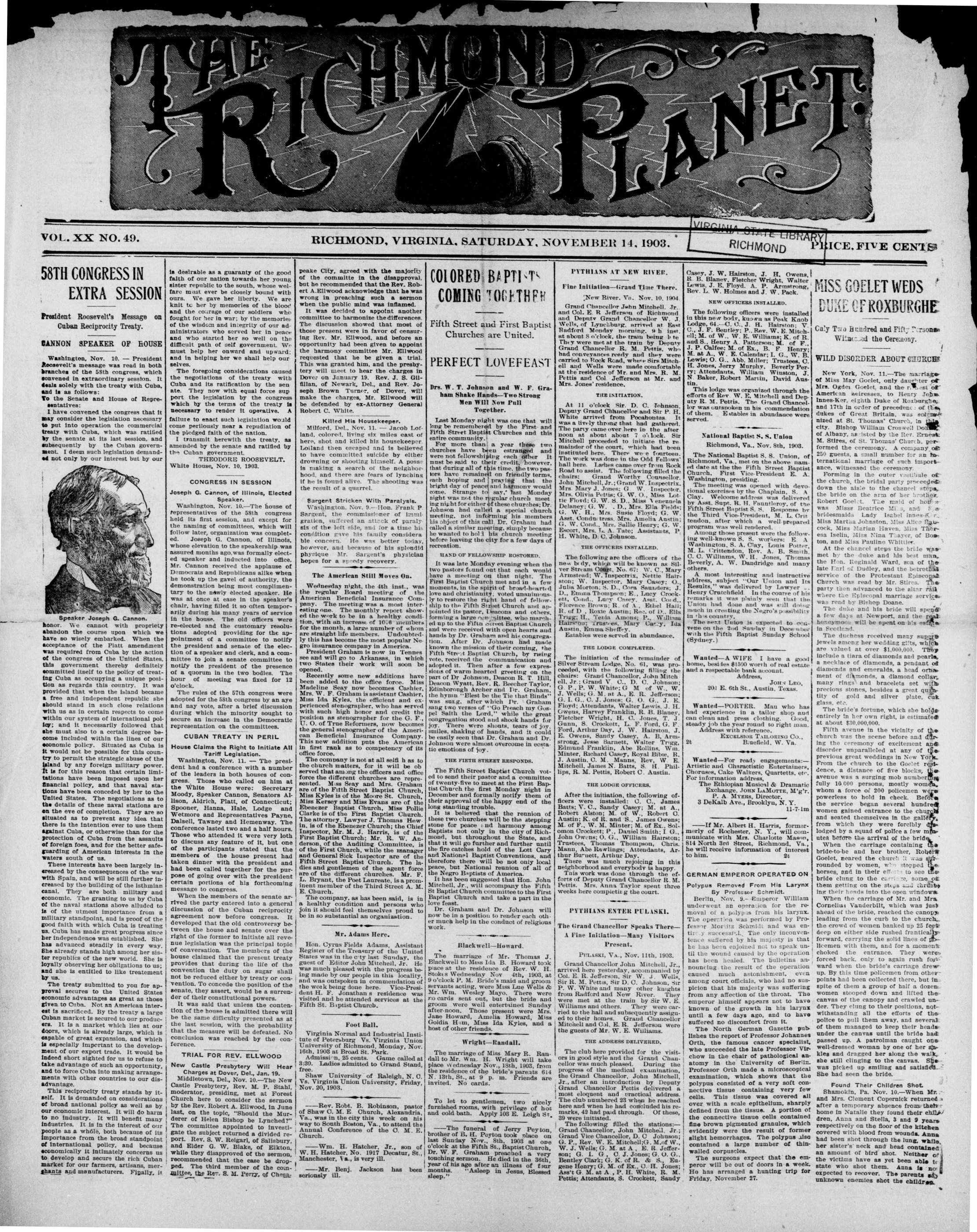
Speaker Joseph G. Cannon. honor. We cannot with propriety abandon the course upon which we have so wisely embarked. When the acceptance of the Platt amendment was required from Cuba by the action of the congress of the United States, this government thereby definitely committed itself to the policy of treating Cuba as occupying a unique position as regards this country. It was provided that when the island became a free and independent republic she should stand in such close relations with us as in certain respects to come within our system of international policy; and it necessarily followed that she must also to a certain degree become included within the lines of our economic policy. Situated as Cuba is it would not be possible for this country to permit the strategic abuse of the island by any foreign military power. It is for this reason that certain limitations have been imposed upon her financial policy, and that naval stations have been conceded by her to the United States. The negotiations as to the details of these naval stations are on the eve of completion. They are so situated as to prevent any idea that there is the intention ever to use them against Cuba, or otherwise than for the protection of Cuba from the assaults of foreign foes, and for the better safeguarding of American interests in the waters south of us.
These interests have been largely increased by the consequences of the war with Spain, and will be still further increased by the building of the isthmian canal. They are both military and economic. The granting to us by Cuba of the naval stations above alluded to is of the utmost importance from a military standpoint, and is proof of the good faith with which Cuba is treating us. Cuba has made great progress since her independence was established. She has advanced steadily in every way. She already stands high among her sister republics of the new world. She is loyally observing her obligations to us; and she is entitled to like treatment by us.
The treaty submitted to you for approval secures to the United States economic advantages as great as those given to Cuba. Not an American interest is sacrificed. By the treaty a large Cuban market is secured to our producers. It is a market which lies at our doors, which is already large, which is capable of great expansion, and which is especially important to the development of our export trade. It would be indeed short sighted for us to refuse to take advantage of such an opportunity, and to force Cuba into making arrangements with other countries to our disadvantage.
This reciprocity treaty stands by itself. It is demanded on considerations of broad national policy as well as by our economic interest. It will do harm to no industry. It will benefit many industries. It is in the interest of our people as a whole, both because of its importance from the broad standpoint of international policy, and because economically it intimately concerns us to develop and secure the rich Cuban market for our farmers, artisans, merchants and manufacturers. Finally, it
is desirable as a guaranty of the good faith of our nation towards her young sister republic to the south, whose welfare must ever be closely bound with ours. We gave her liberty. We are knit to her by memories of the blood and the courage of our soldiers who fought for her in war; by the memories of the wisdom and integrity of our administrators who served her in peace and who started her so well on the difficult path of self government. We must help her onward and upward, and in helping her we shall help our selves.
The foregoing considerations caused the negotiations of the treaty with Cuba and its ratification by the senate. They now with equal force sup port the legislation by the congress which by the terms of the treaty is necessary to render it operative. A failure to enact such legislation would come perilously near a repudiation of the pledged faith of the nation.
I transmit herewith the treaty, as amended by the senate and ratified by the Cuban government. THEODORE ROOSEVELT. White House, Nov. 10, 1903.
CONGRESS IN SESSION
Joseph G. Cannon, of Illinois, Elected Speaker.
Washington, Nov. 10.—The house of representatives of the 58th congress held its first session, and except for the naming of committees, which will follow later, organization was completed. Joseph G. Cannon, of Illinois, whose elevation to the speakership was assured months ago, was formally elected speaker and inducted into office. Mr. Cannon received the applause of Democrats and Republicans all alike when he took up the gavel of authority, the demonstration being most complimentary to the newly elected speaker. He was at once at ease in the speaker's chair, having filled it so often temporarily during his many years of service in the house. The old officers were re-elected and the customary resolutions adopted providing for the appointment of a committee to notify the president and senate of the election of a speaker and clerk, and a committee to join a senate committee to notify the president of the presence of a quorum in the two bodies. The hour of meeting was fixed for 12 o'clock.
The rules of the 57th congress were adopted for the 58th congress by an aye and nay vote, after a brief discussion during which the minority sought to secure an increase in the Democratic representation on the committees.
CUBAN TREATY IN PERIL
House Claims the Right to Initiate All Tariff Legislation.
Washington, Nov. 11. — The president had a conference with a number of the leaders in both houses of congress. Those who called on him at the White House were: Secretary Moody, Speaker Cannon, Senators Allison, Aldrich, Platt, of Connecticut; Spooner, Hanna, Hale, Lodge and Wetmore and Representatives Payne, Dalsell, Tawney and Hemenway. The conference lasted two and a half hours. Those who attended it were very loth to discuss any feature of it, but one of the participants stated that the members of the house present had taken dinner with the president and had been called together for the purpose of going over with the president certain portions of his forthcoming message to congress.
When the members of the senate arrived the party entered into a general discussion of the Cuban reciprocity agreement now before congress. It developed that the old controversy between the house and senate over the right of the former to initiate all revenue legislation was the principal topic of conversation. The members of the house claimed that the present treaty provides that during the life of the convention the duty on sugar shall not be reduced either by treaty or convention. To concede the position of the senate, they assert, would be a surrender of their constitutional powers. It was said that unless the contention of the house is admitted there will be the same difficulty presented as at the last session, with the probability that the measure will be defeated. No conclusion was reached by the conference.
TRIAL FOR REV. ELLWOOD
New Castle Presbytery Will Hear
Charges at Dover, Del, Jan. 19.
Middletown, Del, Nov. 10—The New Castle Presbytery, Rev. M. P. Stahl, moderator, presiding, met at Forest Church here to consider the sermon by the Rev. Robert A. Ellwood, in June last, on the topic, "Should the Murderer of Helen Bishop be Lynched?" The committee appointed to investigate the subject returned a divided report. Rev. S. W. Reigarl, of Salisbury, and Elder G. W. Blake, of Elkton, while they disapproved of the sermon, recommended that the case be dropped. The third member of the committee, the Rev. S. M. Perry, of Chesa-
RICHMOND, VIRGINIA, SATURDAY, NOVEMBER 14, 1903.
peake City, agreed with the majority of the committee in the disapproval, but he recommended that the Rev. Robert A. Ellwood acknowledge that he was wrong in preaching such a sermon when the public mind was inflamed. It was decided to appoint another committee to harmonize the differences. The discussion showed that most of those present were in favor of censuring Rev. Mr. Ellwood, and before an opportunity had been given to appoint the harmony committee Mr. Ellwood requested that he be given a trial. This was granted him, and the presbytery will meet to hear the charges in Dover on January 19. Rev. J. S. Gillifan, of Newark, Del., and Rev. Joseph Brown Turner, of Dover, will make the charges, Mr. Ellwood will be defended by ex-Attorney General Robert C. White.
Killed His Housekeeper:
Milford, Del., Nov. 11. — Jacob Loftland, colored, living six miles east of here, shot and killed his housekeeper. Loftland then escaped and is believed to have committed suicide by either drowning or shooting himself. A poss is making a search of the neighborhood, and there are fears of lynching if he is found alive. The shooting was the result of a quarrel.
Sargent Stricken With Paralysis.
Washington, Nov. 9—Hon. Frank P. Sargent, the commissioner of immigration, suffered an attack of paralysis of the left side, and for a time his condition gave his family considera ble concern. He was better today however, and because of his splendid physique Mr. Sargent's physician hopes for a speedy recovery.
The American Still Moves On.
Wednesday night, the 4th inst., was the regular Board meeting of the American Beneficial Insurance Company. The meeting was a most interesting one. The monthly report showed the work to be in a healthy condition, with an increase of 10.6 members for the month, a large number of whom are straight life members. Undoubtedly this has become the most popular Negro insurance company in America. President Graham is now in Tennesse see and will go to Arkansas, in which two States their work will soon be opened. Recently some new additions have been added to the office force. Miss Madeline Say now becomes Cashier, Mrs W. F. Graham is assistant Cashier, Miss Ida Kyles is efficient and experienced stenographer who works with such high honor and credit the position as stenographer for the G. F., U. O. of true Reformers, now becomes the general stenographer of the American Beneficial Insurance Company. This new addition puts the American in first rank as to competency of its office force.
The company is not at all selfish h as to the church matters, for it will be observed that among the officers and office force the different churches are represented. Miss Seay and Mrs. Graham are of the Fifth Street Baptist Church, Miss Kyles is of the Moore St. Church, Miss Kersay and Miss Evans are of the Ebenezer Baptist Church, Miss Pollie Clarke is of the First Baptist Church. The attorney, Lawyer J. Thomas Hewin, is of the Ebenezer Church; the Chief Inspector, Mr. M. J. Harris, is of the First Baptist Church; Mr. R. W. Anderson, of the Auditing Committee, is of the Church, while the manager and General Sick Inspector are of the Fifth Street Baptist Church. The ladies and gentlemen of the logo force are of the different churches. Mr. F. L. Bryant, the Poet Laureate, is a prominent member of the Third Street A. M. E. Church.
The company, as has been said, is in a healthy condition and persons who join it should feel themselves proud to be in so substantial an organization.
Mr. Adams Here.
Hon. Cyrus Fields Adams, Assistant Register of the Treasury of the United States was in the city last Sunday, the guest of Editor John Mitchell, Jr. He was much pleased with the progress being made by our people in this locality, and was outspoken in communication of being done here. Vice-President H. F. Browne's residence was visited and he attended services at the Fifth St. Baptist Church.
Foot Ball.
Virginia Normal and Industrial Institute of Petersburg Vs. Virginia Union University of Richmond, Monday, Nov. 16th, 1903 at Broad St. Park.
Admission, 25 cents. Game called at 3:30. Ladies admitted to Grand Stand, free.
Shaw University of Raleigh, N. C.
Vs. Virginia Union University, Friday, Nov. 20, 1903.
—Rev. Robt. B. Robinson, pastor of Shaw C. M. E. Church, Alexandria, Va., was in the city this week on his way to South Boston, Va., to attend the Annual Conference of the C. M. E. Church.
—Wm. H. Hatcher, Jr., son of W. H. Hatcher, No. 1917 Decatur, St., Manchester, Va., is very ill.
—Mr. Benj. Jackson has been seriously ill.
COLORED BAPTISTS COMING TOGETHER
Fifth Street and First Baptist Churches are United.
PERFECT LOVEFEAST
Drs. W. T. Johnson and W. F. Graham Shake Hands--Two Strong Men Will Now Pull Together
Last Monday night was one that will long be remembered by the First and Fifth Street Baptist Churches and this entire community. For more than a year these two churches have been estranged and were not fellowshiping each other. It must be said to their credit, however, that during all of this time, the two pastors have remained on friendly terms, each hoping and praying that the bright day of peace and harmony would come. Strange to say, last Monday night was not the regular church meeting night for either of these churches; Dr. Johnson had called a special church meeting, not informing his members his object of this call. Dr. Graham had called a similar meeting, simply because he wanted to hold his church meeting before leaving the city for a few days of recreation.
HAND OF FELLOWSHIP ROSTORED
It was late Monday evening when the two pastors found out that each would have a meeting on that night. The First Baptist Church met and in a few moments, in the spirit of broad-hearted love and Christianity, voted unanimously to restore the right hand of fellowship to the Fifth Street Church and appointed its pastor, Deacons and others, forming a large committee, who marched up to the Fifth Street Baptist Church and were received with open hearts and hands by Dr. Graham and his congregation. After Dr. Johnson had made known the mission of their coming, the Fifth Street Baptist Church, by rising vote, received the communication and adopted it. Then after a few expressions of warm hearted greeting on the part of Dr Johnson, Deacon R. T. Hill, Deacon Wyatt, Rev. R. Beecher Taylor, Edinborough Archer and Dr. Graham, the hymn "Blest be the Tie that Binds" was sung, after which Dr. Graham sang two verses of "Go Preach my Gospel Saith the Lord," while the great congregation stood and shook hands for joy. There were shouts, tears of joy, smiles, shaking of hands, and it could be easily seen that Dr. Graham and Dr. Johnson were almost overcome in ecstatic emotions of joy.
THE FIETH STREET RESPONDS
The Fifth Street Baptist Church voted to send their pastor and a committee of twenty-five to meet at the First Baptist Church the first Monday night in December and formally notify them of their approval of the happy end of the long standing trouble.
It is believed that the reunion of these two churches will be the stepping stone for peace and harmony among Baptists not only in the city of Richmond, but throughout the State, and that it will go further and further until the fire catches hold of the Lott Cary and National Baptist Conventions, and therefore there will be not only local peace, but National reunion of all of the Negro Baptists of America.
It has been suggested that Hon. John Mitchell Jr., will accompany the Fifth St Baptist Church committee to the First Baptist Church and take a part in the love feast.
Dr. Graham and Dr. Johnson will now be in a position to render each other much help in the conduct of religious work.
Blackwell—Howard
The marriage of Mr. Thomas J. Blackwell to Mass Ida B. Howard took place at the residence of Rev. W. H. Stokes Wednesday Nov 4th, 1903, at 9 o'clock P. M. Bride's maid and groom servants acting, were Miss Llew Wells & Mr Wm. Wesley Mayo. There were no cards sent out, but the bride and groom were well entertained Sunday after-noon. Those present were Mrs. Jane Howard, Amelia Howard, Miss Goldia Hum, Miss Ida Kyles, and a host of other friends.
Wright—Randall.
The marriage of Miss Mary R. Randall to Mr. Wm. H. Wright will take place Wednesday Nov., 18th, 1903, from the residence of the bride's parents 614 N. 13th, St., at 9 p. m. Friends are invited. No cards.
To let to gentlemen, two nicely furnished rooms, with privilege of hot and cold bath. Apply 103 E. Leigh St.
The funeral of Jerry Peyton, brother of B. H. Peyton took place on last Sunday Nov., 8th, 1903 at one o'clock at the Fifth St., Baptist Church, Dr. W. F. Graham preached a very touching sermon. He died in the 36th, year of his age after an illness of four months. "Asleep in Jesus, Blessed sleep."
PYTHIANS AT NEW RIVER
Fine Initiation—Grand Time There.
Grand Chancellor John Mitchell, Jr. and Col. E. R Jefferson of Richmond and Deputy Grand Chancellor W. J. Wells, of Lynchburg, arrived at East Radford Monday morning, 9 h in at about 8 o'clock the train being b te. They were met the train at Deputy Grand Chancellor R. W. Pettie who had conveyances ready and they were carried to Rock Read, where Sir Mitchell and Wells were made comfortable at the residence of Mr. and Mrs. R. M. Pettie and Col Jefferson at Mr. and Mrs. Jones' residence.
THE INITIATION.
THE OFFICERS INSTALLED
The following are the officers of the new body, which will be known as Silver Stream Count, No. 67: W. C, M. Mary Armstead; W. Inspectrix, Nettie Hairston; W. Inspector, Mary Cassey; O., Julia Morton, S. D., Cora Saunders; J. D., Emma Thompson; E., Lucy Crockett, Cond. L., Lucy Cassey, Asc. Cond., Florence Brown; R. of A., Ethel Hall; R. of D., Roxie Austin; Rec. of D., Ella Trigg; H., Tenia Amons; P., William Hairston; Trustees, Mary Cassey, Ida Austin, Emma Sheffey.
Eatables were served in abundance.
THE LODGE COMPLETED.
The initiation of the remainder of Silver Stream Lodge, No. 61, was proceeded, with the following filling the chairs: Grand Chancellor, John Mitch ell, Jr; Grand V. C., D. C. Johnson; G. P., P. W. White; G. M of W., W. J, Wells; G. M at A, E. R. Jefferson; G. I. G. C., J. Jones; G. O. G., J. E. Floyd; Attendants, Walter Lewis, J. H. Owens, Harvey Franklin, R. B. Blaney, Fletcher Wright, H. C. Jones, T. J. Gunn, S. Crockett, L. F. Ford, G. Ford, Arthur Day, J. W. Hairston, J. E. Owens, Sandy Caye, B. A. Armstrong, Jesse Barnett, Walter Trigg, Edmund Franklin, Abe Rollins, Wm. Minter, Richard Casey, Royal Bibe, R. J. Austin, C. M. Mains, Rev, W E. Mitchell, James N. Batts, S. H. Phillips, R. M. Pettitt, Robert C. Austin.
THE LODGE OFFICERS.
After the initiation, the following officers were installed: C. C., James Batts; V. C., Sandy Casey; M. at A., Robert Alston; M. of W., Robert C. Austin; K. of R. and S., James Owens; M. of F., W. M. Minter; M. of Ex. Solomon Crockett; P., Daniel Smith; I. G., John Owens; O. G., William Hairston; Trustees, Thomas Thompson, Chris. Mann, Abe Rawlings, Attendants, Arthur Buruet, Arthur Thirteen occupying in this neighborhood and everybody is happy. This work was done through the efforts of Deputy Grand Chancellor R. M. Pettis. Mrs. Anna Taylor spent three weeks here completing the court.
PYTHIANS ENTER PULASKI
The Grand Chancellor Speaks There—
A Fine Initiation—Many Visitors
Present.
PULASKI, V.A., Nov. 11th, 1903.
Grand Chancellor John Mitchell, Jr.,
arrived here yesterday, accompanied by
Col. E. R. Jefferson, Sir W. J. Wells,
Sir R. M. Pettis, Sir D. C. Johnson, Sir
P. W. White and many other knights
from Radford and New River. They
were met at the train by Sir W. E.
Williams and others. They were carried
to the hall and subsequently assigned
to their homes. Grand Chancellor
Mitchell and Col. E. R. Jefferson were
the guests of Mr. W. E. Williams.
THE ADDRESS DELIVERED:
The club here provided for the visitors in good style and the Grand Chancellor was much pleased. During the progress of the medical examination, the Grand Chancellor, John Mitchell, Jr., after an introduction by Deputy Grand Chancellor Pettis delivered a most eloquent and practical address. The club numbered 23 when he reached here and when he had concluded his remarks, 42 had paid through. Of these, 39 were initiated.
The following filled the stations:—Grand Chancellor, John Mitchell, Jr.; Grand Vice Chancellor, D. C Johnson; G.P. Rev. W. E. Mitchell; G.M. of W., W. J. Wells; G.M. at A., E. R. Jefferson; G. I. G., G. J. Jones; G.O. G., Bentley Clark; G.K. of R. & S., Eugene Henry; G.M. of Ex. C. H. Jones; Ass't G. M. at A., P.H. White, R. M. Pettis; Attendants. S. Crockett, Sandy
Casey, J. W, Hairston, J. H, Owens, R. B. Blaney, Fletcher Wright, Walter Lewis, J. E. Floyd, A. P. Armstrong, Rev. L. W. Holmes and J. W. Pack.
NEW OFFICERS INSTALLED
The following officers were installed in this new body, known as Peak Knob Lodge, 64.-C. C. J. H. Hairston; C. J. F. Bentley; P. Rev. W. E Mitchell; M. of W. W. E. Williams; K. of R. R; S. Henry A. Patterson; M. of F. J. P. Calfee; M. of Ex. B. F. Henry; M. at A. W. E. Calendar; I. G. W. B. Lewis; O. G. Abb. Miller; Trustees. C. H. Jones, Jerry Murphy, Beverly Perry, Attendants, William Wiuson, J. Baker, Robert Martin, David Austin. This lodge was organized through the efforts of Rev W. E. Mitchell and Deputy R. M. Pettis. The Grand Chancellor was outspoken in his commendation of them. Eatables in abundance were served.
The National Baptist S. S. Union, of Richmond, Va., met on the above named date at the the Fifth Street Baptist Church, First Vice-President E. A. Washington, presiding.
The meeting was opened with devotional exercises by the Chaplain, S. A Clay. Welcome address was delivered by Asst. Supt. R. H. Fanterloy, of the Fifth Street Baptist S. S. Response by the Third Vice-President, M. L. Crittendon, after which a well prepared program was well rendered.
Among those present were the following well-known S. S. workers: E. A. Washington, S. A. Clay, Louis Potter, M. L. Crittendon, Rev. A. B. Smith, C. C. Williams, W. H. Jones, Thomas Beverly, A. W. Dandridge and many others.
A most interesting and instructive address, subject "Our Union and Its Results," was delivered by Lawyer Henry Crutchfield. In the course of his remarks it was plainly seen that the Union had done and was still doing much in creating the Negro's possibility in this country.
The next Union is expected to convene on the 2nd Sunday in December with the Fifth Baptist Sunday School (Sydney.)
**Wanted—A WIFE** I have a good home, besites $1500 worth of real estate and a respectable bank account.
Address,
JOHN LEO,
201 E. 6th St., Austin, Texas.
**Wanted—PORTER.** Man who has had experience in a tailor shop and can clean and press clothing. Good, steady job the year round to right man.
Address with reference
EXCELSIOR TAILORING Co.,
2t
Bluefield, W. Va.
**Wanted—For ready engagements:** Artistic and Characteristic Entertainers, Choruses, Cake Walkers, Quartetts, etc.
For information address.
The Ethiopian Musical & Dramatic
Exchanger, M.g'r-
and MyRKs, Director,
——If Mr. Albert H. Harris, formerly of Rochester, N. Y., will communicate with Mrs. Charlotte Mason, 814 North 3rd Street, Richmond, Va., he will receive information of interest to him. 2t
GERMAN EMPEROR OPERATED ON
Polypus Removed From His Larynx
By Professor Schmidt
Berlin, Nov. 3.—Emperor William underwent an operation for the removal of a polypas from his larynx. The operation was performed by Professor Mortiz Schmidt and was entirely successful. The only inconvenience suffered by his majesty is that he has been enjoined not to speak until the wound caused by the operation has been healed. The bulletins announcing the result of the operation caused much astonishment, even among court officials, who had no suspicion that his majesty was suffering from any affection of the throat. The emperor himself appears not to have known of the growth in his larynx until a few days ago, and to have suffered no discomfort from it.
The North German Gazette publishes the report of Professor Johannes Orth, the famous cancer specialist, who succeeded the late Professor Virchow in the chair of pathological anatomy in the University of Berlin. Professor Orth made a microscopical examination, which shows that the polypus consisted of a very soft connective tissue containing very few cells. This tissue was covered all over with a scale epithelium, sharply defined from the tissue. A portion of the connective tissue cells contained fine brown pigmented granules, which evidently were the result of former slight hemorrhages. The polypus also contained a large number of thin-walled corpuscles. The surgeons expect that the emperor will be out of doors in a week. He has arranged a hunting trip for Friday, November 27.
MISS GOELET WEDS
DUKE OF ROXBURGHE
Only Two Hundred and Fifty Persons
Witnessed the Ceremony.
WILD DISORDER ABOUT CHURCHES
New York, Nov. 11. The marriage of Miss May Goellet, only daughter of Mrs. Ogden Goellet, and the n. rest of American airresses, to Henry John Innes-Ker, eighth Duke of Roxburgh, and 17th in order of precedence of the dukes of Great Britain, was solemnized at St. Thomas' Church, in the city. Bishop William Crosswell Dearn of Albany, asisted by the Rev. Ernest M. Stfres, of St. Thomas' Church, performed the ceremony. A company of 250 guests, a small number for an international marriage of such importance, witnessed the ceremony.
Forming in the outer vestibule of the church, the bridal party proceeded down the aisle to the chanel steps, the bride on the arm of her brother, Robert Goellet. The maid of honour was Miss Beatrice Miles, and Mrs bridlesmaids Lady Isabel Innes-Ker, Miss Martha Johnston, Miss Alice Bacock, Miss Marian Haven, Miss Theresa Iselin, Miss Nina Thayer, of Boston, and Miss Pauline Whittier.
At the chancel steps the bride was met by the duke and his best man, the Hon. Reginald Ward, son of the late Earl of Dudley, and the betrothed service of the Protestant Episcopal Church was read by Mr. Stiles. The party then advanced to the altar rail where the Episcopal marriage service was read by Bishop Doane. The duke and his bride will spend a few days at Newport, and the real honeymoon will be spent on his estate in Scotland. The duchess received many super jewels among her wedding gifts, which are valued at over $1,000,000. They include a tiara of diamonds and pearls, a necklace of diamonds, a pendant of diamonds and emeralds, a head ornament of diamonds, a diamond collar, many rings' and bracelets set with precious stones, besides a great quantity of gold and silver plate, cut glass, etc.
The bride's fortune, which she holds entirely in her own right, is estimated at about $30,000,000.
Fifth avenue in the vicinity of the church was the scene before and during the ceremony of excitement and disorder unparalleled at any of the previous great weddings in New York. From the church to the Goolet residence, a distance of five blocks, the avenue was a surging mob numbering fully 10,000 persons, mostly women whom a force of 200 policemen were powerless to hold in check. Before the service began several hundred women gained entrance to the church and seated themselves in the gallery, from which they were forcibly lodged by a squad of police a few minutes before the arrival of the bride.
When the carriage containing the bride-to-be and her brother, Robert Goelet, neared the church it was surrounded by women, who stopped the horses, and in their efforts to see the bride clung to the carriage, some of them getting on the steps and thrusting their heads into the open windows.
When the carriage of Mr. and Mrs Cornelia Vanderbilt, which was just ahead of the bride, reached the canopy leading from the curb to the church, the crowd of women banked up 25 feet deep on either side rushed frantically forward, carrying the solid lines of policemen with them, and for a moment choked the entrance. They were forced back, only to again rush forward when the bride's carriage drew up. By this time policemen from other points had been collected there, but in spite of them a group of half a dozen women stooped down and lifted the canvas of the canopy and crawled under. They clung to their positions, notwithstanding all the efforts of the police to pull them away, and several of them managed to keep their heads under the canvas until the bride had passed up. A patrolman caught one well-dressed woman by one of her skirts and dragged her along the walk, she still clinging to the canvas. She was picked up smiling and satisfied. She had seen the bride.
Found Their Children Shot
Shamokin, Pa. Nov. 10—When Mr. and Mrs. Clement Copernick returned after a temporary absence from their home in Natalie they found their children, Anna and Stella, 3 and 9 years respectively on the floor of the kitchen covered with blood from wounds. Anna had been shot through the lung, while, her sister's neck and head contained an amount of bird shot. Neither of the victims have as yet been able to state who shot them. Anna is not expected to recover. The parents are unknown enemies shot the children.
BE YENGE
DECIDED NOT TO WORRY.
I've decided not to worry any more;
I'm 'livin' jesst as easy as before;
What's the use to fume an' furry?
The's use to allers worry?
I've decided not to worry any more.
Best go 'loutg an' allers mind your own af-
fairs;
Jest determine not to worry any more.
What's the use to lie awake an' rack your brain
Jest because the crops are thirstin' for a rain?
It'll come of it's a-comin',
An' it boun' to come a-hummin'.
In the same old way—don't worry any more.
When you come to cross a hill that's hard
to climb.
Take it easy; rock along an' take your
time;
Try to keep the weikin ringin'
Wish your shoutin' an' your singin';
An' you'll clean fergit to worry any more.
Lawrence Porcher Hext, in Lippincott's
Magazine.
What Black
Mike Saw
By W. W. HINES
(Copyright, 1903, by Dally Story Pub. Co.)
BECAUSE he was surly, the men
called him "Black Mike" Riordan.
Yet those who knew him best swore his
heart was one of the kindest.
Whatever the verdict of others, it is convincing enough proof that he had his good side, in that Kittle Donoughue loved him better than all the world. They were to have been married just before Lent, and Bliss Mike wore his scarf no more. Kittle was never strong and a cold just snuffed her life out, so Black Mike became bluer than ever before.
Some would have tried to comfort him, but his fireman, Dan Meagher, who knew him better than any one else, said:
"Leave him be. He likes it best so."
And after a period of mourning, Black Mike, with a black scowl than ever, came back to work on the Central division. There had never been but one love in his life, that for Kittle Donoughue, who was dead, but there was a sincere liking for young Dan Meagher, who had been his fireman, and for engine 126, on which he had pulled the throttle.
With a silent hand-clasp Meagher welcomed him back, and he could feel that No. 126 was glad again to feel the touch of his hand at the throttle. So he climbed up on the right side of the engine and the Cannon Ball express pulled slowly out of the brilliantly lighted station, with its first stop 98 miles away, and 12 minutes of time to be made up in the worst storm and the blackest night of the year.
Rain came in sheets, driving before the heavy gusts of wind and beating against the glass sides of the cab as though it would drive them in. Even in the yards it took sharp watching to make out the signal lights, but there was time to be made up, and even engineers have to take chances of the safety of their train in such an event. Schedule time is a sacred thing in the eyes of the men of the Central division.
On the whole, Black Mike was grateful to the storm. There was a wild tumult in it that struck a responsive note in his heart, where pain was eating like live, mad thing, gnawing and rending. The Cannon Ball express has the right of way over everything, and only accidents can detain her.
The dozing operator at Merionsville was aroused as the Cannon Ball swept by, and walked to his instrument to report her as passed.
"M!! M!! M!!" his station call, came over the wire, and when he signified that he was on hand, came the message from the chief train dispatcher:
"Flag express all hazards. Bridge down."
"Express passed before message received. Trying to report her when you cut in on wire," he answered.
There was no other station between Mertonsville and the bridge over Benson river, so the chief dispatcher had done all in his power to prevent the impending catastrophe. Immediately upon receipt of a wire from the operator at Ordway, on the further side of the Benson river, he had wired to Mertonville in the vain attempt to stop the express. The dispatch from Ordway read:
"Track walker reports bridge down. Cannot get flag man across."
With quick, sharp orders, the dispatcher had a special made up to carry doctors and nurses to the scene of the accident he now regarded as inevitable. They were ready to start in an hour, and a wrecking train was only a few moments behind them.
Picturing the track in his own mind, the dispatcher could see no escape for the express. There is a sharp curve and a heavy cut just before the approach to the bridge, and, with orders to make up lost time, Black Mike would be running at the utmost speed of which his engine was capable.
It was the fault of no one. Everyone had done his duty—but it is a horrible thing to sit impotently in a chair and feel that over a hundred people are approaching their death.
Darkness and storm around them, the beat of the rain against the windows of the cab drowning even the noise of the engine, Black Mike and Dan were both trying to keep a sharp look out ahead of
For a little distance the headlight half penetrated the rain and darkness, which fled in black and impenetrable a hundred feet away.
Black Mike is not on his seat. He is standing on the swaying floor of the cab; one hand on the throttle, the other on the air brake, and the reverse lever resting in the crook of his right arm.
In the intervals of throwing in coal, Dan climbed to his seat on the left of the cab and pressed his face against the glass.
Neither can hope to make out a danger in time to stop the engine, but there is an undefinable fear in the hearts of both. It is the schooling of engineer and fireman to take things on trust, but to keep on the alert. The Cannon Ball has the right of way, and there is nothing to fear except some accident to the track.
Of a sudden, Meagher looks across to see Black Mike with his face pressed against the glass. It is not the position of the engineer that arrests and fixes his attention, but it is the expression on his face. The face is as white as a sheet through the grime of coal and perspiration, and his eyes are blazing with a light that seems perilously akin to madness.
"See, lad! Look!" says Black Mike in a hoarse, unnatural voice.
But from his own side of the cab, the fireman can make out nothing save clouds of rain which drive across the path of light in front of the locomotive.
"I see nothing, Mike," says Meagher.
"Just look ahead, lad, moving with us, the shadow on the track. Look, lad, look, and for God's sake tell me what it is!"
"Rain drops on the glass of the head-light, Mike; that is all."
"Nay, nay, lad. Look! It beckons us to stop. By the Mother of God, 'tis the wraith of Kittie Doncoughue."
Releasing his hold upon the throttle, Black Mike throws the reverse lever over
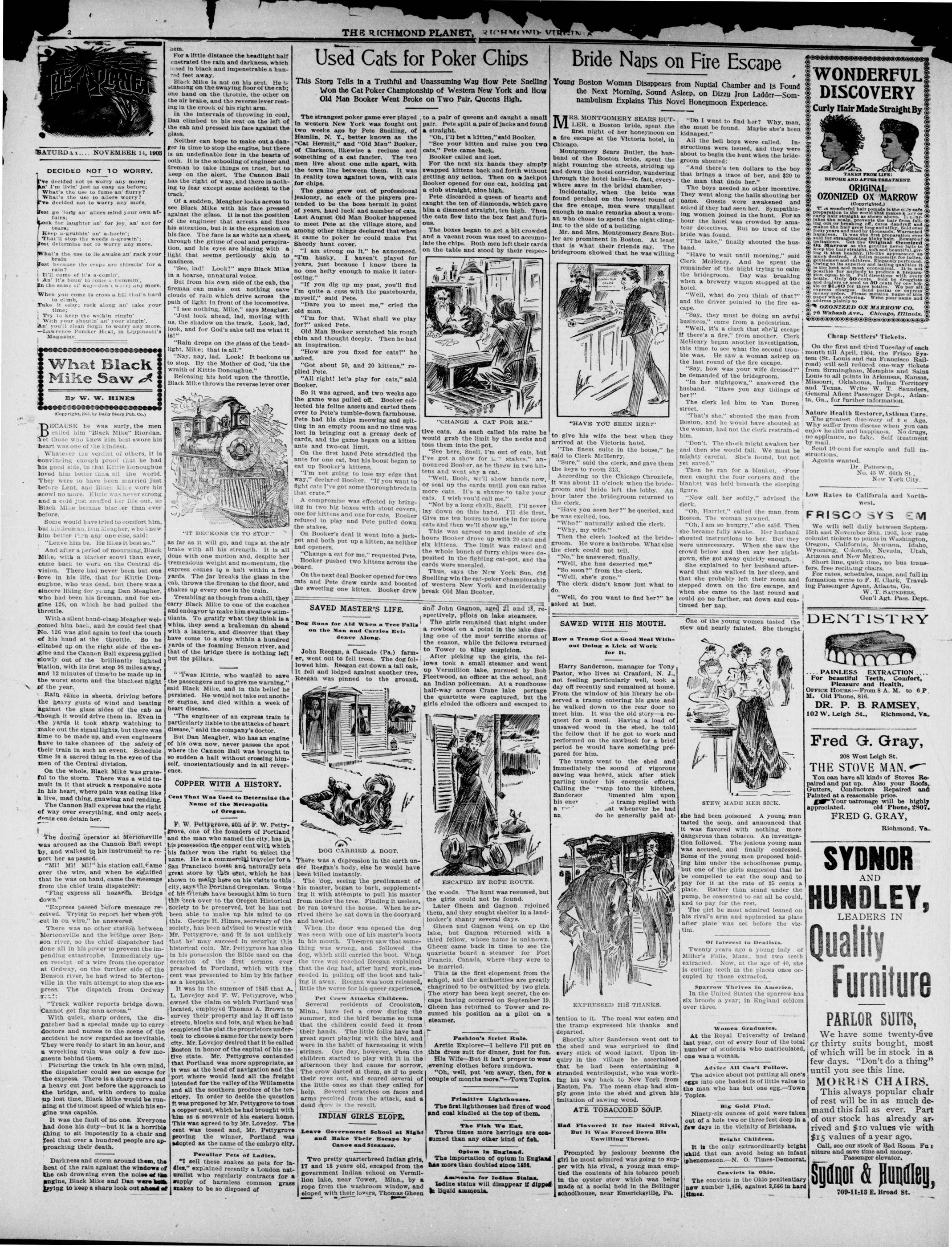
"IT BECKONS US TO STOP."
as far as it will go, and tugs at the air brake with all his strength. It is all done with one motion and, despite her tremendous weight and momentum, the express comes to a halt within a few yards. The jar breaks the glass in the cab, throws the fireman to the floor, and shakes up every one in the train.
Trembling as though from a chill, they carry Black Mike to one of the coaches and endeavor to make him swallow stimulants. To gratify what they think is a whim, they send a brakeman on ahead with a lantern, and discover that they have come to a stop within a hundred yards of the foaming Benson river, and that of the bridge there is nothing left but the pillars.
"Twas Kittle, who wanted to save the passengers and to give me warning," said Black Mike, and in this belief he persisted. He would not take out another engine, and died within a week of heart disease.
"The engineer of an express train is particularly liable to the attacks of heart disease," said the company's doctor. But Dan Meagher, who has an engine of his own now, never passes the spot where the Cannon Ball was brought to so sudden a halt without crossing himself, unostentatiously and in all reverence.
COPPER WITH A HISTORY.
Cent That Was Used to Determine the Name of the Metropolis of Oregon.
F. W. Pettygrove, son of F. W. Pettygrove, one of the founders of Portland and the man who named the city, has in his possession the copper cent with which his father won the right to select the name. He is a commercial traveler for a San Francisco house and naturally sets great store by this cent, which he has shown to many here on his visits to this city, says the Portland Oregonian. Some of his friends have besought him to turn this cent over to the Oregon Historical society to be preserved, but he has not been able to make up his mind to do this. George H. Himes, secretary of the society, has been advised to wrestle with Mr. Pettygrove, and it is not unlikely that he may succeed in securing this historical coin. Mr. Pettygrove has also in his possession the Bible used on the occasion of the first sermon ever preached in Portland, which with the cent was presented to him by his father as a keepsake.
It was in the summer of 1845 that A. L. Lovejoy and F. W. Pettygrove, who owned the claim on which Portland was located, employed Thomas A. Brown to survey their property and lay it off into streets, blocks and lots, and when he had completed the plat the proprietors undertook to choose a name for the newly born city. Mr. Lovejoy desired that it be called Boston in honor of the capital of his native state. Mr. Pettygrove contended that Portland was more appropriate, as it was at the head of navigation and the port where would land all the freight intended for the valley of the Willamette and all the southern produce of the territory. In order to decide the question it was proposed by Mr. Pettygrove to toss a copper cent, which he had brought with him as a souvenir of his eastern home. This was agreed to by Mr. Lovejoy. The cent was tossed and, Mr. Pettygrove proving the winner, Portland was adopted as the name of the embryo city.
Peculiar Pets of Ladies
"I sell these snakes as pets for ladies," explained recently a London naturalist who regularly contracts for a supply of harmless common grass snakes to be so disposed of
THE RICHMOND PLANET.
Used Cats for Poker Chips
This Story Tells in a Truthful and Unassuming Way How Pete Snelling Won the Cat Poker Championship of Western New York and How Old Man Booker Went Broke on Two Pair, Queens High.
The strangest poker game ever played in western New York was fought out two weeks ago by Pete Snelling, of Hamlin, N. Y., better known as the "Cat Hermit," and "Old Man" Booker, of Clarkson, likewise a recluse and something of a cat fancier. The two men live about one mile apart, with the town line between them. It was in reality town against town, with cats for chips.
The game grew out of professional jealousy, as each of the players pretended to be the boss hermit in point of years, hard luck and number of cats. Last August Old Man Booker happened to meet Pete at the village store, and among other things declared that when it came to poker he could make Pat Sheedy hunt cover.
to a pair of queens and caught a small pair. Pete split a pair of jacks and found a straight.
"Oh, I'll bet a kitten," said Booker.
"See your kitten and raise you two cats," Pete came back.
Booker called and lost.
For the next six hands they simply swapped kittens back and forth without getting any action. Then on jackpot Booker opened for one cat, holding pat a club straight, nine high.
Pete discarded a queen of hearts and caught the ten of diamonds, which gave him a diamond straight, ten high. Then the cats flew into the box fast and furious.
The boxes began to get a bit crowded and a vacant room was used to accumulate the chips. Both men left their cards
"I am strong on it," he announced.
"I'm husky. I haven't played for years, just because I know there is no one hefty enough to make it interesting."
"If you dig up my past, you'll find I'm quite a cuss with the pasteboards, myself," said Pete.
"Dare you to meet me," cried the old man.
"I'm for that. What shall we play for?" asked Pete.
Old Man Booker scratched his rough chin and thought deeply. Then he had an inspiration.
"How are you fixed for cats?" he asked.
"Got about 50, and 20 kittens," replied Pete.
"All right! let's play for cats," said Booker.
So it was agreed, and two weeks ago the game was pulled off. Booker collected his feline assets and carted them over to Pete's tumble-down farmhouse. Pete had his chips meowing and spitting in an empty room and no time was lost in bringing out a greasy deck of cards, and the game began on a kitten ante and two-cat limit.
On the first hand Pete straddled the ante for one cat, but his boost began to eat up Booker's kittens.
"I'm not going to lose my edge that way," declared Booker. "If you want to fight cats I've got some thoroughbreds in that crate."
A compromise was effected by bringing in two big boxes with stout covers, one for kittens and one for cats. Booker refused to play and Pete pulled down the stakes.
On Booker's deal it went into a jackpot and both put up a kitten, as neither had openers.
"Change a cat for me," requested Pete. Booker pushed two kittens across the board.
On the next deal Booker opened for two cats and Pete drew cards and boosted the sweetening one kitten. Booker drew
SAVED MASTER'S LIFE.
Dog Runs for Aid When a Tree Falls on the Man and Carries Evidence Along.
John Reegan, a Cascade (Pa.) farmer, went out to fell trees. The dog followed him. Reegan cut down a tall oak. It fell and lodged against another tree. Reegan was pinned to the ground.
DOG CARRIED A BOOT
There was a depression in the earth under Reegan's body, else he would have been killed instantly. The dog, seeing the predicament of his master, began to bark, supplementing it with attempts to pull his master from under the tree. Finding it useless, he ran toward the house. When he arrived there he sat down in the dooryard and howled. When the door was opened the dog was seen with one of his master's boots in his mouth. The-men saw that something was wrong, and followed the dog, which still carried the boot. When the tree was reached Reegan explained that the dog had, after hard work, succeeded in pulling off the boot and taking it away. Reegan was 'soon released, little the worse for his queer experience.
Several residents of Crookston, Minn., have fed a crow during the summer, and the bird became so tame that the children could feed it from their hands. The little folks have had great sport playing with the bird, and were in the habit of harnessing it with strings. One day, however, when the children started to play with it in the afternoon they had cause for sorrow. The crow darted at them, as if to peck their eyes out, and scared several of the little ones so that they called for help. Several scratches on faces and arms resulted from the attack, and a dead crow is the result.
INDIAN GIRLS ELOPE.
Leave Government School at Nigh and Make Their Escape by Canoe and Steamer.
Two pretty quarterbreed Indian girls, 17 and 18 years old, escaped from the government Indian school on Vermilion lake, near Tower, Minn., by a rope from the washroom window, and eloped with their lowers, Thomas Gheen
---
to a pair of queens and caught a small pair. Pete split a pair of jacks and found a straight.
"Oh, I'll bet a kitten," said Booker.
"See your kitten and raise you two cats," Pete came back.
Booker called and lost.
For the next six hands they simply swapped kittens back and forth without getting any action. Then on jackpot Booker opened for one cat, holding pat a club straight, nine high.
Pete discarded a queen of hearts and caught the ten of diamonds, which gave him a diamond straight, ten high. Then the cats flew into the box fast and furious.
The boxes began to get a bit crowded and a vacant room was used to accumulate the chips. Both men left their cards on the table and stood by their respec
"CHANGE A CAT FOR ME."
tive cats. As each called his raise he would grab the limit by the necks and toss them into the pot.
"See here, Snell, I'm out of cats, but I've got a show for it." stakes," announced Booker, as he threw in two kittens and went shy a cat.
"Well, Book, we'll show hands now, or seal up the cards until you can raise more cats. It's a shame to take your cats. I wish you'd call me."
"Not by a long chalk, Snell. I'll never lay down on this hand. I'll die first. Give me ten hours to hustle in for more cats and then we'll show up."
This was agreed to and inside of six hours Booker drove up with 20 cats and six kittens. The limit was raised and the whole bunch of furry chips were deposited in the fighting cat-pot, and the cards were unsealed.
Thus, says the New York Sun, did Snelling win the cat-poker championship of western New York and incidentally break Old Man Booker.
and John Gagnon, aged 21 and 18, respectively, pilots on lake steamers. The girls remained that night under a rowboat on a point in the lake during one of the most terrific storms of the season, while the fellows returned to Tower to allay suspicion. After picking up the girls, the fellows took a small steamer and went up Vermillion lake, pursued by Bob Fleetwood, an officer at the school, and an Indian policeman. At a roadhouse half-way across Crane lake portage the quartette were captured, but the girls eluded the officers and escaped to
ESCAPED BY ROPE ROUTE
the woods. The hunt was resumed, but the girls could not be found. Later Gheen and Gagnon rejoined them, and they sought shelter in a land-looker's shanty several days. Gheen and Gagnon went on up the lake, but Gagnon returned with a third fellow, whose name is unknown. Gheen came back in time to see the quartette board a steamer for Fort Francis, Canada, where they were to be married. This is the first elopement from the school, and the authorities are greatly chagrined to be outwitted by two girls. The story has been kept secret, the escape having occurred on September 19. Gheen has returned to Tower and resumed his position as a pilot on a steamer.
Arctic Explorer—I believe I'll put on this dress suit for dinner, just for fun.
His Wife—But it isn't proper to wear evening clothes before sundown.
"Oh, well, put 'em away, then, for a couple of months more."—Town Topics.
Primitive Lighthouses.
The first lighthouses had fires of wood
and coal kindled at the top of them.
The Fish We Ent.
Three times more herrings are consumed than any other kind of fish.
Opium in England.
The importation of opium in England has more than doubled since 1898.
Ammonia for Iodine Stains.
Iodine stains will disappear if dipped in liquid ammonia.
---
RICHMOND VIRGINIA
Fashion's Strict Rule
Young Boston Woman Disappears from Nuptial Chamber and Is Found the Next Morning, Sound Asleep, on Dizzy Iron Ladder—Somnambulism Explains This Novel Honeymoon Experience.
MRS. MONTGOMERY SEARS BUTLER, a Boston bride, spent the first night of her honeymoon on a fire escape at the Victoria hotel, in Chicago.
Montgomery Sears Butler, the husband of the Boston bride, spent the night roaming the streets, striding up and down the hotel corridor, wandering through the hotel halls—in fact, everywhere save in the bridal chamber.
Incidentally, when the bride was found perched on the lowest round of the fire escape, men were ungallant enough to make remarks about a woman who chose to spend the night clinging to the side of a building.
Mr. and Mrs. Montgomery Sears Butler are prominent in Boston. At least that is what their friends say. The bridegroom showed that he was willing
"Do I want to find her? Why, man, she must be found. Maybe she's been kidnapped."
All the bell boys were called. Instructions were issued, and they were about to begin the hunt when the bridegroom shouted:
"And there's ten dollars to the boy that brings a trace of her, and $20 to the man that ninds her."
The boys needed no other incentive. They went along the halls shouting her name. Guests were awakened and asked if they had seen her. Sympathizating women joined in the hunt. For an hour the hotel was crowded by amateur detectives. But no trace of the bride was found.
"The lake," finally shouted the husband.
"Here to wait until morning."
CORRECTIONS
CORRECTIONS
to give his wife the best when they arrived at the Victoria hotel. "The finest suite in the house," he said to Clerk McHenry.
"Sure," said the clerk, and gave them the keys to room 313.
According to the Chicago Chronicle, it was about 11 o'clock when the bride-groom and bride left the lobby. An hour later the bridegroom returned to the clerk.
"Have you seen her?" he queried, and he was excited, too.
"Who?" naturally asked the clerk.
"Why, my wife."
Then the clerk looked at the bride-groom. He wore a bathrobe. What else the clerk could not tell.
The clerk didn't know just what to do.
"Well, do you want to find her?" he asked at last.
SAWED WITH HIS MOUTH.
How a Tramp Got a Good Meal Without Doing a Lick of Work for It.
Harry Sanderson, manager for Tony Pastor, who lives at Cranford, N. J., not feeling particularly well, took a day off recently and remained at home. From the window of his library he observed a tramp entering his gate and he walked down to the rear door to meet him. It was the old story—a request for a meal. Having a load of unsawed wood in the shed, he told the fellow that if he got to work and performed on the sawbuck for a brief period he would have something prepared for him.
The tramp went to the shed and immediately the sound of vigorous sawing was heard, stick after stick parting under his energetic efforts.
Calling the trump into the kitchen, Sanderson imbued him upon his energy, a trump replied with a rant that whenever he had an do he generally paid at-
Lint
tention to it. The meal was eaten and the tramp expressed his thanks and departed.
Shortly after Sanderson went out to the shed and was surprised to find every stick of wood intact. Upon inquiry in the village he ascertained that he had been entertaining a stranded ventriolquist, who was working his way back to New York from Easton, Pa. The mean chap had simply gone into the shed and given his imitation of sawing wood.
Had Flavored it for Hated Rival,
But It Was Forced Down His
Unwilling Throat.
Prompted by jealousy because the
girl he most admired was going to
supper with his rival, a young man emptied
the contents of his tobacco pouch
in the oyster stew which was being
made at a social held in the Bellinger
schoolhouse, near Emericksville, Pa.
Bride Naps on Fire Escape
---
"HAVE YOU SEEN HER?"
EXPRESSED H18 THANKS.
ATE TOBACCOED SOUP
"Do I want to find her? Why, man, she must be found. Maybe she's been kidnapped."
All the bell boys were called. Instructions were issued, and they were about to begin the hunt when the bridegroom shouted:
"And there's ten dollars to the boy that brings a trace of her, and $20 to the man that inds her."
The boys needed no other incentive. They went along the halls shouting her name. Guests were awakened and asked if they had seen her. Sympathizing women joined in the hunt. For an hour the hotel was crowded by amateur detectives. But no trace of the bride was found.
"The lake," finally shouted the husband.
"Have to wait until morning," said Clerk McHenry. And he spent the remainder of the night trying to calm the bridegroom. Day was breaking when a brewery wagon stopped at the hotel.
"Well, what do you think of that?" and the driver pointed to the fire escape.
"Say, they must be doing an awful business," came from a pedestrian.
"Well, it's a cinch that she'll escape if there's a fire," from another. Clerk McHenry began another investigation, this time to see what the second trouble was. He saw a woman asleep on the last round of the fire escape.
"Say, how was your wife dressed?" he demanded of the bridegroom.
"In her nightgown," answered the husband. "Have you any tidings of her?"
The clerk led him to Van Buren street.
"That's she," shouted the man from Boston, and he would have shouted at the woman, had not the clerk restrained him.
"Don't. The shock might awaken her and then she would fail. We must be mighty careful. She's found, but not yet saved."
Then he ran for a blanket. Four men caught the four corners and the blanket was held beneath the sleeping figure.
"Now call her softly," advised the clerk.
"Oh, Harriet," called the man from Boston. The woman yawned.
"Oh, I am so hungry," she said. Then she became fully awake. Her husband shouted instructions to her. But they were unnecessary. When she saw the crowd below and then saw her night-gown, she got away quickly enough.
She explained to her husband afterward that she walked in her sleep, and that she probably left their room and stepped down on the fire escape, and when she came to the last round and could go no farther, sat down and continued her nap.
One of the young women tasted the stew and nearly falted. She thought
STEW MADE HER SICK.
she had been poisoned A young man tasted the soup, and announced that it was flavored with nothing more dangerous than tobacco. An investigation followed. The jealous young man was accused, and finally confessed. Some of the young men proposed holding him under the schoolhouse pump, but one of the girls suggested that he be compelled to eat the soup and to pay for it at the rate of 25 cents a plate. Rather than stand under the pump, he consented to eat all he could, and to pay for the rest. The girl he most admired leaned on his rival's arm and applauded as plate after plate was set before the victim.
Of Interest to Dentists.
Twenty years ago a young lady of Miller's Falls, Mass., had two teeth extracted. Now, at the age of 40, she is cutting teeth in the places once occupied by those extracted.
**Sparrow Thieves in America.**
In the United States the sparrow has six broods a year; in England seldom over three.
Women Graduates.
At the Royal University of Ireland last year, out of every four of the total number of students who matriculated, one was a woman.
Advice All Can't Follow.
The advice about not putting all one's eggs into one basket is of little value to the man who has but one egg.—Town Topics.
Big Gold Find.
Ninety-six ounces of gold were taken out of a hole two or three feet deep in a few days in the vicinity of Brisbane.
Bright Children.
It is the only extraordinarily bright child that can avoid being an infant phenomenon.—N. O. Times-Democrat.
Convicts in Ohio.
The convicts in the Ohio penitentiary now number 1,456, against 2,566 in hard times.
WONDERFUL
DISCOVERY
Curly Hair Made Straight By
THE NEW HAIR COLOR
Cheap Settlers' Tickets
On the first and third Tuesday of each month till April, 1904, the Frisco System (St. Louis and San Francisco Railroad) will sell reduced one-way tickets from Birmingham, Memphis and Saint Louis to all points in Arkansas, Kansas, Missouri, Oklahoma, Indian Territory and Texas. Write W. T. Saunders, General Affent Passenger Dept., Atlanta, Ga., for further information.
Nature Health Restorer, Asthma Care. The greatest discovery of the Age. Why suffer from disease when you can enjoy health and happiness. No drugs, no appliance, no fake. Self treatment by mail. Send 10 cent for sample and full instructions.
Agents wanted.
Dr. Patterson,
No. 45 W. 66th St.,
New York City.
Low Rates to California and Northwest.
FRISCO SYS EM
We will sell daily between September 15th and November 30th, 1983, low rate colonist tickets to points in Washington, Oregon, California, Montana, Idaho, Wyoming, Colorado, Nevada, Utah, Arizona and New Mexico.
Short line, quick time, no bus transfers, free reclining chairs
For rates, schedules, maps, and fall in information write to F. E. Clark, Traveling Passenger Agent, Atlanta, Ga. W. F. Harris,运输员, Gen'l Agent, Dept.
DENTISTRY
```markdown
```
OFFICE HOURS:—From 8 A. M. to 6 P.
M. Old Phone, 816.
DR. P. B. RAMSEY,
102 W. Leigh St., Richmond, Va.
Fred G. Gray,
208 West Leigh St.
THE STOVE MAN.
You can have all kinds of Stoves Repaired and put up. Also your Roofs, Gutters, Conductors Repaired and Painted at a reasonable price.
Your patronage will be highly appreciated.
old Phone, 2807.
FRED G. GRAY,
Richmond, Va.
SYDNOR AND HUNDLEY, LEADERS IN Quality Furniture
We have some twenty-five or thirty suits bought, most of which will be in stock in a few days. "Don't do a thing" until you see this line.
MORRIS CHAIRS.
This always popular chair of rest will be in as much demand this fall as ever. Part of our stock has already arrived and $10 values vie with $15 values of a year ago.
Call, see our stock of Bed Room Fur niture and save time and money. Passenger elevator. Sydnor & Hundley, 709-11-13 E. Broad St.
‘Copyright, 192, by J. P. Lippincott Company.
And now the quick march of events
‘brings us to the night of the dance at
‘The Cedars, which was to confront for
the first time on one stage the chief
characters in this little drama,
Dinner for the house party was over
at 8:30, and by nine o'clock the invited
guests from the nearby country-side
began to arrive. Among the first flight
was the party from Denecroft—Stella
and Sir Arthur, Marcia Churchill and
Richard.
‘The historic old picture gallery,
‘Which was to be devoted to the dan-
cing, was already well-filled, and Ros-
siter Kane stood at the entrance to re-
ceive his guests in company with a
young-old dowager, Lady Agatha Kin-
eae ee Hill
ees CL)
yn.
aN A I |
a
ee rik 2 pie
1 Se
ad)!
i a oe J
- 2
gan, who had consented to chaperon
the house party, seeing that the host
‘was a bachelor.
A typical English butler, rubicund
of face, portly in form, and with irre-
Proachable natural underpinning, an-
nounced the arrivals, and when in
Pompous tones he vociferated:
“Sir Harthur Dysart and Miss Dy-
sart, Mr. Richard Dysart and Miss
Churchill,” it needed all Kane's self-
control to compose his features and his
manner to the requisite standard of
polite and genial interest,
A moment now, and he would know
his fate—recognivion, exposure, dis-
ce, or—
*sir Arthur, with Stella on his arm,
came first, and passed under the arched
door of the gallery, followed by Rich-
ard and Marcia. The first couple
paused a moment after their greet-
ings, and It fell to Marcia to introduce
Richard to his host.
“Welcome to The Cedars and wel-
come home, Mr. Dysart!" said Kane.
‘There fronted him a tall, athletic
figure, bronzed and tanned of face,
as clean-shaven as himself save for
a tawny mustache, and in the man’s
conventional evening dress bearing
not the remotest resemblance to or
Suggestion of the unkempt and
bearded wayfarer of the Karroo
Desert.
The two men gripped hands in the
bearty English fashion, and each
looked the other ‘Squarely In the face.
‘The first keen glance was what Kane
feared most, but»in the steady gaze
ot Richard there was naught save the
utmost courtesy.
Kane's heart leaped. He was safe,
@t least for the present. But there
was an expression of studied interest
in Richard’s glance as they exchanged
@ few commonplaces, as though ask-
ing “what manner of man is this?
which was to be explained a moment
tater.
Turning to Stella, Kane asked to
fee her dance-card, saying—
“My duties will not permit me to
be seifish, but I claim the first waltz.”
She handed him the enameled
‘Pasteboard, and while he was pencil-
ing his initials thereon the girl mur-
mured in significant tones that none
other could hear—
“Be on your best behavior to-night,
sir.” flashing him a dazaling smile
across her snowy shoulder as she was:
led away,
Kane sent her an answering look,
end breathed more freely. The fact
that the brothers were both under his
roof seemed a good omen, and argued
no opposition to his suit. |
For the first time in Many days his
inner mood lightened. All might yet;
g0 well, and he resumed his task of
welcoming the remaining guests with |
almost boyish vim and abandon.
After all, the ball would be a per-
sonal triumph, as he had at first in-
tended, with his afflanced bride as.
its chief ornament and attraction for
him. |
That waltz with Stella Dysart, he
told himself, the soft perfume of her |
bair- floating upward like blessed in- |
cense, was worth periling a man’s
soul for. The while he bela her in.
his arms he vowed to himself that he
would go through the fires of perdition
rather than give her up. Yet even at
the thought there came to him the
dread query, like a grinning demon
in the midst of a feast, “What
would she say or do if she knew the
truth?” But he wilfully drove the
thing away, and resolved, for that mo-
ment at least, to drink the cup of hap-
piness to the last drop.
As he led her to a cool corner after
ihe final crashing bars of the music
he murmured:
“I shall call upon Sir Arthur in
he morning, dearest. You can guess
why."
“I will tell him to expect you,” she
ald, lifting her eyes bravely to his,
he love-light shining in their star
ike depths. ke
CHAPTER VIIT.
Bry FREDERIC REDDALE
a rN ne ee
make any objections, do you taiak?"
he inquired, the slight’ t:emor of
anxiety in his voice seeming perfectly
natural to the girl’s quick perception.
“I think Sir Arthur will be glad to
get me off his hands,” she said rogu-
isbly. “As for Rick, why, he does not
kuuw you very well, you see, and he
must take my word for it that you are
perfectly eligible, of legal age, and
sound mind!”
“I'm not so sure about that last,"
ho responded, catching at her gay hu-
mor, and answering in kind. “When
a man is bewitched, you know——”
‘The rest of the sentence was unfin-
ished, for at that moment Stella was
claimed for the next dance, and Kane
saw her no more until supper was
served, when he had expressly re-
served the privilege of taking her in,
and she sat on his right hand with
Richard on his left.
By all rules of social precedence
these places of honor belonged to
others, but at the last moment Kane
gave orders which resulted in the ar-
rangement named. The evening had
begun and continued auspiciously,
and with bis customary cool hardi-
hood he resolved to then and there
test to the utmost the possibility of
Richard's recognizing him.
During the repast the talk naturally
Arifted to the Cape. Nearly everyone
knew that Rick had just returned
thence, and he was kept busy answer-
ing questions as to his adventures, so
that Kone was spared the necessity of
originating or replying to any direct
| inquiries, but by a judicious remark
here and there he showed his knowl-
edge of the subjects touched on, nor
seemed to manifest the slightest de-
sire for concealment.
Every word he uttered had for its
ulterior object the creating of a favor-
able impression upon Richard Dysart,
but {t was all done with such con-
summate tact that the younger and
bluffer man was completely captivated
by the elder, as was proved when, on
kissing Stella good-night, after their
drive home, he sald—
“Well, Sis, your Rossiter Kane
seems to be a trump!”
“Thank you, Rick,” was her reply.
“I just knew you would like him!”
and, covered with happy blushes, she
disappeared. ~
So the ball was an unqualified sue-
cess, and the star of Rossiter Kane was
in the ascendant house.
At noon the next day he cantered
up to the entrance of Denecroft and
inquired for Sir Arthur Dysart. On
being ushered into the library he
found the baronet alone and apparent-
ly expectant, for, true to her promise,
Stella had expressly asked her elder
brother to remain at home that
morning.
“Eh—eh—what's in the wind now,
Stella?” the baronet inquired, looking
up from his letters, and blinking near-
sightedly at his sister. “More sur-
prises?”
Stella, to conceal her embarrass-
ment, came around to the back of his
chair and leaned over his shoulder,
roughing and ruffling his hair in a cer-
tain tormentingly lovable way as was
Ber wont.
“Aren't you glad Rick is back?” she
inquired, Woman-like talking of the
thing that was farthest from her
heart at that moment
“Why, of course,” assented St
Arthur. “I believe we killed our fatte
calf in proper fashion. It will be thé
happiest Christmas Denecroft has seer
for many a year.”
Stella sighed blissfully. “Yes,” she
said, “{ am a very happy girl.”
‘The baronet grunted an assent iz
Preoccupied man-fashion, and opened
Another letter. Stella wriggled a lit-
tle nearer, seating herself on the arm
of his chair.
“Well, what is it?” asked her broth-
er, leaning back with an air of resig-
nation, “Let me know the worst, and
Set it over.”
“Oh, it’s nothing alarming,” gur-
gled Stella—“at least I hope not. Are
you in a very good humor this morn-
ing, Arthur?”
“I was,” he answered gravely, “but
the most patient man has his limits,
you know."
Stella—the dignified little Stella—
fairly gigsled—there is no other name
for the sound of suppressed delight
and merriment which rippled from her
lips—and Immediately went off on
another tangent.
“Don't you think it very nice that
Richard and Mr. Kane seemed to like
each other so much last night?"
“Why, yes—since wo are all neigh-
bors I should say it was most fortu-
nate, Perhaps we ought to feel de-
lighted that Mr. Kane likes us so
well—eh?” and he pinched the girl's
cheek mischievously, while a quizzical
smile twisted the corner of his mouth.
“Do you really Ike him?" she mur-
mured, hiding her face on her brother's
shoulder.
THE KICIIMOND PLANET, RICHMUN- VIRGINIA.
(Rien penn Msmtin rs penn
rurpose!”
| it is not always an easy thing to ask
‘& father for his only daughter in mar
riage; but when the guardian of the
girl bappens to be her brother, and
rather younger than the suitor himself,
the task of the latter is not a whit less
‘embarrassing.
But Kane found the baronet disposed
to meet him half way—perbaps be-
cause of his general liking for the
| man. So when, after the usual salu-
tations and inquiyies, he came to the
point simply and directly with—
“As the head of your family, Sir Ar
thur, I am come to ask your sanction
to your sister's engagement to me,” the
‘baronet smiled and said:
“Yes, I received a hint to that effect
this morning, coupled with a command
that I was not to go out. Well, Mr.
Kane, what has the culprit to say for
“himself? You know it’s a pretty se-
rious matter to rob a brother of his
only sister, parftcularly when that
brother is @ bachelor!”
“The only extenuation I can plead,
Sir Arthur, is that the lady will be
‘making another poor bachelor the hap-
plest man on earth."
“Oh, if you put it in that way,"
laughed the baronet, “I can have noth-
ing to say, except that I do not know
anyone to whom I would sooner trust
Stella's happiness.” And so saying he
offered his hand.
| “The lawyers can attend to the set-
tlements, I suppose,” he continued,
“and from what I have seen and heard
of your resources, Mr. Kane, I opine
there is little danger of your wife ever
coming to want.”
‘They both laughed at the jest, and at
this opportune moment Richard
strolled in.
| __ “Here, Rick,” exclaimed Sir Arthur,
‘you are just in time to be introduced
to your future brother-in-law. Shake
hands and congratulate each other.”
As Rick came forward his manner
was most cordial. The morning's rec-
ollections of the night before had ap-
parently left no unpleasant taste, and
he took Kane in all seriousness and
sincerity for what he had appeared to
be.
“See what comes of my leaving
home,” he said ruefully. “I find the
family running at loose ends when ¥
return and my little sister about to be
carried off into captivity. But you
have my sincere congratulations and
good wishes, Mr. Kane. I wish our ac-
quaintance had begun a little earlter
out yonder. I rather think you and I
together could have pulled off some
Dig things.”
Kane could only bow his acknowl
edgments, as was perhaps natural un-
der the circumstances, and was cer-
tainly safest.
Rick knew, out of his own experl-
ence, what the other would wish next,
and said tactfully, with a quiet smile
lifting the corner of his tawny mus-
tache:
“You'll find Stella arranging her
flowers in the morning room and keep-
ing an eye on the door. We shall sce
you at luncheon, I hope?"
With a grateful assent and a fare~
well bow Kane took his way in the
direction indicated, and as he was
careful to close the portals after him
| we will not intrade.
| Proudly elated, he rode homeward
in @ species of physivai and mental ex-
altation, In which igoud ue continued
for several days.
| But the-reaction, inevitable to a man
of his acute temperament, ere long ap-
beared. He had failed to reckon with
‘& foe within which night and day as-
sailed the fortrags of his iron-ciad will
And determination to see the thing
through. The simple faith and cour-
tesy and confidence with which he had
been received for what he claimed to
be by those two Erzlish gentlemen
did more to undermine his purpose
than if they had held him at suspi-
cious arm's lerigth,
Moreover, he was now a daily vis-
itor at Denecrott, ati@, treated already
as one of the family, he dined or
lunched there more often than at
home. His relations with Richard be-
came more and more intimate amd con-
fidential. Again and again the sub-
Ject of the latter's adventures in South
Africa was touched upon. Once, in full
family conclave, after dinner, he was
compelled to listen unflinchingly, and
{in the full glare of the brilliantly light-
ed room, to a graphic recital of the
tragedy on the banks of the Mool
river, to feign indignation, horror and |
Surprise, to join in conjectures as to |
the identity of the criminal, and dis-
cuss plans for his exposure and pun-
ishment. He also learned, to his dis-
may, that Richard had set an inquiry
on foot to achieve these righteous
ends.
And all this under the warm glances
of the girl whom he loved dearer than
life, and whose manifestations of af-
fectionate trust and loyal admiration |
were thereby turned into so many
Scourging whips of steel.
In short, the situation was daily be-
coming one long, intolerable torture
alike to Kane's manhood and his love.
Remorse mocied at his endeavors to
San ge
; CHAPTER IX.
) The dual wedding of Stella anc
Marcia was set for early in the new
year, 4 rumor had it that Sir Arthur,
moved perhaps by the sight of so
much Lilling and cooing, would short-
ly afterwards console himself like-
“ise, and put a period to his bach elor-
hood by leading to the altar the
daughter of a neighboring county
magnate.
‘The Ume was rapidly approaching,
and while the giris were busied wita
tue delightiul mysteries of trosseau-
vuilding the two men, Rositer Kane
and Richard Dysart, were berforce
thrown much on their own resources,
and naturally saw a great deal of each
other, Frequent trips to town were
necessary, an-l tuese they often made
in company on tue oif-days when there
was no hunting. Kane could never
have told how it came about, but it
was certainly not of his devising, and
to have shown indifierence or distaste
Would have beer te court ‘Suspicion,
And vesides, the attraction was mu-
tual; under any other conditions the
older man would have been comrades
with his intended brother-in-law with
unfeigned heartincus,
On one of these oif-day tnpe to
London they traveled in the same
compartment to Euston, and then,
both being bound for the city, they
chartered a hansom, which set’ them
down at the bank. Walking up
‘Threadneedle street, they caine sud-
denly face to face with a shabby
Uitte man who at sight of them
stopped short, threw up both hands
with an indescribable gesture of sur-
prise, and then, turning sharply on
his heel, vanished round the corner.
It was Moses Pllsh!
“Bunny litue beggar,” sald Rich-
ard; “the last Ume 1 saw him was in
‘Ladysmith; seemed to now us both!”
“Why, yes,” said Kane, as nonchal-
ently a8 possibiv, “he 1s—or was—ior
1 haven't set eyes on him in a long
tume—one of (he suarpest and shrewd-
est deaiers in stones in all South
Africa, In tact,” with a quiet chuckle,
“I've had sume dealings with him my-
self in the oid days.”
“That's curious—so have I,” said
Richard. “Hes the man to whom |
sold some stones, you remember,
“When 1 came out of the wilderness.”
Arrived at the corner of Bishops-
gate street they parted, agreeing to
meet for luncheon. As’ Kane turned
away with 4 courteous wave of the
hand, a sudden thought flashed
through Rick's brain and held him
rooted to the curb,
“By all that’s holy!” he muttered,
gazing after his late companion.
“Couid it be possible?”
Instead of Going his errand in the
city, he bailed a passing hansom, and
jumping in called out to the cabby
“Wellington street,” and within a
quarter of an hour he was with our
friend the manager of the inguiry of-
fice.
“Have you an}thing for me?” he
asked.
In response he received a legal en-
Xelope, quite bulky, which he thrust
Into his pocket.
“I believe all the data you asked for
are there, Mr. Dysart,” Said the head
of the concern, “and we have tabu-
lated them in what seemed to us the
order of their importance relative to
your inquiry.”
“Thanks,” said Richard, and re-
gained his cab.
Once within its shelter he lost no
time in examining the contents of
the envelope. These consisted of a
series of foolscap sheets, fastened to-
gether with a brass clip at the cor-
ner, each sheet bearing at the top tha
name of some min more or less weil
known in the city or the diamond
trad, with certain biographical re-
marks appended.
And the first sheet bore the name of
Rossiter Kane!
Richard replaced the envelope in his
pocket and sat staring ahead at tho
crowded mass of vehicles in Fleet
street with a ptzzled frown on his
face,
meen BE CONTINURD )
—$—_— eer
Unik ee ee
Thats What the Wife Got and the
Salvon Man Got the
ticebmal.
Tom Darcey, yet a young man, had
grown to be a very bad one. At heart
he might have been ali right, if his head
and his will had only been all right;
but these being wrong, the whole ma-
chine was going to the bad very fast,
though there were times when the heart
felt something of its old truthful yearn-
ings. Tom had lost his place as fore-
man in the great machine shop, and
what money he had now earned came
from odd jobs of tinkering which he
‘was able to do, here and there, at pfi-
vate bouses, for Tom was a genius as
well as a mechanic, and when his head
was steady enough he could mend 2
elpck or clean a watch, as well as he
could set» » and reguiate a steam en-
gine—and * latter he could do better
than any © or man employed by the
Scott Falls Manufacturing company.
One day Tom had a Job to mend a
broken mowing maching and reaper, for
which he had received five dollars, and
on the following morning he started out
for his old havnt, the village tavern
He knew his wife sadly needed the
money, and that his two children weré
in absolute suffering from want ot
¢lothing, and that morning he held a
debate with the better part of himself.
but the better part had become very
weak ard shaky, and the demon of ‘appe-
tite carried the day.
So away to the tavern Tom went. For
two or three hours he felt the exhil-
arating effects of the alcoholic draught,
and fancied himself happy,.as he could
sing and laugh; but, as usual, stupefac-
| 2 a.
KA. er
1 Sy TS :
‘Wi Xe
SS
“I WON'T Eat MORE TO-
tion followed, and the man died out.
He drank while he could stand, and
then lay down in a corner, where his
companions left him.
It was ‘ate at night, almost midnight,
When the landlord's wife came into the
‘bar-room to see what kept her husband
up, and quickly saw Tom.
“Peter,” said she, not in A -pleasant
mood, “why don’t you send that miser-
able Tom Darcey home? He's been
hanging around here long enough."
‘Tom's stupefaction was not sound
sleep. The dead coma had left the
brain, and the calling of his name stung
‘his senses to keen attention. He had
an insane love for rum, but did not love
the landlord. In other years Peter
‘Tindar and himself had loved and wooed
the sweet maiden—Ellen Goss—and be.
oo
“Why don’t you send him home?” de-
manded Mrs. Tindar, with an impatient
stamp of the foot.
“Hush, Betsy! He's got money. Let
‘him be, and he'll be sure to spend it be-
fore he goes home. I'll have the ker-
nel of the nut, and his wife may have
the husk!”
‘With a sniff and a snap Betsy turned
away, and shortly afterward Tom Dar
cey lifted himself upon his elbow. *
| “Ab, Tom, are you awake?”
¥es.”
“Then rouse up and have a warm
lass.”
‘Tom got upon his feet and steadied
‘himself.
“No, Peter, { won't drink any more
to-night.”
“It won't hurt you, Tom—just a
glass.”
“I know it won't,” said Tom, button-
ing up bis coat by the only solitary
button left. “I know it won't.”
And with this he went out into the
bill air of the night. When he got
away from the shadow of the tavern he
stopped and looked up at the stars, and
then he looked down upon the earth.
“Ay,” he muttered, grinding his heel
in the gravel. “Peter Tindar Is taking
the kernel and leaving poor Ellen the
husk, and I am helping him to do it.
I am robbing my wife of joy, robbing
my children of honor and comfort, rob-
bing myself of love and life—just that
Peter Tindar may have the kernel and
Ellen the husk! We'll see.”
It was a revelation to theman. The
tavern keeper's brief speech, meant not
for his ears, had come upon his senses
&s fell the voice of the Risen One upon
Saul of Tarsus.
“We'll see," he repeated, setting his
foot firmly upon the ground, and then
he wended his way homeward.
On the following morning he sald
to his wife:
“wilen, have you any coffee in the
house?"
“Yes, Tom.”
She did not tell him that her sis-
ter had given it to her. She was glad
to hear him ask for coffee, instead
of the old, old cider.
“I wish you would make me a eup
Good and strong.”
There was really music in Tom's
Yolce, and the wife set about the work
with @ strange flutter in her heart.
Tom drank two cups of the strong,
fragrant coffee, and then went out—
Went out with a resolute step, and
walked straight to the great manufac-
tory, where he found Mr. Scott in the
office.
“Mr. Scott, I want to learn my trade
over again.”
“Eh, Tom, what do you mean?”
“I mean that it’s Tom Darcey, come
back to the old place, asking forgive-
ness for the past, and hoping to da
Detter in the future,”
“Tom!" cried the manufacturer,
starting forward and grasping his
hand, “are you in earnest? Is it
really the old Toni?”
“It's what's left of him, sfr, and we'll
have him whole and strong very soon,
if you'll only set him to work.”
“Work! Aye, Tom, and bless you.
too. There is an engine to be set up
and tested to-day. Come with me."
‘Tom's hands were weak and un-
steady, but his brain was clear, and
under his skillful supervision the en-
gine was set up and tested, but it was
not perfect. ‘There were mistakes
which he had to correct, and it was
Inte In the evening when the work wag
complete.
“How it Is now, Tom?” asked Mr.
Scott, as he came into the testing house
and found the wotkitien réady to depart,
“She's all right, sir. You may give
your warrant without fear.”
“God bless you, Tom. You don’t
know how like sweet music the old
Voice sounds. Will you take your
place again?”
“Wait till Monday morning, sir. If
You will offer it (0 me then, I will
take {t”
At the Httle cottage Ellen Darcey's
fluttering heart was sinking. ‘That
morning, after Tom was gone, she had
found a two-dollar bill in her coffed
cup. She knew that he left it for her,
She had been out and bought tea and
sugar and flour and butter, and a bit of
tender steak; and all day long a ray of
Ught had beew dancing and skimming
before her—a ray from the blessed light
of other days. With prayer and hope
she set out the tea table and waited,
but the sun went down, and no Tom
came. ight o'clock, and almost nine,
Oh, was it but a false glimmer, after
all?
Hark! The old step! strong, eager for
home. Yes, it was Tom, with the old
grime upon his hands, and the odor of
oil upon his garments.
“I have kept you waiting, Nellie?”
“Tom!”
“I didn’t mean to, but the work hung,
on.”
“Tom, Tom! You have been to the
old shop.”
“Yes, and I'm to have my old place,
and—”
“Oh, Tom!”
And she threw her arms round bis
neck and covered his face with kisses.
WAN, ras ts. +
wife that night.”
“Yes, Peter, and { shall be cra‘efw!
to you for it as long as I live. My re.
Mmembrance of you will always be re-
Heved by that tinge of warmth and
brightness."—National Advocate.
ITEMS.
Of T4 Papers published in Kansas
only 20 publish liquor advertisements
Dr. Barnardo, the famous social work:
er of London, says that 99 per cent. ot
the homeless children of that city are
made so by drunkenness of one or bott
Parents, :
‘The National Catholic Total Absti-
Rence union met in Pittsburg a few
days ago. About 1,000 delegates were
in attendance. ‘The union now num-
bers about 90,006 members,
‘With the belis in every church in
Norfolk, Va., ringing and women pray-
ing constantly the temperance voters
of Elizabeth City, N. C., carried the
local option election by a majority ot
170.
\_ Within a few years the American
saloon has directly murdered or as.
saulted ten or twelve ministers of the
gospel, & dozen editors and reporters,
Several officers of the law, an unnum-
ered Hist of private citizens, and: {t
has burned or blown up with dyna-
mite a large number of churches, pub-
lic buildings and private residences
Yet saloon keepers express wonder
why we do not let the saloon alone—
Michigan Christian Advocate.
A BOY IN BATTLE.
O14 Soldier Relates iis Impresstons
When a Youth of ‘Thirteon
‘Saths Mites aoake-
“Iwas only 13 years and three
months old when I fougitt in the battle
of Chickamauga, but [ have not ior-
Gotten my experiences of that great
event in the history of the country.”
said John C. White, who served for
20 years as a soldier and only recently
left the Sixteenth United Siates infan-
try, to a Chieago Inter-Ocean man,
“On the afternoon preceding’ the bat-
tle,” Mr. White continued, “our regi-
ment, with the other regiments com
Posing the Regular Bridge, Rousseau‘.
division, Fourteenth corps, was about
18 miles from Chattanooza. In. the
evening there was a light rainfall. It
‘Was chilly, but we could have no fires.
Soon after sundown we began ont
‘march. It was a deathly quiet march,
only the sound of the tramping break.
ing the silence. At morninz we reached
CrawfishSprings, butt did not stop tons.
We stopped at’ the Widow Glenn's
house long enough to make coftes, and
then, tired, our feet bilstered and hun
“Sty, We went on. Something —hunger
or pain—told me to break rants and
seek a treo, but duty and fear kept me
in Ine,
“The tésiment hadn't gone far when
T was ordered to report to Maj. Cool-
‘ldge I knew what was in store for
me. T went tohim. He toon me to the
Side of the road. took from his pocket
A letter, and told me to give tt to Lient,
Hotsinkellar, the officer in charge of
the wagon train.
“AS he had repeatedly done this
since leaving Murfreesboro, T thonsht
it to be a trick to get me ont of djin-
ger, for Twas but a mero Ind. 1 sttrt-
ed away with the letter, but T did not
go toward the wagon train, I turned
Into the woods and afterward found
my way back to the rear of my regi-
ment. We halted at Jay's Mill, but
‘Were soon ordered into a field densely
covered with fine underbrush, We had
Rot fone more than 500 feet when we
were greeted with & terrific volley, and
this was followed by hard firing into
doth flanks. We had been antvushed
and More than two-thirds of onr resi-
ment were killed, wounded or captured.
Our commander, Major Coolidge, who
had told me to go to the rear, was
Killed at the frst firing,
“I was within the enemy's tines, but
did not Know ft. Crawling along with
the others, I managed to reach the
slowly retreating column, I felt home-
Sick. ‘The bullets flew over and around
me, but at the sight of the division
drawn up I took courage, and ‘Yous
as I was called by the soldiers, waa
himseif again, |
“Our division, and Brannaa's, too,
Sool! sai the fight was on. Forrest's
cavalry, With Wilson and Eetor's bri-
gade, madé & desperate assault upoa
the two divisioiis, but were repulsed.
Again and again thé enemy strove to
disindge us, but in each instance failed,
All day Rousseau’s and Brannan's di-
Visions, the former commanded by
Gen, Baird, held their positions. Never
shall I forget that day of shot and
shell. |
“I had been schooledinthehorrors ot
war and in its terrible earnestness, and
I was not altogether boyish, for dis-
cipline matures one hurriedly, but the
long-continued fighting, running into
the night, with its scenes of death and
suffering, made me feel woefully deso-
late. A sickening sensation all but
Se rea
ES i
WAL ea Se
Hite) \ a
s es Wi
Ny ytas NO
¥ > iy LNG i
HG ESSA] 19
Se ae E 18
: oz
e yy Su
Gh. Ba GE
PN iis C)
pees
x nM Fe
eee =
y B=
hen. oe ee ee
HE LIFTED ME UP ASIF IHAD BEEN
4 BADE.
mastered me. I thought my time had
come azid that the ‘nest’ bullee. wan for
me But later, I forgot all this and
never thought of the danger.
“On the night of September 19 we
‘went to sleep on our guns. There was
no sleeping. On Sunday, September 20,
the battle was renewed about nine
Decks mad Venard won’ coeaioun
struck me in the forehead. I was not
aware of this kiss of hate, which I re-
solved while on my way with a meg
sage“ on a
all, orp or (he hae gt the eWeonthy
Temulars shouted to me to wrip somex
thing sround my head: that 1 wae
Dleeding. I pnt up my hand and foun
I was bleeding profusely: T hurled
back to the Sixteenth regiment, ang
Capt. Crofton ordered me tal en to the
reer. Private Nattiran, of Crofton's
company, was ordered to carry me
He lifted me up as if Thad been «&
babe. I was by this time woat from
loss of blood, although the wound wae
slight. T struggted to breal: away, bat
he held onto me. That was the last #
saw of the battle It's 40 years since
that time, but who could forget it?
Weary.
Mrs. Proudma—My baby has bees
walking for eight months!
Mr. Crustybatch—tsn't {t tired by
this time?—N. Y. Herald.
eae
Dubbs—No animal can exist on nothe
ing.
‘Tubbs—Oh, yes; moths eat holea—
N. #. Herald. 1
A Present from the East.
Queen Wilhelmina of Helland has ree
cently received a most remarkable Pere
flan carpet from the shah as a memem
to of the latter’s visit to Holland. ‘This
carpet, containing 68 square yards, tool
three years to make, and has an enom
mous number of “points” to the square
Yard, the total number being 16,500,000
In Laptand.
“Lapland is a sirange and remarte
able country,” said the eminent exe
plorer. “The customs of the people are
£0 odd, especially curing the season off
courtship.”
“How is that?" she asked.
“At that time every girl sits upon hee
own Lapp."—London Tit-Bits.
Plucky Woman,
Mrs. Rose Dale, of Pittsburg, threw @
water pitcher at a thief who was drage
ging off a trunk belonging toa Chinese
Iaundreman, causing him to drop the
plunder. The trunk served asa bank fow
the clothes cleaner and contained ove®
$700 In money.
‘Gin kage ti ae,
No watch keeps absolutely corres®
time, and even the most tristworthy
chronometers used in observatories ang
on board ship must be rerulated accords
Ing to tables that are kept to fix the vag
riations to which all tlmepieces are Ife
ble, if
Rnssia’s Gizantle Bridge, |
‘The Ruseian government has sane»
tloned the building, at a cost of nearly,
$4,000,009, a gizantie bridee over the’
Straits of Jenivale. Tt will be on
meters long, and will connect the C
mean peninsula with the Caucasus,
Cortons Crownd for Divorce,
A. B. Seizer, of San Francitco, hag.
brought suit for divorce arainst his wife
on the ground that the spirits told hime
she no longer loved him. Singular as it
may sound, this testimony was recorde@
incourt. i
Long Stherian Tivers.
Exploration of the Yeniscl and ODB
rivers, of Siberia, which em) > into the
Antarctic ocean near Nova Zembia, haw,
shown then to be navagabie to oceam
steamers for a distance of nearly 1,000
miles. aoe ~
A Deftuttion.
Unele Jack—Vou have rerular prize
fights, have yout? And what do you calk
a regular prize fight?
Charlie—Oh, that's when you knock @
boy out, and he dorsn’t tell his mother,
‘Laseenkten Gate:
Execane Is Impossible.
“phe lot of man in this world ts tof
and trouble,” remarked the Observer of
| Events and Things; “and he must not
think he Is going to eseane these whem
he buys an sutomobile.”—Yonkerg
| Statesman. }
Another Exazzeratton.
“How many times has your daughter
been divorced?”
“Pwieo."
“Oh, {8 that all? Somebody told me:
this was her third season.”—N, Y. Her
jae eas ¢
Lora Curson’s School Days,
|_ Like so many men who achiove greate
Ress in after life, Lord Curzon's schoo’
Teputation was not of the most promise
ing. “He was clever enough," one of hist
old masters said recently, “but he was,
{ncorrigibly lazy and was far more {me
mersed in mischief and practical joking
than in his books. And yet, although he
never did a stroke of work he could by}
Any exercise of ingenuity avoid, he could
always somehow manage to hold his owm
[with the other boys of his form.”
| Te Ts the Unrest,
The most extensive wine cellar fn the
world is owned by the Roumanian gow
ernment. A railway tunnel 2.600 fee
long between Galatz and Barboshi coulé
not be used for railway purposes because,
of inferior construction. It was leased to
a wine dealer, who has turned {t into am
immense wine cellar.
Costly Book.
The personal estate of Heber Ri
Bishop included manuscripts on jade,
which are to be published at an outlay
j of at least $75,000. ‘The copies are to be
Umited to 100, and it is stiplated that
they shall be distributed only to cer
tain museums and libraries in this coun
try and Europe.
Considered of Value Now.
There are tmmense forests of Alef»
Do pines in Algeria, which have up ta
now been considered of little vaiuey
the suitability of this wood for rosa
paving and for timbers for mines an@
telegraph posts, may have the effect of
enhancing the value of these forests,
Foreigners in Tokio.
At the beginning of this year there
‘Were altogether 1,512 foreisners reside
ing in Tokio. They included ¢S4 Chinese,
298 Americans, 198 Englishmen, 90 Com
Teans, 83 Germans, 81 Frenchmen, 23 Ine
dlans, 10 Russians, § Canadians, 8 Swiae
and 6 Austrians,
Horses for South Africa,
The shipments of remounts from
Hungary to South Afriea amounted te
45,640 in 1902, and account for $5,270,000,
It is said that the Hupgartan-bre@
Horses are wonderfully adapted to the
climate #né soil of South Africa.
—
4
LEO ss
‘ x o bn per
z =~ ep chica 8
7 Need ree
' ifs pa ait A
mo aa
im vs aN
NS:
eae AN
A Se Be
‘ ae 4
= P mi
————___.
sfoblished every Saturday by Joux Murcwmna.
ear di Noruh dh Street, Hichmomd, Va
Si i i I sae i th
@OHN MITUHELL, JR., - EDITOR.
communications intended for publication
cri tensncsonatorcecha by Weanendsy
TERMSIN ADVANCE.
eConr.oueyear, = + + = LM
== 2 ye
eSopyisismentha + + > +B
Romtnccrmctie 2 Se
eGupyiummemonths, > tS
aie Copy oat 5
ADVERTISING RATER.
‘one inch, one insertion. | $B
Eesictcrmaas Ne om
Zepceteercmme.. . 858
eerste hte, "> HSS
4 eonnd Runeral Notices, - + 0
Rassias Let pore”
POSTAGE STAMPS OF A HIGHER DE
NOMINATION THAN TWO CENTS NOT
oon s
Saw PLAxer in ismed weekly. Thesubserip,
Soe tire Ces
Bec crame sani oune aes
Semen nhs Ue oe gt
y.ity tant Ghani ae Drake pane
or et ee
ene coe ee rien tern
Bee eee Tene ok
Ler acd tie Te
¥ fice; and wewil Be respeoalble: for ts
ee
Serra east taimseatsale cet
Ragen mca esoraeg enc sero ss
ited States Expres Co.,nd the Web Far
<i RS
Re Syne cores arenas
Sigh PAG aes
ee eee
ee re eee ae
pcre hates He, Rep Pes
Bee ese piece eh te Se
Set er caeteant meme
es
Freli cace Ws it Go aC ok wae Ss
= Epi
; MOS. —When weting te a
Pe al ald give your name end re
‘SATURDAY...... NOVEMBER 14. 1908
A WHITE MAN’S LOVE.
‘Ine Tres-Disratcn of November
‘ith, 1908, contained a sensational arti
ste under the caption of “Is Dragged
and Robbed.” A closer investigation
reveals the fact that a white man, Pres
clovs Horwiry, came to Richmond
rom ort Lee, a village about 6 miles
from this city.
He went to a houso of prostitution
‘sept by Monty Wire, and in compa
ay:with one of the inmates of the house
driven inacab toa point beyond
he timite of Manchester. By this time,
the was drank
‘The driver report:d the facts to. the
Manchester police and they went out
sand found the white man lying on the
Tound still drank. He claimed to have
had $230 on his person when he went in
to the house, which amount was miss-
ing.
Be that as it may, Morty Wrrre and
ther Negro women wore arrested. while
the one who went with him escaped.
‘The case was heard in the Police
¢Qpurt, and Monty Wurre was fined
¥100.and 90 days security for maintain-
ing adisorderly house. Sho was sent
ontothe grand jury upon the charge
‘of robbing Paescious HouNuey of $250
andabench warrant issued, charging
her with keeping a house of ill-fame.
Tho other Negro women in the house
were fined.
As to the white man, he was permit-
td to °o to his home, although it is
Tnown that he was in this disreputable
nause and the law forbids cohabitation
not cay with white females, but colored
sones x8 well.
What think the white men of this lo-
ality of this- condition of affairs ? Some
cf them are advocating racial separa-
tion. 1s this the cause of it? These
Negro women did not go after this
‘white man. He sought them out, and
from the character of the house, the
ptesumption is that he indv'yed in the
miost flagrant kind of socia: equality.
‘The rigors of the law are not visited
sapon the man, who came from the
-odanty and indulged in the hilaritics
axfd immoralities of life, but upon the
‘Women who were the recipient of his at-
‘téntions.
‘We cannot understand why some of
‘these white men with the thousands of
4ovable white women in the land should
e@&k out this class of Negro humanity—
akind that the Negro man of respecta-
“bility will not associate with,
Still, ‘these white men appear as
sthongh they will die for their compan.
spa and lose $250 in order to be in
s company.
‘We are of the opinion that this white
should go to jail even if the officials
‘will not permit him to associate
that hostelry with the women, whom
ake seems to have 80 dearly loved.
‘Many a colored man has noted in si-
epee these plain violations of the rules
‘decency,
Let us have Negro men for Negro
“women and white men for white wo
‘men, and to an extent at least, check
this bleaching out of our racial charact-
enstics,
We have insisted that itis the white
men who force this social equality
‘upon us, that the colored people did not
desire it, and yet we have a case in
pint where a white man comes six
miles to “sleep” in a colored woman's
house and instead of punishing him
atong with his dusky sweet-heart, he is
made a martyr and the woman a felon.
But this kind of business is becoming
tiresome, and “there'll be news to carry
to Hannab,” if achange is not noted
and this kind of social equality reme-
died. Colored uren do not want white
women, and white men must revire
their tastes and leave the colored won-
en alone.
Shin on your side, white men, shin
on your side! fi
A WAIL FROM THE SOUTH-LAND.
Tights of this much discussed individual
are nullified.
{If aquestionis settled and the Demo.
crats of Louistana say that it is, why
isit necessary to be administering all.
pathic doses on the same subject?
| In its issue of the 3rd inst., it said:
| “The next Republican candidate for
the Presidency is determined above all
else to hold the Negto vote in. the
Northern States solidly for himself and
his party in the next national campaiga.
{When Senator Gorman injected, the
race issue into the campaign in Mary.
land the President rashed into the fight
as the champ$n of the Negro, and now
Ja friend of the President han given ‘out
this as a statement from him 4s to his
| attitude on the subject of the president.
ial canvass;?
“If Le uld be absolutely assured of
my election as President by tarning my
back on the principles of human liberty
Jas enunciated by Abraham Lincolt, 1
would be incapable of doing it and unfit
|to be President if L could be capable of
ane
| How is it possible for any one to un-
favorably question or eriticize such a
statement? It squares with the presiden-
‘tialoath of office. Mr. RooreVELT means
iS say that for him todo otherwise
would be for nim to perjure himself,
{and any. man who would perjure him-
leelf would be unfit for the high office of
President of the United States,
But the Tistes-Demockat “begged
the question”? and evaded the issue in
the following langage:
“This is very pretty, indeed, but
what has the ‘principles of human lib.
erty as enunciated by Abraham Lincoln’
to do with the domination of the Negro
in politics? Perhaps the President. has
Tun ncross some expression from Abra.
ham Lincoln regarding the Negro aud
the franchise which has not yet been
jsiven to the public. Certain it is that
no man who ever entered American
political life has had so much post mor-
£m polie¥ mapped out for him. as
President Lincoln. We have been
gravely informed that had Mr. Lincoln
lived he would have favored this and
Jopposed that: that his policy as to the
Soath would have been this and the
Jother, and his attitude on the Negro
question would have carried him hither
and yon. These political spiritualists
do not have to go into a trance oF *0 lis
ten to rappings to state clearly and defi
Jnitely what would have been Mr. Lin-
eolu’s position on any question what.
ever.””
It then proceeded to show that Presi
dent Apranam LixcoLN was opposed to
the Negro to such an extent that he was
really at heart in favor of slavery. In
fact, after reading the Tiwes-Dewo-
‘cRat’s diatribe on this lamented state.
man, one would presume that it was a
historic sketch of the life and career of
Mr. Jurrensoy Davis.
From this. we infer that Mr, Liv.
cous's inner character was better known
in Lourstaya than it was Intaxors, and
that southern men really submitted and
chuckled over the marder of one of the
greatest anti-Negro advocates te world
has ever produced.
We note, too, that with this journal
the enlistment of colored men in the
army of the United States and the issu
auceof the Emancipation Proclamation
countfor naught. We are led to en-
quire thoagh, why it was that Jous
Winxes Boor, a southerner, should
have been urged to assassinate a man,
who was the equal of Mr. JErrensox
Davisin his notions and according to
this journal, one of the meanest Negro-
haters the country ever produced.
‘Tius journal continued:
“Mr. Roosevelt does not desire the
votes of those ‘who would close the
doors of hope against the: Negro as a
citizen.’ Here again is a matter that
requires some explanation before in-
dorsement. Does the President know
what the hope of the Negro 1s? Those
who have unfortunately known the Ne-
gro all of their lives think they do, and
‘hey are determined to slam shut the
door against some of his hopes and bar
it tightly after it is closed."
Of course they are and the issue is
joined. The citizen of color is contend.
for equal rights and equal opportunities.
Tt continued:
“The door of hope’ for the Negro
means social equality, intermarriage
‘and even social superiority to the hum-
ler class of whites. He desires wealth
that he may employ white batlers,
white typewriters, white maids an
white cooks and coachmen, even as
some wealthy Negroes are now omploy-
tog whites in these capacities in Mr.
Roosevelt's city of New York The
New York Sun is authority for the
Statement that there are at least two
andred Negro families of wealth in
New York City whose house servants
are for the most part white.
“ ‘Some send their sons to =
universities,’ says the Sun, ‘where
is no prejudice against the Negro at all
They come back here with the same
sooial desires and tastes that yon find in
young white folk of similar training.’ ”
We should like to know what all of
this has to do with the political rights
of the citizen of color under the law.
49 21H (OND PLANST. & CHMOND; ViRGINI
Se ene ee eee ee et ee ne
not aware of any statute which requires
8 white butler, white typewriter, whit
maid, white cook or white coachman
Inbor ‘or a Negro employes if they wer
not inclined to do so.
Tt then cites from the New York Aar
of October 8, 1908, a declaration of prin
ciples iu which Hon. T. Tuomas For
TUSE sets forth the position of the bet
ter element of colored citizens of New
| York.
Mr. Forres deciores his belief in
manhood suffrage, pure and simple and
this is the doctrine in-to-to of the Fath.
ers of the Republic.
| He declares in fevor of mixed schools
8 doctrine which is endorsed by leading
| Democrats in the North and is cordially
approved by the school autaorities ol
Richmond, Va., for here we have white
ladies, bending over and instructing
Negro pupils in our own Richmond
Normal School. If there is any differ
ence between this social relationship
in this city and that in vogue in some
of the cittes of the New York stato, we
fail to see it.
Mr. Forruse is in favor of intermar.
Tinge of the rwes, thereby legalizing
what is now illegal in the southern
‘staves and to cansea cessation of this
whok sale bastard business which is in
operation from one section of the South.
land to the other.
The Times Democrat expresses a holy
horror over ihe lawful union of a white
and a colored person and yet it “goes
blind” over the most flugraut kind of
social equality which has boon taking
place and is now taking place under tts
very eyes.
There are probably more bastard mu-
jatoes in Louisiana than in any other
State in the union Will this joarnal
emphasize its disapproval by calling for
an enactment of a law, making it a fel-
ony for a white perso to be crtunually
intimate with a culured persoa and
vice versa,
Oar observations have caused as to
favor the separation of the races in the
matter of social intercourse of a kind
which prodaces bastard children, It
would be far better to permit the mar-
riage of the parties tothe ualawfal un-
jon than to have a condidon as it sow
exists of colored men being afraid to
speak toa white colored lady. tor fear
that they may make a mistake aud
thereby becowe a candidate for heaven
by the rope route.
The Totes-Demwocrat boldly declares
that it will murder the Negroes rather
than permit them to have their rights.
It concluded as follows:
“Soon after the civil rights bill was
passed a Republican politician in the
town of Wilmington, NC, appeared
at tue Purcell Honse in that town and
demanded that a Negro constituent. be
served with dinner, He called Mr,
Paroce!l's attention to the fact that if be
refused to serve the Negro he wonld
certainly be sabjected to a fine of $1500,
which spelled rain to the hotel keeper.
Purcell Ea the Negro seated ata table
and ordered a waiter to bring his din-
ner, buat before it appeared he said to
the Negro, as his hand went wearily to-
ward his hip pocket: “My friend, you
are entirely welcome to have dinner at
my hotel, for such is the law. Bat it is
only fair that [should warn you that if
you eat dinner here, you will vat supper
hell." “Thauk ‘you, boss, I” ain't
hangery!’ replisd the’ Negro, rising
hastily and the incident was closed.
“That is what the Roosevelt Fortune
‘open door of hope’ means for. the
whites of the South—and for the Ne.
fgroes. Is the strenuous one to bring
massacre upon the country that he may
be elected to an office which fell to him
by chance, as a reward for heroism in a
charge in which he did not Participate?"
This isthe note of defiance which
comes from the Southland. It not only
demands the right to regulate the Ne-
gro question and do as it pleases with.
in its own borders, but demands the
privilege of dictating and regalating the
attitude of the white people of the
North upon this same question, It hus
all it wants where it is and wants
allitcan get at Washington and else.
where, going to the extent of dictating
to President Roosevent as to whom he
shall invite around his festal board.
This kind of interference will hardly
be tolerated, and the election results in
the country noxt year will be a fitting
reply to this kind ot racial nonsense.
Mont Popular Sachet Powder.
Probably more “violet” sachet pow-
ders are sold than all other varieties
put together, “heliotrope” coming sec-
ond in popularity.
The Willing Worker.
A contented, willing laborer is worth
60 per cent. more than the dissatisfied
compulsory worker—Chicago Daily
News.
Soot on the Carpet.
If soot falls on the carpet cover {i
thickly with salt. It may then be
brushed up without fear of doing dam-
age. a Set
Money Spent om Spore.
More than $10,000,000 worth of sport-
Ing goods were sold in the United States
‘ast year.
a England,
‘The lord chief justice fs, by virtue af
{his office, the principal coroner of Eng-
hand.
} Servants in London,
| Only 11 percent. of the families of Lon-
\don employ a servant, but thgre are 208,-
‘858 persons of the servant class.
ela: aagh weir cat ea
Pins have been found among the
Beyptian mummies and in the prehis-
toric caves of Switzerland.
| ib wees to wa
A Chinaman {s competted by the law of
Bis land to leave his possessions to his
male ebildren, He can make no excep-
| tions {2 favor of anyone.
Japanese Prisoners.
, According to an official Japanese re-
port, there were, at the end of June last,
‘53,779 persons {p prison in Japan, tu-
‘eluding 8,249 women.
OUR PASINON LETTER.
) i vi
Variety at Last Achieved In
Automobile Costumes.
STYLE AND COMFORT COMBINED.
The Fashionable Woman of Today
May Now Enjoy Ease Even In Her
Best Apparel—The Tryimg ‘Triple
Tier Skirtx—Some Smart EMects.
Automobile costumes are being made
in uine different styles, which Is a
good thing alike for the wearer and
those who have to look at the wearer.
Entire suits made of pony skin are
perhaps the smartest, and they are
certainly expensive enough to keep
‘them from becoming common.
For winter wear there are auto coats
of shaggy Inexpensive fur which shed
the rain aud dust. ‘These are made
double breasted, with inside pockets
and high storm collars.
‘The auto caps made of leather to
mateh the coat have chiffon veils gath-
ered around the brim in such a fashion
that they can be thrown back or down
at a moment's notice.
Wine color is a prime favorite for
auto veils and the- silk waterproof
coats which are used for short trips
Jet and pailletted net are revived tp
all their glory. Sometimes the sequins
S
‘G ,
Ae
(gos
Cl SS
are of various sizes, some large and
some small. All forms of the sequined
dress wust be plain and tight Sitting as
far as the knees, but the flounces at
the feet may be as volumiuons as you
please. A beautiful robe seen recently
was 2 mass of jet and silver, cut en
princesse, with the bodice and sleeves
composed of a trelliswork mixture of
black silk and chenille fringe. From
the knees were numbers of pinked out
silk Hounces, edged with chenille bobs.
The wearer of this very sumptuous
frock eschewed all forms of jewelry
and mereiy wore in her extremely pret-
ty fair hair two large bows of velret,
one in front and the other at the back,
the coiifure being very hizh on the top
of the head, ‘This individual woman
showed her sense of fitness of things
by wearing no Jewels, for that glitter-
ing mass of jet and silver required no
lightening effect, being in Itself a most
gorgeous garment,
‘The cut shows a Russian blouse auto
costume made of light weight leather,
with a cap to match.
SUEDE AND CASHMERE.
Never has the. fashionable woman
been so comfortable even in her gala
attire. She wears corsets ss lightly
constructed that she has ample room to
breathe, and though she wears a bigh
collar It Is not a stiff one. Her skirts
even are of soft light weight materials,
and there are no tight linings and un-
gainly stiffenings.
Coats of suede are among the smart
novelties, These are made short length
and are trimmed with handsome fancy
buttons.
Cashmere makes excellent house
frocks, especially when accordion plait.
S fe @
pam ts :
aie
@) ; S
ed. Cream panne velvet and Irish
crochet lace formed the trimming of a
handsome white gown of this material.
Cape effects, with stole ends and the
long sli tassels, are still to be seen on
many dresses.
An evening gown of fine white net
over white silk Is made with a very
full skirt quaintly adorned with rov-
Jeaux of white soft silk ribbon, ar
ranged, together with appliques of
white lace, in a kind of scroll work de-
sign all over the lower part of the
skirt. The bodice has a deep cape col
lar of white lace applique on net, and
white cloth, with a hemstiteh border.
‘The picture shows a toque of white
felt trimmed with green velvet and a
green and brown wing.
SERGE SHIRT WAIST DRESSES.
‘The serge shirt waist suit is newer
and smarter than the flannel ebirt
waist and separate skirt. These little
Greases are very simple. The blouse
Ts often made with @ tong shoulder
yoke. From this start three graduated
Plata, which come down from either
ge»
Ae
Ae
Ce, FS ae
rt iii eee
EAS
(ag fam vanes
CA
RENE
MEN *
Ce.
Be NS
| ENS ee
me tS wy
eee
Pe Ne
\ ARES
PTH
RATE
AR ‘
(eae SRESRERLNNNS Se
eS
ANY ee
fi P Nace <a
BOTT PEEL Niet
brig eae Etec
FESS
PRR TRS
BAAS
_ GSAS
NS A
side into a point at the fullness of the
waist line. Sometimes pipings of plaid
are introduced to give a touch of color
The double and triple tler skirts
while very smart, are somewhat try:
Ing to the ordinary wearer.
‘The faultless taste of the great Part
sian dressmakers only adopts that mode
of skirt most becoming to the wearcr.
To revert io a past epoch Is evidently
the pronounced idea shown in the prin:
cipal and best known temples of sar.
torial art. There are many old world
gowns likely to be repeated combined
with modern and practical notions.
Some well known tailors are using
many small taffeta buttons and small
frills of silk. These adorn impartially
heavy and light weight tailor mades.
The cut shows a costume of checked
Wool goods, having a double skirt,
WHITE USED WITH BLACK.
| Some very pretty French bats are
made of chenille combined with col:
ored feathers. ‘For instance, those of
White chenille will be almost covered
with black feathers. These are. mos!
chic worn with ermine or black and
white frocks.
White cloth gowns are nearly al:
ways trimmed with the dead white
Irish lace, and when anything is used
to relieve this It takes the form of
black panne appliqued in odd figures.
Fine plaited costumes are very fash:
fonable for young girls, especially for
evening wear. They are finished with
a bertha of lace and a figured ribbon
‘sash.
Victorian capes of chiffon, velvet
and furs to harmonize are very smart
with cloth street dresses.
Handsome buckles, buttons and em.
broideries are uow used more than
ever.
Some early autumn mantles are in
Diack velvet trimmed with medallions
—
2 L>, _
& f
+ eb
ae
"| iY.
e Nall i
UM
a
of biack applique and frills and ruches
of black taffeta. The majority of these
are cut after the shawl pattern and
very low on the shoulder. Then there
fre some smart little cloth capes reach-
Ing to the waist, finished with collars
of orlental embroidery.
We are wearing a good deal of black,
while some are wearing white trimmed
with black. White cloth, stitched with
black and trimmed with white em-
broidery, is extremely smart, and so
are white beaver hats trimmed with
black plumes or birds.
All the short skirts seem platted or
Kilted and all the “tatlor made” millt-
nery fs trimmed with birds or wings,
It is a curious thing that despite so
much strong fowliig against the wear-
ing of birds this fashion shou!d bave
taken such # persistent hold.
The cut shows a stole of sable and
one of the latest muffs. ‘The bat Is of
brown felt with a shaded brown feath-
er. JUDIC CHOLLET.
Ohba ne. ‘Gites Bee Pie”
Parry Sound, Ont.,, Nov. 11. — Near
Edington, 15 miles from here, James
McComb, Dan Quinlan and a third an-
known man were working on 2 camp
road, when they were fired upon by
Thomas Stanley, who thought they
were deer. McComb was hit by the
first shot, and Quinlan was hit in the
thigh by the second. The third man
escaped by throwing himself on the
ground after the first shot. Stanley,
who 1s a son of a settler, then stepped
from the bushes a hundred yards dis-
tant, and was horrified to find what he
Bad done. Quinlan may dle,
Cleveland Opens Hunting Season.
Princeton, N. J, Nov. 11.—Former
President Grover Cleveland, with three
companions, opened the hunting sea-
son by bagging a large number of rab-
‘Dits on the preserve of H. B. McFar-
and, at Rocky Fill The same party
will try ite luck again. One of the
party characterized Mr. Cleveland “asx
the best shot and the most jovial
member of the crowd.” e
PANAMA SENDS
CANAL COMMISSION
Has Power to Negotiate New Treaty
With United States.
‘OUR FIRM HAND ON ISTHMUE
Washington, Nov. 10. — Embarking
of Colombian troops from Buena Ven-
tura or any other Colombian port tor
the Isthmus will not be permitted by
the Washington government and
American warships will be ordered to
any port upon receipt of an intima-
tion that Colombian troops will at-
tempt to sail for the isthmus. The
Washington government holds that
this policy is in the interest of the gen-
eral good.
The state department has been in-
formed by an agent of the Panama
Canal company that the provisional
government of Panama has designated
@ commission of three members, one
of whom is Frederico Boyd, a mem-
ber of the junta, who left Panama to-
day for Washington, to begin immedi-
ately the negotiations of a new canal
treaty. The commission, it is said, 1s
clothed with full powers to conclude
that instrument.
Reports are current to the effect
that an effort was being made where-
by negotiations for a Panama canal
treaty might yet be resumed with Co-
lombia, notwithstanding the defection
of the Department of Panama and the
establishment of an independent gov-
ernment. These had as their basis
the recognition of the status quo of the
isthmus 10 days ago, following which
Colombia would immediately take up
the question of a canal treaty with a
view to a speedy ratification of such a
convention. It is said that unoflicial
representations of this tenor had come
‘from an outside nation and that an of-
‘ficial of the state department had been
approached on the subject. As has
been stated repeatedly the Hay-Her-
Tan convention is dead, irretrievably
So, and any negotiations for a canal
treaty must be on the basis of a new
convention.
It was made very plain by the official
Teferred to that the United States does
not intend to and will not annex Pan-
ama nor dominate it by force, but that
it is open to and anxious for negotia-
tions of a treaty providing for an isth-
mian waterway.
Dr. Herran, the Colombian charge,
says he is still without any advices
from his government, although he
keeps the officials at Bogota promptly
advised of everything that is transpir-
ing. As yet he has not received any
reply to his protest against the atti-
tude of the United States government
in isthmian affairs.
COLOMBIAN TROOPS CAN'T LAND
‘The Boston Ordered to Buena Ven.
tura to Intercept Them.
Washington, Nov. 11.— Upon re.
ceipt of a report by the state depart-
ment that several British vessels
were to be chartered by the Colombian
government to take troops from
Buena Ventura to the Isthmus, the
navy department ordered the Boston
to proceed off Buena Ventura, and in
the event that the troops start for the
Isthmus, their commanders will be in-
formed that they cannot land. The
mavy department announces that no
attempt will be made to Interfere with
British vessels on the high seas.
It was learned that the instructions
cabled the commanding officer of the
Boston were quite specific and thus
constitute a modification of the more
general instructions previously sent to
him. The purpose in sending the spe-
effic instructions was to prevent the
commander of the Boston from going
to the limit his general instructions
might have warranted. It is the de
sire of the administration to do noth-
ing that may be considered an act of
hostility to Colombia.
Pa Wanted to See a Train Wreck.
Wilkesbarre, Pa., Nov. 9. — Ernest
Carl, aged 7, and Harry Feldman, aged
6, of Tunkhannock, were arrested and
‘held for court on the charge of at-
tempted train wrecking. The young-
sters wired several planks fast to the
westbound Lehigh Valley tracks near
their home, and, after cutting the sig-
nal wires, lay in the bushes waiting
for the crash. Luckily the obstacles
‘were discovered Just before No. 1, the
through westbound passenger, arrived.
‘When arraigned the boys admitted
their work, and said that they had
heard of train wrecks, and wanted to
see the care pile up and smash.
| FREIGHT TRAIN HITS TROLLEY
Ackermanville, Pa:
Easton, Pa., Nov. 11.—James Thom-
as, a watchman, and Mary Dore, an
Italian girl, were killed at Ackerman-
ville, this county. ‘They were passen-
gers on a Northampton Traction Com-
pany trolley car that was run down
and wrecked by a Bangor and Port-
land Railroad freight train. ‘The fath-
er, mother and a sister of the dead
girl, Engineer Chapman and Brake-
man Kern of the freight train were
seriously Injured. The engine was
thrown from the track and landed in
a ditch six feet below the roadbed. A
number of persons in addition to those
named were more or less severely in-
Jured, but their wounds did not pre-
Yent them from going home. How
the trolley car came to run on the
crossing before being signalled to go
ahead has not been explained. |
Over 10,000 Miners Strike.
Denver, Nov. 10.—More than 10,000
coal miners in Colorado went on strike
for an eight-hour day, increased waxes
and other concessions. The strike
was ordered by the national executive
officers of the United Mine Workers
of America, after the coal companies
refused to confer with union repre:
sentatives concernine the de:dands of|
the men. Of the idle mem 5000 are im
the southern coal felds, 2000 in the
northern coal fields and 1800 in Pre
mont county. One hundred mines
have been closed down.
Cuts in All Rolling Mitts,
Lancaster, Pa., Nov. 9.—Notices were
Posted at the Columbia rolling mill ef
& reduction of wages of puddlers from
$4.50 to $4 per ton. The new scale
goes into effect on November-23. Bimt-
Jar notices will be posted im all the
mills of Rastern Pennsylvania.
MITCHELL STORY DENIED
Washington Laughs at the Idea of Hie
Succeeding Secretary Cortelyou.
Washington, Nov. 10—The story
emanating from Pittsburg that Joba
Mitchell was to succeed Secretary Cor
telyou, of the department of commerce
and labor, if President Roosevelt is
elected to succeed himself, excited gen-
eral laughter here. At theWhite House
and department of commerce and labos
the strongest denial of the story was
given on the best authority,
While the president declined to dis
cuss the story for publication, he tolé
‘& senatorial caller that the report was
not only unfounded, but ridiculous. It
would be a year yet before he would
know whether he was to be his own
successor and he would walt the deci-
sion of the voters at least before com-
mencing the selection of his cabinet,
He furthermore spoke in praise of
George Cortelyou as a member of the
cabinet.
Mitchell Also Denies It.
Boston, Nov. 10.—“There is not a Dis
of truth in it, so far as I am com
cerned,” was the comment made by
John Mitchell, with reference to a re
port that he would become a member
of the cabinet of President Roosevelt
A BIG CORN cCRop
Government Report Says Yield ts
About 2,313,000,000 Bushels.
‘Washington, Nov. 11.—Preliminary
returns to the chief of the Bureau of
Statistics of the Department of Ae-b
culture on the production of corm te
1903 Indicate a total yield of about
2,313,009,000 bushels, or an average of
25.8 boshels ver acre, as compared
with ap average yield of 26.8 bushele
‘one year ago. 16.7 bushels in 1901, an@
10 year average of 23.9 bushels.
The general average as to quality
is 33.1 per cent., as compared with 80.?
last year, 72.7 in 1901 and 85.5 In 1900,
It Is estimated that about 5.2 per cent
of the corn crop of 1902 was still im
the hands of farmers on November L
1903, as compared with 1.9 per cent
of the crop of 1901 in farmers’ hands
on November 1, 1902, 4.6 per cent. of
the crop of 1900 in farmers’ hands om
November 1, 1901, and a six yeare
average of 6.1 per cent.
A WEEK’S NEWS CONDENSED.
‘Thursday, November &
‘The First National Bank of Victor,
Cal, has been closed by the comp
trotier of currency,
About 150 houses were destroyed by
fire at Jeremie, Hayti, and 1000 per
fons rendered homeless.
The United States Steel corporation
have laid off indefinitely 2000 work-
men at Welch, W. Va.
‘Two men were stabbed to death tn
% fight near Jackson, Ky. An old
grudge was the cause. No arrests.
An overheated machine in Alling’s
Woolen mill, at Derby, Conn., caused
& fire which damaged the plant to the
extent of $30,000.
Friday, November 6.
‘The estate of Sir Michael Herbert,
late ambassador to the United States,
was sworn to in London by his widow
at $39,620.
The Confederate Veterans of Alm
bama have decided to erect a monu-
ment at Chickamauga Park, to cost
nor less than $5000.
W. J. Honn, son of the wealthiest
banker of Charleston, IIL, has been
arrested, charged with poisoning his
wife, whe died suddenly.
President Roosevelt has accepted
the resignation of Oliver P. Shiras,
Judge of the federal court of the
northern district of Iowa.
Saturday, November 7.
Two men were instantly killed by
an explosion of gas in the repair shops
of the Pennsylvania railroad at Pitts-
burg.
John D. Ricker, a farmer near Ruth-
erford, Pa., was shot to death by the
accidental discharge of his gun while
hunting for rabbits.
By a vote of 1624 to 153 the em
ployes of the Chicago City Railway
Company have decided to strike to en-
force their demands.
‘The German emperor's yacht Meteor
will be sent to this country next spring
to take part In the ocean yacht race
for the Emperor's cup.
The La Butta Cigar Company, of
York, Pa., filed a petition in bank
ruptey at Scranton. Liabilities are
$74,000, with assets of $14.000.
] Monday, November 9.
Rumors that King Peter of Servia
would abdicate have been officially de-
nied.
‘The American National Red Cross
will meet in Washington, D. C., De
cember 8.
‘The club house of the Morristown,
N. J., Golf Club was totally destroyed
by fire, caused by a defective flue.
‘As a result of the annual conference
of Immigration Commissioners, tt ta
expected that there will be a more
rigid enforcement of the Chinese ex-
clusion laws.
William Smith, of Altoona, Pa., blew
out his brains when officers went to his
home to arrest him for cruelty to bis
wife, who was forced to jump from »
second-story window to escape being
murdered.
Tuesday, November 10.
Admiral Dewey raised his flag over
the Dolphin and went to Norfolk and
Annapolis on an inspection tour.
Dr. B. W. Light, a prominent den-
tist of Saginaw, Mich., committed sui-
cide after fatally shooting his wife and
aughter.
Italian Minister of Finance Rosano
committed suicide by shouting. He
‘was found dead in his room, a revolver
by his side.
‘Over 5000 acres of swamp lands at
Norfolk, Va., are to be reclaimed for
farming by the Franklin Land Lum-
ber Company, — ——
ak tc ene oa ee a,
Oe cr — ; Vv !
; RICHMO! PLANET, RICHMOND VIRGINIA. :
SS SSS eee
RAEI ESS SIS SSS —ke—SeVSoo>ra=z
wie | And Rdward was sway for twe| FLY PROVED USEFUL ORE PSDP PDIO BE Rtnionr ae a
e — Miss Kennedy remained unt! noom| Insect Foils Smeak Thiet Whe was| (@ A Cc h i G) Se ee ED.
eau ant then Hannah set the table for| About to Neb Man ta Chicage G) t ickKamauga 9 Canine Was So Smart That tx New meee
ss 3 i P Tuncheon. In the meantime I made up Hotel Corrider. ‘i i = — inate 8 Z|
we J nt ae Seen eS | inte Saunn, aA
| | ra Wits tt Sima | Ke Dede und set the bietrocens torxiates [1 oy i ciara henioae N Memorable Incidents of One of the Most Sternly If rm a _— x
ee (rea eval After luncheon I called Hannah and} ‘Tne tale bee 4 moral which it will « Contested Battles of the Civil War. 2) ae ee felts tate
7 Nraeat she came to me sullenly. S a =< certain office er orenates
Pres ane |f08t nothing to heed. D—S>5 MSS S who decided to bu:
4 ¥ “I shall have to have a helper,” she : Wess S XK Ses eS eclded to buy a dog. In reply is
NY nN said, Mam oc ahowed © bala te [Tas merth ts Ifyou mavenomeney| XESS Jo. _. WI CSS SSO) © his “ad” aman cate cents ome DOVbIe Daily Traine
5 toes, or . oe with an intelligent-looking animal, ————=—=———"—_————_—
" NEY ee ects ene ean |you from grafters and public detectives, Forty years ago, September 20, was |1863, Bragg, with an effective force that he immediately took a fancy to. c,;
2 folded the rules and regulations. “I Bet & fly—a nice, domesticated, well-be- fought the battle that made the name |of 71,000 men, was ready to attack though he deemed it advisable to fret C@tt¥ing Pullman Sleepers Cafe Camp
. . must not cook if I do the upstairs | DAved fly—and carry it about with you. Chickamauga historic. In the char- | Rosecrans’ army of 56,000 and was con- inquire into something of its charac. (*!* afte) and Chair Cars (seats rea,
SSE | Work, or do the upstairs work if I], Nicholas Fenn, of Minneapolis, went acter and number of troops engaged, |fident that he would not only crush teristics. El :
Took! there mint be a accond girl for /t© sleep the other afternoon in the cor- in the stragetic maneuvers that pre-|the union army but reoccupy Chatta-| “What can he do?” he asked cctric Lighted Throvghovt
SATURDAY..... NOVEMBER 14, 1908 the general housework, and 1 must /"dor of the Grand Pacific hotel, at Chi- ceded the battle, and in desperate | nooga that day. Before he could at-| “Oh, sir, he can do ath. [0
| ave a helper. in the Kitchen, 1 am C880 His coat was unbutioned, andin fighting on the field, Chickamauga was | tack, however, Gen. George H. Thomas, | you've lost anything, sir, he'll go direct eerwees
not allowed to put on or lift off ket- the Pocket of the coat was a wallet con- the great battle of the west, and one |in command on Rosecrans’ left, which Birmingham, Mcmphis and Kansas Cy
JUST OUR OWN, oe. leh taining $648—all the money he-had in of the most remarkable conficts of the | qwase not where Beeew anmennt u ch) ie “s, ~~ ae
‘Way, we cannot take them with us
‘Fo our palace in Castile;
‘Cannot show them half its beautles,
Cannot hope to make them feel
Fall the ecstasy it gives us,
Just us two to walk alone,
‘For the palace is a dream, dear,
And the dream is just our own!
@ther ones may have thotr dreams, Gear,
But they're bound at last to wakes
“All their dreams will fale and leave them,
All their casties fait and break;
Pvt our dreams will never {nde, dear,
Nor our castles ever fade:
Whey shail always stand for us, dear,
Castles that our dreams have made.
They shall stand for us forever!
Perfumed censers, dear, shall swing,
Swing unseen through all the night-time,
We shall hear strange songsters sing,
And we'll walk soft-shod together,
An@ our feet shail make no sound,
Whrough the corridors we know, dear,
Oh, my dearte, glory-crowned!
Walk and tak and know no waking,
Know no parting ways at all!
Always Just we two toxether;
‘And where day's last bear shall fall,
We shail sand and watch together
‘Till the night and day have met—
Stand in dying day's inst glory
On our castle's parapet,
‘Other ones may dream their dreams, dear;
Other ones may sup the me
What shail follow castles shattered,
That may follow dreams come true;
®ut your lite and my life, too, dear,
Shall be spent beside a stream
4 a castle of our building,
In an everlasting dream!
J. M. Lewis, in Houston Post,
WHEN EDWARD WAS
| GONE A-FISHING 29 |
———————
By ADA C. SWEET
"Wong right, 153, by Dally Btory Pub: Cop
T2848 on the third day of May that
Hannah came to me and told me
that she had Joined the Domestic Serv-
fee union, and that under the rules
there were certain things required of
me before she could consent to remain
longer in my employ.
And Edward was away on his annual
@shing trip!
At first I was so surprised that I
eould hardly understand what Hannah
aid, but she gave me a typewritten
Paper, a sort of an ultimatum, which
fet forth the demands of the union,
‘nd this I read, behind closed doors, in
fy own room.
‘We kept one general servant, Han-
‘nah, and hired a laundress who worked
two days a week. Hannah was a fair
eook, when I looked after her, and I
had taught her all she knew of any
‘ranch of housework. With my active
assistance the home was well kept, and
Hannah, at least, was well paid in dol-
fars and cents. My own remuneration
¢ Hip
fay In seeing my husband and children
eomfortable and happy.
The rules of the union dazed me a
Uttle, and I put the paper in my belt,
reserving a more thorough reading for
the afternoon. It was my part in the
division of labor to dust the drawing-
foom, library, hall and dining-room,
and the bedroom upstairs, setting
things in order as I went along.
Upstairs, though it was 11 o'clock
when I reached there, the beds were
‘nmade. Bed-making was Hannah's
work.
I went down to the kitchen and
found Hannah sitting on the back
porch talking with a young woman in
® black cloth skirt, white shirt waist
end large hat trimmed with bird's
wings and red ribbons.
“Mrs. Osborne,” said Hannah, rising
‘as I came out on the porch, “let me
introduce Miss Kennedy.”
I nodded to Miss Kennedy, who
Jooked at me with a sort of wide-eyed
eonfidence and curiosity mingled. She
eontinued seated and rocking in Han-
mah’s rocking chair, which had been
@rawn out on the porch for the visitor.
“Miss Kennedy ts the Indy who has
fust organized our union,” explained
‘Hannah.
“Then, perhaps, you can explain
this,” I sald, sitting down on the top
step and unfolding the “Rules and
Regulations Governing Members of
Bandy Bay Domestic Union. No. 1.”
‘The stranger looked avery and sald
hastily to Hannah that she ousht not
to let anyone ontside the union see the
paper. Hannah looked confused and a
Httle frightened. then the visiting dig-
nitary reached over and took the thin
gheets of typewritine from my unre-
aisting hand
“If you will tell me why the beds
fere-not made, Horneh. Twill go in—t
have a little sewine to do,” sald 1
“Miss Waronfcher mnst have a
helper,” broke in the organizer, in a
Dusiness-like voice. “Members of the
agnion cannot cook and do all the other
housework in addition.”
| I faltered on the threshold a mo-
‘mont, and then fled.
And Edward was sway for two
weekn!
‘Miss Kennedy remained until noom
ant then Hannah set the table for
Yancheon. In the meantime T made up
the beds and set the bedrooms to rights.
After lunsheon I called Hannah and
she came to me sullenly.
“I shall have to have a helper,” she
said, “I am not allowed to build the
Kitchen fire, or peel the potatoes, or
Put on the tea-kettle.” here she un-
folded the rules and regulations. “I
must not cook if I do the upstairs
work, or do the upstairs work if I
cook; there must be a second girl for
the general housework, and I must
have a helper.in the Kitchen. IT am
not allowed to put on or lift off ket-
tles, wash the cooking utensils, clean
and fill lamps, carry wood or coal, an-
swer the back door bell—and of course
} not the front bell. When I scrub the
ae A) Se Sa Oe Ss a
water ready and bring It to me, with
the soap and brush—and I cannot
sweep the back steps or porch—"
“Stop! Stop,” I cried. “Hannah,
where are we to find a helper, and
what can I get one for?”
“The helper,” read Hannah, from her
Paper, “must be not under 18 years of
age nor over 25. She must be paid
$2.60 a week for the first six weeks,
and three dollars a week after that,
until the Amalgamated Domestic
Union of the United States issues
other orders. She must be a member
‘of a domestic union in good standing,
and she must not work as helper to
anyone not a member of the same
union, nor in the house of anyone who
employs nonmembers of the union in
household work.”
“But, Hannah,” I expostulated, “Do
you know of any helpers?”
“No,” said Hannah, “we haven't got
any in our union yet”
“What is thelr work to be?” I asked,
“The domestic service helper,” an-
swered Hannah, “seems to be some-
thing Ike the helper that comes along
with a plumber, you know, and hangs
around and goes errands, and so on;
I don't know what I shall ever do with
one tagging at my hecls, but I must
have one."
And Edward was away. He left no
Post office address: said he was to be
1n the woods the whole time, and there
was no way to reach him!
‘The door bell rang. Hannah started
to answer {t, then stopped, took her
Tules and regulations out of her apron
pocket—it was baking day—and then
|she looved at me, a slow red mount-
|ing to her cheeks.
| I went and opened the front door to
the new minister's wife, who was mak-
ing her first call.
| We talked about the weather, the
church, the Sunday school, the chil-
dren, the apple blossoms, the next lec-
ture course—and I thought and
thought and thought about the union,
| hannah and the mysterious helper.
| Ihave heard, since, that the minis-
\ter’s wife declared her opinion to be
that I was “a singular woman.” I am
not surprised, nor even offended.
When she had gone I went on think-
ing, and when the dinner hour came I
| was stilt engaged in that unwonted
occupation of a perhaps too quiet and
fncurious mind.
| That evening there was a meeting of
the union in Odd Fellow's hall, hired
for the occasion. In the morning,
descending to breakfast, T found Han-
nah sitting upon her trunk in the
kitchen. The trunk held all Hannah's
effects and was strapped and locked,
and awaiting the expressman. Han-
nah had struck. T paid her the week's
wages and, after she had gone, I pre-
pared breakfast and ate it with the
children.
And Edward was away!
see
Two weeks afterwards I was aroused,
early in the morning, by a loud thump-
ing and a heavy jar. The sound seemed
to come from the back part of the
house. I dressed quickly and ran down,
‘the back stairs. There, on the porch,
‘sat Hannah, on her trunk. She looked
pale and hungry.
| I opened the door.
“The union has busted,” sald Han-
nah. “Lend me an apron and let me
get breaicfast.”
When the morning's work was over
Hannah told me her story.
“We had a good time,” sald she, “at
first. But when our money was gone
we got tired. Miss Kennedy has gone
to Beech Ridge, a organizing, and we
never heard from the general fund for
strikers. The boarding-house keepers
Wouldn't trust us, nor have us around
after our money gave out, and I, for
one, hay> ne hem= to c= ‘= Lew right
We met om the steps of ihe sehost
house and voted to disselve”
“And so the Sandy Beach Domestic
Service Union, No. 1, is no more?" I
sald,
“It is as dead as m door nail,” satd
Hannah, cheerfolly.
Edward came home that evening,
after it was all over, and when I told
him what had happened he only
Taughed.
HORSE TO HAVE MONUMENT.
Indiana Minn to Honor Memory of
Bluck Frank, a Pamous Trot-
ter of Twenty Years Ago.
| A beautiful niarble monument, seulp-
tured in New Yori at great expense, will
be erected over the grave of a horse at
the hone of Capt. C. B. Jackson, of
Wayne county, Ind.
|More tian 20 years ago Black Frank,
one of the greatest trotting horses of his
FLY PROVED USEFUL.
Insect Folls Smeak Thiet Whe Was
About to Hob Man tn Chicage
Hotel Corriden.
Listen to the tale of the herole fiy.
_ ‘The tale be= 4 moral which it will
cost nothing to heed.
“The morab is: If you have no money
to employ private detectives to protect
you from grafters and public detectives,
get a fly—a nice, domesticated, well-be-
haved fly—and carry {t about with you,
"Nicholas Fenn, of Minneapolis, went
to sleep the other afternoon in the cor-
Fidor of the Grand Pacific hotel, at Chi-
cago. His coat was unbutioned, and in
the pocket of the coat was a wallet con-
taining $648—all the money he-had in
the world.
His sleep was disturbed by the buzz-
fug of a fiy, supposed to be the last fy
eA ae |
Ae a
a VV a
Mh \\e
K SE
of the season. He reached up several
times and made aimless passes at the
little pest, but was unable to drive {t
Away. He did not wake up, and the fly
kept on buzzing. Fenn’s dreams were
filled with swarms of winged insects
that clouded his sleeping vision, swept
to and fro, and threatened ever and
again to smother him,
Finally the fly alighted on hisnose, It
declined to be moved or frightened by
the sleeper’s slowly moving head.
It stuck. Fenn stirred, and then sat
upright,
He made a sharp pass at his tormen-
tor, and bis hand encountered some-
thing solid. He opened his eyes, and at
the same instant closed his fingers.
‘They were encircling the wrist of a man,
‘whose hand was in Fenn’s coat pocket.
“Help! A thief!" he shouted.
‘The fly flew away. The thief jumped up
from the chair next to Fenn’s, wrenched
his wrist loose, and ran down the
corridor and out at the door. His in-
tended victim reported Ais case to the
tlerk, and told how he Happened to be
saved. He gave much praise to the
timely fly.
Rot So Bad.
“The deacon went to a burlesqu
show." a
“Did hesay he was shocked?”
“Yes, but he was honest about {t.”
“How do you mean?”
“Why, he admitted that he rather
Mked the shock."—Chicago Post.
‘tie neti
| ‘The millionaire is wretched—quite;
Half-starvedand, who'll deny 1?
| the poor man tan am type
dnd cannot enna itt
—Atiats Geustietons
| nm winet amp THO Last.
| Ly,
| rec at ib
et corners
Cae akare Suid
Ve pp)
2 Be i bei
Gi ee
if Wout
16) ot"
on o iA
0G i NE
bine i if
EN PA
Ter ne ts i qi
P
NN MN
© ee 7 Mel
eine,
Elste—You know, Bobby is our firm
counsin.
Dorothy (on whom Bobby has made az
unfavorable impression)—Is he? Well
1 hope he’s our last, that’s all.—Punch.
Stee
lt one ccatatic kiss;
‘They seemed at peace with all whe wort,
Enrapt in holy bites,
But, with the osculation o'er,
It was not hard to find
‘That though she took her lps ayay,
‘The ruby stayed behind!
Smart set,
‘The First and the Last.
Mr. Misfit (savagely)—Before I man
ted you was there any doddering idiot
gone on you?
‘Mrs. Misfit—There was one.
‘Mr. Misfit—I wish to goodness you's
married him! !
Mrs. Misfit—I did!—Tit-Bits.
Had a Girl, Though.
Friend—i thoughtyou hada girl.
Mrs, Suburb—I have.
“But you are doing the work.”
“Yes. The girl is a consumptive, ant
‘was ordered into the country for her
health. We couldn't get any other kin¢
to come here.”—N. ¥. Weekly.
Shrewa.
“Mr. Bliggins seems to be a wonder
folly bright young man.”
“He 1s,” answered Miss Cayenne; “In
@ certain way. He ts careful to select
topics of conversation so abstruse that
you have to take everything he says for
granted.”—Washington Star.
See
“Ach, Fritzy, you are tears shedding
Der moosic moves you, yes?” asked the
boss fiddler.
“I can’t help {t, Heinte. Your play:
ing reminds me so mooch of dot leetle
pig I had ven I vas @ poy alretty.”—
Chicago American,
Proper Ending.
Bacon—Did you read of the acctdent
when the two trains raced to see” which
would reach the drawbridge first?
Egbert—No, I didn’t; how did the
race end?
“In a draw.”—Vonkers Statesman,
¥ At Chickamauga
y menor Le Balan OF Su SE, STM
ESOS SDI. CSRS SS
Fao icgake Vr et ests Saati a Ras a ig ge
Le Oy i ale ie “aaa ay Pa
ee = 4 pid nie. Pe, ak ;
soe 4 pe ageae PS :
Cr. ieee ta ey: ff ieee ere
2, AG ae Been ge:
ie Hone FD Batten AES i
SIRS yO am ee ree
ee A Leet bet ee “ te ee
MSR AT A ree ae ee
Se i aa eee
Forty years ago, September 20, was
fought the battle that made the name
Chickamauga historic. In the char-
acter and number of troope engaged,
im the stragetic maneuvers that pre-
ceded the battle, and im desperate
fighting on the field, Chickamauga was
the great battle of the west, and one
of the most remarkable conflicts of the
civil war, says the Chicago Inter
Ocean.
‘The troops engaged were mostly vet-
erans. The men of the union army
had fought under Grant and Buell at
Shiloh, under Buell at Perryville, un-
der Rosecrans at Stone river, and were
organized in corps and divisions com-
manded by such officers as Thomas,
Crittenden, McCook, Sheridan and
Palmer. The soldiers of the several
‘divisions had the confidence that comes
with long association in campaigns,
and they had also that knowledge of
the opposing army that came of meet-
ing It in several battles.
On the confederate side there were
not only Bragg’s veterans of Perry-
ville and Stone river, but Longstreet’s
splendid soldiers of Lee's army and
many of the voteran regiments from
the rebel armies that had been op-
erating in Mississippi! and Georgia.
Each army had respect for its an-
tagonist, and an overwhelming destre
to win.
On the confederate side this desire
to win had been intensified by what
had gone before. Bragg had fought
at Perryville and run away. He had
fought at Stone river and retreated,
yielding all of northern Tennessee to
the unionists. He had been outma-
neuvered at Tullahoma in June and
July, 1863, and had yielded ali of south-
ern Tennessee without a battle. Two
months later Rosecrans had forced the
Passage of the Tennessee and com-
pelled Bragg’s army to retreat from
Chattanooga, which had been pro-
nounced impregnable, and which was
to the confederate line in the west
what Richmond was {in the east.
‘When Bragg had retreated and Rose-
crans’ elated division had moved on
diverging lines in pursuit, the confed-
erate authorities formed a plan to crush
the pursuing army. Lee was weakened
that Longstreet might be hurried to
Bragg. Troops were, withdrawn from
Sherman’s front and sent toward
Chattanooga, and on September 15,
1863, the president at Washington and
the people throughout the country and
Rosecrans at Chattanooga saw that the
Army of the Cumberland was threat-
ened with destruction in the hour of
{ts greatest triumph. :
Rosecrans, confronted with the prob-
lem of holding Chattanooga and sav-
ing his army, recalled his divisions to
the line of the Chickamauga river, and
had them in supporting distance be-
fore Bragg was ready to strike. On
the night of September 18 he shifted
his whole army, anticipating the plan
of Bragg to crush his left and drive
the union army away from Chatta-
nooga.
So on the morning of September 19,
prime res OF CHICKAMAUGA
Strange Things Witnessed by a Union
Soldier in That Sangul-
nary Battle.
“At the battle of Chickamauga I wasa
private in the ranks of company G, of
the Nineteenth Illinois infantry,” sald
Col. Henry 8. Dietrich, now inspector
of rifle practice in the national guard
of Illinois, in the Chicago Inter Ocean.
“I was one of the skirmishers sent out
to feel theenemy, At the beginning of
the battle we advanced toward a clump
of woods to draw the fire of the south-
erners. We had to cross a field covered
with stumps and piles of rails, and »
battery was stationed behind us to throw
shells Into the confederate ranks when-
ever we should draw thelr fire,
“We had advanced a considerable dis-
tance when the confederates opened on
us. We took refuge behind the rails
and remained there firing until the re-
call was sounded. The battery all the
while threw shells over us and into the
woods.
“When we were going back after the
recall, I missed a young soldier named
Metcalf. Looking back, I saw him kneel-
ing behind a rail pile. Another soldier
And myself, thinking he must te vound-
ed, went back to get him. We found
Yhat a short shot from our own artil-
lery had literally blown off the top of
Te
| ———
| “Rain water,” said the teacher, “is al-
ways soft, is it not?”
| "Not always,” replied the bright
scholar; “sometimes it's ‘soft, but very
often {t comes down hard.”—Philadel-
‘whia Press. Sips whdeiniecbats
When Cooking Sauce.
A too rapid boiling ruins the flavor of
‘any sauce. It must boil up once, but
‘should never do more than simmer after-
teat,
y
o
fc)
1863, Bragg, with an effective force
of 71,000 men, was ready to attack
Rosecrans’ army of 56,000 and was con-
fident that he would not only crush
the union army but reoccupy Chatta-
nooga that day. Before he could at-
tack, however, Gen. George H. Thomas,
in command on Rosecrans’ left, which
was not where Bragg supposed it to
be, took the initiative and made a furi-
ous attack on one of Bragg’s advance
brigades. This movement developed
the confederate position and at ths
same time so disconcerted Bragg that
he postponed his general attack.
Rosecrans, with Brage’s plans re-
vealed, made his dispositions accord-
ingly. His men knew they were out-
numbered and fought with desperation.
On Saturday night, September 19, the
men of the Army of the Cumberland
felt they had been worsted. In the
hard fighting of the day they had lost
heavily in men and artillery, but they
felt as they went into new positions
that Rosecrans was preparing to hold
fast.
On the morning of the 20th the
sore-hearted soldiers of the depleted
union army were hanging like bull-
dogs to the roads by which Bragg must
reach Chattanooga. The very flower
of the confederate army of thé east
and west was against them, but they
clung to the roads and gaps between
the enemy and Chattanooga.
Divisions were crustied, charging
confederates ran over the general
headquarters, a line of battle a mile
in extent melted away, Gen. Rove-
crans himself was swept from the field
in a rout of the regiments nearest him,
and at a vital point in his line, and yet
the bulldog Army of the Cumberland
held on to the roads and gaps.
Assailed again and again, the divi-
‘sions under Thomas on the left and the
brigades that had been sent to reen-
force him and the regiments, battal-
fons and companies that had drifted
to him when their own divisiona were
broken up, clung to the roads, even
after Bragg’s men were in their
rear,
When night came the Army of the
Cumberland retired to the line of Mis-
sionary Ridge, but it still held the
roads, and it still held Chattanooga.
The supreme effort of the confederates
in the west had failed of its object.
The great battle of the west had been
fought for Chattanooga, and after the
tremendous struggle Rosecrans held it.
This was the fact that discouraged
the confederates and gave new cour-
age to the unionists. It is a fact that
is uppermost in the minds of the sur-
viving veterans of Chickamauga to-
day.
There were blunders on that field.
There were mistakes of a mystifying
character on both sides. But when you
ask an old soldier of Chicago who
fought under Thomas or Palmer or
Turchin at Chickamauga 40 years ago,
“Were you whipped?” he answers,
“Well—we held on to Chattanooga, you
know.” And that is the answer of his-
tory.
his head, but it had not caused him to
fall.
“On Saturday night, September 19, I
was on outpost duty. When relieved at
midnight, I was thoroughly chilled. 1
went back toward my company, and on
the way came upon a soldier lying be-
neath @ blanket. Not having a blanket
of my own, I crept under his quietly, to
keep from disturbing him. I did not
awaken until morning. Then I turned
to get @ glimpse of my companion. He
was a dead cavalryman, and I had slept
beside him, thinking he, like myself, was
only worn out from the day's duties.
“The next day, on Sunday, I had my
experience in terrific fighting. Our reg-
{ment that day occupied Snodgrass hill,
the key to the situation. There we re-
mained until night To make our po-
sition secure and afford us some pro-
tection, we tore down fences and log cab-
ins and bullt a wall just high enough to
hide us when lying down. Immediately
back of us were the cannon. Men still
back of the cannon loaded our guns and
passed them to us, and we reserved our
fire for the charges which the southerns
ers repeatedly made. At one time I
had five loaded guns beside me. When
the enemy would come very close, we
would fire these reserve guns as fast as
we could pick them up and take alm.
‘The cannon boomed right over us all the
time, and deafened several of the sob
diers, Seta
‘A@ects the Geeacea,
‘The spicy odor that is noticeable tn
the clear box comes from the wood at
which it is made. It fs not because It
is impregnated with the tobacco. On
the con.rary, the tobacco takes the fia
Yor of the wood. That is the reasom
why @ particular kind of wood is used
for the boxes of all the best cigars It
is Spanish cedar, an expensive wood,
Porous and spicy, and the only kind
which has been found to improve the
@avor of the cizar
.
W. I. JOHNSON,
FUNERAL DIRECTOR AND EMBALMER.
Office & Warerooms, 207 N. Foushee St. Corner Broad,
HACKS FOR HIRE:
Orders by Telephone or Telegraph filled. Wedding, Sup.
pers and Entertainments promptly attended.
Old ’Phone, 686, Residence in Butiding, New Phone, 48,
eee peeeneeenennareeneepenenaaEySaal
@ Aetede, KNIGHTS OF COLUMBUS OF THE WORLB
& ce ees) ie a es
i) i) *
ay ore) V. P. & F.K. of W.
if | a . TO WHOM IT MAY CONCERN:
a eG 8 stitated woke the we and astute of tao etete ebm
ee Bea eer ty wench a
Fraternal and to promote the Social and Moral condition of bumantty. 4
‘Its two distinct military and uriform ranks will secure for this organization @
place in the front ranks of all sacred institutions of modern events, « grand oppem.
as Sctive men, Depatics wanted in allnetions of the comutry to organi
G. W. ALLEN Sopreme vovage® 2 et
846 W. 8tth-Street, New York City, sah
HE BOUGHT THE Dos.
Canine Was So Smart That Its New
Owner Had Him Converted
Inte Sausages.
The New York Times tells this
unique story of @ certain office holder
who decided to buy a dog. In reply
to his “ad.” a man called at his office
with an intelligent-looking animal,
that he immediately took a fancy to,
though he deemed it advisable to first
inquire into something of its charac-
teristics.
“What can he do?” he asked.
“Oh, sir, he can do anything. If
you've lost anything, sir, he'll go direct-
B jal Wat
A AE terING
y= Ae
i Y/ = " hak
i ff er = a
wl io
| [ AV
i
ly to the piace where you lost it.
He'l—"
“By the way, I just missed my glove.
Do you suppose he could find it?”
“Certainly, sir. Just let him sniff at
your hand.”
‘The office holder held his hand to the
dog’s nose, and the animal trotted se-
renely off. Presently he returned, and
with a joyous wagging of the tall depos-
ited his offering at the office holder's
feet.
At the same moment the click of the
typewriter in the next room ceased. A
girlish form appeared in the doorway,
“My sash ribbon,” cried a high sweet
yoice, “my sash ribbon! The dog has
my sash ribbon!”
‘The office holder's face turned a dull
red. He cast a furtive glance at the
man, dived into his pocket, and hauled
out a bill.
“I guess the dog'll do,” he said, qui-
etly.
Killed Rear with w Rock.
Thomas MeNeili, a cowboy, living
fear Bluewater, N. M., while in the
Zuni mountains accidentally ran into
acinnamon bear. Having no weapon,
he tried to lasso him, but the bear
brought down his horse by biting a
piece put of the horse's flank. McNeill
then tackled the bear on foot, using a
rock to erush his skull. The animal
when dressed welrhed 417 pounds, and
was soié at Biuewater,
Safety Im Sleep.
& medical authority says that in
railwey collisions nearly ail the pas-
fengers who are asleep sscape to a
great extent the bad effect of shaking
and concussiotis, Nature's cwn anaes-
‘thetic preserving them,
American Books In Japan.
Japan has more translations of Amer-
Jean books than any other foreign na-
tion. Gldding’s “Principles of Sociol-
ogy,” Mayo Smith's “Statistics of So-
siology” and “Little Lord Fauntleroy”
have had large sales.
A Limited Industry,
Chemists’ shops are limited to a cer
tain number in Germany, and new ll
censes are rarely granted. A business
was sold for £9,600 in Danzig recently,
Including £5,000 for the license.
Germany's Glove Induntry.
The glove industry of Germany hag,
during the last few years, made such
strides that the ousput is now believed
to equal that of France. There are 1,100
Blove factories in Germany.
Byesight and Tight Cottars.
An authority on the subject declares
that many cases of defective eyesight
are caused. by wearing tight colors,
which interfere with the circulation of
blood to the head.
ALPHEUS SCOTT,
OHUROH HILL
FUNERAL DIRECTOR
«++ AND EMBALMER,
(EF Oven Day and Night Office ana
fare rooms 3006 P St., Church Hill.
Orders By Telegraph and Telephone
promptly attended to. All business con-
fidential. Old Phone No, 3183.
5
nm
sts
Breas hs
oremares
Dovble Daily Trains
——__ ss
Carrying Pallman Sleepers Cafe Camp
(ala atte) and Chair Cars (seats freq.
Electric Lighted Throughout
a ———————— |
eerween
Birmingham, Memphis and Kensas Cap
AND TO ALL Romito
Texas, Oklahoma and Indian Territedien
ANO THe
Far West and Northwest
THE ONLY THROUGH SLEEPING CAR Lam
BETWEEN THE SOUTHEAST AND
KANSAS cITy
Descriptive literature, tickews -_
ranged and through reservations dim
upon application to
WT. SAUNDERS, Gewt Aor. Paes, Oxm,
F.E.CLARK, Trav. Pass. Aor. Artamra, @m.
W. T. SAUNDERS
Gen'l Agent Passsnger Department
ATLANTA. GA
=———=THE=——
Wonder of the World
iS =
Te
Lf Owe,
| fa \\
_— 4
Wears “Ty
aos |
ee ay
ee y
Vi an fig
So aw
2Se
YOUR LIFE READ FROM THE
CRADLE TO THE GRAVE
; For the benefit of those whe
wish co nave their life read by the
world’s greatest life reader, on
that can tell you all that you’ wish
to kre, five, you luck change
Your life from evil to good, reuni
the separated, restore a lost love,
draw to youyour sweetheart, hus-
band or wife, make people do ag
you wish them
Infact this wonderful WOMAN
is the Greatest on Earth.
Now if you want to find out
what your future life will be and
what your past has been, and want
to bave it changed from evil to
good, send at once to this wonder
ful medium.
Send lock of hair, date ot your
| birth and 25 cents in silver. and
{receive your hfe written from
cradie to grave. Donot send pos
) tage stamps. Address all setters
vo Mrs. DR Ware,
1917 E. Pratt St Bartuno:
FRANK WALLER, JR
PRACTICAL HOUSE
PAINTER,
914.N. St. James St. Rienmond, Vas
Residence, 1 E. Orange St
Prompt attention give to all maf
oraers. Sauisfaction guaranteed
All Kinds of Painting Done Cheap
Give mo acail before going elsewhere
Thz Greatest Clairvoyant &
Fortune Teller the World
Has Ever Known.
Unites Separated, Brings back the
one you Love, Helps Quickly all in
Trouble.
Removes Evil taflaences, Cures My
terious Diseases, Gives Luck and Sao-
cess. Send Lock of Hair, Date of Birth
and 12.cents. Ask three questions and
receive Horoscope and Lucky Birth.
stone by mail. Goxzaces, 236 Bergen
Street, Brooklyn, New York.
Smos
HE PLANET
TO WALK WITH YOU.
Oh, some men's lives are laughter-etched
And some are etched in rue;
But I care not what ways men walk
So I don't walk with you!
The skies make dawn overhead,
The leven-bolt flash through;
But I—I'll know it not at all
So but I walk with you!
Oh, happy days are short, short days,
And feet are skies o' blue;
But I will laugh to see them go
So I but walk with you!
Oh, who would care to live long days?
What makes life long but run?
I will make life's ways both glad and
short
So but I walk with you!
So put your wee white hand in mine—
Give me the other, too!
Oh, your wee white dew
So I but walk with you!
Your wind-blown jocks are tawny gold,
Your lips are like the hue
Of trumpet blossoms! bless the ways
So I but walk with you!
And, oh, your breath comes sweet to me
As illac perfumes do—
Oh, life is short, but what o' that
I pray that Heaven's gates may swing
So we may both pass through!
'I'll go with never a backward glance
So I but walk with you!
I would not win to Heaven e'se,
For Heaven were not true
If I were there and you were here,
If I walked not with you!
And if you win the Heaven first
Let not the gates swing to,
Wait there a moment, Happy-heart,
I'll come to walk with you!
-J. M. Lewis, in Houston Post.
THE SCIENTIFIC
LOVER
By EARL MARBLE
ES, dear, I am much interested in the development of our experiment of regulating the progress of love by science, thus eliminating the vagaries of undirected or misdirected passion. I think that nearly all the misery of the world is generated by false ideas of love and marriage. Men and women are of a higher order than the animal creation, and should not let the animal instinct decide their destinies.
So spoke Otto Henderson to Ella Morehouse as they sat on the porch of the latter's home. He had taken her hand in his in a quiet, matter-of-fact way, and she allowed him to retain it, and for several moments her hand lay passively in his. Probably the mutual feeling was as near platonic as ever is experienced in this world. Certainly there was nothing like the intensity of feeling usually experienced when two young people who are engaged are sitting out on the porch in the twilight, for these two young people were engaged, and fancied they were very happy in the society of each other. "How nice it all is!" said the young woman, whose placidity did not seem
"I WAS ENGAGED TO YOUR MOTHER ONCE."
at all ruffled, as she removed her hand from that of the young man in a mechanical way, and laid it as passively in her own, where it lay quietly in her lap.
"We shall be very happy—scientifically happy," he said, looking into her eyes, and then allowing his gaze to scan the contour of her fine figure in an admiring but rather patronizing way.
"Yes, Otto—it will be perfectly lovely. I won't get my hair mussed up, nor my gown rumped. It will be just as nice as though I were being loved by one of my roommates in the seminar. And how poetical it is, too!" Theyng man rather winced at this, but only for a moment, when the shadow left his face, and he smiled as he bade her good-night.
At the club a few days later, Henderson met William Tremaine, between whom and himself a club friendish had existed for two or three years.
"So you are going to marry Ella Morehouse?" said the elder man of the two, looking at the younger rather keenly. "I certainly congratulate you." "Do you know her very well?" "No, and yes. I knew her mother 20 years ago as well as any woman living; but, after her marriage, we rather drifted apart, and my acquaintance with the young lady has not been what you might call intimate. I shall certainly congratulate her when I see her next."
That occasion came sooner than Tremaine expected. He was passing the house early one evening, and saw her sitting alone on the plaza, with the moonlight streaming over her. She apoke in response to his courteous bow, and, after a moment's hesitation, he opened the gate, and strolled up the walk, while she arrives to meet him, and
d out her hand to him in greeting.
"Is it in order for me to congratulate you on your coming marriage with Mr. Henderson?" he asked.
"Why certainly," she replied; but there was a lack of spontaneity in her tone, and her eyes had a far-away look in them.
"I certainly do congratulate you. I have always felt a kind of fatherly interest in you."
"Why, you do not look old enough to feel fatherly, and such a confirmed old bachelor, too, as father said once, in speaking of you," she said with a good-humored laugh.
"But I am getting quite old. I am nearly 40."
"What a grandfather, to be sure!" The banter was thoroughly enjoyed by Tremaine, and he joined in the laugh at his own expense.
"But the wind is rising, and the dust is disagreeable," she said. "Won't you come inside?"
"Yes, if your father is at home. I have not had a chat with him for a long time."
"I am glad that you love Mr. Henderson," he said, as he took a seat while a servant turned up the lights.
"But I do not know that I really do love him," she said simply. "He is a nice young man, with no vices, so my friends say, and he has ideas—"
"Yes, I have heard him exploit them, and frankly—"
"You do not agree with them?"
"No, Miss Morehouse. But I think you will be safe with him; and in time—"
"Oh, thank you for your generosity, I am sure, as you say, we shall in time—"
"I suppose you know, Miss Morehouse, that I was engaged to your mother once—"
"Why, Mr. Tremaine! how can you say such a thing to me?"
"I have a reason for it. I supposed maybe your mother might have told you of it before her death."
"No, indeed, sir; and I am astonished that you should."
"Wait, please. I was only 18, and your mother was a year younger. We had a little lovers' quarrel, and separated. Then she married a better man than I, and—and I see her image before me at this moment. I loved your mother very dearly, and—and how much you are like her!"
"Mr Tremaine—"
"I hope you will grow to love Mr. Henderson, and he you, and that your married life may be as happy as that of your parents. I am sorry that I shall be obliged to go away without meeting your father."
"I think he will be here in a few moments."
"I shall tell Mr. Henderson what a prize he will have, and—"
"Do you think such a marriage can be happy?"
"Why not? Both of you are pleased, and the love will come."
"Do you think love is necessary?"
"Good heavens, girl! why do you ask me? I am too old-fashioned, and Mr. Henderson is up to eat in his notions"
"But are not some of the old-fashions better than the new ones?"
"Why ask me? I may be prejudiced."
"Did Mr. Henderson tell you the nature of our engagement?"
"No, Miss House."
"Well, if either of us were to fall in love with anyone else, the engagement was to be considered broken."
He stared at her in a perplexed way for a moment, while she began to laugh hysterically.
"It seems to me that your mother stands before me as she did twenty years ago."
"But it is not my mother. It is her daughter."
"But the love is in my heart just the same."
She did not rebuke him, but hid her face in her hands.
He placed his arm about her, but she did not make an objection.
"Can you forgive me?" he said, as she uncovered her face, and looked at him through her tears.
"I am afraid the engagement is broken," she said, as she hid her face again.
"You do not mean it?"
"I do, and here comes father just in time," as his step was heard in the hall.
"But I have forgotten what I wanted to talk to him about."
"That doesn't matter, does it? Can't you find a subject of conversation?"
"I guess so. Poor Henderson!"
BOSTON HOLDS WIDOW RECORD
Massachusetts Official Collects Statistics for French Scientist—Their Lot a Hard One.
A Boston state official who has been investigating the subject for Prof. Friedrich Prinzing, of Paris, has discovered that Boston has more widows in proportion to its population, than any other city in America, even Chicago, Philadelphia, New York, and other large centers. The young widow, he says, is one of the most unfortunate of beings, and not at all the gay butterfly which popular fancy has pictured.
Prof. Prinzing has collected a remarkable group of statistics which show that poverty sorely oppresses the widow, and that she is more subject to insanity, consumption, conflict with the law, and death than her married sister. All these woes fall more heavily on the young widow. Dr. Prizing's opinion is that the state should make provision for the support of the widowed and their children, directly, instead of indirectly through hospitals and insane asylums. There are 3,200,000 widows in every 55,000,000 of population, of whom 400,-000 have absolutely no income.
When a rich man refuses to be robbed the unthinking are apt to accuse him or meanness.
The Explanation:
"What is the new piece you're playing? Is it by Wagner?"
"No; the piano is out of tune."—
Louisville Counter-Journal.
His Financial Plan.
"You seem to have no ambition," asserted the hustler.
"But I have," said the indolent man.
"I intend to be rich."
"Then why don't you work—like Brown, for instance?"
"Ah," said the indolent man, "I've had my eye on him for some time. Good fellow, Brown! I like to see him piling wealth up. He's working for me, you know."
"Working for you?"
"Yes. He's killing himself making a fortune, and I plan to get it by marrying his widow."—Chicago Post.
Thea the Fight Began.
"After he seen me wid ye," said Flannagan, "he sez to me, 'Is Flannery related to you?' sez he."
"The odee!" interrupted Flannery
"Aye! an' sez Oi to him: 'If Ol'tought Flannery had any am my blood in his veins Ol'd eut it out av him, sez Ol.'"
"Faith! if Oi had Ol'd let ye."—Philadelphia Press.
Uncle: Reuben Sayn
I know dat de 'possum sezun has now arrove, an; be the watermillyon sezun am dun fur; an, 'yil' the pervarsity o' human natur; dut I find my longin' fur watermillyon an' not carin' shucts fur 'possum' Some day, when things git mixed up altege er, perhaps mankind will be content—Detroit Free Press.
Regular Pessimist
Uncle John—Well, Mary, my dear,
what a long time it is since I saw you!
And you have a little sister now? I
suppose she cries sometimes?
Little Mary—Cries! I should think
she does! I never knew anyone who
seemed to look on the dark side of
things as she does!—Tit-Bits.
Exdence of It.
"Are your intentions serious?" demanded the father, who had come suddenly into the darkened parlor. "Serious!" repeated the youth, who was holding a 160-pound maiden on his knees. "Well, I should say so. Why I've been training for this."—Chicago Post.
The Dacron's Explanation.
"Deacon prayed for rain, an' the rain come, an' drowned out half his stock, an' floated his house away."
"An' what did he say to that?"
"Simply said that Providence always gave the righteous twice as much as they asked for!"—Atlanta Constitution.
Queer Taste.
Farner Wayback—Wall, of all durn
fools, that artist feller takes the case
Mrs. Wayback—What's he doin'?
Farmer Wayback—he's down yonder paintin' a picture of that old tumble-down barn, and there's a brand new barn right behind him.—N. Y. Weekly.
Ready for It.
"Not exactly," said the forger in the dock; "but," he added, as the jury filed in, "it's no use denying that I'm open to conviction." - Baltimore News.
Nothing Done.
"You know, they say money talks," suggested the woman with the subscription paper, cheerfully. "Well, I never was any hand for extravagant speeches," replied the close-fisted millionaire.—Syracuse Herald.
Overheard at the Zoo.
"Oh, dear! There's a horrid drunken man!"
"Don't be skewed, Miss. I'm only a little boy that wants to join your Sunday school class."—Chicago American.
In Great Demand.
First Sportsman—Good guide, is he?
Second Sportsman—Oh, yes. If necessary, he'll do the shooting and bring home the game and let you say you did it, and thrash anybody that says you didn't.—Tit-Bits.
Getting Rid of the Proofs.
"Mrs. Flutterby doesn't show her age, does she?"
"Well, no, not so much as she did before she sent those grown up children of hers abroad."—Cleveland Plain Dealer.
Natural Deduction
"As for me," said the boastful stranger, "I don't know what fear is." "Ah," observed the man who carried one eye in a sling, "then you are a bachelor."—Chicago Daily News.
Mistake Somewhere.
Editor—This stuff isn't poetry! It's the worst rot I ever saw!
Poet—Oh, come now! I tried to sell it to a popular song house and they wouldn't take it!—Puck.
Impossible.
Jennie—Come and sit in my pew this morning.
Anna—I can't. My hat isn't trimmed for that side of the church.—Life.
Kipling Dislikes Adjectives.
Mr. Rudyard Kipling's diction is so vivid that it is curious that he is an inverteate adjective hater. After he has written his copy for the first time, he goes through it again very carefully, and it is an unusual thing for a single paragraph to escape extensive alteration. The feature of the corrections is the wholesale excision of the adjectives, which, upon mature consideration, the great author invariably condemns.
THE WHITE FRONT PRINTING HOUSE 311 N. 4th St., Richmond, Va.
WE PRINT..
EVERYTHING
Our Job D
IS THOROUGHLY EQUIPPE
LIVERY OF ALL KINDS OF
ARE THE LOWEST, CONSI
AND GOOD WORK.
Fine Wed
OUR LATEST DESIGNS
MAY BE SEEN AT THE
The
As an Advertising Medium
Fam Paper, it is not to be exce
30 For further informati
Our Job Department
IS THOROUGHLY EQUIPPED FOR THE PROMPT DELIVERY OF ALL KINDS OF JOB WORK. OUR PRICES ARE THE LOWEST, CONSISTENT WITH FINE STOCK AND GOOD WORK.
Fine Wedding Stationery...
OUR LATEST DESIGNS IN STATIONERY FOR BALLS, PARTIES, ENTERTAINMENTS MAY BE SEEN AT THIS OFFICE.
The Richmond Planet
As an Advertising Medium cannot be surpassed. Our Solicitor will quote you Special Rates. As a Fam Paper, it is not to be excelled in any quarter. It is known of all men. One Year, $1.50; Six Months, 40 c. For further information call on
2
---
W. S. SELDEN,
FUNERAL DIRECTOR
AND EMBALMER.
Warerooms:
1508 E. Broad Street,
OLD 'PHONE, 1484
506 E. BROAD STREET,
Richmond, Va.
DEALER IN
Fine Boots, Shoes,
and Ladies Gaiters,
All Kinds of Fine Footwear.
H. F. JONATHAN
Fish Oysters & Produce
New Phone, 473.
ROBT. S. FORRESTER
FLORIST
215 E. Leigh Street,
MRS. M. B. MARTH,
246 W. 31st St. (Near 8th Avenue.)
NEW YORK CITY.
Enclose Stamp for reply.
RICHMOND. VIRGINIA
Plant Decorations, Choice Rosebuds,
Cut Flowers, Funeral Designs, House
Decorations for wedding, Parties, &c.
a specialty. Give me a call.
2 inch. 3m.
---
new telephone. 328.
JOHN BURTON
This subject has received no little attention by the public, but it is so proven conclusively that although there are infringers in our midst with oily tongues, perhaps the gates of wisdom have not been closed. It takes a great deal of study to become an accomplished medium and by a continuous and apparent application of appropriate mysteries has been made by MRS. MARTH for the benefit of humanity.
ADVICE BY LETTER, $1.00.
Hours FROM 10 A. M. TO 9 P. M.
Please mention the PLANET.
From a Dodger to a Three-sheet Poster, Business Cards of all sizes, Note, Letter and Bill-heads, Placards, Statements, Envelopes, Checks, Financial Cards, Order and Financial Book for Lodges and Societies, Policies, Application Blanks, Medical Certificates, Tags, Labels, Minutes, Lodge and Society Constitutions.
"THE ECONOMY." 303 N. 3rd St.,
CLEANING,
DYEING,
AND REPAIRING,
W. O. TURNER, PROPRIETOR.
RESIDENCE,
1308 E. Leigh St.
Richmond, Virginia.
S. J. GILPIN.
```markdown
```
ALL ORDERS WILL RECEIVE PROMPT ATTENTION. Long Distance Phone, 752.
WE WANT.
YOUR TRADE.
stationery ...
FOR BALLS, PARTIES,
Second Place
Our Solicitor will quote you
it is known of all men. One Y
JOHN MITCHELL
ry...
PARTIES, ENTERTAINMENTS
Planet
will quote you Special Rates. As a
men. One Year, $1.50; Six Months,
MITCHELL. JR., Proprietor.
JOHN MITCHELL. JR., Proprietor,
311 N. 4th St., Richmond, Va.
JOHN M. HIGGINS,
DEALER IN
MRS. P. G. E.
615 N. Second
---
CHOICE GROCERIES,
WINES LIQUORS,
AND CIGARS.
PURE GOODS, FULL VALUE FOR
THE MONEY.
1610 East Franklin Street
[Near Old Market.]
RICHMOND, VIRGINIA
Lawn and Pic-nic Parties, Festivals, Weddings etc., furnished with the best high-grade Ice Cream on the Shortest Notice.
NO. 23 NORTH 18TH ST.
FINE WINES, LIQUORS, CIGARS, &c. All Stock Sold as Guaranteed. PROMPT ATTENTION.
SECOND TO NONE. WOMAN'S CORNER-STONE BENEFICIAL ASSOCIATION.
Your patronage is respectfully solicited.
'Phone, 1589. Residence No. 911 32d Street.
ROBT. W. WILLIAMS,
FUNERAL DIRECTOR &
EMBALMER.
NO. 3019 P. STREET, BETWEEN
30TH AND 31ST STREETS.
RICHMOND, - - - VA.
Special attention given to all business
entrusted to me. Carriages for funer-
als, receptions and marriages at all
hours. Satisfaction guaranteed to all.
t116-20-'04
A. Hayes
BEFORE
MAKING
First-class Hacks and Caskets of all descriptions. I have a spare room for bodies when the family have not $ p $ suitable place. All country orders are given special attention. Your special attention is called to the new style Oak Caskets Call and see me and you shall be waited on kindly.
The Custalo House
The Custalo House
Having remodeled my bar, and having an up-to-date place, I am prepared to serve my friends and the public at the same old stand.
Choice Wines, Liquors and Cigars.
FIRST CLASS RESTAURANT
Meals At All Hours.
New 'Phone, 1281. Wm. Oustalo, Pro
---
S. W. ROBINSON.
'Phone, 2778.
MRS. P. G. EASLEY.
ICE CREAM, CONFECTIONARIES,
| CAKES, ETC. |
Satisfication Guaranteed.
8-7-simos.
When You Are Sick
Pure and Fresh Medicines only will
eure you then purchase your
Drugs and Medicine from:
Leonard's
Reliable
Prescription
Drug Store.
724 North Second Street.
INCORPORATED, MARCH, 1897.
Office: - 502 W. Leigh St.
Authorized Capital, $5,000:
Claims promptly paid as soon as satisfactory notice of sickness or death is placed in home-office.
OFFICERS:
LOUISA E. WILLIAMS, President
KATE HOLMES, Vice-President
BETTIE BROWN, Treasurer
MILDRED COOKE JONES,
Secretary and Business Manager
BOARD OF DIRECTORS:
LOUISA E. WILLIAMS, KATE HOLMES,
MATTIE F. JOHNSON, ANN M. JOHNSON,
BETTIE BROWN, MILDRED C. JONES.
Your purchase you would do well to call at the most reliable furniture house in the city and see the fine line of Refrigerators, Mattings, Oil-Cloths, And in fact everything that is needed in house furnishings.
Of every description; also the laest designs in ROOKERS and special CHAIRS. Our goods are the best for the price and the price is very low.
C. G. Jurgen's Son
421 EAST BROAD ST.,
between 4th and 5th Street
HE PLANET
We cannot tell how sweet must be
The Heavenly speech they use above;
What cadences, o.e.p as the sea,
What holiest phrase or tone of love.
Let human speech has many a word
More sweet than angel-ips can sound;
Gorgiveness, grace in Christ the Lord,
Mercy, with loving-kindness crowned.
They breathe upon our hearts like songs
That swell around, below, above;
The words on mortal tongues.
The words that tell God's wondrous love.
They break upon our utter need.
Like dauntless sacrifice.
For Jesus brought from Heaven indeed.
The words that spirit are and life.
We cannot want for words to men.
While still we strike the mercy-chord!
Grant us power to speak again.
The words of life in Christ the Lord.
Mrs. Merrill E. Gates, in N. Y. Observer.
"CUP-OFFERINGS."
Little Helpfulnesses Are "Three-
Fourths of All That Makes It
Beautiful to Be Alive."
Nothing is said in the gracious text
about giving a cup of cold water, con-
cerning the cup itself. It is not essential
that it be of gold or silver. It is the
water that refreshes, not the cup. And
why but a cup? No one needs a bucke-
ful at a time. Better have it fresh and
sparkling as thirst returns, a cupful and
then another cupful, says the Philadelphia
Young People.
"Three-fourths of all that makes it beautiful to be alive," says W. C. Gannett, "consists of cup-offerings." Take just a moment to consider this in personal experience. Recall how often and often the cup of refreshment has comforted the soul athirst, when there was no need of anything more and the larger supply was not at hand. Think what it has meant many a time to have the word in season of sympathy and love, or encouragement and cheer, to feel the mere touch of a friendly hand, to realize the companionship of one who was ready to stop a minute to minister in trifles to offer the cup of refreshing. Who cares to be drenched by the turning on a river when thirsty and faint? A cup offering of water is enough and does not stagger one with obligation. If our experience proves this to be so, what about our practice? Are we swift and ready with cup-offerings? Are we alert and glad to make the proffer in time of need? When the need is past what good will it do?
It is a worthy aim to make it "beautiful to be alive" for those who do live and must live about us. Fountains of help abound, and it does not take long to dip a cupful and pass it on. No matter about the kind of cup, if love offers it and pure water fills it. Don't wait to turn the course of a river or to place a fairy foundation by every man's door. Remember the cup-offerings as you pass.
THE NEAR VIEW.
In One That Makes Psalmists—Dis
tance Not only Lends Enchant-
ment, But Stimulates Faith.
The near view must ever be a disappointing view, says the Baptist Union. The pigments are too thick upon the canvas; the grain of the wood is too coarse; the roar of the organ-pipes is too great; there seems to be nothing but paint, nothing but wood, nothing but noise—and the close view is ever disappointing. I heard one say the other day that Jesus Christ had the long look. It was a most suggestive saying. He endured the shame of the cross because of the joy that was set before him; but the joy was a long way off—though he lived in the prospect of it. The whole suggestion has significance for those who are working and struggling and enduring. At first view—the close look—all seems confusion and disorder. This close view always makes pessimists; pessimists are near-sighted folks; they see to the end of the street corner; scarcely that, sometimes, for their eyes are on the ground near their feet. He who walks with his eyes downward, who is near-sighted by reason of his doubts and his fears, is no message for his age; he is a pessimist—and pessimists have no future. But the long look, the distant view—it not only lends enchantment, but it stimulates faith, kindles inspiration, nerves for the conflict! There is always a joy that is set before the soul of the faithful, though the immediate object be a cross upon which he is to be offered. What a pity to be near-sighted; what a great thing to have the long look of the Christ.
Our Possibilities of Well-Doing.
It is not the doing a great thing which is sure to be recognized and rewarded of Christ; but it is having the spirit and the readiness to do what we can. There are few who have the money to build a church, or to endow a public library, or to send a shiplion of provisions across the ocean to a starving people. If there were no reward promised except to those who did such great things, most of us would feel our helplessness in the work of well-doing. But the promise of God is to him who gives a cup of cold water only in the name of Christ. All of us can do that. Are we doing it?—S. S. Times.
The Wise Man
The foolish and cruel teamster loads his wagon with a view to the level. The wise and just man loads his with a view to the steepest hill that is to be climbed. The foolish man equips his life for the easy course—the wise man for life's heaviest trials and sternest tests.—Wellspring.
As a Business Organization.
According to Sir Robert Giffen, the United Kingdom as a going concern was in 1901 worth $80,000,000.
spectful Toward the
hers, But Eager
ip as Well.
The Chicago Interior, speaking of an editorial in an exchange, says that the latter recently undertook to say a true thing and said it so bunglingly that it sounded like a selfish, cowardly falsehood. The truth imputed at was that the fate of each man's soul rests in final responsibility with himself alone, and not elsewhere, and thence the editor illogically concluded that a Christian is not his brother's keeper and has no right to urge on his brother the claims of the Christian life. That was not only discriminate but inopportune. It is conceivable that in some fanatical crisis Christians might need to be cautioned against infringing on the right of people to go to perdition if they will, but this age of easy-going, unassertive Christian profession is not such a crisis—not by a very considerable quantity. It is perfectly true that as it is impossible to force a man into the Kingdom of Heaven, so it is wrong to go at him in any way that looks as if that was what you meant to do. The Lord Jesus Himself is profoundly, even mysteriously, respectful toward the humoral will; He saves no man who doesn't wish salvation, and although He earnestness, He takes none with violence for the kingdom. Infinitely impotent for the kingdom. We can only imitate the reserve of the Master. But it is a shame to imitate Him in restraint in one way and not to imitate His eagerness of zeal in all others. Where It will not compel. He does with ineffable love constrain, and where He will not command He incessantly pleads. And the love of fellow-men which is not assumed as a duty but felt as the stirring of a Christ-like heart, will spontaneously follow in the tactful way of the Saviour's own soul-winning. Any pressing of the Christian life on one's neighbor which has the air of superior goodness descending to advise him, of lofty wisdom charged with guardianship over him, of fierce determination to carry him bodily where he does not choose to go, will quite naturally be an offense to the person addressed. But the sincere approach to a friend in the attitude of simple desire to tell him what has been help and inspiration in one's own life and to invite him to try it too, will command respect and hearing. And in regard to that form of religious appeal to other men, we need not warning to refrain from it but incitement to greater forwardness in it.
Many Buildings Going Up.
In Beaumont, Tex., 1,500 residences were built in the last 12 months. It has a population of 30,000.
Increase in Suicide Rate.
The suicide rate in the United States has increased in ten years from 12 to 17 per 100,000 population.
City of Many Foreigners.
Nearly one-third of the 381,000 inhabitants of Cleveland were born in Europe.
Rest to Be Prepared.
"It certainly is raining hard," remarked the sweet girl. "I'll just get an umbrella and have it handy for you."
"But surely," protested her favorite bean, "there's no hurry."
"You can't tell when you may need it. Father's home to-night."—Philadelphia Press.
New Games
A FREE game inside each package of
Lion Coffee
60 different games.
FIRST MILLINERY STORE.
A New Venture—Patronize Them.
The first millinery store in this city owned and operated by colored people was established on the 1st day of Oct., 1903, by a number of our enterprising people at No. 528 East Broad Street—up stairs on the second floor over the colored dry goods store.
We cordially invite our ladies and friends to give us at least a part of their patronage in our efforts to establish a business, wherein we can give employment to a limited number of our girls, especially since we can furnish them with the best of goods and the latest styles at the lowest prices. Owl and see us before purchasing elsewhere, as we guarantee satisfaction.
Very respectfully,
THE RICHMOND MILLINERY Co.
tinlow2Sino
Low Winter Tourist Rates via Sea-board Air Line Ri.
Seaboard Air Line Railway announces special winter tourist rates to all of the principal points in Florida and the Southwest. Tickets on sale daily until April 30th, good returning until May 31st, 1904.
Drawing-room Pullman Cars on all through trains; Dining Car service south of Hamlet, Information as to rates, tickets, etc., cheerfully furnished on application to the undersigned.
H.S. LEARP W. L. MAY
To California, the South and South-
West Via Southern Railway.
West Ria Southern Railway.
Low rates excursion ticket one way,
and round trip now on sale Via Southern
Railway to California and the South
West. Elegant through service, "Dining
cars." For details, apply to agents.
C. W. Westbury, D. P. A.
NEVER SEEN HERE BEFORE!! A NEW FEATURE!!!
CONGRESS OF ANIMALS!
This amusing comedy represents the lower animals as having secured the upper-hand of mankind and they forthwith agree to hold a Congress of Animals to decide what is to be done with mankind. Mephistopheles (The Devil) having heard of the Proclamation decides to be present and to offer his realms for the settlement of the question.
This discussion will commence each night at 8 o'clock sharp and last a half hour. Promptly at 10 o'clock, the animal dance will take place. Only the animals will be allowed on the floor. The Musicians will wear animal heads. All of the persons taking a part will wear the large costly animal heads, which have been secured at great expense. The imposing street parade of the animals will be a novel feature.
On the first and third floors will be the homes of the animals, from which refreshments and merchandise will be sold. Potato and sack races will also be an amusing pastime. As the entertainment extends over a period of ten nights, every one will have an opportunity to be present. Ladies will serve refreshments in the Dog's House, the Lion's Den, the Hog's Pen, the Rabbit's Bed, the Mule's Stable, the Crocodile's Rest, the Bear's Cave, the Goat's House, the Giraffe's Plain, the Tiger's Forest, the Cow's Pen and the Ram's Fold. Imposing street parade Monday night, Nov. 23d, 1903 at 7:30 o'clock. Good Order Guaranteed. MUSIC IN ATTENDANCE EACH NIGHT.
ADMISSION, 15 Cents. Children under 12 years, 10 Cents. Doors open 7:30 P.M. JOHN MITCHELL, JR., President; THOS. M. CRUMP, Secretary.
THE RICHMOND PLANE RICHM
Hossein Bordjeev
1879
Whereas, we have secured control of the Universe and the upper-hand of the Human Race, we deem it advisable to meet and discuss as to what shall be done with mankind.
Our treatment in the past by Man has been such as to cause a feeling of resentment throughout the lower Animal Kingdom. Some of us have been shot, some have been slaughtered regularly at Christmas times, some made beasts of burden and beaten, some tortured and otherwise maltreated; Therefore I, after consultation with my brother animals, have decided to call a Congress of Animals to assemble at Pythian Castle, Monday night Nov. 23d, 1903 at 8 P. M., and to continue in session for ten nights.
Done by order of His Majesty,
THE LION,
Attested:—
King of Beasts.
HALLS OF TRANQUIL DELIGHT.
TEMPERATURE 20,000°
BOWER OF BLISS.
TEMPERATURE 19,600°
IFANS
FOR SALE
AT THE
DESK.
THE DEVIL GETTING READY FOR THE MEETING.
THE DEVIL GETTING READY FOR THE MEETING.
Winter Tourist Excursion Rates Via the Southern Railway. Beginning with October 15th, 1903 and continuing until April 30th, 1904, the Southern Railway will have on sale excursion tickets to many points in the South and South-west, at greatly reduced rates. Frequent and convenient schedules; Through Pullman and Thoroughfare cars; duing car service of the highest class on all through trains.
For details, apply to agents,
C. W. Westbury, D. P. A.,
Richmond, Va.
Some of the best
HUNTING AND FISHING
IN THE
SOUTH
TO BE HAD IN
THE TERRITORY TRAVERSED BY
SOUTHERN RAILWAY
No other section offers to sportsmen such inducements and such variety of Game. Special attention given hunting parties.
Send four cents postage to S. H. Hardwick, General Passenger Agent, Washington, D. C., for copy of Hunting and Fishing Book.
COMMENCING
Sunday Night, Nov. 23,
1903 and Lasting
EEN NIGHTS
umber 24th, 25th, 26th, 27th, 30th, Dec.
ist, 2nd, 3rd and 4th, 1903, at the
PYTHIAN
CASTLE,
27 N. 3d St., For the Benefit of the
PYTHIAN CALANTHE INDUSTRIAL
ASSOCIATION OF VIRGINIA.
November 24th, 25th, 26th, 27th, 30th, Dec. 1st, 2nd, 3rd and 4th, 1903, at the
727 N. 3d St., For the Benefit of the PYTHIAN CALANTHE INDUSTRIAL ASSOCIATION OF VIRGINIA.
THE SECRETARY.
THE DEVIL'S OFFER.
Headquarters of
MEPHISTOPHELES,
Nov. 5, 1903.
Having seen the Proclamation of His Majesty, THE LION, convening a Congress of Animals at Pythian Castle, Monday night, Nov. 23d, 1903 for the purpose of deciding what shall be done with mankind, though not invited to be present, I hereby announce that I shall be on hand to offer my service and to tender my realms as a suitable place for the location of man and the consequent settlement of this remotique question. It will require a meeting of only ten minutes, if my advice is taken and mankind be sent down to me.
Respectfully submitted,
THE DEVIL.
nals as having secured the upper-hand
gress of Animals to decide what is to
) having heard of the Proclamation de-
tlement of the question.
at 8 o'clock sharp and last a half hour.
place. Only the animals will be allowed
s. All of the persons taking a part
TRADE MARK
THE ONLY
MADAME ALLEN'S REMEDIES
FOR THE HAIR, SKIN, ETC.
COLORED WOMAN
IN THIS COUNTRY
MAIL
CORNER
CARN
CURT
SUN
2000
LAKE
LEATHER
TWENTIETH CENTURY HAIR--GROWER |
The treatment of the hair is a subject that should interest everyone. My GROWER acts on the glands of the hair, stops the hair from falling out, cures all kinds of scalp trouble and dandruff, makes the hair long, wavy, and a good quality. It is not a hair Straightener. PRICE, 30C PER. JAR.
MADAME ALLEN'S Twentieth Century FACE BLEACHER
Walter H.
Booker'S Market
501 Webster St.
A FULL LINE OF FINE
GROCERIES AND FRESH
MEATS & VEGETABLES
Wood and Coal, Cigars and Tobacco. AT THE LOWEST MARKET PRICES. YOU CAN SAVE MONEY BY GIVING ME A CALL. ALL GOODS DELIVERED TO YOU FREE. TELEPHONE 1307 A. C. BOOKER, Prop. 501 WEBSTER ST., RICHMOND, VA.
Wood and Coal, Cigars and Tobacco. AT THE LOWEST MARKET PRICES. YOU CAN SAVE MONEY BY GIVING ME A CALL.
A
Mechanics'
Savings Bank
OF RICHMOND, VA
-511 North Third Street.
Capital, $25,000.
Money received on deposit and interest paid on all amounts above $1.00 which remains 60 days and over. Money Loaned on Satisfactory Security.
Money received on deposit and interest paid on all amounts above $1.00 which remains 60 days and over.
Money Loaned on Satisfactory Security.
Business Accounts Handled Promptly.
Amounts of ten cents and upwards received on deposit
This establishment is fitted up in the most improved style, having a large white vault, burlar-proof steel chest, electric lights and every modern convenience for safety and the accommodation of the public.
For all information concerning Stocks, Deposits, Loans, etc., apply to the Cashier.
Banking Hours have been arranged for the special convenience of the working people as follows: 9 A. M. to 4 P. M. Saturdays, 9 A. M. to 3 P. M. We close Saturday at 3 P. M. and open again at 5 P. M., remaining open until P. M. Call by as you come from work.
OFFICERS:
JOHN MITCHELL, JR., President. H. F. JONATHAN, Vice-President.
THOS. H. WYATT, Cashier.
BOARD OF DIRECTORS:
REV. W. F. GRAHAM, D. D., JNO. R. CHILES, B. P. VANDERVALL,
E. R. JEFFERSON, H. F. JONATHAN, THOMAS SMITH, D. J. CHAVERS,
J. O. FARLEY, JNO. T. TAYLOR,
E. A. WASHINGTON, R. W. WHITING, WILLIAM CUSTALO, J. J. CARTER,
JOHN MITCHELL, JR. FRES. THOMAS M. CRUMP, SEC'R.
SOUTHERN AID SOCIETY
OF VIRGINIA
HOME OFFICE -- 504 N 2nd St., Richmond, Va.
One of the strongest and promptest paying Sick Benefit Insurance Companies in the State. You cannot afford to be out of it and should not hesitate to join when our agents call on you.
HONESTY THE BEST POLICY IS "OUR MOTTO"
OFFICERS AND BOARD:
A. WASHINGTON, PRESIDENT; EEWARD STEWARD, VICE-PRESIDENT;
WALTER E. BAKER, TREASURER;
B. L. JORDAN,
REV. SIDNEY B. STANTON,
HENRY B. BURWELL
JAMES T. CARTER,
THOS. M. CRUMP, SECRETARY & GENERAL MANAGER.
Amounts of ten cents and upwards received on deposit This establishment is fitted up in the most improved style, having a large white vault, burlar-proof steel chest, electric lights and every modern convenience for safety and the accommodation of the public.
For all information concerning Stocks, Deposits, Loans, etc., apply to the Cashier.
Banking Hours have been arranged for the special convenience of the working people as follows: 9 A. M. to 4 P. M. Saturdays, 9 A. M. to 3 P. M. We close Saturday at 3 P. M. and open again at 5 P. M., remaining open : 31:1. P. M. Call by as you come from work.
OFFICERS:
JOHN MITCHELL, JR., President. H. F. JONATHAN, Vice-President. THON, H. WYATT, Cashier. BOARD OF DIRECTORS:
REV. W. F. GRAHAM, D. D., JNO. R. CULIERS, B. P. VANDERVALL,
E. R. JEFFERSON H. F. JONATHAN, THOMAS SMITH D. J. CHAVERS,
J. C. FARLEY, JNO. T. TAYLOR, E. A. WASHINGTON R. W. WHITING, WILLIAM CUSTALO, J. J. CARTER,
JOHN MITCHELL, JR. PRES. THOMAS M. CRUMP, SEC.
SOUTHERN AID SOCIETY
HOME OFFICE -- 504 N 2nd St., Richmond, Va.
One of the strongest and promptest paying Sick Benefit Insurance Companies in the State. You cannot afford to be out of it and should not hesitate to join when our agents call on you.
HONESTY THE BEST POLICY IS "OUR MOTTO"
OFFICERS AND BOARD:
A. WASHINGTON, PRESIDENT; EWARD STEWARD, VICE-PRESIDENT;
WALTER E. BAKER, TREASURER;
B. L. JORDAN,
REV. SIDNEY B. STANTON,
HENRY B. BURWELL
JAMES T. CARTER.
HAMILTON
Keep Up With the Times
YOU WILL ALWAYS BE BEHIND THE TIMES IF YOU DON'T GET ONE OF CARR'S EXCELLENT Time Keepers.
YOU WILL ALWAYS BE BEHIND THE TIMES IF YOU DON'T GET ONE OF CARR'S EXCELLENT
Time Keepers.
Think of this beautiful ladies
SOLID SILVER WATCH
Stem Wind and Set and is a very good time keeper.
Price Only $3.50.
Sold elsewhere for $5.00. If you watch these advertisements, you will get many good bargains in jewelry. Remember this is no fake. Fair dealing is my motto. Satisfaction guaranteed. Send mail or express money order. Write your name and address plainly. Address all matters to
P O. Box, No. 900.
A. R. CARR,
New York City, N. Y.
SOLID SILVER WATCH
Stem Wind and Set and is a
very good time keeper.
Price Only $3.50.
Sold elsewhere for $5.00. If you watch these advertisements, you
will get many good bargains in jewelry. Remember this is no fake. Fair
dealing is my motto. Satisfaction guaranteed. Send mail or express money
order. Write your name and address plainly. Address all matters to
A. R. CARR,
P. O. Box, No. 900.
P 0. Box, No. 900.
RICHMOND, VA.
PHONE, 577. RICHMOND, VA.
A. D. PRICE,
THE FUNERAL DIRECTOR, EMBALMER AND LIVERYMAN
All orders promptly filled at short notice by telegraph or telephone. Hall rested for meetings and nice entertainments. Plenty of room with all necessary conveniences. Large picnic or band wagons for hire at reasonable rates and notting but first-class carriages, buggies, etc. Keeps constantly on hand fine Funeral Supplies.
212 EAST LEIGH STREET.
THE FUNERAL DIRECTOR, EMBALMER AND LIVERYMAN All orders promptly filled at short notice by telegraph or telephone. Halle rented for meetings and nice entertainments Plenty of room with all necessary conveniences. Large picnic or band wagons for hire at reasonable rates and nothing but first-class carriages, buggies, etc. Keeps constantly on hand fine Funeral Supplies.
212 EAST LEIGH STREET.
[Residence Next Door.]
OPEN ALL DAY & NIGHT--Man on Duty All Night
OPEN ALL DAY & NIGHT--Man on Duty All Night