Richmond Planet
Saturday, November 21, 1903
Richmond, Virginia
Page text (machine-generated)
THE RICHMOND PLANET
VOL. XX NO. 50.
AMERICA SALUTES
PANAMA FLAG
The Marblehead Hoisted It and Fired Twenty-one Guns.
PEACE COMMISSION FAILS
Panama, Nov. 18. — The United States flagship Marblehead holsted the flag of the Republic of Panama and saluted it with 21 guns. The Tres Noviembre, a gunbott of Panama, displaying the American flag, answered the salute. The shore batteries also fired a salute of 21 guns, which the Marblehead answered.
Rear Admiral Glass, Consul General Gudger and Commander Phelps, accompanied by Lieutenants Philip Andrews and S. P. Trellinwider, officially called on the junta. A military band played "The Star Spangled Banner" on the Americans' arrival at the palace and on their departure from the building. They were received by the members of the junta, the cabinet ministers and Generals Huertas, Jeffries, Diaz and Varon and their staffs. Admiral Glass said he was glad officially to call upon the government of the Republic of Panama. It had been a great pleasure for him to salute the flag of the new republic, for whose prosperity and greatness he made the best wishes.
Senor Arango, a member of the junta, answered, saying that in the name of the junta and of the people of Panama he expressed sincere pleasure at the presence of the gallant fleet in Panama bay, representing the noble people and government of the United States, "to whom the Isthmus is deeply grateful for the hand of fellowship so generously and promptly extended to them by its great president."
Mr. Gudger proposed a toast to a new Panama canal treaty, which was answered by General Varon, who toasted President Roosevelt and the United States army with great cordiality.
PANAMA REBUFFS PEACE ENVOYS
New Republic Declines to Again Become a Part of Colombia.
Colon, Nov. 18.—The Panamanian commission, composed of Senors Arias, Morales and Arosemena, boarded the Mayflower and held a short conference with the Colombian commissioners, who only represent the department of Bolivar and the governor of that department, and who have no credentials from Bogota.
During the conference Nicanor Insignares, a brother of the governor of the state of Bolivar, who was the spokesman of the Colombians, made a strong appeal to the Panamanians not to disrupt the Republic of Colombia, and he supplemented his appeal by the solemn assurance that Colombia would grant all the rights demanded by the Isthmians and eventually carry out their grand project of building the canal.
Replying to Senor Insignares, Senor Tomas Arias, representing the junta, said that the Bogota government and the Colombians generally did not appear to grasp the actual conditions prevailing on the Isthmus. The revolution, Senor Arias said, was born absolutely of the unanimous desire of the entire people of Panama and was revivocable. It was the act of a now independent government already thoroughly organized and formally recognized by the United States government in receiving its representative, Senor M. Philippe Buena-Varilla, as well as by the governments of France and Italy. Continuing, Senor Arias said: "Colombia will always find in this country the most sincere brotherly feeling. The political ties binding the Isthmus to Colombia have been broken, but the fault is not that of the Isthmus. The ties of affection, however, never can be broken."
Senor Insignares, in answer, expressed his deep sorrow at finding that the hopes of reconciliation were impossible of realization and that the action of the people of the Isthmus of Panama were irrevocable. He declared that all the people of Colombia would unite in an effort to enforce the rights of the republic on the Isthmus of Panama, even at the cost of great sacrifices.
The threat of Senor Insignares that the Republic of Colombia would enforce its alleged rights in Isthmian territory did not cause apprehension to the Panamanian commissioners, who received it with equanimity and did not give it any serious consideration.
Colombia Sends Protest to Senate. Washington, Nov. 12.—The protest of the Colombian government against the recognition by the United States of the independence of Panama has been received by Senator Fry as president pro tempore of the senate. The
document was not laid before the senate because of the diplomatic requirement that it should be transmitted through the secretary of state. It is in Spanish and Senator Frye had it translated with a view to transmitting it to Secretary Hay. It will be sent to the secretary with the request that it be speedily returned, when Senator Frye will lay it before the senate.
Thrown From His Engine and Killed.
Thrown From His Engine and Killed.
Pittsburg, Pa., Nov. 18.—John W.
W. McCabe, one of the oldest passenger
engineers in point of service on the
Pennsylvania Railroad, was instantly
killed while bringing in his train from
the east through a blunder of some
person. The passenger train coming
into the yards collided with a freight
car and McCabe was thrown from his
engine. He was dead when picked up.
WILL SETTLE MINE STRIKE
Agreement Reached With Lehigh Valley
Company in Center City, NY
Tey Company in Centre Co., Pa.
Wilkesbarre, Pa., Nov. 18. — The strike among the miners of the Lehigh Valley Coal Company's bituminous collieries at Snow Shoe, Centre county, which has been on since June 1, promises to be settled shortly, as a conference to that end was held at the office of General Superintendent Warriner in this city. A compromise agreement was reached which may end the strike, as the miners will meet to ratify the agreement in a few days.
The trouble arose out of an agreement made between the company and the miners last March to pay 10 per cent. increase and making the standard price 59 cents a ton for the high coal and 66 cents a ton for the vein where the coal was low. Shortly after the agreement was made the miners joined the union and asked for a straight wage scale of 66 cents per ton.
This is the first time the coal company officials and representatives of the mine workers met in this region in conference to settle labor troubles, and although the meeting related to the bituminous mines, some see in this the first step to peaceful conferences between anthracite miners and their employers for the adjustment of differences and the establishment of working agreements.
BOMBARDING SAN DOMINGO
City Invested By 4000 Men and Heavy Fighting Expected.
San Domingo, Nov. 18.—The political situation here is serious. The insurgents are bombarding the city. Generals Wenceslao Figueroa and Juan Francisco Sanchez are refugees in the foreign legations. The city is completely invested by 4000 men under Pichardo and four other generals.
A general attack is expected within the next few days. General Wos y Gil refuses to capitulate, and it is believed that the fighting will be severe. The situation is desperate, and fighting in the streets is likely to occur at any moment.
A German naval vessel is ready to land troops at a moment's notice.
The revolutionists fired on the Clyne line steamer New York as she was entering the port of Samana. The vessel was uninfused.
The Dominican government has appointed Minister of Foreign Relations Galvan and Judge George Gray, of Delaware, as commissioners to arbitrate the Santo Domingo Improvement matter, as the result of Minister Powell's determination to compel the carrying out of the terms of the protocol. Commissioner Galvan left for the United States today.
BANK CASHIER MISSING
J. H. Downing, of Portsmouth, Con-
fesses Shortage and Disappears.
Portsmouth, Va., Nov. 17. — John H. Downing, cashier of the Portsmouth Dime Saving Bank, is missing and the board of directors of the institution are in possession of his confession to defalcations extending over a comparatively recent period. There has been no run on the bank. Downing was bonded by a Baltimore company for $5000.
The shortage was first suspected two weeks ago, and an investigation was made. Downing was confronted with the facts and acknowledged having used the bank's money. It is understood that another outside party is implicated. Downing left the city a week ago, ostensibly to go to Suffolk to raise funds with which to pay off part of his indebtedness. He has not been seen since he departed, nor is there any evidence that he went to Suffolk at all. He leaves a wife and two children here.
New York, Nov. 18.—At public auction a walking cane of the late President Abraham Lincoln was sold for $145 to H. H. Wibirt, of this city. The cane is a black stick, with a bone handle. On the handle are silver trimmings and the name of "Abraham Lincoln" is spelled out in silver letters. The cane was presented to the late president by his friend, S. Strong, Mrs.
RICHMOND, VIRGINIA, SATURDAY, NOVEMBER 21, 1903.
Lincoln presented the cane to Frank B. Carpenter. At the base of the handle is a metal band bearing an inscription to the effect that the cane was presented to Abraham Lincoln by his "Old Friend S. Strong," and on the top of the handle a metal plate with an inscription showing the presentation of the same to Mr. Carpenter by Mrs. Lincoln.
$1,500,000 For Missions.
Omaha, Neb., Nov. 17.—The general missionary committee of the Methodist Episcopal Church, which has been in conference for a week, closed after appropriating sums for the foreign and home work aggregating over $1,500,000. When all the appropriations were made it was found that the amount available had been over appropriated by $33,000. That amount was voted out of the incidental and contingent funds to supply the deficiency, those funds to be later reimbursed from last year's balance, which amounted to $41,000. Boston was chosen as the place for holding the conference next year.
No Overtures for Canadian Reciprocity
Ottawa, Ont., Nov. 18.—It is officially stated that no overtures have lately been made to Canada for reciprocity with the United States. Senator Fairbanks wrote to Sir Wilfrid Laurier last spring, with the object of having the joint high commission reassemble, but was told that nothing could be done until the Canadian parliament had pronounced. Since then nothing has been heard on the subject. The feeling here is that while the Dominion government will consider any propositions that are made they will not initiate any negotiations.
PYTHIANS ENTER SOUTH BOSTO
South Boston, Va., Nov. 18, 1903.
Grand Chancellor John Mitchell Jr., accompanied by Grand Master-at-Arms S. S. Baker, Col. E. R. Jefferson and Col. Jesse Scruggs arrived here yesterday afternoon and met the comingent from Danville, which had come to institute a new lodge of Knights of Pythias.
They went to Ragland's Hall where they were made comfortable. The initiation commenced at 9:20 P. M. and ended at 11:14 P. M.
The following filled the stations:—G. C, John Mitchell, Jr.; G. V. C, H. S. Keen; G. M. of W, W. A. Mihier; G. P, George W. Rison; I. G., A. Morton; O. G., B. P. Watkins; G. M. at A., S. S. Baker; Assistants, Jesse Scruggs, R. E. Jefferson; Grand Attendants, W. W. Manns, W. T. Keen, W. L. Williamson, C. H. Harvey, P. S. Terry, W. A. Hall, Arthur Edmonds, C. A. Chancellor
The new body will be known as Pride of the South Lodge, No. 66. The following officers were installed: C. C., George W. Plenty; V. C., J. S. Trice; K. of R. & S., Joseph McLemore; M of W., A. D. Ragland; P, banks Amore; M of Exchequer, W. A. Skinner; M of Finance, Wm, Jones; M at A, H. C, White; I. G., J. H. Walker; O. G., Jas. Easley; Trustees, M. E. Neal, Cubit Pate, H Medley; Attendants, Henry Lacey, Tow Duncans, Alek Irving, D. W. Rangun.
A cautious repast was served. This lodge wasganized through the persistent energy of Special Deputy Grand Chancellor H. S. Keen. The Grand Cancellor was much pleased. His stay here, he was the guest of Mr. and Mrs. A. C. Chappell. He left this morning at 3:20 for Richmond.
A New Pythian Lodge Here.
Grand Chancellor John Mitchell, Jr., instituted a new lodge of Knights of Pythias at the new Pythian Castle last Monday night. Grand Medical Register, Dr. Wm. E Atkins arrived in the city the same afternoon and examined the candidates. Among those who assisted in the initiation were Grand Master-at Arms S. S. Baker, Col. E R. Eferson, Capt. W. Henry Jones, Sir Charles E. Mitchell, Deputy J. J. Carter and others whose names will appear later. Among those initiated were W. P. Epps, Anderson Knox, Cornelius Bland, J. O. Vanghan, J. P. Johnson, Rev. James Fox, W. L, White and W. Henry Easley. The candidates were well pleased and were outspoken in their satisfaction with the work. Mr. W. P. Epps was instrumental in organizing this body, which will be known as Invincible Lodge, No. 65.
Three Baptists There.
We have received a letter from Hom. C. H. Payne of West Virginia, who is now United States Consul General at St. Thomas, Danish West Indies, in which he compliments the PLANET, sends $2.00 for the renewal of his subscription and announces that there are but three Baptists on the island and they are himself, his wife and his daughter, hardly in position to open church on Sunday mornings, but harmony is assured among the Baptists in that neighborhood. The inhabitants believe in the Church of Rome.
Benlah Band of Calhoun—Organized at Lynchburg, Va. Oct. 19th, 1803.
Officers: President, Lucille Brown; Vice President, Ross Patterson; Missress of Ceremonies, Rosa Bell Merchant; Chaplain Rebecca White; Messenger, Lennie Gentry; Sharon; Right Hand Guide, Emma Cohen; Left Hand Guide, Daisy Shelton; Recorded Secretary, Josephine McGehee; Financial Secretary, Cohnious Moore; Inside Guide, Fred Johnson; Outside Guide, Lenias Thompson.
This band was gotten up by Mrs. Gertrude A. Patterson, Senior Matron, and Mrs Emma Garland, Junior Matron, who deserve much credit for their faithfulness in their successful effort. They have the praise and credit for being the first to organize a band of Calanthe outside of Richmond. This band was organized by G. W. Mother, Mrs. Anna E. Taylor, of Richmond, Va., assisted by Mrs. Patterson and Garland.
Upon the arrival of the G. W. Mother in Lynchburg, Special Deputy G. W. C. Mrs. G. A. Patterson, took he in charge, escorted her to her comfortable home on Vine street, where she was royally entertained during her stay in the Hill City Mrs Patterson spared no pain in trying to bring the G. W. Mother in touch with the entire order while in Lynchburg. Mrs Taylor had just returned from New River, where she had completed a court.
On Monday we visit a Helena Court. No. 60, and found her in a flourishing condition. Tuesday we had a resembling of the children, accompanied by a large number of mothers. On Wednesday night the G. W. Mother, Mrs. Anna E. Taylor, deliver an able address to an a俏腻 audience at court Street Baptist Church through the offices of Special Deputy U. S. G Patterson, wife on the condition of the order, seven years later. We had the same opportunity in another Baptist church delivering an address and organizing a Lodge and Court. We are happy to know since she left Richmond much good has been done.
Samaritans' Endowment.
The Benevolent Endowment Association of State Grand Lodge, No. 6, I. O. of G. S., and D. of S., Mr. C. F. Hubbard, of Lynchburg, Va. President, The Board of Managers will hold their annual meeting at the Grand Secretary's office, No. 104 West Jackson St. Thursday, Nov. 26th, at noon, Grand Chief and President, C. F. Hubbard, Alexander Epps, Grand Treasurer and Stewart, Vice President, will be in attendance. Thursday night the Samaritous of Richmond will tender the members of the Board a reception at Price's Hall.
E. W. JOHNSON, Deputy,
S. T. JACKSON, Asso.
Don't pity 14cts a lb for hog's lard when you can get the pure article at Reformer's Store for 10cts.
— Miss M. Alice Johnson, of Church Hill, who is now in Washington to complete a special course in sewing, is expected home in about a month.
— Mr. J. W. Mosby has returned to the city after a stay of six months at Pawling, New York.
There will be a grand Thanksgiving entertainment given at the residence of Mr. and Mrs. Robert Gray, 433 Webster Street, Thanksgiving night, Nov 26th, 1903. Admission free. Come rain or shine.
Forrester—Smith.
The marriage of Mrs. Bettie M. Smith to Mr. Joseph L. B. Forrester will take place Wednesday, Nov. 25th, 1903, at 9 o'clock, p., m., at the home of the bride, 811 St. Paul St. Friends are invited. No cards.
Grant—Coates
The marriage of Miss Sadie E. Coates to Mr. J. Gay Grant will take place at the residence of Mr. J. J. Williams, 1813 N. 31st St., Thursday night, Nov. 36 h, 1903, at 8:30 p. m. Friends and acquaintances are invited. No cards.
LIGGONS—Departed this life, Sunday, Nov. 15, 1903, at 7:30 o'clock, Robert Liggons, in the 58th year of his age in the full triumph of faith. He leaves a wife, three daughters, six grand children and a host of friends to mount their loss.
Dearest father, thou hast left us. We thy loss most deeply feel. But 'tis God who has benefit us. He can all our sorrows heal.
—His daughter,
FRANCES LIGGONS.
Housekeeper Wanted
West Newton, Pa., Nov. 5, 1903
I desire a good female housekeeper,
who is from 45 to 50 years of age and
active. I will provide a good home for
the right party. Address
GEORGE W. WALKER,
West Newton, Pa.
2t
Reformer store carries a full line of
fresh groceries. Call on them.
SENATOR DIETRICH UNDER INDICTMENT
Charged With Accepting $1300 For Postal Appointment.
FOUR OTHER CASES PENDING
Omaha, Neb., Nov. 17.—The federal grand jury has returned true bills against United States Senator Charles H. Dietrich and Postmaster Jacob Fisher, of Hastings, Neb., charging them with conspiracy and bribery in connection with the appointment of Fisher to the position of postmaster. When the indictments were brought into the United States District Court, Judge Munger presiding and were placed on file the court merely accepted the report of the grand jury, making no remarks on its contents beyond making an order to the clerk for filing of the bills.
The indictment against Senator Dietrich charges that he accepted money and property in consideration of his recommending Fisher for appointment as postmaster at Hastings. That against Postmaster Fisher charges him with making an agreement with Senator Dietrich by which the former was to pay in property and money $1300 for securing to Fisher the appointment. The last witness called before the grand jury was William Dutton, a hardware merchant of Hastings. According to Dutton's testimony he (Dutton) acted as intermediary in all the alleged transactions between the indicted men, and after hearing his evidence the grand jury excused the remaining witnesses who had not testified and at once prepared its report to Judge Munger.
Four of or six a, said to be of a similar nature, are being investigated by the grand jury, and a report on all or part of them as expected very soon. AU are cases in which postoffices and postmasters are concerned.
The section under which the indictments are drawn is Section 1781 of the revised statutes of the United States, which provides that every member of congress or any officer or agent of the government who accepts any money or other valuable consideration from any person procuring or aiding to procure any contract for office from the government from any person whatever shall be guilty of a misdemeanor, and shall be imprisoned for not more than two years and fined not more than $2000, and any such contract or agreement may, at the option of the president, be declared absolutely null and void, and any member of congress or any officer convicted of a violation of this section shall be disqualified from holding any office of honor, profit or trust under the government of the United States.
Result of Political Quarrel.
Washington, Nov. 17.—Senator Dietrich and Editor Rosewater, of the Omaha Bee, arrived in this city, and all inquirers as to the indictment of the senator were referred to Mr. Rosewater, who declared that the indictments were the result of a political quarrel. Mr. Rosewater asserted that Senator Dietrich a good defense, and added that he and tae senator had come to Washington at this time to bring about the removal of District Attorney Somers. Mr. Rosewater declared that District Attorney Sommers had pushed the charges against Senator Dietrich for the reason that they were politically antagonistic.
FOUND DEAD IN BATHROOM
Chevalier Petich, Ex-Italian Ambassador to Mexico, Died of Apoplexy. New York, Nov. 16.—In the bathroom of his home in Ninth avenue was found the body of Chevalier Luigi Petich, former ambassador of Italy to Mexico. He had been dead for three days, and apoplexy is said to have been the cause of death. Chevalier Petich, who was 65 years old, was a man of many attainments, a scientist, inventor and scholar, but withal a recluse. Only one person of the neighborhood in which he lived is known to have ever talked with the chevalier.
Chevalier Petich came to the United States a few years ago with the intention of recouping his fortunes so that he might go to Buenos Ayres, where his wife is living. A dispossess notice was served upon him last Wednesday. Among his effects were found a small amount of money, a jewelled sword and chapau and a handsomely engrossed set of resolutions eulogistic of the chevalier, signed by 100 delegates of a diplomatic convention held in Antwerp in 1885.
The Latest In Sympathetic Strikes. Chicago, Nov. 18.—A sympathetic strike of boys ranging in age from 13 to 16 years in the Hendricks school is imminent because their teacher, Miss Ida M. Stodder, rides on electric cars manned by non-union crews. The trouble between Miss Stodder and her
pupils across when a number of people saw her board a Wentworth avenue electric car. The boys hold a meeting in the dressing room. Miss Stouder would neither deny nor confirm the story of the "grievances" of her pupils. The boys demand a pledge from their teacher that she will not ride on the cars.
Charges Against Judge Kirkpatrick.
Washington, Nov. 17.—Charges were filed with Speaker Cannon by James W. M. Newlin against Andrew Kirkpatrick. United States district judge of New Jersey. The impeachment of Judge Kirkpatrick is asked on the ground that "he has brought the administration of justice into contempt through his being the acting president of a trading corporation." The charges were referred to the judiciary committee.
Members of Senate Unable to Agree On Canal Legislation.
On Canal Legislation.
Washington, Nov. 17.—Democratic members of the senate caucused, but were unable to get together on a program as to canal legislation. Four distinct propositions were submitted in the form of resolutions, and many other suggestions were made informally, but no agreement could be reached, and the caucus adjourned to meet again on call of Senator Gorman, chairman. Several senators in leaving the caucus bitterly complained of the lack of harmony which prevailed, and compared the Democratic position with the attitude of the Republicans, who, they said, with twice as many representatives had not a strangler, while he had two Democrats of the same opinion. Senator Gorman said of the caucus: "It was our first pow wow, in which we all talked and will do our thinking afterward."
BECHTELS' HABEAS CORPUS PLEA
Court at Allentown Asked to Liberate Babel's Brothers.
Allentown, Pa., Nov. 16—Ex-Mayor Schaadt applied for a writ of habeas corpus for the release from jail of John and Charles Bechtel, accused by the coroner's jury of being accessories after the fact in the murder of their sister, Mabel.
Mr. Schaadt said: "My clients are accused of being implicated in a great crime. This implication we deny. We now want to know whether the commonwealth can produce sufficient evidence to hold them."
Judge Troxler will hold the hearing next Friday morning.
$150 Endowment Paid
This is to certify that I have received from John Mitchell Jr., Grand Chian
cellor of the Grand Lodge of Virginia,
Knights of Pythias, ($150.00) One Hundred
and Fifty Dollars in payment of the death claim of Sir J. E. Cole,
who was a member of Friendship Lodge, No
3, K. of P., N A., S. A., E., A, A, and
A.
Signed: JOHN H. COLE.
Witnesses:
J. C. Wilson, P. C.
Alex Jones, P. C.
J W. Gramby, D. D. G. C.
J. T. P. Cross, K. of R & S.
$100 Endowment Paid.
Richmond, Va., Nov. 14, 1903.
This is to certify that I have received from John Mitchell, Jr., Grand Worthy
Counsellor of the Grand Court of Virginia,
I. O. of Cahamhe, ($100.00) One
Hundred Dollars in payment of the
death claim of Sister Lucy Reid,
who was a member of Unity Court, No. 132
Her
Signed: MARY J. X REID.
mark.
Witness:
John W. Robinson.
$100 Endowment Paid.
This is to certify that I have received from John Mitchel, Jr., Grand Worthy Counsellor of the Grand Court of Virginia, I. O. of Calanthe, ($100.00) One Hundred Dolls in payment of the deainment of Sister Bettie Linscoe, who was a member of Magnolia Court, No. 923.
Bettie Lipscomb by Green, Whitters & Green, Attorneys.
Witness:—Levi W. Holbrook
$100 Endowment Paid.
Lynchburg, Va., Nov. 9th, 1903. This is to certify that I have received from John Mitchell, Jr., Grand Worries Counselor of the Grand Court of Virginia, I O. of Calanthe ($100.00) One Hundred Dollars in payment of the death claim of Sister Elmira Everett, who was a member of Meridian Court, No. 57, Independent Order of Calanthe.
Signed:— A. J. EVERETT.
Witnesses:
Minnie N. Allen, Inspector, Meri-
dian Count,
Julia A Watts,
Nannie Wells.
All that portion of the First Regiment located in the cities of Richmond and Manchester and embracing Eureka Co. No. 1; Planet Co. No. 5; Blooming Lily Co. No. 11, together with the Brigade and Regimental Staff officers are hereby ordered to assemble at the Fyrian Castle, 727 N 3rd St. Monday night, Nov. 23rd, at 7:30 o'clock in fatigue uniform. The band will report at 7 p.m. Fyrd order of
JOHN MITCHELL, JR.,
Brigadier Gen'l Commanding.
D. A. Ferguson,
Ass't. Adjutant General.
Indies will have their hair dresses with regularity, that latter placed under the care of a more intimate artist, their faces messaged and situate their butts without a thouder of time consumed, and yet will bearrage a little while to wait their desire to rest he may examine their teeth. Oak and see Dr. P. B Ramsey, 102 W. L. g. St.
Wanted—TRUSTWORTHY LADY or G gentleman to manage business in this Country and adjoining territory for house of solid finance, showing $2000 straight cash salary and expenses paid each Monday direct from headquarters. Expense money advance d. disposition permanen. A dress, Manager 605 Monoa Bldg., Chicago.
11 21:03tol 1-904
To the Editor,
The Kinnemen 'LANET:
Please allow us to inform you of an in-
sure paper to express our heartfelt thanks
to the friends and mine in lieu for our
nourished tickets of the show and their
attention at the celebration of the
20th anniversary of our marriage. We
certainly appreciate your consideration,
and we would like to thank you for your
words are indeed so to express our
thank.
We are very thankfully,
Mr. and Mrs. CENTER,
0414 S. PARK St
Wanted—For your engagements:
Artistic and Choreographic Entertainers,
Chorus, Cake Wishers, Quartets, etc.
For information orRSF:
The Ethiopian dressed & Dramatic
Exchange, 601 LAMATTE, Mgr. F.
P. A. MAYS, DRESSER.
2 DAYS AWAY.
WHY WORRY over your dreams or enemies when our book will give you the opportunity to to any dream, also a chance to protect you from danger? If you are in trouble or want to find anything on it will tell you exactly what to do. It also contains the Hinnaco secret of love, how to manage what to say and to gand the love, heart and band. Seat posed to any address for 18c. FUNNY & Co., 127 Roy St., Braddock, Pa. 3t
See ad of Retormers' store in another column. They save you 40c on a dollar this week.
MEDLEY - D period this life Thursday noon, Nov. 12th, 1903, Mrs. Eliza Medley, in full triumph of faith in Christ. Her last words were: "I am trusting in Jesus. She was born in March, 180. She leaves her husband and two sisters to our loss. Her funeral took place at Pineau Baptist Church Sunday, 1903, Powhatan county, Va.
Dearest one, we thy loss must d ply
feel.
But 'tis God who has bereft us,
He can all our sorrows heal.
We know our loss is your eternal
gain.
Wanted—A WIFE I have a good
home, besties $1500 worth of real estate
and a respectable bank account.
Peace on Church Hill Now.
The Fourth Baptist Church, Rev. Evans Payne, pastor, on last Monday night, granted letters of dismission to all of the members who had been excluded is a result of the trouble which led to the organization of the Mt. Olivet Baptist Church. There was a large attendance of the ministers of the city and peace and harmony prevailed. Mt. Olivet Baptist Church had previously release these members and will at once receive them again.
Thus peace reigns among all of the churches of Richmond. At the funeral of Mr. Alexander Jonathan, Jr., last Wednesday afternoon at Fifth St. Baptist Church, Rev. J. Andrew Bowyer delivered the sermon and Rev Evans Payne read the Scriptures and both were on the most peaceable and friendly terms.
To California, the South and South-West Via Southern Railway.
West Via Southern Railway.
Low rates excursion ticket one way,
and round trip now on sale Via Southern
Railway to California and the South
West. Elegant through service, "Dining
cars."
For details, apply to agents.
C. W. Westbury, D. P. A.
THE PLANET
SATURDAY.....NOVEMBER 21. 1908
COME ON NOW
Come on, meet your daddy!
Come on now and run!
My, if you could see your curls
lifting in the sun!
My, if you could hear your laugh
Lilting as I do!
You would understand why I
Snuggle down to you!
You would understand why I
Run and grab for you!
You would understand why I
Love you like I do!
You would understand what makes
All the long day glad!
It's a picture, dear, of you,
Arms outstretched to dad!
It's a picture, dear, of you
When the day grows old;
It's your laughing eyes o' blue,
It's the touched gold!
Or your curly, tangled hair,
Liftin' up lips;
It's the laughing eyes o' you;
It's your chubby knees!
It's your chubby outstretched arms!
It's the way you run!
It's your awkward baby legs!
It's the glint of fun
In the eyes that look to mine
When I grab you up!
It's the arms about my neck!
Life's a brimming cup!
You would understand it, dear,
Understand it all,
Why I like to see you run,
Love to hear you call—
Dearie, life's a battlefield,
Life is cark and fret—
It's because your baby love
Makes your dad forget!
J. M. Lewis, in Houston Post.
Lindd's Venture
By
HATTIE PRESTON RIDER
(Copyright, 1903, by Daily Story Pub. (D.)
MOST assuredly, since you insist on it, I will make the transfer for you, Linda. I have no wish to dictate, now or at any time, but I am certain you will regret the step."
The rose-tints deepened hotly on the heels next him.
"I don't care what you are certain of," lashed the young woman, angrily. "I'm tired of your overbearing ways, Kirke Morris! I'm competent, I think, to manage for myself."
The lawyer's face flushed and then faded dull white.
"Does that mean you wish your entire freedom from my care, Linda?"
She fixed her eyes stubbornly on the papers before her. "Just as you choose to interpret it," she answered, coldly.
He looked at her with a stricken, inedulous gaze.
"You will pardon me if I seem slow to comprehend this," he said, with forced quiet. "Of course, I have no desire to hold you unwillingly to your promise. But some sort of an explanation is no more than my due, I think."
A bright spot was all there remained of the flush on Linda's cheek.
"It's a woman's immemorial privilege to change her mind—a process. I suppose."
HE PAUSED AT THE DOOR.
hardly to be comprehended by so staid and constant a person as Kirke Morris."
The fine sarcasm seemed lost on her hearer, but the flippancy cut him like a knife.
"In truth, it is all a riddle to me," he said, slowly, after a moment. "I honestly believed that you loved me, Linda."
The red lips curled.
"It is a common delusion of your sex that they are indispensable to the happiness of ours," she answered cuttingly.
"You are skillful with your hard words, all at once," he said, with bitterness. He rose, and took his hat. "I leave you to your freedom, and your reasons." He paused at the door, and his searching gaze seemed to her age-long. She sat like a statue, and he went out, unsteadily.
Linda's stubbornness disappeared like magic. Her head dropped limply on her arms, and she broke into unrestrained sobbing. If Kirkhe had only quarreled, and given her a chance to have at him with the truth! For who can hurl jealous accusations at an offender so meekly devold of the appearance of guilt? A tempest of futile wrath, chagrin, and something very like desolation, shook her soul.
Through a mutual friend, all the business pertaining to her small estate was promptly turned over to her. Hurt and bewildered, she floundered through the interview, and at its close locked the vexations documents in her bure au drawer. Kirke had completed the sale of the property over which their difference began, and which he had declared it inadvisable to dispose of on account of its steady rise in value. The price, in H. & O. bonds, constituting the bulk of her little fortune, was a part of the package, which grew more hateful to her every time she looked at it. A bitter reminder it was of the short days when she
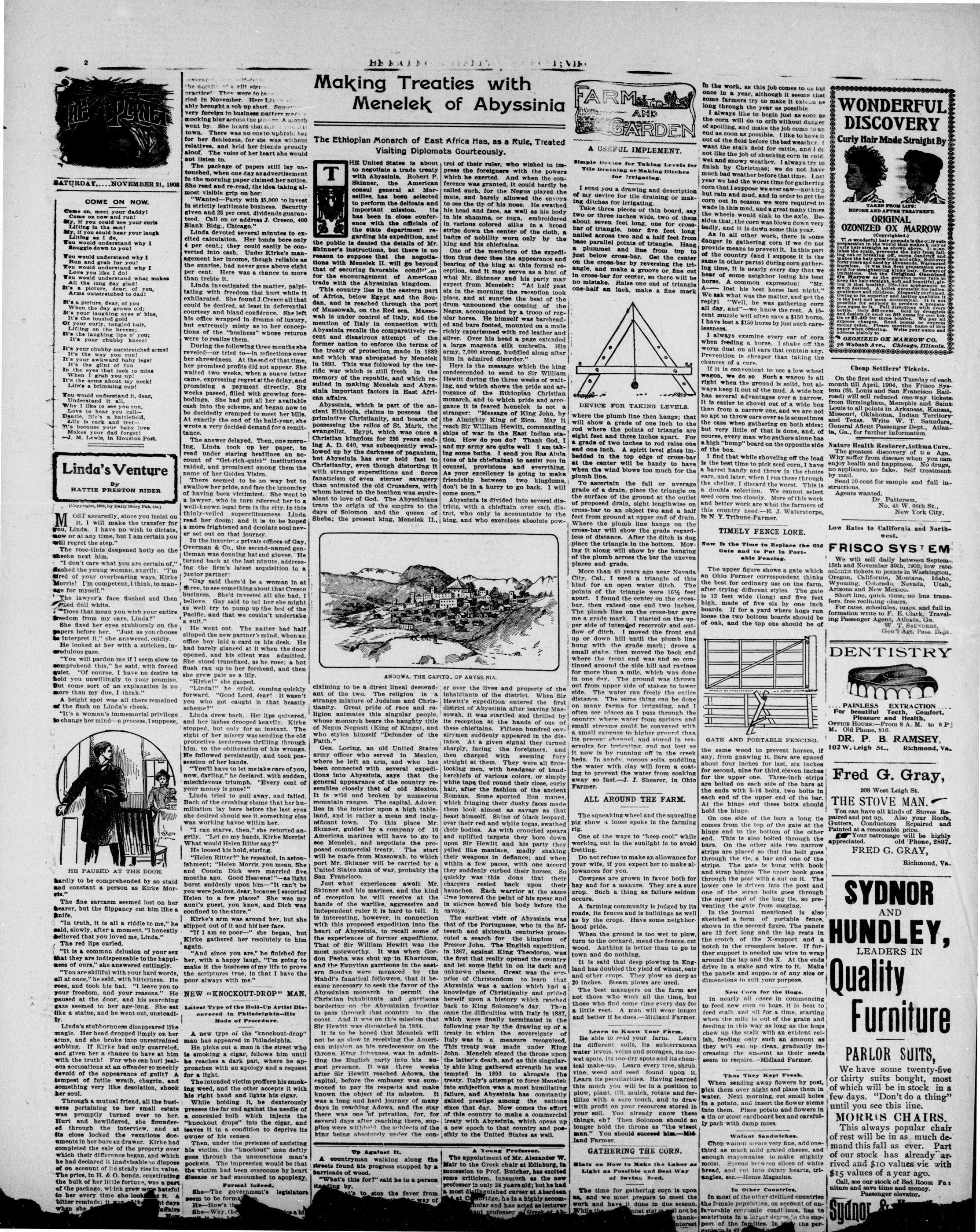
Making Treaties with Menelek of Abyssinia
The Ethiopian Monarch of East Africa Has, as a Rule, Treated Visiting Diplomats Gourteously.
the public is denied the details of Mr. Skinner's instructions, but there is no reason to suppose that the negotiations with Menelek II. will go beyond that of securing favorable conditions for the encouragement of American trade with the Abyssinian kingdom. This country lies in the eastern part of Africa, below Egypt and the Soudan, and is reached through the port of Massowah, on the Red sea. Massowah is under control of Italy, and the mention of Italy in connection with Abyssinia recalls the comparatively recent and disastrous attempt of the former nation to enforce the terms of the treaty of protection made in 1889 and which was abrogated by Menelek in 1883. This was followed by the terrific war which is still fresh in the memory of the republic, and which resulted in making Menelek and Abyssinia important factors in East African affairs.
Abyssinis, which is part of the ancient Ethiopia, claims to possess the primitive Christianity, and boasts of possessing the relics of St. Mark, the evangelist. Egypt, which was once a Christian kingdom for 295 years ending A. D. 640, was subsequently swallowed up by the darkness of paganism, but Abyssinis has ever held fast to Christianity, even though distorting it with strange superstitions and fierce fanaticism of even sterner savagery than animated the old Crusaders, with whom hatred to the heathen was equivalent to love of God. The Abyssinians trace the origin of the empire to the days of Solomon and the queen of Sheba; the present king, Menekel II.
claiming to be a direct lineal descendant of the two. The religion is a strange mixture of Judaism and Christianity. Great pride of race and religion animates this singular people, whose monarch bears the haughty title of Negus Negusti (King of Kings), and who styles himself "Defender of the Faith."
Gen. Loring, an old United States army officer who served in Mexico, where he left an arm, and who has been connected with several expeditions into Abyssinia, says that the general appearance of the country resembles closely that of old Mexico. It is wild and broken by numerous mountain ranges. The capital, Adow lies in the interior upon a high tableland, and is rather a mean and insignificant town. To this place Mr. Skinner, guided by a company of 16 American marines will have to go to see Menelek, and negotiate the proposed commercial treaty. The start will be made from Massowah, to which port Mr. Skinner will be carried by a United States man of war, probably the San Francisco.
Just what experiences awalt Mr. Skinner and his marines, and the kind of reception he will receive at the hands of the warlike, aggressive and independent ruler it is hard to tell. It is interesting, however, in connection with this proposed expedition into the heart of Abyssinia, to recall some of the experiences of former expeditions. That of Sir William Hewitt was the most noteworthy. It was when Gordon Pasha was shut up in Khartoum, and the Egnytian garrisons in the eastern Soudan were menaced by the Mahdil's fanatical followers, that it became necessary to seek the favor of the Abyssinian monarch to permit the Christian inhabitants and garrisons bordering on the Abyssinian frontier to pass through that country to the coast. And it was on this mission that Sir Hewitt was dispatched in 1884.
It is to be honed that Menelek will not be as slow in receiving the American mission as his predecessor on the throne. King Johannes, was in admitting the English party into his august presence. It was three weeks after Sir Hewitt reached Adowa, the capital, before the embassy was summoned to pay its respects and make known the object of its mission. It was a long and hard journey of many days in reaching Adowa, and the stay there was one of privation, for, for several days after reaching there, supplies were withheld, the subjects of the king being absolutely under the con-
A countryman walking along the streets found his progress stopped by a barricade of wood.
"What's this for?" said he to a person standing by.
overall the dignity of a ill slur practice! They were to be ried in November. Here Lily ably brought a sob up short. Some very foreign to business matters made mocking blur across the picture. A month went by. She heard that it had town. There was no one to upbrake her for her fickleness, for she was without relatives, and held her friends proudly aloof. The voice of her heart she would not listen to.
T
The package of papers still lay untouched, when one day an advertisement in the morning paper claimed her notice. She read and re-read, the idea taking almost visible grip on her:
"Wanted—Party with $5,000 to invest in strictly legitimate business. Security given and 25 per cent, dividends guaranteed. Call on or address J. Cresco, 400 Blank Bld., Chicago."
Linda devoted several minutes to excited calculation. Her bonds bore only 4 per cent; they could easily be converted into cash. Under Kirke's management her income, though reliable as the sunrise, had never gone above eight per cent. Here was a chance to more than treble it.
Linda investigated the matter, palpitating with freedom that hurt while it exhilarated. She found J. Cresco all that could be desired, at least in deferential courtesy and bland confidence. She left his office wrapped in dreams of luxury, but extremely misty as to her conceptions of the "business" whose returns were to realize them.
During the following three months she revealed—or tried to—In reflections over her shrewdness. At the end of that time, her promised profits did not appear. She waited two weeks, when a suave letter came, expressing regret at the delay, and promising a payment directly. Six weeks passed, filled with growing fore-bodings. She had put all her available cash into the scheme, and began now to be decidedly cramped to meet her bills. At exactly the end of the half-year, she wrote a very decided demand for a remittance.
The answer delayed. Then, one morning, Linda took up her paper, to read under staring headlines an account of "Get-rich-quick" institutions raided, and prominent among them the name of her Golden Vision.
There seemed to be no way but to swallow her pride, and face the ignominy of having been victimized. She went to a lawyer, who in turn referred her to a well-known legal firm in the city. In this thinly-velled supercelliousness Linda read her doom; and it is to be hoped a more frightened and desolate soul never set out on that journey.
In the luxurious private offices of Gay, Overman & Co., the second-named gentleman was donning hat and gloves. He turned back at the last minute, addressing the firm's latest acquisition in a junior partner:
"Gay said there'd be a woman in at three, to see something about that Cresco business. She'd invested all she had, I believe. Gay said to tell her she might as well try to pump up the bed of the Pacific, and that we couldn't undertake a suit."
He went out. The matter had half slipped the new partner's mind, when an office boy laid a card on his desk. He had barely glanced at it when the door opened, and his client was admitted. She stood transfixed, as he rose; a hot flush ran up to her forehead, and then she grew pale as a lily.
"Kirk!!" she gasped.
"Linda!" he cried, coming quickly forward. "Good Lord, dear! It wasn't you who got caught in that beastly scheme?"
Linda drew back. Her lips quivered, and her lashes drooped heavily. Kirke stopped, but only for an instant. The sight of her misery was sending the old protective tenderness thrilling through him, to the obliteration of his wrongs. He followed persistently, and took possession of her hands.
"You'll have to let metake care of you, now, darling," he declared, with sudden, mischievous triumph. "Every cent of your money is gone!" Linda tried to pull away, and failed. Back of the crushing shame that her humiliation lay bare before the last eyes she desired should see it, something else was working havoc within her.
"I can starve, then," she retorted angrily. "Let go my hands, Kirke Morris! What would Helen Ritter say?" He leaped in his hold, startling
"Helen Ritter?" he repeated, in astonishment; "Helen Morris, you mean. She and Cousin Dick were married five months ago. Good Heaven's!"—as light burst suddenly upon him—"It can't be you were jealous, dear, because I asscorted Helen to a few places? She was my aunt's guest, you know, and Dick was confined to the store."
Kirke's arm was around her, but she slipped out of it and hid her face.
"I If am so poor—" she began, but Kirke gathered her resolutely to him again.
"And since you are," he finished for her, with a happy laugh, "I'm going to make it the business of my life to prove the scriptures true, in that I have the poor always with me."
NEW "KNOCKOUT-DROP" MAN.
Latest Type of the Hold-Up Artist Discovered in Philadelphia-His Mode of Procedure.
A new type of the "knockout-drop" man has appeared in Philadelphia.
He picks out a man in the street who is smoking a cigar, follows him until he reaches a dark part, where he approaches with an apology and a request for a light.
The intended victim proffers his smoking weed, and the other accepts it with his right hand and lights his cigar.
While holding it, he dexterously presses the far end against the needle of a concealed bulb which injects the "knockout drops" into the cigar, and leaves it in a condition to deprive its owner of his senses.
Then, under the pretense of assisting his victim, the "knockout" man defily goes through the unconscious man's pockets. The impression would be that the victim had been overcome by heart disease or had succumbed to apoplexy.
HE KOUN
ties with
of Abyssinia
St Africa Has, as a Rule, Treated
ats Gourteously.
trol of their ruler, who wished to impress the foreigners with the powers which he exerted. And when the conference was granted, it could hardly be called such, for the Negus played the mute, and barely allowed the envoy to see the tip of his nose. He swathed his head and face, as well as his body in his shamma, or toga, embroidered in various colored silks in a broad stripe down the center of the cloth, a badge of nobility worn only by the king and his chieftains.
One of the members of the expedition thus desc ibes the appearance and bearing of the king at this formal reception, and it may serve as a hint of what Mr. Skinner and his party may expect from Menelek: "At half past six in the morning the reception took place, and at sunrise the beat of the drum announced the coming of the Negus, accompanied by a troop of regular horse. He himself was bareheaded and bare footed, mounted on a mule richly caparisoned with red leather and silver. Over his head a page extended a large magenta silk umbrella. His army, 7,000 strong, huddled along after him in admired disorder."
Here is the message which the king condescended to send to Sir William Hewitt during the three weeks of waiting, and which shows the pride and arrogance of the Ethiopian Christian monarch, and to which pride and arrogance it is feared hemelek is not a stranger: "Message of King John, by the Almighty King of Zion. May it reach Sir William Hewitt, commanding ships of war in the East Indian station. How do you do? Thank God, I and my army are quite well I am taking some baths. I send you Ras Alula (one of his chieftains) to assist you in counsel, provistons and everything. As your excellency is going to make friendship between two kingdoms, don't be in a hurry to go back. I will come soon." Abyssinia is divided into several districts, with a chieftain over each district, who only is accountable to the king, and who exercises absolute now.
POLLONA
ANDOWA, THE CAPITO, OF ABYSS NIA
er over the lives and property of the inhabitants of the district. When Sir Hewitt's expedition entered the first district of Abyssinia after leaving Massowah, it was startled and thrilled by its reception at the hands of one of these chieftains. Fifteen hundred cavalrymen suddenly appeared in the distance. At a given signal they turned sharply, facing the foreigners, and then charged with seeming fury straight at them. They were all fire-looking men, with headgear of handkerchiefs of various colors, or simply white tape tied round their close, curly hair, after the fashion of the ancient Romans. Some sported lion manes, which fringing their dusky faces made them look almost as savage as that beast himself. Skins of black leopard, over their red and white togas, swathed their bodies. As with crouched spears and uplifted targets they bore down upon Sir Hewitt and his party they yelled like maniacs, madly shaking their weapons in defiance; and when within a few paces, with one accord they suddenly curbed their horses. So quickly was this done that their chargers reeled back upon their haunches. Each warrior at the same time lowered the point of his spear and in silence bowed his body before the envoys.
The earliest visit of Abyssinia was that of the Portuguese, who in the fifteenth and sixteenth centuries prosecuted a search for the kingdom of Prester John. The English expedition, in 1867, against King Theodorus, was the first that really opened the country and let some light in on its dark and unknown places. Great was the surprise of Christendom to learn that Abyssinia was a nation which had a knowledge of Christianity and prided herself upon a history which reached back to King Solomon's day. Then came the difficulties with Italy in 1887, which were finally terminated in the following year by the drawing up of a treaty in which the sovereignty of Italy was in a measure recognized. This treaty was made under King John. Menelek sized the throne upon the latter's death, and as this singularly able king gathered strength he was tempted in 1893 to abrogate the treaty. Italy's attempt to force Menelek into subjection was a most humiliating failure, and Abyssinia has constantly gained prestige among the nations since that year. Now comes the effort of this country to make a commercial treaty with Abyssinia, which opens up a new epoch to that country and possibly to the United States as well.
A YOUNG PROFESSOR.
The appointment of Mr. Alexander W. Mair to the Greek chair at Edinburg, in succession to Prof. Butchor, has excited some criticism, insumuch as the new professor is only 28 years old; but he had a most distinguished career at Aberdeen at Cambridge, has a highly accom- scholar and has acted as lecturer
HE United States is about to negotiate a trade treaty with Abyssinia. Robert P. Skinner, the American consul general at Mar萨illes, has been selected to perform the delicate and important mission. He has been in close conference with the officials of the state department regarding his expedition. and
A Young Preferrer.
FARM
AND
GARDEN
A USEFUL IMPLEMENT.
Simple Device for Taking Levels for
Tile Draining or Making Ditches
for Irrigating.
I send you a drawing and description
of my device for tile draining or make-
ing ditches for irrigating.
Take three pieces of thin board, say two or three inches wide, two of them about seven feet long, one for cross-bar of triangle, near five feet long, nailed across two and a half feet from base parallel points of triangle. Hang a plummet and line from top to just below cross-bar. Get the center on the cross-bar by reversing the triangle, and make a groove or fine cut in cross-bar for center, so there will be no mistake. Raise one end of triangle one-half an inch, make a fine mark
DEVICE FOR TAKING LEVELS
where the plumb line then hangs; that will show a grade of one inch to the rod where the points of triangle are eight feet and three inches apart. For a grade of two inches to rod raise one end one inch. A spirit level glass imbedded in the top edge of cross-bar at the center will be handy to have when the wind blows too much for the plumb line.
To ascertain the fall or average grade of a drain, place the triangle on the surface of the ground at the outlet of proposed drain, sight lengthwise on cross-bar to an object two and a half feet from ground at upper end of drain. Where the plumb line hangs on the cross-bar will show the grade regardless of distance. After the ditch is dug place the triangle in the bottom. Moving it along will show by the hanging of the plumb across the bar the uneven places and grade.
More than 40 years ago near Nevada City, Cal. I used a triangle of this kind for an open water ditch. The points of the triangle were 16½ feet apart. I found the center on the cross-bar, then raised one end two inches. The plumb line on the cross-bar gave me a grade mark. I started on the upper side of intended reservoir and outflow of ditch. I moved the front end up or down hill until the plumb line hung with the grade mark; drove a small stake, then moved the back end where the front end was and so continued around the side hill and ravines for more than a mile, which was done in one day. The ground was thrown out from upper side of stakes to lower side. The water ran freely the entire distance. The same thing can be done on many farms for irrigating, and I often see places as I pass through the country where water from springs and small streams could be conceived with a small expense to higher ground than its present channel, and stored in reservoirs for irrigating, and not lost as it now is by running off in the creek beds. In sandy, porous soils, pudding the water with clay will form a coating to prevent the water from soaking away so fast.—J. J. Shearer, in Ohio Farmer.
ALL AROUND THE FARM.
The squeaking wheel and the squealing pig show a loose spoke in the farming rig.
One of the ways to "keep cool" while working out in the sunlight is to avoid fretting.
Do not refuse to make an allowance for your wife, if you expect her to make allowances for you.
Cowpeas are grown in favor both for hay and for a manure. They are a sure crop. Such a thing as failure seldom occurs.
A farming community is judged by its roads, its fences and is buildings as well as by the crops. Have some neighborhood pride.
When the ground is too wet to plow, turn to the orchard, mend the fences, cut wood. Anthing is better than to go to town and do nothing.
It is said that deep plowing in England has doubled the yield of wheat, oats and other crops. They plow as deep as 20 inches. Steam plows are used.
The best managers on the farm are not those who work all the time, but those who find some time every day for a little rest. A man will wear longer and better if he does.—Midland Farmer.
Learn to Know Your Farm.
Be able to read your farm. Learn its different soils, its subterranean water levels, veins and storage, its tow-wet spots, its too-dry spots and its chemical make-up. Learn every tree, shrub, vine, weed and seed found upon it. Learn its peculiarities. Having learned this much you will be in a position to plow, plant, till, mulch, rotate and fertilize with a sure touch, and to draw with profit on your resources stored in your soil. You already know these things, eh? Then Solomon should no longer hold the throne as "the wiser man." You should succeed him.—Midland Farmer.
GATHERING THE CORN.
Mints on How to Make the Labor as Light as Possible and Best Way of Saving Seed.
The time for gathering corn is upon us, and we must prepare to meet the work and have it done in due season. While the conditions most states will not be
In the work, as this job comes to us but once in a year, although it seems that some farmers try to make it extend as long through the year as possible.
I always like to begin just as soon as the corn will do to crib without danger of spoiling, and make the job come to an end as soon as possible. I like to have it out of the field before the bad weather. I want the stalk field for cattle, and I do not like the job of shucking corn in cold, wet and snowy weather. I always try to finish by Christmas; we do not have much bad weather before that time. Last year we had the worst time for gathering corn that I suppose we ever saw—nothing but rain and mud, and in order to get the corn out in season we were required to wade in this mud, and a great many times the wheels would sink to the axle. Besides that, the corn was blown down very badly, and it is down some this year.
As in all other work, there is some danger in gathering corn if we do not provide means to prevent it. In this part of the country (and I suppose it is the same in other parts) during corn gathering time, it is nearly every day that we hear of some neighbor losing his best horse. A common expression: "Mr. A—lost his best horse last night." We ask what was the matter, and get the reply: "Well, he was gathering corn all day, and—"we know the rest. A 15-cent muzzle will often save a $150 horse. I have lost a $150 horse by just such carelessness. I always examine every ear of corn when feeding a horse. I shake off the worm dust on all ears that contain any. Prevention is cheaper than taking the chances of a cure.
If it is convenient to use a low wheel wagon, we do so. Such a wagon is all right when the ground is solid, but always keep it out of the mud. A wide box has several advantages over a narrow. It is easier to shovel out of a wide box than from a narrow one, and we are not so apt to throw ears over as is sometimes the case when gathering on both sides; but very little of that is done, and, of course, every man who gathers alone has a high "bump" board on the opposite side of the box.
I find that while shovelling off the load is the best time to pick seed corn, I have a barrel handy and throw in the choice ears, and later, when I run these through the sheller, I discard the worst. This is a double selection. We cannot select seed corn too closely. More of this work and better work are what the farmers of this country need.—E. J. Waterstorpe, in N. Y. Tribune-Farmer
TIMELY FENCE LORE.
Now Is the Time to Replace the Old Gate and to Put In Portable Fencing.
The upper figure shows a gate which an Ohio Farmer correspondent thinks the best for ordinary use on the farm, after trying different styles. The gate is 12 feet wide (long) and five feet high, made of five six by one inch boards. If for a yard where hogs run loose the two bottom boards should be of oak, and the top one should be of
GATE AND PORTABLE FENCING.
the same wood to prevent horses, if any, from gnawing it. Bars are spaced about four inches for last, six inches for second, nine for third, eleven inches for the upper one. Three-inch strips are bolted on each side of the bars at the ends with 5-16 bolts, two bolts in each end of the upper end of the bar. At the hinge end these bolts should hold the hinge.
On one side of the bars a long tie comes from the top of the gate at the hinge end to the bottom of the other end. This is also bolted through the bars. On the other side two narrow strips are placed so that the bolt goes through the tie, a bar and one of the strips. The gate is hung with hook and strap hinges. The upper hook goes through the post with a nut on it. The lower one is driven into the post and one of the strap bolts goes through the upper end of the long tie, so preventing the gate from sagging.
In the journal mentioned is also sketched a form of portable fence, shown in the second figure. The panels are 12 feet long and the lap rests in the crotch of the X-support and a notch in the crosspiece below. If further support is needed use wire to wrap around the lap and the X. At the ends drive in a stake and wire to it. Make the panels and supports of any size or dimensions to suit your purpose.
New Corn for the Hogs
In nearly all cases in commencing to feed new corn to hogs, it is best to feed stalk and all for a time, starting when the milk is out of the grain and feeding in this way as long as the hogs chew up the stalk with an evident relish, feeding only such an amount as they will eat up clean, gradually increasing the amount as their needs seem to require.-Midland Farmer.
Thus They Kept Fresh.
When sending away flowers by post, pick them over night and place them in water. Next morning, cut small holes in a potato, and insert the flower stems into them. Place potato and flowers in a tin or stout cardboard box and carefully pack with damp moss.
Walnut Sandwiches
Chop walnut meats very fine, add one-third as much mild grated cheese, and enough mayonnaise to make slightly moist. Spread between slices of white bread, and cut into daly hearts, triangles, etc.—Home Magazine.
In Other Countries.
In most of the other civilized countries the female population, on account of unfavorable economic conditions, has to contribute in a larger degree to the support of the families. In many the per capita is 40.
```markdown
```
```markdown
```
It is wonderful hair pomade is the only safe preparation in the world that makes kary or oily hair soft. It lifts the scalp, prevents the hair from falliness and the scalp, curts dandruff and makes the hair hair grow longer. It provides forty years and used by thousands. Warranted for straightening kinky hair limitations. Get the Original Ozonized keep the hair straight, soft and beautiful, give much desired, soft-like appearance so much desired. Gentlemen and children. Elegantly perfumed. gentlemen and children. Elegantly perfumed. it is the best and most economical it is the best for anybody to produce a prepara- possible for anybody to produce a prepara- bottle. Only 50 cents. Sold by druggies and dealers or us 40 cents for one bottle express charges. Send postal or express message name of this paper when ordering. Write your name and address plainly to
OZONIZED OX MARROW CO.
76 Wabash Ave., Chicago, Illinois.
Cheap Settlers' Tickets.
On the first and third Tuesday of each month till April, 1904, the Frisco System (St. Louis and San Francisco Railroad) will sell reduced one-way tickets from Birmingham, Memphis and Saint Louis to all points in Arkansas, Kansas, Missouri, Oklahoma, Indian Territory and Texas, Write W. T. Saunders, General Affient Passenger Dept., Atlanta, Ga., for further information
Nature Health Restorer, Asthma Cure.
The greatest discovery of the Age. Why suffer from disease when you can enjoy health and happiness. No drugs, no appliance, no fake. Self treatment by mail.
Send 10 cent for sample and full instructions.
Agents wanted.
Dr. Patterson,
No. 45 W. 66th St.,
New York City.
Low Rates to California and North-west
FRISCO SYS EM
We will sell daily between Sept-
15th and November 30th, 1903, low rate
colonist tickets to points in Washington,
Oregon, California, Montana, Idaho,
Wyoming, Colorado, Nevada, Utah,
Arizona and New Mexico.
Short line, quick time, no bus trans-
forces, free parking.
For rates, schedules, maps, and full in
formation write to F. E. Clark, Traveling
Passenger Agent, Atlanta, Ga.
W. T. SAUNDERS,
Gen'l Act. Pass. Dent.
DENTISTRY
PAINLESS EXTRACTION
For beautiful Teeth, Comfort,
Pleasure and Health,
OFFICE HOURS--From 8 A.M. to 6 P.
M. Old Phone, 816.
DR. P. B. RAMSEY,
102 W. Leigh St., Richmond, Va.
Fred G. Gray,
Fred G. Gray,
THE STOVE MAN.
You can have all kinds of Stoves Repaired and put up. Also your Roofs, Gutters, Conductors Repaired and Painted at a reasonable price.
Your natronage will be highly appreciated. old Phone, 2807.
FRED G. GRAY,
Richmond, Va.
SYDNOR AND HUNDLEY, LEADERS IN Quality Furniture
PARLOR SUITS.
We have some twenty-five or thirty suits bought, most of which will be in stock in a few days. "Don't do a thing" until you see this line.
MORRIS CHAIRS.
This always popular chair of rest will be in as much demand this fall as ever. Part of our stock has already arrived and $10 values vie with $15 values of a year ago.
Call, see our stock of Bed Room. Furniture and save time and money. Passenger elevator
THE OTHER MAN
BY FREDERIC REDDALE
Copyright 1992 by J. P. Lippincott Company.
Five minutes after leaving Richard, as Kane was striding along Cornhill, he was overtaken by a shambling, breathless figure in rusty black, and to the whispered appeal— "Bister Kane, sir—just a minute, sir!" he turned his head and saw the cringing form of old Plish at his side, ducking and bowing with object servility. "Well, Moses, what is it?" inquired Kane, in a business-like tone, stopping short, and drawing to one side out of the way of the hurrying throng. With an eye to the main chance, and realizing that it would be good policy to keep on the right side of the ledger with so rich a man as Kane, Plish had instantly decided to let him know that Dysart had asked certain pertinent or impertinent questions at Ladysmith, and thus forestall any possible evil consequences to himself from his wagging tongue.
"Excuse me for troubling you, Bister Kane, but ven I see you longer 'tother vun,' pointing a dirty thumb over his shoulder. "I sees to myself, see
ERI
D
MATTE
"BISTER KANE, SIR-JUST A MINUTE, SIR."
I, 'Bister Kane might like to know that 'tother gent was makin' inkquiries about 'im.'"
"When was this, Moses?" asked Kane, coolly snipping the end off a cigar.
"Out yonder, a matter o' six months ago. It was jest arter he'd made that there strike o' his'n in the Karroo country."
"Just so," said Kane. "But you see, Moses, Mr. Dysart and I have become very good friends, and any information he is likely to want he'll come to me for. Thanks, all the same," and so saying he nodded jauntily to the little man and went on his way.
"Dash my vig, but e's a cool 'un,' said Moses Plish to himself as he watched the tall, well-clad figure of the eratshle adventurer disappear in the madding crowd. "Wonder if 'e knows that Cupples is in London, too!"
But despite his outward nonchalance Kane was inwardly perturbed at this chance encounter. That Moses Plish was in London had probably no significance. Whatever he might suspect, he had no absolute knowledge of that dark and bloody episode on the veldt—no one knew the truth save the two men implicated and since so strangely thrown together. And to only one of these was the whole truth known.
What was chiefly to be dreaded was that a new train of ideas might be set running in Dysart's mind. Kane feared lest a chance word should put him on the right scent, for even the dimmest suspicion would be disastrous now! However, the two men got through their luncheon as per appointment, and the subsequent return journey was made without any noticeable strain or change in their relations. Nor was the evening spent at Denecroft any different from the mary that had preceded it. All was apparently serene. Both Sir Arthur and Richard were ideal hosts, and Stella's good-night kiss was as sweet and trustful as ever.
But the day's happenings served to kindle afresh Kane's uneasy forebodings, and intensified his distaste and horror at the part he was playing. The kindness and cordiality with which he was received at Denecroft made his own conduct, past and present, all the blacker by contrast. That night the question occurred to him, what if Stella should discover the truth after they were married? She would scorn him with an unutterable scorn—not for his crime—he could fancy her forgiving that—but for his deceit and his false pretenses. That he had loved her and won her in ignorance of the identity of his victim would be no palliation of his after-enceance in keeping it secret. With such a nature as hers, in which pride of birth was blended with an almost slavish worship of truth and honor, there could be but one outcome: She would spurn him from her sight!
Again: Suppose Richard were to stumble on the truth, and tax him with his crime? What could he do but cower like a whipped cur? Rossiter Kane was no common coward, but the mere thought of such a possibility caused him the keenest shrinking and chagrin. Gradually, out of the turmoll of his thoughts, the conviction grew and took shape that his only hope of happiness lay in prompt confession and restitution—not an extorted avowal, but one made of his own free will, and while yet he held the reins in his own control.
Better to lose the girl now and re-in his own self-respect than marry her and be found out afterwards, foo in that event she would be lost to him beyond recall—of that he felt sure.
The gray dawn of winter was creeping in around the edges of the windowblinds ere he came to this conclusion, and then it was with a strange feeling of elation and exaltation that he threw himself on the bed and slept the first refreshing sleep that had come to him in weeks.
The succeeding day was Sunday. Kane had promised to meet Stella at afternoon service and walk home with her. This had been their weekly custom since the ball, and they both clearly prized this half-hour of sweet intercourse as they sauntered through the park.
On this, possibly their last day to together, Kane realized as he had never done before how inexpressibly indispensable she had become to him, and yet in that very fact he found strength for the coming ordeal, for with his customary quick decision he meant to get it over.
"You will probably find Sir Arthur and Rick in the library," she said, as they entered the hall at Denecroft, as yet unlighted save by the fitful blaze of a log fire.
"Will you join us there?" inquired Kane, solicitously, as he detained her by the hand.
"Certainly, if you wish it," she returned.
"I do wish it," was the reply. "I have something to say which I want you all to hear."
A now note in his voice arrested her attention, and she looked up at him in quick surprise. He drew her, all wrapped and bonneted as she was, into a little recess, and took her in his arms, imprinting on her lips a warm and passionate kiss.
"It may be for the last time, dearest," he whispered, "but do not judge me too harshly when you hear all."
"What is it?" she asked tremulously, her eyes large and luminous with tender interest and alarm. For answer he said:
"In a little while you will know," and led her to the foot of the stairs. Slowly she ascended as though oppressed by the weight of an impending disaster; at the turn she stopped and looked back at him where he stood watching her with passionate adoration, all his soul in his eyes. Then he turned his steps towards the library.
"Hullo, Kane!" exclaimed Richard, heartily, rising and flinging a book to the other end of the leather lounge on which he had been dozing. "Come in, man! You're just in time to keep us awake."
The baronet's greeting, if less vociferous, was none the less pleasant. "Where's Stella?" inquired Richard. "She will be here immediately," said Kane, and even as he spoke she entered the room.
"Ring for your candles, will you, Sis?" exclaimed Richard, "it gets dark so confoundedly early here."
Stella moved towards the bell, but Kane stayed her with a gesture.
"Not just yet, please, if I may interfere," he said. "I have something to tell you all—something that is not easy for me to say—and I think I can get along better by the fire-light."
There was a lifeless quality in his voice, and his usually velous tones were curiously muffled. Richard Dysart was as far from divining what was actually coming as either of the other listeners, yet he was conscious of a quickening thrill of expectancy, roused by Kane's words and manner, and he glanced at him keenly.
"One moment, Kane," he said; "am I concerned in the story?"
"You are!" was the answer, at which Richard drew a deep breath and settled back in his seat.
Stella moved to a place in the recess by the fireplace, where there was deep shadow; Sir Arthur and Richard sat on either side the blaze; Kane remained standing in the center, declining a proffered seat. All looked at him expectantly.
"Richard Dysart," he began in colorless tones, "nearly a year ago you were treacherously ambushed, shot and robbed on the banks of the Mooi river. We all know the pitiful story; no need to go over it again. The man who robbed you was then a poor outcast, down on his luck, a very lishmael, and it may be honestly asserted through no fault of his own. This man saw you, a perfect stranger, start on your prospecting trip into the Karroo country. He tracked you on horseback from day to day, camping within sight of your fire every night, sharing your hardships, starving when you went hungry, freezing through the long, dark nights because he dared not kindle a blaze which might have apprised you that you were watched. At first his only thought was to claim shares in whatever you might find. But when, ambushed in the tall grass, he saw you gather untold wealth, the demon of avarice took possession of him, and he determined to have the treasure, even if it came to the taking of life. You were nothing to him then; he simply saw in you one of an army of adventurers, many of whom would have served him the same way. He left you for dead, fled with his spoil to the coast, and thought that his secret was buried in the desert. He was rich, and he became richer; from that hour everything he touched turned to gold. But he had miscalculated the power of conscience, of remorse and—of love. Sir Arthur and Miss Dysart, I am the man who shot and robbed your brother!"
He ceased speaking and turned away. There was silence in the room, save for the dull snapping and flicker of the fire, while from the darkness came a woman's sobs, answered by a
deep groan of anguish from the bowed form of the man who had just signed his own death-warrant.
The two men, Sir Arthur and Richard, sat looking at Kane in dumb amaze. The former was the first to find his tongue, although usually the more unready of the brothers.
"This is a most extraordinary—er presume you are aware of the full import of what you have told us—and—er of the consequences," this last significantly.
The culprit bowed.
"Kane, old man," said Richard, "I'm unfeignedly sorry! I'd rather it had been any man but you. I won't say but what, since we saw old Plish yesterday, I've had certain misgivings, but I was unprepared for this."
"There was—there is—there can be no palliation or excuse," said Kane, lifting his head. "The guilty knowledge became more than I could carry after all your kindness and—" The sentence was unfinished, for his voice broke.
"I presume you realize that this ends everything, Mr. Kane," said Sir Arthur, with a wave of the hand to where Stella was sitting sobbing softly.
"God help me, I do!" was the reply wrung from the anguished spirit, "but my punishment is greater than I can bear!" and with these words he left the room, and the clang of the heavy outer door announced his departure to those within.
Stella broke down utterly then, and would not be comforted.
"Send for Marcia!" she waited, and, knowing nothing else to do, Rick set out across the park to beseach her to come to the motherless girl in her extremity.
"It is too dreadful, too horrible!" said Marcia, as they drove back after she had been made acquainted with Kane's confession. "Suppose he had killed you, as he meant to do, the wretch!" she panted. "I'll never forgive him—never!"
"Oh, I don't know," said Richard coolly. "He came mighty near it, but he just missed it, you see. If I'd caught him red-handed, or even three months ago, I expect I'd have been pretty hard on him too; but now, you see, it's different."
"I don't see," said Marcia vindictively.
"Walt till you meet Stella," said Rick significantly.
"She ought to hate him, too!" insisted Marcia.
"Well, I fancy she won't," was the quiet reply, arguing that Master Rick possessed rather more insight into the workings of the feminine mind than might have been expected.
Curiously enough, much of his own hot anger and indignation had left him, and he found himself looking at the matter from the position of an outsider or an onlocker. No doubt Stella would readily enough admit the enormity of Kane's offense, but Rick could see how it might appear to her as a mere episode in a daring and adventurous man's career. Then, too, the beggar had made a clean breast of it! However, Stella kept her room all the next day, and so no one knew what her feelings were.
CHAPTER XL
Kane went home to his solitary Cedars and began to put his affairs in order. First of all he made over to Richard Dysart the sum of £50,000 in checks and securities, the original proceeds of the sale of the diamonds of which he had been despoiled. Even this depletion of his fortune left Kane a rich man. In a few hours all was done, and he had even wired to engage passage
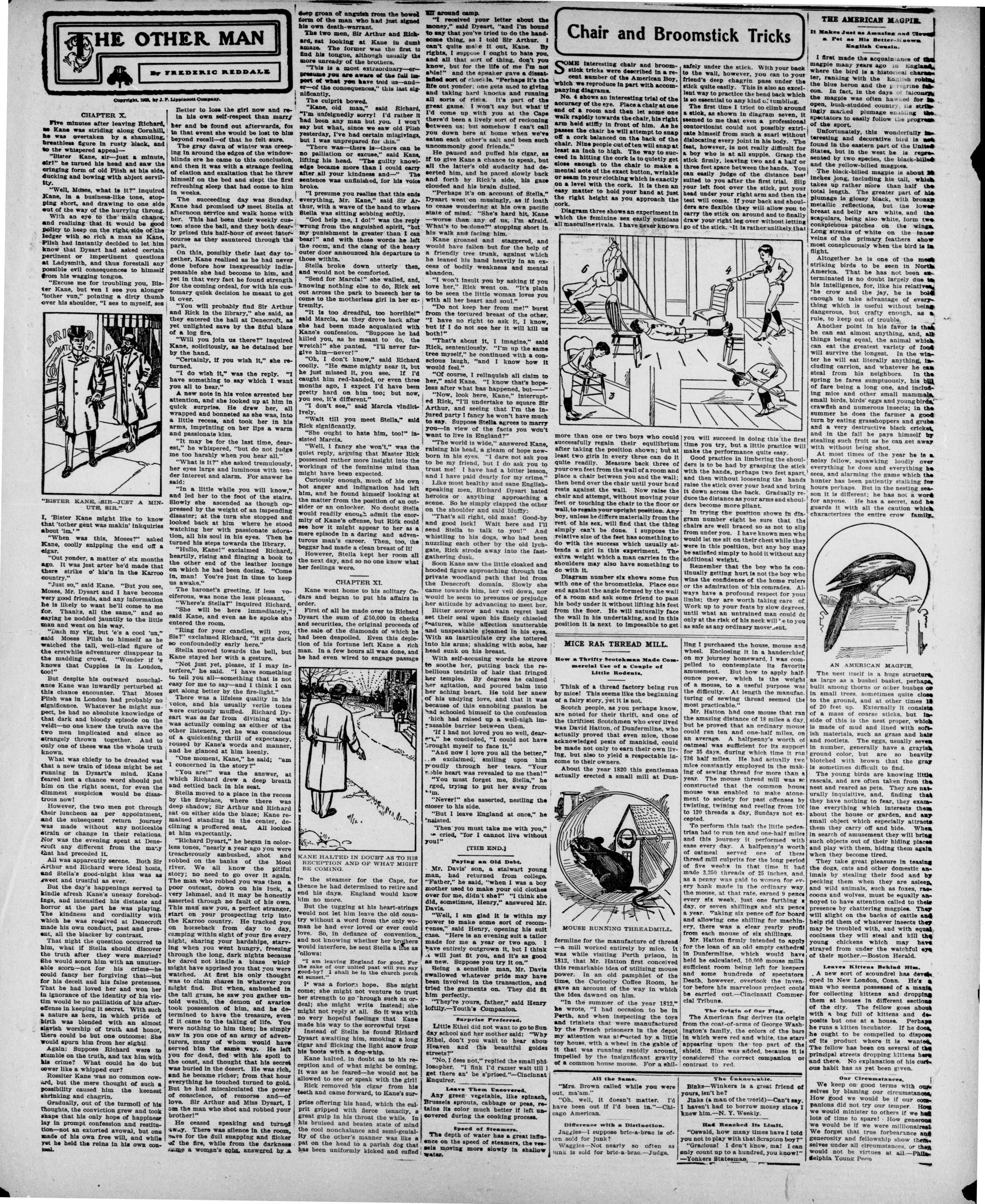
A man in a long coat walks down a winding road. He is facing away from the viewer, and his head is turned slightly to the right. The road is lined with trees and buildings, and there is a bright light in the distance. The sky is a light blue color with some clouds.
KANE HALTED IN DOUBT AS TO HIS RECEPTION AND OF WHAT MIGHT BE COMING.
KANE HALTED IN DOUBT AS TO HIS RECEPTION AND OF WHAT MIGHT BE COMING.
In the steamer for the Cape, for thence he had determined to retire and end his days. England would know him no more.
But the tugging at his heart-strings would not let him leave the old country without a word from the only woman he had ever loved or ever could love. So, in defiance of convention, and not knowing whether her brothers would interfere, he sent Stella a line as 'follows:
"I am leaving England for good. For the sake of our united past will you say good-by? I shall be in the church porch at sunset."
I was a forlorn hope. She might come; she might not venture to trust her strength to go 'through such an ordeal; she might write Instead; she might not reply at all. So it was with no very hopeful feelings that Kane made his way to the sorrowful tryst Instead of Stella he found Richard Dysart awaiting him, smoking a long cigar and flicking the light snow from his boots with a dog-whip. Kane halted, in doubt as to his reception and of what might be coming. It was as he feared—he would not be allowed to see or speak with the girl!
prise offering his hand, which the culprit gripped with fierce tenacity, a great gulp in his throat the while. In his bruised and beaten state of mind the cool nonchalance and semi-geniality of the other's manner was like a pat on the head to a pariah dog that has been uniformly kicked and cuffed
all around camp.
"I received your letter about the money," said Dysart, "and I'm bound to say that you've tried to do the hand-some thing, as I told Sir Arthur. I can't quite make it out, Kane. By rights, I suppose I ought to hate you, and all that sort of thing, don't you know, but for the life of me I'm not able!" and the speaker gave a dissatisfied sort of chuckle. "Perhaps it's the life out yonder; one gets used to giving and taking hard knocks and running all sorts of risks. It's part of the great game. I won't say but what if I'd come up with you at the Cape there'd been a lively sort of reckoning between us; but somehow I can't call you down here at home when we've eaten each other's salt and been such uncommonly good friends."
He paused and puffed his cigar, as if to give Kane a chance to speak, but all the latter's old audacity had deserted him, and he paaced slowly back and forth by Rick's side, his gaze clouded and his brain dulled.
"Perhaps it's on account of Stella," Dysart went on musingly, as if loath to cease wondering at his own pacific state of mind. "She's hard hit, Kane—worse than any of us, I'm afraid. What's to be done?" stopping short in his walk and facing him.
Kane groaned and staggered, and would have fallen but for the help of a friendly tree trunk, against which he leaned his hand heavily in an excess of bodily weakness and mental abandon.
"I won't insult you by asking if you love her," Rick went on. "It's plain to be seen the little woman loves you with all her heart and soul."
"Do not keep her from me!" burst from the tortured breast of the other. "I have no right to ask it, I know, but if I do not see her it will kill us both!" "That's about it, I imagine," said Rick, sententiously. "I'm up the same tree myself," he continued with a conscious laugh, "and I know how it would feel." "Of course, I relinquish all claim to her," said Kane. "I know that's hopeless after what has happened, but—" "Now, look here, Kane," interrupted Rick, "I'll undertake to square Sir Arthur, and seeing that I'm the injured party I fancy he won't have much to say. Suppose Stella agrees to marry you—in view of the facts you won't want to live in England?"
"The world is wide," answered Kane, raising his head, a gleam of hope newborn in his eyes. "I dare not ask you to be my friend, but I do ask you to trust me! I have had a bitter lesson, and I have paid dearly for my crime." Like most healthy and sane English-speaking men, Richard Dysart hated heroes or anything approaching a scene. So he simply clapped the other on the shoulder and said bluffy: "That's all right, old man! Good-by and good luck! Wait here and I'll send Stella to talk to you!" And whistling to his dogs, who had been nuzzling each other by the old lych-gate, Rick strode away into the fast-gathering dusk.
Soon Kane saw the little cloaked and hooded figure approaching through the private woodland path that led from the Dencroft domain. Slowly she came towards him, her veil down, nor would he seem to presume or prejudge her attitude by advancing to meet her.
Bitter sorrow and vain regret had set their seal upon his finely chiseled features, while affection unutterable and unspeakable gleamed in his eyes. With an inarticulate cry she toothed into his arms; shaking with sobs, her head sunk on his breast.
With self-accusing words he strove to soothe her, putting back the rebellious tendrils of hair that fringed her temples. By degrees he calmed her agitation, and poured balm into her aching heart. He told her anew of his undying love, and that it was because of this ennobling passion he had schooled himself to the confession which had raised up a well-nigh impassable barrier between them.
"If I had not loved you so well, dearer," he concluded, "I could not have brought myself to face it."
"And now I love you all the better,"
...exclaimed, smiling upon him
proudly through her tears. "Your
roble heart was revealed to me then!"
"You must forget me, Stella," he
urged, trying to put her away from
him.
"Never!" she asserted, nestling the
closer to his side.
"But I leave England at once," he
'nsisted.
"Then you must take me with you,"
'cried, "for I cannot live without
you!"
[THE END.]
Paying an Old Debt.
Mr. Davis' son, a stalwart young man, had returned from college. "Father," he said, "when I was a boy mother used to make your old clothes over for me, didn't she?" "I think she did, sometimes, Henry," answered Mr. Davis. "Well, I am glad it is within my power to make some sort of recompense," said Henry, opening his suit case. "Here is an evening suit a tailor made for me a year or two ago. I have entirely outgrown it, but I think it will just fit you, and it's as good as new. Suppose you try it on." Being a sensible man, Mr. Davis swallowed whatever pride may have been involved in the transaction, and tried the garments on. They did fit him perfectly. "They're yours, father," said Henry loftily. "Youth's Companion."
Surprise Preferred
Little Ethel did not want to go to Sun day school and her mother said: "Why Ethel, don't you want to hear about Heaven and the beautiful golden streets?"
"No, I dess not," replied the small philosopher. "I fink I'd razzer wait till I get there an' be s'prised."—Cincinnat Enquirer.
Leave Them Uncovered.
Any green vegetable, like spinach, Brussels sprouts, cabbage or peas, retains its color much better if left uncovered during the cooking process.
Speed of Steamers.
The depth of water has a great influence on the speed of steamers, the vessels moving more slowly in shallow water.
Chair and Broomstick Tricks
6
4
6
3
7
SOME interesting chair and broomstick tricks were described in a recent number of the American Boy, which we reproduce in part with accompanying diagrams.
No. 4 shows an interesting trial of the accuracy of the eye. Place a chair at one end of a room and then let some one walk rapidly towards the chair, his right arm held stiffly in front of him. As he passes the chair he will attempt to snap off a cork balanced on the back of the chair. Nine people out of ten will snap at least an inch to high. The way to succeed in hitting the cork is to quietly get close enough to the chair to make a mental note of the exact button, wrinkle or seam in your clothing which is exactly on a level with the cork. It is then an easy matter to hold your hand at just the right height as you approach the cork.
Diagram three shows an experiment in which the feminine sex easily outclass all masculine rivals. I have never known
6
3
more than one or two boys who could successfully regain their equilibrium after taking the position shown; but at least two girls in every three can do it quite readily. Measure back three of your own feet from the wall of a room and place a chair between you and the wall; then bend over the chair until your head rests against the wall. Now raise the chair and attempt, without moving your feet or touching the chair to the floor or wall, to regain your upright position. Any boy, unless he differs materially from the rest of his sex, will find that the thing simply can't be done. I suppose the relative size of the feet has something to do with the success which usually attends a girl in this experiment. The extra weight which a man carries in the shoulders may also have something to do with it.
Diagram number six shows some fun with one of the broomsticks. Place one end against the angle formed by the wall of a room and ask some friend to pass his body under it without lifting his feet from the floor. He will naturally face the wall in his undertaking, and in this position it is next to impossible to get
MICE RAN THREAD MILL
How a Thrifty Scotchman Made Commercial Use of a Couple of Little Rodents.
Think of a thread factory being run by mice! This seems like the beginning of a fairy story, yet it is not.
Scotch people, as you perhaps know, are noted for their thrift, and one of the thriftiest Scotchmen who ever lived was David Hatton, of Dunfermline, who actually proved that even mice, those acknowledged pests of mankind, could be made not only to earn their own living, but also to yield a respectable income to their owners.
About the year 1820 this gentleman actually erected a small mill at Dun-
MOUSE RUNNING THREADMILL
fermiline for the manufacture of thread—a mill worked entirely by mice. It was while visiting Perth prison, in 1812, that Mr. Hatton first conceived this remarkable idea of utilizing mouse power. In an old pamphlet of the time, the Curiosity Coffee Room, he gave an account of the way in which the idea dawned on him.
"In the summer of the year 1812," he wrote, "I had occasion to be in Perth, and when inspecting the toys and trinkets that were manufactured by the French prisoners in the depot my attention was attracted by a little toy house, with a wheel in the gable of it that was running rapidly around, impelled by the insignificant gravity of a common house mouse. For a shil-
All the Same.
"Mrs. Brown called while you were out. ma'am."
"Oh, well, it doesn't matter. I'd have been out if I'd been in"—Chicago American.
Waggles—Not nearly so often as junk is sold for bric-a-brac.—Judge.
safely under the stick. With your back to the wall, however, you can to your friend's deep chagrin pass under the stick quite easily. This is also an excellent way to practice the bend back which is so essential to any kind of tumbling. The first time I tried to climb around a stick, as shown in diagram seven, it seemed to me that even a professional contortionist could not possibly extricate himself from such a snarl without dislocating every joint in his body. The feat, however, is not really difficult for a boy who is at all supple. Grasp the stick firmly, leaving two and a half or three feet space between the hands. You can easily judge of the distance best suited to you after the first trial. Slip your left foot over the stick, put your head under your right arm and then the test will come. If your back and shoulders are flexible they will allow you to carry the stick on around and to finally draw your right leg over without letting go of the stick. It is rather unlikely that
4
8
you will succeed in doing this the first time you try, but a little practice will make the performance quite easy. Good practice in limbering the shoulders is to be bead by grasping the stick with the hands, perhaps two feet apart, and then without loosening the hands raise the stick over your head and bring it down across the back. Gradually reduce the distance as your arms and shoulders become more pliant. In trying the position shown in diagram number eight be sure that the chairs are well braced so as not to slip from under you. I have known men who would let me sit on their chest while they were in this position, but any boy may be satisfied simply to hold it without any additional weight.
Remember that the boy who is continually getting hurt is not the boy who wins the confidence of the home rulers or the admiration of his comrades. Always have a profound respect for your limbs; they are worth taking care of. Work up to your feats by slow degrees, until what an untrained man could do only at the risk of his neck will be to you as safe as any ordinary movement.
I purchased the house, mouse and wheel. Enclosing it in a handerchief, on my journey homeward, I was compelled to contemplate its favorite amusement. But how to apply half-ounce power, which is the weight of a mouse, to a useful purpose was the difficulty. At length the manfacturing of sewing thread seemed the most practicable."
Mr. Hatton had one mouse that ran the amazing distance of 18 miles a day, but he proved that an ordinary mouse could run ten and one-half miles, on an average. A halfpenny's worth of oatmeal was sufficient for its support for 35 days, during which it ran 736 half miles. He had actually two mice constantly employed in the making of sewing thread for more than a year. The mouse thread mill was constructed that the common house mouse was enabled to make atonement to society for past offences by twisting, twining and reeling from 100 to 120 threads a day, Sundays not excepted.
To perform this task the little pedestrian had to run ten and one-half miles and this journey it performed with ease every day. A halfpenny's worth of oatmeal served one of these thread mill culpits for the long period of five weeks in that time it had made 3.350 threads of 25 inches, and as a penny was paid to women for every hank made in the ordinary way the mouse, at that rate, earned 9 pence every six week, just one farthing a day, or seven shillings and six pence a year. Taking six pence off for board and allowing one shilling for machinery, there was a clear yearly profit from each mouse of six shillings.
Mr. Hatton firmly intended to apply for the loan of an old empty cathedral in Dunfermline, which would have held he calculated, 10,000 mouse mills sufficient room being left for keepers and some hundreds of spectators Death, however, overtook the inventor before his marvelous project could be carried out.—Cincinnati Commercial Tribune.
The Origin of Our Flag
The American flag derives its origin from the coat-of-arms of George Washington's family, the colors of the bars in which were red and white, the stars appearing upon the top part of the shield. Blue was added, because it is considered the correct companion or contrast to red.
The Unknowable.
Binks—Winkers is a great friend of yours, isn't he?
Jinks (a man of the world)—Can't say.
I haven't had to borrow money since I knew him.—N. Y. Weekly.
Had Reached Its Limit.
"Oswald, how many times have I told you not to play with that Scrapon boy!" "Gracious! I don't know, ma! I can only count up to a hundred, you know!" "Yonkers Statesman"
THE AMERICAN MAGPIE
It Makes Just as Amusing and Clever a Pet as His Better-Known English Cousin.
I first made the acquaintance of the magpie many years ago in England where the bird is a historical character, ranking with the English robin the blue heron and the peregrine falcon. In fact, in the days of falconry the magpie was often hawked for in open, bush-studded country, its stringly marked plumage enabling the spectators to easily follow the progress of the sport.
Unfortunately, this wonderfully interesting and decorative bird is found in the eastern part of the United States, but in the west he is represented by two species, the black-billed and the yellow-billed magpies.
The black-billed magpie is about 28 inches long, including his tail, which takes up rather more than half the total length. The greater part of his plumage is glossy black, with bronze metallic reflections, but the lower breast and belly are white, and the scapulars, being also white, form two conspicuous patches on the wings. Long streaks of white on the inner veins of the primary feathers show most conspicuously when the bird is in flight.
Altogether he is one of the most striking birds to be seen in North America. That he has not been terminated is no doubt largely due to his intelligence, for, like his relatives 'he crow and the jay, he is bold enough to take advantage of everything which is useful without being dangerous, but crafty enough, as a rule, to keep out of trouble.
Another point in his favor is that he can eat almost anything, and all things being equal, the animal which can eat the greatest variety of food will survive the longest. In the winter he will eat literally anything, including carrion, and whatever he can steal from his neighbors. In the spring he fares sumptuously, his bill of fare being a long one, and including mice and other small mammals, small birds, birds' eggs and young birds, crawfish and numerous insects; in the summer he does the farmer a good turn by eating grasshoppers and grubs and a very destructive black cricket, and in the fall he pays himself by stealing such fruit as he can get away with without being shot.
At most times of the year he is a noisy fellow, squawking loudly over everything he does and everything he sees, and alarming the game which the hunter has been patiently stalking for hours perhaps. But in the nesting season it is different; he has not a word for anyone. He has a secret, and he guards it with all the caution which characterizes the entire crow family.
AN AMERICAN MAGPIE
The nest itself is a huge structure as large as a bushel basket, perhaps built among thorns or other bushes or in small trees, sometimes quite close to the ground, and at other times 18 of 20 feet up. Externally it consists of a mass of coarse sticks, but inside of this is the nest proper, which is made of mud and lined with softish materials, such as grass and hair and rootlets. The eggs, usually seven in number, generally have a grayish ground color, but are so heavily blotched with brown that the gray is sometimes difficult to find.
The young birds are knowing little rascals, and are often taken from the nest and reared as pets. They are naturally inquisitive, and, finding that they have nothing to fear, they examine everything which interests them about the house or garden, and any small object which especially attracts them they carry off and hide. When in search of amusement they will bring such objects out of their hiding places and play with them, hiding them again when they become tired.
They take great pleasure in tasting the dogs, cats and other domestic animals by stealing their food and by pecking them when they are asleep, and wild animals, such as foxes, raccoons and wolves, must be equally annoyed to have attention called to their presence by chattering magpies. They will alight on the backs of cattle and help rid them of whatever insects they may be troubled with, and with equal coolness they will steal and kill the young chickens which may have strayed from under the watchful eye of their mother.—Boston Herald.
Leaves Kittens Behind Him
A new sort of scoundrel has developed in New London, Conn. He's a man who seems possessed of a mantle for collecting kittens and dropping them at houses in different sections of the city. The fellow goes about with a bag full of kittens and deposits but one at a house. Perhaps he runs a kitten incubator. If he does, he ought to be compelled to dispose of its product where it is wanted. The fellow has been on several of the principal streets dropping kittens here and there. No explanation of his curious habit has as yet been given.
Our Cirenmatancer
We keep on good terms with our selves by blaming our circumstances. How good we would be if our companies did not try our temper. How we would minister to others if we had lots of time to spare! How generous we would be if we were millionaire. We forget that true forbearance and generosity and fellowship show themselves under all circumstances, or they would not be virtues at all.—Philadelphia Young Peep.
THE PLANET
Published every Saturday by JOHN M. TOCHELL
In., at 311 North 4th Street, Richmond, Va.
All communications intended for publication should be sent so as to reach us by Wednesday.
TERMS IN ADVANCE.
One Copy, one year,
One Copy, eight months,
One Copy, six months,
One Copy, four months,
One Copy, three months,
Single Copy,
ADVERTISING RATES
for one inch, one insertion, . . . $ 50
for one inch, each subsequent insertion, . . . 25
for two inches, two months, . . . 4.00
for two inches, nine months, . . . 14.00
for two inches, twelve months, . . . 20.00
Marrige and Funeral Notices, . . . 5.00
Standing and Transitive Notices per line, . . . 10
POSTAGE STAMPS OF A HIGHER DE-
NOMINATION THAN TWO CENTS NOT
RECEIVED ON SUBSCRIPTIONS.
The PLANET is issued weekly. The subscrip-
tion price is $1.50 a year, in advance.
There are FOUR WAYS by which money can be sent by mail at our risk. In a Post Office Money Order or Bank Check or Draft, or an Examination of the other two, these are可 be procured, in a Registered Letter.
MONEY ORDERS—You can buy a Money Order at your Post Office, payable at the Richmond Post Office, and we will be responsible for its delivery.
EXPRESS MONEY ORDERS can be or can be at your office of the American Express, so, the United States Express Co., and the Web. For responsible for money sent by any of these companies. The Express Money Order is a safe and convenient way for forwarding money.
REGISTERED LETTER—If a Money Order is registered, your reach your Postmaster will Register the letter you wish to send us on payment of ten cents. Then, if the letter is lost or stolen, it may be you can send money in this manner at our risk.
We cannot be responsible for money sent in letters in any other way than one of the four ways mentioned above. If you send your money in another way, you must do it at your own risk.
REWENALS, ETC.--If you do not want THE PLANET continued for another year after your subscription has run out, you then notify us by e-mail. Care to discontinue it. The coursa has decided that subscribers to newspapers who do not order their paper discontinued at the expiration of time for which it has been paid are required to pay the payment of the subscription up to date when they order the paper discontinued.
COMMUNICATIONS--When writing to us renew your subscription or to discontinue our payment we should give your name and address in fax. Otherwise we cannot find your name on our books.
CHANGE OF ADDRESS--In order to change the address of a subscriber, we must be sent the former as well as the present address.
Entered in the Post Office at Richmond, Va., second class matter.
THE POST AND THE REFINED NEGRO.
THE Washington, D.C., POST in its issue of the 16th inst., places itself squarely upon an in pariplat form, co-ordinately approving the common-sense utterances of the Boston TRANSCRIPT and arguing that this is the proper solution of an embarrassing question. It then proceeds to wriggle off the very platform upon which it had but a few moments before located the most noticeable portion of its anatomy. It reminded us of the case of the colored brother whose attorney, at the onset of his argument, plainly cut facts to prove his innocence and at the conclusion of his peroration had asked the jury for his conviction on account of his guilt. The colored brother facetiously remarked that "he didn't want any more of them kind of 1 wyers." Under the caption of "Race Prejudice and Its Cause," the POST says.
"A very remarkable but most interesting letter in the Boston Transcript treats of the race question thus:
"Objectionable as is the obtrusive Negro, to intelligent Negroes no less than to white men, there seems to be but one way of even partly suppressing him (unless we take the backward step of placing greater restrictions upon the race), and that is by making a rigid distinction between the vicious Negro and the upright Negro; the refined Negro and the uncount Negro; the obstreperous Negro and the well bred Negro—by making it apparent to Negroes in general that any recognition of their race, whether social or otherwise, is a recognition solely of individual worth, and a rebuke to qualities which he and for his expressness should glay. Until the white man consents to make such distinctions among colored people, he may make up his mind to be confronted at every turn by the obtrusive Negro, pending the time when all distinctions because of race or color are relegated to the dark and dismal mast."
The Post remarks:
"Thus, Boston begins to realize what the South has understood from the beginning, and to call for an adjustment which the South has already adopted. The Post has preached this doctrine ever since there was a race issue. It is the only doctrine commended by experience and common sense. We have at all times and on all occasions contended that there should be no question of race, color, or previous condition in this republic."
Perhaps this editorial writer of the Post has done so, but from the tone of that journal, we have frequently come to the conclusion that when he was sleep "there are others."
It then deals in the following language, which will be enthusiastically approved by every lover of justice in the United States:
"There is a law abiding class and a criminal class. There are decent people and ruffians, gentle folks and hoodlans, property holders and thieves, workers and idlers, producers and drones, honest men and rascals. And in these divisions and subdivisions all races are represented. A good citizen, a murderer, a wage earner, a burglar—the enlightened, the industrious, the ignorant, the vicious—these 'com-
bine to constitute our population,
and society should treat them
according to their individual merits, without
the slightest reference to origin or
complexion. It is the only way."
Yes, it is the only way. But just
here, as though tiring of being good, i
proceed to wriggle and we are led to
wonder whether or not tiring of "being
good," he did not "sap seats with the
other fellow," for he braches off as
follows:
"Who raises the question of race and
color? If a Caucasian writes a poem of
real worth, do the whites rise up in
body and call heaven to witness the
glory and greatness of the race?"
Of course they do, for they have been in the business of self-glorification for the last nineteen hundred years, and they are not tired yet. They either point you to their writings or to their money, and our ears hum with the recital of their achievements both in "song and story."
"If a Caucasian commits a fiendish crime, and is punished in an equally fiendish way, do the whites rush together in the churches or assembly halls and make the wekin ring with passionate complaint that the race is persecuted?"
Oh, no, they don't have to do so. That is the pastime of the colored brother who can't help himself. The Caucasians proceed to hang those they wish to hang, and imprison those they wish to imprison, and to acquit those whom they wish to acquit.
The howling community howls because it cannot get what it wants. The baby yells for the paragoric, and the man for freedom. Give either the one or the other its desires and the curtain is rung down, the meeting closes and only the reverberations of past statements are heard in this land of ours. And again:
"It has been asserted—it is asserted every tour of the day—that there is a prejudice against the Negro. The so-called leaders of the blacks vociferate from stump and rostrum, and load the columns of the newspapers with their eternal agitation."
Well, you know there is a prejudice as much so as you know that there are vociferating blacks who have cause to vociferate. The white man has been in the business of "external agitation" ever since we can remember and he has not given up the business yet. "The Negro has found numerous precedents for his action, although his course has been in the law-abiding channels and in strict conformity with that section of the Constitution of the United States which says:
"Congress shall make no law * * abridging the freedom of speech, or of the press, or the right of the people peaceably to assemble, and to petition the government for a redress of grievances."
This is a right which the Colonists exercised and which the colored leaders are emphasizing.
The leaders of Panama were "eternally agitating" and our government has recognized the rights of the agitators and in defiance of all Republican precedents, save that alone of Hawaii, has placed upon its feet a new republic in this section of the world's dominions. Then why should not the Negroes agitate, when all history in recent years has been made by agitation?
The Post then enlarges upon an already exhausted proposition when it says:
"An illiterate and worthless Negro is disfranchised in some Southern State, and lo the race is outraged and insulted."
This is but half the truth, for the Post knows that the "injury of one shou'd be the concern of all."
It was reported not long since that a United States Vice Consul, who was not even an American, and couldn't speak chaste English had been fired upon in one of the Provinces of Turkey.
Sensational headlines appeared in all of the leading journals of this country, the Posr included, and repatriation and indemnity were commanded at the hands of the "unspeakable Turk." Was one proposition any more ridiculous than the other? If the whole American nation was to be plunged into a war with Turkey on account of a worthless foreigner, why should surprise be expressed because colored men feel indignant over the violation of the law in the case of a forsaken black of the Southland? We know that to permit these violations, without protest in one case is to invite them in many others.
As evidence of the truth of what we say, we have letter-carriers here who have passed the Civil Service examinations before the United States Civil Service Examiners, who are disfranchised, while ignorant white men are allowed to vote without let or hindrance. We have physicians of color here with their diplomas from reputable schools, who are barred from the right of franchise, and graduates in theology, men of influence, and filled with the Holy Ghost are disfranchised and told that their
kingdom is spiritual and they must exercise the right of franchise on the other side of the Master's Vineyard. It continues: "An ill-behaved black rowdy is refused admission to a theater or restaurant, or railway coach and at once the dignity and honor of the race have been assailed."
BIG FIRE AT LANGASTER, PA.
Flames For a Time Threatened Business Portion of the City
few days president. and ered address positions, ass tution was and that the sponsible for In addition company rec
The Post is unfair in its statements, for it knows that Prof. Booker T. WASHINGTON was refused service in a Pullman barber-shop and condemned from one section of the Southland to the other for taking lunch in the President's apartments at the White House. His position counted for naught and so far as his treatment was concerned, he might as well have been an ill-behaved black rowdy as to have been a well-behaved black Christian gentleman with a piece of sheepskin from HARVARD. The Post then indulges in the following exhibition of temper:
"It is all very well to prate about race hatred and race prejudice, and the rest if the mischievous and fool shonesse, but who is at the bottom of it if not the Negro himself?"
That's what the Wolf said to the Lamb in Aesop's Fables. Of course, the latter was drinking lown stream, but his begrudeful destroyer wanted an excuse for caining him and he charged him with muddying the stream, a feat impossible in view of their relative positions. So it is with the Negro haters. They blame the Negro for everything, even for being ostracised, abused, oppressed and lynched by the prejudiced white men.
The cause of the Negro's trouble is the white men, who misre resent and injure him. It continues:
"Our Boston writer declares that the obtusive, ill-mannered, and objectionable Negro is offensive to the intelligent Negro. If that be true, why does not the intelligent Negro assert himself; why does he forever take the part of the rowdy and the criminal, and denounce as cruelty the punishment inflicted on them? The whites do not identify themselves with crime and criminals. The Negroes do. There is your race issue, Mr. Boston man—what are you going to do about it?" The intelligent Negro does condemn the vicious classes. He is forward in visiting punishment upon them, know that this element injures others as well as themselves; but then, he insists that the white rowdy shall be punished with the black rowdy and that there shall be no line of demarcation or visitation of favors on account of the race, color or condition of the culprit.
When we condemn cruel and unusual punishments visited upon alleged Negro criminals, we are in line with presedents set by white men and in strict accord with the provisions of the United States Constitution itself.
Throughout the Southland, white men are set free for crimes, for which Negroes are punished. This vittates the principle of civil equality guaranteed by our laws and for which every patriotic citizen will ever contend. If this is "eternal agitation," Mr. Posr, make the most of it, for we shall sound thi slogan even until the end of the chapter.
"Right is right, as God is God, And right the day will win, To doubt would be disloyal, To falter would be sin."
SPLIT IN UNITED WORKMEN
Grand Lodge of Massachusetts Severs
Connection With Supreme Body.
Boston, Nov. '18.—As a result of a
movement started some years ago to
change the method of assessment
from the flat rate, a meeting of the
Grand Lodge of Massachusetts of the
Ancient Order of United Workmen
here ended in the adoption, after a
heated discussion, of a resolution to
sever all connection with the supreme
lodge of the United States.
In attendance at the meeting were
the following members of the board of
directors of the supreme lodge: William
H. Miller, supreme master workman,
St. Louis; William M. Marvis,
supreme foreman, Muscatine, Ia.; H.
B. Dickinson, supreme recorder, Buffalo, N. Y.; W. W. Wilson, chairman of financial committee, Detroit, and W. S. Robson, chairman of the laws.
Grand Master Workman Carlan A. Brown presided, and 199 Massachusetts, 26 New Hampshire and one Vermont lodge, which are all under the so-called Massachusetts jurisdiction, were represented.
Lord Kitchener Badly Injured.
Simla, India, Nov. 17.—Lord Kitchener, commander-in-chief of the British forces in India, has met with a serious accident while riding home alone from a country house near here. As he was passing through a tunnel his horse became frightened and collided with the walled side. One of Lord Kitchener's legs was broken in two places. Some time afterward coolies passing through the tunnel found the commander-in-chief lying there helpless and brought him to Simla. He is now reported to be doing well. The broken bones have been set, and after having passed a good night the general is in a cheerful mood.
Mad Dog Ran Amuck.
Harrisburg, Nov. 17.—A dog supposed to be mad ran amunck through the streets of Steelton and Lochiel, and is said to have bitten a dozen people, three in Lochiel and the others in Steelton and along the pike as it fled, pursued by a crowd. All of the victims were bitten in the hands and one will be sent to Pasteur Institute. Seven dogs bitten by the mad animal will be killed, but the rabid dog escaped in a swamp.
Killed Infant For Crying.
St. Joseph, Mo., Nov. 18.—Theodore Hayes, aged 15 years, is alleged to have fired a bullet into the brain of his 3-year-old brother because the infant annoyed him by crying. Preparations were made for the funeral before the coroner was notified by neighbors of the death. A bullet was removed from the brain of the infant
FIRE AT LANCASTER, PA.
Flames For a Time Threatened Business Portion of the City.
SAVED BY RAIN AND WIND
Lancaster, Pa., Nov. 18.—Fire that broke out in the basement of the Lancaster Silver Plate establishment destroyed that property, damaging a number of other buildings and for a time threatened destruction to the most important business section of the city. The flames spread with surprising rapidity. Only the fact that a drenching rain fell all day, soaking roofs and wood work, and a strong northwest wind that blew the flames away, prevented a catastrophe. At one time the Intelligencer, Morning News and Inquirer offices were on fire and in imminent danger. The total loss is about $70,000.
The Lancaster Silver Plate company manufactures umbrella and cane handles and is the largest concern of the kind in this country. It occupied two buildings in the heart of the city, fronting on Mifflin street and running well up to Centre Square, back of the Intelligencer and Morning News office buildings. Albert Rosenstein is president of the company. Their loss is about $35,000. H. Z. Rhoads and the Locher estate, owners of the buildings, lose $5000 and $10,000 respectively. On Mifflin street, opposite the Silver Plate works, is the plumbing establishment of H. & C. K. Will, in a four-story building owned by the Arnold estate. The flames leaped across the street and wrought $4000 damage to this property.
Other losers besides the owners of the newspaper offices, whose loss is small, are the Lancaster Carpet company, whose carpet cleanery was destroyed; Martin Rudy, whose automobile barn burned; William Roy, book binder, and A. K. Spurrier, whose office building caught fire several times. Sparks were carried by the wind for several blocks and wet roofs saved a number of properties.
The fire originated in the plating department of the silver plate establishment, and supposedly from spontaneous combustion of chemicals kept there.
TO TEST NEW JERSEY GAME LAW
ing Rabbitts Out of the State. Camden, N. J., Nov. 17. — Former Judge Carrow instituted certiorari proceedings in the Camden county court to compel Justice of the Peace Barr to show cause for fining Dr. J. H. O'Connor, of Philadelphia $143.40 for carrying game out of New Jersey. This case is practically a test of the constitutionality of the Jersey game law prohibiting gunners from carrying their prey out of the state. Dr. O'Connor was arrested in the ferry slip on Saturday by Ware and Post, game wardens, and seven rabbits having been found in a package he carried he was taken before Justice Barr and fined. The doctor immediately retained Judge Carrow to begin proceedings to recover the amount of his fines. He says that he was merely a common carrier and had been asked by Robert Delaney, an Atlantic City hotelkeeper, to carry the rabbits to a Mr. Murphy at the Hotel Scott in Philadelphia.
The outcome of the trial will be eagerly watched by sportsmen. The law in question has created a great deal of discussion in sporting circles, and its defeat would bring joy to the hearts of many an ardent gunner who has been obliged to eat or dispose of his luck in New Jersey.
Killed by His Own Gun:
Charleston, S. C., Nov. 17.—Colonel E. Miller Boykin, United States marshal for this state under Cleveland, and a leading banker of Camden, killed himself accidentally. After reaching home he picked up his gun, which had a complicated reversible action and went out to shoot a hawk. He was discovered an hour afterward lying dead, while his gun was found leaning on the opposite of the fence. It is supposed that as he started to climb the fence he set the gun over the fence, at the same time making a motion to get over himself when the gun was discharged, and such was the verdict of the coroner's jury.
Resigne Pulpit to Go Into Business.
Pittsburg, Pa., Nov. 16.—Rev. Richard S. Holmes, for 16 years pastor of the Shadyside Presbyterian Church, one of the leading churches of that denomination in the city, has tendered his resignation, to take effect June 30, 1904. Mr. Holmes will not discuss his action further than to say that he intends to go into business after his retirement from the pulpit. Rev. Holmes was prominently before the last general assembly as a candidate for moderator and for many years has stood high in church circles.
Lamp Explosion Caused $10,000 Fire
Lamp Explosion on Caused $10,000 Fire.
Altoona, Pa., Nov. 18.—The homes of William Young, Casper Hemmel, James Rockey and Louis Baker were entirely destroyed by fire, caused by a lamp exploding in Young's home. Fireman James Brown was perhaps fatally injured by a falling ladder. Loss, $10,000.
Awoke From Fifteen-Year Trance.
Berlin, Nov. 17.—Sesine Meyer, the girl who had lain since December 27, 1888, in a trance-like sleep, awoke in the village of Grambke, near Bremen, during the clanging of fire bells. Her case had long interested physicians, and had been the subject of various experiments.
RUN ON READING BANK
Depositors of Pennsylvania Trust Company Clamor For Their Money. Reading, Pa., Nov. 18.—For some unexplained cause a run was started on the Pennsylvania Trust company, especially in its savings department. Depositors were paid off at the rate of one a minute and a continuous line of people pressed forward for their money. The drain on its funds began
few days ago. George Brooke, the president, and several directors delivered addresses to the institution depositors, assuring them that the institution was in the soundest condition and that the directors were fully responsible for the safety of their money. In addition to the funds on hand, the company received a shipment of $200,000 additional. The officers ascribe the efforts to break the credit of the institution to malicious persons.
In order to allay the impending run the company published a statement which covers a period of nine years. During that time the assets have increased from $896,858.90 to $2,782,281.32, the deposits from $376,555.53 to $1,770,851.86, and the capital, surplus and undivided profits from $322,655.43 to $521,460.67, an increase in the latter of $198,805.24.
The Reading Clearing House, composed of all the city's monied institutions, met and decided to extend the Pennsylvania Trust company all financial assistance needed.
A WEEK'S NEWS CONDENSED.
Thursday, November 12.
The report that J. P. Morgan would retire from business has been officially denied in New York.
Francis J. Torrence, of Allegheny, has been re-elected president of the Pennsylvania Board of Charities.
The navy department has ordered the Lancaster in commission at League island navy yard as a receiving ship.
Amour & Co.'s elevator, at Savannah, Ill., together with 100,000 bushels of grain, was destroyed by fire. Loss, $150,000.
While horseback riding at Memphis, Tenn., Miss Douglass Calhoun, prominent in society and wealthy, was thrown from the horse in front of a trolley car and killed.
Friday, November 13.
Fire that started in a dry goods store destroyed the business portion of Albia, Ia. Loss, $250,000. In a collision of freight trains near New Hope, Ky., six trainmen were killed and another fatally injured. Louis J. Rothstein was convicted in New York of swindling Forstman & Co. out of $28,000 on a fraudulent order for clothing. Henry Klein and Frank Gray, of Minneapolis, were drowned in Lake Eddy by the overturning of their boat while hunting. Judge W. R. Day, president of the McKinley National Memorial Association, has called a meeting at Washington, D. C., November 19. Designs will be viewed and discussed.
Saturday, November 14
August Solid, 14 years old, of Menominee, Mich., shot and killed his cousin, Joseph Allison, during a quarrel.
The engineer was killed and four passenger injured, two fatally, by the derailing of a Pennsylvania train near Buffalo, N. Y.
The Cuban government has decided not to recognize the new Republic of Panama until other Latin-American governments do.
An explosion of natural gas at Marlon, Ind., wrecked the home of Benjamin Hight and terribly burned the five occupants.
The secretary of the treasury received from an unknown person in Brooklyn a conscience contribution of $107.50, and from Trenton, N. J. $20.
Monday, November 16.
Admiral Dewey has returned to Washington from an inspection trip to Annapolis, Md., and Newport News, Va.
Three robbers locked up the town watchman at Mapleton, Ia., and took $20,000 from the safe of the State Bank.
Wilbert Cobbs was struck and fatally hurt by a hose cart while the latter was on its way to a fire at Williamsport, Pa.
Twenty boot and shoe factories at Quebec, Que., have closed down on account of a strike and over 6000 employees are idle.
One man had his head blown off and two men were fatally hurt at La Porte, Ind., by the explosion of a boiler running a corn shredder.
Tuesday, November 17.
The transport Logan has arrived at San Francisco from Manila, with 28 officers and 265 men of the 15th cavalry.
Matthew Nelson, after a quarrel with his sweetheart, Tillie Moore, shot and killed her on the streets of Bloomington, Ill., and then killed himself.
A dynamite explosion on the stock farm of Dr. J. B. Hartman, near Columbus, O., killed four men instantly and injured several others. They were blasting stumps.
The remains of Mrs. Eliabeth K. Monroe, widow of James Monroe, fifth president of the United States, were exhumed at Leesburg, Va., and taken to Richmond to be re-interred in Hollywood cemetery.
Wednesday, November 18.
A copper deposit, rich in quality and of immense extent, has been found near Carney, Mich.
Robbers blew open the safe in the First National Bank of Lyons, Neb., and secured over $2000.
Over a foot of snow has fallen at Calumet, Mich., and telegraph and railroad service is impaired.
The 17th annual convention of the Association of American Agricultural Colleges and Experiment Stations was held at Washington, D. C.
Mrs. Frank Downing, a bride, jumped into the river at Minot, N. D., to rescue her sister, who had broken through the ice, and both of them were drowned.
Might Be Worse.
Maud—You won't think so much of Jack, perhaps, when I tell you that I borrowed his knife the other day to sharpen a lead pencil with, and found he had been using it to cut plug tobacco.
Irene—Well, that shows he doesn't bite the stuff off with his teeth, you spiteful thing—Chicago Tribune.
Quite So.
"Who are those young people in that box?" asked the man in the parquet.
"The ideal it's a regular box of matches, isn't it?"-Philadelphia Press.
Place your order with us this week, we give you pure goods and save you money.
Lent It to Dan.
Secretary of War Root, on the day he hailed for England to act as a member of the Alaska boundary commission, told a story of Daniel Webster's boyhood, "Little Dan and his younger brother," said Mr. Root, "had each been given some money. They started out gleefully, and it was evening before they got back home, Well, Dan," said the senior Webster, what did you do with your money? Spent it, "the boy answered, sturdily. And how about you? What did you do with your money?" the father asked the younger brother. "I lent it to Dan," was the reply."
No Decision of Character
Mrs. Myles—How is your new girl getting along?
Mrs. Styles—Well, the trouble is she doesn't know when to say no.
"Iindeed!"
"Only yesterday that horrid Mrs. Gadd called while I was up in my room, and asked if I was in, and the maid didn't have sense enough to say no!"—Yonkers Statesman.
An Epitaph.
A fisherman rests in this place;
No more you'll see his freckled face.
He lied on earth, but had to quit.
And now he's lying under it.
—Yonkers Stateman.
ABOVE SUSPICION.
The Fluffy One—Your husband doesn't drink, does he?
The Demure One—Oh,my,no! He has no bad habits at all. But I wish that I could cure him of his fondness for cloves.—Boston Globe
What Mary Had.
Mary had a little lamb.
Likewise an oyster stew.
Salad, cake, a piece of pie
And a bottle of pau brew—
Then a few hours later
She had a doctor too.
-Chicago Daily News.
Suspicion.
"I am a little bit afraid of her," sald
Miss Cayenne.
"She has wonderful tact." "Yes. She must know everything that could possibly annoy one. Otherwise she couldn't possibly be so skillful in avoiding all disagreeable subjects."—Washington Star.
A. Call:
Mr. Peevy—It sez here our minister has received a call from a wealthier church.
Mrs. Peevy—My land! Does it say he'll take it?
Mr. Peevy—Oh, yes. He sez that, bein' as money is the root of all evil, there is more need of his services in the wealthier parish.—Judge.
Sympathy.
"Please, sir," begged the tramp, "I haven't had anything to eat since I left my mother's door."
"Neither have I." said the man with the woman's club wife, surreptitiously shuffling him a five.—Cincinnati Commercial-Tribune.
Classified.
"Every man has some fad," said the quiet man. "Mine is minding my own business."
"Ah, I see," joined the philosophical person. "You are one of those monopolists we read so much about."—Chicago Daily News.
Pa's Opinion.
Little Willie—Say, pa, this paper tells about a man who paraded his misfortunes. How can a man do that?
Pa—Well, he might do it by escorting his wife, her mother and her two malden sisters to church, my son—Chicago Daily News.
Unimpressed.
"I would lay the world at your feet."
WOULD YOU SAVE
ON A DOLLAR
THEN BUY Y
Reformer
A FRESH STOCK OF
LOW P
Best Rice at lb.....7c
Good Lard " 3 lbs.....25c
Md Ch Tomatoes 3 lbs 3 cans.....25c
Royal Gloss Lump Starch at.....4c
Americaa granulated Sugar at.....5c
Choice small Hams at.....9c
Reformer's Patent Flour, sack.....28c
Pure Water Ground Meal, perpk.....19c
Place your
this week, we
goods and save y
REFORMER
PHONE, 1299.
said the extravagant youth.
"My dear sir," answered the haughty girl, "it is there already. I don't quite see why you should assume credit for the law of gravitation."—Washington Stan.
The Trouble.
"So they have separated after all. Why, I once heard them swear that they would live on bread, cheese and kisses" "Yes, but the bread was half baked, the cheese was too mild, and the kisses too few."—Brooklyn Life.
Had Thought It Out.
First Tramp—I wonder why it is that poor folks is always more willing to help us than rich folks? Second Tramp—People that don't mind givin' things away is the ones that stay poor—N. Y. Weekly.
A Man of Sorrows.
Young Wife—How fortunate I am
possessing a husband who always stays
at home in the evening!
Bosom Friend—Yes; your husband
never was much addicted to pleasure.
Tit-Bits.
You Bet They Don't.
He—There is one thing in particular
I like about stinders.
She—And what is that?
He—They never bore a fellow by telling him how they used to do this and that before he was born—Tit-Bits.
Had a Limit.
"What would become of you, hubby if you lost me?"
"I should go crazy, dear."
"Would you marry again?"
"O, no! I shouldn't be so crazy that."—Filipende Blatter
A Look Ahead
Popley—I should say! I hope some day to have the pleasure of telling some foreign duke or count that he can't have her.—Philadelphia Press.
He Doesn't Strike
"Well, I've noticed that the contented man doesn't often get ahead in this world."—Chicago Post.
A Good Pair.
"We get along excellently together," he explained. "You see, he never borrows anything but trouble, and that's all ever loan."—Chicago Post.
"I GROW HAIR ON BALD HEADS."
A Famous Doctor-Chemist Has Discovered a Secret Compound That Quickly Grows Hair on Any Bald Head.
He Sends Free Trial Package by Mail to All Who Write.
After half a century spent in the laboratory crowned with high honors for his many work-famous discoveries, the accompanied physician
The Above Illustration Plainly Shows What
This Great Discovery Has Done—Twill
Do the Same for You—Will You
Do it?
chemist at the head of the great Altenheim Medical Dispensary has just made the start-up announcement, accompanied by absurdity that after expiring, he marvels and stand dumfounded that he has actually produced a compound that grows hair with the aid of an enzyme, taking years to complete, he has it last reached the goal of his ambition, that after expiring, taking years to complete, there are none which cannot be cured by this remarkable remedy. The record of the cures of cancer, the revivals and the not for the high standing and the physician and the convincing testimony of thousands of citizens all over the country it would seem
There can be no doubt of the doctor's earnestness in making his claims, nor can his cures man or child to take his or anyone else word for it, but he stands ready and willing to send free trial packages of his great hair restorative 2-cent stamp to prepay postage. In a single night it has startled hair to growing on heads for years. It has stopped falling hair in one hour, and it has stopped hair in another condition, a sex or sex. Old man and young man and children all have profited by the use of this great new discovery. If you have a hair, eyebrows or eyelashes that hair, eyebrows or eyelashes are thin or short, write Altenhien Medical Dispensary, 537 Fosse standing, Cincinnati Ohio, enclosing a 2-cent package in a short time you will be entirely restored.
SAVE FORTY CENTS
AR?
YOUR GROCERIES OF
rs' Store.
GOODS ON HAND AT
PRICES.
Best No. 1 Country Butter per lb. .220
8 Bars Good Laundry Soap. .250
Large ½ gal Jar Pickle. .150
Baking Powder per can. .40
New Maccaroni per pkg. .50
New Canned Peaches 3 cans at. .250
Evaporated Peaches 3 cans. .250
N. C, Olipped Herrings per doz. .100
order with us
give you pure
you money.
R'S STORE,
6TH and CLAY, STS.
THE PLANET
SATURDAY..... NOVEMBER 21, 1908
POULTRY AND BEES
HALF A CENTURY OLD.
Rhode Island Goose Has Been the
Pet of a Rhode Island Farm
for 51 Years.
Priscilla is a goose, and she's proud of the fact and takes great delight in her age. More than half a century old, she is the property of Thomas R. Drowne, of Foster, R. I., who marked her fifty-first birthday not long ago, with a unique entertainment. Fifty-one guests were present. The refreshments were frozen pudding in the shape of Priscilla, little candy geese and gooslings of angel cake. Priscilla strutted around from guest to guest arching her neck inquisitively. In 1852 Priscilla was born. Her "hatchday" is established beyond dis
GOOSE FIFTY YEARS OLD
pute, for she burst her shell on the same day that a baby girl arrived in the Drowne family. Priscilla was batched when geese were good property. She was one of a brood of three, the others being a goose and a gander, brought into the world beneath the warm feathers of a hen. The three became known as "Aunt Sarah's cade geese," the adjective indicating that they were raised by hand. Priscilla grew up into a handsome gray bird of the old-fashioned New England type, shorter of neck and leg than the geese of to-day, when goose culture has produced many varieties, but sturdy and amiable. When she reached maturity she was plucked for her down, and this operation was repeated for 45 years.
She learned by experience just what to do when picking time came and would settle down in the picker's lap without a movement or struggle while the feathers were being removed. A few years ago Mr. Drowne ceased to pluck Priscilla's feathers, preferring that she retain all her strength and live as long as possible. She now possesses as elegant a covering as any goose in the country, her feathering being a pure white and very smooth and even.
She has witnessed the decline of the goose industry unmoved, attending all the time her own duties, bringing up a flock now and then and laying eggs until within about five years ago. Her brother and sister passed into the goose hereafter a few years ago, and Mr. Drowne got another goose and gander to keep Priscilla from feeling lonesome. The three may be seen any day on the Foster farm.
Ullike some geese, Priscilla is amiable and of equable temper. How long she will give it is impossible to say, but to all appearances she is as strong, active and healthy now as in her salad days, two score years ago.—N. Y. Herald.
POULTRY YARD POINTERS
Market the roosters as fast as they are large enough. Wherever you are or whatever you are at, keep a few hens.
Ducking broody hens merely shows that you need a ducking, too. Spend very little time in doctoring, or trying to doctor, slick hens and chickens. A feed of whole dats in the evening will answer for grain for the hens during the hot weather. There is no wild breed of fowls to which the Cochin or Brahma can be traced. The game cock seems to be descended from the Cingales Jungle fowl. Cropbound is the result of overfeed and underexercise. Mild cases will yield to teaspoonful doses of castor oil. Severe cases call for cutting open the crop and removing the undigested contents.
Diarrhea in fowls is often caused by the dropping being left under the roost until they are damp and sometimes wet, worse than damp, and the poor hens breathe it all night long. It poisons their blood and dysentery follows.—Midland Farmer.
Hens Need Lots of Dust
Dust for the entire tree is essential. Put boxes of fine, dry, dewy road dust where the fowls can "barble" in it. Sprinkle it free, on grasses, on floors, on droppings. Combine it in abundance. Remember that the leathered biddies can't be "real clean" unless they have lots of "nice clean dirt" in which to bathe and wash and cool and toss and tumble and kick and swamp. Remem-
ber the horrid scourge of lice, which pester the fowls unmercifully in hot weather. Dust is one of the things the lice don't like and the hens know it. Give the hens dust, and they will do the rest.—Midland Farmer.
VARIETY OF MORALS.
Contained in This Story of a Poultryman Who Thought He Was Wiser Than Providence.
Once upon a time a farmer had a hen that laid a golden egg every day. The farmer chuckled as he witnessed the daily increase in the visible supply of gold. But he was not satisfied.
"That durn hen works only ten minutes a day. If she cackled less, spent less time scratching for worms and kept to a continual performance of laying down gold, I would soon be the whole thing in the millionaire line and would make the United States Steel company's income look like a deficit. I'll fix her."
So he bought barrels of the kind of patent food which is guaranteed to "make hens lay," anchored the hen to the nest, and put the food within easy reach. "Now, get busy," he said, as he went away to dream of automobiles and luxuries.
But the hen grew fat and lazy and with much grooming and travail managed to accomplish just one egg a week. Her embonpoint increased, she suffered from gout and double chin, finally she gave up the ghost. The farmer's dream was ended.
Moral: When you have a good thing, don't try to goooder it. An egg in the nest is worth two in the hen. A live worm is better for a hen (or human) than a peck of prepared food, if the worm has to be scratched for. And don't dream.—Kevstone.
HINTS FOR BEEKEEPERS
How to Construct a Really Useful and Valuable Bee, Drone and Queen Sifter.
The bee, drone and queen sifter I wish to describe has been used by the inventor, Mr. Hannemann, of Brazil, in some form or other for a great many years. The way I have constructed it is this: A light open box, the size of the hive body, was covered at the bottom with a sheet of queen-excluding zinc. A cover was hinged to this box, and also covered by the same material. This device comes handy many times when unexpectedly a swarm is found hanging in a tree. Many, who do not wish to increase their colonies any more, may sometimes be puzzled to know what to do with such a swarm. They might wish to return it. Particu-
IMPROVED BEE SIFTER. larly in case of late swarms, buck-wheat swarms, etc., such as would not be able to fix up for winter in good shape, it is always best to return them.
I have come home occasionally from the work in an outyard and found a swarm hanging on a bush, although I practice clipping. In such a case I would at once proceed to shake the cluster of bees into my sifter, and shake and shake until all the beers are in the air except the imprisoned drones and queen or queens. Of course, the bees would soon go back to their old home, and could be located.
The bee-keeper, says Gleanings in Bee Culture, will find this sifter convenient to use at other times. The occasions will present themselves sooner or later, and I need not say any more about it.
Linseed Meal for Poultry
Linseed meal is an excellent addition to the general variety of foods for poultry, as it is highly nitrogenous, and it is much superior to cotton-seed meal, a the seeds from which it is made are rily matured, which is not the case with the ground cotton seed. Linseed meal may be fed at all seasons. Even when grain is allowed it will pay to feed linseed meal, and when given linseed meal the hens will lay more eggs. It is rich in the essential elements of growth and production than many other concentrated foods, and greatly enriches the manure. About one gill of linseed meal may be added to every quart of ground grain used. The linseed meal is rich in mineral and nitrogenous materials, and serves to balance the grain, the mixture with half a pound of ground meat making one of the best egg-producing foods. It should not be used oftener than once a day—Farm and Fireside.
Rats in Poultry Houses
Rats in Poultry Houses.
If the poultry house is in such condition as to allow rats to run under the floor, the farmer may as well give up the poultry business. They are worse than any disease the fowls may have. When the house is built it is very easy to put wire netting, such as is used for the small chicks, under the floors. If you have not done this, another easy way to keep out rats is to put in a cement floor. It may cost a little more than fixing up the wooden floor, but it is safe against rats, and a wooden floor is not. If wire mesh is laid in with the cement when the floor is laid it will be all the better.
Farmer's Right to Game.
If a farmer feed a potato plant, a hen or a cow on his own land the proceeds from these things should belong to him. No stranger has a right to come on his farm and dig the potatoes, milk the cow or shoot the hen. Now, when a farmer feeds a flock of quail or a partridge or a rabbit on the same farm has he not, in justice, an equal right to these animals? Why should a "sportsman" be glorified for shooting my game while a prowler goes to jail for robbing a hen roost?—Rural New Yorker.
Where the Swiss Excel.
Swiss chocolate is exported to almost every country in the world, in spite of the fact that all the raw materials, including sugar, are being imported.
THE RICHMOND PLANET. RICHMOND VIRGINIA.
Famous Chicago Professor Makes a Startling Discovery of a Magic Eye Lotion That Cures all Sore Eyes and Has Restored the Sight to Hundreds of People.
His Grateful Patrons Tell of Almost Miraculous Cures of Cataracts, Graumatized Lids, Wild Hairs, Ulcers, Weak, Watery Eyes and All Eye Diseases.
He Gives His Marvelous Medicine Free to All Who Write to Him.
People need no longer suffer from sore or wee eyes or pay an enormous price for special treatment. Surely there is a cure, if they will use the magic remedy that has been discovered by the famous Professor Schleier. We do believe that such a remedy has ever been offered to a certain person as this marvelous eye remedy. People who have
PROF, HERMAN T. SCHLEGEL, THE FAMOUS CHICAGO EYE EXPERT.
been nearly blind for years from cataracts, growth and scoms over their eyes, now see perfectly with only a few weeks' use of this wonderful remedy. Preachers, teachers, doctors, lawyers and students who have suffered for years of weak or sore eyes are not as well by this treatment as quickly. It really seems that there is not a disease or weakness of the eyes that this remedy fails to cure. It has been given to the most rigid test and has cured many cases that has been declared hopeless and unpleasable. It will do you good to read the great letters from the quickly. It really seems that the discoverer is glad to send them to anyone who is reliable and sincere in their search for a cure for their eye trouble. He is also glad to send a free sample to any worthy person who will send their name and address to the school. It is not a problem to Prof. Herman T. Schlegel, 205 Mackinow Bridge, Chicago. If you want some cheap eye wash this will perhaps not interest you, but if you are tired of trying all the trash that has been fested on the suffering public for the past year, you must be really wish to cure your eyes, one quikly, safely, and you can stay cured, you will send for this trial treatment at once, for this treatment will cure you, no matter how many remedies or doctors have failed.
Partially Successful.
"Mercy!!" exclaims Mrs. Wunder. "The paper tells of a woman who tried to kill herself by drinking a bottle of furniture-polish."
"Kill her?" asks Mr. Wunder.
"No; but it came near it."
"Huh! Only got an interior finish."—Judge.
Tender One Preferred.
Brannigan—The doocher told me to get a porous plaster for me stomach.
Druggist—Yes, sir; what sort do you want?
Brannigan—"Tis little I care what sort it is so long as 'tis easily digested.—Catholic Standard and Times.
Very Remarkable
"Excuse me, sir. I seem to have met you before. Are you not a relative of Mr. Dan Briggs?"
"No, madam; I am Mr. Dan Briggs himself."
"Ah, then, that explains the remarkable resemblance."—Judge.
How It Is Done:
Nephew (who takes his uncle from the country into a restaurant)—Look, uncle, I press this button and order dinner!
Uncle—Well, what then?
Nephew—Then you press the button and pay the bill.—Tit-Bits.
A Starfling Change.
Miss Reader—How strange it would be if fashion should go back to the old time brass knockers, instead of electric bells.
Mr. Sardonique—It would seem strange. The knockers always work.—N. Y. Weekly.
Victim.
The Visitor—Why are you here, my misguided friend?
The Prisoner—I'm the victim of the unlucky number, 13.
"Indeed; how's that?"
"Twelve jurors and one judge."—Sporting Times.
"I must say," remarked the physician, "your husband is in a bad way. Any arrangements you may want to make—" "Oh, doctor," she cried, "I could never think of marrying again."—N. Y. Sun.
One of Earth's Sorrows.
Of all the woes 'midst which we walk, One of the worst is this 'un. Most everyone wants to talk And no one wants to listen.
—Washington Star.
A PLACE TO AVOID.
A
Mrs. Lakeside—What a nest of human misery Canada must be!
Mr. L—In what way?
Mrs. L—The paper says that in 20 years the courts there have granted only 116 divorces—N. Y. Weekly.
W. H. H.
Wood and Coal, Cigars
AT THE LOWEST M
YOU CAN SAVE MONEY B
ALL GOODS DELIVER
TELEPHONE
A. C. BOOKER
501 WEBSTER ST
GOAL, Cigars and T
LOWEST MARKET
VE MONEY BY GIVING
OS DELIVERED TO
EPHONE 1607
OOKER,
WEBSTER ST. RICHM
AT THE LOWEST MARKET PRICES.
YOU CAN SAVE MONEY BY GIVING ME A CALL
ALL GOODS DELIVERED TO YOU FREE.
MANHATTAN
Money received on deposit amounts above $1.00 which rent Money Loaned on Satisfaction Business Accounts Handle Amounts of ten cents and
This establishment is fitted up in the white vanit, burlar-proof steel chest, elec-ience for safety and the accommodation of For all information concerning Stock Cashier.
Banking Hours have been arranged firing people as follows: 9 A. M. to 4 P. M. close Saturday at 3 P. M. and open again P. M. Call by as you come from work.
OFFICIO
JOHN MITCHELL, JR., President.
THOS. H. WV.
BOARD OF I
REV. W. F. GRAHAM, D. D., JNO.
E. R. JEFFERSON H. F. JONATHAN,
J. C. FARLEY.
received on deposit and insured
$1.00 which remains 60 days
dued on Satisfactory Secur-
tory Accounts Handled Promptly
at ten cents and upwards re-
sults it fitted up in the most improv-
able steel chest, electric lights and
the accommodation of the public.
In concerning Stocks, Deposits, I
have been arranged for the special
9 A. M. to 4 P. M. Saturdays, 9
9 M. and open again at 5 P. M.,
come from work.
Amounts of ten cents and upwards received on deposit This establishment is fitted up in the most improved style, having a large white vault, burlar-proof steel chest, electric lights and every modern convenience for safety and the accommodation of the public.
For all information concerning Stocks, Deposits, Loans, etc., apply to the Cashier.
Banking Hours have been arranged for the special convenience of the working people as follows: 9 A. M. to 4 P. M. Saturday, 9 A. M. to 3 P. . We close Saturday at 3 P. M. and open again at 5 P. M., remaining open until 7 P. M. Call by as you come from work.
OFFICERS:
HR., President. H. F. JON
THOS. H. WYATT, Cashier
BOARD OF DIRECTORS:
HAM, D. D., JNO. R. CHILES,
H. F. JONATHAN, THOMAS
D. FARLEY. JNO. T. T
JOHN MITCHELL, JR., President. H. F. JONATHAN, Vice-President THOS. H. WYATT, Cashier. BOARD OF DIRECTORS:
E. A. WASHINGTON, R. W. WHITING,
JOHN MITOHELL, JR. FREC
SOUTHERN A
OF V
HOME OFFICE -- 504 N.
One of the strongest and pro-
fit Insurance Companies in
afford to be out of it and sh
when our agents call on you
HONESTY THE BEST POLICY
OFFICERS A
A. WASHINGTON, PRESIDENT; EDW
WALTER E. BAK
REV. SIDNEY P
B. L. JORDAN,
JAMES T. CARTER,
THOS. M. CRUMP, SECRETAR
TRADE M
THE ON
MADAME ALLEN'S
FOR THE HAIR
ZACOLORE
W
CINTY
MADAME
— TWENTIETH CENTURY
The treatment of the hair is a subje
GROWER acts on the glands of the hair,
all kinds of scalp trouble and dandruff, ma-
quality. It is not a hair Straightener. P.
MADAME ALLEN'S-Twentieth
Brings beauty out of ugliness, makes
baby skin. Free from injurious chemicals.
(AGENTS WANTED.) PR
MADAME ALLEN
PHONE, 577.
A. D. P
THE FUNERAL DIRECTOR, EM
All orders promptly filled at short not
rented for meetings and nice entertainment
conveniences. Large picnic or band wagon
but first-class carriages, buggies, etc.
supplies.
212 EAST LEI
EERN AID
OF VIRGINIA
E -- 504 N. 2nd St.
longest and promptest pay
Companies in the State.
It of it and should not not
ants call on you.
THE BEST POLICY is "OU
OFFICERS AND BOARD:
N, PRESIDENT; EDWARD STEWARD
WALTER E. BAKER, TREASURE
REV. SIDNEY E. STANTON,
LUMP, SECRETARY & GENERAL
TRADE MARK
THE ONLY
ME ALLEN'S REMED
FOR THE HAIR, SKIN
22 COLORED WOMAN
G IN THIS COUNTRY
MADAME ALLEN'S
THIRD CENTURY HAIR
The hair is a subject that should
glands of the hair, stops the hair
le and dandruff, makes the hair lo
air Straightener. PRICE, 30C PE
MADAME ALLEN'S- Twentieth Century
of ugliness, makes the skin four
injurious chemicals. Remember to
NCED.) PRICE, 250
MADAME ALLEN, P. O., Box,
SOUTHERN AIO SOCIETY
One of the strongest and promptest paying Sick Benefit Insurance Companies in the State. You cannot afford to be out of it and should not hesitate to join when our agents call on you.
A. WASHINGTON, PRESIDENT; EDWARD STEWARD, VICE-PRESIDENT;
WALTER E. BAKER, TREASURER;
B. L. JORDAN
TRADE MARK
THE ONLY
MADAME ALLEN'S REMEDIES
FOR THE HAIR, SKIN, ETC.
COLORED WOMAN
IN THIS COUNTRY
HN 19
GLOVER
CARL
CURE
SAM
1200
FREES
BESHER
TWENTIETH CENTURY HAIR-GROWER
The treatment of the hair is a subject that should interest everyone. My GROWER acts on the glands of the hair, stops the hair from a falling out, cures all kinds of scalp trouble and dandruff, makes the hair long, wavy, and a good quality. It is not a hair Straightener. PRICE. 30C PER. JAR.
MADAME ALLEN
MADAME ALLEN'S-Twentieth Century-FACE BLEACHER.
Brings beauty out of niginess, makes the skin four shades lighter, soft like baby skin. Free from injurious chemicals. Remember the Name, Price, & Place.
(AGENTS WANTED.) PRICE, 25C PER BOTTLE.
MADAME ALLEN P.O. BOX 1000
D. PRIC
DIRECTOR, EMBALMER
ply filled at short notice by telegram
and nice entertainments. Plenty of
picnic or band wagons for hire at re-
gges, buggies, etc. Keeps constant
EAST LEIGH ST
A. D. PRICE,
All orders promptly filled at short notice by telegraph or telephone. Hall rented for meetings and nice entertainments. Plenty of room with all necessary conveniences. Large picnic or band wagons for hire at reasonable rates and nothing but first-class carriages, buggies, etc. Keeps constantly on hand fine Funera Supplies.
212 EAST LEIGH STREET.
[Residence Next Door.]
OPEN ALL DAY & NIGHT--Man on Duty All Night
Booker'S Market
501 Webster St. A FULL LINE OF FINE GROCERIES AND FRESH MEATS & VEGETABLES
igars and Tobacco.
ST MARKET PRICES.
KEY BY GIVING ME A CALL.
LIVERED TO YOU FREE.
ONE 1307
KER, Prop.
R ST. RICHMOND, VA.
Mechanics'
Saving Bank
OF RICHMOND, VA
511 North Third Street.
Capital, $25,000.
a deposit and interest paid on all
which remains 60 days and over.
satisfactory Security.
Handled Promptly
ands upwards received on deposit
up in the most improved style, having a large
cost, electric lights and every modern conven-
dation of the public.
ing Stocks, Deposits, Loans, etc., apply to the
changed for the special convenience of the work-
4 P. M. Saturdays, 9 A. M. to 3 P. We
en again at 5 P. M., remaining open until 7
work.
ent. H. P. JONATHAN, Vice-President.
H. WYATT, Cashier.
D OF DIRECTORS:
JNO. R. CHILES, B. P. VANDERVALL,
NATHAN, THOMAS SMITH D. J. CHAVERS,
JNO. T. TAYLOR,
HITING, WILLIAM CUSTALO, J. J. CARTER.
THOMAS M. CRUMP, SEC.
AIO SOCIETY
OF VIRGINIA
104 N. 20d St. Richmond, Va.
and promptest paying Sick Bene-
ness in the State. You cannot
and should not hesitate to join
on you.
POLICY is "OUR MOTTO"
ERS AND BOARD:
ST; EDWARD STEWARD, VICE-PRESIDENT;
E. BAKER, TREASURER;
HIDNEY B. STANTON, HENRY B. BURWELL
A. D. PRICE.
PRETARY & GENERAL MANAGER.
ME ALLEN'S
CENTURY HAIR--GROWER | —
a subject that should interest everyone. My
he hair, stops the hair fro a falling out, cures
ruff, makes the hair long, wavy, and a good
mer. PRICE, 30C PER JAR.
twentieth Century—FACE BLEACHER.
makes the skin four shades lighter, soft like
emicals. Remember the Name, Price, & Place.
PRICE, 25C PER BOTTLE.
ALLEN, P. O., Box, 458 Lexington, Va.
RICHMOND, VA.
PRICE,
R, EMBALMER AND LIVERYMAN
short notice by telegraph or telephone. Hall
tainments Plenty of room with all necesar-
d wagons for hire at reasonable rates and noth-
s, etc. Keeps constantly on hand fine Funer
LEIGH STREET.
New Games
A FREE game inside each package of
Lion Coffee
A New Venture—Patronize Them.
The first millinery store in this city owned and operated by colored people was established on the 1st day of Oct., 1903, by a number of our enterprising pele at No.528 East Broad Street—up st rs on the second floor over the colored dry goods store.
We cordially invite our ladies and friends to give us at least a part of their business in our efforts to establish a business wherein we can give employment to a limited number of our girls, especially since we can furnish them with the best of goods and the latest styles and at the lowest prices. Call and use us before purchasing elsewhere, as we guarantee satisfaction.
Very respectfully,
THE RICHMOND MILLINERY Co.
tinlov29sic
Low Winter Tourist Rates via Seaboad Air Line Ry.
Seaboard Air Line Railway announces special winter tourist rates to all of the principal points in Florida and the Southwest. Tickets on sale daily until April 30th, good returning until May 31st, 1904. Drawing-room Pullman Cars on all through trains; Dining Car service south of Hamlet, Information as to rates, tickets, etc., cheerfully furnished on application to the undersigned. H. S. J.
Special Land Buyers' Excursions
Will run to the new lands of Greer County, Oklahoma, and other sections of the great Southwest in November and December, via the Frisco system.
Are you looking for rich and fertile farming lands in the Southwest which you can buy for from one-fourth to one-tenth the cost of lands of the East and North. They produce as much acre for acre. Here is a chance to better your condition and add a liberal amount to your pocket book.
For full particulars and special railroad rates apply at once to R. S. Lemon, Secretary Frisco System Immigration Bureau, St. Louis, Mo.
Winter Tourist Excursion Rates Via the Southern Railway.
Beginning with October 15th, 1993 and continuing until April 30th, 1994, the Southern Railway will have on sale excursion tickets to many points in the South and South-west, at greatly reduced rates. Frequent and convenient schedules; Through Pullman and Thoroughfare cars, buing car service of the highest class on all through trains. For details, apply to agents. C. W. Westbury, D. P. A., Richmond, Va.
HUNTING AND FISHING IN THE SOUTH TO BE HAD IN
GONZALES
The Greatest Clairvoyant &
Fortune Teller the World
Has Ever Known.
No other section offers to sportsmen such inducements and such variety of Game. Special attention given hunting parties.
Send four cents postage to S. H. Hardwick, General Passenger Agent, Washington, D. C., for copy of Hunting and Fishing Book.
ALPHEUS SCOTT,
OHURCH HILL
Open Day and Night. Office and Ware rooms 3006 P St., Church Hill Orders By Telegraph and Telephone promptly attended to. All business confidential. Old Phone No. 3183.
W. I. JO
FUNERAL DIRECTOR
Office & Warerooms, 207 N
HACKS F
Orders by Telephone or Tele
pers and Entertainment
Old 'Phone, 686. Residence
JOHNSON,
DIRECTOR AND EMBALMER.
Ims, 207 N. Foushee St. Corner Broad.
BACKS FOR HIRE:
Phone or Telegraph filled. Wedding, Sup
entertainments promptly attended.
Residence in Building, New Phone, 48.
KNIGHTS OF COLUMBUS OF THE WORLD
W. I. JOHNSON. FUNERAL DIRECTOR AND EMBALMER.
Office & Warerooms, 207 N. Foushee St. Corner Broad. HACKS FOR HIRE: Orders by Telephone or Telegraph filled. Wedding, Suppers and Entertainments promptly attended. Old 'Phone, 686. Residence in Building, New Phone, 48.
KNIGHTS OF COLUMBUS OF THE WORLD
TO WHOM IT MAY CONCERN:
This organization has been chartered and legally
stituted under the laws and statute of the state of New
York, for the purpose of uniting together all acceptable
men on the Broad Bases of Charity—Beneficial and
the Social and Moral condition of humanity.
y and uniform ranks will secure for this organization
all sacred institutions of modern events, a grand oppo-
peties wanted in all sections of the country to organi-
ly address,
ALLEN Supreme voyager,
W. 37th Street, New York City.
This organization has been chartered and legally situated under the laws and statute of the state of New York, for the purpose of uniting together all acceptable men on the Broad Bases of Charity—Beneficial and
Fraternaland to promote the Social and
Its two distinct military and uniform
place in the front ranks of all sacred instu-
tuit, for active men. Deputies wanted
lodge
Kindly address,
G. W. ALLEN So
846 W. 87th Street
Praeternan and to promote the social and moral condition of humanity. Its two distinct military and uniform ranks will secure for this organization a place in the front ranks of all sacred institutions of modern events, a grand opportunity, for active men. Deputies wanted in all sections of the country to organize lodges. Kindly address,
G. W. ALLEN Supreme voyager,
846 W. 87th Street, New York City.
60 different games.
FIRST MILLINERY STORE.
Some of the best
FUNERAL DIRECTOR
THE KING OF THE ROMANS
Carrying Pullman Sleepers, Cafe Cars
(a la carte) and Chair Cars (seats free)
Electric Lighted Throughout
BETWEEN
Birmingham, Memphis and Kansas' City
AND TO ALL POINTS IN
Texas, Oklahoma and Indian Territories
THE ONLY THROUGH SLEEPING CAR
BETWEEN THE SOUTHEAST AND
KANSAS CITY
Descriptive literature, tickets
ranged and through reservations n.
upon application to
W. T. SAUNDERS, GEN'L AGT. PASS. DEP.
OR
F. E. CLARK, TRAV. PASS. AGT., ATLANTA.
W. T. SAUNDERS
Gen'l Agent Passsnger Department
ATLANTA, GA.
THE
Wonder of the World
YOUR LIFE READ FROM THE
CRADLE TO THE GRAVE
For the benefit of those who wish to save their life read by the world's most lifelong reader, one that can tell you all that you wish to know, give you luck, change your life from evil to good, reunite the separated, restore a lost love, draw to you your sweetheart, husband or wife, make people do as you wish them
Now if you want to find out what your future life will be and what your past has been, and want to have it changed from evil to good, send at once to this wonderful medium.
Send lock of hair, date of your birth and 25 cents in silver, and receive your life written from cradle to grave. Do not send postage stamps. Address all letters
to MRS Dr Wewne
1917 E Pratt St, Baltimore, Md
FRANK WALLER, JR
PAINTER,
914 N. St. James St., Richmond, Va.
Residence 1 E. Orange St.
Residence, 1 E. Orange St
Prompt attention given to all mail
orders. Satisfaction guaranteed.
All Kinds of Painting Done Cheap
Give me a call before going elsewhere
Unites Separated, Brings back the one you Love, Helps Quickly all in Trouble.
Removes Evil influences, Cures Mysterious Diseases, Gives Luck and Success.
Send Lock of Hair, Date of Birth and 12 cents. Ask three questions and receive Horoscope and Lucky Birthstone by mail. GONZALES, 236 Bergen Street, Brooklyn, New York.
3mos
V. P. & F. K. of W.
HEY PLANET
IN THE FOREST.
Deep shadows in emborshed trees
Are homes wherein to stay,
Green forest-vasa land with ease,
The spirit's glad highway.
The aspen leaf's fine tremolo
Can never quite be still,
But oscillates, now swift, now slow,
On light-hung pedicle.
All forest-stems, or dark or gay,
Or straight, or bent, I love,
But most the aspen's bole of gray,
In hue soft as a dove.
And birches that, 'mid dappled green,
Stand like the colonies light
Of marble temples in the sheen
Of alabaster white.
At noon a woodsy fragrance lifts
Distilled by midday heat,
And redolent it dreams and drifts,
Till all the air is sweet.
The feathery, curling forms possess
Damp hollows of the woods.
Their fronded tribes the forest bless—
Emerald beattitudes.
At nightfall swells in a wild, weird note,
Tone-music of the breeze.
unno two froes.
—Mr. Merrill E. Gales, in N Y. Ob
server.
The Reparation of Eustis Carter
BY NELLIE CRAVEY GILMORE
(Copyright, 1903 by Daily Story Pub. Co.)
WHEN Dr. Henderson entered the reception room adjoining his office at ten o'clock, the usual crowd was there waiting for him.
During the six years that had elapsed since his graduation the young specialist had made marvelous progress in his work, so that, at the present day, not one of his contemporaries stood so far to the front of the professional ranks as himself.
Several patients were interviewed in their turn before Eustis Carter found himself ushered into the doctor's private office.
"Not that I really think you can do any good," he began, with a sort of hopeless defiance; "but"—he paused and a paroxysm of coughing ensued—"but I've heard wonderful things of your skill and, well it's a drowning man's last chance, that's all." He leaned back wearily, almost exhausted, shading his eyes with his palm. After awhile he sighed, and looked up, a faint gleam of eagerness in his glance.
Dr. Henderson regarded him with quiet scrutiny for several minutes. "If I were quite sure that you want to get well," he ventured, "I could—I think I could treat you successfully. At the very least, I could promise you a better lease on life than you appear to possess now."
Carter sat suddenly forward in his chair, a quick light transforming his pale features into momentary joy. "What do you mean by that?" he demanded; "that you can—that you can really cure me?"
"It is just possible."
Carter was silent a little after that, lost in thought; his whole expression was changed, lightened. Then, presently, a slow frown drew his brows together, as his eyes searched the specialist's face narrowly.
"But," he protested, "you have not even examined me; you don't know the condition of my lungs. Why, this thing's been going on for over a year!" He spoke excitedly, and with a brutal self-discouragement, which, nevertheless, bore an unconscious prayer for refutation.
"Was there consumption anywhere back in your parents' families?"
"I think not; in fact I'm sure of it. What makes you think I don't want to get well?" he concluded, irrelevantly. Dr. Henderson shook his head and smiled. "I must have been mistaken," he said, "although I confess you seemed indifferent enough at first."
"I was hopeless, that's all. When I tell you that I have spent six months in a hospital, and paid out a small fortune to try to get on my feet—with the result you see—"
The doctor interposed a nod of comprehension. "Naturally," he assented, "but I must give you to understand in the beginning that you will have to field yourself entirely to my charge for at least that much longer—perhaps twice as long. An examination must determine that."
Carter looked blank for an instant, but quickly recovered himself. "Five times over," he broke out earnestly, "if you can make a man of me. The fact is," he went on with a faint flush, "I have been out there in the Philippines for four years, living like—well, like we soldiers do live there. I deserted my wife and child to enlist; God knows how they have managed since, though I can't help thinking sometimes that they have been better off with me gone." His voice broke and a sudden dimness came into his eyes.
The doctor looked at him kindly and laid a gentle hand on his arm. "Never mind about the past," he said; "we are going to have you in shape now. A little while, and you can make all up to them."
Carter stared at him dully. "I could never do that," he declared, "not if I lived a thousand years. She was an angel and I—well, I was everything in the catalogue of bad, from a drunken dog to a blackguard. However, I mean to go back, if she will let me, and start all over again, clean-handed and whole, but not till I'm that."
Three months passed swiftly. "If you keep on at the present rate, Wilkins." Dr. Henderson told his patient one morning, "you will be a different being in another quarter."
The unaccountable impulse which urges so many people to do the same thing had prompted Eustis Carter to give, instead of his own, the name of a dead comrade.
"I shall never be able to repay you, doctor," he replied, feelingly, "not enough money has been coined to express my gratitude for this."
They were walking toward Dr. Henderson's office, and both went in together. It was out of business hours and the rooms were deserted. Dr. Henderson carried his patient into his private sitting room and disappeared for a moment to give an order.
Carter interested himself in a study of the unique furnishings of the apartment, all of which bore a characteristic reflection of the specialist's original taste.
Presently he pailed and caught his breath; the life-sized portrait of a woman, young and very beautiful, smiled down at him from the space above the mantel. The face was grave, tender; a little sad, yet sheathed with a strange, peaceful happiness.
When Dr. Henderson returned, a few moments later, Carter had controlled his agitation, at least outwardly. After a little desultory talk he enquired, casually, regarding the portrait.
The doctor raised his eyes, flushing a trifle as his glance swept the pictured face.
"I am proud to be able to say," he replied, and a smile came to his lips, "that she is my promised wife. We are to be married in about six months, on her return from the south."
Carter was silent; a quick, grayish pallor shrouded his face; his tongue seemed thickening beyond all power of utterance.
"She is as loveable as she is lovely," the other went on, with an involuntary, almost boyish eagerness to pour out his heart to someone. "A woman who has suffered, endured and triumphed. What must have crushed many another woman has chastened and ennobled this one. Her husband.
"YOU HAVE NOT EVEN EXAMINED ME."
a worthless sort of loafer, mistreated her shamefully, only to abandon her at last and die miserably in some heathenish country."
"She couldn't ever have—have really cared for him, then?"
"Oh, I think not, at the last; she couldn't very well, you know, after—everything."
A clock somewhere in the neighborhood struck two and Carter rose to go. "Till be in to-morrow at ten," he said carelessly, and closed the door behind him.
But to-morrow came and went, and he was not there; and many more to-morrows, until a month had slipped.
Finally, one day, in glancing over his morning mail, Dr. Henderson was not in the least surprised to come across a letter bearing the Manila postmark and addressed in the scrawling, backhand of his patient.
A check for a generous amount was enclosed, and just a few lines on half a sheet of note paper solved the situation.
"My dear doctor," he wrote, "I need not tell you that the old restless fever for excitement is on me again; you've doubtless run across my kind before. And that I appreciate more than I can express, your kindness and patience, is also superfluous to add. Maybe out here I can stick it out alone somehow. Sincerely.
"A. E. WILKINS."
Dr. Henderson read the contents over twice; then folded the sheet and laid it aside, mechanically.
"Poor devil," he mused, with a genuine sigh, "he'll be a dead man in less than two months, and he knows it. I thought from the first that he cared rather a trifle too little about getting well, in spite of his assurances to the contrary."
All Classes Go Abroad
All kinds of people in the United States go abroad. In the second cabin you will find men who work for day's wages, school teachers, clergymen from the country towns and villages, merchants, farmers, mechanics and representatives of every profession and persuasion, who consider it profitable to spend $50 or $60 of their savings for a steamship ticket in order that they may have an opportunity of seeing something of the world.
Shutting Him Off
"Now, here's a piece of goods," said the voluble drummer, "that speaks for itself. I—"
"All right," interrupted the weary buyer, "suppose you keep quiet for five minutes and give it a chance."—Philadelphia Press.
Descriptive.
"She is down on the bills as the 'Burlesque Beauty,'" said the first soubrette. "Well," replied the other, "that word just about describes the style of her beauty, sure enough."—Philadelphia Ledger.
Study Is Hard Work.
According to careful estimates, three hours of close study wear out the body more than ten hours of hard physical exertion.
THE RICHMOND PLANET, RICHMOND, VIRGINIA
FIGURES IN DIRECTORY.
How a Dog's Name Came to Be Inserted Among Those of the Citizens of Pueblo, Col.
There is a name in the Pueblo (Col.) city directory that would never have been printed had the directory canvasser known the owner—but he didn't—and on page 401 is the following:
"Mentzel, Waldmann Lynn, bds. 515 West Abdiendo ave."
Since the publication of the directory the owner of this distinguished name has moved. He now resides at 317 East Evans avenue, and does the same there as he did at the former residence—just boards. "Waldmann Mentzel," he can't be called a dog, for "Waldmann" is too aristocratic, too intelligent, too much loved by his owner to be spoken of so vulgarly.
HERR WALDMANN.
But "Waldmann," nevertheless, is a dog, a Dachshund, and his full title is Herr Waldmann Lynn Mentzel. This aristocratic pet is the property of Mrs. Alfred F. B. Mentzel, and she thinks the world of him, always referring to "Herr Waldmann" as a "retired gentleman of (Koeln Cologne." He was born of the gold-medal winner, Alex, at the Cologne bench show. "Herr Waldmann" was called "Alex" when first notice was taken of him at the kennels of Baron Hauserman's villa by H. Johnson, of Cleveland, O., but later Mr. Johnson changed his name to Herr Waldmann. After Mr. Johnson had traveled through Italy, France, Spain and England with Herr Waldmann as his puppy companion he brought him to his home in Cleveland. From Cleveland to Milwaukee Herr Waldmann was taken by Mrs. Johnson and there given as a present to Mrs. Mentzel.
Herr Waldmann is nine years old. He has quite a record as a prize winner, getting first money at the Cologne bench show in the puppy class when but six months old; $25 prize at Cleveland bench show, when two years old, and '20 prize at the Milwaukee dog show four years ago.
Herr Waldmann is, as far as known, the only dog whose name has ever appeared in a city directory. The Dachshund is kind and affectionate in disposition, and much attached to the family where he makes his home, particularly so to Mrs. Mentzel, who prizes him very highly.
And how does it happen that Herr Waldmann has his name in the directory when immunity from the dog catcher was heretofore considered as much of a privilege as any canine was entitled to? It was early last spring when the directory canvasser called at the home of A. W. Lynn, superintendent of the Pueblo and Suburban Lighting and Traction company. He wanted the names of everybody in the house, and Mrs. Mentzel, who is the daughter of Superintendent Lynn, gave all the members of the family.
"Is that all?" asked the directory canvasser.
Mrs. Mentzel, not forgetting her Dachshund, gave the directory man Herr Waldmann's name, occupation, address, etc.
And that is how the dog's name got into the directory.
EDUCATED OYSTERS.
Schools for Bivalves Are Maintained by Many Eastern Wholesale Dealers in Fish.
"A school for oysters," said a Philadelphia dealer in fish, "is an institution that you would swear could not exist, for oysters are notorious for their stupidity. It is, however, a fact that there are many oyster schools. An oyster's intelligence is limited, but it has intelligence. Years ago a certain wise fish dealer discovered that if you take an oyster suddenly from its subaqueous bed it opens its shell, whereupon the life-giving water inside it all escapes, and the oyster dies. But if you expose an oyster in the air gradually, lifting it out of the water for a few minutes, and then returning it again, it gradually learns that to keep its shell closed when out of the water is the best thing for its health. These investigators found that they could take two oysters, one trained and one untrained, and the trained oyster, keeping its shell closed while out of the water, would live a long time, while the untrained one, opening its shell, would die in a few hours. Therefore, training schools for oysters were established. The schools are in appearance nothing more than reservoirs full of water. Oysters are put in them, and the water is drained off, and then returned again. It is kept off for a few minutes at first, then for ten minutes, then for half an hour, and so on. Oysters in these schools learn that they will live longest and live healthiest out of water, if they hold their shells shut tight. As soon as they learn this, they are graduated, and go out into the world."—N. Y. Weekly.
Never use soda for washing china that has any gliding on it, for the soda will in time surely remove it all. Instead of soda use a little soap; that has no bad effect.
All on One Cherry Tree.
In the king of Saxony's museum at Dresden there is a cherrystone upon which, by the aid of a microscope, more than a hundred faces can be distinguished.
THE WHITE FRONT PRINTING HOUSE 311 N. 4th St., Richmond, Va.
Our Job Department
IS THOROUGHLY EQUIPPED FOR THE PROMPT DELIVERY OF ALL KINDS OF JOB WORK. OUR PRICES ARE THE LOWEST, CONSISTENT WITH FINE STOCK AND GOOD WORK.
OUR LATEST DESIGNS IN STATIONERY FOR BALLS, PARTIES, ENTERTAINMENTS MAY BE SEEN AT THIS OFFICE.
The Richmond Planet
As an Advertising Medium cannot be surpassed. Our Solicitor will quote you Special Rates. As a Fam Paper, it is not to be excelled in any quarter. It is known of all men. One Year, $1.50; Six Months, 80 For further information, call on
---
New Telephone, 328.
PETER
MRS. MARTE, the 1st World Renowned and highly celebrated Busir, has been revealed and the results reveal everything. No consulted upon all affair and marriage a special, vealed, all of a absent friends. Removes all trouble and estrangements, challenges any Mediums who can exceed her in starling revelations of the past, present, future events of one's life. Remember she will not for any price flatter you; you may rest assured you will gain facts without nonsense; She can be consulted upon all affairs of Life, Love, Courtship, Marriage Friends, Etc., with full description of your future companion. She is very accurate in describing missing friends, enemies etc., business, law suits, journeys, contested wills, divorce and speculation is valuable and reliable. She reads your
MRS. MARTIN tells your entire life path and presents and future in a DEAD TRANCE, has the power of any two mediums you ever meet. He provides a loving marriage, the names of all your family, their ages and description, the name and business of your husband, the name of your next if you are to marry him, the name of your young man who now calls on you, the name of your future husband, and the day, month and year of your marriage. You have or will have; whether your present sweetheart will be true to you and if she will marry you, if you have no sweetheart she will marry you. If you have no sweetheart she will business and date of acquaintance. All your future will be told in an honest, clear and honest manner. You should know the success of their husbands children; young ladies should know, everything about their sweetheart or intended husband, and everything about your business until you know all, do not tell silly religious scruples prevent your consulting.
Madame is the only one in the world who can tell you the full name of your future husband with age and date of marriage, and tells whether he has a family of�age.
There are some persons who believe that there is no truth to be gained if from consulting a Medium, but sach beliefs is contrary to the truth. It is only from the ack of discrimination that such a conclusion can be reached. It is not even on which one himself, or has not ever seen a medium that can stand the most of what he or she claims.
And a person of an inquiring mind may ask the reason why. It is simply that these admiration is not a study of human nature. They do not spend their rights for a moment with acquiring the art of phrasology and kindred branches that will have a tendency to make the pathway to the road of the business clear and devoid of all obstacles.
The first thing to be done is to show a person will come for advice in full knowledge of what they want to know, and yet as soon as they confront a medium they try their utmost endeavor to dispel from their minds what they know so as to hear, and will be released by the Medium.
Get the latest out of all a person's own unequivised means is the art used by many unprincipled Mediums, but to take hold of the hand and gain control of the mind thereby is a matter of impossibility to most of them. And this can be done and by consulting Mrs. Marth the seemingly mystery becomes a realization.
This subject has received no little attention by eminent men and even college professors. The students in our midst with olly tongues, perhaps the gates of wisdom have not been opened, are in infringers in our midst with olly tongues. It takes a great deal of study to become an accustomed medium and by a continuous and uniting effort, the key to the well of apperception. It is the work of MRS. MARTH for the benefit of humanity.
ADVICE BY LETTER, $1.00.
HOURS FROM 10 A. M. TO 9 P. M.
MRS. M. B. MARTH
Please mention the PLANET.
From a Dodger to a Three-sheet Poster, Business Cards of all sizes, Note, Letter and Bill-heads, Placards, Statements, Envelopes, Checks, Financial Cards, Order and Financial Book for Lodges and Societies, Policies, Application Blanks, Medical Certificates, Tags, Labels, Minutes, Lodge and Society Constitutions.
"THE ECONOMY."
808 N. 3rd St.,
Fine Tailoring,
CLEANING,
DYEING,
AND REPAIRING,
W. O. TURNER, PROPRIETOR.
W. S. SELDEN,
FUNERAL DIRECTOR
AND EMBALMER.
Warerooms:
1508 E. Broad Street,
RESIDENCE,
1308 E. Leigh St.
Richmond, Virginia
S. J. GILPIN,
506 E. BROAD STREET,
Richmond, Va.
And Ladies, Gatters,
All Kinds of Fine Footwear;
H. F. JONATHAN Fish Oysters & Produce
120N. 17th St., RICHMOND, VA.
ALL ORDERS WILL RECEIVE
PROMPT ATTENTION.
Long Distance Phone, 752.
New Phone, 478.
ROBT. S. FORRESTER
FLORIST
215 E. Leigh Street.
RIEHMOND. VIRGINIA
Plant Decorations, Choice Rosebuds,
Cut Flowers, Funeral Designs, House
Decorations for wedding, Parties, &c.
a specialty. Give me a call.
2 inch. 8m.
WE WANT .
YOUR TRADE.
stationery...
FOR BALLS, PARTIES,
Second Place
Our Solicitor will quote you
it is known of all men. One Y
JOHN MITCHELL
ry...
PARTIES, ENTERTAINMENTS
Planet
will quote you Special Rates. As a
men. One Year, $1.50; Six Months,
MITCHELL, JR., Proprietor,
JOHN MITCHELL, JR., Proprietor
311 N. 4th St., Richmond, Va.
---
JOHN M. HIGGINS.
CHOICE GROCERIES,
WINES LIQUORS,
AND CIGARS.
PURE GOODS, FULL, VALUE FOR
THE MONEY.
1610 East Franklin Street,
[Near Old Market.]
RICHMOND, VIRGINIA
NO. 23 NORTH 18TH ST.
DEALER IN
FINE WINES, LIQUORS,
CIGARS, &c.
All Stock Sold as Guaranteed.
PROMPT ATTENTION.
Your patronage is respectfully solicited.
ROBT. W. WILLIAMS.
FUNERAL DIRECTOR &
EMBALMER.
NO. 3019 P. STREET, BETWEEN
30TH AND 315T STREETS.
RICHMOND, - - VA.
Special attention given to all business
entrusted to me. Carriages for funer-
als, receptions and marriages at all
hours. Satisfaction guaranteed to all.
t16-20-704
A. Hayes
OFFICE AND WARE-ROOMS,
727 North Second Street
RESIDENCE, 725 N. 2nd St.
BEFORE MAKING
First-class Hacks and Caskets of all descriptions. I have a spare room for bodies when the family have not a suitable place. All country orders are given special attention. Your special attention is called to the new style Oak Caskets. Call and see me and you shall be watted on kindly.
The Custalo House.
Having remodeled my bar, and having an up-to-date place, I am prepared to serve my friends and the public of the same old stand.
Choice Wines, Liquors and Cigars.
FIRST CLASS RESTAURANT
Meals At All Hours,
New 'Phone, 1261. Wm. Oustalo, Pro
S. C. G. Jurgen's Son
421 EAST BROAD ST.,
between 4th and 5th Street
n. Oustalo, Pre
S. W. ROBINSON.
'Phone, 2778.
702 E. BROAD ST.
MRS. P. G. EASLEY.
ICE CREAM, CONFECTIONARIES
—— | CAKES, ETC. | ——
Lawn and Pie-nic Parties, Festivals, Weddings etc., furnished with the best high-grade Ice Cream on the Shortest Notice.
Satisfication Guaranteed.
0-7-8nos.
When You Are Sick
Pure and Fresh Mediames only will
sure you when purchase your
Drugs and Medicine from:
Leonard's
Reliable
Prescription
Drug Store.
724 North Second Street.
SECOND TO NONE.
WOMAN'S CORNER-STONE
BENEFICIAL ASSOCIATION.
INCORPORATED, MARCH, 1897.
Office: 502 W. Leigh St.
Authorized Capital, $5,000:
Claims promptly paid as soon as satisfactory notice of sickness or death is placed in home office.
OFFICERS:
LOUISA E. WILLIAMS, President
KATE HOLMES, Vice-President
BRETTE BROWN, Treasurer
MILDRED COOKE IONES
LOUISA E. WILLIAMS, KATE HOLMES,
MATTIE F. JOHNSON, ANN M. JOHNSON,
BETTIE BROWN. MILDRED C. JONES.
Your purchase you would do well to call at the most reliable furniture house in the city and see the fine line of
Refrigerators,
Mattings, Oil-Cloths,
And in fact everything that is needed in house furnishings.
RUGS AND CARPETS.
Of every description; also the latest designs in ROOKERS and special CHAIRS. Our goods are the best for the price and the price is very low.
New Modes in Winter Wraps
wrap do duty for carriage as well as evening wear. A really gorgeous evening cloak will probably last several seasons, but such a garment is not one that will do duty for outdoor as well as for indoor wear. Velvet of a light make, with a beautifully soft finish, known as chiffon velvet, will be without exception the
favorite fabric for winter modes. Consequently, we cannot do better than use this lovely material for a wrap, combining warmth, lightness and considerable beauty. The cold-stiff mantle velvets do not appeal to many of us. They are too harsh to drape in the classical folds which the wrap of the moment demands.
PLANET
COSTS MONTANA DEAR.
Loss of Stock from Loco Weed is Estimated Conservatively at $100,000 Per Year.
How great a loss is caused to stock raisers by the loco weed and other poisonous plants is depicted in a bulletin issued by the Montana agricultural experiment station. The writer, J. W. Blankinship, estimates the annual loss from stock eating these plants at $100,000, and points out that with the increase of the herds and flocks the loss is bound to increase unless action is taken to exterminate the plants. In part he says:
"The chief poison zones of the state are nearly all confined to the foothills of the mountain ranges of the continental divide and to the high bench lands of the plains eastward. There
POISONOUS LOCO WEED
has been little complaint from the extreme eastern or western parts of the state. These poison zones are characterized by the abundance of the larkspurs, lupines, death camas and wild parsnip, which are far less frequent or entirely absent further east or west. The loco zone is a well defined section near the central part of the state, while the water hemlock is frequent along streams from the foothills westward, being rare or entirely absent in the eastern plains.
"The white loco weed is a small pea like paint, six inches to a foot high, with conspicuous white or cream-colored flowers from a thick woody persistent root. It is distributed over the whole plains region of the United States from Alberta and Assinibia south into Mexico, and from Minnesota and Kansas westward to the Rockies. Extensive losses of stock, attributed to this species, are reported in New Mexico, Colorado and Montana, and to a less extent in most of the other states in the region mentioned.
"In Montana the white loco is found throughout all the eastern plains, and is not infrequent in the 'mountain meadows' up to 8,000 feet altitude. It is very unevenly distributed, and appears not to be found in sufficient abundance to be dangerous except in the district from Livingston to Billings and from the mountains on the south northward to the Musselshell, and around the Little Belt and Highwood mountains.
"In some parts of the 'loco zone' the losses sometimes average as high as 50 per cent. of the lambs produced and in several localities the sheepmen have been compelled to dispose of their sheep and stock up with cattle. The loco is found mainly along dry rocky ridges or gravel plains, but exhibits great capacity for growing in nearly every kind of soil. It is a relatively recent introduction into the state and is spreading from the infected centers.
"There is considerable evidence to show that the buffalo were the original agents of its introduction, either through having eaten the mature seeds and then scattered them, or from their habit of wallowing."
As to exterminating the loco plant, the bollain states that experiments in digging it at certain seasons of the year have been most effective, and this seems to be the only remedy.
What Makes Stunted Pigs.
Sometimes these are caused by an inherited disability to make use of the food given them, but probably more often by conditions after birth. If they are watched it will be found that the other pigs are driving them from the teats and later from the trough. Having once become weakened they are less able than the other pigs to fight for their food and have to be satisfied with short rations. It is evidently a part of the plan of Nature to eliminate the weakling as a breeder. However, these same pigs, if given a chance at the teats and the trough, often develop into good sized hogs and prove profitable. We would not, however, advise using such an animal as a breeder. The hint that Nature has given us should be taken. We agree with her in wanting for breeders only the most vigorous.—Farmers' Review.
Turks Not Allowed to Emigrate.
Emigration from the Turkish empire is forbidden. No man or woman is permitted to leave a Turkish port without a tschera, or permit, which must be obtained from the police authorities, and under the general instructions and policy of the Turkish government tscheras cannot be issued to subjects of the sultan.
Ended Proceedings.
Grover—Is it true that an attempt was to break your uncle's will?
of us did think of it; he was broken by his script.
Pretty Gown Models of Paris
N
EW YORK.-At this season of the year the question of wraps is a serious one, and the woman who heats to study economy does well to endeavor to make her best
```markdown
```
A NEW RENEWING WRAP:
Dark Brown Velvet jacket with Genesis Guipture
with Midi
This reminds me that we shall see curious mixtures this season of the ancient Greek 1830 fashions, a combination which in most cases is made to bear a strong resemblance to the Louis XV. modes. It is a good idea to take a little from the best fashions of all periods and to adapt it to the modes of to-day.
There are all sorts of fascinating old fashions which seem, somehow, to suit the present-day beauties.
The silk knotted and chenille fringe seems to be an admirable trimming
ARIS—We have all gone mad over here about wine color—from the richest shade of burgundy, dwindling down so the most insipid shade of pink.
P
The prevalence of birds is, I suppose, the chief feature of autumn millinery. Wings, too, of every possible color and description adorn nearly all the autumn toques. To my mind some of the smartest models for country wear are the three-
THE WORLD'S FASHION
SIMPLE WINTER FROCK.
In Gray Canvas, with Lace Applique, and Corse-
let Belt of Black Suede,
cornered hat in beaver and chenille,
trimmed with choux of gold braid,
cords and tassels. The beaver especially
is perfectly lovely in claret color.
Whatever naturalists and tender-hearted women feel, I cannot help ex-
patiating on the smartness of wings
and birds in millinery, though at the
same time this fashion creates too
much righteous indignation to remain,
I think, long in vogue.
I direct contrast to the cornered
shapes, very narrow, oblong hats are
again making their appearance. These
are very popular with us, but English-
women and Americans seem to prefer
wider shapes.
Touques are not so high as was predicted, although the jampot crown is revived in the picture hat which is really of enormous dimensions. Some lovely models are in two or three shades of brown velvet and satin mixed.
I am so glad to see the popularity of the sun-ray plaited skirt. It is very effective in tea gowns of some soft fabric—chiffon, of course, for preference, though point d'esprit is charming, too, treated in this way. It also forms inexpensive blouses and tea-jackets.
Just a Way They Have.
Oh, woman, woman you are queer,
As poets oft have sung.
Though you can hold a baby dear,
You cannot hold your tongue.
-Chicago Daily News.
THE RICHMOND PLANET. RICHMOND VIRGINIA
intermingled with beautiful furs, and lace is used as much if not more than ever—real for preference, though many of the limitations are quite beautiful. Taking them all around, the styles for out-door garments, including headgear, are quite lovely. And now let me describe to you one or two mandles of the moment. The long shoulder appears to be indispennable. Sometimes it is to be arrived at by a big pelerine over-cape, and oftimes by a long shoulder-piece and the sleeve put in as one. There is something extremely graceful about these drooping shoulders, except when they are accentuated to such an extent that they become ludicrous. The clever tailor manages when necessary to square the shoulders of his clients before sloping them.
A very pretty pelerine of fichu effect is obtained in mantles by an insertion round the shoulders of heavy guipure lace, edged on either side with a narrow fur trimming and very often accompanying this there is a high Medicel collar.
Many beautiful fur mantles are made with a draped capuchin of contrasting fur, folds of lace and chiffon. A lovely Papal shade of violet is being a great deal used for evening wraps, lined, as a rule, with ermine, and showing a big pelerine collar of the same fur. Electric blue velvet is also worn with mink. A beautiful model of three-quarter length was gauged in shawl-like fashion, edged with a 15-inch fringe of knotted silk of the same shade, and finished with a collar of mink, which fell in stoles down the front. This was lined with a thick creamy white satin.
Then many of the cloth models, generally white or cream, are trimmed with a mixture of silk and chenille fringe in the same shade and ruchings of a slightly deeper tone of velvet. These ruchings are the true sign of the return to the early Victorian period. They have a smartness all their own, but I think, somehow, they look better on dresses than on mantles. Light cloth dresses trimmed with dark furs are ideal for early winter, and this combination will be much in evidence, during the next few months, as it was in the early part of last spring.
There is a distinct fancy for the old corduroy velvets, and in brown and deep ivory shades they are really lovely. Although light, they are warm and can be worn without a coat.
Very smart is a fawn-colored corduroy skirt with a suede coat of the same shade. Suede, by the way, as I have often before told you, will be a prominent note of autumn fashions. It offers unique opportunities to the tailor, and is extremely becoming in black, brown and soft gray shades.
ELLEN OSMONDE
I think we shall always remain faithful to blouses, though I have told you, and I mean it, that the really smart dresses now favor the bodice and the skirt en suite. The toilette de visite, for instance, is very elaborate. The new, soft, light make of velvet will be the fabric par excellence in next month's fashions, and the favorite trimming will be an embroidered collar of the pelerine shape. The peignor, saut-de-lit, and all such garments of comfort are mostly cut after the Japanese shape. And here again wine color predominates.
Among others, there are two American beauties over here. I dare not divulge their names, but I must tell you of some of their clothes. An evening dress made for one of them is in ivory white velvet. The skirt is slightly full on the hips, otherwise it is plain to the knees, where it seems to have innumerable folds and plaits forming a frou-frou all round the feet. To all appearances the bodice and skirt are cut in one, the former being very simple, cut in cross over fashion, out-lined with a beautiful design in golden grapes, with leaves worked in palest green, and finished with a swathed waistband of ivory white velvet and gold tissue.
In direct contrast to this gown is a most gorgeous picture frock in vieux rose chiffon vellie, with an accordion-plated frou-frouing skirt and bodice, draped with an exquisite shawl piece.
A. CHARMING WINTER M. DEL
An Elegant Gown of Black Net with Lace
Appliqued.
of Brussels lace, ending in a butterfly bow and two long ends falling right down to the hem of the skirt. Round the waist was a shaped band of rose panne, while entredux of the Brussels applique were carried all down the front of the s.irt and bodice. Although the evening frocks are mostly composed of fabrics of the same color, contrast is introduced by the variety of shades employed. ANNETTE GIVRY.
Wales Unique Lamp
Among the many treasures of the prince of Wales one of the most interesting is an exquisite model in silver of the Eddystone lighthouse, from the lantern of which a brilliant electric lamp throws its rays, and which serves the purpose of a table lamp. This model, which is a microscopically correct reproduction of the famous lighthouse, was presented to their apparent by
OLD DOMINION STEAM
SHIP COMPANY.
Night Line for Nortfolk.
Leave Richmond daily at 7 p.
Leave Richmond daily at 7 p.
m., stopping at Newport
News in both directions.
Daily except Sunday by O. & O. Railway,
9:00 a. m. 4. p. m 9 a. m. and 8
p. m by N. & W. Railway; all lines
connect at Norfolk with direct steamers
for New York, sailing daily except
Sunday, 7 p. m.
Seamers sail from company's wharf (foot of Ash Street) Rockets.
H. B. WALKER, V. P. & T. M., New York.
Nov 1st, 1903.
C & O
ROUTE.
CHESAPEAKE & OHIO
RAILWAY.
2 Hours and 25 Minutes to Norfolk.
LEAVE RICHMOND-EASTBOUND.
7:50 a. m.-daily-Local to Newport News
and way stations.
9:00 a. m.-Daily-Limited-Arrives Williams-
burg 9:25 a. m.-Newport News 10:30 a.
m.-Old Point 11:00 a. m.-Norfolk 11:25
a. m.
4:00 a. m.-Week days-Special-Arrives Will-
hamburg 4:25 p. m.-Newport News 5:30
p. m.-Old Point 6:30 p. m.-Norfolk 6:25
p. m.
8:30 p. m.—Daily—Locals to Old Point.
MAIN LINE—WESTPOINT.
10.25 p.m.-Week days- Local to Fred's Hall
10.30 p.m.-Week days- Local to Cincinnati,
Louisville, St. Louis and New York
JAMES RIVER LINE
10.20 a.m.-Daily-Express to Lynchburg, New
Castle, Clifton Forge and principal
stations except Sunday to Lexington.
5:15 p.m.-Daily-Express to Pembroke.
TRAINS ARRIVE RICHMOND
Norfolk and Old Point 10.35 a.m. daily, 11.45
a.m.-Ex. Sun, and 7.30 p.m. daily. Newport
North Point 8.30 p.m. daily.
From:
From Cincinnati and West 7:45 a.m. m. daily
m. daily. Main Line Local from
Clifton Forge Fork. 8:10 a.m. Kx Sun.
Frederick's Hall Accommodation. 8:10 a.m. m.
Ex Sun.
J River Line Local from lifton Forge
6:35 p. m. daily. Bremo Accommodation. 8:30 a.m. m. Kx
Sun.
DOYLE, W. O. WARTHEN,
Gen'l Manager. Dist. Fass. Art
SOUTHERN RAILW Y
Effective Oct. 4th, 1903.
12:39 p.m. m—Daily. Limited. Charlotte, Illumina to Atlanta and Ft. Fungingham, New Orleans, Memphis. Chattar g and all the South. 6:00 p.m. g—Daily. Pearl City. 11:05 p.m. m—Daily. Pearl City.
1:35 p.m. -- Daily. United. Pullman ready
3:30 p.m. for lunch. WORK EVER LINE.
The favorite route 4 to Baltimore and eastern
points. Leave Richmond 4:30 p.m. Daily exe-
cept Sunday.
3:30 p.m. -- Except Sunday. Local mixed for
West Point.
2:15 p.m. -- Local for West Point.
4:30 p.m. -- Except Sunday. For West Point,
connecting with steamers for Baltimore and
riverside.
TEAMS APEEVE RICHMOND.
5:35 a.m. and 6:45 p.m. -- From all the South.
5:35 p.m.
6:35 a.m. -- From Cranston City.
9:15 a.m. -- Baltimore and West Point.
4:30 p.m. -- From West Point.
B. C. ACKERT, G. M. S. H. HARDWICK, G.P.A.
C. W. WESTBURY, D. P. A. -- Richmond, Va.
SEABOARD AIR LINE RAILWAY
**TRAINS LEAVE RICHMOND DAILY**
2:20 p. m. - Seaboard Mail-10:35 p. m. Seaboard Express - To Savannah, Jacksonville, Atlanta and Southwest.
4. m. — Local — For Northla and Hamlet
TRAINS ARRIVE RICHMOND — DAILY.
6. 35 m. — No. 34-4. 35 p. m. — No. 66 — From
Florida, Florida, and Southwest.
5. 32 p. m.
B. S. LEAD, from Norrlina and local points.
B. S. LEAD, from Norrlina and local points.
Nathalie Main St., Richmond, Va.
Phone: 314-722-3000
Email: nathalie.main.st.richmond.va
W. J. MAY, City Ticket Agent.
R.F. & P R'-mond, Fredericka-
bux 3 & Potomac P. P
Trains Leave Riet; 2nd--Northward.
3:51 a.m., daily. By 1st. Through.
4:54 a.m., daily. 2nd. Through.
6:45 a.m., daily. 1st. Through.
7:45 a.m., week days. Elba, Ashland accommodation.
8:00 a.m., Sunday only Byrd. Through.
8:40 a.m., week days. Byrd. 2nd. Through.
12:05 noon, week days. Byrd. Through.
12:45 noon, week days. Byrd. Freder cksburg accommodation.
5:05 p. m., daily. Main. Through.
6:25 p. m., daily days. Elba. Ashland accommodation.
8:05 p. m., daily. Byrd. Through.
8:35 p. m., daily. Byrd. Through.
Trains Arrive Richmond--Southward.
6:40 a. m., week days. Elba. Ashland accommodation.
8:15 a, m., week days, Byrd st. Fredericksburg accommodation.
8:35 a. m., daily. Byrd st. Through.
11:35 a. m., week days, Byrd st. Through.
11:35 a. m., week days, Main st. Through.
6:30 p. m., week days. Elba. Ashland accommodation.
OKE-Prumman Sleeping or Parlor Cars on all trains except local accommodations.
D. W. DUKE, C. W. CULP, W. P. TAYLOR,
Gen.'M兰人. Asst.'Gen.'M兰人. Traf. Man.
ATLANTIC OAST-LINE
8:30 a. m. To all points South.
8:30 a. m. Petersburg and Norfolk.
12:30 p. Petersburg and N. & W. West.
3:30 p. Petersburg and Norfolk.
4:10 p. m. Goldsboro local.
5:26 p. m. Petersburg local.
6:26 p. m. Tuxedo Town Square.
9:26 p. m. Petersburg and N. & W. West.
11:30 p. m. Petersburg local.
TRAINS ARRIVE RICHMOND.
4:30 a. m. 7:35 a. m. 8:25 a. m. except Sunday
11:10 a. m. 11:42 a. m. 2.00 p. m. 6:50 p. m.
7:45 a. m. p. m.
†Except Sunday.
C. S. CAMBELL, Div. Pass. Agt.
W. J. CRAIG, Gen. Pass. Agt.
Norfolk and Western R. R.
LEAVE RICHMOND (DAILY), BYRD
STREET STATION.
6:00 A. m. NORFOLK LIMITED Arrives at
Waverly and Sagittis stops only at Peersburg.
Waverly and Sagittis
9:00 A.M. CHICAGO EXPRESS Buffet Parlo
Car Petersburg to Lynberg and Roakane
Pullman Steyer Roacke to Columbus and
Phoenix City to Columbus also Roacke to
Kexville, and Knoxville to Chattanooga and
Memphas.
12:20 p.m. Roanoke Express for Farmville,
Lynchburg, and Roanoke
8:00 P.M., Ocean Shops, United Arrives North
folk 5:20 P.M. Stopbs only, Peterburg Way
early and Suffolk, Cezar with Steamers to
Boston, Providence, New York, Baltimore and
Washington.
6:56 P.m., for North & all stations east
of Petersburg.
9:55 P.M. NEW ORLEANS SHORT LINE Pullman Steyer Richmond to Lynchburg, Petersburg to Roanoke; Lynchburg to Chattanooga, Memphis and New Orleans.
Trains arrived from St. Louis to Dining Car, P.M. and 8:00 a.m. to Folk 11:10 a.m.
The Greatest Offer Yet!
JUST WHAT THE LADIES WANT. Send A Good Photograph.
WE WILL SEND YOU A HANDSOME GOLD-PLATED BREAST-PIN WITH YOUR PICTURE HANDSOMELY COLORED AND REPRODUCED THEREON FREE OF CHARGE.
They can be worn by either male or female, being called either Button or Medallions. We have made special arrangements with one of the largest concerns in the court to furnish all new subscribers, who pay $1.50 cash in advance for the PLANET on these handsome Medallion free of charge. Fill out the Coupon and send it with $1.50 together with a good Photograph of the person whose features you desire reproduced in colors and we will send the button or medallion. All photographs will be returned. Enclose 5 cents extra to pay postage on the same. If you are not satisfied, your money will be refunded. Send us one yearly subscriber and we will send one Medallion. Two yearly subscribers, two Medallions.
Now is the time to take advantage of the offer. The Medallion alone is worth the price of the subscription.
COUPON.
JOHN MITCHELL, JR.,
Publisher, THE PLANET:
Please find enclosed $1.50 for the Plan one year, which you will want to the following address:
NAME.....
STREET.....
CITY OR TOWN.....
COUNTY STATE.....
ph which I desire inserted in medallion or button.
HELPFUL AND TRUE
I have given my whole heart—not half of it.—Alaskan Indian Chief.
The main token of a strong character is not to make known every change in thought and feeling, but to give the world the finished results.—Auerbach.
Men and women neverstruggle hard as when they struggle alone, without witness, counselor or confidant, unencouraged, unadvised and unpitied.—C. Bronte.
You may choose to forsake your duties and choose not to have the sorrow they bring, but you will go forth and find, my daughter, sorrow without duty, bitter herbs, and no bread.—Savonarola.
To detail our illnesses or our troubles to our friends when we might easily talk of happier things, is hardly less courteous than to treat them to bread and vinegar, and let our fruit and confections remain on a side table.—Wellspring.
A great many people purpose to do right, but the trouble with them is that they purpose in their heads, and that doesn't amount to much. If you are going to be a Christian, you must purpose to serve God away down in your heart "With the heart man believeth unto righteousness."—D. L. Moody. God is ever with me, ever before me. I know He cannot butverse mealways, though my eyes be held, that I see Him not: neither is there any minute that I can live without God. Why do I not therefore, always live with Him? Why do I not account all hours lost wherein I enjoyed Him not—Joseph Hall. He who truly wishes the happiness of anyone cannot be long without discovering some mode of contributing to it. Reason itself, with all its light, is not so rapid in discoveries of this sort as simple affection, which sees means of happiness and of imparting happiness where reason could think that any happiness was to be found—Thomas Brown
Cicero's Apt Reply:
We must ever remember that in the sight of God all our titles and family history and position in society are but the dust in the balance. Man, it is true, looks upon the outward appearance. He does count very highly these outward things, so that very frequently the real character of the individual is quite hidden. But God looks upon the heart. No matter how lowly the origin or poor, as the world counts poverty, the person may be, if his heart is right, he belongs to the royal household of the heavenly mansions and should live on the earth in the light of that relationship. That was a fine reply that Cicero made to the sneer of a mean man of noble family, who had said to the great orator: "You are the first of your line." "And you," answered Cicero, "are the last of yours."—N. W. Christian Advocate.
Prediction Fulfilled.
The Figaro of Paris is congratulating itself on the prediction it made two years ago that one could soon communicate with passengers on Atlantic steamers without leaving the boulevards. Recently booklets were distributed giving the directions necessary for utilizing this mode of correspondence.
WHI K Y How to make fine 014 Whiskey for less than 25 cents a gallon. This recipe has raised many a poor man to man and fortune. Sample Free. E. EHLER, Box 28, Freedom, Pa. B. C.
CHESAPEAKE & OHIO RAILWAY.
2000-Mile Tickets Discontinued.
On and after June 1, 2000-Mile Tickets will be withdrawn from sale and replaced by the 1000-Mile Refund Interchangeable Tickets heretofore announced.
The
JUST
Actual Size.
This offer is, without the least doubt, the greatest value for the least money ever offered by any newspaper in the whole history of journalism.
FULL SIZE
3½ cts.
LARGE TYPE
SHEET MUSIC
a Copy
UNABRIDGED
WE have made arrangements with one of the largest music houses of Boston to furnish readers with ten pieces, full size, complete and unabridged sheet music for thirty-four titles. The multi-issue sheet music is the very best. The composers' names are household words all over the continent. Your high-prized copyright pieces or any popular copyrights printed on regular sheet-music paper, from new plates made from large, clear type—includes colored titles—and is in every way first-class, and worthy of your home. 3,000,000 copies
This offer holds good to any of our subscribers or to any person sending a much as 50 cents for a subscription to the PLANET Address, JOHN MITCHELL, JR., 311 N.4th St., Richmond, Va.
PRICE OF ABOVE PIECES.
Any 10 for 35 cents.
Any 21 for 65 cents.
Any 43 for $1.25.
Any 100 for $3.00.
5
Write your name, full address, and
pieces wanted by the numbers:
this,with stamps or silver,and mail
to address given below,and the mu-
be sent direct from Boston,postage prepaid
HAS NEVER BEEN SEEN HERE BEFORE. A NEW FEATURE.
CONGRESS OF ANIMALS!
MONDAY NIGHT!
NOVEMBER 23, LASTING TEN NIGHTS. PYTHIAN CASTLE, NO. 727 NORTH THIRD STREET.
BEEN SEEN HERE BEFORE
ONGR
OF
NIMA
Homo sinus Domesticus
1879
LION. The President
THE LION,
Attested:--
King of Beasts.
THE MULE, Secretary.
MON
NOVE
PYTHIAN C
NDAY N
EMBER 23, LASTING
CASTLE, NO. 727 NORT
BENEFIT OF THE PYTHIAN CALANTHE INDUSTRIAL ASSOCIATION
1
2
3
This amusing comedy represents the lower animals as having secured the upper-hand of mankind and they forthwith agree to hold a Congress of Animals to decide what is to be done with mankind. Mephistopheles (The Devil) having heard of the Proclamation decides to be present and to offer his realms for the settlement of the question.
This discussion will commence each night at 8 o'clock sharp and last a half hour. Promptly at 10 o'clock the animal dance will take place. Only the animals will be allowed on the floor. The Musicians will wear animal heads. All of the persons taking a part will wear the large costly animal heads, which have been secured at great expense. The imposing street parade of the animals will be a novel feature.
DON'T Commencing
Children under 12 years, 10 Cents. Doors open 7:30 P.M. Executive Committee:—Sir B. A. GRAVES, Sir FOSTER L. LUCA GRAHAM, Mrs. MILDRED JOHNSON, Mrs. HARRIET THOMPSON PROCTOR, Miss M. L. CHILES, Sir J. W. ROBINSON, Mrs. ANNA TA
Executive Committee: Sir B. A. GRAVES, Sir FOSTER L. LUCAS, Mrs. JOSIE GRAHAM, Mrs. MILDRED JOHNSON. Mrs. HARRIET THOMPSON, Miss V. C. PROCTOR, Miss M. L. CHILES, Sir J. W. ROBINSON, Mrs. ANNA TAYLOR.
R. A. GRAVES, Sir FOSTER L, LUCAS, Mrs. JOSIE JINSON. Mrs. HARRIET THOMPSON, Miss V. C. Sir J. W. ROBINSON, Mrs. ANNA TAYLOR. MULE—"The Congress has decided to Come out here and get in (MY) harness."
THE LION'S Proclamation!!
Whereas, we have secured control of the Universe and the upper-hand of the Human Race, we deem it advisable to meet and discuss as to what shall be done with mankind.
Our treatment in the past by Man has been such as to cause a feeling of resentment throughout the lower Animal Kingdom. Some of us have been shot, some have been slaughtered regularly at Christmas times, some made beasts of burden and beaten, some tortured and otherwise maltreated; Therefore I, after consultation with my brother animals, have decided to call a Congress of Animals to assemble at Pythian Castle, Monday night Nov. 23d, 1903 at 8 P. M., and to continue in session for ten nights.
Done by order of His Majesty.
```markdown
```
BENEFIT OF THE PYTHIAN CALANTHE INDUSTRIAL ASSOCIATION OF VIRGINIA.
THE RICHMOND PLANET, RICHMOND, VIRGINIA.
BEFORE. A
THE DEVIL'S OFFER
Having seen the Proclamation of His Majesty, THE LION, convening a Congress of Animals at Pythian Castle, Monday night, Nov. 2nd, 1903 for the purpose of deciding what shall be done with mankind, though not invited to be present, I hereby announce that I shall be on hand to offer my services and to tender my realms as a suitable place for the location of man and the consequent settlement of this vexatious question. It will require a meeting of only ten minutes, if my advice is taken and mankind be sent down to me.
```markdown
```
NING TEN
NORTH T
RIAL ASSOCIATION OF VIRGINIA
GOAT: "I'm in Duty Bound."
Brother Mule Breaks the News to his Master.
E. HAW-WE-HAW-11-
E. HAW-WA-
Congress has decided it get in (MY) harness."
THE LION'S DEN, NOV. 3, 1903.
HE LION King of Beasts.
Headquarters of MEPHISTOPHELES, Nov. 5, 1903.
NIGHT
G TEN NIGHT
RTH THIRD ST
CIATION OF VIRGINIA.
On the first and third floors will be the homes of the animals, from which refreshments and merchandise will be sold. Potato and sack races will also be an amusing pastime. As the entertainment extends over a period of ten nights, every one will have an opportunity to be present. Ladies will serve refreshments in the Dog's House, the Lion's Den, the Hog's Pen, the Rabbit's Bed, the Mule's Stable, the Crocodile's Rest, the Bear's Cave, the Goat's House, the Giraffe's Plain, the Tiger's Forest, the Cow's Pen and the Ram's Fold. Imposing street parade Monday night, Nov. 23d, 1903 at 7:30 o'clock. Good Order Guaranteed.
MUSIC IN ATTENDANCE EACH NIGHT.
THE DA
THE DATE!!!
Ending Dec. 4th.
15 CENTS.
JOHN MITCHELL, JR., President;
THOMAS M. CRUMP, Secretary.
HALLS OF TRANQUIL DELIGHT.
TEMPERATURE 2000°
BOWER OF BLISS.
TEMPERATURE 1950°
ITANS
FOR SALE
AT THE
DRESS.
THE DEVIL. Getting Ready for the Meeting
HTY NIGHTS. IRD STREET.
DATE!!!
BABOON: "I Want to Look All Right at the Congress."
BABOON: "I Want to Look AII
Eight at the Congress."