Richmond Planet
Saturday, November 28, 1903
Richmond, Virginia
Page text (machine-generated)
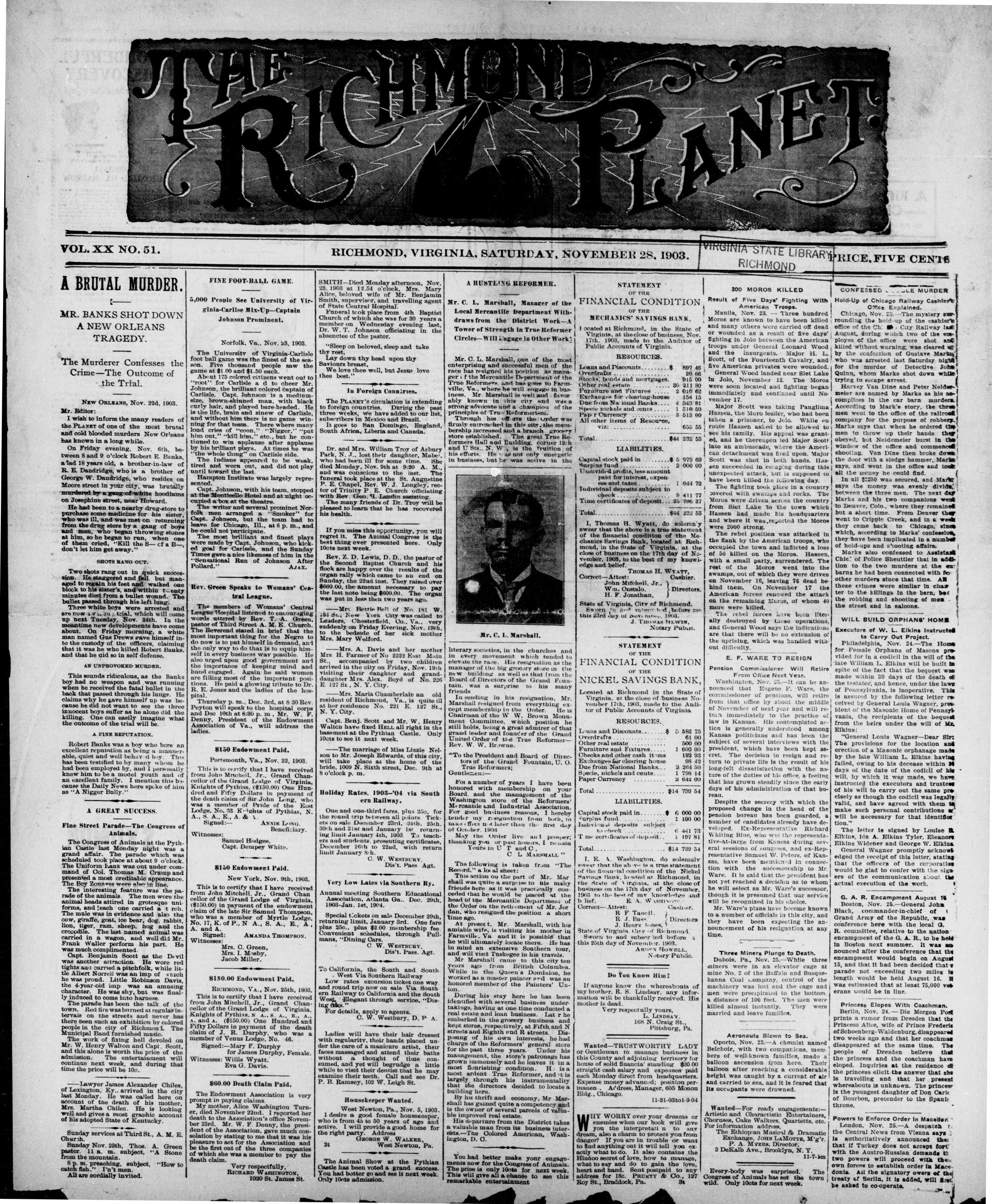
THE RICHMOND PLANET
VOL. XX NO. 51.
A BRUTAL MURDER.
MR. BANKS SHOT DOWN A NEW ORLEANS TRAGEDY.
The Murderer Confesses the Crime—The Outcome of the Trial.
NEW ORLEANS, Nov. 22d, 1903.
Mr. Editor:
I wish to inform the many readers of the PLANET of one of the most brutal and cold blooded murders New Orleans has known in a long while.
On Friday evening, Nov. 6th, between 8 and 9 o'clock Robert E. Banks, a lad 18 years old, a brother-in-law of R. E. Dandridge, who is a brother of George W. Dandridge, who resides on Moore street in your city, was brutally murdered by a gang of white hoodlums on Josephine street, near Howard.
He had been to a nearby drug-store to purchase some medicine for his sister, who was ill, and was met on returning from the drug store by a gang of boys and men, who began throwing stones at him, so he began to run, when one of them cried, "Kill the S—cf a B—, don't let him get away."
SHOTS RANG OUT.
Two shots rang out in quick succession. He staggered and fell, but managed to regain his feet and walked one block to his sister's, and within ten minutes died from a bullet wound. The bullet passed through his left lung. Three white boys were arrested and are now in a trial, which will come up next Tuesday. Nov. 24th. In the meantime new developments have come manned Gus Drew's morning, a white man named Gus Drew's morning, into the custody of the officers, claiming that it was he who killed Robert Banks, and that he did so in self defense.
AN UNPROVOKED MURDER.
This sounds ridiculous, as the Banks boy had no weapon and was running when he received the fatal bullet in the back that passed through his lungs. He claims why he gave himself up was because he did not want to see the three people who phone did the killing. One can easily imagine what the outcome of the trial will be.
A FINE REPUTATION
Robert Banks was a boy who bore an excellent reputation as being a mannerable, quiet and well behaved boy. This has been testified to by many whom he had been employed by, and I personally knew him to be a model youth and of an excellent family. I mention this because the Daily News here spoke of him as "A Nigger Bully."
A GREAT SUCCESS
Fine Street Parade—The Congress of Animals.
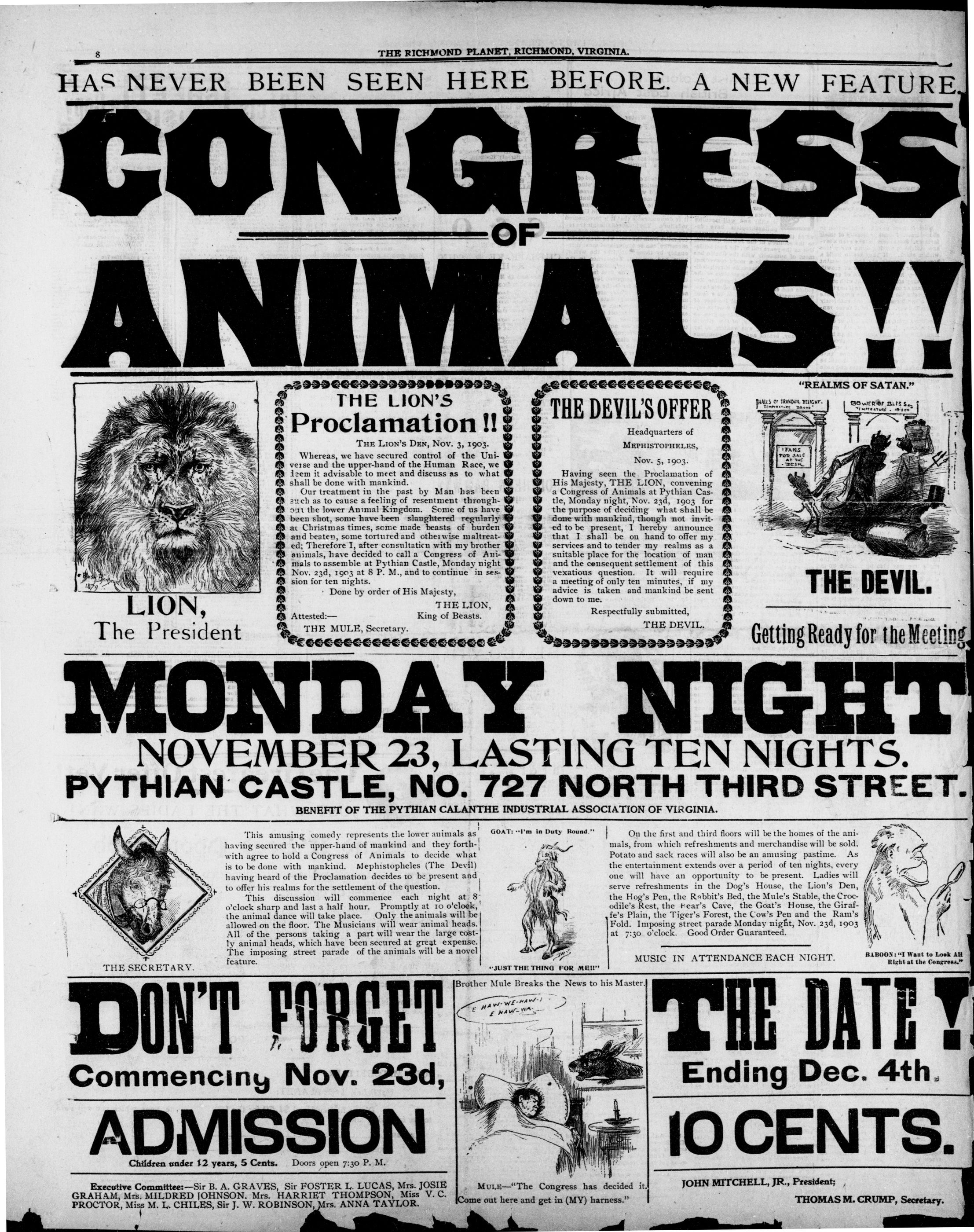
The Congress of Animals at the Pythian Castle last Monday night was a grand affair. The parade which was scheduled took place at about 9 o'clock. The Uniform Rank was out under command of Col. Thomas M. Cramp and presented a most creditable appearance. The Boy Zonvess were also in line.
The interesting feature was the parade of the animals. The men wore the animal heads attired in grotesque uniforms, and each one carried a t reh. The mule was in evidence and also the cow, giraffe, goat, ice bear, dog, rabbit, lion, tiger, ram, sheep, hog and the crocodile. The last named animal was carried in a wagon, and well did Mr. Frank Waller perform his part. He was much complimented.
Capt. Benjamin Scott as the Devil was another attraction. He wore red tights and carried a pitchfolk, while little Albert Norrell was an imp of which he was proud. Little Robinson Davis, the 4-year-old imp was an amusing character. He was shy, but was finally induced to come into harness.
The parade has been the talk of the town. Red fire was burned at regular intervals on the streets and never has there been such an exhibition by colored people in the city of Richmond. The Municipal Band furnished music.
The work of fixing hell devolved on Mr. W. Henry Walton and Capt. Scott, and this alone is worth the price of the admission. The entertainment will continue next week, and during that time the price will be 10c.
Lawyer James Alexander Chiles, of Lexington, Ky., arrived in the city last Monday. He was called here on account of the death of his mother, Mrs. Martha Chiles. He is looking well and gives a most graphic account of his adopted State of Kentucky.
Sunday services at Third St., A. M. E. Chursh.
Sunday Nov. 29th, Thos. A. Green pastor. 11 a. m. subject, "A Stone from the mountain.
8 p. m. preaching, subject, "How to catch fish." 'I'm men.
All are cordially invited.
FINE FOOT-BALL GAME
5,000 People See University of Virginia-Carlise Mix-Up-Captain Johnson Prominent.
Norfolk, Va., Nov. 23, 1903.
The University of Virginia-Carlisle foot ball game was the finest of the season. Five thousand people saw the game at $1.00 and $1.50 each.
About 175 colored citizens went out to "root" for Carlisle a d to cheer Mr. Johnson, the brilliant colored captain of Carlisle. Capt. Johnson is a medium-size, brown-skinned man, with black curly hair, and played bare-headed. He is the life, brain and sinew of Carlisle, and without him there is no game winning for that team. There were many loud cries of "coon," "Nigger," "put him out," "kill him," etc., but he continued to win applaure after applause by his brilliant plays. At times he was "the whole thing" on Carlisle side.
The Indians appeared to be weak, tired and worn out, and did not play until toward the end.
Hampton Institute was largely represented.
Capt. Johnson, with his team, stopped at the Monticello Hotel and at night occupied a box at the theatre.
The writer and several prominent Norfolk men arranged a "Smoker" for Capt. Johnson, but the team had to leave for Chicago, Ill., at 6 p. m., and he could not participate. He built a brilliant and finest plays were made by Capt. Johnson, who kicked goal for Carlisle, and the Sunday Times gave a nice likeness of him in the "Sensational Run of Johnson After Pollard." AJAX.
Key. Green Speaks to Womans' Central League.
The members of Womans' Central League Hospital listened to encouraging words uttered by Rev. T. A. Green, pastor of Third Street A. M. E. Church. The Reverend stated in brief that the most important thing for the Negro to do now is to put himself in demand, and the only way to do that is to equip himself in every business way possible. He also urged upon good government and the importance of keeping mind and hand engaged. Again he said women are filling most of the important positions. He paid a glowing tribute to Dr. R. E. Jones and the ladies of the hospital.
Thursday p. m., Dec. 3rd, at 8:30 Rev. Peyton will speak to the hospital corps and Dec 10th at 8:30 p. m., Mr. W. F. Denny, president of the Endowment Association of Va., will address the
8150 Endewment Paid.
This is to certify that I have received
from John Mitchell, Jr., Grand Chanc-
leer of the Grand Lodge of Virginia,
Knights of Pythias, ($150.00) One Hundred
and Fifty Dollars in payment of
the death claim of Sir John Long, who
was a member of Pride of the East
Lodge, No. 33 Knights of Pythias, N.
A., S. A., E., A. & A.
Signed:— ANNIE LONG.
Beneficiary.
Witnesses:
Samuel Hodges,
Capt. Dempgy White.
8150 Endowment Paid
New York, Nov. 9th, 1903.
This is to certify that I have received from John Mitchell, Jr., Grand Chan-
cellor of the Grand Lodge of Virginia,
($150.00) in payment of the endowment
claim of the late Sir Samuel Thompson,
who was a member of Myrtle Lodge,
No. 17, K. of P., N A., S. A., E., A.
A. and A.
Signed: AMANDA THOMPSON.
Witnesses:
Mrs. C. Green,
Mrs. I. Mosby,
Jacob Miller.
$150.00 Endowment Paid.
RICHMOND, VA., Nov. 25th, 1903.
This is to certify that I have received from John Mitchell, Jr., Grand Chancellor of the Grand Lodge of Virginia, Knights of Pythias, N. A. S. A. E. A. A. and A. ($150.00) One Hundred and Fifty Dollars in payment of the death claim of J. R. Durphy, who was a member of Venus Lodge, No. 46.
Signed:—Mary F. Durphy
for James Durphy, Female.
Witnesses: Willis Wyatt.
Eva G. Dexis.
$60.00 Death Claim Paid.
The Endowment Association is very prompt in paying claims.
My mother, Alice Washington Turner, died November 23rd. I reported her death to the Association's office November 23rd. Mr. W. F. Deuny, the president of the Association, gave much consolation by stating to me that it was his pleasure to act for the Association and be the first out of the three companies of which she was a member to pay the death claim.
Very respectfully,
RICHARD WASHINGTON,
1020 St. James St.
SMITH—Died Monday afternoon, Nov. 23, 1903 at 12.54 o'clock, Mrs. Mary Alice, beloved wife of Mr. Benjamin Smith, supervisor, and travelling agent of State Central Hospital. Funeral took place from 4th Baptist Church of which she was for 30 years a member on Wednesday evening last, Dr. W. T. Johnson officiating in the absentee of the pastor. "Sleep on beloved, sleep and take thy rest, Lay down thy head upon thy Saviours breast. We love thee well, but Jesus love thee best."
In Foreign Countries.
The PLANET's circulation is extending to foreign countries. During the past three weeks, we have added to our list, subscribers in Mexico and Brazil. It goes to San Domingo, England.
---
Dr. and Mrs. William Troy of Asbury Park, N. J., lost their daughter, Mabel, who had been ill for some time. She died Monday, Nov. 9th at 9:20 A. M., and was conscious to the last. The funeral took place at the St. Augustine P. E. Chapel, Rev. W. J. Longley, rector of Trinity P. E. Church officiating with Rev. Geo. H. Lamin assisting. The many friends of Dr. Troy will be pleased to learn that he has recovered his health.
If you miss this opportunity, you will regret it. The Animal Congress is the best thing ever presented here. Only 10cts next week.
Rev. Z. D. Lewis, D. D., the pastor of the Second Baptist Church and his flock are happy over the results of the organ rally which came to an end on Sunday, the 22nd inst. They raised over $660.00, the amount necessary to pay the last note being $600.00. The organ was put in less than two years ago.
—Mrs. Bettie Bell of No. 181 W. 181 St. New York City was called to Leaders, Chesterfield, Co., Va., very suddenly on Friday Eventing, Nov. 19th, to the bedside of her sick mother Mrs. Mary Welford.
—Mrs. A. Davis and her mother Mrs H. Farmer of No 2222 East Main St., accompanied by two children arrived in the city on Friday, Nov. 19th visiting their daughter and grand-daughter Mrs. Alex. Boyd of No. 226 E. 127 St., N. Y. City.
—Mrs. Maria Chamberlain an old resident of Richmond, Va., is quite ill at her residence No. 221 E. 127 St., N. Y. City.
Capt. Benj. Scott and Mr. W, Henry Walton have fixed HELL all right in the basement at the Pythian Castle. Only 10uts to see it next week.
—The marriage of Miss Lizzie Nelson to Mr. Joseph Edwards, of this city, will take place at the home of the bride, 1009 N. Sixth street, Dec. 9th at 8 o'clock p. m.
Holiday Rates. 1903-'04 via South
ern Railway.
One and one-third fares, plus 25c, for
the round trip between all points Tickets
on sale December 23rd, 24th, 25th,
30th and 31st and January 1st returning
limit January 4th, 1003. To teachers
and students, presenting certificates,
December 16th to 22nd, with return
limit January 8th.
C. W. WESTBURY,
Dis't. Pass. Agt.
Very Low Lates via Southern Ry.
Annual meeting Southern Educational Association, Atlanta Ga.. Dec. 29th, 1903-Jan. 1st, 1904.
Special tickets on sale December 29th, returning limit, January 3rd. One fare plus 25c., plus $2.00 membership fee.
Convenient scadules, through Pullmans, "Dining Cars
To California, the South and South
West Via Northern Railway.
West Via Southern Railway
Low rates excursion ticket one way
and round trip now on sale Via Southern
Railway to California and the South
West. Elegant through service. "Duiing
cars."
Ladies will have their hair dressed with regularity, their hands placed under the care of a manicure artist, their faces massaged and attend their baths without a thought of time contend with yawning, a gag a little while to visit their dentist that may examine their teeth. Call and see Dr. P. B. Ramsey, 102 W. Leigh St.
Housekeeper Wanted.
West Newton, Pa., Nov. 5, 1903
I desire a good female housekeeper,
who is at least 25 years of age and
active. I will provide a good home for
the right party. Address
The Animal Show at the Pythian Castle has been voted a grand success. You had batter go and see it next week. Only 10cts admission.
A HUSTLING REFORMER.
Mr. C. L. Marshall, Manager of the Local Mercantile Department Withdraws from the District Work—A Tower of Strength in True Reformer Circles—Will Engage in Other Work
Mr. C. L. Marshall, one of the most enterprising and successful men of the race has resigned his position as manager of the Mercantile D-partment of the True Reformers, and has gone to Farmville, Va., where he will engage in business. Mr. Marshall is well and favorably known in this city and was a strong advocate and a champion of the principles of True Reformerism. Through his efforts the Order was firmly entrenched in this city, the membership increased and a branch grocery store established. The great True Reformers Hall and Building, corner 12th and U Sts., N. W., is the fruition of his efforts. He was not only energetic in business, but he was active in the
Mr. C. L. Marshall.
literary societies, in the churches and in every movement which tended to elevate the race. His resignation as the manager of the big grocery store in the new building as well as that from the Board of Directors of the Grand Fountain, was a surprise to his many friends.
In sending in his resignation, Mr. Marshall resigned from everything except membership to the Order. He is Chairman W. W. Brown Monument Committee, which position he still holds, being a great admirer of that grand leader and founder of the Grand United Order of the True Reformer—Rev. W. W. Browne.
"To the President and Board of Directors of the Grand Fountain, U. O. True Reformers;
For a number of years I have been honored with membership on your Board, and the management of the Washington store of the Reformers' Mercantile and Industrial Association. For good business reasons, I hereby tender my resignation from both, to take effect no later than the first day of October, 1903.
May the Order live and prosper; thanking you or past honors, I reclaim Yours in U T and C,
C L MARSHALL "
The following is taken from "The Record," a loa1 sheet:
This action on the part of Mr. Marshall was quite a surprise to his many friends here as it was practically conceded that he would be paced at the head of the Mercantile Department of the Order on the retirement of Mr. Jordan, who resigned the position a short time ago.
At preset t, Mr. Marshall, with his amiable wife, is visiting his mother in Farmville, Va and it is possible that he will ultimately locate there. He has in mind an extensive Southern tour, and will visit Tuskegee in his travels. Mr Marshall came to this city ten years ago from British Columbia. While in the Queen's Dominion, he worked as a master painter and was an honored member of the Painters' Union.
During his stay here he has been identified with several business undertakings, having at one time conducted a real estate and loan business. L at r he embarked in the grocery business and kept stores, respectively, at Fifth and N streets and Eighth and R streets. Disposing of his own interests, he had charge of the Reformers' general store for the past three years. Under his management, the store's patronage has grown immensely and he leaves it in a most flourishing condition. H is a most ardent True Reformer, and it is through his instrumentality that the directors decided to locate a building here. By his thrift and economy, Mr Marshall has gained quite a competency and is the owner of several parcels of valuable improved real estate.
His departure from the District takes a valuable man from its business interests.—The Colored American, Washington, D. C.
You had better make your engagements now for the Congress of Animals. The price is only 100s for next week. You can also see to see this remarkable entertainment
STATEMENT
FINANCIAL CONDITION
OF THE
MECHANICS' SAVINGS BANK.
Located at Richmond, in the State of
Virginia, at the close of business, Nov.
17th, 1903, made to the Auditor of
Public Accounts of Virginia.
RESOURCES.
Loans and Discounts. $ 897 46
Overdrafts. 20 66
Stocks, bonds and mortgages. 915 00
Other real estate. 30 211 80
Furniture and Fixtures. 2 010 62
Exchanges for clearing-house. 154 15
Due from National Banks. 4 843 81
Specie nickels and cents. 1 510 60
Papar Currency. 3 513 00
All other items of Resource,
viz. 655 55
Total.....$44 232 55
LIABILITIES.
Capital stock paid in.....$ 5 979 69
Surplus fund.....2 000 00
Unvided profits, less amount paid for interest, expenses and taxes.....1 044 72
Individual deposits subject to check.....9 411 77
Time certificates of deposit.....25 796 37
Total.....$44 232 55
I, Thomas H. Wyatt, do solemnly swear that the above is a true statement of the financial condition of the Mechanics Savings Bank, located at Richmond, in the State of Virginia, at the close of business on the 17th day of November, 1908, to the best of my knowledge and belief.
THOMAS H. WYATT,
Correct- Attest.
State of Virginia, City of Richmond.
Sworn to and subscribed before me
this 23rd day of November, 1863.
J. THOMAS HEWIN,
Notary Public.
STATEMENT
FINANCIAL CONDITION
OF THE
NICKEL SAVINGS BANK,
Located at Richmond in the State of
Virginia, at the close of business Nov-
ember 17th, 1903, made to the Audi-
tor of Public Accounts of Virginia.
RESOURCES.
Loans and Discounts..... $ 5 582 75
Overdrafts..... 61 00
Other real estate..... 500 00
Furniture and Fixtures..... 1 600 00
Checks and other cash items..... 192 93
Exchanges far clearing house..... 98 42
Due from National Banks..... 2 264 50
Specie, nickels and cents..... 1 798 14
Paper Currency..... 2 643 00
LIABILITIES.
Capital stock paid in..... $ 6 000 00
Surplus fund..... 1 100 00
Individual deposits subject
to check..... 6 441 73
T me certificates of deposit..... 1 197 81
Total..... $14 739 54
I. E. A. Washington, do solemnly
sweat that the above is a true statement
of the financial condition of the Nickel
Savings Bank, located at Richmond, in
the State of Virginia, at the close of
business on the 17th day of November,
1903 to the best of my knowledge and
b lief. E. A. Washington
State of Virginia, City of Richmond.
On this 25th day of November, 1908.
Do You Know Him?
If anyone know the whereabouts of my brother, R. S. Lindsay, any information will be thankfully received. His mother is dead.
Very respectfully yours,
L. LINDSAY.
168 N. Craig St.,
Pittsburg, Pa.
Wanted—TRUSTWORTHY LADY or Gentleman to manage business in this County and adjoining territory for house of solid finance' standing $20.00 straight cash salary and expenses paid each Monday direct from headquarters. Expense money advanced; position perman. Address, Manager, 605 Monon Bldg., Chicago.
11-21-08to1-9-04
WHY WORRY over your dreams or enemies when our book will give you the interpretari n to any dream, also a charm to protect you from danger? If you are in trouble or want to find anything out it will tell you exactly what to do. It also contains the Hindoo secret of love, how to manage, what to say and do to gain the love, heart and hand. Sent postpaid to any address for 18c. PRUNTY & Co., 197 Roy St., Braddock Pa. 38
300 MOROS KILLED
Result of Five Days' Fighting With American Troops.
Manila, Nov. 23. — Three hundred Moros are known to have been killed and many others were carried off dead or wounded as a result of five days' fighting in Jolo between the American troops under General Leonard Wood and the insurgents. Major H. L. Scott, of the Fourteenth Cavalry, and five American privates were wounded. General Wood landed near Slet Lake in Jolo, November 12. The Moros were soon located and fighting began immediately and continued until November 17.
Major Scott was taking Panglima Hassen, the Moro leader, who had been taken a prisoner, to Jolo. While en route Hassen asked to be allowed to see his family. His appeal was granted, and he thereupon led Major Scott into an ambuscade, where the American detachment was fired upon. Major Scott was shot in both hands. Hassen succeeded in escaping during this unexpected attack, but is supposed to have been killed the following day. The fighting took place in a country covered with swamps and rocks. The Moros were driven across the country from Siet Lake to the town which Hassen had made his headquarters and where it was, reported the Moros were 2000 strong.
The rebel position was attacked in the flank by the American troops, who occupied the town and inflicted a loss of 50 killed on the Moros. Hassen, with a small party, surrendered. The rest of the Moros went into the swamps, out of which they were driven on November 16, leaving 76 dead behind them. On November 17 the American forces renewed the attack on the remaining Moros, of whom 40 more were killed.
The rebel forces have been literally destroyed by these operations, and General Wood says the indications are that there will be no extension of the uprising, which was handled without difficulty.
E. F. WARE TO RESIGN
Pension Commissioner Will Retire
From Office Next Year.
Washington, Nov. 25.—It can be announced that Eugene F. Ware, the commissioner of pensions, will retire from that office by about the middle of November of next year and will return immediately to the practice of law in Kansas. His contemplated action is generally understood among Kansas politicians and has been the subject of several interviews with the president, which have been kept secret. The decision to resign and return to private life is the result of his long-felt dissatisfaction with the nature of the duties of his office, a feeling that has grown steadily since the early days of his administration of that bureau.
Despite the secrecy with which the proposed change in the head of the pension bureau has been guarded, a number of candidates already have developed. Ex-Representative Richard Whiting Blue, who was the representative-at-large from Kansas during several sessions of congress, and ex-Representative Samuel W. Peters, of Kansas, have been mentioned in connection with the successorship to Mr. Ware. It is said that the president has not yet reached a decision as to whom he will select as Mr. Ware's successor, though it is presumed that war service will be recognized in his choice. Mr. Ware's plans have become known to a number of officials in this city, and they have been expecting the announcement of his resignation at any time.
---
Dubois, Pa., Nov. 25.—While three miners were in an elevator cage at mine No. 2 of the Buffalo and Susquehanna Coal company, control of the machinery was lost and the cage and men were precipitated to the bottom, a distance of 100 feet. The men were killed almost instantly. They were married and leave families.
Aeronauts Blown to Sea.
Oporto, Nov. 23.—A chemist named Belchoir, with two comparisons, members of well-known families, made a balloon ascension from here. Their balloon after reaching a considerable height was caught by a current of air and carried to sea, and it is feared that its occupants were drowned.
Wanted—For ready engagements:—Artistic and Characteristic Entertainers, Choruses, Cake Walkers, Quartetts, etc. For information address.
The Ethiopian Musical & Dramatic Exchange, JOHN LAMOTTE, M'g'r.
P. A. MYERS, Director.
3 DeKalb Ave, Brooklyn, N. Y.
Every-body was surprised. The Congress of Animals has set the town wild. Only 10cts for next week.
Hold-Up of Chicago Railway Cashier
Office Explained.
Chicago, Nov. 25.—The mystery sur-
rounding the hold-up of the cashier's
office of the Chi. City Railway last
August, during which two of the em-
ployees of the office were shot and
killed without warning, was cleared up
by the confession of Gustave Marka,
who was arrested last Saturday night
for the murder of Detective John
Quinn, whom Marks shot down while
trying to escape arrest.
Harvey Van Dine and Peter Neidemeier are named by Marks as his accomplices in the car barn murder. According to Mark's story, the three men went to the office of the railroad company for the purpose of robbery. Marks says that when he ordered the men to throw up their hands they obeyed, but Neidemeier burst in the window of the office and commenced shooting. Van Dine then broke down the door with a sledge hammer, Marks says, and went in the office and took all the money he could find. In all $250 was secured, and Marks says the money was evenly divided, between the three men. The next day Marks and his two companions went to Denver, Colo., where they remained but a short time. From Denver they went to Cripple Creek, and in a week they came back to Chicago, since which, according to Marks' confession, they have been implicated in a number of hold-ups and shooting affairs.
Marks also confessed to Assistant Chic' of Police Sheuttier that in addition to the two murders at the barns he had been connected with four other murders since that time. All these crimes were similar in character to the killings in the barn, but the robbing and shooting of men the street and in saloons.
WILL BUILD ORPHANS' HOME
Executors of W. L. Elkins Instructed to Carry Out Project
to carry out Project.
Philadelphia, Nov. 24—The Home for Female Orphans of Masons provided for in a codicil in the will of the late William L. Elkins will be built in spite of the fact that the bequest was made within 30 days of the death of the testator, and hence, under the laws of Pennsylvania, is inoperative. This is assured by the following letter received by General Louis Wagner, president of the Masonic Home of Pennsylvania, the recipients of the bequest from the heirs under the will of Mz. Elkins:
"General Louis Wagner—Dear Sir: The provisions for the location and erection of a Masonic orphanage made by the late William L. Elkins having failed, owing to his decease within 38 days of the date of the codicil of his will, by which it was made, we have instructed the executors and trustees of his will to carry out the same precisely as though the codicil was legally valid, and have agreed with them to make such personal contributions will be necessary for that identification."
The letter is signed by Louise B. Elkins, Ida A. Elkins Tyler, Eleanor Elkins Widener and George W. Elkins. General Wagner promptly acknowledged the receipt of this letter, stating that the officers of the corporation would be glad to confer with the signers of the communication about the actual execution of the work.
G. A. R. Encampment August 16 Boston, Nov. 25—General John Black, commander-in-chief of Grand Army of the Republic, was conference here with the local G. R. committee, relative to the nation encampment of the G. A. R., to be held in Boston next summer. It was not nounced after the conference that the encampment would begin on August 15, and that it had been decided that a parade not exceeding two miles is length would be held August 16. It was estimated that at least 75,000 veterans would be in line.
Princess Elopes With Coachman.
Berlin, Nov. 24. — Die Morgen Post prints a rumor from Dresden that the Princess Alice, wife of Prince Frederic of Schoenberg-Waldenburg, disappeared two weeks ago and that her coachman disappeared at the same time. The people of Dresden believe that the princess and the coachman have eloped. Inquiries at the residence of the princess elicit the answer that she is travelling and that her present whereabouts is unknown. The princess is the youngest daughter of Don Carke of Bourbon, pretender to the Spanish throne.
Powers to Enforce Order in Macedon
London, Nov. 25.—A despatch to
the Central News from Vienna says
is authoritatively announced then
that if Turkey does not accept for-
with the Austro-Russian demands to
two powers will proceed with their
own forces to establish order in Macedonia. All the signatory owers of the treaty of Berlin, it is added, will first
be asked to co-operate.
BE PLANET
SATURDAY.....NOVEMBER 28, 1908
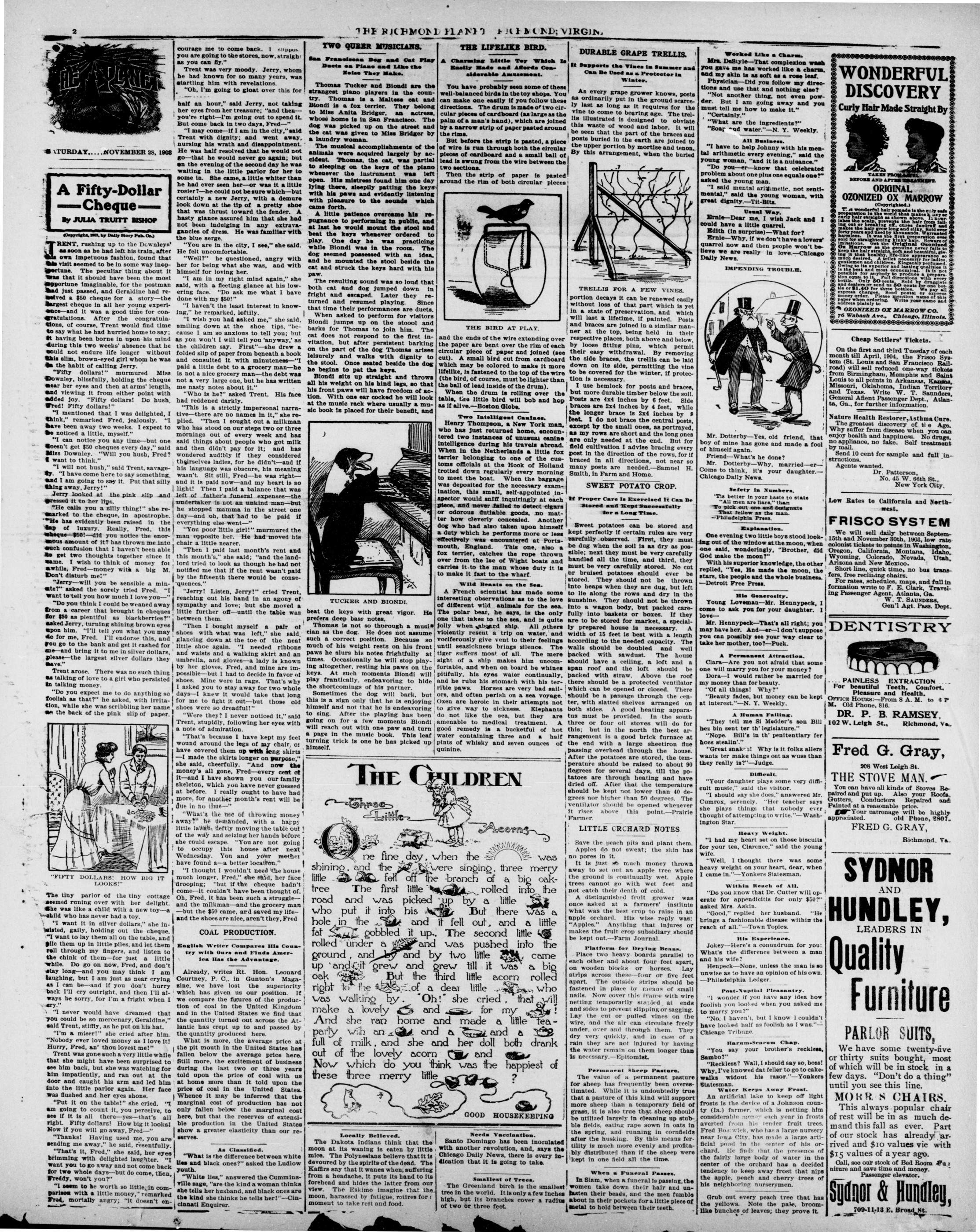
RENT, rushing up to the Downleys as soon as he had left his train, after his own impetuous fashion, found that his visit seemed to be in some way inopportune. The peculiar thing about it was that it should have been the most apportune imaginable, for the postman had just passed, and Geraldine had received a $50 cheque for a story—the largest cheque in all her young experience—and it was a good time for congratulations. After the congratulations, of course, Trent would find time to say what he had hurried home to say; it having been borne in upon his mind during this two weeks' absence that he could not endure life longer without this slim, brown-eyed girl whom he was in the habit of calling Jerry.
"Fifty dollars!" murmured Miss Downley, blissfully, holding the cheque near her eyes and then at arms' length, and viewing it from either point with added joy. "Fifty dollars! Do hush, Fred! Fifty dollars!"
"I mentioned that I was delighted, I think," remarked Fred, jealously. "I have been away two weeks. I expect to be noticed a little, myself."
"I can notice you any time—but one doesn't get $50 cheques every day," said Miss Downley. "Will you hush, Fred? I want to think."
"I will not hush," said Trent, savagey. "I have come here to say something, and I am going to say it. Put that silly thing away, Jerry!"
Jerry looked at the pink slip and pressed it to her lips.
"He calls you a silly thing!" she remarked to the cheque, in apostrophe. "He has evidently been raised in the tap of luxury. Really, Fred, this cheque $50!" did you notice the enormous amount of it? has thrown me into such confusion that I haven't been able to get two thoughts together since it name. I wish to think of money for awhile, Fred—money with a big M. Don't disturb me!" "Jerry—will you be sensible a minute?" asked the sorely tried Fred. "I want to tell you how much I love you—" "Do you think I could be weaned away from a career that brought in cheques for $50 as plentiful as blackberries?" asked Jerry, turning shiny brown upon him. "I'll tell you what you may do for me, Fred. I'll endorse this, and you go to the bank and get it cashed for me—and bring it to me in silver dollars, please—the largest silver dollars they have."
Trent arose. There was no such thing as talking of love to a girl who persisted in talking money.
"Do you expect me to do anything so foolish as that?" he asked, with irritation, while she was scribbling her name on the back of the pink slin of paper.
"FIFTY DOLLARS! HOW BIG IT LOOKS!"
The tiny parlor of the tiny cottage seemed running over with her delight. she was like a child with a new toy—a child who has never had a toy. "I want it in silver dollars," she insisted, gaily, holding out the cheque. "I want to lay them all on the table, and pile them up in little piles, and let them roll through my fingers, and listen to the chink of them—for just a little while. Do go on now, Fred, and don't stay long—and you may think I am laughing, but I am just as near crying as I can be—and if you don't hurry back I'll cry outright, and then I'll always be sorry, for I'm a fright when I cry." "I never would have dreamed that you could be so mercenary, Geraldine," said Trent, stillly, as he put on his hat. "I'm a miser!" she cried after him. "Nobody ever loved money as I love it! Hurry, Fred, an' thou lovest me!"
Trent was gone such a very little while that she might have been surprised to see him back, but she was watching for him impatiently, and ran out at the door and caught his arm and led him into the little parlor again. Her face was flushed and her eyes shone.
"Put it on the table!" she cried. "I am going to count it, you perceive, to see if it is all there—yes—that's all right. Fifty dollars! How big it looks! Now if you will go away, Fred—"
"Thanks! Having used me, you are sending me away," he said, resentfully.
"That's it, Fred," she said, her eyes brimming with delighted laughter. "I want you to go away and not come back for two whole days—but do come, then, Freddy, won't you?"
"I seem to be worth so little, in comparison with a little money," remarked Freddy, mortally angry; "it doesn't en-
courage me to come back. I suppose you are going to the stores, now, straight as you can fly." Trent was very moody. Jerry, whom he had known for so many years, was startling him with revelations.
"Oh, I'm going to gloat over this for half an hour," said Jerry, not taking her eyes from her treasure; "and then—you're right—I'm going out to spend it. But come back in two days, Fred—" "I may come—if I am in the city," said Trent with dignity; and went away, nursing his wrath and disappointment. He was half resolved that he would not go—that he would never go again; but on the evening of the second day he was waiting in the little parlor for her to some in. She came, a little whiter than he had ever seen her—or was it a little rosier?—he could not be sure which—but certainly a new Jerry, with a demure look down at the tip of a pretty shoe that was thrust toward the fender. A hasty glance assured him that she had not been indulging in any extravagancies of dress. He was familiar with the blue serge. "You are in the city, I see," she said. He felt uncomfortable.
"Well?" he questioned, angry with her for being what she was, and with himself for loving her.
"I am in my right mind again," she said, with a fleeting glance at his lowering face. "Do ask me what I have done with my $50!"
"I haven't the least interest in knowing," he remarked, loftily.
"I wish you had asked me," she said, smiling down at the shoe tips, "because I am so anxious to tell you; but as you won't I will tell you 'anyway', as the children say. First"—she drew a folded slip of paper from beneath a book and consulted it with minuteness—"I paid a little debt to a grocery man—he is not a nice grocery man—the debt was not a very large one, but he has written me nasty notes about it."
"Who is he?" asked Trent. His face had reddened darkly.
"This is a strictly impersonal narrative—there are no names in it," she replied. "Then I sought out a milkman who has stood on our steps two or three mornings out of every week and has said things about people who got milk and then didn't pay for it; and has wondered audibly if they considered theirselves ladies, for he didn't—and if his language was obscure, his meaning wasn't. Sit still, Fred—he was right—and it is paid now—and my heart is so light! Then I paid a balance that was left of father's funeral expenses—the understaker is not an unkind man—but he stopped mamma in the street one day—and oh, that had to be paid if everything else went—"
"You poor little girl!" murmured the man opposite her. He had moved his chair a little nearer.
"Then I paid last month's rent and this month's," she said; "and the landlord tried to look as though he had not notified me that if the rent wasn't paid by the fifteenth there would be consequences."
"Jerry! Listen, Jerry!" cried Trent, reaching out his hand in an agony of sympathy and love; but she moved a little further off—until the table was between them.
"Then I bought myself a pair of shoes with what was left," she said, glancing down at the toe of the neat little shoe again. "I needed ribbons and waists and a walking skirt and an umbrella, and gloves—a lady is known by her gloves, Fred, and mine are impossible—but I had to decide in favor of shoes. Mine were in rags. That's why I asked you to stay away for two whole days—I knew it would take that long for me to fight it out—but those old shoes were so dreadful!"
"Were they? I never noticed it," said Trent, stupid, following her eyes with a note of admiration.
"That's because I have kept my feet wound around the legs of my chair, or have covered them up with long skirts—I made the skirts longer on purpose," she said, cheerfully. "And now the money's all gone, Fred—every cent of it—and I have shown you our family skeleton, which you have never guessed at before. I really ought to have had more, for another month's rent will be due in no time—"
"What's the use of throwing money away!" he demanded, with a happy little laugh, deftly moving the table out of the way and seizing her hands before she could escape. "You are not going to occupy this house after next Wednesday. You and your mother have found a—a better location."
"I thought I wouldn't need the house much longer, Fred," she said, her face drooping; "but if the cheque hadn't come—it couldn't have been thought of. Oh, Fred, it has been such a struggle—and the milkman—and the grocery man—but the $60 came, and saved my life—and the shoes are nice, aren't they, Fred
COAL PRODUCTION
English Writer Compares His Country with Ours and Finds America Has the Advantage.
Already, writes Rt. Hon. Leonard Courtney, P. C., in Gunton's Magazine, we have lost the superiority which has given us our position. If we compare the figures of the production of coal in the United Kingdom and in the United States we find that the quantity turned out across the Atlantic has crept up to and passed by the quantity produced here.
What is more, the average price at the pit mouth in the United States has fallen below the average price here. Still more, the excitement of business during the last two or three years told upon the price of coal with us at home more than it told upon the price of coal in the United States. Whence it may be inferred that the marginal cost of production has not only fallen below the marginal cost here, but that the reserves of extensible production in the United States show a greater elasticity than our reserves.
As Classified.
"What is the difference between white lies and black ones?" asked the Ludlow youth.
"White lies," answered the Cumminsville sage, "are the kind a woman thinks she tells her husband, and black ones are the kind she thinks he tells her!"—Cincinnati Enquirer.
THE RICHMOND HANFT RICHMOND; VIRGIN
GOOD HOUSEKEEPING
San Francisco Dog and Cat Play Duets on Piano and Like the Noise They Make.
Thomas Tucker and Biondi are the strangest piano players in the country. Thomas is a Maltese cat and Biondi is a fox terrier. They belong to Miss Anita Bridger, an actress, whose home is in San Francisco. The dog was picked up on the street and the cat was given to Miss Bridger by a laundry woman.
The musical accomplishments of the animals were acquired largely by accident. Thomas, the cat, was partial to sleeping on the keys of the piano whenever the instrument was left open. His mistress found him one day lying there, sleepily patting the keys with his paws and evidently listening with pleasure to the sounds which came forth.
A little patience overcame his pugnance to perform in public, and at last he would mount the stool and beat the keys whenever ordered to play. One day he was practicing while Blondi was in the room. The dog seemed possessed with an idea, and he mounted the stool beside the cat and struck the keys hard with his paw.
The resulting sound was so loud that both cat and dog jumped down in fright and escaped. Later they returned and resumed playing. Since that time their performances are duets.
When asked to perform for visitors Blondi jumps up on the stool and barks for Thomas to Join him. The cat does not respond to the first invitation, but after persistent barking on the part of the dog Thomas arises leisurely and walks with dignity to the stool. Once seated beside the dog he begins to pat the keys.
Biondi its up straight and throws all his weight on his hind legs, so that his front paws will have freedom of action. With one ear cocked he will look at the music rack where usually a music book is placed for their benefit and
A dog and a cat playing the piano.
TUCKER AND BIONDI.
beat the keys with great vigor. He prefers deep base notes.
Thomas is not so through a musician as the dog. He does not assume such a correct position. Because so much of his weight rests on his front paws he slurs his notes frightfully at times. Occasionally he will stop playing altogether, resting his paws on the keys. At such moments Biondi will play frantically, endeavoring to hide the shortcomings of his partner.
Sometimes the dog will bark, but this is a sign only that he is enjoying himself and not that he is endeavoring to sing. After the playing has been going on for a few moments Biondi will reach out with one paw and turn a page in the music book. This leaf turning trick is one he has picked up himself.
The G
Three Little
One fine day, we shining, and the little fell off the tree. The first little road and was picked who put it into his hole in the and fat gobbled it up. Rolled under a and ground, and by and by up and it grew and oak. But the right to the of a was walking by. Oh make a lovely and And she ran home a party with an and full of milk, and she a out of the lovely acorn. Now which do you these three merry little
The Dakota Indians think that the moon at its waning is eaten by little mice. The Polynesians believe that it is devoured by the spirits of the dead. The Kaffirs say that it wanes when, suffering from a headache, it puts its hand to its forehead and hides the latter from our view. The Eskimo imagine that the moon, harassed by fatigue, rotures for a moment to take rest and food.
THE LIFELIKE BIRD.
A Charming Little Toy Which Is Enjoyably Made and Afords Considerable Amusement.
You have probably seen some of these well-balanced birds in the toy shops. You can make one easily if you follow these directions. The drum is made of two circular pieces of cardboard (as large as the palm of a man's hand), which are joined by a narrow strip of paper pasted around the rims.
But before the strip is pasted, a piece of wire is run through both the circular pieces of cardboard and a small ball of lead is swung from the wire between the two sections.
Then the strip of paper is pasted around the rim of both circular pieces
THE BIRD AT PLAY
and the ends of the wire extending over the paper are bent over the rim of each circular piece of paper and joined (see cut). A small bird cut from cardboard which may be colored to make it more lifelike, is fastened to the top of the wire (the bird, of course, must be lighter than the ball of lead inside of the drum). When the drum is rolling over the table, the little bird will bob and hop as if alive.—Boston Globe.
Two Intelligent Canines
Henry Thompson, a New York man, who has just returned home, encountered two instances of unusual canine intelligence during his travels abroad. When in the Netherlands a little fox terrier belonging to one of the customs officials at the Hook of Holland trotted down regularly every morning to meet the boat. When the baggage was deposited for the necessary examination, this small, self-appointed inspector would sniff inquiringly at each piece, and never failed to detect cigars or odorous durable goods, no matter how cleverly concealed. Another dog who had also taken upon himself a duty which he performs more or less effectively was encountered at Portsmouth, England. This one, also a fox terrier, catches the rope thrown over from the lice of Wight boats and carries it to the man whose duty it is to make it fast to the wharf.
Wild Beasts on the Sea.
A French scientist has made some interesting observations as to the love of different wild animals for the sea. The polar bear, he says, is the only one that takes to the sea, and is quite jolly when aboard ship. All others violently resent a trip on water, and voicerously give vent to their feelings until seasickness brings silence. The tiger suffers most of all. The mere sight of a ship makes him uncomfortable, and when on board he whines pitifully, his eyes water continually, and he rubs his stomach with his terrible paws. Horses are very bad sailors, and often perish on a sea voyage. Oxen are heroic in their attempts not to give way to sickness. Elephants do not like the sea, but they are amenable to medical treatment. A good remedy is a bucketful of hot water containing three and a half pints of whisky and seven ounces of quinine.
when the was were singing, three merry branch of a big oak-rolled into the up by a little acorn.
But there was a it fell out, and a little. The second little was pushed into the by two little came grew till it was a big third little acorn rolled dear little who she cried, that will for my! and made a little tea and a and her doll both drank and think was the happiest of?
GOOD HOUSEKEEPING
Santo Domingo has been inoculated with another revolution, and, says the Chicago Daily News, there is every indication that it is going to take.
Smallest of Trees
The Greenland birch is the smallest tree in the world. It is only a few inches high, but its branches cover a radius of two or three feet.
DURABLE GRAPE TRELLIS.
It Supports the Vines in Summer and Can Be Used as a Protector in Winter.
As every grape grower knows, posts as ordinarily put in the ground scarcely last as long as it requires for the vine to come to bearing age. The trellis illustrated is designed to obviate this waste of wood and labor. It will be seen that the part of the braces and posts buried in the earth are joined to the upper portion by mortise and tenon. By this arrangement, when the buried
TRELLIS FOR A FEW VINES
portion decays it can be renewed easily without loss of that part which is yet in a state of preservation, and which will last a lifetime, if painted. Posts and braces are joined in a similar manner at the top, being held in their respective places, both above and below, by loose fitting pins, which permit their easy withdrawal. By removing the side braces, the trellis can be laid down on its side, permitting the vine to be covered for the winter, if protection is necessary.
I use hemlock for posts and braces, but more durable timber below the soil. Posts are 4x4 inches by 6 feet. Side braces are 2x4 inches by 4 feet, while the longer brace is 2x4 inches by 8 feet. I do not brace the central posts, except by the small ones, as portrayed, as my rows are short and the long ones are only needed at the end. But for field cultivation I advise bracing every post in the direction of the rows, for if braced in all directions, not near so many posts are needed.—Samuel H. Smith, in Farm and Home.
SWEET POTATO CROP
If Proper Care In Exercised It Can Be Stored and Kept Successfully for a Long Time.
Sweet potatoes can be stored and kept perfectly if certain rules are very carefully observed. First, they must be dug when the soil is as dry as possible; next they must be very carefully handled all the time, and third, they must be very carefully stored. No cut or bruised potatoes should ever be stored. They should not be thrown into heaps when they are dug, but left to lie along the rows and dry in the sunshine. They should not be thrown into a wagon body, but packed carefully into baskets or boxes. If they are to be stored for market, a specially prepared house is necessary. A width of 15 feet is best with a length according to the needed capacity. The walls should be doubled and well packed with sawdust. The house should have a ceiling, a loft and a span roof and the loft should be packed with straw. Above the roof there should be a protected ventilator which can be opened or closed. There should be a passage through the center, with slatted shelves arranged on both sides. A good heating apparatus must be provided. In the south three or four oil stoves will do for this; but in the north the best arrangement is a good brick furnace at the end with a large sheet iron flue passing overhead through the house. After the potatoes are stored, the temperature should be raised to about 90 degrees for several days, till the potatoes are through heating and have dried off. After that the temperature should be kept not lower than 40 degrees nor higher than 50 degrees. The ventilator should be opened whenever it rises above this point.—Prairie Farmer.
LITTLE CRCHARD NOTES
Save the peach pits and plant them.
Apples do not sweat; the skin has no pores in it.
It is just so much money thrown away to set out an apple tree where the ground is continually wet. Apple trees cannot go with wet feet and not catch their death of cold.
A distinguished fruit grower was once asked at a farmers' institute what was the best crop to raise in an apple orchard. His wise reply was: "Apples." Anything that injures or makes the fruit crop subsidiary should be kept out.-Farm Journal.
Platform for Drying Beans.
Place two heavy boards parallel to each other and about four feet apart, on wooden blocks or horses. Lay strips across these—four or five feet apart. The outside strips should be fastened in place by means of small nails. Now cover this frame with wire netting temporarily stained at ends and sides to prevent slipping or sagging. Lay the cut or pulled vines on the wire, and the air can circulate freely under, over and through them. They dry very quickly, and in case of a rain they are not injured by having the water remain on them longer than is necessary. -Epitomist.
Permanent Sheep Pasture.
Permanent sheep pasture.
The value of a permanent pasture for sheep has frequently been overestimated. While it is undoubtedly true that a pasture of this kind will support more sheep than a temporary field of grass, it is also true that sheep should be utilized largely in cleaning up stubble fields, eating rape sown in oats in the spring, and running in cornfields after the husking. By this means fertility is much more evenly and profitably distributed than if the sheep were kept in one field all the time.
When a Funeral Pauses
In Slam, when a funeral is passing, the women take down their hair and unfasten their beads, and the men fumble about in their pockets for a little piece of metal to hold between their teeth.
Worked Like a Charm.
Mrs. DeStyle—That complexion wash you gave me has worked like a charm, and my skin is as soft as a rose leaf. Physician—Did you follow my directions and use that and nothing else? "Not another thing, not even powder. But I am going away and you must tell me how to make it." "Certainly." "What are the ingredients?"
All Business
"I have to help Johnny with his mental arithmetic every evening," said the young woman, "and it is a nuisance."
"Do you—er—know that celebrated problem about one plus one equals one?" asked the young man.
"I said mental arithmetic, not sentimental," said the young woman, with great dignity—Tit-Bits.
Usual Wax
Ernie—Dear me, I wish Jack and I could have a little quarrel.
Edith (in surprise)—What for?
Ernie—Why, if we don't have a lovers' quarrel now and then people won't believe we are really in love.—Chicago Daily News.
IMPENDING TROUBLE.
IMPENDING TROUBLE.
Mr. Dotterby—Yes, old friend, that boy of mine has gone and made a fool of himself again.
Friend—What's he done?
Mr. Dotterby—Why, married—er—Come to think, it's your daughter.—Chicago Dally News.
Safety in Numbers.
"Tin better in your haste to state
"All men are liars," than
To pick our surrenders
That fellow on the man.
—Philadelphia Press.
Explanation.
One evening two little boys stood looking out of the window at the moon, when one said, wonderingly, "Brother, did God make the moon?" With his superior knowledge, the other replied, "Yes, He made the moon, the stars, the people and the whole business. —Detroit Free Press.
His Generosity:
Young Loveman—Mr. Hennypeck, I come to ask you for your daughter. I love—
Mr. Hennypeck—That's all right; you may have her. And—er—I don't suppose you can possibly see your way clear to take her mother, too?—Puck.
A Permanent Attraction.
Clara—Are you not afraid that some one will marry you for your money?
Dora—I would rather be married for my money than for beauty.
"Of all things! Why?"
"Beauty fades, but money can be kept at interest."—N. Y. Weekly.
A Human Falling.
"They tell me Si Medder's son Bill hez bin sent ter th'legislature."
"Nope. Bill's in th' penitentiary fer hoss stealin'."
"Great snake! Why is it folks allers wants ter make things out as wuss than they really is?"—Judge.
Difficult
"Your daughter plays some very difficult music," said the visitor.
"I should say she does," answered Mr. Cumrox, serenely. "Her teacher says she plays things that nobody ever thought of attempting to write."—Washington Star.
Heavy Weight.
"I had my heart set on those biscuits for your tea, Clarence," said the young wife.
"Well, I thought there was some heavy weight on your heart, dear, when I came in."—Yonkers Statesman.
Within Reach of All.
"Do you know that Dr. Cutter will operate for appendicitis for only $50?" asked Mrs. Askin.
"Good," replied her husband. "He brings a fashionable disease within the reach of all."—Town Topics.
His Experience:
Jokey—Here's a conundrum for you: What's the difference between a man and his wife?
Henpeck—None, unless the man is so unwise as to have an opinion of his own.
—Philadelphia Ledger.
Post-Nuptial Pleasantry.
"I wonder if you have any idea how foolish you looked when you asked me to marry you?"
"No, I haven't, but I know I couldn't have looked half as foolish as I was."—Chicago Tribune.
Harum-Scarum Chap.
"You say your brother's reckless, Sambo?" "Reckless? Wail, I should say so, boss! Why, I've known dat feller to go to cakewalks widout his razor."—Yonkers Statesman. Water Keeps Away Frost.
An artificial lake to keep off light frosts is the device of a Johnson county (Ia.) farmer, which is netting him considerable money each year in frosts averted from his tender fruit trees. Fred Boswell, who has a large nursery near Iowa City, has made a large artificial pond in the center of his orchard. He finds that the presence of the fairly large body of water in the center of the orchard has a decided tendency to keep away frost that nips the apple, peach and cherry trees of his neighboring nurserymen.
Grub out every peach tree that has the yellows. Note the pale, broom-like bunches of leaves; they prove it
WONDERFUL DISCOVERY Curly Hair Made Straight By
TAKEN FROM THE NEW YORKER
T. as wonderful hair pomade is the only sado preparation in the world that makes it, any or curly hair straight as shown above. It neverшевн the scalp, prevents the hair from falling out or breaking off, cures dandruff and takes the hair grow long and silky. Sold over forty years around by thousands. Warranted harmless. It was the only a preparation even sold for straightening kinky for. Beware of imitations. Get the Original. Once you O's Marrow as the genuine never fails to keep the hair straight, soft and beautiful, giving it that healthy, life-like appearance so much desired. A lotless necessity for ladies, gentlemen and children. Elegantly perfumed. So to its superior and lasting qualities it is the best and most economical. It is not possible for anybody to produce a preparation equal to it. Full directions with every bottle. Only 50 cents. Sold by drugstore and dealers or send us 50 cents for one bottle or $1.40 for three bottles. We pay all express charges. Send postal or express money order. Please mention name of this paper when ordering. Write your name and address plainly to
* OZONIZED XO MARROW CO.
* r Webash 4v4. Chicago, Illinois
* r
Cheap Settlers' Tickets.
On the first and third Tuesday of each month till April, 1904, the Frisco System (St. Louis and San Francisco Railroad) will sell reduced one-way tickets from Birmingham, Memphis and Saint Louis to all points in Arkansas, Kansas, Missouri, Oklahoma, Indian Territory and Texas. Write W. T. Saunders, General Affent Passenger Dept., Atlanta, Ga., for further information.
Nature Health Restorer, Asthma Care.
The greatest discovery of the Age.
Why suffer from disease when you can enjoy health and happiness. No drugs, no appliance, no fake. Self treatment by mail.
Send 10 cent for sample and full instructions.
Low Rates to California and Northwest.
FRISCO SYSTEM
We will sell daily between September 15th and November 30th, 1903, low rate colonist tickets to points in Washington, Oregon, California, Montana, Idaho, Wyoming, Colorado, Nevada, Utah, Arizona and New Mexico. Short line, quick time, no bus transfers, free reclaiming chairs.
fax, free rechning chairs.
For rates, schedules, maps, and full in-
formation write to F. E. Clark, Traveling
Passenger Agent, Atlanta, Ga.
W. T. SAUNDERS,
Gen'l Agt. Paid. Dept.
DENTISTRY
PAINLESS EXTRACTION
For beautiful Teeth, Comfort,
Pleasure and Health.
OFFICE HOURS:—From 8 A. M. to 6 P.
M. Old Phone, 816.
DR. P. B. RAMSEY,
102 W. Leigh St., Richmond, Va.
Fred G. Gray,
THE STOVE MAN.
You can have all kinds of Stoves Repaired and put up. Also your Roofs, Gutters, Conductors Repaired and Painted at a reasonable price.
Your patronage will be highly appreciated. old Phone, 2807.
FRED G. GRAY,
Richmond, Va.
SYDNOR AND HUNDLEY, LEADERS IN Quality Furniture
PARLOR SUITS.
We have some twenty-five or thirty suits bought, most of which will be in stock in a few days. "Don't do a thing" until you see this line.
MORR. N. CHAIRS.
This always popular chair of rest will be in as much demand this fall as ever. Part of our stock has already arrived and $10 values vie with $15 values of a year ago.
Call, see our stock of Bed Room for nature and save time and money.
Passenger elevator.
Sydnor & Hundley,
709-11-13 E. Broad St.
THE PLANET
published every Saturday by JOHN M. NICHOLL
at 811 North 4th Street, Richmond, Va.
All communications intended for publication should be sent so as to reach us by Wednesday
TERMS IN ADVANCE
One Copy, one year,
One Copy, eight months,
One Copy, six months,
One Copy, four months,
One Copy, three months,
Single Copy,
or one inch. one insertion,
or one inch. each subsequent insertion,
or two inches, three months,
or two inches, six months,
or two inches, nine months,
or two inches, twelve months,
or two inches and Funeral Notices,
standing and Transient Notices per line,
POSTAGE STAMPS OF A HIGHER DEMOMINATION THAN TWO CENTS NOT RECEIVED ON SUBSCRIPTIONS.
THE PLANET is issued weekly. The subscript price is $1.50 a year, in advance.
There are FOUR WAYS by which money can be by mail at our risk: - In a Post Office Mon-Order, by Bank Check or Draft, or an Ex-Exposure Money Order and when none of these can be procured, in a Registered Letter. You can buy a Money Ord at your Post Office, payable at the Richmond Post Office, and we will be responsible for its arrival.
REGISTERED LETTER.—If a Money Order Post Office or an Express Office is not within ten miles after you wish to send us on payment of ten cents. Then, if the letter is lost or stolen, you can send money in this manner at our risk.
We cannot be responsible for money sent in any other way than one of the four ways mentioned above. If you send your money in other way, you must do it at your risk.
RENEWAL, ITC.—If you do not want the money continued for another year after your payment, you must do it by Post Card to discontinue it. The courts have decided that subscribers to newspapers who do not order their paper discontinued at the expiration date, and said inable for the payment of the subscription to date when they order the paper discontinued.
COMMUNICATIONS.—When writing to us to renew your subscription or to discontinue our paper, you should give your name and ad address to otherwise we cannot find you one or more.
CHANGE OF ADDRESS.—In order to change address of a subscriber, we must be as familiar as well as the present address.
Entered in the Post Office at Richmond, Va. second class matter.
SATURDAY, .... NOVEMBER 28 1903
THE action of the white officers at Missoula, Montana, in declining to permit a banquet in honor of Sergeant Hawkins, the winner of the first prize at the Seargrift tournament and who is admitted to be one of the most remarkable rifle-shots in the world is deserving of severe condemnation. Sergeant Hawkin's achievement carries with it honor to the regiment with which he is assigned. The lack 'of appreciation has caused him to ask for a transfer and this is indeed the proper way for him to emphasize his indignation.
We are fighting our way upwards and we must do it the diplomatic way outlined by this rifle-shot.
PENSIONING EX-SLAVES
THE Post Office Department has issued a fraud order against the Ex-Slave Pension Association. This means that this organization will no longer be permitted to receive its mail through the regular postal channels of the government.
We learn that hundreds of colored people, who were slaves have been paying monthly dues with the idea that the government through this association would grant them pensions. Of course, it was a most plausible story, and yet we have been surprised to note that some really sensible people have been misled by the pleasing announcement of these agents.
The Freedmen's Savings Bank swindle is not yet ancient history and the attitude of the government is known of all men. President Grover CLEVELAND had the backbone and sense of justice to recommend to the congress the passage of a measure to reimburse those colored people, who were so unceremonious duped out of their hard earnings.
He did not succeed, even with the presidential pressure, in benefiting the depositors. How then could anyone presume that the government would take from its treasury millions of dollars for the purpose of paying ex-slaves when it is known that the South got the benefit of their labor and profited primarily by the the years of anxious toil? We do not claim that it should not pension them. We are of the opinion that it should do so, but we are arguing to show that it is out of the realm of human possibility to expect it to do so. When colored people realize that all talk of "forty acres and a mule" from the government is a visionary dream and that each one of us has it within his own power, by the use of intelligence and the exercise of wise economy to accumulate more than the amount we expect from the government, we shall have taken a long stride in the direction of our own material advancement.
MORE TROUBLE IN HENRICO.
Or all the counties in the State, Henrico is one of the worst, so far as political recognition of the colored brother is
concerned. It has steadily robbed him of every political right and denied him considerations that the most no-count white citizen would be accorded.
It has been charged in the daily papers here that the Negroes were so corrupt and so addicted to selling their votes that it was absolutely necessary that they be excluded from all the rights and privileges at the ballot box in order that the white folks might have pure elections.
We believed and knew that this was the politician's expedient to ride into power.
The intention was to premise something which was out of the realm of possibility, for when it comes to stealing, cheating, or any other kind of devilment, the white men, or at least some of them are experts; while the unprincipled Negroes are but clumsy pupils.
Well, the uncoastitutional "Constitutional" Convention disfranchised the colored citizen and it was proclaimed that the era of good feeling had arrived and that honest elections were here to stay. This sounded all right in the newspapers and on the hustings, and would have been a most interesting appendix to the Bible, but the knowing ones shook their heads. The millenium had not come, Christ had not appeared and neither had the ward-heeleds and ballot-box manipulators, who had been robbed the Negroes left the earth.
The exposure has come, the secret is out. Men, who had been stealing and robbing, while being careful to have their "faces on straight" disagreed, quarrelled and actually fought until they wanted to "cut each others throats" or were willing to pay some one else for doing it. They were determined to "get even" and a grand jury was summoned, having in its membership three colored men and then the "fun commenced."
It makes rich reading for the newspapers and both sides are now shown to be "tarred with the same stick." The "mask of hypocrisy" is thrown aside and both are now accused by the grand jury with having resorted to unlawful methods.
The following is the result of the Grand Jury's findings:
"State Senator Julian Bryant, candidate for Common wea th's Attorney. William H. Brauer, Treasurer of Henrico county—two indictments. Walter J. Todd, successful candidate for Treasurer—two indictments. Charles W. Childrey, Commissioner of the Revenue for the Uper District. Joseph Stumpf, president of the Merchant's Cold Storage Co., of Richmond. Walter E. Brauer, a son of the Treasurer.
Pat McDonough, a saloon-keeper, of Richmond.
William P. Terry, a saloon keeper, of Henrico county.
In two brief supplementary reports the Grand Jury brought additional charges. One alleges a violation of the law by Todd, within the city limits; this paper will be turned over to the city authorities. The other charges Childrey with tampering with one of the witnesses, who appeared before the Grand Jury."
This means that all of the parties named will be put to the expense of defending themselves, and that a verdict will finally be rendered exonerating them and showing that the Grand Jury and all of the witnesses have misrepresented and slandered some of the purest and best men in the county. If a Grand Jury has no better sense than to charge that it is possible for white men to violate the Barksdale Pure Election Law, then surely a petit jury will come forward and proclaim a fact that should be known of all men outside of the grand old county of Henrico. It may as well be understood that most of these persons are indicted upon the charge of having used money in elections, while Mr. BRYAN is charged with having declined to furnish an itemized list of his election expenses.
This is rich reading for the colored brother and dissipates at one stroke all of the charges which have been alleged against him.
We are informed that in local option districts in this state, the hotels sell liquor through the colored porter. He presumably does this without the "knowledge or consent" of the proprietor, who however pays all the whiskey bills for supplies or what is better known as "wet goods" furnished the aforesaid porter and we incidentally remark that this same proprietor collects all of the tax money paid over to the colored porter. When the grand jury indicts for the unlawful sale of liquor, it is the colored porter against whom it is found and it is the same individual, who takes the jail punishment.
Some such arrangement, it seems, will yet have to be made in Henrico county, if another grand jury is found that will probe into facts and bring in indictments in accordance with the evidence placed before them. This is the preliminary exhibition of this circus, however, and we hope to see the principal performance before the contest is over and a compromise reached by the contending parties.
A POINTED CONCLUSION.
THE Petersburg INDEX-APPEAL in its issue of the 15th inst., says:
"If Negro deportation should ever become an accomplished fact, it is to be hoped, in the interests of humanity, that better provisions will be made or the deported Negroes than were made in the case of fifty-six Negroes who were induced to go to Liberia last February, twenty of whom are already dead, according to information received at the State Department in Washington, and the rest of them, in a ragged and starving country, would still be returned to the United States. It is a mistake to assume that Negroes raised in the United States, and accustomed to the climate and conditions of this region, are any better adapted to life in hot countries than are white
man, merely because their ancestors hundreds of years ago were inured to those conditions. Common sense should teach us the contrary, as experience in every instance certainly does."
This has been our position all of these years. The citizen of color is no more an African than a descendant of the Fathers of the Republic are Europeans. They are not accustomed to that country and would suffer all of the rigors of the African climate that a white man would suffer.
The colored brother is an American, pure and simple, and the sooner all of the white people of this country accept this fact, so admirably stated by the INDEX-APPAL, the better it will be for all concerned. This journal continues:
SENATOR MORGAN ATTACKS PRESIDENT
Charges Roosevelt With Foreknowledge of Panama Revolution.
VIOLATED THE SPOONER LAW
Washington, Nov. 24.—Panama and Cuba engaged the attention of the senate to the exclusion of all other questions. Mr. Hale moved to reconsider the vote by which the Newlands joint resolution for the annexation of Cuba was referred to a committee, and sev-
DID SOME TO
Some Sensat
Shi
NIXON AG
New York a sensationalist the United
ing which we
the course of
of Lewis Nix
building. Co
"All this talk about deportation is a crime against humanity. It is impracticable and foolish and wicked. The Negro problem must be settled here where it started, and it cannot be settled by theoretical and visionary speakers and writers with self-evolved ideas that have not the sanction of reason, or experience, or common-sense. It must be settled by the Negros themselves and practical men of affairs among the whites, through industrial, religious and educational agencies. Meanwhile, there should be less talk about the problem and more work on it."
This is indeed the preaching of the gospel of reason, and every colored citizen of intelligence with life enough to use it will cordially concur in the conclusions reached by this liberal Democratic journal of the Cockade City.
A WEEK'S NEWS CONDENSED.
Thursday, November 19.
Congressman Butler, of Pennsylvania, introduced a bill in congress to make the Brandywine battlefield a national military park.
Mrs. Roosevelt has returned to Washington from New York with her sister, Mrs. Carow, who will be her guest at the White House.
The postoffice at South Beach, Conn., was entered by burglaries and every letter in the office opened in a search for money. Little of value was secured.
Governor Pennypacker has been asked to call a special session of the Pennsylvania legislature to arrange for the rebuilding of seven bridges across the Delaware river destroyed by floods.
Friday. November 20.
Hary Rose, who shot and killed his wife in New York, was sentenced to 19 years in state's prison.
Andrew D. White, former ambassador to Germany, sailed from New York to spend the winter in Italy.
Science Hall, on the campus of the University of Georgia, at Athens, was destroyed by fire. Loss $50,000.
Jacob Armbach and Joseph Cononiski were struck by a Reading Railway train at New Ringgold, Pa., and killed.
During a fire at Sharon Hill, Mich., a dynamite explosion in a burning store killed three men and fatally injured another.
President Roosevelt has pardoned Ephraim W. Clark, serving a life sentence in the Maine state prison for murured on the high seas. He was in prison 28 years.
Saturday, November 21.
President Roosevelt has reappointed George A. Hibbard postmaster at Boston.
The plant of the New Freedom Wire Cloth company, near York, Pa., was destroyed by fire. Loss, $75,000.
By the caving in of a sewer at Youngstown, O., two workmen were killed and four others seriously injured.
Francis M. Drake, former governor of Iowa, died at his home in Centrerville, Ia. He was the founder of Drake University at Des Moines.
Fire at Louisville, Ky., destroyed half a block of business buildings, including the old Masonic Temple and Hopkins' Theatre. Loss, $250,000.
Monday, November 23.
The American Federation of Labor has decided to hold its next convention at San Francisco.
The use of Finsen rays for the cure of consumption is claimed to have worked three permanent cures in Chicago.
On the transport Sumner, which reached New York from the Philippines, were the bodies of 162 dead soldiers.
A St. Bernard dog afflicted with rabies attacked and terribly lacerated Matthew Reilly, aged 10, at Scranton, Pa. The boy's nose was torn off.
August Mishner were killed and two others fatally injured by a biller explosion at the Carbon Coal Company, near Saginaw, Mich.
Tuesday, November 24.
Senator Quay has introduced a bill in the senate granting statehood to Oklahoma.
While sick and despondent Richmond T. Lacy, a prominent lawyer of Richmond, Va., committed suicide by shooting.
George J. Siegle, of Port Huron, Mich., supreme record keeper of the Maccabees of the world, died at a sanitarium of a lingering illness.
In a freight wreck on the Southern Railway, near Charlotte, N. C., Engineer Guy Moore and Brakeman Charles Porter were killed and three trainmen injured.
Rev. Thompson Smith, senior chapain of the Confederate army and intimate friend of Generals Jackson, Lee and Early during the civil war, died at Denver, Col., aged 81 years.
Wednesday, November 25.
James Nelson, colored, charged with attempted assault on a white girl, was lynched near Jefferson, N. C.
Burglaries blew open the safe in the postoffice at Nanticoke, Pa., and secured $2000 in money and stamps.
H. C. Squiers, United States minister to Cuba, has arrived in New York on a visit to friends and relatives in this country.
Mr. and Mrs. George Smith, aged 60 years, were burned to death in a fire which destroyed their home at Grand Ranida, Mich.
Mrs. Lizzie Watkins, an aged negress of Harrisburg, Pa., was burned to death at her home by accidentally pouring turpentine upon her clothes, which became ignited from a cook stove.
SENATOR MORGAN ATTACKS PRESIDENT
Charges Roosevelt With Foreknowledge of Panama Revolution.
VIOLATED THE SPOONER LAW
Washington, Nov. 24.—Panama and Cuba engaged the attention of the senate to the exclusion of all other questions. Mr. Hale moved to reconsider the vote by which the Newlands joint resolution for the annexation of Cuba was referred to a committee, and several speeches were made on the motion without disposing of it.
Before adjournment the senate unanimously agreed to vote on the Cuban bill December 16.
The Panama question came up in connection with the announcement of the reorganization of senate committees, Mr. Morgan (Dem., Ala.) being relieved from the chairmanship of the committee on inter-oceanic canals, Mr. Hanna succeeding him. Before the order went into effect Mr. Morgan took the floor and his speech proved to be a discussion of the entire canal question, with liberal criticisms of the president for his course.
Mr. Morgan said he did not regret his retirement as chairman of the inter-oceanic canal committee and declared he would not reverse his position on the canal question at the instance of any party caucus.
Mr. Morgan charged that the president has made the canal question a party question and added: "I think that the president's appeal to party discipline to force his opinions on the country and his measure of aggression on foreign countries, in addition to his power as commander-in-chief of the army and navy, which he uses with a dreadful latitude of construction, is so strong a proof of heart failure in the present wild moments, that I am encouraged to hope that there are still some barriers that we may rely upon to protect the peace and save the commerce of the country. I regret that party discipline is to be used as a domestic police force to protect the transit' in Panama, and to guard the interests of the new canal company. That we will get a canal if one can be built in Panama I have no doubt, for the president has said so. Yet this result is not nearly so certain or so safe as if he should obey the Spooner law."
Mr. Morgan said he had only consented to the enactment of the Spooner bill because of his confidence in the good faith of the president in enforcing the law, and now that the president had not seen fit to keep that faith it remained to be seen whether the senate would support him in that position. The president, he said, had completed his campaign against the Spooner act by having Mr. Hay sign a treaty with "somebody from Panama," who had no authority except that conveyed in a cablegram from a junta at Panama.
He read the correspondence bearing upon the revolution to show, as he said, that "the president had known of the uprising in the isthmus before it began and had stood ready with armed ships to protect those engaged in it." The pretense in Assistant Secretary Loomis' despatch that it was our desire for peace, Mr. Morgan declared, was the grimmest piece of irony that had ever graced diplomatic channels.
Mr. Morgan expressed the hope that Mr. Hay had been asleep when some of the messages of his subordinates had been flying over the wire. "As for the president," he said, "he never sleeps on his post of duty or desire, although he sometimes closes his eyes to what is going on about him."
He contended that Colombia had a perfect right to suppress an uprising on the isthmus, and declaimed that the United States had failed utterly to observe its treaty obligations in pursuing the course it hd taken. Indeed, he said, our course there had been such that it would bring down the censure of future generations upon us, and he predicted that the immediate result would be disastrous and cause the loss of both men and treasure. The consequences would be such, said he, that the president would have no time for dreams of diplomatic triumphs.
SHOT MAN IN MISTAKE FOR DEER
Henry Plank Killed by Dr. R. H. Milnor While Hunting in Woods. Williamsport, Pa., Nov. 25. — Dr. Robert H. Milnor, of Warrensville, shot and killed Henry Anthony Plank, also of Warrensville, mistaking him for a deer. Plank was hunting alone. Another party of the six, of which Dr. Milnor was one, was hunting in the same woods. Four were watching on a trail and two were driving deer with bells. The watchers heard the drivers coming down the trail, and when the cracking of the bushes was heard Dr. Milnor shot. The groans told that a man was shot and they went at once to him. The coroner's jury exonerated Dr. Milnor. Dr. Milnor is a brother of the sheriff of this county.
Ready to Declare War on Russia.
London, Nov. 23.—Private advises from Pekin are to the effect that General Yuan-Shi-Kei, governor of Chi-Li province, has informed the emperor that he is prepared to declare war against the Russians in Manchuria. General Ma is said to be ready to march into Schan-Hal-Kwan at the head of 18,000 men.
Anglo-italian Arbitration Treaty Signed London, Nov. 23.—The Rome correspondent of the Daily Mall says that during the conference at Windsor on Thursday between King Victor Emmanuel and King Edward a permanent Anglo-italian arbitration treaty was approved by both monarchs.
Two Men Blown to Pieces.
Emporium, Pa., Nov. 24.—An explosion of nitro-glycerine occurred at the Keystone nitro-glycerine works, near here, killing James Morse and Henry Cruikshank and dangerously injuring George Nckerson. Morse and Cruikshank were blown to atoms while Nickerson had a foot blown off. Hundreds of panes of glass were broken in this village by the force of the explosion.
DID SCHWAB TRY MINE EXPLOSION TO BRIBE NIXON? KILLS TWELVE MEN
Some Sensational Testimony Heard at Shipyard Hearing.
NIXOM AGAIN ON THE STAND
New York. Nov. 25.—Testimony of a sensational nature was introduced at the United States Shipbuilding hearing which was resumed here. During the course of his redirect examination of Lewis Nixon, president of the Shipbuilding Company, Mr. Untermyer, counsel for the complainants, brought out from Mr. Nixon the statement that of the $5,000,000 additional stock issued when the company was reorganized to take in the Bethlehem Company $1,000,000 went to Max Pam, Mr. Schwab's counsel, and $1,000,000 each to Mr. Nixon, Mr. Dresser and the Trust Company of the Republic, leaving $1,000,000, the disposition of which he did not know. He did not know whether Mr. Schwab obtained it.
It was also brought out that, at the time the Sheldon reorganization plan was under consideration, Mr. Schwab offered to purchase $100,000 bonds, with the accompanying bonus of 25,000 shares common and 25,900 shares preferred stock, issued to Mr. Nixon, for $990,000 while the market value was far less than this, Mr. Untermyer making the direct charge that this was in the nature of a bribe to induce Mr. Nixon to agree to the Sheldon plan of reorganization instead of the plan for an assessment of stock, which he had previously advocated.
The offer was shown in two letters of Mr. Schwab to Joseph H. Hoadley, dated May 26, 1993, copies of which were introduced in evidence. Mr. Hoadley, it was testified, had conducted the negotiations with Mr. Schwab, when Mr. Nixon was endeavoring to persuade Schwab to accede to the assessment plan and had, after the proposal, urged Nixon to accede to the Sheldon plan. Nixon said that at Hoadley's request he had done so.
"I think the testimony shows clearly that there has been no settlement," said Mr. Uttermeyer during the recess.
At the conclusion of the session Mr. Nixon gave out for publication a letter he had recently received from Mr. Hoadley, in answer to Nixon's request for copies of the correspondence between Schwab and Hoadley.
The agreement of July 2, 1903, between Nixon, Dresser and Schwab, providing that Schwab should loan to Nixon and Dresser $7,246,871 to purchase the Bothechem stock from J. P. Morgan & Co., as syndicate managers, in return for which Schwab was to receive $15,009,000 in stock and $10,600,000 in bonds was introduced in evidence at this point. Mr. Nixon testifying that he had always understood that Schwab, and not Morgan & Co., owned the Bothechem stock.
After devoting some time to a discussion of the real value of the constituent plants and the reasonableness of the price paid for them, the hearing was adjourned until Tuesday, December 8.
SAILORS TAKEN BY FORCE
Members of Seamen's Union May Be Charged With Piracy.
New York, Nov. 24. — Captain Joseph Smith, of the schooner W. E. & A. L. Tuck, lifting loaded with coal at Elizabethport, N. J., bound for Boston, complained to Shipping Commissionar H. A. Handury that four seamen whom he had hipped through the commissioner had been taken away from his vessel by force by members of the Atlantic Coast Seamen's Union. According to the captain's story, he had gone ashore for his bills of ladind and on returning found a steam launch, containing 12 men, alongside. He was told that as he employed non-union sailors they had come to take off the four men he had shipped.
Captain Smith expostulated, but the men in the launch swarmed aboard the schooner. The captain rushed for his cabin to get his revolver, but was held by one of the boarding party, and the others of the crew were overawed by the superior force of the boarders. In spite of the captain's continued resistance and threats of reprisal, the four sailors and their captors went back into the launch and ashore.
Captain Smith declares that the act of the assaulting party was piracy, and he will seek warrants for the arrest of the 12 men.
SICKNESS CLOSES SCHOOLS
Nineteen Teachers and 600 Pupils at Butler, Pa., III.
Butler, Pa., Nov. 24.—All the schools of Butler borough are closed for at least a week. Nineteen of the 63 teachers and 600 of the 2500 scholars are reported sick or detained at home by sickness. The principal aliment is typhoid fever, though the discovery of a pronounced case of variofolid caused the closing of the South Side school, the child having attended several days after the first symptoms of the disease appeared.
Shamrock's Mast For a Flagpole.
Cape May, N. J., Nov. 23.—The mast of Shamrock III arrived here and was inspected by hundreds of people. It is 158 feet long, and required five flat cars to carry it. It will be put in a public square here and used as a flag pole. It was donated by Captain Charles Barr, who bought the Shamrock from Sr Thomas Lipton.
Port Arthur Opened to Trade.
St. Petersburg, Nov. 25—Port Arthur has been opened as a trading port.
Ship dues and commercial duties will be levied in accordance with the governor's order.
Muskegon, Mich., Nov. 25.—A. C. McClurg & Co., of Chicago, began quit against John Alexander Dowie, leader of the Christian Catholic Church, by filing an attachment against Ben Mac Dhuh, the palatial summer home of Dowie at White Lake. The amount of the claim is $998.28, claimed to be due for books purchased by Dowie for the magnificent library at Ben Mac Dhuh.
WOULD YOU SAVE FORTY CENTS ON A DOLLAR? THEN BUY YOUR GROCERIES OF
Of Twenty-one Entombed Nine Escaped, All Seriously Injured.
VICTIMS HORRIBLY BURNED
Connellsville, Pa., Nov. 23.—Just as the day shift had about completed its labors and were about to leave the Ferguson mine, a terrific explosion rent the interior of the mine, and 21 miners, who were working in the vicinity were thrown in all directions, the roof came tumbling down, and the close air of the mine became stupefying. The men rushed in every direction seeking means of escape, but only nine succeeded in reaching the pit's mouth alive. These were picked up by the rescuing party in different positions of exhaustion after an hour of frantic search. As they reached the open air they fell prostrate in the arms of their wives and children, who had spent that long, weary hour at the pit's mouth fearing that they would never see their loved ones again. As these nine emerged from the mine pit one by one, their faces were blackened, their hair scorched and clothing burned almost to shreds from the flames that followed the explosion. The other 10, perhaps never regained consciousness after the disaster. Their bodies were found lying in all shapes horribly burned when the rescuing party reached them.
The explosion occurred in the Ferguson mine of the Dunbar Furnace company, which adjoining the "Hill Farm Mine." It is believed by mining experts that the fire which has been raging in the "Hill Farm Mine" since the disaster of 1890 broke through the walls which had been erected between the Hill Farm Mine and Ferguson mine and caused an explosion of gas. As soon as the news of the explosion was known to the officials of the company a rescuing party was organized and 50 men descended in the deep pit to rescue the injured and dying. Great volumes of smoke rolled out of the mouth of the mine and the rescue work was dangerous.
Almost blinded by the dense smoke, the men pushed on for nearly two miles until the first of the dying miners was found. The injured were carried out and taken to the company house, where half a dozen physicians were already in waiting. The miners who were found dead are so terribly burned that it is impossible to identify them. The explosion was a most terrifying one; and for two miles timers were completely blown out. The flames shot through almost every room in the mine, setting fire to the timbers and burning the pit cars that were in the section of the mine where the explosion took place. The dead are all foreigners except James McGuerk, son of Pit Boss John McGuerk. The injured were brought to the Cottage State Hospital here. All are seriously burned, and it is thought doubtful if more than four survive from the explosion. Hundreds of men, women and children relatives of the victims gathered at the opening of the pit and screamed wildly as a party of rescuers would reach the open air with a dying or dead miner.
MINE EXPLOSION KILLSTHIRTEEN
Gas ignited by Miner's Lamp Caused Disaster in Arkansas Working.
Fort Smith, Ark., Nov. 25.—Thirteen miners were killed and great damage was done by an accidental explosion of gas in coal mine No. 20 at Bonna, Ark., 12 miles from this city. Only six of the victims had been recovered.
When the explosion occurred there were about 175 men in the various shafts. All escaped without injury except the 13 who were employed in entry "K." the scene of the explosion. The force fo the explosion was terrific, and timbers were torn from the walls of the passages for several hundred yards at the mouth of entry "K." The passages were so completely obstructed that the work of rescuing the entombed men was tedious in the extreme, and several hours were consumed before the first body was found. It is believed that the gas was ignited by a miner's lamp. The miners who escaped, with the aid of others, sum-
WOULD YOU S
ON A DOLLAR
THEN BUY Y
Reformer
A FRESH STOCK OF
LOW P
Best Rice at lb ..... 1
Good Lard " " 3 lbs ..... 1
Md Ch Tomatoes 3 lbs 3 cans ..... 1
Royal Gloss Lump Starch at ..... 1
American granulated Sugar at ..... 1
Choice small Hams at ..... 1
Reformer's Patent Flour, sack ..... 1
Pure Water Ground Meal, perk
Place your
this week, we
goods and save
REFORMER
PHONE, 1299.
moned from nearby shafts, immediately set about clearing the passages in the hope that some of the 13 entombed men might have survived the explosion. Six bodies had been recovered and the rescue work is still in progress. It it now considered certain that all of the entombed men have perished.
THE PRESIDENT'S UNCLE DEAD
The White House Goes Into Mourning
For James K. Grace.
Washington, Nov. 25. — Word was received here of the death in New York of James K. Grace, uncle of President Roosevelt. The following announcement was given out at the White House:
"The White House is in mourning on account of the death of the president's uncle, James K. Grace. There will be no social entertainments until the cabinet dinner, December 7."
President and Mrs. Roosevelt will attend the funeral in New York on Friday. They will leave here in a private car attached to the 12.10 a.m. train over the Pennsylvania railway tomorrow night.
No News From Explorers
St. Johns, N. F., Nov. 24.—The last mail steamer to return from the coast of Labrador brings no report of the party headed by Leonidas Hubbard, Jr., of New York, which started for Rigolet, Labrador, August 1 last, to explore the interior of Labrador. The coast is blocked with ice floes and the snow storms have covered the country with snow to a depth of 15 feet. It is the general opinion that the members of the Hubbard party have perished.
Congressman Faints on Street.
Washington, Nov. 24.—Representative Morgan C. Fitzpatrick, of the Fourth congress district of Tennessee, fainted and fell on the street while on his way to his hotel. He was taken to the Emergency Hospital, where he recovered consciousness, but he is still unable to leave the hospital. Friends of Mr. Fitzpatrick fear that he is suffering from heart trouble, as this is the second attack he has had in Washington.
Eighteen Years For Train Wrecker
Roanoke, Va. Nov. 25—In the
Augusta county court at Staunton, James
Bailey was tried on the charge of murder
in connection with the wrecking of a Norfolk and Western passenger
train last December, when Engineer
Wesley Bailey, of Roanoke, was killed,
was found guilty of murder in the
second degree and sentenced to 18 years in
the penitentiary. Bailey's mother, indicted
for the same crime, will be tried next.
Joseph Kennedy has already
been tried on the same charge and convicted of murder in the first degree,
but has not been sentenced.
bis. philosophy.
"How does you manage ter pull thoo the dark days. Brer Williams?" "By lightin' de gas an' trustin' in the Lawd fer money tel pay de gas bill."—Atlanta Constitution.
"Yes, and now she's arranging to take a post-graduate course."—N. Y.
Times.
Hello! Call Phone No. 4432
RICHMOND GROCERY
COMPANY.
NO. 430. N. 6TH STREET.
And order your high grade goods
AT LOW PRICES.
POLITE ATTENTION,
Prompt and free delivery to any part
of the City or Manchester.
E. F. LIGHTFOOT, and
6mo R. D. GRANDERSON, Agts.
LOOK OUT FOR
OUR PRICE LIST.
IT CAN'T BE EXCELLED
Your Patronage is Invited.
THE AMERICAN GROCERY
and PROVISION MARKET
1221 St. James Street.
When you want nice dry, sawed pine
wood, call up 2888. We sell ½ cord for
$2.25, guaranteed full measurer.
A full line of fancy and staple, groceries and fresh meats. Granulated sugar bars per lb. Prices low on everything. Hard and soft coal. Hay and Grain.
SAVE FORTY CENTS
OR?
OUR GROCERIES OF
rs' Store.
GOODS ON HAND AT
PRICES.
Best No. 1 Country Butter per lb.
Bars Gaundry Laundry Soap.
Large % gal Jar Pickle.
Baking Powder per can.
New Maccaroni per pkg.
New Canned Peaches 3 cans at.
Evaporated Peaches 3 cans.
N. C. Clipped Herrings per doz.
order with us give you pure you money. R'S STORE, 6TH and CLAY, STS.
HEY PLANET
SATURDAY ... NOVEMBER 28, 1908
Five hundred souls went down," she said.
(Death-white and cold the sea-birds飞.)
Yet, friends of these, be comforted."
(The winds and water cry.)
"Five hundred souls were blowing, but I
know of a truth that none are dead.
These through sure pathways safely
found
The Blessed Islands man should seek;
New light, sweet light, on pleasant ground,
And laugh or lip and flush on cheek,
And tender voices that could speak
Their language with diviner sound.
What time for tears have you and I?
The dim the sea, the compass knows—
Hold in the mist—the Land is nigh.
Oh, scarred with rocks and stung with
Sword-sharp may be the blast which
blows
The secret of the spices by!"
~Sarah Platt, in N. Y. Independent.
The Lapse of
Alta Gay ♡ ♡
By PERCY CHAMBERLAIN
(Copyright, 1903, by Daily Story Pub. Co.)
ALTA GAY had married after the manner of her set, which is to say that it had all been arranged for her by the most competent, far-seeing and vigilant of mammas. She had made a good match—everybody in the smart set said so, and surely there are no others who are such expert judges of good matches as the smart set. Her husband, Philip Dennison, was the sclon of one of the very oldest families and his wealth required seven or eight figures to express. Moreover he had qualities that seldom go with great wealth and an freeproachable lineage—he was ambitious and industrious. His monetary independence had not paralyzed his mind and spirit, and he had won a proud position at the bar and in the world of business and politics. He had attained an enviable reputation as a man and a citizen before he had met Alta Gay and fallen in love with her.
To be sure he was 12 or 15 years her senior, but what of that? He was in the very prime of his manhood and a gentleman of whomany woman might be proud. There was always a whispered suggestion among certain envious contemporaries of Mamma Gay that Dennison had not discovered he was in love with the golden-healed daughter without certain initiative on the part of mamma, but this may be laid to a considerable extent to pure envy, for Dennison surely was a great catch. But, alas for the perversity of womankind. Despite all the advantages of the union Alta found herself far from happy. Not that Philip was not the kindest and
THEY WENT EVERYWHERE TO-GETHER.
most loving of husbands, for however much strategy had been required on the part of Mamma Gay before the marriage, Dennison certainly was passionately in love with his fair wife.
But perhaps he did not show it as he might have done ten or 15 years earlier, or perhaps his serious nature and his intense interest in the great questions of the day and in business and affairs oppressed her.
Certain it was that she tired of the round of galeties and functions and felt that somehow, somewhere, she had been cheated out of something. For girls are girls, and women are women, and romance is as sweet in the Four Hundred as in the Four Million.
Alta never had had "an offer" before her marriage—mamma had taken precious good care of that, and in the deepest recesses of her nature there lurked the vision of the dashing knight who wooed with a velvet touch beneath an iron armour.
This was her frame of mind when her husband one day brought home a cousin from the south for a visit.
"Clarence is one of my dearest friends, Alta," he said, "although we are some years apart in age. He came up partially on pleasure, but also to look about with a view to getting located in business. I told him to come right here and make his home. He will be company for you, anyway, sweetheart. I know I am so occupied that you must have more or less a lonesome time of it. Clare is the best comrade in the world and always looking for a good time. I leave him in your hands so far as his spare time is concerned."
And so Clarence Paradolph entered into Alta's life. He was a most charming fellow—one of the sort that women always rave over. Tall and straight as an arrow, with a black hair, soft dark eyes and perfection and features as true. He smelled his very presence with a very lover of symmetry. To a woman every word, to a tribute and every
motion a caress.
Well you readily see how it was. With Clarence there. Dennison allowed his business and political affairs to keep him more than ever from social duties and from the side of his young wife. Randolph was a ready substitute and a willing one. A lover of women he soon became infatuated with this golden-haired young matron with the peaches in her heeks and the sunlight in her hair. They went everywhere together, and truth be told, Randolph's business engagements suffered distinctly as time progressed. What with automobiling and yachting and theater parties and balls, together with side excursions here and there and deep, delightful afternoons in the cool, shady library reading and talking, his time was taken up in a manner altogether more profitable than in worrying over figures and dry commercial facts.
And so while it came as a crushing surprise as well as a sickening blow to Philip Dennison, when one day he returned home unexpectedly and found Alta in the arms of his friend, it really was not so surprising after all—when you take human nature and all the circumstances of the case into consideration.
There was no scene. Dennison started as one shot, turned deathly pale and reeled, then turned and went to his room. He uttered no word of reproach. The following day Randolph sought him out in his office.
"Phil," he said, "I am a cur and an in-grade. Name your own revenge. I will stand it like a man. But I do want to say this. Your wife is blameless and untarnished. She has been indiscreet, that is all."
Philip Dennison fixed his keen gray eyes on his cousin, and Randolph could not fall to note that they were sunken and black-rimmed.
"You tell me to fix your punishment," he said. "All I ask is that you tell me the truth. Will you do it?" "Before God," replied Randolph. "Does she love you?" asked the husband. The other stood silent for a long time. Finally he replied: "She says so." Dennison sank back in his chair, then recovering went on:
"Clare, there is no net of crimination between us. You know the position you have assumed. Neither words nor blows will alter the facts nor help the solution. I alter your punishment or justification to your own conscience. As for the lady, I love her too entirely and unselfishly to desire her a moment's pain or unhappiness. I—I had hoped to make her happy. If I cannot I certainly will not hold her an unwilling captive. If she loves you I will see that she is freed from a union that must be abhorent and impossible if it is not based on love and trust. I will communicate with her. Good day, sir."
Randolph bowed with a flushed face and departed.
The letter Philip Dennison wrote his young wife was a classic. Without reproach and with kindness in every line he laid the case before her. He blamed only himself for supposing that so young and beautiful a creature could love him. He offered to free her so she could marry Randolph, and do it in such a manner as to avoid scandal. In the meantime he would reside at his club. All received this message with wild throbs of delight. She had lived in fear ever since the denounce and she was very fond of Randolph. Dennison went ahead with his plan for a separation, keeping her posted with every move. His care seemed to be all for her. The financial settlement was such as to make her gasp with surprise at his liberality.
As the weeks lengthened into months these things grew upon her. She began to realize the nobility and simplicity of the man she had lost. The shadows cleared away. She saw the felly and superficiality of her infatuation for Randolph. Already he was distasteful to her. A thousand forgotten incidents of Philip's devotion and tenderness crowded into her mind. As she read day by day in the papers of his victories in the world—of his high stand in politics and citizenship—of the honors heaped upon him, she flushed with pleasure and cried out in pain. She realized at last that she loved him and him alone. Finally she made a mighty resolve.
It was just at the crisis when the proceedings for a separation were about to be begun when a woman heavily veiled was ushered into Philip Dennison's private office. As she tore the veil from her face he turned ashen pale and leaped to his feet.
"Alta," he said. Then sternly: "I thought we were not to meet." She sank on her knees. "Oh, Philip, forgive me," she said. "I could not help it. I just had to see you before the proceedings were begun. I—I—oh, I am so unhappy. I love you Philip. I made a wretched mistake, a horrible mistake, but it was because I was young and feudish and lonely. Take me back, Philip, and I will never give you cause to retreat. Can you forgive the mistake, Philip?" He lifted her gently to his arms. "Thank God for the mistake, dear," he said, "because now we now." And so society was deprived of a most luscious tid-bit.
Sticking the Grocer.
A man with a high hat enters a grocery. He is smooth and suave. He bets the grocer that the high hat will hold five gallons of molasses. The grocer knows better and the bet is made. The molasses is poured into the hat, which runs over before the five gallons are exhausted. The man is mad because he loses. He quarrels with the delighted grocer and presently in an excess of rage claps the hat on the grocer's head and pulls it down. Then he coolly cleans out the money drawer and hies away; the grocer meanwhile wildly struggling to relieve himself from his sticky extinguisher. This is the neat little game that has been successfully played on an eastern tradesman, and grocers with molasses to waste and with tills to tap are warned to look out for it.
Might Be an Exception
If British Colombia wants to come in as a state we might consider its application, says the Chicago Daily News, though we have been making a specialty of nothing but islands of late.
Populaire Fiction.
Mrs. Bacon—What is your husband's favorite work of fiction?
Mrs. Egbert—Histories—Yonkers Statesman.
Honor to Whom Honor Is Due.
"And now, gentlemen," says the chairman of the committee on awards at the millinery exhibition, "the question before us is to whom shall the chief prize go. Of the many pattern bonnets submitted, that of Miss Meekleigh is far and away the most artistic."
"But," protests a more experienced member, "the bonnet exhibited by Mme. Sokkettuum is far and away the most expensive."
A few minutes later the medal was pinned on Mme. Sokkettuum.—Judge.
An Institution
Softun—If I—aw—was to stand on me head, I—aw—suppose the blood would rush to me head, wouldn't it?
Miss Caustique—Sure thing.
Softun—Then why doesn't it—aw—rush to my feet when I—aw—stand on them?
Miss Caustique—Oh, I suppose it's because your feet are not empty.—Cincinnati Enquirer.
Another Definition.
Tommy Fliggjam—Pa, what is false pride?
Pa Fliggjam—It is the spirit that makes a whole family eat round steaks for dinner for three months at a stretch in order to send cut-glass wedding presents to some one whom they would keep in ignorance of their real financial status.—Baltimore American.
A Rude Awakening.
"John," said the bargain hunting half of the matrimonial trust as they sat at the breakfast table, "I wish you would let me have $20 this morning."
"My dear," replied the meek and lowly husband, "I wish you would break yourself of the habit you have of dreaming that I married an heiress."—Cincinnati Enquirer.
Prospects.
"Whah's yoh father?" asked Aunt Cordella.
"Gone huntin'," answered Pickaninny Jim. "He said you might as well git de fire stained an' peel de 'taters foh a fine stew to-morrow."
"Hum! Which did he take wif 'im, de gun or de dahk lantern?'"—Washington Star.
It Depends.
Floorwalker—Vases? Yes, ma'am. Right up this aisle. Bargains from 25 cents up.
Next Shopper—You have a display of vases to-day—
Same Floorwalker~Vawes? Yes,
madam. Down the next aisle, please.
Bargains from $25 up.~Philadelphia
Press.
Ananias, D. D. S.
"Now, I won't hurt you a bit, not one single bit," purred the dentist as he fitted the cold, clammy forceps to the tooth, "not a bit—" Yank.
"Anyhow, doc," gasped the patient, as he slowly recovered consciousness, "I know now what Ananias' business was."—Chicago Tribune.
**War in the Future.**
General (when bullet-proof uniforms become common)—What have you learned?
Aid—Victory will soon perch upon our banners. We have filled the enemy's clothes so full of lead that they can't move another step without undressing.—N. Y. Weekly.
**Good Enough for Him.**
Ascum—I see there's some talk upon the question of abolishing capital punishment. Would you vote to abolish it?
Fogie—No, sir; capital punishment was good enough for my ancestors, and it's good enough for me."—Tit-Rits.
The Twentieth Century Miss—Cousin
Edythe was a foolish girl.
Her Maid—So?
The Twentieth Century Miss—Yes;
she married away beyond her means.
Puck.
BRIGHT LITTLE BOY.
His Mother—If you really were at Sunday school, as you say, it's very strange that you smell so fishy.
Bobby—I guess that's because the lesson was about Jonah and the whale—Chicago Journal.
Wouldn't Have the Job.
"The millionaire has so much care. Collectin' bills at a rink." Said Mike McFee. "Ol wouldn't be Lokie him fur fifty cints." —Philadelphia Public Ledger.
Quite a Success.
May—I'm so sorry that Neil's marriage did not turn out well.
Neighbor—Ain't you goin' to hunt up that feller that eloped with your wife? Smartweed—N-o. Let the crime bring its own punishment—N. Y. Weekly.
Gotham—Indeed! How much did he get away with—Yonkers Statesman.
After Service.
"He does deliver long sermons."
"Very. I should prefer a doctor of divinity who would administer homeopathic doses."—N. Y. Times.
Confidence.
Wille and Tommy are two Michigan youngsters who are pugilistically inclined. The other day the following conversation took place between them:
"Aw," said Willie tauntingly, "you're afraid t fight—that's not it is."
"Naw, I ain't," protested Tommy, stoutly, "but if I fight, my ma'll find it out ain' lick me."
"How'll she find it out, eh?"
"She'll see the doctor goin' t your house."—Petosky (Mich.) Lyre.
Chicago.
Wood and Coal, Cigar
AT THE LOWEST
YOU CAN SAVE MONEY
ALL GOODS DELIVER
TELEPHONE
A. C. BOOKE
501 WEBSTER S
FOOD and Coal, Cigars and Tobacco. AT THE LOWEST MARKET PRICES. YOU CAN SAVE MONEY BY GIVING ME A CALL. ALL GOODS DELIVERED TO YOU FREE. TELEPHONE 1 07 C. BOOKER, Prop. 501 WEBSTER ST. LHMOND. VA.
AT THE LOWEST MARKET PRICES.
YOU CAN SAVE MONEY BY GIVING ME A CALL
ALL GOODS DELIVERED TO YOU FREE.
Money received on dep
amounts above $1.00 which r
Money Loaned on Satisfa
Money received on deposit and interest paid on all counts above $1.00 which remains 60 days and over. Money Loaned on Satisfactory Security.
Money received on deposit and interest paid on all amounts above $1.00 which remains 60 days and over.
Money Loaned on Satisfactory Security.
Business Accounts Handled Promptly.
Amounts of ten cents and
This establishment is fitted up in the white vault, burlar-proof steel chest, ele lence for safety and the accommodation.
For all information concerning Stoo Cashier.
Banking Hours have been arranged ing people as follows: 9 A. M. to 4 P. close Saturday at 3 P. M. and open again P. M. Call by as you come from work.
OFFICE
JOHN MITCHELL, JR., President.
THOS. H. W.
BOARD OF
REV. W. F. GRAHAM, D. D.,
E. R. JEFFERSON, H. F. JONATHA
J. O. FARLEY,
E. A. WASHINGTON, R. W. WHITING
JOHN MITCHELL, JR. FRES.
SOUTHERN
HOME OFFICE -- 504 N.
One of the strongest and p fit Insurance Companies in afford to be out of it and when our agents call on y
HONESTY THE BEST POL.
OFFICERS
A. WASHINGTON, PRESIDENT; E.
WALTER E. B.
REV. SIDNEY
B. L. JORDAN,
JAMES T. CARTER,
THOS. M. ORUMP, SECRET
TRADE
MADAME ALLEN
FOR THE HA
Amounts of ten cents and upwards received on deposit.
This establishment is fitted up in the most improved style, having a large vault, burlar-proof steel chest, electric lights and every modern convenience for safety and the accommodation of the public.
For all information concerning Stocks, Deposits, Loans, etc., apply to the treasurer.
Banking Hours have been arranged for the special convenience of the workpeople as follows: 9 A.M. to 4 P.M. Saturdays, 9 A.M. to 8 P.M. We Saturday at 3 P.M. and open again at 5 P.M., remaining open until 7 P.M. Call by as you come from work.
OFFICERS:
N. MITCHELL, JR., President. H. F. JONATHAN, Vice-President.
THOS. H. WYATT, Cashier.
BOARD OF DIRECTORS:
Rev. W. F. GRAHAM, D. D., Jno. R. CHILES, B. P. VANDERVALL,
Jefferson, H. F. JONATHAN, Thomas Smith, D. J. OHAVERS,
J. O. FARLEY, Jno. T. TAYLOR,
Washington, R. W. WHITING, William Oustalo,
John MITCHELL, JR. Pres. Thomas M. CRUMP, Sec'r.
SOUTHERN AID SOCIETY
OF VIRGINIA
ME OFFICE -- 504 N. 2d st. Richmond, Va.
One of the strongest and promptest paying Sick Benefit Insurance Companies in the State. You cannotford to be out of it and should not hesitate to join then our agents call on you.
NESTY THE BEST POLICY IS "OUR MOTTO"
OFFICERS AND BOARD:
A. WASHINGTON, President; Edward Steward, Vice-President;
Walter E. Baker, Treasurer;
JORDAN, Rev. Sidney B. Steanton, Henry B. Burwell
James T. Carter, A. D. Price.
THOS. M. CRUMP, Secretary & General Manager.
TRADE MARK
THE ONLY
MADAME ALLEN'S REMEDIES
FOR THE HAIR, SKIN, ETC.
2 COLORED WOMAN
IN THIS COUNTRY
DURE
Amounts of ten cents and upwards received on deposit This establishment is fitted up in the most improved style, having a large white vault, burlar-proof steel chest, electric lights and every modern convenience for safety and the accommodation of the public.
For all information concerning Stocks, Deposits, Loans, etc., apply to the Cashier.
Banking Hours have been arranged for the special convenience of the work-
ing people as follows: 9 A. M. to 4 P. M. Saturday, 9 A. M. to 8 P. We
close Saturday at 3 P. M. and open again at 5 P. M., remaining open until 7
P. M. Call by as you come from work.
OFFICERS:
JOHN MITCHELL, JR., President. H. F. JONATHAN, Vice-President.
THOS. H. WYATT, Cashier.
BOARD OF DIRECTORS:
REV. W. F. GRAHAM, D. D., JNO. R. CHILLES, B. P. VANDERVALL,
E. R. JEFFERSON H. F. JONATHAN, THOMAS SMITH D. J. CHAVERS,
J. C. FARLEY, JNO. T. TAYLOR,
E. A. WASHINGTON, R. W. WHITING, WILLIAM CUSTALO, J. J. CARTER,
JOHN MITCHELL, JR. FRES. THOMAS M. CRUMP, SEC.
SOUTHERN AID SOCIETY
LOE VIRGINI
One of the strongest and promptest paying Sick Benefit Insurance Companies in the State. You cannot afford to be out of it and should not hesitate to join when our agents call on you. HONESTY THE BEST POLICY IS "OUR MOTTO"
TRADE MARK
THE ONLY
MADAME ALLEN'S REMEDIES
FOR THE HAIR, SKIN, ETC.
COLORED WOMAN
IN THIS COUNTRY
MALE
CHILDREN
SOUL CORE
FEMALE
MOTHER
MADAME ALLEN'S
TWENTIETH CENTURY
The treatment of the hair is a sul-
GROWER acts on the glands of the ha-
all kinds of scalp trouble and dan druff.
quality. It is not a hair Straightener.
MADAME ALLEN'S-Twen
Brings beauty out of ugliness, make
baby skin. Free from injurious chemica-
(AGENTS WAN + D.)
MADAME ALL
PHONE 577
A. D. P
TWENTIETH CENTURY HAIR--GROWER | The treatment of the hair is a subject that should interest everyone. My WER acts on the glands of the hair, stops the hair front falling out, cures ends of scalp trouble and dan druff, makes the hair long, wavy, and a good y. It is not a hair Straightener. PRICE. 100 PER JAR.
DAME ALLEN'S-Twentieth Century-FACE BLEACHER-rings beauty out of ugliness, makes the skin four shades lighter, soft like skin. Free from injurious chemicals. Remember the Name, Price, & Place.
ENTS WAN (D.) PRICE, 25C PER BOTTLE.
MADAME ALLEN, P. O., Box, 458 - exington, Va.
IONE 577. RICHMOND. VA.
A. D. PRICE.
TWENTIETH CENTURY HAIR--GROWER |
The treatment of the hair is a subject that should interest everyone. My GROWER acts on the glands of the hair, stops the hair from falling out, cures all kinds of scalp trouble and dandruff, makes the hair long, wavy, and a good quality. It is not a hair Straightener. PRICE: 300 PER JAR.
MADAME ALLEN'S-Twentieth Century-FACE BLEACHER
Brings beauty out of ugliness, makes the skin four shades lighter, soft like baby skin. Freefrom injurious chemicals Remember the Name, Price, & Place.
(AGENTS WAN D.) PRIE, 25C PER BOTTLE.
MADAME ALLEN, P. O., Box 458, exington, Va.
All orders promptly filled at short notice by telegraph or telephone. Have rented for meetings and nice entertainments Plenty of room with all necessa conveniences. Large picnic or band wagons for hire at reasonable rates and noting but first-class carriages, buggies, etc. Keeps constantly on hand fine Funes Supplies.
OPEN ALL DAY & NIGHT--Man on Duty All Nigh
Booker's Market
501 Webster St. A FULL LINE OF FINE GROCERIES AND FRESH MEATS & VEGETABLES
Mechanics'
Saving Bank OF RICHMOND, VA
OFFICERS
New Games
A FREE game inside each package of
Lion Coffee
60 different games.
Carrying Pollman Sleepers. Cafe Cars
(a la carte) and Chair Cars (seats from
Electric Lighted Throughout
BETWEEN
Birmingham, Memphis and Kansas
AND TO ALL POINTS IN
Texas, Oklahoma and Indian Territie
THE ONLY THROUGH SLEEPING CAR
BETWEEN THE SOUTHBAST AND
KANSAS CITY
FIRST MILLINERY STORE.
A New Venture—Patronize Them.
The first millinery store in this city owned and operated by colored people was established on the 1st day of Oct., 1901, by a number of our enterprising peo le at No. 528 East Broad Street—up stairs on the second floor over the colored dry goods store.
Descriptive literature, tickets ranged and through reservations upon application to W.T. SAUNDERS, GEN.L.AGT. PASS. DEV. OR F.E.CLARK, TRAV. PASS. AGT., ATLANTA.
We cordially invite our ladies and friends to give us at least a part of their patronage in our efforts to establish a business, wherein we can give employment to a limited number of our girls, especially since we can furnish them with the best of goods and the latest styles and at the lowest prices. Call and see us before purchasing elsewhere, as we guarantee satisfaction.
W. T. SAUNDERS
Gen'l Agent Passanger Department
ATLANTA, GA.
THE
Wonder of the World
very respectfully.
THE RICHMOND MILLINERY CO.
tilnov28inc
Low Winter Tourist Rates via Seaboard Air Line Ri.
Seaboard Air Line Railway announces special winter tourist rates to all of the principal points in Florida and the Southwest. Tickets on sale daily until April 30th, good returning until May 31st, 1904.
Drawing-room Pullman Cars on all through trains; Dining Car service south of Hamlet, Information as to rates, tickets, etc., cheerfully furnished on application to the undersigned
H. S. LEARD W. J. MAY
tildec19inc
FOR I MISS READ FROM THE CRADLE TO THE GRAVE
For the benefit of those who wish to have their life read by the world's greatest life reader, one that can tell you all that you wish to know, give you luck, change your life from evil to good, reunite the separated, restore a lost love, draw to you your sweetheart, husband or wife, make people do as you wish them
Special Land Buyers' Excursions
Will run to the new lands of Greer County, Oklahoma, and other sections of the great Southwest in November and December, via the Frisco System. Are you looking for rich and fertile farming lands in the Southwest which you can buy for from one-fourth to one-tenth the cost of lands of the East and North. They produce as much acre for acre. Here is a chance to better your condition and add a liberal amount to your pocket book.
In fact this wonderful WOMAN is the Greatest on Earth.
For full particulars and special railroad rates apply at once to R. S. Lemon, Secretary Frisco System Immigration Bureau, St. Louis, Mo.
Now if you want to find out what your future life will be and what your past has been, and want to have it changed from evil to good, send at once to this wonderful medium.
Winter Tourist Excursion Rates Via the Southern Railway.
Send lock of hair, date of your birth and 25 cents in silver, and receive your life written from eradle to grave. Do not send postage stamps. Address all letters to Mrs. Orwyn
Beginning with October 15th, 1903 and continuing until April 30th, 1904, the Southern Railway will have on sale excursion tickets to many points in the west, at greatly reduced rates. Frequently scheduled; Through Pullman and Thoroughfare cars; dining car service of the highest class on all through trains.
to MRS. DR. WHITR.
1917 E. Pratt St. Baltimore, Md.
FRANK WALLER, JR.
uploy to agents.
C. W. Westbury, D. P. A.
Richmond, Va.
PRACTICAL HOUSE
Some of the best HUNTING AND FISHING IN THE SOUTH TO BE HAD IN
GONZALES
No other section offers to sportsmen such inducements and such variety of Game. Special attention given hunting parties.
Send four cents postage to S. H.
Hardwick, General Passenger Agent,
Washington, D. C., for copy of Hunting and Fishing Book.
Has Ever Known.
Unites Separated, Brings back the one you Love, Helps Quickly all in Trouble.
ALPHEUS SCOTT.
Removes Evil Influences, Ours Mysterious Diseases, Gives Luck and Success. Send Look of Hair, Date of Birth and 12 cents. Ask three questions and receive Horoscope and Lucky Birthstone by mail. GONZALES, 236 Bergen Street, Brooklyn, New York.
Open Day and Night. Office and Ware rooms 3006 P St., Church Hill Orders By Telegraph and Telephone promptly attended to. All business confidential. Old Phone No. 3183.
3mos
W. I. JOHNSON, FUNERAL DIRECTOR AND EMBALMER.
Office & Warerooms, 207 N. Foushee St. Corner Broad. HACKS FOR HIRE:
Orders by Telephone or Telegraph filled. Wedding, Suppers and Entertainments promptly attended.
Old 'Phone, 686, Residence in Building, New Phone, 48.
KNIGHTS OF COLUMBUS OF THE WORLD
V. P. & F. K. of W.
TO WHOM IT MAY CONCERN:
This organization has been chartered and legally situated under the laws and statute of the state of New York, for the purpose of uniting together all acceptable men on the Broad Bases of Charity—Beneficial
KNIGHTS OF COLUMBUS OF THE WORLD
V. P. & F. K. of W.
TO WHOM IT MAY CONCERN:
This organization has been chartered and legally
stituted under the laws and statute of the state of New
York, for the purpose of uniting together all acceptable
men on the Moral Bases of Charity—Beneficial and
Fraternal and to promote the Social and Moral condition of humanity.
Its two distinct military and uniform ranks will secure for this organization
place in the front ranks of all sacred institutions of modern events a grand oppo-
unity for active men. Deputies wanted in all sections of the country to organize
Lodge. Kindly address.
6
AC PLANET
THE DAIRY
OLD-FASHIONED SILOS
They Were Nothing More Than Pits
Dug in the Ground, Finished
in a Crude Way.
A recent bulletin from the Hawkes-
bury agricultural college, New South
Wales, contains an account of old-fash-
oned silos, which were pits dug in the
ground and finished as described. Such
methods are now, of course, out of date,
but they show what the pioneers went
through before they learned how to give
us good silage:
"Our underground pit silos were
40x12x15 feet deep, divided into two
AUSTRALIAN PIT SILO
each 20 feet long. These were strongly timber-lined with upright ironbark planks, two and one-half inches thick, secured to heavy framework to withstand the pressure both from the loose ground they were excavated out of and the silage when full. The excavation was about 11 feet deep, four feet being over the surface of the ground, banked up as shown in cut. To keep back any coakage, a six-inch drain was laid seven feet deep all around, and a clay puddle placed against the planks. The roof was semi-circular, and continued over the ends to provide cover for the drays when being loaded, and each j was provided with heavy chains, anchored to bottom logs, and brought up through the silage to the top over transverse beams laid across top decking, and pulled together by double-ended screw ratchets which pressed the whole down. A carrier on T-iron rails, hung under the crown of the roof, served to take the bags of silage to the drays at each end.
"The cost of constructing these pits was equal to about $10 per ton of capacity. No doubt they are strong and will last a lifetime, but we have proved they are not the best, although the most expensive."
PROGRESS IN DAIRYING.
Why Cheese Making Is Getting to Be a Profitable Industry in a Number of Localities.
At the recent annual meeting of the Holstein-Friesian association Prof. H. H. Dean said: "True progress cannot take place in the dairy business, or in any other business, unless we have the people educated. And one of the things which we have been developing in our country in connection with the dairy business, and one which we found to be very satisfactory, is the grouping of the various cheese factories into small groups or syndicates of from 25 to 30 factories, putting an expert man in charge of these factories. He visits these factories at least once a month, holds meetings of the patrons, discusses with them the importance of good cows, how to feed these cows, how to care for the milk, advises the cheesemaker as to how he can improve his produce, and I think that we have possibly struck one of the notes which will do more to improve our cheese business than anything we have yet done along that line. Formerly our instructors were scattered over colleges, over a large number of factories, 50, 60, 100, or 200 or 300 factories, and they were not getting at the men on the farm, who were producing the milk, who were producing the raw material; and our dairy industry and your dairy industry depends upon the quality of the raw material which is produced; and hence you, as farmers, as breeders of dairy cattle, as men who are supplying milk to the cheese factories and creameries of the various states, are the men who are at the foundation of the business; and these are the men who in the past we have been unable to reach; but our system of instruction now has been able to get at the man on the average farm, and has produced wonderful results in our business."
The Value of Cleanliness
The majority of cellars are very improperly ventilated and the length of time for keeping milk therein varies on nearly all farms. The success in the creameries is due to the observance of a proper degree of temperature, and until farmers become more observing of that point they will continue to have difficulties. One of the obstacles is uncleanness in the stable as well as in the milk houses. The regulation of the churning is as nothing compared with the essential requisites of properly keeping the places and utensils in the best condition. The water, however, is the source of the greatest danger. It has been demonstrated by experimental that
the germs of disease existing in impure water are carried without change into the milk, where they rapidly multiply and cause decomposition.
A cow can move about and forage for food; a tree can't.
HINTS FOR DAIRYMEN.
Gold Curing of Cheese Not Only Improves the Quality But Also Increases Quantity.
Gold curing increases the quantity of cheese to be sold and improves its quality. These facts have been proved several times on a small scale at experiment stations and elsewhere; and some cheese handlers have profited by installing some form of refrigeration in their curing rooms; but no extensive, carefully controlled tests on a commercial scale have been reported prior to tests recently completed by the New York state experiment station in cooperation with the United States department of agriculture, which included about 16 tons of cheese, made at different factories in New York, Pennsylvania and Ohio, and stored in the rooms of a commercial refrigerating plant in New York city. A similar experiment, giving very concordant results, was carried out in the west by the Wisconsin station and the department.
The cheeses were made and stored under conditions securing uniformity of compared lots, and were kept at 40, 50 or 60 degrees until cured. They were scored at the outset and at intervals during the test by commercial experts, and were also weighed and sampled for chemical analysis.
The average scores of the cheeses were: At 40 degrees, 95.7; at 50, 94.2; and at 60, 91.7; and the increased market value at the end of 20 weeks, counting quality alone, was 60 cents a hundred for the cheese cured at 40 degrees. But holding at low temperatures also retains the water in the cheese, giving an additional quantity to sell; hence 100 pounds of cheese cured at 40 degrees was worth $1.08 more than that cured at 60 degrees. Larger cheeses lost less in proportion to their weight than small ones; and coating the cheese with paraffin decreased very decidedly the loss of weight. One hundred pounds of cheese, paraffined and cured at 40 degrees, would sell, at prices prevailing during this test, for $1.76 more than the same initial weight of cheese unparaffined and cured at 60 degrees.—Country Gentleman.
HANDY MILKING STOOL
It Is Easily Made, at Small Expense, and Has Been Used with Great Success.
I have used a milking stool made as described in cut for five years. Seat board, A, is of two-inch plank, nine inches wide, 14 inches long. The stool board, B, is two inches thick, nine
SENSIBLE MILKING STOOL.
inches broad and long, cut round. A three-eighth-inch hoist, C, input through the middle, the head sunk, the nut left off, so the seat will revolve. The seat is 11 inches high. A hoop, E, is fastened with staples on the upright board, D, to hold the bucket at a convenient height from the floor to its upper rim. I use a two-gallon tin pail. A heavy wire is used for a hoop. The piece, D, is 2x4, and six inches long, fastened to the under side of the seat—John Jackson, in Epitomist.
Feeding Milk to Pigs.
A swine raiser says: "If there is any business that could be run profitably in connection with our swine raising it is dairying. There is no food that will take the place of milk for young pigs for a time after they are separated from their dams. It should be fed to them with a meal ration of two parts short, two parts fine oatmeal and one part bran. We feed as high as 20 pounds of skim milk and pay as high as 25 cents to 26 cents per cwt. for the milk. With skim milk we can carry young pigs along cheaper than in any other way. It should not, however, be fed without the meal ration, as it is liable to cause scours and colic."
Source of Dutch Wealth.
In a recent address Prof. H. H. Dean, of Canada, said: "In 1895 I had the pleasure of visiting that little country, Holland. It is said to be the wealthiest country according to population of any in the world. Now, how have they made their money? How have they been able to produce the marvelous wealth which has accrued to that very small country? They have made it out of agriculture, and the particular branch of agriculture which they have given special attention to is that of keeping cows and the production of dairy goods."
Good Cows Badly Needed
In a communication to the Farmers' Review Joseph Newman says: "Most of our dairies have too many cow boarders who consume more than their milk sell for. We must not get discouraged, but by continuing the education of our dairymen to use the scales and Babcock test to determine which cows to keep; to build and fill silos, grow alfalfa, and feed a balanced ration, the unprofitable boarders will disappear, and America will be looked to as the home of the best dairy cattle."
To propagate the quince, make cuttings of this year's growth of wood, heel them in and protect with mulch this winter and plant in the spring. This fruit may also be propagated by budding, using Angers roots.
Pompadours.
Pompadours still hold their own, though many are beginning to part the hair in the middle or on the side and to arrange it very low on the neck, a style which is only becoming to women possessing shapely heads and regular profile.
THE RICHMOND PLANET, RICHMOND, VIRGINIA.
Went Wrong.
"Thar's Cy Dinks' oldes' boy, Jabes; never 'mounted ter much, did he?" "Should say not. He went inter the stillin' business without a license, an' he's down to Atlanty in the penitentiary." "An' his brother Jerry—what ever come o' Jerry?" "Jerry? Oh, he never 'mounted ter much more. Went ter practicin' law without a license, an' he's down to Atlanty in the legislature."—Atlanta Constitution.
Remarkable Event.
"Didn't think I could speak, did you, eh?" said Bragg, exultantly, after his first attempt at post-prandial oratory.
"Well, I confess I can't imagine anything so marvelous that has happened for years."
"Nothing like it in a century, eh?"
"Oh, longer than that. Not since Balaam's time." -Tit-Bits.
He Quit Winner.
"I hope, sir," said the long-haired passenger, "that you do not gamble."
"I never gambled but once," answered the prosperous-looking traveler.
"And you lost?" queries the l. h. p.
"Not exactly," replied the party of the second part. "I won a wife worth half a million in the matrimonial game."—Chicago Daily News.
"How is your love affair progressing?"
"Well, I've been told that I may hope."
"You don't say? That's everything."
"Well—er—she doesn't seem to think it's anything—at least, nothing but hope."—Philadelphia Press.
No Room for Doubt.
"Why are you so firm in your belief that Mr. Shortleight loves you for yourself alone?" asked the inquisitive person.
"Because," replied the rich young widow, "he presented my little boy with a toy pistol the other day."—Cincinnati Enquirer.
Rather Conceited
"That large man thinks himself a pretty important personage in this place, doesn't he?" asked the stranger. "Important!" exclaimed the native. "Why, say! if you tell him we're having fine weather here, he swells up as if he thought he made it."—Brooklyn Eagle.
One of Its Uses.
"You believe in dignity, do you not?" "Yes--that is, a little for all and a great deal for some." "Why a great deal for some?"
"There is nothing that conceals ignorance better than a properly cultivated air of great dignity."—Chicago Post.
Their Differences.
"I hear so much talk about the Crowels; have you ever heard what are their differences?"
"Well, in the first place he's a man and she's a woman, and in the second place, they say he likes women while she prefers men." - Town Topics.
Not Her Fault.
"Your daughter," said Mrs. Oldcastle, "has such nerve. She fairly bubbles over with high spirits." "I know it. She gets it from Josiah's side of the house, though. My folks are all strong temperance people."—Chicago Record-Herald.
Lost Her Head.
She lost her head when he proposed,
But he, a trifle bolder,
Made search for it distractedly,
And found it on his shoulder.
-Philadelphia Record.
THE HIRE CRITICISM.
"Bridget, can't we have some fried potatoes for breakfast?"
"No, ma'am, you can't. Them heavy breakfasts ain't fashionable any more."
—N. Y. Times.
Where He Fell Dawn:
He could write a comic article that would make you fairly roar.
And his after-dhner speeches were with humor brimming oer;
Preparing for It.
Mrs. Browne—And how is that pretty young widow? Is she reconciled to her loss yet?
Mrs. Malaprop—No, she ain't exactly reconciled yet, but they do say she's got the man picked out.—Philadelphia Press
A Friendly Tip:
my wife writes to me every day.
Oldun—Well, it's your own fault. You
should leave her english money to last a
few days.—Cincinnati Enquirer.
Safe
"Oh, no; not at all. She's my mother."
—Chicago Record-Herald.
"How can I ascertain the faults of the girl I'd like to marry?"
"Easy enough; ask some friend of hers who would like to marry you."—N. Y. Times.
Down with Him.
"How did he make himself so unpopular?"
"He was always whistling popular tunes."—Town Topics.
THE WHITE FRONT PRINTING HOUSE 311 N. 4th St., Richmond. Va.
Our Job Department
IS THOROUGHLY EQUIPPED FOR THE PROMPT DELIVERY OF ALL KINDS OF JOB WORK. OUR PRICES ARE THE LOWEST, CONSISTENT WITH FINE STOCK AND GOOD WORK.
OUR LATEST DESIGNS IN STATIONERY FOR BALLS, PARTIES, ENTERTAINMENTS MAY BE SEEN AT THIS OFFICE.
The Richmond Planet
As an Advertising Medium cannot be surpassed. Our Solicitor will quote you Special Rates. As a Fam Paper, it is not to be excelled in any quarter. It is known of all men. One Year, $1.50; Six Months, 80c For further information, call on
New telephone, 328.
A.
MRS. MARTH. the third renovated and highly celebrated Busir, and Test Medium, can be consulted upon all affairs (life, business, marriage a special). Every mystery rescued and living friends. Removes all troubles, challenges any Mediums who can exhibit, nurturing revelations of the past, present, future, future of your life. she will not for any price factor you; you may rest assured you will gain facts without non-compliance. Marriage, Missing life, Love, Courtship, Marriage Friends, Ec, with full description of your future company, missing friends, enemies etc. business journeys, contested wives, divorce and speculation do you have to read your daily calendar and she withholds
MRS. MARTH tells your entire life past and present and future in a DEAD TRANCE, has written a book, and in tests she tells your mother's full name before marriage, the names of all your family, the names of your description, the name and business of your present, the name and next if you are to have one, the name of the young man who now calls on you, the name of your future husband, and the day, month and year when you will have one, the name of have or will have; whether your present sweetheart will be true to you and if he will tell you when you will have one and his name, business and date of acquaintance. All your sweetheart will be true to you, and if he will tell you when you will have one and his name, should know the success of their husbands and children; young ladies should know everything about your husband. Do not keep company, marry or go business until you know all, do not let silly religious scruples prevent your consulting, and who can tell you the full name of your future husband with age and date of marry go, and which wife will be married to you, that such a conclusion can be reached. It is not every one who places himself or herself in a medium that can stand the test of what you have.
And a person of an inquiring mind may ask the reason why. It is simply that these advertisements are kind of branches that will have a tendency to make people aware of the business clear and devoid of all obstacles. It is and undeniable fact that persons will contend to want to know, and yet as soon as they contend a medium they try their utmost endeavor to appeal to what they know so as to tell it will be relevant to them. To get the secret out of a person by unfair and dishonest means is the art used by many people to gain control of the mind thereby is a matter of impossibility to most of them. By this can be done and by consulting Mrs. by this the seemingly mystery becomes a realization.
This subject has received no little attention by prominent men and, even college professors. Most of them are infrigrers in our midst with oily tongues, perhaps the gates of wisdom have not been closed. It takes a great deal of study to become an accomplished medium and by a continuous and uniring effort, the key to the well of apparent success. It is by MRS. MARTH for the benefit of humanity.
ADVICE BY LETTER, $1.00.
HOURS FROM 10 A. M. TO 9 P. M.
MRS. M. B. MARTH.
From a Dodger to a Three-sheet Poster, Business Cards of all sizes, Note, Letter and Bill-heads, Placards, Statements, Envelopes, Checks, Financial Cards, Order and Financial Book for Lodges and Societies, Policies, Application Blanks, Medical Certificates, Tags, Labels, Minutes, Lodge and Society Constitutions.
"THE ECONOMY."
303 N. 3rd St.,
Fine Tailoring,
CLEANING,
DYEING,
AND REPAIRING,
W. O. TURNER, PROPRIETOR.
W. S. SELDEN,
FUNERAL DIRECTOR
AND EMBALMER.
Warerooms:
1508 E. Broad Street,
OLD PHONE, 1484
RESIDENCE,
1308 E. Leigh St.
Richmond, Virginia.
S. J. GILPIN,
506 E. BROAD STREET,
Richmond, Va.
and Ladies Gaiters,
All Kinds of Fine Footwear.
H. F. JONATHAN
Fish Oysters & Produce
ALL ORDERS WILL RECEIVE
PROMPT ATTENTION.
Long Distance Phone, 752.
New Phone, 478.
ROBT. S. FORRESTER
FLORIST
215 E. Leigh Street,
RICHMOND, VIRGINIA
Plant Decorations, Choice Rosebuds,
Cut Flowers, Funeral Designs, House
Decorations for wedding, Parties, &c.
a specialty. Give me a call.
2 inch. 8m.
WE WANT.
YOUR TRADE.
stationery...
FOR BALLS, PARTIES,
Second Place
Our Solicitor will quote you
it is known of all men. One Y
JOHN MITCHEL
ry...
PARTIES, ENTERTAINMENTS
Planet
fill quote you Special Rates. As a
men. One Year, $1.50; Six Months.
MITCHELL, JR., Proprietor.
JOHN MITCHELL, JR., Proprietor
311 N. 4th St., Richmond, Va.
---
JOHN M. HIGGINS.
CHOICE GROCERIES,
WINES LIQUORS,
AND CIGARS.
PURE GOODS, FULL VALUE FOR
THE MONEY.
1610 East Franklin Street
[Near Old Market.]
RICHMOND. VIRGINIA.
NO. 23 NORTH 18TH ST.
FINE WINES, LIQUORS,
CIGARS, &c.
All Stock Sold as Guaranteed.
PROMPT ATTENTION.
Your patronage is respectfully solicited.
'Phone, 1589. Residence No. 911 32d
Street.
ROBT. W. WILLIAMS.
FUNERAL DIRECTOR &
EMBALMER.
NO. 3019 P. STREET, BETWEEN
30TH AND 315T STREETS.
RICHMOND, - - - VA.
Special attention given to all business
entrusted to me. Carriages for funerals,
receptions and marriages at all
hours. Satisfaction guaranteed to all.
til6-20-04
A. Hayes
OFFICE AND WARE-ROOMS,
727 North Second Street
RESIDENCE, 725 N. 2nd St.
BEFORE MAKING
First-class Hacks and Caskets of all descriptions. I have a spare room for bodies when the family have not a suitable place. All country orders are given special attention. Your special attention is called to the new style Oak Caskets Call and see me and you shall be waited on kindly.
The Custalo House
The Custalo House
Having remodeled my bar, and how ing an up-to-date place, I am prepared to serve my friends and the public at the same old stand.
Choice Wines, Liquors and Cigars.
S. C. G. Jurgen's Son
421 EAST BROAD ST.,
between 4th and 5th Street
1. Oustalo, P.
FIRST CLASS RESTAURAN Meals At All Hours,
S. W. ROBINSON.
'Phone, 2778.
792 E. BROAD ST.
MRS. P. G. EASLEY.
ICE CREAM, CONFECTIONARIES,
| CAKES, ETC. |
Lawn and Pio-nio Parties, Festivals, Weddings etc., furnished with the best high-grade Ice Cream on the Shortest Notice.
Satisfication Guaranteed.
6-7-8mos.
Pure and Fresh Medicines only will
eure you when purchase your
Drugs and Medicine from:
Leonard's
Reliable
Prescription
Drug Store,
724 North Second Street.
SECOND TO NONE WOMAN'S CORNER-STONE BENEFICIAL ASSOCIATION.
INCORPORATED, MARCH, 1897.
Office: - 502 W. Leigh St.
Authorized Capital, $5,000:
Claims promptly paid as soon as satisfactory notice of sickness or death is placed in home office.
OFFICERS:
LOUISA E. WILLIAMS, President
KATE HOLMES, Vice-President
BETTIE BROWN, Treasurer
MILDRED COOKE JONES,
Secretary and Business Manager
BOARD OF DIRECTORS:
LOUISA E. WILLIAMS, KATE HOLMES,
MATTIE F. JOHNSON, ANN M. JOHNSON,
BETTIE BROWN, MILDRED C. JONES.
Your purchase you would do well to call at the most reliable furniture house in the city and see the fine line of
Refrigerators,
Mattings, Oil-Gioths,
And in fact everything that is needed in house furnishings.
RUGS AND CARPETS.
Of every description; also the latest designs in ROCKERS and special CHAIRS. Our goods are the best for the price and the price is very low.
T
voted their thoughts and their money to the solution of the Jewish question. But as the years roll by, the final settlement of humanity with the Ghetto has been postponed to a more convenient season. The late Baron de Hirch dedicated $50,000,000 to the solution of the Jewish question in the Argentine Republic and elsewhere. His efforts have, unfortunately, turned out to be a complete failure. The annual increase of the Hebrew subjects of the Russian emperor is at least three times as great as the absorbing capacity of the Hirsch schemes. Nothing was wanting so far as money, brains and good intentions were concerned; but the scheme failed because the chief sufferers—the Jews in Russia and Roumania—resolutely de-
IN THE HEART
Showing One of the Railway Station
culined to cross the ocean in order to engage in agricultural pursuits.
During the past summer I was in Russia investigating the circumstances connected with the deplorable Kishineff outbreak, and I there had the opportunity of discussing with Russian ministers and with the Jewish leaders the problem which is one of overcrowding within the Jewish pale in Russia.
His British majesty's government has conceived the idea of granting facilities for a settlement in Uganda. The tract of territory offered by Lord Lansdowne occupies an area of 200 square miles. Owing to its high elevation the climate of this tract of territory is healthy. It lies between the Mau escarpment and Nairobia.
When the plan was placed before the Zionist congress tremendous enthusiasm was excited among those of the delegates who were not resident in Russia. The Russian delegates, however, as I have already pointed out, are resolutely determined not to compromise the Zionist scheme of a return to Palestine and the establishment of a Jewish state there by giving their sanction to any plan by which the Argentine failure of Baron Hirsch shall be repeated under less favorable conditions. The Russian delegates, accordingly, left the congress in a body rather than support by their presence a scheme which violates the first principle of Zionism.
The Russian Hebrews, however, are by no means the only section of the Hebrew community who are opposed to the establishment of a Jewish state in Uganda. The wealthy members of the community in the United States, England, France and Germany are for the most part equally hostile to the political ambitions of Zionism, whether in Palestine, Uganda, or elsewhere. Nevertheless, the proposals communicated by Lord Lansdowne-to the managers of the Basle congress have ma-
MAP OF BRITISH EAST AFRICA.
terialized sufficiently to warrant expert examination of the prospects of success in the event of an autonomous Jewish colony being established on the proposed site.
Of the 23,000 square miles available for the settlement of European colonists in British East Africa, about 5,000 square miles are too remote to be worth consideration. There remain, therefore, about 18,000 square miles available. The British taxpayer has found the money to build the Uganda railway, which has cost up to date, about $42,000,000. As the English law stands, there is nothing to prevent Frenchmen, Germans, Russians or Roumanians, irrespective of creed, if they have capital, from acquiring domicile and landed property in British East Africa. The foreign office, however, appears to have departed from an attitude of neutrality and has un-
Mother—Mary, that young Spinner has been paying a great deal of attention to you of late. Do you think he means business?
Mary (with a far-away look)—I am afraid he does, mother. He is an agent for a bicycle firm, and he has done nothing but try to sell me a machine ever since he's been coming here.—Tit Bits.
REMY LANE
SATURDAY...NOVEMBER 28, 1908
SHADE TREES ON FARMS.
The Comfort They Give to Man and Benet Alone Pays for the Trouble of Planting Them.
Most farmers pay little attention to shade trees. I speak especially of small farmers. Some seem to take even a savage delight in cutting down every tree within reach. If they are to build a home in the woods, the first movement is to clear away every kind of growth until they have a bare spot of ground which they afterwards plant with stunted cedars or cottonwoods, as if anything could take the place of the grand oaks and other forest trees so ruthlessly chopped away. I wonder if these vandals ever stop to think what it takes to produce a great, spreading oak, or other native tree. I suspect not. A strong man with an ax may destroy, in an hour, what it has taken centuries to produce. It makes one sick at heart to witness the ruin that these wretches have wrought. Every farm house should be surrounded by beautiful trees and none are more beautiful than native oaks with their large, spreading branches. Of course the shade should not be too dense, so as to produce dampness. There should be some opening for glimpses of sunlight now and then. Nor should the trees touch the house, or overhang it. There should also be enough light and sunshine to nourish a rich carpet of grass. Every field should have at least one good shade tree, and pasture fields should have several so that the stock may find shelter without molesting one another. Shade is grateful to both man and beast. What is more refreshing to toilers in the harvest field than a short breathing spell in the shade of some thickly branched tree? If the farmer is bent upon economy, let him plant fruit trees for shade. A large apple tree with a heavy top makes a very fine shade. Cattle will keep the bending twigs trimmed evenly and help to thicken up the canopy that protects them. A good, large apple tree makes a very satisfactory shade without spoilings so much ground as a large oak. This point may be considered, if one insists on economy. The fruit of the apple tree may also be marked up in its favor. There is no reason why it should not be a considerable item. The pleasure of getting fruit fresh from the tree will also count for much to the tired laborer. The culture of a family is exhibited in the shade trees and other external characteristics of their home as much as in their speech and the clothes they wear. These are what make the old country homes so impressive. No matter how elegant in itself, no house can ever seem like a true home while standing in a bare field exposed to the broiling sun and pelting storms.—T. C. Karns, in Epitomist.
FUMIGATION OF SEEDS
Description of a Box Used for This Purpose by the Ontario Experiment Station.
The style of fumigation box shown below has been used by the Ontario experiment farm seven years, for killing pea weevil, by the carbon bisulphide process. The box is 5x3x3 feet, and capable of holding about 30 bushels of
FUMIGATION BOX
peas at one time. It is made of pine lumber one and one-half inches thick, tongued and grooved. The end pieces are mortised into the sides. All joints are made very tight by use of white lead. The cover is lined with a strip of cloth, and is made to fit very closely. This box has been used for the double purpose of fumigating peas to kill weevils, and of dipping sheep to kill ticks. The bisphilide may be poured directly on seed peas at the rate of one pound to 100 bushels; or a saucer may be placed on the grain and the bisphilide poured in it. Other grain, infested by insects, may be fumigated in a similar manner. It is far better to fumigate grain at once after harvest, than to wait several weeks, but better yet to fumigate in fall, mid winter and spring. —Farm and Home.
The Storage of Vegetables
The Storage of Vegetables.
Beets, turnips and carrots can be kept in bins in the barn or cellar. A layer of carrots, and a layer of dry oats or corn, or even of sand, will keep them at an even temperature and prevent sudden freezing and thawing. The same applies to potatoes or other root crops. Cold does not do them as much damage as warmth. It is when they thaw suddenly that they begin to decay. Apples will remain frozen without being impaired in keeping qualities, but when they thaw soon show the effects of thawing. All root crops that are kept just above the freezing point will remain in good condition.
Electrocated
As to the horse car line, Mr. Steuart remarked before the annual meeting of the Street Railway accountants that it had been electrocuted in almost every city. While there were 67 companies using animal power and 250 miles of track operated by such power, there were only 53 companies which used animal power exclusively, and their single track amounted to 158 miles, being an average of about three miles for each company.
The Zionist Colony in British East Africa
Arnold White, the Distinguished English Writer and Traveler, Says It is Foredoomed to Failure.
IN THE HEART OF THE NEW ZION.
Showing One of the Railway Stations Which Will Serge the Jewish Colony.
HE dreamers of the Ghetto," in Mr. Zangwill's phrase, have sat patiently at the door of Christendom for more than a thousand years. They have asked for justice and a home, but so far Christendom has turned a deaf ear to their prayer. From time to time wealthy and well-meaning philanthropists have de-
MAP OF BRITISH EAST AFRICA
Purely Business.
THE RICHMOND PLANET, RICHMOND VIRGINIA
dertaken to assist in the creation of a semilindependent Jewish state or community in British East Africa or Uganda.
As a student of colonization and of the Jewish question, earnestly and sincerely as I could wish to see the success of the Zionist movement, I regret that it is impossible to avoid the conclusion that if a Jewish state were formed in Uganda it is demonstrable that it is foredoomed to failure. The proposed site is in theregion of the equator; it is between 300 and 400 miles from the sea. The drawbacks, therefore, can be appreciated most thoroughly by those who, like the writer, have had practical experience in the organization and government of colonist communities. The first fact which the leaders of the proposed Jewish state will have to consider is the question of access to market. There are few commodities in the present state of international competition which will bear the expense of land transport for 400 miles on a tropical railway. Wheat, vegetables and timber are not among these commodities. Coffee, rubber, tea, ostrich feathers, gold and diamonds would pay for export; but the cultivation of coffee, which is rather a horticultural than
OF THE NEW ZION.
Is Which Will Serve the Jewish Colony.
an agricultural pursuit, requires large capital, and the hard work is unsuited to European settlers, especially to a race so intellectual and nervous as the Hebrew community of Russia. If the cultivation of coffee by the proposed Hebrew community is impracticable because labor in the sun is unsuited to the sedentary town dwellers, who will form the bulk of the immigrants, what is there that remains? Cereals, of course, might be grown for home consumption by the colonists, but there would be no market for them. It is an established principle of successful colonization
A NATIVE OF THE PROMISED LAND.
that a colony, to succeed, must have ready access to a market. In Uganda such does not exist.
It is impossible to describe the splendid courage and patience of the sufferers in the Sixteen Provinces of the Pale. They cry: "How long, O Lord, how long?" and, although tortured and suffering, they prefer the continuance of their present misery to recourse to a plan which, though well meant, and on the surface containing many attractive features, they well known destined to fail. Every person will wish success to the Zionist colony in Uganda, if it is formed; but those who desire the well-being of the Jewish race will prefer that Russia, England and America should confer for the solution of the Jewish problem on wise, humane and large international lines. ARNOLD WHITE
Case of Sirish Duplikar
Case of Girlish Duplicity.
The Gardner (Ill.) Chronicle tells this story of a young man who visited his girl west of town Sunday evening. After they had talked several hours, he declared his intention of kissing her. She was apparently indignant, and declared she would tell her father. Remembering that faint heart never won fair lady, the young man was not dismayed, and succeeded in planting a kiss behind her left ear. To make good her threat the young woman arose hastily and walked to the kitchen. "Papa," she said, innocently, "Mr. M—— wants to see your new gun." "All right! All right!" said the old man, delighted with a chance to show his new shotgun. Taking it from the rack he stepped into the parlor. The young man broke four window panes in getting out, and when last seen was still running bareheaded up the road in the direction of town.
Knicker—Where did he practice to become end tackle?
Bocker—Playing end hog on the street cars—Brooklyn Life.
His Opinion.
She—Ah! There are Mr. Spooner and Miss Brassey. They seem quite interested in the game.
The Caddy—Yes, Miss. That is because you're looking at them.—Puck.
Another Way of Putting It.
"Isn't that music heavenly?"
"Possibly, possibly. At any rate it's nearthly."—Chicago Post.
OLD DOMINION STEAM
SHIP COMPANY
Leave Richmond daily at 7 p.m., stopping at Newport News in both directions.
Daily except Sunday by O. & O. Railway, 9:00 a.m. 4 p.m. 9 a.m. and 8 p.m. by N. & W. Railway; all lines connect at Norfolk with direct steamers for New York, sailing daily except Sunday, 7 p.m.
Steamers sail from company's wharf (foot of Ash Street) Rockets.
K. F. CHALKLER, City Ticket Agt., 1212 E. Main St.
JOHN F. MAYER, Agt. Wharf Foot of Ash St. Richmond, Va.
H. B. WALKER, T. N. N.
H. B. WALKER, V. P. & T. M., New
York.
Nov. 1st, 1903.
C & O
ROUTE.
CHESAPEAKE & OHIO
RAILWAY.
2 Hours and 25 Minutes to Norfolk.
LEAVE RIGHMOND-EASTBOUND.
7:50 a.m.-daily-Local to Newport News
and way stations.
9:30 a. m.-Daily-Limited-Arrives Williamsburg 9:36 a. m., Newport News 10:36 a. m., Old Point 11:30 a. m., Norfolk 11:30 a. m.
4:50 p.m.-Week days -Special-Arrives Wil-
sburg p. 4:56 m.p.-Newport News 5:30
p.m. Old Point p. 5:00 p.m.-Norfolk 6:25
p.m.
5:00 p.m.-Daily-Locales to Old Point.
5:00 p.m.-WESTBOUND.
10:10 a.m.-Except Sponsor in Clinton Forge.
2:00 p.m.-Daily-Special to Cinnati, Louis-
ville, St. Louis and Chicago.
5:45 a.m.-Daily days -Local to Fred's ks Hall
2:00 p.m.-Daily-Cinnati, Cinnati,
Louisville, St. Louis and Chicago.
JAMES RIVER LINE.
10:20 a.m.-Express to Lynchburg, New
Castle, Clifton, principal sta-
tions except to Lexington.
5:15 p.m.-Week days -Bremo.
10:15 p.m.-Richmond FROM
Norfolk and Old Point p.m., daily. 11:45
a.m. Ex. Sun. and 7:00 p.m. daily.
Newport News 8:00 p.m., daily.
p. daily
Cinnamati and West 7:45 a. m. daily
and 8:30 p. daily. Local from
Clifton Forge 8:10 p. m. Ex. Sun.
Frederick's Hall Accommodation. 8:10 a. m.
Ex.
James River Line Local from Clifton Forge
6:35 p. m. daily. Bremo Accommod 8:30 a. m. Ex.
p. daily.
DONLEY
DOYLE, W. O. WARTHEN,
Gen'l Manager. Dist. Pass. Art
SOUTHERN RAILWAY
Effective Oct. 4th, 1903.
12:38 p. m. — Daily. Limited. Buffet. Pullman
to Atlanta and Fi mingham. New Orleans
Mahattas wa and all the South.
6:00 p. m. — Buffet. Pullman
11:38 p. m. — Daily. Limited. Pullman needs
York, NY. Limited; Paulilman ready
@ 3:00 p.m. for m. or
YORK IVER LINE.
The favorite point of Baltimore and eastern
pointa Leave Richmond @ 3:00 p.m. Daily ex
Sunday.
1. Except Sunday. Local mixed for West Point.
2. 1:5 p. m. --Local for West Point.
3. 2:50 p. m. --Except Sunday. For West Point.
4. 3:50 p. m. --Steamers with steamers for Baltimore and river landings
TRAINS ABREV RICHMOND.
5. 2:50 p. m. and 6:25 p. m. --From the East. South.
6. 2:50 p. m.
B. W. HOKERST, G.M. S. H.HARDWICK, G.P.A.
C. W. WESTBURY, D.P. A., Richmond. Va.
SEABOARD AIR LINE RAILWAY
**TRAINS LEAVE RICHMOND DAILY**
2:30 a.m. - Boardwalk Mall-10:38 a.m. - M. Sea-board Elevator -10:45 a.m. - Jennah, Jacksonville, Atlanta and Southwest.
5:10 a.m. - M. Local - For Norlina and Hamlet.
8:30 a.m. - M. Richmond - DAILY.
6:23 a.m. - No. 44-3-45 a.m. - 66 - From Florida, Atlanta, and Southwest.
Pittsburgh, Pittsburgh and local paints.
R. S. LEAD, District 1, Vail, Va.
R. S. LEAD, St. Richmond, Va.
Phone: 400-745-2121
Phone: 400-745-2121
W. J. MAY, City Ticket Agent
R.F. & P R. Rymond, Fredericka
barg & Potomac R.P
Trains Leave Right—Northward.
3:51 a. m., daily, Bldst. Through.
6:51 a. m., daily, Main st. Through.
7:15 a. m., week days, Elba, Ashland accommodation.
8:00 a. m., Sunday only Byrd st. Through.
8:30 a. m., week days, Byrd st. Through.
12:00 noon, week days, Byrd st. Through.
4:00 p. m., week days, Byrd st. Freder eks burg accommodation.
6:29 a. m., daily, Main st. Through.
6:29 a. m., week days, Elba, Ashland accommodation.
8:35 p. m., daily. Byrd st. Through.
10 a.m. Arrive: Richmond.-Southward.
6:40 a.m. w.m. week days. Elba. Ashland accom
modation.
8:15 a.m. w.m. week days, Byrd st. Fredericks-
park. 8:35 a.m. Byrd st. Through.
8:35 a.m. w.m. Byrd st. Through.
11 a.m. a.m. week days, Byrd st. Through.
11 a.m. a.m. daily. Main st. Through.
6:40 a.m. w.m. week days. Elba. Ashland accom
modation.
NOTE-Pullman Sleeping or Parker Cars on all trains except local accommodations.
D. W. DUKE. C. W. CULP. W. P. TAYLOR,
Gen'l Man'r. Asst' Gen'l Man'r. Traf. Man'r.
ATLANTIC OAST-LINE
TRAINS LEAVE /ICKOND DAILY
BYRD STREET STATION.
8:00 a.m. To all points South.
9:00 a.m. Petersburg and Norfolk.
12:00 p.m. Petersburg and N. & W.W.
1:00 p.m. Petersburg and Norfolk
1:40 p.m. Goldsboro local.
1:56 p.m. Petersburg local
1:56 p.m. To points South.
1:56 p.m. Petersburg and N. & W. West
11:30 p.m. Petersburg local.
TRAINS ARRIVE RICHMOND.
4:00 a.m. 7:35 a.m. 8:25 a.m. except Sunday
11:00 a.m. 11:42 a.m. 2:00 p.m. 6:50 p.m.
7:45 p.m. 8:40 p.m.
+Except Sunday.
C.S. CAMBELLI, Div. Pass. Agt.
W. J. CRAIG, Gen. Pass. Agt.
Norfolk and Western R. R.
LEAVE RICHMOND (DALLY), BYRD
STREET STATION.
9:00 A.M. NORFOLM LIMITED. Arrives at
Norfolk 11:30 A.M. Slope only at Peersburg,
Waverly and Suffolk.
9:00 A.M. CHICAGO EXPRESSED BYER PARL
Car Petersburg to Lynchburg and Rosarks,
Fullman's Steer Roacks to Columbus and
Flud at K. Clunnell's Sloo Roacke to
Kilomath, and Knoxville to Chattanooga and
12:30 p. M. Roanoke Express for Farmville,
Lynchburg, Monroe.
8:30 p. M. Roanoke, united Navigors Nor-
folk 8:30 p. M. Stops oak s. Petersburg Waverly,
Suffolk. Support with Steamers to
Induce, Evidence, Md. crk, Baltimore and
Washington.
8:30 p. M. for Norfolk, d all stations east of
Maryland.
8:30 p. M. for Orleans SHORT LINE, Pullman
Sleeper Richmond to Lynchburg, burg to Roanoke: Lynchburg to Chattanooga.
Monroe and New Orleans. Cate Dining Car,
Burg. Lynchburg to Chattanooga.
8:30 p. m. from Norfolk 12:30 m.,
8:30 p. m. and 8:30 p. m. from Norfolk 12:30 m.,
11:30 s. m. a. m. and 16:30 p. m.
18:30 p. M. East Main Street.
W. B. BEVILLE
Gun Pass, Arg. Diy. Pass Arg.
The Greatest Offer Yet! JUST WHAT THE LADIES WANT. Send A Good Photograph.
WE WILL SEND YOU A HANDSOME GOLD-PLATED BREAST-PIN WITH YOUR PICTURE HANDSOMELY COLORED AND REPRODUCED THEREON FREE OF CHARGE.
They can be worn by either male or female, being called either Button or Medallion. We have made special arrangements with one of the largest concerns in the country to furnish all new subscribers, who pay $1.50 cash in advance for the PLANET of these handsome Medallion free of charge. Fill out the Coupon and send it with $1.50 together with a good Photograph of the person whose features you desire reproduced in colors and we will send the button or medallion. All photographs will be returned. Enclose 5 cents extra to pay postage on the same. If you are not satisfied, your money will be refunded. Send us one yearly subscriber and we will send one Medallion. Two yearly subscribers, two Medallions.
Now is the time to take advantage of the offer. The Medallion alone is worth the price of the subscription.
Please find enclosed $1.50 for the Place one year, which you will to the following address:
closed photograph which I desire inserted in medallion or button.
"I don't seem to be able to please Mr. Suburba at all," said Mrs. Suburba tearfully. "He asked me to sharpen a pencil the best I could. He acknowledged I did it well and yet he was real angry about it."
"That is strange," said the sympathetic visitor. "Did you find out why?"
"Yes; I used his favorite razor, instead of his second best."—Cincinnati Commercial Tribune
Why is any one stingy when he must know how awfully stingy people are hated.—Washington (ia.) Democrat
In business three things are necessary—knowledge, temper and time.—Felt-ham.
Detroit and Boston.
The population of Detroit is 31 per cent. German, while that of Boston is but five.
Hard Enough
Hard cash is probably so-called because it is hard to get.—Chicago Dally Newa.
Porto Rico's Great Forest
It is proposed to reserve a national park near the eastern coast of Porto Rico. A representative of the United States bureau of forestry has visited Porto Rico and finds a great forest, preserving a natural water supply.
Homemade Dandruff Care
Strong black tea is recommended as a dandruff cure. It is said that shampooing the hair once in ten days with this and stimulating the hair by thorough brushing, both before and after, will cure the most obstinate cases of dandruff if used persistently.
By Order of the King.
The recent sale of various relics of Queen Victoria is said to have much vexed the king, who has taken steps to prohibit the practice. His majesty has also given orders that Queen Victoria's chair in Whippingham (I. of W.) church is to be used by no one. It is now guarded by a red rope that is stretched around it to rail it off, and upon the chair have been placed the hymn book and prayer book that her majesty used.
Miss Braddon.
Miss Braddon declares that whenever she has completed a novel her mind never reverts to it, and she is rarely able to recall the plot and characters. The novel that gave her the greatest pleasure in writing is "Vixen."
Shipping Live Trout.
Of 40,000 trout recently exported from Switzerland to Austria, Germany and England only 400 died on the way, because the water had a regular supply of oxygen.
Onion for Corned Beef.
An unpeeled onion boiled in the water with the corned beef adds greatly to the meat, making it much more juicy and tender.—Good Housekeeping.
WHISKEY How to make fine Old Whiskey for less than 25 cents a gallon. This recipe has raised many a poor man to fame and fortune. Sample Free.
E. EHLER, Box 28,
Freedom, Pa. B. C.
CHESAPEAKE & OHIO RAILWAY.
2000-Mile Tickets Discontinued.
On and after June 1, 2000-Mile Tickets will be withdrawn from sale and replaced by the 1000-Mile Refund Interchangeable Tickets heretofore announced
The
JUST
Actual Size.
WE WILL SEND YOU A HAND YOUR PICTURE HAND THEREON FREE OF CHARGE.
They can be worn by either male lions. We have made special arrangement to furnish all new subscribers, who possess these handsome Medallion free of charge together with a good Photograph of the colors and we will send the button. Enclose 5 cents extra to pay postage will be refunded. Send us one yearly yearly subscribers, two Medallions.
Now is the time to take advantage price of the subscription.
JOHN MITCHELL, JR.
PUBLISHER, THE PLANET:
Please find enclosed $1.00
to the following address:
NAME,.....
STREET,.....
CITY OR TOWN,.....
COUNTY, STATE,.....
closed photograph which
This offer is, without the least doubt, the greatest value for the lowest money ever offered by any newspaper in the whole history of journalism.
★ FULL SIZE ★
3½ cts.
LARGE TYPE ★
SHEET MUSIC
a Copy
UNABRIDGED
WE have made arrangements with one of the largest music houses of Boston to furnish our audience with ten pieces, full size, complete and unabridged sheet music for thirty-five songs. The quality of the sheet music is the very best. The composers' names are household words over the continent. None but high-priced copyright pieces on the most popular reprints. It is printed on regular sheet-music paper, from new plates made from large, clear type colored titles – and is in every way first-class, and worthy of your home. 3,000,000 copies sold.
PRICE OF ABOVE PIECES.
Any 10 for 35 cents.
Any 21 for 65 cents.
Any 43 for $1.95.
Any 100 for $3.00.
Write your name, full address, and pieces wanted by the numbers;
this, with stamps or silver, and mail to address given below, and the mail be sent direct from Boston, postage prepaid.
This offer holds good to any of our subscribers or to any person sending much as 50 cents for a subscription to the PLANET
Address, JOHN MITCHELL, JR.,
311 N.4th St., Richmond, Va.
CONGRESS OF ANIMALS!
MONDAY NIGHT NOVEMBER 23, LASTING TEN NIGHTS. PYTHIAN CASTLE, NO. 727 NORTH THIRD STREET.
© Blessing Bunny
1879
LION The President
LION The President
MON
NOVEN
PYTHIAN C
M.
DON'T Commencing ADMIS
DON'T FORGET Commencing Nov. 23d, ADMISSION
Children under 12 years, 5 Cents. Doors open 7:30 P. M.
Executive Committee:—Sir B. A. GRAVES, Sir FOSTER L. LUCAS GRAHAM, Mrs. MILDRED JOHNSON. Mrs. HARRIET THOMPSON PROCTOR, Miss M. L. CHILES, Sir J. W. ROBINSON, Mrs. ANNA TAY
Executive Committee:—Sir B. A. GRAVES, Sir FOSTER L. LUCAS, Mrs. JOSIE GRAHAM, Mrs. MILDRED JOHNSON. Mrs. HARRIET THOMPSON, Miss V. C. PROCTOR, Miss M. L. CHILES, Sir J. W. ROBINSON, Mrs. ANNA TAYLOR.
BEEN SEEN HERE
ONG
NIM
THE LION'S Proclamation!!
Whereas, we have secured control of the Universe and the upper-hand of the Human Race, we deem it advisable to meet and discuss as to what shall be done with mankind.
Our treatment in the past by Man has been such as to cause a feeling of resentment throughout the lower Animal Kingdom. Some of us have been shot, some have been slaughtered regularly at Christmas times, some made beasts of burden and beaten, some tortured and otherwise maltreated; Therefore I, after consultation with my brother animals, have decided to call a Congress of Animals to assemble at Pythian Castle, Monday night Nov. 23d, 1903 at 8 P. M., and to continue in session for ten nights.
Done by order of His Majesty,
THE LION,
Attested:— King of Beasts.
THE MULE, Secretary.
NDAY
EMBER 23, LA
CASTLE, NO. 72
BENEFIT OF THE PYTHIAN CALANTHE I
BENEFIT OF THE PYTHIAN CALANTHE INDUSTRIAL ASSOCIATION OF VIRGINIA.
This amusing comedy represents the lower animals as having secured the upper-hand of mankind and they forthwith agree to hold a Congress of Animals to decide what is to be done with mankind. Mephistopheles (The Devil) having heard of the Proclamation decides to be present and to offer his realms for the settlement of the question.
This discussion will commence each night at 8 o'clock sharp and last a half hour. Promptly at 10 o'clock, the animal dance will take place. Only the animals will be allowed on the floor. The Musicians will wear animal heads. All of the persons taking a part will wear the large costly animal heads, which have been secured at great expense. The imposing street parade of the animals will be a novel feature.
T FORGET
ing Nov. 23d,
ISSION
A. GRAVES, Sir FOSTER L. LUCAS, Mrs. JOSIE NSON. Mrs. HARRIET THOMPSON, Miss V. C. Sir J. W. ROBINSON, Mrs. ANNA TAYLOR.
THE RICHMOND PLANET, RICHMOND, VIRGINIA.
EEN HERE BEFORE IGR OF MA
THE LION,
King of Beasts.
Respectfully
cretary.
DAY 1
23, LASTING
E, NO. 727 NORTH
THE PYTHIAN CALANTHE INDUSTRIAL ASSOCIATION
CAS, Mrs. JOSIE MULE—"The Congress has decided it ON, Miss V. C. TAYLOR. Come out here and get in (MY) harness."
BEFORE. A
THE DEVIL'S OFFER
Headquarters of MEPHISTOPHELES, Nov. 5, 1903.
Having seen the Proclamation of His Majesty, THE LION, convening a Congress of Animals at Pythian Castle, Monday night, Nov. 23d, 1903 for the purpose of deciding what shall be done with mankind, though not invited to be present, I hereby announce that I shall be on hand to offer my services and to tender my realms as a suitable place for the location of man and the consequent settlement of this vexatious question. It will require a meeting of only ten minutes, if my advice is taken and mankind be sent down to me.
Respectfully submitted,
THE DEVIL.
NIT
TING TEN
NORTH T
INCIAL ASSOCIATION OF VIRGINIA.
GOAT: "I'm in Duty Bound."
E HAW-WE-HAW-I
E HAW-WA
Congress has decided it. get in (MY) harness."
NIGH G TEN NIGHT ORTH THIRD ST CIATION OF VIRGINIA.
On the first and third floors will be the homes of the animals, from which refreshments and merchandise will be sold. Potato and sack races will also be an amusing pastime. As the entertainment extends over a period of ten nights, every one will have an opportunity to be present. Ladies will serve refreshments in the Dog's House, the Lion's Den, the Hog's Pen, the Rabbit's Bed, the Mule's Stable, the Crocodile's Rest, the Bear's Cave, the Goat's House, the Giraffe's Plain, the Tiger's Forest, the Cow's Pen and the Ram's Fold. Imposing street parade Monday night, Nov. 23d, 1903 at 7:30 o'clock. Good Order Guaranteed.
MUSIC IN ATTENDANCE EACH NIGHT. THE DA
THE DATE!
Ending Dec. 4th.
10 CENTS.
JOHN MITCHELL, JR., President;
THOMAS M. CRUMP, Secretary.
"REALMS OF SATAN."
HALLS OF TRANSFUL BEIGHT.
TEMPERATURE 20000
FANS
FOR SALE
AT THE
DESK
THE DEVIL. Getting Ready for the Meeting
GHT NIGHTS. IRD STREET.
E DATE
A