Richmond Planet
Saturday, December 5, 1903
Richmond, Virginia
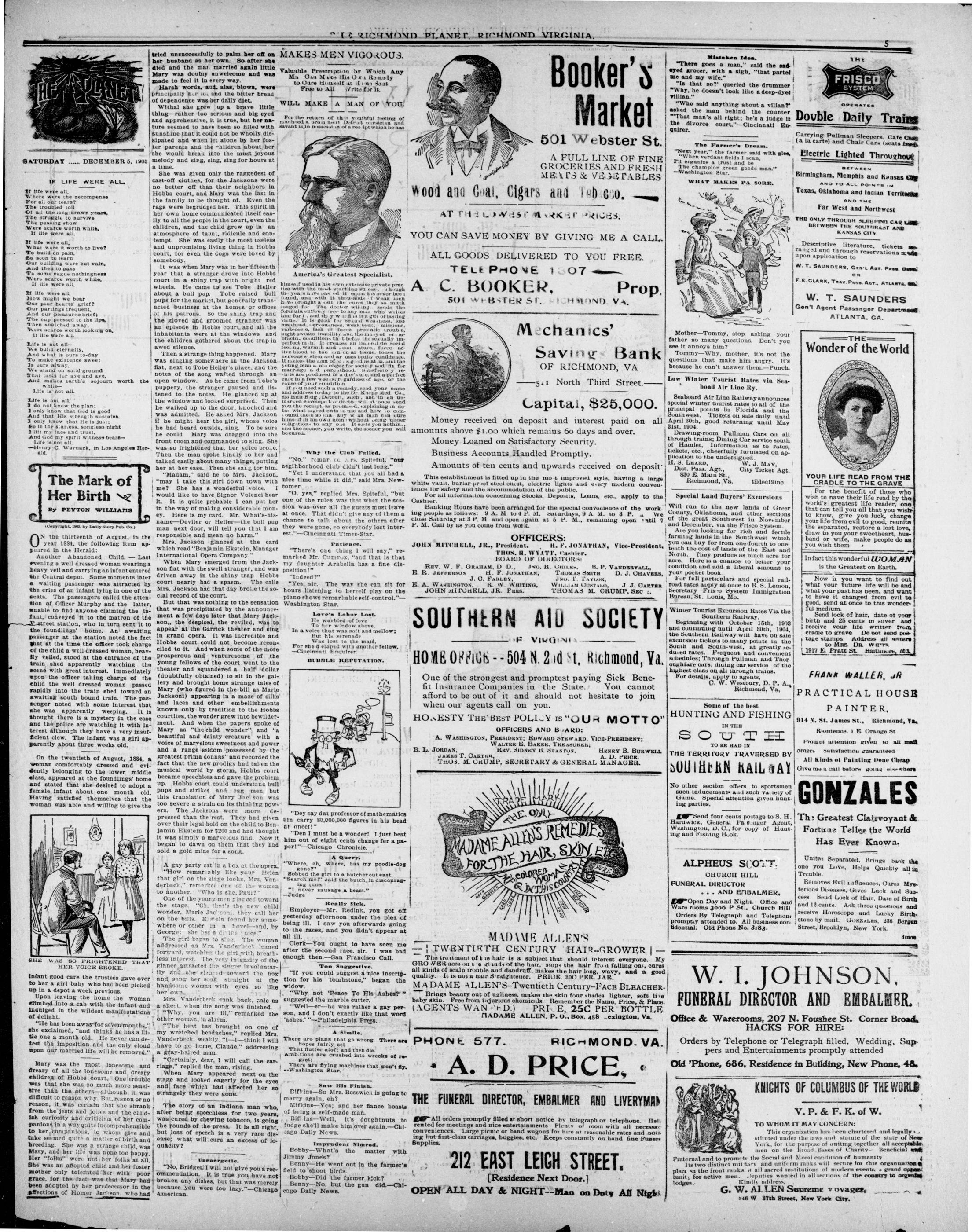
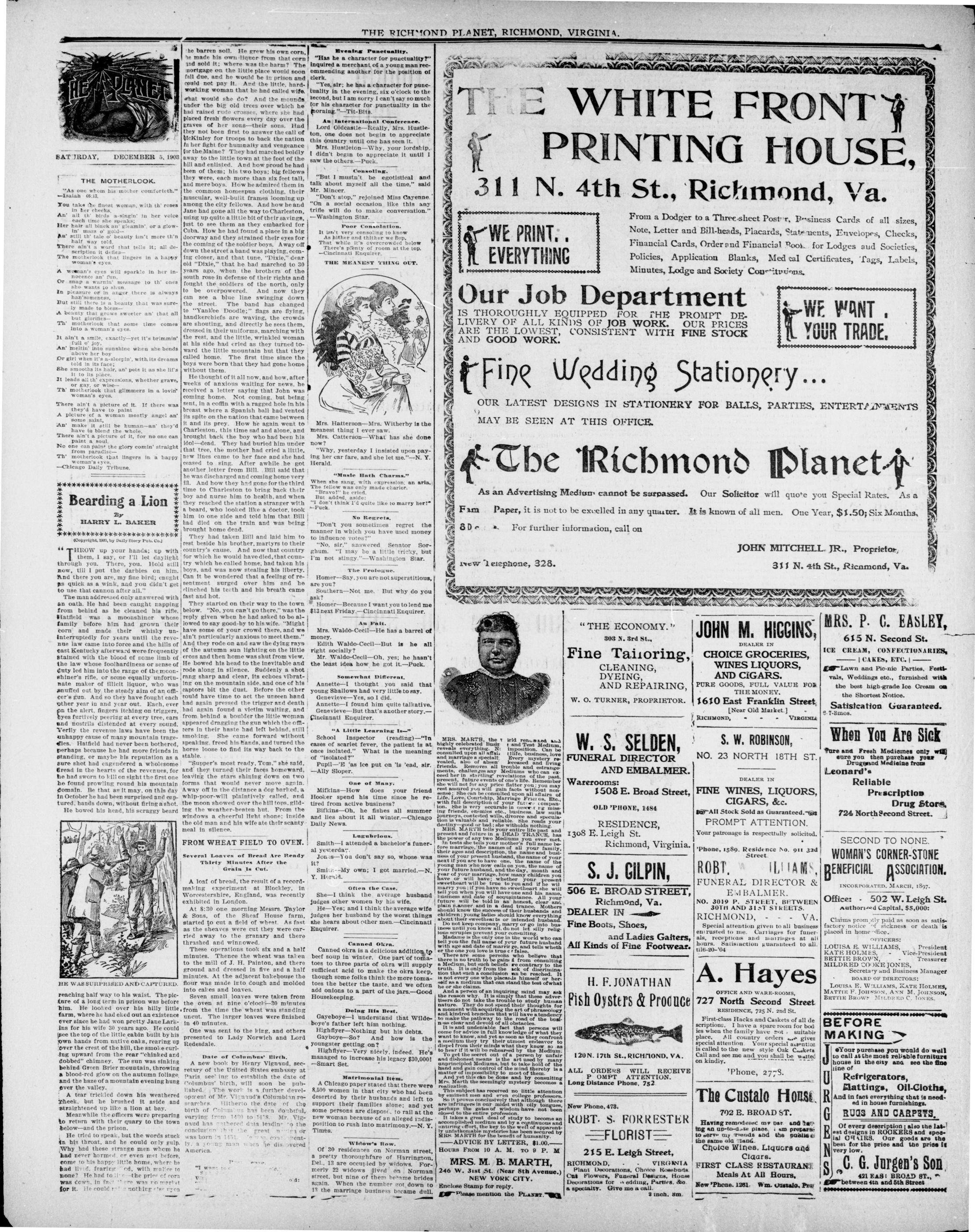
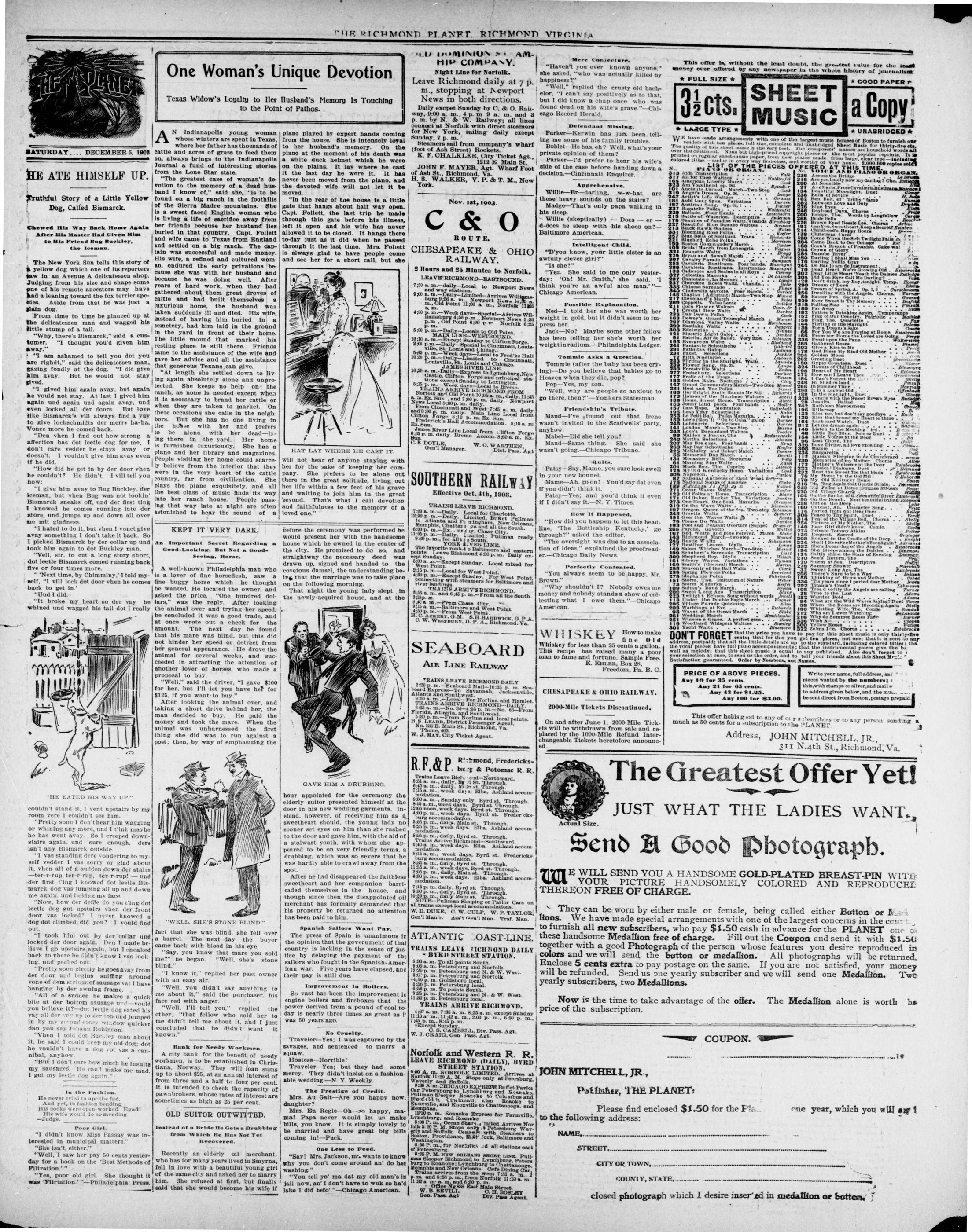
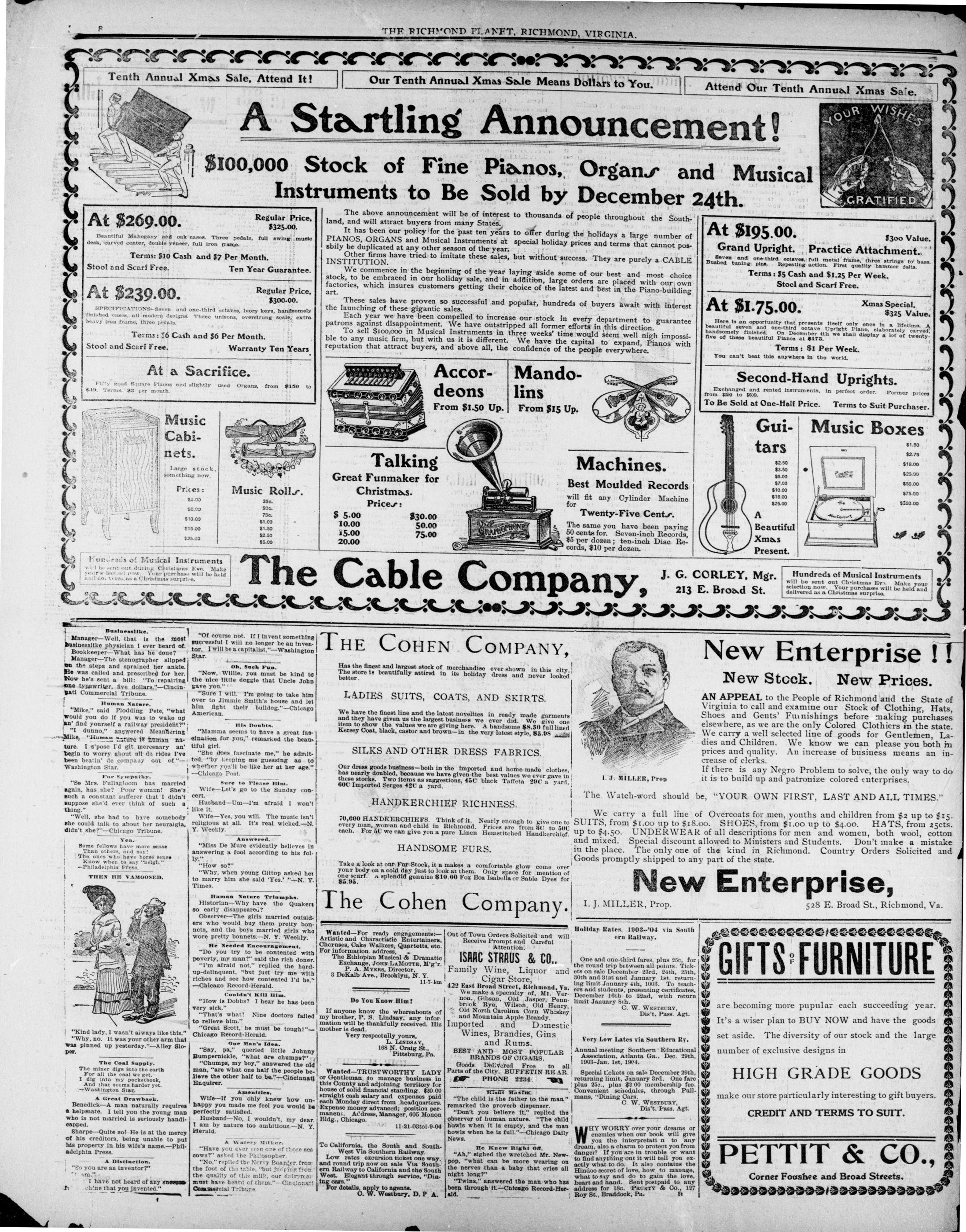
Page text (machine-generated)
THE RICHMOND PLANET
VOL. XX NO. 52.
The chair made vacant in the home of Miss Marietta L. Liles, 114 W. Leigh street, by the death of her beloved mother, is most painfully realized by all the members of that large family, and by sympathetic friends and neighbors.
Mrs. Martha A. Chiles, widow of the late Richard Chiles, So., and mother of the affectionate group of sons and daughters, passed from earth to a home of eternal day and peaceful rest on Nov. 20th, 1903, 7:40 o'clock p.m.
About a year and a half ago Mrs. Chiles was stricken with paralysis, and after several months of severe illness, recovered sufficiently to go about the house and to perform light household duties. She survived only three days after the second stroke. Even before this attack, she had often spoken of her approaching end, and seemingly tried to prepare her daughter for the occasion. But it proved, as in most cases, one is never willing and ready to see loved ones snatched away by death.
Mrs. Chites' funeral took place from the First Baptist Church, of which she was a member for more than thirty years, on Sunday. Nov. 23nd, at 3:30 o'clock, p.m. The services were conducted by Rev. Dr. W. T. Johnson, the pastor, assisted by Rev. W. H. Stokes, B. D., pastor of Ebenezer Baptist Church. The pastor preached a very pathetic sermon, full of consolation to the bereaved ones from the fifth chapter of Paul's second Epistle to the Christians, first and second verses. The sermon clearly rendered the beautiful hymns "Christian's Good-Night," "We shall Miss Beyond the River" and "It is Wall We Soul." The many and beautiful floral designs attested the high esteem in which the deceased and family were held by a large circle of friends.
The family consists of one sister, Mrs. Fannie Holmes, of Wyoming; two brothers, Messrs. John and Robert Morton; four sons, Messrs. William Chiles, of New York. Jas. Alexander Chiles, of Lexington, Ky., C. Richard Chiles, of Washington, D. C., and Col. John K. Chiles, of Richmond, Va., also four daughters, Mrs. Maria Brooks, of Richmond; Mrs. Julia Jeter, of Newport News; Miss Marietta L. Chiles, of Richmond and Mrs. Margie Gibson, of Tuskegee, Ala., There are twenty four grandchildren and three great grandchildren.
Mrs. Chiles was buried in the family section in Hams' Cemetery. Rev. Stokes conducted the services at the grave.
Bianca Council of St. Lakes, of which the deceased was a member for more than thirty years, and the Star of East Tent, of which she was a member for twenty or more years, escorted the remains to the grave and performed their respective burial services.
The following pull bearers were directed by Funeral Director W. I. Johnson, honorary: Revs. D. W. Davis, S. C. Burrell, Messrs. Miles Dibbress and Thos. H. Wyatt. Active: Messrs. H. J. Moore, James H. Twine, Thos. Smith, Dr. J. M. Benson, Messrs. William Custalo and S. Baker. When you consider the ripe old age and beautiful Christian character of Mrs. Martha A. Chiles you realize she was ready for the call which came too soon for her loving children's "Amen." Yet we feel and know that "God did all things well."
---
To call your attention to the advertisement of The Cohen Co. is to remind you that reliability and square dealing pays. Every piece of goods in this establishment carries with it 'tie firm's guarantee to be just as represented. To patronize them is to save money and secure the best service.
Y. M. C. A. Notes.
The Y. M. C. A. Conference was full of life last Friday. The boys tried to put the fire into their pockets while special papers were read by Messrs. T. J. Stokes and D. J. Bradford and a solo was sung by Rev. A. D. Daly. Mr. W. O. Christian did not let the cold keep him from gathering some honey for the evening. The Bee stung many.
Chairman Stephen Braxton and T. J. Stokes conducted meetings in the jail last Sunday. The almshouse was not forgotten.
General Secretary S. C. Burrell addressed the boys last Sunday.
The rooms were crowded last Sunday to hear Prof. B. H. Peyton, who gave the men a practical address. Men, how can we fail after hearing such?
Bring a woman or man to the explanation on the Sunday School Lesson Saturday at 5 p. m.
Men, do not forget, we need you for committee work Sunday. Be on time.
Bible Study for boys Sunday at the rooms at 4 p. m.
Every man is on his way to the True Reformers' Hall Sunday 3:30 p. m. to hear the man that he has been loagging to hear, Rev. R. V. Peyton, pastor of the Sixth Mount Zion Baptist Church, subject; "Show Thyself a Man." Special music by the Mount Carmel Baptist Church Quartette, accompanied by Prof. E. T. Pollard Tell every man you see. Seat the other fellow; bring him. Seats, free. The man at the door will give you a hand.
Come to the rooms every day and spend your leisure moments.
Watch for the date when Lawyer George W. Lewis will address the men
Men, help us to get ready for the great battle that is to be fought, for the protection of the other fellows. Rev. D. Webster Davis is getting ready.
The progress of the Cable Piano Co., under the superb management of Mr. J. G. Corley, is known by all in this locality who have taken the pains to note "the rise and fall" of business concerns. The instruments sold are just as represented, and to have a piano of their make in your house is to have the amount expended always within easy reach. Let your children have the accomplishment of a musical education and purchase an instrument for them to practice upon. Terms easy. See advertisement.
"The Old and the New."
By Bishop B. F Lee, D. D, at the Third Street A. M. E. Church Thursday, Dec. 10:h, 8 p.m. This will be a free lecture, and everybody should hear this great educator of the race. The following is the program:
1. Music by the A. M. E. Church choir.
2. Invocation, Rev, Dr. Z D. Lewis.
3. Music by the choir.
4. Introduction by the pastor, Rev T. A. Green.
5. Lecture, Bishop B. F Lee, D. D.
6. Solo, Mrs. Mildred Cross.
7. Silver offering for Girls' Training School Roanoke, Va.
8. Solo, Miss Susie R. Anderson.
9. Refreshments served in the basement of the church to all.
All the churches will be represented on the platform. Benediction by Rev W. T. Johnson.
T. A. GREEN.
W. F. DENNY, Pastor.
Master of Ceremonies.
The True Reformers' grocery store is offering special inductions, and you make a mistake when you fail to read the document and take advantage of their offers.
"Why are We Baptists?"
Remember the National Baptist Sunday School Union meets on the second Sunday, Dec. 13th, 1903, at the Fifth Baptist Church, (Sydney). Hon. J. Henry Crutchfield, by special request, will deliver the address "Why are We Baptists?" Excellent music.
Bishop B F. Lee, D. D., of the Second Episcopal District of the A. M. E. Church, will deliver a free lecture at Third Street A. M. E. Church Thursday, Dec. 10th, 1903, at 8 p.m. Subject: "The Old Negro." Bishop Lee is chairman and the New Negro. Bishop Lee is chairman and the New Negro. Also one of the leading educators of the race. The lecture will be given in the interest of the Girls' Training School at Roanoke, Va., for which a silver offering will be asked in a public collection. All the churches will be represented.
Deacons' Day at the Fifth Street Baptist Sunday School.
There will be special exercises at the Fifth Street Baptist Sunday School on next Sunday. Dec. 6th, 1903. The program is as follows:
Lesson Review—Lt. W. W. Fields.
Solo—Mr. N. G. Booker.
Address (five minutes) "How to Increase Our Sunday School—Mr. Virgil L. Quintet."
Solo—Mr. R. H. Fauntleroy.
Recitation—Capt. Roscoe Mitchell.
Special addresses by debours.
Remarks by Supt. Peyton.
All are invited to be present and bring a friend.
Mr. I J. Miller, the progressive business genius, makes a few statements in another column which will be of interest to every young and old person in the State. He has unquestionably one of the finest establishments of its kind and size in the southland today. If you have a little money, the goods are there for you. If you have a great deal, you have struck the right place also. He quotes prices that will prove of interest. Read the advertisement and then call to see him. If you are not ready to buy now, call and see him anyway.
Miss N. Beransenia Norrell, the efficient clerk of the Richmond Planet, who has been sick the past two months is at her post of duty again.
Mr. John Gibson, of Norfolk, Va., called on us.
Mrs. Letitia Peters, of Providence, R. I., in company with Miss Alice Johnson, called on us.
$100.00 Endowment Paid
Norfolk, Va., Nov. 27th, 1903.
This is to certify that I have received from John Mitchell, Jr., Grand Worthy Counsellor of the Grand Court of Virginia, I. O. of Calanthe, ($100.00) One Hundred Dollars, in payment of the death claim of Sister Ida Doggett, who was a member of Friendship Court, No. 143.
Signed:—ROBT, FLETCHER DOGGETT.
Witnesses:
Mary Gay
M. A. Fultz.
RICHMOND, VIRGINIA, SATURDAY, DECEMBER 5, 1903.
An imaginative sketch in the December Cosmopolitan endeavors to describe some of the most important conditions in New York in the 1900—that being the year in which New York will celebrate the three hundredth anniversary of the arrival of Hendrick Hudson. The article is by Mr. John Briaben Walker, and covers amusements, the new education, transportation, and many other subjects, which concern the prosperity not only of New York, but of other fast-growing cities. Another article which is semi prophetic in character is "Zion, the capital of a Jewish Nation," by Prof. Richard J. H. Gottheil. It will be widely read by those who feel an interest in the evolution of the Jewish race.
The Hotel Lawson was opened Dec. 2nd, 1908, for the benefit of the colored people of our country, and the only one in Danville, at the corner of Gay and Monroe Sts., No. 406.
REV. D. WEBSTER DAVIS, Orator.
According to the usual custom of the organization, Richmond Lodge, No 11, of the Improved Benevolent and Protective Order of Elks of the World will hold a Lodge of Sorrow at True Reformals Hall, Sunday afternoon, Doc. 6th, at 5:30 o'clock sharp. A fine musical programme has been prepared by the Starlight Quartette and Smith's Quartette. The impressive cermony of the Elks will be conducted by Exalted Ruler B. J. Franklin assisted by the Lodge.
Prof. D. Webster Davis will deliver the oration on the life of the only member of the Lodge who has died in the last twelve months, Sir N. V. Bacchus. The public is invited to be present. Exercises will commence at 5:30 sharp.
B. J. FRANKLIN, Exalted Ruler.
W. P. BURRELL, Sec.
EIGHT HOUR LAW VALID
U. S. Supreme Court Sustains Legality of Kansas Statute.
Washington, Dec. 1.—The supreme court of the United States has sustained the validity of the Kansas act prescribing eight hours as a lawful day's work on all public works and prescribing penalties for contractors who permit or require their workmen to work longer.
The Kansas law, whose validity was called into question in the suit, was enacted in 1891, and provided that eight hours should constitute a day's work for workmen employed by or on behalf of the state, or by any county or city or other municipality in the state. It also prohibits contractors from requiring laborers engaged on work for the state to perform more than eight hours' labor in a day. Both fine and imprisonment for any violation of the law. The case decided today was that of W.W. Atkins vs. the State of Kansas. Atkins had a contract with the corporation of Kansas City, Kan., for paying a street, and he was charged with requiring a workman named Reese to labor 10 hours a day. He was prosecuted in the state court, where the decisions were uniformly against him. Atkins appealed from the decision of the state supreme court to the federal supreme court, alleging that the statute is in violation of the first section of the 14th amendment of the constitution in that it denied him due protection of the law and deprived him of his property without a process.
The opinion was based on the theory that all the municipalities of a state are the creatures of the state; that work for them is of a public character and does not infringe on the personal liberty of any one.
RECEIVERS FOR STEEL COMPANY
Susquehanna Could Not Show Financial Results Required.
Lancaster, Pa., Dec. 1.-P. Eckhart Slaymaker, of this city, and C. C. Kaufman, of Columbia, have been appointed receivers for the Susquehanna Iron and Steel Company. The application for the receivership was made some time ago by John Q. Denny, of Columbia, and opposed by the faction in control, which is headed by Ex-Senator Charles A. Porter, of Philadelphia.
After the hearing Judge Landis announced that he would give the management until the 1st of January to show to the court that the business could be operated on a paying basis, and if they failed to do this a receiver would be appointed. Within the past few days representatives of the management called on Judge Landis and stated that they were willing that a receiver should be appointed immediately. Ex-District Attorney Graham, counsel for the management, filed a statement in which he said they were convinced they could not show a financial condition on January 1 satisfactory to the court, and therefore prayed that the receiver be now appointed. The bond of the receivers has not yet been fixed.
ROOSEVELT ON POSTAL FRAUDS
Loss of Office Not Sufficient Punishment For the Guilty.
SUGGESTS NEW LEGISLATION
Washington, Nov. 30. — President Roosevelt's comment on the postal frauds has been made public. In it he reviews the causes which led to the investigation and heartily endorses Assistant Postmaster General Bristow's report. After naming the 32 persons indicted (12 officials in the service and 19 outsiders), the president names the chief offenders as James T. Tyner, former assistant attorney general for the postoffice department; A. W. Machen, former superintendent of free delivery, and George W. Beavers, former superintendent of salaries and allowances. In concluding, Mr. Roosevelt says:
"I heartily approve of the recommendation of Moses, Conrad and Bonaparte that the statute of limitations be extended in the case of government servants to a period of at least five years, for the persons who in such positions of trust engage in corrupt practices can ordinarily conceal their guilt for a longer time than is covered by the present short statute of limitations. Moreover, our experience shows that outsiders claiming political influence sometimes sell their influence to candidates for office, or in other words blackmail these candidates. There should be legislation which will permit of summary dealing with such offenders.
"However, the prime need is not new legislation, but the punishment of those who offend against existing laws. The postoffice department is making certain changes in the method of administration, locally in the method of inspection, by which the service will be improved and the chance of corruption existing without discovery be minimized; but the only way to meet the real evil is to punish the offenders, by removal in any event, and here possible by prosecution under the criminal statutes. In any great business, public or private, wrongdoing is certain at times to occur. The way to guard against it is rigorously to scrutinize the character of those appointed, carefully to supervise their actions after appointment and finally to punish with relentless severity those who go wrong. All this is being done.
"The immediate reformation of the service by the turning out of the offenders is not in itself enough to meet the demands of justice. The cases against both those within and those without the post office department, who by their acts have brought themselves within the grasp of the law, will be pushed with the utmost vigor. Every effort must be made to see that both the delinquent official and the outsider who shares his guilt are punished to the limit of the law. In pursuance of this policy the individuals above enumerated have been indicted. In no case has the indictment been sought save where the officials of the government were convinced of the man's guilt; and in every case the government will exhaust every expedient in its power in the effort to see that justice is meted out to the offenders. Those in the public service whose duty it is must ever be vigilant in the detection of wrongdoing, fearless in its exposure, relentless in its prosecution; but in the last resort, when everything which the public official, whether legislator, judge or executive officer, can do has been done, it remains for the jury, drawn from the people and representing the people, to do even-handed justice, shielding the innocent, but declining to be misled by any plea into refraining from punishment of the guilty.
"No crime calls for sterner reprobation than the crime of the corruptionist in public life and of the man who seeks to corrupt him. The bribe giver and the bribe taker are equally guilty. Both alike sin against the primary law of the state's safety. All questions of difference in party policy sink into insignificance when the people of this country are brought face to face with a question like this, which lies at the root of honest and decent government. On this question and on all others like it we can afford to have no division among good citizens. In the last resort good laws and good administration alike must rest upon the broad basis of sound public opinion. A dull public conscience, an easy-going acquiescence in corruption, infallibly means debasement in public life, and such debasement in the end means the ruin of free institutions. Self-government becomes a farce if the representatives of the people corrupt others or are themselves corrupted. Freedom is not a gift which will tarry long in the hands of the dishonest or of those so foolish or so incompetent as to tolerate dishonesty in their public servants. Under our system all power
comes from the people and all punishment rests ultimately with the people. The toleration of the wrong, not the exposure of the wrong, is the real offense."
Father Accidentally Shot His Son. Altocau, Pa., Dec. 1.—While George Smeltzer and his son, Harrison, aged 16, of Roaring Springs, wore out hunting near their home, the father tripped over a log and his gun was discharged. The ball entered the son's abdomen, fatally injuring him.
Five inches of Snow In Alleghenies. Cumberland, Md., Dec. 2.—There are five inches of snow in the Alleghenies at Ehlins, W. Va.; Oakland, Md., and Somerset, Pa. The temperature averages 10 degrees above zero.
Cleveland to Foreclose Railroad.
Franklin, Pa, Dec. 1. **Former President.** Griver Cleveland is about to foreclose a mortgage upon the narrow gauge Bradford. Bordell and Kinzua Railroad, of which he is the exclusive holder. At one time this road paid large dividends. The road is only 18 miles long, and when it was built its promoters induced Mr. Cleveland to take the entire bond issue. Mr. Cleveland still has the bonds, and the owners it is said, owe him so much lapsed interest that he is going to call the equipment at Bradford on December 1.
A WEEK'S NEWS CONDENSED
The Spanish cabinet council has appropriated $77,200 for an exhibit at the St. Louis exposition.
Quentin Roosevelt, the president's youngest son, is ill from a cold, complicated with some symptoms of malarial fever.
W. C. Wyman, aged 79, a prominent citizen of Baltimore and a well-known philanthropist, is dead from Bright's disease.
Burglaries broke into the Reading Railway station at Gilberton, Pa. robbed the safe and looted the express room of valuable packages.
Dr. William S. Stewart, one of the most prominent physicians and medical experts in this country, died suddenly at his home in Philadelphia of heart disease.
Saturday, November 23.
Rev. William C. Roberts, president of Central University, at Danville, Ky., died from paralysis.
A severe earthquake was felt at Cairo, Ill. It continued for several minutes and shook the entire city.
The cotton manufacturers of the south will meet at Charlotte, N. C., December 8 to formulate a plan to curtail production.
Fire badly damaged the Y. M. C. A. building at Wilkesbarre, Pa., after burning out two stores on the first floor. Loss $30,000.
The cab drivers strike in New York city was settled by the employers granting the men 10 hours of duty after each day's work and $2 per day.
Monday, November 30
Jules Levy, the world famous cornetist, died in Chicago of apoplexy. He was 66 years old.
Lord Roberts, commander-in-chief of the British army, will retire, owing to continued ill health.
Charged with an attempted criminal assault, John Fagle, a negro, was lynched at Ross Station, S. C.
Because he lost his fortune in Wall street, Victor Banner, member of a well-known family, committed suicide in New York.
The 10 per cent. erduction in wages to Rhode Island cotton mills employees has gone into effect. It includes 37 mills and 20,000 employees.
Tuesday, December 1.
The new battleship Missouri was placed in commission at the Newport News, Va., shipyard.
Two men were killed and two injured in a freight wreck on the Norfolk and Western railroad at Portsmouth, O.
Hamilton Fish, assistant treasurer of the United States in New York, underwent an operation for appendicitis. He is doing well.
Pope Plus received in private audience at the Vatican Monsignor Robert Seton, of Newark, N. J., titular archbishop of Hellopolis.
Wednesday, December 2.
Postmaster Montague, of San Francisco, Cal., has resigned.
Treasurer Harris, of Pennsylvania, reports a balance of $11,991,237.33 in the general fund.
In a collision of tug boats in New York harbor three men were killed and one badly injured.
General Nelson A. Miles was the guest of honor at the banquet of the Crucible Club at Pittsburg.
Collieries Close Indefinitely
Shamokin, Pa., Dec. 1.—The Centralia collieries have closed down for an indefinite period, causing 2500 men and boys to be thrown out of employment. The collieries are owned by the Lehigh Coal Company, which does not give a reason for the shutdown. It is believed, though, that the closing of the mines is due to poor coal trade.
RECEIVERS NAMED FOR ZION CITY
Bankruptey Proceedings Against John Alexander Dowie.
HIS VENTURES DO NOT PAY
Chicago, Dec. 2.—Financial difficulties which began during the crusade of John Alexander Dowie, the self-styled "Elijah III," and his restoration host to New York a month ago, and which have been rapidly increasing since Dowie's return, culminated in the federal court taking possession of all the property controlled by Dowie in Zion City, Ill. This town, which was founded two years ago by Dowie, has a population of over 10,000, is the general headquarters for Dowie's church, and is said to represent an expenditure of $20,000,000.
Fred M. Bleunt, cashier of the Chicago National Bank, and Albert D. Currier, a law partner of Congressman Doutell, were appointed receivers of the property. Their bonds were fixed at $100,000 by Judge Kohlsat, of the United States district court, who made the appointment on the petition of several creditors. The receivers left for Zion City to take possession of the property.
The bankruptcy proceedings against Dowle were based on the allegation that he is insolvent, and that while in this financial condition he committed an act of bankruptcy by making a preferential payment on November 2, to the E. Street Lumber Company for $770. Dowle has been hard pressed by his creditors, especially since it was announced that his recent mission to New York had proved unsuccessful financially.
Dowie is known to have accumulated a large sum as the head of the Christian Catholic Church, the assets of the organization being estimated at between $20,000,000 and $30,000,000. There was a large outlay of money, however, when Zion City was started. Then lace and candy industries were started, and as both of these ventures have never been a paying investment, a great deal more money was tied up. Dowie's differences with his brother-in-law, Stevenson, over the management of the lace factory cost more than $100,000, and other suits recently begun in Lake county by creditors are said to aggregate a large sum.
Attorney Ettleson, representing the petitioning creditors, in his arguments before Judge Kohlsaat, sald:
"The creditors whom I represent have reason to believe that Dr. Dowle is insolvent. Judgments have been accumulating against him for several weeks past, and there was every indication that the overseer of Zion congregation could not pay his debts. In such a crisis, the creditors sought protection for their interests in the bankruptcy court. It is impossible to estimate the liabilities or assets of Dr. Dowle. Zion's affairs are complicated, and it will take several weeks, I believe, before any idea of Dowle's finances can be had."
Last Wednesday Dowle's first confession of weakness was made at a rally in the tabernacle at Zion City.
"A lot of you people have cash in your pockets," Dowle said to his followers. "Dig down and get it out. It is God's, and we need it in His work. You're cowards if you don't give it up. Deposit it."
Dowie talked in the same strain for more than an hour, tears glistening on his cheeks as he told of the financial straits in which the Zion industries found themselves.
Instead of frightening many into depositing, this appeal sent a long line of people to the bank on Friday, when they lined up at the paying teller's window, drawing out their money. Less than $3000 was deposited in the Bank on Friday, while the amount withdrawn was twice as much. Late in the afternoon A. W. Graham, of Waukegan, tried to withdraw his account of $800, and was told he would have to give 30 days notice before he could get his money. Sunday another appeal was made by Dowie for funds, but the depositors who appeared were few and the deposits were chiefly in trivial amounts. Yesterday Dowie asked the members of Zion more urgently than ever for money. He declared that he must have $500,000 without delay. This sum, he said, he was willing to take in short loans, but that they must be forthcoming immediately. In the efforts to remedy the condition of affairs at Zion City hundreds of letters were sent out daily to Dowie's followers in other parts of the country. In these letters, in which glowing prospects of Zion City's future were painted, and in which Dowie himself is quoted as saying that all those who believe in him will "follow the Lord," all Dowieites are urged, almost commanded, to sell their farms, stores and everything else and come
at once to Zion City and take up the work of the church. All of those who have money in banks near where they now live were asked to draw that money out of the local banks and send it for deposit at Zion City.
Lived Two Days With Bullets In Heart
Newark, N. J., Dec. 1.—An autopsy made on the body of Luigi Russomano, who died at his home here, revealed the fact that two bullets had pierced his heart. The fact that the man had been shot was discovered by the undertaker who was called in to prepare the body for burial, it having been stated by members of the family that the man had died a natural death. The police learned that Russomanno had been shot in a fight in a saloon on Saturday, that and with two bullets in his heart he had walked home and lived nearly two days.
PEACE IN THE FAR EAST
Japan and Russia On Verge of Settlement of Controversy.
Paris, Dec. 2.—Japan and Russia are on the verge of a settlement of the Far Eastern controversy, which promises to dissipate the war cloud that has been hanging over both countries. This settlement will be the result of the negotiations which have been in progress for some time past and which were assisted by the friendly representations of France to Russia and of Great Britain to Japan. The two nations have practically agreed upon the basis of a treaty, the signing of which can be prevented only by some unexpected development.
The basis of this forthcoming agreement follows: Russia will accept the two agreements entered into by Japan and Korea, dated 1896 and 1898 respectively, under which Japan secured various rights in Korea, including the maintenance of a garrison at Seoul. In exchange for this concession Japan will accept Russia's treaty with China respecting Manchuria.
It is believed/though this cannot be stated as positively—that Japan and Russia will reiterate their support of the principles of the "open door and the integrity of China and of Korea.
Church to Soldiers of Civil War.
Gettysburg, Pa., Dec. 2.—The Gettysburg Battlefield Memorial Church of the Prince of Peace, erected in this borough in honor of the soldiers of both the north and the south who took part in the battle of Gettysburg, was dedicated by Bishop Ethelbert Talbot of the Central Pennsylvania diocese of the Protestant Episcopal Church. In the tower of the church have been placed several hundred memorial tablets in memory of the soldiers who were killed at Gettysburg, and on the walls of the main auditorium were placed tablets to Major Generals George G. Meade, Winfield Scott Hancock and other prominent officers of the Union army.
McKinley Souvenirs Sent to Porto Rico Canton, O., Dec. 2. Five thousand McKinley memorial souvenirs have been sent to Porto Rico to acknowledge the payment of $2000 by the school children of that country. A large shipment will soon be sent to Cuba.
Germany recognizes Panama.
Washington, Dec. 1. Germany has recognized the Republic of Panama as a sovereign and independent state. Baron Von Dem Busch-Haddenhausen first secretary of embassy and charge d'affaires, addressed a note to Mr. Bunau-Varilla, the minister from Panama, informing him that the German government having received his notification of the creation of the new republic and his formal assurances that Panama assumed and would execute all obligations contained in the treaties between Germany and Columbia so far as they effected territory over which Panama is now sovereign. Him majesty, the emperor and king, extended full recognition to the new republic and best wishes for its prosperity and long life.
Lost Reason Strangely Restored.
Portland, Me., Dec. 2.—Charles R. Libby, of Scarboro, who five months ago lost his reason and for two weeks wandered through the woods in a demented condition, has been restored to reason in a peculiar manner. A plus of wood fell upon him, inflicting a severe wound on his head and causing the blood clot, which had formed on his brain because of a fall sustained five months ago, to pass away. He is now once more in possession of his mental faculties.
Fear of Small-pox Empties Car-
Altoona, Pa., Dec. 2—William Nes-
selrod, wife, babe and sister,
Youngstown, O., were taken off a wag
passenger train on the Pennsylvania
railroad here, suffering with small-pox.
They boarded the train at Tyrone, and
when a doctor informed the conductor
that they had small-pox the other pass-
engers fled from the car. They were
removed to the pest house and the car
disinfected.
AE PLANET
SATURDAY.... DECEMBER 5, 1908
TEMPERANCE NOTES
A JOLLY GOOD FELLOW.
A heart-broken woman in helpless anxiety,
Waiting and watching, tormented by
fear.
Seprived of her peace and husband's society.
Dreading the footstep she once longed to hear.
Beeling home late after making a night of it.
Shrouding his dwelling in sorrow and gloom.
Tams Horn
Merry companions the wheed and mellow
sip.
(How could a jolly good fellow decline?)
Debauchery masked in the gulse of good
fellowship.
Consequence is strangled in maddening wine.
**R** goes for a joke, the world thinks the same of it.
Heedless they laugh at his staggering
gait;
Think of the pity and think of the shame of it.
For woe-stricken hearts that so anxiously wait.
Coming home drunk after making a night of it.
It seems to a trotle (so say so at least).
Nothing uncommon, so why not make light of it.
DRINK AND THE POCKETBOOK.
The liquor traffic has many sides. It may be that the financial side is less important than some others, but it should not be left out of consideration. Broken hearts, ruined homes and lost souls are results that cannot be passed by lightly, but for the present the money side of the matter is before us. A nation cannot increase or decrease its wealth at will. It would be impossible to plan a colony of a hundred thousand men in the Sahara desert and make each one worth a million dollars in a dozen days. It is true, also, that if one fourth of a nation's capital is invested in any one industry, not more than three-fourths is available for all other lines of business. Whatever money a man spends for liquor he cannot spend for anything else. We are interested to know whether Solomon told the truth when he said that "the drunkard shall come to poverty." He used the word "winebibber," but it can stand for the user of any kind of intoxicants. This verse links the drunkard with the glutton and the sluggard—all are headed toward poverty. The word translated "poverty" has more in it than our English word. "The winebibber shall be dispossessed," is a good rendering. This shows not only the poor condition of the drunkard, but also the course by which he has arrived there.
There are three leading causes for the drunkard's loss of property:
1. The drunkard himself. In one sense the drunkard must decide every question relating to drink—he is the court of last resort and must say "yes" or "no" to every temptation, but, while this is true, other characters figure prominently. The drinker is the cause of his own indigence from two standpoints. The first is his inordinate desire for drink. Solomon talked of a man in whom the habit of intemperance was well formed. The process by which one becomes a drunkard may be slow or rapid, the causes are various, but we are dealing with the finished product of the saloon. He has cultivated a taste for liquor. The thirst grew insensibly, but gradually. At first the drink was slickening, perhaps, then it was bearable, later it became desirable, while now the fumes of whiskey or beer appeal to the appetite in a most tempting way. One who has not been caught in the toils of strong drink cannot understand its slavery. This insatiate desire, if yielded to, is a constant drain upon the pocketbook. It requires much money to produce it, and it is not satisfied until it has taken the last farthing, it is then satisfied? Go to the prison and ask a score of men who pawned articles or broke chests open for money to buy more liquor, whether the appetite departs with the last dime. The grave itself is the only refuge for nine men in ten. The drunkard causes his own poverty, too, by a lack of self-control.
Desire for drink might cause a great deal of unrest, or even physical suffering, but if it is controlled firmly the purse will not suffer. All know that a physical appetite clamors for recognition—the desire for drink most only, perhaps, of all. Whether one can or cannot keep from drinking has no special bearing here, for the tact is that the drunkard does not control himself, and if he cannot, he is a pitilable sight. His will has been forced to abdicate its throne and destructive appetite has been crowned with his own consent. Since his will has become measurably powerless, to that degree he has been made more like the machine, or the animal.
2. The oppressor. Left to themselves few men would go to the gutter. They are imposed upon by others. The oppressor may be an open foe. A man that is in the employ of the devil understands how to secure the downfall of his enemy. If a noble youth or a reformed drunkard can be made to stumble by sinister methods, the result is gained—and results favorable to themselves are all that whisky men desire. Frequently the oppressor is a pretended friend. It is a common sight to see one man coaxing another to go into a saloon and have a social glass. That costs the man thus invited nothing, but a treat is expected, which is a double pull on his purse. All saloons are fitted up to make their customers enjoy themselves. One can find almost anything there, to tempt men to enter and remain. All this is done under the guise of friendship. If the customer had no purse, and the keeper had no coffer, or if the till of the latter could not be filled from the pockets of the former, there would be no music or work of art. It seems that if no other cause would drive a man to be temperate, the idea of being cheated out of money, under the pretense of friendship would be effective in turning one the other way.
3. Drink itself. Drink itself is one of the most powerful agencies for producing poverty. To procure it requires money. It is true that much is given away among companions, but what is so received is in the end the most costly of all. Breweries and distilleries intend that every swallow shall be paid for, and the final cost falls upon those who drink. When we learn that the sale of malt liquors in New York city averages more than a barrel for every man, woman and child; Chicago and Philadelphia nearly two barrels for each inhabitant; in Boston more than two barrels; in St. Louis and Cincinnati more than three barrels; in Newark, N. J., nearly five barrels, and in Milwaukee seven barrels, do we doubt that strong drink requires money? The above figures do not include distilled liquors and wines. The use of liquor begets a desire to squander money. Drink makes most people liberal. Money is free as long as it lasts. Common laborers often come out of a three days' spree $25 to $50 poorer than before. One's own appetite requires a larger expenditure, and the circle of friends increases to whom he feels under obligations by the unwritten code of intemperance. Gambling is inseparable from drinking in this age, and furnishes a new channel for the outflow of money.
Drink also destroys the ability to earn money. The capital melts away, and the debt accumulates, if the man can find credit. Business expediency should put a stop to drinking, if no higher motive can appeal to a man. It is becoming harder and harder for an intemperate man to secure a good job on the railroad. Some roads will employ no man who goes into a saloon, and will discharge an employee for the first offense. Others that are less rigid will give the sober man preference over another applicant for a position who indulges in drink occasionally. If one of two men is to be discharged, the temperate is retained and the intemperate dismissed, if other things are equal. The ability for a drunkard to earn money is growing less and less every year. Much of what has been said about railroads is equally true of other lines of business.
One might reply that the circulation of money is essential to business prosperity. That is true, but there is no circulation about the drunkard's money. To circulate means to go round and round, permitting the same man to buy with it and sell for it. That would be more like business, but money spent for liquor does not circulate—it moves forward, but does not return. It ends in the pocket of the brewer and distiller, and the great majority of it stays there. The ragged, red-nosed, blear-eyed drinker sees it no more. He sells the little octave that his wife's money helped to buy, and rents a home. A little later he moves into a poorer house that he can get for less rent, and then he moves every month or two to dodge the angry landlord. But the manufacturer of his destruction stops renting and buys a home on a good street. Later he builds a beautiful residence on the chief avenue or boulevard, surrounds himself with all modern conveniences, and smiles at the folly of those who made him a millionaire. The brewer is the dead sea of the drinker's finances. Nothing has been said of the physical suffering that drink entails upon the individual and his family, or of its curtailed happiness and social ostracism. The ruined reputation and blackened character of the drinker have not been reerried to, but it is hoped that enough has been written to cause the reader to see that there is a pocketbook side to drink, and that that aspect of the question has some importance. To the manufacturer and seller of intoxicants, it is the all-important consideration. But, why should they be allowed to fatten on the weakness and folly of men?—Prof. J. M. Phillips, in N. P. Observer.
Out of 500 cities and towns in Tennessee, only eight have not restricted the sale of liquor. It is expected that this will be the next state to adopt absolute 'prohibition.
Secret Well Kent
Sophie—Julie and Joe are engaged,
but they have decided to keep their
engagement a secret; Julie told me so.
Tom—Yes, I know; Joe told me.—Tit-
Bits.
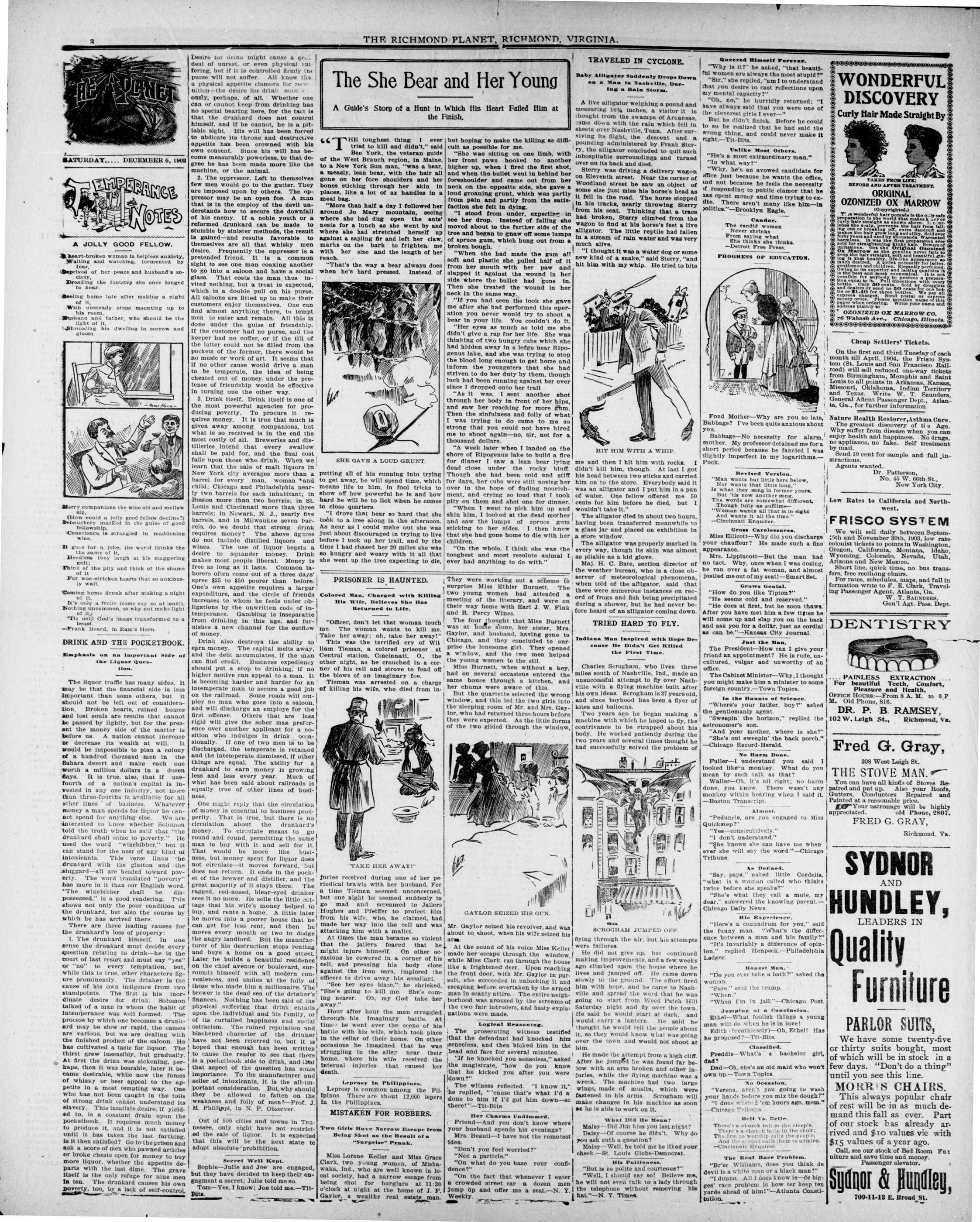
THE RICHMOND PLANET, RICHMOND, VIRGINIA.
The She Bear and Her Young
A Guide's Story of a Hunt in Which His Heart Failed Him at the Finish.
"THE toughest thing I ever tried to kill and didn't," said Ben York, the veteran guide of the West Branch region, in Maine, to a New York Sun man, "was a bear, a mealy, lean bear, with the hair all gone on her fore shoulders and her bones sticking through her skin in places, like a lot of ax handles in a meal bag.
"More than half a day I followed her around Jo Mary mountain, seeing where she had dug open the ants' nests for a lunch as she went by and where she had stretched herself up against a sapling fir and left her claw, marks on the bark to frighten me with her size and the length of her reach.
"That's the way a bear always does when he's hard pressed. Instead of
K.
SHE GAVE A LOUD GRUNT.
putting all of his eunning into trying to get away, he will spend time, which means life to him, in fool tricks to show off how powerful he is and how hard he will be to lick when he comes to close quarters.
"I drove that bear so hard that she took to a tree along in the afternoon. As near as I could make out she was just about discouraged in trying to live before I took up her trail, and by the time I had chased her 20 miles she was so hungry and weary with it all that she went up the tree expecting to die.
PRISONER IS HAUNTED
Colored Man, Charged with Killing His Wife, Believes She Has Returned to Life.
"Officer, don't let that woman touch me. The woman wants to kill me. Take her away; oh, take her away!" This was the terrified cry of William Tieman, a colored prisoner at Central station, Cincinnati, O., the other night, as he crouched in a corner of his cell and strove to fend off the blows of an imaginary foe. Tieman was arrested on a charge of killing his wife, who died from in-
A man in a coat and hat is kneeling on the floor, looking at a woman sitting on a chair. The woman is wearing a black coat and has a white hat on her head. There is a bowl on the floor in front of the woman.
"TAKE HER AWAY!"
juries received during one of her periodical brawls with her husband. For a time Tieman seemed unconcerned, but one night he seemed suddenly to go mad and screamed to Jailers Hughes and Pfeffler to protect him from his wife, who, he claimed, had made her way into the cell and was attacking him with a mallet.
At times the man became so violent that the jailers feared that he might injure himself. On other occasions he cowered in a corner of his cell, and pressing his body close against the iron pars, implored the officers to drive away his assailant.
"See her eyes blaze," he shrieked. "She's going to kill me. She's coming nearer. Oh, my God take her away."
Hour after hour the man struggled through his imaginary battle. At times he went over the scene of his battle with his wife, which took place in the cellar of their home. On other occasions he imagined that he was struggling in the alley near their home, where his wife received the internal injuries that caused her death.
Leprosy in Philippines.
Leprosy is common among the Filipinos. There are about 12,000 lepers in the Philippines.
MISTAKEN FOR ROBBERS.
Two Girls Have Narrow Escape from Being Shot as the Result of a "Surprise" Frank.
Miss Lorene Keller and Miss Grace Clark, two young women, of Mishawaka, Ind., who are well known in local society, had a narrow escape from being shot for burglaries at 11:30 o'clock at night at the home of J. F. Gaylor, a wealthy real estate man.
but hoping to make the killing as difficult as possible for me.
"She was sitting on one limb, with her front paws hooked to another higher up, when I fired the first shot, and when the bullet went in behind her foreshoulder and came out from her neck on the opposite side, she gave a loud groaning grunt, which was partly from pain and partly from the satisfaction she felt in dying.
"I stood from under, expecting to see her drop. Instead of falling she moved about to the further side of the tree and began to gnaw off some lumps of spruce gum, which hung out from a broken bough.
"When she had made the gum all soft and plastic she pulled half of it from her mouth with her paw and slapped it against the wound in her side where the bullet had gone in. Then she treated the wound in her neck in the same way.
"If you had seen the look she gave me after she had performed this operation you never would try to shoot a bear in your life. You couldn't do it.
"Her eyes as much as told me she didn't give a rap for her life. She was thinking of two hungry cubs which she had hidden away in a ledge near Ripogenus lake, and she was trying to stop the blood long enough to get home and inform the youngsters that she had striven to do her duty by them, though luck had been running against her ever since I dropped onto her trail
"As it was, I sent another shot through her body in front of her hips, and saw her reaching for more gum. Then the sinfulness and folly of what I was trying to do came to me so strong that you could not have hired me to shoot again—no, sir, not for a thousand dollars.
"A week later when I landed on the shore of Ripogenus lake to build a fire for dinner I saw a lean bear lying dead close under the rocky bluff. Though she had been cold and stiff for days, her cubs were still nosing her over in the hope of finding nourishment, and crying so loud that I took pity on them and shot one for dinner.
"When I went to pick him up and skin him, I looked at the dead mother and saw the lumps of spruce gum sticking to her sides. I then knew that she had gone home to die with her children.
"On the whole, I think she was the toughest and most resolute animal I ever had anything to do with."
They were working out a scheme to surprise Miss Ethler Burnett. The two young women had attended a meeting of the literary, and were on their way home with Earl J. W. Fink and R. Percy Wines.
The four thought that Miss Burnett was at home alone, her sister, Mrs. Gaylor, and husband, having gone to Chicago, and they concluded to surprise the lonesome girl. They opened a window, and the two men helped the young women to the sill.
Miss Burnett, when without a key, had on several occasions entered the same house through a kitchen, and her chums were aware of this.
But the quartette selected the wrong window, and this led the two girls into the sleeping room of Mr. and Mrs. Gaylor, who had returned three hours before they were expected. As the little forms of the two gilded through the window,
V. R.
GAYLOR SEIZED HIS GUN.
Mr. Gaylor seized his revolver, and was about to shoot, when his wife seized his arm.
At the sound of his voice Miss Keller made her escape through the window, while Miss Clark ran through the house like a frightened deer. Upon reaching the front door, with Mr. Gaylor in pursuit, she succeeded in unlocking it and escaping before overtaken by the armed man in scanty attire. The entire neighborhood was aroused by the screams of the two fair intruders, and hasty explanations were made.
Logical Reasoning.
The prosecuting witness testified that the defendant had knocked him senseless, and then kicked him in the head and face for several minutes.
"If he knocked you senseless," asked the magistrate, "how do you know that he kicked you after you were down?"
The witness reflected. "I know it," he replied, "'cause that's what I'd a done to him if I'd got him down—so there!"—Tit-Bits.
Her Charms Undimmed.
Friend—And you don't know where your husband spends his evenings?
Mrs. Beauti—I have not the remotest idea.
"On what do you base your confidence?"
"On the fact that whenever I enter a crowded street car a dozen men jump up and offer me a seat.—N. Y. Weekly."
TRAVELED IN CYCLONE
Baby Alligator Suddenly Drops Down on a Man in Nashville, During a Rain Storm.
A live alligator weighing a pound and measuring 16½ inches, a visitor it is thought from the swamps of Arkansas, came down with the rain which fell in sheets over Nashville, Tenn. After surviving its flight, the descent and a pounding administered by Frank Sterry, the alligator concluded to quit such inhospitable surroundings and turned over on its back and died.
Sterry was driving a delivery wagon on Eleventh street. Near the corner of Woodland street he saw an object of some size just miss his horse's head as it fell in the road. The horse stopped in his tracks, nearly throwing Sterry from his seat. Thinking that a trace had broken, Sterry climbed from the wagon to find at his horse's feet a live alligator. The little reptile had fallen in a stream of rain water and was very much alive.
"I thought it was a water dog or some new kind of a snake," said Sterry, "and hit him with my whip. He tried to hite
A man in a suit and hat, holding a sword, walks past a crocodile.
HIT HIM WITH A WHIP.
me and then I hit him with rocks. I didn't kill him, though. At last I got his head between two sticks and carried him on to the store. Everybody said it was an alligator and I put him in a pan of water. One fellow offered me 50 cents for him before he died, but I wouldn't take it."
The alligator died in about two hours, having been transferred meanwhile to a glass jar and placed on exhibition in a store window.
The alligator was properly marked in every way, though its skin was almost as pliable as a kid glove.
Maj. H. C. Bate, section director of the weather bureau, who is a close observer of meteorological phenomena, when told of the alligator, said that there were numerous instances on record of frogs and fish being precipitated during a shower, but he had never before heard of an alligator coming down.
TRIED HARD TO FLY.
Indiana Man Inspired with Hope Because He Didn't Get Killed the First Time.
Charles Scrogham, who lives three miles south of Nashville, Ind., made an unsuccessful attempt to fly over Nashville with a flying machine built after his own ideas. Scrogham is 37 years old, and since boyhood has been a flyer of kites and balloons.
Two years ago he began making a machine with which he hoped to fly, the contrivance to be strapped about his body. He worked patiently during the two years and several times thought he had successfully solved the problem of
C. H.
dying through the air, but his attempts were failures.
He did not give up, but continued making improvements, and a few weeks ago climbed upon the house where he lives and jumped off. He came down slowly to the ground. The effort fired him with hope, and he came to Nashville and spread the word that he was going to start from Weed Patch Hill Saturday night and fly over the town. He said he would start at dark, and would carry a lantern. He said he thought he would tell the people about it, so they would know what was going over the town and would not shoot at him.
He made the attempt from a high cliff.
After he jumped he was found far below with an arm broken and other injuries, while the flying machine was a wreck. The machine had two large wings, made of muslin, which were fastened to his arms. Scrogham will make changes in his machine as soon as he is able to work on it.
**What Did He Mean?**
Maisy—Did Jim kiss you last night?
Daisy—Of course he didn't. Why do you ask such a question?
Maisy—Well, he told me he liked your cheek—St. Louis Globe-Democrat.
His Politeness.
"Well, I should say so! Believe me, he will not even talk to a lady through the telephone without removing his hat."—N. Y. Times.
"Why is it?" he asked, "that beautiful women are always the most stupid?" "Sir," she replied, "am I to understand that you desire to cast reflections upon my mental capacity?" "Oh, no," he hurriedly returned; "I have always said that you were one of the cleverest girls I ever—" But he didn't finish. Before he could lo so he realized that he had said the wrong thing, and could never make it right—Tit-Bits.
Unlike Most Others
Unlike Most Others.
"He's a most extraordinary man."
"In what way?"
"Why, he's an avowed candidate for office just because he wants the office, and not because he feels the necessity of responding to public clamor that he has spent money and time trying to exultate. There aren't many like him—in politics."—Brooklyn Eagle.
Candor.
The candid woman
Never shrinks
From saying what
She thinks she thinks.
—Detroit Free Press.
PROGRESS OF EDUCATION.
Fond Mother—Why are you so late, Babbage? I've been quite anxious about you.
Babbage—No necessity for alarm, mother. My professor detained me for a short period because he fancied I was slightly imperfect in my logarithms.—Puck.
Bexlade Version
Revised Version.
"Man wants but little here below,
Non wants that little long."
Is what wants that long years.
But tis now another song.
The words are somewhat different,
Though fully as sufille—
"Woman wants all that is in sight
At least at the time."
Cincinnati Enquirer
Gross Carelessness
Miss Elliott—Why did you discharge your chauffeur? He made such a fine appearance.
Mrs. Lippincott—But the man had no tact. Why, once when I was dozing, he ran over a fat woman, and almost jostled me out of my seat! Smart Set.
Grows Genial.
"He seems cold and reserved." "He does at first, but he soon thaws. After you have met him a few times he will come up and slap you on the back and ask you for a dollar, just as cordial as can be."—Kansas City Journal.
Just the Man.
The President—How can I give your friend an appointment? He is rude, uncultured, vulgar and unworthy of an office.
The Cabinet Minister—Why, I thought you might make him a minister to some foreign country.—Town Topics.
In the Haunts of Science.
"Where's your father, boy?" asked the gentlemany agent.
"Sweepin' the horizon," replied the astronomer's son.
"And your mother, where is she?" "She's out sweepin' the back porch."
—Chicago Record-Herald.
No Harm Done.
Fuller—I understand you said I looked like a monkey. What do you mean by such talk as that?
Waller—Oh, it's all right; no harm done, you know. There wasn't any monkey within hearing when I said it.
-Boston Transcript.
Almost.
"Peduncle, are you engaged to Miss Quickstep?"
"Yes—constructively."
"I don't understand."
"She knows she can have me when ever she will say the word."—Chicago Tribune.
As Defined.
"Say, papa," asked little Cordella, "what is a woman called who thinks twice before she speaks?" "She's what they call a mute, my dear," answered the knowing parent.—Chicago Daily News.
Hia Experience
"Here's a conundrum for you," said the funny man. "What's the difference between a man and his family?" "It's invariably a difference of opinion," replied Henpeck—Philadelphia Ledger.
Honest Man.
"Do you ever take a bath?" asked the woman.
"Sure," said the tramp.
"When."
"When I'm in jail."—Chicago Post.
Jumping at a Conclusion.
Ethel—What foolish things a young man will do when he is in love!
Edith (breathlessly)—Oh, Ethel! Has he proposed?—Tit-Bits.
Classified.
Freddie—What's a bachelor girl, dad?
Dad—Oh, she's an old maid who won't own up.—Town Topics.
No Occasion.
"Verena, aren't you going to wash your hands before you mix the dough?"
"I done washed 'om hours ago, mem."—Chicago Tribune.
Bell Vs. Belle
There's a church bell in the steeple,
There's a church bell in the choir;
The first to worship calls the people,
And the second calls them to admire.
—Cincinnati Enquirer.
The Real Race Problem
The Real Race Problem.
"Br'er Williams, does you think de
devil is a white man or a black man?"
"I dunno. All I does know is—de bigges' race problem is how ter keep ten yards ahead of him!"—Atlanta Constitution.
WONDERFUL
DISCOVERY
Curly Hair Made Straight By
```markdown
```
OZONIZED OX MARROW CO.
76 Wahash Ave., Chicago, Illinois.
Cheap Settlers' Tickets.
On the first and third Tuesday of each month till April, 1904, the Frisco System (St. Louis and San Francisco Railroad) will sell reduced one-way tickets from Birmingham, Memphis and Saint Louis to all points in Arkansas, Kansas, Missouri, Oklahoma, Indian Territory and Texas. Write W. T. Saunders, General Affent Passenger Dept., Atlanta, Ga., for further information
Nature Health Restorer, Asthma Care. The greatest discovery of the Age. Why suffer from disease when you can enjoy health and happiness. No drugs, no appliance, no fake. Self treatment by mail.
Send 10 cent for sample and full instructions.
Agents wanted.
Dr. Patterson,
No. 45 W. 66th St.,
New York City.
Low Rates to California and North-west.
FRISCO SYSTEM
We will sell daily between September 15th and November 30th, 1903, low rate colonist tickets to points in Washington, Oregon, California, Montana, Idaho, Wyoming, Colorado, Nevada, Utah, Arizona and New Mexico.
Short line, quick time, no bus transfers, free recharges, hours.
For rates, passenger maps, and fall in formation write to F. E. Clark, Traveling Passenger Agent, Atlanta, Ga.
W. T. SAUDERS,
Gen'l Art, Pass, Dept.
DENTISTRY
PAINLESS EXTRACTION For beautiful Teeth, Comfort, Pleasure and Health.
OFFICE HOURS:—From 8 A.M. to 6 P.
M. Old Phone, 816.
DR. P. B. RAMSEY,
102 W. Leigh St., Richmond, Va.
Fred G. Gray,
THE STOVE MAN.
You can have all kinds of Stoves Repaired and put up. Also your Roofs, Gutters, Conductors Repaired and Painted at a reasonable price.
Your natronage will be highly appreciated. old Phone, 2807,
FRED G. GRAY,
Richmond, Va.
SYDNOR AND HUNDLEY, LEADERS IN Quality Furniture
PARLOR SUITS.
We have some twenty-five or thirty suits bought, most of which will be in stock in a few days. "Don't do a thing" until you see this line.
MORRIS CHAIRS.
This always popular chair of rest will be in as much demand this fall as ever. Part of our stock has already arrived and $10 values vie with $15 values of a year ago.
Call, see our stock of Bed Room. Fur niture and save time and money.
Passenger elevator.
Sydnor & Hundley,
709-11-13 E. Broad St.
Home of the British Embassy at Washington
Sir Michael Herbert Had Made Many Extensive and Repairs Previous to His Death.
IE death of Sir Henry Michael Herbert, British ambassador to the United States, after only a year of service in that capacity at Washington, has prevented his enjoyment of the extensive alterations and redecorating of the British embassy at Washington, which were made last year following the death of Lord
Paunceforte and Sir Herbert's appointment to the important post. This building has been remodelled several times since it was built several years ago, and in accordance with the custom of the British government architects were sent from England to plan and superintend the alterations, and in most instances the bulk of the constructive material necessary even to door-limbs and hardware sundries, have been brought from the mother country, but the most extensive transformation took place during the last year, in order to prepare the embassy for occupation of Sir Herbert and his family. The interior of the famous structure was subjected to but slight alteration, but the interior was so changed as to bear slight semblance to its arrangement and aspect during Lord Paunceforte's residence there.
Sir Herbert was charge daffaires at Washington in 1888 and served as secretary of the legation from 1892 to 1896, so that he was thoroughly familiar with the British embassy and had definite ideas in regard to its rearrange-
MUSEUM
THE MUSEUM OF THE WEST
THE BRITISH EMBASSY AT WASHINGTON
ment and decoration when his appointment, to the post at Washington was made last year. During the incumbency of Lord Pauncefote the great drawback of the embassy was the lack of brightness in many of the rooms, due in part to the shade trees which surround the building. Under the direction of Sir Herbert every one of the 50 odd rooms into which the ambassadorial residence is divided, was renovated or remodeled, and the general atmosphere of the mansion by recourse to light wall coverings and hangings, while the ceilings were all painted a cream color, that is in perfect harmony with the general decorative scheme. A most important change in the arrangement of the house and one which was specially appreciated by Sir Her-
THE MAIN STAIRWAY.
bert was a complete separation of the official and residential functions of the embassy. The chancellery, which occupies a wing of the main structure, and the construction of which was begun during the regime of Lord Pauncefote, facilitates this. Prior to the erection of this addition visitors to the embassy were compelled to go along the side of the house to a wing of the building located not far from the kitchen, where they transacted their business with one of the secretaries. The chancellery is now near the building line of the embassy, and in consequence the distinguished visitor who enters through this portion of the structure feels no impairment of his dignity. The chancellery contains a reception room and three offices, the walls of the latter being well-nigh covered with the volumes of a valuable reference library.
The British embassy is perhaps the most interesting diplomatic establishment at Washington, as it is, from a monetary standpoint, unquestionably the most valuable of the residential properties owned by foreign governments at the capital of the United States. It is most advantageously situated at a central point in Connecticut
"Rather a clever poem," said the editor, handing back the manuscript; "do you know who is the author of these lines?"
"Of course," replied the proud father; "didn't I tell you my son wrote 'em?"
"But are you sure he did?"
"Sure! Don't you suppose I know his handwriting?"—Philadelphia Press.
T
avenue, the great boulevard which bisects the fashionable quarter of Washington and constitutes at once the principal thoroughfare and favorite promenade. Measured by the standards of the financial world it is a trifle difficult to estimate the exact value of the splendid property, comprising about 30,000 square feet, over which wave the British flag. The tax assessors have estimated the holding—which is of course, exempt from taxation—to be worth not less than $183,000, but in reality its value is double that sum.
However, this bit of British soil at Washington was not always so valuable, and in the selection of the site the representatives of the London foreign office showed remarkable foresight. The ground was purchased at an insignificant figure—not a title of what it is worth to day—and the residential structure when it was built, at a cost of $125,000, at the time Sir Edward Thornton was British minister at Washington, was set down in a barren waste. Gradually, however, the evolution wrought by time made of this little estate a very pivotal point for the accumulation of Washington's fashionable residences.
The British embassy home is an immense, commodious brick structure, which, with its substantial stable, outbuildings and garden, occupies nearly a square. Shade trees flank the building on all sides and the English ivy forms a green mantle which in summer partially covers the walls. The house stands sufficiently far back from the
100
street to give an air of seclusion to the place, the effect being heightened by the massive fence, which encloses the grounds. The front door is approached by an asphalt driveway and walks, another leading to the chancellory wing. The magnificent hall, which is entered from a massive doorway, is from an architectural standpoint, one of the gems of the embassy. At the end of the spacious apartment is a wide staircase, down which looks a splendid portrait of the late Queen Victoria, valued at $50,000. The hall is without extensive ornamentation. The wainscoting is of marble, and the paper is of a rich red tint. The staircase is of walnut, which has been enameled white.
Sir Herbert gave much thought to the decoration and arrangement of his study, which is to the right of the entrance hall, and directly opposite the two large drawing rooms. The study the ambassador had papped in red with figures of Greek design in crimson, the effect being rich and dillenion. At the rear of the staircase previously mentioned is the dining room, containing fully 800 square feet of floor space and capable of accommodating a dinner party of exceptional size. A particularly notable room is the ballroom on the first floor near the dining room. This apartment is 40 feet in length by 20 feet in width, and the whole ornamentation is in gold, the wall paper being embellished in Greek design.
The silver service which the British government has furnished for the use of its representative at Washington on the occasion of formal bannets is valued at $50,000. To this Mrs. Herbert had added her magnificent collection of silver and cut glass ware, and now all will have to be repaired and sent back to England. The generous expenditure which the British government incurred at the suggestion of Sir Herbert, also embraced considerable outlays for modernizing the diplomatic residence in every possible way. An electric illuminating plant and steam heating plants were installed, the latter being in duplicate, so that in case one equipment became inoperative the other may be immediately commissioned. And all these changes and improvements will fall to the successor of Sir Herbert to enjoy. It seems especially sad that one who was at home at Washington, so well acquainted with President Roosevelt, having made his intimate friendship during his former service at the British embassy, and one whose wife was an American, the daughter of Richard T. Wilson, of New York, should not have been permitted to serve his country for several years as ambassador at Washington. The improvements which Sir Herbert caused to be made in the embassy, however, will be a reminder for many years to come of his short term of service as British ambassador at Washington.
He Was Too Strong
"My boy tells me you discharged him," said the late office-boy's mother, "You advertised for a strong boy, and I certainly thought he was strong enough."
"Madam," replied the merchant," he was too strong. He broke all the rules of the office and some of the furniture in the two days he was with us."—Tit-Bits.
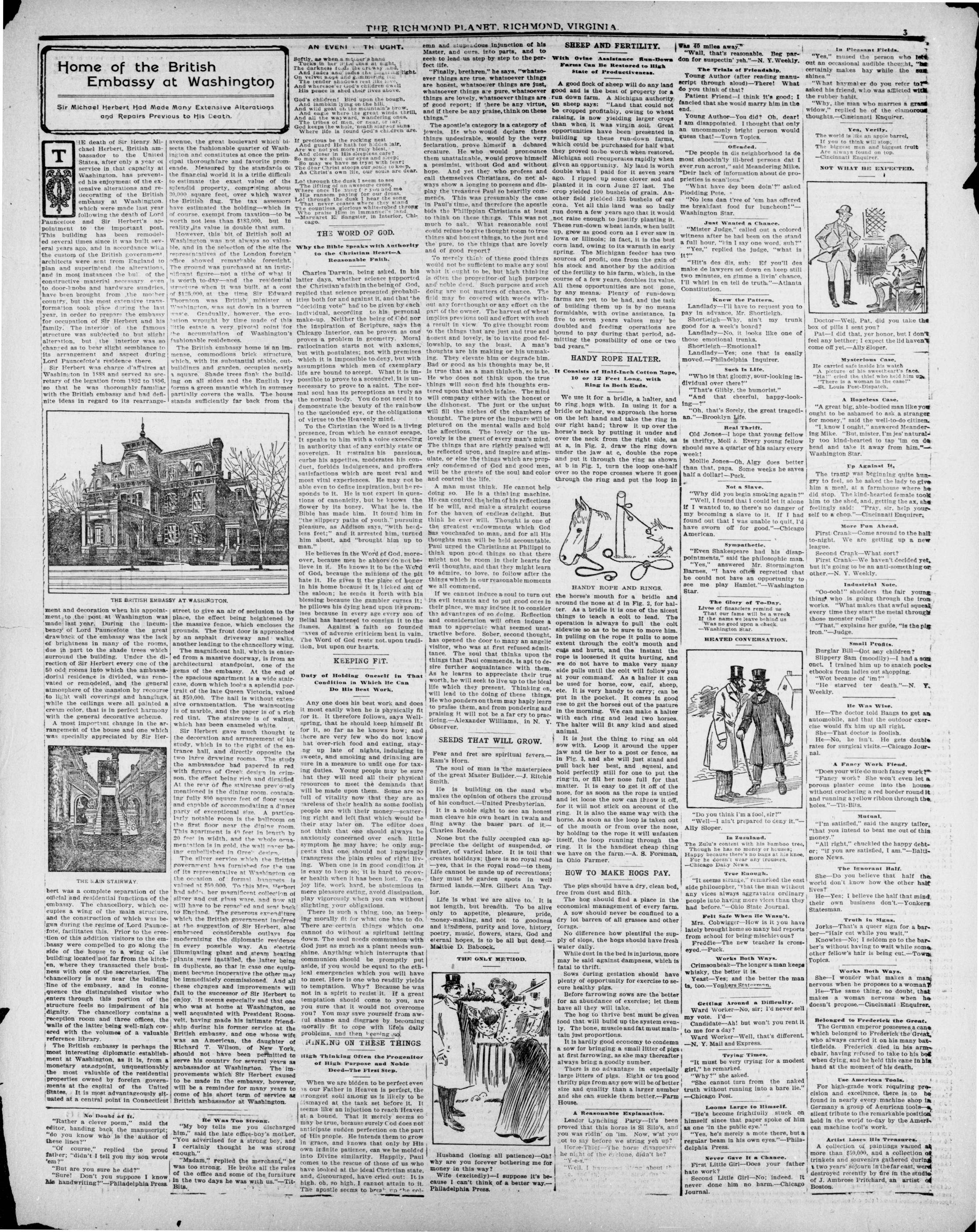
THE RICHMOND PLANET. RICHMOND, VIRGINIA
AN EVENI TH UGHT.
Softly, as when a maidner shand
Tucks in her life one at night.
The maidner shand and jade the singing light.
On velvet scope and gumming ten
The tender shadows rest like love.
And wheresoever God's children rest
His peace is shed their lives above.
God's children! Bird upon the bough,
And wild goat on the mountain's brow,
And eagle where the great winds thrill,
And all the wayward, wandering ones,
God keeps the whole, neath starrs or suns
Where life is found God's children are.
If precious be the racking nest
And guard He hath for hidden lair,
Are we not yet more truly blest,
And closer in His sleepless care?
So may we shuin, our eyes and sleep,
So may we shuin, our eyes and fear;
The dear Christ stoops our souls to keep,
As Christ's own life, our souls are dear.
Lot through the dusk I seem to see
The lifting of an awesome cross,
Where once He hung for you and me
His ransom paying me,
So may we shuin, our eyes and fear;
That never ceases where they stand
The countless, glorious white-robed throng
Who praise Him in immanuel's land
—Marynet E. Sangster, in Interior, Chi-
THE WORD OF GOD.
Why the Bible Speaks with Authority to the Christian Heart—A Reasonable Faith.
Charles Darwin, being asked, in his latter days, whether science supported the Christian's faith in the being of God, replied that science presented probabilities both for and against it, and that the "deciding vote" had to be given by each individual, according to his personal make-up. Neither the being of God nor the inspiration of Scripture, says the Chicago Interior, can be proven as one proves a problem in geometry. Moral ratiocination starts not with axioms, but with postulates; not with premises which it is impossible to deny, but with assumptions which men of exemplary life are bound to accept. What it is impossible to prove to a scoundrel, it is unnecessary to prove to a saint. The normal soul has its perceptions as truly as the normal body. You do not need it to demonstrate the beauty of the rainbow to the unclouded eye, or the obligations of virtue to the Heavenly mind.
To the Christian the Word is a living presence, from which he cannot escape. It speaks to him with a voice exceeding in authority that of any earthly state or sovereign. It restrains his passions, curbs his appetites, moderates his conduct, forbids indulgences, and proffers satisfactions which are most real and most vital experiences. He may not be able even to define inspiration, but he responds to it. He is not expert in questions of canonicity, but he knows the flower by its honey. What he is, the Bible has made him. It found him in "the silvery paths of youth." pursuing pleasure, as Addison says, "with heedless feet;" and it arrested him, turned him about, and "brought him up to man."
He believes in the Word of God, moreover, because men he abhors do not believe in it. He knows it to be the Word of God, because the minions of the pit hate it. He gives it the place of honor in his home because it is kicked out of the saloon; he sends it forth with his blessing because the gambler curses it; he pillows his dying head upon its promises because in every age every son of Belial has hastened to consign it to the flames. Against a faith so founded waves of adverse criticism beat in vain. The Word of God rests not, upon tradition, but upon our hearts.
KEEPING FIT.
Duty of Holding Oneself in That Condition in Which He Can Do His Best Work.
Any one does his best work and does it most easily when he is physically fit for it. It therefore follows, says Wellspring, that he should keep himself fit for it, so far as he knows how; and there are very few who do not know that over-rich food and eating, staying up late of nights, indulging in sweets, and smoking and drinking are sure in a measure to unfit one for taxing duties. Young people may be sure that they will need all their physical resources to meet the demands that will be made upon them. Some are so full of vitality now that they are as careless of their health as some foolish people are with their money—scattering right and left that which would be their stay later on. The editor does not think that one should always be anxiously concerned over each little symptom he may have; he only suggests that one should not knowingly transgress the plain rules of right living. When one is in good condition it is easy to keep so; it is hard to recover health when it has been lost. To enjoy life, work hard, be abstemious in mere pleasure eating, avoid dissipation, play vigorously when you can without slighting your obligations.
There is such a thing, too, as keeping morally fit for what one has to do. There are certain things which one cannot do without a spiritual letting down. The soul needs communion with God just as much as a plant needs sunshine. Anything which interrupts that communion should be promptly put aside, if you would be equal to the ethical emergencies which you will have to meet. Here is one who readily yields to temptation. Why? Because he was not in a spirit to resist it. If a great temptation should come to you, are you sure that it would not overcome you? You may save yourself from awful shame and disgrace by becoming morally fit to cope with life's daily problems, and then beeing so.
INKING ON THESE THINGS
High Thinking Often the Progenitor of High Purpose and Noble Deed-The First Step.
When we are blidden to be perfect even as our Father in Heaven is perfect, the strongest soul among us is likely to be dismayed at the task set before it. It seems like an injection to reach Heaven at a bound. That it merely seems so may be true, because surely Cod does not anticipate sudden perfection on the part of His people. He intends them to grow in grace, and knows that only by His own infinite patience, can we be molded into Divine similarity. Happily, Paul comes to the rescue of those of us who have looked at the ideal Christian state, and, discouraged, have cried out: It is high, oh, so high. I cannot attain to it. The apostle seems to break on the sol-
The apostle's category is a category of jewels. He who would declare these things undesirable, would by the very declaration, prove himself a debased creature. He who would pronounce them unattainable, would prove himself a pessimist, without God and without hope. And yet they who profess and call themselves Christians, do not always show a longing to possess and display the treasures Paul so heartily commends. This was presumably the case in Paul's time, and therefore the apostle bids the Philippian Christians at least to think on these things. This was not much to ask. What reasonable soul could refuse to give thought room to true things and honest things, to the just and the pure, to the things that are lovely and of good report?
To merely think of these good things would not be sufficient to make any soul what it ought to be, but high thinking is often the progenitor of high purpose and noble deed. Such purpose and such doing are not matters of chance. The field may be covered with weeds without any forethought or any effort on the part of the owner. The harvest of wheat implies previous toll and effort with such a result in view. To give thought room to the things that are just and true and honest and lovely, is to invite good fellowship, to say the least. A man's thoughts are his making or his unmaking. They elevate him or degrade him. Bad or good as his thoughts may be, it is true that as a man thinketh, so is he. He who does not think upon the true things will soon find his thoughts centered upon that which is false. The mind will company either with the honest or the dishonest. The just or the unjust will fill the niches of the chambers of thought. The pure or the impure will be pictured on the mental walls and hold the affections. The lovely or the unlovely is the guest of every man's mind. The things that are rightly praised will be reflected upon, and inspire and stimulate, or else the things which are properly condemned of God and good men will be the guests of the soul and color and control the life.
A man must think. He cannot help doing so. He is a thinking machine. He can control the helm of his reflections if he will, and make a straight course for the haven of endless delight. But think he ever will. Thought is one of the greatest endowments which God has vouchsafed to man, and for all His thoughts man will be held accountable. Paul urged the Christians at Phillippi to think upon good things so that there might not be room in their hearts for evil thoughts, and that they might learn to admire, to love, to follow after the things which in our reasonable moments we all commend.
If we cannot induce a soul to turn out its evil tenants and to put good ones in their place, we may induce it to consider the advantages of so doing. Reflection and consideration will often induce a man to appreciate what seemed unattractive before. Sober, second thought, has opened the door to many an angelic visitor, who was at first refused admittance. The soul that thinks upon the things that Paul commends, is apt to desire further acquaintance with them. As he learns to appreciate their true worth, he will seek to live up to the ideal life which they present. Thinking on, will lead to the doing of these things. He who ponders on them may haply learn to praise them, and from pondering and praising it will not be a far cry to practicing—Alexander Williams, in N. Y. Observer.
SEEDS THAT WILL GROW
Fear and fret are spiritual fevers.—Ram's Horn.
The soul of man is the masterpiece of the great Master Builder.—J. Ritchie Smith.
He is building on the sand who makes the opinion of others the ground of his conduct.—United Presbyterian.
It is a noble sight to see an honest man cleave his own heart in twain and fling away the baser part of it.—Charles Reade.
None but the fully occupied can appreciate the delight of suspended, or rather, of varied labor. It is toil that creates holidays; there is no royal road—yes, that is the royal road—to them. Life cannot be made up of recreations; they must be garden spots in well farmed lands.—Mrs. Gilbert Ann Taylor.
Life is what we are alive to. It is not length, but breadth. To be alive only to appetite, pleasure, pride, money-making, and not to goodness and kindness, purity and love, history, poetry, music, flowers, stars, God and eternal hopes, is to be all but dead.—Maltie D. Babcock.
—
Husband (losing all patience)—Oh! why are you forever bothering me for money in this way?
Wife (excitedly)—I suppose it's because I can't think of a better way.—Philadelphia Press.
With Ovine Assistance Run-Down Farms Can Be Restored to High State of Productiveness.
A good flock of sheep will do any land good and is the best of property for a run down farm. A Michigan authority on sheep says: "Land that could not be cropped profitably, owing to wheat raising, is now yielding larger crops than when it was virgin soil. Great opportunities have been presented in building up these run-down farms, which could be purchased for half what they proved to be worth when restored. Michigan soil recuperates rapidly when given an opportunity. My land is worth double what I paid for it seven years ago. I ripped up some clover sod and planted it in corn June 27 last. The crop yielded 100 bushels of grain. Another field yielded 125 bushels of ear corn. Yet all this land was so badly run down a few years ago that it would not raise enough to justify planting it. These run-down wheat lands, when built up, grow as good corn as I ever saw in Iowa or Illinois; in fact, it is the best corn land, owing to its warmth in early spring. The Michigan feeder has two sources of profit, one from the gain of his stock and another by the addition of the fertility to his farm, which, in the course of a few years, doubles its value. All these opportunities are not gone by any means. Plenty of run-down farms are yet, to be had, and the task of building them up is by no means formidable, with ovine assistance. In five to seven years values may be doubled and feeding operations are bound to pay during that period, admitting the possibility of one or two bad years."
HANDY ROPE HALTER
It Consists of Half-Inch Cotton Rope,
10 or 12 Feet Long, with
Ring in Both Ends.
We use it for a bridle, a halter, and
to ring hogs with. In using it for a
bridle or halter, we approach the horse
on the left hand and take the ring in
our right hand; throw it up over the
horse's neck by putting it under and
over the neck from the right side, as
at a, in Fig. 2. draw the ring down
under the jaw at c, double the rope
and put it through the ring as shown
at b in Fig. 1, turn the loop one-half
over so the rope crosses where it goes
through the ring and put the loop in
HANDY ROPE AND RINGS.
the horse's mouth for a bridle and around the nose at d in Fig. 2, for halter. As a bridle it is one of the nicest things to teach a colt to lead. The operation is always to pull the colt sidewise so as to be sure to move him. In pulling on the rope it pulls to some extent through the colt's mouth and cuts and hurts, and the instant the rope is loosened it quits hurting, and we do not have to make very many side pulls until the colt will follow you at your command. As a halter it can be used for horse, cow, caif, sheep, etc. It is very handy to carry; can be put in the pocket. It comes in good use to get the horses out of the pasture in the morning. We can make a halter with each ring and lead two horses. The halter will fit any kind and sized animal.
It is just the thing to ring an old sow with. Loop it around the upper jaw and tie her to a post or fence, as in Fig. 3, and she will just stand and pull back her best, and squeal, and hold perfectly still for one to put the ring in, or fill her nose full for that matter. It is easy to get it off of the nose, for as soon as the rope is untidy and let loose the sock can throw it off, for it will not stick on account of the ring. It is also the same way with the horse. As soon as the loop is taken out of the mouth or from over the nose, by holding to the rope it will unfasten itself, the loop running through the ring. It is the handiest cheap thing we have on the farm—A. S. Forsman, in Ohio Farmer.
HOW TO MAKE HOGS PAY.
The pigs should have a dry, clean bed, free from dust and filth.
The hog should find a place in the economical management of every farm.
A sow should never be confined to a dry lot barren of all grasses and other forage.
No difference how plentiful the supply of siops, the hogs should have fresh water daily.
While dust in the bed is injurious, more may be said against dampness, which is fatal to thrift.
Sows during gestation should have plenty of opportunity for exercise to secure healthy pigs.
Before farrowing sows are the better for an abundance of exercise; let them have all they will take.
The hog to thrive best must be given food that will build up the system evenly.
The bone, muscle and fat must maintain just proportions.
It is hardly good economy to condemn a sow for bringing a small litter of pigs at first farrowing, as she may thereafter always bring a good number. There is no advantage in especially large litters of pigs. Eight or ten good thrifty pigs from any gow will be of better size and quality than a larger number and she can suckle them better.—Farm House.
A Reasonable Explanation
Leader Lynching Party—It's been proved that this horse is Si Silo's, and you was ridin' on 'im. Now, wat you ot to say before we string yeh up?
Horse-Thief—The horse disappeared he night of the cyclone, didn't he?
"Y-e-s."
"Well, I happened along about the
Was 40 miles away."
"Wall, that's reasonable. Beg pardon for suspectin' yeh."—N. Y. Weekly.
The Trials of Friendship.
Young Author (after reading manuscript through aloud)—There! What do you think of that?
Patient Friend—I think it's good; I fancied that she would marry him in the end.
Young Author—You did? Oh, dear!
I am disappointed. I thought that only an uncommonly bright person would guess that!—Town Tonics.
Offended.
"De people in dis neighborhood is de most shockin'ly ill-bred persons dat I ever run acrost," said Meandering Mike. "Deir lack of information about de proprieties is scan'lous."
"What have dey been doin'?" asked Ploiding Pete.
"No less dan tree of 'em has offered me breakfast food fur luncheon!"—Washington Star.
Just Wanted a Chance.
"Mister Judge," called out a colored witness after he had been on the stand a full hour, "in I say one word, suh?" "Yes," replied the judge, "what is it?"
"Hit's des dis, suh: Ef you'll des make de lawyers set down en keep still two minutes, en gimme a livin' chance, I'll whirl in en tell de truth."—Atlanta Constitution.
Knew the Pattern:
Landlady—I'll have to request you to pay in advance, Mr. Shortleigh.
Shortleigh—Why, ain't my trunk good for a week's board?
Landlady—No, it looks like one of those emotional trunks.
Shortleigh—Emotional?
Landlady—Yes; one that is easily moved.—Philadelphia Inquirer.
Such Is Life.
"Who is that gloomy, sour-looking individual over there?"
"That's Glibly, the humorist."
"And that cheerful, happy-looking—?"
"Oh, that's Sorely, the great tragedian."—Brooklyn Life.
Real Thrift.
Old Jones—I hope that young fellow is thrifty, Moll a. Every young fellow should save a quarter of his salary every week!
Mollie Jones—Oh, Algy does better than, papa. Some weeks he saves half a dollar!—Puck.
Not a Slave.
"Why did you begin smoking again?"
"Well, I found that I could let it alone
If I wanted to, so there's no danger of
my becoming a slave to it. If I had
found out that I was unable to quit, I'd
have sworn off for good."—Chicago
American.
Sympathetic.
"Even Shakespeare had his disappointments," said the philosophic man. "Yes," answered Mr. Stormington Barnes. "I have often regretted that he could not have an opportunity to see me play Hamlet."—Washington Star.
The Glory of To-Day.
Lives of financiers remind us
That our family will be a wreck
If the name we leave behind us
Was no good upon a check.
—Washington Star.
A
"Well—I ain't prepared to deny it."—
Ally Sloper.
In Zuzuland.
The Zulu's content with his bamboo tree
Though he has no money or houses;
Happy because there's no bags at his knee.
For he doesn't wear any trousers.
True Enough
"It seems strange," remarked the east side philosopher, "that the man without any vices always aggravates ordinary people into having more vices than they had before."—Ohio State Journal.
Felt Safe When He Wasn't.
Freddie—The new teacher is cross-eyed.—Puck.
Works Both Ways.
Crimsonbeak—The longer a man keeps whisky, the better it is.
Yeast—Yes; and the better the man is, too.—Yonkers Statesman.
Getting Around a Difficulty.
Ward Worker—No, sir; I'd never sell my vote. I'd—
Candidate—Ah! but won't you rent it to me for a day?
Ward Worker—Well, that's different.—N. Y. Mail and Express.
Trying Times.
"It must be very trying for a modest girl," he remarked.
"Why?" she asked.
"She cannot turn from the naked truth without running into a bare lie."—Chicago Post.
Looms Large to Himself.
"He's become frightfully stuck on himself since that paper spoke of him as one 'in the public eye.'"
"Yes, he's merely a mote there, but a regular beam in his own eyes."—Philadelphia Press.
Never Gave It a Chance.
First Little Girl—Does your father hate work?
Second Little Girl—No; indeed. It never done him no harm—Chicago Journal.
3
In Pleasant Fields.
"Yes," mused the person who let out an occasional audible thought, "the certainly makes hay while the sun shines."
"What haymaker do you refer to asked his friend, who was afflicted with the rubber habit.
"Why, the man who marries a grass widow," replied he to the clamorous thoughts.—Cinelinnati Enquirer.
Yea, Verily.
The world is like an apple barrel, If you to think will stop; The largest and biggest fruit Are always found on top.—Cinelinnati Enquirer.
Doctor—Well, Pat, did you take the box of pills I sent you?
Pat—I did that, yer honor, but I don't feel any betther; I expect the lid haven't come off yet.—Ally Sloper.
Mysterious Case.
He carried safe inside his watch
A picture of his sweetheart's face
He said he would him up
"There is a woman in the case!"
-St. Louis Post-Dispatch.
A Hopeless Case.
"A great big, able-bodied man like you ought to be ashamed to ask a stranger for money," said the well-to-do citizen. "I know I ought," answered Meandering Mike. "But, mister, I'm Jes' naturally too kind-hearted to tap 'im on de head and take it away from him."—Washington Star.
Up Against It.
The tramp was beginning quite hungry to feel, so he asked the lady to give him a meal, at a farmhouse where he did stop. The kind-hearted female took him to the shed, and, getting the ax, she feelingly said: "Pray, sir, help yourself to a chop."—Cincinnati Enquirer.
More Fun Ahead.
First Crank—Come around to the hall to-night. We are getting up a new league.
Second Crank—What sort?
First Crank—We haven't decided yet, but it's going to be an anti-something on other. N. Y. Weekly.
Industrial Note.
"Oo-ooh!" shudders the fair young thing who is going through the iron works. "What makes that awful squeal every time they start the metal through those monster rolls?" "That," explains her guide, "is the plig iron."—Judge.
Small Profits
Burglar Bill—Got any children?
Slippery San (moodily)—I had a son
onct. I trained him up to snatch pock
etbooks from ladies out shopping.
"Wot became of 'im?'"
"He starved ter death."—N. Y.
Weekly.
He Was Wise.
He—The doctor told Bangs to get an automobile, and that the outdoor exercise would fix him up all right.
She—That doctor is foolish.
He—No, he isn't. He gets double rates for surgical visits.—Chicago Journal.
A Fancy Work Flend.
"Does your wife do much fancy work?"
"Fancy work? She won't even let a porous plaster come into the house without crocheting a red border round it and running a yellow ribbon through the holes."—Tit-Bits.
Mutual.
"I'm satisfied," said the angry tailor,
"that you intend to beat me out of this money."
"All right," chuckled the happy debtor;
"if you are satisfied, I am."—Baltimore News.
The Ignorant Half
She—Do you believe that half the world don't know how the other half lives?
He—Yes; I believe the half that mind their own business don't.—Yonkers Statesman.
Truth in Signs
Jorks—That's a queer sign for a barber—"Hair cut while you wait." Knowles—No; I seldom go to the barber's without having to wait while some other fellow's hair is being cut.—Town Topica.
Works Both Ways
She—I wonder what makes a man
nervous when he proposes to a woman?
He—The same thing, no doubt, that
makes a woman nervous when he
doesn't propose.—Cincinnati Enquirer.
Belonged to Frederick the Great.
The German emperor possesses a cane which belonged to Frederick the Great, who always carried it on his many battlefields. Frederick died in his armchair, having refused to take to his bed when dying, and he held this cane in his hand at the moment of his death.
The American Tool
Use American Tools.
For high-grade work requiring precision and excellence, there is to be found in nearly every machine shop in Germany a group of Aemrican tools—a silent tribute to the remarkable position held in the world to-day by the American machine tool's work.
Artist Loses His Treasures.
A collection of paintings vaued more than $50,000, and a collection of trinkets and souvenirs gathered during two years sojourn in the far east, were destroyed recently by fire in the studio of J. Ambrose Pritchard, an artist of Boston.
4
EET
aa 2 . x oe!
eS! See
7A we
Se -
i ihe i) non FS :
& peg re Saas
SEBS ee ae
fi EN % We
3 . ty ee Ss
a Se
ee
“Puthabad every Satuntay Uy Jom haan
Baae hl Norah sah Street, Hicamond. Va
Sh al a lt
0UN MITCHELL, JR. - EDITOR.
\Af communications intended for publication
SM eould in moot eonntg Teach aa by Weanocday
TERMS IN ADVANCE
epee coor, ons year, - + ne
EoRF cighe months, ~ Re
Soonremouhe = > >} ap
Say tourmenths, = 5 =
cio Geng. Bea Ne eee
ADVERTISING RATES.
see one trem. one insertion, - $ Bb
Sz Sue tren’ each sabcequent ineertion,® 3
Peiwoinhertuee mate Sate
Ze iwowehes amon ==: 18m
Se twofnches imemonie “+ "+2 ime
isrrisgeand Ruscral Notices,
ee ee sai pe Mo oie
@-POSTAGE STAMPS OF A HIGHER DE
SoMINATION THAN TWOCENTS NOT
» RECEIVED ON SUBSCRIPTIONS.
‘ran PLANET wsucd weekly. Thembecrip
Gea price 1s $1.50 a year, in advance.
SFucro are rocn wars by which mency can be
wert by anit at our fakin qa Ose Mom
“Onder, by Bank Check or Draft, or an Bx
Bee Wones Order nnd when ‘none of these
Sree rear a Negstnred Eatior
joner-OnDene You ran out 9 Money Ord
guitars iateael ache NeC
Fore Sttice, and we will be respon ble for" its
“arto arrival. -
Texryss MONEY Onprn cam be oc*a}ned, at
ire: af the Amerces Papeete
cod Sanita Wipren Goan be Wal "tes
rand Co.'s Exprew Company. | We will be re
SSL hartley sent by hy of tone sore
ie Bare’ Money Graet ata
Saventeat wey Tor forweding tote
Sewreney Lerrent w. Money Over
ea omicw or an Express _Offen fe rok, within
Berns Four Pretec wil Rate
neem if the leider hese or rtstens Te
ene Mf Cau iter nine nskeny
yatrnced. You can send money in this
Pieter
‘We cannot be Fesponsible for money Rae in
smncsta ache ens tian one aT ae Tone
Fee diate Hyaamand oe mee
Se Yo ay other way, yoo! lass as Wer See
Seon
SeNrWAtA sTeoIt 308, dc not want Tire
Besrerantingnd foe uns ar BAU ee
Berepienihosran gat yeaten nc 2
at Entel toahccontinie he Sours
Selina than 'scbcenber to newrmegaes whens
‘Secor Thott paper dctntimuna ge thea
Feoorst etme ehhh hal ores pasa
Een Tathe Foe te Pasmene fae eae nian
Bressler aw paper ao
COMMUNTCATIONS—Whon writing to ws
sect You rubrigien se Toate
Nt, Jounal pits yocr nace ant
“BES in falls otherwhe we ‘cannot find yoo)
“Sound on cur bos
Smarr on ADORE In onder we chan:
ge talenccra meee Sota Ss,
Soke scree
Entered in the Post Office at Richmond, Va.
smeccond class matter.
SATURDAY, ...... DECEMBER 5, 1908
—————
Mx.iEsRprvand Montox, a colored
oy hasbeen selected to repretent Har
‘svaxp of Cambridge, Mass., in its annual
e@ebate with Yaux in place of Mr. T. H.
‘Reep, whose health is broken by over.
sstady. ‘Mr. Morrow won on his merits.
is home is in Washington, D. C., and
“tbe is a graduate of Phillips. Exeter
Geademy. This makes the Negro hat-
qs of the Southland howling angry,
sanfiwho cares? The liberal-minded
pwhite men are all right.
Epwarp W. Frank and Wi. Mo
Mex, both white of Valdosta, Georgia,
“pleaded guilty to thirteen indictments
for peonage or holding colored people in
selavery and were sentenced in the Un-
ated States Court at Savannah to pay a
‘Bre of $1000. on two of the indictments
send the others were dismissed. The
‘dnes were paid and they can now go
Yack to their counties and “do so some
“The people of Richimond—that is to
way, the people wh. do business with
athe telegraph compunies—do not want
“$o receive their telegram# from. the
Ptkands of colored messanger boys, and
They will not do te. Tus is one question,
@ho right or wroug of which they will
Got stop to discuss. They simply will
«ot put up with the colored messenger.”
—~Times Dispatch
We read with regret the above re-
warkable ebuilition from the pen of
nfhis hitherto liberal contemporary. We
“gannot see that there is uny question of
- €olor involved for, if we mistake not,
seventy five per cent of the colored men
‘@uployed by the business men of this
e#ity are utilized in the messenger ser-
‘ice.
‘These white messenger boys should
‘zest their cose ou its merit and not on
face prejudice. When people will not
scuss the right or wrong of a proposi
‘fon, they place themselves outside o!
athe pale of reason and win the condem-
~a@ation of all classes of conservative
people, regardless of race, color, rel.g
‘tea or pohtics.
AN OUTRAGEOUS VERDICT.
Warraiw Wiltiam T. Manrry, white,
“owas acquitted of the mar.ter of Groror
“Bvoxer, colored, at the Isle of Wight
®Pourthouse, November 18th, 1998. The
gles set up by his attorneys was insani:
‘fy, caused by drink. Tho facts are that
Maxrix deliberately killed Tucker
Faly Fh; 1903, at Islo of Wight ©. H.,
aphile he lueld up both hands and begged
dor hie tite.
‘When asked about the verdict, Man
vo remarked that he “sorter thought”
Wo would go free. His neighbors had
S@ever regarded him @s a crazy ‘man an¢
‘ hie verdict of the jury was a sucpria
fo everybody in the neighborhood.
We have repeatedly asserted that
e@plored men have no hope in & contes
-4f this kind with Negro hating whit
ven. -Tucker, the victim wasare
epectable colored man of the old school.
‘There was no excase whatever for the
morder, It was a cold, bratal, cow-
ardly murder, and admitted to, be such
by white men well acquainted with the
circumstances.
‘What do we think about it? ‘Tockem
should have dealt with his marderer as
his murderer was trying to deal with
him and both should have gone on to
the other world together.
Maxti hidsouso enoagh to know
that he was dealing with a sheop, in-
stead of a ball-dog and he proceeded
with the slinghter with no thought of
harm or danger.
Colored mon will learn after a while,
and when they do, there will be a dif
ferent story to tell. Mantin muy. be
crazy, but a couvle of well directed
blows ana glace down the muzzle of
udi-calibre six-shoot-r wonld hive a
sobering as well asa curable effect te
the extent of casing a return of reason
and the disappearance of that murder.
on: spirit which sent old man ‘fucken
to the other shore.
All sine white men are crazy when
they kill Negroes and all crazy: Negroes
‘are sane when they kill white men. At
least, this is the ruling in the Sonth-
Innd and colored amen should govern
themselves accordingly.
| PHREE COLORED MEN LYNCHED.
| Pum Davis, Watier Canter and
Cust THomas, colored meu, were
yuchea near Belcher, Louisiana, which
is twenty miles from Shreveport, Nov.
80th upon the charge of having fatally
shot a white man named Rosert Ap.
GRR. Twelve hundred white and col
ored peopls witnessed the execution,
which partook of the nature of a picuic.
Colored men are alleged to have tak.
jena part in the man- hunt and so valua-
blo were the services of one of them in
this particular that he was presented
ae ‘a purse of $100. This is the pecu-
‘Har part of southern life, We do not
know of a Negro k lling of this sort,
bat what ‘ome other Negro did not
| make himself one of the leading char-
actors in hunting the alleged culprit to
‘his death.
| Some people woilld naturally con.
‘clade that this would have a tendency
to relieve the colored people in that lo-
cality of all responsibility for the avtion
‘of tne guilty party, bat it does not
On the other hand, the Negro-harers
become more intolerant and it is not
many days or weeks before some overt
‘at on the partof the white hovdiums
‘precipitates more blood-shed with the
consequent slaughter ot the innocent,
What excuse can be given for this
murderous violation of the Jaw on the
partof the mob? Ie is admitted that
both whine and colored people were bit
terly against the culprits and. that the
juries in this locality are composed ex.
clasively of white men. These colored
| men had absolately no chance to escape
‘aud their execation by due process of
law was a foregoute conciusion.
Colored people cannot afford to be
parties to such lawlessuess and it is to
bo regretted that in yielding to the pre
vailing seutiment, they condoued an
act which was nothing more nor less
than murder, The lynchers are now
guilty ot the same crime with which
their victims stood charged. There
were no white Indies to be forced into
‘court and make a graphic recital of
[their shame. It was a plain case of
shooting with fatal results,
| Colored men, who surrender to mobs
take their lives in their own hands,
Death by a straight stand-up and knock
down fight is always preferable to this
slow, strangling process from the limt
ofatree Lynch-law must gol
PROF, BASSETT UPHELD.
Mvcn comment bas been made on
the rather remarkable article of Pror-
Jounx Spencer Bassett, which »ppear-
ed iu the SOUTH ATLANTIC QUARTEKLY
for Ocrober. Pror Bassett discussed
the Negro, and being a hbetal-minded
‘southerner, who was und is afilicted
[with the ai ment of saying what he
thinks, he naturally brought down up-
on himself the evncemaation of every
Negro hating white man in North Caro-
lina. Editor Joskrnus Dantes, of the
‘Raleigh News axp Onserver led in
the crusade against Pror. Bassett, aud
made the demand for his resignation.
‘The cistinguished southerner met him
more than half way and tendered his
resignation to the trustees of Trinity
‘College at Durham, N. ©. A session of
thot body was held for seven hours Dec.
Ist, 1903, and it reached a conclusion,
declining to accept the resignation of
Prov. Bassett, declaring that to do so
would be to limit or destroy academe
liberty. ‘This was very high ground
and the students celebrated the decision
by ringing the college bel) and baraing
Editor Joseenus Daxtaisin effigy. The
sproific cause of this condemnation of
Puor. Bassett may be found in the ful-
lowing words:
“A man whose mind runs away into
baseless optimism is apt to point to
Booker T. Washington as a prodact of
the Negro race. Now Washington is a
great and good man, a Christian states-
man, and take him all in all the great-
jest man save General Leo, b rn in the
South in a hundred years; bat he is not
‘a typical Negro. Hefloes not eve. repre:
seat the betier class of Negroes; he is
‘av exceptional man; and endowed as he
Jis, itis probable that he would hav. °re-
mained auedneated but for the philan.
throphic Intervention of white eu.
"The race, even the best of them, are. s0
//far behind him that we cannot’ in rea.
] #02 look for Ins reproduction in the pres
ent generation. Ic is, therefore, toc
'!much to hope, for a continued appear
ance of!wach mn in the near future,
Teisniso t90 mach to set, his. develop
| ment up ase standard for his race. ‘T
| except it is to insure disappointment.”
,}. This sotion on the part of the tras
| tees and students is a healthy sign. Fre¢
speech may yet be tolerated in North
THE RICHMOND PLANET, RICHMOND, VIRGINIA.
—_—— eee EEE
Carvlina, both on the part of white ard - man of the borough or: 1nized @ posse,
colored men. The day is dark and, which gave oar to the gang. The |*
gloomy, bat the bright streaks onthe despe~ndoes yelled to the posse not to |
the horizon as outlived by this decision’ come too close or they ould shoot, ai
exhort U8 to press onward and not fal- the same time jeering that “Emaus is -
= by the wayside. | & cheap town, with'pot enough money 4 prvyeical T
BROOKE TESTIFIES
AGAINST CEN. WOOD
Retired Lee Charges epaeatees In
IGNORED SUPERIOR OFFICERS
Washington, Dec. 1.—Major General
John R. brooke, retired, former sov-
ernor general of Cuba, gave testimony
before the senate committee on mili-
tary affairs which charged insubordin~
ation against General Leonard Wood.
At the close of his testimony a mom-
ber of, the committee said that It Is
probable General Wood will have to
return from the Philippines and tes-
tity.
One of the charges made by: General
Brooke is that General Wood violated
the order which required him to make
improvements in Santiago and to sub-
mit estimates to the governor general.
General Brooke said also that General
Wood continually sent communications
to the war department over the head
of his commanding officer. General
Brooke called to the attention of the
comunittee in support of an allegation
that General Wodd had neglected to
work in harmony with the military
government the matter of General
Wood's attitude toward: the mewspa-
pers at Santiago, which repeatedly
made attacks on General Brooke's ad-
ministration. General Brooke read a
number of these attacks and also his
recommendation to tue war depart-
ment that the papers be suppressed un-
lecs they desisted.
One of the extracts from the Inde-
pendencia, pub ish-d at Santiago, which
was read, was a bitter denunciation of
General Brooke, under the caption of
“God Save Cuba.” ‘The article in ques-
tion was based on General Brooke's
order for the centralization of affairs of
the island by which receipts from all
custom houses were ordered sent to
Havana. The article among other
things said that if carried into effect
the order soon would pronibit the peo-
ple of Santiago from “breathing with-
out permission from’ General Brook;
that it was a matter of life nnd death
to the province of Santiago to get the
order rescinded. A large’ number of
telegrams of indignation sent to Presi-
dent McKinley were appended to the
article.
General Brooke read a letter which
he had sent to the adjutant general of
the war department asking thnt Gen-
eral Wood be instructed to prohibit
the publication of such articles during
the period of military government. He
also read General Wood's reply to the
adjutant general, which, the witness
said, had been sent over the head of
his superior officer, saying that free
dom of. speech, untrammeled criticism
of the military government and abso-
lute Independence in ail matters, was
& necessary part of the education of
the Cubans to fit them to conduct a
Mberal government.
In the course of General Brookes
testimony he said that General Wood
became unduly excited when the Cu-
bans held indignation meetings at San-
tiazo for the purpose of protesting
against the centralization order. The
witness’ laid before the committee a
copy of a telegram he received from
General Wood, saying that the Cubans
looked upon the order as aprpoaching
@ celamity, and that discontent and
profound business depression existed.
Finelly General Wood prayed that
the customs receipts be left under lo-
cal control. The witness declared that
the attitude of General Wood was re-
sponsible to @ great extent In adding
to the disquiet of the Cubans.
‘The members of the committee took
@ great interest in General Brooke's
testimony, and steps were taken to
have copied a number of the papers he
offered in evidence.
TRADE UNIONISTS IN POLITICS |
New Party Forming Under Patronage
of Chicago Federation of Labor.
Chicago, Dec. 2—The Union Ward
Club is the name of-an organization
now in the process of forming under
the patronage of the Chicago Federa-
tion of Labor for political purposes,
The movement will be conducted out-
side of the unions, but a union card
will be a necessary qualification for
membership. The platform of the or-
ganization as outlined is socialistic,
but it Is not the intention of the pro-
moters to affiliate with the Socialistic
party. The tentative platform contom-
plates among other reforms the elec-
tion of president, vice president and
senators by direct vote; government
ownership of communication and
transportation facilities and municipal
ownership of other public utilities,
aboliticn of the fee system and the
adoption of the initiative and referen-
dum. |
DESPERADOES AT EMAUS, PA.
Held Up Citizens and Terrorized the
/ Borough Generally.
Allentown, Pa., Dec. 2—The boroug’s
of Emaus, near here, where the post-
office was robbed and three safes were
cracked: last week, was again visited
by burglars, when five desperadoes
practically took possession of the
place. They entered the borough, fir-
ing Tovolvers and terrorizing the citi
zens. The gang first went to Krem-
ser’s barber shop, where they got
shaved and refused to pay. At three
hotels they ordered drinks, declining
to pay for them, and when the bar.
tenders expostulated the invaders
rew revolvers and bioze1 away. No
one was injured. Samuel Rehm was
held up on the street, robbed of his
money and told to run for his life,
which be ai the robbers firing to
make him travel faster.
A woman on the strect was also held
up and her purse taken, A little gfrl
was stopped, the ruffiens taking her
in their arms and rudely kissing her.
At this juncture the single police
man of the borough or; nized @ posse,
which gave chasy to the gang. The
despe-ndoes yelled to the posse not to
come too close or they ould shoot, ai
the same time Jeering that “Emaus is
a cheap town, with’not ¢nough money
in its’ safes to ‘make cracking them
worth while.”
‘The rufllns' ran along the Perkto
men rafiroad as far ss Lehigh moun-
tain, a mile below tie borough, and
then took to the hilis and escaped.
Great excitement prevails among the
Dorough’s residents, and the fear Is ex-
Pressed that the desperadoes will re
turn, ‘The county fs without detec.
tives.
HAS 1300 CASES CF TYPHOID
Butler, Pa, at the Mer:y of a Serious
Epidemic
Butler, Pa,, Nov. 30.—Since the 15th
of September this town has had over
1300 cases of typhoid fever and 2:
deaths. The state boa: of health in
vestigated the cause of the unusua
conditions and issued o statement ir
which they say the borough of But
ler has been visited with a serion
epidemic of typhoid fover in its vari
ous types, and that the cause ts the
pollution of the water used in th:
greater part of the borough. The pol
lution is clearly traceable to cases o
typhold fever in close proximity. tc
Thorn Run dam, the reservoir of the
Butler Water company.
‘The board found that the premises
surrounding the farm house from
which the fever drainage was car:ic!
into the Thorn Run reservoir had bert
thoroughly ditched so no drainage car
now reach the dam.
A meeting of the general rellef com
mittee was held and the finance con
mitfee reported $8000 raised. Fi ty
cots have been placed in the aban
doned pickle factory near here, and
the residence of Gobhart Wagner bas
been fitted up as a temporary hos
pital. .In response to appeals, nurses
are arriving on every train, but do
mestic help to wash the clothes and
bedding of the patients is as badly
needed as nurses.
Father L. A. Carroll, who has 125
fever patients in his own congregation,
makes this statement:
“The people of Butler are at the
mercy of typhoid fever. We need gir's
to work and who know somethin:
about nursing. As you love God ani
your neighbor, come to Butler's as
sistance.”
FIERCE FIGHT WITH SAVAGES
Philippine Constabulary Fought Four
Days Without Focd.
Washington, Dec. 2. — News of a
fight several weeks ago in Neuva Vis
caya, a province in Central Luzon,
about 100 miles northeast of Manila,
has just reached the war department.
A detach.aent of the constabu ary
for four days fought 60¢ savase head
hunters of the Galinga tribe. all of the
time being without food. Two of the
constabulary were kiuded, but of the
enemy at least 90 fell and a large
quantity of ammunition, seven guns,
130 head axes, many bolos and other
weapons were captured.
Lieutenant Veiasqrez, commanding
the constabulary, engaged in bond to
hand conflict soven of the tribesmen,
Killing six of thea with hfs pistol, and
Gpishing the seventh with a pinapa-
ringu, of head axe, which he snatched
from the band of one of those he had
already slain.
Me Needed a Vacation.
Enpeck—Doctor, my wife has the
lockjaw.
Doctor—That’s bad. I'll hurry around
to your house and see what I can do to
relieve her.
Enpeck—Oh, you needn't be in any
rush about it. Just drop in the latter
part of next week, if you ain't too busy.
—Cincinnat! Enquirer.
‘wha aces ithe: ical
Mrs. Patty—Do you really think Dr,
Duckman {s a skilful physician?
Mrs. Giblin (the patient)—I don’t
‘know so much about that. But he has
such a quieting way with him. When
I said I hoped I shouldn't be buried alive
he sald he'd look out for that. Wasn't
that thoughtful of him?—Boston Tran-
seaipt.
Chumley's Gente! Protest.
“Gladys,” said Chumley to his man-
nish sister, “I've done so much for you,
you should write me a testimonial.”
“A testimonial?”
“Yes. Youmightsay: ‘Dear Brother:
Once I was a timid, delicate girl, but
since using you collars, shirts and ties
T have become a uew woman.’ "—Tit-
Bits,
A Clone Catculator.
Wife—Why are you in such a rush to
get the Great Americo-European Ency-
clopedia as soon as it comes out?
Husband—I want to stick it up fn
plain view fn my office, so that the sub-
scription agents will see It when they
‘come in to sell me one. It will save $50
worth “of time.—N. ¥. Weekly. is
ehinae
“Jack proposed to me this morning!”
“Did you secept him?”
yea" f
“Then your prophecy has come true?”
“What prophecy?”
“Why, last night you sia Jack was
foolish erough to do anything!”—
Brooklya Life.
if That Were Ait
Gabriel (urging his sujt)—t know
I'm dreadfully poor, but wealth isn't
necessary to happiness, "Tis love that
makes the world go round.
Evangeline—I know it, Gabriel, but
think of the economy it would take to
make: $11 a week go round!—Chicago
Tribune.
It Is SUIT Fashionable,
“Pa, what's poetic justice?”
“The former president of a bachelor
elub being married a woman who makes
him feel’ that he would rather lose Bis
Job than be late for dinner furnishes.
pretty fair sample of it.”—Chicago Rec-
ord-Herald.
Wet Bie Kind,
“Would you die for me?” she asked,
dreamily.
“Oh, say!” he retorted, in a matter-of-
fact way, “if you haven't any more am-
bition than to be looking for dead ones
you're not the girl for me.”—Chicago
Post. :
MGR Oleh
4 Physical Training That May Be
Had Without Cost.
EXERCISES FOR THE HOME
Two Strong Chatre ie All That Is
Necded—Every Muscle of the
Body May Be Develored
with Ease,
HYSICAL culture clubs are
mong the fads of the
umes. and the aewspapers
are giving unusual promi-
hence ‘o the subject. As a
q Girect consequence, a con-
siderable impetus has late-
7 been given to physical training: and
schools of vody-development have
sprung ‘nto existence all over the
a Hea
iF) )
" <
t r
iaaae |e i S
Position (or (rontlenning exercises The
fogs Tully: extended Backward tn ine with
the bods, which Is aupported by resting ihe
Sands on, the sents with the Oncers point
ine forwards “The chairs should be anoul
Ser-miath apart
country. The idea has been enthusi-
astically taken up by men of all sta-
tions and ages, and both trainers and
pupils have derived considerabie bene-
fit thereby—the one monetarily, the
other physically.
‘To these schools, however, there are,
to & very great number of would-be
athletes, two most serious objections—
one the question of fees; the other,
the question of leisure.
It ig not everyone who can afford
the terms required by most of these es-
e
Per \ é Sa \
SS 7 \
SS i fal n\
eye f Lea
Keeping the heals together, apring for-
ward to this. position, then backward 9
Tull extension.” Prom the vast position al-
Lernately raise each wom as heh as poseibte,
returning it agnin to extension, and keep:
ing the knees und elbows straight.
tablishments; nor is everybody able to
make his free hours coincide with the
times at which the ciasses are held.
To such persons, therefore, the method
of physical training demonstrated by
the {llustrations accompanying this
article should come as a distinet boon,
conferring, as it does, all the benefits
of an expensive gymnastic course,
with none of its disadvantages in the
way of fees and fixed nours.
For it is a unique household which
cannot supply two solid chairs, and he
L)
wy
or AY) |
a <4] | “}
(
ae
, We
WAU
A
cca dine Geel Gjnavd GaN wb acs
euemnt aeeastores iene
miscwgroiese
is no true disciple of “body-develdp-
meat” who canaet, flow 16) tlantes
sarller, or retiye to bed'iS tolaues te
ter, for the sake of devoting such time
to the accomplishment of his wishes.
And these two stout chairs and daily
15 minutes are the sole requisites for a
course of “domestic gymnastics.”
A loose, easy costume should be
worn during the performance of the
ok
S ae
he
From sitting posture or edge of chair
lower the body slowly Sackward (ii this
position te anmured, then feturn., The arms
oie uae clacon he eee
Se ee: URES RS Sore.
exercises, and each “spell” should be
terminated by a thorough rub down
with rough towels
‘The most suitable chairs for the pur.
ose are those naving deep seats. and
ith the tops of their backs thick and
rounded—the first attribute will ren?
der the “apparatus” absolutely steady;
the second will insure against any cut-
ting or rubbing of the palms of the
hands.
At first it is only natural that the
exercises will be found rather fa-
tiguing, and for this reason they
should be worked up ‘gradually. No
benefit can possibly accrue to the man
ee WOULD YOUSAVE FORILY CENTS
(-"" A DOLi AR?
THEN BUY YOUR GROCERIES OF
9
Reformers’ Store.
A FRESH STOCK OF GOODS ON HAND AT
LOW PRICES.
Place your order with us
this week, we give you pure
goods and save you money.
REFORMER'S STORE,
Tepe HE 6TH and CLAY, STS.
b #224
wT HE
re p ste AYN
i i BY t\
hj a Wes
ee eg ri \\ Nes
a z¢ |
f Sy
Position (or bac leaning @ktrcives—ine
body ts extended forwards instend of bases
wards,
who suddenly calls upon long-negiect-
ed muscles to undergo unaccustomed
labor.
For the first few days, therefore,
only a portion of the exercises. should
be attempted, and each movement
should not be performed more thin,
say, three or five times. R: apidly the
beginner will feel his muscles. growing
more and more supre, until soon. he
Will be able to perform the whole set
of exercises without experiencing any
sort of fatigue, and will find himself
capable and desirous of increasing the
Ruriber, of times each motion ta” pes
“ ‘a
F « Ws
‘ < ky
NI cs pty
Fe ig aey ~~
| hee eS
as h =
— S=
‘The body starting (rom and returning to
te beckelcaning peslton,
formed until he has fixed upon a con-
venient limit.
“Chair gymnastics" call inte play
every muscie of the body. Under their
influence, the limbs will harden, the
chest expand, and the man who carries
out the motions regularly and steadily
‘will soon find himself enjoying an &%-
trely new vigor and health of both
mind and body.
During the performance of each ex-
& ee a
A -
Ve S
mm EF SS
ah) awaumanenaen eens
Foi in egrongey dresden ere te
ercise particular attention should be
paid to keeping all the muscles braced
and “set.”
| wraa mivets ok Daa:
| It is well known that the Moors are
|tuveterate cotfes drinkers, empecieis
the merchants, who sit in their bazaars
and drink coffee continually during the
day. It has been noticed that almost
invariably when these coffee drinkers
Teach the age of 40 or 45 their eyesight
begins to fail, and by the time they get
to be 50 years old they become blind.
One is-forcibly impressed by the num-
ber of blind men that are seen about
the streets of the city of Fez, the capt-
tal of Morocco. It is invariably attrib-
uted to the excessive use of coffee, and
the opinion has been confirmed by Eu-
fofoan pbjaisians living, hore
Viieaiara pare abe
Father P. J, Lynch, pastor of St
Patrick’s church, Gainesville, Fla., ia
endeavoring to divert Irish immigra-
tion to the south. He has about 1,000
acres of fine farming land in Alachua
county, Florida, and wants to settle {t
with a colony of immigrants from the
green Isle. He does not want any but
people who understand farming, and
he hopes that in a few months all the
land will be ta'-én. Father Lynch Is a
well known citizen of Florida.
To Raike Arvoli's Flagship.
William S. Tuitie is mating arrange.
ments to raise benedict Arnold's fing-
ship, the “Roval Savage,” from Lae
Champlain, where it was scuttled in
the war of 1812 {n the battle of Piatt
Sure. ‘Aone the etice tg
aboard @re-Benediet Artold’s
t
and valuable governipent papers.
And Yet He's Good, q
“De mortuis nll nist bonum”
Is something that never applies
To the ii-fated Toanksetving. (urkepes
He's “ronsted™ for sure when he diem,
Philadelphia Press. i
They Have To.
Some men live happily with thei
wives because the wives aforesalg
won't stand for anything else —Chics
go Daily News. 1
The Thanksciving Bird.
Man has seven ages,
Six, the turkeys group—
Roast, warmrd-over. croquettes,
Hash, ragout and soup,
—Sudse. e
Au Exception. '
Virtue Is lis own reward, but it's the
tough turkey that ves the longest—e
‘delpala Record.
Se pee ear ia
SAwMiy, AMRARGRE tT
=> '
— 2 X |
a f
£ ey yA
f A
é 5
[7A i
\
——=s '
Archibald—Mamma, gimme a peuny.
Mother—You're too big to be asking
Tor pennies.
Archibald—Well, then, gimme a quar
ter.—Chicago Daily News.
Why Pa Was Glad. ;
“The stork has broveht a tittle peach,”
‘The nurse said with an ait:
“I'm mahty glad’ the tather aaté,
“He didn't Oring a pair.
Yonkers Statesman
a ie
Free Holid A)
q aD
Ge , UR Y
Von A
Games
eee toed ae ak
:
Lion Coffee
atone
1
RILHMUNY GROCERY
— COMPAwY —
NO. 430 N. 6TH STREET.
And order your high grade goods
Be Al LOW PRICES.
——POLITE arrENiloN,——
Prompt and free delivery to any part
of the Uity ur Mauchesver.
B.F. LIGHTFOuT, and
6mo KR. D. GRANDERSON, Agts
LOOK OUT FOR
OUR PRICt LIST Dy
——1IT CAN'T BE EXCELLED———
Yo r Patr_nage is invited. —__,_,
the Mbel aN Got eR¥
and Pecos TiN MA KET
1221 St. James Street.
Wheu you want nice dry, sawed pine
wo d, cali up 2883 We sel! 3g cord fer
$2.75, guwrautecu fall meusurer.
A lull line of fancy and staple groe
cries und fresh meats. Granulated sugar
Gets per Ib. Prices low on everyunng
this w.ek. Hard and soft coal. Hay
and Grain.
GuEAARUIH Ss
geen
eee 7
Dee heen ee
@ATURDAY
WF LIFE WERE ALLL
‘If ite wore all,
Pinere ware tie recompense
For aii our tears? .
The trouvied toil
OF all the iong.drawn years,
‘The wruggle to survive
‘The passing show
(Were scarce worth while,
A lite were all,
If life were all,
‘Whar were it worth to ive?
Fo build on pain,
Bo svon to learn
‘Our ouliding were but vain,
And then to pass
‘Fo some vague nothingness
Were scarce worth while,
Mt lite were ail.
‘Tt Ute were all,
How might we bear
Our poor heurts’ grief?
‘Our partings trequent,
And our pleasures briefs
‘The cup pressed co ihe ipa
‘Then snaiched away,
Were scarce worth looking on,
Ur lite were wa,
Rite is not ati—
We buiid evernaity,
And what is ours to-day
To make existence sweet
Js ours alway,
We siand on Soild grouna
‘Thar sis tor ase and aye,
And makes eurth’s sojourn worth the
whlie
Ate iw aot all.
Bite is oot all.
2 do not know the pian;
only know that God ts good
And that His screngih sustaina,
J only know that He Is Just:
‘Bo in the scarcess, songiess night
iit my face and trust,
‘And God my spirit witness beare—
Life isinot all
Henry €. Warnack, in Los Angeles Fer-
‘ald.
The Mark of
Her Birth \¢
By PEYTON WILLIAMS |
\N the thirteenth of August, in the
0 year 1884, the following item ap-
peared in the Herald:
Another Abandoned Child, — Last
evening a well dressed woman wearinga
heavy veil and carryingan infant entered
‘ue Central depot. Some moments later
@ waiting passenger was attracted by
the cries of an infant lying in one of the
eats, The passengers called the atten-
tion of Officer Murphy and the latter,
Muable to find anyone claiming the {n-
fant, conveyed {t to the matron of the
~E-sireet station, who in turn sent it to
‘the foundlings’ bome. An’ awaiting
Passenger at the station noted the fect
‘Mat at the time the officer took charge
‘Of the child a well dressed woman, heay-
My veiled, stood at the entrance of the
‘rain shed apparently watching the
foené With great interest. Immediately
"pon: the officer taking charge of the
ehild the well dressed woman passed
Fapldly into the train shed toward an
awaiting south bound train. The pas-
senger noted with some interest that
she was apparently weeping. It Is
‘Mhought there Is a mystery in the case
and the police are watching it with 1o-
terest dlthouch they have a very insut-
ficlent clew. ‘The infant was a girl ap-
parently about three weeks old.
‘On the twentieth of August, 1884, a
woman comfortably dressed and evt-
dently belonging to the lower middle
‘lass, appeared at the foundlizgs’ home
and stated that she desired to adopt a
female infaut about one month old.
Having satisfied themselves that the
‘woman was able and willing to give the
i Seay I
A Rt +
a < j Aue i
i i i Ny ANY K
Gd ears /i\\
NY |, geez | |
=I
Bhi WAS So FR ThaT
Infant good care the trustees gave over
to her a girl baby who had been picked
up in & depot a week previous,
Upon leaving the home the woman
@imbad into a.cab with the tnfant-and
Andulged in the wildest manifestations
of delight. ,
“He bas been awayor scven'months,”
he exclaimed, “and thinks he has a lit-
We one a month old. He never can de-
teet thé imposition and the only cloud
‘pon our married life will be removed.”
Mary was the most. lonesome and
@reary of all the lonesome and dreary
ehildren of Hobbs court. One|trouble
was that she was co much more sensi-
tive than the others—al:houxh it. was
difficult to reason why. But, reason or no
Yeason, it. was certain that she shrank
from the Jests and joie and the child-
ish curiosity and criticism of her com-
panion§ jn a way quite incomprehensible
to her companions, io whom give and
Gake seemed quite a matter of birth and
Breeding. She was a strange child, was
Mary, and)her tife was none too happy.
Her “fotits” were not \hor folks'at all,
Bhe was an atopied child and her foster
mother only tolerated ‘her! with poor
race, for the fact was that Mary had
been adopted by her predecessor in the
oso. Ww
ffections of Homer Jac’son. who had
tried unsuccessfully to palm her off on
her husband as her own. So after she
@ied and the man married again little
Mary was doubiy unwelcome and was
made to feel it in every way.
‘Harsh words, aad, alas, blows, were
Principally ‘bor ic and the bitter bread
of dependence was ber dally diet, .
Withal she grew up a brave Itttle
thing—rather too serious and big eyed
and apprehensive, it Is true, but her na-
ture seemed to have been so filled with
‘Sunshine that it couild not be wholly, dis
Bipated and when let alone by her fos~
Ler parents and the children about her
‘she would break into the most joyous
melody and sing, sing, sing for hours at
a ume. |
She was given only the raggedest of
cast-off clothes, for the Jacksons were
no better off than their neighbors in
Hobbs court, and Mary was the last in
| the family to be thought of. Even the
rage were begrudged her. This spiritin
her own home communicated itself eas-
lly to all the people in the court, even the
children, and the child grew up in an
atmosphere of taunt, ridicule and con-
tempt. She was easily the most useless
And unpromising living thing in Hobbs
| court, for even the dogs were loved by
somebody.
1t was when Mary was in her fifteenth
year that a stranger drove into Hobbs
court in @ shiny trap with bright red
wheels. He came to’ see Tobe Heller
about a bull pup. Tobe raised bull
pups for the market, but genérally trans-
acted business at the homes or offices
of his patrous. So the shiny trap and
‘the gloved and groomed stranger was
An episode in Hobbs court, and all the
inhabitants were at the windows and
the children gathered about the trap in
awed silence.
‘Then a strange thing happened. Mary
was singing somewhere in the Jackson
| flat, next to Tobe Heller’s place, and the
notes of the song wafted through an
‘open window. As he came from ‘lobe's
puppery, the stranger paused and lis-
| tened to the notes. He glanced up at
| the window and looked surprised. ‘Then
| he waiked up to the door, krocked and
| was admitted. He assed Mrs. Jackson
ff he might bear the girl, whose voice
| he had heard outside, sing. To be sure
he could Mary was dragged into the
front room and commanded to sing. She
_ was so frightened that her ycice bro.e
‘Then the man spoke kinciy to her aud
talked easily about many things, putting
) her at her ease. Then she saig tor him
“Madam,” sald he to Mrs. Jackson
\*may I take this girl down town witt
| met? Sne bas a wonderful voice. |
| would like to have Signor Volenci bear
It. It is quite probable 1 can pnt he
in the way of making considerable mon.
) ey. Here is my card. Mr. What's-his
name—Deviler or Heller—the bull pui
man next door, will tell you that 1 am
, responsible and mean no harm.”
' Mrs. Jackson glanced at the cari
which read “Benjamin Ekstein, Manage
, International Opera Company.”
. When Mary emerged {rom the Jack
| son flat with the swell stranger, and wa
; driven away in the shiny trap Hobbs
; court nearly had a spasm. The call
| Mrs. Jackson had that day broi.e the so
" elal record of the court.
But that was nothing to the sensatio:
! that was precipitated by the announce
, ment a few days later that Mary Jack
> Bon, the despised, the reviled, was t
; appear at the Garrick theater and sins
{ in grand opera. It was incredible an.
, Hobbs court could not, become recon
~ ciled to it. And when some of the mor
; Prosperous and Yenturesome of th
» young fellows of the court went to th
y theater and squandered a half ‘dolla
» (doubtfully obtained) to sit in the gal
; lery and brought home strange tales 0
, Mary (who figured. in the bill as Mari
» Jackson!) appearing in a maze of silk
{ And laces and other embellishment
; known only by tradition to the Hobb
. courtites, the wonder grew into bewilder
* ment. And when the papers spoke o
_ Mary as “thechild wonder” and “
_ beautiful and dainty creature with
voice of marvelous sweetness and powe
and a range seldom ‘possessed by: th
, Breatest prima donnas” and recorded th
fact that the new prodigy had tal en th
» musical world by storm, Hobbs cour
, became speechless and gave the problen
; Up. Hobbs court could understare bul
pups and strikes and rag men, bu
; this translation of Mary Jac! ton wa
» too severe 2 strain on its thinking pow
ers. The Jacksons were more ce
pressed than the rest. They had giver
over their legal hold on the child to Ben
Jamin Ekstein for $200 and hed though
it was simply a marvelous find. Now i
began to dawn on them that they hac
"sold a gold mine for a sorg.
‘1A gay party at in a box at the opera
' “How remari ably like your Heles
that girl on the stage looks, Mrs. Van
derbeck,” remarked ore of the woma
) to Another. “Who is she, Paul?”
One of the youre men rlorced towark
the stage. “Oh, that's the rew chil
wonder, Marie Jac'soni. they call he
on the bills, E/ sein found her some
where or other in hovel—and, by
George: she hae a ¢i ire yatce.”
| he ett! beeen to sine. The woman
| addressed as Mrs, Vancerbre’ leaned
| forward, watchin= ihe girt with breath
_{ less interest. ‘The very intensity of the
Wiened aetinelad thn atwad Be akneins.
‘The story of an Indiana man who,
after being speechless for two years,
was|cured by chewing tobacco, is going
the rounds of the press. It is all right,
but Joss of speech is a very rare dis:
ease; what will cure an excess of lo-
quacity?
: Unenergetic.
“No, Bridget; 1 will not give you'd ree
Ormmendation, It is true you have not
broken any dishes, but that was merely,
because you were too laxy.”—Chieago
American. |
12 RICHMOND PLANED, RICHMOND. VIRGINIA,
a
MAKES MEN VIGO20U3. ee See Tees :
‘oom — Booker’
aes »
ee arke
GY Not > 501 Webster St.
(Oe ERS 7S
UGZe | OX A FULL LINE OF FINE
7 { a GROCERIES AND FRESH
et MBATS & Ve 38 PABLES
Wood and Gual, Cigars aad ied oo,
AT THE LIV aST MiRKS PRICHS.
YOU CAN SAVE MONEY BY GIVING ME A CALL.
ALL GOODS DELIVERED TO YOU FREE.
TELEPHONE 1.07 —_
A. C. BOOKER, Prop.
5Ot WEBSTER SPL © tH MOND. Va,
Valuable Preseription by Which Any
Ma Oso Moko His Orn Ronety
to Oure Hunsslf at Hons Sout
Fry to all feitoforlt.
WILL MAKE A MAN oF \Yout
sogthg retary, of Uh hl ft of
mabe tee trs B manana
nS
a 8)
4
ZS yA
FSR. Aen
ss aa)
te if BAG
| wy an Sb4 ys J
America’s Greatest Npecialist.
bimseuf ased in his own extensive private prac
ise iam My tat startin tee sh
years Weey Has ed Ae aaa Hw aePor bee |
fmtd, ana with it thewands “{weak iuen
Rive urought asoae the cures they” xo-much
Jonged for The soctor wiking sends. the
formuluentiiwy re to any aan who welves
Bins fort, and th 5-w it 04 ie gate o€ iusto
Vavur. Te" iy good fre secual weacanesey. lost
nithood, + ervonsnens, Weak Une, missions.
Miticoce 6, hick oF forve "prostatic trou e,
Bight sweats Imanii¢y wna the may of wes ww
brucia. oosaitions tht beta the secwally im:
perfect min. It crwass atl innate. sock a
Teor ny, warmih atid soot ature, force mee
tive bisod te te mt cular tame, tomes the
hervous s ste.n and ar whos Cody coniideact
ISfunkes the wan of 0. sg yd ts At do, and the
3ottng man alu es for socins mod “He. fo
Inurrige wd wre sthoxt Saustwto y te
Puts ate prodded tna dys we, dw pa fe
cave it w few woos. re gardios of avy OF the
hae of ear CO
Ifyou hood such a remedy, wend your name
and hades today to the De Kaspp ated Oo.
SS) Mal Bug, Detrot, auch, and in wn wie
Inareed ¢ ivelope te docton Wilt KE Oneo ond
You the Feocipt, as promised, explaining mde
Yar what igred ents to tive and how 40. com
Gund tues tie aby Ww ae mat c4l eure
hime if in his owa noms without weing wade
Sulg wont: tang out” “Te casts you mothin:
dno the souner, you write, the sooner you will
feearet
ns > 4 3?
VA & \. Mechanics
" \ > 7
cy s« \ Saving~ Bank
Fis (eR, | OF RICHMOND, VA
ee es: // eases
hoagie yy) —sit North Third Street——
et t_ it: e
ee Capital, $25,000.
Money received on deposit and interest paid on all
amouuts above $1.00 which remains 60 days and over.
Money Loaned on Satisfactory Security.
Business Accounts Handled Promptly.
Amouuts of ten cents and upwards received on deposit:
‘This establishment is fitted upin the mo.t improved style, having a large
white vault, buriar-provf stwel chest, electric liguts aud e-ery’ modern conven:
ieuce tor safety aud the accommodation uf the public.
es For ail infurmauon coucerniug Stocks, Deposits, Loans, etc. apply to the
shier.
Bauking Hours have been arranged for the special convouleuce of the work
ing pevple us follows: 9 A.M wo4P. M. Sutardays,9 A.M. to 3 PL a We
clusy Saturday wt 3 P.M. and open again at 6 2. M., remaining open ~atil 7
®. M. Cali by as you come from work.
OFFICERS:
JOHN MITCHELL, JR, President, | H.F. JONATHAN, Vice-President,
THOS. H. WYATT, Cashion.
BOARD OF DIKECTORS:
Rev. W. F.Granam, DD. Jx0. K. Ciiues, —_B. P. VaNDpRvAtt,
E.R. Jevreusos HF. Joxarsan, | Twostas Sura, J. Onavens,
J. 0. Pavey, Jyv. P. Payuor,
B.A. Wasmixoron, ROW. Wartixa, — Weiatian Oustaia, J J. Oarten,
JOHN MIPUdELL, JR. Puss. THOMAS M. CRUMP, Sec :.
Why the Clad Fatiea,
“No.” remar cc 3rs. Spitefu “our
aegihborhood club didn’t last long.”
“Yet | understana that you all hada,
nice time while it did,” said Mrs. New-
comer.
“O. yes,” replied Mrs. Spiteful, “but
one of the rules war that when the ses-
sion was.over all the eucsts must leave
at once. That dién’t give any of them a
chance to talk about the others after
they were gone, ro everybody lost Inter-
est.""—Cincinnati Times-Star.
Patience.
“There's one thing 1 will say,” re
marked Mr. Cumrox, “and that is that
my éaughter Arabella has a fine éis-
position!”
“Indeed?”
“Yes, sir, The way ehe can sit for
hours listening to berceif play on the
piano shows remartabie self-control.”"—
Washington Star.
Love's Labor Lont.
He warbied of love
To her window above,
In a voice that was noft and mellow;
But his serenade
‘Was lost to the mad,
For she'd elaped with another fellow,
—Cineinnati Engulrer
63
\\\i ly
5 7
EMA) AEN DY Ee
| YA SS
GLFoR TIE =e
Rite ORE Ge %
OR THIS
| > KE Dp eT HW WS
Arf ASS
ys
an MADAME ALLEN'S
=| TWENTIRTH CENTURY “HAIR-GROWER | —
~The trovtment of tre hair is @ sabject that should interest everyone. M;
GRO VER acrs on c @ gtaaty of the hair, stops the hair froa falling oa, cares
all kinds of scalp trouble and dandraff, makes the hair long, wavy, aud goo
quality. Icis uot a nur S«raighteuer.” PRICE, #00 PER’ JAR.
MADAME ALLEN’S-Twentieth Century-Fack BLEACHER
— Brings boaaty ont of ugliness, makes the skin four shades lighter, soft, lice
Daby skin. Free from injarions chemicals. Remember the Name, Price, & Place
(AGENTS WAN «r-D.) PRI E, 25C PER BOTTLE
, TIADAME ALLEN, P. O., Box, 458 _exington, Va,
“Dey say dat professor of mathematics
kin carry $0,000,000 figures in his bead
at oncet!"
“Den I must be a wonder! I juet beat
him out of eight cents change fer a pa-
Der!"—Chicago Chronfeie. , ~
La. Gineeet,
“Where, oh, where, bas my poodle-dog
gone?"
Sobbed the girl to a butcher out east.
“Search met aaid the buch, io disconrags
ing tena,
“I never sausage a beast.”
—tudee
waa a
| Employer—Mr. Redink, you got off
yesterday afternoon under the plea of
being i. I saw you afterwards going
to the races, and you didn’t appear at
atl ill,
Clerk—You ought to have seen me
after the second race, sir. I was bad
enough then.—San Francisco Call.
‘Too Suggestive.
“If you could suggest a nice Inserip-
tion for his tombstone,” began the
widow.
“Why not ‘Pence To His Ashes?’ ”
suggested the marble cutter,
“Well—er—he was rather @ gay per
son, and I don’t exactly like that word
‘ashes.’ "Philadelphia Press, 2
Aieiaen..
PHONE 577. RICHMOND. VA.
- A. D. PRICE, «
SS —————_—zE_&=_==
THE FUNERAL DIRECTOR, EMBALMER AND LIVERYMAD
Ej ilocten promptly filed a short notice by telograph or tlephune. Nal
fee testes gen, bogpen, Oo tek ct ee
, 212, EAST LEIGH STREET,
. [Residence Next Door.}
OPEN’ALL DAY & NIGHT-Mao on Doty Alf Night
‘There are plans that go wrong. There are
hopes fairy. set
‘That flutter aloft and then die!
‘Amb.tions are crushed into wrecks of re
ret:
There ate fying machines thai won't Ay,
~-Washington Star,
~ Saw His Finish,
Pift'ins—So Mrs. Bosswick is going te
marry again, eh?
Mifkins—Yes; and her flance boasts
of being @ self-made man.
Bil tas—Well, {v's doughtnuts to
{nége she'll make him over again.—Chi-
cago Dally News.
Impredent Nisrod.
Bobby—What’s the matter with
Jimmy Jones?
_ Benny—He went ont {n the farmer's
field to shoot birds.
Bobby—Did ‘the farmer kick? vs
_Benny—No, but the gun did—Chi-
‘cago Daily News.
wd. JOHNSON,
Offtce & Warerooms, 207 N. Foushee St. Corner Broady
| HACKS FOR HIRE:
Orders by Telephone or Telegraph filled. Wedding, Sup
‘ pers and Entertainments promptly attended
Old Phone, 686, Residence in Building, New Phone, 4&
Q Ag Be KNICHTS OF COLUMBUS OF THE WORLB
Vefiics ne 7K a Cee :
iy Fo uM V.P. & F. K. of W. 1
eh i Mid TO WHOM IT MAY CONCERN:
ieely Neg ® ak opie seiorerg etn
RRR Fok os certs eae
Fraternal and to promeite the Social and Moral condition of humansty 4
Iistwo distinct military and uniform: ranks will secure for this organuation @
place sn the front ranks 9 all sacred imstitutions of modern events « grand oppams
Finit, for active men. Jeputies wanted in allsections of the couptry to orgentag
lodges - Kindly address,
G. W. ALLEN Sowreme vovager A
846 W 87th Street, New York City.
Mistaken Idea.
“There goes a man,” sald the saé-
eyed grocer, with a sigh, “that parted
me and my wife.”
“Is that so?" queried the drummer
“Why, he doesn’t look like a deep-dyee
villian.”
“Who said anything about a villan?
asked the man behind the counter
“That man’s all right; he’s a judge Ir
the divorce court."—Cincinnat! En.
quirer,
‘The Farmer's Dream.
“Next year." the farmer said with glee,
“When verdant flelds I scan,
TU organize « trust and be
The champion green goods man.”
Washington Star.
‘WHAT MAKES PA sone.
me “Say 6 slp
So Nee cop |
ga Ke =
% Ws cE
hg ne AY <
fy) EOL
pis) ay an Se
ae i, WAS
24) pO NSS
4 hr el
BE Son ee
a” Sy “
Sawn HAS
\! BAS rl 1
Vie SNS 2,
Se
a ae
Mother—Tommy, stop asking your
father so many questions. Don't you
see it annoys him?
Tommy—Why, mother, it's not the
questions that make him angry. It’s
because he can’t answer them.—Punch.
Low Winter Tourist Rates via Sea-
» boad Air Line Ry.
Seaboard Air Line Railway annoances
special winter tourist rates to ail of the
priuctpal points iu Florida and the
Southwest. Tickets on sule daily until
April 30th, good returning unul May
Bist, 1904.
Drawing-room Pullmau Oars o: all
through trains; Dining Car service south
ot Hamlet, Iuformation as to rates,
tickets, ete., cheertully tarnished on ap
Ploation to the undersigued.
a Learn, a a May,
nst. Pass. Agt., ty Ticket t.,
830 E. Main St., y
Richwond, Va, _tildect9ino
Special Land Buyers? Excursions
Will ran to the new lands of Greer
County, Oklaboma, aud cther sections
of the great Southwest iu November
aud December, via the Frisco system.
|, Ate you looking for rich and fertile
farming lands in the Southwest which
you cau bay for trom one-fourth to one.
South the cost of lands of the East and
North, Chey produce us much acre tor
‘acre. “Here 1s a cuauce 10 better your
‘condition and add a liberal amount to
your pocket. book
~ For foll particulars and special rail-
Toud rates avply at once to R.5. Lemon,
Seoretary Frisco System Immigration
MarenarGs. Louie, Bor
| — Sie virginia —_—___—
D 1 ‘
HOME OF FIG -- 504 N. 2id St, Richmond, Va,
| One of the strongest and promptest paying Sick Bene-
fit Insurance Companies in the State. You cannot
afford to be out of it and should not hesitate to join
when our agents call on you.
HOwESTY Tus’ Best POLILY is“QOUR MOTTO”
OFFICERS AND B/ARD:
A. Wasmtncros, Paxsipeyt; BowAxp stewakp, Vice-PRESIDENT;
Waren E. Bakex, Tkeasunen;
B. L. Jonpax, Ruy. SIDNEY 8. Stanrox, Hexey B. BurweLt,
games T. OaRTRR, zs A. D. PRics,
THU3. M. CRUMP, SEURETARY & GENERAL MANAGER.
Winter Tourist Excursion Rates Via the
__ Southern Railway,
Beginuing with October 15th, 1998
and cuutuuing util April 80th, 1904,
the Suuthern Railway will have on sale
excursion tickets t0 many poiuts in the
South aud South-west, at greatly :e-
duced rates. Frequent and couveuent
schedules; Through Pullman aud Thor.
Oughiure cars; diuiug var service of the
ee cluss on ali throagh trains.
‘or deuaila, wpply to agents,
‘0.'W. Westoury, D.P. A.,
Richmond, Va,
| Some of the best
HUNTING AND FISHING
| i tHe
S Ou Lf EL
TO BE HAD IN
THE TERRITORY TRAVERSED BY
SOULHEKN KALIL wAY
No other section offers to sportsmen
such taducements aud such va.wwty of
Gume, Special attention given baat.
iug parties,
(2WF-Send four cents postage to 8. H.
Haruwick, General Pa souger Ageut,
Washington, W, C., for cupy of Hunt.
ing aud Fisuing Buok.
ALPHEUS S(O1'T.
OHURCH HILL
FUNBRAL DIRECTOR
++. AND EPIBALMER,
(2F-Oven Day and Night. Oitice and
‘are rooms 3006 P St., Church Hill
Orders By Telegraph and Tolepnone
romptiy attended to. All basiness con.
Raential, “Old Phone No. 3183.
THe rs
: aes
> TET otee/
/ SYSTEM
CRS
Dovble Daily Trains
Carrying Patlman Sleepers. Cate Cam
(a pee and Chair Cars (seats te
Electric Lighted Throvghowg |
|
ae Memphis and Kansas ey
ANG TO ALL Pore in
Texas, Oklahoma and Indian Territoree
| Far West and Northwest
THE ONLY THROUGH SLEEPING CAR Uap:
BETWEEN THE SOUTHRAST AND.
KANSAS cir
Descriptive literature. tickets am
ranged and through reservations aude
[upon appitcation to
|W... SAUNDERS, Gent Aer. Pate, Comm
F.E.CURRK, Trav Pass. Aor, ATLARTS, Ga
W. T. SAUNDERS
Gen'l Agent Passanger Departmea®
ATLANTA, Ga.
——=THE=——
Wonder of the World
Lea
hf apo
f fo SN
of eS
Fr
2 |;
S| ¢ S|
ay af]
sins ey
Se
YOUR LIFE READ FROM THE
CRADLE TO THE GRAVE
For the benefit of those who
wisn vo nave their life read by the
world's greatest life reader, one.
that can tell you all that you wish}
to know, give you luck, change
your life from evil to good, reunite
the separated, restore a lost love,
draw to vanes. Sweetheart, hus-
band or wife, make peopie do as.
you wish them ’
Infact this wonderful (WOMAN
is the Greatest on Earth.
‘Now ix You want to find out
} what your future life will be and
} what your past has been. and want
to have it changed from evil to
eS send at once to this wonders
ful medium.
Send lock of hair, date ot your
birtn and 25 cents in suver and;
Treceive vour hte written as
cradle to wrave | Do not seDd poo
) tage stamps Address al! wertare
| to Mrs DR Wwerre
(2917 B Pratt st baitiueure, Mt
FRANK WALLER, JR
PRACTICAL HOUSE
PAINTER,
914.N. St. James St., Kienmond, Va.
Residence. 1 E. Orange St
tromot attention given 1 all matt
Ofaers saristaction cunrantecd
AU Kinds of Painting Done Cheap
Give me a call defor going ele enere
Th: Greatest Clairvoyant &
Fortune Telles the World
Has Ever Knowa.
Unites Separated, Brings bank the
one you Love, Helps Qaickly all im,
Trouble, S
Removes Evil aflaences, Oares Mye-
terioas Diseases, Gives Lack and Sno-
cess Send Lock of Hatr, Dare of Birth
and 12. cents. Ask three questious and
receive Horoscope and Lacky Birth.
stone by mail, GONZALES, 236 Bergen
Street, Brooklyn, New York.
Smoe
a
ase
% AN 3 avis.
aiCS INES,
uy Vy 4 A
i ) ae
BATIJRDAY, DECEMBER 5, 1903
ff fue MOTHERLOOK.
As ove whom bis mother comforteth."
Hsalan 65:13,
Fou take the fMuest woman, with th’ roses
in Ber cheeks,
An’ ail th’ birds’ a-singin’ jn her volce
each time she speaks:
Her hair all binck an’ gleamin’, or a glow-
in’ mass 0° xold—
Ba" stilt th’ tale O° beauty ten’t more th'n
< halt way told,
‘There ain't a word that tells it; all de-
4 seription it detes—
he motherlook that lingers in a happy
woman's eyes,
‘A woenan's eves will sparkle In her in-
nocence an’ fun,
Or snap a warnin' ‘message to th’ ones
she wants to shun,
In pleasure of in anger there is always
han'someness,
But stili there 16 a beauty that was sure-
ly made to biess—
“A beauty that grows sweeter an’ that all
but glorines—
‘Th’ motheriook that some time comes
into 4 woman's eyes,
3t ain't a smite, exact!y—yet {t's brimmin’
full 0° jos,
‘An meitin’ into sunshine when she bends
‘above her boy’
Or girl when it’s a-sieepin’, with its dreams
told in Its face;
Bhe smooths its hale, un’ pets it as she lit's
it to its place,
‘At leads ali th’ expressions, whether grave,
‘oF Ray, oF wise-—
‘Th’ motheriook that gilmmers in a lovin?
‘woman's eyes.
‘There ain't a picture of it. If there was
they'd have to paint
‘A pleture of @ woman mostly angel an’
‘Some saint,
‘An’ make it still be human—an’ they'd
have to blend the whole,
‘There ain't a picture of it, for no one can
paint a soul,
No one can paint the glory comin’ straight
from paradisc—
‘Th’ motheriook that lngers in a happy
woman's exes,
Chicago Daily Tribune.
: : :
: Bearding a Lion
: By
E HARRY L. BAKER
BACH a eeitck
4¢PHROW up your hands; up with
c them, 1 say, or I'l let daylight
through you. There, you. Hold sul
now, till I put the darbies on him.
And there you are, my fine bird; caught
s quick as a wink, aad you cidn't get
to use that cannon after all.”
‘The man addressed only answered with
‘an oath. He had been caught napping
from behind as he cleaned his rifle
Wiatfleld was a moonshiner whose
family before him had grown thelr
corn and made thelr whisky un-
Anterruptedly for years until the reve-
nue law came into force and the hills of
‘east Kentucky afterward were frequently
Stained with the blood of some limb of
the law whose foolhardiness or sense of
Guty led him into the range of the moon-
shiner’s rifle, or some equally unfortu-
nate maker of illicit liquor, who was
anuffed out by. the steady aim of an off-
¢er's Eun. And so they have fought each
other year in and year out. Each, ever
gh the alert. fingers ttehiog on triggers,
yes furtively peering at every tree, ears
{and nostrils distended at every sound,
‘Verily the revenue laws have been the
unhappy cause of many mountain trage-
ies. Hatfield had never been bothered,
Perhaps because he had more friends in
standing, or maybe bis reputation as a
Sure shot had engendered a wholesome
Gread in the hearts of the revenues, for
he had sworn to Kill on sight the first one
he found prow!ing round his mountain
@omain. Re that ast may, on this day
4n October he had been surprised and enp-
tured, hands down, without firing ashot.
He bowed his head, his scragey beard
mpm Fi
es Ne
Br ea Ay
Vad ay ps. | \
L i alt E |
ae ps ies
GY Pee oo eee
eh ere Pe i
pee Se,
reaching half way (o his waist. The pic-
Gore of a Jong term in prison was before
him. He looked over his hilly little
farm, where he had eked out an existence
ever since he had won pretty Jane Lark-
ins for his wife 30 years ago. He could
jsee the top of the little cabin built by his
jown hands from native oaks, rearing up
lover the crest of the hill, the smoke curi-
4ng upward from the rear “chinked and
dobbed” chimney. The sun was sinking
behind Green Brier mountain, throwing
a blood-red glow on the autumn foliage
and the haze of a mountain evening hung
ver the valley.
{A tear trickled down bis weathered
Bheek, but he brushed it aside and
straightened up like a Hon at bay.
‘Meanwhile the officers were preparing
Yo return with their quary to the tow:
delow—and the prison.
He tried to speak, but the words stuck
4m his throat, and he could only gulp
‘Why bad these strange men whom h
‘had never hormeit. or even met before
eome to his happy litte home, wheres hi
had lvid, fearine “ed, with matice 1
none? He had toi: the prier of cor!
was cown, In fav! “ore was ro merle
for it. He could r-! » nothirg tee ryor
y 98 Manes Be Own mguor tum thet oore:
"4nd sold it; where was the harm? The
mortgage on the tittle place woud soon
fall due, and he would be in prison and
could not pay it. And the little, hard-
working woman that he had called wife
what would she do? And the mounds
under the big old trees over which he
had raised rude crosses, where she had
placed fresh flowers every day over the
kraves of her sons—their sons. Had
they not been first to answer the call of
McKinley for troops to back the nation
In her fight for humnaity and vengeance
forthe Maine? ‘They had marched boldly
hway to the little town at the foot of the
bill and enlisted. And how proud he had
been of them; his two boys; big fellows
they were, each more than six feet tall,
and mere boys. How he admired them in
the common homespun clothing, their
muscular, well-built frames looming up
among the city fellows. And how heand
Jane had gone all the way to Charleston,
using up quite a little bit of their savings,
fust to see them as they embarked for
Cuba. How he had found a place in a big
doorway and they strained their eyes for
the coming of the soldier boys. Away off
down the street a band was playing, com-
ing closer, and that tune, “Dixie,” dear
old “Dixie,” that he had marched to 30
years ago, when the brothers of the
south rose in defense of their rights and
fought the soldiers of the north, only
to be overpowered. And now they
can see a blue line swinging down
the street. The band has changed
to “Yankee Doodle;” flags are flying,
handkerchiefs are waving, the crowds
are shouting, and directly he sees them,
dressed in their uniforms, marching with
the rest, and the little, wrinkled woman
at his side had cried as they turned to-
ward the little mountain hut that they
called home. The first time since the
boys were born that they had gone home
without them.
He thought of it all now, and how, after
Weeks of anxious waiting for news, he
recelved a letter saying that Jobn was
coming home. Not coming, but being
sent, Ina coffin with a ragged hole in his
breast where a Spanish ball had vented
its spite on the nation that came between
it and its prey. How he again went to
Charleston, this time sad and alone, and
brought back the boy who had been his
Wol—dead. ‘They had buried him under
that tree, the mother had cried a little,
new Iines came to her face and she had
ceased to sing. After awhile he got
another letter from Bill. . Bill said that
he was discharged and coming home very
{And how they hed gone for the third
time to Charleston to bring back thelr
doy and nurse him to health, and when
they reached the station a stranger with
A beard, who looked like-a doctor, took
him to one side and told him that Bill
had died on the train and was being
brought home dead.
| ‘They had taken Bill and Iaid him to
jrest beside his brother, martyrs to their
country’s cause. And now that country
for which he would havedied, that coun-
try which he called home, had taken his
|hoys, and was now stealing his liberty.
Can it be wondered that a feeling of re-
|tentment surged over him and he
|rlinched his tecth and his breath came
fast and hot. :
| ‘They started on their way to the town
below. “No, you can't co there,” was the
|reply given when he had asked to be al
lowed to say good-by to his wife. “Might
have some ot your crowd there, and wa
| ain't particularly anxious to meet them.”
| And they rode on and saw the dying rays
jof the autumn sun lighting on the little
cross and then home was shut from view.
He bowed his head to the inevitable and
jrode along in silence. Suddenly a shot
|rang sharp and clear, {ts echoes vibrat-
ing on the mountain side, and one of his
leaptors bit the dust. Before the other
‘rould have time to act the unecen hand
had again pressed the trigger ard death
had again found a victim waiting, and
from behind a boulder the little woman
appeared dragging the sun which the oft
ters in their haste had left behind, still
tmoking. She came forward without
speaking. freed his Nands, and turned the
horse loose to find its way back to the
stable,
“Supper’s most ready, Tom.” she said,
and’ they turned thelr faces homeward,
leaving the stars shining down on two
forms that would never move agzin.
Away off in the distance a dog barked, a
whip-poor-will plaintively called, and
the moon showed over the hill tops. xtld~
Ing the weather-beaten hut. From the
windows a cheerful leht shone; inside
the old man and his wife ate thelr scanty
meal in silence,
FROM WHEAT FIELD TO OVEN.
Several Lonves of Bread Are Ready
Thirty Minutes After the
| Grain to ut.
A loat of bread, the result of a recor¢-
mating experiment at Blocktey, in
Worcestershire, England, was recently
exhibited in London.
At 8:20 one morning Messrs. Taylor
& Sons, of the Sheaf House farm,
started to cut a field of wheat, As fast
‘as the sheaves were cut they were car-
ried away to the granary and there
thrashed and winnowed,
‘These operations took stx and a halt
minutes. Thence the wheat was talen
to the mill of J. H. Painton, and there
ground and dressed in five and a ball
minutes. At the adjacent bakehouse the
flour was made into cough and molded
into cakes and loaves.
Seven small loaves were taken from
the oven at nine o’clocl+-20 minutes
from the time the wheat was standing
uncut. ‘The larger loaves were finished
in 40 minutes.
‘One was sent to the king, and others
presented to Lady Norwich and Lord
Redesdale.
Gintas ee Gatetenan Weide:
A new book by Henry Vignaud, sec-
retary of the United States embassy at
Paris, see’ in to establish the date of
Columbus’ birth, will soon be pub-
ished. ‘The wor! is a further devel-
opment of Mr. Vienaud's Colnmbinn re-
searches. Hitherto the date of the
birth of Colm! vs has been @orbrful,
varying from 141) to 14°8. Mr. Vig-
naud has ~arhered dxta teadin~ “9 the
conclusion (het the prest noviea or
was born in 1191 “es, eon: srent-
fy. a yo%ng man wies he dis. overad
America.
r ens.
“T wane to a,
me oa:
RICHMOND PLANET, RICHMOND, VIRGINI
; Evening Punctuality.
| “Has he a character for punctuality?”
Inquired a merchant of a young man ree-
ommending another for the position of
clerk.
| “Yes, sir; he has a character for punc-
tuality in the evening, six o'clock to the
tecond, but I am sorry I can't say so much
for his character for punctuality in the
orning.”"—Tit-Bits.
Am International Comference.
Lord Oldcastie—Really, Mrs. Hustle-
ton, one does not begin to appreciate
this country until one bas seen it.
Mrs. Hustleton—Why, your lordship,
I didn't begin to appreciate it until I
saw the others —Puck.
& Consoling.
“But I mustn't be egotistical and
talk about myself all the time,” said
Mr. Mincer.
“Don't stop.” rejoined Miss Cayenne.
“On a social occasion like this any
trifle will do to make conversation.”
Washington Star.
Poor Consolation.
It tent very consoling to know
As hither and thither we flop,
That while It's overcrowded below
p There's prenty of room at the top.
Cincinnati Enquirer,
‘wan Ghee hieeee anes, coin.
Ka pgs
ea ys CN REN
es ie, 2 |
a we #4
vay TSS Te
he, ee ee
aR ee ; Li)
OR ERE Ne ply
RAN thes =~
BSS
PS Gi Z
Nahm
(ass A
Be
Cena
Mrs. Hatterson—Mrs. Witherby is the
meanest thing I ever saw.
Mrs. Catterson—What has she done
now?
“Why, yesterday I insisted upon pay-
ing her car fare, and she let me.”—N. Y¥.
Herald.
“mtuate Hath Charme”
When she fang, with exprension. an aria
The allot was oly meas chester
Maraver™ he enied
But alded" aside
‘odon't think Td quite ike to marry hee!
rok ere
eer
“Don't you sometimes regret the
manner in which you have used money
to influence votes?”
“No, sir” answered Senator Sor-
ghum. “I may be a little tricky, but
T'm not stingy."—Washington Star.
The Protoxue. !
Homer—Say, you are not superstitious,
are you?
Southern—Not me. But why do you
Vk?
© riocae-secauseteaat youtolend me
$13next Friday. —Cincinnati Enquirer.
Au Fatt.
Mrs. Waldo-Cecil—He has a barrel of
money.
Edith Waldo-Cecli—But is he all
right socially?
Mr. Waldo-Cecil—On, yes; he hasn't
the least idea how he got it—Puck.
Somewhat Difterent.
Annette—I thought you said that
young Shallows had very little tosay.
Genevieve—Yes, so I did.
Annette—I found him quite talkative.
Genevieve—But that’s another story.—
Gincinnati Enquirer.
“A Little Learning ti"
School Inspector _(reading)—“Tn
cases of scarlet fever, the patient is at
‘once isolated.” What is the meaning
of “isolated?”
Pupil—'E ‘as Ice put on ‘Is “ead, sir,
—Ally Sloper.
One of Many, —
Mifkins—How does your friend
Hooker spend his time since he re-
tired from active business?
Bifkins—Oh, he fishes all summer
and lies about it all winter.—Chicago
Daily News.
Laxubrious.
Smith—I attended a bachelor's funer-
al yesterday.
Jon:s—You don’t say so, whose was
ier
Smiti--My own; I got married. —N,
¥. Herwid.
Often the Cane.
She—I think the average husband
judges other women by his wife.
He—Yes; and I think theaverage wife
judges her husband by the worst things
she hears about other men.—Cincinnati
Enguirer,
Canned Okra.
Canned okra is a delicious addition.tp
beef soup in winter, One part of toma-
toes to three parts of okra will supply
sufficient acid to make the okra keep,
though some folks think the more toma-
toes the better the taste, and we often
Add onions to a part of the jars—Good
Housekeeping.
ei eet
Gayeboye—1 understand that Wilde
boye's father left him nothing.
Highflyer—Nothing but his debts, |
Gayboye—So? And how is the
youngster getting on? ‘:
Highflyer—vVery nicely, indeed. He's
managed to increase his legacy $30,000!
Smart Set. 2
Matrimonial tem.
A Chicago paper stated that there were
8,500 women in that city who had been
deserted by their husbands and left to
support their families alone; and yet
some petsons are dispos¢. to rail at the
ew woman because of an alleged indis-
position to rush into matrimony.—N. Y,
Times,
Witow's Row,
| Of 30 residences on Norman street,
@ pretty thoroughfare of Harrington,
Del.. 18 are occuried by widows. For-
merly 22 widows jJived’ on Norman.
Street. but nine of them betame brides
again. When the number got down to
18 the marriage business became dull.
a i lg
ene gui Na Sy
Pe N/a oe AD alse PM UARYGNYAS YATRA) AYA AP \)
SP Pe mM
BG nd
'¥ PRINTING HOUSE
¢ i ’
‘Ry V7
311 N. 4th St., Richmond, Va.
ipceecstesatennsnentinowomesnsastvonsonn From a Dodger to a Threesheet Post'r, Brsiness Cards of all sizes,
3 WE PRINT Note, Letter and Bill-heads, Placards, State nents, Envelopes, Checks,
ue Financial Cards, Order ond Financiol Root. for Lodges aud Societies,
EVERY THING Policies, Application Blanks, Med cal Certificates, ‘fags, Labels,
gepeoenocoesesqooccosooossonccooonees Minutes, Lodge and Society Cons*itvdions,
Our Job Department 4
p a
IS THOROUGHLY EQUIPPED FOR 7HE PROMPT DE- We WONT ,
{ LIVERY OF ALL KINDS OF JOB WORK. OUR PRICES you D
ARE THE LOWEST, CONSISTENT WITH FINE STOCK YOUR TRADE.
AND GOOD WORK:
a . } . .
‘Thine Wedding Stationery...
‘
4 OUR LATEST DESIGNS IN STATIONERY FOR BALLS, PARTIES, ENTERTA MENTS
9
” MAY BE SEEN AT THIS OFFICE, ,
Che Rich s Pl th
«Che Richmond Planet
@
4 As an Advertising Medism cannot be surpassed. Our Solicitor will quote you Special Rates. Asa
f@ Fam Paper, it is not to be excelled in any quaster, It is known of all men. One Year, $1.50; Six Months,
"A 8D- » For further information, call on
2 JOHN MITCHELL. JR., Proprietor,
@ wew ‘“Leicphone, 328. 311 N. 4th St., Ricamond, Vas
Soenegen sowaen wee
CTR RE 8 OI) BIRD) ICICI ILO ECOI} CID
a ..
Bs ae
Pie
So
‘ost
Smeets atta 5
JANE WAR Sk
AWA RERS ,
;
MRS. MARTH, the t iid renuwned ana
highly celebrated’ Basie’ tand’Fese Matitin,
foveal evorgtii N: Imposition, Cain hs
Soisulted upon allamats <ilfe: buninew, love
tnd marriages spectatt’ —‘Byery myntery Te
Fouled, aise of abeem’ Seceased Rnd’ Rviniy
Friendi. "Removes ail trouble and extranet
Tents, challengevany Medians who can SS
Seed her in stating’ revelations "of the past
Brown, future events of aw life. Remember
re Will not for any price latter Sous yoo
Feat wssured yuu will gain facts Without nor
Sense: She can be consulted upon ail altaire ot
Lite, Love, Courtship, Marriage Frie! os, Ete-,
with fall description of your futre. compan:
Ton. She le very necurate in ese © fy ites
Ing’ friends, ‘entanien eto. Wusiness. law malts
jptrners contested wills alvores and. npecuie
jon ia Valuable and ‘relisble. She readh your
eating toed ut had she witholds nothing
MRS. aEAiecH tells your entire hve pnt” and
resent and foture in & DEAD TRANCE, ‘haa
The power of any two Mediums you ever net
Tn tents she tells Sour mother's fall name te
fore marringe, the names Of ‘ail. your tamiy,
their aken and dewrption, the name and. bust
how of your present husband, thenume of your
SRL Yoel ahve ne, the ae. of the
Four future husband, and tho ay, month nd
rear of your marringe, how many children pos
finve “or will haves whether your “prose
sweetheart will be trae tevou and ithe wil
Burry you: if youhaveno sweetheart she. wil
fell ou when You will howe oe al ig, name,
wasiness and dave ‘of woquaintance. “All yous
future willbe told im an honest, clear nme
Disin Santer and in m dead trance, Mothers
Sica now the maceen oF thelr banana
children young indies should know everythin
sticai ther sweeten te or intended ‘beaband
‘not Keep company” marry oF go into, bur
nese until you know nii,do not let willy rele
loge serupies prevent your comulting
Madame isthe only Ome in the word who ean
tell you-the fail natne of your future husband
rity age nl date of marcie ge, Rd tells whet
Gr the one you love is trun ¢ falve:
"There are some. persue who ‘believe that
tngre,ia no truth te be alm a from “conmaltt
Medium, but such bellets’ ee contrary to the
trath, “itlwoniy trom the sck of diseriininn
Mon tat such a conclusion mm be reached. Tt
isnot every one who pineanis Mmseit oF her
soit usm mitdium that ean stand the test ofwhal
Boor tee clea snauiring mind. ney en
ind a pemwon of an inquiring mind ma;
the remon why. it laimpiy that these waver
Userndo not take the trouble to study” hunen
ature.” Ther do not spend thelr thoughts fo
sinoment withacquiring the art of praseoie
tein epee ind wil base tendon
Yo'mnke the pathway’ to ‘the. road of the busl
an clone nnd devotd of all obstacles.
Tiswnd ‘undeniable act. that ‘pervons wil
come for ndvice in full knowledge of what thes
want to know, nnd yet ax soon a they contron
medium they try” thelr otmont entloator. te
| dispel from their minds what they know 80/4
to heur if it will be rehearsed by “the. Bledhain
‘To get the neeret out of. person by’ ‘antal
ani dishoweat per isshe art aed “tony
Enprincipled Mediums, but to take hold of the
tinnd and gain control of the mind thereby in
mntter of fnpowtbiity to mort of them.
‘And yet this can be done and. ‘by consalting
acrw'hdnrth the seemingly mystery bocomen
Fonlization
"Thin wabject has recetved no. littte attentior
Dg_simiment mao ands even college: profemors
Koll proven conclundvuiy that afthdugh then
fare inthingers in our mide with oily
Derhnpe the eaten of wisdom have’ not
Slow to the entire profession:
Te takes n great “dent of study to. become an
accomplished median and by “oantinaons and
fauiring cffort, the key to the well of apparent
ly unfathoranble mysteries has been secured by
SURS MARTH for the benefit of humanity
—ADVIOE BY LETTER, $1.00.—
Hours From 10 A. M. 70 9 P. M
MRS. M. B. MARTH,
246 W. 31st St. (Near 8th Avenue.)
NEW YORK CITY,
Enclose Stamp for reply.
Sa ial Dn get la
“THE ECONOMY.”
803 N. Srd St.,
Fine Taiioring,
CLEANING,
DYEING,
AND REPAIRING,
W. O. TURNER, PROPRIETOR.
W. S. SELDEN,
FUNERAL DIRECTOR
AND EMBALMER.
Warerooms:
3508 E. Broad Street,
OLD *PHONE, 1484
RESIDENCE,
1308 E. Leigh St.
Richmond, Virginia.
S. J, GILPIN,
506 E. BROAD STREET,
Richmond, Va.
DEALER IN —eate
Fine Boots, Shoes,
and Ladies Gaiters,
All Kinds of Fine Footwear.
H. F. JONATHAN
Fish Oysters & Produce
| 120N. 17th St., RICHMOND, VA.
ALL ORDERS WILL RECEIVE
P OMPT ATTENTION.
Long Distance Phone, 752
New Phone, 478.
ROBT. S. FORRESTER
FERS I
245 E. Leigh Street,
RICHMOND, . - VIRGINIA
Plant Decorations, Choice Kosebacts.
Cut Flowers, Faneral Desiwns, House
Devorations for « edding, Parties, &o.
S specialty. Give me a call.
2imch, sm.
JOHN M. HIGGINS,
CHOICE GROCERIES,
WINES LIQUORS,
AND CIGARS.
PURE GOODS, FULL VALUE FOR
/ THE MONEY,
eNO i Races Set
Sa : - - Virepas
-§ W. ROBINSON, -
NO. 23 NORTH 18TH ST.
FINE WINES, LIQUORS,
CIGARS, &c.
8@F-All Stock Sold as Guaranteed.~ga
PROMPT ATTENTION.
‘Your patronage is respecttully solicited.
*Phone, 1580. Residence No. 911 32d
Street.
ROBT, ILI TAMS,
FUNERAL DIRECTOR &
EMBALMER.
NO. 3019 P. STREET, BETWEEN
30TH AND 315T STREETS.
RICHMOND, - - - VA.
Special atrention given to all business
enirusted 10 me. Curtiages for faner-
MBoers: Betistnasios: guaranteed! oll
16-20-04
A. Hayes
OFFICE AND WARE-RooMS,
727 North Second Street.
RESIDENCE, 725 N. 2nd St.
First-class Hacks and Caskets of all de
scriptions, I have a spare room for bod
ies when the family have not, suitable
place, All country orders a. giver
Special attention. Your special aupntioz
iscalled to the new style Oak Caskets
Call and see me and _you shall be watted
on kindiy. oe eae ee
Phone, 2773.
792 E. BROAD ST.
Having remodoiwc my var and dar
{ng an up-to-dote piace, | am prepars:
to serv my Trends snd the publisa
the eame ola stand.
Choice Wines. Liquors and
Ctaars.
FIRST CLASS RESTAURANT
Meals At All Hours,
‘New ’Phone. 1281. Wm. ustalo, Pray
=’
MRS. P. ¢. EASLEY,
615 N. Second St. ~
ICE CREAM, CONFECTIONARIES,
—— | CAKEs, ETC. | ——
(2F-Lawn ana Pio-nic Parties, Fest
vals, Weddings etc., furnished wit
the best high-grade Ice Cream om
the Shortest Notice.
Satisication Guaranteed.
4. T-Bimos,
rennet
When You Are Sick
Pore and Fresh Lineal only will
““Broguned Medicine ros
‘Leonard’s
Reliable
Prescription
Drug Store,
724 NorthSecond Street. |
"SECOND TO NONE. ”
WOMAN'S CORNER-STONE
BENEFICIAL pyssociarion.
INCORPORATED, MARCH, 1897.
Office: - 502 W. Leigh St.
authori~ed Capital, $5,000:
‘Cokie toes-i7 RAR ox ci
factory notice “f sickness or death is
placed in home “fice.
| ovricens:
-LOUISA &. WILLIAMS, President
KATE HOLMES, - Vice-President
BETTIE BROWN, - Treasurer
MILDRED COOKE JONES,
Secretary and Business Manager
+ ROARD OF DrRECTORS:
Louisa E. W:LLIAMS, KATE Horses,
Matrin F. JouSSON, ASN M. JOHNSON,
Bertin Bows Mitpr no ©. Toxts
ee ee ee nee nenee, -ereee
BEFORE
MAKING >
J ©Your purehase you woald do well
|to call atthe mosé reliable furniture
house in thecity ana eee the fine
U Refrigerators,
Blattings, Oil-Cioths,
R And in fact everything that is need-
ed in house furnishings.
| RUds_AND CARPETS,
Ot every description ; also the lat-!
R jest designs in ROOKERS and apee-
ial OAAIRS. Our goods are the
best for the price sod tne price it
N very low.
J
g| 0. G. Jargen’s Son.
@ 421 FAS! BROAD BT, &
MMF betwoon 4tn and Sth Street
THE PLANET
HE ATE HIMSELF UP.
Truthful Story of a Little Yellow Dog, Called Bismarck.
Chewed His Way Back Home Again After His Master Had Given Him to His Friend Bug Buckley, the Iceman.
The New York Sun tells this story of a yellow dog which one of its reporters saw in an Avenue A delicatessen shop. Judging from his size and shape some one of his remote ancestors may have had a leaning toward the fox terrier species. Aside from that he was just a plain dog.
From time to time he glanced up at the delicatessen man and wagged his little stump of a tail.
"Why, there's Bismarck," said a customer. "I thought you'd given him away."
"I am ashamed to tell you dot you are rightd," said the delicatess man, gazing fondly at the dog. "I did give him avay. But he would not stay gived.
"I gived him again avay, but again he would not stay. At last I gived him again und again und again avay, und even locked all der doors. But love like Bismarck's vill always find a vay to give lockschmids der merry ha-ha. Vonce more he comed back.
"Den when I find out how strong a affection has dot teetle dog for me. I don't care vedder he stays avay or doesn't. I wouldn't give him avay even if he did.
"How did he get in by der door when he couldn't? He didn't. I vill tell you how:
"I give him avay to Bug Buckley, der iceman, but when Bug was not lookin Bismarck sneaks off, und der first ting I knew he comes running into der store, und jumps up and down all over me mit gladness.
"I hated to do it, but when I vonct give
away something I don't take it back. So
I picked Bismarck by der collar up and
took him again to dot Bickley man.
"Vell, sir, to cut a long story short,
dot leetle Bismarck comed running back
five or four times more.
"Next time, by Chimminy,' I told my
self, 'I will lock dot door when he com-
back to get in.'
"Und I did.
"It broke my heart so der vay he
whined and wagged his tail dot I really
V.
"HE EATED HIS WAY UP"
couldn't stand it, I vent upstairs by my room vere I couldn't see him.
"Pretty soon I don't hear him wagging or whining any more, und I'tink maybe he has went away. So I creeped down-stairs again, and sure enough, dere isn't any Bismarck outside.
"I vas standing dere vondering to my self vedder I vas sorry or glad about it, when all of a sudden down der stairs—ter-rup, ter-rup, ter-rup, ter-rup!" —and der first t'ing I knew dot letle Bismarck dog vas jumping all up and down me again, and licking my face.
"Now, how der defile do you t'ing dot letle dog got upstairs when der front door vas locked? I never known a dog dot climbed, did you? I would find out.
"I took him out by der collar und locked der door again. Den I made believe I go upstairs again, but I sneaked back to where he didn't know I vas looking, und pecked out.
"Pretty soon already he goes a vay from der door and begins sniffing around vone of dem strings of sausage vat I have hanging by der awning frame.
"All of a sudden he makes a quick bite at der bottom sausage und—vould you believe it?—dot beetle dog eaten his vay all der vay up to der top und jumped in by my second-story window quicker dan you say Johann Robinson.
"When I told dot Buckley man about it, he said I could keep my old dog; dot he wouldn't have a dog vot vas a cannibal, anyhow.
"But I don't care how much he insults my sausages. He can't make me mad. I got my little dog again."
He never tried to tie the fad, and yet, to fashion bending.
His socks were open-worked. Egad! my wife would do no mending — Juday
Poor Girl.
"I didn't know Miss Passay was interested in municipal matters."
"She isn't, either."
"Well, I saw her pay 50 cents yesterday for a book on the 'Best Methods of Filtration.'"
"Yes, poor old girl. She thought it was 'Flirtation.'"—Philadelphia Press.
One Woman's Unique Devotion
Texas Widow's Loyalty to Her Husband's Memory Is Touching to the Point of Pathos.
A N Indianapolis young woman whose winters are spent in Texas, where her father has thousands of cattle and acres of grass to feed them on, always brings to the Indianapolis Journal a fund of interesting stories from the Lone Star state.
"The greatest case of woman's devotion to the memory of a dead husband I know of," said she, "is to be found on a big ranch in the foothills of the Sierra Madre mountains. She is a sweet faced English woman who is living a life of sacrifice away from her friends because her husband lies buried in that country. Capt. Follett and wife came to Texas from England and settled on a big ranch. The captain was successful and made money. His wife, a refined and cultured woman, endured the early privations because she was with her husband and because he was doing well. After years of hard work, when they had gathered about them great droves of cattle and had built themselves a luxurious home, the husband was taken suddenly ill and died. His wife, instead of having him buried in a cemetery, had him laid in the ground in the yard in front of their home. The little mound that marked his resting place is still there. Friends came to the assistance of the wife and gave her advice and all the assistance that generous Texans can give.
"At length she settled down to living again absolutely alone and unprotected. She keeps no help on the ranch, as none is needed except when it is necessary to brand her cattle or when they are taken to market. On these occasions she calls in the neighbors. But she has no one living in the house with her and prefers to be alone with her dead—lying there in the yard. Her home is furnished luxuriously. She has a piano and her library and magazines. People visiting her home could scarcely believe from the interior that they were in the very heart of the cattle country, far from civilization. She plays the piano exquisitely, and all the best class of music finds its way into her ranch house. People passing that way late at night are often astonished to hear the sound of a
KEPT IT VERY DARK.
An Important Secret Regarding a Good-Looking, But Not a Good-Seeing, Horse.
A well-known Philadelphia man who is a lover of fine horseflesh, saw a fine buggy horse which he thought he wanted. He located the owner, and asked the price. "One hundred dollars," was the reply. After looking the animal over and trying her speed, he concluded it was a good trade, and at once wrote out a check for the amount. The next day he found that his mare was blind, but this did not hinder her speed or detract from her general appearance. He drove the animal for several weeks, and succeeded in attracting the attention of another lover of horses, who made a proposal to buy.
"Well," said the driver, "I gave $100 for her, but I'll let you have her for $125, if you want to buy."
After looking the animal over, and taking a short drive behind her, the man decided to buy. He paid the money and took the mare. When the animal was unharnessed the first thing she did was to run against a post; then, by way of emphasizing the
"WELL, SHE'S STONE BLIND."
fact that she was blind, she fell over a barrel. The next day the buyer came back with blood in his eye.
"Say, you know that mare you sold me?" he began. "Well, she's stone blind."
"I know it," replied her past owner with an easy air.
"Well, you didn't say anything to me about it," said the purchaser, his face red with anger.
"Well, I'll tell you," replied the other; "that fellow who sold her to me didn't tell me about it, and I just concluded that he didn't want it known."
Bank for Needy Workmen
A city bank, for the benefit of needy workmen, is to be established in Christiana, Norway. They will loan sums up to about $25, at an annual interest of from three and a half to four per cent. It is intended to check the rapacity of pawnbrokers, whose rates of interest are sometimes as high as 25 per cent.
OLD SUITOR OUTWITTED.
Instead of a Bride He Gets a Drubbing from Which He Has Not Yet Recovered.
Recently an elderly oil merchant, who has for many years lived in Smyrna, fell in love with a beautiful young girl of the same city and asked her to marry him. She refused at first, but finally said that she would become his wife if
THE RICHMOND PLANET. RICHMOND VIRGINIA
plano played by expert hands coming from the house. She is intensely loyal to her husband's memory. On the piano at the moment of his death was a white duck helmet which he wore on the plains. It lay where he cast it the last day he wore it. It has never been moved from the piano, and the devoted wife will not let it be moved.
"In the rear of the house is a little gate that hangs about half way open. Capt. Follett, the last trip he made through this gate before his illness, left it open and his wife has never allowed it to be closed. It hangs there to-day just as it did when he passed through it the last time. Mrs. Follett is always glad to have people come and see her for a short call, but she
M
HAT LAY WHERE HE CAST IT. will not hear of anyone staying with her for the sake of keeping her company. She prefers to be alone out there in the great solitude, living out her life within a few feet of his grave and waiting to join him in the great beyond. That's what I call devotion and faithfulness to the memory of a loved one."
before the ceremony was performed he would present her with the handsome house which he owned in the center of the city. He promised to do so, and straightway the necessary deed was drawn up, signed and handed to the covetous damsel, the understanding beir that the marriage was to take place on the following morning.
That night the young lady slept in the newly-acquired house, and at the
Gilbert
GAVE HIM A DRUBBING.
hour appointed for the ceremony the elderly suitor presented himself at the door in his new wedding garments. Instead, however, of receiving him as a sweetheart should, the young lady no sooner set eyes on him than she rushed to the door and gave him, with the aid of a stalwart youth, with whom she appeared to be on very friendly terms, a drubbing, which was so severe that he was hardly able to crawl away from the spot.
After he had disappeared the faithless sweetheart and her companion barricaded themselves in the house, and though since then the disappointed oil merchant has formally demanded that his property be returned no attention has been paid to him.
Spanish Sailors Want Pay
The press of Spain is unanimous in the opinion that the government of that country is lacking in the sense of justice by delaying the payment of the sailors who fought in the Spanish-American war. Five years have elapsed, and their pay is still due.
Improvement in Bollers.
So vast has been the improvement in engine boilers and fireboxes that the power derived from a pound of coal today is nearly three times as great as it was 50 years ago.
No Cruelty.
Traveler—Yes; I was captured by the savages, and sentenced to marry a squaw.
Hostess—Horrible!
Traveler—Yes; they had some mercy. They didn't insist on a fashionable wedding.—N. Y. Weekly.
The Prestige of Credit.
Mrs. Au Gait—Are you happy now, daughter?
Mrs. En Regle—Oh—so happy, mama! Papa never would let us make bills, you know. It is simply lovely to be married and have great big bills coming in!—Puck.
One Less to Feed
"Say! Mrs. Jackson, m. wants to know why you don't come around an' do her washing."
"You tell yo' ma dat my old man's in jail now, an' don't have to wuk so had' lake I did befo'."—Chicago American.
OLD DOMINION AM.
Leave Richmond daily at 7 p.
Daily except Sunday by C. & O. Railway, 9:00 a.m., m. 4 p. m. 9 a.m. and 8 p. m. by N. & W. Railway; all lines connect at Norfolk with direct steamers for New York, sailing daily except Sunday, 7 p. m.
Steamers sail from company's wharf (foot of Ash Street) Rockets.
K. F. CHALKLER, City Ticket Agt., 1212 E Main St,
JOHN F. MAYER, Agt. Wharf Foot of Ash St., Richmond, Va.
Nov. 1st, 1903.
C & O
ROUTE.
CHESAPEAKE & OHIO
RAILWAY.
2 Hours and 25 Minutes to Norfolk.
LEAVE RICHMOND-EASTBOUND.
7:30 a.m.-daily-Local to Newport News
and way stations.
4:30 p.m. Daily-Limited-Arrives Williamsburg 9:35 a.m. Newport News 10:30 a.m. Old Point 11:00 a.m. Norfolk 11:30 a.m.
4:30 p.m. Week days-Special-Arrives Williamsburg 4:30 p.m. Newport News 5:30 p.m. Old Point 6:00 p.m. Norfolk 6:22 p.m.
5;10 p. m. —Daily —Locals to Old Point.
MAIN LINE —WESTVON.
10:30 p. m.—Daily—Local to Freds Hall 10:30 p. m.—Daily—Local to Cincinnati, Louisville, St. Louis and Chicago RIVER LINE
10:20 a. m.—Early—Erie Forge and principal state Castle, Clifton Forge and principal state Castle Sunday to Lexington
5:15 p. m.—Weather—Training MAINS ARIE RICH MOND FROM TEAINS ARIE RICH MOND FROM TEAINS ARIE RICH MOND
5:15 p. m.—Weather—10:30 a. m., daily, 11:45 a. m. Ex. Sun, and 7:30 p. m., daily. Newport News Local 8:00 p. m., daily
Cheetahin and West 7:45 a.m. m. daily
and 8:30 a.m. m. daily Main Line Local from
Clifton Forge 8:30 a.m. Sun. Resort
Frederick's Hall Local 8:10 a.m. m.
Ekay
James River Line Local from Clifton Forge
6:35 p. m. daily Bremo Aecom. 8:30 a.m. m.
Exxon
DON'T LET
DOYLE, W. O. WARTHEN,
Gen'l Manager. Dist. Pass. Act
SOUTHERN RAILWAY
Effective Oct. 4th, 1903.
TRAINS LEAVE RICHMOND.
7:00 a. m.-Daily. Local for Charlotte.
12:30 p. m.-Daily. Limited. Bufet Pullman.
12:30 p. m.-Daily. Limited. New Orleans,
Memphis, Chattawan, South.
6:00 p. m.-Ex. ur. 4:30 p. m.
11:30 p. m.-Ex. ur. 4:30 p. m.
9:30 p. m. for South.
WORK RIVER LINE.
The favorite route 4 to Baltimore and eastern
points. Leave Richmond 4:30 p. m. Daily ex-
port. 5:00 a. m.-Excellent Sunday.
5:20 p.m. - Except Sunday. Local mixed for
southbound. 5:25 p.m. - Local for West Point.
2:35 p.m. - Except Sunday. For West Point.
4:30 p.m. - Except Sunday. For steamers for Baltimore and
river landings
TRAINS AREIWICHMOND.
5:25 p.m. and 6:25 p.m. - From the South.
5:35 p.m.
H. ACKERT, G.M. S.H.HARDWICK, G.P.A.
C. W. WESTBURY, D.P. P.A. Richmond, V.O.
SEABOARD AIR LINE RAILWAY
**TRAINS LEAVE RICHMOND DAILY**
Seaboard Mail-10-15 p. m. Sea-board Express-10-15 p. m. Sea-board Express Savannah, Jacksonville, Atlanta and Southwest for Norrland and Hamlet.
TRAINS ARRIVE
3 a. m. No.-34 - 4-35 p. m. No.-66 From p. m. Atlanta, and Southwest.
B. S. LEARD, Dartmouth and local points.
B. S. LEARD, Dartmouth and local points.
B. S. LEARD, Dartmouth St., Richmond, Va.
Phone, 404-765-2222
Phone, 404-765-2222
W. J. MAY, City Ticket Agent.
R.F. & P. R'i:mond, Fredericksk
berg & Potomac R.P
R.F. & P. R'i:mond, Fredericksk
berg & Potomac R.P
8:30 a.m., Sunday only. Byrd st. Through.
8:40 a.m., week days. Byrd st. Through.
8:50 a.m., week days. Byrd st. Through.
4:00 p.m., week days. Byrd st. Frder cks
burg accommodation.
4:00 p.m., daily. Main st. Through.
6:25 a.m., week days. Elba. Ashland accom
modation.
835 p. m., daily. Byrd st. Through.
835 a. m. arckey day. Southward.
634 a. m. arckey day. Easl. Asialand accommodation.
825 a. m. week daya. Fredericks burg accommodation.
8:35 a. m., daily, Byrd st. Through.
11:55 a. m., week days, Byrd st. Through.
2:55 a. m., daily, Main st. Through.
4:00 a. m., week days. Elba. Ashland accom
modation.
immediations.
D. W. DUKE. C. W. CUI. C. YLOR.
Gen'l Man'r. C. 'Gen'l Man'r. Tram, Man'
TRAINS LEAVE RICHMOND DAILY
BYRD STREET STATION.
8:30 a. m. To all points South.
9:30 a. m. Petersburg and Norfolk.
9:30 p. m. Petersburg and N. & W. West.
8:30 p. m. Petersburg and N. & W. West.
4:10 p. m. Goldsboro local.
8:56 p. m. Petersburg local.
9:38 p. m. Petersburg and N. & W. West.
11:30 p. m. Petersburg local.
TRAINS ARRIVE RICHMOND.
4:07 a. m. 7:35 a. m. 8:25 a. m. except Sunday
11:10 a. m. 11:42 a. m. 2:00 a. m. 6:50 p. m.
7:46 p. m. 8:45 p. m.
C.S. CAMBELL, Div. Pass. Agt.
W. J. CRAIG, Gen. Pass. Agt.
Norfolk and Western R. R.
LEAVE RICHMOND (DAILY), BYRD
STREET STATION.
9:00 a. m. NORFOLK LIMITED. Arrives at Norfolk
for stops only at Peersburg,
Waverley and Suffolk.
9:00 a. m. CHICAGO EXPRESS Buffet Parlor
Corsicana to Lynchburg and Baskets,
Pulaski and Knoxville.
9:00 a. m. ROANBURG and Blufox and
Knoxville, and Knoxville to Chattanooga, and
Milwaukee.
12:20 p. m. Soonake Express for Farmville,
Lynchburg and Roanbe
3:00 P.m. Ocean Shores, limited Arrives Nov
oember 10 stops 09:30 & Petersburg Wavet
wily and Suffolk. Breamers to Boston, Providence, Md. fork, Baltimore and Washington.
6:56 P. m., for Norrskåd all stations east of Petersburg.
9:35 P.M. M. NEW ORLEANS SHORT LINE. Pullman Sleeper Richmond to Lynchburg, Peters Memphis to Ankeny, Lynchburg to Chattanooga, Memphis to Carver, Lynchburg to Carver Car. Trains arrived from the west 7:35 a.m. 3 p.m. and 8:36 p.m. from Norfolk 11:30 a.m. 11:32 a.m. m. a. and 6:30 p.m. 11:38 a.m. and 8:38 East Main Street. W.B. BEVILLE C. H. BREYNE Gen. Pass. Act Div. Pass. Act
The Greatest Offer Yet! JUST WHAT THE LADIES WANT. Send A Good Photograph.
WE WILL SEND YOU A HANDSOME GOLD-PLATED BREAST-PIN WITH YOUR PICTURE HANDSOMELY COLORED AND REPRODUCED THEREON FREE OF CHARGE.
They can be worn by either male or female, being called either Button or Medallions. We have made special arrangements with one of the largest concerns in the country, to furnish all new subscribers, who pay $1.50 cash in advance for the PLANET one of these handsome Medallion free of charge. Fill out the Coupon and send it with $1.50 together with a good Photograph of the person whose features you desire reproduced in colors and we will send the button or medallion. All photographs will be returned. Enclose 5 cents extra to pay postage on the same. If you are not satisfied, your money will be refunded. Send us one yearly subscriber and we will send one Medallion. Two yearly subscribers, two Medallions.
Now is the time to take advantage of the offer. The Medallion alone is worth the price of the subscription.
STREET.....
closed photograph which I desire inserted in medallion or button.
"Haven't you ever known anyone," she asked, "who was actually killed by happiness?" "Well," replied the crusty old bachelor, "I can't say positively as to that, but I did know a chap once who was found dead on his wife's grave."—Chicago Record Herald.
Defendant Missing
Parker—I'd prefer to hear his wife's side of the case before handing down a decision—Cincinnati Enquirer.
Apprehensive.
Willie—Er—darling, w-w-hat are those heavy sounds on the stairs?
Madge—That's only papa walking in his sleep.
Willie (skeptically) — Does — er — d-does he sleep with his shoes on?— Baltimore American.
"D'you know, your little sister is an awfully clever girl?"
"Is she?"
"Yes. She said to me only yesterday; 'Oh! Mr. Smith,' she said, 'I think you're an awful nice man.'"—Chicago American.
Possible Explanation
Ned—I told her she was worth her weight in gold, but it didn't seem to impress her.
Jack—No? Maybe some other fellow has been telling her she's worth her weight in radium.—Philadelphia Ledger.
**Tommie Asks a Question.**
Tommie (after the baby has been crying)—Do you believe that babies go to Heaven when they die, pop?
Pop—Yes, my son.
"Well, why are people so anxious to go there, then?"—Yonkers Statesman.
**Friendship's Tribute.**
Mand—I've found out that Irene wasn't invited to the Scadwells party, anyhow.
Mabel—Did she tell you?
Mand—Same thing. She said she wasn't going.—Chicago Tribune.
**Quits.**
Patsy—Say, Mame, you sure look swell in your new bonnet.
Mame—Ah, go on! You'd say dat even if you didn't think it.
Patsy—Yes; and you'd think it even if I didn't say it—N. Y. Times.
How If Happened
"How did you happen to let this headline, 'The Bottleship Kentucky,' go through?" asked the editor.
"The oversight was due to an association of ideas," explained the proofreader.—Chicago Daily News.
Perfectly Contented.
"You always seem to be happy, Mr. Brown."
"Why shouldn't I? Nobody owes me money and nobody stands a show of collecting what I owe them."—Chicago American.
WHISKEY How to make fine 01d
Whiskey for less than 25 cents a gallon.
This recipe has raised many a poor man to fame and fortune. Sample Free.
E. EHLER, Box 28,
Freedom, Pa. B. C.
CHESAPEAKE & OHIO RAILWAY.
2000-Mile Tickets Discontinued.
On and after June 1, 2000-Mile Tickets will be withdrawn from sale and replaced by the 1000-Mile Refund Interchangeable Tickets heretofore announc-
Actual Size.
Send A
WE WILL SEND YOU
YOUR PICTURE
THEREON FREE OF CHA
They can be worn by eith
lions. We have made special
to furnish all new subscriber
these handsome Medallion fre
This offer is, without the least doubt, the greatest value for the least money ever offered by any newspaper in the whole history of journalism
★ FULL SIZE ★
3½ cts.
★ COOD PAPER
★ a Copy
★ LARGE TYPE ★
★ UNABRIDGED
WE have made arrangements with one of the largest music houses of Boston to furnish our reader ten pieces, full size, complete and unabridged Sheet Music for thirty-five cts. The quality of these ten music is that very best. The composer names are household words all over the continent. Nono but high-priced copyright pieces or the music equally reputable it is printed on regular sheet-music paper, from new plates made from large, clear type, including colored titles - and is in every way first-class, and worthy of your home. 3,000,000 copies sold
DON'T FORGET that the price you have to pay for this sheet music is only thirty-five cents; that for this you get ten pieces, not one; that it is sent to any address, postpaid; that all the little details are up to the standard, including colored titles; that the vocal pieces have full piano accompaniments; that the instrumental pieces give the bar, the rhythm, and the piano to any published. Also don't forget to select your selection at once, to send us the order, and to send our friends about this Sheet Music! Satisfaction guaranteed. Order by Numbers, not Name.
This offer holds good to any of our subscribers or to any person sending a much as 50 cents for a subscription to the PLANET
Address, JOHN MITCHELL, JR.,
311 N.4th St., Richmond, Va.
PRICE OF ABOVE PIECES.
Any 10 for 35 cents.
Any 21 for 65 cents.
Any 43 for $1.25.
Any 100 for $3.00.
Write your name, full address, and
pieces wanted by **the numbers**;
this, with stamps or silver, and mail to
address given below, and the mum
besent direct from Boston, postage prepaid.
So 3 ONENESS SONOS 800 VW AWWA AWA AVA
r NE _ od e e fe ie Z on
| Tenth Annual Xmas Sale, Attend It! Our Tenth Annual Xmas Sale Means Dollats to You. [Attend Our Tenth Annual Xmas Sale, | ‘
a oe Se a ee eee eerie ees nual Xmas Safe.
| e a , Pa
(Us. A Startling A u gio" Aes
ar A Starding “Announcement! [agyy.::
_\\ \$) a a Seer 8 ose chs
Regular Price,
At $269.00. $325.00.
Beautiful Mahogany an@ oak casos. Three pedals, full awing’ /muste
deat, ‘carved conter, double séneer, full iron tame,
Terms: $10 Cash and $7 Per Month.
Stool and Scarf Free. Ten Year Guarantee.
At $2 00. Regular Price,
eS 39. ° $300.00.
| SPECIFICATIONS: Seven and one-third octaves, Ivory keys, handsomely
finished ‘vasce. ail’ moder designs. ‘Three unisons,’ oversirung, scales extra
dea? than tts, hive nechin
oe
Terms: £6 Cash and $6 Per Month.
Stool and Scarf Free. Warranty Ten Years
A ee Se ee Ee Sa aie Nae Shes
At a Sacrifice.
| “wits tanh: amare, Plas nha auuy ieee ore eee $150 to
j P19 Tome a8 eer mnt
i Aen ee 8 Fa Bette bis En RS ES oe sn on 2 OO
e
Basinesslike,
Manager—Well, that is the most
esslike physician I ever heard of.
| Bookkeeper—What has he done?
| Manager—The stenographer slipped
fen the steps and sprained her ankle.
He was called and prescribed for her.
Now he's sent a bill: “To repairing
fone typewriter, five dollars,"—Cincin-
‘pat! Commercial Tribune.
i Woman Nature,
|_ “Mike,” said Plodding Pete, “what
(Would you do if you was to wake up
An’ find yourself a railway president?"
“I dunno,” answered MeanYering
Mike, "Homes soture i$ Toman na-
ture. I s'pose I'd git. mercenary an’
‘Degin to worry about all do rides I've
een beatin’ de compaay out of"—
‘Washington Star.
For Sympathy.
“Se Mrs. Fullagloom has married
again, has she? Poor women! She's
such a constant sufferer that I didn’t
Buppose she'd ever think of such a
thing.”
“Well, she had to have somebody
she could talk to about her neuraigla,
didn't she?”—Chicnzo Tribune.
wae
etd oo ee
Philadelphia Press.
i ‘THEN NE VAMOOSED.
e ne
Sa
i Ree rhe
i AE. Gi eed
i ey
aonh Eid) ee
PR ag oo
Se PS
BE
— fh TE
‘ ~ Aree fies
Shine
meSiiilW' | «, ey
one
aa i ZA
— ATTN E=
nee
cS
| "Kind lady, I wasn’t aiways like this.”
“Why, no. it was your other arm that
‘was pinned up yesterday."—Alley Slo-
per.
The Coal Suppiy-
‘The miner digs into the earth
For ait the cout we gee
1 aig ‘into ay pocketbook,
Aol that ecciad karte Pat
—Washiugton Sten
A Great Drawback,
Benedick—A man naturally requires
‘& helpmate. I tell you the young man
who is not married is seriously handi-
capped.
Sharpe—Quite so! He is at the mercy
of his creditors, being unable to put
his property in his wife's name.—Phil-
adelphia Press.
A Distinction.
| “So you are an inventor?”
oh
I have not heard of any sues»
th chine that you invented.”
“Of course not. If I invent something
successful I will no longer be an inven-
tor, I will bea capitalist,""—Washington
Star.
Pi
Ch te oe
“Now, Willie, you must be kind te
the nice little doggie that Uncle John
gave you." '
“Sure T will, I'm going to take him
over to Jimmie Smith’s house and let
him fight their bulldeg."—Chicago
American.
jinx eae
“Mamma seems to have a great fas-
dination for you," remarked the beaus
tiful girl.
“She does fascinate me,” he admit-
ted, “by keeping me guessing as. to
whether you'll be like her at her age.”
—Chicago Post
Sure to Pleaxe Him,
Wife—Let’s go to the Sunday con-
cert.
Husband—Um—I'm afraid 1 won't
lke it.
Wife—Yes, you will. The music isn't
religious at all. It’s real wicked.—N,
Y. Weekly. '
aoe meer a fs
“Miss De Mure evidently believes in
answering a fool according to his fol-
ea
“How so?”
“Why, when young Gittop asked her
to marry him she sald ‘Yes.’ "—N. ¥.
‘Times.
Seca: inane Hace.
Historian—Why have the Quakers
80 early disappearea?
Observer—The girls married outsid-
ers who would buy them pretty bon-
nets, and the boys married girls wha
wore pretty bonnets—N. ¥. Weekly.
He Needed Encouraxement,
“Do you try to be contented with
poverty, my man?” said the rich doner.
“I'm afraid not,” replied the hard-
up-delinquent, “but just try me with
riches and see how contented I'd be.”
Chicago Record-Herald.
an
“How is Dobbs? I hear he has been
very sick.”
“That's what! Nine doctors failed
to relieve him.”
“Great Scott, he must be tough!"—
Chicago Reeord-Herald.
‘One Man's Fens
“Say, pa,” queried little Johnny
Bumpernickle, “what are chumps?” ,
“Chumps, my boy,” answered the old
man, “are what one half the people be-
eve the other half to be."—Cineinnatd
Exquirer.
~“Kmenities,
Wife—If you only knew how un-
happy you made me feel you would be
Perfectly satisfied.
Husband—No, I wouldn't, my dear.
1am by nature too ambitious.—N. Y.
Herald,
A Watery Milter.
“Have you ever seen one of thore sea
cows?” asked ihe Philosopher.
“No,” replied the Nervy Boarder. from
the foot of the table, “but fucping fror
the quality of this mit, our deirymay
must have beard of them."— Cincanat!
Commercial Tribure.
‘THE RICHMOND PI_ANET, RICHMOND, VIRGINIA.
The above announcement will be of interest to thousands of People throughout the South-
land, and will attract buyers from many States,
Tt has been our poliey for the past ten years to offer during the holidays a large number of
PIANOS, ORGANS and Musical Instruments at special holiday prices and terms that cannot pos-
sbily be duplicated at any other season of the year: { '
Other firms have tried) to imitate these sales, but without’ success. They are purely a.CABLE
INSTITUTION. 5 ‘
We commence in the beginning of the year laying “aside some of our best and most choice
stock, to be embraced in our holiday sale, and in addition, large orders are piaced with our, ong
factories, which insures customers getting their choice of the latest and best in the Piano-building
art. “3
These sales have proven so successful and popular, hundreds of buyers await with ihterest
the launching of these gigantic sales.
Each year we have been compelled to increase our stock in evety department to guarantee
Patrons against disappointment. We have outstripped all former efforts in this direction.
To sell $500,000 in Musical Instruments in three weeks’ time would seem well nigh impossi-
ble to any music firm, but with us it is different. We have the capital to expand, Pianos with
reputation that attract buyers, and above all, the confidence of the people everywhere.
Terererrrst Accor- |Mando- —~ = Second-Han
[uuu py deans lins a Exchanged and rented tosirments
imemeaway i ES || :
CSGROZGZARO! Zs a ey To Be Sold at One-Half Pri
Vem eA From $1.50 Up.| From $15 Up. (CES) See
ee ee?) a 6 6Gui- | D
eXGROAIII) ~ ki
ReneS ij tars |
Talking ' Machines. ‘ be |e
Great Funmaker for ND Best Moulded Records i som | |
Christmas. a will fit any Cylinder Machine ti tan j
Prices: jae er for ( ) . | f
Seco : aoa LS |S Twenty-Five Cents. ii A (bs
¥ : [| Giseeqoney |. The same you have been paying - Beautiful |
is.00 oo ees ls Sk eee xmas | &
20.00 SSSA cords, $10 per dozen. j Present.
a, Ce eS SO paoter ss | Nt Present. |
¢ ° bl J. G. CORLEY, Mgr. [Hone
a e ompany, 213 E. Broad St. | aaivesh 2
: 7
I cS ~
HE CoHEN Company,
Has the finest and largest stock of merchandise ever shown in this city,
fe ‘store fe beautifully actired in its holiday dress and never looked
:
LADIES SUITS, COATS, AND SKIRTS.
‘We have the finest line and the latest novelties in ready made garments
and they have given us the largest business we ever did. We give one
‘item to show the values we are giving here. A handsome $8.50 fall lined
Kersey Coat, black, castor and brown—in the very latest style, 85.08 esq
SILKS AND OTHER DRESS FABRICS.
Our dress goods business—both in the imported and home-made clothes,
‘has nearly doubled, because we have given-the best values we ever gave in
these stocks, Two items as suggestions, 45( black Taffeta 29C a yard,
60U Imported Serges 42 a yard,
HANDKERCHIEF RICHNESS.
70,000 HANDKERCHIEFS. Think of it. Nearly enough to give one to
every man, woman and child in Richmond. Prices are from 8U to 50C
each. For 5C we can give youa pure Linen Hemstitched Handkerchief.
HANDSOME FURS.
Take a look at oum Fur Stock, it a makes a comfortable glow come over
your body on a cold day just to look at them. Only space for mention of
Soe A splendid genuiue $10.00 Fox Boa Isabella or Sable Dyes for
The Cohen Company.
Wanted—For ready engagemente:—
Artistic and Charactistic Entertainers,
Chorases, Cake Walkers, Quartetts, etc.
For information. address, \
‘The Ethiopian Masical & Dramatic
Exchange, Joux LaMorte, M'g'r.
P. A. Myers, Director,
8 DeKalb Ave., Brooklyn, N.Y.
11-7
——
Do You Know Him?
If anyone know the whereabouts of
my brother, P. 8. Lindsay, any infor.
mation will be thankfally received, His
mother is dead.
Very respectally yours,
L. Lanpsay,
168 N. Oraig St.,
| Pittsburg, Pa.
__ Wanted—TRUSTWORTHY LADY
his Uounty and adjoioe: eorriory te
is County and adjoi or
oaas of aod funn al standing 00 ‘a
5 it cash ‘and expenses
ScvAlbsay id fo Sige
‘pense money adyanoed; per-
eee ace
ee — 11-21-08to1-9.04
To Oalifornia, the South and South.
West Via Southern Railway,
Low rates excursion ticket one way,
and round trip now on sale Via Soath-
ern Railway to California and the South
‘West. Elegant through service, “Dia-
Sg, cars.””
details, apply to ts,
| OEY os ape ante
Out of Town Orders Solicited and will
Receive Prompt and Careful
Attention,
Family Wine, Liquor and
Cigar Store,
422 East Broud Street, Richmond, Va,
We make a specialty of, Mt. Ver
non, Gibson, Old Jasper, Penn-
brook Rye,’ Wilson, Old’ Henry,
~ Old North Carolina Gorn Whiskey
and Mountain Apple Brandy.
Imported and Domestic
Wines, Brandies, Gins
and Rums.
BEST’ AND MOST POPULAR
BRANDS OF UIGARS.
Goods Delivered Froo to all
Parts of the City. BUFFETIN RE AR.
MOB PHONE 2224 =
i ‘Watt Maxie,
“The child is the father to the man”
remarked the proverb dispenser.
“Don’t you believe it," replied the
observer of human nature. “The child
howls when it is empty, and the man
howls when he is full.”"—-Chicago Daily
News.
tia Kaew Rural oe.
“Ah,” sighed the wretched Mr. New-
‘pop, “what can be more wearing on
the nerves than a baby that cries all
night long?”
“Twins,” answered the man who has
been through it—Cnicago Record-Her-
‘ald.
st s e
Er New Enterprise ! [
€ i ~ 4 New Stcck. New Prices.
BZ at AN APPEAL to the People of Richmond anid the State of
Loy epg?» Virginia to call and examine our Stock of Clothing, Hats,
Zee >, Shoes and Gents’ Fuinishings before aking purchases
pe ih eS #2 elsewhere, as we are the only Colored Clothiers in the state.
a, eivges We carry a well selected line of goods for Gentlemen, La-
RRR Rie 7°22" dies and Children. We know we can please you both in
WE prices and quality. An increase of business means an in-
\ GE. crease of clerks.
Ifthere is any Negro Problem to solve, the ouly way to do
1.9. MILLER, Prop it is to build up and patronize colored enterprises.
The Watch-word should be, “YOUR OWN FIRST, LAST AND ALL TIMES.”
We carry a full line of Overcoats for men, youths and children from $2 up to ¢15.
SUITS, from $1.00 up to $18.00. SHOES, from $1.00 up to $4.00. HATS, from 25cts.
up to $4.50. UNDERWEAR of all descriptions for men and women, both wool, cotton
and mixed. Special discount allowed to Ministers and Students. Don't make a mistake
in the place. ‘The only one of the kind in Richmond. Country Orders Solicited and ,
Goods promptly shipped to any part of the state.
N Ent is
ew Enterprise,
I. J. MILLER, Prop. 528 E. Broad St., Richmond, Va.
eee ns ssi Rilenin eel
oat ceeiciel rect ee ee :
‘ are becoming more pupular each succeeding year.
It’s a wiser plan to BUY NOW and have the goods
set aside. The diversity of our stock and the large
number of exclusive designs in
v HIGH GRADE GOODS
% make our store particularly interesting to gift buyers.
CREDIT AND TERMS TO SUIT.
=e & CO.,
Corner Foushee and Broad Streets.
is oan ghiimepauaaaun
Holiday Rates, 1903-04 via South
ern Railway.
‘One and one-third fares, plas 250, for
the round trip between ali points. Tick
ets on salo December 23rd, 24th, 25th
30ch and Bist and January’ Ist, torarn
ing limit January 4th, 1008. To teach
ers anid students, presenting certificates,
December 16th ‘to 2nd, with rotarr
limit Jaauary Sch.
©. W. Westsury,
Dis't. Pass. Agt.
Very Low Lates via Southern Ry.
Annual meeting Southern ' Edacationa
Association, Atlanta Ga.. Deo. 29th
1903-Jan. Ist, 1904.
Special tickets on sala December 29th
returning limit, January 3rd. One fare
rool 2%e., plus $200 membership fee
wwenient scaedules, through Pall
mans, “Dining Cars.
CW. Wesrsvry,
Dist. Pass. Agt.
—
LY WORRY over your dreams ot
enemies when our book will give
you the interpretati n to any
dream, also a charm to protect you from
danger? If you are in trouble ‘or want
to find anything out it will tell you ex.
actly what to do. It also contains the
Hindoo secret of love, how to manage,
what tosay and do to gain the love,
heart and hand. Sent postpaid to any
address for 180. Prowty & Oo., 123
Roy St., Braddock, Pa. oe