Richmond Planet
Saturday, February 13, 1904
Richmond, Virginia
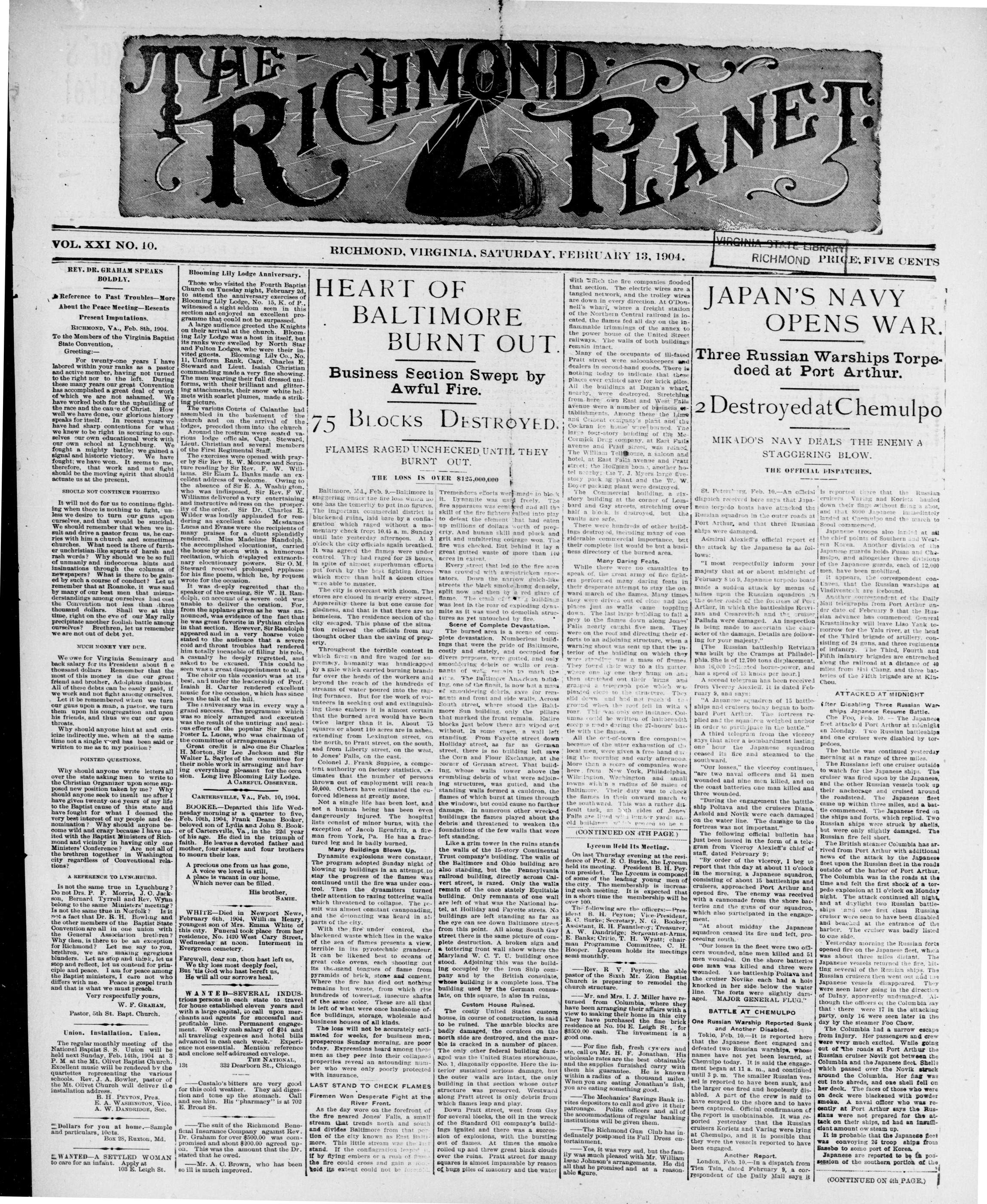
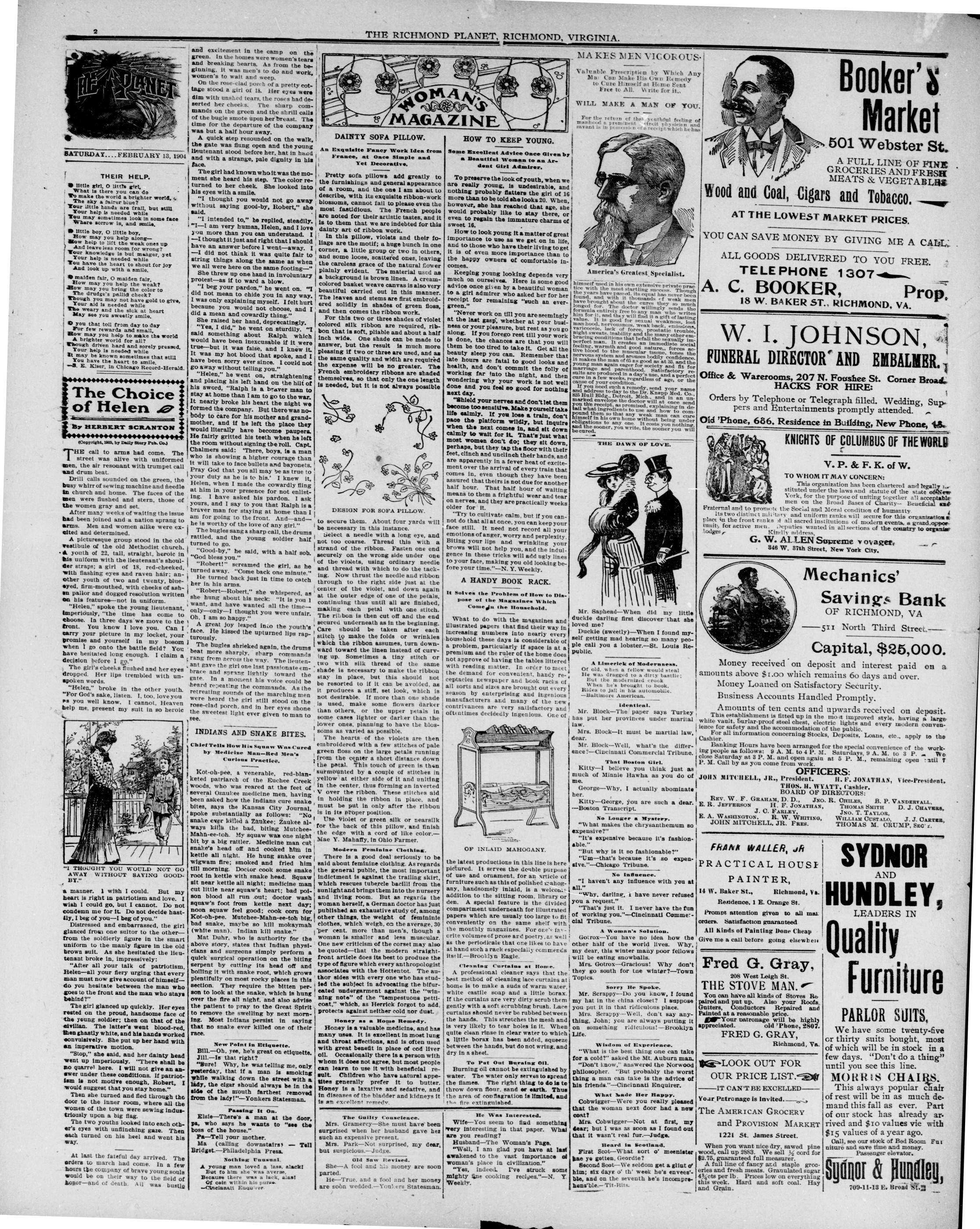
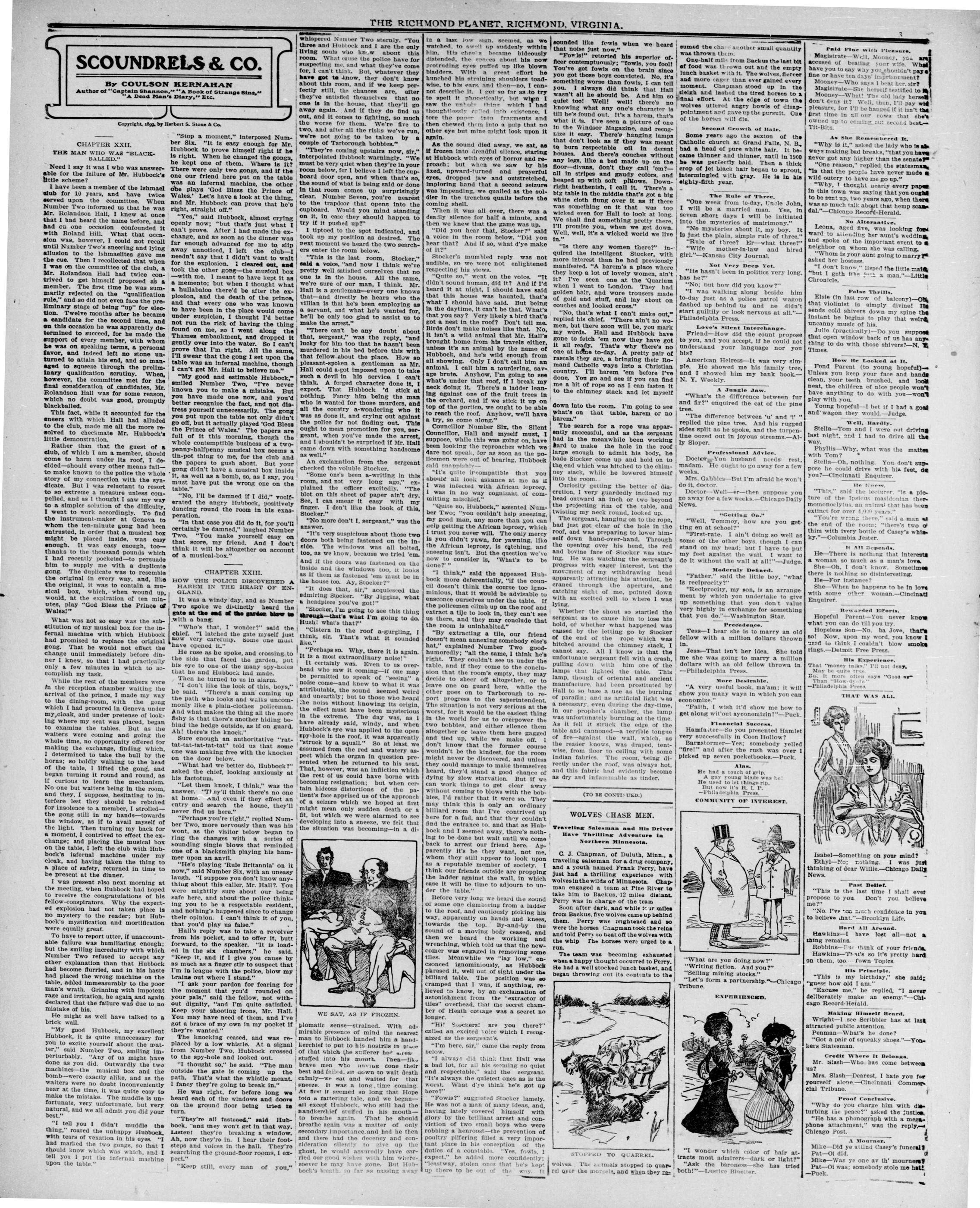
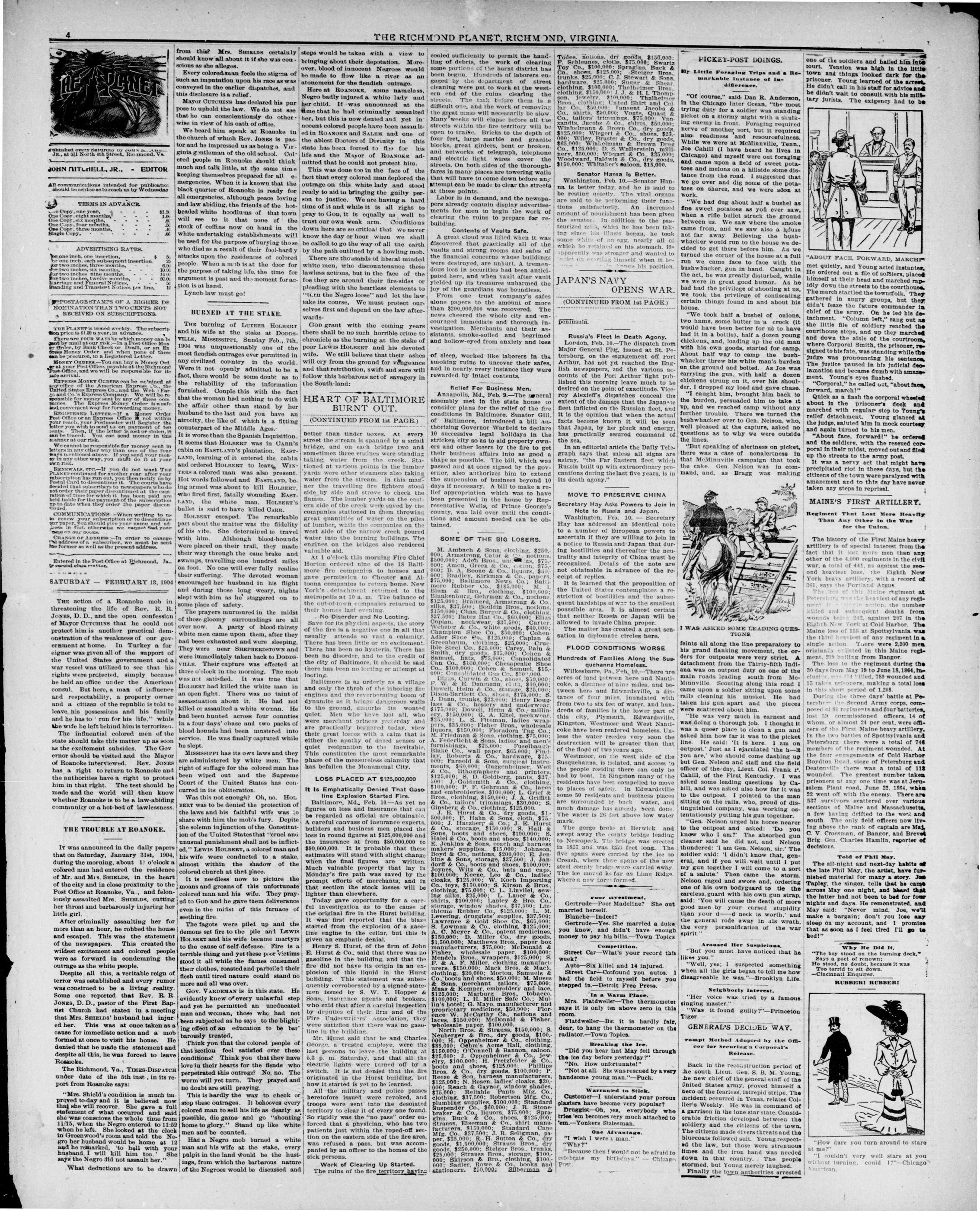
Page text (machine-generated)
THE RICHMOND PLANET
VOL. XXI NO. 10.
REV. DR. GRAHAM SPEAKS
BOLDLY.
Reference to Past Troubles—More
About the Peace Meeting—Resents
Present Imputations.
RICHMOND, VA., Feb. 8th, 1904.
To the Members of the Virginia Baptist
State Convention,
Greeting:
For twenty-one years I have labored within your ranks as a pastor and active member, having not turned to the right nor to the left. During these many years our great Convention has accomplished a great deal of work of which we are not ashamed. We have worked both for the upbuilding of the race and the cause of Christ. How well we have done, our glorious history speaks for itself. In recent years we have had sharp contensions for what we knew to be right in securing to ourself independent social work with our own school at Lachburg. We fought a mighty battle we gained a signal and historic victory. We fought; we have won. It seems to me, therefore, that work and not fight should be the moving spirit that should actuate us at the present.
SHOULD NOT CONTINUE FIGHTING
It will not do for us to continue fighting when there is nothing to fight, unless we desire to turn our guns upon ourselves, and that would be suicidal. We should remember that when we insult and drive a pastor from us, he carries with him a church and sometimes churches. What need is there of further unchristian-like spurts of harsh and rash words? Why should we be so full of unmany and indecorous hints and insinuations through the columns of newspapers? What is there to be gained by such a course of conduct? Let us remember that at Roanoke, it was sad to understand our best men that misunderstandings brought ourselves had cost the Convention not only three thousand dollars. Shall we at time, right on the eve of our May rally precipitate another foolish battle among ourselves? Brethren, let us remember we are not out of debt yet.
MUCH MONEY YET DUE
We owe for Virginia Seminary and back salary for its President about five thousand dollars. Remember that the most of this money is due our great friend and brother, Adolphus dumbles. All of these debts can be easily paid, if we work and not fight among ourselves. Let it be remembered when we turn our gaus upon a man, a pastor, we turn them upon his congregation and upon his friends, and thus we cut our own throats.
Why should anyone hint at and criticize indirectly me, when at the same time not a single word has been said or written to me as to my position?
POINTED QUESTIONS
Why should anyone write letters all over the state asking men to write to the Christian Organizer upon some supposed new position taken by me? Why should anyone seek to insult me after I have given twenty one years of my life to the Baptist cause of this state and have fought for what I deemed the very best interest of my people and denomination? Why should anyone become wild and crazy because I have unbounded the Baptist Ministers of Richmond and vicinity in Washington Ministers' Conference? Are not all of the brethren together in Washington city regardless of Conventional relations?
A REFERENCE TO LYNCHBURG.
Is not the same true in Lynchburg?
Do not Drs. P, F, Morris, J, C. Jackson,
Bernard Tyrrell and Rev. Wynn
belong to the same Ministers' meeting?
Is not the same true in Norfolk? Is it
not a fact that Dr. R. H. Bowling
and the other members of the Baptist State
Convention are all in one union with
the General Association brethren?
Why then, is there to be an exception
for Richmond? Let me say to you,
brethren, we are making egregious
blunders. Let us stop and think, let us
stop and reflect, let us contend for
principle and peace. I am for peace among
the Baptist ministers, I care not who
differs with me. Peace is gospel truth
and that is what we must reopen.
Pastor, 5th St. Bapt. Church.
Union. Installation. Union.
The regular monthly meeting of the National Baptist S. S. Union will be held next Sunday, Feb. 14th, 1943 at P. M. at the Mt. Olivet Baptist Church. Excellent music will be rendered by the quartettes representing the various Rare Book, Bowler, pastor of the Mt. Olivet Church will deliver the installation address.
B. H. PEYTON, Pres.
E. A. WASHINGTON, Vice.
A. W. DANDRIDGE, Sec.
Dollars for you at home.—Sample
and particulars, 10cts.
Box 28, Ruxton, Md.
WANTED—A SETTLED WOMAN
to care for an infant. Apply at
103 E. Leigh St.
Blooming Lily Lodge Anniversary.
Those who visited the Fourth Baptist Church on Tuesday night, February 2d, to attend the anniversary exercises of Blooming Lily Lodge, No. 15, K. of P., witnessed a sight seldom seen in this section and enjoyed an excellent programme that could not be surpassed.
A large audience greeted the Knights on their arrival at the church. Blooming Lily Lodge was a host in itself, but its ranks were swelled by North Star and Fulton Lodges, who were their invited guests. Blooming Lily Co., No. 11, Uniform Rank, Capt. Charles E. Steward and Lieut. Isaiah Christian commanding made a very fine showing. The men wearing their full dressed uniforms, with their brilliant and glittering attachments, their snow white helmets with scarlet plumes, made a striking picture.
The various Courts of Calanthe had assembled in the basement of the church and on the arrival of the lodges, preceded them into the church. Around the roostrum were seated various lodge offices, Capt. Steward, Lieut. Christian and several members of the First Regimental Staff.
The exercises were opened with prayer by Sir Rev R. W. Monroe and Scripture reading by Sir Rev. F. W. Williams. Sir Elam L. Banks made an excellent address of welcome. Owing to the absence of Sir E. A. Washit gton, who was indisposed, Sir Rev. F. W. Williams delivered a very entertaining and instructive address on the prosperity of the order. Sir Dr. Charles E. Wilder was loudly applauded for rendering an excellent solo Mesdames Lucas and Evans were the recipients of many praises for a duet splendidly rendered. Miss Madeline Randolph, the accomplished elocutionist, carried the house by storm with a humorous recitation, which displayed extraordinary elocutionary powers. Sir O. M. Steward received prolonged applause for his fine poem, which he, by request wrote for the occasion.
It was deeply regretted that the speaker of the evening, Sir W. H. Randolph, on account of a severe cold was unable to deliver the oration. For, from the applause given as he was announced, was evidence of the fact that he was great favorite in Pythian circles in that section. However, Sir Randolph appeared and in a very hoarse voice stated to the audience that a severe cold and throat troubles had rendered him totally incapable of filling his role, a casualty he deeply regretted, and asked to be excused. This could be seen as a great disappointment to all. The chair on this occasion was at its best, and the leachship of Prof. Isaiah H. Carr undered excellent music for the occasion which has since been the talk of the hill.
The anniversary was in every way a grand success. The programme which was so nicely arranged and executed was the result of the untiring and zealous efforts of the popular Sir Knight Foster L. Lucas, who was chairman of the committee of arrangements
Great credit is also due Sir Charles H. Morton, Sir Lee Jackson and Sir Walter L. Sayles of the committee for their noble work in arranging and having everything pleasant for the occasion. Long live the age. A CAREFUL OVERSEEK
CARTERSVILLE, VA., Feb. 10, 1904.
BOOKER—Departed this life Wednesday morning at a quarter to five, Feb. 10th, 1904, Frank Deane Booker, beloved son of Lydia and John S. Booker of Cartersville, Va., in the 22d year of his age. He died in the triumph of faith. He leaves a devoted father and mother, four sisters and four brothers to mourn their loss.
A precious one from us has gone,
A voice we loved is still,
A place is vacant in our home,
Which never can be filled.
His brother,
SAMIE.
WHITE—Died in Newport News, February 6th, 1904, William Henry, youngest son of Mrs. Emma White of this city. Funeral took place from her residence, No. 1420 West Cary Street, Wednesday at noon. Interment in Evergreen cemetery
Farewell, dear son, thou hast left us,
We thy loss most deeply feel,
But 'tis God who hast bereft us,
He will all our sorrows heal.
WANTED—SEVERAL INDUSTRIous persons in each state to travel for house established eleven years and with a large capital, so call upon merchants and agents for successful and profitable line. Permanent engagement. Weekly cash salary of $24 and all traveling expenses and hotel bills advanced in cash each week. Experience not essential. Mention reference and enclose self-addressed envelope.
THE NATIONAL,
13t 332 Dearborn St., Chicago
Custalo's bitters are very good for this cold weather. They aid digestion and tone up the stomach. Call and see him. His "pharmacy" is at 702 E. Broad St.
---
The suit of the Richmond Beneficial Insurance Company against Rev. Dr. Graham for over $500.00 was compromised and about $200.00 agreed upon. This was the amount that the Dr. stated that he owed.
Mr. A. C. Brown, who has been so ill is much improved.
HEART OF BALTIMORE BURNT OUT.
FLAMES RAGED UNCHECKED UNTIL THEY BURNT OUT.
THE LOSS IS OVER $125,000,000
Baltimore, Md., Feb. 9.—Baltimore is staggering under the fire loss which no one has the tenacity to put into figures. The important commercial district is blackened ruins, laid bare by a confi- gration which raged without a mo- mentary check from 10.45 a. m. Sunday until late yesterday afternoon. At 3 o'clock the city officials again breathed. It was agreed the flames were under control. They had raged for 28 hours, in spite of almost superhuman efforts put forth by the best fighting forces which more than half a dozen cities were able to muster.
Tremendous efforts were made to blit it. Dynamite was used freely. The fire apparatus was centred and all the skill of the fire fighters called into p- to defeat the element that had eau- up millions of dollars worth of pro- perty. And human skill and pluck a grit and unfaltering courage won. The fire was checked. But behind it lay great gutted waste of more than 1 acres in extent.
Every street that led to the fire a- was crowded with awe-inspired spatators. Down the narrow gulch- streets the black smoke hung down.
The city is overcast with gloom. The stores are closed in nearly every street. Apparently there is but one cause for gladness, and that is that there are no homeless. The residence section of the city escaped. This phase of the situation relieved the officials from any thought other than the saving of property.
Throughout the terrible contest in which firemen and fire waged for supremacy, humanity was handicapped by a gale which burned burning brands far over the heads of the workers and beyond the reach of the hundreds of streams of water poured into the raging furnaces. But for the work of volunteers in seeking out and extinguishing these embers it is almost certain that the burned area would have been twice larger than it is. About 75 squares or about 140 acres are in ashes, extending from Lexington street, on the north, to Pratt street, on the south, and from Liberty street, on the west, to Jones' Falls, on the east.
Colonel J. Frank Supplee, a competent authority on factory statistics, estimates that the number of persons thrown out of employment will reach 50,000. Others have estimated the enforced idleness at greatly more.
Not a single life has been lost, and not a human being has been even dangerously injured. The hospital lists consist of minor burns, with the exception of Jacob ligenfritz, a fireman from York, Pa. He has a fractured leg and is badly burned.
Many Buildings Blown Up.
Dynamite explosions were constant. The program adopted Sunday night of blowing up buildings in an attempt, to stay the progress of the flames was continued until the fire was under control. Then the dynamiters turned their attention to razing toottering walls which threatened to collapse. The result was almost constant cannonading, and the detonating was heard in all parts of the city.
With the fire under control, the blackened waste which lies in the wake of the sea of flames presents a view, terrible in its proteotechnic grandeur. It can be likened best to oceans of great coke ovens, each shooting out its thousand tongues of flame from pyramids of brick, stone and cement. Where the fire has died out nothing remains but waste, from which rise hundreds of towering, insecure shafts of the same color. These are all that is left of what were once handsome office buildings, storage, wholesale and business houses of all kinds.
The loss will not be accurately estimated for weeks, for business men, prosperous Sunday morning, are poor today. Expressions heard among them as they peer into their collapsed properties reveal an astounding number who were only poorly protected with insurance.
LAST STAND TO CHECK FLAMES
Firemen Won Desperate Fight at the River Front.
As the day wore on the forefront of the fire neared Jones' Falls, a small stream that trends north and south and divides Baltimore from that portion of the city known as East Baltimore. This little stream was the last stand. If the conflagration leaped to if by flying embers or a rush of flames the fire could cross and gain a roof hold its extent could not be formed.
Tremendous efforts were made to block it. Dynamite was used freely. The fire apparatus was centred and all the skill of the fire fighters called into play to defeat the element that had eaten up millions of dollars worth of property. And human skill and pluck and grit and unfaltering courage won. The fire was checked. But behind it lay a great gutted waste of more than 140 acres in extent. Every street that led to the fire area was crowded with awesotricken spectators. Down the narrow gulch-like streets the black smoke hung densely, split now and then by a red glare of flame. The crash of buildings was lost in the roar of exploding dynamite as it was used to demolish structures as yet untouched by fire.
Scene of Complete Devastation. The burned area is a scene of complete devastation. Numberless buildings that were the pride of Baltimore, costly and stately, and occupied for divers purposes, were gutted, and only smouldering debris or walls or remnants of walls remain to mark the ruins. The Baltimore American building, one of the finest, is now but a mass of smouldering debris, save for remnants and front and side walls. Across South street, where stood the Baltimore Sun building, only the pillars that marked the front remain. Entire blocks just below there are wiped out without, in some cases, a wall left standing. From Fayette street down Holliday street, as far as German street, there is no building left save the Corn and Flour Exchange, at the corner of German street. That building, whose walls tower above the crumbling debris of what were adjoining structures, was gutted, and the standing walls formed a cauldron, the flames of which burst at times through the windows, but could cause no further damage. In numerous other wrecked buildings the flames played about the debris and threatened to weaken the foundations of the few walls that were left standing.
Like a grim tower in the ruins stands the walls of the 15-story Continental Trust company's building. The walls of the Baltimore and Ohio building are also standing, but the Pennsylvania railroad building, directly across Calvert street, is razed. Only the walls remain of the once stately Equitable building. Only remnants of one wall are left of what was the National hotel, at Holliday and Fayette streets. No buildings are left standing as far as the eye can see down Baltimore street from this point. All along South Gay street there is the same picture of complete destruction. A broken sign and a tottering front wall show where the Maryland W. C. T. U. building once stood. Adjoining this was the building occupied by the Iron Ship company and by the British consulate, whose building is a complete loss. The building used by the German consulate, on this square, is also in ruins.
Custom House Ruined.
The costly United States custom house, in course of construction, is said to be ruined. The marble blocks are badly damaged, the cornices on the north side are destroyed, and the marble is cracked in a number of places. The only other federal building damaged was the United States storehouse, No. 1, diagonally opposite. Here the interior sustained serious damage, but the outer walls are intact, the only building in that section whose outer structure was preserved. Westward along Pratt street is only debris from which flames leap and play. Down Pratt street, west from Gay for several blocks, the oil in the wreck of the Standard Oil company's buildings ignited and there was a succession of explosions, with the bursting out of flames. At times the smoke rolled up and threw great black clouds over the ruins. Pratt street for many squares is almost impassable by reason of hug piles of masonry and the water
with which the fire companies flooded that section. The electric wires are a tangled network, and the trolley wires are down in every direction. At O'Donnell's wharf, where a freight station of the Northern Central railroad is located, the flames fed all day on the inflammable trimmings of the annex to the power house of the United Street railways. The walls of both buildings remain intact.
Many of the occupants of ill-fated Pratt street were saloonkeepers and dealers in second-hand goods. There is nothing today to indicate that these places ever existed save for brick piles. All the buildings at Dugan's wharf, nearby, were destroyed. Stretching from here, own East and West Falls avenue were a number of business establishments. Among these the Liree and Conent company's plant and the Cockran ice house were burned. The large four-story building of the McCormick Drug company, at East Falls avenue and Pratt street, was ruined. The William Tell House, a saloon and hotel, at East Falls avenue and Pratt street; the Hoffman house, another hotel nearby, the T. J. Myers large livestock packing plant and the W. W. Boyer packing plant were destroyed. The Commercial building, a six-story building at the corner of Lombard and Gay streets, stretching over half a block, is destroyed, but the valuits are safe.
There were hundreds of other buildings destroyed, including many of considerable commercial importance, but their complete list would be but a business directory of the burned area
Many Daring Feats.
While there were no casualties to speak of, the great army of fire fighters performed many daring feats in their desperate attempt to stay the onward march of the flames. Many times they were driven out of close and hot places just as walls came toppling down. The last large building to fall a prey to the flames down along Jones' Falls nearly caught five men. They were on the roof and directing their efforts to an adjoining structure, when a warning shout was sent up that the interior of the building on which they were standing was a mass of flames. They found their way to a tin gutter where one by one they hung on and then stretched out their arms and grasped a telegraph pole which we planted close to the structure. They slid down, and had not resisted the ground when the roof fell in with a roar. This was only one instance. Columns could be written of hatchbreadth except a mad* during the 24-hours' battle with the flames.
All the out-of-town fire companies because of the utter exhaustion of the local men, were given a free hand during the morning and early afternoon. More than a score of companies were here from New York, Philadelphia, Washington, Washington and small towns within a radius of 50 miles of Baltimore. Their duty was to check the flames in their onward march to the southward. This was a rather difficult task, as both sides of Jones Falls are lived with a number yards and old buildings which proved to be no
(CONTINUED ON 4TH PAGE)
Lyceum Held Its Meeting.
On last Thursday evening at the residence of Prof. E. C. Burke, the Lyceum held its meeting. President B. H. Peyton presided. The Lyceum is composed of some of the leading young men of the city. The membership is increasing each meeting. It is expected that in a short time the membership will be over 100.
The following are the officers:—President B. H. Peyton; Vice-President, E. C. Burke; Secretary, N. G. Booker; Assistant, R. H. Fauntleroy; Treasurer, A. W. Dandridge; Sergeant-at-Arms, E. Banks; Critic, T. H. Wyatt; chairman Programme Committee, C. H. Hooper. Lyceum holds its meetings semi-monthly.
—Rev. R. V. Peyton, the able pastor of the Sixth Mt. Zion Baptist Church is preparing to remodel the church structure.
Mr. and Mrs. I. J. Miller have returned from Columbia, where they have been arranging their affairs with a view to making their home in this city. They have purchased the fine brick residence at No. 104 E. Leigh St., for $550.00 cash. The investment is a good one.
For fine fish, fresh cysers and etc, call on Mr. H. F. Jonathan. His wholesale rates are the best obtainable and the supplies furnished carry with them his guarantee. He is known within a radius of a thousand miles. When you are eating Jonathan's fish, you are eating something good.
The Mechanics' Savings Bank invites depositors to call and give it their patronage. Polite officers and all of the accommodations of regular banking institutions will be given them.
The Richmond Gun Club has indefinitely postponed its Full Dress entertainment.
Yes, it was very sad, but the fami-
ily was much pleased with Mr. William
Josephson's arrangements. He did
all that he promised and at a reasonable
figure *gure*.
JAPAN'S NAVY OPENS WAR.
MIKADO'S NAVY DEALS THE ENEMY AT STAGGERING BLOW.
THE OFFICIAL DISPATCHES.
St. Peterburg, Feb. 10.—An official dispatch received here says that Japanese torpedo boats have attacked the Russian squadron in the outer roads at Port Arthur, and that three Russian ships were damaged.
Admiral Alexieff's official report of the attack by the Japanese is as follows:
is reported there that the Russian cruisers Varing and Korletz have down their flags without firing a and that 8000 Japanese immediately landed at Cinemutipo and the mare Seoul commenced.
Japanese troops also landed at the chief points of Southern and Western Korea. Another division of Japanese guards holds Fusan and muling and oiling.
"I most respectfully inform your majesty that at or about midnight of February 8 to 9, Japanese torpedo boats made a sudden attack by means of mines upon the Russian squadron in the outer roads of the fortress of Port Arthur, in which the battleships Retvizan and Cosarevitch and the cruiser Pallala were damaged. An inspection is being made to ascertain the character of the damage. Details are following for your majesty."
[The Russian battleship Retvizan was built by the Cramps at Philadelphia. She is of 12,700 tons displacement, has 16,000 indicated horse-power, and has a speed of 13 knots per hour.]
A second telegram has been received from Viebery Alexleff. It is dated February 8, and says:
"A Japanese squadron of 15 battleships and cruisers today began to bomb Port Arthur. The fortress replied and the squadron weighed anchor in order to participate in the battle."
A third telegram from the viceroy says that after a bombardment lasting one hour the Japanese squadron ceased its fire and steamed to the southward.
"Our losses," the viceroy continues, "are two naval officers and 51 men wounded and nine men killed, and on the coast batteries one man killed and three wounded.
"During the engagement the battleship Poltava and the cruisers Diana, Askold and Novik were each damaged on the water line. The damage to the fortress was not important."
The following official bulletin has just been issued in the form of a telegram from Viceroy Alexieff's chief of staff, dated February 9:
"By order of the viceroy, I beg to report that this day at about 11 o'clock in the morning, a Japanese squadron, consisting of about 15 battleships and cruisers, approached Port Arthur and opened fire. The enemy was received with a cannonade from the shore batteries and the guns of our squadron, which also participated in the engagement.
"At about midday the Japanese squadron ceased its fire and left, proceeding south.
"Our losses in the fleet were two officers wounded, nine men killed and 51 men wounded. On the shore batteries one man was killed and three were wounded. The battleship Poliava and the cruiser Novike each had a hole knocked in her side below the water line. The forts were slightly damaged. MAJOR GENERAL FLUG."
BATTLE AT CHEMULPO
One Russian Warship Reported Sunk and Another Disabled
and Another Disabled.
Tokio, Feb. 10. It is reported here that the Japanese fleet engaged and defeated two Russian warships, whose names have not yet been learned, at Chemulpo today. It is said the engagement began at 11 a. m., and continued until 3 p. m. The smaller Russian vessel is reported to have been sunk, and the larger one fired and hopelessly disabled. A part of the crew is said to have escaped to the shore and to have been captured. Official confirmation of the report is unobtainable. It was reported yesterday that the Russian cruisers Korletz and Varlag were lying at Chemulpo, and it is possible that they were the vessels reported to have been engaged.
Another Report.
London, Feb. 10.—In a dispatch from Tien Tsin, dated February 9, a correspondent of the Dally Mall says it
is reported there that the Russian cruisers Varang and Korizet hauled down their flags without firing a shot, and that 8000 Japanese immediately landed at Cnemulpo and the march to Seoul commenced.
Japanese troops also landed at all the chief points of Southern and Western Korea. Another division of the Japanese guards holds Fusan and Chamulpo, and altogether three divisions of the Japanese guards, each of 12,000 men, have been mobilized.
It appears, the correspondent continues, that the Russian warships at Vladivostock are fecound.
Another correspondent of the Daily Mail telegraphs from Port Arthur under date of February 9 that the Russian advance has commenced. General Krasnatsiney will leave Liao Yank tomorrow for the Yalu river, at the head of the Third brigade of artillery, consisting of 24 guns, and three regiments of infantry. The Third, Fourth and Fifth infantry brigades are entrenched along the railroad at a distance of 40 miles from Hai Chang, and three batteries of the Fifth brigade are at Kiu-Chou.
ATTACKED AT MIDNIGHT
After Disabling Three Russian Warships
ships Japanese Resume Battle.
Ships Japanese Resume Battle.
The Coo, Feb. 10. — The Japanese fleet attacked Dort Arthur at midnight on Monday. Two Russian battleships and one cruiser were disabled by torpedoes.
The battle was continued yesterday morning at a range of three miles.
The Russians left one cruiser outside to watch for the Japanese ships. The cruiser was fired upon by the Japanese, and the other Russian vessels took up their anchorage and cruised around the roadstead. The Japanese fleet came up within three miles, and a battle commenced. The Japanese fired on the ships and forts, which replied. Two Russian ships were struck by shells, but were only slightly damaged. The Russian fire fell short.
The British steamer Columbia has arrived from Port Arthur with additional news of the attack by the Japanese fleet upon the Russian fleet in the roads outside of the harbor of Port Arthur. The Columbia was in the roads at the time and felt the first shock of a torpedo explosion at 11 o'clock on Monday night. The attack continued all night, and at daylight two Russian battleships and one first class Russian cruiser were seen to have been disabled and beached at the entrance of the harbor. The cruiser was badly listed to one side.
Yesterday morning the Russian forts opened fire on the Japanese fleet, which was about three miles distant. The Japanese vessels returned the fire, hitting several of the Russian ships. The Russian cruisers then went out and the Japanese vessels disappeared. They were seen later going in the direction of Dalny, apparently undamaged. Although the officers of the Columbia say that there were 17 in the attacking party, only 16 were seen later in the day by the steamer Foo Chow.
The Columbia had a narrow escape from injury. Her passengers and crew were very much excited. While going out of the roads at Port Arthur the Russian cruiser Novik got between the Columbia and the Japanese fleet. Shells which passed over the Novik struck around the Columbia. Her flag was cut into shreds, and one shell fell on her deck. The faces of those who were on deck were blackened with powder smoke. A naval officer who was recently at Port Arthur says the Russians were not prepared for the attack on their ships, nd had an insufficient amount oow steam up.
It is probable that the Japanese fleet was convoying 24 troop ships from Sasebo to some port of Korea.
Japanese are reported to be in possession of the southern portion of the
(CONTINUED ON 4TH PAGE.)
HE PLANET
THEIR HELP.
● little girl, O little girl,
What is there you can do
● make the world a brighter world,
That is fairer blue?
Your little friend will, but still
Your help is needed while
You may sometimes look in some face
Where sorrow is, and smile.
● little boy, O little boy,
How may you help along—
How help to lift the weak ones up
And leave less room for wrong?
How knowledge is but merger, yet
Your hard work needed while
You have the heart to shout for joy
And look up with a smile.
● maiden fair, O maiden fair,
How may you help the weak?
How may you bring the color to
The drudge's pellid cheek?
Though you may not have gold to give,
Your aid is needed while
Weary and the sick at heart
May see you sweetly smile.
● you that toll from day to day
For few rewards and small,
How may you to make the world
A brighter world?
Though driven hard and surely pressed
S. E. Kiser, in Chicago Record-Herald.
The Choice of Helen
BY HERBERT SCRANTON
(Copyright, 1803, by Daily Story Pub. Co.)
THE call to arms had come. The street was alive with uniformed men, the air resonant with trumpet call and drum beat. Drill calls sounded on the green, the busy whirr of sewing machine and needle in church and home. The faces of the men were flushed and stern, those of the women gray and set.
After many weeks of waiting the issue had been joined and a nation sprang to arms. Men and women alike were excited and determined.
A picturesque group stood in the old vestibule of the old Methodist church. A youth of 22, tall, straight, heroic in his uniform with the lieutenant's shoulder straps; a girl of 18, red-cheeked, with flashing eyes and raven hair; an other youth of two and twenty, blue-eyed, firm-mouthed, with cheeks of ashen pallor and dogged resolution written on his features—not in uniform.
"Helen," spoke the young lieutenant, imperiously, "the time has come to choose. In three days we move to the front. You know I love you. Can I carry your picture in my locket, your promise and yourself in my bosom when I go onto the battle field? You have hesitated long enough. I claim a decision before I go."
The girl's cheeks flushed and her eyes dropped. Her lips trembled with unspoken words.
"Helen," broke in the other youth. "For God's sake, listen. I, too, love you as you well know. I cannot. Heaven help me, present my suit in so heroic
"I THOUGHT YOU WOULD NOT GO AWAY WITHOUT SAYING GOOD-BY."
"I THOUGHT YOU WOULD NOT GO AWAY WITHOUT SAYING GOODBY."
a manner. I wish I could. But my heart is right in patriotism and love. I wish I could go, but I cannot. Do not condemn me for it. Do not decide hastily, I beg of you—I beg of you."
Distressed and embarrassed, the girl glanced from one sutor to the other—from the soldierly figure in the smart uniform to the manly figure in the old brown suit. As she hesitated the lieutenant broke in, impressively:
"After all your talk of patriotism, Helen—all your fiery urging that every man must now give account of himself—do you hesitate between the man who goes to the front and the man who stays behind?"
The girl glanced up quickly. Her eyes rested on the proud, handsome face of the young soldier; then on that of the civilian. The latter's went blood-red, then ghastly white, and his hands worked convulsively. She put up her hand with an imperative motion.
"Stop," she said, and her dainty head went up imperiously. "There shall be no quarrel here. I will not give an answer under these conditions. If patriotism is not motive enough, Robert, I would suggest that you stay home."
Then she turned and fled through the door to the inner room, where all the women of the town were sewing industriously upon a big flag.
The two youths looked into each other's eyes with unfinching gaze. Then each turned on his heel and went his way.
At last the fateful day arrived. The orders to march had come. In a few hours the company of brave young souls would be on their way to the field of honor—and of death. All was bustle
and excitement in the camp on the green. In the homes were women's tears and breaking hearts. As from the beginning, it was men's to do and work, women's to wait and weep.
On the rose-clad porch of a pretty cottage stood a girl of 18. Her eyes were dim with unshed tears, the roses had deserted her cheeks. The sharp commands on the green and the shrill calls of the bugle smote upon her breast. The time for the departure of the company was but a half hour away.
A quick step resounded on the walk, the gate was flung open and the young lieutenant stood before her, hat in hand and with a strange, pale dignity in his face.
The girl had known who it was the moment she heard his step. The color returned to her cheek. She looked into his eyes with a smile.
"I thought you would not go away without saying good-by, Robert," she said.
"I intended to," he replied, steadily,
"I—I am very human, Helen, and I love
you more than you can understand. I
—I thought it just and right that I should
have an answer before I went—away. I
—I did not think it was quite fair to
string things along the same as when
we all were here on the same footing—"
She shew up one hand in involuntary
protest—as if to ward a blow.
"I beg your pardon," he went on. "I
did not mean to chide you in any way.
I was only explaining myself. I felt hurt
because you would not choose, and I
did a mean and cowardly thing."
She raised her hand, deprecatingly.
"Yes, I did," he went on sturdily. "I
said something about Ralph which
would have been inexcusable if it were
true—but it was false, and I knew it.
It was my hot blood that spoke, and
I have been sorry ever since. I could not
go away without telling you."
"Helen," he went on, straightening and placing his left hand on the hilt of his sword, "Ralph is a braver man to stay at home than I am to go to the war. It nearly broke his heart the night we formed the company. But there was nobody to care for his mother and grandmother, and if he left the place they would literally have become paupers. He fairly gritted his teeth when he left the room without signing the roll. Capt. Chalmers said: "There, boys, is a man who is showing a higher courage than it will take to face bullets and bayonets. Pray God that you all may be as true to your duty as he is to his." I knew it, Helen, when I made the cowardly fling at him in your presence for not enlisting. I have asked his pardon. I ask yours, and I say to you that Ralph is a braver man for staying at home than I am for going to the front. And—and he is worthy of the love of any girl."
The bugles sang a sharp call, the drums rattled, and the young soldier half turned to go.
"Good-by," he said, with a half sob. "God bless you."
"Robert!" screamed the girl, as he turned away. "Come back one minute."
He turned back just in time to catch her in his arms.
"Robert—Robert," she whispered, as she hung about his neck. "It is you I want, and have wanted all the time—only—only—I thought you were unfair. Oh, I am so happy."
A great joy leaped into the youth's face. He kissed the upturned lips rapturously.
The bugles shrieked again, the drums beat more sharply, sharp commands rang from across the way. The lieutenant gave the girl one last passionate embrace and sprang lightly toward the gate. In a moment his voice could be heard repeating the commands. As the retreating sounds of the marching men were heard the girl still stood on the rose-clad porch, and in her eyes shone the sweetest light ever given to man to see.
INDIANS AND SNAKE BITES.
Chief Tells How His Squaw Was Cured by Medicine Man-Red Men's Curious Practice.
Kot-oh-pee, a venerable, red-blanketed pariarch of the Euchee Creek woods, who was reared at the feet of several Ozaukee medicine men, having been asked how the Indians cure snake bites, says the Kansas City Journal, spoke substantially as follows: "No snake ever killed a Zankee; Zankee always kills the bad, biting Mutchee-Mahn-ee-toh. My squaw was one night bit by a big rattler. Medicine man cut snake's head off and cooked him in kettle all night. He hung snake over wigwam fire; smoked and fried him till morning. Doctor cook some snake root in kettle with snake head. Squaw sit near kettle all night; medicine man cut little near squaw's heart; bad poison blood all run out; doctor wash squaw's foot from kettle next day; noon squaw feel good; cook corn for Kot-oh-pee. Mutech-Mahn-ee-toh big, bad snake, maybe so kill mokaymah (white man). Indian kill snake."
Mat Duhr, who is authority for the above story, states that Indian physicians and surgeons simply perform a quick surgical operation on the biting serpent by cutting its head off and boiling it with snake root, which grows plentifully on most rocky places in this section. They require the bitten person to look at the snake, which is hung over the fire all night, and also advise the patient to pray to the Great Spirit to remove the swelling by next morning. Most Indians persist in saying that no snake ever killed one of their race.
New Point in Etiquette
Bill—Oh, yes, he's great on etiquette. Jill—Is that right?
"fure! Why, he was telling me, only yesterday, that if a man is smoking while walking down the street with a lady, the cigar should always be in the side of the mouth farthest removed from the lady!"—Yonkers Statesman.
Passing It On.
Elise—There's a man at the door,
pa, who says he wants to "see the
boss of the house."
Pe—Tell your mother.
Ma (calling downstairs) — Tell
Bridget.—Philadelphia Press.
Nothing Unusual.
A young man loved a lass, alack!
But to him she was averse.
Because there was a lack, alask
with him the nurse.
—Cleveland Engineer.
THE RICHMOND PLANET, RICHMOND, VIRGINIA
WOMAN'S
MAGAZINE
MAKES
Valuable Pro
Man Can
to Cure
Free t
WILL MAK
For the rebu-
manhood a pre-
savant is in pos
DAINTY SOFA PILLOW.
An Exquisite Fancy Work Idea from France, at Once Simple and Yet Decorative.
Pretty sofa pillows add greatly to the furnishings and general appearance of a room, and the one I am about to describe, with its exquisite ribbon-work blossoms, cannot fail to please even the most fastidious. The French people are noted for their artistic tastes, and it is to them that we are indebted for this dainty art of ribbon work.
In this pillow, violets and their foliage are the motif; a huge bunch in one corner, a little group or two in others, and some loose, scattered ones, leaving the careless grace of the natural flower plainly evident. The material used as a background is brown linen. A cream-colored basket weave canvas is also very beautiful carried out in this manner. The leaves and stems are first embroidered solidly in shades of green floss, and then comes the ribbon work.
For this two or three shades of violet colored silk ribbon are required, ribbon that is soft, pliable and about a half inch wide. One shade can be made to answer, but the result is much more pleasing if two or three are used, and as the same quality and width are required the expense will be no greater. The French embroidery ribbons are shaded themselves, so that only the one length is needed, but it is not always possible
DESIGN FOR SOFA PILLOW.
to secure them. About four yards will be necessary in this instance.
Select a needle with a long eye, and not too coarse. Thread this with a strand of the ribbon. Fasten one end securely on the wrong side under one of the violets, using ordinary needle and thread with which to do the tacking. Now thrust the needle and ribbon through to the right side just at the center of the violet, and down again at the outer edge of one of the petals, continuing thus until all are finished, making each petal with one stitch. The ribbon is then cut off and the end secured underneath as in the beginning. Care should be taken after each stitch to make the folds or wrinkles which the ribbon assumes, turn downward toward the linen instead of curving up. Sometimes a tiny stitch or two with silk thread of the same shade is necessary to make the ribbon stay in place, but this should not be resorted to if it can be avoided, as it produces a stiff, set look, which is not desirable. If more than one shade is used, make some flowers darker than others, or the upper petals in some cases lighter or darker than the lower ones, planning to have the blossoms as varied as possible.
The hearts of the violets are then embroidered with a few stitches of pale green floss on the large petals running from the center a short distance down the petal. This touch of green is then surmounted by a couple of stitches in yellow at either side of it and uniting in the center, thus forming an inverted V over the ribbon. These stitches aid in holding the ribbon in place, and must be put in only after the ribbon is in its proper position.
Use violet or green silk or nearsilk for the back of this pillow, and finish the edge with a cord of like color.—Mae E. Mahaffy, in Ohio Farmer.
Modern Feminine Clothing
Modern Feminine Clothing.
There is a good deal seriously to be said about feminine clothing. As regards the general public, the most important indictment is against the trailing skirt, which rescues tuberule bacilli from the sunlight and brings them into the nursery and living room. But as regards the woman herself, a German doctor has just published an exhaustive study of, among other things, the weight of feminine clothes, which weigh, on the average, 30 per cent, more than men's, though a woman is smaller and less muscular. One new criticism of the corset may also be quoted—that the modern straight-front article does its best to produce the type of figure which every anthropologist associates with the Hottentot. The author sides with every one who has studied the subject in advocating the bifurcated undergarment against the "winning note" of the "tempestuous petticoat," which, as Herrick forgot to add, protects against neither cold nor dust.
Honey as a Home Remedy.
Honey is a valuable medicine, and has many uses. It is excellent in most lung and throat affections, and is often used with great benefit in place of cod liver oil. Occasionally there is a person with whom it does not agree, but most people can learn to use it with beneficial result. Children who have natural appetites generally prefer it to butter. Honey is a laxative and sedative, and in diseases of the bladder and kidneys it is an excellent remedy.
The Guilty Conscience.
Mrs. Gramercy—She must have been surprised when her husband gave her such an expensive present.
Mrs. Park—Not surprised, my dear, but suspicious.—Judge.
Old Saw Revised.
She—A fool and his money are soon parted.
He—True, and a fool and her money
are soon wedded.—Yonkers Statesman.
HOW TO KEEP YOUNG.
Some Excellent Advice Once Given by a Beautiful Woman to an Ardent Girl Admirer.
To preserve the look of youth, when we are really young, is undesirable, and nothing probably flatters the girl of 16 more than to be told she looks 20. When, however, she has reached that age, she would probably like to stay there, or even to regain the immature charms of sweet 16.
How to look young it a matter of great importance to use as we get on in life, and to those who have their living to get it is of even more importance than to the happy owners of comfortable incomes.
Keeping young looking depends very much on ourselves. Here is some good advice once given by a beautiful woman to a girl admirer who asked her for her receipt for remaining "such an ever-green."
"Never work on till you are seemingly at the last gasp, whether at your business or your pleasure, but rest as you go along. If you forego rest till your work is done, the chances are that you will be too tired to take it. Get all the beauty sleep you can. Remember that late hours are fatal to good looks and health, and don't commit the folly of working far into the night, and then wondering why your work is not well done and you feel so good for nothing next day.
"Shield your nerves and don't let them become too sensitive. Make yourself take life calmly. If you lose a train, don't pace the platform wildly, but inquire when the next comes in, and sit down calmly to wait for it. That's just what most women don't do; they sit down, perhaps, but they tap the floor with their feet, clinch and unclinch their hands, and are apparently in a fever heat of excitement over the arrival of every train that comes in, even though they have been assured that theirs is not due for another half hour. That half hour of waiting means to them a frightful wear and tear on nerves, and they are practically weeks older for it.
"Try to cultivate calm, but if you cannot do that all at once, you can keep your face still. It need not record all your emotions of anger, worry and perplexity. Biting your lips and wrinkling your brows will not help you, and the indulgence in these tricks will add ugly lines to your face, making you old looking before your time." —N. Y. Weekly.
A HANDY BOOK RACK
It Solves the Problem of How to Dispose of the Magazines Which Come in the Household.
What to do with the magazines and illustrated papers that find their way in increasing numbers into nearly every household these days is considerable of a problem, particularly if space is at a premium and the ruler of the home does not approve of having the tables littered with reading matter. In order to meet the demand for convenient, handy receptacles newspaper and book racks of all sorts and sizes are brought out every season by enterprising and ingenious manufacturers and many of the new contrivances are very satisfactory and oftentimes decidedly ingenious. One of
OF INLAID MAHOGANY
the latest productions in this line is here pictured. It serves the double purpose of use and ornament, for an article of furniture such as this of polished mahogany, handsomely inlaid, is a welcome addition to the sitting room, library or den. A special feature is the divided compartment underneath for illustrated papers which are usually too large to fit conveniently on the same shelf with the monthly magazines. For one's favorite volumes of prose and poetry, as well as the periodicals that one likes to have at hand such a rack especially commends itself.—Brooklyn Eagle.
A professional cleaner says that the best method of cleaning lace curtains at home is to make a suds of warm water, white castile soap and a little borax. If the curtains are very dirty scrub them gently with a soft scrubbing brush. Lace curtains should never be rubbed between the hands. This stretches the mesh and is very likely to tear holes in it. When quite clean rinse in clear water to which a little borax has been added, squeeze between the hands, but do not wring, and dry in a sheet.
To Put Out Burying Oil.
Burning oil cannot be extinguished by water. The water only serves to spread the flames. The right thing to do is to throw down flour, sand or earth. Thus the area of confagration is limited, and the fire extinguished.
He Was Interested.
Wife—You seem to find something very interesting in that paper. What are you reading?
Husband—The Woman's Page. "Well, I am glad you have at last awakened to the vast importance of woman's place in civilization." "Yes, indeed. I've struck some mighty fine cooking recipes."—N. Y. Weekly.
Valuable Prescription by Which Any
Man Can Make His Own Remedy
to Cure Himself at Home Sent
Free to All. Write for it.
For the return of this yeetful feeling of manhood a prominent etroit physician and savant is in possession of a receipt which he has
America's Greatest Specialist.
himself used in his own extensive private practice with the most startling success. Though the years have passed, its equal has never been reached, and with it thousands of weak men have been cured by cures they so much longed for. The doctor has a formula entirely free to any man who writes him for it, and they will find it a gift of lasting strength, or for sexual weakness, lost in manhood, nervousness, varicoccle, lack of force, prostatic trouble, right sweats, inability and the many other emblems that befall the sexually imperfect man. It creates a social feeling, warmth and good nature, the vivid blood to the muscular tissue, tones the muscles, the cures bodily confidence. It makes the man of 65 years old and the young man again eager for society and marriage and parenthood. Satisfactory rest in a few weeks, hardness of age, or the cause of your condition.
If you need such a remedy, send your name, address, and phone number to Knepp Med. Co., 885 Hull Bldg, Detroit, Mich. Micah Marked envelope the doctor will at once send marked envelope the doctor will at once promised, in explained details what ingredients are promised, in explained details what ingredients are promised, in explained details to compound them so that any weak man can compound them in his own home without being under obligation to any one. It costs you nothing, and the sooner you write, the sooner you will be cured.
THE DAWN OF LOVE.
Mr. Saphead—When did my little duckle darling first discover that she loved me?
Duckle (sweetly)—When I found myself getting mad hearing so many people call you a lobster.—St. Louis Republic.
A Limerick of Modernness.
Or old, when a fellow would steal
He was dragged to a dirty bastle;
But the modernized crook
When he's brought to book,
Rides to jail in automobile.
—Baltimore American.
identical.
Mr. Block-The paper says Turkey has put her provinces under marital law.
Mrs. Block-It must be martial law, dear.
Mr. Block-Well, what's the difference?-Cincinnati Commercial Tribune.
That Boston Girl.
Kitty—I believe you think just as much of Minnie Hawha as you do of me.
George—Why, I actually abominate her.
Kitty—George, you are such a dear.—Boston Transcript.
No Longer a Mystery.
"What makes the chrysanthemum so expensive?"
"It's expensive because it's fashionable."
"But why is it so fashionable?"
"Um—that's because it's so expensive."—Chicago Tribune.
No Influence.
"I haven't any influence with you at all."
"Why, darling, I have never refused you a request."
"That's just it. I never have the fun of working you."—Cincinnati Commercial Tribune.
A Woman's Solution.
Gotrox—You have no idea how the other half of the world lives. Why, my dear, this winter many poor fellows will be eating snowballs.
Mrs. Gotrox—Gracious! Why don't they go south for the winter?—Town Topics.
Sorry He Spoke.
Mr. Scrappy—Do you know, I found my hat in the clooset! I suppose you put it in that ridiculous place.
Mrs. Scrappy—Well, don't say anything, John; you are always putting it on something ridiculous!—Brooklyn Life.
Wisdom of Experience.
"What is the best thing one can take for a cold?" asked the Mt. Auburn man, "Don't know," answered the Norwood philosopher. "But probably the worst thing a man can take is the advice of his friends."—Cincinnati Enquirer.
What hade Her Happy.
Cobwigger—Were you really pleased that the woman next door had a new coat?
Mrs. Cobwigger—Not at first, my dear; but I was as soon as I found out that it wasn't real fur.—Judge.
Heard in Scotland
Second Soot—We seldom get a glint of him; six days o' th' week he'enes' envees'ble, and on the seventh he's incomprehensible'-Tit-Bits.
I. G. B.
Booker's Market
501 Webster St. A FULL LINE OF FINE GROCERIES AND FRESH MEATS & VEGETABLES
Wood and Coal, Cigars and Tobacco.
AT THE LOWEST MARKET PRICES.
YOU CAN SAVE MONEY BY GIVING ME A CALL.
ALL GOODS DELIVERED TO YOU FREE.
TELEPHONE 1307
A. C. BOOKER, Prop.
18 W. BAKER ST., RICHMOND, VA.
W. I. JOHNSON,
FUNERAL DIRECTOR AND EMBALMER.
Office & Warerooms, 207 N. Foushee St. Corner Broad.
HACKS FOR HIRE:
Orders by Telephone or Telegraph filled. Wedding, Suppers and Entertainments promptly attended.
Old 'Phone, 686. Residence in Building, New Phone, 48.
KNIGHTS OF COLUMBUS OF THE WORLD
AT THE LOWEST MARKET PRICES.
YOU CAN SAVE MONEY BY GIVING ME A CALL.
ALL GOODS DELIVERED TO YOU FREE.
TELEPHONE 1307
A. C. BOOKER, Prop.
18 W. BAKER ST., RICHMOND, VA.
W. I. JOHNSON FUNERAL DIRECTOR AND EMBALMER.
Office & Warerooms, 207 N. Foushee St. Corner Broad. HACKS FOR HIRE:
Orders by Telephone or Telegraph filled. Wedding, Suppers and Entertainments promptly attended.
Old 'Phone, 686, Residence in Building, New Phone, 18.
KNIGHTS OF COLUMBUS OF THE WORLD
V. P. & F. K. of W.
TO WHOM IT MAY CONCERN:
This organization has been chartered and legally constituted under the laws and statute of the state of New York, for the purpose of uniting together all acceptable men, over
V. P. & F. K. of W.
TO WHOM IT MAY CONCERN:
This organization has been chartered and legally constituted under the laws and statute of the state of New York, for the purpose of uniting together all acceptable men on the Broad Bases of Charity—Beneficial.
Fraternal and to promote the Social and Moral condition of humanity.
Its two distinct military and uniform ranks will secure for this organization place in the front ranks of all sacred institutions of modern events, a grand, oppo-unity for active men.
Deputies wanted in all sections of the country to organize lodges. Kindly address.
This organization has been chartered and legally constituted under the laws and statute of the state of New York, for the purpose of uniting together all acceptable men on the Broad Bases of Charity—Beneficial and Fraternal and to promote the Social and Moral condition of humanity. Its two distinct military and uniform ranks will secure for this organization a place in the front ranks of all sacred institutions of modern events, a grand opportunity for active men. Deputies wanted in all sections of the country to organize lodges. Kindly address,
G. W. ALLEN Supreme voyager,
846 W. 87th Street, New York City.
Mechanics'
Savings Bank
OF RICHMOND, VA
— 511 North Third Street —
Capital, $25,000.
Capital, $25,000.
Money received on deposit and interest paid on a amounts above $1.00 which remains 60 days and over.
Money Loaned on Satisfactory Security.
Business Accounts Handled Promptly.
Amounts of ten cents and upwards received on deposit.
This establishment is fitted up in the most improved style, having a large white vault, burlar-proof steel chest, electric lights and every modern convenience for safety and the accommodation of the public.
For all information concerning Stocks, Deposits, Loans, etc., apply to the Cashier.
Banking Hours have been arranged for the special convenience of the working people as follows: 9 A. M. to 4 P. M. Saturday, 9 A. M. to 3 P. M. We close Saturday at 3 P. M. and open again at 5 P. M., remaining open until 7 P. M. Call by as you come from work.
OFFICERS:
JOHN MITCHELL, JR., President. H. F. JONATHAN, Vice-President.
THOS. H. WYATT, Cashier.
BOARD OF DIRECTORS:
REV. W. F. GRAHAM, D. D., JNO. R. CHILES, B. P. VANDERYALL,
E. R. JEFFERSON H. F. JONATHAN, THOMAS SMITH D. J. OHAVERS,
J. C. FARLEY, JNO. T. TAYLOR
Money received on deposit and interest paid on a amounts above $1.00 which remains 60 days and over.
Money Loaned on Satisfactory Security.
Business Accounts Handled Promptly.
Amounts of ten cents and upwards received on deposit.
This establishment is fitted up in the most improved style, having a large white vault, burlar-proof steel chest, electric lights and every modern convenience for safety and the accommodation of the public.
For all information concerning Stocks, Deposits, Loans, etc., apply to the Cashier.
Banking Hours have been arranged for the special convenience of the working people as follows: 9 A. M. to 4 P. M. Saturdays, 9 A. M. to 3 P. We close Saturday at 3 P. M. and open again at 5 P. M., remaining open :atil 7 P. M. Call by as you come from work.
OFFICERS
JOHN MITCHELL, JR., President. H.F. JONATHAN, Vice-President,
THOS, H.W. WYATT, Cashier,
HONS, H. WYATT, Cashier.
E. A. WASHINGTON, R. W. WRITING,
JOHN MITCHELL, JR. FREES
WILLIAM CUSTALO, J. J. CARTER,
THOMAS M. CRUMP, SEC. 6.
SYDNOR AND HUNDLEY, LEADERS IN Quality Furniture
FRANK WALLER, JR
PRACTICAL HOUSE
Residence, 1 E. Orange St.
Prompt attention given to all mail orders. Satisfaction guaranteed
All Kinds of Painting Done Cheap
Give me a call before going elsewhere
Fred G. Gray.
208 West Leigh St.
THE STOVE MAN.
You can have all kinds of Stoves Repaired and put up. Also your Roofs Gutters, Painters, Repaired and Painted at a reasonable price.
Your catronage will be highly appreciated.
old 'Phone: 2807
PARLOR SUITS.
We have some twenty-five or thirty suits bought, most of which will be in stock in a few days. "Don't do a thing" until you see this line.
Richmond, Va LOOK OUT FOR OUR PRICE LIST.
MORRIS CHAIRS.
This always popular chair of rest will be in as much demand this fall as ever. Part of our stock has already arrived and $10 values vie with $15 values of a year ago.
Call, see our stock of Bod Room. Fin niture and save time and money.
When you want nice dry, sawed pine wood, call up 2883. We sell ½ cord for $2.75, guaranteed full measurer. A full line of fancy and staple groceries and fresh meats. Graanulated sugar 4¾ per lb. Prices low on everything this week. Hard and soft coal. Hay and Grain.
Sydenor & Hundley,
709-11-13 E. Broad St.
SCOUNDRELS & CO.
By COULSON KERNAHAN
Author of "Captain Shannon," "A Book of Strange Sins," "A Dead Man's Diary," Etc.
Copyright, 1892, by Herbert S. Stone & Co.
THE MAN WHO WAS "BLACK-
BALLED."
Need I say it was I who was answer-
able for the failure of Mr. Hubbock's
little scheme?
I have been a member of the Ishmael club for 10 years, and have twice served upon the committee. When Number Two informed us that he was Mr. Rolandson Hall, I knew at once that I had heard the name before, and had on one occasion confounded it with Roland Hill. What that occasion was, however, I could not recall until Number Two's sneering and lying allusion to the Ishmaelites gave me the cue. Then I recollected that when I was on the committee of the club, a Mr. Rolandson Hall had twice contrived to get himself proposed as a member. The first time he was summarily rejected on the "qualification rule," and so did not even face the preliminary stage of being "up" for election. Twelve months after he became a candidate for the second time, and on this occasion he was apparently determined to succeed, for he made the support of every member, with whom he was on speaking terms, a personal favor, and indeed left no stone unturned to attain his end, and so managed to squeeze through the preliminary qualification scrutiny. When, however, the committee met for the final consideration of candidates, Mr. Rolandson Hall was for some reason, which no doubt was good, promptly blackballed.
This fact, while it accounted for the sneers with which Hall had alluded to the club, made me all the more resolved to checkmate Mr. Hubbock's little demonstration.
Rather than that the guest of a club, of which I am a member, should come to harm under its roof, I decided—should every other means fall—to make known to the police the whole story of my connection with the syndicate. But I was reluctant to resort to so extreme a measure unless compelled, and as I thought I saw my way to a simpler solution of the difficulty, I went to work accordingly. To find the instrument-maker at Geneva to whom the ten-minute gong had been entrusted, in order that a musical box might be placed inside, was easy enough. It was easy enough, too—thanks to the thousand pounds which I had recently pocketed—to persuade him to supply me with a duplicate gong. The duplicate was to resemble the original in every way, and, like the original, it was to contain a musical box, which, when wound up, would, at the expiration of ten minutes, play "God Bless the Prince of Wales!"
What was not so easy was the substitution of my musical box for the infernal machine with which Hubbock had promised to replace the original gong. That he would not effect the change until immediately before dinner I knew, so that I had practically only a few minutes in which to accomplish my task.
While the rest of the members were in the reception chamber waiting the arrival of the prince, I made my way to the dining-room, with the gong which I had procured in Geneva under my cloak, and under pretense of looking where my seat was placed, began to examine the tables. But as the waiters were coming and going the whole time, no opportunity offered for making the exchange, finding which, I determined to take the bull by the horns; so boldly walking to the head of the table, I lifted the gong, and began turning it round and round, as if curious to learn the mechanism. No one but waiters being in the room, and they, I suppose, hesitating to interfere lest they should be rebuked for insolence to a member, I strolled—the gong still in my hands—towards the window, as if to avail myself of the light. Then turning my back for a moment, I contrived to effect the exchange; and placing the musical box on the table, I left the club with Hubock's infernal machine under my cloak, and having taken the thing to a place of safety, returned in time to be present at the dinner.
I was present also next morning at the meeting, when Hubbock had hoped to receive the congratulations of his fellow-conspirators. Why the expected explosion had not taken place is no mystery to the reader; but Hubbock's mystification and mortification were equally great.
To have to report utter, if unaccountable failure was humiliating enough; but the smiling incredulity with which Number Two refused to accept any other explanation than that Hubbock had become furried, and in his haste had placed the wrong machine on the table, added immeasurably to the poor man's wrath. Grinning with impotent rage and irritation, he again and again declared that the failure was due to no mistake of his.
He might as well have talked to a brick wall.
"My good Hubbock, my excellent Hubbock, it is quite unnecessary for you to excite yourself about the matter," said Number Two, smiling imperturbably. "Any of us might have done as you did. Outwardly the two machines—the musical box and the bomb—were exactly alike, and as the waiters were no doubt inconveniently near at the time, it was quite easy to make the mistake. The muddle is unfortunate, very unfortunate, but very natural, and we all admit you did your best."
"I tell you I didn't muddle the thing," roared the unhappy Hubbock, with tears of vexation in his eyes. "I had marked the two gongs, so that I should know which was which, and I tell you I put the infernal machine upon the table."
"Stop a moment," interposed Number Six. "It is easy enough for Mr. Hubbock to prove himself right if he is right. When he changed the gongs, he kept one of them. Where is it? There were only two gongs, and if the one our friend here put on the table was an infernal machine, the other one plays 'God Bless the Prince of Wales.' Let's have a look at the thing, and Mr. Hubbock can prove that he's right, straight off."
"Yes," said Hubbock, almost crying openly now; "but that's just what I can't prove. After I had made the exchange, and as soon as the dinner was far enough advanced for me to slip away unnoticed, I left the club—I needn't say that I didn't want to wait for the explosion. I cleared out, and took the other gong—the musical box—with me. I meant to have kept it as a memento; but when I thought what a hullabaloo there'd be after the explosion, and the death of the prince, and that every one who was known to have been in the place would come under suspicion. I thought I'd better not run the risk of having the thing found on me, so I went along the Thames embankment, and dropped it gently over into the water. So I can't prove that I'm right. All the same, I'll swear that the gong I set upon the table was an infernal machine, though I can't get Mr. Hall to believe me."
"My good and estimable Hubock," smiled Number Two, "I've never known you to make a mistake. But you have made one now, and you'd better recognize the fact, and not distress yourself unnecessarily. The gong you put upon the table not only didn't go off, but it actually played 'God Bless the Prince of Wales.' The papers are full of it this morning, though the whole contemptible business of a twopenny-halfpenny musical box seems a tin-pot thing to me, for the club and the papers to gush about. But your gong didn't have a musical box inside it, as well as a bomb, so, as I say, you must put the wrong one on the table."
"No, I'll be damned if I did," vociferated the angry Hubock, positively dancing round the room in his exasperation.
"In that case you did do it, for you'll certainly be damned," laughed Number Two. "You make yourself easy on that score, my friend. And I don't think it will be altogether on account of a musical-box."
HOW THE POLICE DISCOVERED A HAREM IN THE HEART OF ENGLAND.
It was a windy day, and as Number Two spoke we distinctly heard the gate at the end of the garden blow to with a bang.
"Who's that, I wonder?" said the chief.
"I latched the gate myself just now very carefully. Some one must have opened it."
He rose as he spoke, and crossing to the side that faced the garden, put his eye to one of the many spy-holes that he and Hubbock had made.
Then he turned to us in alarm.
then he turned to us in alarm.
"I don't like the look of this, boys," he said. "There's a man coming up the path who looks and walks uncommonly like a plain-clothes policeman. And what makes the thing all the more fisch is that there's another hiding behind the hedge outside, as if on guard. Ah! there's the knock."
Sure enough an authoritative "ratt-tat-tat-tat-tat" told us that some one was making free with the knocker on the door below.
"What had we better do, Hubbock?" asked the chief, looking anxiously at his factotum.
"Let them knock, I think," was the answer. "They'll think there's no one at home. And even if they effect an entry and search the house, they'll never find us here."
"Perhaps you're right," replied Number Two, more nervously than was his wont, as the visitor below began to ring the changes with a series of sounding single blows that reminded one of a blacksmith playing his hammer upon an anvil.
"He's playing 'Rule Britannia' on it now," said Number Six, with an uneasy laugh. "I suppose you don't know anything about this caller, Mr. Hall? You were mightly sure about our being safe here, and about the police thinking you to be a respectable resident, and nothing's happened since to change their opinion. I can't think it of you, that you'd play us false."
Hall's reply was to take a revolver from his pocket, and to offer it, butt forward, to the speaker. "It is loaded in the six chambers," he said. "Keep it, and if I give you cause by as much as a finger stir to suspect that I'm in league with the police, blow my brains out where I stand."
"I ask your pardon for fearing for the moment that you'd rounded on your pals," said the fellow, not without dignity, "and I'm quite satisfied. Keep your shooting irons, Mr. Hall. You may have need of them, and I've got a brace of my own in my pocket if they're wanted."
The knocking ceased, and was replaced by a low whistle. At a signal from Number Two, Hubbock crossed to the spy-hole and looked out.
"I thought so," he said. "The man outside the gate is coming up the path. That's what the whistle meant. I fancy they're going to break in."
He was right, for before long we heard each of the windows and doors on the ground floor being tried in turn.
"They're all fastened," said Hubock, "and they won't get in that way. Listen! they're breaking a window. Ah, now they're in. I hear their footsteps and voices in the hall. They're searching the ground-floor rooms, I expect."
"Keep still, every man of you."
CHAPTER XXIII.
THE RICHMOND PLANET, RICHMOND, VIRGINIA.
whispered Number Two sternly. "You three and Hubbock and I are the only living souls who kn.w about this room. What cause the police have for suspecting me, and what they've come for, I can't think. But, whatever they have got to know, they don't know about this room, and if we keep perfectly still, the chances are, after they've satisfied themselves that no one is in the house, that they'll go away again. And if they do find us out, and it comes to fighting, so much the worse for them. We're five to two, and after all the risks we've run, we're not going to be taken by a couple of Tarborough bobbles."
"They're coming upstairs now, sir." interpolated Hubbock warningly. "We must be very quiet when they're in your room below, for I believe I left the cupboard door open, and when that's so, the sound of what is being said or done in that room comes up surprisingly clear. Number Seven, you're nearest to the trapdoor that opens into the cupboard. Would you mind standing on it, in case they should happen to try if it pushed up?" I tiptoed to the spot indicated, and took up my position as desired. The next moment we heard the two searchers enter the room below.
"This is the last room, Stocker," said a voice, "and now I think we've pretty well satisfied ourselves that no one is in the house. All the same, we're sure of our man, I think. Mr. Hall is a gentleman—every one knows that—and directly he hears who the villian is that he's been employing as a servant, and what he's wanted for, he'll be only too glad to assist us to make the arrest."
"There can't be any doubt about that, sergeant," was the reply, "and lucky for him too that he hasn't been murdered in his bed before this with that fellow about the place. How so pleasant-spoken a gentleman as Mr. Hall could a-got imposed upon to take such a devil in his service I can't think. A forged character done it, I expect. That Hubbock 'd stick at nothing. Fancy him being the man who is wanted for those murders, and all the country a-wondering who it was as done it, and crying out against the police for not finding out. This ought to mean promotion for you, sergeant, when you've made the arrest, and I shouldn't be surprised if Mr. Hall came down with something handsome as well."
An exclamation from the sergeant checked the voluble Stocker.
"Some one's been a-writing in this room, and not very long ago," explained the officer excitedly, "The blot on this sheet of paper ain't dry. See, I can smear it easy with my finger. I don't like the look of this, Stocker."
"No more don't I, sergeant," was the answer.
"It's very suspicious about those two doors both being fastened on the inside. The windows was all bolted, too, as we know, because we tried 'em. And if the doors was fastened on the inside and the windows too, it looks as if them as fastened 'em must be in the house too. Ay, Stocker?"
"It does that, sir," acquiesced the admiring Stocker. "By Jiggins, what a headpiece you've got!"
"Stocker, I'm going to see this thing through—that's what I'm going to do. Hush! what's that?"
"Clisten in the roof a-gurgling, I think, sir. That's what it sounded like."
"Perhaps so. Why, there it is again. It is a most extraordinary noise!"
It certainly was. Even to us overhead who saw it coming—if one may be permitted to speak of "seeing" a noise come—and knew to what it was attributable, the sound seemed weird and unearthly; but to those who heard the noise without knowing its origin, the effect must have been mysterious in the extreme. The day was, as I have already said, windy, and when Hubbock's eye was applied to the open spy-hole in the roof, it was apparently "struck by a squail." So at least we assumed from the red and watery aspect which the organ in question presented when he returned to his seat. That, however, was an infliction which the rest of us could have borne with becoming resignation; but when certain hideous distortions of the patient's face apprised us of the approach of a selzare which we hoped at first might mean only sudden death or a fit, but which we were alarmed to see developing into a sneeze, we felt that the situation was becoming—in a di-
P
WE SAT, AS IF FROZEN.
plomatic sense—strained. With admirable presence of mind the nearest man to Hubbock handed him a handkerchief to put to his nostrils in place of that which the sufferer had area-stuffed into his mouth. Then—like brave men who having done their best and failed, sit down to wait death calmly—we sat and waited for that sneeze. It was a long time coming. At first it seemed so long that Hope tola a matter tale, and we began—all except Hubbock, who still had the handkerchief stuffed in his mouth—to breathe again. That he should breathe again was a matter of only secondary importance, and had he then and there had the decency and consideration silently to give up the ghost, he would assuredly have carried our good wishes with him where-soever he may have gone. But Hubbock's breath, so far as passing away
in a last low sign, seemed, as we watched, to swell up suddenly within him. His cheeks became hideously distended, the spaces about his now protruding eyes puffed up like blown bladders. With a great effort he hunched his straining shoulders toad-wise, to his ears, and then—no, I cannot describe it. I got so far as to try to spell it phonetically, but when I saw the unholy thing which I had thoughtlessly called into existence, I tore the paper into fragments and then chewed them into a pulp that no other eye but mine might look upon it again.
As the sound died away, we sat, as if frozen into dreadful silence, staring at Hubbock with eyes of horror and reproach; but when we saw by his fixed, upward-turned and prayerful eyes, dropped jaw and outstretched, imploring hand that a second seizure was impending, we qualled as the soldier in the trenches quails before the coming shell.
When it was all over, there was a deadly silence for half a minute, and then we knew that the game was up. "Did you hear that, Stocker?" said a voice in the room below. "Did you hear that? And if so, what d'y make of it?" Stocker's mumbled reply was not audible, so we were not enlightened respecting his views.
"Quite so," went on the voice. "It didn't sound human, did it? And if I'd heard it at night, I should have said that this house was haunted, that's what I should have said. But being in the daytime, it can't be that. What's that you say? Very likely a bird that's got a nest in the roof? Don't tell me. Birds don't make noises like that. No, it isn't a wild animal that Mr. Hall's brought home from his travels either, unless it's an animal by the name of Hubbock, and he's wild enough from all showing. Only I don't call him an animal. I call him a nurdering, savage brute. Anyhow, I'm going to see what's under that roof, if I break my neck doing it. There's a ladder leaning against one of the fruit trees in the orchard, and if we stick it up on top of the portico, we ought to be able to reach the roof. Anyhow, we'll have a try, so come along."
Councilor Number Six, the Silent Councillor, Hall and myself must, I suppose, while this was going on, have been looking the reproaches which we dare not speak, for as soon as the policemen were out of hearing, Hubbock said snappishly—
"It's quite incompatible that you should all look askance at me as if I was infected with African leprosy, I was in no way cognizant of committing mischief."
"Quite so, Hubbock," assented Number Two; "you couldn't help sneezing, my good man, any more than you can help getting the African leprosy, which I trust you never will. The only mercy is you didn't yawn, for yawning, like the African leprosy, is catching, and sneezing isn't. But the question we've now to consider is, 'What's to be done?'
"I think," said the appeased Hubbock more deferentially, "if the council doesn't think the course too ignominious, that it would be advisable to ensconce ourselves under the table. If the policemen climb up on the roof and extract a tije to look in, they can't see us there, and they may conclude that the room is uninhabited."
"By extracting a tile, our friend doesn't mean annexing somebody else's hat," explained Number Two good-humoredly; "all the same, I think he's right. They couldn't see us under the table, and if they come to the conclusion that the room's empty, they may decide to sheer off altogether, or to leave one on guard here, while the other goes on to Tarborough to report progress to the superintendent. The situation is not very serious at the worst, for it would be the easiest thing in the world for us to overpower the two bobbies, and either silence them altogether or leave them here gagged and tied up, while we make off. I don't know that the former course wouldn't be the kindest, for the room might never be discovered, and unless they could manage to make themselves heard, they'd stand a good chance of dying by slow starvation. But if we can work things to get clear away without coming to blows with the bobbies, I'd rather that it were so. They may think this is only an ordinary billiard room that I've contrived up here for a fad, and that they couldn't find the entrance to, and that as Hubbock and I seemed away, there's nothing to be done but wait until we come back to arrest our friend here. Apparently it's he they want, not me, whom they still appear to look upon as a reputable member of society. I think our friends outside are propping the ladder against the wall, in which case it will be time to adjourn to under the table."
Before very long we heard the sound of some one clambering from a ladder to the roof, and cautiously picking his way, apparently on hands and knees, towards the top. By-and-by the sound of a moving body ceased, and then we heard the working and wrenching, which told us that the newcomer was engaged in removing some tiles. Meanwhile we "lay low," enclosed ignominiously, as Hubbock phrased it, well out of sight under the billiard table. The position was so cramped that I was, if anything, relieved to know, by an exclamation of astonishment from the "extractor of tiles" overhead, that the secret chamber of Heath cottage was a secret no longer.
"Hi! Stockers! are you there?" called an excited voice which I recognized as the sergeant's.
"I'm here, sir," came the reply from below.
"I always did think that Hall was a bad lot, for all his seeming so quiet and respectable," said the sergeant. "It's always the quietest ones as is the worst. What dye think he's got up here?" "Fowis?" suggested Stocker lamely. He was not a man of many ideas, and, having lately covered himself with glory by the brilliant arrest and conviction of two small boys who were robbing a heenroost—the prevention of poultry pilfering filled a very important place in his conception of the duties of a constable. "Yes, fowls, I expect," he added more confidently; "leastway, stolen ones that he's kept up there to be out of the way. It
sounded like fcwls when we heard that noise just now."
"Fowls!!" retorted his superior officer contemptuously; "fowls, you fool! You've got fowls on the brain since you got those boys convicted. No, it's something worse than fowls, I can tell you. I always did think that Hall wasn't all he should be. And him so quiet too! Well! well! there's no knowing what any one's character is till he's found out. It's a harem, that's what it is. I've seen a picture of one in the Windsor Magazine, and recognize it easy. There's hanging lamps that don't look as if they was meant to burn respectable oil in decent houses. And there's couches without any legs, like a bed made up on the floor—divans, don't they call 'em?—all in stripes and gaudy colors, and heaped up with soft pillows. Down-right heathenish, I call it. There's a big table in the middle that's got a big white cloth flung over it as if there was something on it that was too wicked even for Hall to look at long. We shall find something pretty there, I'll promise you, when we get down. Well, well, it's a wicked world we live in."
"Is there any women there?" Inquired the intelligent Stocker, with more interest than he had previously manifested. "A harem's a place where they keep a lot of lovely women, ain't it? I've seen one at the Quarium when I went to London. They had golden hair, and wore trousers made of gold and stuff, and lay about on couches and looked cross."
"No, that's what I can't make out," replied his chief. "There ain't no women, but there soon will be, you mark my words. Hall and Hubbock have gone to fetch 'em now they have got it all ready. That's why there's no one at home to-day. A pretty pair of rascals they are, a bringing their Romand Catholic ways into a Christian country. I'll harem 'em before I've done. You go and see if you can find me a bit of rope so as I can fasten it to the chimney stack and let myself
down into the room. I'm going to see what's on that table, harem or no harem."
The search for a rope was apparently successful, and as the sergeant had in the meanwhile been working hard to make the hole in the roof large enough to admit his body, he bade Stocker come up and hold on to the end which was hitched to the chimney stack, while he lowered himself into the room.
Curiosity getting the better of discretion, I very guardedly inclined my head outward an inch or two beyond the projecting rim of the table, and twisting my neck round, looked up.
The sergeant, hanging on to the rope, had just got clear of the hole in the roof, and was preparing to lower himself down hand-over-hand. Through the opening over his head, the red and bovine face of Stocker was staring. He was watching the sergeant's progress with eager interest, but the movement of my withdrawing head apparently attracting his attention, he craned through the aperture, and catching sight of me, pointed down with an excited tilt to where I was lying.
Whether the shout so startled the sergeant as to cause him to lose his hold, or whether what happened was caused by the letting go by Stocker of the end of the rope which was hitched around the chimney stack, I cannot say. All I know is that the fortunate sergeant fell with a crash, pulling down with him one of the lamps that lighted the table. This lamp, though of oriental and ancient manufacture, had been prostituted by Hall to so base a use as the burning of paraffin; and as artificial light was a necessary, even during the day-time, in our prophet's chamber, the lamp was unfortunately burning at the time. As it fell it struck the edge of the table and cannoned—a terrible tongue of fire—against the wall, which, as the reader knows, was draped, tent-wise, from floor to ceiling with some Indian fabrics. The room, being directly under the roof, was always hot, and this fabric had evidently become as dry and inflammable as tinder.
(TO BE CONTINUED.)
WOLVES CHASE MEN.
Traveling Salesman and His Driver Have Thrilling Adventure in Northern Minnesota.
C. J. Chapman, of Duluth, Minn., a traveling salesman for a drug company, and a youth named Frank Perry, have just had a thrilling experience with wolves in the wilds of Minnesota. Chapman engaged a team at Pine River to take him to Backus, 12 miles distant. Perry was in charge of the team. Soon after dark, and while four miles from Backus, five wolves came up behind them. Perry was frightened and so were the horses. Chapman took the reins and told Perry to beat off the wolves with the whip. The horses were urged to a run.
The team was becoming exhausted when a happy thought occurred to Perry. He had a well stocked lunch basket, and began throwing out its contents to the
J.
STOPPED TO QUARREL wolves. The animals stopped to quarrel over the morsels, and when they re-
sumed the chase another small quantity was thrown them.
One-half mile from Backus the last bit of food was thrown out and the empty lunch basket with it. The wolves, fierce and more eager than ever gained every moment. Chapman stood up in the sleigh and lashed the tired horses to a final effort. At the edge of town the wolves uttered angry howls of disappointment and gave up the pursuit. One of the horses will die.
Second Growth of Hair.
Some years ago the sexton of the Catholic church at Grand Falls, N. B., had a head of pure white hair. It became thinner and thinner, until in 1900 he was perfectly bald. Then a thick crop of jet black hair began to sprout, intermingled with gray. He is in his eighty-fifth year.
The Rule of Three
"One week from to-day, Uncle John, I will be a married man. Yes, in seven short days I will be initiated into the mysteries of matrimony." "No mysteries about it, my boy. It is just the plain, simple rule of three." "Rule of three? Er—what three?" "Wife mother-in-law and hired girl."—Kansas City Journal
Not Very Deep Yet
"He hasn't been in politics very long, has he?"
"No; but how did you know?"
"I was walking along beside him to-day just as a police patrol wagon dashed up behind us and he didn't start guiltily or look nervous at all."—Philadelphia Press.
Love's Silent Interchange.
Friend—How did the count propose to you, and you accept, if he could not understand your language nor you hls?
American Heiress—It was very simple. He showed me his family tree, and I showed him my bank book.—N. Y. Weekly.
A Jungle Jaw
"What's the difference between fur and fr?" enquired the cat of the pine tree.
"The difference between 'u' and 'i' " replied the pine tree. And his rugged sides split as he spoke, and the turpentine oozed out in joyous streams.—Ally Sloper.
Professional Advice.
Doctor. You husband needs rest,
madam. He ought to go away for a few
weeks.
Mrs. Gabbles—But I'm afraid he won't
do it, doctor.
Doctor—Well—er—then suppose you
go away for a few weeks. Chicago Daily
News.
"Getting On."
"Well, Tommy, how are you getting on at school?"
"First-rate. I ain't doing so well as some of the other boys, though I can stand on my head; but I have to put my feet against the wall. I want to do it without the wall at all!" —Judge
Modernly Defined.
"Father," said the little boy, "what is reciprocity?" "Reciprocity, my son, is an arrangement by which you undertake to give up something that you don't value very highly in exchange for something that you do." - Washington Star.
Precedence:
Tess—I hear she is to marry an old fellow with a million dollars thrown in.
Jess—That isn't her idea. She told me she was going to marry a million dollars with an old fellow thrown in.
-Philadelphia Press.
More Desirable.
"A very useful book, ma'am; it will show you many ways in which you can economize."
"Fairth, I wish it'd show me how to get along wit'out ayeconomizin!"—Puck.
Financial Success
Hamfaster—So you presented Hamlet
very successfully in Coon Hollow?
Barnstormer—Yes; somebody yelled
“fire!” and after the rush was over I
plucked up seven pocketbooks.—Puck.
Alas,
He had a touch of grip.
A gay young blade was he!
He used to let things rip.
But now it's R. I. P.
—Philadelphia Press.
COMMUNITY OF INTEREST.
"What are you doing now?"
"Writing fiction. And you?"
"Selling mining stocks."
"Let's form a partnership."—Chicago Tribune.
EXPERIENCED.
"I wonder which color of hair attracts most admirers—dark or light?"
"Ask the baroness—she has tried both!"—Justice Binetter.
Fold Fline with Pleasure.
Magistrate—Well, Mooney, you are accused of beating your wife. What have you to say why you shouldn't pay a fine or have ten days' imprisonment?
Mooney—Who says I beat her, sir?
Magistrate—She herself testified to Mooney—What! The old lady herself don't deny it? Well, then, I'll pay wife pleasure, for I'll be hanged if it isn't the first time in all our rows that she's owned up to coming out second best—Tit-Bits.
As She Remembered It
"Why is it," asked the lady who is ways making bad breaks, "that you have never got any higher than the senate
or go any higher than the senate.
"One reason," replied the statesman.
"is that the people have never made
wild outcry to have me go up."
"Why, I thought nearly every paper
in this town was saying that you ought
to be sent up, two years ago, when there
was so much talk about that hemp scam
dal." - Chicago Record-Herald
No Alternative
Leona, aged five, was looking for ward to attending her aunt's wedding and spoke of the important event to neighbor on whom she was calling. "Whom is your aunt going to marry asked her hostess. "I don't know," lisped the little male "but I geth libs with a man."—Little Chronicle.
False Thrills
Elsie (in last row of balcony)—Oh that violinist is simply divine! He sends cold shivers down my spine the instant he begins to play that welrub uncanny music of his.
Julie (practically)—Do you suppose that open window back of us has anything to do with those shivers?—N. Times.
How He Looked at It
Fond Parent (to young hopeful)—
Unless you keep your face and hand
clean, your teeth brushed, and look
neat, the children of nice people won't
have anything to do with you—won't
play with you.
Young hopeful—I bet if I had a goal
and wagon they would.—Judge.
Well. Hardly.
Stella—Tom and I were out driving last night, and I had to drive all the way.
Phyllis—Why, what was the matter with Tom?
Stella—Oh, nothing. You don't suppose he could drive with his feet, do you?—Cincinnati Enquirer.
He knew
"This," said the lecturer, "is a picture of the Ipsicus madisonian monocontylus, an animal that has been extinct for over 4,000 years."
"You're wrong there," said a man at the end of the room; "there's two thim with ivy bottle of Casey's whisky."—Columbia Jester.
It All Repeats.
He—There is nothing that interests a woman so much as a man's love.
She—Oh, I don't know. Sometimes there is nothing so disinteresting.
He—For instance?
She—When he happens to be in love with some other woman—Cincinnati Enquirer.
Rewarded Efforts
Hopeful Parent—You never know what you can do till you try.
Hopeless Son—No, ba Jove, so! Now, upon my word, you know I used to think I couldn't blow smoke rings.—Detroit Free Press.
His Experience.
That "money talks." I'll not deny.
May be quite true.
Be told more often says "Good or"
Than "bad." "How?"
—Philadelphia Press
E
Isabel—Something on your mind?
Ethyl—No; nothing. I was just
thinking of dear Willie.—Chicago Daily
News.
Past Belief
"This is the last time I shall ever propose to you. Don't you believe me?"
"No. I've too much confidence in you to believe that."—Brooklyn Life.
Hard All Around.
Hawkins—I have lost all—not a thing remains.
Robbins—But think of your friends.
Hawkins—That's so it's pretty hard on them, too—town Topics.
His Principle:
"This is my birthday," snee said;
"guess how old I am."
"Excuse me," he replied, "I never deliberately make an enemy."—Chicago Record-Herald.
Making Himself Heard
Wright—I see Scribbler has at last attracted public attention.
Penman—What's he done?
"Got a pair of squeaky shoes."—Yorkers Statesman.
Credit Where It Belongs.
Mr. Slash—Who has come between us?
Mrs. Slash—Dearest, I hate you for yourself alone—Cincinnati Commercial Tribune.
Proof Conclusive.
"Why do you charge him with dis-
turbing the peace?" asked the justice.
"He has a phonograph with a mega-
phone attachment," was the reply.
Chicago Post.
A Mourner.
Mike—Did ye attind Casey's funeral?
Pat—Oi did.
Mike—Was ye one av th' mourner?
Pat—Oi was; somebody stole me hat!
—Puck.
HE PLANET
published every Saturday by JOHN M. CH
JR., at 511 North 4th Street, Ricamond, Va
JOHN MITCHELL, JR., - EDITOR
All communications intended for publication
should be sent so as to reach us by Wednesday
for one inch, one insertion . . . $ 5
for one inch, each subsequent insertion . . . 20
two inches, six months, . . . $ 4.5
for two inches, six months, . . . 10.0
for two inches, nine months, . . . 14.0
for two inches, twelve months, . . . 20.0
Harrison and Funeral Notices, . . . 10
Standing and Transit* Notices per line, . . . 10
POSTAGE STAMPS OF A HIGHER DE-
NOMINATION THAN TWO CENTS NOT
RECEIVED ON SUBSCRIPTIONS.
THE PLANET is issued weekly. The subscri-
pon price is $1.10 a year, in advance.
There are FOUR WAYS by which money can be sent by mail at our risk - In a Post Office Money Order, by Bank Check or Draft, or an Ex change. In a Post Office Money Order, it can be procured in an registered Letter. MONEY ORDERS - You can lay a Money Ord at your Post Office, payable at the Richmond Post Office, and we will be responsible for its arrival. MONEY ORDERS can be obtained at your office of the American Express Co., the United States Express Co., and the Web. Fargo and Co.'s Express Company. We will be responsible for your payment. The Express Money Order is safe and convenient way for forwarding money. REGISTERED LETTER - If a Money Order is registered, your reach, your Postmaster will Register the letter you wish to send as on payment of ten cents. Then, if the letter is lost or stolen, you can send money in this manner at our risk. We cannot be responsible for money sent in letters in any other way than one of the four ways mentioned above. If you send your money in another way, you must do it at your own risk.
RENEWALS, ETC.—If you do not want THE PLANET continued for another year after your subscription has run out, you then modify us by sending a card to discontinue it. The course has decided that subscribers to newspapers who do not order their paper discontinued at the expiration date holdable for the payment of the subscription up to date when they order the paper discontinued.
COMMUNICATIONS—When writing to us to renew your subscription or to discontinue our paper, you should give your name and address in our cut, otherwise we cannot send your note in our press. In order to change the address of a subscriber, we must be sent the former as well as the present address.
Entered in the Office at Richmond, I. A. second class motto.
SATURDAY — FEBRUARY 13, 1994
THE action of a Roanoke mob in threatening the life of Rev. R. R. Jones, D. D., and the open confession of Mayor Cutchins that he could not protect him is another practical demonstration of the weakness of our government at home. In Turkey a forigner was given all of the support of the United States government and a war vessel was utilized to see that his rights were protected, simply because he held an office under the American consul. But here, a man of influence and respectability, a property owner and a citizen of the republic is told to leave his possessions and his family and he has to 'run for his life,' while the wife he left behind him is terrorized.
The influential colored men of the state should take this matter up as soon as the excitement subsides. The Governor should be visited and the Mayor of Roanoke interviewed. Rev. Jones has a right to return to Roanoke and the authorities have a right to protect him in that right. The test should be made and the world will then know whether Roanoke is to be a law-abiding community or a hot-bed of lawlessness
THE TROUBLE AT ROANOKE.
It was announced in the daily papers that on Saturday, January 31st, 1904, during the morning, about 11 o'clock a colored man had entered the residence of Mr. and Mrs. SHIELDS, in the heart of the city and in close proximity to the Post Office at Roanoke, Va., and feloniously assaulted Mrs. SHIELDS, cutting her throat and barbarously injuring her little girl.
After criminally assaulting her for more than an hour, he robbed the house and escaped. This was the statement of the newspapers. This created the wildest excitement and colored people were as forward in condemning the outrage as the white people.
Despite all this, a veritable reign of terror was established and every rumor was construed to be a living reality. Some one reported that Rev. R. R. JONES, D. D., pastor of the First Baptist Church had stated in a meeting that Mrs. SHIELDS' husband had injured her. This was at once taken as a cause for immediate action and a mob formed at once to visit his house. He denied that he made the statement and despite all this, he was forced to leave Roanoke.
The Richmond, Va., TIMES-DISPATCH under date of the 5th inst., in its report from Roanoke says:
"Mrs. Shield's condition is much improved to day and it is believed now that she will recover. She gave a full statement of what occurred and said she was conscious the whole time from 11:15, when the Negro entered to 11:52 when he left. She looked at the clock in Greenwood's room and told the Negro her husband would be home at 12 and he remarked, 'to hall with your husband I will kill him too.' She says the Negro did not assault her."
What deductions are to be drawn
from this? Mrs. SHIELDS certainly should know all about it if she was conscious as she alleges.
Every colored man feels the stigma of such an imputation upon his race as was conveyed in the earlier dispatches, and this disclosure is a relief.
Mayor CUTCHINS has declared his pur pose to uphold the law. We do not see that he can consciously do otherwise in view of his cath of office.
We heard him speak at Roanoke in the church of which Rev. Jones is pastor and he impressed us as being a Virginia gentleman of the old school. Colored people in Roanoke should think much and talk little, at the same time keeping themselves prepared for all emergencies. When it is known that the black quarter of Roanoke is ready for all emergencies, although peace loving and law abiding, the friends of the hot-headed white hoodlums of that town will see to it that none of the stock of coffins now on hand in the white undertaking establishments will be used for the purpose of burying those who died as a result of their fool-hard y attacks upon the residences of colored people. When a mob is at the door for the purpose of taking life, the time for argument is past and the moment for action is at hand. Lynch-law must go!
BURNED AT THE STAKE
THE burning of LUTHER HOLBERT and his wife at the stake at DODDSVILLE, MISSISSIPPI, Sunday Feb., 7th, 1904 was unquestionably one of the most fiendish outrages ever permitted in any civilized country in the world. Were it not openly admitted to be a fact, there would be some doubt as to the reliability of the information furnished. Couple this with the fact that the woman had nothing to do with the affair other than stand by her husband to the last and you have an atrocity, the like of which is a fitting counterpart of the Middle Ages.
It is worse than the Spanish Inquisition. It seems that Holbert was in OARR's cabin on EASTLAND's plantation. EASTLAND, learning of it entered the cabin and ordered Holbert to leave. WINTERS a colored man was also present. Hot words followed and EASTLAND, being armed was about to kill Holbert, who fired first, fatally wounding EASTLAND, the white man. Holbert's bullet is said to have killed CARR.
HOLBERT escaped. The remarkable part about the matter was the fidelity of his site. She determined to travel with him. Although blood-hounds were placed on their trail, they made their way through the cane brake and swamps, travelling one hundred miles on foot. No one will ever fully realize their suffering. The devoted woman encouraged her husband in his flight and during those long weary, nights slept with him as he staggered on to some place of safety.
The prayers murmured in the midst of those gloomy surroundings are all over now. A party of blood thirsty white men came upon them, after they had been exhausted and were sleeping. They were near SHEPHERDSTOWN and were immediately taken back to DODDS-VILLE. Their capture was effected at three o'clock in the morning. The mob was not satisfied. It was true that HOLBERT had killed the white man in an open fight. There was no taint of assassination about it. He had not killed or assaulted a white woman. He had been hunted across four counties in a four days' chase and two packs of blood hounds had been mustered into service. He was finally captured while he slept.
MISSISSIPPI has its own laws and they are administered by white men. The right of suffrage for the colored man has been wiped out and the Supreme Court of the United States has concurred in its obliteration. Was this not enough? Oh, no. HOLBERT was to be denied the protection of the laws and his faithful wife was to share with him the mob's fury. Depite the solemn injunction of the Constitution of the United States that "cruel and unusual punishment shall not be inflicted," Lewis HolBERT, a colored man and his wife were conducted to a stake, almost within the shadow of the colored church at that place. It is needless now to picture the moans and groans of this unfortunate colored man and his wife. They prayed to God and he gave them deliverance even in the midst of this furnace of seething fire.
The fagots were piled up and the demons set fire to the pile and Lewis Holbert and his wife became martyrs to the cause of self defense. Fire is a terrible thing and yet these poor victims stood it all while the flames consumed their clothes, roasted and parboiled their flesh until tired nature could stand no more and all was over.
GOV. VARDEMAN is in this state. He evidently knew of every unlawful step and yet he permitted an uneducated man and woman, those who had not been subjected as he says to the blighting effect of an education to be barbarously treated.
Think you that the colored people of that section feel satisfied over these conditions? Think you that they have love in their hearts for the fiends who perpetrated this outrage? No, no. The worm will yet turn. They prayed and no doubt are still praying.
This is hardly the way to check or stop these outrages. It behooves every colored man to sell his life as dearly as possible, die game and go "shouting home to glory." Stand up like white men and be counted.
Had a Negro mob burned a white man and his wife at the stake, every pulpit in the land would be the hustings, from which the barbarous nature of the Negroes would be discussed and
THE RICHMOND PLANET, RICHMOND, VIRGINIA
steps would be taken with a view to bringing about their depotation. Moreover, blood of innocent Negroes would be made to flow like a river as an atonement for the fliendish outrage. Here at ROANOKE, some nameless, Negro badly injured a white lady and her child. It was announced at the time that he had criminally assaulted her, but this is now denied and yet in innocent colored people have been assaulted in ROANOKE and SALEM and one of the ablest Doctors of Divinity in this state has been forced to flee for his life and the Mayor of ROANOKE admitted that he could not protect him.
This was done too in the face of the fact that every colored man deplored the outrage on this white lady and stood ready to aid in bringing the guilty person to justice. We are having a hard time of it and while it is all right to pray to God, it is equally as well to trust our own weak arm. Conditions down here are so critical that we never know the day or hour when we shall be called to go the way of all the earth by the path outlined by a howling mob. There are thousands of liberal minded white men, who discountenance these lawless actions, but in the face of the foe they are around their fire-sides or pleading with the heartless elements to "tirn the Negro loose" and let the law take its course. We must protect ourselves first and depend on the law afterwards-
God grant with the coming years there shall be no such horrible crime to chronicle as the burning at the stake of poor Lewis Holbert and his devoted wife. We still believe that their ashes will cry from the ground for vengeance and that retribution, swift and sure will follow this barbarous act of savagery in the South-land:
HEART OF BALTIMORE
BURNT OUT.
(CONTINUED FROM 1st PAGE)
better than under boxes. At every street the stream is spanned by a small bridge, and on each bridge two and sometimes three engines were standing taking water from the creek. Stationed at various points in the lumber yards were other steamers also taking water from the stream. In this manner the travelling fire fighters stood side by side and strove to check the flames. The lumber yards on the eastern side of the creek were saved by the companies stationed in them throwing great quantities of water on the piles of lumber, while the companies on the west side of the narrow creek poured water into the burning buildings. The engines on the bridges also rendered valuable aid.
At 1 o'clock this morning Fire Chief Horton ordered nine of the 18 Baltimore fire companies to houses and gave permission to Chester and Altoona companies to return home. New York's detachment returned to the metropolis at 10 a. m. The balance of the out-of-town companies returned to their homes last evening.
No Disorder and No Looting.
Save for its physical aspects, the story of the fire is a negative one in all that usually attends so vast a calamity. There has been little or no excitement. There has been no hysteria. There has been no disorder, and to the credit of the city of Baltimore, it should be said there has been no looting or attempt at looting.
Baltimore is as orderly as a village and only the throb of the laboring fire engines and the reverberating boom of dynamite as it brings dangerous walls to the ground, disturbs its wonted quiet. Men who have lost all, who were merchant princes yesterday and are practically begged today, view their great losses with a calm that is either the apathy of dazed senses or quiet resignation to the inevitable. This constitutes the most remarkable phase of the measureless calamity that has befallen the Monumental City.
LOSS PLACED AT $125,000,000
It Is Emphatically Denied That Gasoline Explosion Started Fire.
Baltimore, Md., Feb. 10.—As yet no figures on loss and insurance that can be regarded as official are obtainable. A careful canvass of insurance experts, builders and business men placed the loss in round figures at $125,000,000 and the insurance at from $80,000,000 to $90,000,000. It is probable that these estimates will stand with slight change when the final figures are written. Much valuable property that lay in Monday's fire path was saved by the prompt efforts of merchants, and in that section the stock losses will be lighter than elsewhere.
Today gave opportunity for a careful investigation as to the cause of the original fire in the Hurst building. It was first reported that the blazer started from the explosion of a gasoline engine in the cellar, but this is given an emphatic denial.
Henry S. Hurst, of the firm of John E. Hurst & Co., said that there was no gasoline in the building, and that the fire did not have its origin in an explosion of this liquid in the Hurst building. This statement was subsequently corroborated by a signed statement issued by S. W. T. Hopper & Sons, insurance agents and brokers, who said that after a careful inspection by deputies of their firm and of the Fire Underwriters' Association, they were satisfied that there was no gasoline in the building.
Mr. Hurst said that he and Charles George, a trusted employee, were the last persons to leave the building at 5.3 p. m. Saturday, and that all the electric lights were turned off by a switch. It is not denied that the fire originated in the Hurst building, but how it started is yet to be learned.
All the military and police passes heretofore issued were revoked, and troops were sent into the desiated territory to clear it of every one found. So rigidly was the "no pass" order enforced that a physician, who has two patients just within the roped-off section on the eastern side of the fire area, was refused a pass, but was accompanied by an officer to the homes of the sick persons.
Work of Clearing Up Started.
The ruins of the fire territory having
cooled sufficiently to permit the handling of debris, the work of clearing some portions of the burnt district has been begun. Hundreds of laborers engaged by the department of street cleaning were put to work at the western end of the ruins clearing the streets. The task before them is a difficult one, and the work of removing the great mass will necessarily be slow. Many weeks will elapse before all the streets within the fire territory will be open to traffic. Bricks to the depth of four feet, large marble and granite blocks, great girders, bent or broken, and networks of telegraph, telephone and electric light wires cover the streets. On both sides of the thoroughfares in many places are towering walls that will have to come down before any attempt can be made to clear the streets at those points.
Labor is in demand, and the newspapers already contain display advertisements for men to begin the work of clearing the ruins to prepare for rebuilding.
Contents of Vaults Safe.
A great cloud was lifted when it was discovered that practically all of the vaults and strong rooms and safes of the financial concerns whose buildings were destroyed, are unhurt. A tremendous loss in securities had been anticipated here, and when vault after vault yielded up its treasures unharmed the joy of the guardians was boundless.
From one trust company's safes alone papers to the amount of more than $200,000,000 was recovered. The news cheered the whole city and encouraged immediate and thorough investigation. Merchants and their assistants, smoke-soiled and begrimed and hollow-eyed from anxiety and loss
of sleep, worked like laborers in the smoking ruins to uncover their safes, and in nearly every instance they were rewarded by intact contents.
Relief For Business Men.
Annapolis, Md., Feb. 9.—The general assembly met in the state house to consider plans for the relief of the fire conditions in Baltimore. Senator Gill, of Baltimore, introduced a bill authorizing Governor Warfield to declare 10 successive legal holidays in the stricken city so as to aid property owners and other losers by the fire to get their business affairs into as good a shape as possible. The bill, which was passed and at once signed by the governor, also authorizes him to extend the suspension of business beyond 10 days if necessary. A bill to make a relief appropriation which was to have been presented in the house by Representative Wells, of Prince George's county, was laid over until the conditions and amount needed can be obtained.
SOME OF THE BIG LOSERS.
M. Ambach & Sons, clothing $250,000;
Armstrong, Cator & Co, notions $500,000;
Amen, Green & Co., cotton $75,000;
D. A. Boone & Co., liquors $50,000;
Bradley, Kirkman & Co., papers
more Rubber News Co.; Baltimore
Blum & Co., clothing $100,000;
blankenburg, Gehrman & Co., notions
$125,000; Brainerd, Armstrong & Co.,
sills $37,500; Bouldin Bros., notions
$150,000; Chas. Burger & Co., clothing
$37,500; Hats Hat Co. $60,000; Elias
neceawear $75,750; Carter;
Webster Shoe Co.; Champion Shoe Co. $50,000; Cohen
Adler Shoe Co. $125,000; Caplan &
Greenbaum, clothing $25,000; Crucible
Steel Co. $25,000; Cain, Bain
& Smith, dry goods $35,000; Cohen &
Samuel Shoe Co. $75,000; Consolidated
Cocoa Shoe Co.; Cocoa Shoe Co.
$100,000; Cohen & Co., clothing
$5,000; Consolidated Gas Co. $100,000;
Diggs, Curwin & Co., shoes, $30,000;
F. W. & E. Dannmann, cltta, $80,000;
Dowell, Heim & Co., storage, $25,000;
J. Dunn, shoes, $175,000; S. J.
Bunn, trunks, $25,000; S. J.
lass & Co., hosiery and underwear, $175,000; Dowell, Heim & Co., mullinery, $150,000; G. A. Eitel, neckwear, $150,000; L. S. Fitzman, ladies wrappers, $150,000; Fisher Bros., wholesale, $150,000; $150,000; M. Friedman & Sons, clothing, $75,000;
A. Federlight & Sons, ladies and men's furnishings, $75,000; Fuselbaugh-Blake Co., wall paper, $65,000; Finlay, Roberts & Co., hardware, $75,000; Sons, surgical instruments, $60,000; G. Goldberg & Co., lithographers and printers, $125,000; S. D. Goldberg, pants, $37,500; J. Goldsmith & Co., clothing, $100,000; P. F. Gehrman & Co., laces and embroidery series, $100,000; L. Grief & Co., clothing, $100,000; S. Ginsberg & Co., clothing, $125,000.
J. E. Hurst & Co., dry goods, $1,500,000; F. Hahn & Sons, cloth, $75,000; J. Harzberg & Co., J. E. Hurst & Co., storage, $150,000; S. Hall & Co., storage, $150,000; Halei & Co., boots and shoes, $140,000; E. Jenkins & Sons, coach and harness makers' supplies, $15,000; Johnson, Boyd & Co., notions, $200,000; E. Jenkins & Sons, storage, $37,500; J. Jandorf & Co., boots and shoes, $100,000; J. Jandorf & Co., boots and shoes, $100,000; Keeen, Leo & Co., ladies cloaks, $125,000; W. Koch Importing Co., toys, $150,000; S. Kirson & Bros. clothing, $75,000; C. L. Linville, sewing silks, $25,000; L. Lauer & Co., shirts, $100,000; Lapyel Bro. Co., shirts, $100,000; L. Linville Rubber Co., $125,000; L. M. Levering, druggers' supplies, $37,500; Lawrence & Gold Shoe Co., $65,000; S. Lowman & Co., clothing, $125,000; A. C. Meyer & Co., patent medicines, $150,000; D. dry goods, $1,500,000; Matthews Rubber Co., manufacturers, $75,000; McDonald & Fisher, wholesale paper, $100,000; Mendels Bros. wrappers, $125,000; S. F. & A. F. Miller, clothing manufacturers, $150,000; Mack Bros. & Mack clothing, $20,000; Morton, Samuel & Sons, clothing, $20,000; Mack Bros. & Sons, merchand tailors, $75,000; Maas & Kemper, embroidery and lace, $125,000; Marburg Bros., tobacco, $100,000; L. H. Miller Safe Co., Mullin's hotel; G. Mayo, manufacturer and proprietary medicines, $50,000; Flor & Sons, clothing, $125,000; Maas & Kemper, embroidery and lace, $150,000; McDonald & Fisher, wholesale paper, $100,000.
North Bros. & Strauss, $150,000; S. Neuberger & Bro. dry goods, $100,000; H. Oppenheimer & Co. clothing, $85,000; Oehm's Acme Hall, clothing, $85,000; Oppenheimer & Co. jewelry, $25,000; J. Oppenheimer & Co. jewelry, $100,000; H. Pretzelfer & Co. boots and shoes, $125,000; Phillips Bros. & Co. dry goods, $100,000; P. Reese & Son, harness manufacturers, $125,000; N. Kosen ladies cloaks, $50,000; Robertson Mfg. & plumbing supplies, $75,000; Reliable Pants Mfg. co. clothing, $77,500; Robertson Mfg. co. plumbing supplies, $100,000; Standard Suspender Co. $60,000; J. R. Stonebraker & co. liquors, $75,000; Spragins, Butler & Co. dry goods, $150,000; Elseman & Co. shirt manufacturers, $150,000; Standard Cape Mfg. Co. $37,500; J. R. Seligman, paper, $35,000; R.-H. Sutton & Co. dry goods, $250,000; Stelger Bros. trunks, $25,000; Strauss Bros. storage, $100,000; Skidder & Co. dry goods, $150,000; Sadler, Rowe & Co. books and stationery, $50,000; Silberman
Toles, notions, dry goods, $150,000;
F. Schleuens, cloths, $75,000; Swartz
Toy Co., $100,000; Spragins, Buck &
Co. shirts; Stelger Bros.,
Steiger Bros. $75,000;
C. J. Teller, $25,000; hardware, $25,000; Sugar & Shear
clothing, $100,000; Thalheimer Bros.
clothing, $150,000; J. J. & H. L. Thomp
ley, $150,000; Thalheimer Bros.
clothing; United Shirt
lar Co., $50,000; Vansent Jacobs &
Co. shirts, $20,000; Vogts, Quast &
Co. tailors' trimmings, $75,000; Van
tails' jacobs & Co. shirts, $50,000;
Winkelmann & Brush Co., $125,000; Wiegert & Co. shoes, $25,000;
Wiley, Bruster & Co., dry goods
$65,000; Winkelmann & Brown Drus
Co., $25,000; D. W. Wallerstein, mill
dry goods, $25,000; Woodward, Baldwin & Co. dry goods
$150,000; Whitaker's salon, $15,000.
Senator Hanna is Better.
Washington, Feb. 10.—Senator Hanna is better today, and he is said to be resting quietly. The vital organs are said to be performing their functions satisfactorily. An increased amount of nourishment has been given the senator. In addition to the pasteurized milk, which he has been taking since his illness began, he took some white of an egg, nearly all of which he retained on his stomach. He apparently was stronger and wanted to insist on starting himself when it became his position.
Russia's Fleet in Death Agony. London, Feb. 10. The dispatch from Major General Flug, issued at St. Petersburg, on the engagement off Port Arthur, has not yet reached the English newspapers, and the various accounts of the Port Arthur fight published this morning leave much to be desired on the point of exactitude. Viceroy Alexieff's dispatches conceal the extent of the damage that the Japan-seefleet inflicted on the Russian fleet, and it is the opinion that when the actual facts become known it will be seen that Japan, by her pluck and energy, has practically secured command of the sea.
In an editorial article the Dally Telegraph says that unless all signs are astray, "the Far Eastern fleet which Russia built up with extraordinary precautions during the last five years, is in its death agony."
MOVE TO PRESERVE CHINA
Secretary Hay Asks Powers to Join in
Note to Russia and Japan.
Washington, Feb. 10. — Secretary Hay has addressed an identical note to a number of European powers to ascertain if they are willing to join in a notice to Russia and Japan that during hostilities and thereafter the neutrality and integrity of China must be recognized. Details of the note are not obtainable in advance of the receipt of replies.
It is learned that the proposition of the United States contemplates a restriction of hostilities and the subsequent hardships of war to the smallest possible area. It is almost certain that neither Russia or Japan will be allowed to invade China proper.
The matter has created a great sensation in diplomatic circles here.
FLOOD CONDITIONS WORSE
Hundreds of Families Along the Susquehanna Homeless.
Wilkesbarre, Pa., Feb. 10.—There are acres of land between here and Nanticoke, a distance of nine miles, and between here and Edwardsville, a distance of four miles, inundated with from two to six feet of water, and hundreds of families in the lower part of this city, Plymouth, Edwardsville, Kingston, Westmoor and West Nanticoke have been rendered homeless. Unless the water recedes very soon the destruction will be greater than that of the flood of two years ago. Westmoor, on the west side of the Susquehanna, is isolated, and access 'to the people residing there can only be had by boat. In Kingston many of the residents have been compelled to move to places of safety. In Edwardsville some 50 residents and business places are surrounded by back water, and much damage has already been done. The water is 26 feet above low water mark.
The gorge broke at Berwick and swept away the county bridge leading to Nescopeck. The bridge was erected in 1837 and was 1250 foot long. The five spans were carried by the ice to Creash, where three spans of the new steel county bridges were carried away. The ice moved as far as Lime Ridge, where a new gorge formed.
Four investment.
Gertrude—Poor Madeline! She out married herself.
Blanche—Indeed!
Gertrude—Yes. She married a duke you know, and didn't have enough money to pay his bills.—Town Topics
Competition.
Street Car—What's your record this week?
Auto—Six killed and 14 injured.
Street Car—Confound you autos. I had the field to myself before you stepped in.—Detroit Free Press.
In a Warm Place.
Mrs. Flatdweller—The thermometer says it is only ten above zero in this room.
Flatdweller—But it is hardly fair, dear, to hang the thermometer on the radiator.—Town Topics.
Breaking the Ice.
"Did you hear that May fell through the ice day before yesterday?"
"No. How unfortunate!"
"Not at all. She was rescued by a very handsome young man."—Puck.
Warranted to Stick.
Customer—I understand your porous plasters have become very popular?
Druggrist—Oh, yes, everybody who tries 'em becomes very much attached to 'em.—Yonkers Statesman.
One Advantage.
"I wish I were a man."
"Why?"
"Because then I would not be afraid to celebrate my birthdays." — Chicago Post.
PICKET-POST DOINGS
Bird Little Foraging Trips and a Remarkable Instance of Indifference.
"Of course," said Dan R. Anderson, in the Chicago Inter Ocean, "the most trying duty for a soldier was standing picket on a stormy night with a skulking enemy in front. Foraging required nerve of another sort, but it required also readiness and resourcefulness. While we were at McMinnville, Tenn., Joe Cahill (I have heard he lives in Chicago) and myself were out foraging and came upon a field of sweet potatoes and melons on a hillside some distance from the road. I suggested that we go over and dig some of the potatoes on shares, and we were soon at work.
"We had dug about half a bushel as fine sweet potatoes as you ever saw, when a rifle bullet struck the ground between us. We saw where the smoke came from, and we saw also a house not far away. Believing the bushwhacker would run to the house we decided to get there before him. As we turned the corner of the house at a full run we came face to face with the bushwhacker, gun in hand. Caught in the act, he was greatly disturbed, while we were in great good humor. As he had had the privilege of shooting at us, we took the privilege of confiscating certain things found in and about his house.
"We took half a bushel of onions, two hams, some butter in a crock (it would have been better for us to have had it in a bottle), half a dozen young chickens, and, loading up the old man with his own goods, started for camp. About half way to camp the bushwhacker threw his white man's burden on the ground and bolted. As Joe was carrying the gun, with half a dozen chickens strung on it, over his shoulder. I dropped my load and gave chase. "I caught him, brought him back to the burden, persuaded him to take it up, and we reached camp without any further trouble. There we turned the bushwhacker over to Gen. Nelson, who well pleased at the capture, asked no questions as to why we were outside the lines.
"But speaking of alertness on picket, there was a case of nonalertness in that McMinnville campaign that took the cake. Gen. Nelson was in command, and, as Bragg was making
I WAS ASKED SOME LEADING QUESTIONS.
feints all along the line preparatory to his grand flanking movement, the orders for outposts were very strict. A detachment from the Thirty-fifth Indiana was on outpost duty on one of the main roads leading south from McMinnville. Scouting along this road I came upon a soldier sitting upon some rails cleaning his musket. He had taken his gun apart and the pieces were scattered about him.
"He was very much in earnest and was doing a thorough job. I thought it was a queer place to clean a gun and asked him how far it was to the picket line. He said: 'It is here. I am on outpost.' Just as I ejaculated 'the h-1 you are,' who should come dashing up but Gen. Nelson and staff and the field officer of the day, Lieut. Col. Frank P. Cahill, of the First Kentucky. I was asked some leading questions by Cahill, and was asked also how far it was to the outpost. I pointed to the man sitting on the rails, who, proud of distinguished company, was working ostentatiously putting his gun together.
"Gen. Nelson urged his horse nearer to the outpost and asked: 'Do you know who I am?' The absorbed gun cleaner said he did not, and Nelson thundered: 'I am Gen. Nelson, sir.' The soldier said: 'I didn't know that, general, and if you will wait until I put my gun together I will come to a sort of a salute.' Then came the storm. Nelson raged and swore and, ordering one of his own bodyguard to tie the careless guard with his own gun strap, said: 'You will cause the death of more good men by your cursed stupidity than your d—d neck is worth,' and the general rode away in his wrath, the very personification of the war spirit."
Aroused Her Suspicions.
"But you must have noticed that he likes you."
"Well, yes; I suspected something when all the girls began to tell me how disagreeable he was."—Brooklyn Life.
"Was it found guilty?"—Princeton Tiger
GENERAL'S DECIDED WAY.
prompt Method Adopted by the Officer for Securing a Corporal's Release.
Back in the reconstruction period of the south Lieut. Gen. S. B. M. Young, the new chief of the general staff of the United States army, proved himself a hero of the fearless, intrepid stripe. The incident occurred in Texas, relates Collier's Weekly. He was in command of a garrison in the lone star state. Considerable friction developed between the soldiery and the citizens of the town. The citizens made divers threats and the bluecoats followed suit. Young respected the law, but those were strenuous times and the iron hand was needed down in that country. The people stormed, but Young merely laughed.
Finally the town authorities arrested
one of the soldiers and hailed him let's court. Tension was high in the little town and things looked dark for the prisoner. Young learned of the arrest. He didn't call in his staff for advice and he didn't wait to consult with his military jurists. The exigency had to be
THE CASE
"ABOUT FACE, FORWARD, MARCH!" met quietly, and Young acted instanter. He ordered out a file of soldiers, placed himself at their head and marched rapidly down the streets to the courthouse. The march started the townfolk. They gathered in angry groups, but they didn't fease the future commander in chief of the army. On he led his detachment. "Column left," rang out as the little file of soldiers reached the courthouse steps, and up they marched and down the aisle of the courtroom, where Corporal Smith, the prisoner, resigned to his fate, was standing while the judge was pronouncing his sentence. The justice paused in his judicial declaration and became dumb with amazement. Young's eyes flashed.
"Corporal," he called out, "about face, forward, march!" Quick as a flash the corporal wheeled about in the prisoner's dock and marched with regular step to Young's relief detachment. Young glanced at the judge, saluted him in mock courtey and again turned to his men. "About face, forward!" he ordered and the soldiers, with the rescued corporal in their midst, moved out and fled up the streets to the army post. It was a nervy act that might have precipitated riot in these days, but the citizens of the town were paralyzed with amazement and to this day have never taken any steps in reprisal.
MAINE'S FIRST ARTILLERY.
Regiment That Lost More Heavily
Than Any Other in the War
for the Union.
The history of the First Maine heavy
artillery is of special interest from the
fact that it lost more men than any
other of the 4,000 regiments in the civil
war, a total of 441, as against the second
heaviest loss, the Eighth New
York heavy artillery, with a record of
361, says the Portland Argus.
The loss of this Maine regiment at
Petersburg was the heaviest of any regiment
it was a surprise action, the number
killed and subsequent deaths from
wounds being 242, against 207 in the
Eighth New York at Cold Harbor. The
Maine loss of 155 at Spottsylvania was
the third heaviest of any regiment in a
single action. There were 2,200 men
originally enlisted in this Maine regiment,
219 hailing from Bangor.
The loss to the regiment during the 30 days from May 19 to June 18, 1864, inclusive, was 404 killed, 789 wounded and 15 taken prisoners, making a total loss in this short period of 1,208.
During the three days' battle at Petersburg the Second Army corps, composed of 51 regiments and four batteries, lost 59 commissioned officers, 14 of whom, or almost 24 per cent, were officers of the First Maine heavy artillery. In the two battles of Spotsylvania and Petersburg there were a total of 746 members of the regiment wounded. At the four engagements of Cold Harbor Boydton Road, siege of Petersburg and Deatownville there was a total of 118 wounded. The greatest number taken prisoners at any one time was at Jerusalem Plant road, June 22, 1864, when 22 went off with the enemy. There are 537 survivors scattered over various sections of Maine and Massachusetts, a few having drifted to the west and south. The only field officers now living above the rank of captain are M. C. V. Crossman, of Bangor, and Brevet Brig. Gen. Charles Hamlin, reporter of decisions.
Told of Phil May
The all-night and next-day habits of the late Phil May, the artist, have furnished material for many a story. Joe Taplay, the singer, tells that he came across May one night, and heard that the latter had not been to bed for four nights and days. He remonstrated, and May said: "Never mind, Joe, we'll make a bargain; don't you lose any sleep on my account, and I promise that as soon as I feel tired I'll go to bed!"
Why He Did It.
"The boy stood on the burning deck," says a poet of renown:
He stood, no doubt, because it was Too torrid to sit down.
—Cincinnati Enquirer
"How dare you turn around to stare at me?"
"How dare you turn around to stare at me?"
"I couldn't very well stare at you without turning, could I?"—Chicago American.
THE PLANET
REACTION.
She is sitting listless
Looking over sea
Walting for a lover.
But she don't see me;
Writing in a warrior bold.
Armor-clad and spurred with gold
Like a knight in days of old.
Proud as he can be.
I, who seek to woo her,
Find her sitting there;
Mystery is in her eyes.
Breezes kiss her hair.
I would die for her did she
Voices the wish—right merrily—
But she gives no thought to me,
Jove, but she is fair!
Shall I wear my life out
'Gainst her cold disdain?
He who wooes and goes away
Lives to woo again.
I will woo another maled,
I will hurl to gale.
Far from this. All undismayed
Bid adieu to pain.
What! She deigns to see me
As I move away!
Is that sudden downcast look
Bid for me to stay?
Nay, I cannot be. I wrong!
I have wooed her over-long—
I will not! I will be strong!
I will go away!
What? I think she's calling!
Says she loves me true!
Says she's just discovered it!
Following me, too!
Strange how I am growing cold—
Seek your lover spurred with gold!
Malday, you are over hold!
Maid, I love not you!
-J. M. Lewis, in Houston Post.
Helen's Engagement
Rings
By STANNARD JOHNSON
(Copyright, 1905, by Dally Story Pub. Co.)
THE second day out from Southampton Miss Helen Baker decided that ocean travel was not so bad after all. She sat placidly in her steamer chair and watched with considerable interest the rest of the passengers as they took their morning walk or stood about in groups. Until now her sole acquaintances had been the ship's doctor and the room stewardess.
There was a heavy first cabin list and the decks were crowded. The greater part were Americans homeward bound, but there were a few who were undeniably foreign in appearance. One of these Helen decided must be a count at the very least. He was tall and slimmer, with a decidedly military air, which was accentuated by the immense mustachios as black as the neatly fitting frock coat he affected. Helen had never met a count and she watched him intently as he passed among the crowd on the deck, with a pleasant word and a smile for every one.
Her interest was not lost upon theount. Presently he dropped into thechair be beside her with a remark aboutthe weather. Now Helen had beencautioned by her aunt not to make the acquaintance of strange men on theboat. It was upon her promise not to,that she had been permitted to undertake the voyage alone. This was forgiven in a moment now. Surely, sheargued, there could be no harm in talking to a count. Before the lunch buglewas blown they were fast friends, andthe count knew more about her thanshe realized that she had told. He carried her rug inside the salon forher and she promised that she would tryand take a little walk after lunch.
The count was a most agreeable talker and that night for the first time she did not open the little leather case withRobert Arthur's picture inside beforethe crept into her berth. All that night
IT WAS THE LAST NIGHT BOARD
THAT HE SPOKE HIS LOVE
the count pervaded her dreams and there was not a thought for the man to whom she had given her love. It was on his account that she was hurrying back home, and here, with the steamer heading for New York harbor, she was forgetting him.
In the days that followed there were occasional twinges of remorse for her broken faith, but the glamor of a title was upon her. The count was an Italian he said, and the glowing pictures he drew of his home in northern Italy were veritable castles in Spain. He was working to clear the estate he told her. This object had been very accomplished. In another year he should marry an American girl and take her home to be his courtesan. Without speaking he gave her a pretty good idea as to the identity of the American girl he had in mind.
It was the last night above that he spoke his love. They had come up from the captain's dinner and were leaning over the side near the bow, watching the faint gleam of light reflected by the low hanging clouds from the city. In burning sentences he told her how completely she had won his heart; how implicitly he had given her
his faith. Out from the black sea the reproachful face of Robert Arthur stared up at her, but she resolutely thrust his memory aside and with trembling lips pronounced the "yes" which drove the count to an ectasy of bliss. He covered her hands with kisses and drawing from his hip pocket a little morocco case placed upon her fingers half a dozen rings. Even in the faint light the fire of the perfect stones was apparent and she started at the dazzling display.
"I can't wear these," she protested feebly. "I could never think of accepting such a gift."
His hand closed caressingly upon hers. "They are your engagement rings, Caro mio," he said softly. "They were my mother's. It is a little custom we have with those we love. Pray take them."
She made as though she would remove them, but in the end his will prevailed and she kept them on.
That night she was in a curious mixed state of exultation and fear. She was to be a countess and have all sorts of rich things, but on the other hand there were moments of passionate remorse when she thought of what Robert would say. Somehow she felt that she loved him dearly, and yet she had promised to marry the count. It was nearly morning when she finally dropped off to sleep, and the boat was already under way up the harbor when she emerged from the stateroom. The count was waiting for her outside of the door. "It is better," he said softly, "that we should not be seen together. You will have your friends and it would be well to announce our engagement quietly at your home. I will call this evening." He made certain that he had the address right and hurried off. Helen shuddered. Robert would be certain to be at the dock. She was rather glad. It would be easier that way.
Then came the bustle and confusion of having the baggage passed and she was whisked off in a cab by Arthur. As soon as they were alone he caught her in his arms and covered her face with kisses. Even as she struggled against him she realized that the kisses were very sweet to her; not at all like the count's. She could not bear to have him kiss her lips. It was not a very determined resistance she made, but finally she pushed him from her. "You mustn't do that, Bob," she said, with burning cheeks. "You see I'm engaged."
"That's just why," he explained. "You don't suppose I would kiss you like that if we weren't."
Her face grew red. "I'm engaged to some one else," she said simply. "I—I—Oh, Bob, I'm so sorry." Then she burst into tears and sobbing on his shoulder told the whole story in disjointed sentences.
His face grew very white, and there were lines of pain about the mouth and eyes, but he did not scold as she had hoped he would. Instead he sought to comfort her, putting aside his own great sorrow to put her at her ease.
It was good to have some one to confide in and long before the drive was ended she was heartly ashamed of herself. Somehow the count seemed but a memory. She did not love him in the least and his title did not seem so desirable with Bob's broad shoulder to lean against. Even at the risk of seeming flighty she would break the engagement. Now she knew that it was Bob she had loved all along. She told him so and he promised to see the count and explain.
His face grew black when he saw the rings. That was something he could not understand, but he put them away in his office safe and they let the matter drop.
Nothing was said to Mr. Baker, but all through dinner she listened in agony of apprehension for the ring of the doorbell that would announce the approach of the count. Finally at dessert, the bell did ring, but it was only John Carter, from the custom house, dropping in for an evening chat with her father. He fairly glowed.
"We had great good luck to-day," he announced when he had been provided with a cigar and a cup of coffee.
"Caught one of your fellow passengers, Miss Helen. 'Dago Dan' they call, but he was on the passenger list as the Count of Montevecchio. Meet him?" Helen nodded. She dared not trust her voice to speak. Only Bob's firm hand under the table gave her the courage to stay.
"He's a slick scamp," went on Carter. "Makes a practice of getting engaged to a girl and loading her hands with diamond rings. She gets them through the customs, he has a lover's quarrel with her, she gives him back her presents and he saves the import duty."
Helen laughed hysterically. "Why I was his dupe this trip," she cried, nervously. "Show him the rings, Bob." The strain was too much for her and she broke down. It was Robert who told the story, while her mother comforted her. "—and now," he concluded, "what shall I do with the stones?" "Well," said Carter, reflectively. "I don't think I would do anything. Miss Helen has not smuggled them as they were a gift and therefore her personal property. The 'Count' won't be in a position to claim them for some money on account of a little matter of some watches in a false tray of his trunk. I think I would suggest that she accept them as he said for engagement rings."
No More Students Wanted.
An order has been issued to the Siberian railroad agents to discharge all the students employees in the capacity of machinists and assistant machinists on the locomotives of the railroad. This order affects the employment of nearly 100 persons and is brought about by the wrecking of a butter train near Chellabinsk. The machinist on the wrecked train was a student of the Tomsk Technological institute.
Penitentiary Enshiors
Indiana convicts have discarded the conventional stripes for suits of gray. Fashions will change, remarks the Memphis Commercial Appeal, even in the matter of garbing convicts.
Modest Expectations
"Very little" she replied, poutingly; "only that I would be permitted to do just as I pleased."—Chicago Post
THE RICHMOND PLANET, RICHMOND, VIRGINIA.
SOME ODD WEDDINGS
All of These Couples Married Literally in the Dark.
Not Even a Candle Was Permitted in One Instance—Strange Ceremony on Stage—Gas Meier Went on a Strike.
The man who, during a heated argument with his better half, wrathfully declares that he was "married in the dark," does not, as a rule, mean entirely what he says, and were you to inform him that there are several authentic cases on record of couples having been wedded for better or worse in darkness, he would probably not believe you.
The fact remains, however, that during the last month or two no fewer than three couples have for different reasons been married in darkened places, the most curious instance, perhaps, being that of Mr. and Mrs. Carroll M. Burck, of Brooklyn. The marriage, which took place on the evening of July 5th last, was performed at the house of the bride's mother in a room which was not only darkened by the shutters been closed, but also heavily barred and guarded. Even the light of a candle was not permitted, and the short service was conducted by the officiating clergyman in absolute darkness.
The couple took their places at ten minutes to eight in the evening, and when everything was in readiness, and the half-frozen guests had presented themselves, the lights were turned out and the service began. The clergyman knew his part by heart and performed the ceremony without a hitch while the responses were made in an audible voice by the "contracting parties." This curious wedding was the outcome of threats on the part of a wealthy broker, who had declared his intention of shooting Miss Gertrude Willis, the bride, if she ever married any man other than himself. After the ceremony the newly wedded couple were accompanied to the train by two armed men, who also traveled with them for some distance. Both bride and bridegroom had been threatened through the post and personally by the infatuated broker, who vowed he would kill them if any attempt were made to perform the ceremony.
About six months ago a member of a musical comedy company performing in St. Louis became engaged to be married, and the insuppressible press agent, who was anxious to obtain some free log-rolling for his show, suggested to the girl that she should
A
be married in the theater after the play and with the lights turned down. The young lady, who was not entirely devoid of common sense, rather objected, but as the manager offered her a one-hundred dollar check as an inducement she agreed, providing, of course, that her nance had no objection. As soon as everything was arranged the press agent went to work with the result that the theater was packed nightly by a crowd of people who was all anxious to see the girl who was going to be married in the dark. On the appointed evening (which the management had taken care to advertise freely) the audience, at the dropping of the curtain, were asked to keep their seats while the marriage ceremony was performed.
When the actors and actresses had taken their places on the stage the clergyman made his appearance, and at a sign from the delighted press agent the lights were lowered and the service began. The ceremony barely took ten minutes to perform, but the audience went away satisfied at having been present at one of the strangest weddings ever celebrated.
Accident was the primary cause of Miss Jane Donne and Mr. Percy Whellan being married in the dark. The wedding took place in the church of St. John, Jacksonville, Fla., and everything had proceeded smoothly when just as the clergyman was interrogating the bride as to her willingness to take Mr. Whellan as her wedded husband, the gas went out and the congregation was left in inky darkness. Several attempts were made to light it again, but as it was evidently turned off at the meter the result was hardly successful.
The bride, who was somewhat superstitious, declared that it was a warning to her, and considerable difficulty was experienced in obtaining her permission for the continuation of the service by the aid of a couple of candles. At the conclusion of the ceremony, when the wedding party were gathered round the well-lit supper table, a good many jokes were cracked at the expense of the bridegroom, who, however, took his chaffing with very good grace.
Just Wanted a Chance.
"Mister Jedge," called out the colored witness, after he had been on the stand a full hour, "kin I say one word, suh?" "Yes," replied the judge. "What's it?" "Hit's des dis, suh: If you'll des make de lawyers set down en keep still two minutes, en gimme a livin' chance, I'll whirl in en tell de truth!"—Atlanta Constitution.
DAINTY CORSET COVER.
Made of Two Ordinary Embroiderer
Handkerchiefs and Finished in
Lace and Ribbon.
This novel and dainty corset cover is made of two ordinary embroidered handkerchiefs. Cut one of the handkerchiefs in two straight across from corner to corner thus forming two large triangles; then cut one of these pieces in two in the middle, again forming two equal triangles. Now take the second handkerchief and cut it in two big triangles in exactly the same manner. You now have one handkerchief in two pieces and one in one large and two small triangles. Take the three large triangles, put one in the center with the pointed end up, and one on either side of this with the pointed end down. Join these with strips of lace insertion. Now take the two small triangles that are left and join them with insertion for the fronts in
HANDKERCHIEF CORSET COVER
the manner shown in the illustration,
being sure to have the points up. Run
insertion and ribbon beading and edging
down each side of the front and around
the neck and armholes, which, by the
way, are cut in the big triangles in each
side, of the back, the straps over the shoulders being formed of lace and insertion.
Gather the triangular piece in the middle of the back just a little in the center and also the two pieces on each side of the front and put a piece of wide beading around the waist to hold the broad ribbon.
The corset cover shown in the illustration requires besides the two handkerchiefs, one piece of baby ribbon, two yards wide ribbon, $4\frac{1}{2}$ yards lace insertion, four yards beading and three-fourths yard wide beading—Boston Globe.
Cocoa Growing in Favor.
Many persons use cocoa instead of chocolate for fudge and also for cake frosting.
The Perfect F
An Expert Fixes the Id
What Glow
The Perfect Feminine Hand
An Expert Fixes the Ideal Dimensions and Tells What Gloves to Wear.
INTERVIEWED by the Boston Globe of what the perfect hand should be like. Mr. Frederick Penberthy had some interesting information, and quickly destroyed the popular belief that it is the smallest hand that is the ideal one.
Apparently the ideal size is that which a 6½ glove will fit, and Mr. Penberthy thinks that a well-shaped hand in this size looks as elegant as it is possible to look. The ideal hand must be fairly fleshy, with tapering fingers, and such a hand as this will show off a glove to the best advantage, filling out every parture which is by way of being an ely in the washing kid, which man washed with soap and water inster being cleaned, and comes out of the deal with all its old polish and an surface, while more important still discovery which has just been made a method for manufacturing a gloves in all shades which will wa the same way without losing the smooth surface which is so easy in this style of hand covering.
An imitation doeskin made of co so closely woven, so finely cut an carefully finished that it is almost
36%
F. 3%
C. 5¼
B. 7%
E. 4¼
A. 9%
D. 3%
G. 5¼
THE DIMENSIONS OF THE PERFECT HAND.
A signifies round the knuckles; B, round the hand and ball of thumb; C, round the wrist; D, length of second finger; E, length of first finger to fork of thumb; F, length of thumb from base to tip; and G, measurement from wrist to top of little finger.
part of it so that there is not a crease or a line to be seen.
The measurement round the wrist at the first button should be 5% inches, round the knuckles at the base of the fingers 6% inches, round the hand at the ball of the thumb 7% inches, from the base to the top of the thumb 4% inches, and from the top of the second finger to the fork 3% inches. The other fingers in proportion. The lady who can show these measurements can safely lay claim to an ideal hand which will compare favorably with any other.
The fashion in gloves, although it is of course bound to vary in certain details of cut and style, is always more or less of a fixed quantity. The latest tendency toward a change is in the direction of a shortness.
possible to tell it from the real article is another new thing which has the recommendation of being at any rate very clever.
Winter gloves are being made in much the same shapes and colors this year, but the style illustrated is particularly elegant. They are made of fine buckskin in two colors only, tan and slate, and are fastened in a very easy and uncommon way, while the lining is woolly and warm, and a squirrel fur belt round the wrist adds to the comfort and effect.
Nearly all the hand-stitched gloves worn in this country are made abroad in France, Vienna and other places, but to such perfection have the stitching machines been brought recently that very nearly as fine work can be
Four-button gloves are fast going out of date, and two and three buttons only are being used. Another de-
"That drug store man up by our house is a rascal," said Squeezem. "I'll never trade with him again."
"What's the matter?" asked Judkins.
"He passed a bad nickel off on me this morning."
"I suppose you gave it back to him?" "No," said Squeezem. "it was too much trouble. I put it in the collection basket at church." - Chicago Tribune.
FOR THE COMPLEXION.
Some of the Things Which Women Who Care for Their Health and Looks Should Not Do.
Don't eat when very tired, if you expect to get any good from your food and preserve your beauty.
Don't eat more than one hearty meal a day. This is the secret of good looks, health and long life—a secret which if every one followed the doctors could not make a living.
Don't eat much meat in warm weather if you would keep your skin free frenzies.
Don't eat hot or fresh bread if you want to be healthy and beautiful.
Don't eat cold, starchy foods, like potato salad and cold porridge, unless you have strong digestive organs.
Don't eat ice cream too fast. Eaten slowly and allowed to melt in the mouth it can do no harm.
Don't drink ice water. Cool water quenches thirst much better than ice cold fluid.
Don't drink much water at meals, but take a glassful the first thing in the morning and the last thing at night.
Don't drink too much coffee or tea unless you want a complexion like leather in color and texture.
Don't eat potatoes, peas, macaroni, cream, olive oil, pastry and bonbons if you want to lose flesh.
Don't go to bed hungry. A glass of milk or a cupful of chocolate will refresh you.
Don't think you can eat too much spinach, lettuce, watercress, dandelion or carrots. They are complexion beautifiers—Louisville Courier-Journal.
Cleaning Paint Made Easy.
To clean paint smear it over with whitening mixed to the consistency of common paste with warm water. Rub the surface to be cleaned briskly and wash off with clean cold water. Grease spots and grime of all sorts will quickly disappear under this treatment and the paint will retain its fresh appearance. Remember in washing paint do only a little bit at a time and to dry that thoroughly with soft cloths before going on further.
When Furnishing Bedrooms.
When furnishing use the same pattern carpet in all bedrooms; then, when the carpets begin to wear or you move to another house, the best part of one or two can be joined together and will make quite a presentable carpet.
Thrending Machine Needles.
A sewing machine needly may be more easily threaded by a person with falling sight if she places behind it a piece of white paper. The white background makes the eye of the needle much easier to see.
Feminine Hand
real Dimensions and Tells
we to Wear.
parture which is by way of being a novelty in the washing kid, which may be washed with soap and water instead of being cleaned, and comes out of the ordeal with all its old polish and smooth surface, while more important still is a discovery which has just been made of a method for manufacturing suede gloves in all shades which will wash in the same way without losing the fine smooth surface which is so essential in this style of hand covering.
An imitation doeskin made of cotton so closely woven, so finely cut and so carefully finished that it is almost im-
B 1 1/4
C 5 3/4
possible to tell it from the real article is another new thing which has the recommendation of being at any rate very clever.
Winter gloves are being made in much the same shapes and colors this year, but the style illustrated is particularly elegant. They are made of fine buckskin in two colors only, tan and slate, and are fastened in a very easy and uncommon way, while the lining is woolly and warm, and a squirrel fur belt round the wrist adds to the comfort and effect.
Nearly all the hand-stitched gloves worn in this country are made abroad in France, Vienna and other places, but to such perfection have the stitching machines been brought recently that very nearly as fine work can be done by them, and there is a tendency, accordingly, for the work to be kept at home.
Editor—Great Scott! I'll be ruined!
Why did you buy all those dry goods?
Wife—Do you see that thing in your paper?
"See what?"
"This paragraph about foolish women spending all day shopping without buying anything. I'd have you know that I am not one of those fool women, no, indeed."—N. Y. Weekly.
He Saw.
"I used to think you were not a man of your word, Jones, but I've changed my mind."
"Ah, you understand me now, friend Smith. But what led you to change your mind?"
"You remember that ten dollars you borrowed from me?"
"Yes."
"You said if I lent it to you you would be indebted to me forever."
"Yes."
"Well, you are keeping your word like a man."—Tit-Bits.
His Whole Life.
"Nearly every member of Lushman's family has got religion, but it will never touch him."
"No; in all things he is an Indifferentist."
"How do you mean?"
"Well, his only thought is: 'Don't care if I do.'"—Philadelphia Press.
Lives of all great men remind us
We can sir things here below.
If we'll only use the shovel
E'er the footprints pack the snow.
-Milwaukee Journal.
INTERRUPTED COURTSHIP.
DOE DOVE
Bug Lover—Drat that infernal fire; I wish he'd go away.—Chicago Chronicle.
**Their Meat.**
If every book the writers write
Were faultless in all ways,
And if the dramatists wrote one
But flawless, perfect plays.
If the pictures painters paint
Reached ground perfecting, too.
If blemishes might never be found,
What would the do?
—Chicago Record-Herald.
**Methodical.**
"I hope Josh will turn out to be neat and systematic," said Mrs. Corntossel.
"I reckon he will," answered her husband.
"There couldn't be anything neater or more systematic than the letters he sends home sayin' he needs money."—Washington Star.
The Front Place
Editor—Oh, yes; I'll publish your poem.
Ethel—How good of you! And in what part of your paper will you put it?
Editor—Oh, I'll put it in right next to reading matter.—Judge.
What a Man Is Worth.
Tigh I'wad—it isn't a pity they've reduced the price of shines at the union?
"Why?"
"Because before when you went without a shine you saved a dime, but now you only save a nickel."—Harvard Lampoon.
His Gentlemanly Profession.
"Oh, yes, her husband is a professional gentleman."
"I must say he doesn't look it. What does he do?"
"Hangs around the justice courts to get on juries."—Chicago Record-Herald.
Mrs. Hatterson—Do you believe that charity begins at home?
Mrs. Catterson—Never! I don't b. I believe in letting your husband spend all you have—Detroit Free Press.
Teacher—I hope not, Rodney. I would rather think that most of us ascended from them.—Chicago Tribune.
Southern A
OF VIE
HOME OFFICE -- 504 N
One of the strongest and pro-
fit Insurance Companies in
afford to be out of it and sh
when our agents call on you
HGNESTY THE BEST POLIC
OFFICERS A
A. WASHINGTON, PRESIDENT; EDW
WALTER E. BAK
REV. SIDNEY R
JAMES T. OARTER,
THOS. M. ORUMP, SEORETA
PHONE 577.
A. D. P
THE FUNERAL DIRECTOR, E
All orders promptly filled at short nu-
rented for meetings and nice entertainment
conferences. Large picnic or band wag-
ing but first-class carriages, buggies, etc.
Supplies.
212 EAST LE
Southern Aid Society
HOME OFFICE -- 504 N 2nd St. Richmond, Va.
One of the strongest and promptest paying Sick Benefit Insurance Companies in the State. You cannot afford to be out of it and should not hesitate to join when our agents call on you. HGNESTY THE BEST POLICY IS "OUR MOTTO" OFFICERS AND BOARD:
B. L. J. JOSEPH
REV. SIDNEY B. STANTON
HINNY B. BURWELL
JAMES T. CARTER
THOS. M. ORUMP, SECRETARY & GENERAL MANAGER
All orders promptly filled at short notice by telegraph or telephone. Hall rented for meetings and nice entertainments Plenty of room with all necessary converiences. Large picnic or band wagons for hire at reasonable rates and nothing but first-class carriages, buggies, etc. Keeps constantly on hand fine Funeral Supplies.
[Residence Next Door.] OPEN ALL DAY & NIGHT--Man on
OPEN ALL DAY & NIGHT--Man on Duty All Night
His Whole Life.
Timely Advice:
Methodical.
FRISCO
SYSTEM
Carrying Pullman Sleepers, Cafe Cars
(a la carte) and Chair Cars (seats free)
Electric Lighted Throughout
BETWEEN
Birmingham, Memphis and Kansas City
AND TO ALL POINTS IN
Texas, Oklahoma and Indian Territory
AND THE
Far West and Northwest
THE ONLY THROUGH SLEEPING CAR
BETWEEN THE SOUTHEAST AND
KANSAS CITY
Descriptive literature, tickets
ranged and through reservations made
upon application to
F.E.CLARK, TRAV. PASS. AGT., ATLANTS.
W. T. SAUNDERS
THE
Wonder of the World
YOUR LIFE READ FROM THE
CRADLE TO THE GRAVE
For the benefit of those who wish to have their life read by the world, that's great! all that you wish to know, give you luck, you wish your life from evil to good, reunite the separated, restore a lost love, draw to you your sweetheart, husband or wife, make people do as you wish them
Now if you want to find out what your future life will be and what your past has been, and want to have it changed from evil to good, send at once to this wonderful medium.
Send lock of hair, date of your birth and 25 cents in silver, and receive your life written from cradle to grave. Do not send postage stamps. Address all letters to MRS. DR. WHITR.
1917 E. Pratt St. Baltimore, Md.
Commending December 9th, the Frisco System will inaugurate through Pullman Tourist Sleeping Car service between Birmingham, Ala., and San Francisco, California. Cars will leave Birmingham at 10:30 p. m., every Tuesday, and will be routed via: the Frisco System to Kansas City, Rock Island System to Pueblo, Denver and Rio Grande and Rio Grande Western to Ogden and Southern Pacific to San Francisco.
Requests for reservations should be addressed to W.T. SAUNDERS, General Agent, Pass, Dept. Corner Pryor and Decatur St's Atlanta, Ga
Southern Women Wanted.
Young women to do plain cooking, washing and ironing for families in and around New York. Nice homes and good wages. We send you tickets.
Advertisement
HUNTER,
321 W. 59th St.,
New York
Enclose stamp.
Agents wanted
at once.
1m-1-16-04
Aid Society
VIRGINIA
2nd St. Richmond, Va.
omptest paying Sick Bene-
the State. You cannot
should not hesitate to join
you.
CY is "OUR MOTTO"
AND BOARD:
WARD STEWARD, VICE-PRESIDENT;
ER, TREASURER;
B. STANTON,
HENRY B. BURWELL
A. D. PRICE.
BURY & GENERAL MANAGER.
RICHMOND. VA.
PRICE,
MBALMER AND LIVERYMAN
Notice by telegraph or telephone. Hall
ents Plenty of room with all necessary
ons for hire at reasonable rates and noth-
Keeps constantly on hand fine Funeral
HIGH STREET.
T--Man on Duty All Night
Be iN aie.
=.
4 a beh
3 ge
SATURDAY... FEBRUARY 19. 19¢
The Major’s
Saddle Bags
N NOTABLE occasions Basil Dv-
charme arrayed himself in the
fuge cocked hat which he had worn as
soldier of France. He possessed, like
another relic of former glories—e
of enormous sadle-bags, with whict
‘was wont to burden Michael, his ven-
le donkey. But he allowed himsel:
‘one vanity of speech. “When Mar-
\ehal Ney gave me my commission,” was
phrase he sometimes used befor
Peshtigo people did no’
tohearit, They knew him and be
ed in him asa great man.
‘The major had been only a boy wher
went to the wars, and he was no
uch more than a youth when the bat-
of Waterloo and a bullot in his shoul
Deremptorily retired him to path:
fet peace. He liad como to America—
{to the Green Bay region of Wisconsin—
‘to join a brother, a bachelor like him.
out.
" ‘Phe brother died, but the major re
‘mained. There were many colonies o
(French and Belgians on the shores o
the bay. He felt at home. And wher
‘he had grown to be an old man ho foun¢
"m special intimate friend.
‘This was Dr. Louis Bonnet, a French.
‘man born, educated and married {1
Canada, yet with a soul akin to that o
‘the major. Never had the major foun
@o sympathetic a listener to his tales o}
France, of Napoleon and the grand army
Alas, that their communion wa:
doomed to be interrupted!
Dr. Bonnet was much older than hi:
‘Wife, and the springs of his life seeme¢
‘to weaken when she died suddenly, three
years after leaving Quebec for their new
home in the Wisconsin forest. Ther
Wthere was much illness, and the docto
toiled hard that summer, visiting poor
and stricken homes where no fees await
‘ed him. In September he took the pre
vailing fever and. died.
By common consent, the orphan
@aughter of the Bonnets, little Marie
Rot yet two years old, was taken it
charge by Maj. Ducuarne, To his home
she was transferred by the old nurs
‘who had cared for hersince the mother's
Geath.
The baby had been free of the major’
cabin before, but now she ruled it and
ts occupants in a manner that set at
naught all the established rules o!
Daby-tending. ‘The major would put on
his precious cocked hat and caper for
eager he
era ee Ze
eT as
PRs. Me.
ie ila mee
See eee Rt Fas Sia
Ye ee Lie et St
Iii ic eed dea
i a en
Uh aa eg
nt bh re a
No
OY Cae eh ~
\ SRE al
SSS BSB a
Pipe te EA \Oyy
ILE TNS ey
7A Sg
THE MAJOR TURNED WITH SOME
} TURNED V
her. The major would get up in the
night when Marie was waxe(ul, and sing
her the old songs of the empire. The
major would set aside the mest press-
ing duty to mount with her on the
Yenerable Michael's back and take her
for an airing. ‘That was a happy time
for him, although bis garden was ru-
ined by the drought, his onion-crop 4
total failure.
There had been no rain since early in
July, aud it was now October. The
country about Peshtigo had sea-
soned in the sun until the whole region
‘Was a tinder-box, ready for the mateh.
Peshtigo itself was a “sawdust town,”
which meant that every mill, besides
the lumber it turned ext, betehed forth
tons of reuse, which was heaped every-
where. A general fire iu such @ place
obliterates the very streets,
On a certain Suicuy ia October the
major stood in the cabi:. coor. surveying
his little demain, Fires were smoulder-
ing here aud there, cloucs ct oroie hung
above tbe tres, aac be was worried,
Marie's nurse was i), aud hac gone that
morning to ker rciatives in the Sugar
Bush. For that reason, and because the
fires in the vicinity had become serious,
he had determined to tate Marie to the
Rome of his friend, Alexis Normand, a
Belgian farmer, who lived on the bay
shore.
He had hoped to make an early start;
Dut the old donkey had somenow lamed
Bimself, and although the major pro-
elaimed that Michael was an imbectle,
Michael must rest a few hours, notwith-
manding.
A start the major was determined to
make, however. They could spend the
night at « village, he expected to reach
in the carly evening, and go on to Father
Normand’s the next morning.
In the afternoon, therefore, the donkey
was caparisoued with the saddle-bags,
the huge pockets of which well-nigh
touched the ground oneach side, and the
major mounted, holding Marie on his
arm. Bnwillincly the donkey set him-
self in motion
As they passsd out upon the reaq,
Which was little more than a wagon-
Wack overshaccwed by trees, the smell
ef smoke v we on the wind, and
Sterne ea Cen gr gt rey tana eee ee
he was leaving behind, It was a snug
place, and cheery. The cabin, with ts
whitewashed walls and the pot of tiow-
aes brightening the window, made one
think of a prim old man with a eama-
tion in bis buttomhole—the major him-
self, perhaps, dressed for a feast-day.
Presently now they were in the for
est that pressed close up to the road.
But the donkey made painful progress,
When the aftcrnoon was well spent they
Wore still some ten miles from the piace
where the major had planned to spend
the night,
‘The sun sank behind the trees, The
first shades merged intodarkness. Night
‘Was upon them when they came toa bit
of rising ground which the major knew
‘Was not far from their destination. Of
‘at the southwest he could see a glow
‘pon the sky that filled him with ap-
prehension.
It was after eight o'clock when they
Rad ménaged to make another mile, ané
Bow the fire first seen from the hilltop
was spreading very rapidly. It tinged
the whole southern sky where storm-
clouds hung, and strange sounds, indis-
tinet and ominous, were in the air.
‘On again the travelers plodded for a
Uttle way, and then Michael stumbled
and rolled his riders on the ground.
When the major had scrambled to his
feet, and made sure that Marie's cries
‘Were due to fright, and not to injury, he
noted that the beacon light on the sky
‘Was well up toward the zenith, and the
distant sounds were growing. louder.
Even as he looked up, a tree here and
there brightened in the glow.
For & moment he stood irresolute.
‘Then an inspiration came to him.
Seizing Marie, he dropped her into one
(of the saddie-bag pockets and strapped
the pocket-flap loosely at the top.
The baby squirmed vigorously and
eried lustily, but the pocket, flap and
‘all, beld firm. It was a doubtful chance
that the major meant to take; but he
thought the donkey's instinct would
| guide him to safety, and since he could
not carry both his master and Marie,
there was no other way.
There were tears in the old soldier's
eyes as he picked up a stout stick and
struck Michael a resounding blow
Seross the flanks. His lameness for-
gotten for the moment, the donkey
bounded away.
| ‘The major followed, but only as far
|45 Father Ramien’s ‘little woodmnd
chapel. In truth, he could go no far-
ther. He had barely strength to
scramble up the rude steps and in at
the open door. Father Ramien was
gone. The only light within was that
of the altar lamp, which sent a faint
ray out into the little room.
| But off at the south the fire was
flashing from tree to tree. Terrifying
noises accompanied it, and the clouds
were so bright that flames from above
seemed to mingle with the fire below.
‘The major thought the end of the
World had come.
The light grew brighter. He could
see the crucifix above the altar, the
passion pictures on the walls, the
carven text upon the chancel rail that
promised eternal life. The major knelt
to say a paternoster. Presently the
frail little structure shook in the blast,
firebrands rattled on roof and wails!
the windows burst in, and in the roll-
ing tide of flame the chapel disap-
peared.
| Two days later Marte Bonnet's
nurse, desperately hurrying back to
Peshtigo, met some people who told
her of a miraculous escape. A child
had been placed in one of the pockets
of a prodigious pair of saddie-bags and
committed to the care of a donkey
—which trusty beast had saved both
the child's I'xe and his own by saga-
ciously walking into a pon near the
Sugar Bush road.
So! And where was the child? One
should see William Duquette, the
blacksmith? Very well, then. To Wil-
Ham Duquette went Mother La Rose
straightway, and proved that it was
the little Marie who had "been in the
saddie-bag, and who had come out of
it a trifle stupefled by smoke, wut very
much alive; in fact, wholly unharmed.
| Years after, when the little Marie
was old enough to understand, she
found occasion for pride and rejoicing
Jin the fact that she had been chris-
tened Marie Ducharme Bonnet. She
liked to think that the name brought
her nearer to the spirit of the old sol-
[der who had loved her and guarded
ies to the last —Youth’s Companion.
One of the sights of the Shwe Da-
gone pagoda is a gigantic bell of
bronze, weighing 42% tone, and said to
be the third largest bell in the world,
the largest being in Moscow, and the
next largest in Mingin, also in Burmah,
and nine miles from Mandalay. After
conquering Burmah, the British under-
took to carry the great Rangoon bell
to Calcutta as a trophy, but carelessly
@ropped it overboard in the Rangoon
river, where it defied all efforts of their
engineers to raise it. Some years later
the Burmese, who had not ceased ‘0
mourn its loss, begged to be allowed
to recover it. Their petition was sneer-
ingly granted, and they went to work
with divers and lengths of hollow bam-
boo. By attaching to it an incredible
number of these bamboo floats, the un-
wieldy mass of metal finally was lifted
from its muddy bed, and triumphantly
Festored to its place beside the great
pagoda—From “Among Golden’ Pa-
godas,” by Kirk Munroe, in Four-Track
News.
Tis Setben Heer
He—Beautiful one, is the answer
to my suit to be a word of two let-
ters or of three?
She—It's a word of three letters.
It'e— 3
“Oh, joy”
“No; it’s nit."—Boston Globe.
Made It Unanimous.
Hojax—I thought you intended to
marry Miss Coldcash?
Tomdix—I thought so, too; but her
family objected.
“What did Miss Coldcash say?”
“Oh, she’s one of the family, you
know."—Chicexo Daily News.
Contrast
Oh, now diversely ren thy fates
And some must write the talentinen
—Wast mas.
THE RICHMOND PLANET, RICHMOND VIRGINIA.
SS
PP OLD DOMINION ST* AM. esxecesesson:
BD A SHIP COMPANY, S
Lx ee ‘ 2 “a Niv at Line for Noriotk. g WOND
gh ). eY) | Leave F.ichmond daily at pp. 3
ieee a) m., stopping at Newport. DISCC
ves { News in both directions. ® Curly Hai M
A i UNHAPPY Daily excpet Sunday by O, & O. Rai © y
p> HOMES way, 9:00a. m.,4p.m.9 a. m. and § (se.
ii Caused By oN—— |p. m. by N. & W. Railway; all lines Sd S:
i for Now Tock, calling dolby se i 1 x
Weakness in Men |fi.Ser,%o) sive ciy"ccee 3 TOI
eae Cisse at heb Becca peemany’® wart SES
A Michigan Speciatist |Finds an Easy | (£00 o' oe ene. ———
Way to Cure Aay Caso of Sexeat | F- CE ATICDEG) Clee Ticbet Agt.. Abe
Weakness Even in the Oldest Men. | JOHN F. MAYER, Agt. Wharf Feot as,
This Wonderful Cure Has a Most | of Ash St., Richmond, ve ‘BEFORE AND Al
Marvelous Record of Successes, H.B. WALKER, V. P. & T. M., Now
— York. ORI
SENT FREE TO ALL WHO ——_—_——_—_——'$ OZONIED «
APPLY IN WRITING eee tee Sa 1 iene
‘there are thousands of cheerles:
homes in this country’ filled with dis
content and unhappiness, lack in love
and companionship through the sexua
‘weakness and physical impairment of 1
man whose years do not justify sugh
condition. “Indiscretions, abuses, ant
recklessness often cause’ a. temporary
cessation of vital power that instantly
Yields to the wonderful treatment. dis
covered by the great specialist, Dr. H
©. Raynor, of Detroit, Michigan. I
has remained for this great physician t.
Giscover that sexual weskness and simi
lar troubles can be cured and in Te
markable short space of time. ‘Thi
treatment does not ruin the stomach
adding the miseries such injury entails
bat it is a new treatment that easily
and qnickly restores youthful vigor, {
‘The discovery is beyond doubt tht
most scienctific and comprehensive tha’
our attention has ever been called to
From all sides we hear private report:
of cures in stubborn cases of sexua
weakness, enlargement of the prostate
Yaricocele, spermatorrhoea, lost man
hood, im potency, emissions, prematuri
ty, shrunken organs, lack of virile pow
et, bashfalness and timidity. and lk
unnatural conditions. It does this with
out appliances, vacuum pumps, electric
belts or anything of that hind.
peeeeey. results are produced in
day's use amd a perfect cure in a shor
time, regardless of age or the cause of
‘The lucky discoverer simply desires
get in touch with all men whocan mak
use of such a treatment, They should
address him in confidence, Dr. H. C
‘Raynor,, 172 Lack Building, Detroit
Mich, and immediately on receipt of
[your name and address it 18 his Gores
ment with this paper to send youa free
receipt or formula of this modern treat
‘ment by which you can cure yourseli
ay hia
Mice Improved Discourse.
A gentleman, in ¢elivering one of 1
Series of addresses, excused himself one
evening for being unable to speak ot
several points, the mice, he said, hav-
Ang destroyed part of his notes. Later
while visiting in the neighborhood, he
asked one man:
“Were you at any of my lectures,
Rooney?”
Rooney—Dade an’ Oi wus, yer baner;
all ay thim.”
Lecturer—Which one did you ke
best?"
Rooney—The wan the mice was at
yer haner!—Tit-Bits,
hithiatiee tne.
_ Tess—The idea of his telling you he
Was going to kiss you! And it was the
first time he had ever calied upon you,
too! What did you say?
Jese—I just said: “i'd like to see
you.”
| ‘Tess—Then what ¢id he say?
Jess—Nothing. He just turned the
gas up again.—Philadelphia Press.
Net a Cannotsseur.
| Kitty—Herry Dix says you are as
pretty as a picture.
| Clara—Nonseuse! He didn't: mean
it,
| Kitty—Ch, yes, he did. Bat, of
course Harry’s taste in pictures isn’t
anything to brag about.—Tit-Bits.
ikiaines Cain. dha
| Smith—Green used to boast that if he
had a wife he woukin’t be afraid to tel
her just what he thought.
| Jones—Well, he has a wife now.
| Smith—Yes; but since he got marrie¢
he hasn't had a chance to think.—Chi.
‘cago Daily News.
F ‘Dauniiies. Manne.
| “Do you believe that the cat really
has nine lives?” asked the youth from
Ludlow.
“Sure,” answered the Cumminsville
sage, “and I also believe it spends eight
of them in voice culture.—Cincinnati
Enquirer.
‘Sis. Sonne ae
Criticus—if this craze for the specta-
cular keeps on, they will be composing
plays for scenery instead of designing
‘scenery for plays.
Witticus—Yes, the plot will probably
‘be hatched by the stage setting.—Yale
Record.
Our Progresstveneas.
First Chinaman—Those Yankees are
‘& very progressive people, aren't they?
Second Chinarhan—Oh, yes! They
are-continually inventing things that
we invented so long ago that we haye
forgotten all about them.—Town Top-
fes.
Mowe maettce.
| John,” said the annoyed mother,
“Ethel has too many young men call-
tng. Won't you try your hand at dis-
couraging them?”
“No,” replied the stern father; “I'll
try my foot."—Chicago Daily News.
Cured of the Habit.
Hewitt—You don't write such ex-
travagant stories as you used to.
Jewett—No; once when I wrote that
® glass was broken into a thousand
Dleces the city editor made me go back
‘tnd count them.—N, Y. Times.
‘acts oe kane,
“So that is Mabel's flance, He isn’t
mueh to look at.”
| *Bhe won't need to look at him
much. He belongs to seven or eight
jelubs and almost as many lodges.”—
‘Chicago American.
os wenecee ce
Friend—I presume you have become
& follower of the modern realistic
school, and picture life as it setually
| Successful Author—Ob, no. It would-
n't do In my case. I am a society nov-
elist.
| “What difference need that make?” _
“I must make my characters say
bright thines.”—-N. ¥. Weekly.
OLD DOMINION ST* AM.
SHIP COMPANY,
Nir at Line for Norfolk.
Leave F.ichmond daily at 7p.
m., stopping -at Newport
News in both directions.
Daily exopet Sunday by O, & O. Rait-
way, 9:00 a. m.,4 p.m. 9 a. m. and 8
P. m. by N. &'W. Railway; all lines
connect at Norfolk with direct steamers
for New York, sailing daily except
Sunday, 7 p.m.
‘Steamers sail from company’s wharf
(foot of Ash Street) Rockets.
K. F. OHALKLER, City Ticket Agt.,
i212 E. Main St,
JOHN F. MAYER, Agt. Wharf Foot
of Ash St., Richmond, Va.
HB. WALKER, V: P. & T. M., New
York.
Noy. 1st, 1903.
. ROUTE.
CHESAPEAKE & OHIO
RAILWAY.
2 Hours and 25 Minutes to Norfolk.
LEAVE RICHNOND-EABTHOUND,
ieee eh ae bel ete a
- oa natn
2 Saree re Nee aT Ree aS
mryOed PoiPii anon, Noto HS
=
410 fre reopen Arzirs Wi
ata ae Weniat eine
vem, Old Pont oy yee Norlole gs
=
00 5 Bele Lona on pan
130 SN,
32 a oT vr
20 Ban Dely pect foCinninsna ie
55 b. m— Weal dpe Local Pred'ke Hal
SUR Baretta es "eet al
Hatnp its Pia ctor
JAMES RIVER LINE.
10209 BELEN er
big aha Fre coats
Sencar tsa
Sip pom. Wenk dye Leal te Been
HEAR ECHMOND FR
Reranes OH REN ONP HOM,
gee Gea hay. os
Saenatiaiastig
on Cocteau a tas a.m gs
age ena as Eo
Clifton Forge $:10 ‘p. m. Ex. Sun.
Feet Tent Ew ote, soem
ars
at yr Line teal from citer tose
gore UNE, ten pe
Sion wo wanes,
Effective Jan. 10th, 1904.
TRAINS LEAVE RICHMOND.
1:00. m.—Daily Loon! for Chirlotte.
590 Th Daal. Limtteds eet Patina
ant andl B19 inghimy New Ovens
Monophis, Chattar t pn sod ail the Soule
600 pr mex urd o Reverie
10:00. m:—Daily. Canitedy Vullman ready
OU p. tin for aiey seeeth
VoRR Livi LINE
The favorit cs rout, Baltiaore and casters
pointy Lave iichimond 4 fins Daly es
“Ts arn Hixcopt Sunday. Local mixed for
28pm. Mon Wed . Fri Local for West Hotnt,
iat. m-—Except Sunday. For West Point,
Connecting with steamers tor Binttimmore aed
sire agice an eat ty esta
Twalts ABLIVE KIcUMOND
faba mm ana oA! p m= From a the Youth,
ibe a.
430 0. Prem Keywwille
#25 a m.Shaltimore and West Point.
2:30 p, m-—Prom Wet Boint
BH: OAcmay GM BH Lsipwrox, O.P-A
COW AWestiwie, DEAL deka Wa:
ATLANTIC OAST-LINE.
TRAINS LEAVE MI1CHMOND DAILY
BYRD STREET STATION,
$:00 nm Pecuniary anal Sorrel
12ND. Beterabuty nnd Nuk W: Wore
30 fem Poteratere niet Novtolk
#40 bm Goudaore' en.
3:88 bs m. Botersisiry oral
$36 beim Bettenlurg ai N. & W. Wnt
AL) fim, Petersburg fowait * W*
TRAINS ARKIVE RICHMOYD,
440A 10.725 0m. 5:25. m, execpt Sunday
NED a i Leni Sia pe toes WSU be me
Fag Rima pn
eB CAN LELL, Div, Pans. Axt
W. J.CIAIG. tien tsa Aut
Norioff and Western R. R.
LEAVE RICHMOND (DAILY), BYRD
STREET STATION,
0 4: NOREOL MONTES. “arcin a
ese SORES LUNE. pre
Ware caaectat
Cae yrat BCG exeune ne te Part
cur bacngbane oor er hence
Brandaut sce Uisccuai bs“ deans a
Seeeilies and Worle hanes a
some
Sse. dornte Beoeen for Farmviie
Laat arheke ee for
fol 8 Ey peopetasis’ (See, Arrreytior
geyand Samotk. Gaasen wich” Steamers “to
Sse es Shae
Waa”
CRRES SY for Norin- ¢ all ations car
esos
seus conor Rowan e® foonm cine, Rall
ms ;
Gir erence rem aseerg Bona
EEgEte ana Wz yrommmeersocchuneaes
‘Trains arrives from the west 7:35 9. m.. 3
am ne aN a foe Noe To
were Eee ar
‘Gen. Pass. Age Div. Pass Agent.
SEABOARD
Agr Line Rartway
Short, Line to Principal Cities of the
South and Southwest, Mlorida,
‘Ouba, Texas and Mexico
Schedule in Effect Jan. 10th, 1904.
TRAINS LEAVE RICAMOND—MAIN ST.
= PPATION-DAILY.
1025 pm “SEABOARD FLORIDA LIMIT
D,” composed exclusively of Pullman's
out improved Dining Car, Boule Draw.
Ing Room, Slocpiag Cart, ‘Compartment
Sous Se ea ete ane
es, fea, Govusn:
bin, Savannah, Jacksonville and St Aw
gusine,.
225 f. ms." SEABOARD MATL.” com
2:5 Bi latest umproved day conchen, Palen
Bleeper, Pullman Purior Oar’ and Gate
Carte) Henderson. Raleigh. Southern
1 Bince, Hamlet, Pinchurst, Atlanta, Can
en, “Coram, Savannah. Sackville,
t. Augustine nnd Pampa,
Ha) bem SUSRABOARD EXPRESS,” com:
Boned. of day conche can to
‘Atlanta, Jacksomvitle and. ‘Patupa. Cafe
Cars South of Hamlet Pullman’ Stoop
{ng Cars between Washington and Pine:
hurse:to Henderson, Kaleigh, Southern
Pines, Haslet, Pinoliurst, Atlanta, Car:
geo, Columbia, Sawannall. aceata vile,
9:0 &.m=Loeal for Norlina, Hamlet’ and
* Guarlotio.
‘TRAINS ARRIVE RICHMOND—DAILY.
6:45 a, m—No.%, frow Florida,
S20 & m.—No. 0. from Florida, Atlanta and
tie Southwest
£55 pein. No", from Plorids, Atianta and
we Bie Southwest :
Bian pein “No. Bi, trom Norlinn and Tocat
ofnts. .
H.& LBARD, Dis. Pass. Agt.,
No, GE Main St, Rishaome Ve
fi ‘The Greatest Offer Yet!
jam Lhe Greates er Ye
+ aC Bae > age
Gah ie
S é
Sige JUST WHAT THE LADIES WANT. i
Actual Size,
' *
Send H Good Pbotogr aph.
Wa WILL SEND YOU A HANDSOME GOLD-PLATED BREAST-PIN Wi?
YOUR PICTURE HANDSOMELY COLORED AND REPRODUCE.)
‘THEREON FREE OF CHARGE.
\ They can be worn by either male or female, being called either Button or Mi
lions. We have made special arrangements with one of the largest concerns in the ect m
to furnish all new subscribers, who pay $4.50 cash in advance for the PLANET c
these handsome Medallion free of charge. Fill out the Coupon and send it with $5..¢
together with a good Photograph of the person whose features yort desire reproduced +=
colors and wewill send the button or medallion. All photographs will be returne:
‘Enclose 5 cents extra to pay Postage on the same. If youare not satisfied, your moue»
will be refunded. Send us sne yearly subscriber and we will send one Medallion. ‘To
yearly subscribers, two Medalltons. f
| Now is the time to take advantage of the offer. The Medallion alone is worth by
price of the subscription.
a Sts <
——“W COUPON. are
| sens + -seeuaeceaeeeenintnmnseinwe:renpers-tser eee
JOHN MITCHELL, JR,
Potlishes, ‘1HE PLANET:
Please find enclosed $1.50 for the F".. ene year, which you will art
to the following address:
NATE, ssvscorcorersoreosoerstarsvsasessbon snssvesneeessenneeeenseneseessnnensanmsesseeseneens
STREET yssvrsesoereonsoosevnrenensnsinenremeerernerenseresenseenmmneconseree seeeeeeeeeeeeeememaeen
CEEY OR TOWN ore oerterenneatnennrtnsretusneniercenenvenseeeseecnguencua
J
IN SE ATE i tt prnernttetrsntmsis ed
closed photograph which I desire inser’ed in medallion of bottom. [
Dg ae AR ee RO ee ee
;
: WONDERFUL.
,
)
; DISCOVERY |
> Curly Hair Made Straight By
>» & i eS ‘
> ALAA. A Wars
Trax es maou fe: !
BEFORE AND AFTEN TREATMENT
ORIGINAL '
OZONIZED OX MARROW ‘
‘Conrrighted)
experi aha mete ata eae tae
ebeeaas wean ae
HS Necmentere:cseaten a
p iscshcs ecisniee face cute dnd and
Eejose ileestte sesremen, remnars
eigen Bars Behan cecil
Seoine nar cunt eenviea Gaaeaiece
D sia ded Ail prea radi
Brinetvo tes neperior nad testineaeainios te
gastienenta ema lea
3 Erneta oman Hak ser
B Seseitga st iaes fouiee™ Wa'sseah
Sayer Pius edie nts
p Silress plants vos Niue oss same and
»* OZONIZED OX I“ARROWCO.
3 76 Wabash Aven Chicago, Minot
1P2O@O®’O®OONOO|O"OPWOOWSPOOOOQO@oe:
Hello! Call Phone No. 4432.
RICHMOND GROCERY CO
NO. 430 N. 6TH STREET.
And order your high grade goods
: * te AT LOW PRICES.
-——POLITE ATTENTION,_—_
__Prompt and free delivery to any part
of the ity or Mateos Te
E. F. LIGHTFOOT ‘and
6mo R. D. GRANDERSON. Agts
| ALPHEUS SCOTT,
; CHURCH HILL
FUNERAL DIRECTOR
++. AND EMBALMER,
QW Oven Dar and Night. Office anc
‘are rooms 3006 P St., Church Hill
Orders By Telegraph and Telepnon
promptiy attended to. All bustness con
fidentia!. Old Phone No. 3183. ~
YR NAIR Tar
DENTISTRY
sa
oe EXTRACTION |
For beautiful Teeth, Comfort,
Pleasure and Health,
Orrick Hours:—Fram 8 A.M. to 6 P
M. Old Phone, 816.
| DR. P. B. RAMSEY,
102 W. Leigh St., Richmond, Vo.
Cheap Settlers? Tickets.
On the first and third ‘Tuesday of each
month till April, 1904, the Frisco Sys-
om (St. Louis and San Francisco Rail-
road) will sell reduced one-way tickets
from Birmingham, Memphis and Saint
Louis to all pie in Arkansas, Kansas,
Migsouri, Oklahoma, Indian ‘Territory
jand Texas. Write W. T. Saunders,
General Afient Passenger Dept., Atlan:
ta, Ga., for farther information
CHESAPEAKE & O110 RAILWAY.
ee
/- 2000-Mile Tickets Discontinued
| Onand after June 1, 2000-Mile ‘Tick ”
ets will be withdrawn from sale and re-
placed by the 1000-Mile Refand Inter-
changeable Tickets heretotore annoanc-
ea.
‘This offer Is, without tho Teast doubt, thy greatest value for the leat
money over ofltred by any newspaper In’the whole history of joursalines
* FULL SiZE * * COOD PAPER#
* LARGE TYPE * * UNABRIDGED ©
Wirstas ae ae amen, wit Somoplace ant eating Sheet teste ion cea ott
ue quailty of sis shabt miei the ery bent “Th composer Smcee Mel, or bktarane te
Bette ryt’ mateaeas uaidrisc syrght ulcer othe mest peice eee Ae
Beja on rogaine shoet-mnasie paper: from now piaite nine. emt Pap Touetnem A
Salers Ge ati oar adatom teeming
ne. © ga dtST. OF THE Pi FFERED AT Tus eee
This offer holds good fo any of on- saroriters oe ge nes oe
much as 50 cents for a subscription to €.6 (LANET.
Adress, JOHN MITCHELL, JR,
211 N.gth St., tichmond: Va.
ROBO rt hin Tier
212 Aida Tranccristiocn ss. ss ope AO
n& Aide Transcription | +... + +. Pale Das
12 Altea 22S 2 2 > iat [388
Ameviomntiberty Maran: alte
$35 Am Vogciaara: sh gen“, "2" gyucce
6p Misa Arai Sure iwo Sein Pk
#47 adits Lite Wastes. 3. gba UE
187 Austrian Soe® optmie | pucker
#5 Belin Pi wag ss Maleate
18 Battie of Waterloo. Descriptive’. “arcterton
E18 Honution ot aruiivo Wales Nitinds deaeiiey
247 Beanies hus ianabe Watteot atures Va
£8 inch Haw eaten es > + Sigua LARS
Hlooming Howe Poti, “212° more |
FT Hine Bells of Setitd. “Cians’ “niches [33S
#2 ttcrica eho Raiee, “O* > Menton
$98 Heldal starch from Lohengrin 7 > waymer [age |
4 rauocto Watts ne, 4°, "Bey LEB
Sea ermae <i |e ae
Goraictia Westieana: Foariinda’ stssctont [AES
Shriset Miata, Eibermnmes ascagee (98
$38 Sieaos and'Senles ital Royer wiseeae
$51 Sus arti «5.2 ak Le
235 cere ince Wat “hands: > ~ te [ABR
B90 Cinierciia Gavitte’ For'Hanast + * dette 1368
$48 Slayton (Adjutant akarch we Step So
Zig Sloveiaud's March ose ee Nos [280
B59 Conte Gats'Unie’ <2 ¢ abie \3¥8
TF coer Wale caiete Fa8
4 ermal Dew Waite ‘Bisgice {BE
Bey Dawn Fone wnt | 182
363 Dowey's Grand Triomphai Mateh | Marce/ | f
Diamond Valley Walt ss Horehouse | 4
oq tetake Walt sss «2.2 suo
T2t Ecce tidhe Gatip’. “*."°. "=, Suri
Ot Kaiclin, Airde Hallet.” Vory tie, < Rosina |S
a88 Erorarcanciee ns SS > Sears | 288
BSE Henintie'sthuntcho "°° Wages | 2B
1 Eales Gal Sead | 388 |
281 Panty Saieclons 5 Bere | ABS
AT fiith Socturnonns, at. Lenback [288 |
235 Flirine nthe'Siright. wants. “Zitotn | 388 |
Bap Fiowat age garam TUS Eee
BBE foes ie ane oS 7 eae Lia
B77 Pechovute “eelections’ "3 nackes [298 |
Hag Gotdecaate "Starnes 2 22 ele [a8
12F Grun'commanters March—two' Step afm [288 |
381 Weel cr "Ene renee woisins ars | B88 |
Bg fer Steaua: « aihards AB
139 Howe, Sscet Howe. Transeripsion . “Slack | 928
$83 Jonny Lind polka” wourhands .- ” iulicr baa
1Be Uatiarpa Biestadion 2 ‘ooctaie |?
1s taper schctdacke Ooi 1188
CePotie hal Polke Mazina. «2 ” June [433
£88 (aoe tien't) fOntotaia*gaiop parte [139
498 iStederie Dselctioar=. °? , Burtes | 4e8
$29 Condon Sarde Tw bees” °° * Akncs [BE
435 Lona prautand Wansee aesize | 148
B3 Viaiien'S Prararthe "" y Badaztic | 88
for May Breezes, Fourhanda . 2 eae | 338
BBE NY day Seeeachs MNO 3S hee
22g Vicklitey aus tre afar Fiver | 308
2B Memorial Day marche tier [rea
WBE Nonaterg Wile Nocticie’ Mn [AAS
ABE Ming’Saewaue se. 2. Zain | P88
#26 My oid Kentucky Home: Vaitaticas “ct [232
$88 Nipolson, coincky Rome. Vatialens Cees 1253
BF Nalional Asitvenin or uate rank Vaeicea’™™ | 48 |
19g Neaonai Ano tuoest 7 Bare PATS
Lg aeaee eine o haee TELS
STE Sa ttc Sate Kevee 138 3
$43 Si vke ne iames teangeription, «Mists 88
EFF Old Gatestnneter reeeeanmem, * phiate | 18S
343 Guo fica. Sue shan Stanarka = frass | 88 |
$2 Socn, ican a thee. tatty nae | 18
194 Gro e Wavel waitige ¢ owas 1308
Pine Bowens. eetet |Bte
38 Hoot sud Howsant Overtuee (Supres Brannr | 35S
a eyo cswouts overture Gunes avn | agg
$8 lL White wed hioe Yoover."Binren ‘isc’ [#2
HSS Hichimaus’ auteb"Wwoateps ST" shatad [B38
£98 Knie Wanens "SP 2 2 gontpon (298
$87 Hating Eaten, tpg “3. SMD Bae
12g Kitin'iutdiee hate ewostsy” * ahstea | 982
$83 Sevsborcnterennde 'eramscription “Mitte [184
838 Sheonorg oy "Waghgn eens” whe [488
Tat siesey” Waves, Vaetigia’.",” ~~ yma ($3.
$83 smite iisncrab rates > fra | 338 |
BSB Sousenisove bat Wales’: . curt | z8
288 syrine iwers Polka Bectent | as
258 Syn aie Pole =, wetreace |7RS
6f Skit he feito orxaenie, "er | AB
493 Suitan Tang Stireh, 2 cle UBB
Siete" Axon ptimeereticn | “Ht, 18S.
AEE Trilies Veinec, doug ations words Seca) 88
EES (haer fue tenia agie March" wager | "BE
203 Warbituge at Ewe ese PS. Rickard | ASS
33 Waren ole Occan’aiareti "> Mids 488 |
28t Wweadng seveck Zena P24 |
BBL Wim Goes, a pertect ein ee | 388
£8e Foiand Whlepers Waltace, . . . | Steniey 1300 |
DON'T FORGET
that the price you have
emt that fF this you
the little dotalle are uy
plano aecompanimente!
s'shoet music i equal
yond us the order, aid. t
Getie tee dees ee
{the vora’ pieces ave full plane.aecompanine
our selection at ones, to send es the order, a
Batiomction guaranteed. Order by Numbers,
PRICE OF ABOVE PIECES.
ape or anoyt
rere
a Se
»}
a,
fi ee
‘VOtcR AND Praho ot
Across the Bridge: ~ =
Are you lonely now my darlinir ?’¢
Ae eo? "om my ai
estate rots Cavainta .
Entities
‘Ben Rolt. of “Trity" tanie”
Pelee that
Boyhood Days, Chorus. .
Brline” the" word 95 1anjtorow,
ten Rea esate Tes. “chor ;
SRAM hye nes" oe ean
Eine Wiese chetemaerai eg ea
Gome Marke te Our Cartage ray Ss
Goons reach arises cate fa
Grown of Gory * Pama
Fase ier z
Bonite FSI ate You. . $
Barane Neti’ atte :
Belinramacttirament, i 8
Bear iene Worecremttt ind st sieate
BSge ute tow Tena he gk
Bid'yon ever coh Mentuane ives 2 Clee
Bonk disfeny Boyle ing. y tat
Deca of Spring. A.” Op.1,5 .” Cairschmawm
rain with Tiatangtia® cnsras Foo
iyi meceee OeeBe
Falling gar so ws e% °°. Pave
ees Rei
FRINGTH Drinidnie Apain. Tenogeraige
Flag or Soanit Bindi Eg
FISE Sie" Senrttig smn > Mucpnt
Pistoia noon
pee tee ores ae
FortaW lar inioeat tome, duarat
reer Sur iine eet oof etre
Frost Grou he ne eee SO Wns
frome, 3
God ieee My Kind Old Mother 2 21!"
Gotan Moot ~ a =
ec se ae aais
Ser hein: Deet ies
piesrent sorianees 7
Cem | ce
bevhatorfandee =? peal
feommerties abel
(ussiserta, .. iaheet
Festigwitethe see tern nye’ aseist
isuer*aiepee ies
Kethin sernos Log
Fits mt wot dont cag gooturel «dh &
Riss Basteenenseeeterga ce Bf
Exvors Woche bust oes tS
Vineon tothe sien’ aia? * tn SY
Hiltle Bog hue. Sais or Duct Sf
Huis Yotenatmedoor "tt Paz E
Love Divine, all iove exceliing «@ o) “ws
cee rs 8
Mase’ Bled ying th de'Chufeh sara. mone
Hemuienct lipase iaiehiae®.- arge
Hele yailome sie er gyoncie
Piaasaeme eee
3S areca ae ees
A ng Asnin tha Gee Strato. in eee
Fd Folks at Nowe Measan tine.” * Ena
die Sse ~
Sue RETA See cnkactanngeer edo
dee ene ah Saasu Nd ee
Soin Ae Chanter son... Fee
Rectan copeayc set i
Fesrctd'nte Serratia
Feo eiatante Bae: Be oe
occ a one
Kocked in the Cradie ofthe Deep . O"Ruiky
Heshttne Gratiect he nese,» 4 ene
ic peeantagat the Aoete paige
Exhiy sites tat has fevetaig” Seems
Sint Return ee ee
=o ae
San Tae RSE The a.
etnestaereetetemne: ee
eats tinge parted ut bother ~ See
aan eae cane
Pes tesciyihe adgetsare cating “Here
rete eS
Bere eeden Aes
WATE tts wind waked nepndet pner es
Whine wieeaie eames A
Why am I ever Wateb! Lanne
EyBvsweore | ts
Fellow Rowse” 22 tt wadkee
Zoimu'se thers | 2... Barat
afr his aber mans it sy ae
tan, Meren; met one thatitG ant See
the standard, including colored titles: tix,
Sha ptraienial nea sie fe
vy pantie, fies goats foreet to.
‘Write your name, full address, an
pieces wanted by the mumbers «
Unis, with atampe or silver and mall
toaddress given below, and the mi:
Desent direct from Boston, postage js
SATURDAY ..... FEB. 13th, 1904.
dont know who this ibid is, but there is this to say:
rather read his writin's than most others, any day.
wrote that I writin't things that surely hits the mark,
doesn't leave a fellow groin' blindly in the dark,
some o' his perductions has a liter-urry tone
even William Shakespeare wouldn't be ashamed to own!
each page o' them Quotations that this Bartlett man got out:
routes to have old ibid's prose or poems strung about.
there isn't any subject an there isn't any style
wonder how he does it—writin' things of every sort,
'makin' each an' everything square to the point an' short,
'with writers roams around an' has to get a start,
I bld hits the bull's eye, an' a man like that is smart.
I should ever meet him, I would take him by the hand
say: "Perfessor Ibld, you're the best one in the land!"
read old Ibld's writin' for a dozen years or so—
chronomy and poetry an' history just flow
e' his pen in paragraphs that tell it all at once.
long of Ibld any other author seems a duncel
read an' read an' read him, an' I haven't read the half,
'I'd be proud if I could get old Ibld's autograph.
W. D. N., in Chicago Dally Tribune.
AS ALLY TO HUNT BY SARAH LINDSAY COLEMAN
DON'T!" Elizabeth lifted an ad-monitory hand, "it will make 13 and besides this is Friday."
Standing on deck, hat in hand, ready to bid her good-bay, Hunt did. Hadn't he attended 20 balls, 40 receptions and something like 89 tea drinkings for her sweet sake? Hadn't he sent expensive candies, ingraining flowers and edition deuxe books that had fairly chased themselves up the steps in their hurry to get to this most charming and irresistible of visiting girls.
She had ridiculed and satirized and similized Hunt, even asking him for the loan of his ears as handles for her loving cup. (Hunt's ears were his sore point.) He had proposed to be told she had not dreamed there was a sheed of proposal in him; had declared his love for her to be the one absorbing passion of his life to be chided for his loss of "his life," and in spite of the warning "will asore" cry he was at it again.
"Go," he cried. The gangplank will be drawn in. "But it being reded is aoly. "Look at me," he snapped. "Do I loo! I lie a man who gets over things easily."
Unviverly the girl lifted her eyes to his arm. His face was pals with the sixity of his purpose. Under his armor of his glove her own drooped. She was really very sorry that his liking for her had grown into this great and not to be men god passion.
"I wish I could," she said lindly, "but I can't. Go! you'll be carried to New York." She gave him a little push toward the gangway as she said, "People are noticing us."
"I won't," said Hunt, doggedly. "I'm going to make it 14 right now, I'll wire the fifteen'h and —"
"I wish I could." Her eyes had indled. "I do. You are like a splendid bouldog; when you set your teeth it takes a crowbill to unlobble them."
"You wish you could, then do," he pleaded.
For one pitying moment she felt that under the intensity of his ardor her own heart might kindle into—not the old flame certainly, but something that would satisfy him—then she shook her head.
"It's just that I've been so gay being back in the dear old place," she said. "I never meant to hurt you. I'm not unlearned in such hurts. You didn't i now? But you are a newcomer, the old story is known. Some day I'll say yes, I suppose, but it won't be to a man who cares like you do."
Her beautiful eyes were smiling at him half sadly as he was hurried ashore. As the ship moved out and the sea rushed between them she tossed him a rose.
The faces ran together, the shore melted away, the city grew dim and dimmer—nothing was left but waves, and she looked out over them with troubled eyes.
Why couldn't she take this love profiler her? Had she no pride that she kept tryst forever with an old aching memory? Her mind crept back to nights tossed through with a hurt and aching heart crying for the man who had failed her on the day that she thought the world had ended—the day the money was swept away; crept back to days lived through in feverish gayery. The world had not ended, it never does, and she had gone to New York and fallen back on a talent for art and shown a monstrous ability for painting picture frames and dinner cards. But she wasn't a genius, and there were times when work was impossible and life all loneliness.
Perhaps it was because the night was coming on that she thought of a silent, determined figure she had left on shore—the voyager didn't promise to be particularly careful.
With the morning and a sunlit sea Elizabeth walked the deck unmindful of the admiring lances that followed
her. A man.
chair and seat.
broadly toes.
hand.
her. A man came up from a steamer chair and waded his way largely and broadly toward her, holding out his hand.
She caught her breath in a little gasp. In hours of self-torture she had pictured this possible meeting. Would her pride carry her through it or would she burst into tears do, she knew not what dreadful thing? She had gone red at his name, and turned white at his footstep.
With a swift marshaling of her forces she went forward to meet him. Again his voice was in her ear, his hand touched hers, and lo! the torture, the agony, the love had quietly and tranquilly walked out of her heart. The eyes she lifted to his were free eyes. After a few words that one speaks to the veriest acquaintance she floated on, the knowledge of her freedom sweeping to the inmost nooks and crannies of her being. And suddenly her heart beat up in a great wave of tenderness about a quiet, determined figure she had left on a distant shore—the journey promised to be gloriously intoxicating.
The sea's like a stagecoach for finding out disagreeable things about people. Elizabeth discovered unknown traits in her old lover. Every passing hour she contrasted him with Hunt. The Other, as she called him, was married and bearish to his wife. Hunt would be polite even if he were seasick; the Other wasn't nice to the children on deck; Hunt adored them; he was abominable at table and rude to the waiter, the gamins that blacked Hunt's boots worshiped him. Every hour that carried her further from Hunt made him dearer to her.
When the boat got in Elizabeth was on deck, her hair blowing. How the boat crept, and she wanted to send a telegram—just to say that she was safe.
Among the elbowing, pushing crowd on the wharf Elizabeth saw Hunt and got her breath in hysterical little gasps. She was her old audacious brilliant self when she greeted him.
He gathered her hands in his and began, "Elizabeth, I—" (Hunt had formed the proposal habit). With a soft happy little laugh she stopped him right in the middle of the fifteenth and said, "Of course you do!
A man and a woman in a dress and hat stand in front of a train. The man holds his hat in his hand and looks at the woman. The woman stands with her hand on his shoulder and looks at the man.
SHE WENT FORWARD TO MEET HIM
So do I—I found it out on this voyage,
there's nothing like a sea trip for finding out things. Now, come on; don't let all these people know about it."
It was just then that the Other, piloting his meek little wife along, ran into Hunt. Hunt should have gone to his knees to him then and there. Instead he said, "That's a very pompous, disagreeable fellow, Bess. Somehow I want to wring his neck."
Bess smiled adorably, She didn't.
The Other hurried his wife on and this is what he grumbled; for he had seen that smile:
"That's the fellow we left in Charleston. Wonder what's delayed the ceremony—for anybody can see it's the same old story of two fools in the Eden curse." Grum! Nothing like it Pity it no costs."
SE WIVES
National Some Social Plane with
Friends-Little Show
Love.
the Japanese wife is not of equality with her husband, the liege lord, to be obeyed by her in the most servile manner. He exacts from her, writes Jason Trench, in the Smart Set, the little attentions that an American woman expects, and usually gets, from her husband. Without so much as a murmur of complaint from his spouse, who must always receive him with bows and smiles and ever have her mind and eyes on his comfort, he goes and comes when he pleases. When he fares forth socially, he does not take her with him; when he receives gentlemen in his own house—a rare thing, by the way—madame seldom presents herself, unless in some menial capacity. And while such a thing as conjugal love must exist in Japan, it usually escapes the notice of the foreign sojourner, the people considering it vulgar to exhibit emotion of any kind in public. The wife as a social unit being completely submerged, it follows that others of her sex must take her place socially, and in this office the gelsha girls play an important role.
That German baron who had his divorced wife declared, a bankrupt after she had cut off his annuity, because he married a millionaire's daughter, says the Boston Transcript, is in line for the meanest man champagnights.
Sittling Behind Her
Flimm-That must be an express train that woman has on.
Flamm-Why? It isn't going fast.
"No; but it certainly isn't an accommodation."—Philadelphia Bulletin.
Electricity in Farm Work.
The use of electricity in connection with farm work is being strongly advocated. The idea that the light is deleterious to vegetation is said to be all wrong and that the contrary holds good.
An Old Timer.
Hewitt—Gruet has a great memory.
Jewett—Is that so?
Hewitt—Yes; he can remember when
the magazines gave as much space to
reading matter as to advertisements.
Town Topics.
NEGRO SOLD AT AUCTION.
It Was at a W. C. T. U. Rummage Sale
and the ball was Brought
Just $27.00
The Woman's Christian Temperance union of Indianapolis, Ind., has been holding a rummage sale. One old colored man entered.
"I wish you'd sell me," he said to one of the women. "I'm tired tramping around the country, and I'll work for anybody the rest of my days for my victuals and clothes."
One of the women suggested that the old man be placed on a table with a price marked on him, but after further talk with the negro to be certain that he was in earnest, it was decided to auction him off to the highest bidder. The old man was put on a stool and one of the women got on the counter and began to cry the bargain. The first bid was 50 cents. The bladder explained the he simply wanted to give the auctioneer a start. The next bid was 75 cents, and quarter bids were received until the old man was valued at $2. Then there was a lull in the blinding, but the crier persisted, and the bargain was finally knocked down
A
"I WISH YOU'D SELL ME."
to H. W. Shea, a commission merchant,
at $2.39.
The new man told the commission man
closely and assured that he believed
he would be able to live with him. He
said he had been a home for years and
he was traveling from hand to mouth. Mr. Shea told the women that he would purchase some light work and his commission
house, and he seemed to be trustworthy. The new man could be permanent. He agreed to give the negro a suit of clothes and pay to eat.
The old man thanked the women for
having found a home for him and went
away with his new master, seemingly
quite satisfied.
NOVELTY IN SPORTS
Bat-Chasing, the Latest Fad, Is Said to Surpass Fox-Hunting in Genuine Excitement.
Rat chasing is the new sport, to which men, young and old, living near Bermudian, Adams county, Pa., have recently become devoted. As a rural sport the innovation is fast outdistancing fox hunting in the village.
Interest in this game was aroused several weeks ago, when a Bermudian resident liberated six rats from a trap and the dogs of the village engaged in a rat-killing contest. Rules regulating the sport were then drafted and now it has become a regular Saturday afternoon pastime and wagers are made on the result.
During the week traps are set in rat-infested buildings, and when the time arrives for the weekly round-up as many as 50 rats are usually in captivity.
The owners of the dogs then assemble at the club house. Each dog is held by its owner or trainer. One rat
A dog in a coat
MEET AT THE CLUBHOUSE.
is then liberated from a trap, gets a start of several yards, and, at a signal the dogs are released and the chase is on. The owner of the dog catching the most rats receives a cash prize, which is collected from the owners of the dogs. There is also lively betting on the slice.
One Bermudian man, who owns the champion rat-catching dog, declares he has won enough money to pay the bill for his winter coal.
Sawdust Turned Into Fuel.
Sawdust is turned into transportable fuel in Germany by a very simple process. It is heated under high steam pressure until the resinous ingredients become sticky, when it is pressed into bricks.
His Noble Effort.
"Are't you ashamed of your indulgence?"
"Indeed I am," answered Meandering Mike. "I've been tryin' to do something' fer it."
"What?"
"I've been takin' de faith-cure. I've been choppin' make-belleweed wood wit' an imaginary ax."—Washington Star.
A Point of Pride.
A Point of Pride.
"Why don't you try to do something
for your country?" "My dear sir," answered Senator Sorghum, "I am doing all I can for my country. I am going to at last spare it the disgrace of having posterity say that one of its most prominent officials died in comparative poverty."—Washington Star.
The Supreme Power
Nodd—There’s no use in talking, the higher education of women is making them more powerful all the time.
Todd—Nonsense! A woman who wields more power than anyone I know can neither read nor write.
"Who is she?"
"My cook."—Brooklyn Life.
The Two Games.
"What do you think of this marriage-game, Gebhardt?" "I think, Carson, my boy, it's a game that's not worth the candle." "And what do you think of the divorce-game?"
"I think that's a game not worth the scandal."—Brooklyn Life.
Realism on the Stage.
Manager—We must put a great deal of realism into this forest scene. Can you get some one to growl so as to resemble a bear?
Assistant—I think so. There are six or seven chorus men who have not received their wages for three weeks. I'll call them."—Tit-Bits.
As He Would Put It.
"So," demanded the cross-examining lawyer, "you desire to make a categorical denial of all these charges, do you?"
"No, sor," answered the witness, "but I'll say there ain't a doggeded worrud of truth in any of them."—Chicago Record-Herald.
An Exception
Towne—He's quite successful in business. He deserves great credit. Browne—Nonsense! His father was a rich man. Towne—Exactly, and being the son of a rich man he deserves credit for having amounted to something—Philadelphia Press.
Positively Brutal.
"I wish I were a book," remarked the neglected wife of the learned professor, "then perhaps you would pay some attention to me."
"Ah!" exclaimed the professor, "if you were only an almanac I could exchange you every year."—Cincinnati Enquirer.
In the Distant Past
He—Yes, darling, but that was when I was young and foolish and utterly irresponsible.
She—How long ago was it?
He—Oh, fully six months ago.—Town Topics.
**Getting Away from It.**
"Here's your room," said the good-natured landlady. "Now we'll try and make you feel at home."
"Don't do it," replied the new boarder.
"Everything at home made me tired; that's why I came here."—Philadelphia Press.
**The Change in Ideals.**
Youth was to write his name up high,
Fame's golden scroll to check;
But age is glad to write upon
The bottom of a check.
—Judge.
**TACT AND FRANKNESS.**
A
"Now, remember, Marie, if any of Jack's relatives call tell them that I have gone to a 'Parsifal' lecture. But if mamma drops in tell her I have taken Fido to the hair dreser's."—Chicago American.
Empty Letter
Iough with the poet we agree,
"South crushed to earth will rise again,
We note sometimes it is not before
The reference has counted ten.
-Puck.
Anything to Biame It On.
Mother—Johnny Jones, did you get
that awful cold out skating?
Son—Mother, I think I caught it washing my face yesterday morning—Judge.
A Matter of Business.
"Are you blind by nature?" asked the charitably inclined citizen.
"No, sir." candidly robbed the beggar; "I'm blind by profession."—Tit-Bits.
Sounds Reasonable.
She—Why do you suppose a woman always likes to talk about her ancestors?
He—Because they can't talk back, I suppose—Yonkers Statesman.
Stay-at-Home Remedies.
A. D. Vyse—An onion a day keeps the doctor away.
X. Sepshun—Yes, and everybody else—Pennsylvania Punch Bowl.
How to Read Flag Colors
The colors of a flag are read from the post out; a red, white and blue flag has, therefore, the red next to the post; the reverse of this is the case with the blue, white and red flag of France, and so on.
Drawing the Line.
"Would you object to staining how you made your first $1,000?" said the heart-to-heart interviewer.
"No," answered Senator Sorghum, "but in discussing this matter I want you to draw the line strictly at the thou-nd."—Washington Star.
Her Fervent Hope
She—So you believe in the incarnation of souls?
He—I certainly do. I may be a lobster in the next world.
"Well, I sincerely hope you'll be a better lobster than you've been here."
—Yorkers Statesman.
WE WANT AGENTS!
Good active bushers can make a big money by bushoring our lines. We are talor exporation in our library. We are nish you with a complete set of bushings and give you additional territory.
Suits to Measure $9 up
Trousers $2.50 up
Express Proper! Excellent
Proper! Business of OUR OWN
BUSINESS OF OUR OWN
Send 2 cent strap up for sane pleas and further particulars
PROGRESS AILING COMPANY
Joe's Market Street, CHICAGO
"I didn't know until to-day," said young Mrs. Torkins, "that Charley was taking an interest in palmistry." "Indeed?" responded the caller. "Yes. And he has put his heart into it, just as he does into anything that he undertakes. He was as indignant as he could be because he met a man last night who had a better hand than his."—Washington Star.
A Friend in Need.
Long—I'm getting entirely too stout for comfort, but I'm unable to find a remedy.
Short—I've been told that worry will quickly reduce superfluous flesh.
Long—But I have nothing to worry about.
Short—Well, just to help you out, I'm willing to let you loan me $10.—Cincinnati Enquirer.
Four New Brothers.
"My affections are already engaged," he said.
She turned pale. "I am very sorry," he added.
She looked after his retreating form.
"That's my fourth failure," she said,
"but the year is young yet."—Cleveland Plain Dealer.
Her Conclusion.
"Do you think your father has any idea that I have serious intentions concerning you?"
"I heard him telling mother the other day that he didn't think it would cost any more to have you at the table regularly than it does for me to feed you from the pantry shelves every night."—Chicago Record-Herald.
Friendly Advice.
"I'd advise you to take this poem to a chiropodist," said the editor in a kindly tone.
"Because why?" queried he of the uncut hair.
"It's feet need attention," replied the editor.—Cincinnati Enquirer.
In Peace and War.
"Do you use a safety razor, Sambo?" asked the boss.
"Well, sah, in times of peace it may be a safety razor, sah; but in times of war it is powful dangerous, sah!"—Yonkers Statesman.
Rag-Time Melody.
Pickaninny in the de crib,
Cryin' inalk de dickens.
Mt. hary's hatt's cakes,
Daddy's huntin' chickens.
—Cincinnati Enquirer.
Jessica—Lucy is foolish.
Tess—Why?
Jessica—She's engaged to a man she can't afford. It is foolish to marry beyond one's means—Chicago Tribune.
Ain't It a Shame.
Little drops of water.
Little grains of sand.
Make the why grocer.
A power in the land.
—Cincinnati Enquirer.
Effective Talk
"There is a good deal of talk to the effect that the duke will marry in America."
"Yes, the money of at least a dozen heireses is talking all at once."—Puck.
Uncle Allen.
"Women may love more devoted at 32 than at any other age," observed Uncle Allen Sparks, "but they love more determinedly at 32." -Chicago Tribune.
"Painfully new. They haven't even any old point lace which has been in the family for generations."—Puck.
Such Stuff as Dreams.
Bobby—What are angels' wings made of, papa?
Father—Fly paper, of course.—Cincinnati Commercial Tribune.
Justice with Mercy.
Magistrate—You are charged with having 16 wives. What have you to say for yourself, sir?
Prisoner—I really couldn't help myself, judge.
"Nonsense!"
"It was this way: Five years ago I went to a summer resort, and for six weeks I was the only man there."
"Discharged."—N. V. Weekly
Heartless.
"Johnny is a very imaginative child," said the fond mother. "But Willie is more practical. When Willie decides that he wants anything he sets out to get it."
"I have noticed that difference," answered the upfeeling bachelor. "Johnny sings; I want to be an angel," but Willie smokes cigarettes and skates on thin ice."—Washington Star.
Principal Party Weakened.
"How did that last 'endurance contest' of piano players come out?" "It ended. I believe, at the fourteenth hour. The neighbors interfered."—Chicago Tribune.
THE GENTLEMAN FROM INDIANA
Will be published in this paper beginning in a few days. We are not going to say much about it and we will tell you why.
If we describe the story as it is you will say before you have read it that we have greatly exaggerated. After you have read it you will say we failed to do it justice.
It is the story of a fearless editor who incurred the hatred of white caps and was murderously attacked by them, and—but we must not say what came of it, for that would be telling, and would take away from your pleasure in reading it.
It pictures vividly a phase of life which is too common in America.
It ought to be read by every man who loves his country and by every person who loves a lover—for the hero is a passionate lover, whose love making is superb.
We know you will read it if you dip into the first chapters—and our word for it, you will enjoy it as you have seldom enjoyed a story.
---
A Real Chance for Enterprising Canvassers
The demand for Professor W.E.B.
DuBois' great book
The Souls of Black Folk
has been so remarkable, especially among those who do not buy many books, that we have just issued a Special Subscription Edition
stands ahead of all others.
Every one who has the future of the colored race at heart will want to buy it and read it.
Is one of the easiest books to interest people in that has ever been published, and we are anxious to secure live, intelligent canvassers everywhere. Send to us for information, terms, etc.
A. C. McCLURG & CO., Publishers
215-221 Wabash Avenue, Chicago
IN BOHEMIA.
Pensmith—Where are those sketches
I made yesterday?
Mrs. Pensmith—Why, I started the fire with them. I heard you tell Dauber that they were "pot boilers."—Boston Globe.
Too Late
William Tall was quite heroic. But we'd have less cause to grieve
Had he only shot the apple.
From the head of Mother Eve.
-Judge.
The Point of View.
Miss Weary—Father always turns the gas off at ten o'clock.
Staylate—That's first rate. I was just going to ask you to do it.—Judge.
Definition.
"Pop, what's a good conversationalist?"
"He is usually one that does all the talking, my son."—Cleveland Leader.
One of Many.
"I'm afraid Mrs. Chatterton doesn't think twice before she speaks once."
"Ah, no. She talks so fast she can't get a thought in edgewise."—Puck.
A Sad Confession.
Doleful Henpeck—Yes—stiller than ever.—Brooklyn Life.
The Dean—I was at Lady Fastleigh's last night.
The Canon—What sort of dinner did she give you?
The Dean—Everything cold except the ices, and all overdressed except the women.—Ally Sluser.
VAN GOGH
MARY CATHERINE
MARY CATHERINE
The East Indian Hair Tonic
Nothing Like it Ever Before Seen.
Cures Dandruff 1 to 10 Days.
Stops Hair Falling Out 10 to 20 days.
Grows Hair on all Bald Spots if any
roots remain, in from 30 to 60 days.
Improves all kinds of hair, causing it to
grow long, straight and silken. If you
wish a beautiful growth of hair, try it.
Boxes 5c. $ for $1.00
Large boxes 50c. $ for $1.00
Send money with all orders. We pay
expense of delivering it to you.
Address all orders to
Bruno Mfg. Co.
235 Washington Street, - Boston
AGENTS WANTED.
Tactics.
The Grasshopper—What was the
matter with poor Papa Spider? Why
did he kill himself?
The Pothe Bug—Why, his wife is a
woman of no tact. When he came
home the other night she blurted out
that the children all needed new shoes
—Brooklyn Life.
No Dry Measure
"Waters is trying to sell his property," said the first resident of Swamphurst.
"Of course, he is," remarked the other.
"But I mean he's actually advertising it in the papers."
"The idea! How much does he ask for it per gallon?"—Philadelphia Press
Human Nature.
When either tools or wise men Buy something nice they show it;
But when they buy experience, They don't want folks to know it,
—Cincinnati Enquirer.
WORKING ON TIME.
Stork—Say, Monk, what's become of the cuckoo bird that used to live in the third bough back?
Monk—Oh, he's moved to the city. He's got a job as model in a clock factory.—N. Y. Sun.
Way up here in loway
I wee'd had a hair of blizzard;
It's cold enough both night and day
To nearly freeze your gizzard.
—Summer (Ia.) Journal.
Platform Repurtee.
"Did you ever see a chimney sweep?"
asked the solemn man with the black cane.
"No," responded the conductor of the car, "but I've heard a college yell."—Chicago Daily News.
A Born Diplomat.
"Can you tie a true lover's knot?"
asked the coy maiden.
"Not me," replied the young man,
"but I know a clergyman who would be only too glad to do it."—Cincinnati Enquirer.