Richmond Planet
Saturday, February 20, 1904
Richmond, Virginia
Page text (machine-generated)
THE RICHMOND PLANET
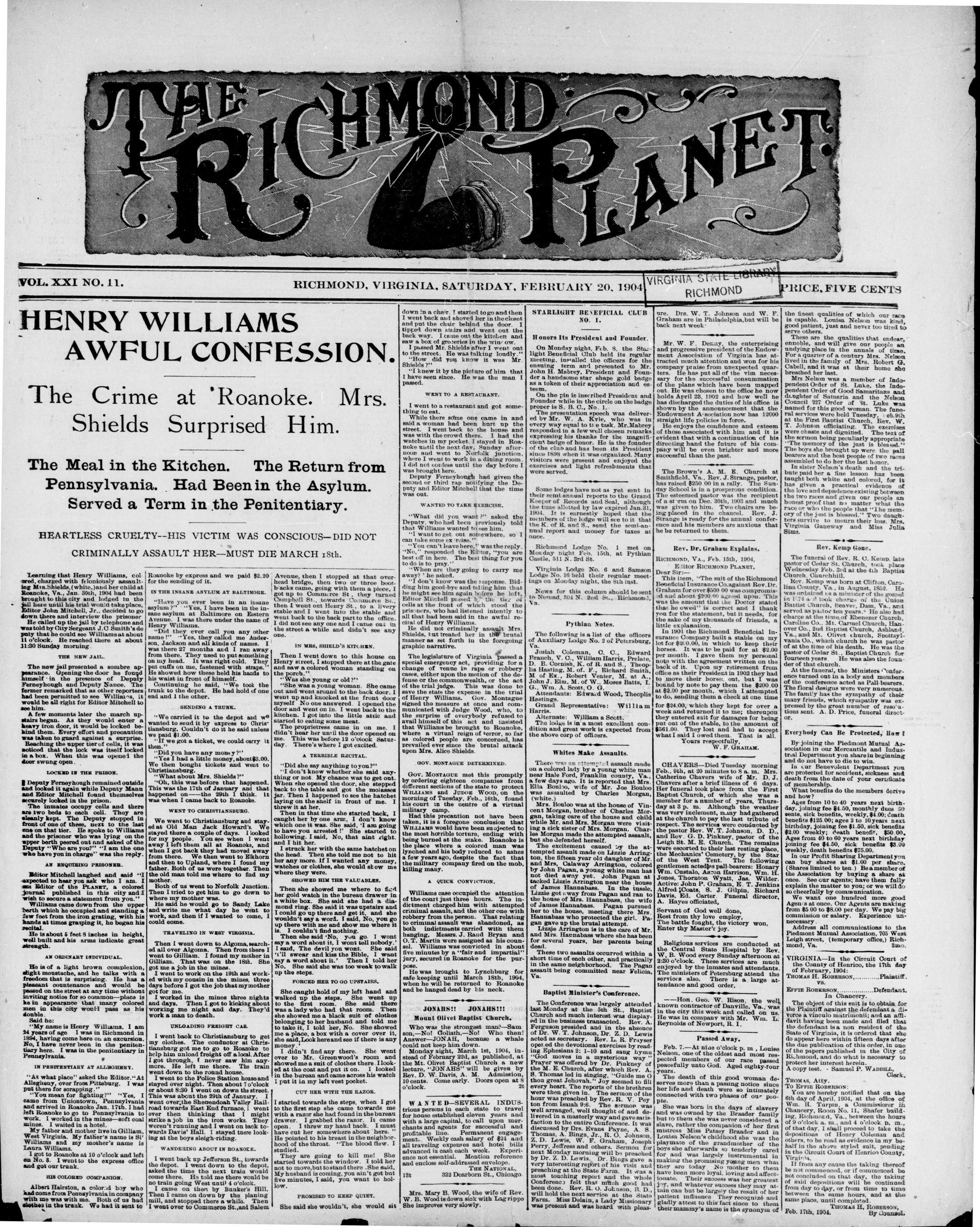
HENRY WILLIAMS AWFUL CONFESSION.
The Crime at Roanoke. Mrs. Shields Surprised Him.
The Meal in the Kitchen. The Return from Pennsylvania. Had Been in the Asylum. Served a Term in the Penitentiary.
HEARTLESS CRUELTY--HIS VICTIM WAS CONSCIOUS-DID NOT CRIMINALLY ASSAULT HER-MUST DIE MARCH 18th.
VOL. XXI NO.11.
HENRY W
AWFU
The Crime
Shields
The Meal in the
Pennsylvanian
Served a
HEARTLESS CRUELY
CRIMINALLY
Learning that Henry Williams, colored, charged with feloniously assaulting Mrs.Shields, (white), and her child at Roanoke, Va., Jan. 30th, 1904 had been brought to this city and lodged in the jail here until his trial would take place, Editor John Mitchell, Jr., decided to go down there and interview the prisoner who was迫于 the jail the prisoner and was told he could be the jailer, J.C. Sohn, patty that he could see Williams at about 11 o'clock. He reached there at about 11:30 Sunday morning.
THE NEW JAIL
The new jail presented a sombre appearance. Opening the door he found himself in the presence of Deputy Ferneyhough and Deputy Nance. The former remarked that as other reporters had been permitted to see Williams, it would be all right for Editor Mitchell to see him.
A few moments later the march upstairs began. As they would enter a heavy iron door, it would be locked behind them. Every effort and precaution was taken to prevent it. Reaching the upper tier of cells, it was noticed that the lock was itself locked in a box. When this was opened the door swung open.
LOCKED IN THE PRISON.
Deputy Ferneyhough remained outside and looked it again while Deputy Mann and Editor Mitchell found themselves securely locked in the prison. The inmates occupy cells and there are two beds to each cell. They are cleanly kept. The Deputy stopped in front of one of these, next to the last one on that tier. He spoke to Williams and asked him to come up. The upper borne pearsed out and asked of the Deputy "Who are you?" "I am the one who have you in charge" was the reply.
AN ENQUIRING PRISONER.
Editor Mitchell langed and said "I expected to hear you ask who I am. I am Editor of the PLANET, a colored journal published in this city and I wish to secure a statement from you." Williams came down from the upper berth which he occupied and standing a few feet from the iron grating, with his hands at times grasping it, he began his sails. He is about 5 feet 8 inches in height, well built and his arms indicate great strength.
AN ORDINARY INDIVIDUAL
He is of a light brown complexion, slight moustache, and he talks with a freedom that is surprising. He has a pleasant countenance and would be passed on the street at any time without inviting notice for so common—place is he in appearance that many colored men in this city would pass as his double.
Said he:
"My name is Henry Williams, I am 24 years of age. I was in Richmond in 1894, having come here on an excursion. No, I have never been in the penitentiary here. I was in the penitentiary in Pennsylvania.
IN PENITENTIARY AT ALLRGHENY
"At what place" asked the Editor. "At Allegheny, over from Pitt堡. I was put there for scrapping." "You mean for fighting?" "Yes, I came from Uniontown, Pennsylvania and arrived in Roanoke Jan. 17th. I had left Roanoke to go to Pennsylvania to work. I worked in the mines—soft coal mines. I waited in a hotel. My father and mother live in Gilliam, West Virginia. My father's name is Si' Williams and my mother's name is Laura Williams. I got to Roanoke at 10 o'clock and left on No. 3. I went to the express office and got our trunk.
HIS COLORED COMPANION.
Albert Hairston, a color:red boy who had come from Pennsylvania in company with me was with me. Both of us had clothes in the trunk. We had it sent to
Roanoke by express and we paid $2.20
for the sending of it.
IN THE INSANE ASYLUM AT BALTIMORE.
"Have you ever been in an insane asylum?" "Yes. I have been in the insane asylum at Baltimore on Eastern Avenue. I was there under the name of Henry Williams. "Did they ever call you any other name!" "Yes, they called me Anderson, Jackson and all kinds of names. I was there 27 months and I ran away from there. They used to put something on my head. It was right cold. They showed me no fastened with straps." He showed them hold his hands to his waist in front of himself. Continuing he said, "We took the trunk to the depot. He had hold of one end and I the other.
SENDING A TRUNK.
"We carried it to the depot and we wanted to send it by express to Christi tansburg. Couldn't do it he said unless we paid $1.00.
"If we got a ticket, we could carry it then."
"Did you have any money?"
"Yes I had a little money, about $3.00.
We then bought tickets and went to
Christiansburg.
"What about Mrs. Shields?"
that about Mrs. Snelson's.
"Oh this was before that happened,
This was on — the 29th and that
happened on — the 29th I think. It
was when I came back to Rounoka.
WENT TO CHRISTIANSBURG
We went to Christiansburg and stayed at Old Man Jack Howard's. We stayed there a couple of days. I looked for my people. You see when I went away I left them all at Roanoke, and when I got back they had moved away from there. We then went to Elkhorn and then to Upland, where I found my father. Both of us were together. Then the old man told me where to find my mother. Both of us went to Norfolk Junction. Then I tried to get him to go down to where my mother was.
He said he would go to Sandy Lake and write me what day he went to work, and then if I wanted to come, I could come.
TRAVELING IN WEST VIRGINIA
Then I went down to Algoma, searched all over Algoma. Then from there I went to Gilliam. I found my mother in Gilliam. That was on the 18th. She got me a job in the mines.
I went to work on the 19th and worked with my cousin in the mines, three days before I got the job that my mother got. I worked in the mines three nights and days. Then I got to kicking about working me night and day. They'd work a man to death.
UNLOADING FREIGHT CAR
I went back to Christiansburg to get my clothes. The conductor at Christiansburg got me to go to Roanoke to help him unload freight off a local. After I got through, I never saw him any more. He left me there. The train went down to the round house. I went to the Police Station house and stayed over night. Then about 7 o'clock or about 8:30 I went on down the street. This was about the 29th of January. I went over the Shemendoah Valley Railroad towards East End furnace, I went over then thinking that I might strike a job in the iron works. They weren't running and I went on back towards Davis' Hall. I stayed there looking at the boys sleigh-riding.
WANDERING ABOUT IN BOANOKE.
I went back up Jefferson St., towards the depot. I went down to the depot, asked the time the next train would come there. He told me there would be no train going West until 4 o'clock. I came on by the Bunker's Hill. That came on by a plowing mill, and stopped there a while. Then I went over to Commerce St. and Salem
RICHMOND, VIRGINIA, SATURDAY, FEBRUARY 20, 1904
Avenue, then I stopped at that overhead bridge, then two or three boot-backs came, going with them a piece, I got up to Commerce St, they turned Campbell St., towards Commerce St., then I went out Henry St., to a livery stable and I went into the stable and the office. I did not see any one and I came out in the street a while and didn't see any one.
IN MRS. SHIELD'S KITCHEN
Then I went down to this house on Henry street, I stopped there at the gate and saw a colored woman standing on the porch. "Was she young or old?"
"She was a young woman. She came out and went around to the back door. I went up and knocked at the front door myself. No one answered. I opened the door and went on in. I went back to the kitchen. I got into the little attic and sat inside, eating some meat. The prophecy came in on me. I didn't hear her until the door opened on me. This was before 12 o'clock Saturday. There's where I got excited.
A TERRIBLE RZCITAL
"Did she say anything to you?"
"I don't know whether she said anything or not. My chance was to get out. When she opened the door, she stepped back to the table and got the molasses jar. Then I happened to see the hatchet laying on the shelf in front of me. I threw it at her.
Then in that time she started back, I caught her by one arm, I don't know which one it was. She said, 'I am going to have you arrested!' She started to hollowing. I said, No, that aint right. And I struck her with the same hatchet on the head. Then she told me not to hit her any more. If I wanted any money, watches or clothes, she would show me where they were.
SHOWED HIM THE VALUABLES.
Then she showed me where to find her gold watch in the bureau drawer in a white box. She said she had a diamond ring. She said it was upstairs and I could go up there and get it, and she wouldn't say a word. I said, No, you go up there with me and show me where it is. I couldn't find nothing.
Then she said 'No, you go I won't say she said 'No, you won't tell nobody.' I said, The devil won't. She said 'I'll swear and kiss the Bible, I want say a word about it.' Then I told her No. She said she was too weak to walk up the steps.
FORCED HER TO GO UPSTAIRS.
She caught hold of my left hand and walked up the steps. She went up to the first room. She said there was a lady who had that room. Then she showed me a black suit of clothes belonging to her husband and told me to take it, I told her, No. She showed me a place, a box with a cover over it, she said, Look here and see if there is any money. I didn't find any there. She went over to Mr. Greenwood's room and showed me a suit of clothes there. I looked at the coat and put it on. I looked in the bureau and came across his watch I put it in my left vest pocket.
CUT HER WITH THE RAZOR.
I started towards the steps, when I got to the first step she came towards me with a razor she had found in the bureau drawer. I grabbed the razor. It came open. I threw my hand back. I must have cut her somewhere about here." He pointed to his breast in the neighborhood of the throat. "The blood flew. I studied.
They are going to kill me! She started towards the window. I told her not to move, but to stand there. She said, My husband is coming, you ain't got but five minutes, I said, you want to hollow.
PROMISED TO KEEP OUT.
down in a chair. I started to go and then I went back and shoved her in the closet and put the chair behind the door. I tipped down stairs and went out the back way. I came out the kitchen and saw a box of groceries in the window. I passed Mr. Shields after I went out to the street. He was talking loudly." I did you know it was Mr. Shields?" "I knew it by the picture of him that I have seen since. He was the man I passed.
WENT TO A RESTAURANT.
I went to a restaurant and got something to eat. While there some one came in and said a woman had been hurt up the street. I went back to the house and was with the crowd there. I had the watches in my pocket. I stayed in Roanoke until the next day, Sunday afternoon and went to Norfolk junction, where I went to work in a dining room. I did not confess until the day before I was brought here. Deputy Ferneyhough had given the second or third rap notifying the Deputy and Editor Mitchell that the time was out.
WANTED TO TAKE EXERCISE.
"What did you want?" asked the Deputy, who had been previously told that Williams wanted to see him. "Where is somewhere, so I can take some ex poses."
"You can't leave here," was the reply. "No," responded the Editor, "you are best off in here. The best thing for you to do is to pray." "When are they going to carry me away?" he asked. "I don't know was the response. Bidding him good-bye and telling him that he might see him again before he left, Editor Mitchell passed by the tier of cells at the front of which stood the prisoners, who had listened intently to all that had been said in the awful recital of Henry Williams. He did not criminally assault Mrs. Shields, but treated her in the brutal manner as set forth in the foregoing graphic narrative.
The legislature of Virginia passed a special emergency act, providing for a change of venue in rape or robbery cases, either upon the motion of the defense or the commonwealth, or the act of the trial judge. This was done to save the state the expense in the trial of Henry Williams. Gov. Montague signed the measure at once and communicated with Judge Wood, who, to the surprise of everybody refused to avail himself of this act and insisted that he be brought to Roanoke, where a virtual rebuke was given, as colored people are concerned, has prevailed ever since the brutal attack upon Mrs. Alice Shields.
GOV. MONTAGUE DETERMINED
GOV. MONTAGUE met this promptly by ordering eighteen companies from different sections of the state to protect WILLIAMS and JUDGE WOOD, on the morning of Tuesday, Feb. 16th, found his court in the centre of a virtual military camp.
Had this precaution not have been taken, it is a foregone conclusion that WILLIAMS would have been subjected to the most horrible torture, ending with using burned at the stake. Roanoke with his family, colored men, women lynched and his body reduced to ashes a few years ago, despite the fact that the military company fired on the mob, killing many.
A QUICK CONVICTION.
Williams case occupied the attention of the court just three hours. The indictment charged him with attempted criminal assault, and the other one with robbery from the person. That relating to criminal assault was abandoned, as both indictments carried with them hanging, Messrs. J. Rand Bryan and T. Martin were assigned as his counsel. Williams was acquitted five minutes by a "fair and impartial" jury, secured in Roanoke for the purpose.
He was brought to Lynchburg for safe keeping until March 18th, 1904, when he will be returned to Roanoke and be hanged dead by his neck.
Who was the strongest man?-Samson,-No! Goliath,-No! Who then? Answer—JONAH, because a whale could not keep him down.
Monday night, March 1st, 1904, instead of February 22d, as published, at the Mt. Olivet Baptist Church a new lecture, "JONAHS" will be given by Rev. D. W. Davis, A. M. Admission, 10 cents. Come early. Doors open at 8 o'clock.
WANTED—SEVERAL INDUSTRIous persons in each state to travel for house established eleven years and with a large capital, to call upon merchants and agents for successful and profitable line. Permanent engagement. Weekly cash salary of $24 and all traveling expenses and hotel bills advanced in cash each experience not essential. Mention reference and enclose self-addressed envelope.
THE NATIONAL,
13t
332 Dearborn St., Chicago
Mrs. Mary B. Wood, the wife of Rev. W. B. Wood is down sick with Lag ripppe She improves very slowly.
STARLIGHT BENEFICIAL CLUB NO.1.
Honors Its President and Founder.
On Monday night, Feb. 8, the Starlight Beneficial Club held its regular meeting, installed the officers for the ensuing term and presented to Mr. John H. Mabrey, President and Founder a handsome star shape gold badge as a token of their appreciation and esteem.
On the pin is inscribed President and Founder while in the circle on the badge proper is S. B. C., No. 1.
The presentation speech was delivered by Mr. W. A. Kyle, who was in every way equal to the task. Mr.Mabrey responded in a few well chosen remarks expressing his thanks for the magnificent badge of honor. He is the founder of the club and has been its President since 1898 when it was organized. Many visitors were present and enjoyed the exercises and light refreshments that were served.
Some lodges have not as yet sent in their semi-annual reports to the Grand Keeper of Records and Seal, although the time allotted by law expired Jan. 31, 1904. It is earnestly hoped that the members of the lodge will see to it that the K. of R. and S., send the semi-annual report and money for taxes at once.
Richmond Lodge No. 1 met on Monday night Feb. 15th, at Pythian Castle, 511 N. 3rd St.
Virginia Lodge No. 6 and Samson Lodge No. 16 held their regular meetings on Monday night, the 8th inst.
News for this column should be sent to Neoad, 504 N. 2nd So., Richmond, Va.
Pythian Notes
The following is a list of the officers of Auxiliary Lodge No. 2 of Petersburg, Va.
Josiah Coleman, C. C., Edward Branch, V. C., William Harris, Prelate, D. B. Cornish, K. of R. and S., Theoplis Hasting, M. of F., Richard Smith, M of Ex., Robert Venier, M. at A., John J. Elm, M. of W., Moses Batts, I. G., Wm. A. Scott, O. G.
Attendants: Edward Wood, Theoplis Hastings.
Grand Representative: William Harris.
Alternate: William a Scott.
The lodge is in a most excellent condition and great work is expected from the above corp of officers.
Whites Make Assaults
There was an attempted assault made on a colored lady by a young white man near Hale Ford, Franklin county, Va., a few days ago. It is reported that Mrs. Ella Bouloo, wife of Mr. Joe Bouloo was assaulted by Charles Morgan, (white.) Mrs. Bouloo was at the house of Vincent Morgan, brother of Charles Morgan, taking care of the house and child while Mr. and Mrs. Morgan were visiting a sick sister of Mrs. Morgan. Charles Morgan made the attempted assault, but she defended herself.
The excitement caused by the attempted assault made on Lizzie Arrington, the fifteen year old daughter of Mr. and Mrs. Calaway Arrington, colored by John Pagan, a young white man has not died away yet. John Pagan attacked Lizzie Arrington near the house of James Hannabass. In the tussle, Lizzie got away from Pagan and ran to the house of Mrs. Hannabass, the wife of James Hannabass. Pagan pursued her to the house, meeting there Mrs. Hannabass who protected the girl. Pagan gave up the brutal attempt.
Lizzie Arrington is in the care of Mr. and Mrs. Haunabass where she has been dead. These two assaults occurred within a short time of each other, and practically in the same neighborhood. The Pagan assault being committed near Felicia, Va.
Baptist Minister's Conference
The Conference was largely attended last Monday at the 5th St. Baptist Church and much interest was displayed in the business transacted. Rev. A. Ferguson presided and in the absence of Dr. W. T. Johnson, Dr. Z. D. Lewis acted as secretary. Rev. L. R. Frayer opered the devotional exercises by reading Ephesians 2: 1-10 and sang hymn "God moves in a mysterious way" Prayer was offered by Dr. Pinkney of the M. E. Church, after which Rev. A. S. Thomas led in singing, "Guide me O thon great Jehovah." Joy seemed to fill every heart. The reports of the brethren were then given in. The sermon of the hour was preached by Rev. R. V. Peyton from Isaiah 9:6. The sermon was well arranged, well thought of and delivered in a masterly way and gave satisfaction to the entire Conference. It was discussed by Drs. Evans Payne, A. S. Thomas, Singa, Jr. R. O. Johnson, Z. D. Lewis, F. Graham, Joseph Perry, Jeffress and others. Sermon for next Monday morning was preached by Dr. Z. D. Lewis, Dr. R. Gava gave a very interesting report of his visit and preaching at the State Farm. It was most touching report and the whole Conference] felt that much good had been done. Rev. R. O. Johnson, R. D. will hold the next service at the State Farm. Miss Delain, a Lady Missionary was present and was heard with pleas.
ure. Drs. W. T. Johnson and W. F. Graham are in Philadelphia, but will be back next week.
Mr. W. F. Denay, the enterprising and progressive president of the Endowment Association of Virginia has attracted much attention and won for his company praise from unexpected quarters. He has put all of the vim necessary for the successful consummation of the plans which have been mapped out. He was chosen to the office he now holds April 23, 1902 and how well he has discharged the duties of his office is shown by the announcement that the Endowment A-sociation now has 12000 straight life policies in force. He has a strong confidence and esteem of those associates with him, and it is evident that with a continuation of his directing hand the future of his company will be even brighter and more successful than the past.
---
The Brown's A. M. E. Church at Smithfield, Va., Rev J. Strange, pastor, has raised $350 in a rally. The Sunday School is in a prosperous condition. The esteemed pastor was the recipient of a storm on Dec. 30th, 1903 and much was given to him. Two chairs are being furnished. Rev Strange's Strange is ready for the annual conference and his members are anxious that he be returned to him.
Rey, Dr. Graham Explains.
RICHMOND, VA., Feb. 15th, 1904,
Editor RICHMOND PLANET,
Dear Sir:—
This item, "The suit of the Richmond
Beneficial Insurance Co. against Rev Dr. Dr.
Graham for over $500.00 was compromised
and about $900.00 agreed upon. This
was the amount that the Doctor stated
that he owed" is correct and I thank
you for the statement, but it needs, for
the sake of my thousands of friends, a
little explanation.
In 1901 the Richmond Beneficial
Insurance Company built a stable on my
lot for $200.00, in which to keep their
horses. It was to be paid for at $2.00
per month. I gave them my personal
note with the agreement written on the
back of it. Upon my retirement from
office as their President in 1902 they had
to move their horses out, but I was
bound by note to pay them the $200.00
at $2.00 per month, which I attempted
to do, sending them a check at one time
for $24.00, which they kept for over a week and returned it to me; then upon they entered sait for damages for being put out of the stable, to the amount of $561.00. They lost and had to accept what I said I owed them. That is all.
CHAVERS —Died Tuesday morning Feb., 9th, at 20 minutes to 8 a.m. Mrs. Catherine Chavers wife of Mr. D. J. Chavers after a brief illness of 6 days. Her funeral took place from the First Baptist Church, of which she was a member for a number of years, Thursday at 3 p. m. Although the weather was very inclement, many had gathered at the church to pay the last tribute of respect. The services were conducted by the pastor Rev. W. T. Johnson, D. D., and Rev. G. D. Pinkey, pastor of the Leigh St. M. E. Church. The remains were escorted to their last resting place, the Mechanics' Cemetery, by the Star of the West Tent. The following gentlemen acted as pall-bearers: Honary Wm. Custalo, Aaron Harrison, Wm. H. Jones, Thornton Wyatt, Jas. Wilder: Active: John P. Graham, E. T. Jenkins Alfred Coats, S. J. Gulpin, Richard Davis, Ed. Carter. Funeral director, A. Hayes officiated.
Servant of God well done,
Rest from thy love employ.
The battle fought, the victory won,
Enter thy Master's joy.
Religious services are conducted at the Central State Hospital by Rev. W, B. Wood every Sunday afternoon at 2:30 o'clock. These services are much enjoyed by the inmates and attendants. The ministers of Petersburg attend the services also. There is a large attendance and good order.
—Hon. Geo. W. Rison, the well known contractor of Danville, Va., was in the city this week and called on us. He was in company with Mr. Wm. L. Reynolds of Newport, R. I.
Passed Away.
Feb. 7.—At nite o'clock p. m., Louise Nelson, one of the oldest and most respected members of our race passed peacefully unto God. Aged eighty-four years.
The death of this good woman deserves more than a passing notice since her life and death were so intimately connected with two phases of our people.
She was born in the days of slavery and was owned by the Braader family but to them she was never considered a slave, rather the companion of her first mistress Miss Patsy Braander and in Louisa Nelson's childhood she was the playmate of the grandmother of the boys she afterwards so tenderly cared for and was largely instrumental in making the promising young men what they are today. No mother to them have been more loyal, loving and affective. Their success was her greatest joy, and whatever success they may attain can but be largely the result of her patient influence. They recognize and gladly attest to this fact since to them their妈妈's name is the synonym of
the finest qualities of which our race is capable. Louisa Nelson was kind, good patient, just and never too tired to serve others.
These are the qualities that endear, ennoble, and will give our people an undying place in the annals of time. For a quarter of a century Mrs. Nelson lived in the family of Mrs. Robert G. Cabel, and it was at their home she breathed her last.
Mrs Nelson was a member of Independent Order of St. Luke, the Independent Order of Good Samaritans and daughter of Samaria and the Nelson Council 227 Order of St. Luke was named for this good woman. The funeral services were held Tuesday, eb 9h at the First Baptist Church, Rev. W. T. Johnson officiating. The exercises were chaste and dignified. The text of the sermon being peculiarly appropriate "The memory of the just is blessed." The boys she brought up were the pall bearers and the best people of two races assembled to do her the last honor.
In sister Nelson's death and the tribute paid her a fine lesson has been taught both white and colored, for it has given a practical evidence of the love and dependence existing between the two races and given our people an honest proof that no matter what the race or who the people that "The memory of the just is blessed." Two daughters survive to mourn their loss. Mrs. Virginia Ganeway and Miss Julia Sims.
Rev. Kemp Gone.
The funeral of Rev. R. C. Kemp, late pastor of Cedar St. Church, took places Wednesday Feb. 3rd at the 4th Baptist Church, Churchchill.
Rev. Kemp was born at Clifton, Carolina County, Va., in August, 1892. He was ordained as a minister of the gossein in 1744 and took charge of the Union Baptist Church, Beaver, Dam, Va., and served as pastor ten years.* He also had charge at the time of Ebenezer Church, Caroline Co., Mt. Carmel Church, Hanover Co., 2nd Baptist Church, Ashland, Va., and 2nd Olivet church, Spotsylvania Co., which church he was pastor of at the time of his death. He was the pastor of Cedar St., Baptist Church for fourteen years. He was also the founder of that church.
At the funeral, the Ministers Conference turned out in a body and members of the conference acted as Pall-bearers. The floral desigus were very numerous. The family has the sympathy of their many friends, which sympathy was expressed by the great number of rosa'讼s sent. A. D. Price, funeral director.
Everybody Can Be Protected, How?
By joining the Piedmont Mutual Association in our Mercantile and Industrial Department you share in beginning and do not have to die to win.
In our Benevolent Department you are protected for accident, sickness and death from the date of your certificate of membership.
What benefits do the members derive and how?
Ages from 10 to 40 years next birthday, joining fee $4.50, monthly dues 50 cents, sick benefits, weekly, $4.00; death benefits $125.00; ages 2 to 10 years next birthday, joining fee $1.50, sick benefits $3.00 weekly; death benefit, $50.00, Ages from 40 to 60 years next birthday, joining fee $4.50, sick benefits $3.00 weekly, death benefits $75.00.
In our Profit Sharing Department you can buy shares at $1.00 per share. (Shares limited to ten.) Be a member of the Association by buying a share once. See our agents; have them fully explain the matter to you; or we will do so cheerfully by communication.
We want one hundred more good Agen's at once. Our Agents are making from $5.00 to $8.00 per day. We pay big commission or salary. Experience unnecessary.
Address all communications to the Piedmont Mutual Association, 705 West Leigh street, (temporary office.) Richmond, Va.
VIRGINIA—In the Circuit Court of the County of Henrico, the 17th day of February, 1904:
THOMAS H. ROBERSON.....Plaintiff.
VS.
EFFIE ROBERSON.....Defendant.
In Chancery.
The object of this suit is to obtain for the Plaintiff against the defendant a divorce a vinculo matrimonii; and an affidavit having been made and filed that the defendant is a non resident of the State of Virginia, it is ordered that she appear here within fifteen days after the due publication of this order, in one of the papers published in the City of Richmond, and do what is necessary to protect her interest herein.
A copy test. - Samuel P. WADDILL,
Clock.
THOMAS, Atty.
TO EFFIE ROBERSON:
You are hereby notified that on the
6th day of April, 1904, at the office of
Wm. H. Tarpun, a Commissioner in
Chancery, Room No. 11, Shafer building,
Richmond, Va., between the hours of
9 o'clock a. m., and 4 o'clock d. m.,
that day. I shall proceed to take the
deposition of Henrico Coleman and
others, to be read as evidence in any
behalf in the above styled suit, panding
in the Circuit Court of Henrico County,
Virginia.
If from any cause the taking thereof
be not commenced, or if commenced be
not concluded on that day, the taking
of said depositions will be continued
from day to day, or from time to time
between the same hours, and at the
same place, until completed.
THOMAS H. ROBERSON,
Feb. 17th, 1904.
By Cansal.
THE PLANET
SATURDAY...FEBRUARY 20.1904
TEMPERANCE
SALOON FIENDS.
Drunkenness Responsible for Most of the Crimes of Lynching Occurring Throughout Country.
And now it is discovered that drunkenness is responsible for most of the crimes of lynching. Whisky fires ignite the fires at the stake. Leslie's Weekly expressed the belief that "investigation would establish the fact that no lynching affair was ever led by sober men, or in a community where no saloons were allowed to exist." In every case
WHISKY FIRES IGNITE THE FIRES AT THE STAKE
where a lynching has occurred the authorities have at once found it necessary to order the saloons closed until peace and order were restored. Where saloons abound there can be no permanent peace and order, and when men of evil passions are full of whisky they are ready for any offense against order. No doubt most of the southern negroes who commit heinous crimes are drunken negroes, just as the white men of the north who commit such crimes are generally drunken. Drunkenness makes brutes and fiends out of bad-tempered men, no matter what their color. Keep whisky out of bad men and you will keep most bad men out of hideous crimes. Sober men in lust and greed and frenzy may sometimes break the laws, shed blood and do nameless wrong, but these are the exceptions. Write it down that as a rule the colored lend is a drunkard, and the fiends that lynch the fiends are drunkards also.—Michigan Christian Advocate
Striking Change of Sentiment
Among the papers of a prominent citizen recently deceased there was found an itemized bill for a supper served on a notable occasion in a Massachusetts village in the year 1795. The provision of food was lavish, and the turkey and roast pig were washed down with 20 bottles of wine, a quart of brandy, four bowls of "sling." 18 large glasses of punch and 24 glasses of bitters. Twenty-three clergymen drank the liquor, and the supper followed a minister's ordination. It is well to recall such things in days of discouragement, and to measure social progress by the fact that drinking men no longer find countenance in the example of moral leaders.—Youth's Companion.
The Making of a Safe Railroad.
With a highly moral force of employees, not a man of whom drinks intoxicants, smokes cigarettes or is addicted to other vices that impair his reliability, the Rock Island road hopes to reduce the percentage of disasters due to human fallibility and to secure a higher standard of efficiency. An order which makes the use of cigarettes or liquor equivalent to discharge from
the service has just gone into effect. The Rock Island's order is very sweeping and applies without distinction to all men in the service of that system. The national prohibition convention will be held in Kansas City, Mo., June 29, 1904.
INJURIOUS TO HEALTH.
The Effects of Alcoholism in France Should Be Solemn Warning to People of This Country.
So serious have become the evils resulting from the use of alcohol by the people of France that the physicians and surgeons of the hospitals have issued a public warning, which is placarded over the country in the hope that it may help to reduce the evils of alcoholism. The placard is distributed by the public powers and posted conspicuously in the public hospitals. It reads as follows:
"The majority of malades treated in the hospitals are caused, or aggravated, by the abuse, and even by the simple use, of liquids containing alcohol; all of these liquids, however denominated, are dangerous. We direct especial attention to the so-called aperitifs, such as absinthe and bitters.
- "The brandies and liquors are also very destructive and, likewise, wine in large quantities. More than one litre per day of wine represents a dangerous quantity. Taken before eating, the liquids depress the appetite, whatever advertisers may say to the contrary; they burn the stomach, the liver and the arteries. After eating, alcohol, in whatever form served, troubles the digestion and at the end of some time it is impossible to do without drinking and from this moment the victim is alcoholic.
"It is possible to become alcoholic in drinking regularly the liquids indicated above, and that also without entering into a state of intoxication.
"The working classes labor under the greatest error in believing that alcohol gives strength. Those who are addicted to its use realize merely an artificial excitement which last but a short time and leaves them soon more fatigued than before. They then desire to cure this fatigue in again consuming alcohol, and they thus become alcoholic.
"Alcoholics become insane easily and are liable to very painful forms of paralysis. We often treat workingmen who have been very robust and who have become rapidly consumptive because they have regularly taken before each meal their ailments.
"The children of alcoholic parents are almost always badly formed, weak-minded, insane, scrofulous or epileptic. They die often in convulsions.
"Criminals are in large part alcoholics or the children of alcoholics."
France was at one time considered the most sober nation of Europe. It is now the most drunken. This is due to the efforts made to popularize the use of wines, especially the so-called light wines. The habit of wine-drinking has become so strong that the people feel unable to do without some alcoholic drink and, whenever for any reason the price of wine is advanced, the people resort to the so-called aperitifs. The cheapness of these destructive drinks has increased their use and the habit once formed is rarely broken.
Efforts are being made by American brewers, distillers and dealers in alcoholic drinks to increase their sale and consumption in this country. There has been during the past two years a special effort made by dealers in whisky to increase the sale of certain brands by advertising and their advertisements appear in only the better class of daily and weekly papers. These drinks are, therefore, virtually, thrust before the eyes of young people as well as of the more mature in all homes. Dealers are also advertising their goods by circulars as never before in this country.
This greater activity is in part a tribute to the growth of the temperance sentiment and of consequent total abstinence and indicates that manufacturers of and dealers in alcoholic liquors realize that they must make greater efforts to increase the sale of their commodities if they are not finally to be driven out of their infamous business. The experience of France, however, should teach the American people the necessity of greater effort to reduce the consumption of alcoholic liquors, and, if possible, bring about its total disappearance. We are now, as a people, the most temperate, but we may, like France, become the most drunken, and the only way to prevent such a moral disaster to the nation is for the people to abstain totally from the use of alcoholic liquors of any kind. The warning of the physicians and surgeons of the hospitals of France should be posted in all American public schools, in libraries, factories and other public places, and be printed in all papers.—N. W. Christfan Advocate.
POINTED AND SUGGESTIVE.
The Danish government, in filling positions on state railways, will henceforth prefer men who can prove by documentary evidence that they have been total abstainers for at least one year past.
Dr. Willard Parker, who for many years stood at the head of the medical profession in New York city, says: "One-third of all deaths in New York City are caused by alcoholic drinks."
It is worse than irony to be praying "Thy kingdom come," while in the nation we are turning out annually 37,500,000 barrels of liquors, supporting 200,000 prostitutes and 300,000 saloons.
—National Advocate
In Russia the minister of finance has issued an order that hats must be doffed to bartenders in whisky shops, as they are government officials. This is an honor that the American bartender does not receive.
By request of the world's fair management St. Louis has fixed October 7, 1904, for anti-cigarette day. An effort will be made to have smoking on the grounds that day made punishable by arrest.
The need of mining towns for religious and temperance work is very great. Within 200 miles of Chicago is a mining town of 1,000 people without a church or any kind of religious service. Another town nearby has 1,200 people, 37 saloons, but not a church.
Read our next story, "The Gentleman From Indiana." It commences next week.
THE RICHMOND PLANET, RICHMOND, VIRGINIA
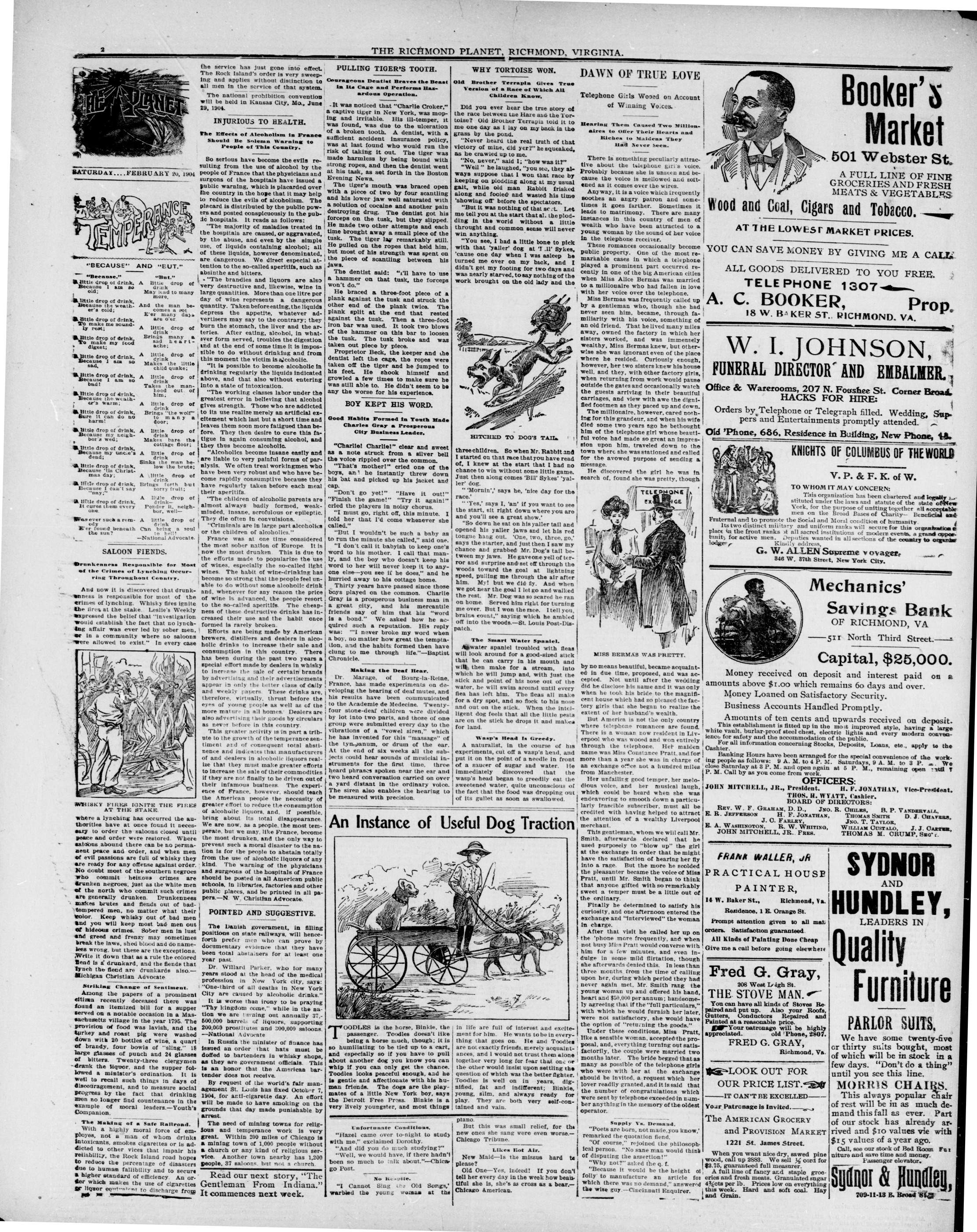
An Instance of Useful Dog Traction
A boy and his dog in a cart.
PULLING TIGER'S TOOTH.
Courageous Dentist Braves the Bea
in Its Performance Hass-
ardous Operators
It was noticed that "Charlie Croker," a captive tiger in New York, was moping and irritable. His ill-temper, it was found, was due to the ulceration of a broken tooth. A dentist, with a sufficient accident insurance policy, was at last found who would run the risk of taking it out. The tiger was made harmless by being bound with strong ropes, and then the dentist went at his task, as set forth in the Boston Evening News.
The tiger's mouth was braced open with a piece of two by four scantling and his lower jaw well saturated with a solution of cocaine and another pain destroying drug. The dentist got his forceps on the tusk, but they slipped. He made two other attempts and each time brought away a small piece of the tusk. The tiger lay remarkably still. He pulled on the ropes that held him, but most of his strength was spent on the piece of scantling between his jaws.
The dentist said: "I'll have to use a hammer on that tusk, the forceps won't do."
He braced a three-foot piece of a plank against the tusk and struck the other end of the plank twice. The plank split at the end that rested against the tusk. Then a three-foot iron bar was used. It took two blows of the hammer on this bar to loosen the tusk. The tusk broke and was taken out piece by piece.
Proprietor Beck, the keeper and the dentist left the cage, the ropes were taken off the tiger and he jumped to his feet. He shook himself and growled a few times to make sure he was still able to. He didn't seem to be any the worse for his experience.
BOY KEPT HIS WORD.
Good Habits Formed in Youth Made Charles Gray a Prosperous City Business Leader.
"Charlie! Charlie!" clear and sweet as a note struck from a silver bell the voice rippled over the common.
"That's mother!" cried one of the boys, and he instantly threw down his bat and picked up his jacket and cap.
"Don't go yet!" "Have it out!"
"Finish the game!" "Try it again!"
cried the players in noisy chorus.
"I must go, right off, this minute. I told her that I'd come whenever she called."
"But I wouldn't be such a baby as to run the minute she called," said one.
"I don't call it babyish to keep one's word to his mother. I call that manly, and the boy who doesn't keep his word to her will never keep it to anyone else—you see if he does," and he hurried away to his cottage home.
Thirty years have passed since those boys played on the common. Charlie Gray is a prosperous business man in a great city, and his mercantile friends say of him that his "word is a bond." We asked how he acquired such a reputation. His reply was: "I never broke my word when a boy, no matter how great the temptation, and the habits formed then have clung to me through life."—Baptist Chronicle.
Making the Deaf Hear
Dr. Marage, of Bourg-la-Reine, France, has made experiments on developing the hearing of deaf mutes, and his results have been communicated to the Academie de Medecine. Twenty-four stone-deaf children were divided by lot into two parts, and those of one group were submitted every day to the vibrations of a "vowel siren," which he has invented for this "massage" of the tyn,panum, or drum of the ear. At the end of six weeks all the subjects could hear sounds of musical instruments for the first time, three heard phrases spoken near the ear and two heard conversation carried on over a yard distant in the ordinary voice. The siren also enables the hearing to be measured with precision.
An Instance of U
TOODLES is the horse, Binkie, the passenger. Toodles doesn't like
being a horse much, though; it is so humiliating to be tied up to a cart, and especially so if you have to pull about another dog you know you can whip if you can only get the chance. Toodles looks peaceful enough, and he is gentle and affectionate with his human friends. The dogs are the playmates of a little New York boy, says the Detroit Free Press. Binkie is a very lively youngster, and most things
Unfortunately Conditions.
"Hazel came over to-night to study with me," exclaimed Dorothy.
"And did you do much studying?"
"Well, we would have, if there hadn't been so much to talk about."—Chicago go Post.
No Respite.
"I Cannot Sing the Old Songs,' warbled the young woman at the
WHY TORTOISE WON.
Old Brother Terrapln Gives True Version of a Race of Which All Children Know.
Did you ever hear the true story of the race between the Hare and the Tortoise? Old Brother Terrapin told it to me one day as I lay on my back in the grass by the pond.
"Never heard the real truth of that victory of mine, did yer?" he squeaked, as crawled up to me.
"No, never," said I; "how was it?"
"Weil" he laughed, "you see, they always suppose that I won that race by keeping on plodding along at my usual gait, while old man Rabbit frisked along and fooled and wasted his time 'showing off' before the spectators.
"But it was nothing of that sort. Let me tell you at the start that al, the plodding in the world without a little thought and common sense will never win anything.
"You see, I had a little bone to pick with that, 'yaller' dog at I.ll' Sykes, 'cause one day when I was asleep he turned me over on my back, and I didn't get my footing for two days and was nearly starved, to say nothing of the work brought on the old lady and the
HITCHED TO DOG'S TAU
threechildren. So when Mr. Rabbit and I started on that race that you have read of, I knew at the start that I had no chance to win without some little game. Just then along comes 'Bill Sykes' 'yaller dog. "Mornin'," says he, 'nice day for the race. "Yes,' says I, 'an' if you want to see the start, sit right down where you are and you'll see a great show.'
"So down he sat on his yaller tail and opened his yaller jaws and let his red tongue hang out. 'One, two, three, go,' says the starter, and just then I saw my chance and grabbed Mr. Dog's tail between my jaws. He gave one yell of terror and surprise and set off through the woods toward the goal at lightning speed, pulling me through the air after him. My! but we did fly. And when we got near the goal I let go and walked the rest. Mr. Dog was so scared he ran on home. Served him right for turning me over. But I won the race. It tell you, brains count," saying which he ambled off into the woods.—St. Louis Post-Dispatch.
The Smart Water Spaniel
A water spainel troubled with fleas will look around for a good-sized stick that he can carry in his mouth and will then make for a stream, into which he will jump and, with just the stick and point of his nose out of the water, he will swim around until every flea has left him. The fleas all make for a dry spot, and so flock to his nose and out on the stick. When the intelligent dog feels that all the little pests are on the stick he drops it and makes for land.
Wasp's Head Is Greedy.
A naturalist, in the course of his experiments, cut off a wasp's head, and put it on the point of a needle in front of a saucer of sugar and water. He immediately discovered that the wasp's head began to greedily eat the sweetened water, quite unconscious of the fact that the food was dropping out of its gullet as soon as swallowed.
seful Dog Traction
in life are full of interest and excitement for him. He wants to be in everything that goes on. He and Toodles are not exactly friends, merely acquaintances, and I would not trust them alone together very long for fear that one or the other would insist upon settling the question of which was the better fighter. Toodles is well on in years, dignified, fat and indifferent; Binkie, young, silm, and always ready for play. They are both very self-contained and vain.
plano.
But this was small relief, for the new ones she sang were even worse.—Chicago Tribune.
Old One—Yes, indeed! If you don't tell her every day in the week how beautiful she is, she's as cross as a bear.—Chicago American.
DAWN OF TRUE LOVE
Telephone Girls Wooded on Account of Winning Voices.
Hearing Them Caused Two Millionaires to Offer Their Hearts and Riches to Malicious They Had Never Seen.
There is something peculiarly attractive about the telephone girl's voice. Probably because she is unseen and because the voice is mellowed and softened as it comes over the wires. Anyway, it is a voice which frequently soothes an angry patron and sometimes it goes farther. Sometimes it leads to matrimony. There are many instances in this country of men of wealth who have been attracted to a young woman by the sound of her voice in the telephone receiver.
These romances occasionally become public property. One of the most remarkable cases in which a telephone played a prominent part occurred recently in one of the big American cities when Miss Alice Bermas was married to a millionaire who had fallen in love with her voice over the telephone.
Miss Bermas was frequently called up by a gentleman who, though she had never seen him, became, through familiarity with his voice, something of an old friend. That he lived many miles away, owned the factory in which her sisters worked, and was immensely wealthy, Miss Bermas knew, but otherwise she was ignorant even of the place where he resided. Curiously enough, however, her two sisters knew his house well, and they, with other factory girls, when returning from work would pause outside the gates and occasionally watch the guests arriving in their beautiful carriages, and view with awe and the dignified footman, as they neared us.
The millionaire, however, cared nothing for this grandeur, and when his wife died some two years ago he bethought him of the telephone girl whose beautiful voice had made so great an impression upon him, traveled down to the town where she was stationed and called for the avowed purpose of sending a message.
He discovered the girl he was in search of, found she was pretty, though
TELEPHONE
EXCHANGE
MISS BERMAS WAS PRETTY.
by no means beautiful, became acquainted in due time, proposed, and was accepted. Not until after the wedding did he disclose his name and it was only when he took his bride to the magnificent house which had so pleased the factory girls that she began to realize the extent of her husband's wealth.
But America is not the only country where telephone romances are found. There is a woman now resident in Liverpool who was wooed and won entirely through the telephone. Her maiden name was Miss Constance Pratt, and for more than a year she was in charge of an exchange office not a hundred miles from Manchester.
Her unfailing good temper, her melodious voice, and her musical laugh, which could be heard when she was endeavoring to smooth down a particularly frasible subscriber, must all be credited with having helped to attract the attention of a wealthy Liverpool merchant.
This gentleman, whom we will call Mr. Smith, afterwards declared that he used purposely to "blow up" the girl at the exchange in order that he might have the satisfaction of hearing her fly into a rage. But the more he scolded the pleasanter became the voice of Miss Pratt, until Mr. Smith began to think that anyone gifted with so remarkably sweet a temper must be a little out of the ordinary.
Finally he determined to satisfy his curiosity, and one afternoon entered the exchange and "interviewed" the woman in charge.
After that visit he called her up on the 'phone more frequently, and when not busy Miss Pratt would converse with him for a few minutes, and even indulge in some mild flirtation, though she afterwards denied this. In less than three months from the time of calling upon her, during which period they had never again met, Mr. Smith rang the young woman up and offered his hand, heart and $50,000 per annum; handsomely agreeing that if the "full particulars," with which he would furnish her later, were not satisfactory, she would have the option of "returning the goods."
Under these conditions, Miss Pratt,
like a sensible woman, accepted the proposal,
and, everything turning out satisfactorily,
the couple were married two months later. The bride begged that as many as possible of the telephone girls who were with her at the exchange should be invited, a request which her lover readily granted, and it is said that the number of congratulations which were sent by telephone exceeded in number anything in the memory of the oldest operator.
Supply Vs. Demand.
"Poets are born, not made, you know," remarked the quotation fiend.
"Of course," rejoined the philosophical person. "No sane man would think of disputing the assertion!"
"Why not?" asked the q. f.
"Because it would be the height of folly to manufacture an article for which there was no demand," answered the wise guy. —Cincinnati Enquirer.
Chicago Daily News
Wood and Coal, Cigar
AT THE LOWEST A
YOU CAN SAVE MONEY
ALL GOODS DELIVER
TELEPHONE
A. C. BOOKER
18 W. BAKER ST
W. I. JO
FUNERAL DIRECTOR
Office & Warerooms, 207 N
HACKS F
Orders by Telephone or Te
pers and Entertainme
Old 'Phone, 686, Residence
and Coal, Cigars and Tobacco.
THE LOWEST MARKET PRICES.
SAVE MONEY BY GIVING ME A CALL.
GOODS DELIVERED TO YOU FREE.
TELEPHONE 1307
BOOKER, Prop.
B. W. BAKER ST., RICHMOND, VA.
I. JOHNSON,
AL DIRECTOR AND EMBALMER.
Varerooms, 207 N. Foushee St. Corner Broad.
HACKS FOR HIRE:
Telephone or Telegraph filled. Wedding, Sup-
s and Entertainment promptly attended.
686. Residence in Building, New Phone, 48.
KNIGHTS OF COLUMBUS OF THE WORLD
V. P. & F. K. of W.
AT THE LOWEST MARKET PRICES.
YOU CAN SAVE MONEY BY GIVING ME A CALL.
ALL GOODS DELIVERED TO YOU FREE.
TELEPHONE 1307
A. C. BOOKER, Prop.
18 W. BAKER ST., RICHMOND, VA.
W. I. JOHNSON, FUNERAL DIRECTOR AND EMBALMER.
Office & Warerooms, 207 N. Foushee St. Corner Broad HACKS FOR HIRE: Orders by Telephone or Telegraph filled. Wedding, Suppers and Entertainments promptly attended. Old 'Phone, 686. Residence in Building, New Phone, 14.
KNIGHTS OF COLUMBUS OF THE WORLD
TO WHOM IT MAY CONCERN:
This organization has been chartered and legally instituted under the laws and statute of the state of New York, for the purpose of uniting together all acceptable men on the Broad Bases of Charity—Beneficial and to promote the Social and Moral condition of humanity.
Direct military and uniform ranks will secure for this organization unt ranks it all sacred institutions of modern events, a grand oppose men. Deputies wanted in all sections of the country to organize Kindly address,
Tais organization has been chartered and legally instituted under the laws and statute of the state of New York, for the purpose of uniting together all acceptable men on the Broad Bases of Charity—Beneficial and Fraternal and to promote the Social and Moral condition of humanity. Its two distinct military and uniform ranks will secure for this organization a place in the front ranks of all sacred institutions of modern events, a grand opportunity for active men. Deputies wanted in all sections of the country to organize lodges. Kindly address,
G. W. ALLEN Supreme voyager,
846 W. 87th Street, New York City.
Mechanics'
Savings Bank
OF RICHMOND, VA
—511 North Third Street.
Capital, $25,000.
Savings Bank
OF RICHMOND, VA
— 511 North Third Street.
Capital, $25,000.
received on deposit and interest paid on a
move $1.00 which remains 60 days and over.
Loaned on Satisfactory Security.
Accounts Handled Promptly.
Sets of ten cents and upwards received on deposit.
ishment is fitted up in the most improved style, having a large
olar-proof steel chest, electric lights and every modern conven-
and the accommodation of the public.
imation concerning Stocks, Deposits, Loans, etc., apply to the
ours have been arranged for the special convenience of the work-
lows: 9 A.M. to 4 P.M. Saturdays, 9 A.M. to 3 P.M.
We at 8 P.M. and open again at 5 P.M., remaining open until
you come from work.
OFFICERS:
ELL, JR., President. H. F. JONATHAN, Vice-President.
THOS. H. WYATT, Cashier.
BOARD OF DIRECTORS:
GRAHAM, D. D., JNO. R. CHILLES, B. P. VANDERVALL,
N. H. F. JONATHAN, THOMAS SMITH, D. J. OHAVERS,
J. O. FARLEY, JNO. T. TAYLOR.
Money received on dept
amounts above $1.00 which re-
Money Loaned on Satisfac
Business Accounts Handl
Amounts of ten cents and
This establishment is fitted up in the
white vault, burlar-proof steel chest, elec-
ence for safety and the accommodation.
For all information concerning Stook
Cashier.
Banking Hours have been arranged
ing people as follows: 9 A. M. to 4 P. M.
close Saturday at 8 P. M. and open again
P. M. Call by as you come from work.
OFFIC
JOHN MITCHELL, JR., President.
THOS. H. W.
BOARD OF
REV. W. F. GRAHAM, D. D.,
JN.
E. R. JEFFERSON
H. F. JONATHAN
J. O. FARLRY,
E. A. WASHINGTON, R. W. WHITING.
JOHN MITCHELL, JR. PRES.
Money received on deposit and interest paid on amounts above $1.00 which remains 60 days and over.
Money Loaned on Satisfactory Security.
Business Accounts Handled Promptly.
Amounts of ten cents and upwards received on deposit.
This establishment is fitted up in the most improved style, having a large white vault, burlar-proof steel chest, electric lights and every modern convenience for safety and the accommodation of the public.
For all information concerning Stocks, Deposits, Loans, etc., apply to the Cashier.
Banking Hours have been arranged for the special convenience of the work-
ing people as follows: 9 A. M. to 4 P. M. Saturdays, 9 A. M. to 3 P. . We
close Saturday at 3 P. M. and open again at 5 P. M., remaining open until
7 P. M. Call by as you come from work.
OFFICERS:
JOHN MITCHELL, JR., President. H. F. JONATHAN, Vice-President.
THOS. H. WYATT, Cashier.
BOARD OF DIRECTORS.
FRANK WALLER, JR
PRACTICAL HOUSE
PAINTER,
14 W. Baker St., Richmond, Va.
Residence, 1 E. Orange St.
Prompt attention given to all mail
orders. Satisfaction guaranteed.
Fred G. Gray,
THE STOVE MAN.
You can have all kinds of Stoves Repaired and put up. Also your Roofs, Gutters, Conductors Repaired and Painted at a reasonable price.
Your patronage will be highly appreciated. old 'Phone, 2807.
FRED G. GRAY,
Richmond, Va.
LOOK OUT FOR
OUR PRICE LIST.
IT CAN'T BE EXOELLED
Your Patronage is Invited.
The AMERICAN GROCERY
and PROVISION MARKET
1221 St. James Street.
When you want nice dry, sawed pine wood, call up 2883. We sell $1/2 cord for $2.75, guaranteed full measurer. A full line of fancy and staple groceries and fresh meats. Granulated sugar 4/4 cts per lb. Prices low on everything this week. Hard and soft coal. Hay and Grain.
Booker's Market
501 Webster St. A FULL LINE OF FINE GROCERIES AND FRESH MEATS & VEGETABLES
Mechanics'
WILLIAM CUSTALO, J. J. CARTER,
THOMAS M. CRUMP, Sge.²
SYDNOR AND HUNDLEY, LEADERS IN Quality Furniture
PARLOR SUITS.
We have some twenty-five or thirty suits bought, most of which will be in stock in a few days. "Don't do a thing" until you see this line.
MORRIS CHAIRS.
This always popular chair of rest will be in as much demand this fall as ever. Part of our stock has already arrived and $10 values vie with $15 values of a year ago.
Call, see our stock of Bed Room. Furniture and save time and money.
Passenger elevator.
Sydnor & Hundley,
209-11-13 E. Broad 8625
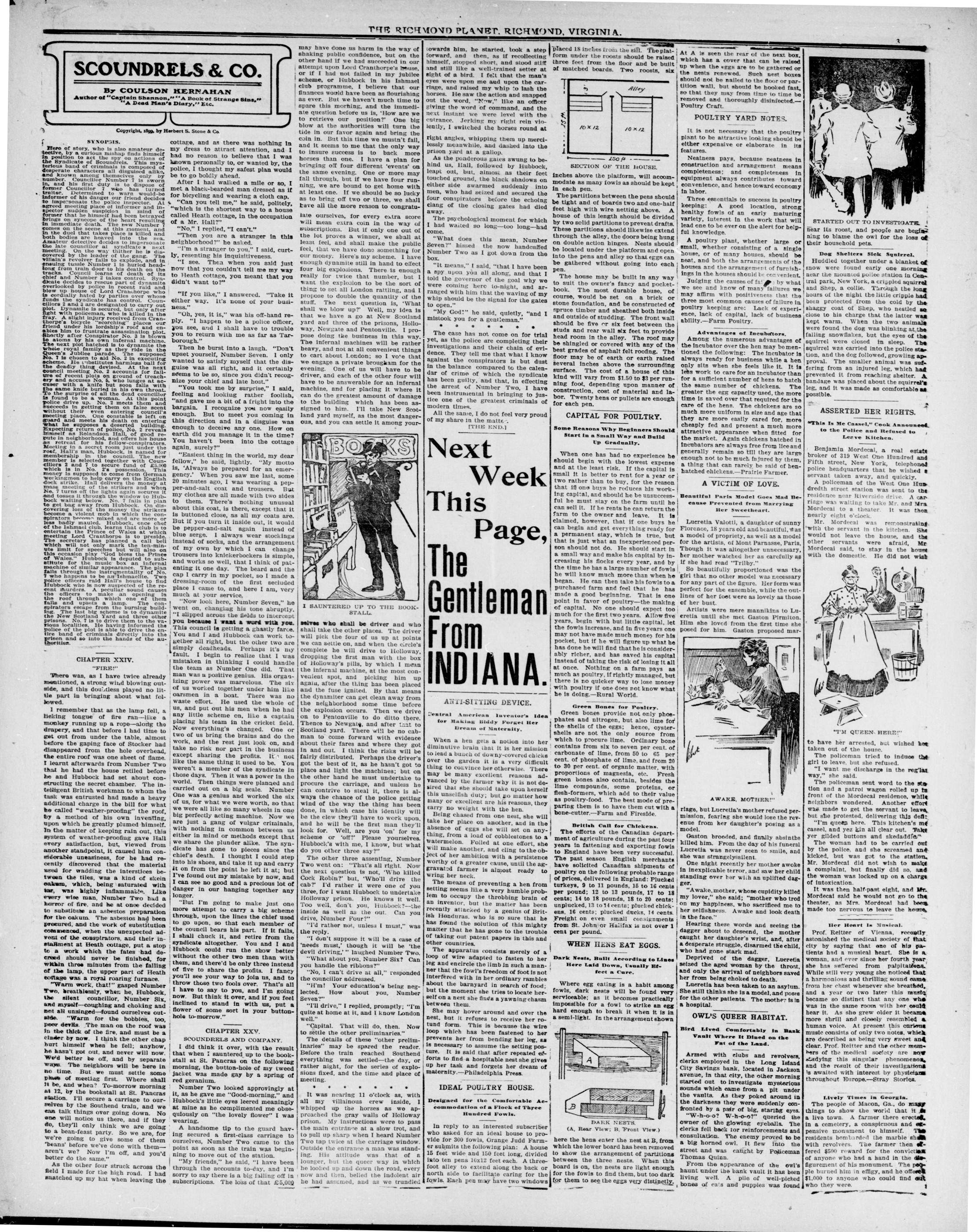
SCOUNDRELS & CO.
By COULSON HERNAHAN
Author of "Captain Shannon," "A Book of Strange Sins," "A Dead Man's Diary," Etc.
Copyright, 1899, by Herbert S. Stone & Co.
Copyright, 1899, by Herbert S. Stone & Co.
There was, as I have twice already mentioned, a strong wind blowing outside, and this doubtless played no little part in bringing about what followed.
I remember that as the lamp fell, a kicking tongue of fire ran—like a monkey running up a rope—along the drapery, and that before I had time to get out from under the table, almost before the gaping face of Stocker had disappeared from the hole overhead, the entire roof was one sheet of flame. I learnt afterwards from Number Two that he had the house retiled before he and Hubbock had set about constructing the secret chamber. The intelligent British workman to whom the task was entrusted had made a heavy additional charge in the bill for what he called "weather-proofing" the roof, by a method of his own inventing, upon which he greatly plumed himself. In the matter of keeping rain out, this system of weather-proofing gave Hall every satisfaction, but, viewed from another standpoint, it caused him considerable uneasiness, for he had recently discovered that the material used for wadding the interstices between the tiles, was a kind of skein oakum, which, being saturated with tar, was highly inflammable. Like every wise man, Number Two had a horror of fire, and he at once decided to substitute an ashesost preparation for the oakum. The ashesost had been procured, and the work of substitution commenced, when the unexpected advent of the conspirators, and their installation at Heath cottage, put a stop to a work which the fates had decreased should never be finished, for within three minutes from the falling of the lamp, the upper part of Heath cottage was a royal roaring furnace.
"Warm work, that!" gasped Number Two, breathlessly, when he, Hubbock, the silent councillor, Number Six, and myself—coughing and choking and not all unsigned—found ourselves outside. "Warm for the bobbies, too, poor devils. The man on the roof was in the thick of the fire, and must be a cinder by now. I think the other chap burt himself when he; anyhow, he hasn't got out, and never will now. Wed better be off, and by separate ways. The neighbors will be here in no time. But we must settle some place of meeting first. Where shall it be, and when? To-morrow morning at 12, by the bookstall at St. Pancrass station. I'll secure a carriage to ourselves by the Southend train, and we can talk things over going down. No one will notice us there, and if they do, they'll only think we are going to a bean-feast party. So we are, for we're going to give some of them 'beans' before we've done with them—aren't we? Now I'm off, and you'd better do the same."
As the other four struck across the field I made for the high road. I had snatched up my hat when leaving the
CHAPTER XXIV
"FIRE!"
cottage, and as there was nothing in my dress to attract attention, and I had no reason to believe that I was known personally to, or wanted by, the police, I thought my safest plan would be to go boldly ahead.
After I had walked a mile or so, I met a black-bearded man dressed as if for bicycling and wearing a cloth cap.
"Can you tell me," he said, politely, "which is the shortest way to a house called Heath cottage, in the occupation of a Mr. Hall."
"No." I replied, "I can't."
"Then you are a stranger in this neighborhood?" he asked.
"I'm a stranger to you," I said, curtly, resenting his inquisitiveness.
"I see. Then when you said just now that you couldn't tell me my way to Heath cottage, you meant that you didn't want to?"
"If you like," I answered. "Take it either way. It's none of your business."
"Oh, yes, it is," was his off-hand reply. "I happen to be a police officer, you see, and I shall have to trouble you to return with me as far as Tarborough."
Then he burst into a laugh. "Don't upset yourself, Number Seven. I only wanted to satisfy myself that the disguise was all right, and it certainly seems to be so, since you didn't recognize your chief and late host."
"You took me by surprise," I said, feeling and looking rather foolish, "and gave me a bit of a fright into the bargain. I recognize you now easily enough. But to meet you coming in this direction and in a disguise was enough to deceive any one. How on earth did you manage it in the time? You haven't been into the cottage again, surely?"
"Easiest thing in the world, my dear fellow," he said, lightly. "My motto is, 'Always be prepared for an emergency.' When you saw me last, some 20 minutes ago, I was wearing a pepper-and-salt coat and trousers. But my clothes are all made with two sides to them. There's nothing unusual about this coat, is there, except that it is buttoned close, as all my coats are. But if you turn it inside out, it would be pepper-and-salt again instead of blue serge. I always wear stockings instead of socks, and the arrangement of my own by which I can change trousers into knickerbockers is simple, and works so well, that I think of patient it one day. The beard and the cap I carry in my pocket, so I made a dressing-room of the first secluded place I came to, and here I am, very much at your service.
"Now look here, Number Seven," he went on, changing his tone abruptly. "I slipped across the fields to intercept you because I want a word with you. This council is getting a ghastly force. You and I and Hubbook can work together all right, but the other two are simply deadheads. Perhaps it's my fault. I begin to realize that I was mistaken in thinking I could handle the team as Number One did. That man was a positive genius. His organizing power was marvelous. The six of us worked together under him like oarsmen in a boat. There was no waste effort. He used the whole of us, and put out his men when he had any little scheme on, like a captain placing his team in the cricket field. Now everything's changed. One or two of us bring the brains and do the work, and the rest just look on, and take no risk nor part in the business except sharing the profits. It not like the same thing it used to be. You weren't a member of the syndicate in those days. Then it was a power in the world. Then things were planned and carried out on a big scale. Number One was a genius and worked the six of us, for what we were worth, so that we were all like so many wheels in one big perfectly machine. Now we are just a gang of vulgar criminals, with nothing in common between us either in mind or methods except that we share the plunder alike. The syndicate has gone to pieces since the chief's death. I thought I could step into his shoes, and take it up and carry it on from the point he left it at; but I've found out my mistake by now, and I can see no good and a precious lot of danger in our hanging together any longer.
"But I'm going to make just one more attempt to carry a big scheme through, upon the lines the chief used to go upon, so that each member of the council bears his part. If it falls, I shall chuck it, and retire from the syndicate altogether. You and I and Hubbock could run the show better without the other two men than with them, and there'd be only three instead of five to share the profits. I fancy you'll see your way to join us, and to throw those two fools over. That's all I have to say to you, and I'm going now. But think it over, and if you feel inclined to stand in with us, put a flower of some sort in your button-hole to-morrow."
SCOUNDBELS AND COMPANY
I did think it over, with the result that when I sauntered up to the bookstall at St. Pancras on the following morning, the button-hole of my tweed jacket was made gay by a spring of red geranium.
Number Two looked approvingly at it, as he gave me "Good-morning," and Hubbock's little eyes leered meaningly at mine as he complimented me obsequiously on "the lovely flower" I was wearing.
A handsome tip to the guard having secured a first-class carriage to ourselves, Number Two came to the point as soon as the train was beginning to move out of the station.
"My friends," he said, "I have been through the accounts to-day, and I'm sorry to say there is a big falling off in subscriptions. The loss of that £5,000
CHAPTER XXV
THE RICHMOND PLANET, RICHMOND, VIRGINIA.
may have done us harm in the way of shaking public confidence, but on the other hand if we had succeeded in our attempt upon Lord Cranthorpe's house, or if I had not failed in my jubilee scheme, or Hubbock in his Ishmael club programme, I believe that our finances would have been as flourishing as ever. But we haven't much time to spare this morning, and the immediate question before us is, 'How are we to retrieve our position?' One big blow at the authorities will turn the tide in our favor again and bring the coin in. But this time we mustn't fall, and it seems to me that the only way to insure success is to back more horses than one. I have a plan for bringing off four different 'events' on the same evening. One or more may fall through, but if we have four running, we are bound to get home with at least one. If we should be so lucky as to bring off two or three, we shall have all the more reason to congruat-
late ourselves, for every extra score will mean extra coin in the way of subscriptions. But if only one out of the lot proves a winner, we shall at least feel, and shall make the public feel, that we have done something for our money. Here's my scheme. I have enough dynamite still in hand to effect four big explosions. There is enough really for twice that number, but I want the explosion to be the sort of thing to set all London rattling, and I propose to double the quantity of the stuff. The next question is, 'What shall we blow up?' Well, my idea is that we have a go at New Scotland yard and three of the prisons, Holloway, Newgate and Pentonville. I propose doing the business in this way. The infernal machines will be rather heavy, and not at all convenient things to cart about London; so I vote that we engage a private broughtam for the evening. One of us will have to be driver, and each of the other four will have to be answerable for an infernal machine, and for placing it where it can do the greatest amount of damage to the building which has been assigned to him. I'll take New Scotland yard myself, as the most dangerous, and you can settle it among your-
BOOKS
1 SAUNTERED UP TO THE BOOK-STALL
selves who shall be driver and who shall take the other places. The driver will pick the four of us up at points we can settle on, and when the circle's complete he will drive to Holloway, dropping the first man with the box of Holloway's pills, by which I mean the infernal machine, at the most convenient spot, and picking him up again, after the thing has been placed and the fuse ignited. By that means the dynamiter can get clean away from the neighborhood some time before the explosion occurs. Then we drive on to Penvilleton to do ditto there. Thence to Newgate, and after that to Scotland yard. There will be no cabman to come forward with evidence about their fares and where they got in and out. I think the risks will be fairly distributed. Perhaps the driver's got the best of it, as he hasn't got to place and light the machines; but on the other hand he must undertake to procure the carriage, and unless he can contrive to steal it, there is always the chance of the police getting wind of the way the thing has been done, in which case his identity will be the clew they'll have to work upon, and he will be the first man they'll look for. Well, are you 'on' for my scheme or 'off'? Please yourselves. Hubbock's with me, I know, but what do you other three say?"
The other three assenting, Number Two went on: "That's all right. Now the next question is not, Who killed Cock Robin? but, 'Who'll drive the cab?' I'd rather it were one of you three, for I want Hubbock to undertake Holloway prison. He knows it well. Too well, don't you, Hubbock?—the inside as well as the out. Can you drive, Number Four?"
"I'd rather not, unless I must," was the reply.
"I don't suppose it will be a case of needs must," though it will be 'the devil driving,'" laughed Number Two.
"What about you, Number Six? Can you handle the ribbons?"
"No, I can't drive at all," responded the councillor addressed.
"H'm! Your education's being neglected. How about you, Number Seven?"
"I'll drive," I replied, promptly; "I'm quite at home at it, and I know London well."
"Capital. That will do, then. Now to settle the other preliminaries."
The details of these "other preliminaries" may be spared the reader. Before the train reached Southend everything was settled—the day, or rather night, for the series of explosions fixed, and the time and place of meeting.
It was nearing 11 o'clock as, with all my villainous crew inside, I whipped up the horses as we approached the gray walls of Holloway prison. My instructions were to pass the main entrance at a slow trot, and to pull up sharp when I heard Number Two tap twice at the carriage window. Outside the entrance a man was standing. His attitude was that of a louder, but the queer way in which he looked up and down the road, every now and then, belied the indolent air he had assumed, and as we trundled
towards him, he started, took a step forward, and then, as if recollecting himself, stopped short, and stood stiff and still like a well-trained setter at sight of a bird. I felt that the man's eyes were upon me and upon the carriage, and raised my whip to lash the horses. He saw the action and snapped out the word, "New," like an officer giving the word of command, and the next instant we were level with the entrance. Jerking my right rein violently, I switched the horses round at right angles, whipping them up mercilessly meanwhile, and dashed into the prison yard at a gallop.
As the ponderous gates swung to behind us, Hall, followed by Hubbock, leapt out, but, almost as their feet touched ground, the black shadows on either side swarmed suddenly into men, who had seized and secured the four conspirators before the echoing clang of the closing gates had died away.
The psychological moment for which I had waited so long—too long—had come.
"What does this mean, Number Seven?" hissed the now handcuffed Number Two as I got down from the box.
"It means," I said, "that I have been a spy upon you all along, and that I told the governor of the goal why we were coming here to-night, and arranged with him that the waving of my whip should be the signal for the gates to open."
"My God!" he said, quietly, "and I mistook you for a gentleman."
The case has not come on for trial yet, as the police are completing their investigations and their chain of evidence. They tell me that what I know against the conspirators is but dust in the balance compared to the calendar of crime of which the syndicate has been guilty, and that, in effecting the arrest of Number Two, I have been instrumental in bringing to justice one of the greatest criminals of modern times.
All the same, I do not feel very proud of my share in the matte:
Next Week This Page, The Gentleman From INDIANA.
Central American Inventor's Idea for Making Biddy Forget Her Dream of Muternity.
When a hen gets a notion into her diminutive brain that it is her mission to lead a bunch of downy-covered chicks over the garden it is a very difficult thing to convince her otherwise. There may be many excellent reasons advanced by the farmer why it is not desired that she should take upon herself this unselfish duty; but no matter how many or excellent are his reasons, they carry no weight with the hen.
Being chased from one nest, she will take her place on another, and in the absence of eggs she will set on anything, from a load of cobblestones to a watermelon. Foiled at one effort, she will make another, and cling to the object of her ambition with a persistence worthy of a greater cause, until the aggrivated farmer is almost ready to wring her neck.
The means of preventing a hen from setting seems like a very humble problem to occupy the throbbing brain of an inventor, but the matter has been recently attacked by a genius of British Honduras, who is so sure that he has found the solution of this mighty matter that he has gone to the trouble of taking out patent papers in this and other countries.
The apparatus consists merely of a loop of wire adapted to fasten to her leg and encircle the limb in such a manner that the fowl's freedom of foot is not interfered with in her ordinary rambles about the barnyard in search of food; but the moment she tries to locate herself on a nest she finds a yawning chasm between them.
She may hover around and over the nest, but it refuses to receive her round form. This is because the wire loop which has been fastened to her prevents her from bending her leg, as is necessary to assume the setting posture. It is said that after repeated efforts to find a hospitable nest she gives up her task and forgets her dream of maternity - Philadelphia Press.
IDEAL POULTRY HOUSE.
Designed for the Comfortable Accommodation of a Flock of Three Hundred Fowl.
In reply to an interested subscriber who asked for an ideal house to provide for 300 fowls, Orange Judd Farmer submits the following plan: A house 15 feet wide and 150 feet long, divided into ten pens 10x12 feet each. A three-foot alley to extend along the back or north side to facilitate caring for the fowls. Each pen may have two windows
placed 18 inches from the sill. The plat-
form under the roosts should be raised
three feet from the floor and be built
of matched boards. Two roosts, six
Alley
10 x 12
10 x 12
250 ft
SECTION OF THE HOUSE.
Inches above the platform, will accom-
modate as many fowls as should be kept
in each pen.
The partitions between the pens should be tight and of boards two and one-half feet high with wire netting above. A house of this length should be divided by two solid partitions to prevent drafts. These partitions should likewise extend through the alley, the doors being hung on double action hinges. Nests should be located under the platform and open into the pens and alley so that eggs can be gathered without going into each pen.
The house may be built in any way to suit the owner's fancy and pocket-book. The most durable house, of course, would be set on a brick or stone foundation, and be constructed of spruce timber and sheathed both inside and outside of studding. The front wall should be five or six feet between the studs and rear wall six feet to provide head room in the alley. The roof may be shingled or covered with any of the best grades of asphalt felt roofing. The floor may be of earth or earth raised several inches above the surrounding surface. The cost of a house of this kind will vary from $1.50 to $3 per running foot, depending upon manner of construction, cost of material and labor. Twenty hen or pullets are enough for each pen.
CAPITAL FOR POULTRY.
Some Reasons Why Beginners Should Start in a Small Way and Build Up Gradually.
When one has had no experience he should begin with the lowest expense and at the least risk. If the capital is small it is better to rent for a year or two rather than to buy, for the reason that if one buys he reduces his working capital, and should he be unsuccessful he must stay on the farm until he can sell it. If he rents he can return the farm to the owner and leave. It is claimed, however, that if one buys he can begin and get everything ready for a permanent stay, which is true, but that is just what an inexperienced person should not do. He should start in a small way and make his capital by increasing his flocks every year, and by the time he has a large number of fowls he will know much more than when he began. He can then take his fowls to a purchased farm and feel that he has made a good beginning. That is one point in favor of poultry—the making of capital. No one should expect too much for the first two years. Allow five years, begin with but little capital, let the fowls increase, and in five years one may not have made much money for his pocket, but if he will figure up what he has done he will find that he is considerably richer, and has saved his capital instead of taking the risk of losing it all at once. Nothing on a farm pays as much as poultry, if rightly managed, but there is no quicker way to lose money with poultry if one does not know what he is doing—Rural World.
Green Bones for Poultry
Green bones provide not only phosphates and nitrogen, but also lime for the shells of the eggs; hence, oystershells are not the only source from which to procure lime. Ordinary bone contains from six to seven per cent. of carbonate of lime, from 50 to 65 per cent. of phosphate of lime, and from 20 to 30 per cent. of organic matter, with proportions of magnesia, etc. Fresh green bones also contain, besides the lime compounds, some proteins, or flesh-formers, which add to their value as poultry-food. The best mode of preparing them is to have them cut with a bone-cutter.—Farm and Fireside.
British Call for Chickens
The efforts of the Canadian department of agriculture during the past four years in fattening and exporting fowls to England have been very successful. The past season English merchants have solicited Canadian shipments of poultry on the following probable range of prices, delivered in England: Plucked turkeys, 9 to 11 pounds, 15 to 16 cents per pound; 12 to 13 pounds, 17 to 18 cents; 14 to 18 pounds, 18 to 20 cents; unplucked, 13 to 14 cents; plucked chickens, 16 cents; plucked ducks, 14 cents. Freight on even small consignments from St. John or Haifax is not over 1 cent per pound.
WHEN HENS EAT EGGS.
Dark Nests, Built According to Lines Here Laid Down, Usually Effect a Cure.
Where egg eating is a habit among fowls, dark nests will be found very serviceable; as it becomes practically impossible for a fowl to strike an egg hard enough to break it when it is in a semi-light. In the arrangement shown
DARK NESTS
(A. Rear View; B. Front View)
here the hens enter the nest at B, from which the lower board has been removed to show the arrangement of partitions between the three nests. When this board is on, the nests are light enough for the fowls to find them, but too dark for them to see the eggs very distinctly.
At A is seen the rear of the next box, which has a cover that can be raised up when the eggs are to be gathered or the nests renewed. Such nest boxes should not be nailed to the floor or partition wall, but should be hooked fast, so that they may from time to time be removed and thoroughly disinfected.—Poultry Craft.
POULTRY YARD NOTES
It is not necessary that the poultry plant to be attractive looking should be either expensive or elaborate in its features.
Neatness pays, because neatness in construction and arrangement means completeness; and completeness in equipment always contributes toward convenience, and hence toward economy in labor.
Three essentials to success in poultry keeping: A good location, strong healthy fowls of an early maturing variety, interest in the work that will lead one to be ever on the alert for helpful knowledge.
A poultry plant, whether large or small, whether consisting of a single house, or of many houses, should be neat, and both the arrangements of the houses and the arrangement of furnishings in the houses should be convenient
Judging the causes of failure by what we see and know of many failures we may affirm with positiveness that the three most common causes of failure in poultry keeping are: Lack of experience, lack of capital, lack of business ability.—Farm Poultry.
Advantages of Incubators
Among the numerous advantages of the incubator over the hen may be mentioned the following: The incubator is always ready for business while a hen only sits when she feels like it. It is less work to care for an incubator than for a sufficient number of hens to hatch the same number of chickens. The greater the egg capacity used, the more time is saved over that required for the care of the hens. The chickens are so much more uniform in size and age that they are more easily cared for, more cheaply fed and present a much more attractive appearance when fitted for the market. Again chickens hatched in incubators are always free from lice and generally remain so till they are large enough not to be much injured by them, a thing that can rarely be said of hen-hatched chickens.—Prairie Farmer.
A VICTIM OF LOVE.
Beautiful Paris Model Goes Mad Because Prevented from Marrying Her Sweetheart.
Lucretia Valotl, a daughter of sunny Florence, 18 years old and beautiful, was a model of propriety, as well as a model for the artists, of Mont Parnasse, Paris. Though it was altogether unnecessary, her mother watched her as carefully as if she had read "Trilby."
So beautifully proportioned was the girl that no other model was necessary for any part of the figure. Her form was perfect for the ensemble, while the outlines of her foot were as lovely as those of her bust.
Artists were mere mannikins to Lucretia until she met Gaston Pirmiton. Him she loved from the first time she posed for him. Gaston proposed mar-
AWAKE. MOTHER!"
rlage, but Lucretia's mother refused permission, fearing she would lose the revenue from her daughter's posing as a model.
Gaston brooded, and finally absinthe killed him. From the day of his funeral Lucretia was never seen to smile, and she was strangely silent.
One night recently her mother awoke in inexplicable terror, and saw her child standing over her with an uplifted dagger.
"Awake, mother, whose cupidity killed my lover," she said; "mother who trod on my happiness, who sacrificed me to her selfishness. Awake and look death in the face."
Hearing these words and seeing the dagger about to desecent, the mother caught her daughter's wrist, and, after a desperate struggle, disarmed the child, who had gone stark mad.
Deprived of the dagger, Lucretia seized the aged woman by the throat, and only the arrival of neighbors saved her from being choked to death.
Luerceta has been taken to an asylum. She still thinks she is a model, and poses for the other patients. The mother is in a hospital.
OWL'S QUEER HABITAT.
Bird Lived Comfortably in Bank Vault Where It Dined on the Fat of the Land.
Armed with clubs and revolvers, clerks employed in the Long Island City Savings bank, located in Jackson avenue, in that city, the other morning started out to investigate mysterious sounds which came from a pit under the vanills. As they poked around in the darkness they were suddenly confronted by a pair of big, starring eyes. "W-h-o-o?" W-h-o-o?" queried the owner of the glowing eyeballs. The clerks fell back for reinforcements and consultation. The enemy proved to be a big horned owl. It flew into the street and was caught by Policeman Thomas Quinn.
From the appearance of the owl's haunt under the bank vault it has been living well. A pile of well-picked bones of cats and puppies was found
THE GUNS
STARTED OUT TO INVESTIGATE. near its roost, and people are beginning to blame the owl for the loss of their household pets.
Dog Shelters Sick Squirrel
Dog Shelters Sick Squirrel.
Huddled together under a blanket of snow were found early one morning near the mounted police station in Central park, New York, a crippled squirrel and Shep, a collie. Through the long hours of the night the little cripple had been protected from the cold by the shaggy coat of Shep, who nestled so close to his charge that the latter was kept warm. When the two animals were found the dog was blinking at the falling snowflakes, but the eyes of the squirrel were closed in sleep. The squirrel was carried into the police station, and the dog followed, growling approval. The smaller animal was suffering from an injured leg, which had prevented it from reaching shelter. A bandage was placed about the squirrel's leg, and it was made as comfortable as possible.
ASSERTED HER RIGHTS
"This Is Me Cassel." Cook Announced to the Police and Refused to Leave Kitchen.
Benjamin Mordecal, a real estate broker of 319 West One Hundred and Fifth street, New York, telephoned police headquarters that he wished a servant taken away, and quickly.
A policeman of the West One Hundreddth street station was sent to the residence near Riverside drive. A carriage was waiting to take Mr. and Mrs Mordecal to a theater. It was then nearly eight o'clock.
Mr. Mordecal was remonstrating with the servant in the kitchen. She would not leave the house, and the other servants were afraid, Mr Mordecal said, to stay in the house with the domestic. He did not wish
"TM QUEEN, HERE!"
to have her arrested, but wished he
taken out of the house.
The policeman tried to induce the
girl to leave, but she refused.
"I want me discharge in the reg'lat way," she sald.
The policeman sent word to the station and a patrol wagon rolled up in front of the Mordecal residence, while neighbors wondered. Another effort was made to get the servant to leave, but she protested, delivering this defn: "I'm queen here. This kitchen's me cassel, and yez kn all clear out. Take yer gilded buttons and skedaddle."
The woman had to be carried out by the police, and she screamed and kicked, but was got to the station. Mr. Mordecal did not wish to make a complaint, but finally did so, and the woman was locked up on a charge of intoxication. It was then half-past eight, and Mr. Mordecal said he would not go to the theater, as Mrs. Mordecal had been made too nervous to leave the house.
Her Heart Is Musical.
Prof. Reitter of Vienna, recently astonished the medical society of that city by saying that one of his patients had a musical heart. She is a woman, and ever since her fourth year she has suffered from palpitations. While still very young she noticed that a harmonious and thrilling sound came from her chest whenever she breathed, and a year or two later this music became so distinct that any one who was in the same room with her could hear it. As she grew older it became more shrill and closely resembled a human voice. At present this curious music consists of only two notes, which are described as being very sweet and clear. Prof. Reitter and the other members of the medical society are now studying this singular phenomenon, and the result of their investigations is awaited with interest by physicians throughout Europe—Stray Stories.
Lively Times in Georgia.
The people of Macon, Ga., do many things to show the world that it is a live town. A farmer there erected in a cemetery, a conspicuous and expensive monument to himself. The residents bombarded the marble shaw with revolvers. The farmer then offered $500 reward for the conviction of anyone who had a hand in the disfigurement of his monument. The people burned him in effigy, and he offered $1,000 to anyone who could find out who they were.
HE PLANET
Published every Saturday by JOHN A. BROWN
JR., at 311 North 4th Street, Richmond, Va.
2.1 Communions intended for publication should be sent so as to reach us by Wednesday
TERMS IN ADVANCE.
One Copy, one year, $1.50
One Copy, eight months, 1.00
One Copy, six months, $0.80
One Copy, four months, $0.50
One Copy, three months, $0.40
Single Copy, $0.60
ADVERTISING RATES
or one inch. one insertion.
or one inch each subsequent insertion.
or two inches, three months,
for two inches, six months,
for two inches, nine months,
for two inches, twelve months,
Marriage and Funeral Notices,
Branding and Transient Notices per line.
POSTAGE STAMPS OF A HIGHER DE
NOMINATION THAN TWO CENTS NOT
RECEIVED ON SUBSCRIPTIONS.
THE PLANET is issued weekly. The subscri
pion price is $1.50 a year, in advance.
There are four ways by which money can be sent by mail at our risk: - In a Post Office Money Order, by Bank Check or Draft, or an Exit Money Order, by Bank Check or Draft, or if these can be procured, in a Registered Letter. MONEY ORDERS—You can buy a Money Order at your Post Office, payable at the Richmond Post Office, and we will be responsible for its delivery. EXPRESS MONEY ORDERS can be obtained at any office of the American Express Co., the United States Express Co., and the Well Far and Co. Express Company. We will be responsible for your delivery. The Express Money Order is a safe and convenient way for money. REGISTERED LETTER—If a Money Order is registered, the Postmaster will register your request, the Postmaster will register the letter you wish to send as on payment of ten cents. Then, if the letter is lost or stolen, you can send money in this manner at our risk. We cannot be responsible for money sent in letters in any other way than one of the four ways mentioned above. If you send your money in another way, you must do it at your own risk.
RENEWALS, LLC—If you do not want THE PLANET continued for another year after your renewal, you may decide to Postal Card to discontinue it. The courts have decided that subscribers to newspapers who do not order their paper discontinued at the expiration date, may be held liable for the payment of the subscription up to date when they order the paper discount.
COMMUNICATIONS—When writing to us to renew your subscription or to discontinue our paper, you should give your name and address to us, and we assume that your name is on our addresses.
CHANGE OF ADDRESS—In order to change your address, we must be sent a former as well as the present address.
Entered in the Post Office at Pleibmouth.
SATURDAY - FEBRUARY 20, 1904
THE Press and Printing Company of Roanoke, Va., will begin the publication of a Republican daily paper March 1st. It promises to be one of the liveliest publications in the state and will be a powerful factor in the awakening of the great South-west Virginia to the advantages of this latter-day republicanism.
OUR able and plucky contemporary, the Martinsburg, W. Va., PIONEER PRESS makes an extended extract from the editorial extracts on Gov. VARDA-MAN and says:
"The following is taken from the Richmond PLANET, and goes to show the blessing Mr. Mitchell's paper has been to his race. It is evidence that there is an excellent class of Negroes in that city and the PLANET should have the praise for instilling respectability and race pride into them."
WILLIAM'S CONFESSION.
WE have talked with HENRY WILLIAMS, the colored man, admittedly guilty of having feloniously assaulted Mrs. GEORGE J. SHIELDS, (white) and her child at Roanoke, Va., Saturday, January 30th, 1904, and we have given to the public the graphic details of that interview. The details are horrible and the only partially redeeming feature of the whole affair is that he did not rape her. Still, it is bad enough without that and shows to what extent some of the ignorant, brutal members of the human race can exercise their brutal instincts. Such a man is not fit to live, and he is not fit to die.
There is not a colored man of intelligence or respectability in this state who does not loathe such a character, and who will not say, "Amen" when the law has meed the punishment. This hoodlum, ignorant, vicious element is an incubus upon the race and does much to hinder our progress among the peoples of the world.
We cannot but extend sympathy to this lone, white woman, who was so brutally treated in the broad day-time by a man, whose environments and surroundings should have taught him better, even though he may have been ignorant and vicious.
We sympathize, too, with Mr. Geo. J. SHIELDS, the well-nigh distracted husband and father, assuring him, too, that the better class of colored people ask alone that the law and not the mob mote the punishment to the felon.
Despite the sway of passion, and the disposition to wreak vengeance, it must not be forgotten that it is the certainty of punishment and not the severity of it that checks crime.
Our people know how to sympathize for they have felt the full effect of these outrages. The vicious elements of the white race have forced deep into their flesh just such outrages and they have felt all of the indignation that Mr. SHIELDS now feels.
You have HENRY WILLIAMS. Take
him and wreak upon him all of the punishment permitted by our laws. He has sacrificed all of his rights to liberty and happiness and no color man will shed a tear or expand a sympathy when the sentence is imposed by the presiding judge of that locality. Sad indeed have been the happenings in Ranoke. God grant that our people may be able during the coming years to devote their best efforts to the curbing of this lawless element amongst us, to the end that it may slave itself out within the walls of a prison rather than be permitted to embarrass and handicap us on the outside in the midst of our peaceful pursuits as a Christian and law-abiding people.
THAT LASHING AT SALEM.
THE telegraphic report from SALEM, VA., under date of the 6th inst. tells of the barbarous lashing of a colored man, named TAYLOR FIELDS.
It was alleged that he made some disparaging remarks with reference to the SHIELDS assault at ROANOKE, VA., and on this account his house was visited and not being found there, he was located at the house of his nephew, and made to come from under the bed where he nad secreted himself.
He was threatened with pistols, a rope placed around his neck and he was conducted to the public square, his shirt removed, bare back exposed and he was nucerically lashed with electric wires. He was told to leave the town and shots were fired at him as he ran. This took place at midnight of the 5th, inst. and about 150 lawless white men composed the mob. It is mildly hinted that other colored people are liable to similar treatment.
It may be well to state too that TAYLOR FIELDS is said to be a bad character. Be that as it may be, he had committed no crime in this instance and if he had, there are enough laws upon the statute books of Virginia to punish him.
We only regret that he was not a character that entitled him to respect, or if he was as represented that he did not have the nerve and backbone to do what the town of Salem failed to do for him.
Colored men should talk less and do more. A man or men, who cross the threshold of a colored man's home for the purpose of humiliating him, either by lashing or hanging, should be made to pay the penalty of their folly.
As a rule, cowards compose these assassin-like mobs, and they are reasonably sure of immunity from the injury before they start on their mission. When lawless conditions obtain as are now noticed in Salem and Roanoke, it behooves every citizen to be prepared for all emergencies and be ready to die with his boots on.
One sure aim from the muzzle of a repeating rifle or the blackened recesses of a shot-gun would have made FIELDS a hero, while the cur-like submission to punishment on his part has stamped him as a craven.
Death is but death, and the sooner the colored people realize that religion is intended to teach us how to die, the better it will be for all of us who may be made sooner or later the victim of a similar attempted outrage.
---
THE GOVERNOR'S ACTION.
THE action of Gov. A. J. MONTAGUE in ordering eighteen companies of the state militia to Roanoke to protect HENRY WILLIAMS, (colored) from lynching and thereby to uphold the majesty of the law is deserving of the highest commendation.
It is true shat he is only doing his duty. Still, during these troublous times when oaths rest lightly on the conscience, it is a most commendable thing to see a man brave public sentiment in a locality and announce, despite his own personal feelings in the matter that the law must have its course.
We do not believe that there is a man in the state, white or colored, who is more indignant over the terrible crime with which WILLIAMS stands charged, or who sympathizes more feelingly with the unfortunate lady, who was his victim, than does A. J. MONTAGUE, the Chief Executive of Virginia.
If convicted, the doors of clemency at the Executive Mansion will be closed against him. But, it is necessary that the legal authorities and not the mob should mete the punishment and to this end His Excellency has ordered out the strong military arm of the state, not primarily to protect WILLIAMS, but to maintain the law in all its majesty and to notify all criminal elements, black and white, that there are statutes enough upon the books of Virginia to meet the case and to insure severe punishment upon all evil-doers who violate its decrees.
The eyes of the country are upon VIRGINIA and from one section of the republic to the other, the law-abiding elements, both white and colored are ringing words of praise upon the brilliant and intrepid young Governor of Old Virginia.
Lynoh law must go!
The Absent Treatment.
Cholly—It seems to me I have tried every way I know to gain her affections.
Ethel—They say that absence makes the heart grow fonder. Try that for a chance. Judge.
Fruitless Quest
"Worry," said the author is the plague of genius, but it hasn't reached my brain yet.
"Perhaps," suggested a listener, "I got tired looking for it."—Augusta (Ga.) Teral.
THE COMMON PLANET. RICHMOND. VIRGINIA.
FARM AND GARDEN
BUILDING A LIMEKILN.
The Kind Here Described Can Be
Constructed Cheaply and Furn-
nished Its Own Draft.
The Kind Here Described Can Be Constructed Cheaply and Furnishes Its Own Draft.
Limekilns are built from 20 to 30 feet high on the side of a hill, as high as convenient to get up to, similar to a cave or root cellar, the top coming up level on the back to drive there and then fill it from that point, the front of the kiln to be built perpendicular the full height of limestone or any other stone about 18 or 24 inches thick. On the back or bank side 12 or 15 inches is sufficient thickness. The inside is lined with fire brick, or red rock, or of such material as will not burn; the opening should be 8 to 10 feet in diameter and in funnel shape, the throat of it not too
FRONT OF LIMEKILN.
small so as to choke. The opening at the bottom on the face side is made the shape of an inverted V, running to the back of the opening. They build two of these side by side, only having a partition between them; then draw one while the other is burning, and that keeps the men employed all the time.
One single arch costs about $175, or a double one $300. There is wood laid in the throat sufficient to start the fire; then put in a layer of coal and then of limestone, continuing until it gets to the top of the opening. This is worked in this way when it is done for a general business, but if it is only for a farmer who owns his own stone and wants lime for his own use he can do it much cheaper and without bullding the kiln by laying upon the ground a floor of logs and timber, enough to make a good bed; then lay on the wood and stone the same as in the kiln and build it up as a hay stack but flatter at the top, as you get in more stone in that way, or it can be built long and not round as wished. This is the way for home use; 5,000 to 10,000 bushels can be burnt in a heap of this kind. People use coal (buckwheat) here for the purpose, but I suppose the same can be accomplished in using wood and will be cheaper if wood is handy. The cut shows the mode of building The kiln built as I describe will furnish its own draft and regulate itself. It takes about two or three days and nights to burn it and needs little attention if burned in a heap. It is saving the stone, or burns up more of the stone by covering the entire heap with clay or soil of some kind except the extreme top.—Rural New Yorker.
HOW TO HANDLE SKUNKS
Try Method Here Described and See How Easy It Is to Avoid Unpleasant Results.
Frequently skunks will take up their abode about the farm buildings where for various good reasons they are not welcome guests. It is often a puzzling question how to get rid of them without a very unpleasant experience. A writer in Bee Gleaning gives the following information relative to trapping them: Fasten the trap chain to the end of a ten-foot pole or board, heavy enough so they cannot drag it away. Then, instead of putting them in a nail leg (in which case you would have about 99 failures out of every 100 skunks, or shooting them, in which case, if you try it, you would think there were at least 200 failures out of every 100 trapped), approach the rear end of the pole or board cautiously, and fasten a rope to it five or six feet in length. Then start off slowly, dragging skunk and all after you. You can drag them any distance you see fit, and there will be no odor. Then you can dispatch them in any manner you wish. But, kill them as you will (unless you take hold of the pole and dip them in water deep enough to submerge them), there will be odor. The object of this method is to get the odor, if any, a safe distance from the house or bee yard. Try this, and see how easy and sure it is.
Starting Steers on Grain.
In starting steers on feed there are several methods in vogue. Some feeders give a heavy grain ration right from the start, using a pound of meal for every 100 pounds of live weight daily. Other men start the steers on a third of a pound to every 100, increasing gradually until two-thirds of a pound is reached. The latter plan usually gives the cheapest grains, and a half cent gained on every pound means a considerable profit for a big bunch of steers.—Midland Farmer.
Silly Peter Tumbledown.
Where did Peter Tumbledown get so many old broken-down wagons, implements and things, as we see about his place, anyhow? Why must he keep three yellow dogs; why should he always tramp through the mud on the way to the barn; why is his ax so dull that it will not cut worth a cent, and why can't he pass a tavern without stopping in? Bad whisky is not necessary for good health, nor clean clothes, nor good farming, nor money in bank—Farm Journal.
DESTRUCTION OF WEEDS.
Experiments at Vermont Station Prove That the Use of Chemicals Produces Good Results.
Much interest has been shown at a number of the agricultural experiment stations in the possibility of weed destruction by means of chemicals. As long ago as 1895 it was found at the Vermont station that the orange hawk-
Weed, a serious pest in pastures and meadows, could be destroyed without injury to the grass by sowing salt over the land at the rate of 3,000 pounds per acre. Many experiments have since been conducted at the same station with other chemicals for the eradication of weeds in walks, drives, courts, etc. Among the chemicals tested were salt, copper sulphate, kerosene, liver-of-sulphur, carbolic acid, arsenic and saalsoda, arsenate of soda, and two commercial weed killers, the active principle of which apparently was arsenic. The weeds which it was sought to destroy were plaintains, dandelion, chicory, ragweed, knotweed and various grasses. All the chemicals were applied in solution except the salt. As in the case of the hawkweed experiments, salt was found efficient in destroying all the weeds when applied dry and in large quantity. When salt is used for this purpose adjacent lawns should be protected against washing, or they may be injured. Crude carbolic acid, one pint in four pints of water, applied at the rate of eight gallons per square rod, was very efficient. The various arsenical preparations proved valuable as weed destroyers, and choice between them was largely a matter of expense. All things considered, the arsenate of soda and the carbolic acid solutions proved the most valuable chemicals for weed destruction under the conditions of these experiments.—Farmers' Review.
TESTS WITH COWPEAS
Valuable Information Supplied by a Tennessee Agricultural Experiment Station Bulletin.
A number of fertilizer experiments have been made from year to year on cowpeas. This crop has been found to respond readily to the mineral fertilizers, in particular to acid phosphate. Numerous experiments have been made to test the value of nitrogen along with phosphoric acid, but thus far no increased growth has apparently resulted from nitrogen, even on the poorest land. If nitrate of soda, cottonseed meal, etc.
COWFEA PLANTS.
(75.5 per cent. of the total nitrogen and 72.6
per cent. of the total dry matter
were in the tons.)
are with difficulty made profitable on such crops as corn and wheat, their profitable use for a leguminous crop, such as cowpeas or clover, which are known to be able to gather a large part of their nitrogen from the air, would naturally be much more difficult. Acid phosphate has been found to increase greatly the yields of both the hay and the peas, but especially the yield of peas. One of the most economical ways in which to improve a poor soil has been found to be the growing of cowpeas, fertilized with acid phosphate. A good plan in the case of a wornout soil is to plant the peas in rows, using acid phosphate at the rate of 300 pounds to the acre. The peas should be cultivated at least twice. The seed can be pickled or the crop can be pastured off to good advantage. In order to derive permanent benefit from this method of soil improvement it is not advisable to remove the crop as hay unless the equivalent in stable manure be returned to the land. The pea roots, stubble and fallen leaves contain only about one-third of the total plant food gathered by the crop, and could be expected to give only temporary improvement.—Tennessee Agricultural Experiment Station Bulletin.
Good and Bad Composts.
Composts are necessary in the finer processes of gardening, but they should be made in a cleanly manner, and be kept free from contamination. There is nothing better than compounds of clean sods free from weed seeds and manure from grain or forage-fed animals, mixed in varying proportions, and well worked together as decomposition progresses. It takes about two years to make a first-class article, but much may be accomplished in one season by frequent turnings. If you start such a compost do not degrade it with doubtful organic wastes, keep them separate, burn where possible or bury deeply. The ounce of prevention in this matter is worth whole tons of the disease "cures" our scientists have so far provided.—Rural New Yorker.
Good French Regulation.
In the market of France the name of each kind of meat is attached to that part of the carcass displayed for sale. A customer knows beyond doubt whether he is buying a portion of a cow or steer, a goat or sheep. If the meat is that of a donkey or horse, there is the label upon it to prevent any chance of deception. Labeling meats in the markets of the United States along with thorough inspection ought everywhere to be insisted upon.—Rural World.
The Final Choice
"You're the first girl—" "Oh, don't!" she said;
Old Grim—Remember, young man,
there is always room at the top.
Ernie—Ida is actually going to marry that young man who gambles and drinks. Eva—Yes, I heard that she wanted a husband awfully bad.—Chicago Daily News.
Likely to Get It.
"They say he's looking for trouble."
"Yes. He's going to be married."—Brooklyn Eagle.
Striking Characteristics of Those in the form of Man.
Fellow Who Insists on Repeating His Own Stories—Several Varieties of the Comic Order—The Offensive Punster.
"Yes, we run up against all sorts of pests in our business," said Precinct Detective George Boyd to a Washington Star reporter.
"One of these is the man who forces you to ask him questions. If he wishes to tell you that he is reading 'Mrs. Wigg' he asks: 'What book do you suppose I am reading?' Although you have no interest whatever in the matter, you are constrained by politeness to say: "I'm sure I do not know. What is it?" Thereupon he tells you, triumphantly. He could have given you the information without any of this annoying parley, but that is not his way.
"The man who insists on repeating his remarks two or three times is also an annoying pest. His trick is to watch your countenance, and as soon as he notes any sign of his having impressed you, to go back on his tricks and give you the whole discourse over again. Especially does he do this in telling a humorous story. If you laugh you are lost, for you must listen to the story over and over again until he has wring every drop of humor cut of it.
"There are several varieties of the comic story pest. Not more than three men in fifty-seven are competent to tell a humorous story, and the rest ought never to attempt it, for if there is only one dreary thing on earth it is a good story spoiled in the beginning.
"Among the comic-story pests are the man who puts too many immaterial details into his narrative; the man who laughs at his own story before he has given you the point (an exasperating wretch); the man who exposes the point at the start, and then completes the narration after you have had your laugh; the man who listens solemnly to you telling a story, and then remarking that he knows the same story in a slightly different and, he thinks, better form, tells the same story over again and laughs uproariously at it; the man who
THE OFFENSIVE PUNSTER
takes your story out of your mouth by hawling out the point before you are ready, and finally tells you a puerile anecdote without the least bit of attic salt about it, and is offended because you reward him with nothing but a slight simper.
"Women, as a class, are poor story tellers, but good listeners. A man's stock of old stories is fresh enough for most women. In telling stories to women, however, it is necessary to avoid those whose point depends on allusions to facts which are common knowledge among men, but about which women know but little or nothing. Political stories are illly to fall flat in an audience of women.
"A common punster is about the most offensive of conversational pests, although he is hardly any more despicable than the flippant person that breaks into grave discourse with cheap facetiousness. Real wit is generally like beauty, its own excuse for being, and a man might be forgiven for joking at his mother's funeral provided he made good jokes. A troublesome, though not malicious creature is the man that interrupts his conversation with little queries, such as 'Isn't that so?' and 'Don't you think so?' which you are obliged to answer before he will continue.
"In addition to these pests we have always with us the standard bores, such as the man that tells anecdotes about his children and the man that insists on your trying his remedy for a cold. There is the pest that interrupts you with rapid criticism of weather when you are reading. A pest that has not been classified is the one that always makes the obvious remark and takes pains to prove by long argument what is perfectly plain without it.
"As each of these pests is annoying and therefore rude, it is justifiable to tell him plainly of his fault and ask him to correct it. Bores are encouraged by the tolerant kindness of their victims. As a rule they are well meaning persons and quite unaware of their conversational vices, and it would be as truly a kindness to let them know their vices, so that they may correct them, as it is to let a man know that there is a tag on his clothes or a woman that her hat is awry."
Insects Hate Laurel Oil.
The butchers' shops in Geneva, Switzerland, have an efficient way of keeping out files. In the summer vast multitudes of files may be seen on the outside walls, but not one ever comes inside. This is due to the inner wall having been rubbed over with laurel oil, which effectually prevents the intrusion of the troublesome insects.
One Advantage.
"I must admit, Charley, dear," said young Mrs. Tompkins, "that when a lot of women get together they talk about nothing in particular."
"Of course they do," was the rather crusty rejoincer.
"But there's one advantage in that. So long as you are talking about nothing in particular, they aren't getting any of those dreadful expensive tips on the races."—Washing on S.ar.
OUR BOYS AND GIRLS
Broke Away from Tramp Who Had Stolen Him and Saved His Master from Drowning.
Carlo was Frank McMillan's dog, and a fine specimen of the canine he was. Mr. McMillan had brought him from Scotland. He was a Scotch collie, and was only a few months old when he landed in America. Carlo was a favorite with the whole family, especially with the two boys, William and George who had not yet reached their teens. They delighted to speak of Carlo as "gift from Uncle George, of old Scotland."
The pup was strong and healthy, and soon developed into a large, muscular dog. His intelligence seemed to be above that of the average. No pains were spared to teach him, and as a result his training almost equaled that of a performing dog. Mr. McMillan lived near a river, and the boys' greatest delight was to throw sticks and other small objects that would float
CARLO, WHO SAVED HIS MASTER.
Into the water, and have the dog swim
in and bring them to the shore.
When Carlo was about two years old these boys went to visit their Uncle Harry, who lived about 30 miles distant. When on the point of starting they each extended a hand to Carlo, and he in return extended his paw to "shake" as intelligently as a human being would have done. The boys charged their parents to "keep him company" while they were gone.
Now it was midsummer, and as Mr. Raymond had a son between the ages of William and George, they spent a great deal of their time in outdoor sports. The river was only a few hundred yards away from the house, and the boys had a boat in which they took a row each day. One day, while they were out rowing, George's hat dropped into the water, and in trying to reach it he lost his balance and was precipitated into the stream. He could not swim, and the other boys set up a great cry for help, but were so excited that they could do nothing themselves. George soon disappeared beneath the water, but as the stream was of no great depth at that point he almost instantly reappeared at the surface. Then the two boys in the boat saw something resembling a dog seize their drowning companion by the collar of the coat, so as to keep his head above the water, and make for the shore, which he soon gained, never relaxing his hold on the boy till he had him safely on terra firma. Then he bounded a few feet away and vigorously shook himself. It was Carlo!
George was badly scared and somewhat the worse for being stranded, but he soon recovered. The other boys hastily rowed to the shore. In their joy to see Carlo, William and George almost forgot their adventure. Carlo was a hero, but they could not unravel the mystery surrounding his appearance upon the scene. He had a leather strap around his neck, as if he had been led by it. They went to the house and related their adventure. Mr. Raymond told them that he had seen a tramp passing by an hour or two before, leading the dog, and going in the direction of the river. Then they believed that he had been stolen, and this belief was confirmed next day, when they had a letter from their father, saying that Carlo was missing, and that a tramp had been seen a few miles away with a dog answering his description. What if the tramp had not stolen Carlo!—F.M. Beverly, in Orange Judd Farmer.
Monkeys Caught by Strategem
Ring-tail monkeys, one of the most valuable and expensive of the smaller animals, are caught in an interesting way. A cocoonant is split in two and a banana with a piece of wood running through it placed lengthwise through the nut, the two halves of which are drawn together by wires. Then a hole is cut large enough for the monkey's paw to enter. The monkey spies the tempting nut from his tree. He hopes down, looks it over, sees the hole and smells the banana inside. He is fond of bananas. Putting his paw in, he grasps it, but the wood prevents it from coming out. Then the catchers appear and the monkey runs for a tree. But he cannot climb because of the cocoonant on his paw, and he will not let go of that, so he is captured, pawing wildly at the tree trunk.
"Och, Nora, me darlint, I can't beat the sirapion. If we must part, let's go 'gither."—Kansas City Journal.
Boy Made Insect Play Part of Robinson son Crusoe and Was Astonished at Results.
A writer in the Hearth thus tells what he did with a spider when he was a boy one day when he grew tired of reading Robinson Crusoe:
I took a wash basin and fastened up a stick in it like a vessel's mast, and then poured in water enough to turn the mast into an island for my spider, whom I named Crusoe, and put him on the mast. As soon as he was fairly cast away, he anxiously commenced running around to find the mainland. He'd scamper down the mast to the water, stick out a foot, get it wet, shake it, run round the stick and try the other side, and then run back to the top again.
Pretty soon it became a serious matter to Mr. Robinson, and he sat down to think it over. As, in a minute, he acted as if he were going to shout for a boat, and was afraid he was going to be hungry. I put treacle on the stick. A fly came, but Crusoe wasn't hungry for flies just then. He was homeless for his web in the corner of the wood shed. He went slowly down the pole to the water, and touched it all around, shaking his feet like pussy when she wets her stockings in the grass. Suddenly a thought appeared to strike him. Up he went, like a rocket, to the top, and commenced playing circus. He held one foot in the air, then another, and turned round two or three times.
He got excited, and nearly stood on his head before I found out what he knew, and that was this: That the draught of air made by the fire would carry a line ashore, on which he could escape from his desert island. He pushed out a web that went floating in the air until it caught on the table. Then he hauled on the rope until it was tight, struck it several times, to see if it were strong enough to hold him, and walked ashore.
I thought he had earned his liberty, and I put him back in the woodshed again.
BRANDING THE THUMB.
How Malefactors Were Branded in England for Committing Minor Offenses.
Those "good old days." How simple and direct were their methods in all things relating to the preservation of the social system, especially that part relating to the punitive, some hundred years or moreago! If you don't believe it, look at the picture of the holdfast with a hand in position that secured a malefactor condemned to have the forever disgracing "M" brand on his thumb, and near it hangs the terrible branding instrument. These articles are to be
HAND IN HOLDEAST.
seen to this day hanging in the dock of the crown court at Lancaster castle, in England. The prisoner's left hand was thrust into the holdfast and there locked, while the jailer seized the red-hot iron and pressed it with might and main on the malefactor's thumb, thus marking him for life, and preventing honest men from giving him employment on his release.
Prisoners appearing in this court were invariably compelled to hold up their left hands, in order that the jury might see whether there was a previous conviction against them. It is 100 years ago since this barbarous punishment with the branding iron was meted out in Lancaster castle.—N. Y. Herald.
Disappointed Young Miss.
A small miss who had but recently mastered her catechism confessed her disappointment with it thus: "Now I obey the fifth commandment as honor my papa and mamma, yet my days are not a bit longer in the land, for I'm put to bed every night at seven o'clock just the same."
The Seal of Long Ago.
It is not generally known that the fur-seal was once a land animal. The baby seals are actually afraid of the water; they would drown if thrown into it, and have to learn to swim by repeated efforts. When once they have been taught to swim, however, they soon forget to walk.
Where Brides Are Bought.
A wedding engagement in Turkestan begins with the payment of a substantial consideration to the girl's parents. If the girl jilts her lover, the engagement gift has to be returned, unless the parents have another daughter to give as a substitute.
LIBERTY
WASHINGTON
Why We Delight to Celebrate Washington's Birthday.
"BORN upon our soil—of parents also born upon it—never for a
moment having had sight of the old world—instructed according to the modes of his time, only in the spare, plain, but wholesome elementary knowledge which our institutions provide for the children of the people—growing up beneath and penetrated by the genuine influences of American society—living from infancy to manhood and age amidst our expanding, but not luxurious civilization—partaking in our great destiny of labor, our long contest with unreclaimed nature and uncivilized man
GEORGE WASHINGTON
our agony of glory, the war of independence—our great victory of peace, the formation of the union, and the establishment of the constitution—he is all, all our own. Washington is ours."
The foregoing was written by Daniel Webster in regard to the Father of His Country, the anniversary of whose birth occurs February 22, an occasion that is ever freshly remembered by American hearts. "He was the first man of the time in which he grew," wrote Rufus Chate. "His memory is first and most sacred in our love; and ever, hereafter, till the last drop of blood shall freeze in the last American heart, his name shall be a spell of power and might. There is one personal, one vast, felicity which no man can share with him. It was the daily beauty and towering and matchless glory of his life which enabled him to create his country, and at the same time secure an undying love and regard from the whole American people. Undoubtedly there were brave and wise and good men before his day in every colony. But the American nation, as a nation, I do not reckon to have begun before 1774, and the first love of that young America was Washington. The first word she hasped was his name. Her earliest breath spoke it. It is still her proud ejaculation. It will be the last gasp of her expiring life. About and around him we call up no dissentient, discordant and dissatisfied elements, no sectional prejudice or bias, no party, no creed, no dogma of politics. None of these shall assail him. Yes, when the storm of battle grows darkest and rages highest, the memory of Washington shall nerve every American arm and cheer every American heart. It shall reillumine that Prometheus fire, that sublime flame of patriotism, that devoted love of country which his words have commended, which his example has consecrated."
The story of George Washington's life is an old one, but the salient facts will bear repeating. He was born at Wakefield, Westmoreland county, Va. February 22, 1732, lived from 1735 to 1739 at what is now Mount Vernon, and when he was seven years old he was taken to an estate on the Rappahannock, almost opposite Fredericksburg. The father was one of the prosperous planters of Virginia, able to give his children what education the times could afford. The first teacher of George is reputed to have been a convict, whom his father bought for the purpose. All of Washington's schooling ended before he was 16. His long and brilliant career as a soldier and statesman has given to history some of its most interesting pages.
"It was strange," wrote Thackeray, "that in a savage forest of Pennsylvania young Virginia officer should fire a shot, and wake up a war that was to
last for 60 years, which was to cover his own country, and pass into Europe, to cost France her American colonies, to sever ours from us and create the great western republic; to rage over the old world when extinguished in the new; and, of all the mylled engages in the vast contest, to leave the prize of the greatest fame with him who struck the first blow." As to the esteem and affection in which the name and character of Washington were held one cannot do better than quote Lafayette, who wrote from France as follows:
"Were you but such a man as Julius Caesar, or the king of Prussia, I should almost be sorry for you at the end of the great tragedy where you are acting such a part. But, with my dear general, I rejoice at the blessings of a peace when our noble ends have been secured. Remember our Valley Forge times; and, from a recollection of past dangers and labors, we shall be still more pleased at our present comfortable situation. I cannot but envy the happiness of my grandchildren, when they will be about celebrating and worshiping your name. To have one of their ancestors among your soldiers, to know he had the good fortune to be the friend of your heart, will be the eternal honor in which they shall glory."
The poet Shelley, aboard an American ship, drinking to the health of Washington and the prosperity of the American commonwealth, remarked: "As a warrior and statesman he was righteous in all he did, unlike all who lived before or since; he never used his power but for the benefit of his fellow-creatures."
GEORGE REVISES HISTORY.
Teacher—The first thing the Puritans did after landing on Plymouth Rock was to fall upon their knees. What was the next thing they did?
Little George Washington—They fell upon the aborigines—Boston Budget.
**The Cheerful View.**
Joel Grump—Well, I see our boodlin' common council's gone an' won $200 for Washington birthday doin's—another sheer waste o' good money.
Hiram Pond—Mebbe it'll turn out a lucky investment, Joel, like three years ago, when the cannon busted an' killed four on 'em.—Judge.
**The Most Mendacious Pastime.**
They tell us how George Washington Made truth his constant mission.
He must have missed a lot of fun By never "goin' fishin'."
—Washington Star.
**A New Psalm.**
Washington each year reminds us That it really is sublime To departing, sink your hatchet In the cherry-tree of time.
—Puck.
Early Celebrations
THE origin of Washington's birthday as a holiday is state as fol-
day as a holiday is state as follows: On February 22, 1783, a number of gentlemen met in a New York tavern to celebrate the great general's birthday. They then agreed to assemble in future on that day, celebrating it with odes and toasts. Washington's ascendancy shortly after to the presidency gave a new zest to the "annual," so that in time it became general, and finally grew into a "legal holiday," the people demanding it from a custom. The first public celebration of Washington's birthday occurred on February 11, 1784, and the anticipated occasion was thus alluded to by the Pennsylvanian Packet of February 17, same year: "Wednesday last being the birthday of his excellency, Gen. Washington, the
THE RICHMOND PLANET, RICHMOND, VIRGINIA.
Name was a friend of American independence in constitutional liberty, with that hilarity and manual decorum attendant on the sons of freedom. In the evening an entertainment was given on board the East India ship in this harbor, to a very brilliant and respectable company, and a discharge of 13 cannon was fired upon the joyful occasion."
Martha Washington
THERE was a ready response of good and prominent women in
good and prominent women in both England and America to the call for nurses during the late Spanish-American and South African wars. This brings to mind the kind and helpful attitude of Martha Washington during a critical period of American history, long since happily superseded by the good feeling, based on mutual understanding, that both countries now seek constantly to foster. William Perrine tells the story: "Martha Washington was then 45 years of age, and those who went to the camp and expected to find her arrayed in the gowns which they had supposed would be worn by the general's wife
MARTHA WASHINGTON
were disappointed. 'Whilst our husbands and brothers are examples of patriotism,' she would say to her country-women, 'we must be patterns of industry.' She did not hesitate to wear a brown dress and a speckled apron when receiving fastidious and elegant visitors at Morristown. It was said afterward that she acquired her inveterate habit of knitting in her zeal at Valley Forge to relieve the barefooted men around her. On every fair day she might be seen walking through the rude streets of the town of huis with a basket in her hand. Entering the hut of a sergeant, she found him dying on a pallet of straw, his wife beside him in the anguish of final separation. She ministered to his comfort with food prepared by her own hands. Then, kneeling, she earnestly prayed with her 'sweet and solemn voice' for the stricken couple. All day long she was busy with these arches of grace, or in the kitchen at the stone house, or in urging other women to lend a helping hand. And when she passed along the lines of the troops she would sometimes hear the fervent cry: 'God bless Lady Washington!' or 'Long live Lady Washington!' Well, indeed, might the men feel that they could fight to their very last drop of blood with a commander whose wife, who was formerly the belle and leader of her set among the dames and damsels of Virginia, was not ashamed to be seen daring his and her own stockings!'
VERY EASILY ANSWERED.
Teacher—Why should all good little boys like Washington's birthday?
Chorus of Five—Cause they ain't no school that day!—Chicago Chronicle.
A Possibility.
"Do you believe that George Washington never told a lie?"
"It's possible. He never was much of a business man, anway."—Chicago Post.
Making an Impression.
Mrs. Strongmind—I really believe that I am at last beginning to make an impression upon the public.
Mr. S.—Have the papers praised your last lecture?
Mrs. S.—N-o, but to-day I heard you mentioned as "the husband of Mrs. Strongmind."—N. Y. Weekly.
Modern Way.
"Shall we notify the count's relatives that he is being held for ransom?" asked the trusty lieutenant. "I should say not," replied the bandit chief. "Advertise him for sale in one of those American journals devoted to the interests of title-seeking heilresses. Seet"—Chicago Daily News.
What He Wanted.
"A tall bride is the best looking, don't you think?"
"Well," replied the titled Englishman who had caught on to a little American slang, "so far as I am personally concerned I certainly am not looking for one who is 'short.'"—Chicago Post.
Her Modest Wish,
"Sometimes," said the poet, "I almost get to thinking I would rather have been born rich than a genius."
"Oh, dear," his wife replied, "I don't go to such extravagant extremes. If you'd only been born with a longing to out and get a job somewhere I'd be satisfied."—Chicago Record-Heald.
Abe Lincoln
The Religion of Lincoln
SURPRISE has often been expressed that so many of our public men are unprofessed Christians. Lincoln until the last days of his life was such, and yet he believed, no doubt, the principal tenets of the Christian faith, at least those he expressed in the Apostle's creed. His life was pure and if a black spot ever stained his character the historical cynic has failed to put it on his printed pages. During his administration as president one of the lady members of the Christian commission had several interviews with him in regard to certain government matters concerning the cause she represented. At the close of one of these interviews Mr. Lincoln said to her:
"Madam, I have formed a high opinion of your Christian character, and now, as we are alone, I have a mind to ask you to give me, in brief, your idea of what constitutes a Christian."
Her reply was at some length, but, in substance, she said that it consisted of a conviction of one's own sinfulness and weakness and the personal need of Christ as a Saviour. She said that views in regard to doctrine might and did differ, but when one was really brought to feel his need of Divine help, and to seek the aid of the Holy Spirit for strength and guidance, it was satisfactory evidence of his having been born again.
Mr. Lincoln listened to her with deep attention and visible signs of emotion, and when she had concluded said: "If what you have told me is really a correct view of this great subject, I think I can say, with sincerity, that I hope that I am a Christian. I had lived, until my boy Willie died, without realizing fully these things. That blow, however, overwhelmed me. It showed me my weakness as I had never felt it before."
In many of his utterances, and in many of his documents, the president showed his trust in Divine providence and his religious nature. In a cabinet meeting during the earliest days of the war he said to Secretary Chase: "I made a solemn vow before God that if
A
LISTENED WITH EMOTION
Gen. Lee should be driven back from Pennsylvania I would crown the result by the declaration of freedom to the slaves." That he believed in prayer comes as a confession from his own lips. When the fearful cares and responsibilities of his office were pressing him most, he said:
"I have been driven many times to my knees by the overwhelming conviction that I had nowhere else to go. My own wisdom and that of all about me seemed insufficient for that day. I should be the most presumptuous block-head upon this footstool if I for one day thought that I could discharge the duties which have come upon me since I came into this place without the aid and enlightenment of One Who is wiser and stronger than all others."
Citizen (excitedly)—Officer, there is a dance hall open around the corner, I heard the music. And on Sunday night, too.
Policeman—You must be nearsighted. You can see by the bils at the front of the house that it isn't a dance hall. It's a sacred concert.—N. Y. Weekly.
The Strength of Lincoln
N the winter of 1954 between 40 and 50 women connected with the Sani-
tary commission met in Washington to "talk it over." After the business had been concluded, about half the delegates decided to call upon President Lincoln. To one of their number, at least—Helen Evertion Smith—the interview offered a wonderfully impressive illustration of Lincoln's trust in God, and the strength and comfort he derived from it. There was no special reason for the call, except, perhaps, a pardonable
A
"LADIES, GOD BLESS YOU ALL" curiosity on the part of the women to see "Old Abe" at close hand, and to hear his voice. The demand upon his time was a matter that probably had not occurred to them. The Youth's Companion says that each one of the women, as she shook hands with him, had tried to say some pleasant thing, and he had gravely and perfunctory replied with an expressionless "Thank you." The moments were getting fearfully long, and trying to the president. "Could we not get out?" a lady asked, in a whisper.
Just then a dear old Quaker lady took the long-suffering giant's down-stretched hand. She had to rise on tiptoe, and as she did it her sweet voice uttered some words difficult to catch. But their effect was easy to see. As when the lights suddenly blaze behind a cathedral window, so the radiance illumined those rugged features and poured from the wonderful eyes. The gaunt form straightened. The mouth became beautiful in its sweetness. It is not possible to give the words of either exactly, but this was their support: "Yes, friend Abraham," thee need not think thee stands alone. We are all praying for thee. The hearts of all the people are behind thee, and thee cannot fall. The Lord has appointed thee, the Lord will sustain thee, and the people love thee. Yea, as no man was ever loved before, does this people love thee. We are only a few weak women, but we represent many. Take comfort, friend Abraham. God is with thee. The people are behind thee."
"I know it." The great, soft voice rolled solemnly and sweetly forth from the trembling lips. "If I did not have the knowledge that God is sustaining and will sustain me until my appointed work is done, I could not live. If I did not believe that the hearts of all loyal people were with me, I could not endure it. My heart would have broken long ago.
"You have given a cup of cold water to a very thirsty and grateful man Ladias, you have done me a great kindness to-day. I knew it before. I knew that good men and women were praying for me, but I was so tired I had almost forgotten. God bless you all!"
Towne—That boss of yours tells such pointless jokes. I don't see how you can keep in his good graces.
Browne—Oh, it's easy enough.
Towne—But he always expects you to laugh at his jokes, and how can you tell when to laugh?
Browne—By laughing when he does.
—Philadelphia Press.
Southern Aid Society
One of the strongest and promptest paying Sick Benefit Insurance Companies in the State. You cannot afford to be out of it and should not hesitate to join when our agents call on you.
HCNESTY THE BEST POLICY IS "OUR MOTTO"
OFFICERS AND BOARD:
A. WASHINGTON, PRESIDENT; EDWARD STEWARD, VICE-PRESIDENT,
WALTER E. BAKER, TREASURER;
B. L. JORDAN,
REV. SIDNEY B. STANTON,
HENRY B. BURWELLE,
JAMES T. CARTER,
A. D. PRICE,
THOS. M. ORUMP, SECRETARY & GENERAL MANAGER.
All orders promptly filled at short notice by telegraph or telephone. Halls rented for meetings and nice entertainments. Plenty of room with all necessary conveniences. Large picnic or band wagons for hire at reasonable rates and nothing but first-class carriages, buggies, etc. Keeps constantly on hand fine Funeral Supplies.
OPEN ALL DAY & NIGHT--Man on Duty All Night
LINCOLN was remarkable for his humor and his fund of anecdote, both in his conversation and his public addresses, used to illustrate some point or argument he was endeavoring to impress upon the mind of his hearers. He has often been accused of coarseness, sometimes vulgarity, in this respect. Secretary Seward once said in reply to this charge: "I am convinced that Mr. Lincoln has been greatly wronged in this regard. In all his intercourse with men, embracing governors, senators, congressmen and others I never heard him utter a remark that would have been out of place if uttered in the presence of ladies. The trouble is that many foul-mouthed men in the country have put these vulgarities in Mr. Lincoln's mouth in their own
CLOSE
THE BOY AND THE COON ("Don't You See that He Is Gnawing His Rope Off?")
imagination, using his name to give force to their attempts at wit. Mr. Lincoln was the purest-hearted man with whom I ever came in contact.
After the confederacy had been crumbled into ruins and Jefferson Davis, its president, had been captured, and confined, the government was worried with the question as to what they should do with him, and it came to be a pretty general remark that "we had an elephant on our hands." He was guilty of treason and hanging was the punishment for this crime, but there were few of our statesmen who favored that, although it was hard to see how they could consistently give him his liberty. One day a leading minister called on Mr. Lincoln and asked him what he was going to do with Jeff Davis.
"Well," said Mr. Lincoln, "I believe I can answer that question by telling you a story. There was once a boy in Springfield who bought a coon, which, after the novelty wore off, became a great nuisance. One day, after he had been dragging the coon through the streets with a rope attached to the animal's collar, he sat down on the curbstone completely fagged out and disconsolate. A man passing by stopped and asked him what was the matter. 'Oh,' was the reply, 'the coon is such a trouble to me.' 'Why don't you get rid of him, then?' said the gentleman. 'Hush,' replied the boy, 'don't you see that he is gnawing his rope off? I am going to let him do it. Then I'll go home and tell the folks that he got away from me.'
During the course of the war a friend asked Mr. Lincoln one day how many men the confederates had in the field. "Twelve hundred thousand," was the prompt and decided reply. The interrogator in amazement exclaimed: "Is it possible that they have that large number?" "Yes, sir," said Mr. Lincoln, "1,200,000; there is no doubt of it. You see all of our generals, when they get whipped, say the enemy outnumbered them from three or five to one. I must believe them. Now we have 400,000 men in the field. Three times four make twelve. Don't you see? It is a simple problem in arithmetic." In the beginning of the war, a Meth-
8
odist friend once said to him: "I hope that the Lord is on our side." "I am not at all concerned about that," said Mr. Lincoln, "for I know that the Lord is always on the side of the right. But it is my constant anxiety and prayer that I and this nation should be on the Lord's side."
Wonder of the World
YOUR LIFE READ FROM THE
CRADLE TO THE GRAVE
For the benefit of those who wish to have their life read by the world's greatest life reader, one that can tell you all that you wish to know, give you luck, charge your life from evil to good, reunite the separated, restore a lost love, draw to you your sweetheart, husband or wife, make people do as you wish them.
In fact this wonderful UOM.AN is the Greatest on Earth.
Now if you want to find out what your future life will be and what your past has been, and want to have it changed from evil to good, send at once to this wonderful medium.
Send lock of hair, date of your birth and 25 cents in silver, and receive your life written from cradle to grave. Do not send post stamp. Address all letters 1917 E. Pratt St. Baltimore, Md.
Now Tourist Sleeping Car Line to California.
Commencing December 9th, the Frisco System will inaugurate through Pullman Tourist Sleeping Car service between Birmingham, Ala., and San Francisco, California. Cars will leave Birmingham at 10:20 p. m., every Tuesday, and will be routed via: the Frisco System to Kansas City, Rock Island System to Pueblo, Denver and Rio Grande and Rio Grande Western to Ogden and Southern Pacific to San Francisco. Requests for reservations should be addressed to
W.T. SAUNDERS, General Agent,
Pass. Dept.
Corner Pryor and Decatur St's
Atlanta, Ga
Southern Women Wanted.
Young women to do plain cooking,
washing and ironing for families in
and around New York. Nice homes
and good wages. We send you tickets.
Address,
HUNTER,
321 W. 59th St.
New York.
Enclose stamp. Agents wanted
at once.
HE PLANET
RELIGIOUS MATTERS
WHAT IS DEATH?
What is death, and what is dying?
What this soak ag far away?
Is the happy soul now flying
From its prison house of clay?
Yes, 'tis soul; from body parting,
Leaving earn with all its strife;
On the wings of light 'tis starting,
For the bright, immortal life.
As the egg contains the birdling,
That in time doth break the shell,
To cieve the air on strong-plumed wing,
In ambient space to dwell.
Do the soul rends mortal holdings,
Mourn the joy through sapphire air,
And exults in new unfoldings.
In its heritage most fair.
Death admits us to expansions;
Tis the key that opes the door,
Of the house of many mansions,
Onyon grievous shore,
Is God's grand invitation.
To the marriage-feast above,
Where the church, in preparation,
Walts in white her crown of love.
A Van Derwerken, in N Y. Observed.
FROM EARTH TO HEAVEN.
Hope of Immortality Common to All
Ages-Life After Death the
Gospel's Promise.
Heaven belongs to the unseen world. A narrow horizon limits our view, because we live in the material, the natural world to which we are adapted, and in which we continually touch the boundaries of knowledge and to which our fellowship is restricted. But though unseen by mortal eyes, says the United Presbyterian, heaven is not far removed from us. Indeed the natural and the spiritual overlap each other so that we are not always able to define the boundary between the two. They are like consecutive moments with no gap between, the one flowing into the other. The revelation given us is of continuity of life and consciousness. The mortal returns at death to its kindred dust, but the soul, the immortal, enters into the full spiritual life. "The souls of believers are at their death made perfect in holiness, and do immediately pass into glory."
Life and immortality are brought to light in the Gospel; Christ came to give life and He gives it more abundantly; He does not narrow, but enlarges life; He does not restrict, but takes away the limitations, so that in leaving the present conditions, by virtue of our union with Him, we enter into His glory. Christian faith so lays hold of the ideal of life, of consciousness, intel-gence, fellowship and activity, that hope has always thus penetrated within the veil and rejoiced in the confidence that what we call death is the immediate transition into the fullness of life. Darkness sometimes overshadows the mind, and the bayond becomes a gloomy uncertainty, but faith recolls and grasps the hope that has sustained the saints of all ages.
Of the several patriarchs it is written: "He was gathered to his people." They parted from their families, not to go out into an unknown land, or into unconsciousness, but into the fellowship of their people in the abodes of righteousness and to the companionship of the spirits of the holy. So Moses and Maron were gathered to their people. In his great sorrow, Jacob said: "I will go down to Sheol to my son mourning." His comfort now was that in death he would go again to the companionship of the son whom he believed to have been rent to pieces. So David was comforted. This hope of life and fellowship runs Hue a thread of gold through all recorded Christian experience. It so enters into the hope of life that it needs not to be spoken, but is breathed in all that is said and done. In the New Testament the hope becomes a bright vision. Moses and Elijah came from their glory to talk with Jesus and prepare Him for His approaching death. Jesus speaks of the friends who are waiting to welcome to their everlasting possessions those who had ministered to them on earth. In the hour when darkness was gathering about His disciples He gave them the assurance that He would return for them to receive them into the place prepared for them in the mansions of his Father's house. To the pitiest one on the cross beside him he gave the assurance that not at some distant time, but "To-day shalt thou be with Me in paradise." Paul rejoiced in this hope, and said that "to depart and be with Christ is for better." The wonderful visions of John reveal the redeemed as in the fullness of life ever praising Him who redeemed them by His precious blood.
1000
Why multiply words? This hope of passing into the blessedness of holy fellowship, into the conscious joy of the fulness of life in the presence of God and in the pleasures at His right hand for evermore, is common to all ages. It is our comfort when our friends die in the Lord. As we weep we think of them as joining with the spirits of just men made perfect in praising the Lord who has redeemed us unto Himself, and waits the appointed time when He will open the door and receive us into His glory.
To-Morrow's Troubles
Imaginary troubles are so much worse than real ones! We should save ourselves a great deal of needless suffering if we would live more in the present and less in the future. Said an old man: "I've had an awful lot of trouble
in this world, and half of it never happened." It is amazing how much of our expected trouble vanishes when the time comes for looking it squarely in the face. The interest charges on borrowed trouble are high, too.—S. S. Times.
INESCAPABLE TEMPTATIONS.
"Are a File Which Kubs Off the Rush of Self-Confidence," Truly Said Fenelon.
Every beginner in the Christian life is sure to be surprised and possibly distressed by the multitude of evil thoughts by which he is from time to time assailed, says Welispring. So numerous and so vigorous are these demons that the poor, bewildered follower of Jesus is apt to think that his religious professions are only a sham and that his hope in Christ's forgiveness is a fond and dangerous delusion. It is of very great importance, therefore, that every Christian should be told at the very start that one does not on giving himself to Christ place himself beyond the darts of the evil one. The New Testament makes it clear that every Christian must watch and pray, and this, too, without ceasing, and that nothing less than the full armor of God is sufficient to meet the varied assaults of the hosts of evil.
The men who were the closest to the Lord are the men who are always reminding us that if we think we stand we must take heed lest we fall. In saying this, they speak out of their own experience, knowing how many are the pitfalls which Satan prepares for those who desire to live godly in the world. But no matter how sorely Satan tries us, we are not condemned unless we fall. We cannot escape temptation. We cannot prevent evil thoughts darting through the mind. Martin Luther expressed a comforting truth graphically when he said: "I cannot prevent a bird flying over my head, but I can keep it from building its nest in my hair." As with birds so with thoughts. We cannot keep out entirely the evil thoughts and feelings which seem to well up in the heart from some internal source, but we can absolutely forbid them making their nests in the chambers of the soul. We can say: "Get thee behind me, Satan." every time he appears and as often as we are hard pressed, we can find, if we look for it, a way of escape. Temptation, then, is not a sin, but a part of life on earth. It has its uses, one of which is pointed out in this wise sentence of Fenelon: "Temptations are a file which rubs off the rust of self-confidence." The hymn put the matter right when it says:
"Yield not to temptation.
For yielding is sin;
Each victory will help you
Some other to win."
FOUNDATION AND HOUSE.
Both Must Be Carefully Considered in the Building of Permanent Christian Character.
When the Lord speaks in the Sermon on the Mount about a good foundation, He does not ignore the building itself. All the way along through the great discourse He has been speaking of the building and telling how it is to be constructed and what kind of material it is to be made of. Then, at the last, as though some one might have failed to understand the whole truth. He speaks particularly of the foundation, warning men that if their house is not built upon the rock, it will go down, however beautiful splendid the building itself. The truth is that we need to look to the foundation and the house—to the first that it will stand, to the second that it is worthy of the foundation. In the city of Florence are two statues commemorating the two architects of the cathedral there. Arnolfo who began the work, is made to look down as though he were examining the foundations of the building, while Brunelleschi, holding a plan of the cupola on his knee, is looking up at the completed design. Every man should look both up and down—down at the foundation to see if it is on the rock, Christ, Jesus, and up to the growing character, that he is not only hearing, but doing the commands of Christ—Northwestern Christian Advocate.
RELIGICUS TRUTHS
Unguarded ways are generally unholy ones. Heedless is another name for graceless.—C. H. Spurgeon.
The best preparation for trials is a life of faith and a constant course of self-denial.—Richard Baxter.
The greatest sorrow in life for beings like ourselves would be to have no sorrow.—William L. Watkinson.
A man's business is just to do his duty; God takes upon Himself the feeding and the clothing.—George MacDonald.
Genuine greatness is marked by simplicity, unostentatiousness, self-forgotfulness, a hearty interest in others, a feeling of brotherhood with the human family.—Channing.
I was tempted to cheat my neighbor. I thought to gain a dollar by hiding the truth; by giving bad measure or poor quality. What I really meant was to aim a deadly blow at the security and order of the universe.—I. O. R.
Every day should be sacred. There should be no break between Sabbaths. The cable of divine motive should stretch through seven days, touching with its sanctifying power every hour of every day.—Bishop Vincent.
Never trifle with one sin. It is like a little cloud which, as a poet has said, may hold a hurricane in its grasp. The next sin you commit may have a mighty effect in the blighting of your life. You do not know the streams that may flow from that fountain; for sin is a fountain—not a mere act, but a fountain of evil—Andrew A. Bonar.
Why, it is asked, are there so many snares? That we may not fly low, but may seek the things which are above. For just as birds, so long as they cleave the upper air, are not easily caught, so thou also, as long as thou lookest at things above, wilt not easily be captured, whether by a snare or by any other device of evil.—Chrysostom.
Stage-Struck.
Mother—It won't do to take our daughter to the theater so often. I am afraid she already imagines herself an
THE RICHMOND PLANET, RICHMOND, VIRGINIA
Father—Has she taken to studying Shakespeare?
Mother—N-o; but within the past six weeks she has been engaged to half a dozen different men—N. Y. Weekly.
"Boo-hoot!" she screamed. "You are a mean old thing; so there! You didn't tat a one of my biscuits!"
"But, darling—"
"There is no excuse, sir! Didn't you tell me when you married me—boo-hoo!—that you would die for me?"—Baltimore News.
Economy.
"Mrs. Fistt is the closest woman on the road. Did you see her saving that sawdust after the tramp got through sawing the wood?"
"Yes."
"Well, she is going to mix it with sour milk and give it to the next tramp as a patent breakfast food."—Chicago Daily News.
SPIRIT FACES IN GLASS.
Picture Mirror in a Maine Farm House Excites Universal Wonder and Consternation.
Bowdoinham's mysterious picture mirror, of Bangor, Me., is exciting more wonder than at first, for new faces have appeared in it, and the house of Robert Warren, where the mirror hangs, is visited by hundreds of curious persons daily.
A few weeks ago Mr. Warren's wife died, and since then faces have appeared in the mirror, generally at dusk, and remained in full view for some hours. First came the face of an old man, then that of a young girl, followed by indistinct traceries, as of woodland scenes.
None of these was recognized by Mr. Warren or by any of his neighbors.
VIEWING THE PHENOMENON.
But now the face of the dead Mrs. Warren has come into the mirror, distinct and unmistakable, as has also that of Mrs. Warren's mother. At first the stories were not believed, but responsible persons have visited Bowdolnham for the express purpose of viewing the phenomena, and they declare that the faces and figures do really appear in the mirror, being most distinct at night, after the lamps have been lighted, and that there has been no misstatement or exaggeration whatever in the matter.
"It is the strangest thing I ever saw or heard of," says a Lewisman man who went to see the pictures. Many of the neighbors are afraid to go near the Warren house, declaring that it is haunted; but Mr. Warren, a quiet and pious old man, sits by th: hour looking at the pictures in the old looking glass, and is not at all disturbed over them. He believes that his dead wife is trying to convey a message to him, or that, perhaps, she has simply come back to keep him company.
HEROIC YUKON HUNTER.
Walks from Head Waters of White River to Dawson to Have Broken Arm Reset.
Joseph Gilchrist, an old-time Yukon hunter, has arrived at Dawson, according to mail advices from the north, after a trip of unusual hardship. With his left arm broken, he set out October 10 from the head waters of White river for the Klondike metropolis. Gilchrist was on his way up the river, when he accidentally fell on a rocky shore and broke his arm. With the characteristic individual resourcefulness which is met with so often in the wilds of the north, where each man is called upon to extricate himself from extreme situations very frequent-
A man is sitting on a rock in a snowy forest. He is wearing a hat and a coat. The background is a snowy landscape with trees and rocks.
FELL ON A ROCKY SHORE.
ly, Gilchrist realized fully that he must foster his strength and keep up his courage.
He went about the temporary resetting of his arm with as much coolness as if he had been attending some one else. He made camp, started a fire, laid in a supply of wood and took every precaution to keep from catching cold and to be able to lay up for a few days if necessary.
He bathed the wounded arm and did his best to reset it. Then he bandaged it and put it in a splint, and feeling that he should have a surgeon attend the arm as soon as possible, set out for Dawson, where he finally arrived.
THE WHITE FRONT PRINTING HOUSE 311 N. 4th St., Richmond, Va.
WE PRINT. EVERYTHING
Our Job D
IS THOROUGHLY EQUIPPED
LIVERY OF ALL KINDS OF
ARE THE LOWEST, CONSI
AND GOOD WORK.
Fine Wed
OUR LATEST DESIGNS
MAY BE SEEN AT THIS
The R
As an Advertising Medium c
Fam Paper, it is not to be excel
8D c. l. For further information
Departm
QUIPPED FOR THE PR
ANDS OF JOB WORK. O
CONSISTENT WITH FI
Wedding S
DESIGNS IN STATIONERY
AT THIS OFFICE.
Richm
Medium cannot be surpassed.
to be excelled in any quarter.
information, call on
Our Job Department
IS THOROUGHLY EQUIPPED FOR THE PROMPT DELIVERY OF ALL KINDS OF JOB WORK. OUR PRICES ARE THE LOWEST, CONSISTENT WITH FINE STOCK AND GOOD WORK.
Fine Wedding Stationery...
OUR LATEST DESIGNS IN STATIONERY FOR BALLS, PARTIES, ENTERTAINMENTS MAY BE SEEN AT THIS OFFICE.
The Richmond Planet
The Richmond Planet
As an Advertising Medium cannot be surpassed. Our Solicitor will quote you Special Rates. As a Fam Paper, it is not to be excelled in any quarter. It is known of all men. One Year, $1.50; Six Months, 80 c. For further information, call on
---
Fine Tailoring,
CLEANING,
DYEING,
AND REPAIRING,
FUNERAL DIRECTOR AND EMBALMER.
Warcreams:
1508 E. Broad Street,
RESIDENCE,
1308 E. Leigh St.
Richmond, Virginia.
S. J. GILPIN,
506 E. BROAD STREET,
Richmond, Va.
and Ladies Gaiters,
All Kinds of Fine Footwear.
H. F. JONATHAN
Fish Oysters & Produce
120 N. 17th St., RICHMOND, VA.
ALL ORDERS WILL RECEIVE
PROMPT ATTENTION.
Long Distance Phone, 752.
New Phone, 478.
ROBT. S. FORRESTER
FLORIST
215 E. Leigh Street,
RICHMOND. VIRGINIA
Plant Decorations, Choice Rosebuds,
Cut Flowers, Funeral Designs, House
Decorations for wedding, Parties, &c.
a specialty. Give me a call.
New telephone, 328.
A. B.
MRS. MARTH, the vird renowned and highly celebrated Busir, and Test Medium, can be consulted upon all affairs, cliff, business and marriage a special. Every mystery friend. Removes all troubles caused and living ments, challenges any Mediums who can exist, future revelations of the past, present, future, future. She will not for any price flatter you; you may rest assured you will gain facts without non-confidence. Marriage, missing friends, enemies etc., business, journeys, contested wills, divorce and speculation is valuable and she reads your words. She will read with you.
MRS. MARTH tells your entire life past and the power of any two Medians, HAS the power of any two Medians.
In tests she tells your mother's full name before marriage, the names of all your family, the business of your present husband, the name of next if you are to have one, the name of the young man who now calls on you, the name of the woman who now calls on you, the year of your marriage, how many children you have or will have; whether your present marry you; if you have no sweetheart will tell you when you will have one and his name, business and date of acquaintance. All your family will know you and in a dead trance plain manner and in a dead trance. Mothers should know the success of their husbands and children; young ladies should know everything you do. Do not keep company, marry or go into business until you know all, do not let sly religions do. Do not keep company, marry or go into business until you know all, do not let sly religions do. Manne is the only one in the world who can tell you the full name of your future husband with age and date of marriage, and tells which person you are to be a contrary to the truth. It is only from the sick person that some conclusion can be reached. Is it not every one who places himself or her so she claims
And a person of an inquiring mind may ask the reason why. It is simply that these advertisements require the art of phraseology nature. They do not spend their thoughts for a moment with acquiring the art of phraseology because they do not intend to make the pathway to the road of the business clear and devoid of all obstacles. For a student of language that persons will come to know, and full knowledge of, want to know, and yet as soon as they confront a medium they try their utmost endeavor to hear it will be rehearsed by the Medium. To get the secret out of a person by unfairness, the most honest person by many unprincipled mediums, but to take hard hand and gain control of the mind thereby is a matter of impossibility to most of them. Committing Mrs. Marth the seemingly mystery becomes a realization. The object has received an little attention by eminent men and even college professors. So it proves conclusively that although there are infringers in our midst with old gonges, and eminent men have not been closed to the entire profession. It takes a great deal of study to become an eminent person, and eminent and eminent offering, the key to the work of an unfashionable mysteries has been secured by MRS. MARTH for the benefit of humanity.
ADVICE BY LETTER, $1.00.
HOURS FROM 10 A. M. TO 9 P. M.
MRS. M. B. MARTH,
246 W. 31st St. (Near 8th Avenue.)
NEW YORK CITY.
Enclose Stamp for reply
Please mention the PLANET.
From a Dodger to a Three-sheet Poster. Business Cards of all sizes, Note, Letter and Bill-heads, Placards, Statements, Envelopes, Checks, Financial Cards, Order and Financial Book for Lodges and Societies, Policies, Application Blanks, Medical Certificates, Tags, Labels, Minutes, Lodge and Society Conventions.
"THE ECONOMY."
303 N. 3rd St.,
W. S. SELDEN.
```markdown
```
215 E. Leigh Street.
2 inch, 8m.
WE WANT .
YOUR TRADE.
stationery...
FOR BALLS, PARTIES,
Second Place
Our Solicitor will quote you
it is known of all men. One Y
JOHN MITCHELL
ry...
PARTIES, ENTERTAINMENTS
Planet
will quote you Special Rates. As a
men. One Year, $1.50; Six Months,
MITCHELL, JR., Proprietor,
JOHN MITCHELL, JR., Proprietor,
311 N. 4th St., Richmond, Va.
---
JOHN M. HIGGINS
CHOICE GROCERIES,
WINES LIQUORS,
AND CIGARS.
PURE GOODS, FULL, VALUE FOR
THE MONEY.
1610 East Franklin Street,
[Near Old Market.]
RICHMOND, VIRGINIA
NO. 23 NORTH 18TH ST.
FINE WINES, LIQUORS,
CIGARS, &c.
All Stock Sold as Guaranteed.
PROMPT ATTENTION.
Your patronage is respectfully solicited.
'Phone, 1589. Residence No. 911 32d
Street.
ENTION.
tuitally solicited.
Since No. 911 32d SECOND TO NONE. WOMAN'S CORNER-STONE BENEFICIAL ASSOCIATION. WILLIAMS, ECTOR &
ROBT. W. WILLIAMS.
FUNERAL DIRECTOR &
EMBALMER.
NO. 3019 P. STREET, BETWEEN
30TH AND 31ST STREETS.
RICHMOND, - - - VA.
Special attention given to all business
entrusted to me. Carriages for funer-
als, receptions and marriages at all
hours. Satisfaction guaranteed to all.
til6-20-04
A. Hayes
First-class Hacks and Caskets of all descriptions. I have a spare room for bodies when the family have not a suitable place. All country orders are given special attention. Your special attention is called to the new style Oak Caskets. Call and see me and you shall be watted on kindly.
'Phone, 2778.
HOUSE
D ST.
U R G
Refrigerators,
Mattings, Oil-Cloths
And in fact everything that is need-
ed in house furnishings.
RUGS AND CARPETS.
The Custalo House
Having remodeled my bar, and having an up-to-date place, I am prepared to serve my friends and the public of the same old stand.
STAURANT
Hours.
n. Oustalo, Pre
C. G. Jurgen's Son
421 EAST BROAD ST.
between 4th and 5th Street
FIRST CLASS RESTAURANT
Meals At All Hours.
New Phone. 1261. Wm. Oustalo, Pns
MRS. P. G. EASLEY.
ICE CREAM, CONFECTIONARIES,
| CAKES, ETC. |
Lawn and Pic-nio Parties, Festivals, Weddings etc., furnished with the best high-grade Ice Cream on the Shortest Notice.
Satisfication Guaranteed.
6-7-8mos.
Pure and Fresh Medicines only will
eure you then purchase yours
Drugs and Medicine from:
Leonard's
Reliable
Prescription
Drug Store.
724 North Second Street.
INCORPORATED, MARCH, 1897.
Office: - 502 W. Leigh St.
Authorized Capital, $5,000:
Claims promptly paid as soon as satisfactory notice of sickness or death is placed in home office.
OFFICERS:
LOUISA E. WILLIAMS, President
KATE HOLMES, Vice-President
BETTIE BROWN, Treasurer
MILDRED COOKE JONES
LOUISA E. WILLIAMS, KATE HOLMES
MATTIE F. JOHNSON, ANN M. JOHNSON
BETTIE BROWN, MUDREED C. JONES
BEFORE MAKING
*Your purchase you would do well to call at the most reliable furniture house in the city and see the fine line of
Of every description; also the latest designs in ROCKERS and special CHAIRS. Our goods are the best for the price and the price is very low.
HEY PLANET
SATURDAY...FEBRUARY 20, 1904
LIVE
STOCK
FEED RACK FOR SHEEP
Description of a Good and Inexpensive Contrivance, Recommended by Highest Authority.
One of our subscribers asks for a description of a good sheep rack in which he feed his sheep. This is a very important subject in connection with the care of sheep, inasmuch as it has to do not only with the economical use of the feed grown on the farm, but also with keeping the fleece of the sheep clean and in a marketable condition. No form of rack should be used for the feeding of any kind of feed containing chaff or dirt that will permit the sheep to poke its head into the feed or that will allow the chaff, dirt or broken leaves to filter through cracks and fall onto the sheep. Any such dirt in the wool injures the sale of it very materially, not merely be-
END VIEW OF FEED RACK.
cause the wool buyer does not care to pay wool price for dirt, but because it increases the labor and expense of preparing the wool for manufacture, and also injures the fiber itself to a greater or less extent. Some kinds, as the chaff of timothy, are very difficult to remove. Where any hand picking is necessary to remove the adhering foreign matter, as is sometimes the case, the wool in its raw state must necessarily sell very low. A little care in such matters may mean a better opition of the wool buyer on the part of the grower and of the grower on the part of the buyer, and several dollars more in the pocket of the grower when they get through with their transaction. The accompanying illustration represents an end view of a very good and inexpensive form of rack for feeding the roughness. If desired a bottom may be put in so as to feed the grain in these racks also, but as a rule, we prefer the plan of feeding the grain in troughs made separate from and independent of the rack for the roughness. The rack is made about three feet in height, two feet and six inches wide and any length desired. The uprights are made from two by eight lumber. One slant cut making the sloping edge for two pieces, there is no waste in the cutting. The bottom of the rack is composed of a twelve-inch or two six-inch boards nailed on the outside of these uprights, as indicated in the upper part for receiving the hay is made by nailing boards on the sloping edge of the uprights. These boards should be either shipplant or have their edges beveled and fit together so as to prevent any dirt rattling through on top of the heads and necks of the sheep as they eat. If it is desired to put a bottom in the rack for the feeding of grain probably the best plan is to make each side of this bottom into a movable trough that can be turned over to dump out the dirt and flail, as it is not convenient to clean troughs so situated in any other manner. In making a bottom of this kind, the stationary portion in the center should be placed above the troughs, so that any refuse will pass into the latter, where it may be dumped out. The troughs may be hung at the ends by means of a bolt passed through the end piece and the upright of the rack, and be held in place while in use by means of hook or by pins placed one side of the bolts—Prairie Farmer.
Two Elements in Success.
Two elements in success.
The two most important elements in poultry success are wholesome food and cleanliness. All such unwholesome food as decayed meats, grains or vegetables must be rigidly excluded from the poultry yard, as it can be only a question of time when they will cause more or less serious digestive disorders. Be sure that all food is such as will really develop and nourish the fowls. Second only to the kind of food given is the whole subject of cleanliness. Both houses and yards should have a careful, systematic cleaning at frequent intervals to guard against all kinds of disease. A regular system of both cleaning and feeding should be mapped out and followed, rain or shine. Clean fowls and clean food must go hand in hand, and the better the work is done the greater will be the success.—Prairie Farmer.
Cracking Grain for Stock
I have had considerable experience in grinding grain for fat stock and think it is much more economical than feeding it whole. However, I do not grind fine, but believe it better to simply crack the kernels. I feed ground grain to sows with young pigs, weaned pigs, young cows and horses when I work them. I feed either dry or scaled. I always add a pinch of salt at each feed.
ing. I do not believe in cooking feed, but simply like to have it scaled with very hot or boiling water and fed while warm. I believe young stock have better health and are stronger than if the feed is thoroughly cooked.—Frank P. Fisher, in Orange Judd Farmer.
OPEN RANGE FOR HOGS.
Kowadays This Is a Dealeratum of
Vital Importance to Pork Raisers
Everywhere.
The value of corn for pork production was long since recognized; but changes in economic conditions have increased the price of corn during the past few years and made it necessary for the farmer to consider what grain crops he can grow or feed as a substitute for a portion of the corn so as to cheapen the cost of production and at the same time improve the quality of the pork, writes John R. Palm, of the Tennessee Experiment station. The cheepness of corn in the past has in one sense been a detriment to the progress of swine husbandry; it has encouraged a too general use of this cereal for the development of the choicest quality of hams and bacon or for the good of breeding animals. When corn was very cheap, it was a common practice to shut the hogs up in a filth pen and feed them an unlimited quantity without regard to cost. This made fat hogs of what is generally known as the "lard type." Close confinement and heavy feeding impaired the stamina and vigor of the animals and undoubtedly resulted in undermining the constitution of the brood sow, and this, with the unsanitary quarters, caused the destruction of large numbers of hogs by the dreaded cholera.
Hog breeders now realize that an open range with grass and forage crops is a desideratum of the greatest importance to them. Under such conditions a superior quality of pork is obtained with a better admixture of fat and lean. As can be easily understood from these facts and many others which might be adduced, conditions with regard to swine feeding have materially changed. Hence it becomes necessary to determine what grains may be substituted to advantage for a part of the corn formerly fed and to utilize fully such by-products of the farm as slops and sklm-milk, which were frequently allowed to go to waste, and which are now known to have a high feeding value.
LIVE STOCK FARMING.
Men Who Stuck to Feeding and Did Not Sell Their Corn Made the Most Money.
Regarding the value of live stock farming, as compared with the growing and selling of grain, Prof. L.H. Pammel, of the Iowa agricultural college, says: "It has been demonstrated both by experience and practice that the farmer who sells beef, pork and mutton that he has produced from the corn and grass raised and fed on the farm makes more money per acre of his land and per dollar of his capital than the one who grows only wheat or corn or cotton and sells it.
"It is not necessary to entirely discontinue raising these crops, but if we are to produce a surplus to be sold in foreign markets it is best to export that surplus in the most condensed and marketable form, as meat and animal products, rather than in the original crude and bulky state.
"In the long run the farmer will make the most money who devotes his fields to the growing of forage crops to feed stock, making use of all the raw products at home, thereby saving not only much of the cost of transportation, but maintaining the fertility of the soil. By doing so, corn belt farmers will maintain their preeminence in agricultural lines.
"Experience of the past few months has shown that the men who stuck to feeding and were not tempted by high prices to sell their corn have made the most money. Anything that will enhance the productive capacity of our soils for the production of forage conditions will help the farmer."
CONVENIENT HOG PEN.
Its Arrangement Is Calculated to Make Proper Handling of Its Occupants Easy.
I have just finished a hog house 50 feet long by 20 feet wide, with a 3-foot alleyway down the center and six pens on each side. These are 8 feet square,
FLOOR SPACE OF PIGGERY.
with door opening into thealley. The doors are $3\frac{1}{2}$ feet wide, so when open will close the alley and turn the hog in the pen where he is wanted. For sows and pigs I have small door at low side (mine is 4 feet) to let them out in a small lot for sunshine and exercise.—K. Howle, in Farm and Home.
New Out for the West.
In the general exhibit of the Nebraska experiment station at the recent international exposition, we noticed a sheaf of oats to which was attached the name Kherson and a placard stating that in Nebraska it had yielded ten bushels per acre more than any other variety. A letter to Director E. A. Burnett brought forth the following statement concerning this new oat: This is a variety of oats that was imported by this station from Russia about five years ago, and as it came from the province of Kherson we gave it that name. It has shown itself to be a very valuable variety of oats for this state, particularly in the central and western part. I do not know that it would have any special value in Illinois or Iowa. We have distributed it in this state during the last three years and there is now a considerable supply of it. —Prairie Farmer.
How They Rate Each Other.
"Well," said her neighbor, "this is a regular old-fashioned winter, isn't it?
"Oh, is it?" she returned. "Really,
OLD DOMINION STEAM-SHIP COMPANY.
Nortt Line for Nortolk.
Leave Richmond daily at 7 p.m., stopping at Newport
News in both directions.
Daily except Sunday by C. & O. Railway, 9:00 a.m., 4 p.m. 9 a.m. and 8 p.m. by N. & W. Railway; all lines
UNHAPPY HOMES Caused By
A Michigan Specialist Finds an Easy Way to Cure Any Case of Sexual Weakness Even in the Oldest Men, This Wonderful Cure Has a Most Marvelous Record of Successes.
SENT FREE TO ALL WHO
APPLY IN WRITING
There are thousands of cheerless homes in this country filled with discontent and unhappiness, lack in love and companionship through the sexual weakness and physical impairment of a man whose years do not justify such a condition. Indiscretions, abuses, and recklessness often cause a temporary cessation of vital power that instantly yields to the wonderful treatment discovered by the great specialist, Dr. H. C. Raynor, of Detroit, Michigan. It has remained for this great physician to discover that sexual we-kness and similar troubles can be cured and in a remarkable short space of time. This treatment does not ruin the stomach, adding the miseries such injury entails, but it is a new treatment that easily and quickly restores youthful vigor.
The discovery is beyond doubt the most scientific and comprehensive this our attention has ever been called to. From all sides we hear private reports of cures in stubborn cases of sexual weakness, enlargement of the prostate, varicocele, spermatorrhosa, lost manhood, im potency, emissions, prematurity, shrunken organs, lack of virile power, basfalthiness and timidity and like unnatural conditions. It does this without appliances, vacuum pumps, electric belts or anything of that kind. Satisfactory results are produced in a day's use and a perfect cure in a short time, regardless of age or the cause of
day's use and a perfect cure in a short time, regardless of age or the cause of. The luky discoverer simply desires to go in touch with all men who can make use of a treatment. They should address him in confidence, Dr. H. C. Raynor, 173 Look Building, Detroit, Mich, and immediately on receipt of your name and address it is his agreement with this paper to send you a receipt or formula of this modern treatment by which you can cure yourself at home.
you know, I can't speak from experience about old-fashioned winters, not having been here when you used to have that kind."—Chicago Record-Herald
One of Many
Dingdong—Did you try that cigar I gave you yesterday?
Bifbang—Yes; but it didn't deserve a trial.
Dingdong—Why, what do you mean?
Bifbang—It should have been lynched—Cincinnati Enquirer.
Where Johnny Demurrred.
Where Johnny Demurred.
"Remember, Johnny," said his elderly uncle, "that actions speak louder than words."
"Sometimes they don't," objected Johnny. "When mamma's spankin' me I can yell a good deal louder than she can spank." -Chicago Tribune.
TOSSED INTO A TREE.
Peddler Encountera a Bull Just After
It Had Been Inflated by
Bobcat
Anthony Meitzinger, a pack peddler of Philadelphia, had an elevating experience as he was crossing a field a short distance north of Bingen Station, on the Philadelphia & Reading railway.
Meitzinger climbed a fence, after leaving the railroad, and had nearly reached Ginder's farmhouse, when he was chased by a bull which had become infuriated at the red tablecloth in which the stock of goods were bundled.
Thinking to dodge the animal by running around an apple tree, which he was trying to climb while chased.
WEST
he was "reached" by the bull and tossed skyward.
The man fell in the tree and became so entangled among the leafless branches that he was obliged to stay there for more than an hour before two gunners, attracted by his cries for help, came to his rescue. They had to climb up after him and lift him down.
To get the peddler out of the tree they with great difficulty extricated him from between the branches in which he was wedged.
Big Noses in High Favor.
In Japan the nose is the only feature which attracts attention. The nose determines the beauty or uginess of the face, according as it is big or small. This is probably due to the fact that difference in noses constitutes about the only distinction between one Japanese face and another. The eyes are invariably black, the cheek-bones high, and the chin receding. In Japan a lady who has a huge proboscis is always a great beauty and a reigning belle. There are a few large noses among the natives, and lucky is he or she upon whom nature lavishes one. In all Japanese pictures representing the supposedly beautiful woman the artist invariably improves on nature by deplicting this feature as unnormally developed.
OLD DOMINION STEAM-
SHIP COMPANY.
Nr. It Line for Nortok.
Leave Richmond daily at 7 p.
m., stopping at Newport
News in both directions.
Except Sunday by O. & O. Rail-
way, 9:00 a.m., 4 p.m. 9 a.m. and 3
p.m. by N. & N. Railway; all lines
connect at Nerfolk with direct steamers
for New York, sailing daily except
Sunday, 7 p.m.
Steamers rail from company's wharf
for Ash St. Rockets.
K. F. OHALKLER, City Ricket Agt.,
1212 E. Main St.
JOHN F. MAYER, Agt. Ricket Foot
of Ash St. Richmond, Va.
H. B. WALKER, V. P. & T. M., New
York.
C & O
ROUTE.
CHESAPEAKE & OHIO
RAILWAY.
2 Hours and 25 Minutes to Norfolk.
LEAVE RICHMOND-EASTBOUND.
7:50 a.m.-daily-Local to Newport News
and way stations.
9:00 a.m.-Daily-Limited-Arrives Williams
4:35 a.m. Newport News 15:30 a.m.
0:45 a.m. Old Point 11:30 a.m. Norfolk 11:25
a.m.
4:00 p.m.-Week days-Special-Arrives Williams
4:35 p.m. Newport News 5:30
p.m. Old Point 6:30 p.w. Norfolk 6:25
p.m.
5:00 p. m. —Daily —Locals to Old Point.
MAIN LINE WA 92770
5:15 p. m.—Week days—Local to Fred's Hall
10:30 p. m.—Daily—Limited to Cincinnati, Louisville, St. Louis and Chicago.
JAMES RIVER LINE.
10:20 a. m.—Daily—Express to Lyneburg, New Castle, Clifton Forge and principal stations except Sunday to Lexington.
5:15 p. m.—Week days—Local to Bremo.
TRAIN3 ARRIVE RICHMOND FROM Norfolk and Old Point 10:35 a. m., daily. 11:45 a. m. Ex. Sun., and 7:30 p. m. daily. Newport views Local 8:00 p. m. daily.
From Cincinnati and West 7:45 a. m. daily and 8:30 p. m. daily. Main Line Local from Clifton Forge 8:10 p. m. Ex. Sun.
Frederick's Hall Accommodation. 8:10 a. m. Ex. Sun.
James River Line Local from Uffton Forge
m. m. daily. Bremen Acom. 8 3 0 m. m. Kex
10 3 0 m. m.
DOYLE, W. O. WARTHEN,
Gen'l Manager, Dbt. Fess Art
SOUTHERN RAIL W Y
Effective Jan. 10th, 1904.
7:00 a.m.—Daily. Local for Charlotte.
12:30 p.m.—Daily. Limited, BrSet Pullman to Atlanta and Finingham, New Orleans.
Memphis, Chattau 1, p.5 and all the South.
6:00 p.m.—Ex. 1, y, Keyville.
10:00 p.m.—Daily. Limited; Pullman ready 9:30 p.m., for all its South.
YORK LIVE LINE
The favorite to route Baltimore and eastern points Leave Richmond 4:30 p.m. Daily except Sunday.
4; 45 n. m.—Except Sunday. Local mixed for West Point.
West Point.
4:20 p.m. Mon. Wed. Fri.Local for West Point.
2:30 p.m. Wed. Keep Saved for West Point.
connecting with steamers for Baltimore and river landings. Mon. Wed. and Friday.
H. C. ACKERT, G. M. S. H. HARDWICK, G. P. A.
C. W. WESTBURY, D. P. A., Richmond, Va.
ATLANTIC OAST-LINE.
TRAINS LEAVE RICHMOND DAILY
BYRD STREET STATION.
8:30 a. m. To all points South.
9:30 a. m. Petersburg and Norfolk.
9:30 a. m. Petersburg and N. & W. West.
8:30 a. m. Petersburg and N. & W. West.
4:10 p. m. Goldsboro local.
5:56 p. m. Petersburg local.
5:56 p. m. Petersburg local.
9:38 p. m. Petersburg and N. & W. West.
11:30 p. m. Petersburg local.
TRAINS ARRIVE RICHMOND.
4:07 a. m. 7:25 a. m. 8:25 a. m. except Sunday
11:10 a. m. 11:42 a. m. 2:00 p. m. 6:50 p. m.
7:45 p. m. p. m.
*Exc Send Sundays.
C. S. CAMBELL, Div. Pass. Agt.
W. J. CRAIG, Gen. Pass. Agt.
Norfolk and Western R. R.
LEAVE RICHMOND (DAILY), BYRD
STREET STATION.
6:00 a. m. NORFOLK LIMITED. Arrives at Norfolk
for Petersburg stops only at Peersburg,
Waverley and Suffolk.
9:00 a.m. CHICAGO EXPRESS Buffet Parlor
Car Petersburg to Lynchburg and Brownsville
Car Petersburg to Lynchburg and Brownsville
Blufffield to Cinnamont, also
Roanoke to Knoxville, and Knoxville to Chattanooga, and
Missouri.
12:20 a.m. Roanoke Express for Farmville,
Lynchburg, and Roanoke
3:00 p.m. Ocean Shore, limited Arrives Nov
erly and Suffolk. Cenuses with Steamers to
Boston, Providence, Kearney, Baltimore and
Washington.
12:30 a.m. for Norfolk, all stations at
Petersburg.
9:35 p.M. M. NEW ORLEANS SHORT LINE. Pull-
north to Lynchburg to Chattanooga
burg to Roanoke; Lynchburg to Chattanooga
Memphis and New Orleans. Cafe Dining Car,
Café, and 8:30 p.m. from Norfolk 11:10 a.m.
11:30 a.m. m.a. and 6:30 p.m.
Office #838 East Main Street.
W. B. BROWN CENTRE
Gen. Pass. Act
Div. Pass. Agent
SEABOARD
AIR LINE RAILWAY
Short Line to Principal Cities of the South, and Southwest, Florida, Cuba, Texas and Mexico
Schedule in Effect Jan. 10th, 1904.
TRAINS LEAVE RICHMOND-MAIN ST. STATION-DAILY
10:25 p. m. m."SEABOARD FLORIDA LIMITED," composed exclusively of Pullman's most improved Dining Car, Dairy Drawing Room, Sleeping Car, Compartment Car, and Observation Gate to Balcolough, Southern Pines, Hamlet, Camden Columbia, Savannah, Jacksonville and St. Augustine.
2:15 p. m."SEABOARD MAIL," composed of latest improved day coaches, Pullman Steps, Sleeping Car, Compartment Car, Café Car, to Henderson, Raleigh, Southern Pines, Hamlet, Pinehurst, Atlanta, Camden, Columbia, Savannah, Jacksonville,
11:00 p. m. "SEABOARD EXPRESS," composed of day coaches, Pilman Cars to Mount Vernon, Richmond, and Tampa Cars South of Hamlet. Pilman Sleeping Cars between Washington and Pinehurst, Richmond, Delphin, Southern Pines, Hamlet, Pinnushurst, Den, Columbia, Savannah, Jacksonville, St. Angustine, Tampa and New Orleans. 9:10 a. m. "local for Norlina, Hamlet and Charlotte.
TRAINS ARRIVE MICHOND-DAILY.
6:45 a. m.-No. 34, from Florida.
5:10 a. m.-No. 50, from Florida, Atlanta and the Southwest.
4:55 p.m.-No. 63, from Florida, Atlanta and the Southwest.
5:20 p.m.-No. 36, from Norlina and Local Points.
H. S. LEARD, Dis Pass, Agt.,
[No. 830 E Main St., Richmond, Va]
The Greatest Offer Yet! JUST WHAT THE LADIES WANT. Send A Good Photograph.
WE WILL SEND YOU A HANDSOME GOLD-PLATED BREAST-PIN WITH YOUR PICTURE HANDSOMELY COLORED AND REPRODUCED THEREON FREE OF CHARGE.
They can be worn by either male or female, being called either Button or Medallions. We have made special arrangements with one of the largest concerns in the country to furnish all new subscribers, who pay $1.50 cash in advance for the PLANET card these handsome Medallion free of charge. Fill out the Coupon and send it with $1.50 together with a good Photograph of the person whose features you desire reproduced in colors and we will send the button or medallion. All photographs will be returned. Enclose 5 cents extra to pay postage on the same. If you are not satisfied, your money will be refunded. Send us one yearly subscriber and we will send one Medallion. Two yearly subscribers, two Medallions.
Now is the time to take advantage of the offer. The Medallion alone is worth the price of the subscription.
closed photograph which I desire inser pd in medallion or button.
```markdown
```
T. is a wonderful, small amount in the o.y.s. the preparation in the world that makes it f.r.r. curly hair straight as shown above. 1. L. ir. ishes the scalp, prevents the hair from falling out or breaking off, cures dandruff and makes the hair grow long and alky. Sold over the area of the area. Wear the Warranted harmless. It was the first preparation sold for straightening kinky hair. Beware of limitations. Get the Original Ozonized Ox Marrow as the genuine never fails to keep the air in light and beautiful, giving it that healthful life. All the more the goodness of the much desired. A toilet necessity for ladies, gentlemen and children. Elegantly perfumed. Owing to its superior and lasting qualities is the best and most economical. It is not possible to carry out any other preparation to a preparation equal to it. Fall directions with every bottle. Only 50 cents. Sold by druglists and dealers or send us 50 cents for one bottle or $1.40 for three bottles. We pay all the charges. Spend postal or express money order. Please mention name that is paper when ordering. Write your name and address plainly to
OZONIZED OX MARROW CO.
76 Wabash Ave., Chicago, Illinois.
Hello! Call Phone No. 4432.
NO. 430 N. 6TH STREET
And order your high grade goods
AT LOW PRICES
E. F. LIGHTFOOT and
6mo R. D. GRANDERSON, Agt
FUNERAL DIRECTOR
... AND ENBALMER
Open Day and Night. Other
Ware rooms 3006 P St. Church H
Orders By Telegraph and Telephone
promptly attended to. All business
fidential. Old Phone No. 3183.
DENTISTRY
PAINLESS EXTRACTION
For beautiful Teeth, Comfort
Pleasure and Health.
OFFICE HOURS: From 8 A. M. to 6
M. Old Phone, 816.
DR. P. B. RAMSEY
102 W. Leigh St., Richmond, V.
Cheap Settlers' Tickets.
On the first and third Tuesday of each month till April, 1904, the Frisco System (St. Louis and San Francisco Railroad) will sell reduced one-way tickets from Birmingham, Memphis and Saints Louis to all points in Arkansas, Kansas, Missouri, Oklahoma, Indian Territory and Texas. Write W. T. Saunders
General Affent Passenger Dept., Atlanta, Ga., for further information
CHESAPEAKE & OHIO RAILWAY.
2000-Mile Tickets Discontinued.
On and after June 1, 2000-Mile Tickets will be withdrawn from sale and replaced by the 1000-Mile Refund Interchangeable Tickets heretotore announced.
The
JUST
Actual Size
WE WILL SEND YOU A HANDY YOUR PICTURE HAND THEREON FREE OF CHARGE.
They can be worn by either male lions. We have made special arrangement to furnish all new subscribers, who pay these handsome Medallion free of charge together with a good Photograph of the colors and we will send the button. Enclose 5 cents extra to pay postage will be refunded. Send us one yearly yearly subscribers, two Medallions.
Now is the time to take advantage price of the subscription.
JOHN MITCHELL, JR.
PUBLISHER, THE PLANET:
Please find enclosed $1.00 to the following address:
NAME,.....
STREET,.....
CITY OR TOWN,.....
COUNTY, STATE,.....
closed photograph which
This offer is, without the least doubt, the greatest value for the most money offered by any newspaper in the whole history of journalism.
FULL SIZE
3 1/2 cts.
LARGE TYPE
SHEET MUSIC
a Copy
UNABRIDGED
WE have made arrangements with one of the largest music houses of Boston to turn our readers with ten pieces, full size, complete and unabridged Sheet Music for thirty-five titles. The quality of this sheet music is the very best. The composer names are household words all over the continent. None but high-priced copyright pieces or the most popular titles are printed on regular sheet-music paper, from new plates made from large, clear type—including colored titles—and in a very way first-class, and worthy of your home. 3,000,000 copies sold.
DON'T FORGET that the price you have to pay for this sheet music is only thirty-five cents; that for this you get ten pieces, not one; that it is sent to any address, postpaid; that all the little details are up to the standard, including colored titles that the vocal pieces are accompanied; that the instrumental pieces give the bass line; that this sheet is not any published. Also don't force to your selection at once, to send us the order, and to send your friends about this Sheet He-1. Satisfaction guaranteed. Order by Numbers, not Names.
This offer holds good to any of our subscribers much as 50 cents for a subscription to the PLANET Address, JOHN MITCHELL, JR., 311 N.4th St., Richmond, Va
PRICE OF ABOVE PIECES.
Any 10 for 35 cents.
Any 21 for 65 cents.
Any 43 for $1.25.
Any 100 for $3.00.
7
Write your name, full address, and
places wanted by the number:
this, with stamps or silver and mail
to address given below, and the num-
bessent direct from Boston, postage prepaid
The Gentleman From Indiana
By BOOTH TARKINGTON
A little garter skirt creep under the fence beneath him and disappeared in the underbrush; a rabbit, progressing on its travels by a series of brilliant dashes and terror smitten halts, came within a few yards of him, sat up with quivering nose and eyes alight with fearful imaginations and vanished, a flash of fuzzy brown and white. Shadows grew longer; a cricket chirped, and heard answers; there was a woodland stir of breezes, and the pair of robins left the branches overhead in eager flight, visiting before the arrival of a dock of blackbirds hastening thither ere the eventide should be upon them. The blackbirds came, chattered, gossiped, quarreled and beat each other with their wings above the smoker sitting on the top feuce rail.
But he had remembered. A thousand miles to the east it was commencement day, seven years to a day from his own commencement.
Five years ago, on another June afternoon, a young man from the east had
8
HEN the rusty hands of the office clock marked half past 4, the editor in chief of the Carlow County Herald took his hand out of his hair, wiped his pen on his last notice from the White Cap put on his coat, swept out the close little entry and left the sanctum for the bright June afternoon.
He chose the way to the west, strolling thoughtfully out of town by the white, hot, deserted Main street and hence onward by the country road into which its proud half mule of old brick store buildings, tumbledown store shops and thinly painted cottage densenerated. The sun was in his face where the road ran between the summer fields, tying waveless, low, gracious in promise; but, coming to a wood of hickory and beech and walnut that stood beyond, he might turn his down-bent hat brim up and hold his head erect. Here the shade fell deep and cool on the green tangle of rag and iron weed and long grass in the corners of the snake fence, although the sun beat upon the road so close beside. There was no movement of the crisp young leaves overhead. High in the boughs there was a quick dirt of crimson where two robins hopped noiselessly. The late afternoon, when the air is quite still, had come, yet there rested somewhere on the quiet day a faint, pleasant, woody smell. It came to the editor of the Herald as he climbed to the top rail of the fence for a seat, and he drew a long breath to get the elusive odor more luxuriously, and then it was gone altogether.
"A habit of delicacies," he said aloud, addressing the wide silence complaining. "One taste and they quit," he finished, gazing solemnly upon the shining little town down the road.
It was a place of which its inhabitants sometimes remarked easily that their city had a population of from 5,000 to 6,000 souls, but it should be easy to forgive them for such statements. Civic pride is a virtue. The town lay in the heart of that fertile stretch of flat lands in Indiana where eastern travelers, glancing from car windows, shudder and return their eyes to interior upholstery, preferring even the swaying caparisons of a Fullman to the monotony without. The landscape runs on interminably level lines—bleak in winter, a desolate plain of mud and snow; hot and dusty in summer, miles on miles of flat lonesomeness, with not one cool hill slope away from the sun. The persistent tourist who seeks for signs of man in this sad expanse perceives a reckless amount of rail fence, it intervals a large barn, and here and there man himself, in incurious, patient, slow, looking up from the fields apathetically as the limited flies by. Now and then the train passes a village built scatteringly about a courthouse, with a mill or two humming near the tracks. This is a county seat, and the inhabitants and the local papers refer to it confidently as "our city."
Such a county seat was Plattville, capital of Carlow county. The social and business energy of the town concentrated on the square, and here in summer time the gentlemen were wont to lounge from store to store in their shirt sleeves, and in the center of the square stood the oid red brick courthouse, loosely fenced in a shady grove of maple and elm—"skippy elum"—called the "courthouse yard." When the sun grew too hot for the dry goods box whitlers in front of the stores around the square and the occupants of the chairs in front of the Palace hotel on the corner they would go across and drape themselves over the fence and carve their initials on the top board. From the position of the sun the editor of the Herald judged that these operations were now in progress, and he was not deeply elated by the knowledge that whatever desultory conversation might pass from man to man on the fence would probably be inspired by his own convictions expressed editorially in the Herald.
He drew a faded tobacco bag and a earlier pipe from his pocket and, after killing and lighting the pipe, twirled the pouch mechanically about his finger, then, suddenly regarding it, patted it caressingly. It had been a giddy little bag long ago, gay with embroidery in the colors of the editor's university, and, although now it was frayed to the verge of tatters, it still bore an air of pristine jauntiness, an air of which its owner in nowise partook. He looked from it toward the village in the clear distance and sighed softly as he put the pouch back in his pocket and, resting his arm on his knee and his chin on his hand, sat blowing clouds of smoke out of the shade into the sunshine, absently watching the ghostly shadow on the white dast of the road.
aligned on the platform of the station north of Plattville and, entering the rickety omnibus that lingered there seeking whom it might rattle to deafness, demanded to be driven to the Herald building. It did not strike the driver that the newcomer was precisely a gay young man when he climbed into the omnibus, but an hour later, as he stood in the doorway of the edifice he had indicated as his destination, depression seemed to have settled into the marrow of his bones.
Plattville was instantly alert to the stranger's presence, and interesting conjectures were hazarded all day long at the back door of Martin's Dry Goods Emporium (this was the club during the day), and at supper the new arrival and his probable purposes were discussed over every table in the town. Upon inquiry he had informed Judd Bennett, the driver of the omnibus, that he had come to stay. Naturally such a declaration caused a sensation, as people did not come to Plattville to live except through the inadvertency of being born there. In addition the young man's appearance and attire were reported to be extraordinary. Many of the curious, among them most of the marriageable females of the place, took occasion to pass and repass the sign of the Carlow County Herald during the evening.
Meanwhile the stranger was seated in the dingy office upstairs with his head bowed low on his arms. Twilight stole through the dirty window panes and faded into darkness. Night filled the room. He did not move. The young man from the east had bought the Herald from an agent—had bought it without ever having been within a hundred miles of Platttville. The Herald was an alleged weekly which had sometimes appeared within five days of its declared date of publication and sometimes missed fire altogether. It was a thorn in the side of every patriot of Carlow county, and Carlow people, after supporting the paper loyally and long, had at last given it up and subscribed for the Gazette, published in the neighboring county of Amo. The former proprietor of the Herald, a surreptitious gentleman with a goatee, had taken the precaution of leaving Platttville forever on the afternoon preceding his successor's arrival. The young man from the east had vastly overpaid for his purchase. Moreover, the price he had paid for it was all the money he had in the world.
The next morning he went bitterly to work. He hired a compositor from Rouen, a young man named Parker, who set type all night long and helped him pursue advertisements all day. The citizens shook their heads persistently. They had about given up the idea that the Herald could ever amount to anything, and they betrayed an innocent but caustic doubt of ability in any stranger.
One day the new editor left a note on his door: "Will return in fifteen minutes."
Mr. Rodney McCune, a politician from the neighboring county of Gaines, happening to be in Platttville on an errand to his henchmen, found the note and wrote beneath the message the scathing inquiry, "Why?"
When he discovered this addendum, the editor smiled for the first time since his advent and reported the incident in his next issue, using the rubric "Why Has the Herald Returned to Life?" as a text for a rousing editorial on honesty in politics, a subject of which he already knew something. The political district to which Cartow belonged was governed by a limited number of gentlemen whose wealth was ever on the increase, and honesty in politics was a startling conception to the minds of the passive and resigned voters, who talked the editorial over on the street corners and in the stores. The next week there was another editorial, personal and local in its application, and thereby it became evident that the new proprietor of the Herald was a theorist who believed in general that a politician's honor should not be merely of that middling healthy species known as "honor among politicians," and in particular that Rodney McCune should not receive the nomination of his party for congress. Now, Mr. McCune was the undaunted dictator of the district, and his followers laughed at the stranger's fantastic onset; but the editor was not content with the word of print. He hired a horse and rode about the country and (to his own surprise) proved to be an adaptable young man who enjoyed exercise with a pitchfork to the farmer's profit while the farmer tasked. He talked little himself, but after listening an hour or so he would drop a word from the saddle as he left and then, by some surprising wizardry, the farmer, thinking over the interview, decided there was some sense in that young fellow said and grew curious to see what the young fellow had further to say in the Herald.
Politics is the one subject that goes to the vitals of every rural American, and a Hoosier will talk politics after he is dead. Everybody read the campaign editorials and found them interesting, although there was no one who did not perceive the utter absurdity of a young stranger dropping into Carlow and involving himself in a party fight against the boss of the district. It was entirely a party fight, for by grace of the last gerrymander the nomination carried with it the certainty of election. A week before the convention there came a provincial earthquake. The news passed from man to man in awe struck whispers-McCune had withdrawn his name, making the shallowest of excuses to his cohorts. Nothing was known of the real reason for his disordered retreat beyond the fact that
THE RICHMOND PLANET, RICHMOND, VIRGINIA.
he had been in Plattville on the morning before his withdrawal and had issued from a visit to the Herald office in a state of palsy Mr. Parker, the Rouen printer, had been present at the close of the interview, but he held his peace at the command of his employer. He had been called into the sanctum and had found McCune, white and shaking, leaning on the desk "Parker," said the editor, exhibiting a bundle of papers he held in his hand "I want you to witness a verbal con
to sell valuables in
15 commodities
Ohy 2 N
THE WILD
OFFICE
Mr. Rodney McCune found the note.
Mr. Rodney McCune found the note, tract between Mr. McCune and myself. These papers are an affidavit and copies of some records of a street car company which obtained a charter while Mr. McCune was in the legislature. They were sent to me by a man I do not know, an anonymous friend of Mr. McCune—in fact, a friend he seems to have lost. On consideration of our not printing these papers Mr. McCune agrees to retire from politics for good. You understand, if he ever lifts his head again politically we publish them, and the courts will do the rest. Now, in case anything should happen to me"— "Something will happen to you all right!" broke out McCune. "You can bank on that, you black"—
"Come," the editor interrupted not unpleasantly. "Why should there be anything personal in all this? I don't recognize you as my private enemy—not at all—and I think you are getting off rather easily, aren't you? You keep out of politics and everything will be comfortable. You ought never to have been in it, you see. It's a mistake not to go square, because in the long run somebody is sure to give you away, like the fellow who sent me these. You promise to hold to a strictly private life?"
"You're a traitor to the party," groaned the other; "but you only wait!"
other, but you only wait —
The editor smiled sadly. "Walt not
ing! Don't threaten, man. Go home to
your wife. I'll give you three to one
she'll be glad you are out of it."
"I'll give you three to one," said McCune. "that the White Caps will get you if you stay in Carlow. You want to look out for yourself, I tell you, my smart boy."
"Good day, Mr. McCune," was the answer. "Let me have your note of withdrawal before you leave town this afternoon." The young man paused a moment, then extended his hand as he said: "Shake hands, won't you? 1—I haven't meant to be too hard on you I hope things will seem easier and gay er to you before long, and if—if any thing should turn up that I can do for you in a private way I'll be very glad, you know, Goodby."
The sound of the Herald's victory went over the state. The paper came out regularly. The townsfolk bought it, and the farmers drove in for it. Old subscribers came back. Old advertisers renewed. The Herald began to sell in Amo. And Gaines county people subscribed. Carlow folk held up their heads when journalism was mentioned. Presently the Herald announced a news connection with Kouen, and with that and the aid of "patent insides" began an era of three issues a week, appearing on Tuesdays, Thursdays and Saturdays. The Flatville brass band serenaded the editor.
During the second month of the new regime of the Heraid the working force of the paper received an addition. One night the editor found some barroom loafers tormenting a patrilarchal old man who had a magnificent head and a grand white beard. He had been thrown out of a saloon, and he was drunk with the drunkenness of three weeks' steady pouring. He propped himself against a wall and reproved his tormentors in Latin. "I'm walking your way, Mr. Fisbee," remarked the journalist, booking his arm into the old man's. "Supp we we leave our friends here and go boo."
Mr. Fisher was the one inhabitant of the town possessing an unknown beast, and a glamour of romance was thrown about him by the gossips, who agreed that there was a dark, portentous secret in his life, an opinion not too well confirmed by the old man's appearance. His fine eyes had a habit of wandering to the horizon, and his expression was mild, vague and sad, lost in dreams. At the first glance one guessed that his dreams would never be practicable in their application, and some such impression of him was probably what caused the editor of the Herald to nickname him, in his own mind, "the White Knight."
Mr. Fisbee, coming to Plattville from nobody knew where, had taught in the high school for ten years, but he proved quite unable to refrain from lecturing to the dumfounded pupils on archaeology, neglecting more and more the ordinary courses of instruction, growing year by year more forgetful and absent, lost in his few books and his own reflections, until at last he had been discharged for incompetency. The dazed old man had no money and no way to make any. One day he dropped in at the hotel bar, where Wilkerson, the professional drunkard, favored him with his society. The old man understood. He knew it was the beginning of the end. He sold his books in order to continue his credit at the Palace bar, and once or twice, unable to proceed to his own dwelling, spent the night in a lumber yard, piloted thither by the hardier veteran Wilkerson. The morning after the editor took
him bome Fisbee appeared at the Herald office in a new hat and a decent suit of black. He had received his salary in advance, his books had been purchased and he had become the reportorial staff of the Carlow County Herald; also he was to write various treatises for the paper. For the first few evenings when he started home from the office his chief walked with him, chatting cheerfully, until they had passed the Palace bar. But Fisbee's redemption was complete.
The editor of the Herald kept steadily at his work, and as time went on the bitterness his predecessor's swindle had left in him passed away. But his loneliness and a sense of defeat grew and deepened. When the vistas of the world had opened to his first youth he had not thought to spend his life in such a place as Platville, but he found himself doing it, and it was no great happiness to him that the Hon. Kedge Halloway of Amo, whom the Herald's opposition to McCune had sent to Washington, came to depend on his influence for renomination, nor did the realization that the editor of the Carlow County Herald had come to be McCune's successor as political dictator produce a perceptibly enlivening effect upon the young man. The years drifted very slowly, and to him it seemed that they went by while he stood far aside and could not even see them move. He did not consider the life he led an exciting one, but the other citizens of Carlow did when he undertook a war against the White Caps, denizens of Six Crossroads, seven miles west of Plattyville. The natives were much more afraid of the White Caps than he was. They knew more about them and understood them better than he did.
There was no thought of the people of the Crossroads in his mind as he sat on the snake fence starling at the little smoky shadow dance on the white road in the June sunshine. On the contrary, he was occupied with the realization that there had been a man in his class at college whose ambition needed no restraint, his promise was so great—in the strong belief of the university, a belief he could not help knowing—and that seven years to a day from his commencement this man was sitting on a fence rail in Indiana.
Down the pike a buggy came creaking toward him, gray with dust, old and frayed like the fat, shaggy gray mare that drew it, her unchecked, despondent head lowering before her, while her incongruous tail waved incessantly, like the banner of a storming party. The editor did not hear the flop of the mare's hoops nor the sound of the wheels, so deep was his reverie, till the vehicle was nearly opposite him. The red faced and perspiring driver drew rein, and the journalist looked up and waved a long white hand to him in greeting.
"Howdy do, Mr. Harkless?" called the man in the buggy "Soakin' in the weather?" He spoke in shouts, though neither was hard of hearing.
"Yes, just soaking," answered Harkless. "It's such a gypsy day. How is Mr. Bowler?"
"I'm givin' good satisfaction, thank you, and all at home, She's in town."
"Give Mrs. Bowlder my regards," said the journalist, comprehending the symbolism. "How is Hartley?"
The farmer's honest face shaded over for a second. "He's been steady ever since the night you brought bim home, six weeks straight. I'm kind of bothered about tomorrow—he wants to come in for show day, and seems if I hadn't any call to say no. I reckon he'll have to take his chance—and us too. Seems more like we'd have to let him, long as we got him not to come in last night for Kedge Halloway's lecture at the courthouse. Say, how'd that lecture strike you? You give Kedge a mighty fine send-off to the audience in your introduction, but I noticed you spoke of him as a 'thinker,' without sayin' what kind. I didn't know you was as cautious a man as that! Of course I know Kedge is honest."
Harkless sighed. "Oh, he's the best we've got, Bowlder."
"Yes, I presume so, but" — Mr. Bowler broke off suddenly as his eyes opened in surprise, and he exclaimed: "Law, I'd never of expected to see you settin' here today! Why isn't you out at Judge Briscoe's?" This speech seemed to be intended with some humor. For Bowler accompanied it with the loud laughter of sylvan timidity risking a joke.
"Why? What's going on at the judge's?"
"Goin' on! Didn't you see that strange lady at the lecture with Minnie Briscoe and the judge and old Fisbee?" "I'm afraid not. Bowler."
"They couldn't talk about anything else at the postoffice this morning" and at Tom Martin's. She come yesterday on the afternoon accommodation. You ought to know all about it because when Minnie and her Lather went to the deepoe they had old Fishee with 'em, and when the backboard come through town he was setttin' on the back seat with her. That's what stirred the town up so. Nobody could finger it out any way, and nobody got much of a good look at her then except Judd Bennett. He said she had kind of a new look to her. That's all any 'em could git out of Judd. He was in a sort of a dream state. But Midy Upton—You know Midy? She works out at Briscoe's—
"Yes, I know Mildy."
"She come in to the postoffice with the news this lady's name was Sherwood and she lives at Rouen. Miss Tibbs says that wasn't no news—you could tell she was a city lady with both your eyes shut. But Milly says Fisbee was goin' to stay for supper, and he come to the lecture with 'em and drove off with 'em afterwards. Sol Tibbs says he reckoned it was because Fisbee was the only in Carlow that Eriscoes thought had read enough books to be smart enough to talk to her, but Miss Seliny says if that was so they'd have got you instead, and so they had to all jest about give it up. Of course everybody got a good look at her at the lecture—they set on the platform right behind you and Hailoway, and she did look smart. What got me, though, was the way she wore a kind of a little dagger stuck straight through her head. Seemed a good deal of a sacrifice jest to make sure your hat was on right. You never see her at all?"
"I'm afraid not $ _{2} $ answered Harkless
absently. "Miss Briscoe stopped me on the way out and told me she had a visitor."
"Young man," said Bowler. "you better go out there right away." He raised the reins and clucked to the gray mare. "Well, she'll be mad I ain't in town for her long ago. Ride in with me."
"No, thank you. I'll walk in for the sake of my appetite."
"Wouldn't encourage it too much—livin' at the Palace hotel," observed Bowler. "Sorry you won't ride." He gathered the loose ends of the reins in his hands, leaned far over the dashboard and struck the mare a hearty thwack. The tattered banner of tail jerked indignantly, but she consented to move down the road. Bowler thrust his big head through the sun curtain behind him and continued the conversation. "See the White Caps ain't got you yet."
"No, not yet." Harkless laughed.
"Reckon the boys 'druther you stayed in town after dark," the other called back. "Well, come out and see us if you git any spare time from the judge's." He laughed loudly again in farewell, and the editor waved his hand as Bowlwer finally turned his attention forward to the mare. When the flop, flop of her hoofs had died out, Harkless realized that the day was silent no longer; it was verging into evening.
He dropped from the fence and turned his face toward town and supper. He felt the life and light about him, heard the clatter of the blackbirds above him, heard the homing bees hum by, saw the vista of white read and level landscape framed on two sides by the branches of the grove, a vista of infinitely stretching fields of green, lined here and there with woodlands and flat to the horizon line, the village lying in their lap. No roll of meadow, no rise of pasture land, relieved their serenity nor shouldered up from them to be called a hill.
A farm bell rang in the distance, a thinking come small and mellow from far away, and at the lonesomeness of that sound he heaved a long, mournful sigh. The next instant he broke into laughter, for another bell rang over the
BARBER HOTEL
fields, the courthouse bell in the square. The first four strokes were given with mechanical regularity, the pride of the custodian who operated the bell being to produce the effect of a clockwork bell, such as he had once heard in the courthouse at Rouen, but the fifth and sixth strokes were halting achievements, as, after 4 o'clock he often lost count in the strain of the effort for precise imitation. There was a pause after the sixth; then a dubious and reluctant stroke, seven; a longer pause, followed by a final ring with desperate decision—eight! Hartkess looked at his watch. It was twenty minutes of 6.
As he crossed the courthouse yard to the Palace hotel on his way to supper he stopped to exchange a word with the bell ringer, who, seated on the steps, was mopping his brow with an air of hard earned satisfaction.
"Good evening, Schofields," he said. "You came in strong on the last stroke tonight."
"What we need here," responded the bell ringer, "is more public spirited men. I ain't kicken' on you. Mr. Harless—no, sir; but we want more men like they got in Rouen. We want men that 'll git Main street paved with block or asphalt; men that 'll put in factories; men that 'll act—not set round like that old fool Martin and laugh and polywoggle along and make fun of public sperrit, day in, day out. I reckon I do my best for the city."
"Oh, nobody minds old Tom Martin," observed Harkless. "It's only half the time he means anything by what he says."
"That's just what I hate about him," returned the bell ringer in a tone of high complaint. "You can't never tell which half it is. Look at him now!" The gentleman referred to was standing over in front of the hotel talking to a row of contess loungers, who sat with their chairs tilted back against the props of the wooden awning that projected over the sidewalk. Their faces were turned toward the courthouse, and even those lost in meditative whittling had looked up to laugh. Mr. Martin, one of his hands thrust in a pocket of his alpaca coat and the other softly caressing his wry, gray chin beard, his rusty silk hat tilted forward till the brim almost rested on the bridge of his nose, was addressing them in a one keyed voice, the melancholy whine of which, though not the words, penetrated to the courthouse steps.
The bell ringer, whose name was Henry Schofield, but who was known as Schofields' Henry (popularly abbreviated to Schofields'), was moved to indignation. "Look at him!" he cried. "Look at him! Everlastingly goin' on about my bell! Well, let him talk. Let him talk!" As Mr. Martin's eye fell upon the editor, who, having bade the bell ringer good night, was approaching the hotel, he left his languid companions and crossed the street to meet him. "I was only oratin' on how proud the city ought to be of Schofields'," he said mournfully as they shook hands; "but he looks kind of put out with me." He hooked his arm in that of the young man and detained him for a moment as the supper gong sounded from with-
"I GROW HAIR IN ONE NIGHT."
A FAMOUS DOCTOR-CHEMIST HAS DISCOVERED A SECRET COMPOUND THAT GROWS HAIR ON ANY BALD HEAD.
Sends Free Trial Packages to All Who Write.
J. H.
Discover of This Magic Compound That Grows Hair in a Single Night.
After half century spent in the laboratory crowned with high honors for his many world famous discoveries the celebrated physician chemist at the head of the great Altenheim Medical Dispensary has just made the startling announcement that he has produced a compound that grows hair on any bald head. The doctor makes the claim that after experiments, taking young men complete, he has at last reached the goal of his ambition. To the doctor, all heads are alike. There are none which cannot be cured by this remarkable remedy. The record of the cures already made is truly marvelous and were it not for the high standing of the great physician and the convincing testimony of thousands of citizens all over the country it would seem too miraculous to be true.
can his cures be disputed. He cannot ask any mao, woman or child take his or any one else's word for it, but he stands ready and willing to free trial packages of this great restorative to anyone who writes to her for it, enclosing a 2 cent stamp to her postage. In a single night it has started hair to growing on heads for years. It has stopped falling hair in one hour. It never fails, no matter what the condition, age or sex. When all young men, women and children all have profited by the free use of this new discovery. If you bald, if your hair is falling out, on your hair, your eyelashes or eyelashes thin or short, write Altenheim Medical Dispensary, 1511 Fois Building, cinnati, Ohio, enclosing a 2 cent stamp to prepay mail for a free package.
There can be no doubt of the doctor's earnestness in making his claims, nor
in the hotel. "Call on the judge to-night?" he asked.
"No. Why?"
"I reckon you didn't see that lady with Minnie last night."
"No."
"Well. I guess you better go out there, young man. She might not stay here long."
It was a case of love at first sight. They met, loved, and were married in an incredibly short time.
"Forgive me, d—darling," sobbed the sudden bride, as she fell somewhat excitedly on the bridegroom's neck; "but I k—kept a s—secret from you. I can’t cook!"
"Oh, that’ll be all right," replied the masculine part of love’s sweet illusion; "I forgive your secret, dearest, because I poet—consequently there won’t be much to cook."—Tit-Bits.
NOTE---Pullman Sleeping or Parlor Cars on all trains except local accommodations.
W. B. DUKE, C. W. CULP, W. F. TAYLOR,
Gen' man L. asst' Gen' man L. trait' Man.
THE
FRISCO
SYSTEM
OPERATES
Double Daily Train
Carrying Pullman Sleepers, Cafe Co.
(a la carte) and Chair Cars (seats free)
Electric Lighted Throughout
BETWEEN
Birmingham, Memphis and Kansas C
AND TO ALL POINTS IN
Texas, Oklahoma and Indian Territor
AND THE
Far West and Northwest
THE ONLY THROUGH SLEEPING CAR LINE BETWEEN THE SOUTHEAST AND KANSAS CITY
Descriptive literature, tickets ranged and through reservations may upon application to
W. T. SAUNDERS
Gen'l Agent Passanger Department
ATLANTA, GA.
can his cures be disputed. He does not ask any mao, woman or child to take his or any one else's word for it, but he stands ready and willing to send free trial packages of this great hair restorative to anyone who writes to him for it, enclosing a 2 cent stamp to prepay postage. In a single night it has started hair to growing on heads bald for years. It has stopped falling hair in one hour. It never fails, no mter what the condition, age or sex. Old men and young men, women and children all have profited by the free use of this great new discovery. If you are bald, if your hair is falling out, or if your hair, eyebrows or eyelashes are thin or short, write Altenham and Dispensary, 1511 Foos Building, Cincinnati, Ohio, enclosing a 2-cent stamp to prepay postage for a free package and in a short time you will be entirely restored.
GONZALES
The Greatest Clairvoyant & Fortune Teller the World Has Ever Known.
Unites Separated. Brings back the one you Love, Helps Quickly all in Trouble.
Removes Evil Influences, Oures Mysterious Diseases, Gives Luck and Success.
Send Lock of Hair, Date of Birth and 12 cents. Ask three questions and receive Horoscope and Lucky Birthstone by mail. GONZALES, 236 Bergen St., Brooklyn, New York.
t1-8-12-6m.
3
1864
The East Indian Hair Tonic
Nothing Like it Ever Before Seen.
Cures Dandruff 7 to 10 Days.
Stops Hair Falling Out 10 to 20 days.
Grows Hair on all Bald Spots if any
roots remain, in from 30 to 60 days.
Improves all kinds of hair, causing it to
grow long, straight and smooth of hair, try it.
Small boxes 26, 6 for $1.00
Bruno Mfg. Co.
235 Washington Street, - Boston
AGENTS WANTED.
A Real Chance for
Enterprising
Canvassers
The demand for PROFESSOR W. E. B.
DUBORS' great book
The Souls of
Black Folk
has been so remarkable, especially among those who do not buy many books, that we have just issued a Special Subscription Edition
This powerful study of the Negro Question stands ahead of all others.
Every one who has the future of the colored race at heart will want to buy it and read it.
Is one of the easiest books to interest people in that has ever been published, and we are anxious to secure life, intelligent canvassers everywhere. Send to us for information, terms, etc.
A. C. McCLURG & CO., Publishers
215-221 Wabash Avenue, Chicago