Richmond Planet
Saturday, February 27, 1904
Richmond, Virginia
Page text (machine-generated)
THE RICHMOND PLANET
Boldissons of the General Association,
Come out of Camp, Shoulder Your
Arms and Begin to March
to Portsmouth.
THERE ARE THE ORDERS OF PRES. WATTS.
Dear Brethren, Sisters and Friends:—
I write to beg that we begin at once to
prepare to pay off our obligations at
Portsmouth. Of course you all have sent
your two dollars that the committee asked
you for a few days ago. This being true
we shall (that is the committee), meet
in Richmond in a few days and send to
the three schools, the money sent up by
you for them.
Now for the $3,920 which will give us
in round numbers $4,000.
Either one of the things that I have spoken I am sure will bring about the desired peace.
If you go back and confess your sins, they will make you go to work, hence, take for instance the man whom I recommended to give you the right hand of fellowship, he has just recently gone over to the brethren from us and he is worth $100 more each year to that body, than he was to ours. This is because they say he must work or get out. On the other hand if you will go to work in your own body and the General Association, raise money, pay your debts, your 'peace' with those people you will have for they will certainly recognize men who raise money, that is colored men where ever they see or hear of them and Dr. Graham will give you the right-hand of fellowship the first time he sees you, other than this I tell you now, Dr. Graham may laugh at you as much as he pleases, bow his head and shake your hand but he cares very little for a talker who is not a worker.
Dr. Fox has no regard for a man who does not stand for something. When Dr. Bowling shakes your hand, you must go with him or he bids you good bye. I hear a great many of our people talking about 'peace' with those brethren but they mean no peace except work. So far as I am concerned I am not worried about the Virginia Baptist State Convention, I think it is as little as I can do to let those people alone since I have left them.
Of course we see now where they are fighting us just as hard as they have always been. They say that they have won the victory over us, and that we are all lying down at their feet and from what I can hear, a great many of our people are going around begging pardon, but none of those things move me. I belong to the General Association. I didn't come out of the Virginia Baptist State Convention to fight those you work, and you are not worried about what they say about us about our work. The only thing that worries me is that some of these would be big whom I followed out of the Convention wont do a thing but stand up in the street and say, I am a leader.
Members of the General Association get up and go to work, let us raise some money, they say that some of you don't mean to do anything but beg white folks for bread and their scraps, and I tell you what it is, some of those people who have made those statements about you, know you as well as I do, for it is true. Some of us are all talk and no work. $385 by the 27th of this month $9,920 on Thursday after the second Wednesday in May is the Battle Cry. These are the orders of Pres. Watt.
—Dr. E. R. J. Jefferson, the well known physician and surgeon has been confined to his room at St. James and Duval Sts., during the past week, but is improving under the skillful treatment of Doctors Harris, Bowser, Lewis, Farar and himself.
—Rev. Caesar Perkins, D. D., is still sick at 101 E. Grace St., but is improving.
To the Editor of the RICHMOND PLANET,
Dear Sir:—
In view of the fact that the explanation as given by Dr. Graham in your last issue regarding the suit against him by the Richmond Beneficiary, and insurance Company is somewhat misleading and tends to put the Company in a false light before the public, permit us to add a word of explanation also.
It is true that at the solicitation of Dr. Graham the company erected a stable on his premises, paid the bill and charged the amount to his account. In consideration for so doing the company was to occupy the stable and credit his accounts with two dollars each month until the cost of the stable was cancelled. The stable was built July, 1901. In July 1902 Dr. Graham was not re elected president, and the amount of twenty-four dollars due to be credited to the stable account was permitted to go towards curtailing other debts in accordance with his request. Relieved of the Presidency the Company was ordered to vacate the stable During July, 1902 and July, 1903 the Company sought to effect a compromise before seeking legal advice. The Company offering to accept one hundred and sixty five dollars and gave him three years in which to pay the debt. He declined to accept the proposition claiming that he had a right to dispossess the company of the stable, and to pay them their money back at the rate of two dollars per month, sending a check for twenty four dollars or the year in which the Company had deprived of the stable with the understanding that the balance of the debt would be curtailed in the same way. The check was kept until the board meeting of the Company after which it was returned.
After the lapse of some time during which no satisfactory adjustment could be made, a suit was brought against the defendant and his wife for two hundred and nineteen dollars and fifty cents plus the expense to the company for the rent of another stable during the time it would take the defendant to pay back to the company according to his way of payment. The five hundred dollars had no part in the matter until the suit was brought. It was not expected by the Company to recover that amount, but to give the jury room to scale the amount down to the original figures two hundred and nineteen dollars and fifty cents. The suit was gone into and some important decisions were handed down by the judge in favor of the Company. One of them being that both the defendant and his wife could be sued with the privilege of recovering from either. Dr. Graham's counsel then asked for a comprimise. The President and Secretary of Richmond Beneficial were consulted and they decided that if he would pay the company two hundred and nineteen dollars and a half cash down the Company would pay half the costs of court about six dollars provided he would pay the other half. The same was agreed to. The court adjourned.
The above are the facts in the case and it can be readily seen that the disagreement in the beginning was not on account of the amount due the Company such as one might infer from reading the article in your last issue, but how the amount due the company should be paid back. Regretting very much the necessity of taking so much of the space of your valuable paper, to put ourselves in the proper light.
We are
Yours respectfully,
RICHMOND BENEFICIAL INSURANCE CO
An Enterprising Company.
The "Echo" a paper published by the Richmond Beneficial Ins. Co., is out and being distributed. It reflects great credit on that organization.
They are sent to the membership over the state and at Washington, D. C. The names addresses and amounts of all the members benefits for the month of Jan. 1904 are given. Previous to this date date the company paid to its members since its organization ($208000) Two hundred and eight thousand dollars.
In Jan. 1904 it paid 1048 sick and accident claims and 22 death claims amounting to $3683.20.
They have very recently placed on the field an up-to-date ten cent policy unexcelled by any in the state. "The Echo" and any information regarding the terms of the new policy or the Straight Life policies can be had from their hustling and energetic agents.
An Appeal.
Baltimore, Md., Feb. 9, 1903;
HON. HON. MITCHELL, Jr.
(Special.) The trustees of the Universal Progressive school for orphan and destitute colored children, 503 Orchard St., Baltimore city, State of Maryland make this special appeal to the churches, pastors, and societies, and all benevolent and sympathizing friends, for financial assistance on account of the great destruction and loss by fire in the charitable City of Baltimore This deserving institution will have to suffer if other cities do not help it. Therefore we seek your aid in order to conduct its work in the trying time which is now upon us. We have twenty-four outcast children of our race in this institution that really are deserving of your charitable consideration. Contributions may be sent to the President G. W. West or Chrystine Dorsey, Corresponding Sec. 503 Orchard St., Baltimore, Md.
Y. M. C. A. NOTES.
The cold weather did not stop the men from attending the Y. M. C. A. Conference. The hour together was very helpful.
The Sunday school lesson was explained last Saturday by Rev. G. R. Hovey. The class was well attended.
The meetings in the jail last Sunday produced many good results.
The boys were addressed last Sunday by Mr. Joseph Arrington.
Dr. W. H Smith, one of our popular druggists delivered a very practical address to the men last Sunday. The men will not forget the helpful thoughts which were given to them by the Doctor. The solo by Mr. A. D. Daly added much to the meeting.
You are invited to the explanation of the Sunday school lesson to day 5: p. m.
Mr. Joseph Davis of the Sydney Baptist Church Sunday School will address the boys Sunday 4: p. m.
Let no man miss the opening of the Greater Meetings Sunday 3:30 p. m. at the True Reformers' hall. Rev D. Webster Davis, D. D., will deliver a special address. Subject: "The Search Light." Special music by the Sextette of the Second Baptist Church of Manchester. Tell every man you see, seats are free. Be on time.
Rev. R. V. Pevton, pastor of the Sixth Mt. Zion Baptist Church will address the women under the auspices of the Y. M. C. A. Watch for the date, we will try to have all women present. No woman should fail to be present.
News From Providence.
Providence, R. I., Feb. 16th, 1904:
MR. JOHN MITCHELL, JR.,
Editor RICHMOND PLANET,
Dear Sir:
Providence is gradually rounding into form as a potent accessory to the circulation department of the PLANET. There is a growing demand for the paper here and through the efforts of the Douglass Afro American Press Agency it is expected that many new subscribers will be added to the list. What our northern cities need very much is correct knowledge of the acts of our people in the middle and southern sections. The daily press fails utterly to convey this knowledge; for it either makes no comment at all or else publishes incorrect and reports. Hence it remains for our Afro American journals to give to the public the real experience features connected with our progress in the race of life. The Douglass A. A. P. A., considers the RICHMOND PLANET one of the foremost Negro journals that we have and hence the endeavor to circulate it with other leading race papers, among the colored citizens of Providence and suburbs.
A very persistent effort is being made to organize a colored Waiter's Union here. It is hoped that a permanent organization will soon be effected.
Mr. Myers R. Armstrong, one of our successful funeral directors has just been made a notary public.
Rev. J. B. K. Butler, former pastor of the Ebenezer Baptist church is expected to visit friends here soon.
Mr. David Byers, head waiter of the L. A. Tillinghast Catering Co., is very ill at his home 4 West Clifford St.
A mass meeting was held at the Wadsworth St., A. M. E. Zion Church Monday evening to take action in urging the stay of Rev. J. L. Davis as pastor of the Congdon St. Baptist Church. Rev Davis has filled his present pulpit during the past three years and the past tall sent in his resignation which is to go in effect the first of March. He is one of the most popular pastors we have had here for several years.
——Mr. James E. Johnson, past commander of Ives Post, N. 13, G. A. R has recovered from a protracted illness, and Douglas Afro-American Press Agency
Do You Know Her.
I desire to know the whereabouts of Mrs. Pattie Rogers. Any one having any information concerning said party will be rewarded. If they will be rewarded for their trouble.
The marriage of Miss Hattie E. Wallace to Rev. Williams J. Jones, B. D., will take place at the residence of the bride's parents, 706 Price St., Wednesday March 9. 1904 at 6:30 p. m. Friends are invited. No cards. 2t
Sir Edw. Wood, D. D. G. C., of Petersburg, Va., in company with Mr. W. G. Rawlings visited our office last week,
Mrs Carrie E Hawkins arrived home Tuesday night, Feb 16th, from New York where she had been to take a course in millinery at the Metropolitan milliner's school.
You can get any concerning any colored newspapers published in America. The RICHMOND PLANET will be found on sale there at 152 W. 27th St., New York, N. Y., Mr. Thos, William Turner, manager.
Afro-American Recreation Association
Planet Lodge Again Mourns.
Whereas, God in His wisdom has seen fit to visit our vanks, and gather to hiusse our beloved Sir Knight and brother, Henry Clay, who has been associated with us by fraternal ties of Friendship, Charity and Ben.volence for several years, and
Whereas, these associations have been those of pleasure, finding him always ready to hold up the banner of Pythianism everywhere we went, and
Whereas, his death occurred in Arizona, many miles away, we do mourn with deepest grief the loss of our beloved brother, and
Whereas, he is now removed from us forever, to sleep the sleep of those who sleep in Jesus,—that we will no more hear his voice mingled in the sweet strains of.
Therefore, Be it Resolved 1: That we will forever cherish his memory within our hearts and keep sacred within the fraternal record of Planet Lodge, No. 23, his name, with a knowledge of usefulness while he lived, believing that God has bidden him a welcome into eternal bliss.
Resolved 2: That a copy of these resolutions be spread upon the minutes of Planet Lodge, a copy sent to his wife and published in the Richmond PLANET and Leformer.
W. A. KYLES,
CHAS. MIDCHELL,
JOHN EGGLESTON,
Committee.
JONAHS!! JONAHS!!
Mount Olivet Baptist Church.
Who was the strongest man?—Samson,—No! Goliath,—No! Who then? Answer—JONAH, because a whale could not keep him down.
Tuesday night, May 1st, 1904, instead of February 22d, as published, at the Mt. Olivet Baptist Church a new lecture, "JONAHS" will be given by Rev. D. W. Davis, A. M. Admission, 10 cents. Come early. Doors open at 8 o'clock.
WANTED—SEVERAL INDUSTRIous persons in each state to travel for house established eleven years and with a large capital, to call upon merchants and agents for successful and profitable line. Permanent engagement. Weekly cash salary of $24 and all traveling expenses and hotel bills advanced in cash each week. Experience not essential. Mention reference and enclose self-addressed envelope.
THE NATIONAL.
13t 332 Dearborn St., Chicago
Everybody Can Be Protected, How?
By joining the Piedmont Mutual Association in our Mercantile and Industrial Department you share in beginning and do not have to die to win.
In our Benevolent Department you are protected for accident, sickness and death from the date of your certificate of membership.
What benefits do the members derive and how?
Ages from 10 to 40 years next birthday, joining fee $4.50, monthly dues 50 cents, sick benefits, weekly, $4.00; death benefits $125.00; ages 2 to 10 years next birthday, joining fee $1.50, sick benefits $2.00 weekly; death benefit, $50.00.
Ages from 40 to 60 years next birthday joining fee $4.50, sick benefits $3.00 weekly, death benefits $75.00.
In our Profit Sharing Department you can buy shares at $1.00 per share. (Shares limited to ten.) Be a member of the Association by buying a share at once. See our agents; have them fully explain the matter to you; or we will do so cheerfully by communication.
We want one hundred more good Agen's at once. Our Agents are making from $50 to $8.00 per day. We pay big commission or salary. Experience unnecessary all communications to the Piedmont Mutual Association, 705 West Leigh street, (temporary office.) Richmond, Va. $mo.
TURKS DEFEAT REBELS
Over 500 Albanians Killed Or Wounded In Second Battle.
Salonica, Macedonia, Feb. 22. — Another battle occurred between the insurgent Albanians in North Albania and the Turkish troops, February 18. The Albanians were beaten, losing over 500 men killed or wounded. The Turks also lost heavily.
Shemsi Pasha, who was in command of the Turks at Diakova, has been superceded, owing to the sultan's displeasure at his unduly severe treatment of the Albanians.
SAN DOMINGO REBELS ROUTED
Defeated By Government Forces In Battle Extending Over Two Days. Washington, Feb. 22.—The state department has received a cablegram from Minister Powell, dated at San Domingo, February 16, saying: "A decisive battle has been fought between the government forces and the insurgents. It extended over two days and resulted in victory for the government. The siege has been raised and the insurgents are in retreat."
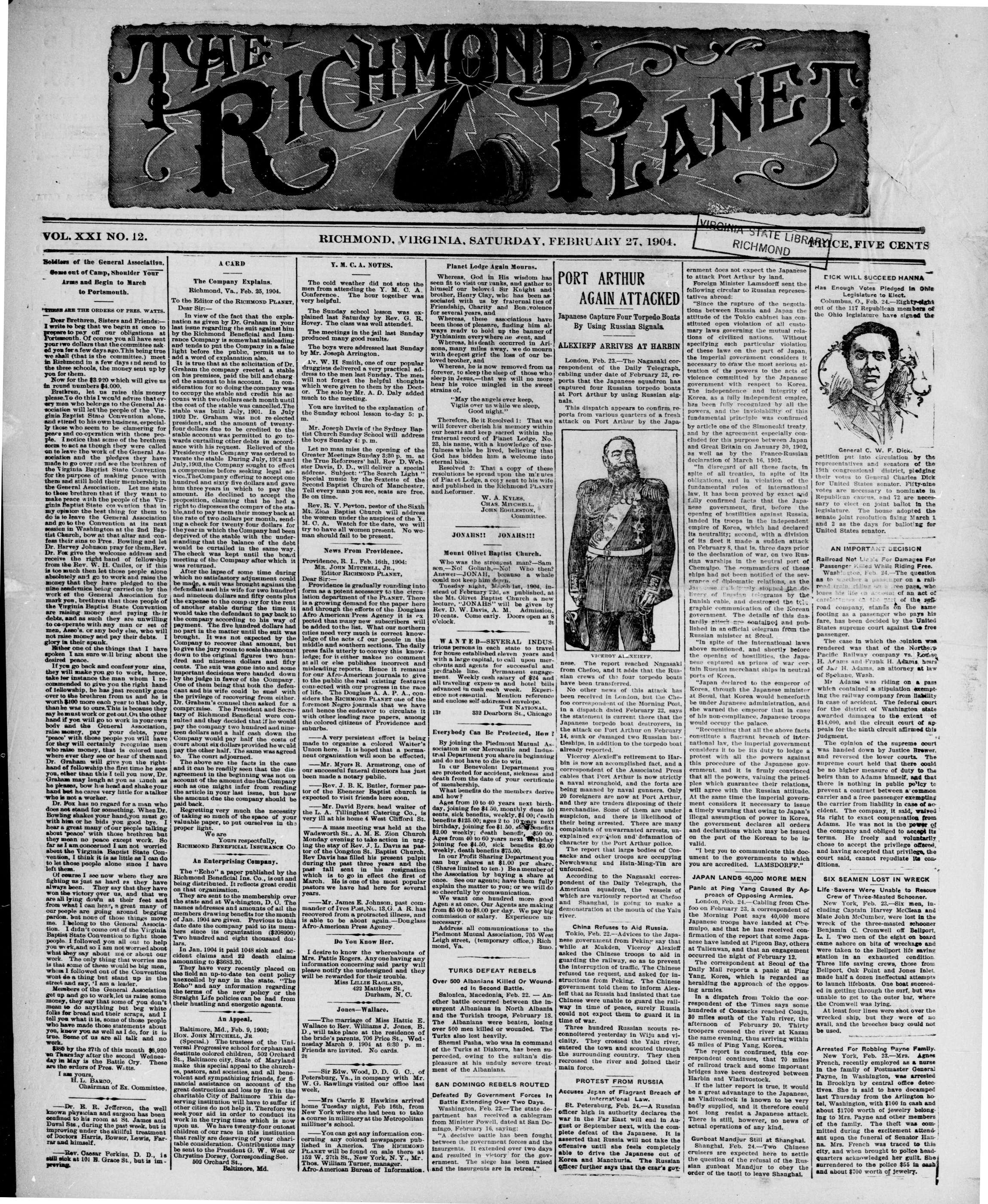
Japanese Capture Four Torpedo Boats By Using Russian Signals.
ALEXIEFF ARRIVES AT HARBIN
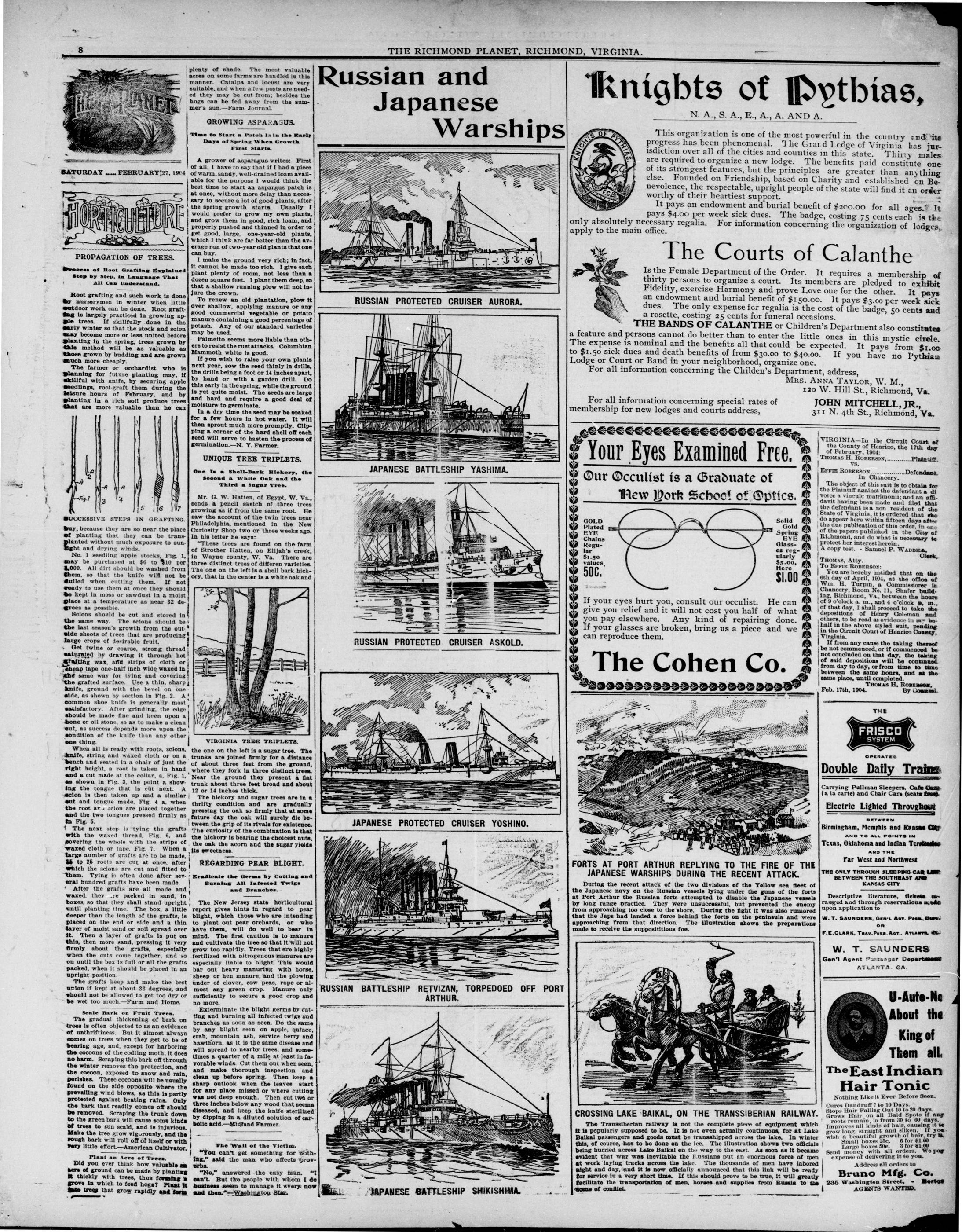
London, Feb. 23.—The Nagasaki correspondent of the Daily Telegraph, cabling under date of February 22, reports that the Japanese squadron has captured four Russian torpedo boats at Port Arthur by using Russian signals.
This dispatch appears to confirm reports from various quarters of a fresh attack on Port Arthur by the Japa-
M.
VICEROY AL-XIEIFF.
nese. The report reached Nagasaki from Chefoo, and it adds that the Russian crews of the four torpedo boats have been transferred.
No other news of this attack has been received in London, but the Chefoo correspondent of the Morning Post, in a dated dated February 22, says the statement is current there that the Japanese torpedo boat destroyers, in the attack on Port Arthur on February 14, sunk or damaged two Russian battleships, in addition to the torpedo boat already reported.
Viceroy Alexieff's retirement to Harbin is now an accomplished fact, and a correspondent of the Associated Press cables that Port Arthur is now strictly a naval stronghold, and the forts are being manned by naval gunners. Only 20 foreigners are now at Port Arthur, and they are traders disposing of their merchandise. Some of them are under suspicion, and there is likelihood of their being arrested. There are many complaints of unwarranted arrests, unexplained expulsion and defamation of character by the Port Arthur police. The report that large bodies of Cossacks and other troops are occupying Newchwang and Hsin-Ming-Tin are unfounded. According to the Nagasaki correspondent of the Daily Telegraph, the American squadron, the vessels of which are variously reported at Chefoo and Shanghai, is going to make a demonstration at the mouth of the Yalu river.
China Refuses to Aid Russia.
Tokio, Feb. 22.—Advices to the Japanese government from Peking say that while at Mukden, Viceroy Alexieff asked the Chinese troops to aid in guarding the railway, so as to prevent the interruption of traffic. The Chinese refused the request, and asked for instructions from Peking. The Chinese government told them to inform Alexieff that as Russia had insisted that the Chinese were unable to guard the railway in time of peace, surely Russia could not expect them to guard it in time of war.
Three hundred Russian scouts reconnoitered yesterday in Wiju and vicinity. They crossed the Yalu river, entered the town and scouted through the surrounding country. They then recrossed the river and joined their main force.
PROTEST FROM RUSSIA
Accuses Japan of Flagrant Breach of International Law.
St. Petersburg, Feb. 24.—A Russian officer high in authority declares the war in the Far East will end in August or September next, with the complete defeat of the Japanese. It is asserted that Russia will not take the offensive until she feels completely able to drive the Japanese out of Korea and Manchuria. The Russian officer further says that the czar's gov-
ernment does not expect the Japanese to attack Port Arthur by land. Foreign Minister Lamsdorff sent the following circular to Russian representatives abroad:
"Since the rupture of the negotiations between Russia and Japan the attitude of the Tokio cabinet has constituted open violation of all customary laws governing the mutual relations of civilized nations. Without specifying each particular violation of these laws on the part of Japan, the imperial government considers it necessary to draw the most serious attention of the powers to the acts of violence committed by the Japanese government with respect to Korea. The independence and integrity of Korea, as a fully independent empire, has been fully recognized by all the powers, and the inviolability of this fundamental principle was confirmed by article one of the Simoneski treaty, and by the agreement especially concluded for this purpose between Japan and Great Britain on January 30, 1902, as well as by the Franco-Russian declaration of March 16, 1902.
"In disregard of all these facts, in spite of all treaties, in spite of its obligations, and in violation of the fundamental rules of international law, it has been proved by exact and fully confirmed facts that the Japanese government, first, before the opening of hostilities against Russia, landed its troops in the independent empire of Korea, which had declared its neutrality; second, with a division of its fleet it made a sudden attack on February 8, that is, three days prior to the declaration of war, on two Russian warships in the neutral port of Chemulpo. The commanders of these ships had not been notified of the severance of diplomatic relations, as the Japanese militarily stopped the delivery of Russian telegrams by the Danish cable, and destroyed the geographic communication of the Korean government. The details of this disdainly attack are contained and published in an official telegram from the Russian minister at Seoul.
"In spite of the international laws above mentioned, and shortly before the opening of hostilities, the Japanese captured as prizes of war certain Russian merchant ships in neutral ports of Korea.
"Japan declared to the emperor of Korea, through the Japanese minister at Seoul, that Korea would henceforth be under Japanese administration, and she warned the emperor that in case of his non-compliance, Japanese troops would occupy the palace.
"Recognizing that all the above facts constitute a flagrant breach of international law, the imperial government considers it to be its duty to lodge a protest with all the powers against this procedure of the Japanese government, and it is firmly convinced that all the powers, valuing the principles which guarantee their relations, will agree with the Russian attitude. At the same time the imperial government considers it necessary to issue a timely warning that owing to Japan's illegal assumption of power in Korea, the government declares all orders and declarations which may be issued on the part of the Korean to be invalid.
"I beg you to communicate this document to the governments to which you are accredited. LAMSDORFF."
JAPAN LANDS 40,000 MORE MEN
Panic at Ping Yang Caused By Approach of Opposing Armes.
proach of Opposing Armies.
London, Feb. 24. - Cabling from Chefoo on February 23, a correspondent of the Morning Post says 40,000 more Japanese troops have landed at Chemulpo, and that he has received confirmation of the report that some Japanese have landed at Pigeon Bay, others at Tailenwan, and that an engagement occurred the night of February 12.
The correspondent at Seoul of the Daily Mail reports a panic at Ping Yang, Korea, which is regarded as heralding the approach of the opposing armies.
In a dispatch from Tokio the correspondent of the Times says some hundreds of Cossacks reached Conju, 30 miles south of the Yalu river, the afternoon of February 20. Thirty troopers crossed the river at Kazan the same evening, thus arriving within 45 miles of Ping Yang, Korea.
The report is confirmed, this correspondent continues, that 70 miles of railroad track and some important bridges have been destroyed between Harbin and Vladivostock. If the latter report is true, it would be a great advantage to the Japanese, as Vladivostock is known to be very badly supplied, and it therefore could not long resist a Japanese attack. There is still, however, no news of actual operations of any kind.
Gunboat Mandjur Still at Shanghai. Shanghai. Feb. 24.—Two Chinese cruisers are expected here to settle the question of the refusal of the Russian gunboat Mandjur to obey the order of the tafti to leave Shanghai.
DICK WILL SUCCEED HANNA
Has Enough Votes Pledged In Ohio
Legislature to Elect.
Columbus, O., Feb. 24.—Eighty-eight
out of the 117 Republican members of
the Ohio legislature have signed the
General C. W. F. Dick.
petition put into circulation by the representatives and senators of the 19th congressional district, pledging their votes to General Charles Dick for United States senator. Fifty-nine votes are necessary to nominate in Republican caucus, and 72 are necessary to elect on joint ballot in the legislature. The house adopted the senate joint resolution fixing March 1 and 2 as the days for balloting for United States senator.
AN IMPORTANT DECISION
Railroad Not Uitable For Damages For Passenger Killed While Riding Free. Washington, Feb 24.—The question as to weather a passenger on a railroad train, riding on a free pass, who loses his life on account of an act of carolings on the part of the railroad company, stands on the same footing as a passenger who pays his fare, has been decided by the United States supreme court against the free passenger.
The case in which the coinion was rendered was that of the Northern Pacific Railway company vs. Louise H. Adams and Frank H. Adams, heirs of Jay H. Adams, an attorney at law of Stokke, Wash.
Mr Adams was riding on a pass which contained a stipulation exempting the railway company from liability in case of accident. The federal court for the district of Washington state awarded damages to the extent of $14,000, and the court circuit of appeals for the ninth circuit affirmed this judgment.
The opinion of the supreme court was handed down by Justice Brewer, and reversed the lower courts. The supreme court held that there could be no higher measure of duty to the heirs than to Adams himself, and that there is nothing in public policy to prevent a contract between a common carrier and a free passenger exempting the carrier from liability in case of accident. The company, it said, waived its right to exact compensation from Adams. He was not in the power of the company and obliged to accept its terms. He freely and voluntarily chose to accept the privilege offered, and having accepted that privilege, the court said, cannot repudiate its conditions.
SIX SEAMEN LOST IN WRECK
Life-Savers Were Unable to Rescue Crew of Three-Masted Schooner.
New York, Feb. 23.—Six men, including Captain Harvey McClean and Mate John McCumber, were lost in the wreck of the three-masted schooner Benjamin C. Cromwell off Bellport, L. I. Two men of the eight on board came ashore on bits of wreckage and were taken to the Bellport life saving station in an exhausted condition.
Three life saving crews, those from Bellport, Oak Point and Jones Inlet made half a dozen ineffectual attempts to launch lifeboats. One boat succeeded in getting through the surf, but was unable to get to the outer bar, where the Cromwell was lying.
At least four lines were shot over the wrecked ship, but they were of no avail, and the breeches buoy could not be used.
Arrested For Robbing Payne Family.
New York, Feb. 23—Mrs. Agnes
French, recently employed as a nurse
in the family of Postmaster General
Payne, in Washington, was arrested
in Brooklyn by central office detectives. She is said to have decamped last Thursday from the Arlington hotel, Washington, with $100 in cash and about $1700 worth of jewelry belonging to Mrs. Payne and other members of the family. The theft was committed during the excitement attendant upon the funeral of Senator Hanna. Mrs. French was traced to this city, and when brought to police headquarters acknowledged her guilt. She surrendered to the police $55 in cash and about $700 worth of jewelry.
HEY PLANET
SATURDAY...FEBRUARY 27, 1904
TEMPERANCE NOTES
Five cents a drink!" Does anyone think that it is really the price of a drink?
Five cents a glass!" I hear you say,
Why, that link very much to pay."
No, indeed, it's a very small sum.
You are missing it over 'twix finger and an armband.'
And if that were all you gave away
it wouldn't be very much to pay.
The price of a drink? Let that one tell
you sleeps to night's prisoner's cell,
and vibtub, love and truth.
In the hope of manhood, the wealth of fame,
high estevoir, and noble aim.
These are the treasures thrown away
for the news of a drink from day to day.
Five cents a glass!" How Satan laughs
at the young man quarred
the bearded lion, whom knew
the terrible work that drink would do.
The price, if you want to know,
that some are willing to pay for it, go
through the wretched home, where,
with dirty windows and broken stairs,
with untouched disease like a vampire crawls
with undeterred wings o'er the molly water.
Where the innocent ones are there accurs
pay the price of another's first. We
serve a glass!" O. if that were all
the money would indeed be small;
but the money is so great we pay
we pay, and whosoever will keep account
will learn the terrible waste and blight
that follows the rulous appetite.
We center a glass!" Does anyone think
that is really the price of a drink?
L. L. Wolfe in National Advocate.
FINDS MANY WOMEN DRUNK.
Rockefeller's Cleveland Pastor
Frenches Against Liquor Habit
Among the Fair Sex.
"I tell you this question of drunken-
ness among women that confronts this
country, is a serious problem," declared
Rev. Charles A. Eaton in his sermon at
the Euclid Avenida Baptist, church.
the including hotel or the city" he continued, "I saw more women there than men, and every woman was drunk. There was not a woman nolls in the place. And there were some girls and men odw. or good families there. There was one lo so pore beautiful girl with a woman com-
emsa
sid sv
bolmU
sort ed
saw no
medtr
salmo
erion
wal in
sang a lo
quexa do
willdil mo
truo ina
esta ne
lo inp
qa lo
aldj be
truo enque edi lo
adt T. grunow arvoel "MAN WAS DRRUNK."
bluco person who "was saturated with sin.
adt of Somehow, or other this young girl had
had come to, that grillroom just for that
of volt Gunner. And, she was intoxicated.
aommo s "We are dead morally. The country
bully analyzed in a struggle for money. It
is to ode bad enough for men to go too far in
lowlaw direction, but when even women
most need over the line and go toward the
to sewow of death they strike a blow at the
all too deadly as deadly as has ever been dealt it.
vibrasnuvov. It is bad enough when a man gets
housenuvov. He is often half a brute, but in
oft ogen woman we look for something better,
and it is a sorry day for the country
when the women beeth fristhring.
TEMPERANCE NOTES.
If every person would be half as good as he expects his neighbor to be, what heaven this world would be!—National advocate.
Sometimes the very dust of our hurrying feet rises up and blinds us to the great ends that we must constantly keep in view.—Lady Henry Somerset.
Treating, "soctable" drinks and "friendly glasses" were named as most potent factors in the filling of inebriates' homes at the fortieth anniversary of the Washingtonian home.
The papers of Clearfield, Pa., report that a decided temperance movement is sweeping over the entire county. Remonstrances against liquor license applicants will be pushed with unusual vigor.
For every 566 ministers that die there are 163 deaths among farmers, 820 among carpenters, 890 among coal miners, 1,202 among plumbers, 1,361 among brewers, 1,521 among inkeepers and 2,205 among bartenders.
A license fee of $200 a year will have to be paid hereafter in Chicago for moving picture machines and mutoscopes in saloons and dance halls. This is calculated to do away with machines containing immoral pictures.
Vermont passed a license law in 1848 by a majority of only 13 votes in the state, but after a year of the licensed saloon voted it out by a majority of 13,000 votes. From the rapid change in public sentiment it begins to look as if history might repeat itself.—The American Issue.
Demands Temperate Employes.
In line with the movement to enforce stricter regulations against intoxicating
Iquors, the Northern Pacific will practically demand teototalism on the part of its employees. The Northern Pacific will be doing only what all great systems regard as a necessary guarantee that the services of their employees shall be up to the standard.
MISTAKEN CALCULATION
Shown That America's Per Capita Consumption of Liquors Is More Than Fifteen Dollars.
A recent issue of a prominent temperance paper gave the per capita of annual liquor consumption at $15 in the United States of America and $35 per capita in the German empire. The latter figure is probably not far from being right. That of our country is not half high enough. It is evidently based on the $900,000,000 of liquor consumption so generally, and erroneously accepted by prohibitionists and disputed as too high by the liquor dealers. The $900,000,000 can be shown to be about right, by analysis of the United States government customs and internal revenue returns on malt, fermented and distilled liquors. But this represents only the approximately pure liquors. This is less than one-third the manufactured and the adulterated liquors retained at the bars of our country. The extent of this has been emphasized in the recent prosecutions for adulterations of liquors on a gigantic scale. Add to this the vast amount of illicit distillation, and we have a startling grand total of not less than $3½ billion dollars. Divide this by the total of our population, as shown by the last census and it will be seen that the $15 per capita falls far astern. The view of this huge consumption—which the liquor ring dreads to have presented to the business men of the land—shows what a tremendous sponge it is to annually suck up the money that our merchants, manufacturers and farmers should get for honest work. When our commercial captains do get this into their heads, liquor makers and sellers will be driven from chambers of commerce and boards of trade, as Jesus drove the money changers from the temple.
Home market is incomparably the best market in any land. This market, the prating liquor trade has so utterly in its possession, that it gets more of the actual cash of our people than all the legitimate trade and industries of our people put together. Thus "hard times" and money panics come to us from this hellish Box of Pandora. Then, after this wholesale robbery, the exasperation of this mischief is intensified, by millions of dollars being rolled in on the tax payers for crime, insanity, pauperism, etc., created by this trade in in toxicants. It is also the compound lever of the devil, in debauching our politics, so that franchises which should be worth millions to our citizens and their children, are stolen from them in creating "Trusts," that crush by cornering food and fuel, no matter, who starves, or freezes, and that sell out the nation to aliens, at home and abroad.
Good citizens of all parties should see in all this a peril to the national life, financially, and otherwise, of ominous proportions.
POSSIBLE RESULTS OF DRINK
As the drinking season is now on, it is well to reflect that the following diseases may be directly or indirectly caused by some form of alcoholism: Acute gastric catarrh, chronic gastric catarrh, gastric dilation, intestinal indigestion, constipation, gout, cholera morbus, chronic peritonitis, dropsy of the abdomen, catarral jaundice, congestion of the liver, cirrhosis (hob-nail liver), chronic tubal nephritis (chronic Bright's disease), diabetes, mellitus, chronic bronchitis, congestion of the lungs, oedema of the lungs, lobar pneumonia, fibroid phthisis (interstitial pneumonia), chronic valvular disease of the heart, dilatation of the heart, chronic fibroid heart, fatty degeneration of the heart, palpitation of the heart, arterio bronchosis, aneurism of the aorta, meningitis, brain fever, apoplexy, congestion of the brain, brain thrombosis and embolism (in youth), nervous vertigo, temulentia (a plain drunkard), mania a potu, delirium tremens, dipsonia (alcoholic insanity, imbecility and dementia often result from dipsonia).
Alcoholism predisposes to sunstroke, chronic pleurisy, inflammation of the nerve trunks, spinal congestion, spinal meningitis, spinal sclerosis (four forms, one of which locomotor ataxia), disseminated neuritis, melanoblastia, mania (insanity), delusional insanity, phagedenic ulcer, various inflammations, a delirium that sometimes occurs after injuries and surgical operations (if an old drunkard sustains a fracture of a bone he is liable to go into delirium tremens; he may in this state attempt to destroy himself or those around him), erysipelas, blood tumor, fatty tumor, urinary calculus (from excessive use of malt liquors), monomania, general paralysis (parietic dementia), acquired feeble-mindedness, acrose nasus (whisky nose and cheeks), trifacial neuralgia. -Medical Student, in Washington Star.
Bureau of Temperance Research.
The Bureau of Temperance Research is a new organization established in Boston. Its object as explained by its secretary, F. W. Clark, is to furnish to all inquirers any information, especially of a statistical nature, which may be sought. It will endeavor to arrange and correlate all figures pertaining to both sides of the liquor question. The bureau will aim to keep in touch with the sales of liquor in the United States and other countries, and to keep temperance workers informed of all the movements of organization of both liquor dealers and employees.
Mr. Clark is just the man to fill such an office.
A Village Turned Teetotal.
A Somersetshire inkeeper, who had become bankrupt, gave as the reason for his insolvency at his public examination the statement that "the whole of the village had turned teetotal."
Marriage.
Marriage is a lottery?
Not by all the twinkling stare!
Marriage is a pottery.
Where are made the family jarel
Peek.
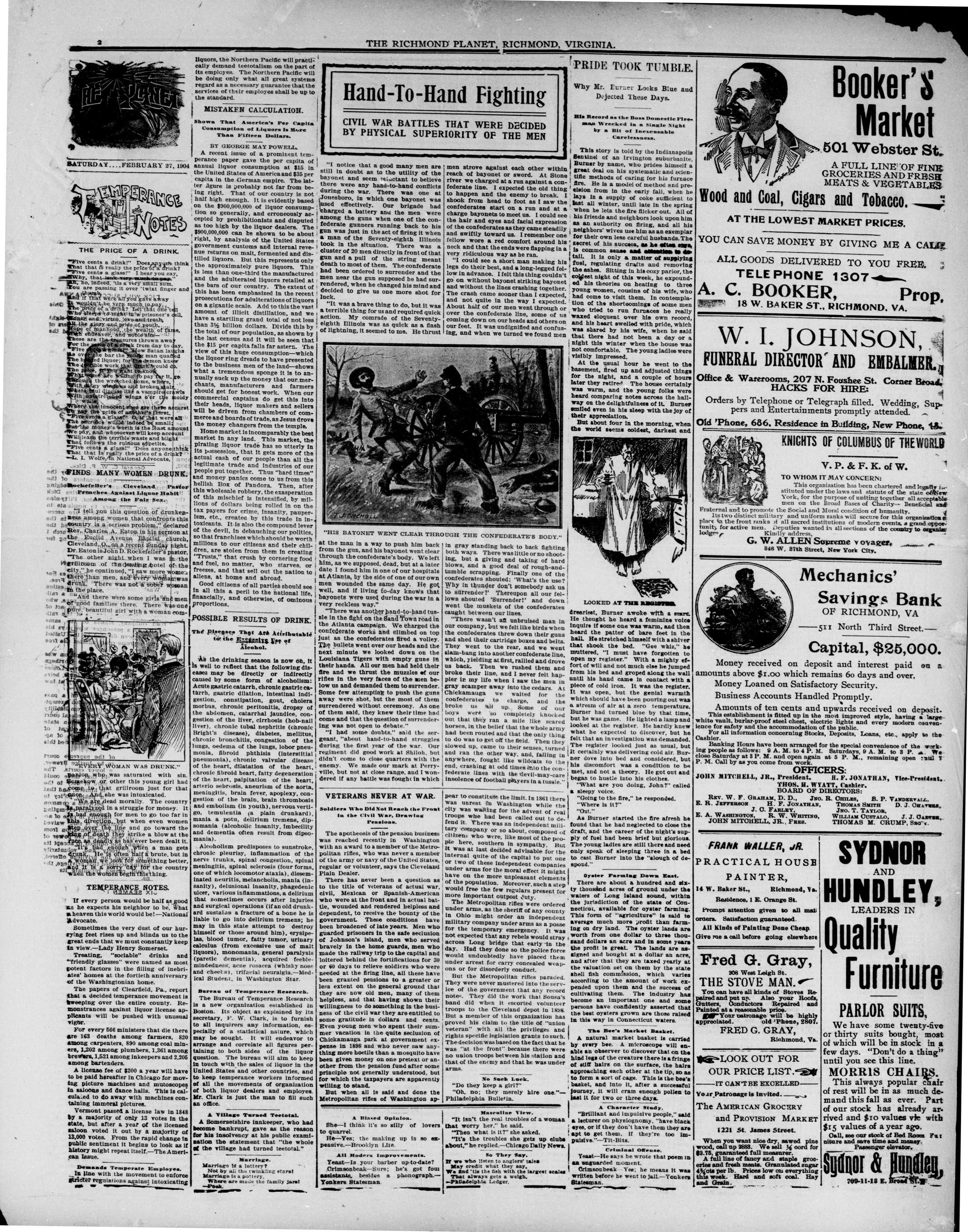
Hand-To-Hand Fighting
CIVIL WAR BATTLES THAT WERE DECIDED BY PHYSICAL SUPERIORITY OF THE MEN
T. J. MACKHILL
"HIS BAYONET WENT CLEAR THROUGH THE CONFEDERATE'S BODY."
"I notice that a good many men are still in doubt as to the utility of the bayonet and seem reluctant to believe there were any hand-to-hand conflicts during the war. There was one at Jonesboro, in which one bayonet was used effectively. Our brigade had charged a battery and the men were among the guns when one of the confederate gunners running back to his gun was just in the act of firing it when a man of the Seventy-eighth Illinois took in the situation. There was a cluster of 20 men directly in front of that gun and a pull of the string meant death to most of them. The confederate had been ordered to surrender and the men near the gun supposed he had surrendered, when he changed his mind and decided, to give us one more shot for luck.
"It was a brave thing to do, but it was a terrible thing for us and required quick action. My comrade of the Seventy-eighth Illinois was as quick as a flash of lightning, it seemed to me. He thrust
T. J. MARCHALL
"THIS BAYONET WENT CLEAR THRO
at the man in a way to push him back from the gun, and his bayonet went clear through the confederate's body. We left him, as we supposed, dead, but at a later date I found him in one of our hospitals at Atlanta, by the side of one of our own men wounded the same day. He got well, and if living fo-day knows that bayonets were used during the war in a very reckless way."
"There was another hand-to-handle tussle in the fight on the Sand Town road in the Atlanta campaign. We charged the confederate works and climbed on top just as the confederates fired a volley. The bullets went over our heads and the next minute we looked down on the Louisiana Tigers with empty gun in their hands. All our men had held their fire and we thrust the muzzles of our rifles in the very faces of the men below and demanded them to surrender. Some few attempting to push the guns away were shot, but the most of them surrendered without ceremony. As one of them said, they knew their time had come and that the question of surrendering was not open to debate.
"I had some doubts," said the sergeant, "about hand-to-handle struggles during the first year of the war. Our regiment did good work at Shiloh, but didn't come to close quarters with the enemy. We made our mark at Perryville, but not at close range, and I wondered if any battle was fought in which
VETERANS NEVER AT WAR.
Soldierz Who Did Not Reach the Front in the Civil War, Drawing Pensions.
The apotheosis of the pension business was reached recently in Washington with an award to a member of the Metropolitan rifles, who was never a member of the army or navy of the United States, regular or volunteer, says the Cleveland Plain Dealer.
There has never been a question as to the title of veterans of actual war, civil, Mexican or Spanish-American who were at the front and in actual battle, wounded and rendered helpless and dependent, to receive the bounty of the government. These conditions have been broadened of late years. Men who guarded prisoners in the safe seclusion of Johnson's island, men who served bravely in the home guards, men who made the railway trip to the capital and loitered behind the fortifications for 30 or 60 days to relieve soldiers who were needed at the firing line, all these have been granted pensions to a greater or less extent on the general ground that they are now old men, many of them helpless, and that having shown their willingness to do something in the business of the civil war they are entitled to some gratitude in dollars and cents. Even young men who spent their summer vacation in the quite seclusion of Chickamauga park at government expense in 1898 and who never saw anything more hostile than a mosquito have been given money on one pretext or another from the pension fund after some principle not generally understood, but for which the taxpayers are apparently willing to stand.
But when all is said and done the Metropolitan rifles of Washington ap-
A Blased Opinion.
She—I think it's so silly of lovers to quarrel.
He—Yes; the making up is so expensive.—Brooklyn Life.
All Modern Improvements.
Yeast—Is your barber up-to-date?
Crimsonbeak—Sure; he's got four assistants, besides a phonograph.—Yonkers Statesman.
men strove against each other within reach of bayonet or sword. At Stone river we charged at a run against a confederate line. I expected the old thing to happen and the enemy to break. I shook from head to foot as I saw the confederates start on a run and at a charge bayonets to meet us. I could see the hair and eyes and facial expression of the confederates as they came steadily and swiftly toward us. I remember one fellow wore a red comfort around his neck and that the ends were flapping in a very ridiculous way as he ran.
"I could see a short man making his legs do their best, and a long-legged fellow in advance. I felt this thing couldn't go on without bayonet striking bayonet and without the lines crashing together. The crash came sooner than I expected, and not quite in the way I expected. About half of the men went through or over the confederate line, some of us coming down on our heads and others on our feet. It was undignified and confusing, and when we weighed we found men
DUGH THE CONFEDERATE'S BODY."
in gray standing back to back fighting both ways. There was little or no shooting, but a giving and taking of hard blows, and a good deal of rough-and-tumble scrapping. Finally one of the confederates shouted: 'What's the use? Why in thunder don't somebody ask us to surrender?' Thereupon all our fellows shouted 'Surrender!' and down went the muskets of the confederates caught between our lines.
"There wasn't an unbrushed man in our company, but we felt like birds when the confederates threw down their guns and shed their cartridge boxes and belts. They went to the rear, and we went slam-bang into another confederate line, which, yielding at first, rallied and drove us back. Then we rushed them and broke their line, and I never felt happier in my life when I saw the men in gray scamper away into the cedars. At Chickamauga we waited for the confederates to charge, and the broke us all up. Some of our boys were so completely knocked out that they ran a mile like scared horses, in the belief that the whole army had been routed and that the only thing to do was to get off the field. Then they slowed up, came to their senses, turned and ran the other way, and, falling in anywhere, fought like wildcats to the end, crashing at odd times into the confederate lines with the devil-may-care insolence of football players in a russle."
pear to constitute the limit. In 1861 there was unrest in Washington while the city was waiting for the advent of real troops who had been called out to defend it. There was an independent military company or so about, composed of citizens who were, like most of the people here, southern in sympathy. But it was at last decided advisable for the internal quite of the capital to put one or two of these independent companies under arms for the moral effect it might have on the more unpleasant elements of the population. Moreover, such a step would free the few regulars present for more important outpost duty.
The Metropolitan rifles were ordered under arms, as the sheriff of any county in Ohio might order an independent military company under arms as a pose for the temporary emergency. It was not expected that any rebels would stray across Long bridge that early in the day. Had they done so the police force would undoubtedly have placed them under arrest for carry concealed weapons or for disorderly conduct. But the Metropolitan rifles paraded. They were never mustered into the service of the government that any record notes. They did the work that Sousa's band did when it escorted volunteer troops to the Cleveland depot in 1898. But a member of this organization has proved his claim to the title of "union veteran" with all the privileges and rights specific legislation grants to such. The decision was based on the fact that he was "at the front" because there were no union troops between his station and that of the enemy and that he was under arms.
"Do they keep a girl?"
"Oh, no; they merely hire one."—Philadelphia Bullein.
Masculine View.
"It isn't the real troubles of a woman that worry her," he said.
"Then what is it?" she asked.
"It's the troubles she gets up clubs about," he replied.—Chicago Daily News.
So They Say.
If we who listen to anglers' tales May credit what they say.
We find 'tis the fish with the largest scales That always gets a weigh.
—Philadelphia Ledger.
Why Mr. Eurner Looks Blue and Dejected These Days.
His Record as the Boss Domestic Fireman Wrecked in a Single Night by a Bit of Inexcusable Carelessness.
This story is told by the Indianapolis sentinel of an Irvington suburbanite, Burner by name, who prides himself a great deal on his systematic and scientific methods of caring for his furnace fire. He is a model of method and precision from in the early fall, when he lays in a supply of coke sufficient to last all winter, until late in the spring when he lets the fire flicker out. All of his friends and neighbors look upon him as an authority on firing, and all his neighbors' wives use him as an exemplar for their own less careful husbands. The secret of his success, as he often tall, is common sense and attention to detail. It is only a matter of supplying fuel, regulating draits and removing the anhes. Sitting in his cozy parlor, the coldest night of this week, he expounded his theories on heating to three young women, cousins of his wife, who had come to visit them. In contemplation of the shortcomings of some men who tried to run furnaces he really waxed eloquent over his own record, and his heart swelled with pride, which was shared by his wife, when he said that there had not been a day or a night this winter when the house was not comfortable. The young ladies were visibly impressed.
At the usual hour he went to the basement, fired up and adjusted things for the night, and a couple of hours later they retired. The house certainly was warm, and the young folks were heard comparing notes across the hallway on the delightfulness of it. Burner smiled even in his sleep with the joy of their appreciation. But about four in the morning, when the world seems coldest, darkest and
LOOKED AT THE REGISTER
drearest, Burner awoke with a声哭. He thought he heard a feminine voice inquire if some one was warm, and then heard the patter of bare feet in the hall. He stretched himself with a shiver that shook the bed. "Gee whiz," he muttered, "I must have forgotten to open my register." With a mighty effort of will and not much else he jumped from his bed and groped along the wall until his hand came in contact with a piece of cold iron. It was the register. It was open, but the genial warmth which should have been pouring out was a stream of air at a zero temperature. Burner had turned blue by that time, but he was game. He lighted a lamp and looked at the register. He hardly knew what he expected to discover, but he felt that an investigation was demanded. The register looked just as usual, but it certainly was delivering cold air. Burner dove into bed and considered, but his discomfort was a condition to be met, and not a theory. He got out and began to hustle into his clothes.
"What are you doing, John?" called a sleepy voice. "Going to the fire," he responded. "Where is it?" "Out." As Burner started the fire afresh he found that he had neglected to close the draft, and the career of the night's supply of fuel had been brief but glorious. The young ladies are still there and need only speak of sleeping three in a bed to cast Burner into the "alough of despond."
Oyster Farming Down East. There are about a hundred and sixty thousand acres of ground under the waters of Long Island sound, within the jurisdiction of the state of Connecticut, available for oyster farming. This form of "agriculture" is said to average much more profit than farming on dry land. The oyster lands are worth from one dollar to three thousand dollars an acre and in some years the profit is great. The lands are assigned and bought at a dollar an acre, and after that they are taxed yearly at the valuation set on them by the state shell commission, which varies according to the amount of work expended upon them and the success of cultivating them. The industry has become an important one and some persons have confidently asserted that the best oysters grown are those raised in this way in Connecticut waters.
The Bee's Market Basket.
A natural market basket is carried by every bee. A microscope will enable an observer to discover that on the hind legs of the creature there is a fringe of stiff hairs on the surface, the hairs approaching each other at the tip, so as to form a sort of cage. This is the bea's basket, and into it, after a successful journey, it will cram enough pollen to last it for two or three days.
A Character Study
"Brilliant and impulsive people," said a lecturer on physiognomy, "have black eyes, or if they don't have them they are apt to get them, if they're too impulsive." -Tit-Bits.
Crimsonbeak—Yes; he means it was written before he went to jail.—Yonkers Statesman.
W. H. H.
Wood and Coal, Cigar
AT THE LOWEST M
YOU CAN SAVE MONEY
ALL GOODS DELIVER
TELEPHONE
A. C. BOOKER
18 W. BAKER ST
W. I. JO
FUNERAL DIRECTOR
Office & Warerooms, 207 N.
HACKS F
Orders by Telephone or Te
pers and Entertainme
Old 'Phone, 686, Residence
Cigars and Tobacco.
NOWEST MARKET PRICES.
MONEY BY GIVING ME A CALL
DELIVERED TO YOU FREE.
PHONE 1307
OKER, Prop.
OKER ST., RICHMOND, VA.
JOHNSON,
RECTOR AND EMBALMER.
Ins, 207 N. Foushee St. Corner Broad.
BACKS FOR HIRE:
One or Telegraph filled. Wedding, Sup-
tertainments promptly attended.
Residence in Building, New Phone, 18.
KNIGHTS OF COLUMBUS OF THE WORLD
AT THE LOWEST MARKET PRICES.
YOU CAN SAVE MONEY BY GIVING ME A CALL.
ALL GOODS DELIVERED TO YOU FREE.
TELEPHONE 1307
A. C. BOOKER, Prop.
18 W. BAKER ST., RICHMOND, VA.
W. I. JOHNSON, FUNERAL DIRECTOR AND EMBALMER.
Office & Warerooms, 207 N. Foushee St. Corner Broad HACKS FOR HIRE: Orders by Telephone or Telegraph filled. Wedding, Suppers and Entertainments promptly attended.
TO WHOM IT MAY CONCERN:
This organization has been chartered and legally instituted under the laws and statute of the state of New York, for the purpose of uniting together all acceptable men on the Broad Bases of Charity—Beneficial and the Social and Moral condition of humanity.
ALLEN Supreme voyager,
N. 87th Street, New York City.
Mechanics'
Savings Bank
OF RICHMOND, VA
—511 North Third Street.—
This organization has been chartered and legally situated under the laws and statute of the state of New York, for the purpose of uniting together all acceptable men on the Broad Bases of Charity—Beneficial and
Fraternal and to promote the Social and
Its two distinct military and uniform
place in the front ranks of all sacred in
tunity for active men. Deputies want
lodges
Kindly address,
G. W. ALLEN S
846 W. 87th Street
Praternal and to promote the social and Moral condition of humanity. Its two distinct military and uniform ranks will secure for this organization a place in the front ranks of all sacred institutions of modern events, a grand opportunity for active men. Deputies wanted in all sections of the country to organize lodges Kindly address, G. W. ALLEN Supreme voyager, 846 W. 87th Street, New York City.
Money received on deposit amounts above $1.00 which re-
Money Loaned on Satisfaction
Business Accounts Handl-
Amounts of ten cents and
This establishment is fitted up in the white vault, burlar-proof steel chest, ele-
ence for safety and the accommodation
For all information concerning Stock Cashier.
Banking Hours have been arranged
people as follows: 9 A. M. to 4 P. M. close Saturday at 8 P. M. and open again P. M. Call by as you come from work.
OFFIC
JOHN MITCHELL, JR., President.
THON. H. W.
BOARD OF
REV. W. F. GRAHAM, D. D., JN
E. R. JEFFERSON H. F. JONATHAN
J. O. FARLEY,
E. A. WASHINGTON, R. W. WHITING,
JOHN MITCHELL, JR., PRES.
d on deposit and interest paid on a
e which remains 60 days and over.
on Satisfactory Security.
ents Handled Promptly.
cents and upwards received on deposit.
atted up in the most improved style, having a large
seel chest, electric lights and every modern conven-
commodation of the public.
ocering Stocks, Deposits, Loans, etc., apply to the
open arranged for the special convenience of the work.
M. to 4 P. M. Saturdays, 9 A. M. to 3 P. We
ad open again at 5 P. M., remaining open until 7
from work.
OFFICERS:
President. H. F. JONATHAN, Vice-President.
CHOS. H. WYATT, Cashier.
BOARD OF DIRECTORS:
D. D., JNO. R. CHILES, B. P. VANDERVAILL,
F. JONATHAN, THOMAS SMITH D. J. CHAVERS,
SLEY, JNO. T. TAYLOR.
Money received on deposit and interest paid on amounts above $1.00 which remains 60 days and over. Money Lapsed on Satisfaction Co.
Money Loaned on Satisfactory Security.
Business Accounts Handled Promptly.
Amounts of ten cents and upwards received on deposit.
This establishment is fitted up in the most improved style, having a large white vault, burlar-proof steel chest, electric lights and every modern convenience for safety and the accommodation of the public.
For all information concerning Stocks, Deposits, Loans, etc., apply to the Cashier.
Banking Hours have been arranged for the special convenience of the working people as follows: 9 A.M. to 4 P.M. Saturdays, 9 A.M. to 3 P.M. We close Saturday at 8 P.M. M. and open again at 5 P.M., remaining open :called 7 P.M. Call by as you come from work.
OFFICERS:
JOHN MITCHELL, JR., President. H. F. JONATHAN, Vice-President.
THOS. H. WYATT, Cashier.
DOCTOR
PRACTICAL HOUSE
PAINTER,
14 W. Baker St., Richmond, Va.
Residence, 1 E. Orange St.
Prompt attention given to all mail
orders. Satisfaction guaranteed.
All Kinds of Painting Done Cheap.
Give rue a call before going elsewhere
Fred G. Gray,
208 West Leigh St.
THE STOVE MAN.
You can have all kinds of Stoves Repaired and put up. Also your Roofs, Gutters, Conductors Repaired and Painted at a reasonable price.
Your patronage will be highly appreciated.
old 'Phone, 2807.
FRED G. GRAY,
Richmond, Va.
IT CAN'T BE EXCELLED
Your Patronage is Invited.
The AMERICAN GROCERY
and PROVISION MARKET
When you want nice dry, sawed pine wood, call up 2883. We sell 1/2 cord for $3.75, guaranteed full measurer.
A full line of fancy and staple groceries and fresh meats. Granulated sugar 4/8 cts per lb. Prices low on everything this week. Hard and soft coal. Hay and Grain.
---
```markdown
```
LAURENCE
FRANK WALLER, JR.
LOOK OUT FOR
Booker's Market
A FULL LINE OF FINE GROCERIES AND FRESH MEATS & VEGETABLES
V. P. & F. K. of W.
Capital, $25,000.
WILLIAM CUSTALO, J. J. GARTER,
THOMAS M. CRUMP, 580° x.
SYDNOR AND HUNDLEY, LEADERS IN Quality Furniture
We have some twenty-five or thirty suits bought, most of which will be in stock in a few days. "Don't do a thing" until you see this line. MORRIS CHAIRS.
This always popular chair of rest will be in as much demand this fall as ever. Part of our stock has already arrived and $10 values vie with $15 values of a year ago. Call, see our stock of Bed Rooms For nature and save time and money. Passenger elevator. Sydnor & Hundley, 709-11-18 E. Broad St.
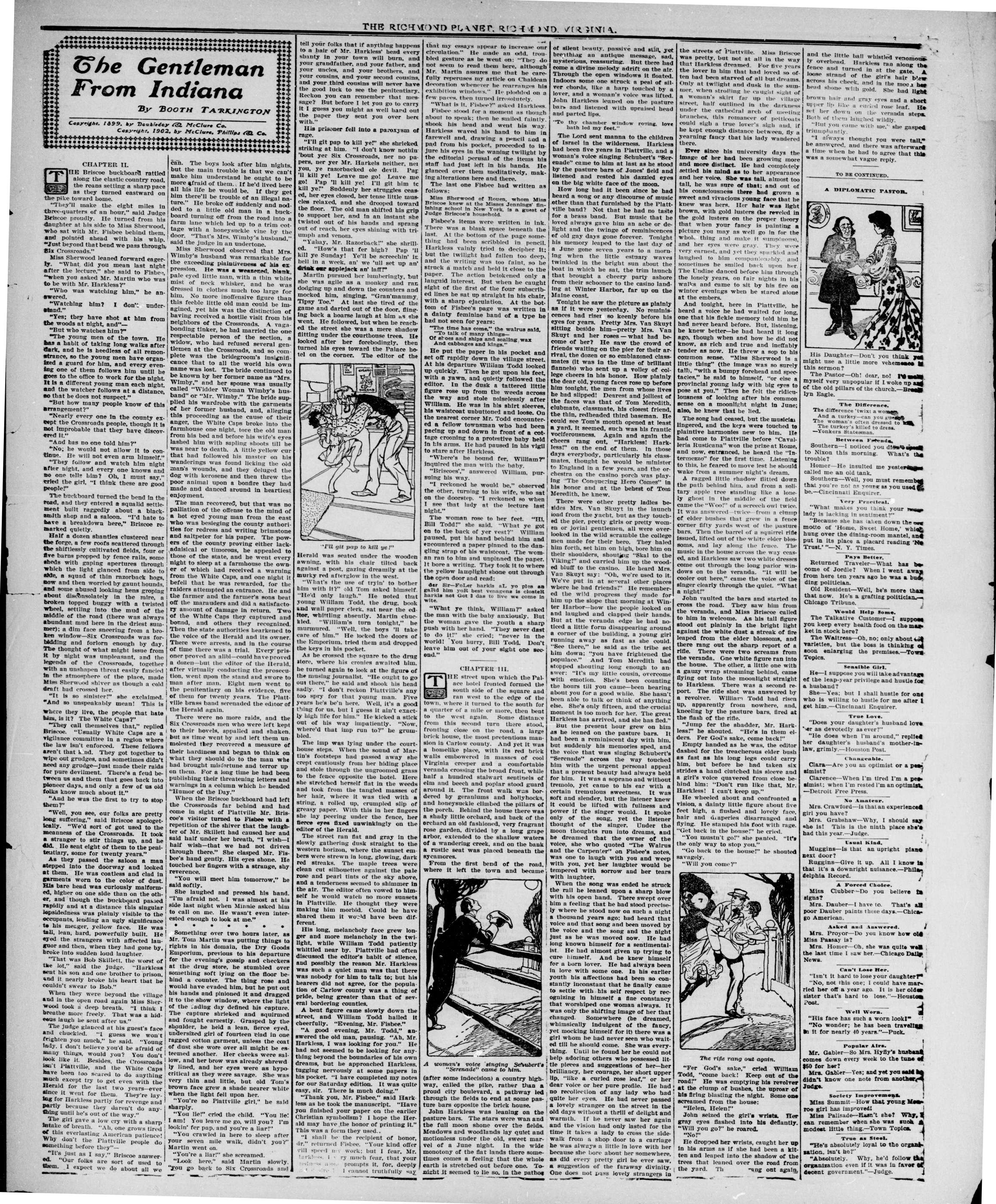
The Gentleman From Indiana
By BOOTH TARKINGTON
Copyright, 1899, by Doubleday McClure Co.
Copyright, 1902, by McClure, Phillips Co.
CHAPTER II
T
THE Briscoe buckboard rattled along the elastic country road, the roars setting a sharp pace as they turned eastward on the pike toward home.
"They'll make the eight miles in three-quarters of an hour," said Judge Briscoe proudly. He turned from his daughter at his side to Miss Sherwood, who sat with Mr. Fisbea behind them, and pointed ahead with his whip. "Just beyond that bend we pass through Six Crossroads."
Miss Sherwood leaned forward eagerly. "What did you mean last night after the lecture," she said to Fisbea, "when you asked Mr. Martin who was to be with Mr. Harkless?"
"Who was watching him," he answered.
"Watching him? I don't understand."
"Yes; they have shot at him from the woods at night, and"—
"But who
"The young men of the town. He has a habit of taking long walks after dark, and he is heedless of all remonstrance, so the young men have organized a guard for him, and every evening one of them follows him until he goes to the office to work for the night. It is a different young man each night, and the watcher follows at a distance, so that he does not suspect." "But how many people know of this arrangement?" "Nearly every one in the county except the Crossroads people, though it is not improbable that they have discovered it." "And has no one told him?" "No; he would not allow it to continue. He will not even arm himself." "They follow and watch him night after night, and every one knows and no one tells him? Oh, I must say," cried the girl, "I think these are good people."
The buckboard turned the bend in the road, and they entered a squall settlement built raggedly about a blacksmith shop and a saloon. "I'd hate to have a breakdown here," Briscoe remarked quietly.
Half a dozen shanties clustered near the forge, a few roofs scattered through the shiftlessly cultivated fields, four or five barns propped by fence rails, some sheds with gaping apertures through which the light glanced from side to side, a squad of thin razorback hogs, now and then worried by gaurt hounds, and some abused looking hens groping about disconsolately in the mire, a broken捆 buggy with a twisted wheel, settling into the mud of the middle of the road (there was always abundant mud here in the driest summer); a dim face sneering from a broken window—Six Crossroads was forbidding and forlorn enough by day. The thought of what might issue from it by night was unpleasant, and the legends of the Crossroads, together with an unshapen threat easily fancied in the atmosphere of the place, made Miss Sherwood shiver as though a cold draft had crossed her.
"It is so sinister!" she exclaimed. "And so unspeakably mean! This is where they live, the people that hate him, is it? The White Caps?" "They call themselves that," replied Briscoe. "Usually White Caps are a vigilance committee in a region where the law isn't enforced. These fellows aren't that kind. They got together to wipe out grudges, and sometimes didn't need any grudge—just made their raids for pure devilment. There's a feud between us and them that goes back into pioneer days, and only a few of us old folks know much about it." "And he was the first to try to stop them?" "Well, you see, our folks are pretty long suffering," said Briscoe apologetically. "We'd sort of got used to the meanness of the Crossroads. It took a stranger to stir things up, and he did. He sent eight of them to the pententary, some for twenty years."
As they passed the saloon a man stepped into the doorway and looked at them. He was coatless and clad in garments worn to the color of dust. His bare head was curiously malformed, higher on one side than on the other, and though the buckboard passed rapidly and at a distance this singular lepaidedness was plainly visible to the occupants, lending an ugly significance to his meager, yellow face. He was tall, lean, hard, powerfully built. He eyed the strangers with affected languor and then, when they had gone by, broke into sudden loud laughter.
"That was Bob Skilllett, the worst of the lot," said the judge. "Harkless sent his son and one brother to prison, and it nearly broke his heart that he couldn't swear to Bob."
When they were beyond the village and in the open road again Miss Sherwood took a deep breath. "I think I breathe more freely. That was a hideous laugh he sent after us."
The judge glanced at his guest's face and chuckled. "I guess we won't frighten you much," he said. "Young lady, I don't believe you'd be afraid of many things, would you? You don't look like it. Besides, the Crossroads isn't Plattville and the White Caps have been too scared to do anything much except try to get even with the Herald for the last two years—ever since it went for them. They're laying for Harkless partly for revenge and partly because they daren't do anything until he's out of the way."
The girl gave a low cry with a sharp intake of breath. "Ah, one grows tired of this everlasting American patience! Why don't the Plattville people do something before they"—
"It's just as I say," Briscoe answered. "Our folks are sort of used to them. I expect we do about all we
can. The boys look after him nights, but the main trouble is that we can't make him understand he ought to be more graid of them. If he'd lived here all his life he would be. If they get him there'll be trouble of an illegal nature." He broke off suddenly and nodded to a little old man in a buckboard turning off from the road into a farm lane which led up to a trim cottage with a honeysuckle vine by the door. "That's Mrs. Wimby's husband," said the judge in an undertone.
Miss Sherwood observed that Mrs. Wimby's husband was remarkable for the exceeding plaintiveness of his expression. He was a weazened, blank, pale eyed little man, with a thin white mist of neck whisker, and he was dressed in clothes much too large for him. No more inoffensive figure than this feeble little old man could be imagined, yet his was the distinction of having received a hostile visit from his neighbors of the Crossroads. A vagabond tinker, he had married the one respectable person of the section, a widow, who had refused several gentlemen at the Crossroads, and so complete was the bridegroom's insignificance that to all the world his own name was lost. The bride continued to be known by her former name as "Mrs. Wimby," and her spouse was usually called "Widder Woman Wimby's husband" or "Mr. Wimby." The bride supplied his wardrobe with the garments of her former husband, and, alleging this proceeding as the cause of their anger, the White Caps broke into the farmhouse one night, tore the old man from his bed and before his wife's eyes lashed him with sapling shoots till he was near to death. A little yellow cur that had followed his master on his wanderings was found licking the old man's wounds, and they deluged the dog with kerosene and then threw the poor animal upon a bonfire they had made and danced around in heartiest enjoyment.
The man recovered, but that was no palliation of the offense to the mind of a hot eyed young man from the east who was besieging the county authorities for redress and writing brimstone and saltpeter for his paper. The powers of the county proving either lack-adalisical or timorous, he appealed to those of the state, and he went every night to sleep at a farmhouse the owner of which had received a warning from the White Caps, and one night it befell that he was rewarded, for the raiders attempted an entrance. He and the farmer and the farmer's son beat off the maudrauds and did a satisfactory amount of damage in return. Two of the White Caps they captured and bound, and others they recognized. Then the state authorities hearkened to the voice of the Herald and its owner. There were arrests, and in the course of time there was a trial. Every prisoner proved an alibi—could have proved a dozen—but the editor of the Herald, after virtually conducting the prosecution, went upon the stand and swore to man after man. Eight men went to the penitentiary on his evidence, five of them for twenty years. The Platville brass band serenaded the editor of the Herald again.
There were no more raids, and the Six Crossroads men who were left kept to their hovels, appalled and shaken, but as time went by and left them unmolested they recovered a measure of their hardiness and began to think on what they should do to the man who had brought misfortune and terror up on them. For a long time he had been publishing their threatening letters and warnings in a column which he headed "Humor of the Day."
When the Briscoe buckboard had left the Crossroads far behind and had come in sight of Plattville Mr. Briscoe's visitor turned to Fisbee with a repetition of the shiver that the laughter of Mr. Skillett had caused her and said half under her breath, "I wish-I half wish—that we had not driven through there." She clasped Mr. Fisbee's hand gently. His eyes shone. He touched her fingers with a strange, shy reverence.
"You will meet him tomorrow," he said softly. She laughed and pressed his hand. "I'm afraid not. I was almost at his side last night when Minnie asked him to call on me. He wasn't even interested enough to look at me."
Something over two hours later, as Mr. Tom Martin was putting things to rights in his domain, the Dry Goods Emporium, previous to his departure for the evening's gossip and checkers at the drug store, he stumbled over something soft lying on the floor behind a counter. The thing rose and would have evaded him, but he put out his hands and pinioned it and dragged it to the show window, where the light of the leading day defined his capture. The capture shrieked and squirmed and fought earnestly. Grasped by the shoulder, he held a lean, fierce eyed, undersized girl of fourteen clad in one ragged cotton garment, unless the coat of dust she wore over all might be esteemed another. Her cheeks were sallow, and her brow was already shrewdly lined, and her eyes were as hypocritical as they were savage. She was very thin and little, but old Tom's brown face grew a shade nearer white when the light fell upon her.
"You're no Plattville girl," he said sharply.
"You lie!" cried the child. "You lie! I am! You leave me go, will you? I'm lookin' fer pap, and you're a liar!"
"You crawled in here to sleep after your seven mile walk, didn't you?" Martin went on.
"You're a liar!" she screamed.
"Look here!" said Martin slowly. "you go back to Six Crossroads and
THE RICHMOND PLANET, RICHMOND, VIRGINIA
tell your folks that if anything happens to a hair of Mr. Harkless' head every shanty in your town will burn, and your grandfather, and your father, and your uncles, and your brothers, and your consins, and your second cousins, and your third cousins will never have the good luck to see the penitentiary. Reckon you can remember that message? But before I let you go to carry it I guess you might as well hard out on the paper they sent you over here with."
His prisoner fell into a paroxysm of rage.
"I'll git pap to kill ye!" she shrieked, striking at him. "I don't know nothin' bout yer Six Crossroads, nor no papers, ner yer Mr. Harkels neither, ner you, ye razorbacked ole devil. Pap 'kill he儿! Leave me go! Leave me go! Pap 'kill he儿! I'll git him to kill ye!" Suddenly her struggles ceased, her eyes closed, her tense little muscles relaxed, and she drooped toward the floor. The old man shifted his grip to support her, and in an instant she twisted out of his hands and sprang out of reach, her eyes shining with triumph and venom.
"Yahay, Mr. Razorback!" she shrilled. "How's that fer high?" Pap 'll kill ye Sunday! Ye'll be screechin' in hell in a week, an' we 'll set up an' drink our applejack an' laff!"
Martin pursued her lumberingly, but she was agile as a monkey and ran dodging up and down the counters and mocked him, singing, "Gran'mammy, Tipsy Toe." At last she tired of the game and darted out of the door, flinging back a hoarse laugh at him as she went. He followed, but when he reached the street she was a mere shadow fitting under the courthouse trees. He looked after her forebodingly, then turned his eyes toward the Palace hotel on the corner. The editor of the
THE BARBER
"I'll git pap to kill ye!"
Herald was seated under the wooden awning, with his chair tilted back against a post, gazing dreamily at the murky red afterglow in the west.
"What's the use of trin' to bother him with it?" old Tom asked himself.
"He'd only laugh." He noted that young William Todd, the drug, book and wall paper clerk, sat near the editor, whittling absently. Martin chucked. "William's turn tonight," he murmured. "Well, the boys 'll take care of him." He locked the doors of the Emporium, tried them and dropped the keys in his pocket.
As he crossed the square to the drug store, where his cronies awaited him, he turned again to look at the figure of the musing journalist. "He ought to go out there," he said and shook his head sadly. "I don't reckon Phatville's any too spry for that young man. Five years he's be'n here. Well, it's a good thing for us, but I guess it ain't exactly high life for him." He kicked a stick out of his way impatiently. "Now, where'd that imp run to?" he grumbled.
The imp was lying under the courthouse steps. When the sound of Martin's footsteps had passed away she crept cautiously from her hiding place and stole through the ungroomed grass to the fence opposite the hotel. Here she stretched herself flat in the weeds and took from the tangled masses of her hair, where it was tied with a string, a rolled up, crumpled slip of greasy paper. With this in her fingers she lay peering under the fence, her fierce eyes fixed unwinkingly on the editor of the Herald.
The street ran flat and gray in the slowly gathering dusk straight to the western horizon, where the sunset embers were strewn in long, glowing, dark red streaks. The maple trees were clean cut silhouettes against the pale rose and pearl tints of the sky above, and a tenderness seemed to shimmer in the air. The editor often vowed to himself he would watch no more sunsets in Platville. He thought they were making him morbid. Could he have shared them it would have been different.
His long, melancholy face grew longer and more melancholy in the twilight, while William Todd patiently whittled near by. Platville had often discussed the editor's habit of silence, and possibly the reason Mr. Harkless was such a quiet man was that there nobody for him to talk to; but his hearers did not agree, for the population of Carlow county was a thing of pride, being greater than that of several bordering counties.
A bent figure came slowly down the street, and William Todd halled it cheerfully. "Evening, Mr. Fisbee."
"A good evening, Mr. Todd," answered the old man, pausing. "Ah, Mr. Harkless, I was looking for you." He had not seemed to be looking for anything beyond the boundaries of his own dreams, but he approached Harkless, tugging nervously at some papers in his pocket. "I have completed my notes for our Saturday edition. It was quite easy, sir. There is much doing."
"Thank you, Mr. Fisbee," said Harkless as he took the manuscript. "Have you finished your paper on the earlier Christian symbolism? I hope the Herald may have the honor of printing it." This was a form they used.
"I shall be the recipient of honor, dr," returned Fisbee. "Your kind offer will speed my work; but I fear, Mr. Harkless. I very much fear, that your indoles moon prompts it, for, deeply I cannot truthfully say
that my essays appear to increase our circulation." He made an odd, troubled gesture as he went on: "They do not seem to read them here, although Mr. Martin assures me that he carefully reperes my article on Chaldean decoration whenever he rearranges his exhibition windows." He plodded on a few paces, then turned irresolutely.
"What is it, Fisbee?" asked Harkless. Fisbee stood for a moment as though about to speak; then he smiled faintly. shook his head and went his way. Harkless waved his hand to him in farewell and, drawing a pencil and a pad from his pocket, proceeded to injure his eyes in the waning twilight by the editorial perusal of the items his staff had just left in his hands. He glanced over them meditatively, making alterations here and there.
The last one Fisbee had written as follows:
Miss Sherwood of Rouen, whom Miss Briscoe knew at the Misses Jennings' finishing school in New York, is a guest of Judge Briscoe's household.
Fisbee's items were written in ink. There was a blank space beneath the last. At the bottom of the page something had been scribbled in pencil. Harkless valyly tried to decipher it; but the twilight had fallen too deep, and the writing was too faint, so he struck a match and held it close to the paper. The action betokened only a languid interest. But when he caught sight of the first of the four subscribed lines he sat up straight in his chair, with a sharp ejaculation. At the bottom of Fisbee's page was written in a dainty feminine hand of a type he had not seen for years:
"The time has come," the walrus said,
"To talk of many things.
Of shoes and ships and sealing, wax
And cabbages and kings."
He put the paper in his pocket and set off rapidly down the village street. At his departure William Todd looked up quickly. Then he got upon his feet, with a yawn, and quietly followed the editor. In the dusk a tattered little figure rose up from the weeds across the way and stole noiselessly after William. He was in his shirt sleeves, his waistcoat unbuttoned and loose. On the nearest corner Mr. Todd encountered a fellow townsman who had been pacing up and down in front of a cottage crooning to a protestive baby held in his arms. He had paused in his vigil to stare after Harkless.
"Where's he bound fer, William?"
inquired the man with the baby.
"Briscoes," answered William, pursuing his way.
"I reckoned he would be," observed the other, turning to his wife, who sat on the doorstep. "I reckoned so when I see that lady at the lecture last night."
The woman rose to her feet. "Hi, Bill Todd!" she said. "What ye got on to the back of yer vest?" William paused, put his hand behind him and encountered a paper pinned to the dangling strap of his waistcoat. The woman ran to him and unplinned the paper, it bore a writing. They took it to where the yellow lamplight shone out through the open door and read:
der Sir—FoLer harkls aL yo ples an galdf him yor best vengemens is cloister harkls not G $3 das to live we come in wite.
"What ye think, William?" asked the man with the baby anxiously. But the woman gave the youth a sharp push with her hand. "They never dast to do it!" she cried; "never in the world! You hurry, Bill Todd. Don't leave him out of your sight one second."
CHAPTER 111
THE street upon which the Palace hotel fronted formed the south side of the square and ran west to the edge of the town, where it turned to the south for a quarter of a mile or more, then bent to the west again. Some distance from this second turn there stood, fronting close on the road, a large brick house, the most pretentious mansion in Carlow county. And yet it was a homelike place, with its red brick walls embowered in masses of cool Virginia creeper and a comfortable veranda crossing the broad front, while half a hundred stalwart sentinels of elm and beech and poplar stood guard around it. The front walk was bordered by geraniums and hollyhocks, and honeysuckle climbed the pillars of the porch. Behind the house there was a shady little orchard, and back of the orchard an old fashioned, very fragrant rose garden, divided by a long grape arbor, extended to the shallow waters of a wandering creek, and on the bank a rustic seat was placed beneath the sycamores.
From the first bend of the road,
where it left the town and became
to assist
A woman's voice singing Schubert's "Serenade" came to him.
(after some indecision) a country highway, called the pike, rather than a proud city boulevard, a pathway led through the fields to end at some pasture bars opposite the brick house.
John Harkless was leaning on the pasture bars. The stars were wan and the full moon shone over the fields.
Meadows and woodlands lay quiet and motionless under the old, sweet marvel of a June night. In the wide monotony of the flat lands there sometimes comes a feeling that the whole earth is stretched out before one. Tonight it seemed to lie so, in the pathos
of silent beauty, passive and slit, yet bretting an antique message, sad, mysterious, reassuring. But there had come a divine melody adrift on the air. Through the open windows it floated. Indoors some one struck a peal of silver chords, like a harp touched by a lover, and a woman's voice was lifted. John Harkless leaned on the pasture bars and listened with upraised head and parted lips.
"To thy chamber window roving, love bath led my feet."
The Lord sent manna to the children of Israel in the wilderness. Harkless had been five years in Plattville, and a woman's voice singing Schubert's "Serenade" came to him at last as he stood by the pasture bars of Jones' field and listened and rested his dazzled eyes on the big white face of the moon.
How long had it been since he had heard a song or any discourse of music other than that furnished by the Plattville band? Not that he had no taste for a brass band. But music that he loved always gave him an ache or delight and the twinge of reminiscences of old gay days gone forever. Tonight his memory leaped to the last day of a June gone seven years to a morning when the little estuary waves twinkled in the bright sun about the boat in which he sat, the trim launch that brought a cheery party ashore from their schooner to the casino landing at Winter Harbor, far up on the Maine coast.
Tonight he saw the picture as plainly as if it were yesterday. No reminiscences had riser so keenly before his eyes for years. Pretty Mrs. Van Skuyt sitting beside him—pretty Mrs. Van Skuyt and her roses—what had become of her? He saw the crowd of friends waiting on the plier for their arrival, the dozen or so emblazoned classmates (it was in the time of brilliant flannels) who sent up a volley of college cheers in his honor. How plainly the dear old, young faces rose up before him tonight, the men from whose lives he had slipped! Dearest and jollest of the faces was that of Tom Meredith, clubmate, classmate, his closest friend, the thin, redheaded third baseman. He could see Tom's mouth opened at least a yard, it seemed, such was his frantic vociferousness. Again and again the cheers rang out, "Harkless! Harkless!" on the end of them. In those days everybody, particularly his classmates, thought he would be minister to England in a few years, and the orchestra on the casino porch was playing "The Conquering Hero Comes" in his honor and at the behest of Tom Meredith, he knew.
There were other pretty ladies besides Mrs. Van Skuyt in the launch ioad from the yacht, but as they touched the pier, pretty girls or pretty women or jovial gentlemen, all were overlooked in the wild scramble the college men made for their hero. They haled him forth, set him on high, bore him on their shoulders, shouting "Skal to the Viking!" and carried him up the wooded bluff to the casino. He heard Mrs. Van Skuyt say: "Oh, we're used to it. We've put in at several other places where he had friends!" He remembered the wild progress they made for him up the slope that morning at Winter Harbor—how the people looked on and laughed and clapped their hands. But at the veranda edge he had noticed a little form disappearing around a corner of the building, a young girl running away as fast as she could. "See there," he said as the tribe set him down; "you have frightened the populace." And Tom Merdith had stopped shouting long enough to answer: "It's my little cousin, overcome with emotion. She's been counting the hours till you came—been hearing about you for a good while. She hasn't been able to think or of anything else. She's only fifteen, and the crucial moment is too much for her. The great Harkless has arrived, and she has fled."
But the present hour grew on him as he leaned on the pasture bars. It had been a reminiscent day with him, but suddenly his memories sped, and the voice that was singing Schubert's "Serenade" across the way touched him with the urgent personal appeal that a present beauty had always held for him. It was a soprano and without tremolo, yet came to his ear with a certain tremulous sweetness. It was soft and slender, but the listener knew it could be lifted with fullness and power if the singer would. It spoke only of the song, yet the listener thought of the singer. Under the moon thoughts run into dreams, and he dreamed that the owner of the voice, she who quoted "The Walrus and the Carpenter" on Fisbeer's notes, was one to laugh with you and weep with you, yet her laughter would be tempered with sorrow and her tears with laughter.
When the song was ended he struck the rail he leaned upon a sharp blow with his open hand. There swept over him a feeling that he had stood precisely where he stood now on such a night a thousand years ago; had heard that voice and that song and been moved by the voice and the song and the night just as he was moved now. He had long known himself for a sentimentalist. He had almost given up trying to cure himself. And he knew himself for a born lover. He had always been in love with some one. In his earlier youth his affections had been so constantly inconstant that he finally came to settle with his self respect by recognizing in himself a fine cunning that worshipped one woman always. It was only the shifting image of her that changed. Somewhere (he dreamed, whimsically indulgent of the fancy, yet mocking himself for it) there was a girl whom he had never seen who waited till he should come. She was everything. Until he found her he could not help adoring others who possessed little pieces and suggestions of her—her brilliancy, her courage, her short upper lip, "like a curled rose leaf," or her dear voice or her pure profile. He had no recollection of any lady who had quite her eyes. He had never passed a lovely stranger on the street in the old days without a thrill of delight and warmth. If he never saw her again and the vision had only lasted for the time it takes a lady to cross the sidewalk from a shop door to a carriage he was always a little in love with her because she bore about her somewhere, as did every pretty girl he ever saw, a suggestion of the faraway divinity. One does not pass lovely strangers in
the streets of Plattville. Miss Briscoe was pretty, but not at all in the way that Harkless dreamed. For five years the lover in him that had loved so often had been starved of all but dreams. Only at twilight and dusk in the summer, when strolling he caught sight of a woman's skirt far up the village street, half outlined in the darkness under the cathedral arch of meeting branches, this romancer of petticoats could sigh a true lover's sigh and, if he kept enough distance between, fly a yearning fancy that his lady wandered there.
Ever since his university days the image of her had been growing more and more distinct. He had completely settled his mind as to her appearance and her voice. She was tall, almost too tall, he was sure of that; and out of his consciousness there had grown a sweet and vivacious young face that he knew was hers. Her hair was light brown, with gold lusters (he revealed in the gold lusters on the proper theory that when your fancy is painting a picture you may as well go in for the whole, thing and make it sumptuous), and her eyes were gray. They were very earnest, and yet they sparkled and laughed to him companionably, and sometimes he smiled back upon her. The Undine danced before him through the lonely years, on fair nights in his walks and came to sit by his fire on winter evenings when he stared alone at the embers.
And tonight, here in Plattyville, he heard a voice he had waited for long, one that his sickle memory told him he had never heard before. But, listening, he knew better—he had heard it long ago, though when and how he did not know, as rich and true and ineffably tender as now. He threw a sop to his common sense. "Miss Sherwood is a little thing" (the image was so surely tall), "with a bumpy forehead and spectacles" he said to himself, "or else a provincial young lady with big eyes to pose at you." Then he felt the ridiculousness of looking after his common sense on a moonlight night in June; also, he knew that he led.
The song had ceased, but the musician lingered, and the keys were touched to plaintive harmonies new to him. He had come to Plattville before "Cavalieria Rusticana" won the prize at Rome, and now, entranced, he heard the "Intermezzo" for the first time. Listening to this, he feared to move lest he should wake from a summer night's dream.
A ragged little shadow flitted down the path behind him, and from a solitary apple tree standing like a lonely ghost in the middle of the field came the "Woo" of a screech owl twice. It was answered—twice—from a clump of elder bushes that grew in a fence corner fifty yards west of the pasture bars. Then the barrel of a squirrel rife issued, lifted out of the white elder blossoms, and lay along the fence. The music in the house across the way ceased, and Harkless saw two white dresses come out through the long parlor windows on to the veranda. "It will be cooler out here," came the voice of the singer clearly through the quiet. "What a night?"
John vaulted the bars and started to cross the road. They saw him from the veranda, and Miss Briscoe called to him in welcome. As his tall figure stood out plainly in the bright light against the white dust a streak of fire leaped from the elder blossoms, and there rang out the sharp report of a rifle. There were two screams from the veranda. One white figure ran into the house. The other, a little one with a gauzy wrap streaming behind, came flying out into the moonlight straight to Harkless. There was a second report. The rifle shot was answered by a revolver. William Todd had risen up, apparently from nowhere, and kneeling by the pasture bars, fired at the flash of the rifle.
"Jump fer the shadder, Mr. Harkless!" he shouted. "He's in them elders. Fer God's sake, come back!"
Empty handed as he was, the editor dashed for the treacherous elder bush as fast as his long legs could carry him, but before he had taken six strides a hand clutched his sleeve and a girl's voice quivered from close behind him: "Don't run like that, Mr. Harkless. I can't keep up."
He wheeled about and confronted a vision, a dainty little figure about five feet high, a flushed and lovely face, hair and diapères disarranged and flying. He stamped his foot with rage. "Get back in the house!" he cried. "You mustn't go!" she panted. "It's the only way to stop you." "Go back to the house!" he shouted savagely. "Will you come?"
7
The rife rang out again.
"Fer God's sake," cried William Todd, "come back! Keep out of the road!" He was emptying his revolver at the clump of bushes, the uproar of his firing blasting the night. Some one screamed from the house:
"Helen, Helen!"
John seized the girl's wrists. Her gray eyes flashed into his defiantly.
"Will you go?" he roared.
"No!"
He dropped her wrists, caught her up in his arms as if she had been a kitten and leaped into the shadow of the trees that leaned over the road from the yard. Th
ang out again
and the little ball whistled venomously overhead. Harkless ran along the fence and turned in at the gate. A loose strand of the girl's hair blow across his cheek, and in the moo her head shone with gold. She had light brown hair and gray eyes and a short upper lip like a curled rose leaf. He set her down on the veranda steps. Both of them laughed wildly. "But you came with me," she gasped triumphantly. "I always thought you were tall," he answered, and there was afterward a time when he had to agree that this was a somewhat vague reply.
TO BE CONTINUED
His Daughter—Don't you think you might use a little more vehemence in this sermon?
The Pastor—Oh! dear, no!
myself very unpopular if I woke up
of the old pillars of the church.—Bres-
lyn Eagle.
The Difference.
The difference 'twist' a woman.
And a turkey—can you guess?
The woman often dressed to
The turkey's liked to dress.
-Yonkers Statesman
Between Friends
Southern—I noticed you drove to
Nixon this morning. What's the
trouble?
Homer—He insulted me yester-
called me an old tank.
Southern—Well, you must remember
that you're not as young as you used
be. Cincinnati Enquirer
Very Practical
"What makes you think your lady is lacking in sentiment?"
"Because she has taken down the motto of 'Home, Sweet Home,' which hung over the dining-room mantel, and put in its place a placard reading 'Ne Trust.'"—N. Y. Times.
Pays Better.
Returned Traveler—What has become of Jordie? When I went away from here ten years ago he was a budding politician.
Old Resident—Well, he's more than that now. He's a grafting politician—Chicago Tribune.
Would Help Some.
The Talkative Customer—I suppose you keep every health food on the market in stock here?
The Waitress—Oh, no; only about 40 varieties, but the boss is thinking of soon enlarging the premises.—Town Topics.
Sensible Girl
He—I suppose you will take advantage of the leap-year privilege and hustle for a husband?
She—Yes; but I shall hustle for one who is willing to hustle for me after I get him —Cincinnati Enquirer.
True Love.
"Does your daughter's husband love
'er as devotedly as ever?"
"He does when I'm around," replied
her daughter's husband's mother-in-
law, grimly.—Houston Post.
Changeable.
Clara—Are you an optimist or a pes-
simist?
Clarence—When I'm tired I'm a pes-
simist; when I'm rested I'm an optimist.
—Detroit Free Press.
No Amateur.
Mrs. Crawford—Is that an experienced
girl you have?
Mrs. Grabshaw—Why, I should say she is! This is the ninth place she's had this year.—Judge.
Usual Kind.
Muggins—Is that an upright plane next door?
Ruggins—Give it up. All I know is that it's a downright nuisance.—Philadelphia Record.
A Forced Choice.
Miss Clubber—Do you believe in signs?
Mrs. Dauber—I have to. That's all poor Dauber paints these days.—Chicago American.
Asked and Answered.
Mrs. Proyor—Do you know how old Miss Passay is?
Mrs. Homer—Oh, she was quite well the last time I saw her.—Chicago Dally News.
Can't Lose Her.
"Isn't it hard to lose your daughter?
"No, not this one; I could have married her off a year ago. It is her older sister that's hard to lose."—Houston Post.
Well Worn.
"His face has such a worn look!"
"No wonder; he has been travelin
n it for nearly 40 years."-Puck
Popular Airs:
Mr. Gabier—So Mrs. Hyfiy's husband comes down every week to the tune of $50 for her?
Mrs. Gabier—Yes; and yet you said didn't know one note from another. Judge.
Society Improvement
Society Improvement
Miss Summit—How that young Me-
roe girl has improved!
Miss Palisade—Hasn't she? Why, I
can remember when she was such
modest little thing—Town Topics.
True as Steel.
"He's absolutely loyal to the orga-
nization, isn't he?"
"Absolutely. Why, he'd follow the
organization even if it was in favor of
decent government."—Judge.
HE PLANET
Published every Saturday by JOHN M. CHEL
JR. at 311 North 4th Street, Richmond, Va.
All communities intended for publication should be sent so as to reach us by Wednesday
TERMS IN ADVANCE
One Copy, one year,
One Copy, eight months,
One Copy, six months,
One Copy, four months,
One Copy, three months,
One Copy,
ADVERTISING RATES
for one inch, one insertion, $ 50
for one inch, each subsequent insertion, $ 60
for two inches, six months, $ 60
for two inches, nine months, $ 10.00
for two inches, twelve months, $ 20.00
for two inches, financial Notices, $ 10
Standing and Transit Notices per line, $ 10
# POSTAGE STAMPS OF A HIGHER DEPOSITION THAN TWO CENTS NOT RECEIVED ON SUBSCRIPTIONS.
The PLANET is issued weekly. The subscription price is $1.50 a year, in advance. There are four ways by which money can be procured in the Post Office. Money can be Order, by bank Check or Draft, or an Excess Money Order and when none of these can be procured, in a Registered Letter. Money can be Order at your Post Office, payable at the Richmond Post Office, and we will be responsible for its arrival.
EXPRESS MONEY ORDERS can be occluded at the United States Express Co., and the Well-For Co. and Co.'s Express Company. We will be responsible for money sent by any of these com
REGISTERED LETTER—If a Money Order Post Office or an Express Office is not within five miles of your address, the letter you wish to send to us on payment of ten cents. Then, if the letter is lost or stolen, we can send money in this manner at our risk.
We cannot be responsible for money sent in letters in any other way than one of the four ways mentioned above. If you send your monies in other way, you must do it at your own risk.
REWARNS, ETC. If you do not want THE PLANET continued for another year after your last check is run out, you notify us by a Card Mail or a direct message. We could have decided that subscribers to newsletters who order their paper are discontinued at the expiration date, or hold liable for the payment of the subscription up to date when they order the paper discount.
COMMUNICATIONS—When writing to us to renew your subscription or to discontinue our paper, you should give your name and address, others we cannot and your CHANGE OF ADDRESS—In order to change the address of a subscriber, we must be seated former as well as the present address.
Entered in the Post Office at Richmond. In second class mail.
SATURDAY — FEBRUARY 27, 1904
COLORED men, we must not forget that we are on trial and our conduct must be in keeping with the test.
The industrious, hard-working colored man is being the object of attack. The lazy, good-for-nothing elements are being let alone.
Some member of the legislature, who has nothing else to do has offered a bill for the purpose of barring the better and well-to-do colored people from the Pulman Sleeping Cars in this state. Very few of them travel this way anyhow. Well, let the company provide a separate sleeping car for the races or divide the ones they now have into compartments. It has been these white folks sleeping with the colored ones that has caused so much trouble in this southern country anyway.
THE UNITED STATES SUPREME COURT.
THE Supreme Court on last Tuesday, February 23d handed down another one of its characteristic decisions against the colored people. In the case of JACKSON GILES versus the Board of Registration of MONTGOMERY, ALABAMA the court dismissed the case for want of jurisdiction. The opinion was delivered too by Mr. JUSTICE DAY, the recent Republican appointee from OHIC. All of the other Justices with the exception of Mr. JUSTICE HARLAN of KENTUCKY concurred in this opinion. Mr. JUSTICE DAY in rendering his decision said:
"Now it is perfectly settled that unless a Federal right has been set up and denied in the State court, we have no right to review its decision, and after a very careful examination of this matter and a due appreciation of the gravity of the charge made as to the political action of that State, we see no ground to distinguish it from the universal rule as applied in this court affecting writs of error of this kind."
If this case had been carried to the Supreme Court of ALABAMA, and brought before the UNITED STATES Supreme Court on an appeal, this august tribunal would then have decided that it was without jurisdiction, because it was a political question and required congressional action and if Congress were to pass a law further defining the colored man's political rights the UNITED STATES Supreme Court would declare that such legislation was unconstitutional as it did in the Civil rights decisions.
There has never been a more radical anti Negro tribunal at Washington since the days of Chief Justice TANEY, than the one that now wears the judicial ermine of the nation. We would take our chances with the Supreme Court of Appeals of Virginia ten times to going up to the one at Washington once. Here, we expect nothing and we are seldom disappointed. There, we expect something and are always disappointed. It is a hopeful colored man indeed, who
can extract any satisfaction from a decision of the Supreme Court of the United States. Death must remove eighths of them before we can expect any change in the attitude of that body towards the most faithful class of citizens this country has ever produced.
ANOTHER STAKE BURNING.
BURNING at the stake now seems to be a popular pastime in the South. It was alleged that this mode of punishment was necessary as affording the only punishment, commensurate with the crime of criminal assault. It is almost inconceivable that men living in a Christian country can descend to the lowest level of barbarism and burn a human being at the stake.
GLENCO BAYS, colored, charged with killing J. D. STEPHENS, white, of Ashley county, Arkansas, was hunted by a mob and burned at the stake in his own father's yard, near Crossett, Arkansas, February 19th, 1904. The most horrible agony was inflicted upon the pleading youth. It seems that STEPHENS, a wealthy white man had a row with BAYS and after the trouble, it is alleged that BAYS shot STEPHENS, killing him. He made his escape, but was hunted with blood-hounds and finally captured.
Instead of trying him according to the forms of the law, this mob proceeded to inflict upon him the most horrible torture. We have insisted that it is virtual suicide to surrender under such conditions. It is absolutely essential that the hunted man should sell his life as dearly as possible and lie without further ado, being put out of his misery by the bullets of the mob, whom he is valiantly opposing.
That Bays would have been convicted and sentenced to be hanged, had a white jury tried him goes without saying and there was accordingly no possible excuse for this horrible treatment of a citizen of the republic. The officers of the law knew about the affair and took no steps to prevent the outrage. It is becoming more apparent that colored men must protect themselves. Lynch-law must go!
THE HIGHER EDUCATION OF THE NEGRO.
REV. WILBUR P. THINKFIELD in his admirable address on "The industrial and higher Education of the Negro" as published in the CHRISTIAN EDUCATOR of Cincinnati, O., continued:
"The Negro is fast becoming his own teacher. The common schools in every Southern State are now largely under his control and direction. Teachers' institutes are conducted by him. Many of the normal schools, academies and colleges are now in his hands. How imperative, therefore, that men of disciplined mind and tested scholarship lead in this epocalyx work that is to mold the thought and shape the character of the rising generation!
Dr. Harris, United States Commissioner of Education, strongly emphasizes this thought: Money expended for secondary or higher education of the Negro accomplishes far more for him. It is seeded where it brings forth a hundred-fold, because each one of the pupils of these 11 her institutions is a center of diffusion of superior mths and refining influences among an imitative and impressible race. All outside aid should be concentrated on the secondary and higher education."
He clinched this argument with others along the same line when he said:
II. In the interest of pure industrialism for the Negro this higher training is a necessity. He needs the best discipline of his mental powers to him for the inevitable era of strenuous competition in the South, with which he must soon battle.
If the Negro is to hold his own, he must have behind his brawny hand and strong right arm the trained mind to direct the hand, and the disciplined soul to control the arm for highest issues. Is every Negro to be forever content to reason? Is every Negro to never a drawer of dividends? Is every Negro to be ever led and never a leader?
For his leaders and teachers in the industries, this discipline of mind and spirit is imperative. To train the mechanics of a race of nine millions, is an endless task. But it is possible to train the master mechanics, who may go forth with thoroughly disciplined minds, as the teachers of mechanics and as the organizers and inspirers of their people on higher industrial lines. Leadership in the trades calls for men of thorough training. Any body can learn something about the arts and trades. But education in the principles underlying the trades is required for their mastery. Let us not forever link the industrial education of the Negro with the idea of mere elementary training.
Years ago I met a young man just graduated from one of the best Eastern colleges. His taste turned him towards electricity. I found him one night making some rough experiments in electricity. He possessed high literary culture, and had mastered the sciences in his college course. He even wrote good poetry. Yet he soon rolled up his sleeves and went to work in the shops of the General Electric Company, in Lynn, Mass. Less than ten years afterwards, I am still with him. He was already at the head of one of the most electrical companies in Europe. Now, his tertiary education might have made this man a good electrician. The higher education fitted him for mastery."
But enough for this issue. This is unquestionably the ablest plea that we have as yet read on the subject of the higher education of the Negro.
A Poor Guess.
Son—What does Congressman Populist mean by saying that the money of the country is unevenly distributed? Father (a carpenter)—Don't know exactly. Maybe he means that it isn't right for a blatherskite like him to be drawing $13.50 a day, while a carpenter like me is often thankful to make that much a week—N. Y. Weekly.
A Cropper.
Annie Seed—Oh, Mr. Tallyheau, you should have seen Mr. Seldham-Hunt take that high hedge.
Mr. Tallyheau—The idea! I didn't think the horse he rode was much of a jumper.
Annie Seed—Oh, the horse didn't take the hedge. Mr. Seldham-Hunt did it alone.-Philadelphia Press.
THE RICHMOND PLANET, RICHMOND, VIRGINIA
PANAMA CANAL TREATY RATIFIED
Senate Disposes of It By a Vote of 66 to 14
READY TO PRESS THE PROJECT
Washington, Feb. 24.—The United States senate ratified without amendment the treaty with Panama for a canal across the Isthmus of that name by a vote of 65 to 14. The result was a foregone conclusion, the interest in the matter being only in the division of the vote on the Democratic side, which was not known definitely until the roll was called, all the Republicans being for ratification.
Fourteen Democrats voted for ratification and 14 against. Two Democrats, Clark, of Montana, and Stone, of Missouri, were paired in favor of the treaty, and three Democrats, Overman, McLaurin and Martin, were paired against it, so in the total vote 15 Democrats were for the treaty and 17 against it.
The Democrats who were present and voted for the treaty were: Bacon, Berry, Clarke, of Aarkansas; Clay, Cockrell, Foster, of Louisiana; Gibson, Latimer, McCreary, McEnery, Mallory, Money, Simmons and Talliaferro.
The only other vote was on the amendment offered by Senator Bacon, providing for an arrangement to compensate Colombia for loss of the territory of Panama. This was rejected by a vote of 24 to 49. It was a party vote on the affirmative side and also on the negative side, with the exception of Mr. Gibson and Mr. McEnery, Democrats, who voted with the Republicans.
Everything is ready for the speedy consummation of the Panama canal treaty, and both the war and state departments have made preparations for the next step, the former by the dispatch of troops to the Isthmus, and the latter by the completion of arrangements for the exchange of ratifications of the treaty, which must take place in Washington. There is no reason why this ceremony should not occur within 24 hours. M. Bunau-Varilla, the minister from Panama, was at the state department in relation to this matter, and very soon after he has made the exchange of treaties will lay down his mission, according to notice he has already given. His successor as minister here will be Pablo Arosemena, the present head of the constitutional convention and the father of the secretary of the Panama legation here. Mr. Arosemena is described as a lawyer of ability and a man of means.
The administration intends to press the canal project by all proper methods. As a cabinet officer expressed it, the next step after the appointment of the commission will be to "scratch dirt," and already such members of the commission as are assured of their places, like Admiral Walker and Major General Davis, have been giving some attention to the provision of the clerical force and the engagement of engineering talent to conduct the actual work of canal digging.
LOCOMOTIVE BLOWS UP
Three Killed and Two Fatally Injured
On Pennsy Near Johnstown, Pa.
Johnstown, Pa., Feb. 23.—The blowing up of Pennsylvania railroad engine No. 2080, at Ehrenfeld, 10 miles east of this city, caused the death of three men and the probable fatal injury of two others. All were railroad employees.
The dead are: Harry Tyson, engineer, of Derry; John Gontz, conductor, of Derry; George Bickner, track walker, of Summer Hill.
The injured: Robert Wenwick, of Derry, fireman, one leg blown off and other badly crushed, will die; Elmer Furl, brakeman, of Derry, badly injured about body, will die.
The boiler was blown a distance of 50 yards, the wheels and running gear remaining on the track. The boiler was full of water, the engine was steaming freely and working hard, and it will probably never be known what caused the explosion.
POPULISTS' CONVENTION JULY 4
Fusion and Middle-of-the-Road Faction Agree After Animated Debate. St. Louis, Feb. 24. After two days and two nights of animated debate and discussion by national committees representing the Fusion and the Middle-of-the-Road wings of the Populist Party in an endeavor to agree on a place and date for holding the national convention, seismics were finally healed and differences smoothed over, and the two political factions agreed to hold, in joint convention, the People's Party national convention in Springfield, Ill., on July 4. J. A. Parker, of Louisville, chairman of the Middle-of-the-Roaders, and J. H. Edinburgh, of Lincoln, Neb., chairman of the Fusionists, asserted that all party differences were now things of the past, and that the national convention would nominate a straight Populist ticket. The nominees of the national convention will be submitted to the people of the party for direct indorsement.
Stolen Silverware in Express Office.
Philadelphia, Feb. 23—A quantity of silverware, said to be valued at about $2000, which has been lying in the offices of the Adams Express company here since last September awaiting the owner, was identified as that belonging to David C. Leach, of New Brunswick, N. J., whose house was robbed last fall. A man who gave his name as James Dean is under arrest at Mt. Holly, N. J., on suspicion of having committed the robbery.
Ketcham Shios Horses to England.
Ketcham Ships Horses to England.
Toledo, O., Feb. 24. — George H. Ketcham shipped three horses to England, having sold them to Louis Winans, an English turfman. They were Mike the Tramp, Cresceus' former running mate in exhibition races; Hangman, a brother of Cresceus, and Fanny Dillard, $2.03\%$. The latter will be used for breeding purposes, while Mike the Tramp will pace Hangman.
THE POWERS WIN VENEZUELA CASE
Eague Tribunal Grants Them Prefer
ence of 30 Per Cent. Custons.
U. S. TO ENFORCE THE AWARD
The Hague, Feb. 23.—The arbitration tribunal, which has been considering the claims of the blockading powers for preferential treatment of their claims against Venezuela, has decided unanimously that the three blockading powers, Great Britain, Germany and Italy, have the right to a preference of 50 per cent. of the customs duties at Guaira and Puerto Cabello, the litigants to pay their own costs in the procedure and divide equally the costs of the tribunal.
The United States is commissioned to carry out the decision of the tribunal within three months.
In giving juglement the tribunal points out that it has been guided by international law and the equity of the case, and that the protocols signed at Washington since February 13, 1903, and particularly the protocol of May 7, whereof the obligatory nature cannot be doubtful, the legal basis of its sentence; that the tribunal is not competent to question the jurisdiction of the mixed commission at Caracas, nor to judge their action or the character of the warlike operations of the blockading of the powers, nor to decide if the three blockading powers exhausted all pacific means to prevent the necessity for employing force. The tribunal decides that it is only in a position to certify that since 1901 Venezuela refused arbitration, proposed on several occasions by Germany and Great Britain; that after the war no formal treaty of peace was concluded; that the operations of the blockaders were stopped before they had received satisfaction for all their claims, and, further, that the question of preferential treatment was submitted to arbitration.
The tribunal declares that it found and recognized in these facts precious evidence in favor of the great principle of arbitration in all phases of international conflict. In adhering to the protocols the blockaders could not have intended to renounce their acquired rights, nor their privileged de facto position. The government of Venezuela itself had recognized in principle the well-foundedness of their claims, while it had not recognized those of the nonblockading powers, and until the end of January, 1903, made not the slightest protest against the claims for preferential treatment. Throughout the diplomatic negotiations Venezuela constantly distinguished between the allied powers and the neutrals. These latter, not having protested against the claims for preference of the blockading powers, either at the time the war stopped nor immediately after the signature of the protocol of February 13, the government of Venezuela only agreed in respect to the allied powers to offer special guarantees for the fulfillment of its engagements.
MEDJIDIA TO HURRY HOME
American Crew to Take Turkish Cruiser to Constantinople.
Philadelphia, Feb. 22—The cruiser Medjidia, built for the imperial Ottoman navy at Cramps, is under hurry orders to get home. She will leave here on March L, and will carry her own flag. It had been intended to take the vessel to Constantinople and deliver her there to the Turkish naval authorities, but a change in this plan was found necessary, and the ship will be put into commission and unfurl her flag at this port.
Captain Ransford D. Bucknam, of Cramps shipyard, who will take the cruiser across, has been commissioned a captain in the Ottoman navy, and will put her in commission. It will also be necessary to commission the other officers.
The Medjidja will leave port fully ready for a naval engagement. Her guns, all of the latest pattern in use in the United States navy, were made in Bethelhem, Pa. All are practically in place. The magazines are to be filled with ammunition as if for a war cruise.
As soon as the cruiser reaches the sea the trial of all her guns will be begun. This will be made particularly thorough.
The exact cause of the hurry orders has not been explained.
Two Killed By Burping Lies
Two Killed by Bursting Locomotive.
Williamsport, Pa., Feb. 24.—Lewis Swatzer and John Mahey, of Erie, lost their lives by the explosion of a locomotive on the Philadelphia and Erie railroad near Kane, Pa. Swatzer and Mahey were asleep in the caboose at the time of the explosion, and before they could be rescued Mahey's body was burned to a crisp, while Swatzer died a short time after being taken from the burning wreckage. The engineer and fireman were blown out of the cab of the engine by the force of the explosion, but will recover.
Major McClellan Dies Suddenly.
Philadelphia, Feb. 23.—Major Arthur McClellan, brother of the late General George B. McClellan and uncle of the mayor of New York, died suddenly of heart disease at Drifton, Pa., where he was for many years connected with Coxe Bros. & Co., coal operators. He was 65 years of age and a veteran of the Civil War.
Porto Rico Demands Freedom.
San Juan, P. R., Feb. 22.—The federal assembly, by a vote of 60 to 15, demanded that Porto Rico be admitted to statehood or that the island be granted independence.
Yale Student Killed.
New Haven, Conn., Feb. 24.—Robert John Rich, of Fort Dodge, Ia., a member of the sophomore class in the academic department of Yale University, was found dead at the foot of the cliff at West Rock Park. Apparently he had fallen from the top of the cliff. The body was badly bruised. Rich was 22 years old and a son of E. H. Rich, of Fort Dodge. He was last seen by his fellow students in the dormitory on Monday night.
A WEEK'S NEWS CONDENSED
Friday, February 19.
John N. Clark, aged 90, who joined the Oda Fellows in 1837, died at his home at Iowa City, Ia.
Mrs. Lottie Carwood, of Youngstown, O., lost her life in an attempt to save her daughter from their burning home.
Nearly 40 vessels are frozen in at the Newport, R. L. harbor, and shipping in the outer harbor is endangered by floating ice.
Secretary Taft sent to congress an estimate of $10,000,000 for the improvement of Kaw river at Kansas City to prevent disastrous floods.
Friday, February 19.
F. C. R. Dukes, aged 72, connected with the Battery Park hotel, at Asheville, N. C., was found dead in bed at Mobile, Ala.
The senate committee on commerce has authorized a favorable report on a bill making "crimping" of sailors a misdemeanor.
F. H. Hyde and H. B. Diamond, indicted for land frauds at Washington, were arrested at San Francisco and held in $10,000 bail. It is stated on good authority that the proposed federation of the Cumberland and Presbyterian churches will be adopted at the St. Louis conference of the sub-committees of the churches.
Saturday, February 20.
While working in his father's cremery at Lansdale, Pa., John Tyson was instantly killed by the bursting of a separator.
The final hearings on statehood were held by the house committee on territories, the claims of Oklahoma being argued.
In a rear-end collision on the Erie railroad at Elmira, N. Y., Fireman Jones was killed and Engineer Jacob Elston fatally injured.
The statue of Frederick the Great, the gift of Emperor William to the United States, will be dedicated at Washington the first week in October.
Monday, February 22.
Lehigh Valley, Pa., miners are contributing thousands of dollars to aid Colorado's striking miners.
The infant child of William Campbell, of Scranton, Pa., was cremated in a fire which destroyed four houses.
The secretary of the treasury received in an envelope postmarked Philadelphia, Pa., an conscience contribution of $150 on account of customs.
About $1000 worth of jewelry and $150 in cash have been stolen from Postmaster General Payne's apartments in Washington, D. C., and a nurse who has disappeared is suspected.
Tuesday, February 23.
The New York Turn Verein Fencing Club defeated the Navy team at Annapolis, Md., by a score of 16 to 4.
Samuel Giffen, of Kirkwood, near Camden, N. J., was instantly killed by an express train on the Camden and Atlantic railroad.
The United States senate has confirmed the nomination of W. Cameron Forbes, of Massachusetts, to be a member of the Philippine commission.
Representatives of Japan have placed an order with a Des Moines, Ia., packing company for 2000 barrels of mess pork, to be shipped as soon as possible.
The University of Pennsylvania has conferred the degree of doctor of laws on Governor Pennypacker, Baron Sternberg, German ambassador, and Judge J. T. Mitchell, of the Pennsylvania supreme court.
Wednesday, February 24.
Clement A. Griscom resigned as president of the International Marine company and J. Bruce Ismay was elected to succeed him.
Rear Admiral G. A. Converse will succeed Rear Admiral O'Nell as chief of the bureau of ordnance when that officer retires next month.
The Pacific Mall liner Mongolia, the largest American built ship affloat, sailed from Norfolk, Va., on her maiden voyage to San Francisco.
Rev. Dr. R. H. Nelson, of Philadelphia, has accepted his election as bishop coadjutor of the Protestant Episcopal diocese of Albany, N. Y. Admiral Dewey and staff and Assistant Secretary of State Loomis sailed on the dispatch boat Mayflower for the West Indies to witness the naval manoeuvres.
GENERAL MARKETS
Philadelphia, Pa., Feb. 24.—Flour steady; winter superfine, $3.40@3.60; Penna. roller, clear, $4.30@4.45; city mills, fancy, $5.35@5.50. Rye flour was quiet, at $2.60 per barrel. Wheat was firm; No. 2 Penna. red, new, $1.04@1.04%. Corn firm; No. 2 yellow, local, $3.14%. Oats quiet; No. 2 white, clipped, $0.00; lower grades, $4.90. Hay steady; No. 1 timothy, $16.50@17 for large bales. Pork was firm; family, $17.50@18. Beef was steady; beef hams, $20@2.50; live poultry, $1.36@3.00; and 91% for old roosters for dressed poultry, $14.90. For choice forfows, and 19.2%. for old roosters. But ter was steady; creamy, 29c. per pound. Eggs steady; New York and Penna., 22c. per dozen. Potatoes were steady; $9.5@9c. per bushel.
Baltimore, Md., Feb. 24.—Wheat was strong; spot contact, $1.02; spot No. 2 red western, $1.04; steamer No. 2 red, 99% C. Corn was finer; spot $2.14c; steamer mixed, 50% C. Oats were steady; No. 2 white, $1.40; 2 mixed, 4.00; Rye was firm; No. 2, 70c. for 2 western, 71c. Butter was firm; fancy imitation, 19@20c; fancy creamery, 25c.; fancy ladie, 17@19c; stored packed, 15@17c. Eggs were firm, $31@32c per dozen.
Live Stock Markets.
Union Stock Yards, Pittsburgh, Pa.
Feb. 24—Cattle were firm; choice
$5@5.20; prime, $4.75@5; good, $4.50
@4.75; common, $2.60@3.30; roughs,
$3.80@4. Hogs were higher; prime
heavy, $5.50@5.60; mediums, $5.50@
5.60; Yorkers, $4.50@5.25; Yorkers,
$5.10@5.25; pigs, $4.80@4.90;
roughs, $3.50@4.75. Sheep and lambs
were steady; prime wethers, $4.60@
4.85; common, $2@3; choice lambs
$6.35@6.50; fair to good, $5.90@6.25;
common lambs, $4.50; veal calves,
$7.60@8.20
When the Dentist Laughed.
When the Dentist Laughed.
The dentist was cleaning Mrs. Flannigan's teeth. "What a splendid set of teeth you have, Mrs. Flannigan," he remarked.
"Shure, they ought to be fine; they're imported," she replied.
"Imported?" said the dentist, in astonishment. "Why, what do you mean? They're your own teeth."
"But I'm tellin' yer they're imported — imported from Ireland along with me self."—N. Y. Times.
SELLS THIRD GIRL BABY.
Two Enough for Ah Moy, and Mr Tuoi Comes to the Rescue of All Concerned.
There are at least two happy homes in New York Chinatown to-day. They are those of Ah Moy and Lee Tuol. One has lost a member of the household and another has gained one. In American families the loss of a child would bring grief to the home. Not so in Chinese, especially when the youngster happens to be a member of the weaker sex.
That is why it came to pass that Lee Tuol, who keeps a store at No. 32 Mott street, is the possessor of little Miss Moy to-day. He bought her from Ab
CHOP SUBY
TUOI SAW THE POSTER
Moy, and his wife and all hands are satisfied.
Ah Moy bought his wife ten years age for $900. Six almond-eyed cherubs had come to bless their home up to last week. Four were boys and two were girls. Then Mrs. Ah Moy presented her lord and master with another girl. This was too much for Ah Moy.
Two girls may be tolerated in a well-regulated Chinese household, but three is a crowd and not to be endured. So Ah Moy put on his thinking cap and smoked. As the blue wreath ascended he began to smile. He saw a way out of the difficulty. He would not throw the unwelcome visitor into the river, as he might have done had he been in China. He would sell her instead.
He knew there were many celestials in Chinatown who would be glad to have a girl baby if they only knew where to get one. So he imitated the Melican man who has anything to sell. He advertised. A proclamation was posted in Chinatown announcing that Mr. and Mrs. Ah Moy had a charming baby girl for sale, and prospective purchasers could find her at No. 45 Mott street.
Lee Tuol saw the advertisement and after pondering over it awhile shuffled around to the Ah Moy home. He looked over the baby and was pleased. Then he made an offer, which was accepted. The purchase price, however, has not been announced.
Lee Tuol took the baby around to his rooms and called in several priests from the josshouse, who shaved the infant's forehead as a sign that the purchaser took her, not as a slave, but as his own child.
Then there was a celebration, in which fireworks and opium and a feast figured prominently. Everybody concerned was happy, and Mrs. Ah Moy felt no pang as the baby crowed in Lee Tuo's face and tried to pull his spare mustache.
MRS. HULLER SURPRISED
When She Looked for Her Hidden Wealth She Found That Rats Had Made Nest of It.
A short time ago Mrs. Mike Huller, who keeps a grocery at the corner of Eighth and Elm streets, Henderson, Ky., hid away where she could easily find it $76 in bills for use at a time when necessity or desire required it. She
THE MONEY WAS GONE.
thought of thieves, but not of the rodent description, and was therefore quite particular in selecting a hiding place. A few days later she thought she would take a look at her hidden treasure, with the view of assuring herself that the money was where she had hidden it, but on going to the place her surprise can easily be imagined when, on placing her hand where the money ought to have been, she discovered that it was gone. Matters remained in that condition up to a few days ago, when, hearing a rat traveling around the house, the idea struck her that rats were the real purpliers of her money. Going to work with a vim, she was not long in ripping up a two or three planks from the floor of one of the rooms of the house, and, instituting a close search, was greatly elated to find that rodents had actually stolen the money, packed it away and made a cozy bed of it, for there it was before her eyes. Every bill was found intact, not a dollar missing.
Beyond His Years.
Small Harold was reading aloud to his mother about a ship, and came across this passage: "And she began to steam slowly down the bay." "Why is a ship called 'she,' Harry?" his mother asked. "Oh," replied the little fellow, "I suppose it's because she has to have a man to boss her."—Cincinnati Enquirer.
such way of talkin' as you've got inl
at boardin' school.
Daughter—I've learned to speak
as the teachers dp.
Mrs. Suddenrich—Well, jus' drop it.
Them poverty-striken hreelings don't
move in our set.—N. Y. Weekly.
One of the Requisites.
"I dumno but what Josh 'ud make one o' these here literary folks," said Farmer Corntossel.
"What make you think so?" asked his wife.
"Every time he gets his photograph took he looks so kind o' far-away art foolish."—Washington Star
Quite a Different Thing
"George says he never has so good time as when he is out with me," asserted the girl in brown.
"Does he really?" returned the girl is gray commiserately. "Now, Alfred is quite different. When he's 'out' with me he's unhappy until he makes it up."
—Brooklyn Eagle.
Safe Oger.
LaMonta—These cigarette concerns state that if you'll send them 500 coupons they'll send you books to improve the mind.
LaMoyne—H'm! By the time you smoke that many cigarettes you won't have any mind to improve.—Chicago Daily News.
A. Familiar Lingualist.
Parson Primrose-Did your son learn any foreign languages at college? Farmer Spud—The only Greek he seems to know is the name of the secret society he belongs to, while the Russian words he rattles off, he says, are the college yells—Chicago American.
Hix Suspicion.
"Is your wife taking any part in this discussion as to how to make home happy?"
"No," replied Mr. Henpeck, "and sometimes I'm almost tempted to believe she knows she doesn't know how."
—Chicago Record-Herald
Quite Enough.
"My husband wouldn't engage the cook because she spoke two languages."
"What difference did that make?"
"Oh, he said one language was enough to contend with." N. Y. Twiggs
At Hubby's Expense.
"Just look at Mrs. Destyle," said the old bachelor at the reception. "She's got up regardless of expense." "Huh!" growled his ex-bachelor friend, "I never saw a married woman that wasn't."—Chicago Daily News.
Easily Ablexed.
"How did Wiggins manage to get a reputation for being so wise?" "By confining himself to two words. He waits till one of his superiors expresses an opinion, and then says, 'That's so!'—Washington Star.
Absurd.
"Are you sure," asked the captain of industry, "that you love my daughter?"
"Come, I say," replied the duke, "you're not going to be sentimental as your time of life, are you?"—Chicago Record-Herald.
A Guest Tip.
The dreamers idle and plap
How horses labor they may shirk;
But man must succeed
Doff their coats and to work.
—Cincinnati Enquirer.
Bug Lover—Falrest Angellina, for the last time I ask you to be mine. Refuse, and I throw myself into the crater of you fiery volcano—Chicago Chronicle.
Not Discouraged.
A young man who lived in Dubuque.
By a leap year maid was forsqueque;
But he didn't sigh,
Cold or warm, and
He simply rebauted his huque.
—Chicago Daily News.
The Apogee of Wealth.
"Is Splinterly wealthy enough to have
a town house and a country house?"
"More than that. He's wealthy enough
to live in his country house."—Brooklyn
Life.
The Power of Money.
"My! that ugly Miss Elder is actually
going to be married."
"Yes; it's all the outcome of her in-
come."—Philadelphia Bulletin.
The Best Kind.
"Have you any good neighbors?"
"Yes, indeed, my neighbors are all good enough to mind their own business."—Philadelphia Bulletin.
When Trouble Begins.
She—How long is the honeymoon supposed to last?
He—Until the bride begins cooking—Yonkers Statesman.
No Laugard In Love.
Cincinnati Heiress—And you really think the duke is on the verge of proposing? You dear! What are the symptoms?
Pittsburg Heiress—I heard he cabled his London solicitors to take the next boat.—Puck.
Married Too Young.
Friend—Why do you send your husband's clothes to a tailor, when all they need is a button?
Mrs. Manoleiom—Well, the fact is my husband married so young that he never learned how to sew on buttons.—N. Y. Weekly.
De Cadde— Isay, Miss Ethel, what would you do if—if a man should ask you to marry him—
Ethel—it depends. Do you mean a real man, or just yourself?—N. O. Timer-
democrat.
REC PLANET
SATURDAY.....FEBRUARY 27, 1904
FOR
SUNDAY
READING
AN EVENING PRAYER.
O God, this day has fed apace,
Bringing me nearer to Thy face;
Help me, Father, to live to Thee,
That I, in peace, Thy face may see.
Curtain my bed night after night;
Wake me each morn with Thy sunlight;
Shed Thy bright beams upon my day;
Direct in all I do or say.
Forgive the evil I have done,
I ask in honor of Thy Son;
Cleanse me, I pray on bended knee;
Let not one stain dishonor Thee.
I would not plead for self alone,
Bear it for whom Christ did alone;
May every desire yield to Thee,
That all in Heaven may dwell with me.
Refresh my body with sweet sleep,
Under Thy wings my soul do keep;
That when I wake my powers may be
Better prepared to work for Thee.
To render praise to Thee, Most High,
And to enjoy Thee when I die;
All this I ask in His great name,
This is truly the same.
—Hew, Joseph Sanderson, D. D., in N. Y.
Observer.
"GIVING THANKS ALWAYS."
Even in Times of Adversity There Is
a Great Deal for Which to Be
Grateful to God.
Give thanks even in hardship. One of
our hymns sings—
"I thank Thee more that all our joy
Is touched with pain:
That shadows fall on brightest hours,
That thorns remain;
So that earth's bliss may be our guide,
And not our chain.
Give thanks even when we think that we have absolutely nothing for which to be thankful; for if we look about, or better, up, we shall find that we have something, says Wellspring.
Return thanks even though our blessings seem to be very small. The way to deserve the larger blessings is to feel gratitude for those which are received. You would not feel much like giving more to a boy who feels a grudge against you because you didn't give him a dollar instead of a dime.
And we should give thanks also for blessings yet to be—because we trust God so. An earnest Christian wife thanked God for the conversion of her husband, although he had not yet found the light. With God promises are as good as payments. Let us rejoice as well in that which is coming from the Giver of every good gift as well as in that which we already hold in our hands.
Let us give thanks also for the good that comes to the other fellow. In the back-yard the boys were gathered and it was "soldiers" they were playing. There was one wooden sword, a number of broomsticks, a "band" composed of one drum, and a flag too big to be easily carried. "March!!" the captain said. But Robbie couldn't, for he had run a piece of glass into his foot the day before. "I can't do nothing," he said. "Yes, you can," the captain answered; "you can hurrah when the rest of us go by." To hurrah when the rest go by is a fine thing in any game, and not every boy seems able to play it. It helps wonderfully, too, in getting a boy on his feet who is out of the game, and it is a kind of giving thanks. "Always." Make two words of it—"all ways." Give thanks in all ways—in the north way, the south, the east or the west, in the rough way or the smooth. Always give thanks, and before you get through your journey you will have given thanks in "all ways."
WORDS OF WISDOM
Well-doing follows in the footsteps of well-being.—United Presbyterian.
One thorn of experience is worth a whole wilderness of warning.—James Russell Lowell.
People complain of lack of opportunities when the trouble is that they do not have eyes to see them. If an opportunity were as big as a barn, a multitude of people would go right by it. Wellspring.
Nothing is too little to be ordered by our Father; nothing too little in which to see His hand; nothing which touches our souls too little to accept from Him, nothing too little to be done to Him.—R. B. Pusey.
I know whom I have believed—the Person Himself, the friend of 60 years—intimately, experimentally, continuously, in storm as well as in calm, upholding, reproving and consoling me.—Newman Hall.
In a world where duty and inclination should perfectly agree, we should indeed never err, but the living power of virtue could not be developed. Do not complain then of life's trials. Through those you may gain incomparably higher good than indulgence and ease.—Chenan.
It is well to have a map or description of the way, but it is better to have the loving companionship of one who knows the way by personal experience. And this Christ is to every disciple a loving and experienced leader, trusting in whom we neither sorrow unduly over the past, nor suffer apprehension over that which is before us. Obedience for to-day; faith for to-morrow—and let the Guide supply that knowledge which we lack!—I. O. R.
Energy.
What is it that enables a man so to lay hold of his opportunities that they become incidents of success? It is not due to any exceptional gift of genius. It lies simply in the power to con-
centrate his energies on one thing at a time. It is this girding of the will to do well each new duty that comes that makes a man ready for every new opportunity.—Rev. D. S. Mackey.
GOD'S PROMISE OF LIFE.
In the Light of Immortality Alone
Can We Discern the Divine Purpose in Creation.
The bright, beaming morning star is God's promise of the coming day, when the great king of light shall ascend the sapphire stairs of Heaven and from his throne illumine the world with a flood of splendor, writes C. D. Eldridge, i. the Chicago Standard. The seed is God's promise of the future harvest. Planted beneath the sod, the living germ shall burst its prison walls, and, nursed at the bosom of mother earth, shall spring forth to new life, new power and new glory; "first the blade, then the ear, after that the full corn in the ear." The chrysalis is God's promise of the perfected butterfly. From the dormant, insensible insect shall come forth the beautiful winged creature to flit from flower to flower in the enjoyment of the sunshine of heaven.
The life within the narrow confines is God's promise of the bird of beautiful plumage. The living germ shall develop and beating down its prison bans shall come forth to the world of light and glory, and enjoy its liberty in the open fields beyond. The human embryo is God's promise of the child. Within the inner recesses of the chamber of life the embryo develops from stage to stage, passing through the various forms analogous to the plant and animal life, to human proportions and characteristics. Thus the man-child is born, the crowning product of nature and the highest handiwork of God. The child is God's promise of the man. We have cast the truth into our proverbial mold: "The child is the father of the man." Natural gifts are so dovetailed with acquired abilities that we may not decide whether the tastes, tendencies and capabilities are inborn or acquired, or rather the joint product of heredity and environment. Yet it is frequently apparent that these proclivities and characteristics are anticipated early in life. The lad stealing away to the attic to pour out his soul's melody upon the harpicalchord was the prophecy of the great musician Handel, who thrilled the world with his inspired harmonies. The boy Nelson, sailing his boats in tubs and ponds, was the pledge of the invincible naval hero and the valorous achievements of the Nile and of Trafalgar. The youth neglecting the routine of his studies to copy drawings was the promise of the world's greatest painter and sculptor, Michael Angelo, acknowledged incomparable for strength and dignity of delineation. The truth contained in our proverb of promise has been aptly expressed by Dryden: "What the child admired, the youth endeavored, and the man acquired."
Our life on earth is God's pledge of immortality. It cannot be that this life initiated in darkness, developed in unconsciousness, should come forth to the outer world, begin its strentuous moral conflict, wade through pestilential marshes of fear and perplexity, endure mislamatic wastes of sin and suffering, struggle up rugged ridges of hardship, toll and difficulty, stand at last before the vast expanse of the unknown, breathe for a few moments the atmosphere of liberty, realize something of the wonderful endowments, amazing potentialities and marvelous possibilities of free, conscious personality, and then be barred from the opening vistas, cut down by the hand of death and expunged forever. Our reason staggers at the mere thought of such prodigal waste and colossal failure. We heartily concur in the expressed conviction of the philosopher, Le Conte, who says: "Without immortality this beautiful cosmos, which has been developing into increasing beauty for so many millions of years, when its evolution has run its course and all is over, would be precisely as if it had never been—an idle tale, an idle dream, signifying nothing."
Without immortality we fall to see wisdom in the progress and ascent of nature. Progress appears as a movement in a circle, evolution becomes revolution, advance ends in retreat, and life, like the stubborn creature in the treadmill, goes the round of nature from protoplasm to man and from man to protoplasm and creation, Samson like, shorn of dignity and strength, chagrined at constant folly and failure, commits suicide and finds burial beneath the colossal ruins.
In the light of immortality alone can we discern God's plan and purpose in the progress and ascent of creation. Through the opening vistas of Christian experience may we be led into the unexplored regions of that "life more abundant." With enlightened mind, submissive will, purified heart and unsandaled feet we enter the holy spheres, each one of which appears more glorious than the preceding, and with joy unspeakable we realize that God's promise takes on a wider scope and a broader meaning as life is swallowed up in immortality.
The Alloy of Self
Achievement fused with self is too brittle to stand the test of time. The secret of the success of one who has accomplished much in many fields was well expressed when it was said that he had learned to concentrate his powers on the result, irrespective of how that result would affect himself. Every atom of force deflected towards self becomes friction. Introspection, self-consciousness, and egotism, are all synonyms for wasted energy. Are you striving to rid yourself of this waste?—S. S. Times.
Dishonesty.
Some men think that the conditions of business are such as to prevent a man living a Christian life. This is a great mistake, and it is a wonder that any dishonest man can succeed in business at all—Rev. S. M. Dick.
Adversity.
Adversity leaves a window open toward the stars so that troubled hearts may look up.—United Presbyterian.
A Long-Felt Want:
Casey—Ol see there's bin another railroad wreck due to an open switch.
Cassidy—Ay, 'tis a pity some wan don't invint a switch that'll stay shut whin' it is open.—Philadelphia Press.
THE RICHMOND PLANET, RICHMOND, VIRGINIA.
GOAT IS THE VICTOR
Indignities Heaped on Proteus Cause Declaration of War.
Donkey Was Too Proud to Associate with the Batter and batter Awaited His Opportunity to End Feud with Battle.
There had been a feud between Valentine and Proteus. It is ended now, unless some of Valentine's relatives care to take up the quarrel. As this is unlikely, it is probable that the feud is over. The duel ended it.
Valentine was a trick donkey. Proteus is a goat. You will notice the difference in tense. It is full of meaning. Valentine "was." Proteus still is.
The goat which "is" is the cause of Valentine being in the past tense—to the sorrow of her owner, John F. Williams, of Chicago Lawn. Mr. Williams has a troupe of performing animals—goats, donkeys and dogs. Miss Valentine was the star. She was a cake walker and an artist in a dozen lines. The family was a happy one until a couple of months ago, when two new goats were added to it. Proteus was one of the two. He made friends with all the performers except the donkey, Miss Valentine.
The first outbreak of hostilities occurred one day while the donkey was eating hay in the barn. The goat, being a jovial fellow, seemed to get the idea that he had done wrong in permitting a coldness to exist between him and the donkey. He went up to her and wagged his beard good natured.
To this salute Valentine made no response other than to lay back her ears and look at him out of the corners of her eyes. Proteus saw the flattened ears and knew enough of donkeys to know just about what they meant. He shrugged his shoulders and walked away.
Afterward he returned to see if there were any better chance for an understanding. This time the donkey paid no
NURSING A DEEP LAID PLAN
attention to him, and he walked up to the pile of hay and began eating.
There was a sudden flash of hind feet, and Proteus found himself in a heap, not hit by the feet—he was too quick for that—but tumbling there in his jump to get out of the way.
From that moment there was war. Proteus was back at the unfriendly donkey with his head lowered prepared to butt her through the side of the barn. The trainer intervened and the goat was led away.
The goat kept to a discreet distance for several weeks. He hustled past the vicinity of Valentine's hind feet, but he might have been observed frequently standing at a little distance from her, eying her pensively as if considering just where it would be best to plant his head. Each time he would shake his head and move away. Therefore the trainer thought there would be no difficulty with Proteus.
The goat in reality was nursing a deep laid plan for revenge. His chance came last week. Valentine was suffering from a slight indisposition—a fact that seemed known to the goat. The lot in which the animals had been turned loose was covered with ice. This was another fact which the goat seemed to realize was to his advantage.
He took poor Miss Valentine all of a sudden. She probably had just been thinking to herself how she had that poor goat scared to death. He dashed at her suddenly from an unexpected quarter, and the donkey's feet flew up in the air. By the time she had scrambled up Proteus had launched himself again.
The lot, says the Chicago Tribune, was filled with scattering animals. The trainer was absent, but his assistant came running to the field of battle with a lash. This he laid over the back of the goat, which paid no attention to him or to it.
As rapidly as the ill fated donkey could reach her feet Proteus hit her. He landed at will. Time and time again Valentine went to the mat, getting weaker every time. She was unable to find an opening for her hoofs. The ice gave her poor footing, and before she could wheel on the battering ram that was launched at her it had struck her and she was stretched out again.
For a half hour the assistant tried to beat off the goat. The duel ended when Valentine mortally injured and too weak to rise, gave up the fight. Then Proteus walked contentedly away.
A half hour after Valentine had given up the fight she gave up the ghost, in spite of everything that could be done for her. The only marks on the goat were those of the lash.
Cheap Waterproof Cloaks.
A waterproof cloak costs about 20 cents in Japan. It is made of oiled paper, and will last one year with ordinary usage. They are worn chiefly by coolies who draw handcarts in the streets.
TOOK HER REVENGE.
How a Paris Woman Who Was Evicted Got Even with the Officers Who Dispossessed Her.
When woman makes up her mfnd to be revenged she is not often cheated out of it, as was shown by a neat trick played on the Parisian police by a daring French woman not long ago. She would not pay her rent, but, being of a
Violent disposition, it was not an easy matter to get rid of her. So when the bailiff called he was careful to take a police commissary with him. The woman, however, was wreathed in smiles when she opened the door to the two officials, and she assisted them with the utmost ambiability in drawing up an in-
V. H.
"YOU ARE MY PRISONERS."
ventory of an eventual sale at public auction.
When the business was completed she conducted the balliff and the police officer to the front door, but the latter was locked.
"Gentlemen," the woman remarked, with a smile, "you are my prisoners. You have been so courteous and considerate that I should be loath to lose your company. Therefore, I have locked the front door and thrown the key out of the window. This flat is on the fourth floor. The door is an exceptionally strong one, and your joint efforts would be powerless to force it open. The next door flat and that on the floor beneath are both unoccupied. Consequently, it would be idle to expect assistance from anyone in the house. The only thing for you to do is to hollow out of the window down into the street, and make yourselves a laughing stock."
The woman then sat down complacently and waited. The bailiff and the police officer, convinced that she had a key of the front door in her possession, reasoned with her for a long time, but in vain. Some four hours of captivity elapsed before they could make up their minds to shout and gesticulate at the window. When they did so a crowd rapidly collected in the street. Every one thought a crime had been committed. People who knew were already relating with circumstantial detail how an elderly woman had been murdered in the fourth floor flat. Policemen arrived and, striding through the crowd, boldly walked upstairs, where, with the aid of a locksmith, they opened the door and found themselves face to face with their own chief. The latter, with the bailiff, made off in a cab as hurriedly and as inconspicuously as he could manage it.
BAPTISM OF A CAT.
SacriLegulis Ceremony Performed on Board of a French War Vessel at Constantinople.
Pierre Loti, the well-known French novelist, who is likewise commander of the French warship Vautour (Vulture), recently performed an imposing ceremony on board his ship. News comes to the New York World from Stamboul
"IN THE NAME OF CATS."
that in the presence of a distinguished assemblage he solemnly baptized a cat. An altar to Odin was set up in the dining-saloon and the cat was taken there in a basket.
The priest of Odin then appeared, clad in white. A glare of electric light made the scene most impressive. He offered a horn to the god-mother, who sounded a note on it, which caused the cat to spring from its basket. Then it was baptized according to the Scandinavian rites. Verses composed by Lott for the occasion being recited in the service.
"In the name of cats," chanted the priest, "I baptize the Belkes, and thou shall know, I hope, the honor that thy name confers upon thee."
Beikes signifies "handsome girl." The cat was given the following command: "Be implacable to rats, gentle to humans and preserve the opalescent splendor of thine eyes. Above all be a cat and under our hands show how thou canst curve thy dorsal spine."
Easy Enough.
"But that new rug you bought doesn't harmonize with the rest of the room."
"Oh, well, we can have the walls repapered and get some new curtains and new furniture and then it will be all right."—Chicago American.
Couldn't Read Her Mind.
Maude—They say that the young man who has been calling on you for some time is a mind reader.
Clara—I don't believe it. If he was he would either propose or quit calling.—Chicago Dally News.
"No; the fellers in it."—N. Y. Weekly.
NERVE AND REVOLVER.
This Indiana Woman Had Both and Was Not Daunted by the Bluff of a Tramp.
At a crossroads in Gravel Creek, some slight miles south of Nashville, Ind., is a country store kept by Alexander Shipley. One evening last week Mr. Shipley was absent, leaving his wife in charge. Two young men of the neighborhood were seated near the steve and Mrs. Shipley was arranging some glassware behind the counter, when a rough-looking stranger, carrying a cane, entered the door, and, approaching Mrs. Shipley, begged for a bite to eat, saying he had been in the woods all day and was hungry. Mrs. Shipley complied with his re-
ALONE WITH THE TRAMP.
quest and while he was eating she continued her work with the glassware.
Suddenly the stranger whipped out an ugly-looking revolver, and, pointing the weapon at Mrs. Shipley, remarked: "Give me the money in the till." Upon hearing this the two young men ran out, leaving the woman alone with the tramp. Mrs. Shipley answered the would-be robber: "All right," and walked toward the money till, the tramp following several steps behind. She reached in as if for the money, but her hand reappeared grasping a revolver, with which she began shooting at the tramp. He was so surprised that he dropped his revolver and ran out of the door, Mrs. Shipley continuing to shoot in his direction as long as her revolver would respond, but failing to send a bullet home.
After placing her own weapon in the till she picked up the revolver dropped by the tramp, only to find every chamber empty. Then she went back to her work as if nothing had happened.
It was some little time before the farmers gathered and offered to pursue the tramp, but Mrs. Shipley said he would long remember his escape from her, and that there was no danger of a return by him. Her husband, upon being made acquainted with the circumstances, reported that he met a stranger several miles distant as he was returning home, still walking rapidly.
CURE FOR INEBRIETY.
Tried with Good Results on a Dissipated Young Fellow by a Pittsburg Magistrate.
Magistrate Joseph H. Vichestain, says the Pittsburg Dispatch, is a wise man, who would have had Solomon eclipsed 40 ways had the late deceased been so fortunate as to have been a resident of Pittsburg. Magistrate Vichestain has been grievously troubled for the past year by a young man of good family who persisted in clinging to the cup that cheers until the patrol wagon and a cell became a part of his weekly routine. Magistrate Joe tried every means at his command to save the youth, but his efforts were fruitless.
About five weeks ago Vichestain was in the South Station when his in-
AT THE LUNATIC'S MERCY.
toxicated friend was carried in in his usual condition. The magistrate was disgusted, and at the same time sorrowful. A few minutes later a raving maniac was brought in between two burly policemen and was placed in a padded cell. This gave Joe an idea. He had his nebrated friend placed in the same apartment with the maniac, and then had both watched closely. The crazy one startled the sleeping drunk with the assertion that he was Croesus and that, in view of their friendship, he would convert him into J. Pierpont Morgan and would present him with $400,-000.000.
That sobered the magistrate's friend, but the night had only begun. For four hours he was compelled to do as the lunatic bid, and by morning he was so suppliant that he crawled upon his knees and begged the police to release him from his torment. Magistrate Vichestain thought no lecture was necessary that morning, and for five weeks since not a drop of liquor has passed the lips of his young friend.
Hopeless.
"Would you be happy if you were guaranteed $10,000 a year for life?"
"No. My wife would worry me into a
unatic asylum trying to make me get it
raised to $15,000.—Chicago Record-Herald.
How the Dissaffection Began.
Mary had a Jiff' a lamb
Which she warmed up in mince,
"Twas good as mother's,"
And there's been a coldness since.
-N. X. Times.
MAKES MEN VIGOROUS.
Valuable Prescription by Which Any Man Can Make His Own Remedy to Care Himself at Home Sent Free to All. Write for it.
WILL MAKE A MAN OF YOU.
For the return of that youthful feeling of manhood a prominent Detroit physician and savant who has been
America's Greatest Specialist.
himself used in his own extensive private practice with the most startling success. Though the years have passed, its equal has never been found, and, with it thousands of weak men have been treated for it. The doctor willingly sends the formula entirely free to any man who writes him for it, and they will find it a gift of lasting strength. The patient is manhood, nervousness, weak back, emissions, varicocle, lack of force, prostatic trouble, night sweats, inability and the many other embracing conditions that befall the sexually imbalanced man, nervousness, weak back, emissions, warmth and good nature, forces active blood to the muscular tissue, tones the nervous system and arouses badly confidence. The patient is young man again eager for society and fit for marriage and parenthood. Satisfactory results are produced in a day's use, and a perfect cure is regardless of age, or the cause of your condition.
If you need such a remedy, send your name and address to-day to the Dr. Knapp Med. Co., 1200 W. 12th St., Chicago, IL 60610, marked envelope the doctor will at once send you the receipt, as promised, explaining in detail what ingredients to use and how to combine them so that the doctor himself in his own home without being under obligations to any one. It costs you nothing, the sooner, you write, the sooner you will be cured.
GONZALES
The Greatest Clairvoyant & Fortune Teller the World Has Ever Known.
Unites Separated. Brings back the one you Love, Helps Quickly all in Trouble.
Removes Evil Influences, Cures Mysterious Diseases, Gives Luck and Success.
Send Lock of Hair, Date of Birth and 12 cents. Ask three questions and receive Horoscope and Lucky Birthstone by mail. GONZALES, 236 Bergen St., Brooklyn, New York.
Southern A
OF VIE
HOME OFFICE -- 504 N
One of the strongest and pre-
fit Insurance Companies in
afford to be out of it and s
when our agents call on you
HGNESTY THE BEST POLIC
OFFICERS A
A. WASHINGTON, PRESIDENT; EDW.
WALTER E. BAR
REV. SIDNEY
B. L. JORDAN,
JAMES T. CARTER,
THOS. M. ORUMP, SEORETA
PHONE 577.
A. D. P
THE FUNERAL DIRECTOR, E
All orders promptly filled at short
rented for meetings and nice entertainment
conveniences. Large picnic or band wag-
ing but first-class carriages, buggies, etc.
Supplies.
212 EAST LE
tl-8-13-6m
Southern Aid Society OF VIRGINIA
One of the strongest and promptest paying Sick Benefit Insurance Companies in the State. You cannot afford to be out of it and should not hesitate to join when our agents call on you.
HCNESTY THE BEST POLICY is "OUR MOTTO"
OFFICERS AND BOARD:
A. WASHINGTON, PRESIDENT; EDWARD STEWARD, VICE-PRESIDENT;
WALTER E. BAKER, TREASURER;
B. L. JORDAN,
JAMES T. CARTER,
REV. SIDNEY B. STANTON,
HENRY B. BURWELL
A. D. PRICE,
THOS. M. ORUMP, SECRETARY & GENERAL MANAGER
All orders promptly filled at abort notice by telegraph or telephone. Halls rented for meetings and nice entertainments Plenty of room with all necessary conveniences. Large picnic or band wagons for hire at reasonable rates and nothing but first-class carriages, buggies, etc. Keeps constantly on hand fine Funeral Supplies.
[Residence Next Door.]
OPEN ALL DAY & NIGH
OPEN ALL DAY & NIGHT--Man on Duty All Night
The demand for Professor W. E. B.
DuBois' great book
The Souls of Black Folk
has been so remarkable, especially among those who do not buy many books, that we have just issued a Special Subscription Edition
Negro Question
stands ahead of all others.
Every one who has the future of the colored race at heart will want to buy it and read it.
Is one of the easiest books to interest people in that has ever been published, and we are anxious to secure live, intelligent canvassers everywhere. Send to us for information, terms, etc.
A. C. McCLURG & CO., Publishers
215-221 Wnbash Avenue, Chicago
THE
Wonder of the World
C
CRADLE TO THE GRAVE
For the benefit of those who wish to have their life read by the world's greatest life reader, one that can tell you all that you wish to know, give you luck, change your life from evil to good, reunite the separated, restore a lost love, draw to you your sweetheart, husband or wife, make people do as you wish them.
In fact this wonderful UOMAN is the Greatest on Earth.
Now if you want to find out what your future life will be and what your past has been, and want to have it changed from evil to good, send at once to this wonderful medium.
Send a copy of hair, date of your birth and 25 cents in silver, and receive your life written from cradle to grave. Do not send postage stamps. Address all letters to MRS. DR. WHITE.
1917 E. Prett St. Bathurst, Mo.
Now Tourist Sleeping Car Line to California.
Commencing December 9th, the Frisco System will inaugurate through Pullman Tourist Sleeping Car service between Birmingham, Ala., and San Francisco, California. Cars will leave Birmingham at 10:30 p. m., every Tuesday, and will be routed via: the Frisco System to Kansas City, Rock Island System to Pueblo, Denver and Rio Grande and Rio Grande Western to Ogden and Southern Pacific to San Francisco
Requests for reservations should be addressed to W.T. SAUNDERS, General Agent, Pass. Dept.
Corner Pryor and Decatur St's
Atlanta, Ga
Southern Women Wanted.
Young women to do plain cooking,
washing and ironing for families in
and around New York. Nice homes
and good wages. We send you tickets.
Address,
HUNTER,
321 W. 59th St.
New York.
Enclose stamp. Agents wanted
at once.
1m-1-16-04
Aid Society
VIRGINIA
2nd St. Richmond, Va.
omptest paying Sick Bene-
the State. You cannot
should not hesitate to join
you.
CY is "OUR MOTTO"
AND BOARD:
WARD STEWARD, VICE-PRESIDENT;
HER, TREASURER;
M. STANTON,
HENRY B. BURWELL
A. D. PRICE.
BRY & GENERAL MANAGER.
RICHMOND. VA.
PRICE,
BMBALMER AND LIVERYMAN.
Notice by telegraph or telephone. Halle
ents Plenty of room with all necessary
rooms for hire at reasonable rates and noth-
Keeps constantly on hand fine Punceal
EIGH STREET.
T--Man on Duty All Night.
HE PLANET
UNMASKED.
The bit of toil, set hard between the teeth,
Have suddenly, and seemed to yield, as if
The iron hand that drove repelled it.
Nice the name of Him who gave thee
power
To make me beak of burden to thy rein,
Give answer, Life!" I cried. "What treak
hast thou?
Playest thou with me, mocking me
Thou masked thing that daarest not show
thy face!
I know that thou must drive, and I must
run;
I know that thou art master, and I slave;
I know that though I weary to my heart
Of thee, yet must I urge me on and on,
A harnessed creature, lashed unto the
end."
But while I flung these bitter, brawling
words
Into the very ears and brain of Life,
And waited, quivering, for the hissing
whip.
He told wonder beaked; for io,
The too familiar harness loosened, and down
From every gall and smart dropped
silently;
And, as I turned, there in the dusk one stood,
And drew the mask from off my driver's brows.
There all the sons of morning sang to me Within my soul, for, as my soul doth live, the face I saw in the face of Death Oh, blinding beautiful it is to meet Half angel and half lover, and all mins.
And heavenly sweet the commune that we have,
Drawn arm to arm and heart to heart at last-
One traveler—along a shining road;
God in the burning bush beside the way.
Elizabeth Stuart Phelps, in Century.
The Woman's
Part
By NELLIE CRAVEY GILLMORE
(Copyright, 1903, by Daily Story Pub. Co.)
IT WAS a poor little house in itself, to be sure—once white with green blinds—the paint now almost faded out by the rains and suns of a decade. But the trim box hedge that enclosed a garden of scarlet creeper, snapdragons, hollyhocks and innumerable blooming roses; the well-kept gravel walks with their purple and green border of violets; the tiny pond, dappled with silver-white ducks; and more than all, the sweet-faced woman who stood at the window, redeemed it in one minute from absolute plainness, thus figurating it the next into positive beauty.
Presently a man rode hastily up to the gate, threw the bridle rein over the pommel of the saddle, and dismounted. He lifted the gate latch with impatient fingers, and passing hurriedly through, etrode briskly up the walk.
At the foot of the steps the woman met him with outstretched arms.
"Oh, Die." she cried, flinging them about his rock, "the waiting has been an intolerable pain. I could almost cry for joy now that you've come, even if if it isn't true, after all. Is it true?" She calmed suddenly and held him from her tense, her eyes clinging to his in a sudden agony of questioning.
"It is true," he replied, and his glance fell away from hers abruptly.
"Her arms dropped in a limp, nerveless fashion to her sides. For the moment the power to move seemed to desert her. But in a little while, she pulled herself together, and a beautiful smile, such a one as Harrington had never before seen on a woman's face, crossed her features, changing, rejuvenating, illuminating them.
A silence fell between them, and presently she drew him after her to one of the twisted-oak benches that stood here and there among the flowers. They sat down, still in silence, the sun on the grass making a dappled carpet of green and gold at their feet.
The woman was the first to speak. "When did it happen?" she asked, in a vain attempt to appear calm.
"Some months ago; he was hunting. The shot that killed him was purely accidental."
"And the man—"
"I did not learn his name."
"But you are sure—sure that it was he? There can be no mistake—no—nothing?"
"I am as perfectly sure as you could wish me to be, Alicia," he returned.
She gianced at him quickly, a little furtively, and some of the color faded from her cheeks. "Why, Dick," she cried, her voice breaking a bit, "you don't seem glad, dear; not half glad enough—not, oh, not a hundredth part as glad as II"
Harrington shifted his position a tride; his arm went, with the old habit of caress, about her shoulders. He bent swiftly and kissed her.
"My darling," he said, gravely, "words are the poorest expression of one's feelings. Don't you know that?"
After he had spoken another silence followed. Pink sunset faded into dusk, and gradually the stars, a million points of blue steel, stippled the black background of sky above.
"We've been very happy together, dear, in spite of all, have we not?" The man drew her closer, so that her head rested quite naturally in its old position against his shoulder. "Very, very happy," he responded, his voice low.
Allcia stirred a little uneasily, and presently looked up into his face with a sort of strained eagerness. "Do you regret—nothing?" she asked, tentatively.
"Nothing."
"Home—friends—not even your family?"
He shook his head. "They do not know," he said, after a pause, "that I am here. They think—"
"And if they did know?"
He started; the movement was quite
involuntary, and in a moment he had controlled himself. "It would be all the same—to me," he answered, firmly. Allicia sat perfectly still for a long time, her face alight, as though she were drinking in some new joy. Then with a happy little cry, she threw herself audently into his arms. "Oh, Dick," she half sobbed, "if I should lose you at last, after all these years of waiting!"
Harrington's expression changed a bit; he neither moved nor spoke for some time. But presently he put her 'from him with a little hurried gesture and started to his feet.
"I was so taken up with—with being near you again," he explained, nervously, "that I came all round forgetting my errand."
"Errand?"
"Yes. Now that—that this has hay-
pened, there are a great many things to
be considered—to be—done."
"I know," she murmured.
"I must return to the city at once—ton-
night."
"So soon? Will not to-morrow—"
"Impossible."
Alicia threw him a glance of quick sur-
prise. The tone was, to say the least,
unusual. Harrington caught the cloud
in her eyes and hasened to reassure her.
"You must believe me—and trust
me," he faltered, looking away.
"I will, I do. Haven't I always, dear?"
He nodded without turning toward
her.
"And as soon as you can—just as soon
as you can, you will see about the license
and the—the minister—everything?"
"Everything shall be arranged for you—us both, I should have said, before to-morrow night." He bent suddenly and kissed her twice on the lips. "And now, good-by," he said; the next minute he had passed through the gate, and soon the clatter of horse's hoofs rang fainter and fainter down the long clay road. Alicia slipped back wearily on the bench and gave herself up to meditation. In the dim moonlight her face showed a trifle paler, and a shade more serious than its wont, but an expression of perfect love threw a wonderful light on her
A woman in a dress sits on a bench, holding a book, while two children play in the background.
AND SOON THE CLATTER OF HORSE'S HOOFS RANG FAINTER AND FAINTER,
features, transforming them into simple beauty.
It was a cloudless morning that broke. The sun had never shone so golden; the trees had never looked so green nor the whole world so fair.
Alicia was up and out with the first rose streaks of dawn. She gathered the roses—great armfuls of them—and smothered the rooms in their fragrance.
All through the day she went from place to place, seeing that everything was perfect on this—her wedding day.
The hours sped on by gold wings. Afternoon came and went; after awhile gray shadows crept up and choked away the pretty pink haze, and one by one the stars came out again.
Alicia drew the shutters close and sat down in her favorite spot by the window overlooking the road that wound up to the gate.
Presently the sound of a horse's impatient gait broke sharply into the stillness. She rose with a little glad exclamation and ran to open the door.
Outside, a man was just in the act of dismounting. Alicia peered eagerly through the darkness; then suddenly she drew back with a starled heart-throb. It was a stranger who came rapidly up the flower path! In one hand he carried a riding crop, in the other, her strained eyes glimpsed, apprehensively, an ominous white envelope.
“There's no answer,” he said, thrusting it into her extended hand, and disappearing before she had time to collect herself.
When he had gone, she tore open the letter with fingers that trembled beyond her control. For a moment the words danced and blurred before her eyes. But in a little while she had calmed herself and read:
"My Dear Alicia: Call me a coward, a liar, a scoundrel—what you will. I deserve it all. Last night I meant to tell you everything. I came back on purpose to tell you, but—well, I could not—then. My family have discovered all about our—about, well, they know the truth, now. After this, it will, of course, be out of the question for me to marry you, even though I—we both know that he was to blame. My dear girl, I absolve you from all possible harm in this matter. I feel toward you just the same, but pride and success and life are before me, and you will understand. I am providing for your future; you will never lack for anything. I send you $50 for your present needs—"
For a minute the woman stared dully at the paper; then she crumpled it in her hands, and her head dropped forward on her breast. "Oh, my God," she cried, brokenly, "he can prate to me of pride and success and life, when there is honor, and a woman's broken heart lies at his feet!"
This Needs Reflection.
A Methodist minister has made a fortune by inventing a nonrefillable bottle. But how, asks an exchange, did a Methodist minister come to recognize the importance of this means of grace:
Injudicious Candor.
If people always spoke the truth,
And never studied to pretend,
It's doubtful if there would be one
On earth who had a single friend.
-Washington Star.
THE RICHMOND PLANET, RICHMOND, VIRGINIA
WHO OWNS THE COW?
Puzzling Legal Problem Settled by Mutual Agreement.
Boyne's Boundary Line Pineced of Waistband—August Gets Aft and Gustav Forward Section of the Beast.
August Smeneke and Gustav Kuehner have settled their cow case, and deep peace broods over Sherman Park, Westchester county, N. Y. They have entered into a solemn agreement, by the terms of which Smeneke is to have and to hold the bow end and Kuehner the stern or dairy section; the cow, meantime, to be well fed and kept in good condition simply as a guarantee of good faith on the part of both the contracting parties.
To go back to the beginning of the story, Philip Nordman leased a Sherman Park house and patch of land for three years and hired Gustav Kuehner and his wife to do the work. Nordmar and Kuehner bought the cow in partnership, Nordman paying $10 and Gustav $12. They worked the cow on shares. Gustav milked her and Nordman sold the milk and pocketed the money.
It was Mrs. Kuehner who first suggested that there seemed to be something one-sided in this division of the profits. Gustav made representations to Herr Nordman. Herr Nordman was amazed at Gustav's lack of business accumen.
"Halluf der cow you own, alnd it?" said Herr Nordman, "und you der milgin do alretty! Vell, den,vat you vane—der whole tairy?"
Gustav accepted this explanation, but still there was left a hazy, half conviction in his mind that there was something not quite right in the arrangement.
Then, says the New York Sun, Mrs Kuehner had to go to Germany, and Nordman hired August Smeneke and his wife as assistants.
Herr Nordman had to go to Albany to live and August and Gustav took the house by simply scratching out the name Philip Nordman and lessee and writing in their own names. The cow went with the lease, and Gustav and
A
"HALLUF DER COW YOU OWN."
August now became joint owners of her. Gustav, however, thought he would try the milk selling end of the job himself this time and let August get along with a feeling of half ownership and the privilege of doing the milking.
"You der blesure haf, and I der milluk dake, wasn't id?" he explained to August.
But in his turn August had doubts "Id loogs some funny pizness, py chiminy," he said to Mrs. August. Mrs. August encouraged his suspicions and there was a split between the partners. It came down to a race which should milk the cow first. The cow had barely time to get her meals between milkings She was broken of her rest and her output diminished.
The relations between the partners became more and more strained. With Mrs. Kuehner in Germany, Mr. Kuehner was up against heavy odds. The Smenekes owned the dishes and the cook stove, and his commissary base was threatened. As the outcome of a spirit stand he made for breakfast one morning there was a clash, and Herr Smeneke grabbed up a knife. "Douch me nod," he hissed, "or I mit der messer you vill stig."
Then Gustav appealed to the courts, August and his wife were arraigned, and there was a postponement to get witnesses. A cablegram brought Mrs. Kuehner home from Germany and Herr Nordman came down from Albany. Smeneke hired lawyer Fred Van Kleeck, Jr., of White Plains. The parties were all in court ready for trial. But the trial didn't go on.
"Your honor," said Lawyer Van Kleeck, "a settlement has been reached. The plaintiff and the defendant have agreed to divide the cow."
"How is the cow divided?" asked the court.
"August gets the section aft of 'mildships,'" said the lawyer, "and Gustav has everything forward of the waist line."
"And the lawyer," remarked the court, "gets the walk. It seems very satisfactory all around."
Rainbows in Cloudless Sky.
In the coldest parts of Siberia a rainbow may sometimes be seen all day long in a cloudless sky. It is supposed to be due to the reflection of the sun on fine particles of snow in the air.
How Japanese Ladies Travel.
When a Japanese lady enters a railroad car she removes her tiny shoes, then steps on the seat and gradually brings down her body until she is seated with her feet doubled under her.
Possibly Not.
Sister-in-Law-Of course you are your own mistress, sweet, and can do as you please; but I don't think that you are doing right in marrying that young man.
Joan's Widow-But why not? You know nothing against him, do you?
Sister-in-Law-Praps not-but I'm sure that if poor, dear John had been alive, he would never have allowed you to marry him.-Ally Sloper.
THE WHITE FRONT PRINTING HOUSE 311 N. 4th St., Richmond, Va.
Our Job Department
IS THOROUGHLY EQUIPPED FOR THE PROMPT DELIVERY OF ALL KINDS OF JOB WORK. OUR PRICES ARE THE LOWEST, CONSISTENT WITH FINE STOCK AND GOOD WORK.
OUR LATEST DESIGNS IN STATIONERY FOR BALLS, PARTIES, ENTERTAINMENTS MAY BE SEEN AT THIS OFFICE.
The Richmond Planet
As an Advertising Medium cannot be surpassed. Our Solicitor will quote you Special Rates. As a Fam Paper, it is not to be excelled in any quarter. It is known of all men. One Year, $1.50; Six Months, 80 For further information, call on
New telephone, 328.
M.
MRS. MARTH, the *villain* renowned and highly celebrated Busir, and Test Modium, can be consulted upon all affair, business, marriage a special. Every mystery receives and living friends. Removes all trivial matters, challenges any Mediums who can exceed her in startling revelations of the past, challenges any Mediums who remember she will not for any price fatter you; rest assured you will gain facts without nonsense; She can gain upon all affairs of marriage. Married with full description of your future company. She is very accurate in describing missionary journeys, married journeys, contested wills, divorce and speculation is valuable and reliable. She reads your
MRS. MARTH tells your entire life past and present and future in a DEAD TRANCE, has the power of any two Mediums you ever met. In tests she tells your mother's full name before marriage, the names of all your family, their ages and description, the name and business of your present husband, the name of your next if you are to have one, the name of the young man who now calls on you, the name of your future husband, and the day, month and year of your marriage, how many children you have or will have; whether your present sweetheart will be true to you and if he will marry you; if you have no sweetheart she will tell you when you will have one and his name, business and date of acquaintance. All your future will be told in an honest, clear and plain manner and in a dead trance. Mothers should know the success of their husbands and children; young ladies should know everything about their sweethearts or intended husband.
Do not keep company, marry or go into business until you know all, do not let silly religious scruples prevent your consulting.
Madame is the only one in the world who can tell you the full name of a future husband with the same name, tells which wife or the one you love is true or false. There are some persons who believe that the trouble of an inquiring person is a Medium, but such beliefs re contrary to the truth. It is only from the ack of discriminaria that you can tell whether or not every one who places himself or herself as a medium that can stand the test of what he or she claims. Of an inquiring man may ask the reason why. It is simply that these advertisers do not take the trouble to study human nature and a moment with acquiring the art of phrasology and kindred branches that will have a tendency to clear the business of the business clear and devoid of all obstacles. It is and undeniable fact that persons will come for advice in full knowledge of what they need, and a medium they try their utmost endeavor to dispel from their minds what they know as to what a medium is. The most important is a matter of impossibility to most of them. And yet this can be done and by consulting the seemingly mystery becomes a realization.
This subject has received no little attention by theologians, but it is proven conclusively that although there are infringers in our midst with other languages, perhaps the gates of wisdom have not been closed. It takes a great deal of study to become an accomplished medium and by a conducive and unfortunate unfamiliar mysteries has been apparently MRS. MARTH for the benefit of humanity.
ADVICE BY LETTER, $1.00.
HOURS FROM 10 A. M. TO 9 P. M.
From a Dodger to a Three-sheet Poster, Business Cards of all sizes, Note, Letter and Bill-heads, Placards, Statements, Envelopes, Checks, Financial Cards, Order and Financial Book for Lodges and Societies, Policies, Application Blanks, Medical Certificates, Tags, Labels, Minutes, Lodge and Society Constitutions.
"THE ECONOMY."
803 N. 3rd St.,
Fine Tailoring,
CLEANING,
DYEING,
AND REPAIRING,
W O. TURNER, PROPRIETOR.
W. S. SELDEN.
FUNERAL DIRECTOR
AND EMBALMER.
Warerooms:
1508 E. Broad Street,
OLD 'PHONE, 1484
RESIDENCE,
1308 E. Leigh St.
Richmond, Virginia.
S. J. GILPIN,
506 E. BROAD STREET,
Richmond, Va.
and Ladies Gaiters,
All Kinds of Fine Footwear.
H. F. JONATHAN
Fish Oysters & Produce
120 N. 17th St., RICHMOND, VA.
ALL ORDERS WILL RECEIVE
PROMPT ATTENTION.
Long Distance Phone, 752.
New Phone, 473.
ROBT. S. FORRESTER
FLORIST
215 E. Leigh Street,
RICHMOND, VIRGINIA.
Plant Decorations, Choice Rosebuds,
Out Flowers, Funeral Designs, House
Decorations for Wedding, Parties, &c.
a specialty. Give me a call.
WE WANT .
YOUR TRADE.
stationery ...
FOR BALLS, PARTIES,
Second Place
Our Solicitor will quote you
it is known of all men. One Y
JOHN MITCHELL
gry...
PARTIES, ENTERTAINMENTS
Planet
fill quote you Special Rates. As a
en. One Year, $1.50; Six Months
MITCHELL, JR., Proprietor,
JOHN MITCHELL, JR., Proprietor
311 N. 4th St., Richmond, Va.
JOHN M. HIGGINS,
DEALER IN
MRS. P. C. EA
615 N. Second
---
615 N. Second St
ICE CREAM, CONFECTION
| CAKES, ETC. |
Lawn and Pio-nio Parti
vals, Weddings etc., furni
CHOICE GROCERIES,
WINES LIQUORS,
AND CIGARS.
PURE GOODS, FULL VALUE FOR
THE MONEY.
1610 East Franklin Street
[Near Old Market.]
RICHMOND, VIRGINIA
S. W. ROBINSON.
NO. 23 NORTH 18TH ST.
FINE WINES, LIQUORS,
CIGARS, &c.
All Stock Sold as Guaranteed.
PROMPT ATTENTION.
Your patronage is respectfully solicited.
'Phone, 1589. Residence No. 911 32d
Street.
ROBT. W. WILLIAMS,
tinitely solicited.
SECOND TO NO.
WOMAN'S CORNER-S
RENEFICIAL ASSOCI
FUNERAL DIRECTOR & EMBALMER.
Special attention given to all business entrusted to me. Carriages for funerals, receptions and marriages at all hours. Satisfaction guaranteed to all. t116-20-'04
A. Hayes
OFFICE AND WARE-ROOMS,
727 North Second Street
RESIDENCE, 725 N. 2nd St.
First-class Hacks and Caskets of all descriptions. I have a spare room for bodies when the family have not a suitable place. All country orders are given special attention. Your special attention is called to the new style Oak Caskets Call and see me and you shall be waited on kindly.
The Custalo House
Having remodeled my bar, and having an up-to-date place, I am prepared to serve my friends and the public the same old stand.
Choice Wines, Liquors and Cigars.
FIRST CLASS RESTAURANT
Meals At All Hours.
New 'Phone, 1261. Wm. Oustalo, Pre
STAURANI
Hours,
L. Oustalo, Pre
421 EAST BROAD
between 4th and 5th St.
ENTERTAINMENTS
anet
ou Special Rates. As a
ear, $1.50; Six Months,
JR., Proprietor,
---
MRS. P. C. EASLEY.
615 N. Second St.
ICE CREAM, CONFECTIONARIES,
| CAKES, ETC. |
Lawn and Pio-nio Parties, Festivals,
Weddings etc., furnished with
the best high-grade Ice Cream
on the Shortest Notice.
Satisfaction Guaranteed.
6-7-8mos.
When You Are Sick
Pure and Fresh Mediames only will cure you then purchase your Druge and Medicine from: Leonard's Reliable Prescription Drug Store. 724 North Second Street.
SECOND TO NONE. WOMAN'S CORNER-STONE BENEFICIAL ASSOCIATION. INCORPORATED, MARCH, 1897.
Office: - 502 W. Leigh St. Authorized Capital, $5,000;
Claims promptly paid as soon as satisfactory notice of sickness or death is placed in home office.
OFFICERS:
LOUISA E. WILLIAMS, President
KATE HOLMES, Vice-President
BETTIE BROWN, Treasurer
MILDRED COOKE JONES,
Secretary and Business Manager
BOARD OF DIRECTORS:
LOUISA E. WILLIAMS, KATE HOLMES,
MATTIE F. JOHNSON, ANN M. JOHNSON,
BETTIE BROWN MILDRED C. JONES.
BEFORE
MAKING
Your purchase you would do well to call at the most reliable furniture house in the city and see the fine line of
Refrigerators,
Mattings, Oil-Cloths.
And in fast everything that is need-
ed in house furnishings.
RUGS AND CARPETS.
Of every description; also the la-
stest designs in ROCKERS and speci-
ial OHAIRS. Our goods are the
best for the price and the price is
very low.
C. G. Jurgen's Son
421 EAST BROAD ST.,
between 4th and 5th Street
BEYLONET
SATURDAY...FEBRUARY 27.1904
THE
DAIRY
built by a Western Farmer in a Few Days and Without Any Expert Assistance.
The first cost of a silo usually frightens the would-be builder from building, and the building is therefore postponed for another year. The writer saw this silo built by a farmer in a couple of days with no expert assistance—just built by the farmer and his ordinary help. The day before the erection of the silo the farmer had not a stick of material on hand. On the day mentioned, he brought a couple of loads of logs to a nearby sawmill and had them dawn into 2x7-inch planks. In the same afternoon, he went to town and brought home a couple of loads of hemlock boards and a roll of felt and some
CEILING
OCTAGON
SILO
2X4
JOIST
PLAN OF OCTAGON SILO.
mikes and nails, and the next day began to erect his silo, and in two more days the silo was completed ready to receive the silage corn, remarks a writer in Hoard's Dairyman.
We see no reason why this silo is not a perfect silo in every particular, and as good in every way as one costing several hundreds of dollars, and which would take weeks to erect. When a perfect silo can be built as cheaply and as quickly as was this one, we see no reason why anybody may not have silage if he wills. This style of silo is the octagon shape, or eight-sided, and called perpendicular with two thicknesses of inch hemlock boards with felt paper between. A silo, 12 feet in diameter and 24 feet high, will not cost more than $25, foundation included. Such a silo calls for 2,000 feet of good hemlock boards, 900 feet 2x7's, with felt and nails. The expense of roof and foundation will be the same as for any other style of silo.
A low foundation of stone and cement is first built, then the sills are placed on and the corners nailed. Then the boards are set up at the corners and plumbed with a level that works vertically. One man holds the joist on the outside where it belongs, placed two feet apart and nailed from the inside. The joists are spiked together at the corners as the work progresses, for the first 12 feet; then the upper section is continued in the same way. A number of joists can be sawed with a crosscut saw, by bunching them together, thus ensuring even lengths. It will be seen that the joists and boards at the corners all have the same slant, or angle of 45 degrees. This style of silo saves latching with iron hoops, or the tedious method of making wooden hoops for the round silo. Each range of octagons forms the hoops, and the octagon avoids corners, and has every advantage that the circle has.
MOISTURE IN BUTTER.
Maximum of Water Content Fixed by the Government and Adopted by Many Municipalities.
Some time ago the government made a ruling on the water content allowed in butter and put 16 per cent, as the highest. Recently butter dealers in Chicago have had their attention called to this matter by the government officials having such matters in charge. Some cremery butter was found in Chicago having a water content of 24 per cent. Some ladle butter and some whey butter also came under the ban of the law. It will be well for all makers of butter for the general market to take heed to this ruling, as they may otherwise subject themselves to heavy fines. If butter is made that has too much water in it, it will be far better to keep it on the farm and consume it there than send it to market. Butter that is churned at from 50 to 65 degrees probably never has a moisture content in excess of that allowed by the law. It is far otherwise with butter churned at say 80 degrees, as the higher the churning point the greater the amount of water incorporated. In the past some butter makers have taken advantage of this fact to work into their butter an unusual amount of water. Hence laws were made establishing a maximum standard for the moisture content.—Farmers' Review.
A Manger for Each Cow
We much prefer a separate manger for each cow. We have had opportunity to observe a number of stables where there was one continuous manger and have pet to see one of this kind where each cow got all that was intended for her and no more or less. The long-necked cow reaches over and helps herself at the expense of her neighbor, and when here is gone calmly eats her own. It reminds us of the time years ago we saw a herd of elephants feeding on hay at
Barnum's in Madison Square garden,
New York. Not a single elephant save
the one on the end was eating from his
own pile, but all feeding at the expense
of their right-hand neighbor—H. G.
Manchester in Rural New Yorker.
FARM BUTTER MAKING.
Unless Temperature of Cream Is Properly Controlled a Good Article Cannot Be Made.
The time of the year is now here when it requires the best skill and conveniences for making high grade butter. During the early spring and late fall the climate in Illinois is almost perfect for making butter. The early winter weather is such that it is difficult to control the temperature of the cream and unless it is properly controlled a fine and uniform article cannot be made.
The time is past when it will pay for the ordinary farmer to make butter unless he has practically all of the conveniences found in an ordinary creamy. Cream should not be held more than two days, and better butter is made when churned every day. The important point during winter is to have the cream properly ripened before churning, and the ripening should not take more than 20 to 24 hours. No rule can be made as to the temperature at which cream should be held, but it can easily be determined by experience. In my dairy room in ordinary winter weather, if the cream is warmed to 80 degrees one morning, it will be all right to churn it the next morning.
When a separator is used, the cream should be churned at a lower temperature than cream from Cooley or shotgun cane. Separator cream should be churned at about 58 degrees, or even lower if the churn and room are very warm. Better have cream a little too warm and properly ripened when ready to churn than not to have it cured or ripened, because it is an easy matter to use ice and cool it properly. It is a very difficult matter to warm half ripened cream without injuring the grain and flavor of the butter. It is also very difficult to warm ripened cream (which is always sour) if it has fallen much below the churning point. Every buttermaker should have a properly constructed cream vat to have any uniformity in holding the temperatures. Of course there are many other things that are necessary in making fine butter, but besure and watch the temperature of your cream during cold weather.—Orange Judg Farmer.
FEED RACK FOR COWS
Its Designer Asserts That in Muddy Weather It Will Save Its Cost in a Single Week.
I have found the best feed racks for cattle to be boxes 16 feet long, three feet wide at the bottom and three feet eight inches at the top, as shown in the cut. I make the box of 1x6-inch stuff spaced two inches apart. The sides are nailed to 2x4-inch stuff, one piece at the ends, and two for the middle. At the top and bottom of the two middle pieces on each side I nail a 1x6-inch crosspiece to keep the sides from
LOW DOWN OPEN HAY RACK. spreading. The bottom is open. Two men can carry this box or rack to any part of the feed lot, or one man can roll it over without straining it. If properly put together it will last for years. In muddy weather it will save its cost in one week's feeding. Hay, sorghum or straw are always clean and dry for the stock to eat.
I also have a long shed for milch cows. This shed faces the south, and is 70 feet long. I partitioned it into stalls five feet wide with a good manager and feed box 12x18x12 inches to each stall, in which to feed bran, cotseed meal and hulls. This shed is constructed of pine lumber, six feet high at the back, nine feet in front and 12 feet wide. In this shed cows are milked and when the weather is severe are tied up and fed, otherwise they run to the feed boxes in the yard. -J. E. Sammon, in Farm and Home.
HINTS FOR COWKEEPERS
The cow, as well as any other farm stock, will pay a better profit if treated kindly.
A cow is profitable just as long as she gives a profitable return for the food she consumes.
The best cream raising can only be secured by keeping the milk sweet as long as possible.
To a very considerable extent the matter of notable performances is wholly an individual function.
Loss of flesh and shrinkage of milk follows neglect, and starvation follows rations of improper food.
A combination of bran, oil meal and corn meal makes one of the best rations for dairy cows in winter.
Garget most often sets in after calving, and this is nearly always due to a failure to get the udder dry.
Milk regularly twice a day. If a cow does not give a sufficient amount of milk to warrant this, let her go dry.
The dairy cow is a milk-making medium and should be kept in the best working condition, which is one of quiet.
Many of the cows kept on the farm cannot, either by feed or care, be induced to yield a profitable amount of milk. The sooner this class is fattened and marketed, the better for the profits of the farm.
The best foods to make blood are the best for milk production, and the cow to make good milk needs good blood. That can best and cheapest be made by generous, comfortable treatment comfortable quarters, pure air, pure water and wholesome, nutritious food.—Kimball's Dairy Farmer.
Looking Forward
"You must not monopolize all of the conversation, Gerile."
"When shall I be old enough to, mamma?" - Yonkers Statesman.
THE RICHMOND PLANET, RICHMOND VIRGINIA.
UNHAPPY HOMES Caused By
Weakness in Men
A Michigan Specialist Finds an Easy Way to Cure Any Case of Sexual Weakness Even in the Oldest Men. This Wonderful Curve Has a Most Marvelous Record of Successes.
SENT FREE TO ALL WHO APPLY IN WRITING
OLD DOMINION STEAM-SHIP COMPANY.
Nit at Line for Norfolk.
Leave Richmond daily at 7 p.m., stopping at Newport News in both directions.
Daily excepet Sunday by C. & O. Railway, 9:00 a. m., 4 p. m. 9 a. m. and 3 p. m. by N. & W. Railway; all lines connect at Norfolk with direct steamers for New York, sailing daily except Sunday, 7 p. m.
Steam's sail from company's wharf (foot of Ash Street) Rockets.
K. F. CHALKLER, City Ticket Agt., 1212 E. Main St.
JOHN F. MAYER, Agt. Wharf Foot of Ash St., Richmond, Va.
H. B. WALKER, V. P. & T. M., New York.
Nov. 1st, 1903
WONDER DISCO
Curly Hair M
TAKEN BEFORE AND AFTER
ORIGIN
OZONIZED (Copy)
There are thousands of cheerless homes in this country filled with discontent and unhappiness, lack in love and companionship through the sexual weakness and physical impairment of a man whose years do not justify such condition. Indiscretions abuses and recklessness often cause a temporary cessation of vital power that instantly yields to the wonderful treatment discovered by the great specialist, Dr. H. C. Raynor, of Detroit, Michigan. It has remained for this great physician to discover that sexual weakness and similar troubles can be cured and in a remarkable short space of time. This treatment does not ruin the stomach, adding the miseries such injury entails, but it is a new treatment that easily and quickly restores yourthful vigor.
The discovery is beyond doubt the most scientific and comprehensive that our attention has ever been called to. From all sides we hear private reports of cures in stubborn cases of sexual weakness, enlargement of the prostate, varicocele, spermatorrhoca, lost manhood, im potency, emissions, prematurity, shrunken organs, lack of virile power, bashfulness and timidity and like unnatural conditions. It does this without appliances, vacuum pumps, electric belts or anything of that kind. Satisfactory results are produced in a day's use and a perfect cure in a short time, regardless of age or the cause of
The lucky discoverer simply desires to get in touch with all men who can make use of such a treatment. They should address him in confidence, Dr. H. O. Raynor, 172 Luck Building, Detroit, and immediately on receipt of your letter, address it is his agreement with this page, with a free receipt or formula of this modern treatment by which you can cure yourself at home.
MUTUAL CURIOSITY.
Son—What are you doing up this early in the morning?—Tit-Bits.
THE MARKET
"What's this 'ere word 'ennul
mean?"
"Oh, it's when you're tired of doing
nothing and too lazy to do something."
—Ally Sloper.
All for Love.
The old front gate no longer moans.
For the lovers now sit by the fire.
And the parlor sofa loudly groans.
As the coal bill climbs up higher.
—Cincinnati Enquirer.
Egging Him On.
It happened on Sunday night. They
were sitting, not so far apart, on the
parlor sofa.
"Love is intoxicating, is it not?" he
asked.
"It certainly is," was her coy reply;
"but there is no law that I know of which
prevents a person from indulging in it
on Sunday."—Yonkers Statesman.
The army officer looked with displeasure at the soiled sheet of paper that had been handed him.
"That's a measly looking document," he exclaimed.
"Yes, sir," said the subordinate, touching his hat. "It's the slick list."
—Chicago Tribune.
Too Prosale.
"Well, good-by. Mabel. I must hurry down to the office."
"Oh, well, I suppose it's perfectly proper of him to attend strictly to business, but if he loved me as madly as he says he does he would forget all about such things."—Chicago American.
Daily except Sunday by C. & O. Railway, 9:00 a. m., 4 p. m. 9 a. m. and 3 p. m. by N. & W. Railway; all lines connect at Norfolk with direct steamers for New York, sailing daily except Sunday, 7 p. m.
Steamers sail from company's wharf (foot of Ash Street) Rockets.
K. F. CHALKLER, City Ticket Agt., 1212 E. Main St.
JOHN F. MAYER, Agt. Wharf Foot of Ash St., Richmond, Va.
H. B. WALKER, V. P. & T. M., New York.
Nov. 1st, 1903.
C & O
ROUTE.
CHESAPEAKE & OHIO
RAILWAY.
2 Hours and 25 Minutes to Norfolk.
7:50 a.m.-daily-Local to Newport News and way stations.
9:00 a.m.-Daily-Limited-Arrives Williams
a.m. a.m. Newport News 10:30 a.m.
Old Point 11:00 a.m. Norfolk 11:25
a.m.
4:00 p.m.-Week Day-Special-Arrives Williams
a.m. 6:30 p.m. Newport News 5:30
p.m. Old Point 6:30 p.m. Norfolk 6:25
p.m.
5:00 p. m. -Daily -Locals to Old Point.
5:00 m. A.M. -Miami -Locals to Clifton Flower.
2:00 p.m. -Daily -Special to Cincinnati, Louis-
ville, St. Louis and Chicago.
10:30 p. m. - Daily days. Local to Fred's Halls
10:30 p. m. - Daily days. Local to Ninnati,
Louisville, St. Louis and U.S.A.
10:20 p. m. - Daily. LINE.
10:20 p. m. - Daily. Express to Newburgh, New
Castle, Clifton Forge and principal sta-
tion. 10:20 p. m. to Lexington.
5:15 p. m. - Week days. 10:20 p. m. - Week days.
SEAIN'S ARIEVICE RICHMOND FROM
10:20 p. m. to 10:30 p. m. a.m. daily. 11:45
p. m. ex. Sun. and 7:00 p. m. daily.
News Local 8:00 p. m. daily.
West 7.45 a.m. m. daily
& 8:30 p. m. daily. M. daily. Local from
Clifton Forge 8:10 p. m. Frederick's Hall Accommodation. 8:10 a. m.
Ex. James River Line Local from Clifton Forge
6:35 p. m. daily. Bremo Accom. 8:30 a. m. Ex.
DONELY
BOYLE, W. O. WARTHEN, Gen'l Manager. Dist. Pass. Art
SOUTHERN RAILWAY
SOUTHERN RAILWAY
Effective Jan. 10th, 1904.
TRAINS LEAVE RICHMOND.
7:00 a.m.-Daily. Local for Charlotte.
12:30 p.m.-Daily. Limited. Brent Pullman
to Atlanta and Fu ingham. New Orleans,
Michipis. Chattart; ga and all the South.
6:00 p.m.-Washington.
10:00 p.m.-Daily. Limited. Pullman ready.
10:30 p. m.—Daily. Limited; Pullman ready
9:30 p. m., for a South.
N.Y.C. NEW YORK
# WORK 11 YEARLINE
The favorite to leave Baltimore and eastern points Leave Richmond 4:30 p.m. Daily except Sunday.
4:35 a.m. - Except Sunday. Local mixed for West Point.
2:15 p.m. - Wed. Fri. Local for West Point.
2:15 p.m. - Except Sunday. For West Point, connecting with steamers for Baltimore and river landings Mon. Wed. and Friday.
8:55 a.m. and 6:42 p.m. — From all the South.
8:35 p.m.
8:40 a.m. — From Keysville.
8:25 a.m. — Baltimore and West Point.
4:50 p.m. — From West Point.
H. C. ACKERT, G.M. S.H. HARDWICK, G.P.A.
C. W. WESTBURY, D. P. A., Richmond, Va.
ATLANTIC OAST-LINE.
TRAINS LEAVE MICHOND DAILY
BYRD STREET STATION.
8:20 a.m. To all points South.
9:00 a.m. Petersburg and Norfolk.
12:20 p.m. Petersburg and N. & W. Wes.
8:30 p.m. Petersburg and Norfolk.
14:10 p.m. Goldsboro local.
8:50 p.m. Petersburg local.
6:26 p.m. To point South.
9:30 p.m. Petersburg and N. & W. West.
11:20 p.m. Petersburg local.
TRAINS ARRIVE RICHMOND.
4:07 a.m. 7:25 a.m. 8:25 a.m. except Sunday
11:10 a.m. 11:42 a.m. 2:00 p.m. 6:50 p.m.
7:45 p.m. 8:45 p.m.
+Except Sunday.
C. S. CAMBELL, Div. Pass. Agt.
W. J. CRAIG, Gen. Pass. Agt.
Norfolk and Western R. R.
LEAVE RICHMOND (DAILY), BYRD
STREET STATION.
6:00 A.M. NORFOLK LIMITED. Arrives at
Norfolk 11:20 A.M. Stops only at Peersburg.
Waverly and Suffolk.
9:00 A.M. CHICAGO EXPREB Buffet Parlor
Oar Petersburg to Lynchburg and Roxaks.
Pulinsburg to Steger Roanoke to Colcrnbus and
Burnfield to Cincinnati also Roanoke to
Knoxville and Knoxville to Chattanooga and
Memphis.
12:30 p. m. Roanoke Express for Farmville,
Indiana. 12:30 p. m. Roanoke Express for
3:00 p. m. Ocean Shore, limited Arrives Norfolk 5:20 p. M. Steps away to Petersburg Wavers and Suffolk. Cancee with Steamers to Boston, Providence, W. Ark., Baltimore and Washington.
6:56 p. m., for Norfolk and all stations at Covington.
9:36 p. M. NEW OLLEANS SHORT LINE. Pullman Sleeper Richmond to Lynchburg, Petersburg to Roanoke; Lynchburg to Chattanooga. Moulton to Niles. Cafe Dining Car. Trains arrive from the west. 7:36 a. m. p. m and 8:56 p. m. from Norfolk 11:30 a. m. 11:32 a. m. a. m. and 6:20 p. m.
Otto, Md. 888 East Main p. m.
W. B. BEVILLE. C. H. BOSLEY
Gen. Pass. Agt. Div. Pass Agent.
SEABOARD
AIR LINE RAILWAY
Short Line to Principal Cities of the South and Southwest, Florida, Cuba, Texas and Mexico
Schedule in Effect Jan. 10th, 1904.
TRAINS LEAVE RICHMOND-MAIN ST.
STATION-DAILY.
10:25 p. m.—"SEABOARD FLORIDA LIMITED," composed exclusively of Pullman's meet in-proved Dining Car, Double Drawing Room, Sleeping Cars, Compartment Cars, Furniture, and Dining Room. Southern Pines, Hamlet, Camden, Columbia, Savannah, Jacksonville and St Augustine.
2:15 p. m.—"SEABOARD MAIL," composed of latest improved day coaches, Pullman Sleeper, Pullman Partier Car and Cafe Cars, Hamlet, Pinehurst, Raleigh, Southern Pines, Hamlet, Pinehurst, Camden, Columbia, Savannah, Jacksonville, St. Augustine and Tampa.
11:00 p. m.—"BRESS," composed of day coaches. Pullman Cars, Atlanta, Jacksonville and Tampa. Cafe Cars South of Hamlet. Pullman Sleeping Cars, Hamlet, Pinehurst and Pinehurst to Henderson, Raleigh, Pines, Hamlet, Pinehurst, Atlanta, Camden, Columbia, Savannah, Jacksonville, St. Augustine, Tampa and New Orleans.
9:10 p. m.—"Or Norlina, Hamlet and Charlotte."
TRAINS ARRIVE RICHMOND—DAILY. 11
6:45 a. m.-No. 84, from Florida.
6:10 a. m.-No. 50, from Florida, Atlanta and the Southwest.
4:55 p. m.-No. 66, from Florida, Atlanta and the Southwest.
4:20 p. m.-No. 86, from Norlina and Local Points.
H. S. LEARD, Dm. Pass. Agt.
[No. 800 E Main St., Richmond, Va]
The Greatest Offer Yet! JUST WHAT THE LADIES WANT. Send A Good Photograph.
WE WILL SEND YOU A HANDSOME GOLD-PLATED BREAST-PIN WITH YOUR PICTURE HANDSOMELY COLORED AND REPRODUCED THEREON FREE OF CHARGE.
They can be worn by either male or female, being called either Button or Medallions. We have made special arrangements with one of the largest concerns in the country to furnish all new subscribers, who pay $1.50 cash in advance for the PLANET of these handsome Medallion free of charge. Fill out the Coupon and send it with $1.50 together with a good Photograph of the person whose features you desire reproduced in colors and we will send the button or medallion. All photographs will be returned. Enclose 5 cents extra to pay postage on the same. If you are not satisfied, your money will be refunded. Send us one yearly subscriber and we will send one Medallion. Two yearly subscribers, two Medallions.
Now is the time to take advantage of the offer. The Medallion alone is worth the price of the subscription.
COUPON.
JOHN MITCHELL, JR.,
Publisher, THE PLANET:
Please find enclosed $1.50 for the Plan one year, which you will to the following address:
NAME,.....
STREET,.....
CITY OR TOWN,.....
COUNTY, STATE,.....
closed photograph which I desire inserted in medallion or button.
TAKEN FROM LONDON
*T. is wonderful hair pomade is the oily scalp hair. It makes hair any or curly hair straight as shown in the image. It lathen the scalp, provens the hair from fall. It makes the hair grow long and silky. Sold over hair extensions. It is the first preparative harmless. It was the first preparative sold for straightening kinky hair. Beware of Ox Marrow as the genuine never fails to give a beautiful, beautiful, giving it that healthy, life-like appearance much desired. A solder necessity for ladies. Owing to its superior and lasting qualities it is possible for somebody economical. It is not a condition equal to it. Full directions with every mention of anybody or send us SO ceats for one bed and dealer or send us SO ceats for one bed and express charges. Send postal or money order. Please mention name of this paper. Write your name and plainly to
OZONIZED OX MARROW CO.
76 Wabash Ave., Chicago, Illinois.
Hello! Call Phone No. 4432.
RICHMOND GROCERY CO
NO. 430 N. 6TH STREET.
POLITE ATTENTION,
Prompt and free delivery to any part
of the City or Manchester.
E. F. LIGHTFOOT, and
6mo. R. D. GRANDERSON, Agts
ALPHEUS SCOTT,
CHUROH HILL
FUNERAL DIRECTOR
... AND ENBALMER,
Open Day and Night. Office and
Ware rooms 3006 P St., Church Hill
Orders By Telegraph and Telephone
promptly attended to. All business con-
fidential. Old Phone No. 3183.
DENTISTRY
PAINLESS EXTRACTION
For beautiful Teeth, Comfort,
Pleasure and Health.
OFFICE HOURS: From 8 A. M. to 6 P.
M. Old Phone, 816.
DR. P. B. RAMSEY,
102 W. Leigh St., Richmond, Va.
Cheap Settlers' Tickets.
On the first and third Tuesday of each month till April, 1904, the Frisco System (St. Louis and San Francisco Railroad) will sell reduced one-way tickets from Birmingham, Memphis and Saint Louis to all points in Arkansas, Kansas, Missouri, Oklahoma, Indian Territory and Texas. Write W. T. Saunders, General Affient Passenger Dept., Atlanta, Ga., for further information.
CHESAPEAKE & OHIO RAILWAY.
2000-Mile Tickets Discontinued.
On and after June 1, 2000-Mile Tickets will be withdrawn from sale and replaced by the 1000-Mile Refund Interchangeable Tickets heretofore announced.
The
JUST
Actual Size.
This offer is, without the least doubt, the greatest value for the money ever offered by any newspaper in the whole history of journalism.
WE have made arrangements with one of the largest music houses of Boston. We have a beautiful, well-used, and unabridged Sheet Music for the quality of this sheet music is the very best. The quality of this sheet music is the very best. None but high-priced copyright pieces or the most popular printed collation. We have high-quality, high-priced colored titles and is in every way first-class, and worthy of your home. Scores.
DON'T FORGET that the price you have to pay for this sheet music is only thirty-five cents; that for this you get ten pieces, not one; that it is sent to any address, postpaid; that all the little details are up to the standard, including colored titles; that the vocal pieces have full piano accompaniments; that the instrumental pieces give the bar well as melody; that this sheet music is equal to any published. Also don't forget to your selection at once, to send us the order, and to tell your friends about this Sheet Mr. Satisfaction guaranteed. Order by Numbers.
This offer holds good to any of our subscribers much as 50 cents for a subscription to the PLANET. Address, JOHN MITCHELL, JR., 311 N.4th St., Richmond, Va.
PRICE OF ABOVE PIECES.
Any 10 for 35 cents.
Any 21 for 65 cents.
Any 43 for $1.25.
Any 100 for $3.00.
Write your name, full address, and
pleces wanted by the numbers;
this, with stamps or silver, and mail
to address given below, and the num-
besent direct from Boston, postage prepaid
HEARNET
SATURDAY ..... FEBRUARY'27, 1904
HORTICULTURE
PROPAGATION OF TREES.
Process of Root Grafting Explained
Step by Step, in Language That
All Can Understand.
Root grafting and such work is done
by nurserymen in winter when little
outdoor work can be done. Root grafting
is largely practiced in growing apple
trees. If skillfully done in the
early winter so that the stock and scion
may become more or less united before
planting in the spring, trees grown by
this method will be as valuable as
those grown by budding and are grown
much more cheaply.
The farmer or orchardist who is planning for future planting may, if skillful with knife, by securing apple seedlings, root-graft them during the leisure hours of February, and by planting in a rich soil produce trees that are more valuable than he can.
UPCESSIVE STEPS IN GRAFTING.
buy, because they are so near the place of planting that they can be transplanted without much exposure to sunlight and drying winds. No.1 seedling apple stocks, Fig. 1, may be purchased at $6 to $10 per 1,000. All dirt should be washed from them, so that the knife will not be dulled when cutting them. If not ready to use them at once they should be kept in moss or sawdust in a moist place at a temperature as near 32 degrees as possible. Scolons should be cut and stored in the same way. The scolons should be the last season's growth from the outside shoots of trees that are producing large crops of desirable fruit
Get twine or coarse, strong thread saturated by drawing it through hot crafting wax, and strips of cloth or cheap tape one-half inch wide waxed in the same way for tying and covering the grafted surface. Use a thin, sharp knife, ground with the bevel on one side, as shown by section in Fig. 2. A common shoe knife is generally most satisfactory. After grinding, the edge should be made fine and keen upon a bone or oil stone, so as to make a clean out, as success depends more upon the condition of the knife than any other one thing.
When all is ready with roots, sclons, knife, string and waxed cloth or on a bench and seated in a chair of just the right height, a root is taken in hand and a cut made at the collar, a. Fig. 1, as shown in Fig. 3, the point a showing the tongue that is cut next. A scion is then taken up and a similar cut and tongue made, Fig. 4 a, when the root a and scion are placed together and the two tongues pressed firmly as in Fig. 5.
The next step is tying the grafts with the waxed thread, Fig. 6, and covering the whole with the strips of waxed cloth or tape, Fig. 7. When a large number of grafts are to be made, 15 to 25 roots are cut at once, after which the seions are cut and fitted to them. Tying is often done after several hundred grafts have been made. After the grafts are all made and waxed, they are packed in sand, in boxes, so that they shall stand upright until planting time. The box, a little deeper than the length of the grafts, is placed on the end or side and a thin layer of moist sand or soil spread over it. Then a layer of grafts is put on this, then more sand, pressing it very firmly about the grafts, especially when the cuts come together, and so on until the box is full or all the grafts packed, when it should be placed in an upright position.
The grafts keep and make the best union if kept at about 33 degrees, and should not be allowed to get too dry or be wet too much—Farm and Home.
Scale Bark on Fruit Trees.
The gradual thickening of bark on trees is often objected to as an evidence of unthriftiness. But it almost always comes on trees when they get to be of bearing age, and, except for harboring the cocoons of the codling moth, it does no harm. Scraping this bark off through the winter removes the protection, and the cocoon, exposed to snow and rain, perishes. These cocoons will be usually found on the side opposite where the prevailing wind blows, as this is partly protected against beating rains. Only the bark that readily comes off should be removed. Scraping the trunk down to the green bark will cause some kinds of trees to sun scald, and is injurious. Make the tree grow vigorously, and the rough bark will roll off of itself or with very little effort—American Cultivator.
Did you ever think how valuable is a piece of ground can be made by planting it thickly with trees, thus forming a grove in which to feed hogs? Plant it into trees that grow rapidly and form
plenty of shade. The most valuable acres on some farms are handled in this manner. Catalpa and locust are very suitable, and when a few posts are needed they may be cut from; besides the hogs can be fed away from the summer's sun.—Farm Journal.
GROWING ASPARAGUS.
Time to Start a Patch Is in the Early Days of Spring When Growth First Starts.
A grower of asparagus writes: First of all, I have to say that if I had a piece of warm, sandy, well-drained loam available for the purpose I would think the best time to start an asparagus patch is at once, without more delay than necessary to secure a lot of good plants, after the spring growth starts. Usually I would prefer to grow my own plants, and grow them in good, rich loam, and properly pushed and thinned in order to get good, large, one-year-old plants, which I think are far better than the average run of two-year old plants that one can buy.
I make the ground very rich; in fact, it cannot be made too rich. I give each plant plenty of room, not less than a dozen square feet. I plant them deep, so that a shallow running plow will not injure the crown.
To renew an old plantation, plow it over shallow, applying manure or any good commercial vegetable or potato manure containing a good percentage of potash. Any of our standard varieties may be used.
Palmetto seems more liable than others to resist the rust attacks. Columbian Mammoth white is good.
If you wish to raise your own plants next year, sow the seed thinly in drills, the drills being a foot or 14 inches apart, by hand or with a garden drill. Do this early in the spring, while the ground is yet quite moist. The seeds are large and hard and require a good deal of moisture to germinate.
In a dry time the seed may be soaked for a few hours in hot water. It will then sprout much more promptly. Clipping a corner of the hard shell off each seed will serve to hasten the process of germination—N. Y. Farmer.
UNIQUE TREE TRIPLETS.
One Is a Shell-Bark Hickory, the Second a White Oak and the Third a Sugar Tree.
Mr. G. W. Hatten, of Egypt, W. Va., sends a pencil sketch of three trees growing as if from the same root. He saw the account of the twin trees near Philadelphia, mentioned in the New Curiosity Shop two or three weeks ago. In his letter he says:
"These trees are found on the farm of Strother Hatten, on Ellijah's creek, in Wayne county, W. Va. There are three distinct trees of different varieties. The one on the left is a shell bark hickory, that in the center is a white oak and
VIRGINIA TREE TRIPLETS.
the one on the left is a sugar tree. The trunks are joined firmly for a distance of about three feet from the ground, where they fork in three distinct trees. Near the ground they present a flat trunk about three feet broad and about 12 or 14 inches thick. The hickory and sugar trees are in a thrifty condition and are gradually pressing the oak so firmly that at some future day the oak will surely die between the grip of its rivals for existence. The curiosity of the combination is that the hickory is bearing the choicest nuts, the oak the acorn and the sugar yields its sweetness.
REGARDING PEAR BLIGHT.
Eradicate the Germs by Cutting and Burning All Infected Twigs and Branches.
The New Jersey state horticultural report gives hints in regard to pear blight, which those who are intending to plant out pear orchards, or who have them, will do well to bear in mind. The first caution is to manure and cultivate the tree so that it will not grow too rapidly. Trees that are highly fertilized with nitrogenous manures are especially liable to blight. This would bar out heavy manuring with horse, sheep or hen manure, and the plowing under of clover, cow peas, rape or almost any green crop. Manure only sufficiently to secure a good crop and no more.
Exterminate the blight germs by cutting and burning all infected twigs and branches as soon as seen. Do the same by any blight seen on apple, quince, crab, mountain ash, service berry and hawthorn, as it is the same disease and will spread to nearby trees, and sometimes a quarter of a mile at least in favorable winds. Cut them out when seen, and make thorough inspection and clean up before spring. Then keep a sharp outlook when the leaves start for any place missed or where cutting was not deep enough. Then cut two or three inches below any wood that seems diseased, and keep the knife sterilized by dipping in a diluted solution of carbolic acid.—Midland Farmer.
"You can't get something for nothing," said the man who affects proverbs. "No," answered the easy man. "I can't. But the people with whom I do business seem to manage it every now and then."—Washington Star.
THE RICHMOND PLANET, RICHMOND, VIRGINIA.
Russian and Japanese Warships
RUSSIAN PROTECTED CRUISER AURORA.
JAPANESE BATTLESHIP YASHIMA.
RUSSIAN PROTECTED CRUISER ASKOLD.
JAPANESE PROTECTED CRUISER YOSHINO.
RUSSIAN BATTLESHIP RETVIZAN, TORPEDOED OFF PORT ARTHUR.
Knights of Pythias,
It pays an endowment and burial benefit of $200.00 for all ages. It pays $4.00 per week sick dues. The badge, costing 75 cents each is the only absolutely necessary regalia. For information concerning the organization of lodges apply to the main office.
a feature and persons cannot do better than to enter the little ones in this mystic circle. The expense is nominal and the benefits all that could be expected. It pays from $1.00 to $1.50 sick dues and death benefits of from $30.00 to $40.00. If you have no Pythian Lodge or Court or Band in your neighborhood, organize one. For all information concerning the Children's Department, address.
For all information concerning special rates of membership for new lodges and courts address.
GOLD Plated EYE Chains Regular $1.50 values. 50C.
Solid Gold Spring EYE Glasses regularly $5.00. Here $1.00
If your eyes hurt you, consult our occulist. He can give you relief and it will not cost you half of what you pay elsewhere. Any kind of repairing done. If your glasses are broken, bring us a piece and we can reproduce them.
THE BATTLE OF THE HAWKESBROOK
FORTS AT PORT ARTHUR REPLYING TO THE FIRE OF THE JAPANESE WARSHIPS DURING THE RECENT ATTACK.
During the recent attack of the two divisions of the Yellow sea fleet of the Japanese navy on the Russian vessels lying under the guns of the forts at Port Arthur the Russian forts attempted to disable the Japanese vessels by long range practice. They were unsuccessful, but prevented the enemy from approaching too close to the shore. During the fight it was also rumored that the Japs had landed a force behind the forts on the peninsula and were approaching from that direction. The illustration shows the preparations made to receive the supposititious foe.
A man raises a sledge over a horse.
CROSSING LAKE BAIKAL, ON THE TRANSSIBERIAN RAILWAY.
The Transsiberian railway is not the complete piece of equipment which it is popularly supposed to be. It is not even actually continuous, for at Lake Baikal passengers and goods must be transshipped across the lake. In winter this, of course, has to be done on the ice. The illustration shows two officials being hurried across Lake Baikal on the way to the east. As soon as it became evident that war was inevitable the Russians put an enormous force of men at work laying tracks across the lake. The thousands of men have labored eight and day, and it is now officially announced that this link will be ready for service in a very short time. If this should prove to be true, it will greatly facilitate the transportation of men, horses and supplies from Russia to the scene of conflict.
KNIGHT'S OF PYTHIAAS.
F.C.B.
A hand holding a flower.
N. A., S. A., E., A., A. AND A. This organization is one of the most powerful in the country and its progress has been phenomenal. The Grand Lodge of Virginia has jurisdiction over all of the cities and counties in this state. Thirty males are required to organize a new lodge. The benefits paid constitute one of its strongest features, but the principles are greater than anything else. Founded on Friendship, based on Charity and established on Benevolence, the respectable, upright people of the state will find it an order worthy of their heartiest support.
The Courts of Calanthe
The Courts of Calanthe
Is the Female Department of the Order. It requires a membership of thirty persons to organize a court. Its members are pledged to exhibit Fidelity, exercise Harmony and prove Love one for the other. It pays an endowment and burial benefit of $150.00. It pays $3.00 per week sick dues. The only expense for regalia is the cost of the badge, 50 cents and a rosette, costing 25 cents for funeral occasions.
MRS. ANNA TAYLOR, W. M..
THE
FRISCO
SYSTEM
OPERATED
Double Daily Trains
120 W. Hill St., Richmond, Va.
JOHN MITCHELL, JR.,
311 N. 4th St., Richmond, Va.
VIRGINIA—In the Circuit Court of the County of Hurico, the 17th day of February, 1904: Thomas H. ROBERTS
THOMAS H. ROBERSON, ..... Plainiff.
VS.
EFFIE ROBERSON.....Defendant.
In Chancery.
The object of this suit is to obtain for the Plaintiff against the defendant a divorce a vincible matrimonium; and an affidavit having been made and filed that the defendant is a non resident of the State of Virginia, it is ordered that she do appear here within fifteen days after the due publication of this order, in one of the papers published in the City of Richmond, and do what is necessary to protect her interest herein.
A copy test. - Samuel P. WADDHZ,
Clerk.
THOMAS, Atty.
TO EFFIE ROBERSON:
You are hereby notified that on the
6th day of April, 1904, at the office of
Wm. H. Turpun, a Commissioner is
Chamry, Room No. 11, Shafer building,
Richmond, Va., between the hours of
9 o'clock a. m., and 4 o'clock p. m.,
of that day. I shall proceed to take the
depositions of Hm. Coleman and
others, to be read as evidence in my
half in the above styled suit, pending
in the Circuit Court of Henrico County,
Virginia.
If from any cause the taking thereof
be not commenced, or if commenced be
not concluded on that day, the taking
of said depositions will be continued
from day to day, or from time to time
between the same hours, and as the
same place, until completed.
THOMAS H. ROBERSON,
Feb. 17th, 1904.
By Counsel.
Carrying Pullman Sleepers. Cafe Cars
(a la carte) and Chair Cars (scat feats)
Birmingham, Memphis and Kansas City
AND TO ALL POINTS IN
Texas, Oklahoma and Indian Territories
AND THE
Far West and Northwest
THE ONLY THROUGH SLEEPING CAR LINE
BETWEEN THE SOUTHEAST AND
KANSAS CITY
Descriptive literature, tickets
ranged and through reservations made
upon application to
W. T. SAUNDERS
Gen'l Agent Passenger Department
ATLANTA, GA.
MARY ANN MAYER
The East Indian Hair Tonic
Grows Hair on all Bald Spots if any
roots
are present.
Grows all kinds of hair, causing it to
grow long, straight and silken. If you wish a beautiful growth of hair, buy it for £10.
Large boxes 50e. 3 for $1.00
Send money with all orders. We pay
expense of delivering it to you.
Address all orders to
Bruno Mfg. Co.
235 Washington Street. - Boston
AGENTS WANTED.