Richmond Planet
Saturday, March 12, 1904
Richmond, Virginia
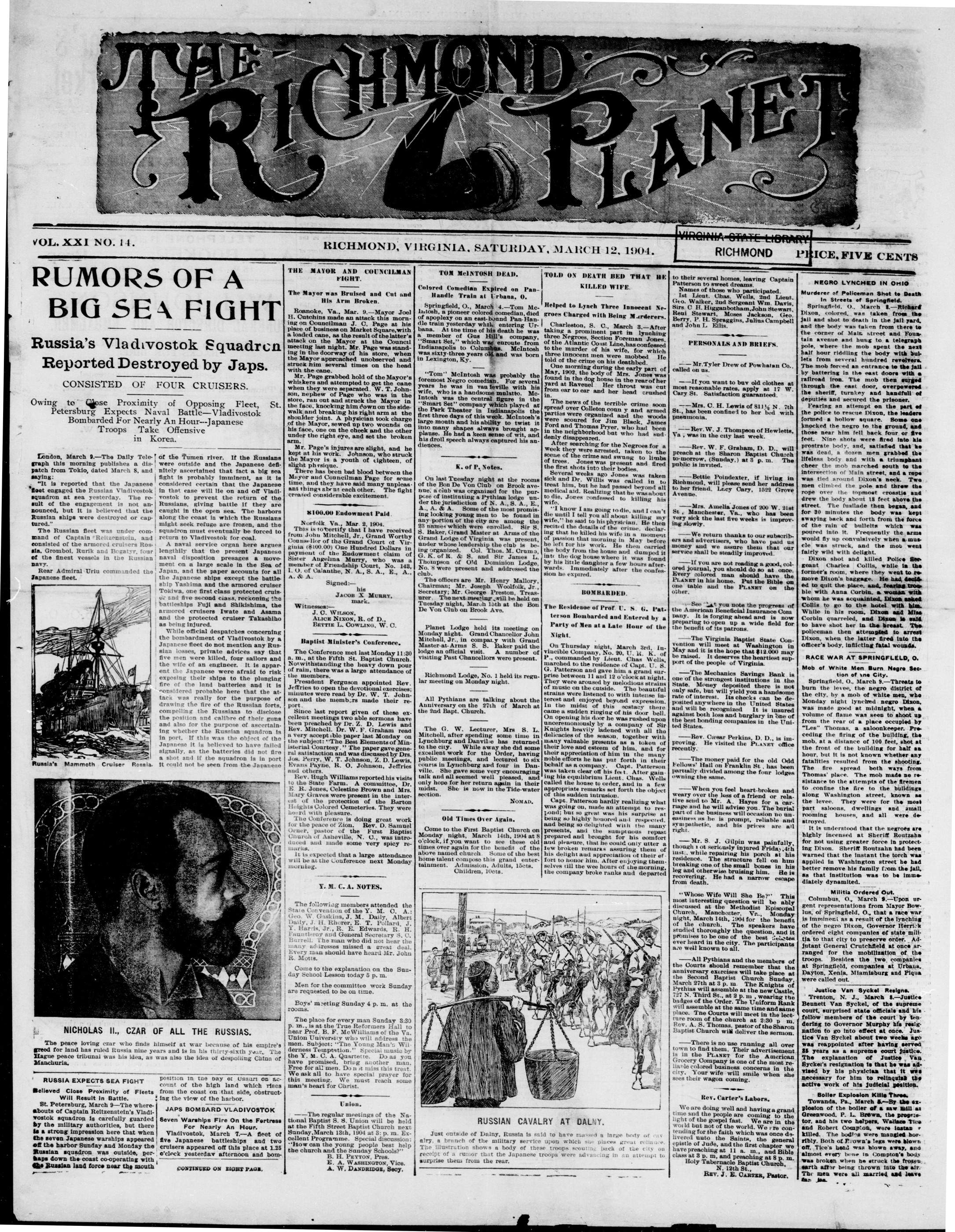
Page text (machine-generated)
THE RICHMOND PLANET
RUMORS OF A BIG SEA FIGHT
Russia's Vladivostok Squadron Reported Destroyed by Japs.
CONSISTED OF FOUR CRUISERS. Owing to Close Proximity of Opposing Fleet, St. Petersburg Expects Naval Battle-Vladivostok Bombarded For Nearly An Hour-Japanese Troops Take Offensive
A.
NICHOLAS II., CZAR OF ALL THE RUSSIAS.
The peace loving czar who finds himself at war because of his empire's greed for land has ruled Russia nine years and is in his thirty-sixth year. The Hague peace tribunal was his idea, as was also the idea of despoiling China of Manchuria.
VOL. XXI NO. 14.
RUMORS OF
BIG SEA
Russia's Vladivost
Reported Destroy
CONSISTED OF FOUR
Owing to Close Proximity of
Petersburg Expects Naval
Bombarded For Nearly An
Troops Take Off
London, March 9.—The Daily Telegraph this morning publishes a dispatch from Tokio, dated March 8, and saying: "It is reported that the Japanese fleet engaged the Russian Vladivostok squadron at sea yesterday. The result of the engagement is not announced, but it is believed that the Russian ships were destroyed or captured."
The Russian fleet was under command of Captain Reitzenstein, and consisted of the armored cruisers Russia, Grombol, Rurik and Bogatyr, four of the finest vessels in the Russian navy.
Rear Admiral Urin commanded the Japanese fleet.
A ship in the sea
Russia's Mammoth Cruiser Russia
NICHOLAS II., CZAR OF AU
The peace loving czar who finds himself greed for land has ruled Russia nine years and Hague peace tribunal was his idea, as was al Manchuria.
RUSSIA EXPECTS SEA FIGHT Believed Close Proximity of Fleets Will Result In Battle.
St. Petersburg, March 9—The where-abouts of Captain Reltzenstein's Vladivostok squadron is carefully guarded by the military authorities, but there is a strong impression here that when the seven Japanese warships appeared off the harbor Sunday and Monday the Russian squadron was outside, perhaps down the coast co-operating with the Russian land force near the mouth
of the Tumen river. If the Russians were outside and the Japanese definitely ascertained that fact a big sea fight is probably imminent, as it is considered certain that the Japanese in that case will lie on and off Vladivostok to prevent the return of the Russians, giving battle if they are caught in the open sea. The harbors along the coast in which the Russians might seek refuge are frozen, and the squadron must eventually be forced to return to Vladivostok for coal. A naval service organ here argues lengthily that the present Japanese naval disposition presages a movement on a large scale in the Sea of Japan, and the paper accounts for all the Japanese ships except the battleship Yashima and the armored cruiser Tokiwa, one first class protected cruiser and five second class, reckoning the battleships Fuji and Shikishima, the armored cruisers Iwate and Asama and the protected cruiser Takahisho as being injured.
While official despatches concerning the bombardment of Lvadivostok by a Japanese fleet do not mention any Russian losses, private advices say that five men were killed, four sailors and the wife of an engineer. It is apparent the Japanese were afraid to risk exposing their ships to the plunging fire of the land batteries and it is considered probable here that the attack was really for the purpose of drawing the fire of the Russian forts, compelling the Russians to disclose the position and calibre of their guns and also for the purpose of ascertaining whether the Russian squadron is in port. If this was the object of the Japanese it is believed to have failed signally, as the batteries did not fire a shot and if the squadron is in port it could not be seen from the Japanese
OF ALL THE RUSSIAS.
himself at war because of his empire's wars and is in his thirty-sixth year. The was also the idea of despoiling China of
position in the bay or Ussuri on account of the high land which rises from the coast on that side, obstructing the view of the harbor.
JAPS BOMBARD VLADIVOSTOK
Seven Warships Fire On the Fortress
For Nearly An Hour.
For Nearly An Hour.
Vladivostok, March 7.—A fleet of five Japanese battleships and two cruisers appeared off this place at 1.25 o'clock yesterday afternoon and bom-
CONTINUED ON EIGHT PAGE.
RICHMOND, VIRGINIA, SATURDAY, MARCH 12, 1904.
THE MAYOR AND COUNCILMAN FIGHT.
The Mayor was Brushed and Cut and His Arm Broken.
Ronnoke, Va., Mar. 9.—Mayor Joel H. Cutchins made an attack this morning on Councilman J. C. Page at his place of business on Market Square, with a loaded cane, as the result of the latter's attack on the Mayor at the Council meeting last night. Mr. Page was standing in the doorway of his store, when the Mayor approached unobserved and struck him several times on the head with the cane.
Mr. Page grabbed hold of the Mayor's whiskers and attempted to get the cane when they were separated. W. T. Johnson, nephew of Page who was in the store, ran out and struck the Mayor in the face, knocking him down on the side and breaking his right arm at the shoulder joint. A physician took charge of the Mayor, sewed up two wounds on his face, one on the cheek and the other under the right eye, and set the broken arm.
Mr. Page's injuries are slight, and he kept at his work. Johnson, who struck the Mayor is a youth of eighteen, of slight physique.
There has been bad blood between the Mayer and Councilman Page for some time, and they have said many unpleasances. The fight created considerable excitement.
$100,00 Endowment Paid
Norfolk Va., Mar. 2, 1904.
This is to certify that I have received from John Mitchell, Jr., Grand Worthy Counsellor of the Grand Court of Virginia ($100.00) One Hundred Dollars in payment of the Endowment claim of Sister Angelina Murry, who was a member of Friendship Court, No. 148, I. O. of Calanthe, N. A., S. A., E., A., A. & A.
Signed:—
his
JACOB X MURRY,
mark.
Witnesses:—
J. C. WILSON,
ALICE NIXON, R. of D.,
BETTIE L. COWLING, W. C.
Baptist Minister's Conference.
The Conference met last Monday 11:30 a. m., at the Fifth St. Baptist Church.
Notwithstanding the heavy down pour of rain, there was a large attendance of the members.
President Ferguson appointed Rev. Jefries to open the devotional exercises; minutes were read by Dr. W. T. Johnson and the memb_rs made their report.
Since last report report of these excellent meetings two able sermons have been preached by Dr. Z. D. Lewis and Rev. Mitchell. Dr. W. F. Graham read a very acceptable paper last Monday on the subject: "The Best Elements of Ministerial Courtesy." The paper gave general satisfaction and was discussed by Drs. Jos. Perry, W. T. Johnson, Z. D. Lewis, Evans Payne, R. O. Johnson, Jeffries and others.
Rev. Hugh Williams reported his visits to the State Farm. A committee, Dr. E. R. Jones, Celestine Brown and Mrs. Mary Sraves were present in the interest of protection of the Barton Heights Colored Cemeteries. They were heard with pleasure.
The Conference is doing great work for the peace of Zion. Rev. D. Samuel Orner, pastor of the First Baptist Church of Asheville, N. C., was introduced and made some very spicy remarks.
It is expected that a large attendance will be at the Conference next Monday morning.
Y. M. C. A. NOTES.
The following members attended the State Convention of the Y. M. C. A.: Geo. W. Gaskins, J. M. Daily, Albert Daily, J. H. Rhorer, E. T. Pollard, J. Y. Harris, Jr., R. E. Edwards, R. H. Fauntherloy and General Secretary S. C. Burrell. The man who did not hear the many addresses missed a great deal. Every man should have heard Mr. John R. Motts.
Come to the explanation on the Sunday School Lesson today 5 p. m.
Men for the committee work Sunday are requested to be on time.
Boys' meeting Sunday 4 p. m. at the rooms.
The place for every man Sunday 3:30 p. m., is at the True Reformers Hall to hear Prof. B. F. McWilliams of the Va. Union University who will address the men. Subject: "The Young Man's Wilderness Temptation." Special music by the Y. M. C. A. Quartette. Do as you have promised, bring another man. Free for all men. Do not miss this treat. We ask all to have special prayer for this meeting. We must reach some man's heart for Christ.
Union.
The regular meetings of the National Baptist S. S. Union will be held at the Fifth Street Baptist Church next Sunday, March 18th, 1904 at 3: p. m. Excellent Programme. Special discussion: "How can the young people best help the church and the Sunday Schools?" B. H. PEYTON, Pres. E. A. WASHINGTON, Vice. A. W. DANDRIDGE, Seoy.
TOM McINTOSH DEAD.
Colored Comedian Expired on Pan-
Handle Train at Urbana, O.
Springfield, O., March 4.—Tom McIntosh, a pioneer colored comedian, died of apoplexy on an east-bound Pan-Handle train yesterday while entering Urbana. At the time of his death he was a member of Gus Hill's company, "Smart Set," which was enroute from Indianapolis to Columbus. McIntosh was sixty-three years old and was born in Lexington, Ky.
"Tom" McIntosh was probably the foremost Negro comedian. For several years he was in van feville with his wife, who is a handsome mulatto. McIntosh was the central figure in the "Smart Set" company which played at the Park Theater in Indianapolis the first three days of this week. McIntosh's large mouth and his ability twist it into many shapes always brought an aplause. He had a keen sense of wit, and his droll speech always captured his audiences.
K. of P. Notes.
On last Tuesday night at the rooms of the Bon De Von Club on Brook avenue, a club was organized for the purpose of instituting a Pythian lodge under the jurisdiction of N. A., S. A., E. A., A. A. & A. A. Some of the most promising looking young men to be found in any portion of the city are among the 23 names which were enrolled. Sir S. S. Baker, Grand Master at Arms of the Grand Lodge of Virginia was present, under whose leadership the club is being organized. Col. Thos. M. Cruma, T. R. & S. and Sir James L. Thompson of Old Dominion Lodge, No. 8 were present and addressed the club.
The officers are Mr. Henry Mallory, Chairman; Mr. Joseph Woolfolk, Jr.; Secretary; Mr. George Preston, Treasurer. The next meeting will be held on Tuesday night, March 10th at the Bon De Von Club on Brook Ave.
Planet Lodge held its meeting on Monday night. Grand Chancellor John Mitchell, Jr., in company with Grand Master-at-Arms S. S. Baker paid the lodge an official visit. A number of visiting Past Cancellors were present.
Richmond Lodge, No. 1 held its regular meeting on Monday night.
All Pythians are talking about the Anniversary on the 27th of March at the 2nd Bapt. Church.
The G. W. Lecturer, Mrs S. L. Mitchell, after spending some time in Lynchburg and Danville has returned to the city. While away she did some excellent work for the Order, having public meetings, and lecured to six courts in Lynchburg and four in Danville. She gave some very encouraging talk and all seemed well pleased and only hope for her return again in their midst. She is now in the Tide-water section.
NOMAD.
Old Times Over Again.
Come to the First Baptist Church on Monday night, March 14th, 1994 at 8 o'clock, if you want to see these old times over again for the benefit of the above named church. Some of the best home talent compose this grand entertainment. Admission, Adults, 15cts.
Children, 10cts.
RUSSIAN CAVALRY AT DALNY.
Just outside of Dalny, Russia is said to have massed a alry, a branch of the military service upon which she pla. The illustration shows a body of these troops scouting be receipt of a rumor that the Japanese troops were advancing surprise them from the rear.
Just outside of Dalny, Russia is said to have massed a large body of cavalry, a branch of the military service upon which she places great reliance. The illustration shows a body of these troops scouting back of the city on receipt of a rumor that the Japanese troops were advancing in an attempt to surprise them from the rear.
TOLD ON DEATH BED THAT HE KILLED WIFE.
Helped to Lynch Three Innocent Negroes Charged with Being Murderers.
Charleston, S. C., March 3.—After taking a prominent part in lynching three Negroes, Section Foreman Jones, of the Atlantic Coast Line, were confessed to the murder of his wife, for which three innocent men were mobbed. He told of the crime on his deathbed.
One morning during the early part of May, 1902, the body of Mrs. Jones was found in the dog house in the rear of her yard at Ravenel. Her throat was cut from ear to ear and her head crushed in.
The news of the terrible crime soon spread over Colleton couny and armed parties were organized and the woods were scoured for Jim Black, James Ford and Thomas Pryer, who had been in the neighborhood but who had suddenly disappeared.
After searching for the Negroes for a week they were arrested, taken to the scene of the crime and swung to limbs of trees. Jones was present and fired the first shots into their bodies.
Several weeks ago Jones was taken sick and Dr. Willis was called in to treat him, but he had passed beyond all medical aid. Realizing that he was about to die, Jones confessed to killing his wife.
"I know I am going to die, and I can't die until I tell you all about killing my wife," he said to his physician. He then recited the details of the crime, declaring that he killed his wife in a moment of passion that morning in May before he left for his work. He then carried the body from the house and dumped it into the dog house where it was found by his little daughter a few hours afterwards. Immediately after the confession he expired.
The Residenoe of Prof. U. S. G. Patterson Bombarded and Entered by a Party of Men at a Late Hour of the Night
On Thursday night, March 3rd, Invincible Company, No. 20, U. K. K. of P., commanded by Lient. Chas Wells, marched to the residence of Capt. U. S. G. Patterson and gave him a grand surprise between 11 and 12 o'clock at night. They were aroused by melodies strains of music on the outside. The beautiful strains were listened to with intense interest and enjoyed beyond expression. In the midst of this ecstasy came a sudden ringing of his door bell. On opening his door he was rushed upon unceremoniously by a company of Sir Knights heavily ladened with all the delicacies of the season, together with many valuable presents as a token of their love and esteem of him, and for their appreciation of him in the many noble efforts he has put forth in their behalf as a company. Capt. Patterson was taken clear off his feet. After gaining his equilibrium Lient. Chas. Wells called the house to order, and in a few appropriate remarks set forth the object of this sudden intrusion.
Capt. Patterson hardly realizing what was going on, made an attempt to respond; but so great was his surprise at being so highly honored and respected, and being so delighted with the many presents, and the sumptuous repas prepared and brought for his comfort that he could only utter a few broken remarks assuring them of his delight and appreciation for fort to honor him. After enjoying themselves till the wee hours of the morning, the company broke ranks and departed.
old to have massed a large body of cavalry upon which she places great reliance. These troops scouting back of the city on troops were advancing in an attempt to
BOMBARDED
to their several homes, leaving Captain Patterson to sweet dreams.
Names of those who participated.
1st Lieut. Chas. Wells, 2nd Lieut.
Kinder, 2nd Sergeant Wm. Davis,
Sirs C. H. Brigganoth, John Stewart,
Reni Stewart, Moss Jackson, Geo.
Berry, P. H. Spraggs, Julius Campbell
and John L. Ellis.
PERSONALS AND BRIEF
Mr.Tyler Drew of Powhatan Co. called on us.
If you want to buv old clothes at most reasonable rates, apply at 17 W. Cary St. Satisfaction guaranteed.
Mrs. C. H. Lewis of 811½ N. 7th St., has been confined to her bed with pneumonia.
Rev. W. J. Thompson of Hewlett, Va., was in the city last week.
Rev. W. F. Graham, D. D., will preach at the Sharon Baptist Church to-morrow, (Sunday,) at 3 p. m. The public is invited.
Bettie Poindexter, if living in Richmond, will please send her address to her friend, Lacy Cary, 1523 Grove Avenue.
Mrs. Amelia Jones of 200 W. 31st St., Manchester, Va., who has been very sick the last five weeks is improving slowly.
We return thanks to our subscribers and advertisers, who have paid us money and we assure them that our service shall be steadily improved.
If you are not reading a good, colored journal, you should do so at once. Every colored man should have the PLANET in his home. Put the Bible on one table and the PLANET on the other.
See that you note the progress of the American Beneficial Insurance Company. It is forging ahead and is now preparing to open up a wide field for the benefit of its patrons.
The Virginia Baptist State Convention will meet at Washington in May and it is the hope that $12,000 may be raised. It deserves the heartiest support of the people of Virginia.
—The Mechanics Savings Bank is one of the strongest institutions in the State. Money deposited there is not only safe, but will yield you a handsome rate of interest. Its checks can be deposited anywhere in the United States and will be recognized. It is insured against both loss and burglary in one of the best bonding companies in the United States.
—Rev. Caesar Perkins, D. D., is improving. He visited the PLANET office recently.
—the money paid for the old Odd Fellows' Hall on Franklin St. has been partially divided among the four lodges owning the same.
—When you feel heart-broken and weary over the loss of a friend or relative send to Mr. A. Hayes for a carriage and he will advise you. The burial part of the business will occasion no unpleasantness as he is prompt, reliable and sympathetic, and his prices are all right.
— Mr. S. J. Gilpin was painfully, though I otterly insured injured Friday, 4th inst., while repairing his porch at his residence. The structure fell on him breaking one of the small bones in his leg and otherwise bruising him. He is recovering. He had a narrow escape from death.
"Whose Wife Will She Be?" This most interesting question will be ably discussed at the Methodist Episcopal Church, Manassas, W.., Monday night, March 14th, 1904 for the benefit of the church. The speakers have studied thoroughly the question, and its promises to be one of the best diabetes ever heard in the city. The participants are well known to all.
All Pythians and the members of the Courts should remember that the anniversary exercises will take place at the Second Baptist Church Sunday, March 27th at 3 p.m. The Knights of Pythias will assemble at the new Castle, 727 N. Third St., at 2 p.m., wearing the badges of the Order. The Uniform Rank will assemble at the same time and same place. The Courts will meet in the lecture room of the church at 2:30 p.m. Rev. A. S. Thomas, pastor of the Sharon Baptist Church will deliver the sermon.
There is no use running all over town to find them. Their advertisement is in the PLANET for the American Grocery Company is one of the most available colored business concerns in the city. Your wife will smile when she sees their wagon coming.
Rev. Carter's Labors.
We are doing well and having a grand time and the people are coming to the light of the gospel fast. We are in the world but not of the world. We are contending for the faith which was once delivered unto the Saints, the general epistle of Jude, and the first chapter we have preaching at 11 a. m., and Bible class at 3 p. m., and preaching at 8 p. m. Holy Tabernacle Baptist Church, N. 12th St., REV. J. E. CARTER, Pastor.
NEGRO LYNCHED IN OHIO
Murderer of Policeman Shot to Death
In Streets of Springfield
In Streets of Springfield.
Springfield, O., March 8.—Richard Dixon, colored, was taken from the jail and shot to death in the jail yard, and the body was taken from there to the corner of Main street and Fountain avenue and hung to a telegraph pole, where the mob spent the next half hour riddling the body with bullets from several hundred revolvers. The mob forced an entrance to the jail by battering in the east doors with a rafroad iron. The mob then surged through the east door, overpowered the sheriff, turnkey and handfull of deputies and secured the prisoner.
Fearing an attempt on the part of the police to rescue Dixon, the leaders formed a hollow square. Some one knocked the negro to the ground, and those near him fell back four or five feet. Nine shots were fired into his prostrate body, and, satisfied that he was dead, a dozen men grabbed the lifeless body and with a triumphant cheer the mob marched south to the intersection of Main street, and a rope was tied around Dixon's neck. Two men climbed the pole and throw the rope over the topmost crossstile and drew the body about 18 feet above the street. The fuselade then began, and for 30 minutes the body was kept swaying back and forth from the force of the rain of bullets which was poured into it. Frequently the arms would fly up convulsively when a muscle was struck, and the mob went fairly wild with delight.
Dixon shot and killed Police Sergent Charles Collins, while in the former's room, where they went to remove Dixon's baggage. He had decided to quit the place, and, fearing trouble with Anna Corbin, a woman with whom he was acquainted, Dixon asked Collins to go to the hotel with him. While in his room, Dixon and Miss Corbin quarreled, and Dixon is said to have shot her in the breast. The policeman then attempted to arrest Dixon, when the latter fired into the officer's body, inflicting fatal wounds.
RACE WAR AT SPRINGFLELD. O.
Mob of White Men Burn Negro Section of the City
Springfield, O., March 9.—Threats to burn the levee, the negro district of the city, by a mob of white men, who Monday night lynchred negro Dixon, was made good at midnight, when a volume of flame was seen to shoot up from the rear of a place occupied by "Les" Thomas, a saloonkeeper. Preceding the firing of the building, the mob, at a distance of 100 feet, shot at the front of the building for half an hour, but it is not known whether any fatalities resulted from the shooting. The fire spread both ways from Thomas' place. The mob made no resistance to the attempts of the firemen to confine the fire to the buildings along Washington street, known as the levee. They were for the most part saloons, dwellings and small rooming houses, and all were destroyed.
It is understood that the negroes are highly incensed at Sheriff Routzahna for not using greater force in protecting Dixon. Sheriff Routzahna had been warned that the instant the torch was applied in Washington street he had better remove his family from the fall, as that institution was to be immediately dynamited.
Militia Ordered Out.
Columbus, O., March 3—Upon urgent representations from Mayor Bowles, of Springfield, O., that a race war is imminent as a result of the lynching of the negro Dixon, Governor Herrick ordered eight companies of state militia to that city to preserve order. Adjutant General Crutchfield at once arranged for the mobilization of the troops. Besides the two companies at Springfield, companies at Urbana, Dayton, Xenia, Miamisburg and Piqua were called out.
Justice Van Syckel Realigne
Trenton, N. J., March 5—Justice Bennett Van Syckel, of the supreme court, surprised state officials and his fellow members of the court by tendering to Governor Murphy his resignation to go into effect at once. Justice Van Syckel about two weeks ago was reappointed after having served 35 years as a supreme court justice. The explanation of Justice Van Syckel's resignation is that he was advised by his physician that it was necessary for him to relinquish the active work of his judicial position.
Boller Explosion Kills Three.
Towanda, P., March 5.—By the explosion of the boiler of a saw mill at Greenwood, P. L. Brown, the proprietor, and his two helpers, Wallace Tice and Robert Compton, were instant killed. The bodies were mangled horribly. Both of Brown's legs were blown off. Tice's head was blown away, and almost every bone in Compton's body was broken when he struck the frogs earth affair being thrown into the air. The men were all married and leave far too.
THE PLANET
SATURDAY.....MARCH 12, 1904
TEMPERANCE NOTES THE OUTCAST BABY.
Upon a little pallet in the children's ward she lay,
The doctors watched her tenderly, and the nurses night and day.
Policemen brought her carefully—'twas the day before.
They found her in the snow, outside her father's door.
"And when we picked her up, and saw that wound upon her head,
We thought," said they, "that surely she was dying, or was dead,
Her mother knew that is sure, and one poor little arm,
And so we brought the infant here, to save from further harm.
Her parenta? Yes, they're lodged in jail; they both were drunk, you know,
And she knew that who gave the child that dreadful blow.
The neighbors heard a scuffling, and then they heard her cry,
And some one opened wide the door, and threw her out to die!
Twice she saw of the two, but which we cannot tell.
So both are lodged in prison now; sure they deserve it well!
Their only child? Well, yes, she was, but all the neighbors think
that a deed they'd not have done, unless a threw on the drink."
She was a tender little babe, of scarcely four years old.
Her wound head was rippling o'er with curls of finest gold!
But white and pinched the little face, and closed the eyes.
And doctors came, and gently said: "The little one must die."
The nurses strove with tender care to rouse the soul within,
For never word or cry was hers since first
At length she moved upon her couch, and heaved a weary sigh.
And then a little sob the hear, and next a baby-cry.
The doctor comes with tender words her tongue to age;
He tells a little fairy tale, and shows the pictured page.
A man and a woman sit at a table in a room. The man is sitting on a chair, holding a child on his lap. The woman stands behind the table, holding a cup of tea.
"She does not suffer any pain," he says, almost in tears
He has a little maid at home, of just such
And then they gently question her, but far too young is she
To tell the story of her home in all its misery.
She smiles into the doctor's face; she seems to love him well;
But "daddy made me cry," is all the infant lips can tell.
And soon the weary eyelids close; again she is asleep;
But ah! it is a slumber far too heavy and
They gently chafe her tiny limbs and bathe her fevered brow,
But while they strive to keep her here Heaven's gates are opening now!
And pitying angels spread their wings, and cleave the midnight sky,
And in the midst of a broadcast babe goes to her home on high!
Thank God for children's hospitals! and for the loving care,
Must be to weary suffering babes a fore
-D. B. McKean, in National Advocate
REGULARS AND PERIODICS.
London Temperance Leader Agrees with Medical Authority That Latter is the Lesser Evil.
When the question of accepting a gift of 90 gallons of beer from a local brewer for the use of the London workhouse inmates on Christmas day came up before the Brighton guardians, one member said a great medical authority had declared that drinking regularly was bad for the health, but to get drunk once a fortnight did good. Mr. Pinhorn, the secretary of the London United Temperance council, was there-upon interviewed on the sublect.
"I remember many years ago," said Mr. Pinchorn, "that, finding me run down and in uncongenial surroundings, my doctor advised me to go up to town and get drunk. I need hardly say that I did not take the hint; but I do say that if I had to choose between the man who 'soaks' every day and the man who gets drunk once in a while and pays for it the next day, I should unhesitatingly choose the latter.
"Yes, I have also heard that doctors can be found to recommend a person to get drunk to get rid of a bad cold. In other words, the doctor no doubt means that the man will perspire freely in that way, but there are a hundred other and better ways of getting rid of a cold. The temperance man takes a piping-hot bath and goes to bed wrapped in a blanket."
Saloon Limitation in Germany.
Increase of alcoholism in Germany has led to a movement for the better control of the liquor trade.
It will require saloon keepers:
and even when she does consent to voluminous folds in her crepe or mousseuse gown demands clinging lines in her cloth or zibelline or velvet. She will have to come around to the fullness, but the capitulation comes slowly, and there's no telling what skirt lines the Parisian makers will be advocating by the time the full skirt of the present mode is universally popular here.
While the latest skirts are fulled or plaited into the waist band and the skirt yoke is practically out of fashion in Paris, many devices are contrived to lessen the fullness around the hips and preserve a somewhat clinging effect at that point. A series of sharp gores in the skirt top are employed by some of the great dressmakers.
1. To keep for sale at all times food and non-intoxicated drinks, especially lemonade, milk, coffee and tea.
2. That no liquor may be sold on credit; and that the number of women attendants shall be strictly limited to legitimate service.
DRUG-TAKING AMONG AUTHORS
Evidences of the Demoralizing and Destructive Habit Found in Their Writings.
One is astonished at the frequent and unmistakable signs of spirit and drug addiction of popular authors. Unconsciously these writers describe their own condition in the characters they portray, and the theories and statements which the heroes and heroes are made to express, are the inmost thoughts of the authors.
A recent popular novel makes the hero most brilliant and sagacious after using wine moderately. True to life, the supposed brilliant statements are jumbles of words and rhetoric which the author clearly wrote while under the use of spirits. He also justifies immoralities of conduct by childish excuses, the personality of which reflects his own experience.
In another popular book, the author is clearly a drug-taker. The vague, dreamy, illusionary style and manner of thought and conduct of the character described is clearly that of a morpha or opium-taker. The uncertainties and the alternately confused and dogmatic thoughts are marked characteristics. The writer hoped by investing his subjects in mysticism and leading them through an irregular, unusual line of conduct to produce a book out of the common order. In reality he revealed his secret drug-taking and his own vague, uncertain mentality. Much of this work was written while under the influence of drugs.
Probably the cocaine-taker stamps his habits more vividly in his writings than the alcoholic or other drug-takers. Several very popular books proved the cocainism of the authors. The easy flow of words and ideas, like a quiet stream of water, progresses noiselessly without jar or change. One thought suggests another and one situation is followed by many others equally dramatic, and each is described without purpose or plan. Through it all run snatches of poetry, rhetoric, figures of speech and sonorous adjectives. The characters are moved up and down the stage in a hazy twilight of words without plan or purpose, and disappear to make way for others equally mystical. Other stories give evidence of having been written in a coffee or tea delirium. The assertiveness of the characters, their brusque entrance, and exit, their promise of great things which only fade away into uncertainties, show this condition.
In the drug and spirit-taker the childish efforts of the authors to conceal their personality and habits of life make more prominent their condition. In the tea and coffee drinkers there is state of mind at the time of the writing. It is assumed that the mind is perfect and intact. In some of the books written by these persons, there has been evident a well thought out plan, the execution of which has been sadly marred by the attempt to force the brain by tea or coffee. No clear, consecutive brainwork can ever be done under the influence of spirits, drugs, tea or coffee. A tired, wormout man or woman attempts to do literary work under the influence of these narcotics and falls. The critical student finds unmistakable evidence of the failure in the abnormal state of the author's mind. The vagaries of literature and the number of strange stories and theories advocated are explained in many instances by the drug psychoses or disordered minds of the authors.
This most interesting study will astonish and surprise the reader as it unveils the personality, habits of life and thoughts of the authors in the papers and books of the day.—T. D. Crothers, M. D. , in Union Signal.
THE PULSE OF REFORM
Bishop Emard, of Valleyfield, Quebec, has issued a strong pastoral letter upon the liquor question, practically condemning the use of liquor in voting contests.
The city authorities of Little Rock, Ark., have under consideration a proposition to increase the annual saloon license in that city from $360 to $1,000, payable in advance. The total license, then, city, county and state, would be $1,821 per annum on each license.
The common council of Grand Rapids, Mich., has taken a firm stand against the refunding of saloon licenses originally in the names of employees, and afterwards, upon the discharge of these employees, taken in out their own names. Incidentally, the aldermen have indorsed the no-transfer principle upon which the committee on license has been acting for some time past.
In California there are only 20 voters to every liquor dealer; in Louisiana the proportion is even greater, there being one liquor dealer to every 15 voters. Illinois has one liquor dealer to every 51 voters. The proportion is smallest in North Carolina, where there are 124 voters to every liquor dealer. In Utah the proportion is one liquor dealer to every 114 voters, which would seem to indicate that the Mormons, whatever else their faults, are not greatly given to drinking liquor.
Personal Responsibility.
Carlyle writes: "Brother, thou hast possibility in thee for much, the possibility of writing on the eternal skies the record of an heroic life." Let each individual total abstainer seek to realize the greatness and importance of temperance work, the absolute necessity of personal service, and the splendid sphere of work offered, and then, with the determination and perseverance apply himself to this work.
THE RICHMOND PLANET, RICHMOND, VIRGINIA
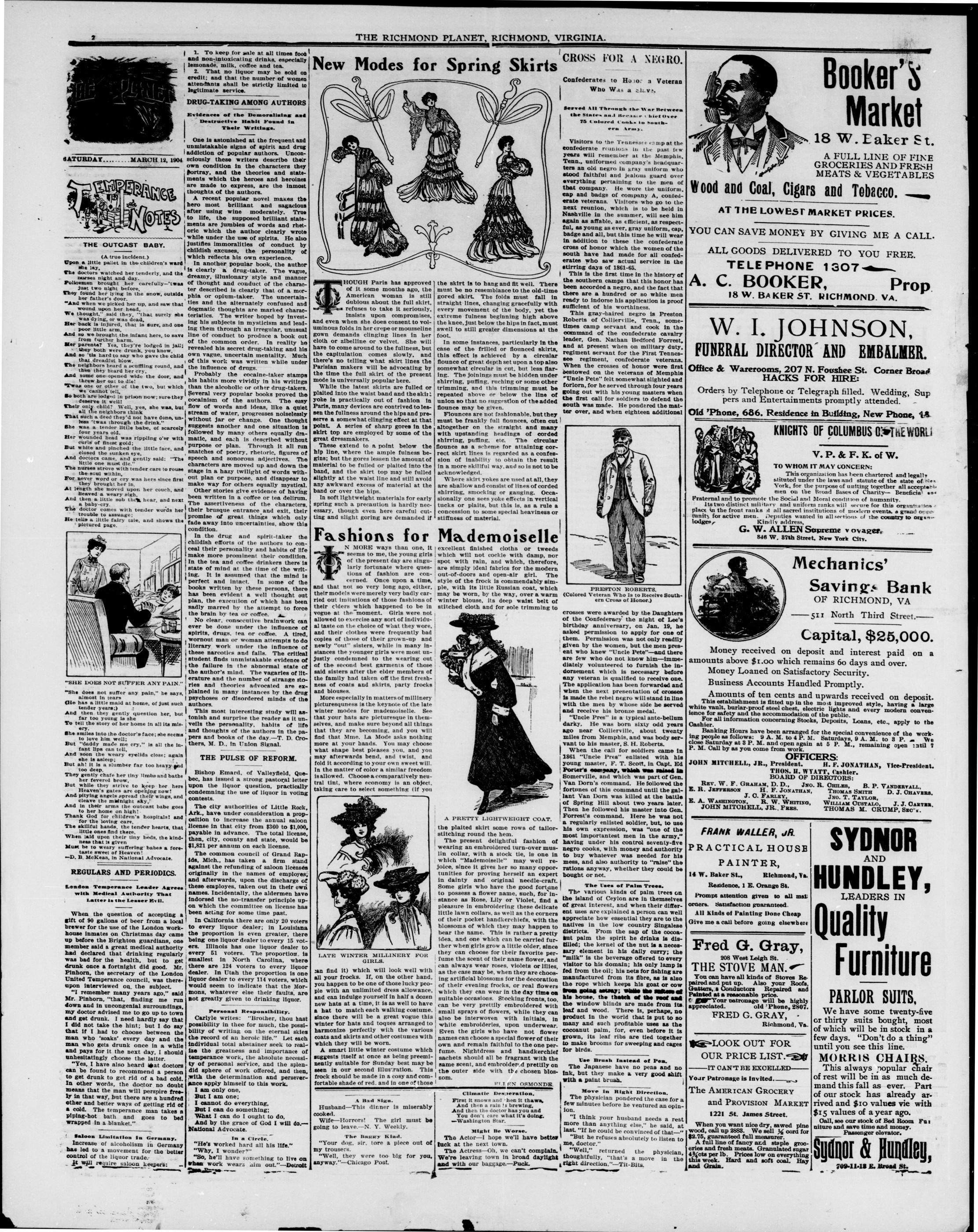
New Modes for Spring Skirts
Fashions for Mademoiselle
Fashions for Mademoiselle
HOUGH Paris has approved of it some months ago, the American woman is still dubious about the full skirt, refuses to take it seriously, lusts upon women.
T
These extend to a point below the hip line, where the ample fulness begins; and the gores lessen the amount of material to be fulled or plaited into the band, and the skirt top may be fulled slightly at the waist line and still avoid any awkward excess of material at the band or over the hips.
In soft lightweight materials for early spring such a precaution is hardly necessary, though even here careful cutting and slight goring are demanded if
N MORE ways than one, it seems to me, the young girls of the present day are singularly fortunate where questions of fashion are concerned. Once upon a time
N MORE ways than one, it seems to me, the young girls of the present day are singularly fortunate where questions of fashion are concerned. Once upon a time, and that not so very long ago, either, their models were merely very badly carried out imitations of those fashions of their cliders which happened to be in vogue at the moment. Girls were not allowed to exercise any sort of individual taste on the choice of what they wore, and their clothes were frequently bad copies of those of their grown-up and newly "out" sisters, while in many instances the younger girls were most unjustly condemned to the wearing out of the second best garments of those said sisters after the elder members of the family had taken off the first freshness of coats and skirts, party frocks and blouses.
More especially in matters of millinery picturesque is the keynote of the late winter modes for mad霉霉elle. See that your hats are picturesque in themselves, and make sure beyond all things that they are becoming, and you will find that Mme. La Mode asks nothing more at your hands. You may choose what shape best please you, and you may afterwards bend, and twist, and fold it according to your own sweet will. In the matter of color a similar freedom is allowed. Choose a comparatively neutral tint, where economy is an object, taking care to select something (if you
LATE WINTER MILLINERY FOR GIRLS.
can find it) which will look well with all your frocks. If, on the other hand, you happen to be one of those lucky people with an unlimited dress allowance, and can indulge yourself in half a dozen new hats at a time, it is as well to have a hat to match each walking costume. since there will be a great vogue this winter for hats and toques arranged to harmonize perfectly with the various coats and skirts and other costumes with which they will be worn.
A smart little winter costume which suggests itself at once as being preeminently suitable for Sunday best may be seen in our second illustration. This frock should be made in a cosy and comfortable shade of red, and in one of those
A Bad Sign.
Husband—This dinner is miserably cooked.
Wife—Horrors! The girl must be going to leave.—N. Y. Weekly.
The Baggy Kind.
"Your dog, sir, tore a piece out of my trousers.
"Well, they were too big for you, anyway."—Chicago Post.
the skirt is to hang and fit well. There must be no resemblance to the old-time gored skirt. The folds must fall in straight lines, changing gracefully with every movement of the body, yet the extreme fulness beginning high above the knee, just below the hips in fact, must swell to still greater dimensions at the foot.
In some instances, particularly in the case of the frilled or flounced skirts, this effect is achieved by a circular flounce of great depth set upon a top also somewhat circular in cut, but less flaring. The joinings must be hidden under shirring, puffing, ruching or some other trimming, and this trimming must be repeated above or below the line of union so that no suggestion of the added flounce may be given.
Flouces are not fashionable, but they must be frankly full flouces, often cut altogether on the straight and many with upstanding headings of corded shirring, puffing, etc. The circular flouce as a scheme for attaining correct skirt lines is regarded as a confession of inability to obtain the result in a more skilful way, and so is not to be acknowledged. Where skirt yokes are used at all, they are shallow and consist of lines of corded shirring, smocking or ganging. Occasionally one sees yoke effects in vertical tucks or plaits, but this is, as a rule a concession to some special heaviness or stiffness of material.
excellent finished clothes or tweeds which will not cookie with damp, nor spot with rain, and which, therefore, are simply ideal fabrics for the modern out-of-doors and open-air girl. The style of the frock is comendably simple, with its little Russian coat, which may be worn, by the way, over a warm winter blouse, its deep waist belt of stitched cloth and for sole trimming to
S. M.
A PRETTY LIGHTWEIGHT COAT.
the plaited skirt some rows of tailor-
stitching round the hem.
The present delightful fashion of wearing an embroidered turn-over muslin collar, with a stock tie, is one in which "Mademoiselle" may well rejoice, since it gives her so many opportunities for proving herself an expert in dainty and original needle-craft. Some girls who have the good fortune to possess a flower name, such, for instance as Rose, Lily or Violet, find a pleasure in embroidering these delicate little lawn collars, as well as the corners of their pocket handkerchiefs, with the blossoms of which they may happen to bear the name. This is rather a pretty idea, and one which can be carried further when girls grow a little older, since they can choose for their favorite perfume the scent of their name flower, and can always wear roses, violets or illies, as the case may be, when they are choosing artificial blossoms for the decoration of their evening frocks, or real flowers which they can wear in the day time on suitable occasions. Stocking fronts, too, can be very prettily embroidered with small sprays of flowers, while they can also be interwoven with initials, in white embroideries, upon underwear. Even the girls who have not flower names can choose a special flower of their own and remain faithful to the one perfume. Nightdress and handkerchief sachets should all be fragrant with the same scent, and embroidered prettily on the outer side with the chosen blossom.
Climatic Desperation.
First it snows and then it thaws.
And then a rain is brewing.
And then the doctor has you and
You don't care what it's doing.
-Washington Star.
The Actress—Oh, we can't complain. We're leaving town in broad daylight and with our baggage—Puck.
CROSS FOR A NEGRO.
Confederates to Honor a Veteran
Who Was a Slave.
Served All Through the War Between
the States and Became Chief Over
75 Colored Cooks in Southern
Arms.
Visitors to the Tennessee camp at the confederate reunions in the past few years will remember at the Memphis, Tenn., uniformed company's headquarters an old negro in gray uniform who stood faithful and jealous guard over everything pertaining to the men of that company. He wore the uniform cap and badge of company A, confederate veterans. Visitors who go to the next reunion, which is to be held in Nashville in the summer, will see him again as affable, as efficient, as respectful, as young as ever, gray uniform, cap, badge and all, but this time he will wear in addition to these the confederate cross of honor which the women of the south have had made for all confederates who saw actual service in the stirring days of 1861-65.
This is the first time in the history of the southern camps that this honor has been accorded a negro, and the fact that there are a hundred or so white men ready to indorse his application is proof sufficient of his worthiness.
This gray-haired negro is Preston Roberts of Collierville, Tenn., sometimes camp servant and cook in the command of the confederate cavalry leader, Gen. Nathan Bedford Forrest, and at present when on military duty, regiment servant for the First Tennessee regiment, confederate veterans. When the crosses of honor were first bestowed on the veterans of Memphis "Uncle Pete" felt somewhat slighted and forlorn, for he served through four years going out with his young masters when the first call for soldiers to defend the south was made. He pondered the matter over, and when eighteen additional
```markdown
```
PRESTON ROBERTS. (Colored Veteran Who Is to Receive Southern Cross of Honor.)
crosses were awarded by the Daughters of the Confederacy the night of Lee's birthday anniversary, on Jan. 19, he asked permission to apply for one of them. Permission was not only readily given by the women, but the men present who knew "Uncle Pete"—and there are few who do not know him—immediately volunteered to furnish the indorsement which is necessary before any veteran is qualified to receive one. The application has been forwarded and when the next presentation of crosses is made the rebel rebel will stand in line with the men by whose side he served and receive his bronze medal.
"Uncle Pres" is a typical ante-bellum darky. He was born sixty odd years ago near Collierville, about twenty miles from Memphis, and was body servant to his master, S. H. Roberts.
When the call for soldiers came in 1861 "Uncle Pres" enlisted with his young master, F. T. Scott, in Capt. Ed Porter's company, which was raised in Somerville, and which was part of Gen. Van Dorn's command. He followed the fortunes of this command until the gallant Van Dorn was killed at the battle of Spring Hill about two years later. Then he followed his master into Gen. Forrest's command. Here he was not a regularly enlisted soldier, but, to use his own expression, was "one of the most important men in the army," having under his control seventy-five negro cooks, with money and authority to buy whatever was needed for his mess, and also authority to "raise" the rations anyway, whether they could be bought or not.
The Uses of Palm Trees.
The various kinds of palm trees on the island of Ceylon are in themselves of great interest, and when their different uses are explained a person can well appreciate how essential they are to the natives in the low country Singalese districts. From the sap of the coconut palm the spirit he drinks is distilled; the kernel of the nut is a necessary element in his daily curry; the "milk" is the beverage offered to every visitor to his domain; his only lamp is fed from the oil; his nets for fishing are manufactured from its fibre, as is also the rope which keeps his goat or cow from going astray; while the robes of his house, the thatch of the roof and the window blinds are made from its leaf and wood. There is, perhaps, no product in the world that is put to so many and such profitable uses as the coconut palm, for, even before it is grown, its leaf ribs are tied together to make brooms for sweeping and cages for birds.
brush instead of pen.
The Japanese have no pens and no ink, but they make a very good shift with a paint brush.
Move in Right Direction.
The physician pondered the case for a few minutes before he ventured an opinion.
"I think your husband needs a rest more than anything else," he said, at last. "If he could be convinced of that—"
"But he refuses absolutely to listen to me, doctor."
"Well," returned the physician, thoughtfully, "that's a move in the right direction." - Tit-Bits.
J. B. H.
Booker's Market
18 W. Eaker St.
A FULL LINE OF FINE
GROCERIES AND FRESH
MEATS & VEGETABLES
Wood and Coal, Cigars
AT THE LOWEST
YOU CAN SAVE MONEY
ALL GOODS DELIVER
TELEPHONE
A. C. BOOKER
18 W. BAKER ST
W. I. JOE
FUNERAL DIRECTOR
Office & Warerooms, 207 N
HACKS R
Orders by Telephone or Te
pers and Entertainme
Old 'Phone, 686. Residence
Cigars and Tebacco. NOWEST MARKET PRICES. MONEY BY GIVING ME A CALL. DELIVERED TO YOU FREE. PHONE 1307 OKER, Prop. OKER ST. RICHMOND. VA. JOHNSON, DIRECTOR AND EMBALMER. Ins, 207 N. Foushee St. Corner Broad BACKS FOR HIRE: One or Telegraph filled. Wedding, Sup entertainments promptly attended. Residence in Building, New Phone, 14 KNIGHTS OF COLUMBUS O. THE WORLD V. P. & F. K. of W.
AT THE LOWEST MARKET PRICES.
YOU CAN SAVE MONEY BY GIVING ME A CALL.
ALL GOODS DELIVERED TO YOU FREE.
TELEPHONE 1307
A. C. BOOKER, Prop.
18 W. BAKER ST. RICHMOND. VA.
W. I. JOHNSON, FUNERAL DIRECTOR AND EMBALMER.
Office & Warerooms, 207 N. Foushee St. Corner Broad HACKS FOR HIRE:
Orders by Telephone or Telegraph filled. Wedding, Suppers and Entertainments promptly attended.
Old 'Phone, 686. Residence in Building, New Phone, 18
KNIGHTS OF COLUMBUS O THE WORLD
TO WHOM IT MAY CONCERN:
This organization has been chartered and legally instituted under the laws and statute of the state of New York, for the purpose of uniting together all acceptable men on the Broad Bases of Charity—Beneficial as the Social and Moral condition of humanity. y and uniform ranks will secure for this organization all sacred institutions of modern events, a grand opposition wanted in all sections of the country to organi-ly address.
ALLEN Supreme voyager
W. 87th Street, New York City.
This organization has been chartered and legally
stituted under the laws and statute of the state of
Wark, for the purpose of uniting together all accepta-
tive Beneficial Societies.
Fraternal and to promote the Social and
Its two distinct military and unifi
place in the front ranks it all sacred in
unity for active men. Deputies want
lodges
Kindly address,
G. W. ALLEN$
846 W. 87th St
It two distinct military and uniform ranks will secure for this organization place in the front ranks of all sacred institutions of modern events, a grand organization for active men. Deputies wanted in all sections of the country to organize Kindly address,
G. W. ALLEN Supreme voyager,
846 W. 87th Street, New York City.
Mechanics'
Saving Bank OF RICHMOND, VA 511 North Third Street. Capital, $25,000.
Money received on deposit amounts above $1.00 which re
Money Loaned on Satisfaction
Business Accounts Handled
Amounts of ten cents and
This establishment is fitted up in the white vault, burial-proof steel chest, obligation for safety and the accommodation. For all information concerning Stock Cashier.
Banking Hours have been arranged in people as follows: 9 A. M. to 4 P. M. close Saturday at 3 P. M. and open again P. M. Call by as you come from work.
OFFI
JOHN MITCHELL, JR., President.
THOS. H. W.
BOARD OF
REV. W. F. GRAHAM, D. D., JN.
E. R. JEFFERSON H. F. JONATHAN
J. O. FARLEY,
E. A. WASHINGTON, R. W. WHITING
JOHN MITCHELL, JR., PRES.
and on deposit and interest paid on a
so which remains 60 days and over.
on Satisfactory Security.
ents Handled Promptly.
e cents and upwards received on deposit.
netted up in the most improved style, having a large
steel chest, electric lights and every modern conven-
communication of the public.
occurring Stocks, Deposits, Loans, etc., apply to the
seen arranged for the special convenience of the work.
M. to 4 P. M. Saturdays, 9 A. M. to 3 P. We
and open again at 5 P. M., remaining open :til 7
from work.
OFFICERS:
President. H. F. JONATHAN, Vice-President.
THOS. H. WYATT, Cashier.
BOARD OF DIRECTORS:
D. D., JNO. R. CHILES, B. P. VANDERVALL,
F. JONATHAN, THOMAS Smith D. J. CHAVERS,
LEY, JNO. T. TAYLOR.
Money received on deposit and interest paid on a amounts above $1.00 which remains 60 days and over. Money Loaned on Satisfactory Service
Money Loaned on Satisfactory Security.
Business Accounts Handled Promptly.
Amounts of ten cents and upwards received on deposit.
This establishment is fitted up in the most improved style, having a large white vault, burlar-proof steel chest, electric lights and every modern convenience for safety and the accommodation of the public.
For all information concerning Stocks, Deposits, Loans, etc., apply to the Cashier.
Banking Hours have been arranged for the special convenience of the work-
ing people as follows: 9 A. M. to 4 P. M. Saturdays, 9 A. M. to 3 P. We
close Saturday at 3 P. M. and open again at 5 P. M., remaining open : until 7
P. M. Call by as you come from work.
OFFICERS:
JOHN MITCHELL, JR., President. H. F. JONATHAN, Vice-President.
THON. H. WYATT, Cashier.
BOARD OF DIRECTORS.
WILLIAM CUSTALO, J. J. CARTER
THOMAS M. ORUMP, SSC.
SYDNOR AND HUNDLEY, LEADERS IN Quality Furniture
PRACTICAL HOUSE
PAINTER,
14 W. Baker St., Richmond, Va.
Residence, 1 E. Orange St.
Prompt attention given to all mail
orders. Satisfaction guaranteed.
All Kinds of Painting Done Cheap
Give me a call before going elsewhere
Fred G. Gray,
208 West Leigh St.
THE STOVE MAN.
You can have all kinds of Stoves Repaired and put up. Also your Roofs,
Gutters, Conductors Repaired and
Painted at a reasonable price.
Your patronage will be highly
appreciated. old 'Phone, 2807.
PARLOR SUITS.
We have some twenty-five or thirty suits bought, most of which will be in stock in a few days. "Don't do a thing" until you see this line.
FRED G. GRAY,
Richmond, Va.
LOOK OUT FOR
OUR PRICE LIST.
IT CAN'T BE EXCELLED
Your Patronage is Invited.
The AMERICAN GROCERY
MORRIS CHAIRS.
This always popular chair of rest will be in as much demand this fall as ever. Part of our stock has already arrived and $10 values vie with $15 values of a year ago.
Call, see our stock of Bed Room Fn
and PROVISION MARKET
Call, see our stock of Bed Room Fur
niture and save time and money.
When you want nice dry, sawed pine wood, call up 3888. We sell $1.25 cord for $2.75, guaranteed full measure. A full line of fancy and staple groceries and fresh meats. Granulated sugar 4 1/4 per lb. Prices low on everything this week. Hard and soft coal. Hay and Grain.
Sydnor & Hundley,
709-11-18 E. Broad St.
---
---
P
F.
FRANK WALLER, JR.
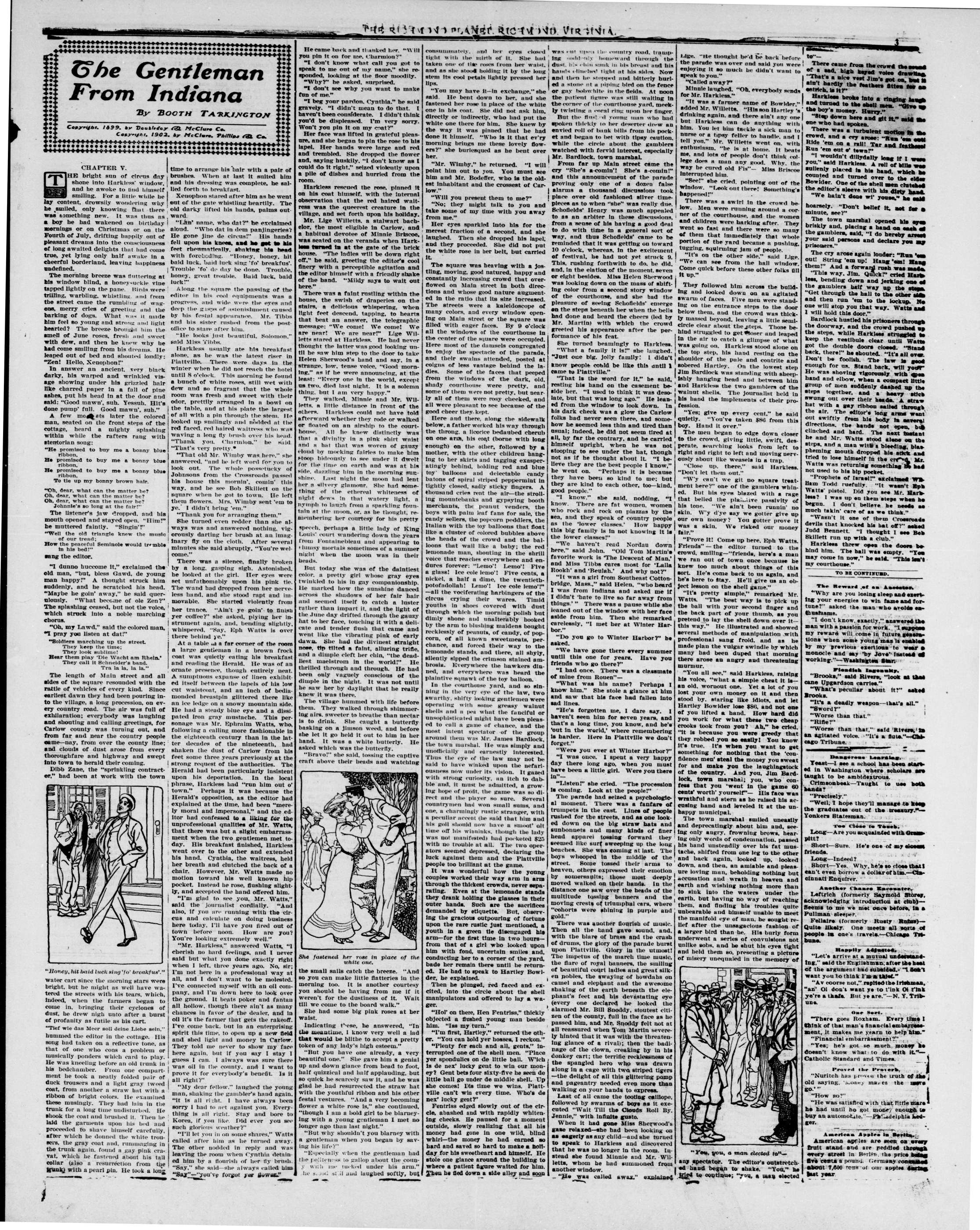
The Gentleman From Indiana
By BOOTH TARKINGTON
Copyright, 1899, by Doubleday McClure Co.
Copyright, 1902, by McClure, Phillips Co.
```markdown
```
CHAPTER V.
THE bright sun of circus day shone into Harkless' window, and he awoke to find himself smiling. For a little while he lay content, drowsily wondering why he smiled, only knowing that there was something new. It was thus as a boy he had wakened on birthday mornings or on Christmas or on the Fourth of July, drifting happily out of pleasant dreams into the consciousness of long awaited delights that had come true, yet lying only half awake in a cheerful borderland, leaving happiness undefined.
The morning breeze was futtering at his window blind, a honey-sucked vine tapped lightly on the pane. Birds were trilling, warbling, whistling, and from the street came the rumbling of wagons, merry cries of greeting and the barking of dogs. What was it made him feel so young and strong and light hearted? The breeze brought him the smell of June roses, fresh and sweet with dew, and then he knew why he had come smiling from his dreams. He leaped out of bed and shouted loudly: "Zen! Hello, Xenophon!"
In answer an ancient, very black darky, his warped and wrinkled visage showing under his grizzled hair like charred paper in a fall of pine ashes, put his head in at the door and said: "Good mawr', suh. Yessuh. Hit's done pump' full. Good mawr', suh."
A few moons later the colored man, seated on the front steps of the cottage, heard a mighty splashing within while the rafters rang with stentorian song:
"He promised to buy me a bonny blue ribbon.
He promised to buy me a bonny blue
He promised to buy me a bonny blue
He promised to buy me a bonny blue ribbon.
To tie up my bonny brown hair.
"Oh, dear, what can the matter be?
Oh, dear, what can the matter be?
Oh, dear, what can the matter be?
Johnnie's so long at the fair"
The listener's jaw dropped, and his mouth opened and stayed open. "Him!"
he muttered faintly. "Singin'!"
"Well the old triangle knew the music
of our tread;
Horseman. Semi-normal would work."
How the powerful seminole would trouble in his bed!
sang the editor.
"I dunno hucume it," exclaimed the old man, "but, bless Gawd, de young man happy!" A thought struck him suddenly, and he scratched his head.
"Maybe he goin' away," he said querulously. "What become of ole Zen?"
The splashing ceased, but not the voice, which struck into a noble marching chorus.
"Oh, my Lawd," said the colored man,
"I pray you listen at dat!"
"Soldiers marching up the street.
They keep the time;
They look sublime!
Hear them play 'The Wight am Rhein.'
They call it Schneider's band.
Tra la la, la la."
The length of Main street and all sides of the square resounded with the rattle of vehicles of every kind. Since earliest dawn they had been pouring into the village, a long procession, on every country road. The air was full of exhilaration; everybody was laughing and shouting and calling greetings, for Carlow county was turning out, and from far and near the country people came—nay, from over the county lines, and clouds of dust arose from every thoroughfare and highway and swept into town to herald their coming. Dibb Zane, the "sprinkling contractor," had been at work with the town
A
"Honey, hit baid luck sing'fo' breakfus,"
Honey, but data tuck into breakfasts" water cart since the morning stars were bright, but he might as well have watered the streets with his tears, which, indeed, when the farmers began to come in, bringing their cyclones of dust, he drew night unto after a burst of profanity as futile as his cart.
"Tef wie das Meer soil deine Liebe sein," hummed the editor in the cottage. His song had taken on a reflective tone, as that of one who cons a problem or musically ponders which card to play. He was kneeling before an old trunk in his bedchamber. From one compartment he took a neatly folded pair of duck trousers and a light gray tweed coat, from another a straw hat with a ribbon of bright colors. He examined these musingly. They had lain in the trunk for a long time undisturbed. He shook the coat and brushed it. Then he laid the garments upon his bed and proceeded to shave himself carefully, after which he donned the white trousers, the gray coat and, rummaging in the trunk again, found a gay pink cravat, which he fastened about his tall collar (also a resurrection from the grunk) with a pearl pin. He took a long
time to arrange his hair with a pair of brushes. When at last it suited him and his dressing was complete, he sallied forth to breakfast.
Xenophon stared after him as he went out of the gate whistling heartily. The old darky lifted his hands, palms outward.
"Lan' name, who dat?" he exclaimed aloud. "Who dat in dem panjingeries? He gone jine de circus!" His hands fell upon his knees, and he got to his feet rheumatically, shaking his head with foreboding. "Honey, honey, hit bald luck, bald luck sing 'fo' breakfus." Trouble 'fo' de day be done. Trouble, honey, great trouble. Baid luck, baid luck!
Along the square the passing of the editor in his cool equipments was a progress, and wide were the eyes and deep the grusps of astonishment caused by his festal appearance. Mr. Tibbs and his sister rushed from the post-office to stare after him.
"He looks just beautiful, Solomon," said Miss Tibbs.
Harkless usually ate his breakfast alone, as he was the latest riser in Plattville. There were days in the winter when he did not reach the hotel until 8 o'clock. This morning he found a bunch of white roses, still wet with dew and so fragrant that the whole room was fresh and sweet with their odor, prettily arranged in a bowl on the table, and at his plate the largest of all with a pin through the stem. He looked up smilingly and nodded at the red face, red haired waitress who was waving a long fly brush over his head. "Thank you. Charmion," he said. "That's very pretty."
"That old Mr. Wimby was here," she answered, "and he left word for you to look out. The whole possetucky of Johnsons from the Crossroads passed his house this mornin', comin' this way, and he see Bob Skillett on the square when he got to town. He left them flowers. Mrs. Wimby sent 'em to ye. I didn't bring 'em." "Thank you for arranging them."
"I thank you for arranging them."
She turned even redder than she always was and answered nothing, vigorously darting her brush at an imaginary fly on the cloth. After several minutes she said abruptly, "You're welcome."
There was a silence, finally broken by a long, gasping sigh. Astonished, he looked at the girl. Her eyes were set unfathomably upon his pink tie. The wand had dropped from her nerveless hand, and she stood rapt and immovable. She started violently from her trance. "Aln'te yer goin' to finish yer coffee?" she asked, plying her instrument again, and, bending slightly, whispered, "Say, Eph Watts is over there behind ye."
At a table in a far corner of the room a large gentleman in a brown frock coat was quietly eating his breakfast and reading the Herald. He was of an ornate presence, though entirely neat. A sumptuous expanse of linen exhibited itself between the lapels of his low cut waistcoat, and an inch of bed-monded breastpin glittered there like an ice ledge on a snowy mountain side. He had a steady blue eye and a dissipated iron gray mustache. This personage was Mr. Ephraim Watts, who, following a calling more fashionable in the eighteenth century than in the latter decades of the nineteenth, had shaken the dust of Carlow from his feet some three years previously at the strong request of the authorities. The Herald had been particularly insistent upon his deportation. In the local phrase, Harkless had "run him out o'town." Perhaps it was because the Herald's opposition, as the editor had explained at the time, had been "merely moral and impersonal," and the editor had confessed to a liking for the unprofessional qualities of Mr. Watts, that there was but a slight embarrassment when the two gentlemen met today. His breakfast finished, Harkless went over to the other and extended his hand. Cynthia, the waitress, held her breath and clutched the back of a chair. However, Mr. Watts made no motion toward his well known hip pocket. Instead he rose, flushing slightly, and accepted the hand offered him. "I'm glad to see you, Mr. Watts." said the journalist cordially. "And also, if you are running with the circus and calculate on doing business here today, I'll have you fired out of town before noon. How are you? You're looking extremely well."
"Mr. Harkless," answered Watt, "I cherish no hard feelings, and I never said but what you done exactly right when I left, three years ago. No, sir; I'm not here in a professional way at all, and I don't want to be molested. I've connected myself with an oil company, and I'm down here to look over the ground. It beats poker and fantan all hollow, though there aln't as many chances in favor of the dealer, and in oil it's the farmer that gets the rakeoff. I've come back, but in an enterprising spirit this time, to open up a new field and shed light and money in Carlow. They told me never to show my face here again, but if you say I stay I guess I can. I always was sure there was oil in the county, and I want to prove it for everybody's benefit. Is it all right?"
"My dear fellow," laughed the young man, shaking the gambler's hand again, "it is all right. I have always been sorry I had to act against you. Everything is all right. Stay and bore to Korea, if you like. Did ever you see such glorious weather?"
"I'll let you in on some shares," Watts called after him as he turned away. The other nodded in reply and was leaving the room when Cynthia detained him by a flourish of her fly brush. "Say," she said—she always called him "Say—"you've forgot your howeer."
THE R(3)V(N) PLANET R(CH)V(N)D. VIRGINIA.
He came back and thanked her. "Will you pin it on for me, Charion?"
"I don't know what call you got to speak to me out of my name," she responded, looking at the floor moodily.
"Why?" he asked, surprised.
"I don't see why you want to make fun of me."
"I beg your pardon, Cynthia," he said gravely. "I didn't mean to do that. I haven't been considerate. I didn't think you'd be displeased. I'm very sorry. Won't you pin it on my coat?"
Her face was lifted in grateful pleasure, and she began to pin the rose to his lapel. Her hands were large and red and trembled. She dropped the flower and, saying huskily, "I don't know as you could do it right," seized violently upon a pile of dishes and hurried from the room.
Harkless rescued the rose, plined it on his coat himself, with the internal observation that the red haired waitress was the queerest creature in the village, and set forth upon his holiday. Mr. Lige Willetts, a stalwart bachelor, the most eligible in Carlow, and a habitual devotee of Minnie Briscoe, was seated on the veranda when Harkless turned in at the gate of the brick house. "The ladies will be down right off," he said, greeting the editor's cool finery with a perceptible agitation and the editor himself with a friendly shake of the hand. "Mildy says to wait out here."
There was a faint rustling within the house, the swish of draperies on the stairs, a delicious whispering, when light feet descend, tapping, to hearts that beat an answer, the telegraphic message: "We come! We come! We are near! We are near!" Lige Willetts stared at Harkless. He had never thought the latter was good looking until he saw him step to the door to take Helen Sherwood's hand and say, in a strange, low, tense voice, "Good morning," as if he were announcing, at the least: "Every one in the world, except us two, died last night. It is a solemn thing, but I am very happy."
They walked, Minnie and Mr. Willetts, a little distance in front of the others. Harkless could not have told afterward whether they rode or walked or floated on an airship to the courthouse. All he knew distinctly was that a divinity in a pink shirt waist and a hat that was woven of gauzy cloud by mocking fairies to make him stoop hideously to see under it dwell for the time on earth and was at his side, dazzling him in the morning sunshine. Last night the moon had lent her a silvery glamour. She had something of the ethereal whiteness of night dews in that watery light, a nymph to laugh from a sparkling fountain at the moon, or, as he thought, remembering her courtesy for his pretty speech, perhaps a little lady of King Louis' court wandering down the years from Fontaineblean and appearing to clumsy mortals sometimes of a summer night when the moon was in their beads.
But today she was of the daintest color, a pretty girl whose gray eyes twinkled to his in gay companionship. He marked how the sunshine danced across the shadows of her fair hair and seemed itself to catch a luster rather than impart it, and the light of the June day drifted through the gauzy hat to her face, touching it with a delicate and tender flush that came and went like the vibrating pink of early dawn. She had the divinest straight nose, tip tilted a faint, alluring trifle, and a dimple cleft her chin, "the deadliest maelstrom in the world!" He thrilled through and through. He had been only vaguely conscious of the dimple in the night. It was not until he saw her by daylight that he really knew it was there.
The village hummed with life before them. They walked through shimmering airs, sweeter to breathe than nectar is to drink. She caught a butterfly basking on a jimson weed, and before she let it go held it out to him in her hand. It was a white butterfly. He asked which was the butterfly. "Bravo!" she said, tossing the captive craft above their heads and watching
A
She fastened her rose in place of the white one.
the small sails catch the breeze. "And so you can make little flatteries in the morning too. It is another courtesy you should be having from me if it weren't for the dustiness of it. Wait till we come to the board walk."
She had some big pink roses at her waist.
Indicating these, he answered, "In the meantime, I know very well a lad that would be blithe to accept a pretty token of any lady's high esteem."
"But you have one already, a very beautiful one." She gave him a genial up and down glance from head to foot, half quizzical and half applauding, but so quick he scarcely saw it, and he was glad he had resurrected the straw hat with the youthful ribbon and his other festal restures. "And a very becoming flower a white rose is," she continued, "though I am a bold girl to be blairneying with a young gentleman I met no longer ago than last night."
"But why shouldn't you blairney with a gentleman when you began by saving his life?"
"Especially when the gentleman had the politeness to gallop about the country with me tucked under his arm." He stood still and laughed softly, but
consummately, and her eyes closed tight with the mirth of it. She had taken one of the roses from her waist, and as she stood holding it by the long stem its cool petals lightly pressed her lips.
"You may have it—in exchange," she said. He bent down to her, and she fastened her rose in place of the white one in his cont. She did not ask him, directly or indirectly, who had put the white one there for him. She knew by the way it was pinned that he had done it himself. "Who is it that evry morning brings me these lovely flowers?" she burlesqued as he bent over her.
"Mr. Wimby," he returned. "I will point him out to you. You must see him and Mr. Bodeffer, who is the oldest inhabitant and the crossest of Carlow."
"Will you present them to me?"
"No; they might talk to you and take some of my time with you away from me."
Her eyes sparkled into his for the merest fraction of a second, and she laughed. Then she dropped his lapel and they proceeded. She did not put the white rose in her belt, but carried it.
The square was heaving with a jostling, moving, good natured, happy and constantly increasing crowd that overflowed on Main street in both directions and whose good nature augmented in the ratio that its size increased. The streets were a kaleidoscope of many colors, and every window opening on Main street or the square was filled with eager faces. By 9 o'clock all the windows of the courthouse in the center of the square were occupied. Here most of the damsels congregated to enjoy the spectacle of the parade, and their swains attended, posted at coignes of less vantage behind the ladies. Some of the faces that peeped from the windows of the old, dark, shady courthouse were pretty, and some of them were not pretty, but nearly all of them were rosy checked, and all were pleasant to see because of the good cheer they kept.
Here and there, along the sidewalk below, a father worked his way through the throng, a licorice bedaed cherub on one arm, his coat (borne with long enough) on the other, followed by a mother, with the other children hanging to her skirts and tagging exasperatingly behind, holding red and blue toy balloons and delectable candy batons of spiral striped peppermint in tightly closed, sadly sticky fingers. A thousand cries rent the air—the strolling mountebanks and gypsying booth merchants, the peanut venders, the boys with palm leaf fans for sale, the candy sellers, the popcorn peddlers, the Italian with the toy balloons that float like a cluster of colored bubbles above the heads of the crowd and the balloons that wall like a baby; the red lemonade man, shouting in the shrill voice that reaches everywhere and endures forever: "Lemo!' Lemo!' Five a glass! Ice cole lemo!' Five cents, a nickel, a half a dime, the twenthemtotofadollah! Lemo!' Ice cole lemo!'"—all the vociferating harbings of the circus crying their wares. Timid youths in shoes covered with dust through which the morning polish but dimly shone and unalterably hooked by the arm to blushing maidens bought recklessly of peanuts, of candy, of popcorn, of all known sweetmeats, perchance, and forced their way to the lemonade stands, and there, all shyly, silently slipped the crimson stained ambrosia. Everywhere the hawkers dined, and everywhere was heard the plaintive squawk of the toy balloon.
In the courthouse yard, and so slining in the very eye of the law, two swarthy, shifty looking gentlemen were operating with some greasy walnut shells and a pea what the fanciful or unsophisticated might have been pleased to call a game of chance, and the most intent spectator of the group around them was Mr. James Bardock, the town marshal. He was simply and unofficially and earnestly interested. Thus the eye of the law may not be said to have winked upon the nefariousness now under its vision. It gazed with strong curiosity, an itch to dabble and, it must be admitted, a growing hope of profit, the game was so direct and the player so sure. Several countrymen had won small sums, and one, a charmingly rustic stranger, with a peculiar accent (the said that him and his golf should now have a smoot' oft time off his winnails, though the lady was not manifested) had pocketed $25 with no trouble at all. The two operators seemed depressed, declaring the luck against them and the Platville people too brilliant at the game.
It was wonderful how the young couples worked their way arm in arm through the thickest crowds, never separating. Even at the lemonade stands they drank holding the glasses in their outer hands. Such are the sacrifices demanded by etiquette. But, observing the gracious outpouring of fortune upon the rare rustic just mentioned, a youth in a green tree disengaged his arm—for the first time in two hours—from that of a girl who looked upon him with fond, uncertain smiles and, conducting her to a corner of the yard, bade her remain there until he returned. He had to speak to Hartley Bowler, he explained.
Then he plunged, red faced and excited, into the circle about the shell manipulators and offered to lay a wager.
“Hol' on there, Hen Fentriss,” thickly objected a flushed young man beside him. “Iss my turn.”
“I'm first, Hartley,” returned the other. “You can hold ver hosses. I reckon.”
er. "You can hold yer noses, I reckon." "Plenty for each and all, gents." interrupted one of the shell men. "Place yer spondillets on de little ball. Wich is de nex' lucky gent to win our money? Gent beta sixy-five he seen de little ball go under de middle shell. Up she comes! Dis time we wins. Plattville can't win every time. Who's de nex' lucky gent?"
Fentriss edged slowly out of the circle, abashed and with rapidly whitening checks. He paused for a moment outside, slowly realizing that all his money had gone in one wild, blind whirl—the money he had earned so hard and saved so hard to make a holiday for his sweetheart and himself. He stole one globe around the building to where a patient figure waited for him. Then he fled down a side alley and soon
was cut upon the country road, tramping sold out only homeward through the dust, his skin sunk in his breast and his hands climbed tight at his sides. Now and then he stepped and bitterly bled a stone at a piping bird on the fence or gay babwhite in the fields. At noon the patient figure was still waiting in the corner of the courthouse yard, meekly twisting a coral ring upon her finger. But the flushed young man who had spoken thickly to her deserter drew an envied roll of bank bills from his pocket and began to bet with tipsy caution, while the circle about the gamblers watched with fervid interest, especially Mr. Bardlock, town marshal.
From far up Main street came the cry "She a comin'! She a comin'!" and this announcement of the parade proving only one of a dozen false alarms a thousand discussions took place over old fashloned silver timepieces as to when "she" was really due. Schofields Henry was much appended to as an arbiter in these discussions, from a sense of his having a good deal to do with time in a general sort of way, and thus Schofields came to be reminded that it was getting on toward 10 o'clock, whereas, in the excitement of festival, he had not yet struck 9. This, rushing forthwith to do, he did, and, in the elation of the moment, seven or eight besides. Miss Helen Sherwood was looking down on the mass of shifting color from a second story window of the courthouse, and she bad the pleasure of seeing Schofields' emerge on the steps beneath her when the bells had done and heard the cheers (led by Mr. Martin) with which the crowd greeted his appearance after the performance of his feat.
She turned beamingly to Harkless, "What a family it is!" she laughed. "Just one big, jolly family: I didn't snow people could be like this until I came to Plattville."
"That is the word for it," he said, resting his hand on the casement beside her. "I used to think it was desolate, but that was long ago." He leaned from the window to look down. In his dark cheek was a glow the Carlow folks had never seen there, and somehow he seemed less thin and tired than usual; indeed, he did not seem tired at all, by far the contrary, and he carried himself upright, when he was not stooping to see under the hat, though not as if he thought about it. "I believe they are the best people I know," he went on. "Perhaps it is because they have been so kind to me; but they are kind to each other, too-kind, good people."
"I know." she said, nodding, "I know. There are fat women, women who rock and rock on piazzas by the sea, and they speak of country people as the 'lower classes.' How happy this big family is in not knowing it is the lower classes!"
"We haven't read Nordau down here," said John. "Old Tom Martin's favorite work is 'The Descent of Man,' and Miss Tibbs cares most for 'Lalla Rookh' and 'Beulah.' And why not?"
"It was a girl from Southeast Cottonbridge, Mass," said Helen, "who heard I was from Indiana and asked me if I didn't 'hate to live so far away from things.' There was a pause while she leaned out of the window with her face aside from him. Then she remarked carelessly, "I met her at Winter Harbor."
"Do you go to Winter Harbor?" he asked.
"We have gone there every summer until this one for years. Have you friends who go there?"
"I had once. There was a classmate of mine from Rouen"—
"What was his name? Perhaps I know him." She stole a glance at him and saw that his face had fallen into sadd lines.
"He's forgotten me, I dare say. I haven't seen him for seven years, and that's a long time, you know, and he's 'out in the world,' where remembering is harder. Here in Platville we don't forget."
"Were you ever at Winter Harbor?"
"I was once. I spent a very happy day there long ago, when you must have been a little girl. Were you there in"—
"Listen!" she cried. "The procession is coming. Look at the people!"
The parade had seized a psychological moment. There was a fanfare of trumpets in the east. Lines of people rushed for the streets, and as one looked down on the big straw hats and sunbannets and many kinds of finer head apparel tossing forward they seemed like surf sweeping up the long beaches. She was coming at last. The boys who swooped in the middle of the street. Some tossed their arms to heaven, others expressed their emotion by somersaults; those most deeply moved walked on their hands. In the distance one saw over the heads of the multitude tossing banners and the moving crests of triumphal cars, where "cohorts were shining in purple and gold."
There was another flourish of music. Then all the band gave sound, and, with the blare of brass and the crash of drums, the glory of the parade burst upon Plattville. Glory in the utmost! The impetus of the march time music, the flare of royal banners, the smiling of beautiful court ladies and great silken nobles, the swaying of howdabs on camel and elephant and the awesome shaking of the earth beneath the elephant's feet and his devastating eye (every one declared he looked the alarmed Mr. Bill Snoddy, stoutest citizen of the county, full in the face as he passed him, and Mr. Snoddy felt not at all reassured when Tom Martin severely hinted that it was with the threatening glance of a rival); then the badnage of the clown, creaking by in his donkey cart; the terrific recklessness of the spangled hero who was drawn along in a cage with two striped tigers—the delight of all this glittering pump and pageantry needed even more than walking on your hands to express.
Last of all came the tooting callope, followed by swarms of boys as it executed "Wait Till the Clouds Roll By, Jennie," with infinite gusto.
When it had gone Miss Sherwood's gase relaxed—she had been looking on as eagerly as any child—and she turned to speak to Harkless and discovered that he was no longer in the room. Instead she found Minnie and Mr. Willetts, whom he had summoned from another window.
"He was called awax," explained
Lige. "He thought he'd be back before the parade was over and said you were enjoying it so much he didn't want to speak to you."
"Called away?"
Minnie laughed. "Oh, everybody sends for Mr. Harkless."
"It was a farmer name of Bowler," added Mr. Willetts. "His son Hartley's drinking again, and there ain't any one but Harkless can do anything with him. You let him tackle a sick man to nurse or a tipsy feller to handle, and I tell you." Mr. Willetts went on, with enthusiasm. "he is at home. It beats me, and lots of people don't think college does a man any good. Why, the way he cured old Fis"—Miss Briscoe interrupted him.
"See!" she cried, pointing out of the window. "Look out there! Something's happened!"
There was a swirl in the crowd below. Men were running around a corner of the courthouse, and the women and children were harking after. They went so fast and there were so many of them that immediately that whole portion of the yard became a pushing, tugging, squirming jam of people.
"It's on the other side," said Lige. "We can see from the hall window. Come quick before these other folks fill it up."
They followed him across the building and looked down on an agitated swarm of faces. Five men were standing on the entrance steps to the door below them, and the crowd was thickly massed beyond, leaving a little semicircle clear about the steps. Those behind struggled to get closer and leaped in the air to catch a glimpse of what was going on. Harkless stood alone on the top step, his hand resting on the shoulder of the pale and contrite and sobered Hartley. On the lowest step Jim Bardlock was standing with sheepish hanging head and between him and Harkless the two gamblers of the walnut shells. The journalist held in his hand the implements of their profession.
"Yes; give up every cent," he said quietly. "You've taken $86 from this boy. Hand it over."
The men began to edge down closer to the crowd, giving little, swift, desperate, searching looks from left to right and right to left and moving nervously about like weasels in a trap.
"Close up, there," said Harkless.
"Don't let them out."
"Wy can't we git no square treatment here?" one of the gamblers whined. But his eyes blazed with a rage that belied the plain live passivity of his tone. "We ain't been runnin' no skin. Wy dye say we gotter give up our own money? You gotter prove it was a skin. We risked our money fair."
"Prove it! Come up here. Eph Watts. Friends"—the editor turned to the crowd, smiling—"friends, here's a man we ran out of town once because he knew too much about things of this sort. He's come back to us again, and he's here to stay. He'll give us an object lesson on the shell game."
"It's pretty simple," remarked Mr. Watts. "The best way is to pick up the ball with your second finger and the back part of your thumb, as you pretend to lay the shell down over it—this way." He illustrated and showed several methods of manipulation with professional sang froid, and as he made plan the vulgar swinkle by which many had been duped that morning there arose an angry and threatening murmur.
"You all see," said Harkless, raising his voice, "what a simple cheat it is—an old, wornout one. Yet a lot of you lost your own money on it and then stood by, staring like idiots, and let Hartley Bowler lose $86, and not one of you lifted a hand. How hard did you work for what these two cheap crooks took from you? Ah," he cried, "it is because you were greedy that they robbed you so easily! You know it's true. It's when you want to get something for nothing that the 'confidence men' steal the money you sweat for and make you the laughingstock of the country. And you, Jim Bardlock, town marshal; you, who confess that you 'went in the game 60 cents' worth yourself"— His face was wrathful and stern as he raised his accusing hand and leveled it at the unhappy municipal.
The town marshal smiled uneasily and deprecatingly about him and, seeing only angry, frowning brows, hearing only words of condemnation, passed his hand unsteadily over his fat mustache, shifted from one leg to the other and back again, looked up, looked down, and then, an amiable and pleasure loving man, beholding nothing but accusation and wrath in heaven and earth and wishing nothing more than to sink into the waters under the earth, but having no way of reaching them, and finding his troubles quite unbearable and himself unable to meet the manifold eye of man, he sought relief after the unsagacious fashion of a larger bird than he. His burly form underwent a series of convulsions not unlike sobs, and he shut his eyes tight and held them so, presenting a picture of misery unequaled in the memory of
A
"You, you, a man elected to" any spectator. The editor's outstretched hand began to shake. "You" he tried to continue; "you, a man elected
There came from the crowd the sound of a sad, high keyed voice drawing "That's a nice vest Jim's got on, but it isn't hardly the feathers fitted for an esthrick, is it?" Harkern broke into a ringing laugh and turned to the shell man. "Give us the boy's money. Hurry." "Step down here and git it," said the one who had spoken. There was a turbulent motion in the crowd, and a cry arose: "Run 'em out ride 'em on a rail! Tar and feathers Run 'em out o' town!" "I wouldn't dillydally long if I wore you." said Harkless. A roll of bills was sullenly placed in his hand, which he counted and turned over to the elder Bowlder. One of the shell men clutched the editor's sleeve with his dirty hand. "We hain't done wi' youse," he said hoarsely. "Don't belief it, not for a minute, see?"
The town marshal opened his eyes briskly and, placing a hand on each of the gamblers, said, "I do hereby arrest your said persons and declare you my prisoners."
The cry awake again louder: "Run 'em out! String 'em up! Hang 'em! Hang them!" And a forward rush was made "This way, Jim. Quick!" cried Harless, bending down and jerking one of the gamblers half way up the stairs "Get through the hall to the other side and then run 'em to the lockup. No one will stop you that way. Watts and I will hold this door."
Bardock hustled his prisoners through the doorway, and the crowd pushed up the steps, while Harkless struggled to keep the restibule clear until Watt got the double doors closed. "Stand back, there!" he shouted. "It's all over. Don't be foolish. The law is good enough for us. Stand back, will you?" He was showing vigorously with open hand and elbow, when a compact little group of men suddenly dashed up the steps together, and a heavy stick swung out over their heads. A straw hat with a gay ribbon sailed through the air. The editor's long arms went out swiftly from his body in several directions, the hands not open, but clutched and hard. The next instant he and Mr. Watts stood alone on the steps, and a man with a bleeding, blaspheming mouth dropped his stick and tried to lose himself in the crowd. Mr. Watts was returning something he had not used to his hbp pocket.
"Prophets of Israel!" exclaimed William Todd ruefully. "It wasn't Eph Watts' pistol. Did you see Mr. Harbess? I was up on them steps when he began. I don't believe, he needs as much takin' care of as we think." "Wasn't it one of them Crossroads devils that knocked his hat off?" asked Judd Bennett. "I thought I see Bob Skillett run up with a club." Harkless threw open the doors behind him. The ball was empty. "You may come in now," he said. "This isn't my courthouse."
TO BE CONTINUED
"Why are you losing sleep and exerting your energies to win fame and fortune?" asked the man who avoids enthusiasm.
"I don't know, exactly," answered the man with a passion for work. "I suppose my reward will come in future generations when some young man is enabled by my previous exertions to wear a monocle and say 'by Jove' instead of working."—Washington Sam
Fiendish Ingenuity.
"Brooks," said Rivers, "look at that cane Upgardson carries."
"What's peculiar about it?" asked Brooks.
"It's a deadly weapon—that's all."
"Sword?"
"Worse than that."
"Rifle?"
"Worse than that." said Rivers, in an agitated voice. "It's a fute."—Chicago Tribune.
Dangerous Learning.
Yeast—I see a school has been started in Washington where scholars are taught to be ambidextrous.
Crimsonbeak—Taught to use both hands?
"Precisely."
"Well, I hope they'll manage to keep the graduates out of the treasury."—Yonkers Statesman.
Too Close to Touch.
Long—Are you acquainted with Grass pitt?
Short—Sure. He's one of my closest friends.
Long—Indeed?
Short—Yes. Why, he's so close that I can't even borrow a dollar of him.—Cincinnati Enquirer.
Another Change Encounter.
Leftrich (formerly Saymold Store, acknowledging introduction at club)—Seems to me we met once before, in a Pullman sleeper.
Fellaire (formerly Rusty Ruhan)—Quite likely. One meets all sorts of people in one's travels.—Chicago Tribune.
Hannity, Adriane
"Let's arrive at a mutual understanding," said the Englishman, after the heat of the argument had subsided. "I don't want you to think I am a thief."
"Av coorse not," replied the Irishman, "an 'on' don't want you to tink 'on' tink ye're a thafe. But ye are."—N. Y. Tribune.
One Sort.
"There goes Roxham. Every time I think of that man's financial embarrassment, it makes me yearn to help him." "Financial embarrassment?"
"Yes; he's got so much money he doesn't know what to do with it."—Catholic Standard and Times.
Proved the Proverb,
"Nuritch has proven the truth of the old saying, 'money makes the more go.'"
"How so?"
"He was satisfied with that little mare he had until he got money enough to buy an automobile."—Philadelphia Ledger.
American Apples in Berlin.
American apples are seen on every fruit stand and are pettled through every street in Berlin, the price being five cents a pound. Germany contained about 7,000 tons of our apples during last year.
THE PAPER
issued every Saturday by JOHN K. CHEZ
at 811 North 4th Street, Richmond, Va.
MIN MITCHELL, JR. - EDITOR
all communications intended for publication
should be received to reach us by Wednesday
TERMS IN ADVANCE
There are FOUR WAYs by which money can be by mail at our risk. - In a Post Office Mon
day, by mail at our address. - In a Money Order and when none of these
can be procured, in a Registered Letter.
MONEY ORDERS - You can buy a Money Ord
at your Post Office, payable at the Richmond
and we will be responsible for its arrival.
EXPRESS MONEY ORDERS can be or 'ained at
office of the American Express, so, the
United States Express Co, and the Well. Far
more convenient for money sent by any of these com-
panies. The Express Money Order is a safe
and convenient way for forwarding money.
REGISTERED LETTER - If a Money Order
must be sent outreach, your Postmaster will register the after you wish to send us on payment of ten cents. Then, if the letter is lost or stolen, you can send money in this manner at our risk.
We cannot be responsible for money sent in
letters in any other way than one of the four ways mentioned above. If you send your mon
y in another way, you must do it at your own risk.
RENWALA, ETC.—If you do not want THE NET continued for another year after your publication but run out, you then notify us by postal Card to discontinue it. The courts have decided that subscribers to newspapers who do not subscribe for every discount, the duration of time for which it has been paid are liable for the payment of the subscription and date when they order the paper discount.
COMMUNICATIONS.—When writing to us to renew your subscription or to discontinue it, paper, you should give your name and at the end of the paper we cance and find your RANGE OF ADDRESS.—In order to change address of a subscriber, we must be sent former as well as the present address.
Entered in the Post Office at Richmond.
SATURDAY. MARCH 12, 1904
NEXT week we shall discuss Mr. THOMAS NELSON PAGE on "The Negro; The Southerner's Problem as published in MCOURE'S Magazine for March.
As Mr. PAGE is a Democrat and one of President Roosevelt's advisers in the matter of southern appointments, his words will have peculiar significance.
A LYNCHING IN OHIO.
THE lynching of RICHARD DIXON, colored, at Springfield, Ohio, Monday, March 7th, 1904, was a dastardly exhibition of mob violence and it seems was accomplished only through the connivance of the authorities, who stood sworn to uphold the majesty of the law. DIXON was charged with fatally shooting ANNA CORBIN and Policeman CHARLES COLLIS.
That it was possible that such a wanton violation of the law should take place in a city the size of Springfield, Ohio, is astonishing and indicates that a reformation is needed in the management of the city's affairs. Ohio has an anti-lynching law and it has been sus-
tained in all of its vital features by the courts, thanks to Hon. HARRY C. SMITH, who was the champion of the measure. While DIXON may have been a worthless character, his untimely taking off emphasizes the fact that every other citizen's life is in danger by just such unfortunate occurrences.
If we are to judge by the recent hap, penings in Virginia, at Roanoke, a Negro prisoner charged with crime is safer from the fury of a mob in Democratic Virginia than he is from the same agency in Republican Ohio. The case should be sifted to the bottom and the responsibility placed. Excuses should not be accepted. Lynch-law must go!
DR. THIRKIELD'S REMARKABLE DISSERTATION.
We are continuing to publish extracts from Dr. WILBUR P. THIRKIELD's remar, kable dissertation on "The Industrial and higher education of the Negro." He said:
The higher education is necessary for the raising up of a trained leadership for the race.
It is the higher education that is to bring princes out of Egypt. Moses was fitted for leadership, because he was trained in all the wisdom of the representative civilization of his day. The words of Dr. Henry Drummond are especially applicable to the Negro at this time: "God is all for quality; man is for quantity. But the immediate need of the world at this moment is not more of it. If may use the expression, a better brand of man. To them of an improved type would be better than if we had ten thousand of the average Christians distributed all over the world."
Ten Negroes of an improved type can do more for their race—and that means for humanity—than ten thousand average Negroes distributed over America. The above is a sweeping statement.
Who can deny it truthfully? And again:
Every race is dependent on its leaders. No race among as so much as the Negro has masses there are no libraries; no higher schools; no superior schools; no large learned class. Therefore for their opinions, the masses are dependent upon their leaders.
The Negro must either take his opinions ready made from the white man, or be so educated as to be capable of originating and enforcing his own opinions.
And the leader needs to be taught to think; not to think about things, but to think through things; to form independent opinions; to know really for himself; to achieve his destiny; to inspire and lead his fellows on to larger life and nobler usefulness through unselfish service.
One of the first things done during the bloody era, following the reconstruction period, was to either kill or banish Negro leaders from the South-land, and those now here, who are sure to their people must at all times take desperate chances, when they speak out in favor of those whom they represent.
He continued:
It is the trained and trusted leader who will do most to adjust the Negro to the inevitable conditions of his life; to make him master of his environment, to bring him to realize "Tis not in mortals to command success; they must lo more deserve it." It is the breadth of view that comes through the higher education that saves one from the narrowness of vision and conceit of the self-opinionated. The modest man is the large-knowing man.
The following statement is a most sweeping reply to Gov. Vardaman.
It is also a significant fact that, with all these thousands of graduates from the higher institutions of learning for the black man, not one of them has ever been accused of the nameless crime against the sacredness of womanhood.
But, admitting faults and failures in the educated mas, how about the several thousand of college-bred Negroes? To them might be applied the answer of the philosophical observer to the snow that the college-bred men of Europe were failures: "Yes one-third of the college men are failures; one-third become drunkards, and go down to lives of shame, but the other third rules Europe.
God is raising up friends for us and there are none more interested in our welfare than this distinguished white Doctor of Divinity, who is so ably cham, pioning our cause.
GOV. VARDAMAN STILL AFTER US.
It has been the invariable rule for a decade or more that whenever a politician desired to ride into power over a political antagonist in the south-land, he took the Negro as his theme and his debasement as his text, and the result was expected to be all that the most virulent Negro-hater could wish. This mode of campaigning became so popular and resulted in the foisting upon the people, of white men so objectable, that a general crusade was made by the white men, who were being side-tracked to eliminate the Negro as a political feature, in order that white men might divide upon economic questions and not be swayed by appeals to race prejudice.
Accordingly, constitutional provisions were unconstitutionally enacted and Negroes were boldly and systematically disfranchised. The dawn of a new era was announced and the cry of Negro domination by the unprincipled charlatans, who had ridden into power was presumed to be silenced forever. Vain hope this! Being robbed of their main weapon of offense, new schemes were devised to arouse the white men, who had grown careless and cold and indifferent in their support of the Negro-hating spell-binders. They proceeded to show the white men in the South the amount of money that they were paying for the education of the Negro and at the same time called attention to the small amount of money paid for taxation by these same Negroes whom their white emplovers had paid starvation wages.
This was done too in the face of the fact that the Negroes of the South produce more than ($350,000,000) three hundred and fifty million dollars worth of the products of the section per year. The better class of Southern whites presumed that with the elimination of the Negro as a political factor, the day of the "flannel mouth" demagogue had passed.
We knew better and time has demonstrated the wisdom of our conclusions, for Hon. JAMZS A. VARDAMAN made a stirring canvass in Mississippi with the Negro as an issue, and in this day of enlightenment, won out. He advocated the destruction of the public school system, announcing that in ignorance rested the only hope of the Negro's salvation from a white man's standpoint of view. This radical proposition met with condemnation from all quarters, save in Mississippi.
So unguarded was he in his utterances that he soon was upon a battlefield with the advocates of education as his foemen. Negroes had little to do in the matter of meeting his argument, for his utterances embraced an attack upon education itself. Thus far we have seen no educator, who has come to his defense. Most of them regard him as a harmless crank and are charitable enough to give him only the benefit of their silence.
In the New York AMERICAN AND JOURNAL of Sunday, March 6th, 1904, an interview with Gov. JAMES A. VARDAMAN is given in which he says:
"I am opposed to the Negro voting; it matters not what his advertised moral and mental qualifications may be. I am just as much opposed to Bocker Washington, with all his Anglo-Saxon reinforcements, voting as I am to the cocoa-unheaded, chocolate-colored typical little coon, Andy Dotson, who likes to eat morning. Neither is fit to perform the supreme functions of citizenship.
"Some people may say that is prejudice. It may be. But it is a wise preju-
THE RICHMOND PLANET, RICHMOND, VIRGINIA.
dice founded upon the experience of all the ages."
Can any one conceive of any statement more ridicuously absurd? It should be remembered that Gov. VARDAMAN is a type of the Mississippi Southerner, that his views have been endorsed and his course approved by the majority of the white electorate of the state which he represents. Culture, ability and the possession of all the higher traits of mankind cannot raise the Negro in his estimation.
Prof. BOOKER T. WASHINGTON, recognized the world over as one of the most remarkable Negroes of the decade is on a par with Gov. VARDAMAN's bootblack, who revels in his ignorance and is proud of the attention paid him when he is denominated as ignorant or descended from a baboon.
We are gratified, however, to note that these assertions are printed for the information and edification of the liberal-minded white people of the North. They will have a better in-sight of the unreasoning nature of this race prejudice, with which the new Negro has to contend.
What show would a black man have in a court of law with a white man of the VARDAMAN type on the jury, or as presiding judge?
Although sworn to uphold, to maintain and support the Constitution of the United States in its entirety, he boldly declares that he does not believe in the instrument, so far as it relates to the citizen of color and that he will not do that thing which, as Governor of Mississippi, he has sworn to do.
He continued:
"The absolute domination by the white race means race purity. It means order, good government, progress and general prosperity, both for the Negro and the white man. But when the Negro is taken into partnership in the government of the country, demoralization, retrogression and decay ensue—just as surely as the night follows the day."
The absolute absurdity of this statement is apparent upon its face. The domination of the white race was absolute during the years preceding the late Civil War, and yet the purity of the white and colored races was not preserved. The white and yellow streak shows itself in every gathering of the Negroes. Further comment is unnecessary at this point.
We do not deem it necessary to deal with his twisting the statistics to suit his purposes. Prof. BOOKER T. WASHINGTON and the educators have ably answered that part of his remarks and Prof. THIRKIELD's remarkable dissertation on the higher education of the Negro is as yet being produced in these columns.
Extremists like Gov. VARDAMAN are great helps towards the formation of public sentiment in the North in our favor. We have far more to fear from the cool, conservative, argumentative dissertations of southern white men, who with a show of fairness conclude with deductions very much to our injury.
Gov. VARDAMAN said further:
"We must be just to the nigger and we must, at the same time, be true to the white man and true to the civilization of the age."
He had hardly gotten rid of the breath with which he announced that the southern white people must be unjust to the Negro, before with a hypocritical pose and with the knife flourishing in the air with a movement preparatory to the killing of his victim, he announces that he must be just to the Negro while true to the white man.
He said again:
"A long way toward the solution of this question would be effected by repealing the amendment to the Federal Constitution which gave him the right to pollute politics. Congress should submit that question to the people, or rather, to the States. A mistake was made and it should be corrected. It is urged by some men that it is too early to discuss that matter.
"I do not think it is ever too early to tell the truth correct a mistake or expose a lie. The people of some of the southern states have already in effect repealed these amendments. They have eliminated the nigger from politics, and I think and hope they will be able to keep him eliminated, but I prefer doing it in a different way. It would be infinitely better, both for the nigger and the white man, if it could be done."
But what's the use of discussing Gov. VARDAMAN? Death is removing his kind of people from the realms of the living and a few more years will witness his funeral cortege on the way to the tomb. He has secured notoriety and the governorship for the present and a place in Hell for the future. Who would envy VARDAMAN?
Auracial Retreat
Housekeeper—Here, Tige! Here, Tige!
Tramp (hastily)—Please, mum, I—I simply wish er little information, mum.
"Oh, you do?"
"Y-e-s, mum. Would you kindly direct me to a reliable jeweler?"—N. Y. Weekly.
Couldn't Handle Both.
"Oh! man, but O'mi sorry fur ye," said Casey, sympathetically to Cassidy, who had just had an arm amputated.
"Ah, well," replied Cassidy, "there's some good in it. Th' ould woman can't expect me to walk the flure wid the twins now."—Philadelphia Press.
Self-Approval.
"Have you ever done anything to win the gratitude of your fellow-country men?"
"Certainly," answered Senator Sorghum.
"Nobody can ever say that I ever made a speech that it took over three minutes to read."—Washington Star.
Another Airship Flasco.
A small boy climbed out on a bough,
And said: "From this limb I allough,
I can soar quite high,
And like a bird fligh."
But the kid's in the hospital nough.
-N. Y. World.
...
CLEARING FOR ACTION ON A JAPANESE WARSHIP.
The imitative Japanese have for years past been careful and discriminating students of the art of war on the sea. Their ships are modern and their disciple is excellent. Frequent target practice has given them splendid marksmanship, and when they clear for action there are no false motions.
A WEEK'S NEWS CONDENSED
Thursday, March 3.
Ten buildings were destroyed by fire at Rocky Mount, N. C., entailing a loss of over $85,000.
The annual reunion of the United Confederate Veterans will be held at Nashville, Tenn., June 14, 15 and 16.
Edward F. Dixey, who years ago became famous as a member of the Carncross & Dixey Minstrels, died at his home in Philadelphia.
The Morea colliery, near Mahanoy City, Pa., suspended operations for three months, throwing 800 men and boys out of employment.
The Ohio supreme court has declared unconstitutional the law providing a fine for any one who discharges a workman because he is a member of a labor union.
Friday, March 4.
During a cloudburst in Yellow Creek Valley, O., scores of houses were flooded and several lives lost.
Two white men were killed and one white man and two negroes seriously injured in a race riot at Bokashe, I. T. Denny Hall, one of the finest buildings connected with Dickinson College, at Carlisle, Pa., was destroyed by fire. Loss, $30,000.
While attempting to arrest Shuman Jefferson near Lock Haven, Pa., Constable Joseph Deegan was fatally shot. Jefferson escaped.
General George B. Davis will represent the United States government at the meeting in Geneva next May to revise the Red Cross rules.
Saturday, March 5.
A rural free delivery service will be established April 1 at Edgemoor, Del. Governor Pennypacker has designated April 8 and 22 to be observed as Arbor Days throughout Pennsylvania. Admiral Walker, chairman of the Panama canal commission, says the commission will sail for the Isthmus March 22. Because she refused to marry him, Dominick Ante<sup>10</sup>, of Brooklyn, shot and killed Nellie Flanagan and then fatally shot himself. Secretary Shaw transmitted to the house an estimate of $8000 to defray the expenses of dedicating the statue of Frederick the Great, to be placed on the grounds of the war college in Washington.
Monday. March 7.
Frank Waldron fell down the Henry Clay shaft at Shamokin, Pa., a distance of 500 feet, and was instantly killed.
While enroute in a Pullman car from New York to Macon, Ga., Miss M. J. Green was robbed of diamonds valued at $2500.
The Bethlehem (Pa.) Steel company has shipped 12 carloads of ordnance to the St. Louis fair, and propose to have a unique and warlike exhibit.
The strike of the messenger boys against the telegraph companies in Chicago has been broken, as the companies have all the employees required.
Mrs. Sherman Dye, of Boone, Ia., is under arrest, charged with sending poisoned candy to Miss Ren' Wilson, of Pierre, S.D., who is in a dying condition.
Tuesday. March 8.
The New York legislature has passed a bill abolishing the office of coroner in New York city. Practically every coal mine in Indian Territory has closed on account of lack of orders for coal. The United States supreme court did not render a decision in the Northern Securities case, as was expected. The Virginia legislature has appropriated $250,000 to improve and enlarge the Virginia state copital at Richmond. Three trainmen were killed in a rear-end collision between freight trains on the Missouri Pacific road near Jefferson City, Mo.
Wednesday, March 9.
Nancy Rucker, colored, died at Montvale, Bedford county, Va., at the age of 106 years. Postmaster General Payne is confined to the house with a severe attack of gout. In a head-on collision between passenger trains near Kewanee, Miss., five trainmen were killed. Dr. John P. Edge, prominent in medical, agricultural and littertry circles, died at his home in Downingtown, Pa., aged 81 years. Over 700 delegates to the World's Fourth Sunday School convention, to be held at Jerusalem, sailed from New York on a chartered steamer.
VICE ADMIRAL KAMIMURA, SECOND IN COMMAND OF THE JAPANESE YELLOW SEA FLEET.
MORMON REFUSES TO GIVE UP WIVES
Prospective Head of Church Will Continue to Defy the Law.
QUESTIONED BY SENATOR HOAR
Washington, March 9.—The senate committee on privileges and elections in the investigation of the protests against Senator Reed Smoot, of Utah, brought out a variety of testimony, of which the most sensational was that given by Francis M. Lyman, president of the Twelve Apostles of the Mormon church and the man chosen to be the successor of President Smith. His admissions were similar to those previously made by Mr. Smith pertaining to the church government.
"Are you a polygamist?" Mr. Tayler asked, and the witness replied frankly "yes." He said that he had had three wives and that of them two are still living.
"Do you think it would be right to abstain from polygamous cohabitation?"
Mr. Lyman admitted that he knew that in living in polygamy he was disobeying both the law of the land and the rule of the church. He also said in reply to one of these questions that he was not only now living in polygamous cohabitation, but that he expected to continue so to live.
Mr. Hoar took the witness in hand and brought out a succinct statement from him which was of a character to interest all present.
"Referring to the rule of which you have spoken," said Mr. Hoar, "you understand the rule or law of the church to be the law of God, do you not?"
Mr. Lyman replied that such was his understanding.
"Then you are living and intend to live in violation of the law of God and man."
"I fully intend." said Mr. Lyman, "to be true to the law of my country, to my God and to my obligations and covenants with my wives, and I have never done a thing that my conscience did not approve."
Senator Hoar—"So you, an apostle of your church, expecting to succeed Mr. Smith in the presidency and in that capacity to receive divine revelations yourself, confess that you are now living and expect to continue to live in disobedience to the law of the country, the law of your church and the law of God?"
The witness replied with a simple
"yes."
Mr. Lyman was asked what distinction he made between the revelations he obeyed and those he did not obey.
"I suppose you mean the laws I have confessed that I have violated in cohabiting with plural wives?" he asked. When told that was what was meant he said: "I trust myself to the mercy of the Lord."
"Have you ever repented of that disobedience?" asked Mr. Hoar.
"Not yet."
"Did Senator Smoot know you were living with plural wives?" was asked. Mr. Lyman answered that Senator Smoot did not know, as he never had met any one of his wives. He said that the people in general in Utah knew, but that he did not think Mr. Smoot had any knowledge of the fact
Senator Hoar demanded to know what the witness meant by such answers. The witness then said that Senator Smoot probably knew just as much about the question as the people in general.
"Do you take back what you said then that the people knew and Senator Smoot did not know?"
"I take that back."
"Are your answers here by order of the Lord, or are they given in your human capacity?" he was asked.
"I answer as the spirit of the Lord directs."
"Then it was the spirit of the Lord which directed you to make the answer you just took back and which you said was a mistake?"
The witness hesitated and Senator Hoar remarked: "Well, if you can't answer that I don't blame you."
Mr.Lyman then told the story of an effort on the part of Prophet Joseph Smith to get rid of one of his high counsellors who had been chosen by revelation and the refusal of the people to submit to the change. This was
SECOND IN COMMAND OF THE
LOW SEA FLEET.
for the purpose of showing that the will of the people is stronger that the wish or command of the president of the church.
"Do you mean to say," asked Senator Hoar, "that a revelation from the Lord which has been rejected by the people would count for nothing?"
"It would count for nothing for those who rejected it."
"Then," said Senator Hoar, "the voice of the people is of more authority than the mandates of the Lord?"
"The law of the Lord is whatever is done by common consent."
"Then the Lord submits to the people whatever he desires to have done and if the people like it they give their consent. That is your belief is it?"
"People have their rights and they must be respected. The Lord can't make the people do right in regard to religion, business and politics."
"Then," persisted Senator Hoar, "where the Lord has chosen certain persons as apostles and the people do not care to accept the selection, what happens?"
"The man always steps aside when the people reject."
"They have a sort of veto power over the Lord then," remarker Senator Hoar.
FLOOD DAMAGES ARE HEAVY
Many Buildings and Bridges Swept Away Along Susquehanna.
ICE GORGE BELOW SAFE HARBOR
Lancaster, Pa., March 9.—The danger point on the lower Susquehanna shifted from Bainbridge, Columbia and Washington Borough to Safe Harbor, the lower parts of which are practically submerged.
The great gorge at Washington Borough broke, hurling tons of ice and an immense volume of water against the Turkey Hill gorge, a few miles below. The later gave way before the tremendous impact. A new jam then formed just below Safe Harbor, where the Conestoga creek enters the Susquehanna. Back water rushed up the creek, demolishing the Pennsylvania railroad's stone bridge and sweeping away the county bridge, some distance farther up the stream.
The stores of John D. Tripple and H. M. Stauffer, at Safe Harbor, were completely submerged and partly demolished, while the dwellings of J. S. Gramling and Joseph Temple were torn from their foundations and washed away.
The Exchange hotel, at last reports, was just showing above the water. All the houses had water on their lower floors, and in a number of cases residents were forced to abandon their homes from the second story in boats. The loss of live stock is said to be heavy. The county bridge over the Pequa has been swept away.
Streets Are Raging Torrents
Wilkesbarre, Pa., March 9. — The Wyoming Valley is in the grasp of another mighty flood. The situation is serious, and it is feared the worst is yet to come, the gorges to the south of this city and the great mass of ice to the north being a menace so long as they remain intact as they do.
Wilkesbarre all day long has been completely cut off from the rest of the Wyoming Valley, and for miles up and down the river the lowlands are completely covered with water and ice. The early morning scenes and during the day were most exciting, and there are but few people in the homes of the flooded section.
The current is raging on all the lowlands in the southern residence section of the city, many houses being completely wrecked by the huge cakes of ice jamming against them.
On the west bank of the river between here and Kingston, the water is now up to the first floors, and many houses are surrounded with mountains of ice. The conditions at Plymouth and other west side towns up and down the river resemble a great lake, the water rushing through the streets and surrounding many homes. The Market street road between here and Kingston is under six feet of water.
GREAT DAMAGE NEAR YORK
Many Buildings and Bridges Washed
Away—Loss Cannot Be Estimated.
Way, Lost Cannot be Estimated.
York, Pa., March 9.—The greatest damage done by the flood in York county sections was at York Haven and vicinity. The power building of the York Haven Water and Power company, which was badly damaged last Saturday, was completely wrecked, the ice jam leaving only its tower remaining. It is believed most of the machinery will be saved. The York Haven paper mill nearby, was also seriously damaged, parts of it being destroyed. The money loss cannot at present be estimated.
Just below York Haven a steel bridge of the Northern Central railway, spanning a branch of the Conewago creek, was crushed like so much paper. Tracks were washed out near Goldsboro. Barns, houses and sheds were carried away. The water yesterday was at the highest point ever known from Goldsboro south to Peach Bottom, and all along this stretch of 40 miles or more there was a continuous flooding of houses. The water is receding and the danger is about over.
Russia's Fair Building Torn Down.
St. Louis, March 9.—The framework of the Russian national pavilion at the World's Fair was torn down on receipt of a cablegram from St. Petersburg by Contractor Lecour, who has been in charge of the work. Work on the framework of the pavilion was well under way. The cablegram was from the department of the interior, orifice ordering such work as had been completed torn down.
$700,000 In Mutilated Currency.
St. Louis, March 9—The United States sub-treasury will forward to the treasury department at Washington $700,000 in mutilated currency and coin for official destruction. The money was mutilated by wear and tear.
THE
FRISCO
SYSTEM
Carrying Pullman Sleepers, Cafe C
(a la carte) and Chair Cars (seats free
Electric Lighted Throughout
BETWEEN
Birmingham, Memphis and Kansas C
AND TO ALL POINTS IN
Texas, Oklahoma and Indian Territory
AND THE
Far West and Northwest
THE ONLY THROUGH SLEEPING CAR LIB
BETWEEN THE SOUTHEAST AND
KANSAS CITY
Descriptive literature, tickets is
ranged and through reservations mea
upon application to
W. T. SAUNDERS, GEN'L ACT. PASS. DE-
OR
F. E. CLARK, TRAV. PASS. ACT. ATLANTA
W. T. SAUNDERS
Gen'l Agent Passanger Departme
ATLANTA, GA.
U-Auto-No
About the
King of
Them all.
The East Indian Hair Tonic
Nothing Like it Ever Before Seen.
Cures Dandruff 7 to 10 days.
Stops Hair Falling Out 10 to 20 days.
Grows Hair on all Bald Spots if any
roots remain, in from 30 to 60 days.
Improves all kinds of hair, causing it
to grow thicker and fuller.
Owls wish a beautiful grown of hair, try it,
Small boxes 25c. 6 for $1.00
Large boxes 50c. 3 for $1.00
Send money with all orders. We pay
expense of delivering it to you.
Address all orders to
Bruno Mfg. Co.
235 Washington Street, - Boston
AGENTS WANTED.
.
THE PLANET
CAMPFIRE STORIES
SOME QUEER SOLDIERS
They Were Only Squirrel Hunters But They Knew How to Shoot Straight.
"Speaking of war relics," said the colonel, in the Chicago Inter Ocean, "I have one that is very precious to me, and yet it is not associated with battle or wounds. It is a bit of stiff paper, eight by ten inches, on which is printed in scrip letters a statement to the effect that my father, then over 70 years of age, was a squirrel hunter, and was entitled to the thanks of Gov. Tod and the state of Ohio for his assistance in repelling an invasion by the enemy. "This is a reminder of an uprising almost unique in the history of war. In 1862, when Gen. E. Kirby Smith's
A SQUIRREL HUNTER
arm marched through Kentucky toward the Ohio border, Gov. Tod issued an appeal to every man in the central and southern portions of the state who could use a squirrel rifle effectively to repair without further orders to Cincinnati and other points on the Ohio river. Each man was to carry his own rifle, to provide himself with quilts or blankets, to carry food for two or three days, and was simply to climb on a railway train and go to the threatened point.
"The secretary who wrote the unusual order smiled as he thought of what might happen. The governor thought he knew the old men of his state, and he expected a quick response. He did not expect, as he said later, that the whole state would turn out the next day with rifles and bed quilts, and he didn't know how many men could shoot straight with squirrel rifles. At all events there came a host of thousands from farms, shops and towns, every man, young and old, armed and equipped for effective shooting. As one old fellow said: "We can't cut any flip-flaps, and we aren't stylish, but we can beat all creation at a shootin' match."
"No man ever knew how many thousands of the squirrel hunters went down in squads, companies and regiments to the Ohio, without money and without muster, but there were so many thousands as to be bewilder the union officers in command on the border and to scare the confederate officers contemplating attack on Cincinnati. Everybody knew the old fellows could shoot, and that they were eager to shoot. When the rebel army had retired the squirrel hunters were sent home, and all they ever received in the way of remembrance or compensation was an engraved certificate from Gov. Tod. Each old man was prouder of that certificate with its picture of a backwoodsman in the center and the governor's picture in one corner than I was of my commission. In fact, when I exhibited to my father with pardonable pride my commission as colonel he smiled indulently, and, saying he had something better than that, showed me his squirrel hunter certificate. After his death, and he lived to vote for Garfield, the certificate came to me, and I care more for it than I do for my colonel's commission."
FOUGHT IN FOUR WARS
Endiana Cemetery Contains the Remains of Veterans of Many Conflicts.
There is a little village known as New Discovery, in Indiana, with its church and little cemetery. This little burying ground has the honor of being the final bivouac of soldiers of four American wars; one of the revolution, two of the second war for independence, the war of 1812; one of the Mexican war, and three other soldiers of the last-named war. Every year the G. A. R. of that vicinity decorates the graves, holding services at the various graves in succession. Last year the services were held over the grave of William Mitchell, a hero of 1776, who fought throughout the entire struggle for independence. He was born in 1746, and died in 1836.
The first soldier buried there was J. W. Crooks, of the war of 1812, who died in 1833. The third was Abel Ball, also of the war of 1812. The soldier having the distinction of serving in two wars was——Dingey, who was a stranger when he died there. Daniel Capper, Newton Wilson and Harvey Nevins fought in the civil war, and fell early in the strife, being killed in 1862. The last to be buried there was Henry Nevins, of the war of 1812, who died in 1882, aged 91 years.
BEN BUTLER'S ADVICE.
What the Doughty General Said in Council with Secession Emissaries.
In December, 1860, after the election of Mr. Lincoln, Gen. Butler, who had supported Breebridge for president, in preference to either Douglas, Bell or Lincoln, went to Washington, where he had many and serious conversations with his southern brethren, says a writer in the National Tribune. According to the interesting account of the e interviews given by Parton, those southern brethren were determined on secession, and asked Butler to go with them. There was room in the south for such as he. He told them the roach would fight against secession and they laughed at him. He told them "if the south fights, there is an end to slavery," and they laughed again. They asked him "if he would fight in such a cause," and he replied: "Most certainly."
When the South Carolina "ambassadors" came to Washington. Butler proposed to the attorney general to try them for treason. "You say," said he to the attorney, "that the government cannot see us and may beerce South Carolina." Very well. I do not agree with you; but let the proposition be granted. Now, secession is either right or it is a treason. If it is right, the sooner we know it the better. If it is treason, then the presenting of the ordinance of secession is an overt act of treason. These men are coming to the white house to present the ordinance to the president. Admit them. Let them present the ordinance. Let the president say to them: 'Gentlemen, you go hence in the custody of a marshal of the United States, as prisoners of state, charged with treason against your country.' Summon a grand jury here in Washington. Indict the commissioners. If any of your officers are backward in acting, you have the appetitive power—replace them with men who feel as men should at a time like this. Try the commissioners bebefore the supreme court, with all the imposing forms and stately ceremonials which marked the trial of Aaron Burr. I have some reputation at home as a criminal lawyer and I will stay here to help the district attorney through the trial without fee or reward. If they are acquitted, you will have done something toward leaving a clear path for the incoming administration. Time will have been gained; but the great advantage will be, that both sides will pause to watch this high and dignified proceeding; the passions of men will cool; the great point at issue will become clear to all parties; the mind of the country will be active, while passion and prejudice are allayed. Meanwhile, if you cannot use our army and navy in Charleston harbor, you can certainly employ them in keeping order."
This advice was not heeded. The "commissioners," or "ambassadors," heard of it.
"Why, you would not hang us?" said Mr. Orr, one of them, to Butler.
"Oh, no." was the reply. "not unless you were found guilty."
He had one last long interview with the southern leaders, in which the whole sublef was gone 'over. For
"SECESSION IS EITHER RIGHT, OR
IT IS TREASON."
three hours he reasoned with them, demonstrating the folly of their course and warning them of final disastrous failure. The conversation was friendly, though warm and earnest on both sides. Again he was invited to join them, and was offered a share in their enterprise, and a place in that "sound and homogeneous government" which they meant to establish. He left no room to doubt that he took sides with his country, and that all he had and all he was should be freely risked in that country's cause. Late at night they separated, to know one another no more except as mortal foes.
Whr It War.
"Your voice," said the distinguished master, "is excellent in quality and volume, but it has such queer little cracks and quavers in it. What has been responsible for that condition?"
"Well," said the aspiring tenor, "you see, when I was a boy I went to the country school—"
"Yes," said the distinguished master.
"And we were taught there that when we reached a period, a semi-colon, a colon, or any other full stop, we should let our voices fall—"
"Yes."
"And I was always obedient. There being no carpet on the schoolhouse floor, every voice in the school was damaged more or less." — Baltimore American.
Financially.
"Did you say you liked tall men, Miss Flipp?"
"No; I said I didn't like short ones."
—Houston Post.
It is easier to make a bluff than it is to make it good.
Cause and Effect
"Mr. Dabble," said a lawyer to a wif-
mess in the box, "at the times these
papers were executed you were specu-
lating, were you not?"
"What are you in now?"
"Bankrupt," was the scelem reply.
"Tt-Bruity."
THE RICHMOND PLANET, RICHMOND, VIRGINIA
HAS PROUD CORD
Senator Allison of Town Has Bee
a Member of the "Super House"
for Thirty years.
Senator Allison entered the senate in
1873, and there is now says the Washington Post, no one member of that body who has served continuously as he has done. Stewart, of Nevada, was a member, and John H. Mitchell, of Oregon, took his seat at the same time Stewart was out 12 years and Mitchell ten years. John P. Jones, of Nevada, took his seat at the same time, but closed 30 years of service last March. There were some interesting figures in the senate when Allison took his seat there for
SENATOR ALLISON.
(Iowa Statesman Who Has Served in Senate for 30 Years.)
the first time. From the south there was quite an array of the so-called carpet bag senators. Among the well-known personages the new man met on the floor 30 years ago were Powell Clayton, now ambassador to Mexico, and Stephen W. Dorsey, Arkansas; John B. Gordon, Georgia; John A. Logan and Richard J. Ogleys, Illinois; Oliver P. Morton, Indiana; John J. Ingalls, Kansas; Hannibal Hamlin and Lot M. Morrill, Maine; George S. Boutwell, Charles Summer and William D. Washburn, Massachusetts; Zach Chandler and Thomas W. Perry, Michigan; Alexander Ramsey and William Windom, Minnesota; Adelbert Ames, Mississippi; Carl Schurz, Missouri; Frederick T. Frelinghuysen, New Jersey; Roscoe Conkling, New York; Matt W. Ransom, North Carolina; John Sherman and Allen G. Thurman, Ohio; Simon Cameron, Pennsylvania; William G. Brownlow, Tennessee; James W. Flanagan, Texas; George F. Edmunds and Justin S. Morrill, Vermont; Henry J. Davis, West Virginia; Matthew H. Carpenter, Wisconsin.
It is quite a distinction to be the sole survivor of an entire membership of the senate. While it is true that there are two men members now who were there 30 years ago, Senator Allison has seen them go and their successors take their seats and again witnessed their return. He is the one man who has been a member and witnessed a complete change in the senate, himself alone executed.
CLASSIC MEMORIAL
Unique Structure to Be Erected in Memory of Illinois Soldiers Who Fought at Vicksburg.
Classic in design is the temple which the Illinois Vicksburg military park commission intends to erect in the national park at Vicksburg as a memento of the valiant Illinoisans who participated in the campaign and siege of the Mississippi city. The structure recalls the Pantheon and the Temple of Min-
VICKSBURG MEMORIAL.
(To Be Erected by State of Illinois as a
Memento to its Veterans.)
erva at Rome, which was one of the finest of the ancient world. It will be about 48 feet in diameter and 58 feet high, and will be lighted from the top only. It will be decorated with historic figures, one of which will represent the surrender of Vleksburg by Pemberton to Gen. Grant. On bronze panels will be the names of Illinois soldiers, from colonels down, who took part in the campaign, with the branch of the army to which they belonged.
Death Caused by a Pln.
Homer N. Hayes, of Kansas City, died in Colorado Springs from the effects of swallowing a pin a year ago. He suffered no pain from the pin until recently, when the symptoms were mistaken for those of appendicitis. In the operation that followed the pin was found lodged in the intestines, near the vermiform appendix. It was rusty, and the stomach was inflamed, and bore evidence of having been punctured in various places. The pin was removed. Death resulted from the condition of the stomach.
Boston Beaten by China.
The port of New Chwang, at the mouth of the Liao river, is the greatest bean market in the world.
Curious.
Bessie—What do you think of Mayme Gilding?
Flossie—I don't know—why?
Bessie—I asked her what she thought about my wearing a vell at my wedding, and she said that ordinarily she didn't care for vells, but she advised me, by all means, to wear one. Do you suppose the creature meant to reflect upon my good looks?—Boston Transcript.
excited the cupidity of the unprincipled, who, to get your money, are putting on the market vile nostrums, injurious to the hair and skin, and dangerous to health and life. Be warned; don't send your hair and get only in return a mase with hard and tallow and animal fats, that injure your hair and cause it to fall out, destroy its growth, and cause it to return bald. Deal with a legitimate firm, who will treat you fairly and give you value for your money. We do solemnly swear that our remedies are safe all we wish for. Do not contain any animal fat or injurious drugs, and we will return the money for every case of disaffection. We refer to Metropolitan Bank Richmond, U.S., or the editor of this paper. The word OZONO and the cuts shown in this advertisement are registered as our trademark in U.S. Patent Office. Any infringement will be promptly prosecuted.
OZONO positively straightens Knotty, Knappy, Kinky, Stubbout, Harsh, Refractory Hair. No injurious hot irons are necessary to produce this effect. OZONO does the work alone, and the use does not have to keep up after the hair becomes stright, and washing the hair hastens the treatment, doing it good in every way. Cures Dandruff, Baldness, itching, running, scaly, humiliating Scalp Diseases; causes the hair to grow long and straight, soft, fine, and beautiful as an April morning. A box of 4 boxes does the work. OZONO cannot fail. Read our grand offer: Cut out this advertisement and send to us with $1.00, and we will immediately four boxes of OZONO; one bottle of ELECTRICAL SKIN REFINER, which makes rough skin soft and brightens up skin several shades; also one bottle of SKIN FOOD, which removes Wrinkles, Freckles, Moth Patches, Tan, Liver Spots, Small Pox Pus Birthmarks, &c. It makes the aged look young, and the young look younger. We will also offer a package of ANTI-ODOR, which removes all smells and odors arising from the human body—such as feet, armrests, &c. Sore Throat and Mouth, Womb Diseases, Sore and Frosted Feet, &c. This grand combination, worth $3.50, we will send you on receipt of One Dollar, to introduce honest goods. Parties sending us $3.00 will receive four lots. Register your letters.
AGENTS WANTED.
It Is Now Being Attempted by Strong British Force.
China, Which Exercises Suzerainty Over Thibet, Has Offered No Protest—Country Ruled by Corrupt Priests.
England's so-called "peaceful" advance into Thibet with a force from 2,000 to 3,000 strong, led by Col. Younghusband and Col. MacDonald, is the subject of much discussion by European statesmen. Russia is suspicious of the movement. From the English government's standpoint the expedition is to support and protect the commission sent to more rigidly enforce the treaty between Great Britain and Thibet; also to gain new concessions, and more than all, to enlarge the channels of commerce and see that Russia gets no more favors than England.
Before the expedition started the Chinese government published in the Peking Gazette an official memorial from the amban reporting a conference with the Thibetan state councillors, at which he urged them to abandon the policy of obstruction and to be reasonable and discuss in a friendly manner trade questions with the British commissioners who would cross the frontier. The memorial was an indication that China herself would place no serious obstacle in the way of negotiations. Since the expedition started the Chinese government has made no protest or remonstrance of any kind; on the contrary, it has given evidence that it regards the expedition with approval.
Several Europeans have entered Lassa since the expulsion of the French priests Huc and Gabet in 1846. Instead of being sent away they were cared for and given much good food—polished. Once two foreigners and a foreign woman came within a day's journey of Lassa. They were permitted to send for food and were not pol-
SIBERIA
CHINESE
EMPIRE
THIBET
BRITISH
INDIA
MAP OF THIBET.
(Showing Its Position in Relation to British and Russian Spheres.)
soned, but they were not allowed to enter the sacred city.
A class of priests, ecclesiastical roughs, constituting one-third of the clerical population, are noted for their fighting tendencies. Their occupation consists in training themselves in athletics—stone throwing, high jumping, tests of bodily strength, wrestling and singing wild songs. Their daily religious duties are reading the Scriptures, but they have no scholarly attainments.
The 6,000,000 of Thibetans are expected to support 433,242 priests of the new school of Buddhists. Among these are 1,000 reincarnated lamas, who receive a special education and are treated with great reverence. The government employs 165 official priests by royal appointment and the same number of lay officials. The departments of the royal household, religious affairs, war and treasury, all have their own ministers.
The population of Lassa (11,500 feet altitude) is between 70,000 and 100,000. The Brebun temple contains 7,700 priests and students, the great temple of Sera, 5,500, and the great Goden temple, 3,300. Thibetans are unusually flithy in their habits, and for this reason they consider the Chinese extremely clean. Many of the men have only one wife apiece, while as many as a dozen or more men have but one wife for the lot. There is no trouble about the children, for each recognizes the numerous fathers as first, second and third father, and so on through the list.
The New York Herald says the people are extravagantly fond of dazzling jewelry of all kinds. Human bodies are fed to bald-headed eagles and dogs.
No Throughfare.
Johnnie had been out in the back yard playing with his ball, and suddenly came in and sat down to read. His father looked up, and seeing that he had his Sunday school book in his hand, thought it was time to question him.
"What did you do with the ball?" "It went over the fence into Mr. Brown's yard." "Did you go after it?"
"Because it went through the window."—Little Chronicle.
Easy to Escape.
Young author (who thinks himself famous)—I believe I should enjoy my holiday better if I could go incognito.
Friend—Good idea! Travel under your nom de plume—Modern Society.
R.
Splodger—And do you really love me! Pansle—If I didn't, I shouldn't be such a goose as to come skating with you, should I?—Ally Sloper.
Unnecessary Precaution.
She's joined an anti-kissing club, She fears the microbes, she declares; He fears the known as snub; She's joined the microbes, but Why did she need to? There's the rub
But why did she need to? There's the rub
She's plain and thirty, so who cares?
She's the microbiasing club.
She fears the microbiasing she declares.
-Chicago Record-Herald
A Propoition.
"A kind lady gev me an old vest yis-tid'y dat hat de name o' your firm in it, an' it fits me fine," said Ragson Tatters, the tramp.
"Well?" said the tailor.
"Well, if you'll gimme a coat an' pair
'pants to go wiid it I'll give ya a testimonial sayin' you cloes is de best tittin' I ever wore."-Philadelphia Press.
Up-to-Date Textimonial
"Gladys," said Chumley to his mannish sister, "I've done so much for you, you should write me a testimonial." "A testimonial?" "Yes. You might say: 'Dear Brother—Once I was a timid, delicate girl, but since using your collars and ties I have become a new woman.'"—Tt-Bits.
Rarely Experienced.
"We want a man for our information bureau," said the manager, "but he must be one who can answer all sorts of questions and not lose his head."
"That's me," replied the applicant.
"I'm the father of eight children."—Philadelphia Public Ledger.
A New Experience.
"I didn't see you at the opera last night, Miss Van Smythe."
"Didn't you? I was there, but mamma and I took orchestra seats instead of occupying our box. We wanted to see how it would be to hear the music."—Chicago American.
**Quite Finished.**
Cannibal Chief—What was that fellow I had for lunch?
Cannibal Chef—A public speaker, your excellency.
"Well, I suppose he might be termed a finished speaker now."—Yonkers Statesman.
**Time for Forbearance.**
Daughter—Maw, I want you to stop bossing paw until after I get married.
Mother—Why, I should like to know?
Daughter—Just as quick as I get a little bit intimate with a young man, they begin to ask if I take after you.—N. Y. Weekly.
An Opinion.
"In America," said the traveler, "it is considered wrong to have more than one wife."
"It is not merely wrong," answered the sultan as he glanced apprehensively at the harem, "it's foolish."—Washington Star.
fair dealings, together with the fact that OZONO uine Hair Grower and Hair Straightener in exist-ance, we have met with grand success, which has your money, are notting on the money.
Southern Aid Society OF VIRGINIA
HOME OFFICE - - 504 N. 2nd St. Richmond, Va.
One of the strongest and promptest paying Sick Benefit Insurance Companies in the State. You cannot afford to be out of it and should not hesitate to join when our agents call on you.
HCNESTY THE BEST POLICY is "OUR MOTTO"
OFFICEPS AND BOARD:
A. WASHINGTON, PRESIDENT; A. WARD STEWARD, VICE-PRESIDENT;
WALTER E. BAKER, TREASURER;
B. L. JORDAN,
REV. SIDNEY B. STANTON,
HENRY B. BURWELL
JAMES T. OARTER,
A. D. PRICE.
THOS. M. ORUMP, SECRETARY & GENERAL MANAGER.
All orders promptly filled at short notice by telegraph or telephone. Mails rented for meetings and nice entertainments Plenty of room with all necessary conveniences. Large picnic or band wagons for hire at reasonable rates and nothing but first-class carriage, e, buggies, etc. Keeps constantly on hand fine Furniture Supplies.
OPEN ALL DAY & NIGHT--Man on Duty All Night
Couldn't Understand It.
Uncle Jose—I see that Mrs. Richman gave a dinner with 100 covers.
Aunt Mirandy—Dew tell! What on earth did she want with so many tablecloths?—Town and Country.
Mr. Hansome—Yes; but just at this moment she is engaged over there at the piano. Mr. Slipiongue (with affected enthusiasm)—Ah, I see! She is that goddess-like beauty who is playing an accompaniment for the mountain of flesh who is singing. Mr. Hansome (stiffly)—My wife does not play; she sings—Tit-Bits.
R. F & P Richmond, Frederickburg and Potomac
6:54 a.m. Except Monday, Byrd St. Through,
7:15 a.m. Weekdays, Elda. Ashland soon.
7:15 a.m. Weekdays, Elda. Ashland soon.
12:30 noon, week days. Byrd st. 7 through.
4:30 noon, week days. Byrd st. Fredericks-
burg accommodation.
5:25 p. m. only. Main st. Through.
5:25 p. m. weekdays. Kilao. Ashland accommodation.
8:15 a.m. week days, Byrd St. Frederick-
bring accommodation.
8:15 a.m. week days, Byrd St. Through.
11:50 a.m. week days, Byrd St. Through.
ocal stops.
2:05 p.m. daily Main St. Through.
6:00 p.m. week days, Elba Ashland ac-
munications.
7:15 p.m. daily Byrd St. Through.
6:00 p.m. daily, Byrd St. Through. ocal
stops.
10:25 p.m. daily Main St. Through. All
Pulaski days.
10:55 p.m. daily, Main St. Through.
11:40 p.m week days Byrd St. Through. All
pullman ars.
New York City.
Now Tourist Sleeping Car Line to California.
Commencing December 9th, the Frisco System will inaugurate through Pullman Tourist Sleeping Car service between Birmingham, Ala., and San Francisco, California. Cars will leave Birmingham at 16:20 p. m., every Tuesday, and will be routed via: the Frisco System to Kansas City, Rock Island System to Pueblo, Denver and Rio Grande and Rio Grande Western to Ogden and Southern Pacific to San Francisco.
Requests for reservations should be addressed to W. T. SAUNDERS, General Agent, Pass. Dept Corner Pryor and Decatur St's Atlanta, Ga
Southern A OF V HOME OFFICE--504 N
5
Y.
PURE OZONG
THE
Wonder of the World
[Image of a woman with a large hairstyle and a decorative border].
YOUR LIFE READ FROM THE CRADLE TO THE GRAVE
For the benefit of those who wish to have their life read by the world's greatest life reader, one that can tell you all that you wish to know, give you luck, change your life from evil to good, reunite the separated, restore a lost love, draw to you your sweetheart, husband or wife, make people do as you wish them
In fact this wonderful WOMAN is the Greatest on Earth.
Now if you want to find out what your future life will be and what your past has been, and want to have it changed from evil to good, and at once to this wonderful mission, send lock of hair, date of your birth and 25 cents in silver and receive your life written from cradle to grave. Do not send postage stamps. Address all letters to Miss. Dr. Wurms
1917 E. Pratt St. Baltimore, Md.
GONZALES
The Greatest Clairvoyant & Fortune Teller the World Has Ever Known.
Unites Separated. Brings back the one you Love, Helps Quickly all in Trouble.
Removes Evil Influences, Cures Mysterious Diseases, Gives Lack and Success. Send Lock of Hair, Date of Birth and 12 cents. Ask three questions and receive Horoscope and Lucky Birthstone by mail. GONZALES, 236 Bergen St., Brooklyn, New York.
tl-8-13-6m
Aid Society
VIRGINIA
2nd St. Richmond, Va.
omptest paying Sick Bene-
BEST LUNCH
HUMORS HIS PEOPLE.
President Marroquin of Colombia Does Not Want War Although He Is Talking Trouble.
That the Colombian government is humoring the warlike sentiment of the people by making pretense of an impending struggle is not a mere matter of rumor. The Bogota newspapers have published a long appeal from President Marroquin to the public for liberal contributions toward the preparation of the army for the coming war. It was reported in January that the Colombian government had bought an American steamer or two, and was negotiating for others at New Orleans and San Francisco—presumably intending to use
PRESIDENT MARROQUIN.
Chief Executive of the United States of
Colombia.)
PRESIDENT MARROQUIN.
Chief Executive, United States of
Colombia.
them for purposes of transport. The action of the United States at the present time must be limited to guarding the railroad and preventing the landing of troops near either terminus of the line. Colombia's moving of soldiers and supplies to portions of her own territory, whether islands or mainland, in the vicinity of Panama would meet with no interference from our government. Thus, some weeks ago the Colombians landed a considerable number of troops on the island known as Old Providence without opposition from our navy. The people of that island have since petitioned the republic of Panama to annex them, but their request has been denied, on the ground that Panama has no means for protecting them in an emergency. Several hundred Colombian troops, early, in January, also were landed on St. Andrews' island, which, although well to the northward and lying off the coast of Nicaragua, like Providence island, happens to belong to Colombia. This island, also, seeks annexation to Panama.
HEAVY FIGHTING SHIPS.
Admiral Dewey Scores Victory Over Secretary Moody Before Congressional Committee.
Admiral Dewey's suggestions in favor of heavy fighting ships for the navy prevailed with the house committee on naval affairs over the recommendation of the general board, submitted by Secretary Moody. The naval appropriation bill was completed by the committee after a hearing granted Admiral Dewey. It carries an aggregate appropriation of $95,000,000. The ships authorized are one battleship, two armored cruisers, three scout cruisers and two squadron collers. The appropriation of $500,000 made last year for two submarine boats was reappropriated, the boats to be purchased in the discretion of the secretary
ADMIRAL DEWEY.
(Head of the American Navy Who Has Just
Won Great Legislative Victory.)
of the navy. This building programme gives a total of 44,000 tons of heavy fighting ships, as compared with 62,000 last year. The heavy construction provided will cost $21,750,000, while the lighter construction will bring the cost of the building programme up to $28,000-000. Provision was made for an armor plate factory to cost $400,000, which the secretary of the navy is authorized to construct in case he cannot secure armor from private bidders at a reasonable price.
Divorced Women in Japan.
If a Japanese husband divorces his wife he makes no provision for her and she has no dowry from her family; but divorced women in Japan nearly always marry again. She brings him nothing but a gentle and obedient slave, and takes nothing away with her but the same valuable commodity.
American Railroad Stocks.
One million persons in the United
States own railway stocks or bonds.
Eighty per cent. of the holdings in Amer-
Ican railroads is now held in the United States.
Where Iowa Doesn't Lead.
Iowa pays women school teachers less than any other state, the average salary being $36.91 per month.
RESULT OF ECONOMY
How the Greatest Farm in United States Was Created.
Prudent Farmer Who Started with
Nothing Clears $100,000 a Year
and Owns and Manages 22,
000 Acres of Land.
The state of Missouri has the distinction of having within her borders as a citizen the most extensive individual farmer in the United States, if not in the civilized world. He is David Rankin, of Tarko, Mo., the owner of 14 ranches, including more than 22,000 acres of as fine black soil as the sun ever shone on. The New York Sun says: Mr. Rankin is the largest stock feeder in the world. He buys more corn than any other farmer in the United States, and most of it is fed to stock on his farms. Besides the extensive farming operations, Mr. Rankin is interested in many other enterprises. In appearance he is a typical farmer. He is six feet two inches tall and weighs 180 pounds. Each day he rides over his farms and gives orders to his foreman. He frequently stops on the way to assist in pulling a steer out of a mud hole or to build a shed to protect a fat porter from the rays of the hot sun. He is as familiar with the men employed on his farms as a housewife is with her domestic duties.
To the person who has never visited the Rankin farms the problem of carrying on the work seems to be a great task, but the system is so thorough and complete that the management is easy.
Mr. Rankin owns about 22,000 acres of land; besides this he leases considerable land adjoining him. It takes about 700 teams and 220 men to do his work during the busy months of summer, while the crops are being put in, cultivated and harvested. Each ranch has a foreman who has full charge of the work on the one ranch under his supervision; he is required to make out a monthly report, filling out a printed blank, giving in detail the
DAVID RANKIN.
(Said to Be the Largest Stock Feeder in
the World.)
DAVID RANKIN.
(Said to be the Largest Stock Feeder in the World.)
amount expended and taken in during the month. This report is submitted to Mr. Rankin on the 5th of each month.
The examination of the final statements of the year 1902 showed that a total of 7,539 head of cattle had been sold. They brought the sum of $172.520. The number of hogs sold was 8,249, for which the sum of $111,846.14 was received.
The total clearance of his operations during 1900 was more than $100,000. This was his most prosperous year. During the month of July the teams and men cultivate an average of 1,000 acres of corn a day. They use the double row riding cultivator. This plow is a disk concern, so arranged as to plow the ground on both sides of a row of corn. One man can plow from 20 to 25 acres a day with one of them. They are easy on both man and beast.
Mr. Rankin gave as a donation $5000 to the United Presbyterian college at Tarko. This is one of the leading colleges of the state. He is a believer in higher education of the masses and that churches and schools are the two potent factors which have brought the American people up to the high standard which they have attained.
The following tabulated staeum of his operations during the last year shows some astonishing figures:
Number of acres farmed..... 22,190
Expense per acre..... $4.77
Amount corn bought in bushels..... 388,749
Amount corn bought in bushels..... 388,749
It costs $3,000 a year to keep the ranches in chain harness. The home barn of Mr. Rankin is four stories high and of octagonal shape. The Rankin home is an attractive place and is handsomely furnished throughout. To a question of how he made his start he said: "When I was married I was so poor my wife and I could not even buy a bread board. We managed and saved what we could. Prosperity has smiled on us. Having worked hard a good portion of my life I have also saved where others would have spent money."
The Crossing of Africa
A list of explorers who have crossed Africa shows that from 1802 to 1811 the feat was accomplished by a Portuguese, Honorato de Costa; in 1838 and 1853 by Francesco Colmbra and Silva Porto; in 1854 by Dr. Livingstone; in 1865 by Gerhard Rohlfs; in 1874 by Lieut. Cameron and Mr. Stanley; then by Serpa Pinto and the Italians Mattenlo and Massari; next by Lieut. Wissmann, from 1882 to 1884; then by the Scottish missionary Arnat, the Portuguese Capello and Ivans, the Swedish Lieut. Gleerup, who occupied the least time, crossing from Stanley Falls to Bagamoyo in six months; the Austrian Dr. Senz; Mr. Stanley for the second time; and, finally, Capt. Trivler, the French traveler. The first explorer who crossed Africa took nearly ten years, while the last occupied barely a year.
Ingenuity.
The man who writes the novel
Has ancient plots, you'll find
The advertisement writer
Has the most inventive mind.
—Washington Star.
NERVY LITTLE FELLOW
Gen. Huertas, Commander in Chief of Panama's Army, Has Creditable Military Record.
Gen. Esteban Huertas, commander in chief of the Panama forces, is a gallant little fighter who entered the service as a bugle boy when he was only nine years of age. He was such a good bugler that there was great rivalry among the officers to obtain his services. When he was 12 years old he was spirited away from the command with which he was serving at the time and brought to Panama. In order to prevent his being identified and returned to his former place, his name was changed. He has seen much
GEN. ESTEBAN HUERTAS.
(Commander in 'Chief of the Military Forces of Panama.)
GEN. ESTEBAN HUERTAS.
(Commander in 'Chief of the Military Forces of Panama.)
service. He was in the trenches during the whole of the great battle known as the "seven-day fight" in Panama three years ago. Under his leadership his troops fought desperately, and at the conclusion of the struggle there was a pile of 400 dead men in front of them. Gen. Huertas has a great reputation as a strategist. Once he was given a detail of 60 men and ordered to capture a battery of five pieces, which was located near the sea shore. He took five men and made a cautious detour to the rear of the position he wished to take. Then his 55 men landed in a boat within sight of the defenders of the battery. As soon as the enemy got busy in front he pounced upon them from the rear with his little squad, and got their guns without the loss of a man.
His latest exploit was the capture of his two superior officers during "the bloodless revolution." He agreed to assist the secession movement, and although the time had been set for the outbreak, he had not told his officers or his men. It seems Colombia got wind that trouble was brewing on the isthmus, and quietly sent out forces to put down the movement. Two superior officers walked into the barracks one afternoon and took Huertas unawares. None of his subordinates happened to be in the room when they walked in. One of them said: "Are you aware, sir, that a rebellion is about to break out here?" He replied that he knew it. "Are you ready to resist it?" He told them he was to his last man. "Look there," he said, pointing out the window, "see those guns trained on the street, and I will show you how well drilled are my men." He walked to the door, gave an order, and in a moment a detail of 30 men filed into the room. He ordered his two superior officers arrested, and sent word to the rebels to come after their prisoners. It was a nervy trick and might easily have cost him his neck. Gen. Huertas has but one hand, having lost the other in battle. He is hardly five feet tall and weighs only 107 pounds. He is very gallant and is the lion of the hour in Panama.
STEPHEN B. ELKINS.
West Virginia's Choice for Nomination for Vice President on Republican Ticket.
Stephen Benton Elkins, whom Senator N. B. Scott suggests for the vice presidential nomination on the republican ticket, is now serving his second term in the United States senate, and is largely interested in coal mining and in
STEPHEN B. ELKINS.
(Boomed for Vice President by the Republicans of West Virginia.)
steam and street railways. He was born in Perry county, Ohio, Sept. 26, 1841, went to Missouri in childhood and there was graduated from the state university in 1860. He was admitted to the bar in 1863, but went to New Mexico, where he became a member of the legislature, and was subsequently attorney general of the territory and United States district attorney. He was delegate in congress, 1873-77. Then he moved to West Virginia, and has since been prominent in traction, gas and mining corporations. Senator Elkins was secretary of war from 1891 to 1893.
Only few brides kick in the bridal traces when the promise to "obey" is required of them at the marriage service, and they are chiefly of the untractable class. On this subject the Baltimore American pleasantly says: "If woman had more sense of humor, brides could get a good deal more fun out of life by promising to obey, and then watching the efforts of their husbands to collect the goods."
THE WHITE FRONT PRINTING HOUSE,
311 N. 4th St., Richmond, Va.
WE PRINT. EVERYTHING
From a Dodger to a Three-sheet Poster, Business Cards of all Note, Letter and Bill-heads, Placards, Statements, Envelopes, Financial Cards, Order and Financial Book for Lodges and Policies, Application Blanks, Medical Certificates, Tags, Minutes, Lodge and Society Constitutions
Our Job D
IS THOROUGHLY EQUIPPE
LIVERY OF ALL KINDS OF
ARE THE LOWEST, CONSI
AND GOOD WORK.
Fine Wed
OUR LATEST DESIGNS
MAY BE SEEN AT THE
The
As an Advertising Medium
Fam Paper, it is not to be exce
80 For further informati
Our Job Department
IS THOROUGHLY EQUIPPED FOR THE PROMPT DELIVERY OF ALL KINDS OF JOB WORK. OUR PRICES ARE THE LOWEST, CONSISTENT WITH FINE STOCK AND GOOD WORK.
OUR LATEST DESIGNS IN STATIONERY FOR BALLS, PARTIES, ENTERTAINMENTS MAY BE SEEN AT THIS OFFICE.
The Richmond Planet
As an Advertising Medium cannot be surpassed. Our Solicitor will quote you Special Rates. As a Fam Paper, it is not to be excelled in any quitter. It is known of all men. One Year, $1.50; Six Months, 80 For further information, call on
```markdown
```
Fine Tailoring,
CLEANING,
DYEING,
AND REPAIRING,
W O. TURNER, PROPRIETOR.
W. S. SELDEN,
FUNERAL DIRECTOR
AND EMBALMER.
Warerooms:
1508 E. Broad Street,
RESIDENCE,
1308 E. Leigh St.
Richmond, Virginia.
506 E. BROAD STREET,
Richmond, Va.
DEALER IN
Fine Boots, Shoes,
and Ladies Gaiters,
All Kinds of Fine Footwear.
H. F. JONATHAN
Fish Oysters & Produce.
ALL ORDERS WILL RECEIVE
PROMPT ATTENTION.
Long Distance Phone, 752.
New Phone, 478.
RORT. S. FORRESTER
FLORIST
215 E. Leigh Street,
RICHMOND, VIRGENIA
Plant Decorations, Choice Rosebuds.
Out Flowers, Funeral Designs, House
Decorations for wedding, Parties, dee
a specialty. Give me a call
3 inch, 8m.
New Telephone, 328.
4
MRS. MARTH, the vild renowned and highly celebrated Busir. and Test Medium. Can be consulted upon all affair, business, marriage and marriage a special. Every mystery relied on and diving friends. Removes all trouble matters, challenges any Mediums who can exhibit, present, future events of the past, she will not for any price fatter you; you may ask her to you and gain facts without nonsense. She can care for Life, Courtship, Marriage Friends, with full description of your future company, missing friends, enemies etc. business, journeys, contested wills, divorce and special readings your destiny - good or bad: she withholds
MRS. MARTH tells your entire life pass, and present and future in a DEAD TRANCE, he has the power of any two Mediums you ever meet. In tests she tells your mother's full name before marriage, the names of all your family, their ages and description, the name and business of your present husband, the name of your next if you are to have one, the name of the young man who now calls on you, the name of your future husband, and the day, month and year of your marriage, how many children you have or will have; whether your present sweetheart will be true to you and if he will marry you; if you have no sweetheart she will tell you when you will have one and his name, business and date of acquaintance. All your future will be told in an honest, clear and plain manner and in a dead trance. Mothers should know the success of their husbands and children; young ladies should know everything about their sweethearts or intended husband.
Do not keep company, marry or go into business until you know all, do not let silly religious scruples prevent your consulting.
Madame is the only one in the world who can tell you that the full name of your future husband will be the name of the marriage, and tells whether the one you love is the same as you believe that there are some persons who believe that there is no truth to be gain a from consulting a Medium, but such beliefs are contrary to the truth. It is only from the lack of discrimination that he has to be so much as he has to be reached. It is not every one who places it himself in his self as a medium that can stand the test of what he or she claims.
And a person of an inquiring mind may ask the reason. It is simply that these advertisers do not take the truth as a human nature. They do not spend their thoughts for a moment with acquiring the art of phraseology and kindred branches that will have a tendency to make the pathway to the road of the bus-man and the end of all other places.
It is and undeniable fact that persons will come for advice in full knowledge of what they want to know, and yet as soon as they confront a medium they try their utmost endeavor to dispel from their minds what they know so as to be in the way of the best means of the life.
To get the secret out of a person by unkind and dishonest means is the art used by many unprincipled Mediums, but to take hold of the hand and gain control of the mind thereby is a matter impossible to most of them.
And yet the can be love and by consulting Mrs. Marth he seemingly mystery becomes a realization.
This subject has received no little attention in recent years. So it proves conclusively that although women are in infringers in our midst with other fortunes, pernicious dams have not been created to the entire profession. It takes a great deal of study to become an accomplished medium and by a continuous and unchanging effort may apparently unfavorable mysteries has been MRS. MARTH for the benefit of humanity.
ADVICE BY LETTER, $1.00.
HOURS FROM 10 A. M. TO 9 P. M
MRS. M. B. MARTH,
246 W. 31st St. (Near 8th Avenue.)
NEW YORK CITY.
Enclose Stamp for reply
Please mention the PLANEER
From a Dodger to a Three-sheet Poster, Business Cards of all sizes, Note, Letter and Bill-heads, Placards, Statements, Envelopes, Checks, Financial Cards, Order and Financial Books for Lodges and Societies, Policies, Application Blanks, Medical Certificates, Tags, Labels, Minutes, Lodge and Society Constitutions.
"THE ECONOMY." 303 N. 3rd St.,
```markdown
```
WE WANT.
YOUR TRADE.
stationery...
FOR BALLS, PARTIES.
Second Place
Our Solicitor will quote y
t is known of all men. One Y
JOHN MITCHEL
311 N. 41
JOHN M. HIGGINS,
ry...
PARTIES, ENTERTAINMENT
Planet
I'll quote you Special Rates. As
en. One Year, $1.50; Six Month
MITCHELL, JR., Proprietor,
311 N. 4th St., Richmond, Va.
JOHN MITCHELL, JR., Proprietor,
311 N. 4th St., Richmond, Va.
CHOICE GROCERIES,
WINES LIQUORS,
AND CIGARS.
PURE GOODS, FULL VALUE FOR
THE MONEY.
1610 East Franklin Street
[Near Old Market.]
RICHMOND, VIRGINIA
S. W. ROBINSON,
NO. 23 NORTH 18TH ST.
DEALER IN
FINE WINES, LIQUORS,
CIGARS, &c.
All Stock Sold as Guaranteed.
PROMPT ATTENTION.
Your patronage is respectfully solicited.
'Phone, 1589. Residence No. 911 32d Street.
ROBT. W. WILLIAMS,
FUNERAL DIRECTOR &
EMBALMER.
NO. 3019 P. STREET, BETWEEN
30TH AND 31ST STREETS.
RICHMOND, - - VA.
Special attention given to all business
entrusted to me. Carriages for funer-
als, receptions and marriages at all
hours. Satisfaction guaranteed to all.
t116-20-'04
A. Hayes
First-class Hacks and Caskets of all descriptions. I have a spare room for bodies when the family have not a suitable place. All country orders give special attention. Your special attention is called to the new style Oak Caskets. Call and see me and you shall be waited on kindly.
The Custalo House
702 E. BROAD ST.
Having remodeled my bar, and having an up-to-date place, I am prepared to serve my friends and the public of the same old stand.
Choice Wines, Liquors and Cigars.
FIRST CLASS RESTAURANT
Meals At All Hours.
New Phone, 1231. Wm. Oustalo, Pre
ENTERTAINMENTS
net
ou Special Rates. As a
ear, $1.50; Six Months,
L., JR., Proprietor,
St., Richmond, Va.
MRS. P. G. EASLEY,
615 N. Second St.
ICE CREAM, CONFECTIONARIES,
| CAKES, ETC. |
Lawn and Pio-nic Parties, Festivals, Weddings etc., furnished with the best high-grade Ice Cream on the Shortest Notice.
Satisfaction Guaranteed.
6-7-8mos.
Pure and Fresh Mediames only will
sure you then purchase your
Drugs and Medicine from:
Leonard's
Reliable
Prescription
Drug Store
724 North Second Street.
SECOND TO NONE.
WOMAN'S CORNER-STONE
BENEFICIAL ASSOCIATION.
INCORPORATED, MARCH, 1897.
Office: - 502 W. Leigh St.
Authorized Capital, $5,000:
Claims promptly paid as soon as satisfactory notice of sickness or death is placed in home office.
OFFICERS:
LOUISA E. WILLIAMS, President
KATE HOLMES, Vice-President
BRETTE BROWN, Treasurer
MILDRED COOKE IONES.
Secretary and Business Manager
BOARD OF DIRECTORS:
LOUISA E. WILLIAMS, KATE HOLMES,
MATTIE F. JOHNSON, ANN M. JOHNSON,
BETTIE BROWN. MILDRED C. JONES.
BEFORE
MAKING
Your purchase you would do well to call at the most reliable furniture house in the city and see the fine line of
Refrigerators,
Mattings, Oil-Cloths,
And in fact everything that is needed in house furnishings.
RUGS AND CARPETS.
Of every description; also the latest designs in ROOKERS and special CHAIRS. Our goods are the best for the price and the price is very low.
C. G. Jurgen's Son
421 EAST BROAD ST.,
between 4th and 5th Street
REY PLANET
SATURDAY.....MAROH 12, 1944
YOUNG SCUNDLING'S EXPERIENCE
It is not probable that young Scundling ever gambled in his life before unless, perhaps, at school he played marbles for "keeps." He was a well-conducted and industrious young man—punctual in his attendance at the office and with a good capacity for business. His salary was small and the consciousness of this made him carry his natural modesty to an extreme, but he lived within his means and even put a trifle aside for a rainy day. That was Scundling.
The way it came about was that Plimson, the out-of-town order clerk, had come into possession of a one-fifth ticket of the Honduras Lottery company (guaranteed by the donduras government). He had inked two dollars in this security, but as it was nearing the end of the week and his finances were at a low ebb he proposed to make up a pool of eight among his fellow employees, which would bring his and their interests to the modest amount of 25 cents each, which seemed less like plunging. Soundling shook his head at first when Plimson made the proposal, but when it appeared that his 25 cents was absolutely needed to make up the pool he handed over the coin with the remark that a fool and his money were soon parted. "Oh, I don't know," said Plimson. "That ticket may rake off the capital prize and that wouldn't seem so foolish. Two hundred thousand dollars isn't found growing on every bus."
"You're mistaken," said Scundling.
"The bushes are full of 'em. There's millions all around us inviting us to gather 'em in—only they've got a little string to 'em. I don't expect to get that quarter back, but I guess I can afford to lose it."
"Make a note of the number, anyway," said Pilmon. "I may try to switch it on you. If that isn't a lucky one there's no virtue in nines—four of 'em, d'you see? Nine to begin with and then eight and one, nine; seven and two, nine, and five and four, nine. See?—9817254."
"Nine million chances to four that you lose," said Scundling.
The drawing was to be three weeks later and Scundling promptly forgot all about it. He had plenty of other things to think of, the chief in importance being Mabel. Matters were not going well there. Mabel herself was as sweet as ever and gave him no easiness, but Mabel's father was getting worse and worse. He had never thought favorably of Scundling as a sutor for his daughter's hand, maintaining that the young man was what he termed a stick-in-the-mud. "I don't hold it out against him that he's poor," he said. "I was poor myself once—poorer than Job's turkey—but I wasn't satisfied to plug along that way and that chap seems to be. He may be saving, but he's holding down the same job at the same wages he was three years ago, when he first came moonning around. That doesn't look well."
So he took a decidedly unfriendly attitude toward poor Scundling, who was doing the very best he could, and went the length of telling him a week after the lottery-ticket purchase that he would better cease his visits to the house until his prospects looked a little rosier—and Scundling dejectedly acquiesced.
Sundling was sitting in his rooms one evening meditating upon his un-happy lot when the insidious demon of chance suddenly whispered in his ear and he straightway extracted from his pocketbook a slip of paper on which was written the figures 8817254 and looked at them with a dawning interest. What if the number should prove to be the winning one! There really was a chance of it after all. Some number had to win. If it was a swindle at least it would occur to the swindlers that it would be well to allow one "Yankee" to win, if only to encourage the others. He had heard that common card sharpers pursued that policy. Then the magic nines—but that was a superstition, of course. Sundling sat there for perhaps an hour regarding that slip of paper, and by the time he put it back in his pocket he had acquired what the vulgar term a "hunch."
In the course of a few days the "hunch" developed into an absolute certainty. Scundling had figured out that his share of the prize would be $5,000. Well, he had that $5,000 as good as in the bank. It was all over but the drawing. As beseeched such a capitalist, his manner took on a certain dignity and self-assurance which before had been lacking. His face grew brighter as he felt himself relieved from the anxious thought of struggling for years on small means and his air more generally alert. A large part of his burden of modesty allpped from him and his courage rose to such an extent that he decided to go and see Mabel.
He had enjoyed a delicious half-hour with her, tete-a-tete, in the familiar back parlor before her father entered. Scundling, however, instead of appearing embarrassed, greeted him him with a confident and cheerful bearing that seemed to take the old gentleman somewhat aback. Instead of the explosion Mabel and Scundling expected he merely said to the young man: "I'd like to see you a few moments when you can spare the time." "All right," said Scundling, prompt
ly, "I'll go with you now." And he followed his prospective father-in-law into another room. "Well," said Mabel's father, "I thought I told you to keep away."
"Until I had some better prospects," said Scundling, still sustained by his absurd delusion. "Well, I have," "May I ask what they are?" "I don't think, I'd be justified in telling you at the present moment," said Scundling. "but I think inside of two weeks I'll be able to satisfy you." "Well," said the old gentleman, "I've always given you credit for being square, if you weren't a hustler, I suppose you have got some sort of a move on you. But I suggest that you keep away until you are at liberty to tell me, all the same." He held out his hand in a more friendly manner than he had ever shown and said "Goodnight," and Scundling went back to Mabel. "I'll take this evening, anyway," he said, to her father. "Then I'll keep away for two weeks if it will make you easier."
"Something's happened to him," said the old gentleman, when he had recovered from the shock. "He's changed, certainly, and I think for the better."
Much the same remark was made by Scundling's employers the next week after Scundling had made an astonishing demand for the position of cashier—no less—which he had been filling temporarily during the illness of the 50-year-old incumbent. He said he understood that Mr. Dobsey was not going to return and that the firm was looking for somebody to take his place. The firm admitted it—but—
"Of course, I wouldn't have applied otherwise," said Scundling, coolly.
"But it seemed to me that I could do the work better than an outsider, and since I have taken hold of it I have seen where several radical changes might be made in the present system that would be to the firm's advantage. I'll just outline them to you now."
He took a pencil and a pad of paper and proceeded to a demonstration of his plans, and in about a minute the two men,ers of the firm were hanging over his shoulder in undisguised interest. When he had concluded they looked at each other. "Well," said the senior, "we'll take these matters under consideration, Mr. Scundling. Your idea may not be
MEDITATING UPON HIS UNHAPPY LOT.
MEDITATING UPON HIS UNHAPPY LOT.
a bad one, but—well, this would be quite a jump in promotion for you."
"I haven't taken any of that exercise for some time," said Scundling, "and it might do me good."
"Well, well, we shall have to think this over," said the senior partner. As Scundling went out he turned to his associate. "Did you think that boy had it in him?" he asked.
"I didn't," said the partner. "Until very lately I thought he was a good plodder—but with no snap to him. He's changed."
A week later the drawing of the Honduras lottery was announced and Scundling's air castles came tumbling down with a crash that nearly overthrew his reason. He came out of the ordeal with a bitter realization of his folly, but with all hope crushed out of him for the time. When he thought of Mabel he was in despair and at the idea of his presumption in applying for Mr. Dobsey's place he blushed to the tips of his ears. One morning he went to the office and saw a new man at his old desk and his heart sunk. At the same moment he was called into the partners' room and informed that the firm had decided to give him the position he had applied for at what seemed a magnificent increase of salary.
When the wedding took place the bride was observed to be wearing a most peculiar breastplin. It was of blue enamel and in pearls thereon appeared the mysterious numbers 9817254. It was presented to her by the groom
"It will remind me that if a man wishes to succeed he doesnt want to trust to chance, but to his own exertions," he said.-Chicago Daily News.
TO PAY BICYCLE TAX 50 YEARS.
Enforcement of Paris Law Brings to Light an Unusual State of Affairs for Owners.
Enforcing the law regarding the taxation of bicycles in France has led to a curious state of affairs. When an owner registers a bicycle he is given a plate proving that the police tax was paid. Until this plate is returned to the tax collector he is supposed to be still the owner of the wheel. When selling the bicycle, and leaving the plate affixed, he is liable to go on paying for the machine that he has not got for the rest of his natural life. A recent case was that of a former owner of two bicycles who had been paying a tax for the last five years, and will go on paying it for 50 years to come as he sold the machines forgetting to keep the plates, and is now unable to show them.
Only Hope for the Boarder.
A New Jersey family has been poisoned by succotash. Now if it can only be shown that prunes are dangerous, remarks the Chicago Record-Herald, there may still be hope for the man who boards.
Poor But Faithful
"A man's love may be genuine," remarked the Observer of Events and Things, "even if the stone in the engagement ring is not."—Yonkers Statesman.
MAKES MEN VIGOROUS.
Valuable Prescription by Which Any Ma Can Make His Own Remedy to Cure Himself at Home Sent Free to All. Write for it.
OLD DOMINION ST. AM.
CHIP COMPANY.
N.Y. at Line for Norfolk.
Leave Richmond daily at 7 p. m. stopping at Newport.
WILL MAKE A MAN OF YOU
For the return of that youthful feeling of manhood a prominent Detroit physician and savant is in possession of a receipt which he has
America's Greatest Specialist.
himself used in his own extensive private practice time with the most startling success. Though the years have passed, it's equal has never been a whole year since the thousands of weak men have brought about a change in some longed for. The doctor willingly� such a formula entirely free to any man who writes him for it, and the way will find it a gift of lasting value. It is good for sexual weakness, lost a blood of blood, weak back, missions, varicosee, lack of force, and other embracing conditions that befall the sexually imperfect man. It creates an immediate social function and good nature, forces active blood to the human body. The nervous system and arouses bodily confidence. It makes the man of 65 as good as at 35, and the young man again eager for society and fit for manage and parenthood. Satisfactory results in the future, the man's use, and a perfect cure in a few weeks, regardless of age, or the cause of your condition.
If you need such a remedy, send your name and address to today the Dr. Knapp Med. Co., 8th Hospital, New York, and in an unmarked envelope the doctor will send you the receipt, as promised, explaining in detail what ingredients to use and how to compound them so that any weak man can cure it. In his own home without being under obligation to any one. It costs you nothing, and the sooner you write the sooner you will be cure.
Jack—Would you coast with me for ever down the hill of time, dear?
Jill—Why, yes, if you'll let me steer.—
N. Y. Times.
Hard to Say "No."
A man who's polite finds it hard to refuse
A lady's request, so you see.
Now that leap year has come, he'll be quite
in a fix
If one says: "Will you please marry
me?"
—Philadelphia Bulletin.
Out of the Running.
"His chance in life is rather a poor
one, isn't it?"
"What makes you think so?"
"He's absolutely honest."
"Why, his chances ought to be good.
He'd make a first-class circus freak"—
Cincinnati Commercial Tribune.
Wifely Strategy.
"Mrs. Rafferty, it's a faine husband Dinnis is to ye now, stayin' home all the tome takin' care of little Jerry." "Sure, Mrs. O'Brian, an' it's me faine brain that's responsible for it. Yesterday Ol chopped up his wooden leg so as he couldn't go out."—Tit-Bits.
On the Wrong Trail.
"It is no more than right that the strong should aid the weak," said the landiady.
"And yet," rejoined the sarcastic boarder, "I fail to see how dropping a hunk of butter in the coffee would benefit it any."—Chicago Daily News.
Bright Thought.
Mamma—Oh, see Willie! Your little brother can stand all by himself! Aren't you glad?
Wille—Yes, mamma. Now I can get him to hold an apple on his head while I shoot it off with my bow and arrow.
—Hochester Post-Express.
Quite a Difference.
"Yes," said the lawyer, bitterly, for he had just lost a case in that court, "he's a judge all right, but not a jurist"—Chicago Post.
Perfectly Satisfied.
Brown—So Smith's mother-in-law is dead? Did she leave Smith anything? Jones—No; but Smith says he feels she has done everything in her power to make him happy as it is. -Comfort.
His Report:
City Editor (to reporter)—Did you see those sleeping cars that were reported on fire? Reporter—No, sir. When I got there they were all smoking cars.—Judge.
Oh. How Smart.
Bill—A man downtown took his alarm clock and set it on the railroad tracks.
Jill—Well, what of it?
"Why, even that didn't disturb the sleepers."—Yonkers Statesman.
Not Until Anked.
She—A girl seidom marries her first love.
He—That's so. The custom of the day requires that she shall wait for her first "lover."—Philadelphia Ledger.
Speed the Parting Guest
Speed the Parting Guest.
Lady Guest (to host, who hates getting up early) — I'm so awfully sorry to have dragged you up at this unearthly hour, but I had to catch the 8:30 train.
Host—Not at all. I'm only too glad so be able to see you off. — Punch.
OLD DOMINION ST. AM
Leave Richmond daily at 7 p.m., stopping at Newport News in both directions.
Daily except Sunday by C. & O. Railway, 9:00 a. m., 4 p. m. 9 a. m. and 3 p. m by N. & W Railway; all lines connect at Nerfok with direct seamer for New York, sailing daily except Sunday, 7 p. m.
Steamers sail from company's wharf (foot of Ash Street) Rockets.
K. F. CHALKLEET, City Ticket Agt., 1212 E Main St.
JOHN F. MAYER, Agt. Wharf Foot of Ash St., Richmond, N. H. B. WALKER, V. P & T. N.
H. B. WALKER, V. P. & T. M., New
York.
Nov. 1st, 1903.
C & O
ROUTE.
CHESAPEAKE & OHIO
RAILWAY.
ROUTE.
2 Hours and 25 Minutes to Norfolk.
LEAVE RICHMOND—EASTBOUND.
7:20 a.m.—daily—Local to Newport News
and way station towns.
9:00 a.m.—Limited—Arrives Williamsburg
9:30 a.m.—Newport News 10:30 a.m.
Old Point 11:00 a.m. Norfolk 11:25 a.m.
4:00 p.m.—Weekdays—Special—Arrives Williamsburg 4:36 p.m. Newport News 5:30 p.m.
Old Point 6:30 p.m. Norfolk 6:25 p.m.
5:30 p. m.-Daily-Locals to Old Point.
5:30 p. m.-NORD
5:30 p. m.-Except Sunday to Cincinnati, Louis-
5:30 p. m.-Special to Cincinnati, Louis-
5:15 p. m.-Week days to Chicago.
5:15 p. m.-Week days to Fred's Hall
5:30 p. m.-Limited to Cincinnati,
5:30 p. m.-Limited to Chicago,
JAMES RHINE
5:20 p. m.-Daily-Express to Lynchburg, New
castle, Clifton Forge and principal statera-
5:20 p. m.-Week days to Chicago,
5:15 p. m.-Week days to Lincoln
IN3 ARRIVE RICHMOND FROM
Norfolk, NC
5:15 p. m.-5:05 a.m. daily. 11:45
a.m. Ex. Sun, and 7:00 p. m. Newport
Newport Library 5:00 p. m. daily.
Cincinnati and West 7:45 a.m. m. daily
and 8:30 m. daily Main Line Local from
Clifton Forge 8:30 a.m. Ex. Sun
Frederick's Hall Accommodation 8:10 a.m.
E. Sun.
River River Local from Clifton Forge
6:35 m. daily. Bremo Accommodation 6:35 m. Ex.
Sun.
C.E. DOYLE, W.O. WARTHEN,
Gen. Manager Diff. Dist. Fass. Agt
SOUTHERN RAILWAY
SOUTHERN RAILWAY
Effective Jan. 10th, 1904.
TRAINS LEAVE RICHMOND.
7:00 a.m. - Daily. Local for Charlotte.
12:30 p.m. - Daily. Limited, Brent Pullman
to Atlanta and Fu uingham, New Orleans,
Memphis, Chattar gs and all the South.
6:00 p.m. - Ex. ux. Keysville.
10:00 a.m.
10:40 m.-Daily, limited; Pullman ready
2:50 p.m. for field trips
WORK 1 VEER LINE
The favorite to route. Baltimore and eastern
portions. Richmond 4:30 p.m. Daily except
Sunday.
4:35 a.m.-Except Sunday. Local mixed for
2:55 p.m. Mon. Wed. Fri. Local for West Point.
4:30 p.m.-Except Sunday. For West Point,
connecting with steamers for Baltimore and
rivers. Richmond.
TRAINS ARELIE RICHMOND
2:55 a.m. and 6:24 p.m. From all the South.
2:45 a.m.-From Keysville.
2:45 a.m.-Baltimore and West Point.
2:45 a.m.-H.C. ACKERT, G.M. S.H. BRIWICK, G.P.A.
C. W. WESTBURY, D. E. A. BRIWICK, Va.
ATLANTIC OAST-LINE
TRAINS LEAVE JICHMOND DAILY
BYRD STREET STATION.
8:30 a. m. To all points South.
8:30 p. m. Petersburg and Norfolk.
8:30 p. m. Petersburg and N. & W. West.
8:30 p. m. Petersburg and Norfolk.
14:10 p. m. Goldsboro local.
5:56 p. m. Petersburg local.
5:56 p. m. points South.
9:28 p. m. Petersburg and N. & W. West
11:30 p. m. Petersburg local.
TRAINS ARRIVE RICHMOND.
4:07 a. m. 7:35 a. m. 8:25 a. m. except Sunday
11:10 a. m. 11:42 a. m. 2.00 p. m. 6:50 p. m.
7:45 p. m. 8:45 p. m.
+Except Sunday.
P. C. GAMBELL, Div. Pass. Agt.
W. J. CRAIG, Gen. Pass. Agt.
Norfolk and Western R. R.
LEAVE RICHMOND (DAILY), BYRD
STREET STATION.
6:00 A. m. NORFOLK LIMITED. Arrives at
Peersburg and Suffolk only at Peersburg,
Buffalo and Suffolk.
9:00 A.M. CHICAGO EXPRESS Buffet Parlor Car Petersburg to Lynchburg and Rosarks, Pullman Steger Roanoke to Columbus and Bluefield, Cincinnati also Roanoke to Knoxville, and Knoxville to Chattanooga, and Memphis.
12:20 D.M. Roanoke Express for Farmville, Lynchburg, and Roanoke
S.J.D.P. m., Ocean Sher's mited Arrives Norfolk 5:30 P.M. Stops col 1: Petersburg Waverly and Suffolk. Ceres with Steamers to Boston, Providence, N.Y. Crk, Baltimore and Washington.
6:56 P. m., for Norris and all stations east of Petersburg.
9:35 P.M. M. NEW ORLEANS SHORT LINE. Pullman Sleeper Richmond to Lynchburg, Petersburg to Kokomo, I am humming to Chattanooga, Memphis and New Orleans. Cafe Dining Car. Trains arrive from the west 7:35 a. m., 2 p. m and 8:56 p. m. from Norfolk 11:10 a. m. 11:32 a. m. a. m. and 8:56 p. m. Office Ng 888 East Main Street. W. B. BEVILLE. C. H. BOSLEY Gen. Pass. Art Div. Pass Agent.
SEABOARD
AIR LINE RAILWAY
Short Line to Principal Cities of the South and Southwest, Florida, Cuba, Texas and Mexico
TRAINS LEAVE RICHMOND-MAIN ST.
STATION-DAILY.
10:25 p. m. "SEABOARD FLORIDA LIMIT-
ED" composed of most improved Dining Car, Double Drawing Room, Sleeping Car, Compartment Car, Southern Sines, Hamlet, Camden, Columbia, Savannah, Jacksonville and St Augustine.
2:15 p. m. "SEABOARD MAIL," composed of latest improved day coaches, Pullman Sleeper, Pullman Pari Car and Cafe Car, Pullman Sines, Hamlet, Camden, Columbia, Savannah, Jacksonville, St Augustine.
11:00 p. m. "SEABOARD EXPRESS," composed of day coaches, Pullman Cars to Tampa, Tampa and Tampa Cars South of Hamlet, Pullman Car Ships cars between Washington and Pinehurst; to Henderson, Raleigh, Southern Den, Columbia, Savannah, Jacksonville, St Augustine, Tampa and New Orleans.
9:10 p. m. "Special for Nortina, Hamlet and
TRAINS ARRIVE RICHMOND—DAILY.
6:45 a. m.—No. 84, from Florida.
5:10 a. m.—No. 69, from Florida, Atlanta and
the Southwest.
4:55 p. m.—No. 66, from Florida, Atlanta and
the Southwest.
5:20 p. m.—No. 38, from Norlina and Local
Points.
H. S. LEARD, Dis. Pass. Agt.
No. 880 E Main St., Richmond, Va
The Greatest Offer Yet JUST WHAT THE LADIES WANT. Send A Good Photograph.
WE WILL SEND YOU A HANDSOME GOLD-PLATED BREAST-PIN WITH YOUR PICTURE HANDSOMELY COLORED AND REPRODUCED THEREON FREE OF CHARGE.
They can be worn by either male or female, being called either Button or Medallions. We have made special arrangements with one of the largest concerns in the court, to furnish all new subscribers, who pay $1.50 cash in advance for the PLANET one of these handsome Medallion free of charge. Fill out the Coupon and send it with $1.50 together with a good Photograph of the person whose features you desire reproduced in colors and we will send the button or medallion. All photographs will be returned. Enclose 5 cents extra to pay postage on the same. If you are not satisfied, your money will be refunded. Send us one yearly subscriber and we will send one Medallion. Two yearly subscribers, two Medallions.
Now is the time to take advantage of the offer. The Medallion alone is worth the price of the subscription.
COUPON.
JOHN MITCHELL, JR.
Publisher, THE PLANET:
Please find enclosed $1.50 for the Plan one year, which you will to the following address:
NAME.....
STREET.....
CITY OR TOWN.....
COUNTY, STATE.....
closed photograph which I desire inserted in medallion or bottom.
TALEON FROM
T is wonderful hair pomade is the old safe preparation in the world that makes k.i.y or early hair straight as shown above. I.r. ur. ing, the old people in the hair from fall, of out or breaking off, cured, dastrated, makes the hair grow long and silky. Sold over forty years and used by thousands. Warranted has been made from the operation ever sold for straightening kingy hair.
Marrow is the genuine never fails to keep it from the weightless, unful, giving in that healthy life, life-like appearance much desired. A toilet necessity for ladies, gentlemen and children. Elegantly perfumed. Owing to its expertise and lasting qualities it is the best and most economical. It is not possible for anybody to produce a preparation of any one. It is full directions with every bottle. Only 50 c.m. for the one and the one and the one for three bottles. We pay all the money order. Please mention name the paper when ordering. Write your name and address plainly to OZONZED OX MARROW CO.
76 Wabash Ave., Chicago, Illinois.
Hello Call Phone No. 4432
RICHMOND GROCERY CO
NO. 430 N. 6TH STREET
And order your high grade goods
AT LOW PRICES
6mio R. D. GRANDERSON, Agts
ALPHEUS S (OTT,
CHURROH HILL
FUNERAL DIRECTOR
... AND ENBALMER,
Open Day and Night. Office and
Ware rooms 3006 P St., Church Hill
Orders By Telegraph and Telephone
promptly attended to. All business con-
fidential. Old Phone No. 3183.
DENTISTRY
PAINLESS EXTRACTION
For beautiful Teeth, Comfort.
Pleasure and Health.
OFFICE HOURS:—From 8 A. M. to 6 P.
M. Old Phone, 816.
On the first and third Tuesday of each month till April, 1904, the Frisco System (St. Louis and San Francisco Railroad) will sell reduced one-way tickets from Birmingham, Memphis and Saint Louis to all points in Arkansas, Kansas, Missouri, Oklahoma, Indian Territory and Texas. Write W. T. Saunders, General Affent Passenger Dept., Atlanta, Ga., for further information
CHESAPEAKE & OHIO RAILWAY.
2000-Mile Tickets Discontinued
On and after June 1, 2000-Mile Tickets will be withdrawn from sale and replaced by the 1000-Mile Refund Interchangeable Tickets heretofore announced.
The
JUST
Actual Size.
Send A
WE WILL SEND YOU
YOUR PICTURE
THEREON FREE OF CH
They can be worn by eit
lions. We have made special
to furnish all new subscribers
FULL SIZE
3 1/2 cts.
SHEET MUSIC
a Conv
LARGE TYPE
WE have made arrangements with one of the largest music houses of Booth
music with ten pieces, full size, complete and unabridged. Sheet Music for
the quality of music in the key bass. The composer' names are housed
over the continent. None but high-priored copyright pieces of the most popular
printed on regular sheet-music paper, from new plates made from latest color
colored titles, and in every way first-class, and worthy of your home. 2,000.
DON'T FORGET that the price you have to pay for this sheet music is only thirty-five cents; that for this you get ten pieces, not one; that it is sent to your address, postpaid; that all the little details are up to the standard, including colored titles; the vocal pieces have full piano accompaniments; that the instrumental pieces give the bar your selection at once, to send us the order, to send your friends about this Sheet Music Satisfaction guaranteed. Order by Numbers, not Margo.
This offer holds good to any of our subscribers much as 50 cents for a subscription to the PLANET.
Address, JOHN MITCHELL, JR.,
311 N.4th St., Richmond, Va.
PRICE OF ABOVE PIECES.
Any 10 for 35 cents.
Any 21 for 65 cents.
Any 43 for $1.25.
Any 100 for $3.00.
Write your name, full address, and
pieces wanted by the numbers,
this, with stamps or silver, and mail to
address given below, and the mum
besent direct from Boston, postage prepaid
RECIPIENT
SATURDAY MARCH 12, 1904
RUMORS OF BIG SEA
FIGHT.
CONTINUED FROM FIRST PAGE.
Sardred the town and shore batteries
for 55 minutes
The fleet approached from the direc-
tion of Askold Island, at the east en-
trance to Ussuri Bay and about 32
miles southeast of Vladivostok. Enter-
ning Ussuri Bay the enemy formed in
line of battle, but did not approach to
a closer range than five and one-third
miles. They directed their fire against
the shore batteries and the town, but
no damage resulted, as most of their
Lyddite shells failed to burst.
The Russian batteries, commanded by Generals Veronetz and Artamoneff, did not reply, awaiting a closer approach of the enemy. The Japanese fire ceased at 2.20 p.m. and the enemy retreated in the direc
KNABAROVKA
SINGARI
NULAN
SANSING
BUSSE
HARDIN
NIKOLSKO
KIRIN
VLADIVOSTOK
OSTING
KNABAROVKA
FURIDAN
CHIUN-CHAN
(KRADO)
Map of Vladivostok and Vicinity.
tion of Askold Island. Simultaneously two torpedo boat destroyers appeared near Askold Island and two more near Cape Malde. The Japanese ships were covered with ice.
The attack resulted in no loss to the Russians, but cost the enemy 200,000 roubles ($100,000) in ammunition. Most of the projectiles were six and 12-inch shells:
Jap Troops to Take Offensive.
Paris, March 9.—The Temps prints a dispatch from St. Petersburg, which says:
"The landing of Japanese troops continues near Won-San (Gen-Sang), Korea. Most of the forces are proceeding to Ping Yang. It is the expectation that the Japanese will take the offensive as soon as they have concentrated their troops." The Russian tactics will be strictly defensive for some time. The Amur and other streams will be used, so soon as they are free of ice, for carrying military supplies."
Admiral Makaroff at Port Arthur.
Port Arthur, March 9—Vice Admiral Makaroff, who will take command of the Russian Pacific fleet, arrived here and hoisted his flag on the cruiser Askold. His arrival has aroused great expectations among the Russian sailors, and he was given a triumphant reception by the people. He has already inspected Port Dalny and Tallenwan.
MARQUIS ITO GOING TO KOREA
Will Be Japan's Special Ambassador to the Emperor.
Tokio, March 9.—The forthcoming visit of Marquis Ito as a special ambassador from the emperor of Japan to the emperor of Korea, claims general attention. It was originally planned to send a prominent Japanese to Seoul as a permanent resident adviser to the Korean government, and various names were suggested. The announcement that Marquis Ito is going is a surprise. In official circles it is insisted that the object of Marquis Ito's visit to Korea is not politically important.
Forty Nurses Sail For Japan
Seattle, March 8—Forty American nurses, in charge of Dr. Anita Newcomb McGee, president of the Spanish-American War Nurses' Association, sailed from here on the Iyo Maru for Japan. Upon arrival in Japan they expect to be signed to duty with one of the Japanese army.
d
a. he
m
pe
por
tuni ed a
body ay last,
the 4
reported in killing
reported that
as collision between
Russia an soldiers at
Kang-C were driven beyond
RUSSIA NEWCHWANG
Removal cary Headquarters Indicate ended Evacuation
Yin Kow, March 7.—The removal of the furniture of the police and military quarters at Newchwang, the withdrawal of unnecessary rolling stock and equipment from the Newchwang railway terminus and the removal of silver from the bank indicate an intended evacuation of Newchwang. The bank authorities have arranged to leave French and German agents in charge of their interests.
A large force of cavalry is expected to return to Newchwang before the river opens for the purpose of maintaining patrols between the main railway and the sea and of reconnoitering the coast.
UP TO MINERS' LOCALS
It Is Believed Operators' Scale Will Be Accepted and a Strike Averted
Accepted and a Strike Averted. Indianapolis, March 8.—The United Mine Workers in national convention voted to refer the final decision as to accepting the wage offer of the operators to the locals. The vote of the locals will be cast on March 15 and the result will be counted at the national headquarters in this city March 17. Only the miners of the four states forming the central competitive district will be allowed to vote.
President John Mitchell, of the miners, said: "I do not wish to influence the members now. All I wish to say is that the membership of the organization in the states whose contracts expire April 1 will be free to vote their sentiments and those sentiments will be carefully canvassed and the majority shall rule."
Patrick Dolan, of the Pittsburg miners, said: "The action of the conference places the chance of a strike beyond a possibility. There will be no strike of the bituminous miners."
Worst Over at Harrisburg.
Harrisburg, Pa., March 9.—Conditions in the flooded territory are improved, and the indications are that there will be no further serious trouble. The ice is now moving and the river is gradually falling above and below Harrisburg. The Susquehanna is now open clear to the Chesapeake bay, and Weather Observer Domain predicts that the worst is over. The ice on the Pennsylvania tracks between Harrisburg and Middletown was removed, and traffic has been resumed on the Philadelphia division.
The industries in South Harrisburg and Steelton will not be able to resume operations until the river reaches its normal stage. There is still much suffering among the residents of the lowlands in Highspire and Middletown. Many of them have lost all of their household goods and are still unable to reach their homes on account of the high water.
The water at Middletown has fallen, but the town is still without a water supply and electric light, and measles and chicken-pox has broken out among the families temporarily quartered in the market house.
Two of the piers of the new Market street bridge were damaged by ice, and the bridge was ordered closed until an examination can be made of the piers. At Duncannon the mouths of the Shermans and Little Junata creeks have been cleared by the blasting of the ice with dynamite. Several county bridges in that neighborhood have been damaged by ice and water and for the present are closed.
GENERAL MARKETS
Philadelphia, Pa, March 9. — Flour steady; winter superfine, $3.60@3.80; Penna, roller, clear, $4.60@4.85; city mills, fancy, $5.65@5.75. Rye flour quiet, at 7.15 per barrel. Wheat was firm; No. 2 red, Penna, new, $1.06@1.06%. Corn firm; No. 2 yellow, local, $1.06%. Clipped, lower grades, 54c; lower grades, 52c. Hear steady; No. 1 timothy, large bales, $16.50@17. Pork was firm; family, $17.50@18. Beef was steady; beef hams, $20@21. Live poultry, 13c; for hens, and 9½c. for old roosters. Dressed poultry, 14½c. for choice Bowls, and 9½c. for old roosters. Beef was steady; creamy, 15½c. pound. Eggs steady; New York and Penna, 20c. per dozen. Potatoes were steady; bushel, 95@98c.
Baltimore, Md., March 9. — Wheat
dull; spot contract, $1.04% @1.04%;
spot No. 2 red western, $1.06% @1.06%;
spot No. 3 yellow, $1.06% @1.06%; Corn
steady; spot, $52% @52%c; mixed, $50% @50%c; southern white
corn, $15@54c; do yellow corn, $15@55c.
Oats steady; No. 2 white, 49@49%c;
No. 2 mixed, 47@47%c; Rye
firm; No. 2 uptown, 84@84%c; No. 2
firm; No. 2 uptown, 84@84%c; fancy
imitation, 18@20c; do. cere-
ery, 27@28c; do. ladle, 17@18c. Eggs
lower; do dozen, 17c.
Live Stock Markets.
Union Stock Yards, Pittsburgh, Pa.
March 9—Cattle steady; choice, $5
@ 5.15; good, $3.50@4.15; good, $4.75
@ 5.15; good, $4.75@5.15; good, $5.80
@ 5.80; medium, $5.80@5.85; heavy
Yorkers, $5.75@5.80; light Yorkers,
$5.25@.35; plgs, $5@5.10; roughs,
$4.85; choice labs, prime wethers,
$4.80@5; choice labs, $6@2.25;
veal calves, $7.50@2.85
WED IN DRUG STORE
Proprietor Balks When Asked to Perform the Ceremony, But Finds Justice for the Lovers.
Cupid has captured a drug store in Waukean, Ill., and proposes to use it in contracting marriages vows.
For years the corner drug store has been used to meet all kinds of wants, but no one every heard of a man going in among the big and little bottles of many colors to have the apothecary prescribe the words that bind two hearts in one.
John Fry, leading Margaret Brownell, sought Proprietor Hallstein in his Wash-
JUDGE MURRY OFFICIATED.
ington street pharmacy recently. Fry broached the subject, bluntly saying that as the apothecary accommodated people in selling stamps, money orders, kept a public telephone and a directory, received lost articles, bound up bruised people, and rubbed pains with arsenic, he did not know why he could not marry a man if he was asked to. The good natured pillmaker assured the couple that the law did not empower him to perform a marriage ceremony, but the whole drug store was theirs, and if they would be seated for a moment he would send out for a junction. It
THE RICHMOND PLANET, RICHMOND, VIRGINIA.
required but a few moments to find Judge Murry and less time for that functionary to say the words that "bound" stronger than any bandage the druggist kept in stock.
Pearls in Mussel Shells.
Pearls are sometimes found in mussel-shells.
UNCHARITABLE FELLOW.
UNCHARITABLE FELLOW.
5
She—Do you think you would live longer if you were married, Mr. Bachelor?
He—I don't know, but I am sure it would seem longer.—N. Y. Times.
Woman's Way.
He—Why, I'd marry that girl in a minute.
She—That would be the only way. If you gave her two minutes to think it over she'd flunk.—Juice.
The Piedmont Mutual Association
Everybody can be protected. How? By joining the Piedmont Mutual Association. (Inc.) The object of this Association is to establish and carry on a mercantile and industrial business on a fraternal basis. And to establish the kind of business in every locality among the race as the occasion best dictates. Any lady or gentleman may b come a member of this Association by paying the joining fee of One Dollar and Fifty cents ($1.50). All members will be entitled to all the rights and privileges accruing to members of this Association under and by virtue of its Constitution and By laws, and shall be allowed to participate in the us of the Association after payment of expenses, in proportion to the amount imputed to us. Persons wishing to represent us out of town can receive full information concerning our special arrangements with our special representatives by miting to us $1.50 as above stated with two good references together with a 2ct postage stamp for reply.
Representatives wanted every where, Search diligently all history and it will be found that all great men and women, who did great and lasting work, and made on this world an undelebrable impression, were God loving and praying men and women. All religions are founded and sustained by countless prayers. All great individuals, commonwealths and nations are founded and sustained by prayers to God. Be with me, O Lord at all times. For abandoned to myself I shall surely fall."
Address all Communications to the PRIEMD MUTUAL ASSOCIATION, Temporary office, 705 W. Leigh St., Richmond, Va.
Kin-Killa
A wonderful preparation for straightening kinky hair. Compounded from a physician's prescription, it is absolutely harmless. Will positively render the coarsest hair soft and wavy. Once tried always called for. Large size bottles 50 cents, or sent prepaid by mail for 60 cents in stamps or money order. Send 10 cents in stamps for generous sample to.
Please mention this paper when ordering.
4t
VIRGINIA:—In the Law and Equity
Court for the city of Richmond, March
8th 1904.
LEWIS DAVIS ..... Plaintiff.
VS
The object of this suit is to obtain a Divorce, a Vinculo Matrimonii from the defendant. An affidavit having been made and filed that the defendant, Judy Davis is a non-resident of the State of Virginia, it is ordered that she appear here within fifteen days after the due publication of this order and do what is necessary to protect her interest herein.
A copy teste, - P. P. WINSTON, Clerk.
J, HENRY CRUCHFIELD, Pq.
To JUDY DAVIS:
You will take notice that I shall, on the 5th day of May, 1904, at the office of Phil B. Shield, room number 60, Chamber of Commerce building situated on the South-west corner of 9th and Main streets in the city of Richmond, Virginia, between the hours of 9:0'clock
o be read as evidence in my behalf in a certain suit in Chancery depending in the Law, and Equity Court for the city of Richmond Virginia, wherein you are defendant and I am plaintiff, and if from any cause, the taking of the said depositions be not commenced on that day, or, if commenced, be not concluded on that day, the taking of the same will be adjudicated and continued from day to day, or from time to time, at the same place and between the same hours until the same shall be completed.
Respectfully,
LEWIS DAVIS.
By Counsel.
J. HENRY CRUTCHFIELD, Pq.,
Office 1211% E. Broad St.,
4t Richmond, Va.
WANTED—SEVERAL INDUSTRIous persons in each state to travel for house established eleven years and with a large capital, to call upon merchants and agents for successful and profitable line. Permanent engagement. Weekly cash salary of $24 and all traveling expenses and hotel bills advanced in cash each week. Experience not essential. Experience and enclose self-addressed envelope. THE NATIONAL. 186 292 Dearborn St. Chicago
THE PLANET FOR 1904.
FOLLOWING LIBERAL OFFERS:
To any person sending us a yearly subscription of $1.50 and the name of a friend or relative as a subscriber on the basis stated, we will send them, postage prepaid, a handsome gold-plated breast pin, with their photograph colored and placed therein. A handsome chromo, size 22x28 inches of the Battle of Shilch, the Battle of Fort Wagner, Fort Pillow Massacre, Fall of Petersburg, Battle of El Caney, Battle of Manila, Land Battle of Quasimas, showing charge of 9th and 10th Cavalry, charge of the 24th and 25th Infantry in rescue of the Rough Riders at San Juan Hill.
We will furnish pictures of the following: Abraham Lincoln, Frederick Douglass, Prof. Booker T. Washington, President Theodore Roosevelt, Gen. U. S. Grant, Family Record for colored people, containing space for photographs of parents and ten children, Autograph copy of the Declaration of Independence, with portraits of all the signers thereof, President McKinley and his Cabinet, Explosion of the U. S. Battleship Maine, Admiral Dewey's Great Naval Battle off Cavite, Spanish and American Peace Commissioners.
Anyone sending two yearly subscribers will be entitled to two of any one of these offers.
We will send the St. Louis GLOBE-DEMOCRAT, semi-weekly edition, one of the leading Republican papers in the United States to any one sending two yearly subscribers. We will send this great Republican journal to any subscriber who will pay the advance rate of $2.00. This will give the PLANET for one year and the St. Louis GLOBE-DEMOCRAT for one year.
To any one sending 25 yearly subscribers we will send a Sewing.Machine. To any one sending Seventy-five Subscribers, we will give a free trip to the World's Fair at St. Louis.
These Offers are made in good faith and will be carried out to the letter. The Cosmopolitan will be sent one year and the Programme will be sent so for both.
Good, Live, Active Agents Wanted
IN EVERY PART OF THE COUNTRY. WRITE TO US FOR TERMS. ADDRESS: JOHN MITCHELL, JR., Proprietor.
```markdown
```
FOLLOW
To any person sending on the basis stated, we will send and placed therein. A hands Pillow Massacre, Fall of Pele charge of 9th and 10th Cavalry Hill.
We will furnish picture President Theodore Roosevelt parents and ten children, Auto President McKinley and his Cavite, Spanish and American.
Anyone sending two ye
We will send the St. Louis United States to any one send who will pay the advance rate one year.
To any one sending 25 scribbers, we will give a free trip.
These Offers are made and the PLANET one year for
Good, Live
IN EVERY PAR
JOHN
Cheaper Tickets Than Ever Before.
On March 1st and 15th the FRISCO system will sell one-way tickets from emphysema to certain points in Texas for $6.50. From there it will point in Oklahoma and Indian Territories for $6.50. Also very cheap round trip tickets same dates.
Write for tickets and information to W. T. Saunders, D. P. A.,
VIRGINIA—In the Circuit Court of the County of Henrico, the 17th day of February, 1904:
THOMAS H. ROBERSON.....Plaintiff.
vs.
EFFIE ROBERSON.....Defendant.
in Chancery.
The object of this suit is to obtain for the Plaintiff against the defendant a divorce a vinculum matrimonii; and an afili-davit having been made and filed that the defendant is a non resident of the State of Virginia, it is ordered that she do appear here within fifteen days after the due publication of this order, in one of the papers published in the City of Richmond, and do what is necessary to protect her interest herein.
S. P. WARDHU
A copy test. - S P. WADDILL,
Olerk.
Oncumbery, Room No. 11, Snater
ing, Richmond, Va., between the hours
of 9 o'clock a. m., and 4 o'clock p. m.,
of that day. I shall proceed to take
the depositions of Henry Cobeman and
others, to be read as evidence in my be-
half in the above styled suit, pending
in the Circuit Court of Henrico County,
Virginia.
If from any cause the taking thereof
be not commenced, or if commenced
be not concluded on that day, the taking
of said depositions will be continued
from day to day, or from time to time
between the same hours, and at the
same place, until completed.
THOMAS H. ROBERSON,
Feb. 17th, 1904.
By Counsel.
In order to promote circulation and to create additional interest, we have decided to make the
Knights of Pythias,
It pays an endowment and burial benefit of $200.00 for all ages. It pays $4.00 per week sick dues. The badge, costing 75 cents each is the only absolutely necessary regalia. For information concerning the organization of lodges, apply to the public office
THE BANDS OF CALANTH or Children's Department also constitutes a feature and persons cannot do better than to eaten the little ones in this mystic circle. The expense is nominal and the benefits all in could be expected. It pays from $1.00 to $1.50 sick dues and death benefits or the 0.00 to $40.00. If you have no Pythian Lodge or Court or Band in your neighborhood, organize one. For all information concerning the Children's Department, address,
For all information concerning special rates of membership for new lodges and courts address.
KNIGHTS OF PYTHIAVS.
F.C.B.
```markdown
```
311 North Fourth St., Richmond, Va.
N. A., S. A., E., A., A. AND A.
organization is one of the most powerful
has been phenomenal. The Grand
over all of the cities and counties
in need to organize a new lodge. The b
largest features, but the principles
funded on Friendship, based on Cha
the respectable, upright people of
their heartiest support.
An endowment and burial benefit o
to week sick dues. The badge,
regalia. For information concerning
The Courts of C
Sale Department of the Order. It
tons to organize a court. Its mem
exercise Harmony and prove Love a
ment and burial benefit of $150.00.
The only expense for regalia is the co
usting 25 cents for funeral occasion
S OF CALANTHE or Children's
do better than to eat the little
the benefits all he could be exp
benefits or the $0.00 to $40.00.
our neighborhood, organize one.
cerning the Children's Department.
This organization is one of the most powerful in the country and its progress has been phenomenal. The Grand Lodge of Virginia has jurisdiction over all of the cities and counties in this state. Thirty males are required to organize a new lodge. The benefits paid constitute one of its strongest features, but the principles are greater than anything else. Founded on Friendship, based on Charity and established on Benevolence, the respectable, upright people of the state will find it an order worthy of their heartiest support.
The Courts of Calanthe
Is the Female Department of the Order. It requires a membership of thirty persons to organize a court. Its members are pledged to exhibit Fidelity, exercise Harmony and prove Love one for the other. It pays an endowment and burial benefit of $150.00. It pays $3.00 per week sick days. The only expense for regalia is the cost of the badge, 50 cents and a rosette, esting 25 cents for funeral occasions.
MRS. ANNA TAYLOR, W. M. y
120 W. Hill St., Richmond, Va.
merning special rates of JO and courts address, 311
JOHN MITCHELL, JR.,
311 N. 4th St., Richmond, Va.