Richmond Planet
Saturday, March 19, 1904
Richmond, Virginia
Page text (machine-generated)
THE RICHMOND PLANET
VOL. XXI NO. 15.
TERRIBLE CRIME NEAR GAINS.
VILLE. ]
White Woman Bound, Gagged and
Criminally. Assaulted.
Gainsville, Texas, Jan. 27.—The third assault on a white woman this month occurred late yesterday evening south-east of this city. The victim was a respectable white woman, the wife of a farmer named Taylor. Details of the assault are indefinite, but it appears that Taylor and all other members of the family were out of the house for some time.
When Mrs. Taylor returned and entered the house her assailant, who had been secreted wi him, threw pepper or some other powder in her eyes to blind her.
He then bound her hands securely, stuffed a handkerchief in her mouth and assaulted her.
When Mr. Taylor returned he found his wife unconscious.
She soon revived, however, and told him of the crime.
She said her assailant was a white man, his face and hands were blacked, but he had failed to give his ears a thorough coating.
He was of medium size, but very muscular.
Sherif Ware and a posse left for the
suit, but no trac of the assailant could
be found.
Reflection For Our Race.
It seems from present conditions, if we may accept the indications preceding all great national and social events, that a crisis of some nature, whether political, social, or religious, regarding the colored race of America is not far distant. But while the equilibrium between the contestant races is being attained there is a moral and religious tendency exerted upon the Negro's mind caused by the high tension of the circumstances under which we live.
THE RELIGIOUS BEARING.
I refer to the religious bearing such intense prejudice is now producing in the minds of the young people of our race. It was published in one of our paper not long since that Christianity was a failure in its bearing upon the Negro Problem and in everything else when it is a question of color. This is surely the taut principle upon which the young minds of our race are acting, and though an outward conformity to some sect is held, no relief from that source is expected to benefit the race as a whole. Indifferentism to religion as the foundation of all success, whether social, political, or spiritual, is taking hold on their minds; it is considered a failure for such purpose, though maintained by the social nature of man - this pleasure of society being the real secret motive power of church-going, real worship being meagre.
NO FAILURE IN CHRISTIANITY
But "let God be true and every man a lie" there is no failure in Christianity to solve the "Negro Problem, if there is a problem—when the word is properly defined. There is, however, a great failure in this multitudinous complexity of indefinableisms, and contradictory sects possessed by the oppressors of the race and transmitted to our ancestors under the name of Christianity. This protestantism, in which we have millions of dollars invested in church property, is a delusion which we must see sooner or later, but not perhaps before we pay a dear price for it. To say Christianity is no clearly defined system of doctrines professed by a visible institution or church existing intact from its founding by Christ, but a certain invisible, spiritual Christianity whose adherents come from all sects and are known only to God, is a self-imposed delusion, a contradiction of Revelation and history. Such a supposition is an attempt to justify the belief in a true Christianity without giving up the particular sect to which we belong and concerning which we have a secret doubt of its divine establishment exclusive of all others.
THE'ULTIMATE HOPE OF THE NEGRO
That the ultimate hope of the Neorac race in all aspects lies in true Christianity or Catholicity, let me quote from the high authority of Arch-bishop Ireland in a sermon delivered on a great occasion.
"The glory of the Catholic Church is that it recognizes prejudice only to abhor it. The characteristic of the church is seen in that all nationalities, all languages, all colors, are at her altar rail on absolute equality. Even the Chineman is being brought in. Wherever the Catholic Church has full sway, there is no color or race prejudice; there is none in South America, and there was none in new possessions when we assumed control. Prejia rice grows up only in protestant countries. Catholics who are affected by it get it from the environment and are inenced despite their principles, and must be on guard so as not to entertain any prejudices, and when they find they any, they must get rid of it.
NO CASTE IN THAT CHURCH
To my colored brothers, I say the spirit of caste is not of our church, and no where can there be so fully recognized the spirit of equality as in the Catholic Church. Before Her altars it are equal. Here you can look out upon the outside world and pity it for its misguided ways. There is no distinction in Her family; and if there is any, they are not truly and in no sense represent Her. When the world scorns you, come here, kneel and feel your dignity and
nobility and scorn the world's frowns. As one of Her B-i-shops I wish the number of Her children constantly to increase, and I would not see one class more than another come to the church but in a special manner. I would the Negro would come to the church. I believe the redemption and salvation of the Negro is in their coming, for they would be bettered and have the strong power of the Catholic Church to champion their rights."
Can there be a more loving appeal to the unbiased race to lay aside the ridiculous and extremely false notions held against the Catholic Church and to get books from Catholics themselves to know the true teachings of that church? Of all people, the colored people should be the last to hold prejudice against the oldest church which gives such an invitation, in these times of our greatest need of some power to give us succor. Before giving our decisions, we should know from Catholics themselves what they teach just as those who wish a correct idea of the Negro must go among the colored people and not accept what their opponents say of them. This is only justice.
AUGUSTINE JOSEPH McNORTON.
Baltimore, Md.
The Richmond, Va., PLANET, one of the bravest and best race journals in this country, in introducing Booker T. Washington's letter against turning Negroes to his readers has this to say: "Prof. Booker T. Washington has at last awakened from a long sleep. His utterances hereof deserve with glittering generalities, but a communication to the Birmingham, Alabama, AGE-HERALD under date of February 23, 1904, to solicit fictional contages. This letter is pled with his Lincoln's birthday speech at New York, February 12, 1904, comprises an addition to national literature which will be as gratifying to the colored people generally as it should be to the lovers of justice everywhere."
The PLANET has never been counted among Mr. Washington's critics, and has generally refrained from expressing itself on Mr. Washington's attitude toward the race during the heated discussion between "the pros" and "the antis" on what is styled Mr. Washington's "doctrines of surrender," but as soon as Mr. Washington begins to face about as a good newspaper, the PLANET notes it.—Chicago, Ill., CONSERVATOR.
The National Baptist S. S. Union.
The regular monthly meeting of the National Baptist S. S. Union was held on last Sunday March 13th, 1904 at 3 o'clock at the Fifth Street Baptist Church.
2nd Asst. Supt. J. Henry Crutchfield welcomed the Union. 3rd Vice President M. L. Crittendon responded. Quite an appreciative audience witnessed the exercises. Each school was well represented in the way of songs, recitations and essays.
The subject, "How may the yawng people help the Church and S. S?" was widely discussed by W. H. Jones, Mrs. Lucy Coles and Rev. Thomas Smith. Music by Misses Stewarts and M. Alice Johnson and others carried off many complimentary remarks. The next Union will meet with the 5th Baptist Church (Sydney) 2nd Sunday in April. Scripture words for the month: Almighty—Behold—Charity—Desire.
Fifth St. Bapt. S. S.
The Fifth St. Baptist S. S. is progressing nicely. On the 1st Sunday Rev. S. S. Burrell installed the officers. The choir has taken a new life. Every one is busy with his or her part. Be on time the Scripture word next Sunday is "Almighty."
St. Luke's Public Meeting
The Supreme Grand Council,Indepen-
dent Order of St. Luke will hold a pubi-
c mass meeting at the Third St. A. M
E. Church on Tuesday, Marsh 23nd at
8 p. m. Addresses will be made by the
officials of the Order. The Order is in
a flourishing condition and in the near
future they expect to bring something
new to the front. The public is cordially
invited to be present. Miss Margarette
Tinsley will sing.
World's Fair in St. Louis
Editor of the Richmond PLANET, Richmond, Va., Esteemed Sir:— "N. A. O. W. Club Day at the World's Fair," July 18th, has been secured as National Association of colored Women's Club Day at the World's Fair, by the St. Louis City Federation through its committee on Fair arrangements; Mrs M. W. P. Pitts, Mrs M. J. MoLean, Mrs J. Alice Hamlin and Mrs. Susan P. Vashow. The Federation, acting as local committee on arrangements for the national assembly are making extensive arrangements for the entertainment of its delegates,
ARSANIA M. WILLIAMS,
Oh. Press., and Publicity Com.
Do You know Him!
Springfield, O., Feb. 17th, 1904.—If Philip Robinson, who was at one time a member of Rev. J. A. Taylor's churc in Richmond, Fifth Baptist, (Sydney) will send his name and address either to me or to the PLANET office, he will hear something to his advantage.
Address
W. H. VIVIAN,
555 E. Main St.,
Springfield, O.
RICHMOND, VIRGINIA, SATURDAY, MARCH 19, 1904.
K. OF P. NOTES.
Notice.
All members of O. D. Lodge No. 8, K of P., are requested to attend the next meeting March 24th, 8:00 p. m. Business of importance. The Lodge is in a prosperous condition.
All gentlemen desiring to be a Knight of Pythias, will do well to send in their application. None others need apply.
The above appeal to gentlemen means just what it says and is a proof that the organization does not knowingly accept who have checked reputations. To be a member of Old Dominion Lodge No. 8 is an opportunity worthy of mentioning.
This is true of all Pythian Lodges and the very best and most influential men in the State are seeking eutrance.
The meetings of Virginia Lodge No. 6 and Samson Lodge No. 16, were well attended on last Monday night and the men are all anxiously waiting to attend the anniversary exercises to be held at the 2nd Baptist Church on Sunday evening, March 27th, 1904.
Blooming Lily Lodge No. 15 and Blooming Lily Company No. 11 are making great preparations for the anniversary and it is expected that the members of North Star Lodge No. 52 will be out in large numbers in order that no other lodge will outstrip her. This is North Star's opportunity to show the Knights of this city what class of material it has.
Richmond Lodge No. 1 has lost another link in its chain in the death of Pythian Knight Samuel Dobson. We extend to our brother Knights our sympathy in their loss and we trust his taking away will serve as a warning to the rest who remain to set their house in order for all men must die.
Captain John G. Smith of Macco Lodge No. 35 is jubilant over the success his club is achieving. We are told that it will be made into a new lodge on the 24k inst
Richmond Lodge, No. 1, Planet Lodge No. 23 and Invincible Lodge No. 65 meets on Monday night March 31, the former at the Old Castle and the latter two at the New Castle.
The Mechanics' Savings Bank, the depository of the Order is in a most flourishing condition. Cashier Wyatt is there to wait on you and he is ably assisted by Mr Elam L. Banks, the runner. Captain Thomas H. Wyatt is a member of Venn Lodge No. 46 while Sir Elam L. Banks is a member of Blooming Lily Lodge No. 15.
Planet Lodge No. 23 had a called meeting on Thursday night, March 10th, and it was well attended.
Pride of the East Lodge No. 33 of Portsmouth, notwithstanding the severe winter just passed has braved the storm and comes out in a flourishing condition. We are glad to learn of such state of affairs and when the officers and members of a lodge are zealous, success is assured.
Maceo Lodge No. 35 met on Tuesday night, March 15th. The attendance was large as usual and much business of importance was transacted. This is one of the finest lodges of the city and boasts of having about 85 financial members.
Bon De Von K. of P. club met on last Tuesday night March 15th, 1904 at the club rooms on Brook Avenue. The attendance was large and the meeting enthusiastic. Sir S. S. Baker, Grand Master at Arms was present and a most enjoyable time was spent. The meeting was called to ord-r by the chairman Mr. Henry Mallory after which eight new names were enrolled making 31 in all. Sir Baker seems happy and the members of the club jabilant.
News for this column from any of the Lodges or Courts will receive prompt attention if addressed to
Nomad,
504 N. 2nd St
$100.00 Endowment Paid
Richmond, Va., March 12th, 1904 —
This is to certify that I have received
from John Mitechell, Jr., Grand Worthy
Counsellor of the Grand Court of Virginia ($100.00) One Hundred Dollars in
payment of the death claim of Sister Belle Johnson, who was a member of
Sarah's Court, No. 246, I. O. of Calanthe.
Signed:—
DUDLEY T. WHITE.
Witnesses:—
her
HESTER A. X SMITH,
mark.
EVA G. DAVIS.
$150.00 Endowment Paid.
Portsmouth, Va., Mar. 12, 1904.—This is to certify that I have received from John Mitchell, Jr., Grand Chancellor of the Grand Lodge of Virginia, Knights of Pythias, ($150.00; One Hundred and Fifty Dollars in payment of the death claim of Sir James R. Baker, who was a member of Rescue Lodge, No. 4, N. A., S. A., E., A. A. & A.
Signed:—CHARLOTTE A. BAKER.
Witnesses:—
Wm. M. REID,
K. of R. and S.
FRANK SCOTT,
P. C.
Tic. Captains of Eureka Co., No. 1, Planet Co., No. 8 and Blooming Lily Co., No. 11, are ord-red to assemble their men in full dress uniform at the New Pythian Castle, 727 N. 3rd Street Sunday evening March 27th, 1904, at 2:30 o'clock sharp for the purpose of attending the anniversary exercises to be held at the Second Baptist Church.
By order of
THOMAS M. CRUMP,
Colonel Commanding.
THOS. H. WYATT,
Adjutant.
BAGBY—The funeral of Mr. Albert Bagby, Jr., who died Thursday March 3rd, 1904 to p. m., took place Sunday March 6th 1904 at 11 a. m. from the First Baptist Church, Rev. W. T. Johnson, D. D., officiating. The deceased was 52 years of age and had been a member of Good Hope Council, No. 15, I. O. of St. Luke for more than 15 years. He is survived by three daughters, Miss Kayte, Nettie and Estella Bagby and two sisters, Miss Sarah J. Bagby and Mrs. Eliza Carter.
PERSONALS AND BRIEFES
Mrs. Mary F. Jones of Lynchburg, Va., was in the city last week.
Miss Lizzie P. Coles of German-town, Pa., is the guest of her sister, Mrs. S. S. Baker, 809 N. 7th St.
Rev. J. S. Mason asks for help in his conduct of the institute for Christian work at 5 W. Canal St. It is a place opened for the purpose of aiding the poor and needy. It is deserving of the support of the public.
Rev. A. G. London has been ill for 8 or 10 days at his home at 947 W. Leigh St.
Mrs. R. Kate Turner of 819 W. Franklin St., has been sick for 3 weeks. She wishes to see her many friends.
Mr. Malachi Brown of King William County, Va., visited our office this week.
—Mr. H. L. Jackson, the leading merchant of Nottaway County, Va, and one of the leading colored business men of the State called on us. He reports his business as prospering.
—Mr. N. Porter of South Quay, Va., seuds us a list of subscribers and says: "I enclose $2.50 for which I wish my paper to continue and I can say that it is the leading colored journal in the United States. I have been reading it for 16 years and the more I read it the better I like it, because it speaks for justice and truth. Our pay. Urges our people to be polite. It is the young race, the low element of white and the low element of Negroes and such hateful men as Senator Tillman of South Carolina that cause so much trouble in this country. Go on, Mr. Editor and contend for the faith that was once delivered to the saints. I believe you to be another Moses to lead Israel. May God help you."
Philadelphia Police Find One Dead and One Insane From Starvation. Philadelphia, March 16.—Mary Farrell, known also as Mary Hansel, 61 years old, was found dead, and her sister, Mrs. Bridget Kennedy, 65 years old, was found demented in an unfurnished frame house at the rear of 1239 North Front street, the result, according to the police, of starvation. The dead woman and her sister were entirely nude when found, the demented woman having stripped the clothing from both their persons and torn it into shreds. Neighbors claim that the old couple were left in the empty house five weeks ago by a nephew and niece, for whom the police have instituted a search. Mrs. Kennedy was removed to the Philadelphia Hospital for the Insane.
Cranks Annoy Mrs. McKinley
Cranks Annoy Mrs. McKinley.
Canton, O., March 16.—Two men who have been sending letters to Mrs. McKinley from Cleveland, called at her home and tried to gain admittance. They were not permitted to enter. They stated to the household servant that they had a communication they wished to read to Mrs. McKinley. They had requested a local lawyer to go with them to the McKinley home, but he refused to do so. They told the lawyer that they had given information against the anarchists in the trial of the assassin of the late president and were being pursued by anarchists because of that fact. The police were notified and are on the watch for them.
J. H. Tillman Candidate For Congress.
Augusta, Ga., March 16.—Ex-Lieutenant Governor James H. Tillman,
recently acquitted of murder for the
killing of Editor N. G. Gonzales, of
Columbus, S. C., announces his candidacy for congress in an interview in
the Augusta Chronicle. He will stand
for the seat vacated by the death of
Colonel G. W. Croft. The dead congressman was at one time the law
partner of Tillman and his leading
counsel in the murder trial.
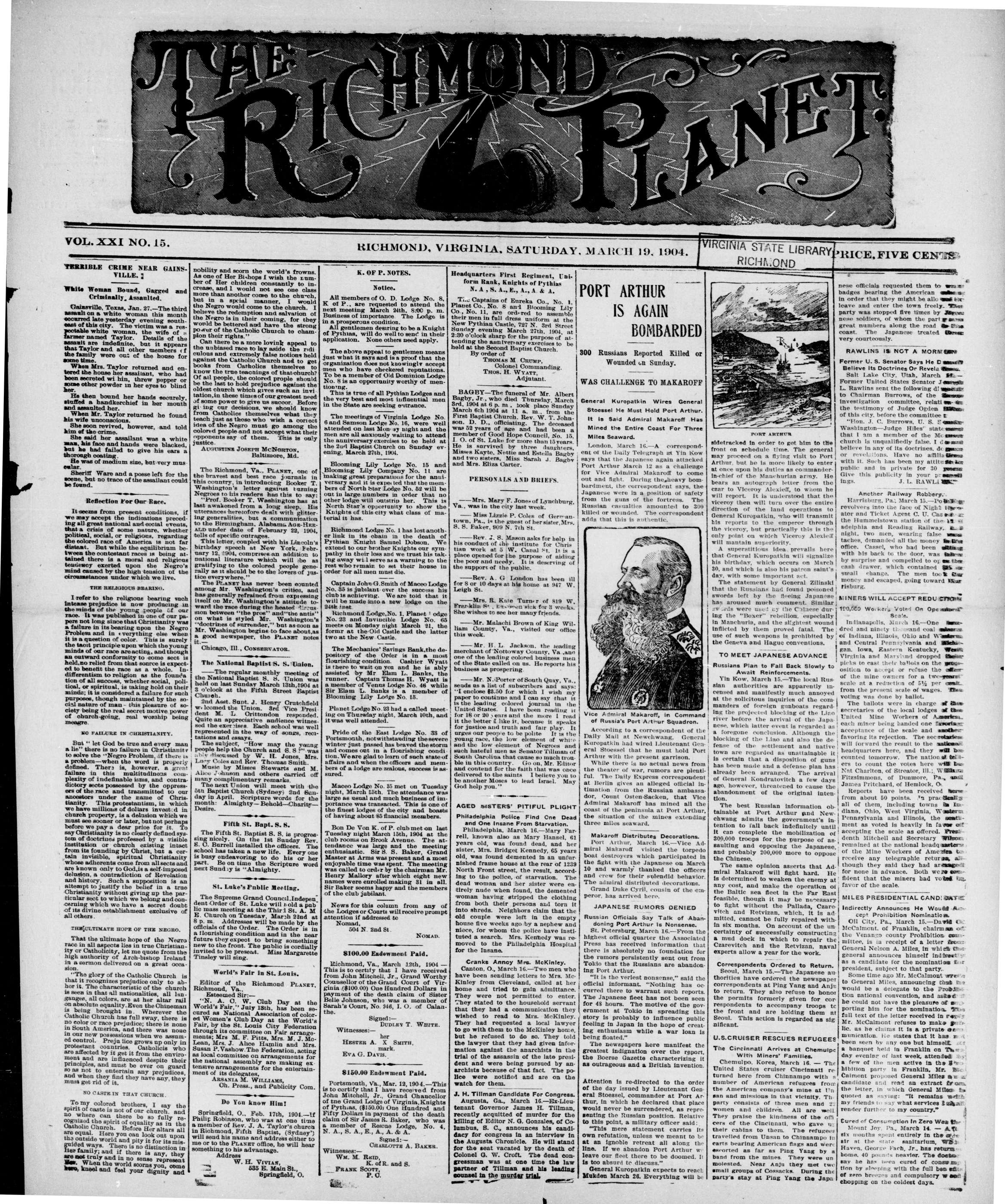
PORT ARTHUR IS AGAIN BOMBARDED
300 Russians Reported Killed or Wounded on Sunday.
WAS CHALLENGE TO MAKAROFF
General Kuropatkin Wires General Stoessel He Must Hold Port Arthur. It Is Said Admiral Makaroff Has Mined the Entire Coast For Three Miles Seaward.
London, March 16.—A correspondent of the daily Telegraph at Yin Kow says that the Japanese again attacked Port Arthur March 12 as a challenge for Vice Admiral Makaroff to come out and fight. During the heavy bombardment, the correspondent says, the Japanese were in a position of safety from the guns of the fortress. The Russian casualties amounted to 300 killed or wounded. The correspondent adds that this is authentic.
[Illustration of a man with a long beard and a military uniform with a badge.]
Vice Admiral Makaroff, in Command of Russia's Port Arthur Squadron.
According to a correspondent of the Daily Mail at Newchwang, General Kuropatkin had wired Lieutenant General Stoessel that he must hold Port Arthur with the present garrison.
While there is no actual news from the theater of war, rumors are plentiful. The Daily Express correspondent at Berlin gives an alleged official intimation from the Russian ambassador, Count Osten-Sacken, that Vice Admiral Makaroff has mined all the coast of the peninsula at Port Arthur, the situation of the mines extending three miles seaward.
Makaroff Distributes Decorations
Port Arthur, March 16.—Vice Admiral Makaroff visited the torpedo boat destroyers which participated in the fight with the Japanese on March 10 and warmly thanked the officers and crew for their sulendid behavior. The admiral distributed decorations. Grand Duke Cyril, cousin of the emperor, has arrived here.
JAPANESE RUMORS DENIED
Russian Officials Say Talk of Abandoning Port Arthur is Nonsense.
St. Petersburg, March 16—From the highest official quarter the Associated Press has received information that there is absolutely no foundation for the rumors persistently sent out from Tokio that the Russians are abandoning Port Arthur.
"It is the veriest nonsense," said the official informant. "Nothing has occurred there to warrant such reports. The Japanese fleet has not been seen for 48 hours. The motive of the government at Tokio in spreading this story is probably to influence public feeling in Japan in the hope of creating enthusiasm while a war loan is being floated."
The newspapers here manifest the greatest indignation over the report, the Boerse Gazette characterizing it as outrageous and a British invention.
Attention is re-directed to the order of the day issued by Lieutenant General Stoessel, commander at Port Arthur, in which he declared that place would never be surrendered, as representing the Russian position. Relative to this point, a military officer said: "This mere statement carries its own refutation, unless we meant to be at an ignoble retreat all along the line. If we abandon Port Arthur we leave our fleet there to be doomed. It is too absurd to discuss." General Kuropatkin expects to reach Mukden March 26. Everything will be
PORT ARTHUR
sidetracked in order to get him to the front on schedule time. The general may proceed on a flying visit to Port Arthur, but he is more likely to enter at once upon his duties as commander-in-chief of the Manchurian army. He bears an autograph letter from the scar to Viceroy Alexieff, to whom he will report. It is understood that the viceroy then will turn over the entire direction of the land operations to General Kuropatkin, who will transmit his reports to the emperor through the viceroy, but practically this is the only point on which Viceroy Alexieff will maintain superiority.
A superstitious idea prevails here that General Kuropatkin will signalize his birthday, which occurs on March 30, and which is also his patron saint's day, with some important act.
The statement by General Zillinski that the Russians had found poisoned swords left by the fleeing Japanese has aroused much comment. Similar swords were used by the Chinese during the "Boxer" rebellion, especially in Manchuria, and the slightest wound inflicted by them proved fatal. The use of such weapons is prohibited by the Geneva and Hague conventions.
TO MEET JAPANESE ADVANCE
Russians Plan to Fall Back Slowly to Await Reinforcements.
Yin Kow, March 15.—The local Russian authorities are apparently incensed and manifestly much annoyed at the solicitous inquiries of the commanders of foreign gunboats regarding the projected blocking of the Liao river before the arrival of the Japanese, which latter event is regarded as a foregone conclusion. Although the blocking of the Liao and also the defense of the settlement and native town are regarded as unattainable it is certain that a disposition of guns has been made and a defense plan has already been arranged. The arrival of General Kondratovitch a few days ago, however, threatened to cause the abandonment of the original intention.
The best Russian information obtainable at Port Arthur and Newchwang admits the government's intention to fall back indefinitely until it can complete the mobilization of 300,000 troops for the purpose of assaulting and opposing the Japanese, and probably 200,000 more to oppose the Chinese.
The same opinion asserts that Admiral Makaroff will fight hard. He is determined to weaken the enemy at any cost, and make the operation of the Baltic sea fleet in the Far East feasible, though it may be necessary to fight without the Pallada, Czarevitch and Retvizan, which, it is admitted, cannot be fully repaired within six months. On account of the uncertainty of successfully constructing a mud dock in which to repair the Czarevitch and the Retvizan, naval experts allow a year for the work.
Correspondents Ordered to Return. Seoul, March 15.—The Japanese authorities have ordered the newspaper correspondents at Ping Yang and Anju to return. They also refuse to honor the permits formerly given for correspondents to accompany troops to the front and are holding them at Seoul. This action is regarded as significant.
U.S.CRUISER RESCUES REFUGEES
The Cincinnati Arrives at Chemulpc With Miners' Families
Chemulpo, Korea, March 16. — The United States cruiser Cincinnati returned here from Chinnampo with a number of American refugees from the American company's mine at Ussan and missions in that vicinity. The party consists of three men and 22 women and children. All are well. They praise the kindness of the officers of the Cincinnati, who gave up their cabins to them. The refugees travelled from Ussan to Chinnampo in carts bearing American flags and were escorted as far as Ping Yang by a band from the mines. They were unmolested. Near Anju they met two small groups of Cossacks. During the party's stay at Ping Yang the Japa
PRICE, FIVE CENTS
nese officials requested them to badges bearing the American in order that they might be allowed to leave and enter the town freely. Their party was stopped five times by nese soldiers, of whom the part great numbers along the road coast. The Japanese treated very courteously.
RAWLINS IS NOT A MORN
Former U. S. Senator Says He D
Believe Its Doctrine or Bevella
Believe Its Doctrines Or Revela-
Salt Lake City, Utah, March 14
Former United States Senator J
L. Rawlins sent the following dis-
to Chairman Burrows, of the
investigation committee, rela-
tive to the testimony of Judge Ogden
of this city, before the committee
"Hon. J. C. Burrows, U. S. S.
Washington—Judge Hiles" state-
that I am a member of the Me-
church is unqualifiedly false. I do
believe in any of its doctrines, do-
or revelations. Have no affilia-
nce with it. Such has been my attitu-
tion public and in private for 30 years.
Give this publicity in your pre-
fing. J. L. RAWLI
Another Railway Robbers:
Harrisburg, Pa. March 15.—Po-
revolvers into the face of Nigh$2
rator and Ticket Agent C. U. Cas-
ter the Hummelstown station of the
adelphia and Reading Railway,
night, two men, wearing false
taches, demanded all the money
office. Cassel, who had been
with his back to the door, was
by surprise and compelled to op-
pose cash drawer, which contained
small change. The men took
money and escaped, going toward
risks.
MINERS WILL ACCEPT REDUCTION
Indianapolis, March 16.—One hundred and ninety thousand coal mines of Indiana, Illinois, Ohio and Wisconsin and Central Pennsylvania and Michigan, Iowa, Eastern Kentucky, West Virginia and Maryland dropped their picks to cast their ballots on the proposition to accept or refuse the offer of the mine owners for a two-year scale at a reduction of 51% per cent from the present scale of wages. The voting was done by ballot.
The ballots were in charge of the secretaries of the local lodges of the United Mine Workers of America, each miner being handed one favoring acceptance of the scale and another favoring its rejection. The secretaries will forward the result to the national headquarters here, and they will be counted tomorrow. The national tellers to count the votes here will be Nat Charlton, of Streater, Ill.; William Fitzsimmons, of Dunmore, Pa.; and James Pritchard, of Hemlock, O.
Reports have been received here from about 50 points. In practically all of them, including towns in Indiana, Ohio, West Virginia, Western Pennsylvania and Illinois, the sentiment as voted is heavily in favor of accepting the scale as offered. President Mitchell and Secretary Wilson remained at the national headquarters of the Mine Workers of America to receive any telegraphie returns, although they said they had arranged for none in advance. Both were confident that the miners had voted in favor of the scale.
MILES PRESIDENTIAL CANDIDATE
Indirectly Announces He Would A
cent. Rehabilitation. Newcastle
cept Promotion Nominations.
Oll City, Pa., March 15.—David C. McCalmount, of Franklin, chairman of the Venango county Prohibition committee, is in receipt of a letter from General Nelson A. Miles, in which the general announces himself indirectly as a candidate for the nomination for president, subject to that party.
Some time ago Mr. McCalmont wrote to General Miles, announcing that he would be a delegate to the Probation national convention, and asked he could not have the pleasure of porting him for the nomination. The full text of the letter received in Mr. McCalmont refuses to make public, as he claims it is a private munication. He states that it has been seen by any one but himself a banquet held in Franklin on Tuesday evening of last week, attended by a few of the men active in the exhibition party in Franklin, Mr. McCalmont proposed General Miles a candidate and read an extract from the letter, in which General Miles quoted as saying: "It remains with my friends to say what services I should render further to my country."
Cured of Consumption In Zero Wea the Mount Joy, Pa., March 14 — A six months spent entirely in the air at the state sanitarium, WB Haven, George Fach, Jr., has returned home, 40 pounds heavier. The doctor say he has been cured of consumption by sleeping with the full ban of zero breezes and compulsory w ead chopping on the coldest days.
BEYOND
JONES AT BELLEVUE.
Warning Against Pride That Comes from New York.
Different Luck of Two Hospital Patients—One Had a Pull Which Was Utilized by a Hobo Who Knew a Good Thing.
It was the third time that Jones had been "ill this winter, and the patience of his friends had been almost exhausted. At all events, they decided that the same financial outlay would not be necessary in this instance, as in the others.
Jones needed hospital treatment, says the New York Sun, and it was decided that he had better go to Bellevue. There was greater comfort in the private hospitals, but there was also greater expense. So he went to Bellevue for the three days it usually took to bring him around.
There were other excellent reasons why this institution should be selected. One of the youthful physicians on the staff was his friend, and might be expected to look out for Jones. So Jones found himself in a ward along with some fellow sufferers who would all attribute their troubles to the same cause. After he had lain in some discomfort on his narrow bed, an orderly came up to him.
"Is your name Jones?" he inquired, with the lack of sympathy usually shown to invalids of this class. "H. C. Jones?" The patient shuddered until the iron cot rattled on its unsteady pins. "Is it possible," he thought in terror, "that I am known to be in this place?" Then he answered: "No," he said. "My name is Brown." The orderly moved to the next bed. "Is your name Jones?" he asked of its frowsy occupant.
The answer was in the affirmative and the effect was magical. The tone of the orderly changed immediately. It grew gentle and obsequious. More markea was his changed treatment of the patient. All that sympathetic solicitude could suggest was done for him. The first Jones seemed to suffer in exact ratio to the attentions bestowed on
BROOKLYN HOSPITAL
"IS YOUR NAME JONES?"
the other man. Once he tried to make himself more comfortable by changing his position.
"Lay still there!" came from the orderly, who was handing an orange to his pampered patient while the other's lips were parching with thirst. "Lay still, I tell you."
I ice tinkled coolingly in the mineral water frequently served to the astonished hobo who went through the list of luxuries he liked best. He was loath to leave such a paradise and lingered until the other Jones had recovered his health and departed. He was allowed to remain only through the same influence that had so thoughtfully contributed to his comfort.
"Well, the doc treated you all right, didn't he?" asked his best friend when the real Jones had left the hospital behind him.
"Did nothing at all for me," was the answer, "but showered attentions on a fellow in the next bed, and he was a bum at that. Gave him everything he wanted and wouldn't even let me sit up."
"Did he know who you were?"
"Of course not," was the answer; "although the orderly found out my real name in one way or another and asked me if I was Jones. I denied it, of course."
Then for the first time he understood how all the kindness and favors withheld for him had gone to the other Jones.
The Witch house, an ancient building, which is still regarded with great interest and awe at Salem, Mass., is supposed to be the oldest building in that part of the country, the reputed date of its construction being 1631. Modern additions from time to time have almost changed its identity. The Witch house is where people suspected of practicing the black art were tried. The original building had peaked gables and was of a very ancient style of art structure. The present structure is hardly more than a reminiscence.
Has Hundreds of Rings.
Queen Christine of Spain has very pretty hands, and she is aware of their beauty. Among various other articles of her jewelry are about 200 rings. To display her nice hands she makes a point of wearing all her rings in turn.
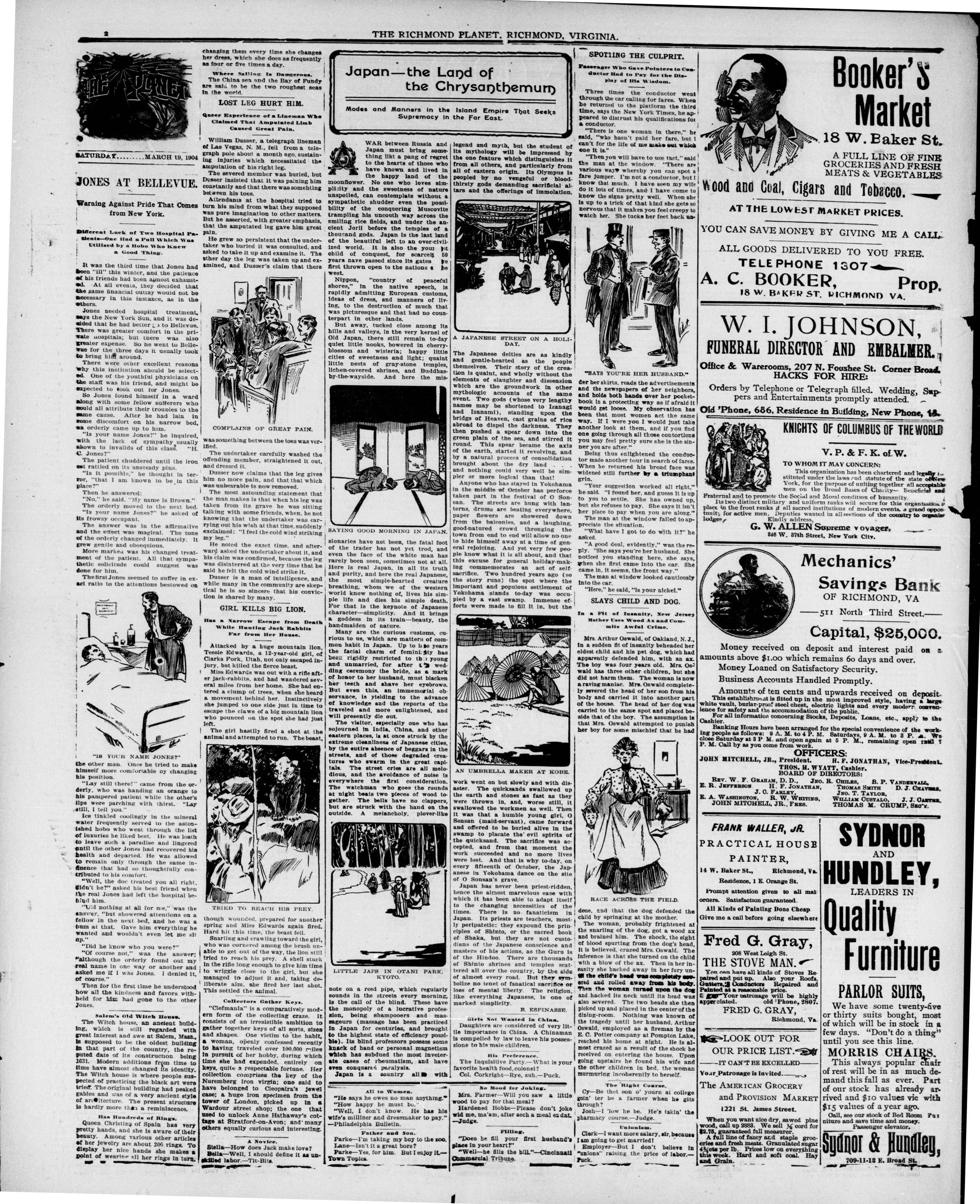
Japan—the Land of
the Chrysanthemum
Modes and Manners in the Island Empire That Seeks
Supremacy in the Far East.
WAR between Russia and
Japan must bring some
thing likt a pang of regret
to the hearts of those who
have known and lived in
legend and myth, but the student of
its mythology will be impressed by
the one feature which distinguishes it
from all others, and particularly from
all of eastern origin. Its Olympus is
moonflower. No one who loves simplicity and the sweetness of nature unspoiled, can contemplate without a sympathetic shudder even the possibility of the conquering Muscovite trampling his uncouth way across the smiling rice fields, and under the ancient Joril before the temples of a thousand gods. Japan is the last land of the beautiful left to an over-civilized world. It is also the your child of conquest, for scarcely 50 years have passed since its gates be first thrown open to the nations he west.
Nippon, "country of peaceful shores," in the native speech, is rapidly admitting European customs, ideas of dress, and manners of living, to the destruction of much that was picturesque and that had no counterpart in other lands.
But away, tucked close among its hills and valleys, in the very kernel of Old Japan, there still remain to-day quiet little nooks, bowered in cherry-blossom and wisteria; happy little cities of sweetness and light; quaint little nests of gray-stone temples, lichen-covered shrines, and Buddha-by-the-wayside. And here the mis-
SAYING GOOD MORNING IN JAPAN.
sionaries have not been, the fatal foot of the trader has not yet trod, and even the face of the white man has rarely been seen, sometimes not at all. Here is real Japan, in all its truth and purity, and here the real Japanese, the most simple-hearted creature breathing, whom we of the western world know nothing of, lives his simple life and dies his simple death. For that is the keynote of Japanese character—simplicity. And it brings a goddess in its train—beauty, the handmaiden of nature.
Many are the curious customs, curious to us, which are matters of common habit in Japan. Up to late years the facial charm of femininity has been rigidly restricted to the young and unmarried, for after wedding ceremony the bride, as a mark of honor to her husband, must blacken her teeth and shave her eyebrows. But even this, an immemorial observance, is yielding to the advance of knowledge and the reports of the traveled and more enlightened, and will presently die out.
The visitor, especially one who has sojourned in India, China, and other eastern places, is at once struck by the extreme cleanliness of Japanese cities, by the entire absence of beggars in the streets, and of those degraded creatures who swarm in the great capitals. The street cries are all melodious, and the avoidance of noise is everywhere the first consideration. The watchman who goes the rounds at night beats two pieces of wood together. The bells have no clappers, but are struck with the hand on the outside. A melancholy, plover-like
note on a reed pipe, which regularly sounds in the streets every morning, is the call of the blind. These have the monopoly of a lucrative profession, being shampooers and massageurs (massage has been practiced in Japan for centuries, and brought to the highest state of efficiency possible). Its blind professors possess some knack of hand or personal magnetism which has subdued the most inveterate cases of rheumatism, and have even conquered paralysis.
Father and Son.
Parke—I'm taking my boy to the zoo.
Lane—Isn't it a great bore?
Parke—Yes, for him. But I enjoy it—
Town Topics.
changing them every time she changes her dress, which she does as frequently as four or five times a day.
Where Sailing Is Dangerous.
The China sea and the Bay of Fundy are said to be the two roughest seas in the world.
LOST LEG HURT HIM.
Queer Experience of a Lineman Who Claimed That Amputated Limb Caused Great Pain.
William Dusser, a telegraph lineman of Las Vegas, N. M., fell from a telegraph pole about a month ago, sustaining injuries which necessitated the amputation of his right leg.
The severed member was buried, but Dusser insisted that it was paining him constantly and that there was something between his toes.
Attendants at the hospital tried to turn his mind from what they supposed was pure imagination to other matters. But he asserted, with greater emphasis, that the amputated leg gave him great pain.
He grew so persistent that the undertaker who buried it was consulted, and asked to take it up and examine it. The other day the leg was taken up and examined, and Dusser's claim that there
COMPLAINS OF GREAT PAIN.
was something between the toes was verified.
The undertaker carefully washed the offending member, straightened it out, and dressed it.
Dusser now claims that the leg gives him no more pain, and that that which was unbearable is now removed.
The most astounding statement that the man makes is that when his leg was taken from its grave he was sitting talking with some friends, when, he not knowing that the undertaker was carrying out his wish at that time, suddenly exclaimed: "I feel the cold wind striking my leg."
He noted the exact time, and afterward asked the undertaker about it, and his claim was confirmed, because the leg was disinterred at the very time that he said he felt the cold wind strike it.
Dusser is a man of intelligence, and while many in the community are skeptical he is so sincere that his conviction is shared by many.
GIRL KILLS BIG LION.
Has a Narrow Escape from Death While Hunting Jack Rabbits Far from Her House.
Attacked by a huge mountain lion, Tessie Edwards, a 12-year-old girl, of Clarks Fork, Utah, not only escaped injury, but killed the fierce beast.
Miss Edwards was out with a rifle after jack-rabbits, and had wandered several miles from her home. She had entered a clump of trees, when she heard a movement behind her. Instinctively she jumped to one side just in time to escape the claws of a big mountain lion who pounced on the spot she had just left.
The girl hastily fired a shot at the animal and attempted to run. The beast
TRIED TO REACH HIS PREY
though wounded, prepared for another spring and Miss Edwards again fired. Hard hit this time, the beast fell. Snarling and crawling toward the girl, who was cornered among the brush unable to get out of the way, the lion still tried to reach his prey. A shell stuck in the rifle long enough to give him time to wriggle close to the girl, but she managed to adjust it and, taking deliberate aim, she fired her last shot. This settled the animal.
"Clefmania" is a comparatively modern form of the collecting craze. It consists of an irresistible ambition to gather together keys of all sorts, sizes and shapes. One victim to the habit, a woman, openly confessed recently to having traveled over 100,000 miles in pursuit of her hobby, during which time she had expended, entirely on keys, quite a respectable fortune. Her collection comprises the key of the Nuremberg iron virgin; one said to have belonged to Cleopatra's jewel case; a huge iron specimen from the tower of London, plucked up in a Wardour street shop; the one that used to unlock Anne Hathaway's cottage at Stratford-on-Avon; and many others equally curious and interesting.
A Novice.
Stella—How does Jack make love?
Bella—Well, I should define it as unstilled labor.—Tit-Bits.
THE RICHMOND PLANET, RICHMOND, VIRGINIA
WAR between Russia and Japan must bring something likt a pang of regret to the hearts of those who have known and lived in the happy land of the
KARATE
LITTLE JAPS IN OTANI PARK,
KYOTO.
Japan is a country all with
legend and myth, but the student of its mythology will be impressed by the one feature which distinguishes it from all others, and particularly from all of eastern origin. Its Olympus is peopled by no vengeful or blood-thirsty gods demanding sacrificial altars and the offerings of immolation.
A JAPANESE STREET ON A HOLI-DAY.
The Japanese deities are as kindly and gentle-hearted as the people themselves. Their story of the creation is quaint, and wholly without the elements of slaughter and dissension which are the groundwork in other mythologic accounts of the same event. Two gods (whose very lengthy names may be shortened to Izanagi and Izanami), standing upon the bridge of Heaven, cast grains of rice abroad to dispel the darkness. They then pushed a spear down into the green plain of the sea, and stirred it round. This spear became the axis of the earth, started it revolving, and by a natural process of consolidation brought about the dry land and nothing could very well be simpler or more logical than that!
Anyone who has stayed in Yokohama in the middle of October has perforce taken part in the festival of O Sonsan. The streets are hung with lanterns, drums are beating everywhere, paper flowers are showered down from the balconies, and a laughing, good-natured crowd thronging the town from end to end will allow no one to hide himself away at a time of general rejoicing. And yet very few people know what it is all about, and that this excuse for general holiday-making commemorates an act of self-sacrifice. Two hundred years ago (so the story runs) the spot where the important and populous settlement of Yokohama stands to-day was occupied by a vast swamp. Immense efforts were made to fill it in, but the
AN UMBRELLA MAKER AT KORE
work went on but slowly and with disaster. The quicksands swallowed up the earth and stones as fast as they were thrown in, and, worse still, it swallowed the workmen as well. Then it was that a humble young girl, O Sonsan (maid-servant), came forward and offered to be buried alive in the swamp to placate the 'evil spirits of the quicksand. The sacrifice was accepted, and from that moment the work succeeded and no more lives were lost. And that is why to-day, on every fifteenth of October, the Japanese in Yokohama dance on the site of O Sonsan's grave.
Japan has never been priest-ridden, hence the almost marvelous ease with which it has been able to adapt itself to the changing necessities of the times. There is no fanaticism in Japan. Its priests are teachers, mostly peripatetic: they expound the principles of Shinto, or the sacred book of Shaka, but they are not custodians of the Japanese conscience and masters of his actions, as the Guru is of the Hindoo. There are thousands of Shinto shrines and temples scattered all over the country, by the side of almost every road. But they symbolize no tenet of fanatical sacrifice or loss of mental liberty. The religion, like everything Japanese, is one of marked simplicity.
B. ESPINASSE.
Girls Not Wanted in China. Daughters are considered of very little importance in China. A Chinaman is compelled by law to leave his possessions to his male children.
His Preference.
The Inquisitive Party—What is your favorite health food, colonel?
Col. Corkright—Rye, suh—Puck
"Does he fill your first husband's place in your heart?"
"Well—he fills the bill."—Cincinnati Commercial Tribune.
1
SPOTTING THE CULPRIT.
Passenger Who Gave Politeness to Conductor Had to Pay for the Display of His Wisdom.
Three times the conductor went through the car calling for fares. When he returned to the platform the third time, says the New York Times, he appeared to distrust his qualifications for a conductor.
"There is one woman in there," he said, "who hasn't paid her fare, but I can't for the life of me make out which one it is."
"Then you will have to use tact," said the man at the window. "There are various ways whereby you can spot a fare jumper. I'm not a conductor, but I know that much. I have seen my wife do it lots of times, and I have come to know the signs pretty well. When she is up to a trick of that kind she gets so nervous that it makes you feel creepy to watch her. She tucks her feet back un-
L. L.
der her skirts, reads the advertisements and the newspapers of her neighbors, and holds both hands over her pocketbook in a protecting way as if afraid it would get loose. My observation has been that most women act the same way. If I were you I would just take another look at them, and if you find one going through all those contortions you may feel pretty sure she is the sinner you are after."
Being thus enlightened the conductor made another tour in search of fares. When he returned his broad face was widened still further by a triumphant grin.
"Your suggestion worked all right," he said. "I found her, and guess it is up to you to settle. She has owned up, but she refuses to pay. She says it isn't her place to pay when you are along."
The man at the window failed to appreciate the situation.
"What have I got to do with it?" he asked.
"A good deal, evidently," was the reply. "She says you're her husband. She noticed you standing here, she says, when she first came into the car. She came in, it seems, the front way." The man at window looked cautiously into the car. "Here," he said, "is your nickel."
SLAYS CHILD AND DOG.
In a Fit of Insanity, New Jersey
Mother Uses Wood Ax and Com-
mits Awful Crime.
Mrs. Arthur Oswald, of Oakland, N.J., in a sudden fit of insanity beheaded her eldest child and his pet dog, which had apparently defended him, with an ax. The boy was four years old. Mrs. Oswald has three other children, but she did not harm them. The woman is now a raving maniac. Mrs. Oswald completely severed the head of her son from his body and carried it into another part of the house. The head of her dog was carried to the same spot and placed beside that of the boy. The assumption is that Mrs. Oswald attempted to punish her boy for some mischief that he had
RACE ACROSS THE FIELD
done, and that the dog defended the child by springing at the mother. The woman, probably frightened at the snarling of the dog, got a wood ax and brained him. The shock, the sight of blood spurting from the dog's head, it is believed, crazed Mrs. Oswald. The inference is that she turned on the child with a blow of the ax. Then in her insanity she hacked away in her fury until the child's head was completely covered and rolled away from his body. Then the woman turned upon the dog and hacked its neck until its head was also severed. The two heads she then picked up and placed in the center of the dining-room. Nothing was known of the tragedy until her husband, Arthur Oswald, employed as a fireman by the E. C. Potter company at Pompton Lake, reached his home at night. He is almost crazed as a result of the shock he received on entering the house. Upon going upstairs he found his wife and the other children in bed, the woman murmuring incoherently to herself.
Cy—Be that son o' yourn at college
goln' ter be a farmer when he gits
through?
Josh—I 'low he be. He's takin' the
pharmacy course—Judge.
Unionism.
Clerk—I want more salary, air, because
I am going to get married!
Employer—But I don't believe in
"unions" raising the price of labor.
Puck.
Booker's Market
18 W. Baker St. A FULL LINE OF FINE GROCERIES AND FRESH MEATS & VEGETABLES
AND COAL, CIGARS and TEBACO
THE LOWEST MARKET PRICE
SAVE MONEY BY GIVING ME
GOODS DELIVERED TO YOU
TELEPHONE 1307
BOOKER,
B. W. BAKER ST. RICHMOND V
I. I. JOHNSON
SAL DIRECTOR AND EMBRO
Varerooms, 207 N. Foushee St. Co
HACKS FOR HIRE:
Telephone or Telegraph filled. We
s and Entertainment promptly atten
, 686, Residence in Building, New
KNIGHTS OF COLUMBUS OR
V. P. & F. K. of
and Tobacco. MARKET PRICES. BY GIVING ME A CALL. FRED TO YOU FREE. E 1307 R, Prop. RICHMOND VA. JOHNSON, R AND EMBALMER. M. Foushee St. Corner Broad. OR HIRE: Geograph filled. Wedding, Supplies promptly attended. in Building, New Phone, t&. OF COLUMBUS OF THE WORLD V. P. & F. K. of W.
AT THE LOWEST MARKET PRICES. YOU CAN SAVE MONEY BY GIVING ME A CALL.
W. I. JOHNSON, FUNERAL DIRECTOR AND EMBALMER.
Office & Warerooms, 207 N. Foushee St. Corner Broad. HACKS FOR HIRE: Orders by Telephone or Telegraph filled. Wedding, Suppers and Entertainments promptly attended.
KNIGHTS OF COLUMBUS OF THE WORLD
TO WHOM IT MAY CONCERN:
This organization has been chartered under the laws and statute of York, for the purpose of uniting together men on the Broad Bases of Charity to promote the Social and Moral condition of humankind military and uniform ranks will secure for our infant ranks of all sacred institutions of modern even the men. Deputies wanted in all sections of the c. Kindly address,
organization has been chartered and legally ratified the laws and statute of the state of New York the purpose of uniting together all acceptable Broad Bases of Charity - Beneficial and Moral condition of humanity. In ranks will secure for this organisation institutions of modern events, a grand opportunity in all sections of the country to organi-
This organization has been chartered and legally
situated under the laws and statute of the state of New
York, for the purpose of uniting together all acceptable
men on the Broad Bases of Charity—Beneficial and
Praternal and to promote the Social and Moral condition of humanity.
Its two distinct military and uniform ranks will secure for this organization
place in the front ranks if all sacred institutions of modern events, a grand oppor-
tunity for active men. Deputies wanted in all sections of the country to organi-
lodge
Kindly address,
G. W. ALLEN Supreme voyager,
846 W. 87th Street, New York City.
Mechanics'
Savings Bank
OF RICHMOND, VA
511 North Third Street.
capital, $25,000.
posit and interest paid on a
mains 60 days and over.
factory Security.
led Promptly.
upwards received on deposit.
the most improved style, having a large
electric lights and every modern conven-
tions, Deposits, Loans, etc., apply to the
for the special convenience of the work-
I. Saturdays, 9 A. M. to 8 P. M. We
at 5 P. M., remaining open until?
CERS:
H. F. JONATHAN, Vice-President,
VATT, Cashier.
DIRECTORS:
D. R. CHILES, B. P. VANDERVALL,
THOMAS SMITH, D. J. CHAVIER,
JNO. T. TAYLOR.
received on deposit and interest
love $1.00 which remains 60 days and
Loaned on Satisfactory Security.
Less Accounts Handled Promptly.
Letters of ten cents and upwards received
payment is fitted up in the most improved style,
clear-proof steel chest, electric lights and every
formation concerning Stocks, Deposits, Loans, et-
tours have been arranged for the special conveni-
ent allows: 9 A. M. to 4 P. M. Saturdays, 9 A. M. to
8 P. M. and open again at 5 P. M., remaini-
ning you come from work.
OFFICERS:
ELL, JR., President. H. F. JONATHAN,
THOS. H. WYATT, Cashier.
BOARD OF DIRECTORS:
GRAHAM, D. D., JNO. R. CHILES, B. P. V.
N. H. F. JONATHAN, THOMAS SMITH
J. C. FARLEY, JNO. T. TAYLOR
Money received on deposit and interest paid on amounts above $1.00 which remains 60 days and over.
Money Loaned on Satisfactory Security.
Business Accounts Handled Promptly.
Amounts of ten cents and upwards received on deposit.
This establishment is fitted up in the most improved style, having a large white vault, burlar-proof steel chest, electric lights and every modern convenience for safety and the accommodation of the public.
For all information concerning Stocks, Deposits, Loans, etc., apply to the Cashier.
Banking Hours have been arranged for the special convenience of the working people as follows: 9 A. M. to 4 P. M. Saturdays, 9 A. M. to 3 P. M. We close Saturday at 3 P. M. and open again at 5 P. M., remaining open real? P. M. Call by as you come from work.
OFFICERS:
JOHN MITCHELL, JR., President. H. F. JONATHAN, Vice-President.
THOS. H. WYATT, Cashier.
BOARD OF DIRECTORS:
REV. W. F. GRAHAM, D. D., JNO. R. CHILES, B. P. VANDERVALL,
E. R. JEFFERSON H. F. JONATHAN, THOMAS Smith D. J. CHAVIERS,
J. O. FARLEY, JNO. TAYLOR,
WILLIAM CUSTALO, J. J. CARTER,
THOMAS M. ORUMP, SPOX.
SYDNOR AND HUNDLEY, LEADERS IN Quality Furniture
We have some twenty-five or thirty suits bought, most of which will be in stock in a few days. "Don't do a thing" until you see this line.
MORRIS CHAIRS.
This always popular chair of rest will be in as much demand this fall as ever. Part of our stock has already arrived and $10 values vie with $15 values of a year ago.
Call, see our stock of Bed Room Fur
Call, see our stock of Bed Room Fur
niture and save time and money.
Passenger elevator.
Sydnor & Hundley,
709-11-13 E. Broad St.
J. W. H.
Wood and Coal, Cigar
AT THE LOWEST M
YOU CAN SAVE MONEY I
ALL GOODS DELIVER
TELEPHONE
A. C. BOOKE
18 W. BAKER ST.
W. I. JO
FUNERAL DIRECTOR
Office & Warerooms, 207 N.
HACKS F
Orders by Telephone or Tele-
pers and Entertainment
Old 'Phone, 686, Residence
#
1830
Money received on deposit amounts above $1.00 which re-
Money Loaned on Satisfaction
Business Accounts Handler
Amounts of ten cents and
This establishment is fitted up in the white vault, burlar-proof steel chest, elec-
lence for safety and the accommodation
For all information concerning Stock Cashier.
Banking Hours have been arranged in people as follows: 9 A. M. to 4 P. M. close Saturday at 3 P. M. and open again P. M. Call by as you come from work.
OFFIC
JOHN MITCHELL, JR., President.
THOS. H. WY
BOARD OF F
REV. W. F. GRAHAM, D. D., JN
E. R. JEFFERSON H. F. JONATHAN,
J. O. FARLEY,
E. A. WASHINGTON, R. W. WHITING,
JOHN MITCHELL, JR., FRES.
FRANK WALLER, JR.
PRACTICAL HOUSE
PAINTER,
14 W. Baker St., Richmond, Va.
Residence, 1 E. Orange St.
Prompt attention given to all mail orders. Satisfaction guaranteed.
All Kinds of Painting Done Cheap
Give me a call before going elsewhere
Fred G. Gray,
208 West Leigh St.
THE STOVE MAN.
You can have all kinds of Stoves Repaired and put up. Also your Roofs Gutters. Conductors Repaired and Painted at a reasonable price.
Your patronage will be highly appreciated.
old Phone, 2807
LOOK OUT FOR
OUR PRICE LIST.
IT CAN'T BE EXCELLED
Your_Patronage is Invited.
The AMERICAN GROCERY
When you want nice dry, sawed pine wood, call up 2883. We sell $2 cord for $3.75, guaranteed full measure. A full line of fancy and staple groceries and fresh meats. Granulated sugar 4 1/2 per lb. Prices low on everything this week. Hard and soft coal. Hay and Grain.
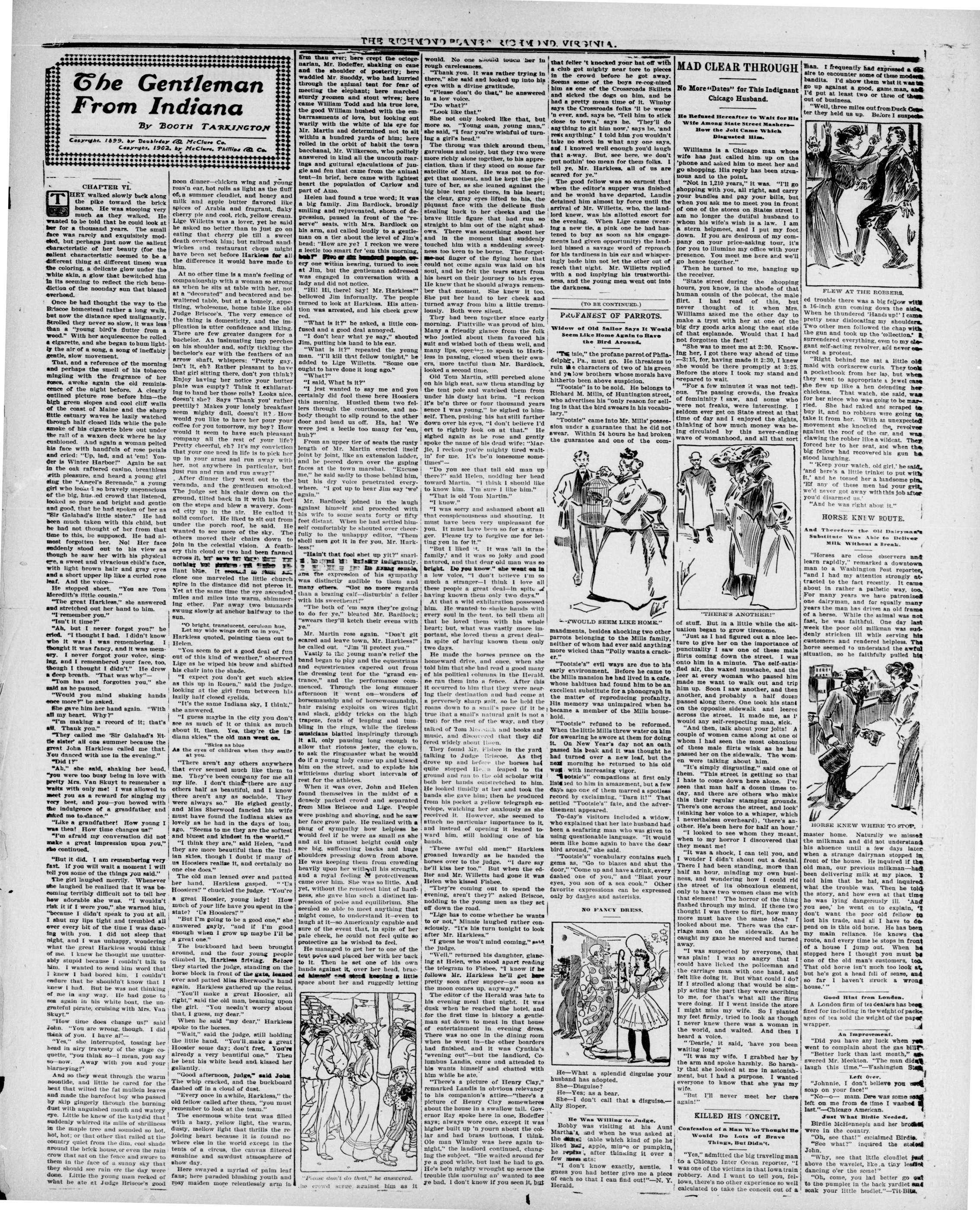
The Gentleman From Indiana
By BOOTH TARKINGTON
CHAPTER VL
THEY walked slowly back along the plike toward the brick house. He was stooping very much as they walked. He wanted to be told that he could look at her for a thousand years. The small face was rarely and exquisitely modest, but perhaps just now the salient characteristic of her beauty (for the salient characteristic seemed to be a different thing at different times) was the coloring, a delicate glow under the white skin, a glow that bewitched him in its seeming to reflect the rich benediction of the noonday sun that blazed overhead.
Once he had thought the way to the Brisco homestead rather a long walk, but now the distance sped malignantly. Strolled they never so slow, it was less than a "young bird's flutter from a wood." With her acquiescence he rolled a cigarette, and she began to hum lightly the air of a song, a song of ineffably gentle, slow movement.
That, and a reference of the morning and perhaps the smell of his tobacco mingling with the fragrance of her roses, awoke again the old reminiscence of the night before. A clearly outlined picture rose before him—the high green slopes and cool cliff walls of the coast of Maine and the sharp little estuary waves he lazily watched through half closed lids while the pale smoke of his cigarette blew out under the rail of a waxen deck where he lay cushioned. And again a woman pelleted his face with handfuls of rose petals and cried: "Up, lad, and at 'em! Yonder is Winter Harbor!" Again he sat in the oak raftered casino, breathless with pleasure, and heard a young girl sing the "Angel's Serenade," a young girl who looked so bravely unconscious of the big, hushed crowd that listened, looked so pure and bright and gentle and good, that he had spoken of her as "Sir Galahad's little sister." He had been much taken with this child, but he had not thought of her from that time to this, he supposed. He had almost forgotten her. No! Her face suddenly stood out to his view as though he saw her with his physical eye, a sweet and vivacious child's face, with light brown hair and gray eyes and a short upper lip like a curled rose leaf. And the voice—
He stopped short. "You are Tom Meredith's little cousin."
"The great Harkless," she answered and stretched out her hand to him.
"I remember you."
"Isn't it time?"
"Ah, but I never forgot you!" he cried. "I thought I had. I didn't know who it was I was remembering. I thought it was fancy, and it was memory. I never forgot your voice, singing, and I remembered your face, too, though I thought I didn't." He drew a deep breath. "That was why"—"Tom has not forgotten you," she said as he paused.
"Would you mind shaking hands once more?" he asked.
She gave him her hand again. "With all my heart. Why?" "I'm making a record of it; that's all. Thank you." "They called me 'Sir Galahad's Little sister' all one summer because the great John Harkell called me that. You danced with me in the evening." "Did I?" "Ah," she said, shaking her head, "you were too busy being in love with pretty Mrs. Van Skuyt to remember a waitz with only me! I was allowed to meet you as a reward for singing my very best, and you--you bowed with the indulgence of a grandfather and smoked me to dance." "Like a grandfather! How young I was then! How time changes us!" "I'm afraid my conversation did not make a great impression upon you," she continued.
"But it did. I am remembering very fast. If you will wait a moment I will tell you some of the things you said."
The girl laughed merrily. Whenever she laughed he realized that it was becoming terribly difficult not to tell her how adorable she was. "I wouldn't risk it if I were you," she warned him, "because I didn't speak to you at all. I shut my lips tight and trembled all over every bit of the time I was dancing with you. I did not sleep that night, and I was unhappy, wondering what the great Harkless would think of me. I knew he thought me unutterably stupid because I couldn't talk to him. I wanted to send him word that I knew I had bored him. I couldn't endure that he shouldn't know that I knew I had. But he was not thinking of me in any way. He had gone to sea again in his white boat, the ungrateful pirate, cruising with Mrs. Van Skuyt." "How time does change us!" said John. "You are wrong, though. I did think of you. I have al!"—
"Yes," she interrupted, tossing her head in airy travesty of the stage coquette, "you think so—I mean, you say so—now. Away with you and your blarneying!" And so they went through the warm noontide, and little he cared for the beat that witted the fat mullen leaves and made the barefoot boy who passed by skip gingerly through the burning dust with anguished mouth and watery eye. Little he knew of the katyid that suddenly whirred its mills of shrillness in the maple tree and sounded so hot, hot, hot; or that other that railed at the country quiet from the dim, cool shade around the brick house, or even the rain crow that sat on the fence and swore to them in the face of a sunny sky that they should see rain ere the day were done. Little the young man recked of what he ate at Judge Briscoe's good
noon dinner—chicken wing and young roas'n ear, hot rolls as light as the fluff of a summer cloudlet, honey and milk and apple butter flavored like spices of Arabia and fragrant, flaky cherry pie and cool, rich, yellow cream. Lige Willetts was a lover, yet he said he asked no better than to just go on eating that cherry pie till a sweet death overtook him; but railroad sand-wiches and restaurant chops might have been set before Harkleen for all the difference it would have made to him.
At no other time is a man's feeling of companionship with a woman so strong as when he sits at table with her, not at a "decorated" and beatered and be-waltered table, but at a homely, appetizing, wholesome, home table like old Judge Briscoe's. The very essence of the thing is domesticity, and the implication is utter confidence and liking. There are few greater dangers for a bachelor. An insinuating imp perches on his shoulder and, softly tickling the bachelor's ear with the feathers of an arrow shaft, whispers: "Pretty gay, isn't it, eh? Rather pleasant to have that girl sitting there, don't you think? Enjoy having her notice your butter plate was empty? Think it exhilarating to hand her those roles? Looks nice, doesn't she? Says 'Thank you' rather prettily? Makes your lonely breakfast seem might dull, doesn't it? How would you like to have her pour your coffee for you tomorrow, my boy? How would it seem to have such pleasant company all the rest of your life? Pretty cheerful, eh? It's my conviction that your one need in life is to pick her up in your arms and run away with her, not anywhere in particular, but just run and run and run away."
After dinner they went out to the veranda, and the gentlemen smoked. The judge set his chair down on the ground, tilted back in it with his feet on the steps and blew a wavery, domed city up in the air. He called it solid comfort. He liked to sit out from under the porch roof, he said. He wanted to see more of the sky. The others moved their chairs down to join in the celestial vision. A feathery thin cloud or two had been fanned across it, but nothing but the shimmering lant brace. It seemed to shine close one marveled the little church spire in the distance did not pierce it. Yet at the same time the eye ascended miles and miles into warm, shimmering ether. Far away two buzzards swung slowly at anchor halfway to the sun.
"O bright, translucent, cerulean hue," Let my wide wings drift on in you.
Harkless quoted, pointing them out to Helen.
"You seem to get a good deal of fun out of this kind of weather," observed Lige as he wiped his brow and shifted his chair into the shade.
"I expect you don't get such skies as this up in Rouen," said the judge, looking at the girl from between his lazily half closed eyelids.
"It's the same Indiana sky, I think," she answered.
"I guess maybe in the city you don't see as much of it or think as much about it, then. Yes, they're the Indiana skies," the old man went on.
"Skies as blue
As the eyes of children when they smile at you.
"There aren't any others anywhere that ever seemed much like them to me. They've been company for me all my life. I don't think there are any others half as beautiful, and I know there aren't any as sociable. They were always so." He sighed gently, and Miss Sherwood fancied his wife must have found the Indiana skies as lovely as he had in the days of long ago. "Seems to me they are the softest and bluest and kindest in the world." "I think they are," said Helen, "and they are more beautiful than the Italian skies, though I doubt if many of us Hoosiers realize it, and certainly no one else does." The old man leaned over and patted her hand, Harkless gasped. "Us Hoosiers!" chuckled the judge. "You're a great Hoosier, young lady! How much of your life have you spent in the state? 'Us Hoosiers!'"
"But I'm going to be a good one," she answered gayly, "and if I'm good enough when I grow up maybe I'll be a great one."
"You'll make a great Hoosier, all right," said the old man, beaming upon the girl. "You needn't worry about that, I guess, my dear."
When he said "my dear," Harkless spoke to the horses.
"Walt," said the judge, still holding the little hand. "You'll make a great Hoosier some day; don't fret. You're already a very beautiful one." Then he bent his white head and kissed her gallantly.
"Good afternoon, Judge," said John. The whip cracked, and the buckboard dashed off in a cloud of dust.
"Every once in awhile, Harkless," the old fellow called after them, "you must remember to look at the team."
The enormous white tent was filled with a hazy, yellow light, the warm, dusty, mellow light that thrills the rejoicing heart because it is found nowhere else in the world except in the tents of a circus, the canvas filtered sunshine and sawdust atmosphere of show day.
Here swayed a myriad of palm leaf fans; here paraded blushing youth and rosy maiden more relentlessly arm in
THE RICHMOND PLAYER RICHMOND, VIRGINIA
Arm than ever; here crept the octogenarian, Mr. Bodeffer, shaking on cane and the shoulder of postery; here waddled Mr. Snoddy, who had hurried through the animal tent for fear of meeting the elephant; here marched sturdy yeomen and stout wives; here came William Todd and his true love, the good William hushed with the embarrassments of love, but looking out warily with the white of his eye for Mr. Martin and determined not to sit within a hundred yards of him; here rolled in the orbit of habit the town bacchanal, Mr. Wilkerson, who politely answered in kind all the uncouth roarings and gultural ejaculations of jungle and fen that came from the animal tent—in brief, here came with lightest heart the population of Carlow and part of Amo.
Helen had found a true word; it was a big family. Jim Bardlock, broadly smiling and rejuvenated, shorn of depression, paused in front of the "reserve" seats, with Mrs. Bardlock on his arm, and called loudly to a gentleman on a tier about the level of Jim's head: "How are ye? I reckon we were a leetle too smart fer 'em this morning, both! Give us hardened people, every one within nearing, turned to room at Jim, but the gentleman addressed was engaged in conversation with a lady and did not notice.
"Hi! Hi, there! Say! Mr. Harkless!" bellowed Jim informally. The people turned to look at Harkless. His attention was arrested, and his cheek grew red.
"What is it?" he asked, a little confused and a good deal annoyed.
"I don't hear what ye say," shouted Jim, putting his hand to his ear.
"What is it?" repeated the young man. "I'll kill that fellow tonight," he added to Lige Willetts. "Some one ought to have done it long ago."
"What?"
"I said, What is it?"
"I jest wanted to say me and you certainly did fool these here Hoosters this morning. Hustled them two fellers through the courthouse, and nobody thought to slip round to the other door and head us off. Ha, ha! We were jest a leetle too many fer 'em, huh?"
From an upper tier of seats the rusty length of Mr. Martin erected itself joint by joint, like an extension ladder, and he peered down over the gaping faces at the town marshal. "Excuse me," he said sadly to those behind him, but his dry voice penetrated everywhere. "I got up to hear Jim say 'we again.'
Mr. Bardlock joined in the laugh against himself and proceeded with his wife to some seats forty or fifty feet distant. When he had settled himself comfortably he shouted over cheerfully to the unhappy editor, "Them shell men got it in for you, Mr. Harkless!" "Hain't that fool shet up yit?" snarled him and he laughed indigently. He was angry, and the expression of his sympathy was distinctly audible to them and many others. "Got no more regards than a brazing calf—disturbin' a feller with his sweetheart!" "The both of 'em says they're going to do fer ye," bleated Mr. Bardlock; "swears they'll ketch their evens with ye." Mr. Martin rose again. "Don't git scared and leave town, Mr. Harkless!" he called out. "Jim 'll protect you."
Vastly to the young man's relief the band began to play and the equestrians and equestriennes capered out from the dressing tent for the "grand entrance," and the performance commenced. Through the long summer afternoon it went on—wonders of horsemanship and of horsewomanship, hair raising exploits on wires tight and slack, giddy tricks on the high trapeze, feats of leaping and tumbling in the rings, while the tireless musicians blatted inspiringly through it all, only pausing long enough to allow that riotous jester, the clown, to ask the ringmaster what he would do if a young lady came up and kissed him on the street, and to explode his witticisms during short intervals of rest for the athletes.
When it was over, John and Helen found themselves in the midst of a densely packed crowd and separated from Miss Briscoe and Lige. People were pushing and shoving, and he saw her face grow pale. He realized with a pang of sympathy how helpless he would feel if he were as small as she and at his utmost height could only see big, suffocating backs and huge shoulders pressing down from above. He was keeping them from crowding heavily upon her with all his strength, and a royal feeling protectediveness came over him. She was so little. And yet, without the remotest hint of hardness, she gave him such a distinct impression of poise and equilibrium. She seemed so able to meet anything that might come, to understand it—even to laugh at it—so Americally capable and sure of the event that, in spite of her pale cheek, he could not feel quite so protective as he wished to feel.
He managed to get her to one of the teat poles and placed her with her back to it. Then he set one of his own hands against it, over her head, braced himself and stood keeping a little space about her and ruggedly letting
A
"Please don't do that," he answered, the crowd surge against him as it
would. No one should touch her in rough carelessness.
"Thank you. It was rather trying in there," she said and looked up into his eyes with a divine gratitude.
"Please don't do that," he answered in a low voice.
"Do what?"
"Look like that."
She not only looked like that, but more so. "Young man, young man," she said, "I fear you're wishful of turning a girl's head."
The throng was thick around them, garrulous and noisy, but they two were more richly alone together, to his appreciation, than if they stood on some far satellite of Mars. He was not to forget that moment, and he kept the picture of her, as she leaned against the big blue tent pole there, in his heart; the clear, gray eyes lifted to his, the pliant face with the delicate flush stealing back to her cheeks and the brave little figure that had run so straight to him out of the night shadows. There was something about her and in the moment that suddenly touched him with a saddening sweetness too keen to be borne. The forget-not finger of the flying bour that could not come again was laid on his soul, and he felt the tears start from his heart on their journey to his eyes. He knew that he should always remember that moment. She knew it too. She put her hand to her cheek and turned away from him a little tremulously. Both were silent.
They had been together since early morning. Plattville was proud of him. Many a friendly glance from the folk who jostled about them favored his suit and wished both of them well, and many lips, opening to speak to Harklow in passing, closed when their owners, more tactful than Mr. Bardlock, looked a second time.
Old Tom Martin, still perched alone on his high seat, saw them standing by the tent pole and watched them from under his dusty hat brim. "I reckon it's be'n three or four thousand years sence I was young," he sighed to himself. Then, pushing his hat still farther down over his eyes. "I don't believe I'd ort to rightly look on at that." He sighed again as he rose and gently spoke the name of his dead wife: "Marjie, I reckon you're mighty tired waitin' for me. It's be'n lonesome sometimes"—
"Do you see that tall old man up there?" said Helen, molding her head toward Martin. "I think I should like to know him. I'm sure I like him."
"That is old Tom Martin."
"I know."
"I was sorry and ashamed about all that conspicuousness and shouting. It must have been very unpleasant for you. It must have been so for a stranger. Please try to forgive me for letting you in for it."
"But I liked it. It was 'all in the family,' and it was so jolly and good natured, and that dear old man was so bright. Do you know?" she went on in a low voice, "I don't believe I'm so much a stranger—I think I love all these people a great deal—in spite of having known them only two days."
At that a wild exhilaration possessed him. He wanted to shake hands with every soul in the tent, to tell them all that he loved them with his whole heart; but, what was vastly more important, she loved them a great deal—in spite of having known them only two days.
He made the horses prance on the homeward drive, and once, when she told him that she had read a good many of his political columns in the Herald, he ran them into a fence. After this it occurred to him that they were nearing their destination and had come at a perversely sharp gait, so he held the roans down to a small's pace (if it be true that a snail's natural gait is not a trot) for the rest of the way, and they talked of Tom McCarthy and books and music, and discovered that they differed widely about them.
They found Mr. Fisbee in the yard talking to Judge Briscoe. As they drove up and before the horses had quite stopped He, a leaped to the ground and ran to the old scholar with both her hands outstretched to him. He looked timidly at her and took the hands she gave him; then he produced from his pocket a yellow telegraph envelope, watching her anxiously as she received it. However, she seemed to attach no particular importance to it, and instead of opening it leaned toward him, still holding one of his hands.
"These awful old men!" Harkless groaned inwardly as he handed the horses over to the judge. "I dare say he'll kiss her too." But when the editor and Mr. Willetts had gone it was Helen who kissed Fisbee.
"They're coming out to spend the evening, aren't they?" asked Briscoe, nodding to the young men as they set off down the road.
"Lige has to come whether he wants to or not," Minnie laughed rather consciously. "It's his turn tonight to look after Mr. Harkless."
"I guess he won't mind coming," said the judge.
"Well," returned his daughter, glancing at Helen, who stood apart reading the telegram to Fisbee. "I know if he follows Mr. Harkless he'll get here pretty soon after supper—as soon as the moon comes up, anyway."
The editor of the Herald was late to his evening meal that night. It was dusk when he reached the hotel, and for the first time in history a gentleman sat down to meat in that house of entertainment in evening dress. There was no one in the dining room when he went in—the other boarders had finished, and it was Cynthia's "evening out"—but the landlord, Columbus Landis, came and attended to his wants himself and chatted with him while he ate.
"There's a picture of Henry Clay," remarked Landis in obvious relevancy to his companion's attire—"there's a picture of Henry Clay somewhere about the house in a swallow tall. Governor Ray spoke here in one, Bodefer says; always wore one, except it was higher built up 'n yourn about the collar and had brass buttons. I think. Ole man Wimby was here again tonight," the landlord continued, changing the subject. "He waited around fye a good while, but last he had to go. He's be'n mighty wrought up sence the trouble this morning an' wanted to see ye bad, I don't know if you seen it, but
that feller 't knocked your hat off with a club got mighty near tore to pieces in the crowd before he got away. Seems some of the boys re-cog-nized him as one of the Crossroads Skilllets and sicked the dogs on him, and he had a pretty mean time of it. Winny says the Crossroads folks 'll be worse 'n ever, and, says he, 'Tell him to stick close to town,' says he, 'They'll do anything to git him now,' says he, and rest anything.' I told him you wouldn't take no stock in what any one says, and I knowed well enough you'd laugh that a-way. But, see here, we don't put nothin' too mean for them folk. I tell ye, Mr. Harkless, all of us are scared for ye."
The good fellow was so earnest that when the editor's supper was finished and he would have departed. Landis detained him almost by force until the arrival of Mr. Willetts, who, the landlord knew, was his allotted escort for the evening. When Lige came (wearing a new tie, a pink one he had hastened to buy as soon as his engagements had given opportunity) the landlord blissed a savage word of reproach for his tardiness in his ear and whisperingly bade him not let the other out of reach that night. Mr. Willetts replied with a nod implying his trustworthiness, and the young men went out into the darkness.
Widow of Old Sailor Says It Would Seem Like Home Again to Have the Bird Around.
"To tsle," the profane parrot of Philadelphia, Pa., must go. He threatens to ruin the characters of two of his green and yellow brothers whose morals have hitherto been above suspicion. "Tootsle" is to be sold. He belongs to Richard M. Mills, of Huntington street, who advertises his "only reason for selling is that the bird swears in his vocabulary." "Tootsle" came into Mr. Mills' possession under a guarantee that he did not swear. Within 24 hours he had broken the guarantee and one of the com-
C. T.
"WOULD SEEM LIKE HOME." mandments, besides shocking two other parrots belonging to the Mills family, neither of whom had ever said anything more wicked than "Polly wants a cracker."
"Tootsie's" evil ways are due to his early environment. Before he came to the Mills mansion he had lived in a cafe, whose habitues had found him to be an excellent substitute for a phonograph in the matter of reproducing profanity. His memory was unimpaired when he became a member of the Mills household.
"Tootsie" refused to be reformed. When the little Mills threw water on him for swearing he swore at them for doing it. On New Year's day not an oath passed his beak and it was thought he had turned over a new leaf, but the next morning he returned to his old war with increasing vigor.
"tootsie's" compilations at first only listened to him in amazement, but a few days ago one of them marred a spotless record by exclaiming, "Darn it!" That settled "Tootsie's" fate, and the advertisement appeared.
To-day's visitors included a widow, who explained that her late husband had been a seafaring man who was given to using questionable language. "It would seem like home again to have the dear bird around," she said.
"Tootsie's" vocabulary contains such gems as, "Go to blazes and shut the door," "Come up and have a drink, every dashed one of you," and "Blast your eyes, you son of a sea cook." Other favorite expressions can be expressed only by dashes and asterisks.
NO FANCY DRESS.
He—What a splendid disguise your husband has adopted.
He—Yes; as a bear.
She—I don't call that a disguise.
Ally Sloper.
He Was Willing to Judge.
Bobby was visiting at his Aunt Martha's and when he was asked at the dinner table which kind of pie he liked, apple, mince or pumpkin, he reptiles, after thinking it over a few moreats:
"I don't know exactly, auntie. I guess you had better give me a piece of each so that I can find out!"—N. Y. Herald.
No More "Dates" for This Indignant Chicago Husband.
He Refused Hereafter to Wait for His Wife Among State Street Mashers—How the Jolt Came Which Disgusted Him.
Williams is a Chicago man whose wife has just called him up on the 'phone and asked him to meet her and go shopping. His reply has been strenuous and to the point.
"Not in 1,210 years," it was. "I'll go shopping with you, all right, and carry your bundles and pay your bills, but when you ask me to meet you in front of one of the stores on States street I am no longer the dutiful husband to whom his wife's wish is a law. I am a stern helpme, and I put my foot down. If you are desirous of my company on your price-asking tour, it's for you to illumine my office with your presence. You meet me here and we'll go hence together."
Then he turned to me, hanging up the receiver.
"State street during the shopping hours, you know, is the abode of that human cousin of the poleac, the male flirt. I had read of this, but never thought of it when Mrs. Williams asked me the other day to make a tryst with her at one of the big dry goods arks along the east side of that esplanade. Would that I had not forgotten the fact!
"She was to meet me at 2:30. Knowing her, I got there way ahead of time—3:15, for, having made it 2:30, I knew she would be there promptly at 3:25. Before the store I took my stand and prepared to wait.
"For a few minutes it was not tedious. The passing crowds, the freaks of femininity I saw, and some who were not freaks, were interesting. I seldom ever get on State street at that time of day and I enjoyed the sights, thinking of how much money was being circulated by this never-ending wave of womanhood, and all that sort
A
"THERE'S ANOTHER!" of stuff. But in a little while the situation began to grow tiresome.
"Just as I had figured out a nice lecture to give her on the importance of punctuality I saw one of these male flirts coming down the street. I was onto him in a minute. The self-satisfied air, the waxed mustache, and the leer at every woman who passed him made me want to walk out and trip him up. Soon I saw another, and then another, and probably a half dozen passed along there. One took his stance on the opposite sidewalk and leered across the street. It made me, as it would any self-respecting man, slick.
"And then, talk about your joists! A couple of women came along at one of whom I had seen the most obnoxious of these male flirts wink as he had passed her on the sidewalk. The women were talking about him.
"It's simply disgusting," said one of them. "This street is getting so that I hate to come down here alone. I've seen that man half a dozen times today, and there are others who make this their regular stamping grounds. There's one across the street, and look' (sinking her voice to a whisper, which I nevertheless overheard), 'there's another. He's been here for half an hour.' "I looked to see whom they meant, when to my horror I discovered that they meant me!
"It was a shock, I can tell you, and I wonder I didn't shout out a denial. There I had been standing, more than half an hour, minding my own business, and wondering how I could rid the street of its noxious element, only to have two women class me with that element! The horror of the thing flashed through my mind. If these two thought I was there to flirt, how many more must have the same idea? I looked about me. There was the carriage man on the sidewalk. As he caught my gaze he sneered and turned away.
"I was suspected by everyone, that was plain! I was so angry that I could have licked the policeman and the carriage man with one hand, and felt like doing it. But what could I do? If I strolled along that would be simply acting the part they were ascribing to me, for that's what all the flirts were doing. If I went inside the store I might miss my wife. So I planted my feet firmly, tried to look as though I never knew there was a woman in the world, and waited. And then I heard a voice. "Dearle," it said, 'have you been waiting long?' "It was my wife. I grabbed her by the arm and spoke harshly. So harshly that she looked at me in astonishment, but I had a purpose. I wanted everyone to know that she was my wife. "But I'll never meet her there again!"
KILLED HIS CONCEIT.
Confession of a Man Who Thought He Would Do Lots of Brave Things, But Didn't.
"Yes," admitted the big traveling man to a Chicago Inter Ocean reporter, "I was one of the victims in that lowa train robbery. And I want to tell you, fellows, there's no other experience so well calculated to take the conceit out of a
man. I frequently had expressed a sire to encounter some of these modern bandits. I'd show them what it was to go up against a good, game man, and I'd put at least two or three of them out of business.
"Well, three miles out from Duck Creek they held us up. Before I surpassed
J.
FLEW AT THE ROBBERS.
ed trouble there was a big fellow with a 16-inch gun coming down the aisle. When he thundered 'Hands up!' I came pretty near dislocating my shoulders. Two other men followed the chap with the gun and took up the 'collection.' I surrendered everything, even to my elegant self-acting revolver, and never entered a protest.
"Right behind me sat a little old maid with corkscrew curls. They took a pocketbook from her lap, but when they went to appropriate a jewel case she flew up like a hen defending her chickens. That watch, she said, was for her niece who was going to be married. She had raked and scraped to buy it, and no robbers were going to take it from her. With an unexpected movement she knocked the revolver against the roof of the car, and was clawing the robber like a wildcat. They forced her to her seat, and when the big fellow had recovered his gun he stood laughing.
"Keep your watch, old girl," he said, 'and here's a little trinket to put with it,' and he tossed her a handsome pin. 'Ef any of these men had your girl, we'd never got away with this job after you'd disarmed us.'
"And he was right about it."
HORSE KNEW ROUTE
And Therefore the Old Dairyman's Substitute Was Able to Deliver Milk Without a Break.
"Horses are close observers and learn rapidly," remarked a downtown man to a Washington Post reporter, "and I had my attention strongly attracted to the fact recently. It came about in rather a pathetic way, too. For many years we have patronized one dairyman, and for equally many years the man has driven an old frame of a horse. While the animal was not fast, he was faithful. One day last week the poor old milkman was suddenly stricken ill while serving his customers and rendered helpless. The horse seemed to understand the awful situation, so he faithfully pulled his
HORSE KNEW WHERE TO STOP
master home. Naturally we missed the milkman and did not understand his absence until a few days later when a strange dairyman stopped in front of the house. He inquired if the old man, our previous milkman—had been delivering milk at my place. I told him that he had, and inquired what the trouble was. Then he told the story, and how even at that time he was lying dangerously ill. 'And you see,' he went on to explain, 'I don't want the poor old fellow to lost his trade, and all I have to depend on is this old horse. He has been my main reliance. He knows the route, and every time he stops in front of a house I jump out. When he stopped here I thought you must be one of the old man's customers, too. That old horse isn't much too look at, but he's got a head full of sense, and so far I haven't struck a wrong house.'
A London firm of tea dealers has been fined for including in the weight of packages of tea sold the weight of the paper wrapper.
An Improvement
"Did you have any luck when you went to complain about the gas bill "Better luck than last month," swered Mr. Meekton. "The man did laugh this time."—Washington Star
Left Over
"Johnnie, I don't believe you use soap on your face!"
"No-o— mam. Dere was some soap left on me from de time I washed last."—Chicago American.
Just What Birdie Needed.
Birdie McHenneph and her brood were in the country.
"Oh, see that!" exclaimed Birdie.
"See what?" inquired the stolest John.
"Why, see that little cloudlet just above the wavelet, like a tiny leaflet dancing o'er the scene!"
"Oh, come, you had better go out to the pumper in the back yardlet and soak your little headlet."—TitBite.
REMYNET
announced every Saturday by JOHN M. TCHELLA
Va. at 911 North 4th Street. Richmond, Va.
TERMS IN ADVANCE.
(1) one year.
(2) eight months.
(3) six months.
(4) four months.
(5) three months.
(6) Copy.
THESE ARE FOUR WAYS by which money can be
bought by mail at our risk. - In a Post Office Money
Order, or an Ex-
change Money Order and when money of these
is procured, in a Registered Letter.
MONEY ORDERS - You can buy a Money Or-
der by your Post Office, payable to the Richmond
and we will be responsible for its
arrival.
MONEY ORDERS can be obtained at
office of the American Express Co., the
Express Co., and the Well Far-
ward and Co. Exchanges, be re-
sponsible for money sent by any of these
The Express Money Order is a safe
courtement way for forwarding money.
MONEY ORDER LETTER - If a Money Order
is received, your Postmaster will Register the
letter you wish to send us on payment of ten
Then the letter is lost or stolen, it be
treated. You can send money in this
our risk.
We cannot be responsible for money sent in
mess in any other way than one of the four
pages mentioned above. If you send your mone-
ment or other way, you must do it at your
risk.
REWALS, ETC.—If you do not want THE
address of another year after your
subscription, you can contact the
special Card to discontinue it. The courts have
decided that subscribers to newspapers who do
not receive the continued at time of forw. w. and paid
inable for the pa. event of the subscription
to date when they order the paper discu-
sion. COMMUNICATIONS—when writing to us,
you renew your subscription or to discontinue
your paper, you should give your name and ad-
dress your w. we willweise we cannid your
name on our cards.
RANGE OF ADDRESS—In order to change
the address of a subscriber, we must be sent
contact as well as the present address.
Entered in the Post Office at Poshmond, I
second class post office.
We return thanks to Hon. JOHN W. DANIELS, the senior United States Senator from Virginia for a hamper of garden seeds. "The assortment is varied and all that a farmer" like our ourselves could wish.
---
We have received a pamphlet, entitled "Bright Side of the Southern Question." It is an address delivered by that distinguished educator, Dr.W.H. Councill at Corona, Alabama, August 25th, 1903. The address was able and timely and has been generally commended by members of both races.
---
JUDGE SPEER of the UNITED STATES District Court in session at Savannah, Georgia, is hearing the cases of Sheriff McCLELLAN of Ware county and Attorney CRAWLEY of the Waycross bar, charged with selling colored people into slavery in violation of the peonage laws. Judge SPEER over-ruled the denier of the defendants, claiming that the peonage laws are unconstitutional.
GOVERNOR JAMES K. VARDAMAN, the greatest demagogue of the 20th century has vetoed the appropriation of $2,200 for the support of the Holly Springs Normal Institute, a colored institution. The effort to pass the measure over the Governor's veto failed by a vote of 64 against the vato and 48 in favor of it. It required 72 votes to pass the measure over the Governor's veto and therefore 8 more votes were necessary and could be obtained.
It showed however that there is a strong opposition against the Governor's theories in the lower house, which is emphasized by a majority of 16 in the lower house against him.
STILL LYNCHING THEM.
A colored man was lynched at Saucier, Miss., last Monday morning, 14th inst., not because he killed a white man, but because he attempted to do it. The alleged intended victim was a section foreman, who is as yet very much alive, but the colored man is dead, yes, as dead as Julius Caesar. A colored man's life seems to be getting more valueless each day we live and outrages are of the most scandalous character. This occurs too in face of the fact that the suffrage has been taken away and the colored man's rights with it. The demand now is for both life and property. The yielding of basic principle of the abject submission to oppression has never yet elevated a people and we fear it never will.
Of course, these conditions cannot last forever and we entertain the hope that the educated, far-seeing colored men of the country may yet be able to check the tide which is setting in so steadily against us. We need higher education and a plenty of it. This smattering of knowledge is a mill-stone that may ultimately drag us down to
perdition. The many characteristics so apparent in so many of the educated white men of this country are needed in the Negro. Lynch law must go!
ANOTHER DECISION
THE Supreme Court of the UNITED STATES has by a vote of 4 to 5 decided the case of the Northern Securities versus the UNITED STATES in favor of the latter. This is a severe blow to the trusts and a powerful boom for President ROOSEVELT who ordered the prosecution of the suit to the resultant positive conclusion. It will have a tendency too to silence MR. BRYAN or at least to nullify the effect of much that he may say in the coming campaign.
It is an interesting fact to note that the 'vote in favor of the Northern Securities Company or the Trusts was three Democrats and one Republican and the vote against the Trusts was four Republicans and one Democrat. On the stump, the Democratic leaders are rampant in their denunciation of the Trusts. When it comes to voting they are forward in supporting the very alleged evil that they have previously condemned. This decision will unquestionable figure in the presidential campaign.
MR. TROMAS NELSON PAGE AND THE NEGRO QUESTION.
MR. THOMAS NELSON PAGE, always of Washington, but sometimes of Virginia, in the March number of McCLURE'S MAGAZINE discusses "The Negro: the Southerner's Problem." As Mr. PAGE has been stated by President ROC SEVELT to be one of his advisers in the matter of southern appointment's to office, it will be particularly interesting to the colored people to know just what kind of advice Mr. PAGE has been tendering to the distinguished occupant of the White House.
It may be well to state for the benefit of the uninformed that the gentleman, who discusses us comes from the F. F. V's—the first families of Virginia, and has been reared in a way to cherish affection for the untutored, faithful, kind-hearted Negro of the ante bellum type; but the stately, educated, respectful, open-hearted Negro of the present day type is an entirely new creature to him.
He is accordingly not qualified to speak either for him or of him. He is discussing the Negro that was, while we should have some Negro or white man of ability to discuss the Negro that is—to-day.
Many white men of the upper classes long for the companionship of their "animal" Negroes the same as they long for the company of their faithful dog, petted horse, which have gone the way of all the earth.
They have been taught to regard the Negro as being in the lower animal kingdom rather than in the upper atmosphere of legitimate endeavor where—"worth makes the man, and the want of it, the fellow." They are students and believers in the doctrine of caste. It is now known and practiced in all European and Asiatic countries and its counterpart is being felt in this land-to-day.
Of course, it is contrary to the doctrine of this republic, antagonistic to the principles upon which it is founded, still it creates a warring element which threatens the life of the government. In the North, it shows itself in the form of labor against capital, the poor white man against the rich white one.
In the South, it exhibits itself in the shape of race against race, the white man against the Negro.
It will ultimately force the issue as to whether this government is wrong in principle and must be overturned or whether the issues enunciated by JEFFERSON and contended for by WASHINGTON shall continue as the immovable bulwark of this great government of the New World.
It evident then that the assault upon the rights of the humble Negro will lead to an assault upon the rights of the laboring white man, and that the assault upon the rights of the laboring white man will lead to the attempted obliteration of the fundamental principles of the republic. Already, the Doolaration of Independence is being ridiculed by men high in authority and the Constitution of the United States nullified by the highest and greatest tribunal of the Republic—the Supreme Court of the United States.
But to Mr. THOMAS NELSON PAGE'S article! He said:
Among the chief problems which have vexed the country for the last century and threaten to give yet more trouble in the future, is what is usually termed "The Negro Question." To the South, it has been for nearly forty years the chief question, overshadowing all others, and withdrawing her from due participation in the direction and benefit of the National government. It has kept alive sectional feeling; has inflamed partizanship; distorted party policies; barred complete reconciliation; cost hundreds of millions of money, and hundreds if not thousands of lives and stands ever ready, like Banquo's Ghost, to burst forth even at the feast.
For the last few years it has appeared to be in process of being settled, and settled along the lines which the more conservative element of the white race at the South has deemed for the permanent good of both races, a view in which the best informed element at the North apparently acquiesced. The States which the greater part of the most ignorant element of the Negro race inhabited had substantially eliminated this element from the participation in political government, but had provided qualifications for suffrage which would be to participation therein any element of the minority educated to meet what might appear in the requirement. Meantime, the whites were taxing themselves heavily and were doing all in their power to give the entire race the education which
THE RICHMOND PLANET. RICHMOND. VIRGINIA
would enable them to meet this requirement.
He continued:
The South, indeed, after years of struggle, considered that the question which had confronted it and largely affected its policy for more than a third of a century was sufficiently settled for the whites to divide once more on the great economic questions on which hung the welfare and progress of the people. Suddenly, however, there has been a recrudescence of the whole question, and it might appear to those who base their opinion wholly on the public prints as though nothing had been accomplished towards its definite settlement in the last generation.
The other day, the President extended a general social invitation to the most distinguished educator of the colored race: one who is possibly esteemed at the South the wisest, and most man of color in the country, and who has, perhaps, done more than any other to carry out the ideas that the Southern wishers of his race believe to be the wisest and most promising of good results. And the effect was so unexpected and so far-reaching that it astonished and perplexed the whole country.
He referred to the Boston affair as follows:
On the other hand, this educator, speaking in Boston to his race in a reasonable manner on matters as to which he is a high authority, was insulted by an element, the leaders of which were not the ignorant members of his race, but rather the more enlightened, college-bred men and editors and a riot took place in the church in which he spoke, in which red pepper and razors were used quite as if the occasion had been a "crap game" in a Southern Negro settlement. The riot was quelled by the police; but, had it been in a small town, murder might easily have been done. In view of these facts, it is apparent that the matter is more complicated than appears at first thought, and must be dealt with carefully.
It will be seen that he takes the unfortunate occurrence at Boston as showing the type and character of the New Negro at the North with all of his enlightened environments and elevating education. As a matter of fact, this very boisterous conduct manifests itself upon the campus and adjacent streets of well-nigh every collegiate structure in the United States. New HAVEN is at times a veritable bedlar, being in close proximity to Yale College and Cambridge appears sometimes to be the headquarters of the cowboys of the Wild West, being in close proximity to Harvard University.
But Mr. PAGE overlooks all this. He even forgets the unfortunate happening at the college in the neighborhood in Farmville, Virginia, where some of the sons of the best families in this state were suspended for ungentlemanly, riotous and property-destroying conduct. As we before stated Mr. PAGE knows the old Negro, the new one is a veritable stranger to him.
One great trouble is the different way in which the body of the people at the North and at the South regard this problem. We have presented to us the singular fact that two sections of the same race, with the same manners and customs, the same traits of character, the same history and, until within a time so recent that the divergence is within the memory of living man, the same historical relation to the Negro race, should regard so vital a question from such opposite points; the one esteeming the question to be merely as to the legal equality of the races, and the other passionately holding it to be a matter that goes to the very foundation of race-integrity. What adds to the anomaly is the pregnant fact that the future of these two sections must hereafter run on together; their interests become ever more and more identified, and if the one is right in holding that its position is founded on a racial inistinct, the other, in opposing it, is fighting against a position which it must eventually assume. Yet, their views have up to the present been so divergent, they have, indeed, been so diametrically opposed to each other, that if one is right, the other must be radically wrong.
Another difficulty in the way of a sound solution of the problem is the blind bigotry of the doctrinaire which infects so many worthy persons. An estimable gentleman from Boston, of quite national reputation, observed a short time ago that it was singular that the Southerners who had lived all their lives among the Negroes should understand them so little, while they of the North who knew them so slightly should yet comprehend them so fully. He spoke seriously and this was without doubt his sincere belief. This would be amusing enough were it not productive of such unhappy consequences. It represents the conviction of a considerable element. Because they have been thrown at times with a few well beaten up Negroes and Negroes had in their empty well-trained colored servants, they think they know the whole subject better than those who, having lived all their life in touch with its most vital problems, have come to feel in every fiber of their being the deep significance of its manifestations. Such a spirit is the most depressing anger that confronts those who sincerely wish to settle the question on sound principles.
He continued:
With a Negro population which has increased in the last forty years from four and a half millions to nine millions, of whom eight millions inhabit the South and four and a half millions in habit the six Southern Atlantic and Gulf States, where in large sections they out-number the whites two and three to one, and in some parishes ten and twenty to one, with this population owning less than 4 per cent of the property and furnishing from 85 to 93 percent of the total number of criminals, with the two races drifting further and further apart, race-feeling growing, and with ravishing and lynching spreading like a pestilence over the country, it is time that all sensible men should endeavor as far as possible to dispel pre-conceived theories and look at the subject frankly and rationally.
Mr. PAGE has painted a gloomy picture. If he would stick to his conclusions there would be no cause for complaint from either the Negro or the white man. But does he? Let us see.
It must appear to an except the doct
doctinaire and those to whose eyes, seared
by the red-hot passions of the War and the yet more angry passions of the Re-construction Period, no ray of light can ever come, that it is of vital importance that a sound solution of the problem should be reached. It behoves all who discuss it to do so in the most dispassionate and catholic spirit possible. The time has alike passed for dealing with the matter either in a spirit of passion or of cock-sure conceit. Well meaning theorists, and what thawthorne term-d," those steel machines of the Devil's own make, philanthropists," have with the best intentions made a mess of the matter. And after nearly forty years, in which money, brains, philanthropy and unceasing effort have been poured out lavishly, the most that we have gotten out of it is the experience that forty years have given, and a sad experience the best-informed, the most ear-sighted and straight thinking mu-of the North, naught sadly that the experiment of Nero, suffrage, entered into with so much enthusiasm and sustained at so frightful a failure, as those who alone knew the Negro when the experiment was unleftraken prophesied it raust, in the nature of things, prove. Only those who, having eyes, see not, and ears, but will not hear, still shut their senses and, refusing to take in the plain evidences before them, babble of out-worn measures—measures that never had a shred of economic truth for their foundation, and, based upon passion, have brought only disaster to the whites and little benefit to those whom they were intended to uplift.
It will be seen that Mr. PAGE has laid down a rule of conduct and before he has written a dozen more lines violates the very rule which he had made, for he denominates the philanthropists as "those steel machines of the Devil's own make." He declares that all the efforts made to uplift the Negro and fit him for citizenship have been a failure. Candidly we ask it: is this in keeping with Mr. PAGE's rule that the matter be discussed in the most dispassionate and catholic spirit possible? The question carries with it the negative answer and shows that while he is endeavoring to show his fairness and liberality he is displaying his bias and intense race feeling all the time.
But enough for this week. We shall discuss his assertions further in our next issue.
THAT GREAT ADDRESS OF DR
THIRKIELD.
DR. WILBUR P. THIRKIELD in discussing "The Higher Education of the Negro" said:
But how about the actual results of this higher education? Take this object lesson as an example of the college-bead man. Thirty-five years ago there might have been seen on the teacher-of a University in Atlanta two young men. They were struggling through the college course; wrestling with the problems of the higher mathematics, and digging away at the roots of Greek and Latin verbs. Of their teachers, two were Yale graduates and one from Dartmouth College.
Now, wasn't that a piece of folly urging these men, of a race just out of bondage, through such a course of higher education? They were to go out among a people who couldn't cipher or speak good English. How much better would there be a practical education, a mastery of the elementary "three R's", and send them out at once to teach their lowly and illiterate people! What can Greek roots and Latin phrases ever be to them?
But wait. And here it is just as well to admit that one of the serious mistakes in what may be called the experimental stage of Negro education has been the forcing of hundreds of minds through long and difficult courses of classical training, which, by the lack of capacity and previous discipline, were utterly unfit for such courses of study.
But to return to these two young men They graduated. They went forth as teachers. One in a so-called "University," where he taught all the English branches. But he held up to the classics and to his lofty ideals. After awhile he had pupils ready for college courses. He kept up his own studies, gathering about him a library of the world's undying literature. The best that this man gave his pupils was himself—the fruition of a well-stored and thoroughly disciplined mind; a life enriched and ennobled by this larger knowledge of the imperial men and books of the age.
What the outcome? Four of his graduates are able and successful college presidents, giving inspiration and guidance to their people. Many are ministers of high character, lofty ideals, and wide influence. Scores of them are judicial, conservative, helpful leaders of their race.
That other student of the University founded a high-school in Augusta; was editor of a paper of high moral tone; never held office, but was the wise political adviser of his people.
This is a view of the situation that many people in this country had overlooked. And again:
These two old students met the other day on the Commencement platform of the Georgia State Industrial College at Savannah, of which Prof. R. R. Wright the second man, is President. The chapel was crowded with students and an eager, expectant throng of people. Distinguished officers of the State were seated on the platform. After the Commencement address of Dr. W. H. Dogman, Chancellor Boggs, of the State University' arose, and in highest terms comm-ended the wise, considerate, and well-balanced utterances of the speaker. Te the other white citizens, it was a revelation. They had never heard it on this wise. The Savannah TRUME printed the address with its endorsement in terms of highest praise. On the platform President Wright conferred the diploma of the institution on his son, Richard R. Wright, Jr., who entered the University of Chicago for further training.
He asks a question and then answers it in the following language:
Does it pay? How far shall the higher education of the exceptional men of the race be attempted? Let this object-lesson make answer. If all that this University had accomplished was to make such a history and such an occasion possible, as an inspiration to the race and as a practical illustration to his white neighbors of the possibilities and powers of the Negro, it would have paid for the entire investment.
No conservative, unbiased, fair minded man can read this remarkable dissertation without being convinced by the
truths which it contains. The entire address can be obtained by writing to DR. THIRKIELD, 222 W. 4th St., Cincinnati, O.
VOTED AGAINST BRITISH CABINET
Government Party Outwi ted by Nationalists in House of Commons.
MINISTRY WILL NOT RESIGN
London, March 16. — Premier Balfour's government was defeated in the house of commons by the combined Liberal and Nationalist vote. This reverse was due to the prohibition by Mr. Wyndham, chief secretary for Ireland, on the teaching of Gaelic in the junior grades of the Irish Nationalist schools. Mr. Balfour, though defeated by a majority of 11 on this question, does not regard the vote as one of want of confidence, and he will not resign on this account. His determination not to resign was strengthened by the fact that shortly after the foregoing defeat he was able to secure a majority of 25.
"Those terrible Irish," as they are described for the moment by the Unionists, were entirely responsible for Mr. Balfour's defeat. On the question of Catholic education, Monday night, the Nationalists had voted with the Unionist government, but even while so doing they were planning the downfall of the Conservatives. The mine, so ingeniously laid, was set off with a success that thrilled the country.
In the house of commons strange scenes were being enacted. The house resolved itself into committee of supply to discuss the vote for Irish education, which had already been debated. Profound peace reigned, and there was not a sign of the coming parliamentary storm except to the few initiated who keenly watched the whispered conference taking place between the Irish whips. John Redmond made a complaint about the prohibition of Gaelic in the schools, but instead of a long speech, which it would seem he had prepared, judging by the volume of notes in his hand, the Irish leader said only a few words. Mr. Wryndham replied with equal brevity, and it was evident that he was saving himself for a string of protests from other Irish members.
No one rose to reply to Mr. Wyndham, the Irish prince for once utilizing silence as its deadliest weapon. Mr. Redmond had said there were to be no speeches, and discipline triumphed, and not one word came from the Irish benches. The Liberals, too, sat silent, though they were ignorant of the projected coup, and without a reply a division was inevitable. Only then did Mr. Wyndham and the government whips realize how deliberately they had been outwitted.
It is learned that John Redmond and Sir Thomas Esmond had planned the division for 3 o'clock, and the bells therefore clanged out throughout the house at 2.55. In desperation the government whips sent messengers in cebs and with telegrams and to the telephones, but without avail, for when the tellers of the vote returned the clerk of the house handed Sir Thomas Esmond the coveted little slip of paper which is given to the winning side.
In a second the members who had crowded in realized that the government had been beaten, and then there arose such a cheer as Westminster has not heard for many a day. The Irish and Liberal members clambered upon the benches and yelled themselves hoarse, and for nearly five minutes pandemonium reigned. Several times Sir Thomas Esmondle tried to read out the figures, but his voice was drowned in the uproar. Mr. Bullfour, who had been just in time to vote for the government, sat smiling grimly. Finally there was comparative quiet, and Sir Thomas Esmondle read: "Aves, 141; noes, 130." At this the storm of cheering broke out afresh. The government was defeated by 11 votes.
A rush to the lobby followed, and the members animatedly discussed whether or not Mr. Balfour would resign. The premier, however, quickly set these doubts at rest by saying that he saw no reason for such action. Thanks to the prolonged exuberance of the Irish cheers and the hectoring of Mr. Balfour, the government whips got the chance of summoning their absent supporters, and when, about 10 minutes later, John Redmond moved to report progress, on the ground that the government had not a majority able to transact the business of the country, the government secured the narrow majority of 25.
If the division had occurred a few minutes earlier the government inevitably would have been defeated and compelled to resign. To avert this, old men who had not run for many a year came rushing into the house, painfully out of breath, while Sir Edward Henry Carson had not even waited to put on a necktie.
"Education Bad For Negroes."
Jackson, Miss., March 15.—Governor Vardaman sent to the house his veto of the bill appropriating $2200 for the support of the Holly Springs Normal School, a colored institution. The governor in his veto message takes the ground against negro education, stating that it is not the best thing for the negroes. He advanced this view during his campaign for governor. The governor also gave what he termed a constitutional reason for vetoing the bill. The veto message came up in the house today, and after a stiff fight was sustained.
Bill to Incorporate Red Men.
Washington, March 16.—Representative Gregg, of Texas, introduced a bill to incorporate the Great Council of the United States of the Improved Order of Red Men.
In the Vernacular:
Boston Waitress (shouting back to the kitchen)—Chocolate solitaire in a plenititudinous setting of chastised lacteal fluid!—Palladelphia Press.
RAILWAY MERGER
*DECLARED ILLEGAL
Government Wins in Northern Securities Litigation.
VIOLATION OF ANTI-TRUST LAW
Washington, March 15. - In the United States supreme court an opinion was delivered in the merger case of the Northern Securities Company vs. the United States in favor of the government's contention that the merger was illegal. The opinion of the court was handed down by Justice Harlan, and it upheld the decree of the circuit court for the district of Minnesota in every particular. Four of the justices dissented from the five constituting the majority.
The division in the court was due to a difference of opinion as to the right of federal control of state corporations. The majority opinion proceeded on the theory that congress has a right under the constitution to control inter-state commerce, no matter by whom conducted, while the minority or dissenting opinion was based on the theory that in the present case the effort is to regulate the ownership of railroad stocks by state corporations, and that such ownership is not inter-state traffic. The opinion was read by Justice Harlan, and was concurred in by Justices Brown, Brewer, McKenna and Day, while the chief justice and Justices White, Peckham and Holmes dissented.
Justice Harlan said that in the merger of the Northern Pacific and the Great Northern Railway companies the stockholder disappeared and reappeared in the Securities Company, the two thus becoming practically consolidated in a holding company, the principal object being to prevent competition. "No scheme or device could certainly more effectively come within the prohibition of the anti-trust law, and it is within the meaning of the act a trust," is the language of the oignon.
The contentions of the Securities Company were reviewed, and Justice Harlan said they had received full attention. He quoted the various opinions involving the trust question, saying that from them it is to be gathered that all contracts in restraint of trade, reasonable or unreasonable, are prohibited by the Sherman law, and that congress has the power to establish such regulations as are laid down in the law. Congress had power to enact the statute.
He asserted the power of congress over inter-state commerce to be as complete as the power of a state over domestic commerce.
Owing to the plea of the railroads that the anti-trust law should be declared unconstitutional, he said that the court could not see its way to that end. "If," he went on, "the Securities Company's contentions are sound, why may not all the railroads of the United States enter into a combination, and by the device of a holding corporation control rates throughout the country in defiance of congress?" Justice Harlan also took occasion to say that there had been nothing in the Securities Company's certificate of incorporation to indicate its purpose to be that of destroying commerce, and he therefore absolved the state of New Jersey from any charge of such knowledge in advance. It might be true that a federal court had no power to dissolve a corporation of a state, but this circumstance could not be an indication of powerlessness to enforce the law, than which no corporation is stronger.
No device could suffice to prevent this enforcement of the national statutes.
Justice Harlan said that in this day there should be no doubt of the complete power of congress to control inter-state commerce; all appropriate means might be resorted to for that purpose. All the prior trust cases were in support of that contention. Whether free and unrestrained competition was wise, he said, was an economic question with which the court need not concern itself; the question was that of statutory law.
Justice Harlan declared that the only object of the merger was to prevent competition, and he said that if no one else knew this to be the case, J. Pierpont Morgan, one of the defendants, knew that to have been the case. The extracts from Mr. Morgan's testimony were quoted in support of this statement.
Justice Holmes read the dissenting opinion. He construed the anti-trust law as a criminal statute and declared that there was nothing in it to indicate that it had been enacted for the control of large concerns, as is generally contended. Indeed, the law had not been understood as applying to railroads until so construed by the supreme court. The act, he contended, applies only to contracts and combinations in restraint of trade and makes no reference to competition.
Justice White also read a dissenting opinion, taking up especially the power of congress to control commerce. Beginning with an argument in support of dissenting opinion, he outlined the points involved in the case. He referred to its importance and called attention to the fact that only four members of the court, one less than a majority, had united in the opinion of the court.
He then said such principles as are laid down in that opinion are "destructive of government, destructive of human liberty, and destructive of every principle upon which organized society depends."
Sam Parks Is Dying
New York, March 15—Samuel Parks, formerly walking delegate of local union, No. 2, of the Structural Iron Workers' Association, is dying in the hospital in Sing Sing prison. Dr. Irvine, the prison physician, says his trouble is incurable, and for 30 days he has been in a rapid decline. His death may come any day. Parks was sent to Sing Sing to serve a sentence for extortion.
A WEEK'S NEWS CONDENSED
Tuesday, March 10.
Charles Edward Langham, father of Baroness Von Sternberg, died at Epiwanda, Cal.
Adelina Patti, the singer, has cancelled all her engagements and will sail for England.
Erasmus Dow Palmer, famous as one of the pioneers of American sculpture, died at his home in New York, aged 87 years.
Alexander F. Moran, for many years one of the best known shoe merchants of Washington, D. C., committed suicide by snooting.
New York Republicans are making elaborate arrangements to celebrate the 50th anniversary of their organization at Saratoga, August 16.
Friday, March 11.
Congressman George W. Croft, of Alken, S. C., died in Washington of blood poisoning.
William M. Canby, president of the Wilmington, Del., park commission, and a famous botanist, died in Augusta, Ga.
Professor Frank Thilly, Ph. D., was elected professor of psychology of Princeton University, vice Professor J. M. Baldwin, resigned.
While crossing the tracks of the Pan Handle railroad at Steubenville, O., Mrs. J. C. Fleming and daughter were instantly killed by an express train.
Chairman Jones, of the national Democratic committee, has issued a call for a meeting of the committee of arrangements at St. Louis on April 4.
Saturday, March 12.
Secretary Wilson is very weak from an attack of grip and will go to Florida to recuperate.
Fire destroyed an entire block of business buildings at Frederick, Oidia, entailing a loss of $125,000.
Miss Mary Wyker, school teacher at Erwinna, Pa., who was shot by Paul Weaver, died from the effects of her injuries.
John White, chief attorney of the Modern Woodmen of America, died at his home at Rock Island, Ill., of Bright's disease.
Two Italian workmen were blown to pieces while blasting in a New York sewer. The blast failed to explode until the workmen had returned to the trench.
Monday, March 14.
The Third Infantry, recently selected for Isthmian duty, has been ordered to replace the Eighth in Alaska as soon as the weather permits.
The senate has ratified the treaty between the United States and Ethiopia, which was negotiated by King Meneilik and Robert P. Skinner.
Allison Ayliesworth, secretary of the Dawes Indian commission, criticised in the Bonaparte report, resigned and will go into business in Indian Territory.
Playing with a revolver he didn't know was loaded, Robert Prantz, aged 10 years, shot his playmate, Gerald Middower, aged 11 years, at Waynesboro, Pa.
Tuesday, March 15
The New Jersey Methodist Episcopal Conference will meet next year at Atlantic City.
Theodore Hand, of Philadelphia, tripped on a piece of carpet at his home and died from a fractured skull.
Fire destroyed the car barn of the Chicago Union Traction company and 600 summer cars, entailing a loss of $150,000.
By the derailing of a Kansas City Southern freight train at Joplin, Mo., three men were killed, three injured and 17 cars of merchandise destroyed.
Wednesday, March 16.
Rear Admiral O'Neill has been retired on account of age.
Postmaster General Payne is still confined to his bed with gout and is very weak.
William E. Miller, a survivor of the Light Brigade, which made the famous charge at Balaklava in 1854, died at New London, Conn.
While crossing the tracks of the Northern Central railroad near York, Pa., Levi Lair and John Boring, two farmers, were struck by a train and instantly killed.
The first class of cadets at the United States Military Academy at West Point will go to Gettysburg, Pa., on April 25 for three days' instruction in strategy and tactics.
"I really don't see how the bachelors get along without a loving helpmate," began Mrs. Benedick.
"Yes, a woman can help a man in so many ways," replied her friend.
"Exactly. Now there's my Henry; whenever he sits down to mend a tear in his coat or sew on a button he always has to get me to thread his needle for him."—Philadelphia Public Ledger.
THE FRISCO SYSTEM
Carrying Fullman Sleepers, Cafe Cars (a la carte) and Chair Cars (seats free)
Electric Lighted Throughout
BETWEEN
Birmingham, Memphis and Kansas City
AND TO ALL POINTS IN
Texas, Oklahoma and Indian Territories
AND THE
Far West and Northwest
THE ONLY THROUGH SLEEPING CAR LINE
BETWEEN THE SOUTHEAST AND
KANSAS CITY
Descriptive literature, tickets arranged and through reservations must upon application to
W. T. SAUNDERS, GEN'L AGT. PASS. DEPT.
OR
F.E. CLARK, TRAV. PASS. AGT., ATLANTA, GA.
W. T. SAUNDERS
Gen'l Agent Passsnger Department
ATLANTA, GA.
NE YUNET
SATURDAY.....MARCH 19, 1904
HIGGINS
THE WRONG MAN
By
WILLIAM H. OSBORNE
Copyright 1903, by Daily Story Pub Co.
IT is unlikely that young Mr. J. Q. A Boggs will ever carry a big wad of bills around with him again. He has learned his lesson, one that he will never forget. On the day in question he had drawn the bills from the bank on the afternoon before pay day, for a specific reason—he wanted to get off early on the next day, and it took a considerable amount of time to go to the bank. His idea was to take the bills home, count and arrange them for the men and save himself a pile of work the next morning. It was dusk when he started from his office. He failed to notice the burly individual who dogged his footsteps on the way home, but that burly individual had not failed to notice him. At a particularly dark spot in the street, something suddenly loomed up before Mr. Boggs's vision—that something was the burly individual. He didn't waste words. No sooner was he aware that Mr. Boggs had seen him than he hit Mr. Boggs first on one side of the head and then on the other.
"I guess you won't remember much after this, me buck," he muttered to himself, as he helped himself to the roll of bills. He did so hurriedly, for Mr. Boggs uttered a stifled cry for help. The cry was heard, and unfortunately for the robber, two policemen lined into view. They saw the thief just as he was rising from a stooping posture above the prostrate man. They levelled their revolvers. "Halt!" they cried in unison. The robber laughed and started off at an easy gait, that became faster as he ran. One of the policemen followed—the other pulled Mr. Boggs over to a place of safety and then joined in the chase. The thief led them on, first up one street, then down another, constantly doubling on his tracks. Occasionally a citizen would join in the pursuit. Suddenly when the foremost officer had almost grabbed him—both had long since emptied their revolvers—he darted hastily around a corner and disappeared. But the police were close on his heels and as they turned the corner they heard a door suddenly slam. They located the sound, and crossing to the house, attempted to force their way in. They did not try long. A man appeared at the door and opened it with such willingness that an officer, whose shoulder had been pushing it too hard, fell flat within the passageway.
"Gentlemen," said the man who had opened the door "what can I do for you?" As he spoke, he appeared to be slightly out of breath. The officers grabbed him. "We want you!" they exclaimed.
The man gasped with surprise. "What for?" he asked. "You're the fellow that robbed a man in Quimby street," they said. He gasped again. "Robbed a man," he went on, "impossible. Why. I have just come home from work." "You've been running," said one officer. "Exactly," responded the man, "for I was late. In fact I reached the house just before you came." This conversation occupied several minutes. There was a clock on the mantel. It was just eight o'clock. An officer took out his watch and verified the time. The other one had taken a note of the time of the robbery. It had occurred at 25 minutes after seven.
They searched the house, but they did not find the bills. The man of the house, Higgins as he gave his name, was quite amused at the little episode, but he was not so much amused when they took him around to the station house and locked him up. He was held for trial. The trial came on. The police went on the stand and proved their case. They had chased a man to the corner in question, and they had heard this door slam, they went in, the man admitted that he had been running—the case was clear to their minds.
The prisoner was nonplussed. He took the stand and protested that he was innocent. "Dear me!" he exclaimed, "If the law would only allow me to call Mr. Humbert, the clock maker. Why, your honor, I was in his place for one whole hour, from 6:55 to 7:55, and I was due at my home at eight o'clock, so I ran. If the law would but let me call him, I could prove what I say." The judge looked over his glasses. "The law allows you to call him, sir," he said. "Why don't you call him?" The prisoner hesitated. "I have no counsel, your honour," he explained, "and I could not get Mr. Humbert here. How can I get him?" The court called an officer and told him to take the address of this man Humbert and get him here at once. The officer went around to a dingy little store that he had never seen before. In front of it there was a man with a bare head, taking a sun bath. He was a good-sized man. "Mr. Humbert," asked the officer. The other nodded. "You're wanted down at court," he went on. "Get your hat." "Me?" said Humbert, pulling a skullcap from his pocket. "Indeed! What for?" "Prisoner in that Boggs robbery case says he was in your store that night. Was he?" The man who called himself Humbert scratched his head. "Ridiculous!" he said. "Of course he wasn't." Neither the officer nor the man called Humbert had
ventured inside the store. They immediately went to court. The judge nodded to the man called Humbert. "Mr. Humbert?" he inquired. Humbert nodded. "Mr. Humbert," went on the judge, "this man says he was at your shop on the 13th of last month in the evening for an hour, beginning 6:55. Is that true?"
Humbert put on a large pair of spectacles. "Ridiculous!" he exclaimed, "I never saw the man before." The judge breathed a sigh of satisfaction, the police grinned with an air of "I told you so." "May I—began the prisoner. "May I ask a question?" "Certainly sir," responded the judge. "Mr.—Mr. Humbert," continued Higgins, the accused, "don't you remember a man who called at your place that night to get a clock that, had been left for repair—and who talked about tattoo marks?" Humbert started and rubbed his head. "Of course," he returned, "I do—I do remember him. I showed him a tattoo mark of a clock upon my arm, and he showed me on his—" "Wait a minute," went on the prisoner, "what day was that?" "Why," answered Humbert, "it was the evening of Good Friday—I remember it well. Yes, indeed—there was such a man. And he was there an hour, too. But how did you know that?" he asked of the prisoner.
"What were the tattoo marks he showed you?" asked the prisoner. Humbert again scratched his head. "One arm," he answered, "had a goddess of liberty, and the other a dancing girl with the words H. H. beneath it. I remember them well." The prisoner rolled up his sleeves. "Are those the marks?" he asked. The witness, Humbert, leaned forward and
"YOU'RE WANTED DOWN AT COURT."
examined the marks with care. "Why—why, to be sure," he answered. Then he looked the prisoner steadily in the eye. "Why, bless me, you—you were the very man. Yes, your honor, this is the man, and he says truth when he says that he was with me during the hour named. He is right, and I was wrong." Humbert seemed so very honest about it, and his testimony was so straightforward that the prisoner was perforce discharged by the verdict of the jury. He thanked Mr. Humbert profusely, and Humbert went his way and the prisoner went his.
Late that afternoon a policeman who had happened to witness the trial dropped into Humbert's on his way to his beat, just to have a bit of a chat about the alibi. An elderly gentleman was arranging some watches in a case. "Where is Mr. Humbert?" asked the officer. "I am Mr. Humbert," responded the old man. "I—I mean the other one," went on the officer. "There is no other one," returned the other. "A big stout man," suggested the policeman. "I am the only Humbert," answered the old man; "you must have things mixed." That same afternoon a big, stout, burly man and a tall, though heavy individual, hastened from the town. The latter resembled Mr. Higgins, the former the witness Humbert.
"I'll take my half right now," suggested Mr. Higgins. Mr. Humbert handed over a small wad of bills.
Humbert, as he had called himself, scratched his head. "It was absurd." he went on, "though I say so that myself. But it was done clever, too." he went on, "though I say so that oughtn't."
Heaviest in Winter
Some curious experiments have been made at one of the royal philanthropic institutions in Copenhagen. For some years back the 70 boys and girls in the place have been carefully weighed every day in groups of 15 and under. Thereby it is proved that the children gain weight mostly in autumn and in the early part of December. From that time till the end of April there is scarcely any increase in weight. More remarkable still, there is a diminution till the end of summer.
Royal Doll Dresser.
The queen of Roumania spends much of the time she can spare from her pen in dressing dolls, an art in which she has always excelled from childhood. These dolls, many of which represent characters in her own books, are exquisitely fressed; but her chef-d'oeuvre consists of a representation of a Roumanian wedding, in which every figure, from the peasant bride to the bishop blazing with jewels on gorgeous vestments, is a marvellous reproduction of the living model.
Is Still a Mystery.
An invention has been perfected by which it is possible to look into a man's stomach, but, remarks the Chicago Daily News, the interior of a woman's heart remains as much of a mystery as ever.
Developing a New Race
A Percheron horse with horns is to be shown at St. Louis. Perhaps, says the Chicago Daily News, a new race of horses is being developed to fight the automobile.
Which?
Luillee—Were you not embarrassed when young Dr. Jones asked you for your hand?
Ethel—Dear me, yes! I hardly knew whether he wanted to take me or my pulse!—Puck.
THE RICHMOND PLANET, RICHMOND, VIRGINIA.
HE EARNED HIS FARE.
How a Little Ragamuffin Managed to Have a Good Time with little Exertion.
"I had an amusing experience on the smoking car through Ohio last week," said the traveling man who had just come from the west to a Philadelphia Telegraph reporter.
"A little raagamunf with a shoeblacking kit tried to get a free ride by hiding beneath two seats that were turned back to back. His clothes were in a deplorable state, and it was easy to understand that he did not have the price of a railroad ticket. All of us in the car watched him hide, and we waited for further developments the conductor came walking through.
"But the old boy spied three inches of leg sticking out into the aisle, and it didn't take him long to pull the lad out of his retreat.
"I haven't got any money,' whined the youngster, wiping away a tear that
X
"I HAVEN'T GOT ANY MONEY." had already left its patch on his beameared cheek.
"Then you'll get off at the next station,' answered the irate official, who had evidently dealt with many similar cases in the past.
"I felt sorry for the chap, and didn't want to see him put off the car, so I went up to him and told him to shine my shoes, after which I handed him a quarter. In a short time he was shining the shoes of other men in the car until he had made 75 cents more than the price of his fair.
"We saw to it that he straightened out matters with the conductor and forgot all about the incident, until half an hour later, when the man next to me pocked my arm and pointed over to the corner of the car. The little shoe black was sitting back as big as a lord, his feet stretched across the opposite seat. He was slowly puffing away at a cigarette, blowing the smoke lazily toward the roof the car with a look of supreme satisfaction on his face."
RACE WITH A RABBIT.
Lieutenant Governor of Virginia
Wins a Contest Unique in the
History of Sports.
Joseph E. Willard, the dignified lieutenant governor of Virginia, has proved himself the fleetest footed man in the Old Dominion, having beaten a rabbit in a race in which neither was handicapped.
Col. Willard is young and active. He is fond of hunting. Furthermore, he is tender-hearted, disliking extremely to hurt anything.
The rabbit was discovered in an open field one morning by the lieutenant gov-
HELD UP THE TWO HEADS
ernor, and might have been killed without difficulty, but Col. Willard declined to take any mean advantage. He laid his gun down and said:
"If that rabbit can beat me running he can go wherever he chooses."
Then he stirred the rabbit up, and there was a race across the field. Col. Willard gained steadily and, just before the fence was reached, succeeded in catching the rabbit by the hind leg.
Food of Natives in India.
The woman who goes as a missionary to India must expect to put up with strange fare. Miss Mattle Burgess, a missionary just returned from that country, says: "During the last year of our stay in India we had beef only once, mutton twice and fish about eight times. Chickens are so common we got tired of them. In fact, chicken is about the only kind of meat to be had. The natives are vegetarians and seldom eat meat of any kind. A butcher came to our city once a week and brought goat meat, the only kind to be had. The natives eat either rice or bread made from wheat or a grain peculiar to the country. In the grain districts they have bread. It is a two-meal-a-day country. The rich people live well and have delicates, but the poor live on rice and vegetables. Neither knives nor forks are used."
Made Much of Himself
Simple—I didn't think that Shairpe would have lent himself to such a game.
Knowall—He didn't lend himself, he was bought—Ally Sloper.
Nipped In the Bud.
Actress—I have been robbed of my jewels.
Hotel Clerk—It won't do any good; there isn't a newspaper in the town.—Town Topics.
praising the confidence of the colored race, we have met with grand success, which has excited the curiosity of the unprincipled, who, to get your money, are pitting on the market v nostrums, injurious to the hair and skin, and dangerous to health and life. Be warned; don't send your money get only in return a mass of lard and tallow and animal fat; injure your hair and cause it to fall out, destroy its growth, and cause it to become bald. Deal all we claim for them; that they do not contain an animal fat or injurious drugs, and we will return the money for the cruel use of dissatisfaction. We refer to Metropolitan Bank, Richmond Hill, to editor of this paper. The word OZONO and the cuts shown in this advertisement are registered as our trade-mark in U.S. Patent Office. An infringement will be promptly prosecuted.
OZONO positively straightens Knapp, Knanny, Kinky, Stubbery
produce this effect. OZONO does the work alone, and the use does not have to be kept up after the hair becomes stright, and washing the hair hastens the treatment, doing it good in every way. Urses Dandruff, Baldness, and all itching, running, scaly, humiliating Scalp Diseases; causes the hair to grow long and straight, fine, soft, and beautiful as an April morning. Price, 50c a box; 4 boxes does the work. OZONO cannot fail. Read our grand offer: Cut out this advertisement and send to us with $1.00, and we will send you immediately four boxes of OZONO; one bottle of ELECTRICAL SKIN REFINER, which makes rough skin soft and brightens up skin several shades; also one bottle of SKIN EOOD, which
which removes Wrinkles, Freckles, Moth Patches, Tan, Liver Spots, Small-Pox Pits, Birthmarks, & c. It makes the aged look young, and the young look younger. We will also, to show our liberal, include a package of AMN ADODOR, which removes all smells and odors arising from the human body—such as feet, arm-pits, & c.; cures Sore Throat and Mouth, Womb Disease, Sore and Frosted Feet, & c. This grand combination, worth $3.50, we will send you on receipt of One Dollar, to introduce honest goods. Parties sending us $3.00 will receive four lots. Register your letters.
AGENTS WANTED.
The lover in the small town had been to the city to purchase an engagement ring. Naturally the people were curious.
"Why did you deem it necessary to go to the city for it?" asked a friend.
"Because," he replied, "she had priced everything there in this town."—Chicago Post.
Last Button Found
Patience—You know Harry, who boards over the way?
Patrice—Yes, yes.
"Well, he lost his collar button a week ago."
"Indeed!"
"Yes; but he found it yesterday in a mince pie they had for dinner!"—Yonkers Statesman.
Funny Sights.
She—I think a most ridiculous sight is to see a man hunting his spectacles when they are pushed up over his head.
He—And I think a most ridiculous sight is to see a woman hunting for her hairpins when she's got them in her mouth.—Yonkers Statesman.
In Kapans
We found the native taking great strides toward the cyclone cellar.
"Why are you going in there?" we asked.
"My wife is coming!" he gasped.
"She isn't a cyclone."
"Isn't she, now? You don't know my wife."—Chicago Daily News.
Very Difficult.
"Do you trust the reformed cannibals?" asked the newly arrived missionary.
"I try to trust them," answered the resident missionary; "but it is very difficult not to be suspicious when I sit down to one of their meals and am offered mock-turtle soup."—Judge.
Not In the Prescription.
"What you want to do," said the drug-gist, as he handed the old darkey the medicine, "is to take a dose of this after each meal."
"Yes, suh," was the reply; "an' now, if you please, suh, tell me what I'm givin to get de meals."—Atlanta Constitution.
Sound Reasoning.
"They say the way to a man's heart is through his stomach," said the burglar to himself; "and on the same principle the way into his house is through his pantry."
Here he softly raised the window and crawled inside.—Chicago Tribune.
As to Pensions for Authors.
"Do you think authors ought to be pensioned?" asked the young historical novelist.
"Well," replied the senator, "if it would stop them from writing I think pensioning some of them would be a good thing."—Chicago Record-Herald.
Reciprocity.
"One critic has been good enough to say that I'm an artist of some promise, and he hopes I'll do better after awhile."
"Yes? I suppose you consider him a critic of some promise, and hope he'll do better after awhile."—Puck.
Two of the Strong Points.
The Young Man—I don't take any credit to myself for being able to spell better than other people can. Spelling is a gift.
Miss Snappeligh—You acquired your modesty, I presume, by diligent application—Chicago Tribune.
That Foolish Question.
Excitable Party at the Telephone—Hello! Who is this? Who is this, I say?
Voice from the Other End—What are you asking me for? Don't you know who you are yourself?—Cincinnati Times-Star.
Edward—We've been engaged a year
BOSTON CHEMICAL COMPANY 310 E.BROAD ST.RICHMOND VA
to-day.
Edith—Are you sure?
Edward—Yes; I looked it up in my checkbook this morning.—Chicago Chronicle.
Cheerful Couplet.
Let the frosty blizzard blizz—
Dog days soon will make you sit.
-St. Louis Chronicle.
Easily Explained.
The Cop—By Jove! The folks here live pretty high, don't they?
The Cook—Oh, yes! I gave them to understand that they'd have to, if they wanted to keep me!—Brooklyn Life.
Positive Order
"I'll bet," said Cadley, scornfully,
"that you didn't do the proposing; dollars to doughnuts your wife asked you to marry her."
"O! No; you're wrong," replied Henpeck.
"Oh! Come off!"
"No. She didn't ask me to marry her. She told me to."—Philadelphia Press.
Too Far Away
They say there are people on Mars, 'way up there.
Perhaps it's true, but I really don't care.
For I find as I view our own populous
sphere
I'll never know half of the people down
here.
Women, Star
"Why, Mr. Short, how are you?"
"Oh, just able to be 'round."—N. Y. Sun.
We Know Them
Drawing the Line
the Mrs. D Fashion--My dear. I have picked out a husband for you.
Miss De Fashion—very well; but I want to say right now, mother, that when it comes to buying the wedding dress, I am going to select the materials myself, so there—N. Y. Weekly.
His Lack of Originality
Young Husband—Still sitting up, dear? You shouldn't have waited for me. I was detained downtown by important business, and— Young Wife—Try some other excuse, George. That's the kind father used to make.—Chicago Tribune.
"I thought you said he was a chump."
"Well, he is, but he knows he's a chump, and that makes him a good deal wiser than most of us."—Chicago Post.
Unselfish Fellow
Bill—I say, old man, how in the world did you ever consent to let your wife pick out your neckties for you?
Easily Done
"You hold my future happiness," he told the girl.
"Why don't you hold it yourself"
she asked coily.
And she wasn't so heavy that he couldn't do it easily—Chicago Post.
A Comparative Success.
"You say your living machine was a comparative success."
"Yes," answered the inventor. "It got into the air and back to the earth without spilling anybody or breaking any machinery."—Washington Star.
Advice.
The Artist—Perhaps when a man is wedded to his art, it is a mistake to think of matrimony.
She—I dare say. At any rate, don't commit bigamy until you can afford it—Puck
fair dealings, together with the fact that OZONO
uine Hair Grower and Hair Straightener in exist-
race, we have met with grand success, which has
our money, are outting on the market.
Wedderly—Benedict invited me to come over and break bread with him to-night.
Mrs. Wederly—Are you going?
Wednesday—Not me. I understand his wife does her own baking.—Chicago Daily News.
Sure Death, Anyhow.
Scientist (at railroad restaurant)—Do you know, sir, that rapid eating is slow suicide?
Drummer—it may be; but on this road slow eating is starvation.—N. Y. Weekly.
Hoping for the Best.
"And do you think," he asked, "that men progress after death?"
"Well," she replied, "if they don't it would almost seem useless for some of them to die."—Chicago Record-Herald.
R. F. & P. Richmond, Fredericksburg, and Poto-
Trains Leave 1bichmond — Northward.
4:15 a.m. daily, Byrd t. Through.
4:15 a.m. daily, Main St. Through.
4:54 a.m. daily, Main St. Through. All Palmman t.ars.
4:54 a.m. daily, Monday, Byrd St. Through. All Pullman arcs.
7:15 a.m. week days, Ethea. Ashland accommodation.
8:00 a.m. sunday only. Byrd st. Through 1 oasi stops.
8:40 a.m., week days Byrd st. Through Local stops.
12:35 noon, week days. Byrd st. through.
4:00 p.m. week. Byrd st. Byrd st. Frederickss
accommodation.
5:55 p.m. to daily. Byrd st. Through.
6:25 p.m. week. Elaa. Ashland accom-
modation.
8:55 p.m. daily. Byrd st. Through.
9:30 p.m. drive Richmond. Southward.
6:40 a.m. week days. Elaa. Ashland accom-
modation.
8:35 a.m. week days, Byrd St. Frederick's
bath accommodations, Byrd St. Through.
8:35 a.m. byrd St. Through.
11:30 a.m. week days, byrd St. Through.
t o c o s t o p s.
2:05 p.m. daily Main St. Through.
6:00 p.m week days Elba Ashland
accommodations.
daily Main St. Through.
7:15 p.m., daily, Byrd St. Through.
8:15 p.m., daily, syrd St. Through. local stops.
10:25 p.m., daily, Main St. Through. All Pullman (ars).
10:30 p.m., daily, Main St. Through.
11:40 p.m. week days Byrd t. Through. All Pullman (ars).
NOTE -Pullman Sleeping or Parlor Cars on all trains except local accommodations.
w. D. DUKE, c. W. CULP, w. R. TAYLOR,
Gen.'m Man' r. Ass' Gen.'m Man'. Traf. Man.
Now Tourist Sleeping Car Line to California.
Commencing December 9th, the Frisco System will inaugurate through Pullman Tourist Sleeping Car service between Birmingham, Ala., and San Francisco, California. Cars will leave Birmingham at 10:20 p. m., every Tuesday, and will be routed via: the Frisco System to Kansas City, Rock Island System to Pueblo, Denver and Rio Grande and Rio Grande Western to Ogden and Southern Pacific to San Francisco.
Requests for reservations should be addressed to
W.T. SAUNDERS, General Agent
Pass. Dept
Corner Pryor and Decatur St's
Atlanta, Ga
Southern A
OF VIE
HOME OFFICE -- 504 N
One of the strongest and pro-
fit Insurance Companies in
afford to be out of it and s
when our agents call on y
HGNESTY THE BEST POLIC
OFFICERS A
A. WASHINGTON, PRESIDENT; EDW.
WALTER E. BAR
B. L. JORDAN,
JAMES T. OARTER,
THOS. M. ORUMP, SEORETA
PHONE 577.
A. D. P
THE FUNERAL DIRECTOR, E
All orders promptly filled at short r
rented for meetings and nice entertainme
conveniences. Large picnic or band wag
ing but first-class carriage, buggies, etc.
Supplies.
212 EAST LE
Southern Aid Society
HOME OFFICE -- 504 N. 2nd St. Richmond, Va.
One of the strongest and promptest paying Sick Benefit Insurance Companies in the State. You cannot afford to be out of it and should not hesitate to join when our agents call on you.
HONESTY THE BEST POLICY IS "OUR MOTTO"
OFFICERS AND BOARD:
H. RV. SINNEY B. STANTON,
HENRY B. BURWELL
JAMES T. OARTER,
ALEX A. ALEK
THOS. M. ORUMP, SECRETARY & GENERAL MANAGER
A. D. PRICE,
THE FUNERAL DIRECTOR, EMBALMER AND LIVERYMAN
All orders promptly filled at short notice by telegraph or telephone. Holds rented for meetings and nice entertainments Plenty of room with all necessary conveniences. Large picnic or band wagons for hire at reasonable rates and notices first-class carriage, buggies, etc. Keeps constantly on hand fine Fuaeau Supplies.
[Residence Next Door.] OPEN ALL DAY & NIGHT--Man on Duty All Nights
An insinuation.
hes, Tan, Liver
ger. We will
odors arising
es, Sore and
Dollar, to
Y,
PURE OZONO
THE
Wonder of the World
YOUR LIFE READ FROM THE CRADLE TO THE GRAVE
For the benefit of those who wish to have their life read by the world's greatest life reader, one that can tell you all that you wish to know, give you luck, change your life from evil to good, reunite the separated, restore the lost love, draw to you your sweetheart, husband or wife, make people do as you wish them
In fact this wonderful WOMAN is the Greatest on Earth.
Now if you want to find out what your future life will be and what your past has been, and want to have it changed from evil to good, send at once to this wonderful medium.
Send lock of hair, date of your birth and 25 cents in silver, and receive your life written from cradle to grave. Do not send postage stamps address all letters to Man. Do
to MRS. DR. WHITT
1917 E. Pratt St. Baltimore, Md.
GONZALES
The Greatest Clairvoyant &
Fortune Teller the World
Has Ever Known.
Unites Separated. Brings back the
one you Love, Helps Quickly all in
Trouble.
Removes Evil Influences, Cures Mysterious Diseases, Gives Luck and Success. Send Lock of Hair, Date of Birth and 12 cents. Ask three questions and receive Horoscope and Lucky Birthstone by mail. GONZALES, 236 Bergen St., Brooklyn, New York.
Aid Society
VIRGINIA
2nd St. Richmond, Va.
omptest paying Sick Bene-
the State. You cannot
should not hesitate to join
you.
CY is "OUR MOTTO"
AND BOARD:
WARD STEWARD, VICE-PRESIDENT;
HER, TREASURER;
B. STANTON,
HENRY B. BURWELL
A. D. PRICE.
BRY & GENERAL MANAGER.
RICHMOND. VA.
PRICE,
BMBALMER AND LIVERYMAN
notice by telegraph or telephone. Hol-
ents Plenty of room with all neces-
sions for hire at reasonable rates and note.
Keeps constantly on hand fine Funerals.
EIGH STREET.
tl-8-13-6m
HEY PLANET
SATURDAY,.....MARCH 19, 1904
SYMPATHY.
enchanted to see the other day
A boy in a cup
A boy from school, released to play.
He wore a nice warm cap.
An overcoat, new rubber shoes.
A better garb no man might choose.
Also saw and he saw, too—
A fine deep, muddy pool.
The sight attracted others who
Were newly come from school.
Puddle is a thing of joy
No any well-constructed boy.
The lad I marked did straightway dash,
All with a joyous whoop.
Hilarious boo, he went ker-splash,
Ker-chug ker-splash.
He paddled in that lovely slime;
You bet he had a royal time.
And soon his nice, warm overcoat
Was soaked with muddy slop.
His cap did on the water float
Where it had chanced to drop.
His hose were drenched, his knickers wet,
And muddy as they well could get.
I watched that youngster with a smile
Of kindly sympathy.
"I would that boy were I."
But had he been my boy, I tell
You, I have caught and spanked him well
-Chicago Daily News.
SHE was watching the incomers. The train was becoming crowded, she had stopped off from a long journey to visit a friend, and was compelled to take the day coach for a few hours. Suddenly a voice at her side said:
"Lady, may I occupy this seat?"
Willing to be obliging she answered, "Yes, sir."
Arranging her belongings more compactly she turned to the window. The train was speeding along again when she began to feel that strange psychic sense as of something out of the ordinary occurring. Looking around she met the eyes of the man beside her, and instantly recognized him. He was gazing as if fascinated.
"Is it possible—this is?" he hesitated.
"Lennard is my name," she said, with face afame.
"Yes, excuse me. I was sure it was you; yet what a strange chance this drifting together, even for a brief moment. Is your—is Mr. Lennard with you?" "He is not," she replied, in low tones, and then gazed straight ahead, as she remembered her parting with this man ten years before. She felt angry with herself that time had not conquered the old love which was making her heartbeats quicken after so many years, and how cruel had been his treatment at that time. His voice aroused her. "Sara, may I ask if life has been good to you?" "My husband and I have been contented, and I hold different views of happiness from what I once did. But why should this interest you?" "Forgive me. I thought you did me the justice to believe that the sacrifice was something terrible on my
"GOOD-BY-1-CALL AT MOTHER'S IF YOU ARE IN NEW YORK THIS SUMMER."
part, and I have always been anxious to know if you—
"There, I cannot hear such talk from you. It is unjust to your wife," she interrupted.
He did not notice that she failed to include her husband, but looked at her wonderingly as he said:
"My wife! Then you do not know that Eva died two years ago in April?" What! Your wife—no, I am just back from California—I knew you were living abroad—that was the last I heard, then came my marriage."
"Yes, and my doom. I—Sara, I wish we had not met. I find you falter than ever, while I am miserable—forgive me and good-by. I have business at this station."
He arose, extending his hand. Confusedly, she gave him hers as she said: "Good-by—I—call at mother's, if you are in New York this summer. I shall be there."
"Thanks, I will remember."
Thanks, I will remember.
As Ashley stepped from the train his mind was in a tumult. What did the woman mean by asking him to call upon her; then he thought of her beauty, the golden glimmer that lingered in her hair; this had seemed intensified by her dark dress; yes, he believed she wore back. He was an idiot about dress, but always associated her with blue—lmy blue and white things—such as she had worn in the happy days later before.
Ashley had been engaged to his cousin, Eva Wood, when quite young. The girl was devoted to him, but time brought to the knowledge of the young man that he did not love her as he should the woman he would call wife. Her health began to fall and the doctors said to cross her would bring serious results; so, when all at home were humoring her every whim Ashley had not the heart to break the engagement as he had intended doing.
At this time he went to New York on business. While there he met Sara Lester. With them it was the rare happening of love at first sight. He prolonged his stay, thus dallying with temptation. She knowing naught of his engagement was not on her guard and a slight incident happened that suddenly brought words tripping through his lips that for days he had endeavored to suppress.
He held her in his arms, the one woman in the world he could love, and she with trust gave him the grand passion of her life.
Bidding her adieu until he should again come to her, and going home intent upon revealing the truth to Eva he was met by the news that she must go abroad and as his wife.
"I know you have been engaged a long time, Walter, so I take the liberty of telling you the truth. You may save her life by going with her at once," said the family physician.
Was man ever placed so before, Walter wondered; then seeing the hope in Eva's eyes he sat down and wrote the circumstances to the woman he loved, pleading with her to forgive him for the pain he felt he was giving her. She did not reply, and Ashley soon after went abroad with his wife, to whom he was invariably kind. He felt glad that she was spared the knowledge of that other love, yet he often doubted the wisdom which had sacrificed the love of two lives for one.
Much to the surprise of her friends Miss Lester suddenly married Mr. Lennard, a Californian, whom she had met while on an outing the year previous. The meeting on the train had brought to the surface all Ashley's doubts and into active existence the love which dominated his life. There was something about their meeting and the invitation she had given him to call upon her that puzzled him. Why should she tempt him to her presence when she knew he loved her? Was she seeking a sort of revenge for her past suffering, or was she unhappy herself, and like some other women had become reckless and thus would lure him on to—God! not he dared not think of that; he did not wish to think of it and yet. Well, he would see her at all events. A few weeks later found Ashley in New York, awaiting the ladies at Mrs. Lester's home. Mrs. Lennard entered alone.
"Glad to see you. Mother is not well and sends regrets," she remarked, as she extended her hand in greeting.
"Do you remember that night we—"
"Oh, Walter, hush! I have not told you," she interrupted.
"No, you have not, but I know—was he cruel to you, Sara? I could not bear to know you had suffered. Your kindness in asking me here made me think you would—confide in me, dear," pleadingly.
"Then if you know of Mr. Lennard's death, which occurred a year ago, I want you to know also that he was kindness itself to me," she said with emotion in her voice.
At once the man pulled himself together. Running his eyes over her he noted the unrelieved black. He wondered how he had been so stupid, and was thankful he would never know his mistake. Hurriedly he said:
"You did not enlighten me that day and it was not until later that I knew of your husband's death, but I have loved you always, my darling, I cannot wait longer to tell you—I."
Again she was in his arms as on that day so long before. Trust and love surged from heart to heart with the old enchantment which is ever new.
LARGEST SCREWDRIVER
Powerful Machine Used in the Construction of a Railway Bridge Near New York.
Undoubtedly the most powerful as well as the largest screwdrivers in the world have recently been delivered in the vicinity of New York. The Pennsylvania railroad in planning for its double tube under the North river has decided that it needed them and the engineering department, working with the construction department, has provided them.
The carpenter in using the ordinary screwdrivers exerts a power of about 30 pounds. The new screwdriver will have a power of 200,000 pounds, equal to that exerted by 6,666 carpenters. They will drive the great piles which must be sunk under the tunnel—they will, in fact, be the piles themselves. Inasmuch as about 1,000,000,000 pounds of metal will be used in the tubes, a faint idea of what the piles will have over them can be formed.
The screwdriver piles are cylinders two and one-quarter feet in diameter, made of cast iron one and one-quarter inches thick. They will be located every 15 feet centrally, so that both tubes will be reenforced. They will be made in length short enough to be handled in the tunnel, the successive lengths being belted on as the pile sinks. The screwdriver, or screw point so-called, is at the end of the pile and is so constructed that it will have one turn to 21 inches and a diameter of four and three-fourths feet.
Should Be Set to Music.
The new postmaster at Koekla, Hawaiian islands, is David Kaphokoho-kimokeneonah. What a college yell that name should make, remarks the Cleveland Plain Dealer.
Basis of Soups.
Cook—The boarders complain that the soup tastes like thin dishwater. Mrs. Slimldet—Goodness mel We must have forgotten to put any onion in. N. V. Weekly.
THE RICHMOND PLANET RICHMOND, VIRGINIA
MORE LOVE STORIES
Married in Haste, Now Trying to Win Ma's Blessing.
Parental Forgiveness is Sometimes Hard to Get After an Elopement—Told Mamma by Telephone—Long-Distance Courtship.
The parental blessing is an object much sought by certain victims of Cupid who have been beguiled into acting without maternal and paternal consent.
There are now crossing the Atlantic two persons who are sailing to France to obtain this last requisite to domestic happiness. They are Miss Clarissa McComb, of Larchmont, and Ferdinand Despecher, the New York and Paris banker.
Their marriage was a runaway match. It looks now as if more would be heard of it in a short time. The mother of the bridegroom threatened to disinherit him if he married against her wishes, and her wish was not that he should marry an American. She tried to prevent this particular wedding and so did the father.
The efforts of the parents were unsuccessful, and for that reason the bride and bridegroom are on their way to France to see if the parental forgiveness cannot be secured.
Despecher came to this country about six months ago with a delegation of French bankers who wanted to study the American financial methods. They returned some time ago. He had met Miss McComb at a summer party and told his friends that he wanted to stay here some time to finish up a few deals. One of the things he finished was his courtship.
He is a tall, handsome young man of fine education, and he won the consent of Miss McComb early in November. A short time later his mother and her father heard of the affair and became angry at their children for proposing to make such an alliance. Mrs. Despecher wrote threateningly to
STAKED HIM WITH $300
her son, and Mr. McComb took the first boat that left Paris, where he had been on business.
Two young people of Brooklyn have been hunting for the same article of parental forgiveness, with prospects of having it extended to them. Sterling Tomes, aged 18 years, and Miss Laura Williams, aged 17, a school girl, ran away to be married without taking the trouble to find out what their parents thought about the matter.
Miss Williams loft home ostensibly to go to dancing school. That was the last time that Mrs. Williams saw Miss Laura Williams. The next morning the mother was called to the telephone and was told the startling news that it was her daughter at the other end of the wire, but that she was no longer Miss Laura Williams. It was Mrs. Sterling Tomes.
The two had slipped away to New Jersey, where they had been married. In Fairfield, Ia., another boy and girl couple ran away for a wedding that they feared they could not have at home. Roy Price, the son of a wealthy farmer near Libertyville, and Miss Ella Cleasby were the young people. The son told his father that he intended to seek his fortune farther west, and the father generously provided him with $300 to use until he had started the said fortune on its way. With this money the boy, who is only 18, carried out his matrimonial plans.
A romance that had its beginning in Philadelphia two years ago recently ended in Honolulu with the marriage of Dr. Ralph Gardiner Curtis and Miss Jane Mae Blair, both of whom are well known in that city. Miss Blair is the daughter of Henry W. Blair, a prominent business man of Syracuse.
Much against the will of her parents Miss Blair deserted society in Syracuse and New York and went on the stage. It was while a show girl in "Miss Bob White," playing at the Chestnut street theater, Philadelphia, that she met Dr. Curtis. He pressed his suit and was accepted.
A lovers' quarrel ensued and Dr. Curtis went to the Hawaiian islands, where he soon built up a lucrative practice. Miss Blair spent the last summer at Saratoga and Asbury Park, where she was a recognized belle, with many suitors for her hand.
Early in November, after a long silence, she received a letter from Dr. Curtis. It said:
"Let's forget our little quarrel. I love you more than ever. Won't you come and be my wife?"
A few letters passed between them, and then Miss Blair left New York alone and sailed from San Francisco for Honolulu.
Doesn't Rub It In.
Jackson—It's a pleasure to play billiards with Parker.
Johnston—H'm! You can beat him, eh?
Jackson—No; he beats me about four games out of five.
Johnston—Then where does the pleasure come in?
Jackson—Why, he never remarks that when he was younger he could play a good game.—Brooklyn Life.
THE WHITE FRONT PRINTING HOUSE 311 N. 4th St., Richmond, Va.
WE PRINT.
EVERYTHING
Our Job D
IS THOROUGHLY EQUIPPED
LIVERY OF ALL KINDS OF
ARE THE LOWEST, CONSID
AND GOOD WORK.
Fine Wed
OUR LATEST DESIGNS
MAY BE SEEN AT THE
The
As an Advertising Medium
Fam | Paper, it is not to be exce
80 c. h. For further information
Our Job Department
IS THOROUGHLY EQUIPPED FOR THE PROMPT DELIVERY OF ALL KINDS OF JOB WORK. OUR PRICES ARE THE LOWEST, CONSISTENT WITH FINE STOCK AND GOOD WORK.
Fine Wedding Stationery...
Fine Wedding Stationery...
OUR LATEST DESIGNS IN STATIONERY FOR BALLS, PARTIES, ENTERTAINMENTS MAY BE SEEN AT THIS OFFICE.
The Richmond Planet
The Richmond Planet
As an Advertising Medium cannot be surpassed. Our Solicitor will quote you Special Rates. As a Fam! Paper, it is not to be excelled in any quarter. It is known of all men. One Year, $1.50; Six Months, 80 c. For further information, call on
---
Fine Tailoring CLEANING DYEING AND REPAIRING
FUNERAL DIRECTOR AND EMBALMER.
Warerooms:
1508 E. Broad Street.
RESIDENCE,
1308 E. Leigh St.
Richmond, Virginia.
S. J. GILPIN,
506 E. BROAD STREET,
Richmond, Va.
DEALER IN
Fine Boots, Shoes,
and Ladies Gaiters,
All Kinds of Fine Footwear.
H. F. JONATHAN Fish Oysters & Produce
ROBT. S. FORRESTER
FLORIST
RICHMOND, VIRGENIA
Plant Decorations, Choice Rosebuds
Out Flowers, Funeral Designs, House
Decorations for wedding, Parties, &o.
a specialty. Give me a call.
New Telephone, 328.
M.
MRS. ARTH, the *y* field, renovated and highly celebrated Busir, *s* and Test Medium, can be consulted upon all affairs, cliffe, business and marriage a special. Every mystery and marriage a special. Every mystery and living friends. Removes all trouble and ments, challenges any Mediums who can exceed her startling capacities of the past, she will funnel you into her life she will not for any price flatter you; you may rest assured you will gain facts without non-compliance. Marriage of the past Life, Love, Courtship, Marriage Friends, Eke, with full description of your future company, friends, enemies etc., business, law suits journeys, contested wives, divorce and speculations in your destiny, enemies etc., business, law suits destiny, good or bad; she withholds nothing.
MRS. MARTH tells your entire life past and present and future in a DEAD TRANCE, has a degree in education, and in tests she tells your mother's full name before marriage, the names of all your family, a degree in education, the names of your business, your present occupation, name and date of birth, next if you are to have one, the name of the young man who now calls on you, the name of the woman who now calls on you, the year of your marriage, how many children you have or will have; whether your present marry you; if you have no shortest till you tell you when you will have one and his name, business and date of acquaintance. All your business and date of acquaintance will be in a plain manner and in a dead truce. Mothers should know the secrets of their husbands and children; young ladies should know everything about your marriage; who can tell you the full name of your future husband with age and date of marriage go, and which date of marriage that a conclusion can be reached. it is not every one who places himself or herself as a medium that can stand the test of what
And a person of an inquiring mind may ask a reason for not take the trouble to study human nature. They do not spend their thoughts for a moment with acquiring the art of phraseology with kindness and with a tendency to follow the pathway to the road. Nature clear and devoid of all obstacles. It is and should be in full knowledge of what they want to know, and yet as soon as they contrain a medium they try their utmost endeavor to hear it if it will be rehearsed by the Medium. To get the secret out of a person by unfair and dishonest means, they can be heard to hear if it will be rehearsed by the Medium. To get the secret out of a person by unfair and dishonest means, they can be heard to hear if it will be rehearsed by the Medium. But to take hold of the hand and gain control of the mind thereby is a matter of impossibility to most of them. This subject can be beautifully written. Martin that he finally mystery becomes a realization. This subject has received no little attention because he and even college professors. It so proves conclusively that aithmere there are infringers in our midst with oily tongues, perhaps the gates of wisdom have "not been closed."
It takes a great deal of study to become an accomplished medium and by a continuous and enturing journey you will be able to matchable mysteries has been secured by MRS. MARTH for the benefit of humanity.
ADVICE BY LETTER, $1.00.
HOURS FROM 10 A. M. TO 9 P. M.
MRS. M. B. MARTH,
246 W. 31st St. (Near 8th Avenue.)
NEW YORK CITY
From a Dodger to a Three-sheet Poster, Business Cards of all sizes, Note, Letter and Bill-heads, Placards, Statements, Envelopes, Checks, Financial Cards, Order and Financial Book for Lodges and Societies, Policies, Application Blanks, Medical Certificates, Tags, Labels, Minutes, Lodge and Society Constitutions.
"THE ECONOMY." 303 N. 3rd St.,
W O. TURNER, PROPRIETOR.
W. S. SELDEN.
OLD 'PHONE, 1484
120 N. 17th St., RICHMOND, VA.
ALL ORDERS WILL RECEIVE
PROMPT ATTENTION.
Long Distance Phone, 752.
215 E. Leigh Street.
2 inch. 8m.
WE WANT.
YOUR TRADE.
stationery...
FOR BALLS, PARTIES,
ond Pla
Our Solicitor will quote y
t is known of all men. One Y
JOHN MITCHEL
ry...
PARTIES, ENTERTAINMENTS
Planet
fill quote you Special Rates. As a
en. One Year, $1.50; Six Months,
MITCHELL, JR., Proprietor,
JOHN MITCHELL, JR., Proprietor
311 N. 4th St., Richmond, Va.
---
JOHN M. HIGGINS,
CHOICE GROCERIES,
WINES LIQUORS,
AND CIGARS.
PURE GOODS, FULL, VALUE FOR
THE MONEY.
1610 East Franklin Street
[Near Old Market.]
RICHMOND. VIRGINIA
NO. 23 NORTH 18TH ST.
FINE WINES, LIQUORS,
CIGARS, &c.
All Stock Sold as Guaranteed.
PROMPT ATTENTION.
ROBT. W. WILLIAMS.
NO. 3019 P. STREET, BETWEEN
30TH AND 31ST STREETS.
RICHMOND, - - VA.
Special attention given to all business
entrusted to me. Carriages for funer-
als, receptions and marriages at all
hours. Satisfaction guaranteed to all.
til6-20-'04
A. Hayes
OFFICE AND WARE-ROOMS,
727 North Second Street
RESIDENCE, 725 N. 2nd St.
S. C. G. Jurgen's Son
421 EAST BROAD ST.,
between 4th and 5th Street
His Private Opinion.
First-class Hacks and Caskets of all descriptions. I have a spare room for bodies when the family have not a suitable place. All country orders are given special attention. Your special attention is called to the new style Oak Caskets Call and see me and you shall be watted on kindly.
The Custalo House
The Custalo House
Having remodeled my bar, and having an up-to-date place, I am prepared to serve my friends and the public of the same old stand. Choice Wines, Liquors and Cigars.
FIRST CLASS RESTAURANT
Meals At All Hours,
Neo*Phone.1281. Wm. Oustalo, Pns
S. W. ROBINSON.
DEALER IN
'Phone, 2778.
702 E. BROAD ST.
MRS. P. C. EASLEY.
| CAKES, ETC. |
Lawn and Picnic Parties, Festivals, Weddings etc., furnished with the best high-grade Ice Cream on the Shortest Notice.
Satisfication Guaranteed.
6.7-8mos.
Fure and Fresh Mediences only will
sure you then purchase your
Drugs and Medicine from.
Leonard's
Drug Store
724 North Second Street.
BEFORE
*Your purchase you would do well to call at the most reliable furniture house in the city and see the fine line of Refrigerators, Mattings, Oil-Cloths, And in fact everything that is needed in house furnishings.
Of every description; also the laest designs in ROOKERS and special CHAIRS. Our goods are the best for the price and the price is very low.
"Ah!" sighed Empeck, who is fond of quotations, "man was made to mourn."
"And what was woman made for, pray?" asked his self-acknowledged better half.
"To make him do it, I suppose," replied his wife's husband.—Chicago Daily News.
A Natural Protest.
"Didn't I see that young man kissing you?" asked the mother.
"I fear you did," replied the girl.
"Don't you know that you should never let a man kiss you?"
"But, mamma, it seems so forward for a girl to do the kissing."—Chicago Post.
Mrs. Bixby—Mother says that she is going to die and join father.
Bixby-I wish there was some way to give your father warning—Town Topics.
BETYLONET
FOR
SUNDAY
READING
I KNOW NOT NOW.
I know not now," yet would I e'er obey.
His sweet commands.
Content to trust. My Father knows the way;
What He demands
Is ever right;
His pathway bright.
Some day the film upon the glass.
With sorrow's every cloud shall pass.
His love shall then be shown;
His "why" shall then be known.
I know not now," yet am I sere His care
Ne'er leads astray.
My rougher cross than His do I now bear.
In life's strange way
Comes never pain.
But great the gain.
My hand in His, I will not fear.
No foes' fierce rage my Father near;
No dread, no tempest mild.
Can harm His weakest child.
Ernest G. Wellesley-Wealey, in Ram's
Horn.
SOURCES OF COURAGE.
Christian Fortitude Is Grounded In Knowledge of God's Presence—Mistakes Bound to Occur.
Jesus invited men to courage on the ground of God's good will. "Fear not, little flock, for it is your Father's good pleasure to give you the kingdom." There is this deep and broad distinction between Christian courage and any form of stolcism; that it moves and lives in the atmosphere of God's presence. It is the courage of the child rather than of the soldier. Though ready to endure and strive, says the Boston Congregationalist, though desirous of all the soldier-like qualities, assurance comes because God is our helper and not because we are strong. In acknowledging our weakness we are facing the facts of life. In trusting God for help we are putting on the armor which secures us against assaults of pride.
One of the crying needs of our own time is Christian courage. We are not to be secure by putting ourselves on the defensive, but by acting for God. It is not good praise for a Christian to say that he never makes mistakes. You might in these same terms praise a stone in the pavement, or a knothole in a board. The real question is whether the Christian is attempting anything for Christ. If so, he will be sure to make mistakes; we may say, indeed, without irreverence, that God intended him to run the risk of blundering, for that seems to be the only way of learning open to us mortal men.
The true courage is willing to risk mistakes, if it can only accomplish something. The one thing it is forever unwilling to do is to sit still and not venture. We can only understand it when we define our life in terms of acquaintance with God. He who always recognizes Christ's presence is not afraid that blunders arising out of well-considered and unselfish effort can be irretrievable. True Christian courage recognizes more than Christ's presence; it feels the impulse of His trust. Christ believes in us. He has intrusted His honor to our hands. Therefore we may go on, watchfully indeed, but without fear, to any work to which His voice may call us. The Holy Spirit is our guide, and we are listening for the indications of His purpose. We are not afraid that, whether through us, to our happiness, or without us, to our shame, His purposes can fall.
Optimism may be a mood, passing, as moods pass, into its opposite, discouragement and despair. It should be rather a form of courage founded on a child's faith in the good will of his Heavenly Father. So it becomes at once independent of our feelings and surroundings and a help to others. How much we all lean on men who have the steady cheer of this unvarying Christian courage! To look for the best, not because the world is good, but because God is working in it to bring about His purposes, which cannot but be good; to cultivate the social love which seeks the best in man, to count discouragement a forgetfulness of God, and idenness an ingratiation, this is the way of courage and of joy, which is at once becoming and rewarding to the children of God.
GEMS OF THOUGHT.
The way to displace evil is to do good. —United Presbyterian.
Faith is not a belief that we are saved, but that we are loved. —Edward N. Klrk.
Seek to cultivate a bouyant, joyous sense of the crowded kindness of God in your daily life. —Alexander McKenna.
I find the gayest castles in the air that were ever piled far better for comfort and for use than the dungeons in the air that are daily dug and caverned out by grumbling, discontented people.—Emerson.
Be not anxious about to-morrow. Do to-day's duty, fight to-day's temptation and do not weaken and distrust yourself by looking forward to things which you cannot see and could not understand if you saw them.—Charles Kingsley.
You remember the famous line of Robert Browning, "God's in His Heaven, all's right with the world?" That was the one source of the optimism of Browning; but the optimism of Jesus went a great deal deeper. It was the fact that
God was in His earth, so that the ravens were fed and the lilies were adorned, and so that the very hairs of a man's head are numbered—it was that which gave a radiant quietude to Christ.—G. H. Morrison.
GOD'S INVITATION.
Through Our Daily Need and the Experience of God's Continual Provision Comes Heart's Rest.
The mercy of God is free, but it is not cheap. The greatest of heresies is to deny God's will to save, but next to it is that other heresy which asserts that sin is no affront or trouble to God and involves no cost to Him or to the man whom He forgives. The careless, easygoing, morally indifferent deity of some men's thoughts is neither the Jehovah of the Old Covenant nor the Heavenly Father of the New. The death of Christ is both God's protest against sin and His proof of will to save the sinner, says Congregationalist.
When God invites there are no limits to His wish to help. The prophet rightly interprets God's thoughts when he uses the most inclusive of all pronouns, "Ho, every one." Yet in the nature of the case there is a limit on our side in our desire. Water and bread are for the thirsty and hungering; the invitation is for those who feel a heart's desire for what God gives. Even God cannot help the self-satisfied except by destroying their self-satisfaction that they may seek His help. Christ both enlarged His mission and stated its necessary limitations when He said: "I am not come to call the righteous, but sinners to repentance." The scribes and pharisees would never have enlarged the borders of God's mercy to include sinners they despised. And here is one of the ironies of Christ, in speaking of the "righteous" to men in whose idolized Scriptures was the ordinance and record of a continual sin-offering and whose ritual worship culminated in a day of atonement for the sins of all the people.
God's invitation pledges satisfaction to our hunger and thirst. Jesus renewed the promise in like terms: "Blessed are they that hunger and thirst after righteousness, for they shall be filled." What the final satisfaction of the soul in righteousness may be we cannot know, in the meantime we must take God's promise in the terms of the image He Himself has chosen. There is food for every hunger. There is water for every thirst. How often did Christ say: "According to your faith be it unto you." He who desires to be pure, shall be pure. He who longs to be honest shall be true. He who follows after love shall be loving. Ours is an ever-present, ever-helpful God from Whom the renewal of our desires from day to day obtains continually renewed provision.
Through this renewal of our daily need and the experience of God's continual provision comes heart's rest. We do not find our satisfaction because we have become like God through independence of all changes in our life, but because we trust in Him and He sustains us. God's invitation does not sever us from God, it makes us consciously His loving and cooperating children. We can never be independent of His sustaining care; but faith and love make our dependence joyful. Work is transformed and patience glorified. For it is to the laboring and the heavy-laden that Christ offers rest of heart.
SERVICE FOR GOD.
Ordinary Duties Are the Means of Discipline in the Highest Qualities of Character.
"The fear of the Lord is the beginning of wisdom." There is a depth of educational philosophy in this inspired statement, says Bishop J. H. Vincent. Our young people ought to be trained from the beginning to make use of educational advantages as religious opportunities. They should be guarded against confining all religious inspirations and aims to Sabbath hours and Sabbath services. There should be no break between Sabbaths. The cable of Divine influence should stretch through the seven days, sending out wires to touch with their Divine charm every hour of every day. What is true of study is also true of worldly labor. Kitchen-work, shopwork, farm-work, as well as schoolwork, are Divine duties; they hide pearls in their rough shells; they are means of discipline in the highest qualities of character. Through the faithful discharge of such plain duties comes some of the sweetest and mightiest energies from the Heavens. The young convert should be guarded against the fearful heresy, that when he leaves the hour of song and prayer and revival power and goes to his homely service in the shop or field, he is imperilling his spiritual life by leaving the place where spiritual power especially belongs. Honest service for God, with pure motives and the spirit of prayer in the lowliest places, is a means of grace, without which, as collateral and supplementary agencies, devotional hours are absolutely worthless.
Revealing Ourselves
In the long run every man reveals himself in one way or another. The Scripture says: "Behold your sin will find you out." It is just as true that a man's goodness will find him out. The Lord tells his followers not to let their left hand know what their right hand doeth, an injunction which applies particularly to the individual who is disposed to advertise his good deeds, but is no contradiction of the truth that in time good deeds as well as evil, somehow discover themselves. "By their fruits ye shall know them." Thorn trees do not produce grapes nor do fig trees grow thistles. "Murder will out," and so likewise honesty, charity and the rest. It is really wonderful how certain traits are revealed and how easily men trained to watch for them detect them. Mr. Arthur E. McFarlane speaks of the four tests by which ticket-sellers detect counterfeit money. The final test is "the peculiar twitness of the man's hand as he shoves it at you."—North-Western Christian advocate.
Dumley-By George! I believe I'm the greatest fool in the world.
Synnex-That makes it unanimous.—Boston Transcript.
THE RICHMOND PLANET RICHMOND VIRGINIA
The Moral Applied.
"Your work's abominable this morning," snapped the employer to the inter- temperate work.man. "I can't say anything too bad about it. Now, you see the effect of over-indulgence in liquor last night."
"Yes, str." replied the workman. "it certainly does make you cranky this morning, doesn't it?"—Philadelphia Press.
Just Wait!
Mr. Tucker—I think I shall give up my business, my dear. I might as well have some good out of my money.
Mrs. Tucker—Oh, not yet, Samuel! But when one of us dies, I shall give up housekeeping and see a little of the world.—Town and Country.
Big Girls Popular.
Watchout—Is Sawdoff really engaged to that woman? She is twice as big as he is.
Kickedout (enviously)—Y-e-s; but think how handy such a girl is to hide behind when the old man comes around.—N. Y. Weekly.
The Latest News.
"So you are engaged, I hear, and when Does the wedding come off," asked Teddy.
Sald Ned, with a sigh for what might have been,
"I'm afraid it is off already."
LAYING DOWN THE LAW.
Lady (entertaining friend's little girl)—Do you take sugar, darling?
The Darling—About seven; and when I'm out to tea I start with cake.—Punch.
Not of His Own Accord.
There was a young scoundrel named Lawrence.
The constable showed him two awrence; Said he: "Well, I'll go. But I want you to know.
That I go with the utmost abhawrence!"—New Yorker.
It Would Seem So.
"Say, pa," queried little Johnny Bumpernickle, "what's a flying machine?"
"A flying machine, my son," replied the old man, "is a vehicle used by people who dwell in air castles."—Cincinnati Enquirer.
Unrecorded History.
Hamlet was giving his soliloquy. "He's so glad to get a chance to talk," whispered Ophelia; "he just came from the barber."
In the light of this explanation, it was simple to see why he said so much.— Brooklyn Life.
Deep Reasoning
Photographer—Don't assume such a fierce expression. Look pleasant.
Murphy—Not on your life. My wife is going to send one of these pictures to her mother, and if I look pleasant she'll come down on a visit.—Philadelphia Record.
Latest Thing Out
"Sure, I have; but it looks like an old style one to me."
"Well, it's not; she got it at a this-year's rummage sale."—Yonkers Statesman.
A Good Average.
Cobwigger—Are you satisfied with the birthday presents your friends sent you?
Mrs. Cobwigger—Perfectly, my dear. Of the 34 different articles I received, three are just what I wanted.—Town Topics.
The Dog Sent.
J. Fresh—Went to the theater last night, and there wasn't a seat in the house but the dog seat, so I had to buy that. Hated to like thunder.
B. Jones—What's the dog seat?
J. Fresh—K-9, of course.—N. Y. Times.
A Cannibal Quip.
Trembling Missionary—If, as you say, you are a peaceful monarch, why are all those human heads on your tent?
Cannibal Chief—Well, you see, this is my headquarters.—Lippincott's Magazine.
Cause and Effect.
Gabberley—Since I bought my place here property in the neighborhood has depreciated terribly.
She—That's only natural.—Tit-Bits.
In His Line.
"Yes, Maude loved a street car conductor, but he shook her for another."
"I see, and she didn't like that kind of a transfer."—Philadelphia Bulletin.
A Misapprehension.
Mr. Toodles (reading from a paper)—And the case ended with a hung jury.
His Better Half—What! All 12 lynched?—Brooklyn Life.
A La Francais.
"Hold! My honor is satisfied!"
"Already?"
"Mais out. I see the blood in your eye."—Harvard Lampoon.
Glory in Defeat.
"Is your father a politician?"
"No. He's a statesman. He didn't get elected."—N. Y. Times.
The Great Problem.
The Great Problem.
Life's an enigma, a problem,
And when all of the figuring's done
A million of us are others
For each who is No. 1.
—Chicago Record Herald.
Easily Imposed Upon.
His Wife—I must have been an innocent young thing when I was a girl.
Her Husband—Why?
His Wife—I married you.—Cincinnati Commercial Tribune.
OLD DOMINION AM
HIP COMPANY.
Night Line for Nortolk.
Leave Richmond daily at 7 p.
Leave Richmond daily at 7 p.m., stopping at Newport News in both directions.
Daily except Sunday by O. & O. Railway, 9:00 a.m. m. 4 p.m. m. 9 a.m. and 3 p.m. by N. & W. Railway; all lines connect at Norfolk with direct steamers for New York, sailing daily except Sunday, 7 p.m.
Steamers sail from company's wharf (foot of Ash Street) Rockets.
K. F. CHALKLER, City Ticket Agt., 1212 E. Main St.
JOHN F. MAYER, Agt. Wharf Foot of Ash St., Richmond, Va.
H. B. WALKER, V. P. & T. M., New York.
Nov. 1st, 1903.
C & O
ROUTE.
CHESAPEAKE & OHIO
RAILWAY.
2 Hours and 25 Minutes to Norfolk.
LEAVE RICHMOND-EASTBOUND.
7:50 a.m.-daily-Local to Newport News
and way stations.
Boston, Mass. Stations.
9:00 a.m. United Airlines Williamsburg 9:56 a.m. m., Newport News 10:38 a.m., Old Point 11:30 a.m., Norfolk 11:28 a.m.
4:00 p. m.- Week days-Special-Arrives Wil-
hamburg 4:56 p. m.- Newport News 5:30
p. m.- Old Point 4:50 p. m- Norfolk 6:25
p. m.
5:00 p. m.- Daily-Locals to Old Point.
MAIN LINE-WESTBOUND.
10:10 p. m.- Clinton Forge.
10:30 p. m.- Daily-Special to Lincoln, Louis-
ville, St. Louis and Chicago.
15:15 p. m.- Week days-Local to Fred's Hall
Louisville, St. Louis and Chicago.
Louisville, St. Louis and Chicago.
JAMES RIVER LINE.
10:20 p. m.- Daily-Express to Lynchburg, New
Orange andburg station stops except Sun-
ville.
15:15 p. m.- Week days-Local to Bremo.
TRAINS AIRS RICHMOND FROM
Wilhamburg 4:56 p. m.- Newport News 5:30
p. m.- Old Point 4:50 p. m- Newport News
Newport Local 8:00 p. m., daily
From Cincinnati and West 7:45 a.m. m. daily
p. m. daily. Main Line Local from
Clifton 8:10 a.m. m. daily. Frederick's Hall Accommodation. 8:10 a.m. m.
Ex. Sun.
Jam River Line Local from lifton. Ifton
6:35 p. m. daily. Bremo. Accommod. 8:30 a.m. m. Ex.
SUN DONELY. O. HAWKINS.
SOUTHERN RAILW Y
SOUTHERN RAILW Y
Effective Jan. 10th, 1904.
TRAINS LEAVE RICHMOND.
7:00 a. m.-Daily. Local for Charlotte.
12:30 p. m.-Friday. Limited, by Book Pullman
to Atlanta and Fulton, Brooks,
Memphis, Chattier; ga and all the South.
6:00 p. m.-Ex. 4 y. Keysville.
10:30 p. m.-Daily. [limited; Fullman ready
9:20 p. m. for all11 South.
E. The favorite to rout. Baltimore and eastern points. Leave Richmond 4:30 p. m. Daily except Sunday.
4:30 a.m.—Except Sunday. Local mixed for Point. 2:15 p. m. Mon Wed. Fri Local for West Point.
2:15 p. m.—Except Sunday. For West Point, connecting with steamer for Baltimore and river point. TEAMS ARE BY RICHMOND.
5:55 a. m. and 6:24 p. m.—From all the South.
8:38 p. m.
9:28 a. m.—Baltimore and West Point.
4:30 p. m.—From West Point.
H. G. ACKERT, G.M. S. H. HARDWICK, G.P.A. C. W. WESTBURY, D.P.A. Richmond Va.
ATLANTIC OAST-LINE
TRAINS LEAVE RICHOND DAILY
BYRD STREET STATION.
8:30 a. m. To all points South.
9:00 a. m. petersburg and Norfolk.
9:30 a. m. petersburg and W. Wes.
8:30 p. m. petersburg and Norfolk.
4:10 p. m. Goldabore local.
5:56 p. petersburg local.
6:56 a. m. petersburg and N. W. West
9:25 p. petersburg and N. W. West
11:30 p. petersburg local.
TRAINS ARRIVE RICHMOND.
4:37 a. m. 7:35 a. m. 8:25 a. m. except Sunday
11:10 a. m. 11:42 a. m. 2:00 p. m. 6:50 p. m.
7:10 a. m. 7:42 a. m. 7:42 a. m.
Except Sunday.
C. S. CAMBELL, Div. Pass. Agt.
W. J. CRAIG, Gen. Pass. Agt.
Norfolk and Western R. R.
LEAVE RICHMOND (DAILY), BYRD
STREET STATION.
9:00 a. m. petersburg and Norfolk arrives at
Norfolk 11:20 A. M. Stops only at Peersburg.
Waverly and Suffolk.
C. CHICAGO EXPRESS Buffet Parlor
Car Peterburg to Lynchburg and Roan
Paulman Sleeper Boarce to Celtibulus and
Bluotufic to Cinnamati! Also Ronko to
Saint Louis and Knoxville to Chattanooga, and
Memphis.
12-20 p. m. Sloanoke Express for Farmville, Lynchburg, and Roanoke.
8.00 P. m., Ocean Sherry, limited Arrives Norfolk 5:20 P.M. Steps colt's Petersburg Way, early and Suffolk. Cenex with Steamers to Boston, Providence, R.R. ork, Baltimore and Washington.
6:56 P.m., for Northside all stations east of Petersburg.
9:55 P.M. NEW ORLEANS SHORT LINE, Pullman Sleeper Richmond to Lynchburg, Petersburg to Roanoke; Lynchburg to Chattanooga, Memphis and New Orleans. Cafe Dining Car, Trains arrives from the west 7:35 a.m., 2 p.m. and 8:56 p.m., from Norfolk 11:10 a.m. 11:32 a.m. and 6:50 p.m.
Office Ng88 East Main Street.
W. B. BEVILI. C. H. BOSLEY
Gen. Pass. Agt. Div. Pass Agent.
SEABOARD AIR LINE RAILWAY
Short Line to Principal Cities of the South and Southwest, Florida, Cuba, Texas and Mexico
Schedule in Effect Jan. 10th, 1904.
TRAIN'S LEAVE RICHMOND—MAIN ST. STATION—DAILY.
10:26 p. m.—SEABOARD FLORIDA LIMITED'S COMPOS OF POLITIAN'S MOON DRAWN FROM South Downtown Room, Sleeping Cars, Compartment Car and Observation Car, to Raleigh, Southern Pines, Hamlet, Camden, Columbia, Savannah, Jacksonville and St. Augusta.
2:15 p. m.—SEABOARD MAIL," composed of latest improved day coaches, Pullman Sleeper, Pullman Park Car and Cafe Cars, Hamlet, Raleigh, Southern Pines, Hamlet, Pinehurst, Atlanta, Camden, Columbia, Savannah, Jacksonville, St. Augustine and Tampa.
11:00 p. m.—SEABOARD PRESS," composed of day coaches, Pullman Cars to Atlanta, Jacksonville and Tampa. Cafe Cars South of Hamlet. Pullman Sleeping Cars, South Washington and Pinehurst, to Henderson, Raigh, Southern Pines, Hamlet, Pinehurst, Atlanta, Camden, Columbia, Savannah, Jacksonville, St. Augustine and Tampa and New Orleans.
9:10 p. m.—Local for Northina, Hamlet and Charlotte.
TRAINS ARRIVE RICHMOND-DAILY.
6:45 a. m.-No. 34, from Florida.
5:10 a. m.-No. 50, from Florida, Atlanta and
the Southwest.
4:55 p. m.-No. 66, from Florida, Atlanta and
the Southwest.
5:20 p. m.-No. 88, from Norlina and Local
Points.
H. S. LEARD, Dis. Pass. Agt.
No. 830 E Main St., Richmond, Va
The Greatest Offer Yet! JUST WHAT THE LADIES WANT. end A Good Photograph.
WE WILL SEND YOU A HANDSOME GOLD-PLATED BREAST-PIN WITH YOUR PICTURE HANDSOMELY COLORED AND REPRODUCED THEREON FREE OF CHARGE.
They can be worn by either male or female, being called either Button or Medallions. We have made special arrangements with one of the largest concerns in the court to furnish all new subscribers, who pay $1.50 cash in advance for the PLANET one of these handsome Medallion free of charge. Fill out the Coupon and send it with $1.50 together with a good Photograph of the person whose features you desire reproduced in colors and we will send the button or medallion. All photographs will be returned. Enclose 5 cents extra to pay postage on the same. If you are not satisfied, your money will be refunded. Send us one yearly subscriber and we will send one Medallion. Two yearly subscribers, two Medallions.
Now is the time to take advantage of the offer. The Medallion alone is worth the price of the subscription.
Please find enclosed $1.50 for the Plan one year, which you will pay to the following address:
closed photograph which I desire inserted in medallion or button
TAKEN FROM LUKE
T. is wonderful hair pomade is the only safe preparation in the world that makes k. ar or shakes the scalp, prevents the hair from fall, makes the scalp soft, makes the hair grow long and silky. Sold over forty years and used by thousands. Warranted for straightening kinky hair. Bawore of sold for straightening kinky hair. Bawore of Ox Marrow as the genuine never fails to straighten a straight, soft and beautiful, giving it that much desired. A toilet necessity for ladies. Owing to its superior and lasting qualities it is possible for anybody economical. It is not equation equal to it. Full directions with every dealer and or send us 50 Cents for one book and dealers or send us 50 Cents for one book all express charges. Send post札 to the money order. Please mention name of this address to. Write your name and address plainly to.
OZONIZED OX MARROW CO.
76 Wabash Ave., Chicago, Illinois.
Hello! Call Phone No. 4432.
RICHMOND GROCERY CO
NO.430 N.6TH STREET
Prompt and free delivery to any part of the City or Manchester.
E. F. LIGHTFOOT and
6mo R. D. GRANDERSON, Agts
ALPHEUS S OTT,
CHURCH HILL
FUNERAL DIRECTOR
... AND ENBALMER,
Open Day and Night. Office and Ware rooms 3006 P St., Church Hill
Orders By Telegraph and Telephone promptly attended to. All business confidential. Old Phone No. 3183.
DENTISTRY
PAINLESS EXTRACTION
For beautiful Teeth, Comfort,
Pleasure and Health.
OFFICE HOURS:—From 8 A. M. to 6 P.
M. Old Phone. 816.
tickets.
On the first and third Tuesday of each month till April, 1904, the Frisco System (St. Louis and San Francisco Railroad) will sell reduced tickets from Birmingham, Memphis and Saint Louis to all points in Arkansas, Kansas, Missouri, Oklahoma, Indian Territory and Texas. Write W. T. Saunders, General Afent Passenger Dept., Atlanta, Ga., for further information.
CHESAPEAKE & OHIO RAILWAY.
2000-Mile Tickets Discontinued.
On and after June 1, 2000-Mile Tickets will be withdrawn from sale and replaced by the 1000-Mile Refund Interchangeable Tickets heretofore announced.
The
JUST
Actual Size.
Send A
WE WILL SEND YOU
YOUR PICTURE
THEREON FREE OF CH
They can be worn by eit
lions. We have made speci
to furnish all new subscriber
This offer is, without the least doubt, the greatest value for the most money ever offered by any newspaper in the whole history of journalism.
WE have made arrangements with one of the largest music houses of Boston so much
readers with ten pieces, full size, complete and unabridged Sheet Music for all these
the quality of this sheet music is the very best. The composers' names are housed in works
over the quality of this sheet music is the very best. The composers' names are housed in works
printed on regular sheet music-paper from large, clear type — in class
colored titles — and in every way first-class, and worth your home. $3,000.00 comes
LIST OF THE PIECES OFFERED
This offer holds good to any of our subscribers *much as 50 cents for a subscription to the PLANET*
PRICE OF ABOVE PIECES.
Any 10 for 35 cents.
Any 21 for 65 cents.
Any 43 for $1.25.
Any 100 for $3.00.
Write your name, full address, and
pieces wanted by the numbers
this, with stamps or aller, and mail
to address given below, and the mum
be sent direct from Boston, postage prepaid.
JOHN MITCHELL, JR.,
211 N.4th St., Richmond, Va.
8
ACYLUET
TEMPERANCE
BENESS Exerted by the Plain Talk of a Young Woman on a Railroad Train.
While traveling over one of our eastern roads in company with a man whom in former years I knew to be given to drink, but was now an active倭ance worker, I asked him how he was led to give up the drink. In reply he said:
"Four years ago I got on to a train on this very road, and, to say the least, I was beastly drunk. I really don't know how I got into a seat, but I did. I had been drinking pretty heartily with the boys, and having what we termed a glorious time. At the very next station a young lady came into the car, and for some reason or other selected the seat with me.
"May I sit here?" she asked.
"Certainly,' I replied; then turned
my face toward the window, hoping by
doing to hide the fact that I had
been drinking.
"The train had scarcely got into mo-
ton when the young lady fairly took
my breath away by asking: 'Do you
ever go to church?
"Not very often,' I replied.
"Why don't you?' she said.
"I didn't answer her; I couldn't.
And she continued:
"Are your people living, and have
you any sisters?"
"Yes," I said.
"Do they belong to the church?"
"My mother and sister do," I re-
plied.
"And don't they ever ask you to go
with them?"
"Yes, many times."
'And why don't you go?' she asked.
Don't you ever think of the future and
of the home God has for us who ars
THINK OF THE AWFUL MEANING OF
A DRUNKARD'S GRAVE
THINK OF THE AWFUL MEANING OF A DRUNKARD'S GRAVE.
faithful? Do you ever think of the dear ones at home who night after night, loving you as their own, away into the silent hour of midnight, wet with bitter tears as they ask God in prayer to help them save you from the dark pathway down which you are going? Think of the future,' she said.
"Think of the awful meaning of a drunkard's grave, and think of a home eternal with God and his loved ones."
"She was only a little slip of a girl, but she sat there and pictured my future as it would be if I kept on. And then, in the prettiest words I had ever heard, she told me of the future I could make if I would.
"They say God has sent angels on earth to live. And I believe it, and that girl was one.
"As we drew near the station where I was to get off, she took my hand and said:
"I want you to promise me that you will quit drinking."
"And, drunkard as I was, I gave her that promise. And for a long time after that, whenever I thought of drinking anything, there would come up before me the face of the young lady who had spoken to me so kindly, and I remembered my promise.
"Well," he said, "I have never drank any liquor since. I have since me have joined the church and I am living happily."
"Now," he continued, "the strangest part of this story is the fact that I never knew this young lady. I never saw her before this once occurrence, and I know where she lives. But whoever she is, may God bleed her—the woman that saved me."—National Advocate.
Coffee clubs of California.
The coffee clubs in San Jose, Petaluma, Santa Clara and San Diego, Cal., the aim of which is, to furnish places of entertainment for young men and boys to keep them from visiting saloons, in soon to be incorporated into a state association. Ernest Fox, who himself was instrumental in establishing these clubs in California and elsewhere, compiles establishing roadside coffee clubs also. Attractive places with gardens will be fitted up near the ordinary roadhouses and saloons. Light meals and all temperance drinks will be served.
He believes that people will patronize the coffee clubs instead of saloons, and that in time the roadside saloon will disappear. The experiment of establishing coffee clubs along the road will be tried first in Santa Clara county.
Learning to Drink.
A zealous Sunday school-teacher, who had gathered up a class of boys hitherto neglected, was one morning talking to
them about the great evils of intemperance.
I wonder I wonder how many
"Boys, I wonder how people learn to drink?"
A bright little fellow said: "I know; by tasting."
PREVENTION OF INEBRIETY.
Efforts Which Are Being Put Forth to Destroy the Awful Work of Intemperance.
The most advanced work in scientific medicine is the discovery of the causes of the disease, and by their removal absolute prevention is obtained. The disappearance of yellow fever in Hawaii, following the discovery of the germ and its transmission by the mosquito, is a striking illustration. Can nebriety be prevented, from the discovery and removal of the causes, is a question for which an answer has been sought from the earliest times. The widely varying efforts to stop the sale of spirits and punish the person who drank is an attempt to answer this question. The possibility of determining many of the causes, and thus preventing the disease, is established beyond question. The tremendous efforts to bring about prohibition by banishing the saloons and stopping the sale of spirits as beverages is an effort to remove causes which are supposed to be active in the formation of nebriety. The legal efforts to suppress drunkenness by fine and imprisonment is based on the theory that the causes are the willfulness of the victim and his reckless disregard of the interests of others as well as himself. Moral suasion by the pledge, prayer, and solicitation, assumes that the victim is a sinner in the need of conversion and change of heart, and when this is accomplished the causes of disease are removed. Another most remarkable effort to prevent nebriety is the legal enactments requiring physiology and hygiene to be taught in the public schools, and the dangers from the use of alcohol made a prominent part of the study. The causes here are assumed to be ignorance and the prevalence of false theories in regard to the nature of alcohol. By teaching exact facts concerning the danger from alcohol this ignorance will be removed and prevention will follow. Another effort in the line of prevention is the medical study of nebriety as a disease, and its treatment in asylums. This is based on the theory that the desire for alcohol comes from a diseased nervous system, and exhausted brain; also that these causes are both active and predisposing to various forms of insanity ending in death. It is claimed that the study of the causes and conditions which develop into nebriety, by the medical profession, is the most effective means to secure prevention. Thus both the medical profession and the public through societies and reform movements, religious efforts, legal and otherwise, recognize the theory that nebriety is preventable and can be stopped and finally broken up the same as other diseases. The causes are undoubtedly far more complex than any one of these efforts at prevention would indicate. Studies along the scientific lines by physicians have already pointed out some of these complex causes. Thus in certain persons there is inherited highly unstable nervous organizations with certain tendencies, which develop into nebriety both with and without temptation.
There are other persons in whom digestive troubles and various toxaemic states merge into nebriety, and also persons who live in centers of excitement in which the brain and nervous system is under constant strain. Here spirits, narcotics and drugs cover up the exhaustion and disease and bring grateful relief. In most cases where spirits are used, there are two conditions present: one of favorable soils, such as heredity and exhaustive brain, and lowered vitality, and the other the toxaemias which are introduced with alcohol, and grow with its use. The prevention depends on a knowledge of these causes and their removal.
The prevention of insanity is already a recognized possibility. Legal and moral measures are being urged to prevent marriage with epileptics, idiots and insane, and thus stop the growth of defectives from which insanity commonly springs. Breaking up the centers of paupureism, bad mental and physical surmor adings, actually removes the soil for the cultivation and growth of insanity. These same conditions and causes are prominent in producing insanity. Thus hysteric all forerunners mental conditions, are all forerunners and early signal flags of inebriety and insanity. This is the region towards the discovery of vast whiff of causes, the removal ofiction will be followed by the prevention of inebriety—Journal of Inebriity.
TEMPERANCE FACTS
The annual liquor bill of Great Britain is $21.94 per capita.
There are nearly 2,000 women saloon keepers in the United States. New York leads with 348, Ohio has 337, Illinois has 196 and Pennsylvania 183.
The claim that prohibition hurts business is discredited by the figures of assessed valuation in Kansas. In 1891 the total assessed valuation of the state was $161,000,000. In 1892, under prohibition, it had increased to $356,000,000, an increase of 121 per cent.
If a man buys $100 worth of boots and shoes he pays $20.71 of that amount for labor; if he buys $100 worth of furniture he pays $23.77 for labor; if he buys $100 worth of woolen goods he pays $12.86 for labor; if he buys $100 worth of liquors he pays only $1.23 for labor. Therefore, concludes the Year Book, liquor is labor's worst enemy.
The people of the United States spend annually for literature, including newspapers, periodicals and books, a total of $174,966,625. The same people spend annually for malt and alcoholic liquors the enormous sum of $1,074,225,928. Whisky and beer cost annually five times as books, newspapers and magazines. And yet we are an intelligent people!
**Goose Here and Abroad.**
Pattence—I see in Germany the goose is the most popular fowl.
Patrice—Well, in some fashionable circles the goose seems very popular here—Yonkers Statesman.
THF RICHMOND PIANET, RICHMOND, VIRGINIA
Now They Don't Speak.
Phyllis—Mr. DeCoyne asked me to sing for him the other evening after he had been introduced.
Sibyl—And what did you sing?
Phyllis—How do you know that I sang at all?
Sibyl—Oh, I noticed that he didn't ask you to sing to-night—Cincinnati Enquirer.
After the Eviction.
"In one respect at least," said Eve, "you have been an exceptional husband."
"How's that?" queried Adam.
he said that?" queried Adam.
"You have never once pronounced my biscuits inferior to ones your mother used to manufacture," she replied. "Cincinnati Enquirer."
Race Wars
On Landruff, Falling Fair, Dry Stubborn
Hair, Gray Hair
Have Begun
To Take By Storm, All Who Desire a Beautiful
Head of Soft Silken Hair
To Spread
Upon Their Heads, The East Indian Hair
Pomade Does it Everytime, People
Everywhere
Can Have it sent to Them by Sending us 50cta
or 5c for large or En all Box. 3 large or 6
Small Hair.
of limitations.
Address: PRUN MFG. CO.,
235 Wash. St. Boston, Mass.
LODESTONE. If you want to know
all about it; its properties
to give power, good luck, etc. Success in spite of opposition and other things wonderful about it: send 2 cent stamp for circul r to
Indian Occult Scientist,
415 E. 6th St.
3t Wilmington, Del.
THE Frisco System
Sells twice a month on the 1st and 3rd THURSDAYS One way and round-trip tickets to points in OKLAHOMA & INDIAN TERRITORIES & TEXAS at greatly reduced rates. Why not investigate this prosperous section of country NOW? ADVERTISING MATTER AND RATES
W. T. Saunders
D. P. A.
1108 East Main St.,
Richmond, Va.
Kin-Killa.
A wondeful preparation for straightening kinky hair. Compounded from a physician's prescription, it is absolutely harmless. Will positively render the coarsest hair soft and wavy. Once tried always called for. Large size bottles 50 cents, or sent prepaid by mail for 60 cents in stamps or money-order. Send 10 cents in stamps for generous sample to
S. T. WORCESTER,
Agent Kin-Killa Oo,
65 Thomas St.,
Portland, Me.
Please mention this paper when ordering.
4t
VIRGINIA:—In the Law and Equity
Court for the city of Richmond, March
8th 1904.
LEWIS DAVIS.....Plaintiff.
vs
JUDY DAVIS.....Defendant.
In Chancery.
The object of this suit is to obtain a
Divorce, a Vinculo Matrimonii from
the defendant. An affidavit having
been made and filed that the defendant,
Judy Davis is a non-resident of the
State of Virginia, it is ordered that she
appear here within fifteen days after the
due the publication of this order and do
what is necessary to protect her interest
herein.
A copy teste, - P. P. WINSTON,
Olerk.
J, HENRY CRUICHFIELD, Pq.
To JUDY DAVIS:
You will take notice that I shall, on the 5th day of May, 1904, at the office of Phil B. Shield, room numbered 60, Chamber of Commerce building situated on the South-west corner of 9th and Main streets in the city of Richmond, Virginia, between the hours of 9: o'clock a. m., and 6: o'clock p. m., of that day, proceed to take the depositions of Witness to be read as evidence in my behalf in a certain suit in Chancery depending in the Law and Equity Court for the city of Richmond Virginia, over the city defences and plantiff; and if from any cause, the taking of the said depositions be not commenced on that day, or if commenced, be not concluded on that day, the taking of the same will be adjourned and continued from day to day, or from time to time, at the same place and between the same hours until the same shall be completed.
LEWIS DAVIS
By Counsel.
J. HENRY CRUTCHFIELD, Pq.,
Office 13)11% E. Broad St.,
4t
Richmond, Va.
THE PLANET FOR 1904.
To any person sending us a yearly subscription of $1.50 and the name of a friend or relative as a subscriber on the basis stated, we will send them, postage prepaid, a handsome gold-plated breast pin, with their photograph colored and placed therein. A handsome chromo, size 22x28 inches of the Battle of Shilch, the Battle of Fort Wagner, Fort Pillow Massacre, Fall of Petersburg, Battle of El Caney, Battle of Manila, Land Battle of Quasimas, show charge of 9th and 10th Cavalry, charge of the 24th and 25th Infantry in rescue of the Rough Riders at San Jt n Hill.
We will furnish pictures of the following: Abraham Lincoln, Frederick Douglass, Prof. Pooker T. Washington, President Theodore Roosevelt, Gen. U. S. Grant, Family Record for colored people, containing space for photographs of parents and ten children, Autograph copy of the Declaration of Independence, with portraits of all the signers thereof, President McKinley and his Cabinet, Explosion of the U. S. Battleship Maine, Admiral Dewey's Great Naval Battle off Cavite, Spanish and American Peace Commissioners.
Anyone sending two yearly subscribers will be entitled to two of any one of these offers.
We will send the St. Louis GLOBE-DEMOCRAT, semi-weekly edition, one of the leading Republican papers in the United States to any one sending two yearly subscribers. We will send this great Republican journal to any subscriber who will pay the advance rate of $2.00. This will give the PLANET for one year and the St. Louis GLOBE-DEMOCRAT for one year.
To any one sending 25 yearly subscribers we will send a Sewing Machine. To any one sending Seventy-five Subscribers, we will give a free trip to the World's Fair at St. Louis.
These Offers are made in good faith and will be carried out to the letter. The Cosmopolitan will be sent one year and the Pauper one year for two or both.
Good, Live, Active Agents Wanted
```markdown
```
FOLLOW
To any person sending on the basis stated, we will set and placed therein. A handsome Pillow Massacre, Fall of Pele, charge of 9th and 10th Cavalry Hill.
We will furnish picture President Theodore Roosevelt, parents and ten children, Aute President McKinley and his Cavite, Spanish and American.
Anyone sending two ye
We will send the St. Louis United States to any one send who will pay the advance rate one year.
To any one sending 25 scribbers, we will give a free trip.
These Offers are made and the Planter one year for
Good, Live
IN EVERY PAR
JOHE
The Piedmont Mutual Association.
Everybody can be protected. How? By joining the Piedmont Mutual Association. (Inc.) The object of this Association is to establish and carry on a mercantile and industrial business on a fraternal basis. And to establish the kind of business in every locality among the race as the occasion best dictates. Any lady or gentleman may b come a member of this Association by paying the joining fee of One Dollar and Fifty cents. All members will be entitled to all the rights and privileges accring to members of this Association under and by virtue of its Constitution and By-laws, and shall be allowed to participate in the profits of the Association after payment of expenses, in proportion to the amount invested.
Persons wishing to represent us out of town can receive full information concerning our special arrangements with our special representatives by remitting to us $1.50 as above stated with two good references together with a post postage stamp for reply.
Representatives wanted everywhere. Search diligently all history and it will be found that all great men and women, who did great and lasting work, and made on God loving and praying men and women. All religions are founded among great priests, all great individuals, commonwealths and nations are founded and sustained by prayers to God. “Be with me, O Lord at all times, For abandoned to myself I shall surely fall.”
Address all Communications to the
PIEDMONT MUTUAL ASSOCIATION,
Temporary office,
705 W. Leigh St., Richmond, Va.
WANTED—SEVERAL INDUSTRIous persons in each state to travel for house established eleven years and with a large capital, to call upon merchants and agents for successful and profitable line. Permanent engagement. Weekly cash salary of $24 and all traveling expenses and hotel bills advanced in cash each week. Experience not essential. Mention reference and enclose self-addressed envelope.
THE NATIONAL,
184
832 Dearborn St., Chicago
In order to promote circulation and to create additional interest, we have decided to make the
Knights of Pythias,
It pays an endowment and burial benefit of $200.00 for all ages. It pays $4.00 per week sick dues. The badge, costing 75 cents each is the only absolutely necessary regalia. For information concerning the organization of lodges, apply to the main office.
a feature and persons cannot do better than to enter the little ones in this mystic circle. The expense is nominal and the benefits all could be expected. It pays from $1.00 to $1.50 sick dues and death benefits or from 0.00 to $40.00. If you have no Pythian Lodge or Court or Band in your neighborhood, organize one. For all information concerning the Children's Department address.
For all information concerning special rates of membership for new lodges and courts address.
KNIGHTS OF PYTHIAVS
F.C.A.
```markdown
```
311 North Fourth St., Richmond, Va.
N. A., S. A., E., A., A. AND A.
This organization is one of the most powerful in the country and its progress has been phenomenal. The Grand Lodge of Virginia has jurisdiction over all of the cities and counties in this state. Thirty males are required to organize a new lodge. The benefits paid constitute one of its strongest features, but the principles are greater than anything else. Founded on Friendship, based on Charity and established on Benevolence, the respectable, upright people of the state will find it an order worthy of their heartiest support.
The Courts of Calanthe
The Courts of Calanthe
Is the Female Department of the Order. It requires a membership of thirty persons to organize a court. Its members are pledged to exhibit Fidelity, exercise Harmony and prove Love one for the other. It pays an endowment and burial benefit of $150.00. It pays $3.00 per week sick days. The only expense for regalia is the cost of the badge, 50 cents and a rosette, costing 25 cents for funeral occasions. THE BANDS OF CALANTHE or Children's Department also constitutes
MRS. ANNA TAYLOR, W. M.,
120 W. Hill St., Richmond, Va.
JOHN MITCHELL, JR.,
311 N. 4th St., Richmond, Va.