Richmond Planet
Saturday, April 2, 1904
Richmond, Virginia
Page text (machine-generated)
THE RICHMOND PLANET
Turned Away.
The Knights of Pythias and Courts of Calanthe observed their anniversary exercises jointly last Sunday, 27th ult.
The former assembled at the New Pythian Castle, 727 N. 3rd St., at 2 p.m. The Brigade staff was represented by John K. Chiles, Chief of staff. Col. D. Ferguson, Asst. Adjutant General, Col. W. Henry Stokes, Brigade Engineer; Col. Thomas Smith, Quartermaster General; and Major John J. Bly.
THE MILITARY DEPARTMENT
The First Regiment was represented by Col. Thomas M. Crump, Commanding; Lieutenant—Colonel E. A. Washington, Capt. W. Henry Jones, commissary, Capt. Thomas H. Wyatt, Adjutant, Capt. Willis Wyatt, Quartermaster, Capt. John G. Smith, Signal Officer, Lieut. Wm. A. Robinson, Adjutant.
Eureka Co., No. 1 was under the command of Capt. David Allen and Planet Co., under command of Capt. Adolphus Jackson, assisted by Lieutenant Jesse C. The Cadets from Shookoe Hill were under command of Capt. Roscoe C. Mitchell and Capt. James Church hill under command of Capt. Thomas Davis, Grand Master at Arms S. S. Baker had charge of the subordinates.
There has never been a larger outpouring of the Knights and they atracted much attention as they marched through the streets.
PACKED TO OVERFLOWING
The church was packed to overflowing, standing room even being at a premium. The pulpit was decorated with palms and the table of the Grand Chancellor ornamented with flowers. On his right sat Past Chancellor H. F. Jonathan who is Vice President of the Mechanic's Savings Bank. The deptoned organ under the skillful touch of the organist, Mr. H. B. Burrell sounded the doxology which was sung by the choir and the congregation. Then Rev. Z. D. Lewis, D. D., the pastor of the church delivered a most fervent prayer, which made a great impression, then followed the chant of the Lord's Prayer, and the singing of the members of the Order the arm and the battle-cry, "God Bless our Knightly Baptist." Rev. J. Andrew Bowler, pastor of the Mt. Olive Baptist Church and a member of Maceo Lodge. No. 35, read the Scrip tures. Rev. O. H. Phillips, D. D. for Venus Lodge. No. 46, prayed for the downponing of the spirit on the organization.
AN INTERESTING PROGRAMME
Col. Thomas M. Crump of Planet Lodge No. 23 and leader of the Second Baptist Church Choir sang, "Palm Branches" to the satisfaction of all present. Miss Eva G. Davis rendered a selection entitled, "There'll be room in Heaven."
The effect was electrical and at its conclusion sounds of approval could be heard through out the church.
Rev. A. S. Thomas, pastor of the Sharon Baptist Church and a member of the Planet Lodge, No. 23 was introduced and he delivered a fine anniversary sermon from Genesis 9:13 "I have set my bow etc."
He reviewed the origin of the Order and dealt with its progress. He spoke of the value of good leadership, declaring that this had brought the Order where it is to day.
He advocated the exercise of charity. He gave instances of the value of continuing capable people in the lead:
A PRAYER FOR PROSPERITY
The Thanksgiving Prayer was ringingly delivered by Rev. J. Andrew Bowler, "Nearer my God to Thee" was rendered by Mrs. Alice Crawley, Mrs. India Burwell, Mr. Willie Dixon and Mr. Thomas H. Smith.
Grand Chancellor, John Mitchell, Jr., although indisposed spark in glowing terms of the progress of the Order and dwelt upon the specific principles of the same. Rev. Dr. Z. D. Lewis welcomed the Pythians and Courts and assured them that they would be always welcome at the Second Baptist Church. A collection of $34.69 was lifted, and donated to the church.
The Committee of arrangements was highly commended for the excellence of its work. The members are as follows: Miss M. L. Chiles, Chairman, Mrs. Anna Taylor, Mrs. Sallie Fox, Mrs. Nannie Johnson, Mrs. R. E. Wesley.
A vote of thanks was tendered the church, the pastor, the choir, Rev. A. S. Thomas, Miss Eva G. Davis, Rev. J. Andrew Bowler, the committee of arrangements, and all others who participated in the programme.
The benediction was announced.
The following lodges contributed towards the expense; Royal, Excelsior, Virginia, Fulton, Myrtle, Maceo, Old Dominion, Venus, Christian Hope, Unity, Samson, Richmond, North Star.
The following Courts contributed: Excelsior, Pure Gold, Old Dominion, Rising Mt. Zion, Verbena, Narcissus, Toilet, Josephine, Royal, Virginia, Sylvanus, Silvanus, America, Unity, Blooming Lake, Silvanus, Star, Martha's Maceo, Elizabeth, Midred's, Mechanics' Planet, Cordelia's Rosetted's, Anna's Eureka.
Mr. Huffman's Observations.
Richard Dixon was a stranger in our city, having come here from Cynthiana, Ky., and among those who knew him, he bore a bad reputation. Dixon had some trouble with a woman whom he claimed to be his wife. He asked the aid of patrolman Collis in getting something from his alleged wife. Finding he could not get the things sought, he fired and wounded the woman, then turned and shot the policeman, who died from his wounds the next day. Shame that there was much talk of lynching Dixon and Monday when word was received that the policeman was dead, it was then that that was determined to lynch him. The members of the Antimob and lynch-law association at once up the matter of presuming the mob from carrying out their threat. We called upon the sheriff and inquired what provisions he had made to protect his prisoner.
HAD AMPLE PROTECTION
We were informed that he had ample protection, with three companies of State guards being located here, but we were not satisfied with his statement, we called upon the mayor of the city and he promised to call out the militia, but kept them in their armories, then it was called again on the sheriff, but was told he could handle the mob. When given a positive assurance that he would protect a prisoner, we retired, but soon saw that the mayor and police were in sympathy with the mob, for they did absolutely nothing to prevent the lynching.
THE SHERIFF TO BLAME
The sheriff was to blame for the whole disgraceful affair, the city officials, also aided and abetted the mob that burned a large district where colored people lived. Reports were sent from here that 1,500 Negroes left the city and that those who remained were scared to death. Both reports were rank falsehoods.
The small Negro population of this city caused the mayor to quickly call for 1,500 soldiers, when it was known the Negroes were going to retaliate.
Our association is now engaged in collecting evidence against members of the mob, and it is quite likely many of them will serve time in State's prison for their part in the crime.
The time is here that the Negro North and South should unite for better protection, for when a people are known to be prepared to protect themselves, the mob will hesitate before they attempt to carry through their devilish designs.
S. E. HUFFMAN,
Secretary of the National Anti-Mob and Lynch-law Association.
Springfield, O.
The Swarthy Peril
Corporation Counsel Delaney has appointed James D. Carr, a cloned lawyer, to be an Assistant Corporation Counsel.
Had this appointment been made a few hundred miles further south it would have been greeted with an outraged uproar. For there it would have been understood that Mr. Carr's legal methods must be tinctured by the color of his skin—that his legal amen might be sufficient to judge of the rights of colored cases, but that to judge justly of matters of law between white men was for him a congenital impossibility. The rallying-ery would have arisen that this iniquitous appointment was a recognition of the social equality of the Negro. The very foundation stone of society would have been declared undermined. And it can be confidently stated that life would have been made very unpleasant for Corporation Counsel Delaney.
But up here, we are still benighted. We do not realize that black men can try black cases that white men can try black cases (where there are fees involved), but that a black man is inherently incapable of trying a white case. We seem strangly indifferent to the perils of "social equality" and the consequent annihilation of society. All we seem to care about is the sordid question as to whether Mr. Carr will make the city an efficient Assistant Corporation Counsel. And yet it seems probable that we shall survive this menace to our municipal existence.—THE WORLD. Saturday, March 26, 1904.
The Douglass Lyceum.
The Donglass meeting will hold its first public exercises at the New St. Lakes Hall Thursday evening, April 7th, 1904 at 8 p.m. Admission free. PROGRAMME:
Devotional Exercises.
Introductory Remarks, Pres. B. H. Peyton. Duet. (Instrumental.) Wyatt and Jones. Paper Mr. C. H. Hooper. Solo—Miss Margaret Tinsley, Declamation—Mr. W. W. D. Jones.
Music.
Prophecy—Mr. B. R. Adams, Installation address—Rev. D. W. Davis, D. D.
WANTED -Reliable nurse to take charge of infant.
Apply 402 E. Clay St.
RICHMOND, VIRGINIA, SATURDAY, APRIL 2, 1904.
Baptist Ministers' Conference.
This Conference had a great session Monday morning. The pastors were out in full. President Ferguson presided with his usual dignity and Rev. Dr. C. H. Phillips opened the devotional exercises; after which Rev. A. S. Thomas sang spitedly, "Hark my soul, it is the Lord." Dr. W. T. Johns on read the minutes and they were approved. The order of the day was an address by Rev. S. C. Burrell, on "The work of the Y. M. C. A." Rev. Burrell gave very valuable information touching his work its origin, spread, nature and its origin in the churches. He gave valuable information about the results of the work in and about the city of mond. The address was aby discussed by Drs. Perry, Lewis, F. W. Williams, Dr. Graham and Bishop Payne. The reports of the various churches were very interesting. Dr. Lewis was in his high-noon glory. He had just closed his 15th Anniversary, at the conclusion of which the members and friends presented him with a fine new buggy. Bishop Payne reported Rev. Thomas H. Johnson of New Kent very ill. It is expected next Monday that a large gathering will be present and Rev. W. W. Young will be the preacher of the church.
K. OF P. NOTES.
Sunday was indeed a gala day for the Knights of Pythias and Courts of Calanthe and as predicted by us in this column on last Saturday the Second Baptist Church was taxed to its utmost capacity by the surging mass of humanity that thronged the church.
Enthusiasm is now at a high pitch and the influence of the organization is being felt all over this community.
Virginia Lodge, No. 6 and Samson Lodge No. 16 met on Monday night.
Excelsior Court, No. 117 held a most interesting meeting on Monday afternoon. The attendance was large and much routine business was transacted.
Planet Lodge, No. 23 will meet on Monday night at the New Pythian Castle 727 N. 3rd St.
Young men you should not let these golden opportunities pass you. New clubs are on foot and will soon be instituted into new lodges. This is your opportunity and you should take advantage of this opportunity.
$300.00 drives away mang a tear and and the ladies are seeing to it that their husbands and friends join.
Notice 1
On Friday night, April 8th, 1904, the "Corey Lyceum" of the Virginia Union University will hold its regular annual public exercises. The subject for debate is; "Resolved that there should be a Uniform Divorce Law in the U. S." The "Corey Lyceum" has always attracted large and intelligent audiences; to its public exercises; and on this account, ample preparations are being made for the entertainment of its many friends. All are cordially invited to attend.
R. C. JUDKINS, Pres,
S. S. BOOKER, Sec.
Early Morning Marriage.
BERRY—THREAT— The marriage of Miss Charlotte Threat to Mr. Thomas Berry will take place at the residence of the bride, No. 1923 Decatur St., Manchester, Va. Monday morning, April 11 at 1:00 p.m. Friends are invited, no cards. The couple will leave for Washington on the early train.
MANCHESTER, V.A., March 30th.
Manchester Lodge, No. 11, Knights of Pythias, celebrated their Thanksgiving exercises at the Second Baptist Church at 3 o'clock on last Sunday evening. Rev. D. W. Davis, the pastor and a member of Planet Lodge, No. 23, delivered the Thanksgiving sermon. The lodge turned out in full to hear one of the most eloquent discourses ever delivered in this city on Pythianism. The Reverend was certainly at his best, and that friendship which was displayed between Damon and Pythias of old had never been more vividly portrayed than on this occasion.
The Knights unite in one strong vote "all praise to Daniel Webster Davis, A.M., for his excellent services rendered." Many thanks were tendered Mr. John Ross for rendering a solo and also to the choir for their musical service. The Reverend was presented with a purse of $5.00; a collection of $7.50 was lifted for the church and the Knights returned to their Castle, where they were dismissed in ritualistic form.
Rey, Bass' New Church.
Mt. Tabor Baptist Church, Woodville, Va., dedication April 3rd, 1904, will be a grand time with the pastor and members. They will enter their new building with praise and thanksgiving. At 9:30, the Sunday School will enter with songs of praises. And at 11:30, the doors will be thrown wide for the reception of the public for the purpose of hearing the Rev, F. W. Williams, pastor of the Rising Mt. Zion
Baptist Church Fulton also choir
Baptist Church, Fulton, also choir.
At 3:30, Rev. Dr. C. H. Phillips will
mreach the Dedication Sermon. Music
by the First Baptist Church Choir,
Richmond, Va.
At 8 o'clock sharp, the Rev. J. A.
Bowler, pastor of Mt. Olivet Baptist
Church and choir will be on hand.
Monday night, sermon by Rev. W.
H. White, pastor of Mt. Carmel Baptist
Church
Tuesday night at 8 o'clock, sermon by
Rev. F. B. Mitchell.
Wednesday 8 o'clock, sermon by Rev.
W. F. Graham, D. D., pastor of Fifth
St. Baptist Church.
Thursday night, 8 o'clock sharp, sermon
by Rev. A. S. Thomas, pastor of
the Sharon Baptist Church. There
will also be ordination of Deacons, Fri.
day night, 8 o'clock, sermon by Rev. J
T. Turner.
April 10th, 11:30, sermon by Rev. D.
W. Davis, pastor of 2nd Baptist Church
of Manchester. Music by the following:
-- Messrs. Billy Smith, J. T. Taylor,
J. J. Johnson and T. H. Hopkins.
At 3:30, Rev. L. A. Carter.
At 8:30, Rev. W. W. Walker.
We ask all our friends to come and rejoice with us.
The way to Woodville--Any car coming east, whether on the Clay St. or the Oakwood line, secure a transfer for N. 23rd St. Rev. R. J. Bass, Pastor. D. W. COOPER, Chish Clerk
FIFTEENTH ANNIVERSARY OF DR
Z. D. LEWIS.
Fine Sermons and Addresses:
The fifteenth anniversary exercises of Rev. Dr. Z. D. Lewis as pastor of the Second Baptist Church, which extended over a week, were concluded on last Sunday. The occasion was marked by a large and enthusiastic attendance upon each service. Seldom, if ever, have we heard sermons of such careful preparation, profound thought and eloquent delivery as those preached by our pastors on this occasion. The addresses delivered by members of the church were fine in composition, and showed that Dr. Lewis had done a great work during his fifteen years pastorate at the old historic 2nd Baptist Church; that he is held in high esteem by the members, that he is a leader of marvelous individuality, strong conviction, great in forethought, broad in comprehension of the needs, the thoughts and condition of his people. He has baptized into the church more than twelve hundred and fifty persons.
The speakers of the occasion were; Drs. J. E. Jones, J. B. Hawthorne, J. H. Binford, E. Payne, W. F. Graham, F. W. Williams, G. D. Pinckney, Joseph Perry and Messrs W. G. Carter, A C. Brown, Armistead Washington, Alex Gaines and W. H. White. The church is in the noon day of its prosperity, being free from debt, having a strong tre sury, being blessed with many accessions to its membership, exerting a powerful influence in the councils of the Baptist denomination both in the city and state. The pastor is the recipient of many presents and enjoys the confidence and esteem of not only his congregation but the entire city and state. The occasion was enlivened by specially prepared music by the Second Baptist Church choir led by Prof. T. M. Grampn
The Y. M. O. A. Conference is a help to the men.
The meetings in the jail and alms house last Sunday were very impressive.
The boys' meeting was well attended last Sunday.
The men are still interested. A large number was out last Sunday to hear Lawyer J. Henry Crutchfield who delivered a very timely address. Subject; "Whom Shall We Place Next Those?" Each man should place himself next to the commandments of God and then live as they teach. The music by the Quartette composed of women and men added much to the meeting.
Come to the explanation on the Sunday School Lesson to-day 5 p. m.
All men for committee work are requested to be on time Sunday.
Boys' meeting at the rooms Sunday
4 p.m. Mr. John H. Braxton, our
Real Estate Agent will address the
boys.
Easter with the men at the True Re-
formers' Hall Sunday 3:30 p. m. Mr.
S. K. McKee, General Secretary of the
Central Y. M. C. A. will address the
men. Subject; "A Dangerous Power."
Special music. Mr. Handon S. Watkins
will sing a solo. Miss Ella J. Williams
and Lawyer Geo. W. Lewis will render
a duet accompanied by Miss Nannie
Osborne. All men are invited. Only
men.
The women are working for the great
meeting for women April 17th. Sunday
3:30 p. m., Rev R. V. Peyton will deliver
a special address at the True Re-
formers' Hall. Tell the other women.
Special prayer is asked for these great
meetings.
Easter morning an early meeting will
be held at the Y. M. C. A., 9 a. m. Get
up men and come.
You save money in buying groceries of farmers' store. See ad. on another page.
PYTHIANS AT WORK IN DANVILLE
Another New Lodge There—A Joyful
Greeting.
Danville, Va., March 29, 1904.—Grand Chancellor John Mitchell, Jr., accompanied by Assistant Surgeon General, Col E. R.Jefferson and Grand Master at Arms, S. S. Baker arrived on morning at 8:45 and proceeded to the Python lab, where the lab was in readiness for the organization of a new lodge of Knights of Pythias.
EXPECTED EARLIER
The party had been expected earlier, and the exercises were delayed to suit their convenience. They completed their work at about 6 o'clock this morning. The new body will be known as Nehemah Lodge No. 68, an1 the following officers were installed; C. C., S. R. Rogers, V. C., G. W. Hamlet; M. of W., C. G. Coleman; K. of R. and S., E. A. Morrow; P, R. H. Hooper; M. of F., H. S. Keen, Jr.; M. of Exchequer, J. B. Henderson, M. at A. V. G. Tarton; I. G., H. W. Campbell; O. G., Henry Coles. Trustees: C. G. Coleman, Henry Coles, D. 1. Tarton. Attendants: R. S. Spencer, I. E. Chaney, Jr.
SPOKE TO THE MEMBERS
The Grand Chancellor lectured to the large number of Knights present. He was the guest of Special Deputy Grand Chancellor H S. Keen and his Madame. Carringes were secured and the party transported to the hill in short order. This lodge was organized through the efforts of Special Deputy H. S. Keen. The Grand Chancellor left to day at 2:20 p.m. for Martinsville, Va., where he will institute another new lodge of Pythians. There were 14 in the party.
EDITOR MITCHELL SPEAKS AT
MARTINSYLLE.
A Surging Crowd to Hear Him—Stirring Times in the Mountain Town.
A New Lodge Instituted.
Martinsville, Va., March 30th, 1904.—Grand Chancellor John Mitchell, Jr. arrived here yesterday at about 2:15 p. m. He was accompanied by Col E. R. Jefferson and Grand Master at Arms S. S. Baker of Richmond and Major W. H. Cunningham, Special Deputy Grand Chancellor H. S. Kee, Deputy Grand Chancellor W. A. Milner, Past Chancellor, Geo W. Rison, Major L. W. Holcoon W. W. Manns, W. J. Hubbard, Caleb Burns G. W. Hamlet, Lewis Stewart, H. S. Keen, Jr., of Danville.
They were met at the train by a committee from the club, and there was a most joyful' time on the platform.
MADE ABSOLUTELY COMFORTABLE
The Grand Chancellor and Sirs Jefferson and Baker were conducted to the residence of Mr. and Mrs. Green Penn, where they were made comfortable. The High St. Baptist Church was packed to suffocation by a surging mass that had assembled to hear Eduor John Mitchel Jr., discuss the issues. He had been preceded by Prof. James L. Hill who entertained the audience until he came. When he, (Mr. Mitchell), arrived accompanied by Mr. Green Penn, whose guest he was, there was a commotion within the church edifice.
A WORD TO THE CITIZENS
Mr. Mitchell spoke of his birth-place and the troubles to which he had been subjected. He spoke of the race and its difficulties and for an hour gave sound advice upon the great questions affecting the colored people. He told of the advantages of Pythianism, discussed the national organization and spoke, of the work that had brought him to Martinsville. He was listened to with marked attention and was congratulated at the close. The club which was ready with a list of about 26 paid through tound its number swelled to 39.
FOUND OUT ABOUT PYTHIANISM
The initiation took place in the basement of the church and rapid work it was too, being completed in a little over two hours time.
The following officers of the new organization which will be known as Douglass Ledge. No. 69 were installed: Chancellor Commander, James L. Hill; Master of Work, L. F. Floyd; vice Chancellor, Thomas J. Jones; Prelate, Robert Butler, Keeper of Records and Seal, A. L. Cosby; Master of Finance, M. C. Hairston; Master at Arms, John A. Griggs; Master of Exchequer, Green Penn; Inner Guard, Wiley Drewry; Outer Guard, H. C. Cahill.
Trustees: L. F. Flood, J. L. Hill and A. L. Cosby; Attendants; Frank Drewry, John A. Hairston, J. J. Earley and J. H. Barrett.
A HAPPY PARTY.
A bounteous repast was spread and all heartily enjoyed themselves. This lodge was under care of Special Deputy H. S. Keen and adds another laurel to his wreathe of Pythian achievements. Grand Chancellor Mitchell was out-spoken in praise of the people of Martinsville and the hospitality shown him by Mr. and Mrs. Green Penn in particular and the people of Martinsville in general was the subject of much comment by him even after he had left the thriving town in the mountains. The party left at about 9 o'clock Wednesday morning for Danville.
The Return to Danyille.
Danville, Va., March 30th, 1904.—Grand Chancellor, John Mitchell, Jr., and party arrived here to day at 12:30 p.m., from Martinsville Henry County, Va., and while Dr. E. K. Jefferson accompanied Dr. Winslow on a tour of inspection, Grand Chancellor Mitchell, Sir S. S. Baker and Deputy Grand Chancellor H. S Keen proceeded to the cozy residence of Mr. and Mrs. Geo W Rison where one of the best dinners to be found in Danville was ready and waiting and the accomplished Madame presided as hostess.
This happy couple have dogs, cows and horses and admirable places to keep them all. Dinner being over, it was time to start for the Southern Railway Depot. Past Chancellor Rison had his rubber tired two woeled buggy, which rides as comfortable as a Pullman Car, ready and took the Grand Chancellor to the train.
The party had but few moments to spare and were soon being carried towards Richmond.
—Col. B. R. Boulding of Norfolk Va., was in the city last week
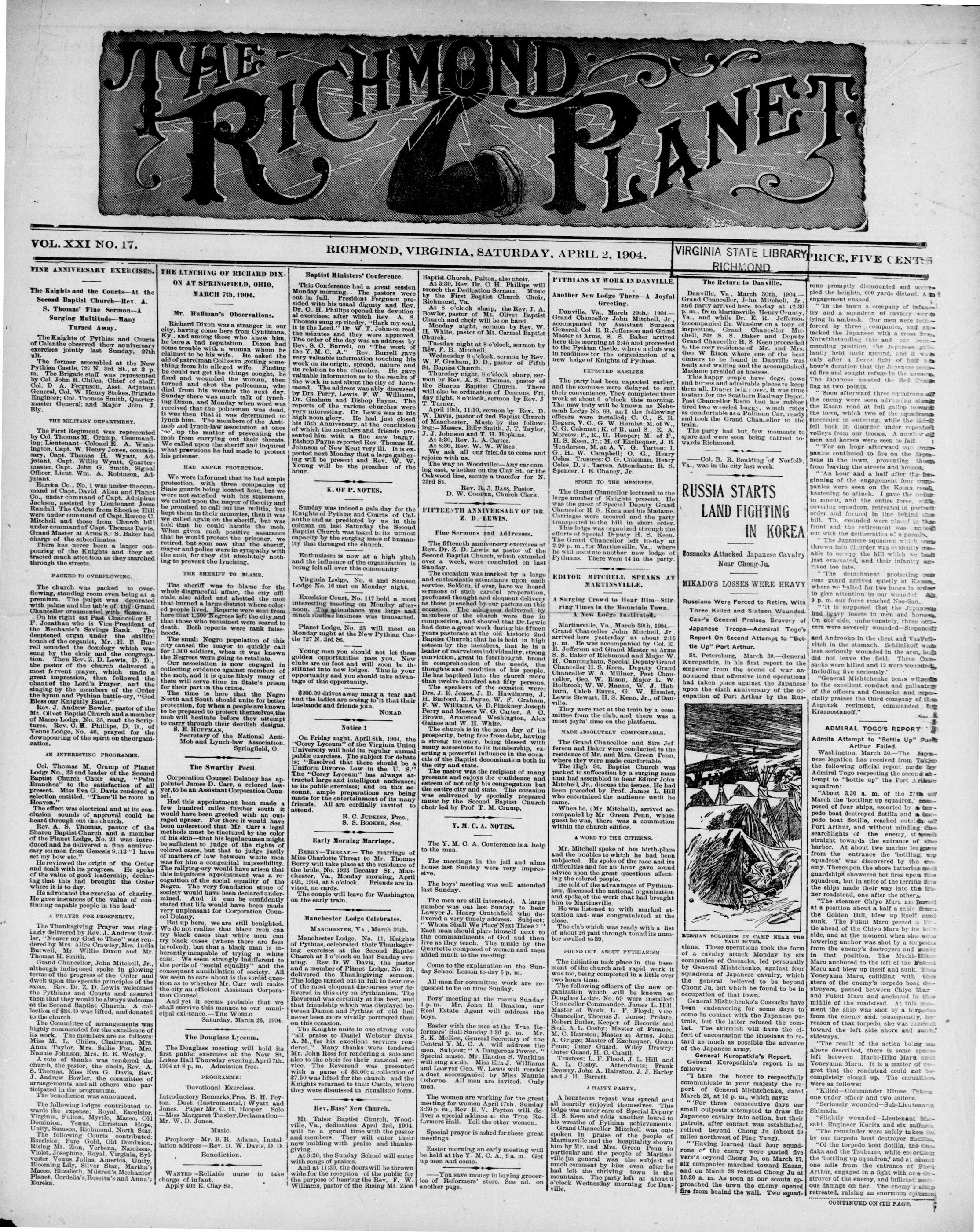
RUSSIA STARTS LAND FIGHTING IN KOREA
Gossacks Attacked Japanese Cavalry
Near Chong-Ju.
MIKADO'S LOSSES WERE HEAVY
Russians Were Forced to Retire, With
Three Killed and Sixteen Wounded.
Czar's General Praises Bravery of
Japanese Troops—Admiral Togo's
Report On Second Attempt to "Bottle Up" Port Arthur.
St. Petersburg, March 30.—General
Kuropatkin, in his first report to the
emperor from the scene of war an-
nounced that offensive land operations
had taken place against the Japanese
upon the sixth anniversary of the occu-
pation of Port Arthur by the Rus-
THE TENTS
BUSGIAN SOLDIERS IN CAMP NEAR THE
KALU RIVER
RUSSIAN SOLDIERS IN CAMP NEAR THE VALU RIVER.
slans. These operations took the form of a cavalry attack Monday by six companies of Cossacks, led personally by General Mishtechenko, against four squadrons of Japanese cavalry, which the general believed to be beyond Chong Ju, but which he found to be in occupation of that town.
General Mishtechenko's Cossacks have been endeavoring for some days to come in contact with the Japanese patrols, but the latter refused the combat. The skirmish will have the effect of encouraging the Russians to retard as much as possible the advance of the Japanese army.
General Kuropatkin's Report.
General Kuropatkin's report is as follows:
"I have the honor to respectfully communicate to your majesty the report of General Mishtechenko, dated March 28, at 10 p. m., which says:
"For three consecutive days our small outposts attempted to draw the Japanese cavalry into action, but their patrols, after contact was established, retired beyond Chong Ju (about 50 miles northwest of Ping Yang).
"Having learned that four squadrons of the enemy were posted five vers's beyond Chong Ju, on March 27, six companies marched toward Kasan, and on March 28 reached Chong Ju at 10.30 a.m. As soon as our scouts approached the town the enemy opened fire from behind the wall. Two squad-
rons promptly dismounted and occupied the heights, 600 yards distant. A engagement ensued.
"In the town a company of infantry and a squadron of cavalry lying in ambush. Our men were forced by three companies, and attacked the Japanese with a cross fire. Notwithstanding this and our commanding position, the Japanese gallantly held their ground, and it was only after a fierce fight of half an hour's duration that the Japanese succeeded fire and sought refuge in the encampment. The Japanese hoisted the Red Cross flag at two points.
"Soon afterward three squadrons the enemy were seen advancing along the Kasan road at full gallop to the town, which two of the squadrons succeeded in entering, while the third fell back in disorder under repeated volleys from our troops. A number of men and horses were seen to fall.
"For an hour afterward our companies continued to fire on the Japanese in the town, preventing them from leaving the streets and houses.
"An hour and a half after the beginning of the engagement four companies were seen on the Kasan result, hastening to attack. I gave the order to mount, and the entire force, with covering squadron, retreated in perfect order and formed in line behind the hill. The wounded were placed in the front and the retirement was carried out with the delibration of a parade.
"The Japanese squadron which was thrown into disorder was evidently unable to occupy the hill which we had just evacuated, and their infantry arrived too late.
"The detachment protecting our rear guard arrived quietly at Kasan, where we halted for two hours in order to give attention to our wounded.
9 p. m. our force reached Noo-San.
"It is supposed that the Japanese had heavy losses in men and horses. On our side, unfortunately, three officers were severely wounded—Stepanov and Androkoo in the chest and VasVervitch in the stomach. Schlinkoff was less seriously wounded in the arm, but did not leave the field. Three Cossacks were killed and 12 were wounded including five seriously."
"General Mishtenchke beats witness to the excellent conduct and gallantry of the officers and Cossacks, and especially praises the third company of the Argunsk regiment, commanded by Krasnostanoff."
Admits Attempt to "Bottle Up" Port Arthur Failed.
Washington, March 30.—The Japanese legation has received from Tulane the following official report made by Admiral Togo respecting the second attempt to "bottle up" the Port Arthur squadron:
"About 3.30 a.m. of the 27th March the 'bottling up squadron,' composed of four ships, escorted by a temped boat destroyed flotilla and a temped boat flotilla, reached outside Port Arthur, and without minding their searchlights of the enemy, stretched straight towards the entrance of harbor. At about two marine leagues from the entrance the 'bottling up squadron' was discovered by the enemy. Thereupon the shore battered guardships showered hot fires upon the ship, in spite of the terrific the ships made their way into the inner roadstead, one after the other.
"The steamer Chiyo Maru anchored at a position about a half a cable from the Golden Hill, blew up itself and sunk. The Fukui Maru passed a little ahead of the Chiyo Maru by its side, and at the moment when she was lowering anchor was shot by a torpedo from the enemy's destroyers and moved in that position. The Machi-Hikaru Maru anchored to the left of the Fukui Maru and blew up itself and sunk. The Yoneyama Maru, colliding with the stern of the enemy's torpedo boat destroyers, passed between Chiyo Maru and Fukui Maru and anchored in the middle of the roadstead. At this moment the ship was shot by a torpedo from the enemy and, consequently, by reason of that torpedo, she was carried toward the left side shore and sunk, slideways.
"The result of the action being above described, there is some space left between Hachi-Hiko Maru and Yoneyama Maru. It is a matter of regret that the roadstead could not completely closed up. The casualties were as follows:
"Killed—Commander Hirose Takei one under officer and two sailors.
"Seriously wounded—Sub-Lieutenant Shimada."
by our torpedo boat destroyer foilot.
"Of the torpedo boat foilot, the Candaka and the Tsubame, while escorting the 'bottling up squadron,' and at about one mile from the entrance of Fort Arthur, engaged in a fight with one destroyer of the enemy, and inflicted numerous damage on her. The enemy's ship retreated, raising an enormous column.
CONTINUED ON 4TH PAGE.
THE APLANET
SATURDAY... APRIL 2. 1904
COASTING
When the mercury goes downward and a
freeze is in the air
Childish voices, yes, and laughter echo
down the walls to come
An I see 'em all a-standin' underneath the
apple-tree
her head.
'An the slope she sits beneath 'em and
'they start, an they are gone!'
Each sled with a red-checked burden an 'a
boy to hold her on.
I would like to be up yonder for a little
while, I would.
Where us fellers used to gather where the
crab-apple stood.
I would
and just her an' me forever flyin' laughin'
through the night.
BETWEEN JOURNEYS By NELLIE CRAVEY GILUMORE
LIEUT. PEARSON swung himself on a Broadway car with considerable relief. The transport had arrived but an hour ago, thus allowing him scant time and no ceremony, in which to see the barber and pay a flying visit to his apartments.
Four years had wrought little material change in the scenes about him; he could shut his eyes and almost fancy that only a day and night had elapsed since the last time he had taken this ride. Alas, how well he remembered it—every little detail, full of sadness inexpressible to them both, but full or even of a hope that had long since shriveled and died.
Certainly, he thought, it was a very curious irony that was bringing him to her house now. But whatever the cause—or the lack of one—that had brought about her suds, a marriage with the other man, only one fact remained for present consideration. Benton was dead, and with almost his last breath, had entrusted to him, a message for the woman he was leaving behind.
Pearson's hand went involuntarily to his pocket, just as it had done hundreds of times before in the year that had passed. The packet was safe and he drew a sigh of relief. Another half hour, and it would be—thank Heaven—out of his keeping forever.
He left the car in a fever of nervousness, but the walk of several squares in the cool, brisk wind, restored his self-poise. A strange mixture of emotions fought for dominance as he stood again in front of the old-fashioned door with its old-fashioned brass knocker. But he presented his card quite calmly to the servant who let him in, and sat down without treplication in the familiar drawing room, to wait.
Mrs. Benton came in almost immediately. "I received your message," she said, holding out her hand, "and I dressed at once so as not to detain you. I think it rather too bad that you must hurry right off again."
The lieutenant relinquished her fingers in silence and sat down in the chair she indicated. "I'm sorry myself," he returned, presently, "but circumstances require it and circumstances, you know, are about as inflexible sometimes as the proverbial "stubborn fact."
After a desultory interchange of inquiries and reminiscences, Pearson fumbled in his pocket for the little package he had crossed the ocean to put/into her hands, drawing it out with a keener sense of constraint than he had imagined possible.
"Doris—Mrs. Benton," he began, uncertainly, "your he requested me to give you this. I—"
"Thank you, Jack," she interposed, quietly, extending her fingers quite passively.
Pearson regarded her in some surprise. He had expected tears, questions, hysteries—anything but this inscrutable calm. Did she, then, love him so very much after all as to be compelled to crush back all feeling behind a mask? Or—he dismissed that other thought almost before it was born.
"Is this all?" she asked after a pause.
"Was there any word—any last word—for me?"
Lent. Pearson flushed to his temples. How was he to tell her that the man's her husband's dying breath had framed another woman's name? Benton had asked him, dispassionately enough, to deliver the packet to his wife; that was all. And everything the packet contained was the seal-ring Doris had given him and one or two trivial little ornaments of hers he had brought with him to the Philippines.
"He was unconscious at the last," he replied after a silence. Mrs. Benton looked at him earnestly, "Sit—before that?" she insisted with maliguised eagerness. He met her eyes without flinching now. Yes," he said, "there was something." "Tell me," she leaned back in her chair, folding her hands tentatively. "Tell me—everything," she went on with a little catch in her voice. "I want to know the truth, Jack." Pearson remained silent for some time. The truth he could not tell her; it must be a lie or notpthing. The lie was safer.
"He said," he answered, slowly. "Tell Doris my last thought and wish and prayer—were for her."
Mrs. Benton paled, then flushed and paled again. After a little she rose restlessly and crossed the room to an open window. For a long time she stood there mute, staring out into the rapidly thickening dark.
Minutes passed, and a clock somewhere struck seven. Pearson started to his feet with a little exclamation of alarm.
"I really must be going," he explained, hurriedly, "my train for the south leaves in 40 minutes."
Mrs. Benton turned tear-misted eyes to his. She opened her lips to speak, but the words refused to come, and her lips quivered suddenly. She held out both hands to him in the little impulsive way that belonged to her.
Pearson held himself in check by a powerful effort. His hands closed over hers with a restrained pressure.
"Good-by," she said brokenly. "You are more noble than I can tell you—more than you will ever know—" She paused and turned away for a second. When she had controlled herself, she looked up again into his eyes that searched hers so earnestly. "I had not meant to tell you, Jack," she went on, tremulously. "but something that I cannot resist, impels me to do so. I know—all, and a good deal besides that you never dreamed of. He is dead now, and hereafter, my lips must be sealed against him. But this much you must know. He did you the greatest injustice one man may do another. He lied—to steal me from you, and I, like a credulous fool, fell into the trap. You have lied—to save him from dishonor in my eyes, and to save me from shame and sorrow. Thank you, Jack, and—good-by again." A quiver
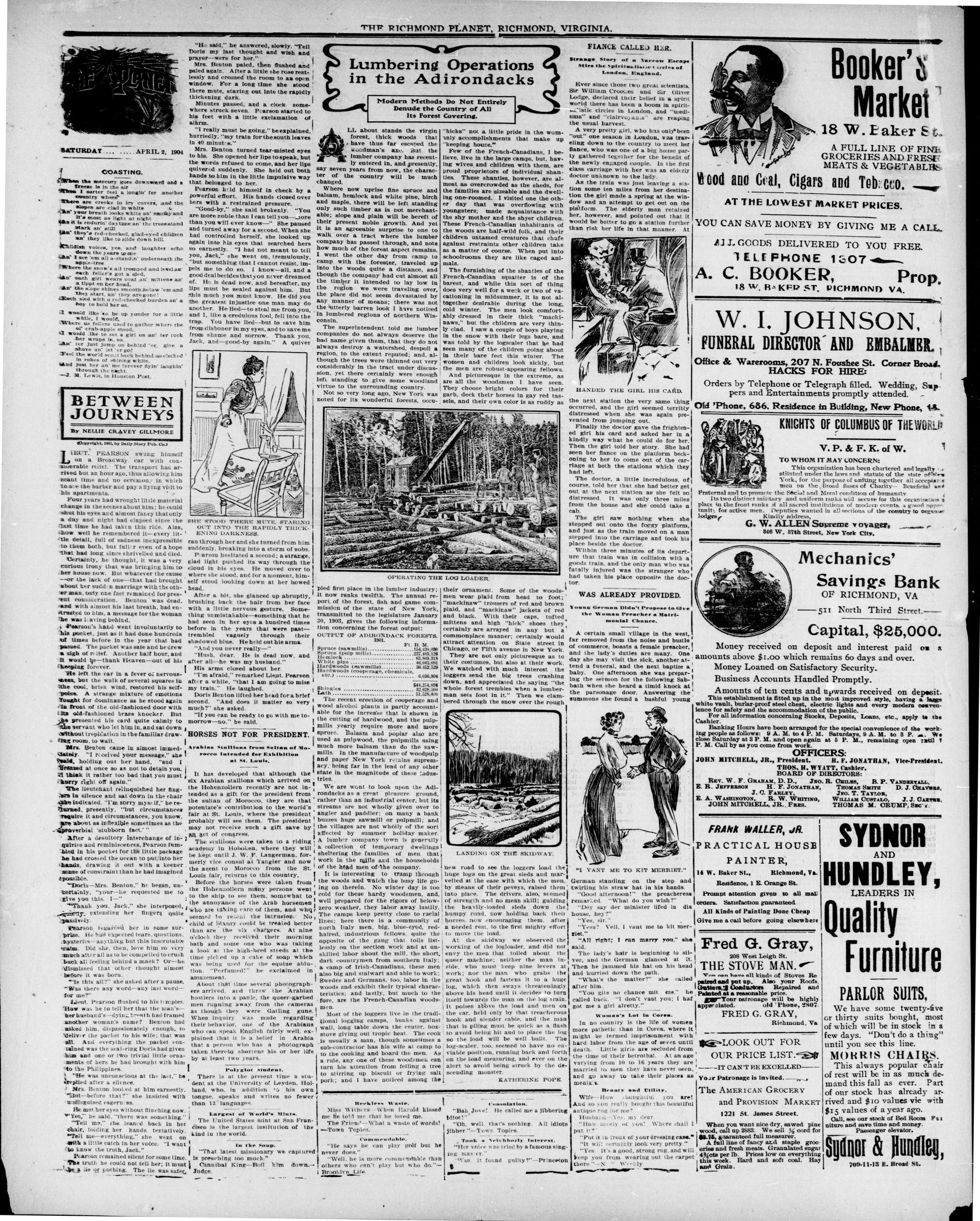
A woman in a long dress stands in a room, holding a curtain in her hand. She is facing a table with a vase and a glass. The room has a wooden chair and a wall with a picture frame.
SHE STOOD THERE MUTE, STARING OUT INTO THE RAPIDLY THICKENING DARKNESS.
ran through her and she turned from him suddenly, breaking into a storm of sobs.
Pearson hesitated a second; a strange, glad light pushed its way through the cloud in his eyes. He moved over to where she stood, and for a moment, himself stood looking down at her howed head.
After a bit, she glanced up abruptly, brushing back the hair from her face with a little nervous gesture. Something unmistakable—something that he had seen in her eyes a hundred times before in the years that were past—trembled vaguely through their shadowed blue. He held out his arms.
"And you never really—"
"Hush, dear. He is dead now, and after all—he was my husband."
His arms closed about her.
"I'm afraid," remarked Lleut. Pearson after a while. "that I am going to miss my train." He laughed.
Doris Benton lifted her head for a brief second. "And does it matter so very much?" she asked.
"If you can be ready to go with me to
morrow—no," he said.
HORSES NOT FOR PRESIDENT
Arabian Stallions from Sultan of Morocco Intended for Exhibition at St. Louis.
It has developed that although the six Arabian stallions which arrived on the Hohenbollen recently are not intended as a gift for the president from the sultan of Morocco, they are that potentate's contribution to the world's fair at St. Louis, where the president probably will see them. The president may not receive such a gift save by an act of congress.
The stallions were taken to a riding academy in Hoboken, where they will be kept until J. W. F. Langerman, formerly vice consul at Tangier and now the agent to Morocco from the St. Louis fair, returns to this country.
Before the horses were taken from the Hohencolllern many persons went to the ship to see them, somewhat to the annoyance of the Arab horsemen who are taking care of them, and who seemed to resent the intrusion. No child of luxury could be treated better than are the six chargers. At nine o'clock they received their morning bath and some one who was taking a look at the high-bred steeds at the time picked up a cake of soap which was being used for the equine ablution. "Perfumed!" he exclaimed in amazement.
About that time several photographers arrived, and threw the Arabian hostlers into a panic, the queer-garbed men running away from the cameras as though they were Gatling guns. When inquiry was made regarding their behavior, one of the Arabians who can speak English fairly well, explained that it is a belief in Arabia that a person who has a photograph taken thereby shurries his or her life by at least two years.
Polyglot student.
There is at the present time a student at the University of Leyden, Holland, who, in addition to his own tongue, speaks and writes no fewer than 13 languages.
Largest of World's Mints.
The United States mint at San Francisco is the largest institution of the kind in the world.
In the Soup.
"That latest missionary we captured is preaching too much."
Cannibal King—Boll him down... Judge.
THE RICHMOND PLANET, RICHMOND, VIRGINIA
Modern Methods Do Not Entirely Denude the Country of All Its Forest Covering.
LL about stands the virgin forest, thick woods that have thus far escaped the woodman's axe. But the lumber company has recently entered in, and presently, say seven years from now, the character of the country will be much changed.
"hicks" not a little only accomplishment "keeping house."
Few of the French lieve, live in the large wives and children proud proprietors of ties. These shanties most are overwhelmed
Where now uprise fine spruce and balsam, hemlock and white pine, birch and maple, there will be left standing only such timber as is not merchantable; slope and plain will be bereft of their present noble growth. And yet it is an agreeable surprise to one to walk over a tract where the lumber company has passed through, and note how much of the forest aspect remains. I went the other day from camp to camp with the forester, traveled up into the woods quite a distance, and though the company had cut almost all the timber it intended to lay low in the region we were traveling over, the place did not seem devastated by any manner of means; there was not the utterly barren look I have noticed in lumbered regions of northern Wisconsin.
The superintendent told me lumber companies do not always deserve the bad name given them, that they do not always destroy a watershed, despell a region, to the extent reputed; and, although the trees were thinned out very considerably in the tract under discussion, yet there certainly were enough left standing to give some woodland virtue to the surrounding country. Not so very long ago, New York was noted for its wonderful forests, ocean
OPERATING THE LOG LOADER
plied first place in the lumber industry; it now ranks twelfth. The annual report of the forest, fish and game commission of the state of New York, transmitted to the legislature January 30, 1903, gives the following information concerning the forest output: OUTPUT OF ADIRONDACK FORESTS. 1901. Ft. R. M. Spruce (sawmills) ..... 154,439,030 Spruce (pulp mills) ..... 237,483,126 Hulock ..... 65,889,318 White plum ..... 65,403,428 Hardwoods (sawmills) ..... 36,452,529 Hardwoods (cooperage, chemicals, etc.) ..... 6,036,804 544,254,888 Shingles ..... 32,628,500
Lath 51,328,400
The recent erection of cooperage and wood alcohol plants is partly accountable for the increase that is shown in the cutting of hardwood, and the pulp mills yearly require more and more spruce. Balsam and poplar also are used as pulpwood, the pulp mills using much more balsam than do the sawmills. In the manufacture of woodpulp and paper New York retains supremacy, being far in the lead of any other state in the magnitude of these industries.
We are wont to look upon the Adirondacks as a great pleasure ground, rather than an industrial center, but its streams are not wholly given over to angler and paddler; on many a bank buzzes huge sawmill or pulpmill; and the villages are not wholly of the sort affected by summer holiday maker. A lumber company town is generally a collection of temporary dwellings sheltering the families of men that work in the mills and the households of the head men of the company.
It is interesting to tramp through the woods and watch the busy life going on therein. No winter day is too cold for these hardy woodsmen, and, well prepared for the rigors of below-zero weather, they labor away lustily. The camps keep pretty close to racial lines; here there is a community of north Italy men, big, blue-eyed, red-haired, industrious fellows, quite the opposite of the gang that tolls listlessly on the section work and at unskilled labor about the mill, the short, dark countrymen from southern Italy; a camp of Irish-Canadians, these men also big and stalwart and able to work; Swedes and Germans, too, labor in the woods and exhibit their typical characteristics; and lastly, but much to the fore, are the French-Canadian woodsmen.
Most of the loggers live in the traditional logging camps, bunks against wall, long table down the center, box-stove giving out tropic heat. The cook is usually a man, though sometimes a sub-contractor has his wife at camp to to the cooking and board the men. As a rule, any one of these woodsmen can turn his attention from felling a tree to stirring up biscuit or frying salt pork; and I have noticed among the
Reckless Waste.
Miss Witers—When Harold kissed me he told me that he loved me.
The Friend—What a waste of words!
—Town Topics.
Commendable.
"He says he can play golf but he never does."
"Well, he is more commendable than others who can't play but who do."—Brooklyn Life.
---
"thicks" not a little pride in the womanly accomplishments that make up "keeping house."
Few of the French-Canadians, I believe, live in the large camps, but, having wives and children with them, are proud proprietors of individual shanties. These shanties, however, are almost as overcrowded as the sheds, for the families are sizeable and the dwelling one-roomed. I visited one the other day that was overflowing with youngsters; made acquaintance with the shy mother and the sheer children. These French-Canadian inhabitants of the woods are half-wild folk, and their children untamed creatures that chafe against restraints other children take as a matter of course. When put into schoolrooms they are like caged animals.
The furnishing of the shanties of the French-Canadian squatter is of the barest, and while this sort of thing does very well for a week or two of vacationing in midsummer, it is not altogether desirable during the long, cold winter. The men look comfortably dressed in their thick "mackinaws," but the children are very thinly clad. I saw a couple of boys playing in the snow with their legs bare, and was told by the logcalcer that he had seen many of the children going about in their bare feet this winter. The women and children look sickly, but the men are robust-appearing fellows. And picturesque in the extreme, as are all the woodmen I have seen. They choose bright colors for their garb, deck their horses in gay red tassels, and their own color is as ruddy as
5
their ornament. Some of the woodsmen wear plaid from head to foot; "mackinaw" trousers of red and brown plaid, and "mackinaw" jackets of red and black. With their caps, tufted mittens and high "hick" shoes they certainly are arrayed in any but a commonplace manner; certainly would attract attention on State street in Chicago, or Fifth avenue in New York. They are not only picturesque as to their costumes, but also at their work. We watched with much interest the loggers send the big trees crashing down, and appreciated the saying "the whole forest trembles when a lumberman sets foot in it." Then we clambered through the snow over the rough
LANDING ON THE SKIDWAY
new road to see the loggers load the huge logs on the great sleds and marvelled at the ease with which the men, by means of their peveys, raised them into place. The drivers, also, seemed of strength and no mean skill; guilding the heavily-loaded sleds down the humpy road, now holding back their horses, now encouraging them, after a needed rest, to the first mighty effort to move the load.
At the sidway we observed the working of the logloader, and did not envy the men that toiled about the queer machine; neither the man inside, who must keep nine levers at work; nor the man who grabs the great hook and fastens it to a huge log, which then sways threateningly above his head until it decides to turn itself towards the man on the log train. It poises above the load and men on the car, held only by that treacherous hook and slender cable, and the man that is pilling must be quick as a flash to avoid being hit and to place the log so the load will be well built. The log-scaler, too, seemed to have no enviable position, running back and forth on the load measuring, and ever on the alert to avoid being struck by the descending monster.
"Bah Jove! He called me a jibbering idiot!"
"Oh, well, that's nothing. All idiots jibber."—Town Topics.
Took a neighborly interest.
"Her voice was tried by a famous singing master."
"Was it found guilty?"—Princeton
KATHERINE POPE
FIANCE CALLED HER.
Strange Story of a Narrow Escape Stirs the Spiritualistic Circles of London, England.
Ever since those two great scientists, Sir William Crookes and Sir Oliver Lodge, declared their belief in a spirit world there has been a boom in spiritualistic circles in London, and "mediums" and "clairvoyants" are reaping the usual harvest.
A very pretty girl, who has only been "out" one season in London, was traveling down to the country to meet her fiance, who was one of a big house party gathered together for the benefit of the newly engaged couple. In the first class carriage with her was an elderly doctor unknown to the lady.
As the train was just leaving a station some ten miles from her destination the girl made a spring at the window and an attempt to get out on the platform. The elderly man retained her, however, and pointed out that it would be better to a station further than risk her life in that manner. At
HANDED THE GIRL HIS CARD.
the next station the very same thing occurred, and the girl seemed terribly distressed when she was again prevented from jumping out.
Finally the doctor gave the frightened girl his card and asked her in a kindly way what he could do for her.
Then the girl told her story. She had seen her flance on the platform beckoning to her to come out of the carriage at both the stations which they had left.
The doctor, a little incredulous, of course, told her that she had better get out at the next station as she felt so distressed. It was only three miles from the house and she could take a cab.
The girl saw nothing when she stepped out onto the foggy platform, and just as the train moved on a man stepped into the carriage and took his place beside the doctor.
Within three minutes of its departure that train was in collision with a goods train, and the only man who was fatally injured was the stranger who had taken his place opposite the doctor.
WAS ALREADY PROVIDED.
Young German Didn't Propose to Give the Woman Preacher a Matrimonial Chance.
A certain small village in the west, far removed from the noise and bustle of commerce, boasts a female preacher, and the lady's duties are many. One day she may visit the sick, another attend a funeral, and the next baptize a baby. One afternoon she was preparing the seismon for the following Sabbath when she heard a timid knock at the parsonage door. Answering the summons she found a bashful young
"I VANT ME TO KIT MERRIET."
German standing on the step and twirling his straw hat in his hands.
"Good afternoon!" the preacheress remarked. "What do you wish?"
"Dey say der minister lifed in dis house, hey?"
"All right; I can marry you," she said.
The lady's hair is beginning to silver, and the German glanced at it. Then he jammed his hat on his head and hurried down the path.
"What's the matter?" she called after him.
"You gits no chance mit me," he called back. "I don't want you; I haf got me a girl abretty."
**Woman's Lot in Corea.**
In no country is the life of women more pathetic than in Corea, where it might be termed imprisonment with hard labor from the age of seven until death. Little girls are secluded from the time of their betrothal. At an age varying from 10 to 16 years they are married to men they have never seen, and go away to take their places as meniais.
Wife—How thoughtful you are! And so you really bought this beautiful antique rug for me?
Husband—Yes, my dear "How lovely of you! Where shall I put it?"
"Put it in front of your dressing case." "It will certainly look very pretty." "Yes. It's a good, strong rug, and will keep you from wearing out the carpet there."—N. W. Weekly
J. W. H.
Wood and Coal, Cigars
AT THE LOWEST M
YOU CAN SAVE MONEY IN
AJJ GOODS DELIVER
TELEPHONE
A. C. BOOKER
18 W. BAKER ST.
W. I. JOE
FUNERAL DIRECTOR
Office & Warerooms, 207 N.
HACKS FO
Orders by Telephone or Tele-
pers and Entertainment
Old 'Phone, 686, Residence
Cigars and Tobacco. WEST MARKET PRICES. MONEY BY GIVING ME A CALL. DELIVERED TO YOU FREE. PHONE 1507 OKER, Prop. OKER ST. PICHMOND VA. JOHNSON, DIRECTOR AND EMBALMER. Ins, 207 N. Foushee St. Corner Broad. BACKS FOR HIRE: Stone or Telegraph filled. Wedding, Supertainments promptly attended. Residence in Building, New Phone, 18. KNIGHTS OF COLUMBUS OF THE WORLD
AT THE LOWEST MARKET PRICES.
YOU CAN SAVE MONEY BY GIVING ME A CALL.
AJJ. GOODS DELIVERED TO YOU FREE.
TELEPHONE 1507
A. C. BOOKER, Prop.
18 W. BAKER ST. PICHMOND VA.
W. I. JOHNSON FUNERAL DIRECTOR AND EMBALMER.
Office & Warerooms, 207 N. Foushee St. Corner Broad. HACKS FOR HIRE: Orders by Telephone or Telegraph filled. Wedding, Suppers and Entertainments promptly attended. Old 'Phone, 686, Residence in Building, New Phone, 18.
KNIGHTS OF COLUMBUS OF THE WORLD
TO WHOM IT MAY CONCERN:
This organization has been chartered and legally instituted under the laws and statute of the state of New York, for the purpose of uniting together all acceptance men on the Broad Bases of Charity—Beneficial to the Social and Moral condition of humanity and uniform ranks will secure for this organization all sacred institutions of modern events, a grand oppo- puents wanted in all sections of the country to organ- ily address,
ALLEN Supreme voyager,
W. 87th Street, New York City.
Mechanics'
This organization has been chartered and legally
stituted under the laws and statute of the state of New
York, for the purpose of uniting together all acceptance
men on the Broad Bases of Charity - Beneficial
Fraternal and to promote the Social and
Its two distinct military and uniform
place in the front ranks of all sacred inst
unity for active men. Deputies wanted
lodges Kindly address,
G. W. ALLEN S
846 W. 37th Street
Its two distinct military and uniform ranks will secure for this organization a place in the front ranks of all sacred institutions of modern events, a grand opportunity for active men. Deputies wanted in all sections of the country to organize lodges. Kindly address,
G. W. ALLEN Supreme voyager,
846 W. 87th Street, New York City.
Money received on deposit amounts above $1.00 which rent
Money Loaned on Satisfaction
Business Accounts Handler
Amounts of ten cents and
This establishment is fitted up in the white vault, burlar-proof steel chest, elec-
ence for safety and the accommodation
For all information concerning Stock Cashier.
Banking Hours have been arranged in people as follows: 9 A. M. to 4 P. M. close Saturday at 3 P. M. and open again P. M. Call by as you come from work.
OFFIC
JOHN MITCHELL, JR., President.
THOS. H. WY
BOARD OF F.
REV. W. F. GRAHAM, D. D., JNO.
E. R. JEFFERSON H. F. JONATHAN,
J. O. FARLEY
E. A. WASHINGTON, R. W. WHITING,
JOHN MITCHELL, JR., FRES.
paid on deposit and interest paid on a
so which remains 60 days and over.
on Satisfactory Security.
ants Handled Promptly.
a cents and upwards received on deposit.
fitted up in the most improved style, having a large
steel chest, electric lights and every modern conven-
communication of the public.
cerning Stocks, Deposits, Loans, etc., apply to the
been arranged for the special convenience of the work.
A. M. to 4 P. M. Saturday, 9 A. M. to 8 P. M.
We and open again at 5 P. M., remaining open until
from work.
OFFICERS:
President. H. F. JONATHAN, Vice-President.
THOS. H. WYATT, Cashier.
BOARD OF DIRECTORS:
D. D., JNO. R. ORILES, B. P. VANDERVALL,
F. JONATHAN, THOMAS SMITH D. J. CHAVMES,
BLEY, JNO. T. TAYLOR.
Money received on deposit and interest paid on amounts above $1.00 which remains 60 days and over.
Money Loaned on Satisfactory Security.
Business Accounts Handled Promptly.
Amounts of ten cents and upwards received on deposit.
This establishment is fitted up in the most improved style, having a large white vault, burlar-proof steel chest, electric lights and every modern convenience for safety and the accommodation of the public.
For all information concerning Stocks, Deposits, Loans, etc., apply to the Cashier.
Banking Hours have been arranged for the special convenience of the working people as follows: 9 A. M. to 4 P. M. Saturdays, 9 A. M. to 8 P. M. We close Saturday at 3 P. M. and open again at 5 P. M., remaining open until 1 P. M. Call by as you come from work.
OFFICERS:
JOHN MITCHELL, JR., President. H. F. JONATHAN, Vice-President.
THOS. H. WYATT, Cashier.
BOARD OF DIRECTORS.
PRACTICAL HOUSE
14 W. Baker St., Richmond, Va.
Residence, 1 E. Orange St.
Prompt attention given to all mail orders. Satisfaction guaranteed.
All Kinds of Painting Done Cheap
Give me a call before going elsewhere
Fred G. Gray,
THE STOVE MAN.
You can have all kinds of Stoves Re
paired and put up. Also your Roofs,
Gutters, Coatstores Repaired and
Painted at a reasonable price.
Your patronage will be highly
appreciated.
FRED G. GRAY,
Richmond, Va
LOOK OUT FOR
OUR PRICE LIST.
IT CAN'T BE EXCELLED
Your Patronage is Invited.
The AMERICAN GROCERY
and PROVISION MARKET
When you want nice dry, sawed pine wood, call up 2883. We sell ½ cord for $2.75 guaranteed full measurer. A full line of fancy and staple groceries and fresh meats. Granulated sugar 4¾ cups per lb. Prices low on everything this week. Hard and soft coal. Hay and Grain.
---
---
```markdown
```
1820
FRANK WALLER, JR.
1221 St. James Street
Booker's Market
18 W. Paker St. A FULL LINE OF FINE GROCERIES AND FRESH MEATS & VEGETABLIS
V. P. & F. K. of W.
Savings Bank OF RICHMOND, VA 511 North Third Street. Capital, $25,000.
WILLIAM CUSTALO, J. J. CARTER
THOMAS M. ORUMP, Ssec. x
SYDNOR AND HUNDLEY, LEADERS IN Quality Furniture
We have some twenty-five or thirty suits bought, most of which will be in stock in a few days. "Don't do a thing" until you see this line.
MORRIS CHAIRS.
This always popular chair of rest will be in as much demand this fall as ever. Part of our stock has already arrived and $10 values vie with $15 values of a year ago.
Call, see our stock of Bed Room Furniture and save time and money.
Passenger elevator.
Sydnor & Hundley,
209-11-13 E. Broad St.
The Gentleman From Indiana
Copyright, 1899, by Doubleday @ McClure Co.
Copyright, 1902, by McClure, Phillips @ Co.
CHAPTER VIII.
THE courthouse bell ringing in the night! No hesitating stroke of Schofields' Henry, no uncertain touch, was on the rope. A loud, wild, hurried clamor pealing to wake the countryside, a rapid clang! clang! clang! that struck clear in to the spine. The courthouse bell had tolled for the death of Morton, of Garfield, of Hendricks; had rung joy peals of peace after the war and after political campaigns, but it had rung as it was ringing now only three times—once when Hibbard's mill burned, once when Webb Landis killed Sep Bardlock and intrenched himself in the lumber yard and would not be taken until he was shot through and through, and once when the Rauen accommodation, crowded with children and women and men, was wrecked within twenty yards of the station.
Why was the bell ringing now? Men and women, startled into wide wakefulness, groped to windows. No red mist hung over town or country. What was it? The bell rang on. Its loud alarm beat increasingly into men's hearts and quickened their throbbing to the rapid measure of its own. Vague forms boomed in the gloaming. A horse, madly ridden, splashed through the town. There were shouts; voices called hoarsely; lamps began to gleam in the windows; half clad people emerged from their houses, men slapping their braces on their shoulders as they ran out of doors; questions were shouted into the dimness.
Then the news went over the town.
It was cried from yard to yard, from group to group, from gate to gate, and reached the furthermost confines. Runners shouted it as they sped by, and boys panted it, breathless; women with boosened hair stumbled into darkling chambers and faltered it out to new wakened sleepers, and pale girls, clutching wraps at their throats, whispered it across fences. The sick, tossing on their hard beds, heard it. The bell clamored it far and near; it spread over the countryside, and it flew over the wires to distant cities. The White Caps had got Mr. Harkless!
Lige Willetts had lost track of him out near Briscoe's, it was said, and had come into town at midnight seeking him. He had found Parker, the Herald foreman, and Ross Schofield, the typesetter, and Bud Tipworthy, the devil at work in the printing office, but no sign of Harkless there or in the cottage. Together these had sought for him and had roused others who had inquired at every house where he might have gone for shelter, and they had heard nothing. They had watched for his coming during the slackening of the storm. He had not come, and there was no place he could have gone. He was missing. Only one thing could have happened.
They had roused up Warren Smith, the prosecutor, and Horner, the sheriff, and Jared Wiley, the deputy. William Todd had rung the alarm. It was agreed that the first thing to do was to find him. After that there would be trouble, if not before. It looked as if there would be trouble before. The men trampling up to the muddy square in their shirt sleeves were bulgy about the right hips, and when Homer Tibbs joined Columbus Landis at the hotel corner and Landis saw that Homer was carrying a shotgun Landis went back for his. A hastily sworn posse galloped out Main street. Women and children ran into neighbors' yards and began to cry. Day was coming, and as the light grew men swore and savagely kicked at the palings of fences as they ran by them.
In the foreglow of dawn they gathered in the square and listened to Warren Smith, who made a speech from the courthouse fence and warned them to go slow. They answered him with angry shouts and bootings. But he made his big bass voice heard and bade them do nothing rash. No facts were known, he said. It was far from certain that harm had been done, and no one knew that the Six Crossroads people had done it, even if something had happened to Mr. Harkless. He declared that he spoke in Harkless' name. Nothing could distress him so much as for them to defy the law, to take it out of the proper hands. Justice would be done.
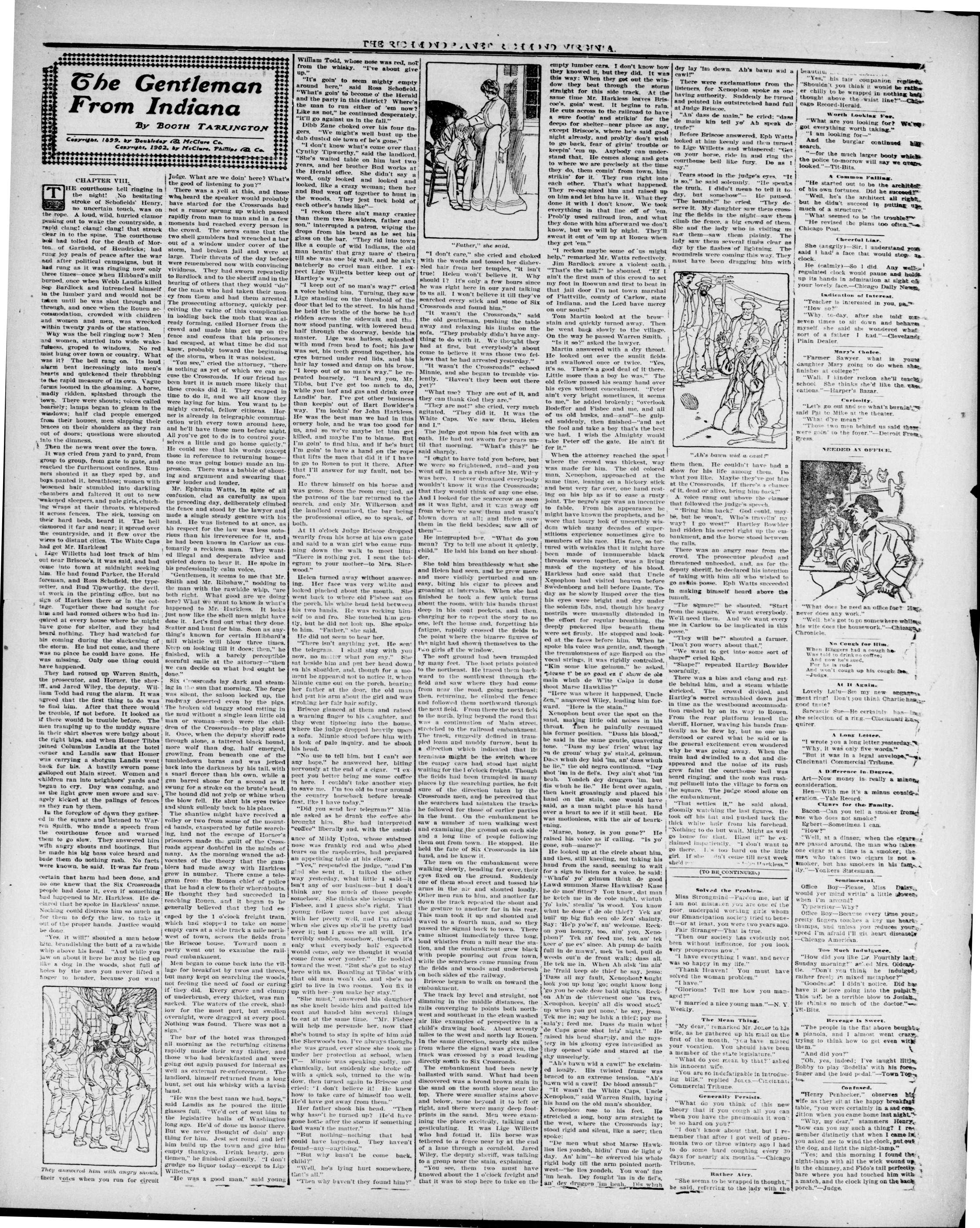
"Yes, it will!" shouted a man below him, brandishing the butt of a rawhide whip above his head. "And while you jaw on about it here he may be tied up like a dog in the woods, shot full of holes by the men you never lifted a finger to hender, because you want
A
They answered him with angry events,
their votes when you run for circuit
Judge. What are we doin' here? What's the good of listening to you?"
There was a yell at this, and those who heard the speaker would probably have started for the Crossroads had not a rumor sprung up which passed rapidly from man to man and in a few moments had reached every person in the crowd. The news came that the two shell gambblers had wrenched a bar out of a window under cover of the storm, had broken jail and were at large. Their threats of the day before were remembered now with convincing vividness. They had sworn repeatedly to Bardlock and to the sheriff and in the hearing of others that they would "do" for the man who had taken their money from them and had them arrested. The prosecuting attorney, quickly perceiving the value of this complication in holding back the mob that was already forming, called Horner from the crowd and made him get up on the fence and confess that his prisoners had escaped, at what time he did not know, probably toward the beginning of the storm, when it was noisest.
"You see," cried the attorney, "there is nothing as yet of which we can accuse the Crossroads. If our friend has been hurt it is much more likely that these crooks did it. They escaped in time to do it, and we all know they were laying for him. You want to be mighty careful, fellow citizens. Horner is already in telegraphic communication with every town around here, and he'll have those men before night. All you've got to do is to control yourselves a little and go home quietly." He could see that his words (except those in reference to returning home—no one was going home) made an impression. There was a babble of shouting and argument and swearing that grew louder and louder.
Mr. Ephraim Watts, in spite of all confusion, clad as carefully as upon the preceding day, deliberately climbed the fence and stood by the lawyer and made a single steady gesture with his hand. He was listened to at once, as his respect for the law was less notorious than his irreverence for it, and he had been known in Carlow as customarily a reckless man. They wanted illegal and desperate advice and quieted down to hear it. He spoke in his professionally calm voice.
"Gentlemen, it seems to me that Mr. Smith and Mr. Ribshaw," nodding to the man with the rawhide whip, "are both right. What good are we doing here? What we want to know is what's happened to Mr. Harkless. It looks just now like the shell men might have done it. Let's find out what they done. Scatter and hunt for him. Soon as anything's known for certain Hibbard's mill whistle will blow three times. Keep on looking till it does; then," he finished, with a barely perceptible scornful smile at the attorney—"then we can decide on what bad ought be done."
Six Crossroads lay dark and steaming in the sun that morning. The forge was silent, the saloon locked up, the roadway deserted even by the pigs. The broken old buggy stood rotting in the mud without a single lean little old man or woman—such were the children of the Crossroads—to play about it. Once, when the deputy sheriff rode through alone, a tattered black hound, more wolf than dog, half emerged, growling, from beneath one of the tumbledown barns and was jerked back into the darkness by his tail, with a snarl flierer than his own, while a gun barrel shone for a second as it swung for a stroke on the brute's head. The hound did not yelp or whine when the blow fell. He shut his eyes twice and slunk sullyly back to his place.
The shanties might have received a veille or two from some of the mounted bands, exasperated by futile searching, had not the escape of Horner's prisoners made the guilt of the Crossroads appear doubtful in the minds of many. As the morning waned the advocates of the theory that the gamblers had made away with Harkless grew in number. There came a telegram from the Rouen chief of police that he had a clew to their whereabouts. He thought they had succeeded in reaching Rouen, and it began to be generally believed that they had escaped by the 1 o'clock freight train, which had stopped to take on some empty cars at a side track a mile northwest of town, across the fields from the Briscoe house. Toward noon a party went out to examine the railroad embankment.
Men began to come back into the village for breakfast by twos and threes, but many kept on searching the woods, not feeling the need of food or caring if they did. Every grove and clump of underbrush, every thicket, was ran sacked. The waters of the creek, shallow for the most part, but swollen overnight, were dragged at every pool. Nothing was found. There was not a sign. $ ^{*} $ The bar of the hotel was thronged all morning as the returning citizens rapidly made their way thither, and those who had breakfasted and were going out again paused for internal as well as external re-enforcement. The landlord, himself returned from a long hunt, set out his whisky with a lavish band.
"He was the best man we had, boys," said Landis as he poured the little glasses full. "We'd ort of sent him to the legislative halls of Washington long ago. He'd of done us honor there. But we never thought of doin' anything for him. Jest set ground and left him build up the town and give him empty thankyes. Drink hearty, gentlemen," he finished gloomy. "I don't grudge no liquor today—except to Lige Willetts."
"He was a good man," said young
THE RICHMOND PARK SECOND VIRGINIA
William Todd, whose nose was red, not from the whisky. "I've about give up."
"It's goin' to seem mighty empty around here," said Ross Schofield. "What's goin' to become o' the Herald and the party in this district? Where's the man to run either of 'em now? Like as not," he continued desperately. "I'll go against us in the fall."
Dibb Zane choked over his four fingers. "We might's well bust up the dabusted ole town of he's gone."
"I don't know what's come over that Cynthy Tipworthy," said the landlord. "She's waited table on him last two years, and her brother Bud works at the Herald office. She didn't say a word, only looked and looked and looked, like a crazy woman; then her and Bud went off together to hunt in the woods. They jest tuck hold of each other's hands like"—
"I reckon there aren't many crazier than them two Bowlers, father and son," interrupted a patron, wiping the drops from his beard as he set his glass on the bar. "They rid into town like a couple of wild Indians, the old man beatin' that gray mare o' theirn till she was one big walt, and he ain't nutchery no cruel man either. I expect Lige Willetts better keep out of Hartley's way."
"I keep out of no man's way!" cried a voice behind him. Turning, they saw Lige standing on the threshold of the door that led to the street. In his hand he held the bridle of the horse he had ridden across the sidewalk and that now stood panting, with lowered head half through the doorway, beside his master. Lige was hatless, splashed with mud from head to foot; his jaw was set, his teeth ground together, his eyes burned under red lids, and his hair lay tossed and damp on his brow. "I keep out of no man's way," he repeated hoarsely. "I heard you, Mr. Tibbs, but I've got too much to do, while you leaf and gas and drink over Landis' bar. I've got other business than keepin' out of Hart Harkler's way. I'm lookin' for John Harkler. He was the best man we had in this ornery hole, and he was too good for us, and so we've maybe let him get killed, and maybe he to blame. But I'm goin' to find him, and if he's hurt I'm goin' to have a hand on the rope that lifts the man that did it if I have to go to Rouen to put it there. After that I'll answer for my fault, not before."
He threw himself on his horse and was gone. Soon the room emptied, as the patrons of the bar returned to the search, and only Mr. Wilkerson and the landlord remained, the bar being the professional office, so to speak, of both.
At 11 o'clock Judge Briscoe dropped wearily from his horse at his own gate and said to a wan girl who came running down the walk to meet him: "There is nothing yet. I sent the telegram to your mother—to Mrs. Sherwood."
Helen turned away without answering. Her face was very white and looked pinched about the mouth. She went back to where old Fisbee sat on the porch, his white head held between his two hands. He was rocking himself to and fro. She touched him gently, but he did not look up. She spoke to him. "Father," she said.
He did not seem to hear her.
"There isn't anything yet. He sent the telegram. I shall stay with you now, no matter what you say." She sat beside him and put her head down on his shoulder, and, though for a moment he appeared not to notice it, when Minnie came out on the porch, hearing her father at the door, the old man had put his arm about the girl and was stroking her fair hair softly.
Briscoe glanced at them and raised a warning finger to his daughter, and they went tiptoeing into the house, where the judge dropped heavily upon a sofa. Minnie stood before him with a look of pale inquiry, and he shook his head.
"No use to tell him, but I can't see any hope," he answered her, biting nervously at the end of a cigar. "I expect you better bring me some coffee in here. I couldn't take another step to save me. I'm too old to tear around the country horseback before breakfast. Like I have today."
"Did you send her telegram?" Minkle asked as he drank the coffee she brought him. She had interpreted "coffee" liberally and, with the assistance of Milly Upton, whose subdued nose was frankly red and who shed tears on the raspberries, had prepared an appetizing table at his elbow.
"Yes," responded the judge, "and I'm glad she sent it. I talked the other way yesterday, what little I said—it isn't any of our business—but I don't think any too much of those people somehow. She thinks she belongs with Fishee, and I guess she's right. That young fellow must have got along with her pretty well, and I am afraid when she gives up she'll be pretty bad over it; but I guess we all will. It's terribly sudden, somehow, though it's only what everybody half expected would come, only we thought it would come from over yonder." He nodded toward the west. "But she's got to stay here with us. Boarding at Tibbs' with that old man won't do, and she's no girl to live in two rooms. You fix it up with her—you make her stay."
"She must," answered his daughter as she knelt beside him and patted his coat and handed him several things to eat at the same time. "Mr. Fisbew will help me persuade her, now that she's bound to stay in spite of him and the Sherwoods too. I've always thought she was grand, ever since she took me under her protection at school, when I"— Minnie was speaking sadly, mechanically, but suddenly she broke off with a quick sob, turned to the window, then turned again to Briscoe and cried: "I don't believe it! He knew how to take care of himself too well. He'd have got away from them." Her father shook his head. "Then why hasn't he turned up? He'd have gone home after the storm if something bad wasn't the matter." "But nothing—nothing that bad could have happened. They haven't found—any—anything." "But why hasn't he come back, child?"
"Well, he's lying hurt somewhere. That's all." "Then why haven't they found him?"
A woman stands over a man who is sitting on a chair, his head resting on his knees. The woman is holding his head with her hands, and she looks at him with a concerned expression. The man is sitting on a chair, his head resting on his knees. The woman is holding his head with her hands, and she looks at him with a concerned expression.
"Father," she said.
"I don't care," she cried and choked with the words and tossed her dishwashed hair from her temples, "it isn't true! Helen won't believe it. Why should I? It's only a few hours since he was right here in our yard talking to us all. I won't believe it till they've searched every stick and stone of Six Crossroads and found him."
"It wasn't the Crossroads," said the old gentleman, pushing the table away and relaxing his limbs on the sofa. "They probably didn't have anything to do with it. We thought they had at first, but everybody's about come to believe it was those two fellows that he had arrested yesterday."
"It wasn't the Crossroads!" echoed Minnie, and she began to tremble violently. "Haven't they been out there yet?
"What use? They are out of it, and they can thank God they are."
"They are not!" she cried, very much agitated. "They did it. It was the White Caps. We saw them, Helen and I."
The judge got upon his feet with an oath. He had not sworn for years until that morning. "What's this?" he said sharply.
"I ought to have told you before, but we were so frightened, and—and you went off in such a rush after Mr. Willy-y was here. I never dreamed everybody wouldn't know it was the Crossroads; that they would think of any one else. And I looked for the scarecrow as soon as it was light, and it was away off from where we saw them and wasn't blown down at all; and Helen saw them in the field besides; saw all of them"
He interrupted her. "What do you mean? Try to tell me about it quietly, child." He laid his hand on her shoulder.
She told him breathlessly what she and Helen had seen, and he grew more and more visibly perturbed and uneasy, biting his cigar to pieces and grooming at intervals. When she had finished he took a few quick turns about the room, with his hands thrust deep in his coat pockets, and then, charging her to repeat the story to no one, left the house and, forgetting his fatigue, rapidly crossed the fields to the point where the bizarre figures of the night had shown themselves to the two girls at the window.
The soft ground had been trampled by many feet. The boot points pointed to the northeast. He traced them backward to the southwest through the field and saw where they had come from near the road, going northeast; then, returning, he climbed the fence and followed them northward through the next field. From there the next field to the north, lying beyond the road that was a continuation of Main street, stretched to the railroad embankment. The track, ruggedly defined in trampled loam and muddy furrow, bent in a direction which indicated that its terminus might be the switch where the empty cars had stood last night waiting for the 1 o'clock freight. Though the fields had been trampled in many places by the searching parties, he felt sure of the direction taken by the Crossroads men, and he perceived that the searchers had mistaken the tracks he followed for those of earlier parties in the hunt. On the embankment he saw a number of men walking west and examining the ground on each side and a long line of people following them out from town. He stopped. He held the fate of Six Crossroads in his hand, and he knew it.
The men on the embankment were walking slowly, bending far over, their eyes fixed on the ground. Suddenly one of them stood erect and tossed his arms in the air and shouted loudly. Other men ran to him, and another far down the track repeated the shout and the gesture to another far in his rear. This man took it up and shouted and waved to a fourth man, and so they passed the signal back to town. There came almost immediately three long, loud whistles from a mill near the station, and the embankment grew black with people pouring out from town, while the searchers came running from the fields and woods and underbrush on both sides of the railway.
Briscoe began to walk on toward the embankment.
The track lay level and straight, not dimming in the middle distances, the rails converging to points both northwest and southeast in the clean washed air like examples of perspective in a child's drawing book. About seventy miles to the west and north lay Rouen. In the same direction, nearly six miles from where the signal was given, the track was crossed by a road leading directly south to Six Crossroads.
The embankment had been newly ballasted with sand. What had been discovered was a broad brown stain in the sand on the south slope near the top. There were smaller stains above and below, none beyond it to left or right, and there were many deep footprints in the sand. Men were examining the place excitedly, talking and gesticulating. It was Lige Willetts who had found it. His horse was tethered to a fence near by at the end of a lane through a cornfield. Jared Wiley, the deputy军官, was talking to a group near the stain, explaining, "You see, them two must have known about the 1 o'clock freight and that it was to stop here to take on the
empty lumber cars. I don't know how they knew it, but they did. It was this way: When they get out the window they beat through the storm straight for this side track. At the same time Mr. Harkless leaves Briscoe's, goin' west. It begins to rain. He cuts across to the railroad to have a sure footin' and strikin' for the deepo for shelter-near place as any, except Briscoe's, where he's said good night already, and probly don't wish to go back, fear of givin' trouble or keepin' 'em up. Anybody can understand that. He comes along and gets to where we are precisely at the time they do, them comin' from town, him strikin' for it. They run right into each other. That's what happened. They re-cog-nized him and raised up on him and let him have it. What they done it with I don't know. We took everything in that line off of 'em. Probly used railroad iron, and what they done with him afterward we don't know, but we will by night. They'll sweat it out of 'em up at Rouen when they get 'em."
"I reckon maybe some of us might help," remarked Mr. Watts reflectively. Jim Bardlock swore a violent oath. "That's the talk!" he shouted. "Ef I ain't the first man of this crowd to set my foot in Roowum and first to beat in that jail door I'm not town marshal of Platville, county of Carlow, state of Indiana, and the Lord have mercy on our souls!"
Tom Martin looked at the brow stain and quickly turned away. Then he went back slowly to the village. On the way he passed Warren Smith. "Is it so?" asked the lawyer
Martin answered with a dry throat. He looked out over the sunlit fields and swallowed once or twice. "Yes, it's so. There's a good deal of it there. Little more than a boy he was." The old fellow passed his seamy hand over his eyes without concealment. "Peter ain't very bright sometimes, it seems to me," he added brokenly; "overlook Bodeffer and Fisbee and me, and all of us old husks, and—and" he gulped suddenly, then finished—and act the fool and take a boy that's the best we had. I wish the Almighty would take Peter off the gate. He ain't fit it for it."
When the attorney reached the spot where the crowd was thickest, way was made for him. The old colored man, Xenophon, approached at the same time, leaning on a hickory stick and bent very far over, one hand resting on his hip as if to ease a rusty joint. The negro's age was an incentive to fable. From his appearance he might have known the prophets, and he wore that hoary look of unearthly wisdom which many decades of superstitious experience sometimes give to members of his race. His face, so tortured with wrinkles that it might have been made of innumerable black threads woven together, was a living mask of the mystery of his blood. Harkless had once said that Uncle Xenophon had visited heaven before Swedenborg and hell before Dante. Today as he slowly limped over the ties his eyes were bright and dry under the solemn fists, and, though his heavy nostrils were unusually distended in the effort for regular breathing, the deeply puckered lips beneath them were set firmly. He stopped and looked at the faces before him. When he spoke his voice was gentle, and, though the tremulousness of age arped on the vocal strings, it was rigidly controlled. "Kin some kine gelmun," he asked, "please it be so good ez it show de ole main whuh de Wite Caipa is done shoot Marse Harwkiss?"
"Here was where it happened, Uncle Zen," answered Wiley, leading him forward. "Here is the stain."
Xenophon bent over the spot on the sand, making little odd noises in his throat. Then he painfully resumed his former position. "Dass his blood," he said in the same gentle, quavering tone. "Dass my bes' frien' wint lay su de groun' yaw yo' stald. gelmun. Dass whuh dey laid 'im, an' dass whuh he lie," the old negro continued. "Dey shot 'im in de fIELS. Dey ain't shot 'im heah. Yondeh dey drugen 'im, but dis whuh he lie." He bent over again, then knelt groaningly and placed his hand on the stain, one would have said, as a man might place his hand over a heart to see if it still beat. He was motionless, with the air of heart-enking.
"Marse, honey, is you gone?" He raised his voice as if calling. "Is yo' gone, suh—marse?"
He looked up at the circle about him, and then, still kneeling, not taking his hand from the sand, seeming to wait for a sign to listen for a voice, he said: "Whafo' yo' gelmun think de good Lawd summon Marse Hawkkliss? Kase he de mos' fittes? You know, dat man he ketch me in de cole night, wintuh 'fo lais', stealin' is wood. You know what he done t' de ole thief? 'Yek an' bulu' big bfish ene ole Zen' shainty. Say: 'He p'yo'sef', an welcome. Reckon on you honny, too, ain' you, Xenophon? Tek an' feed me, tek an' tek keer o' me ev since. Ah pump de baith full in de mawn', mek 'is bed, pull de weeds out'n de front walk; dass all. He tek me in. When Ah ahl's im'ain he 'fraid keep oel thief he say, jesso; 'Dass all my fault, Xenophon! ought look you up long' go; ought know long 'go you be cole dese baid nights. Reckon on Ah'm de thievenest one 'us two, Xenophon, keepin' all dis wood stock' up when you got none,' he say, jesso. Tek me in; say he lahk a thief; pay me salal'; feed me. Dass de main whut de Caps gone shot lats' night." He raised his head sharply, and the mystery in his gloomy eyes intensified as they opened wide and stared at the sky unseeingly.
"Ab's bawn wid a cawl!" he exclaimed loudly. His twisted frame was braced to an extreme tension. "Ab's bawn wid a cawl! De blood anusuh!"
Xenophon rose to his feet. He stretched a long, bony arm straight to the west, where the Crossroads lay; stood rigid and silent, like a seer; then spoke:
"De men whut shot Marse Hawk-liss lies yondeh, hidin' fum de light o'day. An' him"—he swerved his whole rigid body till the arm pointed north-west—"he lies yondeh. You won' fine' me heah. Dey fought 'im in de fiel's, an' dey druggen 'im heah. His whuh
dey lay "im down. Ah's bawn wid a cawl!"
There were exclamations from the listeners, for Xenophon spoke as one having authority. Suddenly he turned and pointed his outstretched hand full at Judge Briscoe.
"An' dass de main," he cried; "dass de main kin tell yo' Ab speak de trufe!"
Before Briscoe answered, Eph Watts looked at him keenly and then turned to Lige Willetts and whispered: "Get on your horse, ride in and ring the courthouse bell like fury. Do as I say."
Tears stood in the judge's eyes. "It is so," he said solemnly. "He speaks the truth. I didn't mean to tell it today, but somehow"—He paused. "The hounds!" he cried. "They deserve it. My daughter saw them crossing the fields in the night-saw them climb the fence, a big crowd of them. She and the lady who is visiting us saw them-saw them plainly. The lady saw them several times clear as day by the flashes of lightning. The soundrels were coming this way. They must have been dragging him with
MARIE MAYER
"Ah's bawn wud a caust!" them then. He couldn't have had a show for his life among them. Do what you like. Maybe they've got him at the Crossroads. If there's a chance of it, dead or alive, bring him back."
A voice rang out above the clamor that followed the judge's speech.
"Bring him back!" God could, maybe, but he won't. Who's travelin' my way? I go west!" Hartley Bowler had ridden his sorrel right up the embankment, and the horse stood between the rails.
There was an angry roar from the crowd. The prosecutor pleaded and threatened unheeded, and, as for the deputy sheriff, he declared his intention of taking with him all who wished to go as his posse. Eph Watts succeeded in making himself heard above the tumult.
"The square?" he shouted. "Start from the square. We want everybody. We'll need them. And we want every one in Carlow to be implicated in this posse."
"They will be!" shouted a farmer. "Don't you worry about that."
"We want to get into some sort of shape!" cried Eph.
"Shape!" repeated Hartley Bowler scorched.
There was a hiss and clang and rattle behind him, and a steam whistle shrieked. The crowd divided, and Hartley's sorrel scrambled down just in time as the westbound accommodation rushed by on its way to Rouen. From the rear platform leaned the sheriff. Horner, waving his hands frantically as he flew by, but no one understood or cared what he said or in the general excitement even wondered why he was going away. When the train had dwindled to a dot and disappeared and the noise of its rush grew faint the courthouse bell was heard ringing, and the mob was rushing pellmell into the village to form on the square. The judge stood alone on the embankment.
"That settles it," he said aloud, gloomily watching the last figures. He took off his hat and pushed back the thick white hair from his forehead. "Nothing to do but wait. Might as well go home for that. Blast it!" he explained impatiently. "I don't want to go there. I's too hard on the little girl. If she don't come till next week she'd
(TO BE_CONTINUED.)
Solved the Problem
Miss Strongmind—Pardon me, but if I am not mistaken you are one of the poor, underpaid working girls whom our Emanclipation society tried to benefit—or at least, you were two years ago. Fair Stranger—That is true. "Then our society has evidently not been without influence, for you look very prosperous now." "I have everything I want, and never was so happy in my life." "Thank Heaven! You must have solved the woman problem." "I have." "Glorious! Tell me how you managed?" "I married a nice young man."—N. Y. Weekly.
The Mean Thing
"My dear," remarked Mr. Jones to his wife, as he gathered up his mail on the first of the month, "you have missed your vocation. You should have been a member of the state legislature." "What do you mean by that?" asked his innocent wife. "You are so indefatigable in introducing bills." replied Jones—Cincinnati Commercial Tribune
Generally Persists
"What do you think of this new theory that if you cough all you can when you have the pneumonia it won't be so hard on you?" "I don't know about that, but I remember that after I got well of pneumonia two or three winters ago I had to do some hard coughing every 30 days for nearly six months."—Chicago Tribune.
Rather Airy
"She seems to be wrapped in thought," he said, referring to the lady with the
beautiful
"Yes," his tail companion replied. "Shouldn't you think it would be rather chilly to be wrapped in nothing back thought above the waist line?"—Chicago Record-Herald.
Worth Looking For
"What are you looking for? We've got everything worth taking." "I am looking for—" And the burglar continued his search. "—for the much larger booty which the police to-morrow will say we ever looked." -Tit-Bits.
A Common Falling.
He started out to be the architect of his own fortunes. Did he succeed?
"Well, he's the architect all right, but he didn't succeed in putting up much of a structure."
"What seemed to be the trouble"
"He revised the plans too often."
Chicago Post.
Cheerful Liner
She (angrily)—Sir, I understand you said I had'a face that would stop as clock.
He (calmly)—So I did. Any well-regulated clock would pause and hold up its hands in admiration at sight of your lovely face.—Chicago Daily News
Indication of Interest
"Teacher is interested in you, pa-
"How so?"
"Why to-day, after she told me
seven times to sit down and behave
myself, she said she wondered what
sort of a father I had."—Cleveland
Plain Dealer.
Mary's Choice
"Parmer Sawyer, what is your daughter Mary going to do when she finishes at college?" "Wall. I kinder reckon she'll teach school. She thinks she'd like the vw cations." "Harner's Bazar."
Curiosity
"Let's go out and see what's burning"
sad Paul to Mike at the theater.
"What'd we mean?"
"Those two men behind us said they
were goin' to the foyer." -Detroit Free
Press.
"What does he need an office for? He never does any work."
"Well, he's got to go somewhere while
his wife does the housework."—Chicago
Chronicle.
No Cough for Him.
When Eliggers had a cough he
Was told to drink no coffee;
And now he's sued.
For he's rude.
And won't cough up his cough.
-Judge.
At It Again.
Lovely Lulu- See my new engagement ring! Don't you think Charlie has a good taste?
Sarcastic Sue- He certainly has—has the selection of a ring—Chiccott has quirer.
A Long Letter
A Difference in Degree
Art—Now money is really a minor consideration.
Hen—With me it's a minus consideration.—Yale Record.
Cigars for the Family.
Bacon—Can you tell a smoker from one who does not smoke?
Egbert—Sometimes I can.
"How?"
"Well, at a dinner, when the cigars are passed around, the man who takes one cigar at a time is a smoker, the man who takes two cigars is not a smoker, but has smokers in his family."—Yonkers Statesman.
Sentimental.
Office Boy—Please, Miss Daley, would yer mind writin' a little showen when I'm around? Typewriter—Why? Office Boy—Because every time your pretty fingers touches a key me heart thumps, and unless you reduces your speed I'm afraid I'll git heart disease—Chicago American.
Too Much Indulgence.
"How did you like Dr. Fourthly last Sunday morning?" asked Mrs. Oldcastle. "Don't you think he indulged rather freely in mixed metaphor?"
"Goodness! I didn't notice. Did have it before going into the pulpit? This will be a terrible blow to Josiah. He thinks so much of the doctor." Tt-Bits.
Revenge Is Sweet
"The people in the flat above bought a pianola, and I almost went crazy trying to think how to get even with them."
"And did you?"
"Oh, yes, indeed; I've taught little
Bobby to play 'Bedella' with his fore-
singer and the loud pedal."—Town Top
Confused
"Henry Penhecker," observes his wife as they sit at the happy breakfast table, "you were certainly in a sad condition when you came home last night." "Why, my dear," stammers Henry. "how can you say such a thing? I remember distinctly that when I came in you asked me to wind the clock, put out the dog, and light the night-lamp." "Yes; and this morning I found the night-lamp with all the wick wound up in the chimney, and Fido's tail perfectly bare where you had touched him with a match, and the clock lying on the back porch."—Judge.
a
2 2. al Se
a aS
ee vie rae
Bor] ke L
pe es ae
ANS
es \IA42
een
Seatie ca veers Satunaay uy Jonx RzoHe
Se esdli North th Beret, Wcbmond, Ve
a enna eee
@RtIN MITCHELL, JR., = EDITOR.
Se
@dkoor munictions intended for, pabticatio
Pout tnoantoreach ea oy Wensaiay
39 remus apvance
ae (eervoncyetrs | = = saat
See Cope isgntmenns, AR
ExeCaritourminths, =" SLB
Scecoyyithrcemantay > > >
Mame Copy. sore Sos) ae
Fi ADVERTISING RATES
tur cine inch. one, tneertion, - 8 B
fr encwnch: enh sabveguent inertion,®
Sivasewsame. .. 8
Bes sic nate pertig. (See
guc-rinewand Funeral Notices c.g
Shveding and Tramiot Notice per tine,” 5S
‘gi POSTAGE STAMPS OF A HIGHER DE.
[NOMINATION THAN TWO CENTS NOT
|g BECEIVED ON SUBSCRIPTIONS
{gam PiANrnin inmed weekly. Thosubeerip
Keon price ual soa year, in advance
Shore ur FOUR Wave by which money can be
enbty me at onr Ask “in a Peet OCA,
“Order b Hank Cheek or. Draft; or pm ee
Beseache- Order and when none of these
Senrbe procured, in m Wogistorea Letter”
stoner Onpens —You “9 bur a Money Ord
ae jas Pong lie, payable ne talon
‘Bex Mico, and we will be respemn’dle for ies
Srerrival.
“eranss Moxey Onpens can bo ot ained at
Bevoollve of the American Expres onthe
Waites States Exproma Co.cand the Wel SFr
Spurablofce mumey sont bs hay of Wen ease
Srimuney sent br niiy oF dese core
Papen, Tee Etprew Money Order rarafe
‘Convunicat way for forwarding money.
Rpolerened LerrER—It_a Money Onter
Pow Oaiee oran Express OMe Mme wie
oar reach, Tour Pustamaster wil Ropister the
Bees So hah to mend us on payment of on
ievir. ‘Them, if the letter letest or stolen it
mate treed: “You ear sond anoney in this
‘Sanat our risk.
We cannot be responsible for money. sent in
force inane cher was than one ‘ot the our
Saye nintioncd above: It yentrend yous more
oie any other way, you must doit at your
Seam.
PRxrWArS, erC—If yoa do not want ‘Twe
spec artitand for dutnes gear Moe gos
ifom has us gute yen then notify oe
Eecci lard to diccontinas ite ate courte bees
Seesdd that wabscribers to mewspapes whee ds
Grae order their paper diseamtinucd ne the ort
‘eution of imo for which What been ped wre
Bees Histo foe the payment of the suteoription
eens when tley Orr the paper anc
CONMUNTCAs9.9?—When writing to us
Ser paper, Fou should give'your namecand a
Boao in Huts others tes we enann aad yor
Seen cou coe”
CusAGR Or ADDRMR-—Tn order to change
EE Ser, Nostale eters
iSorzser’ sa well av the present eaivene
\ aixiored in the Post Office at T-hmond, Fa.
Brewed clnes mtn, =
a tera er eee
SATURDAY .. . . APRIL 2, 1904
ee
‘Teves colored men wore ignomin-
Weusly slaughtered inst week in the
msighborhood of De Witt, Arkansas.
‘he authorities made no e.Yort to pro-
swot them and the lynchers were defi-
cant.
‘We are already disfranchised and the
Seapreme Coort of the United States has
sanGrmed this disfranchisoment and
pet there are white men in Congress
all discussing the Negro by misrepre-
tenting and abusing him,
‘Pax more the North yields to the de-
ssuands of the southern Negro-haters,
sabe wore it will have to yield and the
‘ese satisfied will the southerners be.
Brery colored man should strike out
Gown the pike for education, carrying
<om his back a good sized bundle of com-
amen-sense.
‘Yur ill-bred, dishonest, disreputable,
young colored people are a serious
landicap to the race, and we should
gervoved to unload them.
colored man, who will be disrespect-
felt a white person will be disrespect-
Sz) to a colored one.
Souonen people should conduct them-
selves with respect apon the street-cars,
ssewmboats and steam-cars. Loud,
‘“sisterous conduct should not be toler-
‘sted for an instant, because it plac:s
‘sthem vpou the level of what used to be
Senown as “low-ground Negroes.”
‘We nmst save our money and buy
znd and acquire property.
‘We are not desirous of eating with
Ge white folks. If they are content to
Sve, eat and sleep with their own dis-
reputable characters, and shake a glad
Sand with the lawless, hocdlam white
elements that now infest the South-
Gand, we ebali be contenc.
‘TemRe are at least two persons who
axe socially equal—a mean, low,
vebiskey-drinking white man and a
seean, low, whiskey-drinking colored
«eae. And yet the law says they must
SSravel separately.
ANOTHER OUTRAGE.
A mob of white men went to the
sresidence of Rev. R. R Joxes, D. D., of
Floanoxe, VA., believing him to be
there, March 24th, 1904, broke down
othe door, and with a lighted lamp
vsearshed the premises. They then
ase foul langage and notified the
sgkvinking wife, who was alone in the
‘Gonse at the time that she must leave
sthe city, within twelve hours,
‘This was done in a town with police
igrotection and with a company of state
—— ooo a Ss Ce ee cay
eathortis, ‘The namos of the hood-
lams, guilty of this wilfal violation of
ie law can be easily ascertained and
they should be punished.
Rey. R. R. Jones was charged with
using language, while pastor of the
first Baptist Charoh reflecting upon
‘the husband of Mrs. SHrELps, the un-
fortunate white ‘lady, who was the
vierim of Henry Wu.tiam’s bratality.
Had he uttered the language attributed
is him, it would not have justified the
mob in assailing either him or his
Madame. Bat Rev. Josts denies hav-
ing uttered any such language and we
are informed that he is now in Wasnt
1noTON City, a refuges from the city in
which he has the accumulations of a
life-time. There he has achurch yal-
ned at $25,000 und it was bailt by
means of his admirable leadership.
Now amob of masked fionds break
‘into his house, seare his lone wife into
| hysterics and then orders her to leave
‘the city. Of course, we are not ina
‘position to speak for Rev. R.i.Joxes, D.
.D., but it seems to us that ivasmuch as
‘heisa minister of the gospel, and ac-
cording to the Baptist instractions and
beliefs in this bemighted land, his pass-
ports to heaven are all right, it is as
| good a time to goto JESUS now as at
|any other seasou of the year, and the
jotee: of Roanoke would be an admirable
es from which to start on the jour-
| ney.
We would not leave Roanoke. We
would notify Gov. Mostacre at Rich-
mond, the Chief of Police and the May-
‘or of Roanoke and proceed to enter the
front gate of our residence in the day-
time, after having previously made ar-
‘Fangements with the colored faneral-
[director as to the kind of casket to be
[used for our remains and located the
|section in which we wished it lowered
for the last time, if those remains were
\sufliciently numerous toentitle them to
"sach a resting place
| , Then we should await developments,
| A good repeating shot-gun, one repeat-
‘ing rifle and one long Colt revolver to-
|gether with acopy of the Holy Bible
[would be all that could possibly be
“needed during that night or the one to
| follow.
| It would be only necessary to have a
itolerably fairaim with ordinary eye-
sight to cause matters to be lively in
| that neighborhood in the event of such
|an attack as his wife experienced.
| The report says that the sentiment of
the town is unanimous in condemnation
| of the white fiends, guilty of the out
[ge and we believe the report to be
correct. The men guilty of such con-
| duct have pat themselves on a level
with the Negro, Henry WiLtiams, who
| has righteously paid the penalty for hig
criminal act.
| We shall never regrot the execution
of the lawless, insulting, good-for-noth-
ing, murderous Negroes, and we have
| no tears to shed over the killing of few
white hoodiams, who feloniously en-
|tered_Rev. R. R. Joxrs’ household.
‘They’ took their lives into their own
hands,
‘They barglariously entered a resi-
| dence in the night-time for the purpose
|of committing murder and they are
| amenable to the laws of the state. To
have killed one or all of them was and
is uo crime under our laws and we re-
gret that Rev. Dr. Joxes was uot there
| wo do it.
| The time of parleying with the mob
is past. Gov. Moxtacue was right
when he sent eighteen companies of
| state troops to Roanoke. A large num.
ber of inhabitants there are uncivilized
|and the oury thing necessary to get into
them the proper civilization is to shoot
it into them from the muzzle of a re-
peating rifle. Somebody should pro
|jtect Rev. Joxxs’ house. — Somebody
‘| should protect Rev. Jones’ wife. Some
body should protect Rev. Joys’ church
If the liberal-minded white men_ there
wont do it, then the liberal-minded col-
Jored mea should volanteer their ser.
| vices.
| If they wonld stand united on this
|question, this agitation would corse,
| Rev. Fons’ family would be undisturb
ed and one of the ablest divines in the
state would no longer be an exile ina
strange land.
Rev. Dz. Joxrs should go back to
Roanoke and the authorities should be
| required to afford to him that protection
| guaranteed to him by our laws.
| Lynch law must go!
} alee
OPPPOSITION TO CANAL
Suit Against Secretary Shaw to Stop
the Construction.
Washington, March 29.—Warren B.
Wilson, a lawyer, of Chicago, filed in
the district supreme court a bill in
equity for an injunction against Soc-
retary Shaw, the Republic of Panama,
the new Panama Canal Company of
France and others to estop the con-
struction of the Panama canal. He asks
that Secretary Shaw be enjoined from
permitting the payment from any mon-
eys under his control under the “pre-
tended authority of the void act of
June 28, 1902, entitled ‘An act to pro-
vide for the construction of a canal
connecting the waters of the Atlantic
and Pacific oceans.’ He avers that
there 1s no appropriation by law of any
money for the payment of any of the
construction expenses, and declares
that the act of June 28, 1902, fs In vio-
lation of the constitution of the United
States and is null and void. He charges
that the treaty 1s wholly unconstitu-
tional and Invalid both in the United
States and in Panama, in its essential
features, and confers no rights and im-
Poses no obligations on either of the
Parties directly concerned.
Mr. Wilson charges that even if that
act were valid, its terms and conditions
have not been complied with and do
not authorize the proposed payments,
which will therefore, he alleges, vio-
late the constitution.
THE RICHMOND PLANET, RICHMOND. VIRGINTA
Convicted of Taking Ilegrl Fees in
Postal Matters.
WAS MIXED UP IN RIALTO CASE
St. Louis, March 29.—Joseph Ralph
Burton, senior United States senator
from Kansas, was convicted by a jury
in the United States district court of
having accepted compensation to pro-
tect the interests of of the Rialto Grain
and Securities Company of St. Louis
before the postofiice department. ‘The
dury deliberated 41 hours. A motion
for a new trial was immediately filed
by counsel for the senator. Judge
Adams thereupon ordered that Senator
Burton appear in court either in person
or by proxy from day to day until the
court has heard the arguments for a
new trial,
If the verdict Is sustained, Senator
Burton will lose his seat.in the senate
ie
ee gon Fon
Wee Te
and forever be prohibited from holding
any office of public trust, Each count
constitutes a separate offense, and Sen-
ator Burton could receive a peniten-
tiory sentence of two years or a $10,000
fire on each count.
Senater Burton's recourse fs an ap-
Peal to the United States circuit court
of appeals, which body is the final ar-
biter in his case.
Senator Burton wont directly from
the court room to his hotel after the
verdict was rendered. He spent some
time in the lobby talking with friends.
‘When asked if he had anything to say
concerning the verdict, he said: “I re-
fer ali Inquiries to my attorneys. 1 have
nothing to say.”
‘The evidence adduced against Sena-
tor Burton may be summarized as fol-
lows:
In November, 1902, he accepted a
Proposal to become general counsel of
the Rialto Grain and Securities Com-
Pany, @ concern whose operations at
the time were under the scrutiny of
the postoffice department. Burton de-
manded $2500 for his services, but he
‘was satisfied to be paid in monthly In-
stalments of $500 wach.
Soon after his employment it devel-
oped that the federal grand jury was
investigating the Brooks Brokerage
Company, with which Major Hugh C.
Dennis, president of the Rialto Com-
pany, had been associated. Numerous
letters written by Burton showed that
the senator was using his influence to
Prevent the issuance of a fraud order
against the Rialto Grain and Securities
Company. ,
Burton submitted regular reports to
the Rialto people, telling them how
matters were progressing at Washing-
ton, advising them of complaints fled
at the postoffice department, and clos-
ing with the assurance that “If you
look after things ut your end of the
line, I will attend to matters here.”
JERSEY LEGISLATURE TO MEET
Governor Murphy Issues a Call For
Special Session on April 12.
‘Trenton, N. J., March 80,—Goyernor
Murphy has Issued a proclamation con-
Yening the legislature in special ses-
sion on April 12, Tue governor in his
proclamation gives two reasons for his
action. He recites the fact that a re-
port was made to the legislature by
the Morris Canal commission and that
no action was taken thereon. He men-
tlons also the fact that the anti-pigeon
shooting bill failed to become a law.
These matters are both of sufficient
importance in the governor's view to
warrant the special session proclama-
tion.
It is probable at this special session
the governor will send In again the
names of the five nominees for state
prison inspectors who were not con-
firmed the last day of the session. It
fs not thought that any other matter
will be taken up, although it will be
the privilege of the legislature to con-
sider any matters that the members
may desire to bring up.
‘Siihiaiaes Aoi i ai dt
Philadelphia, March 29—Miss Nellie
Maguire, daughter of Mrs. Richard Ma-
guire, wife of a former ink manu-
facturer of New York, was arrested
here and held in $10,000 bail, charged
with forgery. She will be given a
further hearing on April 5. Her ac-
cuser !s Mrs. Henrietta E. Crosby, at
whose home Miss Maguire had apart-
ments along with her mother. It 4s
charged by Mrs. Crosby that Miss Ma-
guire represented herself as Mrs,
Crosby and forged her name to sev-
eral mortgages, on which she bor-
rowed money to the amount of nearly
$10,000.
CONVICTED MURDERER ESCAPES
Seized Prison Keys From Sheriff's
Daughter ard Made Off.
Mauch Chunk, Pa, March 30.—Mar-
tin Lavitskl, a convicted murderer, es-
eaped from the Carbon county prison
and is still at large. In the absence
of Sheriff Rothermel bis daughter
Stella was in charge of the prison.
Since his conviction Lavitski has been
given the freedom of a corridor, and
learning that the sherif was away,
called Miss Rothermel to bring him
some oll. As she handed him the oll,
Lavitski seized the prison keys from
her and made his escape from the
place.
Lavitskt was convicted of killing his
boarding house mistress at Lansford
Inst July.
A WEEK’S NEWS CONDENSED.
‘Thursday, March 24.
Two men were killed by the ex-
plosion of the boiler of a freight en-
gine on the Lehigh Valley railroad near
Buffalo, N. ¥.
‘The testimony in the hearings
against Senator Reed Smoot have been
printed and bound tn one volume of
more than 700 pages.
President Roosevelt and Governor
Pennypacker, of Pennsylvania, will at-
tend the Memorial Day exercises at
Gettysburg, Pa., May 30.
By the capsizing of thelr oat, An-
drew Isgrigg, Arthur Everhart and Ed-
ward Hart, young men of Jefferson-
Ville, Ind, were drowned in the Ohio
river.
Friday, March 25.
Sir Edwin Arnold, the famous au-
thor, died in London, aged 72 years. |
Bighteen Minneapolis, Minn., flour
mills have shut down indefinitely ow-
ing to the dullness in the flour trade.
Thomas Boesse, one of the origina-
tors of New York's paid fire depart-
ment, died at Easton, Pa, aged 77
years. '
Walter D. Myers, of Marysville, Pa,
won the first of the Ten Eyck prizes
for oratory at the Yale junior exhibl-
tion held at New Haven, Conn.
The New Jersey Democratic state
committee set April 12 as the date.
and selected Trenton as the place for
holding the convention to elect dele-
gates to the national convention. '
Saturday, March 26.
Harry L. Detterer, a brakeman on the
Reading railroad, was crushed to death
between two freight cars at Philadel-
phia. |
Bismarck, N. D4 experienced its
worst blizzard of the winter last night,
snow drifts being from three to six
feet deep.
A shutdown affecting 30,000 Towa
coal miners is threatened because of
the refusal of the miners to arbitrate
the wage scale,
‘The engagement fs announced in
Washington of Miss Rebekah Knox,
@aughter of the attorney g-acral, to
James R. Tindle, of Pittsbuig, Pa. The
Wedding will occur {nthe autumn,
Monday, March 28.
Dan Daly, the comedian, died sud-
deniy in a New York hotel from con-
sumption. |
W. M. Henry, for 16 years adjutant
genoral of Mississippi, died at his home
at Jackson,
‘The Chicago car barn bandits, Marx,
Neldermeier and Van Dine, have been
denied a new trial and will be hanged
April 22. |
‘The honse committee on rivers and
harbors have reported a bill appro-.
Priating $3,000,000 to carry on existing |
river and harbor tmprovements.
A clever swindler has collected $5
each from scores of Wyoming Valley,
Pa., Russian mine workers, exempting
them {rom service in the czar’s army.
Tuesday, March 29,
President Roosevelt has appointed
Joseph W. J. Lee, of Maryland, to be
secretary of legation at Panama. |
Reports from the fruit growing sec-_
tions of Georgia, Alabama and ‘Ten-
nessee are that the immense poach erop
4s safe from the cold snap.
The investigation of the protests
Against Senator Reed Smoot will be
resumed April 12 by the senate com
mittee on privileges and elections.
The senate has confirmed the nomi-
nation of Charles D. White, of New
Jersey, to be secretary of legation at
Buenos Ayros, Argentine Republic.
Four workmen were instantly killed
and six seriously injured by an ex-
plosion at Cedar Hill tunnel, on the
Connelisville Central railroad, near
Brownsville, Pa.
Wednesday, March 30,
‘The members of the Panama canal
commission sailed for Colon and will
Inspect the entire route of the canal. |
The Republicans and Democrats of
Manila, P. 1, are organizing to elect
delegates to the national conventions.
Pennsylvania railroad telegraphers
have submitted demands to the com-|
pany for increased pay and reduced
hours, |
An agent of the Russian govern-
ment purchased 100 head of arate
horses at Oskaloosa, Ia, for use in the
Russian army. |
General W. H. Payne, a famous Con-
federate officer, and commander of
the Black Horse Cavalry at the first.
battle of Bull Run, died in Washing-
ton, aged 73 years. |
TRAGEDY IN LONELY Woops
Father, Daughter and New-Sorn In-
fant Found Dying In Cabin.
Scranton, Pa, March 30—In a little
cabin in a lonely woods near the state
line, far removed from habitation, is
the scene of the latest tragedy that has
startled the residents of Wayne county.
There William Hull, a “squatter,” was
found dying alongside the unconscious
form of his 14-year-old daughter Mat-
tie and the dead body of a 3-days-old
infant.
‘The awful discovery was made by
neighbors, whose suspicions had been
aroused by the non-appearance for
weeks of anybody from the lonesome
house in the woods. The cabin is hid-
den away in the woods half way be-
tween Duck Harbor and Reillyville.
Both father and daughter died before
a physician could be summoned. Hull
expired without making a statement
of any kind, and his daughter never
regained consciousness. As to who is
the father of the child fr a forbidding
surmise.
A physician who afterward examined
the three bodies declared that the man
had died of pneumonia, and that the
mother and child had died of neglect.
Hull himself was a strange character.
For years he had lived in the unpre-
tentious cabin with his wife. Three
years ago his wife, who could not bear
his hermit life any longer, left him and
went to the home of relatives in Pike
county. Since that time Huli lived
with his little aaughter, who was born
in the cabin 14 years ago,
‘What disposition will be made of the
bodies is not known. The county au-
thorities were notified, But they have
as yet failed to take any action.
Investigation of the house failed to
Unearta a morsel of food, and there 1s
every indication that nothing in the
way of provisions had been in the
house for some days past.
FOUR DEAD IN MINE ACCIDENT
Lipa pepe ihe esse ge a a a 24 ap on cart Pi nate
One Had Neck Broken.
Wilkesbarre, Pa, March 28.—Four
miners were instantly killed at the
Dorrance shaft, operated by the Le-
high Valley Coal company. The ac-
cident was caused by the overhoist of
the mine carrnage.
‘The dead are: Joseph Kanolosky,
miner, neck broken; Bud Vanhorn,
blacksmith, instantly killed; Peter
Cavaleski, laborer, instantly killed;
Joseph Pipava, laborer, instantly
killed.
Abraham Price, who has been the
stationary engineer with this company
for the past 25 years, and who never
before had an accident of any kind,
was hoisting the men from the pit of
the shaft to the surface, which is over
1000 feet deep. The carriage shot up
‘ont of the shaft at great speed, and,
Tunning to the head of the sheave,
where the wire cables broke, and the
massive carriage tipped over and be-
gan to descend. It caught at the sur-
face and lodged there, but by tnat time
three of the men had slipped from the
carriage and plunged to the bottom of
the mine.
‘The fourth man, Kanolosky, was
caught In the wreckage of the cage
and his neck was broken.
‘The engineer, who is a sober and re-
Mable man, Is so overcome that he is,
unable to explain how the accident
occurred.“ It is feared that he may
loss his mind.
PROBING GRAY'S STRENGTH
Cleveland Men May Favor Jurist As
Second Choice.
New York, March 28.—Judge George
Gray, of Delaware, is an important
factor in the Democratic prestdential
situation. Four persons high in Demo-
cratic politics said that there has been
in progress for the last week a syste-
matic investigation, in which prom!-
nent Cleveland men have taken part,
to discover just how much strength
Judge Gray would develop as a candi-
date.
Among those mentioned as having
shown an interest in Judge Gray's can-
didacy are Charles F. Murphy, Mayor
George B. McClellan, James Smith,
Jr., of New Jersey; W. F. Harrity, of
Pennsylvania, and Police Commis-
sioner McAdoo, of this city. The in-
vestigation has covered various states.
It was said that they will favor Judge
Gray as second choice if for any rea-
son Mr. Cleveland’s name should be
eliminated.
‘The movement for Judge Gray as a
second choice has reached the ears
of Judge Parker's managers in this
city. Two of these said they regarded
the movement as simply an effort to
widen the scope of the Cleveland
movement, considering it as settled
that delegates for Judge Gray would
cast their votes for Mr. Cleveland it
‘occasion should arise.
Marine Confesses Double Murder.
Philadelphia, March 30.—William EB,
Church, alias Buescher, the marine,
who was arrested at the League Isiand
navy yard last Friday, charged with
murdering his foster parents, Mr. and
Mrs. H. W. Yeater, near Warrenton,
Mo., last August, has been turned over
to the Philadelphia police by the gov-
ernment, and the prisoner confessed
to the murders. The local authorities
will turn him over to the sheriff of
Warren county, Mo., who will imme-
diately leave for the west with the
prisoner,
Aged Man Tortured By Thieves.
Reading, Pa, March 28. — William
McKnight, over 70 years old, who lived
‘alone in Cumru township, and who was
supposed to have considerable money
in his home, was brought to the Read-
ing hospital. Last Tuesday night he
was attacked by masked thieves, who
bound and gagged him and tortured
him with hot Irons to force him to
give up his money. It is believed they
obtained nothing. Over four days
elapsed before McKnight's plight was
discovered by neighbors.
FOR $50,000
Hearing of His Appeal m the Ben-
nett Will Case,
“SEALED LETTER” IN DISPUTE
New Haven, March 30.—Philo 8.
Bennet’s will was admitted as a com-
petent document for a probating by
Judge Edwin B. Gager, of the superior
court, as the result of the first day's
hearing in the appeal of William Jen-
nings Bryan from the decision of the
Probate court which disallowed the
“sealed letter" found with the will
giving Mr. Bryan $50,000. The chief
contention—the admissibility of the
“sealed letter” as evidence—was be-
ing argued by counsel when court ad
Journed. Former Judge Stoddard, who
appears as senior counsel for Mrs,
Bennett and the other heirs, fought
every inch of the ground over which
the appellants moved in their efforts
to introduce evidence and at times he
directed bitter Invectives and sarcasm
against the opposing side.
Practically the whole day was taken
up in effort of Henry G. Newton, coun-
sel for Mr. Bryan, to have admitted as
eviden7e the will, the “sealed letter”
and a type written copy of the “sealed
letter,” and this necessitated a repe-
tition of the probate court proceedings
only with greater legal details. Four
times Attorney Newton asked the
court to admit the “sealed letter” and
on final refusal he said that he would
have to put in testimony as a whole,
skipping that which had to do with
the main point at issue. Judge Stod-
dard firmly refused to abandon the po-
sition he had taken and asked the
court to allow him an argument on
this contention.
Although counsel did not insist on
At the court thought {t well to excuse
cutie ae
the Jury and allow arguments at this
‘time.
Judge Stoddard sald in his argument
that the main question was whether
the testamentary letter or paper con:
veying any part of the estate and
claiming to be a part of the will can be
® part of the will when not in complt-
ance with the statutes and which is
not signed by three witnesses accord-
ing to law. He said no paper or codi-
cil can be any part of the will unless
signed by three persons in the pres.
ence of the testator. He argued that
the language was prohibitive and ex-
clusive and that no will drawn up in
this state shall be vaild to pass unless
so witnessed. He sald tt was the
law and practice of Connecticut,
New York, Massachusetts, as well as
in England, and quoted from several
authorities ‘sustaining bis statements.
He said: “There is absolutely no au
thority that a paper executed as this
fs and coming Into existence as this
does that was ever admitted to pro-
bate as a part of a will.”
He said that the paper must be as
complete in every detail as a will it-
self and has the same Jurisdiction in
the statutes as any reguarly drawn
testament.
Mr. Newton will make a reply to
Mr. Stoddard.
BURTON HARRISON DEAD
Was Jefferson Davis’ Private Secre-
tary During War of Rebellion.
‘Washington, March 30.—Burton Nor-
yill Harrison, a lawyer of New York,
and husband of Mrs. Burton Harrison,
the anthoress, and father of Congress-
man Harrison, of New York city, died
here, aged 65 years. Death resulted
from a general breakdown, due partly
to old aze.
Mr. Harrison was born in New Or-
Jeans, and graduated from Yate in 1859.
During the war Mr. Harrison was pri-
vato secretary to Jefferson Davis, the
President of the Southern Confederacy,
remaining with him in the relation al-
most of a son, as well as of a secretary,
to the end of the war. He shared in the
capture of Mr. Davis, rather than for-
sake his fortunes at their fall. When
Mr. Davis was carried to Fort Monroe
for imprisonment, Mr. Harrison was
sent to prison in Washington and was
finally sent to Fort Delaware, where
he remained in solitary confinement
until 1866, when he was released. Mr.
Harrison during the latter months of
his imprisonment studied law and later
went Into the office of former Judge
Failerton in New York, where he has
since continued in the practice,
Mibte Gonbitiadnce Btemienn-
Philadelphia, March 30.—The anthra-
cite conciliation board held two long
sessions here and then adjourned to
meet in this city on April 8. The
question under discussion all day was
whether the increase In wages grantod
the contract miners as a result of the
strikes in 1900 and 1902 should be com-
puted on their gross or net earnings.
No decision was reached, and it is not
improbable that the question will be
referred to an umpire.
President Will Not Attend Fair.
Washington, March 28.—It was offt-
cially announced at the White House
that the president will not attend the
St. Louls World's Fair. With the ex-
ception of the Gettysburg Memorial
Day trip Mr. Roosevelt will make no
engagements that will take him away
from Washington or Oyster Bay un-
til after election.
Buried Alive In a Well.
Bridgeton, N. J, March 29.—John
Mixner, a well digger, was buried alive
im a well. Ie was engaged in re.
moving bricks from the well, when a
cave-in occurred. His son Oscar dug
him out, but life was extinct when the
body was reached.
!
RUSSIA STARTS LAND
, FIGHTING IN KOREA.
CCNTINUED FROM 18T PAGE.
Of steam, as if her boiler was broken.
“When all the members of the ‘bot-
tling up squadron’ had been taken in
and our boats withdrew to the outside
of the harbor, a ship which appeared
like one of the enemy's was seen at the
foot of Golden Hill, utterly incapable
of navigation.
“Although both our destroyer fleet
and torpedo boat flotilla were subject:
ed to terrific firing from the enemy,
until the dawn, not the slightest dam-
age was done to any of the boats.”
GENERAL MARKETS
uadelpts Pa., March 30.—Plove
steady; winter superfine, $3.60@ 3.85;
Penna. roller, clear, $4.60 4.80; city
mills, fancy, $5.60@5.70. Rye flour was
quiet. at $25 per barrel. "Wheat was
rm; No. 2 red Penna., new, $1.0613@
1.07. Corn was firm; No. 2 yellow, lo-
cal, Bite. Oats quiet; No. 2 white,
clipped. S0c;” lower grades, 4sige
Hay stéady; No. 1 timothy, large bales,
16.50@ 17. Pork was firm; family,
N7S0G18 Beet was steady. ys
hams, $20@21. Live poultry, i5e. for
hens, 10c. for old roosters.” Dressed
poultry, 1434¢. for choice fowls, 1c. for
Old roosters. Butter steady; creamery,
28e. pea Eggs ty: New ork
and Penna, i9e. dozen. Potatoes were
Steady; pei bushel, $1.05@ 110,
Baltimore, Md. ‘March. 30—-Wheat
Was weak; spot contract, $1.00%4@
1.00%; spot No. 2 red western. $1,011
GLO! “stoanier No. 2 red, wing
96%c.; southern. by sample, 95c.
$1.02; do. on grade, 95¢.@$1.02. Corn
Weak; spot, 50% @50%4¢.; " steamor
mixed, 46% @46%4c.; southern white
and yellow corn 41@50%ec, Oats dull
and easier; No. 2 white, 48¢c.; No. 2
mixed, ty 4Ge. Rye firm; No. 2, wy
town, 82@8ic.; No. 2 western, 84%)
Bbc. ay firm; No. 1 timothy, $16@
16.50; No. 1 clover, mixed, $14.50@15,
Butter firm; fancy imitation, 18@19e.;
do. creamery, 26c.; do. ladle, 17@18c.
Eggs steady; per doz. 18q 19.
Live Stock Markets.
Union Stock Yards, Pittsburg, Pa,
March 30.—Cattle were firm; choice.
$5019.20; prime, $4.75@4.90; fatr, $3.46
@4.15.'’ Hogs ‘were higher; prime
heavy, $5.80@6; mediums, $6; ey
Yorkers, $5.95@6; aa Yorkers, $5.8!
5.90; pigs, $5. ty 75; roughs, $3.50
5. Sheep'were firm; prime wethers,
.20@6.40; common sheep ae
.25; choice lambs, $6.25@6.35; v
calves, $6.50@7.25.
‘The Feminine Idea,
“What is your idea of one contin-
uous round cf pleasure?” asked the
very young man.
“An engagement ring,” promptly
answered the fair maid in the parlor
seene.—Cincinnati Enquirer.
Naturally Adapted. 4
“The man who has the worry of @
business on his mind really has the
‘most responsibility.”
“Well,” said Mrs. Bilggins, “T guess
Josiah will be a great man one of these
days. He don’t care much about actual
work, but he'll take almost any baai-
ness you mention and sit down and
Worry about it by the hour.”—Washe
ington Star.
Not Quite Sere, :
“Well, here is the money you've bem
tormenting me for,” said the rich uncle
to his spendthrift’ nephew; “use it
wisely, and remember that a fool and bis
money’ are soon parted.”
“I don’t know about that,” sald the
young scapesrace; “I've been coaxing
you more than a week for this"—Tite
Bits.
SP? m3
Parke—Business must be good! Did
you ever stop to count the number of
Gelivery wagons there are in town,
Lane—No. But it would be easy te
@o it if I wanted to,
Parke—How?
Lane—Why, I'd simply stay at home
the day after my wife went shopping.
—Town Topics.
‘The Cattain Lecture. |
Most wives are inconsistent
When husbands drive them te nm
They say's no use eae
‘Thea go right on aed oie |
Philadelphia Ladeee d
DROWNED OUT. |
&
CB re
L :
@<2 )
Sy 1/77"
\ hii
Pee
KPT / hy
Say Lo) I
Es
bs) =
Sai
Bob—What's the matter? {
Bessie—You make so much notse
with your drum that T can't make any
with my ttle piaoo.—Detroit Free
+
Gaamaen Tae
Of ol2 when a fetiow would steag |
He was drazced to the bastile: |
But the modernized crook t
Wheti he's brought to book
Rides to jail in his autemoblie,
Taunting Wim,
“The ma who put this miserablecage
together,” said the rat in the trap, “for
got to provide the proper exits. Nobody,
ean deny that.”
“No,” replied the wise old rat on the
outside, “there's no getting away from
that."—Philadeiphia Press, i
Up to Date Gir
Patience—You say he was bashful
and afraid to propose?
Patrice—Yes, he wrote her a letter
asking for her hand.
“And she replied, T suppose?”
“Sure! By telephone!"—Yonkere
Statesman. 4
‘Gacteatinadine:
“They say,” remarked the Mt. Am
burn man, “that it is a physical im-
possibility for hearts to break.”
“But,” rejoined the Norwood phik
osopher, “there are lots of cracked
Drains, just the same."—Cincinnatt
Enquirer,
The Usual Sacrifices,
“I don’t suppose you propose to make
any sacrifice during Lent,” said the
first clubman.
“Oh, I don’t know,” replied the oth-
er, “I expect to sacrifice the trath oc.
casionally when I get home late."=—.
Philadelphia Press,
A Question of Time.
“We can’t afford to recognize them,
Their ancestors were in trade.”
“Weren't ours?”
“Of course; but our trade ancestors
are two generations farther back than
theirs."—Chicago Post. “
Chanze of Mind,
Cholly—I beg of you to kindly send
some one to my room at once with a
pitcher of water.
Clerk—Can't. Too busy.
Cholly—But, my dear sir, my room
ig on fire!—N. Y. News,
Lack» Man.
“Well, Jones has struck It rich, at
Test!” 1
“You don't say?" {
“Yes; his wife allows him two dol-
lars a week out of his salary now!”—
Atlanta Constituton. a!
‘THE
OPERATES \
Dovble Daily Trains
Carrying Pullman Sleepers, Cafe Case
(a la carte) and Chair Cars (seats freq.
: (
Electric Lighted Throughout |
SS 4
Birmingham, Memphis and Kansas iggy
ANO TO ALL POINTS IN, 4
Texas, Oklahoma and Indian Territosies
Far West and Northwest
THE ONLY THROUGH SLEEPING CAR LAMB
BETWEEN THE SOUTHEAST ato
Kansas cre
Descriptive literature, tickets am
ranged and through reservations made
pon application fo
W.T. SAUNDERS, Gen Aor. Pass. Dewy)
ae ‘
F.E.CLARK, Trav. Pass.Aar., Artamra, @a)
W. T. SAUNDERS
Gen’! Agent Passsnger Department
ATLANTA, GA. asia)
THE SYLNET
SATURDAY ..... APRIL 2, 1904
ROAD AND FARM IMPROVEMENT
Barracks Are to Be Preferred to Stacking, Because Convenient and Cheaply Built.
I recently saw, in a book for the information of farmers, plans and description of a barrack. Having built them, and living in a section where every farm has them, was greatly impressed with what the writer did not know about these useful farm structures.
The diagram, herewith, shows the true way to frame around the corner post and the manner of arranging the sweep for raising and lowering. Four straight chestnut poles 22 feet long are selected from the woods and bored with holes one foot apart to receive
PARRACK FRAME.
CP, corner post; R, rafter; B, brace; P,
plate; Y, yoke; T, temple; S, sweep; AA,
roof boards.
CP. corner post; R. rafter; B. brace; P.
board; T. temple; T, temple; S. awe; A
board roofs.
the bolts which support the roof. They are set four feet in the ground and 18 feet apart as that is a convenient size to make a barrack. The plates are four by six inches, made of white pine or some other light wood, as is all the material of the roof. Lightness is important and the roof boards are made on one-half inch material. The brace across the corner is made of 2 inch frank spiked strongly to the plates. It is of such a height that the rafter which rests on it if projected through the corner post, would meet the frame at intersection of the plates. The roof boards are cut around the corners, leaving a hole a few inches larger than the corner posts. A little rain that gets in at the corners or through the roof does practically no harm as the open condition of the barrack favors quick drying. Barracks are much to be preferred to stacking; are convenient and cheaply built.—G. Davis, in Ohio Farmer.
MAKING THE ARMY USEFUL
Agricultural Paper Suggests Employment of Idle Soldiers in Construction of Highways.
Gen. Miles has been developing a scheme whereby the army when not in service, which is most of the time, may be relieved of the monotony of a life with nothing to do but eat and sleep, and at the same time be of some practical use to the country. He proposes that they be supplied with modern road machinery and set to improving the roads of the country. There is much good hard sense in this proposition. There has recently been considerable effort made to restore to the soldier the privileges of the canteen on the ground that in his enforced diligence there were other and worse evils, which were liable to take possession of his time when the canteen was refused him. We believe the proposition to give him something to do will relieve the monotony of his position in a way that will be far better for him and for the country in general, and certainly more to the credit of the nation. So long as these regiments must be maintained at public expense, why not have them employ their time in a way that would be for their good and of practical value to the general public. While our army is vastly smaller than that maintained by most other countries of similar proportions and the expense of maintaining it is consequently less burdensome, yet if it can be employed at some useful occupation this burden will be still farther reduced. Every little helps in cutting down the expenses, and with the large and increasing demands for public improvements along various lines all over the country, it is certainly advisable to adopt economic changes wherever practical.—Prairie Farmer.
Advance in Land Values
The advance in land values has been very marked during the past six years. Good agricultural lands are steadily increasing in price, and there is no prospect of a reduction or decline. Our population increases steadily, while there can never be any more acres of land on the earth's surface than at present. It annually requires more of farm products to feed the increasing population, and prices must therefore rule higher and higher and farming become more and more intensified and remunerative—Midland Farmer.
Save Your Horse Hides
It has occurred to us that farmers and horse dealers are not generally aware of the fact that horse hides, whether taken off from slaughtered horses or those which have died by disease or per
ished from other causes, have marke-
value. Farmers should not allow the
hides of their fallen stock to go to waste.
Fair-sized horse hides, free of cut hole
and other blemishes, are now bringing
from $3 to $2.25 in Milwaukee.
NON-PARTISAN IN SCOPE.
Facts Which Prove That the Good Roads Movement Is of a Non-Partisan Character.
The non-partisan character of the "good roads" movement has been emphasized in a most significant manner by the action of its leading representatives in congress. While the movement for national aid has many able supporters in both houses, Representative Brownlow and Senator Latimer, of South Carolina, have been justly recognized as its pioneers and leading advocates. The former is an enthusiastic republican and the latter a rock-ribbed democrat. But both are for good roads first, last and all the time, and together they have done more than any other two men in the United States. Both introduced bills similar in principle, but differing in important details. Now they have come together and after consultation with other friends of national aid, they have agreed upon a single bill embodying the best features of both bills, and the new measure has been introduced in both houses.
To emphasize the fact that the good roads movement is also non-sectional, and is favorable to the north as well as the south, Senator Gallinger, of New Hampshire, and Representative Currie, of the same state have also introduced the Brownlow-Latimer bill. The new bill provides for a bureau of highways with three commissioners, one being a republican, one a democrat, and the third an army engineer, all to be appointed by the president, and subject to the control of the secretary of agriculture. It also appropriates $24,000,000 to be used during the next three years in the improvement of the roads throughout the United States. This money is to be divided among the states and territories on the basis of population. Half of the expense of building the roads is to be paid by the government and the other half by the states or their civil subdivisions.
The demand for legislation of this kind comes equally from the north and the south. While it is recognized that the need for such a law is greater in the south, there is nevertheless urgent need for it in the north. While the latter section has made more progress in road building, only a good beginning has been made even in the older commonwealths. That the demand for national aid is not limited to the less wealthy sections is strongly evidenced by the fact that the New York legislature has recently adopted a resolution demanding the passage of the Brownlow bill. This action is the more significant when we consider the fact that the rural districts alone are to be the direct beneficiaries of national aid, while a large majority of New York's people live in cities. If New York favors such legislation, how much more should such states as Iowa, Arkansas and many other commonwealths whose population is almost wholly rural and agricultural.
A PERFECT RABBIT TRAP.
Illinois Farmer, After a Trial of Three Winters, Pronounces This Device Infallible.
This is the kind of trap that I find is the most perfect for catching rabbits, after three winters' experience. The roller A is made by sawing a piece from a broom handle. Drive a pin in each end and two wires 2½ inches long through the roller. A
RELIABLE RABBIT TRAP
slide, B, is two inches long, $ \frac{1}{2} \times 1 $ inches, passing through notch in crosspiece. The wire from A to B is No. 14 in size. A wire nail, C, driven through the bottom three inches from the end is to hold bait. The door, D, or entrance to trap, which is $ \frac{1}{2} $ inch thick, seven inches long and $ \frac{4}{3} $ inches wide, is shown raised. Four large wires, C, with sharpened ends bent, are driven into the wood. The box is 22 inches long, six inches high and five inches wide inside. The rabbit sees the bait if he comes up at either end, but cannot reach it without dropping the door behind him. Mice gnawing the bait cannot trip the trigger.—L. C. Grudgell, in Farm and Home.
The Breathing of Trees
Besides giving out oxygen in assimilation, trees also take in oxygen from the air through their leaves, and through the minute openings in the bark called lenticels, such as the oblong raised spots or marks on the young branches of birch and cherry and many other trees, says a student of tree life. All plants, like animals, breathe, and plants, like animals, breathe in oxygen and breathe out carbonic acid gas. This process of respiration or the breathing of the tree goes on both day and night, but it is far less active than assimilation, which takes place only in the light. Consequently more carbonic acid gas is taken into the tree than is given out, and the surplus carbon remains to be used in growing.
Lack of color in butter usually tells the story of dry feed and often abides in poor butter, although sometimes really good butter lacks color.
"What is alimony, ma?"
"Alimony, my daughter, is something which is considered by many women as an improvement on a husband."—Yonkers Statesman
THE RICHMOND PLANET, RICHMOND, VIRGINIA
USED PRINTER'S ANK
CRIPPLED MAN WANTED BRIDE
SIMILARLY AFFLICTED.
Got What He Wanted by Judicious
Newspaper Advertising—Loss of
a Finger Leads to a Happy
Newspaper
Marriage.
In an eastern paper recently there appeared the following curious advertisement:
Matrimony.—Advertiser, a young man of 27, of good family, steady, and in receipt of a good salary, is anxious to meet with a young lady who, like himself, has had the misfortune to lose the right leg. No other applicants save those who have lost a leg will be considered. Address, etc.
The young man, it appears, who had a year before met with the accident which had deprived him of his right leg, was extremely sensitive about his misfortune, and could not be convinced that he was not an object of pity to everyone with whom he became acquainted, especially women.
He therefore hit on the novel plan of advertising for a partner similarly afflicted in order that he might be sure that she was not marrying him in pity. He had a large number of replies from girls who were pretty and sound in wind and limb, who declared themselves perfectly willing to marry a one-legged man and look after him all the days of his life, but these generous offers the young man threw aside at once. Then came applications from correspondents who, though they had certainly met with painful accidents, were not afflicted in a manner similar to the advertiser.
One girl had lost her right hand, another an eye, a third her nose, and so on. These offers were also rejected. Among the batch, however, were four who had each lost a leg; but as two of these were over 40 they were also laid aside as unsuitable.
The remaining two were asked to appoint a place of meeting, which they did, and the young fellow interviewed them. One turned out to be a negress, which debarred her from securing the prize, but the last appeared to be just the girl the advertiser was looking for. She was young, healthy, pretty, bright, and—she had lost her left leg. The young man gave and received "full particulars," which turned out so satisfactorily that the two are now man and wife. The marriage is said to have turned out a particularly happy one.
One can hardly believe that the fact of having lost a finger, and that the
A
"LOOK AT MARY WELLS."
little one, would so prey upon a man's mind as to induce him to contemplate self-destruction, yet this was the case with William Drige, a man who was employed at one time on a farm in Kent, England, and who lost his digit in a threshing machine. After the accident Drige became so depressed and melancholy that his friends had some fears of his losing his reason. In vain he was joked about his accident and asked if he hadn't nine good fingers left, but his melancholy only increased. Then one day his brother, who was trying to arouse him from his depression, lost his temper and declared that he ought to receive a good hiding instead of sympathy.
"Look at Mary Wells," he exclaimed, indignantly; "she lost her finger the other day in a guillotine at the bookbinders' where she's employed, and she don't go snuffling round about it. I'll bring her round to see you, and if she don't make you ashamed of yourself I give it up."
He was true to his word and next evening brought the young woman round. She was the Ivellest girl William Drigele had ever met, and she succeeded so well in cheering up the melancholy one that he begged her to come again. This she did, and several times after, until William was so much improved that Miss Wells suggested that there was no further need for her visits.
This, however, was by no means to William's taste, and he there and then asked her if she would continue her visits indefinitely, which, after some hesitation, she agreed to do. William has since been heard to say that the loss of his finger was the greatest piece of luck he ever had, since in return for it he obtained the prettiest little hand that one could possibly desire to possess.
Big Traffic in Cocaine
The United States is buying 30,000 ounces of cocaine a year at about three dollars an ounce. Of this only a small proportion is used legitimately. It robs its victim of his mental faculties and destroys his moral responsibility in shorter time and in greater degree than any other drug.
Some Facts About Baldness.
Baldness is ten times as common among men as among women. It has also been noted that a man's hair turns gray five years sooner than a woman's.
Friendship's Tribute.
Maud—They say he fell in love with Lucy at first sight.
Mabel—Yes; he saw her before he heard her talk—Chicago Tribune.
ence, and possessing the confidence of the colored race, we have met with grand success which has excited the cupidity of the unprincipled, who, to get your money, are putting on the market wile nostrums, injurious to the hair and skin, and dangerous to health and life. Be warned; don't send your money to get only in return a mass of lard and tallow and animal fats, that injure your hair and cause it to fall out, destroy its growth, and cause you to become bald. Deal with a legitimate firm, who will treat you fairly and give you value for your money. We do solemnly swear that our remedies are true to all we claim for them; that they do not contain any animal fat or injurious drugs, and we will return the money for every case of dissatisfaction. We refer to Metropolitan Bank, Richmond, Va., or to the editor of this paper. The word OZONO and the cuts shown in this advertisement are registered as our trade-mark in U. S. Patent Office. Any infringement will be promptly prosecuted.
OZONO positively straightens Knotty, Knappy, Kinky, Stubborn, Harsh, Refractory Hair. No injurious hot irons are necessary to produce this effect. OZONO does the work alone, and the use does not have to be kept up after the hair becomes straight, and washing the hair hastens the treatment, doing it good in every way. Cures Dandruff, Baldness, and all itching, running, scaly, humiliating Scalp Diseases; causes the hair to grow long and straight, soft, fine, and beautiful as an April morning. Price, 50c a box; 4 boxes does the work. OZONO cannot fail. Read our grand offer: Cut out this advertisement and send to us with $1.00, and we will send you immediately four boxes of OZONO; one bottle of ELECTRICAL SKIN REFINER, which makes rough skin soft and brightens up block.
skin several shades; also one bottle of SKIN FOOD, which removes Wrinkles, Freckles, Moth Patches, Tan, Liver
Spots, Small-Pox Pits, Birthmarks, &c. It makes the aged look young, and the young look younger. We will
also, to show our liberality, include a package of ANTI-ODOR, which removes all smells and odors arising
from human body such as feet, arm-pits, &c.; cures Sore Throat and Mouth, Womb Diseases, Sore ag
Frosted feet. This grand combination, words $5.50, we will send you on receipt of One Dollar, to
introduce honest goods. Parties sending us $3.00 will receive four lots. Register your letters.
AGENTS WANTED
VIRGINIA:—In the Law and Equity Court for the city of Richmond, March 8th 1904.
LEWIS DAVIS ..... Plaintiff.
vs
JUDY DAVIS ..... Defendant.
In Chancery.
The object of this suit is to obtain a Divorce, a Vinculo Matrimonii from the defendant. An affidavit having been made and filed that the defendant, Judy Davis is a non-resident of the State of Virginia, it is ordered that she appear here within fifteen days after the due the publication of this order and do what is necessary to protect her interest herein.
A copy teste, - P. P. WINSTON,
Clerk.
J. HENRY CRUCHFIELD, Pq.
To JUDY DAVIS:
You will take notice that I shall, on the 5th day of May, 1904, at the office of Phil B. Shield, room numbered 60, Chamber of Commerce building situated on the South-west corner of 9th and Main streets in the city of Richmond, Virginia, between the hours of 9: o'clock a. m., and 6: o'clock p. m., of that day, proceed to take the depositions of Witness; to be read as evidence in my behalf in a certain suit in Chancery depending in the Law and Equity Court for the city of Richmond Virginia, you need a refendant and I am plaintiff: if free from charge, take taking of the sad depositions be not commenced on that day, or if commenced, be not concluded on that day, the taking of the same will be adjourned and continued from day to day, or from time to time, at the same place and between the same hours until the same shall be completed.
By Counsel.
J. HENRY CRUTCHFIELD, Pq., Office 12:11 E. Broad St., 4t Richmond, Va.
R. F. & P. Richmond, Frederickburg, and Potio-
Trains Leave Bichmond — Northward.
4:15 a.m. daily, Byrd t. Through.
4:15 a.m. daily, Byrd t. Through.
4:15 a.m. daily, Main St. Through.
All Pullman Cars.
All Pullman cars.
Monday, Byrd St. Through.
All Pullman cars.
7:15 a.m. week, Elba. Ashland accom-
12:05 noon, week days. Byrd St. Through 4:00 p.m., week days. Byrd St. Fredericksburg accommodation.
5:05 p.m., daily, Main St. Through 6:25 p.m., week days. Elba. Ashland accommodation.
8:55 p.m., daily, Byrd St. Through Trains ...
6:40 a.m., week days. Elba Ashland accommodation.
8:15 a.m., week days. Byrd St. Fredericksburg accommodation.
8:55 a.m., daily, Byrd St. Through 11:30 a.m., week days. Byrd St. Through Local stops.
2:05 p.m., daily Main St. Through 6:00 p.m. week days. Elba Ashland accommodations.
7:15 p.m., daily, Byrd St. Through 8:50 p.m., daily, Byrd St. Through 1 local stops.
10:25 p. m. daily, Main St. Through. All
Pullman cars.
Half day, Main St$^2$ Through.
11:40 p. m. weekdays Byrd st Through. All
Pullman cars.
NOTE----Pulman Sleeping or Parlor Cars on all trains except local accommodations.
Time of arrivals and departures and connections not guaranteed.
W. D. DUKE, C. W. CULP, W. P. TAYLOR,
Gen'l man r. As' Gen'l man. Traf. Man.
ties to give power, good luck, etc. Success in spite of opposition and other things wonderful about it: send 2 cent stamp for circular to Indian Account Scientist, 415 E. 6th St., 3t Wilmington, Del.
THE Frisco System
Sells twice a month on the 1st and 3rd TUESDAYS One way and round-trip tick-
ets to points in
OKLAHOMA & INDIAN TERRITORIES & TEXAS at greatly reduced rates. Why not investigate this prosperous section of country NOW? ADVERTISING MATTER AND RATES Upon Application To
W. T. Saunders.
1108 East Main St. Richmond, Va.
Marlin 16-Gauge Shotgun This is the smallest and lightest weight (about 61-2 pounds) repeating gun ever manufactured, and opens up many new possibilities to the up-to-date sportsman. It is not a 16 barrel on a 12 action, but a new, well-balanced, properly-proportioned gun that, with modern smokeless powders, enables a shooter to use a powerful load in a small shell and reduce, materially, the weight of shells and gun to be carried. The small, light gun handles fast, results in close holding and increased accuracy. Full description in new Marlin Catalog No. A542, just out Send three stamps for postage to THE MARLIN FIREARMS CO., NEW HAVEN, CONN.
Health, Wealth, Love, Luck and Prosperity
IS WAITING FOR YOU, IF YOU WILL ONLY ACCEPT IT.
THE GREATEST OFFER EVER MADE TO THE PUBLIC.
Matters not who you are, or where you are, NOW IS YOUR CHANCE TO RISE IN LIFE, GOD GAVE YOU THE POWER, THESE WONDERFUL PEOPLE TEACH YOU HOW TO USE IT.
Are the GREATEST, MOST MYSTERIOUS and MOST POWERFUL WORKERS and TEACHERS OF SPIRITUALISM and SECRET MAGIC in the World, with over TWENTY YEARS of PRACTICAL EXPERIENCE, Having Worked for and Read the Lives of more than a HALF MILLION PERSONS. They have also taught over ONE THOUSAND PERSONS throughout the Country to become wonderful CLAIRVOYANT MEDIUMS. TODAY THEY HAVE THE GREATEST SYSTEM OF TEACHING and the most COMPLETE CORRESPONDENCE SCHOOL in America.
Read this Word for Word Carefully.
This is What They Guarara
SPIRITUALISM, HYPNOTISM, MAGIC,
ING, MAGIC, AND BLACK AGE
TREASURES AND HEALING ALL
teach you how to DRAW to Yourself and
WIVES. How to place persons under your
how to BREMAVE ALL EVIL INFLUENCES from
designation of work if you wish to leach
and it can all be learned if you papa
DE. WHITE are making you this offer and
After you have graduated you will send
enable you to work in any town or city in
Life, this great offer is for you. You can
They positively giveaway free to eve
as the GREAT CHARM OF MYSTERIES, which
and PROPERTY. This is funded one of the
most important charities who are poor, do not invest and please
dollars. You can do the same if you will
wonderful power and place you on the no.
Please mention the name of this paper w
What They Guarantee to Teach You be
LISM, HYPNOTISM, MAGNETIC and MENTAL, HEALING
SYMPHITE and BLACK ART, Calling up Spirits, LOCK
SYMPHITE and NATURAL and NATURAL and
DRAW to Yourself and Natural and Natural
place persons under your INFLUENCE, how to REMEMBER
ALL ELL INFLUENCES from Yourself and Others. Mime
or what you wish to learn, these wonderful MEDUM
REMEMBER that you MEMBER. MEMBER that you
making you this offer and what they MEMBER
graduated you will send you a DIPLOMA of highest
work in any town or city in this country. Don't Reme-
nber offer is for you. YOU CAN HAVE IT FOR THE ASKING.
This is What They Guarantee to Teach You by Mail.
SPIRITUALISM, HYPNOTISM, MAGNETIC AND MENTAL HEALING, MIND READING, ASTROLOGY, WHITE AND BLACK ART, Calling up Spirits, LOCATING BURIED ANIMALS, NATURAL AND UNNATURAL DISEASES. They teach you how to DRAW to Yourself and NATURAL and UNNATURAL DISEASES. How to place persons under your INLEUENCE, how to BRING THE BURIED, how to BREMAVE ALL EVIL INLEUENES from Yourself and Others. Matters not what your desires are or what you wish to learn, these wonderful MEDICINS can TEACH YOU, will teach you how to BRING THE BURIED, DE. WHITE are making you this offer and what they want. After you have graduated they will send you a DIPLOMA of highest honor, which will enable you to work in any town or city in this country. It will remain Poor all Your Life, this great offer is for you. YOU CAN HAVE IT FOR THE ASKING.
FREE
They positively give away free to every Student, a Beautiful BREAST PLATE known as the GREATEST CHARM OF MYSTERIES, which is worn to give you LUCK, HEALTH, WORK and PROSPERITY. this is indeed one of the greatest charms on earth. Don't wait, write who are poor, downcast, send you your full personal and also testimonials from people who are poor, downcast, send you your dependant and making thousands of dollars. You can do the same if you will allow them to use your wonderful power and place you on the ROAD TO PROSPERITY. It is yours for the ASKING. Please mention the name of this paper when you write. Address all letters to
They positively give away free to every Student, a Beautiful BREAST PLATE known as the Great CHAIR OF MISTERIES, which is worn to give you LUCK, HEALTH, WEALTH and PROFITMENT. I am proud to announce the teaching methods today for it. They will send you full position and tenure from people who are poor, downcast and helpless, but now independent and making thousands of dollars. You can do the same if you will allow them to TEACH you how to use the wonderful power and place you on the ROAD TO PROSPERITY. It is yours for the ASKING. Please mention the name of this paper when you write. Address all letters to
DR. T. H. and MRS. D.K. WHITE,
School and Offices: 1917 E. PRATT ST., BALTIMORE, MD.
Now Tourist Sleeping Car Line to California.
Commencing December 9th, the Frisco System will inaugure through Pullman Tourist Sleeping Car service between Birmingham, Ala., and San Francisco, California. Cars will leave Birmingham at 10:20 p. m., every Tuesday, and will be routed via: the Frisco System to Kansas City, Rock Island System to Pueblo, Denver and Rio Grande and Rio Grande Western to Ogden and Southern Pacific to San Francisco.
Requests for reservations should be addressed to
W. T. SAUNDERS, General Agent, Pass. Dept Corner Pryor and Decatur St's Atlanta, Ga Race Wars On Bandruff, Falling Hair, Dry Stubborn Hair, Gray Hair Have Begun
Corner Pryor and Decatur St's Atlanta, Ga
Race Wars
On Bandruff, Falling Hair, Dry Stubborn Hair, Gray Hair
Have Begun
To Take By Storm, All Who Desire a Beautiful Head of Soft Hair
Upon Their Heads. The East Indian Hair Pomade Does it Everytime. People
Everywhere
Can Have it sent to Them by Sending us 50cts or 25c for Large or Small Box. 3 Large or 6 Small Boxes £1.00.
ywhere
them by Sending us 50 ets
small Box. 3 Large or 6
Boxes $1.00.
ware
initiations.
All orders prompt
rented for meetings and
conveniences. Large p
ing but first-class carri
Supplies.
212
Beware
of Imitations.
Address: BRUNO MF3. CO.
235 Wash. St. Boston, Mass.
fair dealings, together with the fact that OZONO
uine Hair Grower and Hair Straightener in exist-
race, we have met with grand success, which has
our money, are putting on the
Southern Aid Society OF VIRGINIA
One of the strongest and promptest paying Sick Benefit Insurance Companies in the State. You cannot afford to be out of it and should not hesitate to join when our agents call on you.
HGNESTY THE BEST POLICY is "OUR MOTTO"
OFFICERS AND BOARD:
All orders promptly filled at short notice by telegraph or telephone. Halle rented for meetings and nice entertainments. Plenty of room with all necessary conveniences. Large picnic or band wagons for hire at reasonable rates and nothing but first-class carriage, buggies, etc. Keeps constantly on hand fine Funeral Supplies.
OPEN ALL DAY & NIGHT--Man on Duty All Night
FREE
5
YOUR LIFE READ FROM THE CRADLE TO THE GRAVE
For the benefit of those who wish to have their life read by the world's greatest life reader, one that can tell you all that you wish to know, give you luck, change your life from evil to good, reunite the separated, restore a lost love, draw to you your sweetheart, husband or wife, make people do as you wish them
In fact this wonderful UOMAN is the Greatest on Earth.
Now if you want to find out what your future life will be and what your past has been, and want to have it changed from evil to good, send at once to this wonderful medium.
Send lock of hair, date of your birth and 25 cents in silver, and receive your life written from cradle to grave. Do not send postage stamps. Address all letters to MRS. DR. WEHT.
1917 E. Pratt St. Baltimore, Md.
GONZALES
The Greatest Clairvoyant &
Fortune Teller the World
Has Ever Known.
Unites Separated, Brings back the
one you Love, Helps Quickly all in
Trouble.
Renhores Evil Influences, Cures Mysterious Diseases, Gives Luck and Success. Send Lock of Hair, Date of Birth and 12 cents. Ask three questions and receive Horoscope and Lucky Birthstone by mail. GONZALES, 236 Bergen St., Brooklyn, New York.
tl-8-13-6m.
Aid Society
RGINIA
2nd St. Richmond Va
tl-8-13-6m
THE PLANET
FOR
SUNDAY
READING
DESPONDENCY AND HOPE.
DESPONDENCY
DEPENDENCY.
Depressed, sad, weary! Tired of this aching strife!
When will the clouds scatter, or when will this life cease?
Fired, oh, so tired, of all that we here call Hilfe!
Oh for a bed in Mother Earth to rest in peace!
HOPE.
But why strike a note so mournful when the world has its share of woe?
Let us sing a song of gladness to cheer others in the strife;
For the song we sing, the look we bear, as to sing to and fro.
May help or hurt a brother in the fight for eternal life.
Let's live in the eternal sunshine; let's rest in the Father's love.
Let us lend a helping hand to those who falter by the way;
And we'll see the silvery lining in the clouds that hang above.
And the boy warts luring to other hearts will come to ours each day.
Rev. Edwin H. Burgess, in N. Y. Observer.
THE TEST OF ENDURANCE.
Character's Severest Test Is Bearing Without Faltering the Common Ills of Our Daily Life.
When the night-bound railway train, with its coaches full of drowsy passengers, stops for a few moments at a wayside station, the dim outline of some strong, faithful machinist may be seen going from coach to coach, striking each wheel in turn a ringing blow with his hammer. They little think, who ride there, says the Sunday School Times, that, as each gong-like clang breaks on the silent air of the murky night, it tells the story of endurance, for better or for worse—endurance of the burden and the friction and the heat and the mighty toll of the rails. Hundreds of lives deprived moon a man's applying that test with patience and care to every wheel. All things that we really value are things that have been tested. Every article that we possess, every quality and companionship that we hold in dear and high regard, has been submitted to some far-reaching, excellent experience which has shown us where worth lies.
And the connection between the two
between the worth and the testing
is closer than we often think. The
turning of the earth on its axis and
the falling of its smallest apple are
not more intimate than are these days
of soul proof and life testing in all
the dear things that we love.
All life seems to sum itself up in
new deep and rich experiences, which
are not two, but rather twofold—en-
surance and achievement; what we
have borne, and what we have built;
what we have suffered, and what we
have created.
There is nothing that men prize
more highly than things tested and
proved. The builder wants timbers
that are toughest and hardest, which
wind and rough weather in the open
of forest and field, the sun in summer
or the heat of the kiln, have made
compactest in fiber and grain. The
amazon wants bricks that have felt the
souste fire in the curing, and the
stone that has known volcanic heat.
Men cannot, however, determine this, as easily of men as they can of things, but they do it as well as they can. And since they cannot pass upon thought and quality at first hand, as they can upon stratum and fiber and mass and weight, they take what seems to them as fair equivalent, and judge of knowledge and worth as they register themselves in reputation or as they coin themselves in deeds.
Yet, in spite of all this, we can go terribly astray, and follow too far, to our confusion and shame and loss, a rule that is human and faulty and crudе at best. Do not let us make the mistake of supposing that God looks at achievements as we do. The all-revealing question that he will ask will lie, not so much what we have accomplished, but rather how much have we endured.
Not that we should despise the world's effort to fill its positions with men whose worth has issued in well-known name and work. We know its value too well. We know that, despite the confusions of a deranged world, the good man is to be found each of the good name; that a great building points to an accomplished builder, a beautiful picture to a gifted artist. Achievement does express life and beauty, and worth. But there is another life and deeper beauty and another worth that cannot be uttered. Do not let our interest in the area of achievement crowd down our interest in God's greater arena of endurance. Says Paul Laurence Dunbar:
"The true purpose of the crown business but for the crown for many a hero has him dim down with naught but his express bough. There are gallant men in the losing fight. And as gallant men are done ever graced the captured height."
We need, then, the warning of this
worry who is it that we most delight to
honor? Is it not the daring explorer,
the brilliant engineer, the mighty
builder, the ingenious inventor, the
great officer, the gifted singer, artist
of literature—all of them vicars in vis-
ible business—to us honor them.
They have endured. It would be ig-
noble not to do so. But let us also have an eye on the men who walk obscurely in their rear. it may be in poverty and pain, who in reality may be as far above them as the heaven are above the earth. or the soaring eagle above the worm. Let us see this vision of the man whose soul is growing beautiful and great before God—great in the highest sense of all, and made great by the greatness of endurance. There is a level on which we may all meet without advantage, and strive as one, where no accident of race or line or mind or body favors the one or faults out the other. That level is the arena of endurance.
The greatness of Moses, among other things, lay in his rejecting the opportunity of achievement, as men then rated it, and sharing with his own people their hard lot of servitude. The famous words: "He refused to be called the son of Pharaoh's daughter (and all the fame and leadership that went along with it), choosing rather to share lit-treatment with the people of God." set the high glory of endurance vividly over against the tinsel glitter of fame. When Paul turned about, the new life into which he was called embraced many things within its scope. For one thing, epistles were to be written of transforming and world-moving power, and the center of civilization was to be shifted from Asia to Europe, and all this the achievement of one God-niled and God-guided man. But the highest honor that was set before him that day was the glory of endurance—"I will show him how many things he must suffer for my name's sake."
Endurance was the very soul of his message to the Corinthian Christians, for that is the meaning of those great words of his: "Fat he be it from me to glory, save in the cross of our Lord Jesus Christ." And it is this divining word that divides, as no other can, his life from his life after he took Christ into it. Up to that vivid, memorable hour, he had made it his chief business to inflict suffering on others, make others endure; but from thencecorthe he took as his proud badge that despised word which Calvary had made forever glorious, the word "endurance." It was a deep saying of Horace Bushnell that, "if you would put character to the severest test, see if it can bear without faltering the common lilies and hindrances of our daily life."
LIFE FOREVER YOUNG.
God Renews the Morning of Youth in the Heart of Age—Lesson of Implicit Trust.
It is in the morning of life, O Lord, that I see Thy glory; in the midday I see Thy helpfulness. Thou art then to me the shadow of a great rock in a weary land, a refu' from the burden and the heat. In the evening I see Thy faithfulness; I behold the retrospect of all that Thou hast done and, lo, it is all very good. But the morning is the season of my implicit trust, perfectly implicit be cause not yet founded on experience. I trust Thee at midday because I feel Thy help; I trust Thee at even because I trace Thy plan; but I trust Thee at morning without any reason save the morning's glow in my heart. I trust Thee as the lark trusts the morning air into which it soars and through which it sings. I trust Thee by an instinct of my being. I trust Thee without experience before trial, irrespective of argument, in defiance of difficulty; there is no vision but the brightness of Thy face. My God, give me back my youth; I can regain it in Thee. Let the shadows of my life be rekindled into morning's glow; let my heart be lit with Thine eternal youth.
Thou hast promised us eternal life—and what is that? Not merely life forever, but life forever young, Thine eternal life can make me a child again, a child without childishness, O Thou on whose bloom time breathes not, who art "the same yesterday and to-day and forever," bathe me in those fountains of the morning whence Thou hast the dew of Thy youth. Bathe me in the ocean of that love in which there is "no variabilityness nor the least shadow of turning" that the pulses of this heart may be renewed. Then shall I have "the bright and morning star" and "the dayspring from on high" shall rise within me. Then shall creation break forth into gladness, as in the day when "the morning stars sang together and all the sons of God shouted for joy." I shall see the glory of life when Thy morning is in my soul—George Matheson.
RELIGIOUS TRUTHS.
Blessed is the man that enduret temptation, for when he is tried as shall receive the crown of life.—James 1, 12.
If you wish to appear agreeable in society, you must consent to be taught many things which you already know.—Tallyrand.
Think of good that you may avoid thinking of evil. The mind of man cannot for one moment remain in a state of inactivity.—St. Ephraim.
Life is the only real counselor. Wisdom unfiltered through personal experience does not become a part of the moral tissues.—Edith Wharton.
Jesus found so many aimless lives! They were not motionless. No human life is that. But there was no meaning in their motion. This aimlessness is wretchedness, Hence the invigorating joy of the command: "Go work to-day in My vineyard."—George A. Gordon. If we always bore in mind this solemn truth, that life is but the vestibule of the everlasting temple, the first stage of a progress that shall know no limit, the noviate or apprenticeship both of heart and intellect. I think we should acknowledge more fully the high importance of the trust, and endeavor to fulfill its duties in a purer and holier spirit.—W. H. D. Adams.
The Supreme Thing.
Love should be the supreme thing, because it is going to last; because in the nature of things it is eternal life.—Drummond.
* The Plot and the Hatch.
The author scribbles, deep in thought, the heart, and the scratches;
The carie is hatching out a plot,
The other plots a hatch.
— Lippincott's.
Discipline Must Be Maintained.
A school teacher received the following note from the mother of one of his pupils: "Dear Miss: You writ me about whipping Sammy. I hereby give you permission to beet him up eny time it is necessary to learn him lesens. He is just like his father—you have to learn him with a clubb. Pound nolege into him. I wante him to git it, and don't pay any atenshion to what his father says. I'll handle him."—Tit-Bits.
Just What He Wanted.
He was showing his wife a house in the suburbs that he contemplated purchasing.
"How do you like it, dear?" he asked.
"Oh, I'm delighted." she replied. "Its beauty fairly renders me speechless."
"That settles it," said the other half of the sketch. "I'll buy it this afternoon and we'll move out to morrow."—Cincinnati Enquirer.
Cinderelln.
Ella was a comely miss.
Eyes were bright as tinder.
When she rode upon a train.
Eyes would catch a cinder.
So her little brother Bill—
Likely little feller—
Found a name appropriate,
Called her Cinder-Ella.
-Yonkers Statesman.
LOOKING FORWARD.
A
She—Tell me, John, you are not marrying me for my money only, are you?
He—Well, no; to tell you the truth,
I hope to get your Uncle John's, too.
—Ally Sloper.
Why He Stept.
'Tis the voice of the sluggard. I hear him complain.
"You have waked me too soon. I must
sumber again.
For sleep's the one comfort—confess it we must
Which nowadays isn't controlled by a
trust."
—Washington Star.
Ma's Error.
"Papa," asked the little son of the
board of trade man, "are you a bull or a
bear?"
"I'm a bull, just now."
"There! I told mamma she was mis-taken when she said you was an old bear, after you went away this morning" —Chicago Record-herald.
Quite Sure of Him.
"And so, senator," said the inquisitive lazy, "you think your colleague is permitting his conscience to guide him in this matter?" "Yes, I haven't any doubt of it. He's nearly 80 years old now, and fully realizes that his health is very feeble."—Chicago Record-Herald.
It Makes a Difference:
"What do you consider a really bad wreck?" asked the sarcastic reporter, who had been vainly trying to get some information.
"That depends," replied the honest railroad official, "on whether it takes place on our line or on some other."—Chicago Post.
Correcting an Injustice.
"When Mr. Talkwell fell on the stage the audience thought he was drunk and hissed him; but they made up for it when the manager announced he was dead."
"Why, what did they do?"
"Gave him three cheers and a tiger."
—Judge.
Not Patented.
Mrs. Slimdie—The boarders are all at the table. Where's the milk?
Mrs. Slimdiet—Then hurry into the dining room and pull down the yellow sunshades.—N. Y. Weekly.
Saw His Finish.
Husband—if I am an idiot, as you say, why did you marry me?
Wife—Oh, I felt sorry for you and wanted to help you out of your misery.
Husband—Well, you're rapidly doing it, all right, all right.—Chicago Daily News.
What He Would Do.
"What would you do," said the nervous person. "if a fire were to break out in your apartment house?"
"I'd go right downstairs and thank the janitor," answered the man who is always dissatisfied.—Washington Star.
Indirect But Effective Method.
"I suppose," said the chemist, "that the secret of transmitting the baser metals into gold will never be discovered."
"Nonsense," answered the mining magnate. "I discovered that secret long ago. All you have to do is to choose your baser metal and then corner the market."—Washington Star.
Tough Times.
Kural Manager—My season has been a failure, my toks are starving, and I should like to engage you to play Othello for a week.
Barn-Stormer—With pleasure, if your terms suit.
Rural Manager—Well, I will give 50 per cent. of all the vegetables that are thrown at you. N.Y. Weebly.
Not According to Aim.
"Do you think that your wife intended to injure you?" asked the police judge.
"Oh, no, sir!" replied the meek-looking individual. "It was entirely unintentional. She aluded the recover straight at me, you know."—Cincinnati times-Star.
THE WHITE FRONT PRINTING HOUSE, 311 N. 4th St., Richmond, Va.
WE PRINT.,
EVERYTHING
Our Job D
IS THOROUGHLY EQUIPPED
LIVERY OF ALL KINDS OF
ARE THE LOWEST, CONSID
AND GOOD WORK.
Fine Wed
OUR LATEST DESIGNS
MAY BE SEEN AT THE
The
As an Advertising Medium
Fam Paper, it is not to be exce
8D c. r. For further informati
Our Job Department
Our Job Department
IS THOROUGHLY EQUIPPED FOR THE PROMPT DELIVERY OF ALL KINDS OF JOB WORK. OUR PRICES ARE THE LOWEST, CONSISTENT WITH FINE STOCK AND GOOD WORK.
OUR LATEST DESIGNS IN STATIONERY FOR BALLS, PARTIES, ENTERTAINMENTS MAY BE SEEN AT THIS OFFICE.
The Richmond Planet
As an Advertising Medium cannot be surpassed. Our Solicitor will quote you Special Rates. As a Fam Paper, it is not to be excelled in any quarter. It is known of all men. One Year, $1.50; Six Months, 80 c. For further information, call on
---
Pure and Fresh Medicines only will
eure you then purchase your
Drugs and Medicine from:
Leonard's
Reliable
Prescription
Drug Store
724 North Second Street.
W. S. SELDEN,
FUNERAL DIRECTOR
AND EMBALMER.
Warerooms:
1508 E. Broad Street,
RESIDENCE,
130E E. Leigh St.
Richmond, Virginia.
506 E. BROAD STREET, Richmond, Va.
and Ladies Gaiters,
All Kinds of Fine Footwear.
H. F. JONATHAN
Pish Oysters & Produce
New Phone, 478.
RORT. S. FORRESTER
FLORIST
215 E. Leigh Street,
RICHMOND. VIRGINIA
Plant Decorations, Chote Rosebuds,
Car Flowers, Funeral Designs, House
Decorations for wedding, Parties, &o.
a specialty. Give me a call.
New telephone, 328.
JOHN H.
MRS. MARTH, the world renowned and highly celebrated Busti and Test Medium, will be consulted upon all affair, business, love and marriage a special. Every mystery reappears, removes all trouble and estranges ments, challenges any Mediums who can exert themselves. In the past, present, future events of one's life, she will not for any price flatter you; you may rest assured you will gain facts without non-compliance. Marriage, Life, Love, Courtship, Marriage Friends, etc. with full description of your future: company, friends, enemies etc., business, law, auto journeys, contested wills, divorce and speculation is valuable and useful; and she withholds your nomination.
MRS. MATHY tells you entire life lost and present and future in a DEAD TRANCE. has this time to be filled up.
In tests she tells your mother's full name before marriage, the names of all your family, their ages and description, the name and business of the family. It was blurred, the name of your son, if you are to have me. The only of the young man who now calls on you, the name of your future husband, and the day, month and year of your marriage, how many children you have to be born, how long the sweetheart will be true to you and if the will marry you; if you have no sweetheart she will tell you when you will have one and his name, business, date, date to be maintained. All your friends will be told in the next year, and the main manner and in a dead trance. Mothers should know the success of their husbands and children; young ladies should know everything about them; young women should know nothing about them, not to keep company, marry or go into business.
The most common people are not to sell very religious scruples prevent your consulting.
Madame is only one in the world who has the time to follow her own way, husband and wife, and date of marriage; and tells whether the one you love is true & false.
There are some persons who believe that the world is the only one who is consulting.
Medium, but such beliefs are contrary to the truth. It is only from the sick of discrimination that such a conclusion can be reached. It is not every one who places it himself or herself to him that can stand the test of what you are.
And a person of an inquiring mind may ask the reason why. The subject that these advertisers want to know will have a nature. They do not spend their thoughts for a moment with acquiring the art of phrasology and kindred branches that will have a tendency to be clear and devoid of all obstacles. It is and undeniable fact that persons will want to know, and yet as soon as they confront a medium they try their utmost endeavor to dispel misunderstandings that they know so as to will it be possible to get the secret out of a person by unfair and dishonest means is the art used by many advertisers to build a bond and gain control of the mind thereby is a matter of impossibility to most of them.
And of this can be done and by consulting Mrs. MARTH the seemingly mystery becomes a subject. This subject has received no little attention by eminent men and even college professors. The students in our department are intrepid in our midst with oily toilets; perhaps the gates of wisdom have not been opened. It takes a great deal of hardy to become an accomplished medium and by a continuous and untiring effort the key to the well-apparent future is the benefit of MRS. MARTH for the benefit of humanity.
ADVICE BY LETTER. $1.00.
OURS FROM 10 A. M. TO 9 P. M.
MRS. M. B. MARTH.
uncheck Stamp for reply
Please mention the PLANET.
From a Dodger to a Three sheet Poster. Business Cards of all sizes, Note, Letter and Bill-heads, Placards, Statements, Envelopes, Checks, Financial Cards, Order and Financial Book for Lodges and Societies, Policies, Application Blanks, Medical Certificates, Tags, Labels, Minutes, Lodge and Society Constitutions.
When You Are Sick
OLD 'PHONE, 1484
```markdown
```
ALL ORDERS WILL RECEIVE
P OMPT ATTENTION.
Long Distance Phone. 752.
2 inch. 8m.
WE WANT .
YOUR TRADE.
stationery...
FOR BALLS, PARTIES,
Second Place
Our Solicitor will quote you
it is known of all men. One Y
JOHN MITCHEL
ry...
PARTIES, ENTERTAINMENTS
Planet
fill quote you Special Rates. As a
en. One Year, $1.50; Six Months,
MITCHELL, JR., Proprietor,
JOHN MITCHELL, JR., Proprietor,
311 N. 4th St., Richmond, Va.
JOHN M. HIGGINS,
DEALER IN
MRS. P. C. EA
615 N. Second
---
615 N. Second St. ICE CREAM, CONFECTIONARIES. CAKES, ETC. Lawn and Picnic Parties, Festivals, Weddings etc., furnished with the best high-grade Ice Cream on the Shortest Notice.
CHOICE GROCERIES,
WINES LIQUORS,
AND CIGARS.
PURE GOODS, FULL VALUE FOR
THE MONEY.
1610 East Franklin Street
[Near Old Market.]
RICHMORD, VIRGINIA
NO. 23 NORTH 18TH ST
FINE WINES, LIQUORS,
CIGARS, &c.
All Stock Sold as Guaranteed.
PROMPT ATTENTION.
Your patronage is respectfully solicited.
Phone, 1589. Residence No. 911 32d
ROBT. W. WILLIAMS.
FUNERAL DIRECTOR &
EMBALMER.
NO. 3019 P. STREET, BETWEEN
30TH AND 31ST STREETS.
RICHMOND, - VA.
Special attention given to all business
unrusted to me. Carriages for funer-
als, receptions and marriages at all
hours. Satisfaction guaranteed to all.
0116-20-04
A. Hayes
OFFICE AND WARR-ROOMS,
727 North Second Street
RESIDENCE, 725 N. 2nd St.
First-class Hacks and Caskets of all descriptions. I have a spare room for bodies when the family have not *e* suitable place. All country orders *e* given special attention. Your special attention is called to the new style Oak Caskets Call and see me and you shall be waited on kindly.
The Custalo House
The Custalo House
Having remodeled my bar, and having an up-to-date place, I am prepared to serve my friends and the public if it's a same old stand.
FIRST CLASS RESTAURANT Meals At All Hours, Net Phone. 1261. Wm. Custalo, Pro
S. W. ROBINSON,
DEALER IN
'Phone, 2778.
MRS. P. G. EASLEY.
Satisfication Guaranteed.
3 Timos.
BEFORE
MAKING
Your purchase you would do well to call at the most reliable furniture house in the city and see the fine line of
Refrigerators,
Mattings, Oil-Cloths,
And in fact everything that is needed in house furnishings.
BUGS AND CARPETS.
Of every description; also the latest designs in ROOKERS and special OWNERS. Our goods are the best for the price and the price is very low.
421 EAS BROAD ST.
between 4th and 5th Street
A Bargain Hunter.
It was a pleasant looing Irishwoman, says the Philadelphia Public Ledger, who walked into a store and asked the price of the collars she had seen displayed in the window.
"Two for a quarter," said the clerk.
"How much would that be for one?"
"Thirteen cents."
She pondered. Then, with her forefinger, she seemed to be making invisible calculations on the sleeve of her coat.
"That," she said. "would make the other collar twelve cints, wouldn't it? Just give me that wan."
Little Willie—Say, pa, what is luxury?
Pa—A luxury, my son, is anything you happen to want when you haven't got the price.—Chicago Daily News.
The Man and the Hour.
Mrs. Lodge (awaking suddenly)—Is that you, Henry? What time is it?
Mr. Lodge (comfortingly)—She dear! 'S mush earlier 'n usually is at thish time, I sure you.—Judge.
Flattery.
"Mrs. Strongmind feels very much flattered."
"How so?"
"Why, the paper spoke of her manli-
ness."—Chicago Post.
A Man of Genius.
"A man of genius, you said?"
"Yes, he failed in art and actually
admitted it—then went into business
and succeeded."—Detroit Free Press,
THE PLANET
TEMPERANCE NOTES
Haunting Memories of Better Days Turn His Dying Moments Into Ones of Intense Agony.
A bundle of highy rags, face swollen and disfigured by vice, eyes bleared and sunken—and this one of God's creatures!
He lies still and quiet, dead to all around him, deaf to the noise and bustle of this New Year's eve, this season of joyousness and of mirth. There are no children in his mockery of a home, no wife to tell the prattling little ones of what New Year's should mean to them, no pleasure for him save in the bottle which has helped him to forget the past. Rousing himself, he places the bottle to his lips; he takes one more drink and then sinks back again, but this time not to forget fainness.
"My God! why can I not forget?" is his dispairing cry. "One more drink. I must forget!"
Once more he sleeps, and are long there falls upon his ear a pattering of tiny feet. In the dim light stands a beautiful, fair-faired boy with a bright, merry face. As the man looks, he says: "Who are you, and why do you come when I would forget?" Then the boy answers in his sweet, childish tones: "Do you not know me? I am the spirit of your childhood days. I am of the time when we played our games of marbles and ball. Our days were spent in frolic and in glee, and at night, do you not re
"I AM THE SPIRIT OF YOUR SCHOOL
DAYS."
member the sweet-faced woman who took us in her arms and sang such soft, sweet lullabies that we can seem to hear them yet? And on New Year's eve do you not remember as she tucked us into bed she told us of little New Year and when she had heard our evening prayer, she added this petition: "O. God, keep my boy pure and upright?" Has her boy kept himself pure and upright?" The voice ceases and the spirit of his childhood vanishes from his sight. The drunkard raises himself to a sitting posture, and searches again for his boon companion, the bottle. As he does so he hears a boyish whistle, and near him, where the little child had stood, is a boy of perhaps 14 years of age. Like the little child, the boy wears a familiar look, and to him the drunkard puts the same question which he had addressed to the younger child. Then the boy misses answer:
"I am the spirit of your schooldays. Do you not remember we were preparing to leave home for the first time? We are going away to school. You know mother said she wished to keep us at home awhile longer, but we said we did not wish to stay all our days in the dull old place. Do you remember on our last night at home when she came and kept at our bedside and prayed: 'O God, keep my boy pure and upright. Has her boy kept himself pure and upright? Did he not learn to smoke, to bet, to drink while at school? Did he keep himself pure and upright as his mother prayed he might be kept?' Once more the drunkard reaches for his bottle, but between him and it stands the form of a young and beautiful girl, and by her side is a stalwart youth—a handsome face his seems at first glance, but closer inspection shows lines of dissipation that mar its perfect beauty.
As the drunkard gazes upon these two, the young man speaks:
"I am the spirit of your youth, and this is Mary, sweet Mary, whom you have just won for your wife. Oh! we were proud of Mary, you and I. Do you remember that night when she proclaimed she would give herself to us to keep for vermege? What a gift!—The love of a pure, good woman! We drank again and again, we were so happy."
The two spirits passed on, and with a moan the drunkard mutters: "Can I never forget! Oh, for a drink to drive away these memories!"
The fire dies down and blazes up again, and in its brilliant glow he sees a beautiful room. Great palms and costly flowers are everywhere. Under a canopy of roses stands a young
and beautiful woman (the Mary of his youth) and himself. He can hear the bridegroom promise to love and cherish his beautiful bride. Would nothing take these pictures from before his eyes? Where is his bottle? Hark! They are drinking the health of the young couple, and Mary's soft hand touches his as she whispers gently: "I would rather you would not take any more wine, dear."
He hears the bridegroom say: "You did not know me, did you, man? I am the spirit of your young manhood, and you and I are happy to night with the happiness of a lifetime."
"Happy!" echoes the drunkard. "Oh, for one drink to drive away these visions of my youth!"
A tiny hand touches his, a baby's hand, and as the little fingers grasp his, a baby's voice cooes sweetly in his ear: "Papa, O papa!"
"Who calls me papa? Take her away." I cannot listen to that voice. I cannot look upon that face.
Before the drunkard stands a woman holding in her arms a little child. The woman is worn and weary; the child is moaning a weak, pitiful wall. Its tiny hands are thin and emaciated, and its lips are blue with the cold. The door opens and a man staggers in. The child stretches out its little hands and cried: "Papa, O, papa!" The man, with an oath, plunges forward, and with one blow strikes down the mother and child.
The drunkard starts to his feet. "Who are you, man?" The man answers: "I am the spirit of yourself, and these are your wife and child. To-day is election day—a glorious day, with free liquor for all who will partake."
The woman lies still and quiet. The little one moans and cries, but the mother will never again in this world hush its cries. It ceases moaning, and all is still, for the souls of mother and child have gone to their Maker. The New Year's bells ring their melody of hope and cheer, but to the drunkard they seem to echo the words of the mother's prayer of long age: "Oh, God, keep my boy pure and upright!" They found him dead, tightly clutching in his hands the picture of a sweet-faced woman in her bridal robes, and wound about the picture was a curl of soft baby hair. They could not loose his fingers from the picture. Thus he lies, unknown and unmourned, but shall one say that he can at last forget?—Mrs. J. T. Crowley, in Union Signal.
THE DRINKER
His Chances in the Various Walks and Relations of Life Are Rapidly Narrowing.
The temperance cause is receiving aid from various directions more calculated to produce good and lasting influence in deterring men from drink than all the laws in the world. For instance, we find that American insurance companies are now agitating whether they shall not follow the example of the English companies, and make better rates to abstainers. A number are seriously inclined to adopt such a ruling, which is founded upon sound premises. Statistics prove conclusively that the abstainer has a longer lease on life; he is less exposed to accidents and current diseases, and the mechanism of his body undergoes less friction.
The drinker has fewer chances of remunerative employment. Corporations are more and more refusing to fill responsible positions with men who drink. A drinking man is unreliable. Drink leads to the downward path. Men who indulge in this practice are uncertain factors, and are not wanted. In a variety of the trades the men are learning for themselves the dangers of drink. Painters, carpenters, hod-carriers and others whose calling exposes them to certain dangers requiring clear heads to avoid, have learned to let drink alone. A man who works all day on a swaying platform many feet above the ground, or climbs a ladder carrying a heavy load, does not want his faculties befuddled, his balance destroyed or his limbs made heavy and clumsy by drink. The abstainer enjoys better health than the drinker. The drinker's appetite is capricious, digestion impaired, nerves on edge. His kidneys are overworked and irritable. The continual passage of urine, inflamed by the agency of alcohol, over the prostate gland causes swelling and thickening of that organ, which cuts short the period of sexual vigor, and exposes the unfortunate tippler to all the horrors of catheter life. Unquestionably, the man who lets drink alone prolongs the period of sexual activity at least ten years.
The time is coming when men will be led by self-interest and observation of the deleterious effects of drink to let it alone. It is the pain duty of the doctor to contribute to and hasten his desirable end by pitting his scientific knowledge and professional influence openly and always against the practice. This he owes to mankind as an offset for the irremediable harm done by dead and gone generations of doctors, who were accustomed to sanction the use of spirits as tonics and appetizers.—Farm and Fire-side.
FACTS AND FIGURES
Reports show that Chicago drank 75,359 fewer gallons of whisky in 1903 than in 1902 and smoked 11,263,009 fewer boxes of cigarettes.
As a result of the increase of temperance sentiment among the anthracite miners, nearly one-third of the 1,100 saloon keepers of Schuylkill county, Pa., will go out of business next year.
The highest amount charged yearly for a liquor license is $3,500, in Louisiana. The lowest is five dollars, charged in the same state. The license fee varies between these two extremes according to the amount of business done. Illinois is under local option, with a minimum fee of $500.
Her Bean—Say, Bobby, can't you get me a lock of your sister's hair?
Bobby—Sure! But not jest now. She's wearin' it.—Chicago American.
THE RICHMOND PLANET RICHMOND VIRGINIA
HOG GOES ON SPREE
When Fermented Apple Mush Gave
Out Least Looked for More.
That Is How the Bibulous Porker Led Way to Moonshine Still-Master Swore Oil, But Pete Is Beyond Redemption
From McKeever, N. Y., a correspondent writes to the New York World that "Bib'lous Bill's" bibulous hog, Pete, which disappeared two weeks ago, has been found under circumstances that may result in an investigation. The authorities at the Corners are talking about it, but they don't know where to begin.
Bill got his nickname "Bibulous" some years ago, when he and the cup that cheers were inseparable companions. He rather glories in it now that he has sworn off. For more than a twelvemonth he has touched nothing stronger than water. In the good old days, when he was in "tippling trim", Bill declares, "that he could outbibble anything in the country." It was two years ago last fall that Bill annexed Pete. The porker was a mite of a pig then, and became very companionable. He learned to fo'ow Bill about like a dog, and even went squirrel hunting with him, and rooted for acorns while his master was "laing for grays."
A year ago last fall Bill got a job in a clder mill down at the Corners, and reported for work along with Pete. The former figured that the latter would wax fat on apple mashings. He did. In time some of the mashings fermented and Pete got drunk. He lectured him, but it did no good, and at the end of the week Pete was a confirmed sol. One night while the pair were stumbling home much the worse for wear Bill saw a ghost, and the next morning swore off. Pete hadn't seen anything uncanny, so he kept up his spree until the mill closed down for the season. By this time he was a fit subject for a whisky cure. His nerves gave out, and he searched the woods, farm, buildings and even cellars for more stimulants. Bill thought of his own experiences and chuckled. He knew Pete would come out all right in the end and was delighted to have his pal sober once more.
Things went along nicely until a fortnight ago, when Bill awoke one morning
F. H. H.
BILL LECTURED HIM.
to find that Pete had taken his departure in the night. He thought it odd that his pet should desert warmth and a good breakfast in such cold weather, and figured that he would soon return. But at supper time he had not showed up, and Bill looked for tracks. The snow was crusted and he couldn't find any, so he waited.
He would probably still be waiting had not Joe Walsh, who lives three miles back in the woods, come across strange tracks in a fresh fall of snow early in the week. The footprints looked like those of a pig, but they progressed in most erratic lines. Out of curiosity he followed them and eventually came to an old abandoned barn about a mile and a half from Bill's shack. The roof of the barn had tumbled in, but a beaten path made by the animal he was following led underneath the ruins to an old cellar. Walsh had frequently been by the barn, but had never noticed the cellar. He stuck his head down the hole and looked. As soon as his eyes acustomed themselves to the semidurkness he made out the well-known form of Pete lying in some straw in one corner. He had lost considerable flesh since the farmer saw him two months ago at Bill's, and looked decidedly rakish.
Close beside him were three vats. Pete looked up, recognized the friend of his master and gave a welcoming, but hiccuough grunt. Walsh descended and kicked the hog by way of greeting. This brought more hiccoughs and an unsuccessful effort on the part of Pete to stand up.
"Drunk again," snorted Walsh, looking about for the spirits.
He found them in the vats, which contained whisky diluted with rainwater that had leaked from overhead. It certainly was whisky, and Walsh instantly came to the conclusion that he had stumbled on an illicit still operated in that section several years ago by two men who are now serving time at Dannemora. Pete was in no condition to drive home, so Walsh notified Bill, and he went after the hog with his mare and a wood sled. Then the proper authorities were informed. They are talking investigation, but as the men supposed to own the still are in fall they don't know what to do. Pete is chained up.
Farm Hands in Norway.
Farm hands in Norway receive $40 to $50 a year.
Not in His Line.
The following dialogue was overheard in the office of one of Boston's leading physicians the other day:
Doctor (to patient)—Whatalls you?
Patient—I don't know. I only know
that I suffer. I work like an ox. I eat like
a wolf. I am as tired as a dog, and I sleep
like a horse.
Doctor—In that case I should advise
you to consult a veterinary surgeon.—
Boston Traveler.
OLD DOMINION N. AM-
SHIP COMPANY.
Nitit Line for Nortok.
Leave Richmond daily at 7 p.
m., stopping at Newport
News in both directions.
Daily except Sunday by O. & O. Rail-
way. 9:00 a.m. 4 p. m. 9 a.m. and 8
p. m. by N. & W Railway; all lines
connect at Norfolk with direct steamers
for New York, sailing daily except
Sunday. 7 p.
Steamers sail from company's wharf
(foot of Ash Street) Rockes.
K. F. CHALKLER, City Ticket Agt.,
1212 E. Main St.
JOHN F. MAYER, Agt. Wharf Foot
of Ash St., Richmond, Va.
H. B. WALKER, V. P. & T. M., New
York.
Nov 1st, 1903.
C & O
ROUTE.
CHESAPEAKE & OHIO
RAILWAY.
9:00 a. m.-Daily.-Limited.-Arrives Williamsburg 9:56 a. m., Newport News 10:30 a. m., Old Point 11:30 a. m., Norfolk 11:58 a. m.
4:30 p.m. — Week days—Special—Arrive With
Hiamsburg 4:36 p.m. Newport News 5:30
p.m. Old Point 6:30 p.m. Norfolk 6:28
p.m.
p. m. in. dby. by. to. to Fred's Hall
10:30 - Daily - Daily
Louisville - Louisville and Chicago.
10:20 a.m.-Daily-Express to Lynchburg, New Castle, Clifton Forge and principal stations except Sunday to Lexington.
5:15 p.m.-Week days—Local to Bremo, TRAIN3 ARRIVE RICHMOND FROM Norfolk and Old Point 10:05 a.m., daily.
11:45 a.m. Ex. Sun.; and 7:00 p.m. daily. Newport News Local 8:00 p.m. daily.
From Cincinnati and West 7:45 a.m. daily and 8:30 p.m. daily. Main Line Local from Clifton Forge 8:10 p.m. Ex. Sun.
Frederick's Hall Accommodation. 8:10 a.m. Ex. Sun.
James River Line Local from Clifton Forge 6:35 p.m. daily. Bremo, Accom. 8:30 a.m. Ex. Sun.
5. DOYLE. W. O. WARTHEN.
Gen'l Manager. Dist. Fess. Agt.
SOUTHERN RAILWAY
Effective Jan. 10th, 1904.
TRAINS LEAVE RICHMOND.
7:00 a. m.-Daily. Local for Charlotte.
12:30 p. m.-Daily. Limited. Buffet Pullman.
12:30 p. m.-Daily. Pullman Beans,
Memphis, Chattarier; and all the South.
6:00 p. m.-Ex. us iv. keysville.
6:00 p. m.-Daily. Limited. Pullman ready.
12:30 p. m.-Daily.
30 40 p.m.-Daily. Limited. Paulman ready
3 30 p.m.-Mallard. WORK! WORK! WORK!
YORF $1VER LINE
The favorite to route. Baltimore and eastern
points. Leave Richmond 43 00 p.m. Daily ex-
port. 43 45 a.m.-Except Sunday. Local mixed for
West Point.
43 45 a.m.-Wed. Fri/Local for West Point.
43 45 p.m.-Except Sunday. For West Point,
connecting with steamers for Baltimore and
river traffic. Wed. YORF $1VER LINE
TAILS $1ARREY RICHMOND
5 55 a.m. and 6 55 p.m.-From all the South.
5 55 p.m.
5 55 p.m.-From Keysville
5 55 p.m.-Baltimore and West Point.
5 55 p.m.-From West Point.
5 55 p.m.-Baltimore and WEDWICK, G.P.A.
C. W. WESTRURY, D. P. A., Baltimore. Va.
ATLANTIC OAST-LINE.
TRAINS LEAVE YCHORD DAILY
BYRD STREET STATION.
8:30 a. m. To all points South.
8:30 a. m. Petersburg and Norfolk.
8:30 a. m. Petersburg and N. & W. West.
8:30 a. m. Petersburg and Norfolk.
14:10 p. m. Goldsboro local.
5:56 p. m. Petersburg local.
5:56 p. m. Petersburg and N. & W. West.
11:20 p. m. Petersburg local.
TRAINS ARRIVE RICHMOND.
4:07 a. m. 7:35 a. m. 8:25 a. m. except Sunday
11:40 a. m. 11:42 a. m. 2:00 a. m. 6:50 p. m.
7:15 a. m. Except Sunday.
C. S. CAMBELL, Div. Pass. Agt.
W. J. CRAIG, Gen. Pass. Agt.
Norfolk and Western R. R.
LEAVE RICHMOND DAILY), BYRD
STREET STATION.
9:00 a. m. NORFOLK LINED Arrives at Norfolk 11:20 A. M. Stops only at Peersburg.
Waverly and Suffolk.
C. S. CAMBELL EXPRESS Buffet Pork
Car Petersburg to Lynchburg and Sparks
Pulman Server Boulevard to Cokunstus and
Bhout olds. Cokunstus also Rosoke to
Knoxville and Knoxville to Chattanooga and
Memphis.
12:35 p. m. Roanoke Express for Farmville, Lynchburg, and Rocky
8:00 p. m. Ocean Bluff, limited Arrives Norfolk 5:26 p. M. Stops cairn 1 Peterbury Wavley and Suffolk Connexion with Steamers to Monmouth, Providence, F. W. Erk, Baltimore and Washington.
6:56 p. m. for Norfolk all stations at Gaydon.
6:56 p. m. for Norfolk all stations at Gaydon.
9:35 p. M. NEW ORLEANS SHORT LINE Pullman Sleeper Richmond to Lynchburg, Petersburg to Roanoke: Lynchburg to Chattanooga, Monmouth, New Orleans, Oak Dining Café. Trains arrives from the west 7:35 a. m., 2 p. m and 8:56 p. m. from Norfolk 11:10 a. m. 11:38 a. m. 8:56 p. m.
Office Eg. 388 East Main Street.
W. R. BEVELL.
Gen. Pass. Art
C. H. BOSLEY
Div. Pass Agent.
SEABOARD
AIR LINE RAILWAY
Short Line to Principal Cities of the South and South est. Florida, Cuba, Texas and Mexico
TRAINS LEAVE RICHMOND-MAIN ST.
TATION-DAILY
10:25 p. m. "SEABOARD FLORIDA LIMIT
most imposed exclusively by Man's
most imposed exclusively by Man's
ing Room, Sleeping Cars, Compartment
Car and Observatory Car, to Raleigh
Southern Pines, Hamlet, Camden, Colum-
bane, Savannah, Jacksonville and St. Augustine.
2:15 p. m.—"SEABOARD M41L" composed of latest improved day coaches, Pullman Super, Pullman "Amar" Car and Cafe, Henkel, Hendrik, Raleigh, Pines, Hamlet, Pinehurst, Atlanta, Camden, Columbia, Savannah Jacksonville, Augustine and Tampa, pullman PRESS" composed of day coaches, Pullman Cars to Atlanta, Jacksonville and Tampa, Cafe Cars South of Hamlet. Pullman Sleeping Car; Pinehurst; to Henderson, Raleigh, South Pines, Hamlet, Pinehurst, Atlanta, Camden, Columbia, Savannah, Jacksonville, St Augustine, Tampa and New Orleans. 9:10 p. m. "For Norla, Hamlet and Charlotte.
TRAINS ARRIVE RICHMOND—DAILY.
6:45 a. m.-No. 84, from Florida.
6:50 a. m.-No. 60, from Florida, Atlanta and
the Southwest.
4:55 p. m.-No. 68, from Florida, Atlanta and
the Southwest.
5:20 p. m.-No. 88, from Norlina and Local
Points.
[H. S. LEARD, Dis. Pass. Agt.
No. 88 N Main St. Richmond, Va]
The Greatest Offer Yet! JUST WHAT THE LADIES WANT. Send A Good Photograph.
WE WILL SEND YOU A HANDSOME GOLD-PLATED BREAST-PIN WITH YOUR PICTURE HANDSOMELY COLORED AND REPRODUCED THEREON FREE OF CHARGE.
They can be worn by either male or female, being called either Button or Medallions. We have made special arrangements with one of the largest concerns in the course to furnish all new subscribers, who pay $1.50 cash in advance for the PLANET on these handsome Medallion free of charge. Fill out the Coupon and send it with $1.50 together with a good Photograph of the person whose features you desire reproduced in colors and we will send the button or medallion. All photographs will be returned. Enclose 5 cents extra to pay postage on the same. If you are not satisfied, your money will be refunded. Send us one yearly subscriber and we will send one Medallion. Two yearly subscribers, two Medallions.
Now is the time to take advantage of the offer. The Medallion alone is worth the price of the subscription.
Please find enclosed $1.50 for the Plan one year, which you will to the following address:
closed photograph which I desire insert in medallion or button.
FROM A LIST
57. a wonderful hair pomade is the only safe preparation in the world that makes it very or for the health of the people. In a series of hobbies the local overpower is the first thing on our breaking out or breaking off, cures dandruff and makes the hair grow long and silky. Sold over forty years and used by the old-time barber, the�-de-de, the nardinees. It was the first preparation ever sold for straightening kinky hair. Beware of limitations. Get the Original Ozonized Mow.
Keep the hair straight, soft and beautiful, giving is that healthy, life-like appearance so more than the other. The best access for fasted, gentlemen and children. Ellegantly performed. Oving to its superior and lasting qualities it is the best and most economical. It is not possible for anybody to produce a preparation equal to it. Full directions with very btable. Only 50 cents. Sold by druggists and deniers and send us 50 cents for one botox. In the case of the 50 for the 50¢ for the 50¢ express charges. Send postal or express money order. Please mention name of this product in the ordering. Write your name and address plainly to OZONIZED OX MARROW CO.
76 Wabash Ave., Chicago, Illinois.
Hello Call Phone No. 4432.
RICHMOND GROCERY CO.
NO. 430 N. 6TH STREET.
And order your high grade goods
AT LOW PRICES
POLITE ATTENTION.
Prompt and free delivery to any part
of the City or Manchester.
E. F. LIGHTFOOT and
6mo R. D. GRANDERSON, Agts
ALPHEUS S (OTT,
OHUROH HILL
FUNERAL DIRECTOR
... AND ENBALMER,
Open Day and Night. Office and
Ware rooms 3006 P St., Church Hill
Orders By Telegraph and Telephone
promptly attended to. All business
confidential. Old Phone No. 3183
DENTISTRY
PAINLESS EXTRACTION
For beautiful Teeth, Comfort,
Pleasure and Health.
OFFICE HOURS: From 8 A. M. to 6 F.
M. Old Phone, 816.
DR. P. B. RAMSEY.
102 W. Leigh St., Richmond, Va.
Cheap Settlers' Tickets.
On the first and third Tuesday of each
month till April, 1904, the Frisco Syst-
m (St. Louis and San Francisco Rail-
road) will sell reduced one-way tickets
from Birmingham, Memphis and Saint
Louis to all points in Arkansas, Kansas,
Missouri, Oklahoma, Indian Territory
and Texas. Write W. T. Saunders,
General Affent Passenger Dept., Atlanta,
Ga., for further information.
CHESAPE & OHIO RAILWAY.
2000-Mile Tickets Discontinued.
On and after June 1, 2000-Mile Tickets will be withdrawn from sale and replaced by the 1000-Mile Refund Interchangeable Tickets heretofore announced.
The
JUST
Actual Size.
Send A
WE WILL SEND YOUR
YOUR PICTURE
THEREON FREE OF CHA
They can be worn by eith
lions. We have made special
to furnish all new subscribers
FULL SIZE
3½ cts.
SHEET MUSIC
a Conv
LARGE TYPE
UNABRIDGED
WE have made arrangements with one of the largest music houses of Boston to furnish readers with ten pieces, full size, complete, and unabridged. Sheet Music for this disc. The quality of this sheet music is the very best. The compassions are matched over the continent. None but high-priced copyright pieces or the most popular reprints are printed or regular sheet-music paper, from new plates made from large, clear types of colored titles, and in it every the-chases, and worthy of your home. 3,000,000 copies
DON'T FORGET that the price you have to pay for this sheet music is only thirty cents; that for you this you get ten pieces, not one; that it is sent to address, postpaid; that all the little details are up to the standard, including colored title; the vocal pieces have full piano accompaniments; that the instrumental pieces give the bar to any published. Also don't forget to your selection at once, to send the order, and to your friends about this Sheet Writer Satisfaction guaranteed. Order by Numbers, not names.
This offer holds good to any of our subscribers much as 50 cents for a subscription to the PLANET. Address, JOHN MITCHELL, JR., 311 N.4th St., Richmond, Va.
PRICE OF ABOVE PIECES.
Any 10 for 35 cents.
Any 21 for 65 cents.
Any 43 for $1.25.
Any 100 for $3.00.
4
Write your name, full address, and
pieces wanted by the numbers;
this, with stamps or silver, and mail c
to address given below, and the mum
besent direct from Boston, postage prepare
THE PLANET
STARS AND STRIPES SUCCESSFULLY STOPS WIFE BEATER.
Russian Jew's Better Half Flaunts It Defiantly When Quarrels Arise
—Mother-in-Law Also Seeks Its Protection.
By the use of a small silk American flag the wife of a Russian Jew protected herself from the abuse of her husband, kept the latter out of jail, and steered their troubles clear of a diversion.
The incident came to the notice of Judge Hoard, one of the best-known jurists of Shelbyville, Ind., and it is he who tells in the Chicago Tribune the story as it came to him in the course of his services as a lawyer. It will also explain to a great many people who have passed a certain little home in Shelbyville why a flagstaff has been erected in the foreground and why the stars and stripes are there displayed on every occasion during the year.
One afternoon while the judge was sitting in his office a woman entered the door and in broken language managed to convey to the lawyer the fact that she and her husband had had trouble and that the neighbors had advised her to consult a lawyer. She told the jurist that the man with whom she had emigrated from a distant land beat her, and, as she explained, "I tinks he 'buse me too much.'
The lawyer managed to make her understand that, under the laws of this country, the husband could be punished for such an offense. When he explained that she could have him arrested and placed in jail she held up her hands depressingly, and when she was further told that such an act would furnish the ground for a legal separation the expression that came to the face of the faithful wife clearly told the lawyer that the idea was abhorrent. "O, no, I not do that! I only tink he whip me too hard," she said.
The judge was quick to see that it was a case in which his professional services would not be employed, so he undertook to offer a little advice gratis. Taking a small flag from a drawer of his desk, he passed it over to the woman, telling her that the next time she and her spouse had trouble she was to wave it in his face and to tell him that he dare not strike her with the flag in her hand. It was difficult for the woman to clearly understand, but when she went out of the office she had folded the flag inside of her corsage, and the judge dismissed the matter from his mind.
A few days after that a Jewish looking
BROADCAST
GAVE HER A SMALL FLAG.
man entered the lawyer's office in a towering rage. "What's dat you tell my wife about me no dare strike her vile a flag she holds mit her hand?" It didn't take the judge long to see that he had a chance to cultivate the seed he had sown a few days previous. He told the irate Russian that his wife, claiming the protection of the flag, could cause his arrest and imprisonment, and, if she chose, could divorce herself from such a husband.
"A month or so after that," relates Judge Hoard, "I had occasion to go down to the depot to meet a friend, and while there I noticed among the people in the waiting room the little Russian woman who had sought my advice. I was induced to question her as to how she was getting along and as to what Old Glory had accomplished for her. She told me that she was at the train to meet her mother, who was coming over from the old country. She managed to convey to me that she had written home to her maternal parent explaining the laws of this country, that however much men whipped their wives in Russia they were not allowed to do so here and go unpunished. Then she proved to me that she had brought about a wonderful reform in the ideas of her liege lord, that he had not only respec'd the little banner that she carried about with her, but with his own hand he had erected a tall staff in their humble dooryard, and from its peak a big flag waved on every holiday of the year.
"The man, his wife, and his mother-in-law are now all living under the same flag, and it doesn't appear to me that I will ever be able to earn a fee from any trouble that family may have."
The German Wine Industry.
According to the Moniteur Vinicole, Germany holds the eighth place in the list of wine-producing nations. It is claimed, however, by wine connoisseurs that German wines, as far as flavor and bouquet are concerned, are surpassed only by those of France.
"Reformers" 6th and Clay. BUY OF US AND SAVE MONEY.
Best Prunes, lb ..... 5 cts
Good Lard, 3 lbs., ..... 25 cts
Good Pork, 3 lbs., ..... 25 cts
Canned Tomatoes, can, ..... 6 cts
Salmon, can, ..... 7 cts
Patent Flour, sk., ..... 30 cts
Meal (Dunlop), pk., ..... 18 cts
Baking Powders, can, ..... 4 cts
Dunlop or Obelisk Flour, ..... 36 cts
Heinz Canned Beans, can, ..... 8 cts
Evaporated Peaches, lb., ..... 6 cts
Black eye Peas, qt., ..... 7 cts
Navy Beans, qt., ..... 8 cts
Buck-wheat Flour, lb., ..... 4½ cts
Best Rice, lb., ..... 7 cts
Fresh Country Eggs, doz., ..... 18 cts
New Large Mackerel, ..... 2 for 15 cts
Choice Clipped Herrings, doz., ..... 9 cts
"REFORMERS," 6TH AND CLAY.
COME HELP US SOLVE THE NEGRO PROBLEM
It is your race and your store. Why not give us a call, when you need anything in our line? We are sure that we can please you both in price and in quality. Have just received a lovely line of suits for
in Blue Serges, Clay Worsteds, Cassimeres and other popular fabrics. Ranging in prices as follows:
CHILDREN SUITS $1.00 to $5.00
YOUTHS " $2.50 to $10.00
MEN'S " $3.50 to $15.00.
We defy competition in our Hat department. We handle the best 25 and 50c Straw Hats in the City, to say nothing of our better grades.
Our Shoe Department is now open for your inspection. We are the exclusive agents for the
BOYS' AND GIRLS' SHOES FROM 50c to $2.00 MEN'S AND WOMEN'S " $1.00 to $4.00
Give us a trial. We will doour best to please you.
If you can't come yourself, send your Orders by mail and we will give them our prompt and careful attention. Remember the place.
fused to pay his poll-tax, and defied the authorities to collect it. He is now in jail, and has been playing checkers with his nose against the bars since August 5. Every day he stars in jail adds $1.75 to his poll-tax of two dollars.
—
Amy—My brother, the explorer, was telling me that in some parts of Africa you can buy a wife for a few old sardine cans and beads.
Mr. Crustymugw—Well, a good wife's worth that.—Boston Globe.
The Great Army.
All idle men of every kind, Would soon be worth their salt, Could they but good employment find As well as they but very fault, -Philadelphia Ledger.
Safe Assertion
Proud Mother-Professor, what do you think of my daughter's voice? Eminent Musician (apparently with great enthusiasm)—Madam, if dot voice was mine I could not sell id for von million tollarl—Chicago Tribune
The Reason.
Northerner—I understand that there was a light vote at the recent election.
Colored Arkansan—Yassah! Dat's de troof, sah. De dark vote done reorganized de fact dat it was safest to stay at home. -Puck.
Romance vs. Reality.
"It is my intention," said the newly married man. "to have our pictures taken with my wife's hand on my shoulder."
"And I," rejoined the man who had been up against the matrimonial game for many years, "am thinking of having ours taken with my wife's hand on my pocketbook." -Cincinnati Enquirer.
Untroubled.
"Say, pa, have you ever been in danger of losing your personal liberty"? "No, my son. I've never been in the saloon business nor practiced crime as a profession."—Chicago Record-Herald.
THE RICHMOND PLANET, RICHMOND, VIRGINIA
An enjoyable evening is promised all who come out on Easter Monday night to witness this great entertainment at the Ushers Hall under auspices of the Ushers first Baptist Church. Admission only 15 cents. For beer off of said church.
Southern Women Wanted.
Southern Women Wanted.
Young women to do plain cooking, washing and ironing for families in and around New York. Nice homes and good wages. Any woman that is willing to learn will be sent for. We send you tickets.
Address; HUNTER.
321 West 59th St.
New York.
4t Agents wanted. Stamp for reply.
Colored Man Wanted.
Who is intelligent and reliable, for responsible position in New York Office of Corporation. As he will handle funds, must be able to give best references and furnish $300.00 in cash as security, which will be secured. To the right man a liberal salary will be given, with chance for advancement as ability is demonstrated.
Don't answer unless you can furnish the security stated.
9 Pine St., (Rocm 517,)
2t New York City.
$26.75 to New Orleans, Ia., and Return,
via Southern Railway.
On April, the fourth and fifth the
Southern Railway will sell special tick
cars from all points on its lines to New
Oriens and return, with return limit
April 0th at rate of one fare plus
25c, making the rate from Richmond
$26.75. Comparatively low rates from
all other points.
The Southern Railway is the direct
line to New Orleans, fast trains, con-
venient schedules, through cars, and
Southern Railway Dining Cars, the
service of which represents the highest
standard of excellence.
C. W. WESTBURY, D. P. A.,
2t Richmond, Va.
Kin-Killa
A wonderful preparation for straightening kinky hair. Compounded from a physician's prescription, it is absolutely harmless. Will positively render the coarsest hair soft and wavy. Once tried always called for. Large size bottles 50 cents, or sent prepaid by mail for 60 cents in stamps or money-order. Send 10 cents in stamps for generous sample to
S. T. WORCESTER,
Agent Kin-Killa Oo.,
65 Thomas St.,
Portland, Me.
Please mention this paper when ordering.
4t
THE PLANET FOR 1904.
FOLLOWING LIBERAL OFFERS:
To any person sending us a yearly subscription of $1.50 and the name of a friend or relative as a subscriber on the basis stated, we will send them, postage prepaid, a handsome gold-plated breast pin, with their photograph colored and placed therein. A handsome chromo, size 22x28 inches of the Battle of Shiloh, the Battle of Fort Wagner, Fort Pillow Massacre, Fall of Petersburg, Battle of El Caney, Battle of Manila, Land Battle of Quasimas, showing charge of 9th and 10th Cavalry, charge of the 24th and 25th Infantry in rescue of the Rough Riders at San Juan Hill.
We will furnish pictures of the following: Abraham Lincoln, Frederick Douglass, Prof. Eooker T. Washington, President Theodore Roosevelt, Gen. U. S. Grant, Family Record for colored people, containing space for photographs of parents and ten children, Autograph copy of the Declaration of Independence, with portraits of all the signers thereof, President McKinley and his Cabinet, Explosion of the U. S. Battleship Maine, Admiral Dewey's Great Naval Battle off Cavite, Spanish and American Peace Commissioners.
Anyone sending two yearly subscribers will be entitled to two of any one of these offers.
We will send the St. Louis GLOBE-DEMOCRAT, semi-weekly edition, one of the leading Republican papers in the United States to any one sending two yearly subscribers. We will send this great Republican journal to any subscriber who will pay the advance rate of $2.00. This will give the PLANET for one year and the St. Louis GLOBE-DEMOCRAT one year.
To any one sending 25 yearly subscribers we will send a Sewing Machine. To any one sending Seventy-five Subscribers, we will give a free trip to the World's Fair at St. Louis.
These Offers are made in good faith and will be carried out to the letter. The Cosmopolitan will be sent one year and the Planner one year for each for both.
Good, Live, Active Agents Wanted
IN EVERY PART OF THE COUNTRY. WRITE TO US FOR TERMS. ADDRESS:
```markdown
```
FOLLOW
To any person sending on the basis stated, we will send and placed therein. A hands Pillow Massacre, Fall of Pele charge of 9th and 10th Cavalry Hill.
We will furnish picture President Theodore Roosevelt parents and ten children, Autumn President McKinley and his Cavite, Spanish and American.
Anyone sending two ye
We will send the St. Louis United States to any one send who will pay the advance rate one year.
To any one sending 25 scribbers, we will give a free trip.
These Offers are made and the Platinum one year for 2
Good, Live
IN EVERY PART
JOHE
The Piedmont Mutual Association.
Everybody can be protected. How? By joining the Piedmont Mutual Association. (Inc.) The object of this Association is to establish and carry on a mercantile and industrial business on a fraternal basis. And to establish the kind of business in every locality among the race as the occasion best dictates. Any lady or gentleman may become a member of this Association by paying the joke fee of One Dollar and Fifty cents ($1.50).
All members will be entitled to all the rights and privileges accruing to members of this Association under and by virtue of its Constitution and By-laws, and shall be allowed to participate in the profits of the Association after payment of expenses, in proportion to the amount invested.
Persons wishing to represent us out of town can receive full information concerning our special arrangements with our special representatives by remitting to us $1.50 as above stated with two good references together with a 2ct postage stamp for reply.
Representatives wanted every where. Search diligently all history and it will be found that all great men and women, who did great and lasting work, and made on this world an adelible impression, were God loving and praying men and women. All religions are founded and all societies are prayed for. Great individuals, commonwealths and nations are founded and sustained by prayers to God. "Be with me, O Lord at all times, For abandoned to myself I shall surely fall."
Address all Communications to the PIEDMONT MUTUAL ASSOCIATION, Temporary office, 705 W. Leigh St., Richmond, Va.
WANTED-SEVERAL INDUSTRIous persons in each state to travel for house established eleven years and with a large capital, to call upon merchants and agents for successful and profitable line. Permanent engagement. Weekly cash salary of $34 and all traveling expenses and hotel bills advanced in cash each week. Experience not essential. Mention reference and enclose self-addressed envelope. TEE NATIONAL, 332 Dearborn St., Chicago
In order to promote circulation and to create additional interest, we have decided to make the
Knights of Pythias,
It pays an endowment and burial benefit of $200.00 for all ages. It pays $4.00 per week sick dues. The badge, costing 75 cents each is the only absolutely necessary regalia. For information concerning the organization of lodges, apply to the main office.
a feature and persons cannot do better than to enter the little ones in this mystic circle. The expense is nominal and the benefits all he could be expected. It pays from $1.00 to $1.50 sick dues and death benefits of from $0.00 to $40.00. If you have no Pythian Lodge or Court or Band in your neighborhood, or rani ze one.
For all information concerning the Children's Department, address.
For all information concerning special rates of membership for new lodges and courts address.
KNICHTS OF PYTHIAS
C.F.
F.C.B.
A
311 North Fourth St., Richmond, Va.
N. A., S. A., E., A., A. AND A.
This organization is one of the most powerful in the country and its progress has been phenomenal. The Grand Lodge of Virginia has jurisdiction over all of the cities and counties in this state. Thirty males are required to organize a new lodge. The benefits paid constitute one of its strongest features, but the principles are greater than anything else. Founded on Friendship, based on Charity and established on Benevolence, the respectable, upright people of the state will find it an order worthy of their heartiest support.
Is the Female Department of the Order. It requires a membership of thirty persons to organize a court. Its members are pledged to exhibit Fidelity, exercise Harmony and prove Love one for the other. It pays an endowment and burial benefit of $150.00. It pays $3.00 per week sick aues. The only expense for regalia is the cost of the badge, 50 cents and a rosette, costing 25 cents for funeral occasions.
MRS. ANNA TAYLOR, W. M.,
120 W. Hill St., Richmond, Va.
JOHN MITCHELL, JR.,
311 N. 4th St., Richmond, Va.