Richmond Planet
Saturday, March 26, 1904
Richmond, Virginia
Page text (machine-generated)
THE RICHMOND PLANET
K. OF P. NOTES.
Tomorrow will be gala day of thanksgiving for the Lodge and Courts, and they will be joined by the Uniform Rank of the city, who will be out in large numbers. The Second Baptist Church will be taxed to its utmost capacity and it is hoped that the members of the organization will meet at the designated points at the time appointed.
Blooming Lily Lodge No. 15 met on last Tuesday night and was paid an official visit by the Grand Chancellor who was accompanied by many of the Past Chancellors of this city.
The meeting was a memorable one and the members of the lodge were greatly benefited by the presence of the distinguished official.
Venus Court No. 47 had its second anniversary last Tuesday evening at the Pythian Oustle, 511 N. 3rd St. The condition of the Court as shown by the reports is excellent, having a large membership as well as a large Bank account. The exercises were of a high order and did credit to the committee in charge of affairs. The following named visitors were present and addressed the Court, viz. Grand Worthy Register of Deeds, Miss M. L. Chiles, Mrs. Harriet Thompson, Miss Eva Davis, Mrs. Anna Taylor, Mr. Elam L. Banks, Col Thos. M. M. Crump, Capt. Thomas H. Wyatt is the only male member of the Court and is much pleased over the fact. Refreshments were served and all present spent a most enjoyable time.
Samson Lodge, No. 16, and Virginia Lodge No. 6 will meet on Monday night March 28th.
Excelsior Court No. 117 meets on Monday evening March 28th, 1904 at 4:30 o'clock. All members are requested to be present.
NOMAD.
A Grand Time Expected.
The thirty-ninth annual anniversary of the Afro-Americans to be celebrated by the Knights of Damon of Virginia, and others. We learn that on the 3rd of April there will be a special sermon delivered to them by Rev. White, B. D., at Mt. Carmel Baptist Church at 3 p.m. And on Monday the 4th of April that they will meet at the Knights of Pythias Castle, 727 N. 3r. 1 St. Doors open at 7:00 p.m. Admission 10 cts.
The committee has made all arrangements to serve all of the delicacies of the season at City prices. We learn that the Right-Worthy Grand Counselor Sir J. C. Randolph has arranged to admit and feed the old people free. We heartily endorse this move and may God guide him to a success. We hope that as many as possible will be present.
Still Waiting.
Baltimore, Md., March 21, 1994.—
Dear wife:
I have received your letter of the
19th inst, and am very sorry to hear
that you have postponed your home
coming for another month. You have
everyone languishing at me through the
paper, and if you do intend to come
home, give me a definite answer at once.
The 27th of January I put a long add in
the paper, and received no answer. If
you want to come home I will pay for
the month that you started to
work for those people. I went down to
the bank Friday and drew the $0.00
and was sorely disappointed by you not
coming home when you promised. If
you are coming home let me know at
once. I cannot wait 'till the 20th of April.
I will not answer any questions 'till I get a definite answer, when you are
coming home, and let me have your
address. I promise I will not interfere
with you at your work.
Your loving husband,
J. HILL
Colored Man Wanted.
Who is intelligent and reliable, for responsible position in New York Office of Corporation. As he will handle funds, must be able to give best references and furnish $300.00 in cash as security, which will be secured. To the right man a liberal salary will be given, with chance for advancement as acility is demonstrated.
Don't answer unless you can furnish the security stated.
On Friday night, April 8th, 1904, the "Carey Lyceum" of the Virginia Union University will hold its regular annual public exercises. The subject for debate is; "Resolved that there should be a Divorce Law in the U. S." The Carey Lyceum has always attracted large and intelligent audiences; to its public exercises; and on this account, ample preparations are being made for the entertainment of its many friends. All are cordially invited to attend.
- You save money in buying groceries of Reformers' Store. See ad. on another page.
The Y. M. C. A. Conference met last Friday evening. The programme was very interesting. The bee was full of honey.
The explanation of the Sunday school Lesson last Saturday by Prof. B. F. McWiliams was a help to all who attended.
The report from the jail last Sunday was very encouraging. One prisoner accepted Christ.
The boys last Sunday had a very timely address delivered to them by Mr. Chas. H. Hooper. Our brother is invited to come again.
Much interest was manifested in the men's meeting last Sunday. Prof. A. B. Steer of the Virginia Union University delivered an address that every man in Richmond should have heard. Subject: The Dignity of Woman. The music by the University Quartette was enjoyed by all.
Do not forget that women and men are invited to the explanation on the Sunday School Lesson to day 5 p. m., at the Y. M. C. A. Rooms.
All men for Committee work are requested to be on time Sunday.
Let every man attend the True Reformers' Hall Sunday 3:30 p. m. The Big Men's Meeting. Lawyer J. Henry Crutchfield will address the men. Subject: "And whom do you place next Those?" Special music will be rendered by a nantache under the directions of Mr. Nelson G. Booker. Come and bring another man.
The women are happy to know that there will be a special meeting for them Sunday April 17th, 3:30 p. m. and Rev R. V. Peyton will address them. Every woman in Richmond is invited. Tell the other woman. Seats are free.
Do not forget that we ask every home to remember these meetings.
Boys meeting Sunday 4 p. m. All boys are welcome.
Sutherlins, Va., March 19th, 1904. — A lodge of Knights of Pythias, N. A., S. A., E., A. A, & A., was instituted here at White Oak Baptist Church last night with a membership of 26
Grand Chancellor John Mitchell, Jr., accompanied by Assistant Surgeon General E. R. Jefferson and Grand Master at Arms S. S. Baker got off at Pace's Station where they were met by two wagons and brought five miles to the church. There they met Specia Deputy Grand Chancellor H. S. Keen, Past Chancellor Geo. W. Rison, Major L. W. Holbrook, Past Chancellor W. W. Manns, Sirs A. H. Claiborne, P.S. Terry Deputy Grand Chancellor W. A. Miller. They were drawn up in front of Mr. A. B. Betts store and warm greetings followed:
The lodge was instituted at 9 o'clock. The Sir Knights named assisted.
The following officers were installed;
C. C. J. Squire, M. of W. A. B. Betts,
P. Thomas Edmonds, M. of R. and S.
S. M. Whitlock, M. of F., Granville
Marable, M. of Ex, Henry Goode, M.
at A. John Davis, V. O., T. M. Dodson,
I. G. Philip Jeter, O. G., Howard Lipscomb.
Trustees: A. B. Betts, J. Squire,
S. M. Whitlock.
The Lodge will be known as White Oak Lodge. No. 67. Sir A. B. Betts was apointed District Deputy Grand Chancellor This lodge was instituted through the efforts Special Deputy Grand, Chancellor H. S. Keen. Grand Chancellor Mitchell was much pleased. The Grand Chancellor left White Oak Baptist Church, arriving at Pace's and finding the train $ _{3} $ of an hour late. The party reached Richmond at about 8:15 a. m.
The U. L. S. C.
The Union League Social Club of Manchester, Va., gave an "Italian fantastic toe and heel" social at Cunningham's Hall, Friday night, March 18th, 1904. The guests began to arrive about 8 P. M. and the amusement lashed until the wee sma hour of morn—it being 2 A. M. when the gathering left to their homes, expressing regret that they could not remain longer and showering congratulations upon the young men. The music by Mr. Arthur Mosby and Mr. Thos. White was enjoyed by all present. Refreshmeds were served about 12 o'clock and all ate heartily of the delicacies. Long live Union League! Our space will not allow us to mention these present.
On April, the fourth and fifth the Southern Railway will sell special tickets from all points on its lines to New Orleans and return, with return limit April 9th, at rate of one fare plus 25c, making the rate from Richmond $26.75. Comparatively low rates from all other points.
The Southern Railway is the direct line to New Orleans, fast trains, convenient schedules, through cars, and Southern Railway Dining Cars, the service of which represents the highest standard of excellence.
C. W. WESTBURY, D. P. A., 2t Richmond, Va.
RICHMOND, VIRGINIA, SATURDAY, MARCH 26, 1904.
"Mock Cengress."
An enjoyable evening is promised all who come out on Easter Monday night to witness this great entertainment at the "True Reformers" Hall under auspices of the First Baptist Church. Admission only 15 cents. For benefit of said church.
You'll find what you want if you call on Mr. I. J. Miller at the New Enterprise Store, 528 E. Bread St.
Are you a Jonah? If so, don't be any longer, but come out on Tuesday night March 29th, 1904 and hear what Prof. D. Webster Davis says about these Jonahs at the first Baptist Church. For benefit of said church. It
Pythians Attention.
The anniversary exercises of the Knights of Pythias and Courts of Calantha will take place Sunday, March 27th, 1904 at the Second Baptist Church at 3 p. m.
The Knights will meet at the New Pythian Castle 727 N 3rd St., at 2:00 p. m., sharp. The Uniform Rank will meet at the same nour.
The members of the Courts will meet in the lecture room of the church at 2:30 p. m. The Brigdae staff will be out in full dress.
—Miss M. Eise Green, who has been sick is convalescing.
—Reformers' store, 6th and Clay Sts., calls your attention to their ad., in this issue. Read it and be convinced.
—Bishop R. S. Williams of Augusta, Ga., in company with Kev. H, H Hankins, P. E., and Wm. Ivey of Petersburg, Va., will be in our city and will preach at Bethel Chapel, Monday night, March 28th, 1904 at 8 p. m.
No, his head's not in the cellar cap. He's looking at the large fine stock of goods of Mr. I. J. Miller's. 528 E. Broad St.
Mr. Philip Hilton's "Young Country Brethren" at Cunningham's Hall, Monday night, 28th, promises to be the most comical concert of the season. It will be fun for fun lovers. Watch for the parade at 4 p. m. in Manchester.
Wanted—Blacksmith and must be an all-round man to run repair shop. With small capital will take him in as partner. Good business. Apply at once.
H. H. COLES,
1512 County St., Portsmouth, Va.
Southern Women Wanted.
Young women to do plain cooking, washing and ironing for families in and around New York. Nice homes and good wages. Any woman that is willing to learn will be sent for. We send you tickets.
Address: HUNTER.
321 West 59th St.
New York.
4t Agents wanted. Stamp for reply.
Flour 30 cts, good lard 3 lbs. for 25 cts, large new herrings 9 cts. per dozen at Reformers Store this week.
He fell down triving to get there, but he bought a fine suit for a little money at the New Enterprise Store, Mr. I. J. Miller, proprietor.
A REMARKABLE RECORD
Gunners on Kearsarge Do Some Fine
Work at Target Production
WORK at TARGET PRACTICE.
Washington, March 22.—In a private letter received at the navy department from an officer on board the Kearsarge, the following remarkable record made by that battleship in her target practice just completed at Pensacola is given:
One 12-inch gun made six hits out of seven shots in five minutes and 20 seconds. An eight-inch gun made 10 hits out of 10 shots in five minutes and 20 seconds and a five-inch gun made 18 hits out of 18 shots in two minutes. At the navy department this record was declared to be the best ever made by an American warship, and as far as the officials know it has not been equalled in any foreign navy.
Telegraphers Demand Increase
Newark, O., March 22.—Telegraphers of the Baltimore and Ohio railway have voted 5 to 1 to stand by their demand for an increase in wages. The vote was canvassed by the general committee in the presence of H. B. Perham, president of the National Order of Railway Telegraphers. Thirteen hundred votes were cast. Mr. Perham and E. W. vanetta left for Baltimore to present the demands to the Baltimore and Ohio officials.
Wrong Cough Drops Kill a Baby. York, Pa., March 21.—By the accidental administration of laudanum instead of a cough remedy, the 1-year-old child of Mr. and Mrs. John Campbell is dead at their home in Wrightsville.
1920
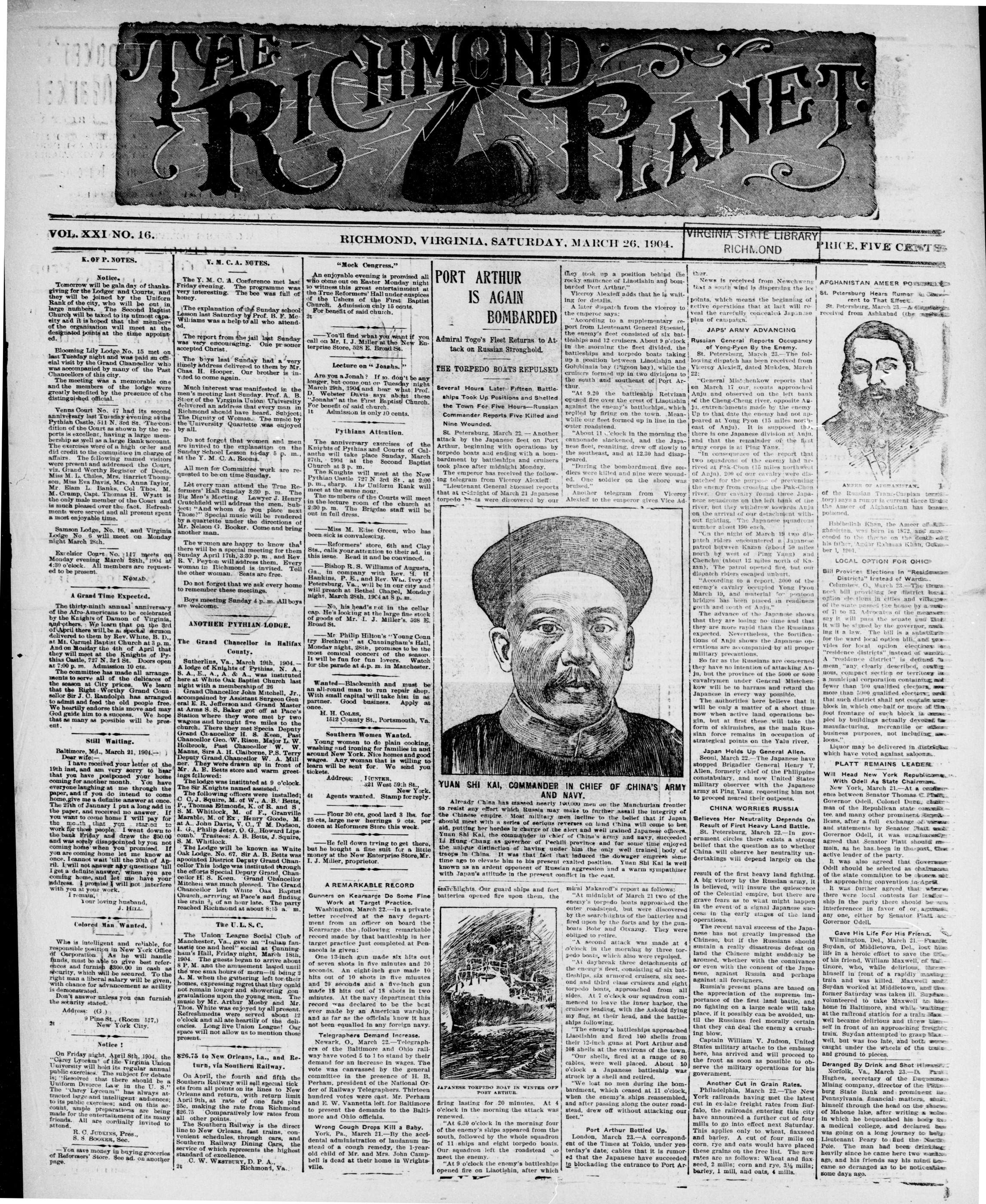
Already China has massed nearly 100,000 men on the Manchurian frontier to resist any effort which Russia may make to further assail the integrity of the Chinese empire. Most military men in line to the belief that if Japan should meet with a series of serious reverses on land China will come to her aid, putting her hordes in charge of the alert and well trained Japanese officers, Yuan Shi Kai, the commander in chief of China's army and navy, succeeded Li Hung Chang as governor of Pechii province and for some time enjoyed the unique distinction of having under him the only well trained body of troops in China. It was that fact that induced the dowager empress some time ago to elevate him to his present exalted position. Yuan Shi Kai is well known as an ardent opponent of Russian aggression and a warm sympathizer with Japan's attitude in the present conflict in the east.
PORT ARTHUR IS AGAIN BOMBARDED
Admiral Togo's Fleet Returns to Attack on Russian Stronghold.
THE TORPEDO BOATS REPULSED
Several Hours. Latest Fifteen Battleships Took Up Positions and Shelled the Town For Five Hours—Russian Commander Reports Five Killed and Nine Wounded.
St. Petersburg, March 22. — Another attack by the Japanese fleet on Port Arthur, beginning with operations by torpedo boats and ending with a bombardment by battleships and cruisers took place after midnight Monday.
The emperor has received the following telegram from Viceroy Alexieff.
Lieutenant General Stoessel reports that at midnight of March 21 Japanese torpedo boats were discovered by our
YUAN SHI KAI, COMMANDER AND
Already China has massed nearly 100 to resist any effort which Russia may the Chinese empire. Most military men should meet with a series of serious aid, putting her hordes in charge of the Yuan Shi Kai, the commander in chief Li Hung Chang as governor of Pecheng, the unique distinction of having under treops in China. It was that fact the time ago to elevate him to his present known as an ardent opponent of Russia with Japan's attitude in the present c
searchlights. Our guard ships and fort batteries opened fire upon them, the
25
JAPANESE TORPEDO BOAT IN WINTER OFF
PORT ARTHUR.
JAPANESE TORPEDO BOAT IN WINTER OFF PORT ARTHUR.
firing lasting for 20 minutes. At 4 o'clock in the morning the attack was renewed.
"At 6:30 o'clock in the morning four of the enemy's ships appeared from the south, followed by the whole squadron of 11 ships and eight torpedo boats. Our squadron left the roadstead to meet the enemy.
"At 9 o'clock the enemy's battleships opened fire on Liaotishin, after which
they took up a position behind the rocky eminence of Liaotishin and bombarded Port Arthur."
Viceroy Alexieff adds that he is waiting for details.
A later dispatch from the viceroy to the emperor says:
"According to a supplementary report from Lieutenant General Stoessel, the enemy's fleet consisted of six battleships and 12 cruisers. About 9 p clock in the morning the fleet divided, the battleships and torpedo boats taking up a position between Liaotishin and Golubinaia bay (Ligeon bay), while the cruisers formed up in two divisions to the south and southeast of Port Arthur.
"At 9.20 the battleship Retvizan opened fire over the crest of Liaotishin against the enemy's battleships, which replied by fireing on the town. Meanwhile our fleet formed up in line in the outer roadstead.
"About 11.30 clock in the morning the cannonade slackened, and the Japanese fleet, reuniting, drew off slowly to the southeast, and at 12.30 had disappeared.
"During the bombardment five soldiers were killed and nine were wounded. One soldier on the shore was brushed."
Another telegram from Viceroy Alexieff to the emperor gives Vice Ad
IN CHIEF OF CHINA'S ARMY NAVY.
900,000 men on the Manchurian frontier make to further assail the integrity of men incline to the belief that if Japan overaces on land China will come to her alert and well trained Japanese officers. If of China's army and navy, succeeded it province and for some time enjoyed him the only well trained body of that induced the dowager empress some exalted position. Yuan Shi Kai is well an aggression and a warm sympathizer afflict in the east.
miral Makaroff's report as follows:
"At midnight of March 21 two of the enemy's torpedo boats approached the outer roadstead, but were discovered by the searchlights of the batteries and fired upon by the forts and by the gunboats Bobr and Otxazuy. They were obliged to retire.
"A second attack was made at 4 o'clock in the morning by three torpedo boats, which also were repulsed.
"At daybreak three detachments of the enemy's feet, consisting of six battleships, six armored cruisers, six second and third class cruisers and eight torpedo boats, approached from all sides. At 7 o'clock our squadron commenced to leave the inner harbor, the cruisers leading, with the Askold flying my flag, at their head, and the battleships following.
"The enemy's battleships approached Liaotishin and fired 100 shells from their 12-inch guns at Port Arthur and 108 shells at the environs of the town
"Our shells, fired at a range of 80 cables, were well placed. About 10 o'clock a Japanese battleship was struck by a shell and retired.
"We lost no men during the bombardment, which ceased at 11 o'clock, when the enemy's ships reassembled, and after passing along the outer road-stead, drew off without attacking our fleet."
Port Arthur Bottled Up.
London, March 23.—A correspondent of the Times at Tokio, under yesterday's date, cables that it is rumored that the Japanese have succeeded in blockading the entrance to Port Ar-
News is received from Newchwans that a south wind is dispersing the ice points, which means the beginning of active operations that at last will reveal the carefully concealed Japanese plan of campaign.
JAPS' ARMY ADVANCING
Russian General Reports Occupancy of Yone-Pyon By the Enemy.
of Yong-Pyon By the Enemy.
St. Petersburg, March 22. The following dispatch has been received from Vieceroy Alexieff, dated Mukden, March 22:
"General Mistchenkow reports that on March 17 our scouts approached Anju and observed on the left bank of the Cheng-Cheng river, opposite Anju, entrenchments made by the enemy Up to that date the enemy had not appeared at Yong Pyon (15 miles northeast of Anju). It is supposed that, there is one Japanese division at Anju, and that the remainder of the first army corps is at Ping Yan.
“In consequence of the report that two squadrons of the enemy had arrived at Pak-Chon (15 miles northwest of Anju), 200 of our cavalry were dispatched for the purpose of preventing the enemy from crossing the Pak-Chon river. Our cavalry found three Japanese squadrons on the left bank of the river, but they withdrew towards Anju on the arrival of our detachment without fighting. The Japanese squadrons number about 150 each.
“On the night of March 19 two dispatch riders encountered a Japanese patrol between Kazan (about 50 miles north by west of Ping Yang) and Chenchu (about 12 miles north of Kazan). The patrol opened fire, but our dispatch riders escaped unhurt.
“According to a report, 3000 of the enemy's cavalry occupied Yong Pyon March 19, and material for pontoon bridges has been placed in readiness north and south of Anju.”
The advance of the Japanese shows that they are losing no time and that they are more rapid than the Russians expected. Nevertheless, the fortifications of Anju shows the Japanese operations are accompanied by all proper military precautions. So far as the Russians are concerned they have no intention of attacking Anju, but the province of the 5000 or 6000 cavalrymen under General Mistchenkow will be to harrass and retard the Japanese in every way possible.
The authorities here believe that it will be only a matter of a short time now when active land operations begin, but at first these will take the form of skirmishes, as the main Russian force remains in occupation of strategical points on the Yalu river.
Japan Holds Up General Allen.
Seoul, March 22—The Japanese have stopped Brigadier General Henry T. Allen, former chief of the Philippine constabulary, and now United States military observer with the Japanese army at Ping Yang, requesting him not to proceed neared their outposts.
CHINA WORRIES RUSSIA
Believes Her Neutrality Depends On
Believes Her Neutrality Depends On Result of First Heavy Land Battle. St. Petersburg, March 22.—In government circles there exists a strong belief that the question as to whether China will observe her neutrality undertakings will depend largely on the result of the first heavy land fighting. A big victory by the Russian army, it is believed, will insure the quiescence of the Celestial empire, but there are grave fears as to what might happen in the event of a signal Japanese success in the early stages of the land operations. The recent naval success of the Japanese has not greatly impressed the Chinese, but if the Russians should sustain a really disastrous defeat on land the Chinese might suddenly be aroused, whether with the connivance or even with the consent of the Japanese, against Russia and perhaps against all foreigners.
Russia's present plans are based on the appreciation of the supreme importance of the first land battle, and no fighting on a large scale will take place, if it possibly can be avoided, until the Russians feel morally certain that they can deal the enemy a crushing blow.
Captain William V. Judson, United States military attache to the embassy here, has arrived and will proceed to the front as soon as possible to observe the military operations for his government.
Another cut in Grain Rates.
Philadelphia, March 22.—The New York railroads having met the latest cut in ex-lake freight rates from Buffalo, the railroads entering this city have announced a further cut of four mills to go into effect next Saturday. This applies only to wheat, faxseed and barley. A cut of four mills on corn, rye and oats would have placed these grains on the free list. The new rates are as follows: Wheat and faxseed, 2 mills; corn and rye, $3 \frac{1}{2}$ mills; burley, 1 mill, and oats, 4 mills.
AFGHANISTAN AMEER PO
St. Petersburg Hears Rumor
rent to That Effect
St. Petersburg, March 23. A
received from Ashkabad (the
[Pencil sketch of a man with a long beard and a mustache, wearing a suit and a hat.]
of the Russian Trans-Caspian territory) says a rumor is current there. Under the Ameer of Afghanistan has been polished.
Habibullah Khan, the Ameer of Afghanistan, was born in 1872, and succeeded to the throne on the death of his father, Agdar Rahman Khan, October 1, 1901.
LOCAL OPTION FOR OHIC
Bill Provides Elections In "Residence Districts" Instead of Ward
Columbus, O., March 23 — The Brown neck bill providing for district local option elections in cities and villages of the state passed the house by a vote of 71 to 33. Advocates of the measure say it will pass the senate and that it will be signed by the governor, making it a law. The bill is a substitution for the ward local option bill, and provides for local option elections or "residence districts" instead of wards. A "residence district" is defined as mean "any clearly described, crowded, compact section or territory in a municipal corporation containing more than 300 qualified electors, more than 5000 qualified electors, and that such district shall not contain a block in which one-half or more of the foot frontage of such block is occupied by buildings actually devoted for manufacturing, mercantile or other business purposes, not including loons."
Liquor may be delivered in district which have voted against saloons.
PLATT REMAINS LEADER
Will Head New York Republican With Odell As State Chairman
New York, March 21.—At a conference between Senator Thomas C. Platt, Governor Odell, Colonel Dunn, chairman of the Republican state committee, and many other prominent Republicans, after a full exchange of words and statements by Senator Platt and Governor Odell, it was unanimously agreed that Senator Platt should remain, as he has been in the past, the active leader of the party.
It was also agreed that Governor Odell should be selected as chairman of the state committee to be chosen at the approaching convention in April.
It was further agreed that when there were local contests for leadership in the party there should be no interference in favor of or against any one, either by Senator Platt and Governor Odell.
Gave His Life For His Friend.
Wilmington, Del., March 21.—Frank
Suydan, of Middletown, Del., lost his
life in a heroic effort to save the life
of his friend, William Maxwell, of the
tinmore, who, while delirious, threw
himself in front of a rapidly moving
train and was killed. Maxwell and
Suydan worked at Middletown, and the
former Saturday was taken ill. Suydan
volunteered to take Maxwell to his
home in Baltimore, and while waiting
at the railroad station for a train Maxwell
well became delirious and threw himself
in front of an approaching freight
train. Suydan attempted to grasp Maxwell,
but was too late, and both were
caught under the wheels of the train
and ground to pieces.
Deranged By Drink and Shot Himself
Norfolk, Va., March 23.—D. Paul
Hughes, secretary of the Daquan-
Mining company, director of the Pils-
burg State Bank and prominent in
Pennsylvania, financial matters, who
himself through the head on the shores
of Mahone lake, after writing a note
in which he bequeathed his body to
a medical college, and declared he
was going on a long journey to bea-
lLeutenant Peary to find the North
Pole. The man had been drunk and
heavily since he came here two weeks
ago, and his friends say his mind has
come so deranged as to be noticeable
some days ago.
RESPONSE
LONG PANTS.
$mother be a reg'lar kid, 'bout two feet high,
I guess,
$wearin' bibs and aprons and a reg'lar
baby dress,
$may she user make me wear my hair
them there curls-
gross she didn't know how fellers hate to look like girls.
But now you bet I'm grown up, and got a little chance;
I wister be a baby—when I got a smash I
cried.
But I'm a-learnin' how to fight—the fellers
uster ride
all over me and knock me down and call
me "mother's own."
I tell you now they ain't so gay—they jest
me alone;
Chuse 'bout a week ago I licked Ned
and Hilly Vance;
I ain't no better than him.
Iaster kinder hate the girls-I wouldn't ever play
talk with them er walk with them, but
now it ain't that way.
jes' a little gone, the fellers say, on
Susie White;
She's got such pretty eyes—and, say, her
smile is out of sight.
I took her with me to a reg'lar
grown niece;
she's pretty, she looks like him.
Milwaukee SeptInel
Meeting His Appointment
By FRANK H. SWEET
(Copyright, 1863, by Daily Story Pub. Co.)
BARSTOW sent the tip o. his whip curling out over the horses' backs, not touching them, for he was very careful of the beautiful span, but allowing its sharp cutting through the air to act as an incentive. However, although their necks straightened a little, the speed did not increase. It could not on this road, with an ordinary driving rig. They were already going at a three-minute pace.
He gave a quick glance over his shoulder. An automobile was just turning a curve of the road, three-fourths of a mile behind. His eyes studied its occupants keenly.
"Yes, that's the sherif all right," he thought, grimly. "No one could mistake those shoulders and that cowboy hat; and he's a head above his companion. I wonder who the companion is—some fellow he's sworn in as deputy, likely. And the automobile is Carson's. No other could slip over the ground the way that does. I suppose Cunningham has deputized it. Also, "turning back and hissing the tip of his hip once more across the horses' backs," "it's going to be a race. But I'm glad Carson himself isn't back there. Recless as the sherif in after game. I don't think he'll take over three miles out of a strange marshine, and it's only 20 to Leighton, with a straight road and a good start and my span fresh. Yes, it'll be a race."
But ten minutes later he could see that the automobile was slowly, but surely, gaining on him, and at the end of half an hour, with eight of the 20 miles passed, the automobile had correlated one-third of the distance between them. The horses were now breathing heavily and their speed decreasing; the machine was coming on more rapidly. Barstow glanced over his shoulder, studying the ground critically, then allowed his gaze to fall back to his pursuer. The seriff was motioning frantically for him to stop. Barstow grinned satirically.
"Not just yet, Cunningham," he thought. "The race is getting too interesting. Besides, there's too great a stake involved. Any other time I'd be glad to accommodate you. Just now I'm going to Leighton, and with good luck I shall have barely 20 minutes to gather up a minister and have him at the station when her train comes in. Once across the line, and I'll whistle at Cunningham—no, I won't. I'll ask him to be best man, if he follows me that far. Thank the stars there'll be no nee. for a license, and confound the postman for not delivering my letter yesterday when it came."
There was a long stretch of clear road ahead, with the horses going steadily. He made a turn with the reins about his wrist and drew a letter from his pocket. It had been given him by the mail carrier only 40 minutes before, just as he was starring out with his span, and he had read it at a glance and then dashed away on his wild race to Leighton. He now swent the lines with another glance, his face glowing.
"Dear Harold, the letter read, "we shall be there one day earlier than arranged. Then senator will not speak at Hammel, and that saves us stopping over; but he has arranged to speak to the business men at Ponceon, a hundred miles farther on, so the time with you will be the same, only a day earlier. From the train schedule I think it will be about 15 minutes. Have the minister and everything ready. It seems a reckless, hit or miss kind of marriage, don't it, Harold? But, then, uncle is so anxious to see it; and he's got to be at Ponceon and must take steamer for Europe only a few hours later, to be gone a year. So it's Hobson's choice. But never mind, Harold. Well make it up on our wedding trip, and miss every train if we like—or, why not make the trip with your span and stop everywhere and nowhere in particular. I think that would be fine.
18
The Baltic fleet is second in importance in the four great fleets owned by Russia, and most of the ships comprising it were built at the St. Petersburg and Kronstadt yards.
The Russian navy may be said to be the offspring of Great Britain's naval establishment, since it was at Deptford on the Thames Peter the Great watched the progress of ship building and after a regular apprenticeship to master the trade, he engaged a large body of skilled artisans to work in Russia on the building up of a defensive fleet to check the aggression of Sweden.
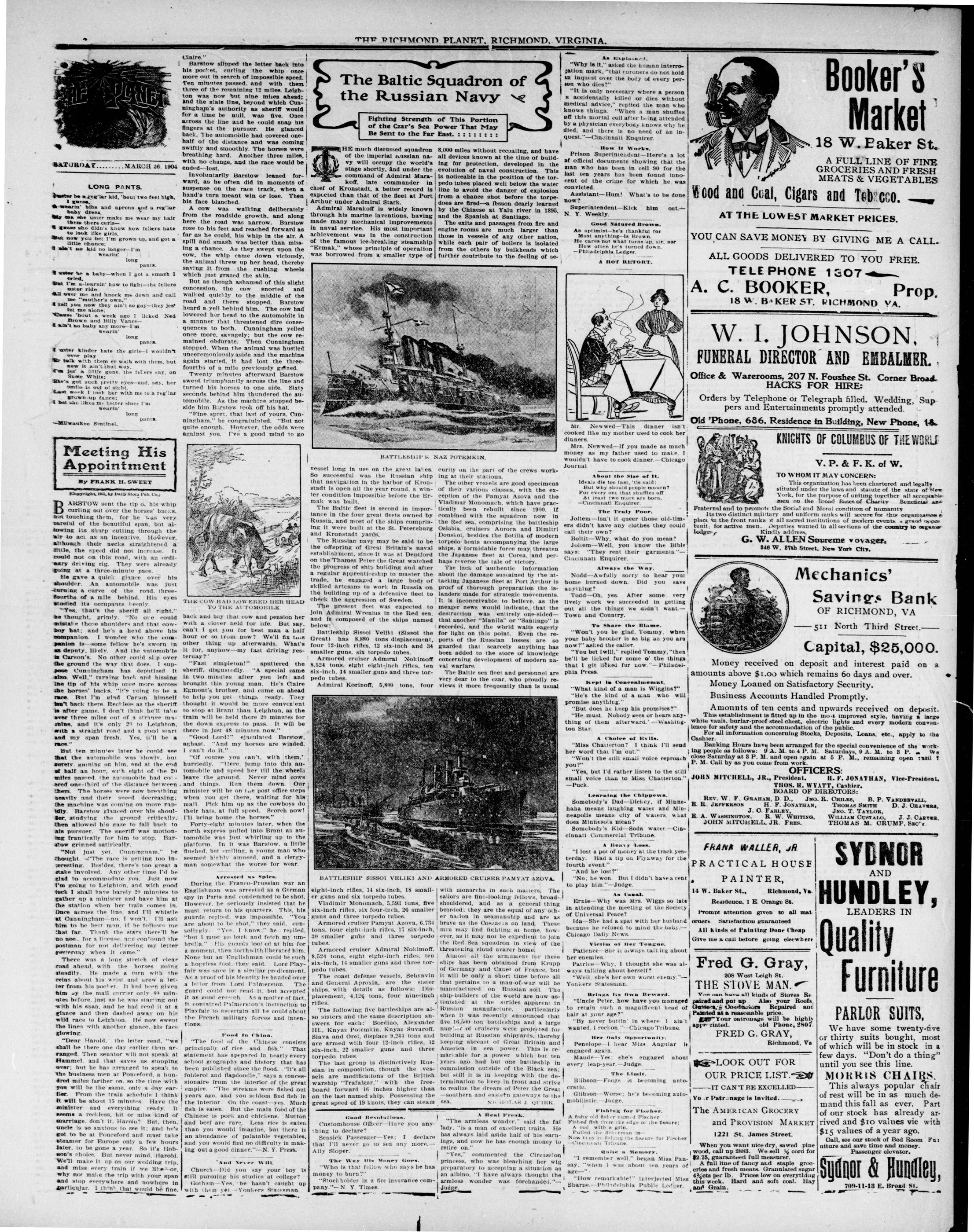
BATTLESHIP SISSOI VELIKI AND
Claire."
Barstow slipped the letter back into his pocket, curling the whip once more out in search of impossible speed. Ten minutes passed, and with them three of the remaining 12 miles Leighton was now but nine miles ahead; and the state line, beyond which Cunningham's authority as sheriff would for a time be null, was five. Once across the line and he could snap his fingers at the pursuer. He glanced back. The automobile had covered one-half of the distance and was coming swiftly and smoothly. The horses were breathing hard. Another three miles, with no change, and the race would be ended—lost.
Involuntarily Barstow leaned forward, as he often did in moments of suspense on the race track, when a hand's turn meant win or lose. Then his face blanched.
A cow was walking deliberately from the roadside growth, and along here the road was narrow. Barstow rose to his feet and reached forward as far as he could, his whip in the air. A spill and smash was better than missing a chance. As they swept upon the cow, the whip came down viciously, the animal threw up her head, thereby saving it from the rushing wheels which just grazed the skin.
But as though ashamed of this slight concession, the cow snorted and walked quickly to the middle of the road and there stopped. Barstow heard a yell behind him. The cow had lowered her head to the automobile in a manner that threatened dire consequences to both. Cunningham yelled once more, savagely; but the cow remained obdurate. Then Cunningham stopped. When the animal was hustled unceremoniously aside and the machine again started, it had lost the three-fourths of a mile previously gained.
Twenty minutes afterward Barstow sweet triumphantly across the line and turned his horses to one side. Sixty seconds behind him thundered the automobile. As the machine stopped beside him Barstow took off his hat. "Fine spurt, that last of yours, Cunningham," he congratulated. "But not quite enough. However, the odds were against you. I've a good mind to go
THE COW HAD LOWERED HER HEAD
TO THE AUTOMOBILE.
THE COW HAD LOWERED HER HEAD TO THE AUTOMOBILE.
back and buy that cow and pension her with a clover held for life. But say, can't I get you for best man a half hour or so from now? We'll fix this other thing up afterwards. What's it for, anyhow—my fast driving yesterday?
"Fast simpleton!" sputtered the sheriff, disgusted. "A special came in two minutes after you left and brought this young man. He's Claire Egmont's brother, and came on ahead to help you get things ready. They thought it would be more convenient to stop at Brant than Leighton, as the train will be held there 20 minutes for the down express to pass. It will be there in just 48 minutes now."
"Good Lord!" ejaculated Barstow, agast. "And my horses are winded. I can't do it."
"Of course you can't, with them," hurriedly. "Here, jump into this automobile and speed her till the wheels leave the ground. Never mind cows and things. Run them down. Our minister will be on the post office steps when you get there, waiting for his mail. Pick him up as the cowboys do their hats, at full speed. Scorch now! I'll bring home the horses." Forty-eight minutes later, when the north express pulled into Brant an automobile was just whirling up to the platform. In it was Barstow, a little flushed, but smiling, a young man who seemed highly amused, and a clergyman somewhat the worse for wear.
Arrested as Sales.
During the Franco-Prussian war an Englishman was arrested as a German spy in Paris and condemned to be shot. However, he seriously insisted that he must return to his quarters. This, his guards replied, was impossible. "You are about to be shot," he said, consolingly. "Yes. I know," he replied, "but I must go back and fetch my umbrella." His guards looked at him for a moment, then forthwith liberated him. None but an Englishman could be such a hopeless fool, they said. Lord Playfair was once in a similar predicament. As a proof of his identity he handed over a letter from Lord Palmerston. The guard could not read it, but accepted it as good enough. As a matter of fact, it contained Palmerston's instruction to Playfair to assemble all he could about the French military forces and intentions.
Food In China.
"The food of the Chinese consists principally of rice and fish." That statement has appeared in nearly every school geography and history that has been published since the flood. "It's all folderol and flapdoodle," says a concessionaire from the interior of the great empire. The streams were fished out years ago, and you seldom find fish in the interior. On the coast—yes. Much fish is eaten. But the main food of the Chinese is pork and chickens. Mutton and beef are rare. Less rice is eaten than you would imagine, but there is an abundance of palatable vegetables, and you would find no difficulty in making out a good dinner."—N. Y. Press.
And Never Will
Church—Did you say your boy is still pursuing his studies at college? Gotham—Yes, he hasn't caught up with them yet—Yonkers Statesman.
THE RICHMOND PLANET, RICHMOND, VIRGINIA.
Fighting Strength of This Portion of the Czar's Sea Power That May Be Sent to the Far East. : : : : : : :
HE much discussed squadron of the imperial Russian navy will occupy the world's stage shortly, and under the command of Admiral Marakoff, late commander in chief of Kronstadt, a better record is expected than that of the fleet at Port Arthur under Admiral Stark.
Admiral Marakoff is widely known through his marine inventions, having made many mechanical improvements in naval service. His most important achievement was in the construction of the famous ice-breaking steamship "Ermak," whose principle of operation was borrowed from a smaller type of
8,000 miles without all devices known for protection, evolution of naval is noticeable in the pedo tubes placed w line to avoid the d from a chance shot does are fired—a be by the Chinese at and the Spanish at. The exits and pass engine rooms are m those in vessels of while each pair of from the others by further contribute t
42
BATTLESHIP K NAZ POTEMKIN.
vessel long in use on the great lakes. curity on the po
So successful was the Russian shiping at their sta
that navigation in the harbor of Kron- The other vess
stadt is open all the year round, a win- of their various
ter condition impossible before the Er- cception of the
mak was built.
The present fleet was expected to Join Admiral Wrenius in the Red sea, and is composed of the ships named below:
Battleship Sissol Velliki (Sissol the Great) has 8,880 tons displacement, four 12-inch rifles, 12 six-inch and 34 smaller guns, six torpedo tubes.
Armored cruiser Admiral Nokimoff 8,524 tons, eight eight-inch rifles, ten six-inch, 14 smaller guns and three torpedo tubes.
Admiral Korinoff, 5,800 tons, four
THE SHIP IS ATTACKING THE ISLAND.
BATTLESHIP SISSOI VELIKI AND ARMORED CRUISER PAMYAT AZOVA.
eight-inch rifles, 14 six-inch, 18 smaller guns and six torpedo tubes.
Vladimir Monomach, 5,593 tons, five six-inch rifles, six four-inch, 26 smaller guns and three torpedo tubes.
Armored cruiser Pamyat Azova, 6,734 tons, four eight-inch rifles, 17 six-inch, 30 smaller guhs and three torpedo tubes.
Armored cruiser Admiral Nokimoff, 8,524 tons, eight eight-inch rifles, ten six-inch, 14 smaller guns and three torpedo tubes.
The coast defense vessels, Sebyavin and General Aproxin, are the sister ships, with details as follows: Displacement, 4,126 tons, four nine-inch rifles.
with monarchs in such matters. The sailors are fine-looking fellows, broad shouldersed, and as a general thinner bearded; they are the equal of any other nation in seamanship and are a brave as the Cossacks on land. The men may find fighting at home, however, as it may not be expedient to join the Red Sea squadron in view of the threatening cloud nearer home.
Almost all the armament for these ships has been obtained from Krupp of Germany and Canet of France, but it will be only a short time before it pertains to a man-of-war will be manufactured on Russian soil. The ship-builders of the world are now attuned at the srills apparent.
The following five battleships are also sisters and the same description answers for each: Bordino, Alexander III, Knyaz Polemulin, Knyaz Suvaroff, Slava and Orel, displace 9,244 tons and are armed with four 12-inch rifles, 12 six-inch, 22 smaller guns and three torpedo tubes.
The last group is distinctively Russian in composition, though the vessels are modifications of the British warship "Trafalgar," with the freeboard forward 16 inches higher than on the last named ship. Possessing the great speed of 19 knots, they can steam
Good Resolutions.
Customhouse Officer—Have you anything to declare?
Seasick Passenger—Yes; I declare that I'll never go to sea any more.—Ally Sloper.
"Stock holder in a fire insurance company." - N. Y. Times.
T
8,000 miles without recoaling, and have all devices known at the time of building for protection, developed in the evolution of naval construction. This is noticeable in the position of the torpedo tubes placed well below the water line to avoid the danger of explosion from a chance shot before the torpedoes are fired—a lesson dearly learned by the Chinese at Yalu river in 1895, and the Spanish at Santiago. The exits and passages from fire and engine rooms are much larger than those in vessels of any other nation, while each pair of boilers is isolated from the others by bulkheads which further contribute to the feeling of se
THE RIVER OF THE RIVER OF THE RIVER
curity on the part of the crews working at their stations. The other vessels are good specimens of their various classes, with the exception of the Pamyat Azova and the Vladimir Monomach, which have practically been rebuilt since 1900. If combined with the squadron now in the Red sea, comprising the battleship Oslabia, cruisers Aurora and Dimitri Donski, besides the flotilla of modern torpedo boats accompanying the large ships, a formidable force may threaten the Japanese fleet at Corea, and perhaps reverse the tale of victory.
The lack of authentic information about the damage sustained by the attacking Japanese fleet at Port Arthur is proof of thorough preparation the islanders made for strategic movements. It is inconceivable to believe, as the meager news would indicate, that the destruction was entirely one-sided—that another "Manila" or "Santiago" is recorded, and the world waits eagerly for light on this point. Even the reports of the Russian losses are so guarded that scarcely anything has been added to the store of knowledge concerning development of modern naval warfare.
The Baltic sea fleet and personnel are very dear to the czar, who proudly reviews it more frequently than is usual
ARMORED CRUISER PAMYAT AZOVA.
with monarchs in such matters. The sailors are fine-looking fellows, broad-shouldered, and as a general thing bearded; they are the equal of any other nation in seamanship and are as brave as the Cossacks on land. These men may find fighting at home, however, as it may not be expedient to join the Red Sea squadron in view of the threatening cloud nearer home.
Almost all the armament for these ships has been obtained from Krupp of Germany and Canet of France, but it will be only a short time before all that pertains to a man-of-war will be manufactured on Russian soil. The ship-builders of the world are now astonished at the sirides apparent in Russian manufacture, particularly when it was recently announced that five 16,500 ton battleships and a large number of cruisers were projected for building at Russian shipyards, thereby keeping abreast of Great Britain and America in sea power. This is remarkable for a power which but ten years ago had but one battleship in commission outside of the Black sea; but still it is in keeping with the determination to keep in front and strive to realize the dream of Peter the Great —southern and eastern gateways to the sea. NUGHILAS L. QUIRK
"The armless wonder," said the fat lady, "is a man of excellent traits. He has always laid aside half of his earnings, and now he has enough money to retire on."
"Yes," commented the Circassion princess, who was bleaching her wig preparatory to accepting a situation as an albino. "I have always thought the armless wonder was forehanded."—Judge
A Real Freak
"Why is it," asked the human interrogation mark, "that coroners do not hold an inquest over the body of every person who dies?" "It is only necessary where a person is accidentally killed or dies without medical advice," replied the man who knows things. "When a man shuffles off this mortal coll after being attended by a physician everybody knows why he died, and there is no need of an inquest."—Cincinnati Enquirer.
How It Works.
Prison Superintendent—Here's a lot of official documents showing that the man who has been in cell 90 for the last ten years has been found innocent of the crime for which he was convicted.
Assistant—Hum! What's to be done now?
Superintendent—Kick him out—N. Y. Weekly.
Good Natured Brown.
An optimist—he's thankful for
Most anything—is Brown.
He cares not what turns up, sir, nor
How often he's turned down.
- Philadelphia Ledger.
Mr. Newwed—This dinner isn't cooked like my mother used to cook her dinners.
Mrs. Newwed—If you made as much money as my father used to make. I wouldn't have to cook dinner.—Chicago Journal
About the Size of It.
Ideals die too fast, 'tis said;
But why should people mourn?
For every one that shuffles off
Are least two quire are born.
—Cincinnati Enquirer.
The Truly Poor.
Joltem—Isn't it queer those old-timers didn't have any clothes they could call their own?
Boltit—Why, what do you mean?
Joltem—Well, you know the Bible says: "They rent their garments."—Cincinnati Enquirer.
Always the Way.
Nodd—Awfully sorry to hear your home burned down. Did you save anything?
Todd—Oh, yes. After some very lively work we succeeded in getting out all the things we didn't want.—Town and Country.
"Won't you be glad, Tommy, when your baby brother is as big as you are now?" asked the caller.
"You bet I will," replied Tommy, "then he'll be licked fur some o' the things that I git licked fur now." — Philadelphia Press.
**Kept in Concernmumnt.**
"What kind of a man is Wiggins?"
"He's the kind of a man who will promise anything."
"But does he keep his promises?"
"He must. Nobody sees or hears anything of them afterward." — Washington Star.
**A Choice of Evils.**
"Miss Chatterton? I think I'll send her word that I'm out."
"Won't the still small voice reproach you?"
"Yes, but I'd rather listen to the still small voice than to Miss Chatterton." — Puck.
Somebody's Dad—Dickey, if Minne-
haaha means laughing water and Minne-
napolis means city of waters, what
does Minnesota mean?
Somebody's Kid—Soda water.—Cincinnati Commercial Tribune.
A Heavy Loss.
"I lost a pot of money at the track yesterday. Had a tip on Flyaway for the fourth event."
"And he lost?"
"No, he won. But I didn't have a cent to play him." — Judge.
An Usual.
Ernie—Why was Mrs. Wiggs so late in attending the meeting of the Society of Universal Peace?
Ida—She had a spat with her husband because he refused to mind the baby.—Chicago Daily News.
Victim of Her Tongue.
Victim of Her Tongue.
Patience—She is always talking about her enemies.
Patrice—Why, I thought she was always talking about herself?
"Weil, she's her own worst enemy."—Yonkers Statesman.
Brings Its Own Reward.
"Uncle Peter, how have you managed to retain such a magnificent head of hair at your age?"
"By never buttin' in where I ain't wanted, I reckon"—Chicago Tribune.
Her Only Opportunity.
Penelope I hear Miss Angular is engaged again.
Maude—Yes; she's engaged about every leap-year—Judge.
Gibson—Worse; he's becoming auto mobilistic—Judge.
Pulled the fisherman in
Now they re fishing the fissure for Fischer
—Cincinnati Tribune
Quite a Memory.
"I remember well," began Miss Panay,
"when I was about ten years of age—"
"How remarkable!" interjected Miss Sharpe—Philadelphia Public Ledger.
18 W. Faker St. A FULL LINE OF FINE GROCERIES AND FRESH MEATS & VEGETABLES
Wood and Coal, Cigars and Tobacco
AT THE LOWEST MARKET PRICE
YOU CAN SAVE MONEY BY GIVING ME
ALL GOODS DELIVERED TO YOU
TELEPHONE 1307
A. C. BOOKER,
18 W. BAKER ST. RICHMOND
W. I. JOHNSON
FUNERAL DIRECTOR AND EMB
Office & Warerooms, 207 N. Foushee St. Co
HACKS FOR HIRE:
Orders by Telephone or Telegraph filled. We
pers and Entertainments promptly attend
Old 'Phone, 686. Residence in Building, New
s and Tobacco.
MARKET PRICES.
BY GIVING ME A CALL.
REDED TO YOU FREE.
E 1307
R, Prop.
RICHMOND VA.
JHNSON,
R AND EMBALMER.
I. Foushee St. Corner Broad
FOR HIRE:
Legraph filled. Wedding, Sup-
pts promptly attended.
In Building, New Phone, 18
OF COLUMBUS OF THE WORLD
AT THE LOWEST MARKET PRICES. YOU CAN SAVE MONEY BY GIVING ME A CALL. ALL GOODS DELIVERED TO YOU FREE.
W. I. JOHNSON FUNERAL DIRECTOR AND EMBALMER.
Office & Warerooms, 207 N. Foushee St. Corner Broad HACKS FOR HIRE: Orders by Telephone or Telegraph filled. Wedding, Suppers and Entertainments promptly attended. Old 'Phone, 686. Residence in Building, New Phone, 18
KNIGHTS OF COLUMBUS OF THE WORLD
V. P. & F. K. of W.
IT MAY CONCERN:
organization has been chartered and legally
the laws and statute of the state of New
the purpose of uniting together all acceptable
Broad Bases of Charity Beneficial and
Moral condition of humanity
m ranks will secure for this organization
institutions of modern events a grand oppo
ed in all sections of the country to organise
This organization has been chartered and legally
stituted under the laws and statute of the state of New
York, for the purpose of uniting together all acceptable
men on the Broad Bases of Charity Beneficial and
Praternal and to promote the Social and Moral condition of humanity
Its two distinct military and uniform ranks will secure for this organization
place in the front ranks of all sacred institutions of modern events a grand ope-
unit, for active men. Deputies wanted in all sections of the country to organize
lodge.
Kindly address,
G. W. ALLEN Supreme voyager,
846 W. 87th Street, New York City.
Mechanics'
Savings Bank
OF RICHMOND, VA
511 North Third Street.
Capital, $25,000.
Deposit and interest paid on a
remains 60 days and over.
Factory Security.
Called Promptly.
Upwards received on deposit.
The most improved style, having a large
electric lights and every modern conven-
tion of the public.
Deposits, Loans, etc., apply to the
for the special convenience of the work-
d. Satdays, 9 A. M. to 8 P. We
en at 5 P. M., remaining open until
CERS:
H. F. JONATHAN, Vice-President.
WATT, Cashier.
DIRECTORS:
O. R. CHILES, B. P. VANDERVALL,
THOMAS SMITH D. J. CHAVERS,
JNO. T. TAYLOR.
Money received on deposit and interest amounts above $1.00 which remains 60 days and Money Loaned on Satisfactory Security. Business Accounts Handled Promptly. Amounts of ten cents and upwards received. This establishment is fitted up in the most improved style, white vault, burlar-proof steel chest, electric lights and every ence for safety and the accommodation of the public. For all information concerning Stocks, Deposits, Loans, et Cashier. Banking Hours have been arranged for the special convenience people as follows: 9 A. M. to 4 P. M. Saturdays, 9 A. M. close Saturday at 3 P. M. and open again at 5 P. M., remaini P. M. Call by as you come from work.
OFFICERS:
JOHN MITCHELL, JR., President. H. F. JONATHAN, THOS. H. WYATT, Cashier. BOARD OF DIRECTORS:
REV. W. F. GRAHAM, D. D., JNO. R. CHILES, B. P. E. R. JEFFERSON H. F. JONATHAN, THOMAS SMITH J. O. FARLEY JNO. T. TAYLOR
Money received on deposit and interest paid on a amounts above $1.00 which remains 60 days and over.
Money Loaned on Satisfactory Security.
Business Accounts Handled Promptly.
Amounts of ten cents and upwards received on deposit.
This establishment is fitted up in the most improved style, having a large white vault, burlar-proof steel chest, electric lights and every modern convenience for safety and the accommodation of the public.
For all information concerning Stocks, Deposits, Loans, etc., apply to the Cashier.
Banking Hours have been arranged for the special convenience of the working people as follows: 9 A. M. to 4 P. M. Saturdays, 9 A. M. to 3 P. We close Saturday at 3 P. M. and open again at 5 P. M., remaining open until 3 P. M. Call by as you come from work.
OFFICERS
JOHN MITCHELL, JR., President. H. F. JONATHAN, Vice-President.
THOS. H. WYATT, Cashier.
HON. W. YATT, Cashier.
WILLIAM CUNSTAL, J. J. CARTER
THOMAS M. CRUMP, SCC.
SYDNOR AND HUNDLEY, LEADERS IN Quality Furniture
We have some twenty-five or thirty suits bought, most of which will be in stock in a few days. "Don't do a thing" until you see this line.
MORRIS CHAIRS.
This always popular chair of rest will be in as much demand this fall as ever. Part of our stock has already arrived and $10 values vie with $15 values of a year ago.
Call, see our stock of Bed Room Furniture and save time and money.
Passenger elevator.
Sydnor & Hundley,
709-11-13 E. Broad St.
M.
```markdown
```
1792
E. A. WASHINGTON, R. W. WHITING,
JOHN MITOHELL, JR. FRES.
FRANK WALLER, JR.
PRACTICAL HOUSE
14 W. Baker St., Richmond, Va.
Residence, 1 E. Orange St.
Prompt attention given to all mail
orders Satisfaction guaranteed
All kinds of Painting Done Cheap
Give me a call before going elsewhere
Fred G. Gray,
Fred G. Gray,
THE STOVE MAN.
You can have all kinds of Stoves Repaired and put up. Also your Roots Gastes, Goodnocks Repaired and Painted at a reasonable price.
Your patronage will be highly appreciated. Old Phone, 2807
Your patronage will be highly
appreciated.
old Phone, 2807
FRED G. GRAY,
Richmond, Va
LOOK OUT FOR
OUR PRICE LIST.
IT CAN'T BE EXCELLED
and PROVISION MARKET
When you nice dry, sawed pine wood, call up 2883. We sell $1/2 cord for $2.75, guaranteed full measure. A fine line of fancy and a staple groceries and fresh meats. Granulated sugar 4%ts per lb. Prices low on everything this week. Hard and soft coal. Hay and Grain.
```markdown
```
The Gentleman From Indiana
By BOOTH TARKINGTON
"Wicked," she exclaimed, "to shut yourself up like this! I said it was fine to drop out of the world, but why have you cut off your old friends from you? Why haven't you had a relapse now and then and come over to hear Ysaye piny and Meliba sing, or to see Mansfield or Henry Irving, when we have had them? And do you think you've been quite fair to Tom? What right had you to assume that he had forgotten you?" "Oh, I didn't exactly mean forgotten," he said, pulling a blade of grass to and fro between his fingers and staring at it absently. "It's only that I have dropped out of the world, you know. They rather expected me to do a lot of things, and I haven't done
CHAPTER VII
THE moon had risen, and there was a lace of mist along the creek when John and Helen reached their bench. (Of course they went back there.) She turned to him with a little frown.
"Why have you never let Tom Mere-dith know you were living so near him—less than a hundred miles—when he has always liked and admired you above all the rest of mankind? I know that he has tried time and again to bear of you, but the other men wrote that they knew nothing, that it was thought you had gone abroad. I had heard of you, and so has he seen your name in the Rouen papers—about the White Caps and in politics—but he would never dream of connecting the Plattville Mr. Harkless with his Mr. Harkless; though I did, just a little, in a vague way. I knew you, of course, when you came into Mr. Halloway's lecture the other evening. But why haven't you written to my cousin?
"Rouen seems rather far away to me," he answered quietly. "I've been there only once, half a day on business. Except that, I've never been much farther than Amo—and then for a convention or to make a speech—since I came here."
them. Possibly it is because I am sensitive that I never let Tom know. They expected me to amount to something, but I don't believe his welcome would be less hearty to a failure—he is a good heart."
"Failure!" she cried and clapped her hands and laughed.
"I'm really not very tragic about it, though I must be consumed with self pity." he returned, smiling. "It is only that I have dropped out of the world while Tom is still in it."
"Dropped out of the world!" she echoed impatiently. "Can't you see you've dropped into it? That you"—
"Last night I was honored by your praise of my graceful mode of quitting it."
"And you wish me to be consistent," she retorted scornfully. "What becomes of your gallantry when we abide by reason?"
"True enough; equality is a denial of privilege."
"And privilege is a denial of equality? I don't like that at all." She turned a serious, suddenly illuminated face upon him and spoke earnestly: "It's my hobby. I should tell you, and I'm tired of that nonsense about 'women always sounding the personal note.' It should be sounded as we would sound it. And I think we could bear the loss of 'privilege'"—He laughed and raised a protesting hand. "But we couldn't."
"No, you couldn't. It's the ribbon of superiority in your buttonhole. I know several women who manage to live without men to open doors for them, and I think I could bear to let a man pass before me now and or wear his hat in an office where I happened to be, and I could get my own ice at a dance, I think, possibly with even less fuss and scramble than I've sometimes observed in the young men who have done it for me. But you know you would never let us do things for ourselves, no matter what legal equality might be declared, even when we get representation for our taxation. You will never be able to deny yourselves giving us our 'privilege.' I hate being waited on! I'd rather do things for myself."
She was so earnest in her satire, so full of soorn and so serious in her meaning, and there was such a contrast between what she said and her person—she looked so pre-eminently the pretty marquise, the little exquisite, so essentially to be waited on and helped, to have cloaks thrown over the dampness for her to tread upon, to be run about for—he could see half a dozen youths rushing about for her icees, for her carriage, for her chaperon, for her wrap, at dances—that to save his life he could not repress a chuckle. He managed to make it inaudible, however, and it was as well that he did.
"I understand your love of newspaper work," she went on less vehemently, but not less earnestly. "I have all wanted to do it myself, wanted to immensely. I can't think of a more fascinating way of earning one's living. And I know I could do it. Why don't you make the Herald a delightful
To hear her speak of "earning one's living" was too much for him. She gave the impression of riches, not only by the fine texture and fashioning of her garments, but one felt that luxuries had wrapped her from her birth. He had not had much time to wonder what she did in Phatville. It had occurred to him that it was a little odd that she could plan to spend any extent of time there, even if she had liked Emmie Briscoe at school. He felt that she must have been sheltered and peted and waited on all her life. One could not help yearning to wait on her. He answered in articulately, "Oh, some day," in reply to her question and then fell into outright laugter.
"I might have known you wouldn't take me seriously," she said, with no indignation, only a sort of wistfulness. "I am well used to it. I think it is because I am not tall. People take big girls with more gravity. Big people are nearly always listened to."
"Listened to!" he said, and felt that he must throw himself at her feet. "You oughtn't to mind being Titania. She was listened to. You"—
She sprang to her feet, and her eyes flashed. "Do you think personal comment is ever in good taste?" she cried fiercely, and in his surprise he almost fell off the beach. "If there is one thing I cannot bear, it is to be told that I am 'small.' I am not. Every one who isn't a giantess isn't small. I detest personalities. I am a great deal over five feet, a great deal more than that—I"—
"Please, please," he said, "I didn't!"—"Don't say you are sorry," she interrupted, and in spite of his contrition he found her angry voice delicious, it was still so sweet, hot with indignation, but ringing, not harsh. "Don't say you didn't mean it, because you did! You can't unsay it, you cannot alter it, and this is the way I must remember you! Ah!" She drew in her breath with a sharp sigh and, covering her face with her hands, sank back upon the bench. "I will not cry," she said, not so firmly as she thought she did.
"My blessed child!" he cried in great distress and perturbation. "What have I done? I—I—"
"Call me 'small' all you like," she answered. "I don't care. It isn't that. You mustn't think me such an imbecile." She dropped her hands from her face and shook the tears from her eyes with a mournful little laugh. He saw that her fingers were clinched tightly and her lip trembled. "I will not cry," she said again.
"Somebody cought to murder me. I ought to have thought—personalities are hideous"—
"Don't! It wasn't that."
"I ought to be shot"—
"Ah, please don't say that," she said, shuddering. "Please don't, not even as a joke, after last night."
"But I ought to be for hurting you. Indeed"—
She laughed sadly again. "It wasn't that. I don't care what you call me. I am small. You'll try to forgive me for being such a baby? I didn't mean anything I said. I haven't acted so badly since I was a child."
"It's my fault, all of it. I've tired you out, and I let you get crushed at the circus, and"— "That!" she said. "I don't think I would have missed the circus."
He had a thrilling hope that she meant the tent pole. She looked as if she meant that, but he dared not let himself believe it.
"No," he continued, "I have been so madly happy in being with you that I've fairly worn out your patience. I've haunted you all day, and I have"—"All that has nothing to do with it," she said, with a gentle motion of her hand to bid him listen. "Just after you left this afternoon I found that I could not stay here. My people are going abroad at once, and I must go with them. That's what is almost making me cry. I leave here tomorrow morning."
He felt something strike at his heart. In the sudden sense of dearth he had no astonishment that she should betray such agitation over her departure from a place she had known so little and friends who certainly were not part of her life. He rose to his feet, and, resting his arm against a sycomore, stood staring away from her at notting. She did not move. There was a long silence. He had wakened suddenly. The skies had been sapphire, the sward emerald, Plattyville a Camelot of romance, a city of enchantment, and now, like a meteor burned out in a breath, the necromancy fell away and he gazed into desolate years. The thought of the square, his dusty office, the bleak length of Main street, as they would appear tomorrow gave him a faint physical sickness. Today it had all been touched to beauty. He had felt fit to live and work here a thousand years—a fool's dream, and the waking was to aid emptiness. He should die now of hunger and thirst in this Sahara. He hoped the fates would let it be soon, but he knew they would not; knew that this was bysteria, that in his endurance he should plod on, plod, plod dustily on, through dingy, lonely years.
There was a rumble of thunder far out on the western prairie. A cold breath stole through the hot stillness, and an arm of vapor reached out between the moon and the quiet earth. Darkness fell. The man and girl kept silence between them. They might have been two sad guardians of the black little stream that plashed unseen at their feet. Now and then a reflection of faraway lightning faintly limned them with a green light. Thunder rolled nearer, omniously. The gods were driving their charisies over the bridge. The chill breath passed, leaving the air again to its hot inertia.
"Wanted to stay here?" he said huskily, not turning. "Here? In Idiana?" "Yes." "In Rouen, you mean?" "In Blattville."
"In Plattyville."
"In Plattyville." He turned now, as tounded.
"Yes. Wouldn't you have taken me on the Herald?" She rose and came to ward him. "I could have supported myself here if you would, and I've
THE ROMAN PANES & MOND VIRGINIA
studied how newspapers are made. I know I could have earned a wage. I could have helped you make it a daily." He searched in vain for a trace of railway in her voice. There was none. She seemed to intend her words to be taken literally.
"I don't understand," he said. "I don't know what you mean."
"I mean that I want to stay here; that I ought to stay here; that my
A
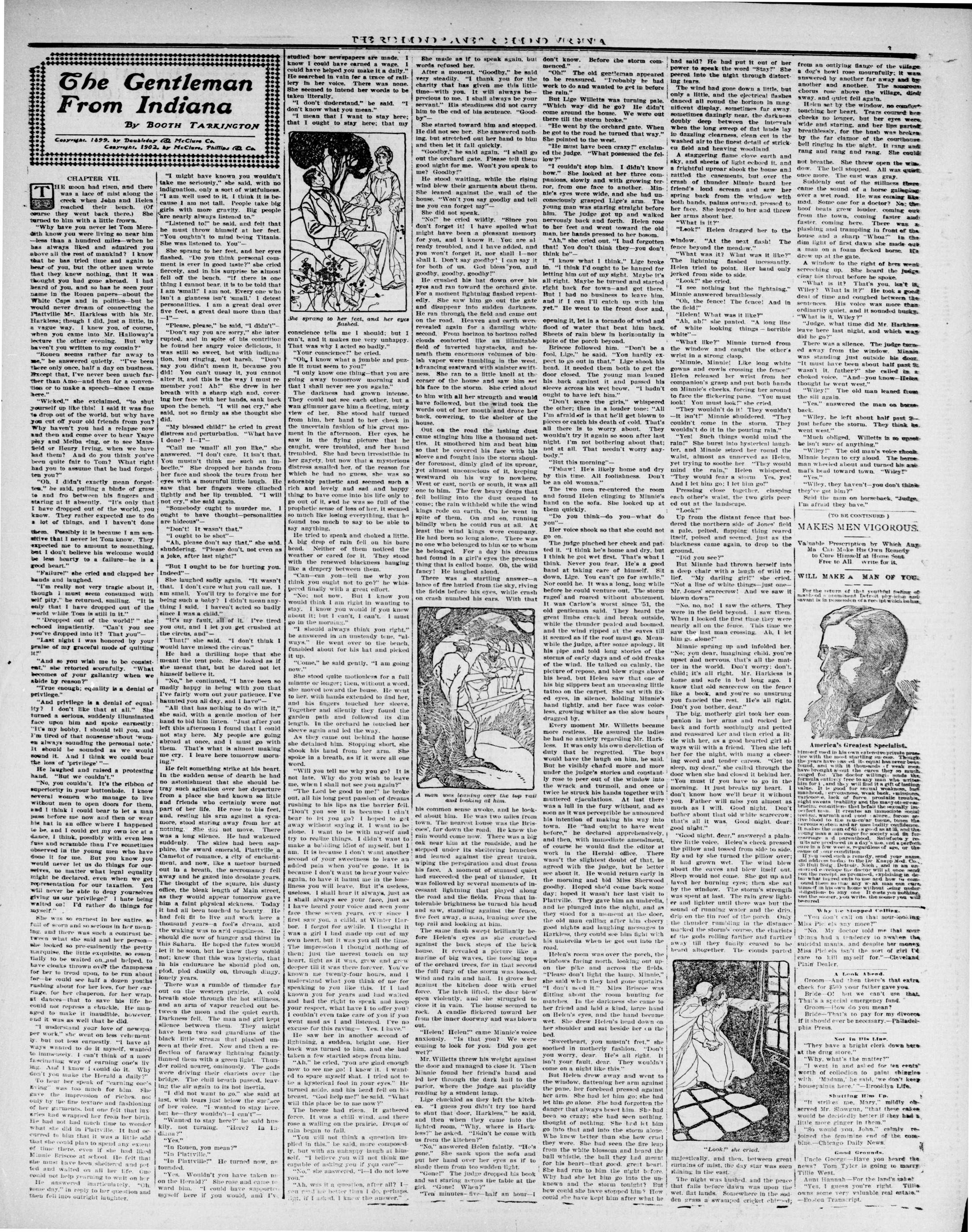
She sprang to her feet, and her eyes flashed.
conscience tells me I should; but I can't, and it makes me very unhappy. That was why I acted so badly.
"Your conscience!" he cried.
"Oh, I know what a jumble and puzzle it must seem to you."
"I only know one thing—that you are going away tomorrow morning and that I shall never see you again."
The darkness had grown intense. They could not see each other, but a wan glimmer gave him a fleeting, misty view of her. She stood half turned from him, her hand to her cheek in the uncertain fashion of his great moment in the afternoon. Her eyes, he saw in the flying picture that he caught, were troubled, and her hand trembled. She had been irresistible in her gayety, but now that a mysterious distress assailed her, of the reason for which he had no guess, she was so adorably pathetic and seemed such a rich and lovely and sad and happy thing to have come into his life only to go out of it, and he was so full of the prophetic sense of loss of her, it seemed so much like losing everything, that he found too much to say to be able to say anything.
He tried to speak and choked a little. A big drop of rain fell on his bare head. Neither of them noticed the weather or cared for it. They stood with the renewed blackness hanging like a drapery between them. "Can—can you—tell me why you think you ought not to go?" he whispered finally with a great effort. "No; not now. But I know you would think I am right in wanting to stay. I know you would if you knew about it; but I can't. I can't. I must go in the morning." "I should always think you right," he answered in an unsteady tense. "always." He went over to the bench, fumled about for his hat and picked it up. "Come," he said gently. "I am going now."
She stood quite motionless for a full minute or longer; then, without a word, she moved toward the house. He went to her, with hands extended to find her, and his fingers touched her sleeve. Together and silently they found the garden path and followed its dim length. In the orchard he touched her sleeve again and led the way.
As they came out behind the house she detained him. Stopping short, she shook his hand from her arm. She spoke in a breath, as if it were all one word.
"Will you tell me why you go? It is not late. Why do you wish to leave me, when I shall not see you again?"
"The Lord be good to me!" he broke out, all his long pent passion of dreams rushing to his lips as the barrier fell. "Don't you see it is because I can't bear to let you go? I hoped to get away without saying it. I wanted to be alone. I want to be with myself and try to realize things. I didn't want to make a babbling idiot of myself, but I am. It is because I don't want another second of your sweetness to leave an added pain when you've gone. It is because I don't want to hear your voice again, to have it haunt me in the loneliness you will leave. But it's useless, useless, useless. I shall hear it always, just as I shall always see your face, just as I have heard your voice and seen your face these seven years, ever since I first saw you, a child, at Winter Harbor. I forgot for awhile. I thought it was a girl I had made up of my own heart, but it was you all the time. The impression I thought nothing of then; just the nearest touch on my heart, light as it was, grew and grew deeper till it was there forever. You've known me twenty-four hours, and I understand what you think of me for speaking to you like this. If I had known you for years and had waited and had the right to speak and keep your respect, what have I to offer you? I couldn't even take care of you if you went mad as I and listened. I've no excuse for this raving— Yes. I have no." He saw her in another second of lightning, a sudden, bright one. Her back was turned to him, and she had taken a few startled steps from him.
"Ah," he cried, "you are glad enough now to see me got. I knew it. I wanted to spare myself that. I tried not to be a hysterical fool in your eyes." He turned aside, and his head fell on his breast, "God help me!" he said, "What will this place be to me now?"
The breeze had risen. It gathered force, it was a chill wind, and there rose a wailing on the prairie. Drops of rain began to fall.
"You will not think a question implied in this," he said, more composed, but with an unhappy laugh at himself. "I believe you will not think me capable of asking you if you care"— "No," she answered, "I—I do not love you."
"Ah, was it a question, after all? I—you need me better than I do, perhaps. Sight, if I asked, I knew the answer."
She made as if to speak again, but words refused her.
After a moment, "Goodby," he said very steadily. "I thank you for the charity that has given me this little time—with you. It will always be—precious to me. I shall always be your servant." His steadiness did not carry him to the end of his sentence. "Goodby"—
She started toward him and stopped. He did not see her. She answered nothing, but stretched out her hand to him and then let it fall quickly.
"Goodby," he said again. "I shall go out the orchard gate. Please tell them good night for me. Won't you speak to me? Goodby!"
He stood waiting, while the rising wind blew their garments about them. She leaned against the wall of the house. "Won't you say goodby and tell me you can forget my"—
"No!" he cried wildly. "Since you don't forget it! I have spoiled what might have been a pleasant memory for you, and I know it. You are all ready troubled, and I have added, and you won't forget it, nor shall I—nor shall I. Don't say goodbye! I can say it for both of us. God bless you, and goodbye, goodbye!"
He crushed his hat down over his eyes and ran toward the orchard gate. For a moment lightning flashed repeatedly. She saw him go out the gate and disappear into sudden darkness. He ran through the field and came out on the road. Heaven and earth were revealed again for a dazzling white second. From horizon to horizon rolled clouds contorted like an illimitable field of inverted haystacks, and beneath them enormous volumes of bluish vapor were tumbling in the west, advancing eastward with sinister swiftness. She ran to a little knoll at the corner of the house and saw him set his face to the storm. She cried aloud to him with all her strength and would have followed, but the wind took the words out of her mouth and drove her back, cowering, to the shelter of the house.
Out on the road the lashing dust came stinging him like a thousand nettles. It smothered him and beat him so that he covered his face with his sleeve and fought into the storm shoulder foremost, dimly glad of its uprigh, yet almost unconscious of it, keeping westward on his way to nowhere. West or east, north or south, it was all one to him. The few heavy drops that fell bolling into the dust ceased to come; the rain withheld while the wind kings rode on earth. On he went in spite of them. On and on, running blindly when he could run at all. At least the wind kings were company. He had been so long alone. There was no one who belonged to him or to whom he belonged. For a day his dreams had found in a girl's eyes the precious thing that is called home. Oh, the wild fancy! He laughed aloud.
There was a startling answer—a lance of fire hurled from the sky, riving the fields before his eyes, while crash on crash numbed his ears. With that
A
A man was learning over the top rail and looking at him. his common sense awoke, and he looked about him. He was two miles from town. The nearest house was the Briscoes, far down the road. He knew the rain would come now. There was a big oak near him at the roadside, and he stepped under its sheltering branches and leamed against the great trunk, wiping the perspiration and dust from his face. A moment of stunned quiet had succeeded the peal of thunder. It was followed by several moments of incessant lightning that played along the road and the fields. From that tolerable brightness he turned his head and saw, standing against the fence, five feet away, a man, leaning over the top rail and looking at him.
The same flash swept brilliantly before Helen's eyes as she crouched against the back steps of the brick house. It revealed a picture like a marine of big waves, the tossing tops of the orchard trees, for in that second the full fury of the storm was loosed, wind and rain and hail. It drove her against the kitchen door with cruel force. The latch lifted, the door blew open violently, and she struggled to close it in vain. The house seemed to rock. A candle flickered toward her from the inner doorway and was blown out.
"Helen! Helen!" came Minnie's voice anxiously. "Is that you? We were coming to look for you. Did you get wet?"
Mr. Willetts threw his weight against the door and managed to close it. Then Minnie found her friend's hand and led her through the dark hall to the parlor, where the judge sat placidly reading by a student lamp.
Lige chuckled as they left the kitchen. "I guess you didn't try too hard to shut that door, Harkless," he said, and then when they came into the lighted room, "Why, where is Harkless?" he asked. "Didn't he come with us from the kitchen?"
"No," answered Helen faintly. "He's gone." She sank upon the sofa and put her hand over her eyes as if to shade them from too sudden light.
"Gone!" The judge dropped his book and sat staring across the table at the girl. "Gone! When?"
"Ten minutes—five—half an hour—I
don't know. Before the storm commenced.
"Oh!" The old gentleman appeared to be reassured. "Trobably he had work to do and wanted to get in before the rain."
But Lige Willetts was turning pale. "Which way did he go? He didn't come around the house. We were out there till the storm broke."
"He went by the orchard gate. When he got to the road he turned that way." She pointed to the west.
"He must have been crazy!" exclaimed the judge. "What possessed the fellow?"
"I couldn't stop him. I didn't know how." She looked at her three companions, slowly and with growing terror, from one face to another. Minnie's eyes were wide, and she had unconsciously grasped Lige's arm. The young man was staring straight before him. The judge got up and walked nervously back and forth. Helen rose to her feet and went toward the old man, her hands pressed to her bosom. "Ah," she cried out. "I had forgotten that! You don't think they--you don't think be"—
"I know what I think." Lige broke in. "I think I'd ought to be hanged for letting him out of my sight. Maybe it's all right. Maybe he turned and started right back for town—and got there. But I had no business to leave him, and if I can I'll catch up with him yet." He went to the front door and.
opening it, let in a tornado of wind and flood of water that beat him back. Sheets of rain blew in horizontally in spite of the porch beyond.
Briscoe followed him. "Don't be a fool, Lige," he said. "You hardly expect to go out in that." Lige shook his head. It needed them both to get the door closed. The young man leaned his back against it and passed his sleeve across his wet brow. "I hadn't ought to have left him."
"Don't scare the girls," whispered the other; then in a louder tone: "All I'm afraid of is that he'll get blown to pieces or catch his death of cold. That's all there is to worry about. They wouldn't try it again so soon after last night. I'm not bothering about that; not at all. That needn't worry anybody."
"But this morning"—
"Fishaw! He's likely home and dry by this time. All foolishness. Don't be an old woman."
The two men re-entered the room and found Helen clinging to Minnie's hand on the sofa. She looked up at them quickly.
"Do you think—do you—what do you?"—
Her voice shook so that she could not go on.
The judge pinched her cheek and patched it. "I think he's home and dry, but I think he got wet first. That's what I think. Never you fear. He's a good band at taking care of himself. Sit down, Lige. You can't go for awhile." Nor could he. It was a long, long while before he could venture out. The storm raged and roared without abatement. It was Carlow's worst since '51, the old gentleman said. They heard the great limbs crack and break outside, while the thunder pealed and boomed, and the wind ripped at the eaves till it seemed as if the roof must go. Meanwhile the judge, after some apology, lit his pipe and told long stories of the storms of early days and of odd freaks of the wind. He talked on calmly, the picture of repose, and blew rings above his head, but Helen saw that one of his big slippers beat an unceasing little tattoo on the carpet. She sat with fixed eyes, in silence, holding Minnie's hand tightly, and her face was colorless, growing whiter as the slow hours dragged by.
Every moment Mr. Willetts became more restless. He assured the ladies he had no anxiety regarding Mr. Harkless. It was only his own dereliction of duty that he regretted. The boys would have the laugh on him, he said. But he visibly chafed more and more under the judge's stories and constantly rose to peer out of the window into the wrack and turnoil, and once or twice he struck his hands together with muttered ejaculations. At last there was a bull in the fury without, and as soon as it was perceptible he announced his intention of making his way into town. He "had ought to have went before," he declared apprehensively, and then, with immediate amendment, of course he would find the editor at work in the Herald office. There wasn't the slightest doubt of that, he agreed with the judge, but he better see about it. He would return early in the morning and bid Miss Sherwood goodby. Hoped she'd come back some day; hoped it wasn't her last visit to Plattyville. They gave him an umbrella, and he plunged into the night, and as they stood for a moment at the door, the old man calling after him cheery good nights and laughing messages to Harkless, they could see him fight with his umbrella when he got out into the road.
Helen's room was over the porch, the windows facing north, looking up on the pike and across the fields, "Please don't light the lamp, Minnie," she said when they had gone upstairs. "I don't need it." Miss Briscoe was flitting about the room hunting for matches. In the darkness she came to her friend and held a kind, large hand on Helen's eyes, and the hand became wet. She drew Helen's head down on her shoulder and sat beside her on the bed.
"Sweetheart, you mustn't fret," she soothed in motherly fashion. "Don't you worry, dear. He's all right. It isn't your fault, dear. They wouldn't come on a night like this."
But Helen drew away and went to the window, fattening her arm against the pane, her forehead pressed against her arm. She had let him go; she had let him go alone. She had forgotten the danger that always beset him. She had been so crazy; she had seen nothing, thought of nothing. She had let him go into that and into the storm alone. Who knew better than she how cruel they were. She had seen the fire leap from the white blossom and heard the ball whistle, the ball they had meant for his heart—that good, great heart. She had run to him the night before. Why had she let him go into the unknown and the storm tonight? But how could she have stopped him? How could she have kept him after what he
bad said? He had put it out of her power to speak the word "Stay". She peered into the night through distorting tears.
The wind had gone down a little, but only a little, and the electrical flashes danced all round the horizon in magnificent display, sometimes far away, sometimes dazingly near, the darkness doubly deep between the intervals when the long sweep of flat lays lay in dazzling clearness, clean cut in the washed air to the finest detail of stricken field and heaving woodland.
A staggering flame clove earth and sky, and sheets of light shook it, and a frightful uproar shook the house and rattled the casements, but over the crash of thunder Minnie heard her friend's loud scream and saw her spring back from the window with both hands, palms outward, pressed to her face. She leaped to her and threw her arms about her.
window. "At the next flash! The fence beyond the meadow."
"What was it? What was it like?"
The lightning flashed incessantly. Helen tried to point. Her hand only jerked from side to side.
"Look!" she cried.
"I see nothing but the lightning." Minnie answered breathlessly.
"Oh, the fence! The fence! And in the field!"
"Helen! What was it like?"
"Ah, ah!" she panted. "A long line of white looking things - horrible white"—
"What like?" Minnie turned from the window and caught the other's wrist in a strong clasp.
"Minnie, Minnie! Like long white gowns and cowlies crossing the fence!" Helen released her wrist from her companion's grasp and put both hands on Minnie's cheeks, forcing her around to face the flickering pane. "You must look! You must look!" she cried.
"They wouldn't do it! They wouldn't - it isn't!" Minnie shuddered. "They couldn't come in the storm. They wouldn't do it in the pouring rain."
"Yes! Such things would mind the rain!" She burst into hysterical laughter, and Minnie seized her round the waist, almost as unnerved as Helen, yet trying to soothe her "They would mind the rain," Helen whispered. "They would fear a storm. Yes, yes! And I let him go; I let him go!"
Pressing close together, clasping each other's waist, the two girls peered out at the landscape.
"Look!"
Up from the distant fence that bordered the northern side of Jones' field a pale, peled, flapping thing reared itself, poised and seemed, just as the blackness came again, to drop to the ground.
"Did you see?"
But Mimie had thrown herself into a deep chair with a laugh of wild relief.
"My darling girl!" she cried.
"Not a line of white things—just one—Mr. Jones' scarecrow! And we saw it blown down."
"No, no, no! I saw the others. They were in the field beyond. I saw them. When I looked the first time they were nearly all on the fence. This time we saw the last man crossing. Ah, I let him go. alone!"
Minnie spring up and infolded her.
"No; you dear, imagining child, you're upset and nervous, that's all the matter in the world. Don't worry; don't child; it's all right. Mr. Harkless is home and safe in bed long ago. I know that old scarecrow on the fence like a book, and you're so unstrung you fancied the rest. He's all right. Don't you bother, dear."
The big, motherly girl took her companion in her arms and rocked her back and forth soothingly and petted and reassured her and then cried a little with her, as a good hearted girl always will with a friend. Then she left her for the night, with many a cheering word and tender caress. "Get to sleep, my dear," she called through the door when she had closed it behind her. "You must if you have to go in the morning. It just breaks my heart. I don't know how we'll bear it without you. Father will miss you almost as much as I will. Good night. Don't bother about that old white scarecrow, that's all it was. Good night, dear. good night."
"Good night, dear," answered a plaintive little voice. Helen's check pressed the pillow and tossed from side to side. By and by she turned the pillow over; it had grown wet. The wind blew about the caves and blew itself out. Sleep would not come. She got up and laved her burning eyes; then she sat by the window. The storm's strength was spent at last. The rain grew lighter and lighter until there was but the sound of running water and the drip, drip on the tin roof of the porch. Only the thunder rumbling in the distance marked the storm's course, the charlies of the gods rolling farther and farther away till they family ceased to be heard altogether. The clouds parted
A woman in a long dress reaches out to a man in a long coat, who is standing on a tiled floor.
"Look!" she cried,
majestically, and then, between great
curtains of mist, the day star was seen
shining in the east.
The night was hushed, and the peace
that falls before dawn was upon the
wet, flat lands. Somewhere in the soden
grass a swamped cricket chirped;
from an outlying flange of the village, a dog's bowl rose mournfully; it was answered by another far away and by another and another. The sourcous chorus rose above the village, died away, and quiet fell again.
Helen sat by the window, no comfort touching her heart. Tears coursed her cheeks no longer, but her eyes were wide and staring, and her lips parted breathlessly, for the hush was broken by the far clamor of the courthouse bell ringing in the night. It rang and rang and rang and rang. She could not breathe. She threw open the window. The bell stopped. All was quiet once more. The east was gray.
Suddenly out of the stillness there came the sound of a horse galloping over a wet road. He was coming like mad. Some one for a doctor? No; the hoof beats grew louder, coming out from the town, coming faster and faster, coming here. There was a plashing and trampling in front of the house and a sharp "Whoa!" in the dim light of first dawn she made out a man on a foam flecked horse. He drew up at the gate.
A window to the right of hers went screeching up. She heard the judge clear his throat before he spoke.
"What is it? That's you, isn't it, Wiley? What is it?" He took a good deat of time and coughed between the sentences. His voice was more than ordinarity quiet, and it sounded husky. "What is it, Wiley?"
"Judge, what time did Mr. Harkless leave here last night, and which way did he go?"
There was a silence. The judge turned away from the window. Minnie was standing just outside his door. "It must have been about half past $2 wasn't it, father?" she called in a choked voice. "And—you know—Helen thought he went west." "Wiley!" The old man leaned from the sill again. "Yes," answered the man on horseback. "Wiley, he left about half past $—just before the storm. They think he went west." "Much obliged. Willetts is so upset he isn't sure of anything." "Wiley!" The old man's voice shook Minnie began to cry aloud. The horseman wheeled about and turned his animal's head toward town. "Wiley!" "Yes." "Wiley, they haven't—you don't think they've got him?" Said the man on horseback. "Judge, I'm afraid they have."
(TO BE CONTINUED )
MAKES MEN VIGOROUS.
Valuable Prescription by Which Any
Ma Can Make His Own Remedy
To Cure Himself at Home Sent
Free to All write for it.
For the return of that youthful feeling of manhood a prominent Detroit physician and savant is in possession of a receipt which belongs.
America's Greatest Specialist.
himself used in his own extensive private practice with the most startling success. Though the years have came and the equal has never been achieved, he has brought about the cures they so much longed for. The doctor willingly sends the formula to a tree to any man who writes to him and the value it is. It is good for sexual weakness, lack manhood, erroneousness, weak back, emissions, varicose, lack of force prosthetic troubles, cold temperature and poor air, forces nervous system and nervous system and air bodily confidence. It makes the man of 65 is good as at 65 and the young man of a minor age for society and for its abilities. It is produced in a day's use, and a perfect cure in a few weeks, regardless of age, or the cause of our condition. He gently sends your name, and address to day to the Dr. Knapid Des. Co. Hull Bay, Detroit. Mich, and in an unmerited develop the doctor will at once send you the receipt as promised, explained in detail. He will send them so that any wak man can cure himself in his own home without being under obligations to any one. It costs you nothing, no money, you write, the sooner you will be credited.
"No. My doctor told me that some things had a tendency to awaken the suicidal mania, and despite her money Miss Piclets isn't the sort of girl I'd care to kill myself for."—Cleveland Plain Dealer
A. Lenk Ahrend.
Groom—And then there's that extra check for $500 your father gave you.
Bride-O! but we can't use that. That's a special emergency fund.
Groom—How do you mean?
Bride—That's to pay for my divorce if it should ever be necessary—Philadelphia Press.
Not In His Line.
"They have a bright clerk down here at the drug store."
"Why, what's the matter?"
"I went in and asked for ten cents" worth of collodion to paint shingles with "Madam," he said, "we don't keep housepaints here."—Brooklyn Life.
Shutting Him Up
"It stilts me, Mary," mildly observed Mr. Slowgun, "that these cakes would be decidedly better if they had a little more ginger in them."
"So would you, John," calmly rejoined the feminine end of the combine—Chicago Daily News.
Good Grounds.
Uncle George—Have you heard the news? Tom Tyler is going to marry Tillie West.
Aunt Hannah—For the land's sake!
"Yes, I guess you're right. Tillie owns some very valuable real estate."
-Boston Transcript.
RF POWER
Municipalions intended for publication be set so as to reach us by Wednesday
TERMS IN ADVANCE.
February, one year, $1.50
February, eight months, 1.00
February, six months, .80
February, four months, .50
February, three months, .40
February, three months, .00
ADVERTISING RATES
wine inch, one insertion, $ 50
wine inch, each subsequent insertion, 25
wine inch, three months, 40
wine inches, six months, 10.00
wine inches, nine months, 14.00
wine inches, twelve months, 23.00
wine inches and Financial Notices, 50
wine and Transactions Notices 1er line, 10
POSTAGE STAMPS OF A HIGHER DE-
PRIATION THAN TWO CENTS NOT
EXCEIVED ON SUBSCRIPTIONS.
PLANET is issued weekly. The subscrip-
tion price is $1.50 a year, in advance.
THE POUR WAYS by which money can be mail at our risk. - In a Post Office Monier, by Bank Check or Draft, or an Ex change, by Bank Check or Draft, or these are procured, in a Registered Letter.
THE ORDERS - You can buy a Money Ord. for your Post Office, payable at the Richmond Office, and we will be responsible for its money orders in a Registered Letter.
MONEY ORDERS can be or be paid at the American Express Co., the States Express Co., and the Web. Far Co., the Express Company. We will be responsible for your money orders in a Registered Letter. The Express Money Order is a safe movement way for forwarding money.
CERTIFIED LETTER - If a Money Order within reach, your Postmaster will Register you wish to send us on payment of ten. Then, if the letter is lost or stolen, you can send money in this manner to be responsible for money sent in many other way than one of the four mentioned above. If you send your monier other way, you must do it at your
CONTACTS. ITC—If you do not want THE
continued for another year after your
subscription has run out, you then notify us by
email that you are interested in the course.
that subscribers to newspapers who do
their paper discontinued at the expi-
tion of time for which it has been paid are
saleable for the payment of the subscription
to when they order. No paper discount.
COMMUNICATIONS—When writing to us
your subscription or to discontinue
your subscription, you should give your name and ad-
dress, or otherwise we cannot send your
address or address—In order to change
address of a subscriber, we must be sent
acorn as well as the present address.
Received in the Post Office at Birmond, Ia.
in confining his convincing address
"The Industrial and Higher Education
of the Negro" Dr. WILBUR P.
WARRELD said:
"The Negro race needs men of higher training for the professions. Broad awakened men of the South who have the interests of both races at heart, recognize this fact. The Montgomery University in a recent utterance is a generation behind the times. In commenting on the sort of education that the South will permit, the Adversary says: "To educate the Negroes as doctors lawyers and the like, is to lay trouble The white people of the South are determined to control in the learned professions. To educate the Negroes as teachers, physicians, lawyers, and other institutions of that kind, is to invite nature and nature disappointment and possibly something worse." This does not represent the intelligent South that has face to the future. It must be evident that a race of millions of thousands are gaining wealth and property, must have legal advisers among their own people—lawyers who teach them to avoid litigation in which they love to indulge. True, lawyers intent on protecting them in their ignorance and helping them to their rights."
He said further:
For physicians the race needs the best men, scholarly men with clear heads, trained facilities, accurate judgment, balanced powers. To gain the confidence of their own race to command the respect of white physicians, the highest ability, training are demanded. Scores of graduate physicians by their skill and worth have won the confidence of the profession. Broadminded white physicians hold consultation with them. Many of them are called into the homes of white people. The intolerance and mass of the Indiana doctors is an acceptance. They thus are becoming conductors between the races."
In speaking of the ministry, he boldly declared the necessity for a thorough training of the divines. He ued the following language:
The demand for a trained and concentrated ministry is imperative. The most serious problem before the race is to hold the progressive, aspiring New Yorkers of the rising generation to the church through a ministry, the majority of whom, according to Dr. Booker Washington, are not fitted morally intellectually for that office. The highest qualities of leadership are required to meet the demands for the relational, civil and social reforms that must come for the redemption of the race. The minister is the center of the church preacher now is their continued leader, holding this leadership demands a ministry that presents to its successful grasp and brave treatment of questions that make for the civil and leadership of the people, its right to leadership. As teachers of the Word, the leaders of their people into larger hands and truth and righteousness of life, ministers of intellectual breadth and spiritual vision are needed."
and again:
In view, then, of these impressive majors and arguments, which show that the higher education the very existence of any education depends—that from the best interests of industrialism to up with the higher training; that college-time and culture are necessary for the raising of mind and leadership for the enamulation of the masses and for skill and success in the professions—let us again ask to
what extent shall the higher education be attempted? We answer, only to that extent that shall give opportunity to all those who are thoroughly equipped in the preparatory schools and have the ambition and the capacity for the higher training a chance to unfold the best and divinest that is in them. Say not to any man or set of men, nor to any that kind of education is good enough to make a thine. This is unphilosophical, unjust, unaware. Let the gates to largest knowledge culture be thrown wide open. Let each man for himself enter. Set no limits. Let each man by his active brain and aspiring soul, set his own limits
* * *
"For many years to come, the first educational task among the colored people will be to supply competent teachers for public, industrial and elementary schools. Hence, more of the resources of the numerous institutions already in operation should be devoted to first-class normal and academic work. It is also the part of wisdom to give a large place to industrial training. Were I speaking upon this phase of education, I should be just as strong and insistent in my advocacy of the training of the hand, as essential to the wise and rounded development of the race. We need more industrial schools, rather than less. The best future of millions of the Negro race is bound up with the industrial training of the tens of thousands who may be thus prepared for directing the energies of their people to wise ends."
The above is broad ground on which rests a broader platform.
His plea against race prejudice is unquestionably one of the strongest points of his address.
He said:
"And further, let us not forget that this hi-er education of the exceptional Negro, for which we plead, is a slow process. It is only through generations of discipline and patient education of the people through such teachers, that the masses will be lifted into the larger and higher fellowship of the intellectual life. We have too often made the mistake of confounding the education of the African with the mental and moral equipment of the teacher. The teaching of sociology is that, while we may educate the individual in a few years, the intellectual and moral equipment of a race is a question of generations, and it may be of centuries."
And again:
"It is the educated leaders—minds of large native capacity, the elect spirits, deloped, sharpened and polished by the higher education—who are to overcome the race prejudice and civil inequalities against the Negro, and gain for him his rights as a man and as a citizen. Even the contest against race prejudice is not hopeless. Said James Russell Lowell years ago: 'We can remember when the prejudice against the Irish was as strong in many of the free States as that against the African could ever be in the South. This prejudice nearly gave a new direction to politics of the country.' Who, I may ask, overcame the intolerant spirit of cruel race prejudice of Peacon Street, won civil recognition, and seat d an Irishman as Mayor in the City Hall of Boston? Mark you, it was not Paddy O'Flariy, the skilled brickmason, or Dennis O'Leary, the boss carpenter, or Tim O'Shangnessy, the skilled master of the latest ideas of truck-gardening—not these who demanded and gained recognition for their race from proud old Boston. It was the Irishman who had measured brains with the Yankee in Harvard College, and who had taken honors in the Boston University School of Law. Elementary and industrial training of the masses is efficient, but the education of the exceptional men of the race is alone sufficient for a people if it is to gain and hold a self-respecting footing among men. What the Negro asks is not social equality, but simply equality of opportunity in the business and struggle of life."
This then is the position of the Negro To say that trained educated leaders injures the Negro is to belie history and wage a warfare upon education itself. To the doubting Thomases of the race and the Negro-haters of the Southland, we have but to exclaim: Look at the Japanese and see what wonders the higher education of a people has wrought.
"THE NEGRO: THE SOUTHERN-ER'S PROBLEM."
MR. THOMAS NELSON PAGE, who is President R OSEYVELT's adviser with reference to political matters relating to Virginia in particular and the Southland in general has made some surprising statements in his article in McCLURE'S MAGAZINE for March, and at the same time displayed an antagonism to the New Negro that betokens ill for us, if his advice is needed by the dis tinguished occupant of the White House.
Already, fewer colored men hold office under his administration than at any time since the induction of Gen. U. S. GRANT into the presidential chair at Washington and the confirmation of Dr. W. D. CRUM, as Collector of the Port at Charleston, South Carolina despite the backing of the administration is as yet hanging fire.
In an extract cited from this dissertation of Mr. PAGE, and published in our issue of last week, he declared that the expenditure of vast sums of money by philanthropists in behalf of the Negro was a failure in much as the only return therefor was a sad experience.
It is inconceivable that a gentleman of Mr. PAGE's ability, with the statistics and the facts within easy reach of him in the archives at Washington should have given away to this outburst of pessimism and that he should sing:
"Hark from the tomb a doleful sound To a believer's ear."
Negro suffrage has proven a failure only because the southerners, backed up by the national government decreed that it should be a failure.
But what has been the result of the enactment of liberal laws and the expenditures of millions of dollars by philanthropists?
History furnishes no example of such a radical and surprising change from slavery to freedom as is afforded in the case of the much abused blacks of the Southland.
Forty years ago, they were illiterate, ignorant, poverty-stricken, relying up
THE RICHMOND PLANET, RICHMOND, VIRGINIA.
on their white masters for every thing, while enriching the men upon whom they relied. They were taught to regard themselves as inferior and in support of this "great truth" were told to listen to the reading of I Peter 2:18: "Servants, be subject to your masters with all fear."
and Collossians 3:22:
"Servants, obey in all things your masters."
These citations from the Scriptures which impressed the religious black-man were not without their effect upon the white master as well.
White children, youngsters and the like of Mr. THOMAS NELSON PAGE's stripe believed from the bottom of their hearts that they were divinely commissioned to rule over the black people and many black people shared the same opinion relative to the right of the F. F. V's of Virginia to own and exercise their sweet will upon the poor, deluded blacks of the Sunny Clime.
This then was the picture of forty years ago. What is it today? Then there were four millions of us, but thanks to our own fecundity and our love of each other and the white men's love of us, there are to day more than ten millions of us, and the census figures are still rising.
Education has done its work and every hill-side is dotted with farmhouses and the cities well "peppered" with the tasty homes of the colored people. We have lawyers, doctors, ministers, pharmacists, real-estate agents, insurance presidents and managers, authors, editors, publishers, merchants, linguists, dentists, Bank presiden s. Bank cashiers, college presidents, copyists, stenographers, statesmen, officeholders and type-writers.
These much abused people, owning nothing at the close of the war now own seven hundred million dollars worth of property in the United States to day and in Mr. THOMAS NELSON PAGE's own state is increasing his real estate and personal holdings at the rate of over one million dollars per year. The official report of the Auditor of Virginia shows that the colored people of this state pay taxes on property, real and personal, aggregating eighteen million dollars. The standard of the pulpit has been raised and the teachers who now instruct the young of the race are of Negro parentage. We no longer can tell a colored man's home by the poverty of his surroundings. Sambo has profited by education, the work of the philanthropists. He is working upon the farm. Mr. PAGE, but it is his own farm, thank God.
Come home, Mr. ROOSEVELT's adviser! Come to Richmond, the capital of the late Confederacy and open your eyes and see.
We own one million dollars worth of property in this city. We maintain and support four Negro Savings Banks with an aggregate capital of one hundred and eighty thousand dollars.
Come and visit our homes, Mr. PAGE. You are a Virginia gentleman and we will permit you to enter.
A servant ushers you into the parlor. It is richly furnished, is it not? You hear sweet strains of sweet music from the fingers of an accomplished graduate from the Virginia Theological Seminary and College, the Hartshorn Memorial College or from the numerous other institutions of learning that are playing so important part in the elevation of the down-trodden and mach oppressed people.
Oh, yes. Mr. Page, the mistress of this house was a slave and the good manners your parent's taught her are being impressed upon the children who roam through this household.
This is a new picture of startling boldness, of course. Your associates have been visiting some colored people's houses, but not these kind of colored people and when they left, it was not through the front door, but through the back gate, with a step that betokened hurry in order to reach a place of safety where they might avoid detection.
But that was the low, degraded Negro that he visited and his ideals were formed by just such associations.
But now, you see the New Negro. This one is not after your white females, and the greatest favor that he asks is that your people will let the colored females alone. On his side of the line, he is content.
Neither does he wish for the so called social equality,—the great phantom which runs the average poor white man crazy.
But the most remarkable part of Mr. PAGE's most remarkable article is found in the premises which he laid down, when he said:
"Two principles may be laid down to which, perhaps, all will assent. First, it is absolutely essential that a correct understanding of the question should be had; and, secondly, the only proper settlement of it is one that shall be founded on justice and wisdom—a justice which shall embrace all concerned."
The above proposition must necessarily be accepted by all, but who would imagine or believe that Mr. THOMAS NELSON PAGE would be the first one to get away from the principles which he had appreciated?
He then proceeds to give a historical sketch of slavery in this country, declaring that when THOMAS JEFFERSON gave voice to the principle that all men were created equal, he had no idea of embracing the Africans within the category of that benevolent declaration of principles.
There are white men to-day who question the statement as viewed in connection with the laboring classes of whites. He admits, however, that the slaves were counted and their owners taxed for them just as laboring white
men were taxed, it requiring five slaves to equal three laboring white men. Yet Mr. PAGE admits that THOMAS JEFFERSON was a strong advocate of emancipation.
This then was a recognition of a principle which Mr. PAGE has attacked. He speaks about "Uncle Tom's Cabin" by HARRIET BEECHER STOWE as the nail in the hands of a woman that fastened Sisera to the ground.
It was a true picture of the conditions in the fastnesses of the Southland and the recent peonage cases have exposed a similar condition of affairs in SOUTH CAROLINA, GEORGIA, MISSISSIPPI and Louisiana that is equally horrible.
Mr. PAGE then cites ABRAHAM LINCOLN's position on the question of slavery, unmindful of the fact that the distinguished Emancipator was supposed to be the President of all of the people, the North as well as the South and that under his cath of office, his first duty was to the Union. And yet Mr. PAGE assumes an attitude of fairness and says:
We ask in all candor, could a grander tribute be paid to a people than is contained in the above lines? If it be true, and it is true, why should Mr. PAGE or these southerners seek to deny to the educated, property owning, wealth-producing Negroes of the Southland the only boon which can be said to comport with his remarkable premises which he has laid down,—namely, "the only proper settlement of it is one founded on justice and wisdom m." Mr. PAGE knows that taxation without representation is tyranal and yet he would assign these Negroes and their offspring—the clans-men of the southern white men—to a state of serfdom, the like of which is only to be found in the barren wastes of gloomy Siberia or the Asia Minor principalities under Turkish sway.
Mr. PAGE, is this the justice for which you have spoken? Is this the fair-play for which you stand? And then, as if to minimize the force of his assertions and to qualify the strong language he had uttered, he continued:
"The inference that has been drawn from this is usually one which is wholly in favor of the colored race. It is, however ever a tribute to both races. Had slavery at the South been the frightful institution that it has ordinarily been pictured, with the slave driver and the foreground, it is hardly credible that the life of the Negro was to avail themselves of the opportunities for freedom so frequently offered them would have been so general and the loyalty to their masters would have been so d youed.
"One other reason is commonly overlooked. The instinct for command of the white race - at least, of that section to which the whites of this county belong - is a wonderful thing; the serene self confidence which reckons no opposition, but drives straight for the highest place, is impressive. It made the race in the past; it was preserved it in our time. The Negroes knew the constancy and courage of their masters. They had had abundant proof of it for generations, and their masters were now in arms. The failure of a servile population to rise against their masters in time of war is no new thing. History fernishes many illustrations. Pitarch tells how the bestigers of a certain city offered, not only freedom to the slaves, but added to it the promise of their masters' property and wives if they would desert them. Yet the offer was rejected with scorn. During the revolution, freedom on the same terms was offered the slaves in Virginia and the Carolinas by the British General, but with little effect, except to inflame the masters to bitterer resistance. The result was the same during the Civil War."
But the tender memories of the pass caused the race prejudice within his bosom to retreat once more, for he said:
"The exactions of the War possibly
brought the races nearer together than they had ever been before. There had been, in times past, some hostile feeling between the Negroes and the plain whites, due principally to the well-known arrogance of a slave population towards a poor, free, working population. This was largely dispelled during the War, on the one side by the heroism shown by the poor whites, and on the other by the kindness shown by the Negroes to their families while the men were in the army When the War closed, the friendship between the races was never stronger; the relations were never more closely welded. The fidelity of the Negroes throughout the War was fully appreciated and called forth a whirmer affection on the part of the masters and mistresses, and the care and self-damal of the whites were equally recognized by the Negroes. Nor did this relation cease with the emancipation of the Negro. The return of the masters was hailed with joy in the quarters as in the mansion. When the worn and disheartened veteran made his last mile on his return from Appomattox it was often the group of Negroes watching for him at the plantation gatehast; first cangit his dimmed eye and their shouts of welcome that first sounded in his ears."
Oh, yes, Mr. PAGE and thouspands of Confederate white men, "to the manor born," are willing to accord to these same Negroes and their offsprings the rights which you would deny. Talk about being ingrates, speak about being ungrateful, what else would they be not to be willing to give to these saviours of their families all of the legal rights which they enjoy?
There are thousands of southerners who will eat with Negroes, drink with Negroes and think nothing about it, and the Negroes who are the recipients of the privilege do not in any wise regard it in a sense that it would entitle them to enter these white men's doors as guests of the family or to request the hands of their daughters in marriage.
Only the evil d-signing politicians indulge such nonsense.
As we have before asserted, white men like Gov. VARDAMAN can do us but little harm. They cause our white friends to assert themselves and come to our defense.
But the cool, calm, apparently fair, but still incipient attacks upon our vital political rights by men of Mr. THOMAS NELSON PAGE's strine tend to carry conviction to the philegmatic northerner unless the fallacies of their argument are plainly exposed.
If Mr. PAGE is to be President ROOSEVELT's adviser during the next four years and his advice heeded, fare you well, Brother Sambo!
REPUBLICANS NAME THEIR COMMITTEE
Will Conduct Campaign For Election of Congressmen.
14 VACANCIES ON COMMITTEE
Washington, March 22.—Thirty-four of the 48 members of the Republican congressional campaign committee, which will conduct the campaign for the election of Republican members of the 58th congress, were chosen at a caucus of the members of the senate and house held in the hall of the house. The members chosen were selected by the state delegations in congress. The 14 vacancies or the committee are from states the delegations of which as yet have taken no action. A resolution was passed by the caucus empowering the next chairman of the committee to fill the vacancies.
The members chosen and the state or territory they represent on the committee are as follows:
Representative Metcalf, California;
Brooke, Colorado; Lilly, Connecticut;
French, Idaho; Hull, Iowa; Bowersock, Kansas; Hunter, Kentucky; Burleigh, Malne; Mudd, Maryland; Loering, Massachusetts; Fordney, Michigan;
Tawney, Minnesota; Bartholdt, Missouri; Dixon, Montana; McCarthy, Nebraska; Loudenslager, New Jersey; Sherman, New York; Spalding, North Dakota; Longworth, Ohio; Senator Mitchell, Oregon; Connell, Pennsylvania; Capron, Rhode Island; Burke, South Dakota; Howell, Utah; Slemp, Virginia; Humphrey, Washington; Doveren, West Virginia; Babcoe, Wisconsin; Mondell, Wyoming; Delegate Kalaniannole, Hawaii; Delegate Rodey, New Mexico; Delegate McGuire, Oklahoma; Resident Commissioner Degetan, Porto Rico.
The states left vacant on the committee are as follows: Alabama, Arkansas, Delaware, Florida, Illinois, Indiana, Louisiana, Mississippi, Nevada, North Carolina, South Carolina, Texas, Vermont and Arizona Territory. About 75 members of the senate and house attended the caucus, which was presided over by Representative Hepburn, of Iowa. The selection of members took less than an hour.
PRICE OF COAL COMES DOWN
Reading to Follow Lead and Make Usual Spring Reduction.
Philadelphia, March 22.—Announcement is expected at an early date that the Philadelphia & Reading Coal and iron company will make the usual spring reduction in the price of domestic coal on April 1. Under this reduction the price of an arthritic fuel, which is now $6.25 a ton, will be $5.75 a ton. Ten cents a ton will be added to the price each month until the regular rate is reached on October 1.
The Reading company. it is said, was opposed to making the cusomary reduction this spring.
MINERS' SCALE SIGNED
Operators and Men Affix Their Signatures to the Agreement
Indianapolis, March 22.—Eight coal operators and eight miners, composing the joint sub-scale committee of
the central competitive region affixed their signatures to the articles of agreement which provide for a two years wage contract between the industrial and the capitalistic interests of the coal industry of the United States. No change was made in the compromise proposal of the operators which was accepted by a referendum vote of the miners.
A rehabilitation of the inter-state joint conference was effected by fixing January 25, 1906, as the date for the next joint conference of the operators and miners of the central competitive region
MRS. POWELL HELD FOR COURT
Delaware Woman, Accused of Murder,
Walives a Hearing.
Dover, Del., March 23.—The preliminary hearing of Mrs. Mary A. Powell, alleged murderer of Estelle Albin, which was scheduled for yesterday, was held late on Monday evening in the cell of Mrs. Powell at the county jail.
Accompanied by the prisoner's counsel, Magistrate Wood went to the jail. Mrs. Powell waived a hearing and was held without bail to await the action of the grand jury at the April term of court.
The advanced hearing proved a great surprise to a great crowd of persons who had assembled in the hope of listening to evidence in the case.
Earthquake In New England States
Postmasters Appointed
Washington, March 23.—The president sent to the senate the following nominations of postmasters: New Jersey- George B. Jacobus, Caldwell; Charles W. Russell, New Brunswick; Pennsylvania — Daniel M. Bennett, Bridgeville.
A WEEK'S NEWS CONDENSED.
President Reneeceit has appointed Captain T. F. Jewell to be a rear admiral.
Villiam E. Stanley, ex-governor of Kansas, has resigned as a member of the Dawes Indian commission.
Dr. James B. Sankord, speaker of the Colorado house of representatives, died at his home in Denver of appendicitis.
Fire destroyed four oyster packing plants and the railroad freight sheds at Tilghman's island, Md., causing a loss of $40,000.
The Hickory Run Brick company. of Allentown, Pa., has made an assignment for the benefit of creditors. Liabilities. $75,000; assets. $25,000.
Friday. March 18
W. J. Oliver, of Knoxville, Tenn., has been appointed receiver for the Tennessee Central railroad.
W. T. Nichols has been appointed by President Roosevelt to be secretary of Arizona, to succeed Isaac T. Stoddard.
Bishop Louis M. Fink, of the Leavenworth, Kan., diocess of the Catholic church, died in Kansas City of pneumonia.
St. Louis fair officials have received a cablegram that Russia will participate in the press congress to be held at the exposition.
General H. H. Thomas, who was recently ousted as federal appraiser at the port of Chicago, dropped dead in a lawyer's office of heart disease.
Saturday, March 19.
The New Jersey Democratic state committee will meet in Newark March 24 to fix a date for the state convention.
President Roosevelt has issued an order applying civil service rules to the service of the war department in the Philippines.
The postoffice safe at Mount Washington, near Baltimore, Md., was blown open by dynamite and $300 in money and stamps taken.
George A. Secor, formerly cashier of the Delaware, Lackawanna and Western railroad at New York, was sentenced to two years and six months imprisonment for embezzling $10.166.
Monday, March 21.
John Noral had every bone in his body broken by a fall of 200 feet in the Hazle Brook mine, at Hazleton, Pa.
One man was killed and one fatally hurt at Baltimore, Md., by the derailing of a Baltimore and Ohio coal train.
The world's cotton crop for 1902-1903 is estimated by the department of agriculture at 17,179,765 bales, valued at $750,082.45.
Fayette Sawyer and Burke Harris, negroes, were hanged by a mob at Cleveland, Miss., for the murder of another negro.
Sarmel Kile, an employee of a saw mill at Milwaukee, Pa., stepped on a rapidly revolving rip saw, lost his right foot at the ankle and was seriously cut about the back and head.
Tuesday, March 22.
Ex Mayor William R. Grace, of New York, died of pneumonia at his home in that city, aged 72 years. The supreme court of the United States has adjourned for two weeks for the usual Easter recess. Burglar blues open the safe in the postoffice at Pleasantville, N. J., and secured $175 in cash and stamps. The warehouse of the Deering Harvesting, Machine company, at St. Louis, stored with farm machinery, was destroyed by fire. Loss, $150,000. Dr. Jesse B. Carter, of Princeton, N. J., has been appointed professor of epigraphy and paleography in the American School of Classical Studies at Kome.
Wednesday, March 23.
The Ohio Republican state convention will be held May 17 and 18 at Columbus. By the collapse of a brick building being erected at Houston, Tex., eight persons were injured, three fatally. The National Hardware Dealers' Association held its annual convention at Indianapolis, Ind.
NEW PLAN OF MERGER COMPANY
It Includes a Stock Dividend of
99 Per Cent.
OFFICIAL NOTICES SENT OUT
New York, March 23.—Following a day of great excitement in the stock market and numerous conferences among the leading financial interests, the new plan of the Northern Securities company has been made public. In substance it provides for a stock dividend of 99 per cent., this to be effected by a reduction of that amount in the capital stock of the Securities company.
The other assets of the Securities company, consisting chieux of its Chicago, Burlington and Quincy holdings and Northern Pacific coal lands, will remain in the treasury of the company until some plan for their distribution has been evolved.
Official notice of a new plan, which is signed by President Hill, was sent to Northern Securities stockholders in a circular letter, which says in part: "Since the formation of your company, with a view of promoting, developing and enlarging the commerce and traffic of the country served by the Great Northern and Northern Pacific Railway companies and by the Chicago, Burlington and Quincy Railroad company, the traffic and earnings of the three railways have largely increased. The rates paid by the public have been materially reduced. The respective railways have been extended, and their condition and facilities improved and increased.
"The company's acquisition of Northern Pacific and Great Northern shares were made in the full belief that such purchases were in no wise obnoxious to any law of the United States. However, the majority of the supreme court of the United States, disregarding as irrelevant any beneficial increase of commerce, was of the opinion that as a matter of law your company's holdings of the stocks of the two railway companies in itself constituted a restraint of inter-state commerce prohibited by the so-called Sherman act of 1820. Accordingly the railway companies have been forbidden to permit your company to vote or to collect dividend on the shares held by it.
"Therefore, your directors have, under advice of counsel, decided that in order to fully and promptly comply with the degree in this suit, it is necessary to reduce the capital stock of the company and to distribute to its shareholders the shares of stock of said railway companies now held by it.
"To this end they have adopted resolutions recommending to the stockholders:
"First—That the capital stock of this company be reduced from 3,954,000 shares, now outstanding, to 39,540, being a reduction of 99 per cent.
"Second—That said 99 per cent of the preson outstanding shares be called in for surrender and cancellation.
"Third—That against each share of the stock of this company so to be surrendered there will be delivered $39.27 stock of the Northern Pacific Railway company, $30.17 stock of the Great Northern Railway, company, and proportionate amounts thereof for each fraction of a share of stock.
"As required by the laws of the state of New Jersey, under which the company was created, a special meeting of the shareholders has been called for April 21, 1904, at 11 o'clock a. m., at the office of the company in Hoboken. The collection of the May and subsequent dividend on such sahres being forbidden by the decree until such distribution has been made, the importance of promptly executing and forwarding proxies is obvious.
"The assets of the company remaining in its treasury after the foregoing distribution is made will consist of stocks and other property in no way involved in the suit, producing income, and conservatively valued at an amount in excess of $3,954,000, to which it is proposed to reduce the stock of the company."
Settlement on Public Lands.
Settlement on Public Lands. Washington, March 22.—In the senate Mr. Hoar introduced by request a bill to organize a colonization bureau, which, he said, was prepared by officers of the Salvation Army, for the purpose of securing settlement on public lands. He said it was prepared upon the advice of the late Senator Hanna and had he lived would have been introduced by him. The bill was referred to the committee on public lands.
THE
FRISCO
SYSTEM
Carrying Pullman Sleepers. Cafe Cars
(a la carte) and Chair Care (seats free)
Electric Lighted Throughout
BETWEEN
Birmingham, Memphis and Kansas
AND TO ALL POINTS IN
THE ONLY THROUGH SLEEPING CAR SHE
BETWEEN THE SOUTHEAST AND
KANSAS CITY
Descriptive literature, tickets
ranged and through reservations
upon application to
W. T. SAUNDERS, GEN'L AGT. PARK. DEN
OR
F. E. CLARK, TRAV. PASS. AGT., ATLANTA.
W. T. SAUNDERS
Gen'l Agent Passenger Department
ATLANTA, GA.
HE & PLANET
He had done all thing that wasn't in accordance with the law.
So they caught him and they tried him and they proved that he was bad.
But he got a "stay" or something and is out again and free.
For the court above released him on a technicality.
Day by day we deal with people who have gone the wicked way.
Who have fallen from high places—trusted only to betray.
Day by day the rogues are captured and the juries hear the facts.
Day by day the rogues are sentenced for their lawless, sinful acts.
Day by day they go appealed on all kinds of charges.
And escape because forever there are technicalities.
There's the ready supersedes, there's the
habeas corpus writ.
When the other dedges tail they can still fall back on it;
If the sinner has the cunning and can raise the needed fees;
He may spurn the law, relying on the technicalities.
Not for those whose ways are righteous have we laws upon the books;
Laws, it seems, are only given for protection of the crooks;
When the jury has decided, after all the truth is heard.
Some wise judge finds some omission or an error in some word,
And the wonder is that any rogue is ever forced to flee.
And the wonder is that always there's the technical.
-S. E Kiser, in Chicago Record-Herald.
UNCLAIMED FREIGHT
(Copyright 1903, by Daily Story Pub. Co.)
"NO NEWS of the lubber, I suppose," remarked Mr. Fisk, chief mate of the dark Astrea as, shading his eyes with his hand, he feigned to be regarding something along the shore line.
"No," replied the captain, shortly.
"It beats any problem of navigation you can find in the book," continued the mate.
"She's not a bale of goods for the custom men to care for," grumbled the captain, "there's no duty on her. I can't store her in a warehouse, I can't keep her board ship and I can't do anything."
"It be an awful thing to turn her out among these dagos," said Mr. Fisk.
"If you feel so strong about it why
don't, you pay her passage back to the
rates?" inquired the captain, grumpily.
The result of this appeal to Mr. Fisk's
berality was never to be known, for
not then the object of the discussion
ame on deck. A typical Frenchwoman;
light of build; bright as to face rather
man pretty, and with all the vivacity of
er race.
"Eh bien," shr said, "no news, captain,
suppose, yes?"
"Not a bit," responded Capt. Hovey,
ve searched everywhere."
"So have I," said Mr. Fisk. "I thought I have a stunstroke yesterday fromatin." Capt. Hovey glared at the mate. "Hein." exclaimed the lady. "is it that must go ashore, captain, Monsieur seek?" She turned her black eyes on the offers in succession.
There's five days yet," remarked the pain, soothingly.
Something's bound to turn up," added Fisk.
The woman, walking to the rail looked for to where Cataio lay, its white buildings gleaming in the sunlight against slate background of the Andes. an she shrugged her shoulders.
I'll take you ashore to-morrow," said captain, "I'll show you the town."
Yes, and I'll take you next day," put Mr. Fisk. "I've been here three times I know—"
Mr. Fisk," interrupted the captain, ally, "you had better see about get-that there topsail unent."
Mr. Fisk walked forward, catching the tail of his eye the coquettise the woman threw after him. Then turned smiling to the captain,anks, I go much with pleasure," she
when the Astrea sailed from Boston Callao she carried a passenger—he Rouget, who was going to join over. He had sent her the passage and she intended sailing on the Goliath and had so written him, had missed the ship and was obeyed to wait two months for the next, the Astrea.
when the Astrea reached Callao Ja-Dubourg was not on hand to meetride. Inquiry developed that, on arrival of the Goliath, he had abrupt his position as cook in a hotel and bed. That was two months ago and he could be found of him. Hence the Rouget remained unclaimed board of the Astrea.
He should he do with her? She do one and to put her ashore penitentiary strangers seemed barbarous. Hovey didn't feel like paying her he back to Boston.
the thought percolated itself in his brain, why not marry her? for some time contiplated reform the sea and he had, during age, been much impressed withractiveness of the woman. Be-pilied her and pity is—. such a woman the settling down would not be an unpleasant one. Hovey did not feel sure that uget would accept his suit, and perturbed about Fisk's actions.
The fellow seemed at times as if he had a notion of courting Miss Rouget. The captain determined to bring matters to a conclusion at once.
The next day, while Miss Rouget was sitting beneath the owing on deck, Capt. Hovey called his mate into the cabin.
"Mr. Fisk," said he, with dignity, "Miss Rouget and I are going to get married."
"Took you, did she?" exclaimed Mr. Fisk. "I thought she would, but the sailors were sure she wouldn't. But, I says, looks don't count with women." Capt. Hovey breathed short.
"Old Dan, the cook, said," continued Mr. Fisk. "that there was too much difference in your ages, but then it must be very comfortin' for a man to think when he dies he will leave a wife young enough to marry again right off. It must be very 'comfortin'."
The captain gazed at his mate with a turgid face, plainly struggling with his emotions.
"Now," said Mr. Fisk, soothingly, "don't you worry. I've had loss of experience in weddin's and I'll fix up this one all ship-shape. A snug weddin' on deck and a dance." And Mr. Fisk darted up the companion way utterly unheeding the violent and profane adjuration of the captain to stop. Capt. Hovey wanted a very quiet wedding ashore, but Mr. Fisk was set on a ceremony aboard ship with attendant festivities and, as the bride to be supported him the captain was obliged to consent.
He purchased a wedding ring and also presented the young woman with a gold watch and chain.
"It's all right," gasped Mr. Fisk, the morning of the wedding day, as he rushed into the cabin. "I've engaged a sky pilot—a sort of missionary fellow hungry for a meal and a job, the consul's coming, so is the stevedores and the ship chandler and a dozen sailors from ships in port. Oh, we'll have a plum duff of a time. These dagos all play the guitar and a sailor can't dance to that music, but I ran across a swab who plays the fiddle, so we'll have plenty of music." "I wish I'd never started the blasted thing," muttered the captain. It looked to Capt. Hovey as if all Callao was coming to the wedding. Guests came in skiffs and shallows, while one enthusiastic Peruvian swam to the ship and moved serenely, dripping copiously among the spectators. Mr. Fisk flew about the decks in a seethe of exite-
SHE FLUNG HERSELF INTO THE EM BRACE OF THE FIDDLER.
ment, the missionary took his position,
book in hand, the guests arranged themselves and then the bride couple came on deck. The captain wore a blue plaid coat and perspired profusely, the bride was charming in white.
"Marie, is it thou?" cried a voice, trembling with emotion.
"Jaques, mon ami," screamed the bride, and flying from the side of the groom, she flung herself into the embrace of the fiddler.
"Marie," cried he. "I rushed to the wharf when the Gollah arrived. You were not there. I was desolated. I abandoned my position. I fled to the country. I became a gatherer of the bark. The Saluts brought me back to Callao. Marie I have found thee."
"There will be no wedding," announced the mate, later. "The lady prefers a shave-head to do the trick, but let's eat and dance."
"You know a heap about managing weddings," growled the captain after the guests had departed. "I am a gold watch out."
"Well," remarked the matter of fact Mr. Fisk, "it would have cost you more to have taken her home as your wife."
Still Obscure.
"Josiah," asked Mrs. Chugwater, holding her, finger on the place in the paper where she had been reading, "what does 'he' mean?"
"It means also, in addition, likewise," responded Mr. Chugwater. "Can't you tell from the other words in the sentence?"
"No, and that doesn't seem to make it any plainer, either," she said, proceeding to read: "The lower classes of Chinese also, in addition, likewise out a miserable existence." What's the sense of that, I'd like to know?"—Chicago Tribune.
Tame Reindeer.
The range of the tame reindeer has been widely extended in northern ANC by the tribes that number him among their valuable assets, and now he is in process of being widely introduced into Alaska. Civilization, therefore, has done much to extend the habitat of this animal to the south, but the domesticated reindeer has not been introduced into most of the great regions of the arctic, where the wild animal roams at will.
Thus Accounted For
It has been said that in captivity elephants always stand up when they sleep, but when in the jungle, in their own land and home, they lie down. The reason given for the difference between the elephant in captivity and in freedom is that the animal never acquires complete confidence in his keepers, and always longs for liberty.
Change Enough
"Gimme plenty o' ten-dollar bills to change," said Uncle Ebben, "an' I isn' winter worry bout whether de leopard kin change his spots or not."—Washington Star.
The Scratch of the Pen
Sniffles—Robert. I think I hear mice gawing at the dining room door. Sniffles be alarmed my demi; it's only the cook writing a letter to her lover.—Tit-Bits.
THE RICHMOND PLANET, RICHMOND, VIRGINIA.
BURGAR IN PETTIGALS.
One of the Best Domestic Servants in France Proves to Be a Man Disgusted na na Woman.
It is not easy, even in France, to find good help. The best help is discovered through personal inquiries, the "employment offices" (bureau de placement) recommend too frequently undesirable persons. Last year all the papers reported a strange occurrence, which frightened many Parisian women. A physician and his wife had secured a housemaid about 23 years old, who came with the best certificates. She was devoted, attentive, laborious, capable, always smiling—in short, an ideal girl. After a fortnight, when the physician's wife was visiting her friends, she excited their jealousy by her reports of such a wonderful "bonne," for that question is the most frequent topic of women's conversation in France.
One morning a grave gentleman called on the physician. "Have you
"GOOD-MORNING, MARY."
here," he said, "a housemaid named Mary?"
"Yes, sir."
"Are you pleased with her?"
"Perfectly, sir."
"Could I see her?"
"But——"
"Do not be alarmed, I will cause you no trouble; there is my card." It read:
"M. Hamard, chef de lau suret (chief of detective service).
Mary, modestly blushing, entered the drawing room. "Good morning, Mary," said Mr. Hamard, as he pulled off the girl's wig; "I arrest you, at last."
"She" was a man, a member of a band of burglaries, and had been in the habit of giving them keys and information about houses which could be easily plundered in the absence of the owners.
THIS BEAR OBSERVES
Attacked Mail Carrier Who Wore Coat Made of Brain's Departed Relative.
Dr. Harry M. Ulish, a civil war veteran, who is driver of rural route No. 2 from Lewistown, Pa. was held up the other morning near Strode's Mills by a black bear.
Ulsh, who wears a large coat made of the fur of the bear family, was driving leisurely along, when a black bear crossed the trail ahead and stopped by the roadside to take a good look at the doctor and his coat, as if he recognized in it a long-lost brother.
But the physician, not desiring any closer acquaintance with his bearship, put the whip to his horse, and, deviating somewhat from his usual route, he made a record run to the next farm house, where he asked for help.
BRUIN TOOK A GOOD LOOK
The farmers took their shotgun and started to hunt for bruin, but as yet they have not reported his capture. Ulsh declares he will never wear that coat along the mountains again until that particular bear has been slaughtered, as bruin acted just as though he had identified the skin as that of a departed relative.
Hides Colns in Her Shoes
The many counterfeit ten franc pieces lately circulated have been traced to a Marselles coiner, who, with seven others, was arrested. The coersers made a huge profit for several months, the principal being a woman, who concealed the coins in her high heel, Louis Culnze shoes. She lived with a young prodigal son of a Lyons merchant with an income of only $800, and wished to increase it by her partnership with the Marselles coiner.
Wheelbarrows in Brazil
A cargo of Connecticut wheelbarrows was shipped to Brazil, and some natives filled them tall of stone and materials and carried them on their heads. They declared wheelbarrows were very ingenious convictions, and wondered how the Brazilians had managed to get along so many years without them.
Merritt—No. The only time they got together was when they were having their picture taken—Judge.
The Real Thing.
"Why, of course. His proposal wasn't the least bit romantic. He stammered so I could scarcely understand him."—Chicago American.
OZONO
IS KING OF ALL HAIR TONICS
BE WARNED. By honest methods and is to-day the only gen-
ence, and possessing the confidence of the colored excited the cupidity of the unprincipled, who, to get injurious to the hair and skin, and dangerous to health and life. Be warned; don't send your money to get only in return a mass of lard and tallow and animal fats, that injure your hair and cause it to fall out, destroy its growth, and cause you to become bald. Deal with a legitimate firm, who will treat you fairly and give you value for your money. We do solemnly swear that our remedies are true to all we claim for them; that they do not contain any animal fat or injurious drugs, and we will return the money for every case of dissatisfaction. We refer to Metropolitan Bank, Richmond, Va., or to the editor of this paper. The word OZONO and the cuts shown in this advertisement are registered as our trade-mark in U. S. Patent Office. Any infringement will be prompt prosecuted.
OZONO positively straightens Knotty, Knappy, Kinky, Stubborn, Harsh, Refractory Hair. No injurious hot irons are necessary to produce this effect. OZONO does the work alone, and the use does not have to be kept up after the hair becomes stright, and washing the hair hastens the treatment, doing it good in every way. Cures Dandruff, Baldness, and all itching, running, sealy, humiliating Scalp Diseases; causes the hair to grow long and straight, soft, fine, and beautiful as an April morning. Price, 50c a box; 4 boxes does the work. OZONO cannot fail. Read our grand offer: Cut out this advertisement and send to us with $1.00, and we will send you immediately four boxes of OZONO; one bottle of ELECTRICAL SKIN REFINER, which makes rough skin soft and brightens up black skin several shades; also one bottle of SKIN FOOD, which removes Wrinkles, Freckles, Moth Patches, Tan, Liver Spots. Small-Pox Pits, Birthmarks, &c. It makes the aged look young, and the young look younger. We will also, to show our liberality, include a package of ANTLODOR, which removes all smells and odors arising from the human body—such as feet, arm-pits, &c.; cures Sore Throat and Mouth, Womb Diseases, Sore and Frosted Feet, &c. This grand combination, worth $3.50, we will send you on receipt of One Dollar, to introduce honest goods. Parties sending us $3.00 will receive four lots. Register your letters.
AGENTS WANTED.
BOSTON CHEMICAL COMPANY,
310 E.BROAD ST.,RICHMOND,VA.
OZONO KING OF ALL HAIR DRESSINGS ABSOLUTELY PURE. OZONO
VIRGINIA:—in the Law and Equity
Court for the city of Richmond, March
8th 1904.
LEWIS DAVIS..... Plaintiff.
vs
JUDY DAVIS . . . Defendant
In Chanbery.
In Chancery
The object of this suit is to obtain a Divorce, a Vinculo Matrimoni from the defendant. An alifavit having beaten and filed that boy offident, Judy Davis is a non-resident of State of Virginia, it is ordered that she appear here within fifteen days after the due publication of this order and do what is necessary to protect her interest herein.
A copy teste, -, P. P. WINSTON,
Clerk.
J. HENRY CRUCHFIELD, Pq.
To JUDY DAVIS:
You will take notice that I shall, on
the 5th day of May, 1904, at the office of
Phil B. Shield, room numbered 60,
Chamber of Commerce building situated
on the South-west corner of 9th and
Main streets in the city of Richmond,
Virginia, between the hours of 9:0'clock
a. m., nd. 6:0'clock p. m., of that day,
proceed to take the depo ititions of Wit-
ness: to be read as evidence in my be-
lief in the court, suit, or decree, dep-
ending in the Law and Equity Court
for the city of Richmond Virginia,
where you are defendant and I am
plaintiff; and if from any cause, the
taking of the sad depositions be not
commenced on that day, or, if commenced,
be not concluded on that day, the
taking of the same will be adjourned
and continued from day to day, or from
time to time, at the same place and between the same hours until the same
shall be completed.
LEWIS DAVIS.
By Counsel.
J. HENRY CRUTCHFIELD, Pq.
Office 12 1/2 E. Broad St.
4t Richmond, Va.
R. F. & P. Richmond, Fredericksburg, and Potomac railroad.
Trains Leave Richmond—Northward.
4:3 a.m., daily. Byrd St.
6:15 a.m., daily. Main St. Through.
6:45 a.m., daily. Main St. Through. All Pulham tars.
6:55 a.m., except 1st. Byrd St. Through.
All Pulham tars.
7:15 a.m., week days, Ebba. Ashland accommodation.
8:00 a.m., Sunday only. Byrd st. Through coach stops.
8:40 a.m., week days Byrd St. Through.
Local stops.
1:55 a.m., week days. Byrd st. through.
4:00 p.m., week days. Byrd st. Fredericksburg accommodation.
5:38 p.m., only. Main St. Through.
6:38 p.m., week days, Ebba. Ashland accommodation.
8:13 a.m., week days, Byrd St. Fredericks
burg accommodation.
8:35 a. m. dainy, lyrd st. Through.
8:35 a. m. weekdays, 1 yrd st. Through.
alocal stops.
2:50 p. m., daily Main St. Through.
3:00 p. m., week days, Eibs Ashland accommodation.
4:30 p. m., daily, Byrd St. Through.
4:50 p. m., daily, Syrd St. Through. ' ocal stops.
10:35 p.m. daily, Main St. Through. All Pullman ars.
11:40 p.m. Main St. Through
11:40 p.m. week days Byrd St. Through. All Pullman ars.
NOTE - Pullman Sleeping or Pariar Cars on in trains except local accommodations
Travelled and departed and conitions not guaranteed
D. DUKE, W. CUL, W. P. TAYLOR, Gen'l Man r. Ass't Gen'l Man. Traf. Man.
LOFESTONE. If you want to know
all about it; its proper
tues to give power, good luck, etc. Success in spite of opposition and other things wonderful about it: send 2 cent stamp for circuit r to Indian College Scientist, 415 E. 6th St. Wilmington, Del.
Frisco System
Sells twice a month on the 1st and 3rd TUESDAYS One way and round-trip tickets to points in OKLAHOMA & INDIAN TERRITORIES & EXS at greatly reduced rates Why not investigate this pro- berous section of country NOW ADVERTISING MATTER AND RATES
W. T. Saunders.
D. P. A.
1108 East Main St.
Richmond, Va.
This is the smallest and lightest weight (about 61-2 pounds) repeating gun ever manufactured, and opens up many new possibilities to the up-to-date sportman. It is not a 16 barrel
Health, Wealth, Love, Luck and Prosperity
IS WAITING FOR YOU, IF YOU WILL ONLY ACCEPT IT.
THE GREATEST OFFER EVER MADE TO THE PUBLIC.
Matters not who you are, or where you are, NOW IS YOUR CHANCE TO RISE IN LIFE, GOD GAVE YOU THE POWER, THESE WONDERFUL PEOPLE TEACH YOU HOW TO USE IT.
Are the GREATEST, MOST MYSTERIOUS and MOST POWERFUL WORKERS and TEACHERS OF SPIRITUALISM and SECRET MAGIC in the World, with over TWENTY YEARS of PRACTICAL EXPERIENCE, Having Worked for and Read the Lives of more than a HALF MILLION PERSONS. They have also taught over ONE THOUSAND PERSONS throughout the Country to become wonderful CLAIRVOYANT MEDIUMS. TODAY THEY HAVE THE GREATEST SYSTEM OF TEACHING and the most COMPLETE CORRESPONDENCE SCHOOL in America.
9 This is What They Guarantee to Teach You by Mail.
SPIRITUALISM, HYPNOTISM, MAGNETIC AND MENTAL HEALING, MIND LEADING, ASTROLOGY, WHITE AND BLACK ART. Calling up Spirit, LOCATING UNIRED INSTITUTIONS, MIND HEALING AND UNNATURAL DISEASES. They teach you how to Draw to Yourself and UNNATURAL DISEASES, PRESENTS AND WIVES. How to place person under your INFLUENCE, how to BREATHE to how to REMOVE ALL EVIL INFLUENCES from Yourself and Others. Matter not what your desires are or what you wish to learn, these wonderful MEMORIES can teach you. Remember that the T. B. M. and D. W. WHILE are making you this offer and what they After you have graduated they will send you a DIPLOMA of highest order which will enable you to work in any ten or in any of this country. Don't Remain Poor All Your Life, this great offer is for you. YOU CAN HAVE IT FOR THE ASKING.
FREE.
They positively give away free to every Student, a Beautiful BREAST PLATE known as the GREAT CRAIN OF MYSTERIES, which is worn to give you LUCK, HEALTH, WEALTH and PROSPERITY. This statue is one of the grt most charisman earch. Do not wait, write today for you, and you full of charisman and also testimonials from people who do not posit, do not posit, do not posit, many thousands of dollars. You can do the same if you will a low them to teach your wonderful power and place you on the road go PROSPERITY. It is yours for shearing. Please mention the name of this paper when you write. Address all letters to
The positively given way free to every Student, a Beautiful DREAM PLATE known as the CURATE CRAIN OF MINNESOTA, which is worn to give you Luck, Health, Wealth and Prosperity. It is a gift that is intended for you today for it. They will sell and you full participants and also testimonials from people who are poor, downcast and helpless, but now independent and making thousands of dollars. You can do so same if you will allow them to teach you how to use your wonderful power and please you the poor you may ask. It is your or asking. Please mention the name of this paper when you write. Address all letters to
DR. T. E. and MRS. DR. WHITE,
School and Offices: 1917 E. PRATT ST., BALTIMORE, MD.
Now Tourist Sleeping Car Line to California.
Commencing December 9th, the Frisco System will inaugurate through Pullman Tourist Sleeping Car service between Birmingham, Ala., and San Francisco, California. Cars will leave Birmingham at 10:20 p. m., every Tuesday, and will be routed via: the Frisco System to Kansas City, Rock Island System to Pueblo, Denver and Rio Grande and Rio Grande Western to Ogden and Southern Pacific to San Francisco.
Southern
HOME OPERATIONS -- 504
One of the strongest and pfit Insurance Companies in
Requests for reservations should be addressed to
W.T. SAUNDERS, General Agent. Pass Dept Corner Pryor and Decatur St's Atlanta. Ga
Race Wars
On Landruff, Falling Fair, Dry Stubborn Hair, ray Hair
Have Begun
HONESTY T
Eatur St's
Atlanta. Gs
Wars
Fair, Dry Stubborn
Dry Hair
Begun
A. WASHING
B. L. JORDAN,
JAMES T. O.
THOS. M.
PHONE
To Take By Storm, All Who Desire a Beautiful Head of Soft silken Hair
To Spread
Upon Their Heads, The East Indian Hair fromade Does it Everytime. People
Everywhere
To Spread
Upon Their Heads. The East Indian Hair
romade Does it Everytime. People
Everywhere
Can it sent to Them by Sending us 50 cts
for arge or Small Box 3 arge or 4
Small Boxes $1.00.
Beware
of imitations.
Address: BRUNO MFC, CO.
200 Wash. St. Boston, Mass.
THE FUNERAL
All orders pr
rented for meeting
conveniences La-
ng but first-class
supplies.
212
OPEN ALL
are 212
ations.
N O MFC. CO.
Boston, Mass.
OPEN ALL
Southern Aid Society
One of the strongest and promptest paying Sick Benefit Insurance Companies in the State. You cannot afford to be out of it and should not hesitate to join when our agents call on you.
HONESTY THE BEST POLICY IS "OUR MOTTO"
OFFICERS AND BOARD:
All orders promptly filled at short notice by telegraph or telephone. Hails rented for meetings and nice entertainments. Clients of room with all necessary conveniences. Large picians or bane wagons for hire at reasonable rates and making but first-class carriage, buggies etc. Keeps constantly on hand fine Furniture, Supplies.
OPEN ALL DAY & NIGHT--Man on Duty All Night
FREE
YOUR LIFE READ FROM THE CRADLE TO THE GRAVE
For the benefit of those who wish to have their life read by the world's greatest life reader, one that can tell you all that you wish to know, give you luck, change your life from evil to good, reunite the separated, restore a lost love, draw to you your sweetheart, husband or wife, make people do as you wish them
In fact this wonderful WOMAN is the Greatest on Earth.
Now if you want to find out what your future life will be and what your past has been, and want to have it changed from evil to good, send at once to this wonderful medium.
Send lock of hair, date of your birth and 25 cents in silver and receive your life written from cradle to grave. Do not send postage stamps. Address all letters to MRS. DR. WHITE
1917 E. Pratt St. Baltimore, Md.
GONZALES
The Greatest Clairvoyant & Fortune Teller the World Has Ever Known.
Unites Separated. Brings back the one you Love, Helps Quickly all in Trouble.
Removes Evil Influences, Oares Mysterious Diseases, Gives Luck and Success. Send Lock of Hair, Date of Birth and 12 cents. Ask three questions and receive Horoscope and Lucky Birthstone by mail. GONZALEZ, 236 Bergen St., Brooklyn, New York.
t 1-8 13-6m
THE PLANET
SATURDAY,.... M A. CH 25. 190
WAR
REMINISCENCES
Were There During the Civil War to Save It from the Bush-whackers.
Edwin Card, of Fulston, N.O., tells an interesting story of the way in which the proprietors of the old Western bank, the bank in Caliway county, took care that bushwhackers should not get away with their gold deposits in the civil war, the Kansas City Journal. In an old bushwarehouse in Fulston status a city fire safe. It was bought by the bank shipped by water from St. Louis
RAPPED IN'A SACK AND TIED SE
DRELY AND PUT INTO THE WELL
1866. It weighs three tions and a half cost $1,300. It played a leading part in Gallaway county financial matters curring the civil war and at time in 1862 contained $50,000 in gold. Conditions were very unsettled and bands of prodigious soldiers and bushwhackers were grazing over the country in every direction committing many crimes, as well fighting with one another. The officials of the band, of which Mr. Coul was president, not only care for one of these bands should make a raid on the town, enact the safe grab all their gold. The directors held several conculsation and it was last agreed that Coul, Col. W. T. Smith and Ed Parler should make a secret disposition of the treasure. One man succeeded that it be buried in a haystack, but this scheme was rejected.
"I've rented the idea," says Mr. Curd. "that we drop it to the bottom of a well stock of John Bastley's store—it stood where the Adams bloody is now and the well was on the west end of the lot—and my suggestion was adopted. I wanted to throw the gold into the well loose, but the other two bought it best to put it in cracks for fear it would not scatter red that we would not fire it all.
I told them that I had separated the children in its raw state from the dirt in California and soft sure that I could find $20 worth pieces in what came out of a well near home. But they had their way and the $20,000 was divided into several parts and each part wrapped in a sock and tied securely and put it to the well. There it stayed for about two weeks and when the terror of the war had about subsided and it was thought, to raise the assurance tried to bring, by attaching boots to the sacks and hoisting it to the surface. But that would not work for the children had rotated and the weight of the cause caused them to break and after all, the water had to be gutted out and boots gathered together were in. The secret everything where the money was hidden was not known to expose but the three children placed it in the well—not even by the other directors of the bank. When the well scheme was first broached it was said that the buoywater might in some way hear of its being there and would dip the water out and secure the safety. But I told them that we were a gang in shipping all the water we needed and possess enough treasure to make a nation uncomfortable for them.
Bundy's "Whisky Shot."
Lent. Bundy had a taste for good
daily, and one morning at Kee saw
mwain he had samied with other
offers, some Diamond B commi-
ry, when he reached his battery he was in
invent spirits. Soon Gen. Geary
made that way and observing the Hen-
man's condition gruffly addressed
him: "Lent. Bundy, you are drunk."
"Click as a flash Bundy answered:
Geary, you're a — liar!" Said
Geary: "You are so drunk you don't
know that gun from a hollow leg."
"don't eh? Well. I'll show you
other I do or not." Pointing to a
group of confederate officers on an em-
erate a half mile distant, Bundy
said: "Do you see that bunch of rebel
saw there? Now just watch me seat-
them." Seizing the trail of a gun,
he trailed it around, got the ranger
dressed everything to his living and
the order to fire. The shell ex-
ploded in the midst of the group, who
hastily retired to cover carrying
wounded with them. Gen. Geary
drew his offensive remarks, com-
mented Bundy on his still and rode-
way. The writer has heard federal
soon ought to row say that Bundy
died the shot that killed Gen. Polk—
Kennesville Gazette.
Shadow, the Strong Man.
An amusing story is told of Eugene
Shadow, the man of lion strength.
This spring, when he was visiting me
south of France, he was robbed of a trunk containing valuables. Hearing who the thieves were and meeting them in the street, he promptly seized them and carried them, without any signs of exhaustion, to the police station.
CO. LNE. S AND DARING
Fine Exhibition of Courage When Lighting Got in Amongst Sherman's Ammunition.
"All soldiers," said the captain, in the Chicago Inter Ocean, "take a good deal about, their experience at bloody angles in storing lions, charging breastworks, and in breaching through abats and other obstructions in front of an enemy. This is natural and creditable, because, as a rule, the great things of war were done in the heat of such conflicts. But the finest exhibition of courage and caring and cool headness that came under my notice during the war was not in a fight at a bloody angle, nor in the turmoil and excitement of a charge.
"In May, 1864, our brigade was at Resaca and had just changed camp from the north side of the river to the south side when a fierce storm broke upon us. Our regiment was not far from the railroad sheds in which were stored the ammunition for Sherman's Atlanta campaign. Boxes of cartridges and helms of all sizes and birds, legs of powder were piled high in the large shed, and were closely guarded. We new that the safety of that ammunition meant the success of Sherman's campaign, and fell in with all the strict regulations looking to its safety.
"On this day as I was busy securing my tent, which had just been pitched, there was a blinding flash of lighting and an appalling crash of thunder. As I looed out from my tent I saw hundreds of men moving off in a crouch position, with faces deformed and eyes turned backward toward what all seemed to regard as a point of common danger. I stepped out and saw that the great pile of ammunition had been struck by lightning, that the boxes on top had been thrown helter-skelter, and that the trow in some of those torn open was burring. "I knew then why the clichers of our fighting burgee were running away, and, slumped by the thought of what might happen, I awaited selfish the explosions that were to destroy Sirman's charms for success in a great campaign, and possibly the live of myself and all about me. But there was no explosion. I saw a single man scale the pile of ammunition, and another come to his assistance. I saw one of the man snatch the smoldering tow from the box of shells and wave it as a signal to the dying men that the danger was over.
"To my mind the man who climbed up that pile of explosives and put out the fire that endangered Sherman's ammuni-
I SAW A SINGLE MAN
dun supply clo as potato an act as any who fought under Hancock at the bloody angle at Spotsylvania or charged with McCook at Kenesaw. And yet to mention of the act is made in any report, Sherman does not refer to it in his memoirs, and, so far as I know, or one army correspondent made any reference to the incident in his letters, and he did not give the name of the hero of the ocasion. Who was he? The world ought to know. I saw the affair at long range. There must be some one living who saw it at close range."
DOCBYED THE GRIDR.
Union Prisoners Were Not Robbed, But They "Traded" Off Their Belongings.
Gen. Longstreet used to tell a good many stories to show that the men of his command always treated captured union soldiers with as much consideration and kindness as was possible under the circumstances. He said that his orders on this point were very strict, and he never knew any of his men to disobey. As he went on to explain how proud he was of the . . . of his men on this point, a linen employed in one of the departments at Washing on an errured arm.
"I unaccentedly your orders were scribbled, general" he said, "but I happen to know that they were evaded. For example in last Tennessee you ordered your men to respect the belongings of the prisoners, and this is the way some of them did it. I wore a good pair of army shoes, nearly new. One day a good-natured fellow in gray with no shoes to speak of walked along our line looking intently at the shoes of the captured unionists. He put his foot by the side of mire, and remarking that I was just his size, added, 'Old Pete (Longstreet) says he will have every man shot who steals anything from a prisoner. To save my life, won't you trade shoes with me? for I must have them shoes.' Of course, I traded, as did other prisoners." At this Longstreet smiled, but insisted that the story didn't prove anything
She Thought of Him.
She—Oh. Mr. Borm, how do you do?
I was talking to Mrs. Nexdor just now,
and I couldn't help thinking of you.
He—And was she discussing me?
"Not exactly. She was commenting
on the weather, and just asked me if I
could imagine anything more tiresome
and disagreeable." —Philadelphia Press.
He Must Be.
"My dear aunt, I'm so glad to see you."
"Is that so? Are you broke again?"
—Chicago American.
THE RICHMOND PLANET, RICHMOND, VIRGINIA
Emmanuelpitton's Woes.
First Clubwoman (a few years
ence)—Men are enough to drive a
woman crazy.
Second Clubwoman—Indeed they are.
First Clubwoman—Only think. For
five nights last week I remained at
the club terribly late, and yet, when I went
home, I didn't find my husband waiting
at the top of the stairs to upbraid me
for neglect. The heartless brune was
in bed, sleeping like a top, and acually
smiling in his dreams.—N. Y.
Weekly.
A Corrected B'II.
Householder—Did the master plumber make the corrections in that bill I returned to him?
Collector—Yes, sir, and he found an overcharge of two dollars.
"Abal" Just as I said.
"Yes, sir; but it too" him about an hour to look up the items, and he charges five dollars an hour for his time. Three dollars more, please."—N. Y. Weekly.
Similar. But Different.
"Professor," as ed the inquisitive student, "are the three elements, water, water and air, political elements?
"No," replied the professor, "but the political elements are somewhat similar."
"What are they?" queried the student.
"Fire-water and wind," replied the man of wisdom, winning his other eye.—Glennaiah Enquirer.
Another Warning.
"I have just been reading the account of a railway wreck in which every occupant of the smoking carriage was more or less injured, while the rest of the passengers in the train escaped without harm," said old Hodge.
"There, Ezra, cried Mrs. Hodge, triumphantly, "there is another warning against the use of tobacco."—Tit-Bits.
One Descripition of It.
"What," asked the teacher, "do you understand by 'the strenuous life?' Does it convey any meaning to you?" "Sure," replied the bad boy.
"What?"
"Why, what happens in the woodshed when pa gets home after you've been naughty," was the prompt reply—Boston Budget.
The Kentucky Code.
"Yes," said the Keech y judge, "the gentleman shot the man for calling him a liar and I acquitted him." "But that was hardly an excuse, was it?" argued a Yanlee lawyer. "Of course, why not? It was a clear case of self-defense."—Detroit Free Press.
Matter of Doubt
"A man who has no enemies," began
the Norwood philosopher, "may be
good, but—"
"But what?" interrupted the Mt. Auburn man.
"It's a question what he's good for,"
continued the disenser of philosophy,
—Cincinnati Enquirer.
All He Had.
The Father—You say you wish to
marry my daughter?
The Young Man—Yes, sir.
"And you are out of employment?"
"At present—yes, sir."
"Well, what have you got to marry
my daughter on besides nerve, sir?"
—Yonkers Statesman.
And now he's her 'darling Jim!"
And now he's her 'darling he'd started to her,
But now she's starting to him.
--Yonkers Statesman.
BROTHERLY APPRECIATION.
Mrs. Newlyblessed—Don't you think baby is the perfect picture of his father?
Her brother (critically)—Yes, he is the very comic valentine of him!—Brooklyn Eagle.
Mary's Little Lam
Miss Mary was a teacher stern,
And when pupils tried to sham,
And failed to get their lessons,
They discovered Mary's am.
—Cincinnati Enquirer.
Why He Proposed.
Kate—They tell me Fred has proposed to Minnie.
Eva—And we have always been led to believe that I had not a drinking man.—Boston Transcript.
Paradoxical But True.
"Do Pec ham and his wife get on well together?"
"Oh, yes, they get on very well together so long as they are apart."—Judge.
Glorious.
"Well, Johnnie, did you have a good time at the children's party?"
"You bet. I was sie' for nearly a week."—Chicago Record-Herald.
Tempus Fugit.
He—Be candid, and tell me when you want me to go.
She—It's a couple of hours too late or that—Smart Set.
After the Ceremony.
Stodgers—Didn't you promise to obey me at the alar?
Mrs. 9.—Yes, but we're not there now!—Tit-Bits.
Way. Certainly.
"So you want to marry my daughter," remarked the old gentleman. "I certainly do," replied the youth. "Well, what are your prospects?" persisted the old gentleman. "My dear sir, told the youth, "the prospects of any fellow who marries the daughter of a man at rich and influential as you are ought to be due."—Chicago Post.
THE WHITE FRONT PRINTING HOUSE 311 N. 4th St., Richmond, Va.
WE PRINT.
EVERYTHING
Our Job D
IS THOROUGHLY EQUIPPE
LIVERY OF ALL KINDS OF
ARE THE LOWEST, CONSI
AND GOOD WORK.
Fine Wed
OUR LATEST DESIGNS
MAY BE SEEN AT THE
The
As an Advertising Medium
Fam. Paper, it is not to be exce
8Dc For further informati
Our Job Department
IS THOROUGHLY EQUIPPED FOR THE PROMPT DELIVERY OF ALL KINDS OF JOB WORK. OUR PRICES ARE THE LOWEST, CONSISTENT WITH FINE STOCK AND GOOD WORK.
Fine Wedding Stationery...
OUR LATEST DESIGNS IN STATIONERY FOR BALLS, PARTIES, ENTERTAINMENTS MAY BE SEEN AT THIS OFFICE.
The Richmond Planet
As an Advertising Medium cannot be surpassed. Our Solicitor will quote you Special Rates. As a Fam Paper, it is not to be excelled in any quarter. It is known of all men. One Year, $1.50; Six Months, 80 For further information, call on
---
Fine Tailoring,
CLEANING,
DYEING,
AND REPAIRING,
W. O. TURNER, PROPRIETOR.
W. S. SELDEN,
FUNERAL DIRECTOR
AND EMBALMER.
Warerooms:
1508 E. Broad Street,
OLD 'PHONE, 1484
RESIDENCE,
130E E. Leigh St.
Ricamond, Virginia.
506 E. BROAD STREET,
Richmond, Va.
H. F. JONATHAN Fish Oysters & Produce
New telephone, 328.
PETER
MRS. MARTH, the *world* renamed and highly celebrated Busy *and* Test Medium, reveals everything. No imposition. Can be on your own, or with marriage a special. Every mystery revealed, and of abonn, becaused and invading friends. Removes the trouble and estrangement that may have any Median she can send her in startling revelations of the past, present, future events of one's life. Remember she will answer for any price latter you; you may be called in to help any Median she can send her in startling revelations of the past, present, future events of one's life. Remember she will answer for any price latter you; you may be called in to help any Median she can send her in startling revelations of the past, present, future events of one's life. Love, Courtship, Marriage Friends, Stc., description of your companion. She is described in dessert, friends, enemies etc., business, law cuts journeys, contested wars, divorce and sponulation is valuable to her best. You will not your marriage be best. She will not nothing. MRS. MARTH tells your catr life past, and
present and future in a DEAD TRAIN, has the power of any two Medians you ever meet. In tests she tells you, mother, the full name before you are the name of the son, the son of their ages and description, the name and business of your present husband, the name of your next if you are to have one, the name of the young man of the family, the name of the young son of the husband, and the date of the name of your year of marriage, how many children you have or will have; whether your present sweetheart will be true. You are the only family you if you are one and his name is the only business and date of an appointment. All your future will be told in an honest clear and plain manner and in a dead trance. Mothers should know the name of the husband and the name of the family and ladies should know the name of their son as well as to intended husband. Do not keep company, marry or go into business until you know all do not let's silly reling on scruples present you, consult the family. Most people are on a one-in-one in the world who can tell you the full name of your future husband with age and date of marriage. And tell us whether there are you love is true or false.
If you are the only family you believe that the first truth of your gain is your consisting of a Medium, but such beliefs are contrary to the truth. It is only from the neck of discrimination but such a conclusion will be reached. It is not every one who places himself or herself in a life of a sum of that can stand the less of what he is.
And a person of an inquiring mind may ask the reason why. It is simply that these advertisers do not take the trouble to study human nature. They do not spend their thoughts for a moment, while they are in the knowledge of the mind and� brands that will have a tendency to make the pathway to the road of the business clear and devoid of all obstacles.
It is and undeniable fact that persons will come for advice in full knowledge of what they want to know, and yet as soon as they confront a medium they try to find out to do so, they are in the hands of the knowledge of the business. It will be rehearsed by the Medium, to get the secret out of a person by unfair and dishonest means is the art used by many unprincipled Mediums, but to take hold of the hand and gain control of the mind thereby is a matter of inpossibility to meet the need of the 사람. And it is not to be done and by consulting Mr. Marth the seemingly mystery becomes a realization.
This subject has received no little attention by an comment men and even college professors, so it proves conclusively that although there are infringers in our mind with only languages, perhaps the government, a wisdom have not been
It takes a great deal of study to become an accomplished medium and by a continuous and ongoing effort, the key to the well of apparent success. You will be blessed by MRS. MARTH for the benefit of humanity.
—ADVICE BY LETTER, $1.00.
House: 10 A. M. to 9 P. M.
MRS M. B. MARTH.
Please mention the PLANET
From a Dodger to a Three-sheet Poster, Business Cards of all sizes, Note, Letter and Bill-heads, Placards, Statements, Envelopes, Checks, Financial Cards, Order and Financial Book for Lodges and Societies, Policies, Application Blanks, Medical Certificates, Tags, Labels, Minutes, Lodge and Society Constitutions.
"THE ECONOMY." 303 N. 3rd St.,
and Ladies Gaffers. All Kinds of Fine Footwear.
```markdown
```
ALL ORDERS WILL RECEIVE
POMPT ATTENTION.
Long Distance Phone. 752.
ROBT. S. FORRESTER
FLORIST
215 E. Leigh Street.
RICHMOND. VIRGINIA
Plant Decorations. Choice Rosebuds
Our Flowers. Funnel's. Designs. House
Decorations for wedding. Parties &
a specialty. Give me a call
2 mch. sm
WE WANT.
YOUR TRADE.
stationery...
FOR BALLS, PARTIES,
ond Pla
Our Solicitor will quote you
it is known of all men. One Ye
JOHN MITCHELL
311 N. 4th
ry...
ARTIES, ENTERTAINMENTS
Planet
all quote you Special Rates. As a
en. One Year, $1.50; Six Months,
MITCHELL, JR., Proprietor,
311 N. 4th St., Richmond, Va.
JOHN MITCHELL, JR., Proprietor,
311 N. 4th St., Richmond, Va.
JOHN M. HIGGINS,
CHOICE GROCERIES,
WINES LIQUORS,
AND CIGARS.
PURE GOODS, FULL VALUE FOR
THE MONEY.
1610 East Franklin Street
[Near Old Market.]
RICHMOND. VIRGINIA.
NO. 23 NORTH 18TH ST.
FINE WINES, LIQUORS,
CIGARS, &c.
All Stock Sold as Guaranteed.
PROMPT ATTENTION.
Your patronage is respectfully solicited.
BEFORE MAKING
'Phone, 1589. Residence No. 911 32d
ROBT. W. WILLIAMS.
FUNERAL DIRECTOR & EMBALMER.
ER.
BETWEEN
TREETS.
VA.
to all business
Mattings, Oil-Gloths,
And in fact everything that is need-
ed in house furnishings.
BUYS AND CARPETS.
NO. 3019 P. STREET, BETWEEN 30TH AND 31ST STREETS.
RICHMOND, . . . VA.
Special attention given to all business entrusted to me. Carriage for funerals, receptions and matriages at all hours. Suspension guaranteed to all.
06-20-04
A. Hayes
s) C. G. Jurgen's Son
421 EAS. BROAD ST.,
between 4th and 5th Street
First-class Hacks and Caskets of all descriptions. I have a spare room for bodies when the family have not suitable place. All country orders given special attention. Your special attention is called to the new style Oak Caskets Call and see me and you shall be watched on kindly.
The Custalo House
The Custalo House
Paying remodeled my car, and laying
ing on up-to-date place, am preparing
to serve my friends and the pupils
the same old sand.
FIRST CLASS RESTAURANT
Meals At All Hours.
New phone. 1261 Wm Oustale. Pre
792 E. BROAD ST.
MRS. P. G. EASLEY.
ICE CREAM, CONFECTIONARIES,
| CAKES, ETC. |
Lawn and Pio-nic Parties, Festivals, Weddings etc., furnished with the best high-grade Ice Cream on the Shortest Notice.
Satisfication Guaranteed.
3-7 mos.
Pure and Fresh Medicines only will
sure you then purchase your
Drugs and Medicines from.
Leonard's
Reliable
Prescription
Drug Store.
724 North Second Street.
Your purchase you would do well to call at the most reliable furniture house in the city and see the fine line of Refrigerators.
Of every description; also the la-
kest designs in ROOKERS and spea-
cers. Our goods are best for the price and the prices is
very low.
Father (at head of stairs)—Daughter, what time is it?
Daughter (in parlor)—It's a quarter after ten, father.
Father—All right. Don't forget to start the clock again after the young man goes out to get his breakfast—Chicago Daily News.
Just Wait.
The Eagle—I have one great advantage over you. I don't need to keep dodging automobiles all the time.
The Cow—No, but just wait till they get those airs' going—Puck.
To Avoid Publicity.
Young Author (who thinks himself famous)—I believe I should enjoy my vacation better if I could go incognito. Friend—Good idea. Travel under your nom de plume—N. Y. Weekly.
Cheer Up.
Don't bottle up your joy.
Where it will do no good.
Put the cork and let it fizz.
While you are sawing wood.
-Way back Tales.
THE YUANET
SATURDAY.....MARCH 26, 1904
RELIGIOUS MATIERS
OUT OF TOUCH.
Only a smile, yes, only a smile.
That a woman 'or burdened with grief
Expected from you; 'it would have given relief.
For her heart ached she the while;
But weary and cheerless she went away.
Because, as it happened, that very day
You were "out of touch" with your Lord.
Only a word, yes, only a word.
That the Spirit's small voice whispered
"Speak:"
But the worker passed onward unblessed
and weak.
When you meant to have stirred
To conquer, and love anew.
Because when the message came to you,
You were "out of touch" with your Lord.
Only a note, yes, only a note
To a friend in a distant land;
The Spirit said "Write:" but then you had
planned
Some different work, and you thought
It mattered little. You did not know
Twould have saved a soul from sin and
you.
You were "out of touch" with your Lord.
Only a song, yes, only a song
That the Spirit said: "Sing to-night.
Thy voice is the Master's by purchased
right.
But you thought: "Mid this motley
you.
I care not to sing of the city of gold”—
And the hearts that your words might have
reached grew cold;
You were “out of touch” with your Lord.
Only a day, yes, only a day.
But, ob! can you guess, my friend,
Where the influence reaches, and where
it will end.
Of those hours that you frittered away?
The Master's command is: "Abide in Me!"
And frutless and vain will your service be
Young People's Paper.
FRIENDSHIP.
To What Height It May Rise Shown in Life of the Friend of Sinners.
Friendship is to love in the human affinities the same as adhesion is to cohesion in the physical affinities. It is not so strong, though greater in its range and similar in its nature. Love can hardly live without friendship; and friendship is a kind of phosphorescent love—the light without the heat, writes Leander Turney, in the Baptist Union.
Love seeks its completions, friendship its complements. Human atoms group themselves into social molecules according to mysterious attractions, even as the hypothetical atoms of the chemist. Friendships are made at the behest of love, or taste, or reason. Self-interest may guide in the formation of associations, but not in the making of friendships. These come from love when tears, laughter, prayers or kindred resolutions spring from two hearts that cannot be kept apart; or from mutual tastes in the enjoyment of a dish, a game or an art; or from the deliberate purpose of an aspiring nature which learns to seek in others supply for its own deficiencies, as the bee the honeyed blossom, the stammering Moses his Aaron, the mother of Jesus and His beloved disciple, a companionship made sacredly sweet by their great grief and later their great joy. Friends should be chosen with regard for themselves, aspiration for ourselves, respect for society and reverence for God.
Friendships should be conserved—by reserve, as appetite is whetted by abstinence; by considerateness, for both friends must be served by the friendship; by constant, though not too familiar, intercourse, because they who would journey far together would better walk than run. Let it be remembered, friendship is not a star unquenchable, but a candle that must be kept out of the wind. As perfect music is not produced by an imperfect instrument, so there comes no perfect harmony of friendship from human nature, in which there is always something out of tune—some discord of pride, deceit or ambition. There are beautiful friendships in the world; but like the stories of the child's bubble, they are made of souls and may be lost in a moment. Therefore, a true friendship should be as tenderly nursed as an infant—for it is as frail, as sweet, as darling, as full of possibilities.
Possibilities? Measure them by the ways in which man can serve one another by the need of every man for help from his fellows by the beauty of disinterestedness, by the mobility of self-sacrifice, by the greatness of a sentiment that can forget place and blood in recognizing a common humanity. He who was the Friend of sinners has shown to what heights friendship may rise.
Abundant Life.
The call of God is ever for an enlarging life. The mission of Jesus was to bring the abundant life to every soul—it is not strange that what we call the "providences" of God, often seem to be the narrowing of life? How can he mean "enlargement" when he takes away the things that seem to us to have ministered to enlargement? When there seems to be a narrowing of life itself—cutting away the hearts upon which we have leaned; perhaps laying one aside from active service! How can it be enlargement? Yet that is, after all. His purpose in dealing with us all. He never limits the life of one of His children. As the cutting of the life of the issues in larger frutage, so the seeming limitations of God ever lead to the larger life—if we will have it so. Soul of mine do not sigh over what seems to the limitations of life; listen closely—His voice is ever calling them to larger things. Into the larger life. None can limit the thy-
self. Thou shalt see it in the afterward of days. Every seemingly narrow place is a room in His gymnasium; subjethyself to the holy exercise, and thru shalt realize the larger life of His love and His service.—Baptist Union.
THE TEN COMMANDMENTS.
Not a Sufficient Moral Guide Until Christ's Gospel Has Been Read Into Them.
A certain rich young man who had observed all the commandments from his youth evidently thought that his chances for inheriting eternal life were very good. "What lack I yet?" he asked of Jesus, putting the question as though it were scarcely possible that he lacked anything. The Saviour showed to him, says Wellspring, that instead of having an indisputable title to enteral life he had none at all.
There is a vast number who, like that wealthy young ruler, over-alt the ten commandments. If one will carefully go through and weigh them, he will see that they do not present a high moral standard. The Hebrew race, and much less the world, was not ready at the time of their promulgation for the revelation of high ideals. To the little child we have to say "Do not," and wait with what patience we may for the time when we can say "Do." The human race then was in the "Do not" stage of development. All the commandments are "shall nots" save two.
Take the two tables and see how little they require. The first table does not say that there is only one God, and that we should love Him with all our heart and soul and mind and strength. All that it demands is that we shall have no other gods before Him, shall make no images for worship, shall not take His name in vain, and shall refrain from all work upon the Sabbath, thus keeping it holy. Many a man does this without any thought of being particularly religious; he's just being decently civilized.
So it is also with the second table. Who would set up a claim for special respect because he has always honored his parents, never murdered or been unchaste, or stolen, or borne false witness, or coveted his neighbor's possessions as Ahab coveted Naboth's vineyard? There are men who truthfully can say that they have regarded all these commandments, and yet their neighbors would characterize them as "meaner than dirt." In order to be a good man, one must do something, not merely refrain from doing something hurtful. One can keep all the mandates of the second table, and yet be stingy, cruel, oppressive and hateful. Taken all together, they do not sum up to the golden rule, which tells us to do unto others as we would have them do to us. "Thou shalt not" keeps the hands to the side; "Thou shalt" extends them in loving service.
How is it that people have such an exalted conception of the ten commandments? It is because we have been reading the gospel into them—as we should do. Ever since Jesus gave His answer to the lawyer, who asked him, "Which is the greatest commandment in the law?" Christian people have been interpreting the first table of the law as meaning, "Thou shalt love the Lord thy God with all thy heart, and with all thy soul, and with all thy mind," and the second table as meaning, "Thou shalt love thy neighbor as thyself."
And that is what they should mean to us. But, don't you see, that one must have a higher moral standard than the ten commandments, just as they read, in order to be respectably good? Not that we should throw them aside, any more than we should throw aside the alphabet because we are reading fine literature, or the rules for addition, subtraction, multiplication and division because we are doing sums in algebra. But no one should feel like congratulating himself if he still were painfully putting the letters together to spell c-a-t or ba-ker, or scratching his head over the question, "Seven times two are how many?" "Wherefore," says the writer to the Hebrews, "leaving the doctrine of the first principles of Christ, let us press on unto perfection." Don't stay back near the starting point with the ten commandments.
SEEDS THAT WILL GROW
Patience and resignation are the pillars of human peace on earth.—Young.
No great destiny ever swings on the pivot of irresolution.—United Presbyterian.
"A good life keeps off wrinkles."
Goodness is beauty in its best estate.—Marlowe.
There is only one way to have good servants; that is to be worthy of being well served.—Rushin.
Do not dare to live without some clear intention toward which your living shall be bent. Mean to be something with all your might.—Phillips Brooks.
Wherever life is simple and sane, true pleasure accompanies it as fragrance does uncultivated flowers.—Charles Wagner, in "The Simple Life."
To conquer our own fancies, our own lusts, and our ambition in the sacred name of duty, this it is to be truly brave and truly strong.—Charles Kingsley.
How careful one ought to be to be kind and thoughtful of one's old friends. It is so soon too late to be good to them, and then one is always so grieved.—Sarah Orne Jewett.
The effective life and the receptive life are one. No sweep of aim that does some work for God but harvests also some more of the truth of God and sweeps it into the treasury of the life.—Phillips Brooks.
Nothing is too little to be ordered by our Father; nothing too little in which to see His hand; nothing which touches our souls too little to accept from Him, nothing too little to be done to Him.—E. B. Pusey.
Cheered by the presence of God, I will do at the moment without anxiety, according to the strength which He shall give me, the word that His providence assigns me. I will leave the rest; it is not my affair.—Fenelon.
He- I think I a fool
She- Well, dear you told me it was
a wife's duty to agree with her husband
- Yvette Stateman.
THE RICHMOND PLANET RICHMOND VIRGINIA
FROM DEATH TO LIFE.
Freezing Boy Rescued from Ice Float by Erd.e Workers.
Youth Floated Helplessly for Over Three Hours After Skiff Was Overturned-Fulfled to Safety by Means of a Long Rope.
Albert Smith, 19 years old, after floating on a cake of ice in the Missouri river at St. Charles, Mo., for more than 3½ hours, was rescued by workmen on the Wabash bridge in a daring and spectacul manner, while a large crowd watched the thrilling scene.
The shouts of the youth and the signals from the commercial bridge above attracted the attention of the workmen on the railroad bridge, while his ice float was many yards away, and immediately the men lowered long ropes at points where it seemed likely that he would pass close enough to grab a life line.
Whether he would pass near enough to be saved was a question which whetted the keenest anxiety on the part of all spectators.
Slowly the cake of ice came under the bridge. He reached out for one of the dangling ropes and grasped it tightly, and thrust his arm through the noose. At the first tug to lift him up he slipped from the cake of ice into the frigid water.
He was raised above the water, but fell back. Another plunge would have ended his life, but the bridge workmen were determined, and on the third effort the lad was freed from the flowing ice and then drawn slowly through the air to the bridge, while a great shout from all observers rent the air.
Then arose the question as to his having life in him. A party of men carried him to the station. He was revived, dry clothing provided and nourishment given him. He then told his story, saying that he lived with James Caten, at the city water works, and worked for a farmer in St. Louis county.
"Early this morning I started to work and tried to cross the river in a skiff," he said. "When I was about 100 yards from the spot where I intended to land, a great cake of ice struck the skiff and overturned it. I kept myself above the water and finally managed to climb on
20 FEET
A MOMENT OF SUSPENSE.
(Diagram Shows How Youth Was Rescued from Floating Ice.)
top of the cake which had proved my undoing.
"I was almost frozen, and the ice on my clothes, which appeared soon after my plunge, cut me. I did not seem to be afraid much, though, for I had hopes of being pulled out of the river at the Highway bridge. I was almost certain of being rescued.
"As I approached it I grew a little anxious, and finally when I went floating under it, and saw no one, I gave up all hopes. I had then been on the ice for two hours, and was so weak I could hardly stand."
"When I came in sight of the Wabash bridge, and saw them making preparations to take me off my strange craft, I was so thankful I almost warm. I prayed with all my power that I might be saved, but thought I was gone until I found a rope hanging almost in front of me.
"When I had grabbed it and had gotten in the noose, I felt as safe as I do now. The long journey through the air, from the river to the bridge I remember little of, and am not sorry."
Smith was first seen by Superintendent Broughton, who was on the Highway bridge. Broughton signaled to Superintendent McPearson on the Wabash bridge that there was a man in the water. McPearson called his men off the work and ropes were brought and lowered. Eighteen lines were lowered when Smith reached the bridge, and others were colled ready for use.
Frogs That Swallow Birds.
"Do you know that out in one of the states of the middle west one of my books was taken out of the schools because it contained a statement that a frog which I watched caught and swallowed a sparrow?" asks a writer in an exchange. "The probability of this was debated for an hour or more, and it was then decided that no frog could crooke down a sparrow, and the book was withdrawn. They did not happen to know that frogs sometimes grow to a length of 16 inches. There is a man in the upper part of Connecticut who has a number of frogs as long as that," he said, spreading his hands to indicate the length. "He often feeds them with mice and sparrows, and I have a photograph showing one of these frogs just about to take a bird in his mouth.
High-Toned Car Drivers.
Among 5,000 street car drivers in Vienna a recent census showed that there are 400 nights, about 50 barons and four counts.
In Real Life.
He had just urged her to play for him, but she turned petulantly from the piano.
"I wonder," she said, "if men are all alike."
"How do yeou mean?" he asked.
"Well, Mrs. Binks says that before marriage they always want you to play for them, and after marriage they always want you to work for them"—Brooklyn Eagle.
OLD DOMINION ST. AMMISHP COMPANY.
Night at Line for Nortolk.
Leave Richmond daily at 7 p.m., stopping at Newport
News in both directions.
Daily except Sunday by O. & O. Rauway, 9:00 a.m., 4 p.m 9 a.m., and 3 p.m. by N. & W Railway; all lines connect at Norfolk with direct steamers for New York, sailing daily except Sunday, 7 p.m.
Steamers sail from company's wharf (foot of Ash Street) Rockets.
K. F. CHALKLER, City Ticket Agt., 1212 E Main St.
JOHN F. MAYER, Agt. Wharf Foot of Ash St., Richmond, Va.
H. B. WALKER, V. P. & T. M., New York.
Nov 1st, 1903
C & O
ROUTE.
CHESAPEAKE & OHIO
RAILWAY.
2 Hours and 25 Minutes to Norfolk.
LEAVE RICHMOND-EASTROUND.
7:50 a.m.-daily-Local to Newport News
and way stations.
9:30 a.m.-Daily-Limited-Arrives Williams-
Brown, Newport News 10:30 a.m.
a.m. Old Point 11:00 a.m. Norfolk 12:25
a.m.
4:00 p.m.-Week days-Special-Arrives Williams-
Brown, Newport News 5:30
p.m. Old Point 6:30 a.m. Norfolk 6:25
p.m.
5 000 p. m. -Daily -Locals to Old Point.
MAIN LINE-WISTEBOUND.
10 10 a. p. -Daily -Upton Forge.
2 000 p. m. -Daily -Special to Guernsey, Louville
St. Louis and Chagrin.
5:15 p.m.-Week days-Local to Freds Hill
10:30 p.m.-Maryland-Limited to Cincinnati
Louisville, Fla. and New York
JAMES RIVER LINE
10:20 a.m.-Daily-Express to Lynchburg, New
York, large and phi prial sta-
tions except Sundays
5:15 p.m.-Weeks day-Local to Bremo.
TRAINS ARRIVE RICHMOND FROM
Cincinnati
a.m.-Ex. Sun, and 3:00 p.m. daily
Newport
News Local 8:00 p.m. daily
From Cincinnati and West 7:45 a.m. daily
and 8:00 p.m. daily Local from
Clifton Ferry and 8:00 p.m. Ex-
Frederick's Hall Accomodation 8:10 a.m.
Ex. Sun.
Frederick's Hall Accommodation 8:30 a.m.
Ex. Sun.
James River Line Local from hilton Forge
515 north daily,宾馆: 838-363-8455
DOYLE, W. O. WALTHEN.
Gen'l Manager. Ubl. Art.
SOUTHERN RAIL W Y
Effective Jan. 10th, 1504.
TRAINS LEAVE RICHMOND.
7:00 a.m.-Daily. Local for Charlotte.
12:30 p.m.-Daily. Limited. 15:00 p.m.-Atlanta and Ft. Washington, New Orleans
Memphis, Chattanooga and all the South.
6:00 p.m.-1x. usy. Kentucky.
10:00 p.m.—Daily. limited. minimum ready
1:30 p.m.—WEEKLY. limited.
YORK 1:30 WEEK LINE
The favorite route. Eastshore and eastern
leave Richmond 1:30 p.m. Dwell except
Sunny 1:00 a.m.—Except Sunday. Local mixed for
2:30 p.m. Mon Wed. Fell Locat for West Point.
2:30 p.m.—Except Sunday. For West point.
river taunts. Mon Wed. and Friday.
H. C. ACKRETT, G. M. S. D. BADWICK, G. P. A.
C. W. WESTBURY, D. P. A., Richmond, Va.
ATLANTIC OAST-LINE.
TRAINS LEAVE, KIDCHOND DAILY
BYKE STREET STATION.
9:35 p. m. Petersburg and N. & W. West
11:30 p. m. Petersburg local.
**TRAINS ARRIVE RICHMOND.**
4:56 a. m. 7:36 a. m. 8:25 a. m. except Sunday
11:10 a. m. 11:42 a. m. 3:00 p. m. 6:50 p. m.
7:45 p. m. 8:45 p. m.
*Except Sunday*
C. GAYBELL, Div. Pass. Agt.
W. J. CHAIG, Gen. Pass. Agt.
Norfolk and Western R. R.
LEAVE RICHMOND (DAILY), BYRD
STREET STATION.
900 A. m. NORFOLK LIMITED. Arrives at Norfolk 11:20 A.M. Stops only at Peersburg, Waverly and Suffolk.
930 A.m. CHICAGO EXPERIES Ruff Price Car Petersburg to Lyndford, N.W.s.
Pittman Steer Service to Colonial and Redfield, Lின்னா, N.W. Route to Kloozville, and Knoxville to Chattanooga and Memphis.
1250 p.m. Ronnoke Express for Farmville, Lyndburg and Roxket.
3:00 P.m., Ocean Shelf, Lited Arrives. Norfolk S.30 P.M. Stops calls to Persburg Waverly and Suffolk Congress with Steamer to Boston. Providence, N.W. for Baltimore and Washington.
6:56 P.m., for Norfolk all stations east of Petersburg.
9:33 P.M. NEW ORLEANS SHORT LINE Pullman Steeper Richmond to Lynchburg, Petersburg to Roonoke; Lyneburg to Chattanooga. Memphis and New Orleans. Cafe Dining Car. Trains arrives from the west 7:35 a.m. 2 p.m. and 5:56 p.m. from Norfolk 11:10 a.m. 11:32 a.m. and 6:30 p.m.
Office Nr SS8 East Main Street.
W.B. REV.II.
C.H. FOSLEY
Gen. Pass. Art.
Div. Pass Agent.
SEABOARD
Short Line to Principal Cities of the South and South est, Florida, Cuba, Texas and Mexico
Schedule in Effect Jan 10th, 1904.
TRAINS LEAVE RICHMOND—MAIN ST.
TATTON—DAILY
10:25 p. m. "SEABOARD FLORIDA LIMIT
ED," composed exclusively of Pulman's
most improvable Dining Car, Double Drawing
Car, and Observation Car to Raleigh,
Southern Pines, Hamlet, Camden Colum-
bia, Savannah, Jacksonville and St Aur-
guillem.
2:15 p. m. "SEABOARD M I L," composed
of latest improved day coaches, Pulman
Sheeper, Pulman Pursuer Car and Cafe
Cars, Hamlet, Pinehurst, Atlanta, Cam-
den, Columbia, Savannah Jacksonville,
St. Augustine and St. Louis.
11:00 p. m. "SEABOARD EN RESS," composed
of day coaches, Pulman Cars to
Atlanta, Jacksonville and Tampa, Cafe
Cars, Camden and Savannah, Sleep-
ing Car between Washington and
Pinehurst: to Henderson, Raleigh, Southern
Pines, Hamlet, Pinehurst, Atlanta, Cam-
den, Columbia, Savannah, Jacksonville,
St. Augustine and New Orleans.
9:10 a.m.-L.scal for Norlina, Hamlet and
Charlotte.
TRAINS ARRIVE RICHMOND-DAILY.
H. S. LEARD. Dis. Pass. Agt.
No. 830 E Main St., Richmond, VA
The Greatest Offer Yet! JUST WHAT THE LADIES WANT. Send A Good Photograph.
WE WILL SEND YOU A HANDSOME GOLD-PLATED BREAST-PIN WITH YOUR PICTURE HANDSOMELY COLORED AND REPRODUC THEREON FREE OF CHARGE.
They can be worn by either male or female, being called either Button or Medallions. We have made special arrangements with one of the largest concerns in the court to furnish all new subscribers, who pay $1.50 cash in advance for the PLANET these handsome Medallion free of charge. Fill out the Coupon and send it with $1.50 together with a good Photograph of the person whose features you desire reproduced in colors and we will send the button or medallion. All photographs will be returned. Enclose 5 cents extra to pay postage on the same. If you are not satisfied, your money will be refunded. Send us one yearly subscriber and we will send one Medallion. Two yearly subscribers, two Medallions.
Now is the time to take advantage of the offer. The Medallion alone is worth the price of the subscription.
closed photograph which I desire inserted in medallion or button
TAKES FROM LIST
T. a wonderful hair pomade is the c.r.y safe preparation in the world that makes a very early hair straight as shown above. I unfishes the scalp prevents the hair from falling out or breaking off, cures dandruff and makes the hair grow long and silky. Sold over forty years and used by thousands. Warranted harmless. It was the first preparation ever sold for straightening kinky hair. Beware of im窦孔的 tch the original Ozonized Ox Marrow as the genus could never fail to keep the hair straight, soft and beautiful, giving it that healthy, life-like appearance so much desired. A toilet necessity for ladies, gentlemen and children. Elegantly perfumed. Owing to its su-rior and lasting qualities it is the best and most economical. It is not possible for anybody to produce a preparable cogma. It is full directions with every bottle. Only 50 cents of the druggists and deniers or send us 50 cents for our little or $1.40 for three bottles. We pay all expenses charges. Send postal or express money order. Please mention name of this paper when ordering. Write your name and address mainly to
OZONIZED OX MARROW CO.
76 Wabash Ave., Chicago, Illinois.
Hello! Call Phone No. 4432.
RICHMOND GROCERY CO
NO. 430 N. 6TH STREET
And order your high grade goods
AT LOW PRICES
6mo R. D. GRANDERSON, Agts
ALPHEUS S. OTT.
FUNERAL DIRECTOR
... AND EMBALMER.
Open Day and Night. Office and
ware rooms 3006 P St., Church Hill
Orders By Telegraph and Telephone
promptly attended to. All business
confidential. Old Phone No. 3183
DENTISTRY
PAINLESS EXTRACTION For beautiful Teeth, Comfort Pleasure and Health
*Bronx Health.*
OFFICE Houses—From 8 A. M. to 8 I.
M. Old Phone. 818
DR. P. B. RAMSEY
102 W. Leigh St. Richmond, Va
Cheap Setilers' Tickets
TAP SECTORS. Tickets.
On the month till April, 1904, the Frisco System (St. Louis and San Francisco Railroad) will sell reduced one-way tickets from Birmingham, Memphis and Saint Louis to all points in vikanas, Kansas, Missouri, Oklahoma, Indian Territory and Texas. Write W. T. Saunders, General Affent Passenger Dept., Atlanta, Ga., for further information
CHESAPEAKE & OHIO RAILWAY.
2000-Mile Tickets Discontinued.
On and after June 1, 2000 Mile Tickets will be woundrawn from sale and replaced by the 1000-Mile Nefund Interchangeable Tickets heretofore announced.
The
JUST
Actual Size.
Send A
WE WILL SEND YOU
YOUR PICTURE
THEREON FREE OF CH
They can be worn by eit
lions. We have made speci
to furnish all new subscribers
FULL SIZE
3½ cts.
LARGE TYPE
SHEET MUSIC
a Conv
WE have made arrangements with one of the largest music houses of Boston readers with ten pieces, full size, complete and unabridged. Sheet Music is the quality of this sheet music is the very best. The compilers names are housed over the continent. None but high-priced copyright pieces or the most popular printed or regular sheet-music paper, from new plates made from large, clear color titles—and in every way first-class, and worthy of your home. LIST OF THE PIECES OF MUSIC
DON'T FORGET that the price you have to pay for this sheet music is only that
address, postpaid that all the little let's are up to the standard, including colored titles
the vocal pieces have full piano accompaniments, that instrumental pieces give the
well as melody; that this sheet music is equal to any published. Also don't forget
your selection at once, to send us the order, and to tell your friends about this Sheet M.
Satisfaction guaranteed. Order by Numbers, not Names.
PRICE OF ABOVE PIECES.
Any 10 for 35 cents.
Any 21 for 65 cents.
Any 43 for $1.25.
Any 100 for $3.00.
Write your name, full address, and
pieces wanted by the numbers;
this, with stamps o, silver, and mail o
to address given below, and the mu
besent direct from Boston, postage prepaid.
This offer holds good to any of our subscribers
much as 50 cents for a subscription to the PLANET
Address, JOHN MITCHELL, JR.,
311 N.4th St., Richmond, Va.
THE LIGHT OF THE WORLD
Only Two Years Old. But a Wonder
on the Diamond—Third Feet.
However, is His Executive Lim-
itation as a Twobler.
Some day you will read in the base-
ball reports of the wonderful pitching
of the invincibles seahawk (wri-
ter, Mister Dooley, or Jersey City. That
is why the history of this future great
player is published by the New York
World.
Mister Dooley is a large gray ape,
two years old. A sea captain brought
him up from Brazil recently and pres-
ented him to John J. Fischer, who
lives at Sanford place and Montrose
arenae. Within 24 hours the ape had
shown as much intelligence and, with-
all, was so diplomatic and democratic
that the dignified title of Mister Dooley
was conferred on him.
To the boys of the neighborhood
Mister Dooley at once became a guide,
philosopher and friend.
The ape was perched on a tree-box one day, watching for stray cats, so that he might properly discipline them by pulling their tails, when the battery of the invincible B. B. C. began a little warming up work in Sanford place.
The swift flight of the ball to and fro, its sharp thud as it landed in the catcher's glove, so interested Mister Dooley that he forget all about the cats.
A wild pitch flew past Harry Fischer and rolled near the tree-box. In an instant Dooley was down on it like a star fielder. He picked up the ball, pitted it, sniffed it, nibbled at it with his big strong teeth. Good to eat? No. Then it must be a toy. Very well. Dooley drew back his left arm as he had seen the pitcher do, and hurried the ball with all his might at Harry Fischer.
The ball flew straight as a bullet, Dooley fell down on all fours because of the impetus of his throw, but when he saw Harry catch it with a sharp thud of the glove the ape pranced and chatted with glee.
After practicing with Mister Dooley for a week the Invincibles played with him in their next match with the
A monkey is climbing a tree.
Young Orioles. When the ape entered the box to pitch the Orioles laughed so long and loud that they nearly broke up the game. Would they let him stand within 30 feet of the plate? Sure, they would in a minute—and say, "They didn't bat that monk out of the dot, well, they'd eat him alive!" The Orioles best batsman, Tommy Keeler, came up first. He selected a thick club, of marvelous resiliency and a well known record as a lucky stick and tapped home-plate. Mister Dooley was not rattled by the scornful wink Tommy shot at him. Without any flourishes or preliminary dancing he drew back his lean left arm and let go a high ball. Tommy whanged at it with a grin. "Stre-e-eek one!" yelled Umpire McGann.
Which, alas! was too true, for the high and easy looking ball had taken a tremendous drop just before it reached plate and tell into the catcher's glove. Again Tommy faced Mister Dooley, but this time without wink or grin. Sad to relate, he fanned empty air again. His face became a tragic mask as he made his third effort. The poor boy struck out. And so did the two Young Orioles who followed him. Nevertheless, when Mister Dooley came to bat on his side the Young Orioles began to laugh again. For his bat was nothing but the but end of a broomstick whittled down to fit his size.
The pitcher let loose an outshoot. Mister Dooley, left-handed, swung far out and smashed at it. The impact knocked him down, but the ball flew toward first base. Dooley galloped down the line, but the baseman had picked up the ball and was ready to touch him out. Before he could thaw out Dooley had leaped over his head and established himself on first base. And there he perched uttering the apish satisfaction call of "Unh! Unh! Unh!" until he saw a chance to steal second. A three-bagger by the captain of the invincibles brought Dooley home.
Why go into the sad details of the overthrow of the Young Orioles? The final score was 34 to nothing, chiefly due to Mister Dooley's accurate, heady play.
"Reformers" 6th and Clay. BUY OF US AND SAVE MONEY.
"REFORMERS," 6TH AND CLAY.
COME HELP US SOLVE THE NEGRO PROBLEM.
It is your race and your store. Why not give us a call, when you need anything in our line? We are sure that we can please you both in price and in quality. Have just received a lovely line of suits for
Boys. Youths. and Men,
in Blue Serges, Clay Worsteds, Cassimeres and other popular fabrics. Ranging in prices as follows:
CHILDREN SUITS $1.00 to $5.00
YOUTHS “ $2.50 to $10.00
MEN'S “ $3.50 to $15.00.
We defy competition in our Hat department. We handle the best 25 and 50c Straw Hats in the City, to say nothing of our better grades.
Our Shoe Department is now open for your inspection. We are the exclusive agents for the
Celebrated Kreator Shoe.
BOYS' AND GIRLS' SHOES FROM 50c to $2.00
MEN'S AND WOMEN'S “ $1.00 to $4.00
An elegant line of White and Fancy Vests for Men and Boys. Minister's Long Coats for Summer wear. We make a specialty of fitting stout and lean men.
Give us a trial. 'We will do our best to please you. We will give you a chance to be by mail and we will give them our prompt and careful attention. Remember the place,
THE NEW ENTERPRISE STORE,
I. J. MILLER Proprietor. 528 E. Broad St., Richmond, Va. Near Cor. 6th & Broad. Phone 4467
CARED NOT FOR COLD.
Marriage of This Couple Proves That Cupid is Not Affected by Boren's Chilliest Blasts:
Weather seems to be the last thing that Cupid cares about. There always has been a slight prejudice in favor of June weather, but when it comes to the real question, any weather, any time, and any climate will do.
Young people went out sleighing and were half frozen, but not so much that they could not decide suddenly to stop at a justice of the peace and get married.
Other reports brought news of weddings in the tropics. Cupid is a hardened little man, physically. He seems to get along as well in the Aleutian islands as in southern Italy.
Carl L. Carlson, of New Britain, Conn., invited Miss Elizabeth McKeon to take a sleigh ride to Southington.
"Isn't sleighing jolly for two?" suggested the girl.
"Yes," said the boy, "I'd like to keep on sleighing forever with you." He had been waiting an hour to say something of this kind, and that was
GOT A BAPTIST MINISTER
his opportunity. Just then the horse stopped.
"Where are we?" inquired Miss McKeon.
"Why," exclaimed Carlson, pointing to a sign on the door of the house, "a justice of the peace lives here. Let's get married."
This particular horse seemed to have been particularly wise in his day and generation. They got out, and pulled the door bell until the sleepy justice stuck his head out of the window.
"What's wanted?" he asked.
"We want to get married," said Carlson.
"Have you got a license?" asked the justice.
Even the horse looked foolish as the young people realized that wedding de-
THE RICHMOND PLANET, RICHMOND, VIRGINIA.
manded certain preliminary formalities.
"If you haven't, you had better get one," said the justice. Just before he slammed the window down again he told them where the clerk lived, and they hastened to wake him up. Then they got a Baptist minister out of bed and he married them.
A man sits in a chair, facing a woman lying on a bed. The woman is smiling and appears to be in a relaxed state. A suitcase is placed on the floor in front of the chair.
Patient—Well, I'm unable to sleep; can't eat, my bones ache, my head is splitting and I have a high fever.
Doctor—Otherwise, however, you feel quite well!—Chicago Daily News.
The Home in No Danger.
Statesman—My dear madam, your arguments in support of woman's suffrage are all very well so far as they go, but you leave out of the problem the most important factor of all—the home, madam, the home—the unit of American government.
Mrs. Strongmind—In what way, pray?
"Would not giving the ballot to women transform every house into a center of political contention and animosity?"
"Nonsense! Of course not. The husband would vote as his wife tells him, or lie about it, just as he does now."—N. Y. Weekly.
A wonderful preparation for straightening kinky hair. Compounded from a physician's prescription, it is absolutely harmless. Will positively render the coarsest hair soft and wavy. Once tried always called for. Large size bottles 50 cents, or sent prepaid by mail for 60 cents in stamps or money-order.
Send 10 cents in stamps for generous sample to
THE PLANET FOR 1904.
FOLLOWING LIBERAL OFFERS:
To any person sending us a yearly subscription of $1.50 and the name of a friend or relative as a subscriber on the basis stated, we will send them, postage prepaid, a handsome gold-plated breast pin, with their photograph colored and placed therein. A handsome chromo, size 22x28 inches of the Battle of Shilch, the Battle of Fort Wagner, Fort Pillow Massacre, Fall of Petersburg, Battle of El Caney, Battle of Manila, Land Battle of Quasimas, showing charge of 9th and 10th Cavalry, charge of the 24th and 25th Infantry in rescue of the Rough Riders at San Juan Hill.
We will furnish pictures of the following: Abraham Lincoln, Frederick Douglass, Prof. Pooker T. Washington, President Theodore Roosevelt, Gen. U. S. Grant, Family Record for colored people, containing space for photographs of parents and ten children, Autograph copy of the Declaration of Independence, with portraits of all the signers thereof, President McKinley and his Cabinet, Explosion of the U. S. Battleship Maine, Admiral Dewey's Great Naval Battle off Cavite, Spanish and American Peace Commissioners.
Anyone sending two yearly subscribers will be entitled to two of any one of these offers.
We will send the St. Louis GLOBE-DEMOCRAT, semi-weekly edition, one of the leading Republican papers in the United States to any one sending two yearly subscribers. We will send this great Republican journal to any subscriber who will pay the advance rate of $2.00. This will give the PLANET for one year and the St. Louis GLOBE-DEMOCRAT for one year.
To any one sending 25 yearly subscribers we will send a Sewing Machine. To any one sending Seventy-five Subscribers, we will give a free trip to the World's Fair at St. Louis.
These Offers are made in good faith and will be carried out to the letter. The Cosnopolitan will be sent one year and the Prolimin one year for so far both.
Good, Live, Active Agents Wanted
IN EVERY PART OF THE COUNTRY. WRITE TO US FOR TERMS. ADDRESS:
```markdown
```
FOLLOW
To any person sending on the basis stated, we will send and placed therein. A handsome Pillow Massacre, Fall of Peter charge of 9th and 10th Cavalry Hill.
We will furnish pictures President Theodore Roosevelt, parents and ten children, Autog President McKinley and his Cavite, Spanish and American
Anyone sending two years
We will send the St. Louis United States to any one sending who will pay the advance rate of one year.
To any one sending 25 yrs scribers, we will give a free trip
These Offers are made in and the Platinum one year for
Good, Live
IN EVERY PART
JOHN
The Piedmont Mutual Association.
Everybody can be protected. How? By joining the Piedmont Mutual Association, (inc.) The object of this Association is to establish and carry on a mercantile and industrial business on a fraternal basis. And to establish the kind of business in every locality among the race as the occasion best dictates. Any lady or gentleman may become a member of this Association by paying the joining fee of One Dollar and Fifty cents ($1.50).
All members will be entitled to all the rights and privileges accruing to members of the Association under and by virtue of its Constitution and By-laws, and shall be allowed to participate in the profits of the Association after payment of expenses, in proportion to the grant invested.
Persons wishing to represent us out of town can receive full information concerning our special arrangements with our special representatives by remitting to us $15 as above stated with two good references together with a 2-t postage stamp for reply.
Representatives wanted every where, Search diligently all history and it will be found that all great men and women, who did great and lasting work, and made on this world an undeable impression, were God loving and praying men and women. All religions are founded and sustained by countless prayers. All great individuals, commonwealths and nations are founded and sustained by prayers to God. "Be with me, O Lord at all times. For abandoned to myself I shall surely fall." Address Communications to the PLEDENT MUTUAL ASSOCIATION, Temporary office, 705 W. Leigh St., Richmond, Va.
WANTED—SEYERAL INDUSTRIous persons in each state to travel for house established eleven years and with a large capital, to call upon merchants and agents for successful and profitable line. Permanent engagement. Weekly cash salary of $24 and all traveling expenses and hotel bills advanced in cash each week. Experience not essential. Mention reference and enclose self addressed envelope.
THE NATIONAL,
832 Dearborn St., Chicago
In order to promote circulation and to create additional interest, we have decided to make the
Knights of Pythias,
It pays an endowment and burial benefit of $200.00 for all ages. It pays $4.00 per week sick dues. The badge, costing 75 cents each is the only absolutely necessary ravalia. For information concerning the organization of lodges, apply to the main office.
a feature and persons cannot do better than to enter the little ones in this mystic circle. The expense is nominal and the benefits all would be expected. It pays from $1.00 to $1.50 sick dues and death benefits or $40.00. If you have no Pythian Lodge or Court or Band in your neighborhood, you are one.
For all information concerning the Children's Department, address,
For all information concerning special rates of membership for new lodges and courts address, JOHN MITCHELL, JR. 311 N. 4th St., Richmond, Va.
KNIGHTS OF PYTHIAKS.
1853
FCB
A
311 North Fourth St., Richmond, Va.
N. A., S. A., E., A., A. AND A. This organization is one of the most powerful in the country and its progress has been phenomenal. The Grand Lodge of Virginia has jurisdiction over all of the cities and counties in this state. Thirty males are required to organize a new lodge. The benefits paid constitute one of its strongest features, but the principles are greater than anything else. Founded on Friendship, based on Charity and established on Benevolence, the respectable, upright people of the state will find it an order worthy of their heartiest support.
The Courts of Calanthe
Is the Female Department of the Order. It requires a membership of thirty persons to organize a court. Its members are pledged to exhibit Fidelity, exercise Harmony and prove Love one for the other. It pays an endowment and burial benefit of $150.00. It pays $3.00 per week sick days. The only expense for regalia is the cost of the badge, 50 cents and prosecute, costing 25 cents for funeral occasions. THE BANDS OF CALANTHE or Children's Department also constitutes