Richmond Planet
Saturday, May 21, 1904
Richmond, Virginia
Page text (machine-generated)
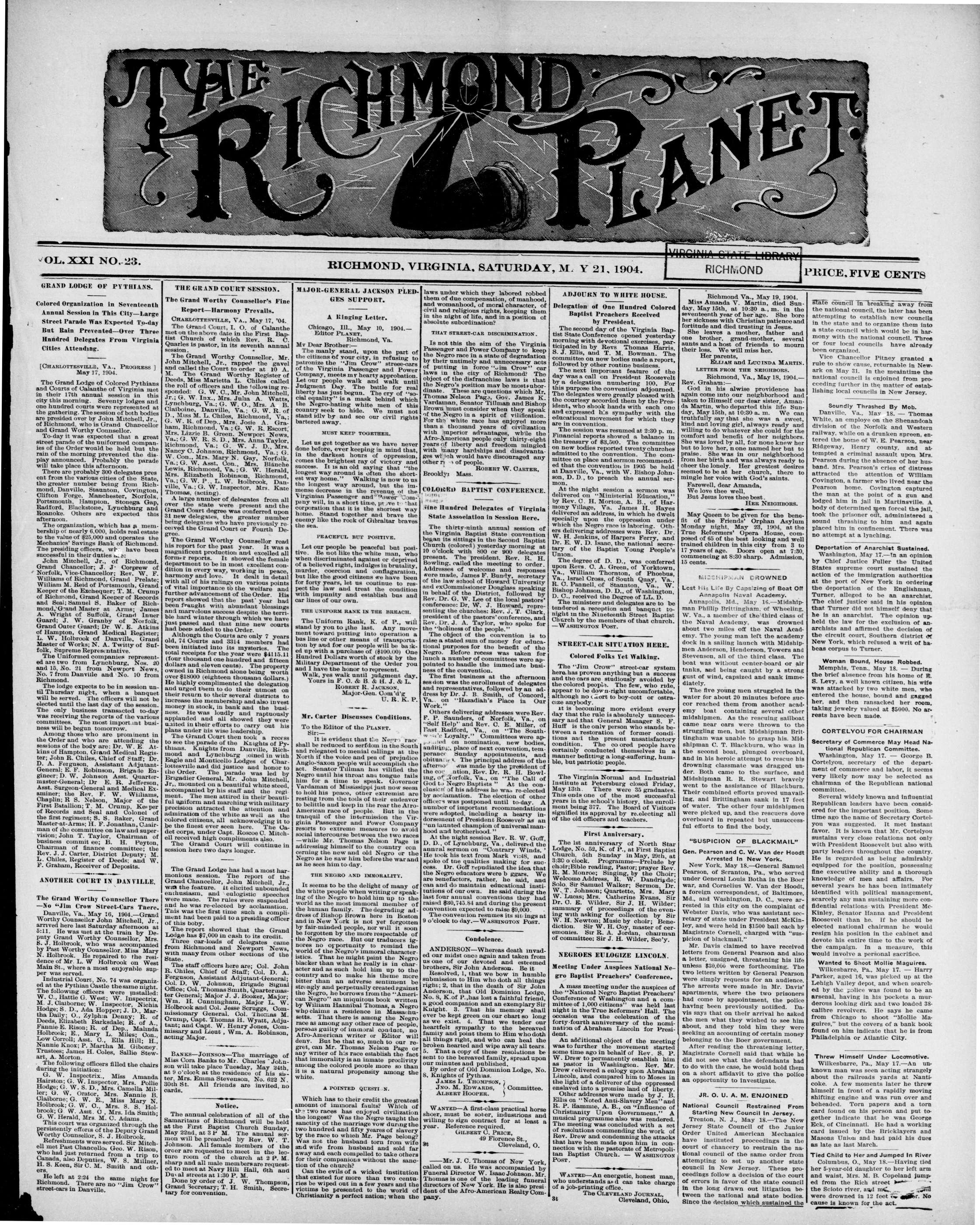
THE RICHMOND PLANET
GRAND LODGE OF PYTHIANS.
Colored Organization in Seventeenth Annual Session in This City—Largest Street Parade Was Expected To-day But Rain Prevented—Over Three Hnndred Delegates From Virginia Cities Attending.
[CHARLOTTESVILLE, VA., PROGRESS ]
May 17, 1904
The Grand Lodge of Colored Pythians and Courts of Calanthe of Virginia met in their 17th annual session in this city this morning. Seventy lodges and one hundred courts were represented at the gathering. The session of both bodies are presided over by John Mitchell, Jr., of Richmond, who is Grand Chancellor and Grand Worthy Counsellor.
To-day it was expected that a great street parade of the uniformed companies of the Order would be held but the rain of the morning prevented the display announced. Probably the parade will take place this afternoon.
There are probably 300 delegates pres ent from the various cities of the State, the greater number being from Richmond, Danville, Staunton, Covington, Clifton Forge, Manchester, Norfolk, Portsmouth, Hampton, Stonega Gap, Radford, Blackstone, Lynchburg and Roanoke. Others are expected this afternoon.
The organization, which has a membership of nearly 6,000, holds real estate to the value of $25,000 and operates the Mechanics' Savings Bank of Richmond. The presiding officers, who have been successful in their duties are: John Mitchell, Jr., of Richmond, Grand Chancellor; J. J. Corprew of Norfolk, Vice-Chancellor; Rev. W. F. Williams of Richmond, Grand Prelate; William M. Reid of Portsmouth, Grand Keeper of the Exchequer; T. M. Crump of Richmond, Grand Keeper of Records and Seal; Samuel S. Baker of Richmond, Grand Master at Arms; James A. Wright of Suffolk, Grand Inner Guard; J. W. Granby of Norfolk, Grand Outer Guard; Dr W. E. Atkins of Hampton, Grand Medical Register; L. W. Holbrook of Danville, Grand Master of Works; N. A. Twitty of Suffolk, Supreme Representative.
The Uniformed companies represented are two from Lynchburg, Nos. 20 and 15, No. 21 from Newport News, No. 7 from Danville and No. 10 from Richmond.
The lodge expects to be in session until Thursday night, when a banquet will be served. The officers will not be elected until that day of the session.
The only business to-day was receiving the reports of the various committees. The most important business will be begun tomorrow.
Among those who are prominent in the Order and who are attending the sessions of the body are: Dr. W. E. Atkins of Hampton, Grand Medical Register; John R. Chiles, Chief of Staff; Dr. D. A. Ferguson, Assistant Adjutant-General; D. E. F. Robinson, Bridegain Engineer; D. W. Johnson Asst. Quartermaster-General; Dr. E. R. Jefferson, Asst. Surgeon-General and Medical Examination; R. S. Reeves, Rev. F. W. Willhams, Chaplin; R. S. Reeves, Major of the First Battalion; T. M. Cummins, Keep of Records and Seal and Colonel the first regiment; S. S. Baker, Grand Master-at-Arms; H. F. Jonathan, Chairman of the committee on law and supervision; John T. Taylor, Chairman of business commit ee; B. H. Peyton, Chairman of finance committee; the Rev. J. J. Carter, District Deputy; M. L. Chiles, Register of Deeds; and W. F. Graham, Receiver of Deposits.
ANOTHER COURT IN DANVILLE.
The Grand Worthy Counsellor There
—No "Jim Crow Street-Cars There,
Danville, Va., May 16, 1904.—Grand
Worthy Counsellor John Mitchell, Jr.,
arrived here last Saturday afternoon at
5:11. He was met at the train by Deputy
Grand Worthy Counsellor Mrs.
S. J. Holbrook, who was accompanied
by Past Worthy Counsellor, Miss Mary
N. Holbrook. He repaired to the residence of Mr. L. W Holbrook on West
Main St., where a most enjoyable supper was served.
Industrial Court, No. 74 was organized at the Pythian Castle the same night.
The following officers were installed:
M. O., Hattie G. West; W. Inspectrix,
M. J., Malborne; W. Inspector, Nichia
Hodge; D. Ada Hopper; J. D., Martha
Daily; D. Zylpha Denny; R. of
Deeds, Elizabeth Barksdale; R. of A,
Fannie E. Rison; R. of Dep., Malinda
Holbrook; E. Mary Ella Hill; H.
Low Corrall; Asst. C., Ella Hill; H.
Nannie Knox; P. Martha M. Giboney.
Trustees; James H. Coles, Sallie Stewart,
A. Morton.
The following officers filled the chairs during the initiation:
G. W. Inspectrix, Miss Amanda Hairson; G. W. Inspector, Mrs. Pollie Hodge; G. W. S. D. Mrs. Camella Miller; G. W. Orator, Mrs. Nannie B Claiborne; G. W. E., Miss Mary N. Holbrook; G. W. O., Mrs. S. H. Holbrook; G. W. Asst. Mrs. Ida Smith; G. W. Herald, Mrs. M. C. Adams.
This court was organized through the persistently efforts of the Deputy Grand Worthy Counselor, S. J. Holbrook.
Refreshments were served. Sir Mitchell met Past Chancellor, Geo. W. Rison, who had just returned from a trip to Canada, also Deputies, W. S. Muller, H. S. Keen, Sir C. M. Smith and others.
He left at 2:24 the same night for Richmond. There are no "Jim Crow" street-cars in Danville.
CHARLOTTESVILLE, VA., May 17, '04.
The Grand Court, I. O. of Calanthe met on the above date in the First Baptist Church of which Rev. R. C. Qaures is pastor, in its seventh annual session.
A large number of delegates from all over the state were present and the Grand Court degree was conferred upon 31 new delegates, the greater number being delegates who have previously received the Grand Court or Fourth Degree.
The Grand Worthy Counsellor read his report for the past year. It was a magnificent production and excelled all form-r reports. It showed the female department to be in most excellent condition in every way, working in peace, comfort and love. It dealt in detail with all of his writings on various points of vital importance to the welfare and further advancement of the Order. His report showed that the year had been fraught with abundant blessings and marvelous success despite the terrible hard winter through which we have just passed and that nine new courts had been added to the Order.
Although the Courts are only 7 years old, 74 Courts and 3314 members had been initiated into its mysteries. The total receipts for the year were $4115.11 (four thousand one hundred and fifteen dollars and eleven cents). The property owned in Richmond alone being worth over $18000 (eighteen thousand dollars). He highly complimented the delegation and urged them to do their utmost on to their several districts to increase the partnership and also invest money in stock, in bank and the business. He was loudly aptly applauded and all showed that they united in their efforts to carry out his plans under his wise leadership.
The Grand Court then took a recess to see the parade of the Knights of Pythians. Knights from Danville, Richmond and Lynchburg ined with Eagle and Monticello Lodges of Charlottesville and did justice and honor to the Order. The parade was led by Brigadier General, Mr. John Mitchell, Jr., mounted on a beautiful white steed, accompanied by his staff and the regiment. The men attired in their beautiful uniform and marching with military precision attracted the attention and admiration of the white as well as the colored citizens, all acknowledging it to be the finest ever seen here. The Oatdet corps, under Capt. Roscoe C. Mitchell received high compliments also.
The Grand Court will continue in session here two days longer.
---
The Grand Lodge has had a most harmonious session. The report of the Grand Chancellor, John Mitchell, Jr., was the feature. It elicited unbounded enthusiasm, and eulogistic speeches were made. The rules were suspended and he was re-elected by acclamation. This was the first time such a compliment had been paid to a presiding officer of this baby. The report showed that the Grand Lodge has $7,000 in cash to its credit.
Grand Lodge has $7,000 in cash to its credit.
Three car-loans of delegates came from Richmond and Newport News, with many from other sections of the State.
The staff officers here are; Col. John R. Chiles, Chief of Staff; Col. D. A. Ferguson, Assistant Adjunct-General; Col. D. W. Johnson, Brigade Signal Office; Col. Thomas Smith, Quartermaster General; Major J. J. Booker, Major; Wm. H. Cunningham, Major L. W. Holbrook and Col. Jesse Scruggs, Commissionary General. Col. Thomas M. Crump, Capt. Thomas H. Wyatt, Adjunct; and Capt. W. Henry Jones, Commissary and Lieut., Wm. A. Robinson, acting Major.
---
BANKS—JOHNSON—The marriage of Miss Cora Banks to Mr. Charles Johnson will take place Tuesday, May 24th, at 9 o'clock at the residence of his sister, Emma Stevenson, No. 622 N. 30th St. All friends are invited, no cards.
Notice.
The annual celebration of all of the Samaritans of Richmond will be held at the First Baptist Church Sunday, May 22nd, at 3 P.M. The annual sermon will be preached by Rev. W. T. Johnson. All female members of the orcer are requested to meet in the lecture room of the church at 2 P.M. M. sharp and all male members are requested to meet at Navy Hill Hall, 6th and Duval streets at 1:30 P.M. Done by order of J. W. Thompson, Grand 3secretary; T. H. Smith, Secretary for convention.
RICHMOND, VIRGINIA, SATURDAY, M. Y 21, 1904.
MAJOR-GENERAL JACKSON PLED GES SUPPORT.
A Ringing Letter.
The manly stand, upon the part of the citizens of your city, in refusing to patronize the "Jim Crow" street-cars of the Virginia Passenger and Power Company, meets my hearty approbation. Let our people walk and walk until August Day. The battle for real liberty has begun. The cry of "social equality" is a rush behind which the Negro-hating white man of the country seeks to hide. We must not stand idly by and see our civil rights bartered away.
MUST KEEP TOGETHER
Let us get together as we have never done before, ever keeping in mind that, in the darkest hours of oppression, comes the brightest ray of victory and success. It is an old saying that "the longest way around is often the shortest way home." Walking is now to us the longest way around, but the immense decrease in the revenue of the Union Passenger and Power Company will be the time, prove that corporation that it is the longest way home. Stand together and brave the enemy like the rock of Gibraltar braves the sea.
PEACEFUL BUT POSITIVE
Let our people be peaceful but positive. Be not like the white man, who when discriminated against or deprived of a believed right, indulges in brutality, murder, coercion and conflagration, but like the good citizens we have been for forty years, let us continue to respect the law and treat the condition with impunity and establish bus and car lines of our own.
THE UNIFORM RANK IN THE BREACH.
The Uniform Rank, K. of P., will stand by you to the last. Any movement toward putting into operation a bus line or other means of transportation by and for our people will be backed up with a purchase of ($100.00). One Hundred Dollars worth of stock by the Military Department of the Order you and I have the honor to represent. Walk, yes walk until judgment day. Yours in F. O. & B. H. J. & L.
Mr. Carter Discusses Conditions.
To the Editor of the PLANET.
Sir:
It is evident that the Negro race shall be reduced to sediment in the South and relegated to mental callings at the North if the voice and pen of prejudice Anglo-Saxon people will accomplish the act. Senator Tullman has vilified the Negro will threat and tongue fails him for a time to speak. Governor Vardaman of Mississippi speaks to hold his peace, other extremist, resting from the toils of their endower to brittle and keep in the rear the Atro-American race of people. But in the tranquil of the intermission the Virginia Passenger and Power Company resorts to extreme measures to avoid social intercourse between the two races
—while Mr. Thomas Nelson Page is addressing himself to the country concurring the new and old Negro or the white man before the war and as he sees him to-day.
THE NEGRO AND IMMORALITY
It seems to be the delight of many of the white people when writing or speaking of the Negro to hold him up to the world as the most immoral member of the human family. The degrading address of Bishop Brown here in Boston and in New York is not yet forgotten by fair-minded people, nor will it soon be forgotten by the more respectable of the Negro race. But our traduces ignores no opportunity to remind the world of the Negro's immoral characteristics. That he might paint the Negro blacker than what he really is in character and as such hold him up to the country and to make his theme more bitter than an adverse sentiment be strongly and perpetually created against the Negro, he borrows from the "American Negro" an iniquitous book written by Hannibal Thomas, a Negro who claims to be residence in Massachusetts. That they among the Negro race as among any other people, persons guilty of immoral conduct, not Afro-American writer or Editor, want. But be that so, much to our regret, can Mr. Thomas Nelson Page or any writer of his race establish the fact that immorality is an inmate proclivity among the colored people more so than it is a natural propensity among the white.
A POINTED QUESTION
Which has to their credit the greatest amount of immoral faults? Which of the two races has enjoyed civilization the longest? Was the Negro taught the sanctity of the marriage vow during the two hundred and fifty years of slavery by the race to which Mr. Page belong? Was not the husband torn from wife and wife from husband and sold far away and each compelled to take others for assistance without the sanction of the church. Can the evils of a wicked institution that existed for more than two centuries be wiped out in a few years and the victims be presented to the world of Christianity a perfect nation; when the
laws under which they labored robbed them of due compensation, of manhood, and womanhood, of moral character, of civil and religious rights, keeping them in the night of life, and in a position of absolute subordination?
THAT STREET-CAR DISCRIMINATION
Is not this the aim of the Virginia Passenger and Power Company to keep the Negro race in a state of degradation by their untimely and unnecessary acts of putting in force "Sim Crow" car laws in the city of Richmond? The object of the disfranchise laws is that the Negro's position may be most subordinate. These are questions which Mr. Thomas Nelson Paga, Gov. James K. Cardaman, Senator Tillman and Bishop Burt must consider when they speak of the Negro in a spirit of vilification. For the white race has enjoyed more than a thousand years of civilization with superior advantages, while the Afro-American people only thirty-eight years of liberty and freedom mingled with many hardships and disadvantages which would have discouraged any other race of people.
ROBERT W. CARTER, Brooklyi Mass.
COLORED BAPTIST CONFERENCE
Gine Hundred Delegates of Virginia State Association in Session Here.
The thirty-ninth annual session of the Virginia Baptist State convention began its sittings in the Second Baptist Church (colored) yesterday morning at 10 o'clock with 800 or 900 present. The president, Rev. R. H. Bowling, called the meeting to order. Addresses of welcome and responses were made, James F. Bundy, secretary of the law school of Howard University, and exCommissioner Douglass speaking in behalf of the District, followed by Rev. Dr. G. W. Lee of the local pastors' conference: Dr. W. J. Howard, representing the churches: Rev. J. T. Clark, president of the pastors' conference, and Rev. Dr. J. A. Taylor, who spoke for the "holiness of the people."
The object of the convention is to raise a stated sum of money for educational purposes for the benefit of the Negro. Before recess was taken for lunch a number of committees were appointed to handle the immediate business of the convention.
The first business at the afternoon session was the enrollment of delegates and representatives, followed by an address by Dr. J. B. Smith, of Concord, Va., on "Hazadiah's Place in Our Work." Others delivering addresses were Rev. F. P. Saunders, of Norfolk, Va., on "Self Help" and Rev. C. E. Miller, of Fast Radford, Va., on "The Southwest Loyalty." Committees were appointed on nomination, new bodies, auditing, place of next convention, temperance Sunday appointments, and obituaries. The principal address of the afternoon was made by the president of the commission, Rev. Dr. R. H. Bowlow, of Norfolk, Va., on "The Call of God to His Repsist." At the conclusion of his address he was re-elected by acclamation. The election of other officers was postponed until today. A number of important recommendations were adopted, including a hearty endorsement of President Roosevelt as an "uninued champion of universal manhood and brotherhood."
At the night session Rev. R. W. Goff, D. D., of Lynchburg, V.A., delivered the annual sermon on "Contrary Winds." He took his text from Mark vi:148, and spoke of the qualities making for success. Dr. Goff repudiated the idea that the Negro educators were b ggars. We are benefactors, rather, he said, and can and do maintain educational institutions of our own. He said during the last four annual conventions they had raised $30,745.84 and during the present convention expected to raise $9,000. The convention resumes its sitings at 8 a.m.
Condolence
ANDERSON—Whereas death invaded our midst once again and taken from us one of our devoted and esteemed brothers, Sir John Anderson. Be it Resolved, 1, that we bow in humble submission to Him who doth all things right; 2, that in the death of Sir John Anderson, that Old Dominion Lodge, No. 8, K of P, has lost a faithful friend, a good companion and an exemplary Sir Knight. 3. That his memory shall ever be kept green on our chart so long as we exist. 4. That we tender our heartfelt sympathy to the bereaved family and point them to Him who doth all things right, and who can heal the broken hearted and wipe away all tears. 5. That a copy of these resolutions be sent to the bereaved family, spread upon our minutes and published.
By order of Old Dominion Lodge, No 8. Knights of Pythias.
JAMES L. THOMPSON,
JNO. M. EDWARDS,
ALBERT HOOPER.
WANTED—A first-class practical horse
shoer, must be sorer, industrious and
willing to sign contract for at least a
year. Reference required.
——Mr. J. C. Thomas of New York, called on us. He was accompanied by Funeral Director W. Isaac Johnson. Mr. Thomas is one of the leading funeral directors of New York. He is also president of the Afro-American Realty Company.
Delegation of One Hundred Colored Baptist Preachers Received by President.
The second day of the Virginia Baptist State Conference opened yesterday morning with devotional exercises, participated in by Revs Thomas Harris, S. J. Ellis, and T. M. Bowman. The committee on new bodies made a report, followed by other routine business.
The next important feature of the day was a call on President Roosevelt by a delegation numbering 100. For this purpose the convention adjourned. The delegates were greatly pleased with the courtesy accorded them by the President, who shook hands with each one expressed his sympathy with the educational movement for which they are in convention.
The session was resumed at 2:30 p. m. Financial reports showed a balance in the treasury of $3,500. The committee on new bodies reported twenty churches admitted to the convention. The committee on place and sermon recommended that the convention in 1905 be held at Danville, Va., with W. Bishop Johnson, D. D., to preach the annual sermon.
At the night session a sermon was delivered on "Ministerial Education," by Rev. C. H. Morton, A. B., of Harmony Village, Va., James H. Hayes delivered an address, in which he dwelt specially upon the oppression under which the Negro race is laboring. Dr. W. H. Jenkins, of Harpers Ferry, and Dr. E. W. D. W. Isaac, the national secretary of the Baptist Young People's Union.
The degree of D. D., was conferred upon Revs. C. O. A. Green, of Yorktown, Va., William Thornton, of Phoebus, Va., Israel Cross, of South Quay, Va., R. C. Pannell, of Staunton, Va., W. Bishop Johnson, D. D., of Washington, D. C., received the Degree of LL. D.
The ministers and delegates are to be tendered a reception and banquet tonight in the Nineteenth Street Baptist Church by the members of that church.
—WASHINGTON Post.
STREET-CAR SITUATION HERE.
Colored Folks Yet Walking.
The "Jim Crow" street-car system here has proven anything but a success and the cars are sturdily avoided by the colored people. The few, who ride, appear to be down-right uncomfortable, although no short to boy-coup or ostracize anybody. it is becoming more evident every day that the rule is absolutely unnecessary and that General Manager S. F. Huff is the only person who stands beheaded for restoration of former conditions and the present unsatisfactory condition. The covered people have certainly conducted themselves in a manner befitting a long-suffering, humble, but patriotic people.
---
The Virginia Normal and Industrial Institute at Petersburg closed Friday, May 13th. There were 35 graduates. This ends one of the most successful years in the school's history, the enrollment being 377. The Board of Visitors signified its approval by reelecting all of the old officers and teachers.
First Anniversary.
The 1st anniversary of North Star Lodge, No. 52, K of P., at first Baptist Church, 5th Sunday in May, 29th, at 3:30 o clock. Programme -Prelude by choir; Bible reading, Pastor; prayer Rev. R. M. Monroe; Singing, by the Choir; Welcome Address, R. W. Dandridge; Solo, Sir Samuel Walker; Sermon, Dr. Johnson; Quartette, Mrs. Mary W. L. Johnson; Catherine Evans, Sir Dr. O. E. Wilder; Sir W. Wilder; summary of proceedings to the singing with asking for collection by Sir W. H. Newton; Music by choir; Benediction. Sir W. H. Coy, master of ceremonies. Sir R. A. Jordan, chairman of committee; Sir J. H. Wilder, See'y.
NEGROES EULOGIZE LINCOLN
Meeting Under Auspices National Negro Baptist Preachers' Conference.
A mass meeting under the auspices of the "National Negro Baptist Preachers' Conference of Washington and a committee of 1,000 citizens" was held last night in the True Reformers' Hall. The occasion was the celebration of the forty-fourth anniversary of the nomination of Abraham Lincoln for President.
An additional object of the meeting was to further the movement started some time ago in behalf of Rev. S. P. W. Drew to permanently establish him as pastor in Washington. Rev. Mr. Drew delivered a eulogy upon Abraham Lincoln, and compared him to Moses in the light of a deliverer of the oppressed enslaved into a promise land of liberty. Other addresses were made by J. B. Ellis on "Noted Anti-Slavery Men" and R. P. Manion, A.B., on "Influence of Christianity upon Government." A musical programme also was rendered. The meeting was concluded with a set of resolutions commending the work of Rev. Drew and condemning the attacks that have been made upon him in connection with the pastorate of Metropolitan Baptist Church. — WASHINGTON POST.
WANTED—An energetic, honest man, who understands as a can take charge of a job-printing office.
The CLEVELAND JOURNAL.
3t Cleveland, Ohio.
Richmond Va., May 19, 1904.
Miss Amanda V. Martin, died Sunday, May 15th, at 10:30 a., m. in the seventeenth year of her age. She bore her sickness with Christian patience and fortitude and died trusting in Jesus.
She leaves a mother, father and one brother, grand-mother, several aunts and a host of friends to mourn their loss. We will miss her.
Her parents,
ELLIAH and LUCINDA MARTIN.
LETTER FROM THE NEIGHBORS.
Richmond, Va., May 18, 1904.—
Rev. Graham:—
God in his alwise providence has again come into our neighborhood and taken to Himself our dear sister, Amanda Martin, who departed this life Sunday. May 15th, at 10:30 a. m. We can truthfully say that she was a sweet, kind and loving girl, always ready and willing to do whatever she could for the comfort and benefit of her neighbors. She was loved by all, for none knew her but to love her, n one named her but to praise. She was in our neighborhood from her birth and was always ready to cheer the lonely. Her greatest desires seemed to be at her church, there to mingle her voice with God's saints. Farewell, dear Amanda,
We love well, the well
May Queen to be given for the benefit of the Friends' Orphan Asylum Monday night, May 23, 1904, at the True Reformers' Opera House, composed of 65 of the best looking and well trained children in this city from 3 to 15 of age. Doors open at 7:30, commencing at 8:30 sharp. Admission, 15 cents.
MISSHIPMAN DROWNED
Leat His Life By Capsizing of Boat Off Annapolis Naval Academy.
Annapolis, Md., May 16.—Midshipman Phillip Brittingham, of Wheeling, W. Va., a member of the third class of the Naval Academy, was drowned about two miles off the Naval Academy. The young man left the academy dock in a sailing launch with Midshipmen Anderson, Henderson, Towers and Stevenson, all of the third class. The boat was without center-board or air tanks, and being caught by a strong gust of wind, capsized and sank immediately.
The five young men struggled in the water for about 20 minutes before succor reached them from another academy boat containing several other midshipmen. As the rescue sailboat came near oars were thrown to the struggling men, but Midshipman Brittingham was unable to grasp his. Midshipman C. T. Blackburn, who was in the second boat, plunged overboard, and in his heroic attempt to rescue his drowning classmate was dragged under. Both came to the surface, and Midshipman R. R. Stewart bravely went to the assistance of Blackburn. Their combined efforts proved unavailing, and Brittingham sank in 17 feet of water. The other four midshipmen were picked up, and the rescuers dove overboard in repeated but unsuccessful efforts to find the body.
"SUSPICION OF BLACKMAIL"
Gen. Pearson and C. W. Van der Hoodt
Arrested In New York.
New York, May 18.—General Samuel Pearson, of Scranton, Pa., who served under General Louis Botha in the Boer war, and Cornelius W. Van der Hood, a foreign correspondent, of Baltimore, Md., and Washington, D. C., were arrested in this city on the complaint of Webster Davis, who was assistant secretary of state under President McKinley, and were held in $1500 bail each by Magistrate Cornell, charged with "suspicion of blackmail."
Mr. Davis claimed to have received letters from General Pearson and also a letter, unsigned, threatening his life unless $30,000 were forthcoming. The two letters written by General Pearson were simply requests for an audience. The arrests were made in Mr. Davis' apartments, where the two prisoners had come by appointment, the police having been previously notified. Davis says that on their arrival he asked the men what they wished to see him about, and they told him they were seeking an accounting of certain money belonging to the Boer government.
After reading the threatening letter, Magistrate Cornell said that while he did not see what the defendants had to do with the case, he would hold them on a short affidavit to give the police an opportunity to investigate.
JR. O. U. A. M. ENJOINED
National Council Restrained From Starting New Council in Jersey
Starting New Council in Jersey.
Trenton, N. J., May 18.—The New Jersey State Council of the Junior Order United American Mechanics have instituted proceedings in the court of chancery to restrain the national council of the same order from attempting to set up another state council in New Jersey. These proceedings follow a decision of the court of errors in favor of the state council in the long drawn out litigation between the national and state bodies.
Since the decision which sustained the
state council in breaking away from the national council, the later has been attempting to establish new councils in the state and to organize them into a state council which would be in harmony with the national council. Three or four local councils have already been organized. Vice Chancellor Pitney granted a rule to show cause, returnable in Newark on May 31. In the mealtime the national council is enjoined from proceeding further in the matter of establishing local councils in New Jersey.
Soundly Thrashed By Moh
Danville, Va., May 18. — Thomas White, an employee on the Shenandoah division of the Norfolk and Western railway, while on a drunken spree, entered the home of W. E. Pearson, near Ridgeway, Henry county, and attempted a criminal assault upon Mrs. Pearson during the absence of her husband. Mrs. Pearson's cries of distress attracted the attention of William Covington, a farmer who lived near the Pearson home. Covington captured the man at the point of a gun and lodged him in jail in Martinsville. A body of determined men forcec the jail, took the prisoner out, administered a sound thrashing to him and again placed him in confinement. There was no attempt at a lynching.
Deportation of Anarchist Sustained.
Washington, May 17.—In an opinion by Chief Justice Fuller the United States supreme court sustained the action of the immigration authorities at the port of New York in ordering the deportation of the Englishman, Turner, alleged to be an anarchist. The chief justice said in his opinion that Turner did not himself deny that he is an anarchist. The opinion upheld the law for the exclusion of anarchists and affirmed the decision of the circuit court, Southern district of New York, which refused a writ of habeas corpus to Turner.
Woman Bound. House Robbed
Memphis, Tenn. May 18. — During the brief absence from his home of E. S. Levy, a well known citizen, his wife was attacked by two white men, who entered the house, bound and gagged her, and then ransacked her room, taking jewelry valued at $5000. No arrests have been made.
CORTELYOU FOR CHAIRMAN
Secretary of Commerce May Head National Republican Committee.
Washington, May 17. — George B. Cortelyou, secretary of the department of commerce and labor, it seems very likely now may be selected as chairman of the Republican national committee.
Several widely known and influential Republican leaders have been considered for the important position. Some time ago the name of Secretary Cortelyou was suggested. It met instant favor. It is known that Mr. Cortelyou sustains very close relations not only with President Roosevelt but also with party leaders throughout the country. He is regarded as being admirably equipped for the position, possessing fine executive ability and a thorough knowledge of men and affairs. For several years he has been intimately identified with political management, scarcely any man sustaining more confidential relations with President McKinley, Senator Hanna and President Roosevelt than he. If he should be elected national chairman he would resign his position in the cabinet and devote his entire time to the work of the campaign. In a measure, this would involve a personal sacrifice.
Wilkesbarre, Pa., May 17. — Harry Parker, aged 16, was picked up at the Lehigh Valley depot, and when searched by the police was found to be an arsenal, having in his pockets a murderous looking dirk and two loaded 38-calibre revolvers. He says he came from Chicago to shoot "Mollie Maguires," but the covers of a bank book found on him indicate that he is from Philadelphia or Atlantic City.
Threw Himself Under Locomotive.
Wilkesbarre, Pa., May 17.—An unknown man was seen acting strangely about the railroads yards at Nanticoke. A few moments later he threw himself in front of a rapidly moving shifting engine and was run over and beheaded. Torn papers and a torn card found on his person and put together indicate that he was George Eck, of Cincinnati. He had a working card issued by the Bricklayers and Masons Union and had paid his dues as late as last March.
Tied Child to Her and Jumped In River
Columbus, O., May 18.—Having tied her 5-year-old daughter to her left arm and waist, Mrs. M. B. Copeland jumped from the Rich street the Scioto river, and me were drowned in 12 feet of water. No cause is known for the act.
BE FIRELET
SATURDAY ..... MAY 21, 1904
BILLY AND L
They say they are going to shoot you, Old Billy, but don't you fret,
For the fellow who dares to meddle with you must reckon with me, you bet;
You're a poor old horse, Old Billy, and you worth much, it is true;
But you're beating them and
But you've been a faithful friend to me, and I'll see you safely through.
Shoot Old Billy? I guess not, though you may be old and gray;
If they had more pity for horses and dogs, they'd have more love for man.
That's right, Old Billy, I like it—your muzzle against my face;
We've had rattling times together, and once we won the race-
those we won the race:
Do you remember it early, the dude that
we downed that day?
And the way he swore, that an old farm-
horse should show his trotter the way?
Well, Billy, we're both great simmons, for
we've both grown old, you know.
And we've only a little further adown the
road to go;
So we'll fare along together till the Master calls us home
To the happy Home-Land stabber, and our feet forget to roam.
They tell us that horses have no souls, and they all declare it true;
That shows how little they know, Old Boy, and it proves they don't know you;
Well, well, 'tis a mighty question, and quite beyond my ken—
But the more I know of horses like you, the less I bring about men.
You've been a good horse, Old Fellow, steady and brave and true;
You have given us faithful service—done that a horse could do;
You have given us keep; you shall have it; so live as long as you do;
For justice is justice, and right is right, whether it's a horse or man.
-J. S. Cutler, in Boston Transcript
A Leap-Year Occurrence
BY CABOL O. RICHMOND
HER friends thought it high time that Miss Patterson married, though she had times without number pointed out to them that such was not her manifest destiny. Having turned 40, more or less, her contemporaries had all tasted marital bliss once or twice, a few even more, and some with a divorce or two left in the trail. The latter reached the conclusion that she was having too easy a time, living too selfish a life—those happily married wished to see her as blessed as themselves, so one and all set about giving her advice.
"It is your bounden duty," they agreed.
"You really think so?" she asked, doubtfully. Miss Patterson's was a serious nature, and duty she held as the highest responsibility of life. To shirk one's manifest duty was indeed to fall short. "Twas in a vital spot, then, that the argument caught her. She put it at arms' length a moment, then met it manfully and yielded. "But nobody seems to want me," she told them frankly.
She was quickly overruled by the announcement that as it was leap year, she must take the initiative. They made no doubt that she was too unapproachable; no man, they argued, dared to risk his proposal in the face of a palpable refusal, and they were sure she froze any attempt at sentiment on the lips of a would-be wooer; surely most any marriageable man of her acquaintance would jump at the chance of getting her.
"YOU ARE VERY BUSY THIS MORNING?"
Thus they forced her with sweet words which found a resting place, and above all shone the magic word of "Duty."
Casting about in her mind as to whom she could offer herself without doing violence to her feelings, the lot fell upon a gentleman of the legal profession, having had a long standing acquaintance with him, he being well up toward the half century of life. Acting promptly upon her decision, lest it cool with age, she hastened to don her most becoming walking costume and salienced forth.
Glowing with animation, and entering with zeal into the enterprise, now that she had fully undertaken it, Miss Patterson presented herself at the office of "Graham Bros., attorneys at law." Mr. Horace Graham, the gentleman she sought, was engaged; would she wait? This was a slight damper, however she decided on waiting, endeavoring to keep herself up to concert pitch the while. But during the interval several things happened which disconcerted her, and slowly she slipped to the level of common life. By the time she was summoned to the "private office" the tone had been eliminated from her errand, and she trailed in with all her push gone. "Why, Miss Patterson, this is indeed a pleasure! Have a seat. What can I do for you?"
This cordial greeting rather restored her nerve, but she could not "screw her courage to the sticking point," so she procrastinated.
"You are very busy, this morning?" Evasively.
"I am at your service so long as you wish my attention. You called to see me on business?" "Yes—and no—that is, it could not be termed strictly business, and yet it is in a way. But on second thoughts, I think I could talk better with you at home, so if you will call some evening this week, I feel a need if I might broach the matter more—more." She foundered for the right word; she was beginning to be a bit phased by the situation.
"Oh, well, all right," he said, cheerily, for, truth to tell; he was expecting a very important client, who was due that very minute. "Say to-morrow evening; will that do?" It suited him very well to call on her as he thoroughly enjoyed an hour with Ina Patterson, who was both bright and clever. And thus it was settled.
Ina was relieved when, next evening arrived, to find that all the family were going out, for though she stuck manfully to her purpose, she had to acknowledge a slight nervousness which could not be fought off.
As the electric bell whirred sharply she gave an involuntary start, then opened the door herself, and ushered in Mr. Graham. She hovered around him while he divested himself of overcoat and hat, afterward she took him to the library, all the time in an inward flutter as to how the momentous question was to be put. They were comfortably settled, talking generalities, when Miss Patterson suddenly paused—they were drifting farther and farther from her point. She pulled herself together and made a plunge.
"Mr. Graham, you have known me a long time; do you like me?" "Immensely; you and I always get on swimmingly. Now tell me what it is you want." He came forward and took her hand.
"You know it is leap year?" with shy hesitation; it was not so easy, after all. "Y-e-s," he dropped her hand and sat down abruptly.
"Well," she began, in a now-or-never tone of voice, "I have decided to ask you to marry me; will you?" "Ina—Miss Patterson, you are surely joking?"
"No," with a decided shake of the head.
"But—I—I—am sure we are not at all suited to each other. I had no idea you thought of me in that way."
"I didn't; it all came about suddenly, unexpectedly. Of course, you know my circumstances. I have enough to support myself, but my income can go no further. You are aware of just how much my father left me. I think if a woman proposes, she ought at least to be able to support a husband, don't you?" He laughed, in spite of his discomfiture. "I'm awfully sorry, but it is out of the question. I am a crabbed old bachelor, and so set in my ways I would spoil your life. You deserve a better fate."
"You refuse, then?" Eagerly. One would have thought that she had been reprieved from instant death.
"I must decline; though, believe me, I am sensible of the great honor you have done me in wanting to marry me."
"Oh, but I didn't! I didn't!" With startling animation. "Don't apologize, please. I am so relieved. They can't say I shirked, anyway." "But I do not understand," rather stifly. This was a distinct slap at his vanity, and he felt a trifle miffed, to say the least. "I will endeavor to explain," which she did, winding up with: "And I could think of no one else in the whole range of my acquaintances whom I could enclose in the light of a husband." This sort of relieved his complacency. "If you had accepted me I should have tried to do my duty, but I am so glad you didn't!" she added, with a rush, as if fearful lest he change his mind. "Now, let me sing you something, and we will forget there is such a thing as matrimony." With a gay laugh, as she seated herself at the piano.
Strange to say, after that Horace Graham could not get Ina Patterson out of his thoughts. Her face would rise insistently between him and his work. He kept looking back to that memorable evening; every time he saw her she seemed to take on some new charm—until at last he came to realize he wanted her badly. Her proposal had thrown him out of his rut. And then her frank avowal that she did not want him, kindled a slow fire within which had risen to a fierce blaze of desire. And she, all unconscious of the storm she had raised. Of what use now his cry: What a fool he had been to refuse her? In the spring he was elected judge, but how worthless all his honors seemed without her to share them.
About six months after Ina Patterson received an offer of marriage from Judge Graham, together with a passionate declaration of love and the hope that time might have inclined her affections toward him.
It was a novel position. A tidal wave of inclination swept over her; she reviewed the situation and rendered the decision in his favor.
DOLLS BY THE THOUSAND
Bewildering Array of Them Displayed as Samples in Toy Store— No Two Alike.
The adjective bewildering might properly be used to describe the array of dolls displayed as samples in a toy importing house.
Great assortments of dolls are to be found in more than one large retail store, but here is an entire floor of a building given up -wholly to dolls. There is to be seen nothing but dolls.
From one end to the other of this long floor run lines of counters, each with a rack over it. And ranged along as close together as they can be placed on the counters and racks are dolls.
There are thousands of dolls and no two are alike, for these do not constitute the concern's stock of dolls, but its doll samples. There are jointed dolls four feet long, and jointed dolls half an inch in length.
It All Depends.
"Did she make a good marriage?"
"That depends on whether you figure
by years or dollars. He's 60 and rich."—
Chicago Post.
THE RICHMOND PLANET, RICHMOND, VIRGINIA
DISASTER ALWAYS OVERTOOK ITS ILL-FATED POSSESSOR.
Columbian Half Dollar Conclusively Proves Itself a Harbinger of Ill —Question Is "Where Is the Jonah Now?"
Who has it?
If you possess a Columbian half dollar, if you have been carefully pocketing it as a souvenir and can look back over a trail of inconceivable hard luck, then rid yourself of the coin and witness your rise into a normal condition of life. For in its time—and the story told in the New York Times is backed by the words of men who know—it has killed the hopes of many men and destroyed the lives of at least two.
There is in this tale no fabric of superstition. Facts do not deceive. To "see with one's own eyes" is to know. The writer is one who has suffered.
In 1892 there had been a little game in a little club in the city of Pittsburg. "Charley" Mcswiggan, until recently press representative of the Carnegie Steel corporation, invariably took a hand. For weeks he was invincible. Nightly did he clean the table, stake his friends with car fare, and then bolt for an all-night conveyance to his suburban home. In time Mcswiggan's affluence induced him to journey east for a rest. He came to New York. It was during the year preceding the Chicago fair. One day, when passing the subtreasury, he entered and availed himself of a shining Columbian half dollar. Mcswiggan's dairy shows that from that minute his god of good fortune deserted him. He went to the Sheepshead track. The "bookies" hit him hard. He rode on a Broadway car, and a pick-pocket pumped him dry. He boarded a train for Pittsburg with a railroad ticket, a pain racking hanger, and his Columbian half dollar.
The "boys" were glad to have McSwiggan return, but sorry to learn that he had left all his money in the metropolis. While he had been away they had been preparing for a vigorous attack. They had to wait several weeks, however, until he pulled himself together. Then he "sat in." McSwiggan was now the "casiest money" they had ever known. He
JUSTICE
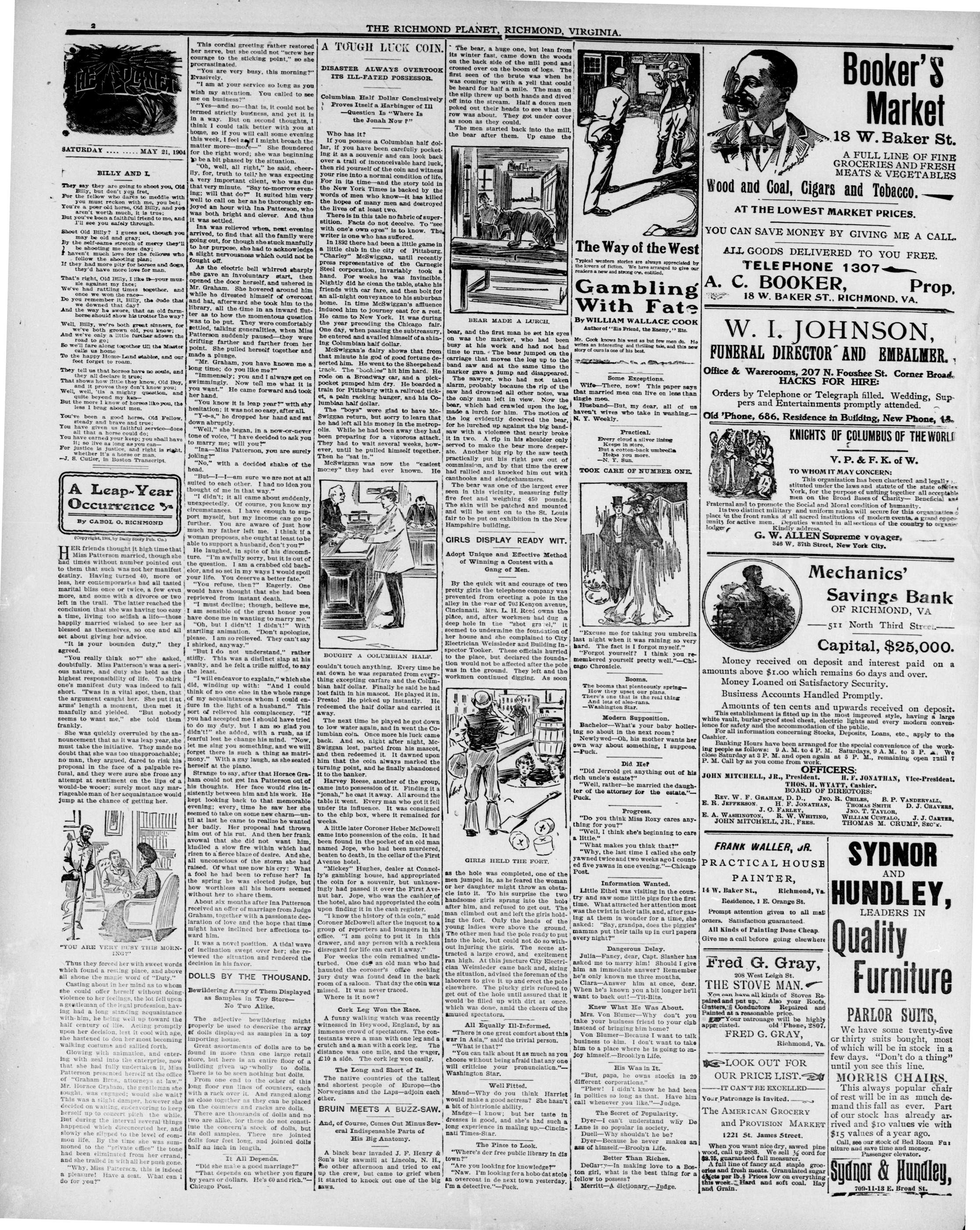
BOUGHT A COLUMBIAN HALF.
couldn't touch anything. Every time he sat down he was separated from everything except carfare and the Columbian half dollar. Finally he said he had lost faith in his mascot. He played it in. Prestol He picked up instantly. He redeemed the half dollar and carried it away.
The next time he played he got down to low water again, and in went the Columbian coin. Once more his luck came back. And so, night after night, McSwiggan lost, parted from his mascot, and then redeemed it. It dawned upon him that the coin always marked the turning point, and he finally abandoned it to the banker.
Harvey Reese, another of the group, came into possession of it. Finding it a "jonah," he cast it away. All around the table it went. Every man who got it fell under its influence. It was consigned to the chip box, where it remained for weeks.
A little later Coroner Heber McDowell came into possession of the coin. It had been found in the pocket of an old man named Jope, who had been murdered, beaten to death, in the cellar of the First Avenue hotel.
"Mickey" Hughes, dealer at Connolly's gambling house, had appropriated the coin for a souvenir, but unknowingly had passed it over the First Avenue bar. Jope, who was the cashier of the hotel, also had appropriated the coin upon finding it in the cash register.
"I know the history of this coin," said Coroner McDowell after the inquest to a group of reporters and loungers in his office. "I am going to put it in this drawer, and any person with a reckless disregard for life can cart it away."
For weeks the coin remained undisturbed. One day an old man who had haunted the coroner's office seeking jury duty was found dead in the back room of a saloon. That day the coin was missed. It was never traced.
Where is it now?
Cork Leg Won the Race
A funny walking watch was recently witnessed in Heywood, England, by an immense crowd of spectators. The contestants were a man with one leg and a crutch and a man with a cork leg. The distance was one mile, and the wager, £10 a side. The cork leg won easily.
The Long and Short of It
The native countries of the tallest and shortest people of Europe-the Norwegians and the Laps-adjoin each other. BRUIN MEETS A BUZZ-SAW.
A black bear invaded J. F. Henry & Son's big sawmill at Lincoln, N. H. the other afternoon and tried to eat up the crew, but came to grief when it started to knock out one of the big saws.
The bear, a huge one, but lean from its winter fast, came down the woods on the back side of the mill pond and crossed over on the boom of logs. The first seen of the brute was when he was coming up with a yell that could be heard for half a mile. The man on the slip threw up both hands and dived off into the stream. Half a dozen men poked out their heads to see what the row was about. They got under cover as soon as they could. The men started back into the mill, the bear after them. Up came the
A man and a bear on a table.
BEAR MADE A LURCH.
bear, and the first man he set his eyes on was the marker, who had been busy at his work and had not had time to run. The bear jumped on the carriage that moves the log up to the band saw and at the same time the marker gave a jump and disappeared.
The sawyer, who had not taken alarm, probably because the rip of the saw had drowned all other noise, was the only man left in view. Now the bear, which had crawled upon the log, made a lurch for him. The motion of the log evidently deceived the bear, for he lurched up against the big band-saw with a violence that nearly broke it in two. A rip in his shoulder only served to make the bear more desperate. Another big rip by the saw teeth practically put his right paw out of commission, and by that time the crew had rallied and knocked him out with canthooks and sledgehammers.
The bear was one of the largest ever seen in this vicinity, measuring fully five feet and weighing 450 pounds. The skin will be patched and mounted and will be sent on to the St. Louis fair to be put on exhibition in the New Hampshire building.
GIRLS DISPLAY READY WIT.
Adopt Unique and Effective Method of Winning a Contest with a Gang of Men.
By the quick wit and courage of two pretty girls the telephone company was prevented from erecting a pole in the alley in the rear of 703 Kenyon avenue, Cincinnati. Mrs. L. H. Reed owns the place, and, after workmen had dug a deep hole in the "shot gravel," it seemed to undermine the foundation of her house and she complained to City Electrician Weissleder and Building Inspector Tooker. These officials hurried to the place, but declared the foundation would not be affected after the pole was in the ground. They left and the workmen continued digging. As soon
GIRLS HELD THE FORT
as the hole was completed, one of the men jumped in, as he feared the woman or her daughter might throw an obstacle into it. To his surprise the two handsome girls sprang into the hole after him, and refused to get out. The man climbed out and left the girls holding the fort. Only the heads of the young ladies were above the ground. The other men had the pole ready to put into the hole, but could not do so without injuring the girls. The scene attracted a large crowd, and excitement ran high. At this juncture City Electricalian Weissleder came back and, sizing the situation, advised the foreman of the laborers to give it up and erect the pole elsewhere. The plucky girls refused to get out of the hole until assured that it would be filled up with dirt at once, which was done, amid the cheers of the amused spectators.
All EQUALLY Ill-Informed
"There is one great comfort about this war in Asia," said the trivial person.
"What is that?"
"You can talk about it as much as you choose without being afraid that any one will criticise your pronunciation."—Washington Star.
Well Fitted.
Maud—Why do you think Harriet would make a good actress? She hasn't a bit of histrionic ability.
Madge—I know; but her taste in dresses is good, and she's had such a long experience in making up—Cincinnati Times-Star.
The Place to Look.
"Are you looking for knowledge?"
"Naw. I'm looking fer a hobo dutole
an overcoat in de next town yesterday.
I'm a detective."—Puck.
CRUN
Typical western stories are always appreciated by
readers. They have arranged to give our
readers a more and strong sense of the story.
Gambling With Fate
By WILLIAM WALLACE COOK
Author of "His Friend, the Enemy," Ete.
Mr. Cook knows his west as but few men do. He
writes an interesting and thrilling tale, and this new
story of curs is one of his best.
Wife—There, now! This paper says that married men can live on less than single men.
Husband—But, my dear, all of us haven't wives who take in washing.—N. Y. Weekly.
Practical.
Every cloud a silver lining
Keeps in store.
But a cotton-back umbrella
Hebs you more.
—N. Y. Sun.
TOOK CARE OF NUMBER ONE.
"Excuse me for taking you umbrella last night when it was raining so very hard. The fact is I forgot myself."
"Forgot yourself? I think you remembered yourself pretty well."—Chicago Chronicle.
Booms.
The booms that plenteously spring—
How they upset our plans.
There's one that is the real thing
And lots of also-rans.
—Washington Star.
Modern Supposition.
Bachelor—What's your baby holler-
ing so about in the next room?
Newlywed—Oh, his mother wants her
own way about something, I suppose.
—Puck.
Did He?
Did He?
"Did Jerrold get anything out of his rich uncle's estate?"
"Well, rather—he married the daughter of the attorney for the estate."—Puck.
Progress.
"Do you think Miss Roxy cares anything for you?" "Well, I think she's beginning to care a little."
"What makes you think that?"
"I will think later."
"Why, the last time I called she only yawned twice and two weeks ago I counted five yawns in one evening."—Chicago Post.
Information Wanted
Little Ethel was visiting in the country and saw some little pigs for the first time. What attracted her attention most was the twist in their tails, and after gazing at them in wonder for a time, she asked: "Say, grandpa, does the piggies' mamma put their tails up in curl papers every night?"
Dangerous Delay.
Julia—Fancy, dear, Capt. Slasher has asked me to marry him! Should I give him an immediate answer? Remember he's only known me three months. Clara—Answer him at once, dear. When he's known you a bit longer he'll want to back out!—Tit-Bits.
Knew What He Was About.
Mrs. Von Blumer—Why don't you take your business friend to your club instead of bringing him home?
Von Blumer—Because I want to talk business to him. I don't want to take him to a place where he is going to enjoy himself—Brooklyn Life.
His Was in It.
"But, papa, he owns stocks in 20 different corporations."
"Phew! I didn't know he had been in politics so long as that. Have him call whenever you like."—Judge.
The Secret of Popularity.
Dyer—I can't understand why De Lane is so popular in society.
Duell—Why shouldn't he be?
Dyer—Because he never makes an ass of himself—Broolyn Life.
Better Than Riches.
DeGarry—In making love to a Boston girl, what is the best thing for a fellow to possess?
Merritt—A dictionary.—Judge.
Booker'S Market
18 W. Baker St. A FULL LINE OF FINE GROCERIES AND FRESH MEATS & VEGETABLES Wood and Coal, Cigars and Tobacco.
s and Tobacco.
MARKET PRICES.
BY GIVING ME A CALL.
REED TO YOU FREE.
E 1307
R, Prop.
T., RICHMOND, VA.
JHNSON,
R AND EMBALMER.
N. Foushee St. Corner Broad.
FOR HIRE:
Legraph filled. Wedding, Supp
ents promptly attended.
in Building, New Phone, 18.
OF COLUMBUS OF THE WORLD
V. P. & F. K. of W.
AT THE LOWEST MARKET PRICES. YOU CAN SAVE MONEY BY GIVING ME A CALL.
A. C. BOOKER, Prop. 18 W. BAKER ST., RICHMOND, VA.
W. I. JOHNSON, FUNERAL DIRECTOR AND EMBALMER.
Office & Warerooms, 207 N. Foushee St. Corner Broad HACKS FOR HIRE:
Orders by Telephone or Telegraph filled. Wedding, Suppers and Entertainments promptly attended.
Old 'Phone, 686. Residence in Building, New Phone, 48.
KNICHTS OF COLUMBUS OF THE WORLD
TO WHOM IT MAY CONCERN:
This organization has been chartered and legally instituted under the laws and statute of the state of York, for the purpose of uniting together all acceptable men on the Broad Bases of Charity—Beneficial as the Social and Moral condition of humanity. and uniform ranks will secure for this organization all sacred institutions of modern events, a grand oppose deputies wanted in all sections of the country to organically address.
This organization has been chartered and legally
stituted under the laws and statute of the state of
Washington, for the purpose of uniting together all acceptable
means of communication. Beneficial to the
Social and Moral condition of immigrants.
It two distinct military and uniform ranks will secure for this organization a place in the front ranks of all sacred institutions of modern events, a grand opportunity for active men. Deputies wanted in all sections of the country to organize lodges. Kindly address.
G. W. ALLEN Supreme voyager,
346 W. 87th Street, New York City.
mechanics'
Savings Bank
OF RICHMOND, VA
511 North Third Street.
capital, $25,000.
osit and interest paid on a
remains 60 days and over.
factory Security.
led Promptly.
upwards received on deposit.
the most improved style, having a large
electric lights and every modern conven-
tions, Deposits, Loans, etc., apply to the
for the special convenience of the work-
I. Saturdays, 9 A. M. to 3 P. M.
We at 5 P. M., remaining open until 7
CERS:
H. F. JONATHAN, Vice-President.
WATT, Cashier.
DIRECTORS:
D. R. CHILES, B. P. VANDERVALL,
THOMAS SMITH D. J. CHAVERS,
JNO. T. TAYLOR.
Money received on deposit and interest paid on a amounts above $1.00 which remains 60 days and over.
Money Loaned on Satisfactory Security.
Business Accounts Handled Promptly.
Amounts of ten cents and upwards received on deposit.
This establishment is fitted up in the most improved style, having a large white vault, burlar-proof steel chest, electric lights and every modern convenience for safety and the accommodation of the public.
For all information concerning Stocks, Deposits, Loans, etc., apply to the Cashier.
Banking Hours have been arranged for the special convenience of the working people as follows: 9 A. M. to 4 P. M. Saturday, 9 A. M. to 3 P. M. We close Saturday at 3 P. M. and open again at 5 P. M., remaining open until 7 P. M. Call by as you come from work.
OFFICERS
JOHN MITCHELL, JR., President. H. F. JONATHAN, Vice-President. THOS. H. WYATT, Cashier. BOARD OF DIRECTORS: REV. W. F. GRAHAM, D. D., JNO. R. CHILES, B. P. VANDERVALL, E. R. JEFFERSON. H. F. JONATHAN, THOMAS SMITH D. J. CHAVERS, J. O. FARLEY, JNO. T. TAYLOR, E. A. WASHINGTON, R. W. WHITING, WILLIAM CUSTALO, J. J. CARTER, JOHN MITCHELL, JR., FRES. THOMAS M. CRUMP, SECY.
SYDNOR AND HUNDLEY, LEADERS IN Quality Furniture
We have some twenty-five or thirty suits bought, most of which will be in stock in a few days. "Don't do a thing" until you see this line.
MORRIS CHAIRS.
This always popular chair of rest will be in as much demand this fall as ever. Part of our stock has already arrived and $10 values vie with $15 values of a year ago.
Call, 888 our stock of Bed Room For
niture and save time and money.
Passenger elevator.
Sydnor & Hundley,
709-11-13 E. Broad St.
C. W. H.
B
A
E. A. WASHINGTON, R. W. WHITING,
JOHN MITCHELL, JR., FRES.
FRANK WALLER, JR.
PRACTICAL HOUSE
PAINTER.
14 W. Baker St., Richmond, Va.
Residence, 1 E. Orange St.
Prompt attention given to all mail
orders. Satisfaction guaranteed.
All Kinds of Painting Done Cheap.
Give me a call before going elsewhere
Fred G. Gray.
Fred G. Gray.
Your patronage will be highly
appreciated.
old Phone: 2807.
FRED G. GRAY,
Richmond, Va.
LOOK OUT FOR
OUR PRICE LIST.
The AMERICAN GROCERY and PROVISION MARKET
1221 St. James Street.
When you want nice dry, sawed pine wood, call up 2888. We sell $1/2 cord for $9.75, guaranteed full measurer.
A full line of fancy and staple groceries and fresh meats. Granulated sugar $4/6 per lb. Prices low on everything this week. Hard and soft coal. Hay and Grain.
GAMBLING WITH FATE
Author of "The Gold Gleaners: A Story of the Cyanide Tanks," "Wilby's Dan," "His Friend the Enemy," "Rogers of Butte," Etc. Etc.
CHAPTER I
DARREL RIDES TO SANDY BAR.
When-Nate Darrel went to Sandy Bar he knew he took his life in his hand. Murgatroyd was there and Murgatroyd had sworn to shoot him on sight.
The element of chance, however, entered intimately into every act of Darrel's career. It was guile, counselor and friend for him and formed the basis of his rule of conduct.
Never since he could remember had he wavered between the Known and the Unknown. Luck was the single known factor in his equation and he yielded himself blindly into the hands of fate, always expecting good fortune yet always prepared for the worst.
The feud between Murgatroyd and himself was bitter and of long standing; and Darrel, while caring nothing for bridges in front, was careful to burn those behind. An enemy in the rear is a foe in ambush and it was well that this Murgatroyd affair should be settled once for all.
Thus Darrel reasoned. After studying the aspect of his bright particular star he took team and buckboard, one fine morning, and traveled out of Anaconda by the Blackfoot trail.
Anaconda knew little of the astute, gentlemanly and well dressed young man. He had been in town over night and had essayed a game in the "Colonel's Own," causing a ripple of excitement by showing a discard of two aces and drawing a pair of knaves that "filled" his hand and won him the table stakes.
"It's foolish to tempt fate in that way," said a veteran blackleg who stood near watching the play.
"We make our own fate, my friend," replied Darrel in the easy, well bred way that was always his; "it is not fate that makes or mars us. Be trucient and apprehensive and destiny turns and reads you; lay hold of it with your bare hands and you make it your slave. Fortune crawls at the feet of a daring man but hates and spurs a coward."
The habitues of the "Colonel's Own" listened wonderingly. Such philosophy was over the heads of most of them, but the veteran blackleg was impressed.
"I have heard of but one man," said he "who invariably discards aces when he gets a pair. That man is Nate Darrel of San Francisco."
The veteran might have added that the play was known as "Darrel's discard;" and that the man who had originated it had quit college to follow the cards and prove his startling theories—a philosopher of the devils picture books, courting ruin over the green cloth that he might work out a hypothesis of doubtful value.
Darrel had no intention of revealing himself. He was tarrying at Anaconda enroute to Sandy Bar and when his eccentric orbit crossed Murgatroyd's he wished it to be sudden and unexpected.
It chanced, nevertheless, that Darrel had overplayed his hand. That night the veteran gambler dispatched a mounted man to Sandy Bar with a notice to his friend Murgatroyd that Nate Darrel was in Anaconda and possibly would continue on to the mining camp.
When Darrel drew in his team of bronchos at the Half Way House, the hour was high noon. The team was given into the hands of the hostler and Darrel went into the house for his dinner.
This halting place was midway between Anaconda and Sandy Bar. East and west trails also crossed at this point leading to mining regions farther back in the hills.
There was much travel along the trails and it was common report that the Half Way House was the biggest gold mine in those parts. So it happened that the dining room was comfortably filled when the Chinese waiter ushered Darrel to a vacant chair at a side table.
The newcomer was eyed with suspicion. In the eyes of the rough and ready crowd already there he was too well dressed, too "pretty" and defied the laws of convenience by making a distinction in his use of knife and fork.
Then, too, his voice was too soft and his language too precise. These evidences of superiority rankled under the greasy blue shirts affected by the miners and freighters.
Before Darrel's entrance another had been looked at askance. This other was a white-faced man in corduroys with "easterner" and "tenderfoot" written large in person and manner.
His reserve was stretched to the point of timidity and before he had used plate, knife and fork he had surreptitiously wiped them on the edge of the table cloth.
That of itself was an insult which might have resulted in gun-play had the proprietor been a witness. The stranger was slender, like Darrel, had the same dark eyes and closely cropped hair and was near the same height. His face was smooth, however, while Darrel had a neatly trimmed full beard. There was something about the stranger that held Darrel's eye. A man in Darrel's peculiar line is perforce a reader of character. After a little study over the bacon, beans, coffee and sour dough bread, Darrel concluded that the gentleman in corduroys had been driven west under the spur of conscience. Possibly his absence had left an unprofitable void in some eastern bank, or other financial institution.
The coming of Darrel caused general attention to withdraw itself from the tenderfoot and focus upon him. Yet, although his superiority was manifest, every man in the room knew that the second stranger was not a raw
Fecruit in the ranks of the frontier.
Finishing his meal under a running fire of half veiled sneers and covert jests, Darrel calmly rose and went out. "Goin' south?" asked the proprietor, withdrawing his attention from a Mexican hag who, for four bits, was reading an old deck of cards for a prospector and telling him where he would best go to strike a paying lead.
Darrel nodded as he settled his bill. "Mebby you'd like to help out a fellow human who's down on his luck?" proceeded the proprietor tenta-
A man is sitting at a desk, looking at a man standing in a doorway. The man is wearing a hat and a suit. There are scattered objects on the floor.
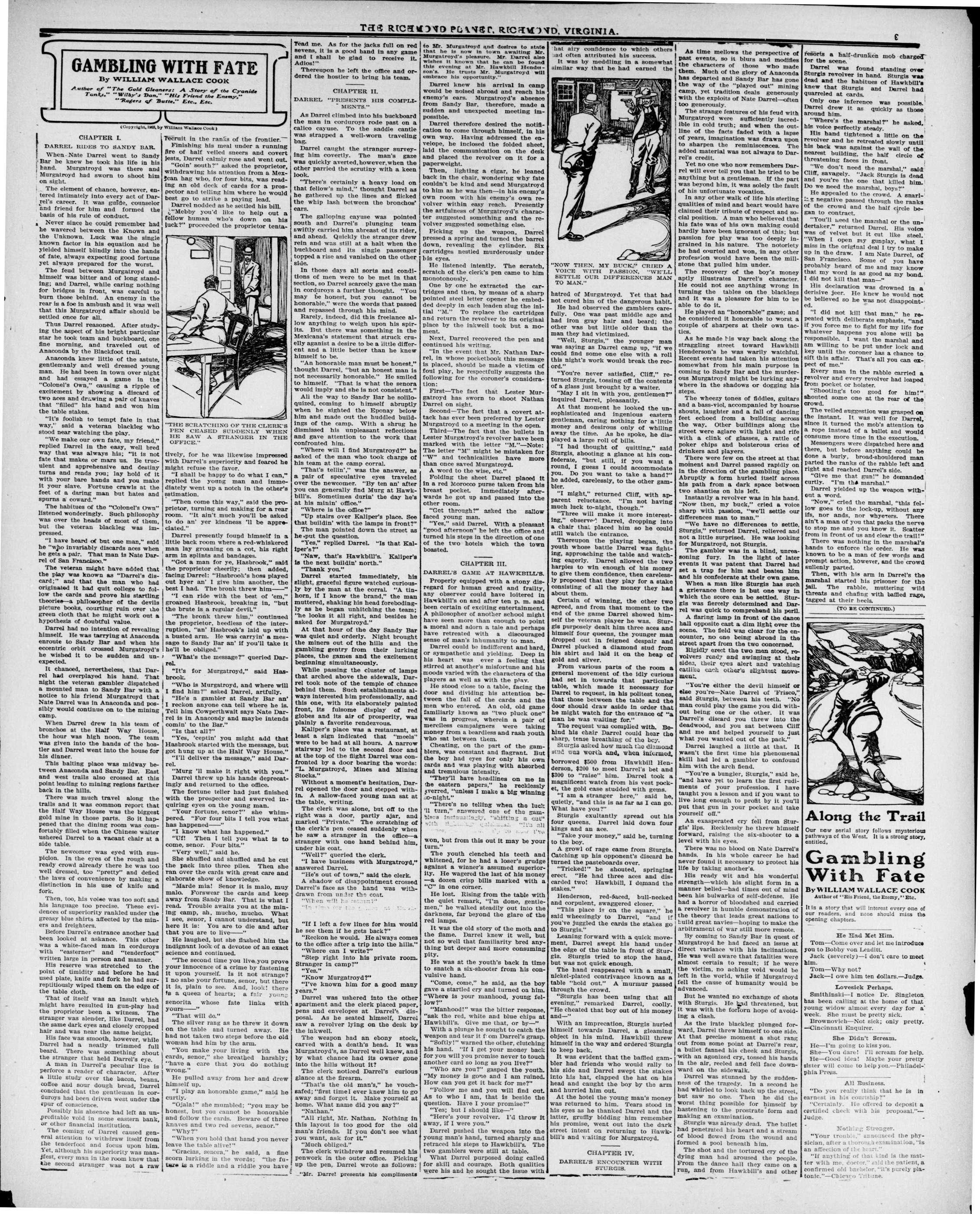
"THE SCRATCHING OF THE CLERK'S PEN CEASED SUDDENLY WHEN HE SAW A STRANGER IN THE OFFICE."
tively, for he was likewise impressed with Darrel's superiority and feared he might refuse the favor.
"I shall be happy to do what I can," replied the young man and immediately went up a notch in the other's estimation.
"Then come this way," said the proprietor, turning and making for a rear room. "It ain't much you'll be asked to do an' yer kindness 'll be appreciated."
Darrel presently found himself in a little back room where a red-whiskered man lay groaning on a cot, his right arm in splints and bandages.
"Got a man for ye, Hasbrook," said the proprietor cheerly; then added, facing Darrel: "Hasbrook's hoss played out hyer an' I give him another, the best I had. The bronk threw him——"
"I can ride with the best of 'em," groaned Hasbrook, breaking in, "but the brute is a regular devil."
"The brink threw him," continued the proprietor, heedless of the interruption, 'an' Hasbrook's laid up with a busted arm. He was carryin' a message to Sandy Bar an' if you'll take it he'll be obliged.
"What's the message?" queried Darrel.
"It's for Murgatroyd," said Hasbrook.
"Who is Murgatroyd, and where will I find him?" asked Darrel, artfully. "He's a gambler at Sandy Bar an' I reckon anyone can tell where he is. Tell him Cowperthwait says Nate Darrel is in Anacondy and maybe intends comin' to the Bar."
"Is that all?"
"Yes, 'ceptin' you might add that Hasbrook started with the message, but got hung up at the Half Way House."
"I'll deliver the message," said Darrel.
"Murg 'll make it right with you." Darrel threw up his hands deprecatingly and returned to the office.
The fortune teller had just finished with the prospector and swerved inquiring eyes on the young man.
"Your fortune, senor?" she whimpered. "For four bits I tell you what has happened——"
"I know what has happened."
"Uf! Then I tell you what is to come, senor. Four bits."
"Very well," said he.
She shuffled and shuffled and he cut the pack into three piles. Then she ran over the cards with great care and elaborate show of knowledge.
"Marde mia! Senor it is malo, muy malo. Forswear the cards and keep away from Sandy Bar. That is what I read. Trouble awaits you at the mining camp, ah, mucho, mucho. What I see, senor, I cannot understand, but here it is: You are to die and after that you are to live——"
He laughed, but she flashed him the indignant look of a devotee of an exact science and continued.
"The second time you live you prove your innocence of a crime by fastening it upon yourself. Is it not strange? I no sabe your fortune, senor, but there it is, plain to see. And, look! there is a queen of hearts; a fair young senorita whose fate links with yours——"
"That will do."
The silver rang as he threw it down on the table and turned away. He had not taken two steps before the old woman had him by the arm.
"You make your living with the cards, senor," she breathed harshly; "have a care that you do nothing wrong."
He pulled away from her and drew himself up.
"I play an honorable game," said he curtly.
"Ojala!" she mumbled; "you may be honest, but you cannot be honorable and follow the cards. Beware of three knaves and two red sevens, senor."
"Why?"
"When you hold that hand you never leave the table alive!"
"Gracias, senora," he said, a fine scorn lurking in the words; "the future is a riddle and a riddle you have
THE RICHMOND PLANET, RICHMOND, VIRGINIA.
Tread me. As for the jacks full on red sevens, it is a good hand in any game and I shall be glad to receive it. Adios!"
Thereupon he left the office and ordered the hostler to bring his team.
CHAPTER II
DARREL "PRESENTS HIS COMPLI-MENTS."
As Darrel climbed into his buckboard the man in corduroys rode past on a calico cayuse. To the saddle canille was strapped a well-worn traveling bag.
Darrel caught the stranger surveying him covertly. The man's gaze was quickly averted, however, when the other parried the scrutiny with a keen look.
"There's certainly a heavy load on that fellow's mind," thought Darrel as he gathered up the lines and flicked the whip lash between the bronchos' ears.
The galloping cayuse was pointed south and Darrel's plunging team swiftly carried him abreast of its rider, and ahead. Quickly the stranger drew rein and was still at a halt when the buckboard and its single passenger topped a rise and vanished on the other side.
In those days all sorts and conditions of men were to be met in that section, so Darrel scarcely gave the man in corduroys a further thought. "You may be honest, but you cannot be honorable," were the words that passed and repassed through his mind.
Rarely, indeed, did this freelance allow anything to weigh upon his spirits. But there was something in the Mexicana's statement that struck cruelly against a desire to be a little different and a little better than he knew himself to be.
"An honorable man must be honest," thought Darrel, "but an honest man is not necessarily honorable." He smiled to himself. "That is what the senora would imply and she is not consistent."
All the way to Sandy Bar he solloquized, coming to himself abruptly when he sighted the Eponay below him and made out the huddled buildings of the camp. With a shrug he dismissed his unpleasant reflections and gave attention to the work that confronted him.
"Where will I find Murgatroyd?" he asked of the man who took charge of his team at the camp corral.
"That's tellin'." was the answer, as a pair of speculative eyes traveled over the newcomer. "By ten an' after you can generally find Murg at Hawkbill's. Sometimes durin' the day he's at his minin' office."
"Where is the office?"
"Up stairs over Kalpira's place. See that buildin' with the lamps in front?" The man pointed down the street as he put the question.
"Yes," replied Darrel. "Is that Kalpira's?"
"Naw, that's Hawkbill's. Kaliper's is the next buildin' north."
"Thank you."
Darrel started immediately, his slight, graceful figure watched curiously by the man at the corral. "A tinhorn, if I know the brand," the man muttered, shaking his head forebodingly as he began unhitching the team; "he looks it all right, and besides he asked for Murgatroyd."
At that hour of the day Sandy Bar was quiet and orderly. Night brought the miners out of the hills and the gambling gentry from their lurking places, the games and the excitement beginning simultaneously.
While passing the cluster of lamps that arched above the sidewalk, Darrel took note of the temple of chance behind them. Such establishments always interested him professionally, and this one, with its elaborately painted front, its fulsome display of red globes and its air of prosperity, was plainly a favorite rendezvous.
Kaliper's place was a restaurant, at least a sign indicated that "meels" were to be had at all hours. A narrow stairway led to the second floor and at the top of the flight Darrel was confronted by a door bearing the words: "L. Murgatroyd, Mines and Mining Stocks."
Without a moment's hesitation, Darrel opened the door and stepped within. A sallow-faced young man sat at the table, writing.
The clerk was alone, but off to the right was a door, partly ajar, and marked "Private." The scratching of the clerk's pen ceased suddenly when he saw a stranger in the office—a stranger with one hand behind him, under his coat.
"Well?" queried the clerk.
"I have business with Murgatroyd," answered Darrel.
"He's out of town," said the clerk.
A shadow of disappointment crossed Darrel's face as the hand was withdrawn from under the coat.
"When will he return?"
"In time for the town at Blandy."
"If I left a few lines for him would he see them if he gets back?"
"Reckon he would. He always comes to the office after a trip into the hills."
"Where can I write?"
"Step right into his private room. Stranger in camp?"
"Yes."
"Know Murgatroyd?"
"I've known him for a good many years."
Darrel was ushered into the other apartment and the clerk placed paper, pens and envelopes at Darrel's disposal. As he seated himself, Darrel saw a revolver lying on the desk by the inkwell.
The weapon had an ebony stock, carved with a death's head. It was Murgatroyd's, as Darrel well knew, and by what chance had its owner gone into the hills without it?
The clerk noticed Darrel's curious glance at the firearm.
"That's the old man's," he vouchesafed; "first time I ever knew him to go away and forget it. Make yourself at home. What name did you say?"
"Nathan."
"All right, Mr. Nathan. Nothing in this layout is too good for the old man's friends. If you don't see what you want, ask for it."
"Much obliged."
The clerk withdrew and resumed his penwork in the outer office. Picking up the pen, Darrel wrote as follows: "Mr. Darrel presents his committal."
to Mr. Murgatroyd and desires to state that he is now in town awaiting Mr. Murgatroyd's pleasure. Mr. Darrel also wishes it known that he can be found in town in Hawkville Henderson's. He trusts Mr. Murgatroyd will embrace his opportunity."
Darrel knew his arrival in camp would be noised abroad and reach his enemy's ears. Murgatroyd's absence from Sandy Bar, therefore, made a sudden and unexpected meeting impossible.
Darrel therefore desired the notification to come through himself, in his own way. Having addressed the envelope, he inclosed the folded sheet, laid the communication on the desk and placed the revolver on it for a paperweight.
Then, lighting a cigar, he leaned back in the chair, wondering why fate couldn't be kind and send Murgatroyd to him as he was then—in his enemy's own room with his enemy's own revolver within easy reach. Presently the artfulness of Murgatroyd's character suggested something and the revolver suggested something else.
Picking up the weapon, Darrel pressed a spring and turned the barrel down, revealing the cylinder. Six cartridges nestled murderously under his eyes.
He listened intently. The scratch, scratch of the clerk's pen came to him monotonously.
One by one he extracted the cartridges and then, by means of a sharp pointed steel letter opener he embedded deeply in each leaden slug the initial "M." To replace the cartridges and return the revolver to its original place by the inkwell took but a moment.
Next, Darrel recovered the pen and continued his writing.
"In the event that Mr. Nathan Darrel, in whose pocketbook this message is placed, should be made a victim of foul play, he respectfully suggests the following for the coroner's consideration:
First—The fact that Lester Murgatroyd has sworn to shoot Nathan Darrel on sight.
Second—The fact that a covert attack has ever been preferred by Lester Murgatroyd to a meeting in the open.
Third—The fact that the bullets in Lester Murgatroyd's revolver have been marked with the letter "M."—Note: The letter "M" might be mistaken for "W" and technicalities have more than once saved Murgatroyd.
A word to the wise, etc."
Folding the sheet Darrel placed it in a red Morocco purse taken from his breast pocket. Immediately afterwards he got up and passed into the other room.
"Get through?" asked the sallow faced young man.
"Yes," said Darrel. With a pleasant "good afternoon" he left the office and turned his steps in the direction of one of the two hotels which the town boasted.
CHAPTER III.
DARREL'S GAME AT HAWKBILL'S.
Properly equipped with a stony disregard for human greed and frailty, any observer could have loitered in Hawkbill's on and after ten p. m. and been certain of exciting entertainment.
A philosopher of another school might have seen more than enough to point a moral and adorn a tale and perhaps have retreated with a discouraged sense of man's inhumanity to man.
Darrel could be indifferent and hard, or sympathetic and yielding. Deep in his heart was ever a feeling that stirred at another's misfortune and his moods varied with the characters of the players as well as with the play.
He stood close to a table, facing the door and dividing his attention between the fall of the cards and the men who entered. An old, old game familiarly known as "two pluck one" was in progress, wherein a pair of merciless campaigners were taking money from a beardless and rash youth who sat between them.
Cheating, on the part of the gamblers, was constant and flagrant. But the boy had eyes for only his own cards and was playing with absorbed and tremulous intensity.
"They'll have headlines on me in the eastern papers," he recklessly averred, "unless I make a big winning no-night."
"There's no telling when the luck 'll turn," answered one of the gamblers instinctively, "shifting a cut" with the other, "the all won, but from this out it may be your turn."
The youth clenched his teeth and whitened, for he had a loser's grudge against a winner's assumed superiority. He wagered the last of his money—a dozen crisp bills marked with a "C" in one corner.
He lost. Rising from the table with the quiet remark, "I'm done, gentlemen," he walked steadily out into the darkness, far beyond the glare of the red lamps.
It was the old story of the moth and the flame. Darrel knew it well, but not so well that familiarity bred anything but deeper and more consuming pity.
He was at the youth's back in time to snatch a six-shooter from his convulsive hand.
"Come, come," he said, as the boy gave a startled cry and turned on him.
"Where is your manhood, young fellow?"
"Manhood!" was the bitter response, "ask the red, white and blue chips at Hawkbill's. Give me that, or by—"
With a plunge he sought to catch the weapon and tear it t' from Darrel's grasp.
weapon and tear it from Darrel's grasp.
"Softly!" warned the other, clutching his hand. "If I get your money back for you will you promise never to touch another card so long as you live?"
"Who are you?" gasped the youth.
"My money is gone and I am ruined. How can you get it back for me?"
"Follow me and you will find out. As to who I am, that is beside the question. Have I your promise?"
"Yes; but I should like—"
"Here's your revolver. I'd throw it away, if I were you."
Darrel pushed the weapon into the young man's hand, turned sharply and retraced his steps to Hawkbill's. The two gamblers were still at table.
What Darrel purposed doing called for skill and courage. Both qualities were his and he sought the issue with
that airy confidence to which others and often attributed his success. It was by meddling in a somewhat similar way that he had earned the
WARD
"NOW THEN, MY BUCK," CRIED A VOICE WITH PASSION, "WE'LL SETTLE OUR DIFFERENCES MAN TO MAN."
hatred of Murgatroyd. Yet that had not cured him of the dangerous habit. He had observed the gamblers carefully. One was past middle age and had iron gray hair and beard; the other was but little older than the man they had victimized.
"Well, Sturgis," the younger man was saying as Darrel came up, "if we could find some one else with a roll this night's work would break the record."
"You're never satisfied, Cliff," returned Sturgis, tossing off the contents of a glass just brought by a waiter.
"May I sit in with you, gentlemen?" inquired Darrel, pleasantly.
At that moment he looked the unsophisticated and ingenious eastern gentleman, caring nothing for a little money and desirous only of whiling away the time. As he spoke, he displayed a large roll of bills.
"I had thought of quitting," said Sturgis, shooting a glance at his confederate, "but still, if you want a round, I guess I could accommodate you. Do you want to take a hand?" he added, carelessly, to the other gamber.
"I might," returned Cliff, with apparent reluctance. "I'm not having much luck to-night, though."
"Three will make it more interesting," observe? Darrel, dropping into a chair that placed him so he could still watch the entrance.
Thereupon the playing began, the youth whose battle Darrel was fighting, approaching the table and watching eagerly. Darrel allowed the two harpies to win enough of his money to give them confidence, then carelessly proposed that they play for a stake consisting of all the money they had about them.
Certain of winning, the other two agreed, and from that moment to the end of the game Darrel showed himself the veteran player he was. Sturgis purposely dealt him three aces and himself four queens, the younger man dropped out in feigned despair and Darrel plucked a diamond stud from his shirt and laid it on the heap of gold and silver.
From various parts of the room a general movement of the idly curious had set in towards that particular table, which made it necessary for Darrel to request, in his politest tones, that those between the table and the door should draw aside in order that he might watch for the entrance of "a man he was waiting for."
The request was complied with. Behind his chair Darrel could hear the sharp, tense breathing of the bcy. Sturgis asked how much the diamond stud was worth and, when informed, borrowed $500 from Hawkkbill Henderson, $200 to meet Darrel's bet and $300 to "raise" him. Darrel took a magnificent watch from his vest pocket, the gold case studded with gems.
"I am a stranger here," said he, quietly, "and this is as far as I can go. What have you?"
Sturgis exultantly spread out his four queens. Darrel laid down four kings and an ace.
"Take your money," said he, turning to the boy. A growl of rage came from Sturgis. Catching up his opponent's discard he turned the pasteboards over. "Tricked!" he shouted, springing erect. "He had three aces and discarded two! Hawkbill, I demand the stakes." Henderson, red-faced, bull-necked and corpulent, swaggered closer. "This place is on the square," he said wheezingly to Darrel, "and if you've jugged the cards the stakes go to Sturgis." Leaning forward with a quick movement, Darrel swept his hand under the edge of the table in front of Sturgis. Sturgis tried to stop the hand, but was not quick enough. The hand reappeared with a small, nickel-plated contrivance known as a table "hold out." A murmur passed through the crowd.
"Sturgis has been using that all evening," remarked Darrel, coolly. "He cheated that boy out of his money and—"
With an imprecation, Sturgis hurled himself towards Darrel, a gleaming object in his mind. Hawkbill threw himself in the way and ordered Sturgis to keep back.
It was evident that the baffled gambler had friends who would rally to his side and Darrel swept the stakes into his hat, clapped the hat on his head and caught the boy by the arm and hurried him out.
At the hotel the young man's money was returned to him. Tears stood in his eyes as he thanked Darrel and the latter, grumly blinding him remember his promise, went out into the dark street intent on returning to Hawkbill's and waiting for Murgatroyd.
As time mellows the perspective of past events, so it blurs and modifies the characters of those who made them. Much of the glory of Anaconda has departed and Sandy Bar has gone the way of the "played out" mining camp, yet tradition deals generously with the exploits of Nate Darrel—often too generously.
The strange features of his feud with Murgatroyd were sufficiently incredible in cold truth; and when the outline of the facts faded with a lapse of years, imagination was drawn upon to sharpen the reminiscences. The added material was not always to Darrel's credit.
Yet no one who now remembers Darrel will ever tell you that he tried to be anything but a gentleman. If the part was beyond him, it was solely the fault of his unfortunate vocation.
In any other walk of life his sterling qualities of mind and heart would have claimed their tribute of respect and social position. A man who believed that his fate was of his own making could hardly have been ignorant of this; but passion for play was too deeply ingrained in his nature. The notoriously he had courted and won, in any other profession would have been the millstone that pulled him under.
The recovery of the boy's money aptly illustrates Darrel's character. He could not see anything wrong in turning the tables on the blacklegs and it was a pleasure for him to be able to do it.
He played an "honorable" game; and he considered it honorable to worst a couple of sharpers at their own tactics.
As he made his way back along the straggling street toward Hawkbill Henderson's he was warily watchful. Recent events had taken his attention somewhat from his main purpose in coming to Sandy Bar and the murdered Murgatroyd might be lurking anywhere in the shadows or dogging his steps. The wheezy tones of fiddles, guitars and a bass-viol, accompanied by hoarse shouts, laughter and a fall of dancing feet echoed from a building across the way. Other buildings along the street were aglare with light and rife with a clink of glasses, a rattle of poker chips and boisterous cries of drinkers and players. There were few on the street at that moment and Darrel passed rapidly on in the direction of the gambling place. Abruptly a form hurled itself across his path from a dark space between two shanties on his left.
Instantly a revolver was in his hand. "Now then, my buck," cried a voice sharp with passion, "we'll settle our differences man to man."
"We have no differences to settle, Sturgis," returned Darrel, relieved and not a little surprised. He was looking for Murgatroyd, not Sturgis.
The gambler was in a blind, unreasoning fury. In the light of later events it was patent that Darrel had set a trap for him and beaten him and his confederate at their own game.
When a man like Sturgis has such a grievance there is but one way in which the score can be settled. Sturgis was fiercely determined and Darrel was quick to comprehend his peril.
A flaring lamp in front of the dance hall opposite cast a dim light over the scene. The field was clear for the encounter, no one be abroad in the street apart from the two concerned.
Rigidly erect the two men stood, revolvers ready and swinging at their sides, their eyes alert and watching catlike each other's slightest movement.
"You're either the devil himself or else you're—Nate Darrel of Trisco," said Sturgis, between his teeth. "No man could play the game you did without being one or the other. It was Darrel's discard you threw into the deadwood, and you sat between Cliff and me and helped yourself to just what you wanted out of the pack."
Darrel laughed a little at that. It wasn't the first time his phenomenal skill had led a gambler to confound him with the arch fiend.
"You're a bungler, Sturgis," said he, "and have yet to learn the first rudiments of your profession. I have taught you a lesson and if you want to live long enough to profit by it you'll put that gun in your pocket and take yourself off."
An exasperated cry fell from Sturgs' lips. Recklessly he threw himself forward, raising the six-shooter to a level with his eyes.
There was no blood on Nate Darrel's hands. In his whole career he had never found it necessary to protect his life by taking another's.
His ready wit and his wonderful strength—which his slight form in a manner belied—had times out of mind been his bulwarks of self-defense. He had a horror of bloodshed and carried a revolver in humble demonstration of the theory that leads great nations to build great navies—hoping to make the arbitrament of war still more remote
By coming to Sandy Bar in quest of Murgatroyd he had faced an issue at direct variance with his incinations. He was well aware that fatalities were almost certain to result; if he were the victim, no aching void would be left in the world, while if Murgatroyd fell the cause of humanity would be advanced.
But he wanted no exchange of shots with Sturgis. He had threatened, but it was with the forlorn hope of avoiding a clash.
As the irate blackleg plunged forward, Darrel threw himself to one side. At that precise moment a shot rang out from some point at Darrel's rear, a bullet fanned his cheek and Sturgis, with an agonized cry, tossed his hands in the air, reeled and fell face downward on the sidewalk.
Darrel was stunned by the suddenness of the tragedy. In a second he had whirled to look back up the street, but saw no one. Then he did the worst thing possible for himself by hastening to the prostrate form and making an examination.
Sturgis was already dead. The bullet had penetrated his heart and a stream of blood flowed from the wound and formed a pool beneath him.
The shot and the tortured cry of the dying man had aroused the people. From the dance hall they came on a run, and from Hawkbill's and other
resorts a half-drunken mob charged for the scene. Darrel was found standing over Sturgis revolver in hand. Sturgis was dead and the habitues of Hawkbill's knew that Sturgis and Darrel had quarreled at cards. Only one inference was possible. Darrel drew it as quickly as those around him. "Where's the marshal?" he asked, his voice perfectly steady. His hand tightened a little on the revolver and he retreated slowly until his back was against the wall of the nearest building, the half circle of threatening faces in front. "We don't need the marshal," said Cliff, savagely. "Jack Sturgis is dead and you're the one that killed him. Do we need the marshal, boys?"
He appealed to the crowd. A snarling negative passed through the ranks of the crowd and the half circle began to contract.
"You'll need the marshal or the undertaker," returned Darrel. His voice was of velvet but it cut like steel. "When I open my gunplay, what I miss in the original deal I try to make up in the draw. I am Nate Darrel, of San Francisco. Some of you have probably heard of me and may know that my word is as good as my bond. I did not kill that man—"
His declaration was drowned in a derisive jeer. He knew he would not be believed so he was not disappoint-ed.
"I did not kill that man," he repeated with deliberate emphasis, "and if you force me to fight for my life for whatever happens you alone will be responsible. I want the marshal and am willing to be put under lock and key until the coroner has a chance to sift this affair. That's all you can expect of me."
Every man in the rabble carried a revolver and every revolver had leaped from pocket or holster.
"Shooting's too good for him!" shouted some one at the rear of the crowd.
The velled suggestion was grasped on the instant. It was well for Darrel, since it turned the mob's attention to a rope instead of a bullet and would consume more time in the execution.
Messengers were dispatched here and there, but before anything could be done a burly, broad-shouldered man parted the ranks of the rabble left and right and reached Darrel's side.
"Give me that gun!" he demanded curtly. "I'm the marshal." Darrell yielded up the weapon without a word. "Now," cried the marshal, "this fellow goes to the lock-up, without any ifs, nor ands, nor whyers. There ain't a man of you that packs the nerve to stop me and you know it. Scatter from in front of us and clear the trail!" There was nothing in the marshal's hands to enforce the order. He was known to be a man of few words and prompt action, however, and the crowd sullenly parted. Then, with his arm in Darrel's the marshal started his prisoner for the jail. The rabble, muttering wild threats and chafing with baffled rage, tagged at their heels.
(TO BE CONTINUED.)
A man is running away from a large rock. He is wearing a jacket and pants. The rock is large and steep. The man is running with his arms outstretched. The background is a mountainous landscape with a river flowing through it.
Along the Trail
Our new serial story follows mysterious pathways of the West. It is a strong story, entitled,
Gambling With Fate
ByWILLIAM WALLACE COOK
Author of "His Friend, the Enemy," Etc.
It is a story that will interest every one of our readers, and none should miss the opening chapters.
He Had Met Him.
Tom—Come over and let me introduce you to Bobby von Lenditt.
Jack (severely)—I don't care to meet him.
Tom—Why not?
Jack—I owe him ten dollars.—Judge.
Lovesick Perhaps.
Smithinski—I notice Dr. Singleton has been calling at the home of that young widow almost every day for a week. She must be pretty sick.
Brownovich—Not sick; only pretty.
—Cincinnati Enquirer.
She Didn't Scream.
He—I'm going to kiss you.
She—You dare! I'll scream for help.
He—Good idea! Maybe your pretty sister will come to help you—Philadelphia Press.
All Business.
"Do you really think that he is in earnest in his courtship?"
"Certainly. He offered to deposit a certified check with his proposal."—Judge.
Nothing Stronger.
"Your trouble," announced the physician, after a thorough examination, "is an affection of the heart."
"If anything of that kind is the matter with me, doctor," said the patient, a confirmed old bachelor, "it's purely platonic."—Chicago Tribune.
THE PLANET
closed every Saturday by JOHN MICHEL
at 311 North 4th Street, Richmond, Va.
all commenters, actions intended for publication
should be sent to as to reach us by Wednesday
TERMS IN ADVANCE.
e Copy, one year. $1.50
the Copy, eight months, 1.00
the Copy, six months, $0.80
the Copy, four months, $0.50
the Copy, three months, $0.40
single Copy. $0.90
ADVERTISING RATES.
or one inch, one insertion, $50
or one inch, each subsequent insertion, $25
or two inches, three months, $6.00
for two inches, six months, $10.00
for two inches, nine months, $14.00
for two inches, twelve months, $20.00
marriage and Funeral Notices, $50
Warding and Transient Notices per line, $12
POSTAGE STAMPS OF A HIGHER DEMOGNATION THAN TWO CENTS NOT RECEIVED ON SUBSCRIPTIONS.
THE PLANET is issued weekly. The subscription price is $1.50 a year, in advance.
There are FOUR WAYS by which money can be sent by mail at our risk. In a Post Office Money Order, you can an Expos Money Order and when none of these can be procured, in a Registered Letter.
MONEY ORDERS—You can buy a Money Order at your Post Office, payable at the Richmond and we will be responsible for its arrival.
EXPRESS MONEY ORDERS can be obtained at the office of the American Express Co., the United States Express Co., and the Well Farmer's Company, responsible for money sent by any of these companies. The Express Money Order is a safe and convenient way for forwarding money.
REGISTERED LETTER—If a Money Order is registered, your reach, your Postmaster will Register the letter you wish to send us on payment of ten cents. Then, if the letter is lost or stolen, you can send money in this manner at our risk.
We cannot be responsible for money sent in letters in any other way than one of the four ways mentioned above. If you send your money in other way, you must do it at your own risk.
RENEWALS, ETC.—If you do not want THE PLANET continued for another year after your subscription has run out, you then notify by as by email Card to discontinue it. The course we decided that subscribers to newspapers who do not order their paper discontinued at the expiration date should be sold liable for the payment of the paper up to date when they order the paper discontinued.
O'MUNICA LONDON—When writing to us to renew your subscription or to discontinue our paper, you should give your name and address in full, otherwise we cannot find your one on our records.
Can you or Applicant—In order to change to address of a subscriber, we must be sent the former as well as the present address.
Entered in the Post Office at Richmond, For second class matter.
SATURDAY . MAY 21, 1904
The colored folks are yet walking.
Yes, we still have white friends, and we should encourage and praise them.
We return thanks for an invitation to attend the commencement exercises of the Virginia Union University and Hartshorn Memorial College.
The colored people now hold fewer offices under the national administration than has ever been known during the ascendance of the Republican Party since the close of the Civil War.
It is aggravating to note the steady stream of vituperation and slander now being used against us. Nothing seems to check the abuse or satisfy the Negro-haters. They have taken away our votes and yet they continue to abuse us.
PRESIDENT ROOSEVELT certainly has the courage of his conviction and his attitude in the matter of the renomination of Dr. W. D. ORUM as Collector of the Port at Charleston, S. C.
President GROVER CLEVELAND was almost equally as positive in his nomination of the late Hon. O. H. J. TAYLOR as United States Minister to Bolivia, and he finally succeeded in having him confirmed as Recorder of Deeds of the District of Columbia.
---
THE NEWS-LEADER of this city published a letter from a Negro-hater, who objected to the publication of items concerning the colored people. It refused to listen to such a proposition as one offered, which provided for the exclusion of all reference to the Negro from its columns.
The Richmond, Va., TIMES-DISPATCH came to the support of the NEWS-LEADER in this contention.
It may be that an effort may be made in the next legislature of Virginia to exclude all such matter from the columns of journals published by white men. You never can tell where this race legislation will stop.
"THE NEGRO: THE SOUTHERNER'S PROBLEM."
MR. THOMAS NELSON PAGE does not tire in the discussion of "The Negro: The Southerner's Problem," as published in McCLURE'S MAGAZINE for May, and it is evident to our mind that this distinguished Virginian, all other things being equal, would continue his narrative until the frost of winter came to silence the songs of the birds.
Be that it may, he certainly admits a fact which has been the fundamental blunder in all discussions dealing with the so-called Negro question when he says:
"It seems to the writer that one of the fundamental errors which has inhered in all the discussion which has
taken place on the Negro question is in considering the Negroes as absolutely one class. A brief consideration of the matter will show on the contrary that the colored population of the South, though they were, with the exception of a few Arabs, all of Negro blood, were when they came to this country, of different tribes; and there were, even during the time of slavery and are yet more markedly now, grades among them; grades of intellect, of character, and of ability, which point to, if not varying racial, at least, varying tribal forces. And however they may all appear to head together and look at most matters not from an individual and rational but from a racial standpoint, a careful study will disclose certain distinctions which have the mark of tribal distinctions, while others will show the elements of class distinctions. These class distinctions, though still elementary, are beginning to make themselves apparent."
We disagree, however, when he in
jects the following remarks:
"The line of cleavage unhappily does not follow that of conduct or good manners, much less that of character, but, perhaps, it may approximate them more closely in time, and the upper class will learn and cause it to be understood that conduct, character, and good manners are the key to admission."
As a matter of fact, there is a society among the colored people of the South as exclusive as any to be found among the upper classes of New York or London.
The colored people have to a great extent imitated the best class of white people of the South and in thus there is no exception to the general rule.
Mr. PAGE continues:
"It is the intention of the writer in this discussion to recognize this distinction, and, when he speaks of 'the Negroes,' he desires generally to be understood as referring to the great body of the race, and not as including what may be termed the upper fraction—that is, those who, by reason of intellect education, and character, form so clearly an exception that they must be considered as a separate class
The Negroes, indeed, may be divided into three classes. The first is a small class, comparatively speaking, who are more or less educated, some being well educated and well conducted; others, with a semblance of education and none too well behaved. The former constitute what may be termed the upper fraction; the later lack the essential element of character and even moral perception. The second class is composed of a respectable, well-behaved, self-respecting element; sensible, though with little or no education, and, except when under the domination of passion, good citizens. This class embraces most of the more intelligent of the older generation who were trained in slavery, and a considerable element of the intelligent middle-aged, conservative workers of the race who were trained by this generation. The two together may be called the backbone of the race.
The third class is composed of those who are wholly ignorant, or in whom, though they have what they call education, this so called education is unaccompanied by any of the fruits of character which education is supposed to produce. Among these are many who esteem themselves in the first class, and, because of a veneer of education, are not infrequently confounded with them."
This is unquestionably the most accurate description of the grades or classes of Negroes that we have ever read from the pen of a white man. When this is conceded, much is granted unto us, and this shall constitute the basis of our reply to one of the most dangerous contributions that has ever been made to a northern journal from the pen of a recognized "F. F. V." [First Families of Virginia] of the Southland.
Mr. PAGE says further:
"The first two classes may easily be reckoned with. They contain the elements which make good citizens and which should enable them to secure all proper recognition and respect. They need no weapon but that which they possess—good citizenship."
If he is speaking for his class, Mr. PAGE is correct, but when he essays to speak for the "Jay Hawkers," the Negro-haters, the rough, uncount white elements of the South, who correspond both in habits and intelligence with the third class of Negroes in that section, he goes beyond his depth and finds that he is held beneath the surface by the quick-sand of race prejudice, which is as deceptive as it is unreasoning.
Mr. PAGE says:
"Unfortunately, the great body of the race, and a vast percentage of the growing generation, belong to the third class. It is this class which has to be reckoned with. It is like a vast sluggish mass of uncooled lava over a large section of the country, burrowing some portions and soaking up a large, apparently harmless, but beneath its surmounted fires which may at any time burst forth unexpectedly and destroy all within reach. It is this mass, increasing from beneath, not from above, which constitutes the Negro question."
This is well stated, Mr. PAGE, but do not forget that the same dangers which are admitted to exist with the Negro lower strata are ever present among the White lower strata. The only difference is that the elements among the Whites, which correspond to this third-class of the Blacks, is more dangerous, embracing as it does the discontented elements of the Old World with its numerous revolutionists and anarchists. But enough, we shall continue in our next issue a further review of this most interesting paper of Mr. PAGE, which is marred at its close by one of the most monumental slanders that has ever been launched against any people.
Contingent Indignation
"Aren't you angry because your husband bets on the races?"
"I don't know yet," answered young Mrs. Torkins. "I haven't heard whether he won to-day or not."—Washington Star.
Sized Up.
Mrs. Bacon—I see by this paper that the average family in the United States has four and seven-tenths persons. Mr. Bacon—I suppose I'm the seven-tenths in this family.—Yonkers Stateran.
THE RICHMOND PLANET, RICHMOND, VIRGINIA
JAPS MASTERS OF LOWER END OF LIAO TUNG
All But Port Arthur and Adjacent Territory in Their Hands.
RUSSIANS LEAVE NEWCHWANG
First Stand Will Be Made at Hai Cheng and After That at Liao Yang. General Zassalitch Relieved — Jap Cruiser Blown Up In Talienwan Bay By a Mine.
St. Petersburg, May 18.—The complete withdrawal of the Russians from Newchwang is believed to have followed the strategic command of the port by the columns sent westward by General Kuroki. The exact conditions under which the evacuation was brought about are not known here, as all the official dispatches have been forwarded to the emperor. The foreign office is not advised as to whom the administration of Newchwang was handed over, but the authorities express confidence that the Russian commander arranged for the safety of the foreigners before he departed. Advices received by the general staff show that the Japanese are practically masters of all of the southern end of the Liao Tung peninsula save Port Arthur and the territory commanded by its guns. This result, so promptly brought about, is due to the failure of the Russians to make opposition of any consequence to the Japanese advance.
A member of the general staff said to the Associated Press that the removal of the guns from the fortifications erected at Kin Chan and the destruction of Port Dalny were primarily for the purpose of concentrating the entire Russian force at Port Arthur. If the men and guns were scattered the effect would have been to distribute the means of defense of the fortress over a number of points strategically weak. The destruction of Dalny was the result of no sudden determination, but was due to the probability that a force attempting to hold this place could be separated from Port Arthur and captured, thus inflicting further loss of prestige to the Russians, which could not be permitted at this time. To defend the whole of the southern end of the Liao Tung peninsula it would have been necessary to have an army equal to that which Japan could have landed.
The weakness of the Manchurian army, said this officer, left only one course to pursue, namely that of mobilizing sufficient troops at Port Arthur to hold it until relief came, abandoning every point outside which did not contribute to the strategic defense of the fortress. It has been learned that the ground over which the Japanese must charge to capture the fortress is heavily mined. If they do capture it, the officer said, they will pay a frightful price.
The destruction of Dalny is complete, the breakwater and the buildings, as well as the piers and docks having been blown up.
General Zassalitch Believed.
It is announced that Lieutenant General Zassalitch has been relieved of the command of the second Siberian army division, and that Lieutenant General Count Keller, former governor of Ekaterinoslav, has been appointed to succeed him.
What will become of General Zassalitch, whether he will remain in the Far East or be assigned to a less important region, cannot be learned, but it is emphatically stated that there is no intention to disgrace him, and that if he returns from the Far East it will be on leave and at his own request. It is generally believed that he will find it convenient to make such an application.
Outposts In Contact.
Paris, May 18.—The Journal's Mukden correspondent says: "Important events are imminent. The outposts of the two armies are already in contact in the zone northwest of Feng Wang Cheng. The Japanese army advancing on Liao Yang is estimated at 100,000. A persistent rumor, which is not confirmed officially, has it that another Japanese corps is executing a flanking movement directed on some point between Liao Yang and Mukden. "According to the best information, there are now no less than 160,000 Japanese in Manchuria."
RUSSIANS LEAVE NEWCHWANG
Japs Landed at Kai Chau and Czar's Forces Beat a Retreat.
Newchwang, May 18.—In confirmation of recent Associated Press dispatches, the Russian evacuation of this city has been completed. Nothing remains but the destruction of the gunboat Sivouch, which it is expected will take place today.
The Russian troops marched out in perfect order, General Kondratsvitch leaving with the last regiment. The Associated Press correspondent has received exclusive information from the highest Russian authority that the Japanese advance will be resisted at Hai Cheng, whence the Russian forces will fall back upon Liao Yang, where they will make a determined stand, with a fighting strength there available of 70,000 men.
If defeated, no stop will be made at Mukden, but the retirement will be continued to Thieling, a town at the head of navigation for native craft on the Liao river, 200 miles north of Newchwang. At the same time the Cossack regiments will be employed in the rear of the Japanese army of the Yalu, harrassing the troops and interfering with its communications. It is not believed that the Japanese will move into the interior until they have thoroughly established their base here, repeating the movement which they made during the war with China.
The Russians admit the advance of the Japanese army to a point within 15 miles of Hai Cheng, many of their wounded entering there.
The nearest fighting expected before the Japanese reach Newchwang will be at Tashiichao, but it will not amount
to much. This city is now guarded by 300 Chinese police, and everything is quiet. The Japanese force at Kai Chau is reported 20,000 strong.
RUSSIANS' REAR THREATENED
News of Great Battle Expected From Near Mukden.
London, May 18.—No further news has reached London throwing light upon the appearance of Japanese troops northeast of Mukden or indicating by what route they reached that point so unexpectedly. The Japanese are so successful in hiding their movements that it is only possible to guess at them from the vague indications in Russian official dispatches. According to the Standard's Tien Tsin correspondent, General Kuropatkin has left for Harbin, Viceroy Alexeff still being at Liao Yang with 20,000 troops.
A question greatly discussed in the London papers this morning is whether General Kuropatkin has succeeded in ascertaining that the Japanese are threatening his rear so near the Muken line and has been enabled to begin a retreat, or whether he has elected to fight. In any case, it is considered that any day may bring news of a great battle in this district, as the transport facilities are believed to be so great as to make it almost impossible for General Kuropatkin to effect a rapid retirement. Indefinite reports continue to reach London of Japanese bombardments of Port Arthur and Dalny. The Standard's Odessa correspondent confirms the report that General Kuropatkin's aggregate forces for the impending battle do not exceed 100,000 men.
JAP CRUISER BLOW UP
The Miyako Sent to the Bottom By a Russian Mine.
Tokio, May 17.—The Japanese dispatch boat Miyako was destroyed in Kerr bay, near Dalny, by striking a submerged mine. Eight casualties are reported.
The Miyako was lost while assisting in the operations of clearing the Russian mines from Kerr bay, northeast of Tallianwan bay, on which Port Dalny is situated. Admiral Kataoka, commander of the third squadron, returned there Sunday with a detachment of his squadron, protecting two floatillas of torpedo boats which had been detailed to complete sweeping the harbor by the removal of mines. Five mines were discovered and exploded, and the work was being suspended for the day, when the Miyako struck an undiscovered mine, which exploded with tremendous force under the stern on the port side, and inflicted immense damage on the hull. The Miyako sunk in 22 minutes. Two sailors were killed and 22 were wounded. The rest of the crew were rescued.
The Japanese flatillas, while sweeping the bay, were exposed to the Russian fire all day, but continued their work uninjured.
RUSSIA'S FIRST NAVAL SUCCESS
Torpedoed, But Did Not Sink, Jap Cruiser In Talienwan Bay.
Liao Yang, May 16.—The Russian fleet scored its first distinct naval success of the war on Tuesday, May 10, by the torpedoing and crippling, although not the sinking, of an armored Japanese cruiser in Talienwan bay.
The Russian attack was carefully planned on May 10 while the Japanese squadron was concentrated outside Dalny, devoting its whole attention to Talienwan bay, and was carried out the same night.
The attacking force was not a regular torpedo boat, but was only a small naphtha launch in command of a young naval officer, who had with him three jackies. The launch mounted a small machine gun and carried three torpedoes. When darkness fell the launch crept out of Port Arthur, hugging the shore, with no lights aboard and no glow from the engines to betray her presence. It was late when she gained the outer line of the Japanese squadron. Slipping through the torpedo boat pickets and selecting the nearest warship, a big armored cruiser, she stole toward her and succeeded in exploding against her side a single torpedo. A deafening roar followed the explosion, which echoed far ashore. Immediately flames enveloped the cruiser, which evidently was badly crippled. The crew of the cruiser was seen to be fighting the fire, which they at last succeeded in extinguishing. A sister ship took the damaged vessel in tow and disarmed to the southeast
The launch escaped the hot fire directed against her by the Japanese ships, but being unable to return to Port Arthur or to get into Dalny, she was beached not far from Dalny.
Rev. J. G. Murray Chosen Bishop. Hopkinsville, Ky., May 18—Rev. J. G. Murray, rector of St. Michael's Church, Baltimore, has been chosen bishop of the Kentucky diocese, Episcopal church, to succeed the late Bishop Thomas Underwood Dudley.
Lipton Won't Challenge Again. Belfast, May 17—The officials of the Royal Ulster Yacht club deny that Sir Thomas Lipton has decided to issue a fourth challenge for the America's cup.
WILL ELECT EIGHT BISHOPS
Methodist Conference Retires Five,
Among Them Bishop Foss.
NO CHANGE IN DISCIPLINE
Los Angeles, Cal., May 18. — The
Methodist general conference took up
the report from the episcopacy committee
on the subject of the new bishops
to be elected by the conference. A resolution submitted by the committee was as follows:
"Resolved, that in view of the deaths
of two bishops and the retirement of
six, eight new bishops shall be elected."
Dr. Shell moved an amendment read-
ing: "Six new bishops shall be elected," but it was promptly tabled.
Dr. Buckley then stated that a large number of members of the committee
BISHOP FOSS.
had favored six, but a still larger number wanted eight. The committee asked the board of bishops to give their opinion on the number of new bishops, and they had favored seven. He had, however, carefully considered the matter, taking into account ages and condition of the present board of bishops, and had concluded that it would not be well to overwork any member of the board of bishops, and therefore he had favored eight, which was the recommendation of the committee. The report of the committee was adopted by the conference, and balloting began today.
The first official announcement of the vote by which on last Saturday the conference superannuated Bishops Andrews, Mallalieu, Vincent, Foss and Walden, was made to the conference in the reading of the minutes at the opening of the session, as follows: Andrews, for retirement 585, against 78; Foss, for retirement 500, against 163; Vincent, for retirement 585, against 78; Mallalieu, for retirement 518, against 90.
The committee on state of the church having in charge the consideration of the proposed change of the rules in regard to dancing, card playing and theatre-going, has decided by a vote of 55 to 43 against recommending any change.
This result was reached only after a vigorous and prolonged contest in the committee meeting. A minority report, presented by members of the committee who favor a more liberal construction of these rules, was offered before the conference. It is expected the submission of these two reports to the general body will be the signal for the most spirited struggle of the present conference.
At the close of a heated and remarkable debate between Dr. James M. Buckley and Dr. Thomas B. Neely, the two foremost parliamentarians of the Methodist church, the conference adopted the report of the special judiciary committee, which finds that the conference has no executive authority to district the episcopacy—that is to substitute a diocesan for the present itinerant form of the residency and administration of bishops.
A WEEK'S NEWS CONDENSED.
Thursday. May 12.
A dispatch from Seoul says that the Korean cabinet resigned in a body because the emperor sharply censured them for neglect of duty.
The sixth biennial convention of the International Brotherhood of Locomotive Engineers met at Los Angeles, Cal., with over 600 delegates in attendance.
It is announced in New York that Charles M. Schwab, former president of the United States Steel Corporation, will sever all connections with the company.
The United States gunboat Nashville and the torpedo boat destroyer Lawrence, which were at St. Louis in honor of the opening of the World's Fair, have sailed for New Orleans.
Passenger train No. 39, on the Southern railway, was wrecked at Charlottesville, Va., and two tramps, who were stealing a ride, were killed.
Secretary Hay will represent President Roosevelt and deliver the address of welcome to the International Press Congress at the St. Louis fair. Fifteen states and two territories were represented at the Nashville, Tenn., meeting of the Woman's Missionary Union of the Southern Baptist Church.
Saturday, May 14.
Convicted of abusing a child, Willis Broadwater, of Bridgeton, N. J., was sentenced to seven years at hard labor in prison. By an explosion of gas in the Lackawanna Coal company's mine at Indiana, Pa., three men were killed and one fatally injured. Rear Admiral S. Henry, retired, formerly paymaster general of the navy, has been selected as treasurer of the Panama canal commission. President Roosevelt has signed the proclamation opening the Rosebud, S. D., Indian reservation to settlement on August 8. The reservation contains 416,000 acres.
Monday, May 16.
The body of Frederick Regan, of Little Meadows, Pa., who disappeared last November, was found in the Susquehanna river.
Miss Clara Barton, who resigned as president of the American Red Cross Society, is succeeded by Mrs. John A. Logan, the first vice president.
Thrown from her horse Friday at Richmond, Va., Miss Caroline James, of New York, died from a fractured skull, her death occurring on her birthday.
B. O. Webster, an attache of the United States fish commission, has been appointed by Pennsylvania Fish Commissioner Meehan, superintendent of the Bellefonte, Pa., hatchery.
Tuesday, May 17.
J. B. Patterson, of Brooklyn, N. Y., has been appointed United States consul at Puerto Cabello, Venezuela. The 49th annual Southern Baptist convention at Nashville, Tenn., adjourned to meet next year in Kansas City. After hiccoughing for a week, Nathan Mull, a well-known Civil War veteran, died at his home at Reading, Pa.
Hon. Levi P. Morton, of New York, former vice president of the United States, celebrated his 80th birthday anniversary. The battleship Missouri went into dry dock at Newport News, Va., to undergo repairs for injuries received during collision with the battleship Illinois.
Wednesday, May 18.
Former Queen Liliuokalani, of Hawaii, will sail for Honolulu from San Francisco on May 26.
Mrs. Roosevelt has returned to Washington from Philadelphia, where she visited relatives and friends.
The 81st annual session of the Pennsylvania Grand Lodge, I. O. O. F., was held at Easton, with 2100 delegates present.
The battleship Rhode Island was launched at the yards of the Fore River Ship and Engine company, at Quincy, Mass.
Fire at Waverly, Sussex county, Va., destroyed the business part of the town, including the bank building, postoffice and railway station, Loss, $80,000.
GENERAL MARKETS
Philadelphia, Pa., May 18. — Flour
steady; winter superfine. $3.25@340;
Penna, roller, clear. $4.40@4.70; city
quiet; $5.25@240; whirl quiet.
$4.20 when flour. Whirl flour.
No. 2 Penna, red. $1.03%@1.94. Corn
steady; No. 2 yellow, local. 52c. Cats
c firm. No. 2 white, clipped. 48c.; lower
grade; No. 2 steady. No. time; No.
17.80%@240. Beef steady; family.
$16. Beef steady; beef heams.
$20@21. Live poultry, hens. 13%c.; old
roosters. 9%c. Dressed poultry. choice
fowlls. 14c.; old roosters. 10c. Butter
eggs. 12%c. Eggs steady; New York and Penna. 17%c. Potatoes
firm; per bushel. $1.15@1.20.
Baltimore, Md., May 18. — Wheat dull; spot contract, $1.06@1.06%; No. 2 red western, $1.06@1.06%; steamer No. 2 red, 99@99%; southern by sample and on grade, 97c. @$1.06. Corn firm; spot, 53@53%; steamer mixed, 51@51%; southern white and yellow corn, 55@58%; Oats firm; No. 2 white, 47@50%; No. 2 mixed, 44@50%. Rye dull; uptown, No. 2, 78@79c; No. 2 western, 80c. Hay steady; No. 1 dimothy, $16.50@17; No. 1 clover, mixed, $15@15.50. Butter steady; fancy imitation, 19@20c.; do. creamery, 25c. Eggs firm; per dozen, 17@18c.
Live Stock Markets.
Union Stock Yards, Pittsburgh, Pa.
May 18—Cattle steady; choice, $5.35
@ 5.50; prime, $5.20@ 5.35; fair, $4.80
@ 5.05; Hogs active; prime, heavy, $5.10
@ 5.15; mediums, $5.15@ 5.20; heavy
@ 5.05; prime, $5.15@ 5.20; light Yorkers,
$56.00; prime, $4.75; roughs, $4.40;
Sheep steady; prime shear,
$5.10@ 5.20; common sheep, $2@ 5.30;
choice lambs, $6.40@ 6.60; veal calves,
$5.25@ 5.35
W. R. HEARST WILL SUPPORT NOMINEE
Will Stand by Whoever St. Louis Convention Names For President.
HAS NO INTENTION OF BOLTING
Washington, May 16.—William Randolph Hearst will support the nominee of the St. Louis Democratic convention, whoever he may be. He authorized the Washington Post to make this statement unequivocally. He ridiculed a story sent from Albany that he and Mr. Bryan, Arthur Brisbane, Weaver, of Iowa, and others were planning a huge bolt and the formation of a new party. He said he had been making his fight for the nomination of progressive Democracy, but his fight had been within party lines and would continue to be so. Whatever the result, he intended personally and through his newspapers to support the regular ticket.
"I am for the St. Louis nominee," said Mr. Hearst to the Post.
Having uttered that plain-spoken sentence, he added with a smile: "I should of course, like any other man, be honored and gratified should the Democrats see fit to nominate me. But I do not have to be bribed by office to be a Democrat. I have supported the Democratic ticket in the last five campaigns. I supported Cleveland three times and Bryan twice. I intend to support the nominee of the party at St. Louis, whoever he may be." The interview was prompted by the Albany dispatch, which said that Mr. Hearst, Arthur Brisbane, Mr. Bryan and a few others were preparing to bolt.
"I have not been able," he said, "to deny all the foolish things that have been said about me. I have not even kept up with all that has been said. But of all the fool things that is "fooler" than all the rew," and Mr. Hearst in-dulged in a hearty laugh at the new adjective he had coined.
"I have been making my fight for the nomination in the name of progressive Democracy," he said. "I have been making my fight within party lines." This Mr. Hearst emphasized in explanation of his standing as a loyal Democrat, before "loyal Democrats, not men who have been Democrats at pleasure or for profit."
Inquiry was made about the significance of the several contesting Hearst delegations over the country.
"Every state convention of both parties has contesting delegations," said Mr. Hearst. "Contests do not mean that bolting will follow. In certain cases contests have been instituted by my friends, in entire sincerity on their part, which I would not have sanctioned had the matter come to my knowledge in time. But these contests can be settled in the usual way, as they are settled in every national convention. Please make it plain that I stand by the verdict of loyal Democrats, men who have been loyal to the party and have not been Democrats at pleasure. I am for men who have been Democrats consistently for 20 years."
"But suppose the class you suggest as disloyal should be in control at St. Louis?"
"I think there is no danger of that. It is safe to trust the Democratic masses," was the answer
Nevertheless, he expressed his belief that loyal Democrats would be in control at St. Louis, and reiterated his intention to support the nominee of that convention.
In fact, his utterances were so direct and emphatic on that point that no room was left to doubt Mr. Hearst's
loyalty and his intention to prosecute his own campaign for the nomination within the party lines and not only to abide by the result, whatever it might be, but to work for the ticket nominated.
Hearst Defeated In Wisconsin.
Milwaukee, Wis., May 18.—The supporters of Edward C. Wall defeated the adherents of William R. Hearst in the Democratic state convention, a resolution instructing the Wisconsin delegation to the national convention at St. Louis to vote for Mr. Wall being adopted by a viva voce vote, in addition, the convention adopted a platform which "recognizes the last national platform as the code of national Democracy until a new platform is adopted."
Hearst Wins In California
Santa Cruz, Cal., May 18.—By a majority of 19 votes, the Democratic state convention instructed the delegation to the national convention at St. Louis to vote for Congressman W. R. Hearst for president. The vote stood: For instruction, 365; against, 346. The day was consumed in attempting to effect permanent organization, drafting resolutions, oratory and clearing the decks for a vote.
So Unsentimental
Maud—Why, you can't get her to go anywhere without him.
May—No. But she can call him up without kissing the 'phone'. N.Y. Times.
Qualified.
"Josh Medder's son Bill is a director of a big trust in New York now." "Gosh! When he lived here he didn't know beans." "He don't now; that's why they made him a director of th' trust." - Buck
Large Beyond Doubt
Josh- You'd orter see the punkin they've got up to Grizzly's.
Hiram—He was tellin' me about it.
Purty big one, is it?
Josh—I guess it is! It's 'most as bigf
as he said it was!—Brooklyn, Life
Wind and Nerve
Bill—It takes a lot of wind to learn to play the cornet, it does not?
Jill—Indeed, it does!
"Well, how about the trombone?"
"Oh, it takes a lot of nerve to learn to play that!" - Yonkers Statesman.
It Puffed Him Up.
"Yes," said the wife's mother, "I see it was a mistake for my daughter to marry you at all. She is just as different from you in every respect as she can be." "Well, you flatter me!"—Tit-Bits.
Lots of Troubie.
Bacon—I see a good deal of trouble is made in Germany.
Egbert—Is that a fact?
"Indeed it is, I see they manufacture over there 89,000 pianos annually."—Yonkers Statesman.
A Beginning.
"Oh! no, of course I don't care for bicycling now, I'm going in for golf."
"Indeed? Have you got an outfit?"
"Part of it. I've got the golf stockings I used to wear when I rode the wheel."—Philadelphia Press.
He—But really, you are so unlike other girls.
She—Well, I certainly would be if I were not pleased to hear you say so.
—Brooklyn Life.
Profitable to One Only.
"To make a bargain taken two"
The adage says, and yet it
Seems very strange since it is true
That only one will get it.
—Catholic Standard and Times.
ENTITLED TO SYMPATHY.
Miss Flirty—Your husband tried to kiss me last night!
Mrs. Dash—Ah! Well, he's not particular when he's been drinking. Illustrated Bits.
Resartus.
"I will not deceive you," the doctor said.
"Your life hangs now by a blender thread."
Spoke the tailor, feebly: "That will do,
if the threat's waked, doctor, 'I'll pull
through!'
-Chicago Tribune.
His Observation
She—Oh, papa, don't you think my latest admirer has a princely air?
Her Father—I hadn't noticed that.
But there's no doubt that he has a kingly touch.—Detroit Free Press.
A Philosopher.
Elder Dippen—Bruudder Smiff, what fo'yo' allus a-singin'?
Brother Smith—Ter keep mah mind film dwellin' or mah thoughts—Judge.
Keroline, THE GREAT HAIR RESTORER.
It is the only thing in the world that will grow straight hair on colored peoples head, not straighten it but grow it and then it will stay so. For it contains the ingredients to do it. It is superior to any other hair remedy known. The prescription came from East India, unknown to the American people altogether. Dia you ever see an East India man, regardless of his color with anything but straight hair. Its what they use and that is KEROLENE.
Price $1.00 for 12 oz. box.
Address:
WILLIAM RUSSELL,
18 Winchester St., Winchester, Mass.
THE PLANET
SATURDAY ..... MAY 21, 1904
THE DAIRY
MODERN FEEDING METHODS
They Cannot Be Put Into Practice Without the Use of an Up-to-Date Self-Feeder.
I have found a self-feeder almost indispensable to the best results in finishing steers. Fig. 1 shows the framework of the one I use. It is boarded horizontally with matched drop siding. Feeder is filled at d. The corn enters feeding trough through slot 1¼ inches wide and 10 or 12 feet long at floor line
FIG. 1
END VIEW OF FEEDER.
between studding on sides, which are 2 feet apart. These slots have drop boards to close when necessary (see Fig. 2) as a new lot of cattle must not be put on full feed at once. Trough, which is open entire length building, is built on ends of floor joist, having no other support.
Trough is slanted from building to edge, as shown at b, with beveled strip on angle next outer side to avoid sharp corner and collection of slobbered feed to sour and mold. Sufficient incline is
2x9
FIG. 2.
THE FEED GATE.
given lengthwise of trough to quickly drain. This feeder may be readily moved by team from place to place, runners shown at c, substantially braced by 2x6-inch pieces to 2x8-inch floor joist. Small door may be provided in end for removing any left-over supply at end of feeding season.—J. D. Gayle, in Farm and Home.
NOTES FOR BUTTER MAKERS
To Secure Satisfactory Results Cows
Must Be Well Fed and Utensils
Kept Clean.
Keep dairy cows in a good pasture;
give them plenty of pure water to
drink; give them plenty of pea vine
and other nutritious hays, and about
five pounds of cottonseed meal per day.
Keep the cow and everything used
in the dairy clean.
Strain the milk through two thicknesses of cheese cloth as soon as milked. Skim by means of a separator. Put the cream into a refrigerator where the temperature is 45 degrees. When the cream is sufficiently sour, strain through a wire-gauze strainer into a barrel or box churn. Add sufficient butter color to give the butter a nice straw color. Use a dairy thermometer at all times and have the temperature of the cream at about 56 degrees in the summer and 60 degrees in the winter. Do not fill the churn over one-third full. Revolve the churn erank just fast enough to cause the cream to fall from one side of the churn to the other with full force. Stop the churn as soon as the butter particles are about the size of wheat kernels. Draw off the butter milk and wash the butter first in cold brine and then in cold clear water. Remove the butter from the churn, add an ounce of salt for every pound and work until the salt is evenly distributed.—Southern Farm Gazette.
Excitement Means Loss.
The more one studies the nervous system of the cow the more does one become impressed with the serious danger and loss which result from exciting it. The great difference in both yield and test of the milk which is obtained after the cows have been frightened or excited or hurried has been repeatedly proved and may be easily demonstrated by anyone having access to scales and a Babcock tester. The difference in the test for butter-fat is even more noticeable than the difference in the weight of the milk; and the annual loss from the mistreatment of a whole herd of cows can be better imagined than described Prairie Farmer.
Ensilage Milk and Butter
Experts declare that milk made from ensilage has all the qualities of milk and butter made out of green grass. This is saying much in favor of ensilage as a feed. One butter-buyer describes the flavor resulting from the feeding of good ensilage as a fine grassy flavor such as is desired by the users of fancy butter. We hope that
our experimenters will give us more on this subject, as the matter of good and cheap feed for the dairy cow and the cow of the farmer is one of great importance at this time.—Farmers' Review.
TREAT DAIRY HELP FAIRLY.
Employers Willing to Do the Square
Thing Can Always Get Reliable Assistants.
In an address to Missouri dairymen, Petrith Robertide said: Successful dairying cannot be carried on where labor is short, or where the hired help is lacking. In my travels I find this to be a great complaint among dairymen that they cannot get help, but I am sure it is mostly their own fault, for I can name many successful dairymen who have no difficulty in that line, because their help is treated in a proper and business-like manner, such as fair wages, regular hours and liberal treatment. He must compare the dairy help with the city laborer in wages; they will vary in different parts of the country in hours of labor; the city man has his ten hours daily and pay for overtime, whereas the country man as a rule works longer hours and no pay for overtime. This is one of the great objections of the man working on the farm, for I have known by experience that many a day I have been at work 14 hours in the field with a team and previous to that did the milking and feeding of ten cows and four horses, and then at night have to do the same thing again, when I ought to have been studying or taking a recreation to improve my mind and body, to render it better fit for the duties of the morrow. Liberal treatment will do more to bring employer and employed together, than wages. The giving of a cottage with a garden patch and allowing them to keep a cow for the use of the children in addition to the weekly wage gives the country employer the advantage over the city and more work can be accomplished and your man can be relied on, which is very important. In the hiring of labor, there are many good dairy hands coming from England, Ireland, Germany and Scandinavian countries, who are glad to get a job when they arrive in New York, and they naturally seek an employment agency, and those who wish to hire this class can make application, and they will not be disappointed if they are willing to do the fair thing.
THE CARE OF FARM MILK.
Some Valuable Suggestions That Are Worth Carrying Out During the Coming Summer.
Are the patrons of butter and cheese factories prepared to cool their milk during the summer come? Don't expect that running it over some aerator, where the only cooling it gets is from the air, will do much good. In cool weather it will. In warm weather such treatment will do more harm than good. Exposing warm milk to large tin surfaces is a fruitful medium for contamination with germ life. In other words, I am sure that air contact alone is of no value, and may be positively harmful. Where a sudden lowering of the temperature takes place when exposed to the air results may be eminently satisfactory, even though germs may be present, the low temperature retarding their development. If the aerator is kept scrupulously clean—and, by the way, it is one of the utensils that gets the least care—and the operation is performed in a pure, clean atmosphere. I have no protest to make; but, as ordinarily done, in close proximity to a stable, near the corner of a barn where there is an air current carrying germ laden dust, there is danger of contamination, and a protest is necessary.
There is one safe, sure way to care for nigh's milk where hauling is done once a day. Use 40-quart cans, standing them in ice water immediately after the milk is drawn, occasionally stirring until the milk is cooled to 60 degrees. I will guarantee, if sufficient care is exercised in milking and in strainers, and if pails are clean, that this milk will make good butter or cheese.
This old notion that milk had an animal odor or cowy flavor has been buried since farmers have come to practice cleanliness in milking and to keep the cow manure out of the milk pail.—H. E. Cook, in N. Y. Tribune-Farmer.
DEVICE THAT NEVER FAILS.
Sure to Cure Any Cow Addicted to the Pernicious Habit of Drinking Her Own Milk.
A light and handy device to keep a cow from sucking herself is made by fastening a rope around her body just behind the forelegs and then taking a
DEVICE THAT ALWAYS CURES.
board $2\frac{1}{2}$ inches wide and long enough to reach from the cow's horn to the rope; make a curve in one end to fit the horn; bore a hole in each end of board; place the curved end against the cow's horn and fasten tight against the head with a string; then tie the other end to the rope as shown in diagram.—A. N. Horn in Epitomist.
Those who know the value of using only the best stock obtainable in the breeding pen are the ones who make high-class poultry pay.
Gladys—Don't you think the duke looks careworn?
Mae—Er—no; sort of shopworn.— Judge.
THE RICHMOND PLANET. RICHMOND. VIRGINIA.
THE DRUMMER'S LIE.
IT WAS A BOLD ONE, BUT IT
CARRIED THE DAY.
Incidentally It Also Shows That the Veracity of the Father of This Country Is Not a Hered-
According to the Kansas City Star George Washington Smith proved himself a full fledged commercial traveler upon one occasion at least. He used to go on the road for a Kansas City firm, whose name might have been Billings, Wentworth & Ward. Mr. Ward, junior member of the firm, had traveled and as his front name was George, he had taken a fancy to G. W. Smith, a young man of promise who was about to be sent on the road far away to the west. Economy being a source of wealth, George Ward suggested to Smith that a certain mileage book partly used up by him might just as well be finished up by Smith as far as it would go, and the latter acquired, taking the book with a caution from Ward that he should practice his signature and be mighty careful not to give the snap away or the book would be taken up by the conductor.
When George Washington Smith struck the road and got aboard his train, and the conductor came around for the first time Smith looked at him calmly as he handed him his, or rather George Ward's book. Mr. Conductor looked at the book and then at Smith. "You don't look at all like George Ward," ventured the conductor.
"Do you suppose I am lying about that book?"
"No, sir," replied the conductor, "but I am ordered to have every man sign his name on a piece of paper, and if it is not the same as that in the book I'm to take it up."
"All right," said Smith, bold as a lion and sure of his ground now; "give me paper and pencil."
The signature was made and the conductor closely scrutinized it. He was not entirely satisfied and felt sure it was an imitation. There was no proof, however, and he could not without some further fact take up the book.
It was a night train, and Smith had to make a long jump on the sleeper. In the morning he arose, and, taking from his grip his sponge, soap and
S.N.S.
BOSS OF TRAIN STOPPED
towel, which useful articles had been presented to him by his best girl, who had also beautifully woven upon it in large letters the initials of George Washington Smith. "G. W. S." proceeded to the end of the car, where was located the wash basin.
George was a great lover of soap, and while he was lathering himself profusely all over his frontispiece, eyes and mouth shut, the conductor suddenly opened the door close by and yelled, "Tickets!" Smith said nothing, but went right on with his ablutions, sputtering and throwing the water about him like a porpoise. The boss of the train stopped, of course, and looked at his passenger, then at the bag, which was hanging, innocently enough, just over Smith's head. Then he smiled. Smith went right on, but the conductor did not. He stood still and laughed.
George Washington, despite the soap in his eyes, lifted his head, looked savagely at the conductor, and wanted to know what he was laughing at.
"I'll take that book," said the conductor.
"Not on your marriage certificate!" remarked Smith.
"I told you that you did not look like George Ward," said the train boss, unable to control his laughter at the joke.
"What makes you think I'm not George Ward?" queried Smith, beginning to think the man might have some proof against him, but never thinking of the letters on the bag. Roaring with laughter, the conductor pointed to the bag, and when able to speak said:
"Them letters, 'G. W. S.' is a dead give away. Gimme yer book that was issued to George Ward."
"You're crazy, man," coolly replied Smith. "I tell you my name is George Ward and that is my sponge bag, given to me by my sister, and you don't get no book."
"But," said the other man, his laughter subsiding at the cool and self-assured manner of the passenger, "them initials says 'G. W. S.' and George Ward's is 'G. W.'" "Of course, you're right as far as you go," replied Smith, "but see what a fool you've made of yourself! The initials are all right if you understand them. My name is George Ward, and the letters mean 'George Ward's Sponge,' don't you see?" The conductor shook his head and did not see, but had to give in and passed on without Smith's book.
Politics in the Sanctum
Sub-Editor—What shall we call the political meeting that was held in the town last night—a "gathering" or a "demonstration?" Editor (who has been away)—Was it on our side? Sub-Editor—No; our opponents'. Editor—Well, then, call it a faso, of course. Surely you know that much. Tit-Bits.
Cigar Dealer (disconsolately)—I've lost another steady customer for my imported cigars.
Friend—Who?
"No; gone off on a wedding tour." "He'll come back." "Yes, and then he'll begin smoking twocolers."—N. Y. Weekly.
Disappointment
"I hope," said the ducal bridegroom, anxiously, as he boarded the Cunard with his American bride, "that your diamonds are safe in your bag."
"My dear," replied she, "I am not the first of our family to marry into the British nobility. My aunt married a duke. My diamonds are safe at home in papa's vault."—Town Topics.
A Situation Misunderstood.
"Don't you know," said the man who scatters advice indiscriminately, "that if you didn't use tobacco you could own your own house?"
"You misappend the situation," answered Mr. Meekton. If I used tobacco I'd have to own my own house. Henrietta would never let me live in ours."—Washington Star.
The Congressmen.
We meet and presently adjourn.
These things we do quite well.
But in the meantime what we do
Is sometimes hard to tell.
—Washington Star.
WOULDN'T HE LIKE IT?
Lady—What! you’ve just come out of prison? I wonder you are not as ashamed to own it.
Ne’er-do-Weil—I don’t own it, lady—wish I did. I was only a lodger.—Ally Sloper.
Making of Great Men.
Lives of great men all remind us
What a lot we owe our wives.
Little women get behind us
and make sense of our lives.
—Philadelphia Press.
Just Out!
If you have read the Pilgrims Progress by John Bunyan, you ought to be sure and read the
SEVEN SEALS
by Mrs. Lucinda Young. This Book sells for $1.00 and is meeting with great success all over the country. Truly a great book. Address all communications to
MRS. LUCINDA YOUNG,
Lambertville, N. J.,
AGENTS WANTED.
ap16-6m
Kin-Killa.
A wonderful preparation for straightening kinky hair. Compounded from a physician's prescription, it is absolutely harmless. Will positively render the coarsest hair soft and wavy. Once tried always called for. Large size bottles 50 cents, or sent prepaid by mail for 60 cents in stamps or money-order. Send 10 cents in stamps for generous sample to.
Please mention this paper when ordering. RELIABLE AGENTS WANTED 4t
FIRST CLASS
Restaurant.
Barber Shop, Pool Room, Boarding House and Employment Office. CHARLES H. BAILEY, Proprietor and Manager. Center Ave., opposite R. R. Station,
P. O. Box 219.
3mos Atlantic Highland, N. J.
BOSTON CHEMICAL COMPANY 310 E.BROAD ST.RICHMOND.VA.
12 action, but a new, well-balanced, properly-proportioned gun that, with modern smokeless powders, enables a shooter to use a powerful load in a small shell and reduce, materially, the weight of shells and gun to be carried. The small, light gun handles fast, results in close holding and increased accuracy. Full description in new Marlin Catalog No. A542, just out-Send three stamps for postage to THE MARLIN FIREARMS CO., NEW HAVEN, CONN.
YOU
Can gain Health, Wealth, Love, Luck if you will only accept it. Matters ne is your chance to rise in life; God g people teach you how to use it. Drs. T. H. and Cornelia White Workers and Teachers of Spiritual Mental and Magnetic Healing and Wh have had over twenty years practice quarter of the globe in search of n Science. Drs. T. H. and Cornelia W
Wealth, Love, Luck and Prosperity. It is waiting for you to accept it. Matters not who you are, or where you are not arise in life; God gave you the power and these wonder how to use it. and Cornelia White are the Greatest and most Powerful teachers of Spiritualism, Hypnotism, Personal Magnetism,etic Healing and White and Black Art, in the world. The twenty years practical experience; they have visited ever lobe in search of new truths in all mysteries of Occ H. and Cornelia White
Can gain Health, Wealth, Love, Luck and Prosperity. It is waiting for you, if you will only accept it. Matters not who you are, or where you are now is your chance to rise in life; God gave you the power and these wonderful people teach you how to use it.
Drs. T. H. and Cornelia White are the Greatest and most Powerful Workers and Teachers of Spiritualism, Hypnotism, Personal Magnetism, Mental and Magnetic Healing and White and Black Art, in the world. They have had over twenty years practical experience; they have visited every quarter of the globe in search of new truths in all mysteries of Occult Science. Drs. T. H. and Cornelia White
CAN
Teach you Spiritualism, Hypnotism, Personal Magnetism, Mental and Magnetic Healing and White and Black Art. They can teach you to call up Spirits; teach you to Locate Buried Treasures; teach you to Heal the Sick of all Natural and Unnatural Diseases; teach you how to Draw to Yourself and Others, your Sweethearts, Husbands or Wives. Teach you how to Place Persons under your Influence; how to Reunite the Separated; teach you how to Remove All Evil Influences from Yourself and Others. Matters not what your Desires are, or what you wish to learn; these wonderful Mediums can teach you by their Simple and Complete Correspondence Course; they teach you by mail and you can learn in your home at your spare time.
Virtualism, Hypnotism, Personal Magnetism, Mental Art, and White and Black Art. They can teach you to care to you to Locate Buried Treasures; teach you to Heal the Real and Unnatural Diseases; teach you how to Drawers, your Sweethearts, Husbands or Wives. Teach your sons under your Influence; how to Reunite the Separate) Remove All Evil Influences from Yourself and Other your Desires are, or what you wish to learn; these wonders teach you by their Simple and Complete Correspondence which you by mail and you can learn in your home at you.
Teach you Spiritualism, Hypnotism, Personal Magnetism, Mental and Magnetic Healing and White and Black Art. They can teach you to call up Spirits; teach you to Locate Buried Treasures; teach you to Heal the Sick of all Natural and Unnatural Diseases; teach you how to Draw to Yourself and Others, your sweethearts, Husbands or Wives. Teach you to Place Persons under your Influence; how to Reunite the Separated; teach you to Evil Influences from Yourself and Others. Matters not what your Desires are, what you wish to learn; these wonderful Mediums can teach you by their Simple and Complete Correspondence Course; they teach you by mail and you can learn in your home at your spare time.
WRITE
To these Wonderful Workers for the Correspondence Course; it is the great They have taught thousands of people wonderful Clairvoyant Mediums; the Hypnotists; they have taught thoughest and Black Art. They can teach you, your life. Let them teach you how free and full particulars to
Dr. White's College of
Drs. T.
1917 E. Pr.
Furious Workers for full particulars about their Marvelous Course; it is the greatest method of teaching in the world, thousands of people in all parts of the world to become Joyant Mediums; they have taught thousands to become have taught thousands to master the Mysteries of Whi they can teach you. Don't remain Poor and downcast; them teach you how to gain fame and fortune. Write foriculars to
. White's College of Science,
To these Wonderful Workers for full particulars about their Marvelous Correspondence Course; it is the greatest method of teaching in the world. They have taught thousands of people in all parts of the world to become wonderful Claivoyant Mediums; they have taught thousands to become Hypnotists; they have taught thousands to master the Mysteries of White and Black Art. They can teach you. Don't remain Poor and downcast all your life. Let them teach you how to gain fame and fortune. Write for free and full particulars to
Dr. White's College of Science,
Drs. T. H. and CORNELIA WHITE,
1917 E. Pratt Street, Baltimore, Md., U. S. A.
(Please mention this paper.)
DENTISTRY
PAINLESS EXTRACTION
For beautiful Teeth, Comfort,
Pleasure and Health.
OFFICE HOURS:—From 8 A.M. to 6 P.
M. Old Phone, 816.
DR. P. B. RAMSEY,
102 W. Leigh St., Richmond, Va.
M. LAWSON & CO.,
DEALERS IN
FISH, OYSTERS AND GAME
ON & CO.,
The Institute for Colored
SINCE 1850
FRESH MEATS & GROCERIES.
All orders receive prompt attention.
619 Brook Ave. 'Phone 1580.
the educational work among our "A professional school w industrial training, kindergarten life might be inculcated." The school will begin its site at Cheyney, Pa., about nin P. W. and B. R. R. The groundings and the equipment will be
THE
FRISCO
SYSTEM
REACHES ALL POINTS IN
THE WEST AND SOUTHWEST.
HOMESEEKER round-trip tickets on
sale 1st and 3rd TUESDAYS of each
month.
SPECIAL low round-trip rates to CAL-
IFORNIA points.
On sale in MAY and AUGUST. 10
DAYS STOP-OVERS AT ST. LOUIS.
W. T. SAUNDERS, D. P. A., 1108 East Main St.. Richmond, Va.
---
(Please mention this paper.)
fair dealings, together with the fact that OZONO uine Hair Grower and Hair Straightener in existrace, we have met with grand success, which has
A Supreme Educational Need Met.
A Normal School devoted to the Professional Training of Teachers, furnishing that correlation of academic and industrial education, discipline, professional training and practical skill which will best fit them for teaching.
The Institute for Colored Youth with a most valuable history of sixty-six years in Philadelphia, Pa., presided over by such distinguished educators of the race as Charles L. Reason, E. D. Bassett and Fanny Jackson Coppin has been reorganized under Prof. Hugh M. Browne to meet what the late Dr. J. L. M. Curry considered the supreme need in the educational work among our people, namely:
"A professional school which should combine teacher training, industrial training, kindergarten work and where better ideas of home life might be inculcated."
The school will begin its operations September 1904 at its new site at Cheyney, Pa., about nineteen miles from Philadelphia on the P. W. and B. R. R. The grounds cover 117 acres. The new buildings and the equipment will be up-to-date.
The institute has at present an endowment fund of about $210,000.
The proximity of Philadelphia will afford unusual educational advantages. The school is under the management of a Board of Members of the Society of Friends (Quakers) and is undenominational.
The corps of instructors will comprise only teachers of broad training and experience. The school is open to graduates of higher institutions, high schools and persons who have completed work in History, the Sciences, English and Mathematics equivalent to that required in the first three years of a high school course.
In addition to the other industrial subjects there will be a practical course on the "Useful Applications of Electricity." Teachers may take either the full or an abridged course. For full information write at once to the principal
YOUR LIFE READ FROM THE CRADLE TO THE GRAVE
For the benefit of those who wish to have their life read by the world's greatest life reader, one that can tell you all that you wish to know, give you luck, change your life from evil to good, remake the separated, restore a lost love, draw to you your sweetheart, husband or wife, make people do as you wish them
In fact this wonderful WOMAN is the Greatest on Earth.
Now if you want to find out what your future life will be and what your past has been, and want to have it changed from evil to good, send at once to this wonderful medium.
Send lock of hair, date of your birth and 25 cents in silver, and receive your life written from cradle to grave. Do not send postage stamps. Address all letters
to MRS. DR. WHITR.
1917 E. Pratt St. Baltimore, Md.
GONZALES
The Greatest Clairvoyant & Fortune Teller the World Has Ever Known.
Unites Separated, Brings back the one you Love, Helps Quickly all in Trouble.
Removes Evil Influences, Cures Mysterious Diseases, Gives Luck and Success. Send Lock of Hair, Date of Birth and 12 cents. Ask three questions and receive Horoscope and Lacky Birthstone by mail. GONZALES, 236 Bergen St., Brooklyn, New York.
Educational Met.
to the Professional Train-ishing that correlation of
trial education, discipline,
and practical skill which
teaching.
with a most valuable history of
presided over by such distinguished
Reason, E. D. Bassett and Fanny
need under Prof. Hugh M. Browne to
berry considered the supreme need in
apple, namely:
should combine teacher training,
ork and where better ideas of home
operations September 1909 at its new
ten miles from Philadelphia on the
cover 117 acres. The new build-
-date.
endowment fund of about $210,000.
will afford unusual educational ad-
mancement of a Board of Mem-
akers) and is undenominational.
comprise only teachers of broad
cool is open to graduates of higher
ons who have completed work in
Mathematics equivalent to that re-
igh school course.
real subjects there will be a practical
of Electricity."
full or an abridged course.
face to the principal:
S. HUGH M. BROWNE,
tl-8-13-6m
CHEYNEY, PA.
THE PLANET
THE SEAMSTRESS' SOLILOQUY
There, now her dress is finished; take it and fold it so;
Fluffy with lace and ribbons; she's in a rush, you know.
Yes, it's a pretty garment—pretty as it is rush, you know.
It has a day of backache sewed in the narrow braid;
Buttons—I stitched some eyesight into the goods with them.
And there's a night of headache bound in the heavy hem.
She was in such a hurry—once she was here to see
Why I could work no faster; that time came to me;
Said in a gracies manner that she believed I lied—
Not in those words exactly—that was the night I cried.
See this embroidered flower worked in the boiler here?
That is in some extra trimming hiding a dried-out tear.
Carefully fold and wrap it—isn't it pretty, though?
Looks so complete and perfect, no one would ever know
How it could hold a headache, how it could represent
Wrists that are worn and weary, back that is strained and bent;
No one knew guess that flower—she called it "tamely dear"—
No one knew guess that flower covered a tired-out tear.
Maybe you'll see her in it. But you could never guess
That it was head and heart ache made it a pretty dress.
Maybe it makes it better, truer in stitch and seam.
When you're in such a hurry you haven't made a dream.
Look at the boiler, will you? Notice how it appears.
There where I worked the flowers where it was stained with tears.
A Retaliatory Spark
By ELLIOTT WALKER
(Copyright, 1904, by Daily Story Pub. Co.)
THESE easy-going tempers that steam up slowly to the boiling point and then rage in a sudden, unre-pressed tumult of reckless, scalding, overpowering vituperation—they indicate the unpleasant fact that the devil in us doesn't sleep very sound, in spite of his being carefully tucked away under the plaster of civilization.
That's the kind of a temper I'm blessed with. Once in a great while it makes the "plaster" fly. I don't think I am quite responsible at such times.
And Kathleen had never said a word in defense. It was like lashing a spaniel, deserving a beating. She only covered her eyes, rocking to and fro and moaning.
That Irish beauty, black hair and blue eyes with black lashes! I didn't blame Latham so much. I blamed her.
When I dragged at her wrist, trying to make her look up, it must have hurt, but she should have yielded. Of course, she couldn't meet my eye.
I gave her a chance. Said I: "Kathleen, a man doesn't like to note a note that sort in his wife's handkerchief box. Explain it, please."
At first she laughed, trying to grab it. Then she saw my expression, and knew I was not to be fooled. What else she discovered, I know not, but the color went from her cheeks as a match flame is puffed out, and over her eyes flew both palms. I suppose the flash of her rings (they mean a good deal to a fellow) ripped the chain from my tongue. No matter what I said, I told her what I thought. Then I concluded with what I never supposed I could do to any woman—struck her.
Not hard, but just a couple of cuffs, such as one bestows on a dog for a finishing touch. She writhed and cried out. I was glad to compel a sound.
Tossing that fateful scrap of paper in her lap, I stamped through the hall, picked a stout cane from the rack, and strode away to find Roy Latham.
Of all men, he was the last to be suspected of treachery, but who can account for any man where a pretty woman is concerned?
Well, I'll simply state that I had treated and trusted him like a brother. There it was. First, a charming acquaintance, then confidence and friendship, then that familiarity that blinds us all; the Christian name, the "come and go like one of the family," the "make yourself at home, old man" element, the most dangerous invitation one can extend.
But I had known about Roy for years before we met, and every one spoke of him as a "thoroughbred." Men know what that means; it means just that.
Kathleen saw a lot of him. They were a gay pair, always fooling in triling ways, making fun of my serious manners and absent-mindedness. I'm big and heavy and solemn, as befits a bank president, although so young for the position, and an athlete.
Latham's a slim, graceful, awfully neat chap, always manicured and groomed to the limit. He can do anything in the social line, but doesn't look to shine in the physical. I decided a good, hard caning would just suit him, and as for Kathleen—well, it would be my business to attend to her future education.
This is what was in the note: "Kathleen:"—and two French words I didn't understand, but it was sufficient to see they were French—"We will go on the night of the 12th. He is absolutely unsuspicious of our plan. I have the tickets. Till then"—two more French words, one of which was ami, which means love; I know some Latin—"Roy."
Rather difficult to explain, eh? Why she didn't destroy it can only be accounted for on the theory that people
strangely retain incriminating evidence. Half the time my studs were in her handkerchief box. I was hunting for cuff buttons when I lighted or the precious epistle.
The twelfth! I rather guessed not. A week off. It would be a week of reflection. It proved to be.
This was Sunday morning, and Latham was out walking. I searched for an hour, then started for the house. My tramp had cooled me to some extent; that is, the dignity of righteous wrath hardly balanced the guilty feeling that pricked me when I thought of Kathleen's wrists, and those final slaps. My bitter words I did not regret, but violence—no! I could not have been myself. Then I spied Latham coming down the steps, and my rage surged back. I could not help admiring the way he came toward me across the lawn.
No doubt he would try explanation and apology, from his haste to meet me. He was never at a loss. Could he think me such a fool as to listen? I poised my stick, lightly, eyeing him as he stepped close. Ak! but he was white. He knew his desperate strait; that was evident.
In a twinkling, before I could clench my fingers, Latham had snatched my cane and had thrown it behind him.
Then he called me a "dirty brute," and slapped my face.
I launched a heavy blow at him, hoping to kill the rascal. My fast shot over his shoulder, and I saw colored lights. I kept on seeing them, as I continued to strike at the dodging head, to the best of a good ability, as reputation counts.
Bless my soul! What an infernal licking I did get! It was awful. He never let up for an instant. Into my wind, over my heart, on both sides of my jaw; and every jolt was placed with a vim and decision that staggered me. I felt myself going, saw him working in; something crashed under my ear where the blood was pumping! After that sudden stoppage of the circulation; you know where a man is. He doesn't.
The first things I saw when I revived were Kathleen's blue eyes, very tearful, and close to mine; and the first sound I heard was Roy Latham's cool observation:
"Pshaw! Kathleen, I didn't mark him. He's all right, and will thank me for it when he understands. I was mighty careful not to give him a black eye for the night of the twelfth."
Then he added, rather scornfully:
"I imagined he could fight, from what
"I SAW COLORED LIGHTS AND I KEPT ON SEEING THEM."
I've heard. I guess women are about his size."
"Be still!" said my wife, in a most unloverlike tone. "You unfeeling wretch! He can whip you any day. You hit him when he wasn't looking."
I heard Latham chuckle: "That's true enough." I closed my optics and remained silent. I am noted for reticence of speech upon occasions calling for reflection.
I went to bed for the remainder of the day. It was one of the most reflective Sundays I ever passed. My subjects for thought were the tempers of two men, and the forgiving love and tenderness of one woman.
After Kathleen had made me as comfortable as possible, she told me a little story.
Later, I sent for Roy and thanked him. He said if I hadn't been a real friend, I would have received a sound thrashing. I wonder what his ideas of thorough punishment consist of, anyway.
The night of the twelfth we all went over to Sledgeville, to the minstrel show. That is one entertainment I delight in. They had made up a party and kept me in the dark for a pelasant surprise. This world is full of surprises, pleasant and otherwise. Latham's temper, I think, may safely be classed with the latter.
PRICES OF DIAMONDS GO UP
Big Advance Takes Place in Past Ten Years—Americans Buy Most Costly Stones.
A Manchester clergyman recently expressed regret in a sermon at the fact that England's yearly diamond bill amounted to £3,000,000, according to a London dispatch to the New York Sun. The most recent available figures prove that England is not so extravagant. For the year ended June 30, 1903, the De Beers company sold 2,400,000 carats for £5,240,000 sterling. London was the best, Paris the second and New York a good third as diamond markets. England in 1903 probably spent just over £2,000,000.
Diamonds are costlier than they were ten years ago. The Kimberley output in 1883 was practically the same as in 1903, but the price obtained in 1883 was £2,700,000, as compared with £5,240,000 in 1903. This was due mainly to the De Beers amalgamation of the various interests.
The manager of one of the largest diamond establishments in the West end says trade is bad, but prices are maintained. It is a rare thing to sell ornaments of the value of £1,000 to £2,000 nowadays, while two or three years ago such sales were frequent. To-day the buyers of the most expensive stones are Americans.
Josh Billings, Jr.
One trubble with people that stick to us thru thick and thin is that they ain't hardly ever the kind that can do us enny good.—Chicago Record Herald.
THE RICHMOND PLANET, RICHMOND, VIRGINIA.
JOB DEPARTMENT
VISION WORK CO.
arter-Sheets, Half and Whole
Placards, Society Cards, Min-
ing Stationery.
is to please
give them
the lowest
with satis
WE AN ELEGANT
WHICH WE WILL SHOW A
Stock Room
LATEST STYLE BOND, FINE WRITTEN
AS SMALL AS A DODGER.
Sheet Poster
A FRONT DOOR.
OUR PRESENT CORP OF EMPLOYEES ARE
IS WITHIN EASY REACH OF THE PUBLISHER.
tired and has no objectionable features, the
enter without embarrassment or annoyance.
2213.
Cut Out This Ad. and Mall to Us with Order
EXCURSION WORK OF ALL DESCRIPTIONS
We print Handbills, Quarter-Sheets, Half and Whole Sheet posters, Tags, Tickets, Placards, Society Cards, Minutes, Visiting Cards, Mourning Stationery. OUR AIM is to please our patrons and to give them the best service at the lowest prices, consistent with satisfactory work. We furnish "cuts" when desired and we will arrange to complete special work in our line. When in need of any work in our line, call and see us and estimates will be furnished.
WE CAN PRINT A BILL AS SMALL AS A DODGER. A Three-Sheet Poster AS LARGE AS A FRONT DOOR. WE HAVE ONE OF THE LARGEST OF WOOD- Of Any Job Printing Establishment
Our street-entrance is retired and has no objectionable features, the most fastidious lady being able to enter without embarrassment or annoyance.
Curves Dandruff, stops falling hair, turns gray hair black, grows hair on bald hair, remains, causes hair to grow long, soft, thick and tight and en. small box 25, large box 600. 3 for $1 Mailed to your address.
OUR MAGIC SKIN BLEACH
Beautifies the skin at once, the wonder of all complex creams for bleaching the skin, and for cure of pimples, tan, freckles, and for cure of acne 50 and $1.
SPECIAL OFFER FOOT
BRUNO MFG. CO.
$35 Washington Street, Boston, Mass
destiny—good or
MERRY MARY
present and future
the power of an
In tests she tell
fore marriages
their ages and de-
ness of your presen
BEFORE MAKING truth. It is onlion that such a is not every one self as a medium he or she claims and a person why the reason why tisers do not ta nature. The moment with and kindred br
U R Refrigerators, Mattings, Oil-Gioths And in fact everything that is needed in house furnishing. dispel from the to hear if it will be piled up, be cleaned and dishonest on unprincipled M hand and gain matter of impo And veld.
S. C. G. Jurgen's Son
421 EAST BROAD ST.,
between 4th and 5th Street
Subscribe to THE PLANET.
$1.50 per year.
It is thoroughly equipped to do all kinds of printing on short notice. We make a specialty of Society printing and work for Insurance Companies, such as Financial
EXCURSION
We print Handbills, Quarter-Sheet posters, Tags, Tickets, Placards, Visiting Cards, Mourning Stations
WE HAVE
Our St
OF THE LATE
WE CAN PRINT A BILL AS SMALL
A Three-Sheet
AS LARGE AS A FRO
Our street-entrance is retired and fastidious lady being able to enter w
LONG DISTANCE TELEPHONE, 2213.
HUNGRY MULE ON A STRIKE
Animal Lies Down on City Street and Refuses to Budge Until Copiously Fed.
The reputation of the Georgia mule has spread to all corners of the world, especially in the "kleking" abilities he possesses. But a Georgia mule also has sense, good, hard common sense, as the following will more than prove:
Will Hunter, a negro man, who keeps a wood yard at Atlanta, Ga., bought a Georgia mule some months ago, giving a note for $65 in payment for the bag of bones and a hide. That was about all there was to this particular Georgia mule. He was the poorest specimen of a mule that has ever eaten corn, but this mule did not get much corn to eat. He was hungry, awfully hungry.
He made up his mind that he would fast no longer. He was out on Peach-tree street, between Ivy and Baker, his
M.
owner in a wagon behind him, driving out the boulevard. Then the idea came to him, and, with due deliberation, he lay down in the street and nothing wouldudge him. Bicycle Officer Maddox was near and assisted the negroes in trying to get the mule up, but there was nothing doing. The mule just simply would not move. A little crowd gathered. Finally a little boy, having a bunch of grass in his hands, got into the crowd. The mule raised up his head and made a dive for the grass. Ladies living on Peachtree street sent into their barns and had corn and oats carried to the animal. Some kindly disposed man sent to a feed store and bought hay. Before he would get up or move a step that mule had eaten a hearty repast.
Then he got up and began ambling off. The officers made a case against Hunter and had the mule outside of the courtroom, so Recorder Broyles could see its condition. A fine of $1.75 was imposed on Hunter for cruelty to animals, and he was ordered not to use the mule until it had fattened up again.
Her Method.
"How did Mrs. Slugger succeed in soft- ening her husband's brutal disposition?" "She soaked him."—Cincinnati Com- mercial Tribune.
Cards, Policies, both straight life and benevolent, Physician's Certificates, Sick Cards, Application blanks, Agents Report Sheets, Rate Cards, etc.
WORK OF ALL
OUR AIM
is to please our patrons and to
give them the best service at
the lowest prices, consistent
with satisfactory work.
LEGANT I
SHOW ANY ONE DESIRING
from Embrace
LINE WRITING—FLAT AND
ELOYEES ARE COMPETENT AND QUIET
OF THE PUBLIC, BEING WITHIN F
features, the most
or annoyance. FOR FUR
Jol
OUR PRESENT CORP OF EMPLOYEES ARE COMPETENT AND QUICK-WORKING. OUR OFFICE IS WITHIN EASY REACH OF THE PUBLIC, BEING WITHIN FIFTY YARDS OF BROAD ST.
A.
MRS. MARTH, the world renowned and highly celebrated Business and Test Medium, will be consulted upon all affairs of life, business, love and marriage a speciality. Every mystery friend, every romance friend, removes all trouble and estrangements, challenges any Mediums who can express themselves. You will present, future events of one's life. Remembrance she will not for any price flatter you, you may not be nonsense; she can be consulted upon all matters of Life, Love, Courtship, Marriage Friends, Etc. She is very accurate and your future companion. She is very accurate and your special friends, enemies etc., business, law suits journeys, contested wars, divorce and specialised friends, enemies etc., business, law suits her destiny—good or bad; she withholds nothing.
present and future in a DEAD TRANSACTION, has the power of any two Mediums you ever meet. You can have a fore marriage, the names of all your family, their ages and description, the name and business of your present husband, the name of your next wife if you have a marriage, the name of your young man who now calls on you, the name of your mother who now calls on you, the day, month and year of your marriage, how your have or will have; whether your present sweetheart will be true to you and if he will tell you when you will have one and his name, business and date of acquaintance. All your tell you when you will have one and his name, business and date in a dead trance. Mothers should know the success of their husbands and children; young ladies should know everything about their husbands.
Do not keep company marry or go into busy religious serpents prevent your consulting.
Madame is the only one in the world who can
with age and date of marry gee, and tells whens
she will marry.
There are some persons who believe that there is no truth to be gained from consulting with the person who can tell the truth. It is only from the lack of discrimination that such a conclusion can be reached. It is not every one who placards himself or her, or who can stand the test of what he or she claims.
And a person of an inquiring mind may ask for advice by acquiring the prerequisites that can stand the test of his tisers do not take the trouble to study human nature. They do not spend their thoughts for a purpose, but acquire the prerequisites and kindred principles they will need to make the pathway to the road of the business clear and devoid of all obstacles. These persons will come for advice in full knowledge of what they want to know and yet as soon as they confront their minds they will dispel from their minds what they so to hear if it will be rehearsed by the Medium. To get the secret out of a person by unfair means, they must most of them unprincipled Mediums, but to take hold of the hand and gain control of the mind thereby is a matter of impossibility, most of them unprincipled Mediums, but to take hold of the hand and gain control of the mind thereby is a realization. Mr. Martin the seemingly mystery becomes a realization. That he has received no little attention by eminent men and even college professors. So it proves conclusively that although there are infringers in our minds with ally tones, we have not been closed to the entire profession.
It takes a great deal of study to become an accomplished medium and by a continuous and unchanging effort, it has become unmistakable mysteries has been secured by MRS. MARTH for the benefit of humanity.
ADVICE BY LETTER, $1.00.
HOURS FROM 10 A. M. TO 9 P. M.
Enclose Stamp for reply. Please mention the PLANET.
ATELIER
if you can produce a more harmless or better Hair Tonic than
DAYS.
1 bottle French Rose Shower $ .50
1 extra large box Hair tangle 1.00
1 bottle Magic Face Bleach 1.00
2 cakes Rose Cream Soap $3.00
All for $1.00. Send money with order.
MRS. P. G. EASLEY.
MRS. P. G. EASLEY.
ICE CREAM, CONFECTIONARIES
' CAKES, ETC. |
Lawn and Pic-nio Parties, Festi
vals, Weddings etc., furnished with
the best high-grade Ice Cream or
the Shortest Notice.
Satisfication Guaranteed.
6-7-3mos.
*Your purchase you would do well to call at the most reliable furniture house in the city and see the fine line of
RUGS AND CARPETS.
Of every description; also the latest designs in ROCKERS and special CHAIRS. Our goods are the best for the price and the price is very low.
Subscribe to THE PLANET.
We print Wedding Invitations, and High Class Stationery for Balls, Parties, Picnics and all entertainments of a social nature. We print Church Envelop
ALL DESCR
us and to
service at
consistent
k.
We furnish "cuts" when de-
complete special work in our l
in our line, call and see us and
T LINE OF S
DESIRING TO SEE THEM.
braces a full
AT AND LINEN PAPER, ENVELOP
WE HAVE ONE OF THE
OF WOO
Of Any Job Printing E
T AND QUICK-WORKING. OUR OFFICE
WITHIN FIFTY YARDS OF BROAD ST.
FOR FURTHER INFORMATION, AP
John Mitch
311 N. 4th St
W. S. SELLDEN,
FUNERAL DIRECTOR
AND EMBALMER.
Warerooms:
1508 E. Broad Street,
OLD 'PHONE, 1484
FOR FURTHER INFORMATION, APPLY TO
John Mitchell, Jr.,
John Mitchell, Jr.,
New Phone, 478.
and may ask
these adver-
tory huma-
bilities for
phraseology
a tendency
thus that the
persons will
of what they
they confront
ROBT. S. FORRESTER
FLORIST
Reliable Prescription Drug Store 724 North Second Street.
---
WE HAVE ONE OF THE LARGEST ASSORTMENTS OF WOOD-TYPE Of Any Job Printing Establishment in the city.
311 N. 4th St., Richmond, Va.
RESIDENCE,
1308 E. Leigh St.
Richmond, Virginia.
506 E. BROAD STREET,
Richmond, Va.
DEALER IN
Fine Boots, Shoes,
and Ladies Gaiters,
All Kinds of Fine Footwear.
H. F. JONATHAN Fish Oysters & Produce
120 N. 17th St., RICHMOND, VA.
ALL ORDERS WILL RECEIVE
PROMPT ATTENTION.
Long Distance Phone. 752.
215 E. Leigh Street,
RICHMOND, VIRGINIA
Plant Decorations, Choice Rosebuds,
Cut Flowers, Funeral Designs, House
Decorations for Wedding, Parties, &c.
a specialty. Give me a call.
2 inch, 8m.
When You Are Sick
Fure and Fresh Mediomes only will
sure you then purchase your
Drugs and Medicine from:
Leonard's
opes, Note and Letter Paper, Bill-heads, Monthly Statements, Business Cards, Financial and Order Books, Circulars, Check-books, Pamphlets.
SCRIPTIONS
issured and we will arrange to
line. When in need of any work
estimates will be furnished.
SAMPLES
Line
PES, ETC.
LARGEST ASSORTMENTS
OD-TYPE
Establishment in the city.
PLY TO
nell, Jr.,
., Richmond, Va.
'Phone, 1589. Residence No. 911 32d
Street.
ROBT. W. WILLIAMS,
FUNERAL DIRECTOR &
EMBALMER.
NO. 3019 P. STREET, BETWEEN
30TH AND 315T STREETS.
RICHMOND, - - - VA.
Special attention given to all business
entrusted to me. Carriages for funerals,
receptions and marriages at all
hours. Satisfaction guaranteed to all.
til6-20-'04
A. Hayes
OFFICE AND WARE-ROOMS,
727 North Second Street
RESIDENCE, 725 N. 2nd St.
First-class Hacks and Caskets of all descriptions. I have a spare room for bodies when the family have not a suitable place. All country orders are given special attention. Your special attention is called to the new style Oak Caskets. Call and see me and you shall be waited on kindly.
'Phone, 2778.
The Custalo House.
702 E. BROAD ST.
Having remodeled my bar, and having an up-to-date place, I am prepared to serve my friends and the public of the same old stand.
Choice Wines, Liquors and Cigars.
FIRST CLASS RESTAURANT
Meals At All Hours,
New Phone, 1281. Wm. Oustalo, Pro
S. W. ROBINSON.
NO. 23 NORTH 18TH ST.
FINE WINES, LIQUORS, CIGARS, &c. All Stock Sold as Guaranteed. PROMPT ATTENTION.
JOHN M. HIGGINS,
DEALER IN
CHOICE GROCERIES,
WINES LIQUORS,
AND CIGARS.
PURE GOODS, FULL, VALUE FOR
THE MONEY.
1610 East Franklin Street
[Near Old Market.]
RICHMOND, VIRGINIA
REYLANET
SATURDAY ... MAY 21, 1904
ROAD AND FARM IMPROVEMENT
How to Make Home Grounds Attractive and a Source of Never Ending Pleasure.
This is the time of year when those persons who wish to make improvements in their home surroundings have the matter most in their minds. It is a suitable time for looking into the future and making plans. The carefully considered preparation of plans is much more important than most people imagine. One of the greatest reasons why the home grounds on farms and in suburban neighborhoods are so unattractive is that the work is not planned. Enough money is spent in many cases—sometimes much more than is necessary. It is always best to decide in advance, as far as possible, what the arrangement of the grounds is to be, to put
FIG.1.
TYPICAL FARMYARD ARRANGEMENT.
this down on paper, and to follow the plan through a series of years. We strongly recommend this undertaking to anyone who is seriously inclined to secure a good result.
In a great many places one sees farmyards upon which a considerable amount of work has been spent, but which are highly unattractive by reason of the fact that the materials are all jumbed into an unintelligible mess. Each airbur, each rose bush, and each flower bed has a separate history. Their different origins and different intentions show on their faces. They have no sympathy with one another. They are not striving together to make one harmonious composition, but each one is looking out for itself. They come from different places. The red rose was brought from the old home
MARCH
LAWN
Trees
Trees
Trees
FIG.2
A BETTER ARRANGEMENT.
where mother used to have a garden.
The althea was bought in a nursery
at the time father visited at Geneva.
The forsythia was a layer donated by
a kind-hearted neighbor who has a
large clump in her yard. The climbing
rose (Baltimore Belle) was left
by a fruit-tree agent in payment for
his dinner. Each one of these separate
articles when it came was stuck
into the ground wherever there was a convenient opening.
This outline is the history of at least three-fourths of the farmwards which one sees. The general result is fairly well represented in figure 1. Here there are two rows of trees at right angles to one another, which are fine and shady and form the chief features of the place. However, they shade the house too much, allowing no outlook in any direction. There are some formal flower beds cut into the lawn just where the best grass ought to be. The walks and drives are stiff and straight. The shrubs stand about singly and at a distance from one another, as if they were afraid to associate with their neighbors. What little lawn there is, is on the other side of the road and behind the row of trees. It is useful only as a croquet ground. It is more than likely that in some spring there will be wires attached along the tree trunks, and the lawn will be used for a yard for penning calves.
In figure 2 we have a rough sketch of the same piece of ground and the same house. The arrangement of materials on the grounds, however, follows a more agreeable plan. The roads and walks are gracefully curved — perhaps too much so; but at any rate they turn aside and leave room for a much larger stretch of grass on the left of the house. The trees are placed in scattered groups and the shrubbery is arranged in heavy masses. Almost anyone can see that the latter arrangement is preferable even in this cold pen and ink sketch. Could the two places be compared, with the trees, shrubs and flower beds all complete.
the difference would be much more striking.—Country Gentleman.
In selecting a young animal for breeding purposes, one with a gentle and tractable disposition should be chosen.—Midland Farmer.
A MIGHTY STEP FORWARD.
The General Introduction of the Telephone Has Proved of Considerable Profit to Farmers.
The time is not far distant when nearly every farmer will have a telephone in his house, to be used, not only in his business, but for convenience and pleasure as well. About five years ago the wholesale introduction of the 'phone in the agricultural district commenced, and now it is considered an essential part of farm equipment by at least a half-million farmers. It is particularly useful to large farms and cattle ranges and to the truck farmers near the large cities and in the south. The advantages are many, and the cost is slight. The telephone enables the farmer to keep in closer touch with the markets than even the daily papers permit. He is thus able to take advantage of a rising market and send on his produce or stock, or hold off in the face of declining prices. Out in Illinois last year buyers from outside began to clean up the broom corn at $60 a ton, when a telephone manager called up the farmers on his line and told them the market was rising rapidly. The result was that before the season ended they got $240 per ton for their crop. The telephone is of great benefit in time of danger from frost, as it enables the farmer to receive the frost warnings disseminated by the weather bureau from 12 to 36 hours in advance of the threatened freeze. Information of this kind to be of value must be received at the earliest practicable moment, as it takes time to prepare to fight frost, and a few hours' delay may mean the loss of an entire season's profits. The telephone on the American farm has come to stay, and its advent marks a distinct step forward.—Midland Farmer.
VOTED FOR NATIONAL AID.
Senate Committee Will Report in Favor of Uncle Sam Helping Improve the Highways.
The friends of national aid to road improvements have achieved their first general victory in congress. The senate committee on agriculture has decided to report favorably on the Gallinger-Latimer bill, which is a duplicate of the bill introduced in the house by Representative Brownlow. The vote is reported to have stood six to one in favor of the measure. Four democratic senators, Bate, of Tennessee; Money, of Mississippi; Simmons, of North Carolina, and Latimer, of South Carolina, and two republicans, Foster, of Washington, and Quay, of Pennsylvania, voted for a favorable report. The only vote in opposition was that of Senator Proctor, of Vermont.
Before voting on the bill the committee adopted several amendments affecting the distribution of the road improvement fund among the states. One, which was insisted upon by Senator Foster, of Washington, provides that $100,000 is to go to each state, and that the balance is to be divided in proportion to population. Another amendment provides that in making the distribution according to population the cities of over 10,000 shall not be counted. This amendment is likely to provoke strong opposition, on the ground of injustice to those states which contain large cities. It will be charged that this provision amounts to very much the same thing as "taxation without representation."
On the whole, however, this report must be considered as a great forward step, and an indication that ultimate success will be achieved in the near future.
ACCURATE LAND MEASURE.
It Is Quite Easy to Make and More Effective Than the "Stepping- Off" Method.
Having much land measuring to do requiring greater accuracy than just "stepping it off," I made the simple affair shown in cut. The manner of construction is there made plain. Use
USEFUL LAND MEASURE
hard wood pieces; five-eighth or three-fourth by one inch is heavy enough.
Have lower points exactly five feet six inches apart. Round head of handle.
Grasp top lightly in hand, holding at side, whirl handle to bring rear point to front, moving off in direction to be measured. Continue to revolve measure, changing points in advancing. It takes three lengths to the rod—Robert Fredericks, in Farm and Home.
Maryland Adopts State Aid.
Maryland has just joined the list of states working under the state aid plan. The legislature has appropriated $200,000 to aid the counties of the state in improving their roads. The distribution among the counties is to be made on the basis of road mileage. Maryland is also the first state to observe a "Good Roads day." The day selected was April 15. Director Dodge, of the office of public road inquiries, was the orator of the day at the celebration given by the state agricultural college.
Common Experience
He—She married Sparkles to reform him.
She—Indeed. He seems happy.
THE RICHMOND PLANET. RICHMOND VIRGINIA.
"He is. She failed."—Town Topics.
Enough Said.
"How many times has he run for the office?"
"Every time the other feller got in!"—Atlanta Constitution.
OLD DOMINION STEAM- SHIP COMPANY.
Nivt Line for Norfolk.
Leave Richmond daily at 7 p. m., stopping at Newport
When in m. lively newspaper to the PLANE
Another Bright Star.
Prison Missionary—I hope that you will not go back to your old ways when your term expires.
Burglar Bill—No need to. My picture' has been printed in all th' paper, an'I'm famous.
"Alas! You are not famous. You are notorious."
"It's all the same, financially speakin'. I'll go on th' stage."—N. Y. Weekly.
A Sad Oversight.
Nebuchadnezzar had completed the hanging gardens of Babylon.
"Don't you think they are nice?" he asked his wife.
"No, I don't," answered Amytis.
"How could you ever keep the golf balls on them?"
Pouting, she wondered why on earth men always overlook the main consideration—N. Y. Times.
A Ray of Hope
Singleton (reading)—It is said that the last word in an argument is often the most dangerous. Wedderly—Say, would you mind letting me have that paper? Singleton—What do you want it for? Wedderly—I want to show that paragraph to my wife.—Cincinnati Enquirer.
A Striking Affair.
He struck a striking attitude, And then he struck a friend Who struck him for a dollar that He did not care to lend.—Polly Pry.
A REAL LITTLE MOTHER.
A mother and her two children sit on a chair in a room with a window. The mother is wearing a hat and a dress, while the children are wearing polka-dotted dresses.
Auntie (to little niece, aged seven, who had been left temporarily in charge of brother, aged three)—Well, Effle, dear, I hope you have been quite a mother to him while mummy's been away.
Effle—Oh, yes, auntie, dear, I have! I've smacked him three times.—Illustrated News.
A Marvel.
To take a time table
and to attend at a glance.
Sait Lokha Morada.
Problem in Millinery
"Why, oh, why?" remarked the Observer of Events and Things, "will a woman smile with delight when she sees a hat in a milliner's window, and frown when she sees the same hat on her neighbor's head?" —Yonkers Statesman.
They Come High.
Crawford—The bank directors are stunned by the defalcation. They claim they didn't know the cashier had any extravagant habits.
Crabshaw—Why, weren't they aware he had a wife—Town Tonics.
A. Safe Rule
"You say you have an infallible rule for distinguishing edible from poisonous mushrooms?" "I have. I never touch any that don't come from the grocer's in cans." —Washington Star.
Self-Protection
Mrs. Singer—I see you have just gone into voluntary bankruptcy. Bulger—Yep; had to. Promised Susan to attend a church fair to-night and I had to protect my finances some way.—Chicago American.
Trying to Please
Patience—You say she tries to please?
Patrice—She certainly does. Why, she changed the color of her hair three times within a year!—Yonkers Statesman.
Contempt.
His Daughter--You don't think much of the count, papa?
Mr. Coldpunks--Think much of him?
I'd as soon see you marry a Wall street lamb!—N. Y. Times.
Not in Evidence
Visitor—Has your little baby sister got any teeth?"
Tommy—Oh, yes! I guess she's got 'em, but she ain't hatched 'em out yet.—Philadelphia Ledger.
He Had Heard Her Play.
Hewitt—Gruet says that his wife can cook and play the piano with equal facility.
Jewett—I'd hate to eat her cooking.—Brooklyn Life.
News for the Hens
She—If you want eggs to keep they should always be laid in a cool place. He—Well, I'll go right out and tell the hens about that.—Yonkers Statesman.
He and She.
She—Would you be willing to die for me?
He—Why, I'm dying for you now!—Town and Country.
Facts in the Case
Greening—Allow me to congratulate you, old man. I hear you recently married a young lady with an independent fortune.
Browning—So I thought at the time the wedding was pulled off, but I find I married a fortune with an independent young lady—Cincinnati Enquirer.
Leave Richmond daily at 7 p.
m., stopping at Newport
News in both directions.
Daily except Sunday by C, & O. Railway,
9:00 a. m., 4 p. m. a. m. and 3
p. m. by N. & W. Railway; all lines
connect at Norfolk with direct steamers
for New York, sailing daily except
Sunday, 7 p. m.
Steamers sail from company's wharf
(foot of Ash Street) Rockets.
K. F. CHALKLER, City Ticket Agt.,
1212 E. Main St.
JOHN F. MAYER, Agt. Wharf Foot
of Ash St., Richmond, Va.
Nov. 1st, 1903.
C & O
ROUTE.
CHESAPEAKE & OHIO
RAILWAY.
2 Hours and 25 Minutes to Norfolk.
LEAVE RICHMOND—EASTBOUND.
7:50 a.m.—daily—Local to Newport News
and way stations.
9:00 a.m.-Daly-Limited-Arrives Williams
b.m., Newport News 10:30 a.m.
b.m., Old Point 10:30 a.m., Norfolk 11:25
a.m.
4:00 a.m.-Week days-Special-Arrives Williams
b.m., Newport News 5:30
p.m., Old Point 6:30, Norfolk 6:30
p.m., Old Point 6:30, Norfolk 6:30
10:30 p. m. — Daily, dayly, daily to Fred Kahl
10:30 p. m. — Daily, dayly, daily to Cincinnati
Louisville, St. Louis and Chicago
Louisville, St. Louis and Chicago
TRAIN'S ARRIVE RICHMOND FROM
Norfolk and Old Point 10.36 a.m. m. daily, 11.45
a.m. Ex. Sun. and 7.50 p.m. m. daily. Newport
News Local 8.30 p.m. m. daily.
From Cincinnati and West 7:45 a. m. daily
from Cincinnati. Main Line Local from
Clifton Forge 8:10 p. m.
Frederick's Hall Accommodation 8:10 a. m.
Eu. Sun.
Jam River Line Local from (clifton Forge
6:35 p. m. daily. Bremo. Accom. 8:39 a. m. Ex.
Sun.
I. DOYLE. W. O. WARTHEN. Gen'l Manager. Dist. Pass. Agt.
SOUTHERN RAILWAY
SOUTHERN RAILWAY
TRAINS LEAVE RICHMOND.
7:00 a.m.-Daily. Local for Charlotte.
12:30 p.m.-Daily. Limited. BcGet Pullman
to Atlanta and Fu mingham. New Orleans,
Memphis, Chattah and all the South.
6:00 p.m.-Ex. ex. Kentucky. Keysville.
10:00 p.m. m.-Daily & limited; Pullman ready
9:30 p.m. m.-Daily & limited; Pullman ready
YORK & VERLINE
The favorite to ronta Bali*store and eastern
leave. Leave Richmond 420 p.m. Daily ex
except Sun.
4:45 a. m.—Except Sunday. Local mixed for West Point.
2:15 p. m.—Daily except Sunday. Local for West Point.
4:20 p. m. - Except Sunday. For West Point,
connecting with steamers for Baltimore and
Tuesday. Steamers call at Clay Bank and Yorktown.
Mondays, wednesday and Fridays, and at
Thursday. In Millard, Tuesday, Thursday,
Thursday and Saturday.
**TRAINS ARIBWE RICHMOND.**
5:25 a. m. and 6:22 p. m. - From all the South.
10:25 a. m. and 10:45 p. m. - From Durham.
10:25 a. m. - From Keysville.
9:25 a. m. - Baltimore and West Point.
10:25 a. m. - From West Point.
10:10 p. m. - From West Point.
H. C. ACKERT, M. S. H. HARDWICK, G.P.A.
C. W. WESTBURY, D. P. A., Richmond, Va.
ATLANTIC OAST-LINE
TRAINS LEAVE JICHMOND DALLY
BYRD STREET STATION.
8:30 a.m. To all points South.
9:00 a.m. Petersburg and Norfolk.
12:30 p.m. Petersburg and N. & W. West.
13:30 p.m. Petersburg and Norfolk.
14:10 p.m. Goldsboro local.
5:30 p.m. Petersburg local.
6:36 p.m. To points South.
9:35 p.m. Petersburg and N. & W. West.
11:30 p.m. Petersburg local.
TRAINS ARRIVE RICHMOND.
4:07 a.m. 7:35 a.m. 8:25 a.m. except Sunday
11:10 a.m. 11:42 a.m., 2:00 p.m. 6:30 p.m.
7:45 p.m. 8:45 p.m.
+Except Sunday.
U.S. CAIBELLI, Div. Pass. Agt.
W. J. CRAIG, Gen. Pass. Agt.
Norfolk and Western R. R. LEAVE RICHMOND (DAILY) BYRD STREET STATION.
9:00 A.m. NORFOLK LIMITED. Arrives at Norfolk 11:30 A.M. Stops only at Peersburg, Waverly and Suffolk.
9:00 A.M. CHICAGO EXPRESSET Buffet Parlor Car Petersburg to Lynchburg and Ratzake, Pullmack Steeper or Roaroke to Columbus and Bluefield Street, 1400 W. 1400 E. 1400 E. 1400 E. 1400 E. 1400 E. 1400 E. 1400 E. 1400 E. 1400 E. 1400 E. Roaroke to Knotville, and Knoxville to Chattanooga and Memphis.
12:29 p. M. Roanoke Express for Farmville,
Lynchburg, and Roanoke.
3:00 p. M. Ocean Shores, limited Arrives Nor-
ly and Mossy oats, limited Worcester
Worcester and Suffolk, limited with Steamers to
Boston, Providence, New York, Baltimore and
Washington.
6:56 p.m. for Norwalk, d all stations east
9:35 p.M. NEW ORLEANS SHORT LINE. Pullman Sleeper Richmond to Lynchburg, Peters
Memphis and New Orleans. Cafe Dining Car.
Trains arrives from the west 7:35 a.m. m. 2
11:35 a.m. m. 25:30 p.m.
Office Ng383 East Main Street.
W. Lindsey LEY
Gen. Press. Art. Dv. Pass. Agent
SEABOARD
Short Line to Principal Cities of the South and Southwest, Florida, Cuba, Texas and Mexico
Schedule in Effect Jan. 10th, 1904.
TRAINS LEAVE RICHMOND—MAIN ST. STATION—DAILY.
10:25 p. m. "SEABOARD FLORIDA LIMIT ED," composed exclusively of Pullman most in improved Dining Car, Double Drawing Car, Pullman Car and Observation Car, to Raleigh, Southern Pines, Hamlet, Camden, Columbia, Savannah, Jacksonville and St Augustine.
2:5 p. m. "SEABOARD MAIL," composed of Infest improved day coaches, Pullman Street Harbor, Pullman Car, to Henderson, Raleigh, Southern Pines, Hamlet, Pinehurst, Atlanta, Camden, Columbia, Savannah, Jacksonville, St Augustine.
11:00 p. m. "SEABOARD EXPRESS," composed of day coaches, Pullman Car to Henderson, Pullman Car, to Raleigh, Pullman Street Harbor, Pullman Sleeping Cars between Washington and Pinehurst, Pullman Car, Pinehurst, Atlanta, Camden, Columbia, Savannah, Jacksonville, St. Augustine, Tampa and New Orleans.
9:10 p. m. "SEABOARD FOR Norlina, Hamlet and Charlotte."
TRAINS ARRIVE RICHMOND-DAILY.
6:45 a. m.-No. 34, from Florida.
5:10 a. m.-No. 50, from Florida, Atlanta and the Southwest.
4:55 p. m.-No. 66, from Florida, Atlanta and the Southwest.
5:20 p. m.-No. 38, from Norlina and Local Points.
H. S. LEARD, Dis. Pass, Agt.
No. 830 E Main St., Richmond, Va
The Greatest Offer Yet! JUST WHAT THE LADIES WANT. Send A Good Photograph.
WE WILL SEND YOU A HANDSOME GOLD-PLATED BREAST-PIN WITH YOUR PICTURE HANDSOMELY COLORED AND REPRODUCED THEREON FREE OF CHARGE.
They can be worn by either male or female, being called either Button or Medallions. We have made special arrangements with one of the largest concerns in the country to furnish all new subscribers, who pay $1.50 cash in advance for the PLANET one of these handsome Medallion free of charge. Fill out the Coupon and send it with $1.50 together with a good Photograph of the person whose features you desire reproduced in colors and we will send the button or medallion. All photographs will be returned. Enclose 5 cents extra to pay postage on the same. If you are not satisfied, your money will be refunded. Send us one yearly subscriber and we will send one Medallion. Two yearly subscribers, two Medallions.
Now is the time to take advantage of the offer. The Medallion alone is worth the price of the subscription.
Please find enclosed $1.50 for the Planet for one year, which you will the following address:
closed photograph which I desire inserted in medallion or button.
When in need of a good, lively newspaper, subscribe to the PLANET.
Hello! Call Phone No. 4432.
RICHMOND GROCERY CO
NO. 430 N. 6TH STREET.
And order your high grade goods
AT LOW PRICES.
POLITE ATTENTION,
Prompt and free delivery to any part
of the City or Manchester.
E. F. LIGHTFOOT, and
6mo R. D. GRANDERSON, Agts
ALPHEUS SCOTT,
OHURCH HILL
FUNERAL DIRECTOR
... AND ENBALMER,
Open Day and Night. Office and Ware rooms 3006 P St., Church Hill Orders By Telegraph and Telephone promptly attended to. All business confidential. Old Phone No. 3183.
WONDERFUL DISCOVERY
Curly Hair Made Straight By
T.La wonderful life is the only safe preparation in the world that makes it nourish your body. It is the capital of the airlines the scalp prevents the hair from falling out or breaking off, cures the dandruff and makes it a good day to have a good body. Sold over forty years and used by thousands. We have a harmless life. It was the first preparation ever sold for straightening kinky hair. Beware of limitations. Get the Original Ozonized Ozone to the genuine never fails to keep the hair straight, soft and beautiful, giving it that healthy life like appearance is much desired. A toilet necessity for ladies, gentlemen and children. Elegantly perfumed. It is the best and mostیل of the best and most. Possible for anybody to produce a preparation equal to it. Full directions with every bottle. Only 50 cents. Sold by druggists and sales. Only 50 cents. Sold by druggists or $1.40 for three bottles. We express charges. Send postal or express money order. Please mention name of this paper when ordering. Write your name and address plainly to
OZONIZED OX MARROW CO.
76 Wabash Ave., Chicago, Illinois.
The
JUST
Actual Size. Send M
WE WILL SEND YOU
YOUR PICTURE
THEREON FREE OF CH
They can be worn by eit
lions. We have made special
to furnish all new subscriber
This offer is, without the least doubt, the greatest value for the most money ever offered by any newspaper in the whole history of journalism
FULL SIZE
3½ cts.
LARGE TYPE
SHEET MUSIC
a Copy
WE have made arrangements with one of the largest music houses of Boston to print our reader's sheet music, full size, complete and unabridged Sheet Music for "Instr-Bite" size. The quality of this sheet music is the very best. The composers' names are household words all over the continent. None but high-priced copyright pieces or the most popular printed on regular sheet-music paper, from new plates made from large, clear type — including colored titles — and is in every way first-class, and worthy of your home. 3,000. 00 copies sold.
DON'T FORGET that the price you have to pay for this sheet music is only thirty-five cents; that for you this you get ten pieces, not one; that it is sent to an address, postpaid; that all the little details are up to the standard, including colored titles; that the vocal pieces have their piano accompaniments; that the instrumental pieces give the bass lines; that the music is well chilled; that it is selected at once, to send us the order, and to tell your friends about this Sheet Music. Satisfaction guaranteed. Order by Numbers, not Names.
This offer holds good to any of our subscribers much as 50 cents for a subscription to the PLANET. Address, JOHN MITCHELL, JR., 311 N.4th St., Richmond, Va.
PRICE OF ABOVE PIECES.
Any 10 for 35 cents.
Any 21 for 65 cents.
Any 43 for $1.25.
Any 100 for $3.00.
7
Write your name, full address, and any pieces wanted by **the numbers**; this, with stamps or silver, and mail or to address given below, and the mun-besent direct from Boston, postage prepaid.
THE PLANET
SATURDAY ..... MAY 31, 1904
TEMPERANCE NOTES
KNAVE ALCOHOL
No bread has he to the world to fling;
No hope or joy to the heart to bring.
There's nothing about him true or
brave;
Knave Alcohol is ever a knave!
His palace—a prison; his banquet—a bone;
Despair and dishonor, the curse and groan!
He has nothing to give but a pauper's
grave,
Knave Alcohol, this generous knave!
He's a coward, usurper, and cheat,
This fellow called Alcohol.
He prates of wealth yet robs by stealth
Of every blessing of life and health.
Of every blessing of life and health.
There's nothing, honest, about him,
This fellow called Alcohol.
Bert thSEL crown and his false renown.
Rome thRE authority pull him down.
From his mock authority pull him down.
Yes, give him his title, however he rave
"Knave Alcohol! ho, alcohol, knave!"
—Mary Graham Clark, in National Advocate.
TAKING HIS PHOTOGRAPH:
How a Practical Wife Brought Her Recreant Husband to His Senses
"Oh, wad some power the gittle gje us,
To see course's as thers see us;
It wad free monie a blunder free us,
And foolish notion."
—Robby Burns.
Most people at one time or other sit
for a photograph; and they are usually
anxious to be properly arrayed, and so
posed as to secure a respectable looking
picture. But there are nowadays
flash-light and snap-shot contrivances
by which persons are liable to have
their pictures taken in very unlikely
and unexpected ways. Persons are
sometimes found in position and conditions in which they would not be willing to be photographed; and it is possible that if some of them could
HIS WIFE TOOK HIS PICTURE.
really see themselves as others see them, they would very soon change their course and conduct.
One woman determined that her husband should know how he looked when he was drunk. She knew how he looked well enough, and needed not that any man should tell her. Her children also knew by sad experience; but the man himself had a very imperfect idea of the state of the case. So once when he came home and fell into a maudlin slumber, she sent for the photographer to come forthwith, and on his arrival she set before him his work. Less resolve perhaps than another woman, who under similar circumstances called a doctor and ordered him to shave her husband's head, and put on blisters, while she applied mustard poultices to his feet, she simply ordered the photographer to photograph her husband as he sat in his chair.
The photographer did his work, and did it well, and when the photograph was finished and laid beside the husband's plate at breakfast, it was a revelation; and the sobered gentleman experienced a decidedly new sensation. There was no need of explanation; the thing explained itself. There was no chance for contradiction; the sun tells no lies. There was no room for argument; there was only one thing to do, and that was to quit; and it is very fortunate that the man had the courage and sense enough to do it. How many there are who, if they could only get one view of themselves in their tipsy, maudlin idiocy, would once and forever change their course in life.—National Advocate.
Feeling Versus Doing.
"After I've had a quart of good beer," said one man, "I feel as if I could knock a house down."
"That may be," said his friend, "but since I've been teetotal I knocked two houses up."
It benefits trade a good deal more to knock houses up than down, unless it be the publican's. If that were knocked down numbers of other houses would be knocked up.
Teetotalism pays the tradesman. National Advocate.
Want Temperance Instruction
nance instruction.
The German Romanscholic congress,
at its meeting in Colonnata, recommended
that temperance instruction be
given in the public schools, and that
parties, dances and other similar occasions, nonalcoholic beverages be substituted for the alcoholic beverages now in use.
CRIME OF DRUNKENNESS
The Untold Suffering and Expense Which the Liquor Traffic Entails Upon the Country.
One of the most interesting sections of the report of the state commission of prisons which has just been made public is that in which the commission criticizes the ordinary method of dealing with drunkenness. "During the past year," the report says, "there were 28,519 commitments to jails and 3,315 to the penitentiaries for intoxication, making a total of 32,134 commitments for the single offense of drunkenness. The total commitments during the year for all offenses to the penal institutions of the state-were 102,581. Thus it appears that nearly one-third of all commitments during the year were for intoxication. These figures do not include many thousand other convictions for the same offense punished by a fine which was paid before commitment.
It is well known that many thousands are arrested annually for this offense, convicted, fined and discharged without imprisonment. There are no figures at hand showing the number of these, but giving them a reasonable estimate it would appear that one-half of the convictions in the criminal courts of the state are for this single offense. While it is not to be supposed that each conviction represents a distinct personality, as repeated commitments are frequently made of the same individual, it is nevertheless true that the taxpayers of the state are annually subjected to large expense in the arrest and re-arrest of persons charged with this offense.
Much of the time of our criminal courts is occupied in their trial, and about one-half the expense of maintaining our jails, penitentiaries and workhouses is caused by the maintenance of this class of offenders. Many of these offenders are laboring men having families depending on them for support, and, except when under the influence of liquor, are honest and industrious, providing for their families. When such a man is fined and imprisoned his family suffers rather than himself.
Then, again, the punishment inflicted is often unequal. The man of means pays a fine and suffers no inconvenience, while the poor man, whether he pays a fine or goes to prison, brings privation to his family. When a man is intoxicated his reason is dethroned for the time being; he may be harmless or he may be dangerous—a menace to the safety of others. It may be necessary for the protection of the public that he be taken into custody and receive treatment at the hands of the state.—Saratoga (N. Y.) Sun.
B. W. B.
You will find it in our new serial story— a tale of the West— entitled
Gambling With Fate
By WILLIAM WALLACE COOK
Author of "His Friend the Enemy," Etc.
It is full of plot, action and sustained interest,
and you should not miss the opening chapters.
The Virginia Anti-Saloon league has closed 1,100 barrooms in Virginia in two years.
Prohibition Maine ranks twenty-ninth in population, fifth in the number of savings bank depositors and sixth in the amount of deposits.
Dr. John Watson (Ian Maclaren) recently preached a temperance sermon advocating that the keepers of drinking places in England be called upon to pay increased poor rates and police rates.
Lord Roberts, head of the British army in South Africa, never hesitated to express his temperance principles. One of his first actions, after entering one of the captured towns, was to take the chair at a temperance meeting.
Ten thousand St. Louis women invoked Divine assistance recently in their campaign against the Sunday saloon. The members of the Women's Christian Temperance union met daily from 11 a. m. to noon for prayer, while others prayed at their homes.
The Panther Creek Valley Ministerial association, of Pennsylvania, has succeeded in closing all saloons and business places in Lansford on Sunday, and compelling saloonkeepers of Summit Hill to sign papers agreeing to abide by the law. As a result of its work in Coaldale, remonstrances were filed against granting licenses to five new and five old applicants.
THE RICHMOND PLANET, RICHMOND, VIRGINIA
HALL MEMORIAL INDUSTRIAL SCHOOL
HALL MEMORIAL INDUSTRIAL SCHOOL
ONE OF THE FINEST EQUIPPED BOARDING SEMINARIES FOR YOUNG LADIES IN THE NORTH. COMPETENT FACULTY.
Our building has been newly furnished throughout, modern conveniences—Heated and Lighted by Natural Gas.
GIRLS ADMITTED FROM 14 YEARS UP.
Special Preparatory course for those desiring to become Domestic Science Teachers.
COURSES SPECIAL.
All orders promptly filled at short notice by telegraph or telephone. Help
rented for meetings and nice entertainments. Plenty of room with all neces-
sary conveniences. Large picnic or band wagons for hire at reasonable rates and not
ing but first-class carriages, buggies, etc. Keeps constantly on hand fine Funera-
supplies.
OPEN ALL DAY & NIGHT--Man on Duty All Night
MAKES MEN VIGOROUS.
Valuable Prescription by Which Any
Man Can Make His Own Remedy
to Cure Himself at Home Sent
Free to All. Write for it.
For the return of that youthful feeling of manhood a prominent Detroit physician and savant is in possession of a receipt which he has
America's Greatest Specialist.
himself used in his own extensive private practice with the most startling success. Though the years have passed, its equal has never been found, and with it thousands of weak men, the others, and others, are so much longed for. The doctor will bring the work of a formula entirely free to any man who writes him for it, and they will find it a gift of lasting value. It is good for sexual weakness, lost, and no business to work back, emissions, varicocele, lack, and the many other, unble, night sweats. Inability and the many other, are being conditions that befall the sexually imperfect man. It creates an immediate social feeling, warmth and good nature, forces the body to be the whole of the whole, the more the nervous system and arouses bodily, confidence. It makes the man of 65 as good as at 35, and the young man again eager for society and fit for marriage and parenthood. Satisfactory re-
ment, because a day's use, and a perfect cure in a few weeks, is the most careless of age, or the cause of your condition.
If you need such a remedy, send your name and address to day to the Dr. Knapp Med. Co., as a market drug, Detroit, Mich., and in an unmarked place. If you need your money, you will be in force send you the receipt, as promised, explaining to him what ingredients to use and how to compound them so that any weak man can cure himself in his own home without being under the terms to any one. It costs you nothing, and the other, you write the sooner you will be
Buy Your Goods From the AMERICAN GROCERY.
1221 St. James St.
They retail their goods at wholesale prices. They are also handling a nice line of fresh fish of all kinds at the lowest market prices. Wood and Ice by the wholesale or in any quantity you want. We can assure you a better service now as we run two delivery wagons. We will give you a few of our prices to show you how much you can save by buying from us:
Best Granulated Sugar. 43%
Best Water-ground Meal, per pk. 20
Good Salt Pork, per lb. 71%
Best Rib Pork. 10
California Ham. 91%
Snow-drift Lard. 91%
Butchers' Lard. 11
Pork and Beef Steak. 11-12
Fresh & Corn Shoulders 10
Lark & Turtle Sausage. 10
Smoked Joles. 7
Small Can Tomatos. 6
Large " " 8
Can Corn. 9-10
Condensed Milk. 5-10
Large Can Salmon. 12
Large Can Beef. 12%
Dunlop & Obelisk Flour. per bag 35
Harter's A No. 1. 36
Queen City or Snow Flake and Our Daisy 32-33
Good Luck Powders. 4
TOBACCO AND CIGARS.
Green, Black or Mixed Tea. 35-40
Fresh Roasted Coffee. 10½-11-12¹
Octagon Soap. per bar. 4
Good Family Soap. per doz. 4
Moon, Pollo or Forest City 6 bars. 15
Nice Toilet Soaps.
Large Shad. 20-25
Extracts of different Flavors. Fresh
Eggs and Butter, and fresh Country
Produce at extremely Low Prices.
Call and see samples. Orders promptly
filled.
PHONE—2883.
THE AMERICAN GROCERY
AND PROVISION MARKET,
1221 St. James St.
S. H. WILLIAMS, General Manager.
THE PLANET FOR 1904.
FOLLOWING LIBERAL OFFERS:
To any person sending us a yearly subscription of $1.50 and the name of a friend or relative as a subscriber on the basis stated, we will send them, postage prepaid, a handsome gold-plated breast pin, with their photograph colored and placed therein. A handsome chromo, size 22x28 inches of the Battle of Shilch, the Battle of Fort Wagner, Fort Pillow Massacre, Fall of Petersburg, Battle of El Caney, Battle of Manila, Land Battle of Quasimas, showing charge of 9th and 10th Cavalry, charge of the 24th and 25th Infantry in rescue of the Rough Riders at San Juan Hill.
We will furnish pictures of the following: Abraham Lincoln, Frederick Douglass, Prof. Booker T. Washington, President Theodore Roosevelt, Gen. U. S. Grant, Family Record for colored people, containing space for photographs of parents and ten children, Autograph copy of the Declaration of Independence, with portraits of all the signers thereof, President McKinley and his Cabinet, Explosion of the U. S. Battleship Maine. Admiral Dewey's Great Naval Battle off Cavite, Spanish and American Peace Commissioners.
Anyone sending two yearly subscribers will be entitled to two of any one of these offers.
We will send the St. Louis. GLOBE-DEMOCRAT, semi-weekly edition, one of the leading Republican papers in the United States to any one sending two yearly subscribers. We will send this great Republican journal to any subscriber who will pay the advance rate of $2.00. This will give the PLANET for one year and the St. Louis GLOBE-DEMOCRAT for one year.
To any one sending 25 yearly subscribers we will send a Sewing.Machine. To any one sending Seventy-five Subscribers, we will give a free trip to the World's Fair at St. Louis.
These Offers are made in good faith and will be carried out to the letter. The Cosmopolitan will be sent one year and the PLANET one year for $2.00 for both
Good, Live, Active Agents Wanted
IN EVERY PART OF THE COUNTRY. WRITE TO US FOR TERMS. ADDRESS: JOHN MITCHELL, JR., Proprietor.
```markdown
```
In order to promote circulation and to create additional interest, we have decided to make the
Knights of Pythias,
It pays an endowment and burial benefit of $200.00 for all ages. It pays $4.00 per week sick dues. The badge, costing 75 cents each is the only absolutely necessary regalia. For information concerning the organization of lodges, apply at the main office.
a feature and persons cannot do better than to enter the little ones in this mystic circle. The expense is nominal and the benefits all the could be expected. It pays from $1.00 to $1.50 sick dues and death benefits or from 0.00 to $40.00. If you have no Pythian Lodge or Court or Band in your neighborhood, or organize one. For all information concerning the Children's Department, address.
For all information concerning special rates of membership for new lodges and courts address.
KNICHTS OF PYTHAS
F.C.B.
A
311 North Fourth St., Richmond, Va.
N. A., S. A., E., A., A. AND A. This organization is one of the most powerful in the country and its progress has been phenomenal. The Grand Lodge of Virginia has jurisdiction over all of the cities and counties in this state. Thirty males are required to organize a new lodge. The benefits paid constitute one of its strongest features, but the principles are greater than anything else. Founded on Friendship, based on Charity and established on Benevolence, the respectable, upright people of the state will find it an order worthy of their heartiest support.
The Courts of Calanthe
The Courts of Calanthe
Is the Female Department of the Order. It requires a membership of thirty persons to organize a court. Its members are pledged to exhibit Fidelity, exercise Harmony and prove Love one for the other. It pays an endowment and burial benefit of $150.00. It pays $3.00 per week sick dues. The only expense for regalia is the cost of the badge, 50 cents and a rosette, costing 25 cents for funeral occasions. THE BANDS OF CALANTHE or Children's Department also constitutes
MRS. ANNA TAYLOR, W. M.,
120 W. Hill St., Richmond, Va.
JOHN MITCHELL, JR.,
311 N. 4th St., Richmond, Va.