Richmond Planet
Saturday, May 28, 1904
Richmond, Virginia
Page text (machine-generated)
THE RICHMOND PLANET
Grand Lodge at Charlottesville.
A Fine Session--The Great Public Meeting. The Church Crowded.
ELOQUENT ADDRESSES-OFFICERS ELECTED-A YEAR OF SURPRISING PROSPERITY-ROANOKE NEXT PLACE TO MEET
VOL. XXI NO. 24.
Grand L
A Fine Session
The
ELOQUENT ADDRESSES
PROSPERITY
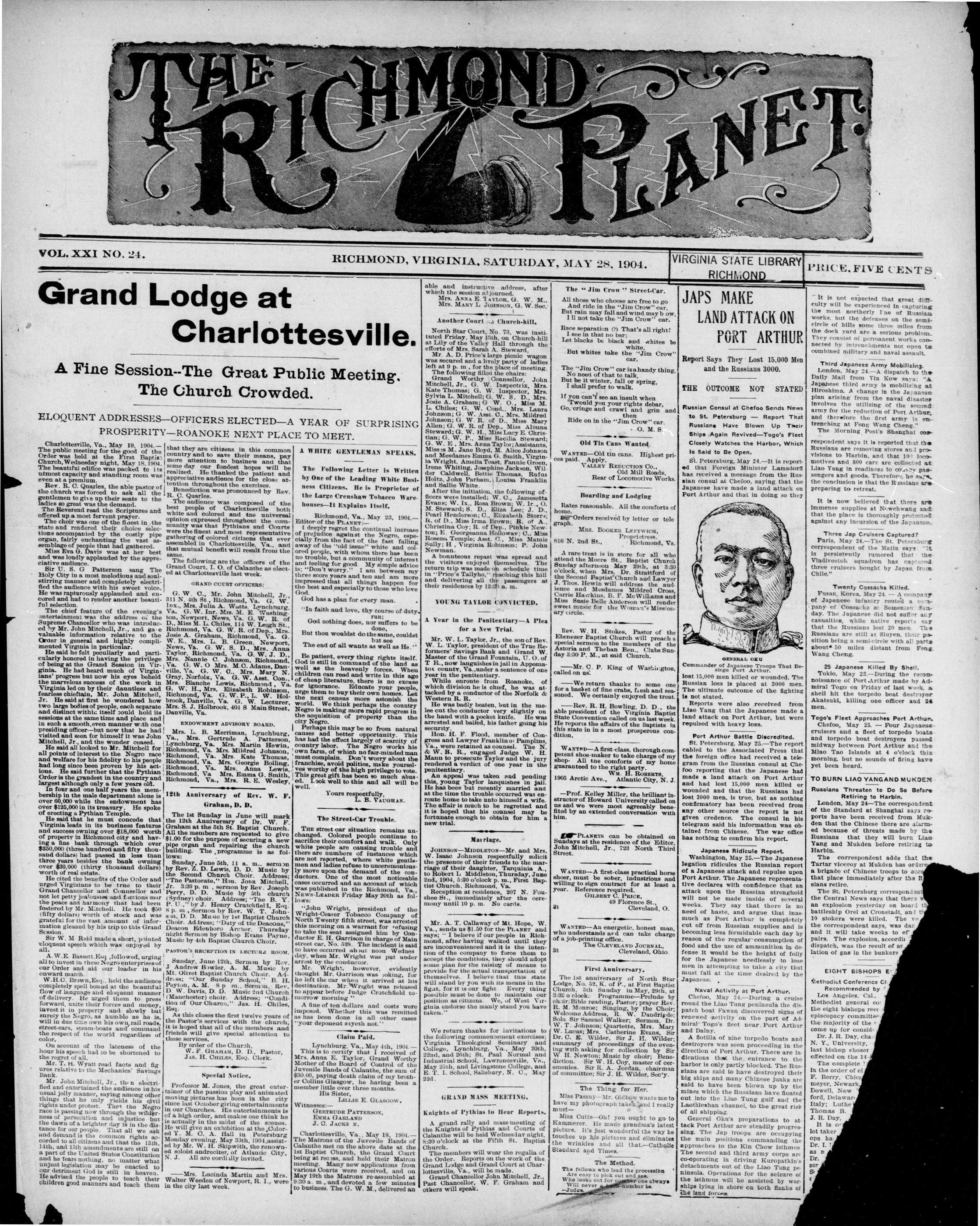
Charlottesville, Va., May 19, 1904.—The public meeting for the good of the Order was held at the First Baptist Church, Wednesday night, May 18, 1904. The beautiful edifice was packed to its utmost capacity and standing room was even at a premium. B.E. R.C. Quarles, the able pastor of the church was forced to ask all the gentlemen to the seats to the ladies so great was the demand. The Reverend read the Scriptures and offered up a most fervent prayer.
The choir was one of the finest in the state and rendered their choice selections accompanied by the costly pipe organ, fairly enchanting the vast assemblage of people that had gathered. Miss Eva G. Davis was at her best and was loudly applauded by the appreciative audience. Sir U. S. G Patterson sang The Holy City in a most melodious and soul-stirring manner and completely electrified the audience with his sweet voice. He was rapturously applauded and enclosed and had to render another beautiful selection. The chief feature of the evening's entertainment was the address of the Supreme Chancellor who was introduced by Mr. John Mitchell, Jr., and ga e valuable information relative to the Order in general and highly complimented Virginia in particular.
He said he felt peculiarly and particularly honored in having the privilege of being at the Grand Session in Virginia. He had heard much of Virginians' progress but now his eyes beheld the marvelous success of the work in Virginia led on by their dauntless and fearless chieftain, Mr. John Mitchell, Jr. He said at first he wondered how two large bodies of people, each separate and distinct within itself could hold its sessions at the same time and place and in such a smooth, even manner with one presiding officer—but now that he had visited and seen for himself it was John Mitchell, Jr., and the wonder ceased. He said all looked to Mr. Mitchell for all points of interest to the Negro race and welfare for his fidelity to his people had long since been proven by his actions. He said further that the Pythian Order is the grandest in the country and largest although only a few years off. In four and one half years the membership in the male department alone is over 60,000 while the endowment has over $125,000 in its treasury. He spoke of erecting a Pythian Temple.
He said that he must concede that Virginia leads in its business features and success owning over $18,000 worth of property in Richmond city and having a fine bank through which over $50,000 (three hundred and fifty thousand dollars) had passed in less than three years besides the bank owning over $30,000 (thirty thousand dollars) worth of real estate.
He cited the benefits of the Order and urged Virginians to be true to their Grand Chancellor and Counsellor and not let petty jealousies and factions mar the peace and harmony that had been fostered by Mr. Mitchell. He took $50 (fifty dollars) worth of stock and was grateful for the vast amount of information gleaned by his trip to this Grand Session.
Sir W. M. Reid made a short, pointed eloquent speech which was enjoyed by all.
A.W.E. Bassett, Esq, followed, urging all to invest in the Negro enterprises of our Order and aid our leader in his onward march.
W.H.C. Brown, Esq., held the audience completely spell bound at the beautiful flow of language and eloquent manner of delivery. He urged them to press forward, unite their forces and money, invest it in property and slowly but surely the Negro, as humble as he is, will in due time own his own, rail roads, street-cars, steam-boats and command the respect of the world regardless of color.
On account of the lateness of the hour his speech had to be shortened to the regret of all.
Mr. T. H. Wyatt read facts and figures relative to the Mechanics' Savings Bank.
Mr. John Mitchell, Jr., then electrified and entertained the audience in his usual jolly manner, saying among other things that he only yields his civil rights under protest. Thet the Negro race is passing now through the wilderness of persecution and injustice but the dawn of a brighter day is in the distance for our people. That all we ask and demand is the common rights accorded to all citizens and that the 13th, 14th, and 15th amendments are still on a part of the United States Constitution and he fears nothing, no matter what unjust legislation may be enacted to our detriment God is still in heaven. He advised the people to teach their children good manners and teach them
that they are citizens in this common country and to save their means, pay more attention to business and that some day our fondest hopes will be realized. He thanked the patient and appreciative audience for the close attention throughout the exercises. Benediction was pronounced by Rev. R. C. Quarles. The audience was composed of the best people of Charlottesville both white and colored and the universal opinion expressed throughout the community was that Pythians and Courts were the finest and most representative gathering of colored citizens that ever assembled in Charlottesville, Va., and that mutual benefit will result from the same. The following are the officers of the Grand Court, I. O. of Calanthe as elected at Charlottesville last week.
GRAND COURT OFFICERS:
ENDOWMENT ADVISORY BOARD
Sunday, June 5th, 11 a. m., sermon by Rev. Z. D. Lewis, D. D. Music by the Second Church Choir. Address, "The Pastorate," Hon. Jonn Mitchell, Jr. 3:30 p. m., sermon by Rev. Joseph Perry, D. D. Music by 5th church (Sydney) choir. Address, "The B. Y. P. U.," by J. Henry Crutchfield, Eq. 8 p. m., Sermon by Rev. W. T. John, D. D. Music by 1st Baptist Church Choir. Address, "Duty of the Deacons," Deacon Edwards Archer. Thursday night sermon by Bishop Evans Payne, Music by 4th Baptist Church Choir.
PASTOR'S RECEPTION IN LECTURY ROOM.
Sunday, June 12th, Sermon by Rev. J. Andrew Bowler, A. M. Music by Mt. Olive Baptist Church Choir. Address, "Our Sunday School," B. H. Poyton, A. M. 9 p. m., Sermon, Rev. D. W. Davis, D. D. Music by Church (Manchester) choir. Address, "Condition of Our Church," Jas. H. Chiles, Esq.
As this closes the first twelve years of the Pastor's services with the church, it is hoped that all of the members and friends will give special attention to these services.
By order of the Church
W. F. GRAHAM, D. D., Pastor,
JAS. H. CHILLES, Esq. Clerk.
Special Notice.
Professor M. Jones, the great entertainer of the passion play and animated moving pictures has been in the city since last October giving entertainments in our Churches. His entertainments is of a high order, and makes one think he is actually in the midst of the scenes. He will give an exhibition at the, Colored Y. M. O. A. Hall in Petersburg Monday evening. May 30th, 1904, assisted by Mr. W. H. Skipwith, the renowned solist and recorder, of Atlantic City, N. J. All are cordially invited.
Mrs. Lucinda Martin and Mrs. Walter Weeden of Newport, R. I., were in the city last week.
RICHMOND, VIRGINIA, SATURDAY, MAY 28, 1904.
A WHITE GENTLEMAN SPEAKS.
The Following Letter is Written by One of the Leading White Business Citizens. He is Proprietor of the Large Crenshaw Tobacco Warehouses—It Explains Itself.
Richmond, Va., May 23, 1904.—Editor of the PLANET:
I deeply regret the continual increase of prejudice against the Negro, especially from the fact of the fast falling away of the "old issue" white and colored people, with whom there has been no trouble, but a community of interest and teeling for good. My simple advice is; "Don't worry." I am between my three score years and ten and am more impressed that all things happen for the best and especially to those who love God.
God has a plan for every man.
"In faith and love, thy course of duty, run;
God nothing does, nor suffers to be done.
But thou wouldst do the same, couldst but see
The end of all wants as well as He."
Be patient, every thing rights itself. God is still in command of the land as well as the heavenly forces. When children can read and write in this age of cheap literature, there is no excuse for ignorance. Educate your people, urge them to buy their own homes. Let the next census more astonish the world. We think perhaps the country Negro is making more rapid progress in the acquisition of property than the city Negro. Perhaps this may be so from natural causes and better opportunity. This has had the effect largely of scarcity of country labor. The Negro works his own farm, of which no fair-minded man must complain. Don't worry about the franchise, avoid politics, make yourselves worthy of the high privilege to vote. This great gift has been so much abused. Look well to this and all will be
The Street-Car Trouble
THE street car situation remains unchanged. Colored people continue to sacrifice their comfort and walk. Only white people are causing trouble and there are numbers of instances which are not reported, where white gentlemen and ladies refuse to unceremoniously move upon the demand of the conductors. One of the most noticeable cases occurred and an account of which was published in the Richmond, Va., NEWS-LEADER Friday May 20th as follows:
"John Wright, president of the Wright-Ceaser Tobacco Company of North Twenty fifth street, was arrested this morning on a warrant for refusing to take the seat assigned him by Condoleezza E. M. Garrison in charge of Main street car. Noahs. The incident is said to have occurred about noon Wednesday, when Mr. Wright was put under arrest by the conductor.
Mr. Wright, however, evidently thought Mr. Garrison was joking, for he left the car when it arrived at his destination. Mr. Wright was released to appear before Judge Cratchfield to tomorrow."
A fine of ten dollars and costs were imposed. Whether this was remitted as has been done in all other cases "your deponent sayeth not."
Claim Paid.
Lynchburg, Va., May 4th, 1904.—This is to certify that I received of Mrs. Anna E. Taylor, Grand Worthy Mother of the Board of Control of the Juvenile Bands of Calanthe, the sum of $30.00, paying death claim of my brother Collins Glasgow, he having been a member little over three months. His Sister, LILLIE E. GLASGOW. Witnesses:—GERTRUDE PATTERSON, EMMA GARLAND J. O. JACKS N. Charlottesville, Va., May 18, 1904.—The Matrons of the Juvenile Bands of Calanthe met on the above date at the 1st Baptist Church, the Grand Court being at recess, and held their Matron meeting. Many new applications from various Courts were received, and on May 19th the Matrons re-assembled at 9:30 a. m., and devoted a few minutes to business. The G. W. M., delivered an
able and instructive address, after which the session adjourned.
Mrs. ANNA E TAYLOR, G. W. M.
Mrs. MARY L JOHNSON, G. W. Scc.
Another Court Church-hill.
North Star Court, No. 73, was instituted Friday, May 13th, on Church hill at Lily of the Valley Hall through the efforts of Mrs. Sarah A. Steward,
Mr. A. D. Price's large picnic wagon was secured and a lively party of ladies left at 9 p. m., for the place of meeting. The following filled the chairs:
following nicely the chairs:
Greg Green, Mrs. Counsellor, John Mitchell, Jr., G.W. Inspectrix, Mrs. Kate Thomas, G.W. Inspectrix, Mrs. Sylvia L. Mitchell, G.W. W. Josie A. Graham, G.W. O., Miss M. L. Chiles, G.W. Cond., Mrs. Laura Johnson, G.W. Asst. O., Mrs. Midred Johnson, G.W. R. of D., Miss Mary Allen, G.W. R. of Dep., Miss Albuna Steward, G.W. H., Miss Lucy E Christian, G.W. P., Miss Racilia Steward, G.W. E, Mrs. Anna Taylor, Assistants, Miss Jane Boyd, M. Alice Johnson and Meed. Jensma G. Smith, Virginia Wright, Jensma Jensie Green, Irene Whiting, Josephine Jensen, Caldwell, Bettie Thomas, Rufas Holtz, John Parham, Louisa Franklin and Sallie Well
After the initiation, the following officers were installed: W. C., Jamesetta Evans; W. Ix., Rosa Brown; W. Ir., O. M. Stewart; S. D., Elae Lee; J. D., Pearl Henderson; C., Elizabeth Storr; k. of, D. M., Miss Irma Brown; R. of, A., Christina Coy, R. of Dep., Pinkie Newon; E. Georgea Holloway; C., Miss Rosemia Temple, Asst. C., Miss Mamie Salm H., Virginia Robinson; P. John Newman.
A bountiful repast was spread and the visitors enjoyed themselves. The return trip was made on schedule time in "Price's Tallyho" reaching this hill and delivering all the passengers at their residences by 12:30 a. m.
YOUNG TAYLOR CONVICTED.
A Year in the Penitentiary—A Plea for a New Trial
Mr. W. L. Taylor, Jr., the son of Rev. W. L. Taylor, president of the True Reformers' Savings Bank and Grand W. Master of the Grand Fountain, U. O. of T. R., now languishes in jail in Appomattox county, Va., under a sentence of one year in the penitentiary.
While enroute from Roanoke, of which division he is chief, he was attacked by a conductor of the Norfolk & Western R. R.
He was badly beaten, but in the melee cut the conductor very slightly on the hand with a pocket knife. He was arrested and bailed, his father going his security. H. F. Hlood, member of Congress and Lawyer Franklin or Pamplins, Va., were retained as counsel. The N. & W. R. R., engaged Judge W. H. Mann to prosecute Taylor and the jury rendered a verdict of one year in the penitentiary.
An appeal was taken and pending this, young Taylor lanquishes in jail. He has been but recently married and at the time the trouble occurred was encomioe to take unto himself a wife. Someone is much to be regretted and it is hard to reach his counsel may be fortunate enough to obtain for him a new trial.
Marriage.
JOHNSON—MIDDLETON—Mr. and Mrs. W. Isaac Johnson respectfully solicit the presence of their friends to the marriage of their daughter, Tarquinia A. to Robert L Middleton, Thursday, June 2nd, 1904, 5:30 o'clock p. m., First Baptist Church, Richmond, Va. Reception at residence, 207 N. Foushee St., immediately after the ceremony until 10 p. m. No cards.
---
Mr. A. T. Callaway of Mt. Hope, W. Va., sends us $1.50 for the PLANET and says; "I believe if our people in Richmond, after having walked until they are inconvenienced and it is the intention of the company to force them to accept the conditions, they should adopt some plan for the raising of means to provide for the actual transportation of themselves. I believe that this state will stand by you with its means in the figat, for it is our fight. Every thing possible must be done to maintain our position as citizens. We, of West Virginia endorse the manly stand you have taken."
We return thanks for invitations to the following commencement exercises: Virginia Theological Seminary and College, Lymphebury, May, May 20th, 23rd and 26th; St. Paul, Normal and Industrial School, Lawrenceville, Va., May 25th, and Livingstone College, and E. T. I. School, Salisbury, N. C., May 22d
GRAND MASS MEETING.
Knights of Pythias to Hear Reports.
A grand rally and mass-meeting of the Knights of Pythias and Courts of Calanthe will be held Wednesday night, 8:30 o'clock at the Fifth St. Baptist Church.
The members will wear the regalia of the Order. Reports on the work of the Grand Lodge and Grand Court at Charlottesville, Va., will be made.
Grand Chancellor John Mitchell, Jr., Past Chancellor, W. F. Graham and others will speak.
The "Jim Crow" Street-Car.
All those who choose are free to go
And ride in the "Jim Crow" car.
But rain must fall and wind may b ow
I'll not take the "Jim Crow" car.
Race separation (2) That's all right!
I see in that no bar;
Let blacks be black and whites be
white,
But whites take the "Jim Crow"
car.
The "Jim Crow" car is a handy thing,
No need of that to talk.
But be it winter, fall or spring,
I shall prefer to walk.
If you can't see an insult when
"Twould you your rights debar,
Go, cringe and crawl and grin and
WANTED—Old tin cans. Highest prices paid. Apply.
Boarding and Lodging
Rates reasonable. All the comforts of home. Orders received by letter or tele graph.
A rare treat is in store for all who attend the Moore St., Baptist Church Sunday afternoon May 29th, at 3:30 o'clock, when Mrs. Dr. Stratford of the Second Baptist Church and Lawyer J. Thos. Hewin will address the audience and Mesdames Mildred Cross, Carrie Hawkins, B. F. McWilliams and Miss Susie Belle Anderson will render sweet music for the Woman's Missionary circle.
Rev. W. H. Stokes, Pastor of the Ebenezer Baptist Church will preach a special sermon to the members of the Astoria and Theban Ben., Clubs Sunday 3:30 P. M., at said Church.
Mr. C. P. King of Washington, called on us.
We return thanks to some one for a basket of fine crabs, fresh and seasoned. We certainly enjoyed the treat.
—Rev. R. H. Bowling, D. D., the able president of the Virginia Baptist State Convention called on us last week. He reports the affairs of the Baptists in this state in a most prosperous condition.
WANTED—A first-class, thorough competent shoe-maker to take charge of my shop. All the comforts of my home guaranteed to the right party.
WM. H. ROBERTS,
1905 Arctic Ave., Atlantic City, N. J.
—Prof. Kelley Miller, the brilliant instructor of Howard University called on us and we were most agreeably benefited by an extended conversation with him.
PLANETS can be obtained on Sundays at the residence of the Editor, John Mitchell, Jr., 723 North Third Street.
WANTED—A first-class practical horse shoer, must be sober, industrious and willing to sign contract for at least a year. Reference required.
WANTED - an energetic, honest man
who can take charge of
a job, printing an
First Anniversary.
The 1st anniversary of North Star Lodge, No. 52, K of P., at First Baptist Church, 5th Sunday in May, 29th, at 3:30 o clock. Programme - Prelude by chair; Bible reading, Pastor; prayer Rev. R. M. Monroe; Singing, by the Choir; Welcome Address, R. W. Dandridge; Solo, Sir Samuel Walker; Sermon, Dr. Johnson; Quartette, Mrs. Mary W. L. Johnson; Mrs. Catherine Evans, Sir Dr. C. E. Johnson; Mrs. Catherine Wilder; summary of proceedings of the singing with asking for collection by Sir W. H. Newton; Music by choir; Benediction. Sir W. H. Coy, master of ceremonies. Sir R. A. Jordan, chairman of committee; Sir J. H. Wilder. Sec'y.
The Thing for Her.
Miss Passay - Mr. Oldbrow wants me to have my photograph taken, and I really must—
Miss Cutts - Oh! you ought to go to Kammerer. He made grandma's latest picture. It's just wonderful the way he touches up his pictures and eliminates the wrinkles and all that.—Catholle Standard and Times.
The Method.
The fellows who lead the procession are easy to pick out and see. Who looks out for number one always. Will have a lock-number be. - Judre
VIRGINIA STATE LIBRARY RICHMOND
JAPS MAKE LAND ATTACK ON PORT ARTHUR
Report Says They Lost 15,000 Men and the Russians 3000.
THE OUTCOME NOT STATED
Russian Consul at Chefoo Sends News to St. Petersburg — Report That Russians Have Blown Up Their Ships Again Revived—Togo's Fleet Closely Watches the Harbor, Which Is Said to Be Open.
St. Petersburg, May 24.—It is reported that Foreign Minister Lamsdorfi has received a message from the Russian consul at Chefoo, saying that the Japanese have made a land attack on Port Arthur and that in doing so they
GENERAL OKU
Commander of Japanese Troops That Be-
siege Port Arthur.
lost 15,000 men killed or wounded. The Russian loss is placed at 3000 men. The ultimate outcome of the fighting is not stated. Reports were also received from Liao Yang that the Japanese made a land attack on Port Arthur, but were repulsed with heavy loss.
Port Arthur Battle Discredited
St. Petersburg, May 25—The report cabled to the Associated Press that the foreign office had received a telegram from the Russian consul at Chefoo reporting that the Japanese had made a land attack on Port Arthur and had lost 15,000 men killed orounded and that the Russians had lost 3000 men, is true, but as nothing confirmatory has been received from any other source the report is not given credence. The consul in his telegram said his information was obtained from Chinese. The war office has nothing to confirm his report.
Japanese Ridicule Report.
Washington, May 25.—The Japanese legation ridicules the Russian report of a Japanese attack and repulse upon Port Arthur. The Japanese representative declares with confidence that an attack upon the Russian stronghold will not be made inside of several weeks. They say that there is no need of haste, and argue that inasmuch as Port Arthur is completely cut off from Russian supplies and is becoming less formidable each day by reason of the regular consumption of food and the use of ammunition in defense it would be the height of folly for the Japanese needlessly to lose men in attempting to take a city that must fall at the time desired by the Japanese.
Naval Activity at Port Arthur.
Chefoo, May 24.—During a cruise round the Liao Tung peninsula the dispatch boat Fawan discovered signs of renewed activity on the part of Admiral Togo's fleet near Port Arthur and Dalny.
A fortill of nine torpedo boats and destroyers was seen proceeding in the direction of Port Arthur. There are indications that the entrance to the harbor is only partly blocked. The Russians are said to have destroyed their big ships and many Chinese junks are said to have been blown up by the mines which the Russians have floated out into the Liao Tung gulf and the Laothleshan channel, to the great risk of all shipping.
General Oku's preparations to attack Port Arthur are steadily progressing. The Jap troops are occupying the main positions commanding the approaches to the Kin Chow isthmus. The second and third army corps are co-operating in driving Kuropatkin's detachments out of the Liao Tung peninsula. Operations for the seizure of the isthmus will be assisted by warships lying in shore on both flanks of the land forces.
It is not expected that great difficulty will be experienced in capturing the most northerly line of Russian works, but the defenses on the somicircle of hills some three miles from the dock yard are a serious problem. They consist of permanent works connected by intrenchments not open to combined military and naval assault.
Third Japanese Army Mobilization
London, May 24.—A dispatch to the Daily Mail from Yin Kow says: "A Japanese third army is mobilizing at Hiroshima. A change in the Japanese plan arising from the naval disaster involves the utilizing of the second army for the reduction of Port Arthur, and therefore the first army is entrenched at Feng Wang Cheng." The Morning Post's Shanghai correspondent says it is reported that the Russians are removing stores and provisions to Harbin, and that 100 locomotives and 800 cars are collected at Liao Yang in readiness to convey passengers and goods. Therefore, he says the conclusion is that the Russians are preparing to retreat.
It is now believed that there are immense supplies at Nouchwang and that the place is thoroughly protected against any incursion of the Japanese.
Paris, May 24.—The St. Petersburg correspondent of the Matin says, "It is persistently rumored that the Vladivostok squadron has captured three cruisers bought by Japan from Chile."
Twenty Cossacks Killed.
Fusan, Korca, May 24. — A company of Japanese infantry routed a company of Cossacks at Sementen Sunday. The Japanese did not suffer any casualties, while native reports say that the Russians lost 20 men. The Russians are still at Sliuyen, their position being a semi-circle with all parts about 50 miles distant from Feng Wang Cheng.
25 Japanese Killed By Shell.
Tokio, May 23.—During the reconnaissance of Port Arthur made by Admiral Togo on Friday of last week, a shell hit the torpedo boat destroyer Akatsuki, killing one officer and 24 men.
Togo's Fleet Approaches Port Arthur, Chefoo, May 25. — Four Japanese cruisers and a fleet of torpedo boats and torpedo boat destroyers passed midway between Port Arthur and the Miao Tao Islands at 4 o'clock this morning, but no sounds of firing have yet been heard.
TO BURN LIAO YANGAND MUKDEM
Russians Threaten to Do So Before Retiring to Harbin.
London, May 24—The correspondent of the Standard at Shanghai says reports have been received from Mukden that the Chinese there are alarmed because of threats made by the Russians that they will burn Liao Yang and Mukden before retiring to Harbin.
The correspondent adds that the Tartar viceroy at Mukden has ordered a brigade of Chinese troops to occupy that place immediately after the Russians retire.
The St. Petersburg correspondent the Central News says that there was an explosion yesterday on board the battleship Orel at Cronstadt, and the 10 stokers were killed. The vehement correspondent says, was darned and it will take weeks to effuse palrs. The explosion, according dispatch, was the result of anlation of gas in the bunkers.
EIGHT BISHOPS
Methodist Conference
Recommended by
Los Angeles, Cal.
Methodist general con-
fer the eight bishops rec
episcopacy committee
the majority of the
come up for consid-
The complete
in the order of el
F. Berry, Chic
meyer, Newark
Dowell, New
ford, Delawar
Italy; Luthe
Thomas B.
J. R. Day.
2 THE RICHMOND PLANET, RICHMOND. VIRUGINIA.
rrr NESS RGEAAN EG A, INA EI
i
.
Cc ef
‘i e a Pare
ita iN
Hive eat
AG
Ny
WW
4 Ne
baa
a A
SATURDAY .... ..... MAY 28, 190
A HEART'S
MELODY 2
aa ee
B RAN his fingers lightly over the
keys, struck a few chords aimless-
ly, then looked across the room to the
Ingle-nook where she sat. She raised
her violet eyes for one moment, then
shyly drooped them, and the hand that
held out the tempting bonbon to Cunjer,
the tiny spaniel, trembied slightly.
He smiled and turned away, and the
Rext moment a low, divine melody
filled the room:
“Last night I dreamed your golden hair
Lay soft against my face,
And that your fingers in my hand
Had found a resting place.
I dreamed your girlish lips met mine,
And that your dewy breath
Did whisper thoughts against my
cheek,
As would give life to death,
Did’ whisper thoughts against my
cheek,
As would—give life—to—death—”
The tender, impassioned words died
away with a wierd intensity that
Seemed to linger in every nook and
corner of the great room, and the girl
in her warm, glowing retreat, shivered,
What strange power was there in
that marvelous voice? Why should it
thrill her very being, her inner self?
—the self she knew so little of? It
annoyed her—it half-angered her!
Tt was impossible to forget this man
and his wonderful voice!
“As—would give—life—to—death—"
‘The exquisite tones still trembled in
her heart.
‘There was a pause—the fire in the
pretty grate crackled cherrily. Cun-
LB as
au a ey
jer curled himself up on his soft cush-
ion with a little sigh of relief, but the
girl moved uneasily and her cheeks
grew crimson.
She knew what he was thinking—
the man at the piano—and she knew,
too, what her answer would be.
She—Jndge Geoffrey’s only daugh-
ter; he, plain Douglas Stirling, the
young engineer.
She did not like to give him pain,
but—
“Oh, little maiden whose soft lps
Are sweeter than May dew,
Just lean a moment on my breast
And make my dream come. true—
He stopped abruptly, crossed the
Toom swiftly and bent over her.
“Claire, will you?” The three little
words were wondrously sweet and ten-
der.
It was very still in the room; she
did not answer, nor did she lift the
dark-fringed lids that hid the lovely
eyes; the brown. shapely hand uncon-
sciously tightened its clasp on the
back of the low chair in which she sat
—those moments were hours!—then,
suddenly, with a pretty, subtle grace
peculiarly her own, she raised her
golden head and leaned it against the
road breast of the man behind her,
and he, with a quick gasp, caught the
slender form close to his heart.
‘The little Greek clock on the shelf
wusically chimed the quarter, and still
held her close and no word was
en.
raised her eyes and for the first
looked into the man’s face, and
was one of wonder,
. Douglas, does it mean—so
you?
ed the question tremulously
back a little—startled—
almost at the transfigura-
plain face. It was almost
ining there!
wildered, too! How had
to answer him so. She
ed until this very night
sd. Did she really love
t that song.
and under the rounded
turned the beautiful
much—to me?” he
“Does it mean
ed at her steadily,
love glowing in his
d sunshine! It’s
’s hope and trust!
e truly,
ere uplifted to
d against his
gers nestled
and while
away, the
t of the
th, he
, his
the
ing
hands, had hung a sumptuous velvet
garment, heavily broidered with fur
Moved by a quick impulse, he had taker
the great soft thing and had folded I
gently round the marble form.
‘There had been a little silence—then
Whitney, with a sich and the shade
of a sadness hovering in his dreamy
eyes, had said quietly:
“And yet, Beresfora, she 1s only s
woman of stone.”
Involuntarily the words repeated
themselves to him this night, and he
drew a quick breath.
“A woman of stone!” Surely the two
Were akin! Could nothing touch this
Woman who sat now unmoved, while
the immense audience were swayed by
the power of song? Were there no
hidden chords of tenderness, of feeling,
within that faultless shape? Was there
Bo heart beneath those folds of tulle
and satin—those gleaming, flashing
stones?
From the friendly shelter of the dark
curtains, he studied her intently, this
brilliant, beautiful wife of his old
friend. He was curious—he confessed
it to himself—there was something he
could not fathom. Those smiling lips,
those violet eyes, were trusty, unyleld-
ing sentinels of the heart below—they
guarded well.
She was still a fascination to him—
later—as they sat in the luxuriously
appointed drawing room, after the
opera, where the firelight rose and fell
in fitful, reddish gleams—the jasmines
heavily scented the air, and the old
colored woman she had brought from
her American home, went noiselessly
to and fro with the dainty fragile ser-
vice.
Tt was all a picture—Beresford
thought, and just then the host had come
in, haughty, reserved, dignified, as be-
fitting the bearer of his name, and with
him, a bonnie little chap of six, the
heir to all these vast estates.
He ran quickly across the room to
his mother’s side, and Mespite the late-
ness of the hour, his blue eyes were
‘wide open.
“Oh, mamma, come quick and see my
birthday gift!” The eager little hands
drew her impatiently toward the music
room, the others following slowly.
“See, mamma! It talks, and it sings,
and it plays Just like the band out in
the square, only I like ‘Dixie’ better
than ‘God Save the Queen!’ Quick,
fix it, papa! Now, listen!”
She smiled a little at the childish
excited face, as the clear, ringing tones
‘of Sousa’s band came pouring out into
the awiet room.
Her husband leaned over her chair.
“It"s really very good, American al-
together.” He smiled down at her.
“There's one thing I want you to hear
I don’t know the volee—I must make
some inquirles—but it's superb!”
Then he turned away and she leaned
back against the soft cushions and
carelessly crumbled a bit of wafer in
her slender, Jeweled fingers.
| There was a little hush—the rain
outside beat steadily against the long
windows—it was a wild night—
“Last night I dreamed your golden hair
"Lay soft against my face,
And that your fingers in my hand
| Had found a resting place.” ;
It was a man’s voice, divinely sweet
and tender—a marvelous yoice—and
[Beresford Jeaned forward in wondering
‘delight, while his host quietly enjoyed
his surprise.
“1 dreamed your girlish lips met mine,
And that your dewy breath
Did whisper thoughts against my
cbeek,
Sh doeht Etre eto death;
‘Did whisper thoughts against my
cheek,
As would give—lite—to—
‘There was a rustle of soft draperies
—Beresford glanced up tmpatiently—
‘then he sprang to his feet In sudden
alarm!
| She had risen and was gazing atead-
fly over at the wonderful instrument,
‘The beautiful face was ashen pale and
‘the violet eyes were full of horror. As
‘he looked, the slender figure swayed
‘baek and forth, the white hands were
thrown out despairingly, and she
would have fallen, had he not caught
her quickly—and only his ears heard
the low, piteous cry:
“Douglas, oh Douglas, forgive!”
Pa retiree ra ee
“Oh, ttle maiden whose soft lips
‘Are sweeter than May dew,
Just lean a moment on my breast
‘And make my dream come true,”
sang on the exquisite voice. But she
id not know nor hear—she would not
again for many months—perhaps nev-
er—the great physicians said nervous
Prostration—too great social strain,
And only Beresford knew, that
“Douglas,” whoever and wherever he
was, wns avenged.
“And make—and make—my—dream
—come—true.”
‘Twins in No Danger.
As regards the possible partition of
Siam by the powers, it Is consoling tore-
member, says the Chicago Tribune, that
the Siamese twins are beyond the reach
of any danger.
‘Will Be Needed at Home.
‘Why send the fool-killer to the north
Why send the fool-killer to the north
pole, asks the Chicago Daily News, when
@ presidential campaign is coming on
and there will beso much work for it at
home?
Irqjand has now a bank holiday all to
teself—namely, St. Patrick's day.
Reducing the Estimate.
Upgardson—What do you say are the
three essentials to a home?
Atom—There are only two. Dollars
and sense—Chicago Tribune.
Lovers.
Here Is Something Uneek.
‘We spell some words in a manner unique,
But that is no reason why we should spique
Of the eagle who, from the mountain plaue,
Swoops down to the valley, there to sique
Some venturesome youngsiers beside a
crique,
And carries him, kicking, away In his bique
Would the youngster let out an unearthly
shrique,
Or would he just venture a querulous
sauique,
‘When carried aloft, with the speed of a
strique
Of light, to the crag so drear and bilque?
Would he be so calm, demure and mique.
That he'd not even open his eves to siaue
When the eagle says: “Here's enough to
ique
Out food for the crowd at least a wique?”
AU of which is simply to show the ehique
Of him who started a frivolous frique
By spelling the word uneok unique.
—Tit-Bits.
‘ei
ows Said the architect, who was
putting the finishing touches upon Mr.
Nurich’s palatial new home, “what
color do you prefer for the parlor decor-
ations?”
“Oh, they got to be red,” replied Nu-
Tich. “My wife's got a red plust. photo-
graph album that always sets on the
parlor table."—Philadelphia Press,
Love’s Sacrifices.
Young Wife—Gerald, how do you like
my doughnuts?
‘Young Husband (pale, but resolute)—
Don’t you see me eating them, Bertha?
They're splendid. The only fault I can
possibly find with them is that they are
@ little too satisfying. After eating one
of them you don’t want anything else,
you know.—Chicago Tribune.
‘The Itching Palm.
Harry—Have you heard of the new
disease—the itching palm—that is so
preyalent among waiters, messenger
boys and other servants?
Frank—A new disease? Why, my
dear fellow, I have suffered from it ever
since I can retaember.—Town Topics.
The Exception.
Sharpe—There goes old Closeman.
No one ever saw him close his eyes at
money.”
Whealton—t have.
Sharpe—When was it?
| Whealton—When the collection box
passed him.—Chicago Daily News.
A Gotham Weddinc,
| “But why did the bride's mother
weep?”
| “Oh, when it was too late she discov-
| ered that she had overlooked a chance
| to get an English son-in-law with a llt-
| tle better title at approximately the
| same price.”—Chicago Post.
An Addition.
Harold—What mixture is that you're
smoking?
Gerald—Oh, it contains several kinds.
I get it down at —.
Harold—Put a little breakfast food
in; it would help it some.—Cieveland
Leader.
‘Not What He Wanted.
“My! That's a speaking portrait of
rour wife.”
| “Heavens! Don’t say that. I thought
Chad at last got it arranged so that I
‘could enjoy her beauty without the
_ speaking.”—Chicago Record-Herald.
Not News.
Jimson (proudly)—I never deceive my
| wife—no, sir; I tell hereverything.
Bilson—Yes, I knew that long ago.
“Wha—how?”
“She tells it all to my wife and my
wife tells it to me."—N. Y. Weekly.
Discovered.
‘Jessie—How in the world did you dis-
cover her age?
Bessle—I asked her at what age she
| thought a girl shovld marry, and she
promptly said not before she’s 27.—
eniateteala canten:
A Tip.
| “I always supposed Mrs. Dazzler’s dia-
monds were real until the other night.”
“What convinced you that they were
not?”
“Why, I asked her where she bought
her cut glass, and she really got an-
ery. There's where she wasn’t clever.
If she had taken it as a joke I would
have never known the difference."—
Detrolt Free Press,
Paving the Way.
‘The Bridegroom—Would you mind
it I went into a smoking compartment,
dear?
‘The Bride—What! to smoke?
The Bridegroom—Oh, dear no. 1
want to experience the agony of being
away from you, so that the joy of my
return will be all the more inte..sl-
fled.—Tit-Bits.
Parodied for Present Use.
‘Truth crushed to earth will rise again,
And cut another cherry tree:
But error on the baseball fleld
Gets jumped on most unmercif'ly.
N.Y. Herald,
QUESTION OF INDISCRETION,
by
eri
ay NS
CT -
ie oo
= @ | =
| ila )y..
| ; is
| 5 oe
C EP .
Husband—Would you have married
me if I'd been a poorman? But p’r’aps
‘that is rather an indiscreet question?
Wife—-Questions are never indisereet,
dear; answers sometimes are.—Ally
Mloper. 4
Badly Deceived.
Enquirer—t ‘spose even you ‘tees get
taken in and sold sometimes, don’t
you?
Detective—Rather. I was just think-
ing of a case as you came in.
Enquirer—Tell us about it.
Detective—It was a woman—young,
Pretty, agreeable, and from the look of
her anyone would have thought she
Was sweet and good enough to eat; in-
ptead she turned out tobe a devil in-
carnate, with false teeth and halr, and
I don't know what else.
Enquirer—By Jove! How did you
find her out?
Detective (sadly)—I married her.—
Ally Sloper.
Sure to Be Disagreeable.
“Hello, Gudger; I've been looking for
you a week. Couldn't find you high or
low. Met a friend of yours the other
day. He's been talking about you and
I felt it my duty to tell you what he
said.”
“Ah! Well, I don’t care to hear what
he said. I know it was something dis-
agreeable.”
“How do you know that?”
“Because you are so anxious to tell
it. Good-morning.”—N. Y. Press.
Cie tea eee
“Papa,” said the boy, “when you say
in your advertisements that your goods
are acknowledged by connoisseurs to
be the best, what do you mean by con-
noisseurs?”"
“A connoisseur, my boy,” answered
the great manufacturer, “is an eminent
authority—au authority, in short, who
admits that our goods are the best."—
Tit-Bits.
Forgot It.
‘The new pupil took a piece of sheet
music from her roll, opened it and be-
gan to sing.
| “Stop, child!” sternly interrupted the
‘professor of voice culture. ““That meth-
od will not do at all! You must sing
from your diaphragm!”
“I didn’t bring that with me,” fal-
‘tered the terrified pupil_—Chicago Tri-
‘bune.
Feminine Flattery.
Mabel—What a perfectly exquisite
bonnet, dearest?
Ethel—Oh, I am so glad you like it.
I was so afraid you wouldn't. Are you
sure you like it?
Mabel—Sure? Oh, perfectly. I al-
ways did adore that shape. Why, I
had three just like it—when it was in
fashion. —Tit-Bits.
‘Cauitiee Sie & Chet.
|_Tommy—Are you and sister Ethel
goin’ to get married?
Mr.Stedily—Why, e-r, what put such
@ question in your head, Tommy?
Tommy—Oh, nuthin’; only Billy Da-
ly wanted to bet me a nickel against a
cent that the match’d never come of,
and I'd like a little inside infermation.
—Puek.
Circumstances Alter Cases.
P. Nurious—What a great big nose
that brown-baired girl has.
Si Siety—That’s Miss Goldbonds. She
is worth two millions in her own name.
P. Nurious—I always did admire a
prominent nose; it denotes character.
Introduce me.—Next.”
Never Been Shaved.
Crimsonbeak—t've been carrying that
note of your brother's for some time now.
| Yeast—It must have whiskers by this
time?
| “Just as like as not. I've never had
it shaved."—Yonkers Statesman.
| Always Losing.
| “Charley, dear, I am going to learn
to play poker.”
| “What for?”
“So that I can do as a wife ought, and
intelligently sympathize with you in all
| Your troubles.”—“Next.”
: UNANSWERABLE.
’
| a ,
| 3
| ea eT &
— «a — ad
vas SS "
CAD
i iH | iy
kW i, -
| La
>}
| She—I'm sorry, Dick, but I can’t marry
an extravagant man.
Dick—Why, I'm not extravagant.
| She—You must be. You want to
‘marry me—“Next.”
‘Her Aavice.
“How much better off a man would be
{f he would take his wife's advice.”
“Yes,” answered young Mrs. Torkins.
“T have told Charley time and again not
to bet on horses that don’t win. But ho
will do it."—Washingthon Star.
Patient Waiting No Loss.
| Friend—You have been engaged for
the past two years, and can well afford
to marry. Why don’t you do it?
| Mr. Kissem (gloomily)—I am wait-
ing for the pet dog to die—N. Y.
Weekly
A Cold Snap.
“Wilter is going to marry an heiress
from Boston.
“What a cold snap!"—Detroit Free
Press.
> Cheap and Foreign.
'_ “He says his folks came over in the
Mayflower.”
“Quite likely; there were no restrictive
emigration laws then.”—Puck.
A Good Resolution.
I stole a kiss the other night.
To-day my conscience pricks me some;
I think Til have to go around
And put it where 1 got it from,
Corneil Widow.
Baby Talk.
Old Flapper—I wonder why people
always take me to be so much younger
than I really am; I suppose it's my
personal appearance.
Old Sharpe—No, my boy: it’ isn’t
your looks, it’s your conversation.=
Ally Sloper.
A Situation Defined.
“Did you have a man dat was prac-
tein’ law to defend you in de case?”
asked the visitor.
“Yass indeed,” answered the prison-
er. “He was practicin’ law an’ I was de
feller ho was practicin’ on.”—Washing-
ton Star.
‘What It Meant.
Unsophisticated Cook—It you please,
mum, the butcher says I shall get five
Der cent on all the orders I give him.
‘What aces that mean?
Mistress—it means, Mary, that we
shall have a new butcher.—Tit-Bits.
Luxurious Necessities.
Mrs. Suburbs—I thought you sald we
could economize by living in the coun-
ty.
Suburbs—But, my dear, I didn’t
know then that you would ‘insist om
raising our own vegetables.—Judge.
A Warm One.
“Did you take gas when you had
your tooth pulled?”
“Yes.”
“I thought so—either that or hot air.
‘You haven't got it all out of your sys
tem yet."—Chicago Post.
Goes Up to the Head.
| Bacon—Is there any way you can tell
an educated flea from an uneducated
one?
Egbert—tI think the educated ones are
always found up near the head—
Yonkers Statesman.
Simple Times Gone By.
| “Brain work gets harder all the
time.”
“Yes; men used to do high thinking
on plain living, but now they have to
do plain thinking on high lving."—In-
Wanapolis Journal.
His Love,
“My love for you,” he said, “is as
everlasting as time, as wide as the slap
and as deep as the sea.”
“Yes,” she answered, “and I guess
it's as soft as mush."—Ohicago Res-
ord-Herald.
A Lost Opportunity.
They were speeding along a lonely
road.
“C—can‘t you m-manage the auto-
mobile with one hand, Mr. Slowboy?”
she asked, in a tremulous tone of voice,
‘Sweet enough to make the bees jeal-
ous.
“Oh, yes,” he replied, “but I think it
safer to use both,”
“Yes, I suppose it is,” she said, her
Yoice having suddenly grown as cold
as organized charity, and then added:
“We must return home at oncé, Mr.
Slowboy; I'm sure mamma will be real
anxious.”—Cincinnati Enquirer.
‘The Annual Advance.
‘Advason styles ih bonats,
‘Advance stytes im dress
Advance tipice in Jackets
Patents eet mem
Advance modes in fabrica,
‘Advance styles in Ince,
Advance styicetn stippere—
‘They lengthen the face,
Advance stylesin ribbons
For trimming or nastier
Te all monee teat pape
“Atvances tore Sash,
Chicago "rrbune.
RETORT SARCASTIC.
2 a
a | #7) l| ey WD
SMe | SY
Es a
ro / =
- oe
q wv So
ay Le od gS)
i Y TT
—
Ul
Conductor—Lady, if the train is not
going fast enough to suit you, you
might get off and walk.
Passenger—I would, but the folks
don't expect me home until after the
train gets in—Chicago Daily News.
A Terrible Discovery.
He—What? You can't go to the
opera with me to-night? You promised
to.
She—I know, but it’s impossible.
“Ha! I see it all! You love anoth.
ert”
“Oh, no—no, indeed.”
“Then you have determined to tram-
ple on your own heart and marry some
Bae for his money. Aha! You shrink!
‘ou expect him to call this evening!
Perfidious—"
“Please, please don’t. It is not so.”
“Then why don’t you go?”
“I—J can’t get my new coat on over
the sleeves of my new dress."—N. Y.
‘Weekly.
Didn’t Like the Look of It.
Uncle John (to-small boy just re-
turned from the country)—Well, Tom-
my, did you have plenty of nice new
milk when you were down at the
farm?
‘Tommy—Not me.
Uncle John—How was that?
Tommy—They wanted me to drink
some, but I saw a man squeezing it out
of an old cow, so I wouldn't have any.
—Ally Sloper.
2 ETE RR RS
Dealer—Where are you going now?
Driver—To take this barrel of apples
around to Mr. Brickrow’s.
“Good lands! You'll ruin me. That
barrel hasn’t been opened.”
“Do you want it opened, sir?”
“Of course, you dunce. If we leave
him to do it himself, he may open it at
the wrong end.”——-New York Weekly.
Righteous Iiffignation.
Park Keeper—Sorry to disturb yer,
but it’s too late to be sittin’ here.
Young Man (apologetically)—We
didn’t know it was so late. Fact is, we
are to be married next year.
Park Keeper—Begorry, d’yez think
Ol’m fool enough to be supposin’ you
wor married last year?—Tit-Bits.
ge Booker’
BK Market
| \(e > dl e
| AON p RP 18 W. Baker St.
= x B ¥N) A FULL LINE OF FINE
| A /l Le GROCERIES AND FRESH
' MEATS & VEGETABLES
Wood and Coal, Cigars and Tobacco,
Se rere et
AT THE LOWEST MARKET PRICES,
Soe REe COANE: ST
YOU CAN SAVE MONEY BY GIVING ME A CALL.
ALL GOODS DELIVERED TO YOU FREE.
TELEPHONE 1307<—_—
A. C. BOOKER, Prop.
18 W. B* KER ST. RICHMOND. VA. ‘
RS Dh pina bia age ee OND
a re
. cA
W. I. JOHNSON,
FUNERAL DIRECTOR AND EMBALMER. |
Office & Warerooms, 207 N. Foushee St. Corner Broad”
HACKS FOR HIRE: :
Orders by Telephone or Telegraph filled. Wedding, Sup
pers and Entertainments promptly attended.
Old ’Phone, 686, Residence in Building, New Phone, 48.
eer
OA eieA 5 KNIGHTS OF COLUMBUS OF THE WOi»
oe
bf werd V. P. & F. K. of W.
( 3 Bk at TO WHOM IT MAY CONCERN:
(ae Mico ___ This organization has been chartered and legally ‘
RS Seek he tn peter ttn eee eee ee
a Ses men ‘on the Broad Bases of Chartiy~: Benched me
Fraternal and to promote the Social and Moral condition of humanity.
Its two distinct military and uniform ranks will secure for this organization +
place in the front ranks of all sacred institutions of modern events, a grand oppo
tunity for active men. Deputies wanted in allsections of the country to ofgeni”
lodges Kindly address,
G. W. ALLEN Supreme v ovager,
‘346 W. 87th Street, New York City,
— <<...) ee
= 5
J i ’
y RB \. Mechanics
f ae b 2
( oo Savings Bank
\ 2 A 5 OF RICHMOND, VA
\ Sane se y/ —s51x North Third Street
N eT
NX y . :
<—— Capital, $25,000.
Money received on deposit and interest paid on a
amounts above $1.00 which remains 60 days and over.
Money Loaned on Satisfactory Security.
Business Accounts Handled Promptly.
Amounts of ten cents and upwards received on deposit.
This establishment is fitted up in the most improved style, having @ large
white vault, burlar-proof steel chest, electric lights and every’ modern conven-
ience for safety and the accommodation of the public,
ast MH information concerning Stocks, Deposits, Loans, etc., apply to the
r.
Banking Hours have been weierg oar for the special convenience of the work-
ing people as follows: 9 A. M. tod P. M. Saturdays, 9 A.M. to 3 P. aa. We
close Saturday at $ P. M. and open again at 5 P, M:, remaining open “satil 7
P. M. Call by as you come from work.
OFFICERS:
JOHN MITCHELL, JR., President. HP. JONATHAN, Vice-President.
THOS. H. WYATT, Cashier.
BOARD OF DIRECTORS:
Rev. W.F.Granam,D.D., Jno. R. Omtues, _B. P. VANDERYALL,
E. R. Jerrenson HF. Joxarman, " Taomas Sura D. J. OWAVERS,
J. 0. Fartey, Ino. T. Tayton,
B.A. Wasumatox, R. W. Wanna, = Wiiam Ovsralo, J. J. Oanran,
JOHN MITOHELL, JR. "Fars. THOMAS M. ORUMP, Sxo'r.
FRANK WALLER, of.
PRACTICAL HOUSE
PAINTER,
14 W. Baker St., Richmond, Va.
Residence, 1 E. Orange 83.
Prompt attention given to all mati
orders. Satisfaction guaranteed.
All Kinds of Painting Done Cheap
Give me acall before going elsewhere
eee es
Fred G. Gray,
208 West Leigh St.
THE STOVE MAN.7—
patedand pet ep, Aly pour Hoot
Painted. 2 @ reasonable ge a
bal tel old "Phone, a80u,
FRED G. GRAY,
Richmond, Va.
W@LOOK OUT FOR
OUR PRICE LIST.
——-IT OAN’T BE EXCELLED———
Your Patronage is Invited. —___,
The AMERICAN GROCERY
and Provision MARKET
1221 St. James Street.
eae ea
eek nes eee oe
eer Saares srs
‘oak Cake
| SYDNOR
AND
HUNDLEY,
LEADERS IN
Quality
PARLOR SUITS,
We have some twenty-five
or thirty suits bought, most
of which will be in stock ina
few days. “Don’t do a thing”
until you see this line.
MORRIS eee
This always popular chair
of rest will be in as much de
mand this fall as ever. Part
of our stock has already ar.
rived and $10 values vie with
$15 values of a year ago.
Gall, see our stook of Bed Room Fur
niture and save time and money,
______ Passenger elevator.
Sydnor & flundley,
7209-11-18 E. Broad Sp.
Sa ——ap, .
a
GAMBLING WITH FATE
By WILLIAM WALLACE cook
Cadste f “Thsoaie enlace Acne ac ree
Fo Malt Stonenas, 4 Soar he re
ae eee oe
ee ee
: Eponay creek skirted the confines of
‘Bandy Bar. The left bank was a fiai
Beach of sand which gave the camp its
" Bame; but the right bank, on which the
Settlement had been built, was high
and Diuff-Itke and “gophered” witb
tunnels.
The bar was rich in ~placer gold.
SWhen the sand had been cradied over
Prospecting for quartz dykes began and
many a “stringer” had been followed
inward from the face of the right
bank.
‘The stringers had pinched out. The
south bank, however, had not been
abandoned as worthless until fairly
honeycombed with drifts that led to
nothing but country rock.
Thus it followed that the camp had
under it @ sort of catacombs wherein
Jay buried a thousand hopes of disap-
pointed miners. To this fact, as will
be seen, Nate Darrel owed his life.
The Sandy Bar jail was a log struct-
ure that had outlived its usefulness as
& miner's cabin. It was situated not
more than 50 feet from the brink of the
steep, brush-covered bank of the
‘Bponay.
In the single room of this makeshift
fail Darrel and the marshal presently
‘found themselves, a tallow “dip” splut-
tering feebly on the table. Outside the
mob could be heard scurrying about in
ominous silence.
“They're worked up to beat four of
© kind,” muttered the marshal, listen-
fag to the sounds from without. “har
[Vag TD
LT Ag
a’
Ay
a
heir
\ A \ ge
a= alex}
My
! : a
| 7 4
—— ZB
you can bet your moccasins they'll
think things over pretty careful before
tryin’ to take the bit in their teeth.”
He looked at the prisoner curiously.
Darrel had seated himself in a chair
and lighted a cigar with his usual non-
chalance.
“For a murderer, in the grip o’ the
law and with a pack of lawless coy-
otes only too anxious to get at you,
you're taking this plenty cool.”
“I'm not a murderer.”
“That shot goes as it lays,” returned
the incredulous marshal, “but it won't
help you.” He brought out Darrel’s
revolver, pulled down the barrel and
examined the cartridges. “One empty
cartridge and five full ones,” he added,
briefly; “45-caliber.”
“I fired that one shot a good many
miles from Sandy Bar," said Darrel.
“Stick to it,” grinned the marshal;
“it's your only hope and it’s slim
enough.”
“When will you hold the inquest?”
“To-morrow morning. And here's
something you can spread your blank-
ets and go to sleep on, my friend,
Escape ain't to be thought of. When
T leave here I draw a cordon of trusty
men around this jail, and the guard ‘Il
be kept up until I come to take you to
Anacondy with a coroner's verdict
holdin’ you for the murder of Jack
Sturgis stuffed in my pocket.”
‘The. marshal walked to the door,
Darrel watching him silently.
“Carry another gun beside this ‘un?”
asked the officer, his hand on the latch.
“No.”
“Well, the rest of your belongin’s you
ean keep, for the present. It will be
morning before I come for you ag’in.”
He went out and Darrel heard him
Fattling the padlock that secured the
door. For some time afterward there
Were sounds suggesting that sentries
were being posted about the building,
and after that silence.
Darrel’s thoughts were not of the
brightest and he cleared his mind of
them and surveyed the interior of bis
prison. Every opening that had once
served as a window was covered with
stout planking, the chinks between the
logs were solidly filled and the place
was as tight as a drum.
Even had there been no guards on
the outside escape from the jail would
have bailled the most resourceful pris-
oner. Darrel yawned, laid the stump
of his cigar on the candlestick and
erossed the creaking boards of the
floor to @ cot on the opposite side of
the room.
It had been his intention to He down,
but his fastidiousness rebelled at the
Diankets on the cot. The dirt and’the
vermin disgusted him and he returned
to his chair.
Drowsily he leaned back and through
his half closed eyes he saw the shad-
ows of the room taking vague shapes,
Stealthily they glided to and fro, now
forward, now back and now surround-
ing him, their gaunt hands clasped
and their dance a dance of death.
Out of the spectral ranks came final-
ly the soothsayer who had crossed his
path at the Half Way house—a hideous
hag who tossed her skeleton-like arms,
mocked him with Jeerine face and
CHAPTER V.
DARREL'S ESCAPE.
‘The words pierced him like pointed
Javelins and. he writhed under the
smart. Rousing, he brushed a hand
across his eyes, laughed at the folly
into which the perilous hour had be-
gulled him and dropped back to be a
further prey of his disagreeable rev-
ertes.
‘The queen of hearts tripped through
the semi-gioom, but between her smil-
ing countenance and his came the
‘dead face of Sturgis; and when this
faded it left the gruesome hand of
Death rajsing five cards for his inspec-
tion—three knaves and two sevens,
dripping red.
‘With a sudden movement he threw
himself forward in the chair and raised
his clenched fist. There was nothing
Defore him, however, except the dull
gleam of the candle.
What was wrong with his nerves?
This mood was foreign to him and he
could not understand it.
Springing up, he tramped the creak-
ing boards for an hour. When he
again seated himself he bowed his head
on the table in his folded arms. The
restless stirring of the guards outside
[died away in his ears; he slept, and
the candle burned to its socket, sput-
tered and went out.
Some time later—just how long he
had no means of knowing—a peculiar
Sound aroused him. He started up,
his eyes peering into the blank dark-
ness.
| He still heard the guards; but the
noise that had awakened him came
from within, not from without.
A labored breath, carefully stifled;
the sweep of a hand over a rough sur-
face; a creaking lift of one of the floor
doards; a fall of wood, muffied with
painstaking care. ‘Then silence again,
broken only by the tramp of the armed
sentries,
In the opaque gloom, Darrel strained
his ears to follow the sounds and
couple each with a corresponding
movement that must have caused it
He readily gathered that entrance was
being forced into his prison chamber
from beneath. Who could it be?
“Darrel!” came a hissing whisper.
“Yes?" he returned, In undertone.
“If you would save your life you
have not a moment to spare. The
marshal has been lured away and made
® prisoner and there is nothing to
prevent Sturgis’ friends from wreaking
their vengeance on you. There are a
lot of them at Hawkbill's now, getting
ready. The guards posted by the mar-
shal are in sympathy with them and—
Usten!” ‘The voice broke off, trem-
ulous with excitement. “Do you heat
anything? They may be coming this
minute.”
“No,” returned Darrel, after a mo-
ment, “it's the watchers outside that
you hear. In the first place, who are
you?”
“The man whose life and honor you
| saved at Hawkbili's.”
“How have you been able to come to
me?”
“Through one of the drifts from the
creek bank. It was only necessary to
dig out a few feet of earth in order
to come up directly under this build-
ing—but it has taken hours and every
hour seemed an age. I was afraid 1
should not be in time. God knows I
could not abandon you after what you
have done for me.”
“Sturgis’ friends would take the law
into their own hands, would they?”
“They intend to lynch you.”
“For a crime I did net commit,” sup-
plemented Darrel.
“The doctor found the bullet that
killed Sturgis and it's a 45. The re-
volver taken from you by the marshal
was also a 45 and one shell was
empty.”
“Who is the doctor?”
“An eastern man and one of the
sanest and best men in the camp. He
has implored the mob to let the law
take {ts course, but no one would listen
to him. But there’s no time for talk.
You can drop into the tunnel through
this hole I have dug, reach the creek
and get to a point below the camp un-
der shelter of the bank. My horse is
there, saddled, bridied and ready.
Come, you must hurry!”
‘There was not a little feeling mani-
fested in Darrel's volce as he an-
swered:
“You have done a good deal for me
and I appreciate it. You do not think
T killed Sturgis?”
“I haven't stopped to think very
much about it. It would be no more
than @ natural supposition after that
row in Hawkbill’'s—that row on my
account.”
“Well, I'm innocent of murder, but
circumstances have got a grip on me
and I shall avail myself of the means
of escape which you offer. I can't
take your horse, though. ‘That would
throw suspicion on you.”
“How will you get out of the coun-
try?”
“With any kind of a start you can
trust me for that. Go back through
the tunnel, take your horse away and
get to your lodging place. Iam much
obliged to you for the Interest you
have taken in me. Some time { shall
‘hope to repay you.”
“I am already repaid. But I think
“No.”
THE RICHMOND PLANET, RICHMOND, VIRGINIA.
tion of the creek. Then, taking a note
book and pencil from his pocket, Dar-
rel wrote a ‘ew lines, his pencil point
stoping over the small page in the
dark.
“Mr. Darrel regrets that circum-
stances over which he has no control
compel him to postpone indefinitely
his meeting with Mr. Murgatroyd. He
begs to assure Mr. Murgatroyd, how-
ever, that the meeting is simply de-
ferred and not abandoned.”
‘Tearing out the sheet on which he
had penciled this message, Darrel left
it on the table.
, ae
CHAPTER VL
Te
Old Ab Gryce, under foreman at the
War Eagle mine, pulled in his half-
broken bronco team at the rear of the
Half Way house and rolled off the
seat of his mountain wagon.
“When ye take ‘em off the pole,
Jimmie,” said he to the hostler, “don’t
fool none with the harness. Them
bronks kin kick more an’ faster than
ary other critters in these parts.”
Jimmie grunted and measured Gryce
sharply with his eyes.
“Now,” continued the old man, “don’t
turn your lamps on me like that. Meb-
by I did look through the bottoms of
& few glasses before shackin’ out of
Anacondy, but it wasn’t enough to af-
fect my Jedgement. Dynamite, thar on
the off side, is the original inventor
of the bed-post buck, an’ he kin be
plum scand’lous when he takes a no-
tion. As fer Terror, the nigh hoss,
many a time he's kinked himself inter
‘® bow knot an’ laid out three punchers
in the untanglin’. So ef ye—"
__Gryce was interrupted by one of the
cattlemen grouped in front of the ho-
tel, waiting for the Chinese cook to
sound the dinner gong. The under
foreman was well known and, in spite
of his many infirmities, universally
liked, By way of greeting, the cattle-
man pleasantly drew a revolver and
cut the air with a bullet not half a
dozen feet from the old man's ear.
With a zipping hiss the missile
fanned away into the vold directly
over the rear of the mountain wagon,
‘80 close to a pile of cases roped to the
‘wagon box that Gryce gave vent to a
terrified yell.
“Howdy, Uncle Ab?” called the cat-
tleman. “The sing of a bullet has a
mighty queer effect on ye, seems like.”
| “You, Ben,” shouted ‘Gryce, “you
stop that. If the p'int of that gun had
been an inch lower the hull passel of
us would have been wiped off the
map.” The old man drew a sleeve
across his forehead. “Glory, man!
T'm freightin’ 500 o' high explosive,
along with caps an’ fuse, ter the War
Eagle.”
‘The laughing crowd was instantly
sobered.
“If the bronks are all you say, Uncle
Ab," said Jimmie, “they're altogether
too frisky for a load like that.”
“T'm less afeared o’ the team than
1 am of some playful fool like Ben,
thar. Mind what I say about the crit-
ters, Jimmie,” and Gryce reached the
front of the tavern just as the gong
sounded. “Howdy, boys?” he asked,
taking in his friends with a compre-
hensive look. “How's things at Sandy
Bar, Clit?”
“Couldn't be worse,” answered Clift,
gloomily. “Jack Sturgis got his ticket
across the divide last night.”
“Buy it himself?”
“Not much! A gambler from Frisco
handed it out; a 45, and poor old Jack
never knew what struck him.”
Gryce swore softly. “Took care o°
the gambler, didn't ye?" he asked, sig-
nificantly.
“Intended to, much as could be,” an-
swered Cliff, “but while we were tak-
ing care of the marshal so he couldn't
interfere and making our plans the
gambler got away.”
“Did he have help?”
| “It’s the general verdict that he did
4t himself; pulled up a board in the
‘floor and dug down to a drift that led
‘out on the creek bank."
| “That's plagued rough,” muttered
'Gryce. “You'll get ‘im, though, won't
yer"
“It we can. Several parties are out
‘combing the hills and I'm expecting
some fellows {his way before long.
‘Murgatroyd has offered $1,000 to the
aman who brings Darrel in.”
“Darrel! I've heard o' him, but he's
‘somethin’ of a stranger on this part o'
the range. ‘Come in to the bar, Clift,
‘an’ we'll crook elbows to your success
in baggin’ Darrel. Can't eat, anyhow,
‘ull I put ancedge on my appetite. Any
‘the rest’ you care ter j’ine us?”
‘The invitation was eagerly accepted.
During the meal that followed Clit
aired the whdle matter connected with
the killing of Sturgis in detail.
His recital was punctuated with
‘angry comments on the part of the lis-
teners. Sturgis was known to be a
gambler and a hard citizen, but the
manner of his taking off, together with
the escape of Darrel, appealed strong-
ly to the latent sympathies of the
rough and ready frontiersmen.
After the meal Gryce invited his
friends into the other part of the tav-
ern once more and drank so many
glasses to the success of the Sandy
Bar men that st was necessary to help
him out and boost him to his seat on
the mountain wagon.
With a wild whoop he rolled out of
‘sight along the cross trail that led to-
ward the War Eagle, Dynamite and
‘Terror on the keen jump.
“Shouldn't wonder if Uncle Ab set
oft that load o' his,” remarked Ben
Chickworthy, his eyes following the
vanishing clond of dust. “It was crim-
inal carelessness fer the super at the
War Eagle ter send such a man after
Dlastin’ material.”
Another cloud of dust had appeared
along the south trail and presently a
dozen mounted mén broke out of it,
plying their lathered mounts with
CE eae eae nn een eee
~ Clift hurried to get his mount under
Saddle and take his place in the ranks
of the pursuers. The horsemen there-
ton darted away at the same stirring
pace.
Meanwhile the under foreman had
been trying clumsily to get his flying
team under control. Gryce was not 80
far gone in drink that he failed to es-
timate the dangers of such a killing
Pace with such @ load, but his awkward
work with the reins would have proved
unsuccessful had not a man stepped
into the road in front of the horses.
A thick tangle of brush bordered the
trail and the appearance of the man
‘Was as surprising and unexpected to
the bronchos as it was to Gryce. The
team halted abruptly, thrown far back
in the harness,
‘The under foreman got a fresh grip
on the lines and brought up the
bronchos well in hand.
“Good afternoon,” said the stranger,
courteously.
“Howdy,” said Gryce.
‘The stranger wore clothes of good
quality, but they showed evidence of
Tecent hard usage. He was on foot,
also, and a vague suspicion worked
sluggishly into Gryce’s brain.
“Have you come from the Half Way
house?" queried the stranger.
“That's me,” hiccoughed Uncle Ab,
wondering how he could go to work
and capture the man. Handicapped
with a fractious team and 500 pounds
of freight that was still more unre-
liable, as well as possessing a head
that was far from well balanced, the
OP
Lom
A \ :
Se Ee
‘ =D —— A): es
AND LOOKED BACK THE MOUN-
TAIN WAGON HAD DISAPPEARED,
AS IF BY MAGIC.
old man yet thought it possible that he
might be able to do something.
“Have you seen anything of a
smooth-faced man in corduroys?” was
the stranger's next question.
Uncle Ab pricked up his ears, Pos-
sibly he was mistaken in the smooth-
voiced stranger, after all.
“Ridin’ a calico cayuse?" demanded
the under foreman.
“Yes,” replied the other, with bright-
ening eye.
“Thunder! So that’s the yap that’s
wanted over Sandy Bar way. 1 seen
him, sure; and he was lopin’ off this
piece of War Eaxle trail about three
this mornin’, when I was pikin’ fer
Anacondy ter git this load o” high ex-
plosive. An’ ter think that I was as
clost ter him as me an’ you is, an’
didn’t know he was wanted an’ never
raised a hand. Shucks!"
Uncle Ab was morbidly disappointed.
“Which way was he going?” asked
the stranger.
“West,” was the answer. “Say.
friend, jump up here with me an’ I'l
take ye along as fur as the Eagle, any-
how.”
The stranger thanked Gryce for his
offer and climbed wb on the seat. At
a word from the driver the bronchos
plunged away at their usual break-
neck speed.
The War Eagle trail, west of the
Half Way house, threaded a very rough
section of country. With a clear head,
firm nerves and steady arivers the way
was sufficiently dangerous, but with
Gryce in his half-tipsy condition, the
bronchos charging pell-mell and the
boxes of giant powder leaping around
in the rear of the wagon, the risk
might have been denominated extra-
hazardous.
“Whoa, consarn ye!" yelled Gryce,
sawing at the reins. “Dynamite, ye're
the wust infernal trouble-maker ever
hitched ter a pole! An’ ye're sawed
off'n the same piece, Terror. Drat
‘em! They'll have us sky-rocketin’ be-
fore we know what's struck us.”
A lurch of the mountain wagon all
but hurled Gryce from his seat. The
lines slackened and would have
dropped had the stranger not grabbed
them as they rippled over the dash-
board.
“Bear down on ‘em, friend!” shouted
the old man, making frantic attempts
to keep himself in the wagon.
“They've taken the bits in their teeth
an’ we'll go up like a couple o° shootin"
stars if ye can’t hold ’em in.”
A clatter of galloping hoofs could be
heard behind, broken now and again
by adistant shout. The stranger threw
a look over his shoulders and, instead
of holding the horses in, leaned for-
ward with loosened reins and urged
them on.
Directly ahead the trail made a sharp
turn around a shoulder of rock. At
the present rate of speed it looked
Yery much as though the careening
wagon would be thrown from it
wheels In taking the bend.
With grinding teeth and hands con
vulsively gripping the seat, Uncle Ab
abandoned himself to wild profanity,
Around the curve raced the bronchos,
the inner wheels of the wagon scraping
the rocks and the outer wheels
whirring in the air.
‘The seat was lifted from the ~-agon
and cast to the outer side of the trail,
the old man going with it, Darrel saved
Bimself for a few moments by dropping
to his knees and, with a quick move-
ment, winding the lines across his
palms.
‘Then 200 feet from the spot where
the under foreman had fallen and was
lying unconscious, the —bronchos
swerved slightly. In a moment the
forward wheels struck a bowlder, a
fod Eerie Ta laos id
e4 vewrees, tub Leaim bro.e away
‘rom (oe Wagon and the stranger was
Jersed over the dashboard and hauled
& hundred yards along the rough trai.
before he could disentangle his hands
from the reins.
As he lay, bruised and dazed, in the
roadway, the frenzied team vanished
in the distance, a roar as from a hun-
dred cannons came from behind him.
‘The very hills seemed shaken to their
foundations, a lurid glare flashed sky-
ward and the sun was darkened with
& cloud of rocks, dust and debris.
CHAPTER VIT_
Soe
Darrel’s senses had not been taken
away by the fall from the wagon or
the dragging along the trail, but for
moment after the explosion his con-
sclousness left him. When he stag-
gered to his feet and looked back, the
mountain wagon had disappeared as
if by magic, not a splinter of wood or
piece of twisted iron being left.
A huge hole had been scooped out of
the trail and great bowlders had been
riven and tossed about in every direc-
tion. Beyond the ragged pit lay the
form of Gryce, close to the seat of the
wagon.
The old man lay still and silent and,
after a few moments spent in collect-
ing his scattered wits, Darrel started
towards him. He had not gone far,
however, when he heard the hoof falls
of horses and instantly remembered
‘the party of mounted men which had
alarmed him a short time before.
Turning sharply to the right, Darrel
plunged into the undergrowth that bor-
dered the trail. Ascending the steep
slope of @ hil! for a dozen yards, he
halted in a thicket and crouched there
with his eyes on the road below.
Gryce was sitting up on the ground,
rubbing his forehead in a confused
way and peering around. The men of
Sandy Bar, riding around the spur,
came suddenly upon him.
Darrel watched and listened tntent-
ly, What would be the next move of
his enemies? he was asking himself.
‘The horseman gazed about them in
astonishment. Cliff dismounted and
walked to where the old man was sit-
ting.
“Did the giant powder let 0,
Gryce?” he asked.
“I'm Jest tryin’ to figger out what
happened,” replied the under foreman.
“T seem to be all here, but, my! wasn’t
{t awful? I got the roar in my ears
yet.”
“How does it come you're settin’
there with the seat of the wagon?”
asked another of the Sandy Bar men.
“Got throwed out o’ the wagon,”
jsatd Gryce, “an’ it’s the best thing that
ever happened ter me. S'posin’ I'd
been tn the old trap along with that
other feller? I'd be where he is now,
an’ that’s tellin’.”
“That other fellow went up with
the wagon, did he?” inquired Clift,
“Sure. He was hangin’ to the lines
when I shot out o’ the wagonbox with
the seat. He stayed with the wagon
and the high explosive, all right, an’
I reckon he's still with ‘em. Got
Dlowed ter atoms, that’s what he
aia”
The Sandy Bar men exchanged
glances, then swerved their eyes to
take in the havoc wrought by the ex-
plosion.
“Don't ye know, Uncle Ab, that was
‘the chap that killed Sturgis and gave
us the slip at the Bar, last night?”
“Ye don't mean it!”
“It's the truth,” returned Clif. “We
saw you just before you took that turn
fm the trail and we knew the man in
‘a minute.”
“Then,” returned Gryce, after a
period of reflection, “that’s why he
Jet the bronks out inst'id o° pullin’ ‘em
im after he looked back an’ saw you
comin’. He got up. painfully. “Well,”
be added, “it’s all right; five hundred
Pounds o' high explosive is as good as
a tree and a rope. only mebby not so
satisfyin’. Wonder how I'm goin’ ter
set myself right with the super, at the
‘War Eagle?”
‘The Sandy Bar me- were not con-
cerned with Uncle Ab’s troubles and
dismounted to make a more thorough
examination of the surroundings.
From the thicket above, Darrel
watched them moving here and there
searching for any gruesome relics that
might have been left.
AM] that was found was the crown of
‘8 derby hat deep in a clump of torn and
‘twisted hazels.
“It's Darrel's,” said Cliff, walking
{towards his companions and holding
the object up for inspection. “There is
no doubt about it, boys. Fate has
taken this matter in hand and avenged
‘the murder of Sturgis. Darrel is dead.”
“It would be a heap more satistyin’
‘Af-we could find some remains ter prove
‘t"'averred one of the men. “Would it
be possible for a man to be blown off
the face of the earth like that?”
“Why not,” rejoined Clift, impatient-
Jy. “If the wagon and its load were
blown to atoms, the same fate must
have happened to Darrel.”
“Let's have a look around before we
settle on that,” answered the doubter.
“It seems as though we ought to find
somethin”
Like wraith Darrel turned ant
slided away. A grim humor filled him
“They believe I'm daad,” he thought
“Let them think so; it’s the safest way
‘out of this trouble, for me.”
He was bruised in body and limb
but life was at stake and he countee
his small injuries as nothing. Through
the hills that bordered the trail he
took his course, keeping steadily west-
ward.
At last, completely fagged, he
@ropped down on a rock to rest. He
had not had a mouthful of food since
escaping from Sandy Bar and the ex-
ertions called forth by his flight had
left him weak and nerveless.
What was he to do now? he inter
man, but none knew Murgatroyd’s se-
cretiveness, cunning and desperate
methods better than Darrel.
Now, if ever, was Darrel’s time to
take his fate in his hands and make of
it what he would. ‘The very audacity
‘of the measure appealed to the fugi-
tive.
As he sat there and rested a puzzling
thought came to him. It had to do
with the explosion of the giant pow-
der.
Just what had set off the explosive?
It could not have been the shock caused
by the collision of the front wheels of
the wagon with the boulder, for the
effect would then have been instanta-
neous.
‘The bronchos had dragged him by
the bits out of harm's way between the
moment of the collision and the mo-
ment of the explosion. The time re-
quired had been brief indeed, yet long
enough to convince him that some-
thing aside from the wrecking of the
wagon had set off the powder.
It was not until some time afterward
that he learned the truth. Gryce was
hauling to the mine giant powder that
had long been in storage—so long that
St had become crystalized. And every
miner knows how “freaky” crystalized
siant powder is. it will sullenly sub-
mit to the roughest handling or will
incontinently explode for the slightest
of reasons, or for no reason at all.
The sun was low when Darrel got
up and staggered on. He must have
food and had hopes that he could se~
cure it in some covert way at the War
Eagle mine.
Stil pushing from covert to covert
through the rough country that paral-
leled the trail, he kept persistently
westward. The sun went down and
darkness began to fall but, although
his head swam for weariness and his
Mmbs almost refused to support him,
the fugitive continued to struggle on.
Just as he felt that he must sink to
the ground and lie there for the rest
of the night, the whinnying of a horse
Teached his ears. The sound did not
come from the trail, but from some
point on his left.
Turning in that direction he made
his way painfully through a small
coulee whose steep banks flung a
heavy shadow about him. The pas-
sage was short and he came out
abruptly into a cleared space lying full
in the mooniight.
Before him stood a horse secured by
& stake-pin and a length of rope. Be-
hind the horse was an old, ruinous log
hut—evidently a relic harking back to
earliest pioneer days.
Darrel advanced closer to the horse,
which whinnied again and tramped im-
patiently. A shock of surprise passed
through him when he came near
enough to see that it was the “calico
cayuse” ridden by the man in cordu-
roys.
‘What was there about the easterner
that kept him constantly in Darrel’s
mind? Was it the subtle working of
destiny?
On approaching Gryce in the War
Eagle’ trail Darrel had taken note of
the dull suspicion in the foreman’s
mind, and the man in corduroys was
first to occur to the fugitive as a foll.
Now, standing beside the peculiarly
marked horse, a weird sensation
thrilled through Darrel's nerves.
After a brief pause he passed to the
hut. The door was closed and he halted
and listened.
No sound came from within. ‘The
silence was intense and even the deep
breathing of a sleeper might have been
heard.
| Pushing open the door Darrel
stepped quickly across the threshold.
‘Through an unglazed opening the
moonlight fell and trailed across the
rotting floor, but everywhere else hov-
ered mysterious and ominous shadows.
Darrel groped his way forward and
Fan against a table. After a pause he
took a match from his pocket and
struck it against the tabletop.
In the dim light he saw the old
traveling-bag open before him. Clean
linen met his startled gaze, a razor and
shaving materials, a sole leather case
containing toilet articles and a small
round mirror.
A bit of candle, planted In its own
drippings, stood in the center of the
table, while two other candles, un-
used, lay near it. Darrel applied the
flickering match to the candle-wick
and then, from sheer weariness, fell
on an old stool at the table side.
For a space he rested, his eyes tak-
ing in the objects spread out before
them and growing keen for the slight-
est detail. One-half of the opened
‘traveling-bag lay over some papers
Pushing the bag aside he saw a smal
heay of letters and a red moroce
Bool, well worn and marked in tar
Rished gilt: ‘Junius McCloud.”
» gaze roved elsewhere and in ay
ins..ot he was brought up standing
limbs rigid and eyes staring. Near thé
pavers, and lying so that it had beer
hidden by the opened traveling bag
was a revolver whose ebony stock was
carved with a death's head.
Murgatroyd's! Sudden strength
swept through Darrel’s body and he
plucked the candle from the table-toj
and whirled around, holding the light
above his head.
At the other end of the room was s
Seale heath A kkedea ee ann
¢
ef sh
iss
la @ |
* aay
a vas
ire ee ee ih ar)
EXAMINED IT.
euitously, had developed Murgatroyd’:
guilt through the agency of Junius Me-
Cloud, otherwise the man in corduroys.
Life is a game of chance, Darrel
Teasoned, and every man plays it
through with Fate for an opponent.
It is perforce an “honorable game,” for
Fate will tolerate none of your short-
card gentry.
The backs of the cards may not be
read and various tricks and makeshifts
are tabooed. Fate loves a daring and
honest player; one for example who
Will discard aces in the hope of “help-
ing” inferior cards.
But the play of Fate is peculiar, as
the establishing of Murgatroyd’s guilt
through the instrumentality of Mc-
Cloud will witness. One thing alone
remained to make Darrel’s assurance
doubly sure,
The bullet that killed Sturgis was
in the possession of the doctor at
Sandy Bar, Would that bullet show
the mark which Darrel had put upon
every load in the weapon belonging to
Murgatroyd?
Darrel picked up the candle and
stepped to the bunk. Other matters,
til now, had kept him from thinking
much of the strange silence of Junius
McCloud.
A deathly pallor lurked in McCloud’s
eyes. Darrel laid a hand on the heart
‘but detected not the slightest pulsation,
‘The fugitive looked pensively down
‘on the silent form. Death had sealed
the lips which could have explained
the presence of that revolver.
In turning away, Darrel saw a paper
bag on a shelf near the head of the
bunk. The bag contained food. Fam-
ished as he was he began eating at
once, carrying the bag to the table and
clearing a place in front of him,
MeCloud, Darrel reflected, had been
a fastidious person, ‘The fugitive re-
called his furtive wiping of the dishes
‘at the Half Way house and wondered
to note that even then, as he lay in the
bunk, his face was cleanly shaven and
his’ hair neatly brushed.
There were no marks of violence on
MeCloud’s person and It must be that
be had taken something to hurry him-
self out of the world. His burden of
guilt had been greater than he could
bear and he had made his preparations
and left life like a gentleman.
In the midst of his meal, Darrel
heard the impatient whinnying of the
horse. ‘The animal was probably in
need of water and Darrel went out at
‘once, pulled up the picket-pin and led
the horse to the creek. Then, after
seeking out a fresh range, he drove
the pin into the ground once more
and returned to the house.
A bold expedient had suggested itself
to Darrel. Sweeping the uneaten food
aside he picked up the diary and
‘opened it.
A third of the leaves were gone, hav-
ing been torn raggedly from the book
and undoubtedly destroyed. On the
remaining leaves there wqs not a scrap
of writing.
A sigh of disappointment escaped the
man and he lafd down the book
‘and drew the little heap of letters in
front of him. Suddenly he paused.
What right had he to read that cor
Tespondence? He boasted of being
honest and honorable; was there any:
‘thing honest or honorable in reading
another's letters, even though thai
other were dead?
*_ It was a fine point and it is to Dar-
Tel’s credit that it occurred to him.
‘There is a time, however, when neces-
sity makes its own laws and Darrel,
with a half-apologetic look in the di-
Tection of the bunk, was soon deep in
‘the matter before him,
ooo SSS -_ S
P, Drew the Line, =
“I did say I could live on a desert
island with you, my love,” she tear-
fully protested, when he charged her
with indifference. “But I did not say
T. could live with you on canned
oods."—N. 0. Times-Democrat.
Stricken Off the Pay-Roll.
“It seems to me rather ridiculous to
eall a workman who quits work a
‘atriker.’
“Why 80?”
“Because usually he's the one who is
atricken.”—Philadelphia Ledger.
Bad Enough.
“It was mean for Gilovely to give
that bulldog of his the name of one
of those Russian generals.”
“why?”
“The dog already had a bad name."
—Cleveiand Piain Dealer.
Theological,
Dibbs—Do you believe in a personal
devil?
| Dobbs—Of course; I'm not such @
chump as to want to shoulder all my
own meanness—Indianapolis Journal,
‘Misleading.
Mrs, Brown—Father gets mad at our
folding bed every time he comes here.
‘Mrs. Jones—Why?
Mrs. Brown—He always thinks it's
&@ sideboard.—Detroit Free Press.
‘The Necessary Part.
It isn’t the thing you do
‘That brings ruceeas to you~ ,
It’s the way you advertise tt;
‘Though your work ts the best on earth,
‘You must whoop for all you're worth
{Fo induce the world to prize It,
=Chicago Record-Heraid.
4
OX ee: a
Sj SE
a a es
ee ezdN ene
GuEA SURE
VPEZRIG FE
3s 4 xa
: NS
: ti = vy b
See mm ae.
shia every Saturday by Joan Bl.sugs
Tait NoUb inh Soeel “aebmond: Va
4OHN TUTUMELL, JR. = EDITOR
By communiersions tntenda for publicatic
Binculd ie'senteonstoreachus by Wednesday
3 ‘TERMS IN ADVANCE
oy. one year, _ = 2 aM
¢ CCR ght months, = oe ae
© Copy. nis months Sala
see Cony four monte, - 3-3
S Cope’ three inonths, eee
ADVERTISING RATES.
wr one inch. one insertion, - $ &
She inch: each soicequint insertion,” — 38
Fe fwo inches three momnthny a amt
mehest month," = = + Oe
Seomehes’ minemomdig, "+ "= >
furmngeand RimeratNeatioesy, 2. Be
Sauzding and Transient Noticts par tine,” 58
9 OSTAGE STAMPS OF A HIGHER DE
DMINATION THAN TWO CENTS NOT
RECEIVED ON SUBSCRIPTIONS.
Tus PLANET ts ineued weekly. Thesubecrip
Non price ta 41.50 year, In navance.
Shere are roun wavs by which money can be
jest by sunil at or tisk In 9 Punt Office Mon
Sr order: by Bank Chevicor Draft, or an. ix
Wa McneF Order and ‘when none of these
Sas be Srecured, i a Wegutered Letter,
sloxry Quorn —You can bur a Money Ora
ne ns Pent ice, yoonble ne thao
Foot Oifices and we will be responsible for ite
Stearrival.
‘xrness Moxey Onnens can be octalned at
way ice. of the American Rxprog woth
Tlced Sta{te Repiean Con and the Wall < Far
Berio iormbn-y sent by atiy of these com
sc “She pres Money Onder ia neafe
‘Stnwentient way for forwarding money.
HTEHED Licren—it a Money” Onter
pecotee onan tepres Ome Minot witht
oer fee fous Pextnaten will Regt. the
foter sig Ae! to send ts. om pasment. af ten
feats, Them, sf the letter lest or stolen, Tt
fan be traced. You can send money in this
‘Senter at our rise
‘We cannot be responsliie for money. went tn
iettersin any other way than one of the for
Says mentigned above: If'voa send vour mom
Sys Shy other way,you must do iat your
Bene
ResrwAts, wro—It yoa de not want ‘Tas
suanet continued for another sear aver sour
Sgiserijltom ha run gat, su Gan notify as by
Borral Gard todiccontins le. “The courkc hee
Seciied that subscribers to newspapers who de
Stct order their paper dicrantinued at the exys
Potion of time oe Which iy has been ped ere
Atif Late far the payment of the. subeerptior
Be rodate when ties onder the pager’ Alncon
COMMUNICAWY41+5:—When writing 10
ao, encty yon saineription or fone
Beis RU otkerwlie Wwe seanes And yon
Fees ur one
Cusxor oF ADDRER—Tn order to canes
PENS Se
uemer as well as the present addrew:
Ratered tn the Post Offlce at Richmond, Te.
een
SATURDAY .. . . . MAY 28, 1904
Wemust be polite and obliging. It
goes « long way in this world.
Let usdo nothing to estrange the
white people either North or South who
Wish us well,
Tux colored folks are yet walking.
‘Dhoir feet are sore, but witch-hazel and
calt-water are working wonders.
‘Due abuse of the Negro is being con:
tinued becanse it is popular with certain
prejadiced classes of the South.
CoLoneD people mast continue to
improve their condition, read good race
papers, buy property and educate their
children.
Ir your son or daughter cannot secure
the highest education in your neighbor-
‘hood for which he or she may be quali-
fied, knock at the ddor of the colleges
of the North and get an entranée there.
‘Tescut your children to be industrious
and advise them against being lazy or
slovenly. This is an age of progress
and a child is valuable just. in_proport-
fon as it is usofal either to itself or those
‘who may tender it employment.
‘Tue Tores-Dispaten of this city an
Bounced that a large number of white
people believe that the Negro should be
educated only to bea servant for the
white man.
They do not want him to be either
over himself or over any white may
We have been knowing this fact ever
‘since the war.
Rey. J. B. Hawrnorxe’s very re
markable sermon, entitled “The Needs
of Sonthern Negroes and What Chris
tian Sympathy and Help May Do For
Them,” delivered last Sunday morning
atthe Grove Avenue Baptist Church
emphasizes the fact that the ‘Negro-hat-
ers have carried their per: ecution of us
‘woo far.
Liberal-minded white men are degin-
Bing to-register their protests and con-
‘servative action on our part just now
will work wonders.
Ween the'Northerners believed the
Southern twaddle about the opposition
to the Negro was based only on his ig.
morance, they deceived themselves.
When they proposed the names of
educated, caltured, well-to do Negroes
to hold office, they undeceived every
white man of intelligence in the North
and!made TiLLwAx howl until he split
‘his throat and damaged his judgment.
According to last reports. the physici-
ans had himin hand, the undertaker
‘was anxious to register his transfer,
Walle the Devil was expectantly await.
ang iis <zrivai in the other world.
Ir all of the colored people would stay
off the street-cars and continue to stay
off, the Joss in patronage would bank.
rupt the street-car company, provided
they continue to maintain the present
schedule, Any observant person knows
this. The hope of these gentlemen is
that the colored people instead of the
company will break down. first.
Ir bas required more effort to. secur
the confirmation of Dk. W. D. Cxvw,
against whom there are no charses
and whose ability and qualification for
the office of Collector of the Port at
Charleston, 8. ©, is conceded than wos
necessary for the confirmation of any
five colored appointees since the war.
“Mr, Ciavrtaxo’s oolored nominees not
excepted, and Dr. Crvw is as yet uncon
oe
ly President Roosevert and his
managers had nominated the same Ne-
groes to office or others to the sane
offidts held by them, the Negro-haters
would have accepted the situation then
and realized as they do now that Mx
Rooseve.t is not to be trifled with, and
that he will not tolerate any foolishness.
~ MR. PAGE AND THE NEGRO.
BD ae a) Ce eNOS Manage So Rese eA or ke ee eg
from a speech made by Hon. Groxar
H, Winte (colored), who was at one
time a member of Congress. The fol-
lowing extract from McULURE’s Maca-
zaxr for May explams itself:
“In the discussion that takes place
in the periodical press and in conven
tions relsting to the progress of
the colored race, a great deal is made of
the advance of the race since the aboli-
tion of slavery. It is asserted that the
race has accumulated many hundreds of
millions of dollars. Just how much, it
is hifficult to say. Authorities differ
widely,
The last Negro member of Congress,
in a speech delivered in the House of
Representatives on January 29th, 1901,
undertook to give the alvance of his
race in the thirty-two preceding years.
‘Since that time,’ he says, ‘we bavo Te:
duced the illiteracy of the race at least
45 per cent. We have written and pub
Uashed nearly 600 books. ‘We have nearly
300 newspapers, three of which are dail-
ies. We have now in practice over 2,000
lawyers and a corresponding number of
Goctors. We have accumulated over
$12,000,000 worth of school property and
about $40,009,000 of church property.
We have about 140,000 farms and homes
valued at in the See Se
000,000, and personal property lued at
about 3170,000,000. . . We have 32,-
000 teachers in the schools of the ‘coun:
try. We have built, with the aid of our
friends, about 20,000 churches, and sup-
port 7colleges, 17 academies, 50 h gh
schools, 5 law schools, 5 medical schools
and 25 theological semix aries. We have
over 600,000 acres of land in the South
alone.’
Itmay be assumed that, as he was
glorifying his race, this is the outside
estimate of what they have accomplish.
ed, To the writer, it would appears
very high estimate. Certainly the edu-
cational achievement of which he boasts
cannot justly be attributed, in the main,
to the Negro race. The White race tur-
nished 95 per cent. of the money for the
schools, and a yet larger proportion for
the colleges.”
It will be noticed that Mr Pace
while citing facts in our favor, at the
conclusion proceeds to scuttle, or *tor-
eco" these very facts after he has set
them aftoat.
We have shown that the Negro has
produced sixty five thousand million
dollars worth of cotton during a period
of soventy-four years, without counting
the tobacco, corn, sugar, wheat and
othe crops and products, the value
which has been added to the wealth of
the Southland.
Despite all this, Mr. Psou has the
audacity to remark:
“The white race furnished 95 per
cent of the money for the schools, and a
yet larger proportion for the colleges.”
Mr. Pace knows or should know
that the Negroes furnished at least 98
percent of the money for the white
schools and colleges as well as a similar
proportion for his own education.
It seems to require a great effort for
Mr. Pace to be even reasonably fair.
In order to farther detract from the
progress of the enfranchised Negroes,
hie says:
“ Tt is stated that ‘before the war,the
South had a free Negro. population in
excess of a quarter of a million souls,’
and according to an estimate which has
been made by one of the distinguished
imuembers of the race, the vulue of pro-
perty owned by freo Negroes. was be.
tween $35,000,000 and $40,000,000. Al-
though the exact amount must be based
somewhat on conjecture, it is certain
that there were a considerable namber
of well-to-do free Negroes in the coun-
try at that time. sume of those in the
South were land-owuers and slave-ow-
ners, while of the 226.216 who lived
outside of the slave-s ates, a {air propor-
tion were well-to do, ‘Tu this «tin mast
be added the amoune that was aogama-
lated during the Reeoustraction period,
by other means than those of hones:
thinft. ‘The residue tmarks the advance
of the Negro ruce ia material progress.”*
He says further:
“ Unhappily for those who claim that
the Negro race hus shown extraordi-
nary thrift since its emancipation
urty-eight years ago, the revords,
whet examined, fail to bear out the
rontention."*
It seems incredible that a gentleman
Mr. Pace’s standing shoald have,
riven voice to such utterances wh. min
mother portion of his article he pre-
ents statistics, showing the sasessed
valuation of the property owned by the|
Negroes of Georgia alone from 1874 to.
900, a period of 26 years and amount |
ng to ($264,710,272.00) two hundred |
ind sixty four million, seven hundred
nd ten thousand, two hundred ‘and |
eventy-two dollars. These figures are |
compiled from the official records of
jeorgia by Prof. W. E. B. DuBows of
Atlanta University and are therefore
athentic,
This relates only too to one of the
Sig A a A ah an
THE RICHMOND PLANET. RICHMOND. VIRGINIA
fore approximately bat one-thirteenth
of the total value of the property of the
Southland
Figure it as being only one sixth and
you have in round numbers fifteen hun-
dred and eighty-four million dollars
worth of property owned by the Ne-
groes of the south
In the face of all of this Mr Pace,
who announces his intentions to be the
best and his statements to b> fair sen-
tentiously makes the observation quot-
ed that the Negro has shown no extra-
ordinary thrift and the records, when
examined, fail to bear ont the conten-
tion
Mr. Pace produces official figures toc
to show that the Negroes in the states
© A-kansas,Goo gi ,N orth Carolina and
Vi giniain 1902 paid taxes on (853, 747,
|S45) fitty-three million, seven hundred
and ninety-seven thousand, eight bux
tired and forty-five dollars worth of
pre perty.
This is an average of over thirteer
million dollars worth of property ix
each state und in the thirteen rock rib
| bed Southern States this would make the
value of the property owned by color d
people over one hundred and
seventy million dollars. The valu
of the property owned by colond
|People in Virginia is increasing at { «
rate of over one million dollars per year.
Surely Mx. Pack should realize fally
the ludicrous nature of his position
when he makes one s:atement and cites
facts which prove another. Bat then
we cannot discuss this most remarkable
article further this week, but will take
pleasure to further expose the absur.
| dities of this diss rtation:—* The Negro
The Southerner's Problem.’’
Bishop Day Resigns.
Los Angeles, May 24. — The most
sensational incident of the Methodist
general conference occurred in the
resignation of Bishop James R. Day,
of Syracuse, N. Y. His resignation
was accepted by the conference. The
conference then voted to indefinitely
postpone the election of a successor
to Dr. Day on the episcopal board, and
this action was taken to mean. that
there will be no balloting for an eighth
bishop by this conference and that the
board will remain as at prosentypan-
stituted. 4)
FATALLY SCALDED IN ENGINE CAB
Two Men Enveloped In Steam By Ex-
plosion of Water Bar.
Samaceipain, May 44.—While the
north-bound Pottsville express on the
Philadelphia and Reading railway wat
approaching Brookes Crossing, near
Pottstown, last night, the water bar
under the fireman's side of the loco-
motive exploded, filling the cab with
steam. George Beard, of Reading, who
was riding in the cab at the time,
and David Martin, the fireman, were
fatally scalded. Steam and hot coals
from the fire box filled the cab and set
fire to Martin's clothing. The flames
were quickly extinguished and the in:
‘Jured men were taken to the Pottstown
hospital, where they died.
Beard, who is road foreman of en-
gines on the New York division of the
Reading, was on his way home, Mar
tin lives In Pottsville.
QUAY HAS CHRONIC GASTRITIS
There Are No Complications And He
Has Excellent Chance of Recovery.
Beaver, Pa., May 25.—Senator Quay
has an excellent chance of recovery.
This is the statement of physicians
who heid a consultation. Dr. Max Ein-
horn, a distinguished stomach special-
ist, arrived from New York and was In
consultation on the senator's case with
Dr. Wiison, the family physician, and
Drs. Litchfield and Murdock, of Pitts-
burg. He agreed with the other phys!-
clans that Senator Quay is suffering
from chronic gastritis, and that there
are no complications and no liver af
fection, as was at first feared. Dr.
Wilson said:
“Senator Quay may get well. There
is no reason yet for giving up hope.
His condition is most encouraging, al-
though his constitution is such that he
is subject to sudden changes, and he
may be worse again.”
MYER S. ISAACS DROPS DEAD
President of Baron de Hirsh Fund
Micictitees ton (Olntan Wonks natn
New York, May 25.—Myer S. Isaacs,
president of the Baron de Hirsh Fund
and prominently identified with many
other local and national associatiogs,
dropped dead in a Broadway cafe. He
was 65 years of age.
Mr. Isaacs was walking home from
his office when he was suddenly taken
Ml and entered the cafe and asked
permission to rest. He expired a few
minutes later, Death was due to heart
disease.
Mr. Isaacs was prominent both in
legal and educational circles. He was
one of the founders and vice presidents
of the Educational Alliance, was one
of the committee of 30 which reorgan-
ized the Republican party in New York
in 1882, and always had an active part
in the Republican werk of the gity.
Macked Wits tc @iaeaxs
Charlesion, 8. C., May 24.—Nearly
20 Maritirongh county negroes who
bad been searching for Mary High-
tower, colored, fétmd parts of her
corpse buried in different places tn»
bay south of Tatum. In ie freshly dug
hole was found the upper part of the
body of a woman cnt off at fie wa st
and the arms severed at the shonltor
joints. Other parts of the body, in
cluding the head, were found murfed
nearby. and the face was identified as
that of Mary Hightower. Actions of the
husband and his failure to account for
his wife's whereabouts had raised the
suspicions of the big searching party
of negroes.
‘Three Drowned by Capsizing Canoe.
Raleigh, N. C., May 24. — While
crossing the river at Bells Seine Beach
Allen Forbes, his son Charles and
Henry Arnold were all drowned by the
heavily laden canoe sinking in deep
water. The point is about three miles
below Greenville. The bodies of the
three were found. The senior Forbes
and Arnold were drowned in an effort
to save young Forbes, who was a crip-
ple. Two more men in the eauoe swam
eubore and escaped.
3DEAD,9 INJURED
BY EXPLOSION
Camden, N. J., May 24.—Three per
sons were killed and 10 others were
injured, two of them probably fatally,
by an explosion in the factory of th:
Independent Fireworks Company, on
the outskirts of this city.
‘The dead are: Simon Peradazzo
eged 18 years; Joseph Logolla, aged
16 years, and Andrae Orvilla, aged
Mt years.
Those believed to be fatally injured
are Michael Scalona, aged 52 years
and Lenardo Pinto, aged 45 years, bott
of this city.
Robert ‘T. Weser, of Philadelpnia.
president of the company, and Joseph
Scalona, vice president, were arrested
aud held in $1500 bail to await the ac
tion of the coroner. Warrants have
been issued for certain other officers
of the concern.
‘The plant consists of a two-story
brick store house and four frame
sheds, one of which is used for mix
ing the explosive composition placed
in the fireworks. The explosion oc:
curred in this department. The cause
of the accident is yet to be positivels
determined. ‘The theory of the work
men is that Michael Scalona, father o!
the vice president of the company
may have taken chlorate of potash out
of a barrel with a ‘shovel on which
there was some sulphur. Some of the
work people bad very narrow escapes
One girl was rescued from the root
of one of the sheds, where she had
been carried by the force of the ex
plosion.
Those who were not killed suffered
tortures, and their shrieks and cries
added to the horror of the scene. ‘The
three girls and their fellow employes
were buried beneath a large heap of
boxes, and when rescued presented 1
gruesome appearance. Their faces
were blackened, and blood was stream
ing from their wounds.
The terrific force of the explosion
could only be realized when an exam:
ination was made of the premises. The
yard and surrounding field were
strewn with bits of clothing and
splinters ot what was once a frame
building. Gravel, powder, colored pa
per and other ingredients used in the
manufacture of fireworks were spread
about the ground and the entire place
had the appearance of having been
swept by a tornado.
DEATH IN EXPLOSION
Torpedo Plant at Findlay, 0., Blown Up
‘With Eriehtful RSautts,
_ Findiay, O., May 23.—As a result of
an explosion In the two drying rooms
of the Lake Shore Novelty Company's
plant here, seven persons are known
to be dead, five are so seriously hurt
that recovery is believed to be impos-
sible, and 12 or 15 are Injured badiy.
From reports of the physicians, 10 of
the less seriously injured may dic as a
result of blood poisoning from the
potash that was driven into thelr
bodies.
Tke Lake Shore Novelty Company
plant covered nearly 10 acres of ground
in the southwest part of the city, and
euployed nearly 200 men, women and
children. Railroad torpedoes and
Fourth of July explosives were manu.
factured.
Owings to the large rhsh of orders,
the officials of the plant requested the
employes to report for duty yesterday.
About 30 complied with the request.
In the morning the residents of
Findlay were startled by two expio-
sions that shattered windows through-
out the city. The conenssion was felt
for miles around, Two magazines, in
separate rooms at the novelty works,
let go simultaneously with terrific re
ports. The exact cause of the explo-
sion is not definitely known. It ig sur-
mised that one of the Sherwood broth-
ers, who were the only persons in the
drying rooms, dropped a large box of
torpedoes, but this theory cannot be
confirmed.
‘Three bodies were found at a dis-
tance of 300 feet from the scene of
the explosion,
Lost Memory Through Injury.
Louisville, Ky,, May 25. — Jockey
Minder, who was thrown and injured
in a race at Churchill Downs on May
10, has recovered so far as his bodily
injuries are concerned, but his mem:
ory is completely gone. His mental
faculties are now those of a child. He
is kept quiet by the use of playthings
and has to be bribed with five-cent
pieces in order to be given medicine.
He will be taken to his home in
Broothye agen
"Jewels Worth $18,000 Stolen. ~
Chicago, May 23.—Diamonds, emer.
alds and other jewelry amounting to
$18.000 were stolen from the residence
of John W. Kiser, $357 Michigan ave-
nue, The Jewels were put away in a
chiffonier and locked up, but when
Mrs. Kiser went to get some of the
gems to wear she discovered that they
had all mysteriously disappeared. De-
tectives have been put on the case, but
80 far no trace of the thieves has been
found.
Silver Service For the Missouri.
St. Louis, May 24.—A solid sflver
punch service, the gift of the people of
Missouri to the United States battle-
shig¢ issouri, has just been completed,
The tunds for the service were raised
by popular subscription. The presen-
tation service will be made at Newport
News, Va., on June 4.
JAPS WIN SKIRMISHES
Squadron of Cossacks Surrounded amy
Cut to Pieces.
Tokio, May 25.—General Kuroki re-
ports that a section of Japanese in-
fantry encountered and defeated 200
Cossacks at Toutao Kou, eight miles
northeast of Kuang Tien. The Cossacks
fled to Ai Yuang Piemen, leaving 20
dead. The Japanese sustained no
losses.
Additional details of the fight al
Wang Chiatun, near Taku Shan, May
20, indicate that the squadron of Cos
sacks was almost annihilated by the
Japanese infantry, which surrounded
and completely routed the enemy. All
the Ruasian officers were killed.
wounded or eaptured. Natives report
thet some of the Cossacks escaped on
foot. abandoning their equipment.
Many killed and wounded were found
on the battlefield.
Continual Skirmishing.
Lino Yang, May 25.—There ts con-
tinual skirmishing between the Rus:
sian cavalry and the Japanese. Cos.
sacks are harassing the Japanese tn
the hills and by-roads, generally driv.
ing them back.
The general plan of the Japanese
has not been divulged. They are ap.
parently marking time, awaiting the
arrival of reserves from Korea, who
have been delayed owing to the Impas:
sability of the roads.
KUROPATKIN TO CHECK JAPS.
Greatest Battle of the War Will Prob-
ably Be Coush* at Lins Van:
London, May 25.—Rumor fs unceas-
ingly busy with the war, but little cre-
dence is placed in the varying state-
ments In the absence of official confir-
mation,
‘The Daily Mail's correspondent at
Shimonoseki, Japan, cabling under date
of May 24, asserts that active prepa:
rations are in progress for the rednc-
tion of Port Arthur, and that these
Preparations will be entrusted to a
carefully chosen force of yeterans
forming part of the third army. Very
heavy artillery, the correspondent
says, is being landed on the Liao Tung
peninsula.
The Daily Telegraph's Newchwang
correspondent declares that General
Kuropatkin is determined to check the
Japanese at Liao Yang, where prob-
ably the greatest battle of the war
will be fought. He adds that the
Japanese land operations against Port
Arthur are meeting with little success,
and that Lieutenant General Stoessel
and Major General Fock continue to
make well-directed but desperate sor-
ties against the advance of the Japa-
nese, who are fighting with stubborn
determination, almost unequalled in
history. Several hundred Japanese
have been killed during the past few
days. Japanese reinforcements are ar
riving dally from Pitsewo and Polan
dien, according to this correspondent.
”
GIRL’S STORY OF
Tells How Her Mother Killed Her
Step-father and Burned Body.
HACKED TO PIECES WITH AXE
Monticello, N. Y., May 25.—Ida May
De Kay, the daughter of Mrs. Kate
Taylor, who is undergoing a secon¢
trial for the murder of her husband,
Lafe Taylor, told the story of the kill-
ing of her step-father, as witnessed by
herself. In her testimony the girl as
. os} :
baw, |
ci \\) |
: h (78
Of | /) NG
p= TN
ae as
Ves at ss ~
J Kn &
iy oY SSS
serted that her uncle, Peter Yerkins,
was at the Taylor house on the night
of the murder and assisted Mrs. Taylor
in dismembering the body. She testé
fied that she was awakened from sleep
by a shot. Going into the next room,
she saw Taylor holding the door lead
ing into the kitchen with one hand
and trying to pull on his boots with
the other. She saw her mother trying
to open the door in order to get at her
husband. ‘The witness said she then
went out on the stoop for a few min-
utes, She told of hearing a second shot,
and on going in saw her step-father's
body on the floor, with her mother
standing over it with a revelver in
her hand, which she tried to fire
again
“ a 6 deteuis
"The gitl related abs Agipuls of the
disposition 6+ ‘ue body, Which Were
the most revaiting <hagacter, Her
mother, she said, cut off Taylors head
with an axe and put it in the stove.
Then the older woman took a lighted
lantern and swung it aroun threa
times from the doorway. This brought
Peter Yerkins to the house. the wi.
hess continued. He asked if Lafe was
dead, and received an affirmative an-
swer.
Mrs. Taylor agrin tool the axe afd)
tried to cat of one of Taytor's lege:
then laid the axe down before she had
succeeded. _Yerking took the axe and
finished cutting off the leg.
Ida says she went to bed and left,
Yerkins and her mother together with,
the body. When she arose the next
morning Yerkins had disappeared a
her mother was. still burifing the
body. |
At the previous trial it was brought!
out that Mrs. Taylor cut up the trunk|
of the body and put it in a cloth sack |
and placed the sack In a wash tub,
which was put in the cellar. Mrs, Tay.
lor took the ashes and bones from the
stove and pounded up the bones and:
fed them oa chickens. The skull’
was not and it was brought
back to the house and put in the stove!
Again.
RAILROADS LAYING OFF MEN
Pennsy Suspends 600 More at Altoona
and Erie Company 150.
Altoona, Pa., May 24.—Six hundred
more men were suspended by the
Pennsylvania Railroad company here.
bringing the total withitt the past owo
weeks up to 2300. ‘The company also
stopped work on the new Holl
aaysburg round house, which is to
cost in the neigborhood of $1,000,000,
Because of lack of orders the Al-
toona Iron company has closed down
{ts rolling mill here, 200 men being
thrown idle.
Erie Company Lays Off 150.
Susquehanna, Pa,, May 24—Giving as
& reason the general railroad depres.
sion the Erie Railroad company dis.
charged about 150 or 12 per cent. of
the entire force in {ts locomotive shops
in this place. The remainder of the
force will work 45 hours a week. A
like reduction was made in all the
shops of the system.
ee ie Mee ae
Cape May, N. J.. May 25.—The First
National Bank of Cape May was
closed by order of the comptroller of
the currency. The bank was recently
reorganized, and the present officers
of the Institution, after a consultation
with Bank Examiner Buck, decided to
close the bank. It is said that the
depositors will be paid in full. Finan-
clal difficulties of the former president,
{t Is said, is the cause of the present
trouble. The officers make no state-
ments other than that the examiner
was called here to investigate and
take such a course as he saw proper.
Killed By Bursting Flywheel.
Lewisburg, Pa, May 25.—By the
bursting of a flywheel in the saw mill
of the Laurelton Lumber company, at
Laurelton, this county, Isaac Smith,
of Laurelton, was killed. Benjamin
Boop. Samuel Harter, Frank Reeder
and David Krebs were seriously in-
dured.
A WEEK’s nx... CumwDENSED,
‘Thursday, May 19.
Thieves blew open the safe im the
Postoffice at Swartifiore, Delaware
county, Pa., and secured $900 in stamps
"and $300 in cash.
Former Secretary of War Root, who
“conferred with President Roosevelt in
Washington about political matters,
has returned to New York,
A Philadelphia jury awarded Joseph
“Pollock, 11 years old, $4250 damages
against the Pennsylvania railroad for
"the loss of an arm in an accident,
-— Burglars entered the offices of Ea-
ward Hart, George Hart aud Herman
Reynolds, at Townsend, Del., and after
| blowing the safes secured $15 and a
watch, overlooking $2000 worth of
bankable papers.
Friday, May 20.
Baltimore held its sixth annual horse
show, with exhibitors present from
| Maryland, Pennsylvania, Virginia,
- Obfo and New York.
Professor W. L, Stokesbury, of Vir-
-Binia Institute, Bristol, Va., has been
elected president of Lincoln Memorial
University, at Cumberland Gap, Tenn.
‘The African Methodist Episcopal
“churches throughout the country will
“raise $660,000 to build churches, aid
aged prachers and assist religious in-
stitutions.
‘The plant of the Petrefotr company,
manufacturers of soluble gun cotton,
at Newark, N. J., was destroyed by an
explosion, which badly injured one
employe and shattered windows for
blocks around,
Saturday, May 21,
Henry M. Leech, a leading hotel
keeper at Mount Pocono, Pa., died sud-
dently of heart trouble.
Ina fire ina Chinese laundry at Mon-
treal, Can., two Chinamen were burned
to death and two others fatally in-
jured.
‘The eittes of Cuba celebrated their
second anniversary of freedom with pa-
rades, mass meetings and closing of all
business houses.
Jacob Frankel, a merchant of Balti-
more, Md., filed a petition in bank-
ruptey, placing his liabilities at $63,
354.08 and his assets at $125,
A Philadelphia Jury awarded Archi-
bald Shoosmith, 7 years old, $8500 dam-
ages against the Rapid ‘Transit com-
pany for the foss of his left arm in an
aceident.
Monday, May 23.
Secretary of State and Mrs. Hay
have returned to Washington from
their visit to the St, Louis fair.
All the films taken in Washiagton
recently showing a fictitious President
Roosevelt’ aiding aun injured negro
were destroyed by the police.
Theodore Shaifer was re-ctected
president of the Amalgamated Associa-
tion of Iron, Steel and ‘Tin Workers
at the annual convention at Cleve.
land, 0.
Charles Putlack, aged 9 years, of
Pottsville, Pa.. plied a dynamite cap
on the curb and struck it with a stone.
His richt hand is gone and he is other
wise Injurgt, Sake
Tuesday, May 24, >
Hester Jackson, a negro woman,
Mg claimed to be 108 years old, died
af Der honft ff Washington, D.C.
The United Presbyterian General
AsSéiabiy gf North America will hold
a weok's gessfon at Greenville, Pa.
Nancy Haitkg, 204, the famous prot-
ter, was sold at Readville, Mass., to
J. it Folincon, mayor of Calais, Me,,
for #4000.
Frank H. Siyder, former superin-
tendent of schools, committed suicile
by hanging at his name at Chambers:
burg, Pa.
The next ania! com"ention of the
genéhul assembly of tie Cumberland
Presbyterian Church wif be held at
Fresno, Cal.
Wednesday, May 35.
Fire in the teuderioin at pica, "OM
Tex, destroyed 50 frams howe, ~ °
tailing a loss of $60,000,
Over 2000 Knights Templar parads
at York, Pa., on the occasion of fie
opening of the Sist annua® state con}
clave.
Aaron Stern, a messenger in the
record and pension bureau at Wash:
ington, D. C., shot and killed himself
ta the war department,
While trying to board an electric
car at Berkeley, Cal., Professor M. J.
Spinello, an instractor at the Univer.
any of Califorvia, was thrown under
the wheels and kiNea. =
GENERAL MARKETS
Philadelphia, Pa., May 25.— Floce
fleady; winter superfine, $325@8.403
Penna. roller, clear, $4.40@-4.70; elty
mills.“ fancy,’ $5.25475.35. Rye’ four
Qtlet: $4.20 per barrel.” Wheat firms
No. 2 Penne. red, $1.08@1.08%. Cork
steady: No. 2 yellow, local, fit, Onte
firm: No. 2 white, clipped. ses lear
grades. dee. Hoy’ stendy: Noo d time
thy, $17.307 18, tnree bales. Pork firme
familly. $16. Leer steady: beef hame
$2072). Live poultry, hens, Ite: old
Foosters, Ie. Dressed poultry, choles
fowls, Tte.: old roosters, Le” Butter
Steady: creamery. 20e. Eggs’ steady:
New York and Penna. 17. Potatoes
firm; per bushel, $1-15401.20
Baltimore, Ma.. “May “25. — Wheat
weak: spot, contract, $1.07; spot, Nod
fed Western, $1.07%: steamer No. 2
Ted, 98@9844c.; Southern, by sample.
Sie.@$1.07: Southern, on grade. 91@
$107. Corn easy; spot. 53% @ba%eer
Steamer mixed. 51%4 @51%e.: Southera
white corn, 51% @5%e.; Southern yer
low com, 914; 459%. "Oats firm; No.
2 white, 18@48%4c.; No. 2 mixed, ag
48'sc. Rye dull; uptown, No. 2° 77
8c.; No. 2 western, 79.” Hay _steadys
No. 1 timothy,$16.50917; No. 1 clover,
mixed, $15@15.50. Butter firm; taney.
imitation, 19@20e.; fancy ercamory,
25@26e.;' fancy ladle, 1s@ tbe; store
packed, 12@13c. Eggs firm; 16@17e.
Rlve Stock Biameets,
Union Stock Yards. Pittsburg, Pa
May 25.—Cattle supply ght; mark
steady; choice, | $5.45@5.50; ‘primey
$5.25@5.25: fair, $4.2004.50. Hogs, re
ceipts light. market slow: prime,
heavy, $4.04 4.95: mediums and heavy.
Yorkers, $4.00: light Yorkers, $480
4.90; pigs. $1504.70: roughs, $1.80
4.15) Sheep, supply light, market firme
prime wethers, '$5.40@5.60: common
sheep. $2.59%3.50; cholce lambs, $650
@6.9e; veal ccives $450@0
Real Unkind. ?
“My words don’t seem to have mucWi
weight,” protested the young wife dum
ing an argument at the breakfast table,
“Never mind. my dear.” rejoined the
brutal other half, “your biscult more
than make up for the shortage”—Chi-
cago Daily News.
Something Easy.
“T can give you some cold meat,” sal@
the housewife.
“Ain't you got any broth or mush?
asked the tramp.
“Do you prefer that to meat?”
“Sure. It ain't so much work to eat
It."—Chicago Post.
Via Philadelphia.
A. B. Leaver—A house was arrested
and taken to the station house,
Miss B. Leaver—How's that?
A.B. Leaver—Paper says it was opem
during the family’s absence, so the po-
liceman locked it up.—Pennsylvanta,
Punch Bowl. t
Real Thing. '
Simkins—Enpeck insists that bis wife
has a sunny disposition.
‘Timkins—Well, I guess that’s right,
Simkins—What’s the explanation?
Timkins—She certainly makes it hot
for him at all times.—Chicago Daily,
News. J
Can't Deceive a Fond Mother. ”
Caller—I never saw two children look
fo much alike. How does your mother
tell you apart?
One of the Twins—She finds out by
spankin’ us. Dick cries louder'n I do—
Chicago Tribune,
A Woman’s Way.
Bery!—Ethel is & sort of a girl who
believes in looking at the bright side of
everything.
Sybil—Yes; she’s always looking at
the shiny surface of a mirror!—N,. ¥,
‘Times.
A Limited Pleasure, 4
Wife—It's very kind of you to put om
my shoes, dear,
Husband (panting for breath)—It's a
—pleasure, darling: still, I'm glad you're
Bot a centipede.—Tit-Bits,
‘The Same Girl.
Young Husband—When I used to
kiss you, you slapped me.
Young Wife—Well, you won't get
slapped now unless you forget to kiss
me—Illustrated Bits, 5
i Cutting.
Young Father—How many teeth does
a baby ent?
Old Father—t1 think it's 16,
Young Father—Oh, that’s absurd!
From the way in which my baby has
Kept me awake for the last seven
months he must have had at least 60.—
Ally Sloper,
A Reasonable Request.
Old Lady—Bex pardon tor interrupt-
tng, but do you speak any language
‘besides English?
Teamster (with balky horse)—I do,
mum.
Old Lady —Then won't you please do
your swearing in it?—New York
Weekly.
Getting His Money's Worth.
Jinks—Yer, I always take my boy
along when I xo 10 the minstrela,
That's the ouly way I can get my
money's worh,
_ Binks—How 0?
Finke—The music is new to me, and
the jokes ate sew to him—N. ¥.
Weekly.
ue
e
: Keroimne
to! 9
o- THE GREAT HAIR RESTORER.
rs
It is the only thing in the world that
he| will grow straight hair on colored: peo ,
na/ ples head, not straighten it but grow
na and then it will stay so. For it contains
At) the ingredients to do it. It is superior
to any other hair remedy known. T ¢
prescription came from East India, un-
nt,| known to the American people ‘alto-
en | gether. Dia you ever see an East India
fan, regardless of his color with any-
q| thing but straight hair? Its what they
use and that’s KEROLENE.
- Price $1.00 for 12 0z. box.
hs Address:
| Wii.1AM RUSSELL,
e| “inchester St., Winchester, Mass.
21s e
t| orm, “RIBE TO THE
SUB,
‘lanet. —
planet.
; -
RE PLANET
. HIS POSSESSIONS.
He bought himself a palace and he bought himself a yacht;
And bestowed his name upon her, bought her jewels rich and rare;
He bought a string of racers and he bought a pedigree;
He bought himself an entrance into high society;
He bought the loyal services of men of wit and force;
When he wearied of his pretty wife he purchased a divorce;
He bought all kinds of pleasure it is possible to buy;
He never hesitated, but stepped up and bought the same.
But he couldn't buy a moment he had wasted in the past,
And when age pressed down upon him, bringing soberness, at last,
S. E. Kiser, in Chicago Record-Herald.
A SINGULAR TRESPASSER
By LEVI T. YERRISH
THE Snohomish region was a very wild tract of country ten years ago, where bears were numerous, as well as wolves and wildcats. The sewellel—a burrowing rodent about the size of a muskrat—made havoc with our first crops, and eagles often carried off our lambs.
My brother, Hudson Gerrish, had emigrated to Washington, then a territory, in the latter part of the year 1879. In the spring of 1881 he wrote home to me in New Jersey, asking me to join him in clearing up a farm.
I was only 16 then, not a very strong boy, and the journey alone by way of the Union Pacific railway to San Francisco and thence by steamer to Portland, Ore., was a great undertaking. But I reached Portland without accident, and there my brother met me. We made the trip northward into the Snohomish country with a horse.
Hudson was confident that his farm would be the site of a thriving town at no distant day. He had already made a clearing of five or six acres, and built a log house. As the spring advanced we set at work to clear more land and plant potatoes.
But I had been engaged in this new, rough work for only a week when I slipped, fell between two logs, and broke my right leg a little above the knee. To procure a doctor who could set the broken bone proved a difficult matter. Nearly three days passed before one could be induced to come to me from Centerville.
After much suffering on my part, the disabled limb was extended in a kind of trough, excavated from a small pine log, and so placed that I was compelled to lie flat on my back upon our one hard little bunk on the floor in a corner of the log house. In that unrelieved position I passed nearly five weeks. I was quite helpless, and had to accept such care as Hudson could give me at intervals of his work out-of-doors. There
HE APPROACHED THE PEN, BUT SAW
NO ANIMAL ABOUT IT
is little need to say that the time dragged
heavily for me. Ah, how I longed to sit
up, to turn over, or in some way change
that uncomfortable position! But the
doctor had strictly enjoined that I must
not move my leg—unless I wished to be
a cripple for life.
During the second week of my en-
forced imprisonment Hudson was
obliged to leave me one entire day and
night, while he went to Port Madison for
a load of seed-potatoes. For almost 36
hours I was alone in the little dark log
house. My brother made the door fast
on leaving, and set a bumper of water
where I could reach it. The water and
some dry biscuits were all I had in the
way of provisions. Several times during
the night I heard the cries of panthers.
Besides the potatoes, Hudson brought home a pig, a sheep and a basket containing three barn fowls. He brought them into the house, one after another, for me to see, and my interest in them rose to a very hopeful height. It seemed a great hardship to me that I could not assist him to make the little shed or pen in which they were to be kept near the house.
On the following day an Indian hunter shot an elk in the woods near our clearing, and gave Hudson both forelers of the meat. We had some of it
fried for our supper that night. It seemed to me that I had never tasted anything one-half so good in my life. I suppose that I must have been badly starved.
Hudson hung the two quarters up indoors on high pegs, to save them from the panthers; and it was a great satisfaction as I lay in the bunk to look at them in the firelight of evening, and think that in the morning I should have more of the meat.
From lying in bed so much I did not sleep at night as soundly as my brother, who was at work planting potatoes all day. That particular night I woke several times, and after awhile I heard the little pig squelche and one of the fowls cackle. Feeling much concerned lest some animal had broken into the pen, I waked Hudson.
He rose in haste, and taking his gun opened the door and went out. The door had wooden hinges which were apt to creak, and he did not close it after him.
It was a warm, dark night near the last of May. Stealing out on tippoe, he approached the pen, but saw no animal about it. The pig and fowls were now quiet.
As he stood listening, he heard a sound a little distance off in the clearing, as if some creature were digging in the earth. At once he surmised that bears or hedgehogs or badgers were scratching up his newly-planted seed-potatoes—a thing which had occurred on several previous nights. He therefore crept forward, and quietly got behind a rick of partly burned logs, at a distance from the house, and lay in wait there for some time, trying to catch a glimpse of the creature, for he heard it several times moving about not far off.
Meanwhile I was having an adventure
Meanwhile I was having an adventure all by myself in the house.
For awhile after Hudson went out I lay and listened. Hearing nothing, I fell asleep again, but probably only for a few moments, for immediately I heard what I supposed to be Hudson coming back into the house.
I heard him stepping about and the floor creaking under his weight. It was too dark to see anything, but I was on the point of speaking and asking him what he had discovered at the pen, when, with what seemed an old shuffling sort of step, he walked along to the bunk, and trod heavily on my left foot under the blanket. The touch of his foot gave me a strange sensation, and I felt instantly, rather than knew, that it was not Hudson!
Whoever or whatever it was, it appeared to stand still in the dark for some moments, then took another step on the bedding of the bunk.
I lay breathless, terrified and not daring to stir. Was it an Indian who had attacked and perhaps killed Hudson outside, and had now come in to murder me? My heart thumped hard, but I did not stir, and a whole awful minute seemed to pass.
Suddenly I felt on my face a curious puff of air, a warm breath that had a singular, fresh, wild kind of smell. It came again after a moment, hotter this time, as if nearer. I could scarcely keep myself from crying out in terror.
Again and again it breathed in my face, close to my mouth. I was so frightened that I turned cold all over. It came into my mind now that it was some large animal sniffing at me—a grizzly bear or a panther that had killed Hudson, and then come into the house in quest of our meat.
I dared not move. I expected every instant that the beast would seize me by the throat. It continued sniffing at me; then suddenly I felt its rough tongue touch my face.
I scarcely know what prevented me from screaming outright and attempting to spring up; but it was probably fortunate for me that I did not. The animal may have thought me dead or asleep. If I had stirred it would probably have seized me or cuffed me with its paw. It is said that wild beasts will rarely lay hold of a sleeping person or a dead body.
After sniffing at me thus familiarly, the creature moved a little to one side, and I heard its tongue scrape on a kettle which had held porridge, and was set on a low shelf a few feet from the bunk. It had stepped off the bed-blanket, and again I heard the boards of the floor creak under its weight.
It walked slowly down to the other end of the room, clattering over the frying-pan, bucket and several tin dishes near the fireplace. A moment or two afterward I heard a low, deep growl and a rustling noise, as if the beast had raised itself and was scratching against the logs of the house wall. Plainly it had found the meat which hung there. I heard its jaws close, grappling one of the quarters, then the creaking of the floor again as it walked out.
I listened awhile, then shouted to my brother. "Hudson! Hudson!" I called out, then listened again. I was afraid that he had been killed. There was no response. I shouted again, and immediately heard footsteps running to the house. He had heard my first outcry, but instead of replying, had started to run. A moment after he rushed in, exclaiming:
"What's the matter with you, Leve?" "There been a grizzly or a panther in the house here!" I cried.
"You dreamed it," said he, laughing. "No, I didn't dream it, either!" I exclaimed. "Just you light up and look at our meat!" Hudson struck a match and held it near where the quarters had hung. "Great Caesar!" said he. "One of them is gone, sure!" He seized his gun and ran out. Quite ten minutes passed before he came back. He had been unable to trace the animal; and in point of fact, we never knew exactly what sort of beast it was. It is likely, however, that it was a grizzly bear—Youth's Companion.
Proof of the Statement.
The London Lancet says love is a disease. The fact that frequently it makes a young man ill at ease, says the Chicago Tribune, may be regarded as bearing out this view to a certain extent.
Pcor Postal Service
Tailor-The postal service is in a wretched condition.
Friend—Never noticed it. 'Well, I have. During last month I sent out 180 statements of account, with requests for immediate payment, and, so far as I can learn, not more than two of my customers received their letters.'—Tit-Bits.
THE RICHMOND PLANET, RICHMOND, VIRGINIA
A FRENCH FORTUNE TELLER
FINDS AN "EASY MARK."
Woman Induced to Bury Money as
Bait for Spirits Robbed by Sorceress and Her Friend—
Arrest of the Couple.
The Paris criminal authorities have just unraveled a story of deception and swindling made possible by the ignorance and superstition of a victim whose credulity is so amazing as to be almost incredible. Mme. Fournier, a stationer in the Rue de Meaux, about a year ago made the acquaintance of a fortune teller, Mme. Salignac, of the Rue d'Allemagne, where she enjoyed the reputation of being endowed with truly supernatural powers. She is now under arrest, and before the examining magistrate Mme. Fournier told an astonishing story:
"I went to consult Mme. Salignac last June," she said. "She read my hand, and, looking fixedly at my eyes, told me I should be immensely rich before very long. How the promised wealth was to come to me could not say. It was necessary for her to consult the spirits, and she promised to give me further information at a subsequent interview. At the second visit I found Mme. Salignac in the company of a gentleman elegantly dressed. He, I was informed, was the medium who hypnotized Mme. Salignac, or rather put her in communication with the spirits."
This individual, who is named Flau-menbaum, has also been arrested.
When he had made some passes before Mme. Salignac and evoked the spirits from the other world, the medium fell into a sleep in which she beheld a golden vision. "I see millions, millions of francs," she cried. "They are hidden in the bottom of a cellar quite close to here, in the Rue de Meaux. The cellar belongs to a stationer. She for whom the treasure is intended is here," and with a divining finger the sorceress pointed to Mme. Fournier, who listened enraptured to the tidings of the good fortune reserved for her.
The seer continued to the effect that a fortune of $700,000 and a patent of nobility were buried in the cellar and advised the victim to deposit "bait" in the form of gold and banknotes to
THE WOMEN'S HOME
READ MME. FOURNIER'S HAND.
the fortune from the depths. The treasure was declared to consist of gold pieces and 20-frane notes. The magician then awoke and the same night saw beginning of the search for the treasure.
Mme. Fournier began by depositing a gold louis ($4) in each corner of her cellar, but the treasure did not appear.
"You must use more bait," said Mme. Salignac, and so the stationer deposited successively two, three and ten notes of $20 each. But still there was no sign of the promised millions.
"The amount is not sufficient," declared the sorcerer, and Mme. Fournier revisited the cellar, taking with her several banknotes of $100 and $200 each.
Still the hidden fortune gave no sign.
"I shall go myself," said Mme. Sallignac, "and charm the spirits with my incantations." So when night had fallen on the Rue de Meaux the magician, taking in her hand a further offering of banknotes from the confiding stationer, descended to the basement, and for half an hour practiced the rites of her witchcraft. When she reappeared her hands were empty. She had, she explained, buried the banknotes deep in the earth.
The process went on for some time, the guilleless victim handing over further "bait" as often as it was asked for. Another night, when Mme. Fournier could not close her eyes for thinking of the millions which were certain to be hers, she resolved to visit the cellar herself. But not only did she fall to find the hoped-for treasure, but she could not discover the faintest trace of the money which should have been deposited there.
"That is not surprising," observed Mme. Salignac. "The spirits take possession of it as soon as it is buried, and the last time I went to the cellar they tore the notes from my hands before I had time to hide them in the earth. But have no fear, you will get it all back with interest once the treasure is discovered."
But one evening, when the medium was supposed to be invoking the spirits in the cellar, the stationer watched her through a hole in the door and saw her tucking the banknotes in her corset. Next day the disflusioned victim informed the police and Mme. Salignac was arrested.
Tremendous Sale of Novels.
The sale of novels is 20 times greater than the sale of instructive works. This is explained by the fact that most people prefer to be entertained than instructed.
It Is. Indeed.
"He's got an idea that he's make a good politician," said the plain citizen. "That's very likely," said Senator Grockit. "But that isn't easy, is it?"
that isn't easy, is it?
"Well, it's easier to make a good politician than to make a politician good." - Philadelphia Press.
A Possible Explanation.
"Ah!" sighed the spring poet, "there
ence, and possessing the confidence of the colored race. We have met with grand success, which has excited the capidity of the unprincipled, who, to get your money, we have putting on the market vile nostrums, injurious to the hair and skin, and dangerous to health and life. Be warned; don't send your money to get only in return a mass of tallo and animal fats, that injure your hair and cause it to fall out, destroy its growth, and can be to become bald. Deal with a legitimate firm, who will treat you fairly and give you value for your money. We do solemnly swear that our remedies are true to all we claim for them, we do not contain any animal fat or injurious drugs, and we will return the money for every one of dissatisfaction. We refer to Metropolitan Bank, Rimond, a, or to the editor of this paper. The word OZONO and the cuts shown in this advertisement are registered as our trade mark. Kirkland Office. Any infringement will be promptly prosecuted. OZONO positively straightens Knottie, Kruppy, Kirkland
OZONO positively straightens Knotty, Knappy, Kinky, Stubborn, Harsh, Refractory Hair. No injurious hot irons are necessary to produce this effect. OZONO does the work alone, and the use does not have to be kept in the hair after the hair becomes straight, and washing the hair hastens the treatment, doing it good in every way. Cures Dandruff, Baldness, and all itching and humiliating Scalp Diseases; causes the hair to grow long and straight, soft, fine, and beautiful as an April morning. Price, $0.00 a box, 4 boxes does the work. OZONO cannot fit our grand offer: Cut out this advertisement and send to us with $1.00, and we will send you immediately four boxes of OZONO one bottle of ELECTRICAL SKIN REFINER, which makes rough skin soft and brightens up black skin several shades, one bottle of SKIN FOOD, which removes Wrinkles, Freckles, Moth Patches, Tan, Liver Spots, Small-Pox Pits, Birthmarks, &c. It makes aged look young, and the young look younger. We will also, to show our liberality, include a package of ANTIDOPPIL which removes all smells and odors arising from the human body—such as feet, arm-pits, &c.; cures Sore Throat and Mouth, Womb Diseases, Sore and Frosted Feet, &c. This grand combination, worth $3.50, we will send you on receipt of One Dollar, to introduce honest goods. Parties sending us $3.00 will receive four lots. Register your letters.
AGENTS WANTED.
is nothing so sweet and tender as the bleat of a young lamb."
"Think so?" replied the practical man. "I suppose, then, when you git lamb in a restaurant that ain't tender it's because the bleat's cooked out of it."
—Philadelphia Press.
Marked Down.
The marked-down habit was strong in her. She had been telling her husband that her dearest woman friend had made her feel so cheap.
"Like 30 cents?" he queried.
"Like 29," she replied.-Judge.
Mrs. Cutting R. E. Marks—I hope we'll be settled in our new flat the next time you call.
Mr. Borem Sew—When are you going to move?
Mrs. Cutting R. E. Marks—Not for several months yet—Chicago Chronicle
At It Again:
"No," said Miss Elderleigh, "love's flame has never even scorched me." "Indeed!" exclaimed Miss Younger. "But I suppose you use fireproof paint."—Chicago Daily News.
The Juvenile Idea
Johnny—Maw's always talkin' about a hygienic diet. What is a hygienic diet?
Tommy—it's a kind of diet you don't like!—Chicago Tribune.
Contrary.
Hummer—You are like lobster and ice cream at the same meal.
Hummer—How's that?
Hummer—You never agree with anyone.—"Next."
Escape Impossible.
Gramer—I understand that that old maid married a struggling young man. Parke—Yes; he struggled right enough, but he couldn't get away.—Tit-Bits.
"Yes. Isn't it too bad? She never will be able to talk love in a cottage without making people laugh."—Chicago Post.
Rather Indefinite.
"Say," remarked the village lawyer, as he entered the general store, "I want a ribbon for my typewriter."
"All right, sir," answered the new clerk. "Do you want one for her or for it?"—Cincinnati Enquirer.
A Temporary Opinion.
The Flancee—The idea of his thinking that he is unworthy of me!
The Confidante—Yes, but you needn't argue the matter with him. He'll discover his error in time.—Brooklyn Life.
Kind Lady—Ah! my poor man, I suppose you are often pinched by cold and hunger, are you not?
Tramp-Yes, marm, and by the copper, too, sometimes—Ally Sloper.
Marlin 10-Gauge Shotgun
This is the smallest and lightest weight (about
61-12 pounds) repeating gun ever manufactured,
and opens up many new possibilities to the
up-to-date sportsman. It is not a 16 barrel on
12 action, but a new, well-balanced, properly-proportioned
gun that, with modern smokeless powders, enables a shooter
to use a powerful load in a small shell and reduce, materially,
the weight of shells and gun to be carried. The small, light gun handles fast, results in close holding and increased accuracy. [Full description in new Marlin Catalog No. A542, just out-
Send three stamps for postage to THE MARLIN FIREARMS CO., NEW HAVEN, CONN.]
YOU
Can gain Health, Wealth, Love, Luck if you will only accept it. Matters ne is your chance to rise in life; God gai people teach you how to use it.
Drs. T. H. and Cornelia White Workers and Teachers of Spiritual Mental and Magnetic Healing and Wh have had over twenty years practica quarter of the globe in search of n Science. Drs. T. H. and Cornelia W
Can gain Health. Wealth. Love. Luck and Prosperity. It is waiting for you, if you will only accept it. Matters not who you are, or where you are now is your chance to rise in life; God gave you the power and these wonderful people teach you how to use it.
Drs. T. H. and Cornelia White are the Greatest and most Powerful Workers and Teachers of Spiritualism, Hypnotism, Personal Magnetism, Mental and Magnetic Healing and White and Black Art, in the world. They have had over twenty years practical experience; they have visited every quarter of the globe in search of new truths in all mysteries of Occult Science. Drs. T. H. and Cornelia White
Teach you Spiritualism, Hypnotism, Personal Magnetism, Mental and Magnetic Healing and White and Black Art. They can teach you to call up Spirits; teach you to Locate Buried Treasures; teach you how to Heal the Sick of all Natural and Unnatural Diseases; teach you how to Draw to Yourself and Others, your Sweethearts, Husbands or Wives. Teach you how to Place Persons under your Influence; how to Reunite the Separated; teach you how to Remove All Evil. Influences from Yourself and Others. Matters not what your Desires are, or what you wish to learn: these wonderful Mediums can teach you by their Simple and Complete Correspondence Course; they teach you by mail and you can learn in your home at your spare time.
Teach you Spiritualism, Hypnotism, Personal Magnetism, Mental and Magnetic Healing and White and Black Art. They can teach you to call up Spirits; teach you to Locate Buried Treasures; teach you to Heal the Sick of all Natural and Unnatural Diseases; teach you how to Draw to Yourself and Others, your Sweethearts, Husbands or Wives. Teach you how to Place Persons under your Influence; how to Reunite the Separated; how to Remove All Evil Influences from Yourself and Others. Matters not what you see, or what you wish to learn; these wonderful Mediums can teach you by their Simple and Complete Correspondence Course; they teach you by mail and you can learn in your home at your spare time.
WRITE
To these Wonderful Workers for fun
Correspondence Course; it is the great
They have thousands of people
wonderful Clairvaux, the
Hypnotists; they have taught thonsa
and Black Art. They can teach you,
your life. Let them teach you how
free and full particulars to
To these Wonderful Workers for full particulars about their Marvelous Correspondence Course; it is the greatest method of teaching in the world. They have taught thousands of people in all parts of the world to become wonderful Clairvoyant Mediums; they have taught thousands to become Hypnotists; they have taught thousands to master the Mysteries of White and Black Art. They can teach you. Don't remain Poor and downcast all your life. Let them teach you how to gain fame and fortune. Write for free and full particulars to
Dr. White's College of Science,
Drs. T. H. and CORNELIA WHITE,
1917 E. Pratt Street, Baltimore, Md., U. S. A.
A man against the trusts may rail
And criticise the game;
Yet, when chance offers, does he fall
To do the very same?
—Washington Star.
HE WANTED A FIT.
Mrs. Goodleigh—I can give you a suit of my husband's, but it will be about six sizes too big for you.
Wandering Willie—Thank you, madam, but I must decline to accept it. I am too much of a patriot to desire to be mistaken for an Englishman.—Chicago Chronicle.
A War Tale.
There was a young man from the czar
Who went to the Russo-Jap war,
And they carried him back,
When business was slack,
In an elegant Japanese jar.
—Detroit Free Press.
Baseball Girls.
Ernestine—Oh, I just fell in love with the new catcher on our nine. He's so handsome.
Eva—And is he a good catcher, dear?
Ernestine—I should say so. He caught my are.—Chicago Daily News.
(Please mention this paper.)
A War Tale.
Baseball Girls.
fair dealings, together with the fact that OZONO uine Hair Grower and Hair Straightener in existrace, we have met with grand success, which has
Just Out!
Just Out!
If you have read the Pilgrims Progress by John Bunyan, you ought to be sure and read the
by Mrs. Lucinda Young. This Book
sells for $1.00 and is meeting with great
success all over the country. Truly a
great book. Address all communications to
MRS. LUCINDA YOUNG,
Lambertville, N. J.
AGENTS WANTED.
api6-6m
Kin-Killa.
A wonderful preparation for straightening kinky hair. Compounded from a physician's prescription, it is absolutely harmless. Will positively render the coarsest hair soft and wavy. Once tried always called for. Large size bottles 50 cents, or sent prepaid by mail for 60 cents in stamps or money-order. Send 10 cents in stamps for generous sample to
Please mention this paper when ordering. RELIABLE AGENTS WANTED 4t
FIRST CLASS Restaurant.
Barber Shop, Pool Room, Boarding House and Employment Office, CHARLES H. BAILEY, Proprietor and Manager. Center Ave., opposite R. R. Station, P. O. Box 219. mos Atlantic Highland, N. J.
YOUR LIFE READ FROM THE CRADLE TO THE GRAVE
For the benefit of those who wish to have their life read by the world's greatest life reader, on that can tell you all that you wish to know, give you luck, change your life from evil to good, reunite the separated, restore a lost love, draw to you your sweetheart, husband or wife, make people do as you wish them
In fact this wonderful WOMAN is the Greatest on Earth.
Now if you want to find out what your future life will be and what your past has been, and want to have it changed from evil to good, send at once to this wonderful medium.
Send lock of hair, date of your birth and 25 cents in silver, and receive your life written from cradle to grave. Do not send postage stamps. Address all letters to MRS. DR. WHITE.
GONZALES
The Greatest Clairvoyant and Fortune Teller the World Has Ever Known.
Unites Separated. Brings back the one you Love, Helps Quickly all in Trouble.
Removes Evil Influences, Ours Mysterious Diseases, Gives Luck and Success. Send Lock of Hair, Date of Birth and 12 cents. Ask three questions and receive Horoscope and Lucky Birthstone by mail. GONZALES, 236 Bergen St., Brooklyn, New York.
t1-8-13-6m
PAINLESS EXTRACTION
For beautiful Teeth, Comfort,
Pleasure and Health
DR. P. B. RAMSEY,
102 W. Leigh St., Richmond, Va.
M. LAWSON & CO.,
DEALERS IN
FISH, OYSTERS AND GAME,
FRESH MEATS & GROCERIES.
All orders receive prompt atten-
tion.
619 Brook Ave. 'Phone 1580.
THE
FRISCO
SYSTEM
REACHES ALL POINTS IN
THE WEST AND SOUTHWEST
THE WEST AND SOUTH WEST
HOMESEEKER round trip tickets on sale 1st and 3rd TUESDAYS of each month.
SPECIAL low round-trip rates to CALIFORNIA points.
On sale in MAY and AUGUST. 10
DAYS STOP-OVERS AT ST. LOUIS.
Advertising matter forwarded and rated with full information given upon application to W. T. SAUNDERS, D. P. A., 1108 East Main St. Richmond, Va.
6
EEE
ee
; es Aye DaNRS-
HT ANG
hy
SATURDAY, aka 21, MAY 28, 1904
CSAS
3 foe sca
lear ac 9
INE NEEL
wt Stone AMS ic
AN OLD SOLDIER'S SPEECH.
Whrilling Word Ses of a Civil War
Battle Won Over a Mis-
| seed: dak,
| Cireult Judge N. M. Shelton, of Ma-
fon, says that one of the most powerful
and effective addrerses to a jury he ever
heard, relates the Kansas City Journal,
[was delivered by Colonel—now Judge—
Mrimble, of Bloomfeld, Ia., at the trial
‘of man named Niblick, in Schuyler
founty, Mo. in 1880.” Niblick was
pharged with having murdered a man
‘Bamed Townsman as Coatesville, a tiny
village just south of the Iowa line. It
‘Was alleged that Niblick premeditatedly
stabbed Townsman to death when the
Jatter was unarmed. Niblick had been
'& captain in Col. Trimbie's regiment
and as soon as Trimble heard of the
trouble his former comrade had got
{nto he hurried to Missouri and took
Marge of his defense. He was alded In
the defense by Judge Shelton and Judge
Baward C. Higbee, while the prosecu-
ton was conducted by Charles B. Vroo-
man, now of Washington, and “Riley”
‘Hall, afterward congressman from Mis-
souri.
“Mr. Trimble," Judge Shelton tells a
Macon paper, “was allowed two hours
‘to close for the defense. The first hour
‘he consumed in reviewing the evidence.
He paused a moment or two before be-
ginning on the second part. There was
& new note in his voice, and he spoke, as
T recall tt about as follows:
“Citizens, Jurymen: Let me bring to
you a picture of a battle—the last real
‘one that I ever saw, for I was among
the many that were grievously wounded
there. It is far down in the southland,
where grow the cotton and the date
Pelms. In the morning twilight the
union army is aroused by the crash of
musketry and the solemn roar of can-
Ron. Gon. Van Dorn, with 20,000 south-
€m soldiers, has leaped upon Gen. Cur-
tis, who has less than 12,000 to stand the
shock. The army in blue reaches for
its muskets, its sabers and its fighting
harness. Swift with—
"The morn the marshaling in arms—the
e
Battle's masnincentiy—stern array!
; "The smoke rolls high as the forces
meet in charge and countercharge. As
my regiment moves up to the attack 7
Jook across the battle line and see a hat-
Jess captain, with raised sword and hand
Pointing to the enemy.
» “Come on, boys!" cried the captain,
“The minie balls sing a whirling
‘dirge and the sulphurovs smoke blinds
and strangles. Cannon drawn by leap-
ing horses crash over broken boughs and
Alsmantied fences in hot haste to reach
their front. Stern fighting men drop
here and there to rise no more till oon
briel’s bugle call.
“**Close up, boys!” erled the cap-
tain. |
“The captain, with powder-black-
‘ned face, hair and whiskers all awry,
treads down the path for his men to fol-
low. Over the corpse-filling field they
Sweep to meet the red, withering blast
\, oY oe
Kigaam hogs?
rei Oe
Cen LE
a pax, a a, .
=c ao Le ata
eEMgan =
(Come oN, Noee re Cocos cae
ra!" Cl
of guns uncountable and all worked wit’
deadly skill.
“The line wavers, a few turn and
look back—
“* “Steady, boys, and forward!” eried
the captain.
“ “Phe color of the enemy's flerce eyes
—eyes of men who have tasted human
Diood, and like it—can almost be distin-
guished as the smoke lifts and gives for
en instant the charging squadrons a bet-
ter view. Then the bayonets are poised
for the death grapple, and at the moment
ot victory—
“* “Go on, boys! Don’t mind me!”
eried the captain,
“The captain, hard hit, is down and
out, and the soldiers rush over him and,
with clubbed muskets, break down the
‘southern battle line.
“ ‘Gentlemen, I get that from no his-
tory of the war. I saw it, What I tell
‘you comes not by way of hearsay. That
gallant soldier stricken in the hour of
triumph was Capt. Niblick, of my regi-
tment. Now,Iask you—on your con-
Sciences—would that sort of a man—
could he slip up toan unarmed man and
‘stab him to death?’
“The voice of the speaker, the intense
earnestness that characterized it, his au-
thoritative manner—all carried convie-
tion to the jury. That speech undoubt-
tedly won the case. The jury was hardly
yout 20 minutes before it returned a ver-
idict for the defendant.”
HIGH PRIVATE’S HIGH RIG.
‘He Was a Tali One and- Uncle Sam's
Clothes Were Somewhat
Brief for Him.
“By Jinks,” said the high private, ac-
cording to the Chicago Inter Ocean, “I
wish I aad thought of that scheme of
Frank’s when I was in the service. I
was the highest private in the company,
‘and, as the man coming next to the or-
derly in line, I ought to have been the
best-dressed man in the company. In-
Btead of that I was the worst, and at
my best looked more like a scarecrow
than any other man in the regiment.
“T had long legs, as well as long arms,
and everything in the clothing line was
too pesky short. The bottoms of my
trousers were always two or three inch-
es above my shoe tops; my blouse
Wouldn't meet my trousers; my shirt
was always working out between blouse
and trousers, the ends of my sleeves
were nearer my elbows than my wrists,
and I had the appearance of an over-
Srown boy squeezed into clothes three
sizes too small for him. Lordy, lordy,
how I did cuss Uncle Sam about them
clothes. But cussing did not good. If
I had written to Old Abe I might have
BP 4
BASSES. _
| Ba a
(asses
St A yp
4 Ae
Se Wh
“Es 5" \agl By
ene (a
Be et Cee 7%,
etaatuane aa TOO PESKY
ee
had some comfort. He was a tall max
and knew how it was himself.
“But things improved as the war went
on. I went into the battle of Stone river
with a new suit on; new, but short and
tight. The fight called for hard work
and I forgot all about my clothes. As
We retreated I stopped to help some ar-
tillerymen lift a cannon out of a tight
Place. I was a good lifter, but when J
lifted I split every doggoned garment I
had on me except my overcoat. Then for
& spell I did my best at running to keep
ahead of the confederates, and when I
Kot to the new line I was a sight to be-
hold.
“Just as I had opened my overcoat to
show the boys what a wreck I was, Gen.
Rosecrans rode among us, smiling, and
I thought he was smiling at me. He
wasn’t. He was smiling to make the
Doys believe it wasn’t much of a show-
er. He caught sight of me, however,
‘and asked what was the matter. I drew
my overcoat back, showed him what
had happened, and cussed the quarter-
master about the clothes. Old Rosy said
it was too bad, and he would see about
it. I don’t know whether he did or not,
but I do know that after that the higher
privates In our regiment had longer
clothes.”
SPRING OF STRONG WATER.
How Gen. Bragg’s Mandate Against
‘Whisky Was Respected by
‘Confederates.
Gen. Braxton Bragg was so utterly
opposed to having his men become
“crazy drunk” by his vile stuf pur-
chased from camp followers that he is-
sued a general order strictly “excluding
Nquors from the camp or any place
within the distance of ten miles in any
direction.” Nevertheless, the soldiers
employed their time and talents in cir-
cumvening this order, and they were
generally successful, says the New York
‘Tribune. It is a matter of official record
that when Gen, Bragg’s confederate
command was encamped near Mobile
there was a certain spring from which
the men obtained their drinking water,
As it rose fiom a sandy soil in which &
pit could be easily excavated, one of the
men hit upon the happy expéiiient of
burying a bitrel of whisky near the
spring. It was only natural that in that
warm climate the soldiers should go
often to the spring, but in a few days it
was observed that the water had a
strange effect upon them, and many
ended the day and spent the night in the
Buardhouse while they sobered down.
It was not until the command got
“marching orders” that the trick was
‘exposed, and only then by one of the sol
diers telling Bragg’s orderly how the
whisky barrel was kept close to the
spring, and, with plenty of straws at
hand, when seeming to be drinking from
the spring they were, in fact, sucking
from the whisky barrel.
‘An Optimistic View,
» “The lies the newspapers publish
about me,” said the peanut politician, “is
enough to drive a man to drink.”
“Oh, you have no kick coming,” re-
plied his friend. “It might be a good
deal worse.”
“How could it be any worse?” asked
the p. p-
“They might publish the truth about
you,” answered the other.—Cincianatl
Enquirer.
Cautious.
“We would like to name a cigar after
you,” said the manufacturer to the prom-
inent citizen. “Have you any objeo-
tion?” *
“Well, I would like to smoke one of the
cigars first,” was the reply. “I wouldn’t
care to be identified with any confidence
game.”"—Chicago Post.
‘The Usual Custom.
“What's Fidoogus going to make of
that one-story building he is putting
up?” asked the first citizen of Ump-
ville.
“A hotel.”
| “But what's the purpose of that long
‘Doard which projects several feet on
‘each side of the front?”
“Fidoogus says that’s for the name.
He's going to call it ‘The Grand Im-
‘Derial Majestic Hotel.” “—tudea.
THE RIOMMOND PLANET, RICHMOND, VIRGINIA
eS TRIN ey eS
"WE INVITE THE ATTENTION OF THE PUBLIC TO OUR——————______.
“it is thoroughly equipped Cards, Policies, both straight We print Wedding Invita- opes, Note and Letter Pa
to do all kinds of printing on life and benevolent, Physi- tions, and High Class Sta- Bill-heads, Mantily (Gee
short notice. We make a cian’s Certificates, Sick Cards, tionery for Balls, Parties, Pic- ments, Business Cards, Fic
specialty of Society printing Application blanks, Agents nics and all entertainments of nancial and Order Books,
and work for Insurance Com- Report Sheets, Rate Cards, a social nature, Circulars, Check-books, Pam
panies, such as Financial ete. We print Church Envel- phlets,
We print Handbills, QuarterSheets, Half and Whole], soe a and to] We furnish “cuts” when desired and we will arrange to
Sheet posters, Tags, Tickets, Placards, Society Cards, Min-|give them the best service at}complete special work in our line. When in need of any work
utes, Visiting Cards, Mourning Stationery. ein erat Bucess| consistent in our line, call and see us and estimates will be furnished.
r veo
WE HAVE AN ELEGANT LINE OF SAMPLES
WHICH WE WILL SHOW ANY ONE DESIRING TO SEE THEM.
EWE WILL SHOW ANY ONE DESIRING TO SEE THEM, _
r
—=— Our Stock Room Embraces a full Wines
OF THE LATEST STYLE BOND, FINE WRITING—FLAT AND LINEN PAPER, ENVELOPES, ETC.
WE CAN PRINT A BILL AS SMALL AS A DODGER. WE HAVE ONE OF THE LARGEST ASSORTMENTS
A Three-Sheet Poster} Me | OF WOOD-TYPE
AS LARGE AS A FRONT DOOR, Of Any Job Printing Establishment in the city,
oe
| Our PResent Corp of EMPLOYEES ARE CoMPETENT AND QuicK-woRKING. OuR OFFIcE
ioe eee | IS WITHIN Easy REACH OF THE Pustic, BEING witHtn Firry Yarps or Broap Sr. TE
Our street-entrance is retired and has no objectionable features, the most
fastidious lady being able to enter without embarrassment or annoyance, FOR FURTURR Inrpopwarme, annrt mn
Lone Distance TELEPHONE, 2213.
a Winna
4 aa $1 00 0
ff iewagir
fan) Given
; “f, To You
UE SR,
Ney SEES?
es 5
THE BAST INDUN HLIR TOMO,
as ts ‘hatr,
fay inte asap fang
0%, an es cme Saag
grow long, soft, thick, Galant and
Smalf box 350, lange box'b0o. 8 for
Miuted'to your addres,
OUR MAGIO SKIN BLEACH
Souris esata chemin oe aor
chia grsee ask
freckles! etc. Large bottle S00 a.
Senora oven fom sepine
tle A
Etna
| ata
Boakes Rose Greats Soap
All for $1.00. Send money with Ard
are
935 Washington Street, ‘Beaton, Mase
Tt Works Sometimes, ~
“Your grandfather is nearly a hun?
@red years old. How has he managed
te live 80 long?
“Pure contrariness,”
tfariness? How's that?” :
‘ou know there are rules prescribed
for people who want to live to be old.
‘Well, he never follows any of them.”
Chicago Tribune,
‘Memory.
* “It's a marvelous memory that Elder
Wifiins possesses,” remarked one Utah
woman.
“simply stupendous,” answered the
other. “Why he can call any member
‘of his family by name the minute he
ets eyes on him."—Washington Star.
Orators and Others.
Mrs. Crimsonbeak—When man
talks @ good deal he is called an ora-
tor, I believe?
Mr. Crimsonbeak—Yes.
»_ “Well, when a woman talks a good
deal what is she called?”
“A nuisance."—Yonkers Statesman.
fi Retort Courteous.
“I have no fear as to my daughter's
ultimate success on the stage,” sald
the exprima donna “for she inherited
my voice.”
“Indeed!” exclaimed hef old-time
rival, “I've often wondered what be-
came of it."—Cincinnati Enquirer.
‘Reais Sindy Sesumecs,
“I ain't got no doubt,” said Mr. Hie
lor, “but what I kin git that there job
as consul at that place in England.
Ita be a cinch, too.”
“Oh, yes,” replied Pepprey, “if you
ean learn to speak the language,”
Philadelphia Press.
Self-Actinge Diséipline.
Billy—I always réad the “want ad”
columns. :
Joe—What for?
Billy—Oh, it takes the concett out of
me to find out how many different jobs
T couldn't tackle—Cincinnati Commer-
clal Tribune.
‘She Meant It.
Miss Utaplace—Allow me to intro-
duce you to my perspective husband.
Miss Parcavenue—You mean your
‘prospective husband, don't you?
Miss Utaplace—I mean exactly what
I say. He's a draftsman.—Baltimore
American.
Able to Report Progress.
“Spoonamore, how are you getting
along with your now girl?”
“Swimmingly. I've made her think
I am a prey to hopeless melancholy,
‘and I've succeeded in getting both her
parents down on me.”—Chicago
‘Tribune. :
Entitled to the Prize.
Mr. Boresleigh—So your father
[thinks I have the cut of an athlete
about me. Did he say why I struck
Phim in that light?
‘The Lady—He said that whenever
you came here you gave an exhibition
Tit-Bits.
Her Voice Won Him.
“How did he happen to marry that
woman?”
“Her voice won him.”
“Why, she can't speak a word. She's
a mute.”
L Well!”"—Chice=> Journal.
MRS. P. C. BASLB,
635 N. Second St.
ICE CREAM, CONFECTIONARIES
—— ' CAKEs, ETC. | —
MF Town and Pio-nio Partics, Fess
vals, Weddings eto., furnished with
the best high-grade Ice Cream o-
the Shortest Notice.
| Sattstcation Guaranteed
6-7-8mos.
CAtOPOOeOOtSOSS SOILS DOO HEBIO“SE-SET,
BEFORE
MAKING >
eo
J ¢Your purchase you would do wel!
to call at she most reliable furniture
house in the city and wee the fae
U Refrigerators,
Alattings, Oil-Gleths
Ri [And in tact everything that iu need
ed in house furnishings.
¢ RUGS AND CARPRTS,
Of every deseription ; also the las.
Ri lest designs in ROOKERS and spee-
jal OHAIRS. "Our goods are ‘the
best for the price and the prige i:
ne = :
g\ 0. &. durgen’s Son
421 EaST BROAD 6f., +
(OF between 4th andSth Street
niscceroesersesonseocensere reccestesne
[Subscribe to Tue PLANET.
eee. $1.50 per year,
FOR FURTHER INFORMATION, APPLY TO
John Mitchell, Jr.,
_ 811 N, 4th St., Richmond, Va.
&
MRS. MARTH, the world and
thebeats Man”, 228
Mensirorerica tees ces tee nes
SSdhmarringe s spectatty. meet arose one
Sedersies crecciay. mrecy mga ce
FEsid “Rtmorer it conte cna caasta
Sertichrea ce, caiens ites sr
Sect cee nioe ore, eee
Bevah act ney gee, meter
Seruaek ose Pat ee Toni yer mar
restora goeeit ena ct, ithane so,
Eife: Love, Gourtaiip, Marriage Weiesaa Bact
with fall deseription of Zour future coimpan”
pial isee cece cence
ioe eaeds xdatooumee Myce tie mae
Petes guste wemeure cc
etn Soest verse specu
Soper erate meee
Seal ware
Uistrower o¢ cay two Matieny cosnnoe nas
aaa Seah yoateigs, Jom ree ae
tes Saaranty Yoormeten? fll same be:
iota amerie he nareat Bal
ett don urpesenre, coe, the nue. ot tes
ener, foe, tes are. oe
Feartaeeestesmon suf geet eetane of
eae SPoary anesthe esa amnenen ta
Ese otpeah Paceeeeiennny iin om
Be eer e tetas, Loe" y pret
strstr als eae, gene Rew,
Riser recite
te eS
Ferd ae Se of rnineee vot
Eire crate games and
Shildrent youne incies shout thew cteemteiae
Shost thi oweubenris co tatsedes eset
Soe cee eee
mens until you know i, do not’ of silly relig-
seein ed cnser ae rane gas
Pagar
sofigentie falloureat zou ins
Sipiesectnbeeehhin rene
ete eee eens
sigrciene tong pened fom comming
truth. Itis only from the eck of discrimina-
pean eke ceeers
Hee Saat eee cnstance Boe cosine
nee eerie
iat etioe
ss peti Gd ca tak
eineiron iemerhe oom
seeeeae ah teany ne tee ren
peiere seeccetier anes meen
re. ck a
Sorento ieeesuiing warn otpararsiogs
Ser
Beee Sepirny ofa
Sy a
wee eee eet a, Sree
gern sarin fal nw 3 want a
Fosgate ee aon
J See
Seppe Sattar eee aes
Beara by enor By, ee
eer ee ens
eediactinne Ay eras Pa
re pie ate oe
Seed Ghcnnee nari”
net remnant Een
sce tiete eeetieey eee been
pat id
se tarda ts es Sos
oigentinen average atone
oeiarowes oven cengetaemen
Sees ne eee oes
ised the eater unease an
mans feomenion tease emma
et tor he ay te Seam appar
[ahaa casero
—ADVIOE BY LETTER, $1.00.—
Hours From 10 A. M. ro 9 P. M
MRS. M. B. MARTH,
246 W. 31st St. (Near 8th Avenue.)
NEW YORK CITY.
Enche Stamp for reply
MF Picase mention tke PLaxer.“Waqy
'
W. S. SELDEN,
FUNERAL DIRECTOR
AND EMBALMER.
Warerooms:
1508 E. Broad Street,
OLD "PHONE, 1484
RESIDENCE,
1308 E. Leigh St.
Richmond, Virginia.
——$_$§_____
S.J, GILPIN, —
506 E. BROAD STREET,
< Richmond, Va.
DEALER 1N ——
Fine Boots, Shoes, |
and Ladies Gaiters,
aw Kinds of Fine Footweat.
ee —— ———————s
H. F. JONATHAN
Fish Oysters & Produce
120N. He ‘St., RICHMOND, VA.
Aut ORDERS WILL, RECEIVE
| ‘New Phone, 478.
RORT. S. FORRESTER
—=FLORIST—}
245 E. Leigh Street,
RIOHMOND, wy = VIRGINIA
Plant Decorations, Ohoice Rosebuds,
Sore saan
s specialty. Give me oe ‘a.
ae ey
When You Are Sick
Pure and Fresh Medicmes only wi!
— then pine ce
eonard’s
Reliable
Prescription
Drug Store
724 North Second Street.
"Phone, 1589. Residence No. 911 324
Street. s
ROBT. W. WILLIAMS,
FUNERAL DIRECTOR &
| EMBALMER.
NO. 3019 P. STREET, BETWEEN
30TH AND 31ST STREETS.
RICHMOND, - - - VA
Special attention ako to all business
fis, Teveptons and mateages
3 tions "an
hhotrs. Satisfaction guaranteed to alll
til6-20-"04 i
———— ee
A. Ha yes
OFFICE AND WARE-ROOMS,
727 North Second Street.
* RESIDENCE, 725 N. and St.
First-class Hacks and Caskets of all de.
scriptions. I have a spare room for bod-
ies when the family have not @ suitable
Place, All. country orders wee-given
Special atteation, Your special attention
is called to the new style Oak Caskets,
Call and see me and you shall be watted
on kindly, Ren Smee
*Phone, 2778.
The Castalo House,
702 E. BROAD ST.
tog an ef soncat noe ee and ber
an up- am
Rieueyect = — Pee
Choice Wines, Liquors and
Ctaars.
FIRBT CLASS RESTAURANT
Meals At All Hours,
New "Phone, 1261. Wm. Oustalo, Pray
—————
S. W. ROBINSON, -
NO. 23 NORTH 18TH ST.
| DEALER IN
FINE WINES, LIQUORS,
CIGARS, &c.
B@F-All Stock Sold as Guaranteed.-@a
*PROMPT ATTENTION.
Your patronage is respectfully solicited.
JOHN M. HIGGINS,
CHOICE GROC ERIES,
WINES LIQUORS,
AND CIGARS.
PURE GOODS, FULL VALUE FOR
THE MONEY.
4610 East Franklin Street,
= [Near Old Market] ¢
‘Ricuwonp, + - + Viaghus
THE YERNET
HORTICULTURE
How to Obtain the Best Results with a Crop That Always Is a Ready Seller.
Horseradish is grown from sets or cuttings planted in the spring in rows two and a half to three feet apart. The gardeners here usually plant between rows of early beets and cabbage. I should prefer planting by itself if possible, as better care can be given earlier in the season. The soil should be just what you would select for good parsley or carrots; a deep mellow soil fairly well enriched with good stable manure plowed in. The sets are the side roots of the plant, usually from the size of a lead pencil up to nearly as large again. These are cut in lengths of about five to six inches, and
TYPICAL HORSERADISH ROOT
as the root is of nearly if not quite uniform size the smaller or lower end is sharpened by a slanting cut. This end is put down in planting. A small iron bar is generally used making the hole, about one and a half inches deeper than the cuttings, the crown of which should be one and a half to two inches below the surface. Cultivate and hoe often as soon as the rows can be seen through. A good fertilizer of eight to ten per cent. of potash, given to eight available phosphoric acid and four per cent. of ammonia scattered along the rows and hoed in at second hoeing will greatly improve the crop. The roots are dug the first season late in the fall, and pitted for winter and early spring sales. The side roots should be removed and cut in lengths of five to six inches for planting; this can be done in the fall before the roots are buried for winter. The cuttings can be tied in bunches and buried until spring, as frost does not injure them; they may be planted as early in spring as the ground can be worked. The roots are generally washed. The cut shows a small root taken from the ground this spring, to show how the side roots appear. These side roots are often one to one and a half foot in length, and I think sometimes more. If the main roots are well grown and trimmed they appear something like a barrel of small parsnips in market.—E. E. Burwell, in Rural New Yorker.
COMFORT FOR THE FAMILY.
Every Farmer Should Have a Garden in Which to Raise Vegetables
and Fruits
and True
It has been asserted that the farmer is the most backward fellow in the world, so far as looking after his own comfort is concerned, and that may be stretched to include the comfort of his family. There is no question that the farmer and his family should be the best fed people in the world, but are they? Some are and some are not. Some have gardens, orchards, flocks of poultry and everything that can add to the comfort of the farm home. Most do not. Yet at the back door of every farmhouse is a nice piece of land that, with a little care, would yield many kinds of comfort to his family through every month of the year. The farmer that does not care to go into fruit raising unless he can make it a commercial operation is losing sight of one of the chief joys of raising fruit—that of having an abundant supply for his own table. What a pleasure it is to see the children and the women of the household reveling in their ripe fruit, both at picking time and at eating time!
But the things that would make a commercial orchard and a commercial berry patch unprofitable will not militate with the establishing of such for the supply of the family. Often the commercial fruit enterprise is a question of markets, but with the home orchard there is no question of a market. The fruit patch, whether it includes vines or trees or both, is a source of health to the whole family, and a delight to the younger members of the family that they will remember in their latest days.—Farmers' Review.
Evergreens as Windbreaks
There is no other wind-break equal to an evergreen. Everyone will admit that, but the number of evergreens planted in shelter belts is exceedingly small. The popular idea that an evergreen is a very hard tree to make live is an erroneous idea, as a number of
our stock farmers who have tried it, and know what they are talking about, will testify. The horses, the cows, the hogs, the sheep, and even the chickens, cry out for a wind-break, and there is none other so good as a belt of evergreens.-Woman's Farm Journal.
WEEDS ARE BAD ENEMIES
To Get Rid of Them Requires Hard Work from Beginning to End of the Season.
A North Dakota man who thinks weeds the worst enemy to be met with in the production of a garden writes the Farm, Stock and Home that they must be fought early, late and all the time. The best time to kill them is before they appear above ground. If the garden is large a good harrow is the best of weed killers. Corn and potatoes can be harrowed once a week from the time they are planted until four inches high. If the garden is small the iron hand rake and wheel hoe are indispensable. Plow all the garden ground as soon as you are ready to plant the first early vegetables; then once a week the unplanted ground, about an inch deep, with hoe or rake, and thus destroy the weeds while young and tender. It must be remembered that the secret of a good garden is constant and careful cultivation.
Last summer was a very trying one, no rain falling for over 60 days, so that most field crops were a failure; yet my garden was a good one; but the cultivator was kept going right along, and the weeds were kept down, so when at last the rain did come all vegetables made phenomenal growth. Cabbage especially delights in constant cultivation, the surface of the soil should be stirred at least once a week, and if twice a week it's all the better. Stir it even if not a weed is in sight, and the surface is fine and dry ashes. It is impossible to keep weeds out of a garden here, the strong winter winds bringing seeds along with the drifting snow, even if none are allowed to mature on the premises, so that by spring the cleanest garden is well seeded to weeds, and we must fight them from the start.
TREE PLANTING IN BLOCKS.
Important Facts Clearly Established by Recent Scientific Tests in Horticulture.
It is not advisable to plant any one variety of apples, pears or plums in blocks, even of a hundred, unless there are other varieties on all sides of the block. Within comparatively recent years it has been discovered that many of our varieties of the above mentioned fruit are largely infertile to their own pollen, some more so than others. This kind of planting has caused many a good orchard to be infertile, without the owner even suspecting the true cause.
It was first found that plums required to be cross-pollenized to insure a harvest. Then some one discovered that the Kelfer pear.was a very uncertain quantity without some other varieties near it. The investigation was continued, with the result that several other varieties of pears were found to be in need of cross-fertilization. At last the scientists made some elaborate experiments to determine to what extent the apple came under the same laws as to pollination. To the surprise of almost everyone, it was proved that very few of our varieties of apples do as well fertilized by their own pollen, as by the pollen of another variety, and some of the varieties are found to be almost sterile when fertilized by the pollen of that variety. It is, therefore, best to so set out apple, plum and pear trees that the pollen of one variety may be used on another variety. This will greatly increase the probability of a crop.—Farmer's Review.
PLANTING OF ONION SETS.
A Method That Enables One to Accomplish a Great Deal in a Short Space of Time.
The ground having been prepared, lay off rows with marker. Have ready an implement as illustrated, consisting of teat-shaped pins of hard wood, four inches apart, inserted in a strip one
MARKER FOR ONION SETS.
and a half inches thick, two and a half inches broad and four feet long, to which a well-braced handle is attached. The teeth should project about three inches. Lay on marked row, pressing slightly with the foot. In each hole thus made, deposit an onion set. Then run rake that is attached to wheel-hoe down row and the work is completed. This insures rapid and effective work, enabling one to accomplish twice as much in a given time as by the usual method.—H. B. Mitchell, in Farm and Home.
Transplanting in the Night.
In Nature there is a practical article of general interest on the transplanting of plants in full foliage in the night, written by Prof. Maumene, and gives the result of some experiments of M. Rouault. It is customary to transplant deciduous trees in the fall or winter. Rouault has found that trees may be transplanted in full foliage in May or June, with little or no injury, provided the process is carried on at night. This has been demonstrated to the entire satisfaction of some of the most prominent horticulturists of France.
The United States is 32 times as big as Great Britain and Ireland, Australia 26 times.
"It's mad, I'm sure," screamed Mrs. McDonough. Her husband seized a chair. The cat wasn't there when the chair struck the spot it ought to have been in, and the chair splintered. His trusty wife was by his side with an-
M'DONOUGH SEIZED A POKER.
other chair. Again the cat wasn't there. Again the chair splintered. "Two of mahogany. That's $20," wailed the husband. "Never mind the chairs, James. Kill the cat before it kills me." The cat crawled under the ice chest. The ice chest weighs 200 pounds and the ice weighed 50. McDonough moved the ice chest, while his wife, with a stove poker on a chair that she propelled dexterously, followed the ice chest, waiting for the cat to appear. It didn't appear until the ice chest reached the hall. Then it darted through the chair legs in a manner that nearly undid Mrs. McDonough. It ran to the bedroom.
McDonough, somewhat excited, took the poker and went at it again. It got under the bedclothes. The poker ripped the bedclothes to shreds, but not the cat. McDonough took the bed apart. His wife, from a chair, used one slat, he another. Then, one by one, the nine lives of poor Tom went out. "Thank heavens, James, I am saved," cried Mrs. McDonough.
But not yet. That marvelous cat opened one eyes, then another. Then it slid between the feet of the unprepared Mrs. McDonough. With a shield she ran from the flat. The cat looked wild-eyed at James. Then James beat an inglorious retreat. He ran as fast as he could to the station.
"Come quick, with the reserves," he cried.
Pollceman Heidelberg followed McDonough. The cat had disappeared.
HAD A WHEELBARROW RIDE.
Indiana Teacher and His Bride Are Given a Novel Celebration by Their Pupils.
John W. Teters, school superintendent of Carmel, Ind., was married to Miss Nellie Hawley, and he and his bride were taken to school in wheelbarrows. The girls of the school conveyed the bride and the boys handled the superintendent. He had told them experiences of
M.
GAVE HIM A BRIDAL RIDE. his college days, and they had been waiting for the opportunity to work off their energy in emulating his undergraduate deeds. Mr. and Mrs. Teters were taken into the schoolroom and called upon for speeches. The superintendent introduced his bride, and a parade of the streets followed. Mrs. Teters was wheeled about and carried on a ladder by the girls of the school, and the teacher was lifted high in the air by some of the sturdy boys. He took the joke good naturedly, only occasionally pulling the hair of a handy student to keep his fingers warm. When Mr. Teters thought the celebration was all over some of the boys procured a rail and tied him on it. He had on house slippers, which dangled in the chilly air.
He—What a terrible cough you have!
Why don't you consult your family physician?
She—Impossible. He's traveling for his health—Cincinnati Enquirer.
OLD DOMINION STEAM
COMPANY.
Nir at Line for Norfolk.
Leave Richmond daily at 7 p.
m., stopping at Newport
Nip息 in both directions.
Daily except Sunday by C. & O. Rail-
way, 9:00 a.m. m. 4 p. m. 9 a.m. m. and 8
p. m. by N. & W. Railway; all lines
connect at Norfolk with direct steamers
for New York, sailing daily except
Sunday, 7 p. m.
Steamers sail from company's wharf
(foot of Ash Street) Rockets.
K. F. CHALKLER, City Ticket Agt.
129 E. Main St.
JOHN F. MAYER, Agent, Wharf Foot
of Ash St., Richmond, Va.
H. B. WALKER, V. P. & T. M. New
H. B. WALKER, V. P. & T. M., New York.
Nov. 1st, 1903.
C & O
ROUTE.
CHESAPAKE & OHIO
RAILWAY.
2 Hours and 25 Minutes to Norfolk.
LEAVE RICHMOND—EASTBOUND.
7:30 a. m.—daily—Local to Newport News
and way station.
9:30 a. m.—Daily—Limited—Arrives Williams-
burg 9:36 a. m. Newport News 10:31 a.
m. Old Point 11:00 a. m., Norfolk 11:25
a. m.
4:00 p. m.—Week days—Special—Arrives Will-
hamburg 4:56 p. m. Newport News 5:30
p. m. Old Point 6:00 p. m., Norfolk 6:25
p. m.
10:30 p. m. Week days - Local to Fred's Kals
10:30 p. m. Week days - Local to Cincinnati,
Louisville, St. Louis and Chicago.
JAMES RIVER LINE.
10:20 a. m. Access to Lynchburg, New
Castle, Clifton Fork, local st
stations except Sunday to Lexington.
5:15 a. m. Access to Bremo.
TRAINS ARRIVE LINE to Lynchburg.
Norfolk and Old Point 10:30 a. m. daily, 11:45
a. m. Sun., and 7:30 p. m. daily. Newport
News to Cincinnati and West 7:45 a. m. daily
8:30 p. m. daily. Main Line Local from
Clifton Fork. 8:30 a. m. Ex. Sun.
Frederick's Hall A accommodation. 8:10 a. m.
Ex. Sun.
River River Local from clifton Forge
6:35 p. m. daily. Bremo. Accom. 8:30 a. m. Ex.
Sun.
SOUTHERN RAIL WAY
SOUTHERN RAIL WAY
TRAINS LEAVE RICHMOND.
7:00 a. m.—Daily. Local for Charlotte,
12:30 p. m.—Daily. Limited, Buet Pullman
to Atlanta and Fu mingham, New Orleans,
Memphis, Chattah opa and all the South.
6:00 p. m.—Ex. duray, Keysville.
10:00 p. m.-Daily, Limited; Pullman ready
9:30 p. m., for all North
FOR LINE
The favorite route Baltimore and eastern
points. Leave Richmond 4:20 p. m. Daily except Sunday.
4:20 p. m.-Except Sunday. Local mixed for
West Point.
2:15 p. m.-Daily except Sunday. Local for
West Point.
4:20 p. m.-Except Sunday. For West Point,
with steamers for Baltimore and river landings
Steamer calls at Clay Bank and Yorktown,
Mondays, Wednesdays and Fridays, and at
Gulf Coast Blvd. Monday, Monday, Tuesday,
Thursday and Saturday.
**TEAINS ABRIVE RICHMOND.**
8:55 a.m. - From Charlotte and South.
9:35 p. - From Charlotte and Durham.
8:40 a. - From Keeville.
8:40 a. - From West Point.
10:40 a. - From West Point.
15:10 p. - From West Point.
S.H.H.WRIOCK, Pass Traf. M.g.'r.
H. C. WRIOCK, Pass Traf. M.g.'r.
C. W. WRIOCK, D. P. A., Richmond, Va.
ATLANTIC OAST-LINE.
TRAINS LEAVE ?ICKMOND DAILY
BYRD STREET STATION.
8:30 a. m. To all points South.
8:30 a. m. Petersburg and Norfolk.
12:30 p. m. Petersburg and N. & W. West.
12:30 p. m. Petersburg and N. Norfolk.
14:10 p. m. Goldboro local.
5:35 p. m. Petersburg local.
5:35 p. m. Petersburg local.
5:35 p. m. Petersburg and N. & W. West.
9:35 p. m. Petersburg and N. & W. West.
11:30 p. m. Petersburg local.
TRAINS ARRIVE RICHMOND.
4:07 p. m. 7:35 a. m. 8:25 a. m. m. except Sunday
11:00 p. m. 7:35 a. m. 2:00 p. m. 6:50 p. m.
7:48 p. m. 10:00 p. m.
1:00 p. m.
C. S. CAMBELL, Dlv. Pass. Agt.
W. J. CRAIG, Gen Pass. Agt.
Norfolk and Western R. R.
LEAVE RICHMOND (DAILY), BYRD
STREET STATION
9:00 a. m. NORFOLK LIMITED. Arrives at
Norfolk 11:20 a. M. Stops only at Petersburg,
Waverly and Suffolk.
10:00 a. M. HILLOY EXPRESS Buffet Parlor
Car Petersburg to Lynchburg and Roakst,
Pulman Slenger Roanoke to Columbus and
Knoxville, Knoxville to Chattanooga, and
Memphas.
12:00 p. m. Roanoke Express for Farmville,
Waverly and Suffolk.
8:00 p. m. Ocean Shore, mixed Arrives Nor
folk 5:20 p. M. Stops only. 6:25 Petersburg Wav-
erly. 8:00 p. m. Boston, Providence, M. W. ck, Baltimore and
Washington.
6:56 P.m., for Norwalk and all stations east of Petersburg.
9:35 P. M. NEW ORLEANS SHORT LINE. Pullman Sleeper Richmond to Lynchburg, Petersburg to Moore; Lynchburg to Chattanooga, Memphis and New Orleans. Cafe Dining Car. Trains arrives from the west 7:35 a.m. m. 3 p.m and 8:50 p.m. from Norfolk 11:10 a.m. m. 11:30 a.m. Office Ngs88 East Main Street. W. B. BEVILL. C. H. BOSLEY Gen. Pass Act Div. Pass Agent.
SEABOARD
Short Line to Principal Cities of the South and Southwest, Florida, Cuba, Texas and Mexico
Schedule in Effect Jan. 10th, 1904.
TRAINS LEAVE RICHEMOND—MAIN ST.
STATION—DAILY.
10:26 p. m. "SEABOARD "FLORIDA LIMT ED," composed exclusively of Pullman's most improved Dining Car, Double Drawing Room, Sleeping Cars, Compartment Car, Pullman's Southern Pines, Hamlet, Camden, Columbia, Savannah, Jacksonville and St Augustine.
2:15 p. m. "SEABOARD MAIL," composed of latest improved day coaches, Pullman Sleeper, Pullman Parior Car and Cafe Car, to Henderson, Raleigh, Southern Pines, Jacksonville, Camden, Columbia, Savannah, Jacksonville, St. Augustine and Tampa.
11:00 p. m. "SEABOARD EXPRESS," composed of latest improved Dining Car, Pullman Atlanta, Jacksonville and Tampa. Cafe Cars South of Hamlet. Pullman Sleeping Cars between Washington and Pinehurst, Jacksonville, Camden, Columbia, Savannah, Jacksonville, Hamlet, Pinehurst, Atlanta, Camden, Columbia, Savannah, Jacksonville, St. Augustine, Tampa and New Orleans.
9:10 p. m. "Special for Norlina, Hamlet and Charlotte.
TRAINS ARRIVE RICHMOND—DAILY.
6:45 a. m.-No. 34, from Florida.
5:10 m.-No. 34, from Florida, Atlanta and the Southwest.
4:55 p. m.-No. 66, from Florida, Atlanta and the Southwest.
5:20 p. m.-No. 36, from Norlina and Local Points.
H. S. LEARD, Dis. Pass. Agt.
No. 880 E Main St., Richmond, Va
The Greatest Offer Yet! JUST WHAT THE LADIES WANT. Send A Good Photograph.
WE WILL SEND YOU A HANDSOME GOLD-PLATED BREAST-PIN WITH YOUR PICTURE HANDSOMELY COLORED AND REPRODUCED THEREON FREE OF CHARGE.
They can be worn by either male or female, being called either Button or Medallions. We have made special arrangements with one of the largest concerns in the county to furnish all new subscribers, who pay $1.50 cash in advance for the PLANET one these handsome Medallion free of charge. Fill out the Coupon and send it with $1.50 together with a good Photograph of the person whose features you desire reproduced in colors and we will send the button or medallion. All photographs will be returned. Enclose 5 cents extra to pay postage on the same. If you are not satisfied, your money will be refunded. Send us one yearly subscriber and we will send one Medallion. Two yearly subscribers, two Medallions.
Now is the time to take advantage of the offer. The Medallion alone is worth the price of the subscription.
Please find enclosed $1.50 for the Place one year, which you will so the following address:
closed photograph which I desire inserted in medallion or button.
When in need of a good, lively newspaper, subscribe to the PLANET.
RICHMOND GROCERY CO.
NO. 430 N. 6TH STREET.
And order your high grade goods
AT LOW PRICES.
POLITE ATTENTION.
Prompt and free delivery to any part
of the City or Manchester.
E. F. LIGHTFOOT, and
6mo R. D. GRANDERSON, Agts
ALPHEUS SCOTT,
OHUROH HILL
FUNERAL DIRECTOR
... AND ENBALMER,
Open Day and Night. Office and
Ware rooms 3006 P St., Church Hill
Orders By Telegraph and Telephone
promptly attended to. All business
confidential. Old Phone No. 3183.
WONDERFUL
DISCOVERY
Curly Hair Made Straight By
TAKEN FROM LIFE:
OZONIZED OX MARROW CO.
76 Wabash Ave., Chicago, Illinois.
The
JUST
Actual Size.
WE WILL SEND YOUR
YOUR PICTURE
THEREON FREE OF CH
They can be worn by eit
lions. We have made special
to furnish all new subscriber
these handsome Medallion fr
together with a good Photog
colors and we will send the
Enclose 5 cents extra to pay
will be refunded. Send us or
yearly subscribers, two Meda
Now is the time to take
price of the subscription.
JOHN MITCHELL, JR.,
Publisher, THE PH
Please find encl
to the following address:
NAME.....
STREET.....
CITY OR TOWN.....
COUNTY, ST
closed photograp
This offer is, without the least doubt, the greatest value for the most money ever offered by any newspaper in the whole history of journalism.
This offer holds good to any of our subscribers much as 50 cents for a subscription to the PLANET. Address, JOHN MITCHELL, JR., 311 N.4th St., Richmond, Va.
PRICE OF ABOVE PIECES.
Any 10 for 35 cents.
Any 21 for 65 cents.
Any 43 for $1.25.
Any 100 for $3.00.
Write your name, full address, and
pieces wanted by the numbers;
this, with stamps or silver, and mail or
to address given below, and the min...
be sent direct from Boston, postage prepaid:
THE PLANET
SATURDAY ..... MAY 28, 1904
FOR
SUNDAY
READING
OUR HIGHER LIFE
What do I love?
Not the mountain height—not the tempest
toas;
Not the raging deep—not the sandy shore;
These all proclaim Jebovah's name,
And point us to above.
What do I love?
Not the hails of mirth—not fond pleasure's
way;
Not the din and strife of worldings fair and
gay;
These all destroy Creation's joy
And lead man down below.
What do I love?
I love the cot where love and peace do
dwell;
Tis a sacred spot, more than tongue can
tell;
For it prepares—and soothes our cares,
So we can live on earth.
What do I love?
God's house I love—and His holy day,
Where we learn of God, souls unite, and
pray;
From Home to hear, some gracious
cheer,
To fit us for that Home.
Andrew McClintock, in N. Y. Observer.
HIS WAYS ARE WISE.
Message of Comfort to Those Who Have Been Bereft of Loved Ones.
Where God's paths cross ours we are liable to get confused. The tears in our eyes prevent us from reading the guide-board aright. The sorrow that is over our lives, like the morning mists in the valleys, so dims our vision and hides His presence that there is bewilderment of judgment and we sit alone in inconsoable. If we look in we see only sorrow and a rent heart. If we look down we see only a grave that enshrines our dearest hope. If we look up we cannot understand. We can see "the stars shine through our cypress trees," but they seem so far, so very far away; so dim, so very dim to us. The mist is over our eyes and the vision, even at noon-day, faileth. We have a consciousness, based on God's promises, that it is well; but falling to see His purposes in the affliction we fall to comprehend. We feel that here is a depth of working from which we have been excluded, a mystery of purpose to which we have contributed, yet into which we have not been admitted. And so, while never doubting the wisdom or the goodness of God, we are confused and bewildered and long for fuller knowledge.
We wonder, says David Reed Miller, in United Presbyterian, why He permits these fond ties to grow daily into maturing loveliness when they are to be rent in twain without hope of reunion this side the kingdom where affections are never severed. Why erect this beautiful fabric of domestic love when the very foundations must by and by crumble and all that is lovable therein be reduced to dust and ashes? If the mist were not over our eyes nor the heart itself rent we would not thus inquire. But when that which we hold dearest on earth is no more, when that which gave incentive to every aspiration is gone, when earth seems to crumble and heaven to recede, and the only thing that is real is a new grave and above it a broken heart, we will be forgiven if out of the depths we raise these plaintive interrogations. We know God is good. We'll know He is merciful. We know He does not afflict willingly; but the awful consciousness of loss, of unions broken, of souls severed, of lives darkened, comes between our condition and our knowledge, and we sigh in spite of our faith. Who does not know this? And who that has been partner in the broken union has not felt it again and again?
Have we not all heard from the lips of the bereft such words as these: "I know it is all right; but oh, I would he were here!" "I know that she is happy in the kingdom above; but the home is so empty and the heart has no one to cling to." "I know that God is good, but why need it have been now!" "Lord, if Thou hadn't been here my brother had not died!" While human affection lasts in this world of ours there will be lamentation when fond ties are broken. And who will say that it is wrong thus to mourn? Martha and Mary will sigh for their brother. Abraham will mourn his beloved wife. Naomi will mourn her husband. Christ will weep over his friend, and Israel will mourn their leader even though the angels of God have buried him. It is not for the full heart to sit in judgment on the one that is empty. There are times and seasons, to everyone, when the heart must bear its own burden—days when Rachel will sit alone, uncomforted, mourning for her children—when Abraham will find no place on earth half so dear as Machpelah. Naomi may leave her husband's grave and the graves of her sons in the land of Moab, but all the power of Israel cannot keep her from looking back and thinking of the days that are gone. The very desolation of her life will wring from her old neighbors the pathetic inquiry: "Is this Naomi?" God's people will turn aside from their pilgrimage to mourn the departure of an Aaron or a Miriam, or lament for their leader who has gone up into the mountain to come back no more.
But is it not by tribulation that we reach the kingdom of heaven? Surely every sorrow brings us nearer God and makes us fitter for his uses. Even the rose is fresher and purer for the rain. We learn in the School of Suffering what we learn nowhere else. There are
lessons taught there which no other department of this great university of life teaches. And as it is necessary for us to learn the lesson God puts us to school. It is hard to say: "Thy will be done," but it brings the soul into the attitude of divine favor and insures a sublimer moral culture. It is the one way to learn the deepest truth and gain the highest comfort.
If in these things we had our own way it would surely be no better. It would indeed be a great blunder, and the confusions of life would be more inexplicable. We it not for the wise orderings of God there would be nothing but chaos in this world. It is sad for us at times, inexpressibly, though never hopelessly, sad; but looking at it in the light of our mortality we know that His ways are wise. Looking at it from the view-points of suffering and of reward we know that He is good, though His face be hidden in the cloud. A wife who recently had lost her husband by apoplexy said: "If I could only have a little talk with him about our affairs and enjoy the bliss of a conscious farewell it seems to me the absence would not be so hard to endure, and I could be reconciled." But when, to loving hearts, will the parting time be easy? Surely the second farewell would be harder than the first, and the consciousness that the separation would soon take place would take away all joy of the meeting. In that case the loved one whom she so longed to see would have to pass through death's door a second time.
His ways are wise, though in our dim vision we may not be able to see, and through lack of knowledge, may not comprehend. Surely we can trust Him and wait. The veil will soon be drawn aside when, with clearer vision, in the unveiling and unfolding of the things that are hidden, we shall see a beauty in His purpose that we cannot discover here. It may be hard to toll on alone for a little season, but in that toll there is a purpose and out of it will come a spirit cleansed for the kingdom and the fellowship to come. It is God's way, and His way, though it be in the sea or through the deep water, is wise, always and forever wise.
MORTGAGED TRANQUILLITY.
Various Ways in Which One May Sacrifice His Future Peace of Mind.
The passing phrase, "mortgaged tranquility," used by a recent writer, suggests a multitude of particulars. Each one can probably fill out the specifications of this mortgage for himself.
A mortgage upon a piece of property extends from its date into the future, and after this legal proceeding one's ownership is always subject to that lien. Everyone has a certain right to a tranquil mind if he will but take means to secure it. How then is this future tranquility encumbered?
Extravagant expenditure is one certain way. To exceed one's income by reckless outlay is to mortgage future comfort and peace. Overwork and overworry, loading one's self with obligations beyond measure, foolish promises and all such things, ecumber the future. The inconsiderate word and deed, the hasty thought, the caustic or cutting criticism, angry speech and recriminations, unjust judgments, cruel satires, unkindness toward the nearest and dearest, neglect of duty, deferred sympathy and help until the opportunity is past—all these cover future tranquillity with mortgages. These are all done in the present, but their consequences reach far. What a pity to encroach upon future possessions. Let us consider these consequences in time, and see to it that we have a clear title to future peace by seeking with resolute and trusting heart to avoid what will encumber it.—Philadelphia Young People.
HELPFUL AND TRUE.
How can the city smell sweet so long as the saloon sewer stands wide open?—Ram's Horn.
A naturally quick, impetuous person will find that to cultivate a calm external habit is a great help towards gaining the inward even spirit he needs.—H. L. Sidney Lear.
One who continually is suspecting the motives of others is not above suspicion himself. A man who would not do a mean thing himself rarely mistrusts other people until he is compelled to do so.—Welisspring.
Resignation in the face of heavy misfortunes may be heroic, but jubilation is sublime. It has taken a deaf, dumb and blind girl—Helen Keller—to speak of her infirmities as "privileges."—Philadelphia Young People.
What I must do is all that concern me, not what the people think. It is easy in solitude to live after our own opinions; but the great man is he who in the midst of the crowd keeps with perfect sweetness the independence of solitude.—Emerson.
Be on the outlook for mercies. The more we look for them the more of them will we see. Blessings brighten when we count them. Out of the determination of the heart the eyes see. If you want to be gloomy, there's gloom enough to keep you glum: if you want to be glad, there's gleam enough to keep you glad. Say: "Bless the Lord, O my soul, and forget not all His benefits." Better lose count in enumerating your blessings than lose your blessings in telling over your troubles. "Be thankful unto Him and bless His name."—Maltible D. Babcock, D. D.
For Everyday Use:
Religion is for everyday use. It is not to be fenced off or laid aside for Sunday use. We are not to think of our religion as the only sacred thing that we have, and of everything else as secular or profane. Religion makes daily life and the most everyday doing sacred, because in these everyday things is a way to use the religion that teaches us to love and do right. Religion is life, conduct.—Wellspring.
Not the Same.
"I understand Polkely is working."
"Huh! he must have told you that."
"No, some one else told me. Isn't it true?"
"Certainly not. He's merely got a job."—Philadelphia Ledger.
THE RICHMOND PLANET, RICHMOND, VIRGINIA
Scribbler—In declining my poems the editor said I had no literary ability and advised me to go in for something else. Penfield—Did he suggest anything… Scribbler—Yes; told me to try my hand at a popular novel—Judge.
"Miss Martin, what is curry?"
"A highly-spiced dish which is much used in India."
"It must be dreadfully hot, isn't it?"
"Yes, Willie; it's rather hot."
"I thought it was, 'cause pa told me this morning that you were peppery enough to season a curry."—Illustrated Bits.
As he fingles the cash in his pocket,
the bunko man carois this lay:
"Oh, I never put off till to-morrow.
A good thing I can do to-day."
-Cincinnati Enquirer.
THE MODERN COOK LADY.
A woman in a dress with a hat and a long skirt is playing a flute. Another woman in a dress with a hat and a long skirt is sitting on a chair, playing a flute.
Lady—If you wish to work for me I want you to listen to my conditions.
Applicant—Well, you'd better hear mine first.—Flegende Blaetter.
The Newly Rich.
They are casting their dough on the water. With hand that is lavish and free. In hopes that it will, when returning, the crest society be.
—Brooklyn Life.
Photographer—Yes, and pay in advance.
Facetious Customer—What's that for?
Photographer—Oh, so I can look pleasant, too.—Indianapolis Journal.
The Last Straw.
"Good morning, sir," said the artist, politely; "that's a beautiful cow of yours down there in the field. I'd like to paint her if you don't mind."
"Waal, I swan!" exclaimed Farmer Korntop, "yew get right outer hyar; I'm gittin' tired o' yew 'Perkins' Purple Pills' fellers."—Philadelphia Press.
Sounds All Right.
"Of course the whole is grater than any of its parts."
"I don't know about that."
"You dont! Perhaps you can tell me of a case where the whole of anything is less than the thing itself?"
"Certainly. The hole of a porous plaster."—Chicago Post.
Envying His Nerve.
"My! How I envy that boy," said Henpeck.
"Ah! yes; we all envy a sturdy youngster like that for his youth."
youngster like that for his youth—“
Oh! that’s not it. He’s the butcher’s boy, and you should hear the way he talks back to my ‘wife.’—Philadelphia Ledger.
Nothing Serious.
The Heilress—And I’ve been introduced to quite a number of the European nobility.
Her Friend—Thinking of marrying any of them?
The Heilress—Oh, no. I don’t intend to buy a title—I’m merely shopping.—Puck.
Fixing Up the Schedule.
“How long do you think we ought to be away on our wedding trip?” he asked.
“Well, let me see. I shall have 14 different costumes to take along. Oh, I guess about two weeks.”—Chicago Record-Herau.
HALL MEMORIAL HALL
MASSILLA
ONE OF THE FINEST EQUIPPED
YOUNG LADIES IN THE NO.
Our building has been newly furnished.
Heated and Lighted by Natural Gas.
GIRLS ADMITTED
Special Preparatory course for those desi-
cated
COURSES
DRESS MAKING
Music (Instrumental and vocal.)
SPECIAL COURSES IN ALL ERA
WRITE FOR
FRANCES A. RILEY,
Tuition
Lodging
Boarding in Institute
Our winter term opened January 15
special Course for Teachers of Domestic
MORIAL INDUSTRIAL
MASSILLON, OHIO.
BEST EQUIPPED BOARDING
SIN IN THE NORTH. COMPETE-
seen newly furnished throughout,
Natural Gas;
ADMITTED FROM 14' YEAR
care for those desiring to become Do-
COURSES SPECIAL.
oral and vocal.)
S IN ALL BRANCHES OF DO-
WRITE FOR CATALOGUE
LEY,
Opened January 12, 1904. Summer
others of Domestic Science beginni
HALL MEMORIAL INDUSTRIAL SCHOOL.
ONE OF THE FINEST EQUIPPED BOARDING SEMINARIES FOR YOUNG LADIES IN THE NORTH. COMPETENT FACULTY.
Our building has been newly furnished throughout, modern conveniences—Heated and Lighted by Natural Gas.
GIRLS ADMITTED FROM 14 YEARS UP.
Special Preparatory course for those desire to become Domestic Science Teachers.
COURSES SPECIAL.
DRESS MAKING
Music (Instrumental and vocal.)
SPECIAL COURSES IN ALL BRANCHES OF DOMESTIC SCIENCE.
WRITE FOR CATALOGUE.
FRANCES A. KILLEY.
PRESIDENT.
Tuition.....$50.00 per year
Lodging.....$2.00 per month
Boarding in Institute.....$9.00 per month
Our winter term opened January 12, 1904. Summer course closes June 30.
Special Course for Teachers of Domestic Science beginning May 16, closes Sept. 1.
D. PRIC
DIRECTOR, EMBALMER
ply filled at short notice by telegra
nice entertainments Plenty of if
emic or band wagons for hire at re
g.s, buggies, etc. Keeps constant
EAST LEIGH ST
A. D. H
THE FUNERAL DIRECTOR,
All orders promptly filled at short
treated for meetings and nice entertainm
conveniences. Large picnic or band wa
ing but first-class carriage, buggies, etc
supplies.
212 EAST L
* A. D. PRICE,
All orders promptly filled at short notice by telegraph or telephone. Baited for meetings and nice entertainments. Plenty of room with all necesa conveniences. Large picnic or band wagons for hire at reasonable rates and noong but first-class carriag, buggies, etc. Keeps constantly on hand fine Furner supplies.
212 EAST LEIGH STREET.
[Residence Next Door.]
OPEN ALL DAY & NIGHT
Y & NIGHT--Man on
OPEN ALL DAY & NIGHT--Man on Duty All Nights
Young Repeater
The Newly Rich.
The Last Straw
Sounds All Right
"I don't know about that."
Nothing Serious.
PHONE 577.
THE PLANET FOR 1904.
1
FOLLOW
To any person sending on the basis stated, we will send and placed therein. A hand Pillow Massacre, Fall of Pillow charge of 9th and 10th Cava Hill.
We will furnish picture President Theodore Roosevelt parents and ten children, Aurora President McKinley and his Cavite, Spanish and American Anyone sending two years.
We will send the St. Louis United States to any one sent who will pay the advance rate one year.
To any one sending scribbers, we will give a free t
These Offers are made and the PLANET one year for
Good, Life
IN EVERY PAPER
JOHN
INDUSTRIAL SCHOOL
DON, OHIO.
BED BOARDING SEMINARIES FOR EARTH. COMPETENT FACULTY.
ed throughout, modern conveniences.
FROM 14 YEARS UP.
going to become Domestic Science Teacher SPECIAL.
MILLINERY
FOOD ECONOMICS.
NCHES OF DOMESTIC SCIENCE.
OR CATALOGUE.
PRESIDENT.
$50.00 per year
$2.00 per month
$9.00 per month
1904. Summer course closes June 8
Science beginning May 16, closes Sept.
FOLLOWING LIBERAL OFFERS:
To any person sending us a yearly subscription of $1.50 and the name of a friend or relative as a subscriber on the basis stated, we will send them, postage prepaid, a handsome gold-plated breast pin, with their photograph colored and placed therein. A handsome chromo, size 22x28 inches of the Battle of Shilch, the Battle of Fort Wagner, Fort Pillow Massacre, Fall of Petersburg, Battle of El Caney, Battle of Manila, Land Battle of Quasimas, showing charge of 9th and 10th Cavalry, charge of the 24th and 25th Infantry in rescue of the Rough Riders at San Juan Hill.
We will furnish pictures of the following: Abraham Lincoln, Frederick Douglass, Prof. Booker T. Washington, President Theodore Roosevelt, Gen. U. S. Grant, Family Record for colored people, containing space for photographs of parents and ten children, Autograph copy of the Declaration of Independence, with portraits of all the signers thereof, President McKinley and his Cabinet, Explosion of the U. S. Battleship Maine, Admiral Dewey's Great Naval Battle off Cavite, Spanish and American Peace Commissioners.
Anyone sending two yearly subscribers will be entitled to two of any one of these offers.
We will send the St. Louis, GLOBE-DEMOCRAT, semi-weekly edition, one of the leading Republican papers in the United States to any one sending two yearly subscribers. We will send this great Republican journal to any subscriber who will pay the advance rate of $2.00. This will give the PLANET for one year and the St. Louis GLOBE-DEMOCRAT for one year.
To any one sending 25 yearly subscribers we will send a Sewing.Machine. To any one sending Seventy-five Subscribers, we will give a free trip to the World's Fair at St. Louis.
These Offers are made in good faith and will be carried out to the letter. The Cosmopolitan will be sent one year and the PLANET one year for $2.00 for both
Good, Live, Active Agents Wanted
RICHMOND. VA
PRICE, •
BOMBALMER AND LIVERYMAKER
notice by telegraph or telephone. Houses Plenty of room with all necessa
rions for hire at reasonable rates and no
Keeps constantly on hand fine Fumes
EIGH STREET.
T--Man on Duty All Night
IN EVERY PART OF THE COUNTRY. WRITE TO US FOR TERMS. ADDRESS: JOHN MITCHELL, JR., Proprietor.
In order to promote circulation and to create additional interest, we have decided to make the
Knights of Pythias,
It pays an endowment and burial benefit of $2c0.00 for all ages. It pays $4.00 per week sick dues. The badge, costing 75 cents each is the only absolutely necessary regalia. For information concerning the organization of lodges, apply at the main office.
a feature and persons cannot do better than to enter the little ones in this mystic circle. The expense is nominal and the benefits all they could be expected. It pays from $1.00 to $1.50 sick dues and death benefits or from $0.00 to $40.00. If you have no Pythian Ledge or Court or Band in your neighborhood, or raise one.
For all information concerning the Children's Department, address.
For an information concerning special rates of membership for new lodges and courts address.
KNIGHTS OF PYTHIAST
F.C.B.
A hand holding a branch of a plant.
311 North Fourth St., Richmond, Va.
N. A., S. A., E., A., A. AND A.
This organization is one of the most powerful in the country and its progress has been phenomenal. The Grand Lodge of Virginia has jurisdiction over all of the cities and counties in this state. Thirty males are required to organize a new lodge. The benefits paid constitute one of its strongest features, but the principles are greater than anything else. Founded on Friendship, based on Charity and established on Benevolence, the respectable, upright people of the state will find it an order worthy of their heartiest support.
The Courts of Calanthe
The Courts of Calanthe
Is the Female Department of the Order. It requires a membership of thirty persons to organize a court. Its members are pledged to exhibit Fidelity, exercise Harmony and prove Love one for the other. It pays an endowment and burial benefit of $150.00. It pays $3.00 per week sick days. The only expense for regalia is the cost of the badge, 50 cents and a rosette, costing 25 cents for funeral occasions.
MRS. ANNA TAYLOR, W. M.,
120 W. Hill St., Richmond, Va.
JOHN MITCHELL, JR.,
311 N. 4th St., Richmond, Va.