Richmond Planet
Saturday, June 25, 1904
Richmond, Virginia
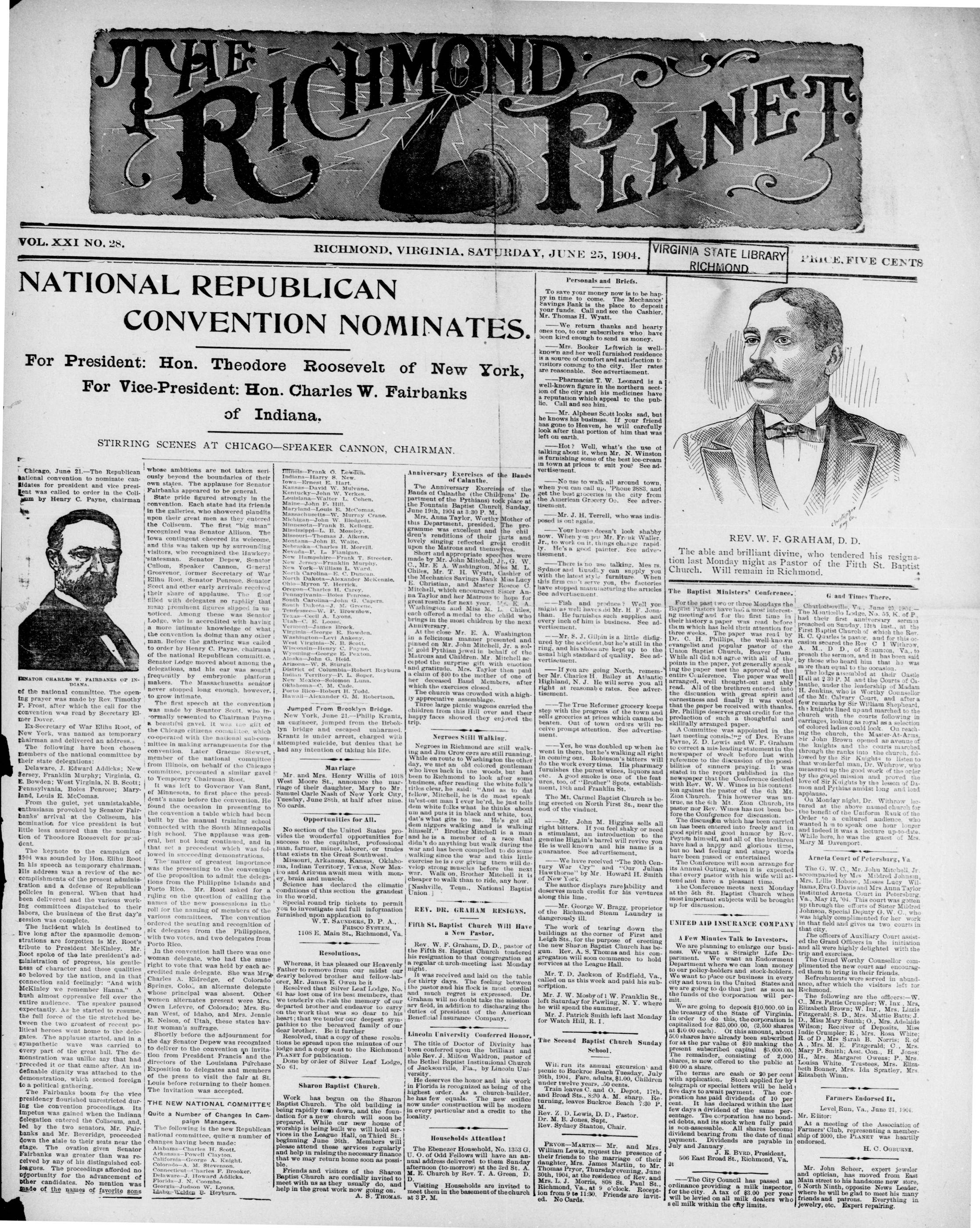
Page text (machine-generated)
THE RICHMOND PLANET
NATIONAL REPUBLICAN CONVENTION NOMINATES.
STIRRING SCENES AT CHICAGO—SPEAKER CANNON, CHAIRMAN.
VOL. XXI NO. 28.
NATIONAL
C
For President
For Vict
STIRRIN
Chicago, June 21.—The Republican national convention to nominate candidates for president and vice president was called to order in the Colloquium by Henry C. Payne, chairman
P. B.
BENATOR CHARLES W. FAIRBANKS OF INDIANA.
BENATOR CHARLES W. FAIRBANKS OF INDIANA.
of the national committee. The opening prayer was made by Rev. Timothy P. Frost, after the call for the convention was read by Secretary Elmer Dover.
Ex-Secretary of War Elihu Root, of New York, was named as temporary chairman and delivered an address.
The following have been chosen members of the national committee by their state delegations:
Delaware, J. Edward Addleks; New Jersey, Franklin Murphy; Virginia, G. E. Bowden; West Virginia, N. B. Scott; Pennsylvania, Boies Penrose; Maryland, Louis E. McComas.
From the quiet, yet unmistakable, enthusiasm provoked by Senator Fairbanks' arrival at the Coliseum, his nomination for vice president is but little less assured than the nomination of Theodore Roosevelt for president.
The keynote to the campaign of 1804 was sounded by Hon. Elihu Root in his speech as temporary chairman. His address was a review of the accomplishments of the present administration and a defense of Republican policies in general. When that had been delivered and the various working committees dispatched to their labors, the business of the first day's session was complete.
The incident which is destined to live long after the spasmodic demonstrations are forgotten is Mr. Root's tribute to President McKinley. Mr. Root spoke of the late president's administration of progress, his gentleness of character and those qualities so beloved by the nation, and in that connection said feelingly: "And with McKinley we remember Hanna." Aush almost oppressive fell over the entire audience. The speaker paused expectantly. As he started to resume, the full force of the tie stretched between the two greatest of recent political heroes went home to the delegates. The applause started, and in a sympathetic wave was carried to every part of the great hall. The demonstration was unlike any that had preceded it or that came after. An indefinable dignity was attached to the demonstration, which seemed foreign to a political gathering.
The Fairbanks boom for the vice presidency flourished unrestricted during the convention proceedings. Its impetus was gained when the Indiana delegation entered the Coliseum, and, led by the two senators, Mr. Fairbanks and Mr. Beveridge, proceeded down the aisle to their seats near the stage. The ovation given Senator Fairbanks was greater than was received by any of his distinguished colleagues. The proceedings afforded no opportunity for the advancement of other candidates. No mention was made of the names of favorite sons
of Indiana.
whose ambitions are not taken seriously beyond the boundaries of their own states. The applause for Senator Fairbanks appeared to be general.
State pride figured strongly in the convention. Each state had its friends in the galleries, who showered plaudits upon their great men as they entered the Coliseum. The first "big man" recognized was Senator Allison. The Iowa contingent cheered its welcome, and this was taken up by surrounding visitors, who recognized the Hawkeye statesman. Senator Depew, Senator Cullom, Speaker Cannon, General Grosvenor, former Secretary of War Ellihu Root, Senator Penrose, Senator Scott and other early arrivals received their share of applause. The floor filled with delegates so rapidly that many prominent figures slipped in unnoticed. Among these was Senator Lodge, who is accredited with having a more intimate knowledge of what the convention is doing than any other man. Before the gathering was called to order by Henry C. Payne, chairman of the national Republican committee. Senator Lodge moved about among the delegations, and his ear was sought frequently by embryonic platform makers. The Massachusetts senator never stopped long enough, however, to grow intimate.
The first speech at the convention was made by Senator Scott, who informally presented to Chairman Payne a beautiful gavel. It was the gift of the Chicago citizens committee, which co-operated with the national sub-committee in making arrangements for the convention. Later Graeme Stewart, member of the national committee from Illinois, on behalf of the Chicago committee, presented a similar gavel to Temporary Chairman Root. It was left to Governor Van Sant, of Minnesota, to first place the president's name before the convention. He found the occasion in presenting to the convention a table which had been built by the manual training school connected with the South Minneapolis high school. The applause was general, but not long continued, and in that set a precedent which was followed in succeeding demonstrations.
The matter of greatest importance was the presenting to the convention of the proposition to admit the delegations from the Philippine Islands and Porto Rico. Mr. Root asked for a ruling on the question of calling the names of the new possessions in the roll for the naming of members of the various committees. The convention ordered the seating and recognition of six delegates from the Philippines, with two votes, and two delegates from Porto Rico.
In the convention hall there was one woman delegate, who had the same right to vote that was held by each accredited male delegate. She was Mrs. Charles A. Eldredge, of Colorado Springs, Colo., an alternate delegate whose principal was absent. Other women alternates present were Mrs. Owen Lefevre, of Colorado; Mrs. Susan West, of Idaho, and Mrs. Jennie E. Nelson, of Utah, these states having woman's suffrage.
Shortly before the adjournment for the day Senator Depew was recognized to deliver to the convention an invitation from President Francis and the directors of the Louisiana Purchase Exposition to delegates and members of the press to visit the fair at St. Louis before returning to their homes. The invitation was accepted.
THE NEW NATIONAL COMMITTEE
Quite a Number of Changes In Campaign Managers. The following is the new Republican national committee, quite a number of changes having been made.
—SPEAKER CANNON, CI
Illinois—Frank G. Lowden.
Indiana—Harry S. New.
Iowa—Ernest E. Hart.
Kansas—David W. Mulvane.
Kentucky—John W. Yerkes.
Louisiana—Walter L. Cohen.
Missouri—John A. McCormis.
Maryland—Louis E. McCormis.
Massachusetts—W. Murray Crane.
Michigan—John W. Bledgett.
Minnesota—Frank B. Kellogg.
Mississippi—L. B. Moseley.
Missouri—Thomas J. Alkens.
Montana—John B. Waite.
Nebraska—Charles H. Morrill.
New Hampshire—Frank T. Streeter.
New Jersey—Franklin Murphey.
New York—William L. Ward.
North Carolina—E. C. Duncan.
North Dakota—Alexander McKenzie.
Ohio—Myron T. Herrick.
Oregon—Charles H. Carey.
Pennsylvania-Pennsylvania.
South Carolina—John G. Capers.
South Dakota—J. M. Greene.
Tennessee—W. P. Brownlow.
Texas—Cecil A. Lyons.
Utah—C. E. Loose.
Vermont—James Brock.
Virginia—George E. Bowden.
Wash. Anderson.
West Virginia—N. B. Scott.
Wisconsin—Henry C. Payne.
Wyoming—George E. Pexton.
Alaska—John G. Heid.
Arizona—W. S. Sturgis.
District of Columbia—Robert Reyburn.
Indiana curtory—P. L. Soper.
New Mexico-Luna.
Oklahoma—C. M. Cade.
Porto Rico—Robert H. Todd.
Hawaii—Alexander G. M. Robertson.
New York, June 21.—Phillip Krantz, an engineer, jumped from the Brooklyn bridge and escaped unarmed. Krantz is under arrest, charged with attempted suicide, but denies that he had any intention of taking his life.
Mr. and Mrs. Henry Willis of 1018 West Moore St., announce the marriage of their daughter, Mary to Mr. Samuel Carle Nash of New York City, Tuesday, June 28th, at half after nine. No cards.
No section of the United States provides the wonderful opportunities for success to the capitalist, professional man, farmer, miner, laborer, or trades that exists in the Great Southwest. Missouri, Arkansas, Kansas, Oklahoma, Indian Territory, Texas, New Mexico and Arizona await men with money, brain and muscle. Science has declared the climatic conditions of this section the grandest in the world. Special round trip tickets to permit you to investigate and full information furnished upon application to W. T. SAUDRERS, D. P. A., FRISCO SYSTEM, 1108 E. Main St., Richmond, Va.
Whereas, it has pleased our Heavenly Father to remove from our midst our dearly beloved brother and fellow-laborer, Mr. James E. Owen be it
Resolved that Silver Leaf Lodge, No. 61 has lost one of its best members, that we tenderly cherish the memory of our departed brother and endeavor to carry on the work that was so dear to his heart; that we tender our deepest sympathies to the bereaved family of our dear brother. Be it further
Resolved, that a copy of these resolutions be spread upon the minutes of our lodge and a copy sent to the Richmond PLANET for publication.
Done by order of Silver Leaf Lodge, No. 61.
Sharon Baptist Church.
Work has begun on the Sharon Baptist Church. The old building is being rapidly to down, and the foundation for a new church will soon be prepared. While our new house of worship is being built we will hold services in the League Hall, on Third St., beginning June 26th. Members will please attend these services regularly and help in raising the necessary finance that we may return home soon as possible. Friends and visitors of the Sharon Baptist Church are cordially invited to meet with us as they usually do, and help in the great work now going on.
RICHMOND, VIRGINIA, SATURDAY, JUNE 25, 1904.
Marriage
Opportunities for All.
Resolutions.
A. S. THOMAS
Anniversary Exercises of the Bands of Calanthe.
The Anniversary Exercises of the Bands of Calanthe (the Childrens' Department of the Pythians) took place at the Fountain Baptist Church, Sanday, June 19th, 1904 at 3:30 P. M.
Mrs. Anna Taylor, Worthy Mother of this Department, presided. The programme was excellent and the child's renditions of their parts and lovely singing reflected great credit upon the Matrons and themselves. Short and appropriate speeches were made by Mr. John Mitchell, J., G. W. C. Mr. E. A. Washington, Miss M. L. Chius, Mr. T. H. Wyatt, Cashier of the Mechanics Savings Bank Miss Lucy E. Christian, and Master Roscoe C. Mitchel, whom encouraged Sister Anna Taylor and her Matrons to hope for great results for his year. E. E. A. Washington and his year. E. E. Chiles, each offered a medal to the child who brings in the most children by the next Anniversary.
At the close Mr. E. A. Washington in a felicious manner presented and pinned on Mr. John Mitchell, Jr. a solid gold Pythian jewel in behalf of the Matrons and Children. Mr. Mitchell accepted the surprise gift with emotion and gratitude. Mrs. Taylor then paid a claim of $40 to the mother of one of her deceased Band Members, after which the exercises closed. The church was crowded with a highly appreciative assemblage.
Three large picnic wagons carried the children from this Hill over and their happy faces showed they enjoyed the trip.
Negroes Still Walking
Negroes in Richmond are still walking and Jim Crow cers are still running. While en route to Washington the other day, we met an old colored gentleman who lives back in the woods, but had been to Richmond to look after some business, after reading the white folk's rites clear, he said: "And as to dat fellow, Mitchell, he is de most speak in'est-out man I ever he'd, he just tells us the folk what he thinks about um and pays it in black and white, too, dats what gets it in. He's got all dem niggers walking and walking himself." Brother Mitchell is a man and he is a member of a race that didn't do anything but walk during the war and has been compelled to do some walking since the war and this little exercise he is row giving, them will develop strong muscles before the next war. Walk on, Brother Mitchell it is cheaper to walk than to ride, any how. [Nashville, Tenn., National Baptist Union.]
REV. DR. GRAHAM RESIGNS.
Fifth St. Baptist Church Will Have a New Pastor.
Rev. W. F. Graham, D. D., pastor of the Fifth St. Baptist Church tendered his resignation to that congregation at a regular church-meeting last Monday night.
It was received and laid on the table for thirty days. The feeling between the pastor and his flock is most cordial and much regret is expressed. Dr. Graham will no doubt take the missionary field, in addition to discharging the duties of president of the American Beneficial Insurance Company.
Lincoln University Conferred Honor.
The title of Doctor of Divinity has been conferred upon the brilliataat and able Rev. J. Milton Waldron, pastor of the Bethel Baptist Institutional Church of Jacksonville, Fla., by Lincoln University.
He deserves the honor and his work in Florida is recognized as being of the highest order. As a church-builder, his highest feats. The new edifice now under construction will be modern in every particular and a credit to the locality.
Households Attention!
The Ebenezer Household, No. 1353 G. U. O. of Odd Fellows will have an annual address delivered to them Sunday afternoon (to-morrow) at the 3rd St. A. M. E. Church by Rev. T. A. Green, D. D. Visiting Households are invited to meet them in the basement of the church at 3 P. M.
Personals and Briefs.
To save your money now is to be happy in time to come. The Mechanics' Savings Bank is the place to deposit your funds. Call and see the Cashier, Mr. Thomas H. Wyatt.
— We return thanks and hearty ones too, to our subscribers who have been kind enough to send us money.
— Mrs. Booker Leftwich is well-known and her well furnished residence is a source of comfort and satisfaction to visitors coming to the city. Her rates are reasonable. See advertisement.
— Pharmacist T. W. Leoonard is a well-known figure in the northern section of the city and his medicines have a reputation which appeal to the public. Call and see him.
— Mr. Alpeus Scott looks sad, but he knows his business. If your friend has gone to Heaven, he will carefully look after that portion of him that was left on earth.
- Hot? Well, what's the use of talking about it, when Mr. N. Winston is furnishing some of the best ice-cream in town at prices to suit you? See advertisement.
- No use to walk all around town, when you can call up, 'Phone 2883, and get the best groceries in the city from the American Grocery Co. See advertisement.
- Mr. J. H. Terrell, who was indisposed is out again.
- Your house doesn't look shabby now. When you put Mr. Frank Waller, Jr., to work on it, things change rapidly. He's a good painter. See advertisement.
- There is no use talking, Mes rs. Sydnor and Bundley can supply you with the latest style furniture. When this firm can't serve you, the factories have stopped manufacturing the articles See advertisement.
Fish and produce? Well you might as well have ad Mr. H. F. Jonathan. He furnishes such supplies and every inch of him is business. See advertisement.
Mr. S. J. Gilpin is a little disfigured by the accident but he's still in the ring, and his shoes are kept up to the usual high standard of quality. See advertisement.
If you are going North, remember Mr. Charles H. Bailey at Atlantic Highland, N. J. He will serve you all right at reasonable rates. See advertisement.
The True Reformer grocery keeps step with the progress of the town and sells groceries at prices which cannot be beaten. Out of town orders will receive prompt attention. See advertisement.
Yes, he was doubled up when he went in there, but he's walking all right in coming out. Robinson's bitters will do the work every time. His pharmacy furnishes the purest wines, liquors and etc. A good smoke is one of the features, too, of "Brother" Spots, establishment, 18th and Franklin St.
The Mt. Carmel Baptist Church is being erected on North First St., near the end of the vinduct.
Mr. John M. Higgins sells all right bitters. If you feel shaky or need a stimulant, an introduction to the genuine Higgin's barrel will revive you He is well known and his name is a guarantee. See advertisement.
"We have received "The 20th Century War Ory" and "Our Julian Hawthorne" by Mr. Howard H. Smith of New York.
The author displays rare ability and deserves much credit for his ventures along this line.
Mr. George W. Bragg, proprietor of the Richmond Steam Laundry is dangerously ill.
The work of tearing down the buildings at the corner of First and Leigh Sts., for the purpose of erecting the new Sharon Baptist Church has begun. Kev. A. S. Thomas and his congregation will soon commence to hold services at the League Hall.
Mr. T. D. Jackson of Endfield, Va., called on us this week and paid his subscription.
Mr. J. W. Mosby of 1 W. Franklin St., left Saturday for Pawling, N. Y. where he will spend the summer.
Mr. J. Patrick Smith left last Monday for Watch Hill, R. I.
The Second Baptist Church
The Second Baptist Church Sunday School.
Will run its annual excursion and picnic to Buckroe Beach Tuesday, July 29th, 1904. Fare, adults $1.00, Children under twelve years, 50 cents.
Train leaves C. and O. Depot, 17th, and Broad Sts., 8:30 A. M. sharp. Returning, leaves Buckroe Beach 7:30 P. M.
Rev. Z. D. Lewis, D. D., Pastor.
Dr. M. B. Jones, Supt.
Rv. Sydney Stapling, Cheir
PRYOR-MARTIN-- Mr. and Mrs. William Lewis, request the presence of their friends to the marriage of their daughter, Mrs. James Martin, to Mr. Thomas Pryor, Thursday evening, June 30th, 1904, at the residence of Rev. and Mrs. L. J. Morris, 808 St. St. St. Richmond, Va., at 9 o'clock. Reception from 9 te 11:30. Friends are invited. No Cards.
Christopher
Boy Co.
The able and brilliant divine, who tendered his resignation last Monday night as Pastor of the Fifth St. Baptist Church. Will remain in Richmond.
VIRGINIA STATE LIBRARY RICHMOND
REV. W. F. G.
The able and brilliant divin-
tion last Monday night as Pas-
Church. Will remain in Rich
The Baptist Ministers' Conference.
For the past two or three Mondays the Baptist Pastors have had a most interesting meeting and for the first time in their history a paper was read before them which has held their attention for three weeks. The paper was read by Dr. C. H. Phillips, the well-known evangelist and popular pastor of the Union Baptist Church, Beaver Dam. While all did not agree with all of the points in the paper, yet generally speaking the paper met the approval of the entire Conference. The paper was well thought-out and ally read. All of the children entered into the discussion with great spirit and earnestness and finally noted that the paper be received with thankfulness. Dr. Phillips deserves great credit for the production of such a thoughtful and skillfully arranged paper.
A Committee was appointed in the last meeting consisting of Drs. Evans Payne, Z. D. Lewis and W. F. Graham to correct a mis leading statement in the newspaper of week before last with reference to the discussion of the possibilities of sinners praying. It was stated in the report published in the newspaper that the Conference decided with Rev. W. W. Wines in his contention against the pastor of the 6th Mt. Zion Church. This however was untrue, as the 6th Mt. Zion Church, its pastor nor Rev. Wines has not been before the Conference for discussion.
The discussion which has been carried on has been entered into freely and in good spirit and good humor by Rev. Peyton himself, and all of the brethren have had a happy and glorious time, but no bad feeling and sharp words have been passed or entertained.
The Conference will soon arrange for its Annual Outing, when it is expected that every pastor with his wife will attend and have a pleasant time.
The Conference meets next Monday at the 5th St. Baptist Church when most important subjects will be brought up for discussion.
UNITED AID INSURANCE COMPANY
A Few Minutes Talk to Investors.
We are planning to enlarge our business. We want a Straight Life Department. We want an Endowment Department where we can loan money to our policy-holders and stock-holders. We want to place our business in every city and town in the United States and we are going to do that just as soon as the funds of the corporation will permit.
We are going to deposit $10,000.00 in the treasury of the State of Virginia. In order to do this, the corporation is capitalized for $25,000.00, (2,500 shares at $10.00 each). Of this amount, about 500 shares have already been subscribed for at the par value of $10 making the present subscribed capital $0,000.00. The remainder, consisting of 2,000 shares, is now offered to the public at $10.00 a share.
The terms are cash or 20 per cent with application. Stock applied for by telegraph or special letters will be held five days to await payment. The corporation has paid dividends of 10 per cent. It has declared within the last few days a dividend of the percentage. The corporation has no bonded debts, and its stock when fully paid is non-assessable. All shares become dividend bearing from the date of final payment. Dividends are payable in July and January. J. E. BYRD, President, 506 East Broad St., Richmond, Va.
—— The City Council has passed an ordinance providing a milk inspector, a tax of $3.00 per year will be levied on all city workers who sell milk within the city limits.
PRICE, FIVE CENTS
RAHAM, D. D.
e, who tendered his resigna-
tor of the Fifth St. Baptist
amond.
G and Times There.
Charlottesville, Va., June 20, 1901—The Montsutti Lodge, No. 55, K. of P. had their first anniversary sermon preached on Sunday, 13th inst., at the First Baptist church of which the Rev. R. C. Quarles is and for this occasion secured the Rev. I. Witrow, A. M. D. D., of Scanlon, P. preach the sermon, and it has been said by those who heard him that he was more than equal to the occasion.
The lodge assembled at their Oasis Hall at ? 30 P. M. and the Courts of Calanthe, under the leadership of Madam H. Jenkins, who is Worthy Counsellor of the Mt. Calvary Court, and after a few remarks by Sir William Shepherd, the knights lined up and marched to the church with the courts following in carriages, looking as royal as a selection of colored ladies could look. On reaching the church, the Master At-Arms, Sir John Brown opened an avenue of knights and the courts marched through the ranks into the church, followed the Sir Knights to listen to that wonderful man, Dr. Withrow, who measured the good work of the order by the gospel mission and proved the love of Sir Knights by the lesson of Darmon and Pythians amidst long and load applause. On Monday night, Dr. Withrow lectured at the above named church for the benefit of the Uniform Rank of the Order to a cultured audience who wanted him to speak one hour longer and indeed it was a lecture to-day. While here, he was the guest of Mrs. Mary M. Davenport.
Arneta Court of Petersburg, Va
The G. W. C., Mr. John Mitchell, JR, accompanied by Mrs. Mildred Johnson, Mrs. Lillie Hobson, Musses Lucy Williams, Eva G. Davis and Mrs Anna Taylor instituted Arneta Court in Petersburg, Va., May 12, '04. This court was gotten up through the efforts of Sister Mildred Johnson, Special Deputy G. W. C., who was highly complimented for her work in that field and gives us two courts in that city. The officers of Auxiliary Court assisted the Grand Officers in the initiation and all were highly delighted with the trip and experience. The Grand Worthy Counsellor complimented the new court and encouraged them to bring in their friends. Refreshments were served in encouragement, after which the visitors left for Richmond.
The following are the officers—W. C., Mrs. Pattie Crumpler; W. Inx, Mrs. Elizabeth Brown; W. Inr, Mrs. Lizzie Fitzgerald; S. D., Mrs. Mattie Batts; J. D., Miss Mary Smith; O., Mrs. Adelaide Wilson; Reciver of Deposits, Miss Indie Crumpler; E. Mrs. Rosa White; R. of D, Mrs Sarah B. Norris; R. of A, Mrs. M. E. Fitzgerald; O., Mrs. Mary P. Mary S. Asst. Con., H. Jones; H., Margaret Owens; P, Mrs. Louisa White. Trustees, Mrs. Elizabeth Bonner, Mrs. Ida Spratley, Mrs. Elizabeth Winn.
Farmers Endorsed It.
Level, Run, Va., June 21, 1904.
Mr. Elitor:
At a meeting of the Association of Farmers' Club, representing a membership of 2000, the PLANET was heartily endorsed.
H. C. OGBURNE.
Mr. John Scheer, expert jeweler and optician, has moved from East Main street to his handsome new store, 6 North Ninth, opposite News Leader, where he will be glad to meet his many friends and patrons. Everything in jewelry, etc. Expert repairing.
HELLO DERNET
SATURDAY ... JUNE 25 1904
AT THE TOP.
Pertlaps you sometimes think that life is one almighty squeeze.
You're jammed up on the pushing throng too tightly for your ease.
Your ribs seem near collapsing and you cannot draw a breath;
Your tender feet are trodden till you almost long for death.
A rocky road to travel and a steeply graded track!
It's slow work getting forward and it's going back
The taking action does not get out.
The jolting and the bumping are not pleasant, I admit.
To reach that distant summit takes an awful lot of grit.
or sleep with one eye open when your brief
repose you take.
Four bed is hard and lumpy—not conducive to repose.
You can't lie down and sleep and keep
Securely on the top.
Chicago Daily News.
A CASE OF
MOON-BLINK
By WM. PERRY BROWN
(Copyright 1904, by Daily Story Pub. Co.)
"WHAT a night for wheeling," thought Paula, glancing across the porticoat George Baylor, who sat near her brother on the top step, where the haze of moonlight rested softly.
Paula was an enthusiast, on cycling; so was her brother and his friend.
They were discussing the latest of club runs into the country, that had lasted several days. Paula always wanted to go; but was usually frozen out with brotherly freedom of comment by Arthur to whose sage delivery George Baylor nodded gentle approval, and all on the ground of Mrs. Grundy and the proprietors. George, having designs of his own on Paula's heart as well as hand, realized that he was taking desperate chances; had it confirmed by the young lady's coldness for the rest of the evening, while pouring the vials of her contempt
9
"AWAY SHE FLEW."
on Arthur's rugged shoulders, whose replies veered into a bawning vein, something like:
"A nay, nay, Pauline.' Daylight, a proper costume and the asphalt are about your present malden capacity," whereat George Baylor, already feeling snubbed, remained silent, and thereby sank himself yet a peg lower—if such were possible—in Paula's estimation.
Tiring of it at last, he rose defectedly, bade Arthur a glum and the sister a humble good-night, mounted his own wheel and pedalled sadly away. When Paula went to her room the first thing she saw was her brother's new cycling suit, left there in the afternoon so that she might change some buttons.
"What a heavenly night," vaguely went her thoughts again; then, after a pause, "for wheeling." She passed her mental Rubicon almost aloud, and still gazed out of her window, while beginning to disrobe.
"How nonchalently George rode off, as a matter of course. Being a man, he can go anywhere at any time, and all by himself. Had I done the like—" She sat down by the window.
"They say too long looking at the moon causes moon-blink," she at length said, then gazed defiantly upward. "I suppose when the man in the moon winks, the blink adds one for the time being." The sneer gradually widened into a smile which added sauciness to its charm, as Paula held up Arthur's knee pants measuringly. "I surely am adduled."
Perhaps she was. Certainly the sight of George Baylor—otherwise her slave—calmly doing the very thing he, all through Arty's tirade, tacitly disapproved of, had fired her veins (or brains) with something akin to lunacy. Surely! How was it otherwise, that instead of donning her usual night gear, she began trying on Arthur's new suit, crowding her too-abundant hair under a golf cap, before a cheval gloss so ample as to reveal, even in the moonlight, that Paula was at present more of a misnomer than
"I am glad they are not noticeably too large," she concluded, rolling out Arty's wheel from the closet under the stairs, where her own and his were kept. "It matches better with a man's suit than mine," she added.
Then her hair wanted to come down. While tucking it under the cap again, the wheel fell down the rear steps, making a horrible crash in the late silence and haze of the night. Shivering a little, either from fear or "moon-blink," she carried it along the gravel, recalling that only her own and Arthur's windows fronted on that side of the house.
"Being a bear, he sleeps like a bear," was her next thought, or hope, when once outside the gate.
Then she sprang on—like a man. No uneasy balancing into a proper skirt divided seat. Away she flew, irrepressible in proportion as she had been repressed—surely it must have been the moon! She could have shouted in sheer exuberance of spirits—not nerves. A sleeping, silvery world was inviting her as it had never invited men. Only straight-laced convention can so thrill a poor human soul on the verge of the improper. The vague charm of the landscape, with dim white roads branching here and there, inviting her to "scorch" out their forbidden intricacies, flitted by like a succession of dreams. Tiring at length, she pedalled slowly; when a consciousness of being followed grew upon her awfully.
Pursued? Like a flash the long dominance of nature, sex and years reasserted their sway. Paula—not Paul now! The sweet security of skirts, a chaperon, and—why not own it to herself?—a protector, even a man—so he were the right man; all these grew upon her longing. Arthur himself—did he always sleep very sound? As for George Baylor, she would probably have jumped at him; out of fear, of course; yet until the scrape and jingle of wheels disclosed two riders bending over their handlebars, the idea of being discovered by a sweetheart, curled hotly in her veins, so that George himself might have drawn hope therefrom.
But with her male protectors sleeping the "sleep of bears," Paula's strength and courage went lower and lower.
"Close in on your side," some one called. "Don't let him leave the main road." The muffled tones acted like a cold water douche. She spurted.
"Hey, you! Stop, thief!" Though the voice seemed further off, the words were terrible. Taken by some one for a midnight thief?
Failing to drop dead at the idea, Paula spurted once more, until, but for a long descending grade, she would have fallen from the wheel. She could not shake them off. Nearer they crept in the dim lunar light, until, nearly wild with apprehension, she dashed wildly down the grade.
Then a scream, a glare and an oncoming roar announced the night express that stopped nowhere, seemingly this side of doom—to Paula. Yet she kept on, on; dreading the vague horror of disgrace behind even more than the shrieking peril before.
The wheel bounced, zigzagged, reeled across the track—was it by a hairs-breadth or a rod? Paula only knew that the intervention of a long, crashing serpent had given her a moment's respite. It's earth-shaking convolutions passed, and there came her nemesis; yes, the pair of them. Gasping, exhausted, she turned into a footpath towards the lights and noise of an all-night factory twinkling through a strip of woods. Bump! Bump! Bump!
The going was worse than snaggy; then—bzzzt—bzt—bzzss—
Paula knew that Arthur's wheel could assist her no longer. She fell rather than dropped from the machine, and was striving weakly to regain her feet, when her relentless pursuers came up. Too far gone physically to care much, she hid her face, but it was roughly uncovered. It was darker amid the trees than in the open.
"Nabbed at last!" shouted someone, seizing the punctured bike in his other hand. "Next time you steal a wheel, don't make so much fuss getting out of the house. Hello! No, you don't—why, Paula—"
As the boy-girl looked up meekly, the golf cap fell off, and her hair came down. The speaker was Arthur, her brother, who could only stare and ejaculate. As the other man pushed his wheel through the shubbery, Paula screamed, and might have fallen again, but he boldly held her up; boldly, yet tenderly.
Oh, these blundering elder brothers! "Dear Miss Paula," murmured the other man, and somehow the feminine naturalness of the words restored her like old wine. "May I, just—once?" The other man was George Taylor.
IT PUZZLED THE EXPERT.
Customs Official Knits Brow and Frowns Darkly Over Classification of Three-Legged Stool.
The customs official was greatly puzzled. He knitted his brow and frowned darkly. He even tapped his foot nervously on the polished floor, says the Cleveland Plain Dealer.
"What seems to be the difficulty?" inquired a sympathetic subordinate.
The chief turned to him with a troubled stare.
"I'm bothered," he growled. "I'm badly stumped. And yet I am the very man who classified frogs 'legs as 'dressed poultry,' and admitted a colt from Canada as 'household furniture.'"
"I'm worried to death," he cried,
"over the proper classification for a
three-legged stool! It isn't a biped and
it isn't a quadruped—and there you
are!"
The Russian troops now have beans
issued to them as daily rations. This
is believed to be a desperate bid for
the moral support of Boston.
Off Color.
Said he: "I think my eyes of you!" With proud and haughty mien, I answered, to his sad dismay: "Behind me are green!" - Philadelphia, Bulletin.
Fun For Fun Lovers.
"Yes, they're engaged," said Ethel. "But it's the most remarkable case! She says she's in love with him, and yet she has known him only four days. I don't understand it." "Simplest thing in the world," mused her companion, "if she had known him any longer than that she wouldn't have been in love with him."—Detroit Free Press.
Romance Vs. Reality
"It is my intention," said the newly married man, "to have our pictures taken with my wife's hand on my shoulder." "And I," rejoined the man who had been up against the matrimonial game for many years, "am thinking of having our taken with my wife's hand on my pocketbook."—N. Y. World.
On the Way to Sublimity.
Great men all have hobbies, so they say,
And therefore happiness is in my heart;
Though I'm not numbered with the great
to-day.
I have a hobby. I have made a start.
-Chicago. Record. Herald.
A woman in a long dress stands in front of a woman seated in a chair, who is wearing a hat and a scarf. Another woman stands behind the chair, facing the woman in the dress.
"Daisy," 'said her distressed mother, "I don't see how you can get so dirty." "Come on out and I'll show you," was the prompt reply.—The Barbershop.
In Double Harness
When he asked the blushing maiden,
Whom he wished to make his wife,
"Tied her trot in double harness
Down of a roof, round of life."
She, it seems, had no objection;
Full of gladness was our cup-
Quick they galloped to the parson,
And he straightway hitched them up.
—Rural World.
The Burning Question.
"Mrs. Marriedgirl was just telling me
of the perfect treasure she has at home
—"
"Oh, tell me where she got her. I need
a cook!"
"But it wasn't a cook. She was talking
about her baby."—Cincinnati Times-Star.
Two Classes.
"Our club meetings," said Mrs. Uppisch, "are attended by the best people—the brains and culture of the city." "Indeed!" exclaimed Mrs. Planebuddy, "and do your swell society folks really condescend to associate with them?"—Catholic Times and Star.
His Objection.
La Monti—Say, old man, there is a widow down the street, who keeps a tobacco store. Why don't you buy your cigars from her?
La Moyne—Because I never did fancy widow's weeds—Chicago Daily News.
As Far as He Knew
"One of the component parts of sugar," said the professor, "is an essential in the composition of the human body. What is it?" "I know," shouted the grocer's boy, "Sand!"-Philadelphia Public Ledger.
Not a Crumb Left
She—When a Boston man has pie for breakfast, does his wife keep what's left for his dinner.
He—Why, bless you! When a Boston man has pie for breakfast there's none left for dinner!—Yonkers Stateman.
Muscle for Instance
"Old man you'll need to make up something besides your mind, or it may be the last time you'll see him, or anybody else."—Philadelphia Press
How About Himself?
Mr. Bluster—Can't you remember where I put my cuffs last night?
Mrs. Bluster—Indeed I can't.
Mr. Bluster—Great heavens!
I never saw such a forgetful woman—Chicago Journal.
Honesty Itself
Of course Ballott's campaigns are always conducted honestly?"
Reminiscent.
The Chaufeur—My auto sometimes reminds me of my wife.
His Friend—Why?
The Chaufeur—Oh, it blows me up occasionally—Judge.
Journalism.
Reporter—Senator Bilkins has absolutely nothing to say.
Editor—Well, boil it down. We are terribly crowded to night.—Puck.
Egotism.
"The things we know never make us egotistical."
Good to Eat.
Parke—Do your neighbor's hens disturb you?
Tame—Not a bit. I have an excellent digestion.—Town Topics.
Poor Boy.
"Have you no home, my little man?"
"No. Ma and pa's using it for a debating school just now."—N. Y. Times.
A Scottish parish minister was one day talking to one of his parishioners, who ventured the opinion that ministers ought to be better paid.
"I am glad to hear you say that," said the minister. "I am pleased that you think so much of the clergy. And so you think we should have bigger stipends?"
"Aye," said the old man; "ye see, we'd get a better class o' men."—Tit-Bits.
"Tell us," they implored, "what is the matter?" "I have made an awful mistake," he groaned, "I should have come over in the Mayflower!" Realizing that henceforth he must be a nobody, he finished his task with a heavy heart—N. Y. Times.
The Old Man's Advice
He—if you don't intend to break your engagement with me, why do you allow young Richmann to make you such valuable presents?
She—My father advised me to accept them.
"He did? Why?"
"He said if I married you they might come handy on rent days."—N. Y. Weekly.
Sensational
The servant handed Mr. Highmore a letter. It was from Harold, the oldest son, who was in college.
"Anything new in it?" asked Mrs. Highmore.
"Yes," said the father of the family, in an agitated voice, as he glanced hastily over the letter. "He doesn't ask me for any money."—Chicago Tribune.
A Cent Well Lost
Friend—Why do you mark things 99 cents when they are actually worth one dollar?
Merchant—Well, you see, customers hate to leave without that odd cent, and, by keeping them waiting for their change, they generally see something else they want.—N. Y. Weekly.
Trustworthy
Little Bess (aged four)—Mamma, does you like candy?
Mamma—No, dear; it always makes me sick.
Little Bess—Well, I'm awful glad of it; you're just the woman I want to hold my candy while I dress dollie—Cincinnati Enquirer.
Two Points of View.
"She's a dear, dear girl, just the same," said the fond mother, as she glanced approvingly at her fair daughter.
"Yes, she certainly is." growled the father, as he glanced disapprovingly at a bill from the fair daughter's dressmaker—Cincinnati Enquirer.
A Double Risk.
Robbins—Highbee must be one of these men who is always looking for trouble.
Mack—Why?
Robbins—He has been married only a month and now he has bought an automobile.—Brooklyn Life.
Warm Uncertainty
Parson, gasped the man, "which
woman on the bus I'm a-goin'?"—Atlanta
constitution
Breach of Promise
Lawyer—So you want to sue your husband for breach of promise?
Client—Yes, sir! He promised me a sealskin coat, and all he gave me was an imitation!—Detroit Free Press.
A Long-Felt Want.
There's a chance for some inventor
To spend his days in clover.
By devising a cloth for overcoats
That will fade alike all over.
—Cincinnati Enquirer.
SHE HAD THREATENED IT.
"You don't seem to be able to keep the children quiet, Maria. Bring them in to me and I'll sing to them."
"Oh, I've threatened them with that, mum, already, but it don't do any good."—Cincinnati Commercial Tribune.
Wonder Why.
A maid she is, but if called old,
She declares it is a libel:
Yet, strange to say, she hid away
The dear old family Bible.
-Chicago Pally News.
Powerful in Concert.
"Mrs. Highble r is a powerful force
as a church worker, isn't she?"
"Yes. She is one of the kind of women who feel that the assistance of the Almighty is an obstacle." - Town Topics.
A Misnomer.
Cobwigger—Look here! did you break that rubber-plant?
Freddie—That ain't no rubber-plant.
I pulled at it till all the leaves came out, and it didn't stretch a bit. Judge.
More Important.
Mrs. Houskeep—Why did you leave your last place?
Pretty Maid—The master kissed me,
Mrs. Houskeep—And your mistress found it out?
Pretty Maid—No, but me "steady company" did, and he made me quit.—Philadelphia Press.
The Promoter.
There's millions in it. All I need in capital."
"That's what you said about your last scheme. I dropped a thousand that time."
"Well, can't you give a man a chance to square himself?"—Chicago American.
Brute.
"Edwin's love waned on the honey-noon," sobbed the beautiful bride. "On the trip to Niagara every time we came to a tunnel he kissed me."
"And what did he do coming back?" "Every time we came to a tunnel he took a drink."—Chicago Daily News.
Of Course She Knew.
"I wonder why they call it the honeymoon?" queried the girl with the new solitaire.
"Because," answered the woman who had been divorced three times, "it's a short period of sweet lunacy."—Chicago Dally News.
Juvenile Logic
"Why, Flossie," said a mother to her little daughter, aged 4. "you ought to be ashamed to have such dirty hands. You never saw my hands like that." "No, of tourse not," replied Flossie, "but I bet my dwamma did."—Cincinnati Enquirer
Next.
Mormon's Wife—I tell you my place is by my husband's side. If he is dying, I should be there.
Doctor—I know, madam, but all the best places are taken. Couldn't you drop in again?—Cincinnati Commercial Tribune.
A Modern Wedding.
The Bride—We have come to be married.
Modern Minister—Ah, yes. With or without?
The Legal Fine
Bounder—Who was it said "Eternal vigilance is the price of liberty"? Bounder—Couldn't have been any of our police magistrates. They always come out plump and plain and tell you it's $7.50—Philadelphia Ledger.
Epitaph.
Beneath this mound lies all we found
Of little Johnny Green.
He went one night, by candle light,
To get some gasoline.
-Judge.
AN ODDITY OF ANCESTRY.
"This," said Mrs. Gotrich, "is one of my distinguished ancestors—my great, great, great grandfather, in fact."
"Is it possible?" murmured Mr
Thichedde. "Why, he doesn't look to
be a day over 40."—Chicago Tribune.
A Resemblance.
All kinds of weather
In one hour go by-
The day is a kind of
Climatic mince pie.
—Washington Star.
A Cutting Insinuation
The Mald—Just think, Norah, it took the hairdresser an hour and a half to put my hair in this style.
The Cook—Indade! An' did yez call for it or did he sit it home?—Puck.
Excellent Reason.
Young Hopeful—Yes, str. Whenever you come we have a bully dinner.—Chicago American.
The Exact Size.
Patrice—No; I believe it is about the size of her papa's foot.—Yonkers Statesman.
Ungrateful Wretch.
"Even if you are a tramp," said the young housewife, "I feel rather complimented that you should always ask for one of my rolls."
"Yes, mum," replied Dusty Dennis, "I carry it in my pocket."
"You do?"
"Yes; I like all me friends to know I carry a heavy roll."—Chicago Daily News.
The Evanescent Plunger
Canceled again? is here
The betting is on the spot,
The race horse will be back next year,
It's 2 to 1 the man will not.
-Washington Star.
A HARD HIT.
"So you won't tell who gave you your new ball."
"No. I heard mamma say never to tell you anything, because you couldn't keep it."—Chicago American.
The Place for Him
"Why, he can follow his profession anywhere. He's a novelist, isn't he?" "Yes, but he's going in for historical novels now, so he's got to settle in Indiana."—Philadelphia Press.
M.
Wood and Coal, Cigars
AT THE LOWEST M
YOU CAN SAVE MONEY I
ALL GOODS DELIVER
TELEPHONE
A. C. BOOKER
18 W. BAKER ST.
W. I. JO
FUNERAL DIRECTOR
Office & Warerooms, 207 N.
HACKS FO
Orders by Telephone or Tel-
pers and Entertainment
Old 'Phone, 686, Residence
Cigars and
NEST MARKET
MONEY BY GRE
DELIVERED TO
ONE 13
BARKER,
ER ST., RICH
JOHN
SECTOR' AN
207 N. Fouss
BARKS FOR H
or Telegraph
tainments prom
idence in Buff
RIGHTS OF CO
AT THE LOWEST MARKET PRICES. YOU CAN SAVE MONEY BY GIVING ME A CALL.
W. I. JOHNSON, FUNERAL DIRECTOR AND EMBALMER.
Office & Warerooms, 207 N. Foushee St. Corner Broad HACKS FOR HIRE: Orders by Telephone or Telegraph filled. Wedding, Suppers and Entertainments promptly attended.
WHOM IT MAY COME
This organization has
stated under the law
work, for the purpose
a on the Broad B
Social and Moral con-
dition and uniform ranks w
w sacred institutions
wies wanted in all se
address,
LEN Supreme
17th Street, New Y
Mecha
Saw
OF R
This organization has been chartered and legally situated under the laws and statute of the state of New York, for the purpose of uniting together all acceptable men on the Broad Bases of Charity—Beneficial
Fraternal and to promote the Social and
Its two distinct military and uniform
place in the front ranks if all sacred ins
unity for active men. Deputies wante
lodges
Kindly address,
G. W. ALLEN S
846 W. 87th Street
Its two distinct military and uniform ranks will secure for this organization a place in the front ranks of all sacred institutions of modern events, a grand opportunity for active men. Deputies wanted in all sections of the country to organize lodges Kindly address,
G. W. ALLEN Supreme voyager
846 W. 87th Street, New York City.
Cap it
on deposit and
which remains 6
Satisfactory S
Handled Pro
ents and upward
up in the most in-
hest, electric light
modification of the pu-
ping Stocks, Depos-
arranged for the sp
to 4 P. M. Satur-
open again at 5 P.
a work.
Money received on deposit amounts above $1.00 which re-
Money Loaned on Satisfaction
Business Accounts Handl
Amounts of ten cents and
This establishment is fitted up in the white vault, burlar-proof chest steel, ele-
ience for safety and the accommodation is
For all information concerning Stock Cashier.
Banking Hours have been arranged in people as follows: 9 A. M. to 4 P. M. close Saturday at 3 P. M. and open again.
P. M. Call by as you come from work.
OFFICE
JOHN MITCHELL, JR., President.
THOS. H. WY
BOARD OF F
REV. W. F. GRAHAM, D. D., JNG
E. R. JEFFERSON H. F. JONATHAN,
J. O. FARLEY.
Money received on deposit and interest paid on amounts above $1.00 which remains 60 days and over.
Money Loaned on Satisfactory Security.
Business Accounts Handled Promptly.
Amounts of ten cents and upwards received on deposit.
This establishment is fitted up in the most improved style, having a large white vault, burlar-proof steel chest, electric lights and every modern convenience for safety and the accommodation of the public.
For all information concerning Stocks, Deposits, Loans, etc., apply to the Cashier.
Banking Hours have been arranged for the special convenience of the working people as follows: 9 A. M. to 4 P. M. Saturday, 9 A. M. to 3 P. . We close Saturday at 3 P. M. and open again at 5 P. M., remaining open until 7 P. M. Call by as you come from work.
OFFICERS:
ident. H. F.
S. H. WYATT,
(WORD OF DIRECT
...), JNO. R. CHI
ONATHAN, THE
THO
JOHN MITCHELL, JR., President. H. F. JONATHAN, Vice-President. THON. H. WYATT, Cashier. BOARD OF DIRECTORS: REV. W. F. GRAHAM, D. D., JNO. R. CHILES, B. P. VANDERVALL, E. R. JEFFERSON H. F. JONATHAN, THOMAS SMITH D. J. CHAVERS, J. O. FARLEY, JNO. T. TAYLOR.
E. A. WASHINGTON, R. W. WHITING,
JOHN MITCHELL, JR. FRES.
WINSTON'S
ICF-CREAM Is in Every Style,
Wholesale and Retail.
Parlors Open Day and Night
Special Attention to Picnics, Festi-
vals, etc. Estimates given.
All the latest and most popular
drinks of the fountain, fresh on hand.
TOBACCO AND CIGARS.
14 W. Baker St., Richmond, Va.
Residence, E. F. Orange St.
All Kinds of Painting Done Cheap
Give me a call before going elsewhere
OUR PRICE LIST.
IT CAN'T BE EXCELLED
Your Patronage is Invited.
The AMERICAN GROCERY
and PROVISION MARKET
1221 St. James Street.
When you want nice dry, sawed pine
wood, call up 2888. We sell $/4 cord for
$2.75, guaranteed full measure.
A full line of fancy and staple groceries and fresh meats. Granulated sugar
detergent B. Prices on everything
this week. Hard and soft coal. Hay
and Grain.
THE MASTER
S
FRANK WALLER, JR.
PAINTER.
LOOK OUT FOR
Booker'S Market
18 W. Baker St. A FULL LINE OF FINE GROCERIES AND FRESH MEATS & VEGETABLES
rers and Tobacco.
MARKET PRICES.
BY GIVING ME A CALL.
REDED TO YOU FREE.
E 1307
ER, Prop.
T., RICHMOND, VA.
JHNSON,
RER AND EMBALMER.
N. Foushee St. Corner Broad
FOR HIRE:
Telegraph filled. Wedding, Supp
ents promptly attended.
in Building, New Phone, 18
OF COLUMBUS OF THE WORLD
V. P. & F. K. of W.
IT MAY CONCERN:
organization has been chartered and legally in
under the laws and statute of the state of New
the purpose of uniting together all acceptable
the Broad Bases of Charity — Beneficial and
Moral condition of humanity.
term ranks will secure for this organization a
institutions of modern events, a grand oppo-
ted in all sections of the country to organize
Supreme voyager,
Street, New York City.
Mechanics'
Savings Bank
OF RICHMOND, VA
-511 North Third Street.
Cap ital, $25,000.
Deposit and interest paid on a
remains 60 days and over.
Factory Security.
Mailed Promptly.
Up upwards received on deposit.
The most improved style, having a large
electric lights and every modern conven-
nation of the public.
Deposits, Loans, etc., apply to the
aid for the special convenience of the work-
M. Saturdays, 9 A.M. to 3 P.
Wein at 5 P. M., remaining open until 7
MICERS:
H. F. JONATHAN, Vice-President,
FYATT, Cashier.
DIRECTORS:
NO. R. CHILES, B. P. VANDERVALL,
N. THOMAS SMITH, D. J. CHAVERS,
JNO. T. TAYLOR.
WILLIAM CUSTALO, J. J. CARTER,
THOMAS M. CRUMP, SPC.
SYDNOR AND HUNDLEY, LEADERS IN Quality Furniture
PARLOR SUITS.
We have some twenty-five or thirty suits bought, most of which will be in stock in a few days. "Don't do a thing" until you see this line.
MORRIS CHAIRS.
This always popular chair of rest will be in as much demand this fall as ever. Part of our stock has already arrived and $10 values vie with $15 values of a year ago. Call, see our stock of Bed Room Furniture and save time and money. Passenger elevator.
Sydnor & Hundley,
709-11-13 E. Broad St.
By WILLIAM WALLACE Cook
Author of “The Gold Gleaners: A Story of the Cyanide
Tanks.” “Wilby's Dan,” “His Friend the Enemy,”
“Rogers of Butte.” Etc., Etc.
ERE EY Seer : we
Se ee Ce Ce
" Mourgatroyd was taken to jail—not
the one in which Darrel had been con-
fined, but another, where escape could
‘not be facilitated by the drifts from
Eponay creek—and a man was posted
to guard him. , Poor McCloud was
borne away to a cabin and kept un-
der the constant surveillance of a dep-
uty marshal.
Darrel would not return to the Grand
Central. He told Lenyard that he had
deceived Mrs. Gorton and Elise by
posing as McCloud; also that he was
4 : — @
ua
a ee i
AM
LoS Aas & }
A eZ cy
ip
‘ot the sort of man such women should
know and he would never see them
again.
Lenyard fought Darrel’s arguments
strenuously, but could not shake him.
Before they parted, in the early morn-
ing hours, Darrel laid a friendly hand
on the young man’ shoulder.
“You have fought a good battle for
me, Lenyard,” said he, “and I could
be almost happy if you would go to
Elise. talk with her and level the bar-
tier that is keeping you apart. She
is a prize, my boy, and she loves you—
there is no doubt of that. You must
tell her of her father’s fate, but first
Jet the Joy of a reconciliation with you
prepare her, in a measure, for the evil
news. For years I have been a firm
believer in luck, but here there is no
luck—it is Providence.”
“Where will you go, Darrel?” asked
Lenyard, after a short pause.
“Any place where I can be quiet and
to myself.”
“I board at such a place and will
ake you there.”
‘The words of the Mexicana at the
Half Way house came to him continu-
ally. “You may be honest, but you
can never be honorable.”
‘These words brought up the rest
‘of her enigmatical prophecy and the
ewisted sense became clear.
“You are to die and after that you
are to live.” Had he not died as Dar-
rel and lived as McCloud?
“he second time you live you prove
your innocence of a crime by fastening
it upon yourself.” As McCloud he had
fastened the murder of Sturgis upon
himself and proven the innocence of
Darrel.
And the queen of hearts who was to
Unk her fate with his! Was that not
Elise Avery?
But the Mexicana was wrong. The
giri’s fate and his had not been linked
together and never would be.
As this occurred to him, he also re-
membered how he had ctrtly cut the
fortune-teller short. It is possible she
would have qualified that particular
‘utterance if he had given her time.
The Mexicana was right. Cards had
made him what he was and it was con-
sistent that cards should tell him what
he was to be—and do.
And then the other was saying:
“Beware of three knaves and two red
sevens, senor.”
“Why?”
“When you hold that hand you rever
leave the table alive!”
At the Half Way house he had
scoffed at the oracular words. Yet
here, at Sandy Bar, with a month be-
tween big and the fortune-teller, he
€id not stoff. He believed.
|. Barly in the afternoon he arose,
Gressed himself with care, had his
landlady bring him a light’ breakfast
And then sat at a window, smoking and
musing.
| Mis thoughts were tinged with zacl-
ancholy and took figurative forms.
Drawing his chair to a table he put
‘hem on paper to the best of his abil-
iy.
| When he had finished and had light-
€q another cigar and leaned back with
contemplative eyes on his work a rap
fel! on the door. In answer to bis re-
quest Roy Lenyard entered,
Bless you, my lad,” murmured Dar-
rel. “You've done it, haven't you?”
“I have made my peace with the
dearest girl in the world!" exclaimed
Lenyara.
! “And you will be happy. Elise Av-
ry Js 8 woman to make any man hap-
Py—especially a man as deserving as
yourself,”
“Please do not overrate me.”
J conidn't do that. Sit down.”
“Hille and her aunt want to come,”
‘Went on Lenyard, seating himself
You have told them about—Stur-
gis?”
“Yes, It was hard, Darrel, to mar
her happiness, but Elise ts bearing up
hobly. She had expected the worst and
hat prepared her, in a way.”
“Yet you did not teli her the worst?”
CHAPTER XX.
“That ber father had changed his
| name and had become a gambler? No.
I spared her that.”
“It was best that you did so.”
“I told Elise how you helped me,
Darrel; told her how I had come out
to this country entrusted with money
by some eastern friends who reposed
faith in my integrity and was to exam-
ine a mine and close a deal for its pur-
chase. She knows that I was false to
my trust and lost the money at the
‘gambling table and that you won it
back for me. That is why she wants
to seo you and thank you. We are all
leaving to-morrow for Anaconda and
the east. Won't you go with me now
to the hotel?”
Darrel shook his head,
“Don't urge me, Lenyard. You have
Tepaid me a hundredfold for everything
I did for you.”
| Lenyard leaned forward and laid a
friendly hand on Darrel's knee.
|_ “What of the future, Darrel?” he
asked.
|_ “Let us not talk of my future, but of
yours.”
| _ “I must. speak what is in my mind
and I trust yon will take no offense.
You are fitted for better things, Dar-
rel, and why not try for them?”
|_ “In other words you think T should
reform?"
“So far as card-playing goes, yes.” |
“No, ¥ will not. My reputation
“Would cling to me. You remember
that Old Man of the Sea that fastened
himself to Sinbad’s neck? That is the
sort of a reputation I would have if I
tried to reform. I would rather be
what Tam.”
| “But a man can live down a reputa-
ton.”
| "Some kinds; not one tike mine,
Why, my lad, I am the author of a
brave play in poker. It is known as
‘Darrel’s discard.’ Every blackleg in
the west knows of it” He laughed.
| “The notoriety pleases me, for it takes
nerve to discard aces.”
| Lenyard tried to argue, but Darrel
Teached for the written sheets that lay
beside him on the table.
| “After all,” he said. setjling back in
his chair, the sheets in his hand, “what
does it matter? It takes all kinds of
_men to make a world and I am not so
sure that a gambler has not his uses
in the great universal scheme. I have
some verses here, Lenyard. They are
very poor, but sometimes my thoughts
come in rhymes and I jot them down
to get them out of my head. I am go-
ing to call this doggerel ‘N'Importe!*
and you shall listen to it, for it re-
flects my mood to-day.”
‘Then, with the smoking cigar be-
tween his slender white fingers and the
feathery vapor creeping around his
“handsome face, he read:
A sage I knew once blew and blew
| Upon a'pive of clay,
And from that pipe a bubble ripe
| And perfect, dropped away.
Then, as I axed. a rainbow blazed
Across the bubble's face,
And meads were seen, and hills of green,
‘And life in ev'ry. place;
And lo! a play, in brave atray,
‘We saw at we stood by:
And on the stage there stood the sage,
‘And near the age, stood 1
What work we made, or how we played,
It boots not here to tell,
Yet hopes and fears, and smiles and tears,
That’ babble-world befell.
Then, ax we wrought, with sudden
thought,
The saxe blew out his breath,
And in a mist, ere one could lat,
‘That bubble’ died ‘the death.
‘Then spake the sage: “Man's heritage
OF happiness und. woe,
Is lke the things our faney brings,
For fancies come tnd go.
Time wears apace, and into space
| A throbbing ball ts hurl,
Ana on the ball lve motes who call
That throbbing ball a world
But countless globes in starry robes
| Are thrown across the sky,
So what is carth, whose feeble girth
‘The earthly magnify?
| And what the cares of man’s affatrs,
|" For better or for worse?
As man to sphere, our sphere’s career
Ts to the universe.
For like a dream whore things but seem,
| OF like a house of siass,
OF like a mist the winds have kissd,
| ‘This bubble-world shall pass!”
| Lenyard never forgot that talk with
Darrel. When the young man started
back to the hotel the gambler shook
[nis hand, bade him ‘remember his
Promise and said “Good-by.”
| “Oh,” returned Lenyard, quickly, “I
shall see you again.”
“Perhaps,” said Darrel, with a queer
smile. He intended leaving early for
Anaconda, much earlier than Lenyerd
‘could leave with Mrs, Gorton and
| Blise. He would post a letter to Law-
"rence Ormsby, in Anaconda, telling him
of his friend McCloud, then he would
‘return to the old life in San Francisco.
| __Lenyard went away, strangely de-
pressed.
CHAPTER XXL.
DARREL YIELDS THE GAME TO
FATE.
At ten o'clock that night Nate Dar-
rel was in Hawkbill’s, playing. Luck
was against him.
‘He was a pleasant loser, however.
Again and again he laughed as he
bought the little red, white and blue
columns and again and again he
laughed as they were taken from him
“Fate makes or mars us, gentlemen,”
said he, directly reversing his old phil-
osophy; “we have little voice in the
matter. Fortune is a coy goddess and
‘one never can be sure of her.”
At last he picked up a hand of three
Knaves and two aces. Following his
time-honored custom he discarded the
aces.
What he found in his two-card draw
drove the blood from his cheeks and
held him rigid in his chair, “What are
you doing?” asked the next player.
“It’s up to you.”
Darrel slid the cards together and
laid them face down on the table. “I
am asking your forbearance for a few
minutes, gentlemen,” said he, and then
turned calmly to a waiter and asked
for an envelope and a sheet of paper. -
THE RICHMOND PLANET, RICHMOND. VIRGINIA.
ne eress: Mr. Roy Lenyard, Grand
Central hotel.”
“Will you deliver this?” he asked,
laying a silver dollar on the letter and
handing it to the waiter.
\ “Certainly, sir,” said the waiter,
Teading the address. “I'll take it over
at once.”
“The quicker the better,” returned
Darrel.
The other players supposed it was a
request on some friend for a loan and
the play went on. Darrel lost.
“Excuse me, gentlemen,” said Dar-
rel, shoving the cards away from him
and rising. “I shall have to—"
His words were lost in a sharp re-
Port, accompanied by a crash of glass.
Darrel sank slowly back into his chair
and bowed forward.
Se as oe Nase ast Tie) ip atl
Murgatroyd was showing himself a
model prisoner. He was alone in the
jail and was making the guard no
trouble whatever,
| He had been incarcerated in the
early morning hours and Merrick pro-
Posed holding him in Sandy Bar until
the Anaconda stage made its next trip,
which would be on the following day.
The single guard had been twice re-
leved. The third man came on duty
at ten o'clock.
Five minutes after he had posted
himself in front of the building Clim
came.
|. “Did ye bring it?” the guard asked,
hoarsely.
“Give me the key,” said Clift,
sharply.
“Money first!”
“Ts your horse ready?”
“If ye've got the stuff TN be away
in three minutes.”
|, “Five thousand,” said Clift, peering
hastily about him into the gathering
shadows and shoving something into
the guard's hand. “Now, the key.”
“Waitt” The guard stepped to
where a light was shining through one
of the barred windows and thumbed
the bills with trembling fingers, “AI
right,” he said, coming back. “Here's
yer key. I'm off.”
| Like a wraith he faded into the
gloom.
Cliff unlocked the door and stepped
inside.
“Ts it all right, Clift?” asked Murga-
troyd, starting up from beside a
table. g
“Right as a trivet. Here's money
and here's a revolver and you'll find a
horse waiting in the creek bottom, di-
rectly north of here. Hustle, now.
‘The coast is clear, but there's no tell-
ing when Merrick will show up.”
Murgatroyd started for the door.
| “Where's Darrel?" he asked, sud-
denly.
“He's over at Hawkbill’s. But never
mind Darrel; you've got yourself to
think about. Clear out, old man.
‘That's your cue. I've cone all T can
for you.”
| Murgatroyd opened the door and
stepped out of the jail a free man.
Passing around the building’ he start-
ed north, toward the Eponay. But,
when in the deep shadow and out of
Clif's sight, he turned cast and ap-
proached Hawkbill’s from the rear.
Gliding from one uncurtained win-
dow to another along the side of the
structure, he finally came to a halt aud
drew his revolver,
‘The marshal was passing along the
street toward the jail and heard the
Teport, the crash of glass and the cries
of alarm from those in the gambling
den, Whirling about he saw a figure
plunging rapidly away into the night.
“Halt!” he eried, giving pursuit and
Jerking a weapon from his belt as he
ran; “halt, or Tl shoot!"
The form was merely a blot of
shadow in the night and Merrick could
see it still moving away from him.
Another instant and the marshal had
paused, crooked his arm before his
face, laid the barrel across it and
pulled the trigger.
The moving blot sank downward,
seemingly into the earth,
joe New wile pe le.
As Roy Lenyard stood at the door of
the Grand Central hotel a man ap-
proached him and handed him a letter.
| “From Mr. Darrel,” he said.
Drawing back into the lizhted office,
the young man opened the envelope.
drew out the inclosed sheet, unfolded
it and read:
Dear Tenyard: T have drawn two
sevens, ‘This gives mea hand of knaves
and red sevens and T shall not leave
the tible alive. Please send a’ letter to
Mr. Lawrence Ormsby, Anaconda, stating
that “McCloud Is Bere. In Sandy. Rar,
Ormaby Is McCioud’s friend and will look
after him, DARREL.
Before ie had finished reading
sounds of shooting came from down
the street and people began runing
in the direction of Hawkbill's.
Lenyard, without pausing a second,
ran out and hurried with them.
His Limit.
Her Father—Young man, ts your
financial condition such as will enable
you to support a family?
Young Man (timidly)—Why, _I-er-
that is, I was-er-only figuring on sup-
porting Jenny. T-er-suppose you
‘Would continue to support the rest of
the family.—Cincinnal Enguirer.
No Malaria.
“¥s there any malaria around here?”
asked the tourist.
“Nope,” was the prompt response.
“There's a heap o’ chills an’ fever, bat
if anybody gits to callin’ it by high-
toned names he’s liable to git into dif-
ficulty.”"—Washington Star.
Rubbing It In,
Smythe—Poor Bickers has a very
hard-hearted wife.
Browne—What's the trouble now?
Smythe—She not only broke the
broomstick over his head, but made him
go to the stores and buy another.—Tit
Bits,
Plenty of Practice.
“Did you ever have any target prac
tice, Rastus,” asked the militiaman.
“Did I?” replied Rastus, rolling his
eyes; “well, I just guess I carried de
taget for a shootin’ club for six sea-
sons."—Yonkers Statesman.
ROA Dear EARN
MOROVEMENT
1 MeN F
WATER POWER FOR A FARM.
‘You May Catch the Idea and Make It
Useful for Your Own House
ao
A friend of mine has a useful contriv-
ance by which water is utilized as a
power for light mechanical work, like
ing away birds, ete. It consists ofa pole
balanced upon a pivot, or bolt, to one
end of which is suspended a weight and
has a large auger hole in its bottom,
forming arough valve, the stem of which
acs
— a
IMPROVISED WATER POWER.
projects an inch or two through the bot-
tom, (See cut.)
‘The motion is that of a walking beam.
First the weight draws up the bucket.
Water running into the bucket fills it,
and its weight carries it down, lifting
the weighted end. When it strikes the
Ground, the valve is forced up, letting
the water out. Relieved of its weight,
the bucket rises, only to fill and descend
again.
‘The valve in the cut shows the loose
plug with a head that completes the
bucket vaive. It has a pin, or spike,
through its lower end, so it cannot rise
toohigh and float away. It is held down
by water until forced up from below.
This little power is quickly constructed
and is quite effective for light uses.—
Farm Journal.
ROADS FOR MIDDLE WEST.
Principle of National Aid Has Many
Friends in Tilinois and Neigh-
boring States.
In many parts of the middle west there
1s 48 great need of road improvement as
anywhere else in the world, and it is nc
‘wonder that the people of this sectior
have gone into the good roads move-
ment with enthusiasm.
A state good roads convention ha:
Just been held at Springfleld, Iil., and
although it is the busy season with the
farmers, there was an attendance of
about 200 delegates besides many vis-
ftors. Senator Latimer, of South Caro
lina, was the principal speaker, and he
delivered an able and eloquent address
Naturally he devoted" considerable at-
tention to the principle of national aid
&s embodied in the bills introduced inte
congress by himself and Col. Brownlow
of Tennessee, The senator is strongly
of the’ opinion that the government
should contribute some of its surplus
Tevenues to aid the states in building
k0od roads, and he has many cogent rea.
sons to offer in support of that proposi-
tion. At the close of his address, Sena.
tor Latimer asked all present whe
agreed with him to stand up, and all bul
three or four sprang to their feet. There
was some opposition, however, led by
Prof. Baker, of the Stite university, an¢
& protracted discussion followed ir
Which the professor came off decidedly
second best
| One of the great obstacles to road {m.
Provement in sone parts of the Missis.
sippi valley is the scarcity of materia
for building roacs. In large portions o
Minos Towa, Arcansas "tay en
other states, there is neither stone not
‘gravel. All the material used in surfae-
ing hard roads has to be shipped tn
| which adds considerably to tha expense
But the bottomless mud roads of these
sections are such-a burden that people
tre willing to tax themselves heavily to
secure relief. If the national aid plan
‘should be adopted, the next few years
will see an enormous improvement in
the roads of the middle west.
Where there is good local material
considerable progress has already beer
made. In Missouri there are hundreds
of miles of fine hard roads. The same
ey be said of Minnesota. In some lo-
calities excellent roads have been built
of mining slag. Gravel is employed
where available, and in southern Ili
‘nois deposits of novaculite are drawn
‘upon and some very fine roads have been
constructed from this material. On the
whole, however, it must be said tha!
only a beginning has been made, and the
agricultairal industries of this section
are greatly hampered by the expense
and difficulty of getting farm products
ito imatket:
Grain for Cows on Pasture.
It will pay to feed some grain to th
‘cows on pasture unless conditions ar
‘exceptional. The amount fed in the
winter should be cut in half in the
‘summer, except In the dryest months
when the grain ration may be tem
porarily increased. Some of the best
dairymen in the country are doing
this, though they are not getting their
money back for it in the summer time.
But their cows go into winter with
more vigor and are healthier as a rule
for the good summer treatment they
have received. It is simply one wey
of investing money for the future. Its
results are not seen so much in the
milk pail as experienced In various
ways in the thrift of the calf that Is
born later and in the ability of the
mother to make the most of the food
that is given her in the winter—Farm-
ers’ Record.
FRUIT TREES ON ROADSIDE.
Why It Will Bea Good Many Years
Before They Can Be Planted
in Large Numbers.
It is reported that in some parts of
Europe the municipalities have plant-
ed trees by the roadside to such an ex-
tent that an annual crop of fruit of
considerable size is the result. We.
‘wave also heard of the reported cus=
tom among the Spaniards of planting
peach pits everywhere, that there may
be an abundance of fruit for the peo-
ple. To what extentsthis practice has
resulted In a greatly enlarged fruit
crop we do not know. But some of
the travelers in Europe testify to the
‘Scarcity of fruit there, so it would look
as if the Dractice has not resulted in a
Superabundanc® of the fruit. Annual-
ly we are confronted by the question
of how to ornament our highways.
Our landscape gardeners and horti-
culturists have the most to say about
the matter,
It is easy enough to solve the prob-
Jem—on paper, but not so easy to
tolve it in a manner that can be
worked out. There have been a great
many schemes tried in this country,
but few if any havo been successful.
so far as the use of fruit trees along
the highway is concerned. The one
Breat obstacle to the planting of fruit
trees by the highway is vandalism.
How they prevent this in Europe, if
they do prevent it, we do not know.
Perhaps they have enough watchmen
employed to look after the ripening
fruit. In this country the fruit trees
planted or growing along the highways
are wantonly despoiled of the blos-
soms in blossoming time and of their
fruit in fruit ripening time, and often
the fruit Is taken before it is fit to
use, to prevent some one else from
getting it. How often have we seen
carriage loads of people driving into
the city with big boughs of apple blos-
soms, taken from some orchard where
@ tree happened to stand, not on, but
near, the public highway. The “grab"
system of living must be eliminated
before we can hope for much in this
direction. Last year was a good year
for wild crab apples, and the people
living in the locality in which the
writer resides have the custom of go-
ing into the woods and gathering what
they need each year. And there are
generally enough crab apples for all.
But last year men from a distance
came into the locality at crab-apple
time. ‘They had wagons, bags and
pickers. They’ boldly invaded every
field and wood where crab apples were
ripening and skinned the trees of their
fruit, which was afterward sold in
South Water street, Chicago. This
shows just what would happen in the
case of fruit raised on the public high-
way. Those that did the work of car-
Ing for the trees would reap none of
the benefits; nor would the general
public.
Here and there in unfenced lots are
standing apple trees. and the treat-
ment they receive shows what would
be the treatment of trees likewise un-
protected. Before the apples are hard-
ly ripe people come and shake or beat
them off with clubs. The trees are
left not only stripped but maimed, and
after a few seasons of this treatment
present a most unsightly appearance.
The writer knows of one family that
had a big tree full of apples a few
hundred feet from the house. One
night men came with a wagon and
gathered the fruits leaving only wheel
‘tracks for the owners of the fruit.
and roads so valuable that men have
to be constantly employed to keep
guard over them and repair them, we
may be able to raise fruit by the road
side—but that time is as yet far dis-
Se
fs CONVENIENT FARM GATE.
It Is Not Only Durableand Attractive,
But Can Be Built at
Small Cost.
| The other day I viewed an old well-
‘Kept farm, and one of the sights that at-
| tracted “my atten:
; loa waa 9 wate thal
—— bad ered ala
the “three score and
ear gtr
pine’ formed the
2 tion was a gate that
had served almost
the “three score and
ten.” A grand old
. pine“ formed the
‘swinging post, and
instead of binges a band of iron
encircled a round pole which con-
‘stituted the left upright of the gate at
the top and the pole was let into a mor-
tise in a dogwood crosspiece at the bot-
tom. The sketeh will give an idea of
its appearance and aid any who wish
to make one, The fron band, a, is se-
cured to tree, b, left upright, c. dogwood
erosspiece, but any hardwood will do,
x, place of mortise, d, latch.—J..C. Me-
Auliffe, in Farm and Home.
Cut the Grass Crop Early.
Ripe hay is poor stuff, not worth
the cutting, yet many men consider
only the welght obtained, regardiess
of the amount of nutriment it contains.
‘There is little profit in feeding saw-
dust to a cow, whether it comes from
& sawmill or a fleld full of ripe grass,
Dut because the hay does not show
its poverty as a milk producer, many
men keep on feeding the cow a good,
big ration of overripe hay, and then
wonder that there are no returns in
the milk pail—Farm and Home.
Whe Rabbit Waieenes Gileaa
‘The exports of frozen rabbits from
Australia show considerable expan-
sion. The figures are as follows: In
1900, 2,839,012 pairs; 1901, 2,092,727;
1902, 3,274,210; 1903, 3,650,000. This
industry has become an important one
In Victoria. More than 20,000,000 rab-
bits utilized during the year were ex-
ported frozen in the fur and from 10-
000,000 to 12,000,000 skins were
shipped, and a large number of these
animals tinned and disposed of.
Always Busy.
‘The congressman is under
‘A fearful mental strain.
He gets here, and starts to work
‘Tat ho may come again.
| “Washington Stan
His Parting Shot.
Elderly Heiress (sadly)—No, Mr.
Jones, my heart is dead to the tender
passion. The only man I ever loved,
or could ever love, was killed at the
battle of—of—
Mr. Jones (disappointed, and reach-
Ing for his hat)—Waterloo?—TIt-Bits,
‘Answered.
Just as he was asking if he could not
be the light of her life tie father’s voice
was heard calling from an upper hall-
way: :
“It’s half past eleven, daughter! Time
for all the lights in the house to be put
out!"—Detroit Free Press,
OX CD, i
DRE CN Mara
AACH RaW HH Ee ] [
DE UERUIEN
ebb,
A POWERFUL BRUSH DRAG.
An Implement Which, According to
Its Designer, Is More Useful
Than the Harrow.
Every farmer knows a barrow is an
indispensable farm implement. I have
constructed a drag that covers a wie
hres Of usotulnoes than the baroe: He
cept when I have sod land, I never use
the harrow, then I follow a spring
tooth harrow with the drag, which pul-
verizes and levels the ground and puts
it in fine tilth. The drag can be made
any desired width. The one I made is
to be used with three horses. tt con
sists of 3 pieces 2 inches by 4 inches by
12 feet; 5 pieces 1 inch by 12 inches by
4 feet; 2 6-inch bolts, 2 7-inch boits.
aS =
fT
AT?
Ain : iN
2 S-inch bolts, 1 whole trace chain.
Any kind of straight brush will do.
but brush that grows in thickets is
best. Select brush two to three inches
at butt end and seven to eight fect
long. The drag is made as shown {u
the cut. Take two pieces 2 by 4 by 12,
and bore 4 holes to match in each:
first, bore a hole about 6 inches from
the ends, here use the 6-inch bolts.
Bore a hole 2 feet each side of cen-
ter, here use the Z-inch bolts. Cut
notches in the brush about 6 inches
from butt ends, wide enough to fit
over the 2 by 4 piece. It is best to
notch some off both sides, the object
being to keep brush from pulling out of
frag. Place the brush as close as can
be crowded conveniently between the
2 by 4 by 12 untit full, then put each
end of trace chain on 2 inside bolts,
chain to be used for hitch Put on
top 2 by 4 by 12 and screw end boits
up tight. Next bore holes in two of
the 1 by 12 by 4 pieces. and let ex-
tend to rear and onto 7-inch bolts, and
to plece 2 by 4 by 12. three feet to rear,
Testiug on top of brush with the two
3-inch bolts. Next make eight linchpins
20 inches long and bore four holes front
and rear, size 1% inches, bore holes in
top 1 by 12 by 4 pieces and put in pins.
Then put on seat board, which can be
moved forward or back to , equalize
weight as the driver desires. Points of
excellence: The driver rides, can do
twice the amount that can be done
with the harrow with the same team,
pulverizes and levels the land better
than a harrow. leaving a fine bottom
for cutting erass, and for meadow, ane
for covering grass seeds, ete—H. M.
Means, in Epitomist.
TIMELY WORDS OF CAUTION
Patent Bug-Killers Rarely Approach
in Efficacy the Old-Fashioned
male Gesee,
When the farmer begins to spray he
looks around for insecticides and finds
A good many claiming his atiention
‘There is the pure Paris green, and
there are the numerous brands of {n-
Sect killers that are called “patent,”
and for which great claims are made
If he does not know what he fs doing,
the farmer will pay a big price for
some of these patent big-killers that
are praised a great deal, bat are of lit-
tle value. Paris green is the standard
Poison, and probably there is nothing
cheaper obtainable if it is pure. Ar-
senate of lead is a good insecticide
and carries about one-fourth the
amount of arsenic as does Paris green.
It has the advantage of adhering bet-
ter to the foliage than does Paris
green.
Of the numerous brands of patent
Insecticides on the market all depend
on arsenic for thelr efficiency except
one or two that are compounded with
oxide of zine as the active poisonous
principle. One of these compounds
that has been investixated by the sta-
tion costs about one-third as much as
Paris green, but it takes from 35 to
50 pounds to do the work of one pound
of Paris green. At that rate a mani is
Paying more than ten times for his in-
Secticide what it is really worth, based
on Paris green. A good many of the
others have a little arsenic as polson:
ous principle, and are composed in the
main of plaster and coal dust. They
are cheapest whert let alone.—Farmers’
Review.
Apple Pomace for the Cows,
‘Thre® of the state experiment sta-
tions, notably that of Vermont, have
conducted experiments with saving ap-
ple pomace in the silos and feeding it
to cows during the ‘winter. The Ver-
mont station has experimented with
this kind of silage now for several
years and always with good success:
The pulp is simply hauled from the
elder milis and shoveled into the silo
elther with corn ‘silage or alone. About
three inches of the silage on top spoils,
but this serves as a covering to pro-
tect the rest. This silage has been
fed to cows in quantities varying from
10 to 50 pounds per day without any
injurious effects on either the cows or
the quantity or quality of the milk.
‘This kind of silage Is always much rel-
ished by cows and eaten very greedily.
NE MUST ASSIST NATURE.
‘What to Do After Planting” Dis-
cussed by Prof. H. E. Van
Deman, Promologist.
It Is far too common to see fruit trees
ind many other valuable costly things
planted and then left to their fate, or
neatly so. Some people seem to have the
(dea that their duty is done when they
¢
Set things in the ground; that Mother
Nature will do the rest. Nature does da
a great deal for us, and, probably, far
more than we often deserve, but we musth
hot presume too much upon her efforts,
We have only begun our duty. Like the:
mother who has the infant in herarms—
it Is to be made by her, very largely,
whatever-it will be in future life. It
cust be fed and trained. So must tha
ree or plant.
In the first place, supposing the soil 1s
‘arly rich and the planting has been
tone properiy, which is very often not
the ease, there should be nothing tikeals
‘owing the soil to become hard. ‘This it
Fil do ina short time if not given prompt
attention. The spring rains are usually,
abundant, and this fact alone will cause
*he soll to pack, and when a dry spell
comes, it will bake on top, if it is not
arevented. ‘The best thing is good tit
lage. By this { mean the tillage of the:
entire surface between the trees om
plants. Many act on the theory that al
little space about them is all that is nec
necessary to keep loose,which isa serioua.
mistake. Capilarity works laterally aa
well as vertically. A hard space, whera.
the moisture is escaping into the alr very,
freely, will draw upon the soil next toit,
if it be moist. ‘That is just what occurs
in cases where little patches are kept
hard about trees ina grain fleld or =
‘grassy yard. It will beso anywhere tha
ail the land is not under thorough tile.
lage.
If a farm or garden crop must be grown
detween the trees, as is often wise and
Proper to do, let it be one that shall ba
well tilled for several months, beginaing,
in the springtime. In any case, stir thet
surface frequently, but not very deep4
This Is the true principle of tillage, for {t
is to conserve the soil moisture. Plow,
under weeds if necessary, but am to nev
er let them get large enough to need It!
Watch the young sprouts that will
finally be branches, and rub or cut away,
those not needed. ‘This is much betten
than to allow them to get large and then.
have to cut them off, to the injury of the
tree in some degree. A sin never coma
mitted does not have to be repented off
and so with that troe: one not allowed ta
srow right into bad shape does not have
to be righted i
Keep the insects and fungus diseases
off by spraying while things are young,
if there is any need of it, and there oftem
ls more than we are apt to thfuk. In
short, live with what yon have planted,
as a mother does with her child, and
know what it is doing and needing —
Prof. H. E. Van Deman, in Rural World.
MAKING OVAL FLOWER BED.
No Other Shape Affords Quite So Much|
Opportunity for Display of
Various Plants,
The simplest and most satisfactory
way to make an oval flower bed is that
shown in the eut,
Stakes are set at a
and band anendless
cord, longer than
twice the distance,
between the stakes,
eee a the cet,
Stakes are set at a
and band an endless
cord, longer than
twice the distance
between the stakes,
placed around them. Then the slack of
the cord is taken up by the stale ¢
which is seratched across the surface of
the ground as it is moved around the
two stationary stakes, after which the
apparatus may be removed. If the line
be traced before the ground is dug, a
spade may be used at once; if after, the
mounding of the bed may be done with-
out further delay, ‘This method takes
less than a quarter of the time occupied
in the old way of sighting and the re~
sults are far moe satisfactory. By vary~
ng the length ofithe cord or the dis-
tance between the stakes a and b, the
shape of the oval may be varied from
narrow to broad as desired.—M. G,
Kains, in Farm and Home.
‘When and iow te Garav.
No farm work pays better than spray-
ing the trees, berry bushes and grape
Vines. Attention to this matter at the
Proper time assures {mmunity from In-
sect enemies and good crops of perfect
fruit are the results, Don't spray frutt
trees while the bloom ts on, for that kills
bees, and bees are valuable assistants
in poltenizing fruits. Spray trees for the
first time immediately after the blos-
soms have dropped their petals A
spraying outfit for the farm need not be
large and costly, and will save its own
value the first year it is used—Rural
World,
‘Why Spraying Is Advisable.
Without doubt it will pay every man
to spray his trees, whether he thinks
there is any need for it or not. The
only sure way to prevent a thing is to
take preventive measures before the
thing to be prevented can occur. It must
be remembered that, so far as fungous
diseases are concerned, spraying is only
preventive and not recuperative. All
the spraying in the world will not te-
store a foliage after it has been attacked
by some variety of fungi. At most it
can only prevent further inquiry by the
same agency.—Farmgrs’ Review, #
Die Difarence in Seedi.
‘The outer covering of the seeds of all
plants has more or less power of absorb-
Ing water. In such plants as corn and
Wheat the cases absorb water at almost
any temperature, but with such seeds as
the Honey locust it Is not so, especially,
if the seeds have been allowed to bes
come dry. Such seeds will Iie for months
in tepid water and will not absorb mois~
ture, but when the temperature of the
soil or water is raised toa certain point
they absorb water readily, Nurserymen
sometimes start such seeds in quite warag
water. ‘east adsl
a —
Faint Praise. 7
“What is the best you can say of my,
book?" asked the author of a soclety,
novel.
“Well, I might call it a bit of polite
fiction,” replied the conscientions Te=
viewer.—Chieazo Post.
No Opportunity. {
Mrs. Styles—You didn’t have a word
to say while we were making that
call,
Mr. Styles—Ob, yes, I did; but you
didn’t give me a chance to ‘say itm,
Yonkers Statesman. |
Had Seen Better Days. |
Bob—Gosh, Rob, where'd you rake;
up those seedy old shoes?
Rob—Why, man, those are my patent;
leathers. !
" Bob—But the patent has expired, cht,
'—Yale Recora- a a4
HE PLANET
Published every Saturday by JOHN M. COX
F.S. at 511 North 4th Street. Richmond, Va.
ADVERTISING RATES
one inch, one insertion, $ 20
one inch, each subsequent insertion, 20
one inch, six months, 40
two inches, six months, 10.00
two inches, nine months, 14.00
two inches, twelve months, 20.00
arrange and Funeral Notices, 80
binding and Transferred Notices per line, 32
POSTAGE STAMPS OF A HIGHER DE-
COMMISSION THAN TWO CENTS NOT
RECEIVED ON SUBSCRIPTIONS
THE PLANET is issued weekly. The subscri-
价 is $1.50 a year, in advance.
There ARE FOUR WAYS by which money can be billed at our risk.—In a Post Office Money Order, you can send money by an Excise Money Order and when none of these are procured, in a Registered Letter. MONEY ORDERS—You can buy a Money Order at your Post Office, payable at the Richmond Post Office, and we will be responsible for its delivery. MONEY ORDERS can be or can'ned at any office of the American Express Co., for the United States Express Co., and the Well-Formed Company. We are responsible for money sent by any of these companies. The Express Money Order is a safe convenient way for forwarding money. REGISTERED LETTER—If a Money Order you reach, your Postmaster will Register the letter you wish to send to on payment of ten cents. Then, if the letter is lost or stolen, you can car send money in this manner at our risk. We cannot be responsible for money sent in letters in any other way than one of the four ways mentioned above. If you send your money in any other way, you must do it at your risk.
RENWALS, ETC.—If you do not want The
other car, other ear, after your
subscription has run out, you can
cash to discontinue it. The courts have
decided that subscribers to newspapers who do
their paper discontinued at the expi-
cation of their tenure it has been paid are
fairable for the payment of the subscription
to when they order the paper discon-
tinue.
COMMUNICA.—When writing to us
to renew your subscription or to discontinue
your paper you should give your name and ad-
dress your notice we cannot find your
address.
RANGE OF ADDRESS—In order to canvase
address of a subscriber, we must be sent
a former as well as the present address.
Retained in the Post Office at Richmond.
class written.
SATURDAY. JUNE 25, 1904
THE National Republican Convention in session at Chicago this week has nominated for President, HON. THROB. DORE ROSEVELT of New York and for Vice-President, HON. CHARLES W. FAIRBANKS of Indiana. We do not believe a better selection could have been made.
Both gentlemen possess a record that is known of all men and the confidence which their names inspire would seem to insure their triumphant election in the contest now pending before the American people.
To the citizen of color, it is an ideal combination. The platform is a superb declaration of princip es.
Its utterances on the franchise question in the South are disappointing. The remedy proposed does not restore to a single citizen who has been unlawfully disfranchised the right to vote, but on the other hand is a skillful evasion of that responsibility.
The seating of the delegation of "Lily Whites" of Louisiana (along side of "Black and Tans") in the face of the fact that they have antagonized and are now antagonizing the heretofore fundamental principles of the party is highly significant.
In this respect, the action of the National Republican Committee in session at Washington was reversed. There is nothing therefore for a colored man to "go wild over", but the candidates, and Mr. ROOSEVELT's commanding figure and positive attitude will no doubt supply all of the absent declarations in the platform.
R. E. THOMAS NELSON PAGES
ARGUMENT.
MR. THOMAS NELSON PAGE's article in the May number of McClURE'S MAGAZINE becomes all the more transparent under the searching rays of an impartial discussion. He said:
"Meantime, the Negro has retrograded as a workman until he has not only lost the field in which he once had no rival, but is in danger of losing even the ability to compete for its recovery. The superiority of the older farm hands to the younger generation is so universally asserted throughout the South that it must be given some of the validity of general reputation. And whereas, as has been shown a generation ago all the mechanical work of the South was in the hands of the Negroes, only a small proportion of it is done by them today."
And again:
"Fifteen years ago one of the suburbs of Richmond was largely built up by a contractor whose foreman was a Negro. There was no question raised about it. The foreman knew his business; and he raised among the Whites; knew how to build a White men, and was respected and esteemed by them. This was at that time not uncommon."
Mr. PAGE unquestionably refers to Mr. THOMAS LIGGINS of this city. Mr. LIGGINS is now foreman for Mr. THOM
AS LIGGINS, and he draws his wages regularly from his present employer, if it is only to take money from one pocket and put it into the other. He will take a contract to erect as many houses in this city or vicinity as Mr. PAGE chooses to give him to build and at figures far below those quoted by his former white employer, Mr FRITZ SITTERDING He employs all colored men in his present line of business and the action of the white labor-unions in demanding his discharge was the indirect means of setting him up in business for himself. Pardon, sir, the language of the street — and there are others. Mr. PAGE continued:
"What is the situation now? The races are more widely divided than ever before. White mechanics and Negro mechanics no longer work together, generally, as of old. No contractor could do now what the man who built 'Barton Heights' did fifteen years ago. The number of Negro carpenters and mechanics is greatly reduced; and the writer is informed by intelligent Negro that such works as they do is mainly among the people. The causes are not far to seek. Partly due to a failure of ability in the Negro to hold up his own in the struggle of competition, and partly to the changed relations between him and the White.
The old feeling of friendliness and amity has waned, and in its room has come a cold indifference, if not actual hostility. The new Negro has been taught that he is the equal of the White, and he is always asserting it and trying to prove it by any way but the right way—the equality of his work."
Mr. PAGE's statement of facts are all right, but the deductions drawn are grievously incorrect. Let us see. Mr. BARTON built "Barton Heights" and it is a monument to his enterprise and capidity. The actual amount of money that he was alleged to have embezzled, when he hastily left these parts without waiting to carry his furniture and other household effects has been variously estimated to be from one hundred and fifty thousand to two hundred thousand dollars, and there are many mourning and bereaved white financial "friends," who long for his return from the great western "unknown," where he is reported to have gone in order to avoid a trial and conviction in the Hustings Court of this city.
We pause to remark that this makes four Whites, whose alleged peculations foot up about $250,000 and is another fitting reply to Mr. PAGE's charges of Negro dishonesty.
Mr. PAGE's statement that the work done by colored contractors is largely among their own people is true. It is only fair to state that there is a large quantity of work for them to do.
The colored people of the city of Richmond in 1902 owned buildings to the value of ($614,938) six hundred and fourteen thousand, nine hundred and thirty-eight dollars and the total value of the lots and buildings was ($926,308) nine hundred and twenty-six thousand, three hundred and eight dollars. The value of their property, both real and personal was ($1,211,228) one million, two hundred and eleven thousand, two hundred and twenty-eight dollars.
In 1903, they owned buildings to the value of ($654,132) six hundred and fifty-four thousand, one hundred and thirty two dollars, an increase in one year of ($39,194) thirty-nine thousand, one hundred and ninety-four dollars.
The total value of their lots and buildings was ($977,671) nine hundred and seventy-seven thousand, six hundred and seventy-one dollars, an increase in one year of ($55,363) fifty five thousand, three hundred and sixty-three dollars.
The total value of their property both real and personal was ($1,274,629) one million, two hundred and seventy-four thousand, six hundred and twenty-nine dollars, an increase in one year of ($63,401) sixty-three thousand, four hundred and one dollars.
It will be seen then that the colored people here furnish to colored contractors buildings aggregating about forty thousand dollars per year, including the various repairs made on structure which had been previously built and many of which are torn down and rebuilt.
It will be seen that the Negro mechanic, who has disappeared to the Whites' view, has reappeared to to the Negroes' vision. He is building houses, Mr. PAGE, but they are his own houses. He is working the farm, but it is his own farm. The Negro-haters shut one door and God opened another, while in our prayer meetings, after we have counted our earnings, we are singing:
"God moves in a mysterious way,
His wonders to perform,
He plants his footsteps in the sea
And rides upon the storm."
Mr. PAGE states only a part of the truth as to the cause of the changed relationship. It is due to the action of the Negro-hating labor-unions. There was not enough Negro labor to do all of the building in the city and the white mechanics knew this. They formed a combination to boy-cott any white contractor, who employed any Negro other than as a common laborer. Skilled colored mechanics were there upon thrown upon their own resources. Some left for northern localities, where the quality of labor was not determined by its color, while others organized and proceeded to do business for themselves with colored people as employers, and now and then a white man who could not get other white men to do his work, because of the heavy business building activity in this locality gave them employment.
The Negro mechanic was injured in one respect and benefited in another. Mr. PAGE errs when he says that the New Negro is not attempting to prove his equality in the right way by the equality of work. Certain it is that he has lived in Washington so long that he,
THE RICHMOND PLANET, RICHMOND, VIRGINIA
having eyes, see not, and ears, hear not.
There are hundreds of tasty struc-
tures in this city erected by Negro
labor, although the plans were drawn by
white architects. Johnson's Hall, 307
Foushear street was erected by Messrs.
FARRAR & MOORE, (Negroes) and is
valued at ten thousand dollars; Price's
Hall was built by Messrs. FARRAR &
MOORE, (Negroes) and is valued at
twelve thousand dollars.
The True Reformers' Hall was built
by Mr. GEORGE BOYD, (Negro), the
value of which is fourteen thousand
dollars, and the brick work was done by
Mr. ARMSTEAD WALKER, Sr., (Negro).
The St. Luke Hall was built by Mr.
ISAAC LAWSON, (Negro) at a cost of
about fifteen thousand dollars. The
brick work was done by Mr. PERCY
QUARLES and a force of Negro brick-
layers.
Certain streets in this city are lined with residences, tasty in design and beautiful in architecture, all the work of Negro contractors and artisans. Is this not the place, Mr. PAGE, and the right place to prove our equality by our equality of work? There is no need to discuss what we are doing in the schools and colleges of the country. Harvard University at Ambridge, Mass., has spoken; Yale College at New Haven, Conn., has rendered its verdict, while Brown and Cornell have taken up the refrain.
Negroes have studied abroad both at London, England and Berlin, Germany and their records at these places are known of all men. According to our judgment, the day of slurs has passed; the New Negro with his lawyers, doctors, authors, editors, musicians, business men, professors, real-estate agents, financiers, Bank presidents, statesmen, diplomats, scholars, theologians, College presidents, electricians and men in every avenue and walk of life has won his way to a place of recognition and demands admittance within its doors.
Mr. PAGE remarked:
Mr. PAGE remarked:
"Within the last year the Negro or organization known as the True Reformers built in that city a handsome and expensive structure for the use of their race, and built it wholly with Negro labor. When, however, the workmen competent to do such work were sought, it was found necessary to go to the South for them."
This then is living testimony against Mr. PAGE's own theories. The Negro is working for the Negro. He should have investigated further and under stood and known that the contract was awarded to a Lynchburg Negro and another Lynchburg Negro stood ready and willing to go on the bond of this Negro contractor for twenty-five thousand dollars. We refer to Mr. A. HUMBERS, our great and good friend, who is approximately worth about fifty thousand and dollars.
He remarked:
"Yet even in the South the Negro artisan sufficiently trained to compete now with his White rival is comparatively rare."
How can he compete, Mr. PAGE, when you slam the doors of your work-shops in his face and the laboring white men of the South bar his entrance to the union shops in their respective localities? He is admitted as a laborer, but when it comes to the skilled labor department, he must depend upon the rigid deterioration of the shop owners in order to hold a position even upon the Southern soil.
HERR KRUPP of GERMANY is no more careful of the secrets of his great gun plant than is the white union workman in all of the Southland.
It is only here and there that Negroes of keen intellect and marvelous intelligence succeed in learning the secrets of the cr. it and revel in the knowledge in the locality in which they live.
In order to take 'rom us some portion of the credit to which we are entitled, Mr. PAGE observed:
"So far, then, as statistics would indicate, the improvement that exists among the Negroes is not shown by the race at large as is usual y alleged, but is shown, in the main, by the upper fraction."
But this phase of the subject has already been discussed in a previous chapter.
He observed further:
"Universally, they will tell you that while the old time Negroes were industrious, saving, and, when not misled, well-behaved, kindly, respectful, and self-respecting, and while the remnant of them who remain still retain generally these characteristics, the "new issue," for the most part, are lazy, thrifless, intemperate, insolent dishonest, and without the most rudimentary elements of morality."
Grant that they are, and what is true of the New Issue Negroes is also true of the New Issue Whites. In reply thereto, it would be well to cite the following extract:
"To them might be applied the answer of the philosophical observer to the sneer that the college-bred men of Europe were failures:
"Yes, one-third of the college men are failures; one-third become drunkards, and go down to lives of shame; but the other third rules Europe."
Yes, one-third of the "New Issue" Negroes are failures; one-third become drunkards, are grossly immoral and dissolute and go down to lives of shame, but sir, the other third rules the Negro race in this country and have accumulated the seven hundred million dollars worth of property with which our people are accredited.
Mr. PAGE then deals with the immorality of the Negro, and quotes from "The American Negro," by WILLIAM HANNIBAL THOMAS, (Negro) in support of his disheartening and blighting assertions. But enough for this week. We shall deal with that phase of the question in our next issue, and to the distinguished gentleman in question, we pause to remark—"and may the Lord have mercy on your soul."
BATTLE RAGING NEAR KAI CHOU
Train Load of Wounded Passed Liao Yang From Scene of Fight.
JAPS AFTER GEN. STAKELBERG
Liao Yang, June 21.—A general engagement is proceeding near Kai Chou. The first train bearing wounded men has passed through here, going northward.
A correspondent who spent the night at Hai Cheng reports having heard heavy firing to the southward, and believed it to have been either an attack upon Tashichiao or the Japanese fleet again bombarding the coast near Kalping. The firing continued from 10 o'clock at night until 2 in the morning. It is now believed that the firing was the beginning of a battle at Kai Chou.
Combined Attack On Kuropatkin.
St. Petersburg, June 21.—The general staff believes it probable that Generals Kuroki and Oka are meditating a combined attack on General Kuropatkin before he is further reinforced. In order to do this they must act before the rainy season, which is imminent.
The war office points out that since it was General Oku and not General Nodun who fought Lieutenant General Baron Stakelberg at Vafangow, and that since General Oku recently has been directing the siege operations against Port Arthur, the siege seems to have taken second place in the plans of the Japanese.
There is a rumor in St. Petersburg that a battle at Hai Cheng is actually proceeding, and that there have been heavy losses on both sides. There is, however, no confirmation of this rumor. It is believed General Oku is pursuing General Stakelberg.
It has developed that the Japanese at Vafangow had an accurate topographical map of the whole battlefield and that their batteries were connected by telephone.
The emperor has received the following dispatch from General Kuropatkin:
"The enemy in the direction of Salmatsze and Feng Wang Cheng have not only stopped, but have made a retrograde movement. They have evacuated several points towards the north of Feng Wang Cheng, which until recently they occupied.
"The movement of Japanese troops towards the Dalime define has been stopped, but a rather important movement of the Japanese forces has been discovered in the direction of Sipyen and Hai Cheng, or Su Yen and Tashichao."
Under date of June 20, Vice Admiral Skryldoff sent the following message to the emperor:
"The cruiser division has returned to Vladivostok without losing any men or sustaining any damage."
ANOTHER JAP ARMY
Troops Under General Nogi to Reduce Port Arthur.
Washington, June 21.—An explanation of the Japanese campaign on the Liao Tung peninsula, especially with reference to Port Arthur, is contained in an advice that has reached this city from a source believed to be absolutely reliable. The Japanese tactics which have so puzzled the Russians are intended to isolate Port Arthur, but do not contemplate an attack on the place by General Oku's army. The actual work of reducing Port Arthur will be confined to another Japanese army under command of General Nogi, which will be landed on the peninsula (and indeed may now be landed) at a point south of General Oku's position and considerably nearer Port Arthur. On the 1st of June no less than 26 transports had been gathered at one of the Japanese ports to embark this army, and it is probable that the vessels attacked by the Vladivostok squadron were of this number.
RUSSIAN LOSSES 10,000 MEN
Japs Burled 1516 Russians On the Battlefield at Vafangow.
Tokio, June 21.—Further reports received show that the blow inflicted by General Oku on the Russians in the fighting at Telissin (Vafangow) on June 15 was more severe than at first was believed. The number of Russians killed in this battle will probably exceed 2000, and their total loss, including prisoners, is estimated at 10,000.
The Japanese losses are less than 1000, or about one-tenth of the Russian total. Up to June 17 General Oku had buried 1516 Russian dead, and he reports that many more dead have been found.
Chinese who watched the fighting from the Russian side report that the Russians removed many dead to the trains with their wounded, and that they buried or cremated many corpses in the village of Sun Sung Kou before they retreated.
The number of prisoners and troops taken by the Japanese is unknown. General Oku is not able to report the total number of prisoners.
A Japanese infantry and cavalry patrol which was sent out from Takushan on June 18, reports having encountered a force of Russians at Pan Hing, 36 niles west of Siuyen and at other points and the fighting of a series of skirmishes. The Russians had 50 men killed and three men and many arms captured. The Japanese sustained six casualties.
PRESIDENT AT VALLEY FORGE
Delivered An Address In Washington Memorial Church.
Valley Forge, Pa., June 20.—On the historic spot where Washington and his "gallant boys of 76" suffered in order that the United States might become a nation. President Roosevelt delivered a notable address.
Yesterday was "Evacuation Day" at Valley Forge, and the anniversary was
celebrated appropriately in the Httls edifice which has been erected on what is to be the site of the Washington Memorial Church. It was to add his sympathy and encouragement to the project of marking the spot by a suitable memorial that President Roosevelt made his address. Accompanied by Mrs. Roosevelt, the Attorney General and Mrs. Knox and members of the president's immediate party, President Roosevelt drove to Valley Forge from Mr. Knox's beautiful country home, Valley Forge Farm, to attend divine service in the Washington Memorial chapel. Several hundred people had assembled at the chapel, but only a part of them could gain entrance, as its capacity is very limited. The president and party were seated near the altar, which was simply draped with a silk American flag.
After the simple service of the Episcopal church had been concluded, the Rev. Herbert Burk, rector of All Saints' church at Norristown, Pa., introduced President Roosevelt. From Valley Forge the president and party returned directly to Attorney General Knox's home. The night was passed without noteworthy incident at Valley Forge Farm. The president and party left at 7 o'clock this morning for Washington.
PENNSY CLERKS FEEL THE AXE
More Than 2000 In Philadelphia Affe-
Rejected By Retrenchment Order.
Philadelphia, June 21.—At a conference between President A. J. Cassatt and Assistant Comptroller Max Riebenack, of the Pennsylvania railroad, on the subject of the clerical force in the general offices of the company in this city, it was decided that economies are to be accomplished by putting several hundred clerks on furlough, and by requiring those retained in the service to take vacations without pay. More than 2500 persons are employed in the general offices here, and it is believed that more than 2000 will be affected by the orders that are to go out. Those who will go on furlough will receive no assurance of being taken back. These clerks are in the auditing and similar departments.
All other clerks, with the possible exception of those employed in the executive offices, will, it is understood, be required to take at least two weeks vacation without pay. In effect that is equivalent to a 4 per cent. reduction in salaries. Retrenchments decided upon for the general offices will be followed by similar ones at Altoona, Harrisburg, Pittsburg, Jersey City and all other division points.
FOUND WOMAN'S BODY
Boys Make Grewsews Discovery In a Creek Near Chester, Pa.
Chester, Pa., June 22 — The body of a woman about 30 years old, was found lying in the mud at the mouth of Ridley creek, between Chester and Essington, by two boys. It was at first thought that the body was that of Regina Dolan, of Philadelphia, who was accidentally drowned in the Delaware river off Marcus Hook last Sunday, but a sister of Miss Dolan, who came here from Philadelphia, said it was not that of her sister. The body was well dressed. There were three rings on the fingers, two of them being set with diamonds. The body is in good condition and can easily be identified. The coroner has not expressed an opinion as to the manner of the young woman's death.
KILLED BY FOUL TIP
Catcher Hit Over Heart By Ball and Died Almost Instantly
Indiana, Pa., June 22. — During a game of base ball between the Johnstown Amateurs and the Indiana Normals, George Thomas, catcher for the Johnstowns, was almost instantly killed by being hit over the heart by a foul tip.
Thomas was a draughtsman for the Cambria Iron company, and his young wife, who witnessed the accident from the grand stand, was prostrated. She is reported to be in a serious condition. Thomas and his wife formerly resided in Cincinnati, and both were graduates of the Cincinnati University.
Cardinal Satolli Sees President
Washington, June 22. — President Roosevelt received Cardinal Satoilli the special representative in this country of the pope, in the blue room of the White House. The cardinal was presented by the Rev. Dr. D. J. Stafford, director of St. Patrick's church, this city. It was a call merely to afford Cardinal Satoilli an opportunity to pay his respects to the president.
Verdict For Slander.
Norfolk, Va., June 22.—The jury returned a verdict for the defendant in the $15,000 suit of City Councilman Higgins against the Virginia Pilot newspaper for alleged slander. Higgins and three other councilmen at the same time sued for $60,000 damages. The Higgins case was the first one tried.
Bimetalism For Panama
Washington, June 21. — Secretary Taft and the commissioners for Panama concluded arrangements for a currency system for Panama, which is to be submitted to the Panama legislature for ratification. The plan provides generally for a sufficiently reserved bimetallic system.
CORTELYOU'S SUCCESSOR
Victor Metcalf to Be Head of Department of Commerce and Labor.
Washington, June 21.—It can be stated with definiteness that Representative Victor H. Metcalf, of the Third California district, will succeed Secretary George B. Cortelyou as the head of the department of commerce and labor. It has been assumed for 10 days that Mr. Metcalf would probably be invited to accept the portfolio. The president holds him in high esteem, and for a long time he has been in closer touch with Mr. Roosevelt than almost any other member of the house of representatives.
No change will be made in the department until the close of the present fiscal year on the 30th inst. Mr. Cortelyou will conclude the work of the year, as several matters of importance which he has initiated are pending it.
EVIL INFLUEN@ES REMOVED
Wealth and Power Given to You.
The greatest workers and mediums in the world. Drs. T. H. and Cornelia White will lift all trouble and worry from you. These two powerful mediums have had twenty of practical experience in White and Black Art, Spiritualism, Hypnotism, Mental and Magnetic Healing and Personal Magnetism; they have traveled all over the world gathering knowledge and have worked for and read the lives of all the greatest men and women in the world; they have helped thousands to fame and fortune, now they want to help you. They possess the only known secret of the
GREAT @HARM OF MYSTERIES
and in order to introduce the work
respondence College of Science
who becomes a student of their
erful secret Charms of Mysteries
worth thousands of dollars to your
Wealth, Happiness, and Power.
teaches you in a simple manner I
yourself or others, how to cure
diseases, it teaches you how to h
them do as you say, it teaches you
life accurately from the cradle.
Personal Magnetism, it teaches
arated, it teaches you how to loca
to us at once for full particulars.
Correspondence Course and then
you can receive one of these gre
DRS. T. H. AND COR
Dr. WHITE'S COLLEGE OF SCIENCE
BALTIMORE
If you desire to test the work of our
month of your birth and a lock of your
and we will read your life from cradle
PLEASE MENTION
and in order to introduce the wonderful work of their Correspondence College of Science, they will give everyone who becomes a student of their college one of these powerful Secret Charms of Mysteries absolutely free. This is worth thousands of dollars to you as it will bring you Health, Wealth, Happiness and Power. Their college of science teaches you in a simple manner how to remove all evil from yourself or others, how to cure all natural or unnatural diseases, it teaches you how to hypnotize anyone and make them do as you say, it teaches you how to read any one's life accurately from the cradle to the grave, it teaches Personal Magnetism, it teaches you how to unite the separated, it teaches you how to locate buried treasures. Write to us at once for full particulars of our College of Science Correspondence Course and then become a student so that you can receive one of these great Charms of Mysteries
If you desire to test the work of our college, send us the date and
month, and we will recall your life from cradle to grave.
We will send you a copy of the letter.
is his own desire, and it is the desire also of the president, that Mr. Cortelyou should finish this work before he finally turns over the department to his successor.
PROHIBITIONISTS WANT MILES
Chairman of National Committee Says Delegates Are Strong For Him
Delegates Are Strong for Him.
Chicago, June 22.—"There has been a wonderful change in sentiment in our party ranks in the last 10 days concerning the presidential nomination," said Alonzo E. Wilson, chairman of the Prohibition national committee. "Nearly all of our delegates have come out strong for General Miles, and he will probably be nominated on the first ballot at Indianapolis. Sam P. Jones may be given the second place."
SLOGUM DEATH LIST GROWING
845 Bodies Recovered From S'eambat Horror at New York.
CORONER HEARING TESTIMONY
New York, June 22.—The harvest of victims who lost their lives in the Slocum disaster continues. By the use of dynamite and heavy guns fired by men from the Second Battery, scores of bodies were brought up from the bottom around the shores of North Brother Island. From sunrise to sunset the searchers along the beach and in the boats gathered in 112, bringing the number of bodies recovered to date up to the appalling total of 845. Of these 700 have been identified, and the missing still are approximated at something more than 300. Many of the bodies last found will never be identified because of the changes that have taken place during the week they have been under the water. Evidence of a startling nature, which doubtless will have an important bearing on the ultimate result of the coroner's inquiry into the General Slocum disaster, was forthcoming at the inquest.
Perhaps the most unexpected incident was the continued refusal to answer questions of Henry Lundberg, a United States steamboat inspector, who was supposed to have inspected the life preservers and the hull of the ill-fated steamer. His refusal was based on the ground that an answer might tend to incriminate him, and he acted on the advice of his counsel.
The coroner committed Lundberg to the house of detention, but later accepted $500 bail for his appearance at the hearing, which was satisfactory to the assistant district attorney.
Second Pilot Weaver, of the Sloocum, testified that he had purchased the fire hose for that boat, and Mr. Garvin introduced evidence to show that the price paid was 40 cents a foot, less 60 per cent, or 16 cents per foot net.
"Don't you know that you can't buy good fire hose for less than a dollar or a dollar and a half a foot?"
"I don't know anything about the price of hose," responded Weaver. Weaver also declared that there had been no fire drill on the Slocum this year. Daniel O'Neill, who, according to his sworn statement, had never worked on a boat until he was hired on the Slocum a short time ago, admitted that he had jumped into a rowboat filled with people from the Slocum, capsizing it. Asked if he saved any one, he said there were others there doing that, and that he was not an expert swimmer. He swam ashore himself, however. O'Neill declared that he never saw a fire drill on the boat.
Referring to the efforts made to throw water on the fire when it was first discovered, O'Neill told of the bursting of the hose. He ran and got the rubber washing hose, but the coupling would not fit the standpipe. This was some of the sensational testimony brought out.
underful work of their Cor-
they will give everyone
college one of these pow-
absolutely free. This is
as it will bring you Health,
Their college of science
how to remove all evil from
all natural or unnatural
protect the anyone and make
you how to read any one's
to the grave. It teaches
you how to unite the se-
pure buried treasures. Write
of our College of Science
become a student so that
at Charms of Mysterles
NELIA WHITE,
CE, 1917 E. Pratt Street,
MD.
The college, send us the date and
nair and 25 cents to pay charges
grave.
THIS PAPER
Federal Commission Appointed.
Washington, June 22.—A commission consisting of Lawrence O. Murray, assistant secretary of commerce and labor; Major General John M. Wilson, U. S. A., retired; Commander Cameron McR. Winslow, U. S. N.; Herbert Knox Smith, deputy commissioner of corporations in the department of commerce and labor, and George Ulher, supervising inspector general of the steamboat inspection service, has been appointed to investigate the disaster to the General Stocem near Hell Gate, in the East river, wherein more than 800 lives were lost. The commission will report at once to Secretary Cortelyou. The assignment of General Wilson and Commander Winslow to duty on the commission was made by the president at the request of Secretary Cortelyou. The commission's investigation will be entirely independent of the investigation shortly to be made by the local board of steamboat inspectors, under the provisions of section 4450 of the revised statutes, which compels an inquiry to be made in such cases.
The investigation made by the local board of inspectors is enjoined on the board by the statute and takes place without any order from the secretary. It is directed solely at the matter of revocation of the licenses of the vessel's officers for incompetency or other good cause. The investigation to be made by the commission appointed will be much broader.
Engineer Wallace Starts For Panama.
Engineer Wallace Starts For Panama.
New York, June 22—Chief Engineer
James Findlay Wallace, who will have
charge of the construction of the Panama
canal for the United States government, sailed for Panama on the steamer Alliance. With him went Dr. W. C. Gorgas, chief sanitary officer,
and Drs. J. H. Carter and Louis A. La Gard, of the United States Marine Hospital service. There also went on
the same vessel a number of nurses,
who will join others now engaged at
the hospital at Panama.
5000 Men On Two Days a Week
Altoona, Pa., June 22—The Pennsylvania Railroad company reduced 5000 employees in its shops here to a two-days a week work basis. It is reported that 10,000 men will be idle all of next week as a result of the company's desire to shorten the summer pay rolls. The forces here had been working eight hours a day and four days a week.
Getting Acquainted.
"Ma, that new boy next door has the reddest hair I ever saw."
"I haven't caught sight of the new boy, my dear. How do you know his hair is so red?"
"I pulled some out and matched it with Micky Gorgans."—Cleveland Plain Dealer.
Ought to Have Known.
Briggs—I say, Carter, can't you let me have five dollars.
Carter—Why, you owe me five dollars now.
Briggs—What has that to do with it?
If I had money enough to pay my debts I shouldn't be a borrowing—Boston Transcript.
All in the Family.
First Citizen (a few years hence)—How is it that Stumper slides along so easily?
Second Citizen—He belongs to one party, his wife to the other, and both run for office at every election. One or the other is sure to win.-N. Y. Weekly.
Knew the Symptoms
"Shail I leave the hall lamp burning, ma'am?" asked the servant girl.
"No," replied Mrs. Jagsby, "my husband won' be home until daylight. He kissed me five times before he left the house this morning; besides he gave me $30 for a new bonnet."—Cincinnati Enquirer.
Rural Opinion.
Mrs. Crawoot—They do say that Fanny and her city husband have a comfortable parlor.
Mr. Crawoot—Nothing comfortable about it. Why, when I sat in my shirt-sleeves and started to smoke Fanny, objected."—Chicago Daily News.
All in the Family.
Rural Opinion.
THE PLANET
THE TWO DEACONS.
An Old Story in a New Dress.
Two pious old deacons went walking one day,
And straight to the meeting house went on their way;
The heir just calling the faithful to prayer,
The their sons rolling out on the ambient air;
The snow that was falling had changed into rain;
That froze as it fell on the hall and the plain;
The tree where all loaded with ice covered stems,
That gleamed in the light like the rarest of gems.
All over the fields, around people's abodes
All over the walks and all over the roads,
Was the glairst coat; and the best of advice.
Was to keep yourself off from that slippery ice."
But the church bells were tolling, the deacons must go;
So they went on their ice way, careful and slew.
Discussing the weather, their neighbors and all.
Till suddenly, Jones had a slip and a fall.
His feet, out from under him, flew from the track.
And quick as a flash, he fell flat on his back.
Smith could not help smiling to see him go down.
And alight on his back with a grunt and a said Smith, as the smile spread all over his face:
"The wicked man stands on a slippery place."
Jones picked himself up and stood rubbing himself.
"Yes, I see does, deacon, but I can't." he said.
—F. Hodgman, in Rural Advocate.
A BROKEN PROMISE
BY ELENORA E. REBER
SHE was leaning her arms on the table before her, with her face buried in her hands, when he entered the room. He did not know that she was there, else he would not have intruded. He was well into the room before he discovered her, and as she was still evidently unaware of his presence he stood quite still a moment, debating whether or not he had better retire as quietly as he had entered and leave her undisturbed, or make his presence known in the hackneyed way, by a forced cough, or some slight noise with hand or foot.
I
SHE WAS LEANING HER ARMS ON THE TABLE BEFORE 'HER, HER FACE BURied IN HER HANDS.
He decided on a retreat, but the fates decreed otherwise, for in turning, his foot accidentally touched a rocker which was within a hair's breadth of a book that occupied a precarious position on a table, and the movement of the chair back against it disturbed its equilibrium, and it fell to the floor with a muffled sound on the carpet, that sounded like the crash of a falling wall to the two who heard it.
She sprank to her feet.
"I beg your parion," said he, "I did not know that you were here."
"Don't be alarmed, I won't be long," she replied.
"No, judging from former occasions when we have accidentally met during the last three days you will probably find some trumped-up excuse for leaving what you seem to consider a very obnoxious presence."
"As usual, one's purest motives are willfully misunderstood by those to whom only kindness is intended."
"Mistaken kindness, then, Lois, for, as you know, or ought to know, your company is anything but undesired by me, as the past—oh, don't become frightened," he broke off, as she made a little deprecatory gesture, "I am not going to propose."
"I beg your pardon, I thought you were," with a cool, exasperating tone and an aggravating lifting of the eyebrows.
"I wish that we could be friends, though, for a little while, at least. This state of affairs is certainly unpleasant for both your brother and my sister, and to ourselves as well."
"Your efforts at forgetting are praiseworthy, I am sure, but they hardly seem successful. How can you expect more from me?"
"You certainly have changed, Lois. You used to have some feeling, but the past three days you have been as uniformly unkind and mercilessly frank as one well could be. Because I cannot forget is no reason why I should spoil others' pleasures. If I had known you were to be here perhaps I would not have some."
"Thank you. I am quite sure that I would have postponed my visit had I
known that you were here, but since I understand so well how mutually disagreeable the arrangement is, I have decided to leave to-morrow, so you have not a long martyrdom to endure." So sudden a decision is probably attributable to 'important business,' he
So sudden a decision is probably attributable to 'important business,'" he said sarcastically.
"No, all for your happiness," she responded, alrly.
"You are very kind," he replied formally.
the pause with a sudden change of front.
"How foolishly we have been talking,
lools. You must not think of going away
and losing your vacation, and the rest
you so much need, on my account. Jack
would be awfully disappointed, for you
know you are his favorite sister, and
this is your first visit to his home since
his marriage. And Mary, well, I know
that she will guess the reason for your
departure, and be as disappointed as
your brother at the sudden termination
of your visit—account of her brother.
Only this morning she was saying how
she wished that you could stay all winter,
and how it cheered her to have you
here (you know she has not been very
well lately). As for myself, I was foolish
enough to hope that we might get back
to our old friendly footing.
I thought that it would depend on me,
and that certainly you would not refer
to that—must I say it—unfortunate occurrence.
You seem determined that I shall not have the chance to forget, even if I would, and act as though I had committed a crime that I was like to repeat
at every opportunity. One grows usec
to disappointment, even though he may
not be able to forget, and while your
presence here has shown me how utterly
I love you still—"
She help up her hands and interrupted him with an exclamation of well-assumed alarm: "Jack, take care, if you go on talking that way and looking at me so. I shall surely think that you are going to propose again."
"I promise you that I am not, though," he replied, patiently. "I was just about to say that even my love you would hardly make me lay my heart at your feet when I know it would be trampled upon."
"Hasn't it occurred to you that our being here and assuming such friendly relations as you desire might have a tendency to create false hopes in Mary's mind? I know she used to hope—I believe she prayed that you and I—that is, that things might turn out differently."
"I wouldn't be surprised, for I used to do that myself."
"Now, Jack, be careful; you know you said you wouldn't."
"Who said I was going to?"
"You look that way. I really think I will have to go to-morrow, early. Poor fellow," she soliloquized, "he don't know what his eyes say."
"It won't be necessary for you to go to-morrow. I am going to-day."
"You are going to-day!" she gasped. "How many minutes ago did you come to that decision?"
"About five."
"You have been here a week. I suppose you are fully rested from the past three years' vacationless work. I thought Mary said that the doctor ordered a three months' rest for you. I must have misunderstood her."
"I don't need any more rest than you do." he replied.
She ignored his remark and went on: "Then favorite brothers are not so greatly missed by their sisters when it has been only three years since they were together."
He made no answer.
"And of course no one would guess the real reason for your going so suddenly." She paused a moment, then in a different tone said: "I wonder if I were to ask it as a special favor to me, if you would stay."
"Only on one condition."
"And that is?"
"That you stay, too."
Her heart was beating in her throat. She knew that she could not keep up this acting much longer. Not a day had passed in all that long three years since she had said "No" to him the last time he had asked her to be his wife that she did not regret that answer. He had gone away and she had not seen him since until they met in her brother's home a few days ago, and she knew the moment her eyes first met his that he loved her still, in spite of the long silence which she herself had commanded. Since then her bold bantering was, she felt sure the only thing that kept him from falling at her feet, literally and figuratively. She was cruel, she knew it, and had little conscience smitten twangs every time she looked into his eyes and knew that it was in her power to fill them with the old glad, joyous light that had been there before she had driven it out. Why should she not use that power? Why did she violate her own feelings and pain him so continuously? Now there was a sickening wear in her heart that she had gone too far. He waited for her answer. She made a quick resolve.
"If I stay will you promise not to propose to me once during the time?"
"Yes, I promise."
"Then I won't stay."
He looked at her in amazement, hardly daring to believe his ears, then strode over to her, and standing close to her demanded:
"Lois, what do you mean?"
She lifted a flushed but happy face and looked bravely into his questioning eyes and said, "I mean just what I say, Jack."
And he broke his promise then and there—Prairie Farmer.
As a rubber-producing state Colorado is making a bid for the attention of the world. Within the last few months experiments with a certain species of sagebrush that grows wild over an immense mountainous area of the Rocky mountain commonwealth have proved that rubber of fine quality can be produced from the shrub. Several companies have been organized for the purpose of developing the new industry, and the hitherto despised weed will now be turned to practical use. Special machinery has been invented for the manufacture of the rubber, the construction of which will form still another industry for Colorado.
No Room for Doubt.
"His environment inclines him to reticence."
"You think so?"
"I'm positive. He lives with his wife and her mother."—Town Topics.
THE RICHMOND PLANET, RICHMOND, VIRGINIA.
JOB DEPARTMENT
EXCURSION
We print Handbills, Quarter-Sheet
Sheet posters, Tags, Tickets, Placards
utes, Visiting Cards, Mourning Stations
WE HAVE
Our St
OF THE LATES
WE CAN PRINT A BILL AS SMALL
A Three-Sheet
AS LARGE AS A FRONT
OUR P
IS W
Our street-entrance is retired and
fastidious lady being able to enter wi
VISION WORK
arter-Sheets, Half and Whole
Placards, Society Cards, Min-
ing Stationery.
WE AN ELE
WHICH WE WILL
Stock Roof
LATEST STYLE BOND, F
AS SMALL AS A DODGER
Sheet Poster
A FRONT DOOR.
OUR PRESENT CORP OF EMPLOYE
IS WITHIN EASY REACH OF
tired and has no objectionable
enter without embarrassment
, 2213.
EXCURSION WORK OF ALL DESCRIPTIONS
We print Handbills, Quarter-Sheets, Half and Whole Sheet posters, Tags, Tickets, Placards, Society Cards, Minutes, Visiting Cards, Mourning Stationery. OUR AIM is to please our patrons and to give them the best service at the lowest prices, consistent with satisfactory work. We furnish "cuts" when desired and we will arrange to complete special work in our line. When in need of any work in our line, call and see us and estimates will be furnished.
WE CAN PRINT A BILL AS SMALL AS A DODGER. A Three-Sheet Poster AS LARGE AS A FRONT DOOR. WE HAVE ONE OF THE LARGEST OF WOOD- Of Any Job Printing Establishment
Our street-entrance is retired and has no objectionable features, the most fastidious lady being able to enter without embarrassment or annoyance.
LONG DISTANCE TELEPHONE, 2213.
Nothing Like it Ever Before Seen.
Cures Dandruff 7 to 10 Days.
Stops Hair Falling Out 10 to 20 days.
Grows Hair on all Bald Spots if any
roots remain, in from 30 to 60 days.
Improves all kinds of hair, causing it to
grow long, straight and silken. If you
wish a beautiful growth of hair, try it.
Small baxes 2c. $ for $1.00
Large baxes 4c. $ for $3.00
Send money with all orders. We pay
expense of delivering it to you.
Address all orders to
Bruno Mfg. Co.
235 Washington Street. - Boston
ENTS WANTED.
MRS. P. G. EASLEY
MRS. P. G. EASLEY
615 N. Second St.
ICE CREAM, CONFECTIONARIES
' CAKES, ETC. |
Lawn and Pic-nio Parties, Festivals, Weddings etc., furnished with the best high-grade Ice Cream or the Shortest Notice.
Satisfication Guaranteed.
6.7-3mos.
BEFORE
MAKING
Refrigerators,
Mattings, Oil-Cloths.
And in fact everything that is need-
ed in house furnishings.
RUGS AND CARPETS.
Of every description; also the la-
test designs in ROCKERS and speci-
cal OHAIRS. Our goods are the
best for the price and the price is
very low.
S. C. G. Jurgen's Son
421 EAST BROAD ST.,
between 4th and 5th Street
Subscribe to THE PLANET.
$1.50 per year.
It is thoroughly equipped to do all kinds of printing on short notice. We make a specialty of Society printing and work for Insurance Companies, such as Financial
SILLY JOKE CAUSES DEATH
Would-Be Funny Men Induce Exertion and Worry Which Break Victim's Health.
A practical joke has caused the death of Glen Le Count, of Beaver City, Neb, and prostrated his young widow. The Le Counts, in January, were driving in a wagon from Morton county Kan, to Beaver City, Neb. On the way one of the wagon wheels broke and Le Count, leaving his young wife with the horses and disabled wagon, walked on a mile and a quarter to borrow another wagon wheel. While he was gone two young men passed Mrs. Le Count and
"BETTER HURRY UP."
learned of the accident. Later they met Mr. Le Count returning with the borrowed wheel. "Better hurry up and get to your wife. She's in trouble," they yelled, and rode rapidly on, giving the troubled husband no time for questioning. Le Count swung the heavy wagon wheel to his back and ran almost the entire distance to the place where he had left his wife, only to find her placidity awaiting his return and much surprised at the speed with which he came. He was exhausted by the long run and attendant worry, but after a brief rest succeeded in adjusting the wheel and drove on to Beaver City. But the young man never knew another well day. The terrible strain had been too much for him. Three weeks ago he sustained a severe hemorrhage of the lungs and from then on failed rapidly until his death.
While Life Lasts.
"Do you remember the night I had to take you home from the club in a cab and—"
"No. My wife's still living."—Philadelphia Press.
He Deserved to Lose.
"General," reported the Tory innkeeper, "the American force is divided into 100 companies, each containing 60 minute men."
"Good," answered Cornwallis, "I shall send word to England that we have met the enemy, and they are hours."—Harvard Lampoon.
Cards, Policies, both straight life and benevolent, Physician's Certificates, Sick Cards, Application blanks, Agents Report Sheets, Rate Cards, etc.
WORK C
is, Half and Whole
Society Cards, Min-
iry.
is to please
give them
the lowest
with satis
AN ELEGANT
WHICH WE WILL SHOW AN
Rock Room
STYLE BOND, FINE WRITTEN
ALL AS A DODGER.
Poster
DOOR.
PRESENT CORP OF EMPLOYEES ARE
IN EASY REACH OF THE PUBLISHER
as no objectionable features, the
but embarrassment or annoyance
OUR PRESENT CORP OF EMPLOYEES ARE COMPETENT AND QUICK-WORKING. OUR OFFICE IS WITHIN EASY REACH OF THE PUBLIC, BEING WITHIN FIFTY YARDS OF BROAD ST.
*Your purchase you would do well. to call at the most reliable furniture house in the city and see the fine line of
MRS. M.
246 W. 31st ST.
NEW
Enclose Stamp
Please m
e to THE PLANET.
50 per year.
MILITARY AID
FOR THE
WAR
IN THE
UNITED
STATES
WORK OF ALL
OUR AIM
is to please our patrons and to
give them the best service at
the lowest prices, consistent
with satisfactory work.
LEGANT I
SHOW ANY ONE DESIRING
from Embraced
INE WRITING—FLAT AND
LOVEES ARE COMPETENT AND Q
OF THE PUBLIC, BEING WITHIN F
features, the most
or annoyance.
FOR FUR
Jol
PETER
MRS. MARTH, the world renowned and highly celebrated Business and Test Medium, will be visiting the campus to consult upon all affairs of life, business, love and marriage a specialty. Every mystery receiver will be invited to a live gathering. Removes all trouble and estrangements, challenges any Medium who can exhibit the present, future events of one's life. She will not for any price flatter you; you may rest assured you will gain facts without non-compliance. Marriage, Life, Love, Courtship, Marriage Friends, Etc., with full description of your future companion, friends, enemies etc., business, law suits journeys, contested wills, divorce and speculations, enemies etc., your destiny-goal on bad; she withholds nothing.
MRS. MARTH tells your entire life past and present and future in a DEAD TRACE, has his own marriage, and in tests she tells your mother's full name, fore marriage, the names of all your family, their ages and description, the name and business of your husband, the name of your next if you are to have children, the young man who now calls on you, the name of your future husband, and the day, month and year of your marriage, how many children you will have, the name of your sweetheart will be true to you and 'f' will marry you; if you have no sweetheart she will tell you when you will have one and his name, the name of your future husband, the future will be told in an honest, clear and plain manner and in a dead trance. Mothers should know the success of their husbands and the success of their children, about their sweetness is or intended husband.
There are some persons who believe that there is no truth to be gained from consulting with a professor, and that it is only from the ask of discrimination that such a conclusion can be reached. It is important to remember that self as a medium that can stand the test of what he or she claims. An inquiring mind may ask the reason why. It is simply that these advisers do not take the trouble to study human nature. They do not spend their thoughts for a moment acquiring the meaning of phraseology and kindred words and sentences to make the pathway to the road of the business clear and devil of all obstacles. These persons will come for advice in full knowledge of what they want to know, and yet as soon as they confront the professor, they are draped from their minds what they know so to hear if it will be rehearsed by the Medium. To get the secret out of a person by unfair unprincipled Mediums, but to take hold of the hand and gain control of the mind thereby is a matter of impossibility to most of them. Consulting Mrs. Marth the seemingly mystery becomes a realization. The object has received no little attention by eminent men and even college professors. It so proves conclusively that allonther there are infringers in our mids with oily tongues, and that we have not been closed to the entire profession.
It takes a great deal of study to become an
administrator, and it is important
untiling effort, the key to the way we
apparently unfathomable mysteries has been secured by
MRS. MARTH for the benefit of humanity.
—ADVIOE BY LETTER, $1.00.
HOURS TO 10 A. M. TO 9 P. M.
MRS. M. B. MARTH
246 W. 31st St. (Near 8th Avenue.)
NEW YORK CITY.
Enclose Stamp for reply.
Please mention the PLANET.
We print Wedding Invitations, and High Class Stationery for Balls, Parties, Picnics and all entertainments of a social nature. We print Church Flower
ALL DESCRIBE
ans and to
service at
consistent
work.
We furnish "cuts" when de-
complete special work in our L
in our line, call and see us and
T LINE OF S
DESIRING TO SEE THEM.
oraces a Full
AT AND LINEN PAPER, ENVELOP
WE HAVE ONE OF THE
OF WOOD
Of Any Job Printing E
NT AND QUICK-WORKING. OUR OFFICE
WITHIN FIFTY YARDS OF BROAD ST.
FOR FURTHER INFORMATION, AP
John Mitch
311 N. 4th St
W. S. SELLDEN,
FUNERAL DIRECTOR
AND EMBALMER.
Warerooms:
1508 E. Broad Street,
OLD 'PHONE, 1484
FOR FURTHER INFORMATION, APPLY TO
John Mitchell, Jr.,
John Mitchell, Jr.,
Knowned and
Best Medium.
ion. Can be
business, love
mystery, resi-
d and living
and estrange
with one of
the past,
remember
you, may
without non-
null affair of
Critics, ETC.
new company
missing
saws, law suits
S. J. GILPIN,
506 E. BROAD STREET,
Richmond, Va.
DEALER IN
Fine Boots, Shoes,
and may ask these advert- study human thoughts for phraseology we a tendency les persons will of what they they confront endeavor to know as the Medium.
New Phone, 473.
ROBT. S. FORRESTER
FLORIST
215 E. Leigh Street,
the attention
professors.
bought there
only to buy
we not been
When You Are Sick
become an
intimous and
Leonard's
Reliable
Prescription
Drug Store
724 North Second Street.
WE HAVE ONE OF THE LARGEST ASSORTMENTS OF WOOD-TYPE Of Any Job Printing Establishment in the city.
311 N. 4th St., Richmond, Va.
RESIDENCE,
1308 E. Leigh St.
Richmond, Virginia.
and Ladies Gaiters,
All Kinds of Fine Footwear.
```markdown
```
ALL ORDERS WILL RECEIVE PROMPT ATTENTION. Long Distance Phone, 752.
RICHMOND, VIRGINIA
Plant Decorations, Choice Rosebuds
Cut Flowers, Funeral Designs, House
Decorations for Wedding, Parties, &o.
a specialty. Give me a call.
Pure and Fresh Medismes only we sure you then purchase your Drugs and Medicine from;
opes, Note and Letter Paper, Bill-heads, Monthly Statements, Business Cards, Financial and Order Books, Circulars, Check-books, Pamphlets.
SCRIPTIONS
sired and we will arrange to
line. When in need of any work
estimates will be furnished.
SAMPLES
Line
TES, ETC.
LARGEST ASSORTMENTS
OD-TYPE
establishment in the city.
PLY TO
nell, Jr.,
., Richmond, Va.
'Phone, 1589. Residence No. 911 32d
Street.
ROBT. W. WILLIAMS,
FUNERAL DIRECTOR &
EMBALMER.
NO. 3019 P. STREET, BETWEEN
30TH AND 31ST STREETS.
RICHMOND, - - VA.
Special attention given to all business
entrusted to me. Carriages for funerals,
receptions and marriages at all
hours. Satisfaction guaranteed to all.
til16-20-04
A. Hayes
First-class Hacks and Caskets of all descriptions. I have a spare room for bodies when the family have not a suitable place. All country orders are given special attention. Your special attention is called to the new style Oak Caskets. Call and see me and you shall be waited on kindly.
'Phone, 2778.
The Custalo House.
Having remodeled my bar, and having an up-to-date place, I am prepared to serve my friends and the public at the same old stand.
New Phone, 1261. Wm. Oustalo, Pro
S. W. ROBINSON,
NO. 23 NORTH 18TH ST.
FINE WINES, LIQUORS, CIGARS, &c. All Stock Sold as Guaranteed. PROMPT ATTENTION.
JOHN M. HIGGINS,
DEALER IN
CHOICE GROCERIES,
WINES LIQUORS,
AND CIGARS.
PURE GOODS, FULL VALUE FOR
THE MONEY.
1610 East Franklin Street,
[Near Old Market.]
RICHMOND, VIRGINIA
THE PLANET
SATURDAY ... JUNE 25, 1904
THE DAIRY
Simple Plan That Can Be Made to Work in Any Stable by Any-one Handy with Tools.
A basement stable barn with which we are acquainted having space for at least 50 cows, has been ventilated the past winter so that the air seems sweet and fresh all the time by putting in two flues two feet square, made practically airtight from matched boarding and setting them so they start about a foot above the stable floor and extend upward to the roof and project three or four feet. A little roof over the ventilator keeps out snow or rain. A handkerchief held near the opening strongly drawn towards the opening
```markdown
```
PURE AIR FOR COW STABLES
of the shaft, showing the forcible upward current of the air. This opening is placed near the floor so that the impure air which is heavier will be taken out by the strong draft first. This shaft should extend up through the roof that the foul air may escape outside of the barn. To admit fresh air so that it will not chill the cows or immediately be drawn into the ventilator before serving its purpose several small square boxes are made and set in the side of the barn like studding with an opening into the box from the outside near the bottom of the stable and an opening into the barn at the top of the stable. Thus there is a current of pure air constantly entering into the barn without injury to the cows, and as fast as it becomes impure is drawn up outside. By having some traps in the shafts to open or close the temperature can be controlled in very windy weather. This plan can be made to work in almost any barn by anyone handy with tools.—H. G. Manchester, in Rural New Yorker.
DAIRY AND LIVE STOCK
The separator must be kept in perfect repair and well oiled. Cows should be milked, watered, fed and cleaned at regular intervals. It is in the care of the cream that the most important work of butter making is done. Set a high standard for heifers and send to the block any that do not come up to it. Cream from the deep setting system should be kept cold until enough has been collected for a churning, then ripened. It is better to feed to young calves a little linseed jelly in addition to bran and oats. Prepare by placing a tablespoon old process oil meal in earthen jar or dish, and boiling water and mix. It is readily eaten and is beneficial to the digestive organs.
I had a fat beef to sell and cattle buyers offered only $28 for the steer alive. I butchered him and sold the meat to a hotel for $43.70. The hide paid for the slaughtering and the offal made dog and chicken feed.—Idaho Letter in Farm and Home.
Whitewash for Cow Stables
Whitewash is a valuable adjunct in keeping the cow clean. Our milkmen have learned this long ago, at least those that have to sell milk to exacting buyers. Visiting the farms in the vicinity of Elgin, Ill., one is struck with the frequency of the whitewashed stables. One of the great advantages of this wash is that it shows dirt readily, and when it has been applied a stable cannot get very dirty without the attention of the owner being called painfully to that fact. As a germicide whitewash ranks high, and dairymen should use it more than they do.—Farmers' Review.
Skilled cheesemakers say that the more the curd is stirred and agitated the more it throws out fat, which later is taken from the whey and made into what is called whey butter. When the amount of fat appearing in the whey is large, it is a sign that the curd is being excessively stirred. The good cheese-maker tries to incorporate in the cheese all the fat possible, as this improves the quality of the cheese. Under proper management of the curd the whey should not test more than three-tenths of one per cent. butter fat.
Take Care of Your Friends
The great increase in small rodents in various parts of the country in recent years is due mainly to the destruction of their natural enemies—hawks, owls, skunks. Don't let your boy or any other boy shoot these birds and animals. They are a nuisance around the chicken yard, but it is not
a difficult matter to protect the chicks for a few weeks, and the good these friends do is worth many dollars to every farmer. Most of the smaller birds eat up thousands of noxious insects.—Farm and Home.
GOOD CARE IS IMPORTANT.
Poor Cows Frequently Are Improved by Comfortable Quarters and Suitable Rations.
Much is being said in all the dairy papers on the dual purpose cow and much does depend upon the breed, but does not a very great deal depend upon the care the cow receives and upon the milkman? asks a "milk maid" in the Epitomist. This is a very pointed query and may be answered very emphatically in the affirmative. Some farmers think that the care expended upon the milk cow is just so much time lost, and that she can be fed on just anything, and if she then gives small quantities of milk, that there is no use wasting good feed upon her. This is a very grave mistake, as a poor milk cow is often improved by comfortable quarters and good feed and the best of dairy cows neglected will give very little milk. Good feed and care not only cause an increased flow of milk, but a richer product. I have seen milk from neglected cows that instead of having a thick, rich cream on top, had only a thin whitish covering of cream, and for the dairy was not worth attending to.
A milk cow should never be condemned until given a trial by at least two milkers, as often the trouble is more with the milker than with the cow. One cow that has been milked regularly for weeks by one milker gave one quart of milk when calf was large enough to wean, when by accident a change of milkers proved her an excellent dairy cow, and that the calf had been given an unnecessary amount of milk night and morning, simply because the milkman did not care to attend to his work. Warm comfortable quarters are very important and if a cow is compelled to wander around in mud knee deep in winter it is more than likely that she will not give enough milk to pay for the milking. It will not pay to keep your own cows and buy your butter half the time. There is more waste here than on most anything else on the farm. A tendollar calf runs off with $20 worth of cream and milk, while the family do without cream, milk and butter.
WASTE IN DAIRY FARMING.
No Other Branch of Agricultural Industry Shows So Much Loss in Labor and Money.
The keynote to profitable dairy farming is to be found in a close study and mastery of economic effort of labor. We do not believe there is a business on earth where there is as much waste of labor, time and money as is found on the average dairy farm of the country.
There is the waste of poor cows, the waste of unscientific feeding, pouring costly food unsuited to the purpose of economic milk production into the cows, and waste of unhealthy food and disease breeding stables, the waste of poor methods of soil culture and its consequent waste of fertility, the waste of poor care of young animals in the first year of their lives, whereby they are not worth half as much in the market, and finally the great waste of brain and thought, or rather the waste that comes from a lack of brain and thought. Such a host of men there are who prefer to be ignorant of what it means to be a good economical farmer, who are contented as can be in having no hunger or thirst for the knowledge that shall build them up and make first-class men and farmers of them.
From one end to the other of it, successful dairy farming calls for a man who has so much pride in the mastery of his business, in his possession of important ideas and methods, as have the best professional men in the country. Such a dairy farmer will be ashamed to be found ignorant, or have his sons ignorant, of what science is doing for him. Such men are the ones who show the largest profits and who win, besides, honor and fame among men.—Hoard's Dairyman.
CRATE FOR MOVING STOCK.
Saves Lots of Time on Farms Where a Number of Hogs and Calves Are Kept.
I find that in moving such stock as hogs, sheep and calves, much time is saved by having a crate on wheels such as is shown in cut. The crate is mounted on wheels to permit its being used like a wheelbarrow. The animals are
WHEELED MOVING CRATE
driven in at door shown, the door closed and the crate wheeled away. Any old wheels may be used; such as cultivator wheels, or even old buggy wheels. If these are not to be had, wheels may be readily sawed out of one-half or one-inch boards placed together the cross way of grain to prevent splitting—Ralston M. Westinghouse, in Farm and Home.
Fresh Meat in Africa
A recent traveler in South Africa says that many kinds of meat are eaten there which no one in this country would think of eating, some of which are very palatable, even to a fastidious Anglo-Saxon taste. Among those which he considers especially delicious he mentions the giraffe, the eland, the zebra and the guinea fowl. He also found baked elephant's trunk, baked young elephant's foot and hippopotamus calf bacon excellent eating. Among the African dishes which do not appeal to an American's taste may be mentioned lions, ostriches, alligators and snakes.
The Symbol of Ignorance
"How do you feel about castle?"
"Oh, the most unenlightened nations have the most of it."—Indianapolis Journal
THE RICHMOND PLANET, RICHMOND VIRGINIA
WANTS TO GET WIFE
SMALLEST MAN IN THE WORLD
READY TO BE A BENEDICT.
Maj. Charles Gantz, of Fairfield, Ia., who claims the unique distinction of being the smallest man in the world, has decided that he wishes to get married. He offers the girl or young lady who will be his bride "a happy home, a loving husband, plenty of money and her own way." Maj. Gantz is indeed a curious being, but is as sharp a little person as ever lived, is a born trader and can hold his own in any line of business. He has been named by his friends at Fairfield "The Merry Midget." The little man is an entertainer of much merit, loves children as well as the ladies, was born August 27, 1865, thinks that he has lived single long enough and states that he has money enough to keep a wife, and as for himself it does not take much to keep him, he is so small. He weighs only 30 pounds and is 18 inches tall.
He has lived with his parents at Fairfield and was born on a farm and lived on the farm until about six years ago.
He started to public school when 12 years of age and attended school pretty regularly until he was 23 years of age, being taken to school by his larger brothers and sisters from the farm each day.
It was never much of a task for the little major to get his lessons, and he always learned very readily and easily. His father, Andrew Gantz, was a most prosperous farmer of Jefferson county, Iowa, and the young lad had a great ambition to go on exhibition, but the father and mother seriously objected to their son being placed in a museum.
Mr. Gantz, the father, is a man six feet tall, and his wife is an ordinary
IOWA'S MERRY MIDGET
sized woman in stature and weighs 150 pounds.
The New York World says there were ten children in the Gantz family, five boys and five girls, and all were of ordinary size except the major, who jokingly remarks that he was the smallest one in the bunch, but not the baby.
When the little major lived upon the farm he dealt a great deal in live stock, and no matter who came to the farm to dicker the major always did that part of the work and was afraid of none of them. He still trades stock, farms, bank stock and the like and says that he would much prefer to trade than eat.
As a result of all this trading instinct, Maj. Gantz has accumulated much property, owes several good-sized tracts of land, some residence property, much money and notes, some bank stock, horses, carriages and wagons. He thinks that he will be able to support the right kind of a wife and is now desirous of getting her. He wants them all to write to him, sending along photographs, and sign their right names.
The major says that he loves the ladies as much as any ordinary-sized man, that his heart is as big as a giant's, that he has been in love twice and knows the feeling.
"Those that I want I can't get and those I can get I won't have," is his answer to the query what he is going to do about it. He delights in talking about the ladies and feels quite sure that the time is not far distant when he will be able to call some girl his wife, but where she is coming from at this date he knows not.
Twins' Destinies Are Linked
Daniel and James Wilmer, twin brothers, of Chester, Pa., who were badly hurt in a collision between their wagon and a train, show a peculiar tendency to share their troubles. Since childhood they have suffered the same ills at the same time, and as soon as one became ill the other was stricken with a sympathetic ailment. Daniel fell during the winter and sprained his arm. The same night James was kicked in the abdomen by a horse, and laid up for a week or so. His latest accident sives further belief to the assertion the brothers make—that they will Hive and die together.
Grows Needles and Thread
The Mexican maguey tree furnishes a needle and thread all ready for use. At the tip of each dark green leaf is a slender thorn needle that must be carefully drawn from its sheath, at the same time it slowly unwinds the thread, a strong smooth fiber attached to the needle and capable of being drawn out to a great length.
Vain Regrets.
"Oh, you brute! You never dared to speak to me like that before we were married."
"No; I wish I had."—Chicago American.
The Fortunes of War.
Jaggles—In a war, the country with the most resources is sure to win.
Waggles—Then the outcome depends upon the income—Town Topics.
The Scare That Failed.
Edgar—There are 30,000,000 microbes in one plate of ice cream.
Ethel—Oh, let's have some. How delightful to get so much of anything for so little money!—Cincinnati Commercial Tribune.
No Hope for Her.
First Citizeness (a few years hence)
—Are you going to vote, Mrs. Strong-
mind?
Second Citizeness—Indeed, I am not.
I never saw such a dowdy.—N. Y.
Weekly.
June 19, 1904.
C & O
ROUTE.
2 Hours and 25 Minutes to Norfolk.
LEAVE RICHMOND-EASTBOUND.
7:31 a.m.—Daily—Local to Newport News
and way stations.
9:00 a.m.—Daily—Huntsville News
Williamsburg 9:56 a.m.—Newport News 10:30 a.m.—Old Point 11:30 a.m.—Norfolk 11:25 a.m.
9:00 a.m.—Daily—Special—Arrives Williamsburg 4:36 p.m.—Newport News 5:30 p.m.—Old Point 6:00 p.m.—Norfolk 6:25 p.m.
5:00 p.m.—Daily—Locals to Old Point and Norfolk.
MAIN LINE--WESTBOUND.
8:50 a.m.-charlottesville and
Sunday in L.A.
2:00 p.m.-Daily-Special to Cincinnati, Louisville, St. Louis and Chicago.
2:00 p.m.-Week days-Local to Orange.
10:45 p.m.-Daily-Special to Cincinnati, Louisville, St. Louis and Chicago.
JAMES RIVER LINE.
10:20 a.m.-Week days-Local to Emmont.
Newton, New York, Clifton Forge and principal stations.
5:15 p.m.-Week days-Local to Emmont.
Richmond FROM Norfolk and Old Point Lake.
5:15 a.m.daily. 7:00 p.m. daily and 19:25 p.m. daily.
Cincinnati and West 7:30 a.m. daily.
Cincinnati and West 7:30 a.m. daily.
3:30 p.m. daily. Main Line local from Clifton Forge 8:10 p.m. Ex. Sun.
Jamaica Accommodation 8:30 a.m. Ex. Sun.
Jamaica Line Local from Clifton Forge 6:35 p.m. daily. Emount Accommodation 8:40 a.m. Ex. Sun.
I. DOYLE.
Gen't Manager.
W. O. WARTHEN.
Dist. Pass. Art
SOUTHERN RAILWAY
Effective May 29th, 1904. !!
TRAINS LEAVE RICHMOND.
7:00 a.m.-Daily. Local for Charlotte.
12:30 p.m.-Daily. Limited. Buffet Pullman to atlanta and Fu ningham, New Orleans, Memphis. Chattar la gpa and all the South.
6:30 p.m.-Daily. Limited. Pullman ready
11:30 p.m., for all t t South.
OVERLINE LINE
The favorite p泉. Baltimore and eastern points. Leave Richmond 4:20 p.m. Daily except Sunday.
4:45 a. m. - Except Sunday. Local mixed for West Point.
2:15 p. m. -Daily except Sunday. Local for West Point.
4:30 p. m. - Except Sunday. For West Point,
and steamers for Baltimore and river landings
Steamers call at Clay Bank and Yorktown,
Mondays, wednesdays and Fridays, and at
Gambrush. For Baltimore and Almond, Tuesday,
thursdays and Saturday.
**TEAMS ARE WAY RICHMOND.**
6:30 p. m. - From Charlotte and the South.
3:30 p. m. - From Charlotte and the墒.
8:40 a. m. - From Kynsville.
8:40 a. m. - From West Point.
10:40 a. m. - From West Point.
15:10 p. m. - From Pass Traff. Mig. r.
H. C. ACKERPT, G.M.
C. W. WESTBURY, G.A.
ATLANTIC COAST-LINE
TRAINS LEAVE JICH&N DAILY
BYRD STREET STATION.
8:30 a.m. To all points South.
8:30 a.m. Petersburg and Norfolk.
8:30 a.m. Petersburg and N. W. West..
8:30 a.m. Petersburg and N. W. West..
14:10 p.m. Goldsboro local.
14:10 p.m. Goldsboro local.
6:56 p.m. To Point South.
6:56 p.m. To Point South.
9:35 p.m. Petersburg and N. & W. West
11:30 p.m. Petersburg local.
**DEAINS ARRIVE RICHMOND.**
4:57 a.m. 7:35 a.m. 8:25 a.m. except Sunday
11:10 a.m. 7:35 a.m. 2:00 p.m. 6:30 p.m.
7:45 a.m. 8:45 p.m.
\Except Sunday
\ALL SEELL. Div. Pass. Agt
W. J. CRAIG. Gen. Tess. Agt.
Norfclk and Western R. R.
LEAVE RICHMOND (DAILY), BYRD
STREET STATION.
6:00 A.m. NORFOLK LIMITED. Arrives at
6:00 A.m. NORFOLK LIMITED only at Pebersburg.
Waverly and Sulphur.
6:00 A.m. CHICAGO EXPRESS Buffet Pavilion
Carson Park to Lynchburg edg Roanakis
Pulman Sheper Rockie to Columba and
Bletch to Carolina; also to Knox to
Knoxville, and Knoxville to Chattanooga, and
Memphas.
Carson Park Express for Farmville,
Lynchburg, and Roanakis.
3:00 P.m. Ocean Shore Limited Arrives Nor
folk 6:20 P.m. M. Stops cars! Petersburg Wav-
ley, Center with Steamers to Boston,
Providence, W.ck Baltimore and
Washington.
6:56 P.m. for Norfolk! all stations east
of Boston.
9:35 P.M. NEW ORLEANS SHORT LINE. Pul-
man Sheper Richmond to Lynchburg, Peters
burg to Roxonake: Lynchburg to Chattanooga.
Munroe and New Orleans. Dine Dining Car.
Trains arrives from the west. 7:35 a.m. m.
11:32 a.m. m. and 6:30 p.m.
Other Ng88 East Main Street.
W.B. REVILLE. C. H. BORLEY
Gen. Pass Agent. Div. Pass Agent.
SEABOARD
AIR LINE RAILWAY
Short Line to Principal Cities of the
Cuba, Florida, and Texas.
Cuba, Texas, and Mexico.
Schedule in Effect Jan. 10th. 1904.
TRAINS LEAVE RICHMOND-MAIN ST.
STATION-DAILY.
10:25 p. m. "SEABOARD FLORIDA LIMIT
ED," composed exclusively of Pulman's
ing Room. Sleeping Cars, Compartment
Car and Observation Car. to Raleigh
Southern Pines, Hamlet, Camden, Colum-
bane, Savannah, Jacksonville and St Augu-
sburg.
2:15 p. m. "—SEABOARD MAIL," composed of latest improved day coaches, Pullman Sleeper, Pullman Parior Car and Cafe Car, to Henderson, Raleigh, Southern Parior Car and Aunta, Camden, Columbia, Savannah Jacksonville, St. Augustine and Tampa.
11:00 p. m. "SEABOARD EXPRESS" composed of Jay coaches, Pullman Cars to Atlanta, Jacksonville and Tampa, Auto Cars South of Hamlet. Pullman Sleeping Cars between Washington and Pinehurst to Jacksonville, Atlanta, Southern Pines, Hamlet, Friendhurst, Atlanta, canden, Columbia, Savannah, Jacksonville, St. Augustine, Tampa and New Orleans.
9:10 p. m. ARRIVE RICHMOND-DAILY.
6:45 a. m.-No. 64, from Florida.
5:10 a. m.-No. 65, from Florida, Atlanta and the Southwest.
4:55 p. m.-No. 66, from Florida, Atlanta and the Southwest.
5:20 p. m.-No. 68, from Norlina and Local Points.
H. S. LEARD, Dis. Pass. Agt.
No. 500 E Main St., Richmond, Va
The Greatest Offer Yet! JUST WHAT THE LADIES WANT Send A Good Photograph.
WE WILL SEND YOU A HANDSOME GOLD-PLATED BREAST-PIN WITH YOUR PICTURE HANDSOMELY COLORED AND REPRODUCED THEREON FREE OF CHARGE.
They can be worn by either male or female, being called either Button or Medallions. We have made special arrangements with one of the largest concerns in the county to furnish all new subscribers, who pay $1.50 cash in advance for the PLANET one of these handsome Medallion free of charge. Fill out the Coupon and send it with $1.50 together with a good Photograph of the person whose features you desire reproduced in colors and we will send the button or medallion. All photographs will be returned. Enclose 5 cents extra to pay postage on the same. If you are not satisfied, your money will be refunded. Send us one yearly subscriber and we will send one Medallion. Two yearly subscribers, two Medallions.
Now is the time to take advantage of the offer. The Medallion alone is worth the price of the subscription.
Please find enclosed $1.50 for the Planzer for one year, which you will the following address:
closed photograph which I desire inserted in medallion or button.
Leave Richmond daily at 7 p.m., stopping at Newport News in both directions.
Daily except Sunday by C. & O. Railway, 9:00 a. m., 4 p. m. 9 a. m. and 3 p. m. by N. & W. Railway; all lines connect at Norfolk with direct steamers for New York, sailing daily except Sunday, 7 p.m.
Steamers sail from company's wharf (foot of Ash Street) Rockets.
H.B. WALKER, V. P. & T. M., New York.
R. F & P Richmond, Frederickburg, and Potio-
mation.
8:30 a. m., daily Byrd st. Through
Local stops.
4:00 a. mo., week days. Byrd st. Through
4:00 a. mo., Byrd st. Frerickds
burg accommodation.
6:30 p. m., main St. Through.
6:30 p. m., week days. Ellna. Ashland
accommodation.
8:20 a.m., week days, Byrd St. Fredericksburg accommodation.
8:35 a.m., daily, Byrd St. Through.
10:30 a.m., week days, Yrd St. Through.
1 local steps.
2:45 p.m., daily Main St. Through.
5:00 p.m., week days Elba Ashland accommodations.
7:15 p.m., daily, Byrd St. Through.
8:50 p.m., daily, Yrd St. Through. 1 local steps.
10:29 p.m., daily, Main St. Through
NOTE: Pullman Sleeping or Parior Cars on all allow trains except train arriving Richmond 11:00 a.m., week days and local accommodations.
Trains and departures and connections not guaranteed.
D.W. DUKE, G.W. CULP, W.P. TAYLOR, Gen'l Man r. Ass't Gen'l Man. Traf. Man.
ALPHEUS SCOTT,
OHURCH HILL
FUNERAL DIRECTOR
... AND ENBALMER,
Open Day and Night. Office and Ware rooms 3006 P St., Church Hill
Orders By Telegraph and Telephone promptly attended to. All business con-
fidential. Old Phone No. 3183.
WONDERFUL
DISCOVERY
Curly Hair Made Straight By
OZONIZED OX MARROW CO.
76 Wabash Ave., Chicago, Illinois.
The
JUST
Actual Size.
Send A
WE WILL SEND YOU
YOUR PICTURE
THEREON FREE OF CHA
They can be worn by eith
lions. We have made special
to furnish all new subscribers
these handsome Medallion for
This offer is, without the least doubt, the greatest value for the least money ever offered by any newspaper in the whole history of journalism.
FULL SIZE
3½ cts.
LARGE TYPE
SHEET MUSIC
a Copy
COOLED PAPER
UNABRIDGED
WE have made arrangements with one of the largest music houses of Boston to print our readers with tea pieces, full size, complete and unabridged. Sheet Music for thirty-five words over the continent. None but high-priced copyright pieces or the most popular reprint is printed on regular sheet-music paper, from new plates made from large, clear type—including colored titles—and is in every way first-class, and worthy of your home. 3,000, 06 copies sold.
PRICE OF ABOVE PIECES.
Any 10 for 35 cents.
Any 21 for 65 cents.
Any 43 for $1.25.
Any 100 for $3.00.
Write your name, full address, and pieces wanted by the numbers; this, with stamps or silver, and mail to address given below, and the mail be sent direct from Boston, postage paid.
This offer holds good to any of our subscribers much as 50 cents for a subscription to the PLANE.
Address, JOHN MITCHELL, JR.,
311 N.4th St., Richmond, Va.
BATTLE
FOR
SUNDAY
READING
IF WE WILL ONLY LET HIM.
Every present help is He,
Who ever stands beside us.
Who stands to help; who stoops to help,
Whatever may betide us.
He has a high right hand,
All things he command;
He has a heart of love.
True, gentle as a dove
Still we not half believe Him.
If we did but believe Him true
To all that He has spoken.
What mighty works he'd for us do;
He'd give us many a token.
What we would see and feel;
How He would save, and heal,
Unmerciful and bless,
Enrich with true success!
If we would only let Him!
If we will only let Him take
The sins and ill that we tresse us,
He'll lift the load, yes, He will make
Them into what will biceus us.
He'll take the thoughts that wear,
Regret, and fear, and care,
Gorrow, and pain, and loss,
Transcribe every cross,
If we will only let Him!
If we will only let Him give,
His goodness as a river
Will flow and flow, and we shall live
With an unfalling Gliver.
He'll give all needed grace
For every heart and place;
His very life H. Hill give,
And with us daily live,
If we will only let Him.
Rev. William H. Woolverton, in N. Y.
Observer.
CAUSE THAT HE LOVED!"
Suggestive Words Found Upon the Headstone of the Grave of a Young Soldier.
In a quiet cemetery in North Carolina a simple stone marks the sleep of a young confederate lieutenant. The inscription is in keeping with the simplicity of the stone, and the beauty of the spot. It is only the name, Lieutenant, C. B. A. Aged 19 years! and these suggestive words, which surely bear a lesson deep within their heart:
"He laid down his life for the cause that he loved!"
Many things are calling to our young men, rich visions of learning, laurel wreaths of fame, shining stores of gold. And these are proper ambitions in their place.
But, as one stands upon the crowded street corner, or in the great halls where young men gather, says Ernest Neal Lyon, in Chicago Advance, and notes so often the haggard, restless face of discontent, or dissipation, one cannot help thinking that the young soldier found, after all, the true secret of peace.
What did the Man of Sorrows mean to teach us by His words and life? He was born in a manger that He might give His followers "many manions." He had to toll at the carpenter's bench. Yet out of that toll He gave the "heavy-laden rest," and as the direct result of His supreme act of sacrifice He was able to bequeath the most wonderful legacy ever given, Peace! And those who, like Him, have given their lives gladly for a "cause that they loved," possess the same peace. How many noble spirits there are whom the world has never known—like the wood-violet, too modest and unconscious to covet the glare of the sun!
The missionary in China or Africa, the Salvation Army lass in the poor districts of London or New York, the country pastor riding over the rough storm-swept hills to find a "lost sheep," are examples.
Their names will never be known to men, but when the white walls of "the City that nath foundations, whose Maker and Builder is God," are reared, we shall find that their work has not been "wood or hay or stuble," but "gold and silver and precious stones!" And when we watch them greet again their "loved and lost," we may well say in the words of Bunyan, as he watched his Christian soldier home, "which when I saw, I wished I were among them!" So our thought turns back to the young soldier—and he stands before us as the ideal knight—facing the battle that every young man must fight. God help us all to fight unselfishly, as did he, and to lay down our lives for "the cause that we love," because He loved it, "Who first loved us!" "He laid down His life"—in its morning's first hour.
What visions Hope offers the brave!
She promises learning, affection or power,
And pays—but a briar-shrouded grave.
"The cause that he loved!" Men accounted it "cost,"
How empty the words they bestow!
Is manhood more merchandise, valued at cost,
Success our incentive below?
O Spirits, too noble to care for renown!
O Sacrifice, sweeter than fame!
No laurels that walter your memories crown,
You live in our hearts like a flame!
Faith an Essential Element.
Faith in God gives insight into human life. We cannot understand humanity until we have some real though not of course exhaustive knowledge of the Deity. Faith has rare optical powers, and while it is not an all-seeing eye, it is a much seeing and a far-seeing eye. It not only looks off afar into Heaven, but also reveals to the believing soul many fair beauties of earth. A believing heart gives a truly aesthetic view of life, for since God in everything it finds beauty is perished in
is time and way.—N. Y. Observer.
Lifting up empty hands when they
might be filled is not the same thing as
lifting up holy hands.—Kam's Horn.
GOD KNOWS HOW.
Spiritual Lessons from the Growth of a Chinese Lily—Well-Rooted Then Splendid Growth.
It was our first Chinese lily. We had seen them in other homes, but included that we must have one of our own. So we sent for a bulb, filled a glass dish with fossils, gypsum crystals and stones of various sorts, and placed the bulb in a little nest in the center. When the dish had been filled with water we were ready to oversee the process of growth, says Craig S. Choms, Ph.D., in Baptist Standard. Fully a week passed, but there was no sign; another, and there was only a glimmer of hope, which seemed to us more like an expiring breath than the beginning of life. Since our neighbor's bulb, meanwhile, had grown several inches, we concluded that ours was not quite healthy, and sent for another. By the time the second arrived, however, the first had begun to grow at the roots, which are many days had intertwined themselves among the rocks and fossils until there was little danger of the lily to toppling over. As the growth of the stem increased the weight of the top, the roots clung with ever firmer grip, holding the lily straight.
It made one think of the boyhood days upon the farm; of the years passed in hard work; of the impatience to be away at school; of the eager desire to grow. If only one could grow his life in a glass dish, so that he might see from beneath how it is being rooted. Not until long afterwards does he understand that those were days of root-forming, days when the deeper life-qualities were clasping firm foundations, were taking root in patient toil; in love of nature; in joy of the cut-of-doors; in the consciousness of God in fields and flocks and growing crops; in the sweet, deep love of a godly mother, whose heart beat high with hope as she looked upon children whom she had dedicated to God; in the old family Bible, the book in all the house most valued and honored; in the family altar and in the confidence that father's prayers were heard in Heaven; in the deep and abiding consciousness of God in everything. Fossils, some of these? There is no better material for the roots of the boy's nature to clasp. As long as he is rooted to these the man will stand.
When the roots of the lily had become long, strong, much intertwined, and had made sure their hold, the stem began to shoot up very rapidly. It was an exact repetition of the growth so often seen in green, awkward boys just from the farm. At first there is little promise. The improvement is slow. Will they ever amount to anything? They are so easily outstripped by the neighbor's boy. Our neighbor's lily, though a rapid grower, proved to be a single one, while ours was double and fragrant. It is not always the most precocious youth who reaches the greatest height or whose life is most fragrant with blessing, but often the more backward boy, whose desires are pure and whose aspirations are high because the roots of his nature are entwined about sacred things.
As our lily grew tall and the stem divided, we feared lest the weight of the heavy, slender leaves should bend them over at the bulb and only the round flower-stalks remain upright. But ere their weight was too heavy for their own strength, a sheath shot up two or three inches above the bulb, clasping closely the bunch of long leaves and helping to hold them upright. When the lily came to the crucial time of flowering. God not only clothed it in beauty, but all the leaves fairly leaped forward in their growth to supply some need that was deeper than the eye could see. From first to last, for each danger was given adequate protection, for each weakness sufficient strength, for each need ample supply.
RELIGIOUS ITEMS
Anger may strike, but it cannot punish.—Ram's Horn.
A bright smile is a valuable asset.—United Presbyterian.
The way to obtain a warm heart is to take a morning walk along the Emmaus road with Jesus.—United Presbyterian.
Instead of talking with God, let us at times sit still and let God talk with us. Covet His nearness, and learn to get familiar with His voice. "When He is at my right hand, I shall not be moved."—United Presbyterian.
A spirit pure, simple and constant is not, like Martha, "distracted and troubled, with the multitude of its employments," however great; because, being inwardly at rest, it seeketh not its own glory in what it does, but "doth all to the glory of God;" for there is no other cause of perplexity and disquiet, but an unsubstied will and unmortified affections.—Thomas a Kempis.
He who never connects God with his daily life knows nothing of the spiritual meaning and the uses of life; nothing of the calm, strong patience with which life may be endured; of the gentle, tender comfort which the Father's love can minister; of the blessed rest to be realized in His forgiving love, His tender Fatherhood; of the deep, peaceful sense of the Infinite One ever near, a refuge and strength—Canon Farrar.
All Kinus of Weather Needed.
The Arabs have a saying that all sunshine makes the desert. Men often sigh for entire exemption from care and sorrow. If this prayer were answered, they would not be the men they are. In silent, dark hours character of a certain type is matured. Other kinds of character are brought out by the sunshine, says the New York Observer. God sends all kinds of weather to the soul which He would develop in His likeness.
In Time.
He—Why has he put her picture in his watch?
She—Because he thinks she will love him in time.—Yonkers Statesman.
THE RICHMOND PLANET, RICHMOND, VIRGINIA
Restored to even the oldest men by a Michigan specialist, who has discovered an easy way to cure any case of sexual weakness. A marvelous record of cures. Not a single case a failure.
Sent Free to Every Reader of this Paper Applying in Writing.
Thousands of men who have lost any or every function of sexual activity, energy, ambition and vital force we welcome the wonderful discovery of the greatest physicians, who has been curing hundreds of men whose years did not justify them in being discontented and unhappy, lacking in love and companionship throughout their weak.
DR. H. C. RAYNOR.
The lucky discoverer simply desires to get in touch with all men who can make use of such a treatment. A treatment is a credence, Dr. H. C. Raynor, 172 Luck Building, 1200 W. 12th Street, your name and address it is his agreement with this paper to send you a free receipt or form of modern treatment by which you can entrust your life.
If possible, let the doctor hear from you by first mail.
STATEMENT OF THE FINANCIAL CONDITION
NICKEL SAVINGS BANK located at Richmond, in the State of Virginia, at the close of business, June 9th, 1904, made to the State Corporation Commission.
Loans and Discounts..... $ 6,335.00
Furniture and Fixtures..... 1600.00
Checks and other cash items..... 53.22
Exchanges for clearing house..... 85.14
Due from National Banks..... 1,694.00
Specie, nickels and cents..... 2,663.25
Paper Currency..... 2,101.00
Capital stock paid in..... $ 6,000.00
Surplus Fund..... 1,200.00
Individual deposits subject to
check..... 5,562.57
Time certificates of deposit..... 1,769.02
Total..... $14,531.59
I, E. A. Washington t, Cashier, do
solemily swear that the above is a true
statement of the financial condition of
the Nickel Savings Bank, located
at Riverside in the State of Virginia,
at the close of business on the 9th day
of June, 1904, to the best of my know-
ledge and belief.
E. A. WASHINGTON, Cashier.
Correct—Attest:
Directors.
Sworn to and subscribed before me
this 18th day of June, 1904.
GEO. W. LEWIS, Notary Public.
My Commission expires 5th day of
eb. 1906.
The Most Attractive Route to the World's Fair, St. Louis is via the Southern Railway through the "Land of the Sky" from Richmond to St. Louis without Change of Trains.
The Southern Railway has on sale at Richmond, and all stations on its lines very low rate excursion tickets to St. Louis, Mo., account the World's Fair. These tickets embrace stop over privileges between Salisbury and Morris town, which includes the famous mountain section of Western North Carolina, Asheville, Hot Springs and "The Land of the Sky." Elegant day coaches, through Pullmans, and Dining Car Service of the highest standard of excellence.
HALL MEMORIAL II
HALL MEMORIAL INDUSTRIAL SCHOOL
MASSILLON, OHIO.
ONE OF THE FINEST EQUIPPED BOARDING
YOUNG LADIES IN THE NORTH. COMPETE.
Our building has been newly furnished throughout,
Heated and Lighted by Natural Gas.
GIRLS ADMITTED FROM 14 YEAR
Special Preparatory course for those desiring to become Do-
COURSES SPECIAL.
DRESS MAKING
Music (Instrumental and vocal.)
SPECIAL COURSES IN ALL BRANCHES CF DO-
WRITE FOR CATALOGUE
FRANCES A. RILEY,
Tuition.
Lodging.
Boarding in Institute
Our winter term opened January 12, 1904. Summer
Special Course for Teachers of Domestic Science beginnin
ONE OF THE FINEST EQUIPPED BOARDING SEMINARIES FOR
YOUNG LADIES IN THE NORTH. COMPETENT FACULTY.
Our building has been newly furnished throughout, modern conveniences—
Heated and Lighted by Natural Gas.
GIRLS ADMITTED FROM 14 YEARS UP.
Special Preparatory course for those desiring to become Domestic Science Teachers.
COURSES SPECIAL.
DRESS MAKING
Music (Instrumental and vocal.)
MILLINERY
Food Economics.
SPECIAL COURSES IN ALL BRANCHES OF DOMESTIC SCIENCE.
WRITE FOR CATALOGUE.
FRANCES A. RILEY,
PRESIDENT.
Tuition.....$80.00 per year
Lodging.....$2.00 per month
Boarding in Institute.....$0.00 per month
Our winter term opened January 13, 1904. Summer course closes June 30
Special course for Teachers of Domestic Science beginning May 16, closes Sept. 1.
THE PLANET FOR 1904.
```markdown
```
FOLLOW
To any person sending on the basis stated, we will send and placed therein. A hands Pillow Massacre, Fall of Petrich charge of 9th and 10th Cavalry Hill.
We will furnish picture President Theodore Roosevelt, parents and ten children, Autumn President McKinley and his Cavite, Spanish and American.
Anyone sending two ye
We will send the St. Louis United States to any one send who will pay the advance rate one year.
To any one sending 25 scribers, we will give a free trunk.
These Offers are made and the PLANET one year for $
Good, Live
IN EVERY PAR
JOHN
To any person sending us a yearly subscription of $1.50 and the name of a friend or relative as a subscriber on the basis stated, we will send them, postage prepaid, a handsome gold-plated breast pin, with their photograph colored and placed therein. A handsome chromo, size 22x28 inches of the Battle of Shilch, the Battle of Fort Wagner, Fort Pillow Massacre, Fall of Petersburg, Battle of El Caney, Battle of Manila, Land Battle of Quasimas, showing charge of 9th and 10th Cavalry, charge of the 24th and 25th Infantry in rescue of the Rough Riders at San Juan Hill.
We will furnish pictures of the following: Abraham Lincoln, Frederick Douglass, Prof. Booker T. Washington, President Theodore Roosevelt, Gen. U. S. Grant, Family Record for colored people, containing space for photographs of parents and ten children, Autograph copy of the Declaration of Independence, with portraits of all the signers thereof, President McKinley and his Cabinet, Explosion of the U. S. Battleship Maine. Admiral Dewey's Great Naval Battle off Cavite, Spanish and American Peace Commissioners.
Anyone sending two yearly subscribers will be entitled to two of any one of these offers.
We will send the St. Louis. GLOBE-DEMOCRAT, semi-weekly edition, one of the leading Republican papers in the United States to any one sending two yearly subscribers. We will send this great Republican journal to any subscriber who will pay the advance rate of $2.00. This will give the PLANET for one year and the St. Louis GLOBE-DEMOCRAT for one year.
To any one sending 25 yearly subscribers we will send a Sewing Machine. To any one sending Seventy-five Subscribers, we will give a free trip to the World's Fair at St. Louis.
These Offers are made in good faith and will be carried out to the letter. The Cosmopolitan will be sent one year and the PLANET one year for $2.00 for both
Good, Live, Active Agents Wanted
FIRST CLASS Restaurant.
Barber Shop, Pool Room, Boarding House and Employment Office. CHARLES H. BAILEY, Proprietor and Manager. Center Ave., opposite R. R. Station. Lock, 13. mos Atlantic Highland, N. J.
BOARDING & LODGING. Rates Reasonable. All the Comforts
Orders received by letter or telegraph.
MRS. BOOKER LEFTWICH,
PROPRIETRESS,
816 N. 2d St.,
Kickmond, Va.
INDUSTRIAL SCHOOL.
ED BOARDING SEMINARIES FOR
WITH. COMPETENT FACULTY. |
ed throughout, modern conveniences—
FROM 14' YEARS UP.
going to become Domestic Science Teachers.
SPECIAL.
MILLINERY
Food Economics.
NCHES OF DOMESTIC SOIENCE.
OR CATALOGUE.
PRESIDENT.
$50.00 per year
$2.00 per month
IN EVERY PART OF THE COUNTRY. WRITE TO US FOR TERMS. ADDRESS:
In order to promote circulation and to create additional interest, we have decided to make the
knights of Pythias,
It pays an endowment and burial benefit of $200.00 for all ages. It pays $4.00 per week sick dues. The badge, costing 75 cents each is the only absolutely necessary regalia. For information concerning the organization of lodges, apply at the main office.
a feature and persons cannot do better than to enter the little ones in this mystic circle. The expense is nominal and the benefits all they could be expected. It pays from $1.00 to $1.50 sick dues and death benefits or from $0.00 to $40.00. If you have no Pythian Lodge or Court or Band in your neighborhood, or rank one.
For all information concerning the Children's Department, address.
For all information concerning special rates of membership for new lodges and courts address.
KNIGHTS OF PYTHIAS.
F.C.B.
A FLOWER IN HAND
311 North Fourth St., Richmond, Va.
N. A., S. A., E., A., A. AND A.
This organization is one of the most powerful in the country and its progress has been phenomenal. The Grand Lodge of Virginia has jurisdiction over all of the cities and counties in this state. Thirty males are required to organize a new lodge. The benefits paid constitute one of its strongest features, but the principles are greater than anything else. Founded on Friendship, based on Charity and established on Benevolence, the respectable, upright people of the state will find it an order worthy of their heartiest support.
The Courts of Calanthe
Is the Female Department of the Order. It requires a membership of thirty persons to organize a court. Its members are pledged to exhibit Fidelity, exercise Harmony and prove Love one for the other. It pays an endowment and burial benefit of $150.00. It pays $3.00 per week sick dues. The only expense for regalia is the cost of the badge, 50 cents and a rosette, costing 25 cents for funeral occasions.
MRS. ANNA TAYLOR, W. M.,
120 W. Hill St., Richmond, Va.
JOHN MITCHELL, JR.,
311 N. 4th St., Richmond, Va.