Richmond Planet
Saturday, July 9, 1904
Richmond, Virginia
Page text (machine-generated)
THE RICHMOND PLANET
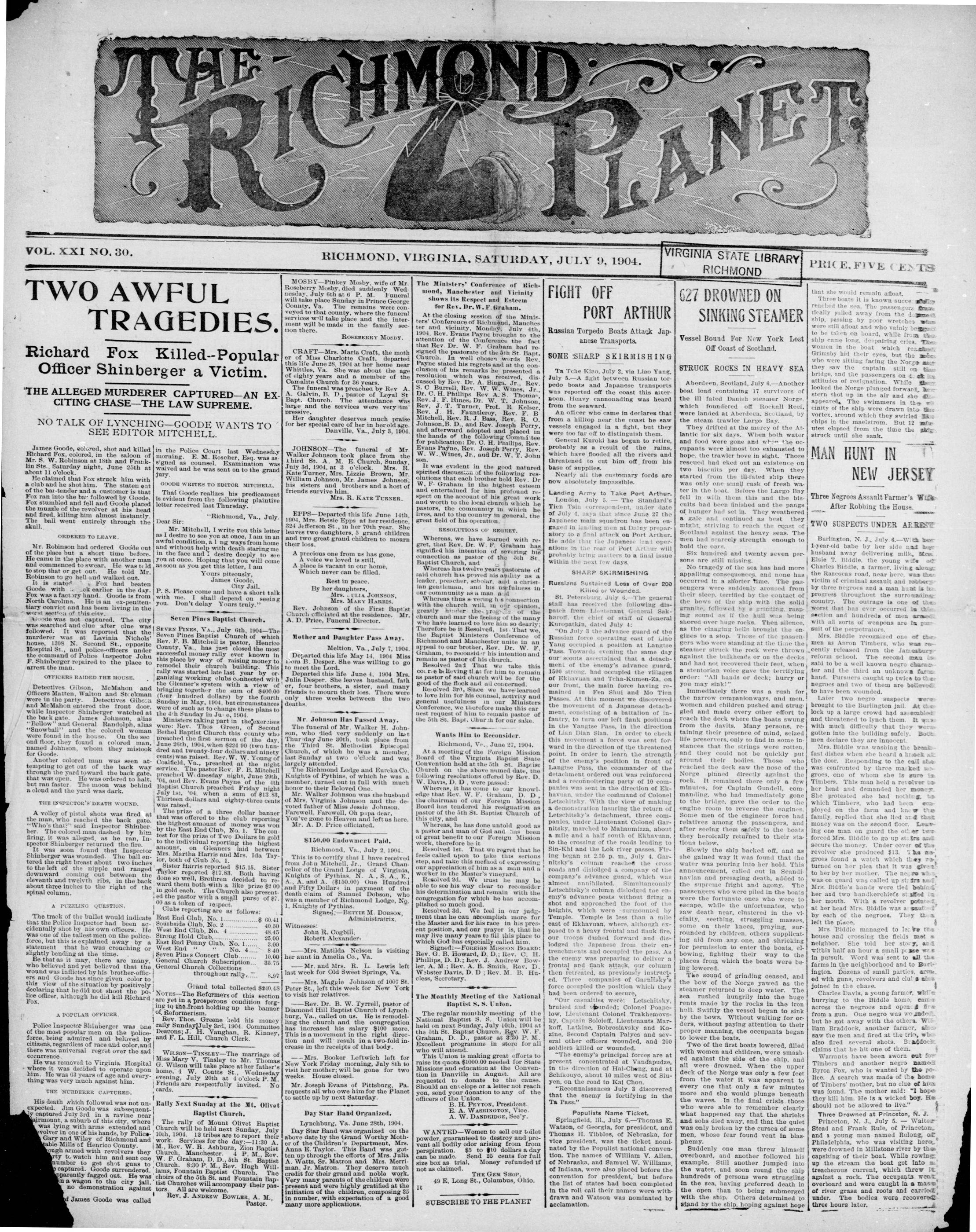
TWO AWFUL TRAGEDIES.
Richard Fox Killed--Popular Officer Shinberger a Victim.
THE ALLEGED MURDERER CAPTURED—AN EXCITING CHASE—THE LAW SUPREME. NO TALK OF LYNCHING—GOODE WANTS TO SEE EDITOR MITCHELL.
VOL. XXI NO. 30.
TWO AW
TRA
Richard Fox
Officer Shinbe
THE ALLEGED MURDER
CITING CHASE—TH
NO TALK OF LYNCHI
SEE EDITOR
James Goode, colored, shot and killed Richard Fox, colored, in the saloon of Mr. S. W. Robinson at 18th and Franklin Sts. Saturday night, June 25th at about 11 o'clock. He claimed that Fox struck him with a club and he shot him. The staten out of the bar-tender and a customer is that Fox ran into the bar followed by Goode. Fox stumbled and fell and Goode placed the muzzle of the revolver at his head and fired, killing him almost instantly. The ball went entirely through the skull.
ORDERED TO LEAVE
Mr. Robinson had ordered Goode out of the place but a short time before. He came in the place with another man and commenced to swear. He was told to stop that or get out. He told Mr. Robinson to go hell and walked out.
It is stated. Fox had beaten Goode with a kick earlier in the day. Fox was a factory hand. Goode is from North Carolina. He is an ex-penitentiary convict and has been living in the worst section of this city.
The case was not captured. The city was seized and due after clue was followed. It was reported that the murderer was at Lavinia. Nichols' house, 1308. Second St., opposite Hospital St., and police-officers under the command of Police (inspector John F. Shinberger repaired to the place to arrest the man.
OFFICERS RAIDED THE HOUSE.
Detectives Gibson, McMahon and Officers Matten, Walton and Stockman were in the party. Detectives Gibbon and McMahon entered the front door, while Inspector Shinberger watched at the back gate. James Johnson, alias "Bellow" and General Randolph, alias "Snowball" and the colored woman were found in the house. On the second floor, they found a colored man, named Johnson, whom they mistook for Goode.
Another colored man was seen attempting to get out of the back way through the yard toward the back gate, that was open. He was ordered to halt, but ran faster. The moon was behind a cloud and the yard was dark.
THE INSPECTOR'S DEATH WOUND
A volley of pistol shots was fired at the man, who reached the back gate, "Who's that?" said Inspector Shinberner. The colored man dashed by him firing, it was alleged, as he ran, Inspector Shinberner returned the fire. It was soon found that Inspector Shinberner was wounded. The ball entered the right breast about two inches to the left of the nipple and ranged downward coming out between the eleventh and twelfth ribs, in the back about three inches to the right of the spinal column.
A PUZZLING QUESTION
The track of the bullet would indicate that the Police Inspector had been accidentally shot by his own officers. He was one of the tallest men on the policeforce, but this is explained away by a statement that he was crouching or slightly bending at the time. Be that as it may, there are many, who believed and yet believed that the wound was inflicted by his brother-officer Goode has since given color to this view, and the questionation by positively declaring that he did not shoot the police officer, although he did kill Richard Fox.
A POPULAR OFFICER
Police Inspector Shinberger was one of the most popular men on the police-force, being admired and beloved by citizens, regardless of race and color, and there was universal regret over the sad occurrence. He was removed to Virginia Hospital where it was decided to operate upon him. He was 63 years of age and everything was very much against him.
THE MURDERER CAPTURED.
His death which followed was not unexpected. Jim Goode was subsequently captured July 3rd in a ravine nearairmount, a suburb of this city, where was lying with arms extended and revolver in one of his hands, by Police Gary and Wiley of Richmond andTable Mills of Henrico County. Though armed with revolvers they hurry to grab him and sent one number to watch him and shot guns to the captured. Goode resumedrecovering apparently fagged out. He was taken in a wagon to the city jail. no demonstration againstoff of James Goode was called
in the Police Court last Wednesday,
morning. E. M. Roscher, Esq. was
assigned as counsel. Examination was
waived and he was sent on to the grand
jury.
GOODE WRITES TO EDITOR MITCHELL.
That Goode realizes his pledgeament
is evident from the following plaintive
letter received last Thursday.
"Richmond, Va., July.
Dear Sir:
Mr. Mitchell, I write you this letter
as I desire to see you at once. I am in an
awful condition, a 1ng ways from home
and without help with death staring me
in the face and I desire deeply to see
you at once. Hoping that you will come
as soon as you get this letter, I am
P. S. Please come and have a short talk with me. I shall depend on seeing you. Don't delay Yours truly."
Seven Pines Baptist Church.
SEVEN PINES, VA., July 6th, 1904—The Seven Pines Baptist Church of which Rev. F. B. Mitchell is pastor, Henrico County, Va., has just closed the most successful money rally ever known in this place by way of raising money to remodel their church building. This rally was started late last year by organizing working clubs connected with the church system with a view of bringing together the surplus $400.00 (four hundred dollars) for the fourth Sunday in May, 1904, but circumstances were of such as to change these plans to the 4th Sunday in Ju.e. 1904.
Ministers taking part in the exercises were: Rev. Thos Green, of Second Bethel Baptist Church this county who preached the first sermon of the day, June 26th, 1904, when $224 90 (two hundred and twenty-four dollars and ninety cents) was raised. Rev. W. W. Young of Coalfield, Va., preached at the night service. the pastor Rev. F. B. Mitchell preached W. dinesay night, June 29th, '04, and Rev. Evans Payne of the 4th Baptist Church preached Friday night July 1st, '04, when a sum of $13 83, Thirteen dollars and eighty-three cents was raised. The prize of a three dollar banner that was offered to the club reporting the highest amount of money was won by the East End Club, No. 1. The contest for the prize of Two Dollars in gold to the individual reporting the highest amount, on Gleaners laid between Mrs. Martha Harris and Mrs. Ida Taylor, both of Club No. 1.
Sister Harris reported $15.15. Sister
Taylor reported $17.83. Both having
done so well, Brethren decided to
reward them both with a like prize $2 00
in gold each. The Church also present-
ed the pastor with a small purse of $7.
00 as a token of respect.
Clubs reporting are as follows:
East End Club, No. 1 ... $ 60.41
Southside Club, No. 2 ... 40.50
West End Club, No. 4 ... 48.45
Strong Hold Club ... 25.00
East End Penny Club, No. 1 ... 3.00
West End " " No. 4 ... 8.40
Seven Pins Concert Club ... 10.00
General Church Subscription ... 35.75
General Church Collections
throughout rally ... 8.97
Grand total collected $240.48
NOTES—The Reformers of this section are yet in a prosperous condition forging to the front holding up the banner
of Reformism.
Rev. Thos. Greene held his money rally Sunday; July 3rd, 1904. Committee Deacons; J. H. Vaughan, R. Kinney, and F. L. Hill, Church Clerk.
WILSON—TINSLEY—The marriage of Miss Mary V., Tinsley to Mr. Thomas G. Wilson will take place at her father's home, 4 W. Courts St., Wednesday evening, July 20th at 4 o'clock P. M. Friends are respectfully invited. No cards.
Rally Next Sunday at the Mt. Olivet Baptist Church.
The rally of Mount Olivet Baptist Church will be held next Sunday, July 10th, 1904. 12 tribes are to report their work. Services for the day: -11:30 A.M., Rev W. R. Ashburn, Zion Baptist Church, Manchester. 4 P. M., Rev W. F. Graham, D. D., 5th St. Baptist Church. 8:30 P. M., Rev Hugh Williams, Fountain Baptist Church. The choirs of the 5th St. and Fountain Baptist Churches will accompany their pastors. All are welcome.
Rev J. ANDREW BOWLER, A. M., Pastor.
MOSBY—Pinkey Mosby, wife of Mr. Roseberry Mosby, died suddenly Wednesday, July 6th at 6 P. M. Funeral will take place Sunday in Prince George County, Va. The remains were conveyed to that county, where the funeral services will take place and the interment will be made in the family section there.
The Ministers' Conference of Richmond, Manchester and Vicinity shows its Respect and Esteem for Rev. Dr.W.F. Graham.
At the closing session of the Ministers' Conference of Richmond, Manches ter and vicinity, Monday, July 4th.
FIGHT OFF PORT ART
Russian Tornado Boats Att
CRAFT—Mrs. Maria Craft, the mother of Miss Charlotte Craft, departed this life June 28, 1904 at her home near Whittles, Va. She was about the age of eighty years and a member of the Camalite Church for 36 years.
The funeral was preached by Rev A. A. Galvin, B. D., pastor of Loyal St. Bapt. Church. The attendance was large and the services were very impressive.
Her daughter deserves much praise for her special care of her in her old age. Danville, Va., July 3, 1904.
JOHNSON—The funeral of Mr. Walker Johnson took place from the Third St. A. M. E. Church, Sunday, July 3d, 1904, at 3 o'clock. Mrs. R. Kate Turner, Mrs. Lizzie Brown, Mr. William Johnson, Mr. James Johnson, his sisters and brothers and a host of friends survive him.
Mrs. R. KATE TURNER.
EPPS - Departed this life June 14th,
1904, Mrs. Betsie Epps at her residence,
324 Jefferson St., in her 70th year. She
leaves two daughters, 5 grand children
and two great grand children to mourn
their loss.
A precious one from us has gone,
A voice we loved is still,
A place is vacant in our home,
Which never can be filled
Rev. Johnson of the First Baptist Church officiated at the residence. Mr. A.D. Price, Funeral Director.
Mother and Daughter Pass Away.
Meltion Va July 7, 1904
Departed this life May 14, 1904 Miss Lora B. Desper. She was willing to go to meet the Lord. Departed this life June 4, 1904 Mrs. Julia Desper. She leaves husband, fath er, four brothers, a sister, and many friends to mourn their loss. There were only three weeks between the two deaths.
Mr. Johnson Has Passed Away.
The funeral of Mr. Walker H. Johnson, who died very suddenly on last Thursday June 30th, took place from the Third St. Methodist Episcopal Church, of which he was a member, last Sunday at two o'clock and was largely attended. The Richmond Lodge and Eureka Co. Knights of Pythias, of which he was a member, turned out in full with much honor to their Beloved One. Mr. Walker Johnson was the husband of Mrs. Virginia Johnson and the devoted father of Miss Jessie Johnson. Favored carousel, Oh papa dear, You've gone home, and left us here. A.M.D. A.D. Dice office.
$150.00 Endowment Paid.
Hammond, V., July 19, 1904.
This is to certify that I have received from John Mitchell, Jr., Grand Chancellor of the Grand Lodge of Virginia, Knights of Pythias, N. A., S. A., E. A., A. and A. ($150.00) One Hundred and Fifty Dollars in payment of the death claim of Samuel Dobson, who was a member of Richmond Lodge, No. 1, Knights of Pythias.
Signed:—BETTIE M. DOBSON, Administratrix.
Witnesses:
John R. Cogbill,
Robert Alexander;
Mrs. Matilda Nelson is visiting
her aunt in Amelia Co., Va.
Mr. and Mrs. R. L. Lewis left
last week for Old Sweet Springs, Va.
Mrs. Maggie Johnson of 1007 St.
Peter St., left this week for New York
to visit her relatives.
Rev. Dr. B. W. Tyrrell, pastor of
Diamond Hill Baptist Church of Lynch-
burg, Va., called on us. He is remodel-
ling the church and the congregation
has increased his salary $100 more.
This is a movement in the right direc-
tion and will result in a two-fold in-
crease in the receipts of that body.
Mrs. Booker Leftwich left for
New York Friday morning, July 5th to
visit her mother; will be gone for two
weeks. House closed.
Mr. Joseph Evans of Pittsburg, Pa. requests all who owe him for the Planet to settle up by next Saturday.
Day Star Band Organized.
Day Star Band was organized on the above date by the Grand Worthy Mother of the Children's Department, Mrs. Anna E. Taylor. This Band was gotten up through the efforts of Mrs. Julia A. Watts, Sr. Matron and Mrs. Merriman, Jr. Matron. They deserve much credit for their grand and noble work. Very many parents of the children were present and were highly gratified at the initiation of the children, composing 35 in number, with expectation of a good many more applications.
The Minister's Conference of Richmond, Manchester and Vicinity shows its Respect and Esteem for Ray, Dr W. E. Eickhart.
At the closing session of the Ministers' Conference of Richmond, Manchester and vicinity, Monday, July 4th, 1904. Rev Evans Payne brought to the attention of the Conference the fact that Rev Dr. W. F. Graham had resigned the pastorate of the 5th St. Baptist Church. In well chosen words Rev Payne stated his regrets and at the conclusion of his remarks he presented a resolution which was received, discussed by Rev Dr. A. Binga, Jr., Rev C. Burrell, Rev W. W. Wines, Jr., Dr. O. H. Phillips, Rev A. S. Thomas, Rev J. F. Hunga, Rev W. T. Johnson, Rev J. T. Turner, Prof. R. Kelser, Rev J. H. Fainterley, Rev R. J. Mitchell, Rev R. J. Bass, Rev R. J. Johnson, B. D., and Rev Joseph Perry, and afterward adopted and placed in the hands of the following Commitee for publication: Dr. C. H. Phillips, Rev Evans Payne, Rev Joseph Perry, Rev W. W. Wines, Jr., and Dr. W. T. Johnson.
It was evident in the good natured spirited discussion of the following resolutions that each brother held Rev. Dr W, F. Graham in the highest esteem and entertained for him profound respect on the account of his great work and worth to the local church which he pastors, the community in which he lives, and to the country in general, the great field of his operation.
RESOLUTIONS OF REGRET.
Whereas, we have learned with regret, that Rev. Dr. W. Graham has signified his intention of severing his connection as pastor of the 5th St. Baptist Church, and
Whereas his twelve years pastorate of said church has proved his aptity as a leader, presacher, sober, and a christian gentleman, and his usefulness in our community as a man and
Whereas thus svering his connection with the church will, in our opinion, great success, progress of the church and mar the seeing of the many who have learned to be him so dearly; Therefore be it Resolved, that we the Baptist Ministers Conference of Richmond and Manchester unite in an appeal to our brother, Rev. Dr. W. Graham, to reconsider his intention and remain as pastor of his church.
Resolved 2nd That we take this course believing that for him to remain as pastor of said church will be for the good of the flock and all concerned.
Resolved 3rd, Since we have learned to love him for his counsel, activity and general usefulness in our Ministers Conference, we therefore make this car nest request of him to remain pastor of the 5th St. Bapt. Ohrhur for our sake.
Wants Him to Reconsider
Richmond, Vr., June 27, 1904.
At a meeting of the Foreign Mission Board of the Virginia Baptist State Convention held at the 5th st. Baptist Church on the above named date, the following resolutions offered by Rev. D. W. Davis, D. D., were passed: Whereas, it has come to our knowledge that Rev. W. F. Graham, D. D., the Chairman of our Foreign Mission Board has received his resignation as pastor of the 5th st. Baptist Church of this city, and Whereas, he has done untold good as a pastor and man of God and has been of great benefit to our Foreign Mission work, therefore be it Resolved 1st. That we regret that he feels called upon to take this serious step, and take this method of expressing our appreciation of him as a man and a worker in the Master's vineyard. Resolved 2d. We trust he may be able to see his way clear to reconsider his determination and remain with the congregation for which he has accomplished so much good.
Resolved 3d. We feel in our judgment that he can accomplish more for the Master and for his race in his present position, and our prayer is, that he may live many years to fill this place to which God has especially called him.
Signed:—Foreign Mission Board Rev. G. B. Howard, D. D.; Rev. C. H. Phillips, D. D.; Rev. J. Andrew Bowler, A. M.; Rev. A. B. Smith, Rev. D. Wbsster Davis, D. D; Rev. M. B. Huscel, Secretary.
The Monthly Meeting of the National Baptist S. S. Union.
The regular monthly meeting of the National Baptist S. S. Union will be held on next Sunday, July 10th, 1904 at the 6th St. Baptist Church, Rev W. F. Graham, D. D., pastor at $30 P. M. Excellent programme in store for all who will attend.
This Union is making great efforts to raise its quota $1000.00 needed for State Missions and education at the Convention in Danville in August. All are requested to donate to the cause. Should an envelope or a letter not reach you, send your donation to any of the officers of the Union.
B. H. PEYTON, President
E. A. WASHINGTON, Vice.
A. W. DANDRIDGE, See y.
WANTED—Women to sell our toilet powder, guaranteed to destroy and prevent all bodily odor arising from from perspiration. $5 to $10 dollars a day can be made. Send 25 cents for full size box as trial. Money refunded if not as claimed.
THE GEM SHOP.
49 E. Long St., Columbus, Ohio.
SUBSCRIBE TO THE PLANET
FIGHT OFF
PORT ARTHUR
FIGHT OFF
PORT ARTHUR
Russian Torpedo Boats Attack Japanese Transports.
SOME ;SHARP SKIRMISHING
Ta Tche Kiao, July 2, via Liao Yang, July 5.—A fight between Russian torpedo boats and Japanese transports was reported off the coast this afternoon. Heavy cannonading was heard from the seaward.
An officer who came in declares that from a hilltop near the coast he saw vessels engaged in a fight, but they were too far off to distinguish them.
General Kuroki has begun to retire, probably as a result of the rains, which have flooded all the rivers and threatened to cut him off from his base of supplies.
Nearly all the customary fords are now absolutely impossible.
Landing Army to Take Port Arthur.
London, July 5. — The Standard's Tien Tsin correspondent, under date of July 4, says that since June 27 the Japanese main squadron has been engaged in landing men at Daliny preparatory to a final attack on Port Arthur.
He adds that the Japanese final operations in the rear of Port Arthur will probably bring matters to a final issue within the next few days.
SHARP SKIRMISHING
Russians Sustained Loss of Over 200
Killed or Wounded.
St. Petersburg, July 6. The general staff has received the following dispatch from Lieutenant General Sakharoff, the chief of staff of General Kuropatkin, dated July 4.
"On July 3 the advance guard of the Russian force operating east of Liao Yang occupied a position at Langtse Pass. Towards evening the same day our scouts asserted that a detachment of the enemy's advance guard, 1500 strong, had occupied the villages of Ekhavan and Tcha-Kumen-Za, on our front, the main force having remained in Fen Shui and Mo Tien Passes. At this moment we discovered the movement of a Japanese detachment, consisting of a battalion of infantry, to turn our left flank positions in the Yangtse Pass, in the direction of Lian Dian Sian. In order to check this movement a force was sent forward in the direction of the threatened point. In order to learn the strength of the enemy's position in front of Langtse Pass, the commander of the detachment ordered out was reinforced and a recoonolering party of 10 companies was sent in the direction of Ekhavan, under the command of Colonel Letschitsky. With the view of making a demonstration insuring the return of Letschitsky's detachment, three companies, under Lieutenant Colonel Garnitsky, marched to Mahamulizza, about a mile and a half south of Ekhavan, to the crossing of the roads leading to Sin-Khl and the Lok river passes. Firing began at 2.30 p. m., July 4. Garnitsky's column reached the cross roads and dislodged a company of the company's advance guard, which was almost annihilated. Simultaneously Letschitsky's column dislodged the enemy's advance posts without firing a shot and approached the foot of the heights, which were surmounted by Temple. Temple is less than a mile east of Ekhavan, where, although exposed to a heavy front and flank fire, our troops dashed forward and dislodged the Japanese from their entrenchments and occupied the pass. As the enemy was preparing to deliver a frontal and flank attack, our column then retreated, as previously instructed. Three companies of Garnitsky's force occupied the position which they had been ordered to secure.
"Our casualties were: Letschitsky, bruised and wounded; Colonel Poapelow, Lieutenant Colonel Trakhemovsky, Captain Sololeff, Lieutenants Markoff, Latkine, Bobroslavsky and Kozine, Second Captain Palyes and several other officers wounded, and 200 soldiers killed or wounded.
"The enemy's principal forces are at present concentrated at Vandapudze, in the direction of Hai-Cheng, and at Schikouyo, about 10 miles west of Siyen, on the road to Kal Chon.
"Reconnaissances July 3 discovered that the enemy is fortifying in the Ta Pass."
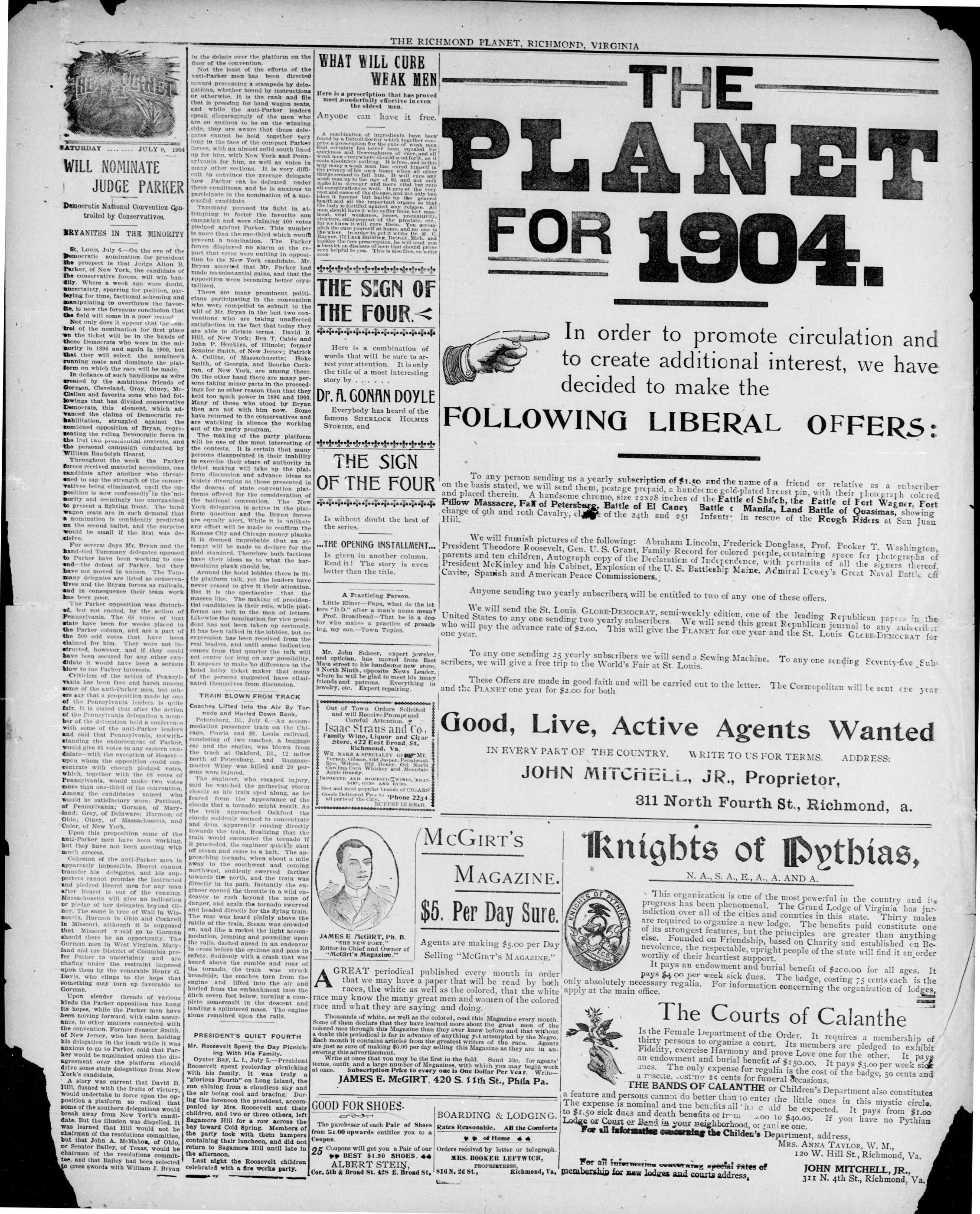
Populists Name Ticket
Springfield, Ill., July 6.—Thomas E. Watson, of Georgia, for president, and Thomas H. Tibbles, of Nebraska, for vice president, was the ticket nominated by the Populist national convention. The names of William V. Allen, of Nebraska, and Samuel W. Williams, of Indiana, were also placed before the convention for president, but before the list of states had been completed in the roll call their names were withdrawn and Watson was nominated by acclamation.
VIRGINIA STATE LIBRARY RICHMOND
627 DROWNED ON SINKING STEAMER
627 DROWNED ON SINKING STEAMER
Vessel Bound For New York Lost Off Coast of Scotland.
STRUCK ROCKS IN HEAVY SEA
Aberdeen, Scotland, July 6.—Another boat load containing 17 survivors of the ill fated Danish steamer Norge, which foundered off Rockall Reef, were landed at Aberdeen, Scotland, by the steam trawler Largo Bay.
They drifted at the mercy of the Atlantic for six days. When both water and food were gone and when the occupants were almost too exhausted to hope, the trawler hove in sight. Those rescued had eked out an existence on two biscuits per day. When they started from the ill-fated ship there was only one small cask of fresh water in the boat. Before the Largo Bay fell in with them this and the biscuits had been finished and the pangs of hunger had set in. They weathered a gale and continued as best they might, striving to reach the coast of Scotland against the heavy seas. The men had scarcely strength enough to hold the oars.
Six hundred and twenty seven persons are still missing.
No tragedy of the sea has had more appalling consequences, and none has occurred in a shorter time. The passengers were suddenly aroused from their sleep, terrified by the contact of the bows of the ship with the solid granite, followed by a grinding, rasping sound as if the hull was being shored over huge rocks. Then silence, as the clanging bells brought the engines to a stop. Those of the passengers who were standing at the time the steamer struck the rock were thrown against the bulkheads or on the decks and had not recovered their feet, when a stentorian voice gave the terrifying order: "All hands or deck; hurry or you may sink!"
Immediately there was a rush for the narrow companionways, and men, women and children pushed and struggled and made every other effort to reach the deck where the boats swung from the davits. Many persons, retaining their presence of mind, seized life preservers, only to find in some instances that the strings were rotten, and they could not be quickly put around their bodies. Those who reached the deck saw the nose of the Norge plinned directly against the rock. It remained there only a few minutes, for Captain Gundell, commanding, who had immediately gone to the bridge, gave the order to the engine room to reverse the engines. Some men of the engineer force had relatives among the passengers, and after seeing them safely to the boats they heroically returned to their stations below.
Slowly the ship backed off, and as she gained way it was found that the water was pouring into her hold. This announcement, called out in Scandinavian and presaging death, added to the supreme fright and agony. The passengers who were piled in the boats were the fortunate ones who were to escape, while the unfortunate, who saw death near, clustered in the vicinity, seething, struggling masses, some on their knees, praying, surrounded by children, others supplicating aid from any one, and shrinking for permission to enter the boats, elbowing, fighting their way to the places from which the boats were being lowered.
The sound of grinding ceased, and the bow of the Norge yawed as the steamer returned to deep water. The sea rushed hungrily into the huge rents made by the rocks in the iron hull. Swiftly the vessel began to sink by the bows. Without waiting for orders, without paying attention to their proper manning, the occupants began to lower the boats.
Two of the first boats lowered, filled with women and children, were smashed against the side of the ship, and all were drowned. When the upper deck of the Norge was only a few feet from the water it was apparent to every one that only a few minutes more and she would plunge beneath the waves. In the final crisis those who were able to remember clearly what happened say that the shrieks and sobs died away, and that the quiet was only broken by the curses of some men, whose fear found vent in blasphemy.
Suddenly one man threw himself overboard, and another followed his example. Still another jumped into the water, and soon round the ship hundreds of persons were struggling in the sea, having preferred death in the open than to being submerged with the ship. Others determined to stand by the ship, hoping against hope
that she would remain afloat
Three boats it is known succe
reached the sea. The passengers
tically pulled away from the d. m.
ship, passing by poor wretches
were still aloft and who vainly be
to be taken on board, while from
ship came long, despairing cries.
The women in the boat which reach
Grimsby hid their eyes, but the ma-
who were sitting facing the Norge
they saw the captain still on the
bridge, and the passengers on d. c.
attitudes of resignation. While
looked the Norge plunged forward,
stern shot up in the air and she
appeared. The swimmers in the w
cinity of the ship were drawn into
vortex, around which they swirled
chips in the maelstrom. But 12
minutes elapsed from the time the
struck until she sank.
MAN HUNT IN NEW JERSEY
Three Negroes Assault Farmer's Wife After Robbing the House.
TWO SUSPECTS UNDER ARREST
Burlington, N. J., July 6.—With her 1-year-old babe by her side and bug husband away delivering milk, Mrs. Elsie T. Biddle, the young wife of Charles Biddle, a farmer, living along the Rancocas road, near here, was the victim of criminal assault and robbery by three negroes and a man hunt is in progress throughout the surrounding country. The outrage is one of the worst that has ever occurred in this section and hundreds of men armed with all sorts of weapons are in pursuit of the perpetrators.
Mrs. Biddle recognized one of them men as Aaron Timbers, who was recently released from the Jamesbury reform school. The second man is said to be a well known negro character and the third an unknown farm man. Pursuers caught up twice to the negroes and two of them are believed to have been wounded.
Later two negro suspects were brought to the Burlington jail. At the lock up a large crowd had assembled and threatened to lynch them. It was with much difficulty that they were gotten into the building safely. Both men declare they are innocent.
Mrs. Biddle was washing the breakfast dishes when she heard a knock at the door. Responding to the call she was confronted by three masked negroes, one of whom she is sure in Timbers. This man held a revolver to her head and demanded her money. She protested she had nothing, to which Timbers, who had been employed on the farm and knew the family, replied that she lied and that money was on the second floor. Leaving one man on guard the other two forced Mrs. Biddle to go up stairs and secure the money. Under cover of the revolver she produced $13. The negroes found a watch which they returned on her plea that it was given to her by her mother. The negro who was on guard was called up stairs and Mrs. Biddle's hands were tied behind her and two handkerchiefs stuffed in her mouth. With a revolver pointed at her head Mrs. Biddle was caught by each of the negroes. They then left the place.
Mrs. Biddle managed to leave the house and crossing the fields met a neighbor. She told her story, and within half an hour a small peace was in pursuit. Word was sent to all the farms in the neighborhood and to Burington. Dozens of small parties, armed with guns, revolvers and clubs also joined in the chase.
Charles Davis, a young farmer, while hurrying to the Biddle home, came across the negroes and opened fire from a gun. One negro was we indicted, but he got away with the others. William Braddock, another farmer, also saw the men and fired at the trio, who also fired several shots. Braddock claims that he hit one of them.
Warrants have been sworn out for Timbers and another negro named Byron Fox, who is wanted by the police. A search was made of the home of Timbers' mother, but no clue of him was found. The mother said: "I hope they kill him. He is a wicked boy. He should not be allowed to live."
Three Drowned at Princeton, N. J.
Princeton, N. J., July 5. — Walter Stead and Frank Rule, of Princeton, and a young man named Rulong, of Philadelphia, who was visiting here, were drowned in Millstone river by the capsizing of their boat. While rowing up the stream the boat got into a treacherous current, which threw it against a rock. The occupants went overboard and were caught in a mass of river grass and roots and carried under. The bodies were recovered three hours later.
THE PLANET
FOR
SUNDAY
READING
GOD LOVETH ALL
Dato every man and nation,
God will e'er extend His hand,
Loving, under all conditions,
Those obeying His command.
Better rich or poor are favored,
God will love to God.
Warning thus the path where He hath tro
Treading paths where He hath tro
Those who love and will obey Him,
He will never once forsake,
Within their souls be dwelling,
Inner to awake,
He will teach them, great is
Though the home be poor and humble,
God will find a dwelling there.
If He finds the heart is waiting,
And is filled with earnest prayer,
Asking Him to come, be with them,
And to teach them what is right.
He will quickly hasten thither,
Shedding round about His light.
Everywhere He's loved and needed
He will always, quickly, go.
Comfort give to those who seek Him,
Love and mercy He will show.
In more room the humble hearts have,
In more room the humble hearts have,
With less pride and vain ambition
Will they cause His heart to grieve.
Oh the blessed, blessed promise,
He never will forsake,
And if we will forsake and trust Him,
Care of us He'll take care.
Then why should we wander from Him
Into worldly ways of sin,
That we must, ere reaching Heaven,
Have a change of heart begin?
Miss Martha S. Lippincott, in N. Y. Ob-
WHAT TORERE DID.
How the Death of a Little New Zea land Girl Brought a Savage Tribe to Christ.
In the early days of the evangelization of New Zealand there lived in Walkato a girl named Torere. Though only eight years old, she learned to read and to love a copy of St. John's gospel in Maiori, which she always begged to be allowed to carry with her. She was the daughter of a chief named Ngakaku, who had become converted through the efforts of a missionary. Torere used regularly to read aloud from her gospel in her father's tent. When the tribe became Christians they decided to take the good news to some of their friends in another part of New Zealand; and for this purpose Ngakaku organized a party of 15, the little mission band including Torere and her small brother. While halting for the first night, the smoke of their fires was seen by an unfriendly tribe on the warpath, who bore down upon
them. Ngakuku, carrying his little son on his shoulder, fled up the hill with the others of his company. In the darkness and confusion, however, Torere was forgotten; she lay asleep with her gospel under her head. When the war party found that the others had escaped, they spent their fury on the little girl, who woke no more on earth. They carried off the small volume with the rest of the spoil. Some of its leaves were used for cartridge paper, but the greater part of the book eventually fell into the hands of a young Maoril, who read it, and was so impressed by it that he ultimately became a Christian. Eventually that whole tribe became converted.
When the chief of the tribe, Torere's murderer, realized the sin he had been committing in taking the lives of his fellow creatures, among others the little girl, he sent to his former enemy, Ngakuku, begging his forgiveness, and also asking permission to enter a chapel—not the chapel Ngakuku attended, but one in his own village. Without that man's good will he felt he could not enter any Christian place of worship. And we are told, says F. Klickman, in S. S. Times, that the two men who at one time were at the fiercest enmity subsequently "were worshiping God together in the same place." Such were the far-reaching results of a gospel in the hands of a Maori child.
RELIGIOUS THOUGHT.
Piety is not a pain in the stomach.
—Ram's Horn.
You cannot begin anything, you never did. Origination, genesis, is God.—Campbell Morgan.
When a man thinks he is the whole church he is apt to ignore the Head of the Church—Ram's horn.
Contentment is sunlight, discontentment is starlight, malcontentment is night.—United Presbyterian.
A man does not have to go to Heaven by freight simply because he cannot express himself in meeting.—Ram's Horn.
When the Christian rises above such small details as telling the truth and dealing honestly God is going to let him drop hard.—Ram's Horn.
No one need go down to eternal death who is able to turn round and go the other way; for the other way leads to eternal life.—United Presbyterian.
Sinful Ambitions
Sinful ambitions are like the balls of snow which the boys roll on the playground in the winter. They are cold and unsympathetic; and as they increase they gather up the dead grass, sticks, pebbles and whatever will adhere to them; and finished they are
ophermal as the snow out of which they are formed. The sun shines upon them and the soft south winds blow, and they are gone forever, only a little heap of rubbish—the silt of all their garnerings—remains.—United Presbyterian.
SECRET OF JOYFUL LIVING.
Sin Is the Discordant Note in a World of Gladness and Beauty— Heaven Is Near.
In a crowd of people, even among the most cultured, there are few faces that express joy, says H. M. McClusky, in Christian Work. Care and weariness, restlessness, and unsatisfied ambition are unmistakably visible, and often when outward conditions seem the most favorable, the joyful life finds no expression; for it is an unknown experience. Yet all nature is full of gladness; a wonderfully beautiful world has been prepared for man's habitation. Why does he not rejoice in his possessions? He is out of harmony, sin is the discordant note; but when by repentance toward God and faith in the Lord Jesus Christ he is at one with God, the discord resolves itself into the sweet, rich chord of love. Then there follows the triumphant obigato of joy. The accompaniment is not always perfectly harmonious, but the song goes on uninterrupted to the close. Is that true? The Psalmist says: "In Thy presence is fullness of joy." The Lord's presence is continually about us, believers willingly concede the fact. Why then is there not more joy? The life is based on a lower plane, instead of shaping it "according to the pattern that was showed in the Mount."
The belief of the heart is not worked out in the life. There are many lovable Christians whose faith never falters when the heavier sorrows come, but do not see or recognize their Lord in the daily routine, either by seeking Him for hourly needs, or thanking Him for ever-present, numberless blessings. Christ gave the secret of joy when He said, "Ask, and ye shall receive, that your joy may be full." It is a constant interchange of interests between the Father and His child. Because He is infinitely great and powerful, He is no less the loving, compassionate One. A friend said to me: "Do you ask Him about such little things?" as though it were irreverent to speak to Him about the trivial but absolutely essential details of daily living. "For though the Lord be high-yet hath He respect unto the lowly;" that fact alone should fill us with joy.
Study to live as in His presence; let all the surroundings as far as possible be in accord with a royal Guest and loving Friend. What a transformation there would be in most homes and lives if all pertaining to them were consciously given over to Him to arrange; we executing as under His immediate supervision, without fear, fretfulness or anxiety. There could be but one result, a full, abounding joy. Would it not be worth while to make the effort? It can only be attained by patient, persistent endeavor; beginning with the first moment in the morning, praying hourly to be kept consciously in the presence of Jesus our Lord. In such a life Heaven does not seem so far away and that home is a part of Christ's established kingdom.
WAYS OF FRIENDSHIP.
The Reciprocal Relationship of Life Which Is a Blessing and a Benediction.
Once know for a certainty that your friendship is firmly established, and what would you not do for a friend? Yet, at the same time, I doubt if any supreme friendship can rest in simply once knowing. It is entitled ever and again to the joys of reassurance, for only by many infallible proofs does it come to its finest flower. Not that much is needed, so true is it, as some one once said to Stevenson, that "the spirit of delight comes often on small wings." A word, a book, a tone • •
• just the merest intimation that your friend is stanch and true and mindful and you go on your way rejoicing.
Indeed there are signal causes for rejoicing all along the line, since if it may not be one joy, it may be another. Friendship is so preeminently a matter of the spirit that it can take a world of pleasure in simply "living over," and yet it is enough of a philosopher to subsist on very little if it must, but only if it must. He who deliberately or thoughtlessly starves a friendship deserves to lose his friend. As for distance, it is powerless over it. You can be consciously near a friend though an ocean roll between you, and often with a certain insistent conviction that you are in the mind of your friend.
Another witness to the fact that "the spirit of delight comes often on small wings" is, that one can take such satisfaction in merely looking forward. "He that has something ayont need never be weary" runs the Scotch proverb; and though in friendship the something "ayont" be ever so little, it will suffice to lead the spirit joyously on. One can fare through a round of commonplace days, rising with indomitable cheerfulness above a world of petty anxieties and worries, if one knows that the future has a few supreme hours or even moments in its keeping. And then what serenity characterizes these established friendships! When you and your friend meet, there need be no eagerness as to what you have to tell or to hear. The benediction of a "God bless and keep you!" finding complete expression in a single earnest glance may suffice.
But when one tries to write of all the joys and inspirations, they seem to open out in a long, illumined vista, says Ruth Ogden. Friendship. And it is because this is true, because of this never-falling power to cheer, inspire and comfort, that any friendship is lifted from the ranks of the ordinary to the ranks of the supreme.
The Cashier
President—No, he's gone to avoid arrest. —Boston Globe.
THE RICHMOND. PLANET, RICHMOND, VIRGINIA.
Fun For Fun Lovers.
Always at Variance.
"The weather hereabouts," said the stranger, "frequently disagrees with me."
"Oh, there's a man living in this town who is worse off than you. The weather never agrees with him."
"What's the matter with him?"
"He's the local weather forecaster."
—Philadelphia Public Ledger.
They All Say It.
Towne-My wife saw the new minister for the first time yesterday.
Browne-O! Rev. Mr. Hoamley. What she have to say about him?
Towne-What every good woman says about a minister, no matter how ugly he may be: "He has a good face." -Philadelphia Press.
Both Sides of It.
When a man gives ear to gossip,
He, with a smiling face
Is sure to make remarks about
The woman in the case.
But he always overlooks the fact
That, since the world began,
That he been no woman in the case
In which the woman man.
-Cincinnati Enquirer.
NOTHING SERIOUS.
-
"I tell you that girl is dying for me."
"Humph! I haven't seen the family doctor at her house lately."—Chicago American.
The Revised Version.
Young Mrs. Hubbard
Went to the cupboard
To get her pug dog some fromage de brie
But none she found there—
Her husband—the bear!
Had taken it all with his dinner, you see.
—Puck.
Just So.
Little Clarence—Pa, why do they call the end of a college student's school life the commencement?
Mr. Callipers—Oh, because that is when the matter-of-fact old word commences to take the conceit out of him.
—Puck.
Sense of Danger.
"So you have quit eating patent food?" "Yes," answered Mr. Bliggins. "You know they advertise to make brain, and I am afraid I'll get to be a regular genius, and have to wait for posterity to appreciate me."-Washington Star.
Safety Appliance.
Husband—Why did you want a speaking tube from the dining-room to the kitchen?
The Wife—So I can give the cook orders without having her throw dishes at me.—Chicago Daily News.
Silenced Again
"Have a care, madam," said Mr.Meeker, summoning up a little spunk. "The worm will turn!" "Did you ever know the worm to hurt anybody when it turned?" calmly asked his wife.-Chicago Tribune.
Easily Reconcilable.
"Stoneychap is such a devout Baptist. I don't see how he reconciles what he hears Sunday with what the Standby Oil company does Monday." "That is easy. Oil and water don't mix."—Brooklyn Life.
Cause and Effect
First Man—Since I built my house here the value of property in the neighborhood has greatly depreciated.
Second Man—Of course; I don't wonder at it—that is, I mean—Good-morning—Tit-Bits.
She Had Her'Way
"I thought Henpeck's doctor said he would have to stop smoking or it would kill him?" "He did; but you his wife is saving cigar-coupons to buy a piano."—Judge.
Big as That?
Miss Wabash—We girls in Chicago often have our toes stepped out in the suburbs.
Miss Gotham—Gracious! Do they reach 'way out there?—Yonkers Statesman.
Change in Relationship.
Harris—Was that your sister I saw with you yesterday afternoon?
Barlow—She wasn't when you saw us.
It was later in the evening when she became my sister—Boston Transcript.
Postal Inefficiency
"There is only one commodity in the United States that cannot be had on the installment plan."
"What is that?"
"Postage stamps."—N. Y. Times.
Question of Degree.
Wagner—Is it proper to say "drank," or "drunk?"
Jagner—It depends altogether on how far gone you are.—Philadelphia Telegraph.
Quite Up-to-Date.
extremely up-to-date.
Jones—Yes—they say her husband is one of the latest things out.—Town Topics.
The Way of It.
"You say that stout chap in the opposite box owes his fortune to politics?" "Well, yes; he got so awfully defeated the first time he ran for office that he has stuck strictly to business ever since."—Puck.
Stuck Up.
Grayce—What makes Madge so stuck up?
Edythe—Oh, hadn't you heard?
There's a glue firm using her photograph as an advertisement.—Philadelphia Bulletin.
Some Treuble
"And did you have any trouble naming your first child, Pat?"
"Sure, ma'am; there wasn't a man went home from that christenin' without a black eye!" — Yonkers Statesman.
Hopes for Improvement.
She—Do you hear Matilda singing at her work?
He—Yes; and I hope to gracious she'll do the work better than she does the singing—Yonkers Statesman.
Writers of Fiction
Patience—You say her husband is a writer?
Patrice—Yes, h*s's a writer of fiction.
"Oh. well, all husbands are that!"—Yonkers Statesman.
A Queer Bank.
"I can give you a position in my bank, but you will have to wait for promotion until somebody dies or resigns." "Don't you ever have any defaulters?"—Town Topics.
Her Reason.
"I never thought she loved him."
"She didn't."
"Then why did she marry him?"
"She had a grudge against him."
"Chicago Post."
Killing Fumes.
Mrs. Myles—Do you allow your husband to smoke in the conservatory?
Mrs. Styles—Oh, ray, yes; the fumes from his cigar kills the bugs.
"I should think the fumes from the kind of cigars that he smokes would kill the plants." —Yonkers Statesman
Honesty.
"By the way! I didn't leave my money in my other clothes, because this is the only suit I own, and I haven't a check which I can't get cashed until to-morrow, so you might lend me a dollar until the week after next."—Brooklyn Life.
A Dilemma.
"I happened to get into a poker game at the club last night with my best girl's father."
"Did you win or lose?"
"Both, I'm afraid. I won from him, but I'm afraid that'll lose me the girl."
—Philadelphia Press
Too Practical.
"Why did she resign from the Common Sense society?" "Because they left the realm of theoretical reform and began to talk about using common sense in the matter of their own clothing."—Chicago Post.
Spiteful Cat.
The Plain Girl—Oh, I should so like to be beautiful.
The Beautiful Girl—Why, dear?
The Plain Girl—Because, if you're beautiful, you don't need to be clever nor good-tempered.—Ally Sloper.
Danger Avoided.
Daughter—Is it really bad form to go shopping without a chaperon?
Mrs. De Style—Excessively. Young ladies who shop without a chaperon are always sure to forget themselves and buy things.—N. Y. Weekly.
QUITE UP TO DATE.
V.
Hix—My tailor has just invented buttonless trousers.
Dix—Tut! tut! I've been wearing them ever since my wife joined that literary club—Chicago Journal.
Petit Larceny
The man who cannot take a joke
To be a bore has grown;
But worse is he who takes your joke
As he tells us his brown.
-Town and Country.
Where He Stole First.
Mr. Bacon—What on earth are you talking about?
"Why, I heard Bob say that it was at college where he learned to steal first."
"Well he was talking baseball."—Yonkers Statesman.
Drew the Crowd.
Missionary (Gulchville) — Dear!
dear! It's too bad. I am told there has just been a lynching.
Deacon Hairtrigger—Yaas, parson;
you said you wished we could have a big crowd here to the openin' of the religious revival, and I told you I'd bring 'em. They're all here.—N. Y.
Weekly.
Rate of a Jewel
Wife:— discharged the cook to day.
Husband—Why, I thought you said
not long ago that she was a perfect
jewel.
Wife—Yes, but jewels, you know,
are more ornamental than useful.
Cincinnati Enquirer.
Very Progressive.
Tourist—So Squire Mossback is considered your most progressive citizen?
Native—Progressive. He's more'n
thet! Why, the old cuss had his bed
chicken house whitewashed tweet in
the last ten years.—Chicago American.
Why She Objected
"I suppose, my dear," said old Moneybags, "that you object to my using tobacco because it is a poison." "Yes," replied his young wife; "because it is—er—such a slow poison."—Chicago Daily News.
His Vocation.
"What does Windm do?"
"He's a safe blower."
"Eh?"
"Always telling tall stories about himself that nobody can show are not true."—Puck.
His Only Use.
"I wonder if he's really of any use in the world," remarked the girl in blue.
"Oh, yes," replied the practical girl in gray. "He can be used to make other men jealous."—Chicago Post.
The Hand of Time.
Mother—Why, my dear, what's the matter?
Daughter (tearfully)—I—I am losing my beauty.
"Nonsense!"
"Oh, it's true. I went to Bargain & Co.'s to price goods, and the clerk who waited on me began to look tired before I'd been there an hour—boo, hoo, hoo!"
—N. Y. Weekly.
Commendation.
"Do you consider Buskin a great actor?"
"No," answered Mr. Stormington Barnes.
"He speaks very admiringly of your performance."
"Buskin is not a good actor, but he is a remarkably fine critic."—Washington Star.
His Only Chance
"Isn't it ridiculous," remarked Shinick, "how some fellows get the habit of talking to themselves?"
"Oh, I don't know; that habit might do you some good," replied Minnick. "You'd stand a chance of hearing something good about yourself occasionally."—Philadelphia Press.
Handicapped.
"In order to enjoy a good night's rest," said the physician, "you should lie on the right side only. It is positively injurious to lie on both sides." "But how can I help it, doctor?" rejoined the patient. "You seem to have overlooked the fact that I am a lawyer."—Cincinnati Enquirer.
Strongly Recommended.
Lady (engaging a page boy)—Well,
how soon can you come?
Page (readily)—At once, mum.
Lady—But, surely your present mistress won't like that!
Page (brightly)—Oh, yes, she will,
mum. She'll be only too glad at
rid of me!—London Pup.
Not Poute
Man (who has gone in to order some false teeth as advertised)—I should like to have a set like that.
Dentist—I am afraid you can't have those; they cost more money.
Man—Humph; it does seem hard that a fellow mayn't pick his own teeth.—Ally Sloper.
A Deep Problem.
"Mildred, what brings that young man to the house so often?"
"Well, his mother's stepfather married a second cousin of father's great-aunt. We're trying to figure out what relation that makes him to me, and that can't be done in one evening."—Tit-Bits.
Club Finances.
"But," expostulated Jones, "if you'd only pay me what you owe me I could pay Smith what I owe him."
"I know it," said Robinson. "But Smith wouldn't pay me what he owes me. You and I would merely impoverish ourselves to enrich Smith."
Jumping at the Conclusions.
"Hello, old man! You don't look as well as when I saw you last."
"No, I haven't been getting much sleep the past few nights."
"Well, well. When did it happen? Why, I didn't even know you were married."—Philadelphia Press.
MATTER OF OPINION.
"Say, walter, how do you pronounce C-a-m-e-m-b-e-r-t cheese?"
"It is largely a personal matter, sir. A gentleman who was in here last night pronounced it the worst he ever saw."—Chicago Tribune.
Says the Young Father.
Is sleeplessness contagious? Why. There's no disease to match it! Why baby gets it. Am always sure to catch it.
—Philadelphia Ledger.
Jewett—Sure! I've known a number of ministers who would have starved to death if it hadn't been for wedding fees. —Town Topics.
Cheering Him Up.
Cholly—I can't live without your daughter.
Mr. Gotrox—Oh, yes you can. Work never killed anybody yet—Puck.
Impossible.
"My dear! She's too rlch!"—Brooklyn Life.
Wood and Coal, Cigars
AT THE LOWEST M
YOU CAN SAVE MONEY H
ALL GOODS DELIVER
TELEPHONE
A. C. BOOKER
18 W. BAKER ST.
W. I. JOE
FUNERAL DIRECTOR
Office & Warerooms, 207 N.
HACKS FC
Orders by Telephone or Tele-
pers and Entertainment
Old 'Phone, 686. Residence i
Coal, Cigars and Tobacco.
THE LOWEST MARKET PRICES.
SAVE MONEY BY GIVING ME A CALL.
GOODS DELIVERED TO YOU FREE.
ELEPHONE 1307
BOOKER, Prop.
B W. BAKER ST. RICHMOND, VA.
I. I. JOHNSON,
AL DIRECTOR AND EMBALMER.
Warerooms, 207 N. Foushee St. Corner Broad
HACKS FOR HIRE:
Telephone or Telegraph filled. Wedding, Sup-
s and Entertainments promptly attended.
686. Residence in Building, New Phone, 18.
KNIGHTS OF COLUMBUS OF THE WORLD
AT THE LOWEST MARKET PRICES.
YOU CAN SAVE MONEY BY GIVING ME A CALL.
ALL GOODS DELIVERED TO YOU FREE.
W. I. JOHNSON, FUNERAL DIRECTOR AND EMBALMER
Office & Warerooms, 207 N. Foushee St. Corner Broad HACKS FOR HIRE:
Orders by Telephone or Telegraph filled. Wedding, Suppers and Entertainments promptly attended.
Old 'Phone, 686. Residence in Building, New Phone. 18.
TO WHOM IT MAY CONCERN:
This organization has been chartered and legally situated under the laws and statute of the state of New York, for the purpose of uniting together all acceptable men on the Broad Bases of Charity—Beneficial and to promote the Social and Moral condition of humanity. Direct military and uniform ranks will secure for this organization unt ranks of all sacred institutions of modern events, a grand oppose men. Deputies wanted in all sections of the country to organise Kindly address,
This organization has been chartered and legally
stituted under the laws and statute of the state of
York, for the purpose of uniting together all acceptable
men on the Broad Bases of Charity—Beneficial and
Fraternal and to promote the Social and Moral condition of humanity.
Its two distinct military and uniform ranks will secure for this organization
place in the front ranks of all sacred institutions of modern events, a grand oppo-
nity for active men. Deputies wanted in all sections of the country to organise
lodge.
Kindly address,
G. W. ALLEN Supreme voyager,
346 W. 87th Street, New York City.
Mechanics'
Savings Bank
OF RICHMOND, VA
10
Money received on deposit amounts above $1.00 which rent
Money Loaned on Satisfaction
Business Accounts Handle
Amounts of ten cents and
This establishment is fitted up in the white vault, burial-proof steel chest, elec-
ence for safety and the accommodation of
For all information concerning Stock
Cashier
Banking Hours have been arranged for people as follows: 9 A. M. to 4 P. M. close Saturday at 3 P. M. and open again. P. M. Call by as you come from work.
OFFIC
JOHN MITCHELL, JR., President.
THOS. H. WY
BOARD OF I
REV. W. F. GRAHAM, D. D., JNO.
E. R. JEFFERSON H. F. JONATHAN,
J. O. FARLEY.
received on deposit and interest paid on a
move $1.00 which remains 60 days and over.
Loaned on Satisfactory Security.
Less Accounts Handled Promptly.
Rats of ten cents and upwards received on deposit.
ishment is fitted up in the most improved style, having a large
clar-proof steel chest, electric lights and every modern conven-
and the accommodation of the public.
formation concerning Stocks, Deposits, Loans, etc., apply to the
ours have been arranged for the special convenience of the work
allows: 9 A. M. to 4 P. M. Saturdays, 9 A. M. to 3 P. P. We
at 3 P. M. and open again at 5 P. M., remaining open until 7
s you come from work.
OFFICERS:
ELL, JR., President. H. F. JONATHAN, Vice-President.
THOS. H. WYATT, Cashier.
BOARD OF DIRECTORS:
A. GRAHAM, D. D., JNO. R. CHILES, B. P. VANDERVALL,
ON H. F. JONATHAN, THOMAS SMITH D. J. CHAVERS,
J. O. FARLEY, JNO. T. TAYLOR.
Money received on deposit and interest paid on a amounts above $1.00 which remains 60 days and over.
Money Loaned on Satisfactory Security.
Business Accounts Handled Promptly.
Amounts of ten cents and upwards received on deposit.
This establishment is fitted up in the most improved style, having a large white vault, burlar-proof steel chest, electric lights and every modern convenience for safety and the accommodation of the public.
For all information concerning Stocks, Deposits, Loans, etc., apply to the Cashier.
Banking Hours have been arranged for the special convenience of the working people as follows: 9 A. M. to 4 P. M. Saturday, 9 A. M. to 3 P. . We close Saturday at 3 P. M. and open again at 5 P. M., remaining open until 7 P. M. Call by as you come from work.
OFFICERS:
JOHN MITCHELL, JR., President, H. F. JONATHAN, Vice-President, THOS. H. WYATT, Cashier.
S. A. WASHINGTON, R. W. WHITTING,
JOHN MITCHELL, JR. PRES.
WINSTON'S
ICE-CREAM Is in Every Style,
Wholesale and Retail,
Parlors Open Day and Night
Special Attention to Picnics, Festi-
vals, etc. Estimates given.
All the latest and most popular
drinks of the fountain, fresh on hand.
TOBACCO AND CIGARS.
'Phone, 2253. WINSTON'S,
537 Brook Avenue.
FRANK WALLER, JR.
PRACTICAL HOUSE
PAINTER.
14 W. Baker St., Richmond, Va
Residence F. Fountain St.
All Kinds of Painting Done Cheap Give me a call before going elsewhere
LOOK OUT FOR
IT CAN'T BE EXCELLED
Your Patronage is Invited.
The AMERICAN GROCERY
and PROVISION MARKET
1221 St. James Street.
When you want nice dry, sawed pine
wood, call up 2888. We sell 1/2 cord for
$2.75, guaranteed full measureur.
A full line of fancy and staple groocries and fresh meats. Granulated sugar
40 cents. Prices low on everything
the wood, furniture and soft coal, Hay
and Grain.
THE MAYOR
Booker'S Market
18 W. Baker St. A FULL LINE OF FINE GROCERIES AND FRESH MEATS & VEGETABLES
V. P. & F. K. of W.
511 North Third Street.
Cap ital, $25,000.
WILLIAM CUSTALO, J. J. CARTER,
THOMAS M. CRUMP, Sec. $^c$
SYDNOR AND HUNDLEY, LEADERS IN Quality Furniture
PARLOR SUITS
We have some twenty-five or thirty suits bought, most of which will be in stock in a few days. "Don't do a thing" until you see this line. MORRIS CHAIRS.
This always popular chair of rest will be in as much demand this fall as ever. Part of our stock has already arrived and $10 values vie with $15 values of a year ago.
Call, see our stock of Bed Room Fur
niture and save time and money.
Passenger elevator.
Sydnor & Hundler
709-11-18 E. Broad St.
THE
SIGN OF THE
FOUR.
BY CONAN DOYLE.
THE SCIENCE OF DEDUCTION.
SHERLOCK HOLMES took his bottle from the corner of the mantelpiece and his hypodermic syringe from its neat morocco case. With his long, white, nervous fingers he adjusted the delicate neck.
HERLOCK HOLMES took his bottle from the corner of the mantelpiece and his hypodermic syringe from its neat morocco case. With his long, white, nervous fingers he adjusted the delicate needle, and rolled back his left shirt-cuff. For some little time his eyes rested thoughtfully upon the sinewy forearm and wrist all dotted and scarred with innumerable puncture marks. Finally he thrust the sharp point home, pressed down the tiny piston, and sank back into the velvet-lined armchair with a long sigh of satisfaction.
Three times a day for many months I had witnessed this performance, but custom had not reconciled my mind to it. On the contrary, from day to day I had become more irritable at the sight, and my conscience swelled nightly within me at the thought that I had lacked the courage to protest. Again and again I had registered a vow that I should deliver my soul upon the subject, but there was that in the cool, nonchalant air of my companion which made him the last man with whom one would care to take anything approaching to a liberty. His great powers, his masterly manner, and the experience which I had of his many extraordinary qualities, all made me diffident and backward in crossing him.
Yet upon that afternoon, whether it was the Beaune which I had taken with my lunch, or the additional exasperation produced by the extreme deliberation of his manner, I suddenly felt that I could hold out no longer.
"Which is it to-day?" I asked—"morphine or cocaine?"
He raised his eyes languidly from the old black-letter volume which he had opened. "It is cocaine," he said, "a seven per cent. solution. Would you care to try it?" "No, indeed," I answered, brusquely. "My constitution has not got over the Afghan campaign yet. I cannot afford to throw any extra strain upon it." He smiled at my vehemence. "Perhaps you are right, Watson." he said. "I suppose that its influence is physically in bad one. I find it, however, so transcendently stimulating and clarifying to the mind that its secondary action is a matter of small moment."
"But consider!" I said, earnestly, "Count the cost! Your brain may, as you say, be roused and excited, but it is a pathological and morbid process, which involves increased tissue-change and may at last leave a permanent weakness. You know, too, what a black reaction comes upon you. Surely the game is hardly worth the candle. Why should you, for a mere passing pleasure, risk the loss of those great powers with which you have been endowed? Remember that I speak not only as one comrade to another, but as a medical man to one for whose constitution he is to some extent answerable."
He did not seem offended. On the contrary, he put his finger-tips together and leaned his elbows on the arms of his chair, like one who has a relish for conversation.
"My mind," he said, "rebels at stagnation. Give me problems, give me work, give me the most abstruse
A
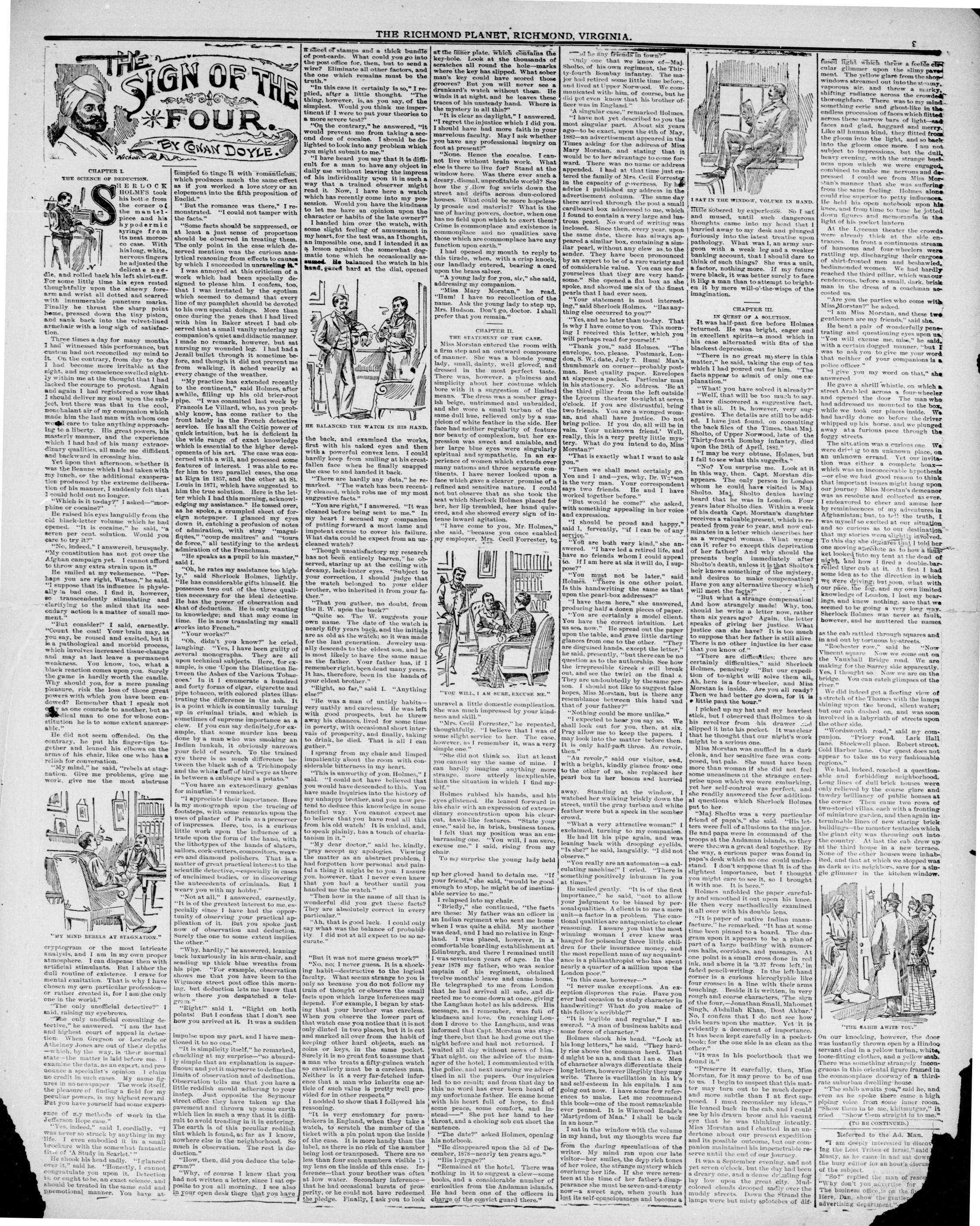
"MY MIND REBELS AT STAGNATION."
cryptogram or the most intricate analysis, and I am in my own proper atmosphere. I can dispense then with artificial stimulants. But I abhor the dull routine of existence. I crave for mental exaltation. That is why I have chosen my own particular profession—or rather created it, for I am the only one in the world."
"The only unofficial detective?" I said, raising my eyebrows.
"The only unofficial consulting detective," he answered. "I am the last and highest court of appeal in detection. When Gregson or Lestrade or Atheiney Jones are out of their depths—which, by the way, is their normal state—the matter is laid before me. I examine the data, as an expert, and pronounce a specialist's opinion. I claim no credit in such cases. My name figures in no newspaper. The work itself, the pleasure of finding a field for my peculiar powers, is my highest reward. Put you have yourself had some experience of my methods of work in the Jefferson Hope case." "Yes, indeed," said I, cordially. "I was never so struck by anything in my life. I even embodied it in a small brochure with the somewhat fantastic title of 'A Study in Scarlet.'"
He shook his head sadly. "I glanced over it," said he. "Honestly, I cannot congratulate you upon it. Detection is, or ought to be, an exact science, and should be treated in the same cold and emotional manner. You have at-
tempted to tinge it with romanticism, which produces much the same effect as if you worked a love story or an elopement into the fifth proposition of Euclid." "But the romance was there," I reconstrated. "I could not tamper with the facts."
"Some facts should be suppressed, or at least a just sense of proportion should be observed in treating them. The only point in the case which deserved mention was the curious analytical reasoning from effects to causes by which I succeeded in unraveling it." I was annoyed at this criticism of a work which had been specially designed to please him. I confess, too, that I was irritated by the egotism which seemed to demand that every line of my pamphlet should be devoted to his own special doings. More than once during the years that I had lived with him in Baker street I had observed that a small vanity underlay my companion's quiet and didactic manner. I made no remark, however, but sat nursing my wounded leg. I had had a Jezail bullet through it sometime before, and though it did not prevent me from walking, it ached wearily at every change of the weather.
"My practice has extended recently to the continent," said Holmes, after awhile, filling up his old brier-root pipe. "I was consulted last week by Francois Le Villard, who, as you probably know, has come rather to the front lately in the French detective service. He has all the Celtic power of quick intuition, but he is deficient in the wide range of exact knowledge which is essential to the higher developments of his art. The case was concerned with a will, and possessed some features of interest. I was able to refer him to two parallel cases, the one at Riga in 1857, and the other at St. Louis in 1871, which have suggested to him the true solution. Here is the letter which I had this morning, acknowledging my assistance." He tossed over, as he spoke, a crumpled sheet of foreign notepaper. I glanced my eyes down it, catching a profusion of notes of admiration, with stray "magnifiques," "coup de maitres" and "tours de force," all testifying to the ardent admiration of the Frenchman.
"He speaks as a pupil to his master," said I. "Oh, he rates my assistance too highly," said Sherlock Holmes, lightly. "He has considerable gifts himself. He possesses two out of the three qualities necessary for the ideal detective. He has the power of observation and that of deduction. He is only wanting in knowledge; and that may come in time. He is now translating my small works into French."
"Oh, didn't you know?" he cried, laughing. "Yes, I have been guilty of several monographs. They are all upon technical subjects. Here, for example, is one 'Upon the Distinction Between the Ashes of the Various Tobaccoes.' In it I enumerate a hundred and forty forms of cigar, cigarette and pipe tobacco, with colored plates illustrating the difference in the ash. It is a point which is continually turning up in criminal trials, and which is sometimes of supreme importance as a clew. If you can say definitely, for example, that some murder has been done by a man who was smoking an Indian hunkah, it obviously narrows your field of search. To the trained eye there is as much difference between the black ash of a Trichinopoly and the white fluff of bird's-eye as there is between a cabbage and a potato." "You have an extraordinary genius for minutie," I remarked.
"I appreciate their importance. Here is my monograph upon the tracing of footsteps, with some remarks upon the uses of plaster of Paris as a preserver of impresses. Here, too, is a curious little work upon the influence of a trade upon the form of the hand, with the lithotypes of the hands of slaters, sailors, cork-eutters, compositors, weavers and diamond polishers. That is a matter of great practical interest to the scientific detective,—especially in cases of unclaimed bodies, or in discovering the antecedents of criminals. But I weary you with my hobby."
"Not at all," I answered, earnestly, "It is of the greatest interest to me, especially since I have had the opportunity of observing your practical application of it. But you spoke just now of observation and deduction. Surely the one to some extent implies the other."
"Why, hardly," he answered, leaning back luxuriously in his arm-chair, and sending up thick blue wreaths from his pipe. "For example, observation shows me that you have been to the Wigmore street post office this morning, but deduction lets me know that when there you despatched a telegram."
"Right!" said I. "Right on both points! But I confess that I don't see how you arrived at it. It was a sudden impulse upon my part, and I have mentioned it to no one."
"It is simplicity itself," he remarked, chuckling at my surprise—"so absurdly simple that an explanation is superfluous; and yet it may serve to define the limits of observation and of deduction. Observation tells me that you have a little reddish mould adhering to your instep. Just opposite the Seymour street office they have taken up the pavement and thrown up some earth which lies in such a way that it is difficult to avoid treading in it in entering. The earth is of this peculiar reddish tint which is found, as far as I know, nowhere else in the neighborhood. So much is observation. The rest is deduction."
"How, then, did you deduce the telegram?"
"Why, of course I knew that you had not written a letter, since I sat opposite to you all morning. I see also in your open desk there that you have
THE RICHMOND PLANET, RICHMOND, VIRGINIA.
A sheet of stamps and a thick bundle of post-cards. What could you go into the post office for, then, but to send a wire? Eliminate all other factors, and the one which remains must be the truth."
"In this case it certainly is so," I replied, after a little thought. "The thing, however, is, as you say, of the simplest. Would you think me imperient if I were to put your theories to a more severe test?"
"On the contrary," he answered, "it would prevent me from taking a second dose of cocaine. I should be delighted to look into any problem which you might submit to me."
"I have heard you say that it is difficult for a man to have any object in daily use without leaving the impress of his individuality upon it in such a way that a trained observer might read it. Now, I have here a watch which has recently come into my possession. Would you have the kindness to let me have an opinion upon the character or habits of the late owner?"
I handed him over the watch, with some slight feeling of amusement in my heart, for the test was, as I thought, an impossible one, and I intended it as a lesson against the somewhat dogmatic tone which he occasionally assumed. He balanced the watch in his hand, gased hard at the dial, opened
HE BALANCED THE WATCH IN HIS HAND
the back, and examined the works, first with his naked eyes and then with a powerful convex lens. I could hardly keep from smiling at his crest-fallen face when he finally snapped the case to and handed it back.
“There are hardly any data,” he remarked. “The watch has been recently cleaned, which robs me of my most suggestive facts.”
“你 are right,” I answered. “It was cleaned before being sent to me.” In my heart I accused my companion of putting forward a most lame and impotent excuse to cover his failure. What data could he expect from an uncleaned watch?
“Though unsatisfactory my research has not been entirely barren,” he observed, staring up at the ceiling with dreamy, lack-luster eyes. “Subject to your correction, I should judge that the watch belonged to your elder brother, who inherited it from your father.”
"That you gather, no doubt, from the H. W. upon the back?"
"Quite so. The W. suggests your own name. The date of the watch is nearly fifty years back, and the initials are as old as the watch; so it was made for the last generation. Jewelry usually descends to the eldest son, and he is most likely to have the same name as the father. Your father has, if I remember right, been dead many years. It has, therefore, been in the hands of your eldest brother."
"Right, so far," said I. "Anything else?"
"He was a man of untidy habits—very untidy and careless. He threw away his chances, lived for some time in poverty, with occasional short intervals of prosperity, and finally, taking to drink, he died. That is all I can gather."
"I sprang from my chair and limped impatiently about the room with considerable bitterness in my heart."
"This is unworthy of you, Holmes," I said. "I could not have believed that you would have descended to this. You have made inquiries into the history of my unhappy brother, and you now pretend to deduce this knowledge in some fanciful way. You cannot expect me to believe that you have read all this from his old watch! It is unkind, and, to speak plainly, has a touch of charlatanism in it."
"My dear doctor," said he, kindly, "pray accept my apologies. Viewing the matter as an abstract problem, I had forgotten how personal and painful a thing it might be to you. I assure you, however, that I never even knew that you had a brother until you handed me the watch."
"Then how in the name of all that is wonderful did you get these facts? They are absolutely correct in every particular."
"Ah, that is good luck. I could only say what was the balance of probability. I did not at all expect to be so accurate."
"But it was not more guess work?" "No, no; I never guess. It is a shocking habit-destructive to the logical faculty. What seems strange to you is only so because you do not follow my train of thought or observe the small facts upon which large inferences may depend. For example, I began by stating that your brother was careless. When you observe the lower part of that watch case you notice that it is not only dinted in two places, but it is cut and marked all over from the habit of keeping other hard objects, such as coins or keys, in the same pocket. Surely it is no great feat to assume that a man who treats a fifty-guinea watch so cavalierly must be a careless man. Neither is it a very far-fetched inference that a man who inherits one article of such value is pretty well provided for in other respects."
I nodded to show that I followed his reasoning.
"It it is very customary for pawnbrokers in England, when they take a watch, to scratch the number of the ticket with a pin point upon the inside of the case. It is more handy than the label, as there is no risk of the number being lost or transposed. There are no less than four such numbers visible: my lens on the inside of this case. Inference—that your brother was often at low water. Secondary inference—that he had occasional bursts of prosperity, or he could not have redeemed the pledge. Finally, I ask you to look
at the timer plate, which contains the key-hole. Look at the thousands of scratches all round the hole—marks where the key has slipped. What sober man's key could have scored those grooves? But you will never see a drunkard's watch without them. He winds it at night, and he leaves these traces of his unsteady hand. Where is the mystery in all this?
"It is clear as daylight," I answered.
"I regret the injustice which I did you. I should have had more faith in your marvelous faculty. May I ask whether you have any professional inquiry on foot at present?"
"None. Hence the cocaine. I cannot live without brain work. What else is there to live for? Stand at the window here. Was there ever such a dreary, dismal, unprofitable world? See how the y flow fog swirls down the street and drifts across dun-colored houses. What could be more hopelessly prosaic and material? What is the use of having powers, doctor, when one has no field upon which to exert them? Crime is commonplace and existence is commonplace and no qualities save those which are commonplace have any function upon earth."
I had opened my mouth to reply to this tirade, when, with a crisp knock, our landlady entered, bearing a card upon the brass salver.
"A young lady for you, sir," she said, addressing my companion.
"Miss Mary Morstan," he read.
"Hum! I have no recollection of the name. Ask the young lady to step up, Mrs. Hudson. Don't go, doctor. I shall prefer that you remain."
CHAPTER II.
THE STATEMENT OF THE CASE.
Miss Morstan entered the room with a firm step and an outward composure of manner. She was a blonde young lady, small, dainty, well gloved, and dressed in the most perfect taste. There was, however, a plainness and simplicity about her costume which bore with it a suggestion of limited means. The dress was a somber grayish beige, untrimmed and unbraided, and she wore a small turban of the same dull hue, relieved only by a suspicion of white feather in the side. Her face had neither regularity of feature nor beauty of complexion, but her expression was sweet and amiable, and her large blue eyes were singularly spiritual and sympathetic. In an experience of women which extends over many nations and three separate continents, I have never looked upon a face which gave a clearer promise of a refined and sensitive nature. I could not but observe that as she took the seat which Sherlock Holmes placed for her, her lip trembled, her hand quivered, and she showed every sign of intense inward agitation.
"I have come to you, Mr. Holmes," she said, "because you once enabled my employer, Mrs. Cecil Forrester, to
"YOU WILL, I AM SURE, EXCUSE ME."
unravel a little domestic complication. She was much impressed by your kindness and skill.
"Mrs. Cecil Forrester," he repeated, thoughtfully. "I believe that I was of some slight service to her. The case, however, as I remember it, was a very simple one."
"She did not think so. But at least you cannot say the same of mine. I can hardly imagine anything more strange, more utterly inexplicable, than the situation in which I find myself."
Holmes rubbed his hands, and his eyes glistened. He leaned forward in his chair with an expression of extraordinary concentration upon his clearcut, hawk-like features. "State your case," said he, in brisk, business tones. I felt that my position was an embarrassing one. "You will, I am sure, excuse me," I said, rising from my chair.
To my surprise the young lady held
up her gloved hand to detain me. "If your friend," she said, "would be good enough to stop, he might be of inestimable service to me." I relapsed into my chair.
"Briefly," she continued, "the facts are these: My father was an officer in an Indian regiment who sent me home when I was quite a child. My mother was dead, and I had no relative in England. I was placed, however, in a comfortable boarding establishment at Edinburgh, and there I remained until I was seventeen years of age. In the year 1878 my father, who was senior captain of his regiment, obtained twelve months' leave and came home. He telegraphed to me from London that he had arrived all safe, and directed me to come down at once, giving the Langham hotel as his address. His message, as I remember, was full of kindness and love. On reaching London I drove to the Langham, and was informed that Capt. Morstan was staying there, but that he had gone out the night before and had not returned. I waited all day without news of him. That night, on the advice of the manager of the hotel, I communicated with the police, and next morning we advertised in all the papers. Our inquiries led to no result; and from that day to this no word has ever been heard of my unfortunate father. He came home with his heart full of hope, to find some peace, some comfort, and instead—" She put her hand to her throat, and a choking sob cut short the sentence.
"The date?" asked Holmes, opening his notebook.
"He disappeared upon the 3d of December, 1878—early ten years ago."
"His luggage?"
"Remained at the hotel. There was nothing in it to suggest a clew—some books, and a considerable number of curiosities from the Andaman islands. He had been one of the officers in charge of the convict guard there."
d he any friends in town?
bus in town"? "Only one that we know of—Maj. Sholto, of his own invention, the Third-fourth Bombay infirmary. The major had retired some little time for care, and lived at Upper Norwood. We were municated with him, of course, but he did pot even know that his brother officer was in England."
"A singular case," remarked Holmes. "I have not yet described to you the most singular part. About six years ago—to be exact, upon the 4th of May, 1882—an advertisement appeared in the Times asking for the address of Miss Mary Morstan, and stating that it would be to her advantage to come forward. There was no name or address appended. I had at that time just entered the family of Mrs. Cecil Forrester in the capacity of governess. By her advice I published my address in the advertisement column. The same day there arrived through the post a small cardboard box addressed to me, which I found to contain a very large and lustrous pearl. No word of writing was inclosed. Since then, every year, upon the same date, there has always appeared a similar box, containing a similar pearl, without any clew as, to the sender. They have been pronounced by an expert to be of a rare variety and of considerable value. You can see for yourselves that they are very handsome." She opened a flat box as she spoke, and showed me six of the finest pearls that I had ever seen.
"Your statement is most interesting," said Sherlock Holmes. "Has anything else occurred to you?"
"Yes, and no later than to-day. That is why I have come to you. This morning I received this letter, which you will perhaps read for yourself."
"Thank you," said Holmes. "The envelope, too, please. Postmark, London, S. W.; date, July 7. Huml Man's thumbmark on corner—probably postman. Best quality paper. Envelopes at sixpence a packet. Particular man in his stationery. No address. Be 'at the third pillar from the left outside the Lyceum theater to-night at seven o'clock. If you are distrustful, bring two friends. You are a wronged woman, and shall have justice. Do not bring police. If you do, all will be in vain. Your unknown friend.' Well, really, this is a very pretty little mystery. What do you intend to do, Miss Morstan?"
"That is exactly what I want to ask you."
"Then we shall most certainly go. You and I and—yes, why, Dr. Wilson is the very man. Your correspondent says two friends. He and I have worked together before."
"But would he come?" she asked, with something appealing in her voice and expression.
"I should be proud and happy," said I, fervently, "if I can be of any service."
"You are both very kind," she answered. "I have led a retired life, and have no friends whom I could appeal to. If I am here at six it will do, I suppose."
"You must not be later," said Holmes. "There is one other point. Is this handwriting the same as that upon the pearl-box addresses?"
"I have them here," she answered, producing half a dozen pieces of paper. "You are certainly a model client. You have the correct intuition. Let us see now." He spread out the paper upon the table, and gave little darting glances from one to the other. "They are disguised hands, except the letter," he said, presently, "but there can be no question as to the authorship. See how the irrepressible Greek e will break out, and see the twirl on the final s. They are undoubtedly by the same person. I should not like to suggest false hopes, Miss Morstan, but is there any resemblance between this hand und that of your father?" "Nothing could be more unlike." "I expected to hear you say so. We shall look out for you, then, at six. Pray allow me to keep the papers. I may look into the matter before then. It is only half-past three. Au revoir, then."
"Au revoir," said our visitor, and, with a bright, kindly glance from one to the other of us, she replaced her pearl box in her bosom and hurried away. Standing at the window, I watched her walking briskly down the street, until the gray turban and white feather were but a speck in the somber crowd.
"What a very attractive woman!" I exclaimed, turning to my companion. He had lit his pipe again, and was leaning back with drooping eyelids. "Is she?" he said, languidly. "I did not observe."
"You really are an automaton—a calculating machine!" I cried. "There is something positively inhuman in you at times."
He smiled gently. "It is of the first importance," he said, "not to allow your judgment to be biased by personal qualities. A client is to me mere unit—a factor in a problem. The emotional qualities are antagonistic to clear reasoning. I assure you that the most winning woman I ever knew was hanged for poisoning three little children for their insurance money, and the most repellent man of my acquaintance is a philanthropist who has spent nearly a quarter of a million upon the London poor."
"In this case, however—"
"I never make exceptions. An exception disproves the rude. Have you ever had occasion to study character in handwriting? What do you make of this fellow's scribble?"
"It is legible and regular," I answered. "A man of business habits and some force of character."
Holmes shook his head. "Look at his long letters," he said. "They hardly rise above the common herd. That might be an a, and that I am e. Men of character always differentiate their long letters, however illegible they may write. There is vacillation in his k's and self-esteem in his capitals. I am going out now. I have some few references to make. Let me recommend this book—one of the most remarkable ever penned. It is Winwood Reade's 'Martyrdom of Man.' I shall be back in an hour." I sat in the window with the volume in my hand, but my thoughts were far from the daring speculations of the writer. My mind ran upon our late visitor—her smiles, the deep rich tones of her voice, the strange mystery which overhung her life. If she were seventeen at the time of her father's disappearance she must be seven-and-twenty now—a sweet age, when youth has lost its self-consciousness and become a
I SAT IN THE WINDOW, VOLUME IN HAND.
little sobered by experience. So I saf and mused, until such dangerous thoughts came into my head that I hurried away to my desk and plunged furiously into the latest treatise upon pathology. What was I, an army surgeon with a weak leg and a weaker banking account, that I should dare to think of such things? She was a unit, a factor, nothing more. If my future were black, it was better surely to face it like a man than to attempt to brighten it by mere will-o'-the-wisps of the imagination.
CHAPTER III
IN QUEST OF A SOLUTION
It was half-past five before Holmes returned. He was bright, eager and in excellent spirits—a mood which in his case alternated with fits of the blackest depression.
"There is no great mystery in this matter," he said, taking the cup of tea which I had poured out for him. "The facts appear to admit of only one explanation."
"What! you have solved it already?" "Well, that will be too much to say. I have discovered a suggestive fact, that is all. It is, however, very suggestive. The details are still to be added. I have just found, on consulting the back files of the Times, that Maj. Sholto, of Upper Norwood, late of the Thirty-fourth Bombay infantry, died upon the 28th of April, 1882."
"I may be very obtuse, Holmes, but I fail to see what this suggests."
"No? You surprise me. Look at it in this way, then. Capt. Morstan disappears. The only person in London whom he could have visited is Maj. Sholto. Maj. Sholto denies having heard that he was in London. Four years later Sholto dies. Within a week of his death Capt. Morstan's daughter receives a valuable present, which is repeated from year to year, and now culminates in a letter which describes her as a wronged woman. What wrong can it refer to except this deprivation of her father? And why should the presents begin immediately after Sholto's death, unless it is that Sholto's heir knows something of the mystery, and desires to make compensation? Have you any alternative theory which will meet the facts?"
"But what a strange compensation! And how strangely made! Why, too, should he write a letter now, rather than six years ago? Again, the letter speaks of giving her justice. What justice can she have? It is too much to suppose that her father is still alive. There is no other injustice in her case that you know of."
"There are difficulties; there are certainly difficulties," said Sherlock Holmes, pensively "But our expedition of to-night will solve them all, Ah, here is a four-wheeler, and Miss Morstan is inside. Are you all ready? Then we had better go down, for it is little past the hour."
I picked up my hat and my heaviest stick, but I observed that Holmes took his revolver from his drawer and slipped it into his pocket. It was clear that he thought that our night's work might be a serious one.
Miss Morstan was muffled in a dark cloak, and her sensitive face was composed, but pale. She must have been more than woman if she did not feel some uneasiness at the strange enterprise upon which we were embarking, yet her self-control was perfect, and she readily answered the few additional questions which Sherlock Holmes put to her.
"Maj Sholto was a very particular friend of papa's," she said. "His letters were full of allusions to the major. He and papa were in command of the troops at the Andaman islands, so they were thrown a great deal together. By the way, a curious paper was found in papa's desk which no one could understand. I don't suppose that it is of the slightest importance, but I thought you might care to see it, so I brought it with me. It is here."
Holmes unfolded the paper carefully and smoothed it out upon his knee. He then very methodically examined it all over with his double lens.
"It is paper of native Indian manufacture," he remarked. "It has at some time been pinned to a board. The diagram upon it appears to be a plan of part of a large building with numerous halls, corridors, and passages. At one point is a small cross done in red ink, and above it is '3.37 from left,' in faded pencil-writing. In the left-hand corner is a curious hieroglyphic like four crosses in a line with their arms touching. Beside it is written, in very rough and coarse characters, 'The sign of the four,'—Jonathan Small, Mahomet Singh, Abdullah Khan, Dost Alkbar. No, I confess that I do not see how this bears upon the matter. Yet it is evidently a document of importance. It has been kept carefully in a pocketbook; for the one side is as clean as the other." "It was in his pocketbook that we found it."
"Preserve it carefully, then, Miss Morstan, for it may prove to be of use to us. I begin to suspect that this matter may turn out to be much deeper and more subtle than I at first supposed. I must reconsider my ideas." He leaned back in the cab, and I could see by his drawn brow and his vacant eye that he was thinking intently. Miss Morstan and I chatted in an undertone about our present expedition and its possible outcome, but our companion maintained his impenetrable reserve until the end of our journey.
It was a September evening, and not yet seven o'clock, but the day had been a dreary one, and a dense drizzling fog lay low upon the great city. Mud-colored clouds drooped sadly over the muddy streets. Down the Strand the lamps were but misty splatoons of dif-
3
fused light which threw a feeble circular glimmer upon the slimy pavement. The yellow glare from the shop windows streamed out into the steamy, vaporous air, and threw a marky, shifting radiance across the crowded thoroughfare. There was to my mind something eerie and ghost-like in the endless procession of faces which flipped across these narrow bars of light—sad faces and glad, haggard and merry. Like all human kind, they flitted from the gloom into the light, and so back into the gloom once more. I am not subject to impressions, but the dull, heavy evening, with the strange business upon which we were engaged, combined to make me nervous and depressed. I could see from Miss Morstan's manner that she was suffering from the same feeling. Holmes alone could rise superior to petty influence. He held his open notebook upon his knee, and from time to time he jotted down figures and memoranda in the light of his pocket lantern
At the Lyceum theater the crowds were already thick at the side entrances. In front a continuous stream of hansons and four-wheelers were rattling up, discharging their cargoes of shirt-fronted men and beshawled, bediamonded women. We had hardly reached the third pillar, which was our rendezvous, before a small, dark, brisk man in the dress of a coachman accosted us.
"Are you the parties who come with Miss Morstan?" he asked.
"I am Miss Morstan, and these two gentlemen are my friends," said she.
He bent a pair of wonderfully penetrating and questioning eyes upon us. "You will excuse me, miss," he said, with a certain dogged manner. "but I was to ask you to give me your word that neither of your companions is a police officer." "I give you my word on that," she answered
He gave a shrill whistle, on which a street Arabled across a four-wheeler and opened the door. The man who had addressed us mounted to the box, while we took our places inside. We had hardly done so before the driver whipped up his horse, and we plunged away ata furious pace through the foggy streets.
The situation was a curious one. We were driving to an unknown place, on an unknown errand. Vet our invitation was either a complete hoax—which was an inconceivable hypothesis—or else we had good reason to think that important issues might hang upon our journey Miss Morstan's demeanor was as resolute and collected as ever. I endeavored to cheer and amuse her by reminiscences of my adventures in Afghanistan; but, to tell the truth, I was myself so excited at our situation and so curious as to our destination that my stories were slightly involved. To this day she decries that I told her one moving anecdote as to how a musket looked into my tent at the dead of night, and how I fired a double-barreled tiger cub at it. At first I had some idea as to the direction in which we were driving; but soon, what with our pace, the fog, and my own limited knowledge of London, I lost my bearings, and knew nothing, save that we seemed to be going a very long way. Sherlock Holmes was never at fault, however, and he muttered the names
as the cab rattled through squares and in and out by tortuous by-streets.
"Rochester row," said he. "Now Vincent square. Now we come out on the Vauxhall Bridge road. We are making for the Surrey side apparently. Yes, I thought so. Now we are on the bridge. You can catch glimpses of the river." We did indeed get a fleeting view of a stretch of the Thames with the lamps shining upon the broad, silent water; but our cab dashed on, and was soon involved in a labyrinth of streets upon the other side. "Wordsworth road," said my companion. "Priory road. Lark Hall lane. Stockwell place. Robert street. Cold Harbor lane. Our quest does not appear to take us to very fashionable regions."
We had, indeed, reached a questionable and forbidding neighborhood. Long lines of dull brick houses were only relieved by the coarse glare and tawdry brilliancy of public houses at the corner. Then came two rows of two-storied villas, each with a fronting of miniature garden, and then again interminal lines of new staring brick buildings—the monster tentacles which the giant city was throwing out into the country. At last the cab drew up at the third house in a new terrace. None of the other houses were inhabited, and that at which we stopped was as dark as its neighbors, save for a single glimmer in the kitchen window.
"THE SAHIB AWITS YOU."
On our knocking, however, the door was instantly thrown open by a Hindoo servant clad in a yellow turban, white, loose-fitting clothes, and a yellow sash. There was something strangely incongruous in this oriental figure framed in the commonplace doorway of a third-rate suburban dwelling house.
"The sahib awaits you," said he, and even as he spoke there came a high piping voice from some inner room.
"Show them in to me, kiltmutgar," is cried. "Show them straight in to me."
(TO BE CONTINUED.)
Referred to the Ad. Man.
"I am deeply interested in discovering the Lost Tribes of Israel," said Musty, as he came in and sat down the busy editor for an hour's discuss of the subject.
"So?" replied the man of resou
"Why don't you advertise for
The business office is on the fly
Here, Dan, show't the gentle
advertising department."
THE PLANET
ed every Saturday by JOHN A. TOWNS
at 311 North 4th Street Richmond Va.
JOHN MITCHELL, JR., - EDITOR
communications intended for publication
should be sent so as to reach us by Wednesday
TERMS IN ADVANCE
The Copy, one year. $1.00
Free Copy, eight months. 1.00
Free Copy, six months. 8.00
Free Copy, four months. 5.00
Free Copy, three months. 4.00
Google Copy.
ADVERTISING RATES
For one inch, one insertion.
For two inches, two insertion.
For two inches, three months.
For two inches, six months.
For two inches, two months.
For two inches, three months.
For two inches, four months.
Planning and Timeline Notice Le line
FOR STAGE STANDS OF A HIGHER DEMOCRATIZATION THAN TWO CENTS NOT RECEIVED ON SUBSCRIPTIONS
The Planet is issued weekly. The subscript price is $1.50 a year, in advance.
Where are four ways by which the money can be sent by mail at our risk.—In a Post Office More or Under, by Bank Check or Draft, or an Ex-Address Mining Order and when none of these are procured in a Registered Letter.
MONEY ORDERS - You can buy a Money Order or at your Post Office, payable to the Richmond and we will be responsible for it at arrival.
EXPRESS MONEY ORDERS can be or trained as a new office of the American Express, so the letter can be sent to your Post Office and Co.'s Express Company. We will be responsible for money sent by any of these companies convenient way for forwarding money.
REGISTERED LETTER - If a Money Order Post Office or an Express Office is not within reach, your Postmaster will send the letter to you in payment of the receipt. Then, if the letter is post or stolen in your car you can send money in the manner at our risk.
We cannot be responsible for money sent in letters in any other way than one of the four ways mentioned above. If you send your money in other way, you must do it at your own risk.
RENewALS, TTO - If you do not want TTO, renewal copies has run out, you then notify your Postal Card to discontinue it. The courts have decided that subscribers to newspapers who send a subscription of time for which it has been paid should hold in advance for the payment of the subscription to date when they order the paper discor
COMMUNICA. - When writing to us
you renew your subscription or to discontinue
your subscription you should give your name and ad-
ress, otherwise we cannot send you
any other address.
ORANGE or ADDRESS - In order to enquire
the address of a subscriber, we must be seen
formerly as well as the present address.
Entered in the Post Office at Richmond.
Your second class matter
THE death of CAPT. JOHN F. SHINBEROU, the popular Police Inspector of this city, is generally regretted. He was deservedly popular among all class, is irrespective of race or color. He was in the full vigor of manhood and was regarded as one of the ablest and best officers on the Police Force.
The colored people of Richmond, who respect legal authority and abhor lawlessness have viewed with genuine regret the happenings of the last few days. The ignorant, the vicious and the utterable' characters must be kept in objection and the good name of our city maintained at all hazards.
Among the mourners at SHINBEROU's tomb is a figure in ebony, representing the best that there is in the colored race and praying for him a happy admittance to that rest beyond this veil of tears.
Peace to his ashes; rest for his soul.
MR. PAGE AND NEGRO IMMORALITY.
"Pure mortality is a plant which grows in heaven."—DR. VINET.
"What is man, that he should be clean and which is born of a woman, that he should be righteous. Bohoh, he putteth no trust in his wits. The wits are not clean in sight."—HOLY BINLE.
MR. THOMAS NELSON PAGE "threw history to the winds" and established himself upon a pedestal of purity from which view-point, he vain-gloriously asumed to criticize and comment upon the immorality of the Negro. That he should have served to the readers of McCLURE'S MAGAZINE such a nauseating dish as is indicated by his utterances is indeed surprising. He claimed to be friendly to the Negro and this is the way in which he demonstrated his friendship. He said:
"They [Whites] will tell you further that education such as they receive in the public schools, so far from appearing to uplift them, appears to be with out any appreciable beneficial effect upon their morals or their standing as citizens. But more than this; universally, they will tell you of the general deprivacy and retrogression of the Negroes at large in sections in which they are left to themselves, closely resembling a reversion to barbarism."
Is it possible that Mr. PAGE does not know that the above statement constitutes a charge against the civilizing effects of education rather than a reflection upon the Negro.
If a physician prescribes for a pa-
patient, who is ailing and the remedy fails
to cure, is it good sense to allege that the
patient is worthless or that the medicine
is either good-for-nothing or was
improperly administered? Statistics
prove the opposite of what Mr. PAGE
asserts. Education is known to elevate
and reform. Its effect is civilizing and
Mr. PAGE should know it to be. The
majority of Negroes convicted of crime
are uneducated and of those who have
book learning and are guilty of wrong
doing, it is shown that they were only
given a smattering of education.
When Mr. Page speaks of the Ne-
version to barbarism he should
remember that he is a product of the community in which he lives. White men have become barbarians. Human beings have been roasted while they lived and red-hot irons forced into the quivering flesh while the mob danced to the "music" of the howls and wails of the victims.
Burning at the stake is a common pastime ih TEXAS, LOUISIANA, MISSISSIPPI, ARKANSAS, GEORGIA, SOUTH CAROLINA and many other states of this Union.
If the white man reverts to barbarian on short notice, what should be expected of the Negro?
Mr. PAGE is a "friend" to the Negro so much that he was named by President ROOSEVELT as being one of his referees in dealing with southern ap pointments and yet he said:
"It is generally assumed that progress, as applied to a class or a race, signifies some advance in moral standing, or, at least, some improvement in the elements of character on which morality is based."
The above statement is axiomatic in its character and must be accepted by every student of ethics and lover of fair-play. Under its provisions, the Negroes cannot be convicted and he knows it, but he hastened to dissemble and remarked:
"It is unfortunate that the statistics in the field of morality cannot be ob-ained; but in this field, as in others, the testimony of those who have had the best opportunities f.r observation is all one way. Southerners of every class and calling, without exception, bear witness to the depressing fact that, leaving out the small upper fraction, the Negro race has not advanced at all in morality."
The above is a very cool proposition as well as a very audacious one. Let us use. If you will leave out all of the Whites, who have advanced in morality and leave only the Whites, who have not advanced in morality, it will show that the White race has not advanced at all in morality. Well, sir, this is enough to make even a stoic smile.
If you will leave out all of the Negroes who are educated and consider only those who are uneducated, it will show that the Negro race has not advanced at all in education.
If you will leave out all of the Negroes who are religious and consider only those who are not religious, it will show that the Negro race has not advanced at all in religion.
If you will take four ounces out of a bag of sugar that weighs a pound and consider only what is left after the four ounces have been taken out, you will find that the bag of sugar does not weigh a pound.
That a gentleman of Mr. PAGE's intelligence and prominence should resort to such demagogic argument is astounding and shows his innate hatred of the kindliest race of people on the face of the globe. He continued:
"Unhappily, the fountain is tainted at the source. The great body of the race have scarcely any notion of the foundation principles of pure family life."
Who tainted it, Mr. PAGE? Who herded the Negroes like cattle and encouraged them to avoid racial suicide? Who profited by their fecundity? Who placed women upon the auction block where their persons were exposed and examined by lecherous purchasers? Who sold wives from husbands, brothers from sisters, daughters from mothers and babes from the breasts of the weeping devotees? Who violated every principle of morality and taught the Negroes that there could be a religious life without a moral one? Who raised up Negro children with the white ones, both of which offsprings could call them father? And yet you, Mr. PAGE, a distinguished gentleman who knows all these things have the hardihood to speak about the Negro's immorality. It is sir, the white man's shame.
There were and are to-day mullattoes, who truly claim kinship to some of the ablest and best white people in the Southland, and be it said to the credit of some of them, they have faithfully looked after the Negro relatives of their own flesh and blood. You must have recognized this for you said:
"It is usually charged that slavery was responsible for the absence of morality throughout the race. Doubtless, during slavery there was a sufficient amount of immorality to be the basis for almost any reasonable charge, yet study of the question has convinced at least one person that the illicit relations between the two races during the period of slavery have probably been greatly exaggerated."
This then is an admission of guilt. But Mr PAGE not only admits that the Whites were guilty, but concedes that they are guilty now. Here is what he said:
"He has come to believe further that while illicit intercourse between the two races is less and, perhaps, markedly less now than it was during the colonial era, the morality of the great body of the Negro race has largely increased since that time."
He continued:
"That this immorality exists, is the testimony not only of the Whites, but also of members of the race who have, with an open mind, madea study of the conditions of their people. Perhaps the most remarkable study of the Negro which has appeared is the book entitled, "The American Negro," by William Hannibal Thomas, of Massachusetts."
Wherever the educated and the ignorant come together in wrong-doing, the educated is more to blame.
Wherever the "superior" and the "inferior" races come together in wrong doing, the "superior" race is more to blame.
The family tie is regarded and the number of marriages solemnized throughout the Southland as well as the records of the public school system show that Mr. PAGE was sadly lacking in information concerning the true moral condition of the colored people among whom he once lived.
Were Mr. PAGE not such a distin-
THE RICHMOND PLANET, RICHMOND, VIRGINIA.
guishel gentleman of the F. F. V. stock of this commonwealth, we should apply to him with all of its inferences, the well-known English maxim, "Evil be to him who evil thinks." But after all, the Negro is but the poking-glass in which the Whites may see themselves reflected. That the Negro has improved in morality admits of no question, for any improvement whatever removes him from that degradation of slavery from which the legions of the North rescued him. Mr. PAGE then delves in fifth and searches the sewers of calumny in order to ruin us before the thoughtful white elements of the New World. He then gloried in the utterances of Mr. WILLIAM HANNIBAL THOMAS of Massachusetts and said:
"No inconsiderable part of its value is owing to the fact that the author, a free, colored man, has had both the power to observe closely and the courage to record boldly the results of his observations. In the chapter on 'Moral Lapses' the author sys: 'All who know the Negro recognize, however, that the chief and overpowering element in his make up is an imperious sexual impulse which, aroused at the slightest incentive, sweeps aside all restraints in the pursuit of physical gratification. We may say now that this element of Negro character constitutes the main incitement to degeneracy of the race and is the chief hindrance to its social unplifting.
"The Negro's ethical code sternly reprobates dancing, theater attendance, and all social games of chance. It does not, however forbid lying, rum-drinking, or stealing. Furthermore, a man may trail his loathsome form into the sanctity of private homes, seduce a wife, sister, or daughter with impunity and be the father of a score of illegitimate children by as many mothers, and yet be a disciple of holiness and honored with public confidence."
Mr. PAGE remarked:
"His chapter on this subject will be, to those unfamiliar with it, a terrible exposure of the deprivation of the Negroes in their social life, but it is only what those who have studied the subject know.
The curse of this frightful immorality is over the church and the school, and gives no evidence of abatement.
Mr. PAGE cited the unsupported testimony of a colored man who lives in MASSACHUSETTS, ignoring the statements of such distinguished race leaders as Prof. BOOKER T. WASHINGTON and Prof. W. H. COUNCILL of Alabama and Prof. R. R. WRIGHT of Georgia a d Prof. W. E. B. DUBOIS, who have made a special study of the subject.
He quoted the following mausegett statement which it is impossible to prove by any information in the hands of any one in the known world:
"The simple truth," admits the writer already quoted, "is that there is going on side by side in the Negro people a minimum progress with a maximum regress."
"It is, therefore," he says on page 183, "almost impossible to find a person of either sex over fifteen years of age who has not had carnal intercourse. And again, on page 184, he declares Marital immoralities, however, are not confined to the poor, the ignorant, and the degraded among the freed people, but are equally common among those who presume to be educated and refined."
Mr. PAGE added his unsupported testimony, based upon hear-say testimony, too flimsy to bring about the conviction of a yellow dog in the night-time. He said:
"Unfortunately for the race, this depressing view is borne out by the increase of crime among them; by the increase of superstition, with its black trail of unnamable immorality and vice by the homicides and murders, and by the outbreak and growth of the brutal crime which has chiefly brought about the frightful crime of lynching which stains the good name of the South and has spread northward with the spread of the Negro ravisher.
It is a fact which no one will deny that the crime of rape was substantially unknown during the period of slavery, and was hardly known during the first years of freedom; it is the fatal product of new conditions. Twenty-five years ago women in the South went unattended, with no more fear of attack than they have in New England. To-day no woman in the South goes alone upon the highway out of sight of White men, except on necessity, and no man leaves his women alone in his house if he can help it. Over 500 White women and children have been assaulted in the South by Negroes within that time."
Mr. PAGE, we live here and you err grievously when you say that no white woman can go out upon the highways out of sight of white men. Your own assertion proves the falsity of your statement. There are nearly ten million Negroes in the Southland to-day and during a period of twenty-five years, only five hundred white women and children have been assaulted by any of them. This would bring the case down to less than one-thousandth of one per cent. What race can show a better record?
But Mr. PAGE tells about the Negroes' immorality; what about the White man's vices? Has he forgotten the lecherous conduct of the Whites in their march to PEKIN, CHINA in order to rescue the legations? The natives were raped, robbed and murdered and there were no Negroes in any of the armies there represented.
Mr. PAGE should know that virtue and morality is a prominent feature of African life. The Negro was not corrupted until he came in contact with the Whites and their rum.
He talks about Mr. THOMAS' chapter on "Moral Lapses." Has he ever read "If Christ Came to Congress," portraying the leading representatives as engaging in debauchery of the worst kind and resorting to immoral excesses that would disgrace the inhabitants of the Feejee Islands? Has he read "If Christ Came to Chicago," portraying again a similar depravity among the upper class of whites? Has he read Dr. CHARLES H. PARKHURST's ringing denunciations of crime and criminals in New York City, and the successful raids, proving the truth of all that he was kind enough to say?
Has he read the ringing denunciation
of the immoralities of the high-life in Washington city by a distinguished bishop of the Protestant Episcopal Church? Has he read Mr. HENRY WATTERSON's criticisms of the immorality of the "Smart Set" at Newport, Rhode Island? Has he read the admissions of the Morman Elders, (all White) at the Senatorial investigation of the case of Hon. REED SMOOT, the United States Senator from Utah? This took place, Mr. PAGE in Washington D.C., where you are located. Mr. PAGE remarked: "This is a terrible showing, and the most depressing part of it is the failure of the Negroes to address themselves to the moral improvement of their race."
He states this too, although he should know that every school and college of the thousands in the Southland are devoting its efforts to the moral and educational training of the young.
The educated Negro ministry which is an important factor now in the south's development is doing the same thing and families, cultured in every respect and moral in every particular may be found from the Mason and Dixon's Line to the Gulf, from the Narrows of the Chessapeake and the Everglades of Florida to the Golden Horn of the Pacific.
But what is the record of the Whites on this question of immorality? Let Biblical History speak first and then profane.
Mr. PAGE will find in GENESIS, 18th and 19th chapters some very interesting reading on Sodom and Gomorroh. By reading Chapter 38, he will learn of the fate of DINAH and the vengeance of her brothers. By reading Chapter 39, he will be informed of JOSSEH's temptations and the weakness of his mistress. By paying attention to II SAMUEL, 11th chapter, he will learn of the weakness and immorality of that great warrior, DAVID.
A perusal of the Bock of JEREMIAH will prove to be of untold benefit and a source of much beneficial enlightenment. He should then come to the New Dspensation and read the charges contained in the 16th chapter of MATTHEW with reference to the immorality of that day and time, while the 28th chapter will further enlighten him upon the same subject.
The 7th chapter of MARK will tend to rivet the attention and emphasize the fact that immorality has existed in all ages. It has been said that "like priests, like people." It is equally as true that a people's morals may be gauged by its leaders and that the average man will not be any better than those who have been delegated to lead him.
What does the history of Whites say on this question?
Mr. SWINTON, [white] the historian on page 157, paragraph 174, in speaking of the decay of the Roman Empire says:
"They [Romans] became effeminate, luxurious and corrupt in morals; marriage was not respected; the old Roman faith waned, and it was said that two anguins could not meet in the street without laughing in each others' faces."
This is not enough for you, Mr. PAGE,
read the history of the Carloivingian
Kings, who ruled FRANCE for three
centuries, and whose beastly immorality
has never been equalled nor surpassed in
the whole civilized world. As a result,
they became imbeciles, and their im-
morality extended to members of the
same family. They are accredited
to the Whites, Mr. PAGE.
Read too the history of HENRY VII,
of ENGLAND, who had six wives and
one ANNIE BOLEYN, was beheaded by
his order in 1536, and another, CATHERINE HOWARD was similarly executed
by the same power.
Of him MACINTOSH. [white] says:
"Perhaps no other monarch since the emancipation of woman from polygamy has put to death two wives on the scaffold divorced another whom he owned to be faultless, after twenty-four years of wedded friendship and rejected a fourth, without impinging blame to her, from the first impulse of personal distrust."
It may be fair to state that the wives whom he had beheaded were found guilty of adultery.
In speaking of the English in the 17th Century; Mr. SWINTON, [white] the historian says:
"In the English people there seems to have been a remarkable vein of course and brutality; nor is this wonder ful when the practice of every day life is considered. Masters beat their servant husband beat their wives daily. Teachers used the last in the principal means of imparting knowledge. The mob rejoiced in fights of all kinds, and shouted with glee when an eye was torn out, or a finger chopped off in these savage encounters."
Here is another chapter from Mr. SWINTON, [white] the historian.
In speaking of the age of Queen ELIZABETH, the most glorious period in English history, Mr. SWINTON the historian on page 345 says:
"It is remarkable that while ELIZABETH increased in power and resource, she became more noted for feminine weaknesses. Her favorite in middle life was ROBERT, EARL of LEICESTER a profligate and a trifler. In her latter life, she listened to the addresses of the RATL, ESSAY, a king man of greater courage and better principle, but also head-strong and weak.
ESSAY, who had acquired popularity by seal brilliant military enterprises, began at length to assume an insolent superiority over the Queen, who was on one occasion so much provoked by his rudeness to give him a hearty box on the ear. * * * Yet her character was a strange blending of the base and the noble, the weak and the strong."
Yet she was called the Virgin Queen. RIDPATH, [white] the historian in speaking of Rome and its decay portrays DOMITLANUS [white] the Emperor as follows:
"Having no regard for his own horrible vices, he undertook to reform the morals of the state * * * Meanwhile in his own basilica, some of the most dissolute characters known in Roman society roamed at will and added, their breath
to the already penitential atmosphere.
The empress, DOMITILLA was corrupted by one of the King's favorites bearing the significant name of PARIS. * * *
The outrageous profligacy and ruinous excesses which prevailed in the times of CLAUDIUS and NERO had brought about a natural reaction in favor of the rough and savage virtue of the olden times."
Couple this with the citations from the record of our own day and time which we have previously oiled and it will be seen, Mr. PAGE that the Whites do not possess morality as their only asset.
But what about the Negro? He has had a hard time of it. True, he is open to many of the charges made against him, but his has been a rugged road to travel.
He is accumulating property, advancing in education, and improving in morals, but it is disappointing to be misrepresented and slandered by one whom he had accounted to be his friend. Colored men, do not be discouraged. Colored women, value your character, and scorn the white tempters and the colored ones too who infest the Southland. A race is gauged by its virtues, and rises in the scale of progress and material worth in proportion to its improvement in education and morals. Mr. THOMAS NELSON PAGE has deeply wronged us and no doubt has poured for h much of this kind of argument against us into the listening ears of the President of the UNITED STATES but a brighter day is coming by bee and bye. It behooves us to go forward confident that we shall be able to hold out.
"Until the day break, and the shadows flee away." "No man's condition is so base as his; None more accursed than he; for man esteems
Him hateful 'cause he seems not what
he is;
God hates him 'cause he is not what
he seems;
What grief is absent, or what mischief can
Be added to the hate of God and man?
A WEEK'S NEWS CONDENSED.
New York Chinese have contributed $657 to the General Slocum relief fund. The final detail in the payment of the $40,000,000 to the Panama Canal Company has been completed. Amherst College has awarded the honorary degree of doctor of laws on Secretary of the Navy Moody. O. L. Hayes, former president of the Galion, O., national bank, has been held in heavy bail for false entries in the bank's books. Dr. Mary Partridge, of Bennington, Vt., committed suicide by drowning at Red Rocks, Lake Champlain, due to continued ill health. Henry Young, night editor of the North American, one of the best-known newspaper men in Philadelphia, died after a lingering illness.
Friday. July 1.
W. H. Maxwell, of New York, was elected president of the National Educational Association.
Colonel Joseph Brigham, assistant secretary of agriculture, died at Delta-O., where he was visiting.
Charles M. Schwab, former president of the United States Steel Corporation, has resigned as a director.
Dr. Floyd Whitecomb, of Warren, Pa., was drowned at Frewsburg, N. Y., while fording the Conowago creek.
William H. Owen, manager of the Western Union Telegraph company at Elmira, N. Y., and his wife were found dend in their home. It is believed they committed suicide.
Saturday. July 2.
The Chicago grand jury indicted 42 bookmakers for gambling at the Hawthorne race track.
President Roosevelt has appointed Colonel Theodore A. Bingham, who will be retired this month, a brigadier general.
By having his head armor knocked off, John Metcalf, a submarine diver, was drowned in the Delaware river off Chester, Pa.
Ex-Senator Marion Butler, of North Carolina, has resigned as chairman of the executive committee of the National People's Party.
While sitting on the track asleep, Charles Moncrief, of Bridgeton, N. J., a brakeman on the West Jersey railroad, was struck by a trafa and killed.
Tuesday, July 5.
The Williamson Veneer Works, at Baltimore, Md., were destroyed by fire, entailing a loss of $60,000.
W. H. Quinn, a bookmaker at the Vancouver, B. C., horse races, was held up and robbed of $8600 in cash.
A canoe containing two girls was swept over the falls in the Merrimac river, at Lawrence, Mass., and both were drowned.
John Alexander Dowle and his restoration host will invade London in the near future, being carried there in a fleet of gospel ships.
William Powell, a rejected juror in the Gillespie murder trial at Rising Sun, Ind., became insane over the case and committed suicide by shooting.
Wednesday. July 6.
By a majority of over 400 votes Charlotte, N. C., has voted for prohibition.
Joseph Thompson, of Trenton, N. J., has resigned from the Equal Taxation Commission of New Jersey.
Albert N. Dalrymple, of Newark, has been appointed private secretary-to Governor Murphy, of New Jersey.
Brakeman Harry Harding, of Sunbury, Pa., was jailed under a train of freight cars at Pottsville, Pa., and instantly killed.
Colonel James Regan, Ninth U. S. Infantry, has been detailed to attend the encampment of the Pennsylvania militia at Gettysburg July 23-30.
GENERAL MARKETS
Philadelphia, Pa., July 6. — Flour
steady; winter superfine, $4.10@3.25;
Penna roller, clear, $4.30@4.55; city
mills, fancy, $5.20@5.30. Rye flour
steady; per barrel, $4.15. Wheat firm;
firm; No 2 yellow, $1.02@1.03. Corn
firm; No 2 yellow, $1.02@1.03. Corn
steady; No 2 white, clipped, 49c;
lower grades, 47c. Hay steady; No 4
Free! Free! Free!
TEA. TEA. TEA.
True Reformers' Store
A Glass of Ioc Tea, made from the Best 60-cent tea in the world.
Large Chickens, ..... 20c. each
Large Juicy Lemons, ..... 10c. dozen
Pine Apples, ..... 4 for 25c.
Dunlop Flour, ..... 35c. bag
Obelisk Flour, ..... 35c. bag
Meal, ..... 20c. Peck
Large Jars Preserves, ..... 3 for 25c.
Domestic Sardines, ..... 6 for 25c.
Jelly, ..... 6 Jars for 25c.
Matches, ..... 6 dozen for 25c.
Good Luck Baking Powders, ..... 1 lb box, 8c.
Potted Ham, ..... 6 boxes, 25c.
Potted Tongue, ..... 6 boxes, 25c.
Apricots, ..... 2 cans, 25c.
Large Bottles Pickle, ..... 3 for 25c.
Dried Beef, ..... 2 cans, 25c.
Small Hams, ..... 10c. pound.
Best Lard, ..... 10c. pound.
Reformers' Store, 6th and Clay Sts. GIVE US A CALL.
umothy, $15.50@16, large balls4. Pork
firm; family, $16. Beet steet; beef
hams, $20@21. Live poultry steady;
hens, $11.5% old roosters, Sc. Dressed
poultry firm; choice fowl, 12%c; old
roosters, Sc. Butter firm; creamy;
hens, $11.5% old roosters, New York
and Penna, $3.90 dozen. Potatoes steady;
new, per bushel, $1.75@2.
Baltimore, Md., July 6. — Wheat
dull; spot, contract, 85%@85%c; spot
No. 2 red western, 85%@85%c; steamer
No. 2 red, 79%@79%c; southern, by
apples, 85%@85%c, 79%@79%c.
Corn quiet; spot, 51%@51%c;
steamer mixed, 48%@48%c; southern
white and yellow corn, 50%@50c. Oats
quiet; No. 2 white, 46%c; No. 2
mixed, 43%@43%c. Rye dull; uptown
No. 2 western, Butter steady;
cream, Imagine, 85%@85%c.
Ory 24%@24c; do ladle, 15%@16c; stom
packed, 12%@13c. Eggs熟 at 17c.
Live Stock Markets.
Union Stock Yards, Pittsburgh, Pa.
July 6 — Cattle steady; charge, $6.10
@6.25, prime, $5.70@6; fair, $4.40@
dium, $5.50, heavy Yorkers, $5.70@
5.75; light Yorkers, $5.70; pigs, $5.60
@5.65; roughs, $4@4.75; sheep slow;
prime, sheep lamb, $4.35@4.10; common
lamb, $1.50; lice lambs, $4@7;
veal calves, $6@7.
1904 JULY 1904
Su. Mo. Tu. We. Th. Fr. Sa.
1 2
3 4 5 6 7 8 9
10 11 12 13 14 15 16
17 18 19 20 21 22 23
24 25 26 27 28 29 30
31
STRUGGLE WITH A GRIZZLY.
Hunter from Ohio Has Experience in Sierra Madre Mountains Which He Won't Forget.
J. L. Anderson, a tourist from Sandusky, O., had an exciting experience recently while hunting in the Sierra Madre mountains. In telling the Mexican Herald about the matter, before leaving for his home, Mr. Anderson said that he was in northwestern Chihuahua hunting for big game and suddenly encountered a large grizzly bear. The animal started to run, when he fired, only slightly wounding it in the
FIERCE FIGHT FOR LIFE.
side. The sting of the bullet infuriated the beast, and quick as a flash of lightning it turned and attacked its assailant.
"I fired one more shot," said Mr. Anderson, "but the bullet went wild, and before I could defend myself the bear was upon me with a mad, wild rush. It threw me down, and then began a fierce fight for my life. The claws of the beast severely lacerated my body. It caught my left arm above the
20c. each
10c. dozen
4 for 25c.
35c. bag
35c. bag
20c. Peck
3 for 25c.
6 for 25c.
6 Jars for 25c.
6 dozen for 25c.
1 lb box, 8c.
6 boxes, 25c.
6 boxes, 25c.
2 cans, 25c.
3 for 25c.
2 cans 25c.
10c. pound
10c. pound.
Y SPECIALS.
Tea, 5 Pounds Sugar, 50c.
TEN DAYS ONLY.
AVOID THE RUSH.
Hams and Shoulders.
6th and Clay Sts.
A CALL.
elbow and broke the bones. With my other hand I got out my hunting knife but could not stab the animal in any vital place. Death seemed inevitable, but fortunately the contest occurred on the edge of a sharp precipice. The bear lost its balance and rolled over the cliff to a ledge 40 feet below. It almost carried me with it, but I clung to the underbrush and finally crawled away. I did not look to see where the bear went, but got out of that place as soon as possible." Mr. Anderson is still suffering from the effects of his terrible experience, and it will be several weeks before he recovers.
HONEYMOON TRIP ON FOOT
Two Loving Mountaineers Walk from
A bridal trip on foot from Louden county, Tenn., to Crawfordsville, Ind., is an innovation in the honeymoon line William Hurst and his bride, who made the novel bridal tour, spent one night at the police station at New Albany, Ind., and departed on their journey northward.
"You see, me and Lucindy was married last Sunday night," said the bridegroom. "She had relation in Indiana, near Crawfordsville, and we just owed that w'd go and visit 'em. 'I pears like times is better up here, and if I can git work we'll stay. We had no money, so we thought we would chance it a-foot."
The couple were Tennessee mountaineers. The bridegroom was tall.
AT THE POLICE STATION
slender and stoop-shouldered. He wore a blue check shirt, black sack coat and a pair of blue cottonade trousers that terminated midway between the knees and the tops of his brogan shoes. The bride was dressed in a blue calico dress and wore a fascinator over her head.
Strategy of a Collie Dog.
A remarkable addition to the list of stories indicating animal intelligence comes from Ithaca, New York, the seat of Cornell university. A collie belonging to Prof. W. F. Durand and a bullterrier belonging to Dr. L. Coville had long been enemies and had fought many battles, in which the terrier was usually victorious. On January 8 the foes met again near the edge of the Fall Creek gorge, where the precipice drops 100 feet vertically. The collie, finding itself overmastered, ran to the verge of the cliff. The terrier followed and, according to eyewitnesses, the collie circled about until, seizing an opportunity, it deliberately pushed its enemy over the edge. The terrier was dashed to death on the rocks below, and the victor, after peering down at the body of his fallen foe, trotted away with head and tail aloft.
Wear and Tear.
Mrs. Brown—Is your Johnny hard on footwear?
Mrs. Lamson—I should say he is have to get my slippers resoled ev two or three weeks.—Puck.
Wear and Tear.
THE PLANET
SATURDAY ..... JULY 9, 1904
HYPNOTIZED A BEAR.
CROSS-EYED BEAST YIELDS TO CROSS-EYED MAN.
Bruin Meekly Followed Si's Hired Man and Was Led to Slaughter Without a Single Growl of Protest.
From Sherburg, Vt., a New York World correspondent writes as follows: "If you ever run foul of a cross-eyed bear and can't capture him get a cross-eyed man to hynotize him and you're sure to get the bear." This is the advice Si Bugge gave out at the general store the other night, and Si should know, for he's about the most likely individual in the fishing and hunting line in these parts. Besides he's had an experience of the kind himself.
When SI was down from the "Medders" last week to hire Ben Jerome to help him sugar he let on that the cross-eyed he-bear which caused him no end of trouble stealing his live stock last summer had come back and he was "pestered most' I death."
"I've been arter him ferr nigh ont' a gear," he declared, "an' an' I don't no cluser t' gittin' him now than I was last fail. Even th' parson's sot agin th' critter sense he broke up th' meet-in' down t' th' Holler b' runnin' up th' alsa an' scinn' th' people."
Ben, who is afflicted with one cross-eye, admitted that some action should be taken to rid the community of the pest.
A big boiling of sap was just reaching the consistency of sirup late one afternoon early in the week when Si, who was keeping a sharp watch on the fluid, heard footfalls without the door. Thinking it was Ben returning with more sap, he lifted one end of the big pan and yelled to him to help pour off the sirup. There was no response. "Hurry up, gol durn ye, er th' hull mess'l burn!" he shouted. Still there was no response and Si was very angry. Peering through the steam
BRUIN WAS HYPNOTIZED
he made out a cross-eye blinking at him through a knot-hole in the door. The sight exasperated the farmer beyond measure and, cropping the pan on the arch, he threw the door open and the cross-eyed bear jumped on him and bore him to the floor. There is some question as to which was the most startled, but the odds favor Si. At all events the farmer leaped over the stirp pan frog fashion and dove through the only window, taking the sash with him, an ran into the arms of Ben.
"Bar, th' cross-eyed un," he gasped, "Whur." asked Ben.
Si motioned toward the sugar house, from which the strong odor of burned maple stirp was issuing. Ben gripped the farmer by the shoulder.
"I'll git him!" he whispered, hoarsely, "You scoot t' house for a gun while I hypnotize th' cuss. I seen a feller with an eye suthin' like mine do it t' a dawg down t' th' county fair last fall an' I kin do th' same t' h' h' b'ar."
Si didn't just comprehend, but he was only too glad of an excuse, and he legged it to the house a quarter of a mile distant for his carbine. The moment he had turned his back Ben drew in a long breath and cautiously approached the sugar house. Ther were sounds of pans rattling within, and he rightly judged that bruin was investigating the results of the last boiling. Cautiously opening the door, he swung his swivel eye on the bear and whistled. For an instant the astonished animal stood motionless, and then uttering a low whine arose on his haunches and almost grinned. This was Ben's cue to back out, and slowly and with his eye diving from one point of vision to another he cautiously withdrew. The bear, hypnotized, followed.
"I seen 'em jest es soon as I clumb over th' pasture fence," said Si, telling the rest of the story. "Ben was backin' and th' b'ar was movin' 'long on all fours jest es peaceable es a dawg an' now an' then lickin' th' sirup off his chops. He didn't pay no attention 't me an' I yelled 't Ben so he wouldn't take his eyes off the varmint.
"I was afeard if I went round the cuss he'd turn tall, so I hid b'hind the atun wall an' waited f'm to pass. When they got 'longside Ben's eyes was poppin' out an' I histed th' ole carge an' let th' b'ar hev it back of theear. Thet finished him."
An is so proud of the episode that couldn't take a wake of oxen for some eye. He is thinking of going the hynotizing business some fall. Orrisen in Si's estimation and the has agreed to give him an all job.
Brooklyn Maid of All Work Asks $10,
000 for Mr. Kittle's Kisses,
Hugs and Squeezes.
A New York newspaper correspondent thus itemizes the bill:
To Broker Charles S. Kittle, No.
$1 Wall street, sandy kisses, hugs, hand squeezes, etc. (under duress).....$10,000
The creditor is Emma Kelacey, a servent, 20 years old. The consideration was delivered, or rather the damage was done, on the afternoon of March 25, at the home of Charles S.
A
HE HELD HER FAST.
Kittle, 1288 Degraw street, Brooklyn, in the absence of Mrs. Kittle, according to the legal papers duly setting forth the transaction, filed by Emma Kelacey in the Kings county supreme court. The case will be heard in the June trial term.
Mr. Kittle repudiates the bill, says it is blackmail and will fight the suit to the end.
Emma says in the papers that it was her misfortune to be alone in the Kittle home when the master of the house returned unexpectedly from his office.
He proceeded to the kitchen, she declares, and put his arm about her waist. Then, she avers, he kissed her again and again, causing her much mental anguish, and physical discomfort. He held her fast, she asserts, bruising her arms and neck. At that moment the bell rang.
"My God! my wife!" cried the broker, according to the complainant. He ran to the door. Emma locked herself in the butler's pantry. Kittle returned, says the complaint, and made speeches through the door, thereby adding to the bill of damages. Things were growing critical when the doorbell once more came to the rescue. This time it was Mrs. Kittle, and the girl set about preparing dinner. The next morning she packed her trunk and left the house. With her lawyer, George A. Mott, she figured up her bill of damages at $10,000, and papers were served on the broker two weeks ago. He answered them through his attorney, James W. Ridgway. He makes a general denial.
GIRL FACES BIG BURGLAR
Incidentally She Gives Him Tongue-
Lashing and Makes Him
Return Spoils.
"Hand over $23 and you may go."
The person who made the demand was a girl, young, fair and slender. The person to whom it was addressed was a burly man, who cowed before the gaze of the young woman.
One day not long ago Miss Katherine Fleming, of 426 South Waller avenue, in Chicago, was in the kitchen at her home, when she discovered the shadow
A man and a woman are standing in front of a wooden desk. The man is wearing a dark coat and a hat, while the woman is wearing a long dress with a bow. She is extending her hand towards the desk, and the man is looking at her with interest.
"HAND OVER THAT MONEY!"
of a moving form in the dining-room.
Quietly she slipped around to a door leading into the dining-room, opened it quickly, and confronted a burglar, who was just in the act of stuffing some greenbacks in his pocket.
So surprised was the burglar that he stook stalk still, unable to move under the gaze of the young woman.
"Give me back that money," she demanded. Then calling to her mother in an adjoining room, "Mother, how much were there in the purse on the sideboard? Twenty-three dollars!" All right.
Mister Burglar, now you just hand over that $23 and you may go, although I have a notion to have you arrested."
Trembling like a leaf, the burglar counted out the money which he had taken from the sideboard and handed it over to the young woman. Miss Fleming pointed to the open door, and the fellow slunk through it like a whipped cur, and hurriedly boarded a passing street car. He wore a heavy false beard to hide his identity.
THE EFFECT OF FEAR:
Imagination a Potent Factor in Acquiring a Fatal Disease.
"Of the whole number of persons supposed to die of disease," said a prominent physician the other day. "I should say that at least fifty per cent are really carried away by fear. Were it not for this element mortality would be far less than it is."
In support of this statement he cited various cases where the element of fear
THE RICHMOND PLANET, RICHMOND, VIRGINIA
had entered largely in as a potent factor to persuade people that their time had come. Presentiments, prophecies, premonitions and general nervousness all played their part. On the other hand, a short time ago a patient of a New York hospital was frightened into getting well. This man was brought in an ambulance, supposedly dying from heart failure. He was laid on a table and a diagnosis showed him to be suffering with hysteria. The surgeon turned to one of his assistants and, asking for a knife, remarked that he would cut down to the heart and find what the trouble was. The patient gave a yell and, leaping from the table, started for the door. Remonstrance was in vain. That man was cured and never came back.
Some time ago four criminals, condemned in Russia to die, were taken to a house and shown several beds, in which they were told a number of cholera patients had died. As a matter of fact, the beds were new, never having been slept in. The criminals were informed that they would be set at liberty if they would undergo the ordeal of sleeping severa'. dights in the beds. From the prisoners' point of view it was a possible, though a desperate, chance of escape. They one and all decided to take the chances. At the end of the time prescribed two were uninjured and went free, but the others developed all the symptoms and died of Asiatic cholera.
Two physicians determined to take advantage of the impressionable mind of a female patient and prove a theory for the benefit of science. The lady had complained of an itching on her back. She was told that a blister would be applied. Instead, a common postage stamp was applied, and, so runs the chronicle, performed all the offices of the plaster which was not there.
A college professor was once the subject of a practical joke at the hands of the students. They met him one after another, and each successively inquired after his health, saying that he looked ill. He took to his bed, a physician was called and for days the professor imagined he was ill.—N. Y. World.
ONLY A MISTAKE, AFTER ALL.
And Nothing for a Respectable Colored Gentleman to Worry About.
A serious blunder occurred in a West Virginia county not long ago. A number of the farmers had sustained losses of sheep from their respective flocks, and, being skeptical to the efficiency of the law officers, one night took the matter in their own hands. A dozed or more of them proceeded some miles away, to the house of Rebohoth Jenson, and, notwithstanding his protestations of innocence, gave him a severe drubbing.
The affair created no little stir, as Rebohoth was a very respectable colored man, who owned a snug little farm and was a deacon in the Baptist church. He had the confidence and esteem of his white neighbors, who were so worked up over the matter that they considered the expediency of an investigation that should lead to the punishment of the raiding party.
Within a few days the farmers discovered they had made an awkward mistake, the guilty party having been caught red-handed and had made a full confession; so, being in the main a right good set of fellows they decided to offer balm to Rebothob for his many wounds. Three of their number were designated a committee with full power to act, and they hastened to the discharge of their duty. Old Rebothob was sitting in his neat little cabin with bandaged head, while his wife was applying a cooling wash to his lacerated back. The committee looked foolish and scarcely knew how to begin; but finally one of the number stammered out an apology, and added that they were willing to pay a reasonable amount as recompense for his sufferings.
"La, child, how you does talk, sho'lly Meackin' sich a furse dut I's ershamed on ye! You jon's git back ter yer homes n' stay dary. I ain' axin' nuffin' n' doun' want nuffin'. Wy honey, if I done tuck on erobut de mistecrs es white folloses I'd jes' be plum 'mis'able harf de time." —Chicaro Tribune
Fooling the Keeper
A humorous old suburban farmer tells the following story of how he once fooled a toll-gate keeper: "It was when I was a drummer," he said, "and selling goods around through country towns in these parts. I was goin' through one of these old gates, and I slowed up a bit and asked of the old fellow at the door: 'Ah, my friend, do preachers pay to go through your gate?' 'No, sir,' said he; and with a profound obeisance he waved me on and backed into his little room.
"Well, after that I passed through some eight or ten times, when one day he accosted me as I drove up:
"Good day, sir," he said; "what church do you preach at, sir, may I ask?
"None, my good fellow, none,' I replied.
"What! Didn't you tell me you wuz a preacher,' said he.
"No," I said, "I only asked you if preachers had to pay I was just a little curious to know." Well, you should have seen that old fellow's face, as it dawned upon him where the joke came in."—National Tribune.
Career Before Her.
I suppose you loved your last husband, said Mrs. Hunter, of Jersey City, N.J.
say City, to Mrs. Lakeshore, of Chicago.
"I haven't married my last husband yet," was the reply. "If you mean to express a supposition that I loved my most recent husband, I can say that I did."—Town Topics.
Forging the Fetters
Mrs. Enpeck—I think, Henry, that our daughter has made a very satisfactory marriage, and that she will succeed very well in the management of her husband.
Henry Enpeck—Why do you think so?
Mrs. Enpeck—I overheard her talking to him this morning, and she got him to agree to a proposition like this: "If you will do as I want, I promise to do the same."—Tit-Bits.
Not True to Nature.
A visitor to a museum reports that he saw a countryman standing before the bust of a woman in a collection of statuary. The woman was represented in the act of coiling her hair, and as the visitor came up the countryman was saying to himself: "No, sir; that ain't true to nature. She ain't got her mouth full o' hair-pins."—Tit-Bits.
Mrs. Dr. Cornelia White
RATTLESNAKE IN BLANKET.
Why a Western Railroad Contractor Removes His Bed Covers Before Turning In.
John L. Carter, railroad contractor of Colorado, always upon preparing for bed removes the covers and shakes them thoroughly before daring to turn in. The reason he does this is that about the middle of last July, when he was at Tucumcari, N. M., with a construction party of the Rock Island railroad, he had an experience that made a very vivid impression upon him.
"After an unusually hard day's work I entered the quarters of the engineer late
V. H.
ALL READY FOR BATTLE.
at night so worn out that I did not even strike a light," he said. "but throw off my clothes and piled myself into one of the beds along the wall. In a few minutes I was sound asleep.
"Frequently during the night I was awakened by what seemed to be a moving ridge in the bed. I was too sleepy to get up and investigate, however.
"Rising early the next morning, I began the task of folding up and putting away the blankets on the bed, as was the habit of the men in the camp. As I jerked the third one from the bed and gave it a vigorous shake I heard a heavy thud on the other side as of some body striking the ground.
"There, all coiled up and ready for battle, lay an immense prairie rattlesnake."
With the aid of some of the men about camp who had answered his call Mr. Carter killed the reptile. It was exactly five feet in length and as large around as a man's wrist.
COW KNEW HIDE OF CALF.
Strange Case of Animal Identification Occurs in a Court Room Out in Oregon.
James Lee, charged with larceny of a calf, was tried in Hillsboro, Ore., before Circuit Judge T. A. McBride. The lost property was taken from Mr. Dennis, of Patton Valley, over one year ago, but the trial was continued until this term because some of the witnesses could not be found.
The evidence showed that the herd of cattle with which the calf was running had been rounded up in a pasture near by and the calf and its mother driven to Mr. Lee's corral.
One of the witnesses had seen the mother of the calf shut in an enclosure near the defendant's premises, but the
Cows grazing in a field.
RECOGNIZED CALF'S HIDE, calf was not in sight. It was also proved that the defendant had at the time the property was first missed taken a calf of the same description to Forest Grove and shipped it to Portland. Mr. Dennis went to Portland, purchased the calf's hide, and, taking it home, placed it in the pasture where the cows were grazing, when the mother seemed to recognize it, while the rest of the herd, greatly frightened, fled from it. The hide was identified in court as being that which came off the stolen calf.
A queer bird fossil has been found in a bed of limestone near Eureka Springs.
As no one in the world ever read it. She will tell you of things that will amaze and startle you. She will read your full life from infancy to old age. She will tell you how to draw and control your husband, wife or sweetheart, and make them truly love and serve you. It matters not what your desire may be, or how unlucky you have been, this might woman will tell you how to gain luck, change your life, cure you of all affliction, re-unite the separated, in fact make your life one of perfect happiness. She will tell you how to locate buried treasures. There will be nothing in your life's story left untold. Remember that Mrs. Dr. White is not to be compared with the many so-called mediums. The life readings that she will send you are carefully prepared documents, consisting of from one to two thousand words of the greatest truths ever revealed. Many others have tried to give you a poor imitation of her work, but no living being has ever been able to approach it. Today she is teaching thousands of Mediums, even the best call upon her for power. Mrs. Dr. White is acknowledged by press and public as being the greatest, most truthful and most marvelous life reader and White and Black Art Worker on earth. She has appeared before all the Crown Heads of Europe and read their lives. Her readings are worth thousands of dollars to any one, and not withstanding the fact that her uniform price for a full life reading of this character has been five dollars, she makes this Special Offer to all readers of this paper. Please mention name of this paper when you write. Send date of birth and the month you were born, lock of hair and twenty-five cents. Address all letters to
Mrs. Dr. WHITE, 1917 E. Pratt Street, Baltimore, Md., U. S. A.
Mo. It is quite large, and is evidently the fossil of a prehistoric bird. A strange feature is the position, showing that it was on the alert, squatting on the ground, with its head turned to one side. Scientists who have seen it say that it belonged to the cretaceous period, but they do not attempt to account for the bird's position. How it became fossilized while on the alert is a mystery.
Where Rain Is Unknown.
Upon the coast of Peru, for hundreds of miles, rain is unknown. In one unbroken state of aridity the whole region rises up to the view of the beholder, with not a blade of grass to refresh his gaze. Baked, sterile, all is barren.
LESSON FOR THE GROCER.
Mrs. Newlywed First Explained and Then Demonstrated What Black Hens' Eggs Were.
"You can't tell me anything about the unsophisticatedness of these just married young women when it comes to marketing," said a Center Market dealer to a Washington Post reporter. "Their lack of the buyer's acumen is all in the eye of the joke writers. Only the other morning one of them—she lives right across the way and only recently got back from the honeymoon
A
"THEY'RE THE BIGGEST, YOU KNOW."
and started housekeeping—got by with a dead new one on me.
"I want a dozen eggs," she said to me when she came up.
"I inflated the paper bag, went over to the egg crate, and began to pick the eggs up," two at a clip.
"Wait a minute, please," said the just married young woman, who had followed me over to the crate. "I want black hens' eggs."
"Black hens' eggs?" said I, standing up, straight. "How do you tell black hens' eggs from any other kind?"
"Why, don't you know?" she asked me, with an innocent air. "Why, it is very easy. I'll show you—give me the bag."
she handed her the paper bag, and
she stooped one, the crate and began
to pick out eggs. She went over the
whole top layer, pie, crate. When she
largest eggs in the crate, the big ones,
had got out the dozen on, the corner of
she looked at me out of the
her merry eye, and said:
"There—these are all black use
eggs. You can always tell them bee,
they're the biggest, you know, and the
she gave me the cheerful chortle.
"As it was a new one, and not so bad,
at that, I let her get by with it, of course.
But you can't tell any groeeryman or
marketman in little old Washington
these fairy tales about the rawness of
just married young women in doing
their table buying. They are, as a matter
of fact, the most next customers we
have."
LIKELY TO LAST.
He (after the acceptance)—Have you never loved anyone so much as you do me?
She (thoughtfully)—Not in the spring.
—N. Y. Weekly.
Contentment.
Contentment. does not spring from wealth,
We are told, and that may be;
And we want, show it doesn't flow
From grinding poverty.
-Philadelphia baker
COAL!
ORDER WITH US
GET IT AT THE
SUMMER
PRICE.
EST COAL CO.,
18TH & CARY STS.
COAL!COAL!
PLACE YOUR ORDER WITH NOW AND GET IT AT THE LOWEST SUMMER PRICE.
RICHMOND. VA.
PRICE,
EMBALMER AND LIVERYMAN.
Notice by telegraph or telephone. Hello
ments Plenty of room with all necessary
ragons for hire at reasonable rates and noti-
c. Keeps constantly on hand fine Funeral
EIGH STREET.
All orders promptly filled at short notice by telegraph or telephone. Hello rented for meetings and nice entertainments. Plenty of room with all necessary conveniences. Large picnic or band wagons for hire at reasonable rates and notices. First-class carriage, buggies, etc. Keeps constantly on hand fine Fuselage Supplies.
[Residence Next Door.]
OPEN ALL DAY & NIGHT--Man on
HALL MEMORIAL INDUSTRI
INDUSTRIAL SCHOOL.
OPEN ALL DAY & NIGHT--Man on Duty All Nights
HALL MEMORIAL INDUSTRIAL SCHOOL
MASSILLON, OHIO.
ONE OF THE FINEST EQUIPPED BOARDING
YOUNG LADIES IN THE NORTH. COMPETE.
Our building has been newly furnished throughout,
Heated and Lighted by Natural Gas.
GIRLS ADMITTED FROM 14 YEAR
Special Preparatory course for those desiring to become Do-
COURSES SPECIAL.
DRESS MAKING
Music (Instrumental and vocal.)
SPECIAL COURSES IN ALL BRANCHES OF DO-
WRITE FOR CATALOGUE
FRANCES A. RILEY,
Tuition
Lodging
Boarding in Institute
Our winter term opened January 12, 1904. Summer
Special Course for Teachers of Domestic Science beginni
PED BOARDING SEMINARIES FOR
NORTH. COMPETENT FACULTY.]
fished throughout, modern conveniences—
FROM 14 YEARS UP.
siring to become Domestic Science Teachers.
IS SPECIAL.
MILLINERY
Food Economics.
RANCHES CF DOMESTIO SCIENCE,
FOR CATALOGUE.
PRESIDENT.
$50.00 per year
$2.00 per month
$9.00 per month
12, 1904. Summer course closes June 30.
Eric Science beginning May 16, closes Sept. 1
Kin-Killa.
ONE OF THE FINEST EQUIPPED BOARDING SEMINARIES FOR YOUNG LADIES IN THE NORTH. COMPETENT FACULTY.!
Our building has been newly furnished throughout, modern conveniences—Heated and Lighted by Natural Gas.
GIRLS ADMITTED FROM 14 YEARS UP.
Special Preparatory course for those desiring to become Domestic Science Teachers.
COURSES SPECIAL.
DRESS MAKING
MUSIC (Instrumental and vocal.)
SPECIAL COURSES IN ALL BRANCHES OF DOMESTIO SCIENCE.
WRITE FOR CATALOGUE.
FRANCES A. RILEY,
Tuition
Lodging.....$50.00 per year
Boarding in Institute.....$2.00 per month
Our winter term opened January 12, 1904. Summer course closes June 30.
Special Course for Teachers of Domestic Science beginning May 16, closes Sept. 1
A wonderful preparation for straightening kinky hair. Compounded from a physician's prescription, it is absolutely harmless. Will positively render the coarsest hair soft and wavy. Once tried always called for. Large size bottles 50 cents, or sent prepaid by mail for 60 cents in stamps or money-order. Send 10 cents in stamps for generous sample to
Please mention this paper when ordering
RELIABLE AGENTS WANTED
DENTISTRY
Pleasure and Health.
OFFICE HOURS:—From $ A. M. to 6 P.
M. Old Place, 816.
DR. P. B. RAMSEY,
102 W. Leigh 5f., Richmond, Va.
No section of the United States provides the wonderful opportunities for success to the capitalist, professional man, farmer, miner, laborer, or trades that exists in the Great Southwest. Missouri, Arkansas, Kansas, Oklahoma, Indian Territory, Texas, New Mexico, Arizona await men with money, brain and muscle. Science has declared the climatic conditions of this section the greatest in the world. Special round trip tickets to permit you to investigate and full information furnished upon application to
The Most Attractive Route to the World's Fair, St. Louis is via the Southern Railway through the "Land of the Sky" from Richmond to St. Louis without Change of Trains.
The Southern Railway has on sale at Richmond, and all stations on its lines very low rate excursion tickets to St. Louis, Mo., account the World's Fair. These tickets embrace stop over privileges between Salisbury and Morris-town, which includes the famous mountain section of Western North Carolina, Asheville, hot Springs and "The Land of the Sky." Elegant day coaches, through Pullmans, and Dining Car Ser.
ce of the highest standard of excel
FIRST CLASS Restaurant,
Barber Shop, Pool Ro. m, Boarding House and Employment On ce. CHARLES H. BAILEY, Proprietor and Manager. Center Ave., opposite R. R. St. tion. Lock, 13. mos Atlantic Highland, N. J.
GONZALES
The Greatest Clairvoyant & Fortune Teller the World Has Ever Known.
Unites Separated. Brings back the one you Love, Helps Quickly all in Trouble.
Removes Evil Influences, Cures Mysterious Diseases, Gives Luck and Success. Send Lock of Hair, Date of Birth and 12 cents. Ask three questions and receive Horoscope and Lucky Birthstone by mail. GONZALES, 236 Bergen St., Brooklyn, New York.
tl-8-13-6m
A $5.00
READING FOR
25c.
Cut out this Coupon
and mail to us and
receive a Five Dollar Reading for 25 Cents.
SEND 2 CENT STAMP
FOR IMMEDIATE REPLY
Kin-Killa
S. T. WORCESTER,
Agent Kin-Killa Co.,
65 Thomas St.,
Portland, Me.
```markdown
```
FRISCO
SYSTEM
DE PLANET
CAMPFIRE STORIES
Isaac Banes, of the Old Steamboat Warner, Showed the General How to Fish.
Keep this photograph always and remember me," said Ulysses S. Grant to Isaac Banes, a Bristolian, during the civil war. And thereby hangs a tale of how this former assistant engineer of the well-known old steamboat John A. Warner became acquainted with the great general away back in the '60s, says the Philadelphia Record.
Mr. Banes, who now lives a happy life in retirement with his wife in West Pond street, Bristol, showed Ken. Grant how to fish, and opened oysters for the great commander while the two were aboard the Warner Dixie's waters, and he takes delight in getting out the little old photograph and skimming over his logbook to refresh his memory as to the details of a campaign in which he was led to be a figure.
It was during the first years of the war, when Banes was one of the forces that helped propel the Warner, steamboat then engined in carrying officers and troops between Fortress Monroe and Harrison's Landing, that fell in with Grant. Indeed, President Lincoln was also aboard that vet ran of Philadelphia steamboats on several of these occasions.
On one of these trips, when Gen. Grant couldn't see enough martial activity ahead to keep him thinking, Banes rigged up fishing tackle and taught the general how to catch fish with a trolling line and spoon. And later, after the warrior had tired of that diversion, Banes opened oysters—those luscious Norfolk bivalves—for him till the general could eat no more. It was on that occasion that the eminent soldier gave the young engineer his portrait, with the remark above quoted.
On another occasion, while Gen. Grant was aboard the Warner, a race was started between that steamer and the Philadelphia.
"Look here," said the general, coming down to the engine room and addressing Banes, "I'd like to see our boat win a little social race of this sort. You know how to make her do it. Show go in and show them our wakes."
Danes, added to the highest pitch by
the stokers, did win that race and
A
Gen. Grant was first to pat him on the back and say: "I knew that was the stuff you were made of! We couldn't lose with her engines handled in that way!" Banes was up in the saloon and breakfasted with Grant that day; for the great genera never considered anything too good for a winner, whether in the engine room or on the captain's bridge. And some of the fish they ate together that morning were caught by the chieftain, whom Banes had taught his best tricks in the art discensor.
"There were some queer cases in the army," said Sergt. Grimshaw. "We had one man in Company B. Fifty-second Ohio, who best the band. I don't believe any other company in the army had his equal. His name was Patrick Lynn, and he was one of the recruits who came to us in the winter of 1883-54. He was of medium size, about 45 years of age, and carried himself like a soldier of experience. He would go anywhere with the bravest, and was in the thickest of the fight at Kenesaw, Jonesboro, and other places, but he was never known to are a gun. He was always well to use the front, with men who lived rapidly, but he never pulled a trigger. No one understood it. Pat did his duty as he understood it, and we let it go at that."—Chicago Inter Ocean.
As order for the observance of Memorial day on May 30 has been sent out by Gen. John C. Black, commander in chief of the grand Army of the Republic, to veterans throughout the United States. They are directed to strew the graves of sol
diers and sailors with flowers and hold fitting ceremonies. The veterans are also enjoined to gather for the worship of God on the Sunday preceding Memorial day.
TALES TOLD BY VETERANS.
A Praying Man at Vicksburg—Grant in New Orleans—Pick and Shovel Cure.
"Yes," said the sergeant, "I was a praying man in the army. At least, I prayed once under very distressing circumstances, and my prayer was answered. After the surrender of Vicksburg and after the army was ordered forward in the new campaign I was detached for hospital duty, and was put in charge of 16 sick men of the Ninety-Fourth Illinois. It was extremely difficult to obtain the bare necessities of life, and my poor sick comrades, unable to help themselves, looked to me for food and care.
"The army was intent on the new move. All the quartermasters and commissaries were looking to supplies for the troops ordered to advance. No one
A man kneeling in a river.
"I KNELT DOWN AND PRAYED."
paid any attention to me or my pleas for sick men. Everybody from highest to lowest seemed to have forgiven us. Thoroughly discouraged, I went outside the hospital camp, crept into the bushes, knelt down, and prayed. The load was lifted from my spirit. I returned to camp to find that we had not been forgotten. Supplies soon came, and with them orders to transfer my sick men to Illinois.
"I went into the battle of Springfield, Mo., in 1882 with a prayer on my lips. I came out with seven bullet holes through my clothes and without a cap, the latter having been shot off my head. And yet there was not a scratch on my body, and I was never, in the hottest fights, disabled by a wound. Here I am long past the fifty-year milestone, hale and hearty, preserved. I verily believe, by the grace of an all-wise Providence. Yes, I was a praying man, and I believe my prayers were answered."
"I served in Gen. McNulty's regiment myself," said another Ninety-Fourth. "I was on duty as a private in New Orleans when Gen. Grant visited that department. The day he was to return north many of our regiment gathered on the street leading to the landing to see the general and his escort pass. As Gen. Grant passed the point at which I stood the horse ridden by one of the department staff shiled and bolted squarely into the general and his mount.
"Grant was a good horseman, but, despite all his efforts, his horse bolted, because unmanageable, and threw his rider. Grant contained injuries that made him an invalid until the battle of Missionary Ridge. I did not give the incident at New Orleans much thought until the cotton buyers and others whose plans for speculation had been spoiled by Grant started the story that the general had been thrown from his horse because he was drunk. Then I felt that the soldiers who witnessed the accident ought to tell the truth."
"It is a mistake," said the captain, "to say that Grant was an invalid until the battle of Missionary Ridge. He was lame, but great Scott! he was the most active lance man I ever saw. The morning after he slipped into Chattanooga, several weeks before the battle of Missionary Ridge, he limped over to the old railway station and surprised a lot of fellows who were leading warriors after the manner of soldiers who didn't care a tinker's dam for anybody. They didn't know Grant was within a thousand miles of Chattanooga, but they recognized him and buckled down to work. They wondered as they worked what the elf man with a care was up to. They learned the next night, when they were ordered across the river and down to Shelmound to support Foaker."
"Talking of sick men," said an Eleventh Ohio man, "our surgeon used to tell a good story of a man whose case puzzled all the doctors in our division. This particular man had been sick for some weeks, when the regiment was ordered from West Virginia to Kentucky and Tennessee. Nobody knew what was the matter with him, except that he was very sick, and the doctor decided to try an experiment.
"He had the invalid carried to an army wagon and put in without blanket or straw. Then there were thrown in loosely several picks and shovels, and the wagon was started on its rough journey riverward. The jolting of the wagon kept the picks and shovels on the move, to the great inconvenience of the sick man, and he shouted to the surgeon, 'What in thunder did you put these shovels and picks in for?'
"The doctor rode up and explained that, as he had a mysterious disease that had baffled all treatment, the surgeons had decided that a man so affected could live only a short time, and the picks and shovels had been put in so that he might be buried without loss of time. Thereupon the fellow swore he wouldn't die, and, rousing himself to effort, got well. The heavy dose of pick and shovel cured him."—Chicago Inter Ocean.
Fiction.
"I understand he's a writer of fiction."
"I should say so. You ought to see the letters he sends his wife when he's off of town."—Chicago Post.
THE RICHMOND PLANET, RICHMOND, VIRGINIA.
JOB DEPARTMENT
EXCURSION
We print Handbills, Quarter-Sheet posters, Tags, Tickets, Placard minutes, Visiting Cards, Mourning Stations
WE HAVE
Our St
OF THE LATE
WE CAN PRINT A BILL AS SMALL
A Three-Sheet
AS LARGE AS A FRO
OUR IS W
Our street-entrance is retired and fastidious lady being able to enter w
EXCURSION WORK OF ALL DESCRIPTIONS
EXCURSION WORK OF ALL DESCRIPTIONS
We print Handbills, Quarter-Sheets, Half and Whole Sheet posters, Tags, Tickets, Placards, Society Cards, Minutes, Visiting Cards, Mourning Stationery.
WE HAVE AN ELEGANT LINE OF SAMPLES
WE CAN PRINT A BILL AS SMALL AS A DODGER. A Three-Sheet Poster AS LARGE AS A FRONT DOOR. WE HAVE ONE OF THE LARGEST OF WOOD-T Of Any Job Printing Establishment
Our street-entrance is retired and has no objectionable features, the most fastidious lady being able to enter without embarrassment or annoyance.
Making One Themselves.
"My! look at the crowd of women trying to get in that department sore."
"Yes, it's a regular rush."
"But it's so early. The doo's aren't open yet."
"Yes; they're the women who followed the line of advice in the ad: 'Come early and avoid the rush.'"—Philadelphia Press.
A Prejudiced Opinion.
"So you tink de country's goin' to de bad?" said Flodding Pete.
"Sure," answered Meandering Mike.
"What's de trouble?"
"Too many free libraries an' not enough free lunch."—Washington Star.
A Change.
Old Boarder—What's for breakfast?
Hope not ham and eggs again.
Walter Girl—No, sir; not ham and eggs this morning.
"Thank the stars! What is it?"
"Only ham."—N. Y. Weekly.
Finale.
"Are you still making visits to your dentist?"
"No."
"How's that?"
It is thoroughly equipped to do all kinds of printing on short notice. We make a specialty of Society printing and work for Insurance Companies, such as Financial
Think a Moment.
They say that faith is dying out,
And so we have been told;
But yet consider the amount.
Of hair restorers sold!
-Town and Country.
HIS IDEAL.
"No," said the fair girl, "it's no use. You don't come up to my ideal."
"Perhaps not," he answered. "But I don't care if I can only get anywhere near my own."
"Your own?" she answered. "What is your ideal?"
"You."—Chicago Journal.
A Baseball Mystery.
Effect and cause are studies strange;
There's no one who can tell
Why whom one person hits a ball
The rest all want to yell.
—Washington Star.
In Serious Trouble.
"She's in a frightful dilemma."
"How so?"
"Why Jack to her last night and insists upon having an answer before she will have time to learn whether Tom intends to propose."—Chicago Post.
Cards, Policies, both straight life and benevolent, Physician's Certificates, Sick Cards, Application blanks, Agents Report Sheets, Rate Cards, etc.
VISION WORK
Charter-Sheets, Half and Whole
Placards, Society Cards, Min-
ing Stationery.
WE AN ELE
WHICH WE WILL
Stock Roof
LATEST STYLE BOND, F
AS SMALL AS A DODGER
Sheet Poster
A FRONT DOOR.
OUR PRESENT CORP OF EMPLOYE
IS WITHIN EASY REACH OF
tired and has no objectionable
enter without embarrassment
, 2213.
WHICH WE WILL SHOW ANY ONE DESIRING TO SEE THEM.
OUR PRESENT CORP OF EMPLOYEES ARE COMPETENT AND QUICK-WORKING. OUR OFFICE IS WITHIN EASY REACH OF THE PUBLIC, BEING WITHIN FIFTY VARDS OF BROAD ST.
Just Out!
If you have read the Pilgrims Progress by John Bunyan, you ought to be sure and read the
**SEVEN SEALS**
by Mrs. Lucinda Young. This Book sells for $1.00 and is meeting with great success all over the country. Truly a great book. Address all communications to
MRS. LUCINDA YOUNG,
Lambertville, N. J.,
AGENTS WANTED.
ap16-6m
M. LAWSON & CO.,
DEALERS IN
FISH, OYSTERS AND GAME,
FRESH MEATS & GROCERIES
All orders receive prompt atten
tion.
619 Brook Ave. 'Phone 1580.
MRS. P. C. EASLEY
615 N. Second St.
ICE CREAM, CONFECTIONARIES
'CAKES, ETC. |
Lawn and Pic-nic Parties, Festivals, Weddings etc., furnished with the best high-grade Ice Cream or the Shortest Notice.
Satisfaction Guaranteed
6-7-3mos.
BEFORE
MAKING
Your purchase you would do well to call at the most reliable furniture house in the city and see the fine line of
Refrigerators,
Mattings, Oil-Cloths
And in fact everything that is need
ed in house furnishings.
RUGS AND CARPETS.
Of every description; also the la
test designs in ROCKERS and spe
cial CHAIRS. Our goods are the
best for the price and the price is
very low.
S. C. G. Jurgen's Son
421 EAST BROAD ST.,
between 4th and 5th Street
Subscribe to THE PLANET.
$1.50 per year.
RK OF ALL
OUR AIM
is to please our patrons and to
give them the best service at
the lowest prices, consistent
with satisfactory work.
LEGANT I
SHOW ANY ONE DESIRING
from Embrace
INE WRITING—FLAT AND
LOYEES ARE COMPETENT AND QUI
THE PUBLIC, BEING WITHIN F
features, the most
or annoyance.
FOR FUR
Jol
MARY
MRS. MARTH, the world renowned and highly celebrated Business and Test Medium, will be visiting the campus of the university, consulted upon all affairs of life, business, love and marriage a specialty. Every mystery reappears, challenges any Mediums who can exert themselves, presents, future events of one's life, she will not for any price flatter you; you may not be consulted without non-sense; She can be consulted upon your Life, Love, Courtship, Marriage Friends, Etc., with full description of your future company, friends, enemies etc., business, law suits journeys, contested wills, divorce and special occasions, enemies etc., business, law suits your destiny—good or bad; she withholds nothing.
MRS. MARTHT tells your entire life past and future, the power of any two Mediums you ever met. In tests she tells your mother's full name before marriage, the names of all your family, the names of your present husband, the name of your next if you are to have one, the name of the younne man who now calls on you, the name of your present wife, the name of your year of your marriage, how many children you have or will have; whether your present marry you, if you have no sweetheart she will tell you when you will have one and his name, business and date of acquaintance. All your friends should know your plain manner and in a dead trance. Mothers should know the success of their husbands and children, young ladies should know everything about you. Do not keep company, marry or go into business until you know all, do not let silly religions be the reason. The mother is the only one in the world who can tell you the full name of your future husband with age and date of marrying, and tells which of them the conclusion can be reached. It is not every one who placards himself or herself a medium that can stand the test of what you know.
And a person of an inquiring mind may ask the reason why. It is simply that these advertisers do not take the trouble to study human behavior, and they do not take the problem of thinking for a moment with acquiring the art of learning and kindred branches that will have a tendency to make the pathway to the road of the business clear and devoid of all obstacles.
It is and undeniable fact that persons will come to the full of knowledge of what they want to know, and yet as soon as endeavor to dispel from their minds what they know so as to hear if it will be rehearsed by the Medium.
To get the secret out of a person by unfair and dishonorations is not just the reason why many of the world's elders, but to take part of the hand and gain control of the mind thereby is a matter of impossibility to most of them.
And yet this can be done and by consulting Mrs. Marth the seemingly mystery becomes a realization.
This is a fact that has received no little attention by the government men and even college professors. So it proves conclusively that after them there are infringers in our midst with oily tafrues, perhaps the gates of wisdom have not been closed to the entire profession.
It takes a great deal of study to become an academic in the world and a continuous and antirising effort, the key to the world's apparently unfavorable mysteries has been secured by Mrs. Marth for the benefit of humanity.
ADVICE BY LETTER, $1.00.
HOURS FROM 10 A. M. TO 9 P. M.
MRS. M. B. MARTH,
246 W. 31st St. (Near 8th Avenue.)
NEW YORK CITY.
Enclose Stamp for reply
Please mention the PLANET.
We print Wedding Invitations, and High Class Stationery for Balls, Parties, Picnics and all entertainments of a social nature.
ALL DESCRIBE
and to
service at
consistent
We furnish "cuts" when de-
complete special work in our
in our line, call and see us and
T LINE OF S
RESIRING TO SEE THEM.
races a full
T AND LINEN PAPER, ENVELOP
WE HAVE ONE OF THE
OF WOOD
Of Any Job Printing E
T AND QUICK-WORKING. OUR OFFICE
WITHIN FIFTY YARDS OF BROAD ST.
R FURTHER INFORMATION, AP
John Mitch
311 N. 4th St
W. S. SELLDEN,
FUNERAL DIRECTOR
AND EMBALMER.
Warerooms:
1508 E. Broad Street,
OLD 'PHONE, 1484
FOR FURTHER INFORMATION, APPLY TO
John Mitchell, Jr.,
S. J. GILPIN,
ever met,
all name be-
your family,
e and busi-
name of your
name of the
the name of
month and
children you
present,
the will
the will
his name,
All your
H. F. JONATHAN
Fish Oysters & Produce
self or her-
test of what
and may ask
these adver-
sity human
thoughts for
phraseology
a tendency
of the busi-
ness.
persons will
of what they
confront
endeavor to
know so as
the Medium.
New Phone, 473.
ROBT. S. FORRESTER
FLORIST
215 E. Leigh Street,
le attention professors where nother where be to troubles we not been When You Are Sick become an infirmia and
Reliable Prescription Drug Store 724 North Second Street.
WE HAVE ONE OF THE LARGEST ASSORTMENTS OF WOOD-TYPE Of Any Job Printing Establishment in the city.
311 N. 4th St., Richmond, Va.
RESIDENCE,
1308 E. Leigh St.
Richmond, Virginia.
506 E. BROAD STREET, Richmond, Va. DEALER IN Fine Boots, Shoes, and Ladies Gaiters, All Kinds of Fine Footwear.
TRANSFER
ALL ORDERS WILL RECEIVE
PROMPT ATTENTION.
Long Distance Phone, 752.
RICHMOND, VIRGINIA
Plant Decorations, Chose Rosebuds
Cut Flowers, Funeral Designs, House
Decorations for Wedding, Parties, &o.
a specialty. Give me a call.
Pure and Fresh Mediomes only will
sure you then purchase your
Drugs and Medicine from;
Leonard's
opes, Note and Letter Paper, Bill-heads, Monthly Statements, Business Cards, Financial and Order Books, Circulars, Check-books, Pamphlets.
SCRIPTIONS
sired and we will arrange to
line. When in need of any work
estimates will be furnished.
SAMPLES
Line
PES, ETC.
LARGEST ASSORTMENTS
OD-TYPE
establishment in the city.
PLY TO
nell, Jr.,
,, Richmond, Va.
'Phone, 1589. Residence No. 911 320 Street.
FUNERAL DIRECTOR & EMBALMER.
Special attention given to all business entrusted to me. Carriages for funerals, receptions and marriages at all hours. Satisfaction guaranteed to all. ti16-30-04
A. Hayes
RESIDENCE, 725 N. 2nd St.
First-class Hacks and Caskets of all descriptions. I have a spare room for bodies when the family have not a suitable place. All country orders are given special attention. Your special attention is called to the new style Oak Caskets. Call and see me and you shall be waited on kindly.
'Phone, 2778.
The Custalo Honse.
Having remodeled my bar, and having an up-to-date place, I am prepared to serve my friends and the public on the same old stand.
Choice Wines, Liquors and Cigars.
FIRST CLASS RESTAURANT.
Meals At All Hours.
New Phone, 1251. Wm. Oustalo, Pte.
S. W. ROBINSON.
NO. 23 NORTH 18TH ST.
FINE WINES, LIQUORS,
CIGARS, &c.
All Stock Sold as Guaranteed.
* PROMPT ATTENTION.
Your patronage is respectfully solicited.
JOHN M. HIGGINS
DEALER IN
CHOICE GROCERIES
WINES LIQUORS
AND CIGARS.
PURE GOODS, FULL VALUE
THE MONEY.
1610 East Franklin
[Near Old Market
RICHMOND,
THE PLANET
EXCITING CHASE WHICH DAZED ALL BEHOLDERS.
Young Wife, Sans Gown, Pursues Her Husband Up the Side of a Cliff
—Patrolman Haggerty
Is Baffled.
There was an open exhibit of lingerie at New York the other morning that beat anything the dressmakers' show charged half a dollar to see, and it was free to all Harlem.
A domestic quarrel which began in an apartment house at 14 West One Hundred and Twenty-fifth street was adjourned to the sidewalk so quickly that Mrs. Martin Spiehler, a bride, didn't have time to put on all her clothes without losing a few words on her side of the argument.
She didn't lose a word, but chased her young husband down three flights of stairs and into the street just as she was. Although, according to a member of the Kingsbridge Yacht club, the bride was quick in stays, she could not catch her husband, and gave it up after a run of three blocks, and after the cop who joined her had tried to drag the wrong man off a Madison avenue car, thinking that he was the fugitive husband.
Splehler, the bridegroom, wore a long rain coat buttoned all the way down. What he had on or didn't have on under that nobody seemed to know, but up to a late hour last night he had not returned for more clothes.
Mrs. Splehler wore a straight front corset, a short white petticoat with three or four, perhaps seven or eight, rows of insertion, black stockings and high button shoes. For further details see any department store advertisement of bargains in muslin goods.
Spieber plunged down the high stoop of the apartment house and dodged round the corner into Fifth avenue, with his wife in close pursuit. She was dressed just right for sprinting, and would have caught up if her husband hadn't dodged into Mount Morris park
M.
BEGINNING OF THE CHASE.
and taken to the path that winds round and round to the top of the big rock elevation. The road wasn't built for a bridal path, and that may have helped Spiehler.
By this time there was an audience and a host of voluntary pursuers led by Policeman Haggerty.
"I'm no goat," said Haggerty, as the chase led up the steep face of the rock. "I'll surround the bowler and wait for the lady and gentleman to come down."
The citizens of Harlem helped Haggerty surround the rock and watched the fleeing bridegroom and the sprinting bride as they appeared and disappeared in their spiral ascent.
"They'll throw each other from the precipice," shouted a man who was getting late for work, but didn't seem to care.
"Officer, you must form a human chain at once," said a woman.
"What for?" said Haggerty.
"Didn't you ever go to the theater? Did you ever see a piece where the gentleman throws the lady from a rock without the police forming a human chain?"
Just then the bridegroom reached the summit, dodged through a little pavilion up there, and started down the path again just as his wife reached the summit on the other side. She stopped to get her breath, and that lost her the race, for on the trip down the bridegroom beat her by two laps and a half around the hill. He also eluded Policeman Haggerty and dodged through the crowd in the park to Madison avenue, where he boarded a car.
"He got on a car," yelled some one as Haggerty came up.
The policeman jumped aboard the wrong car (there was a string of them), and nabbed a man who looked like the young husband.
He had persuaded his prisoner to come as far as the rear platform when Mrs. Epcheler, standing on the curb in her short petticoat, said that that wasn't her husband at all.
Haggerty let go, and the man who had been disturbed got so interested in the crowd and the bride that he forgot to take the cop's number. That was the end of the chase.
"What's it all about?" asked Haggerty of the breathless bride.
"He struck me," she said, "and we marrled, and we've only been married since November. He struck me because asked him for some money to buy clothes."
You do need clothes, madam," interrupted Haggerty, holding his helmet be-
White Elephants Are Scarce. Only 24 white elephants have been captured since the beginning of the Christian era. This is the declaration of a noted elephant catcher of India.
HOW ONE CROP WAS SAVED.
The Nebraska State Journal tells this story of a gentleman who was growing wheat in southern Nebraska when the grasshoppers struck him. He had a 40-acre field of wheat that year, promising a big yield, and the prospect of its having to go to feed his enemies, the grasshoppers, was galling almost beyond endurance. Very soon after the vanguard of the hoppers appeared, however, this gentleman made
FOOLING THE HOPPERS.
an enomological discovery that saved his crop.
"I found," he said, "that the grasshoppers were in the habit of climbing the wheat stalks every morning to spend the day feeding on what was intended to feed me and my family. I used to go out to the field to see how they were getting on every morning, and in my impatience at the liberties they were taking with my wheat I would occasionally strike at a clump of them as they hung to a stalk and knock them to the ground.
"After awhile I noticed that when a grasshopper was thus dislodged he made no further effort to get his dinner, but remained on the ground until the regular time to climb up the stalk next morning. Immediately on making the important discovery I went and took down our long wire clothes line, and called my wife to come and help me. Then we went through that 40-acre field, dragging the clothes line over the wheat between us, and knocked all the grasshoppers to the ground. There they stayed till the next day.
"Next morning we gave the hoppers just time enough to get well started up the stalks when we went out and repeated the proceeding of the day before. The result was the same, and in the course of a few days every grasshopper in that field had died of starvation. Our neighbors came out every morning and called us a pair of old idiots, but we harvested the only wheat crop in that part of Nebraska that year."
SPANKS HER BIG HUSBAND
George Railed at His Better Half's
Gaudy Hosiery and Got a Good
Licking, for It.
George Kummerlee, of Hoboken, N.
J., who is six feet tall and strong
enough to tear his diminutive wife in
twain, appealed to Recorder Stanton in
Hoboken to punish her for her habit
of boxing his ears, spanking him across
her knees and scratching his face. He
complains that she acquired the habit
shortly after they were married and
that it has grown in ferocity.
When Kummerlee explained that her
conduct was due to the fact that he
AT HIS WIFE'S MERCY.
criticised the gaudiness of her stockings, she became indignant and shocked the recorder by displaying black hosiery to prove that she is anything but frivolous in that respect. The recorder angrily ordered her to drop her skirts.
"I treated her well," said the husband. "Why, every Saturday night I'd bring home a bag of oranges and bananas, yet she beat me three and four times a week."
The recorder discharged the woman.
Smallest Government Check.
The smallest check drawn by the United States government is paid annually to Maurice Proctor, of Mineral Point, Wis., for carrying the mails from Mineral Point to Dodgeville. The check is for one cent. There were a dozen competitors for the job, and, as Proctor was the lowest bidder, he secured it. He is wealthy, and can afford to do the work for a penny a year.
Going the Full Limit
Wigg—Biones does everything in his power to make his wife happy.
Wagg—Yes; he even argues with her.
—Philadelphia Record.
THE RICHMOND PLANET. RICHMOND VIRGINIA.
LOST LIKE A PRINCE.
THE GAMEST LOSER THAT EVER STRUCK GAMBLING JOINT.
Got Rid of $18,000 in One Hour and Then Went Back to Herding Sheep on a Ranch in Wyoming.
"There's no way of telling in advance how a man's going to take his complete wiping out in a game of chance," said a Wyoming man to a Washington Post reporter. "I've seen men of long-tested gameness go all to pieces after big l吞ings; seen them suddenly struck speechless, as weak as children, with their lips trembling, like those of women, who are about to cry. On the other hand, I've seen chaps with low foreheads and weak chins and reputations for crawfishing and backing water in tight places, stand four-square to the finishing wrenches of long runs of cewlish luck and take their bitter medicine with hearts apparently as brave as their faces were weak
"The gamenest loser I ever saw was a sheep herder, who didn't look to have enough character to stuff a gnat pelt. He was bunching sheep on the Idaho sage ranges for $25 a month and his grub, when an aunt in the east whom he had scarcely ever heard of, much less seen, died and left him $18,000. He didn't have to come east to get the money; a lawyer handed him the bundle in Poatello. He went to Bud McGrath's faro bank and told Bud that he wanted to make a few $1,000 bets. McGrath told him that he'd better hang on to his coin. The herder told Bud that he wanted action on his money, and that if he couldn't get it at McGrath's layout, why, there were others. So McGrath dealt them from the box himself, with a $1,000 limit. I saw the whole play. It lasted only 40 minutes. The herder wasn't in it at any stage of the route, and the game was on the level beyond all doubt. Coppered or open, the herder couldn't land right. It was the fiercest run of evil luck I ever saw a man have at faro bank
"TVE HAD MY WHIZZ."
When the herder had lost $13,000, McGrath said to him:
"You'd better pinch out the remaining $5,000—give yourself a chance."
"You hand me out another boxful," replied the herder. 'When I get enough I'll be broke.'
"The man was perfectly cool and collected, and he laid down his last five $1,000 bills without a tremor. He picked four straight losers. By that time the box was nearly out. The herder put down his last $1,000 note in an effort to call the turn. He lost out.
"Son," said McGrath to the sheepherder. 'I'm no hog. I'll just cut it in two with you,' and he began to count half of the money that he had won from the herder.
"No, you won't,' replied the herder, 'but you can give me a drink and a bottle to put in my pocket.'
"Better take a couple thousand, anyhow, and run to 'Frisco or Denver,' and have a whizz for yourself,' persisted McGrath.
"I've had my whizz,' was the man's reply. He wasn't sulky at all, and he didn't try to look abused. He was simply all man and all game.
"Where are you bound for now?" asked McGrath, after setting out the drinks and a pocket bottle.
"Back to the old Circle-X,' said the herder, and he started for the ranch an hour later. He had bought three blue flannel shirts, a pair of top boots and a poncho, and he took these things along with him in a bundle. He was found frozen stiff on the bank of the Snake river next winter."
Electro-Magnet in Surgery
At Salt Lake City, Utah, a nail was drawn from a point close to the heart of Louise Cherry, age 16 months, by means of an electro magnet. The child put the nail in its mouth two weeks ago, while playing on its back, and drew it into one of the bronchial tubes. The exact location was discovered by means of an X-ray skiograph. Dr. A. J. Hosmer, who performed the operation, decided it would be fatal to cut through the lung. Experiments on a dog showed it impossible to extract the nail by ordinary instruments. A long, curved piece of steel, attached to a powerful electro magnet, was pushed down the windpipe. As soon as the current was turned on the nail became attached to it and was withdrawn.
New Way of Dressing Wounds
Parisian surgeons now dress wounds with silver leaf. The silver is carefully placed on the wound or ulcer, and as cotton soaked in collodion is sufficient it sticks closely to the surface, a little to keep it in place. The effects of this sheet of silver are said to be very beneficial.
Fired on the Spot
Employer—I have noticed, Mr. Timson, that you, of all the clerks, seem to put your whole life and soul into your work; that no detail is too small to escape your critical attention, no hours too long to cause you to repine. Clerk (joyfully)—Yes, sir. Employer—And so, Mr. Timson, I am forced to discharge you at once. It is such chaps as you that go out and start rival establishments after they have got the whole thing down pat—Tilt-Bits.
"B—but I thought the cannibal king was baning and was not eating any meat," protested the shipwrecked sailor.
"So he is," responded the cannibal queen, grimly. "but he regards you as seafood."—Judge.
No Information.
"Yes, she tried to find out how much money her husband had in the bank."
"And did she learn?"
"No, indeed. They wouldn't let the bank teller."—Judge.
June 19, 1904.
C & O
ROUTE.
2 Hours and 25 Minutes to Norfolk.
LEAVE RICHMOND-EASTBOUND.
7:35 a.m.-daily-Local to Newport News
& stations
9:00 a.m.-Daily-Limited to Newport News
burg: 9:36 a.m. Newport News 10:30 a.m.
m. Old Point 11:00 a.m. Norfolk 11:25
a.m.
4:00 p.m.-Daily-Special-Arrives Williamsburg 4:56 p.m. Newport News 5:30
p.m. Old Point 6:00 p.m. Norfolk 6:20
p.m. -Daily-Locales to Old Point and
Norfolk.
MAIN LINE-WESTBOUND.
8:50 a.m.-Daily to Charlotteville and Except
Sunday to Clifton Forgie.
9:00 a.m.-Special to Cincinnati, Louis-
ville, St. Louis, Chicago.
5:15 p.m.-Week days-Local to Orange.
10:45 p.m.-Daily-Limited to Cincinnati,
Louisville, St. Louis, Chicago.
JAMES RIVER LINE.
10:20 a.m.-Daily-Express to Lynchburg, Lex-
ington, Cottage, Clifton Forgie and
principal stations.
5:15 p.m.-Week days-Local to Esmont.
MAINS ARRIVE RICHMOND FROM
Norfolk and Old Point. daily, 11:45
a.m. daily, 7:00 p.m. daily and 10:25 p.m.
daily.
Cincinnati and West 11:45 a.m. daily
& 3:00 p.m. daily. Main Line from Clifton
Forgie 8:10 p.m. Exm Sun.
Orange Accommodation. 8:30 a.m. Ex. Sun.
James River Line Local from Clifton Flerge.
8:35 p.m. daily. Esmont Accom. 8:40 a.m. Ex.
Sun. C.E. O'Keeffe. O.W. WARDEN.
C. E. DOYLE. W. O. WARTHEN,
Gen'l Manager. Dist. Pass. Act
SOUTHERN RAILWAY
TRAINS LEAVE RICHMOND.
7:30 a.m. - Daily. Local for Charlotte.
7:30 a.m. - Daily. Local for Washington
to Atlanta and Fu wingham, New Orleans,
Memphis, Chattawag and all the South.
9:30 p.m. - Daily. Limited. Pullman ready
9:30 p.m. - Daily. Limited. Pullman ready
The favorite route to Baltimore and eastern
points. Leave Richmond 4:20 p.m. Daily oxy-
4:25 p.m.—Except Sunday. Localized for
West Point.
The favorite route to Oyster Bay. Local for
2:15 p. m.—Daily except Sunday. Local for West Point.
4:30 p. m. - Except Sunday. For West Point,
and steamers for Baltimore and
river landings.
Steamers call at Clay Bank and Yorktown,
Mondays, Wednesdays and Fridays, and at
Glorenco, Foma, Almond, Tuesdays,
Thursdays and Fridays.
'EAINS' REIVE RICHMOND.
6:38 a. m. and 6:42 a. m. - From all the South.
6:48 a. m. and 6:48 a. m. - From Durham.
6:48 a. m. and 6:48 a. m.
S.H.HARDWICK Pass Traf. M'g r.
H. C.ACKERT, G.M. W. H.TAYLOR, G.P.A.
G. W. WESTBURY, D. P.A., Richmond, Va.
ATLANTIC OAST-LINE.
TRAINS LEAVE !ICHNOND DAILY
BYRD STREET STATION.
8:30 a. m. To all points South.
8:30 p. m. Petersburg and Norfolk.
12:30 p. m. Petersburg and N. & W. West.
3:00 p. m. Petersburg and Norfolk.
4:10 p. m. Goldsboro local.
5:00 p. m. Roaring River local.
6:50 p. m. To points South.
9:35 p. m. Petersburg and N. & W. West
11:30 p. m. Petersburg local.
**TRAINS ARRIVE RICHMOND.**
4:30 a. m. 7:35 a. m. 8:35 a. m. except Sunday
11:10 a. m. 2:00 p. m. 6:30 p. m. 7:45 p. m. 8:45 p. m.
%Except Sunday.
W. J. CRAIG, Gen. Pass. Agt.
Norfolk and Western R. R.
LEAVE RICHMOND (DAILY), BYRD
STREET STATION.
$300 A. m. NORFOLK LIMITED. Arrives at
Petersburg. Shops only at Peersburg,
Waverly and Sublok.
8:00 A.M. CHICAGO EXPRESS Buffet Parlor
Car Petersburg to Lynchburg and Roanoke,
Roanoke to Lynchburg and Buffet Parlor
Bluff to Cinnamattau also, Roanoke to
Knoxville, and Knoxville to Cinnamattau, and
Milwaukee. P. M. Roanoke Express for Farmville,
Lynchburg, and Roanoke.
8:00 P.M. Ocean Shores Limited Arrives Nor
erly and Suffolk. Conceds with Steamers to
Boston, Providence, New York, Baltimore and
Washington.
6.56 P. m., for Norrland all stations east of Petersburg.
9:35 P.M. M. NEW ORLEANS SHORT LINE. PULLman Sleeper Richmond to Lynchburg, Petersburg to Roanoke; Lynchburg to Chattanooga. Memphis and New Orleans. Cafe Dining Car. Petersburg to Lynchburg. P. m. and 8:56 p. m., from Norfolk 11:10 a. m. 11:32 a. m. a. m. and 5:00 p. m. 838 East Main Street. W. B. REVYL C. H. BOSLEY Gen. Pass. Agt Div. Pass Agent.
SEABOARD
Short Line to Principal Cities of the South and Southwest, Florida, Cuba, Texas and Mexico
Schedule in Effect Jan. 10th, 1904.
TRAINS LEAVE RICHEMON-DMAIN ST. STATION-DAILY
10:25 p. m. "SEABOARD FLORIDA LIMIT ED," composed exclusively of Pullman's cabin, Sleeping Cars, Coumarin-trawling Room, Sleeping Cars, Coumarin-trawling Car and Observation Car, to Raleigh, Southern Pines, Hamlet, Camden, Columbia, Savannah, Jacksonville and St Augustine.
2:15 p. m. "SEABOARD MAIL," composed latest interest day coaches, Pullman Sleeping Cars, Pullman Cars, Coumarin-trawling Car, to Henderson, Raleigh, Southern Pines, Hamlet, Pinehurst, Atlanta, Camden, Savannah, Jacksonville, St Augustine and St Louis.
11:00 p. m. "SEABOARD EXPRESS," composed latest interest day coaches, Pullman Cars to Atlanta, Jacksonville, Pullman Cars South of Hamlet. Pullman Sleeping Cars between Washington and Pinehurst, Pullman Cars South of Southern Pines, Hamlet, Pinehurst, Atlanta, Camden, Columbia, Savannah, Jacksonville, St Augustine, Tampa and New Orleans.
9:10 p. m. Schedule for Norland, Hamlet and Charlotte.
TRAINS ARRIVE RICHMOND-DAILY.
6:45 a. m.—No. 34, from Florida.
5:10 a. m.—No. 59, from Florida, Atlanta and
the Southwest.
4:55 p. m.—No. 59, from Florida, Atlanta and
the Southwest.
5:20 p. m.—No. 36, from Norlina and Local
Points.
H. S. LEARD, Dis Pass, Agt.
No. 830 E Main St., Richmond, Va
The Greatest Offer Yet! JUST WHAT THE LADIES WANT. Send A Good Photograph.
WE WILL SEND YOU A HANDSOME GOLD-PLATED EREAST-PIN WITH YOUR PICTURE HANDSOMELY COLORED AND REPRODUCED THEREON FREE OF CHARGE.
They can be worn by either male or female, being called either Button or Medallions. We have made special arrangements with one of the largest concerns in the country to furnish all new subscribers, who pay $1.50 cash in advance for the PLANET one of these handsome Medallion free of charge. Fill out the Coupon and send it with $1.50 together with a good Photograph of the person whose features you desire reproduced in colors and we will send the button or medallion. All photographs will be returned. Enclose 5 cents extra to pay postage on the same. If you are not satisfied, your money will be refunded. Send us one yearly subscriber and we will send one Medallion. Two yearly subscribers, two Medallions.
Now is the time to take advantage of the offer. The Medallion alone is worth the price of the subscription.
COUPON.
JOHN MITCHELL, JR.
Publisher, THE PLANET:
Please find enclosed $1.50 for the Plan one year, which you will to the following address:
NAME,
STREET,
CITY OR TOWN,
COUNTY, STATE,
closed photograph which I desire inserted in medallion or button.
OLD DOMINION STEAM-
HILL COMPANY.
Night Line for Norfolk.
Leave Richmond daily at 7 p.
m., stopping at Newport
News in both directions.
Daily except Sunday by G. & O. Railway,
9 a.m. a. m. 4 p. m. 9 a.m. and
3 p. m. by N. & W. Railway; all lines
connect at Norfolk with direct steamers
for New York, sailing daily except
Sunday, 7 p. m.
Steamers sail from company's wharf
(foot of Ash Street) Rockets.
H. B. WALKER, V. P. & T. M., New York.
R.F. & P. Richmond, Fredericksburg, and Potomac Railroad.
Trains Leave Richmond, N. York.
4:35 a.m. daily, Byrd t. Through.
6:55 a.m. daily, Main t. Through.
7:55 a.m. week days, Elba. Ashland accommodation.
8:40 a.m. daily, Byrd t. Through
Local stops
6:00 a.m. week days, Byrd t. Through.
4:00 p.m. week days, Byrd t. Fredericksburg accommodation.
5:30 p.m. daily, Main t. Through.
6:35 p.m. week days, Elba. Ashland accommodation.
8:35 p.m. daily, Byrd t. Through.
Trains Arrive Richmond—Southward.
6:00 a.m. week days, Elba Ashland accommodation.
8:20 a.m. week days, Byrd t. Fredericksburg accommodation.
8:35 a.m. daily, Byrd t. Through.
11:20 a.m. week days, Byrd t. Through
Local stops.
2:40 a.m. daily Main t. Through.
6:00 p.m. week days, Elba Ashland accommodations.
15 p. m. daily, Byrd St. Through,
8 p. m. daily, Byrd St. Through. Local
stops.
18 p. m. daily, Mainst Through
NIGHT. Mainst sleeping or Parlor Cars on
all above trains except train arriving Rich-
mond 11 a.m. m. week days and local accom-
mulations.
Time of arrivals and departures and con-
nections not guaranteed.
W. D. UKEU. W. C. WULP. W. P. TAYLOR.
Gen'l Manr. Ass'l Gen'l Man. Traf. Man.
ALPHEUS SCOTT,
OHURCH HILL
FUNERAL DIRECTOR
... AND ENBALMER,
Open Day and Night. Office and
Ware rooms 3006 P St., Church Hill
Orders By Telegraph and Telephon-
promptly attended to. All business con-
idental. Old Phone No. 3183.
WONDERFUL
DISCOVERY
Curly Hair Made Straight By
**T.** A wonderful hair pomade is the only safe preparation in the world that makes kinky or oily hair look better. It shines the scalp, prevents the hair from falling out or breaking off, cures dandruff and it provides forty years and used by thousands. Warranted for straightening kinky hair. Beware of **Ox Marrow** as the genius never falls to keep the hair straight, soft and beautiful, gives much desired. A toilet necessity for ladies, children and children. Elegantly perfumed. It is the best and most economical. It is not the only option. Equation equal to it. Full directions with everlasting and dealer, or send us 50 cents for one box of express charges. Send postal or pay all money order. Please mention name of this preparation. Write your name and address pliably to
OZONIZED OX MARROW CO.
76 Wabash Ave., Chicago, Illinois.
The
JUST
Actual Size.
Send A
WE WILL SEND YOU
YOUR PICTURE
THEREON FREE OF CH
They can be worn by citi
lions. We have made special
to furnish all new subscriber
these handsome Medallion fro
This offer is, without the least doubt, the greatest value for the money ever offered by any newspaper in the whole history of journalism.
FULL SIZE
3½ cts.
LARGE TYPE
SHEET MUSIC
a Copy
WE have made arrangements with one of the largest music houses of Bostone to furnish readers with ten pieces, full size, complete and unabridged. Sheet Music is the quality of this sheet music is the very best. The composers names are honourable words over the continent. None but high-priced copyright pieces or the most popular repertoire are printed regularly on paper from new plates made from large, clear, printed colored titles, and is in every way classless, and worthy of your heart.
DON'T FORGET that the price you have to pay for this sheet music is only thirty-five cents; that for this you get ten pieces, not one; that it is sent to 30 address, postpaid; that all the little details are up to the standard, including colored titles; that the vocal pieces have full piano accompaniments; that the instrumental pieces give the bus well as melody; that this sheet music is equal to any published. Also don't forget to ask your friends to tell your friends about this Sheet Music Satisfaction guaranteed. Order by Numbers, not Letters.
This offer holds good to any of our subscribers much as 50 cents for a subscription to the PLANET. Address, JOHN MITCHELL, JR., 311 N.4th St., Richmond, Va.
PRICE OF ABOVE PIECES.
Any 10 for 35 cents.
Any 21 for 65 cents.
Any 43 for $1.25.
Any 100 for $3.00.
Write your name, full address, and have
pleases wanted by the numbers;
this, with stamps or silver, and mail to
address given below, and the num.
be sent direct from Boston, postage prepaid
HIGHER SYSTEM
WILL NOMINATE JUDGE PARKER
Democratic National Convention Controlled by Conservatives.
BRYANITES IN THE MINORITY
St. Louis, July 6.—On the eve of the Democratic nomination for president the prospect is that Judge Alton B. Parker, of New York, the candidate of the conservative forces, will win handsily. Where a week ago were doubt, uncertainty, sparring for position, parlaying for time, factional scheming and manipulating to overthrow the favorite, is now the foregone conclusion that the field will come in a poor second. Not only does it appear that the control of the nomination for first place on the ticket will be in the hands of those Democrats who were in the minority in 1896 and again in 1900, but that they will select the nominee's running mate and dominate the platform on which the race will be made.
In defiance of such handicaps as were created by the ambitious friends of Gorman, Cleveland, Gray, Olney, McClellan and favorite sons who had followings that has divided conservative Democrats, this element, which advanced the claims of Democratic rehabilitation, struggled against the combined opposition of Bryan, representing the ruling Democratic force in the last two presidential contests, and the personal campaign conducted by William Randolph Hearst. Throughout the week the Parker forces received material accessions, one candidate after another who threatened to sap the strength of the conservatives being eliminated, until the opposition is now confessedly in the minority and seemingly too unorganized to present a fighting front. The band wagon seats are in such demand that a nomination is confidently predicted on the second ballot, and the surprise would be small if the first was decisive.
For several days Mr. Bryan and the hand-tied Tammany delegates opposed to Parker have been working to one end—the defeat of Parker, but they have not moved in unison. The Tammany delegates are listed as conservatives and the Bryan forces as radicals, and in consequence their team work has been poor.
The Parker opposition was disturbed, but not routed, by the action of Pennsylvania. The 68 votes of that state have been for weeks placed in the Parker column, and are a part of the 500 odd votes that have been claimed for him. They were not instructed, however, and if they could have been secured for any other candidate it would have been a serious blow to the Parker interests.
Criticism of the action of Pennsylvania has been free and harsh anomalies of the anti-Parker men, but others say that a proposition made by one of the Pennsylvania leaders is quite fair. It is stated that after the action of the Pennsylvania delegation a member of the delegation held a conference with some of the anti-Parker leaders and said that Pennsylvania, notwithstanding the endorsement of Parker, would give 68 votes to any eastern candidate—with the exception of Hearst—upon whom the opposition could concentrate with enough pledged votes, which, together with the 68 votes of Pennsylvania, would make two votes more than one-third of the convention. Among the candidates named who would be satisfactory were: Pattison, of Pennsylvania; Gorman, of Maryland; Gray, of Delaware; Harmon of Ohio; Oiney, of Massachusetts, and Coler, of New York.
Upon this proposition some of the anti-Parker men have been working, but they have not been meeting with much success.
Cohesion of the anti-Parker men is apparently impossible. Hearst cannot transfer his delegates, and his supporters cannot promise the instructed and pledged Hearst men for any man after Hearst is out of the running. Massachusetts will give no indication or pledge of her delegates beyond Olinie. The same is true of Wall in Wisconsin, Harmon in Ohio and Cockrell in Missouri, although it is supposed that Missouri would go to Gorman should there be an opportunity. The Gorman men in West Virginia, Maryland and the District of Columbia prefer Parker to uncertainty and are chasing under the restraint imposed upon them by the venerable Henry G. Davis, who clings to the hope that something may turn up favorable to Gorman.
Upon slender threads of various kinds the Parker opposition has hung its hopes, while the Parker men have been moving forward, with calm assurance, to other matters connected with the convention. Former Senator Smith, of New Jersey, who has been holding his delegation in the leash while it was anxious to go to Parker, said that Parker would be nominated unless the disagreement over the platform should drive some state delegations from New York's candidate.
A story was current that David B. Hill, flushed with the fruits of victory, would undertake to force upon the opposition a platform so radical that some of the southern delegations would break away from New York's candidate. But the illusion was dispelled. It was learned that Hill would not be chairman of the resolutions committee, but that John A. McMahon, of Ohio, or Senator Bailey, of Texas, would be chairman of the resolutions committee, and that Bailey had been selected to cross swords with William J. Bryan
in the debate over the platform on the floor of the convention.
Not the least of the efforts of the anti-Parker men has been directed toward preventing a stampede by delegations, whether bound by instructions or otherwise. It is the rank and file that is pressing for band wagon seats, and while the anti-Parker leaders speak disparagingly of the men who are so anxious to be on the winning side, they are aware that these delegates cannot be held together very long in the face of the compact Parker forces, with an almost solid south lined up for him, with New York and Pennsylvania for him, as well as votes in many other sections. It is very difficult to convince the average delegate how Parker can be defeated under these conditions, and he is anxious to participate in the nomination of a successful candidate.
Tammany pursued its fight in attempting to foster the favorite son campaign and were claiming 400 votes pledged against Parker. This number is more than the one-third which would prevent a nomination. The Parker forces displayed no alarm at the report that votes were uniting in opposition to the New York candidate. Mr Bryan asserted that Mr. Parker had made no substantial gains, and that the opposition were becoming better crystallized.
There are many prominent politicians participating in the convention who were compelled to submit to the will of Mr. Bryan in the last two conventions who are taking unaffected satisfaction in the fact that today they are able to dictate terms. David B. Hill, of New York; Ben T. Cable and John P. Hopkins, of Illinois; former Senator Smith, of New Jersey; Patrick A. Collins, of Massachusetts; Hoke Smith, of Georgia, and Bourke Cockran, of New York, are among these. On the other hand there are many persons taking minor parts in the proceedings for no other reason than that they held too much power in 1896 and 1900. Many of those who stood by Bryan then are not with him now. Some have returned to the conservatives and are watching in silence the working out of the party program.
The making of the party platform will be one of the most interesting of the contests. It is certain that many persons disappointed in their inability to exercise their share of authority in ticket making will take up the platform discussion and advance ideas as widely diverging as those presented in the dozens of state convention platforms offered for the consideration of the national convention. The New York delegation is active in the platform question and the Bryan forces are equally alert. While it is unlikely any effort will be made to reaffirm the Kansas City and Chicago money planks it is deemed improbable that an attempt will be made to declare for the gold standard. Therefore both factions have their ideas as to what the harmonizing plank should be.
Around the hotel lobbies there is little platform talk, yet the leaders have never ceased to give it their attention. But it is the spectacular that the masses like. The making of presidential candidates is their role, while platforms are left to the men of letters. Likewise the nomination for vice president has not been taken up seriously. It has been talked in the lobbies, but no expression has been received from the real leaders, and until some indication comes from that quarter the talk will not center for long on any possibility. It appears to make no difference to the hotel lobby ticket maker that many of the persons suggested have eliminated themselves from discussion.
TRAIN BLOWN FROM TRACK
Coaches Lifted Into the Air By Torr
nade and Hurled Down Rock
Road and Hurried Down Bank.
Petersburg, Ill., July 6.—An accommodation passenger train on the Chicago, Peoria and St. Louis railroad, consisting of two coaches, a baggage car and the engine, was blown from the track at Oakford, Ill., 12 miles north of Petersburg, and Baggage-master Wiley was killed and 20 persons were injured.
The engineer, who escaped injury, said he watched the gathering storm closely as his train sped along, as he feared from the appearance of the clouds that a tornado might result. As the train approached Oakford the clouds suddenly seemed to concentrate and drop, apparently coming directly towards the train. Realizing that the train would encounter the tornado if it proceeded, the engineer quickly shut off steam and came to a halt. The approaching tornado, when about a mile away to the southwest and coming northwest, suddenly swerved farther towards the north, and the train was directly in its path. Instantly the engineer opened the throttle in a wild endeavor to rush beyond the zone of danger, and again the tornado swerved and headed directly for the flying train. The roar was heard plainly above the rattle of the train. Steam was crowded on, and like a rocket the light accommodation, jumping and pounding upon the rails, dashed ahead in an endeavor to cross before the cyclone and pass in safety. Suddenly with a crash that was heard above the rumble and roar of the tornado, the train was struck broadside, the coaches torn from the engine and lifted into the air and hurled from the embankment into the ditch seven feet below, turning a complete somersault in the descent and landing a splintered mass. The engine alone remained upon the rails.
PRESIDENT'S QUIET FOURTH
Mr. Roosevelt Spent the Day Picnick
With His Family
Oyster Bay, L. I., July 5.—President Roosevelt spent yesterday planking with his family. It was truly a "glorious Fourth" on Long Island, the sun shining from a cloudless sky and the air being cool and bracing. During the foreonon the president, accompanied by Mrs. Roosevelt and their children, and two or three others, left Sagamore Hill for a row across the bay toward Cold Spring. Members of the party took with them hampers containing their luncheon, and did not return to Sagamore Hill until late in the afternoon. Last night the Roosevelt children celebrated with a fire works party.
THE RICHMOND PLANET, RICHMOND, VIRGINIA
AGREAT periodical published every month in order that we may have a paper that will be read by both races, the white as well as the colored, that the white race may know the many great men and women of the colored race and what they are saying and doing. Thousands of white, as well as the colored, read this Magazine every month. Some of them declare that they have learned more about the great men of the colored race through this Magazine than they own. I grew before and that without a doubt this periodical is far in advance of anything I had attempted by the Negro. Each month it contains articles from the greatest writers of the race. Agents are just as sure of making $5.00 per day selling this Magazine as they are in answering this advertisement.
Write at once that you may be the first in the field. Send 50c. for agents' terms, outfit, and a large number of Magazines, with which you may begin work at once. Subscription Price to every one is One Dollar Per Year. Write— JAMES E. MCGIRT, 420 S. 11th St., Phila Pa.
WHAT WILL CURE WEAK MEN
Here is a prescription that has proved most wonderfully effective in even the oldest men.
Anyone can have it free.
A combination of ingredients have been found in the book for which together comprise a prescription for which they must certainly has never been equaled, quickness and thoroughness of cure, and quickness and thoroughness of cure, and where should send for it, as it costs absolutely nothing. It will cure any way many a weak man has cured himself in the privacy of his own home when all other weak man up to the age of 88 will cure any weak man up to the age of 88, make him stronger and more vital but cure all complications as well. It gets at the very bottom of the picture, and at not only can bishs it forever but builds up health and all the important organs so that the loy is fortified against any relapse. All of the care the cure provides for lost manhood, weak weakness, losses, and stricture, enlargement of the prostate, etc., for we know it will cure them. You account for the cure you have, no one is the winer. In order to get it written, you book on it, the Lucky Building, Detroit, Mich., and besides the Lucky prescription, he will send you the cure because of men that should prove very helpful to you. This is also free, so write soon.
THE SIGN OF
THE FOUR.
Here is a combination of
words that will be sure to ar-
rest your attention. It is only
the title of a most interesting
story by
Dr. A. GONAN DOYLE
Everybody has heard of the famous SHERLOCK HOLMES STORIES, and
THE SIGN
OF THE FOUR
Is without doubt the best of the series.
...THE OPENING INSTALLMENT...
Is given in another column.
Read it! The story is even better than the title.
A Practicing Parson
Little Elmer—Papa, what do the letters "D.D." after a man's name mean? Prof. Broadhead—That he is a doctor who makes a practice of preaching, my son—Town Topics.
Mr. John Scheer, expert jeweler and optician, has moved from East Main street to his handsome new store, 6 North Ninth, opposite News Leader, where he will be glad to meet his many friends and patrons. Everything in jewelry, etc. Expert repairing.
Out of Town Orders Solicited and will Receive Prompt and Careful Attention.
and Will Receive Prompt and
Careful Attention.
Isaac Straus and Co.
Family Wine, Liquor and Cigar
Store, 422 East Broad, St.
Richmond, Va.
Richmond, Va.
WE MAKE A SPECIALITY OF Mt.
Vernon Gibson, Old Jasper, Pembrook
Rye, Wilson, Old Honey, Old North
Carolina Corn. Whiskey and Mountain
Apple Brandy.
IMPORTED AND DOMESTIC WINES, BRAN-
CHAL GUNS AND RUMS.
Best and most popular brands of CIGARS.
Goods Delivered Free to 'Phone 22344
all parts of the City.
BUFFET IN REAR
JAMES E. McGIRT, Ph. B.
"THE NEW POET."
Editor-in-Chief and Owner of
"McGirt's Magazine."
GREAT periodical public that we may have a paper races, the white as well race may know the many great race and what they are saying. Thousands of white, as well as the col. Some of them declare that they have learned colored race through this Magazine than I a doubt this periodical is far in advance of Each month it contains articles from the are just as sure of making $5.00 per day so swerving this advertisement. Write at once that you may be the first terms, outfit, and a large number of Magazines at once. Subscription Price to every JAMES E. McGIRT, 4
GOOD FOR SHOES
The purchaser of each Pair of Shoes from $4.00 upwards entitles you to a Coupon.
25 Coupons will get you a Pair of our BEST $1.50 SHOES.
ALBERT STEIN,
Cor. 5th & Broad St. 428 E. Broad St.
THE PLANET FOR 1904.
FOLLOWING LIBERAL OFFERS:
To any person sending us a yearly subscription of $1.50 and the name of a friend or relative as a subscriber on the basis stated, we will send them, postage prepaid, a handsome gold-plated breast pin, with their photograph colored and placed therein. A handsome chromo, size 22x28 inches of the Battle of Shilch, the Battle of Fort Wagner, Fort Pillow Massacre, Fall of Petersburg, Battle of El Caney, Battle of Manila, Land Battle of Quasimas, showing charge of 9th and 10th Cavalry, charge of the 24th and 25th Infantry in rescue of the Rough Riders at San Juan Hill.
We will furnish pictures of the following: Abraham Lincoln, Frederick Douglass, Prof. Pooker T. Washington, President Theodore Roosevelt, Gen. U. S. Grant, Family Record for colored people, containing space for photographs of parents and ten children, Autograph copy of the Declaration of Independence, with portraits of all the signers thereof, President McKinley and his Cabinet, Explosion of the U. S. Battleship Maine. Admiral Dewey's Great Naval Battle off Cavite, Spanish and American Peace Commissioners.
Anyone sending two yearly subscribers will be entitled to two of any one of these offers.
We will send the St. Louis GLOBE-DEMOCRAT, semi-weekly edition, one of the leading Republican papers in the United States to any one sending two yearly subscribers. We will send this great Republican journal to any subscriber who will pay the advance rate of $2.00. This will give the PLANET for one year and the St. Louis GLOBE-DEMOCRAT for one year.
To any one sending 25 yearly subscribers we will send a Sewing Machine. To any one sending Seventy-five Subscribers, we will give a free trip to the World's Fair at St. Louis.
These Offers are made in good faith and will be carried out to the letter. The Cosmopolitan will be sent one year and the PLANET one year for $2.00 for both
Good, Live, Active Agents Wanted
IN EVERY PART OF THE COUNTRY. WRITE TO US FOR TERMS. ADDRESS:
```markdown
```
FOLLOW
To any person sending on the basis stated, we will send and placed therein. A handsome Pillow Massacre, Fall of Pele charge of 9th and 10th Cavalry Hill.
We will furnish picture President Theodore Roosevelt parents and ten children, Aux President McKinley and his Cavite, Spanish and American.
Anyone sending two years
We will send the St. L. United States to any one sender who will pay the advance rate one year.
To any one sending 25 scribbers, we will give a free trunk.
These Offers are made and the PLANET one year for
Good, Life
IN EVERY PARC
JOHN
McGIRT'S MAGAZINE. $5. Per Day Sure.
Agents are making $5.00 per Day
Selling "McGIRT'S MAGAZINE."
We published every month in order
a paper that will be read by both
as well as the colored, that the white
great men and women of the colored
playing and doing.
as the colored, read this Magazine every month.
We learned more about the great men of the
least than they ever knew before and that without
advance of anything yet attempted by the Negro.
from the greatest writers of the race. Agents
or day selling this Magazine as they are in an-
In order to promote circulation and to create additional interest, we have decided to make the
Knights of Pythias,
It pays an endowment and burial benefit of $200.00 for all ages. It pays $4.00 per week sick dues. The badge, costing 75 cents each is the only absolutely necessary regalia. For information concerning the organization of lodges, apply at the main office.
a feature and persons cannot do better than to enter the little ones in this mystic circle. The expense is nominal and the benefits all that could be expected. It pays from $1.00 to $1.50 sick dues and death benefits of from 5.00 to $40.00. If you have no Pythian Lodge or Court or Bend in your neighborhood, or ranjee one.
For all information concerning the Children's Department, address.
For all information concerning special rates of membership for new lodges and courts address.
KNIGHTS OF PYTHIAAS.
FCB.
A hand holding a plant with flowers.
311 North Fourth St., Richmond, a.
N. A., S. A., E., A., A. AND A.
organization is one of the most power
has been phenomenal. The Gran
over all of the cities and counties
is led to organize a new lodge. The
biggest features, but the principles
signed on Friendship, based on Ch
the respectable, upright people of
their heartiest support.
An endowment and burial benefit
per week sick dues. The badge
calia. For information concerning
the Courts of
Sale Department of the Order. It
tons to organize a court. Its mem
exercise Harmony and prove Love
ment and burial benefit of $150.00.
only expense for regalia is the co
costing 25 cents for funeral occasion
S OF CALANTHE or Children's
do better than to enter the little
one benefits all that could be expe
benefits of from $0.00 to $40.00.
our neighborhood, or organize one.
turning the Children's Department.
This organization is one of the most powerful in the country and its progress has been phenomenal. The Grand Lodge of Virginia has jurisdiction over all of the cities and counties in this state. Thirty males are required to organize a new lodge. The benefits paid constitute one of its strongest features, but the principles are greater than anything else. Founded on Friendship, based on Charity and established on Benevolence, the respectable, upright people of the state will find it an order worthy of their heartiest support.
The Courts of Calanthe
Is the Female Department of the Order. It requires a membership of thirty persons to organize a court. Its members are pledged to exhibit Fidelity, exercise Harmony and prove Love one for the other. It pays an endowment and burial benefit of $150.00. It pays $3.00 per week sick days. The only expense for regalia is the cost of the badge, 50 cents and a rosette, costing 25 cents for funeral occasions.
MRS. ANNA TAYLOR, W. M., 120 W. Hill St., Richmond, Va.
wring special rates of JOI
d courts address, 311
JOHN MITCHELL, JR.,
311 N. 4th St., Richmond, Va.