Richmond Planet
Saturday, July 16, 1904
Richmond, Virginia
Page text (machine-generated)
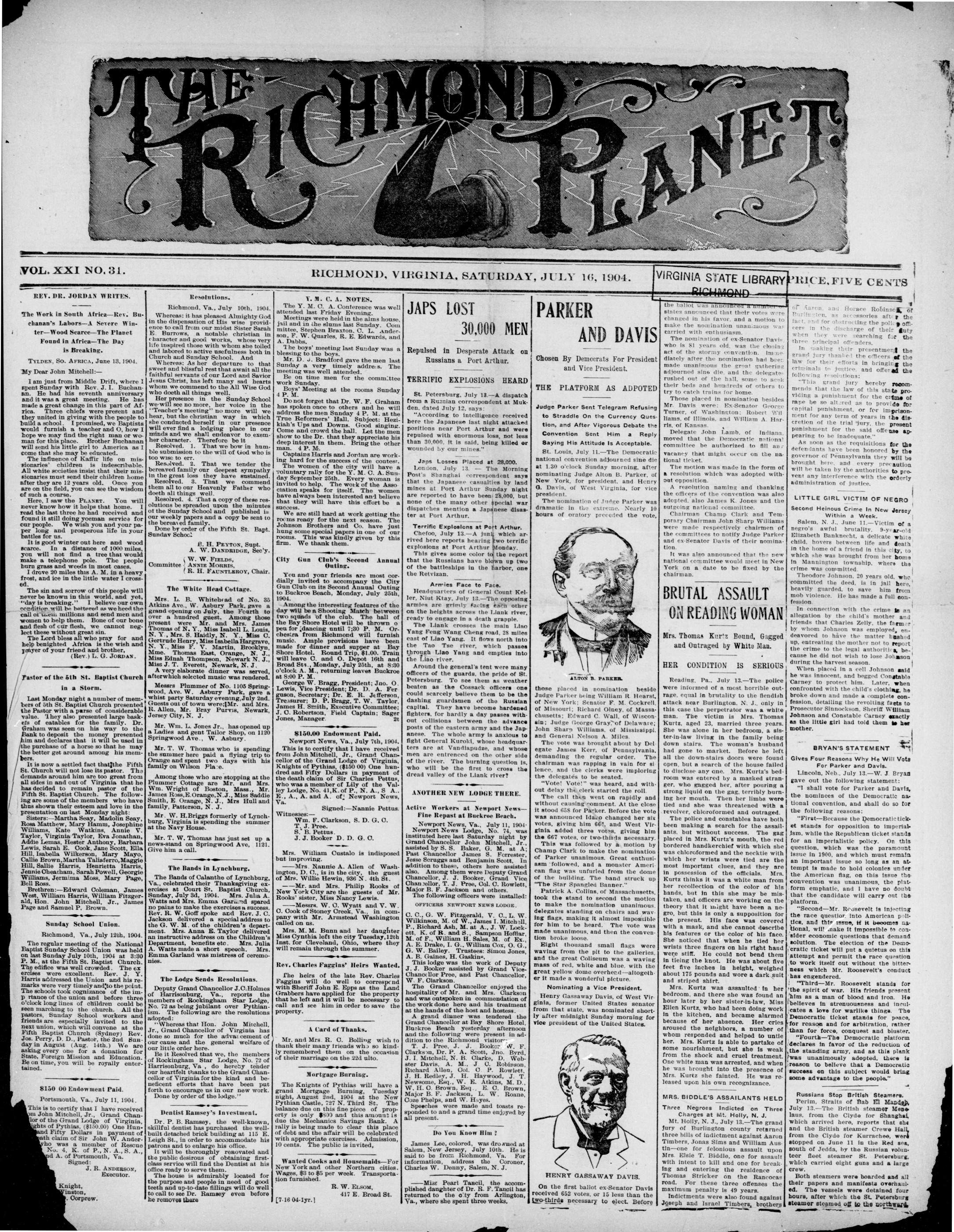
THE RICHMOND PLANET
TYLDEN, So. AFRICA, June 13, 1904.
My Dear John Mitchell:—
I am just from Middle Drift, where I spent Sunday with Rev. J. I. Buchanan. He had his seventh anniversary and it was a great meeting. He has made a great change in this part of Africa. Three chiefs were present and they united in giving with the people to build a school. I promised, we Baptists would furnish a teacher and O, how I hope we may find the right man or woman for this place. Brother Buchanan will send his little girl to America as I come that she may be educated.
The influence of Kaffir life on missionaries' children is indesirable. All white societies insist that their missionaries should children home after they are 12 years old. Once you are on the field, you can see the wisdom of such a course.
Here, I saw the PLANET. You will never know how it helps that home. I read the last three he had received and found it still doing yoeman service for our people. We wish you and your paper long and prosperous life in your battles for us.
It is good winter out here and wood scare. In a distance of 1000 miles, you will not find a tree that would make a telephone pole. The people burn grass and weeds in most cases.
I drove 20 miles this A. M. in a heavy frost, and ice in the little water I crossed.
The sin and sorrow of this people will never be known in this world, and yet, "day is breaking." I believe our own condition will be bettered as we heed the call of them millions and send men and women to help them. Bone of our bone and flesh of our flesh, we cannot neglect these without great sin.
The Lord bless all who pray for and help benighted Africa is the wish and prayer of your friend and brother,
(Rev.) L. G. JORDAN.
Fastor of the 5th St. Baptist Church
in a Storm.
Last Monday night a number of members of 5th St. Baptist Church presented the Pastor with a parse of considerable value. They also presented large baskets of eatables for the family. Dr. Graham was seen on his way to the Bank to deposit the money presented him and declares that it will be used in the purchase of a horse so that he may the better get around among his members.
It is now a settled fact that the Fifth St. Church will not lose its pastor. The demands around him are too great from all sides in and out of Virginia that he has decided to remain pastor of the Fifth St. Baptist Church. The following are some of the members who have thus shown their esteem and love in the presentation on last Monday night:
Sisters:—Martha Seay, Madolin Seay, Rosa Matthew, Mary Hamm, Josephine Williams, Kate Watkins, Annie V. Taylor, Virginia Taylor, Eva Jonathan, Addie Lems, Hester Anthony, Barbara Lewis, Sarah E. Cook, Jane Scott, Ella Hill, Isabella Wilkerson, Mary Mayo, Callie Brown, Martha Taliserfero, Maggie Hill, Sallie Harris, Henrietta Harris, Jennie Cheatham, Sarah Powell, Georgie Williams, Jermima Moss, Mary Page, Bell Ross.
Brethren:—Edward Coleman, James West, William Harris, William Fitzgerald, Hon. John Mitchell, Jr., James Page and Samuel P. Brown.
Sunday School Union.
Richmond, Va., July 12th, 1904.
The regular meeting of the National Baptist Sunday School Union was held on last Sunday July 10th, 1904 at 3:30 P. M., at the Fifth St. Baptist Church. The edifice was well crowded. The exercises were excellent. Rev. J. Y. Harris addressed the Union and his remarks were very timely and to the point. The schools took cognizance of the importance of the union and before three o'clock long lines of children could be seen marching to the church. All the pastors, Sunday School workers and next union, especially invited to the Fifth Church which convene at the Fifth Baptist Church (Sydney) Rev. Jos. Perry, D. D. Pastor, the 2nd Sunday in August (Aug. 14th). We are asking every one for a donation for State, Foreign Mission and Education. Be on time, you will be royally entertained.
$150 00 Endowment Paid
This is to certify that I have received
from John Mitchell, Jr., Grand Chan-
lor of the Grand Lodge of Virginia,
rights of Pythias, ($150.00) One Hun-
dred Fifty Dollars in payment of
thrush claim of Sir John W. Andor-
who was a member of Rescue
No. 4, K. of P., N. A., S. A.,
and A. of Portsmouth, Va.
Signed:
J. R. ANDERSON,
Executor.
Resolutions.
Richmond, Va., July 10th, 1904.
Whereas it has pleased Almighty God in the dispensation of His wise providence to call from our midst Sister Sarah E. Burrows, a notable christian in character and good works, whose very life inspired those with whom she toiled and labored to active usefulness both in Church and Sunday School. And
Whereas As her departure to that sweet and blissful rest that await all the faithful servants of our Lord and Savior Jesus Christ, has left many sad hearts whom we commend to the All Wise God who doeth all things well.
Her presence in the Sunday School we will see no more, her voice in the "Teacher's meeting" no more will we hear, but the christian way in which she conducted herself in our presence will ever find a lodging place in our minds and we shall endeavor to exemer character. Therefore be it.
Resolved. 1. That we bow in humble submission to the will of God who is too wise to err.
Resolved. 2. That we tender the bereaved family our deepest sympathy in the great loss they have sustained.
Resolved. 3. That we commend them all to our Heavenly Father who doeth all things well.
Resolved. 4. That a copy of these resolutions be spread upon the minutes of the Sunday School and published is our weekly papers and a copy be sent to the bereaved family.
Done by order of the Fifth St. Bapt. Sundav Schoc:
E. H. PEYTON, Supt.
A. W. DANDRIDGE, Sec'y.
W. W. FIELDS,
Committee
ANNIE MORRIS,
R. H. FAUNTLEROY, Chair.
The White Head Cottage
Mrs. L. B. Whitehead of No. 55 Atkins Ave., W. Asbury Park, gave a grand opening on July, the Fourth to over a hundred guest. Among those present were Mr. and Mrs. James Thomas of N. Y., Miss Isabell L. Louis, N. Y., Mrs. S. Haidly, N. Y., Miss C. Gertrude Henry, Miss Isabella Hargrave, N. Y., Miss F. V. Martin, Brooklyn, Mme. Thomas East, Orange, N. J., Miss Ednah Thompson, Newark N. J., Miss J. T. Everett, Newark, N. J.
A very elaborate dinner was served, afterwhich selected music was rendered.
Messrs Plummer of No. 1105 Springwood, Ave. W. Asbury Park, gave a whist party Saturday evening, July 2nd, Guests out of town were;Mr. and Mrs. R. Allen, Mr. Bray Purvis, Newark, Jersey City, N. J.
Mr. Wm. L. Jones Jr., has opened up a Ladies and gent Tailor Shop, on 1120 Springwood Ave., W. Asbury.
Mr. T. W. Thomas who is spending the summer here paid a flying trip to Orange and spent two days with his family on Wilson Place.
Among those who are stopping at the Plummer Cottage are Mr. and Mrs. Wm. Wright of Boston, Mass., Mr. James Ross, E. Orange, N.J., Miss Saddie Smith, E. Orange, N.J., Mrs Hull and family, Patterson, N. J.
Mr. W. H.Briggs formerly of Lynchburg, Virginia is spending the summer at the Navy House.
Mr. T. W. Thomas has just set up a news-stand on Springwood Ave. 1121. Give him a call.
The Bands in Lynchburg.
The Bands of Calanthe of Lynchburg, Va., celebrated their Thanksgiving exercises at Court St. Baptist Church, Sunday, July 3d, 1904. Mrs. Julia A. Watts and Mrs. Emma Garland spared no pains to make the exercises a success. Rev R. W. Goff spoke and Rev J. C. Jackson delivered a special address to the G. W. M. of the children's department. Mrs. Anna E. Taylor delivered a special address to the children's Department, benefits etc. Mrs. A. Watts made a short speech. Mrs. Emma Garland was mistress of ceremonies.
The Lodge Sends Resolutions
Deputy Grand Chancellor J.C. Holmes of Harrisonburg, Va., reports the members of Rockingham Star Lodge, No. 72 as being jubilant over Pythianism. The following are the resolutions adopted:
"Whereas that Hon. John Mitchell, Jr., Grand Chancellor of Virginia has done so much for the advancement of our cause and the general welfare of our little order here.
Be it Resolved that we, the members of Rockingham Star Lodge, No. 72 of Harrisonburg, Va. do hereby render our heartfelt thanks to the Grand Chancellor of Virginia for the kind and beneficent efforts that have been put forth to encourage us in our new work.
Done by order of the dage."
Dentist Ramsey's Investment.
Dr. P. B. Ramsey, the well-known, skilful dentist has purchased the well-built detached brick building at 115 E. Leigh St, in order to accommodate his patrons and to enlarge his office. It will be thoroughly renovated and the public desirous of obtaining first-class service will find the Dentist at his office ready to serve them. The house is admirably located for the purpose and people in need of good teeth and up-to-date fillings will do well to call to see Dr. Ramsey even before he removes there
RICHMOND, VIRGINIA, SATURDAY, JULY 16, 1904.
Y. M. C. A. NOTES.
The Y. M. C. A. Conference was well attended last Friday Evening.
JAPS LOST
PARKER
Meetings were held in the alms house, jail and in the slums last Sunday. Committee, Stephen Braxton, C. L. Anderson, W. Quarles, R. E. Edwards, and A Dabs. The boys' meeting last Sunday was a blessing to the boys.
Mr. D. J. Bradford gave the men last Sunday a very timely address. The meeting was well attended. Be on time men for the committee week Sunday. Meeting at the rooms Sunday 4 P. M.
Do not forget that Dr. W. F. Graham has spoken once to others and he will address the men Sunday 4 P. M. at the True Reformers' Hall. Subject: Hezekiah's Ups and Downs. Good singing, Come and crowd the hall. Let the man show to the Dr. that they appreciate his deep interest in them. Bring the other man. 4 P. M.
Captains Harris and Jordan are working hard for the success of the contest. The women of the city will have a voluntary rally for the Y. M. C. A. Sunday September 25th. Every woman is invited to help. The work of the Association speaks for itself. The women have always been interested and believe that they will have this effort be a success.
We are still hard at work getting the rooms ready for the next season. The Johnson Brothers and Co. have just hung special papers in one of our rooms. This was kindly given by this firm. We thank them.
City Gun Club's Second Annual Outing
You and your friends are most cordially invited to accompany the City Gun Club on its Second Annual Outing to Buckroe Beach, Monday, July 25th, 1904.
Among the interesting features of the day will be a Shooting Match between two squads of the club. The hall of the Bay Shore Hotel will be thrown on open for 'dancing until 7:30 P. M. Orchestra from Richmond will furnish music. Ample provisions have been been made for Room and supper at Bay Shore Hotel, Room Ticket Train will leave C. and O. Depot 16th Broad Sts, Monday, July 25th, at 8:30 o'clock A. M., returning leaves Buckroe at 8:00 P. M.
George W. Bragg, President; Jno. O. Lewis, Vice President; Dr. D. A. Ferguson, Secretary; Dr. E. R. Jefferson, Treasurer; D. P. Bragg, T. W. Taylor, James H. Smith, Executive Committee; J. C. Robertson, Field Captain; Sager Jones, Manager. 2t
$150.00 Endowment Paid.
Newport News, Va., July 7th, 1904.
This is to certify that I have received from John Mitchell, Jr., Grand Chancellor of the Grand Lodge of Virginia, Knights of Pythias, ($150 00) One hundred and Fifty Dollars in payment of the death claim of Sir Charles Pettus, who was a member of Lily of the Valley Lodge, No. 41, K of P., N. A., S A. E., A., A. and A. of Newport News, Va.
Signed:—Nannie Pettus.
Witnesses:—
Wm. F. Clarkson, S. D. G. C.
T. J. Pree.
S. B. Pettus.
J. J. Booker D. D. G. C.
Mrs. William Custalo is indisposed but improving.
Mr. and Mrs. Philip Rooks of New York City are the guests of Mr. Rooks' sister, Miss Nancy Lewis.
Messra, W. O. Wyatt and V. W. O. Cook of Stoney Creek, Va., in company with Mr. Armstead Washington called on us.
Mrs. M. M. Bunn and her daughter Miss Cynthia left the city Tuesday, 12th Inst. for Cleveland, Ohio, where they will remain through the summer.
Rev. Charles Faggins' Heirs Wanted.
The heirs of the late Rev. Charles Faggins will do well to correspond with Sheriff John E. Epsa as the Land Grabbers have applied for the property to sell and it will be necessary to call and see him in order to save the property.
A Card of Thanks.
Mr. and Mrs. R. C. Bolling wish to thank their many friends who so kindly remembered them on the occasion of their marriage on the 22d nite.
Mortgage Burning.
The Knights of Pythias will have a grand Mortgage Burning, Tuesday night, August 2nd, 1604 at the New Pythian Castle, 727 N. Third St. The balance due on this fine piece of property is only $800 and this amount is due the Mechanics Savings Bank. A rally is being made to clear this place of debt and the affair will be celebrated with appropriate exercises. Admission, 10 cents. The public is invited.
Wanted Cooks and Housemaids—For New York and other Northern cities, Wages, $3 to $5 per week. Transportation furnished.
JAPS LOST
30,000 MEN
Repulsed in Desperate Attack on Russians a Port Arthur.
TERRIFIC EXPLOSIONS HEARD
St. Petersburg, July 13—A dispatch from a Russian correspondent at Mukden, dated July 12, says: "According to intelligence received here the Japanese last night attacked positions near Port Arthur and were repulsed with enormous loss, not less than 30,000. It is said, being killed or wounded by our mines."
Japs Losses Placed at 28,000
London, July 13. — The Morning Post's Shanghai correspondent says that the Japanese casualties by land mines at Port Arthur Sunday night are reported to have been 28,000, but none of the many other special war dispatches mention a Japanese disaster at Port Arthur.
Terrific Explosions at Port Arthur.
Chefoo, July 13.—A junk which arrived here reports hearing two terrific explosions at Port Arthur Monday.
This gives some color to the report that the Russians have blown up two of the battleships in the harbor, one the Revizan.
Armies Face to Face
Headquarters of General Count Keller, Niu Ktay, July 13. The opposing armies are grimly facing each other on the heights across the Lliank river, ready to engage in a death grapple. The Lliank crosses the main Liao Yang Feng Wang Cheng road, 28 miles east of Liao Yang. It flows north into the Tao Tse river, which passes through Liao Yang and empties into the Liao river.
Around the general's tent were many officers of the guards, the pride of St. Petersburg. To see them as weather beaten as the Cossack officers one could scarcely believe them to be the dashing guardsmen of the Russian capital. They have become hardened fighters, for hardly a day passes without collisions between the advance posts of the eastern army and the Japanese. The whole army is anxious to fight General Kurokli, whose headquarters are at Vandiapudze, and whose men are entrenched on the other side of the river. The burning question is, who will be the first to cross the dread valley of the Liank river?
ANOTHER NEW LODGE THERE.
Active Workers at Newport News—Fine Repast at Buckroe Beach.
Newport News, Va., July 11, 1904-Newport News Lodge, No. 74, was instituted here last Saturday night by Grand Chancellor J. Mitchell J. assisted by S. S. Baker, G. M. at A; Past Chancellor James S. Frorester, Jesse Scruggs and Benjamin Scott. In addition to these, others here assisted also. Among them were Deputy Grand Chancellor, J. J. Booker, Grand Vice Chancellor, T. J. Pree, Col. C. Rowlett, Major B. F. Jackson and others.
The following officers were installed:
OFFICERS NEWPORT NEWS LODGE.
G. C., G. W. Fitzgerald, V. C., L. W. Wilkinson, M. of W., M. of A., J. W. Locke, Richard Ash, M. at A., J. W. Locke, M. of F. William H. Scales, M. of Ex. A. E. Drake, I. G. Willim, O. G. G. W. Bailey, Trustees: Simon Jones, A. E. Gaines, H. Gaskins.
This lodge was the work of Deputy J. J. Booker assisted by Grand Vice-Chancellor Pree, and Past Chancellor, W. F. Clarkson.
The Grand Chancellor enjoyed the hospitality of Mr. and Mrs. Clarkson and was outspoken in commendation of the work done here and his treatment at the hands of the host and hostess.
A grand dinner was tendered the Grand Chancellor at Bay Shore Hotel, Buckroth Beach yesterday afternoon and the following were present in addition to the Richmond visitor:
J. Pree, J. J. Booker, W. F. Clarkson, P. A. Scott, Jno Byrd, J. I. Mitchell, N. B. Clarke, D. Webster Davis, A. M., J. C. Robinson, Richard Allen, Col. C. P. Rowlet, J. H. Redley, J. H. Haywood, J. T. Newsome, Esq., W. E. Atkins, M. D, W. H. O. Brown, Esq., E. C. Brown, Major B. F. Jackson, L. W. Rowe, Coze Phelps, and W. Hayes.
Speeches were made and toasts responded to and a grand time enjoyed by all present.
Do You Know Him?
James Lee, colored, was drowned at Salem, New Jersey, July 10th. He is said to be from Richmond, Va. For information, address the Coroner, Charles W. Denny, Salem, N. J.
—Miss Pearl Tancil, the accomplished daughter of Dr. R. F. Tancil has returned to the city from Arlington, Va., where she spent three weeks.
Chosen By Democrats For President and Vice President.
THE PLATFORM AS ADPOTED
Judge Parker Sent Telegram Refusing to Straddle On the Currency Question, and After Vigorous Debate the Convention Sent Him a Reply Saying His Attitude Is Acceptable.
St. Louis, July 11.—The Democratic national convention adjourned sine die at 1.30 o'clock Sunday morning, after nominating Judge Alton B. Parker, of New York, for president, and Henry G. Davis, of West Virginia, for vice president.
The nomination of Judge Parker was dramatic in the extreme. Nearly 10 hours of oratory preceded the vote.
M.
ALTON B. PARKER.
those placed in nomination beside Judge Parker being William R Hearst, of New York; Senator F. M. Cockrell, of Missouri; Richard Olney, of Massachusetts; Edward C. Wall, of Wisconsin; Judge George Gray of Delaware; John Sharp Williams, of Mississippi, and General Nelson A. Miles.
The vote was brought about by Delegate James Kerr, of Pennsylvania, demanding the regular order. The chairman was rapping in vain for silence, and the clerks were imploring the delegates to be seated.
"Vote! Vote!" was heard, and without delay the clerk started the roll.
The call then went on rapidly and without causing comment. At the close it stood 655 for Parker. Before the vote was announced Idaho changed her six votes, giving him 661, and West Virginia added three votes, giving him the 667 votes or two thirds necessary.
This was followed by a motion by Champ Clark to make the nomination of Parker unanimous. Great enthusiasm followed, and a monster American flag was unfurled from the dome of the building. The band struck up "The Star Spangled Banner." Patrick A. Collins, of Massachusetts, took the stand to second the motion to make the nomination unanimous. delegates standing on chairs and waving flags, making it almost impossible for him to be heard. The vote was made unanimous, and then the convention broke loose. Eight thousand small flags were waving from the pit to the galleries, and the great Coliseum was a waving mass of red, white and blue, with the great yellow dome overheard—altogether it made a wonderful picture.
Nominating a Vice President.
Henry Gassaway Davis, of West Virginia, former United States senator from that state, was nominated shortly after midnight Sunday morning for vice president of the United States.
HENRY GASSAWAY DAVIS.
On the first ballot ex-Senator Davis received 652 votes, or 15 less than the two-thirds necessary to elect. Before
the ballot was announced a number of states announced that their votes were changed in his favor, and a motion to make the nomination unanimous was carried with enthusiasm.
The nomination of ex-Senator Davis who is 81 years old, was the closing act of the stormy convention. Immediately after the nomination had been made unanimous the great gathering adjourned sine die, and the delegate rushed out of the hall, some to seek their beds and hundreds of others to try to catch trains for home.
Those placed in nomination besides Mr. Davis were: Ex-Senator George Turner, of Washington; Robert Williams, of Illinois, and William A. Harris, of Kansas.
Delegate John Lamb, of Indiana, moved that the Democratic national committee be authorized to fill any vacancy that might occur on the national ticket.
The motion was made in the form of a resolution which was adopted without opposition.
A resolution naming and thanking the officers of the convention was also adopted, also James K. Jones and the outgoing national committee.
Chairman Champ Clark and Temporary Chairman John Sharp Williams were made respectively chairmen of the committees to notify Judge Parker and ex-Senator Davis of their nomination.
It was also announced that the new national committee would meet in New York on a date to be fixed by the chairman.
BRUTAL ASSAULT ON READING WOMAN
Mrs. Thomas Kurtz Bound, Gagged and Outraged by White Man.
HER CONDITION IS SERIOUS
Reading, Pa., July 13—The police were informed of a most horrible outrage, equal in brutality to the flendish attack near Burlington. N. J., only in this case the perpetrator was a white man. The victim is Mrs. Thomas Kurtz, aged 23, married three years. She was alone in her bedroom, a sister-in-law living in the family being down stairs. The woman's husband had gone to market. Before he left all the down-stairs doors were found open, but a search of the house failed to disclose any one. Mrs. Kurtz's bedroom was entered by a masked stranger, who gagged her, after pouring a strong liquid on the gag, terribly burning her mouth. Then her limbs were tied and she was threatened with a revolver, chloroformed and outraged.
The police and constables have both been making a search for the assailants, but without success. The gag placed in Mrs. Kurtz's mouth, the red bordered handkerchief with which she was chloroformed and the necktie with which her wrists were tied are the most important clues, and they are in possession of the officials. Mrs. Kurtz thinks it was a white man from her recollection of the color of his hands, but in this she may be mistaken, and officers are working on the theory that it might have been a negro, but this is only a supposition for the present. His face was covered with a mask, and she cannot describe his features or the color of his face. She noticed that when he tied her wrists three fingers on his right hand were stiff. He could not bend them in tieing the knot. He was about five feet five inches in height, weighed about 175 pounds and wore a dark suit and striped shirt.
Mrs. Kurtz was assaulted in her bedroom, and there she was found an hour later by her sister-in-law, Miss Ellen Kurtz, who had been doing work in the kitchen, and became alarmed because of her absence. Her cries aroused the neighbors, a number of whom responded and helped to untie her. Mrs. Kurtz is able to partake of some nourishment, but she is weak from the shock and cruel treatment. One white man was arrested, and when he was brought into the presence of Mrs. Kurtz she fainted. He was released upon his own recognition.
MRS. BIDDLE'S ASSAILANTS HELD
Three Negroes Indicted on Three Charges at Mt. Holly N.J.
Charges at M. T. Holly, N. J.
Mt. Holly, N. J., July 13.—The grand jury of Burlington county returned three bills of indictment against Aaron Timbers, Jonas Sims and William Austin—one for felonious assault upon Mrs. Elsie T. Biddle, one for assault with intent to kill and one for breaking and entering the residence of Thomas Stricker on the Rancocas road. For these three offenses the maximum penalty is 49 years.
Indictments were also found against Joseph and Israel Timbers, brothers
of Aaron, and Horace Robinson of Burilion, as accessories after the fact, and for obstructing the police officers in the discharge of their duty when they were searching for the three principal offenders. In making their presentment the grand jury thanked the officers of the law for their efforts in bringing the criminals to justice and offered the following resolutions:
"This grand jury hereby recommends that the law of this state providing a punishment for the crime of rape be so altered as to provide for capital punishment, or for imprisonment for any term of years in the discretion of the trial jury, the present punishment for the said offense appearing to be inadequate."
As soon as the requisitions for the defendants have been honored by the governor of Pennsylvania they will be brought here, and every precaution will be taken by the authorities to prevent any interference with the orderly administration of justice.
LITTLE GIRL VICTIM OF NEGRO
Second Heinous Crime In New Jersey Within a Week.
Salem, N. J. June 11.—Victim of a negro's awful brutality. 9-year-old Elizabeth Banknecht, a delicate white child, hovers between life and death in the home of a friend in this city, to which she was brought from her home in Mannington township, where the crime was committed.
Theodore Johnson. 20 years old, who committed the deed, is in jail here, heavily guarded, to save him from mob violence. He has made a full confession.
In connection with the crime is an allegation by the child's mother and friends that Charles Zelly, the farmer by whom Johnson was employed, endeavored to have the matter hushed up, entreating the mother not to report the crime to the legal authorities, because he did not wish to lose Johnson during the harvest season.
When placed in a cell Johnson said he was innocent, and begged Constable Carney to protect him. Later, when confronted with the child's clothing, he broke down and made a complete confession, detailing the revolting facts to Prosecutor Shinnockson, Sheriff William Johnson and Constable Carney exactly as the little girl had told them to her mother.
.
BRYAN'S STATEMENT
Gives Four Reasons Why He Will Vots For Parker and Davls.
Lincoln, Neb., July 13.—W. J. Bryan gave out the following statement: "I shall vote for Parker and Davis, the nominees of the Democratic national convention, and shall do so for the following reasons: "First—Because the Democratic ticket stands for opposition to imperialism, while the Republican ticket stands for an imperialistic policy. On this question, which was the paramount issue in 1900, and which must remain an important issue so long as an attempt is made to hold colonies under the American flag, on this issue the convention was unanimous, the platform emphatic, and I have no doubt that the candidate will carry out the platform.
"Second—Mr. Roosevelt is injecting the race question, into American politics, and this issue, if it becomes national, will make it impossible to consider economic questions that demand solution. The election of the democratic ticket will put a quietus on this attempt and permit the race question to work itself out without the bitterness which Mr. Roosevelt's conduct has engendered.
"Third—Mr. Roosevelt stands for the spirit of war. His friends present him as a man of blood and iron. He believes in strentuousness and inculcates a love for warlike things. The Democratic ticket stands for peace, for reason and for arbitration, rather than for force, conquest and bluster.
"Fourth—The Democratic platform declares in favor of the reduction of the standing army, and as this plank was unanimously adopted, there is reason to believe that a Democratic success on this subject would bring some advantage to the people."
Russians Stop British Steamers.
Perim, Straits of Bab El Mandah
July 13.—The British steamer Menelaus, from the Clyde for Shanghai, which arrived here, reports that she and the British steamer Crewe Hall, from the Clyde for Kurrachee, were stopped on June 11 in the Red sea, south of Jedda, by the Russian volunteer fleet steamer St. Petersburg, which carried eight guns and a large crew.
Both steamers were boarded and all their papers and manifests overhauled. The vessels were detained four hours, after which the St. Petersburg steamer steamed off to the northward.
HE PLANET
THE CRY OF THE OLD HOUSE.
Leave the rude wharf, the mart;
come back!
Am I forgot:
My days as they were not?—
The warm, sweet, crooning tunes;
The Sunday afternoons;
Wrought but for you;
The larkspurs growing tall;
You wreathed in pink and blue;
Within your prayer-books small;
The cupboards carved both in and out,
Wild crisps, prickly vine,
And smelling gar and fine;
The pictures in a row.
Of folk you did not know;
The toys, the games, the shrill, gay rout;
The interns, that at hour for bed,
A charmed, but homely red,
Went flickering from shed to shed;
The frosts crumbling, spicy, good,
Brought in in the great wood;
The Dark that held all about;
The Wind that would not go?—
Come back, my women and my men,
And take them all again!
Come up the still, accustomed, wistful lands,
The poplar-haunted lands.
You need not call,
You lash know,
And light the candles tail,
Set wine and loaf a-row.
Come back!
Unlatch the door,
And fall upon my heart once more.
I'll call comfort you, oh lad;
Dh, daughter, I shall make you wholly glad!
The wreck, the wrong,
The unavailing throng,
The sting, the smart,
Ballist be as they were not,
Forget, forget!
Come back,
And fall upon my heart!
-Lizette Woodworth Reese, in the At-
SKIPPING ROCKS
By EDGAR WILTON COOLEY
(Copyright, 1904, by Daily Story Pub. Oo.)
THE boy, followed by his dog, swung down the clover-fringed path, under the tangled branches of the trees. He was barefoot, and his arms and legs and face were brown as an Indian's.
In the air was the lazy drone of bees. Small, fleecy clouds floated overhead, their shadows scudding across the hills and the river like ebony-winged birds. The ripples of the stream kept singing to the grasses overhanging. Everywhere was the perfume of the wild rose
At the ford the dog dashed into the stream, lapping the water and splashing it into circling eddies that chased each other across the placid bosom.
The boy paused at the brink and picking up a flat rock sent it skipping across the water, far down the stream. This he followed with another and another and get another. Above him, at the bend of the river, a dozen cattle stood in the shadows, knee-deep in the tide.
Along the path, presently, came a man. He was large, portly and well-groomed. There were many streaks of gray in his hair.
He paused and watched the boy skipping the rocks. A smile overspread his
A boy is playing in the water with a dog. A man stands nearby, watching him.
HE PAUSED AND WATCHED THE BOY SKIPPING THE ROCKS.
face, and he, too, descended to the water's edge and picked up a large, flat stone.
With an awkward swing he sent it across the water. It skipped once, twice, then sank beneath the surface.
The boy looked up and laughed.
"That ain't the way," he said. "You want to get limber in your joints and stoop down low, like this. Then the rock will go clear into the mud on the other side."
The dog splashed out of the stream and shook the water from his glossy fur. A king-fisher swooped down from a branch with a discordant shriek, skimmed along the surface of the water a short distance, and returned to its perch.
"I have come a thousand miles to skip rocks at the oldford, here," the man said, "and now I find I can't do it like I used to."
The boy looked at him wonderingly.
"You came at a thousand miles to skip rocks?" he asked, incredulously.
"Yes," the man replied, gazing across the river at a sandpiper running along the bank. "When I was a lad like you, I used to come down here and skip rocks, just like you have been doing. There used to be a deep hole right there under the soil, in the earth, and across
yonder, where you see the twig sticking out of the water, there was a muskrat's house."
"If you have a fishin' pole and some minners I can take you where you can catch some shiners." interposed the boy, his face brightening.
"I'd rather stay here and skip rocks," replied the man. "There wasn't any body who could beat me at that when I was a boy."
The dog curled himself in the deep grass. From the river's bend came the occasional tinkle of a cow-bell. High overhead a hawk circled slowly in the blue of the sky.
The boy gazed at the man's heavy gold chain and at the diamond in his shirt front.
"Gee, I'll bet you have lots of money," he said.
"Well—yes," he said, "I have all I think I will ever need. But then," he placed his hand on the crown of the boy's torn hat, "I can't skip rocks like you can, can I?"
"Why?" asked the boy, digging his toes in the wet sand.
"Because I was happier here than I have ever been since," said the man. The boy loked at him questioningly.
"You see, I have forgotten how to skip rocks," continued the man. "That is one of the big things I have lost. And then, don't you know, all the time I have been gone I have seemed to hear the ripple of the river, and have dreamed of wading in the water and seeing the minnows dart away from my bare feet. And there hasn't been a day that I haven't thought of her pure, young face."
The boy grinned.
"Who is 'her?' he asked.
"Oh," said the man, as though awakening from a dream, "she was a little barefoot girl I knew when I was a boy. She was always with me when I was fishing or wading in the water. She grew up and so did I. Then we had a silly quarrel and I went away."
"Gee!" exclaimed the boy, excited. "Did you see that big fish jump out of the water?" The dog raised his head, wearily, gazed at his master a moment, then lowered it again. A blue bird darted through the trees, and a turtle, sunning himself on a log, slipped into the water with a faint spish. Somewhere in the damp grass a cricket was chirping.
"I wish I was a man and had lots of money," said the boy.
"I and I wish I was just a boy and didn't have to wear shoes and could skip rocks like you can," said the man. "If I could see the sunshine gleaming on the bronze of the hair of that little girl I used to know, I wouldn't care whether I had any money or not."
"I don't like red headed girls," said the boy. "I like girls that's got--Gee! That old fish jumped again. But I come down here tomorrow an' catch 'im."
The boy threw himself in the grass beside the dog and let his hat fall on the ground.
"Papa's dead," said the boy. "He died long while ago. I guess the reason I don't like red headed girls is because my hair is kinder—what did you call it—bronze?"
He raised himself on one elbow and glanced up the hill.
"And your mother?" asked the man.
"That's her comin' down the path," replied the boy. "Guess she must want me for somethin'."
The man busied himself a few moments with skipping rocks. Then he turned and saw the woman standing before him.
Her sunbonnet had fallen back upon her shoulder and the sunlight was gleaming upon her auburn hair. On her face were the lines of long years of sorrow.
An instant the two gazed into each other's eyes. Then the man held out his hands.
"Jennie," he said, "let's go wading in the river."
The woman's face flushed, but her eyes brightened and she put her hands in his. They were trembling.
"Bob!" she cried, "oh, Bob!"
Then gently freeing one hand, she turned her face away and lifted her apron to her eyes.
"I am sorry," he said, "I—"
"No, no," she cried, quickly, "don't be sorry, Bob, don't be sorry; oh, be glad—as glad as I am. I believed—I knew if you heard that—that he was dead—"
The boy was sitting upright in the grass, watching them with wondering eyes. The man saw him and smiled.
"Jennie," he said, still holding one of her hands, "your boy can beat me skipping rocks. Just watch him once."
The boy sprang proudly down the bank and gathered up several flat pebbles, which he sent, one after another, skimming across the water.
But neither the man nor the woman saw them. For the woman's head was buried on the man's bosom, and he was kissing the bronze of her tresses.
Grilled Lion Steaks.
An explorer who has often by compulsion eaten the flesh of animals not generally used as human food says that grilled lion steaks are delicious, and much superior to those of the tiger; that the flesh of the rhinoceros, properly prepared, has all the good qualities of pork; that the trunk and feet of young elephants resemble veal; and that stewed boa-constrictor is a splendid substitute for rabbit.
Steel Furniture on Warships
All the ships of the United States navy are being supplied with steel furniture. Experiments carried on for several months have proved that almost all the essential furniture of warships can be made of steel. Serious damage was done during the Spanish war by the furniture of ships catebing fire, the cruiser Baltic, ore having suffered severely in the battle of Manila.
It doesn't pay to favor some folks, as they will come and ask you for more favors.—Washington Democrat.
Asked and Answered.
Little Willie—What's a cannibal, pa?
Pa—One who loves his fellow man, my son
-Chicago, Daily News.
THE RICHMOND. PLANET, RICHMOND, VIRGINIA.
Fun For Fun Lovers.
Limit Is Beached.
"These blooming correspondence schools ought to be suppressed," snorted the old editor, throwing down the paper he was reading; "they're trouble breeders."
"Why," remarked his assistant, "I never heard you exclaim against them before."
"No, but here's one of them that offers to teach people to write poetry." — Catholic Standard and Times
No Real Grievance.
"Say," complained the customer, "I want to put in a kick. Remember that ton of coal I got here yesterday?" "Yes, sir," said the dealer. "What's the matter with it?" "You sold it to me as your best smokeless. I find it has a lot of broken stone in it." "Well, stone doesn't smoke, does it? What are you kicking about?"—Chicago Tribune.
"I tell you, automobiling is exciting."
"Well, if you want real excitement, you want to give up your automobile and take to driving on roads where automobiles are thick. You don't begin to get all there is coming in the excitement line."—Chicago Post.
Steadfast.
"A woman should be able to trust her husband," said the idealist, "and feel that he has the courage to remain steadfast in his purpose, despite rebuffs." "Well," answered young Mrs. Torkins, "that's exactly the kind of man Charley is. He has lost at every race meeting for the past three years, but he is just as steadfast in purpose as ever." —Washington Star.
Her Preserver.
Miss Pert—Who was that you just bowed to?
Miss Passay (who had once been rescued from a watery grave)—He is a man I can never repay. He is my preserver, my—
Miss Pert—Oh! is he the manufacturer of that complexion paste?—Philadelphia Press.
Perfect Bliss
"Name your three wishes," said the good fairy.
And the individual addressed did not hesitate a moment.
"First," he said, "make me a millionaire, with (second), the appetite of a small boy and (third), a digestion to match."—Brooklyn Life.
Dramaic For
"How far," mused the dramatist of the old school, "should substance be sacrificed to form?" The dramatist of the new school stared perplexedly. "When you say substance, you doubtless mean costume," said he, after a moment—Puck.
Worked Overtime
Singleton( at the reception)—Our hostess just introduced me to your wife, old man. What a lovely liquid voice she has!
Wedderly—Yes; but it's trifle too liquid to suit me. It never dries up.
—Cincinnati Enquirer.
Lightning Change
Husband-in-Waiting—I must take you to see the woman lightning-change artist at the halls.
Wife—Is she good?
Husband—Great! She puts on her hat in less than 15 minutes.—Punch.
A One-Sided Affair.
Should Satan ever go to law
He'll win his case, I'm satisfied;
Because the lawyers, one and all,
Will doubtless be upon his side.
-Cincinnati Enquirer.
CONSIDERING PRICE OF COAL
Bobuppe—It's a shame the way he treated you, but you should heap coals of fire on his head.
Flareuppe—What! With coal at the present price? Say, I'm not that fond of revenge—Chicago Journal.
The Audience
They listen to the orator.
Then as they homeward walk,
"They don't believe him,
But we like to hear him talk."
-Washington Star.
"Are those girls really friends?"
"Oh, yes, indeed. Why, there isn't even a sting to the compliments they pay each other." -Chicago Post.
Was She in Danger?
Take-a-Bita.
Benson—Bought a sawwill, eh? What are you going to do with it? Jenson—Bring out a new breakfast food. Topics.
Variable.
"Nobody knows," said the man with the cinnamon beard. "Sometimes you can buy him for $50 and at other times it takes $500."—Chicago Tribune.
Unprotected
The stage manager catches one of the actors smoking behind the scenes.
"Here! you can't smoke on the stage," he says.
"What's the odds? The scenery is fire-proof."
"But you're not."
As the actor discovered when he got his two weeks' notice.—Judge.
She Hated to Tell Her Age.
Judge—How old are you?
Lady Witness—I can't remember.
Judge—What year were you born in?
Lady Witness—I forget.
Judge—Well, madam, your instinct for self-preservation still seems to work all right.—Cincinnati Commercial Tibune.
Inadequate Pay.
A man and his bride by the parson were tied.
And when the performance was done,
He **he** his fee; the "Alas!" exclaimed he:
"I add one to one and make one."
Philadelphia, Press.
HIS INVENTION
"What a funny hat that is"
"Yes, mum; it's a sort of a combination sunshade an' lightning rod."—Chicago American.
Lovely Woman.
Oh, woman, in our hours of ease
As quiet as a fellow please;
Buried in busy how you walk
Around his busy and talk and talk
-Houston Post.
Mistake Somewhere
"Mr. Millyns," said the poor but aristocratic widow, "allow me to present my three charming daughters."
"Good Heavens, madam!" exclaimed young Millyns, "there must be a mistake somewhere. I'm not a senator from Utah."—Chicago Dally News.
The Strenuous Visit.
Mack—Do you think Emeline had a good time?
Kate—I guess so. Mother and I took to our beds after she left, and she writes that she took to her bed as soon as she got home.—Cincinnati Commercial-Tribune.
Not Entirely In
"Are you in society?"
"About half in."
"What do you mean by that?"
"I'm always invited to society entertainments given to raise money for charity—and that's about all."—Chicago Post.
Sure Enough Exasperation.
"Two things make my wife awful mad."
"What are they?"
"To get ready for company that don't come, and to have company come when she isn't ready."—Indianapolis Journal.
Poorly Supported.
Bacon—How did you enjoy the new play, last night?
Evidence of Effort
"Has you association ever accomplished anything noteworthy?" "Yes, indeed." answered young Mrs. Torkins. "You just ought to see the unfinished business it has accumulated." — Washington Star.
Still Wearing Black
Smith—Brown has been a wildower
three years and he's still wearing
mourning.
Jones—You don't say!
Smith—Yes; he dyes his whiskers.—
Chicago Daily News.
Rich Tastes.
Mrs. Newlywed—John, I think baby has swallowed my pearl necklace.
Mr. Newlywed—Gad! You seem determined to bring that young one up with the tastes of a millionaire's child.
—Judge.
Does Food Affect the Face?
She—That new boarder who came today has a beautiful olive complexion.
He—Well, after she's been here a few weeks I guess she'll have a prune complexion. —Yonkers Statesman.
Those Dear Friends.
Stella—Is her house furnished in any especial period?
Bella—No; exclamation points. —Brooklyn Life.
Easy Either Way.
They were discussing domestic matters with masculine confidence. "There's only one way to keep a cook."
"There's only one way to keep a cook," asserted one.
"But suppose you're already married?"
"Easy again. Any time that you can't make the cook your wife, why, make your wife the cook."—Brooklyn Eagle.
"So this is your birthday? How old are you?"
"Don't you know," she indignantly replied, "that it is a sign of bad breeding to ask a lady about her age?"
"Oh, no; not in all cases. It is only unmannerly to ask how old a lady is when one has reason to believe she is old enough to be ashamed of it."
Then she invited him to sit down so they could have a nice, long visit."—Chicago Record-Herald
A Professional.
Tramp—No'm. I am not a wood-sawer, mum. I draw. Gimme a square meal and I'll show you.
Housekeeper—Well, it's worth it to see a man like you do anything at all.
Tramp (after meal)—Thankee, mum. Now I'll go and lie down in the sun.
"But you promised to draw."
"Yes'm. I draw flies."—N. Y. Weekly.
Her Reproof.
"Did I understand you to say you tourted investigation?" said Mr. Grafton Grabb's wife. "Yes," was the answer. "Well, it is a very unfortunate phrase. Everybody who has read anything from the classic poets to a seaside novel knows that a man doesn't mean half he says when he's courting."—Washington Star.
Unsatisfactory.
"I watched for opportunity." "And it never came?" "Oh, yes, it did." "And you grabbed it?" "I did." "Well?" "Well, I found it was only an opportunity to make a fool of myself."—Chicago Post.
Nearing the Limit
"Do you know, darling," said the love-sick young man who was busy planting microbes, "that I believe it makes me a better man every time I kiss you?" "Well," rejoined the taffy-haired girl in the parlor scene, "at the pace you are going now there will soon be no more room for improvement."—Cincinnati Enquirer.
Went with Her.
Mr. Subbubs—So you got rid of the girl at last?
Mrs. Subbubs—Yes; she left a few minutes ago, and—
Mr. Subbubs—Huh! She took her time.
Mrs. Subbubs—Yes, and our time, too.
The parlor clock is gone.—Philadelphia Press.
"Mamma," queried small Floramay, "what is the difference between biography and autobiography?" "Biography, my dear," replied the wise mother, "shows a man as he is, while autobiography shows him as he thinks he is." Cincinnati Enquirer.
Only a Few Scraps
He—When a young couple are married, they have good things to eat during the honeymoon.
"Oh, then come the scraps."—Yonkers Statesman.
A Sure Way.
"Why did you borrow that $10 of Jagsby? You surely didn't need it." "No; but he's such a deuced bore, I wanted some plausible excuse for not noticing him on the street."—Puck.
Caught.
I wrote the girl a letter.
Oh! Most unucky day!
Her lawyer that letter.
It's marked "Exhibit A."
—Philadelphia Press.
Maud—I'm afraid Sister Bella's husband doesn't love her any more. May—Heaven's why not?
Maud—He hasn't quarreled with her
for a week.
Essay on Man.
Ten years old, a happy child;
One-and-twenty, vote age;
Fifty, philosopher, mild;
Seventy, amedotation.
-Judge.
A Promise.
"I'll give you a nickel, but I want to know how you'll spend it."
"All right, boss. Hand it over, an' at de end of de month I'll send you a itemized account!"—Chicago American.
A Mean One.
Mrs. Popley—Everybody says the baby is very like me.
Miss Cutting—Yes, the dear little thing! What hat ankles she has.—Philadelphia Press.
It Makes a Difference.
"Is speculation dangerous?"
"That depends on whether you try it or not."—Chicago Post.
Cause.
Nickker—I notice Jones carries his arm in a sling.
Bocker—Yes; an accidental discharge of his cook.—Brooklyn Life.
The Modest Maiden.
He—Am I good enough for you, darling?
Cause
She—No, George; but you are too good
for any other girl—Tit-Bits.
J. B. B.
Wood and Coal, Cigars
AT THE LOWEST M
YOU CAN SAVE MONEY IN
AJ L GOODS DELIVER
TELEPHONE
A. C. BOOKER
18 W. BAKER ST.
W. I. JOHN
FUNERAL DIRECTOR
Office & Warerooms, 207 N.
HACKS FO
Orders by Telephone or Tele-
pers and Entertainment
Old 'Phone, 686, Residence
Cigars and Tobacco.
LOWEST MARKET PRICES.
MONEY BY GIVING ME A CALL.
DELIVERED TO YOU FREE.
PHONE 1307
OKER, Prop.
OKER ST., RICHMOND, VA.
JOHNSON,
DIRECTOR AND EMBALMER.
Ins, 207 N. Foushee St. Corner Broad
BACKS FOR HIRE:
Phone or Telegraph filled. Wedding, Sup
entertainments promptly attended.
Residence in Building, New Phone, 18.
KNIGHTS OF COLUMBUS OF THE WORLD
Wood and Coal, Cigars and Tobacco. AT THE LOWEST MARKET PRICES. YOU CAN SAVE MONEY BY GIVING ME A CALL.
A. C. BOOKER, Prop. 18 W. BAKER ST., RICHMOND, VA.
W. I. JOHNSON, FUNERAL DIRECTOR AND EMBALMER.
Office & Warerooms, 207 N. Foushee St. Corner Broad HACKS FOR HIRE: Orders by Telephone or Telegraph filled. Wedding, Suppers and Entertainments promptly attended. Old 'Phone, 686, Residence in Building, New Phone, 48.
TO WHOM IT MAY CONCERN:
This organization has been chartered and legally instituted under the laws and statute of the state of New York, for the purpose of uniting together all acceptable men on the Broad Bases of Charity—Beneficial and the Social and Moral condition of humanity.ety and uniform ranks will secure for this organization all sacred institutions of modern events, a grand oppose deputies wanted in all sections of the country to organically address,
ALLEN Supreme voyager,
N. 87th Street, New York City.
This organization has been chartered and legally
situated under the laws and statute of the state of New
York, for the purpose of uniting together all acceptable
men on the Broad Bases of Charity - Beneficial
Fraternal and to promote the Social and Its two distinct military and uniform place in the front ranks of all sacred insunity for active men. Deputies wante lodges Kindly address,
G. W. ALLEN S
846 W. 87th Street
Its two distinct military and uniform ranks will secure for this organization a place in the front ranks of all sacred institutions of modern events, a grand opportunity for active men. Deputies wanted in all sections of the country to organize Lodges Kindly address,
G. W. ALLEN Supreme voyager,
846 W. 87th Street, New York City.
Savings Bank
OF RICHMOND, VA
511 North Third Street.
Money received on deposit amounts above $1.00 which reel Money Loaned on Satisfaction Business Accounts Handler Amounts of ten cents and This establishment is fitted up in the white vault, burlar-proof steel chest, elec lence for safety and the accommodation For all information concerning Stock Cashier. Banking Hours have been arranged in people as follows: 9 A. M. to 4 P. M. close Saturday at 3 P. M. and open again P. M. Call by as you come from work. OFFIC JOHN MITCHELL, JR., President. THOS. H. WY BOARD OF REV. W. F. GRAHAM, D. D., JKO E. R. JEFFERSON H. F. JONATHAN, J. O. FARLEY.
and on deposit and interest paid on a
so which remains 60 days and over.
on Satisfactory Security.
ants Handled Promptly.
cents and upwards received on deposit.
netted up in the most improved style, having a large
steel chest, electric lights and every modern conven-
communication of the public.
cerning Stocks, Deposits, Loans, etc., apply to the
seen arranged for the special convenience of the work.
M. to 4 P. M. Saturday, 9 A. M. to 8 P. . We
and open again at 5 P. M., remaining open until 7
from work.
OFFICERS:
President. H. F. JONATHAN, Vice-President.
THOS. H. WYATT, Cashier.
BOARD OF DIRECTORS:
D. D., JNO. R. CHILES, B. P. VANDERVALL,
F. JONATHAN, THOMAS SMITH D. J. OHAVERS,
BLEY. JNO. T. TAYLOR.
Money received on deposit and interest paid on a amounts above $1.00 which remains 60 days and over.
Money Loaned on Satisfactory Security.
Business Accounts Handled Promptly.
Amounts of ten cents and upwards received on deposit.
This establishment is fitted up in the most improved style, having a large white vault, burlar-proof steel chest, electric lights and every modern convenience for safety and the accommodation of the public.
For all information concerning Stocks, Deposits, Loans, etc., apply to the Cashier.
Banking Hours have been arranged for the special convenience of the working people as follows: 9 A.M. to 4 P.M. Saturdays, 9 A.M. to 3 P.M. We close Saturday at 3 P.M. and open again at 5 P.M., remaining open until 7 P.M. Call by you as you come from work.
OFFICERS:
JOHN MITCHELL, JR., President. H. F. JONATHAN, Vice-President.
THOS. H.WYATT, Cashier.
BOARD OF DIRECTORS.
E. A. WASHINGTON, R. W. WHITING,
JOHN MITOHELL, JR. FRES.
Parlors Open Day and Night
Special Attention to Picnics, Festi-
vals, etc. Estimates given.
All the latest and most popular
drinks of the fountain, fresh on hand.
TOBACCO AND CIGARS.
'Phone, 2253. WINSTON'S,
537 Brook Avenue.
14 W. Baker St., Richmond, Va.
All Kinds of Painting Done Cheap
Give me a call before going elsewhere
OUR PRICE LIST.
IT CAN'T BE EXCELLED
Your Patronage is Invited.
The AMERICAN GROCERY
and PROVISION MARKET
1221 St. James Street.
When you want nice dry, sawed pine
wood, call up 3888. We sell % cord for
$8.75, guaranteed full measurer.
A full line of fancy and staple groceries and fresh meats. Granulated sugar
400 g per lb. Prices low on everything
this week. Hard and soft coal. Hay and
Grain.
Pablo Picasso
THE FIRST WORLD WAR
WINSTON'S
FRANK WALLER, JR.
PAINTER.
LOOK OUT FOR
Booker's Market
18 W. Eaker St. A FULL LINE OF FINE GROCERIES AND FRESH MEATS & VEGETABLES
V. P. & F. K. of W.
Mechanics'
Mechanics'
Cap ital, $25,000.
WILLIAM CUSTALO, J. J. CARTER
THOMAS M. CRUMP, SSEC.
SYDNOR AND HUNDLEY, LEADERS IN Quality Furniture
PARLOR SUITS
We have some twenty-five or thirty suits bought, most of which will be in stock in a few days. "Don't do a thing" until you see this line.
MORRIS CHAIRS.
This always popular chair of rest will be in as much demand this fall as ever. Part of our stock has already arrived and $10 values vie with $15 values of a year ago.
Oall, see our stock of Bed Room Fur niture and save time and money. Passenger elevator. sydnor & Hundley
THE
SIGN OF THE
FOUR.
BY CONAN DOYLE.
Nicholl.
CHAPTER IV.
THE STORY OF THE BALD-HEADED MAN.
We followed the Indian down the sordid and common passage, ill lit and worse furnished, until he came to a door upon the right, which he threw open. A blaze of yellow light streamed upon us, and in the center of the glare there stood a small man with a very high head, a bristle of red hair all round the fringe of it, and a bald shining scalp, which shot out from among it like a mountain peak from fir trees. He wristed his hands together as he stood, and his features were in a perpetual jerk, now smiling, now scowling, but never for an instant in repose. Nature had given him a pendulous lip, and a too visible line of yellow and irregular teeth, which he strove feebly to conceal by constantly passing his hand over the lower part of his face. In spite of his obtrusive baldness, he gave the impression of youth. In point of fact he had just turned his thirtieth year.
"Your servant, Miss Morstan," he kept repeating in a thin, high voice. "Your servant, gentlemen. Pray step into my little sanctum. A small place, miss, but furnished to my own liking. An oasis of art in the howling desert of South London."
We were all astonished by the appearance of the apartment into which he invited us. In that sorry house it looked as out of place as a diamond of the first water in a setting of brass. The richest and glossiest of curtains and tapestries draped the walls, looped back here and there to expose some richly mounted painting or Oriental vase. The carpet was of amber and black, so soft and so thick that the foot sank pleasantly into it, as into a bed of moss. Two great tiger-skins thrown athwart it increased the suggestion of eastern luxury, as did a huge hookah which stood upon a mat in the corner. A lamp in the fashion of a silver dove was hung from an almost invisible golden wire in the center of the room. As it burned it filled the air with a subtle and aromatic odor.
"Mr. Thaddeus Sholto," said the little man, still jerking and smiling. "That is my name. You are Miss Morstan, of course. And these gentlemen—"
"This is Mr. Sherlock Holmes, and this Dr. Watson."
"A doctor, eh?" cried he, much excited. "Have you your stethoscope? Might I ask you—would you have the kindness? I have grave doubts as to my mitral valve, if you would be so very good. The aortic I may rely upon, but I should value your opinion upon the mitral."
I listened to his heart as requested, but was unable to find anything amiss, save indeed that he was in an ecasyst of fear, for he shivered from head to foot. "It appears to be normal," I said. "You have no cause for uneasiness."
"You will excuse my anxiety, Miss Morstan," he remarked, airily. "I am a great sufferer, and I have long had suspicions as to that valve. I am delighted to hear that they are unwarranted. Had your father, Miss Morstan, refrained from throwing a strain upon his heart he might have been alive now."
I could have struck the man across the face, so hot was I at this callous and off-hand reference to so delicate a matter Miss Morstan sat down and her face grew white to the lips. "I knew in my heart that he was dead," said she.
"I can give you every information," said he, "and, what is more, I can do you justice; and I will, too, whatever Brother Bartholomew may say. I am so glad to have your friends here, not only as an escort to you, but also as witnesses to what I am about to do and say. The three of us can show a bold front to Brother Bartholomew. But let us have no outsiders—no police or officials. We can settle everything satisfactorily among ourselves, without any interference. Nothing would annoy Brother Bartholomew more than any publicity." He sat down upon a low settee and blinked at us inquiringly with his weak, watery blue eyes.
"For my part," said Holmes, "whatever you may choose to say will go no further." I nodded to show my agreement.
I nodded to Show my agreement.
"That is well! That is well!" said he.
"May I offer you a glass of Chianti, Miss Morstan? Or of Tokay? I keep no other wines. Shall I open a flask? No? Well, then, I trust that you have no objection to tobacco smoke, to the mild balsamic odor of the eastern tobacco. I am a little nervous, and I find my hookah an invaluable sedative." He applied a taper to the great bowl, and the smoke bubbled merrily through the rose water. We sat all three in a semicircle, with our heads advanced, and our chins upon our hands, while the strange, jerky little fellow, with his high, shining head, puffed uneasily in the center.
"When I first determined to make this communication to you," said he, "I might have given you my address, but I feared that, you might disregard my request and bring unpleasant people with you. I took the liberty, therefore, of making an appointment in such a way that my man Williams might be able to see you first. I have complete confidence in his discretion and he had orders, if he were dissatisfied, to proceed no further in the matter. You will excuse these precautions, but I am a man of somewhat retiring, and I might even say refined, tastes, and there is nothing more unsatisfied than a policeman. I have a natural shrinkling from all forms of rough materialism. I seldom come in contact with the rough crowd. I live, as you see, with some little atmosphere of elegance around me. I may call myself a patron of the arts. It is my weakness. The landscape is a genuine Carot, and, though a connoisseur might perhaps throw a doubt upon that Salvator Rosa, there cannot be the least question about the Bougnereau. I am partial to the
modern French school."
"You will excuse me, Mr. Sholto," said Miss Morstan, "but I am here at your request to learn something which you desire to tell me. It is very late, and I should desire the interview to be as short as possible."
"At the best it must take some time," he answered; "for we shall certainly have to go to Norwood and see Brother Bartholomew. We shall all go and try if we can get the better of Brother Bartholomew. He is very angry with me for taking the course which has seemed right to me. I had quite high words with him last night. You cannot imagine what a terrible fellow he is when he is angry."
"If we are to go to Norwood it would perhaps be as well to start at once," I ventured to remark.
He laghed until his ears were quite red.
"That would hardly do," he cried. "I don't know what he would say if I
"THAT WOULD HARDLY DO." HE CRIED.
brought you in that sudden way. No, I must prepare you by showing you how we all stand to each other. In the first place, I must tell you that there are several points in the story of which I am myself ignorant. I can only lay the facts before you as far as I know them myself.
"My father was, as you may have guessed, Maj. John Shoito, once of the Indian army. He retired some eleven years ago, and came to live at Pondicherry lodge in Upper Norwood. He had prospered in India, and brought back with him a considerable sum of money, a large collection of valuable curiosities and a staff of native servants. With these advantages he bought himself a house and lived in great luxury. My twin brother Bartholomew and I were the only children.
"I very well remember the sensation which was caused by the disappearance of Capt. Morstan. We read the details in the papers, and, knowing that he had been a friend of our father's, we discussed the case freely in his presence. He used to join in our speculations as to what could have happened. Never for an instant did we suspect that he had the whole secret hidden in his own breast—that of all men he alone knew the fate of Arthur Morstan.
"We did know, however, that some mystery—some positive danger—overhung our father. He was very fearful of going out alone, and he always employed two prize fighters to act as porters at Pondichier lodge. Williams, who drove you to-night, was one of them. He was once light-weight champion of England. Our father would never tell us what it was that he feared, but he had a most marked aversion to
men with wooden legs. On one occasion he actually fired his revolver at a wooden-legged man, who proved to be a harmless tradesman canvassing for orders. We had to pay a large sum to hush the matter up. My brother and I used to think this a mere whim of my father's, but events have since led us to change our opinion.
"Early in 1882 my father received a letter from India which was a great shock to him. He nearly fainted at the breakfast table when he opened it, and from that day he sickened to his death. What was in the letter we could never discover, but I could see as he held it that it was short and written in a scrawling hand. He had suffered for years from an enlarged spleen, but he now became rapidly worse, and towards the end of April we were informed that he was beyond all hope, and that he wished to make a last communication to us.
"When we entered his room he was propped up with pillows and breathing heavily. He besought us to lock the door and to come upon either side of the bed. Then, grasping our hands, he made a remarkable statement to us, in a voice which was broken as much by emotion as by pain. I shall try and give it to you in his own very words.
"I have only one thing," he said, 'which weighs upon my mind at this supreme moment. It is my treatment of poor Morstan's orphan. The cursed greed which has been my besetting sin through life has withheld from her the treasure, half at least of which should have been heirs. And yet I have made no use of it myself—so blind and foolish a thing is avarice. The mere feeling of possession has been so dear to me that I could not bear to share it with another. See that chaplet tipped with pearls beside the quinine bottle? Even that I could not bear to part with, although I had got it out with the design of sending it to her. You, my sons, will give her a fair share of the Agra treasure. But send her nothing—not even the chaplet—until I am gone. After all, men have been as bad as this and have recovered.
"I will tell you how Morstan died," he continued. "He had suffered for years from a weak heart, but he concealed it from everyone. I alone knew it. When in India, he and I, through a remarkable chain of circumstances,
THE RICHMOND PLANET, RICHMOND, VIRGINIA
came into possession of a considerable treasure. I brought it over to England, and on the night of Morstan's arrival he came straight over here to claim his share. He walked over from the station, and was admitted by my faithful old Lal Chowder, who is now dead. Morstan and I had a difference of opinion as to the division of the treasure, and we came to heated words. Morstan had sprung out of his chair in a paroxysm of anger, when he suddenly pressed his hand to his side, his face turned a dusky hue, and he fell backwards, cutting his head against the corner of the treasure-chest. When I stooped over him I found, to my horror, that he was dead.
"For a long time I sat half distracted, wondering what I should do. My first impulse was, of course, to call for assistance; but I could not but recognize that there was every chance that I would be accused of his murder. His death at the moment of a quarrel, and the gash in his head, would be black against me. Again, an official inquiry could not be made without bringing out some facts about the treasure, which I was particularly anxious to keep secret. He had told me that no soul upon earth knew where he had gone. There seemed to be no necessity why any soul ever should know.
"I was still pondering over the matter, when looking up, I saw my servant, Lal Chowdar, in the doorway. He stole in, and bolted the door behind him. "Do not fear, sahib." he said. "No one need know that you have killed him. Let us hide him away, and who is the wiser?" "I did not kill him" said I. Lal Chowdar shook his head, and smiled. "I heard it all, sahib," said he. "I heard you quarrel, and I heard the blow. But my lips are sealed. All are asleep in the house. Let us put him away together." That was enough to decide me. If my own servant could not believe my innocence, how could I hope to make it good before twelve foolish tradesmen in a jury box? Lal Chowdar and I disposed of the body that night, and within a few days the London papers were full of the mysterious disappearance of Capt. Morstan. You will see from I say that I can hardly be blamed in the matter. My fault lies in the fact that we concealed, not only the body, but also the treasure, and that I have clung to Morstan's share as well as to my own. I wish you, therefore, to make restitution. Put your ears down to my mouth. The treasure is hidden in—" At this instant a horrible change came over his expression; his eyes stared wildly, his jaw dropped, and he yelled in a voice I can never forget: "Keep him out! For Christ's sake keep him out!" We both stared round at the window behind us upon which his gaze was fixed. A face was looking in at us out of the darkness. We could see the whitening of the nose where it was pressed against the glass. It was a bearded, hairy face, with wild, cruel eyes and an expression of concentrated malevolence. My brother and I rushed towards the window, but the man was gone. When we returned to my father his head had dropped and his pulse had ceased to beat.
"We searched the garden that night, but found no sign of the intruder, save that just under the window a single footmark was visible in the flower-bed. But for that one trace, we might have thought that our imaginations had conjured up that wild, fierce face. We soon, however, had another and more striking proof that there were secret agencies at work all around us. The window of my father's room was found open in the morning, his enboards and boxes had been riffed, and upon his chest was fixed a torn piece of paper, with the words 'The sign of the four' scrawled across it. What the phrase meant, or who our secret visitor may have been, we never knew. As far as we can judge, none of my father's property had been actually stolen, though everything had been turned out. My brother and I naturally associated this peculiar incident with the fear which haunted my father during his life; but it is still a complete mystery to us."
The little man stopped to relight his hookah, and puffed thoughtfully for a few moments. We had all sat absorbed, listening to his extraordinary narrative. At the short account of her father's death Miss Morstan had turned deadly white, and for a moment I feared that she was about to faint. She rallied, however, on drinking a glass of water which I quietly poured out for her from a Venetian carafe upon the side table. Sherlook Holmes leaned back in his chair with an abstracted expression and the lids drawn low over his glittering epes. As I glanced at him I could not but think how on that very day he had complained bitterly of the commonplaceness of life. Here, at least, was a problem which would tax his sagacity to the utmost. Tha Maddeens Sholto looked from one to the other of us with an obvious pride at the effect which his story had produced, and then continued between the puffs of his overgrown pipe.
"My brother and I." said he, "were, as you may imagine, much excited as to the treasure which my father had spoken of. For weeks and for months
THE LITTLE MAN STOPPED TO LIGHT HIS HOOKAH.
we dug and delved in every part of the garden, without discovering its whereabouts. It was maddening to think that the hiding place was on his very lips at the moment that he died. We could judge the splendor of the missing riches by the chaplet which he had taken out. Over this chaplet my brother Bartholomew and I had some little discussion. The pearls were evidently of great value, and he was
averse to part with them, for, between friends, my brother was himself a little inclined to my father's fault. He thought, too, that if we parted with the chaplet it might give rise to gossip, and finally bring us into trouble. It was all that I could do to persuade him to let me find out Miss Morstan's address and send her a detached pearl at fixed intervals, so that, at least, she might never feel destitute. "It was a kindly thought," said our companion, earnestly. "It was extremely good of you."
The little man waved his hand deprecatingly. "We were your trustees," he said. "That was the view which I took of it, though Brother Bartholomew could not altogether see it in that light. We had plenty of money ourselves. I desired no more. Besides, it would have been such bad taste to have treated a young lady in so scurvy a fashion. 'Le mauvais gout mene au crime.' The French have a very neat way of putting the things. Our difference of opinion on this subject went so far that I thought it best to set up rooms for myself; so I left Pondicherry lodge, taking the old khmitmutgar and Williams with me. Yesterday, however, I learned that an event of extreme importance has occurred. The treasure has been discovered. I instantly communicated with Miss Morstan, and it only remains for us to drive out to Norwood and demand our share. I explained my views last night to Brother Bartholomew; so we shall be expected, if not welcome, visitors."
Mr. Thaddeus Sholto ceased, and sat twitching on his luxurious settee. We all remained silent, with our thoughts upon the new development which the mysterious business had taken. Holmes was the first to spring to his feet.
"You have done well, sir, from first to last," said he. "It is possible that we may be able to make you some small return by throwing some light upon that which is still dark to you. But, as Miss Morstan remarked just now, it is late, and we had best put the matter through without delay."
Our new acquaintance very deliberately coiled up the tube of his hookah, and produced from behind a curtain a very long beggedrood top coat with Astrakhan collars and cuffs. This he buttoned tightly up, in spite of the extreme closeness of the night, and finished his attire by putting on a rabbit-skin cap with hanging lappets which covered the ears, so that no part of him was visible save his mobile and peaky face. "My health is somewhat fragile," he remarked, as he led the way down the passage. "I am compelled to be a valetudinarian." Our cab was awaiting us outside, and our programme was evidently pre-ranged, for the driver started off at once at a rapid pace. Thaddeus Sholto talked incessantly, in a voice which rose high above the rattle of the wheels.
"Bartholomew is a clever fellow," said he. "How do you think he found out where the treasure was? He had come to the conclusion that it was somewhere indoors; so he worked out all the cubic space of the house and made measurements everywhere, so that not one inch should be unaccounted for. Among other things, he found that the height of the building was seventy-four feet, but on adding together the heights of all the separate rooms, and making every allowance for the space between, which he as-
certainly by borings, he could not bring the total to more than seventy feet. There were four feet unaccounted for. These could only be at the top of the building. He locked a hole, therefore, in the lath-and-plaster ceiling of the highest room, and there, sure enough, he came upon another little garret above it, which had been sealed up and was known to no one. In the center stood the treasure-chest, resting upon two rafters. He lowered it through the hole, and there it lies. He computes the value of the jewels at not less than half a million sterling."
At the mention of this gigantic sum we all stared at one another open-eyed. Miss Morstan, could we secure her rights, would change from a needy governess to the richest heiress in England. Surely it was the place of a loyal friend to rejoice at such news; yet I am ashamed to say that selfishness took me by the soul, and that my heart turned as heavy as lead within me. I stammered out some few halting words of congratulation, and then sat downcast, with my head drooped, deaf to the babble of our new acquaintance. He was clearly a confirmed hypochondria, and I was dreamily conscious that he was pouring forth interminal trains of symptoms, and imploring information as to the composition and action of innumerable quack nostrums, some of which he bore about in a leather case in his pocket. I trust he may not remember any of the answers which I gave him that night. Holmes declares that he overheard me caution him against the great danger of taking more than two drops of castor oil, while I recommended strychine in large doses as a sedative. However that may be, I was certainly relieved when our cab pulled up with a jerk and the coachman sprang down to open the door.
"This, Miss Morstan, is Pondicherry lodge," said Mr. Thaddeus Sholto, as he handed her out.
CHAPTER V.
THE TRAGEDY OF PONDICHERRY LODGE.
It was nearly eleven o'clock when we reached this final stage of our night's adventures. We had left the damp fog of the great city behind us, and the night was fairly fine. A warm wind blew from the westward, and heavy clouds moved slowly across the sky, with half a moon peeping occasionally through the rifts. It was clear enough to see for some distance, but Thaddeus Sholto took down one of the side-lamps from the carriage to give us a better light upon our way.
Pondicherry lodge stood in its own grounds, and was girt round with a very high stone wall topped with broken glass. A single narrow iron-clamped door formed the only means of entrance. On this our guide knocked with a peculiar postman-like rat-tat.
"Who is there?" cried a gruff voice from within.
"It is I, McMurdo. You surely know my knock by this time."
There was a grumbling sound and a clanking and jarring of keys. The door swung heavily back, and a short, deep-chested man stood in the opening with the yellow light of the lantern shining upon his protruded face and twinkling, distrustful eyes. "That you, Mr. Thaddeus? But who are the others? I had no orders about
Them from my master."
"No, McMurdo? You surprise me! I told my brother last night that I should bring some friends."
"He hauntn't been out o' his room today. Mr. Thaddeus, and I have no orders. You know very well that I must stick to regulations. I can let you in, but your friends they must just stop where they are."
"This was an unexpected obstacle. Thaddeus Sholto looked about him in a perplexed and helpless manner. "This is too bad of you, McMurdo!" he said. "If I guarantee them, that is enough for you. There is the young lady, too. She cannot wait on the public road at this hour."
"Very sorry, Mr. Thaddeus," said the porter, inexorably. "Folk may be friends o' yours, and yet no friends o' the master's. He pays well to do my duty, and my duty I'll do. I don't know none o' your friends."
"Oh, yes, you do. McMurdo," cried Sherlock Holmes, genially. "I don't think you can have forgotten me. Don't you remember the amateur who fought three rounds with you at Alison's rooms on the night of your benefit four years back?"
"Not Mr. Sherlock Holmes!" roared the prize fighter. "God's truth! how could I have mistook you? If instead o' standin' there so quiet you had just stepped up and given me that cross hit of yours under the jaw, I'd ha'known you without a question. Ah, you're one that has wasted your gifts, you have! You might have aimed high, if you had joined the fancy."
"You see, Watson, if all else fails me I have still one of the scientific professions open to me," said Holmes, laughing. "Our friend won't keep us out in the cold now, I am sure."
"In you come, sir, in you come—you and your friends," he answered. "Very sorry, Mr. Thaddeus, but orders are very strict. Had to be certain of your friends before I let them in."
Inside, a gravel path wound through desolate grounds to a huge clump of a house, square and prosia, all plunged in shadow save where a moonbeam struck one corner and glimmered in a garret window. The vast size of the building, with its gloom and its deathly silence, struck a chill to the heart. Even Thaddeus Sholto seemed ill at ease, and the lantern quivered and rattled in his hand.
"I cannot understand it," he said. "There must be some mistake. I distinctly told Bartholomew that we should be here, and yet there is no light in his window. I do not know what to make of it."
"Does he always guard the premises in this way?" asked Holmes.
"Yes; he has followed my father's custom. He was the favorite son, you know, and I sometimes think that my father may have told him more than he ever told me. That is Bartholomew's window up there where the moonshine strikes. It is quite bright,
but there is no light from within, I think.
"None," said Holmes. "But I see the glint of a light in that little window beside the door."
"Ah, that is the housekeeper's room. That is where old Mrs. Bernstone sits. She can tell us all about it. But perhaps you would not mind waiting here for a minute or two, for if we all go in together, and she has no word of our coming, she may be alarmed. But bush! What is that?"
He held up the lantern, and his hand shook until the circles of light flickered and wavered all round us. Miss Morstan seized my wrist, and we all stood with thumping hearts, straining our ears. From the great black house there sounded through the silent night the saddest and most pitiful of sounds—the shrill, broken whimpering of a frightened woman.
"It is Mrs. Bernstone," said Shlote. "She is the only woman in the house. Wait here. I shall be back in a moment." He hurried for the door, and knocked in his peculiar way. We could see a tall old woman admit him and sway with pleasure at the very sight of him. "Oh, Mr. Thaddeus, sir, I am so glad you have come! I am so glad you have come, Mr. Thaddeus, sir!" We heard her reiterated rejoicings until the door was closed and her voice died away into a muffled monotone. Our guide had left us the lantern. Holmes swung it slowly round, and peered keenly at the house, and at the
HE HELD UP THE LANTERN.
great rubbish heaps which numbered the grounds. Miss Morstan and I stood together, and her hand was in mine. A wondrous subtle thing is love, for here we two who had never seen each other before that day, between whom no word or even look of affection had ever passed, and yet now in an hour of trouble our hands instinctively sought for each other. I have marveled at it since, but at the time it seemed the most natural thing that I should go out to her so, and, as she has often told me, there was in her also the instinct to turn to me for comfort and protection. So we stood hand in hand, like two children, and there was peace in our hearts for all the dark things that surrounded us.
"What a strange place!" she said, looking around.
"It looks as though all the moles in England had been let loose in it. I have seen something of the sort on the side of a hill near Ballarat, where the prospector had been at work."
"And from the same cause," said Holmes. "These are the traces of treasure-seekers. You must remember that they were six years looking for it. No wonder that the ground looks like a gravelpit." At that moment the door burst open, and Thaddens Sholto came running
out, with his hands thrown forward and terror in his eyes.
"There is something amiss with Bartholomew!" he cried. "I am frightened! My nerves cannot stand it." He was, indeed, half blubbering with fear, and his twitching, feeble face, peeping out from the great Astrakhan collar, had the helpless, appealing expression of a terrified child.
"Come into the house," said Holmes, in his crisp, firm way.
"Yes, do!" pleaded Thaddeus. Sholto. "I really do not feel equal to giving directions."
We all followed him into the house-keeper's room, which stood upon the left-hand side of the passage. The old woman was pacing up and down with a scared look and restless, picking singers, but the sight of Miss Morstan appeared to have a soothing effect upon her.
"God bless your sweet calm face!" she cried, with a hysterical sob. "It does me good to see you. Oh, but I have been sorely tired this day!"
Our companion patted her thin, workworn hand, and murmured some few words of kindly womanly comfort which brought the color back into the other's bloodless cheeks.
"Master has locked himself in and will not answer me," she explained.
"All day I have waited to hear from him, for he often likes to be alone; but an hour ago I feared that something was amiss, so I went up and peeped through the keyhole. You must go up, up Mr. Thaddeeus—you must go up and look for yourself. I have seen Mr. Bartholomew Sholto in in joy and in sorrow for ten long years, but I never saw him with such a face on him as that."
Sherlock Holmes took the lamp and led the way, for Thaddeus Sholto's teeth were chattering in his head. So shaken was he that I had to pass my hand under his arm as we went up the stairs, for his knees were trembling under him. Twice as we ascended Holmes whipped his lens out of his pocket and carefully examined marks which appeared to me to be mere shiapeless smudges of dust upon the e-cocanut matting which served as a stair-carpet. He walked slowly from step to step, holding the lamp low, and shooting keen glances to right and left. Miss Morstan had remained behind with the frightened housekeeper. The third flight of stairs ended in a straight passage of some length, with a great picture in Indian tapestry-upon the right of it and three doors upon the
left. Holmes advanced along it in the same slow and methodical way, while we kept close at his heels, with our long black shadows streaming backwards down the corridor. The third door was that which we were seeking. Holmes knocked without receiving any answer, and then tried to turn the handle and force it open. It was locked on the inside, however, and by a broad and powerful bolt, as we could see when we set our lamp up against it. The key being turned, however, the hole was not entirely closed. Sherlock Holmes bent down to it, and instantly rose again with a sharp intaking of the breath.
"There is something devilish in this, Watson," said he, more moved than I had ever before seen him. "What do you make of it?"
I stooped to the hole, and recoiled in horror. Moonlight was streaming into the room, and it was bright with a vague and shifty radiance. Looking straight at me, and suspended, as it were, in the air, for all beneath was in shadow, there hung a face—the very face of our companion Thaddeus. There was the same high, shining head, the same circular bristle of red hair, the same bloodless countenance. The features were set, however, in a horrible smile, a fixed and unnatural grin, which in that still and moonlit room was more jarring to the nerves than any scowl or contortion. So like was the face to that of our little friend that I looked round at him to make sure that he was indeed with us. Then I recalled to mind that he had mentioned to us that his brother and he were twins.
"This is terrible!" I said to Holmes. "What is to be done?"
"The door must come down," he answered, and, springing against it, he put all his weight upon the lock. It creaked and groaned, but did not yield. Together we flung ourselves upon it once more, and this time it gave way with a sudden snap, and we found ourselves within Bartholomew Sholto's chamber.
It appeared to have been fitted up as a chemical laboratory. A double line of glass-stopped bottles was drawn up upon the wall opposite the door, and the table was littered over with Bunsen burners, test tubes and retorts. In the corners stood carboys of acid in wicker baskets. One of these appeared to leak or to have been broken, for a stream of dark-colored liquid had trickled out from it, and the air was heavy with a peculiarly pungent tarlike odor. A set of steps stood at one side of the room, in the midst of a litter of lath and plaster, and above them there was an opening in the ceiling large enough for a man to pass through. At the foot of the steps a long coil of rope was thrown carelessly together.
By the table, in a wooden arm-chair, the master of the house was seated all in a heap, with his head sunk upon his left shoulder, and that glastly, insurtable smile upon his face. He was stiff and cold, and had clearly been dead many hours. It seemed to me that not only his features but all his limbs were twisted and turned in the most fantastic fashion. By his hand upon the table there lay a peculiar instrument, — a brown, close-grained stick, with a stone head like a hammer, rudely lashed on with coarse twine. Beside it was a torn sheet of note paper with some words scrawled upon it. Holmes glaned at it, and then handed it to me. "You see," he said, with a significant raising of the eyebrows.
In the light of the lantern I read, with a thrill of horror: "The sign of the four."
"In God's name, what does it all mean?" I asked.
"It means murder," said he, stooping over the dead man. "Ah, I expected it.
Look here!" He pointed to what looked like a long, dark thorn stuck in the skin just above the ear.
"It looks like a thorn," said I.
"It is a thorn. You may pick it out. But be careful, for it is poisoned."
I took it up between my finger and thumb. It came away from the skin so readily that hardly any mark was left behind. One tiny speck of blood
STIFF AND COLD.
showed were the puncture had been.
"This is all an insoluble mystery to me," said L. "it grows darker instead of clearer."
"On the contrary," he answered, "it clears every instant. I only require a few missing links to have an entirely connected case."
We had almost forgotten our companion's presence since we entered the chamber. He was still standing in the doorway, the very picture of terror, wringing his hands and moaning to himself. Suddenly, however, he broke out into a sharp, querulous ery.
"The treasure is gone!" he said.
"They have robbed him of the treasure! There is the hole through which we lowered it. I helped him to do it. I was the last person who saw him! I left him here last night, and I heard him lock the door as I came down-stairs."
"What time was that?"
"It was ten o'clock. And now he is dead and the police will be called in and I shall be suspected of having hand in it. Oh, yes, I am sure I shall. But you don't think so, gentlemen?
Surely you don't think that it was I? Is it likely that I would have brought you here if it were I? Oh, dear! oh dear! I know that I shall go mad! He jerked his arms and stamped his feet in a kind of convulsive frenzy.
"You have no reason for fear, Mr Sholto," said Holmes, kindly, putting his hand upon his shoulder. "Take my advice and drive down to the station to report the matter to the police. Offer to assist them in every way. We shall wait here until your return."
The little man obeyed in a half-stupefied fashion, and we heard him stumbling down the stairs in the dark
(TO BE CONTINUED.)
Real Swell.
"This," said Mrs. Porepacque, exhibiting a diamond-studded gold chain, with gold clasps at each end, "is for my husband's birthday. I had it made special."
"But what is it? What are the clasps for?" inquired Mrs. Aseum.
"Why, don't you see, it's a napkin holder; holds his napkin right up under his chin."—Philadelphia Press.
Getting His Measure.
"So Josh has been in town three weeks."
"Yes," answered Farmer Corntossel.
"How's he getting along?"
"I dunno yet. There's no tellin' for a month or so how a boy's goin' to turn out in the city. I reckon we'll know in a short time whether he's a gold brick buyer or a gold brick seller."—Washington Star.
Unanswered.
Harry's mother had found it necessary to punish him by whipping him thoroughly. His shrieks brought the ready tears to his mother's eyes, and she informed him that it hurt her just as much as it did him.
"Well," he managed to say, "what's the use of making us both feel bad, then?"—Philadelphia Ledger.
You Know Them.
A fellow cannot live on love, but lots of men there are.
Whom can you know knowledge of Who live on their love pa.
—Philadelphia Press.
Pertinent Query
Windig—Smith formerly opposed my views, but now he agrees with me in everything.
Biffem—Which did you do?
Windig—Which did I do?
Biffem—Yes. Did you convince of make him weary?—Cincinnati Enquirer.
The Masculine Way.
A pretty girl; a crowded car;
"Please take my seat," and there you are.
A cravated man on plain;
She stands—and there you are again.
—Cincinnati Enquirer.
Mr. Bore (12:05)—I must go; it's getting late.
Miss Caustique—Better late than never.
Her—No; but I've read his plays.
wasn't aware that he had written
works.—Cincinnati Enquirer.
HE PLANET
TERMS IN ADVANCE
Use Copy, one year, $1.50
One Copy, eight months, 1.00
One Copy, six months, .80
One Copy, four months, .50
One Copy, three months, .40
Single Copy, .05
ADVERTISING RATES
There are FOUR WAYS by which money can be sent by mail at our risk: - In a Post Office Money Order, or an Exempt Money Order and when such an Exempt Money Order and when such an Exempt Money Order, in a Registered Letter.
MONEY ORDERS—You can buy a Money Order at your Post Office, payable at the Richmond and we will be responsible for its safe arrival.
EXPMESSAGE MONEY ORDERS can be obtained at any office of the American Express. so, the United States Express Co., and the Well- Furnished Company, are responsible for money sent by any of these companies. The Express Money Order is a safe and convenient way for forwarding money.
REGISTERED LETTER- If a Money Order is registered, your reach, the Postmaster will Register the order you wish to send on payment of ten cents. Then, if the letter is lost or stolen, you can send money in this manner at our risk.
We cannot be responsible for money sent in letters in any other way than one of the four ways above. If you send your money in any other way, you must do it at your own risk.
RENEWALS, ETC.—If you do not want THE PLANET continued for another year after your subscription has run out, you then notify us by email Card to do discontinuation. The court has issued that subscribers to newspapers who do not order their paper discontinued at the expiration time for which it has been paid are liable for the payment of the subscription to date when they order the paper discontinued.
COMMUNICA ATTENDS—When writing to us for your paper, you should give or to discontinue your paper, you should give or to discontinue in full, otherwise we cannot find your name or our press.
CHANGE OF ADDRESS—In order to change the address of a subscriber, we must be sent the former as well as the present address.
Entered in the Post Office at Richmond, IA, second class mailer.
SATURDAY JULY 16, 1904
We have received "The Philistine," an admirable article by Mr. ELBERT HUBBARD on Tuskegee Institute. It is highly interesting and the tribute he pays to Prof. BOOKER T. WASHINGTON, the principal, ranks with the ringing declarations of Mr. ANDREW CARNEGIE on the same subject.
MADAME MARY CHURCH TERRELL of WASHINGTON, D. C., has scored a triumph in BERLIN, GERMANY, where she is attending the International Congress of Women. INA HUTLED HARPER, the correspondent of the WASHINGTON, D. C., Post under date of JUNE 27th, 1904, says:
"A most significant feature of the congress has been the reception given to the two addresses of Mrs. Mary Church Terrell, of Washington, D. C., former president of the National Association of Colored Women, and for five years a member of the school board in the District of Columbia. Mrs. Terrell is a graduate of Oberlin and studied a year in Berlin and a year in Paris, so she was able to deliver one speech in excellent German and one in equally good French. This achievement on the part of a colored woman, added to a fine presence and the elquence of her words, carried the audience by storm and she had to respond three times to the encores before they were satisfied. It was more than a personal tribute, it was a triumph for her race. Mrs. Terrell has been included in all the social courtesies extended to the speakers."
The occasion presented itself and Mrs. Terrell did not fail to take advantage of it. This affair will prove of untold benefit to those of us who are now struggling forward in this country.
THAT DEMOCRATIC CONVENTION
THE Democratic National Convention which met at St. Louis, Missouri, will go down in history as one of the most disorderly bodies of the kind that has ever assembled in this country. It seemed utterly incapable of controlling itself or to obtain any one to control it, and thereby emphasized the fact that it is not as yet either ready or qualified to assume the management of the affairs of a great nation. Its friends were disgusted and its enemies elated. Even Judge ALTON B. PARKER, its nominee, was forced to speak before the time set for the delivery of his letter of acceptance and indicated his disapproval of both the platform and the measures adopted, in a telegram, the like of which has never been seen since the foundation of the government.
The success of the Democratic ticket can only be possible by the most flagrant, blunders on the part of the Republican managers and their candidates.
The plank in the Democratic platform deploring the revival of the race issue is an abject surrender on the part of those Negro-haters who desired a posi-
tive affirmation in favor of a white man's government.
The people of the country are asking why a white man's vote in Georgia should count twice as much as a white man's vote in Massachusetts. We fail to see where this is injecting the race issue into the campaign any more than the Democrats themselves have injected it.
Hon. HENRY G. DAVIS of West Virginia is the Vice-Presidential candidate and must necessarily go down to defeat with his running-mate upon such a platform as the Democratic National Convention has constructed.
The Gold Democrats are much disappointed over the out-come. They had hoped to have adopted a radical gold plank in the platform and thereby to have caused Hon Wm. J. BRYAN to bolt the ticket, taking with him his populistic crowd.
This would have given them absolute control of the party machinery and it would have cleared the way to success four years hence, under the new management.
As the matter now sands, Mr. BRYAN has succeeded in eliminating the gold plank, secured the insertion of his tariff views in the platform and yielded to the nomination of gold-bug candidates for the presidency and vice-presidency of the nation with every evidence of impending defeat before them.
With this defeat will come the proverbial, "I told you so," and he will consider that he has been vindicated, that he made the best run possible at the time that he was defeated and that it is in order for the gold-wing to hand back to him and his cohorts the management of the party, which they have shown utter incapacity to steer to victory, even though it had the united support of all elements within its confines in the attempt to oust Hon. THEODORE ROOSEVELT from the White House at Washington.
MR. BRYAN AND THE TICKET.
HON. WILLIAM J. BRYAN's attitude at the Democratic National Convention was o'f the most commanding character and stamped him as a fighter of the first water. That he should have snatched even a partial victory from defeat was as astounding as it was surprising.
The telegram of Judge PARKER was for the time being a stunning blow, but Mr. BRYAN and his friends rallied and the following telegram from the Democratic National Convention to that distinguished jurist was all the satisfaction given on this very important question:
"The platform adopted by this convention is silent on the question of the monetary standard because it is not regarded by us as a possible issue in this campaign and only campaign issues were mentioned in the platform. There fore, there is nothing in the views expressed by yon in the telegram just received which would preclude a man entertaining them from accepting a nomination on said platform."
We fail to see in any word or sentence any change in the attitude of the convention. There is no indication that the convention adopted or ap proved any of the views expressed by Judge PARKER upon the money question.
It was therefore another Bryan victory and resulted ignominiously if the Democratic standard-bearer intended to stampede the convention in favor of the moneved interests in New York.
This action seems to have brought out in bold relief and given a prophetic tinge to the platform of the Republican Convention adopted two weeks before. Upon this same question it reads:
"We believe it to be the duty of the Republican party to uphold the gold standard and the integrity of the value of our national currency.
The maintenance of the gold standard established by the Republican party, cannot be safely committed to the Democratic party, which resisted its adoption and has never given any proof since that time of belief in it or fidelity to it."
Mr. Bryan in a statement made at Lincoln, Nebraska July 12th, 1904 an pronouncement that he will support the ticket.
This is injurious to the Democratic Party. He declares that the nomination was secured by crooked and indefensible methods.
Mr. BRYAN has found the mill stone which placed about the neck of Judge PARKER will drown him in a sea of votes on the election day of that cool November evening.
NINE HELD FOR MURDER
Body Found in Mattress Near Philadelphia Identified.
Philadelphia, July 12.—Eight men and a woman, all Italians, were arrested on suspicion of knowing something of the murder of Antonio Manzzo, an Italian laborer, whose body, sewed up in a mattress, was found on the banks of the Wissahickon creek Sunday morning. Death was due to a stab wound. The identification of Manzzo led to the finding of his boarding house. Enough evidence was found there to cause the police to arrest the proprietor, Tomasso Niglio, aged 50 years; his wife, son and six boarders. When arrested all denied any knowledge of the murder. Neighbors assert that they heard a quarrel in the house Saturday morning, and saw a mattress taken away in a wagon from the house on Saturday night. Blood stains were found in the house and the wagon has also been located.
"GOLDEN RULE" JONES DEAD
Mayor of Toledo, O<sub>2</sub> Succumbs to a
Compliment of Disease
Complication of Diseases.
Toledo, O., July 13. — Samuel M. Jones, the "Golden Rule" mayor, died at his home as the result of a complication of diseases. The immediate cause of his death was an abscess on his lungs. When this abscess broke
THE RICHMOND PLANET, RICHMOND, VIRGINIA
the mayor was not strong enough to throw off the poison from his system and death resulted. The mayor had suffered for years from asthma and this was the primary cause of his fatal illness. He leaves a widow and three sons, Percy, Paul and Mason Jones. He will be succeeded as mayor by Robert Finch, president of the city council.
FORTY-TWO BUILDINGS BURNED
Business Section of Millington, Md,
Destroyed by Fire.
Wilmington, Del., July 13. — Fire last night destroyed 42 buildings in the business and resident section of Millington, Md., causing a loss of about $260,000; partly insured. Not a store remains in the town and the streets are filled with homeless men, women and children. The fire started about 4 o'clock in a blacksmith shop and spread rapidly. The officials of the town called on Wilmington for aid. One hundred men with apparatus were sent. Some of the buildings destroyed were the Pennsylvania railroad station, the town hall, two hotels, postoffice, the Millington bank, business houses and dwellings.
PARKER SPRUNG SENSATION
New York Judge Refuses to Straddle On the Currency Question
On the Currency Question.
St. Louis, July 11—Just when the Democratic national convention delegates felt that they were to be allowed to rest after three strenuous days, and when the nomination for the vice presidency seemed to be the one thing left to settle, Judge Parker, the nominee for president, threw a bomb into the convention by sending this message to William F. Sheehan, of New York:
"I regard the gold standard as firmly and irrevocably established and shall act accordingly if the action of the convention shall be ratified by the people. As the platform is silent on the subject my views should be made known to the convention, and if it is proved to be unsatisfactory to the majority I request you to decline the nomination for me at once, so that another may be nominated before adjournment."
A long conference of leaders, which did not include Mr. Bryan, followed the receipt of the telegram. Senator Tillman and others were greatly angered by the telegram, but, after talking it over for several hours, an agreement was reached to ask the convention to authorize the sending of the following telegram to Judge Parker:
"The platform adopted by this convention is silent on the question of the monetary standard, because it is not regarded by us as a possible issue in this campaign, and only campaign issues were mentioned in the platform. Therefore there is nothing in the views expressed by you in the telegram just received which would preclude a man entertaining them from accepting a nomination on said platform."
This telegram was read to the convention by Senator Tillman, and he, John Sharp Williams, Senator Daniel, and others earnestly urged the convention to favor it.
W. J. Bryan rose from his sick, bed and entered the convention to oppose BOSEMOUNT, JUDGE PARKER'S HOME, BROPUS, N. Y.
the sending of the telegram without amendment. He demanded that Judge Parker be asked to state his views on the recolonage of silver and asset currency. The debate on the leaders' proposition lasted far into the night, when Mr. Bryan withdrew his objections, in the interest of harmony, and the convention, by an overwhelming vote, ordered the telegram prepared by the leaders sent to Judge Parker.
NO MONEY PLANK IN PLATFORM
Bryan Men Defeat All Attempts to Have One Included.
William J Bryan and his followers were successful in preventing the insertion of a gold standard plank in the Democratic platform after a long struggle before the committee on resolutions, which was in session all night.
It is believed that the Parker members could have forced the adoption of a gold plank, but that they did not desire to continue the fight. It is understood that Judge Parker will in his letter of acceptance make a specific declaration on the subject.
The platform is a compromise acceptable to all the interests involved and was adopted unanimously by the committee. It may be said in general to have been a concession to the Bryan wing of the party without in any way stultifying the declaration of the conservatives. The absence of any pronouncement upon the financial question is most significant and discloses the utter impossibility of finding any declaration upon this subject acceptable to all.
The platform was read in the convention by Senator Daniel, chairman of the committee, and adopted without objection.
The Democratic party of the United States, in national convention assembled, declares its devotion to the essential principles of the Democratic faith which brings us together in unity in society. We affirm our self government and national unity and prosperity were alike established. They underlaid our independence, the structure of our free republic, and every Democratic extension from Louisiana to California. We affirm that each state serves faithfully in all the states the tie between taxation and representation. They yet inspire the masses of our people, guarding jealously their rights and liberties, and cherishing their fraternity, peace and orderly development. They re-
mind us of our duties and responsibilities as citizens and impress upon us, particularly at this time, the necessity of reform and the rescue of the administration of government from the headstrong, arbitrary and spasmodic methods which dislodge us by uncertainty, and pervade the public and with dread, distrust and perturbation.
The application of these fundamental principles to the living issues of the day constitute the first step toward the assured peace, safety and progress of our nation. Freedom of the press, of conscience, of equality before the law of all citizens; the right to jury; freedom of the person defended by the writ of habeas corpus; liberty of personal contract untrammeled by sumptuous laws; the supremacy of the civil over military authority; a well disciplined military; the separation of church and state; economic freedom; low taxes, that labor may be lightly required; prompt and sacred fulfillment of public and private obligations; fidelity to treaties, peace and friendship with all nations; entangling alliances with none; absolute acquiescence in the will of the majority; the vital principle of republics—the vital principles which Democracy has established as a sovereign nation and they should be constantly invoked, preached, resorted to and enforced.
We favor the enactment and administration of laws, giving labor and capital impartially their just rights. Capital and labor ought not to be enemies. Each is necessary to the other. Each has its rights, but the rights of labor are cer- tain and less "vested," no less "sacred" and no less "unable" than the rights of capital. Constitutional guarantees are violated whenever any citizen is denied the right to labor, acquire and enjoy property or reside where interests or inclination may determine. Any denial thereof by individuals, organizations or governments should be summarily rebuked and punished. We deny the right of any executive to the laws of the government, constitutional privilege or institution to the laws and respect for their requirements are alike the supreme duty of the citizen and the official.
1-Large reductions can readily be made in the annual expenditures of the government without impairing the efficiency of any branch of the public service, and we must insist upon the strictest economy and trust upon the vigorous and efficient civil, military and naval administration as a right of the people, too clear to be denied or withheld.
2-The enforcement of honesty in the public service, and to that end a thorough legislative investigation of those executive departments of the government, as well known to them with corruption as well as other departments suspected of harboring corruption, and the management of ascertained corruptionists without fear or favor or regard to persons.
3-We favor the nomination and election of a president trained in the ways of the constitution, who shall set his face against executive usurpation of legislative functions, whether that usurpation be ruled out or of executive construction of existing laws or whether it take refuge in the tyrant's plea of necessity or superior wisdom.
4. The Democratic party has been, and will continue to be, the consistent opponent of that class of law legislation by certain interests have been permitted, a congressional favor, to draw a heavy toll on the people. This monstrous perversion of these equal opportunities which our political institutions were established to secure has caused what may once have been infant industries to become the greatest combinations of capital that the man has ever known. These special favorite interests have through trust methods, been connected into monopolies, thus bringing to an end domestic competition, which was the only alleged check upon the extravagant profits made possible by the protective system. These industrial combinations, by the financial assistance they can give, under the policy of the Republican party. We denounce protection as a robbery of the many to enrich the few, and we favor a tariff limited to the needs of the government, economically administered, and so levied as not to distrainate against any industry, class or section, to meet that the burdens of taxation shall be distributed as equally as possible.
De favor a revision and a gradual reduction of the turff by the friends of the masses and for the common weal, and not by the friends of its abuses, its exhortations and its discriminators, keeping in view the ultimate ends of "equality of burdens and equality of opportunity" constitutions purpose of raising a revenue by nationalization, the support of the federal government in all its integrity and virility, but in simplicity.
We recognize that the gigantic trusts and combinations designed to enable capital to secure more than its just share of the joint products of capital and labor, and which have been fostered and under Republican rule, are a menace to biblical competition and an obstacle to permanent business prosperity. A private monopoly is indefensible and intolerable.
Our party having long, earnestly advocated the construction of inter-oceanic canal for the purposes of national defense and for commerce between the states and with foreign nations, early completion of the isthmian canal. But while making this declaration and accepting the results as an accomplished and irreversible fact, we cannot too foresee the inevitable removal of methods by which in disregard of international law and treaties, the canal has been acquired, or too solemnly record our hope that this precedent of defiant diplomacy may never disturb us to our humiliation and injury. We demand an enlargement of the powers of the inter-state commerce commission to the end that the travelling public and shippers of this country may have the relief of the abuses they are subjected to in the matter of transportation.
We favor the maintenance of the Monroe Doctrine in its full integrity.
We favor a liberal trade treaty with Canada.
We favor the reduction of the army and of army expenditures to the point historically demonstrated to be safe and sufficient. We favor the maintenance and liberal annual increase of the navy, as our best defense in our isolated continental condition against a foreign foe, and a source of no possible danger to our liberties as a whole. We pledge ourselves to insist upon the just and lawful protection of our citizens at home and abroad and to use all proper measures to secure for them, whether native born or naturalized, and if they are not, we give the equal protection of laws and the enjoyment of all rights and privileges open to them under the covenants of our treaties of friendship and commerce, and if they are not, we give the rights of travel and sojourn is denied to treaties or recognition is withheld from American passports by any countries on the ground of race or creed, we favor the beginning of negotiations with the enemy in any countries to secure by new treaties the removal of these unjust discriminations.
The Democracy would secure to the surviving soldiers and their dependents generous pensions, not by an arbitrary executive order, but by legislation which a government would enact. Our soldiers and sailors who defended with their lives the constitution and the laws have a sacred interest in their just administration. They must, therefore, share with us the humiliation with which we have witnessed the exalation of service, over the losses, without distinguished service, over the losses, of many battles, or aggrandized by excess proportions out of the treasures of a prostrate people, in violation of the act of congress which fixes the compensation and allowances of the military officers. We denounce the ship subsidy bill recently passed by the United States Senate as an iniquitous appropriation of public funds for private purposes and a
wasteful, illogical and useless attempt to overcome by subsidy the obstructions raised by Republican legislation to the growth and development of American commerce. We favor the up-building of a merchant marine without new or additional burdens upon the people and without bounties from the public treasury.
The Democratic party stands committed to the principles of civil service reform and we demand their honest, just and impartial enforcement.
We denounce the Republican party for its continuous and sinister encroachments upon the spirit and operation of civil service rules, whereby it has artificially dispensed with examinations for either the interests of favorites, and employed the devices to overreach and set aside the duties upon which the civil service was existent.
We demand the extermination of polygamy within the jurisdiction of the United States and the complete separation of church and state in political affairs.
We congratulate our western citizens upon the passage of the measure known as the Newlands irrigation act for the land and reclamation of the arid lands of New Zealand—a measure framed by a Democrat, passed by a non-partisan vote and passed in the house against the opposition of almost all the Republican leaders by a vote, the majority of which was Democratic. We call attention to this great Democratic measure broad and comprehensive as it is, working through a thorough, all time without further action, of progress unless the reclamation of all the lands in the arid west capable of reclamation is accomplished, reserving the lands reclaimed for home seekers in small tracts, and rigidly guarding against land mobility, an evidence of the policy of domestic development contemplated by the Democratic party, should it be placed in power.
We favor the preservation in so far as we can of an open door for the world's commerce in the Orient without unnecessary entanglement in Oriental and European affairs, and without arbitrary, unreasonable and absolute and government anywhere. We oppose, as fervently as did George Washington himself, an indefinite, irresponsible, discretionary and vague absolutism and a policy of colonial exploitation, no matter where or by whom in the United States we believe with Thomas Jefferson and John Adams that no government has a right to make set of laws for those "at home" and another and a different set of laws, absolute in their character, for those "in the colonies." All men under the American constitution are the protection of the institutions whose members they are inherently unfit for those institutions then they are inherently unfit to be members of the American body politic. Wherever there may exist a people incapable of being governed under American constitution, the territory of that people ought not to be part of the American domain.
We insist that we ought to do for the Filipinos what we have already done for the Cubans. And it is our intent, as soon as we do, done wisely and safely for the Filipinos who are able arrangements with them concerning naval stations, coaling stations and trade relations, and upon suitable guarantees of protection to all national and international Filipino people upon their feet, free and independent, to work out their own destiny.
The endeavor of the secretary of war by pledging the government's indorsease for promoters' in the Philippine Island, for the Philippine people a partner in speculative exploitation, the archipelago, which was only temporarily held up by the opposition of the Democratic senators in the last session, will be successful, lead to a permanent entanglement from which it will be difficult to escape.
We favor statehood for Oklahoma and the Indian Territory, statehood for Arizona, statehood for New Mexico and a temporary government for Porto Rico. We favor statehood for the Statesmen by direct vote of the people.
Among the members of the national committee are the following: Delaware, Richard R. Kenney; Maryland, L. Victor Baughman; New Jersey, William B. Gourley; New York, Norman E. Mack; North Carolina, Josephus Daniels; Pennsylvania, James M. Guffey; West Virginia, John T. McGraw.
Une Occasion
"There was one occasion," said the enthusiasm fisherman, "when we turned the tables."
"When was that?"
"When the whale who swallowed Jonah had to return and tell his incredulous associates how he caught a remarkably big man, but let him get away."—Washington Star.
The Obedient Wife.
First Man—Does your wife do everything you tell her?
Second Man—Well, she obeyed my orders last night, anyhow.
"How was that?"
"Well, I told her to go to bed, and she said: 'I won't.' Then I told her to sit up, and she obeyed me."—Tit-Bits.
Wisdom of Experience.
"This roast beef is badly burned," said the waiter to his employer. "It's useless to cause trouble by trying to serve it."
"Take it over to that bridal couple by the window," said the restaurant proprietor. "They will never know the difference."—Chicago Daily News.
Still Unsettled
Fred—Were you at the wedding of young Softun and Miss Leaderer?
Joe—Yes; it was quite a swell affair.
Fred—Who was the best man?
Fred—Who was the best man?
Joe—As the honeymoon isn't over, I hardly think it is settled yet.—Cincinnati Enquirer.
Just a Scheme.
Mrs. Gaussip—I think you ought to know this, Mrs. Subbubs. Your husband kisses your cook!
Mrs. Subbubs—Yes, I told him to do it. You see the cook thinks she is getting ahead of me in that way, and so she never thinks of leaving.—Philadelphia Press.
The Better Way
Untrunken men
Are seldom hurt at all.
And here's another truth to learn;
If men the fiery stuff would spurn,
they wouldn't even fall.
—Chicago
On the Menu
Head Chief—Terrible, sir. His struggles were frightful.
Cannibal King—Well, serve him as a piece de resistance—Town Topics.
Not the Same.
"Haven't I seen you at this bar before?" said the judge, sternly, frowning over his glasses.
"Not at this bar, judge," said the prisoner, with a smile peculiar to a bartender.—Yonkers Statesman.
Just Like a Novel.
"Did Charley call on you to-day, papa?"
"Yes, he did; and I kicked him out of the office."
Free! Free! Free!
TEA. TEA. TEA.
True Reformers' Store
A Glass of Ice Tea, made from the Best 60-cent tea in the world.
ickens, ..... 20c. each
y Lemons, ..... 10c. dozer
s, ..... 4 for 25c
our, ..... 35c. bag
our, ..... 35c. bag
Preserves, ..... 20c. Peck
gardines, ..... 3 for 25c
..... 6 for 25c
..... 6 Jars for 25c
..... 6 dozen for 25c
Baking Powders, ..... 1 lb box, 8c
, ..... 6 boxes, 25c
gue, ..... 6 boxes, 25c
es Pickle, ..... 2 cans, 25c
..... 3 for 25c
, ..... 2 cans 25c
, ..... 10c. pound
..... 10c. pound
OF JULY SPECIALS.
emons, 1-2 Pound Tea, 5 Pounds Sugar, 50c.
THIS SPECIAL FOR TEN DAYS ONLY.
E EARLY AND AVOID THE RUSH.
Ve Sell Smithfield Hams and Shoulders.
ers' Store, 6th and Clay Sts.
GIVE US A CALL.
Large Chickens, ..... 20c. each
Large Juicy Lemons, ..... 10c. dozen
Pine Apples, ..... 4 for 25c.
Dunlop Flour, ..... 35c. bag
Obelisk Flour, ..... 35c. bag
Meal, ..... 20c. Peck
Large Jars Preserves, ..... 3 for 25c.
Domestic Sardines, ..... 6 for 25c.
Jelly, ..... 6 Jars for 25c.
Matches, ..... 6 dozen for 25c.
Good Luck Baking Powders, ..... 1 lb box, 8c.
Potted Ham, ..... 6 boxes, 25c.
Potted Tongue, ..... 6 boxes, 25c.
Apricots, ..... 2 cans, 25c.
Large Bottles Pickle, ..... 3 for 25c.
Dried Beef, ..... 2 cans 25c.
Small Hams, ..... 10c. pound.
Best Lard, ..... 10c. pound.
Reformers' Store, 6th and Clay Sts. GIVE US A CALL.
JAMES E. McGIRT, Ph. B.
"THE NEW PORT."
Editor-in-Chief and Owner of
"McGirt's Magazine."
A GREAT periodical publ. that we may have a pa races, the white as we race may know the many grea race and what they are saying.
Thousands of white, as well as the Some of them declare that they have le colored race through this Magazine that a doubt this periodical is far in advance. Each month it contains articles from the are just as sure of making $5.00 per day swering this advertisement.
Write at once that you may be the terms, outfit, and a large number of M at once. Subscription Price to ever JAMES E. McGIRT,
A Supreme Need
A Normal School devoted ing of Teachers, furri academic and indust professional training will best fit them for
The Institute for Colored You sixty-six years in Philadelphia, Pa., educators of the race as Charles L Jackson Coppin has been reorganize meet what the late Dr. J. L. M. C. the educational work among our po • "A professional school which industrial training, kindergarten we life might be inculcated."
The school will begin its op site at Cheyney, Pa., about nineteen P. W. and B. R. R. The grounds inings and the equipment will be up.
The institute has at present an The proximity of Philadelphia vantages. The school is under the oers of the Society of Friends (Qo The corps of instructors will training and experience. The sch institutions, high schools and pers History, the Sciences, English and quired in the first three years of a In addition to the other indust course on the "Useful Applications Teachers may take either the For full information write at o
IT periodical published every month in order we may have a paper that will be read by both us, the white as well as the colored, that the white now the many great men and women of the colored that they are saying and doing.
Of white, as well as the colored, read this Magazine every month, declare that they have learned more about the great men of the rough this Magazine than they ever knew before and that without medial is far in advance of anything yet attempted by the Negro. contains articles from the greatest writers of the race. Agents of making $5.00 per day selling this Magazine as they are in an advertisement.
Since you may be the first in the field. Send 500. for agents' and a large number of Magazines, with which you may begin work description Price to every one is One Dollar Per Year. Write—
ES E. McGIRT, 420 S. 11th St., Phila Pa.
supreme Educational Need Met.
School devoted to the Professional Train-Teachers, furnishing that correlation ofamic and industrial education, discipline, personal training and practical skill which best fit them for teaching.
Institute for Colored Youth with a most valuable history of in Philadelphia, Pa., presided over by such distinguished the race as Charles L. Reason, E. D. Bassett and Fanny in has been reorganized under Prof. Hugh M. Browne to late Dr. J. L. M. Curry considered the supreme need in real work among our people, namely: professional school which should combine teacher training, kindergarten work and where better ideas of home encultured."
School will begin its operations September 1904 at its new key, Pa., about nineteen miles from Philadelphia on the R.R. The grounds cover 117 acres. The new build-equipment will be up-to-date.
State has at present an endowment fund of about $210,000.inity of Philadelphia will afford unusual educational adme school is under the management of a Board of Memiety of Friends (Quakers) and is undenominational. of instructors will comprise only teachers of broad experience. The school is open to graduates of higher high schools and persons who have completed work in sciences, English and Mathematics equivalent to that reirst three years of a high school course.
In to the other industrial subjects there will be a practical "Useful Applications of Electricity."
may take either the full or an abridged course. information write at once to the principal:
GREAT periodical published every month in order that we may have a paper that will be read by both races, the white as well as the colored, that the white race may know the many great men and women of the colored race and what they are saying and doing.
Thousands of white, as well as the colored, read this Magazine every month. Some of them declare that they have learned more about the great men of the colored race through this Magazine than they ever knew before and that without a doubt this periodical is far in advance of anything yet attempted by the Negro. Each month it contains articles from the greatest writers of the race. Agents are just as sure of making $5.00 per day selling this Magazine as they are in answering this advertisement.
Write at once that you may be the first in the field. Send 500. for agents' terms, outfit, and a large number of Magazines, with which you may begin work at once.
Subscription Price to every one is One Dollar Per Year. Write—
JAMES E. McGIRT, 420 S. 11th St. Phila Pa.
A Supreme Educational Need Met.
A Normal School devoted to the Professional Training of Teachers, furnishing that correlation of academic and industrial education, discipline, professional training and practical skill which will best fit them for teaching.
"A professional school which should combine teacher training, industrial training, kindergarten work and where better ideas of home life might be inculcated."
The school will begin its operations September 1904 at its new site at Cheyney, Pa., about nineteen miles from Philadelphia on the P. W. and B. R. R. The grounds cover 117 acres. The new buildings and the equipment will be up-to-date.
The institute has at present an endowment fund of about $210,000.
The proximity of Philadelphia will afford unusual educational advantages. The school is under the management of a Board of Members of the Society of Friends (Quakers) and is undenominational.
The corps of instructors will comprise only teachers of broad training and experience. The school is open to graduates of higher institutions, high schools and persons who have completed work in History, the Sciences, English and Mathematics equivalent to that required in the first three years of a high school course.
Teachers may take either the full or an abridged course.
For full information write at once to the principal :
PROF. HUGH M. BROWNE,
CHEYNEY, PA.
OD FOR SHOES.
BOARDING & LODGING.
GOOD FOR SHOES
The purchaser of each Pair of Shoes from $1.00 upwards entitles you to a Coupon.
25 Coupons will get you a Pair of our BEST $1.50 SHOES.
ALBERT STEIN,
Cor. 5th & Broad St. 425 E. Broad St.
McGIRT'S MAGAZINE. $5. Per Day Sure.
Agents are making $5.00 per Day Selling "McGIRT'S MAGAZINE"
PROF. HUGH M. BROWNP
CHEYNEY, P.
Orders received by letter or telegraph.
MRS. BOOKER LEFTWICH,
PROPRIETRESS,
S16 N. 2d St., Richmond, Va.
THE PLANET
SATURDAY ..... JULY 16, 1904
TEMPERANCE
One of the Tragedies of Life in Which Alcohol Is the Primary Factor
"Won't you come home with me, Tom, dear? You've really drank enough."
It was a woman who spoke, a woman poorly clad, but in whose face there were yet traces of a beauty that spoke of happier days, says Major E. T. Scott, in Union Signal.
"Won't you come home, Tom?" she repeated, and in the tired blue eyes tears glistened that overflowed the pale, wan cheeks. On the third finger of the hand that lay trembling on the man's arm was a little band of gold that told that she was his wife.
The crowd which stood by the flickering electric lights of the saloon, jeered the woman and told the man to brace up; to have more backbone.
The man, with a scow turned around and with an oath told the woman to go about her business.
"But, Tom," and she came nearer to
"WON'T YOU COME HOME, TOM?" the brute. "Baby is sick and wants to see you. Won't you come with me?"
The mention of the child brought for an instant another light into the man's eyes, seeing which the barkeeper placed a bottle of liquor before him. It accomplished its purpose.
"Go home, I tell you," he commanded, and the woman's hand was thrown off violently and rudely. "Go home. You have no business here. I wish to God you would die, too, on your way there."
A groan from the woman's lips was the only answer, but for a moment it silenced the rough crowd accustomed to such sights. Then the door opened and out into the blackness of the night passed the wife and mother.
Another chapter in two lives had been enacted.
TEMPERANCE FACTS
In Novia Scotia, through the operation of the Scott act, a rigid provincial license law, prohibition prevails in 16 out of the 18 counties in the province. The devil of drink is having a hard time sitting up nights to think out new names and fetching advertisements for his goods.-Ram's Horn. The New York Reporter gives us the interesting information that in the state of Virginia during the last few months the Anti-Saloon league has closed no less than 900 saloons. Dr. Willard Parker, who for many years stood at the head of the medical profession in New York city, says: "One-third of all deaths in New York city are caused by alcoholic drinks." The Amalgamated Association of Iron, Steel and Tin Workers, which recently met in Milwaukee, Wis., by resolution put itself on record as opposed to the admission of any saloon or liquor "ads" in the columns of its organ.
The people of Texas are determined to enforce their liquor law with severe money penalties and imprisonment. One chronic offender, recently arrested, after a long series of offenses, has been sentenced to pay fines amounting to nearly $75,000, and to serve terms of imprisonment aggregating 63 years.
Artificial Alcohol
That alcohol can be produced by chemical combination of its elements, without recourse to the fermentation of sugar, has been known to chemists since 1860, when it was first so prepared by Berthelop from acetylene. That substance was then expensive and difficult to obtain, but now that it may be made by simply moistening calcium carbide, which in turn is manufactured on a large scale by the electrical combination of lime and charcoal, this will produce a revolution in the alcoholic industry, and the time is coming when it will be made by this synthetic process more cheaply than by fermentation and distillation.—Journal of Inebriety.
Will Not Carry Intoxicants
The Houston & Texas Central, the Houston-East & West Texas and the Houston & Shreveport railroads have denied not to receive for transportal from either connecting lines at station points or from shippers at point, shipments of whisky or intoxicating liquors when convoi the points on their lines.
Forty cities and towns on the Central and 15 on the East & West Texas lines have local option. This means that all but three or four great cities have voted the saloons out.
ALCOHOL AND DOCTORS
Strong Professional Opinion Against the Prescribing of the Former by the Latter.
At a meeting of the Medical institute of Birmingham last month Sir Victor Horsley gave an interesting position of the attitude which he considers the medical profession ought to adopt toward the alcohol question. The points upon which he laid special stress were, that the full extent of the evils due to alcoholism are better known to members of the medical profession than to those of any other class. The world in general was aware that intemperance led to much illness and disease, and a great step in the cause of truth had been made when it was admitted by the home secretary in parliament that alcohol was the chief cause of crime. Medical men, however, who were in a position to see what went on behind the scenes of the social life of the nation knew not only that the fatalities were far greater than those represented in mortality statistics, but also that moral deterioration from indulgence in drink occurred long before any physical toxic effects were evident. In view of this fact he would like to see medical men take up a much stronger position on the subject than had yet been the case. Inquiries were often addressed to them by their patients as to whether it would be wise to take a little alcohol and he thought that medical men ought always to say, "No. it is wise. If you take it you must understand that you take it as a luxury. We do not yet fully know the effect of alcohol in the body, but we do know that its stimulating effect is followed by a langer depressant effect and that from the physiological point of view even small quantities are no good." In his own surgical wards Sir Victor Horsley never prescribed alcohol. If a patient seemed to him to require stimulation he preferred to turn to remedies such as strychnine. The frequency with which alcohol was prescribed in everyday practice he considered to be a mere fashion, and believed that eventually its use in practice would be relegated to the same limbo as that to which blood-letting had been consigned. There were a good many common beliefs attaching to alcohol which were practically merely traditions, and he would like to see a committee of the British Medical association appointed to investigate what, if any, scientific basis any of them possessed. There was a common idea, for instance, that whisky was a good thing for rheumatic gout, but recent investigations tend to show that rheumatism was due to the invasion of a microbe, and research equally showed that alcohol would be likely to lessen the natural resistance of human tissues to the invasion of such organisms. Before concluding his address Sir Victor Horsley alluded to the political aspect of the question, which certainly added something to the difficulty of instituting effective reform. The existing evil, however, to the home and fireside he recognized clearly, hence reform was urgently needed. Sir Victor Horsley's remarks seem to have been well received by his auditors, reports the Journal of Inebriety, and were further punctuated by brief speeches from Mr. J. Furneck Jordan and Mr. Jordan Lloyd. Prof. Priestly Smith expressed a desire also to see something done by the medical profession to check consumption of tobacco. The attitude thus taken by Sir Victor Horsley will, we believe, be accepted by the majority of medical men. Some aspects of intemperance to-day may be less pronounced and gross than formerly, but the amount of secret drinking which goes on is enormous and few medical men in general practice are not painfully aware of chronic domestic tragedies among their patients, due to stimulants and drugs of which the world at large knows nothing. It is probable that greater care is now exercised than formerly in the prescription of sedatives and narcotics, but it is a question whether the great mass of the profession is as careful as it might be in the prescription of wine and other stimulants. It should not be forgotten that even a small amount of alcohol is sufficient in some individuals to give origin to alcoholism. Nor can it be doubted that if the medical profession sets its face against drink in the same way as it has against dirt and other causes of disease immense good would result.
Money Spent on Liquor
The average expenditure upon liquor by the people of this country is $17 per head, mostly for beer; for tobacco in all forms it is $6. Taken together, the expenditures for liquor and tobacco come to $23 per head, while our expenditures for the support of the government last year, including the cost of war, were only $6, or about one-fourth the cost of drink and smoke. We are proud of our system of education and we boast of our common schools, yet we apply only $3 a head, on the average, to the support of common schools, varying from a minimum of less than a dollar in the cotton states to $5 in Massachusetts. Six dollars a head for tobacco and $3 a head for schools! Seventeen dollars a head for whisky, beer and wine; $5 a head for the support of government!
Alcohol's Indictment
"To drink we may refer almost all the crimes by which this country is disgraced. Drink has wrecked more homes than ever fell beneath the crowbar brigade in the worst days of eviction; it has filled more graves and made more widows and orphans than did the famine, and it has broken more hearts and blighted more hopes and rent asunder family ties more recklessly than the enforced exile of emigrants."—Joint pastoral letter from the Catholic bishops of Ireland.
The Kind of Stuff We Buy
Some strawberry jam was analyzed by a Nebraskan chemist, and he found that it consisted chiefly of pumpkin pulp tinted with coal dyes, with grass seed to carry out the deception.
THE RICHMOND PLANET, RICHMOND, VIRGINIA.
BALL HITS A THIEF
CHICAGO AMATEUR PITCHER'S
AM PROVES EFFECTIVE.
Fugitive Dropped in His Tracks When Hit by Anderson's Unique Missile and Is Safely Lodged in Police Lockup.
A ball pitched by the captain of a prairie "nine" brought a burglar to earth near Addison street and Racine avenue, Chicago. The burglar afterward escaped by a ruse from his athletic captors, who had surrounded him, but Lieut. McCarthy, of the town hall station, was so struck by the novel means of halting the fugitive that he is considering making a requisition upon the department and arming his men with the new weapon.
The struggle followed a raid by a well-dressed man upon the house of Mrs. Norman Staat, in which $500 worth of jewelry was taken, and interrupted a lively game of baseball which was in progress in a vacant lot at the rear of Mrs. Staat's home.
While excitement over the contest was at its height, Mrs. Staat left her house by the rear door and went to a market two blocks away. As she crossed the lot and turned the corner, a young man, who had been an interested spectator at the game, strolled away.
A few minutes later he was seen going up the front steps of the Staat house. He forced an entrance by using a case knife, but a real estate dealer saw him, and, running to the vacant lot, gave the alarm.
The game was adjourned in the middle of an inning, and John Anderson, pitcher and captain of the team in the field, led the other 17 players and a crowd of substitutes and spectators in a charge upon the house.
"Surround the house," shouted Anderson. "We'll keep him here until the police come." The players waited until the burglar showed himself at an upper window in the rear, and then set up a shout.
"Come on out! We dare you to! We'll fix you!" were the greetings that
A boy is running away from a ball.
DROPPED IN HIS TRACKS.
reached him. Apparently the array of sturdy young men, armed with bats and clubs, dismaged the marauder, for, after gazing at the crowd a moment, he vanished from the rear window.
By this time Mrs. Staat had returned from the market. She wondered that the boys should be so thick about the house, and thought she would have to complain to the police, but went up the front steps with apparent unconcern. As she reached the top step the burglar opened the door and rushed out, knocking Mrs. Staat down as he came
With a yell, the players ran toward him, but he dodged the blows aimed at him, and passed his besiegers one by one. Just as he was clear and started to run down the street, Anderson, who had been watching in front of the house, drew himself back and pitched the hardest ball he had thrown during the afternoon. His aim was true, and the leather sphere struck the burglar squarely in the back of the ear. The fugitive staggered and sunk to his knees with his hands to his head, and before he could rise again several men had seized him. "Now we've got you," they shouted, pulling him to his feet. The man gazed at them for a moment, still holding his head. Then his gaze became fixed, he tossed his hands above his head and fell back on the sod between the walk and the curb.
"He's fainted; get some water," cried Peterson. All three started, and then remembered that the prisoner should be guarded. They had barely left his side, but the breeze of their departure had revived the "slick" man, and he fled, to be seen no more. He took with him jewelry of Mrs. Staat valued at $500.
Physical Exercise in Japan.
From an early age the males and females of Japan are instructed in physical exercise, with the result that at maturity the women are almost as strong as the men. It is not an unusual sight to see a company of girls, who are strolling along a country road, step back a few yards for headway, and then, following a leader, all nimbly clear a five-foot fence by leaping over it.
Sharks Killed by Explosion
The engineers in the British navy have a very effective way of killing sharks. They seal up a dynamite cartridge in an empty can, and put the can inside a lump of pork. The pork is thrown overboard on a wire which has been connected with an electric battery. When the shark takes the bait, the engineer presses a button, which explodes the cartridge and kills the fish.
PRETTY GIRL BREAKS ARM.
Victim of 1904 Silk Shirt Waist That, According to Late Edict, Buttoned in Back.
Miss Pauline Littlestone, daughter of Josephine Littlestone, a tailor of 321 Sixth street, Braddock, Pa., will not bow in the future to the dictates of fashion, as she has in the past. She has suffered more physical pain from
Mrs. Dr. Cornelia White
fashion's decree than most young women of her age, and her mother has come to the conclusion that Miss Pauline must allow fashion's mandates to go by the board.
Miss Littlestone was dressing for an afternoon party. She was trying to
SHE FELL TO THE FLOOR
fasten a silk shirt waist, which fashion has said must again button up the back. Miss Littlestone did not have much time to spare and the refractory button at the top of the waist would not go into the button hole.
Miss Littlestone struggled with the button. Suddenly she fell to the floor with a cry of pain. Her mother heard her cry, and at once recognized the symptoms. Miss Littlestone's right arm hung limp by her side, and the bone of the forearm protruded through the flesh in an ugly manner. A physician found that the arm had been dislocated and also that there was a fracture of the "funny bone" which covers the nerve at the elbow.
Mrs. Littlestone decided that her daughter must hereafter make her toilet with the aid of a maid, especially when there are any questionably dangerous methods to pursue, as in the case of buttoning waists up the back.
CHOKES ON A PIG'S FOOT.
Brooklyn Man Tackles Free Lunch Too Strenuously and Winds Up in a Hospital.
Pigs' feet came near sending Thomas Corrigan, 48 years old, of No. 17 Main street, Brooklyn, N. Y., to the land from which no man returns, the other afternoon.
Corrigan wandered into the saloon at the corner of Jay and High streets. He saw a dish of pigs' feet on the free lunch counter. Selecting a foot that seemed to be the biggest, Corrigan tackled it, but not in football style. The foot slipped down his throat. Then a struggle ensued between the pig's foot and Corrigan. The latter was getting the worst of it, when assistance arrived. He jammed his
SLIPPED DOWN HIS THROAT
ingers down his throat in an effort to dislodge the foot, but his attempts were futtle. Some men in the place banged him on the back until his spinal column was almost severed, while a few tried to hold him by the feet in the hope that the laws of gravitation would operate. The foot was stubborn. It didn't exactly cut off Corrigan's breath, but he was hurried to the Adams street station, and a surgeon from the Brooklyn hospital was summoned. Corrigan was removed to that institution, where physicians fished out the foot.
Paper Hosiery Now on Sale
Paper gloves and stockings have appeared in the dry goods stores in the leading European cities. It is said the stockings are durable, and will last almost as long as the ordinary articles. The paper of which they are made is, during the process of manufacture, rendered into a substance closely resembling wool, and is then woven and treated as ordinary wool.
As no one in the world ever read it. She will tell you of things that amaze and startle you. She will read your full life from infancy to old age. She will tell you how to draw and control your husband, wife or sweetheart, and make them truly love and serve you. It matters not what your desire may be, or how unlucky you have been, this mighty woman will tell you how to gain luck, change your life, cure you of all affliction, the separated, in fact make your life one of perfect happiness. She will tell you how to locate buried treasures. There will be nothing in your life's story left untold. Remember that Mrs. Dr. White will be to be compared with the many so-called mediums. The life readings that she will send you are fully prepared documents, consisting of from one to two thousand words of the greatest truths ever revealed. Many others have tried to give you a poor imitation of her work, but no living being has ever been able to approach it. Today she is teaching thousands of Mediums, even the best call upon her for power. Mrs. Dr. White is acknowledged by press and public being the greatest, most truthful and most marvelous life reader and White and Black Art Workshops on earth. She has appeared before all the Crown Heads of Europe and read their lives. Readings are worth thousands of dollars to any one, and not withstanding the fact that her uniform price for a full life reading of this character has been five dollars, she makes this uniform offer to all readers of this paper. Please mention name of this paper when you write. Send date of birth and the month you were born, lock of hair and twenty-five cents. Address all letters to
Mrs. Dr. WHITE, 1917 E. Pratt Street, Baltimore, Md., U. S. A.
THE PURSE WAS TEMPTING
Empty Wallet Gives a Philosophical Chicago Salesman Chance to Study Humanity.
Picking up a worn out, empty pocketbook, a salesman in one of the large dry goods stores the other day thought he would have a little fun with it. He therefore placed it on the counter, half concealed by the goods lying on it. Presently a shopper entered. Her eye lighted on the wallet, as by instinct, and while pricing half a score of articles she endeavored to cover it quite artlessly, of course, now with her handkerchief, then with her sachet, and again with her umbrella. The
A
"WAS THERE MUCH IN IT?"
salesman, without appearing to notice her actions, each time removed the pocketbook out of danger, and into light. Finally she adopted a new tactics, and picked it up with the remark:
"Somebody left a pocketbook."
"Yes?" replied the clerk, interrogatively. "Thank you." And he took the leather and disappeared with it for a moment. Upon his return the woman asked, with a slight show of interest:
"Was there much in it?"
"Only three dollars," said the salesman, carelessly, with the ease of one who has been used to lying all his life.
"And who will get it if it isn't called for?" asked the shopper.
"The firm," is the epigrammatical response.
The woman went out. In 10 or 15 minutes a boy came in and asked: "Was a pocketbook with three dollars found here this morning?" "Yes," replied the salesman, "but it has been called for." "O," said the boy, and retired. And the salesman smiled audibly.
Narrow Escape.
Dullington (a would-be novelist)—I've just finished a new novel, Criticus. If you have a little spare time, I'll show you the proofs.
Criticus—Oh, never mind about the proofs, old man; I'll take your word for it.—Cincinnati Enquirer.
As' Defined
"Say, pa," queried little Johnnie Bumpernickle, "what's a light-weight boxer?"
"A light-weight boxer, my son, is a man who is engaged in crating strawberries," replied the old gentleman.—Cincinnati Enquirer.
Not His Doing.
"He has severed his connection with your firm, I'm told."
"I think not."
"No?"
"No, I believe his connection with our firm has been severed."—Philadelphia Press
End of a Romance.
"Oh, mother, last night I showed Henry the arbor that we first courted in."
"What did he do?"
"He went over and kicked it."—Tit-
Bits.
HAD TO FIGHT BIG ODDS.
Mr. Wauta Noe—Did your husband
die peacefully?
Mrs. Berrymore—No; he had three doctors.—Chicago Chronicle
COAL!COAL!
PLACE YOUR ORDER WITH US NOW AND GET IT AT THE LOWEST SUMMER PRICE.
All orders promptly filled at short notice by telegraph or telephone. Help treated for meetings and nice entertainments. Plenty of room with all necessary conveniences. Large picnic or band wagons for hire at reasonable rates and notation. First-class carriage-a, buggies, etc. Keep constantly on hand fine Fuel Supplies.
OPEN ALL DAY & NIGHT--Man on Duty All Night
MASSILLON, OHIO.
ONE OF THE FINEST EQUIPPED
YOUNG LADIES IN THE NO.
Our building has been newly furnished
Heated and Lighted by Natural Gas.
GIRLS ADMITTED
Special Preparatory course for those desi
COURSES
DRESS MAKING
Music (Instrumental and vocal.)
SPECIAL COURSES IN ALL BRAN
WRITE FOR
FRANCES A. RILEY,
Tuition
Lodging
Boarding in Institute
Our winter term opened January 12
Special Course for Teachers of Domestic
ONE OF THE FINEST EQUIPPED BOARDING SEMINARIES FOR YOUNG LADIES IN THE NORTH. COMPETENT FACULTY.]
Our building has been newly furnished throughout, modern conveniences—Heated and Lighted by Natural Gas.
GIRLS ADMITTED FROM 14 YEARS UP.
Special Preparatory course for those desiring to become Domestic Science Teachers. COURSES SPECIAL.
DRESS MAKING
Music (Instrumental and vocal)
SPECIAL COURSES IN ALL BRANCHES OF DOMESTIC SCIENCE.
FRANCES A. RILEY, PRESIDENT.
TOITION $50.00 per year
Lodging $2.00 per month
Boarding in Institute $9.00 per month
Our winter term opened January 12, 1904. Summer course closes June 30.
Special Course Teachers of Domestic Science beginning May 16, closes Sept. 1
The Most Attractive Route to the World's Fair, St. Louis is via the Southern Railway through the "Land of the Sky" from Richmond to St. Louis without Change of Trains.
The Southern Railway has on sale at Richmond, and all stations on its lines very low rate excursion tickets to St. Louis, Mo., account the World's Fair. These tickets embrace stop over privileges between Salisbury and Morrisown which includes the famous mountain section of Western North Carolina, Asheville, Hot Springs and "The Land of the Sky." Elegant day coaches, through Pullmans, and Dining Car Service of the highest standard of excellence.
FIRST CLASS
Restaurant,
Barber Shop, Pool Room, Boarding
House and Employment Office. CHARLES
H. BAILEY, Proprietor and Manager.
Center Ave., opposite R. R. Station.
Lock, 13.
Atlantic Highland, N. J.
GONZALES
The Greatest Clairvoyant and Fortune Teller the World Has Ever Known.
Unites Separated. Brings back the one you Love, Helps quickly all in Trouble.
Removes Evil Influences, Ourses Mysterious Diseases, Gives Luck and Success. Send Lock of Hair, Date of Birth and 13 cents. Ask three questions and receive Horoscope and Lucky Birthstone by mail. GONZALES, 236 Bergen St., Brooklyn, New York.
t1-8-13-6m.
t1-8-13-6m
COAL!
ORDER WITH US
LET IT AT THE
SUMMER
PRICE.
ST COAL CO.,
8TH & CARY STS.
RICHMOND. VA.
PRICE, •
EMBALMER AND LIVERYMAN.
notice by telegraph or telephone. Hello
ents. Plenty of room with all necessary
gons for hire at reasonable rates and nota-
Keeps constantly on hand fine Funeral
EIGH STREET. •
[Next Door.]
T—Man on Duty All Nights
INDUSTRIAL SCHOOL.
ED BOARDING SEMINARIES FOR
RTH. COMPETENT FACULTY.]
hed throughout, modern conveniences
FROM 14 YEARS UP.
bring to become Domestic Science Teachers.
SPECIAL.
MILLINERY
Food Economics.
INCHES CF DOMESTIC SCIENCE.
OR CATALOGUE.
PRESIDENT.
$20.00 per year
$2.00 per month
$0.00 per month
1904. Summer course closes June 30.
Science beginning May 16, closes Sept. 1
Kin-Killa.
A wonderful preparation for straightening kinky hair. Compounded from a physician's prescription, it is absolutely harmless. Will positively render the coarsest hair soft and wavy. Once tried always called for. Large size bottles 50 cents, or sent prepaid by mail for 60 cents in stamps or money-order.
Send 10 cents in stamps for generous sample to
S. T. WORCESTER,
Agent Kin-Killa Co.4
65 Thomas St..
Portland, Me.
Please mention this paper when ordering. RELIABLE AGENTS WANTED
DENTISTRY
PAINLESS EXTRACTION .... For beautiful Teeth, Comfort, Pleasure and Health, OFFICE HOURS:—From 8 A.M. to 6 P.
Pleasure and Health.
OFFICE HOURS:--From 8 A. M. to 6 P.
M. Old Phone, 816.
DR. P. B. RAMSEY,
102 W. Leigh 5t.
Richmond, Va.
THE
FRISCO
SYSTEM
Opportunities for All.
No section of the United States provides the wonderful opportunities for success to the capitalist, professional man, farmer, miner, laborer, or trades that exists in the Great Southwest.
Missouri, Arkansas, Kansas, Oklahoma, Indian Territory, Texas, New Mexico and Arizona await men with money, brain and muscle.
Science has declared the climatic conditions of this section the grandest in the world.
Special round trip tickets to permit you to investigate and full information furnished upon application to
W.T. SAUNDERS, D. P. A.,
FRISCO SYSTEM,
1108 E. Main St., Richmond, Va.
A $5.00
READING FOR
25c.
Cut out this Coupon
and mail to us and
receive a Five Dollar Reading for 25 Cents.
SEND 2 CENT STAMP
FOR IMMEDIATE REPLY
A
Kin-Killa.
RE YLNET
SATURDAY, JULY 16, 1904
WAR
REMINISCENCES
Everybody Thought the "Texan" Would Flunk, But He Proved Himself a Hero.
"You would hardly believe it," said Col. James Thornton, of Manassas, to Washington Star reporter, "that five miles from that town on the top of Bull Run mountain, there exist people who have never visited the town in which I live. The residents of Bull Run mountain are a separate and distinct type by reason of their long residence in that vicinity from the people who dwell on the plains below, as if they originally belonged to a separate tribe or race. The isolation that existed many years before the war, and which has continued since its conclusion, has grown a distinct type, and this social and physical condition of things is duplicated in all of the mountainous districts of Virginia. These peo-
GRASPING THE REINS IN DEATH
role, although isolated, are a religious, and God-fearing people, and while they have not always had the advantages of common schools, and some of them at times given to drinking too much liquor, they make fairly good citizens, and settle their lives among themselves without giving the county authorities very much trouble. One peculiarity about them is that they are calcuus of strangers, and do not take to them as readily as do the people of the plains.
"A short distance west of Bull Run is a tract of land inhabited by a people quite as peculiar. They are known as 'Texans,' and the district in which many reside is known as 'Free State.' You, why these people are called 'Texans' and why the section of country they inhabit is called 'Free State,' I do not know. The 'Texans' are largely a law unto themselves. They marry and are given in marriage, but it is a very rare thing that they engage in matrimony with any persons outside of their own boundaries. One would not look for heroes in this class of people, but I recollect that at the battle of Malvern Hill a 'Texan' in my company was stricken down and mortally wounded by a shell. The battery to which I belonged had been very roughly handled by federal artillery, and we were soon without horses and very much depleted in the matter of men to man the guns. The poor fellow was lying on his back gasping for breath, while the blood was pouring 'n' currents from his side, and as the captain of the company passed along the line he said, 'captain, I am sorry that I cannot be of any use to you to-day, but perhaps I can hold a horse,' and as it was quite necessary that the able men should be detailed elsewhere he gave him the reins of two artillery horses to hold, and then went about his business.
"When the battle was ended the captain of the company returned to the wounded 'Texan' and found him cold in death, but his hands were still grasping the reins of the horses, and I have often said that it was the duty of our company to erect a monument to the memory of this faithful man, and I am going to start a subscription for that purpose just as soon as my business will permit."
The Ordinance of Secession.
A special to the New York Times from Belvidere, N.J., gives an account of the discovery by Mrs. John Robinson, of that piece of what she supposes to be the original ordinance of succession of South Carolina. Mrs. Robinson is laboring under the same misapprehension that many others have labored under before. She does not possess the original ordinance of succession. That sacred document is carefully preserved in the office of the secretary of state at Columbus, though considerably disguised through an attempt of an unformed "describe to retrace the fast rising signatures a few years ago. What Mrs. Robinson possesses is a well executed fascimile lithograph at the time of the passage of the ordinance and if she will carefully examine the rolls by which she evidently sets great store she will see the lithographers imprimatur thereon. Each member of the convention received one of these lithographed copies, and at least a dozen of them may be found in Charleston to-day.—Charles Thomson News and Courier.
HOW A DESERTER ESCAPED.
Saved by an Appeal to President Lincoln, Forwarded by Gen. McCook's Wife.
"At Stone river," said Capt. Rothaker to the artist who compiles the Chicago Inter Ocean "Coblestone Crayons," "a young fellow about 18 years of age, and strong in neither mind nor body, deserted from the Fifty-second Ohio. It was his first fight and he could not stand the pressure. The men of the company believed that the boy was not responsible, and they gave the matter little attention, but in due time he was arrested, tried before court martial, found guilty of desertion, and was sentenced to be shot. As usual in such cases a detail from the deserter's own regiment was ordered to carry out the sentence.
"This was in the spring of 1863. The order was delivered at brigade headquarters on the evening before the day fixed for the execution. Col. Dan McCook, of the Fifty-second, was then in command of the brigade. He couldn't sleep, and at breakfast the next morning his wife asked him what the trouble was. He replied that one of the Fifty-second regiment was to be shot by men of the Fifty-second, and he declared that he would rather lead the regiment in the hardest battle of the war than order it to take part in such an execution. He felt the disgrace himself and he knew that every man in the regiment would be humiliated. Mrs. McCook asked questions until she was in possession of all the facts bearing on the case of the young doctor.
"After telling his story the colonel went to brigade headquarters to issue his order to Col. C. W. Clancy, commanding the Fifty-second Ohio, to have the guard detailed, one man from each company. While the colonel was doing this his wife took an ambulance, drove down into Nashville, went to the telegraph office, and insisted that she be put into immediate communication with President Lincoln. As soon as communication was opened with the white house she stated the facts and plied for the life of the boy. In about two hours she returned with a full reprieve and I never saw on Col. Dan McCook's face a happier look than it wore as he dashed past the camp on his way to Gan. Mitchell's headquarters. The order of execution was recalled, and the men of the Fifty-second did not shoot a decerter from the Fifty-second. The story illustrates at once the sensitivity of Col. Dan McCook and his pride in his resentment.
"The same spirit," said the colonel, "was exhibited in the very last act of Col. Dan McCook's life. In the assault on Kenesaw mountain June 27, 1864, Col. Dan McCook and his brigade and Col. Harker and his brigade were selected as the column of direction. In McCook's brigade were the One Hundred and Twenty-fifth Illinois in the front line, with the Eighty-fifth and Eighty-sixth Illinois, the Fifty-second Ohio, and the Twenty-second Indiana, following in the order named. Just before the One Hundred and Twenty-fifth Illinois reached the rebel works the color bearer was killed. Col. Dan McCook, leading his brigade, caught up the colors, and waving the flag went forward at the apex of the thin assaulting line.
"With the flag in his left hand he climbed up on the rebel breastworks on his hands and knees, and when he got to the top stood erect waving the colors with his left hand and with his right hand striking down the bayonets of the men inside of the world's who were pressing close about him. At the same time.
A man raises a flag on a hill. Two men are running towards him.
COLONEL WAVED THE FLAG.
one of the Illinois boys had hold of the colonel's coattails, trying to pull him down on our side of the world. The colonel was usrg vigorous language to the man who was holding him back, and turning partially around called out to his own meat: "Eating up the colors of the Fifty-second." In doing this he lost his guard, was mortally wounded and fell back among his own men. Col. Harmon, of the One Hundred and Twenty-fifth Illinois succeeded to the command of the brigade, but was instantly killed. The brigade then fell back 75 feet and intrenched, and held the line until the rebels retreated from their position.
"Col. McCook died two weeks later. A curious fact is that after the war Mrs. McCook married Gen. Frank Cheatam, who was in command of the rebel forces which we assaulted on that day. The Eighty-sixth Illinois recently purchased the ground over which McCook's brigade charged that day and have organized the Kenesaw Battle Field Memorial association for the purpose of erecting a monument to the memory of the men who fell in the assault."
Support.
Her Father—You expect me to support Julia indefinitely?
Her Husband—Well, I hope you may stand from under very gradually, sir—Puck.
The Best Material.
Clergyman—I shall denounce this play, sir. It is shockingly immoral!
Manager—All right. Just send around a copy of the sermon for our advance agent, will you?—Puck.
Frequent Changes.
Church—What colored hair has
your typewriter?
Gotham—I can't exactly say; I
haven't seen her, this morning.
Konkeys Stetsman.
THE RICHMOND PLANET, RICHMOND, VIRGINIA
JOB DEPARTMENT
VISION WORK
Charter-Sheets, Half and Whole
Placards, Society Cards, Min-
ing Stationery.
WE AN EMP
WHICH WE WILL
Stock Rooms
LATEST STYLE BOND, F
AS SMALL AS A DODGER
Sheet Poster
A FRONT DOOR.
OUR PRESENT CORP OF EMP
IS WITHIN EASY REACH OF
tired and has no objectionable
enter without embarrassment
, 2213.
EXCURSION
We print Handbills, Quarter-Sheet posters, Tags, Tickets, Placards, Notes, Visiting Cards, Mourning Stations
WE HAVE
Our St
OF THE LATES
WE CAN PRINT A BILL AS SMALL AS LARGE AS A FRO
Our street-entrance is retired and fastidious lady being able to enter w
EXCURSION WORK OF ALL DESCRIPTIONS
EXCURSION WORK OF ALL DESCRIPTIONS
We print Handbills, Quarter-Sheets, Half and Whole Sheet posters, Tags, Tickets, Placards, Society Cards, Minutes, Visiting Cards, Mourning Stationery. OUR AIM is to please our patrons and to give them the best service at the lowest prices, consistent with satisfactory work. We furnish "cuts" when desired and we will arrange to complete special work in our line. When in need of any work in our line, call and see us and estimates will be furnished.
WE CAN PRINT A BILL AS SMALL AS A DODGER. A Three-Sheet Poster AS LARGE AS A FRONT DOOR. WE HAVE ONE OF THE LARGEST OF WOOD-
Our street-entrance is retired and has no objectionable features, the most fastidious lady being able to enter without embarrassment or annoyance.
LONG DISTANCE TELEPHONE, 2213.
by Mrs. Lucinda Young. This Book sells for $1.00 and is meeting with great success all over the country. Truly a great book. Address all communications to
MRS. LUCINDA YOUNG,
Lambertville, N. J.,
AGENTS WANTED.
ap16-6m
M. LAWSON & CO.,
DEALERS IN
FISH, OYSTERS AND GAME,
FRESH MEATS & GROCERIES
All orders receive prompt attention.
619 Brook Ave. 'Phone 1580
BEFORE
MAKING
Refrigerators,
Mattings, Oil-Cloths
And in fact everything that is need
ed in house furnishings.
RUGS AND CARPETS.
S) C. G. Jurgen's Son
421 EAST BROAD ST.,
between 4th and 5th Street
It is thoroughly equipped to do all kinds of printing on short notice. We make a specialty of Society printing and work for Insurance Companies, such as Financial
WOODEN LEG IS HIS BANK.
Cashier of Horse Market Is Surprised by the Strange Actions of a Lame Customer.
A man who walked with a decided limp moved around the sale ring at the blue ribbon sale at Glenville the other afternoon watching all the horses sold, but paying particular attention to the trotting teams, of which a number were sold late in the afternoon. After sizing all the consignments up he finally bid in a pair at $370 and then made his way to the cashier's office to pay for them. After giving his name and address he
DRAWING ON HIS BANK.
asked the cashier to wait for a moment until he secured the money. The cashier expected to see him fish out a checkbook and then go chasing for some one to identify him, as he was a stranger to the people in the sales office.
But, says the Cleveland Plain Dealer, thisman carried his bank right with him, and, after asking the cashier to excuse him for a moment, walked over to a chair and sat down, then calmly rolled up his trousers leg to the knee and carefully unscrewed a wooden leg, and, much to the wonderment of the onlookers, extracted a large roll of bills from a hidden cavity in the artificial walking instrument, and after screwing on the leg again, walked up and paid the $370 as though getting the money out of his wooden leg was an everyday occurrence.
Sugar Causes Many Ailments.
People who are excessively fond of sugar and confectionery are called "saccharomaniacs." Prof. Ooston, a British chemist, declares that kidney and liver complaints are caused by too much indulgence in sugar.
How the Sparrow Multiplies.
The sparrows in this country endear to avert race suicide. Here they hatch six times a year; in England rarely more than three.
Ted—She cuts rather an odd figure.
Ned—No wonder! Her gown cost nine dollars ninety-eight, her hat two dollars forty-nine, and her shoes one dollar seventy-four—Judge.
Cards, Policies, both straight life and benevolent, Physician's Certificates, Sick Cards, Application blanks, Agents Report Sheets, Rate Cards, etc.
WHICH WE WILL SHOW ANY ONE DESIRING TO SEE THEM.
OUR PRESENT CORP OF EMPLOYEES ARE COMPETENT AND QUICK-WORKING. OUR OFFICE IS WITHIN EASY REACH OF THE PUBLIC, BEING WITHIN FIFTY YARDS OF BROAD ST.
Just Out!
If you have read the Pilgrims Progress by John Bunyan, you ought to be sure and read the
SEA BASS
MRS. P. C. EASLEY
MRS. P. C. EASLEY
ICE CREAM, CONFECTIONARIES
' CAKES, ETC. |
Lawn and Pic-nic Parties, Festivals, Weddings eto., furnished with the best high-grade Ice Cream of the Shortest Notice.
Satisfaction Guaranteed.
8-7-3mos.
*Your purchase you would do well, to call at the most reliable furniture house in the city and see the fine line of
Of every description; also the last best designs in ROCKERS and special GHAIRS. Our goods are the best for the price and the price is very low.
Subscribe to THE PLANET. $1.50 per year.
RK OF ALL
OUR AIM
is to please our patrons and to
give them the best service at
the lowest prices, consistent
with satisfactory work.
LEGANT
SHOW ANY ONE DESIRING
om Embrace
INE WRITING—FLAT AN
ELOYEES ARE COMPETENT AND QUALIFIED OF THE PUBLIC, BEING WITHIN ITS
features, the most
or annoyance. FOR FUR
Jo
PETER
MRS. MARTH, the world renowned and highly celebrated Business and Test Medium, can be consulted to pon all affairs of life, business and marriage a specialty. Every mystery reel, marriage a speciality, removes all troubles and living Friends. Removes all troubles and living moments, challenges any Mediums who can exist, presents, future events revelations of the past, she will not for any price flatter you; you may rest assured you will gain facts without non-compliance. Accurate in securing missing friends, enamoring with your journeys, contested wills, divorce and speculation is valuable and relatable. Your dreams will be withholds.
And a person of an inquiring mind may ask the reason why. It is simply that these advertisements are not the nature. They do not spend their thoughts for a moment with acquiring the art of phraseology and kindred branches that have a tendency to clear the air and the room; the business clear and devoid of all obstacles. It is and undeniable fact that persons will want to know, and yet as soon as they confront a medium they try their utmost endeavor to dispel from their minds what they know so as to understand it. To get the secret out of a person by uninjured and dishest means is the art used by many unprincipled Medians, but to take hold of the secret is not easy. It is as matter of impossibility to most of them.
And yet this can be done and by consulting
the seemingly mystery becomes a
realization
This subject has received no little attention by eminent men and even college professors. We have also seen that many are infringers in our midst with our toilomas, perhaps the gates of wisdom have not been closed to their profession. They take a great part to become an accomplished medium and by a continuous and uninterrupted effort they have unfathomable mysteries has been secured by MES. MARTH for the benefit of humanity.
ADVICE BY LETTER, $1.00.
HOURS FROM 10 A.M. TO 9 P.M.
MRS. M. B. MARTH.
246 W. 31st St. (Near 8th Avenue.)
NEW YORK CITY.
Enclose Stamp for reply
Please mention the PLANET.
We print Wedding Invitations, and High Class Stationery for Balls, Parties, Picnics and all entertainments of a social nature. We print Church Envel-
ALL DESCRIBE
us and to
service at
consistent
k.
We furnish "cuts" when de-
complete special work in our
in our line, call and see us an
AT LINE OF S
DESIRING TO SEE THEM.
braces a full
AT AND LINEN PAPER, ENVELOP
WE HAVE ONE OF THE
OF WOOD
Of Any Job Printing E
T AND QUICK-WORKING. OUR OFFICE
within Fifty YARDS OF BROAD ST.
FOR FURTHER INFORMATION, AR
John Mitch
311 N. 4th St
W. S. SELDEN,
FUNERAL DIRECTOR
AND EMBALMER.
Warerooms:
1508 E. Broad Street,
OLD 'PHONE, 1484
FOR FURTHER INFORMATION, APPLY TO
John Mitchell, Jr.
self or her test of what
and may ask
these salves
study human
noughts for
phraseology
a tendency
of the busi-
ness.
persons will
of what they
may convey
endeavor to
know so as
to Medium.
New Phone, 478.
RORT. S. FORRESTER
FLORIST
215 E. Leigh Street,
Reliable Prescription Drug Store 724 North Second Street.
A
WE HAVE ONE OF THE LARGEST ASSORTMENTS OF WOOD-TYPE Of Any Job Printing Establishment in the city.
311 N. 4th St., Richmond, Va.
RESIDENCE,
1308 E. Leigh St.
Richmond, Virginia.
506 E. BROAD STREET,
Richmond, Va.
DEALER IN
Fine Boots, Shoes,
and Ladies Gaiters,
All Kinds of Fine Footwear.
H. F. JONATHAN Fish Oysters & Produce
TRANSFER
ALL ORDERS WILL RECEIVE
PROMPT ATTENTION.
Long Distance Phone, 752.
RICHMOND, VIRGINIA
Plant Decorations, Choice Rosebuds
Cut Flowers, Funeral Designs, House
Decorations for Wedding, Parties, &o.
a specialty. Give me a call.
When You Are Sick
Pure and Fresh Medicines only wi
eure you then purchase your
Drugs and Medicine from:
opes, Note and Letter Paper, Bill-heads, Monthly Statements, Business Cards, Financial and Order Books, Circulars, Check-books, Pamphlets.
SCRIPTIONS
sired and we will arrange to
line. When in need of any work
estimates will be furnished.
SAMPLES
Line
TES, ETC.
LARGEST ASSORTMENTS
OD-TYPE
establishment in the city.
PLY TO
nell, Jr.,
, Richmond, Va.
'Phone, 1589. Residence No. 914-326
Street.
ROBT. W. WILLIAMS,
FUNERAL DIRECTOR & EMBALMER.
NO. 3019 P. STREET, BETWEEN 30TH AND 31ST STREETS.
RICHMOND, . . . VA.
Special attention given to all business entrusted to me. Carriages for funerals, receptions and marriages at all hours. Satisfaction guaranteed to all.
ti16-20-704
A. Hayes
First-class Hacks and Caskets of all descriptions. I have a spare room for bodies when the family have not a suitable place. All country orders are given special attention. Your special attention is called to the new style Oak Caskets Call and see me and you shall be watted on kindly,
'Phone, 2778.
The Custalo House
702 E. BROAD ST.
Having remodeled my bar, and having an up-to-date place, I am proposing to serve my friends and the public the same old stand.
Choice Wines, Liquors and Cigars.
FIRST CLASS RESTAURANT
Meals At All Hours.
New Phone: 1281. Wm. Oustalo, P.
S. W. ROBINSON.
NO. 23 NORTH 18TH ST
FINE WINES, LIQUORS
CIGARS, &c.
All Stock Sold as Guaranteed.
PROMPT ATTENTION.
Your patronage is respectfully solicite
JOHN M. HIGGINS
DEALER IN
CHOICE GROCERIES
WINES LIQUORS,
AND CIGARS.
PURE GOODS, FULL VALUE
THE MONEY.
1610 East Franklin
[Near Old Market
RICHMOND,
THE PLANET
AW. SHUT UP.
The man who speaks a dozen tongues,
when all is said and done.
doesn't make folk tired;
Oh, you can have life's good things brought
you if you will;
Throw out your trust, put on a frown, and
just keep still.
The man who's known as "silver-tongued"
may fool folk for a spell.
Some few may take him at his word, believe all he may tell
About himself for just awhile; but soon he'll make a slip
And he'll be nicely put away, knocked out by his own lip;
Oh, you'll get money in the bank and dollars in your till.
If you'll put on a thoughtful look, and just keep still.
Full many men are dead and gone who died for want of breath.
And many who while still on earth have talked themselves to death;
More sharper than a serpent's tooth is man's own rockless tongue
When hung inside an open face and all too loosely swung;
Close up your face and ope your ears and drink in to your fill
This sage advice; throw out your chest and — just keep still!
In public life's few lower rounds are some who chew the rag.
And some from dewy morn till night sail in
and punch the bag
Because they like the sound of it; but list
awhile, you'll find
The louder is the noise it makes the more
it's filled with wind;
Be good and hush and you will get a great reward, you will;
Throw out your chest and smile, or frown but—just keeps still.
-J. M Lewis, in Houston Post.
The Dog Under the Table
By F. H. LANCASTER
(Copyright, 1904, by Daily Story Pub. Co.)
WHAT is it you think that you can never forgive?" From her position on the hearth-rug the business woman spoke patiently to the girl in the deep chair. She was a strong, slight woman, and wore strong glasses, with heavy gold rims to them. The cork grip for constant use betrayed the fact that the business woman looked on life with near-sighted eyes. The girl before her looked on life with lovely eyes—though, just at present, they were rather marred by weeping. The girl sobbed, and the woman repeated her patient query:
"What is it you can never forgive?"
"Oh, Molly, Molly! He was positively brutal."
"It is not like Jack to be brutal. He must be"—she stopped and looked at her watch. "I shouldn't decide hastily about it, Madge, if I were you. Jack is a pretty good sort. It is not safe to expect perpetual top-notch from any-
SHE OPENED HER CHECKBOOK
body. Good-by." But out on the street she completed the sentence prudence had checked in the parlor. "He must be bothered about money matters—badly bothered." She walked slowly past his uptown office, then turned and walked resolutely back to it. The elevator sat her down before a ground-glass door. The boy in the front office took her card, went a few steps, hesitated, and came back to her. "The orders were sharp, miss. He was not to be interrupted on any account." The eyes behind the strong glasses grew grave.
"I will take in my own card," she said to the boy; tried the handle of the door and, as it yielded, walked quietly into the private office of Mr. John Holden. A voice, harsh with indignation, greeted her roughly:
"Didn't I tell you, sir, that I was not to be interrupted?"
Molly came around to the front of his high desk, leaned one shoulder against the upper corner, and fell to flicking at the dust with the brim of her soft hat.
"Molly!"
"Yes—I heard you were mixed in your matter!" she stopped his start with a gesture—"It's all right. I've plugged up the leak." Then, significantly, "Cotton?"
"Yes." He hesitated, looked at her, and took the plunge.
"I've been dancing to forbidden music; now I'm going to pay the forbidden fiddler." He spoke with grim self-disgust. Molly went on flicking lazily at the dust.
"How deep do you go?"
"Down to ruin."
"Sure? Let's have the figures before mass on to the dramatic." She said, and added, "There are others." A Holden bent his head.
"What I know it!"
near can you come to it?"
Molly persisted.
"By straining my credit until it cracks, within five thousand."
He could not see the fierce relief that leaped into those anguish-strenken eyes behind the glasses. A black hat dropped softly to his desk, a leisurely hand went to her pocket, her tone was coolly matter-of-fact:
"That three thousand I came into is still in the bank. Can't we mortgage the old house on Royal for two?" She opened her check book and reached a pen from his desk.
"What are you going to do? What old house? Your home? Wait, Molly, Molly! You must be mad to think of such a thing."
"I'm not mad, most noble Festus."
"Don't you know I wouldn't do that—I couldn't do that?"
She filled in the check while he ex-postulated.
"Don't be absurd, Jack. How many times have you pulled me out of a hole?"
"I never have—you don't get into holes. Well, but that's not worth speaking of. By the Lord, I won't touch that. I've got some manhood left—in spite of cotton."
She blotted the check, and put it under a paper-welght. "Don't take yourself so tragic"—her voice thickened. She cleared it and again added: "There are others."
And again Jack bent his head. He had indeed given hostages to fortune. "I should have thought of that before," he muttered, humiliated. Molly, leaning against the desk, while she glanced over some papers she had taken from her pocket, quoted softly: "The moving finger writes, and having writ,
Moves on; not all your pltery or wilt Shall lure it back to cancel half a line, Nor all your tears wash out a word of it."
"Here's the deeds, Jack. You get the mortgage in shape and I'll drop in to sign up as I pass this evening. Oh, I know it's bad; but you can give me your note. See hare, old fellow, don't take it like that. Don't I know how you feel!"
"Molly, Molly! How did you ever get hold of it?"
"Why, Madge called me in this morning. She was a bit cut up. It seems that when you left last evening you forgot—something, I—er—inferred that you were badly bothered, and the—er—inference naturally suggested cotton."
"Molly," he insisted, following her to the door, "I'm not worth all this—"
She laughed. "Don't say how much you are worth until the post office site is selected. You may get a fancy price yet for your rats' nest."
Jack started happily. "Why, I hadn't thought of that." Then, sobering. "I'm not worth the risk you are taking, dear girl."
Molly's fingers tightened on the door-knob.
"Oh, I don't know," she said, hurriedly. "You are a pretty good sort, Jack." She steadied, and added: "You won't forget about the state of things on Rampart. It seems silly, but Madge is really distressed."
"Poor little girl," he said, tenderly, and Molly, safe behind her glasses, went forth to receive with steady patience the severe remarks of a long-waiting, exasperated employer. All during the day she turned the other cheek, and yet other cheeks. She could not afford to lose her job now. On the way home she went around by the clerk's office and secured copying to be at night. She was getting ready to pay off that mortgage. Jack's note was as good as gold, but life is uncertain, and she would relish a bit of extra work just at this time.
Molly's mother objected to the night-work. She preferred her daughter's pleasant society to the few dollars to be earned by the drudgery.
"Surely, Molly, it is not necessary, with your salary and the legacy."
"Oh, mamma, dear, you don't understand," Molly explained, humorously; "I've been going in for fillers."
But mamma did understand—enough to silence further protest. A mother's eyes are not to be baffled by even the most baffling of gold-rimmed glasses. So, without being plagued about it, Molly took up her load and carried it true.
It was several weeks later that she encountered Jack and Madge on a corner, where they were waiting for a west end car. They were in a joyous mood and greeted her gaily. She gave them as gay as they sent, and went home to her copying. She had been making transcripts for an hour before it occurred to her to apply the salve of truth to her ugly wound.
"Why, you see," she said then to her jmstmost soul, "it is up to me to be, gratefully, the dog under the table."
DUCAL MAHOGANY SOLD.
Twenty-One Lots of Old French Furniture from Blenheim Castle Fetch Over $35,000.
Some old French furniture, the property of the duke of Marlborough, which had been removed from Blenheim palace, in London, was the feature of an auction sale there recently. There was a large gathering, who waited until the end of the sale for the chief item. This was a Louis XVI. commode, stamped with the name J. H. Reisner, and chiefly composed of mahogany. This magnificent piece is provided with tambour panels in front and drawers at the top. In the central panel, inlaid in colored marquetry, is a bouquet of flowers, while on either side and at the ends are panels of tulip wood. The whole is mounted with classic friezes, surmounted with a slab of vel marble. The bidding opened at $2,500 and run up rapidly amid great excitement until Wetter obtained the trophy for $15,000. Twenty-one lot realized only a little more than $25,000.
A Sure Sign.
One of the Indian chiefs on exhibition at the St. Louis fair wears eyeglasses. This, says the Chicago Record-Herald, is perhaps the strongest possible indication that the noble redman can be civilized.
Chairwoman of the Board (reading)—
We have received a proposal—
All the Feminine Members (rising)—
which of us?—Tit-Bits.
THE RICHMOND PLANET, RICHMOND VIRGINIA
TALE OF TWO FLATS
FEMALE SOLOMON BRINGS ORDER OUT OF CHAOS.
How She Readily Solved What Seemed to Be a Serious Problem for Two Bachelor Maids and Two Bachelor Men.
In a cozy little flat two bachelor girls were keeping house, and somehow things seemed to go wrong. Although each of the bachelor girls considered herself too far "advanced" to be bound down to a mere matter of housekeeping; nevertheless, each had her own ideas as to how things ought to be done. When one bachelor girl planned one thing the other was sure to plan something else, and there was a conflict of directions for the maid they employed.
In brief, says the Brooklyn Eagle, the cozy little fat suffered from too much supervision. So the two bachelor girls finally decided to alternate in assuming supreme charge of the household arrangements, but each invariably sniffed and criticised during the week that the other was in charge, and otherwise intimated disagreeably that her way was the better way. For, be it understood, neither of these emancipated girls could possibly avoid interfering in the management of a home to the support of which she contributed; in her home things had to be done her way, for no other way was the right way, and it just naturally listressed her to have a home managed in any but the right way.
However emancipated she might be, this was something that was ever on her mind, which may account for the fact that boarding house keepers do not look with favor upon women boarders.
Now, a short distance away there was another cozy little flat, which also suffered, but in a different way. In this flat two young men were domiled, and it suffered from a lack of supervision. Here, too, an attempt was made to work the problem out on an alternate basis, and here too,
A
THE TWO BACHELOR MAIDS.
I failed. Just at the time when one of the bachelor girls was upbraiding he other bachelor girl for presuming to give any directions during the week that the former was in charge, one of the young men would be "roasting" the other young man for neglecting to attend to his business and make proper provision for the care of the flat and the meals necessary to comfort, not to say health.
Thus, while two people, in spite of all rules, were constantly occupied with the details of the management of one flat, two other people, also in spite of all rules, were constantly occupied with efforts to escape the details of the management of the other flat.
"For heaven's sake!" one of the young men would say, "you'd betterake entire charge here, for you're a good deal better at this sort of thinghan I am."
"Goodness me!" one of the bachelor girls would exclaim, about the same time, "you'd better leave all of the tousekeeping to me, for I simply can't stand careless management in the home."
But neither the other bachelor girl or the other young man would agree o such propositions, and things grew o steadily worse in the two flats that all four finally sought out a wise woman to learn wherein the trouble ay.
"Is it possible," asked the girls, 'that two people cannot live harmoniously in one cozy little flat?' In spite of our best resolves, there is constant friction and we are ever thriving to usurp the temporary authority and responsibility, each of the other.'
"Can it be," demanded the young men, "that two people cannot live together peacefully in a home of their own? In spite of our best resolves, here is constant friction and we are striving to escape the temporary authority and responsibility that is a necessary feature of domestic success." Thereupon the wise woman smiled in superior way. "This," she said, "is one of the simplest problems that ever was brought to my notice. The explanation of your troubles is easy, and the solution quite as easy." "Shall we give up the flats?" they sked. "No," replied the wise woman. Keep both flats, but get a clergyman and two marrying licenses. You are divided up wrong."
Pay of Chinese Soldiers.
The pay of a Chinese soldier is about 18 cents a week.
Not Insured.
Mrs. De Style—Marie! Is the dog chained?
Servant—Yes'm.
"And the cat put out?"
"Yes'm."
"And the children tied to the bedpost in the nursery?"
"Yes'm."
"Very well. Then you may light the piano lamp."—N. Y. Weekly.
His Favorite Subject.
"Doesn't your father ever talk to you about his Maker?" asked the Sunday school teacher.
"I guess he does," replied little Albert.
"Pa claims he's a self-made man,—Chicago Record-Rerald."
Ray of Hope.
"As!" sighed the pessimist, "this is a cold, cold world!"
"Cheer up, old man," rejoined the optimist, "you'll not have the same cause for complaint in the next."—Chicago Daily News.
June 19, 1904
C & O
ROUTE.
CHESAPEAKE & OHIO RAILWAY.
2 Hours and 25 Minutes to Norfolk.
LEAVE RICHMOND—EASTROUND.
7:35 a.m.—Daily—Local to Newport News
Old Point and way stations.
9:00 a.m.—Daily—Williamsburg
9:56 a.m.—Newport News 11 a.m.
m. Old Point 11:00 a.m. Norfolk 11:25
a.m.—Daily—Special—Arrives Williamsburg 4:56 p.m. Newport News 5:36
p.m. Old Point 6:00 p.m. Norfolk 6:25
p.m.
5;00 p. m.-Daily-Locals to Old Point and Norfolk.
MAIN LINE - WESTBOUND.
8:50 a.m. Cliftonville and Except
Sunday to Cliftonville.
2:00 p.m.-Daily-Special to Cincinnati, Louis-
ville, St. Louis and Chicago.
5:15 p.m.-Daily-Limited to Cincinnati,
Louisville, St. Louis and Chicago.
10:45 p.m.-Daily-Limited to Cincinnati,
Louisville, St. Louis and Chicago.
10:20 a.m.-Daily-Express to Lynchburg Lex-
ington, New Castle, Clover Forge and
principle stations.gs.
10:20 a.m.-Daily-Express to Emmont.
TRAINS ARRIVE RICHMOND FROM
Norfolk and Old Point 8:45 a.m. daily. 11:45
a.m. daily. 7:00 p.m. daily and 10:25 p.m.
daily.
From Cincinnati and West 7:30 a.m. m. daily
and 8:30 p.m. m. daily. Main Line Local from
Orange Jorge 8:10 p.m. m. Ex.Sun. Ex.Sun.
Orange Jorge 8:10 p.m. m. Ex.Sun.
James River Line Local from Clifton Forges 6:35 p.m. daily. Esmont Accom. 8:40 a.m. Ex.Sun.
DONELY
G. E. DOYLE. W. O. WARTHEN.
Gen'l Manager. Dkt. Pass. Art
SOUTHFRN RAILW Y
Effective May 29th, 1904.]
TRAINS LEAVE RICHMOND.
7:00 p. m.—Daily. Local for Charlotte.
12:30 p. m.—Daily. Limited. Buffet Pullman
to Atlanta and Ft. Niagham, New Orleans,
Memphis, Chattanooga and all the South.
6:00 p. m.—Ex. tues. Keysville.
11:30 p.m.—Daily, limited; Pullman ready
9:30 p.m.—Daily, limited; York River LINE
The favorite route to Baltimore and eastern
points. Leave Richmond 4:20 p.m. Daily ex-
portion. 4:55 a.m.—Except Sunday. Local mixed for
West Point. 2:45 a.m.—Daily except Sunday. Local for
West Point. 4:35 a.m.—Except Sunday. For West Point,
steamers with steamers for Baltimore and
river landings. Steamers call at Clay Bank and Yorktowns.
Mondays, Wednesdays and Fridays, and
Saturdays. Clay Bank, Richmond, Tuesdays,
Thursdays and Saturdays:
**TRAINS A BEIBEV RICHMOND**
6:58 a. m. and 6:42 p. m. - From all the South.
8:44 a. m. - From the North and Durham.
8:44 a. m. - From Reynolds.
9:25 a. m. - Baltimore and West Point.
10:45 a. m. - From West Point.
15:10 a. m. - From West Point.
S. H. HAWKINS, Traf. M'g r.
H. C. ACKERT, G. M. W. H. TATLOE G. P. A.
C. W. WESTBURY, D. W. H. A. Richmond. Va.
ATLANTIC COAST-LINE
TRAINS LEAVE JICHMOND DAILY
BYRD STREET STATION.
9:35 p. m. Petersburg and N. & W. West
11:30 p. m. Petersburg local.
TRAINS ARRIVE RICHMOND
4:07 a.m. m. 7:35 a.m. m. 8:25 a.m. except Sunday
11:30 a.m. m. 11:42 a.m. 2:00 p.m. m. 6:50 p.m.
7:45 p.m. m. 8:45 p.m.
†Except Sunday
A. G. CABBELL, Div. Pass. Agt.
W.J. CRAIG, Gen. Pass. Agt.
Norfolk and Western R. R.
LEAVE RICHMOND (DAILY), BYRD
STREET STATION.
9:00 a.m. NORFOLK LIMITED. Arrives at
Norfolk on Monday only at Peersburg,
Waverly and Suffolk.
9000 A.m. CHICAGO EXPRESS Buffet Parlor
Car Petersburg to Lynchburg and Routkes
to Louisville. Lunch at Lincoln and Buffet
Buffet tl to Lincoln also. Roaks to
Roixville, and Knoxville to Chattanooga, and
Geneva.
12:20 p. m. Roanoke Express for Farmville,
Lynchburg, and Roanoke.
3.00 P.m. Ocean Shores Limited Arrives Nor
folk 5.20 P.M. Stops calls at Petersburg Waverly
and Suffolk. Concessions with Steamers to
Boston, Providence, Worcester, Rock, Baltimore and
Washington. 6.56 P.m. for Norfolk and all stations east
of Petersburg.
9:35 P. M. NEW ORLEANS SHORT LINE. Pull-man Sleeper Richmond to Lynchburg, Petersburg to Roanoke; Lynchburg to Chattanooga, Mt. Pleasant to Lynchburg, Trans arrives from the west 7:35 a.m., m. 2 p.m and 8:56 p.m. from Norfolk 11:10 a.m. 11:38 a.m. m.-a.m. and 6:50 p.m. 8:58 p.m. EAST Main Street. W. B. BEVENY H. C. BOSLEY Gen. Pen, Agt Div. Pen, Aggt.
SEABOARD AIR LINE RAILWAY
Short Line to Principal Cities of the South and Southwest, Florida, Cuba, Texas and Mexico
Schedule in Effect Jan. 10th, 1904.
TRAINS LEAVE RICHMOND-MAIN ST.
STATION-DAILY.
10:25 p. m. "SEABOARD FLORIDA LIMIT ED." composed exclusively of Pullman's most in-proved Dining Car, Double Drawing Rail, and Car and Observation Car, to Raleigh, Southern Pines, Hamlet, Carden Columbia, Savannah, Jacksonville and St Augustine.
2:15 p. m. "SEABOARD MAIL." composed of latest improved day coaches, Pullman Sleeper, Pullman Parlor Car and Cafe Car, Nashville, Jacksonville, Pines, Hamlet, Pinehurst, Atlanta, Carden, Columbia, Savannah Jacksonville, St Augustine and Nashville.
11:00 p. m. "SEABOARD ENTRY." composed of day coaches. Pullman Cars to Atlanta, Jacksonville and Tampa. Cafe Cars South of Hamlet. Pullman Sleeping Car; to Henderson, Raleigh, Southern Pines, Hamlet, Pinehurst, Atlanta, Carden, Columbia, Savannah, Jacksonville, St Augustine and New Orleans.
9:20 a. m. "Local for North, Hamlet and Charlotte.
TRAINS ARRIVE RICHMOND-DAILY.
6:45 a. m. From Florida.
5:19 a.—No. 50, from Florida, Atlanta and
the Southwest.
4:55 p. m.—No. 68, from Florida, Atlanta and
the Southwest.
5:20 p. m.—No. 38, from Norlina and Local
Points.
H. S. LEARD, Dis. Pass. Agt.
No. 830 E Main St. Richmond, Va
The Greatest Offer Yet! JUST WHAT THE LADIES WANT. Send A Good Photograph.
WE WILL SEND YOU A HANDSOME GOLD-PLATED BREAST-PIN WITH YOUR PICTURE HANDSOMELY COLORED AND REPRODUCED THEREON FREE OF CHARGE.
They can be worn by either male or female, being called either Button or Medallions. We have made special arrangements with one of the largest concerns in the country to furnish all new subscribers, who pay $1.50 cash in advance for the PLANET one these handsome Medallion free of charge. Fill out the Coupon and send it with $1.50 together with a good Photograph of the person whose features you desire reproduced in colors and we will send the button or medallion. All photographs will be returned. Enclose 5 cents extra to pay postage on the same. If you are not satisfied, your money will be refunded. Send us one yearly subscriber and we will send one Medallion. Two yearly subscribers, two Medallions.
Now is the time to take advantage of the offer. The Medallion alone is worth the price of the subscription.
Please find enclosed $1.50 for the Plan one year, which you will the following address:
closed photograph which I desire inser ed in medallion or button
OLD DOMINION STEAM-
SHIP COMPANY.
N. it Line for Nortok.
Leave Richmond at 7 p. m.,
stopping at Newport
News in both directions.
Daily except Sunday by O. & O. Rail-
way, 9:00 a.m. 4 p. m. 9 a. m. and 3
p. m. by N. & W. Railway; all lines
connect at Norfolk with direct steamers
for New York, sailing daily except
Sunday, 7 p. m.
Steamers sail from company's wharf
(foot of Ash Street) Rockets.
K. F. CHALKLER, City Ticket Agt.,
1212 E Main St.
JOHN F. MAYER, Agt. Wharf Foot
of Ash St., Richmond, Va.
H. B. WALKER, V. P. & T. M., New
York.
R. F & F Richmond, Frederick sburg, and Poto-
12:06 noon, week days. Byrd st. Through.
4:30 p.m., week days. Byrd st. Fredericks
bay accommodation.
5:30 p.m., daily. Byrd st. Through.
6:30 p.m., weekdays. Ebla. Ashland ac-
mulation.
8:48 p.m., daily. Pyrd st. Through.
Traverse arrive Richmond. Southward.
6:40 a.m., week days. Ebla. Ashland ac-
mulation.
8:28 a.m., week days, Byrd St. Frederick's
bring accommodation.
8:30 a.m., Byrd St. Through.
11:30 a.m., week days, Byrd St. Through.
Local steps.
2:05 a.m., daily Main St. Through.
6:00 p.m. week days, Elba Ashland ac-
commodations.
7:15 p.m., daily, Byrd St. Through.
8:00 p.m., daily, Byrd St. Through. Local
stops.
8:15 p.m., daily, Main St. Through
NOTE: Public hearing on Cars on all above
dns except train arriving Rich-
mond 11:00 a.m. week days and local ac-
countions not guaranteed.
W. D. DUKE, C. W. CULP, W. F. TAYLOR,
Gen'l Man r. Ass't Gen'l Man. Traf Man.
ALPHEUS SCOTT,
OHUROH HILL
FUNERAL DIRECTOR
... AND ENBALMER,
Open Day and Night. Office and
Ware rooms 3006 P St., Church Hill
Orders By Telegraph and Telephone
promptly attended to. All business con-
fidential. Old Phone No. 3183.
WONDERFUL
DISCOVERY
Curly Hair Made Straight By
* TTs wonderful hair pomade is the only safe preparation in the world that makes kinky or oily hair shine. It shines the scalp, prevents the hair from falling, out or breaking off, curtsies dandruff and it provides forty years and used by thousands. Warranted for straightening kinky hair. Beware of Ox Marrow as the genuine never falls to the ground. Ox Marrow is the gift giving it that healthy, life-like appearance is much desired. Obey necessity for ladies. Owing to its superior and lasting qualities it is possible for superior economies a prepare both for and dealers or send us 50 cents for one box of express charges. Send postal or express money order. Please mention name of this address plainly to
OZONIZED GX MARROW CO.
76 Wabash Ave., Chicago, Illinois.
The
JUST
Actual Size.
Send A
This offer is, without the least doubt, the greatest value for the money ever offered by any newspaper in the whole history of journalism.
money ever offered by any newspaper in the whole history of journ al
FULL SIZE
3 1/2 cts.
SHEET MUSIC
a Copy
LARGE TYPE
UNABRIDGED CED
WE have made arrangements with one of the largest music houses of Bost.
readers with ten pieces, full size, complete and unabridged Sheet Music to be printed on each piece, full size, complete and unabridged Sheet Music to be printed on regular sheet music paper, from new plates made from large, clear paper, including colored titles, and is in every way first-class, and worthy of your approval.
DON'T FORGET
the local pieces have full piano的量 is equal to any published. Also don't forget to
the local piece of the time the order of your friends about this Sheet
DON'T FORGET
the local piece of the time the order of your friends about this Sheet
This offer holds good to any of our subscribers much as 50 cents for a subscription to the PLANE. Address, JOHN MITCHELL, JR., 311 N.4th St., Richmond, Va.
PRICE OF ABOVE PIECES.
Any 10 for 35 cents.
Any 21 for 65 cents.
Any 43 for $1.25.
Any 100 for $3.00.
Write your name, full address, and
pieces wanted by the numbers;
this, with stamps or silver, and mail
to address given below, and the man
be sent direct from Boston, postage prepaid
THE PLANET
SATURDAY ... JULY 16, 1904
JUNE BUG AND MAN.
He June bug is a joyous thing;
How glad it is at night.
He is every flutter of each wing
Seems like a bird.
It zooms about from place to place
Upon its happy trip.
Until against a wall its face
Goes, with a sounding "Bip!"
We trace its progress by its bumps
As well as by its whiz.
How often some one quickly jumps
And cries: "Hark! There it is!"
And then hear its "b-z-z u-m-m-
bum-m."
And mark its rise and dip.
Until misfortune stills its hum-
It strikes the wall with "Bip!"
Vain man is like this bug of June
Which bumps against the wall;
He may fly high, but pretty soon
He's sure to have a fail.
He possesses so to write,
But fate is sure to bip.
The man some luckless day or night—
He'll hit the wall with "Bip!"
How idle, then, the pride of man!
He does not know there are
about him, built with cunning plan,
The wails whereon he'll jar.
So does not know—and so he scoots
Until he's lost his grip.
And then the crowd that's watching hoots
An echo to his "Bip."
But, this the June bug teaches up—
This lesson for all men:
When bitter fat has hipped you thus,
Rise up and bip again!
Hard luck can never truly say
It has you on the hip.
So like the June bug. Then you may
Try for another "Bip!"
W. D. N., in Chicago Dally Tribune.
AT CLOSE
OF DAY
By SARA LINDSAY COLEMAN
THE big, many-pillared old mansion sat back from the wide, unpaved street in the beautiful seclusion of its lowering, glistening magnolia trees. The door stood wide open to the misty early spring night that was settling down over the town, and Fletcher, who had been standing hesitatingly on the threshold that had sheltered so many generations of dead and gone Fletchers, half afraid that the quiet portended something that he refused to let take shape in his mind, stumbled into the shadowed interior to and it deserted, and went with slow painful steps up the familiar stairway and down the wide, long hall, led, it almost seemed, by subtle, unseen, compelling hands. He stopped before a door, half ajar, and leaned there heavily—one who had come far and reached his journey's end. The white, wasted little form of his child was held by a capped and aproned woman, who rocked him softly back and forth as she sat in a low chair by the fire.
The room was in shadow, and the child gazed dreamily into the fire flames to murmur: "Nursey, I 'members—" "What, what one? " "That's you's muddie. Muddie," a contented little hand went up to her cheek.
The woman gave a little gasping cry that was stifled in its birth.
The child had said those words before to wring that cry from her. Once with the little betraying cry on her lips she had slipped from the child's room to have the doctor's comment follow her going with: "She's losing her nerve—a capital nurse, too—she's too intense, too in sympathy with the little chap. She couldn't feel it more if he were her own. And that, by the way, is what I want to ask you, Mrs. Fletcher, where is the child's mother?" But Mrs. Fletcher had stiffened visibly and swept her proud, unbending old figure out of the doctor's presence.
"I fought you went to Heaven," the boy went on. "Don't muddies ever go to Heaven? When I worried my grannie, she said they didn't. Then what do little boys do without 'em?
The woman's hand closed the questioning mouth. "Go to sleep, my lamb," she entreated, and at the sound of her voice Fletcher's shaking hand went out and grasped the door for support.
The boy stared up into the lovely face touched by the firewool. In the days and nights just gone through with she had never left him. Always she had leaned over him, giving him medicine, putting ice on his head, rubbing him and calling to him in soft, breathless whispers, and pulling him back from the black rolling waters into which his tired little body wanted to slip.
"Muddie."
The woman roused herself with an effort. "Daddy's coming," she sald, gally. "He's coming just as big as the big boat will bring him. The doctor sent over the sea to tell him that his sick little boy needed him, and when he finds his little son so lonely he'll never go away and leave him again—never."
"And will you stay ven?"
The woman kissed the questioning mouth.
"Why, you see," she began, with a brave attempt at mirth, "there are so many little boys that are sick; nursery must go back and take care of them."
"Muddie, muddief!" the child turned in her arms and flung himself upon her in a strangling embrace. He began to cry pleasently: "Stay wif your little boy," he begged.
"My baby, my baby!" the woman erled, gasping.
But the child, comforted by her warm nearness to him, had crept to her shoulder and nestled down in sleepy content. The woman, her fair head bent low, crooned a lullaby as she rocked the child softly back and forth. The fire flared and sent strange, unearthly shadows swaying softly to the walls. It showed the mother's face remulous with unshed
ears; it showed Fletcher's eyes hungry, as one who hungers for bread just beyond reach.
Suddenly Fletcher crossed the room and dropped on his knees beside the quiet figure.
"Oh," she said, and she showed nosurprise; "I knew that you would come. I never meant to come here to your home, but I had to—I couldn't endure it. Don't leave him again. He needs you. Don't understand him, and then," with a little unmurthful laugh, "she can't forgive him that he's mine. Do you remember how I fretted that she would never recognize me—never meet a daughter of the people—and because of that I have been able to come here and snatch him from death for you. Life's too big for us to understand, isn't it?" She smiled wistfully. "Rob," she said, softly. "I know now that I did wrong—that it was I who was in the wrong."
The man's face suddenly became as a mask of stone, its lines fixed and rigid. The woman shrank from him. "You doubt me still," she cried. "I want nothing from you—I loathe the money you have wanted me to use, but you shall believe in me. You shall," looking into his unyielding eyes. "I did wrong," she said again. "I think you would have let me explain, but I was too hurt to want to explain. I was young and foolish and intolerant, and so I slipped away; it was an act of guilt, wasn't it? You thought it gutt, and covered my going to save the good old name. I don't know how I ever did it—it tote my heart strings, the geling." Fletcher leaned nearer and nearer, his hot eyes upon her fire-lit face, searching it, piercing through it to what lay beyond.
The fire's soft querulousness and the child's breathing were the only sounds in the quiet room as his eyes held hers.
"You believe," she cried, breathlessly;
"you don't understand even yet, but you believe in me."
"I believe," he said, solemnly.
"And I have suffered so! It was such a trifle to bring such bitterness and sorrow. I don't know why I didn't make you listen to the truth that night; I don't know why I stole away like a thief. I was such a child, Rob, and I was bewildered. I wanted to die. Your scorn cut like a lash; your doubt—Rob, Rob," she cried, "don't you know? It was all make-believe. It was a play I was rehearsing with him—none of the others could take the part—don't you remember my talent for the stage—and your doubt of me—"
But Fletcher had drawn her into the shelter of his arms.
The child stirred, woke, sat up and
HE DROPPED ON HIS KNEEs.
looked at Fletcher with big, wondering eyes. "Daddy," he said, uncertainly; "daddy."
Fletcher kissed him, a sudden mist before his eyes.
The wan little arm stole about his throat, the other was about the neck of the hospital nurse. "Kiss muddie," he commanded.
The man's lips closed on the woman's trembling mouth.
When the fire flared up again Fletcher was saying: "And to think the little chap remembered that old trick of making us kiss each other, Martha. Why, it's been—"
"An eternity, as hearts count. He's a baby still," she said, and it has been two years—doesn't it take them a long time to lose their baby ways," she smiled at him with the old smile brim full of love and trust.
"Martha, Martha," hoarsely, "what if you hadn't become a nurse? What if you hadn't come to our boy?"
"How futile," she said. I meant to leave before you came, and you would never have mounted those steps if you had known that I was at the end of the journey, and so things were taken out of our hands."
"It was destiny." Fletcher said.
"Oh, no," gently, "not fate; just God's planning."
FATAL TO NOXIOUS WEEDS.
Owners of lawns and grass plots have great trouble every year in keeping them free from the pestiferous dandelion. A benevolent citizen who has experienced lots of this trouble writes to say that many people bring more of this trouble on themselves by trying to exterminate dandelions by cutting the plant off just below the ground. A great deal of this is done early in the spring by people collecting young dandelion plants for "greens," they being an excellent and wholesome pot herb. This, it is said, does not kill the plant, but causes each root to throw out several shoots, and thus multiplies the number of dandelions.
The correspondent mentioned writes to impress his fellow sufferers that if when they cut off the dandelion plant below the ground they will drop a pinch of salt or a tablespoonful of coal oil on the root left in the ground it will effectually kill it. This may seem a troublesome job, but to one who is set on keeping his grass plot clear of dandelions it will in the end save a lot of trouble.
That's No Lie.
Some men are natural leaders born,
And some are poets made;
Some win fame through politics,
And some get coin in trade;
But of the entire crowd on earth
These form but a small slice,
For the average man prefers to stand
Around and give advice.
Love is
THE RICHMOND PLANET, RICHMOND, VIRGINIA
FOX STOLE THE CHICKENS.
Colored Man Taught Reynard to Supply Him with Poultry from Neighboring Coops.
George Washington Alonzo Jackson, of Barnard, Vt., a negro who lives in a cabin back in the hills with his wife and three pickaninies, has been notified by a delegation of representative citizens that he will have to pull stakes and leave town or kill a lean red fox he keeps in a cage in his kitchen. This ultimatum was delivered after much brain tissue had been worn out in solving a problem
A man in a coat and hat walks through a snowy landscape with a wolf in his arms. The moon is visible in the background.
WHAT THE WATCHERS SAW.
that has caused no end of comment in the village.
The New York World says that during the past few months Jackson had been deriving a considerable income from the sale of hens, which he claimed to raise at his cabin. At the same time farmers began to miss many fat and valuable pullets and capons. Suspicion attached to Jackson's method of "raising" fowls, and when it was discovered that he hadn't even a henhouse he was watched.
For several days the esplonage was unproductive of results, but one night an amateur detective alleges he shadowed his man to a hill back of Elder Thomas' barn, where strange things happened.
Jackson was leading by a chain what in the darkness the detective thought to be a small dog, but which eventually turned out to be a trained red fox. The fox, it is alleged, trotted along quietly behind its master until it was liberated, when it made a bee line for the elder's henhouse and disappeared within. A few minutes later it reappeared and trotted up to Jackson with a dead hen in its mouth. The watcher declares that Jackson took the fowl, put it under his coat and after a due amount of petting sent the fox back for another hen.
It was found, after searching many calf-bound and musty volumes, that no statute governing the case exists, and it was finally decided to notify Jackson to kill the fox or get out of town. Jackson will probably dispense with his pet. How he came to catch the animal and train him to hen-stealing ways is not known, but it is a fact that the man has a wonderful influence over horses, dogs and cats and possesses a mania for teaching them tricks. He has a hog which used to parade on his hind legs until he became too fat, and he makes great pets of two bullfrogs he has taught to croak in unison.
Expansion.
"So you have quit selling gold bricks and conducting bunco games," said the old-time pal.
"Yes," answered Mr. Conne. "It is foolish to run around the streets picking up a thousand here or there. The thing to do now is to open an office and have people send you the money by mail."—Washington Star.
Including All.
"I suppose," said the newspaper clerk, who was fixing up the death notice, "You'll want the regular form: 'Relatives and friends are respectfully invited, ete.'" "Lemme see," replied the widower, "mebbe you'd better say: 'Relatives and friends, also the neighbors.'"—Philadelphia Press.
WORKS LIKE MAGIC.
A little Ozonized Ox Marrow applied to kinky hair makes it straight, smooth, and beautiful, just like magic. It is wonderful how quickly and easily it does the work. It gives the hair life and stops it from breaking off or falling out. Cures dandruff and feeds the roots of the hair making it grow long and silky. Read what Mr. Joseph J. Wheeler, 14, Simpson St., Dayton, Ohio, says about it in a letter to us January 13, 1904: "I am using your Original Ozonized Ox Marrow and find it is a superior pomade. It started a new growth of hair on a bald spot and I am sure it will do all you claim."— Send us fifty cents and we will mail you a bottle postpaid. Address Ozonized Ox Marrow Co., 76 Wabash Ave., Chicago, Ill.
Court Notice.
VIRGINIA:--In the Law and Equity
Court of the City of Richmond, July
7th, 1904.
Hattie Johnson,..... Plaintiff
Against
Willie Johnson,..... Defendant
IN CHANCERY.
The object of this suit is to obtain a divorce avinculo matrimonii by the plaintiff from the defendant. An affidavit having been made and filed that the defendant is a non-resident of the State of Virginia, it is ordered that he appear here within 15 days after due publication of this order and do what ever is necessary to protect his interest herein.
To Willie Johnson:
You are hereby notified that I shall on August 12th, 1904, at the law office of Phil. B. Shield, Chamber Commerce Building in Richmond, Va., between the hours of 9 A. M. and 9 P. M. proceed to take the depositions of John Thompson and others to be read as evidence in my behalf in the above styled suit.
HATTIE JOHNSON.
By Counsel.
THE PLANET FOR 1904.
FOLLOWING LIBERAL OFFERS:
To any person sending us a yearly subscription of $1.50 and the name of a friend or relative as a subscriber on the basis stated, we will send them, postage prepaid, a handsome gold-plated breast pin, with their photograph colored and placed therein. A handsome chromo, size 22x28 inches of the Battle of Shilch, the Battle of Fort Wagner, Fort Pillow Massacre, Fall of Petersburg, Battle of El Caney, Battle of Manila, Land Battle of Quasimas, showing charge of 9th and 10th Cavalry, charge of the 24th and 25t Infantry in rescue of the Rough Riders at San Juan Hill.
We will furnish pictures of the following: Abraham Lincoln, Frederick Douglass, Prof. Booker T. Washington, President Theodore Roosevelt, Gen. U. S. Grant, Family Record for colored people, containing space for photographs of parents and ten children, Autograph copy of the Declaration of Independence, with portraits of all the signers thereof, President McKinley and his Cabinet, Explosion of the U. S. Battleship Maine, Admiral Dewey's Great Naval Battle off Cavite, Spanish and American Peace Commissioners.
Anyone sending two yearly subscribers will be entitled to two of any of these offers.
We will send the St. Louis, GLOBE-DEMOCRAT, semi-weekly edition, one of the leading Republican papers in the United States to any one sending two yearly subscribers. We will send this great Republican journal to any subscriber who will pay the advance rate of $2.00. This will give the PLANET for one year and the St. Louis GLOBE-DEMOCRAT for one year.
To any one sending 25 yearly subscribers we will send a Sewing.Machine. To any one sending Seventy-five Subscribers, we will give a free trip to the World's Fair at St. Louis.
These Offers are made in good faith and will be carried out to the letter. The Cosmopolitan will be sent one year and the PLANET one year for $2.00 for both
Good, Live, Active Agents Wanted
IN EVERY PART OF THE COUNTRY. WRITE TO US FOR TERMS. ADDRESS: JOHN MITCHELL, JR., Proprietor,
1
FOLLOW
To any person sending on the basis stated, we will send and placed therein. A handsome Pillow Massacre, Fall of Petrch charge of 9th and 10th Cavalry Hill.
We will furnish picture President Theodore Roosevelt, parents and ten children, Auto President McKinley and his Cavite, Spanish and American.
Anyone sending two ye
We will send the St. Louis United States to any one send who will pay the advance rate one year.
To any one sending 25,000 scribbers, we will give a free trial.
These Offers are made and the PLANET one year for $
Good, Live
IN EVERY PART
JOHE
His Position.
"I have heard or read somewhere," mused the young lover, "that Wordsworth, or some such name, the poet—I believe he was a poet, or something of the kind—once described woman, if I haven't forgotten the way the remark ran, as being 'A creature not too bright or good for human nature's daily food.' I don't know exactly what he meat—very likely he didn't know, himself—but, anyhow, I do know one thing: She is sweet enough to eat—Gladys Jones is!"—Puck.
The Only Pebble on the Beach.
"Halloa, Jack, I understand you're engaged."
"I am, and to the—"
"Ah, yes, I know; to the dearest, sweetest woman on earth. The one woman calculated to make you a happy home, the embodiment of your ideal, the dream of your youth."
"Say, old man, how did you ever find that out? You—you don't know her, do you?"—Tit-Bits.
Mr. John Scheer, expert jeweler,
and optician, has moved from East
Main street to his handsome new store,
6 North Ninth, opposite News Leader,
where he will be glad to meet his many
friends and patrons. Everything in
jewelry, etc. Expert repairing.
Out of Town Orders Solicited
and will Receive Prompt and
Careful Attention.
Isaac Straus and Co.,
Family Wine, Liquor and Cigar
Store, 422 East Broad, St.
Richmond, Va.
WE MAKE A SPECIALITY OF Mt.
Vernon, Gibson, Old Jasper, Pennbrook
and Henry, Old North
Carolina Corn Whiskey and Mountain
Apple Brandy
IMPORTED AND DOMESTIC WINES, BRAN
Best and most popular brands of CIGARS
Goods Delivered Free to 'Phone 2234
all parts of the ORK
In order to promote circulation and to create additional interest, we have decided to make the
Knights of Pythias,
It pays an endowment and burial benefit of $200.00 for all ages. It pays $4.00 per week sick dues. The badge, costing 75 cents each is the only absolutely necessary regalia. For information concerning the organization of lodges, apply at the main office.
a feature and persons cannot do better than to enter the little ones in this mystic circle. The expense is nominal and the benefits all the could be expected. It pays from $1.00 to $1.50 sick dues and death benefits or from 0.00 to $40.00. If you have no Pythian Lodge or Court or Bend in your neighborhood, or rani one.
For all information concerning special rates of business for the address and contact address.
KNIGHTS OF PYTHIAAS.
F.C.B.
THE HERB OF THE WEEK
311 North Fourth St., Richmond, Va.
N. A., S. A., E., A., A. AND A. This organization is one of the most powerful in the country and its progress has been phenomenal. The Grand Lodge of Virginia has jurisdiction over all of the cities and counties in this state. Thirty males are required to organize a new lodge. The benefits paid constitute one of its strongest features, but the principles are greater than anything else. Founded on Friendship, based on Charity and established on Benevolence, the respectable, upright people of the state will find it an order worthy of their heartiest support.
The Courts of Calanthe
The Courts of Calanthe
Is the Female Department of the Order. It requires a membership of thirty persons to organize a court. Its members are pledged to exhibit Fidelity, exercise Harmony and prove Love one for the other. It pays an endowment and burial benefit of $150.00. It pays $3.00 per week sides. The only expense for regalia is the cost of the badge, 50 cents and a resue, costing 25 cents for funeral occasions. THE BANDS OF CALANTHE or Children's Department also constitutes
MRS. ANNA TAYLOR, W. M.,
120 W. Hill St., Richmond, Va.
JOHN MITCHELL, JR.,
311 N. 4th St., Richmond, V