Richmond Planet
Saturday, August 20, 1904
Richmond, Virginia
Page text (machine-generated)
THE RICHMOND PLANET
VOL. XXI NO. 36.
Judge En-
Speer's
The Fourteenth
Colored Ma
THE GREAT WRIT OF R
BY A JURY—WAS NOT
A REMARKAB
HENRY JAMISON
Judge Emory Speer's Opinion.
THE GREAT WRIT OF RIGHT-MUST BE TRIED BY A JURY-WAS NOT DUE PROCESS OF LAW. A REMARKABLE PHILLIPIC.
HENRY JAMISON DISCHARGED.
A Federal Court's Decree Respected.
(CONTINUED FROM LAST WEEK.)
Adverting to the argument which was made here that where a defendant has been regularly tried and convicted in a state court, his only remedy was to carry the judgment to the state court of last resort and hence by writ of error to the supreme court.
MR. JUSTICE BRADLEY'S OPINION.
Mr. Justice Bradley, in expare Lange, 18 Will 163, declared: "This might be so if the proceeding in the state court was merely erotic at where it is void for want of jurisdiction, he has corpus will be and may be issued by any court or judge invest with supervisory jurisdiction in case."
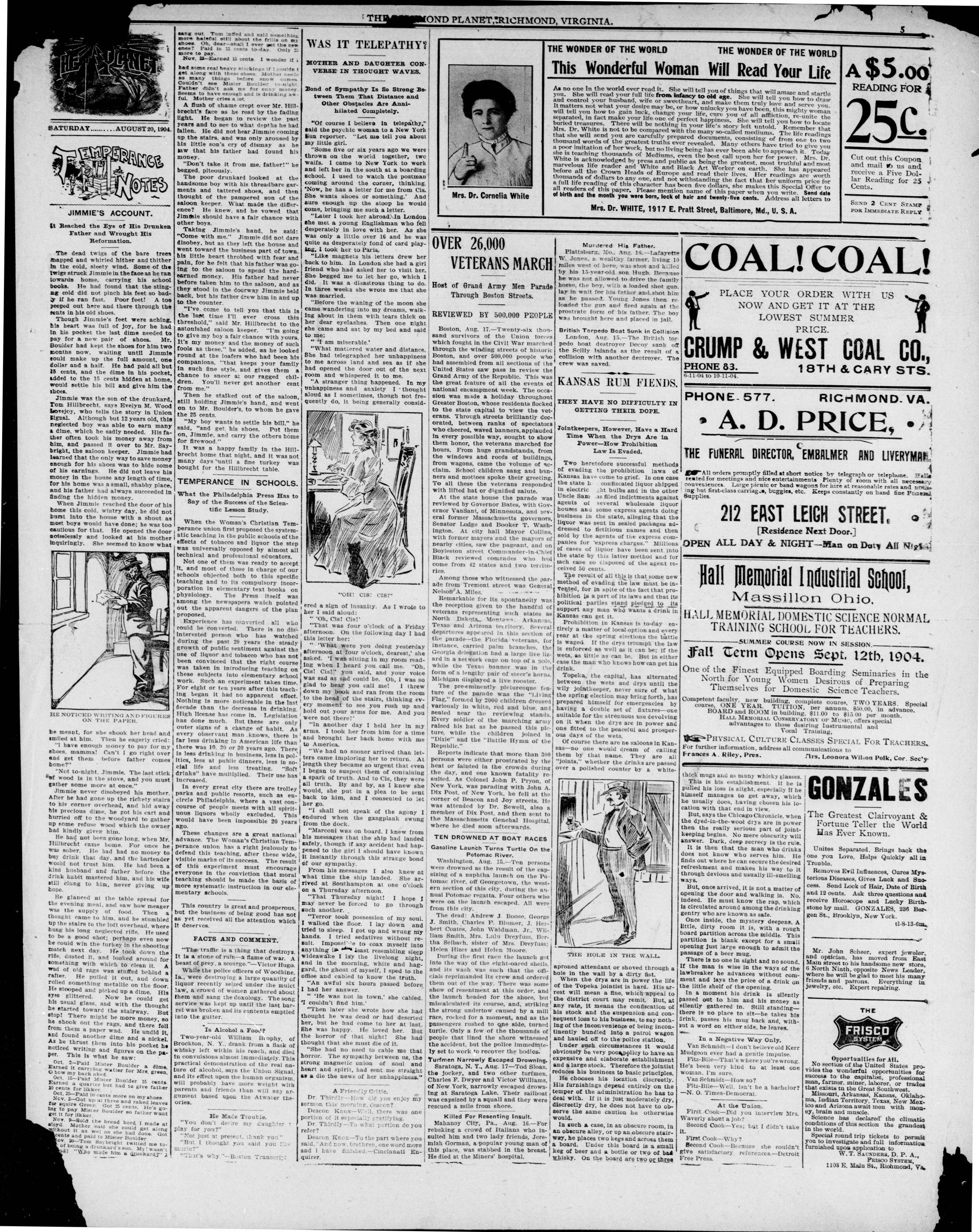
A GRAND SOCIETY
The prevalent dullness has been pleasantly brokery mervoches from the b of Mr. and Mrs. G. D. Moore St., the occasion given by Mr. L. M. Jack Mrs. Jane Booker and Booker of New York. The specious rooms we decorated with cut-flow the parlor being in pictures, dining room being with a center piece of wrist astors, together with
The wealth of authority upon this subject is very great. It is believed that every pertinent case has been examined, and while in rare cases, decisions of the circuit or district courts have been reversed by the supreme court, for error in the determination of the cause itself, no case has been found wherein there is a disapproval of the action of such courts for awarding the writ of habeas corpus, where it is fully averred and shown that the petitioner is held in custody in violation of the Constitution and laws of the United States. On the other hand there are many precedents where the decisions of such courts have been affirmed for the writ of discharge and discharging the prisoner under his jurisdiction that he has been deprived of his liberty and immunity of those fundamental rights and institutions secured to him by the Constitution and laws of our common country. A case precisely in point is IN RK Mills 135 U. S. 236. In that case the proper punishment might have been "imprisonment," but a District Court of the United States sentenced the prisoner to imprisonment in the penitentiary.
NO RIGHT TO PASS SUCH A SENTENCE.
Holding that such imprisonment was infamous, with or without hard labor, the supreme court held that the court below was without jurisdiction to pass any such sentence and the orders directing sentence of imprisonment to be executed were void. A PORTIOR would such judgment from a police court be annulled. This, it was declared, is not a case or mere error, but one in which the court below transcended its powers. Using Exparte Lange, 18 Wail, 163; Exparte Virginia, 100 U. S. 339-342; Exparte Virginia, 100 U. S. 339-343; Exparte Rowland, 104 U. S. 604; in RE Cox, 121 U. S. 731; in RE Hans Nielsen, 121 U. S. 716.
The aggressions of municipal corporations upon the rights and liberties of the citizens, declared by competent observers to be at once the most vicious feature of our present social condition, and the most alarming portent of our future, have thrust a multitude of unconstitutional ordinances before the courts of the United States. This has occasioned much shrilling and no little objurations from the local interest from time to time affected, but happily for the people the courts steadily proceed with the exercise of their constitutional powers. In Yick Wo. vs. Hopkins, 118 U.S. 356, it was held that in a suit brought before the supreme court from a state court which involved the constitutionality of ordinances made by municipal corporations in the state, the United States Court will, when necessary, put it own independent construction upon such ordinances. The same elevated tribunal remarks in the same case
[TO BE CONTINUED.]
Mr. Elam L. Banks is slowly improving.
Mrs. J. Alexander Chiles wife of the attorney of Lexington, Ky.
Miss Campbell of the same city seen the guests of Miss M. L.
Thay left for Old Point where she spend a week.
Mrs. Sarah Robinson died Aug. 1 home in Amelia Co., Va.
of Mrs. J. C. Farley, the states H. Twine of Richmond,
L. D. Twine of Durham,
A. I. Booker left the city inst. for Washington, D.
she attended the Grand of the I. O. of St. Luke ang at the pub.
A GRAND SOCIAL
New York Visitors Entertained.
The prevalent dullness in Richmond has been pleasantly broken into by the merry echoes from the beautiful home of Mr. and Mrs. G. D. Sulley, 1420 Moore St., the occasion being a social given by Mr. L. M. Jackson in honor of Mrs. Jane Booker and Miss Mary E. Booker of New York. The spacious rooms were beautifully decorated cut-flowers and palms; the parlor being pink with carnations, dining room being white with a center piece of white roses astors, together with the handsome gowned ladies and well-dressed gentlemen, it presented a scene of beauty. The guests were well received by Mr. and Mrs. G. D. Sulley, assisted by Mrs. George W. Dandridge, Jr., Mr. George W. Dandridge and Mr. Wm. H. Jackson officiated at the punch bowl, while Mr. Emmett H. Howard superintended the宴. The dancers and games were indulged in until the early hours of morn. After which, all partook of supper under the skillful directions of Mr. E. W. Howard.
Mrs. and Miss Booker left for New York Tuesday morning at 8:40 A.M. After spending a delightful two weeks in Richmond.
Among those present were: Mr. and Mrs. G. D. Sulley, Mr. Leroy Frasier, Miss R. Lavinia Johnson, Miss Bessie Cheatham, Mrs. Priscilla Cheatham, Mrs. C. P. Roane, Mr. and Mrs. Chas, Henley, Mr. Robt, Harris, Miss Lizzie Jones, Mr. Carter Braxton, Mrs. Edward Sulley, Mr. and Mrs. George W. Dandridge, Mrs. Ella Jackson, Mrs. Gardrest Preston, Miss Inez Jackson, Miss Mary Lizzie Bland, Mr. Emmett W. Howard, Mr. L. M. Jackson, Miss R. Annie Taylor, Mr. Wm. H. Jackson, Mr. Chas, Lee Jackson, Mr. Robt. Kinney, Mr. Chas, Smith and Mr. R. P. Brown.
San Francisco, Cal., [Outlook,
The colored people of Richmond, Va., are not shedding many tears over the troubles that have come upon the Virginia Passenger and Power Company. Its affairs are in a bad way, and through conflicting interests a receiver was placed in charge of the case that colored people have boycotted because of separate car law, and there seems to be no doubt but that the loss of their patronage was a severe injury to the road.
LYNCHBURG, VA., [INTERPRETER.]
Jim Crow Cars or Bust, BUSTED ! j
In response to the clamoring of the few Negro hating white folks the Richmond Street Railway Company inaugurated a Jim Crow street car system. When the management of this company yielded to the chronic Negro haters, it was in a prosperous condition. In every way prepared to meet the obligations. Having just merged out of a great strike its management had nothing of which to complain, but with the coming of the Jim Crow street cars, came a startling falling off, of the company's revenue. The Richmond Planet, the Reformer, the St. Luke Herald and the Advocate led in an unparalleled fight against this discrimination. As these distinguished race journals have always espoused the best interests of the race, the Negroes of Richmond accepted their advice and for three long months, notwithstanding the multiplicity of corn and bunions, they have continued walking until this day. As part result of their manly stand the street railway company was unable to meet its obligations and has gone into the hands of receivers. Jim Crow cars or bust, said the Richmond Negro haters. Busted, said the company.
Three cheers for the Richmond Negroes.
Grand Chancellor Duke Re-elected.
At the recent session of the Grand
Lodge of Arkansas, Grand Chancellor
J. O. Duke was re-elected by a vote of
228 to 93. There are 155 lodges in the
state with a membership of 5647 and the
amount in the treasury is $13450.35.
This is a very fine showing for
Arkansas.
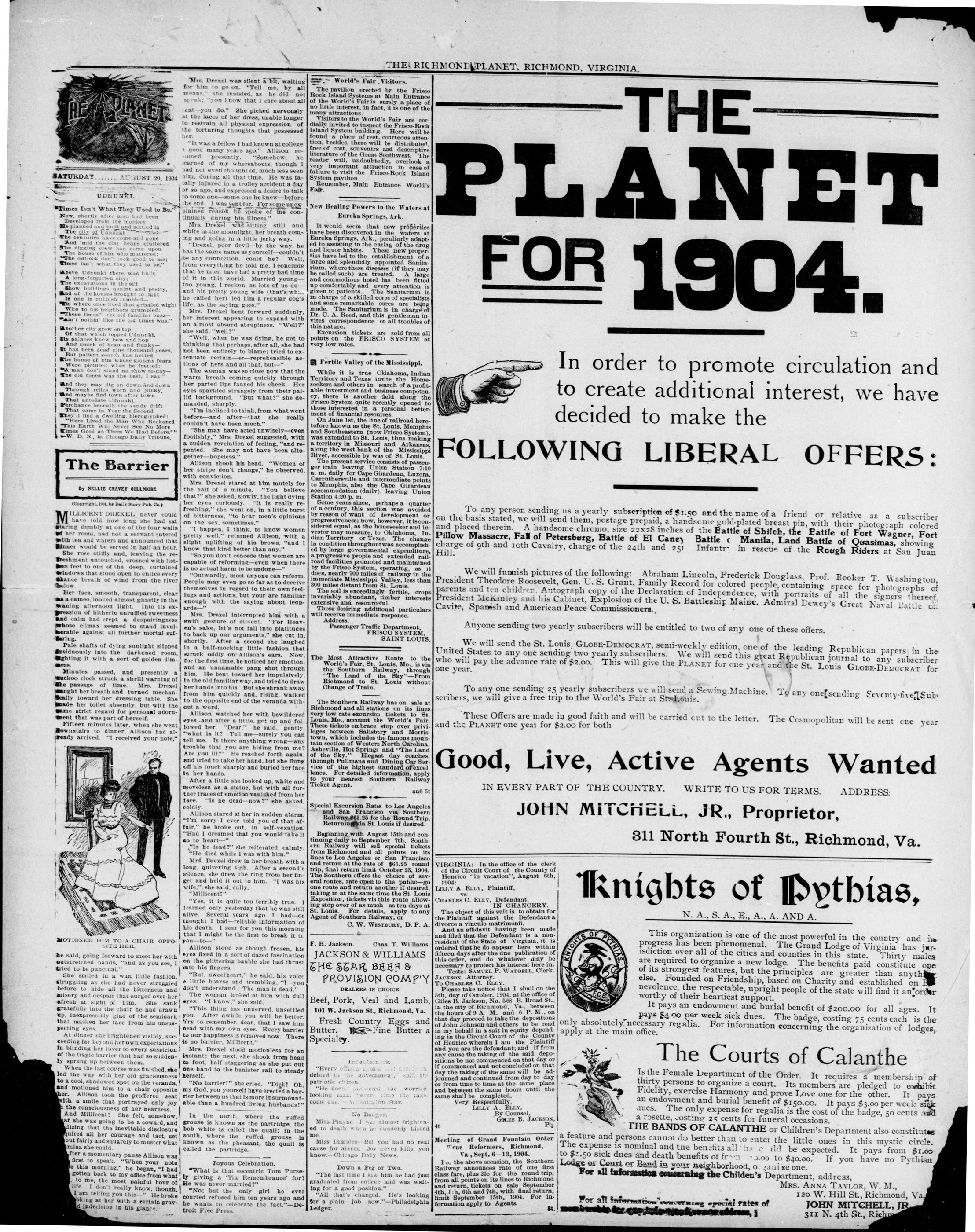
RICHMOND, VIRGINIA, SATURDAY, AUGUST 20, 1904.
JAPS ATTACK
PORT ARTHUR
BY LAND AND SEA
Generai Assault on Besieged Fortress is Now On.
JAPS WIN TWO NAVAL BATTLES
Vladivostok Squadron Defeated In Fight Raging Five Hours, the Cruiser Rurik Being Sunk—Port Arthur Fleet Scattered, Several Reaching Neutral Ports In Battered Condition.
Chefoo, Aug. 16.—That a general land and naval attack was made on Port Arthur is indicated by information from various sources.
The statement that the naval attack was made yesterday morning comes from an authoritative but not diplomatic quarter.
Junks which arrived here say the Japanese recently occupied the Liaouti Hills and Sushiyen, which is two or three miles north of the fortress.
Five warships and seven orpedo boat destroyers, according to the junks, returned to Port Arthur the night of August 10.
Junks which arrived here, having left Port Arthur August 12, brought reports that the Japanese occupied new positions on that day. The fighting was heavy and indicated that assaults were being continued. The Russians at Port Arthur are reported to be down-hearted. The men who came on the junks declare that the commander of the Japanese fleet before Port Arthur informed the Russian commander of the place that if the warships which returned to the harbor after the sortie of August 10 were sunk by the Russians the Japanese would shell the town with lyddite.
Bombarding the Inner Defenses
Berlin, Aug. 16.—A dispatch to the Lokal Anzeiger from Tokio, dated yesterday, confirms the reports that heavy fighting has occurred at Port Arthur during the past few days. The Japanese captured three Russian batteries and secured positions close to the inner fortifications. Both sides lost heavily. The Japanese have commenced a bombardment from Lang Mountain on the harbor and inner defenses.
Expected to Fall at Any Moment.
St. Petersburg, Aug. 16.—The expectation here is that Port Arthur will fall at any moment. Especial significance is attached to the fact that Lieutenant General Stoessel's wife and children went to Chefoe on board the torpedo boat destroyer Ryeshiteli.
Tokio, Aug. 17.—The emperor's offer to release the non-combatants at Port Arthur, coupled with a demand for the surrender of the fortress, delivered yesterday (Tuesday). A answer is expected today (Wednesday).
Russian Fleet Driven Back.
Chefoo, Aug. 17. — The Japanese fleet under Admiral Togo frustrated an effort made by the Russian warships remaining in Port Arthur to escape from the harbor, driving them back to face the awful fire constantly poured upon them by the Japanese land batteries over the hills.
The Russian fleet, which returned to the port after the terrific sea fight of last Wednesday, under cover of darkness made a desperate attempt to pass the Japanese squadron lying outside of the harbor and reach safety and liberty. The Japanese had been lying far off shore, and the Russians imagined they had a slight chance of thus escaping the vigilant eye of Admiral Togo. The Russian warships crept out with lights extinguished, and the Japanese opened a terrific fire on them.
According to reports received here the Russians made no attempt to engage in general action, but hurried back to the harbor.
The sortie is regarded as a confirmation of previous reports that the Japanese have occupied an important line position, the fire from which compelled the Russian vessels to leave the harbor. It is not certain that they returned to their former anchorage after the sortie.
Junks which left Port Arthur August 13 report that heavy fighting was continuing.
A telegram just received from Tsing Chou says that the officers of the Russian battleship Czarevitch insist that a Japanese battleship sank within full view during the battle on the night of August 10.
The Diana Reaches Vladivostok.
London, Aug. 17.—A dispatch to a
news agency from St. Petersburg, says a naval officer has telegraphed to his family that the cruiser Diana, of the Port Arthur squadron, has arrived at Vladivostok squadron. The Yokohama correspondent of the Daily Mail says that the cruiser Noviak of the Port Arthur squadron, has been sighted off the Strait of Van Diemen steering for Vladivostok.
VLADIVOSTOK FLEET DEFEA7ED
Russian Cruiser Rurik Sunk In Fight With Japanese.
Tokio, Aug. 15.—Vice Admiral Kamil Mura encountered the Russian Vladi vostok squadron at dawn yesterday north of Tsu Island, in the Strait of Korea, and attacked the enemy at once. The battle lasted for five hours and resulted in a complete Japanese victory. The Russian cruiser Rurik was sunk, and the cruisers Rossia and Gromobol fed to the northward after having sustained serious damage.
Vice Admiral Kamilmura cables the navy department that the injuries inflicted upon his vessels were slight.
The fate of the crew of the Rurik is not known. It is presumed that many of them were killed or drowned. The strength of the fleet under Vice Admiral Kamimura is not known, but it is presumed that he had the Adsuma, Idzumo, Iwate, Takashiho and other light cruisers.
Tokio is joyous over the news, as it gives Japan mastery of the sea and restores commerce.
The best possible naval force that Russia can now concentrate at Vladivostok is four cruisers.
In the fight of August 10 the squadron under Admiral Togo was practically uninjured. The battleship Mikasa suffered the most, but she continues on the fighting line.
The cruisers Yakumo, Nisshin and Kasuga also were hit, but temporary repairs already have been made, and they are fully serviceable.
The steamer Gaelic, bound for Shanghai, sighted a Russian cruiser, evidently the Novik, steering southeast by east. This course showed her to be heading for Van Diemen Strait. Van Diemen Strait is about 120 miles south of Nagasaki, and it would be presumed from the Novik's going in this direction that she purposes to try and reach Vladivostok by the east coast of Japan.
600 Saved From the Burik.
Washington, Aug. 16—The American consul at Nagasaki reports to the state department that 600 of the survivors of the big Russian cruiser Rurik (of the Vladivostok squadron), sunk by Admiral Kamimura, have arrived at Sasebo. Sasebo is the island used by the Japanese as a naval base.
PORT ARTHUR FLEET SCATTERED
Several Warships Badly Damaged Escape to Neutral Ports.
Tokio, Aug. 13.—The navy department has issued a brief statement of the engagement with the Russian Port Arthur squadron on August 10. The statement follows:
"According to reports received to date, the enemy's fleet, which emerged from Port Arthur, was attacked by our coast south of Yentao Island. The Russian fleet fled during the night. The cruisers Askold, Novik and another cruiser, with one torpedo boat destroyer, ran into Kiao Chou Bay on the evening of August 11. One torpedo boat destroyer were in Chelfo and three of the energy battleships, one cruiser, probably the Diana; one hospital ship, two gunboats and several torpedo boat destroyers seem to have separately returned to Port Arthur between dawn and noon of August 11. Our fleet appears to have sustained no damage. Our casualties were 170."
Admiral Witloft Killed
Chefoo, Aug. 13.—A late report from Tsing Chou says that the Russian warships still there are the battleship Czarevitch, the protected cruisers Pallada and three torpedo boat destroyers. The Czarevitch, which is badly damaged, is being repaired with German assistance, it is alleged. Among those killed on the Czarevitch were Rear Admiral Withoff, Navigating Flag Lieutenant Arzieff and Navigating Lieutenant Draguishevitch.
Congressman Hitt III.
Bar Harbor, Me., Aug. 16.—The illness of Congressman Robert R. Hitt, of Illinois, who since his partial collapse at the national Republican convention in Chicago has occupied a cottage here, has recently taken a turn that is causing anxiety. Doctors Frank Hyatt and William Gerry Morgan, of Washington, who were summoned here to consult with Dr. Horace Stokes, announced that Mr. Hitt had improved much from a recent collapse, and that his condition was not now considered critical, although considerable anxiety is felt. Congressman Hitt's illness is due to a general breakdown.
"Equal Rights Before the Law."
The "Jim Crow" Street Car.
THE WAY IT WORKS IN RICHMOND.
Forgave Him for Jim Crow Offence—
Justice Crutchfield Discharges
Aged White Man Who Did not
Know of New Law.
[Richmond, Va., News-Leader.]
Judge Crutchfield, to-day discharged
J. D. W. Churchil, an aged white man
arrested yesterday by a street car con-
ductor for refusing to change his seat.
Mr. Churchil did know the rules
about the changing of seating in a order to
keep the races anart. Captain Guilgen,
for the Virginia Passenger and Power
Company, asked that the case be dropped.
The American Beneficial Insurance Company's Outing.
The 22nd of August will be a great day with the American Beneficial Insurance Company, in that their first Annual Outing will be given at Buckroe Beach. All persons going must be at the train at 11 a.m. past eight sharp, because the train will leave promptly at 9:15 in order to spend a great day by the seaside. This will be an orderly, up-to-date first-class outing. Keep your eye on the date and time of leaving. Aug., 22nd at 9:15 A. M.
W. F. Graham, President,
B. H. Peyton, Secretary.
Work Stands.
When you want a good job done, give us a call. We can always guarantee our work, for painting is our living. We make your house look good and it stands THOMAS J. BLACKWELL,
WANTED-Colored men with clerical education to call at room, 21 Ebel Building.
MASSACHUSETTS MINING CORPORATION.
$100 00 Endowment Paid.
Richmond, Va., Aug. 12th, 1904.
This is certify that I have received from John Mitchell, Jr., Grand Worthy Counsellor of the Grand Court of Virginia, I. O. Calanthe ($100 00) One Hundred Dollars in payment of the death claim of Maggie Jackson, who was a member of Rising Mount Zion Court, No. 55, of Richmond, Va.
Signed:—ROBERT JACKSON,
Beneficiary.
Witnesses:—Robert Alexander,
John R. Cogbill.
Popular Excursion to Winston-Salem
via: Southern Railway, August
21st, 1904. $2 50 Round
Trip.
Special train will leave Richmond
10:30 P. M., August 21, going through
to Winston Salem. Without change,
through Danville, Reidsville, Greensboro, etc. $2.50 round-trip. Special cars for colored people.
Returning leaves Winston Salem 9 P. M., and arrives Richmond 6 A. M., August 23rd. The last and only excursion of the season to the Old North State.
WANTED—Colored women of bright skin, good wages and steady employment. Address, THE PLANET, Box K. Richmond, Va.
Miss Daisy C. Jones of Baltimore, Md., in company with Miss Susie Crump called on us.
Mr. J, H, Michael, of Pine Bluff, Ark., and Mr. G. W. Carter of the Virginia Union University in company with Mrs. J. Thomas Hewin called on us.
Mr. Geo. W. Rison of Danville, Va. in company with Mr. James Oliver of the same city called on us.
Dr. Wm. E. Atkins, the popular Hampton physician has purchased a fine automobile and finds that it gives very satisfactory service in that locality.
—Mrs. T. J. Pree of Newport News, Va., called on us. She was enroute to the St. Luke session at Washington.
GRAND SUNDAY CONCERT
There will be a Grand Sunday Concert at the Fifth Street Bapt. Church, Rev W. F. Graham, pastor, under the auspices of the White-Flag, Mrs J. L. Burke, President. Sunday afternoon Aug. 21, 5 P.M. Mrs. Olivia Bolden, Accompanist. Mrs. Susanna Belle Anderson Manager. All are cordially invited, bring offer-
COLORED WOMAN FINED TEN DOLLARS.
Actress' Maid Under Arrest—Mary Marble's Negro Servant Declined to Move When Conductor Ordered Her. [Richmond, Va., News-Leader ]
The magistrate's court-room at the Henrico county court-house te-day took on an air theatrical when the case of Addie Ayres, a young Negro woman charged with refusing to move when ordered to do so by a conductor of a street-car, came up before Magistrate Lewis.
Manager McKee was there; John Dunne was there, and a goodly throng of persons assembled to hear the more or less dramatic recitals of how it all came about.
The Negro is maid to Mrs. Dunne, whose stage name is Mary Marble, the leading lady in 'The Knickerbocker Girl'.
A warrant was sworn out for her arrest yesterday. Last night she was again taken in to custody at the Casino. Mr. McKee came to the rescue and she was bailed for her appearance this morning.
"Why, cert'ny not. I didn't know I was arrested," said the wielder of costumes. "I didn't know the conductor could arrest anybody. Yes, the conductor told me he put me under charge, but I didn't know I was arrested. People tells you lots of things."
The magistrate said there was no doubt about the law having been violated and the woman being legally arrested and knowing it. He imposed a fine of $10 and costs, amounting to $15. 45. The fine was paid.
Mrs. Alice Parker, formerly of Richmond but now residing in New York, returned home last Wednesday, after a delightful stay of ten days visiting relatives and friends.
While in the city she was the guest of Mrs. Thomas Ewell
DEATH IN TROLLEY WRECK
Brake Chain Broke on Incline Near
Delair, N. J.—One Dead, 10 Injured.
Bordentown, N. J. A. 17. — One man is dead and 10 other persons were injured as the result of a trolley accident on the Camden and Trenton trolley line, near Penssauen, N. J.
The dead man was the conductor of the car, Robert Holloway, 38 years old, of Bordentown. He was caught under the body of the car and instantly crushed to death.
The list of the injured is as follows: John H. Decker, of Riverton; contusions of back and body. Ernest Gest, of Riverton; scalp lacerated, nearly torn from head; also contusions of back and body. Calvin Day, of Kincora, injured about the legs and body. Edward A. Holt, Riverton; injured about body and legs. Mary E. Warrington, of Delmar; cut in breast. John Fitzgerald, colored, of Fairview, Burlington county; back and legs strained. Thomas T. Blood, of Delair; lacerations and bruises. John F. White, James Stoerr, Hal Jones, all of Palmyra.
Just after leaving the top of the hill the brake chain broke, and the motorman was unable to control the car. It plunged down the steep incline at frightful speed, gaining velocity each moment. After shooting the first curve the car tore along a straight piece of track for a distance of a quarter of a mile, until it reached the second sharp curve, which it struck with terrific force. The chains parted, and the car, freed from the fastenings, shot ahead for 20 feet and then dropped over a steep embankment, landing with a crash in a field.
FAIRBANKS TO STUMP
Republican Vice Presidential Candidate to Tour the Country.
date to tour the Country.
Chicago, Aug. 16. — That Senator Fairbanks, the Republican vice-presidential candidate, will participate almost continuously in the presidential campaign and tour the country in behalf of the ticket of which he is a component part was made known as the result of a visit made by him to Republican headquarters in this city.
The senator has entered into an engagement to open the Kansas state campaign at Marlon, in that state, on September 1, and there are calls for him for earlier dates in Vermont. He also indicated his positive acceptance of an invitation to speak at Saratoga, N. Y. on the 14th of September on the
PRICEVIEW
occasion of the celebration of the 50th anniversary of the organization of the Republican party at that resort. Later in the campaign he will visit the far west and other sections in which the national committee may wish to nave him speak, but the details cannot be decided until Chairman Cortelyou's wishes are known.
WONDERFUL FRUIT CROP
New Jersey Peaches and Plums Break All Records.
Philadelphia, Aug. 16.—A wonderful crop of peaches and plums in So euthera New Jersey will be ready for shipment in about 10 days, and several train loads will be headed for this city. Housewives are preparing, for a great preserving time.
A commission merchant of this city who made a trip through the fruit belt, stated that this year's crop is 10 times as large as the crop of 1903, and that the weight of the fruit is so great that the trees are breaking down under the burden.
Gunboat Dubuque Launched
New York, Aug. 16. — The United States gunboat Dubuque was successfully launched from the yards of the Gas Engine and Power Company at Morris Heights. She was christened by Miss Margaret Treadway, 15 years old, of Dubuque, Ia. On the first attempt which Miss Treadway made to break the bottle of champagne over the vessel's bow it did not smash, and in the excitement which resulted she neglected to repeat the words, "T christen thee Dubuque," as the gunboat slid down the ways. After the boat had been towed around to a dock, however, the young woman climbed to her bow and this time broke the bottle and said the words completing the ceremony.
Thrown From His Buggy.
Lancaster, Pa., Aug. 17. — George Ganze, of Washington, D. C., was probably fatally injured at Mountville. He was driving from Reading to Washington, and had just left the hotel at Mountville when his horse scared at a trolley car and he was thrown from the buggy. He struck head first on the curbstones, fracturing his skull. He was brought to a hospital in this city, where he continues unconscious, with little or no hope for his recovery. He is about 22 years of age, and is said to be the son of a hotel keeper at Washington.
George F. Baer In a Crash.
Allentown, Pa., Aug. 17.—The Scranton flyer on the Central railroad struck a lumber team near town, killing both horses and so badly injuring Horace Bortz, the driver, that the hospital surgeons say he cannot recover. His skull was crushed and both legs were broken. On the train was President George F. Baer, of the Philadelphia and Reading railway, in his private car Philadelphia, one of whose trucks was so damaged by flying lumber that the car was sidetracked. Mr. Baer proceeded to New York on a regular coach.
Mrs. Maxbrick Coming
London, Aug. 15. — Mrs. Florence Maybrick is on board the Red Star line steamer Vaderland, which sailed from Antwerp, under the name of Miss Rose Ingram. She is accompanied by her attorney, Mr. Hayden, who arranged the details of her departure.
HEIR BORN TO RUSSIA'S THRONE
Whole of Czar's Empire Rejoicing at Birth of Prince.
St. Petersburg, Aug. 13. — A son and heir to the Russian throne has been born. The empress and the child are doing well.
The heir's name will be Alexis Nikolaevitch, and if he reigns he probably will assume the title of Alexis II. The last Alexis was emperor of Moscow, in 1645.
The announcement from Peterhof was immediately followed by a salute of 101 guns from the imperial yacht lying at anchor off the palace, but it was 2.45 p. m. when the guns of St. Peter and St. Paul fortress, opposite the winter palace here, conveyed the glad tidings to the people of the Russian capital. In the meantime the announcement had been telegraphed to the most remote corners of the empire. In all the towns and cities the glad tidings were spread with the clamor of bells and the booming of cannon. Thanksgiving services followed in all the churches.
Canada Resents Insult to Flag
Canada Resents Insult to Flag.
Ottawa, Ont., Aug. 17.—The Canadian government has lodged a formal complaint with the British authorities regarding the indignity offered to the flag of the Dominion by a British consular officer in a South American port a few weeks ago. Notice of the matter was taken in the Dominion parliament at the time, and the Ottawa government promised to take official action. The flag was torn and trampled upon, and the consul said he knew nothing of a Canadian flag.
THE PLANET
SATURDAY ..... AUGUST 20, 1904
AROUND THE FIRE
He Didn't Know Bullets When He Saw Them and Thereby Gained a Reputation.
Speaking of great civil war stories, Miss Ada Sweet, of Chicago, when in Denver recently, told the following: Her father, Gen. Sweet, was taking his regiment into action. He sent forward a detail of men to make gaps in a rail fence to avoid the heavy loss sure to result if the whole body of men paused to tear it down. The coolest and finest man in the detail was a young soldier who had never been under fire before. When he began pulling down the fence he disturbed a nest of hornets, and they flamely about his ears. But
A man carrying a rifle and skis.
THEY OPENED THE FENCE.
the lad was not going to run from hornets when it was more serious business ahead.
Ignoring the angry insects he opened the fence and rejoined the regiment without being stung.
After a time he was appointed second lieutenant and called on Gen. Sweet to thank him.
"But," he said, modestly, "I don't think I deserve promotion over the others."
"My boy," replied the general, "I saw you pull down that fence. You were the coolest man under fire I ever saw!"
The man gasped, stared and turned pale.
"Good God!" he exclaimed, losing all caution and grammar. "Was them bullets?"
WHERE IS MARION RIVERS?
Here Is an Inquiry for the Last Man Pardoned by President Abraham Lincoln.
During the closing days of the civil war Marion Rivers was arrested, tried before court-martial and found guilty of being a spy within the union lines, and, by the court-martial he was sentenced to death, by being placed in a kneeling position on the lid of his coffin and 12 soldiers, with muskets, detailed to perform the execution, one of the 12 muskets not being loaded with a ball, the remaining 11 being so loaded that no one of the 12 would know with certainty who really were the executioners of the condemned man.
Thus doomed to soon pass into eternity by the stern hand of military justice, Marion Rivers was placed in the guardhouse to await the day of his execution.
The proceedings of the court-martial, giving the evidence adduced at the trial, with the verdict of the court, was forwarded to Washington for President Lincoln's signature. Upon receiving the testimony President Lincoln stated in his own handwriting over his own signature, that "the evidence being wholly circumstantial, and there being mitigating conditions connected with the prisoner's arrest and trial," he allowed the condemned man to go free.
This was near the closing days of the civil war. I have in my possession the written proceedings of the court-martial, and the pardon by President Lincoln. This must have been the very last, or very nearly the last, time President Lincoln signed his name to a document of this kind, and the document ought to have a sentimental value. If Marion Rivers still lives and would like to get the documents, I will mail them to him. While they are of no intrinsic value to me, as I nor any of my family ever refer to them, they grow more valuable as they grow older, and would be of much more value to Mr. Rivers than to any other person, as they will serve to perpetuate the recollection of the most trying event in the history of Mr. Rivers' life. Doubtless the proceedings of that court-martial made an indelible impression upon the tablets of Mr. Rivers' memory. Mr. Rivers, or any of his children, if he has any, can have the documents—Marion Ardell, Corporal Company H, Twentieth Michigan, Emerado, N.D., in National Tribune.
Warning Not Needed,
Mistress (to greet, housemaid)—By
the way. Mary, should my husband ever
attempt to kiss you, just box his ears
soundly.
Maid—Shure, ma'am, he's felt the
weight of me hand twice already.—Minneapolis Times.
HAD A CHECKERED CAREER
After Absence of Forty Years Pennsylvania Veteran Returns to His Boyhood Home.
Old, gray-haired and decrepit, David Smith, after walking almost all the way from St. Louis to Bellefonte, Pa., arrived there the first time since he left the home of his birth to enlist in the civil war, nearly 40 years ago. When are war broke out, David Smith wanted to be the first man to enlist from Center county, but was prevented from doing so, and the war was almost over before he was able to enlist. February 4, 1864, Smith enlisted in company F, Forty-sixth regiment Pennsylvania volunteers, and during six months followed the flag, being mustered out of service on July 6. He then went west and enlisted in the regular army, serving three years.
Upon his discharge, Smith, with several companions, went to Texas. While in Dallas there was a riot, which the sheriff and a large number of deputies were endeavoring to quell. In the fight one of the deputies was killed. Smith was arrested, and upon circumstantial evidence was convicted. He received a life sentence, although he had not fired a shot, and was not even armed at the time.
Two months ago one of the gang involved in the riot that night died, and on his death-bed confessed that he was the man who had fired the shot, and that Smith was entirely innocent. An investigation was made, the dying man's confession found to be correct, and the governor of Texas at once pardoned Smith, after he had served 21 years, 5 months and 20 days.
He was given what money was found on him when arrested, and journeyed to St. Louis. There Smith started to walk, and in this way made his way to his old home. He came there expecting to find his brothers and parents, but all the family had died years ago. Smith has applied for a pension.
TURNED AWAY FROM ENEMY
Queer Action of a Brave Sergeant When He Came Under Direct Fire the First Time.
A well-known veteran, who served as captain during the war, tells in the Chicago Inter Ocean of this queer experience at Keneesaw: "A sergeant in one of the left companies of the Fifty-second Ohio, as the regiment came under the direct fire of the enemy, turned pale as death and faced to the rear. As he made a few steps to the rear he came face to face with, his commanding officer. The colonel caught the sergeant by the shoulder, and said: 'Face the other way, Joe.' At this the sergeant turped mechanically, led the charge on the enemy, rallied the wavering line, and seemed indifferent to danger. He was, in fact, the most conspicuously courageous man on the line.
"Years later the story of his facing to the rear was told to the sergeant, and he said in wonder that he had absolutely no recollection of the occurrence. He was not sensitive on the question, because he missed not a single fight in his three years' service, but he could not understand it. He had no recollection of being afraid, or facing to the rear, or of the colonel speaking to him. And
THE FIGHT
yet he never thought of disputing the correctness of the story told by myself and others. I have often wondered where Joe's mind went in the moment of panic and have wondered if his condition when he faced to the rear was not similar to that of a man asleep. "I have no doubt," said the doctor, "that the facing to the rear in this case was involuntary and purely mechanical. When the mind came into action it responded to the natural impulse of courage, and the man went forward with all his wits and soldierly instincts in full play. There was another case in the Fifty-second Ohio, which illustrated the race quality of presence of mind in the face of appalling danger. When the regiment was on the Sand Town road, in front of Atlanta, it came under the heaviest artillery fire in its experience. "In the midst of the racket, a sputtering shell fell between companies B and G. Men on either side fell over each other in a wild scramble to get out of the way. But Sergt. Sam Grimshaw, quick to comprehend the situation, ran to the shell, picked it up, and threw it far to the rear before it exploded. His quick, resolute action probably saved half a dozen lives, and the government recognized the exceptional quality of the deed by awarding Grimshaw a medal."
A Good Promoter.
"Is he! Why, that's the man who or
organized our church fair!"—Puck.
Jaggies—Have you made any preparations for the picnic?
Waggies—Yes; I bought an umbrella, mackintosh and rubbers—Town Topics.
THE RICHMOND PLANET, RICHMOND, VIRGINIA.
Fun For Fun Lovers.
Unselfish Little Boy.
Proud Mother—You will be five years old to-morrow, Willie, and I want to give you a real birthday treat. Tell me what you would like better than anything else.
Willie (after thinking earnestly for five minutes)—Bring me a whole box of chocolate creams, mother, and ask Tommy Smith to come in and watch me eat them.—Tit-Bits.
Higher Education
Two sisters were sitting in a hotel writing room. They audibly were discussing their friends.
"Yes, I've just written aunty about Mrs. Blank. I told her that of all the unrefined, uneducated, illiterate people I ever saw—! By the way, Emma, how do you spell illiterate!"—St. Louis Republic.
Didn't Give Him a Chance.
Jamson—Do you know her to speak to?
Rorter—Hardly that.
Jamson—But I thought you said you were friendly with her?
Rorter—So I am; but a better way of putting it would be to say that I know her to listen to—Ally Sloper.
Alas! 'Tis True.
These tailors have the bulge on man,
It takes pity to make him.
Yet one, with little effort, can Effectually break him.
-Philadelphia Press.
DID NOT CONCERN HER.
Mr. Kicker—Your dressmaker's bills are too high.
Mrs. Kicker—Well, why don't you speak to her about it?—St. Louis Republic.
Election day is like a bridge.
And when at last "it's crossed,
Some will declare "the country safe."
We will say "we were lost."
-Washington
Not Surprising.
They were looking down at the gorge of Niagara.
"Do you know," asked the guide, "that it took a thousand years to dig that channel?"
"Well, well, well! I never knew before that it was a government job."—Chicago Record-Heffald.
Much Relieved
Mrs. Blinks (house hunting)—I hope there are no screeching poll-parrots in this neighborhood.
Agent—Not one, madam.
Mrs. Binks (with a sigh of relief)—I am glad of that, because we have two, and I really couldn't stand any more. —N. Y. Weekly.
The Nerve of Them.
Mrs. Newlyriche—Well, of all the impudence!
Mr. Newlyriche—What is it, Hannah?
Mrs. Newlyriche—Them poor first cousins of yours have gone and got them-selves the same identical ancestors that you've got!—Puck.
Sounded That Way.
"That poet gentleman that come to board with us this week has written something he calls 'A Summer ldyl,'" said the farmer's wife. "I'll bet it's about our hired man," exclaimed the farmer.—Philadelphia Press
Killing the Birds.
She—Do you believe we can kill with kindness, Walter?
He—Certainly, I do, but I hope you're not. going to feed those birds the cake you just made, dear—Yonkers Statesman.
Worse Than Calm
Church—And you say he is calm in the face of danger?
Gotham—Calm's no word for it! Why, when his wife gets after him he never says a word!—Yonkers Statesman.
Never Tonched Him
"What month of the year do you consider the luckiest to be married in?" asked the fair leap-year maid. "The thirteenth," promptly replied the old bachelor.—Chicago Daily News.
Cannibalistic.
"I'm so glad you came. We're going to have a young married couple for dinner."
"Gee! So am I. They ought to be tender."—Houston Post.
Doesn't Beach It
She—That woman is always talking about her age.
He—Yes, she is talking about it, but I suppose she never get quite up to it—Yonkers Statesman.
The Difference.
Miss Gasoline to Miss Benzoin—Oh, you're not so much!
Miss Benzoin—I'm better than you are, anyway. I'm more refined.—Detroit Free Press.
Parried.
He—I was a fool when I married you.
She—Well, that's just what everybody told me.—Brooklyn Life.
OLD WOKLD NOTABLES.
The son of the late Russian artist Verestchagin is an artist of some distinction. Becht, the oldest former member of the German army, died a few weeks ago at Delkheim on the Rhine, aged 101 years. It has to be admitted that the reports of ill-health follow Mr. Chamberlain as persistently and closely as they do the kaiser. Mme. Veuve, 15 years old in 1815, was a guest of honor the other day when the memorial to the French on the field of Waterloo was unveiled. Jacques Gollak, the last of a heroic band of 123 French soldiers who kept 12,000 Arabs at bay for four days in the Algerian campaign, 64 years ago, has died at Strasburg at the age of 90.
Addressing the Anthropological society in London, Rev. M. Collyer, a missionary, said he had been able to trace the use of the system of identification by finger impressions (recently introduced in Europe) for 1,200 years in Korea in the deeds of sale of slaves.
There died in Paris recently Count Emile de Keraty, who could boast that his grandfather, born in 1699, was a page in the household of Lours XIV. The former page married his second wife at 70 years of age and had a son, who was Emile's father. He was born in 1767 and lived till 1852. Three lives bridged 205 years.
One of the richest bachelors in England, and the richest peer in the house of peers, the marquis of Bute, has just celebrated his twenty-third birthday, and there's not a young spinster of high degree whose family would not like to have her capture the matrimonial prize. Whoever the futurs marchioness is, she must be a Catholic, and this obligation has interfered with his lordship's choice.
RAILWAY RUMOR
A trackless railway is soon to make its advent in Prussia. It will run over a good roadbed, 20 feet wide, and will obtain its power from overhead wires.
Benjamin S. Moore, of Elizabeth, N. J., has just celebrated his fifty-fifth year of active service with the Central Railroad of New Jersey. For 53 years straight running he has been a locomotive engineer.
The city of Naples offers a charter for a system of five different lines of railroads, of which three must be underground. The central underground station, it is said, will be 314 feet below the surface.
The state of New Jersey has an average of 30 miles of line to each 100 square miles of area, Massachussetts has 26 miles, Pennsylvania 23 miles, Ohio 22, Connecticut 21 and Rhode Island and Illinois 20 miles.
The railroad commission of Texas has ordered the railroads of the state to make monthly reports of interlocking plants at railroad crossings, showing the condition of the apparatus and the character, and extent of accidents, if any.
Steel-tired wheels for railroad and trolley purposes have made their appearance, backed by guarantees that they will give an increased mileage fully proportionate to the increased cost over shilled wheels. It is also maintained that they produce less rail wear, necessitate fewer truck repairs and afford greater safety.
A new railroad, planned to scale Gray's peak, near Dillon, Col., will attain a height of at least 300 feet greater than the road which climbs Pike's peak. The new road will tap an important mining area, the Georgetown district, and will be a feeder for both the Colorado & Southern and the Denver & Rio Grande railroads.
FACTS AND FINDINGS.
The man who first made steel pens got one dollar apiece for them.
Fifty years ago a trainload of 200 tons was heavy. Now loads of 2,000 to 2,500 tons are handled.
The United States produced 9,000 pounds of tea the past year, the farms being in North Carolina and Texas.
Palace and sleeping cars go back only to the close of the civil war, the airbrake to 1868, and vestibulated trains to 1886.
An order from South Africa for 18-000 eight-horse plows has been received by a plow manufacturer in the United States.
It is usually imagined that the incandescent electric light gives out very little heat. As a matter of fact, only six per cent. of its energy goes to make light, while 94 goes into heat.
"In God We Trust" first appeared on the copper two-cent issue of 1864, and is the first use of the word God in any government act. This sentence was introduced by James Pollock, an ex-governor of Pennsylvania, director of the mint, with the approval of S. P. Chase, then secretary of the treasury.
It was Ben Johnson who called Shakespeare the sweet swan of Avon, because of his (Shakespeare's) being born at Stratford-on-the-Avon. In this he imitated Horace (Ode, 4, 2, 25), who calls Pindar Diroeum cygnum—"the swan of the spring dirke," from the spring in the poet's home, and because the singing swan was consecrated to Apollo.
FROM THE JAPANESE.
Human life is like the dew of the morning.
The fallen blossom never returns to the branch.
Never let go the reins of the wild rott of the heart.
There is no shore to the bitter sea of birth and death.
Domestic—I guess it don't need fill-
in' ma'am
MARRIED PRISONERS.
REAL ROMANCES THAT ARE AS STRANGE AS FICTION.
New York Policeman Fell in Love with Girl He Had Arrested for Murder — English "Cop"
Weds Clap Litter.
Some years ago a well known author wrote an interesting "sunning shower" in which the beautiful heroine is accused of murder. The official who arrests her falls desperately in love with his pretty prisoner, and later the young lady had been found guilty, sentenced to death, reprieved at the last moment, and finally, through the timely remorse and confession of the real culprit, is set free "without a stain on her character," the courteous detective (really a man of high family who has joined the "force" as a cure for enuil) pops the question, is accepted, and the two are made one in the last paragraph. This delightful romance has recently had its prototype in real life, proving the correctness of the old adage that truth, minus the embroidery, is every bit as strange as fiction.
The lady in the present instance is, or rather was, Miss Lilian Thomasch, of New York, who last July had a terrible experience in the Bronx, outlying district of the city. She was walking one evening near One Hundred and Sixty-third street with Mr. Charles Roxbury, whom she had known for 15 years, when a negro stole up behind them and, with a heavy club, felled Mr. Roxbury to the ground. Miss Thomasch fied screaming and sought refuge in a house three streets away.
As soon as the murder became known Luke F. Gordon, a policeman attached to the Tremont station, was sent to arrest Miss Thomasch, and during the week following he kept the young lady under surveillance, taking her many times to court to give evidence before the coroner, and District Attorney Jerome. Gordon appears to
TENNIS
STOLE UP BEHIND THE PAIR.
have been immediately struck by Miss Thomasch's refinement.
When ultimately Jackson, the negro who had assaulted Mr. Roxbury, was caught, Gordon was again chosen as the one to conduct Miss Thomasch to and from the court house for the purpose of giving further evidence. Jackson was found guilty, sentenced to death, and finally electrocuted at Sing Sing. At the time of the murder Gordon's wife was living, but she died soon after the trial and subsequently the policeman proposed to Miss Thomasch and was accented.
Mrs. Gordon was "interviewed" soon after the wedding, when she informed a reporter that until she met her husband she had always disliked policemen. "I never had a high opinion of police officers," she said, "and, in fact, was more or less prejudiced against them. Mr. Gordon was the most polite policeman I ever met, and he treated me with such unusual courtesy that I naturally felt in love with him, and now we are very happy."
There is at the present time in the British police force in the north an officer who first met his wife under circumstances which one would hardly expect to lead to the altar. This official was one day on duty outside a big department store, when a salesman dashed out and informed him that his presence was required in a case of shop-lifting. The young officer entered the shop, where he was commanded to arrest a modestly-attired young woman, who was accused of stealing a small piece of lace. She had been searched and the property found on her, so there was nothing to be done but take her to the station. She looked so very young, and appeared so frightened that the officer kindly dispatched a messenger for a cab, and into this he quietly bundled the young woman and conveyed her to the police court, where she was duly "charged." It was conclusively proved that she had undoubtedly stolen the lace; indeed, she pleaded "guilty," but as it was a first offense she was given the "option" of a fine of £2 or a week's imprisonment. As the money was not forthcoming the girl was taken below, but half an hour later it was paid and the girl liberated with a caution.
It afterwards transpired that the policeman who had arrested her had paid the money, and as soon as the girl discovered this she made inquiries, found out where he lived, wrote him a letter of grateful thanks, and returned the money. In this way the acquaintance, begun under such adverse circumstances, ripened into friendship, and in less than three months the two were married—the alliance proving an unusually happy one.
A Cunning Husband.
She (complainingly)—Before we were married you used to bring me flowers almost every day; but now you never think of buying me even a bunch of violets.
He (gallantly)—The pretty flower girls don't attract my attention as much as they used to.
She—Oh, you darling! Never mind; I don't really care for flowers, anyway.
—N. Y. Weekly.
d on deposit and interest
so which remains 60 days a
on Satisfactory Security.
ents Handled Promptly.
cents and upwards received
uped up in the most improved stu-
nel chest, electric lights and eve
commodation of the public.
cerning Stocks, Deposits, Loans,
seen arranged for the special conve-
m. M. to 4 P. M. Saturdays, 9 A. M.
and open again at 5 P. M., remain
from work.
Money received on deposit amounts above $1.00 which remain
Money Loaned on Satisfactory
Business Accounts Handled
Amounts of ten cents and dimes
This establishment is fitted up in the white vault, burlar, proof steel chest, elective for safety and the accommodation of For all information concerning Stocks, Cashier.
Banking Hours have been arranged for ing people as follows: 9 A. M. to 4 P. M. close Saturday at 3 P. M. and open again P. M. Call by as you come from work.
OFFICE
JOHN MITCHELL, JR., President.
THOS. H. WYM
BOARD OF D.
REV. W. F. GRAHAM, D. D., JNO.
E. R. JEFFERSON H. F. JONATHAN,
J. O. FARLEY,
E. A. WASHINGTON R. W. WHITING,
JOHN MITCHELL, JR., FRES.
W. I. JOHN
FUNERAL DIRECTORY
Office & Warerooms, 207 N.
HACKS FO
Orders by Telephone or Tele-
pers and Entertainment
Old 'Phone, 686, Residence in
Money received on deposit and interest paid on a amounts above $1.00 which remains 60 days and over.
Money Loaned on Satisfactory Security.
Business Accounts Handled Promptly.
Amounts of ten cents and upwards received on deposit.
This establishment is fitted up in the most improved style, having a large white vault, burlar-proof steel chest, electric lights and every modern convenience for safety and the accommodation of the public.
For all information concerning Stocks, Deposits, Loans, etc., apply to the Cashier.
Banking Hours have been arranged for the special convenience of the working people as follows: 9 A. M. to 4 P. M. Saturday, 9 A. M. to 3 P. M. We close Saturday at 3 P. M. and open again at 5 P. M., remaining open until 3 P. M. Call by as you come from work.
OFFICERS:
President. H. F. JONATHAN
THOS. H. WYATT, Cashier.
BOARD OF DIRECTORS:
D. D., JNO. R. CHILES, B. I.
F. JONATHAN, THOMAS SMITH
ALLEY, JNO. T. TAYLOR
W. WHITING, WILLIAM CUSTA
R., PRES.
THOMAS M. C.
JOHNSON
DIRECTOR' AND EM
INS, 207 N. Foushee St.
BACKS FOR HIRE:
None or Telegraph filled. W
entertainments promptly at
Residence in Building, No
KNIGHTS OF COLUMBUS
V. P. & F. K.
JOHN MITCHELL, JR., President. H. F. JONATHAN, Vice-President. THOS. H. WYATT, Cashier. BOARD OF DIRECTORS:
W. I. JOHNSON, FUNERAL DIRECTOR AND EMBALMER.
Office & Warerooms, 207 N. Foushee St. Corner Broad HACKS FOR HIRE:
Orders by Telephone or Telegraph filled. Wedding, Suppers and Entertainments promptly attended.
Old 'Phone, 686, Residence in Building, New Phone, 18
KNICHTS OF COLUMBUS OF THE WORLD
KNICHTS OF COLUMBUS OF THE WORLD
TO WHOM IT MAY CONCERN:
This organization has been ch
stituted under the laws and statu
York, for the purpose of uniting
men on the Broad Bases of Ch
the Social and Moral condition of H
ry and uniform ranks will secure
all sacred institutions of modern
quites wanted in all sections of the
tly address,
ALLEN Supreme voyage
W. 87th Street, New York City.
This organization has been chartered and legally situated under the laws and statute of the state of New York, for the purpose of uniting together all acceptable men on the Broad Bases of Charity—Beneficial
Fraternal and to promote the Social and M
Its two distinct military and uniform
place in the front ranks of all sacred insti
unity for active men. Deputies wanted
lodges Kindly address,
G. W. ALLEN Su
846 W. 87th Street,
Platina and to promote the social and moral condition of humanity.
Its two distinct military and uniform ranks will secure for this organisation place in the front ranks of all sacred institutions of modern events, a great opportunity for active men. Deputies wanted in all sections of the country to organise lodges
Kindly address,
G. W. ALLEN Supreme voyager,
846 W. 87th Street, New York City.
Out of Town Orders Solicited
and will Receive Prompt and
Careful Attention.
and will receive Prompt and Careful Attention.
Isaac Straus and Co.
Family Wine, Liquor and Cigar
Store, 422 East Broad, St.
Richmond, Va.
WE MAKE A SPECIALITY ONES Mt.
Vernon, Gibson, Old Japier, Pennbrook
Rye, Wilson, Old Henry, Old North
Carolina Corn Whiskey and Mountain
Apple Brandy
IMPORTED AND DOMESTIC WINES, BRAN-
DIES, GINS AND REMS.
Best and most popular brands of CIGARS
Goods Delivered Free to 'Phone 2234
all parts of the City.
BUFFET IN REAR.
FIRST CLASS Restaurant.
Barber Shop, Pool Room, Boarding House and Employment Office. CHARLES H. BAILEY, Proprietor and Manager. Center Ave., opposite R. R. Station. Look 13.
WINSTON'S
Parlors Open Day and Night
Special Attention to Picnics, Festi-
vals, etc. Estimates given.
All the latest and most popular
drinks of the fountain, fresh on hand
TOBACCO AND CIGARS.
'Phone, 2253.
WINSTON'S.
587 Brook Avenue.
FRANK WALLER, JR.
PRACTICAL HOUSE
PAINTER,
14 W. Baker St., Richmond, Va.
Residence, 1 E. Orange St.
Prompt attention given to all mail
orders. Satisfaction guaranteed.
All Kinds of Painting Done Cheap
Give me a call before going elsewhere
LOOK OUT FOR
IT CAN'T BE EXCELLED
Your Patronage is Invited.
The AMERICAN GROCERY
When you want nice dry, sawed pine wood, call up 2888. We sell ½ cord for $8.75, guaranteed full measurer.
A full line of fancy and staple groceries and fresh meats. Granulated sugar $49 per lb. Prices low on everything this week. Hard and soft coal. Hay and Grain.
F. B.
A
Capital, $25,000.
deposit and interest paid on a
ch remains 60 days and over.
Satisfactory Security.
Handled Promptly.
iss and upwards received on deposit.
in the most improved style, having a large
est, electric lights and every modern conven-
lation of the public.
Stocks, Deposits, Loans, etc., apply to the
changed for the special convenience of the work.
4 P. M. Saturdays, 9 A. M. to 3 P. M. We
again at 5 P. M., remaining open until 7
work.
ENT. H. F. JONATHAN, Vice-President.
H. WYATT, Cashier.
O F DIRECTORS:
JNO. R. CHILES, B. P. VANDERVALL,
ATHAN, THOMAS SMITH D. J. CHAVERS,
JNO. T. TAYLOR,
WILLIAM CUSTALO, J. J. CARTER,
SS. THOMAS M. CRUMP, SEC'Y.
JOHNSON,
VECTOR AND EMBALMER.
2007 N. Foushee St. Corner Broad
S FOR HIRE:
Or Telegraph filled. Wedding, Sup
inments promptly attended.
ence in Building, New Phone, 18
RIGHTS OF COLUMBUS OF THE WORLD
V. P. & F. K. of W.
this organization has been chartered and legally
under the laws and statute of the state of
for the purpose of uniting together all acceptable
on the Broad Bases of Charity—Beneficial and
and Moral condition of humanity.
uniform ranks will secure for this organization
rised institutions of modern events, a grand oppo-
wanted in all sections of the country to organize
EN Supreme voyager,
h Street, New York City.
Kin-Killa
A wonderful preparation or straight-
ening kinky hair. Composed from a
physician's prescription, it is absolutely
harmless. Will positively render the
courset hair soft and wavy. Once
tried always called for. Large size bottles 50 cents, or sent prepaid by mail for 60 cents in stamps or money-order.
Send 10 cents in stamps for generous sample to
S. T. WORCESTER.
Portland, Me.
Please mention this paper when ordering.
RELIABLE AGENTS WANTED
4t
DENTISTRY
PAINLESS EXTRACTION .... For beautiful Teeth, Comfort, Pleasure and Health, OFFICE HOURS:—From 8 A. M. to 6 P. M. Old Phone, 816. DR. P. B. RAMSEY, 102 W. Leigh St., Richmond, Va.
SYDNOR AND HUNDLEY, LEADERS IN Quality Furniture
PARLOR SUITS.
We have some twenty-five or thirty suits bought, most of which will be in stock in a few days. "Don't do a thing" until you see this line.
MORRIS CHAIRS.
This always popular chair of rest will be in as much demand this fall as ever. Part of our stock has already arrived and $10 values vie with $15 values of a year ago.
Call, see our stock of Bed Rooms nature and save time and money.
Passenger elevator.
Sydnor & Hun
709-11-13 E. Broad
THE
SIGN OF THE
FOUR.
BY CONAN DOYLE.
---
THE END OF THE ISLANDER.
Our meal was a merry one. Holmes could talk exceedingly well when he rose, and that night he did choose, to appear to be in a state of nervitation. I have never known him so brilliant. He spoke on a quick succession of subjects,—on miracle-plays, on medieval pottery, on Stradivarius violins, on the Buddhism of Ceylon, and on the warships of the future—handling each as though he had made a special study of it. His bright humor marked the reaction from his black depression of the preceding days. Athelney Jones proved to be a sociable soul in his hours of relaxation, and faced his dinner with theair of a bon vivant. For myself, I felt elated at the thought that we were nearing the end of our task, and I caught something of Holmes' gayety. None of us alluded during dinner to the cause which had brought us together.
When the cloth was cleared Holmes glanced at his watch and filled up three glasses with port. "One bumper," said he, "to the success of our little expedition. And now it is high time we were off. Have you a pistol, Watson?"
"I have my old service revolver in my desk."
"You had best take it, then. It is well to be prepared. I see the cab is at the door. I ordered it for half-past six."
It was a little past seven before we reached the Westminster wharf and found our launch awaiting us. Holmes eyed it critically.
"Is there anything to mark it as a police boat?"
"Yes—that green lamp at the side."
"Then take it off."
The small change was made, we stepped on board, and the ropes were
JONES, HOLMES AND I SAT ON THE DECK
cast off. Jones, Holmes and I sat in the stern. There was one man at the rudder, one to tend the engines, and two burly police inspectors forward.
"Where to?" asked Jones.
"To the tower. Tell them to stop opposite to Jacobson's yard."
Our craft was evidently a very fast one. We shot past the long lines of loaded barges as though they were stationary. Holmes smiled with satisfaction as we overhaul a river steamer and left her behind us.
"We ought to be able to catch anything on the river," he said.
"Well, hardly that. But there are not many launches to beat us."
"We shall have to catch the Aurora, and she has a name for being a clipper I will tell you how the land lies, Watson. You recollect how annoyed I was at being balked by so small a thing?"
"Yes."
"Well, I gave my mind a thorough rest by plunging into a chemical
analysis. One of our greatest statesmen has said that a change of work is the best rest. So it is. When I had succeeded in dissolving the hydrocarbon which I was at work at, I came back to our problem of the Sholtos, and thought the whole matter out again. My boys had been up the river and down the river without result. The launch was not at any landing stage or wharf, nor had it returned. Yet it could hardly have been scuttled to hide their traces—though that always remained as a possible hypothesis if all else failed. I knew that this man Small had a certain degree of low cunning, but I did not think him capable of anything in the nature of delicate finesse. That is usually a product of higher education. I then reflected that since he had certainly been in London some time—as we had evidence that he maintained a continual watch over Pondicherry lodge—he could hardly leave at a moment's notice, but would need some little time, if it were only a day, to arrange his affairs. That was the balance of probability, at any rate.
"It itse to me to be a little weak," said L. "It is more probable that he had arranged his affairs before ever he set out upon his expedition."
"No, I hardly think so. This lair of his would be too valuable a retreat in case of need for him to give it up until he was sure that he could do without it. But a second consideration struck me: Jonathan Small must have felt that the peculiar appearance of his companion, however much he may have top-coated him, would give rise to gossip, and possibly be associated with this Norwood tragedy. He was quite sharp enough to see that. They had started from their headquarters under cover of darkness, and he would wish to get back before it was broad light. Now, it was past three o'clock according to Mrs. Smith, when they got the boat. It would be quite bright, and people would be about in an hour or so. Therefore, I argued, they did not go very far. They paid Smith well to hold his tongue, reserved his launch for the final escape, and carried to their lodgings with the measure-box. In a couple of nights.
when they had time to see what view the papers took, and whether there was any suspicion, they would make their way under cover of darkness to some ship at Gravesend or in the Downs, where no doubt they had already arranged for passages to America or the colonies."
"But the launch? They could not have taken that to their lodgings."
"Quite so. I argued that the launch must be no great way off, in spite of its invisibility. I then put myself in the place of Small, and booked at it as a man of his capacity would. He would probably consider that to send back the launch or to keep it at a wharf would make pursuit easy if the police did happen to get on his track. How, then, could he conceal the launch and yet have her at hand when wanted? I wondered what I should do myself if I were in his shoes. I could only think of one way of doing it. I might hand the launch over to some boatbuilder or repairer, with directions to make a trifling change in her. She would then be removed to his shed or yard, and so be effectually concealed, while at the same time I could have her at a few hours' notice."
"That seems simple enough."
"It is just these very simple things which are extremely liable to be overlooked. However, I determined to act on the idea. I started at once in this harmless seaman's rig and inquired at all the yards down the river. I drew blank at fifteen, but at the sixteenth-Jacobson's-I learned that the Aurora had been handed over to them two days ago by a wooden-legged man, with some trivial directions as to her rudder. 'There ain't naught amiss with her rudder,' said the foreman. 'There she lies, with the red streaks.' At that moment who should come down but Mordecai Smith, the missing owner? He was rather the worse for liquor. I should not, of course, have known him, but he bellowed out his name and the name of his launch. 'I want her to-night at eight o'clock,' said he-'at eight o'clock sharp, mind, for I have two gentlemen who won't be kept waiting.' They had evidently paid him well, for he was very flush of money, chucking shillings about to the men. I followed him some distance, but he subsided in an ale house; so I went back to the yard, and, happening to pick up one of my boys on the way, I stationed him as a sentry over the launch. He is to stand at the water's edge and wave his handkerchief to us when they start. We shall be lying off in the stream, and it will be a strange thing if we do not take men, treasure and all."
"You have planned it all very neatly, whether they are the right men or not," said Jones; "but if the affair were in my hands I should have had a body of police in Jacobson's yard, and arrested them when they came down."
"Which would have been never. This man Small is a pretty shrewd fellow. He would send a scout on ahead, and if anything made him suspicious he would be snug for another week."
"But you might have stuck to Mordecai Smith, and so been led to their hiding-place," said I.
"In that case I should have wasted my day I think that it is a hundred to one against Smith knowing where they live. As long as he has liquor and good pay, why should he ask questions? They send him messages what to do. No, I thought over every possible course, and this is the best."
While this conversation had been proceeded, we had been shooting the long series of bridges which span the Thames. As we passed the city the last rays of the sun were gilding the cross upon the summit of St. Paul's. It was twilight before we reached the tower. "That is Jacobson's yard," said Holmes, pointing to a bristle of masts and rigging on the Surrey side. "Cruise gently up and down here under cover of this string of lighters." He took a pair of night glasses from his pocket and gazed some time at the shore. "I see my sentry at his post," he remarked, "but no sign of a handkerchief." "Suppose we go down stream a short way and lie in wait for them," said Jones, eagerly. We were all eager by this time, even the policemen and stokers, who had a very vague idea of what was going forward.
"We have no right to take anything for granted," Holmes answered. "It is certainly ten to one that they go down stream, but we cannot be certain. From this point we can see the entrance to the yard, and they can hardly see us. It will be a clear night and plenty of light. We must stay where we are. See how the folk swarm over yonder in the gaslight." "They are coming from work in the yard." "Dirty-looking rascals, but I suppose every one has some little immortal spark concealed about him. You would not think it, to look at them. There is no a priori probability about it. A strange enigma is man!" "Some one calls him a soul concealed in an animal," I suggested.
"Winwood Reade is good upon the subject," said Holmes. "He remarks that, while the individual man is an insoluble puzzle, in the aggregate he becomes a mathematical certainty. You can, for example, never foretell what any one man will do, but you can say with precision what an average number will be up to. Individuals vary, but percentages remain constant. So says the statistician. But do I see a handkerchief? Surely there is a white flutter over yonder."
"Yes, it is your boy," I eried. "I can see him plainly."
"And there is the Aurora," exclaimed Holmes, "and going like the devil Full speed ahead, engineer. Make after that launch with the yellow light. By heaven, I shall never forgive myself if she proves to have the heels of us!"
THE RICHMOND PLANET, RICHMOND, VIRGINIA
She had slipped unseen through the yard entrance and passed behind two or three small craft, so that she had fairly got her speed up before we saw her. Now she was flying down the stream, near in to the shore, going at a tremendous rate. Jones looked gravely at her and shook his head. "She is very fast," he said. "I doubt if we shall catch her."
"We must catch her!" cried Holmes, between his teeth. "Heap it on, stokers! Make her do all she can! If we burn the boat we must have them!" We were fairly after her now. The furnaces roared, and the powerful engines whizzed and clanked, like a great metallic heart. Her sharp, steep prow cut through the still river water and sent two rolling waves to right and to left of us. With every throb of the engines we sprang and quivered like a living thing. One great yellow lantern in our bows threw a long, flickering funnel of light in front of us. Right ahead a dark blur upon the water showed where the Aurora lay, and the swirl of white foam behind her spoke of the pace at which she was going. We flashed past barges, steamers, merchant-vessels, in and out, behind this one and round the other. Voices hailed us out of the darkness, but still the Aurora thundered on, and still we followed close upon her track.
"Pile it on, men, pile it on!" cried Holmes, looking down into the engine-room, while the fierce glow from below beat upon his eager, aquiline face. "Get every pound of steam you can."
"I think we gain a little," said Jones, with his eyes on the Aurora.
"I am sure of it," said I. "We shall be up with her in a very few minutes."
At that moment, however, as our evil fate would have it, a tug with three barges in tow blundered in between us. It was only by putting our helm hard down that we avoided a collision, and before we could round them and recover our way the Aurora had gained a good two hun-
"AND THERE IS THE AURORA!" EXCLAIMED
HOLMES.
dred yards. She was still, however, well in view, and the murky uncertain twilight was settling into a clear starlit night. Our boilers were strained to their utmost, and the frail shell vibrated and creaked with the fierce energy which was driving us along. We had shot through the pool past the West India docks, down the long Deptford Reach, and up again after rounding the Isle of Dogs. The dull blur in front of us resolved itself now clearly enough into the dainty Aurora. Jones turned our searchlight upon her, so that we could plainly see the figures upon her deck. One man sat by the stern, with something black between his knees over which he stooped. Beside him lay a dark mass which looked like a Newfoundland dog. The boy held the tiller, while against the red glare of the furnace I could see old Smith, stripped to the waist, and shoveling coals for dear life. They may have had some doubt at first as to whether we were really pursuing them, but now as we followed every winding and turning which they took there could no longer be any question about it. At Greenwich we were about three hundred paces behind them. At Blackwall we could not have been more than two hundred and fifty I have coursed
many creatures in many countries during my checkered career, but never did sport give me such a wild thrill as this mad, flying man hunt down the Thames. Steadily we drew in upon them, yard by yard. In the silence of the night we could hear the panting and clanking of their machinery. The man in the stern still crouched upon the deck, and his arms were moving as though he were busy, while every now and then he would look up and measure with a glance the distance which still separated us. Nearer we came and nearer. Jones yelled to them to stop. We were not more than four boats' lengths behind them, both boats flying at a tremendous pace. It was a clear reach of the river, with Barking level upon one side and the melancholy Plum-stead marshes upon the other. At our hail the man in the stern sprang up from the deck and shook his two clinched fists at us, cursing the while in a high, cracked voice. He was a good-sized, powerful man, and as he stood poising himself with legs astride I could see that from the thigh downwards there was but a wooden stump upon the right side. At the sound of his strident, angry cries there was movement in the huddled bundle upon the deck. It straightened itself into a little black man—the smallest I have ever seen—with a great, misshapen head and a shock of tangled, dishevled hair. Holmes had already drawn his revolver, and I whipped out mine at the sight of this savage, distorted creature. He was wrapped in some sort of dark ulster or blanket, which left only his face exposed; but
that face was enough to give a man a sleepless night. Never have I seen features so deeply marked with all bestiality and cruelty. His small eyes glowed and burned with a somber light, and his thick lips were writhed back from his teeth, which grinned and chattered at us with a half animal fury. "Fire if he raises his hand," said Holmes, quietly. We were within a boat's length by this time, and almost within touch of our quarry. I can see the two of them now as they stood, the white man with his legs far apart, shrieking out curses, and the unhallowed dwarf, with his hideous face, and his strong yellow teeth gnashing at us in the light of our lantern. It was well that we had so clear a
HE SHOOK HIS TWO CLINCHED FISTS
AT US.
view of him. Even as we looked he plucked out from under his covering a short, round piece of wood, like a school ruler, and clapped it to his lips. Our pistols rang out together. He whirled round, threw up his arms, and with a kind of choking cough fell sideways into the stream. I caught one glimpse of his venomous, menacing eyes amid the white swirl of the waters. At the same moment the wooden-legged man threw himself upon the rudder and put it hard down, so that his boat made straight in for the southern bank, while we shot past her stern, only clearing her by a few feet. We were round after her in an instant, but she was already nearly at the bank. It was a wild and desolate place, where the moon glimmered upon a wide expanse of marsh land, with pools of stagnant water and beds of decaying vegetation. The launch, with a dull thud, ran up on the mud bank, with her bow in the air and her stern flush with the water. The fugitive sprang out, but his stump instantly sank its whole body into the sodden soil. In vain he struggled and writhed. Not one step could he possibly take one step forwards or backwards. He walked in impotent mud with his other foot, but his struggles only bored his wooden pen the deeper into the sticky bank. When we brought our launch alongside he was so firmly anchored that it was only by throwing the end of a rope over his shoulders that we were able to haul him out, and to drag him, like some evil fish, over our side. The two Smiths, father and son, sat sullenly in their launch, but came aboard meekly enough when commanded. The Aurora herself we hauled off and made fast to our stern. A solid iron chest of Indian workmanship stood upon the deck. This, there could be no question, was the same that had contained the ill-omened treasure of the Shoitos. There was no key, but it was of considerable weight, so we transferred it carefully to our own little cabin. As we steamed slowly upstream again, we flashed our search-light in every direction, but there was no sign of the islander. Somewhere in the dark ooze at the bottom of the Thames lie the bones of that strange visitor to our shores.
"See here," said Holmes, pointing to the wooden hatchway. "We were hardly quick enough with our pistols." There, sure enough, just behind where we had been standing, stuck one of those murderous darts which we knew so well. It must have whizzed between us at the instant that we fired. Holmes smiled at it, and shrugged his shoulders in his easy fashion, but I confess that it turned me sick to think of the horrible death which had passed so close to us that night.
CHAPTER XL
THE GREAT AGRIC TREASURE.
Our captive sat in the cabin opposite to the iron box which he had done so much and waited so long to gain. He was a sunburned, reckless-eyed fellow, with a network of lines and wrinkles all over his mahogany features, which told of a hard, open-air life. There was a singular prominence about his bearded chin which marked a man who was not to be easily turned from his purpose. His age may have been fifty or thereabouts, for his black, curly hair was thickly shot with gray. His face in repose was not an unpleasing one, though his heavy brows and aggressive chin gave him, as I had lately seen, a terrible expression when moved to anger. He sat now with his handcuffed hands upon his lap and his head sunk upon his breast, while he looked with his keen, twinkling eyes at the box which had been the cause of his ill-doings. It seemed to me that there was more sorrow than anger in his rigid and contained countenance. Once he looked up at me with a gleam of something like humor in his eyes.
"Well, Jonathan Small," said Holmes, lighting a cigar, "I am sorry that it has come to this."
"And so am it," he answered, frankly. "I don't believe that I can swing over the job. I give you my word on the book that I never raised my hand against Mr. Sholto. It was that little hell-hound Tonga who shot one of his cursed darts into him. I had no part in it, sir. I was as grieved as if it had been my blood-relation. I welted the little devil with the slack end of the rope for it, but it was done, and I could not undo it again."
"Have a cigar," said Holmes; "and you had best take a pull out of my flask, for you are very wet. How could you expect so small and weak a man as this black fellow to overpower Mr. Sholto and hold him while you were climbing the rope?
"You seem to know as much about it as if you were there, sir. The truth is that I hoped to find the room clear. I knew the habits of the house pretty well, and it was the time when Mr. Sholto usually went down to his supper. I shall make no secret of the business. The best defense that I can make is just the simple truth. Now, if it had been the old major I would have swung for him with a light heart. I would have thought no more of knifing him than of smoking this cigar. But it's cursed hard that I should be lagged over this young Sholto, with whom I had no quarrel whatever."
"You are under the charge of Mr. Athelney Jones, of Scotland Yard. He is going to bring you up to my rooms, and I shall ask you for a true account of the matter. You must make a clean breast of it, for if you do I hope that I may be of use to you. I think I can
prove that the poison that the man was deac reached the room."
"That he was, sir. I never got such a turn in my life as when I saw him grinning at me with his head on his shoulder as I climbed through the window. It fairly shook n.e. sir. I'd have half killed Tonga for it if he had not scrambled off. That was how he came to leave his club, and some of his darts, too, as he tells me, which I dare say helped to put you on our track; though how you kept on it is more than I can tell. I don't feel no malice against you for it. But it does seem a queer thing." he added, with a bitter smile, "that I, who have a fair claim to nigh upon half a million of money should spend the first half of my life building a breakwater in the Andamans, and am like to spend the other half-diggin' drains at Dartmoor. It was an evil day for me when first I clapped eyes upon the merchant Achmet and had to do with the Agra treasure, which never brought anything but a curse yet upon the man who owned it. To him it brought murder. to Maj. Sholto it brought fear and guilt, to me it has meant slavery for life."
At this moment Athelney Jones thrust his broad face and heavy shoulders into the tiny cabin. "Quite a fam-
"QUITE A FAMILY PARTY." HE REMARKED.
ily party," he remarked "I think I shall have a pull at that flask, Holmes. Well, I think we may all congratulate each other. Pity we didn't take the other alive; but there was no choice. I say, Holmes, you must confess that you cut it rather fine. It was all that we could do to overhaul her."
"All is well that ends well," said Holmes. "But I certainly did not know that the Aurora was such a clipper."
"Smith says that she is one of the fastest launches on the river, and that if he had had another man to help him with the engines we should never have caught her. He swears he knows nothing of this Norwood business."
"Neither he did," cried our prisoner — "not a word. I chose his launch because I heard that she was a flyer. We told him nothing, but we paid him well, and he was to get something handsome if we reached our vessel, the Esmeralda, at Gravesend, outward bound for the Brazils."
"Well, if he has done no wrong we shall see that no wrong comes to him. If we are pretty quick in catching our men, we are not so quick in condemn ing them." It was amusing to notice how the consequential Jones was already beginning to give himself airs on the strength of the capture. From the slight smile which played over Sherlock Holmes' face, I could see that the speech had not been lost upon him.
"We will be at Vauxhall bridge presently," said Jones, "and shall land you, Dr. Watson, with the treasure-box. I need hardly tell you that I am taking a very grave responsibility upon myself in doing this. It is most irregular; but of course an agreement is an agreement. I must, however, as a matter of duty, send an inspector with you, since you have so valuable a charge. You will drive, no doubt?"
"It is a pity there is no key, that we may make an inventory first. You will have to break it open. Where is the key, my man?" "At the bottom of the river," said Small, shortly. "Hum! There was no use you giving this unnecessary trouble. We have had work enough already through you. However, doctor, I need not warn you to be careful. Bring the box back with you to the Baker street rooms. You will find us there on our way to the station."
They landed me at Vauxhall with my heavy iron box and with a bluff, genial inspector as my companion. A quarter of an hour's drive brought us to Mrs. Cecil Forrester's. The servant seemed surprised at so late a visitor. Mrs. Cecil Forrester was out for the evening, she explained, and likely to be very late. Miss Morstan, however, was in the drawing-room; so to the drawing-room I went, box in hand, leaving the obliging inspector in the cab.
She was seated by the open window, dressed in some sort of white diaphanous material, with a little touch of scarlet at the neck and waist. The soft light of a shaded lamp fell upon her as she leaned back in the basket chair, playing over her sweet, grave face, and tinting with a dull metallic sparkle the rich coils of her luxurian'f hair, one white arm and hand drooped over the side of the chair, and her whole pose and figure spoke of an absorbing melancholy. At the sound of my footfall she sprang to her feet, however, and a bright flush of surprise and of pleasure colored her pale cheeks.
"I heard a cab drive up," she said. "I thought that Mrs. Forrester had come back very early, but I never dreamed that it might be you. What news have you brought me?"
"I have brought something better than news," said I, putting down the box upon the table and speaking jovially and boisterously, though my heart was heavy within me. "I have brought you something which is worth all the news in the world. I have brought you a fortune."
She glanced at the iron box. "Is that the treasure, then?" she asked, coolly enough.
"Yes, this is the great Agra treasure. Half of it is yours and half is Thaddens Sholto's. You will have a couple of hundred thousand each. Think of that! An annuity of ten thousand pounds. There will be few richer young ladies in England. Is it not glorious?"
"I think that I must have been rather overacting my delight, and that she detected a hollow ring in my congratulations, for I saw her eyebrows rise a little, and she glanced at me curiously, "If I have it," said she, "I owe it to you."
"No, no," I answered, "not to me, but to my friend Sherlock Holmes. With all the will in the world, I could never have followed up a clew which has taxed even his analytical genius. As it was, we very nearly lost it at the last moment."
"Pray sit down and tell me all about it, Dr. Watson," said she.
I narrated briefly what had occurred since I had seen her last—Holmes' new method of search, the discovery of the Aurora, the appearance of Athelney Jones, our expedition in the evening, and the wild chase down the Thames. She listened with parted lips and shining eyes to my recital of our adventures. When I spoke of the dart which had so narrowly missed us, she turned so white that I feared she was about to faint.
"It is nothing," she said, as I hastened to pour her some water. "I am all right again. It was a shock to me to hear that I had placed my friends in such horrible peril."
"That is all over." I answered. "It was nothing. I will tell you no more gloomy details. Let us turn to something brighter. There is the treasure. What could be brighter than that? I got leave to bring it with me, thinking that it would interest you to be the first to see it."
"It would be of the greatest interest to me," she said. There was no eagerness in her voice, however. It struck her, doubtless, that it might seem ungracious upon her part to be indifferent to a prize which had cost so much to win.
"What a pretty box!" she said, stooping over it. "This is Indian work, I suppose?"
"Yes; it is Benares metal-work."
"And so heavy!" she exclaimed, trying to raise it. "The box alone must be of some value. Where is the key?"
"Small threw it into the Thames," I answered. "I must borrow Mrs. Forrester's poker." There was in the front a thick and broad hasp, wrought in the image of a sitting Buddha. Under this I thrust the end of the poker and twisted it outward as a lever. The hasp sprang open with a loud snap. With trembling fingers I flung back the lid. We both stood gazing in astonishment. The box was empty!
No wonder that it was heavy. The iron work was two-thirds of an inch thick all round. It was massive, well made and solid, like a chest constructed to carry things of great price, but not one shred or crumb of metal or jewelry lay within it. It was absolutely and completely empty.
"The treasure is lost," said Miss Morstan, calmly.
As I listened to the words, and realized what they meant, a great shadow seemed to pass from my soul. I did not know how this Agra treasure had weighed me down, until now that it was finally removed. It was selfish, no doubt, disloyal, wrong, but I could realize nothing save that the golden barrier was gone from between us.
"Thank God!" I ejaculated from my very heart.
She looked at me with a quick, questioning smile. "Why do you say that?" she asked.
"Because you are within my reach again," I said, taking her hand. She did not withdraw it. "Because I love you, Mary, as truly as ever a man loved a woman. Because this treasure
"THE TREASURE IS LOST," SAID MISS MORSTAN
"Then I say 'Thank God! too' she whispered, as I drew her to my side. Whoever lost a treasure, I knew that night that I had gained one
(TO BE CONTINUED.
Unexpected.
"If you please, sir?"
"Well, Jimmy?"
"Me grandmother, sir—"
"Aha, your grandmother! Go on, Jimmy."
"Me grandmother an' me mother—"
"What, and your mother, too! Both very ill, eh?"
"No, sir. Me grandmother an' me mother are goin' to the baseball game this afternoon and they want me to stay home an' take care of me little bruder."—Cleveland-Plain Dealer.
Reasonable
"Doesn't it sound ridiculous to say: 'The hand that rocks the cradle is the hand that rules the world?' What does that mean, anyway?" "Well, the hand usually belongs to a nurse or servant girl, and you known how servant girls boss things."—Catholic Standard and Times.
Embarrassing
"Who is that fright over there in the salmon-colored dress!" "My sister." "No. No. Ah—I didn't mean her—ah—ah—I meant the one next to her." "That's my wife." "Do you think Parker will be elected?" Cleveland Plain Dealer.
The Down Trodden Ser
Mrs. Highup (wearily)—Woman's work is never done.
Mrs. Wayup (dreamily)—Too true. A man may get rich, and retire from business, but a woman must go on making and receiving calls to the day of her death—N. Y. Weekly
POETIC THOUGHTS.
Disinterested Affection.
When you see a little feller lookin' fondly
at his dad
You know he thinks he's 'bout the greatest man
That any town in all this glorious country ever had
An' he's proud to go a walkin' han' han'
There's friends an' there is fam'lys symp'thin' when you grieve
An' ready for to answer at your call,
But there's something' in his manner which compels you to believe
That the little teller loves you best of all
An' it kind o' makes you feel: like brac'ing up 'an jumpin' in
An'
"truth" for a record in the game;
"Cause" how honestly he is or
pecin" you will
An" if you don't he'll love you jes" the
name
An' there isn't any thought in him that isn't fur your good.
An' if at last you're driven to the wall
You know he's gain' to stand by dad, jer
what he's a way's stood.
'Cause the little foe loves you best of all.
—Washington Star.
**Stress or Suasion.**
The clock upon the mantel-shelf
With want face, stood still while time
Ran on in quiet ease way;
Because his mentor failed to ride.
The housewife wound it up, then shook
The stubborn thing this side and that,
And beat it sore with sudden jar,
That waked the babe and scared the cat.
It would not move, and so it stood
For many moons, its work undone.
The housewife asked the time next door.
Or guessed it by the morning's sun.
A fawn dropped in one evenide,
'Ah what matter with this clock'
"It will not run," the housewife said,
"Though wound, and shaken with shock."
"Well, let me try," and let he sent
A drop of oil, now here, now there,
On each small wheel and thy cog.
The clock began where where,
The clock began its merry song.
"Tick-tock, tick-tock," the livelong day
"Tis running yet, and keeping time,
So time no more can run away,
Marcus Sullivan Burke, in Good House
keeping
The Land of Regret
These gates are wide,
Its pavement part is clean,
Where shadow forms flits side side
On the road called "Might Have Been."
But folks walk there with their heads bowed low,
And heavy eyelids wet.
For every corner is haunted to this, in "The Land of Regret."
They meet the ghosts of those other years
In dreams of memory sweet.
dreams of memory sweet,
And with passionate, frenzled ears
The graw with passionate, frenzled feet,
But never, long as their lives shall last,
Can they again forget
Who once have walked with ghosts of the Past
In this, "The Land of Regret."
They feel the touch of a hand grown stitl.
Its fingers softly press.
And walk with the ghosts who're laid away
Miss Mia "The Land of Regret."
-Fall in love
Compensation
Knows we not that I most desire,
Why storm at Fate, and weep her firm
deceere?
What seems most fair, that which I most
admire,
Perhaps were father still, ungained by
me.
If others have of beauty, wealth, or power,
And I perchance lack riches such as
these,
Still hidden evils lurk within their bower,
For every comfort brings its own dis-
satisfaction.
And though my love be scorned when free-
ly given,
It should not turn to gall within my
heart;
No love is truly lost though freely given-
My love is of myself the better man;
For I have that which has no other man—
My life, like his, may freely or ban,
-Sarah Palmer Byrnes, in Chicago Intag
The Old Man
I like the German word that means the old,
Their alt from which ours came, because
it shows
More clear the meaning, that one seldom
knows,
Drawn from the Roman mine of verbal
Now from the Latin "mitus" see unfold
The beauty of the term which man be-
stows
Upon the aged; on whose head the snows
Of years are resting; in whose lives are
rolled
Years of experience. For all means high,
Like altitude. So, old is high, or near
To Heaven and to God; and the old man Is like a mountain-top. He has passed by The lowly things of earth, and with no fear, White-crowned, the Infinite of God doth scan. —Chester Wood, in N. Y. Independent.
Lullaby
Low, low, by low,
Dreamy eyes to slumber go,
I heard the moon-fay call, I know,
Drop thy tender eyelids so,
By-o, by-o.
Softly swings the maple bough,
A cradle for the birds and thou
Nestling on thy mother's breast,
Cradled in that fragrant nest,
Sweetly rest, sweetly rest.
The fireflies gleam in grasses tall,
And over all the night dews fall,
Sweet and low the mock-birds call,
And dewey sleep has kissed thee, so
By-o, by-o.
-Ola Smith, in Woman's Home Companion.
The Mother-Tone
Never a song that the breeze whispers low.
Never a measure that bugles may blow
Like the lift and the croon
Of the old-fashioned tune
That babes in the arms of their glad mothers know.
Never an anthem that goes to the throne
Where angel hosts sing and trumpets are blown
Like the low note and clear
That falls on the ear
Of the baby in arms—like the dear mother-tone.
A Mistaken Idea
Love is not blind, though again and again
Such very fair maids wed such very plain
Such debonair lads such sedate little
lasses—
Love is not blind, but wears rose-colored glasses!
Each sees in his dearest—how can love be blind?
Much more than all others can possibly find.
O woe for the linds and O woe for the lasses.
The day that love loses those rose-colored
Catharine Young Glen, in Century.
Flannigan's Way.
Cassidy—Flannigan's thinking of goin' into the haunt's business. He bought a foinne new cart the day.
Casey—But, shure. he has no horse.
Cassidy—No, but he's goin' to bug wan.
Casey—Well, that's lolke Flannagaz.
He always did git the cart before the horse.—Philadelphia Ledger.
AF PLANET
Published every Saturday by JOHN A. ICKEL
38011 North 41st Street Richmond, Va.
JOHN MITCHELL, JR., - EDITOR
All communications intended for publication
should be sent so as to reach us by Wednesday
One Copy, one year,
One Copy, eight months,
One Copy, six months,
One Copy, four months,
One Copy, three months,
Single Copy,
45
or one inch, one insertion, $ 8
or one inch, each subsequent insertion, 28
or two inches, six months, 40
or two inches, six months, 10.00
or two inches, nine months, 14.00
or two inches, twelve months, 30.00
storage and Funeral Notices,
Bidding and Translated Notices per line, 20
POSTAGE STAMPS OF A HIGHER DE-
DOMINATION THAN TWO CENTS NOT
RECEIVED ON SUBSCRIPTIONS.
THE PLANET is issued weekly. The subscri-
tive price is $1.50 a year, in advance.
There are FOUR WAYS by which money can be by mail at your risk - In a Post Office Money Order, an Ex Money Order, and when none of these are procured, in a Registered Letter.
MONEY ORDERS - You can buy a Money Order at your Post Office, payable at the Richmond, and we will be responsible for it at your arrival.
EXPRESS MONEY ORDERS can be on canned office of the American Express. No, the United States Express Co., and the Web. For one possible for money sent by any of these companies, the Express Money Order is a safe convenient way for forwarding money.
REGISTERED LETTER - If a Money Order is not reach, your Postmaster will Register the letter you wish to send on payment of ten cents. Then, if the letter is lost or stolen, it cannot be send money at our risk.
We cannot be responsible for money sent in many other way than one of the four ways mentioned above. If you send your most important letter, you must do it at your risk.
REWARDS, ETC.—If you do not want Your
planes continued for another year after your
issuance, this run out, you then notify us by
your Social Card. If you do not wish to be
resolved that subscribers to newspapers who
under your paper discontinued at the exp
time enter your paper discontinued at the exp
time and liable for the payment of the subscription
to when they order. No paper discontin
UCTIONAL AIRS—When writing to,
to renew your subscription or to discontinue
your subscription you should give your name and
address to the person we named that you
have received. CHANGE OF ADDRESS—In order to change
the position of a subscriber, we must be a
former as well as the present address.
STAKE BURNING IN GEORGIA.
PAUL REED and WILL CATO, both colored were taken from the court-house at Statesboro, Georgia. Tuesday, Aug. 16th, 1904, by a mob of white men and burned at the stake. The details of the horrible tragedy are sickening.
This was done, too, despite the fact that two hundred state troops were alleged to be guarding the helpless prisoners. It was alleged that these men were guilty of the murder of HENRY HODGES, his wife and three children. The object was robbery, and criminal assault was not committed. It was charged too that an organized band of colored people existed in Bullock county, the object of which was kill and rob white people.
The evidence did not establish this fact, but, nevertheless numbers of colored people were arrested. A meeting of the white citizens was held and it was decided to see that there would be no violence.
The militia went on duty at 11 o'clock last Sunday night. The trial took place Monday. The court-room was guarded by troops and the conviction of the colored men was a foregone conclusion.
Rev. H. A. HODGES of Texas, and a brother of the murdered man prayed for the spirit of a sound mind, a Godly judgment and an unbiased verdict. He prayed for the observance of the laws of the land and pleaded that the people stand by the court in its every action.
Judge DALY, who presided was quoted as follows:
"The entire country stands to your back when you observe the law, but no one is with you when you violate the law. I will consider it an insult to the majesty of the law and a personal insult to me if the law is violated."
It was a tragic scene in the courtroom. Huddled together under military guard were WILL CATO, PAUL REED, WILL RAINEY, HANDY BELL, DAVE YOUNG, ELIAS YOUNG, A.J. GAINES DAVID BENNETT, PHILIP DE CASSE, BEN PENDENNIS, HATTIE REED, OPHELIA CATO and LOUIS OCOP, all colored and all charged with being parties to the conspiracy. So sure were outside parties that all of these colored people would be lynched, whether guilty or innocent, that telegrams to that effect were sent out although such a tragedy had not occurred.
WILL CATO was found guilty on Monday and PAUL REED convicted on Tuesday. Both were sentenced to be hanged Sept. 9th, 1904.
The surprising part of the whole affair was that the state troops were not permitted to load their rifles. They stood with fixed bayonets, against a surging mass of humanity. Their guns were wrenched from their grasp. Rev. HODGES, brother of the murdered man begged the mob to desist and Sheriff KENDRICK, who was no doubt responsible for the unarmed condition of the
troops as well as for the lynching is quoted in his address to the mob as follows:
"I am your friend. I beg you to do nothing that will reflect upon us as well as on the community. Disperse and let the law take its course. We need these men. There are others to be brought to justice. I can promise you that when the case is finally sifted, there will be five parties who are equally guilty."
This was an open confession of friendship on the part of an officer of the law for a law-breaker, and for those who aferwards proved themselves to be red-handed murderers.
The reply of one of the members of the mob was:
"We know you are our friend, Kendrick, but promise us that you will let these men stay in the Statesboro jail and not be taken back to Savannah. Then we will disperse, not until then."
This then is an open confession and a recognition of the fact that the sheriff, a sworn officer of the law was in league with the mob. In the reply was an open defiance of the law.
It is stated that when the mob ascertained that the guns in the hands of the soldiers were empty, a rash was made for the prisoners and they were soon being dragged down the road with ropes and trace-chains around them.
The scene depicted is horrible and we are led to ask whether the people in this section have reverted to absolute barbarism. The soldiers of the state were held prisoners by men known to the officers of the law.
Gallon after gallon of kerosene oil was poured upon the victims and then the correspondent writes the following description:
"The spectacle was frightful. As the flames touched Reed's naked oil-soaked skin, he twisted his head around in an endeavor to choke himself and avoid the fearful torture. Only once did he complain. He said, 'Lord, have mercy.'"
It will be seen that the lynchers are even lower in the scale of human civilization than their victims.
He said further:
"Cato screamed in agony, and begged that he be shot. His heavy suit of hair, which was oil-soaked, was almost the first thing the flames tasted on and screaming with agony, while the hemp rope became a collar of fire around his neck, a thrill of horror ran through the frames of the more timid. Before the flames had quenched Cato's life the rope was burned in two, and his head swung from side to side as he endeavored to avoid the fiery tongues. By oftenth almost superhuman he writhened under the close locked chains. For only about three minutes was he visible to the crowd before the great pile of fagots made a wall of flame which the wind wiped around on Cato's body and hid him from view. He was the first to exhibit unconsciousness, and was perhaps the first to die. Before the flames progressed very far up his body his head sank forward, and any believed that the fire got into his lungs and killed him. As Cato's head swung to and fro some of the more excited members of the party commenced throwing light-wo knots at it. Soon it was seen that the men were dead the crowd commenced dispersing. A large number remained behind, however, piling more fuel on, until both bodies were burned, all except the trunks. Others employed themselves in thrashing out the fire, which commenced spreading along the cry streaks of pine needles."
Great God! How long is this thing to continue? Grant all that the enemies of these colored men charge, what excuse is there for such a fiendish exhibition of brutality? If GEORGIA is to permit such butcheries upon its soil, what is the remedy? We insist that the law-abiding white and colored people should unite for the maintenance of the law. The crime of the victims is lost sight of in the fiendishness of the pun shment meted. The Constitution of the United States, Article VIII reads: "Excessive bail shall not be required, nor excessive fines imposed, nor cruel and unusual punishments inflicted."
These cowardly murderers, with their thousands, were afraid of a few soldiers with loaded guns, for it was only after they had ascertained that they were empty that they made the assault. That our deductions are correct is evidenced by the following:
"SAVANNAH, GA. August 16 — Tonight all the Savannah troops returned from Statesboro. Among those who had been on guard at the courthouse when the assault was made were a number who bore bruises and marks of the fray. No one, however, were serious. Captain Robert M. Hitchcock who commanded the troops on guard, and who the relief of which 200 men were sent from here this afternoon, would make no statement, stating that he would report to the proper authorities. He has made out such for the adjutant-general.
The soldiers, however, accuse the deputy sheriffs of collusion with the lynchers. In fact, they declare that the deputies openly aided the lynchers in overpowering the soldiers. It is said that one powerful deputy secured Captain Hitch and led him down a stairway to the lawn outside, where his sword and pistol were taken from him. When Captain Hitch made his way back up stairs the prisoners had been hustled away.
Many soldiers declared that the deputies, who had been free to pass here and there among them, seized them unexpectedly.
Reports from Statesboro deny this. Those who assaulted the soldiers, the reports declare, were not deputies."
Of course, the company feels the odium of the affair and the trouble was that the Governor of Georgia placed the troops at the disposal of a sheriff, who was in open sympathy with the mob.
We had the same condition of affairs in this state, when Gov. O'FERRALL was the Chief Executive. He refused to place the troops at the disposal of the sheriff of Lunenburg county to the end that orders would be received from him.
The same was true in another instance, during the encumbency of Gov. MCKINNEY. Maj. Sol. CUTCHINS openly declared that he would not permit the prisoners to be lynched while he
THE RICHMOND PLANET, RICHMOND, VIRGINIA.
was present, sheriff or no sheriff. The troops were ordered away from there and the prisoners were lynched after wards.
GEORGIA has lowered itself and its name is a by-word and a reproach to the civilization of the New World. The law has been defied, conservative counsel ignored and the glutting of animal passions fully satisfied. Whether or not punishment will be meted to the guilty persons hardly admits of a question.
The fact is emphasized, however, that mobs are cowardly and that the loaded rifle is the proper weapon to reduce them to subjection. The bayonet is all right in a close-quarter engagement after ammunition has been exhausted, but it is a known principle of modern defense that the rifle must be fired first, and the bayonet charge should come afterwards.
It is a sad, sickening recital. It is heart-rending in its character and disappointing in its details. The law must be respected and the guilty men punished in Georgia, else organized government is a reproach to the nation and that state a disgrace to the American republic.
REPEATS GOLD DECLARATION
Denounces Executive Usurpation. Touches on Colorado Labor War. Asserts Necessity of Tariff Revision. Regulation of Trusts—Opposes Militarism and Imperialism.
Esopus, N. Y., Aug. 10—The speech of acceptance of Alton Brooks Parker in reply to the committee which notified him of his nomination for the presidency by the Democratic party is as follows:
Mr. Chairman and Gentlemen of the Committee:
I have resigned the office of chief judge of the court of appeals of this state in order that I may accept the responsibility that the great convention you represent has put upon me without possible prosecution or without the authority to belong or to the eminent members of the judiciary of this state, of whom I may now say as a private citizen I am just proud. All of the threshold of this action and before dealing with other subjects I must, in justice to myself and in love my sense of gratitude, express my profound appreciation of the confidence reposed in me by the convention. After nominating me and subsequently receiving that deed of deed declaring that I regarded the gold standard of justice invocably established, a matter concerning which I felt it incumbent upon me to make known my attitude so that hereafter no man could justify say that his support had been secured through indictment. I should have regarded its determination that I should be the standard bearer of the party in the present contest. This mark of trust and confidence I shall ever be as the highest honor that could be conferred upon me. I should never may be the fate of the campaign, the future can in no degree lessen or impair.
Occasionally, by reason of unnecessary or impatient agitation for reforms or because the limitations placed upon the departments of government by the constitution are disregarded by officials desirous to see the government seems good, whether the power exists in them or not, it becomes desirable to call attention to the fact that the people, in whom all power resides, have seen fit through the medium of the constitution to limit the governmental powers conferred and to say to departments created by the constitution to go farther." To secure the ends brought the people have by the constitution separated and distributed among the three departments of government—the executive, legislative and judicial—certain powers, and it is the duty of those administering each department to so act as to preserve the co-ordinate branches of the government and thus secure the exercise of all the powers conferred by the people.
Thomas Jefferson, in a letter to William C. Jarvis touching the perpetuity of our institutions, written many years after he instituted, to private life, said, the three powers of government, maintain their mutual independence of each other it may last long, but not so if either can assume the authority of the other." It must be confessed that in the course of time, the powers not belonging to them. Statutes have been passed that were expressly forbidden by the constitution, and statutes have been set aside as unconstitutional when it was difficult to point out the problems. The powers of government their enactment. All this has been done with a good purpose, no doubt, in disregard nevertheless of the fact that ours is a government of laws, not of men, and that we are the agents of the governed." If we would have our government continue during the ages to come for the benefit of those who shall
OF THE BENEFIT OF THESE WHO SING
succeed us we must ever be on our guard against the danger of usurpation of that person, whether the usurpation be by officials representing one of the three great departments of government or by a body writing without a commission from the people.
Impatience of the restraints of law as well as of its delays is becoming more and more manifest from day to day. In the past few years many instances have been made of our attention where in different parts of the country supposed criminals have been seized and punished by a mob, notwithstanding the fact that the constitution of each state guarantees to every person within its jurisdiction that his life, his liberty or his property shall not be taken from him without due process of law.
In a struggle between employers and employees dynamite is said to have been used by the latter, resulting in the loss of life and the destruction of property. The laws of Germany of this offense against the laws of Germany and all others engaged in the conspiration may then be amended, after due trial and conviction, meted out to them the most rigorous punishment known to the law. This crime
added perhaps to others, led to the formation of a committee of citizens that, with the support of the military authority, deports from the state without trial persons suspected of belonging to the organization, the perpetrators of the dynamite outrages, and members. In both cases the reign of law gave way to the reign of force. These illustrations present some evidence of the failure of government to protect the citizen and his property, which not only violates the power of your convention in this regard, but also fails to attention to the fact that constitutional guarantees are violated whenever any citizen is denied the right to labor, to acquire and to enjoy property or to reside where his interests or inclination may determine, and the fulfillment of the assurance, to punish all denials of these rights, whether by individuals, or government agencies should be enforced by every official and supported by every citizen. The essence of good government lies in strict objection of constitutional limitations, enforcement of the order and rugged opposition to all government upon the sovereignty of the people.
The foregoing suggestions but emphasize the distinction which exists between the many other forms of government. It is the law that stands in the distance that there are but two powers in government—one the power of the sword, sustained by the hand that wields it, and the law, sustained by an enlightened public difference in these powers is the difference between a republic such as ours, on law and a written constitution, supported by a monarchy, triumphist, and a monarchy, sustained by force exerted by an individual, uncontrolled by laws other than those made or by him. One represents constitutionalism.
The present tariff law is unjust in its operation, excessive in many of its rates and so framed in particular instances as to exact inordinate profits from the people. So well understood has this view because that many prominent members of the Renaissance and at least two of its state conventions have held the general sentiment on that subject. That party seems, however, to be collectively able to harmonize only upon a plank that admits that revision may from time to time be necessary, but it is so phrased that it is expected to be satisfied that it is the favor of an increase of duty, to those who favor a reduction thereof and to those opposed to any change whatever.
Judged by the record of performance rather than that of promise on the part of that party in the past, it would seem as the outcome in the event of its success would be absolute control of both the legislative and executive departments of the government since March 4, 1887, there has been neither reduction nor an attempt at reduction in tariff duties. It is not unreasonable to believe that a future congress of that party will not undertake a revision of the tariff downward in the event that it shall receive an indorsement of its past course on that subject by the people. It is a fact that the modification in the tariff should our party be successful in the coming contest we cannot hope to secure a majority in the senate during the next four years, and hence we shall be unable to make any modification in the tariff save that we may impose a statute in the senate may consent. While therefore we are unable to give assurances of relief to the people from such excessive duties as burden them, it is due that we should state our position to be in favor of the statute in the senate may consent. That we believe that it is demanded by the best interests of both manufacturer and consumer, and that a wise and beneficent revision of the tariff can be made as soon as both branches of congress and the senate agree that of it are elected without creating that sense of uncertainty and instability that has on other occasions manifested itself. This can be achieved by providing that a capable period shall intervene between the date of the statute and statute making a revision and the date of its enforcement as shall be deemed sufficient for the industry or business affected by such revision to adjust itself to the conditions imposed. So confident am I that we can stand a confident hand of the people for a reform of the tariff is just that I indulge the hope that should a Democratic house of representatives and a Democratic executive be chosen even a Republican senate may head the effort and consent to give at least some measure of relief to the people.
The combinations, popularly called trusts, which aim to secure a monopoly of trade in the necessities of life as well as in those things that are employed upon farm, in the factory and in many other industries, to generate conservative prices continuing long after the line of competition would naturally be reached, the temptation of all engaged in the same business to combine so as to prevent competition at home and a resulting reduction of prices has proved irresistible in a case of monopoly of the offending law. The growth of monopoly of the offending law is justly made, cannot be laid at the doors of the courts of this country. The decisions of the supreme court of the United States, the court of appeals of this state and the courts of last resort apply to the application of assent that the common law as devoid affords a complete legal remedy against monopolies. The fact that they have multiplied in number and increased in power has been due not to the failure of the trusts to apply to the law when properly moved by administration of assent individuals, but to the failure of officials charged with the duty of enforcing the law to take the necessary procedure to procure the judgments of the courts in the appropriate jurisdiction, coupled with the application of the legislative departments or some of our own legislative laws as congress in the manner already referred to have by legislation encouraged their propagation. What is needed, in addition to the passage of a statute revising the tariff duties to a reasonable basis, of the laws having been enacted as officials having been enacted and the courage to enforce existing law. While this is my view of the scope of the common law, if it should be made to appear that it is a mistaken one then I favor such further legislation within conventions as will give the people a just and full measure of protection.
It is difficult to understand how any citizen of the United States, much less a descendant of Kuwaiti immigrant stock, can tolerate the thought of personally denying the right of self-government to the Filipinos. Can we help, to install into the
minds of our descendants reverence and devotion for a government by the people while denying ultimately that right to the people whose territory we have acquired either by chase or by force? Can we say to the Filipinos, "Your lives, your liberty and your property may be taken from you at any time and expect we will long glory in the nature of Magna Charta which has become incorporated, in substance and effect, into the constitution of every state as well as into the fourteenth and constitution of the United States." Can
we hope for the respect of the civilized world while proudly guaranteeing to every citizen of the United States that no law shall be made or enforced which shall citizens of the United States or deny to any person the equal protection laws and at the same time not only deny similar rights to the inhabitants of the Philippines, but take away from them the right of trial by jury and place their own citizens in the jurisdiction of their property in the keeping of those who need to them to be their governors. We certainly rite it as a nation if we make any such attempt. Viewing the question even from the standpoint of nationality, it is no prospect that the twenty millions will be expended in the purchase of the islands hundred and fifty millions said to have been since disbursement will ever come back to us. The accident of war brought the Philippines into our possession, and we are not in a position to regard the responsibility which thus can be assigned to responsibility will the best subserved by preparing the islanders as rapidly as possible for self government and giving to them the assurance that it will come as easily as prepared for it. There need be no reason for assertion so often made of fate that we have now become a world power will then be without support. Ours is a world power, and as such it must be maintained, but I am not all recently that the United States has emplaced our country became a world power in century ago, when, having thrown off foreign domination, the people established a free government, the source of whose agriculture and was continuously processed to produce people themselves. It grew as a world power in sturdy citizens, to whose natural increase were added immigrants from the old world seeking to obtain here the liberty of property denied them in their own countries. Its prosperity denied them in the sand, reduced the prairies and forests of a cultivation, built cities, constructed highways and railroads, till now a nation which at the formation of the government inhabited only three millions in population from ocean to ocean and the lakes of the country is the abode of a free and prosperous people, advanced in the highest degree in the learning and arts of the country is the liberty, the advancement and the development of our citizens, not any career of conquest, that made country a world power. This condition we owe to the bounty of Providence, unfolded in the great natural resources of the country is the wisdom of our fathers, manifested in the government established by them; to the industry, moral character and law abiding spirit of the people themselves.
We are not a military people, bent on conquest or engaged in extending our domains in foreign lands or desirous of pursuing natural advantages, however great by a people loving peace not only for ourselves, but for all the nations of the earth.
The display of great military armaments may please the eye and for the moment excite the pride of the citizen, but may also incite the country the brains, brawn and muscle or induce the investment here of a dollar of capital. Of course such armament as may be necessary for the security of the country, and the protection of the rights of its citizens or abroad must be maintained. Any other need not only false economy, but pusillanimous. I protest, however, against the feeling, now far too prevalent, that by reason of the standing position we have assumed in the disputes and acts like part in the disputes and acts of former tribes and that because we have grown great we should intervene in every important question that arises in other parts. We also protest against the creation of any new armament as would be required to maintain the country in that attitude. We should confine our international activities solely to matters in which the rights of the country or of our citizens are directly involved. That is our aim of isolation, but of independence.
The government of the United States was organized solely for the people of the United States. While it was contemplat- ment, the country should become a refuge for the people of the world who might be fit to discharge the duties of our citizenship, and while we have always sympathized with the people of every nation in their struggles for self-governance, the country may not be created for a career of political or war activity or gelization in foreign countries or among alien races by intervention in their affairs. The most efficient work we can do will be to fulfill the people of other countries in by the prosecution to impair nat- perous self governing nation as an idea to be emulated, a model to be followed. The general occupation of our citizens in the arts of peace, or the absence of large numbers of people, is to impair nat- perous patriotism nor physical strength for the truth of this I refer the young men of today to the history of the civil war. For fifty years, with the exception of 1945, Mexico, this country had been at peace while the United States of the time of less, than ten thousand men. He who thinks that the nation had grown effeminate during that period read the casualty rolls of the armies of the United States of the time of Fredericksburg and Gettysburg, at Stone River and Chickamauga. I would be the last man to pluck a single laurel from the crown of any one of the military her- tories, and country owes so much, but I insist that the country proceeded infinitely more from devotion to the country than from martial spirit. As I have already proceeded at too long length, other questions suggested in the plank form must await my letter of acceptance.
Mr. Chairman, in most graceful speech you may remind me of the great resignation the nomination bestowed upon me by the convention you represent this day. Be assured that both are appreciated, so that the nomination that I am humbled in their presence.
I accept, gentlemen of the committee, the nomination, and if the action of the convention shall be indorsed by an election by the people I will, God helping by the people I will, the duties of that exalted office the best which I am capable and at the end of the term retire to private life. I shall not be a candidate for nor shall I accept a renomination. Several reasons might be his position, but the controlling one with his persuaded that no incumbent of that office should ever be placed in a situation of possible temptation to consider what the effect of action taken by him in an administrative matter of great importance upon his political fortunes. Questions of renomination to all of the people have been in the past and will be in the future presented to the president for determination, and in approaching their consideration as well as weighing the facts and the arguments he heard in the terms should be unmarmored by any possible influence his decision may have upon anything that whatever may affect him personally. I make this statement not in criticism of any of our presidents from Washington down who have either held the position of person or sought to succeed themselves, for any reason, to be advanced in support of the re-election of a president. It is simply my judgment that the interests of this country are now so vast and the questions presented are of such overpowering magnitude to the people that I is indispensable to the maintenance of a better order before the people not only that the chief magistrate should be independent, but that that independence should be known of all men.
A WEEK'S NEWS CONDENSED
The Catholic Total Abstinence national convention met at St. Louis.
Mother Mary Veronica, head and founder of the Sisterhood of the Divine Compassion, died in a convent at White Plains, N. Y. Despondent because he believed himself to be the victim of an incurable disease, William R. Manz, of Chicago, committed suicide. A contract has been awarded to a New York sculptor for a life-size bronze statue of General Franz Sigel, to be erected in St. Louis. The postoffice at Woodmere, L. I., was looted by robbers, who carried away $900, after exchanging shots with citizens who detected them.
Friday. August 12.
Miss Grace Gregory, a young society woman, of Chicago, was killed by being thrown from her horse.
James H. Montgomery, A. M., Ph.D., a scientist of national reputation, died at Meadville, Pa., after a lingering illness.
The International Typographical Union has selected Toronto, Canada, as the place to hold the next annual convention.
"Willie" Mungen, alias Frank Davis, colored, was hanged at Ebensburg, Cambria county, Pa., for the murder of Laura Davis.
J. E. Reinger, former president of the Reinger Lumber Company, is under arrest at South Haven, Mich., charged with embezzling $43,200.
Saturday, August 13.
An arbitration convention between Sweden and Norway and Great Britain has been signed.
Fred Grant, of Springfield, Ill., is under arrest, charged with embezzling $10,000 from a building association. Mrs. Emma Forrester, of Altoona, Pa., was burned to death in her home by the explosion of a gasoline stove. Mrs. Ruth Bush Hosea, of Mobile, Ala., has been divorced on the ground that she was hypotized when married. Senator Fairbanks, Republican nom-
Hot! Hot
"Do You Know
Place in Town Is
Reformer
Hot! Hot! "Do You Know Where the Coolest Place in Town Is?" "Yes," at the formers' Store,
Hot! Hot! Hot!
Reformers' Store,
And You will be Served with a Glass of ICED TEA FREE."
Large cans cooked Chicken.....
Lunch Tongue, 1 pound can.....
Large box Mustard Sardines.....
American Sardines, 6 boxes.....
Baked Beans, 6 cans.....
Potted Ham and Tongue, 6 cans.....
Large Cans Salmon, 3 cans.....
St. Bernard Salmon, 2 cans.....
Large Jars Pickle, 3 jars.....
Assorted Preserved, 3 jars.....
Large cans Dried Beef, 2 cans.....
Fine Jelly, 6 glasses.....
Large cans best Lobsters, 1 can.....
French Peas, can.....
Large bottle Heinz Pickled Onions.....
Large cans Apricots, can.....
Best Lard, pound.....
Fine Meal, pk.....
Fine Mixed Tea, pound.....
Gloss Lump Starch, pound.....
Large Mackerel, 7 for.....
Good Luck Powders 1 pound can.....
Good Luck Powders $_{2}$ pound can.....
Jumbo Vinegar, bottle.
Reformers' Store,
MICNIC SUPPLIES.
Kicked Chicken ... 300
, 1 pound can ... 250
Stardard Sardines ... 100
lines, 6 boxes ... 250
6 cans ... 250
Ad Tongue, 6 cans ... 250
Salmon, 3 cans ... 250
Salmon, 2 cans ... 250
kle, 3 jars ... 250
served, 3 jars ... 250
Shed Beef, 2 cans ... 250
Glasses ... 250
T Lobsters, 1 can ... 250
can ... 250
Peinz Pickled Onions ... 250
ricots, can ... 150
and ... 100
ea, pound ... 180
starch, pound ... 250
mal, 7 for ... 40
owders 1 pound can ... 80
owders ½ pound can ... 40
r, bottle ... 100
Mers' Store, 6th and Clay Sts.
Large cans cooked Chicken.....300
Lunch Tongue, 1 pound can.....350
Large box Mustard Sardines.....100
American Sardines, 6 boxes.....350
Baked Beans, 6 cans.....350
Potted Ham and Tongue, 6 cans.....350
Large Cans Salmon, 3 cans.....350
St. Bernard Salmon, 3 cans.....350
Large Jars Pickle, 3 jars.....350
Assorted Preserved, 3 jars.....350
Large cans Dried Beef, 3 cans.....350
Fine Jelly, 6 glasses.....350
Large cans best Lobsters, 1 can.....350
French Peas, can.....350
Large bottle Heinz Pickled Onions.....350
Large cans Apricots, can.....350
Best Lard, pound.....150
Fine Meal, pk.....100
Fine Mixed Tea, pound.....180
Gloss Lamp Starch, pound.....250
Large Mackerel, 7 for.....40
Good Luck Powders 1 pound can.....250
Good Luck Powders ½ pound can.....80
Jumbo Vinegar, bottle.....40
100
PHONE 1299. - - RICHMOND, VA.
Chas. Briggs.
JAMES E. McGIRT, Ph. B.
"THE NEW POET."
Editor-in-Chief and Owner of
"McGirt's Magazine."
AGREAT periodical public that we may have a paper races, the white as well race may know the many great race and what they are saying.
Thousands of white, as well as the co. Some of them declare that they have learned colored race through this Magazine than a doubt this periodical is far in advance of Each month it contains articles from the are just as sure of making $5.00 per day s swerving this advertisement.
Write at once that you may be the first terms, outfit, and a large number of Mag at once. Subscription Price to every
JAMES E. McGIRT, 4
AT periodical published every month in order that we may have a paper that will be read by both men, the white as well as the colored, that the white know the many great men and women of the colored that they are saying and doing.
of white, as well as the colored, read this Magazine every month. declare that they have learned more about the great men of the strong this Magazine than they ever knew before and that without periodical is far in advance of anything yet attempted by the Negro. contains articles from the greatest writers of the race. Agents of making $5.00 per day selling this Magazine as they are in advertisement.
once that you may be the first in the field. Send 50c. for agents' and a large number of Magazines, with which you may begin work. Subscription Price to every one is One Dollar Per Year. Write—
MES E. McGIRT, 420 S. 11th St., Phila Pa.
R SHOES.
BOARDING & LODGING.
AGREAT periodical published every month in order that we may have a paper that will be read by both races, the white as well as the colored, that the white race may know the many great men and women of the colored race and what they are saying and doing.
Thousands of white, as well as the colored, read this Magazine every month. Some of them declare that they have learned more about the great men of the colored race through this Magazine than they ever knew before and that without a doubt this periodical is far in advance of anything yet attempted by the Negro. Each month it contains articles from the greatest writers of the race. Agents are just as sure of making $5.00 per day selling this Magazine as they are in answering this advertisement.
Write at once that you may be the first in the field. Send 50c. for agents' terms, outfit, and a large number of Magazines, with which you may begin work at once. Subscription Price to every one is One Dollar Per Year. Write—
JAMES E. McGIRT. 420 S. 11th St. Phila Pa.
GOOD FOR SHOES
The purchaser of each Pair of Shoes from 81 00 upwards entitles you to a Coupon.
25 Coupons will get you a Pair of our BEST $1.50 SHOES.
ALBERT STEIN,
Cor. 5th & Broad St. 428 E. Broad St.
Broad St. 428 E. Broad St. ' S16 N. 2d St., Richmond, Va
Inee for vi
organized Democratic
Day, September
Monday, August 15.
George S. Fleming, one of the best
known Democratic politicians of Pittsburg, died after a lingering illness.
The headquarters of the national Democratic committee in New York has been opened by Chairman Taggart. Paul Aroch, employed in timbering the new shaft at the Mardy colliery, near Tamaqua, Pa., fell 30 feet to the bottom and was killed.
Locked in their home during the absence of their parents, four children of Charles Pitts, colored, were burned to death near Decatur, Ga.
Two Pennsylvania railroad ferry-boats collided at New York, causing much excitement and the serious injury of Lena Lena Nodratonski, an 8-year-old girl.
John Forman was drowned in a mine hole while fishing at West Pikeland, Pa.
Samuel Moore, of Lafayette, Ind., fell from a passenger train near Newburgh, N. Y., and was instantly killed.
Samuel Ditzler and Albert Wilson were struck and instantly killed by a freight train on the Reading railroad at Lebanon, Pa.
Miss Clara Bourland, 16 years old, was killed by lightning while talking over a telephone at Madisonville, Ky., during a thunder storm.
John Vodolska, aged 8 years, was run over by a Pennsylvania railroad train at Wilmington, Del., and had both legs cut off below the knee.
Wednesday, August 17.
Postmaster General Payne has issued an order that all railroad mail clerks shall be bonded in $1000. Secretary of the Treasury Shaw loft Washington to visit his family at Squirrel Island, on the coast of Malta. Eugene Bloch, sentenced to be hanged at Allentown, Pa., for the murder of his wife, has been respited until October 6.
```markdown
```
M'g r.
McGIRT'S
MAGAZINE.
$5. Per Day Sure.
Agents are making $5.00 per Day Selling "McGIRT'S MAGAZINE."
HEY LANE!
SATURDAY.....AUGUST 20, 1904
TEMPERANCE NOTES
$t$ Reached the Eye of His Drunken Father and Wrought His Reformation.
The dead twigs of the bare trees mapped and whirled hither and thither in the cold, sleety wind. Some of the twigs struck Jimmie in the face as he ran towards home, carrying his school books. He had found that the stinging cold did not pinch his feet so badly if he ran fast. Poor feet! A toe peeped out here and there through the sents in his old shoes.
Though Jimmie's feet were aching, his heart was full of joy, for he had in his pocket the last dime needed to pay for a new pair of shoes. Mr. Boulder had kept the shoes for him two months now, waiting until Jimmie could make up the full amount, one dollar and a half. He had paid all but 15 cents, and the dime in his pocket, added to the 15 cents hidden at home, would settle his bill and give him the shoes.
Jimmie was the son of the drunkard, Tom Hillbrecht, says Evelyn M. Wood lovejoy, who tells the story in Union Signal. Although but 12 years old, this neglected boy was able to earn many a dime, which he sadly needed. His father often took his money away from him, and passed it over to Mr. Saybright, the saloon keeper. Jimmie had learned that the only way to save money enough for his shoes was to hide some of his earnings. He did not leave his money in the house any length of time, for his home was a small, shabby place, and his father had always succeeded in finding the hidden money.
When Jimmie reached the door of his home this cold, wintry day, he did not burst into the house with a shout as most boys would have done; he was too cautious for that. He opened the door noiselessly and looked at his mother inquiringly. She seemed to know what
HE NOTICED WRITING AND FIGURES ON THE PAPER
he meant, for she shook her head and
smiled at him. Then he encercles wrists
smiled at him. Then he eagerly cried: "I have enough money to pay for my shoes, mamma! Can't I go right over and get them before father comes home?" "Not to-night. Jimmie. The last stick of wood is in the stove, and you must gather some more at once." Jimmie never disobeyed his mother. After he had gone up the rickety stairs to his corner overhead, and hid away his precious dime, he got his cart and hurried off to the woodyard to gather up some refuse wood which the owner had kindly given him. He had not been gone long, when Mr. Hillbrecht came home. For once he was sober. He had had no money to buy drink that day, and the bartender would not trust him. He had been a kind husband and father before the drink habit mastered him, and his wife still clung to him, never giving up hope.
He glanced at the table spread for the evening meal, and saw how meager was the supply of food. Then a thought came to him, and he stumbled up the stairs to the loft overhead, where hung his long neglected rifle. He used to be a good shot; perhaps even now he could win the turkey in the shooting match next day. He took down the rifle, dusted it, and looked around for something with which to clean it. A wad of old rags was stuffed behind a rafter. He pulled it out, and down rolled something metallic on the floor. He stooped and picked up a dime. His eyes glittered. Now he could get his usual glass, and with the thought he started toward the stairway. But stop! There might be more money, so he shook out the rags, and there fell from them a paper wad. He undid it, and found another dime and a nickel. As he thrust them into his pocket he noticed writing and figures on the paper. This is what he saw:
Mother Boulder a dime.
Earned it carryin' water for Mrs. green.
O how my back skid.
5 - Paid Mister Boulder 15 cents.
Earned 1 quarter but had to give father
10 cents.
Oct, 25 - Paid 10 cents more on my shoes.
Nov. 2 - Got up at three and raked leaves
for squirrel Green. Got 25 cents. He's go-
ing to pay Mister Boulder so father wont
get it for locket.
Nov. 9 - Sold the bread bord I made at
sloyd. Mother said she could get done.
Without it as well as she had done. Got
paid to Mister Boulder.
Nov. 9 - T
he bright twisted me to of being a drunk man. "Who made him a drunk man?"
sang out. Tom laffed and said something more hateful still about the frills on my shoes. Oh, dear-small I ever get the new ones? Paid in 15 cents to-day. Only 25 more to pay.
Nov. 22-Earned 15 cents I wonder if I had some real heavy stockings if I couldn't get along with these shoes. Mother needs so many things before snow comes. Father didn't ask me for envy money. Seems to have enough and is drinking awful. Mother cries a lot.
A flush of shame crept over Mr. Hillbrecht's face as he read by the fading light. He began to review the past years and to see to what depths he had fallen. He did not hear Jimmie coming up the stairs, and was only aroused by his little son's cry of dismay as he saw that his father had found his money.
"Don't take it from me, father!" he begged, piteously.
The poor drunkard looked at the handsome boy with his threadbare garments and tattered shoes, and then thought of the pampered son of the saloon keeper. What made the difference? He knew, and he vowed that Jimmie should have a fair chance with other boys.
Taking Jimmie's hand, he said: "Come with me." Jimmie did not dare disobey, but as they left the house and went toward the business part of town, his little heart throbbed with fear and pain, for he felt that his father was going to the saloon to spend the hard-earned money. His father had never before taken him to the saloon, and as they stood in the doorway Jimmie held back, but his father drew him in and up to the counter.
"I've come to tell you that this is the last time I'll ever cross this threshold," said Mr. Hillbrecht to the astonished saloon keeper. "I'm going to give my boy a fair chance with yours. It's my money and the money of such fools as these," he added, as he looked round at the loafers who had been his companions, "that keeps your family in such fine style, and gives them a chance to sneer at our ragged children. You'll never get another cent from me."
Then he stalked out of the saloon, still holding Jimmie's hand, and went on to Mr. Boulder's, to whom he gave the 25 cents.
"My boy wants to settle his bill," he said, "and get his shoes. Put them on, Jimmie, and carry the others home for firewood."
It was a happy family in the Hillbrecht home that night, and it was not many days until a fine turkey was bought for the Hillbrecht table.
TEMPERANCE IN SCHOOLS.
What the Philadelphia Press Has to Say of the Success of the Scientific Lesson Study.
When the Woman's Christian Temperance union first proposed the systematic teaching in the public schools of the effects of tobacco and liquor the step was universally opposed by almost all technical and professional educators. Not one of them was ready to accept it, and most of those in charge of our schools objected both to this specific teaching and to its compulsory incorporation in elementary text books on physiology. The Press itself was among the newspapers which pointed out the apparent dangers of the plan proposed.
Experience has converted all who could be converted. There is no distested person who has watched during the past 20 years the steady growth of public sentiment against the use of liquor and tobacco who has not been convinced that the right course was taken in introducing teaching on these subjects into elementary school work. Such an experiment takes time. For eight or ten years after this teaching began it had no apparent effect. Nothing is more noticeable in the last decade than the decrease in drinking. High license has come in. Legislation has done much. But these are only outer signs of a change of habit. As every observant man knows, there is far less drinking in American life than there was 10, 20 or 30 years ago. There is less drinking in business, less in politics, less at public dinners, less in social life and less treating. "Soft drinks" have multiplied. Their use has increased.
In every great city there are trolley parks and public resorts, such as encircle Philadelphia, where a vast course of people meets with all spirituous liquors wholly excluded. This would have been impossible 20 years ago.
These changes are a great national advance. The Woman's Christian Temperance union has a right jealously to defend this teaching, after these wide, visible marks of its success. The result of this experiment must encourage everyone in the conviction that moral teaching should be made the basis of more systematic instruction in our elementary schools.
This country is great and prosperous, but the business of being good has not as yet received all the attention which it deserves.
FACTS AND COMMENT
"The traffic is a thing that destroys.
It is a stone of ruin—a flame of war.
A beast of prey, a scourne."—Victor Hugo
beast of prey, a scourge. — Victor Hugo.
While the police officers of Woodbine, Ia., were destroying a large quantity of liquor recently seized under the mulet law, a crowd of women gathered about them and sang the doxology. The song service was kept up until the last barrel was broken and its contents emptied into the gutter.
Is Alcohol a Food?
Two-year-old William Bophy, of Brockton, N. Y., drank from a flask of whisky left within his reach, and died in convulsions almost immediately. This practical demonstration of the real nature of alcohol, says the Union Signal, and its effect upon the human organism, will probably have more weight with parents and friends than will any argument based upon the Atwater theories.
He Made Trouble.
"You don't desire my daughter t play for you?"
"Not just at present, thank you."
"But I thought you said you like music?"
"That's why"—Boston Transcript
THE MOND PLANET, RICHMOND, VIRGINIA.
WAS IT TELEPATHY?
MOTHER AND DAUGHTER CON
VERSE IN THOUGHT WAVES.
Bond of Sympathy Is So Strong Between Them That Distance and Other Obstacles Are Annihilated Completely.
"Of course I believe in telepathy," said the psychic woman to a New York sun reporter. "Let me tell you about my little girl.
"Some five or six years ago we were thrown on the world together, two waifs. I came to New York to work and left her in the south at a boarding school. I used to watch the postman coming around the corner, thinking. Now, he has a letter for me from Cis. She wants shoes or something." And sure enough up the stoop he would come, bringing me such a letter.
"Later I took her abroad.\nLondon she met a young Englishman who fell desperately in love with her. As she was only a little over 16 and he was quite as desperately fond of card playing. I took her to Paris.
"Like magnets his letters drew her back to him. In London she had a girl friend who had asked her to visit her. She begged me to let her go, which I did. It was a disastrous thing to do. In three weeks she wrote me that she was married.
"Before the waning of the moon she came wandering into my dreams, walking about in them with tears thick on her dear eyelashes. Then one night she came and sat by my bed and said to me:
"I am miserable."
"What mattered water and distance. She had telegraphed her unhappiness to me across land and sea as if she had opened the door out of the next room and whispered it to me.
"A stranger thing happened. In my unhappiness and anxiety I thought aloud as I sometimes, though not frequently do, it being generally consid-
B
"OH! CIS! CIS!"
ered a sign of insanity. As I wrote to her I said aloud:
"Oh, Cis! Cis!"
"That was four o'clock of a Friday afternoon. On the following day I had this letter her:
"What were you doing yesterday afternoon at four o'clock, dearest," she asked. "I was sitting in my room reading when I heard you call me. "Oh, Cis! Cis!" you said, and your voice was sad as sad could be. Oh, I was so glad to hear you call me! I threw down my book and ran from the room to the head of the stairs, thinking every moment to see you rush up and hold out your arms for me. And you were not there!"
"In another day I held her in my arms. I took her from him for a time and brought her back home with me to America.
"We had no sooner arrived than letters came imploring her to return. At length they became so urgent that even I began to suspect them of containing a spark of truth. And to Cis, they were all truth. By and by, as I knew she would, she put in a plea to be sent back to him, and I consented to let her go.
"I shall not speak of the agony I endured when the gangplank swung from the dock.
"Marconi was on board. I knew from his messages that the ship had landed safely, though if any accident had happened to the girl I should have known it instantly through this strange bond of our sympathy.
From his messages I also knew at what time the ship landed. She arrived at Southampton at one o'clock on a Thursday afternoon.
"That Thursday night! I hope I may never be forced to go through such another.
"Terror took possession of my soul. I walked the floor. I lay down and tried to sleep. I got up and wring my hands. I tried sedatives without result. Impossible to coax myself into anything in six resembling sleep wideawake I lay the livelong night, and in the morning, white and hagard, the ghost of myself, I sped to the office and cabled to know the truth.
"An awful six hours passed before I had her answer.
"He was not in town," she cabled. I couldn't find him.
"Then later she wrote how she had thought he was dead or had deserted her, but he had come to her at last. She was happy. He loved her. But the horror of that night! She had thought that she must die of it.
"She had no need to cable me that horror. The sympathy between us, the strong magnetic union of soul and heart and spirit, had sent me straight as a die the news of her unhappiness."
A Friendly Critic
Dr. Thirdly—How did you enjoy my sermon this morning, deacon?
Deacon Knox—Well, there was one portion of it especially gratifying.
Dr. Thirdly—To what portion do you refer?
Deacon Knox—To the part where you said, 'And now, brethren, one word more and I have finished.'—Cincinnati Enquirer.
Mrs. Dr. Cornelia White
OVER 26,000 VETERANS MARCH
Host of Grand Army Men Parade Through Boston Streets.
REVIEWED BY 500.000 PEOPLE
Boston, Aug. 17.—Twenty-six thousand survivors of the Union forces which fought in the Civil War marched through the winding streets of historic Boston, and over 500,000 people who had assembled from all sections of the United States saw pass in review the Grand Army of the Republic. This was the great feature of all the events of national encampment week. The occasion was made a holiday throughout Greater Boston, whose residents flocked to the state capital to view the veterans. Through streets brilliantly decorated, between ranks of spectators who cheered, waved banners, applauded in every possible way, sought to show them honor, the veterans marched for hours. From huge grandstands, from the windows and roofs of buildings, from wagons, came the volume of acclaim. School children sang and banners and mottoes spoke their greeting. To all these the veterans responded with lifted hat or dignified salute.
At the state house the parade was reviewed by Governor Bates, with Governor VanSant, of Minnesota, and several former Massachusetts governors, Senator Lodge and Booker T. Washington. At city hall Mayor Collins, with former mayor and the mayors of nearby cities, saw the pageant, and on Boyleston street Commander-in-Chief Black reviewed comrades who had come from 42 states and two territories. Among those who witnessed the parade from Tremont street was General Nelson A. Miles.
Remarkable for its spontaneity was the reception given to the handful of veterans representing such states as North Dakota, Montana, Arkansas, Texas and Arizona territory. Several departures appeared in this section of the parade—the Florida veterans, for instance, carried palm branches, the Georgia delegation had a large live lizard in a network cage on top of a pole, while the Texas banner was in the form of a lengthy pair of steer's horns. Michigan displayed a live rooster.
The pre-eminently picturesque feature of the parade was the "Living Flag," formed by 2000 children dressed variously in white, red and blue, and seated near the reviewing stands. Every soldier of the marching army raised his hat as he passed this picture, while the children joined in "Dixie" and the "Battle Hymn of the Republic."
Reports indicate that more than 300 persons were either prostrated by the heat or kained in the crowds during the day, and one known fatality resulted. As Colonel John P. Pryon, of New York, was parading with John A. Dix Post, of New York, he fell at the corner of Beacon and Joy streets. He was attended by Dr. Sewell, also a member of Dix Post, and then sent to the Massachusetts General Hospital, where he died soon afterwards.
TEN DROWNED AT BOAT RACES
Gasoline Launch Turns Turtle On the Potomac River.
Washington, Aug. 15.—Ten persons were drowned as the result of the cap-sizing of a naphtha launch on the Potomac river, off Georgetown, the western section of this city, during the annual Potomac regatta. Four others who were on the launch escaped. All were from this city.
The dead: Andrew J. Boose, George J. Smith, Charles P. Blumer, J. Herbert Coates, John Waldman, Jr., William Smith, Mrs. Lulu Dreyfuss, Bertha Selbach, sister of Mrs. Dreyfuss; Helen Hizer and Helen Moore.
During the first race the launch got into the way of the eight-oared shells, and its wash was such that the officials reprimanded its crew and ordered them out of the way. There was some show of resentment at this order, and the launch headed for the shore, but miscalculated its course, and, striking the strong underdert caused by a mill race, rocked for a moment, and as the passengers rushed to one side, turned turtle. Only a few of the thousands of people that lined the shore witnessed the accident, but the police immediately set to work to recover the bodies.
Turfmen Narrowly Escaped Drowning. Saratoga, N. Y., Aug. 17—Tod Sloan, the jockey, and two other turfmen, Charles F. Dwyer and Victor Williams, of New York, narrowly escaped drowning at Saratoga Lake. Their sailboat was capsized by a squall and they were rescued a mile from shore.
Killed For Resenting Insult
Mahanoy City, Pa., Aug. 16—For rebuking a crowd of Italians who insulted him and two lady friends, Jeremiah Gorman, a popular young man of this place, was stabbed in the breast. He died at the Miners' hospital.
As no one in the world ever read it. She will tell you of things that will amaze and startle you. She will read your full life from infancy to old age. She will tell you how to draw and control your husband, wife or sweetheart, and make them truly love and serve you. It matters not what your desire may be, or how unlucky you have been, this timely woman will tell you to gain luck, change your life, cure you of all affliction, restoring the separated, in fact make your life one of perfect happiness. She will tell you how to leave buried treasures. There will be nothing in your life's story left untold. Remember that Mrs. Dr. White will be to be compared with the many so-called mediums. The life readings that she will send you will fully prepared documents, consisting of from one to two thousand words of the greatest truths ever revealed. Many others have tried to give you a poor imitation of her work, but her living being has ever been able to approach it. Today she is teaching thousands of Mediums, even the best call upon her for power. Mrs. Dr. White is acknowledged by press and White Black Art Works on earth. She has appeared before all the Crown Heads of Europe and read their lives of readings are worth thousands of dollars to any one, and not withstanding the fact that her readings for a full life reading of this character has been five dollars, she makes this Special Offer all readers of this paper. Please mention name of this paper when you write. Send date of birth and the month you were born, lock of hair and twenty-five cents. Address all letters to
Mrs. Dr. WHITE, 1917 E. Pratt Street, Baltimore, Md., U. S. A.
Murdered His Father.
Plattsburg, Mo., Aug. 16—Lafayette, W. Jones, a wealthy farmer, living 10 miles west of here, was shot and killed by his 15-year-old son Hugh. Because he was not allowed to drive the family horse, the boy, with a loaded shot gun lay in wait for his father and shot him as he passed. Young Jones then reloaded the gun and fired again at the prostrate form of his father. The boy was brought here and placed in jail.
British Torpedo Boat Sunk in Collision London, Aug. 15. The British torpedo boat destroyer Decoy sank off the Scilly Islands as the result of a collision with another destroyer. The crew was saved.
KANSAS RUM FIENDS.
THEY HAVE NO DIFFICULTY IN GETTING THEIR DOPE.
Jointkeepers, However, Have a Hard Time When the Drys Are in Power—How Prohibition Law Is Evaded.
Two heretofore successful methods of evading the prohibition laws of Kansas have come to grief. In one case the state has confiscated liquor shipped in electric light bulbs and in the other Uncle Sam has filed indictments against agents of several wholesale liquor houses and some express agents doing business in the state, alleging that the liquor was sent in sealed packages addressed to fictitious names and then sold by the agents of the express companies for "express charges." Millions of cases of liquor have been sent into the state by this latter method and for each case so disposed of the agent received 50 cents.
The result of all this is that some new method of evading the law must be invented, for in spite of the fact that prohibition is a part of its laws and that its political parties stand pledged to its support any man who wants a drink in Kansas can get it.
Prohibition in Kansas is to-day entirely a matter of local option and every year at the spring elections the battle is waged. If the drys triumph the law is enforced as well as it can be; if the wets, as little as can be. But in either case the man who knows how can get his drink.
Topeka, the capital, has alternated between the wets and drys until the wily jointkeeper, never sure of what the spring election may bring forth, has prepared himself for emergencies by having a double set of fixtures—one suitable for the strenuous use devolving on it when the drys are in power and one fitted to the peaceful and prosperous days of the wets.
Of course there are no saloons in Kansas—no one would dream of calling them by that name. They are all "joints," whether the drinks are passed over a polished counter by a white
A man in a suit and hat holding a glass of wine.
THE HOLE IN THE WALL.
aproned attendant or shoved through a hole in the wall by a dirty fist.
When the drys are in power the life of the Topeka jointist is hard. His arrest will mean a fine, which appeal to the district court may remit. But, at any rate, it means the confiscation of his stock and the suspension and consequent loss to his business, to say nothing of the inconvenience of being incontinently bundled into a patrol wagon and hauled off to the police station.
Under such circumstances it would obviously be very poor policy to have an expensive and elaborate establishment and a large stock. Therefore the jointist reduces his business to basic principles.
He chooses his location discreetly. His furnishings depend entirely on the temper of the administration he has to deal with. If it is just moderately dry, discreetly dry, he does not have to observe the same caution he otherwise would.
In such a case, in an obscure room, in an obscure alley, or up an obscure stairway, he places two kegs and across them a board. Under this board is a small keg of beer and a bottle or two of bad whisky. On the board are two or three
COAL!COAL!
PLACE YOUR ORDER WITH US NOW AND GET IT AT THE LOWEST SUMMER PRICE.
PHONE. 577. RICHMOND. VA.
A. D. PRICE,
THE FUNERAL DIRECTOR, EMBALMER AND LIVERYMAN
All orders promptly filled at short notice by telegraph or telephone. Halls rented for meetings and nice entertainments. Plenty of room with all necessary conveniences. Large picnic or band wagons for hire at reasonable rates and notting but first-class carriages, buggies, etc. Keeps constantly on hand fine Federal Supplies.
Hall Memorial Industrial School.
Massillon Ohio.
HALL MEMORIAL DOMES
TRAINING SCHOOL
SUMMER COURSE
Fall Term Opens
One of the Finest Equipped
North for Young Woman
Themselves for Dom
Competent faculty, new building, co
course, ONE YEAR. TUITION
BOARD and ROOM in building
HALL MEMORIAL CONSERV
advantages to those de
Vocal
PHYSICAL CULTURE CL
For further information, address all con
Frances A. Riley, Pres.
HALL MEMORIAL DOMESTIC SCIENCE NORMAL TRAINING SCHOOL FOR TEACHERS.
One of the Finest Equipped Boarding Seminaries in the North for Young Women Desirous of Preparing Themselves for Domestic Science Teachers.
Competent faculty, new building, complete courses, TWO YEARS. Special course, ONE YEAR. TUITION, per annum, $50.00, in advance. BOARD and ROOM in building, $11.00 to $15.00 per month. HALL MEMORIAL CONSERVATORY OF MUSIC, offers special advantages to those desiring Instrumental and Vocal Training.
PHYSICAL CULTURE CLASSES SPECIAL FOR TEACHERS.
For further information, address all communications to
Frances A. Riley, Press
thick mugs and as many whisky glasses. This is his establishment. If he is pulled his loss is slight, especially if he himself manages to get away, which he usually does, having chosen his location with that end in view.
But, says the Chicago Chronicle, when the dyed-in-the-wool drys are in power then the really serious part of joint-keeping begins. No more obscurity will answer. Dark, deep secrecy is the rule. It is then that the man who drinks does not know who serves him. He finds out where he can secure the desired refreshment and makes his way to it through devious and usually ill-smelling ways.
But, once arrived, it is not a matter of opening the door and walking in. No, indeed. He must know the rap, which is circulated around among the drinking gentry who are known as safe.
Once inside, the mystery deepens. A little, dirty room it is, with a rough board partition across the middle. This partition is blank except for a small opening just large enough to admit the passage of a beer mug.
There is no one in sight and no sound. If the man is wise in the ways of the lawbreaker he advances without comment and lays the price of a drink on the little shelf of the opening.
In a moment his drink is silently passed out to him and his money as silently gathered in. Still standing—there is no place to sit—he takes his drink, passes his mug back and, without a word on either side, he leaves.
In a Negative Way Only.
Van Schmidt—I don't believe old Kerr Mudgge ever had a gentle impulse.
Fitz-Bile—That's where you're wrong. He's been very kind to at least one woman, I'm sure.
Van Schmidt—How so?
Fitz-Bile—Well, isn't he a bachelor?
—N. O. Times-Democrat.
At the Union.
First Cook—Did you interview Mrs. Waverly about a job?
Second Cook—Yes; but I didn't take it.
First Cook—Why?
Second Cook—Because she couldn't give satisfactory references.—Detroit Free Press.
Van Schmidt—How so?
First Cook—Why?
A $5.00
READING FOR
25c.
COAL!
ORDER WITH US
GET IT AT THE
SUMMER
PRICE.
EAST COAL CO.,
18TH & CARY STS.
RICHMOND. VA.
PRICE, •
EMBALMER AND LIVERYMAN.
notice by telegraph or telephone. Hello
ents. Plenty of room with all necessary
ragons for hire at reasonable rates and notices.
Keeps constantly on hand fine Fees.
EIGH STREET.
Next Door.]
HT—Man on Duty All Night.
Industrial School,
ESTIC SCIENCE NORMAL
MODEL FOR TEACHERS.
WE NOW IN SESSION.
Sept. 12th, 1904.
All Boarding Seminaries in the
Ten Desirous of Preparing
Esthetic Science Teachers.
Complete courses, TWO YEARS. Special
per annum, $50.00, in advance.
g. $11.00 to $15.00 per month.
TORY OF MUSIC, offers special
sirring Instrumental and
Training.
CASSES SPECIAL FOR TEACHERS.
communications to
Mrs. Leonora Wilson Polk, Cor. Sec'y
GONZALES
The Greatest Clairvoyant & Fortune Teller the World Has Ever Known.
Unites Separated. Brings back the one you Love, Helps Quickly all in Trouble.
Removes Evil Influences, Cures Mysterious Diseases, Gives Luck and Success. Send Look of Hair, Date of Birth and 12 cents. Ask three questions and receive Horoscope and Lucky Birthstone by mail. GONZALES, 236 Bergen St., Brooklyn, New York.
Mr. John Scheer, expert jeweler, and optician, has moved from East Main street to his handsome new store, 6 North Ninth, opposite News Leader, where he will be glad to meet his many friends and patrons. Everything in jewelry, stc. Expert repairing.
THE
FRISCO
SYSTEM
Opportunities for All.
No section of the United States provides the wonderful opportunities for success to the capitalist, professional man, farmer, miner, laborer, or trades that exists in the Great Southwest.
Missouri, Arkansas, Kansas, Oklahoma, Indian Territory, Texas, New Mexico and Arizona await men with money, brain and muscle.
Science has declared the climatic conditions of this section the grandest in the world.
Special round trip tickets to permit you to investigate and full information furnished upon application to
W.T. SAUNDERS, D. P. A.,
FRISCO SYSTEM,
1108 E. Main St., Richmond, Va.
---
Cut out this Coupon
and mail us and
receive a Five Dollar
Reading for 25
Cents.
SEND 2 CENT STAMP
FOR IMMEDIATE REPLY
tl-8-13-6m
6
HE PLANET
SATURDAY, ... AUGUST 20, 190
WHAT OF THE WAY
BY SARA LINDSAY COLEMAN
(Copyright, 1804, by Daily Story Pub. Co.)
MARGARET flung herself into the heart of the berry bed and drew in deep delicious breaths of the straw berried air. It was home! Home after months and months of the city.
If things could have continued to run on comfortably she might not have cared to leave the city, but things couldn't.
It wasn't Margaret who wanted one of the affairs to exclude the other. She drove behind Livingston's thorough-breds or plunged her nose into Graham's roses with equal content. It was the suitors.
Margaret rulled her brow and, for the hundredth time that day, asked herself which one of the equally charming, amusing fellows it must be. As though in derision a bird somewhere above her head crieed, "Which Which?" "Oh, I don't know," she said out loud. And as she spoke, a tiny, gnarled old woman thrust her calco-bonneted head over the fence and peered at the girl with shrewd, kindly eyes. "Don't ye now?" she asked anxiously. It was only the little old woman who lived at the foot of the hill in a house as small and gray and weather-beaten as herself. Margaret did not answer her questioner; instead she looked at the sun. "Gittin' on towards the shank o' the evenin' now, ain't hit?"
"Yes," said Margaret, with much dignity. She had learned from past experiences that expansiveness wouldn't do in addressing a mountaineer, that is if you yearned for solitude. Mar
FLUNG HERSELF INTO THE HEART
ON THE FURNISHED
garet wanted to be let alone. She could decide it in five minutes if alone. Of course she was glad to see them, the dear, simple, kindly creatures, but all day long, to use their own expression, she had been "howdy-doing" them. And back in the city were two impatient young fellows who had each been promised a telegram that was definite would be sent them before the sun dropped to bed behind the big hills. Margaret had told herself that she could answer definitely, that she would know the instant she got among her friendly mountains and away from the hurry of life.
"Ef ye ain't shore, tain't the right 'un," came from the depth of the sunbonnet. "When the right 'un comes hit pears like two big hands git on yer shoulders an' shove an' to him."
"Who said it had a man in it?" ungraciously.
The telegrams had to go, and time counted for something—with everybody, that is, but an old mountaineer, who moved with a hitch in her gait. "Who said hit?" chuckling. "When the paintin' teacher over thar," with a sweep of her lean arm that took in the universe and the village school, "gits restless like and paints furious, that's a man at the bottom o' her industry; when the galet scrubs her floor gits restless an' scrubs furious, that's a man at the bottom o' her industry. Honey, I ben a gal myself. Maybe now," persuasively, "I could help ye in this difficulty."
The girl did not mean to, but she did tell, even to the names of the city men, and laughed a little in the 'telling, such curious, kindly folks, the mountaineers.
"I mistrust them city chaps," said the voice, almost lost in the sunbonnet. "How'd a big, strong fellar out o' these mountains suit ye? Well, jes' not egzazzy out o' em, but adopted like. The settlement lowed afore ye left—"
"Yes, yes," impatiently. The girl's glance swept hills and valleys to rest on the church sure that lifted its symbolism against the sky's blue. And suddenly the winter back in the city had been a little teacup existence made up of little men, forever content to dawdle through drawing rooms and drink teat; of little women who smiled as they stabbed at each other; of smartness and goaltiness and emptiness.
"The settlement ain't no Bible," with a shrewd dance at the averted face. "Hit's liable ter be suddint. Reckon ye heered o' the preacher's work the night the French Broad run in on the folls at the bend, hongry fer 'em as a wolf."
With a sudden flame in them, the girl's eyes turned towards the sunbonnet
"Reckin ye heed o' last' Sunday!
The settlement war a holdin' onto hits breath.
I low we can't keep him allus
The ain't the fust call he's got ter
furrin parts. He Jes' looked gran'
honey, an' his eyes blazed. Ole M.
Kuyendall's shoutin' couldnt drow
d him. But I must git on. Reckin
snow'd Florida Higgins war hon
agin? Jes' a pink-faced doll, hone
But men air needy creeturs, an' powerful easy fooled. I low now, ridin
about so much with her in her new
buggy, an' the settlement lows—Law
honey, ye look tuckered out! A ob
woman that talks too much 'll js b
a-hobbin on."
Margaret had solitude at last. She
ate a strawberry and found it insipid
it had rained too much. It always
rains too much in big, desolate rattles
snaky mountains.
A half hour later she turned in the direction of the village. She was going to send the telegrams. One of them, it didn't much matter which would hold but one word, a word phobic of joy or sorrow. At the foot of the hill she stopped on the bridge; but she wasn't thinking of telegrams. She was praying that a mountain peak might topple over on him and save him from Florida Higgins. The whirl of reckless wheels fell or her ears. A horse came round the hill's curve, running. The holding back strap had broken and crazed him with terror. He ran in short, affrighted leaps that rocked the buggy omniously.
As Margaret dashed across the bridge to safety she saw that the buggy's one occupant, Florida Higgins, was crouched in the bottom of the vehicle in a terrified little heap, her hands clinging to the dashboard. She saw, too, the tree that divided the road narrowly above the bridge. If the horse swerved too much trying to escape the tree, he would plunge down the bank and into the water, gleaming 20 feet below the roadbed.
For one sickening moment the girl hesitated, the next her strong young fingers caught the bit just under the foaming mouth and she was jerked by the rearing horse into unending space. Jerked and lifted and let down, lifted and let down and jerked, and shaken and whirled in what seemed to her failing senses to be a monster churn that meant to crush the life out of her. And then she slipped down, down, with the gurgle of running waters in her ears, down—and into utter darkness.
The house into which Margaret was carried was little and low and old, like its owner, who had looked over her garden fence an hour before.
In an incredibly short time the house was filled with moving, useless people.
It was the preacher who tumbled them out unceremoniously, and towered, big and powerful, over the doctor who thought it might end in coma.
The preacher bent over the motionless figure and called softly.
"It's no use," the doctor said.
"She's going to live," he said, doggedly. And he forced brandy through her lips.
A half hour passed. The room was still, except for the man's calling, just over his breath.
"It's no use," the doctor said again. "She's going to live," the preacher shouted. An, again he called, called and called, loud and loud and louder, until the clarion ring of his voice pierced through the mists that held her quiet figure in the borderland that divides.
For one deliciously irresponsible moment of consciousness Margaret lay listening, so still was the room, to the little clicking catch in the preacher's watch as it hurried the seconds away. Then she opened her eyes full on the lean, powerful young figure that bent over her.
"Florida?" she asked faintly. "Ain't scratched," said the doctor gruffly.
"I'm glad,' she whispered, and turned her eyes to where the sun, red and glorious, was dropping down the sky. The hills were faint and far off; the valleys brimmed with mist.
As fast as the hitch in her wank would allow the little old woman crossed the room. She dropped beside the girl's bed and cried, the tears running down her cheeks:
"Hit war a lie! He ain't never rid in her buggy ter my knowledge. Hit war tole the good might come o' hilt, the Lord's whipped me. He don't want lies."
Margaret's hand went out to rest on the bowed head, her eyes sought the preacher's a sudden light in them.
"I thought ye war dead," the old voice wailed. "I know'd ye'd not rest easylike an' them telegrams not sent. I sont 'em with butter money. I remembered the fellars' names. I sed: 'She war too good fer ye, an' the Lord tuk her.' Maybe now," gulping and swallowing and sobbing, "I'd better go back an' say hit's the Lord's sarvant." The sun went down in a gulf of glory. Margaret watched it out of sight behind the far, far hills, her cheek cradled in the minister's big brown palm.
Natural Deduction
Attorney—What do you do during the week?
"How long have you had a political job?"—Cinemaini Enquiler.
One Kind of Peace
In the Transvaal and the Orange River Colony, if the present rate of intermarriage between Briton and Boer is kept up, says the African Review, within 20 years the two races will be so welded together as to be indistinguishable.
Ancient Affection.
Appendicitis has been supposed to be a modern disease, but traces of it have been found in Egyptian mummies.
Not to Be Found.
Whiner—It's awfully hard lines, but do what I want. I can't find food for my wife and children.
Hustler—No more can I. I have to work for it, and jolly hard, too—Ally Eloper.
THE RICHMOND PLANET RICHMOND. VIRGINIA.
JOB DEPARTMENT
EXCURSION
We print Handbills, Quarter-Sheet
Sheet posters, Tags, Tickets, Placards,
utes, Visiting Cards, Mourning Station
WE HAVE
Our St
OF THE LATES
WE CAN PRINT A BILL AS SMALL
A Three-Sheet
AS LARGE AS A FRO
OUR H
IS W
Our street-entrance is retired and
fastidious lady bein; able to enter w
VISION WORK
arter-Sheets, Half and Whole
Placards, Society Cards, Min-
ing Stationery.
WE AN ELSE
WHICH WE WILL
Stock Roo
LATEST STYLE BOND, FIRE
AS SMALL AS A DODGER.
Sheet Poster
A FRONT DOOR.
OUR PRESENT CORP OF EMPLOYE
IS WITHIN EASY REACH OF
tired and has no objectionable f
enter without embarrassment o
, 2213.
EXCURSION WORK OF ALL DESCRIPTIONS
We print Handbills, Quarter-Sheets, Half and Whole Sheet posters, Tags, Tickets, Placards, Society Cards, Minutes, Visiting Cards, Mourning Stationery. OUR AIM is to please our patrons and to give them the best service at the lowest prices, consistent with satisfactory work. We furnish "cuts" when desired and we will arrange to complete special work in our line. When in need of any work in our line, call and see us and estimates will be furnished.
WE HAVE AN ELEGANT LINE OF SAMPLES
Our Stock Room Embraces a Full Line
OF THE LATEST STYLE BOND, FINE WRITING—FLAT AND LINEN PAPER, ENVELOPES, ETC.
Our street-entrance is retired and has no objectionable features, the most fastidious lady bein ; able to enter without embarrassment or annoyance.
LONG DISTANCE TELEPHONE, 2213.
by Mrs. Lucinda Young. This Book sells for $1.00 and is meeting with great success all over the country. Truly a book. Address all communications to
BEFORE
MAKING
U R G
Refrigerators,
Mattings, Oil-Cloths,
And in fact everything that is need-
ed in house furnishings.
RUGS AND CARPETS.
S. C. G. Jurgen's Son
421 EAST BROAD ST.,
between 4th and 5th Street
It is thoroughly equipped to do all kinds of printing on short notice. We make a specialty of Society printing and work for Insurance Companies, such as Financial
Uncle Ephraim.
Unc' Eph'm was lecturing his spendthrift son.
"De lub o' money may be de root of all evil," he said, "but de hatin' o' money ain't de foundation of all good, ye durn good good 'r nuthin' cuss!"—Chicago Tribune.
Not a Remedy.
"My physician says that worry makes people thin."
"I don't believe it," answered Miss Cayenne. "There is nothing that worries some people more than the discovery that they are getting fat."—Washington Star.
Confidences.
Incandescent—You look glum—what's the matter with you?
Gas Light—I am! Mabel turned me down.
Incandescent—Hm! That's not so bad! Her father put me out—Detroit Free Press.
How He Won Her Regard.
Mrs. De Neat—It seems to me that for a man who claims to deserve charity, you have a very red nose.
Moldy Mike—Yes, mum; the cheap soaps that us poor people use is very hard on the complexion, mum—N. Y. Weekly.
One Way to Get It
Greening—I say, old man, what are you going to do with all those toy banks? Browning—Going to present them to my children. The doctor says I need it. Greening—Need what? Browning—Change.—Cincinnati Enquirer.
Explained.
Kwoter--You know the old saying, "Care will kill a cat." Now, do you know what that means? Naybor--It probably means if you don't take care when you're doing that sort of thing you'll get yourself in trouble with your neighbors.—Philadelphia Press.
TABLES
She—What is the term applied to one who signs another person's name to a check?
He—Five or ten years usually, I believe.—Cincinnati Enquirer.
Cards, Policies, both straight life and benevolent, Physician's Certificates, Sick Cards, Application blanks, Agents Report Sheets, Rate Cards, etc.
WHICH WE WILL SHOW ANY ONE DESIRING TO SEE THEM.
OUR PRESENT CORP OF EMPLOYEES ARE COMPETENT AND QUICK-WORKING. OUR OFFICE IS WITHIN EASY REACH OF THE PUBLIC, BEING WITHIN FIFTY YARDS OF BROAD ST.
Just Out!
If you have read the Pilgrims Progress by John Bunyan, you ought to be sure and read the
AGENTS WANTED:
ap16-6m
FISH, OYSTERS AND GAME,
FRESH MEATS & GROCERIES
All orders receive prompt atten
tion.
619 Brook Ave. 'Phone 1580.
MRS. P. C. EASLEY
615 N. Second St.
ICE CREAM, CONFECTIONARIES
' CAKES, ETC. |
Lawn and Pic-nic Parties, Festivals,
Weddings etc., furnished with the best high-grade Ice Cream on the Shortest Notice.
Satisfication Guaranteed.
8-7-3mos.
*Your purchase you would do well to call at the most reliable furniture house in the city and see the fine line of
Of every description; also the latest design in ROCKERS and special OCAIRS. Our goods are the best for the price and the price is very low.
Subscribe to THE PLANET.
WORK OF ALL
OUR AIM
is to please our patrons and to
give them the best service at
the lowest prices, consistent
with satisfactory work.
LEGANT I
SHOW ANY ONE DESIRING
om Embrac
INE WRITING—FLAT AND
ELOYEES ARE COMPETENT AND QUIET
IN THE PUBLIC, BEING WITHIN F
features, the most
or annoyance. FOR FURT
Jol
MARY
MRS. MARTH, the world renowned and highly celebrated Business and Test Medium, will be consulted upon all affairs of life, business, love and marriage a specialty. Every mystery living friends. Removes ant trouble and estrategies, challenges any Mediums who can experience, present, future events of one's life, she will not for any price flatter you, you may rest assured you will gain facts without non-compliance. Life, Love, Courtship, Marriage Friends, Etc., with full description of your future company, friends, enemies etc., business, law suits journeys, contested wives, divorce and special occasions, enemies etc., business, law suits your destiny—good or bad; she withholds nothing.
MRS. MAFTH tells your entire life past, and presents and future in ADAD TRANSE, has the power of healing, and can teach the necessity of your present husband, the name of your next if you are to have one, the name of the young man who now calls on you, the name of your present husband, the name of your year of your marriage, how many children you have or will have, whether your present will marry you; if you have no sweetheart she will tell you when you will have one and his name, business and date of acquaintance. All your business and date of acquaintance. All your plain manner and in a dead trance. Mothers should know the success of their husbands and children; young ladies should know everything you do. Do not keep company, marry or go into business until you know well, do not let silly religion. Madness is the only one of the world who can tell you the full name of your future husband with age and date of marriage, and tells which truth. It is only from the sick that such a conclusion can be reached. It is not every one who places himself or herself as a medium that can stand the test of what
And a person of an inquiring mind may ask advisers not to take the trouble to study nature. They do not spend their thoughts for a moment with acquiring the art of phrasology to kindle their curiosity, have a tendency to draw the pathway to the road, the business clear and devoid of all obstacles. They will come for advice in full knowledge of what they want to know, and yet as soon as they confront a medium they try their endearment to bear to hear it if it will be rehearsed by the Medium.
To get the secret out of a person by unfair and dishonest means is the art used by many unprincipled Medians, but to take hold of the hand and give it to her liberty is a matter of impossibility to most of them.
And yet this can be done and by consulting Mrs. Marth the seemingly mystery becomes a reason. This subject has received no little attention by eminent men and even college professors. so it proves conclusively that although there are great mysteries in his oily tongues, perhaps the gates of wisdom have not been closed to the entire profession.
It takes a great deal of study to become an acclaimed teacher in his unattractive effort, the key to the well of apparently unfathomable mysteries has been secured by MRS. MARTH for the benefit of humanity.
—ADVICE BY LETTER, $1.00.
Hours From 10 A. M. to 9 P. M
MRS. M. B. MARTH,
CHICHASHA,
INDIAN TERRITORY.
(10X, No. 958.)
Enclose Stamp for reply.
Please mention the PLANET.
We print Wedding Invitations, and High Class Stationery for Balls, Parties, Picnics and all entertainments of a social nature.
ALL DESCRIBE
ions and to service at consistent work.
We furnish "cuts" when design complete special work in our line in our line, call and see us and
T LINE OF S
DESIRING TO SEE THEM.
braces a full coat AND LINEN PAPER, ENVELOP
WE HAVE ONE OF THE LINE OF WOOD
Of Any Job Printing E
NT AND QUICK-WORKING. OUR OFFICE WITHIN FIFTY YARDS OF BROAD ST.
FOR FURTHER INFORMATION, APPLY
John Mitch
311 N. 4th St.
W. S. SELDEN,
FUNERAL DIRECTOR
AND EMBALMER.
Warerooms:
1508 E. Broad Street,
OLD 'PHONE, 1484
FOR FURTHER INFORMATION, APPLY TO
John Mitchell, Jr.,
John Mitchell, Jr.,
New Phone, 478.
ROBT. S. FORRESTER
FLORIST
the Medium.
person by unfair
miserable be-
liefs.
Reliable Prescription Drug Store 724 North Second Street.
A
Of Any Job Printing Establishment in the city.
311 N. 4th St., Richmond, Va.
RESIDENCE,
1308 E. Leigh St.
Richmond, Virginia.
S. J. GILPIN.
506 E. BROAD STREET,
Richmond, Va.
DEALER IN
Fine Boots, Shoes,
and Ladies Gaiters,
All Kinds of Fine Footwear.
H. F. JONATHAN Fish Oysters & Produce
120N. 17th St., RICHMOND, VA.
ALL ORDERS WILL RECEIVE
PROMPT ATTENTION.
Long Distance Phone, 752.
RIOHOND, VIRGINIA
Plant Decorations, Choice Rosebuds,
Our Flowers, Funeral Designs, House
Decorations for Wedding, Parties, &o.
a specialty. Give me a call.
When You Are Sick
Pure and Fresh Medismes only w
sure you then purchase your
Drugs and Medicine from;
leonard.
ENT
opes, Note and Letter Paper, Bill-heads, Monthly Statements, Business Cards, Financial and Order Books, Circulars, Check-books, Pamphlets.
SCRIPTIONS
sired and we will arrange to
meine. When in need of any work
estimates will be furnished.
SAMPLES
Line
PES, ETC.
LARGEST ASSORTMENTS
OD-TYPE
establishment in the city.
PLY TO
nell, Jr.,
., Richmond, Va.
'Phone, 1589. Residence No 911 32d Street.
FUNERAL DIRECTOR &
EMBALMER.
NO. 3019 P. STREET, BETWEEN
30TH AND 31ST STREETS.
RICHMOND, - - - VA.
Special attention given to all business
entrusted to me. Carringes for funerals,
receptions and marriages at all
hours. Satisfaction guaranteed to all.
til6-20-'04
A. Hayes
727 North Second Street
RESIDENCE, 725 N. 2nd St.
First-class Hacks and Caskets of all descriptions. I have a spare room for bodies when the family have not a suitable place. All country orders are given special attention. Your special attention is called to the new style Oak Caskets. Call and see me and you shall be waited on kindly.
'Phone, 2778.
The Custalo House
Having remodeled my bar, and having an up-to-date place, I am prepared to serve my friends and the public of the same old stand.
FIRST CLASS RESTAURANT
Meals At All Hours,
S. W. ROBINSON.
NO. 23 NORTH 18TH ST.
FINE WINES, LIQUORS,
CIGARS, &c.
All Stock Sold as Guaranteed.
*PROMPT ATTENTION.
Your patronage is respectfully solicited.
JOHN M. HIGGINS,
DEALER IN
CHOICE GROCERIES,
WINES LIQUORS,
AND CIGARS.
PURE GOODS, FULL, VALUE FOR
THE MONEY
1610 East Franklin Street
[Near Old Market.]
RICHMOND,
AC PLANET
SATURDAY ..... AUGUST 20, 1900
POULTRY AND BEES
NEVER GETS OUT OF ORDER
Automatic Fountain for Poultry Yard Which Needs Attention But Once a Day.
Every poultryman knows how difficult it is to keep good clean water for a large flock of hens shut up in a house or yard. If furnished in an open vessel it is soon lowered out of reach or filled with dirt and litter by their scratching. Various small fountains are on the market which do for little chicks, but large fowls, shut in a warm house, drink a great deal and require lots of time and attention. The accompanying cut shows an automatic fountain, which I devised for use in
AUTOMATIC FOUNTAIN
my poultry house. It is made of a ten-gallon keg. A pint cup in cup is connected by a small tube to the lower end, from which the chickens drink. To fill the keg the tube is corked, then the cork is taken out of the top. When it is filled make the top bung tight and open the tube below. The water will not run out of the cup if the tube be an inch or more below the top. One cup will water a good-sized stock. Two or more cups may be used if necessary. The fountain should be set on a box about eight inches high, just so the hens can reach it and not throw dirt into the cup by scratching. With this arrangement they have plenty of clean water and require our attention but once a day. -D. J. Folden, in Ohio Farmer.
BEGINNERS IN BEEKEEPING
Many Make Mistake of Putting Surplus Receptacles on the Hive Before They Are Needed.
The beginner with bees is apt to make the mistake of putting surplus honey receptacles on the hive before they are needed. All the heat is needed in the brood department early in the season, and the bees will not work in supers until the harvest opens and they are cramped for room.
Bees are peculiar in some respects; they will not go to work readily in the supers if they are given too much empty space to begin with. Better put only one super on each hive to start with. The sections should be furnished with starters. To induce the bees to go right to work, put in at least one partly-filled section in each super from some other colony already at work, or from store held over from last season. The comb alone is all right for this purpose, but if it is full of honey it is so much the better. Broad comb may be cut up and fitted in sections as bait comb, if there are no partly finished sections on hand. A few of such sections should always be saved over, and taken care of. They are valuable at this season.
If the bees still refuse to work in the supers, there may be little honey in the fields, or the flowers from which a yield is expected may not secrete honey. Bad weather often prevents the bees from working. They will do little good gathering honey unless there is a large force of bees at the right age for business when the harvest opens. A strong colony may always be depended upon to fill the sections even in a poor season.—Fannie M. Wood, in Ohio Farmer.
A Composition on Ducks
A schoolboy in Jewell City, Mo., was assigned to prepare an essay on the subject of "Ducks," and this is what he wrote: "The duck is a low, heavy-set bird, composed mostly of meat and feathers. He is a mighty poor singer, having a hoarse voice caused by getting so many frogs in his neck. He likes the water and carries a toy balloon in his stomach to keep him from sinking. The duck has only two legs and they are set so far back on his running gear by nature that she came purty near missing his body. Some ducks when they get big have curls on their tails and are called drakes. Drakes don't have to set of hatch, but just loot, go swimming and eat. If I was to be a duck I'd rather be a drake every time."—N. Y. Tribune.
Effective Remedy for Bone
I notice you have frequent inquiries for a roup remedy. The simplest and most effective remedy we ever tried is simply smoking the fowls with gas tar. This you can do at night when the chickens are all on the roosts. Take an old kettle with a few live coals in it, and smear tar on old rags or sticks and lay on coals and you will soon have your snens sneezing. We have a spray filled
with gas tar and crude carbolic which we use frequently around the henchhouse, also around the hoghouse and cow barn, and we find it quite satisfactory.-J. W. Kraft, in St. Louis Republic.
IT PAYS TO KEEP BOOKS.
Advantages of Definite Records in Poultry Keeping Are Numerous and Helpful.
Poultry keepers who for the first time begin keeping an account with their fowls—a careful record of the outage and income—are apt to be somewhat surprised at the end of the year. With some the surprise may be very agreeable, while with others it may be the opposite. At any rate, it is apt to result in some changes for the better. If the balance is on the right side and the owner is well satisfied, it is likely to encourage him to do a little better the next year. If the books foot up against him, he will probably make an effort to improve matters, either by giving more attention to the hens, or by going out of the business entirely. The latter, no doubt, would be the most sensible for some. I will tell of a farmer's wife who decided that it would be better to know exactly what the hens were bringing in; so three years ago she procured a poultry and egg record book for the purpose, and she has learned by this bookkeeping that her Leghorns lay about 120 eggs per year, the weight of the eggs being more than four times the hen's own weight, which is about three and one-quarter pounds. She has learned the value of the feed given the hens, and says that the cost of eggs produced in her yards is three and one-half cents in the summer and five cents per dozen in the winter. These fowls are given better care than the average farm flock gets, yet no special pains has been taken with them, only good all-round care. The point to impress upon those who keep poultry is this; if this person had not kept an account with her fowls she would not have known what they were turning in and how much it has turned to make others around her believe that her hens were doing so well except for those figures in "black and white." Even in a poor market this woman would clear more than a dollar per head on her hens. But there are a great many people who are keeping poultry who are not doing this; no, they are not even making "both ends meet," but they don't know it. Then there are others who say that the hens don't pay for their keep, and are a nuisance, when if they really knew what they were talking about, they would find the hens the most profitable stock on the place. But these are matters that cannot be definitely determined without keeping a book account with the fowls. Many people dislike to be bothered setting anything down; they prefer to let things go on, and guess at the profit or loss. The ones that make the most money, no matter what they are doing, are those who have a system for carrying on their business. They have things in the proper place, and when eggs are gathered it takes less than a minute to set down the number brought in. When the eggs or poultry are sold it is not much trouble to put down the amount received, and at the end of the year it is not much bother to foot it all up, but it is interesting all the way through. Don't take my word for it; try it for one year.—Agricultural Epistomist.
SUMMER POULTRY NOTES
How to Arrange a Watering Dish for the Chicks That Cannot Be Tipped Over.
Get a small wooden box which will contain the drinking vessel with wires
box which will
vessel with very
little room to
spare. Set this
box on the floor
against the wall
little room to spare. Set this box on the floor against the wall and nail securely. Fill the dish with water and set it inside the box, and the most supid hen cannot tip it over. The water does not become soiled quickly, for the hens stand on the box instead of on the edge of the dish. Vermin of $ r_{4} $ kinds increase rapidly in warm weather. Use kerosene and whitewash freely and frequently to hold them in check. To cure or prevent gapes in chickens mix one heaping teaspoonful flowers of sulphur in enough dry corn meal for 30 or 35 chicks. Wet with milk milk or water to make it crumbly and feed once a day. The chicks are fond of it and it has always stopped the gapes with mine—Farm and Home.
Return to the Old Ways
Some of the old ways of farming are as good as the new. The old methods tended to conserve and increase the humus content of the soil. Later the fertilizer craze set in, and little attention was paid to preventing the exhaustion of the humus in the soil, which has resulted in the decrease of the average yield of the grain and oil-seed crops. Now, after 50 years of an exhaustive system of stimulated culture, there has come an urgent appeal from scientific sources for farmers to use every possible means to increase humus in the soil by growing and turning under the nitrogen-gathering crops, and to make a more judicious use of commercial fertilizers by using a quantity of them in connection with a greatly increased amount of barn-yard manure.—Farm and Fire-side.
Keep Vermin Powder Handy
On a shelf out of reach of the fowls keep a box of lice powder, a bottle with spraying solution, box of vaseline or carbolized lard and a ball of string. The bottle should be fitted with a notched cork to allow the fluid to escape. A few whirls of the bottle over the roosts and about walls and floors will keep the house smelling sweet and destroy germs. Crude carbolic acid is one of the best germ destroyers. It should be used with a spray, and one ounce added to each gallon of whitewash.
Starting a poultry flock with dunghills is like doing work with dull tools.
In Fine Feather
Madge—How do you know you enjoyed the sail more than Dolly?
Majorie—I had a nicer yachting costume.—N. Y. Herald.
THE RICHMOND PLANET. RICHMOND VIRGINIA
COWS MILKED DRY BY FISH
Leap from Water to Herd and Get All the Nourishing Food They May Require.
A Hawaii correspondent of the New York Herald says that for months the cows of the district of Kona, which is along the sea, have been dry. Prize cows which in season could be depended upon to give bountiful supplies of rich milk have disappointed their owners steadily, although there was no physical reason for it. Milk has arisen to a premium in
GETTING THEIR DINNER
the district and could not be obtained at any price.
Naturally, the natives were suspected.
The white farmers organized special bands of vigilantes to watch, but night after night brought forth no result.
Cows which should have given large supplies in the morning would return from a night's grazing on the rich grass absolutely dry, although it was certain no human being had approached them during the night.
The explanation has been found at last; at least, in the opinion of some of the farmers and it has come from the natives. The far-famed and almost legendary "milmaid" flying fish have again returned to the shores of Hawaii and are plying their peculiar vocation.
It was only after many natives had been given a species of the "third degree" by the suspicious husbandmen that the explanation was given.
According to them the waters of the Pacific contain a strange species of flying fish which thrives on milk alone. The native word translated means "milkmaids." These fish, say the natives, first appeared in the latter part of the eighteenth century and were supposed to come from the shores of Australasia. They have long, pliable snouts, and when once in action cannot be detached.
Their plan, it is said, is to swim through the surf quietly to the shore, where, by bumping up in the air, they can discover a herd of goats or sheep or cows grazing on the sea grass. They then arise, as if in ordinary flight, and, as if prearranged, certain ones end their flight on certain animals. There they dangle until their thirst or hunger is appeased or the supply runs short. They then swing themselves loose and at the same time gain the impetus which enables them to reach the sea again. Once in a very long while, it is said, one of these fish is captured because he is so greedy that he cannot fly at all after his meal. The cows, it is said, never heed their strange milkmaids, because the flutter of the wings of the fish produces a current the air most pleasing on a warm night.
POLLY BLACKENS HERSELE
Orang-Outang in New York Park Imitates Policeman Who Had Shined His Shoes.
Her insatiable vanity has stripped Polly, the smaller of the two Sumatra orang-outangs at the Bronx zoo, at New York, of her finery and reduced her to solitary confinement. Polly spied the reardoor of the cage open, slipped out and hid herself in the attendant's dressing room. Along came Special Policeman Velders and started to shine his shoes. Polly watched the proceedings with interest, and as soon as Velders went away
DAUBED THE WINDOWS
climbed down and started in to put a shine on her bare paws that would be the envy of all in the monkey house. Realizing that her feet were too small to do justice to her efforts and as there was lots of blacking left, she blackened her entire body, new dress and all, then her face and used up the last of the delightful pigment on the newly cleaned glass window. Polly was discovered sitting on the edge of the wash basin peering into the large mirror. After her finery had been stripped off and a short session held in the hose room. Polly was put into a smaller cage alone, a cleaner and much crestfallen orang-outang.
CURRENT CURIOS.
A Paris dentist who committed suicide left instructions that his body was to be stuffed.
An altar-cloth in Poplar that took a mother and daughter ten years to work is valued at 2000 guineas. The hair of the daughter is woven into it.
The interior of a gold-bearing rock was inspected in an Oregon town by means of the Rontgen rays, and veins
of gold were as plainly visible as if they had been on the surface.
Gregorio Zelich, a restaurant keeper, of Oakland, Cal., took pity on Magin Castro and gave him board and lodging. Castro died the other day and left Zelich several hundred thousand dollars.
The police court of St. Helier, the principal town in Jersey, is remarkable in several respects. First, the proceedings are always opened with prayer; second, it frequently happens that after prayers there is no more business, and everyone goes home. There is so little crime committed in the island that the police force (20 strong) is kept up only for visitors.
A Calumet shoemaker has just finished a pair of shoes for Louis Mollenen, known as the "Quincy Hill giant." Mollenen is 19 years old, stands seven feet eight inches in height, and tips the scales at 300 pounds. The shoes are $16\frac{1}{4}$ inches in length, six inches in width, and weigh five pounds each. Mollenen will use them while at work in the Quincy mine, where he is employed. A number of offers to exhibit the young giant have been made by showmen, but all have been refused.
A London firm recently received from a gold miner in Alaska the following curious letter: "Gentlemen: Enclosed you will find an envelope which you will tear up in small pieces and place in a glass of water; let soak for an hour or so, then stir and drain off slowly; add more water and drain, and you will find 30 grains of gold, for which you will send me a stylographic pen wrapped up in a late newspaper." These instructions were duly carried out, and the gold, value 5s, obtained, in exchange for which the ingenious miner was sent a stylographic pen and two newspapers.
A Schemer.
Mr. Sport—Ethel. I'll bet you a new dress to a box of cigars that the "Valiant" wins.
Mrs. S.—No, Jack. Make a new dress to five pounds of candy and I'll take you. —B Brooklyn Life.
Tannerv
"Do you know what kind of a building a tannery is?" asked the teacher. "Sure!" responded the boy who had been tanned with a shingle. "It's another name for woodshed."—Chicago Daily News.
SEABOARD
Short Line to Principal Cities of the
South and South est, Florida,
Cuba, Texas and Mexico
Schedule in Effect April 17th, 1904.
TRAINS LEAVE RICHMOND-MAIN ST.
TATJON-DAILY.
2.20 p. m. "SEABOARD MAIL," composed of latest improved day coaches, Pullman Sleeper, Pullman Parian Car and Cafe Car, to Henderson, Raleigh, Southern Parian Car, first, Atlanta, Camden, Columbia, Savannah, Jacksonville, St. Augustine and Tampa.
10.35 p. m. "SEASOARD EXPRESS," composed of day coachs, Pullman Cars to Cara South, Tampa and Tampa, Cafe Cars South of Tampa, Tampa, Cars South of Raleigh, Southern Hines, Hammett, Pirehurst, Atlanta, Carden, Columbia, South Carolina, University, Augustine, Tampa, and New Orleans.
9:30 a.m.--Local for Norlina, Hamlet and Charlotte.
TRAINS ARRIVE RICHMOND-DAILY.
W. M. TAYLOR,
City Ticket Agent.
H. S. LEAND. Dis. Pass. Agt.
UNo. 300 E Main St., Richmond, Va.
'Phone 400'
C & O
ROUTE.
CHESAPEAKE & OHIO
RAILWAY.
2 Hours and 25 Minutes to Norfolk.
LEAVE RICHMOND-EASTBOUND.
7:35 a.m.-daily-Local to Newport News
Old Point and way stations.
9:00 a.m.-Daily-Limited-Arrives Williams-
burg 9:36 a.m., Newport News 10:30 a.m.
m., Old Point 11:00 a.m., Norfolk 11:35
a.m.
4:30 p.m. — Daily — Special — Arrives Williamsburg 4:30 p.m. Newport News 5:30 p.m. Old Point 6:30 p.m. Norfolk 6:25 p.m.
5;00 p. m.—Daily—Locals to Old Point and Norfolk
MAIN LINE - WESTBOUND.
8:50 a.m. Charlotteville and
Sunday at 11:30 a.m.
8:50 a. m.-Daily to Charlotteville and Except
Sunday to Clifton Forge.
2:00 p.m.-Daily-Special to Cincinnati, Louis-
ville, St. Louis and Chicago.
Vale, St. Louis and Chicago.
1:55 p.m.—Weekdays—Local to Orange.
10:45 p.m.—Daily—Limited to Cincinnati,
Louisville, St. Louis and Chicago.
JAMES RIVER LINE
10:20 a.m.—Daily express to Lynchburg,Lex-
ington, New York, Clifton Forges and
principal stations.
15:15 p.m.—Week days—Local to Emont.
Norfolk and Old Philadelphia.
15:15 a.m. daily, 7:00 p.m. daily, 11:45
a.m. daily, 7:00 p.m. daily, 11:45
a.m. daily.
From Cincinnati and West 7:30 a.m. m. daily and 8:30 p.m. m. daily. Main Line Local from Orange. Orange Accommodation. 8:30 a.m. Ex. Sn. James River Local Line from Clifton Forte 6:35 p.m. m. daily. Emount Coronation. 8:40 a.m. m. Ex. C. E. DOYLE. W. O. WARTHEN
C. E. DOYLE. W. O. WARTHEN,
Gen'l Manager. Dist. Fass. Agt
SOUTHERN RAILWAY
Effective May 29th, 1904.
TRAINS LEAVE RICHMOND.
7:00 a.m.-Daily. Local for Charlotte.
8:00 a.m.-Friday. Local for Miami.
1 to Atlanta and Fu mingham, New Orleans.
Memphis, Chattanooga and all the South.
Memphis, Nashville and all the South.
1:00 p.m.-Daily. Limited. Pullman ready
9:20 p.m.-Friday. South.
WORK HOME LINE
ORCHARD STREET LINEN
The favorite restaurant and eastern
the favorite Richmond 4:20 p.m. Daily
except Sunday.
4:15 a. m.—Except Sunday. Local mixed for West Point.
2:15 p. m.—Daily except Sunday. Local for West Point.
4:20 p. m.—Except Sunday. For West Point, connecting with steamers for Baltimore and river landings.
Steamers call at Clay Bank and Yorktown,
Mondays, Wednesdays and Fridays, and at
Glenwood, Thursday, Friday, and Almond, Tuesday,
Thursdays and Saturdays.
TRAINS ABRIVE RICHMOND.
6:38 a.m. and 6:45 p.m. --From all the South.
8:35 a.m. From Charlottes and Durham.
2:46 a.m. From Keysville.
9:25 a.m. --Baltimore and West Point.
0:45 a.m. --From West Point.
5:10 p.m. --From West Point.
S.H. HARDWICK, Pass. Traf. M.g'r.
H.C. ACKERT, G.M. W.H. TAYLOR G.P.A.
C.W. WESTBURY, D.P.A., Richmond, Va.
The Greatest Offer Yet! JUST WHAT THE LADIES WANT. Send A Good Photograph.
WE WILL SEND YOU A HANDSOME GOLD-PLATED BREAST-PIN WITH YOUR PICTURE HANDSOMELY COLORED AND REPRODUCED THEREON FREE OF CHARGE.
They can be worn by either male or female, being called either Button or Medallions. We have made special arrangements with one of the largest concerns in the country to furnish all new subscribers, who pay $1.50 cash in advance for the PLANET one of these handsome Medallion free of charge. Fill out the Coupon and send it with $1.50 together with a good Photograph of the person whose features you desire reproduced in colors and we will send the button or medallion. All photographs will be returned. Enclose 5 cents extra to pay postage on the same. If you are not satisfied, your money will be refunded. Send us one yearly subscriber and we will send one Medallion. Two yearly subscribers, two Medallions.
Now is the time to take advantage of the offer. The Medallion alone is worth the price of the subscription.
closed photograph which I desire inserted in medallion or button
Norfolk and Western R. R.
LEAVE RICHMOND (DAILY), BYRD
STREET STATION
$360 A. m. NORFOLK LIMITED. Arrives at
Waverley and Suffolk only at Peersburst
Waverley and Suffolk only at Peersburst
8:30 A.m. CHICAGO EXPRESS Buffet Parlor
Car Petersburg to Lynchburg and Roxana
Bruce to Lynchburg and Celtimus and
Bluntock to Lynchburg and Kokoue to
Knoxville, and Knoxville to Chattanooga, and
Memphas.
Danone stamoke Express for Farmville,
Lynchburg, and Roanoke
8:30 P.m. Ocean Shear, rented Arrives Nov
M. Stops calyx Petersburg Wavely
and Sandy Canes with Steamers to
Boston, Providence, Rock, Baltimore and
Weington.
656 F m., for Norv. 2 d all stations east of Petersburg.
9 85 P.M. NEW ORLEANS SHORT LINE. Pullman Sleeper Richmond to Lynchburg, Petersburg to Ronnoke; Lynchburg to Chattanooga. Memphis and New Orleans. Cafe Dining Car, Trains arrives from the west 7:35 a.m., 2 p.m. and 8:36 p.m., from Norfolk 11:40 a.m. 11:32 a.m. a.m. and 6:50 p.m.
Office No. 88 East Main Street.
W. B. BEVEL. C. H. BOSLBY
Gen. Pass. Agt. Div. Pass. Agents.
R. F & P. Richmond, Frederickburg, and Potio-
Open Day and Night. Office and
Ware rooms 2004 P. St., Church Hill.
Ware rooms 3006 P St., Church Hill
Orders By Telegraph and Telephone
promptly attended to. All business con-
fidential. Old Phone No. 3183.
WONDERFUL
DISCOVERY
Curly Hair Made Straight By
*T*s wonderful hair pomade is the oily safe preparation in the world that makes kis or jay out or breaking out, cures dandruff and may help many years and used by thousands. Warranted for straightening kinky hair. Sold for straightening kinky hair. Beware of oil. *Ox Marrow* as the genuine never fails to give it that healthy, life-like, beautiful, giving it that healthy, life-like, beautiful, much desired. A solitely necessity for ladies, much desired. A solitely necessity for ladies, much desired. A solitely necessity for ladies, it is not possible for $400 full directions with every bottle. Only 50 cents for each bottle and dealers or send us 50 cents for one bottle and express charges. Send postal or express money upon ordering. Write your name and address plainly to
OZONIZED OX MARROW CO.
76 Wabash Ave., Chicago, Illinois.
The
JUST
Actual Size.
Send A
WE WILL SEND YOU
YOUR PICTURE
THEREON FREE OF CHA
They can be worn by eith
lions. We have made special
to furnish all new subscribers
these handsome Medallion free
7
This offer is, without the least doubt, the greatest value for the least
money ever offered by any newspaper in the whole history of journ alli
★ FULL SIZE ★
3½ cts.
★ LARGE TYPE ★
SHEET MUSIC
★ GOOD PA PER
a Copy
★ UNABRID GED
WE have made arrangements with one of the largest music houses of Boston, so we
can make made ten pieces, full size, complete and unabridged. Sheet Music for this rt-ive song.
The quantity of this sheet music is the very best. The composers' names are housebo in words all
over the continent. None but high-priced copyright pieces or the most popular rep in it. It is
printed on regular sheet-music paper, from new plates made from large, clear type. It is cladig
colored titles — and is in every way first-class, and worthy of your home.
PRICE OF ABOVE PIECES.
Any 10 for 35 cents.
Any 21 for 65 cents.
Any 43 for $1.25.
Any 100 for $3.00.
This offer holds good to any of our subscribers or to all much as 50 cents for a subscription to the PLANE.
Address, JOHN MITCHELL, JR., 311 N.4th St., Richmond, Va.
THE PLANET
Developed from the monkey
He planned and built and settled in
the City of Udunkuni.
The centuries have come and gone
He willed the clay heaps cluttered
The diggers were taken
The house of him who muttered:
The outlook don't look good to me;
Times isn't what they used to be."
Above Udunkuni there was built
A long-forgotten city;
The excavations in the silt
Show buildings quant and pretty,
Bad of the houses brought to light
In the house
Is where once lived that grizzled wigh
Who to his neighbors grumbled:
These times"—the old familiar buzz—
Ain't nothin' like the old times was."
Another city grew on top
Of that which topped Udunkuni,
Its palaces knew bow and hop
And smirk of beau and flunky—
It had been a long time since
But patient search has netted
The house of him whose gloomy fears
Were pictured when he freted:
A man don't stand no show to-day—
The old times was the best, I say."
may may dig on down and down
Through
and maybe town after town
and maybe town after town
Affidate Uuninki
Purchase beneath the sandy drift
That came in Year the Second
They'll find a dwelling, hieroglyphed:
"Here Lived the Man Who Reckoned
This Earth Will Never See No More
Times Good as Them We Had Before."
W. D. N., in Chicago Daily Tribune.
The Barrier
By NELLIE CRAVEY GILLMORE
MILLICENT DREXEL never could have told how long she had sat staring dumbly at one of the four walls of her room, had not a servant entered with tea and wafers and announced thatinner would be served in half an hour. She rose stiffly and, leaving the refreshment untouched, crossed with listless feet to one of the deep, curtained windows that stood open to entice every chance breath of wind from the river below. Her face, smooth, transparent, clear as a camero, looked almost ghastly in the waning afternoon light. Into its expression of hitherto unruffled sweetness and calm had crept a despairingness whose climax seemed to stand invulnerable against all further mortal suffering. Pale shafts of dying sunlight slipped insidiously into the darkened room,lighting it with a sort of golden dimness.
Minutes passed, and presently a truckoo clock struck a shrill warning of the passage of time. Mrs. Drexel caught her breath and turned mechanically toward her dressing table. She made her toilet absently, but with the name strict regard for personal adornment that was part of herself.
Fifteen minutes later, when she went downstairs to dinner, Allison had already arrived. "I received your note."
A woman in a long dress sits on a rug, looking at a man standing in front of a mirror.
MOTIONED HIM TO A CHAIR OPPOSS
SITE HER.
MOTIONED HIM TO A CHAIR OPPO-SITE HER.
he said, going forward to meet her with outstretched hands, "and as you see, I tried to be punctual."
She smiled in a wan little fashion, struggling as she had never struggled before to hide all the bitterness and misery and despair that surged over her afresh at sight of him. She sank gratefully into the chair he had drawn up, inexpressibly glad of the semidark that masked her face from his unsuspecting eyes.
At dinner she brightened visibly, succeeding far beyond her own expectations in blinding her lover to every suspicion of the tragic barrier that had so suddenly sprung up between them.
When the last course was finished, she led the way with her old graciousness to a cool, shadowed spot on the veranda, and motioned him to a chair opposite her. Allison took the proffered seat with a smile that portrayed only joy in the consciousness of her nearness. And Millicent? She felt, somehow, that she was going to be a coward, and palizing that the inevitable disclosure required all her courage and tact, set out fairly and squarely to muster what minima she could.
After a momentary pause Allison was first to speak. "When your note he this morning," he began, "I had gotten back to my office from what to me, the most painful hour of life. I don't really know, though, I am telling you this—" He broke looking at her with a certain gravid indiscision in his glance.
Mrs. Drexel was silent a bit, waiting for him to go on. "Tell me, by all means," she insisted, as he did no speak; "you know that I care about all that—you do." She picked nervously at the laces of her dress, unable longer to restrain all physical expression of the torturing thoughts that possessed her.
"It was a fellow I had known at college a good many years ago." Allison resumed presently. "Somehow, he learned of my whereabouts, though I had not even thought of, much less seen him, during all that time. He was fatally injured in a trolley accident a day or so ago, and expressed a desire to talk to some one—some one he knew—before the end. I was sent for. For some unexplained reason he spoke of me continually during his illness."
Mrs. Drexel was sitting still and white in the moonlight, her breath coming and going in a little jerk way.
"Drexel, poor devil—by the way, he has the same name as yourself—couldn't be any connection, could he? Well, from everything he told me, I conclude that he must have had a pretty bad time of it in this world. Married young—too young, I reckon, as lots of us do—and his pretty young wife (that's who, he called her) led him a regular dog's life, as the saying goes."
Mrs. Drexel bent forward suddenly, her interest appearing to expand with an almost absurd abruptness. "Well?" she said, "well?"
"Well, when he was dying, he got to thinking that perhaps, after all, she had not been entirely to blame; tried to extenuate certain—er—reprehensible actions of hers and all that, but—"
The woman was so close now that the warm breath coming quickly through her parted lips fanned his cheek. Her eyes sparkled strangely from their pallid background. "But what?" she demanded, sharply.
"I'm inclined to think, from what went before—and after—that she really couldn't have been much."
"She may have acted unwisely—even foolishly," Mrs. Drexel suggested, with a sudden revelation of feeling, "and repented. She may not have been altogether—hopeless."
Allison shook his head. "Women of her stripe don't change," he observed, with conviction.
Mrs. Drexel stared at him mutely for the half of a minute. "You believe that?" she asked, slowly, the light dying her eyes curiously. "It is really refreshing," she went on, in a little burst of bitterness, "to hear men's opinions on the sex, sometimes."
"I happen, I think, to know women pretty well," returned Allison, with a slight uplifting of his brows, "and I know that kind better than any."
"So you don't concede that women are capable of reforming—even when there is no actual harm to be undone—"
"Outwardly, most anyone can reform. People may even go so far as to deceive themselves in regard to their own feelings and actions, but your are familiar enough with the saying about leopards—"
Mrs. Drexel interrupted him with a swift gesture of dissent. "For Heaven's sake, let's not fall into platitudes to back up our arguments," she cut in shortly. After a second she laughed in a half-mocking little fashion that struck oddly on Allison's ears. Now, for the first time, he noticed her emotion, and an unnamable pang shot through him. He bent toward her impulsively, in the old familiar way, and tried to draw her hands into his. But she shrank away from him quickly and, rising, walked to the opposite end of the veranda without a word.
Allison watched her with bewildered eyes, and after a little, get up and followed her. "Dear," he said, gently, "what is it? Tell me—surely you can tell me. Is there anything wrong—any trouble that you are hiding from me? Are you ill?" He reached forth again, and tried to take her hand, but she flung off his touch sharply and buried her face in her hands.
After a little she looked up, white and moveless as a statue, but with all further traces of emotion vanished from her face. "Is he dead—now?" she asked, coldly.
Allison stared at her in sudden alarm. "I'm sorry I ever told you of that affair," he broke out, in self-vexation. "Had I dreamed that you would take it to heart—"
"Is he dead?" she reiterated, calmly. "He died while I was with him."
Mrs. Drexel drew in her breath with a long, quivering sigh. After a second's silence, she drew the ring from her finger and held it out to him. "I was his wife," she said, dully.
"Millicent!"
"Yes, it is quite too terribly true. I learned only yesterday that he was still alive. Several years ago I had—or thought I had—reliable information of his death. I sent for you this morning that I might be the first to break it to you—"
Allison stood as though frozen, his eyes fixed in a sort of dazed fascination on the glittering baule she had thrust into his fingers.
"But, sweetheart," he said, his voice a little hoarse and trembling. "I—you don't understand. The man is dead." The woman looked at him with dull eyes. "I know," she said.
"This thing has unnerved, unsettled you. After awhile you will be better. Try to remember, dear, that I saw him dead with my own eyes. Every barrier to our happiness is removed now. There is no barrier, Millicent."
Mrs. Drexel stood motionless for an instant; the next, she shook from head to foot, half staggering as she put out one hand to the banister rail to steady herself.
"No barrier!" she cried. "Digk! Oh, my God, you yourself have erected a barrier between us that is more insurmountable than a hundred living husbands!"
"What is that eccentric Tom Purse-
ly giving a 'Tin Remembrance' for?
He was never married?"
"No; but the only girl he ever
courted refused him ten years ago and
he wants to celebrate the fact."—Detroit Free Press.
THE RICHMOND PLANET, RICHMOND, VIRGINIA
World's Fair Visitors.
The pavilion erected by the Frisco Rock Island Systems at Main Entrance of the World's Fair is surely a place of no little interest, in fact, it is one of the many attractions.
Visitors to the World's Fair are cordially invited to inspect the Frisco-Rock Island System building. Here will be found a place of rest, courteous attention, besides, there will be distributed, free of cost, souvenirs and descriptive literature of the Great Southwest. The reader will, undoubtedly, overlook a very important attraction in case of failure to visit the Frisco-Rock Island System pavilion.
Remember, Main Entrance World's Fair.
New Healing Powers in the Waters at Eureka Springs, Ark.
It would seem that new properties have been discovered in the waters at Eureka Springs, Ark., peculiarly adapted to assisting in the curing of the drug and liquor habits. These new properties have led to the establishment of a large and splendidly appointed Sanitarium, where these diseases (if they may be called such) are treated. A large and commodious hotel has been fitted up comfortably and every attention is given to patients. The Sanitarium is in charge of a skilled corps of specialists in some remarkable cures are being made. The Sanitarium is in charge of Dr. C. A. Reed, and this gentleman invites correspondence on all troubles of this nature. Excursion tickets are sold from all points on the FRISCO SYSTEM at very low rates.
While it is true Oklahoma, Indian Territory and Texas invite the Home-seekers and others in search of a profitable investment and business competency, there is another field along the Frisco System quite recently opened to those interested in a personal betterment of financial resources. On June 1st, the line of railroad herefore known as the St. Louis, Memphis and Southeastern (now Frisco System), was extended to St. Louis, thus making a territory in Missouri and Arkansas, along the west bank of the Mississippi River, accessible by way of St. Louis. The present service consists of passenger train leaving Union Station 7:10 a.m. daily for Cape Girardeau, Luxor, Carruthersville and intermediate points to Memphis, also the Cape Girardeau accommodation (daily), leaving Union Station 4:30 p.m.
Some years since, perhaps a quarter of a century, this section was avoided by reason of want of development or progressiveness; now, however, it is considered equal, as the homeseeker and investor may measure, to Oklahoma, Indian Territory or Texas. The change in condition throughout was accomplished by large governmental expenditure, a progressive people and extended railroad facilities promoted and maintained by the Frisco System, operating, as it does, nearly 700 miles of railway in the immediate Mississippi Valley, less than 300 miles distant from St. Louis. The soil is exceedingly fertile, crops invariably abundant, timber interests extensive and resourceful. Those desiring additional particulars will receive immediate response.
Address,
Passenger Traffic Department,
FRISCO SYSTEM,
SAINT LOUIS.
The Most Attractive Route to the World's Fair, St. Louis, Mo., is via the Southern Railway, through "The Land of the Sky"—From Richmond to St. Louis without Change of Train.
The Southern Railway has on sale at Richmond and all stations on its lines very low rate excursion tickets to St. Louis, Mo., account the World's Fair. These tickets embrace stop over privileges between Salisbury and Morristown, which includes the famous mountain section of Western North Carolina, Asheville, Hot Springs and "The Land of the Sky." Elegant day coaches, through Pullmans and Dining Car Service of the highest standard of excellence. For detailed information, apply to your nearest Southern Railway Ticket Agent.
Special Excursion Rates to Los Angeles and San Francisco via Southern Railway $65.25 for the Round Trip, Returning via St. Louis if desired.
Beginning with August 15th and continuing daily to September 7th, Southern Railway will sell special tickets from Richmond and all points on its lines to Los Angeles or San Francisco and return at the rate of $65.25 round trip, final return limit October 23, 1904. The Southern offers the choice of several routes, rate open to the public—go one route and return another if desired, taking in at the same time the St. Louis Exposition, tickets via this route allowing stop over of as much as ten days at St. Louis. For details, apply to any Agent of Southern Railway, or
C. W. WESTBURY, D. P. A.
F. H. Jackson. Chas. T. Williams.
JACKSON & WILLIAMS
THE STAR BEER &
PROVISION COMP'
DEALERS IN CHOICE
Beef, Pork, Veal and Lamb,
101 W. Jackson St., Richmond, Va.
Fresh Country Eggs and
Butter. Fine Butter a
Specialty.
"Every citizen is well skilled, in debt to the government," said the patriotic citizen.
"He does, answered the worried looking man, 'every time the taxes come due.'"—Washington Star.
No Danger.
Miss Playne—I was almost frightened to death when he suddenly kissed me.
Miss Dimples—But you had no real cause for alarm. Joy never kills, you know.—Chicago Daily News.
Down a Peg or Two.
"The last time I saw him he had just graduated from college and was waiting for a good position."
"All that's changed. He's looking for a plain job now."—Philadelphla Ledger.
THE PLANET FOR 1904.
To any person sending us a yearly subscription of $1.50 and the name of a friend or relative as a subscriber on the basis stated, we will send them, postage prepaid, a handsome gold-plated breast pin, with their photograph colored and placed therein. A handsome chromo, size 22x28 inches of the Battle of Shilch, the Battle of Fort Wagner, Fort Pillow Massacre, Fall of Petersburg, Battle of El Caney, Battle of Manila, Land Battle of Quasimas, showing a charge of 9th and 10th Cavalry, charge of the 24th and 251 Infantry in rescue of the Rough Riders at San Juan Hill.
We will furnish pictures of the following: Abraham Lincoln, Frederick Douglass, Prof. Booker T. Washington, President Theodore Roosevelt, Gen. U. S. Grant, Family Record for colored people, containing space for photographs of parents and ten children, Autograph copy of the Declaration of Independence, with portraits of all the signers thereof, President McKinley and his Cabinet, Explosion of the U. S. Battleship Maine, Admiral Dewey's Great Naval Battle of Cavite, Spanish and American Peace Commissioners.
Anyone sending two yearly subscribers will be entitled to two of any one of these offers.
We will send the St. Louis, GLOBE-DEMOCRAT, semi-weekly edition, one of the leading Republican papers in the United States to any one sending two yearly subscribers. We will send this great Republican journal to any subscriber who will pay the advance rate of $2.00. This will give the PLANET for one year and the St. Louis GLOBE-DEMOCRAT for one year.
To any one sending 25 yearly subscribers we will send a Sewing.Machine. To any one sending Seventy-five Sub scribers, we will give a free trip to the World's Fair at St. Louis.
These Offers are made in good faith and will be carried out to the letter. The Cosmopolitan will be sent one year and the PLANET one year for $2.00 for both
Good, Live, Active Agents Wanted
IN EVERY PART OF THE COUNTRY. WRITE TO US FOR TERMS. ADDRESS:
```markdown
```
FOLLOW
To any person sending on the basis stated, we will send and placed therein. A handsome Pillow Massacre, Fall of Pele, charge of 9th and 10th Cavalry Hill.
We will furnish picture of President Theodore Roosevelt, parents and ten children, Autumn President McKinley and his Cavite, Spanish and American.
Anyone sending two ye
We will send the St. Louis United States to any one send who will pay the advance rate one year.
To any one sending 250 scribbers, we will give a free trip.
These Offers are made and the PLANET one year for $
Good, Live
IN EVERY PAR
JOHN
VIRGINIA:—In the office of the clerk of the Circuit Court of the County of Hentrico "in vacation", August 6th, 1904:
LILLY A. ELLY, Plaintiff,
vs
CHARLES C. ELLY, Defendant.
IN CHANCERY.
The object of this suit is to obtain for the Plaintiff against the Defendant a divorce a vinculo matrimonii.
And an affidavit having been made and filed that the Defendant is a nonresident of the State of Virginia, it is ordered that he do appear here within fifteen days after the due publication of this order, and do whatever may be necessary to protect his interest here in.
Teste: SAMUEL P. WADDELL, Clerk.
JACKSON, Attorney.
To C. ELLY.
Please take notice that I shall on the 5th, day of October, 1904, at the office of Giles B. Jackson, No. 528 E. Broad St., in the city of Richmond, Va., between the hours of 9 A. M. and 6 P. M., on that day proceed to take the depositions of John Johnson and others to be read in my behalf in a suit in equity depending in the Circuit Court of the County of Henrico wherein I am the Plaintiff and you are the defendant; and if from any cause the taking of the said depositions be not commenced on that day or if commenced and not concluded on that day the taking of the same will be adjourned and continued from day to day or from time to time at the same place and between the same hours until the same shall be completed.
Very Respectfully,
LILLY A. ELLY,
By Counsel,
GLES B. JACKSON,
4t
Pq.
Meeting of Grand Fountain Order
True Reformers, Richmond,
Va. Sept. 6-13, 1904.
For the above occasion, the Southern Railway announces rate of one first class fare, plus 25c for the round trip, from all points on its lines to Richmond and return, tickets on sale September 4th, 5th, 6th and 7th, with final return, limit September 15th, 1904. For information apply to Agents.
In order to promote circulation and to create additional interest, we have decided to make the
Knights of Pythias,
It pays an endowment and burial benefit of $200.00 for all ages. It pays $4.00 per week sick dues. The badge, costing 75 cents each is the only absolutely necessary regalia. For information concerning the organization of lodges, apply at the main office.
a feature and persons cannot do better than to enter the little ones in this mystic circle. The expense is nominal and the benefits all he could be expected. It pays from $1.00 to $1.50 sick dues and death benefits of from $0.00 to $40.00. If you have no Pythian Lodge or Court or Band in your neighborhood, or rani ze one.
KNIGHTS OF PYTHIAS.
F.C.B.
THE FLOWER OF THE WILLOW
311 North Fourth St., Richmond, Va.
N. A., S. A., E., A., A. AND A.
This organization is one of the most powerful in the country and in progress has been phenomenal. The Grand Lodge of Virginia has jurisdiction over all of the cities and counties in this state. Thirty males are required to organize a new lodge. The benefits paid constitute one of its strongest features, but the principles are greater than anything else. Founded on Friendship, based on Charity and established on benevolence, the respectable, upright people of the state will find it an order worthy of their heartiest support.
The Courts of Calanthe
Is the Female Department of the Order. It requires a membership of thirty persons to organize a court. Its members are pledged to exhibit Fidelity, exercise Harmony and prove Love one for the other. It pays an endowment and burial benefit of $150.00. It pays $3.00 per week sick aues. The only expense for regalia is the cost of the badge, 50 cents and a rosette, costing 25 cents for funeral occasions.
MRS. ANNA TAYLOR, W. M.,
120 W. Hill St., Richmond, Va.
JOHN MITCHELL, JR.
311 N. 4th St., Richm