Richmond Planet
Saturday, September 3, 1904
Richmond, Virginia
Page text (machine-generated)
THE RICH AND PLANET
A Visit to Staunton.
We arrived at Stanuton Thursday evening, August 18th at about 7 P.M. and proceeded to Bruce's Hall, where the ladies were assembled and soon after an excellent repast was spread. During our star, we were the guest of Mr. and Mrs. George H. White at their cosy and admirably located residence. The front yard is a flower garden, while the lawn is kept well-trimmed and watered. Mrs. White did all in her power to make our stay pleasant and we rested well. She is a fine house keeper. We wanted to remain until now.
Mr. White conducts a large grocery and produce store on one of the principal streets and his trade is made up largely of the white people of the community.
We visited Dr. M. W. Pannell at his residence, and met his accomplished Madame. He is the leading physician of this locality and is deservedly popular. The nine drug-store of the Pannell Brothers is a revelation to a visitor here. The concern is doing a thriving business and the people seem to take pride in having such progressive young colored professional men in the community.
Under the same roof is the R. L. Pannell Ladies Tailoring establishment. The Madame is past-mistress in fitting, cutting and sewing and has on her list of customers some of the leading white ladies in Staunton. She has a complete outfit and her rooms would do credit to cities of northern clime.
We met Rev. C. I. Witrow, D. D., pastor of the Methodist Church and visited his sanctum. He has a very fine library and is a gentlemen of the most refined tastes. He has two very fine type-writers, and his home is well supplied with all of the conveniences for the conduct of his great work and the display of his fine talents.
It was not long before we were enroute to Charlottesville, where we were met by Mrs. M. L. Terry.
At the home of Ms. and Mrs. James B. Ferguson, we met Mrs. Frank Kersey of Richmond and her daughter, Miss Alice. A few hours later, we were enroute to Richmond, where we arrived at about 8:25 P. M., much improved by the trip.
Freedmen's Endowment Association
Entertains Maryland Triumphantly.
President W. F. Denny left Richmond Tuesday, August 16th, arrived in Baltimore on the same date. He was warmly welcomed into the great religions province. He visited Sparrow's Point Thursday, Backriver Friday and Towson Saturday.
Among the many friends met there were Ed. Muse, Drs. W. H. Wright, Brown, Etting, Revs. Junius Gray, S. Wormly, B. H. Knight and Editor Murphy of the Afro-American. He was welcomed by and dined with Lawyer H. Rufus White, Madam Johnson, Mr. Muse, Mr. Williams and Judge Ballon.
There was a grand German given for His Honor's pleasure at the beautiful home of Mr. and Mrs. Stephen H. Trupson 3593 Presman St. Pres. Denny thinks the field is ripe and Maryland ready to be harvested.
Below is a copy of the certificate of compliance with the insurance laws of said state.
(A copy test.)
Certificate of compliance, State of Maryland, Insurance Department:
Baltimore, August 23d, 1904.
Whereas, The Freedmen's Endowment Association, located at Richmond, in the state of Virginia has coupled with all the requirements of the laws of this state applicable to said company;
I. Lloyd Wilkerson, Insurance Commissioner of the state of Maryland, do hereby certify that the said Freedmen's Endowment Association is authorized to transact its appropriate business of insurance in this State, in accordance with the laws thereof, until the first day of January, A. D. 1905.
In testimony whereof, I hereunto subscribe my name, and affix the seal of my office at Baltimore the day and year first above written.
LOLD WILKERSON,
Insurance Commissioner.
Stars Met Together.
On Wednesday, September 24th, 1904 at Antioch Hall, Henrico County, Va., the seventh annual meeting of the G. U. O. of the Rising Sons and Daughters of the Star of Bethlehem was held. All of the lodges met at about 12 o'clock. The day was fair and cool. Long before the hour of meeting, crowds of people thronged the hall, and Mr. Er. Fitzgerald, master of ceremonies called the house to order. The hall was packed to suffocation. In the grand stand they received Rev. F. W. Williams, B. D., orator of the day; Mrs. Eliza Dudley, President of G. U. O. and Rev. W. H. Davis, President of No 3 Division.
In front of the grand-stand were seated all the officers of the subordinate lodges. Of the No. 1 Division were Ed. Fitzgerald, M. S.; Etta Robinson, V. P.; C. J. Holloway, acting G. S.; Mary E. Robinson, Modt.; Nannie Lovi, Chaplain; Brown Ivison, Chairman; Luzy Brown, assistant and Sallie Fitzgerald, treasurer. From the No. 2 were Press. John Scott, Secretary, Kate Scott; V. P., Phoebe Anderson and the rest of the official board. From the No. 3 were Mr. Harry Trueneman, Mr. Samuel Payne, secretary and the rest of their official board. From the No. 6, Lawson doode, president and Mrs. Mary E.
Goode, secretary and the rest of their official board.
Preliminary exercises: Opening hymn led by Mr. John Scott of No. 2. Scripture read by Samuel Payne of No. 3. Mat. 51:17. Prayer by Brother Washington Wynn of No. 6. The reports of the various lodges were then read by Mr. C. J. Holloway. All of the lodges are in a prosperous condition, taking in members monthly and have an income which exceeds the monthly expenses.
Short addresses were then made by the following named persons: Ehiza Dudley John Scott, Rev. W. H. Davis, Lawson Goode and Mr. Wm I. Johnson of this city. Thus closed the preliminaries.
Master Fitzgerald then introduced Rev. F. W. Williams, orator of the day. His text, 2nd Tim. 2:3.7, subject, "He who strives for masteries should do so honestly." The Reverend was as usual, pointed and soul-stirring. He spoke of the great and successful efforts that the Stars had made to rise, and said that while rising, they should strive to lift up as many of their race as possible and that no man should strive for the sake of personal interest only. Many times during the delivery, he was interrupted with loud "amens."
After the address a good collection was taken. Dinner served. After benediction, the participants marched out on the grassy lawn, just in front of the hall, and here they were pleased to see a table laden with meats, fruits and vegetables of many kinds. All present ate heartily. Then came the "melon feast" as though they grew without any cultivation. After the dinner the crowd indulged in social conversation, expressed the height to which they had been joyously lifted and congratulated the Stars for their excellent work.
Just before twilight the crowd disbursed 'mid songs of joy and shouts of laughter. The Stars are rapidly progressing. Nearly every division owner has no built-in division of Richmond has not yet built but recently complained the request for purchase of land, valued at ($300.00) three hundred dollars.
Miss Olivia D. Lovelace of Danville, Va., was in the city last week visiting friends and relatives.
Mr. Joseph Evans of Pittsburg, Pa., desires all persons owing him for the PLANET to pay up at once.
Rev. Dr. R. C. Quarles and Mr. W. J. Gunnell of Charlottesville, Va., called on us. They have been attending the Va. Baptist State S. S. Convention in this city.
Messrs. Jas. T. Triplett and Jas. L. Johnson of Fredericksburg, Va., were in the city last week, attending the Va. Baptist State Sunday School Convention. Mr. James Moorman of Danville was here also.
Mrs. M. M. Davenport of Charlottesville, Va., in company with Mrs. Anna Lewis called on us.
Rev. E. Robinson of Norfolk, Va., and Rev. A. R. Montague of Manchester, Va., called on us.
Mrs. Charles Davenport of Charlottettesville, Va., has been visiting Mrs. Charles Lewis, 811½ N. 7th St.
District Deputy G. C. Edw. Wood of Pesersburg, Va., was in the city this week.
Phelps Hall Bible Training School. Connected with the Tuskegee Institute, Tuskegee Institute, Ala., offers exceptional opportunities to young men wishing to prepare for the Christian ministry.
The chief aim of the Bible Training School is to give young colored men and women a comprehensive knowledge of the entire English Bible and to implant in their hearts a noble ambition to dedicate their lives to the elevation and Christianization of their people. The students are required to do missionary work in the various churches and Sunday Schools near the Institution. In this way they have been very helpful to the neighboring communities.
The teaching of the Bible School is wholly undenominational, the intention being not to oppose or antagonize any theological work now being done, but rather to assist all denominations. Phelps Hall, the building in which the school is taught, was given by a generous New York friend. It is a frame structure three stories high, containing a chapel, library, reading room, and the office of the Dean, with three recitation rooms; besides forty rooms for dormitory purposes. Rev. Edgar J. Penney is the Dean, H. H. P. E. P. E. P. Johnson and Rev. J. H. Cadson. Rt. Rev. Geo. W. Clinton, of Charlotte, N. C., and Dr. H. T. Johnson, of Philadelphia, Pa. deliver a regular course of lectures during the term. Rev Moses Jackson, of the Presbyterian Church, Chicago, delivered a special course of lectures during the past term.
The teaching is free. The cost of board, including furnished room, light, fuel, washing, etc., is $8.50 per month. Students will be given an opportunity to work out from $1.50 to $3.00 of this amount, thus leaving only from $5.50 to $7.00 be paid in cash. In some cases arrangements may be made so that students may work out the whole amount. Lack of means need debar none. For further information address BOOKER T. WASHINGTON, Prin. Tuskegee Institute, Tuskegee Institute, Ala.
BALTIST SUNDAY SCHOOL CONVENTION.
The Baptist Sunday School Convention of Virginia held its fourth annual session at Danville Va., Aug. 24th to 28th, 1904 in the Loyal St. Baptist Church, Rev. A. Galvin pastor. The delegation was very large representing all sections and parts of the State. President U. S. G. Patterson called the convention to order, Revs. W. R. Ashburn and W. R. Frye conducted devotional exercises. The convention was welcomed on part of the church and S. S. in a very fine address "Hope of the Afro American" by Dr. R. A. Reynolds M. D. Rev. W. T. Hall D. D. welcomed the delegates on part of the city. Responses were made by Rev. J. H. Burkes B. D. Maj. W. H Johnson and Prof. J. S. Lee. The Presidents annual address abounded in good thoughts and wholesome suggestions. The report of S. S. Missionary Rev. St. Clair Drake was excellent and well received. The sessions of the convention were interesting throughout and new plans
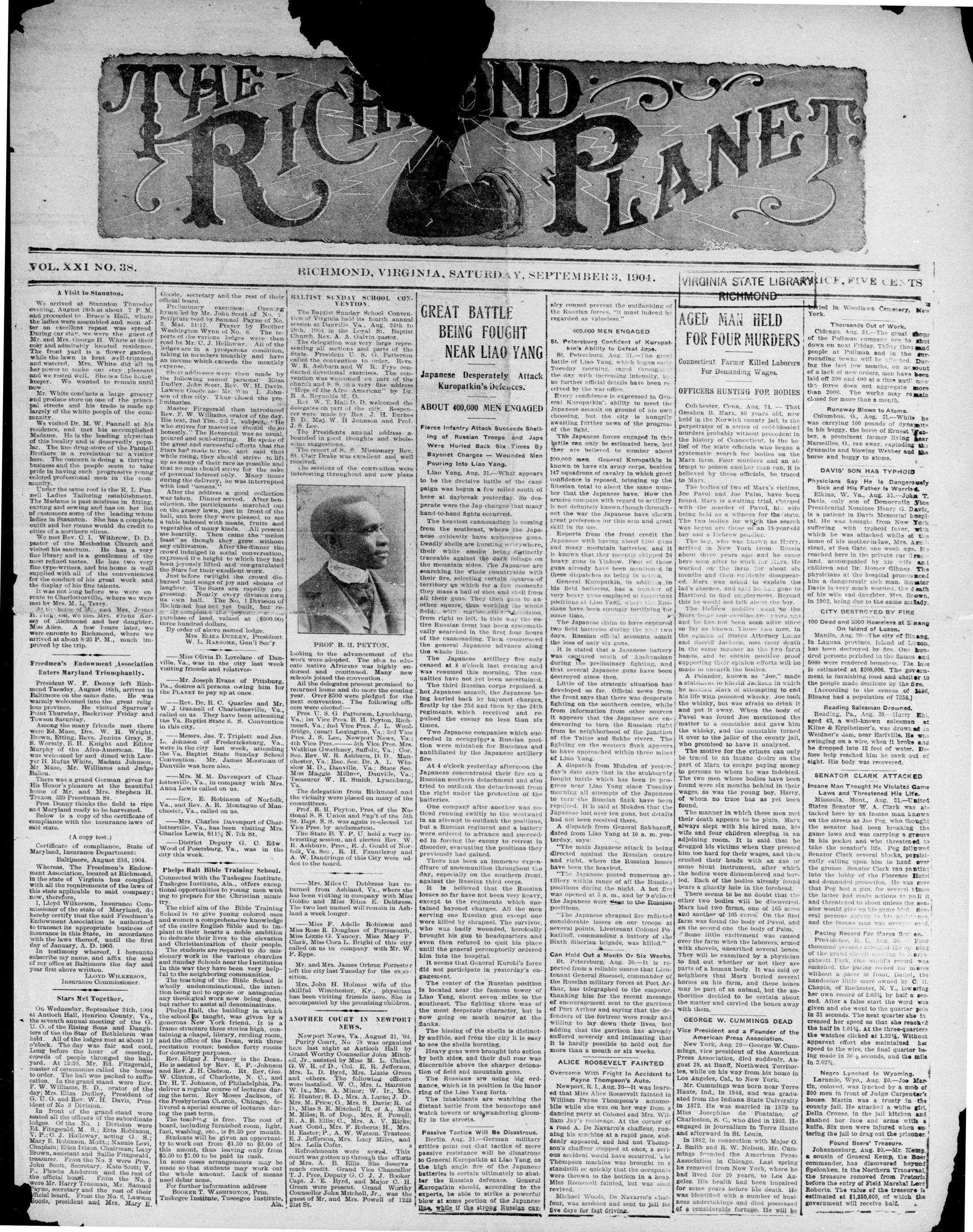
PROF. B. H. PEYTON
looking to the advancement of the work were adopted. The idea to educate native Africans was highly endorsed and continued. Many new schools joined the convention.
All the delegates present promised to return home and do more the coming year. Over $500 were pledged for the next convention. The following officers were elected:—
Pres. U. S. G. Patterson, Lynchburg, Va.; 1st Vice Pres. B. H. Peyton, Richmond, Va.; 2nd Vice Pres. J. L. Wooldridge, (near) Lexington, Va.; 3rd Vice Pres. J. S. Lee, Newport News, Va.; 4th Vice Pres.—— 5th Vice Pres. Mrs. Watkins Gwathney, Suffolk, Va.; Cor. Sec. Rev. W. R. Ashburn, D. D., Manchester, Va.; Rec. Sec. Dr. A. L. Winslow M. D., Danville, Va.; State Sec. Miss Maggie Millner, Danville, Va.
The delegation from Richmond and the vicinity were placed on many of the committees.
Prof. B. H. Peyton, Pres. of the National S. S. Union and Sup't of the 5th St. Bapt. S. S. was again re-elected 1st Vice Pres. by acclamation. The State B. Y. P. U. held a very interesting session, and elected Rev. W. R. Ashburn, Pres. R. J. Gould of Norfolk, Va. Sec. R. H. Fauntleroy and A. W. Dandrige of this City were added to the board.
---
—Mrs. Miles C. Debbess has returned from Ashland, Va., where she has been visiting in company with Miss Goldie and Miss Edna E. Debbess. The two last named will remain in Ashland a week longer.
—Miss F. Adelle Robinson and Miss Rose R. Douglass of Portsmouth, Miss Lizzie G. Yancey, Miss Mary F. Clark, Miss Cora L. Bright of this city called on us in company with Mr. W. P. Epps.
Mr. and Mrs. James Orbren Forrester left the city last Tuesday for the exposition.
Mrs. John H. Holmes wife of the skillful Winchester, Ky., physician has been visiting friends here. She is accompanied by the promising children.
ANOTHER COURT IN NEWPORT NEWS.
Newport News, Va. August 31, '04.
Purity Court, No 78 was organized here last night at Antioch Hall by Grand Worthy Counsellor John Mitchell, Jr., assisted by Miss M. L. Chiles, G. W. R. of D., Col. E. R. Jefferson, Mrs. L. D. Byrd, Mrs. Lizzie Green and others. The following officers were installed. W. C. Mrs. L. Hairston W. Ix., Mrs. A. Minor, W. Ir., Mrs. E. Hunter; S. D., Mrs. A. Lucie; J. D. Mrs. M. Price; O. Mrs. S. Davis; R. D., Miss S. M. Mitchell; R. of A., Miss M. Miles; R. of Dep., Mrs. E. Powell; E, A. B. Ellis; C., Mrs. A. V. Ricks; Asst Cond., Mrs. F. Roberts; H., Mrs. H. Easter; P, A. W. Watson; Trustees; E. J. Jefferson, Mrs. Lucy Miles, and M. Lella Cofer.
Refreshments were sewed. This court was gotten up through the efforts of Mrs. B. E. Ellis. She deserves much credit. Grand Vivian Counsellor T. J. Pree, Deputy G. C. J. J. Booke Capt. J. E. Byrd, and Major C. H. Green were present. Grand Worthy Counsellor John Mitchell, Jr., was the guest of Mr. and Mrs. Powell of 1222 1st St.
GREAT BATTLE BEING FOUGHT NEAR LIAO YANG
Japanese Desperately Attack
Kuropatkin's Defences.
ABOUT 400,000 MEN ENGAGED
Fierce Infantry Attack Succeeds Shelling of Russian Troops and Japs
Were Hurtled Back Six Times By Bayonet Charges — Wounded Men
Pouring Into Liao Yang.
Liao Yang, Aug. 31.—What appears to be the decisive battle of the campaign was begun a few miles south of here at daybreak yesterday. So desperate were the Jap charges that many hand-to-hand fights occurred.
The heaviest cannonading is coming from the southeast, where the Japanese evidently have numerous guns. Deadly shells are bursting everywhere, their white smoke being distinctly traceable against the dark foliage on the mountain sides. The Japanese are searching the whole countryside with their fire, selecting certain squares of territory on which for a few moments they mass a hail of shot and shell from all their guns. They then pass to another square, thus working the whole field, with mathematical precision, from right to left. In this way the entire Russian front has been systematically searched in the first four hours of the cannonading. Then commenced the general Japanese advance along the whole line.
The Japanese artillery fire only ceased at 8 o'clock last evening and was resumed this morning. The casualties have not yet be ascertained.
The third Russian corps repulsed a hot Japanese assault, the Japanese being hurled back by bayonet charges, firstly by the 23d and then by the 24th regiments, which received and repulsed the enemy no less than six times.
Two Japanese companies which succeeded in occupying a Russian position were mistaken for Russians and annihilated by the Japanese artillery fire.
At 4 o'clock yesterday afternoon the Japanese concentrated their fire on a Russian southern detachment and also tried to outflank the detachment from the right under the protection of the batteries.
One company after another was noticed running swiftly to the westward in an attempt to outflank the positions, but a Russian regiment and a battery were ordered to advance and succeeded in forcing the enemy to retreat in disorder, evacuating the positions they previously had gained.
There has been an immense expenditure of ammunition throughout the day, especially on the southern front, against the Russian third corps.
It is believed that the Russian losses so far have not been very heavy, except to the regiments which sustained bayonet charges. All the men serving one Russian gun except one were killed by shrapnel. The survivor, who was badly wounded, herociously brought his gun to headquarters and even then refused to quit his place until the general peremptorily ordered him into the hospital.
It seems that General Kuroki's force did not participate in yesterday's engagement.
The center of the Russian position is located near the famous tower of Liao Yang, about seven miles to the southeast. The fighting there was of the most desperate character, but is now going on much nearer at the flanks.
The hissing of the shells is distinctly audible, and from the city it is easy to see the shells bursting.
Heavy guns were brought into action by both sides, and their dull roar was discernible above the sharper detonation of field and mountain guns.
The Russians are using big ordnance, which is in position in the inner ring of the Liao Yang forts.
The inhabitants are watching the distant battle from the housetops and watch towers or are wandering gloomily in the streets.
Passive Tactics Will Be Disastrous.
Berlin, Aug. 31. German military critics point out that tactics of mere passive resistance will be disastrous to General Kuropatkin at Liao Yang, as the high angle fire of the Japanese batteries is certain ultimately to shatter the Russian defenses. General Kuropatkin should, according to the experts, be able to strike a powerful blow at some portion of the Japanese line, while if the strong Russian cay-
alry cannot prevent the outflanking of the Russian forces, "it must indeed be regarded as valueless."
400,000 MEN ENGAGED
St. Petersburg Confident of Kuropatkin's Ability to Defeat Japan
Kin's Ability to Defeat Japs.
St. Petersburg, Aug. 31.—The great battle of Liao Yang, which began early Tuesday morning, raged throughout the day with increasing intensity, but no further official details have been received by the war office.
Every confidence is expressed in General Kuropatkin's ability to meet the Japanese assault on ground of his own choosing, but the city is hungry awaiting further news of the progress of the fight.
The Japanese forces engaged in this battle can only be estimated here, but they are believed to number about
200,000 men. General Kuropatkin is known to have six army corps, besides 147 squadrons of cavalry in which great confidence is reposed, bringing up the Russian total to about the same number that the Japanese have. How the armies compare with regard to artillery is not definitely known, though throughout the war the Japanese have shown great preference for this arm and great skill in its use.
Reports from the front credit the Japanese with having about 1200 guns and many mountain batteries, and it is known that they recently shipped 24 heavy guns to Yinkow. Four of these guns already have been mentioned in these dispatches as being in action.
General Kuropatkin, in addition to his field batteries, has a number of very heavy guns emplaced at important positions at Liao Yang, where the Russians have been strongly fortifying for some time.
The Japanese claim to have captured two field batteries during the past two days. Russian official accounts admit the loss of only six guns. It is stated that a Japanese battery was captured south of Anshanshan during the preliminary fighting, and that several Japanese guns have been destroyed since then. Little of the strategic situation has developed so far. Official news from the front says that there was desperate fighting on the southern centre, while from information from other sources it appears that the Japanese are endeavoring to turn the Russian right from he neighborhood of the junction of the Taitse and Sakhe rivers. The fighting on the western flank appears to have approached within three miles of Lino Yang.
A dispatch from Mukden of yesterday's date says that in the stubbornly fought battle which has been in progress near Liao Yang since Tuesday morning all attempts of the Japanese to turn the Russian flank have been repulsed. It is said at Mukden that the Japanese lost over ten guns, but details had not been received there.
A dispatch from General Sakharoff, dated from Liao Yang at 10 a. m. yesterday, says:
"The main Japanese attack is being directed against the Russian centre and right, where the Russian losses have been the heaviest.
"The Japanese posted numerous artillery within range of all the Russian positions during the night. A hot fire was opened at 5 a. m., and by 9 o'clock the Japanese were close to the Russian positions.
"The Japanese shrapnel fire inflicted considerable losses on our troops at several points, Lieutenant Colonel Pokatiloff, commanding a battery of the Sixth Siberian brigade, was killed."
Can Hold Out a Month Or Six Weeks.
St. Petersburg, Aug. 30.—It is reported from a reliable source that Lieutenant General Stoessel, commander of the Russian military forces at Port Arthur, has telegraphed to the emperor, thanking him for the recent message of encouragement sent to the garrison of Port Arthur and saying that the defenders of the fortress were ready and willing to lay down their lives, but adding that the garrison has already suffered severely and intimating that it is hardly possible to hold out for more than a month or six weeks.
ALICE ROOSEVELT FAINTED
Overcome With Fright In Accident to Payne Thompson's Auto
Newport, R.I., Aug. 30—It was learned that Miss Alice Roosevelt fainted in William Payne Thompson's automobile while she was on her way from a dancing party at Colonel and Mrs. William Jay's residence. At the corner of a road A. De Navarro's chaffeur, running his machine at a rapid pace, suddenly appeared, and had not Thompson's chaffeur stopped at once, a serious accident would have occurred. The Thompson machine was brought to a standstill so quickly that the occupants were thrown to the bottom in a heap. Miss Roosevelt fainted, but was soon revived.
Michael Woods, De Navarro's chaffeur, was arrested and sent to jail for five days for fast driving.
AGED MAN HELD FOR FOUR MURDERS
Connecticut Farmer Killed Laborers For Demanding Wages.
OFFICERS HUNTING FOR BODIES
Colchester, Conn., Aug. 31. — That Gershon B. Marx, 80 years old, now held in the Norwich county jail, is the perpetrator of a series of cold-blooded murders probably without precedent in the history of Connecticut, is the belief of the state officials who began a systematic search for bodies on the Marx farm. Four murders and an attempt to poison another man can, it is believed by these officials, be traced to Mary.
The bodies of two of Marx's victims, Joe Pavol and Joe Palm, have been found. Marx is awaiting trial, charged with the murder of Pavol, his wife being held as a witness for the state. The two bodies for which the search was begun are those of an 18-year-old boy and a liebread peedler. The boy, who was known as Harry, arrived in New York from Russia about three years ago and he came here soon after to work for Marx. He worked on the farm for about six months and then suddenly disappeared. Marx was asked to explain the lad's absence, and said he had gone to Hartford to find employment. Beyond this he would not talk about the boy.
The Hebrew peddler went to the Marx home one evening two years ago and he has not been seen alive since so far as known. These two men, in the opinion of States Attorney Lucas and Sheriff Jackson, met their death in the same manner as the two farm hands, and to obtain positive proof supporting their opinion efforts will be made to unearth the bodies.
A Polander, known as "Joe," made a statement to Sheriff Jackson in which he accused Marx of attempting to end his life with poisoned whisky. Joe took the whisky, but was afraid to drink it and put it away. When the body of Pavol was found Joe mentioned the matter to a constable and gave him the whisky, and the constable turned it over to the jailor of the county jail, who promised to have it analyzed.
The motive for the crimes can only be traced to an insane desire on the part of Marx to escape paying money to persons to whom he was indebted. The two men whose bodies have been found were six months behind in their wages, as was the young boy, Harry, of whom no trace has as yet been found.
The manner in which these men met their death appears to be plain. Marx always slept with his hired man, his wife and four children sleeping in an adjoining room. It is said that he drugged his victims when they pressed him too hard for their wages, and then crushed their heads with an axe or some blunt instrument, after which the bodies were dismembered and buried. Each of the bodies already found bears a ghastly hole in the forehead.
There seems to be no doubt that the other two bodies will be discovered. Marx had two farms, one of 165 acres and another of 105 acres. On the first farm was found the body of Pavol, and on the second one the body of Palm. Some little excitement was caused over the farm when the laborers, armed with shovels, unearthed several bones. They will be examined by a physician to find out whether or not they are parts of a human body. It was said by neighbors that Marx buried several horses on his farm, and these bones may be part of an animal, but the authorities decided to be certain about the matter and carried the bones away with them.
GEORGE W. CUMMINGS DEAD
Vice President and a Founder of the American Press Association.
American Press Association.
New York, Aug. 29—George W. Cummings, vice president of the American Press Association, died suddenly, August 28, at Banff, Northwest Territories, while on his way from his home in Los Angeles, Cal., to New York.
Mr. Cummings was born near Terre Haute, Ind., in 1848, and was graduated from the Indiana State University in 1872. He was married in 1879 to Miss Josephine de Fontaine, of Charleston, S. C., who died in 1903. He engaged in journalism in Terre Haute and afterward in St. Louis.
In 1882, in connection with Major O. J. Smith and R. W. Nelson, Mr. Cummings founded the American Press Association in Chicago. Last spring he removed from New York, where he had lived for 20 years, to Los Angeles. His health had been impaired for some years before his death. He was identified with a number of business undertakings and died possessed of a considerable fortune. He will be
Chicago, Aug. 31.—The great shops of the Pullman company are to shut down on next Friday. Thirty thousand people at Pullman and in the surrounding towns will be affected. During the last few months, on account of a lack of new orders, men have been laid off 300 and 400 at a time until now the force does not aggregate more than 2000. The works may remain closed for more than a month.
Runaway Blown to Atoms
Columbus, O., Aug. 31. While he was carrying 100 pounds of dynamite in his buggy, the horse of Ernest Webber, a prominent farmer living near Marsellies, O., ran away, exploding the dynamite and blowing Webber and the horse and buggy to atoms.
DAVIS' SON HAS TYPHOI
Physicians Say He Is Dangerously
Sick and His Enthusiasts
Sick and His Father is Worried.
Elkins, W. V., Aug. 31. - John T. Davis, only son of Democriteia Vice Presidential Nominee Henry G. Davis, is a patient in Davis Memorial hospital. He was brought from New York suffering with typhoid fever, with which he was attacked while at the home of his mother-in-law, Mrs. Arnoldstead, at Sea Gate, one week ago. He reached here in the private car Grace land, accompanied by his wife and children and Dr. Homer Gibney. The physicians at the hospital pronounced him a dangerously sick man. Senator Davis is very much worried, the d death of his wife and daughter, Mrs. Brown, in 1902, being due to the same malady.
CITY DESTROYED BY FIRE
100 Dead and 5000 Homeless at Binang
On Island of Luzon.
Manila, Aug. 30—The city of Binang,
in Laguna province, Island of Luzon,
has been destroyed by fire. One
hundred persons perished in the flames and
5000 were rendered homeless. The loss
is estimated at $200,000. The government
is furnishing food and shelter to
the people made destitute by the fire.
[According to the census of 1896,
Binang had a population of 7338.]
Reading Salesman Drowned
Reading, Pa, Aug. 30.—Harry Ehl-
aged 43, a well-known salesman at
Kline & Eppheimer's, was drowned in
Weidner's dam, near Earlville. He was
swinging on a wire, when it broke and
he dropped into 12 feet of water.
Before help reached him he sank out of
sight. His body was recovered.
SENATOR CLARK ATTACKED
Insane Man Thought He Violated Game
Louis and Theodore World
Laws and Threatened His Life.
Missoula, Mont., Aug. 31—United States Senator W. A. Clark was attacked here by an insane man known on the streets as Joe Peg, who thought the senator had been breaking the game laws and was carrying a grouse in his pocket and who threatened to take the senator's life. Peg followed Senator Clark several blocks, persistently calling upon him to hand over the grouse. Senator Clark ran painting into the lobby of the Florence Hotel and demanded protection. He was sure that Peg had a gun, for several times the latter had made actions to pull it and threatened to shoot unless the senator would give up his game blind. Several persons spring to his assistance, and the insane man was overruned.
Pacing Record For Maras Bristen.
Providence, R. L., Aug. 30. — Four thousand persons attended the oping of the grand circuit meeting in Narransett Park. One world's record was smashed, the pacing record for males without a pacer in front, Daniel, the handsome little mare owned by C. H. Chapin, of Rochester, N. Y., lowering her own record of 2.03¹⁴ by half a second. After a false start the word was given and she went to the quarter pole in 31 seconds. The next quarter she increased her speed so that she reached the half in 1.01¹⁴. At the three-quarter the watches clicked at 1.32¹⁴. Without apparent effort she maintained her speed to the wire, the final quarter being made in 30½ seconds, and the mile in 2.02¹⁴.
Negro Lynched in Wyoming.
Laramie, Wyo., Aug. 80—Joe Martin, colored, was lynched by a mob of 300 men in front of Judge Carpenter's house. Martin was a trusty in the county jail. He attacked a white girl, Della Crouse, in the jail kitchen and slashed her face and arms with a knife. Six men were injured when entering the jail to drag out the prisoner.
Found Boers' Treasure.
Johannesburg, Aug. 80.—Mr. Kemp, a cousin of General Kemp, the Boer commander, has discovered beyond Spelonken, in the Northern Transvaal, the treasure removed from Pretoria before the entry of Field Marshal Lord Roberts. The value of the treasure is estimated at $1,250,000, of which the government will receive half.
THE
SIGN OF THE
FOUR.
BY CONAN DOYLE.
"Well, we carried him in, Abdullah, Akbar and I. A fine weight he was, too, for all that he was so short. Mahomet Singh was left to guard the door. We took him to a place which the Sikhs had already prepared. It was some distance off, where a winding passage leads to a great empty hall, the brick walls of which were all crumbling to pieces. The earth floor had sunk in at one place, making a natural grave, so we left Achmet the merchant there, having first covered him over with loose bricks. This done, we all went back to the treasure.
"It lay where he had dropped it when he was first attacked. The box was the same which now lies open upon your table. A key was hung by a silk cord to that carved handle upon the top. We opened it, and the light of the lantern gleamed upon a collection of gems such as I have read of and thought about when I was a little lad at Pershore. It was blinding to look upon them. When we had feasted our eyes we took them all out and made a list of them. There were one hundred and forty-three diamonds of the first water, including one which has been called, I believe, 'the Great Mogul', and is said to be the second largest stone in existence. Then there were ninety-seven very fine emeralds, and one hundred and seventy rubies, some of which, however, were small. There were forty carbuncles, two hundred and ten sapphires, sixty-one agates and a great quantity of beryls, onyxes, cat's eyes, turquoises and other stones, the very names of which I did not know at the time, though I have become more familiar with them since. Besides this, there were nearly three hundred very fine pearls, twelve of which were set in a gold coronet. By the way, these last had been taken out of the chest and were not there when I recovered it.
"After we had counted our treasures we put them back into the chest and carried them to the gateway to show them to Mahomet Singh. Then we solemnly renewed our oath to stand by each other and be true to our secret. We agreed to conceal our loot in a safe place until the country should be at peace again, and then to divide it equally among ourselves. There was no use dividing it at present, for if gems of such value were tound upon us it would cause suspicion, and there was no privacy in the fort nor any place where we could keep them. We carried the box, therefore, into the same hall where we had buried the body, and there, under certain bricks in the best-preserved wall, we made a hollow and put our treasure. We made careful note of the place, and next day I drew four plans, one for each of us, and put the sign of the four of us at the bottom, for we had sworn that we should each always act for all, so that none might take advantage. That is an oath that I can put my hand to my heart and swear that I have never broken.
"Well, there's no use my telling you, gentlemen, what came of the Indian mutiny. After Wilson took Delhi and Sir Colvin relieved Lucknow the back of the business was broken. Fresh troops came pouring in, and Nana Sahib made himself scarce over the frontier. A flying column under Col. Greathead came round to Agra and cleared the Pandies away from it. Peace seemed to be settling upon the country, and we four were beginning to hope that the time was at hand when we might safely go off with our shares of the plunder. In a moment, however, our hopes were shattered by our being arrested as the murderers of Achmet.
"It came about in this way: When the rajah put his jewels into the hands of Achmet he did it because he knew that he was a trusty man. They are suspicious folk in the east, however; so what does this rajah do but take a second even more trusty servant and set him to play the spy upon the first? This second man was ordered never to let Achmet him like his sight, and he followed him like his shadow. He went after him that night, and saw him pass through the doorway. Of course he thought he had taken refuge in the fort, and applied for admission there himself next day, but could find no trace of Achmet. This seemed to him so strange that he spoke about it to a sergeant of guides, who brought it to the ears of the commandant. A thorough search was quickly made, and the body was discovered. Thus at the very moment that we thought that all was safe we were all four seized and brought to trial on a charge of murder—threep of us because we had held the gate that night, and the fourth because he was known to have been in company of the murdered man. Not a word about the jewels came out at the trial, for the rajah had been deposed and driven out of India; so no one had any particular interest in them. The murder, however, was clearly made out, and it was certain that we must all have been concerned in it. The three Sikhs got penal servitude for life, and I was condemned to death, though my sentence was afterward commuted into the same as the others.
"It was rather a queer position that we found ourselves in then. There we were, all four tied by the leg and with precious little chance of ever getting out again, while we each held a secret which might have put each of us in a palace if we could only have made use of it. It was enough to make a man eat his heart out to have to stand the kick and the cuff of every petty jack in office, to have rice to eat and water to drink, when that gorgeous fortune was ready for him outside, just waiting to be picked up. It might have driven me mad; but I was always a pretty stubborn one, so I just held on and bled my time.
"At last it seemed to me to have come. I was changed from Agra to Madras, and from there to Blair island
In the Andamans. There are very few white convicts at this settlement, and, as I had behaved well from the first, I soon found myself a sort of privileged person. I was given a hut in Hope town, which is a small place on the slopes of Mount Harriet, and I was left pretty much to myself. It is a dreary, fever-streken place, and all beyond our little clearings was infested with wild cannibal natives, who were ready enough to blow a poisoned dart at if they saw a chance. There was digging, and ditching, and yam-planting, and a dozen other things to be done, so we were busy enough all day; though in the evening we had a little time to ourselves. Among other things, I learned to dispense drugs for the surgeon, and picked up a smattering of his knowledge. All the time I was on the lookout for a chance of escape; but it is hundreds of miles from any other land, and there is little or no wind in those seas; so it was a terribly difficult job to get away.
"The surgeon, Dr. Somerton, was a fast, sporting young chap, and the other young officers would meet in his rooms of an evening and play cards. The surgery, where I used to make up my drugs, was next to his sitting-room, with a small window between us. Often, if I felt lonesome, I used to turn out the lamp in the surgery, and then, standing there, I could hear their talk and watch their play. I am fond of a hand at cards myself, and it was almost as good as having one to watch the others. There was Maj. Sholto, Capt. Morstan and Lieut. Bromley Brown, who were in command of the native troops, and there was the surgeon himself, and two or three prison-officials, crafty old hands who played a nice sly game. A very snug little party they used to make.
"Well, there was one thing which very soon struck me, and that was that soldiers used always to lose and the civilians to win. Mind. I don't say that there was anything unfair, but so it was. These prison chaps had done little else than play cards ever since they had been at the Andamans, and they knew each other's game to a point, while the others just played to pass the time and threw their cards down anyhow. Night after night the soldiers got up poorer men, and the poorer they got the more keen they were to play. Maj. Sholto was the hardest hit. He used to pay in notes and gold at first, but soon it came to notes of hand and for big sums. He sometimes would win for a few deals, just to give him heart, and then the luck would set in against him worse than ever. All day he would wander about as black as thunder, and he took to drinking a deal more than was good for him.
"One night he lost even more heavily than usual. I was sitting in my hut when he and Capt. Morstan came stumbling along on the way to their quarters. They were bosom friends, those two, and never far apart. The major was raving about his losses.
"It's all up, Morstan," he was saying, as they passed my hut. "I shall have to send in my papers. I am a ruined man."
"Nonsense, old chap!" said the other, slapping him upon the shoulder. I've had a nasty facer myself, but—That was all I could hear, but it was enough to set me thinking.
"A couple of days later Maj Sholto was strolling on the beach; so I took the chance of speaking to him.
"I wish to have your advice, major, said I.
"Well, Small, what is it?" he said, taking his cheroot from his lips.
"I wanted to ask you, sir," said I. "who is the proper person to whom hidden treasure should be handed over. I
know where half a million worth lies, and, as I cannot use it myself, I thought perhaps the best thing that I could do would be to hand it over to the proper authorities, and then perhaps they would get my sentence shortened for me.
"Half a million, Small?" he gasped, looking hard at me to see if I was in earnest.
"Quite that, sir—in jewels and pearls. It lies there ready for anyone. And the queer thing about it is that the real owner is outlawed and cannot hold property, so that it belongs to the first comer."
"To government, Small," he stammered—to government. But he said in a halting fashion, and I knew in my heart that I had got him.
"You think then, sir, that I should give the information to the governor general?" said I quietly.
"Well, well, you must not do anything rash, or that you might repent. Let me hear all about it, Small. Give me the facts."
"I told him the whole story, with small changes so that he could not identify the places. When I had finished he stood stock still and full of thought. I
Nicholl
"I WISH TO HAVE YOUR ADVICE, MAYOR."
could see by the twitch of his lip that there was a struggle going on within him.
"This is a very important matter."
THE RICHMOND PLANET, RICHMOND, VIRGINIA
Small,' he said, at last. 'You must not say a word to anyone about it, and I shall see you again soon.' "Two nights later he and his friend Capt. Morstan came to my hut in the dead of the night with a lantern. "I want you just to let Capt. Morstan hear that story from your own lips, Small,' said he. "I repeated it as I had told it before. "It rings true, eh?' said he. 'It's good enough to act upon." "Capt. Morstan was
"Look here, Small,' said the major. 'We have been talking it over, my friend here and I, and we have come to the conclusion that this secret of yours is hardly a government matter, after all, but is a private concern of your own, which of course you have the power of disposing of as you think best. Now, the question is, what price would you ask for it? We might be inclined to take it up, and at least look into it, if we could agree as to terms. He tried to speak in a cool, careless way, but his eyes were shining with excitement and greed.
"Why, as to that, gentlemen," I answered, trying also to be cool, but feeling as excited as he did, "there is only one bargain which a man in my position can make. I shall want you to help me to my freedom, and to help my three companions to theirs. We shall then take you into partnership, and give you a fifth share to divide between you."
"Hum!' said he. 'A fifth share! That is not very tempting.'
"It would come to fifty thousand apiece, said I.
"But how can we gain your freedom? You know very well that you ask an impossibility."
"Nothing of the sort," I answered. I have thought it all out to the last detail. The only bar to our escape is that we can get no boat fit for the voyage, and no provisions to last us for so long a time. There are plenty of little yachts and yawls at Calcutta or Madras which would serve our turn well. Do you bring one over. We shall engage to get aboard her by night, and if you will drop us on any part of the Indian coast you will have done your part of the bargain.
"If there were only one," he said.
"None or all," I answered. "We have sworn it. The four of us must always act together."
"You see, Morstan," said he, "Small is a man of his word. He does not flinch from his friends. I think we may very well trust him."
"It's a dirty business," the other answered. "Yet, as you say, the money would save our commissions handsomely."
"Well, Small," said the major, "we must. I suppose, try and meet you. We must first, of course, test the truth of your story. Tell me where the box is hid, and I shall get leave of absence and go back to India in the monthly relief-boot to inquire into the affair."
"Not so fast," said I, growing colder as he got hot. "I must have the consent of my three comrades. I tell you that it is four or none with us."
"Nonsense!" he broke in. "What have three black fellows to do with our agreement?"
"Black or blue," said I, "they are in with me, and we all go together."
"Well, the matter ended by a second meeting, at which Mahomet Singh, Abdullah Khan and Dost Akbar were all present. We talked the matter over again, and at last we came to an arrangement. We were to provide both the officers with charts of the part of the Agra fort and mark the place in the wall where the treasure was hid. Maj Sholto was to go to India to test our story. If he found the box he was to leave it there, to send out a small vacht provisioned for a voyage, which was to lie off Rutland island, and to which we were to make our way, and finally to return to his duties. Capt. Morstan was then to apply for leave of absence, to meet us at Agra, and there
we were to have a final division of the treasure, he taking the major's share as well as his own. All this we sealed by the most solemn oaths that the mind could think or the lip utter. I sat up all night with paper and ink, and by morning I had the two chants all ready, signed with the sign of four—that is, of Abdullah, Akbar, Mahomet and myself.
"Well, gentlemen, I weary you with my long story, and I know that my friend Mr. Jones is impatient to get me safely stowed in chokey. I'll make it as short as I can. The villain, Sholto, went off to India, but he never came back again. Capt. Morstan showed me his name among a list of passengers in one of the mail boats very shortly afterwards. His gnelle had died, leaving him a fortune, and he had left the army, yet he could stoop to treat five men as he had treated us. Morstan went over to Agra shortly afterwards, and found, as we expected, that the treasure was indeed gone. The scoundrel had stolen it all, without carrying out one of the conditions on which we had sold him the secret. From that day I lived only for vengeance. I thought of it by day and I nursed it by night. It became an overpowering, absorbing passion with me. I cared nothing for the law—nothing for the gallows. To escape, to track down Sholto, to have my hand upon his throat—that was my one thought. Even the Agra treasure had come to be a smaller thing in my mind than the slaying of Sholto.
"Well, I have set my mind on many things in this life, and never one which I did not carry out. But it was weary years before my time came. I have told you that I had picked up something of medicine. One day when Dr. Somerton was down with a fever a little Andaman islander was picked up by a convict gang in the woods. He was slick to death, and had gone to a lonely place to die. I took him in hand, though he was as venomous as a snake, and after a couple of months I got him all right and able to walk. He took a kind of fancy to me then, and would hardly go back to his woods, but was always hanging about my hut. I learned a little of his lingo from him, and this made him all the fonder of me.
"Tonga—for that was his name—was a fine boatman, and owned a big, roomy canoe of his own. When I found that he was devoted to me and would do anything to serve me, I saw my chance of escape. I talked it over with him. He was to bring his boat on a certain night to an old wharf which was never guarded, and there he was to pick me up. I gave him directions to have several gourds of water and a lot of yams, cocoanuts and sweet potatoes.
"He was staunch and true, was little Tonga. No man ever had a more faith
tal mate. At the night named he had his boat at the wharf. As it chanced, however, there was one of the convict guard down there—a vile Pathan who had never missed a chance of insulting and injuring me. I had always vowed vengeance, and now I had my chance. I was as if fate had placed him in my way that I might pay my debt before I left the island. He stood on the bank with his back to me and his carbine on his shoulder. I looked about for a stone to beat out his brains with, but none could I see. Then a queer thought came into my head and showed me where I could lay my hand on a weapon. I sat down in the darkness and unstrapped my wooden leg. With three long hops I was on him. He put his carbine to his shoulder, but I struck him full and knocked the whole front of his skull in. You can see the split in the wood now where I hit him. We both went, down together, for I could not keep my balance, but when I got up I found him still lying quiet. I made for the boat and in an hour we were well out at sea. Tonga had
I STRUCK HIM FULL.
brought all his earthly possessions with him, his arms and his gods. Among other things, he had a long bamboo spear and some Andaman cocoanat matting, with which I made a sort of a sail. For ten days we were beating about, trusting to luck, and on the eleventh we were picked up by a trader which was going from Singapore to Jiddah with a crowd of Malay pilgrims. They were a rum crowd, and Tonga and I soon managed to settle down among them. They had one good quality—they let you alone and asked no questions.
"Well, if I were to tell you all the adventures that my little chum and I went through, you would not thank me, for I would have you here until the sun was shining. Here and there we drifted about the world, something always turning up to keep us from London. All the time, however, I never lost sight of my purpose. I would dream of Sholto at night. A hundred times I have killed him in my sleep. At last, however, some three or four years ago, we found ourselves in England. I had no great difficulty in finding where Sholto lived, and I set to work to discover whether he had realized the treasure, or if he still had it. I made friends with some one who could help me—I name no names, for I don't want to get anyone else in a hole—and I soon found that he still had the jewels. Then I tried to get at him in many ways; but he was pretty sly, and had always two prize fighters, besides his sons and his khitmutgar, on guard over him.
"One day, however, I got word that he was dying. I hurried at once to the garden, mad that he should slip out of my clutches like that, and, looking through the window, I saw him lying in his bed, with his sons on each side of him. I'd have come through and taken my chance with the three of them, only even as I looked at him his jaw dropped, and I knew that he was gone. I got into his room that same night, though, and I searched his papers to see if there was any record of where he had hidden our jewels. There was not a line, however, so I came away, bitter and savage as a man could be. Before I left I bethought me that if I ever met my Silk friends again it would be a satisfaction to know that I had left some mark of our hatred; so I scrawled down the sign of the
WE WEBE PICKED UP BY A TRADER
four of us, as it had been on the chart,
and I pinned it on his bosom. It was too much that he should be taken to the grave without some token from the men whom he had robbed and befooled.
"We earned a living at this time by my exhibiting poor Tonga at fairs and other places as the black cannibal. He would eat raw meat and dance his war dance; so we always had a hattful of pennies after a day's work. I still heard all the news from Pondichier Lodge, and for some years there was no news to hear, except that they were hunting for the treasure. At last, however, came what we had waited for so long. The treasure had been found. It was up at the top of the house, in Mr. Bartholomew Sholto's chemical laboratory. I came at once and had a look at the place, but I could not see with my wooden leg I was to make my way up to it. I learned, however, about a trap-door in the roof, and also about Mr. Sholto's supper hour. It seemed to me that I could manage the thing easily through Tonga. I brought him out with me with a long rope wound round his waist. He could climb like a cat, and he soon made his way through the roof, but, as ill luck would have it, Bartholomew Sholto was still in the room, to his cost. Tonga thought he had done something very clever in killing him, for when I came up by the
rope I found him strutting about as proud as a peacock. Very much surprised was he when I made at him with the rope's end and cursed him for a little bloodthirsty imp. I took the treasure-box and let it down, and then slid down myself, having first left the sign of the four upon the table, to show that the jewels had come back at last to those who had most right to them. Tonga then pulled up the rope, closed the window, and made off the way that he had come.
"I don't know that I have anything else to tell you. I had heard a waterman speak of the speed of Smith's launch, the Aurora, so I thought she would be a handy craft for our escape. I engaged with old Smith, and was to give him a big sum if he got us safe to our ship. He knew, no doubt, that there was some screw loose, but he was not in our secrets. All this is the truth, and if I tell it to you, gentlemen, it is not to amuse you—for you have not done me a very good turn—but it is because I believe the best defense I can make is just to hold back nothing, but let all the world know how badly I have myself been served by Maj. Sholto, and how innocent I am of the death of his son."
"A very remarkable account," said Sherlock Holmes. "A fitting wind-up to an extremely interesting case. There is nothing at all new to me in the latter part of your narrative, except that you brought your own rope. That I did not know. By the way, I had hoped that Tonga had lost all his darts; yet he managed to shoot one at us in the boat." "He had lost them all, sir, except the one which was in his blow pipe at the time." "Ah, of course," said Holmes. "I had not thought of that." "Is there any other point which you would like to ask about?" asked the convict, affably. "I think not, thank you," my companion answered.
"Well, Holmes," said Athelney Jones, "you are a man to be humored, and we all know that you are a consoisseur of crime, but duty is duty, and I have gone rather far in doing what you and your friend asked me. I shall feel more at ease when we have our story-teller here under look and key. The cab still waits, and there are two inspectors downstairs. I am much obliged to you both for your assistance. Of course, you will be wanted at the trial. Good-night to you."
"Good-night, gentlemen, both," said Jonathan Small.
"You first, Small," remarked the wary Jones as they left the room. "I take particular care that you don't club me with you wooden leg, whatever you may have done to the gentleman at the Andaman Isles."
"Well, and there is the end of our drama," I remarked, after we had sat some time smoking in silence. "I fear it shall be the last investigation in which I shall have the chance of study-
ing your methods. Miss Morstun has done me the honor to accept me as a husband in prospective."
He gave a most dimalgroan. "I feared as much," said he. "I really cannot congratulate you."
I was a little hurt. "Have you any reason to be dissatisfied with my choice?" I asked.
"Not at all. I think she is one of the most charming young ladies I ever met, and might have been most useful in such work as we have been doing. She had a decided genius that way; witness the way in which she preserved that Agra plan from all the other papers of her father. But love is an emotional thing, and whatever is emotional is opposed to that true cold reason which I place above all things. I should never marry myself, lest I blas my judgment."
"I trust," said I, laughing, "that my judgment may survive the ordeal. But you look weary."
"Yes, the reaction is already upon me. I shall be as limp as a rag for a week."
"Strange," said I, "how terms of what in another man I should call laziness alternate with fits of splendid energy and vigor."
"Yes," he answered, "there are in me the makings of a very fine loafer and also of a pretty spry sort of fellow. I often think of those lines of old Goethe:
"Schade dass die Natur nur etten Mensch aus dirschut."
Denn zum wurdligen Mann war und zum Schelmen der Stoff."
By the way, apropos of this Norwood business, you see that they had, as I surmised, a confederate in the house, who could be none other than Lal Rao, the butler; so Jones actually has the undivided honor of having caught one fish in his great haul."
"The division seems rather unfair," I remarked. "You have done all the work in this business. I get a wife out of it, Jones gets the credit, pray what remains for you"
"For me," said Sherlock Holmes, "there still remains the cocaine-bottle." And he stretched his long white hand up for it.
THE END
How a Country Cousin Made Miserable a
Newly Made Man About Town.
Newly Made Man About Town.
When an adaptive young man from the far corner of some New England or western state lives for a time in New York, and absorbs enough of its atmosphere to gain the prestige of a regular boulevardier, it's pretty hard now and again to have old times thrust upon him in the person of a primitive cousin or brother-in-law, whom he is bound in conscience to entertain. A case of this kind occurred last week, in which the artless relative saw nothing but a screamingly funny lapse of memory, while the man about town found a mortification therein which
he pretty hard to live through.
A complete deliverance of the bumpkin into the hands of the outitter made him presentable, and then there was the little bachelor dinner at a Fifth avenue hotel given by the swell to all the smart men, who wanted "to meet your cousin, don't you know."
All went merry until the wine list came forth. To be sure, the bumpkin talked too loud and refused to understand any monitory wink, but then he said nothing too badly out of place.
"What wine will you have?" said the cousin, addressing him.
"Haw! haw! I don't know, Cousin Dick, anything about the wine. You'll have to settle that yourself."
"Shall we begin on a bottle of Sauterne?"
"Lordy, how can I tell! Anything you like!" shouted the red-checked, bullet-headed youth, who couldn't make head or tail of the winks and looks of deadly warning emanating from the swell's eye.
People at adjoining tables pricked up their cars in amused curiosity, while the guests at the table looked a trifle disconcerted at the bumpkin's noise.
"What," said the swell, firmly planting his index finger on the word "Medoc," and glaring at the youth mesmerically, so that he might understand and repeat it, "do you generally take?"
"Usually!" shouted the youth. "Hawl Hawl Hawl! Isn't that great? Usually nothing. Of course; never see wine. How could I? You know that, Cousin Dick, as well as I do. You never saw wine at home, and now New York makes you forget all about it. Usually —Hawl Hawl!" and the terrible youth stretched out at full length and roared satisfactorily for about five minutes, while a sense of frozenness stole over his cousin and the swells looked on in amused pity. That frozen custa is dead henceforth to family ties, in so far as dining social recruits is concerned, at least. N. Y. Herald.
The Fatal Word.
"My darling," he exclaimed, rapturously, "How brilliant you are. You fairly-er—bristle with ideas."
The Chicago girl drew herself up to her full height and brushed him haughtily aside as she swept out of the room.
"You seem to forget"—she turned on her heel at the door and faced him—"that I cannot brook any reference to my father's business."—N. Y. World.
OLD CORN COB PIPE.
OLD CORN COB PIPE.
IT SAVED THE LIFE OF A WELL-KNOWN PROSPECTOR.
Unique Incident in the Life of "Diamondfield Davis," a Western Cowboy Who May Soon Be a Millionaire.
This is a story of how an old cob pipe played an important part in saving the life of a man convicted of murder, and how the saving of the life may bring a large fortune to another man.
Down in the New Goldfield mining district in Nevada is a camp called Diamondfield. It did not receive its name from the fact that diamonds have been discovered there, but from the circumstance that the best claims in the camp were located by "Diamondfield Jack" Davis, who, according to late reports, is likely soon to be a multi-millionaire.
Back in the early and middle '90s "Diamondfield Jack" was a trusted range rider in the employ of the Sparks-Herrard Cattle company in Idaho. In those days there was much friction between the cattle men and the sheep men, and on the range covered by "Diamondfield Jack" it is said that a "dead line" had been established, which the sheep men were forbidden to cross with their flocks.
When, therefore, on February 16, 1896, John C. Wilson, a sheep herder, and his companion, a man named Cummings, were found dead in their camp on disputed ground, evidently murdered, and it was further discovered that "Diamondfield Jack" and his partner, Jack Gleason, had been in that locality about the time the killing took place, they were promptly arrested for the crime.
Jack Davis was placed on trial first and it was one of the most closely contested murder trials in the history of Idaho. Gov. Sparks, who believed implicitly In the innocence of his employees, retained A. L. Perky and Hawley & Pucket, of Boise, to defend Davis, while Judge O. W. Powers, of Salt Lake City, and Judge BORAH, of Boise, were employed to assist in the prosecution. Every inch of the ground was fought over carefully, the evidence was all circumstantial and the defendant came
Walter
PIPE LED TO CONFESSION.
very near proving an alibi—it having been necessary for Davis and Gleason to have made an almost impossible ride in order to have been at the sheep men's camp at the time it was proved they were killed. But Davis was convicted of murder in the first degree. His case was sent to the supreme court of Idaho and to the federal court of appeals, but he was beaten at every turn and the date of his execution was finally fixed, with only the possible clemency of the governor to intervene.
Then it was that Judge O. W. Powers, who had done at least as much as any other man to convict Dayas, became con-
---
vinced, largely upon the strength of new evidence discovered, that Davis was innocent. Judge Powers thereupon went before the governor of Idaho and pleaded for the commutation of Davis' sentence to life imprisonment, which was granted. Later, he presented to the governor a written argument for an absolute pardon for Davis and this was also granted.
When Judge Powers was recently reminded of the celebrated case he said, "Do you know the first thing that raised a doubt in my mind as to the guilt of 'Diamondfield Jack' was an old cob pipe, which was found under the wagon in which laid the bodies of the murdered sheep men? The pipe was introduced in evidence by the prosecution, and at the time this was done I happened to be looking in the face of a witness for the prosecution, a man named Bowers. An expression passed over this man's face which showed that he was peculiarly affected. I said then to one of my colleagues that Bowers knew something about that pipe, but the others thought there was nothing to it and the incident was passed over at the time. But the doubt created in my mind then helped to convince me when further evidence tending to prove Davis' innocence was presented.
"Bowers, who once ran a meat market a' Ogden, afterward confessed that it was he and another man who killed the sheep men, and he told them of the old cob pipe having been knocked from his mouth in the struggle which took place. He set up a plea of self-defense and was acquitted. Davis' partner, Gleason, was acquitted before this confession was made, a fact which probably helped in securing Davis' commutation of sentence."
Potato King of Kansas.
The potato king in Kansas is Junius Groves, of Edwardville. He is a colored man, is worth at least $100,000, and made the most of his wealth raising potatoes.
WITNESS HAD GOOD MEMORY
Story of a Fresh Philadelphia Lawyer
Who Didn't Know When to Stop
an Examination.
A story is told by the Philadelphia
Ledger of an eminent lawyer receiving
a severe reprimand from a witness whom
he was trying to browbeat. It was an
important issue, and in order to save
his cause from defeat it was necessary
that the lawyer should impeach the wit-
ness. He endeavored to do so on the
ground of age, in the following manner:
"How old are you?" asked the lawyer.
"Seventy-two years," replied the wit-
ness.
"Your memory, of course, is not so bril-
"HE HAS NEVER PAID ME."
liant and vivid as it was 20 years ago, is it?" asked the lawyer.
"I do not know but it is," answered the witness.
"State some circumstance which occurred, say 12 years ago," said the lawyer, "and we shall be able to see how well you can remember."
"I appeal to your honor," said the witness, "if I am to be interrogated in this manner; it is insolent!"
"You had better answer the question," replied the judge.
"Yes, sir, if you compel me to do it, I will. About 12 years ago you studied in Judge _____ 's office, did you not?"
"Well, sir, I remember your father coming into my office and saying to me: 'Mr. D—', my son is to be examined tomorrow, and I wish you would lend me $15 to buy him a suit of clothes.' I remember, also, that from that day to this he has never paid me that sum. That sir, I remember as though it were yesterday."
No Hope for Korean Widows.
Widows in Korea never remarry, no matter how young they may be. Even though they had been married only a month, they never take a second husband.
The Proper Qualification.
"He has undertaken to edit a society paper, I hear."
"Yes, and he should make a success of it."
"Why, he can't write at all."
"No; but you know how snobbish he is."—Philadelphia Press.
An Impression.
"Do you think that music is of any practical benefit in life?"
"Well," answered Miss Cayenne, "judging from the photographs of eminent violinists, it must keep the hair from falling out."—Washington Star.
Never You Mind.
Never you mind
For the trouble an' sighin'.
One rose is born.
While another is dying.
—Atlanta Constitution.
Talking Shop.
"Will you object if I talk shop? ventured the handsome young trolley car conductor, who was sitting on the sofa with pretty Mildred McHeming-way.
"Why, I don't think I shall," she murmured.
Being thus encouraged, the collector of fares, not in his everyday blatant tone, but in the softest whisper, said: "Move up closer, please."—Brooklyn Life
6
Ve—e—_—_————
a Say eae
fie a
a INE; :
ae OS aS
eas
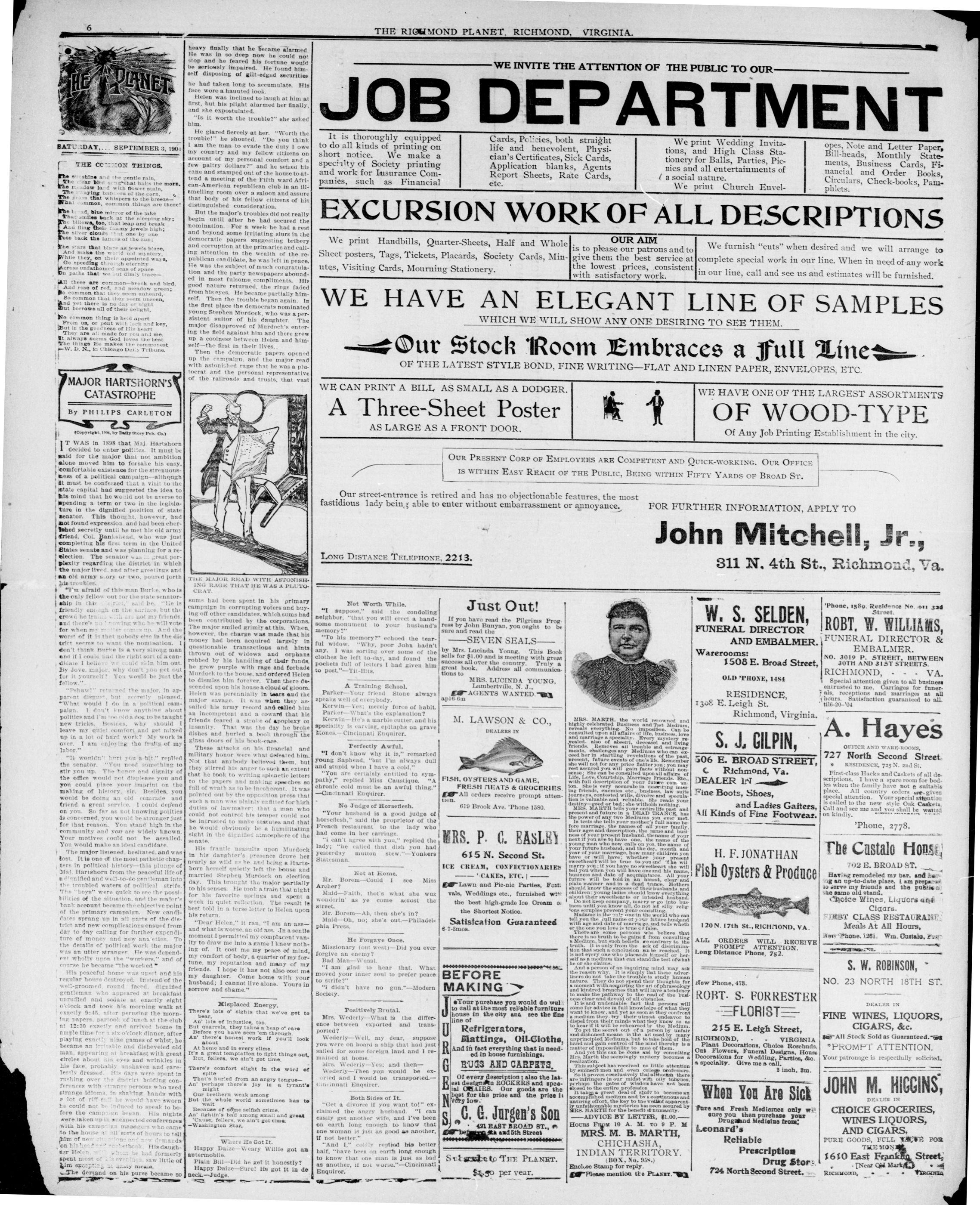
BATU :DAY, _ SEPTEMBER 3, 190.
{ ‘THE ce-r:ton THINGS.
suoshine and the ventle rain,
The «car Bire scne*ihat hal's the more,
Rectan end shh ween
Gee arigg bar'creotisscen”
Bs. Frocs that whispers to the breeze—
fas! cacmen, somaon thines ee these
ii cna, Sie mirror of the take
Tha: cites back at the s'est inw sky:
ic Uillowa too, that leap and hreeie
‘Aud fling Welt Zcumy fomels wens
e ilvervalonds “at ane Sr one
se back the lances of the cunt
he sare that bin-v as Jowe's bare,
tind mabe tks wort ea area
PPiile theye on their appointed wad’,
Go speeding thro:sh exerniey
mr path that we out diay wee
(All these are common—brook and bird,
[And rons ef ced, rad mendew tocar
Bo common tha: they seem unheard,
Be common that hes corm wuncom,
rE: yet there is no day or night
ait borrows all of thet celica
No common thing is heid apart
From a, OF pest wiih ork and key,
Bot in the goorness of His heart
‘They. are ail made for row en the.
Mt always scems God loves the best
he things Ne makes the commonest
Poe DN chimes ee
y MAJOR HARTSHORN'S!
CATASTROPHE
By PHILIPS CARLETON
ME?
q (Copyright, 194, by Dally Story Pub. Co.)
| [TWAS 2 1898 that Maj. Hartshorn
| 1 decided to enter polities. It must be
aid for the major that not ambition
@lone moved him to forsake his easy,
| comfortabie existence for the strenuous-
Bess of a political campaign—althqugh
jt must be confersed that a visit to the
jystate capital had suggested the idea to
Ris mind that he wold not be averse to
{mpending a term or two in the legisla-
ture in the dignified position of state
aenator. This thought. however, had
ot found expression. and had been cher-
Yehed secretly untii he met his old army
frend, Col. Panianead. bo. was J6at
completing bls firs: term in the United
States senate and was planning for are-
Blection. The senator was... creat per-
plexity regarding Lhe district in which
the major lived, and after arcetings and
}am old army sory or two, poured forth
"pis troubles.
} “I'm afraid of this man Burke, whois
the only fellow out tor thie state senator
@bip in thir. sirici,’ sad he. “tie is
| friendly enough on the suriace, but the
erowi he trains ih are not my friends
and there's oo ‘sowing whe ke will vote
for when my rer comes tp, Ard the
worst of It Is thet nobody elee In the dis
trict cerme to want (he nomination. 1
don't think Burke Is a very strong man
nd if T cowie tind the right sort of aean-
| didaie T believe we could stn him out.
By Jove, major, why con't you get out
for it yourself?’ You would be Just the
follow.”
“Pehaw!” retiened the major, In ap-
parent disentt, but. actraily, pleasée.
“What would I ¢o in a political cam-
paign, I don't know anythine about
politics and I'm 'no pld.a dog to be taught
new tricks, Besides, why should 1
leave my qiiet comfort and get mixed
up in a lot of hart work? My work is
over. Tam enjoy(ng the frutis of my
lator.”
“It wouldn't bert you a bit.” replied
the senator. “Yon need something to
stir you up, The honor and dignity of
the office would not displense you and
yon could piace your imprint on the
making of history, sir. Resides, you
would be doine an old comrade and
Griend a great service. L could depiend
on you. So far as not knowing polities
4s concerned, you would be stronger just
for that reason, Yon stand high In the
community and you are widely known.
Your motives could not he assailed.
‘You would make an ideal candidate.
| ‘The major listened, hesitated, and was
Aost_ It is one of the most pathetic chap-
ters in political history—this plunge of
Maj. Hartshorn from the peaceful life of
a ('enified and well-to-do gentleman into
the troubled waters of political strife,
‘The “boys were quick to see the poss!
Hillcles of the sitnation. and the mafor’s
hank: account became the objective point
of the primary campalen, New candi-
eater sprang up in all parts of the dis-
trict and new complications ensued from
¢ay to day calling for further expendi-
ture of money and new anx'etics. To
the details of political work the major
was an utter straneer. He was depend-
ent wholly upon the “workers,” and of
course he became “the worked >
Tis peaceful home was upset and his
regular hours destroyed. Instend of the
well-zroomed. round faced, dignified
gentleman who appeared at breakfast
unrufled and sedaie at exactly elght
o'clock and took his morning walk at
exactly 9:45, nftor perusing the morn-
§ng papers, partoo!: of lunch at the club
At 12:80 exactly end arrived home in
ample time for 9 six o'clock dinner, after
playing exact! nine games of whist, he
Deeame an irritable and disheveled old
man, appearins at breakfast with great
¢ireles about his eyes and wrinkles in
his face, probably unshaven and care-
Yessly dressed. His days were spent in
rushing over the district holéing con-
ferences with <tranze persons who need
strange Idtoms, tn shaling hands with
2 lot of riff-ra7 he would have sworn
he could not be induced to sneak to be-
fore the campsien beren. His nights
were inken up in anexpected conferences
with his camp-ien managers who came
to the house 2° sll sorts of hours to tell
fim of no: ne en now demands
von kishes?=>" -oxtetheok, Hisdaugh-
or Helen whew he had formerly
ae most of I.'s rveriacs, saw little of
im @FCeFtTS ti Unsly meaia,
<The demand on his purse became 90
ee ee e — ,
heavy Gnally that he Became alarmed
He was in so deep now he could no!
stop and he feared his fortune would
be seriously impaired. He found him-
self disposing of gilt-edged securities
he had taken Iong to accumulate. His
face wore a haunted look.
Helen was inclined to laugh at him at
first, but his plight alarmed her finally,
and rhe expostulated.
“Is it worth the troubie?” she asked
bim.
He glared flercely at her. “Worth the
trouble!" he shouted. “Do you think
1 am the man to evade the duty I owe
my country and my fellow citizens on
account of my personal comfort and a
few paltry dollars?” and he seized his
cane and stamped out of the house toat-
tend a meeting of the Fifth ward Afri-
can-American republican club in an {Ul
tmelling room over a saloon and assure
that body of his fellow citizens of his
distinguished consideration.
But the major's troubles did not really
degin until after he had secured the
nomination. For a week he had a rest
and beyond some irritating slurs in she
democratic papers suggesting bribery
and corruption at the primaries and cali-
ing attention to the wealth of the re-
publican candidate, he was left in peace.
He was the subject of much congratula.
tion and the party newspapers abound-
ed in most fulsome compliments. His
good nature returned, the rings faded
from his eyes. He became partially him-
self. Then the trouble began again. tn
the first place the democrats nominated
young Stephen Murdock, who was a per-
sistent suitor of his daughter. The
major disapproved of Murdock’s enter-
ing the field against him and there grew
Up a coolness between Helen and him-
self—the first in their lives,
Then the democratic papers opened
‘up the exmpaizn, and the major read
with astonished rage that he was a plu:
tocrat and the personal representative
of the raiiroads and trusts, that vast
x NS Y> Waa
£ |
Gut! _
Bi) Am
fa. LEAN RM
Py KBR Ca
- fa Was Vie
UD
pe ae
ES
ING RAGE THAT HE WAS A PLUTO
cRAT.
sums had been spent in his primary
campaign in corrupting voters and buy-
ing off other candidates, which sums had
been contributed by the corporations,
‘The major smiled grimly at this. When,
however, the charge was made that bis
money had been acquired largely in
questionable transactions and hints
thrown out of widows and orphans
robbed by his handling of their funds,
he grew purple with rage and forbade
Murdock to the house, and ordered Helen
to dismiss him forever. Then there de
seended upon his house acloud of gloom.
Helen was perennially In tears end the
major savage. Ii was when they as-
sailed his army reoord and called him
an Incompetent and a coward that his
friends feared a strolve of apoplexy ot
insanity. ‘That was the day he broke
dishes and hurled a book through the
glass doors of his book-case,
, ‘These attacks on his financial and
Military honor were what defeated him.
| Not that anybody believed them, but
they stirred his anger to such an extent
that he took to writing sptenetic letters
(to the papers and maling spaeches so
full of wrath as to be Incoherent, It was
“pointed ont by the opposition prese that
such a man was plainty onfitted for hirh
duties of lawmaver: that a man who
could not contro! his temper could not
be in(rusied to make statutes and that
he would obviousiy be a humilitating
sight in the dignisied atmosphere of the
senate,
His frantle aeasults upon Murdock
in his daughter's presence drove her
nearly as wild es he. and being a Harts
horn herself qnietly left the house and
married Stephen Murdock on election
day. This broveht the major partially
to his senses, He took atrain that night
for his favorite springs and spent a
week in quiet reflection, The result {s
best told in a terse letter to Helen upon
his return.
“Dear Helen,” it ran, “Tam an-ass—
and what is worse, an old ass. .Ina senile
moment I permitted my complacent van-
ity to draw me into a game I knew noth-
ing of. It cost me my peace of mind,
my comfort of body, a quarter of my for-
tune, my reputation and many of my
friends. I hope it has not also cost me
my daughter. Come home with your
husband; I cannot live alone, Yours in
sorrow and shame.”
Misplaced Energy.
There's lots o' sights that we've got tc
bear,
An’ ots of injustice, too.
But quarrels, they takes’ heap of care
Before you have seen "em through,
An’ there's honest work if you'll look
about 5
At homie and tn every clime
It's a great tempiation to fight things out
But, feliers, we ain't got time.
‘There's comfort slight in the word of
spite
‘That's hurted from an angry tongue—
An’ perhaps there's Joy in a tyrant’
‘might
Our brethern weak among
But the whole world sometimes has ta
wai
| Because of sme selfish crime,
An’ fightin’s had among small and grea
“Cause, fellers, we ain't got time,
/Wastington Siar,
; Sie nay
‘Where He Gotit,
| Happy Daize—Weary Willie got an
avtermobile.
Plain Bill—Did he get it honestly?
Happy Daize—Sure! He got 1 in de
neck,—Judge. oa
[Gl MOND PLANET, RICHMOND, VIRGINT
EE
| —_—_—__--nss WE INVITE THE ATTENTION OF THE PUBLIC TO ouR————————________
It is thoroughly equipped Cards, Policies, both straight We print Wedding Invita- opes, Note and Letter Paper,
to do all kinds of printing on life and benevolent, Physi- tions, and High Class Sta- Bill-heads, Monthly State-
short notice. We make a cian’s Certificates, Sick Cards, tionery for Balls, Parties, Pic- ments, Business Cards, Fie
specialty of Society printing Application blanks, Agents nics and all entertainments of nancial and Order Books,
and work for Insurance Com: Report Sheets, Rate Cards, (a social nature. Circulars, Check-books, Pam
panies, such as Financial ete. We print Church Envel- phiets.
Lan ar NR ae ee
= Sa ee ee
We print Handbills, Quarter-Sheets, Half and Whole|;, eee eee eale We furnish “ents” when desired and we will arrange to
Sheet posters, Tags, Tickets, Placards, Society Cards, Min-|give them: the best service at|complete special work in our line. When in need of any work
utes, Visiting Cards, Mourning Stationery. * Re erat Fc coneistt in our line, call and sce us and estimates will be furnished.
WE HAVE AN ELEGANT LINE OF SAMPLES
__WHICH WE WILL SHOW ANY ONE DESIRING TO SEE THEM. _
a x [11C ex
—= Our Stock Room Embraces a full Dine.
OF THE LATEST STYLE BOND, FINE WRITING—FLAT AND LINEN PAPER, ENVELOPES, ETC
lire elec
WE CAN PRINT A BILL, AS SMALL AS A DODGER. . 2 WE HAVE ONE OF THE LARGEST ASSORTMENTS
A Three-Sheet Poster} & ' OF WOOD-TYPE
AS LARGE AS A FRONT DOOR, Of Any Job Printing Establishment in the city.
poe eer oe eee ee aset :
| ceca eee see eS he ute geet a sats
Our Present Corp or Employes ARE CoMPETENT AND Quick-workING. Our OrFice
= i : =
ee | 1s wiTHIN Easy REACH oF THE Pusiic, BEING wiry Firry Yarps or Broap St.
| Our street-entrance is retired and has no objectionable features, the most
fastidious lady bein,y able to enter without embarrassment or annoyance. FOR FURTHER INFORMATION, APPLY TO
5
John Mitchell, Jr
Solis Wt og
Lone Distance Teternonr, 2213. 311 N, 4th St., Richmond, Va.
Not Worth While.
“I suppose,” said the condoling
Reighbor, “that you will erect a hand-
some monument to your husband's
memory?"
“To his memory?” echoed the tear-
ful widow. “Why, poor John hadn't
any. I was sorting over some of the
clothes he left to-day, and found the
pockets full of letters Thad given him
to post."—Tit-Bits,
A Training School.
Parker—Your friend Stone always
speaks well of everybody.
Kerwin—Yes; merely force of habit,
Parker—What's the explanation?
Kerwin—He’s a marble cutter, and bis
speciality is carving, epitaphs on grave
Biones.— Cinclanatt Enquirer,
Perfectly Awful.
“I don’t know why it is," remarked
young Saphead, “but I'm always dull
and stupid when [have a cold.”
“You are certainly. entitied to sym-
pathy,” replied Miss Caustique. “A
chronic cold must be an awful thing.”
Cincinnati Enquirer.
No Judge of Horsettesh.
“Your husband is a good judge ot
horseitesh,” said the proprietor of the
French restaurant to the lady who
had come in her carriage.
“i can't agree with you,” replied the
lady; “he calied that dish you had
yesterday mutton stew.""—Yonkers
Biktasinan.
Not at Home,
Mr. Borem—Could I see Miss
Archer?
Maid—Faith, thot's what she wus
wonderin’ as ye come acrost the
street.
Mr. Borem—Ab, then she’s in?
Mald—Oh, uo; she’s out—Philadel-
phia Press.
He Forgaye Once.
Missionary (out west)—Did you ever
forgive an enemy?
Bad Man—Wunst.
“Lam glad to hear that. What
moved your inner soul to prefer peace
to strife?”
“i didn’t have no gun."—Modern
Society.
Positively Brutal.
Mrs. Wederly—What is the differ
ence between exported and trans-
ported?
Wederly—Well, my dear, suppose
you were on board # ship that had just
sailed for some foreign land and I re-
mained at home.
Mrs. Wederly—Yes; and then—
Wederiy—Then you would be ex-
orled and I would be transporied.—
Cimeinaatt Enquirer,
“Saas Sa ae te
“Get a divorce if you want to!” ex-
claimed the angry husband. “I can
easily get another wife, and I've been
on earth long enovgh to know that
one woman js jusi as good ag another,
Af not better.”
“And 1,” coldly repthed Ing better
haif, “have been on earth long enough
to know that one man is just as bad
as another, if uot worse,"—Cincinnatl
Enquirer.
Just Out!
If you have read the Pilgrims Prog
ress by John Bunyan, you ought to be
sure and read the
— SEVEN SEALS——
by Mrs. Lucinda Young. ‘This Book
sells for $1.00 and is meeting with great
‘success allover the country. Truly a
great book. Address all’ commiunica-
tions to
MRS. LUCINDA YOUNG,
Lambertville, N. J.,
£8 AGENTS WANTED. “BQ
apitom
M. LAWSON & CO.,
DEALERS 1N
FISH, OYSTERS AND GAME,
FRESH MEATS & GROCERIES.
MHF Al orders receive prompt atten:
ten,
619 Brook Ave. "Phone 1580.
ERS. P. ¢. BASLEY
615 N. Second St.
ICE CREAM, CONFECTIONARTES
—— 'CAKEs, ETC, | ——
(O@- Lawn and Pic-nic Parties, Fost:
vals, Weddings etc., furnished wi
the best high-grade Ioe Oream o:
the Shortest Notice.
Satistcation Guaranteed
€.7-3mos.
POPOPSOSEDOSOOLOOOEEEIES 8 DOROENEL BE
BEFORE
MAKING ~~
=O
J Your parchase you would do wel
‘to call atthe most reliable furniture
he in the ity ana see the fine
line of
U Refrigerators,
Blattings, Oil-Cioths,
R And ff fect everything that is need-
ed in house furnishings.
Gj RUGS_AND CARPETS,
Rpcisreadersareae ts
jal OBSIRS. Our goods are the
N pay sont price and the price li
J
; 0. G. durgen’s Son
» 401 EAST BROAD 8T.,
as
POLO o ote
| Suteexbeto Tre Pane.
Bok $490 pervear, |
eee
LENE
W\ se A =
WRN
MRS. MARTH, the world rmownel and
hughly celebrated Bungnen ‘and Test hada
reveals everything. No. tnpoution. Gaens
‘Soustlted upon alltatairs of Ute, bastness hove
‘And marriage a specialty, “Every mystery re.
Fealed. als of absent, deceased and Ting
‘Trends, “Kemoves ait trouble and eatramege
‘ments, challenges any Mediums who cna se:
Seed horn maftiing’ revelations of the pant
Brevent, future events of umes lie, Remembet
Sl not for amy price fatter fous yom may
Fest moured you will gain facts without not
pense. She can be consulted upooll allure nt
Kite, Love; Courtship, Marriage Friends: Rees
wish fail dsscription of sour fume com tn
fon.” Sho is very nceurate in deccriEang: imine
ing friends, ‘enemies ete business, Int stfte
journey, contested wills, Aivorce ahd. apectin
is valuable nnd ‘relisble.” Sh reads your
Alegtiy pod cr bad sho witholls thing:
SHS ATARI tells Sor entire lite pact” and
prownt and foture in’ R'DRAD TRANCE, fae
a power af ang two Mettmumy Jou ever met
in torts she tells your mother's full name ke:
fore marriage, the names of ‘all your family,
theirnges ahd description, the mafuo and bus
‘new of your present husband, thename of your
Bert if yon ane to have ghey ‘she name of the
roung man whe how calls on you, the nate of
Four future husband, and the Gay, month nad
JERE of Four marsinge, how many ehiidren Soa
we oF will haves whether your. present
sweetheart will be trae. te youane the wit
marry you: if you have no sweetheart she. Will
fell you when ¥ou will have onesnd his mame,
Business and date of meyanintasce. “AU yout
future willbe told in An" honest, clear end
Plain waanner and inn dead trance.” Mothers
Roni non ee agen thelrausbant and
childrens young ladic: should know everythin
aigut thefrowecthenres or intaded hiaband
hot keep company, marry crgo tnte. bas
gue antl Zou know sbi nt feb wily reli
{ous scruples prevent your consulting.
‘Madiangin sets Se inthe work who can
tell you the vull nate of sour fture Nes
With age and date of marie ge, and tells whet
Stthe one you love = true CF tilses
rierears ‘me. pormuna whe. Velieve, tha
there ts no teuth to be gained from" consal
® Medium, but such beliets’ ew contenry to the
frat "ingly from the tok of dicen
jon that such meuneiusion mn be. renched. Tt
isnot everyone who Diacands Nraseif or her.
soif axa medium that can standihe test ofwha
Fer ca eee ne
“anda person of an ingulring mind may. ask
sic remo way fee ain fh tae aver
Users donot. take the trouble te study’ Letuen
Bature., ‘They do not spend ther thoughts fo
Sinoment wilh:ncqpiring the of phraseology
flied branahen tnt will ave edn
fo make the pathway tothe rad of the. bel
eaten deen Of all otcactas, ie
Te isand undeniable ‘persons
come for advice in full knowledge of what they
rant folengw sand vot ae sn a hey cto
Rmedinm they fe utmont endeavor
Giape from thar saunds what they Know so
torkear iff will be rehearsed by "the: Median
‘To get thesecret oUt of 8. person by: untas
snd alsicneataican iste’ ft uaa Uy ay
Enprincipled Mediums, but to take hold of the
EQRE cad gain control of the mind thereby tes
inter of fmpoesibility to met of theme
"And yet thicean be Jone and ‘by consulting
Ma Marth the svomingly myitery Become
Fealization:
Tui mafrct has received no Title attention
byueminent men and. ven, Clee ‘nate ors
ovit proves comclusdvaly that afthotan ther
are inffingers in our zidst witt oily vamnruen
Perhaps ‘the gates of "wisdom have’ mor "been
Siesed to the eftire, profession
Tr taxgae great deal of afudy to. become an
accempfttied meaium and bys copetntous and
ating effort the key" to te wet wpparent
‘unfathomable mysteries has peen aectred
SGISUMANCTH for the benef 'bumanity
Saher omen ewer mpectomatinctagpe =v yp Sea
—ADVIOE BE LELTIEN, §1.00,——
Hovrs mu 10 A. M. To 9 P. Mw
MRE M. B. MARTH,
CHICHASHA,
INDIAN TERRITORY,
(BOX, No. 95s.)
Enclse Stamp for reply.
(OF Please mention the PLasst. “wg
[—_-
_W. S$, SELDEN,
FUNERAL DIRECTOR
AND EMBALMER.
Warerooms:
1508 E. Broad Street,
OLD "PHONE, 1484
RESIDENCE,
1308 E. Leigh St.
Richmond, Virginia.
ee Bee?
S. J, GILPIN,
——
306 E. BROAD STREET,
© Richmond, Va.
DEALER 1N a>
Fine Boots, Shoes,
and Ladies Gaiters,
All Kinds of Fine Footwear.
a aaa
H. F. JONATHAN
Fish Oysters & Produce
120N. 17th St., RICHMOND, VA.
ALL ORDERS WiLL REOEIVE
PROMPT ATTENTION.
Long Distance Phone, 752.
Stew Phone, 478.
RORT. S. FORRESTER
-=FLORIST=
235 E. Letgh Street,
RICHMOND, - - VIRGINIA
one perontiens, Chole Ronin
Say Saeseeees
When You Are Sick
Pure and Fresh Modiomes only wi!
@ure you then purchase your
Drugafnd Medisine from!
Leonard’s
Reliable
Prescription
Drug Stor:
724, North Second Street. er
"Phone, 1589. Residence Noon 32d
Street.
ROBT, W. WILLIAMS,
FUNERAL DIRECTOR &
EMBALMER.
NO. 3019 P. STREET, BETWEEN
30TH AND 31ST STREETS.
RICHMOND, - - - VA,
Special attention given to all business
entrusted to me. Carriages for fauner-
als, receptions ‘and marringes at all
jhours. Satisfaction guaranteed to all,
ti16-20-"04
ee
2
A. Ha yes
OFFICE AND WARE-KOOMS,
727 North Second Street.
. RESIDENCE, 725 N. 2nd St.
First-class Hacks and Caskets of all de
scriptions, Ihave a spare room for bod.
tes when the family have not @ suitabis
place. All country orders wwe-gives
special attention, Your special attent.on
scaled to the new style Oak Caskets.
Call and see me and _you shall be watted
on kindly, ey erat eee
*Phone, 2778.
gi
The Castalo Hons¢;
792 B.BROADST.
Having remodeled my bar, and der:
sonseve tay ttendbiand: she’ pomeeet
sae same old stand. a
Choice Wines, Liquors ané
Cigars.
SIMST CLASS RESTAURANT
Meals At All Hours,
ow Phone, 128i. Win. ustala, #6s>
a ees
ee ee
S. W. ROBINSON, ~
NO. 23 NORTH I8TH ST.
FINE WINES, LIQUORS,
CIGARS, &c.
¥eF"All Stock Sold as Guaranteed.-ea
*PROMPT ATTENTION.
Your patronage is respecttully solicited,
JOHN M. HIGGINS,
DEALER IN
CHOICE GROCERIES,
WINES LIQUORS,
AND CIGARS,
PURE GOODS, FULL YAR FOR
THE MON
46140 East Fipatl Stet
[Ne ‘
eee tees . vinctians
5 eg DONE:
ae a
‘ oN
BATURDAY ....SEPTEMBER 3, 1904
aie
=
USN)
ei Ae
SAIN ee |
Oe I aes eee
iH UY ti IE ISS
Ar eT os
ty Behl
RSS LT [1
i ‘THE ONLY VOICE.
pee ae ee
‘In the shadowy valley's rime, id
eee te eee.
eee
Tis Resurrection and the Lite.”
PROSPERITY AND JOY.
fhe First Does Not Always Produce
the Second—Religion a Neces-
sary Element.
Passing by a busy corner upon State
street the other day, we were attracted
By a din of pounding which made the
other noises of the city seem soft and
unobtrusive, says a writer in Chicago
Interior. Presently we discovered that
this furious uproar was caused by the
rapid ‘strokes of an automatic hammer
with which the workmen were riveting
together the immense iron beams of a
mew sky-scraper now in process of erec-
tion, The work was accomplished with
such marvelous swiftness and dexterity
that many paused a moment to admire
the operation of this comparatively new
device, a device by which a cold, stiff
fron bolt was, as it were, melted right
down to and pressed close against the
fiat surface through which it had been
thrust. When we went on, we pitied our
ancestors—and envied them.
For, after ali, it matters less hor-long
ft takes to erect a mansion than what
Kind of a life is lived beneath its roof;
and business as well as pleasure may
‘be set at a pace that kills. Our numbers,
‘our inventions, our productions, make
the days of our forefathers’ seem
strangely childish; but is the kingdom
‘ny nearer the world to-day than it was
when they, in cities less congested, lived
their simpler lives? That is worth ask-
ing ourselves when we write that our
Population is now upwards of 80,000,000
souls and our annual output estimated
at a valuation of $1,400,000,000. A
nation may be numerous and it may
be rich, and still it may miss all that is
‘worth living for.
‘The truth is that the old-time prophet,
Isaiah, knew everything about sociology
‘except its name when he foretold as the
distinguishing characteristic of the Mes-
siantc kingdom that in {t a nation
might be increased in numbers, wealth
‘and power, and yet Increased in joy:
for that Is the correct rendering of
Isaiah 9:3, as our revisers all agree,
In religion we have the only solvent
‘ef trreconcilables, the one element
which thrown into the bubbling pot
sweetens the bitterness of the draught
and makes the whole wholesome. Civ-
Mization {s dependent upon numbers, but
at war with joy, unless indeed In that
¢lvilization the moral element predom-
fmates and controls the material pros-
Derity.
GEMS OF THOUGHT.
An ounce of originality is worth a ton
ef imitation.—United Presbyterian.
‘The man who stands for something
has a place and a force in the world —
Ram's Horn.
Gratitude is the homage the heart
Fenders to God for His goodness; Chris-
‘Wan cheerfulness is the external man-
ffestation of the homage.—Christian
Work.
‘Childhood is the time of danger as well
fs the time of hepe. The corn that is
frost-smitten in the spring brings no
golden ears to the day of the ingather-
ing.—United Presbyterian.
‘The judgment of Jesus is simply show-
ing a man what he is in the light of
(what he ought tote. The outer dark-
ess 1s the shadow love casts when one
Fefuses to let it shine through him.—
William De Witt Hyde.
When [ found that it was Christ's na-
ture to lift men out of weakness to
@trength, out of impurity to goodness,
‘eut of everything low and debasing to
Superiority, 1 felt that I had indeed
found a God.—Henry Ward Beecher.
There is no mystery whatever about
appiness. Put in the right ingredt-
ents, and it must come out. “He that
abideth in Me . . . bringeth forth
much fruit;” and bringing forth mueh
fruit 1s happiness. The infallible recipe
for happiness, then, is to do gocd; and
the tnfallible recipe for doing good te
to abide in Christ —Drummond.
Secret of Her Power.
What Was the secret of such a one’s
Power? Whai had sie done? Abso-
lutely nothing, says Ram's Horn, butra-
@iant smiles. bearing good humor, the
tact of divining wha: everyone felt and
everyone wanied told’that she had got
@ut of self, ami Irarned to think of oth-
@f8; 80 that at one tIme it showed ft-
gelf by sweet wor’s; at another, by
@mocfhine See ne
Smoofhing an invalic’s pillow; at af
other by soothing a sobbing child.
None but she saw those things. None
but a loving heart could see them.
That was the secret of ber heavenly
power.
BIT OF FINE PHILOSOPHY.
Liking Just What One Has Instead
of Looking Around for What
One Likes.
“Why do you not go away oftener for
rest and change?” asked one friend of
another, feeling a little anxious over
the crowded days that seemed too busy
and burdened. “Don’t you care to go?”
she questioned further. “Don’t you like
to visit about and take diverting little
fourneys?*
“Oh, yes, I like it,” was the answer in
‘a tone both brisk and blithe, “but you
see I don’t have to zo looking about for
what I like, because I always like just
what I have.”
Could there be finer philosophy ot
Sweet content and resolnte cheerfulness
than this? It came warm from a trust-
ing heart. It was the outcome and ex-
Pression in speech of a devoted life and
loving spirit.
To have what we like, though we
Fpend unmeasured time in groping and
grasping after it, may be among the
impossibilities, but to like what we have
is among the attainables, else why the
command: “Be content with such things
as ye have?” The truest, happlest con-
tentment cannot fill the heart if there
is a constant revulsion against life's
conditions and a loathing of what is out-
Wardly borne with submission, says
Young People. There must be some lik-
ing of what we have if we are going to
“walk worthy of our vocation” and
“unto all pleasing.” To like what we
have, we must guard against too con-
stant comparison with what we have
not. Then if the work set for our doing
is not in itself the pleasantest or most
congenial, let us get the joy out of the
doing of it. The consciousness of do-
ing our best is enough to give a certain
buoyaney and brightness to life, even
If the task is not what might be chosen.
The delight of accomplishing’is in Itself
reward. and this makes It easier to like
what is done, ‘
‘The search for what we like may bea
fruitless quest and a waste of time, but
Uking what we have conserves our store
of happiness and is the safer and surer
way.
LOVE AS A COSMETIC.
It Can Do More Towards Beautifying
. the Face Than All Things
Else.
Love is the greatest beautifier. The
Teason Is easy to see. Love {tself is
deantiful, and if we give unselfish love
& lodgsment with us it is constantly ex-
erting a molding Influence upon us.
Love always appearsat its best. When
{t goes wooing it always chooses the
most becoming attire and the mest cap-
tivating adornment. So love, when it
gets possession of a human body, pro-
ceeds to mold the face of that body
into the most attractive form, for love
always seeks to clothe itself in the
‘most attractive garb.
That fs the explanation of the trans-
formation that takes place in a woman
who is a mother. She may be plain
otherwise, but when she bends over her
babe in an ecstasy of mother-love she
becomes beautiful. And in proportion
8s we give place to unselfish love do we
decome attractive.
‘There is no masseur like love to work
miracles in a homely face, says the
Christian Endeavor World. There fs
no facial specialist who can begin to
do as much to make a plain young man
or woman attractive. to overcome de
formity or hide blemishes, as the magi-
elan love can do.
To hate {s to become hateful. To
love as Christ loved is to become love-
ly. Its not a cheap recipe, for such love
costs in proportion to its depth and
{ntensity. But anyone that is willing
to pay the price may be beautiful.
GOOD HOME MISSION STORY
‘fhe Church Bell and the Drum of
the Salvation Army
Lass.
A good story was told at the Bible
Christian missionary meeting, held in
London. A Salvation Army lass was
deating a drum ‘n the market-place of
a certain village. The vicar came out
and protested.
“Are you obliged to beat that drum?
It makes such a horrid noise, and I do
$0 dislike it!”
“Are you obliged to ring your church
bell on Sundays?” asked the girl. “It
makes such a noise, and I don’t like it.”
“Oh, but,” he rejoined, “that's very
ifferent; the bell seems to say to the
People: ‘Come! Come!” that’s why I
Mike it”
“Well, sir,” the Salvation lass re-
Joined, “I like my drum, because it seems
to be saying about the people: ‘Fetch
‘em, fetch ‘em!’ Home missions, said
the speaker, mean fetching the people
who might never come.
Bless Better Than Aasenit
A pastor whose church has recently
deen blessed with large accessions said
the other day that he had learned that
sometimes the largest results come
from giving persons time to think over
lelsurely and quietly their personal re-
sponsibility for confessing Christ be-
fore men, says the Congregationalist.
As he has met individuals, or written
letters, or talked with groups of Sun-
@ay-school scholars, he has sought
simply to press home ‘the duty of keep-
ing the great question in mind. He has
Rot pushed hard for immediate or hasty
decisions, but, having planted the seed
of his own great desire, has given it
time to grow in its own way. Some-
times we are in too gFeat @ hurry to
get our friends over the line. The
human soul is so delicately organised
we must give it time to find and ex-
press itself, never relaxing. to be sure,
our own tactful.pressure, but leaving
the field clear for the Spirit of God to
Work, too.
Couldn't.
Baia be: “oy nen, fy wtth met
Bhe repited as shtd all bis Ropes
You're mistake \ peach did you say?
Well, I'm ma cantaloupe
amaditetic wate
THE RICHMOND PLANET, RICHMOND VIRGINIA.
NAL
: i oz ’
FAT RETURNS. FROM DIME. | neeciesexportce trom Germany arc eee ! Negfolle and
to China. LEAVE aeee
& New Orleans Traveling Man Says} Exxpt sends to th. United States aag STREET
the Tittle Goin Xielded tim England fragments of mummies, which ean: XORFOU
Bee are ground up and uscd in anixing pair's Wate naa
: ee cea cess
“Yon oftea hear of men ronning up > Eplipas Beer >
@ small sum of mouey into a good bis Been paws, Bete Stata
bank roll. but Lid something once | qgeg E92, Heard Then dak Mena
maha that, so far as 1 know, beats | ,AgeR™ Madam, could I seil you this | THABR in sompon
book of fairy tales: jl rg. and Row
all records when the amount originally wa = | 8.0 F in.. Ocean Bi
2 tnally | “Mra, Muchwed—No; I've ven mar | tees Eve ae
Invested is considered,” said E. W. ried four time. df y tales erly and Buffole. Toc
Gaylord, of New Orleans, to a Wasb- ee ee Airy tales aF6 &. Boston. Providence, |
: 4 chestnut with me—New Yorker. ‘Washington
hagton Post reporter. - ose ae ‘ 656m. for Nor!
“Twas waiting in Omaha for a re- Heard at the Press Glub, obfatersbare
mittance from my tim, and, having 90] HewittsSe we bee cieeed the heer ET ot
coin about me was feeling in that lone-| game sirl, Batra to Ronee. Lvs
scina” state that the monavie ual | eee
| les = § pee
Near
Bie ain
ip- \i\
Hi. |
pe
SD x |
gon
=
alone can appreciate. To kill time I
Walked into a gambling house, having
not the remotest idea of doing aught
save watching the players. As I stood
in the vicinity of the roulette wheel I
mechanically thrust my hand into a
pocket of my vest and extracted a lone
dime that I did not know was on my
person. 1 actually felt ashamed to put
it on anything, but something whis-
pered it might win, and, sure enough,
When the wheel stopped my coin had
won. Again I won, and again until
that ten-cent piece had brought me
in nine dollars,
“This is pretty good interest, I
thought, and cashed in taking my nine
dollars and moving over to the stud
poker game, and investing in chips.
My luck followed me here, likewise,
and I ran up my stake to $85 in less
than 30 minutes. Considering what a
big return this was, I began to feel a
chilly sensation at my pedal extremi-
tes, and as it was near the dinner
hour, I made this an excuse for quit-
Ung.
After dining, the desire to press my
luck was too great to be resisted, and
being near a hundred strong, 1 went
back to the sporting establishment and
took my seat at adraw poker game
where the buyout was $50, table stakes.
IU’s no use to weary you with the de-
tails of my play, but from the very
jump the fortune that had been with
me earlier in the day stuck. I held the
most marvellous series of hot hands
ever known, streights, flushes and
fulls without end and several sets of
fours, and on nearly ail of them got
good plays.
“To cut it short, when I left the
game in the smali hours of the morn-
ing I cashed in $2,750, and got tho
money on the spot, the house man re-
marking that if this was my usual
style he would like to engage me at
any salary to play for him.”
PIE BRINGS NEEDED REST.
Pastry Contains Opiate and Maniac
Is Put to Sleep Without His
Knowledge.
All other offorts being futile, a goose-
derry pie was fnally used as the success.
ful medium to administer opiates to Ru-
fus Davis, of Alexandria, Ind,, confines
in the Madison county jail until he can
be admitted tothe hospital for the Insane
His mental derangement is such that the
man has bgen a raving maniac since he
was brought to the jail. He bad slept
Dut very little the past week.
Officers and physicians found it {mpos-
sible to administer medicine of any kind
ite 5 CL
i »
— Sip SY
yA VM ea,
RR
ah), Ss
eee |
| Pray i - F ve)
er <Q \ ee
ey
Pun
to the insane man. He was finally asked
what kind of ple he preferred for sup-
per, and he bezged for gooseberry. A
fine, large gooseberry fp was prepared.
and carefully mixed with the ingredients
were morphine and medicine intended
to quiet the man so that he might sleep
and be relieved. When the “doctored”
ple was given him he was selfish with tt,
and permitted no one to approach It.
He ate all of it, and two hours later was
quiet for the first time in several days
and, while euarded by a physician to note
bis condition, Davis slept peacefully
through the nicht
ODDITIES OF TRADE.
African savages take kindly to Amer-
fean patent medicines.
Natives of Usandn, Africa, use Amer-
fean ofl for anointing their shiny biaek
dotties.
When an Uganda native buys an
Amerfean phonocraph and sets {t up tn
his but he becomes a soctety leader.
China is the largest purchaser of Ger-
man needles. ALoui 50 per cent. afethe
neecles exported trom Germany are seat
to China.
Egypt sends to th: Cnitec States aad
England frasments of ussuimies, which
are ground up and used in wixing pain's
for artists,
Had Heard Then All,
Agent—Madam. could I seil you this
book of fairy tales?
Mrs, Muchwed—No; I've veen mar-
led four times and fairy tales are a
chestnut with me.—New Yorker.
Heard at the Press Club.
Hewitt—So we have hugged the
same girl.
Jewelt—Yes, 1 suppose she looks
Upon us as mernbers of the associated
press.—Town Topics.
Agr Line Rarway
Short, Line to Principal Cities of the
South and Southy.est, Mlorida,
Cuba, Texas and Mexico
Hchedule in Effect April 17th, 1904.
TRAINS LEAYE RICHNOND-MAIN sr.
220 S'aBABOARD Mat,
Bi intent Smeproved day ‘onctie. Pulinan
Sloper, Pullman Purior Garand. Cate
Gan to! Hendervon, “Raleigh, Southern
Pines, Hamlet, Pinchurst; Atlanta: Cone
den, Columbia, Savannah Jacksonville,
St: Augustine nd Tampa,
10 p._m.<"SEABOARD EXPRESS,” com-
Boxed of day conches. Pulluan ‘Cars to
Atianea. Jacksonville and Tampa, Gate
Gare Bouih of Hamlet" —To Hemicrsone
Raleigh, Southern Pines, Hamlet, Pine:
hursty “Avante, Camden “Columiin,
Savannah, Jucksonvitle. St. Augustine?
Tampa. wha New Orleans.
9:10 a.mLocel for Norlint, Hamlet and
Guartotte.
:TRAINS ABRIVE RICBMOND-—DAILY.
6:85 a. m—No. 84, from Florida. Atlanta, and
tthe Southwest,
(55 p m—No. 64 from Florida, Atlante and
be Southwest.
6:90 plm—No. 80, from Nerina and Local
inte.
W.M TaYtor,
City Ticket Agent.
H. 8. Laue, Dia: Pass. ‘age,
to. S90 E Main St, Richmond: Va
"Phone 45
June 19, 1904,
ROUTE
CHESAPEAKE & OHIO
RAILWAY.
2 Hours and 25 Minutes te Norfolk.
LEAVE RICHMOND-EASTHOUND.
185 a m.—dally—Local to Newport News
Gid'Point ana war stations: "Pt N
9:00 8. zm Datly- Lined Arriva Winn
me budPoint ii aw'a any Nero Ts
=n
4:90. m:——Daily ——A@peetal— Arrives Wil
fiamatarg 4:8 pan? Newoug News ¥:
| BEOSEARD Gea toe nanae Ve
5:0 §'8—Dally—Locals to OW Point and
“MAIN LINE—WESTROUND.
880 a. m-Daily to Chatiottewilicwa Except
apo pre “Beliy Opens FCinctanati, Lonte
oy Wille, Se: Louis and Chicas st
5,18 p. mi Week dagr Lsccl To Orange
10M5, EB Pel ited, to Cincinnati,
lavilie Be. Lats and Chicages
1020 a. m-Dally “apres 6 rockband. Lex
ington, "New Castle, Clifton Forge and
Sareea nace
SPRAINS ARKIVE RICHMOND FROM
Norfolktnn’ Old Buint 9: acm aang ts
gaRsatsc ts pms dally tl "WE pe
From Cincinnpt and Went tg. m, daly
eggs pine Mate eg ine Pac Mk
‘Orange Acooodstice, Cast in, Be, Gun.
James iver ape Local trom Gift op
given daily: Lemont atoutn. $e: ae ES
SE oxi, W.0. WARTHEN,
Be Ocal Menaper. ist Fase Agt
SOUTHERN, RAILWaY
Effective May 29th, 1904,
TRAINS LEAVE RICHMOND.
Hao pm Daly, Eloteds Beier Ban
380 p-tm—Dally. Lited, man
"ie" Kilaste nd Fi teingbam, New Orleme
Memphis, Chattara dea and all the bouths
1°00 pm: ealig Chsited? Vullinan rend
Wpeme-Enlis™ Chesited? Pullinan
vG'p. ti for slits South, 7
YORK AIVEW LINE
‘The favorite to route Baltiwore and eastern
points.” Leave Hichmond 4:20 pra, Dally er
“Te arta bcoept Sanday, oval mized for
Fs Sa OR
Jp. m-—Daily except Sunday. Local for
ete see e ease
0 p. m.—-Except Sunday. For West Point,
Contiating with steunsers ror Baltimore aad
Eteamers call at Clay Bank and Yorktown,
Mondays, Wedneeday and. indays, aid af
Ghrmoeltér | Fount ana “Aliwona, Tuerdny
eetWAINS ANIIVE RICHMOND,
6:58 a. m- and 6342 p. m.= From all dhe South.
hgh rot Ghislotie and Burhan
#35 a, m.—-Baitimers ahd Weat Point.
0: a.m.—From West bone
5:10 5, mm—Prom West Botte
BiiHanpwicn, Pave rat. Mer,
H.C, AckEnn, Gi Weil TaTton.G,P-A.
©. W. Westhuny. D.P AT Renmome Va
ATLANTIC “OAST-LINE.
TRAINS LEAVE ?ICHMOND DAILY
BYRD STREBT STATION.
8:00 a.m. Petersburg nnd Norfolk
8208 a ahs Ae Le Repro etl pottte south
12:10 p. m. Petersburg and N. & We Wore
Hip p. im: Betarsburg and Neston
#30 bm. Goldtone ees
B45 p.m: Petersburg ioral
73 p.m: "Florida ed West Indian Limited?
“Fo pointe Bout.
9:20 p.m Petersburg and N. & W. Weak
115) p. m: Petersburg locals
TRAINS ARRIVE RICHMOND.
490 a. m7 35 m, m. 8:25 a. 0, except Sunday
wise m-Nenday only Wiwac med Pa
2G. ia Sap" p. mata pe be
re GSS CRMBELL, Div. Pass. Ags
|W. J. CRAIG. Gen Pass Aves
|
OLD DOMINION STEAM.
&HEP COMPANY.
: i ;
Leave Richmond daily at 7 p.
| m., stopping at Newport
_ News in both directions.
__ Fare, $2.50 one way, $4.50 round trip,
includes stateroom, berth; meals, 50cts.
Street ca.s to Steamer’s Wharf:
| For New York by 0, & O. Railway,
9:00 a. m., we m.9 a. m and 3p. m.
by N. &' W. Railway; also by Old
Domlnion night line steamer. All lines
connect at Norfolk with diroat steamers
for New York, sailing daily axcept
Sanday, 7p, 2
—KEO Rew es kt gt,
| JOHN F. MAYER, Agt Whart Foot
of Ash St., Richmond, Va,
HB. WALKER, V.P.&T. M., New
Yor!
Zam, The Greatest Offer Yet:
Ta)” e Ureates er Yet:
o ub pane eee ame
e a
Se JUST WHAT THE LADIES WAN? .
‘Actual Size. 7
1
*
Send H Good Photograph. .
TW WILL SEND YOU A HANDSOME GOLD-PLATED BREAST-PIN WIT=
YOUR PICTURE HANDSOMELY COLORED AND REPR( DUCES
THEREON FREE OF CHARGE.
© They can be worn by either male or female, being called either Button or Med:
lions. We have made special arrangements with one of the largest concerns in the countr:
to furnish all new subscribers, who pay $4.50 cash in advance for the PLANET one o
these handsome Medallion free of charge. Fill out the Cowpon and send it with $1.5¢
together with a good Photograph of the person whose features you desire reproduced in
colors and wewill send the bstton or medallion. All photographs will be returned
Enclose 5 cents extra to pay postage on the same. If youare not satisfied, your money
will be refunded. Send us one yearly subscriber and we will send one Medailion. Two
yearly subscribers, two Medallions. s
| ___Now is the time to take advantage of the offer, ‘The Medallion alone is worth “he
price of the subscription.
—“ COUPON. w=
esevewsoreres ~ +s nanwaeannveneneunmeensesesessaseenmeere: ceererecccereresceweseneencene soaat wel D
JOHN MITCHELL, JR., 5
Potlishes, ‘HE PLANET:
Please find enclosed $4.50 for the Plauz “one year, which you wll! ae
to See following address: 2
Wa
RCN tas cera ares meee ee ee SS
closed phéfegragitwhich I desire insered in medafiton or butter, [ :
Norfolk and Western R. R.
LEAVE RICHMOND (DAILY), BYRD
- a STATION.
0 NOREDL LINNTED Arrives
SET SERN, per
See eur
Par War Shia exPumee pees rin
cera Ro EaERRS mrtg Pct
Beran Stine “hemi
Estat al iets a lances
foe
Oe eee pe
eae ne es
ae gee er ce ges wc
tok yPraneests Pie Arey
thant mate Races Lar tact
a a a ee
Fetes
ee
of Petersburg.
aera pe ose eeu
peroperemonnnee from urs,
Serene reece eee,
Sanlete one ccna ee
So ee
LE te Che eee
iS Saris ee
| Ps mee
PRE Rs we
Sere et oes,
Richmond, Freder-
< icksburg, and Poto-
% ,icksburg, and Po
bade Wtere, chmod ——Northward. —
(iba. m sanity, herd t, Through
PER MO aa Seah
cidb a. a, Week dn}e, Kibe Aeltitad wooom-
modation. ” “" me
Sam daly yrd st. Through
Lictl stops
S05 noon, week davs. Byrd st, Throngh.
|, 4:00 p.mn., week days Byrd st. Fredeooie:
nung Monee
5:05 p. m. daily, Main eee
6.50 py ie week Gays Bien Aafand accom:
"Rie p sea daily, Byrd st, Through
SieP tandally. Byrd st, Through.
| ‘Tenins Arrive Wielimond-—~“Sothward.
fit A ts Week days Elba Asiana oecom:
S20 m., week dass, Byrd St. Frederick
burg acconsmedation
Peco
digital. eke days, bed St Thtooun.
256 py mr daily Main st. Thromgh.
S40 pli week days. Bila Ashland accom:
F:l5 p- mo, daily, Byrd 8t,eThroagh.
e208. tas Wally 5rd Be TRS. cat
“Ro. day, aainse Throne
NOTES Phiten seniee at Peer Core on
aitalove nine tenth Meath, ea Con
Toone icab'a ms. weekdays nd Tocal nen
molations,
‘Time of arrivals and departures and. con
agprtions mot guntentst
we DERE CW CULE. Ww. .TAYLS R,
Goat Man's” Abst Gent sam Tear Ma
ALPHEUS SCOTT,
OHUROH HILL
FUNERAL DIRECTOR
+++ AND EMBALMER,
|. poe Day and Night. Office anc
‘are rooms 3006 P St., Church Hili
Orders By Telegraph and Telephon:
mptiy attended to. All business con.
Ricsbal’ Gua Peuasmecaeee
> TT
WONDERFUL:
; DISCOVERY |
Curly Hair Made Straight By
) BS Ff ‘
Sy : é
4 z, oe
AD Mena
aurouranourten Tusaruess §
ORIGINAL
} OZONIZED OX MARROW §
sr. wondgitat hale tome ts he gp ante
D Perky Wir svrateht ue shown chores Tanda G
) ine’ oat or broaden” 92 carta Mand ‘and
ee ne ereeeraes
b ancaatiaie Saiasat queaiccl
bInePi"inat Genie ytertce wearentts
f Preccicacirssemmanaet ¢
Gabe ella ares ae
fai lgusen Sena gon couee ttt ‘
eerie Pia Wakeagaanasl
SS ozonianp ox nannow co.__|
} 70 Wabash Aver Chica Hiinols,
5GGGSOOO4GS8SSES46H006466.
This offer ts, without the least doubt, the greatest value for th © leas
money ever offered by any newspaper in the whole history of jours allemé
* FULL SIZE * * COOD PA _PER#
* LARGE TYPE *« * UNABRID GED &
hare mado arsangoments with ono of tho largest masio honses of Boston to fernlsh o€7
Wrauters ite Con pice tal oss anaphase ase Ronsenof Boston to, fereleh oar
Tho quality of this sheet music is the vary bests The composer metas ee eo ae Sse ee
orer the continent. " Sone but high-priced cupyrigit pieces of thenanse are nouseho Ad words ai
Printed on rogaiar shootmusie paper, {rum Mow plate sends (he, Most Popular op eie ta, It
Printed on regular sheet-musie paper, from new pi
~~ ~—s LEST OF THE PIECES OFcEoL AS YR home. 3.000,000 copiessold”
o -IST_OF PIECES OFFE!
Sey cu, REANSTORORGAE! see fee TORCE AAD INS moncax.
SUP Atte ices 22 2S * waiaagt |BR8 Asc ec an avangt “che sige
835 Am Voceltierd, op. ayo. ".°-*." spindite [290 Xt Sioutde TO" T lWRGatt CRRaMoscags
268 Ants Arka Rieu inip Mar [gg ssa gral ieee
329 Arise Rie Wate hans | 288 Hien hott vit tania y
IBt Auld ang Sr. QNagusiona " “> terive | 4R2 Metwren iove and Buty
187 Auatran Sate” op he Packer | 388 hue yer" a
2 eral Pan OS SC. 5 wai Bovivndd pase, Chorus.
FER Coetcet cea [BBB ele 2” WS cee mem
$28 Hoation ot Paradive Walte thunds ie eaten Pye Haste ora * patas
HEY taal "hiat thant Waite Sey page Pees get ccte tes. chain * athe
Hi) pice hase weatae =e > | - dah F2EE citings iogmrines oe Sere
387 ie Hot o(Meotiand. “rrana” > “aichatcs | 4SB OM RAY Ce nene mais 3 te
44 hinouird Mehotviba., "o> - Moran [ARS come He qonrtamuuen Pah BY mah
133 elas eee from Lohengria >> Wigmer Frome oriony eee Cae wah” es
Bevathand Seweatl waren.” 3°." "Whol 1288 arin ah" wine you 2. Sete
Gavalry Paguie Polka <n.” 4ds",". Sanpemn [2ES Barihte LSha Mtn =
g ccunrin fica’ Yohrainda’ ctor UALS Bil Suu TSlrument” 1.2%
fagateca Restle, Tatars Moswgnt [9g Rear'hidar ac teament aug bis
$33 (ioncon cual Sexlocimall Reyes Cierny [aad feat tigen wath He ais
Bf Gotesina Siri == « De lope [Bee Bayou teereth Nevumegiee
dics: ice Wale, “aha: 2° AK 1298 Brea! al ave oe oe
Giniereiia Gnvotie” or'Hanas: > * deri $BRe Breas’ SHAQ ORE 5 Clr sckmaer
Hae cave Naight, Ses [PBR Pana Ciagte Onin “Raee
Hep copia. Salustamie’ 222° onmaes UBB Posie hige'* ny weimies 2222 fee
TT Gort viswer Waites cigiee tag Far Nears 2 3 <2 ie
EEL Gers De Wal” ‘Begice (E Felvee wrnkaie Amin, temjetaiga ee
gS Bower's. Grand Teiimiphal Mages aarcey | ta pink, Gat Gowrtag., Faueotic =< ache
287 Dininsua Valey Waite ss Aeorsnoie 488. Hirt whe Sarit Bees
$03 Hi ei a Sncguise’ ttt, Hames iss For You Wo'nre Praying at Homme, Zaalpacs
1H Estella: Algae Hallet.” Veryiiin < nastrem Frost upon the Paue “ce 2's 2 Walesa
gs Evergegen Wate ss ss. Stodgard ig Gathered Roses nd
f Faamiss cope Iautintg [498 God hide NS Roa ow stotner 2. 2 EY
231 racing Seicctlons ‘ Darive 1208 Goiaen Moen “84 O18 Mother > + + Jot
TE Fin Soctummee so. gi, Leyeach [20E Geen Ne 3 Bicittla
2B fic in Mioniyhe, Wan. “Bie |988 Ny Cen eee ‘ace
Hag Flowor sing. Opa wees Lge [998 HilcortAiticDE™ cla
Foci Wal OO Ta 7 ae UBae flea i ae Se
Fey resents, Gusts macbee LARS Meech tee Ooo 8 Gyo
oldgn Renin, "Noctnghe” 2 22 «= Velen Fae esi serissd fac
HEP Getcha iroi-reo'siap mat [288 Hsueh eae
788 Her uright Siile tisunte Me sin . nichords 1498 Wye tanend Ord «Gower
17S liSbeont tie" Srerrione want: “acer | See rahe, Manne ae,
12g Homer sicot poe, Rinmegon «Sct [ag data" hale Bi
TBS Fenny find’ pMte *vourtancs "dace Dass yenwin, ialied tos
$82 tattoo Sheatiation +, osil V8R Riinrney Maowrnees cE
Peat bia Poa naira. "Batt 1138 Rice thas Whang Meee ace: PGMS
Eeertionth <Ouie Culm "talon * porte HGR far oat) Watch” bust fais
8 f London March Tes Step °"." * dtsswa [tag Llawew tothe Meeting’ sat 7 yooe
345 Lovee" preatntand Waltscs eotee [14S Litte gop Vine’ RE of hiee 2H see
s3B Martin Geletions 8 Potefeirans [AES Little Votcenatine Doors bak
MY Beovgzen, (Four hands « 201 fe 328 Lore Divine, all love excelling» » imme
228 Mekinisy and Hobart Maret" ° Turner [298 MMO ig soos [i BE
BB Memorial Day March. ws Hicettt L112 Massa’s Stecping th de'Churehyird 2 ect
ABE Nomitery Rees 'Soctarke’ ——, “ifee [EAB Maric ran Ge Chafebyhel 2 acre
agi Mere Btiwoyeee’’ «2. gain |e Memes ciate hae boda
2g Wrvia Kentucky Home. Valiaitéas / ‘Coot 29g Howihe Snes Tietiat ninda * duties
SBS Ripclecns eet nome, Vereliees Ore [aay eet tee eer Te at Sere:
SiRswtal Asiana ot eigtt raed athe SY Gk Rereoeks heat a eee
136 National Sopgnot'Ameniay wes Sc hiabe aie Bh ng enha Gentle Strains. dagen
t iS akop a fuilet | Zhe Gud Folke'st item iswasee incaey fee
BF Oana: Rete | te Oh Sinte Posen’ shes
$23 Sia Folks at Home Transerption . Nhisve | 40 guna Nance sie chvaenterRjves Relat
Zi Gia Quien Rucker Ties Wastations “Guriee | 'BS Chu ig teeth, Mhostaeett a est ayes
Ha Son fione, Sra Rial Stara stroncs [ab Sion Rig Boggs ene ad Te
QP Sosa. Quen of the Sea. ws toy ‘Anan | USS aria rats gar Beapticen dale
it Grorii'e Wave walti@y” Bisitet ose B92 Vent or ‘ate Gia neti nore * gel
198 Footand ‘Pennant Overture (dapper Brauner PERS Picante ee. eee te. ‘
Eapene gavotte: Cremeans One) Pizerer | hae Pent Otel didnt knew. inet
Foz Kerk White Ld Biue Porever,” inren,“iate [38 Weatene wet onmeoe
3 Hichmoud:dincehtwostey See" shared [238 fcS%y e'Caate ortho msoe , CRE
Be tema Was ve <2 assum [eg Gian Ttehcanithert ines. hdr
42g Rice cecstaltt™ went” anaed [gg Bar eemn is Re fain
58 Schubert's serensis Tramcription Neher [18S sun S'eepesmeng the Palsien «Bisa
399 Shephorg oy. Idglien svt ss = tiinm Pata Sone Rese fae
183 Sinith's Vdonerab March 2 Gere [298 Rurcie, a So, genceiore patra
£98 Soentirof the Baaante’ Ss 5 chard 12SE Swot Loe Aa The, aasceome
Storie Polen cq Hubriach TFBS Thinking of theme nnuStocner .* 7k
TEE sot, “The. Trnttation of Nature" inrbee | ASS TUMMINK of Nome nna sloiner, so + Ghee
fa aera’ Mesake noe Reger [See anrineeiat, baeees
4g Sites fg Minch. 2,2, Ac U8 Frente Agee are caling “Hare
Riect cong Aee eetamcripticn ‘Wake, (9B Fron 4anruythe, aioe
dail e items, conga words eal) ass Wee hae. Ae
Tia (hact" tenia apie March ss" Wapwer | "ga Wiss abe hawind wWatedsoptig? pet aes
458 Viltcy Parade Quickstep ss.” Mian | BS Wren sence tad Wanes sapings Diet pve
BOS Waring at Eve ent. 5” « Reharde | SB Whiting Wile’ Pha Comey Ae Aaa
OS Waves of the ieean Marchi "2. Rute P2eS Why ain't ever Wavching’ a lmnce
Weddin Maren 3, _lossciohn [3tg Whe o'sumuer Theses Fade ‘hacker
Bi Woullana Whispers Waltseres's <‘Svaniey 308 Fellow Ronse” 22333 * Rates
AST Yes Wars o Te cs ee =)” “Daemors L588 eee nce 1 hs sg Gears
‘Wiat the price you havo to. pay for this shoct music is onty thir'y-ave
INT FORGET centas tee or tins Yon gol ton leet hot one shat ace aes.
‘aldroms, postpaid; that aif the lttie details aro ip othe'starsiard, including colored tliless har
the vooal pisces have full plano accompaniments’ that the tnstrutieutal Piecor, give, the ba:
weil ag melody: that tnelsheet susie is equal ‘to'any:pubicied, Alsd don't forges ts yi
war selection at once, to end us the order, and to tell your friends about thie Sheet Brak 3 4,
! Butistaction gaarantced. Order by Numbers, not Names,
SS eee OOO 8 8
‘This offer holds got to any of our sukscribors or to s1y 93¢8)4 3 «|
mach as 50 cents for a subscription to the PLANE
Address, JOHN MITCHELL, JR.,
a1 N.4th St. Richmond. Va.
PRICE OF ABOVE PIECES.
Any 10 for 35 cents.
Any 21 for 65 coms.
‘Any 43 for $1.25.
a Any 100 for $3.00.
5
‘Write your name, full atdress, and Sot
pleces wanted by the mambers 5 49.
thia,sithstampe or silver,andmatlo * 4ag
toaddress given below and the mm. «..2
Dosent direct from Boston, postage prepaid,
HE PLANET
VOILA! Marguerite Mandeurs was the one person talked about the whole length of Bayou des Arcadiens. Marguerite—and le chapeau de haut-forme. Indeed the high hat was the cause of Marguerite's prominence. But let me tell you that story amo!
It happened—or, as we say more musically along the bayou, II arrive—that Marguerite's papa, M. Mandeurs, became bitten by the gold bug, and went money mad. Not suddenly, after the manner of your precipitate American, but with all due consideration and calm deliberation. Not until he had smoked many cigarettes with madam in the moonlight; not until all his neighbors had assured him—oh, times innumerable: "Das right, yas. Das right, sho," did monsieur yield to the symptoms and open a store. But after he die yield—oh, bien, it was all the same. Monsieur might as well have been an American. Volla! His store was 20 feet wide. He planned night and day, and schemed incessantly to make it 40 feet wide. It is true that at first, when his friends said to him: "Das nice store you got," he was content to reply with paronable pride: "Right nice, yas," but before long the modist admission was followed by an uneasy "Mals," significant of the schemes at work within. Dame. It was after monsieur began to say: "Right nice, yas; mais," that our story begins.
Marguerite was a slip of a girl just turning 15. She was well educated, too. Knew all the multiplication tables—mais certainment. Could write a clear, bold hand—which was well, seeing that monsieur could neither write nor "calculate."
Madam shook her head, but there was no help for it. Marguerite must go in the store. And so monsieur's store got all the young men's trade? But yes! Aristide Grevy bought more handker-
THE FASHION OF THE TWENTIETH CENTURY
4.10
HE CARRIED MARGUERITE'S
PRAYER BOOK.
chiefs than he could possibly use, and more tobacco than he could smoke—be he ever so generous. All the boys bought blue shirts and belts—because Marguerite told them, gayly, that it was the style. Blen. The store grew to be 40 feet wide, and did much business. And always Marguerite, smiling, behind the counter. And then the big day came that brought the drummer. He came in a hired hack with many cases, and he wore a high silk hat. So high, so silk, so altogether to be wondered at—Marguerite forgot waiting customers; waiting customers for so Marguerite. They stared at the high hat. But monsieur came forward, Frenchman, mon ami, not to be checked or posed. He gave the drummer his hard and gracious greeting: "Glad to see you, glad to see you, sho! Walk een." He introduced Marguerite with easy grace: "My daughter. She help me in the store." Voila! It was the drummer's turn to stare. He swept the high hat from his head and laid it carelessly upon the counter. He talked to monsieur and looked at monsieur's daughter. The waiting customers edged their way down the counter. "Le chapeau du haut-forme," they said under their breath. They stared their fill, then the holder ones turned their eyes—very bright, all seeing, eyes—upon the drummer. They noted his pink cheeks and yellow mustache, his pale blue eyes and filled teeth also; they noted the pink tip to his nose. His clothes and watch fob came in for generous attention, but in vain, all marvels paled in the presence of the high hat. For weeks it was the talk of the neighborhood, and then just as the theme was beginning to grow threadbare, came the startling news that he chapeau du haut-forme had been ageed in monsieur's store; and then that it had been to monsieur's house. Had taken dinner there. And at last, as though all this was not enough to set a dreamy, drowsy world agog, le chapeau du haut-forme was seen calmly walking into church with Marguerite Mandeurs. He vore a respondent tie and a broad smile, and he carried Marguerite's prayer book.
"Mere de Dien." said the mothers, under their breath.
"Sacre," said Aristide.
The priest intoned mass to deaf ears Marguerite alone was calm. Demure distractingly pretty, she ignored the stare of the envious; the touch of the drummer's fingers holding half her book; the gloom of Aristide. Volia! She ignored everything, did monsieur's petite fille, who knew the multiplication table and also how to couette with half dozen lovers at once.
"Why didn't you come last Sunday?" she asked Aristide, when they met outside the church.
"I hear you have company," he replied, sullenly.
"Das noting." she smiled, sweetly. "Dey be glad to see you, too. My papa and my mamma, ve'y glad, yas."
"Ta'ank you," said the sullen Aristide.
He looked away from her stubbornly and his eye fell upon the pink tip to the drummer's nose.
"You comin' to de picnic on de Fourt?" she persisted, gently, while le chapeau du haut-forme began to fidget. Aristide turned from the nose to her eyes and spoke slowly, like one thinking hard.
"I dunno me; but I t'ink mebbe, yas, I come. You goin' be dere?"
"Oh, yes," said the high hat; "we will be there." He drew Marguerite's hand through his arm with a hint of ownership, but Aristide, raising his hat, turned to talk to old man Tomasso without a trace of chagrin or anger in his handsome face. All the way home he walked and talked with old man Tomasso. And yet the old man had but one daughter, and she was married. At the forks they shook hands cordially, as men do over a compact, and Aristide said, eagerly:
"If you don't tink five gallon be enough—"
But the old man interrupted with a roar of laughter: "Enough? Sho! You t'ink he goin' carry hes wheesley in his hat or in hees head?" And he roared again. Aristide went home smiling.
It was the Fourth of July, and the picnic was on. Well on. Hours on the men had come in with cast-nets and seines full of fish; the women had made the gumbo and the coffee, and le chapeau du haut-forme had struck up a friendship with old man Tomasso. The first time they strolled away together the drummer smoked a cigar, the old man a cigarette; the next time the old man was smoking a cigar. Before dinner, after dinner, and always they strolled in the direction of a certain little dell. By the time the ground was cleared for the dance le chapeau du haut-forme had begun to get gay. Too gay, Marguerite thought, and told him so, sharply. Whereupon le chapeau went away alone toward the little dell. Marguerite danced gayly with everybody; so old Aristide, while old man Tomasso lay in the shade and smoked some big cigars. The sun began to sink, the old people to pile pots and pans and children into wagons; the young men to dash up in style with their sulkles, seat their girls and dash away with even more style. Suddenly, in the very thick of that laughing throng Marguerite felt fearfully alone. She and le chapeau du haut-forme had walked over—it was such a little way—but where now was the high hat? Another sulky dashed up, another girl was borne laughing from her side; another and another. In an agony of humiliation she imagined herself going home alone—she, who had not an escort since she was six. There came another whirr of wheels—the sound was beginning to sicken her—a little bay mare dashed by and swung sharply on its haunches, a brand-new sulky glittered in the sun, a tall young fellow was baring a handsome head before her. He had taken her hand, he had seated her gallantly. Away they dashed, now perilously near a child, now grazing a dog, over-taking and passing everything ahead, the mare's head tossing, the sulky glittering, Aristide, nonchalant, bouyant. At last Marguerite came to her serenity.
"We are on the wrong road," she remarked, demurely.
Aristide finished up finely. "Just a lil' way," he pleaded. "I want to talk wilt you." Of her master's will the mare slowed to a walk. Of her own will she curved shyly from a shiny object beside the road. The young driver flicked it absently with his whip. "Le chapeau du haut-forme," he murmured. "Dasso, old man Tomasso had a jug of anissette in dere."
Marguerite tossed her head and it brushed Aristide's shoulder.
He looked down to apologize; she looked up to smile.
"Marguerite," the boy blurted, blindly.
"What de matter?" she asked, with gentlest coquetry.
In the twilight the little mare repassed, without noticing it, the shiny black object beside the road; she was walking along leisurely with sagging lines. Whatever there may have been in the murmurs that reached her ears from time to time there was no order to hurry. Aristide was slitting sideways and Marguerite had taken off her hat. In the dusk they could still see each other's eyes. Neither of them noticed what it was the wheel struck on Marguerite's side of the sully that jarred them a little closer together, but the next day old man Tomasso found it pretty badly bruised and broken—le panvre chapeau du huit-forme.
An old-fashioned winter seems to have worked little injury to what after all. The 1949 crop is now estimated at 635,-120,000 bushels, against a yield of 637,-821,000 last year. There is an estimated falling off of 38,000,000 bushels in winter wheat, but this is nearly offset by an estimated increase of 35,000,000 bushels in spring wheat. If the corn crop meets present expectation, there is no reason why the American farmer should not keep on buying automobiles and burning mortgages for fuel.
The winning presidential candidate must have 194 electoral votes this year. In 1900 the number needed was 179. The electoral college is an exacting political school. It is constantly increasing the requirements.
The Maiden's Doubt.
"What if I have loved another, dear? Don't you know it has only prepared me for the greater, higher love I have for you?"
"That's all right; but how do I know that the love you now have, for me isn't preparing you for a greater, higher love for some one else?" -Tit-Bits.
THE RICHMOND PLANET, RICHMOND, VIRGINIA
When we of the cavalry were falling back before Lee as he was headed for Chantilly and Bull Run, a squadron of us that had been detailed to bring a wounded officer away from a house that would soon be in the possession of the advancing confederates found ourselves shut up in front and rear. We numbered about 30 men, and had a two-horse ambulance in which the wounded man had been made as comfortable as possible. We had, indeed, advanced about a quarter of a mile before we discovered the box we were in. The confederates who had come in behind us were cavalry, and owing to a turn in the road and a bit of woods, had not yet seen us. The lieutenant in command consulted with the major whom we were bringing away, and explained the situation. "Prepare me as well as you can for the ride, give me a revolver, and then form your men by fours and ride right down on the confederates and cut your way through," was the order of the major.
I was in the advance set of fours, and the man on my right was next to the highway ditch. All of a sudden, just as we were waiting the order to advance, a little negro boy, not over three years old and as black as the blackest tar ever made, appeared in the ditch alongside of Parker. He seemed to have been hiding in the weeds, and I think he must have fallen out of a car or got parted from the family as they were hurrying into the union lines before Lee's advance. At any rate, he was there and alone, and as we saw him, Parker said:
"Good lands! but here's a nigger baby right under foot and all alone! What shall we do with him?"
At that moment we got the word to go ahead, and Parker leaned over, picked up the child and placed him in front of the saddle. Two or three of us called to him to drop the boy, but he didn't do it. As we moved forward "Pick" was there and hanging on for dear life, his eyes as white as raw onions and every tooth plain to be counted. We were right on the confederates before they saw us, and it was biff! bang! slash! and we opened a lane and went through, every horse on the keen run and the wounded major firing away whenever he found a target for his bullets. When we finally got through "Pick" was with us and all right, and he had seen his first battle of the war. One would have said that he liked it, for his grin was broader than before and he did not seem a bit scared.
During the bloody days that followed the little fellow was with a company wagon, and I did not see him for a week. Then Parker took him down to Alexandria and left him with a colored woman, but a few months later, being made company commissary and having the use of a wagon, he brought Pick back to the army, got a tailor to make him a suit of clothes, and then the boy was a fixture with us. He took to army life, and every one of the company took to him, and had anyone misused Pick it would have gone hard with him. He was with us to the very last, and I saw him munching hardtack and looking on while Lee's ragged old veterans laid down their arms at Appomattox. He clung to Parker above all others, and although the trooper was a rough fellow and unmarried, the offer of $100 for his little nigger, which was made over and over, was no temptation.
When the war closed Pick was taken north to Ohio, sent to school and then put to a trade, and it was
MUNCHING A HARD TACK,
only a month later that I walked in
on him in a Cincinnati cooper shop
and found him a lusty big fellow with
a home and a wife and two children.
He had never been back to Virginia,
and although he had made many
efforts to find his father and mother,
not a trace of them had ever been
secured.
"I reckon 1 jist dun got losted in de
hurry," he explained, "an' de family
had so many odder chillen dat dey
didn't fink it worf when to stop an'
look for me."-Detroit Free Press.
Undoubtedly.
"According to statistics," said the typewriter boarder, "women live about ten years longer than men do." "Huh!" growled the scanty-haired bachelor, "they might live 50 years longer if they were not $\epsilon$ all-fired slow about passing the 30 mark."—Cincinnati Enquirer.
Cause for Worry
Patience—That was the sixth time she's been married; and yet she looked nervous, didn't she?
Patrice—Yes, poor girl; perhaps she's afraid it will be her last—Yonkers Statesman.
"Sorry, old man, but I'm dead broke myself."—Houston Post.
Quite a Gulf.
"What's the difference between a plain and a gentleman farmer?"
"Oh, about ten thousand a year."—Life.
THE PLANET FOR 1904.
To any person sending us a yearly subscription of $1.50 and the name of a friend or relative as a subscriber on the basis stated, we will send them, postage prepaid, a handsome gold-plated breast pin, with their photograph colored and placed therein. A handsome chromo, size 22x28 inches of the Battle of Shilch, the Battle of Fort Wagner, Fort Pillow Massacre, Fall of Petersburg, Battle of El Caney, Battle of Manila, Land Battle of Quasimas, showing charge of 9th and 10th Cavalry, charge of the 24th and 25th Infantry in rescue of the Rough Riders at San Juan Hill.
We will furnish pictures of the following: Abraham Lincoln, Frederick Douglass, Prof. Booker T. Washington, President Theodore Roosevelt, Gen. U. S. Grant, Family Record for colored people, containing space for photographs of parents and ten children, Autograph copy of the Declaration of Independence, with portraits of all the signers thereof, President McKinley and his Cabinet, Explosion of the U. S. Battleship Maine, Admiral Dewey's Great Naval Battle off Cavite, Spanish and American Peace Commissioners.
Anyone sending two yearly subscribers will be entitled to two of any one of these offers.
We will send the St. Louis, Globe-Democrat, semi-weekly edition, one of the leading Republican papers in the United States to any one sending two yearly subscribers. We will send this great Republican journal to any subscriber who will pay the advance rate of $2.00. This will give the PLANET for one year and the St. Louis Globe-Democrat for one year.
To any one sending 25 yearly subscribers we will send a Sewing Machine. To any one sending Seventy-five Subscribers, we will give a free trip to the World's Fair at St. Louis.
These Offers are made in good faith and will be carried out to the letter. The Cosmopolitan will be sent one year and the PLANET one year for $2.00 for both.
Good, Live, Active Agents Wanted
IN EVERY PART OF THE COUNTRY. WRITE TO US FOR TERMS. ADDRESS: JOHN MITCHELL, JR., Proprietor.
```markdown
```
FOLLOW
To any person sending on the basis stated, we will send and placed therein. A hands Pillow Massacre, Fall of Pele charge of 9th and 10th Cavalry Hill.
We will furnish picture President Theodore Roosevelt parents and ten children, Aut President McKinley and his Cavite, Spanish and American
Anyone sending two ye
We will send the St. Louis United States to any one send who will pay the advance rate one year.
To any one sending 25 scribbers, we will give a free tr
These Offers are made and the PLANET one year for
Good, Live
IN EVERY PAR
JOH
Opportunity for Young Men.
The demands in all parts of this country, and in several foreign countries for well trained men of our race in the direction of scientific and practical agriculture are so great that this institution is willing to offer exceptional advantages to young men who wish to come here and take either a regular or post graduate course in agriculture. We cannot begin to supply the demands that come to us for trained men in the direction of agriculture. The positions for which these trained men are wanted are those in most every case which pay high salaries. We wish to get hold of men who have received, as far as possible, a good education before coming here, and are ready to enter upon a thorough course of agricultural training. For further information address,
BOOKER T. WASHINGTON,
Principal,
Tuskegee Institute, Ala.
9.3-4t.
"THE ECONOMY."
803 N.2rd St.,
Fine Tailoring,
CLEANING,
DYEING,
AND REPARING,
W. O. TURNER, PROPRIETOR.
Mr. John Scheer, expert jeweler and optician, has moved from East Main street to his handsome new store, 6 North Ninth, oppsite News Leader, where he will be glad to meet his many friends and patrons. Everything in jewelry, etc. Expert repairing.
In order to promote circulation and to create additional interest, we have decided to make the
Knights of Pythias,
It pays an endowment and burial benefit of $200.00 for all ages. It pays $4.00 per week sick dues. The badge, costing 75 cents each is the only absolutely necessary regalia. For information concerning the organization of lodges, apply at the main office.
a feature and persons cannot do better than to enter the little ones in this mystic circle. The expense is nominal and the benefits all have could be expected. It pays from $1.00 to $1.50 sick dues and death benefits of from $0.00 to $40.00. If you have no Pythian Lodge or Court or Band in your neighborhood, organize one.
For all information concerning the Children's Department, address,
MRS. ANNA TAYLOR, W. M.,
120 W. Hill St., Richmond, Va.
For all information concerning special rates of
JOHN MITCHELL, JR.,
311 N. 4th St., Richmond, Va.
KNICHTS OF PYTHIAVS.
F.C.B.
A B C D E F G H I J K L M N O P Q R S T U V W X Y Z
311 North Fourth St., Richmond, Va.
This organization is one of the most powerful in the country and its progress has been phenomenal. The Grand Lodge of Virginia has jurisdiction over all of the cities and counties in this state. Thirty males are required to organize a new lodge. The benefits paid constitute one of its strongest features, but the principles are greater than anything else. Founded on Friendship, based on Charity and established on Benevolence, the respectable, upright people of the state will find it an order worthy of their heartiest support.
The Courts of Calanthe
Is the Female Department of the Order. It requires a membership of thirty persons to organize a court. Its members are pledged to exhibit Fidelity, exercise Harmony and prove Love one for the other. It pays an endowment and burial benefit of $150.00. It pays $3.00 per week sick days. The only expense for regalia is the cost of the badge, 50 cents and a rosette, costing 25 cents for funeral occasions.
MRS. ANNA TAYLOR, W. M., 120 W. Hill St., Richmond, Va.
JOHN MITCHELL, JR.,
311 N. 4th St., Richmond, Va.